Waterton Lakes Bison Introduction
The open grasslands along the northern edge of Waterton Lakes National Park preserve a landscape very different from the dramatic mountains and deep glacial valleys farther south. Here, where the Rocky Mountains give way abruptly to the rolling prairie of southern Alberta, plains bison once moved through an immense grassland ecosystem. Indigenous peoples, including the Siksikaitsitapi (Blackfoot) and K’tunaxa, hunted bison in the Waterton region for thousands of years, and archaeological evidence records a relationship between people, bison, and this landscape extending deep into the past. Today, the park’s Bison Paddock offers a small but evocative reminder of the great herds that once occupied the foothills and plains.
Plains bison were returned to Waterton Lakes National Park in 1952, when animals from Elk Island National Park established a managed herd within the park. The herd has remained an important part of Waterton’s wildlife conservation story ever since. After the 2017 Kenow Wildfire, the bison were temporarily relocated while the paddock’s rough fescue grasslands recovered; six animals from Elk Island returned in February 2021. The restoration carried particular cultural significance, with Blackfoot Elders from the Kainai, Piikani, and Siksika Nations welcoming the animals back to Waterton and blessing the bison and the land.
The Bison Paddock Loop Road passes through rolling fescue prairie just inside Waterton’s northern boundary, giving visitors an opportunity to observe the herd against one of the park’s broadest landscapes. The setting is as important as the animals themselves: Waterton is the only Canadian national park protecting rough fescue grassland, a remarkably nutritious habitat for plains bison. Beyond the enclosure rise the foothills and the abrupt wall of the Rockies, creating a scene that captures one of Waterton’s defining qualities—the meeting of prairie and mountain. Watching bison graze beneath that distant mountain skyline offers a glimpse, on a much smaller scale, of a relationship between animal and landscape that shaped this region for millennia.
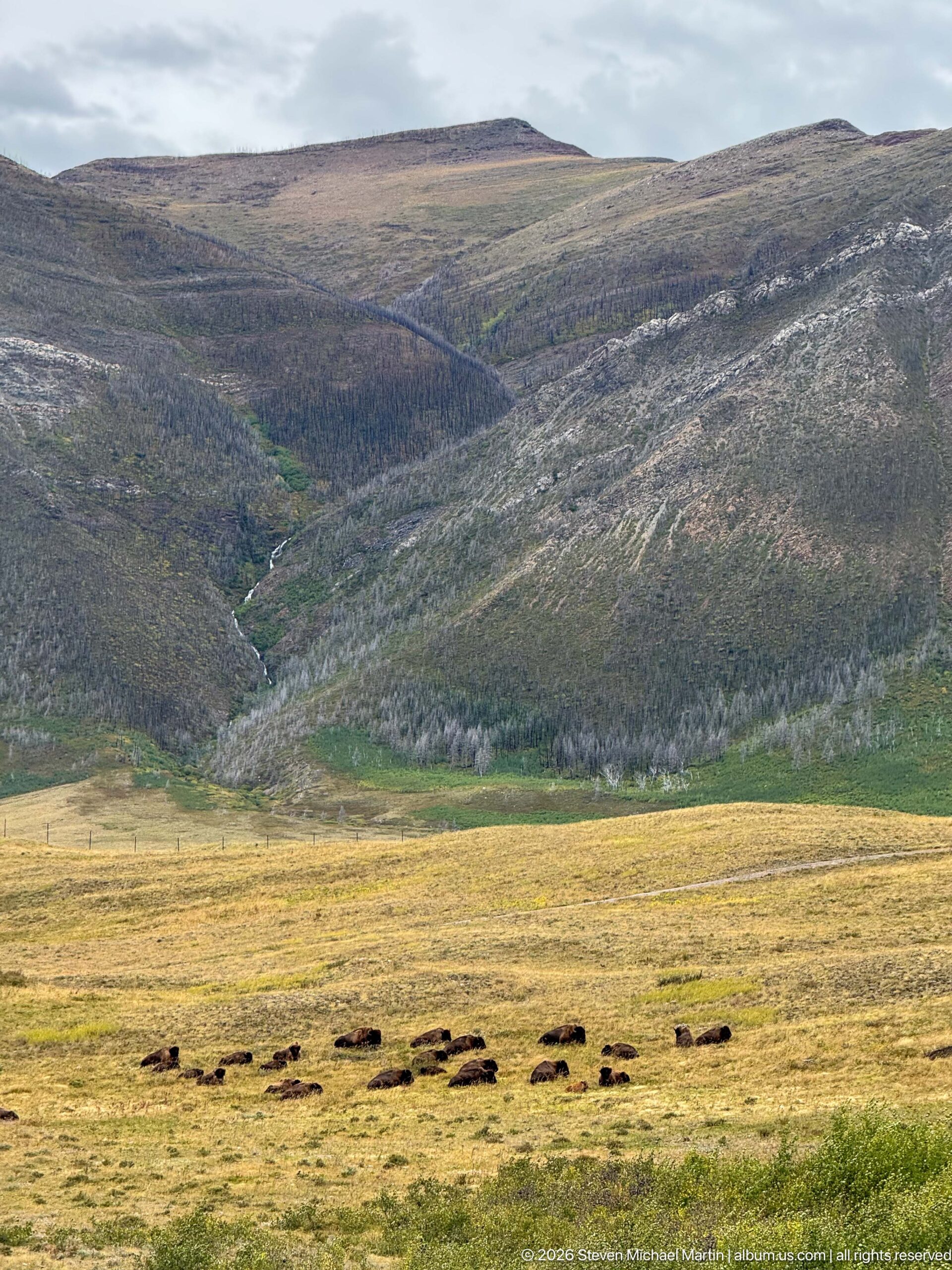
A line of plains bison crosses sunlit grassland below broad, treeless mountain slopes cut by a shallow drainage. The distant herd is secondary to the expansive setting, making this one of the portfolio’s strongest habitat views and emphasizing Waterton Lakes’ characteristic meeting of open prairie and the rising Rocky Mountain landscape.
Caption
A line of plains bison crosses sunlit grassland below broad, treeless mountain slopes cut by a shallow drainage. The distant herd is secondary to the expansive setting, making this one of the portfolio’s strongest habitat views and emphasizing Waterton Lakes’ characteristic meeting of open prairie and the rising Rocky Mountain landscape.
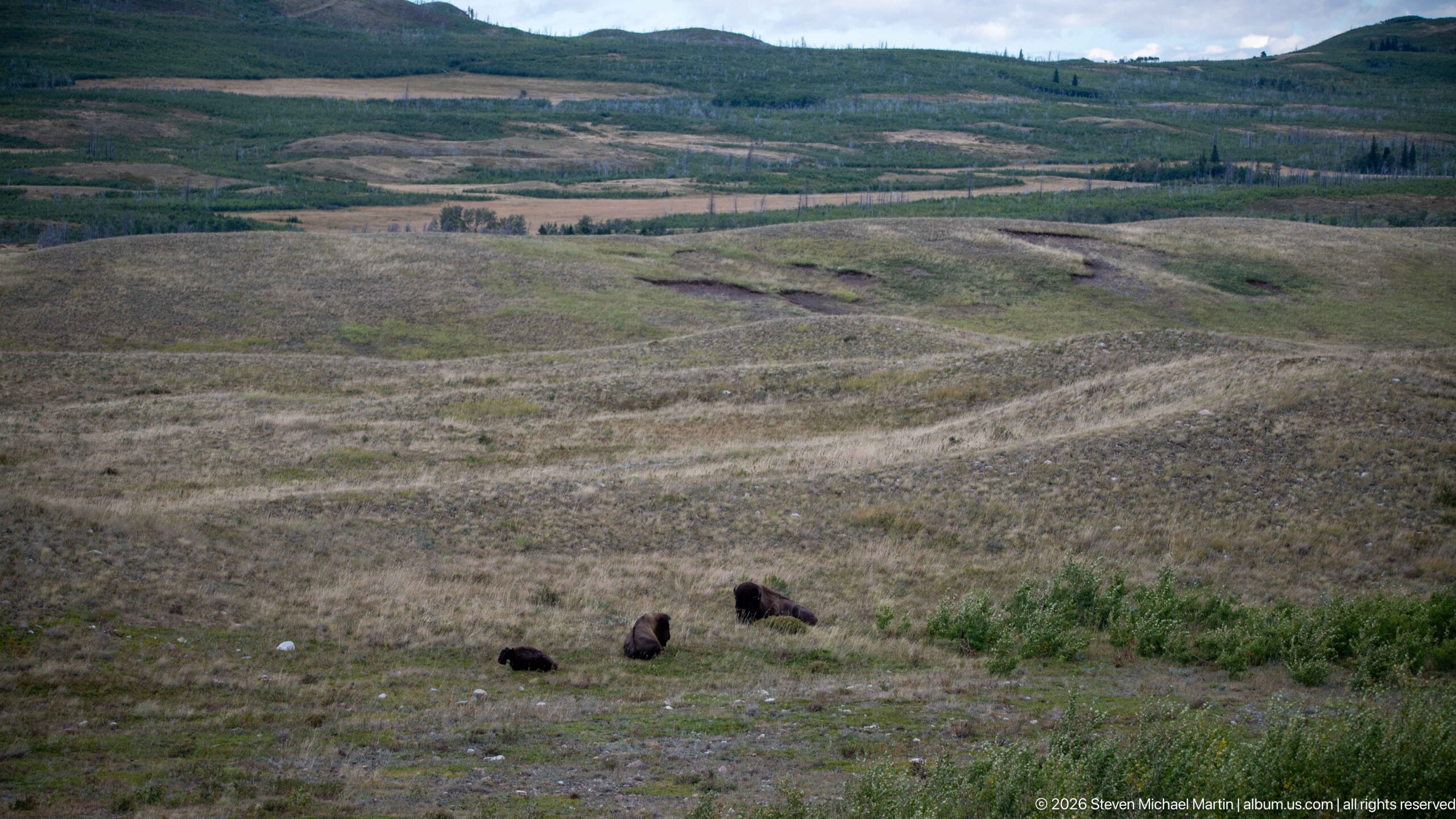
A few bison appear as small dark forms near the bottom of a sweeping grassland basin, dwarfed by rolling hills and layered vegetation beyond. This establishing view shifts emphasis from individual wildlife to habitat, showing the scale of the open terrain surrounding the herd and the transition from prairie slopes to higher ground.
Caption
A few bison appear as small dark forms near the bottom of a sweeping grassland basin, dwarfed by rolling hills and layered vegetation beyond. This establishing view shifts emphasis from individual wildlife to habitat, showing the scale of the open terrain surrounding the herd and the transition from prairie slopes to higher ground.
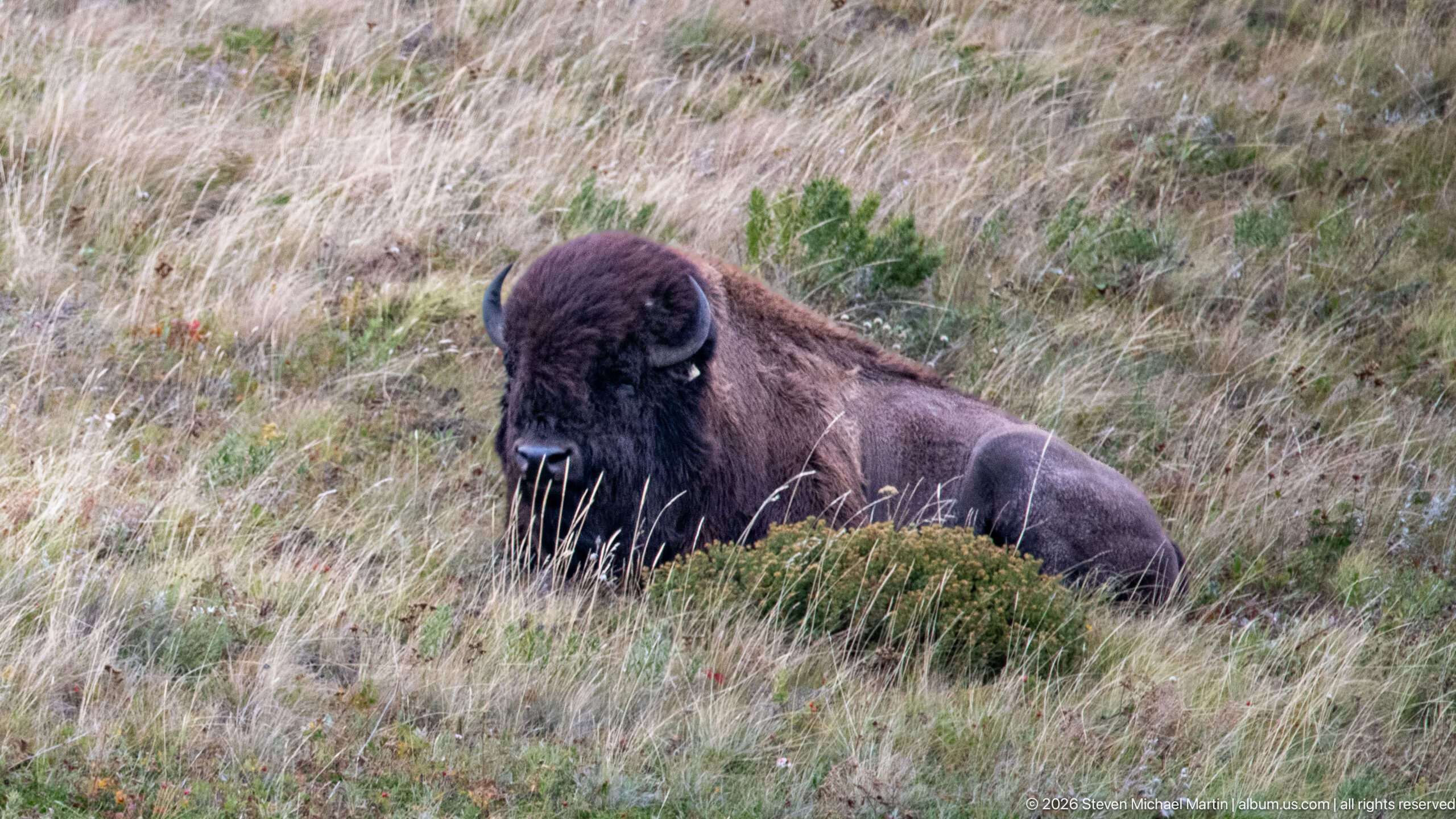
A large adult plains bison reclines behind a low shrub, facing toward the camera with both horns visible against its dark, woolly head. The close viewpoint concentrates attention on the animal’s heavy forequarters and dense coat while dry grasses soften the foreground, creating a strong resting portrait within the Waterton Lakes grassland.
Caption
A large adult plains bison reclines behind a low shrub, facing toward the camera with both horns visible against its dark, woolly head. The close viewpoint concentrates attention on the animal’s heavy forequarters and dense coat while dry grasses soften the foreground, creating a strong resting portrait within the Waterton Lakes grassland.
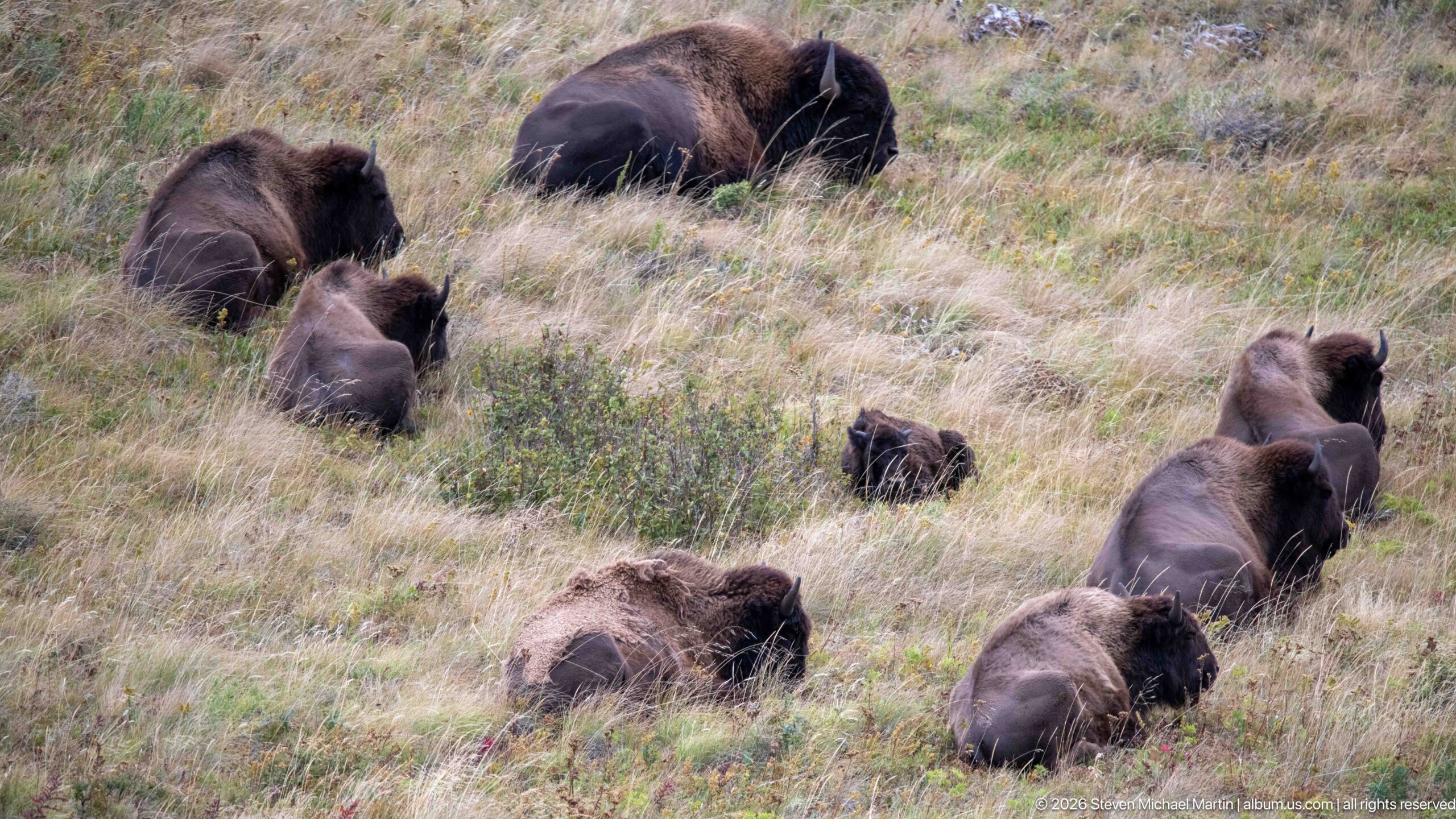
Adults and a smaller calf are scattered through pale grass and low shrubs on a gently sloping hillside. Some animals lie down while others remain upright, producing a layered herd scene that emphasizes both the mixed ages of the group and the patchwork of grass and brush within the Waterton Lakes bison landscape.
Caption
Adults and a smaller calf are scattered through pale grass and low shrubs on a gently sloping hillside. Some animals lie down while others remain upright, producing a layered herd scene that emphasizes both the mixed ages of the group and the patchwork of grass and brush within the Waterton Lakes bison landscape.
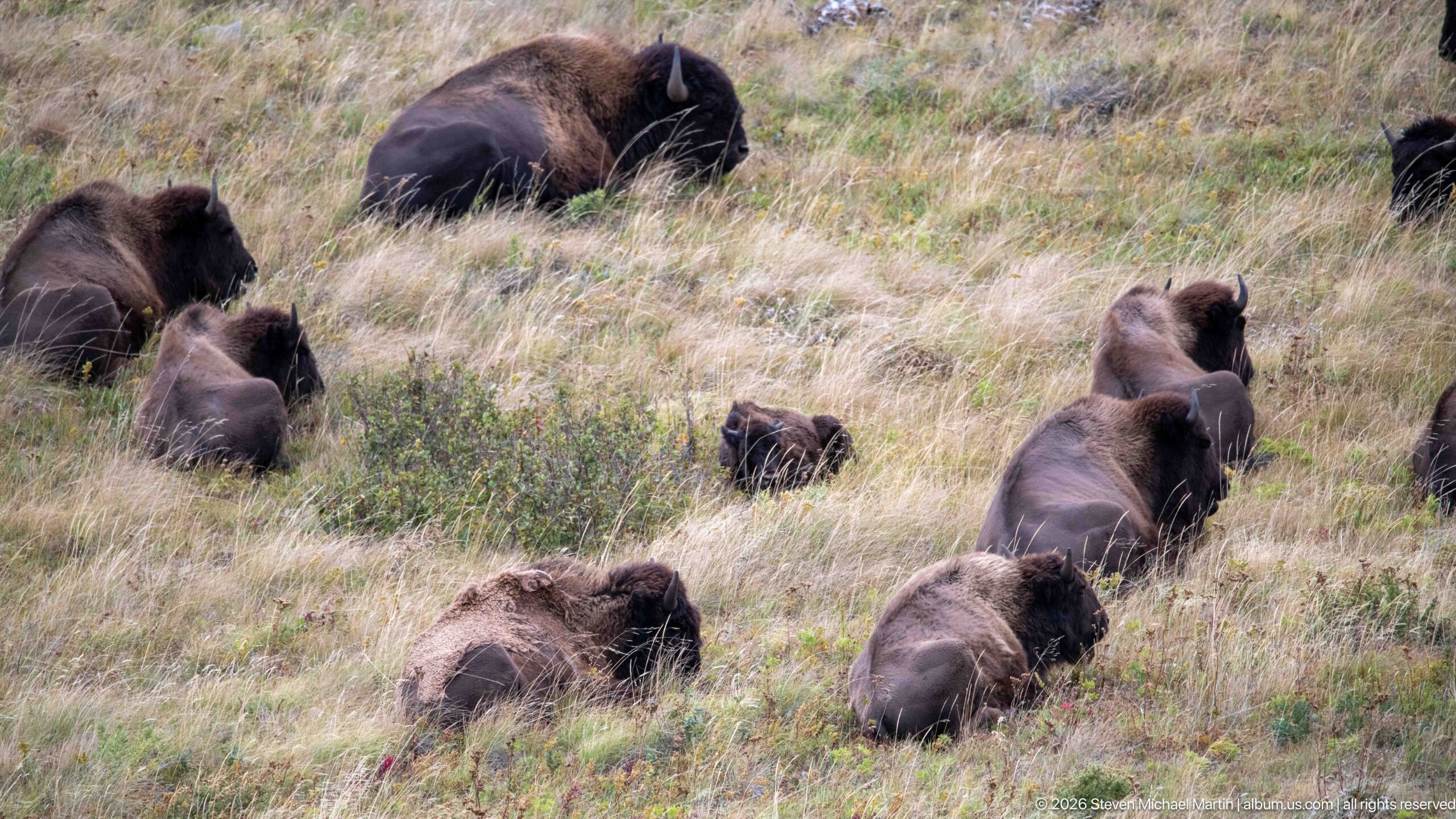
A mixed group of plains bison occupies a brush-dotted hillside, with several adults reclining and a smaller young animal visible near the center. The staggered positions create depth across the slope, while the combination of grasses and low shrubs provides a clear environmental context for the resting herd at Waterton Lakes.
Caption
A mixed group of plains bison occupies a brush-dotted hillside, with several adults reclining and a smaller young animal visible near the center. The staggered positions create depth across the slope, while the combination of grasses and low shrubs provides a clear environmental context for the resting herd at Waterton Lakes.
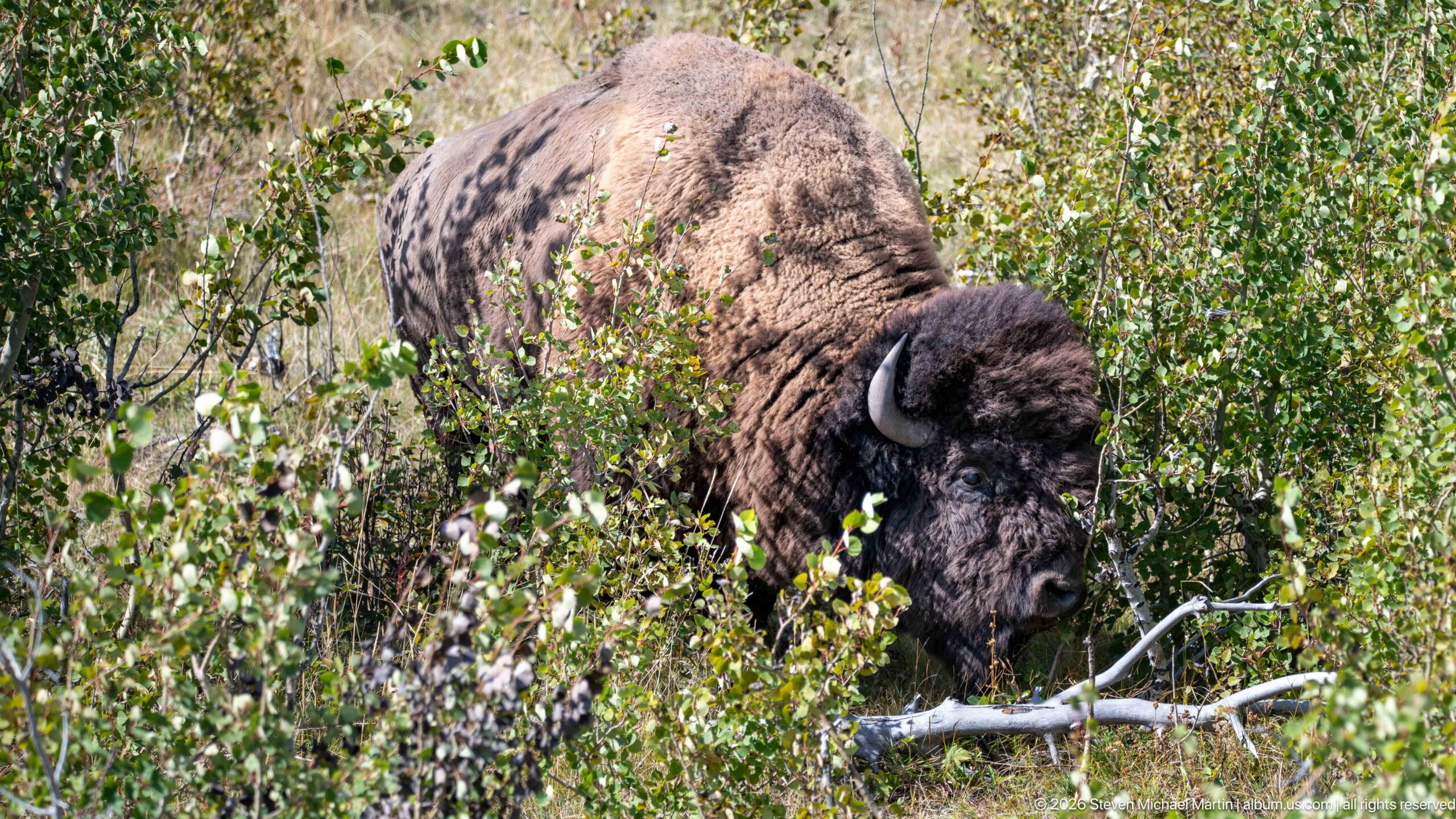
A plains bison pushes through dense leafy brush with its head lowered, partially obscured by branches and foliage. Sunlight catches the brown coat and rounded shoulder hump while the dark face and horn remain visible, documenting the animal within thicker vegetation rather than the open grassland that dominates much of the portfolio.
Caption
A plains bison pushes through dense leafy brush with its head lowered, partially obscured by branches and foliage. Sunlight catches the brown coat and rounded shoulder hump while the dark face and horn remain visible, documenting the animal within thicker vegetation rather than the open grassland that dominates much of the portfolio.
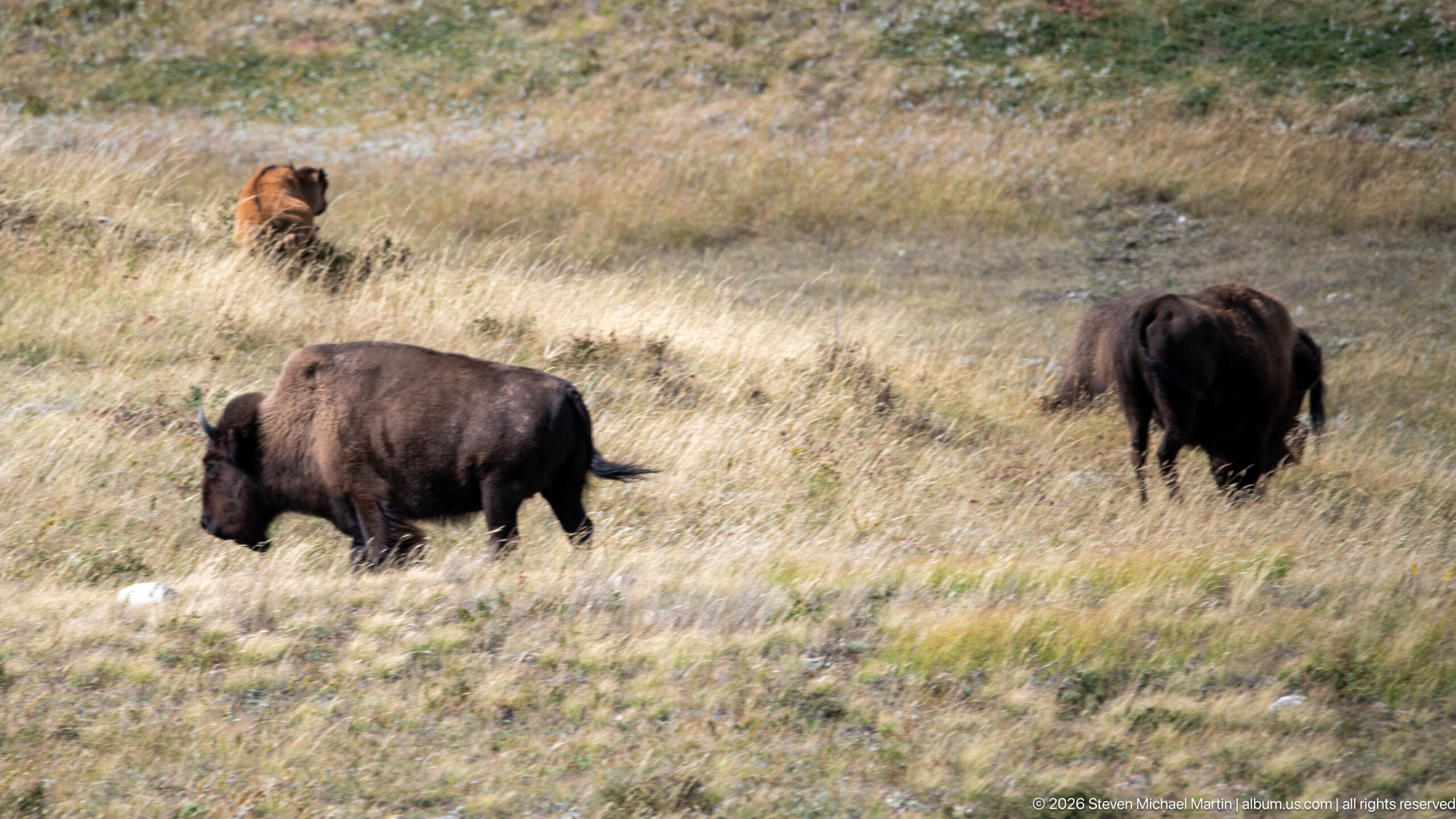
Several plains bison occupy an open grassy slope, including one broadside animal walking across the foreground and another standing farther back. A reddish young animal is partly visible higher on the hillside. The separated figures and varied orientations create a behavioral scene of herd members moving and resting independently across the terrain.
Caption
Several plains bison occupy an open grassy slope, including one broadside animal walking across the foreground and another standing farther back. A reddish young animal is partly visible higher on the hillside. The separated figures and varied orientations create a behavioral scene of herd members moving and resting independently across the terrain.
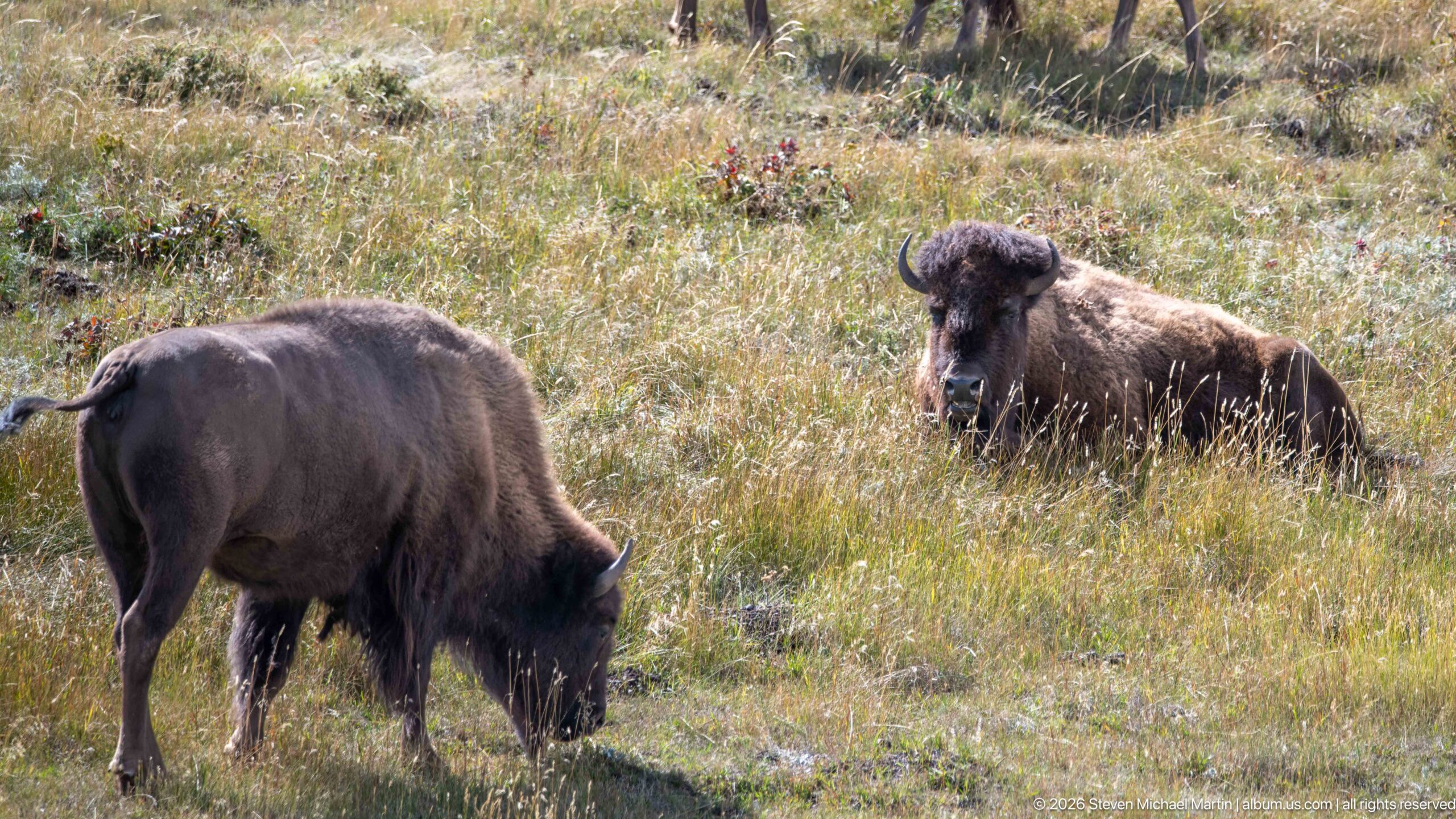
Two plains bison occupy the same grassy slope in contrasting postures: one stands with its head down grazing in the foreground while another reclines upright farther back. The composition pairs feeding and resting behavior in a single frame and uses the open space between the animals to show their separation across the hillside.
Caption
Two plains bison occupy the same grassy slope in contrasting postures: one stands with its head down grazing in the foreground while another reclines upright farther back. The composition pairs feeding and resting behavior in a single frame and uses the open space between the animals to show their separation across the hillside.
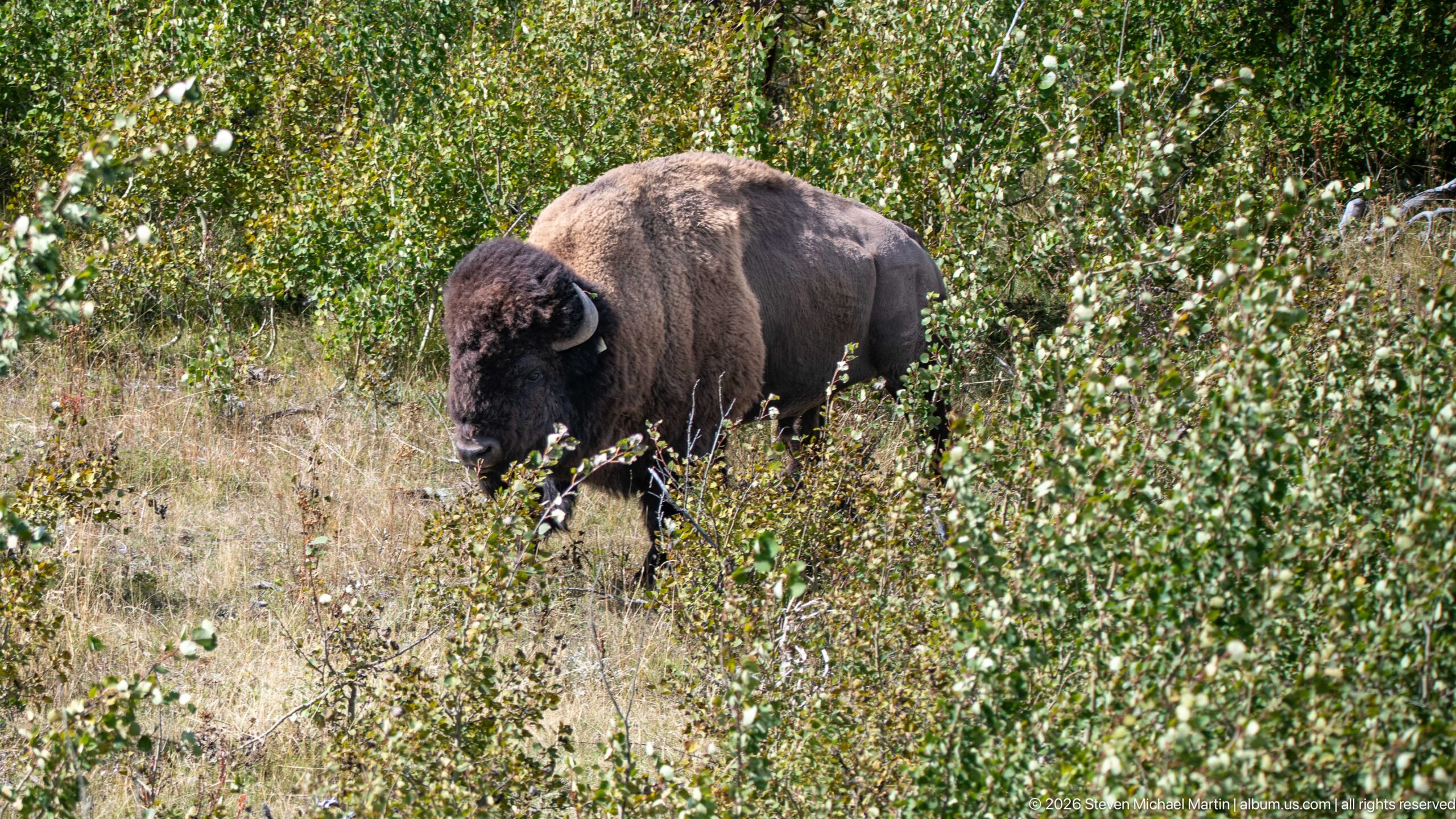
An adult plains bison moves through dense low shrubs and dry grass, its massive forequarters, dark head, and curved horns framed by leafy vegetation. The mixed cover distinguishes this close wildlife view from the portfolio’s open-grassland herd scenes and shows the animal using the brushy margins of the Waterton Lakes bison range.
Caption
An adult plains bison moves through dense low shrubs and dry grass, its massive forequarters, dark head, and curved horns framed by leafy vegetation. The mixed cover distinguishes this close wildlife view from the portfolio’s open-grassland herd scenes and shows the animal using the brushy margins of the Waterton Lakes bison range.
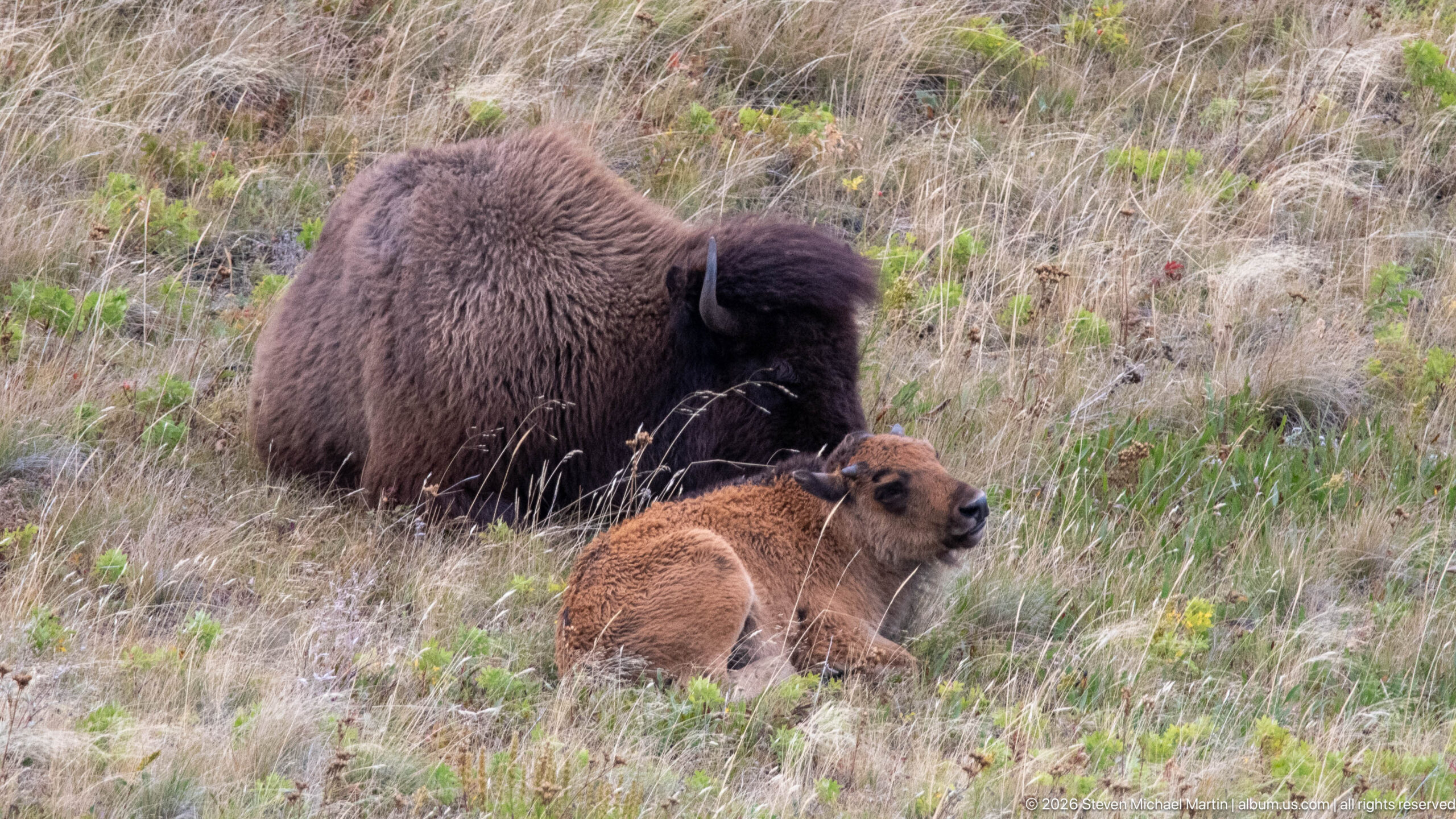
A reddish young bison calf rests in the grass immediately in front of a reclining adult, creating an intimate view of the herd’s age structure. The calf’s lighter cinnamon coat contrasts sharply with the adult’s dark, woolly forequarters, while the surrounding dry prairie vegetation places the pair within Waterton Lakes’ open grassland habitat.
Caption
A reddish young bison calf rests in the grass immediately in front of a reclining adult, creating an intimate view of the herd’s age structure. The calf’s lighter cinnamon coat contrasts sharply with the adult’s dark, woolly forequarters, while the surrounding dry prairie vegetation places the pair within Waterton Lakes’ open grassland habitat.
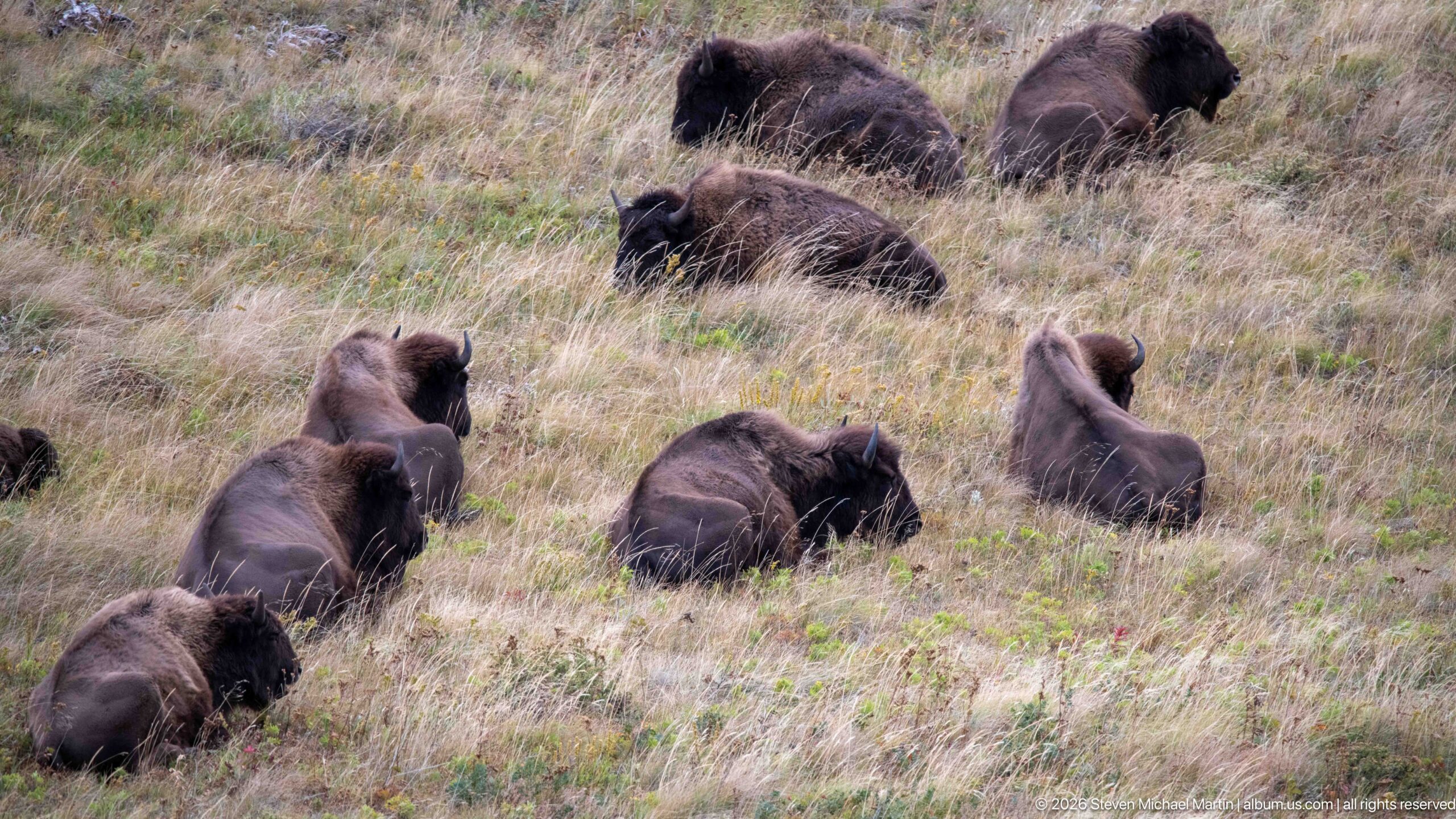
A dispersed group of plains bison rests across a sloping grassland, with animals oriented in several directions and separated by patches of dry vegetation. The elevated view records the herd as a social group rather than isolating a single animal, revealing how individuals settle across the uneven prairie terrain at Waterton Lakes.
Caption
A dispersed group of plains bison rests across a sloping grassland, with animals oriented in several directions and separated by patches of dry vegetation. The elevated view records the herd as a social group rather than isolating a single animal, revealing how individuals settle across the uneven prairie terrain at Waterton Lakes.
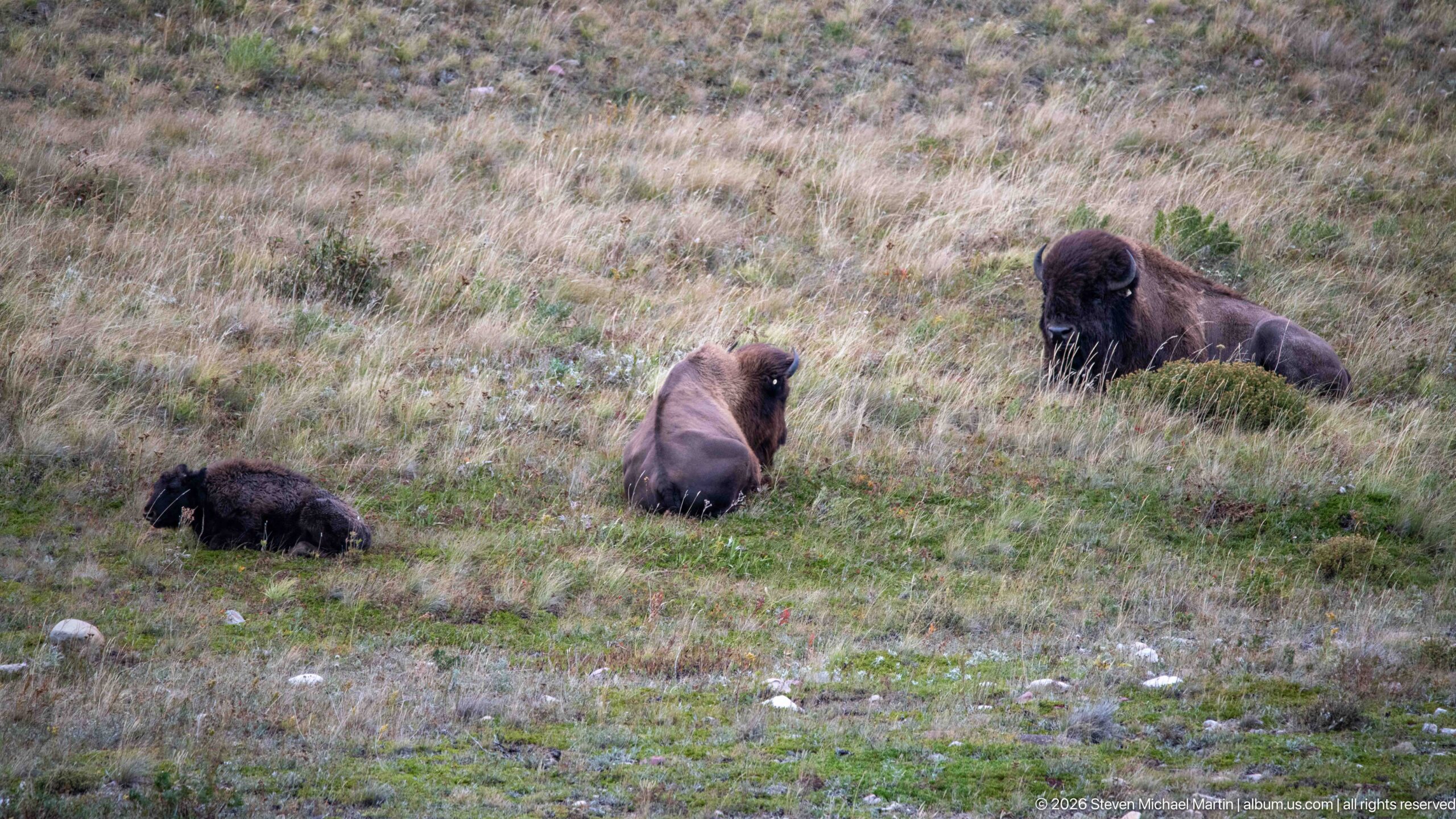
Three plains bison rest widely spaced across an open patch of short grass, their dark bodies standing out against the pale hillside. The broad spacing and uncluttered foreground make this a quieter behavioral study than the denser herd views, showing individual animals settled within the expansive grassland setting.
Caption
Three plains bison rest widely spaced across an open patch of short grass, their dark bodies standing out against the pale hillside. The broad spacing and uncluttered foreground make this a quieter behavioral study than the denser herd views, showing individual animals settled within the expansive grassland setting.
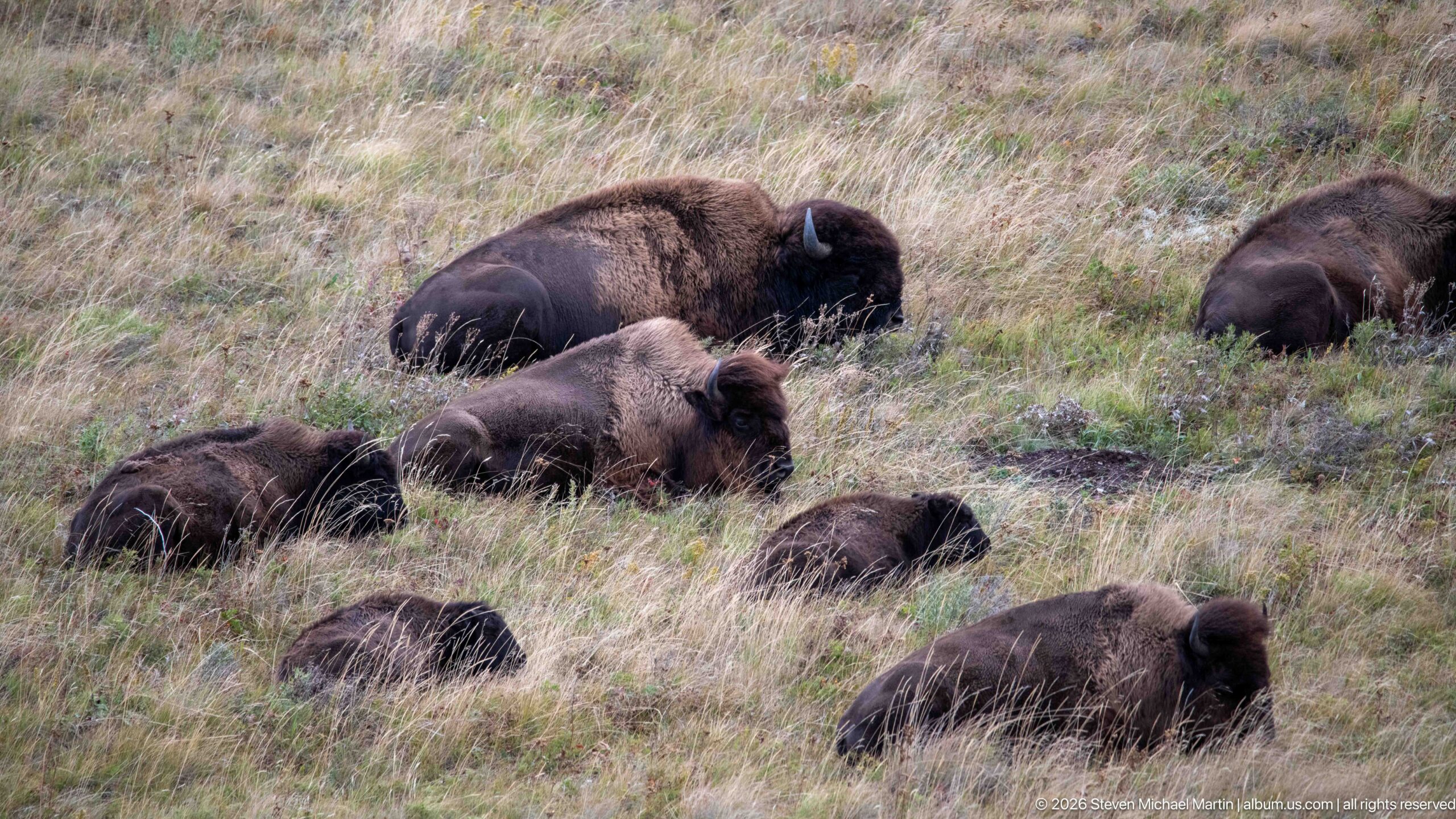
Several plains bison lie close together on a dry grassy slope, with one larger animal partly upright among the reclining bodies. The compressed grouping makes the herd appear denser than in neighboring views and highlights variations in body size, coat texture, and posture across the animals gathered on the hillside.
Caption
Several plains bison lie close together on a dry grassy slope, with one larger animal partly upright among the reclining bodies. The compressed grouping makes the herd appear denser than in neighboring views and highlights variations in body size, coat texture, and posture across the animals gathered on the hillside.
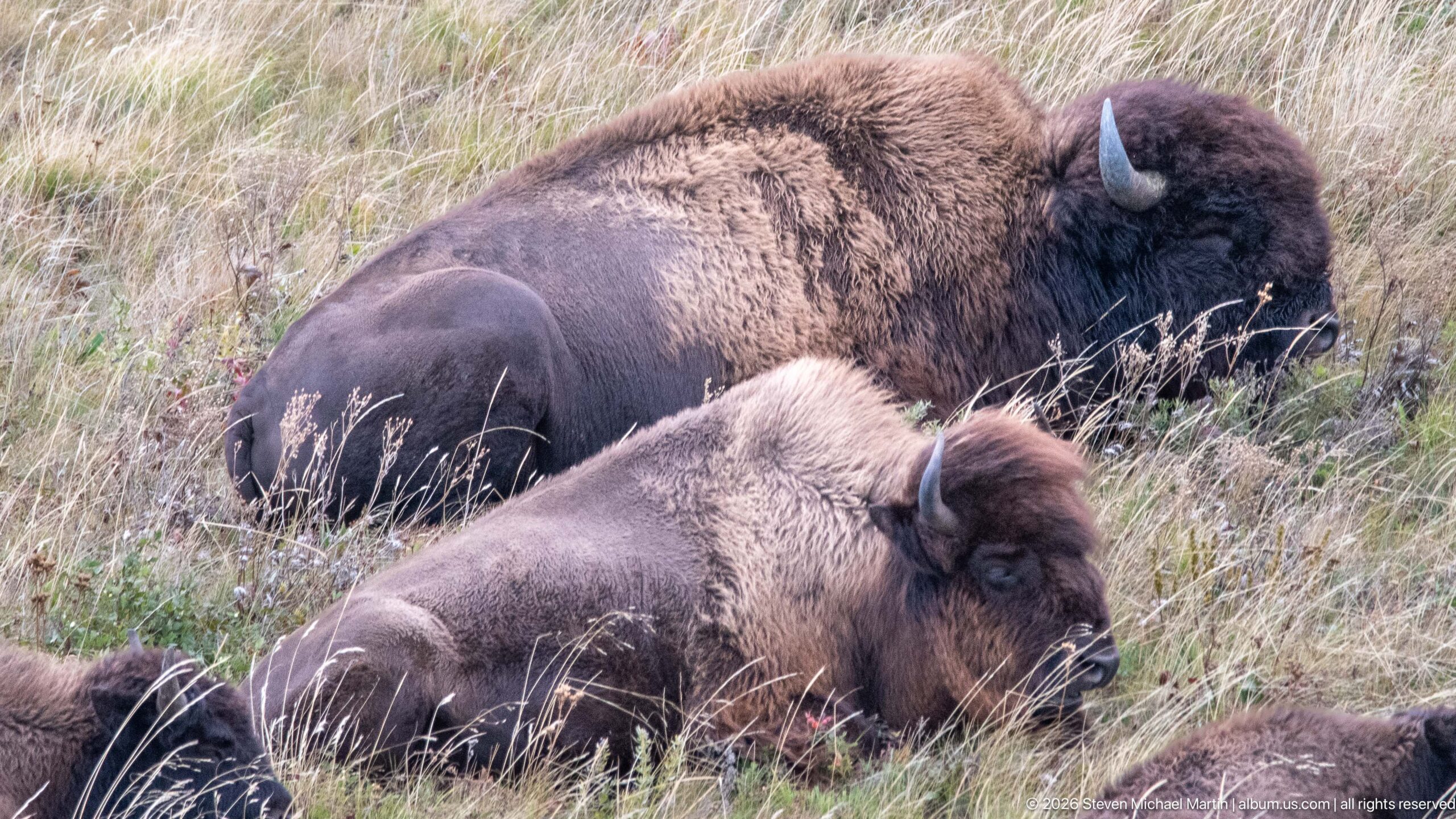
Two plains bison rest close together in tall grass, the nearer animal showing a lighter, weathered coat across its shoulders while the larger bison behind retains a darker head and forequarters. Their overlapping forms create a compact study of coat texture, horns, and the characteristic contrast between massive shoulders and lower hindquarters.
Caption
Two plains bison rest close together in tall grass, the nearer animal showing a lighter, weathered coat across its shoulders while the larger bison behind retains a darker head and forequarters. Their overlapping forms create a compact study of coat texture, horns, and the characteristic contrast between massive shoulders and lower hindquarters.
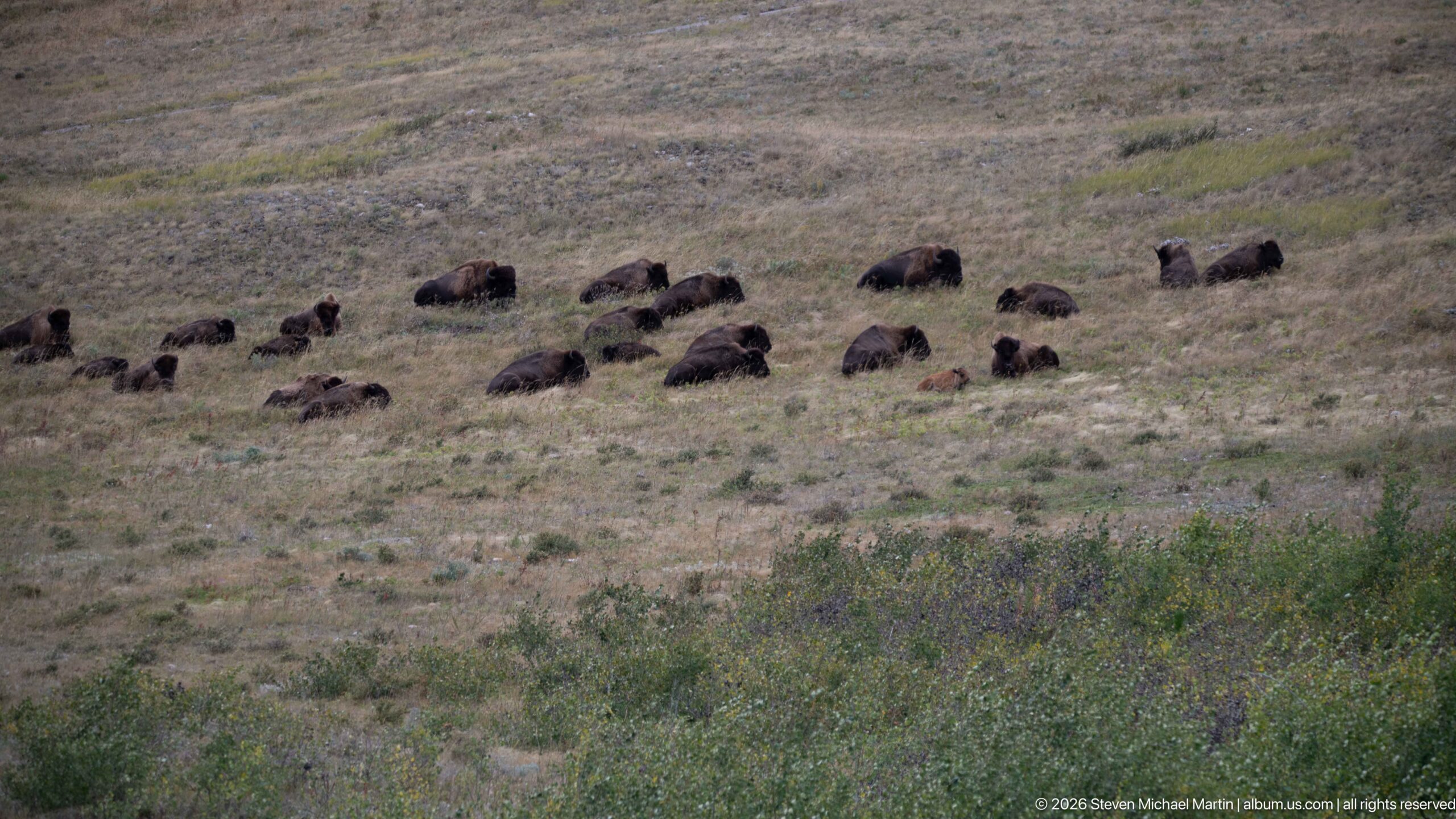
A sizeable herd of plains bison spreads laterally across an open hillside, with animals grazing, standing, or resting at varied intervals. Seen from a distance, the group forms a dark band against the muted grassland, giving a broader sense of herd scale and movement across the Waterton Lakes prairie environment.
Caption
A sizeable herd of plains bison spreads laterally across an open hillside, with animals grazing, standing, or resting at varied intervals. Seen from a distance, the group forms a dark band against the muted grassland, giving a broader sense of herd scale and movement across the Waterton Lakes prairie environment.
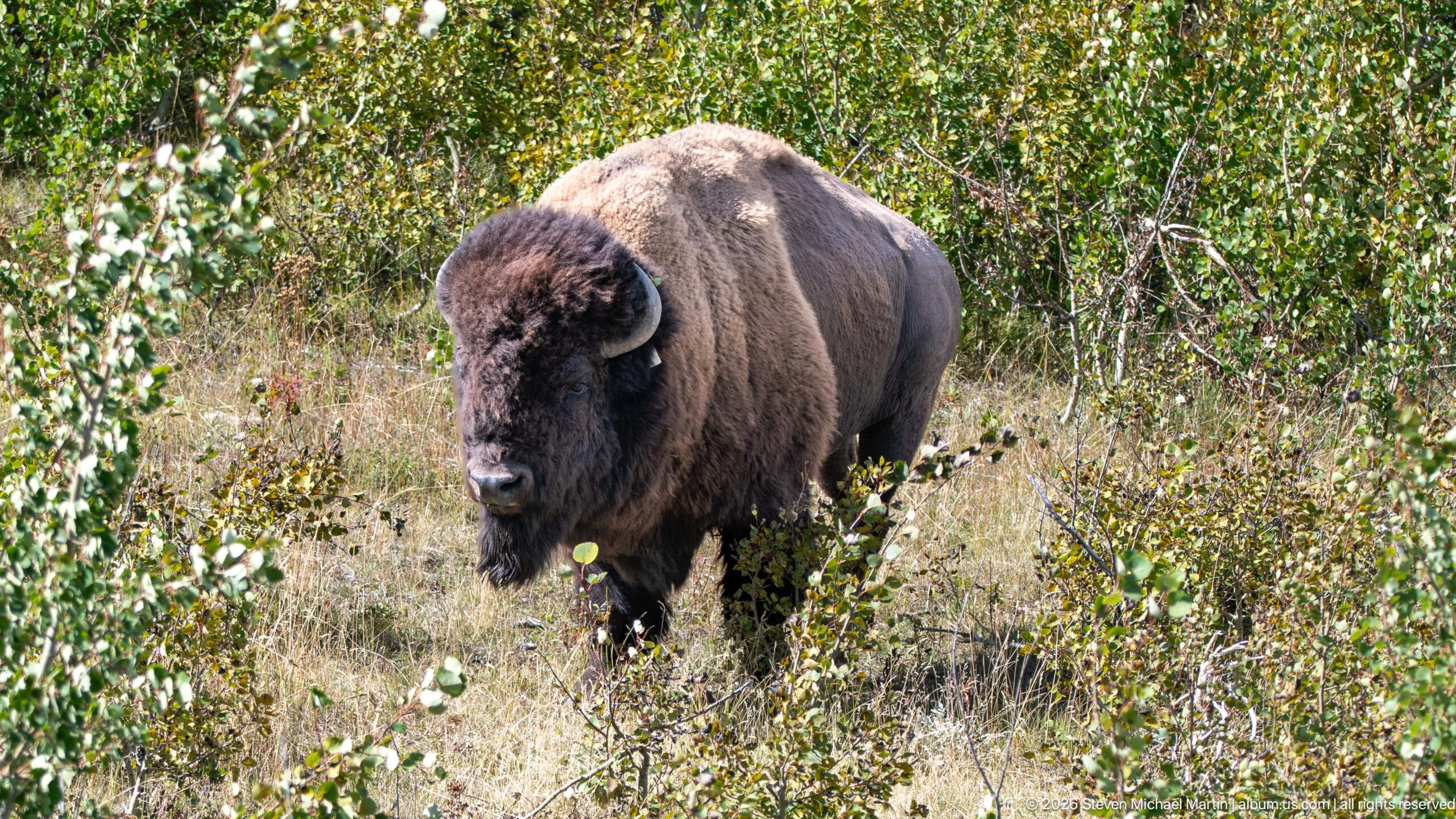
An adult plains bison stands nearly head-on amid dense shrubs and dry grass, its broad forehead, short curved horns, and massive shoulder hump clearly visible. The frontal stance creates direct visual engagement, while the surrounding brush distinguishes this portrait from the more open prairie views elsewhere in the Waterton Lakes series.
Caption
An adult plains bison stands nearly head-on amid dense shrubs and dry grass, its broad forehead, short curved horns, and massive shoulder hump clearly visible. The frontal stance creates direct visual engagement, while the surrounding brush distinguishes this portrait from the more open prairie views elsewhere in the Waterton Lakes series.
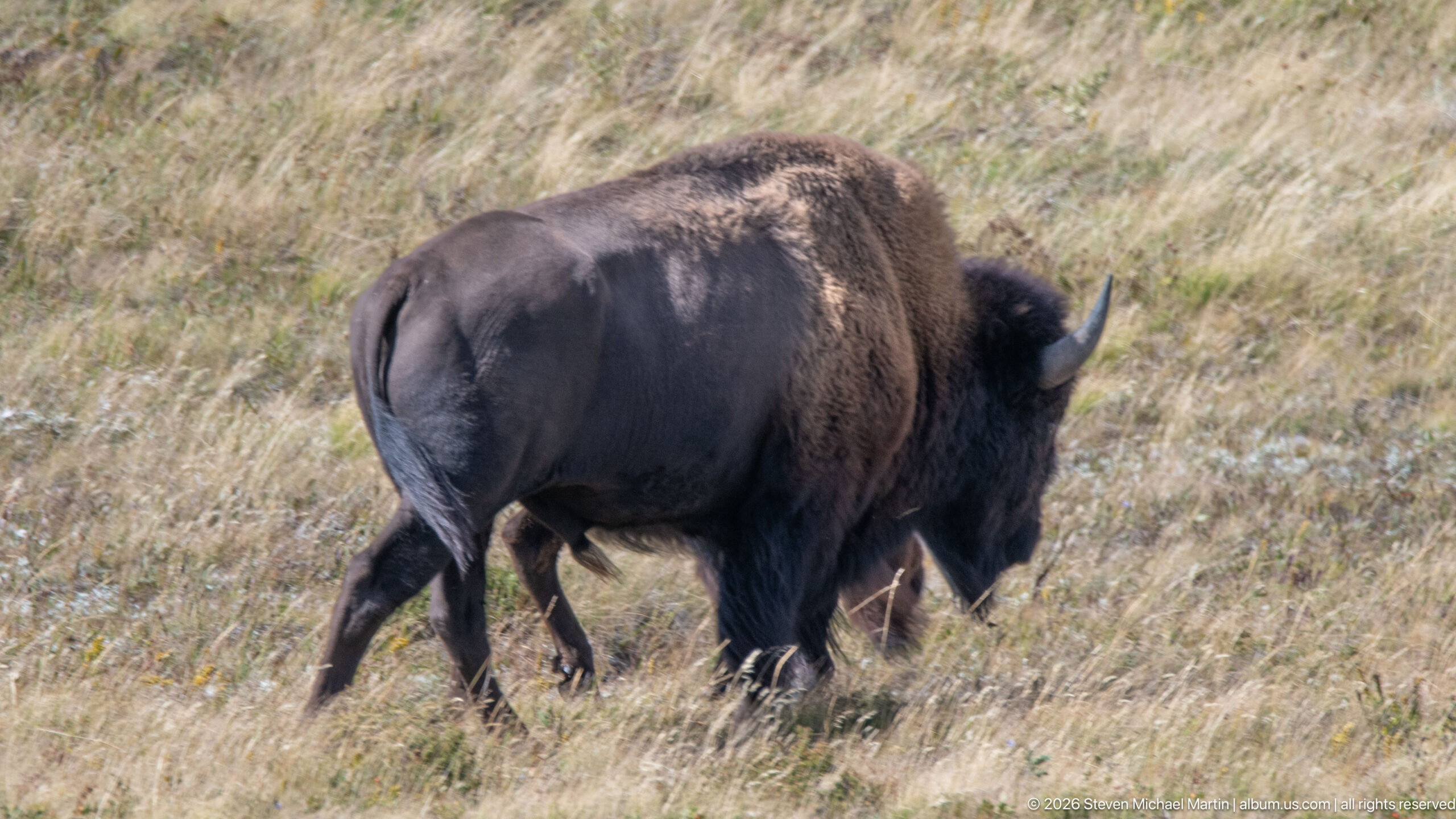
A mature plains bison walks broadside through pale grass, exposing the species’ distinctive profile: high shoulder hump, heavy dark forequarters, curved horn, and comparatively narrow hindquarters. The unobstructed side view provides a clear study of body form and coat pattern as the animal moves across the Waterton Lakes grassland.
Caption
A mature plains bison walks broadside through pale grass, exposing the species’ distinctive profile: high shoulder hump, heavy dark forequarters, curved horn, and comparatively narrow hindquarters. The unobstructed side view provides a clear study of body form and coat pattern as the animal moves across the Waterton Lakes grassland.
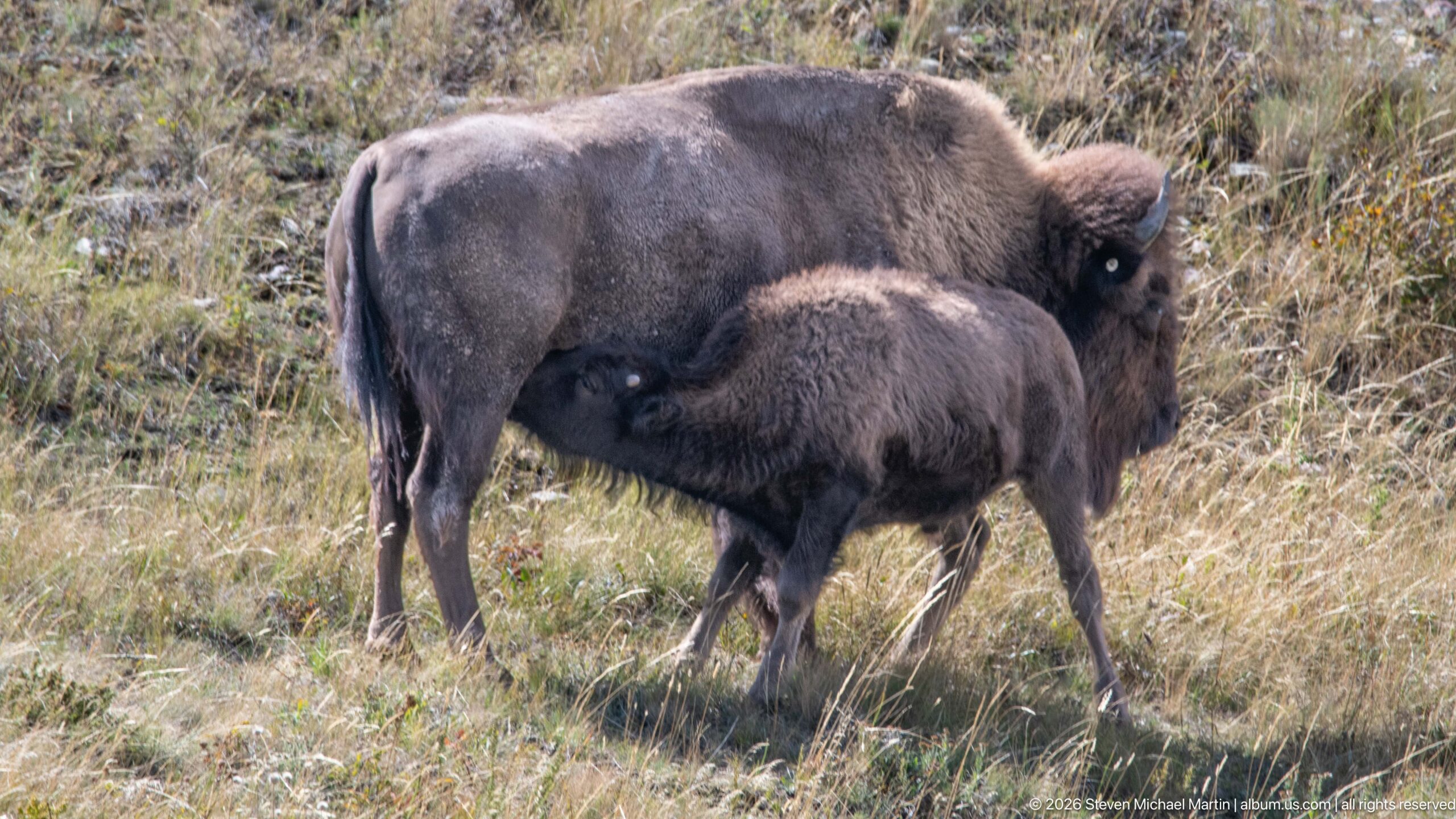
A young bison nurses beneath an adult standing in dry grass, its smaller body tucked closely against the adult’s flank. The behavior provides a direct record of maternal care within the herd and contrasts with the many resting and grazing scenes in the portfolio, while the close view clearly shows the size difference between calf and adult.
Caption
A young bison nurses beneath an adult standing in dry grass, its smaller body tucked closely against the adult’s flank. The behavior provides a direct record of maternal care within the herd and contrasts with the many resting and grazing scenes in the portfolio, while the close view clearly shows the size difference between calf and adult.
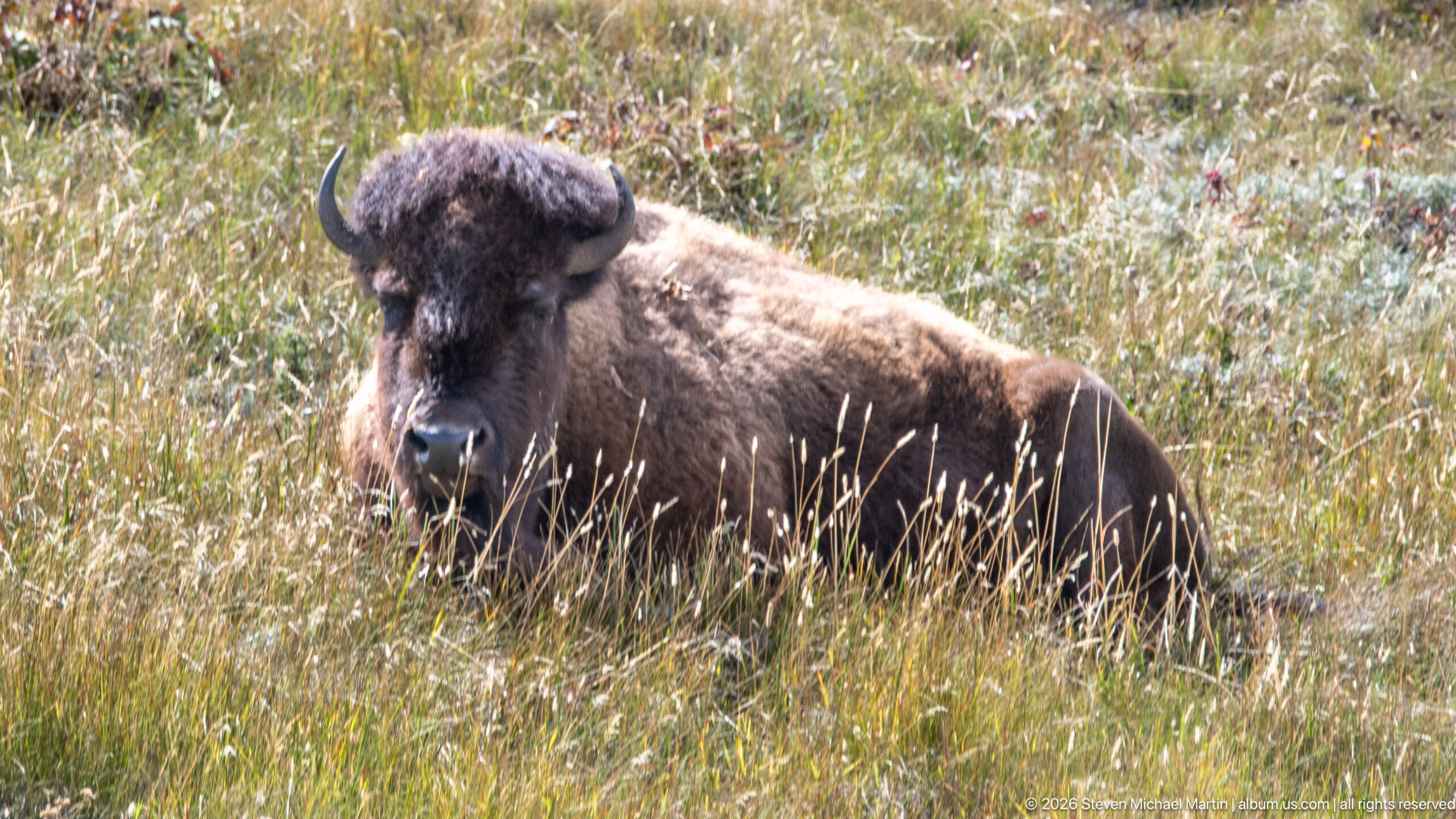
A plains bison lies in tall sunlit grass facing the camera, with both horns curving outward from its woolly dark head. Warm light reveals the lighter brown coat along its back and flank, while the upright head and alert gaze distinguish this portrait from other reclining animals photographed across the hillside.
Caption
A plains bison lies in tall sunlit grass facing the camera, with both horns curving outward from its woolly dark head. Warm light reveals the lighter brown coat along its back and flank, while the upright head and alert gaze distinguish this portrait from other reclining animals photographed across the hillside.
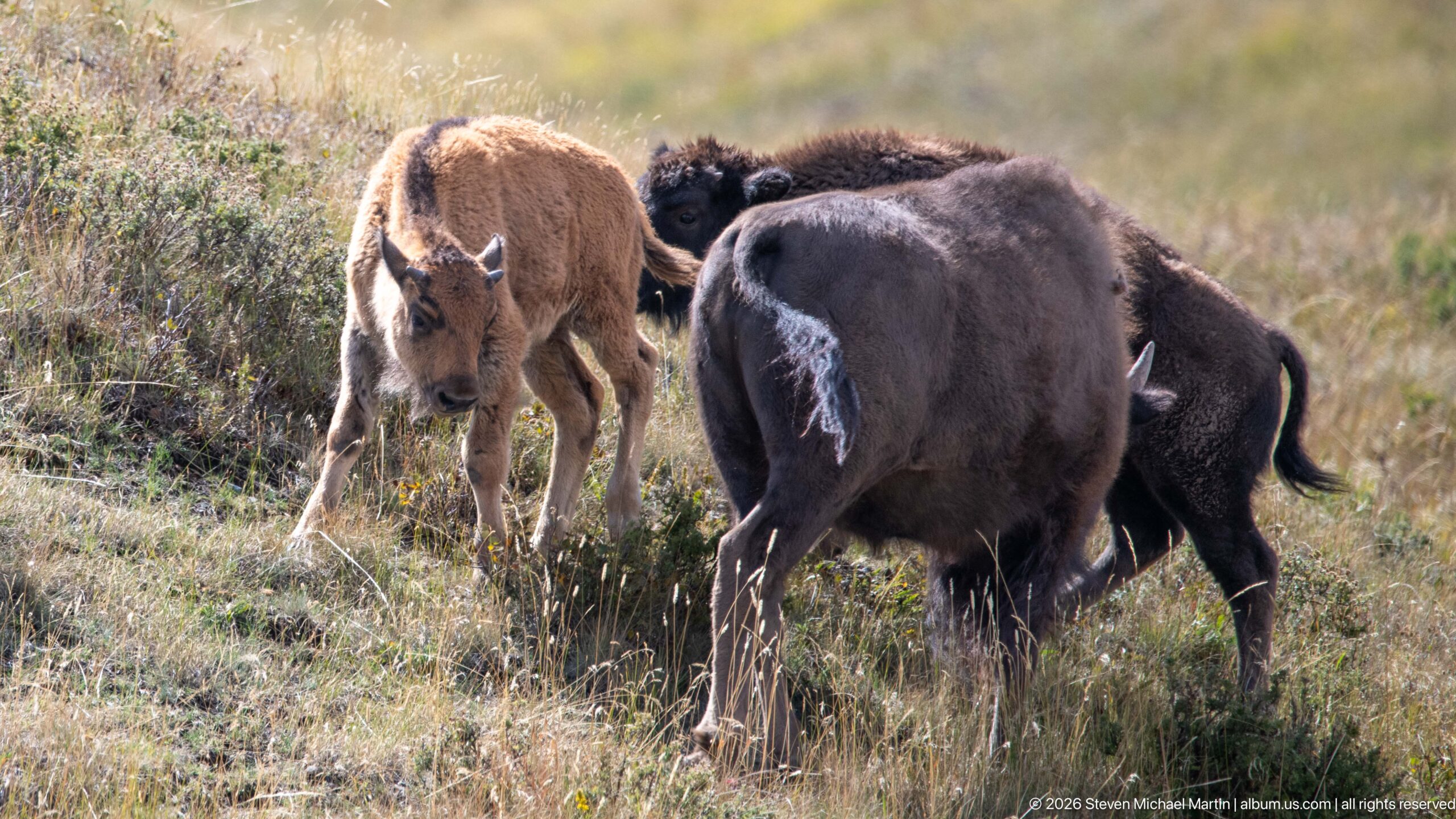
A reddish bison calf stands among several darker adults, its lighter coat and smaller frame immediately separating it from the surrounding herd. The adults overlap around the calf in a tight grouping, providing a close comparison of age, size, and coat color within the Waterton Lakes bison population.
Caption
A reddish bison calf stands among several darker adults, its lighter coat and smaller frame immediately separating it from the surrounding herd. The adults overlap around the calf in a tight grouping, providing a close comparison of age, size, and coat color within the Waterton Lakes bison population.
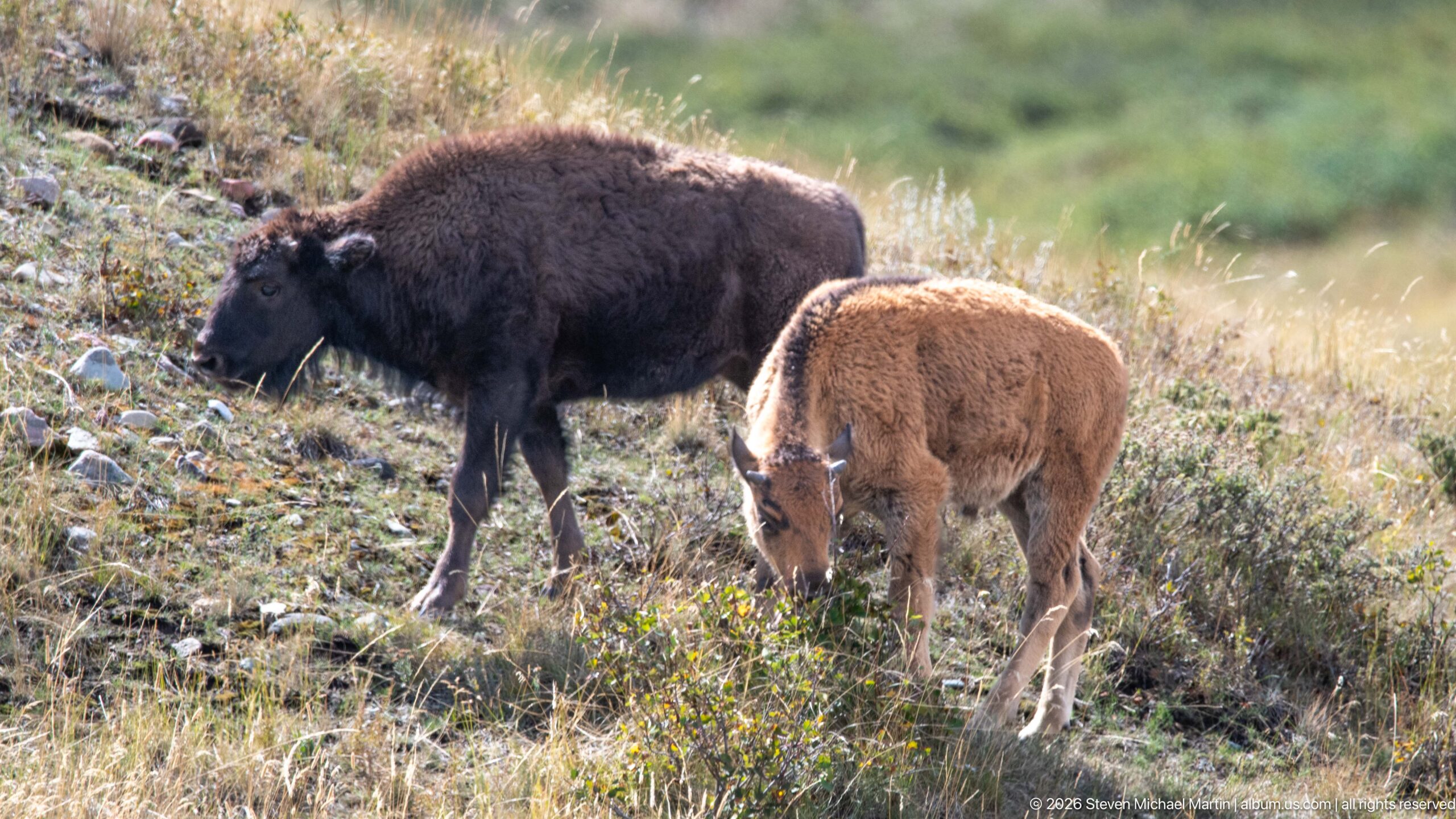
An adult plains bison and a reddish calf move side by side across a rocky, grass-covered slope. Backlighting catches the coarse hair along the adult’s back and the calf’s warm coat, while their parallel movement creates a clear parent-and-young association without the crowding seen in the larger herd scenes.
Caption
An adult plains bison and a reddish calf move side by side across a rocky, grass-covered slope. Backlighting catches the coarse hair along the adult’s back and the calf’s warm coat, while their parallel movement creates a clear parent-and-young association without the crowding seen in the larger herd scenes.
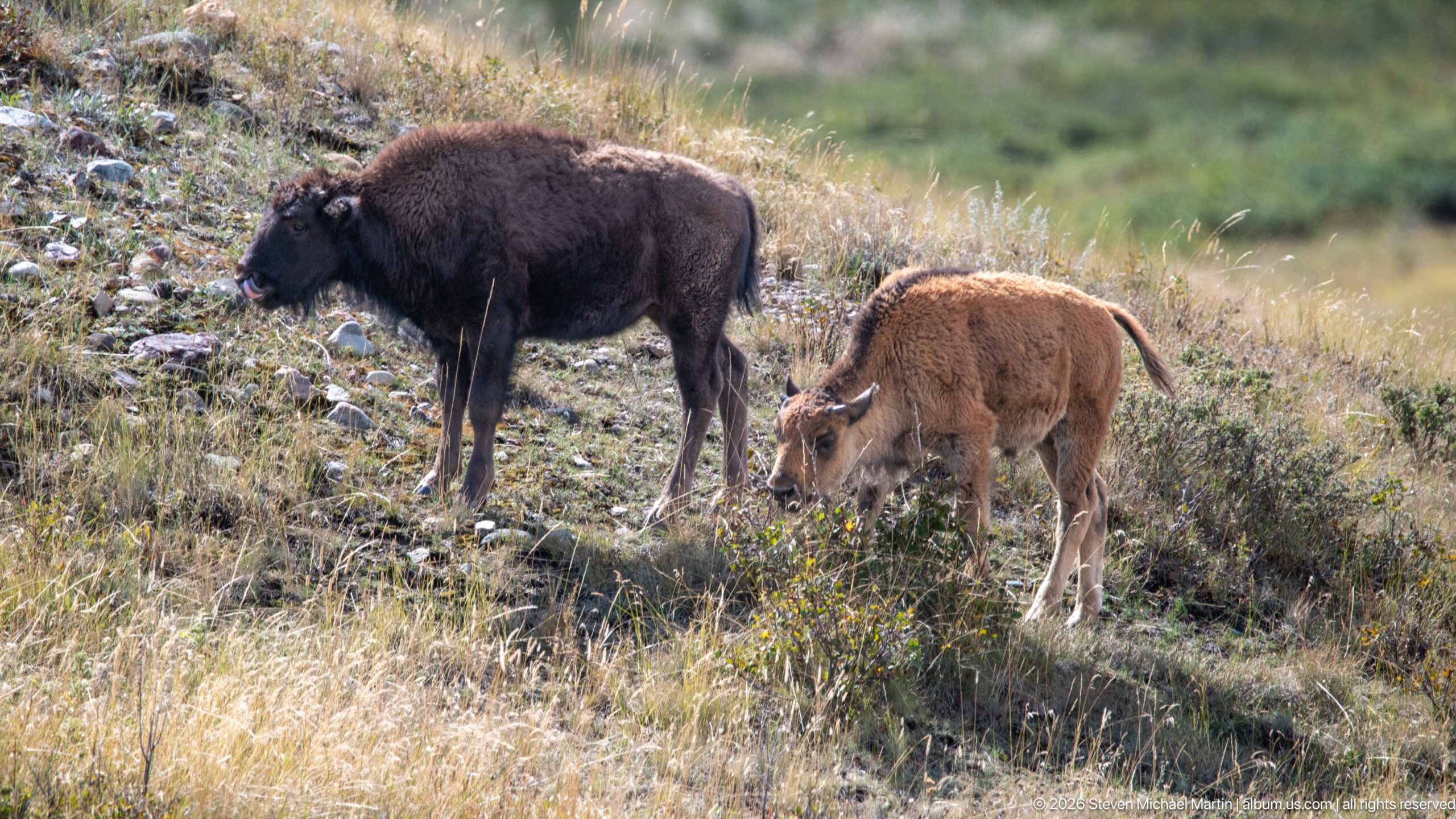
A dark adult bison stands beside a reddish calf on a sparsely vegetated hillside, both shown in full profile against pale grass and scattered stones. The open composition isolates the pair from the larger herd and clearly records the striking difference in coat color and body proportions between mature and young plains bison.
Caption
A dark adult bison stands beside a reddish calf on a sparsely vegetated hillside, both shown in full profile against pale grass and scattered stones. The open composition isolates the pair from the larger herd and clearly records the striking difference in coat color and body proportions between mature and young plains bison.
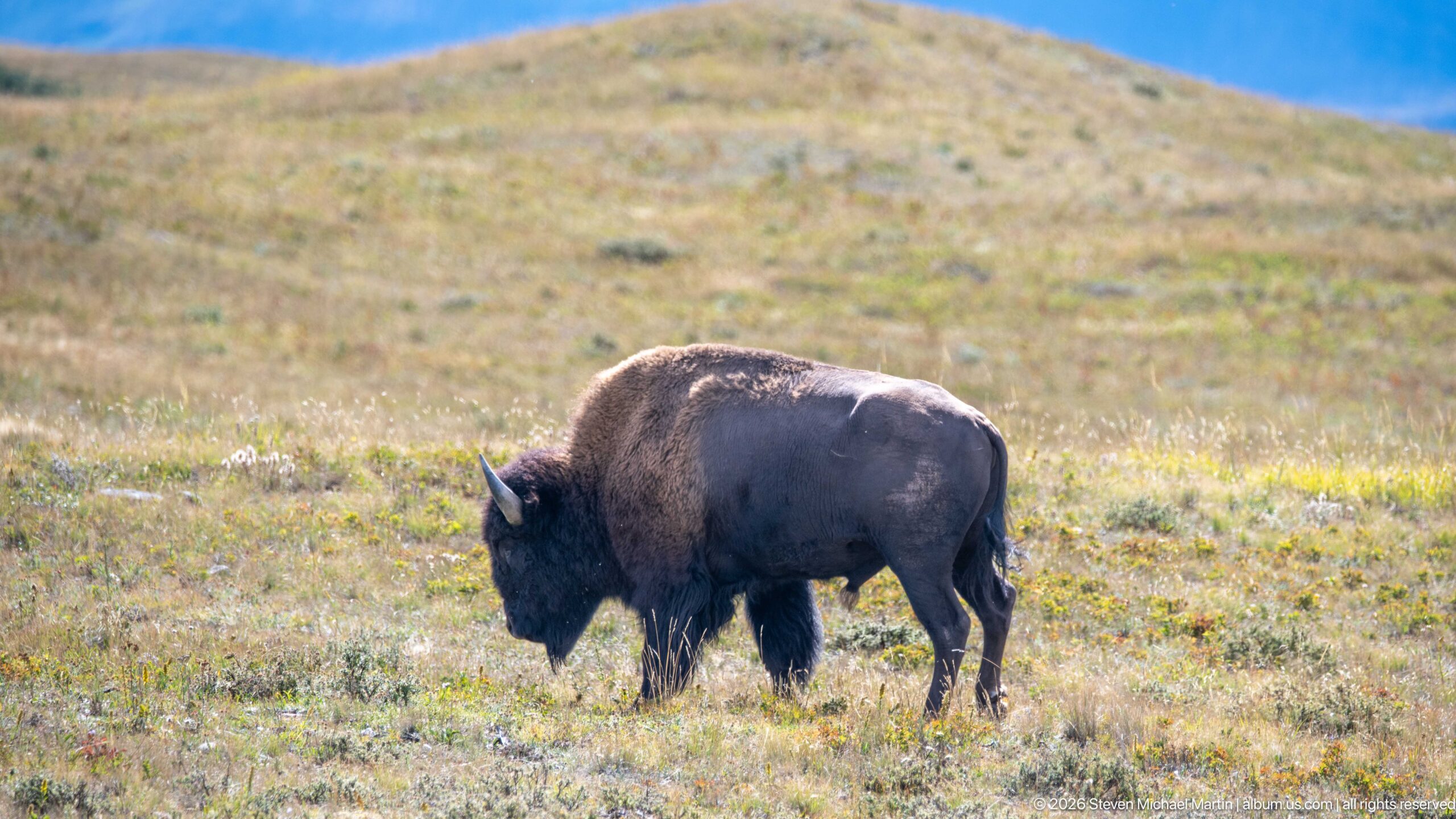
A solitary plains bison walks across an open, sunlit hillside with little vegetation to interrupt its broadside silhouette. The high shoulder hump, shaggy dark head, curved horn, and shorter coat over the hindquarters are especially clear, making this an effective full-body study of an adult moving through prairie habitat.
Caption
A solitary plains bison walks across an open, sunlit hillside with little vegetation to interrupt its broadside silhouette. The high shoulder hump, shaggy dark head, curved horn, and shorter coat over the hindquarters are especially clear, making this an effective full-body study of an adult moving through prairie habitat.
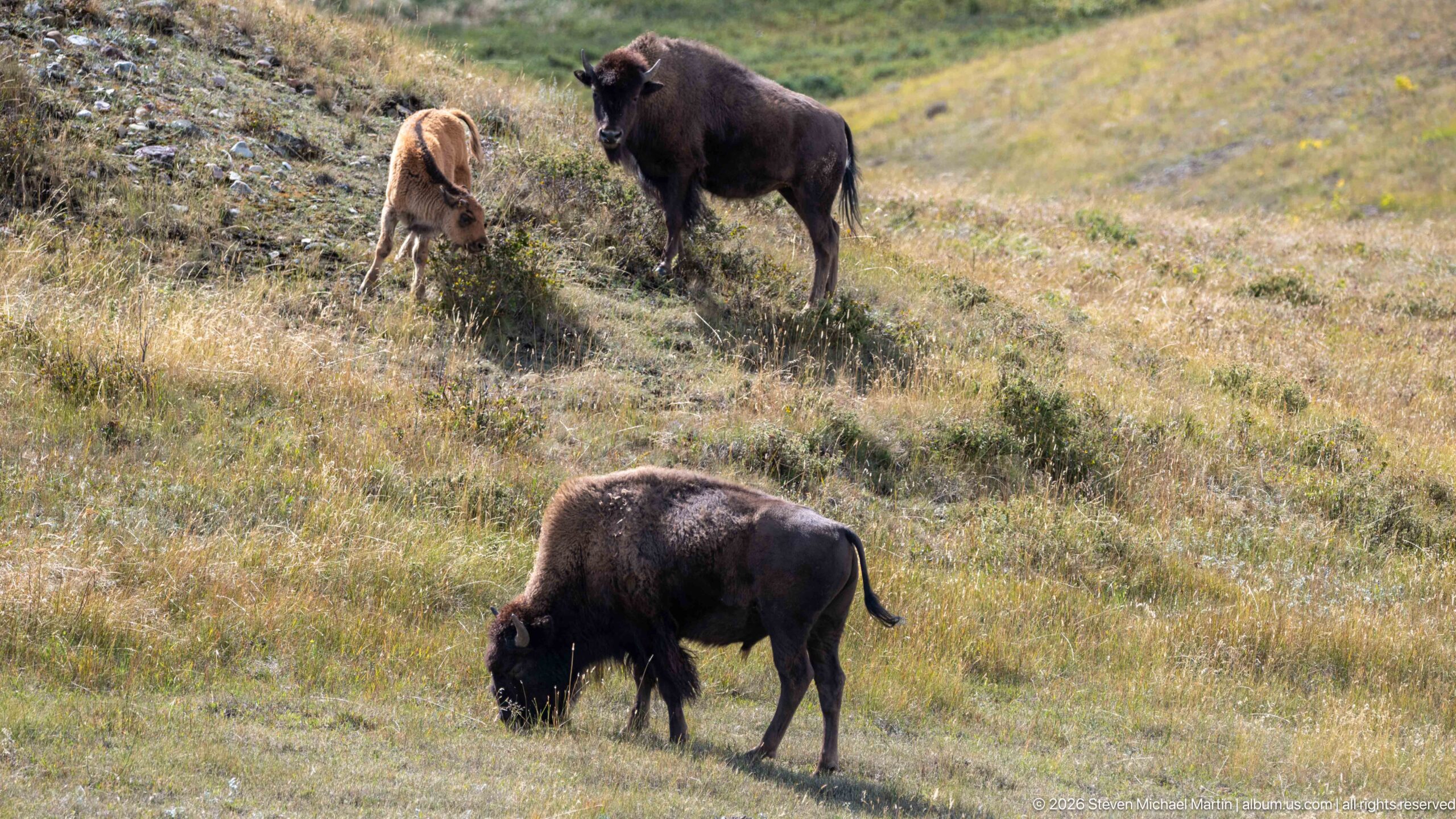
A plains bison grazes in the foreground while two additional herd members stand higher on the rolling slope behind it, one partly obscured at the frame edge. The tiered arrangement links individual feeding behavior to the wider herd and shows how the animals spread across the undulating grassland terrain.
Caption
A plains bison grazes in the foreground while two additional herd members stand higher on the rolling slope behind it, one partly obscured at the frame edge. The tiered arrangement links individual feeding behavior to the wider herd and shows how the animals spread across the undulating grassland terrain.
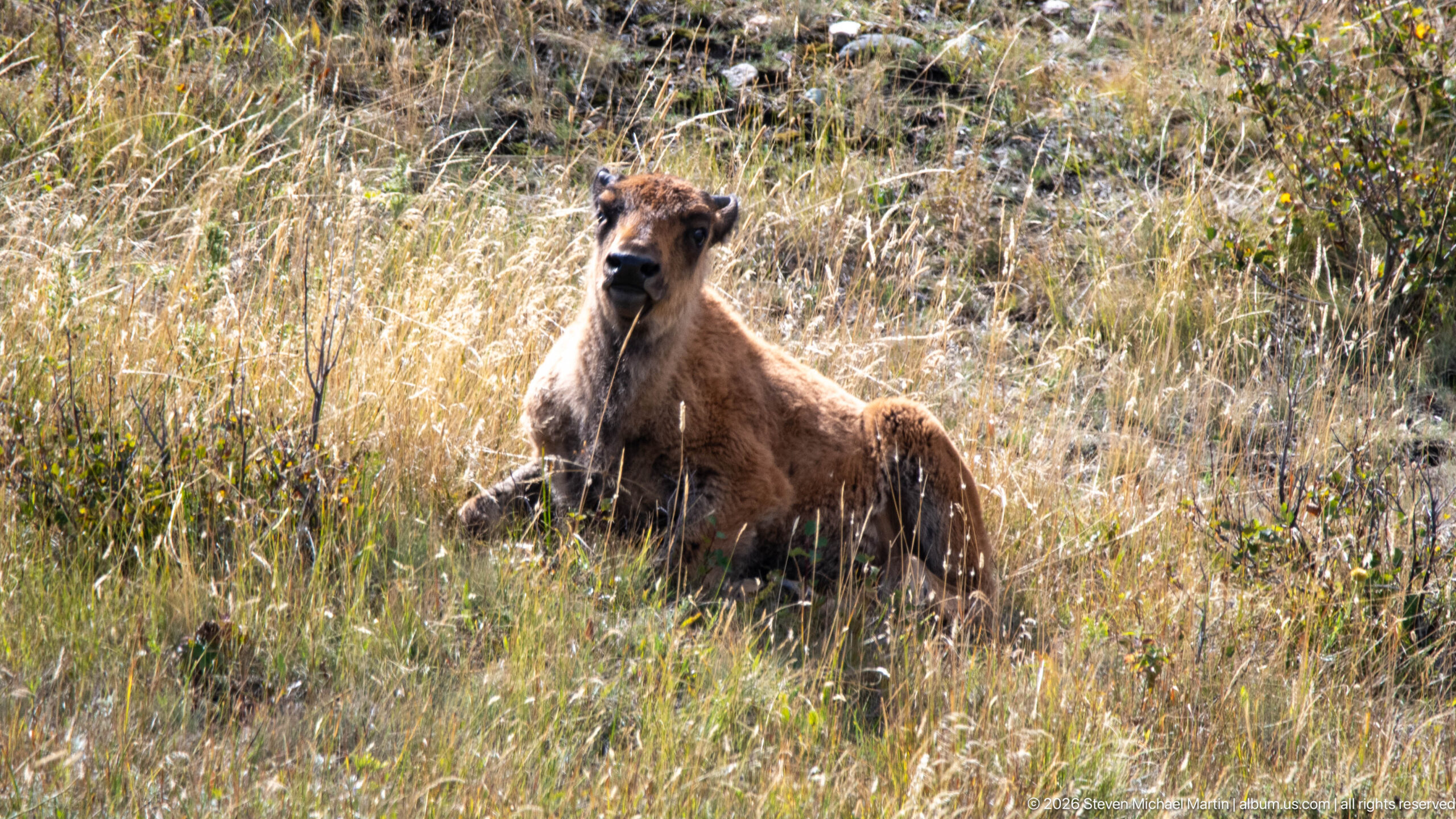
A reddish young bison calf rests upright in tall golden grass, facing toward the camera with its small ears extended and compact body fully visible. Isolated from the adults, the portrait emphasizes the calf’s lighter juvenile coat, fine facial features, and comparatively slender build against the textured prairie vegetation.
Caption
A reddish young bison calf rests upright in tall golden grass, facing toward the camera with its small ears extended and compact body fully visible. Isolated from the adults, the portrait emphasizes the calf’s lighter juvenile coat, fine facial features, and comparatively slender build against the textured prairie vegetation.
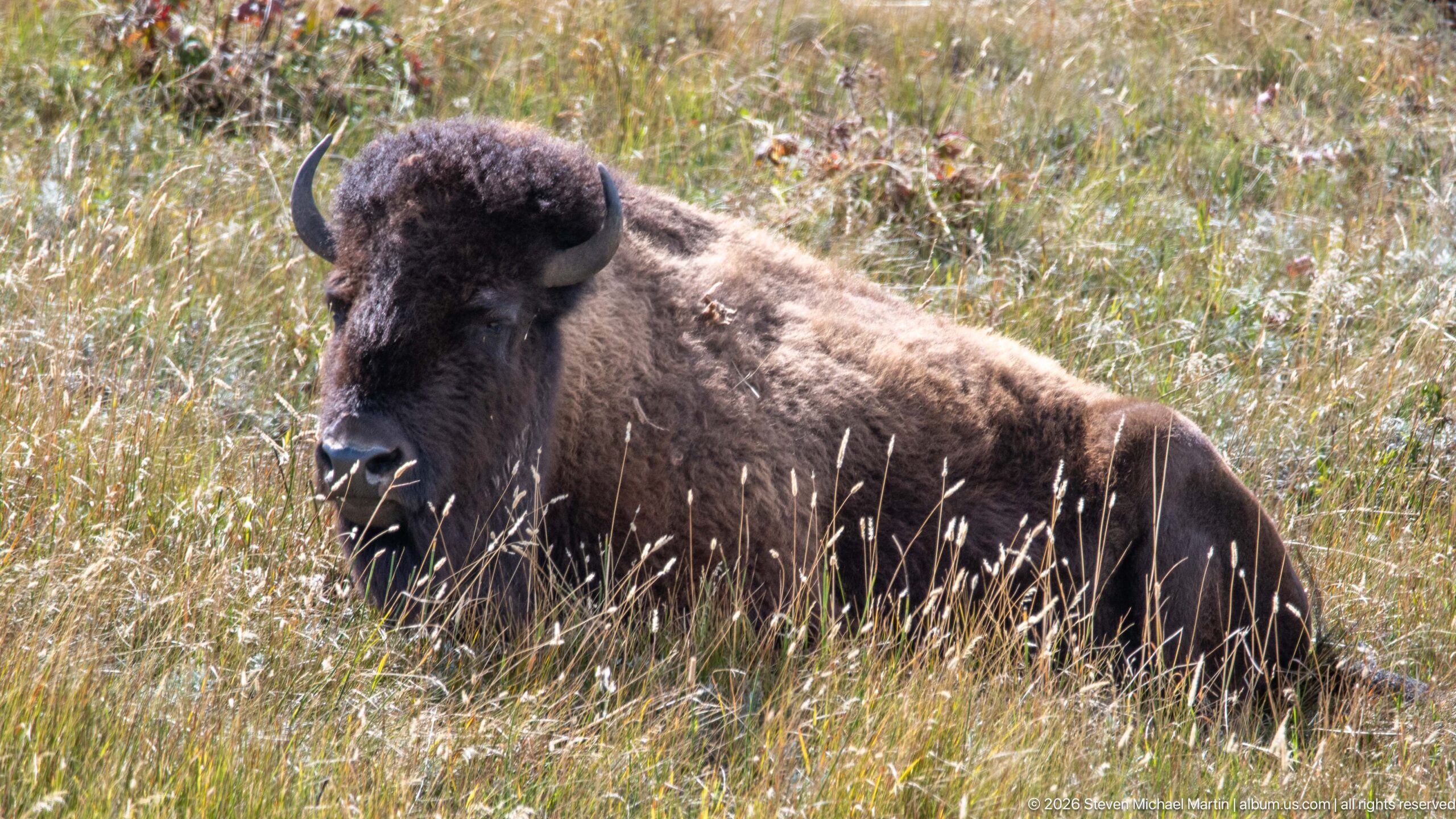
An adult plains bison reclines in tall grass with its head raised, both horns visible against the dense dark hair of its forehead and forequarters. Bright side light picks out the lighter brown coat along the back and flank, producing a detailed closing portrait centered on the animal’s characteristic head, hump, and heavy build.
Caption
An adult plains bison reclines in tall grass with its head raised, both horns visible against the dense dark hair of its forehead and forequarters. Bright side light picks out the lighter brown coat along the back and flank, producing a detailed closing portrait centered on the animal’s characteristic head, hump, and heavy build.
Wildlife & Safari Field Guide
📍 Overview
Waterton Lakes Bison presents the plains bison within the broad grassland landscape of Waterton Lakes, where open prairie, rolling slopes, low shrub cover, and the mountain front form the setting for the portfolio. The photographs move between close studies of individual animals and expansive views in which bison appear as dark forms scattered across pale hillsides. Together, these perspectives emphasize the relationship between the species and a landscape that shifts from open grassland to brushier margins and rising mountain terrain.
🌿 Habitat
The portfolio places plains bison in a varied grassland environment rather than a single uniform prairie. Short and tall grasses cover rolling slopes, while low shrubs and denser leafy brush create patches of shelter and visual cover. Wider views show open basins and treeless hills rising toward the Rocky Mountain landscape. Bison appear across these different settings, from exposed grassy hillsides to brushy margins, illustrating how the Waterton Lakes setting combines prairie openness with changes in vegetation, elevation, and terrain.
🦌 Key Species
Plains bison (Bison bison) are the defining species of this portfolio. Adults are recognizable by their massive forequarters, pronounced shoulder hump, dark woolly head, curved horns, and comparatively narrower hindquarters. Younger animals provide a striking contrast: calves have smaller, more slender bodies and reddish or cinnamon-colored coats that stand out among the darker adults. The photographs include solitary adults, adult-and-calf pairs, small groups, and larger mixed-age herds, allowing differences in age, body form, coat texture, and group composition to be compared.
🐾 Behavior & Adaptation
Resting, grazing, walking, and close association between adults and young recur throughout the portfolio. Some bison lie widely separated across open slopes, while others gather in compact groups or spread laterally across the grassland. Several views pair contrasting activities, such as a grazing animal with another resting farther uphill. Calves remain close to adults in a number of scenes, including a young animal nursing beneath an adult. These varied postures and groupings show a herd whose members alternate between feeding, movement, rest, and care of young across the uneven terrain.
🌱 Conservation
The portfolio’s strongest conservation message comes from the repeated visual connection between plains bison and grassland habitat. Close portraits reveal the animals in detail, but wider compositions place them within rolling prairie, shrub-covered slopes, and the mountain-front landscape. Those environmental views make habitat part of the subject rather than merely a background. Read together, the photographs encourage attention to both the bison and the grassland setting that supports the herd, reinforcing the importance of protecting ecological relationships as well as individual animals.
🍂 Seasonal Patterns
Seasonal character is expressed visually through dry and golden grasses, reddish young calves, varied coat textures, and changing light across the slopes. Warm sunlight often separates dark bison from pale vegetation, while calves are especially conspicuous because of their lighter juvenile coats. The photographs do not establish a complete annual cycle, but they do document a period when young animals are present within the herd and when grassland vegetation ranges from green shrub growth to dry, sunlit prairie.
◆ Safari Experience
The visitor experience represented here depends on patient observation across a large, open landscape. Some views bring a single bison close enough for horns, coat texture, facial features, and the shoulder hump to dominate the composition; others require scanning distant slopes to find a dispersed herd. Rolling terrain continually changes the relationship between animals and background, and low shrubs can partly conceal even large adults. The resulting experience alternates between intimate wildlife study and broad landscape viewing, with scale and distance shaping how the bison are perceived.
📷 Photography Notes
The portfolio demonstrates the value of varying focal length and composition when photographing bison. Broad landscape frames establish the scale of the grassland and mountain-front setting, while tighter views isolate body form, horns, coat texture, calves, and behavior. Side profiles clearly describe the bison’s distinctive proportions; frontal views emphasize the broad forehead and horns; and layered herd compositions show animals at different elevations across a slope. Warm side light and backlighting are particularly effective at separating dark bodies from pale grass and revealing texture along the animals’ coats.