Brussels – Belgium
Brussels, the capital of Belgium, lies in the heart of the historic Low Countries, a region that became one of the most economically vibrant areas of medieval and early modern Europe. The city developed as an important center of commerce and political power within the Duchy of Brabant.
At the center of the city stands the magnificent Grand Place, one of the most beautiful medieval squares in Europe. Surrounded by ornate guild houses and dominated by the elaborate Town Hall, the square reflects the wealth and influence of the merchant guilds that once governed the city.
Today Brussels remains an important political center in Europe while preserving the historic architecture of its medieval past.

Brussels Town Hall rises prominently at the right side of a wide Grand-Place view, its slender Gothic tower and richly articulated façade towering above the surrounding guildhouses. A broad expanse of wet paving opens in the foreground, allowing the neighboring façades to read as a continuous urban ensemble. The off-center composition differs from the frontal town-hall view by emphasizing its dominance within the square.
Caption
Brussels Town Hall rises prominently at the right side of a wide Grand-Place view, its slender Gothic tower and richly articulated façade towering above the surrounding guildhouses. A broad expanse of wet paving opens in the foreground, allowing the neighboring façades to read as a continuous urban ensemble. The off-center composition differs from the frontal town-hall view by emphasizing its dominance within the square.

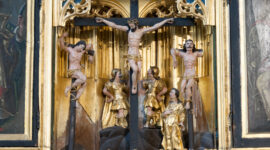
A large multi-panel altarpiece centers on the Crucifixion, with Christ elevated above a dense crowd at Calvary and subsidiary scenes continuing across the side panels. The black architectural frame separates the narratives while preserving visual continuity through the figures and landscape. Seen nearly straight on, the image records both the devotional subject and the object’s structure as a hinged or compartmentalized ensemble.
Caption
A large multi-panel altarpiece centers on the Crucifixion, with Christ elevated above a dense crowd at Calvary and subsidiary scenes continuing across the side panels. The black architectural frame separates the narratives while preserving visual continuity through the figures and landscape. Seen nearly straight on, the image records both the devotional subject and the object’s structure as a hinged or compartmentalized ensemble.

A sculpted Entombment group gathers mourners around the recumbent body of Christ beneath a shallow architectural canopy. Hooded and veiled figures lean inward with restrained gestures, creating a solemn band of faces above the horizontal body. The weathered stone surfaces and enclosed setting give the composition a funerary character, while the frontal photograph records the full ensemble and its spatial arrangement.
Caption
A sculpted Entombment group gathers mourners around the recumbent body of Christ beneath a shallow architectural canopy. Hooded and veiled figures lean inward with restrained gestures, creating a solemn band of faces above the horizontal body. The weathered stone surfaces and enclosed setting give the composition a funerary character, while the frontal photograph records the full ensemble and its spatial arrangement.

A luminous church interior leads toward a dark monumental altar framed by tall stained-glass windows and repeated hanging chandeliers. Pale stone piers and pointed arches establish the vertical rhythm of the space, while rows of chairs organize the foreground. The image works as an architectural overview, showing how decorative lighting, glazing, paintings, and the altar combine within the long ecclesiastical volume.
Caption
A luminous church interior leads toward a dark monumental altar framed by tall stained-glass windows and repeated hanging chandeliers. Pale stone piers and pointed arches establish the vertical rhythm of the space, while rows of chairs organize the foreground. The image works as an architectural overview, showing how decorative lighting, glazing, paintings, and the altar combine within the long ecclesiastical volume.

A richly framed altar occupies a side chapel or liturgical bay of the Cathedral of St. Michael and St. Gudula, backed by a large religious painting and flanked by pale columns. Multiple gilded chandeliers blaze across the foreground, while stained-glass windows rise behind and to the right. The composition brings together Baroque furnishing, devotional painting, colored glass, and ceremonial lighting within the Gothic cathedral.
Caption
A richly framed altar occupies a side chapel or liturgical bay of the Cathedral of St. Michael and St. Gudula, backed by a large religious painting and flanked by pale columns. Multiple gilded chandeliers blaze across the foreground, while stained-glass windows rise behind and to the right. The composition brings together Baroque furnishing, devotional painting, colored glass, and ceremonial lighting within the Gothic cathedral.

The nave of the Cathedral of St. Michael and St. Gudula stretches toward a glowing eastern window beneath a sequence of rib-vaulted bays. Massive cylindrical piers support pointed arches and carry sculpted apostles, while the monumental carved pulpit projects dramatically from the right side. The central aisle perspective records the cathedral’s vertical Gothic proportions and the contrast between pale stone, dark furnishings, and colored glass.
Caption
The nave of the Cathedral of St. Michael and St. Gudula stretches toward a glowing eastern window beneath a sequence of rib-vaulted bays. Massive cylindrical piers support pointed arches and carry sculpted apostles, while the monumental carved pulpit projects dramatically from the right side. The central aisle perspective records the cathedral’s vertical Gothic proportions and the contrast between pale stone, dark furnishings, and colored glass.

The Maison du Roi occupies the center of the frame in a broad frontal view across the Grand-Place. Its arcaded lower level, traceried windows, steep roof, central tower, and forest of pinnacles create a strongly vertical silhouette, while neighboring guildhouses provide scale on both sides. Pedestrians crossing the wet paving emphasize the building’s continued role as a defining monument of Brussels’ historic square.
Caption
The Maison du Roi occupies the center of the frame in a broad frontal view across the Grand-Place. Its arcaded lower level, traceried windows, steep roof, central tower, and forest of pinnacles create a strongly vertical silhouette, while neighboring guildhouses provide scale on both sides. Pedestrians crossing the wet paving emphasize the building’s continued role as a defining monument of Brussels’ historic square.

A broad view across the Grand-Place places Brussels Town Hall at the left and the Maison du Roi at the right, with richly decorated guildhouses closing the far side between them. The wet square opens as a wide foreground beneath a heavy sky, clarifying the spatial relationship between the square’s two dominant civic monuments. The composition functions as an architectural orientation view of the UNESCO-listed ensemble.
Caption
A broad view across the Grand-Place places Brussels Town Hall at the left and the Maison du Roi at the right, with richly decorated guildhouses closing the far side between them. The wet square opens as a wide foreground beneath a heavy sky, clarifying the spatial relationship between the square’s two dominant civic monuments. The composition functions as an architectural orientation view of the UNESCO-listed ensemble.

A stained-glass window in Brussels Cathedral presents elaborately dressed standing figures beneath Gothic canopy work, including a crowned man and crowned woman in the central lancets and kneeling attendants at the sides. Saturated blues, reds, greens, and golds define garments and heraldic details. The close crop emphasizes portrait-like figures and costume, while leaving their exact dynastic identities to documentary verification.
Caption
A stained-glass window in Brussels Cathedral presents elaborately dressed standing figures beneath Gothic canopy work, including a crowned man and crowned woman in the central lancets and kneeling attendants at the sides. Saturated blues, reds, greens, and golds define garments and heraldic details. The close crop emphasizes portrait-like figures and costume, while leaving their exact dynastic identities to documentary verification.

Gilded architectural ornament frames a row of sculpted standing figures set within round-arched niches. Slender colonnettes, foliate carving, patterned bands, and jewel-like painted accents give the ensemble the appearance of a richly finished reliquary, shrine, or altar furnishing. The oblique viewpoint reveals both the sculptural depth of the niches and the layered craftsmanship of the surrounding metalwork and painted decoration.
Caption
Gilded architectural ornament frames a row of sculpted standing figures set within round-arched niches. Slender colonnettes, foliate carving, patterned bands, and jewel-like painted accents give the ensemble the appearance of a richly finished reliquary, shrine, or altar furnishing. The oblique viewpoint reveals both the sculptural depth of the niches and the layered craftsmanship of the surrounding metalwork and painted decoration.

Brussels Town Hall rises across the cobbled Grand-Place, its richly articulated Gothic façade stretching beneath the tall central tower. Arcades, traceried windows, pinnacles, and sculptural niches create a dense civic frontage, while the broad square provides an unobstructed establishing view. The photograph records the building as Brussels’ monumental municipal centerpiece rather than isolating a single decorative feature.
Caption
Brussels Town Hall rises across the cobbled Grand-Place, its richly articulated Gothic façade stretching beneath the tall central tower. Arcades, traceried windows, pinnacles, and sculptural niches create a dense civic frontage, while the broad square provides an unobstructed establishing view. The photograph records the building as Brussels’ monumental municipal centerpiece rather than isolating a single decorative feature.

A contemporary mural covers the side of a Brussels building with oversized blue-and-white “FUTURE” lettering, stylized foliage, and brightly colored bird imagery. The composition uses the blank wall as a graphic field, contrasting the painted surface with surrounding street furniture and neighboring masonry. The view documents public art as part of the city’s modern streetscape rather than its historic architectural core.
Caption
A contemporary mural covers the side of a Brussels building with oversized blue-and-white “FUTURE” lettering, stylized foliage, and brightly colored bird imagery. The composition uses the blank wall as a graphic field, contrasting the painted surface with surrounding street furniture and neighboring masonry. The view documents public art as part of the city’s modern streetscape rather than its historic architectural core.

The Cathedral of St. Michael and St. Gudula fills the frame from across the street, its twin square towers flanking a tall central Gothic composition of pointed arches, tracery, and a large west window. Foreground street elements and a bronze statue at left place the church within central Brussels. This wider view emphasizes the breadth and massing of the principal façade.
Caption
The Cathedral of St. Michael and St. Gudula fills the frame from across the street, its twin square towers flanking a tall central Gothic composition of pointed arches, tracery, and a large west window. Foreground street elements and a bronze statue at left place the church within central Brussels. This wider view emphasizes the breadth and massing of the principal façade.

A decorative wall sconce projects from a dark ribbed surface, its circular pale shade marked with looping ornamental lines around a dark central bulb. Light radiates across the wall in fanlike bands, turning a functional fixture into a small architectural focal point. The close framing emphasizes pattern, reflected light, and material texture rather than the surrounding room.
Caption
A decorative wall sconce projects from a dark ribbed surface, its circular pale shade marked with looping ornamental lines around a dark central bulb. Light radiates across the wall in fanlike bands, turning a functional fixture into a small architectural focal point. The close framing emphasizes pattern, reflected light, and material texture rather than the surrounding room.

A compact bar counter sits beneath exposed green steel framing and hanging plants inside a Brussels food hall. Bottles line open shelving above polished taps and service equipment, while mixed industrial finishes—metal, tile, wood, and reused decorative objects—give the space an informal market-hall character. The photograph concentrates on the service bar as a designed interior element within the larger dining venue.
Caption
A compact bar counter sits beneath exposed green steel framing and hanging plants inside a Brussels food hall. Bottles line open shelving above polished taps and service equipment, while mixed industrial finishes—metal, tile, wood, and reused decorative objects—give the space an informal market-hall character. The photograph concentrates on the service bar as a designed interior element within the larger dining venue.

A seated diner faces the camera at a communal table beneath a cluster of glowing globe lights in a lively Brussels food hall. Vendor counters and menu signs recede behind him, with other patrons occupying the shared seating area. The portrait places a human presence within the contemporary market interior, balancing the warm overhead lighting against the busier commercial backdrop.
Caption
A seated diner faces the camera at a communal table beneath a cluster of glowing globe lights in a lively Brussels food hall. Vendor counters and menu signs recede behind him, with other patrons occupying the shared seating area. The portrait places a human presence within the contemporary market interior, balancing the warm overhead lighting against the busier commercial backdrop.

A Brussels food stall combines an open service counter with chalkboard-style menu panels, hanging utensils, produce displays, and a collage of colorful vintage objects. The counter’s dense decoration contrasts with the tiled wall and orderly overhead category signs. The view records the eclectic visual language of a contemporary indoor food market, where branding, cooking equipment, and display props merge into the customer-facing façade.
Caption
A Brussels food stall combines an open service counter with chalkboard-style menu panels, hanging utensils, produce displays, and a collage of colorful vintage objects. The counter’s dense decoration contrasts with the tiled wall and orderly overhead category signs. The view records the eclectic visual language of a contemporary indoor food market, where branding, cooking equipment, and display props merge into the customer-facing façade.

Tall stainless-steel brewing or fermentation vessels stand behind simple wooden tables and benches in an industrial-style Brussels interior. Exposed ducts, concrete surfaces, and service lines reinforce the working-brewery atmosphere, while the seating places production equipment directly within the public dining space. The image documents the deliberate overlap of food service and visible beverage production.
Caption
Tall stainless-steel brewing or fermentation vessels stand behind simple wooden tables and benches in an industrial-style Brussels interior. Exposed ducts, concrete surfaces, and service lines reinforce the working-brewery atmosphere, while the seating places production equipment directly within the public dining space. The image documents the deliberate overlap of food service and visible beverage production.

An open-kitchen restaurant interior stretches toward a brightly illuminated rear wall composed of repeating square lights. Counter stools line the service side at left, while booths and small tables occupy the right, creating a clear division between food preparation and dining. Exposed ductwork and utilitarian finishes give the room a contemporary industrial character softened by the warm, theatrical lighting.
Caption
An open-kitchen restaurant interior stretches toward a brightly illuminated rear wall composed of repeating square lights. Counter stools line the service side at left, while booths and small tables occupy the right, creating a clear division between food preparation and dining. Exposed ductwork and utilitarian finishes give the room a contemporary industrial character softened by the warm, theatrical lighting.

Communal tables sit beneath hanging globe lights in front of a row of compact food counters advertising pizza, pasta, waffles, and other offerings. Each vendor uses its own signboard while sharing a common market-hall framework, creating a layered streetscape indoors. The photograph emphasizes the variety of adjacent stalls and the informal shared seating rather than one individual restaurant.
Caption
Communal tables sit beneath hanging globe lights in front of a row of compact food counters advertising pizza, pasta, waffles, and other offerings. Each vendor uses its own signboard while sharing a common market-hall framework, creating a layered streetscape indoors. The photograph emphasizes the variety of adjacent stalls and the informal shared seating rather than one individual restaurant.

A long horizontal stone relief runs beside a recessed entrance on a modern Brussels building, presenting a procession of stylized human figures in shallow carving. The pale sculptural panel stands out against darker masonry at sidewalk level, where stools and street fixtures establish scale. The photograph treats the relief as an integrated architectural artwork rather than attempting an unsupported identification of its program or artist.
Caption
A long horizontal stone relief runs beside a recessed entrance on a modern Brussels building, presenting a procession of stylized human figures in shallow carving. The pale sculptural panel stands out against darker masonry at sidewalk level, where stools and street fixtures establish scale. The photograph treats the relief as an integrated architectural artwork rather than attempting an unsupported identification of its program or artist.

A closer street-level view centers the Cathedral of St. Michael and St. Gudula between urban buildings and leafless trees. The paired towers rise above the pointed central portal and large traceried window, while traffic signs and the sloping roadway reinforce the cathedral’s dense city setting. Compared with the broader preceding view, this angle concentrates attention on the vertical pull of the west front.
Caption
A closer street-level view centers the Cathedral of St. Michael and St. Gudula between urban buildings and leafless trees. The paired towers rise above the pointed central portal and large traceried window, while traffic signs and the sloping roadway reinforce the cathedral’s dense city setting. Compared with the broader preceding view, this angle concentrates attention on the vertical pull of the west front.

Looking sharply upward between the twin towers of the Cathedral of St. Michael and St. Gudula, the photograph isolates the upper west façade and its dense Gothic stonework. Pointed openings, crocketed gables, tracery, pinnacles, and sculptural details compress into a steep vertical composition. The low vantage point converts the familiar façade into an architectural study of height, ornament, and layered masonry.
Caption
Looking sharply upward between the twin towers of the Cathedral of St. Michael and St. Gudula, the photograph isolates the upper west façade and its dense Gothic stonework. Pointed openings, crocketed gables, tracery, pinnacles, and sculptural details compress into a steep vertical composition. The low vantage point converts the familiar façade into an architectural study of height, ornament, and layered masonry.

A central west portal of the Cathedral of St. Michael and St. Gudula is framed head-on, revealing pointed archivolts, sculpted figures, delicate tracery, and tall paneled doors. The close view shows how layers of carved stone concentrate around the entrance beneath the larger west window. This photograph shifts from monumental façade to human-scale threshold and its sculptural program.
Caption
A central west portal of the Cathedral of St. Michael and St. Gudula is framed head-on, revealing pointed archivolts, sculpted figures, delicate tracery, and tall paneled doors. The close view shows how layers of carved stone concentrate around the entrance beneath the larger west window. This photograph shifts from monumental façade to human-scale threshold and its sculptural program.

Stone figures of apostles stand on elaborate brackets attached to massive nave columns inside the Cathedral of St. Michael and St. Gudula. Their pale sculptural forms alternate with pointed arcades and the warm vertical casework of the organ beyond, producing a strong rhythm along the aisle. The photograph highlights the cathedral’s integration of figural sculpture with its Gothic structural system.
Caption
Stone figures of apostles stand on elaborate brackets attached to massive nave columns inside the Cathedral of St. Michael and St. Gudula. Their pale sculptural forms alternate with pointed arcades and the warm vertical casework of the organ beyond, producing a strong rhythm along the aisle. The photograph highlights the cathedral’s integration of figural sculpture with its Gothic structural system.

A life-size apostle figure projects from a nave column on an ornate scrolling bracket, holding a gilded attribute that provides a bright accent against pale stone. Ribbed vaulting and pointed arches recede behind the sculpture. The close composition emphasizes the expressive drapery, theatrical pose, and sculptural mounting used for the cathedral’s series of apostolic figures.
Caption
A life-size apostle figure projects from a nave column on an ornate scrolling bracket, holding a gilded attribute that provides a bright accent against pale stone. Ribbed vaulting and pointed arches recede behind the sculpture. The close composition emphasizes the expressive drapery, theatrical pose, and sculptural mounting used for the cathedral’s series of apostolic figures.

A column-mounted apostle statue is silhouetted against tall stained-glass windows inside the Cathedral of St. Michael and St. Gudula. The pale figure and its sweeping gilded attribute stand above a carved cartouche, while colored glazing fills the adjacent bays with reds, blues, and golds. The composition links sculptural devotion, heraldic decoration, and luminous glazing within a single interior bay.
Caption
A column-mounted apostle statue is silhouetted against tall stained-glass windows inside the Cathedral of St. Michael and St. Gudula. The pale figure and its sweeping gilded attribute stand above a carved cartouche, while colored glazing fills the adjacent bays with reds, blues, and golds. The composition links sculptural devotion, heraldic decoration, and luminous glazing within a single interior bay.

A close view isolates one of the cathedral’s column-mounted apostle statues, whose deeply carved drapery and vigorous pose are animated by a long gilded blade-like attribute. The figure stands on a dark shelf beneath a richly ornamented capital, with ribbed vaulting behind. This tight framing emphasizes sculptural gesture and the striking contrast between pale stone and gold.
Caption
A close view isolates one of the cathedral’s column-mounted apostle statues, whose deeply carved drapery and vigorous pose are animated by a long gilded blade-like attribute. The figure stands on a dark shelf beneath a richly ornamented capital, with ribbed vaulting behind. This tight framing emphasizes sculptural gesture and the striking contrast between pale stone and gold.

The nave of the Cathedral of St. Michael and St. Gudula extends toward the illuminated eastern end beneath a sequence of pointed arches and ribbed vaults. Apostle statues punctuate the columns, while the monumental Baroque pulpit rises prominently on the right. The centered view reveals the interior’s longitudinal rhythm and the contrast between restrained Gothic masonry and later sculptural furnishings.
Caption
The nave of the Cathedral of St. Michael and St. Gudula extends toward the illuminated eastern end beneath a sequence of pointed arches and ribbed vaults. Apostle statues punctuate the columns, while the monumental Baroque pulpit rises prominently on the right. The centered view reveals the interior’s longitudinal rhythm and the contrast between restrained Gothic masonry and later sculptural furnishings.

A multi-panel carved altarpiece presents scenes from the Passion beneath a dense canopy of pointed arches and tracery. The Crucifixion dominates the central compartment, flanked by smaller groups of figures arranged in separate architectural bays. Warm focused lighting brings out the layered relief carving against the darker church wall, making the object read as a self-contained devotional narrative.
Caption
A multi-panel carved altarpiece presents scenes from the Passion beneath a dense canopy of pointed arches and tracery. The Crucifixion dominates the central compartment, flanked by smaller groups of figures arranged in separate architectural bays. Warm focused lighting brings out the layered relief carving against the darker church wall, making the object read as a self-contained devotional narrative.

A standing draped figure occupies an ornate memorial mounted to a cathedral column, its hand extending beside a small gilded element. Below, a dark oval inscription panel is framed by scrolling white stone ornament, while stained glass glows behind the column. The photograph records the monument as a layered ensemble of portrait sculpture, epitaph, and architectural setting.
Caption
A standing draped figure occupies an ornate memorial mounted to a cathedral column, its hand extending beside a small gilded element. Below, a dark oval inscription panel is framed by scrolling white stone ornament, while stained glass glows behind the column. The photograph records the monument as a layered ensemble of portrait sculpture, epitaph, and architectural setting.

The eastern interior opens beneath pale ribbed vaults toward a raised liturgical area framed by tall stained-glass windows. Side arcades and an upper gallery-like sequence of openings create layered depth, while warm illumination gathers around the central sanctuary. The wide symmetrical composition emphasizes spatial organization, masonry rhythm, and light rather than a single furnishing.
Caption
The eastern interior opens beneath pale ribbed vaults toward a raised liturgical area framed by tall stained-glass windows. Side arcades and an upper gallery-like sequence of openings create layered depth, while warm illumination gathers around the central sanctuary. The wide symmetrical composition emphasizes spatial organization, masonry rhythm, and light rather than a single furnishing.

A closer axial view draws attention to the cathedral sanctuary beneath three tall stained-glass windows. Rounded and pointed openings articulate the lower wall, while ribbed vaults lead the eye toward the illuminated east end. Compared with the preceding wider photograph, this frame reduces the side aisles and strengthens the visual focus on the altar zone and vertical glazing.
Caption
A closer axial view draws attention to the cathedral sanctuary beneath three tall stained-glass windows. Rounded and pointed openings articulate the lower wall, while ribbed vaults lead the eye toward the illuminated east end. Compared with the preceding wider photograph, this frame reduces the side aisles and strengthens the visual focus on the altar zone and vertical glazing.

A white sculptural group centers on the Virgin and Child, attended by kneeling and seated figures at either side. The smooth pale forms stand against darker stonework beneath stained-glass windows, giving the devotional group a pronounced silhouette. The composition is read as a single ensemble rather than as separate statues, with gestures and sightlines converging on the central Madonna.
Caption
A white sculptural group centers on the Virgin and Child, attended by kneeling and seated figures at either side. The smooth pale forms stand against darker stonework beneath stained-glass windows, giving the devotional group a pronounced silhouette. The composition is read as a single ensemble rather than as separate statues, with gestures and sightlines converging on the central Madonna.

Three tall stained-glass windows fill the cathedral wall with dense heraldic and figural imagery, framed by pale Gothic masonry. At right, a column-mounted statue and carved memorial bracket partially overlap the glazing, while another sculptural element enters from the left. The photograph emphasizes the relationship between colored glass, structural piers, and the cathedral’s later sculptural furnishings.
Caption
Three tall stained-glass windows fill the cathedral wall with dense heraldic and figural imagery, framed by pale Gothic masonry. At right, a column-mounted statue and carved memorial bracket partially overlap the glazing, while another sculptural element enters from the left. The photograph emphasizes the relationship between colored glass, structural piers, and the cathedral’s later sculptural furnishings.

The cathedral’s monumental dark Baroque pulpit rises between pale stone columns, crowded with carved figures and surmounted by a dramatic sculptural canopy. A round clock-like element anchors the lower center, while stained-glass windows and column statues create a luminous backdrop. The photograph shows the pulpit not merely as furniture but as a major sculptural installation embedded within the Gothic nave.
Caption
The cathedral’s monumental dark Baroque pulpit rises between pale stone columns, crowded with carved figures and surmounted by a dramatic sculptural canopy. A round clock-like element anchors the lower center, while stained-glass windows and column statues create a luminous backdrop. The photograph shows the pulpit not merely as furniture but as a major sculptural installation embedded within the Gothic nave.

An ornate wooden confessional is set against the cathedral wall, its central recessed booth framed by carved columns, pediment details, and two life-size standing figures. The warm brown timber contrasts with the pale stone masonry around it, while a small kneeler marks its liturgical function. The frontal view documents the confessional as a complete architectural furnishing rather than isolating individual carvings.
Caption
An ornate wooden confessional is set against the cathedral wall, its central recessed booth framed by carved columns, pediment details, and two life-size standing figures. The warm brown timber contrasts with the pale stone masonry around it, while a small kneeler marks its liturgical function. The frontal view documents the confessional as a complete architectural furnishing rather than isolating individual carvings.

A group of tall stained-glass lancets fills the frame with heraldic shields, standing figures, and richly patterned colored panels. Slender stone mullions divide the windows, while the pointed Gothic surrounds reinforce their vertical scale. The photograph is composed as a study of glazing and iconographic density, allowing coats of arms and figures to be read as an integrated decorative program.
Caption
A group of tall stained-glass lancets fills the frame with heraldic shields, standing figures, and richly patterned colored panels. Slender stone mullions divide the windows, while the pointed Gothic surrounds reinforce their vertical scale. The photograph is composed as a study of glazing and iconographic density, allowing coats of arms and figures to be read as an integrated decorative program.

A white funerary monument stands against the cathedral wall beneath stained glass, centered on a seated female figure with attendant figures and an inscribed pedestal below. The pale marble ensemble combines portraiture, allegory, and epitaph in a balanced pyramidal arrangement. The frontal view preserves the monument’s full composition while leaving the partially legible dedication for separate documentary verification.
Caption
A white funerary monument stands against the cathedral wall beneath stained glass, centered on a seated female figure with attendant figures and an inscribed pedestal below. The pale marble ensemble combines portraiture, allegory, and epitaph in a balanced pyramidal arrangement. The frontal view preserves the monument’s full composition while leaving the partially legible dedication for separate documentary verification.

A close detail of stained glass shows a narrative scene rendered in warm browns, golds, whites, and blue, divided by dark lead lines and viewed through a protective mesh or grille. Figures occupy an architectural setting within the central panel, while decorative borders frame the scene. The tight crop emphasizes painted glass technique, color, and surface texture rather than the window’s full iconographic program.
Caption
A close detail of stained glass shows a narrative scene rendered in warm browns, golds, whites, and blue, divided by dark lead lines and viewed through a protective mesh or grille. Figures occupy an architectural setting within the central panel, while decorative borders frame the scene. The tight crop emphasizes painted glass technique, color, and surface texture rather than the window’s full iconographic program.

A densely figured devotional painting fills the frame, centering on the infant Christ held amid a gathering of saints and attendants. Warm reds, ochres, and dark drapery organize the crowded composition, while faces and gestures converge toward the child. The work is presented here as part of the ecclesiastical interior of Brussels, with its narrative details more legible than the surrounding setting.
Caption
A densely figured devotional painting fills the frame, centering on the infant Christ held amid a gathering of saints and attendants. Warm reds, ochres, and dark drapery organize the crowded composition, while faces and gestures converge toward the child. The work is presented here as part of the ecclesiastical interior of Brussels, with its narrative details more legible than the surrounding setting.

A gilded winged angel stands against pale stone, holding a long ceremonial staff and wearing an elaborately patterned robe and jeweled-looking headdress. The figure’s metallic surface, layered feathers, and carefully modeled garments create a strong contrast with the plain masonry behind it. Flowers at the base indicate that the sculpture functions within an active devotional setting rather than as an isolated museum object.
Caption
A gilded winged angel stands against pale stone, holding a long ceremonial staff and wearing an elaborately patterned robe and jeweled-looking headdress. The figure’s metallic surface, layered feathers, and carefully modeled garments create a strong contrast with the plain masonry behind it. Flowers at the base indicate that the sculpture functions within an active devotional setting rather than as an isolated museum object.

A close view of a historical religious painting shows clerics and townspeople compressed into a dramatic urban scene. A bearded figure in dark robes occupies the foreground beside men in red and white garments, while masonry buildings recede behind them. The tight crop emphasizes facial expression and costume, making this image useful for studying the painting’s narrative detail rather than its full composition.
Caption
A close view of a historical religious painting shows clerics and townspeople compressed into a dramatic urban scene. A bearded figure in dark robes occupies the foreground beside men in red and white garments, while masonry buildings recede behind them. The tight crop emphasizes facial expression and costume, making this image useful for studying the painting’s narrative detail rather than its full composition.

A processional scene unfolds across this painted detail: men in the foreground shoulder heavy wooden crosses while a line of white-robed clergy advances above them. The steep arrangement of figures links burdened participants with the formal procession beyond, creating a strong vertical rhythm through the composition. The crop preserves the drama of movement and gesture without relying on an uncertain identification of the exact episode represented.
Caption
A processional scene unfolds across this painted detail: men in the foreground shoulder heavy wooden crosses while a line of white-robed clergy advances above them. The steep arrangement of figures links burdened participants with the formal procession beyond, creating a strong vertical rhythm through the composition. The crop preserves the drama of movement and gesture without relying on an uncertain identification of the exact episode represented.

A cluster of stained-glass panels fills the dark window opening with vivid blues, reds, greens, and golds. Narrative scenes occupy the lower and central lancets, while smaller roundels and tracery lights complete the composition above. The photograph is tightly framed to emphasize color, lead lines, and pictorial storytelling, with little distracting architecture around the glass.
Caption
A cluster of stained-glass panels fills the dark window opening with vivid blues, reds, greens, and golds. Narrative scenes occupy the lower and central lancets, while smaller roundels and tracery lights complete the composition above. The photograph is tightly framed to emphasize color, lead lines, and pictorial storytelling, with little distracting architecture around the glass.

A stained-glass medallion isolates a single biblical figure beside stylized flames and a pale animal, all rendered in saturated red, blue, green, and amber glass. A decorative border of foliage and patterned quarries encloses the scene. The close framing makes the iconographic details, painted faces, and leadwork more prominent than the architecture around the window.
Caption
A stained-glass medallion isolates a single biblical figure beside stylized flames and a pale animal, all rendered in saturated red, blue, green, and amber glass. A decorative border of foliage and patterned quarries encloses the scene. The close framing makes the iconographic details, painted faces, and leadwork more prominent than the architecture around the window.

An angel leans toward a bearded man in a vivid stained-glass narrative, their gestures meeting over a small altar-like structure. Deep blue glass forms the background while red, green, and flesh-toned passages define the figures and patterned border. The compact composition reads as a single biblical episode, but the photograph wisely preserves the scene itself without depending on a potentially uncertain attribution.
Caption
An angel leans toward a bearded man in a vivid stained-glass narrative, their gestures meeting over a small altar-like structure. Deep blue glass forms the background while red, green, and flesh-toned passages define the figures and patterned border. The compact composition reads as a single biblical episode, but the photograph wisely preserves the scene itself without depending on a potentially uncertain attribution.

A tall arched stained-glass window combines sacred figures, architectural framing, and heraldic devices within a pale stone surround. A central seated or standing holy figure is flanked by attendants beneath ornate canopy forms, while coats of arms appear in the lower register. The broader framing shows how the glass functions architecturally within the church rather than only as an isolated pictorial panel.
Caption
A tall arched stained-glass window combines sacred figures, architectural framing, and heraldic devices within a pale stone surround. A central seated or standing holy figure is flanked by attendants beneath ornate canopy forms, while coats of arms appear in the lower register. The broader framing shows how the glass functions architecturally within the church rather than only as an isolated pictorial panel.

A tall pointed-arch stained-glass window rises between pale stone piers, its numerous small scenes and heraldic motifs assembled into a dense vertical field of color. The broad architectural framing reveals the window’s scale within the church, while adjacent sculptural details at the base anchor it to the masonry. This view emphasizes the relationship between glazing and Gothic structure rather than isolating a single panel.
Caption
A tall pointed-arch stained-glass window rises between pale stone piers, its numerous small scenes and heraldic motifs assembled into a dense vertical field of color. The broad architectural framing reveals the window’s scale within the church, while adjacent sculptural details at the base anchor it to the masonry. This view emphasizes the relationship between glazing and Gothic structure rather than isolating a single panel.

A pale stone figure of Christ stands against a dark funerary monument, one hand raised and the other holding a long vertical staff. Gold accents on the drapery and staff pick out details against the otherwise subdued setting. The figure’s upright posture, exposed torso, and blessing-like gesture suggest a Resurrection context, while the photograph concentrates on the sculptural contrast between white stone and black architectural framing.
Caption
A pale stone figure of Christ stands against a dark funerary monument, one hand raised and the other holding a long vertical staff. Gold accents on the drapery and staff pick out details against the otherwise subdued setting. The figure’s upright posture, exposed torso, and blessing-like gesture suggest a Resurrection context, while the photograph concentrates on the sculptural contrast between white stone and black architectural framing.

A crowned, gilded Virgin stands with the Christ Child while a smaller kneeling figure approaches at her side. The highly polished gold surface, elaborate crown, and carefully modeled folds create a ceremonial presence against the plain stone wall. Flowers and a small sign at the base reinforce the sculpture’s devotional role within the church and distinguish it from the nearby narrative monuments.
Caption
A crowned, gilded Virgin stands with the Christ Child while a smaller kneeling figure approaches at her side. The highly polished gold surface, elaborate crown, and carefully modeled folds create a ceremonial presence against the plain stone wall. Flowers and a small sign at the base reinforce the sculpture’s devotional role within the church and distinguish it from the nearby narrative monuments.

The ornate tower of Brussels Town Hall rises at the end of a narrow cobbled approach, framed closely by older façades on both sides. The compressed street perspective makes the Gothic civic tower appear especially vertical, while pedestrians and storefronts establish the transition from side street to Grand-Place. This contextual view emphasizes arrival and urban framing rather than the building’s full façade.
Caption
The ornate tower of Brussels Town Hall rises at the end of a narrow cobbled approach, framed closely by older façades on both sides. The compressed street perspective makes the Gothic civic tower appear especially vertical, while pedestrians and storefronts establish the transition from side street to Grand-Place. This contextual view emphasizes arrival and urban framing rather than the building’s full façade.

Three vertical organ cases rise dramatically against the church wall, with a larger central case flanked by two narrower towers of pipes. Warm woodwork contrasts with pale masonry, pointed arches, and tracery windows behind the instrument. The low-angle viewpoint stresses the organ’s height and integration with the Gothic interior, turning a functional musical installation into a strong architectural element.
Caption
Three vertical organ cases rise dramatically against the church wall, with a larger central case flanked by two narrower towers of pipes. Warm woodwork contrasts with pale masonry, pointed arches, and tracery windows behind the instrument. The low-angle viewpoint stresses the organ’s height and integration with the Gothic interior, turning a functional musical installation into a strong architectural element.

The Galeries Royales Saint-Hubert extends in a long, symmetrical perspective beneath its glazed barrel roof. Repeated arched shopfronts, upper-story pilasters, hanging lamps, and the bright end wall create a carefully ordered commercial interior, while pedestrians supply scale at street level. The central viewpoint emphasizes the 19th-century arcade’s defining combination of urban passage, shop architecture, and daylight filtered through iron-and-glass roofing.
Caption
The Galeries Royales Saint-Hubert extends in a long, symmetrical perspective beneath its glazed barrel roof. Repeated arched shopfronts, upper-story pilasters, hanging lamps, and the bright end wall create a carefully ordered commercial interior, while pedestrians supply scale at street level. The central viewpoint emphasizes the 19th-century arcade’s defining combination of urban passage, shop architecture, and daylight filtered through iron-and-glass roofing.

At one end of the Galeries Royales Saint-Hubert, a Belgian flag hangs beneath a round clock set into the pale ornamental wall. The glazed roof curves overhead, while upper-level niches, pilasters, and classical detailing frame the passage below. This closer architectural study complements the preceding long view by concentrating on the arcade’s terminus and its civic decorative vocabulary rather than the full shopping corridor.
Caption
At one end of the Galeries Royales Saint-Hubert, a Belgian flag hangs beneath a round clock set into the pale ornamental wall. The glazed roof curves overhead, while upper-level niches, pilasters, and classical detailing frame the passage below. This closer architectural study complements the preceding long view by concentrating on the arcade’s terminus and its civic decorative vocabulary rather than the full shopping corridor.

A Brussels confectioner’s display is arranged as a carefully staged grid of boxed chocolates, pralines, and pastel macarons. Tiered trays, price cards, and bright packaging sit behind reflective glass, with a promotional sign rising at the center. The photograph records a contemporary aspect of the city’s food culture through merchandising and presentation rather than through a restaurant or production setting.
Caption
A Brussels confectioner’s display is arranged as a carefully staged grid of boxed chocolates, pralines, and pastel macarons. Tiered trays, price cards, and bright packaging sit behind reflective glass, with a promotional sign rising at the center. The photograph records a contemporary aspect of the city’s food culture through merchandising and presentation rather than through a restaurant or production setting.

An Easter-themed confectionery window combines large rabbit figures with wrapped chocolates, foil eggs, truffles, and gift baskets. The playful pastel display is denser and more seasonal than the neighboring macaron case, using oversized figures to attract attention from the street. Reflections and layered merchandise make the scene distinctly retail, while the assortment underscores Brussels’ strong association with specialty chocolate shops.
Caption
An Easter-themed confectionery window combines large rabbit figures with wrapped chocolates, foil eggs, truffles, and gift baskets. The playful pastel display is denser and more seasonal than the neighboring macaron case, using oversized figures to attract attention from the street. Reflections and layered merchandise make the scene distinctly retail, while the assortment underscores Brussels’ strong association with specialty chocolate shops.

A narrow cobbled street descends between tightly spaced brick and stucco façades in central Brussels. Shop signs, bicycles, drainpipes, and irregular building lines create a more intimate urban texture than the monumental Grand-Place nearby. The long perspective and modest pedestrian activity make this an effective contextual view of the historic center’s smaller-scale street network.
Caption
A narrow cobbled street descends between tightly spaced brick and stucco façades in central Brussels. Shop signs, bicycles, drainpipes, and irregular building lines create a more intimate urban texture than the monumental Grand-Place nearby. The long perspective and modest pedestrian activity make this an effective contextual view of the historic center’s smaller-scale street network.

Brussels Town Hall spreads across the Grand-Place in an expansive frontal view, its highly articulated Gothic façade dominated by pointed arcades, ranks of windows, sculptural niches, and the tall central tower. Pedestrians crossing the wet square provide scale and reinforce the building’s continuing civic presence. The broad composition records the town hall as a complete architectural monument rather than as a tower detail.
Caption
Brussels Town Hall spreads across the Grand-Place in an expansive frontal view, its highly articulated Gothic façade dominated by pointed arcades, ranks of windows, sculptural niches, and the tall central tower. Pedestrians crossing the wet square provide scale and reinforce the building’s continuing civic presence. The broad composition records the town hall as a complete architectural monument rather than as a tower detail.

The long, unified façade known as the Maison des Ducs de Brabant forms a stately edge of Brussels’ Grand-Place. Repeated pilasters, tall windows, gilded ornament, and a sculpted pediment create the appearance of a single palace-like composition despite the historic subdivision into separate houses. A horse-drawn carriage at the right adds scale and a contemporary street-life element to the monumental architectural view.
Caption
The long, unified façade known as the Maison des Ducs de Brabant forms a stately edge of Brussels’ Grand-Place. Repeated pilasters, tall windows, gilded ornament, and a sculpted pediment create the appearance of a single palace-like composition despite the historic subdivision into separate houses. A horse-drawn carriage at the right adds scale and a contemporary street-life element to the monumental architectural view.

A wider view across the wet Grand-Place places the Maison des Ducs de Brabant within the surrounding ring of richly decorated guildhouses. The long gilded façade anchors the center, while narrower ornate buildings frame it at both sides and pedestrians disperse across the open square. Compared with the preceding closer view, this composition emphasizes the building’s relationship to the full ensemble of the UNESCO-listed civic space.
Caption
A wider view across the wet Grand-Place places the Maison des Ducs de Brabant within the surrounding ring of richly decorated guildhouses. The long gilded façade anchors the center, while narrower ornate buildings frame it at both sides and pedestrians disperse across the open square. Compared with the preceding closer view, this composition emphasizes the building’s relationship to the full ensemble of the UNESCO-listed civic space.

A horse-drawn carriage waits on the cobbles of Brussels’ Grand-Place, its bright yellow wheels standing out against the gray paving and historic façades. The driver’s enclosed seat, folded covers, and harness details are clearly visible, turning the image into a close study of a working tourist carriage rather than a general square view. Pigeons and pedestrians complete the everyday street setting.
Caption
A horse-drawn carriage waits on the cobbles of Brussels’ Grand-Place, its bright yellow wheels standing out against the gray paving and historic façades. The driver’s enclosed seat, folded covers, and harness details are clearly visible, turning the image into a close study of a working tourist carriage rather than a general square view. Pigeons and pedestrians complete the everyday street setting.

A tightly framed group of Grand-Place guildhouses displays the theatrical rooflines and gilded ornament that define Brussels’ central square. Curving gables, sculpted pediments, classical columns, cartouches, and a gilded mounted figure animate the upper stories, while the lower façades remain largely outside the crop. The image is especially useful as an architectural detail study of the square’s elaborate skyline.
Caption
A tightly framed group of Grand-Place guildhouses displays the theatrical rooflines and gilded ornament that define Brussels’ central square. Curving gables, sculpted pediments, classical columns, cartouches, and a gilded mounted figure animate the upper stories, while the lower façades remain largely outside the crop. The image is especially useful as an architectural detail study of the square’s elaborate skyline.

A row of narrow guildhouses rises across Brussels’ Grand-Place, each façade competing through gilded trim, sculpted rooflines, cartouches, and varied window patterns. Seen from across the square, the buildings read as a coordinated urban ensemble while still retaining distinct silhouettes. Street-level shops and pedestrians keep the composition grounded in the square’s contemporary use beneath its historic architecture.
Caption
A row of narrow guildhouses rises across Brussels’ Grand-Place, each façade competing through gilded trim, sculpted rooflines, cartouches, and varied window patterns. Seen from across the square, the buildings read as a coordinated urban ensemble while still retaining distinct silhouettes. Street-level shops and pedestrians keep the composition grounded in the square’s contemporary use beneath its historic architecture.

The façade of La Chaloupe d'Or is shown in close detail, with a stone portrait bust set in a round niche above the striped awning carrying the building’s name. Gilded Ionic capitals, scrollwork, and molded frames enliven the pale stone surface. By excluding most of the surrounding square, the photograph turns attention to the individual decorative program of one Grand-Place guildhouse.
Caption
The façade of La Chaloupe d'Or is shown in close detail, with a stone portrait bust set in a round niche above the striped awning carrying the building’s name. Gilded Ionic capitals, scrollwork, and molded frames enliven the pale stone surface. By excluding most of the surrounding square, the photograph turns attention to the individual decorative program of one Grand-Place guildhouse.

A sculpted figure crowns an ornate Grand-Place gable above gilded urns, scrollwork, and a dark central cartouche. A Latin inscription occupies the triangular pediment below, providing a textual element within the otherwise strongly sculptural façade. The upward-looking composition isolates the roofline against the gray sky and records the kind of emblematic rooftop ornament that distinguishes individual guildhouses around the square.
Caption
A sculpted figure crowns an ornate Grand-Place gable above gilded urns, scrollwork, and a dark central cartouche. A Latin inscription occupies the triangular pediment below, providing a textual element within the otherwise strongly sculptural façade. The upward-looking composition isolates the roofline against the gray sky and records the kind of emblematic rooftop ornament that distinguishes individual guildhouses around the square.

A sculpted swan spreads its wings within a deep oval of green-and-gold foliage on a stone façade at Brussels’ Grand-Place. The bird functions as an identifying emblem rather than a freestanding sculpture, combining naturalistic feathers with highly stylized leaves and gilded accents. The close crop isolates this heraldic-style sign from the larger building and records the ornamental vocabulary used to distinguish individual guildhouses.
Caption
A sculpted swan spreads its wings within a deep oval of green-and-gold foliage on a stone façade at Brussels’ Grand-Place. The bird functions as an identifying emblem rather than a freestanding sculpture, combining naturalistic feathers with highly stylized leaves and gilded accents. The close crop isolates this heraldic-style sign from the larger building and records the ornamental vocabulary used to distinguish individual guildhouses.

A stone balcony at the Grand-Place is enriched with gilded masks, a central emblem, carved balusters, and gold-highlighted capitals. The decorative program is concentrated along the parapet and supporting piers, where sculptural faces and symbolic motifs animate the otherwise gray stone. Framed straight on, the image functions as an architectural detail study of the square’s richly ornamented late-17th-century façades.
Caption
A stone balcony at the Grand-Place is enriched with gilded masks, a central emblem, carved balusters, and gold-highlighted capitals. The decorative program is concentrated along the parapet and supporting piers, where sculptural faces and symbolic motifs animate the otherwise gray stone. Framed straight on, the image functions as an architectural detail study of the square’s richly ornamented late-17th-century façades.

A richly ornamented Grand-Place façade centers on a gilded monogram flanked by two putti, with the date 1698 displayed prominently on either side. Gold moldings, sculpted cartouches, and dark-framed windows create a strong contrast against the pale stone. The tight composition is especially useful for documenting the rebuilding-era date and decorative program of an individual guildhouse without relying on a broader streetscape view.
Caption
A richly ornamented Grand-Place façade centers on a gilded monogram flanked by two putti, with the date 1698 displayed prominently on either side. Gold moldings, sculpted cartouches, and dark-framed windows create a strong contrast against the pale stone. The tight composition is especially useful for documenting the rebuilding-era date and decorative program of an individual guildhouse without relying on a broader streetscape view.

The Maison du Roi, known in Dutch as the Broodhuis, rises on the Grand-Place with an elaborate neo-Gothic façade of arcades, traceried windows, pinnacles, and a tall central tower. The broad frontal view shows the building’s complex vertical hierarchy from the open ground-level arcade to the richly sculpted roofline. Neighboring guildhouses frame the monument and place it firmly within the historic square.
Caption
The Maison du Roi, known in Dutch as the Broodhuis, rises on the Grand-Place with an elaborate neo-Gothic façade of arcades, traceried windows, pinnacles, and a tall central tower. The broad frontal view shows the building’s complex vertical hierarchy from the open ground-level arcade to the richly sculpted roofline. Neighboring guildhouses frame the monument and place it firmly within the historic square.

The upper façade of Le Roi d’Espagne culminates in a polygonal cupola edged with gilding and crowned by a small gilded figure. Sculpted busts and balustrade figures line the cornice below, while a broad decorative panel occupies the central façade. The upward-looking composition separates the building’s ornate roofline from the busy square and emphasizes the gilded accents that animate the gray stone architecture.
Caption
The upper façade of Le Roi d’Espagne culminates in a polygonal cupola edged with gilding and crowned by a small gilded figure. Sculpted busts and balustrade figures line the cornice below, while a broad decorative panel occupies the central façade. The upward-looking composition separates the building’s ornate roofline from the busy square and emphasizes the gilded accents that animate the gray stone architecture.

The entrance to the Maison du Roi is set within a broad Gothic arch densely carved with tracery, foliage, figures, and small narrative reliefs. Heavy dark wooden doors fill the lower opening, contrasting with the pale stone sculpture around them. The close, nearly symmetrical view highlights the portal’s layered archivolts and sculptural program rather than the building’s full façade.
Caption
The entrance to the Maison du Roi is set within a broad Gothic arch densely carved with tracery, foliage, figures, and small narrative reliefs. Heavy dark wooden doors fill the lower opening, contrasting with the pale stone sculpture around them. The close, nearly symmetrical view highlights the portal’s layered archivolts and sculptural program rather than the building’s full façade.

A chestnut carriage horse fills the frame in close profile, wearing black blinkers, bridle, and harness. The white blaze on its face and the textured leather equipment are sharply visible, while the Grand-Place pavement and architecture dissolve into motion blur behind it. The tight crop shifts attention from the tourist carriage itself to the working animal and its specialized tack.
Caption
A chestnut carriage horse fills the frame in close profile, wearing black blinkers, bridle, and harness. The white blaze on its face and the textured leather equipment are sharply visible, while the Grand-Place pavement and architecture dissolve into motion blur behind it. The tight crop shifts attention from the tourist carriage itself to the working animal and its specialized tack.

A monumental bust framed by drapery and gilded ornament dominates the façade of Le Roi d’Espagne, whose Dutch name, “Den Coninck van Spagnien,” appears directly below. Seated allegorical figures flank the central portrait while Latin lettering runs along the cornice. The close architectural view reveals how portraiture, inscription, and gilding combine to proclaim the building’s historical identity on the Grand-Place.
Caption
A monumental bust framed by drapery and gilded ornament dominates the façade of Le Roi d’Espagne, whose Dutch name, “Den Coninck van Spagnien,” appears directly below. Seated allegorical figures flank the central portrait while Latin lettering runs along the cornice. The close architectural view reveals how portraiture, inscription, and gilding combine to proclaim the building’s historical identity on the Grand-Place.

A gilded figure of Fame balances on a sphere above Le Roi d’Espagne, holding a long flowing banner and raising a trumpet. Seen in isolation against the gray sky, the rooftop figure becomes a vivid sculptural silhouette rather than merely part of the guildhouse roofline. Its polished gold surface and dynamic pose form a conspicuous visual marker above the Grand-Place.
Caption
A gilded figure of Fame balances on a sphere above Le Roi d’Espagne, holding a long flowing banner and raising a trumpet. Seen in isolation against the gray sky, the rooftop figure becomes a vivid sculptural silhouette rather than merely part of the guildhouse roofline. Its polished gold surface and dynamic pose form a conspicuous visual marker above the Grand-Place.

A pale stone figure stands within a shell-crowned niche framed by greenish stone and abundant gilded ornament on Le Roi d’Espagne. Gilded urns and small figures rise along the adjacent roofline, creating a dense combination of sculpture and architecture. The photograph concentrates on one niche and its surrounding Baroque embellishment, showing the layered decorative treatment of the guildhouse’s upper façade.
Caption
A pale stone figure stands within a shell-crowned niche framed by greenish stone and abundant gilded ornament on Le Roi d’Espagne. Gilded urns and small figures rise along the adjacent roofline, creating a dense combination of sculpture and architecture. The photograph concentrates on one niche and its surrounding Baroque embellishment, showing the layered decorative treatment of the guildhouse’s upper façade.

Le Roi d’Espagne displays the date 1697 high on its exuberant façade, surrounded by scrolls, gilded urns, columns, shell motifs, and sculptural figures. Symmetrical windows and a small central balcony organize the composition beneath the ornamented gable. The close frontal view documents the building’s late-17th-century rebuilding date as a visible part of its decorative program.
Caption
Le Roi d’Espagne displays the date 1697 high on its exuberant façade, surrounded by scrolls, gilded urns, columns, shell motifs, and sculptural figures. Symmetrical windows and a small central balcony organize the composition beneath the ornamented gable. The close frontal view documents the building’s late-17th-century rebuilding date as a visible part of its decorative program.

A large gilded eagle with wings outspread crowns a dark pediment above a gold Latin inscription on a green-gray stone façade. Garlands and additional gilded ornament cascade along the architectural edges, while darker sculpted forms cluster beneath the bird. The upward-looking crop isolates the emblematic crest from the larger building and preserves the contrast between gold ornament and weathered masonry.
Caption
A large gilded eagle with wings outspread crowns a dark pediment above a gold Latin inscription on a green-gray stone façade. Garlands and additional gilded ornament cascade along the architectural edges, while darker sculpted forms cluster beneath the bird. The upward-looking crop isolates the emblematic crest from the larger building and preserves the contrast between gold ornament and weathered masonry.

Tall, closely spaced windows are divided by stone pilasters and extensive gilded carving on the lower façade of Le Roi d’Espagne. A row of blue-green cartouches with gold borders and lettering runs beneath the windows, while small masks and floral motifs fill the intervening stonework. The level viewpoint records the façade’s unusually dense integration of inscription, sculpture, and glazing.
Caption
Tall, closely spaced windows are divided by stone pilasters and extensive gilded carving on the lower façade of Le Roi d’Espagne. A row of blue-green cartouches with gold borders and lettering runs beneath the windows, while small masks and floral motifs fill the intervening stonework. The level viewpoint records the façade’s unusually dense integration of inscription, sculpture, and glazing.

A gilded mounted ruler extends one arm from horseback high above the Grand-Place roofline. The horse is modeled in a lively forward step, and the rider’s cloak and commanding gesture give the small rooftop group unusual movement when seen against the open sky. The photograph isolates the sculpture from its building, making the gilded silhouette and equestrian pose the principal subject.
Caption
A gilded mounted ruler extends one arm from horseback high above the Grand-Place roofline. The horse is modeled in a lively forward step, and the rider’s cloak and commanding gesture give the small rooftop group unusual movement when seen against the open sky. The photograph isolates the sculpture from its building, making the gilded silhouette and equestrian pose the principal subject.

Two green-patinated standing figures occupy slender niches on either side of a pointed Gothic arch, surrounded by dense tracery and carved stone ornament. The patinated statues stand out strongly against the pale façade, while the cusped arch and miniature pinnacles create an intricate architectural frame. The crop reads as a study of portal sculpture and surface detail rather than a general building view.
Caption
Two green-patinated standing figures occupy slender niches on either side of a pointed Gothic arch, surrounded by dense tracery and carved stone ornament. The patinated statues stand out strongly against the pale façade, while the cusped arch and miniature pinnacles create an intricate architectural frame. The crop reads as a study of portal sculpture and surface detail rather than a general building view.

Two sculpted narrative reliefs occupy rectangular panels above adjacent arched doorways on a Grand-Place façade. The left panel shows energetic figures and a wheel-like emblem, while the right presents a more compact scene beneath a large angled form. Gold accents pick out foliage and small details around both reliefs, creating a layered decorative band above the entrances.
Caption
Two sculpted narrative reliefs occupy rectangular panels above adjacent arched doorways on a Grand-Place façade. The left panel shows energetic figures and a wheel-like emblem, while the right presents a more compact scene beneath a large angled form. Gold accents pick out foliage and small details around both reliefs, creating a layered decorative band above the entrances.

Two inscribed portrait busts flank a central relief of a windmill and cart on a richly decorated Grand-Place façade. The left bust is labeled “Carolus Dux Burg,” and the right “Maximilianus Roman Rex,” embedding named historical figures directly into the architectural program. Gold trim outlines the niches and relief, while the agricultural imagery between them adds a second layer of guild or civic symbolism.
Caption
Two inscribed portrait busts flank a central relief of a windmill and cart on a richly decorated Grand-Place façade. The left bust is labeled “Carolus Dux Burg,” and the right “Maximilianus Roman Rex,” embedding named historical figures directly into the architectural program. Gold trim outlines the niches and relief, while the agricultural imagery between them adds a second layer of guild or civic symbolism.

A crowned female bust is set within a circular window-like niche edged in gilding, with two gold finials standing symmetrically below. A gold cord or sash crosses the figure’s pale drapery, adding a restrained accent to the largely monochrome sculpture. The close framing presents the bust as an architectural emblem and preserves the formal symmetry of its setting.
Caption
A crowned female bust is set within a circular window-like niche edged in gilding, with two gold finials standing symmetrically below. A gold cord or sash crosses the figure’s pale drapery, adding a restrained accent to the largely monochrome sculpture. The close framing presents the bust as an architectural emblem and preserves the formal symmetry of its setting.

A large gilded lion rampant dominates a heraldic composition set into a pale stone wall, surrounded by smaller red-and-gold shields and military trophies. A crown rises above the central escutcheon, while ribbon-like gold carving frames the ensemble. The close view records the façade’s heraldic vocabulary in unusually legible form, emphasizing symbols rather than the architecture around them.
Caption
A large gilded lion rampant dominates a heraldic composition set into a pale stone wall, surrounded by smaller red-and-gold shields and military trophies. A crown rises above the central escutcheon, while ribbon-like gold carving frames the ensemble. The close view records the façade’s heraldic vocabulary in unusually legible form, emphasizing symbols rather than the architecture around them.

A brass-colored World Heritage emblem is inset into dark cobblestone paving, its circular outline and central lozenge forming a sharp geometric contrast with the irregular stones. The ground-level composition is deliberately minimal, turning a small piece of urban wayfinding into a graphic marker of heritage status. Weathering and wet-looking stone texture reinforce its integration into the pedestrian surface rather than a freestanding sign.
Caption
A brass-colored World Heritage emblem is inset into dark cobblestone paving, its circular outline and central lozenge forming a sharp geometric contrast with the irregular stones. The ground-level composition is deliberately minimal, turning a small piece of urban wayfinding into a graphic marker of heritage status. Weathering and wet-looking stone texture reinforce its integration into the pedestrian surface rather than a freestanding sign.

The Maison du Roi rises steeply from the edge of the Grand-Place in a dramatic low-angle view, its arcaded lower stories and dense neo-Gothic tracery compressed beneath the central tower. The wet stone façade appears darker under heavy clouds, sharpening the contrast between open arches and sculpted surfaces. The perspective emphasizes verticality and monumentality more than the balanced frontal views elsewhere in the series.
Caption
The Maison du Roi rises steeply from the edge of the Grand-Place in a dramatic low-angle view, its arcaded lower stories and dense neo-Gothic tracery compressed beneath the central tower. The wet stone façade appears darker under heavy clouds, sharpening the contrast between open arches and sculpted surfaces. The perspective emphasizes verticality and monumentality more than the balanced frontal views elsewhere in the series.

A black horse-drawn carriage with bright yellow wheels stands in profile on the Grand-Place, backed by an uninterrupted row of ornate guildhouse façades. The horse, covered passenger compartment, and large spoked wheels form a crisp horizontal silhouette against the vertical architecture. This wider view balances contemporary tourist transport with the historic urban ensemble, showing how the square functions as both monument and active public space.
Caption
A black horse-drawn carriage with bright yellow wheels stands in profile on the Grand-Place, backed by an uninterrupted row of ornate guildhouse façades. The horse, covered passenger compartment, and large spoked wheels form a crisp horizontal silhouette against the vertical architecture. This wider view balances contemporary tourist transport with the historic urban ensemble, showing how the square functions as both monument and active public space.

A cluster of Grand-Place guildhouses fills the frame with alternating stone façades, gilded reliefs, sculpted pediments, and varied rooflines. The central building projects slightly forward through its classical columns and strong cornice, while narrower houses on either side maintain the dense vertical rhythm of the square. Seen from close range, the ensemble reveals how individual façades compete decoratively while remaining part of a coherent civic space.
Caption
A cluster of Grand-Place guildhouses fills the frame with alternating stone façades, gilded reliefs, sculpted pediments, and varied rooflines. The central building projects slightly forward through its classical columns and strong cornice, while narrower houses on either side maintain the dense vertical rhythm of the square. Seen from close range, the ensemble reveals how individual façades compete decoratively while remaining part of a coherent civic space.

A curving row of pale guildhouse façades wraps around one side of Brussels’ Grand-Place, creating a sweeping architectural rhythm of windows, pilasters, roofline sculpture, and gilded accents. The broad-angle viewpoint bends the line of buildings into an enveloping urban panorama, while pedestrians remain small at street level. The image stresses continuity and enclosure rather than any single named house.
Caption
A curving row of pale guildhouse façades wraps around one side of Brussels’ Grand-Place, creating a sweeping architectural rhythm of windows, pilasters, roofline sculpture, and gilded accents. The broad-angle viewpoint bends the line of buildings into an enveloping urban panorama, while pedestrians remain small at street level. The image stresses continuity and enclosure rather than any single named house.

A broad railway-station concourse opens beneath an angular steel-and-glass canopy whose triangular supports and faceted roof dominate the composition. Travelers, bicycles, platform signage, and glazed commercial fronts occupy the ground level, while the low viewpoint emphasizes the contrast between dark paving and the bright structural roof. The scene records contemporary Brussels through transportation architecture rather than the historic center.
Caption
A broad railway-station concourse opens beneath an angular steel-and-glass canopy whose triangular supports and faceted roof dominate the composition. Travelers, bicycles, platform signage, and glazed commercial fronts occupy the ground level, while the low viewpoint emphasizes the contrast between dark paving and the bright structural roof. The scene records contemporary Brussels through transportation architecture rather than the historic center.
⭐ Highlights
- Grand Place: The historic central square and one of the most beautiful in Europe.
- UNESCO World Heritage Site: The Grand Place was designated in 1998.
- Gothic Town Hall: A 15th-century landmark dominating the square.
- Guild Houses: Ornate Baroque buildings reflecting the city’s commercial past.
- Art Nouveau Architecture: Brussels is a major center for this architectural movement.
- European Capital: Home to key European Union institutions.
🏙️ Brussels Field Guide
Major features observed during this visit:
Brussels is the capital of Belgium and a major political and cultural center in Europe. Its historic core is centered around the Grand Place, a square that developed from a medieval market into the symbolic heart of the city. Over time, Brussels evolved through medieval, Baroque, and modern periods, creating a layered urban landscape that reflects both its historic importance and its role as a contemporary European capital.
🏛️ Signature Landmarks
- Grand Place – The central square surrounded by guild houses, the Town Hall, and the King’s House.
- Brussels Town Hall – A Gothic masterpiece built in the 15th century.
- King’s House (Maison du Roi) – A historic building now housing the city museum.
- Royal Quarter – A district of palaces, museums, and cultural institutions.
- Art Nouveau Buildings – Structures designed by architects such as Victor Horta.
🧠 Historical Significance
- Medieval Market Origins – The Grand Place began as a market in the 11th–12th centuries.
- Destruction and Rebuilding – Much of the square was destroyed in 1695 and rebuilt in a unified style.
- Commercial Power – Guild houses reflect the economic strength of Brussels in earlier centuries.
- Modern European Role – Brussels serves as a center of international governance and diplomacy.
🌄 Urban Landscape & Setting
- Compact Historic Core – The central area is dense and easily walkable.
- Architectural Contrast – Gothic, Baroque, and Art Nouveau styles coexist throughout the city.
- Civic Squares – Public spaces form the structure of the historic center.
- Cultural Layering – Medieval origins blend with modern political and cultural functions.
Stained Glass from Cathedral of St. Michael and St. Gudula

A broad stained-glass landscape stretches across five tall lancets, combining pale blue sky, green terrain, architectural forms, and numerous small figures. Heraldic shields and circular medallions populate the tracery above, while a single blue-robed figure stands prominently at the lower right. Unlike the neighboring figure-centered windows, this composition gives unusual visual emphasis to setting, distance, and panoramic narrative space.
Caption
A broad stained-glass landscape stretches across five tall lancets, combining pale blue sky, green terrain, architectural forms, and numerous small figures. Heraldic shields and circular medallions populate the tracery above, while a single blue-robed figure stands prominently at the lower right. Unlike the neighboring figure-centered windows, this composition gives unusual visual emphasis to setting, distance, and panoramic narrative space.

A broad arched stained-glass window combines several narrative scenes beneath a dense crown of quatrefoils and tracery lights. Tall side lancets contain richly dressed clerical or courtly figures, while the central panels show a larger interior episode rendered in saturated blue, gold, red, and violet. The full-window view preserves both the pictorial storytelling and the stone architectural frame that organizes the glass.
Caption
A broad arched stained-glass window combines several narrative scenes beneath a dense crown of quatrefoils and tracery lights. Tall side lancets contain richly dressed clerical or courtly figures, while the central panels show a larger interior episode rendered in saturated blue, gold, red, and violet. The full-window view preserves both the pictorial storytelling and the stone architectural frame that organizes the glass.

Five principal lancets present a formal gathering of richly dressed figures beneath elaborate golden architectural canopies. A seated or kneeling group occupies the lower central panels, flanked by standing figures in vivid robes, while patterned borders and small upper lights complete the arched composition. The balanced arrangement suggests a commemorative or devotional narrative, but the image is strongest as a record of costume, gesture, and stained-glass craftsmanship.
Caption
Five principal lancets present a formal gathering of richly dressed figures beneath elaborate golden architectural canopies. A seated or kneeling group occupies the lower central panels, flanked by standing figures in vivid robes, while patterned borders and small upper lights complete the arched composition. The balanced arrangement suggests a commemorative or devotional narrative, but the image is strongest as a record of costume, gesture, and stained-glass craftsmanship.

A compact five-lancet stained-glass composition centers on kneeling and standing figures beneath steep golden canopy forms. Bright red, blue, green, and white garments distinguish the participants, while a pale patterned field fills the outer lancets and a floral tracery light crowns the arch. The photograph isolates this window’s orderly symmetry and ceremonial gestures from neighboring stained-glass narratives.
Caption
A compact five-lancet stained-glass composition centers on kneeling and standing figures beneath steep golden canopy forms. Bright red, blue, green, and white garments distinguish the participants, while a pale patterned field fills the outer lancets and a floral tracery light crowns the arch. The photograph isolates this window’s orderly symmetry and ceremonial gestures from neighboring stained-glass narratives.

A crowded central episode unfolds across the middle lancets of this arched stained-glass window, where robed figures gather around a reclining or lowered person. Tall standing figures occupy the outer panels beneath ornate canopies, and small quatrefoils and decorative glass fill the upper arch. The close frontal view emphasizes the narrative density and strong contrasts of blue, green, red, white, and gold.
Caption
A crowded central episode unfolds across the middle lancets of this arched stained-glass window, where robed figures gather around a reclining or lowered person. Tall standing figures occupy the outer panels beneath ornate canopies, and small quatrefoils and decorative glass fill the upper arch. The close frontal view emphasizes the narrative density and strong contrasts of blue, green, red, white, and gold.

A richly colored stained-glass window organizes its principal scene around a dark central seated figure surrounded by attendants in red, green, blue, and pale garments. Heraldic and decorative panels fill the lower register, while repeated quatrefoils and patterned tracery spread across the upper arch. The symmetrical framing gives the central encounter a formal, almost ceremonial character without requiring an uncertain identification of its participants.
Caption
A richly colored stained-glass window organizes its principal scene around a dark central seated figure surrounded by attendants in red, green, blue, and pale garments. Heraldic and decorative panels fill the lower register, while repeated quatrefoils and patterned tracery spread across the upper arch. The symmetrical framing gives the central encounter a formal, almost ceremonial character without requiring an uncertain identification of its participants.

A formal encounter occupies the central lancets of this arched stained-glass window, where figures in blue, white, and patterned robes face one another beneath paired golden canopies. Smaller standing figures flank the scene, while pale lattice glass fills the outermost lancets and a rosette-like tracery pattern spreads overhead. The restrained side fields make the colorful central narrative especially prominent.
Caption
A formal encounter occupies the central lancets of this arched stained-glass window, where figures in blue, white, and patterned robes face one another beneath paired golden canopies. Smaller standing figures flank the scene, while pale lattice glass fills the outermost lancets and a rosette-like tracery pattern spreads overhead. The restrained side fields make the colorful central narrative especially prominent.

Multiple scenes share this large arched stained-glass window: richly robed clerical figures stand in the side lancets while a larger central episode unfolds within an architectural interior. Deep blue backgrounds and golden canopy forms give the lower panels visual weight, contrasted by pale patterned glass and red-edged tracery above. The full composition demonstrates how separate narrative units are integrated into a single monumental window.
Caption
Multiple scenes share this large arched stained-glass window: richly robed clerical figures stand in the side lancets while a larger central episode unfolds within an architectural interior. Deep blue backgrounds and golden canopy forms give the lower panels visual weight, contrasted by pale patterned glass and red-edged tracery above. The full composition demonstrates how separate narrative units are integrated into a single monumental window.

A ceremonial scene spreads across the lower lancets of this stained-glass window, with kneeling and standing participants arranged around a central action. Tall saints or dignitaries occupy the outer panels beneath architectural canopies, and two slender figures rise above the center into the upper register. A large floral tracery light crowns the composition, adding a distinct geometric counterpoint to the crowded narrative below.
Caption
A ceremonial scene spreads across the lower lancets of this stained-glass window, with kneeling and standing participants arranged around a central action. Tall saints or dignitaries occupy the outer panels beneath architectural canopies, and two slender figures rise above the center into the upper register. A large floral tracery light crowns the composition, adding a distinct geometric counterpoint to the crowded narrative below.

Warm reds and golds frame a five-lancet stained-glass narrative in which several figures kneel or bend toward a central encounter. Tall canopy forms divide the panels, while pale patterned glass fills the outer lancets and green ornament accents the upper tracery. The frontal photograph distinguishes this window through its strong orange-red borders and the compact grouping of figures across the lower center.
Caption
Warm reds and golds frame a five-lancet stained-glass narrative in which several figures kneel or bend toward a central encounter. Tall canopy forms divide the panels, while pale patterned glass fills the outer lancets and green ornament accents the upper tracery. The frontal photograph distinguishes this window through its strong orange-red borders and the compact grouping of figures across the lower center.
Three tall stained-glass windows fill the cathedral wall with dense heraldic and figural imagery, framed by pale Gothic masonry. At right, a column-mounted statue and carved memorial bracket partially overlap the glazing, while another sculptural element enters from the left. The photograph emphasizes the relationship between colored glass, structural piers, and the cathedral’s later sculptural furnishings.
Caption
Three tall stained-glass windows fill the cathedral wall with dense heraldic and figural imagery, framed by pale Gothic masonry. At right, a column-mounted statue and carved memorial bracket partially overlap the glazing, while another sculptural element enters from the left. The photograph emphasizes the relationship between colored glass, structural piers, and the cathedral’s later sculptural furnishings.
A group of tall stained-glass lancets fills the frame with heraldic shields, standing figures, and richly patterned colored panels. Slender stone mullions divide the windows, while the pointed Gothic surrounds reinforce their vertical scale. The photograph is composed as a study of glazing and iconographic density, allowing coats of arms and figures to be read as an integrated decorative program.
Caption
A group of tall stained-glass lancets fills the frame with heraldic shields, standing figures, and richly patterned colored panels. Slender stone mullions divide the windows, while the pointed Gothic surrounds reinforce their vertical scale. The photograph is composed as a study of glazing and iconographic density, allowing coats of arms and figures to be read as an integrated decorative program.

Brilliant red upper fields distinguish this arched stained-glass window, whose lower center contains a crowded scene of robed figures set against a landscape. Standing figures in the outer lancets frame the narrative beneath elaborate golden canopies, while a large floral tracery light caps the arch. The composition contrasts ceremonial architectural framing with a more active, spatially open episode below.
Caption
Brilliant red upper fields distinguish this arched stained-glass window, whose lower center contains a crowded scene of robed figures set against a landscape. Standing figures in the outer lancets frame the narrative beneath elaborate golden canopies, while a large floral tracery light caps the arch. The composition contrasts ceremonial architectural framing with a more active, spatially open episode below.

A recumbent figure lies across the lower center of this stained-glass window, surrounded by attendants who lean or stand nearby beneath tall golden canopies. Red and blue architectural fields rise behind the scene, while large quatrefoils and patterned tracery fill the arch above. The horizontal body creates a distinctive visual anchor within an otherwise strongly vertical composition of lancets and canopy work.
Caption
A recumbent figure lies across the lower center of this stained-glass window, surrounded by attendants who lean or stand nearby beneath tall golden canopies. Red and blue architectural fields rise behind the scene, while large quatrefoils and patterned tracery fill the arch above. The horizontal body creates a distinctive visual anchor within an otherwise strongly vertical composition of lancets and canopy work.

A bed or bier occupies the center of this five-lancet stained-glass scene, surrounded by attendants who bend toward the reclining figure while others stand at the outer edges. Golden canopy forms rise above each panel, and small heraldic or decorative motifs appear in the tracery. The strong horizontal form of the bed distinguishes the episode from the many processional and ceremonial windows in the sequence.
Caption
A bed or bier occupies the center of this five-lancet stained-glass scene, surrounded by attendants who bend toward the reclining figure while others stand at the outer edges. Golden canopy forms rise above each panel, and small heraldic or decorative motifs appear in the tracery. The strong horizontal form of the bed distinguishes the episode from the many processional and ceremonial windows in the sequence.

A formal audience or judgment scene fills the lower half of this arched stained-glass window. A seated central figure occupies a raised position beneath architectural canopies, approached by robed participants from both sides, including a vivid red-clad figure at the right. Dense tracery and small decorative lights crown the arch, reinforcing the ceremonial symmetry of the composition.
Caption
A formal audience or judgment scene fills the lower half of this arched stained-glass window. A seated central figure occupies a raised position beneath architectural canopies, approached by robed participants from both sides, including a vivid red-clad figure at the right. Dense tracery and small decorative lights crown the arch, reinforcing the ceremonial symmetry of the composition.

A pair of richly dressed standing figures occupies the two central lancets of this arched stained-glass window, framed by blue architectural fields and golden canopies. Separate narrative scenes unfold in the outer panels, including reclining or laboring figures, while a large pale rosette crowns the tracery. The window combines portrait-like central figures with subsidiary episodes, producing a notably segmented narrative structure.
Caption
A pair of richly dressed standing figures occupies the two central lancets of this arched stained-glass window, framed by blue architectural fields and golden canopies. Separate narrative scenes unfold in the outer panels, including reclining or laboring figures, while a large pale rosette crowns the tracery. The window combines portrait-like central figures with subsidiary episodes, producing a notably segmented narrative structure.
A close detail of stained glass shows a narrative scene rendered in warm browns, golds, whites, and blue, divided by dark lead lines and viewed through a protective mesh or grille. Figures occupy an architectural setting within the central panel, while decorative borders frame the scene. The tight crop emphasizes painted glass technique, color, and surface texture rather than the window’s full iconographic program.
Caption
A close detail of stained glass shows a narrative scene rendered in warm browns, golds, whites, and blue, divided by dark lead lines and viewed through a protective mesh or grille. Figures occupy an architectural setting within the central panel, while decorative borders frame the scene. The tight crop emphasizes painted glass technique, color, and surface texture rather than the window’s full iconographic program.
A cluster of stained-glass panels fills the dark window opening with vivid blues, reds, greens, and golds. Narrative scenes occupy the lower and central lancets, while smaller roundels and tracery lights complete the composition above. The photograph is tightly framed to emphasize color, lead lines, and pictorial storytelling, with little distracting architecture around the glass.
Caption
A cluster of stained-glass panels fills the dark window opening with vivid blues, reds, greens, and golds. Narrative scenes occupy the lower and central lancets, while smaller roundels and tracery lights complete the composition above. The photograph is tightly framed to emphasize color, lead lines, and pictorial storytelling, with little distracting architecture around the glass.
A stained-glass medallion isolates a single biblical figure beside stylized flames and a pale animal, all rendered in saturated red, blue, green, and amber glass. A decorative border of foliage and patterned quarries encloses the scene. The close framing makes the iconographic details, painted faces, and leadwork more prominent than the architecture around the window.
Caption
A stained-glass medallion isolates a single biblical figure beside stylized flames and a pale animal, all rendered in saturated red, blue, green, and amber glass. A decorative border of foliage and patterned quarries encloses the scene. The close framing makes the iconographic details, painted faces, and leadwork more prominent than the architecture around the window.
An angel leans toward a bearded man in a vivid stained-glass narrative, their gestures meeting over a small altar-like structure. Deep blue glass forms the background while red, green, and flesh-toned passages define the figures and patterned border. The compact composition reads as a single biblical episode, but the photograph wisely preserves the scene itself without depending on a potentially uncertain attribution.
Caption
An angel leans toward a bearded man in a vivid stained-glass narrative, their gestures meeting over a small altar-like structure. Deep blue glass forms the background while red, green, and flesh-toned passages define the figures and patterned border. The compact composition reads as a single biblical episode, but the photograph wisely preserves the scene itself without depending on a potentially uncertain attribution.
A tall arched stained-glass window combines sacred figures, architectural framing, and heraldic devices within a pale stone surround. A central seated or standing holy figure is flanked by attendants beneath ornate canopy forms, while coats of arms appear in the lower register. The broader framing shows how the glass functions architecturally within the church rather than only as an isolated pictorial panel.
Caption
A tall arched stained-glass window combines sacred figures, architectural framing, and heraldic devices within a pale stone surround. A central seated or standing holy figure is flanked by attendants beneath ornate canopy forms, while coats of arms appear in the lower register. The broader framing shows how the glass functions architecturally within the church rather than only as an isolated pictorial panel.
A tall pointed-arch stained-glass window rises between pale stone piers, its numerous small scenes and heraldic motifs assembled into a dense vertical field of color. The broad architectural framing reveals the window’s scale within the church, while adjacent sculptural details at the base anchor it to the masonry. This view emphasizes the relationship between glazing and Gothic structure rather than isolating a single panel.
Caption
A tall pointed-arch stained-glass window rises between pale stone piers, its numerous small scenes and heraldic motifs assembled into a dense vertical field of color. The broad architectural framing reveals the window’s scale within the church, while adjacent sculptural details at the base anchor it to the masonry. This view emphasizes the relationship between glazing and Gothic structure rather than isolating a single panel.