Banff Park Museum Introduction
Standing near the Bow River at the southern end of Banff Avenue, the Banff Park Museum is both a natural history collection and a remarkably preserved artifact of the early national park era. Established in 1895 and moved into its present building in 1903, it is the oldest natural history museum in Western Canada and the oldest surviving federal building in a Canadian national park. Its distinctive log structure, designed with broad verandahs, large windows, a central clerestory and extensive Douglas fir detailing, exemplifies the rustic architectural language that came to characterize many of Canada’s early park buildings.
Inside, the museum preserves more than 5,000 specimens of the animals, birds, insects, plants and other natural features of the Canadian Rockies. Much of the collection was assembled under curator Norman Bethune Sanson, who directed the museum from 1896 until 1932, and the historic gallery remains largely representative of the museum as it appeared around 1914. Original wooden cases, furnishings and taxidermy displays transform the building into what Parks Canada describes as a “museum of museums”—a surviving example not simply of what early naturalists collected, but of how nature was classified, displayed and interpreted for visitors more than a century ago.
That preservation makes the Banff Park Museum particularly compelling today. Bears, bighorn sheep, birds and other wildlife encountered alive throughout Banff National Park appear here through the very different perspective of Victorian and Edwardian natural history, when collecting specimens was considered an essential means of scientific study and public education. The museum therefore records two histories at once: the extraordinary natural diversity of the Canadian Rockies and the changing relationship between people, science and wildlife within the national parks. Designated a National Historic Site of Canada in 1985, the building and its collection remain an unusually intact window into the formative years of Banff and Canada’s national park system.
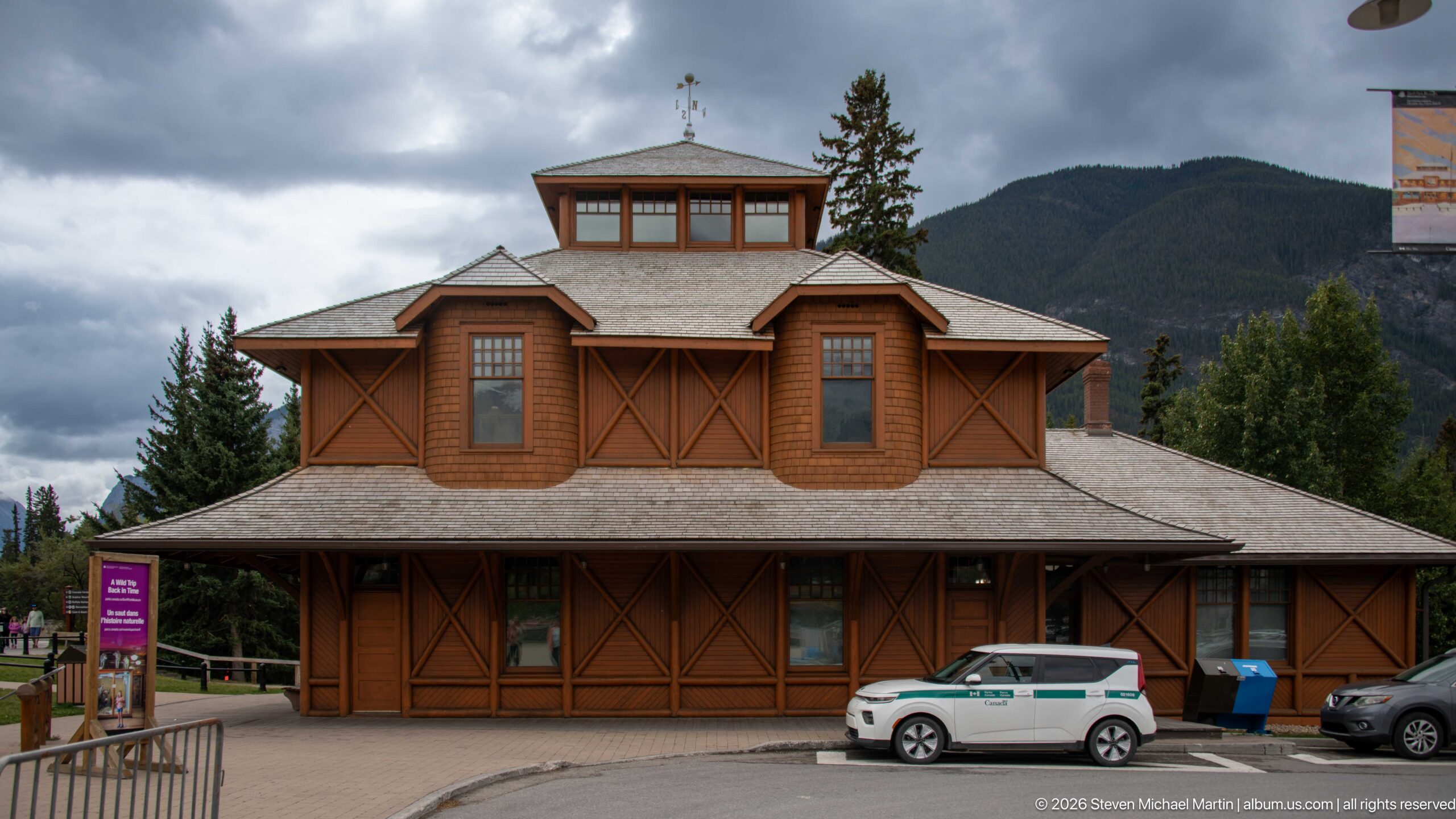
The Banff Park Museum’s symmetrical timber façade stands beneath a dark mountain backdrop, its broad wraparound roof, paired upper windows, decorative cross-bracing, and raised clerestory giving the compact building a distinctive profile. The exterior expresses the rustic vocabulary associated with early park architecture while remaining unusually formal in its balanced composition.
Caption
The Banff Park Museum’s symmetrical timber façade stands beneath a dark mountain backdrop, its broad wraparound roof, paired upper windows, decorative cross-bracing, and raised clerestory giving the compact building a distinctive profile. The exterior expresses the rustic vocabulary associated with early park architecture while remaining unusually formal in its balanced composition.
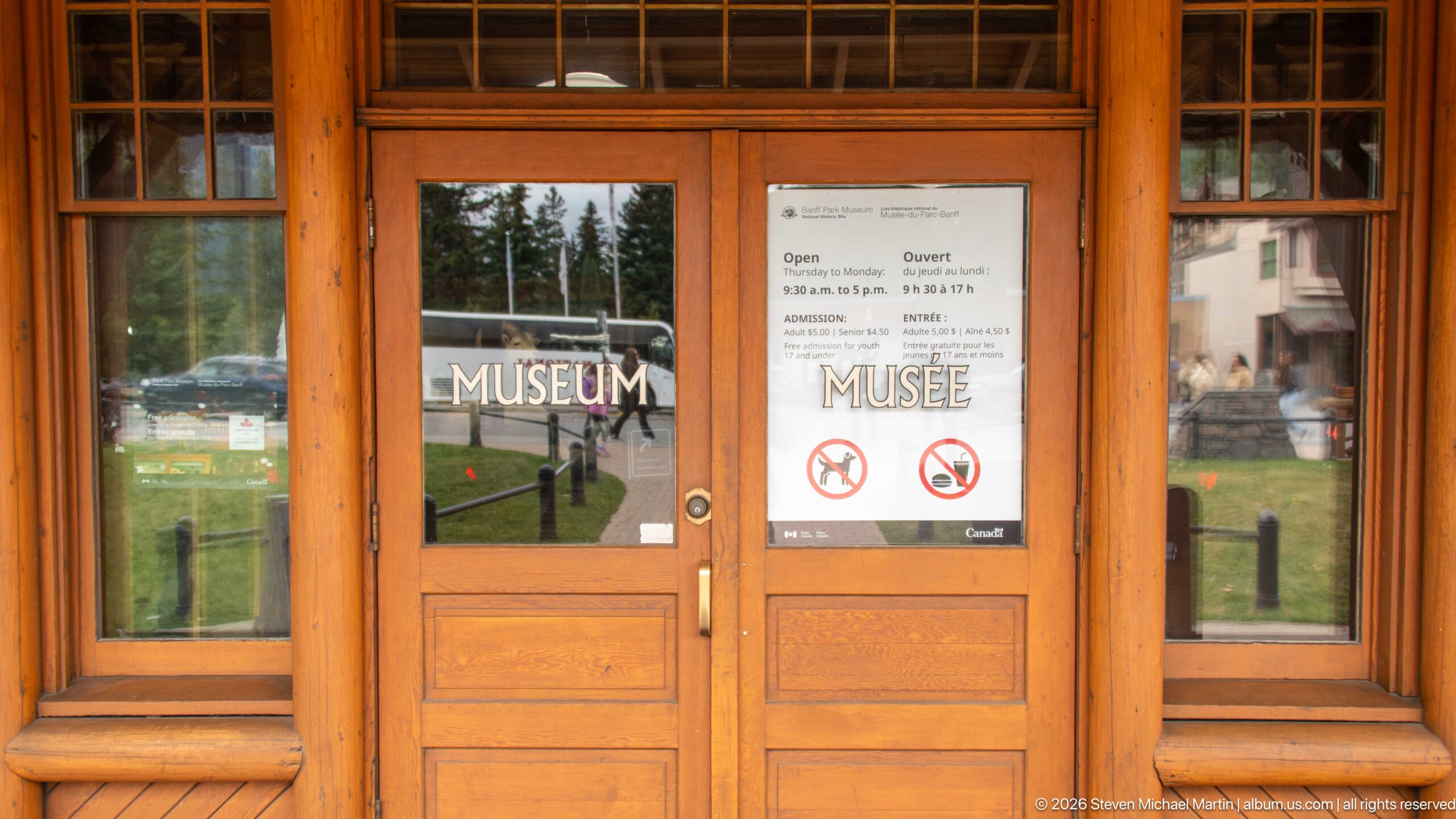
The Banff Park Museum entrance is framed in heavy timber, with glazed double doors carrying bilingual MUSEUM / MUSÉE lettering and posted visitor information. Reflections in the glass connect the doorway to the landscaped grounds outside, while the warm wood construction introduces the building’s rustic architectural character before visitors enter the galleries.
Caption
The Banff Park Museum entrance is framed in heavy timber, with glazed double doors carrying bilingual MUSEUM / MUSÉE lettering and posted visitor information. Reflections in the glass connect the doorway to the landscaped grounds outside, while the warm wood construction introduces the building’s rustic architectural character before visitors enter the galleries.
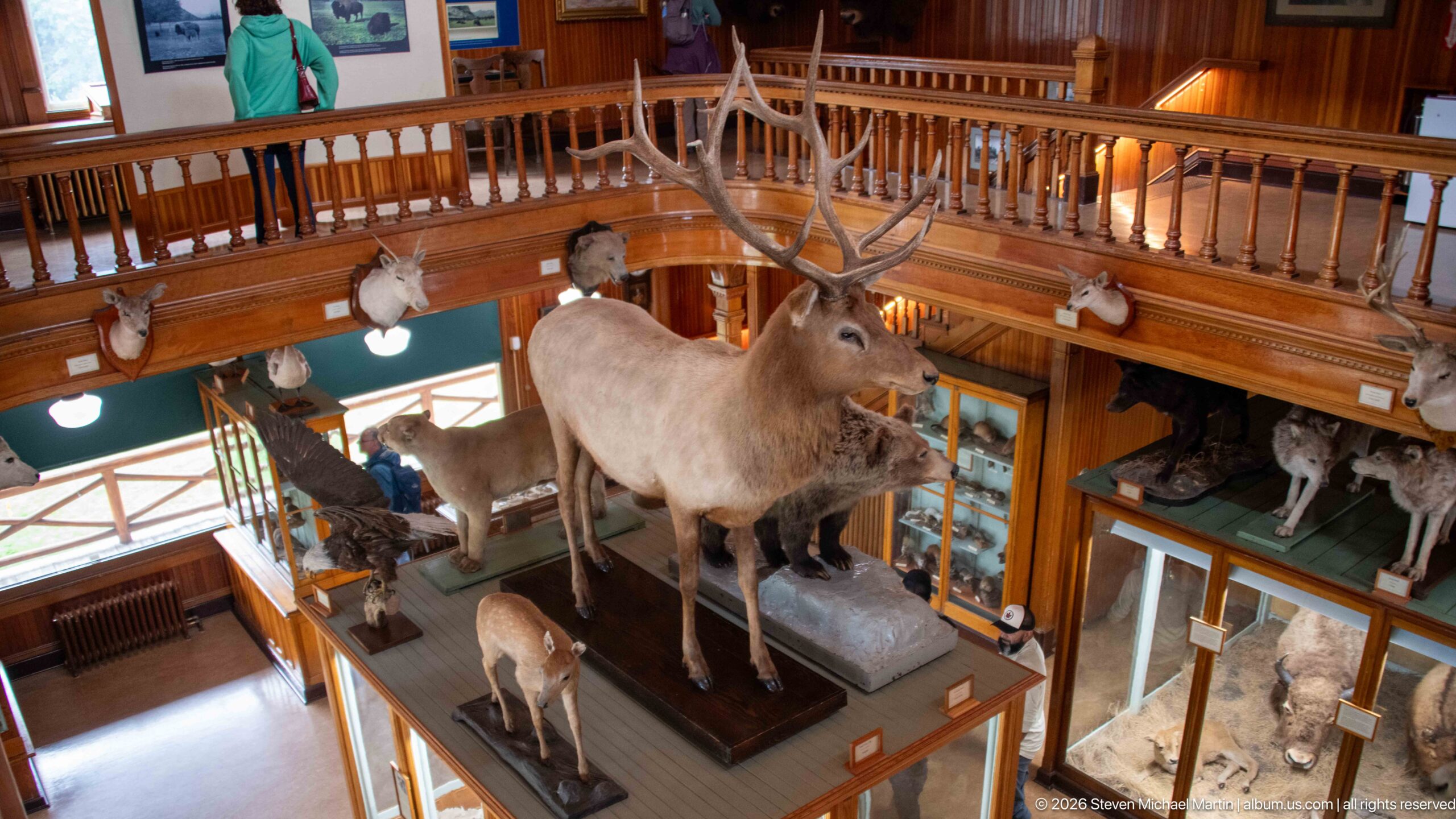
A high viewpoint looks down into the museum’s central display floor, where a full-bodied bull elk rises above smaller mounted mammals and surrounding cases. Shoulder mounts line the balcony edge, creating a dense vertical field of specimens that demonstrates the historic gallery’s encyclopedic approach to Rocky Mountain wildlife.
Caption
A high viewpoint looks down into the museum’s central display floor, where a full-bodied bull elk rises above smaller mounted mammals and surrounding cases. Shoulder mounts line the balcony edge, creating a dense vertical field of specimens that demonstrates the historic gallery’s encyclopedic approach to Rocky Mountain wildlife.
The Banff Park Museum’s timber exterior combines a broad shingled roof, deep wraparound veranda, exposed diagonal bracing, and a raised clerestory that brings light into the central hall. Seen from the corner, the building’s layered roofline and warm wood construction give a clear view of the distinctive architectural envelope housing the historic natural-history collection.
Caption
The Banff Park Museum’s timber exterior combines a broad shingled roof, deep wraparound veranda, exposed diagonal bracing, and a raised clerestory that brings light into the central hall. Seen from the corner, the building’s layered roofline and warm wood construction give a clear view of the distinctive architectural envelope housing the historic natural-history collection.
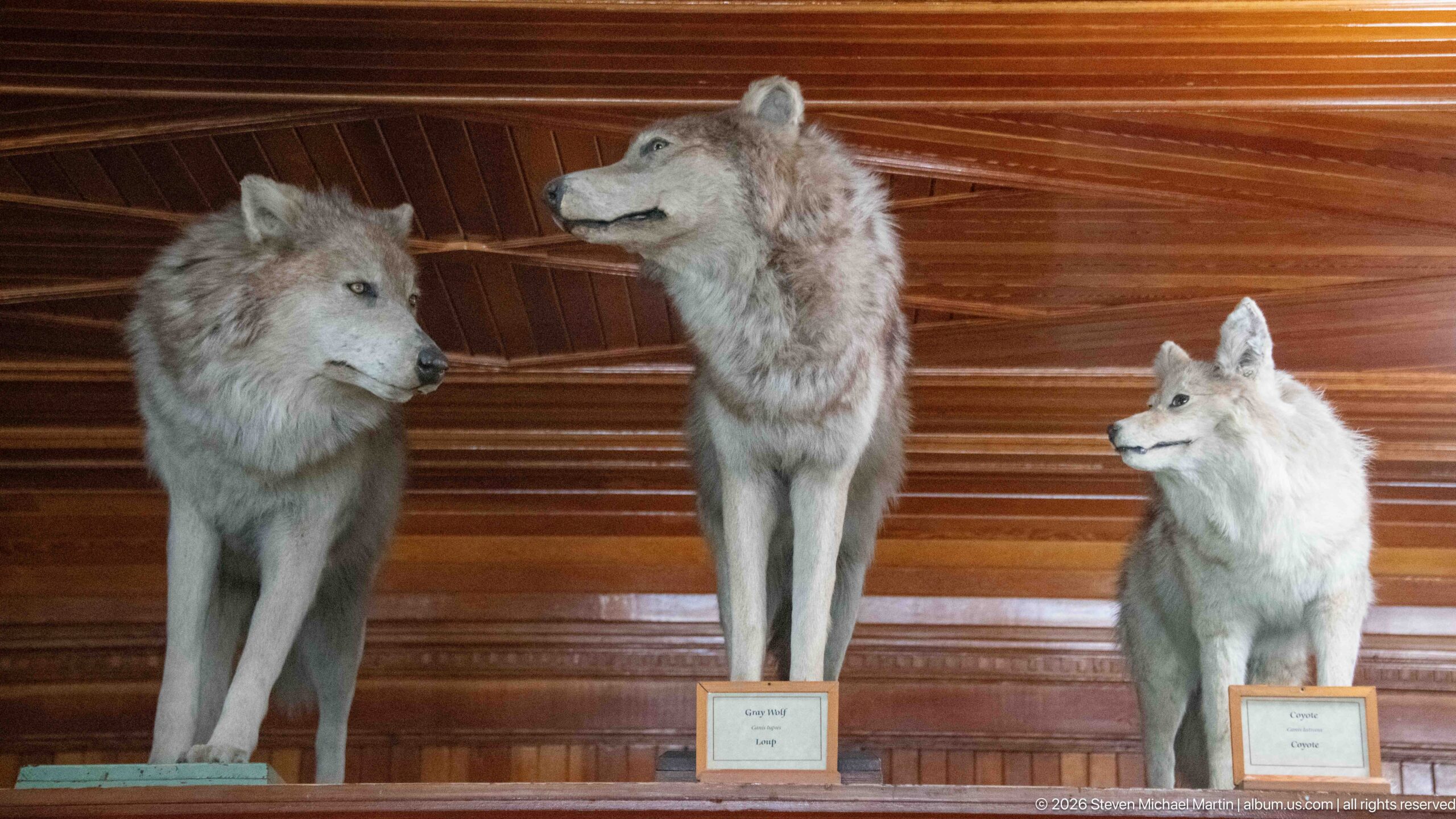
Three mounted wolves stand in a row against the dark wooden gallery wall, ranging from gray to nearly white coats. Their side-by-side placement encourages comparison of coat color, size, and stance, while small historic labels identify individual specimens. The grouping reflects the museum’s specimen-based approach to documenting variation within large carnivores.
Caption
Three mounted wolves stand in a row against the dark wooden gallery wall, ranging from gray to nearly white coats. Their side-by-side placement encourages comparison of coat color, size, and stance, while small historic labels identify individual specimens. The grouping reflects the museum’s specimen-based approach to documenting variation within large carnivores.
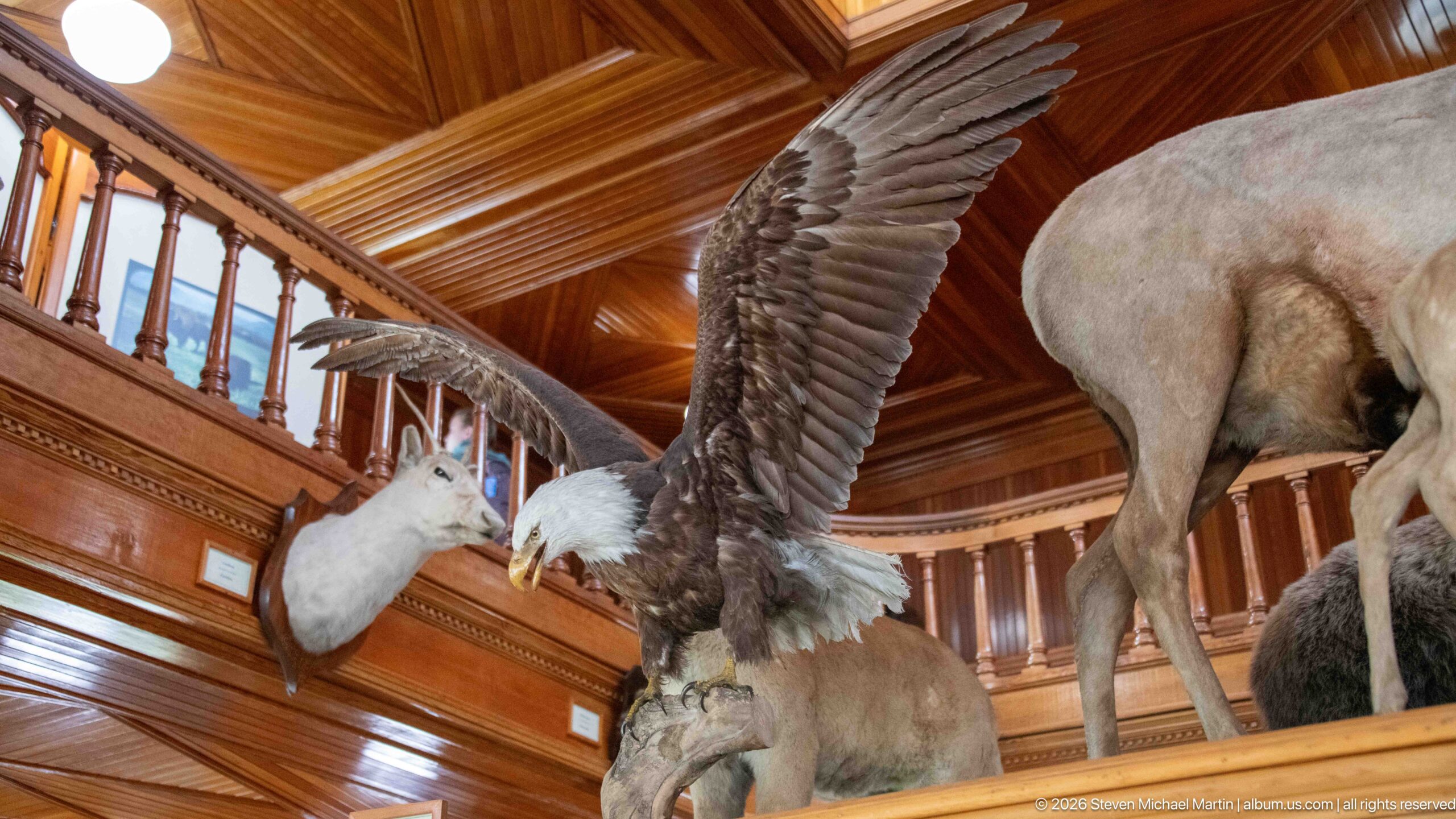
A bald eagle dominates this densely arranged interior display, its white head and tail contrasting with dark wings held in an expansive flight pose. Nearby mounted mammals and birds crowd the upper gallery, illustrating the Banff Park Museum’s historic approach of presenting many specimens within a richly finished architectural setting rather than in isolated modern cases.
Caption
A bald eagle dominates this densely arranged interior display, its white head and tail contrasting with dark wings held in an expansive flight pose. Nearby mounted mammals and birds crowd the upper gallery, illustrating the Banff Park Museum’s historic approach of presenting many specimens within a richly finished architectural setting rather than in isolated modern cases.
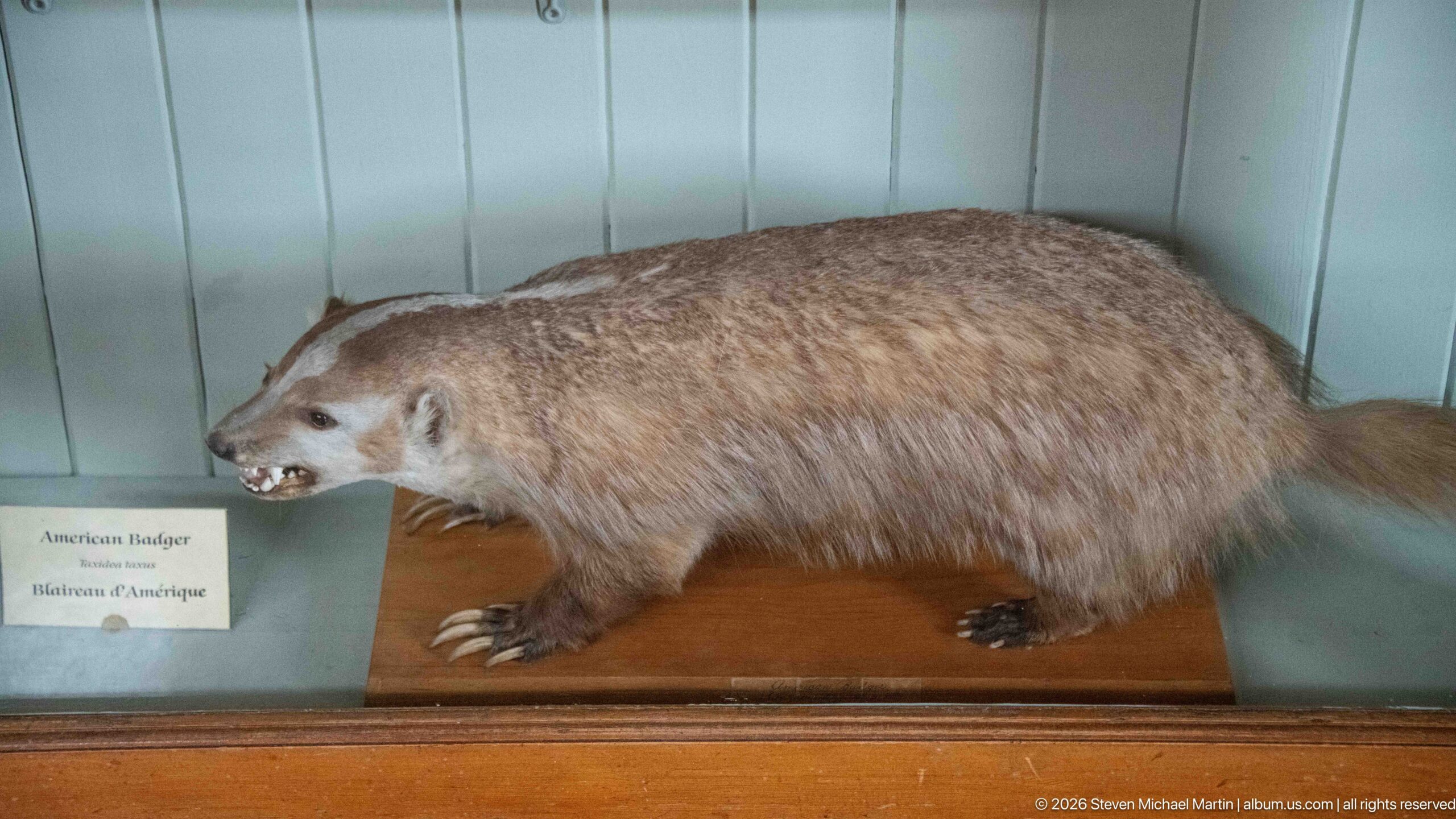
An American badger is presented in profile on a simple wooden base, its low body, powerful foreclaws, grizzled coat, and striped face clearly visible. The uncluttered presentation reflects an older specimen-centered approach to natural-history interpretation, allowing the animal’s burrowing adaptations and compact, muscular form to be examined at close range.
Caption
An American badger is presented in profile on a simple wooden base, its low body, powerful foreclaws, grizzled coat, and striped face clearly visible. The uncluttered presentation reflects an older specimen-centered approach to natural-history interpretation, allowing the animal’s burrowing adaptations and compact, muscular form to be examined at close range.
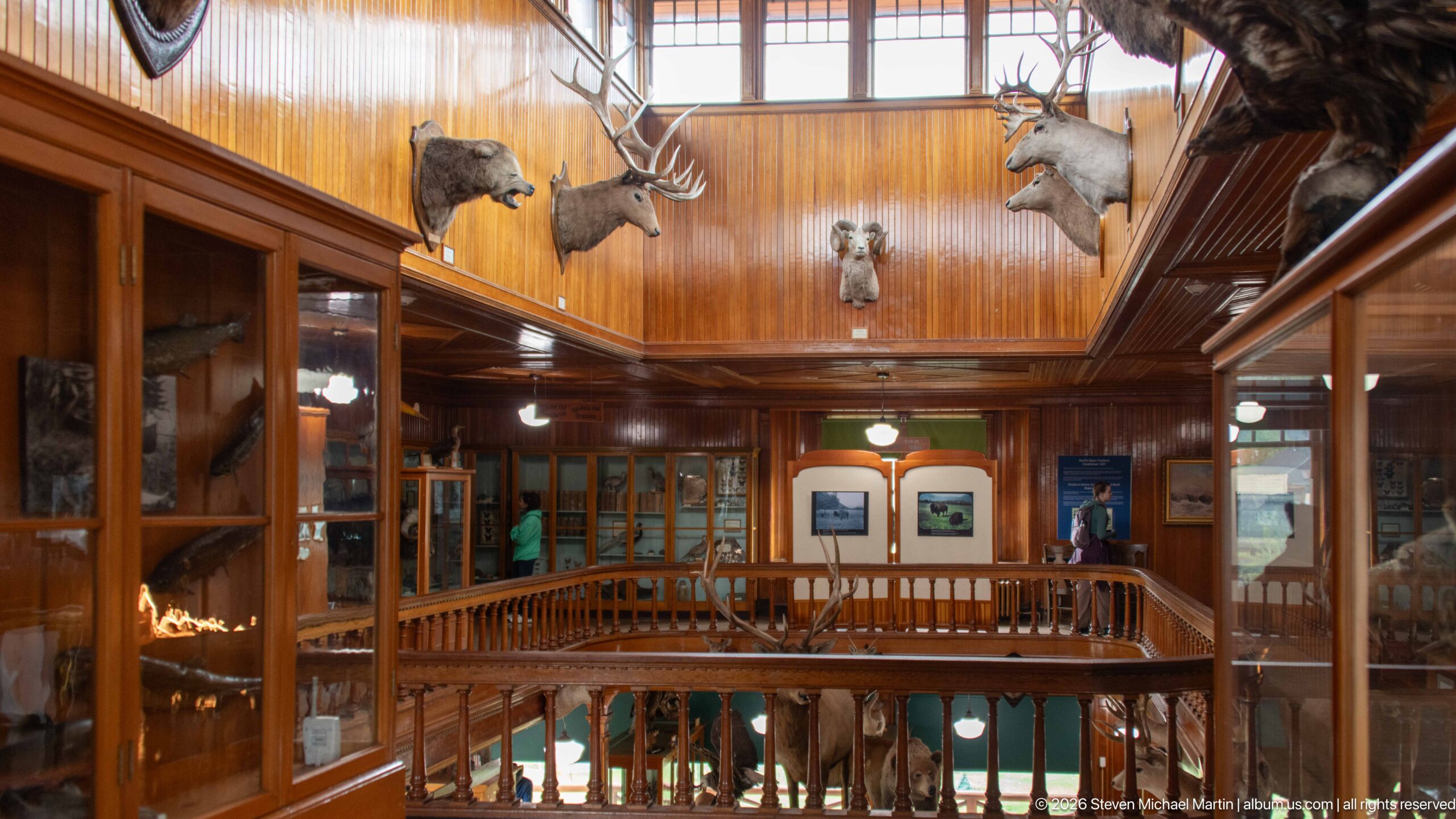
A broad upper-gallery view reveals the Banff Park Museum as an integrated historic interior: glass-fronted cases line both sides, a balustrade surrounds the opening to the lower hall, and large mammal mounts occupy the clerestory walls above. The perspective shows how visitors move through a two-level space where architecture and collections remain visually inseparable.
Caption
A broad upper-gallery view reveals the Banff Park Museum as an integrated historic interior: glass-fronted cases line both sides, a balustrade surrounds the opening to the lower hall, and large mammal mounts occupy the clerestory walls above. The perspective shows how visitors move through a two-level space where architecture and collections remain visually inseparable.
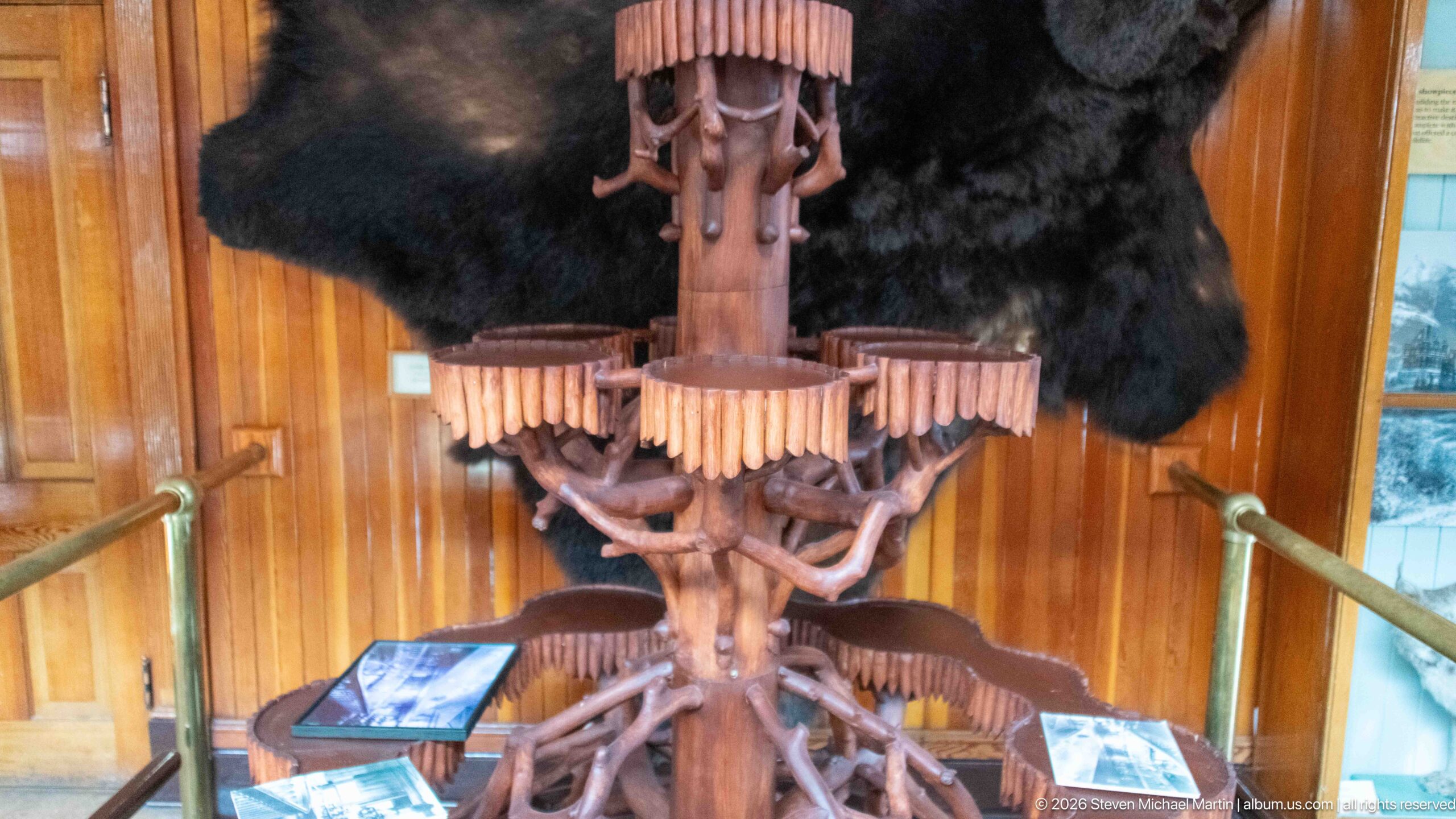
A large branching wooden fixture rises through the museum interior, built from peeled limbs arranged into a symmetrical, multi-tiered form with repeated cylindrical elements. Set against varnished wood walls and a dark mounted hide, the object contributes to the strongly rustic character of the historic gallery, where furnishings and natural-history displays form a unified interior ensemble.
Caption
A large branching wooden fixture rises through the museum interior, built from peeled limbs arranged into a symmetrical, multi-tiered form with repeated cylindrical elements. Set against varnished wood walls and a dark mounted hide, the object contributes to the strongly rustic character of the historic gallery, where furnishings and natural-history displays form a unified interior ensemble.
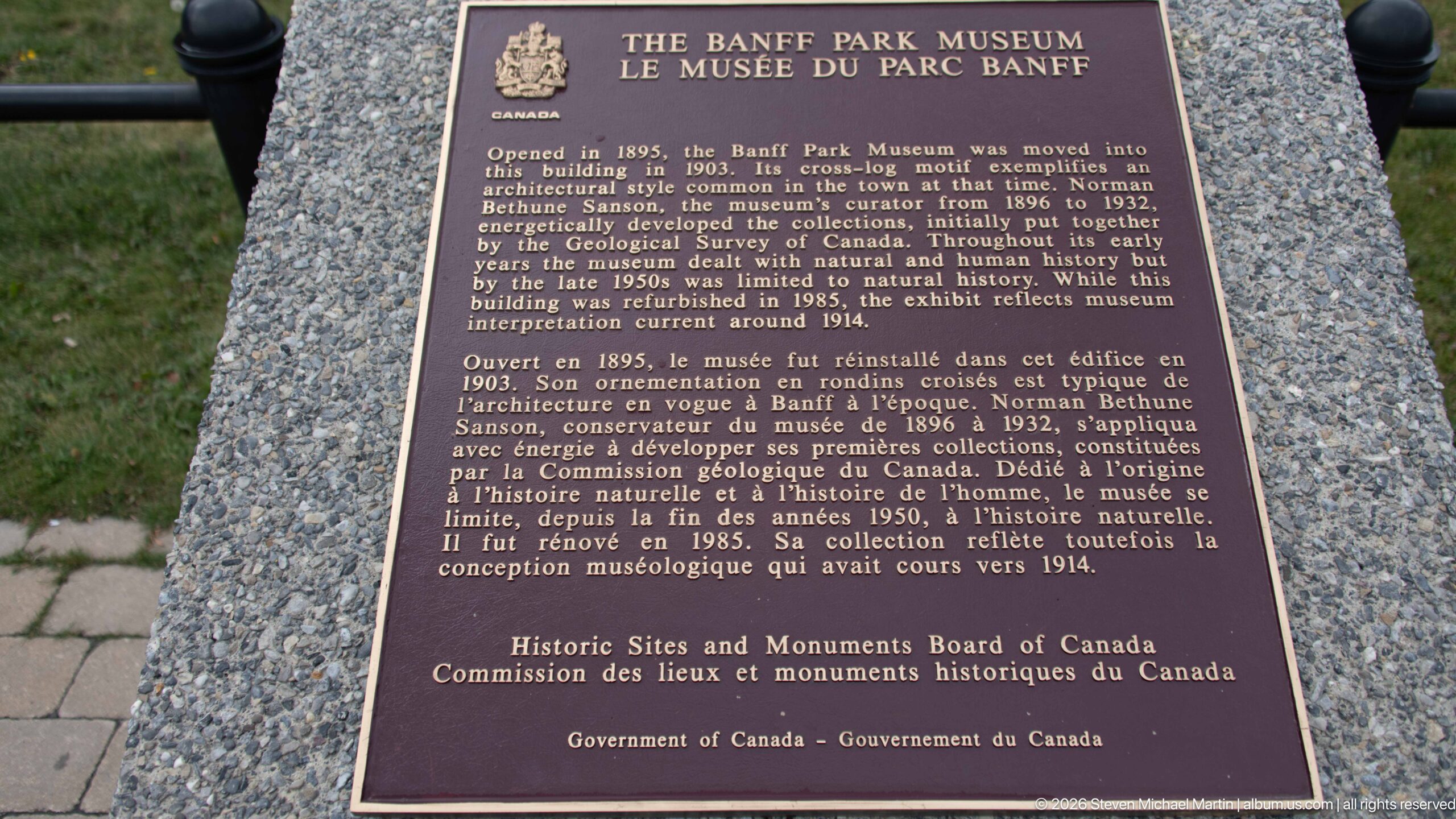
A bronze federal commemorative plaque identifies the Banff Park Museum and summarizes its development from an 1895 museum into the purpose-built 1903 structure. The bilingual inscription also notes curator Norman Bethune Sanson and the survival of the museum’s early natural-history collections and period display character.
Caption
A bronze federal commemorative plaque identifies the Banff Park Museum and summarizes its development from an 1895 museum into the purpose-built 1903 structure. The bilingual inscription also notes curator Norman Bethune Sanson and the survival of the museum’s early natural-history collections and period display character.
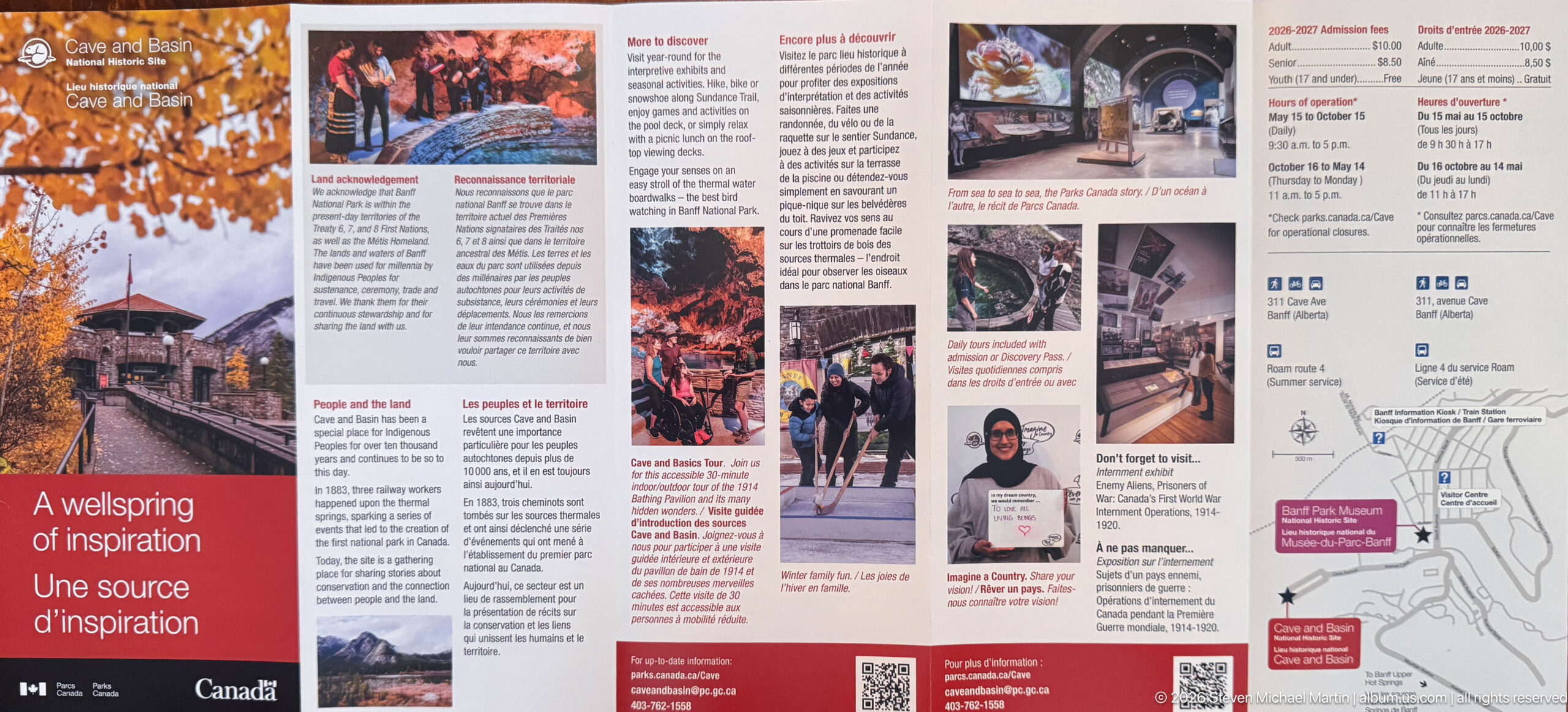
A bilingual Parks Canada panel introduces the Banff Park Museum through photographs, historical views, maps, and short interpretive texts. The display frames the museum as both a natural-history collection and a historic place, using archival imagery and contemporary visitor information to connect the building, its collections, and the surrounding Banff landscape.
Caption
A bilingual Parks Canada panel introduces the Banff Park Museum through photographs, historical views, maps, and short interpretive texts. The display frames the museum as both a natural-history collection and a historic place, using archival imagery and contemporary visitor information to connect the building, its collections, and the surrounding Banff landscape.
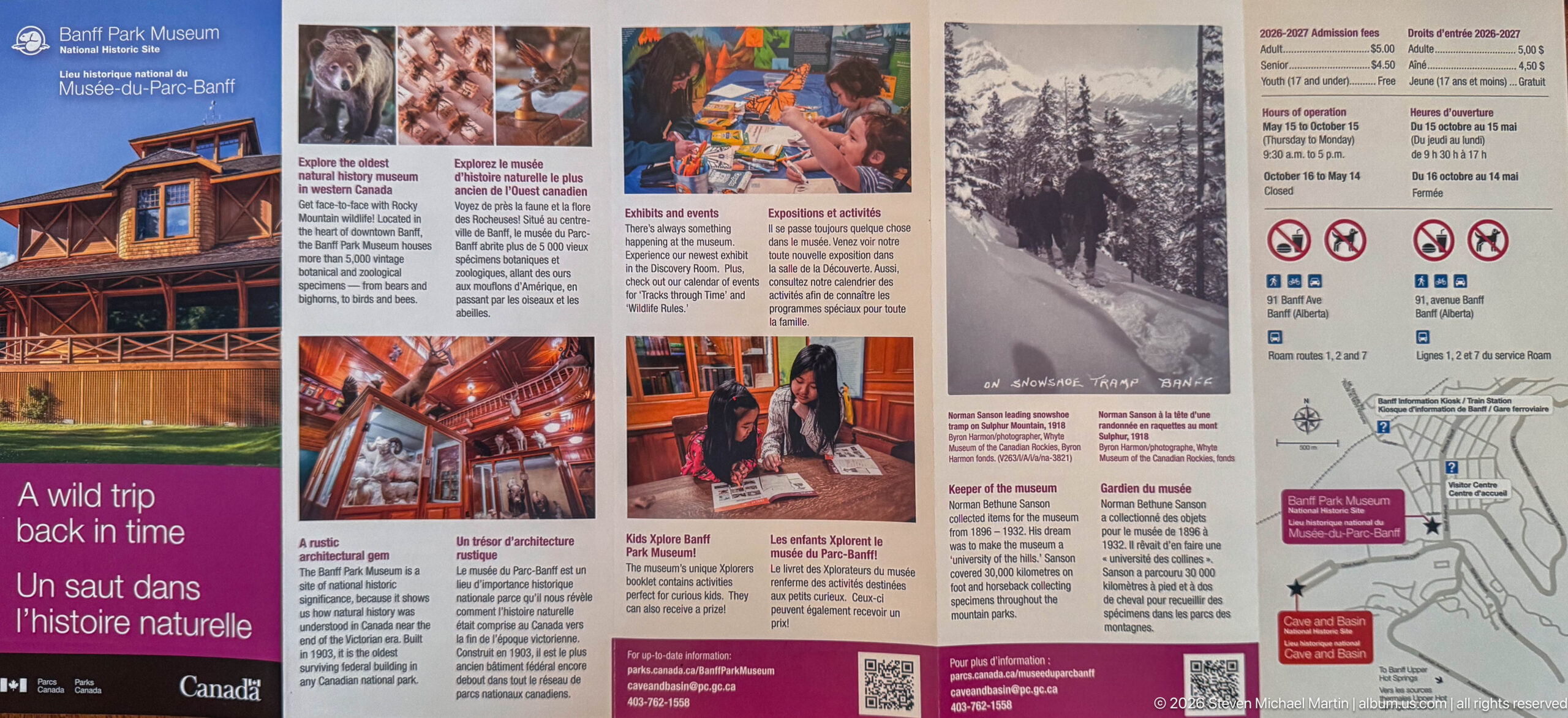
A second bilingual interpretive panel presents the Banff Park Museum as a journey into the history of natural-history collecting. Historic photographs, colorful illustrations, interior views, and visitor guidance emphasize the museum’s specimen displays and the changing ways people have encountered and interpreted wildlife in the Canadian Rockies.
Caption
A second bilingual interpretive panel presents the Banff Park Museum as a journey into the history of natural-history collecting. Historic photographs, colorful illustrations, interior views, and visitor guidance emphasize the museum’s specimen displays and the changing ways people have encountered and interpreted wildlife in the Canadian Rockies.
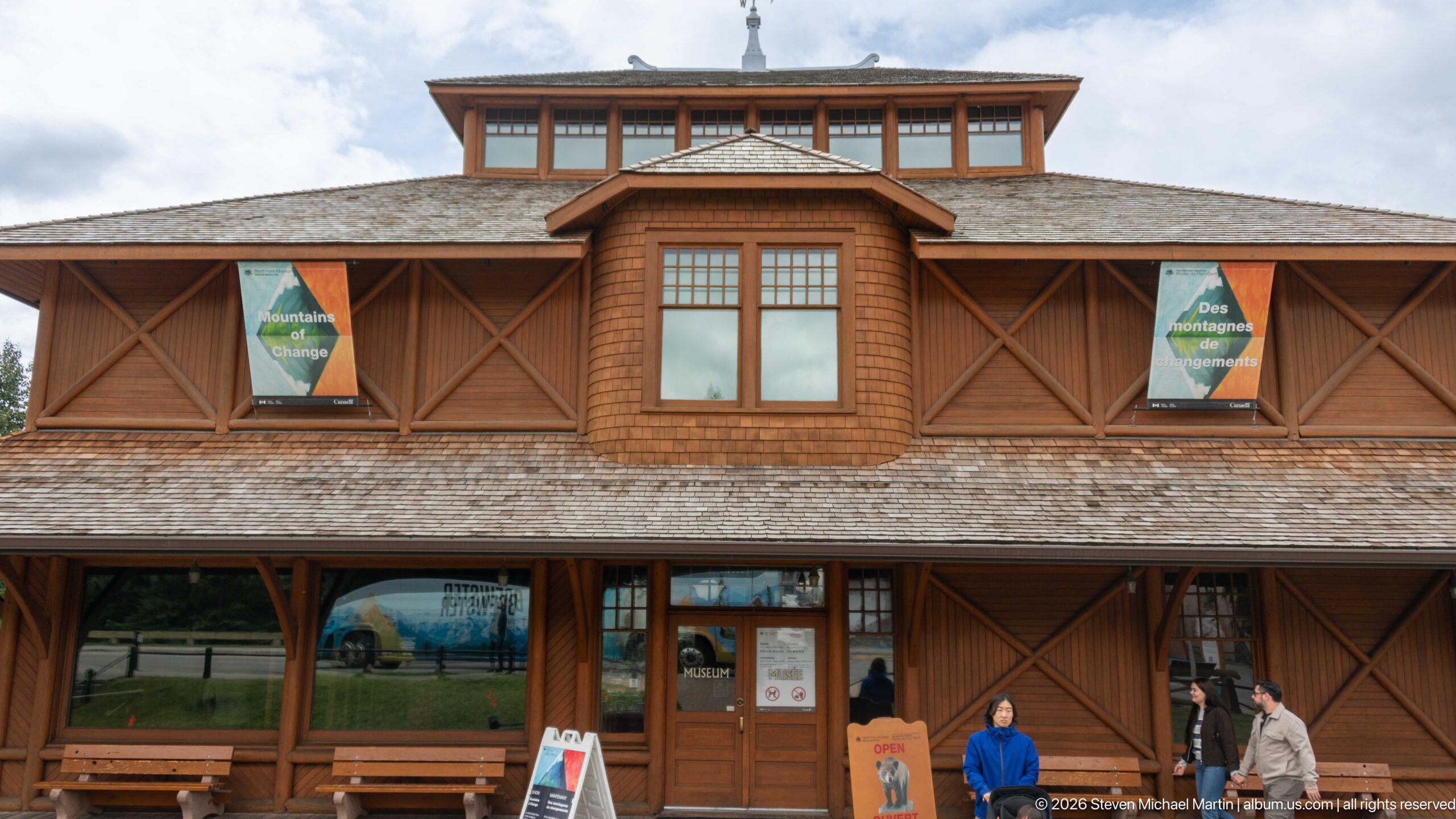
Centered on the entrance, this façade view emphasizes the Banff Park Museum’s symmetrical timber construction: projecting central bay, shingled lower roof, clerestory windows, and decorative diagonal framing. The close frontal perspective also shows the veranda-level doors and windows that mediate between the historic exhibition hall and the surrounding grounds.
Caption
Centered on the entrance, this façade view emphasizes the Banff Park Museum’s symmetrical timber construction: projecting central bay, shingled lower roof, clerestory windows, and decorative diagonal framing. The close frontal perspective also shows the veranda-level doors and windows that mediate between the historic exhibition hall and the surrounding grounds.
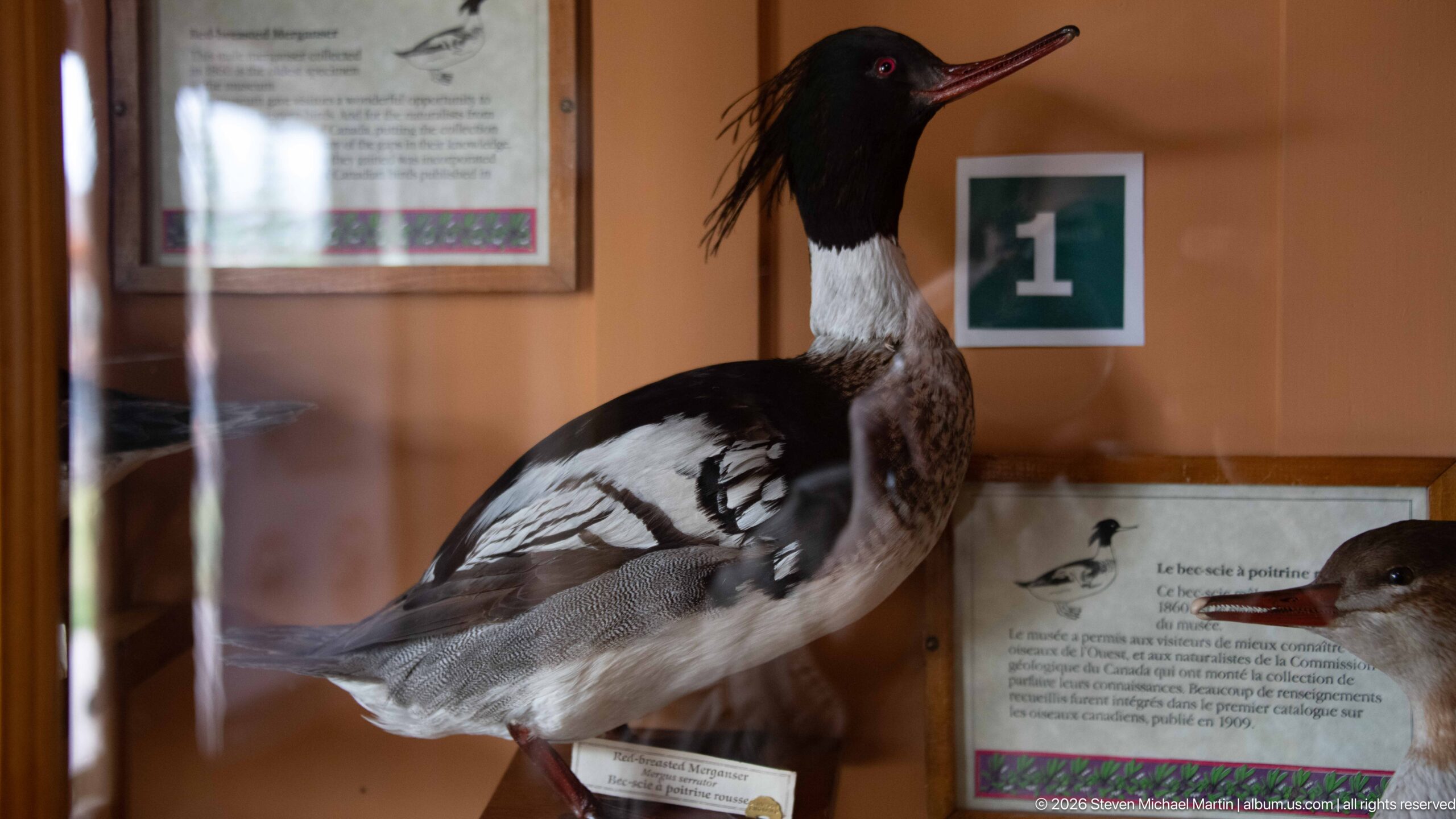
A male red-breasted merganser stands within a glass case, recognizable by its long narrow bill, shaggy dark crest, white neck collar, and mottled reddish-brown breast. Presented beside an interpretive label, the specimen preserves the elongated profile and diving-duck adaptations that distinguish mergansers within the museum’s historic bird collection.
Caption
A male red-breasted merganser stands within a glass case, recognizable by its long narrow bill, shaggy dark crest, white neck collar, and mottled reddish-brown breast. Presented beside an interpretive label, the specimen preserves the elongated profile and diving-duck adaptations that distinguish mergansers within the museum’s historic bird collection.
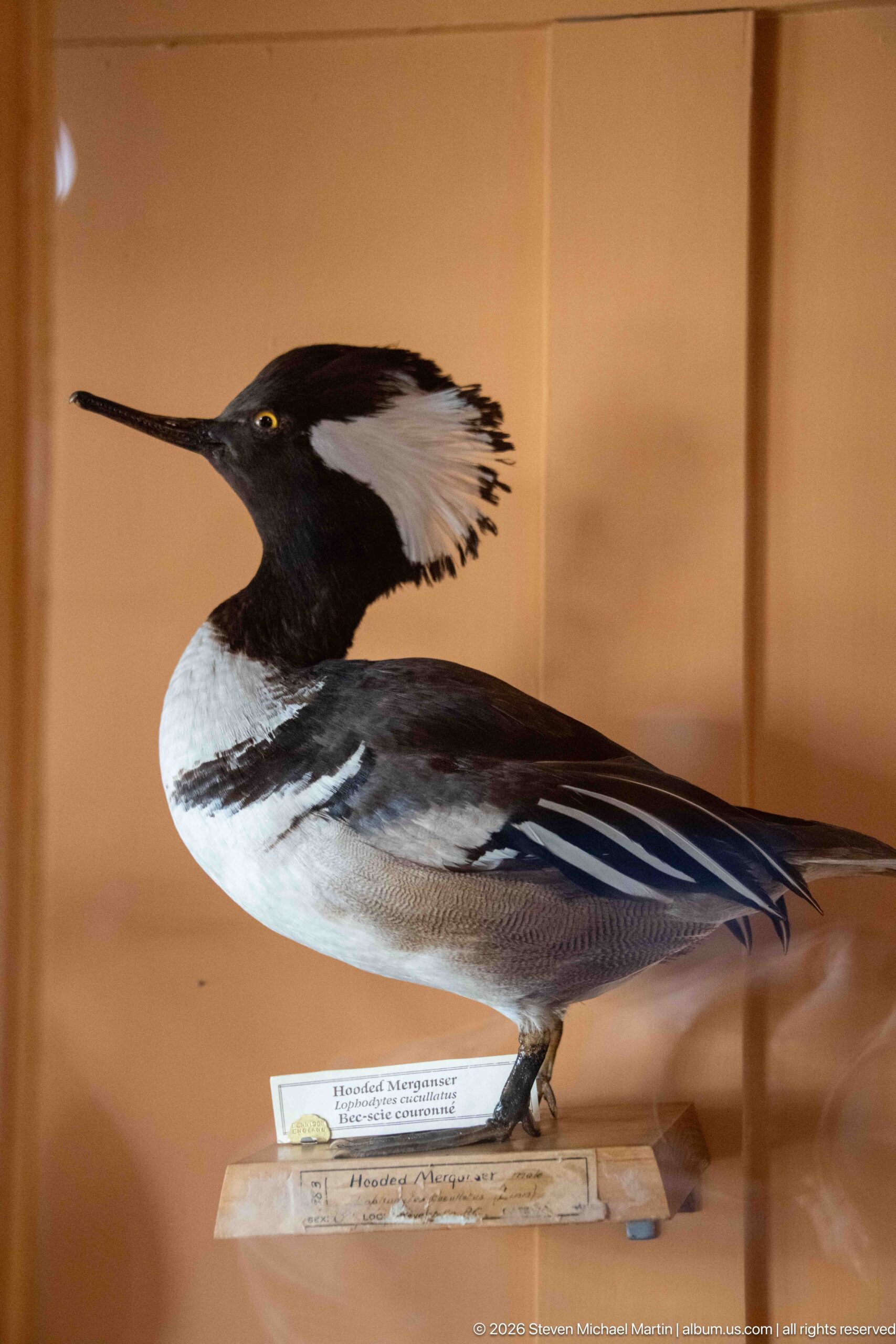
A male hooded merganser is displayed in profile, its narrow dark bill, black head, bold white fan-shaped crest, and sharply patterned black-and-white plumage preserved for close study. The specimen exemplifies the museum’s historic taxonomic presentation, isolating characteristic field marks against the warm wood interior of the display case.
Caption
A male hooded merganser is displayed in profile, its narrow dark bill, black head, bold white fan-shaped crest, and sharply patterned black-and-white plumage preserved for close study. The specimen exemplifies the museum’s historic taxonomic presentation, isolating characteristic field marks against the warm wood interior of the display case.
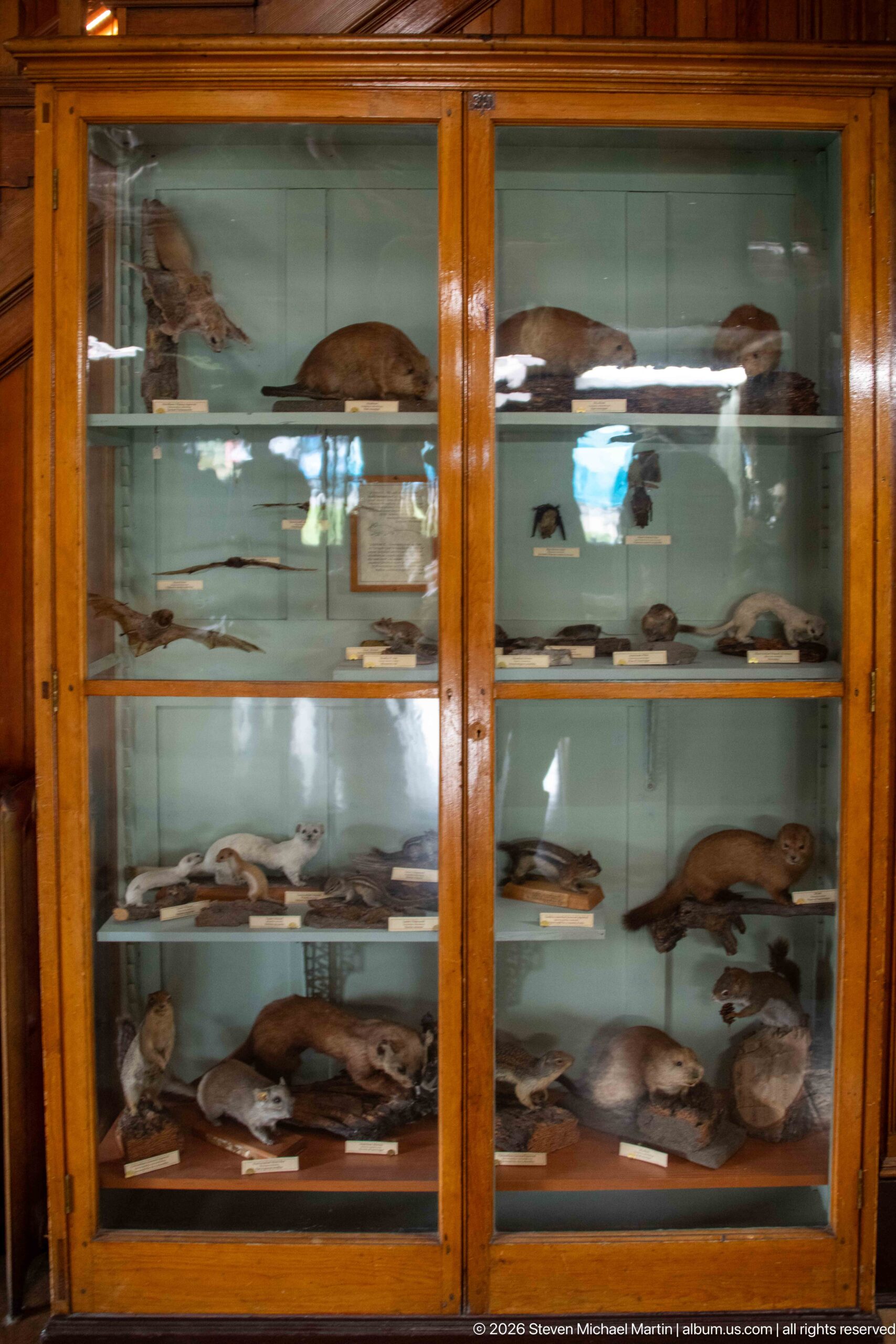
Rows of small mammal specimens fill a glazed wooden cabinet, arranged shelf by shelf with individual labels. The compact comparative display reflects a taxonomic collecting tradition in which related animals could be examined side by side, while the original cabinetry preserves the visual character of the museum’s early natural-history installations.
Caption
Rows of small mammal specimens fill a glazed wooden cabinet, arranged shelf by shelf with individual labels. The compact comparative display reflects a taxonomic collecting tradition in which related animals could be examined side by side, while the original cabinetry preserves the visual character of the museum’s early natural-history installations.
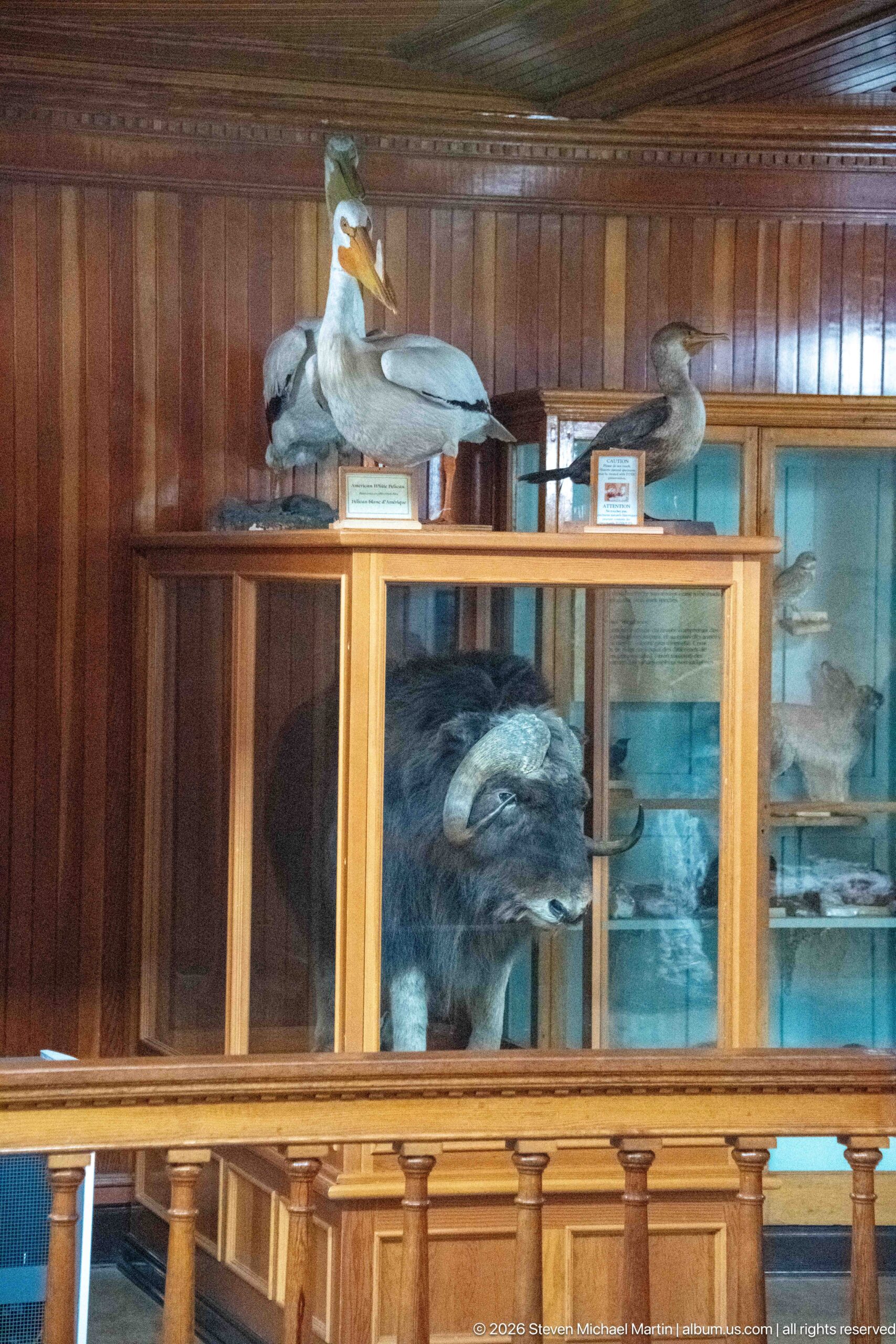
Waterbird specimens occupy the top and interior of a glazed wooden case along the upper gallery. Different body forms and plumage are presented together for comparison, while the surrounding balustrade and dark woodwork show how the collection is integrated into the museum’s original architectural fabric.
Caption
Waterbird specimens occupy the top and interior of a glazed wooden case along the upper gallery. Different body forms and plumage are presented together for comparison, while the surrounding balustrade and dark woodwork show how the collection is integrated into the museum’s original architectural fabric.
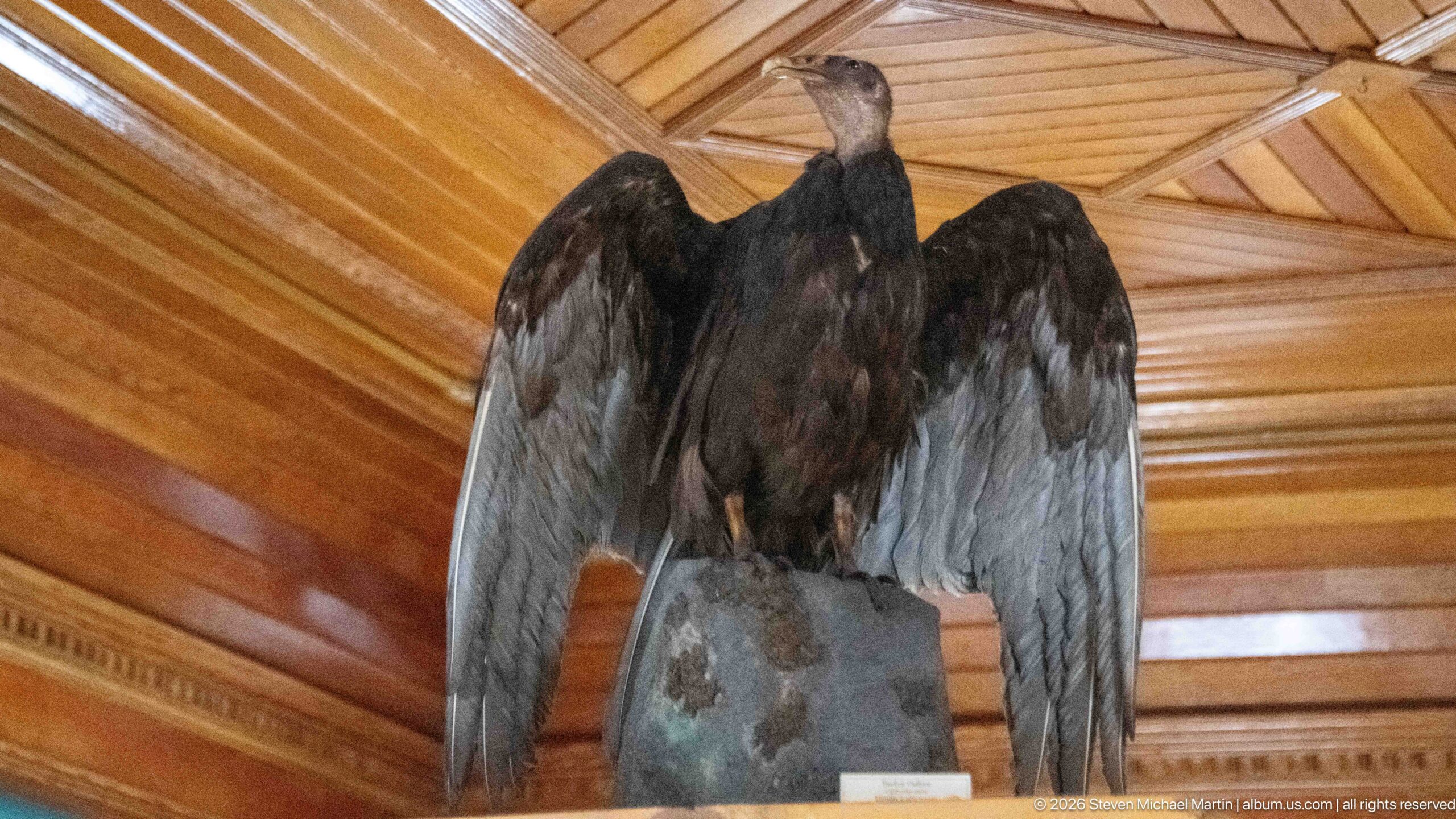
A large eagle specimen is mounted high against the museum’s polished wood interior with both wings fully extended. The dramatic pose exposes the broad flight feathers and powerful body while the elevated placement recalls the dense, vertically arranged displays characteristic of early natural-history museums.
Caption
A large eagle specimen is mounted high against the museum’s polished wood interior with both wings fully extended. The dramatic pose exposes the broad flight feathers and powerful body while the elevated placement recalls the dense, vertically arranged displays characteristic of early natural-history museums.
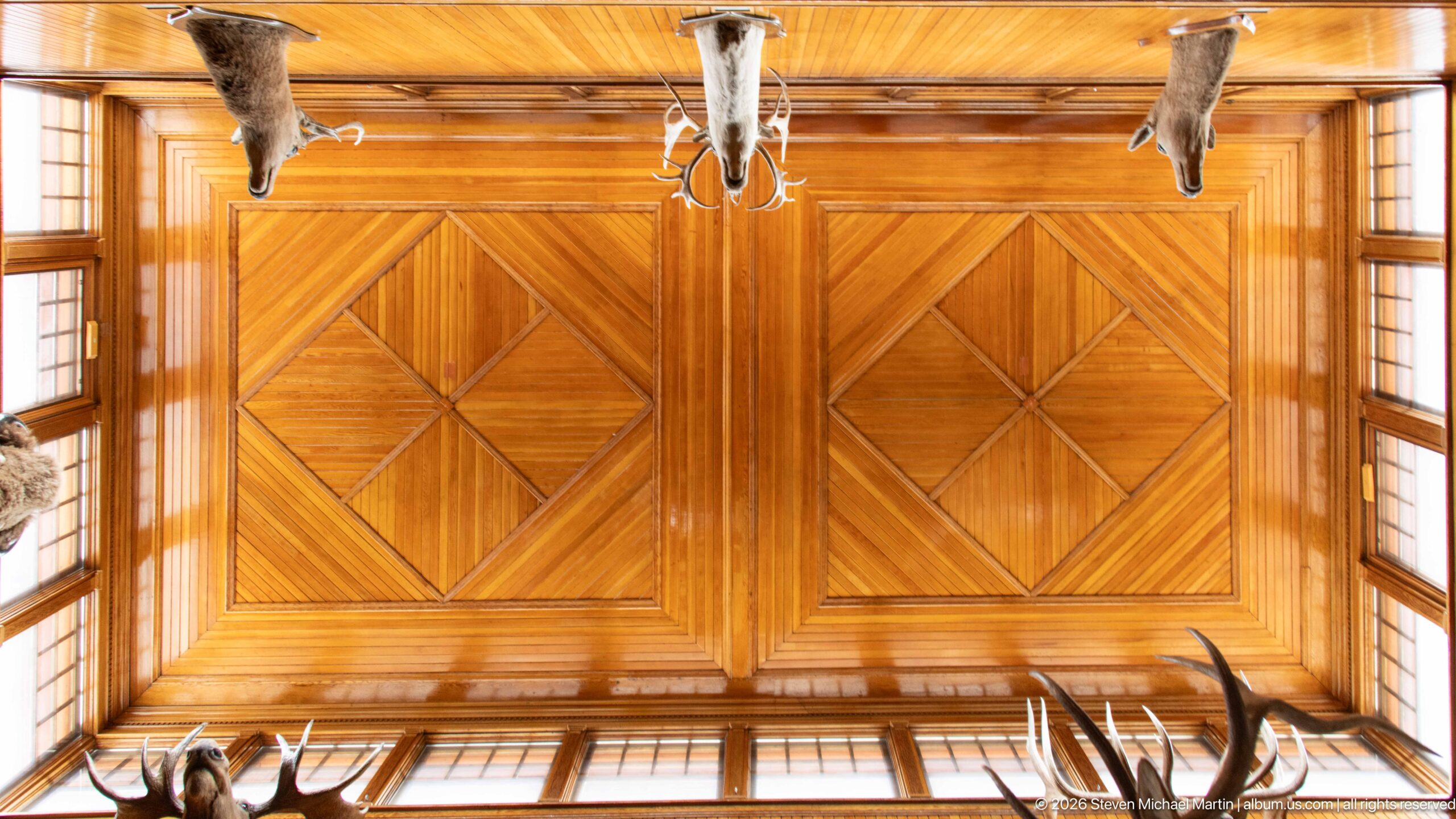
Looking upward, the Banff Park Museum’s woodwork becomes the subject: geometric ceiling panels, layered moldings, clerestory glazing, and mounted specimens arranged around the upper walls. The symmetrical composition reveals how architecture and collection were conceived together, with polished timber surfaces providing a continuous setting for natural-history displays.
Caption
Looking upward, the Banff Park Museum’s woodwork becomes the subject: geometric ceiling panels, layered moldings, clerestory glazing, and mounted specimens arranged around the upper walls. The symmetrical composition reveals how architecture and collection were conceived together, with polished timber surfaces providing a continuous setting for natural-history displays.
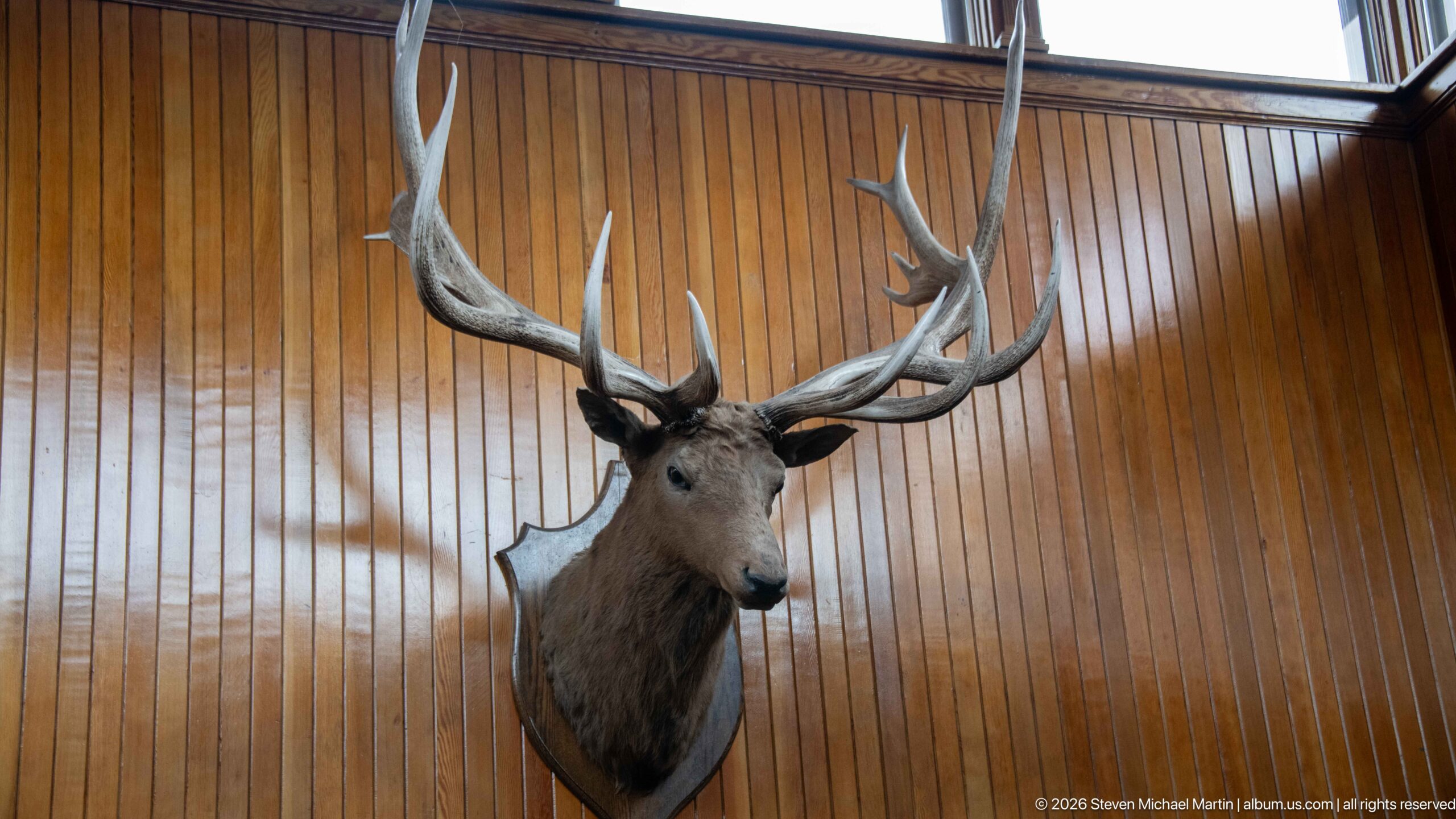
A mature bull elk is presented as a shoulder mount against vertical wood paneling, with its sweeping multi-tined antlers extending well beyond the head. The isolated presentation emphasizes the scale and branching structure of the rack, one of the most recognizable features of this large Rocky Mountain ungulate.
Caption
A mature bull elk is presented as a shoulder mount against vertical wood paneling, with its sweeping multi-tined antlers extending well beyond the head. The isolated presentation emphasizes the scale and branching structure of the rack, one of the most recognizable features of this large Rocky Mountain ungulate.
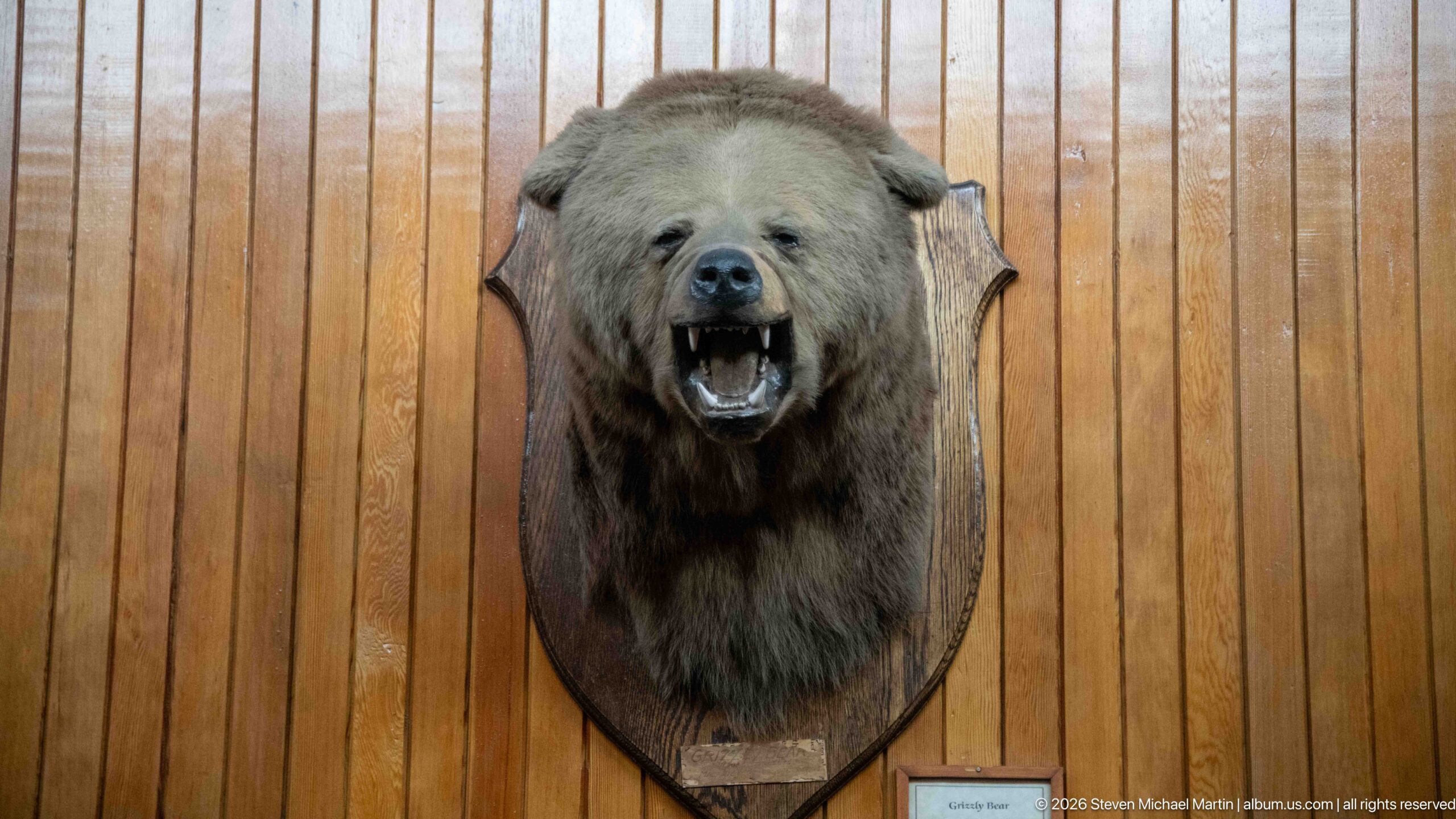
A grizzly bear head mount confronts the viewer with jaws open, exposing the teeth and emphasizing the animal’s broad muzzle and heavy fur. Mounted on a dark shield against vertical wood paneling, the specimen reflects an older natural-history display tradition that often used dramatic poses to communicate the size and power of large predators.
Caption
A grizzly bear head mount confronts the viewer with jaws open, exposing the teeth and emphasizing the animal’s broad muzzle and heavy fur. Mounted on a dark shield against vertical wood paneling, the specimen reflects an older natural-history display tradition that often used dramatic poses to communicate the size and power of large predators.
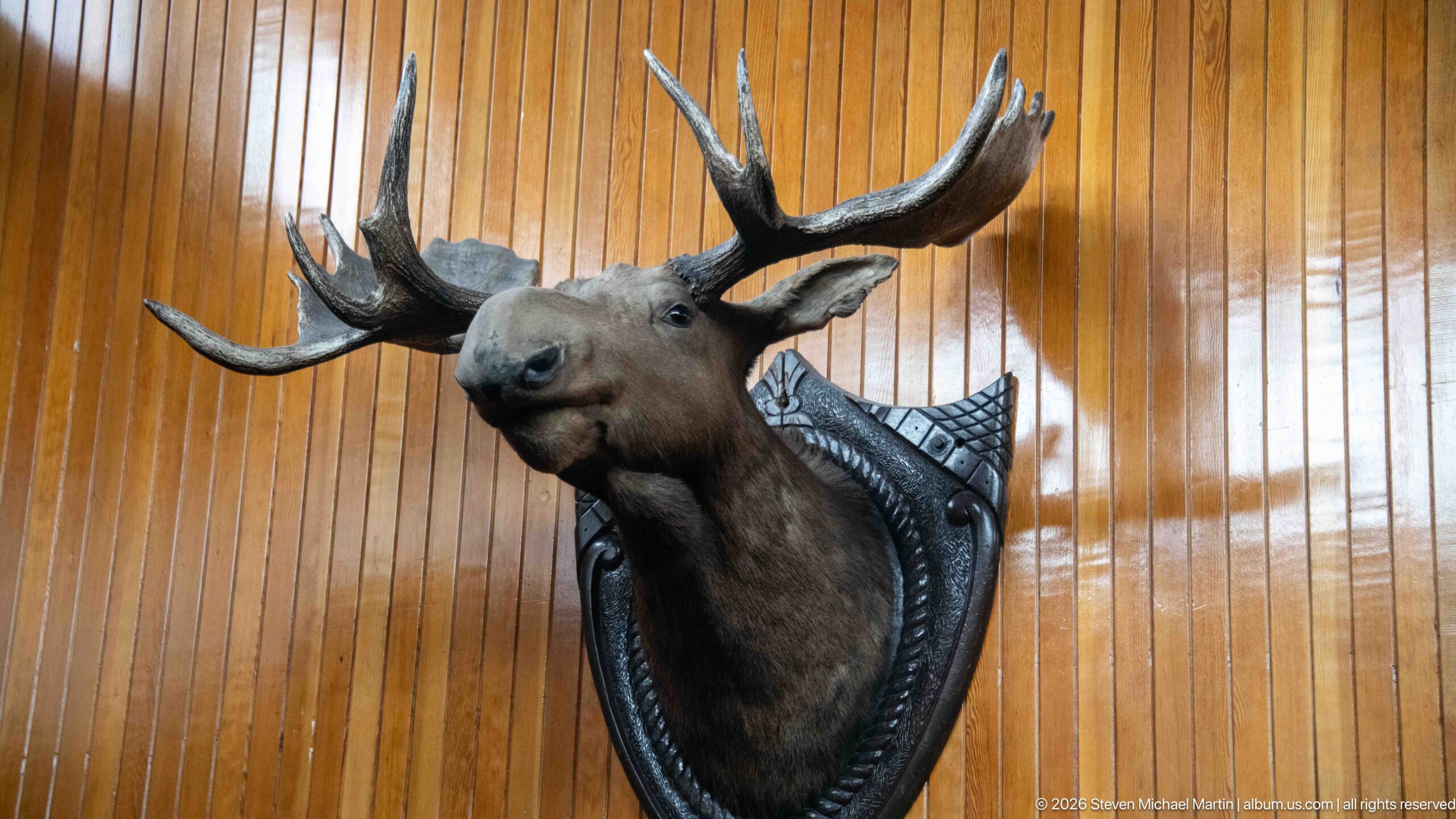
A bull moose shoulder mount is set against the museum’s glossy wood paneling, its massive palmate antlers spreading outward above the long muzzle. The close view isolates the characteristic antler form and facial proportions that distinguish moose from the museum’s other large cervids.
Caption
A bull moose shoulder mount is set against the museum’s glossy wood paneling, its massive palmate antlers spreading outward above the long muzzle. The close view isolates the characteristic antler form and facial proportions that distinguish moose from the museum’s other large cervids.
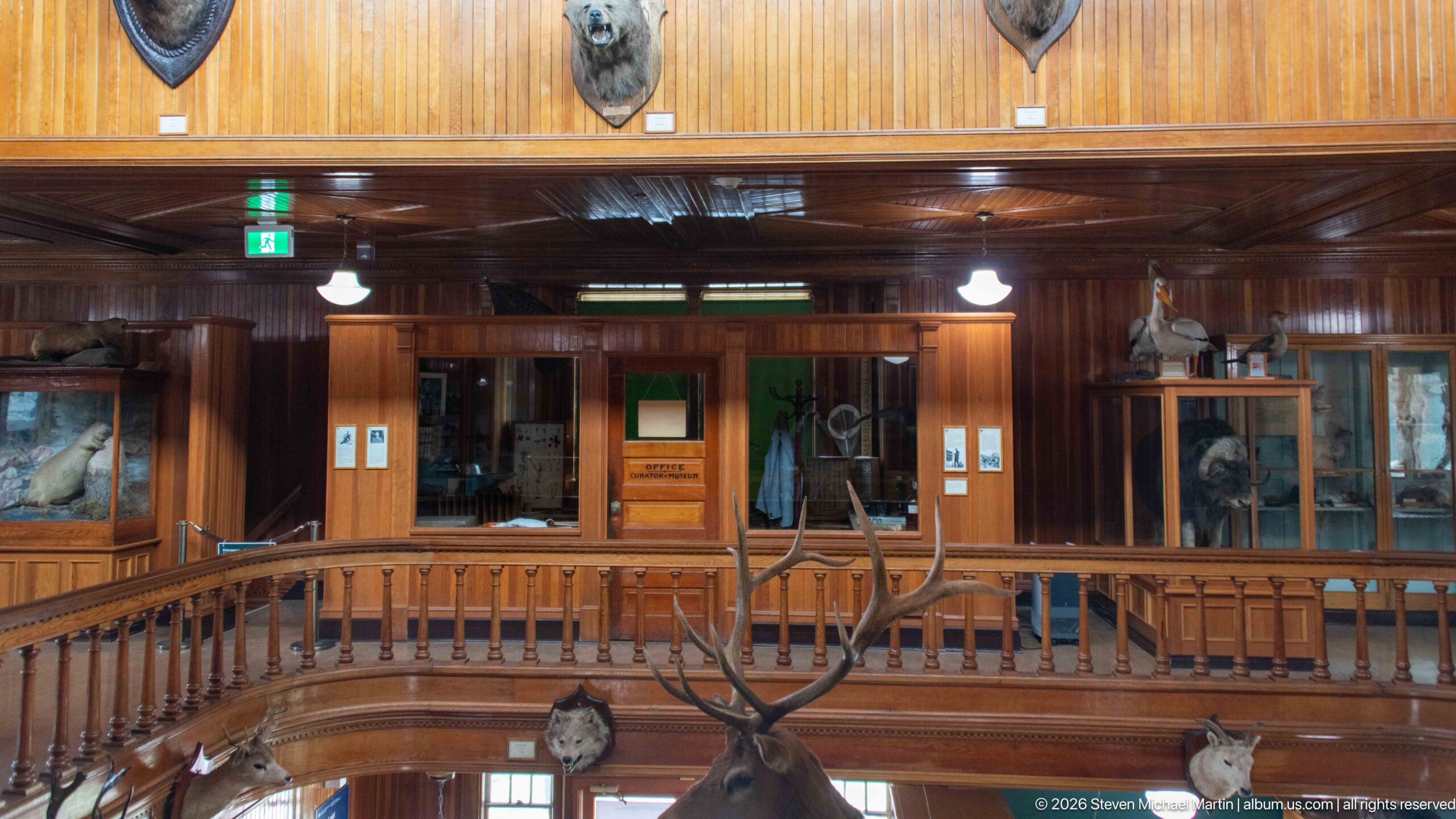
From the upper level, the Banff Park Museum opens into a richly paneled central hall lined with balustrades, specimen cases, and mounted animal heads. Antlers rise into the foreground while symmetrical doorways and display cabinets frame the far wall, revealing the layered, collection-dense character of the historic interior.
Caption
From the upper level, the Banff Park Museum opens into a richly paneled central hall lined with balustrades, specimen cases, and mounted animal heads. Antlers rise into the foreground while symmetrical doorways and display cabinets frame the far wall, revealing the layered, collection-dense character of the historic interior.
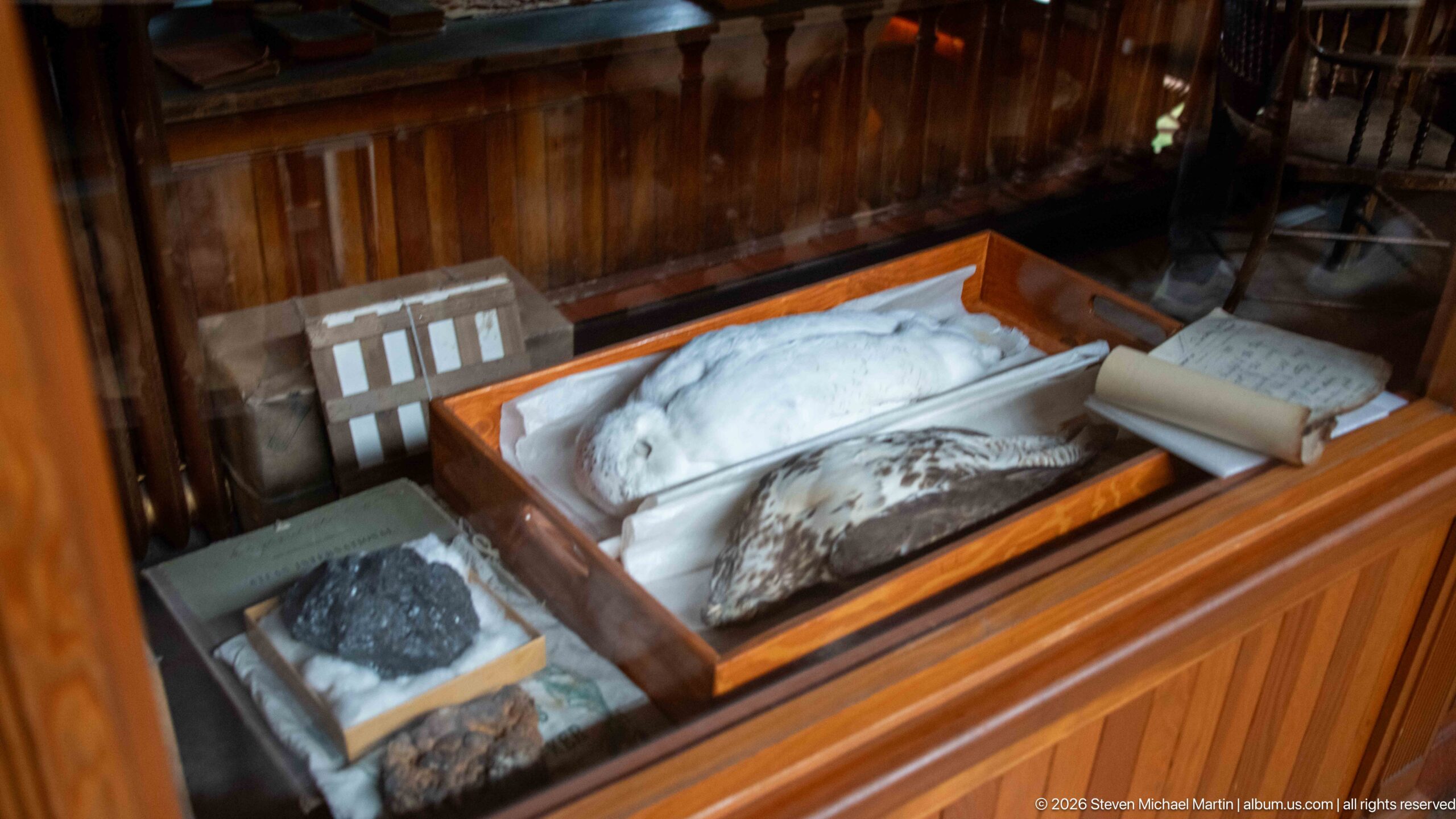
A cabinet display brings together a preserved bird specimen with trays, sample blocks, and paper records associated with natural-history study and preparation. Rather than presenting an animal as a finished trophy, the arrangement draws attention to the collecting, documenting, and specimen-making practices that supported an early museum collection.
Caption
A cabinet display brings together a preserved bird specimen with trays, sample blocks, and paper records associated with natural-history study and preparation. Rather than presenting an animal as a finished trophy, the arrangement draws attention to the collecting, documenting, and specimen-making practices that supported an early museum collection.
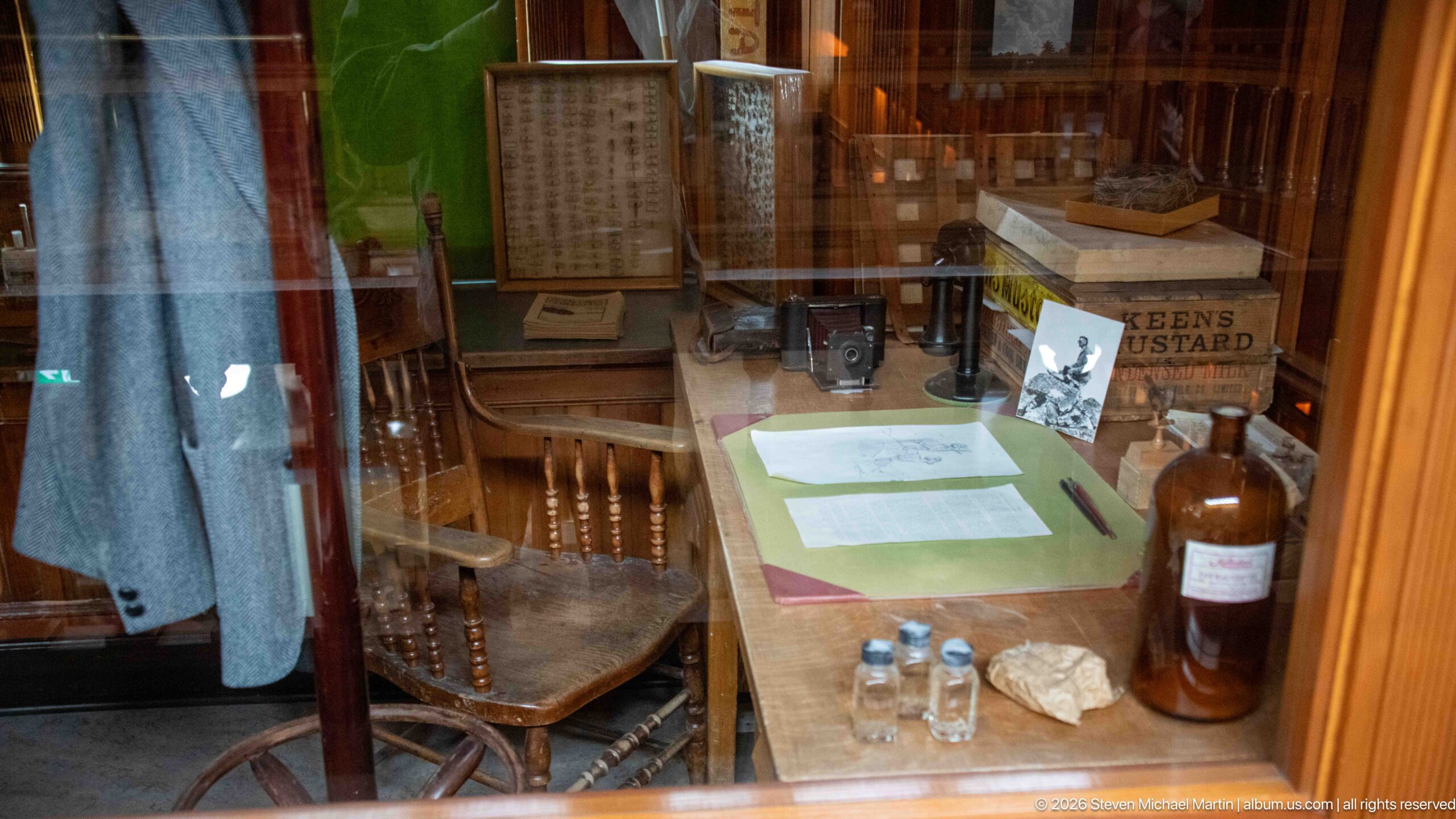
A reconstructed curator’s workspace preserves the practical side of museum work: wooden chair and desk, handwritten or printed records, small glass vials, bottles, boxes, and scientific equipment. Seen through the case glazing, the compact arrangement evokes the cataloging and specimen-handling activities that accompanied the public displays in the galleries.
Caption
A reconstructed curator’s workspace preserves the practical side of museum work: wooden chair and desk, handwritten or printed records, small glass vials, bottles, boxes, and scientific equipment. Seen through the case glazing, the compact arrangement evokes the cataloging and specimen-handling activities that accompanied the public displays in the galleries.
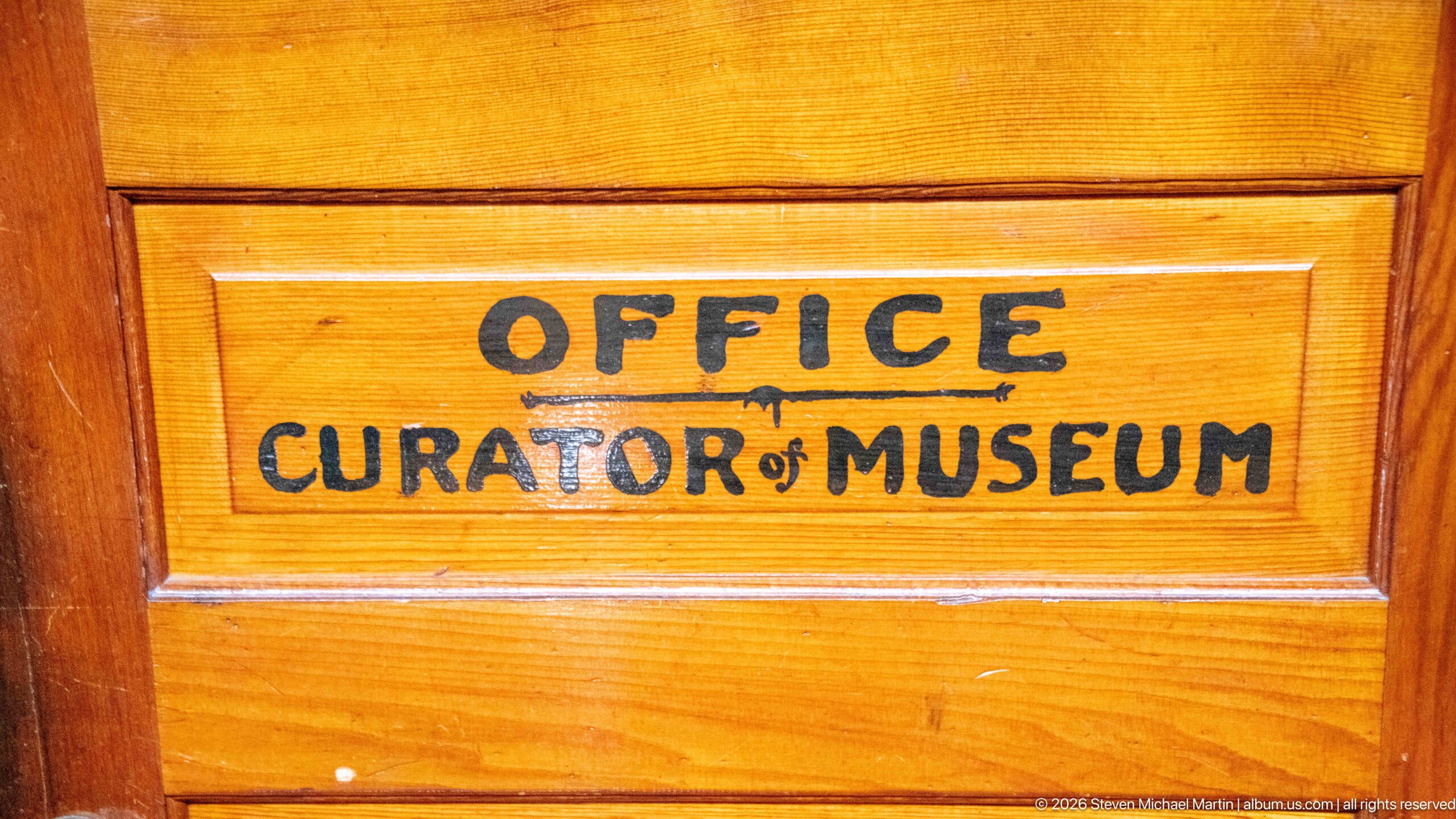
Hand-painted lettering on a paneled wooden door marks the “OFFICE CURATOR of MUSEUM.” The direct, utilitarian sign survives as a small but evocative piece of institutional material culture, identifying the working space from which the museum’s collections were organized, studied, and maintained.
Caption
Hand-painted lettering on a paneled wooden door marks the “OFFICE CURATOR of MUSEUM.” The direct, utilitarian sign survives as a small but evocative piece of institutional material culture, identifying the working space from which the museum’s collections were organized, studied, and maintained.
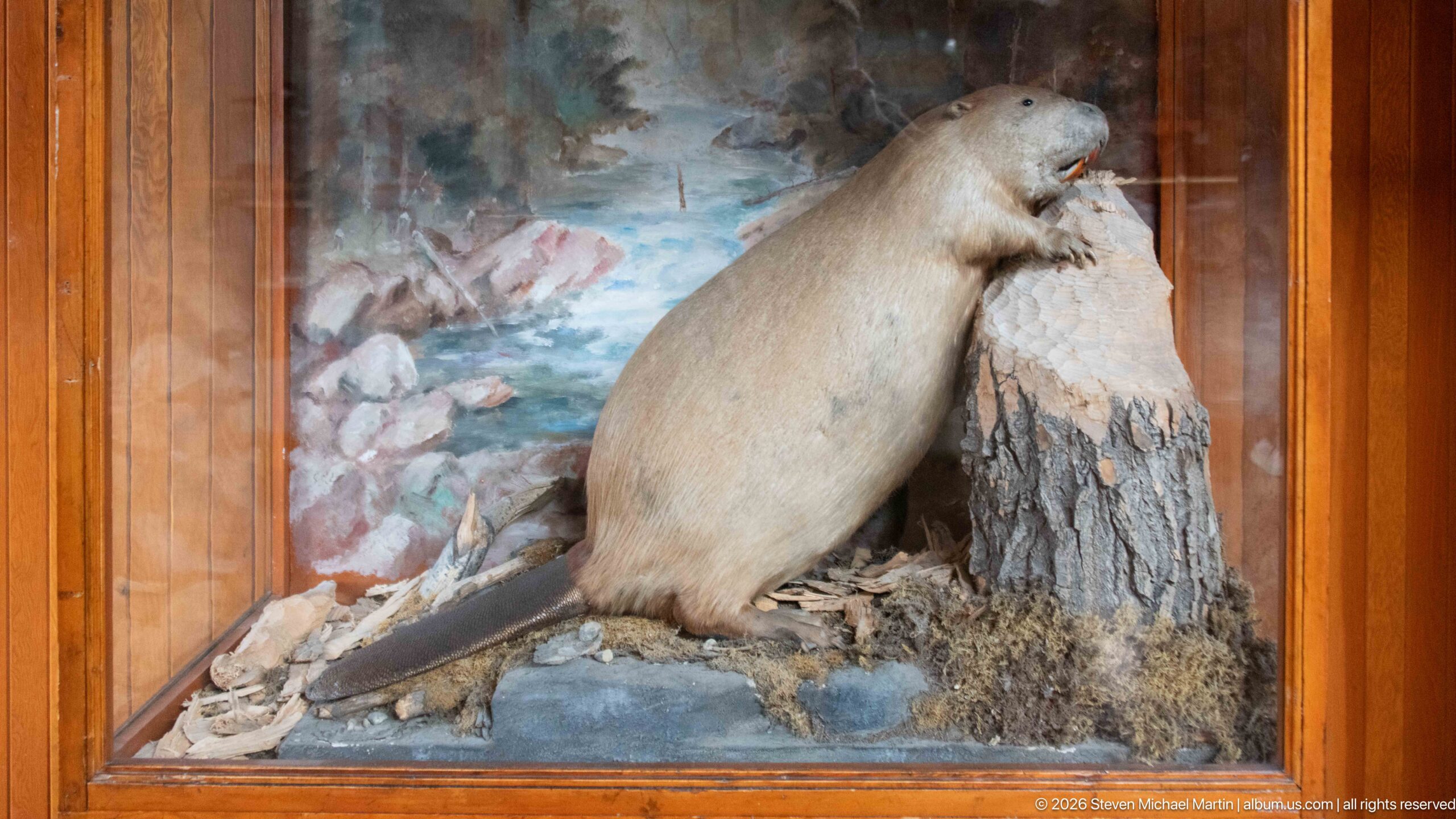
A North American beaver is posed upright beside a cut tree trunk within a painted habitat setting. Its broad body, small rounded ears, and gnawing context emphasize the animal’s close relationship with woody vegetation, while bark chips and branches create a compact ecological vignette inside the historic display case.
Caption
A North American beaver is posed upright beside a cut tree trunk within a painted habitat setting. Its broad body, small rounded ears, and gnawing context emphasize the animal’s close relationship with woody vegetation, while bark chips and branches create a compact ecological vignette inside the historic display case.
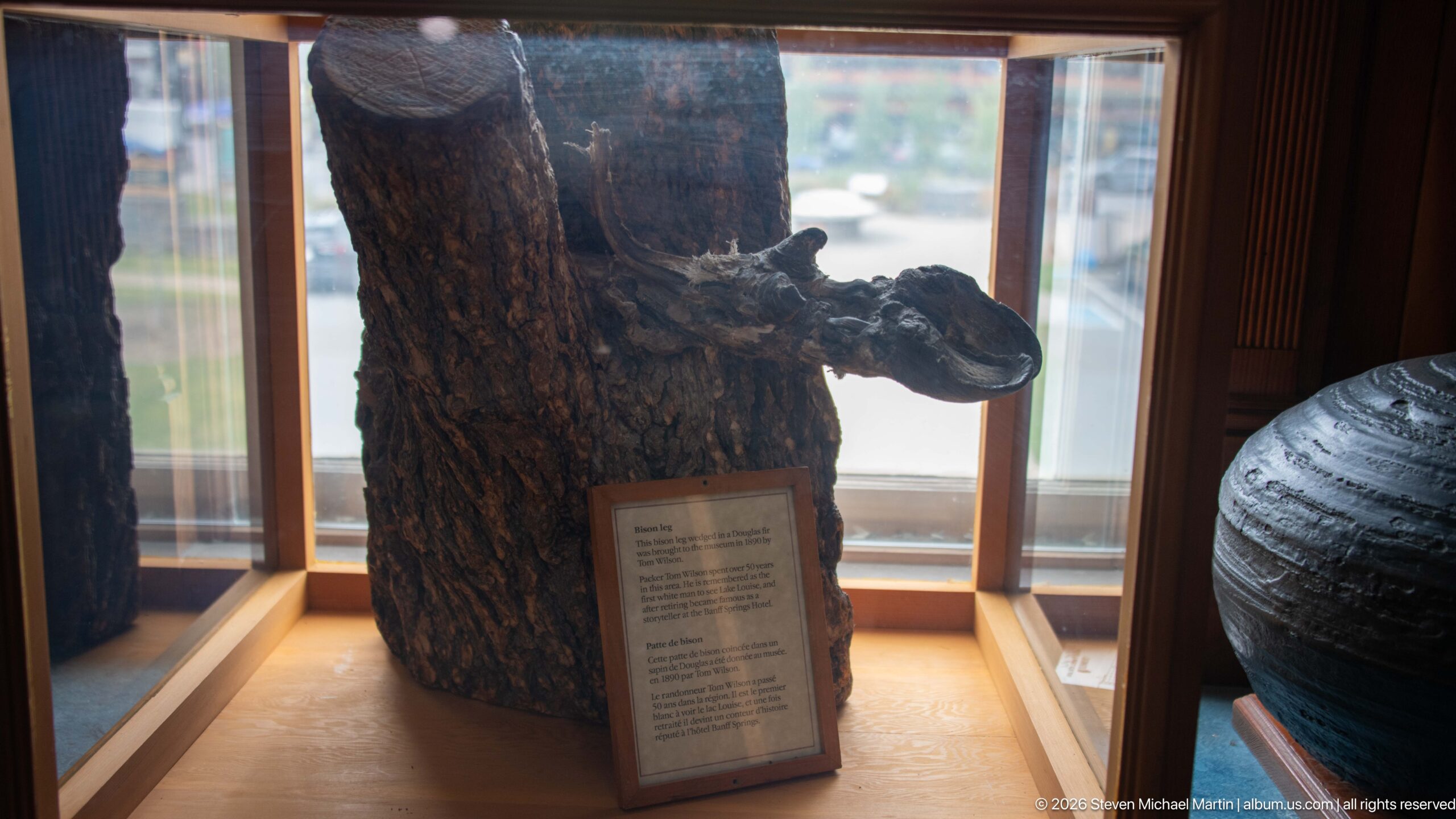
A small mounted mammal appears at the opening of a hollow tree trunk, using the natural form of the wood as part of the display. The specimen’s head projects from the cavity while an interpretive card stands below, creating a habitat-oriented presentation rather than an isolated taxonomic mount.
Caption
A small mounted mammal appears at the opening of a hollow tree trunk, using the natural form of the wood as part of the display. The specimen’s head projects from the cavity while an interpretive card stands below, creating a habitat-oriented presentation rather than an isolated taxonomic mount.
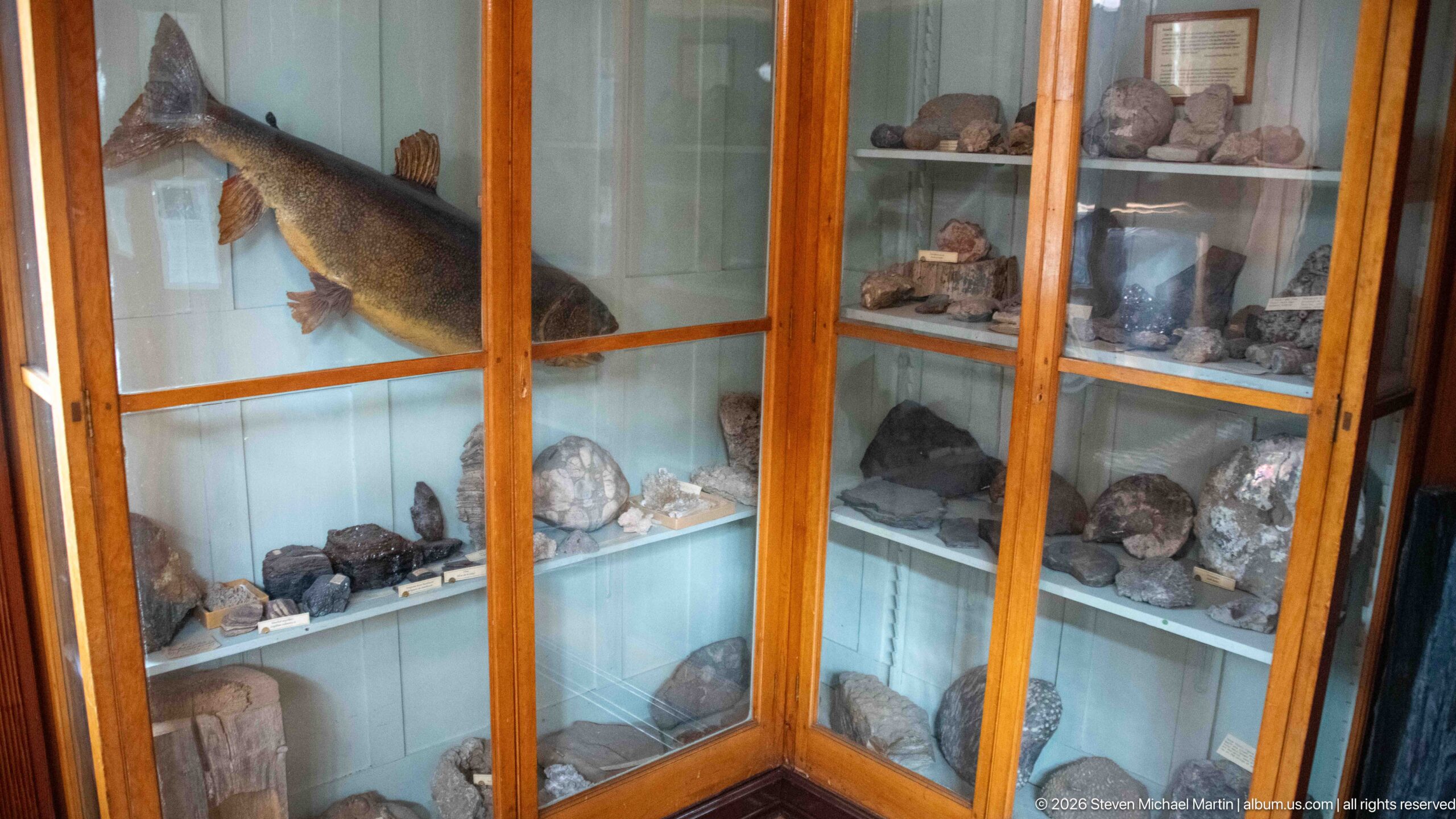
A tall glazed corner cabinet combines rock and mineral specimens with mounted fish, illustrating the broad collecting scope of an early natural-history museum. Shelves of geological material occupy much of the case while fish specimens extend into the adjacent sections, bringing different branches of natural history together within matching wooden cabinetry.
Caption
A tall glazed corner cabinet combines rock and mineral specimens with mounted fish, illustrating the broad collecting scope of an early natural-history museum. Shelves of geological material occupy much of the case while fish specimens extend into the adjacent sections, bringing different branches of natural history together within matching wooden cabinetry.
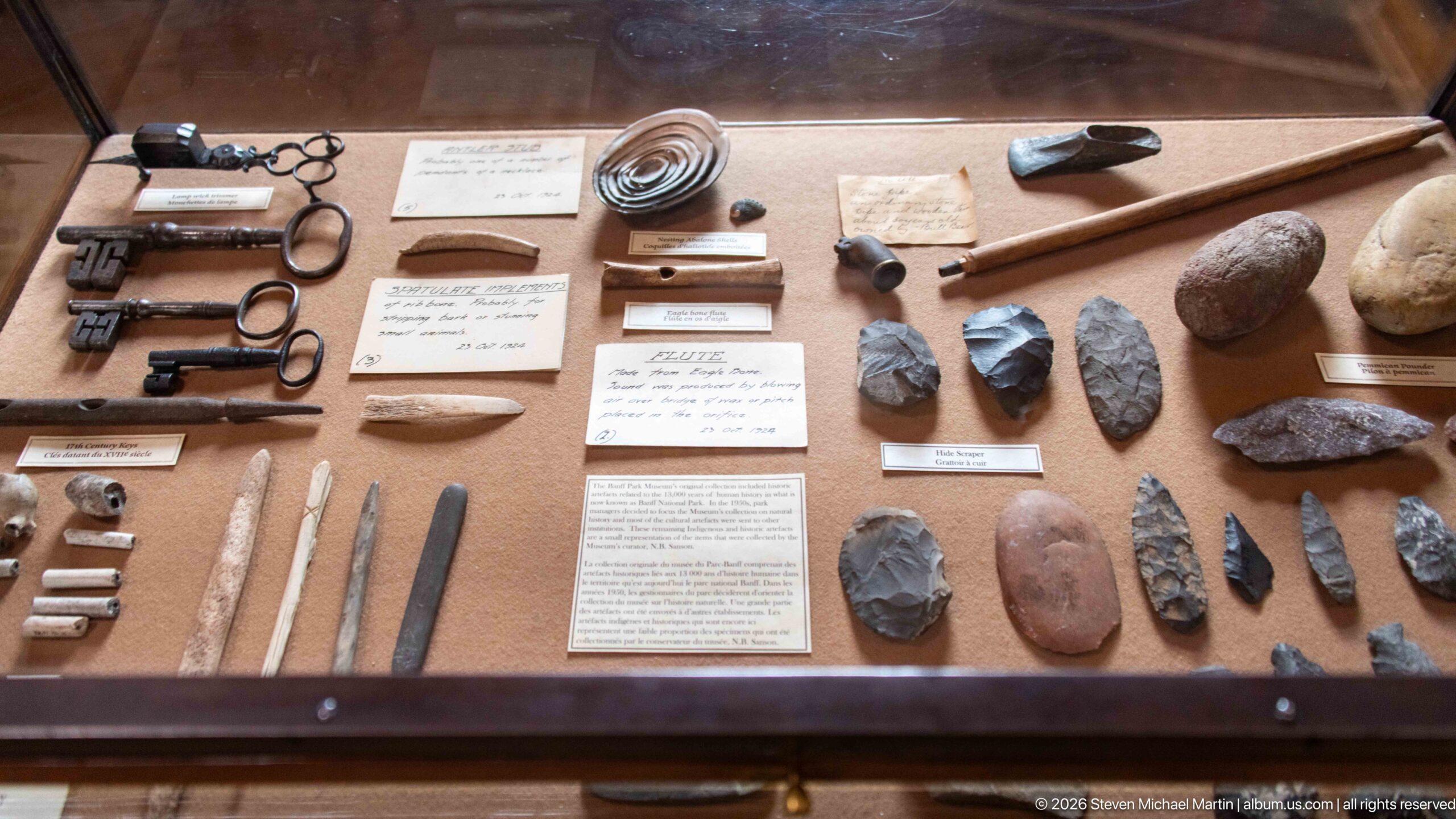
A tabletop museum case arranges chipped stone points, blades, ground or polished stone objects, and small metal implements beside handwritten and printed labels. The orderly comparative layout reflects an older curatorial practice of grouping artifacts by form and material, allowing differences in manufacture and use to be studied across the case.
Caption
A tabletop museum case arranges chipped stone points, blades, ground or polished stone objects, and small metal implements beside handwritten and printed labels. The orderly comparative layout reflects an older curatorial practice of grouping artifacts by form and material, allowing differences in manufacture and use to be studied across the case.
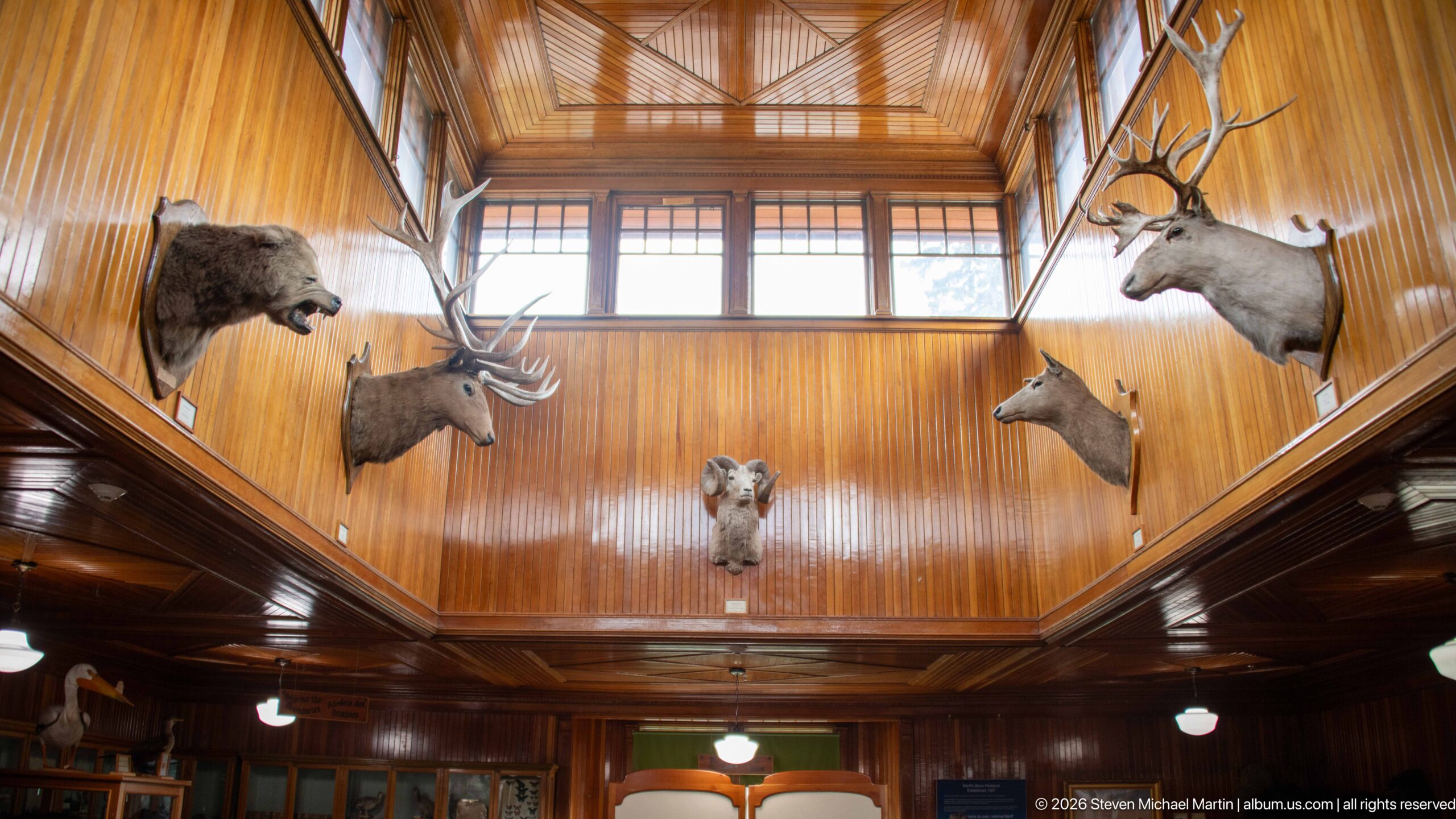
The upper walls of the Banff Park Museum rise toward a band of clerestory windows, with bear and cervid mounts spaced across the glowing wood paneling. Viewed from below, the composition emphasizes the hall’s height and the way large specimens were incorporated into architectural surfaces above the main cases and galleries.
Caption
The upper walls of the Banff Park Museum rise toward a band of clerestory windows, with bear and cervid mounts spaced across the glowing wood paneling. Viewed from below, the composition emphasizes the hall’s height and the way large specimens were incorporated into architectural surfaces above the main cases and galleries.
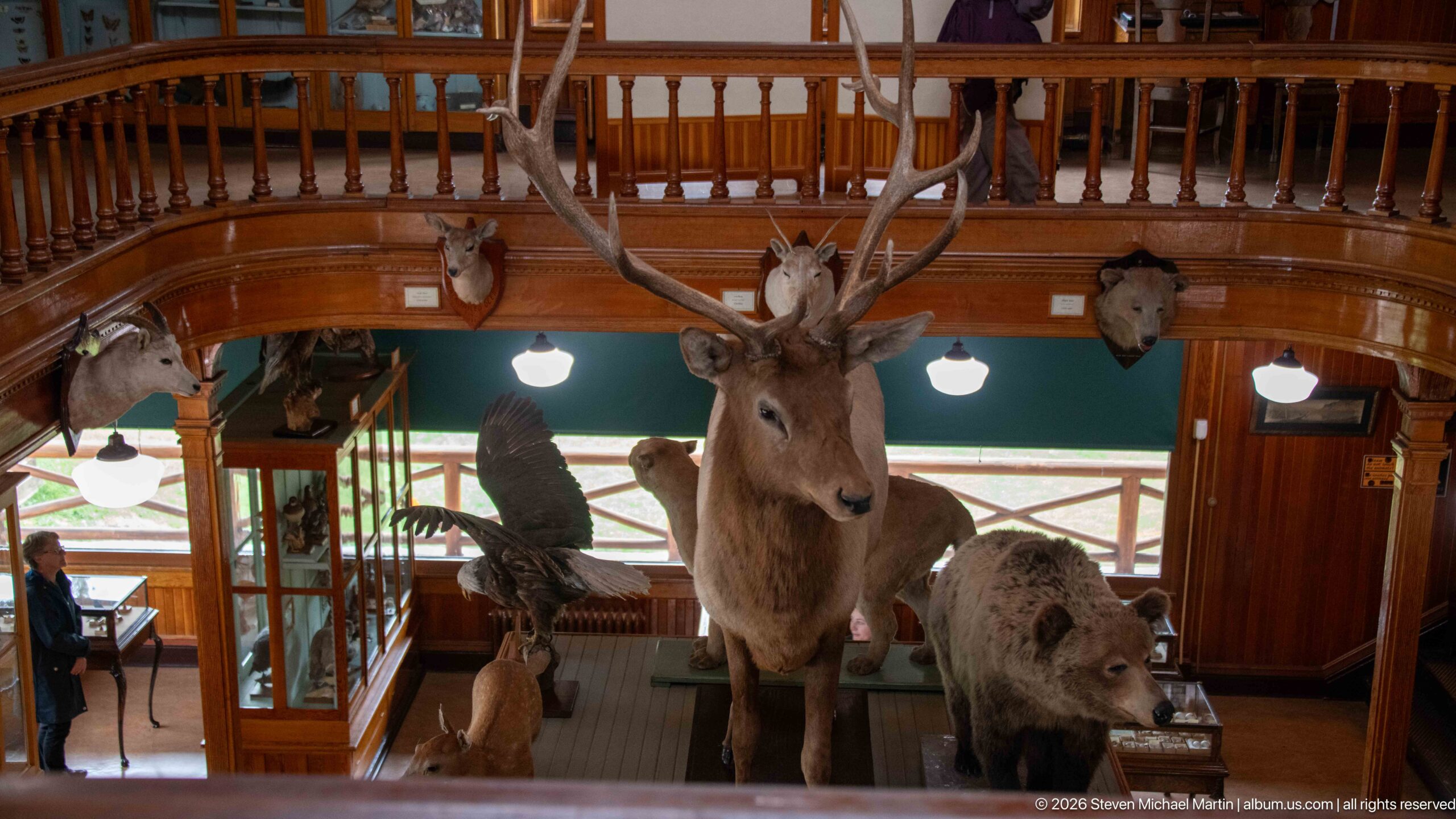
A full-bodied bull elk stands at the center of a crowded wildlife grouping, its antlers reaching into the upper gallery while a wild sheep specimen and other mammals occupy the surrounding platforms and cases. The close elevated view conveys the scale of the central mount and the dense arrangement characteristic of the historic museum hall.
Caption
A full-bodied bull elk stands at the center of a crowded wildlife grouping, its antlers reaching into the upper gallery while a wild sheep specimen and other mammals occupy the surrounding platforms and cases. The close elevated view conveys the scale of the central mount and the dense arrangement characteristic of the historic museum hall.
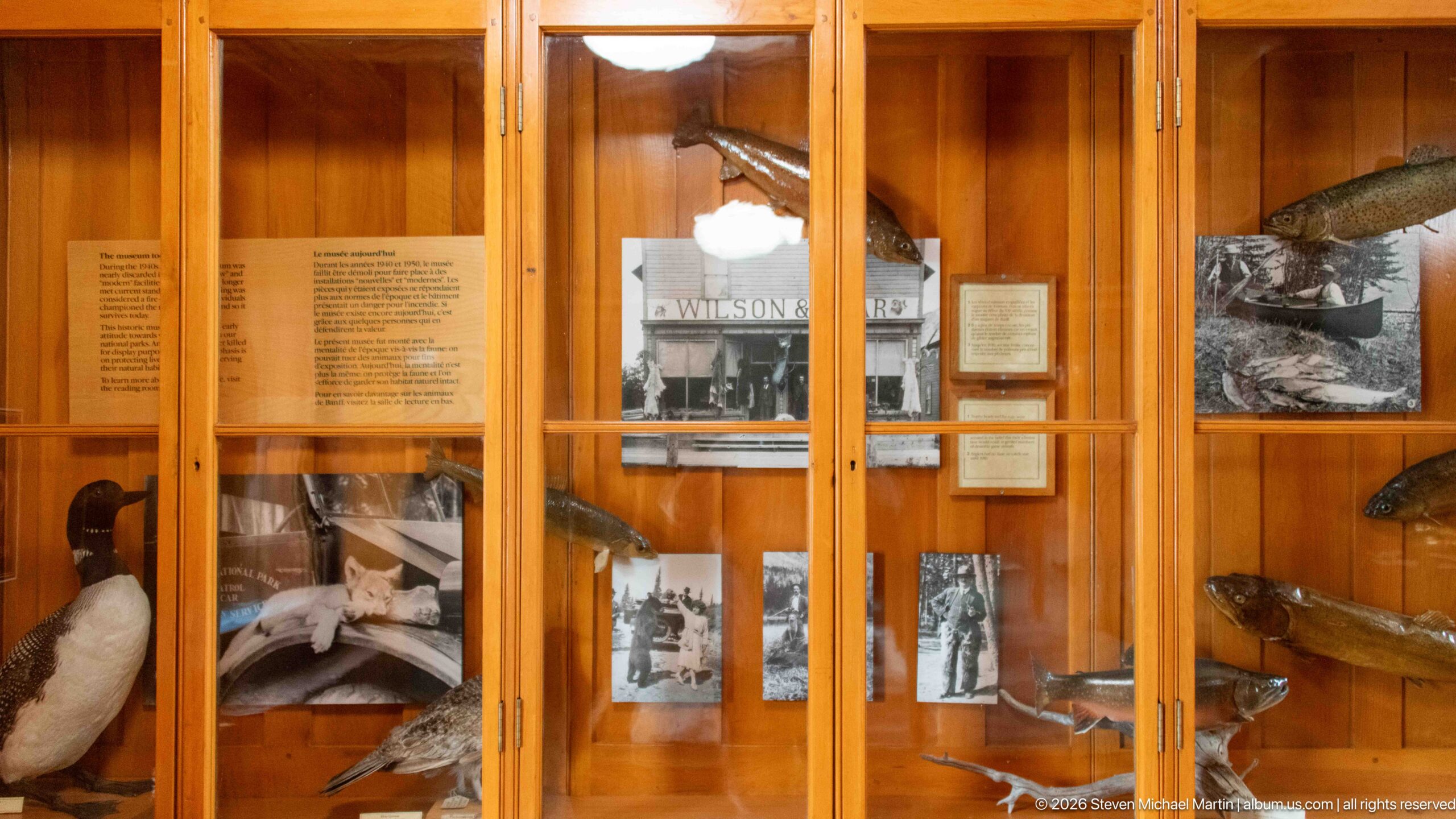
A tall glazed case pairs preserved waterbirds with archival photographs, interpretive text, and historical documentation. The layered presentation links the specimens to the museum’s own collecting and exhibition history, turning the cabinet into an account of how birds were acquired, studied, and displayed as well as a taxonomic showcase.
Caption
A tall glazed case pairs preserved waterbirds with archival photographs, interpretive text, and historical documentation. The layered presentation links the specimens to the museum’s own collecting and exhibition history, turning the cabinet into an account of how birds were acquired, studied, and displayed as well as a taxonomic showcase.
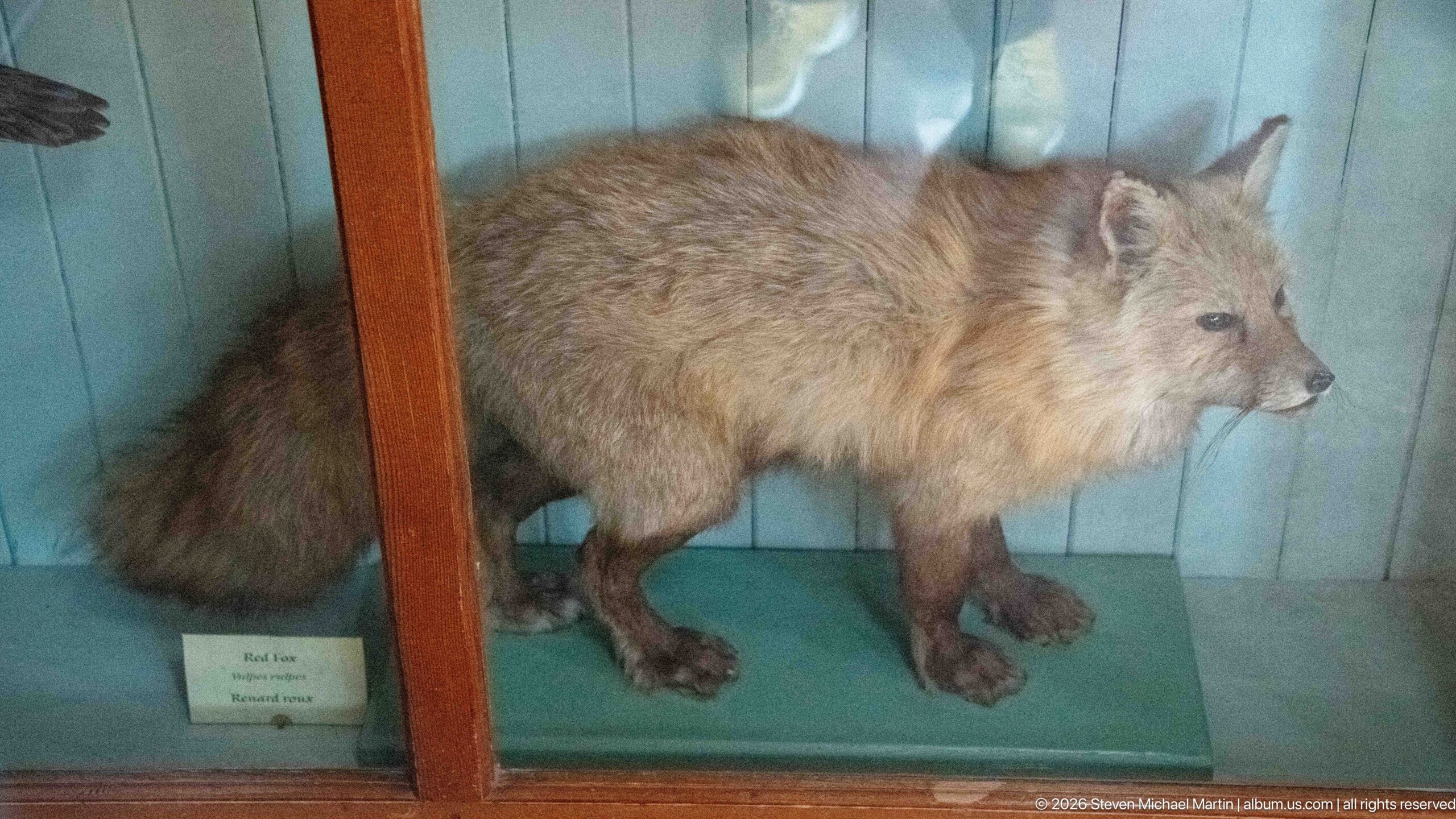
A red fox specimen stands in profile inside a pale-blue cabinet, its pointed muzzle, upright ears, reddish-tan coat, dark lower legs, and full tail clearly visible. The simple case presentation isolates the animal’s proportions and coat pattern, contrasting with the more elaborate habitat groups elsewhere in the museum.
Caption
A red fox specimen stands in profile inside a pale-blue cabinet, its pointed muzzle, upright ears, reddish-tan coat, dark lower legs, and full tail clearly visible. The simple case presentation isolates the animal’s proportions and coat pattern, contrasting with the more elaborate habitat groups elsewhere in the museum.
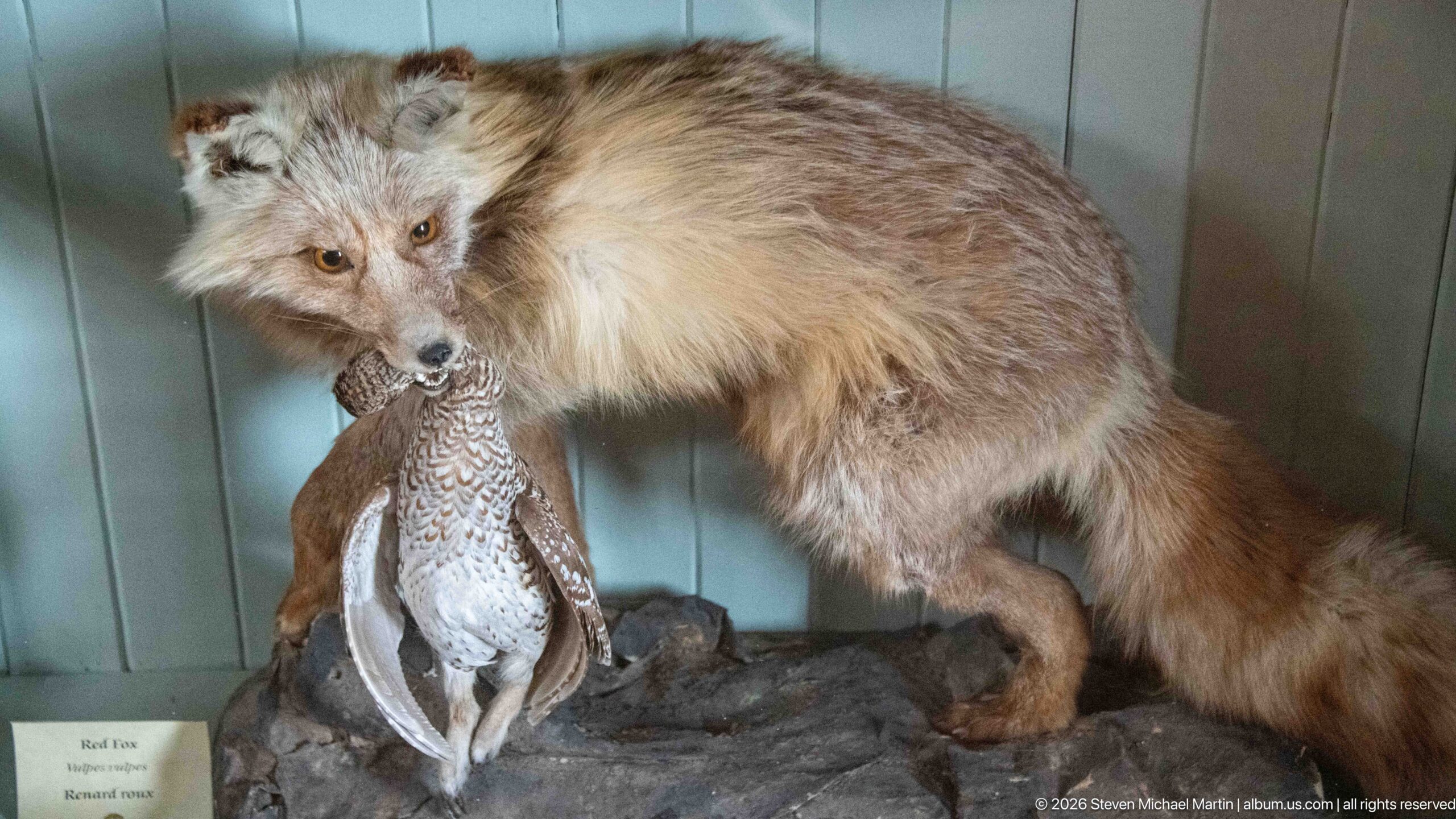
A red fox is posed over a grouse in a compact predator-prey tableau, transforming two preserved specimens into a behavioral scene. The fox’s pale reddish coat and bushy tail frame the bird below, while the arrangement demonstrates an early museum strategy of using taxidermy to suggest ecological relationships rather than presenting species only as isolated examples.
Caption
A red fox is posed over a grouse in a compact predator-prey tableau, transforming two preserved specimens into a behavioral scene. The fox’s pale reddish coat and bushy tail frame the bird below, while the arrangement demonstrates an early museum strategy of using taxidermy to suggest ecological relationships rather than presenting species only as isolated examples.
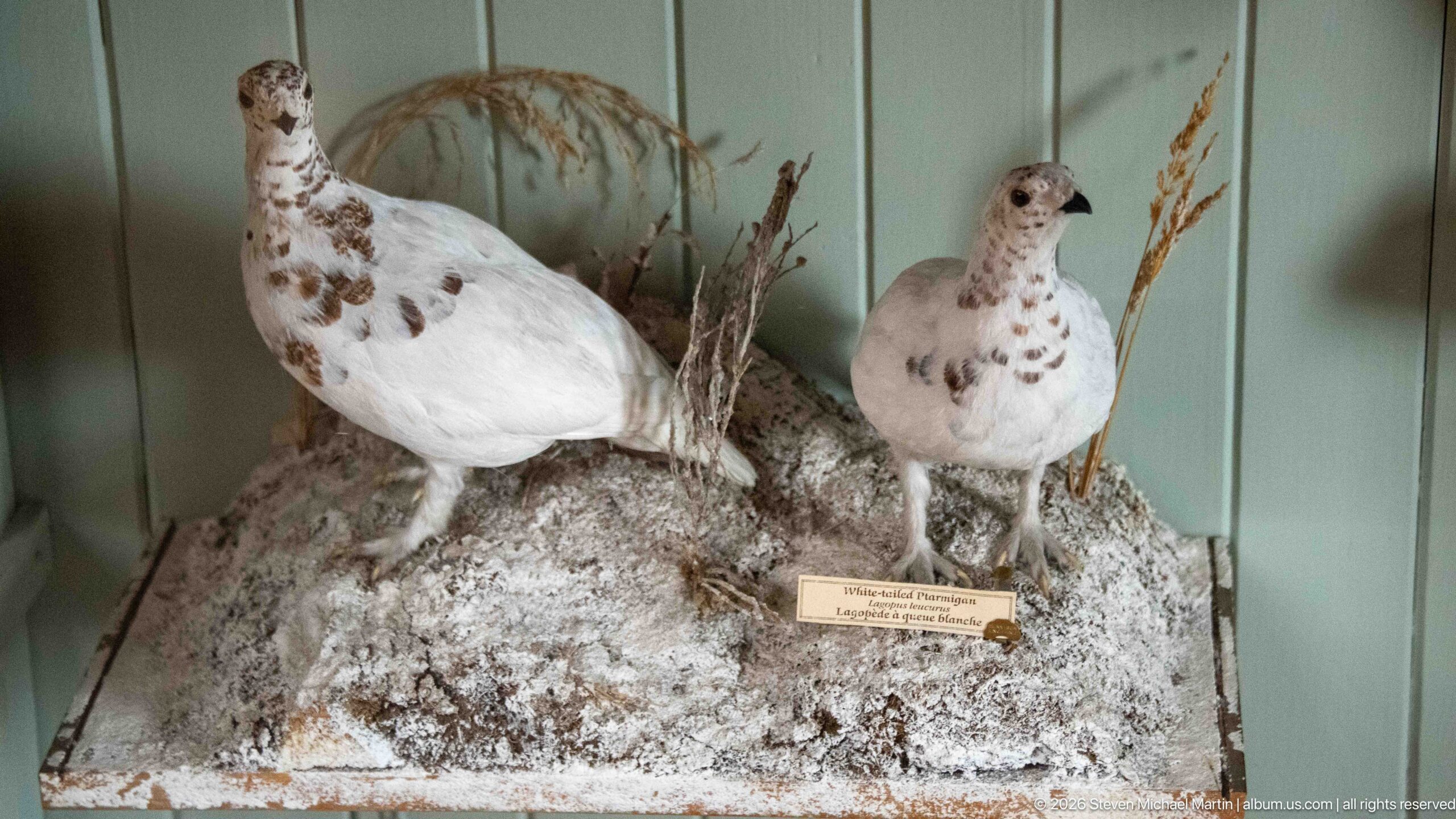
Two mounted willow ptarmigan stand on a snow-textured habitat base with dried grasses, illustrating the museum’s traditional natural-history display methods. The compact case combines specimens with a simplified environmental setting, while the birds’ mottled brown-and-white plumage records a transitional seasonal appearance suited to camouflage in alpine and subalpine terrain.
Caption
Two mounted willow ptarmigan stand on a snow-textured habitat base with dried grasses, illustrating the museum’s traditional natural-history display methods. The compact case combines specimens with a simplified environmental setting, while the birds’ mottled brown-and-white plumage records a transitional seasonal appearance suited to camouflage in alpine and subalpine terrain.
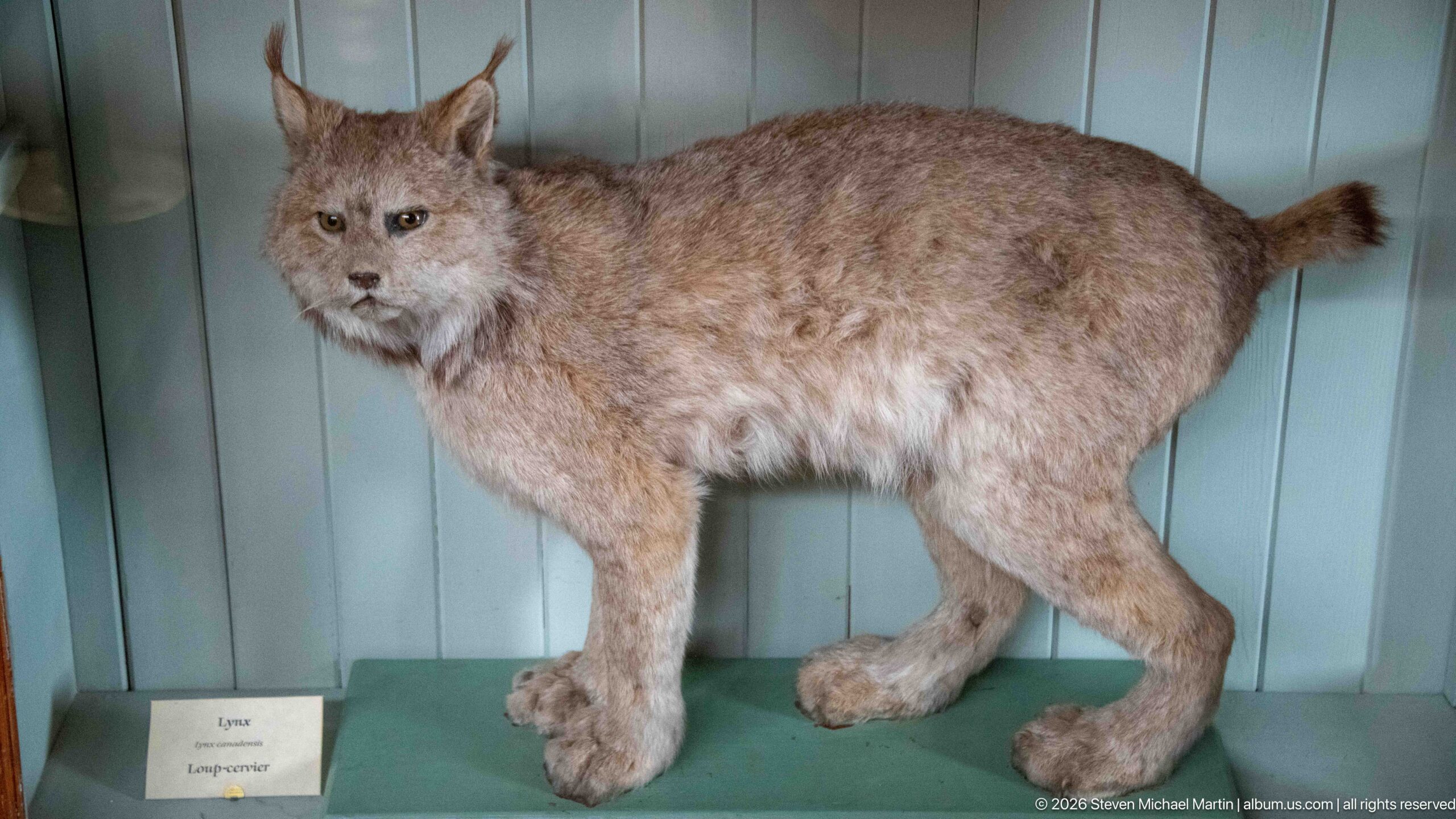
A mounted lynx stands in profile against the museum’s pale green case lining, showing the species’ long legs, broad paws, short black-tipped tail, and tufted ears. The spare setting keeps attention on anatomical features associated with movement through deep snow, while the historic mount itself reveals the presentation conventions of an earlier natural-history museum.
Caption
A mounted lynx stands in profile against the museum’s pale green case lining, showing the species’ long legs, broad paws, short black-tipped tail, and tufted ears. The spare setting keeps attention on anatomical features associated with movement through deep snow, while the historic mount itself reveals the presentation conventions of an earlier natural-history museum.
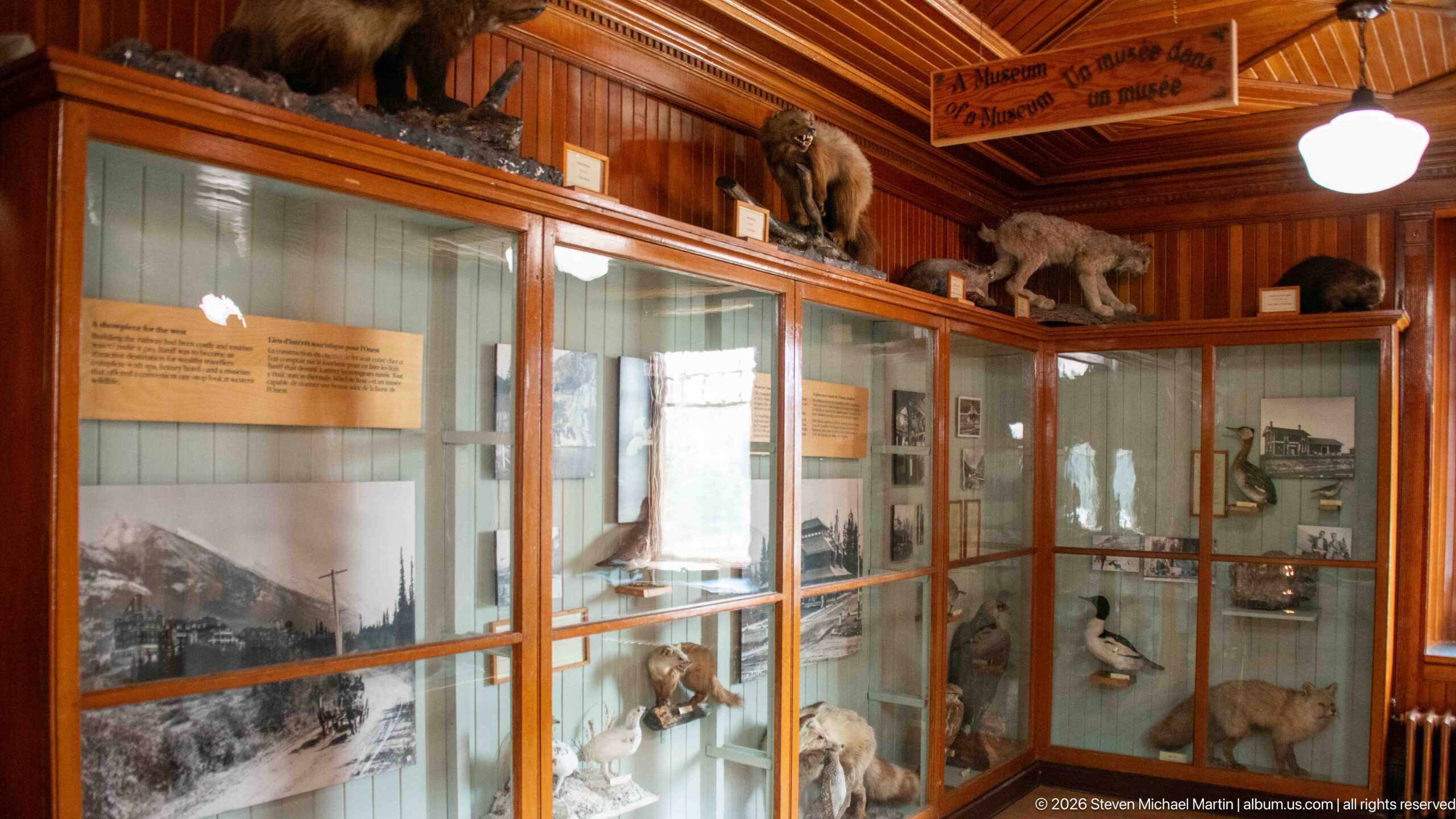
Glass-fronted wooden cases line a corner of the Banff Park Museum, combining mounted mammals and birds with historic photographs, labels, and interpretive panels. Additional specimens are arranged above the cases, extending the collection vertically into the richly paneled room. The view demonstrates how the museum’s preserved cabinetry and dense specimen displays remain integral to the visitor experience.
Caption
Glass-fronted wooden cases line a corner of the Banff Park Museum, combining mounted mammals and birds with historic photographs, labels, and interpretive panels. Additional specimens are arranged above the cases, extending the collection vertically into the richly paneled room. The view demonstrates how the museum’s preserved cabinetry and dense specimen displays remain integral to the visitor experience.
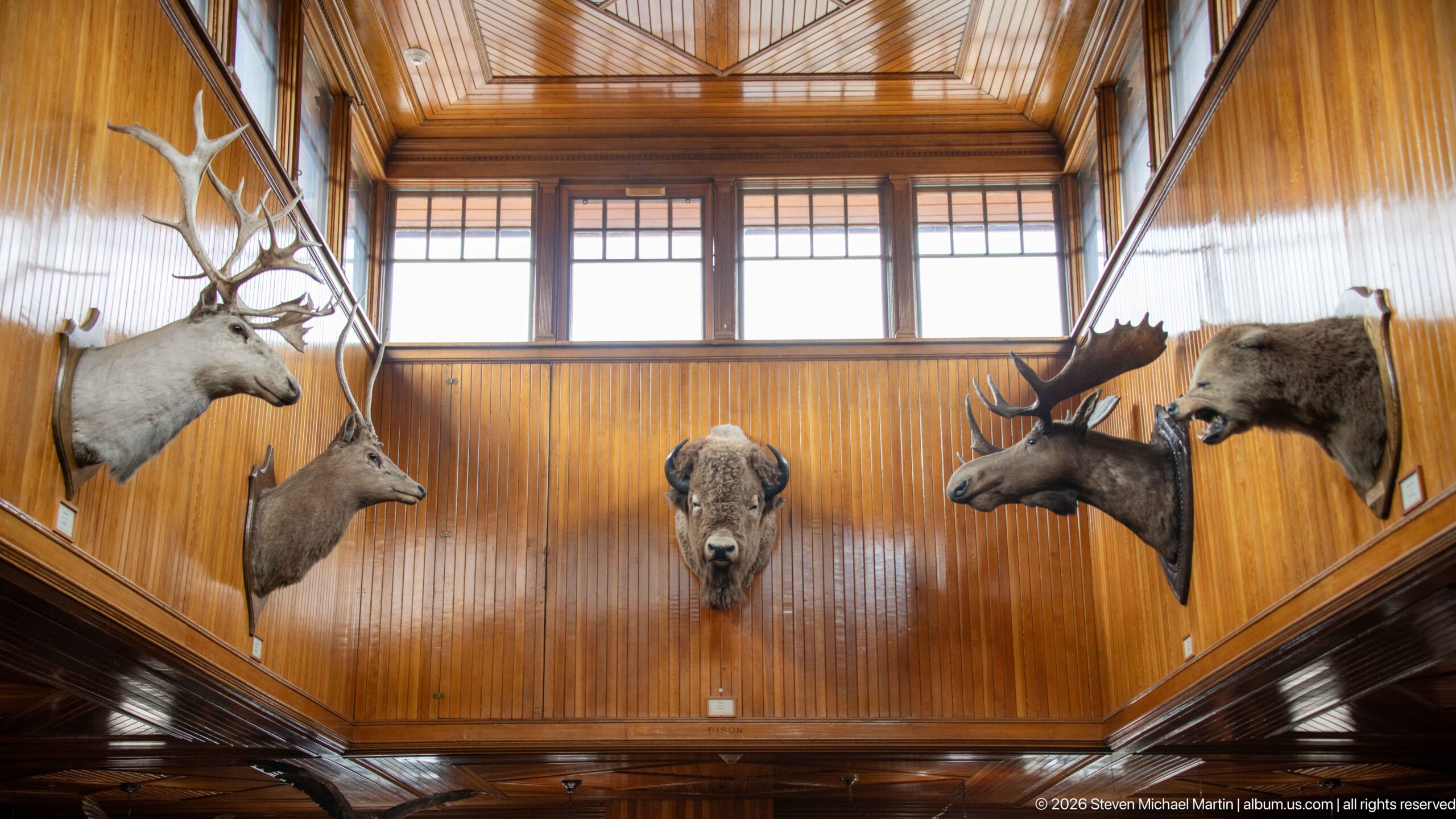
Mounted heads of large Rocky Mountain mammals occupy the tall wood-paneled wall beneath the museum’s clerestory windows. Antlered deer flank a central bison head, while additional mounts extend across the gallery. Seen from below, the arrangement emphasizes both the scale of the specimens and the vertical volume of the historic exhibition hall.
Caption
Mounted heads of large Rocky Mountain mammals occupy the tall wood-paneled wall beneath the museum’s clerestory windows. Antlered deer flank a central bison head, while additional mounts extend across the gallery. Seen from below, the arrangement emphasizes both the scale of the specimens and the vertical volume of the historic exhibition hall.
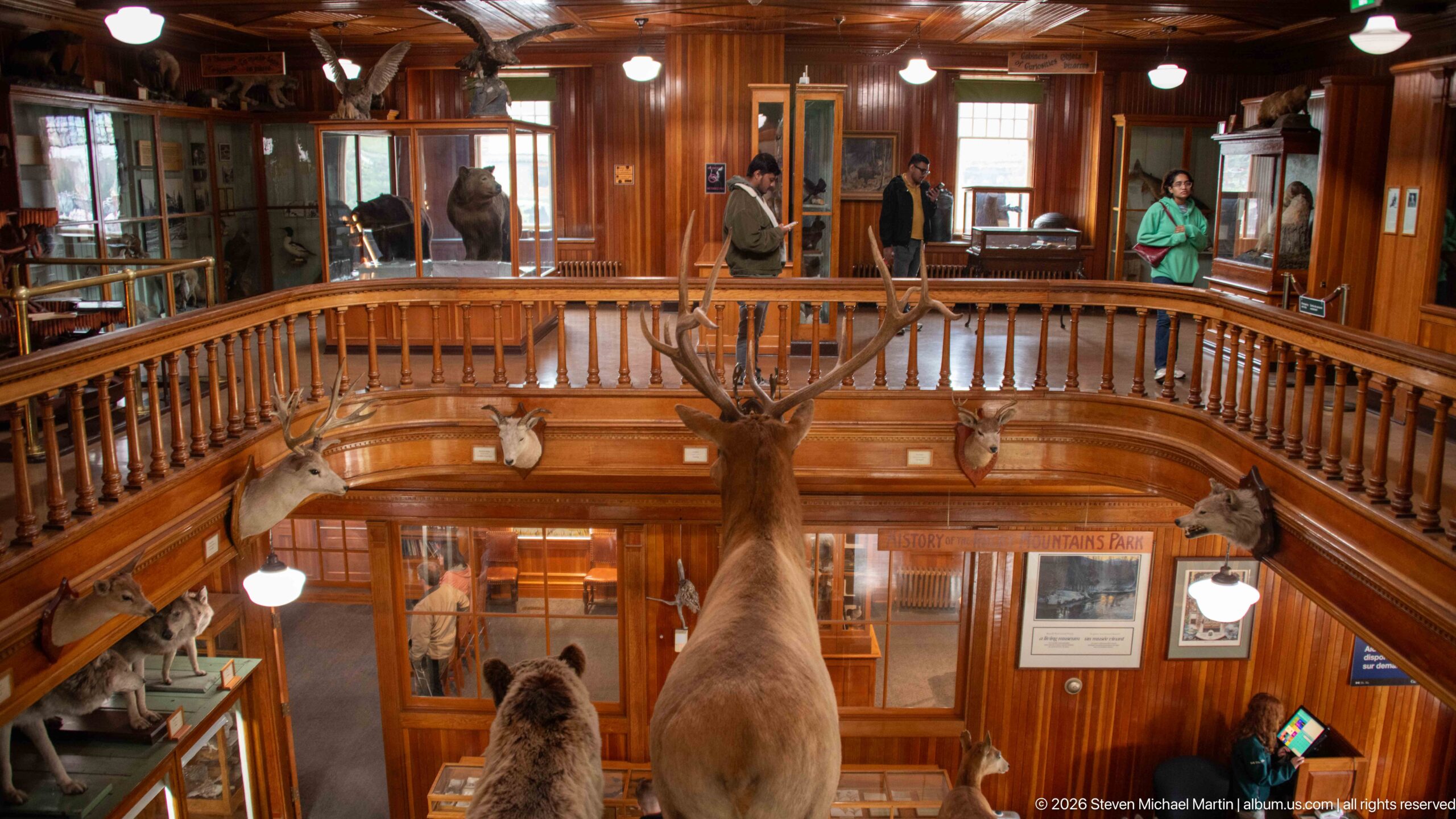
From the upper level, the Banff Park Museum opens into a two-story gallery framed by turned wooden balusters and warm varnished paneling. A large antlered specimen rises into the foreground while visitors circulate around cases on the opposite balcony. The elevated viewpoint makes the building’s historic exhibition architecture as prominent as the natural-history collection itself.
Caption
From the upper level, the Banff Park Museum opens into a two-story gallery framed by turned wooden balusters and warm varnished paneling. A large antlered specimen rises into the foreground while visitors circulate around cases on the opposite balcony. The elevated viewpoint makes the building’s historic exhibition architecture as prominent as the natural-history collection itself.
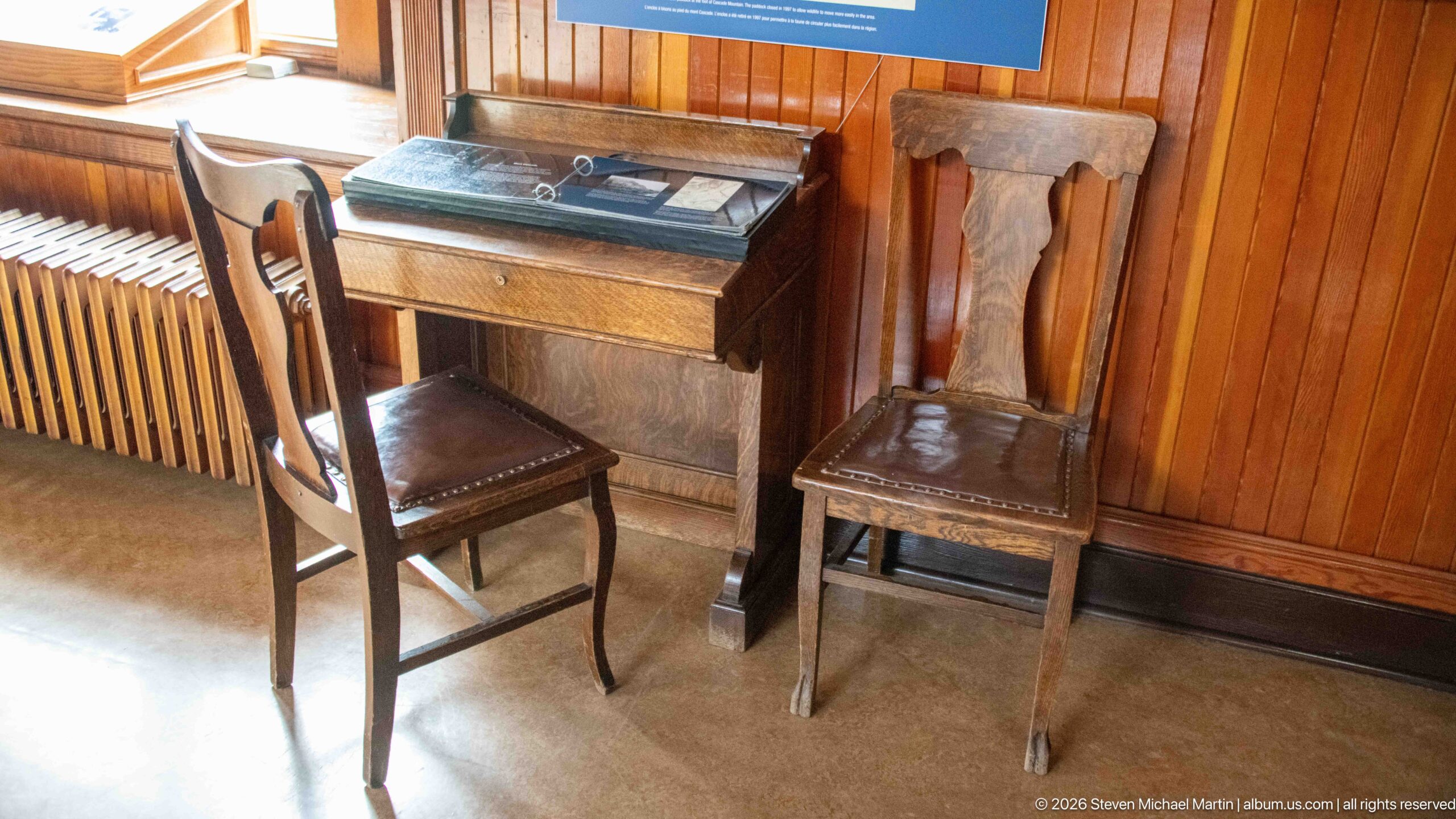
A compact wooden writing desk stands against the paneled wall with two mismatched chairs, one decorated with a carved animal silhouette in its back. A glass-covered display occupies the desktop. The grouping provides an intimate counterpoint to the large specimen cases, preserving a piece of the museum’s historic working and interpretive environment.
Caption
A compact wooden writing desk stands against the paneled wall with two mismatched chairs, one decorated with a carved animal silhouette in its back. A glass-covered display occupies the desktop. The grouping provides an intimate counterpoint to the large specimen cases, preserving a piece of the museum’s historic working and interpretive environment.
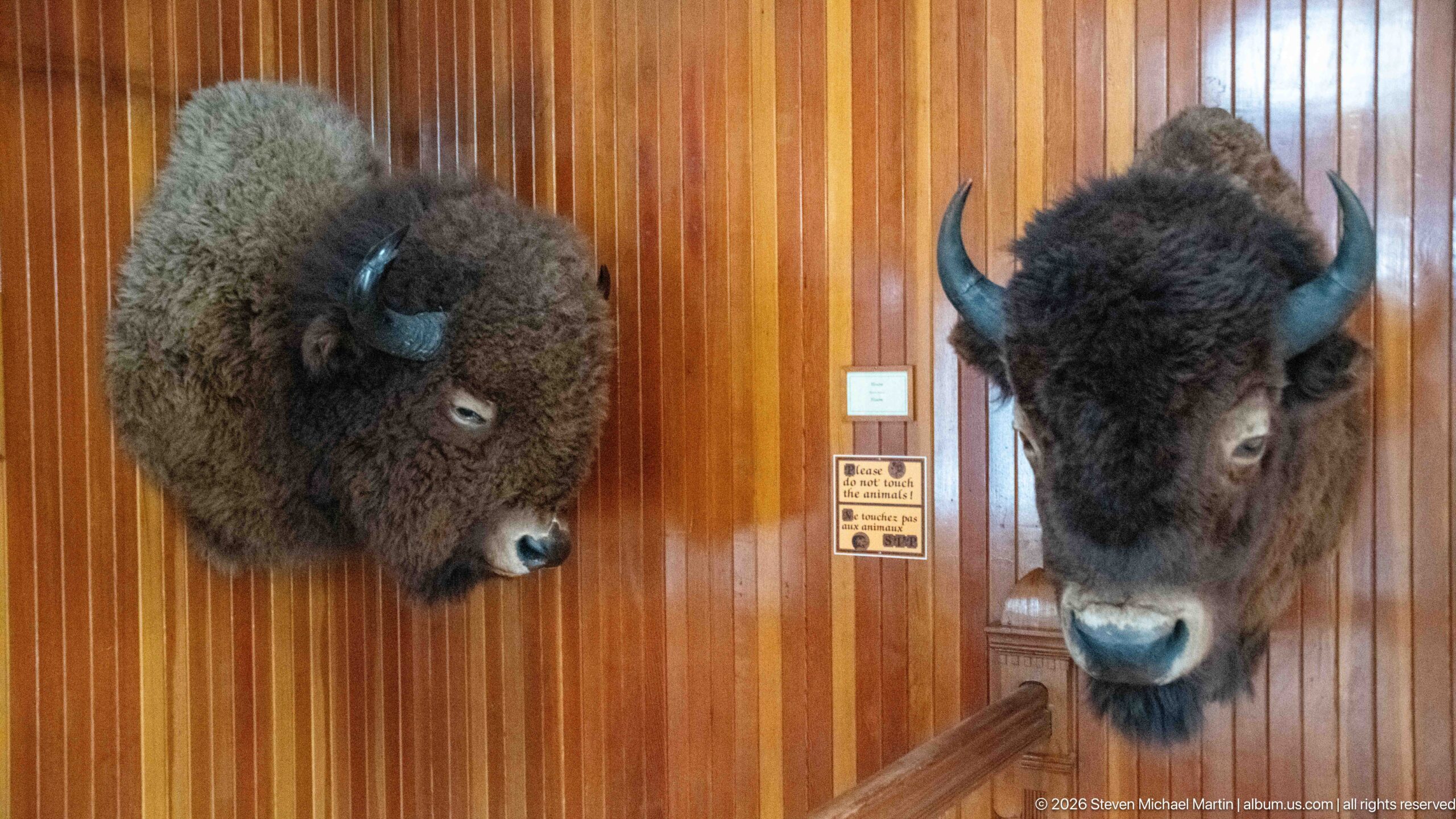
Two bison head mounts are displayed side by side on the museum’s vertical wood paneling, offering contrasting views of the animals’ heavy foreheads, curved black horns, and dense dark hair. Their close placement turns the wall into a comparative natural-history display while also revealing the period practice of presenting large mammals as isolated anatomical trophies.
Caption
Two bison head mounts are displayed side by side on the museum’s vertical wood paneling, offering contrasting views of the animals’ heavy foreheads, curved black horns, and dense dark hair. Their close placement turns the wall into a comparative natural-history display while also revealing the period practice of presenting large mammals as isolated anatomical trophies.
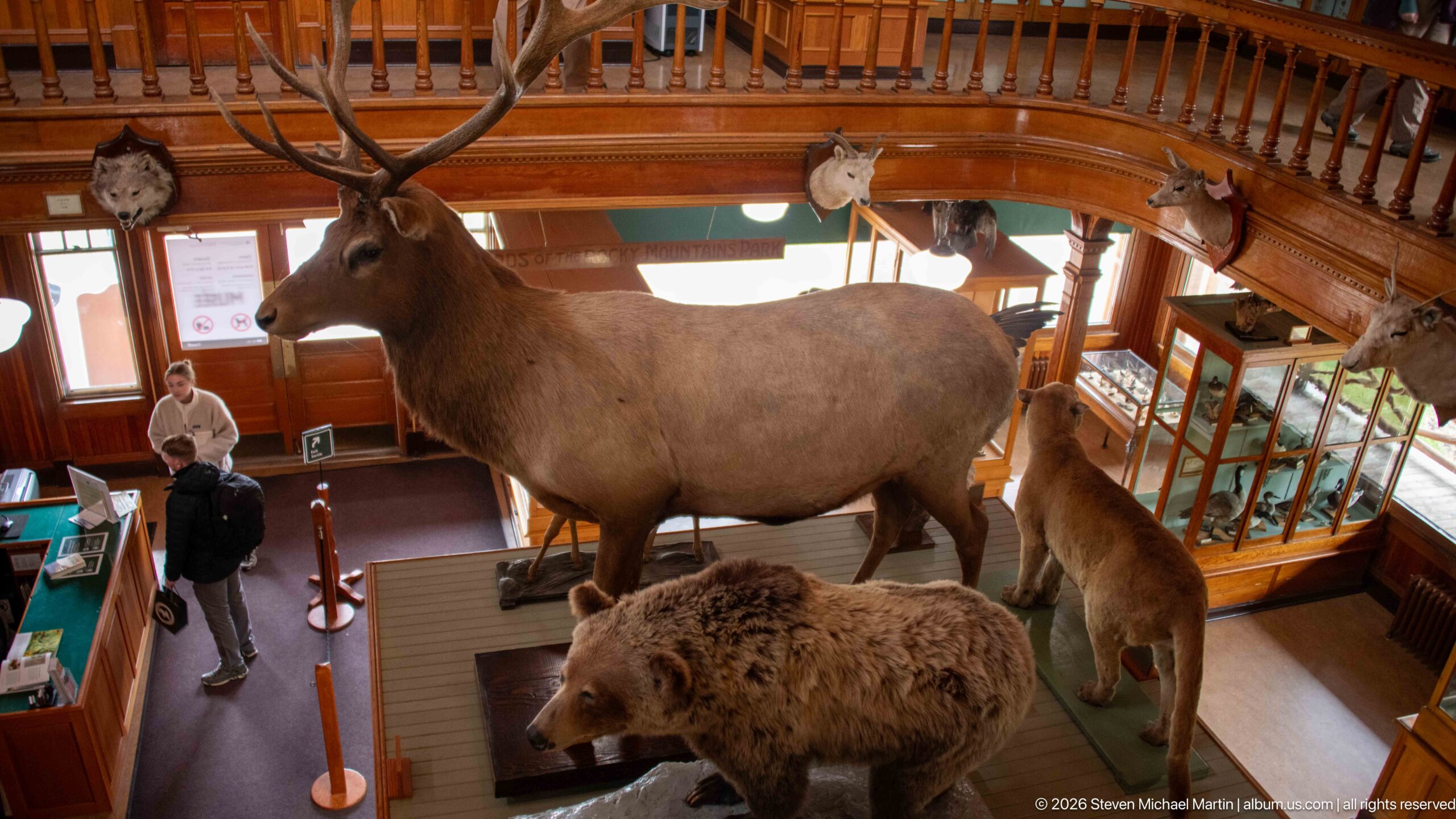
An elk dominates the central floor display, surrounded by other mounted mammals including a bear and a smaller deer-like animal. Viewed from the upper gallery, the grouping reveals the theatrical scale of the museum’s historic taxidermy arrangements and their relationship to the surrounding balcony, cases, and visitor circulation below.
Caption
An elk dominates the central floor display, surrounded by other mounted mammals including a bear and a smaller deer-like animal. Viewed from the upper gallery, the grouping reveals the theatrical scale of the museum’s historic taxidermy arrangements and their relationship to the surrounding balcony, cases, and visitor circulation below.
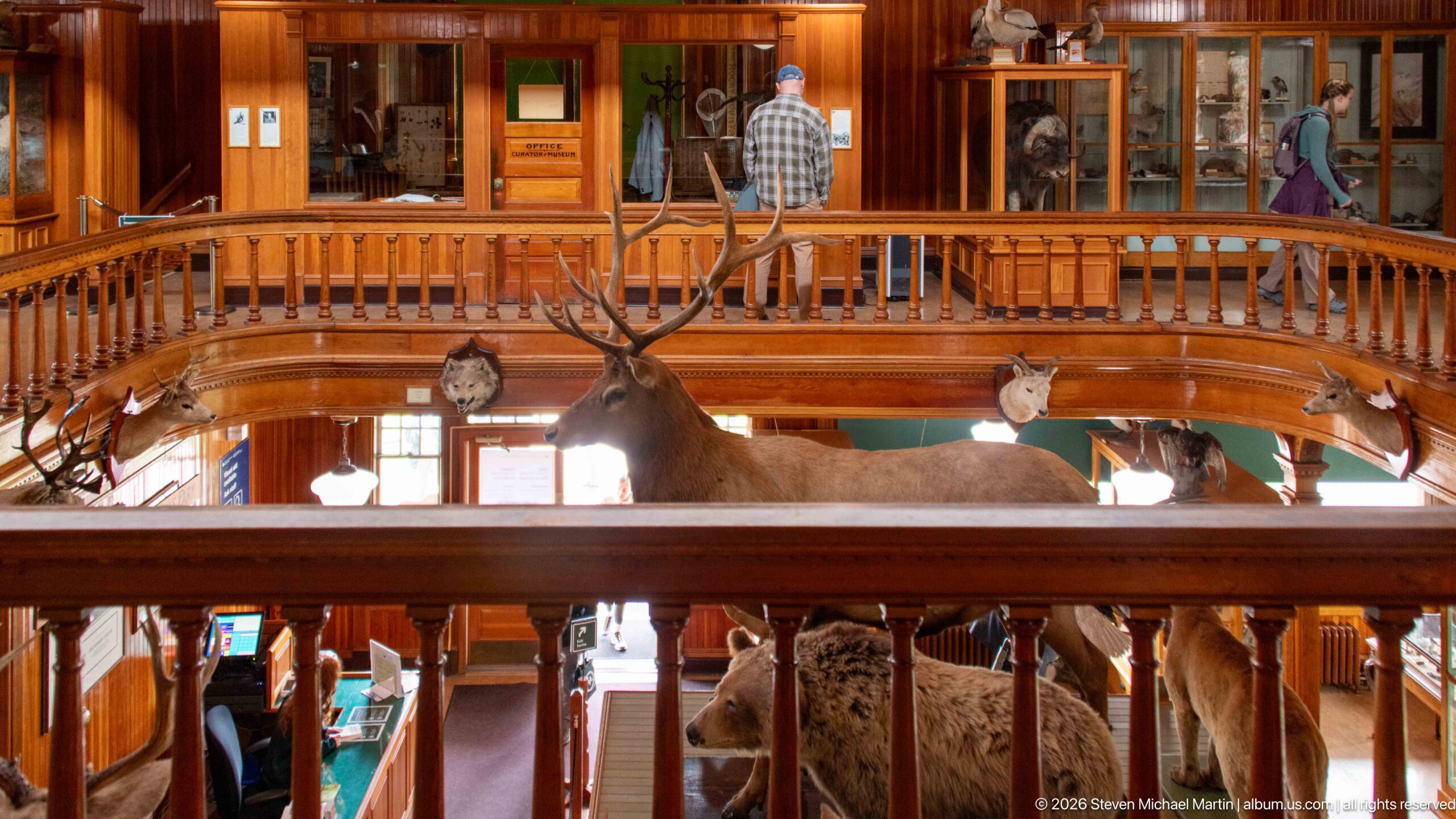
The upper balustrade frames a partial view of the museum’s central elk display, with the animal’s antlers and back rising above the railing while a bear is visible below. Visitors and glass cases occupy the opposite gallery. The layered composition emphasizes the museum’s unusual two-story arrangement and the close visual connection between architecture and collection.
Caption
The upper balustrade frames a partial view of the museum’s central elk display, with the animal’s antlers and back rising above the railing while a bear is visible below. Visitors and glass cases occupy the opposite gallery. The layered composition emphasizes the museum’s unusual two-story arrangement and the close visual connection between architecture and collection.
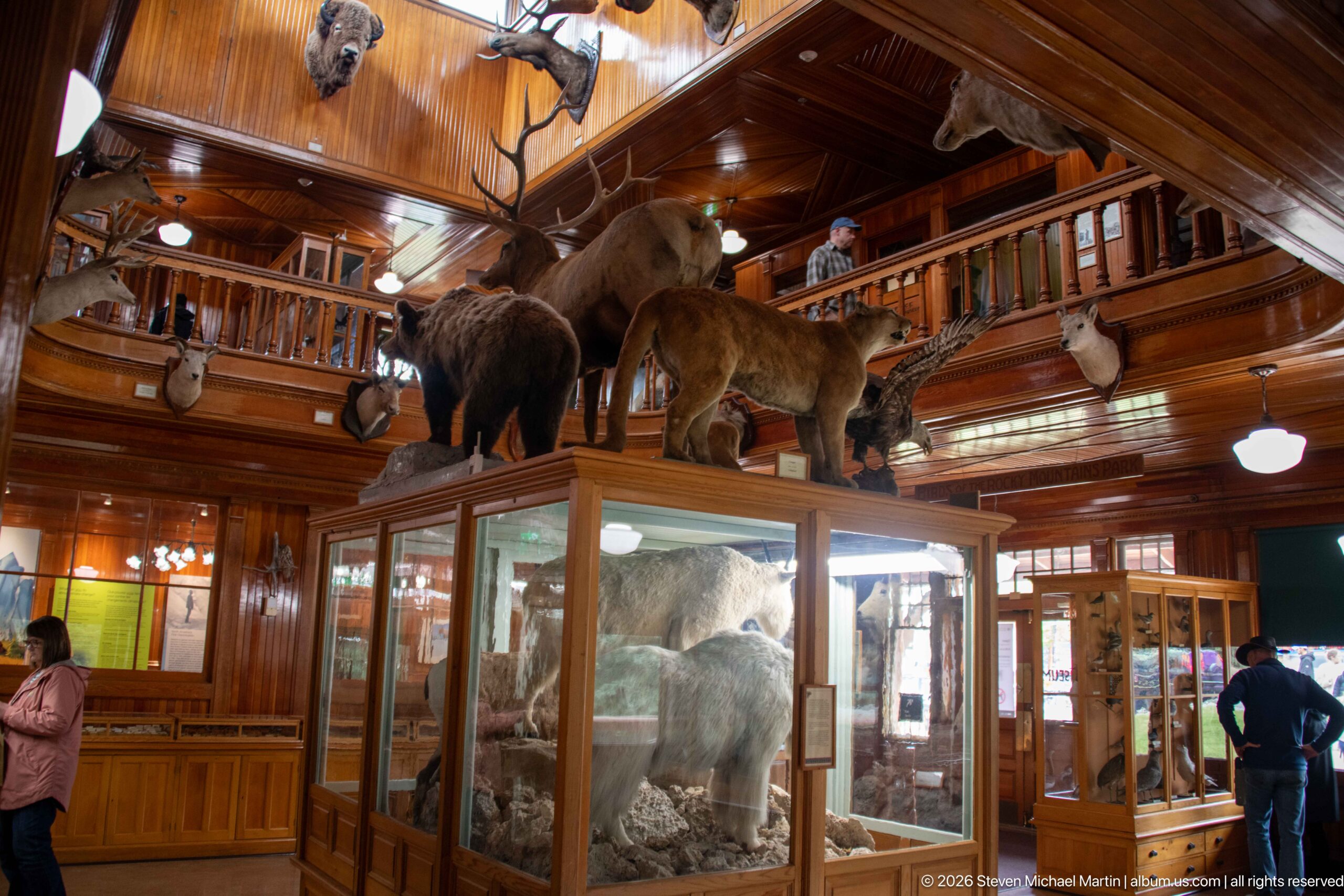
A large glass-and-wood specimen case anchors the museum floor while mounted mammals are arranged dramatically along its top and the surrounding upper walls. The dense display places animals at several heights within the timber-lined gallery, preserving an immersive exhibition style in which architecture, cabinetry, and taxidermy are experienced together.
Caption
A large glass-and-wood specimen case anchors the museum floor while mounted mammals are arranged dramatically along its top and the surrounding upper walls. The dense display places animals at several heights within the timber-lined gallery, preserving an immersive exhibition style in which architecture, cabinetry, and taxidermy are experienced together.
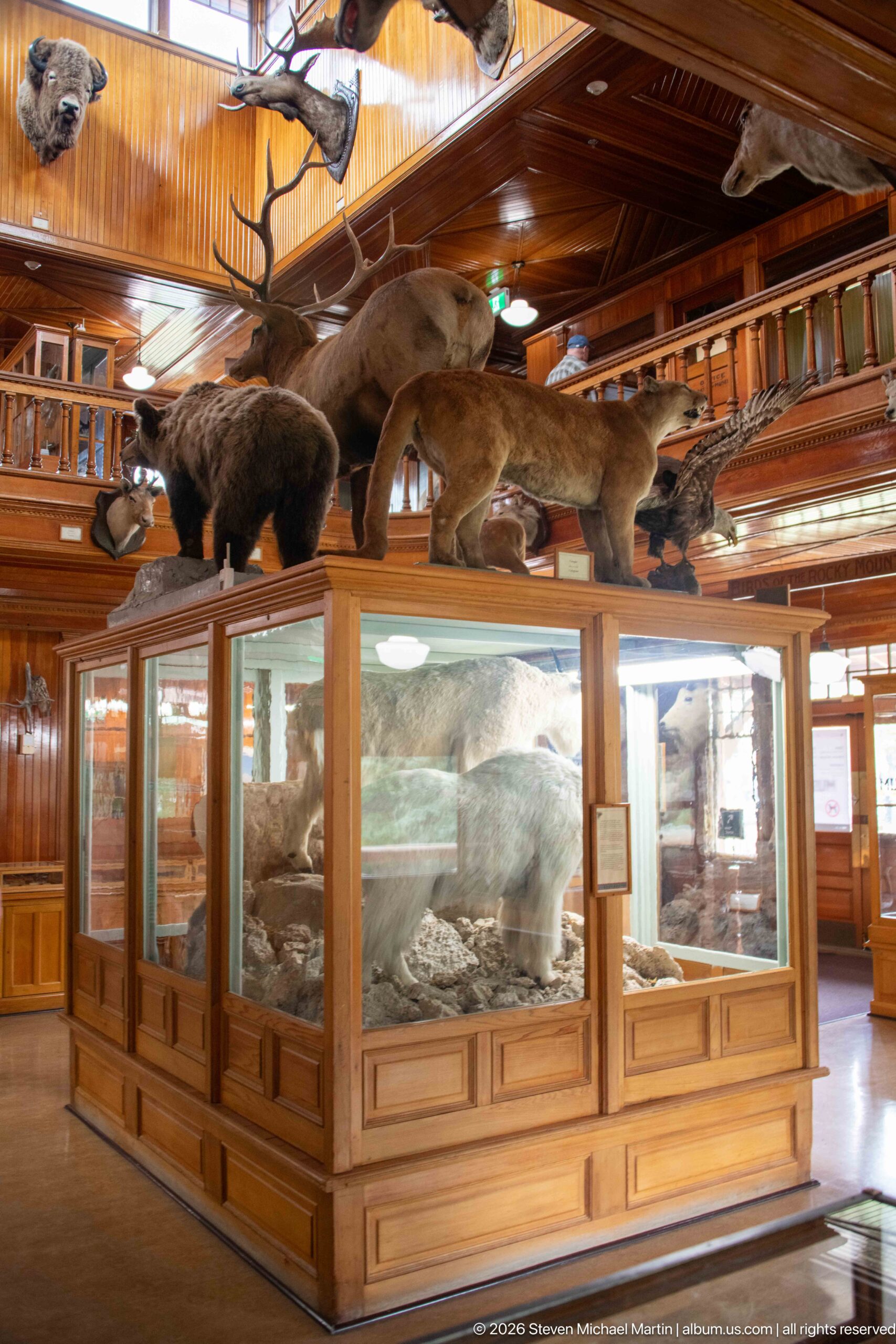
A broad glazed habitat case occupies the center of the gallery, its pale taxidermy specimen set within a rocky ground treatment. Several large mammals are mounted along the case top, creating a second tier of display beneath the surrounding balcony. The arrangement demonstrates the museum’s dense, vertically layered approach to exhibiting natural history.
Caption
A broad glazed habitat case occupies the center of the gallery, its pale taxidermy specimen set within a rocky ground treatment. Several large mammals are mounted along the case top, creating a second tier of display beneath the surrounding balcony. The arrangement demonstrates the museum’s dense, vertically layered approach to exhibiting natural history.
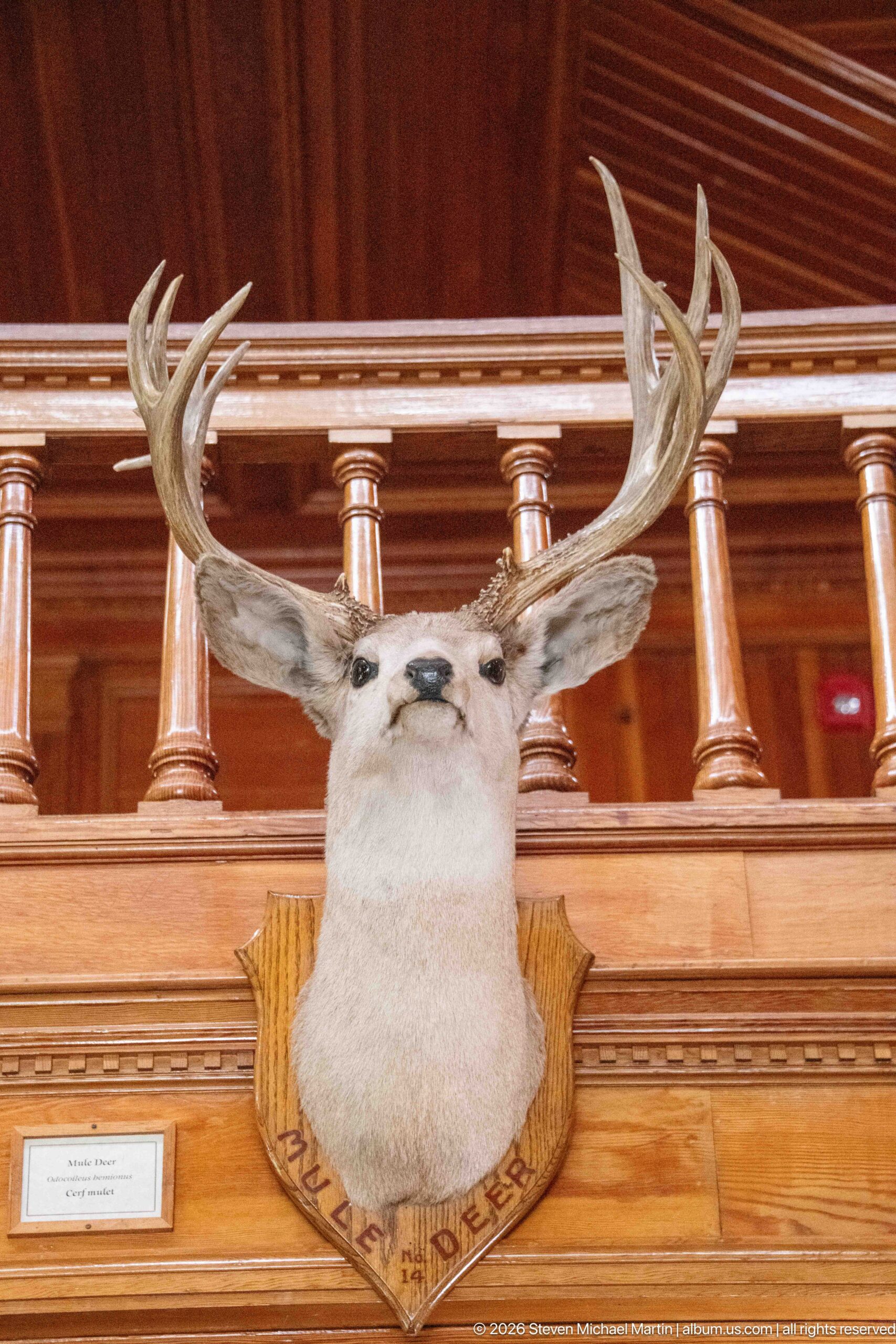
An antlered deer head is mounted on a carved wooden shield beneath the upper gallery railing. The symmetrical rack spreads above the pale face, while the close framing isolates the mount from neighboring specimens. Its presentation shows how trophy-style mounts were integrated directly into the museum’s architectural woodwork.
Caption
An antlered deer head is mounted on a carved wooden shield beneath the upper gallery railing. The symmetrical rack spreads above the pale face, while the close framing isolates the mount from neighboring specimens. Its presentation shows how trophy-style mounts were integrated directly into the museum’s architectural woodwork.
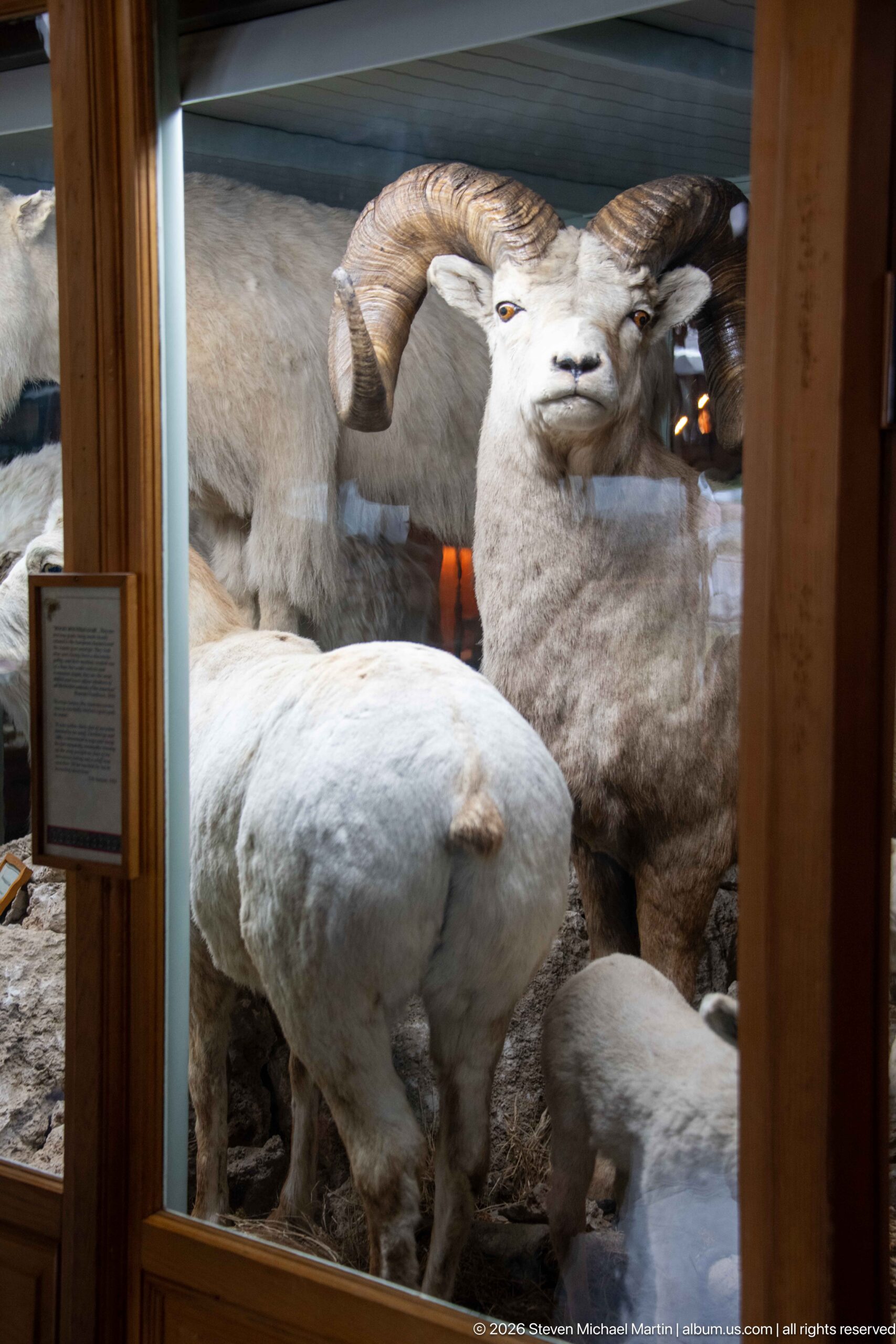
A heavy-horned wild sheep stands among several lighter-colored animals inside a glass habitat case. Rocky ground and the close grouping create a compact herd scene, while the mature animal’s curled horns dominate the composition. The view is partially mediated by reflections and the wooden case frame, emphasizing the historic enclosure as part of the display.
Caption
A heavy-horned wild sheep stands among several lighter-colored animals inside a glass habitat case. Rocky ground and the close grouping create a compact herd scene, while the mature animal’s curled horns dominate the composition. The view is partially mediated by reflections and the wooden case frame, emphasizing the historic enclosure as part of the display.
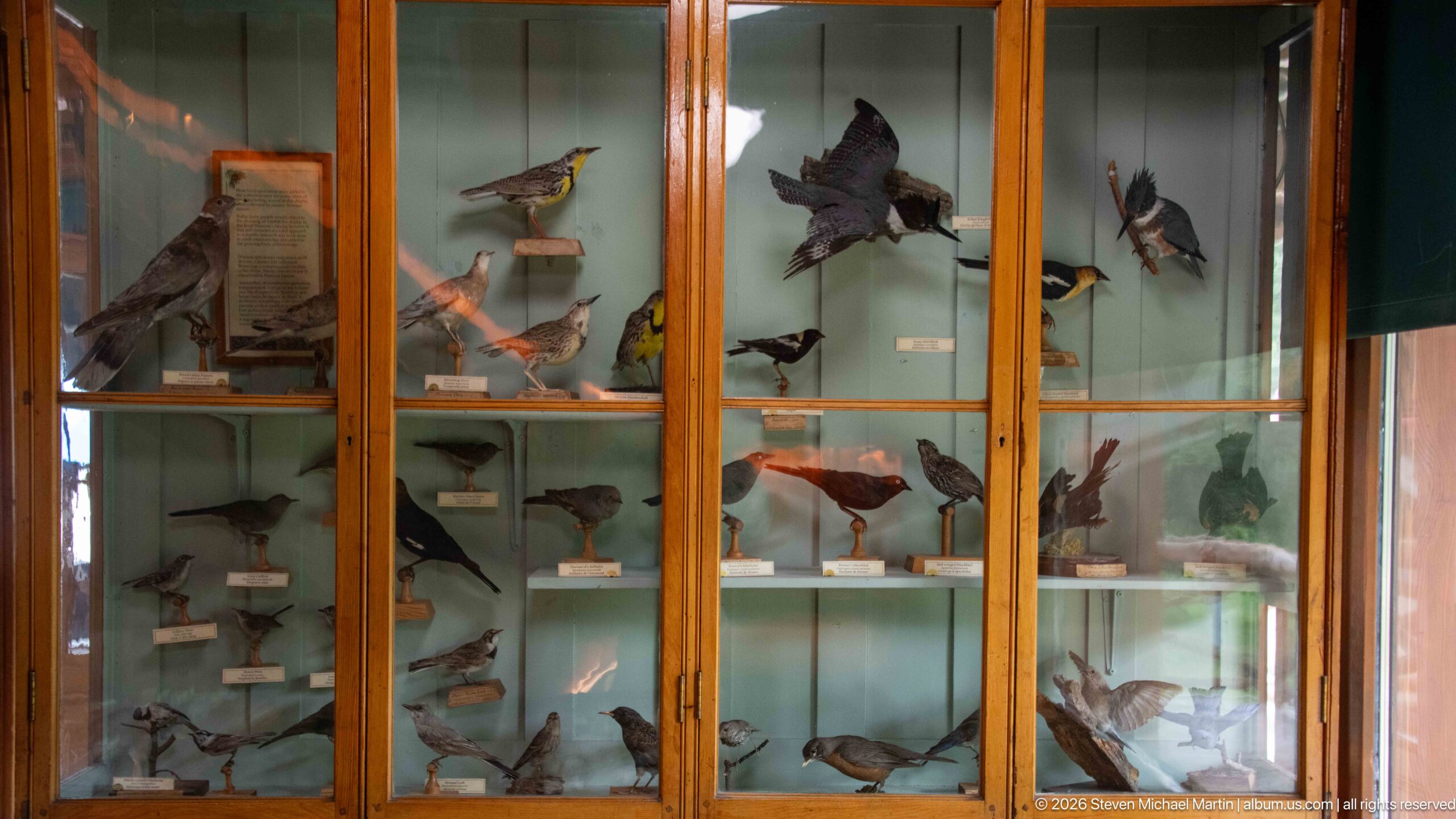
Rows of mounted birds fill a tall glass-fronted cabinet, each specimen positioned on an individual perch or base with a small identification label. The pale green interior and warm wooden framing create a systematic, cabinet-like presentation that reflects an older taxonomic approach to museum display, emphasizing comparison among forms, sizes, and plumage.
Caption
Rows of mounted birds fill a tall glass-fronted cabinet, each specimen positioned on an individual perch or base with a small identification label. The pale green interior and warm wooden framing create a systematic, cabinet-like presentation that reflects an older taxonomic approach to museum display, emphasizing comparison among forms, sizes, and plumage.
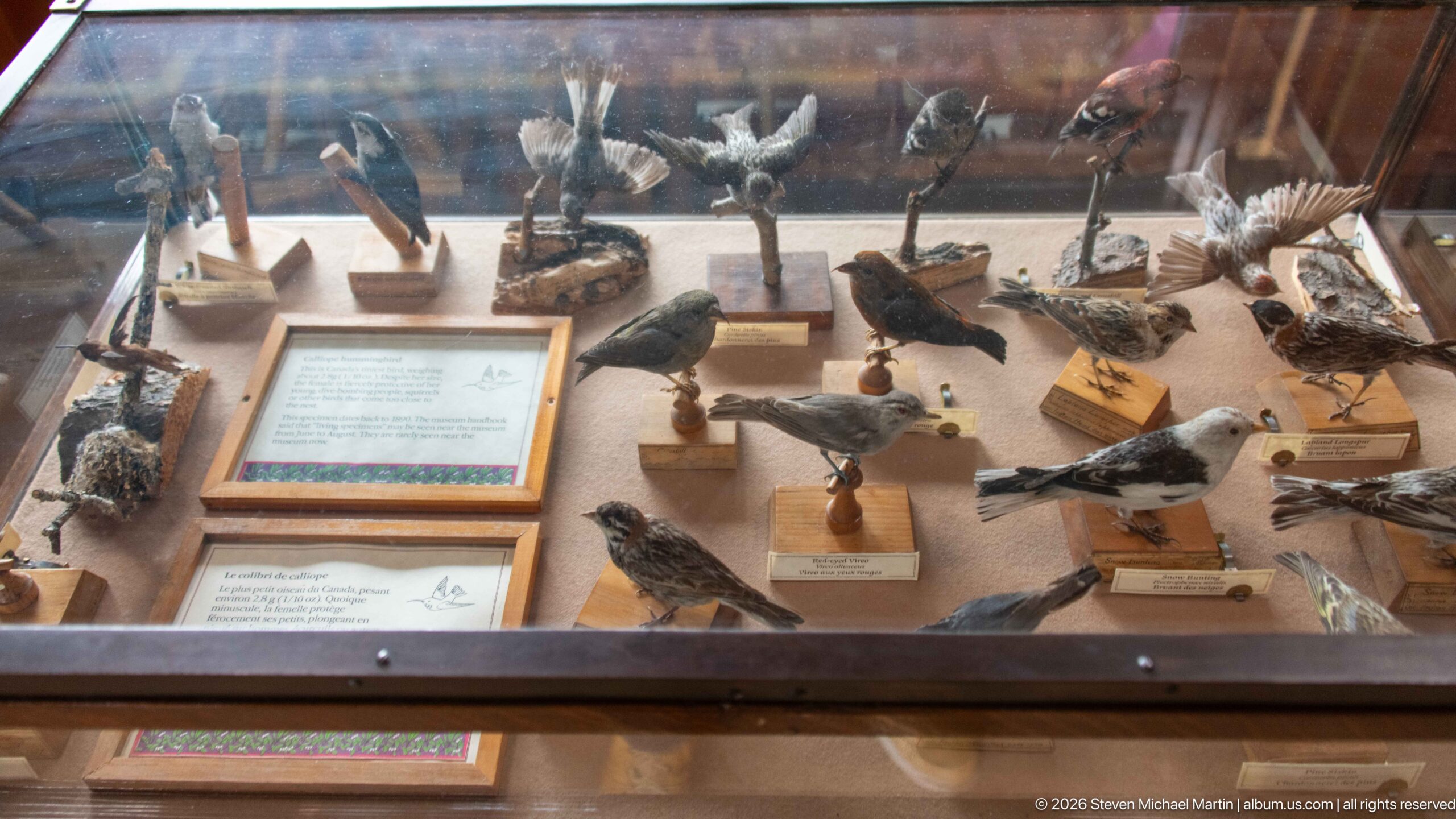
A tabletop case gathers numerous small mounted birds around an interpretive panel, with specimens posed on individual wooden stands and arranged closely for comparison. Their varied bills, body shapes, and plumage make the case read as a compact study collection, preserving the museum’s historic emphasis on classification through direct visual comparison.
Caption
A tabletop case gathers numerous small mounted birds around an interpretive panel, with specimens posed on individual wooden stands and arranged closely for comparison. Their varied bills, body shapes, and plumage make the case read as a compact study collection, preserving the museum’s historic emphasis on classification through direct visual comparison.
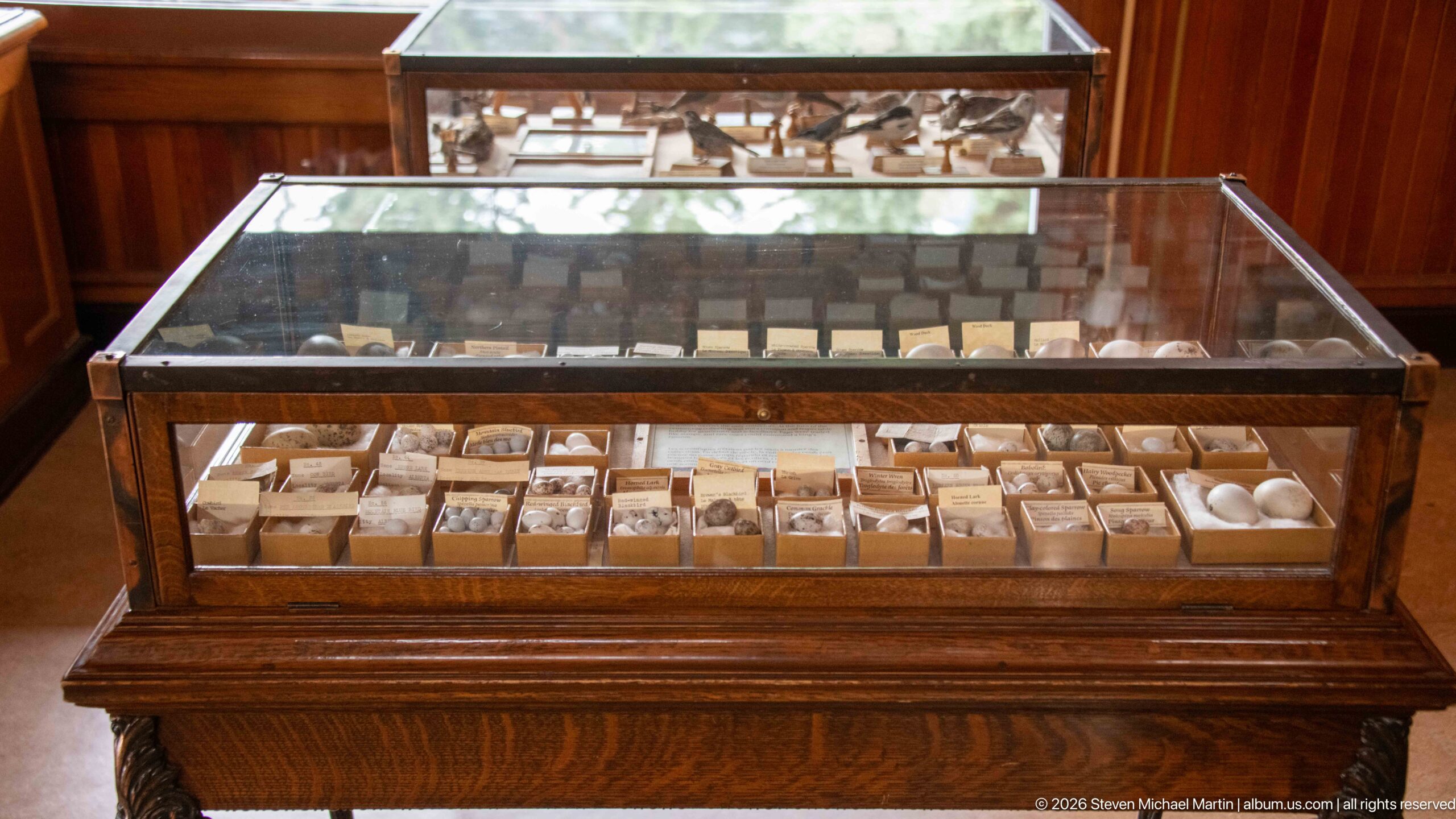
Dozens of eggs and small specimen boxes are arranged in ordered rows beneath the glass lid of a wooden display case. The careful compartmentalization contrasts with the museum’s larger taxidermy mounts, presenting natural history at a much smaller scale and illustrating the collecting practices once used to compare reproductive material across bird species.
Caption
Dozens of eggs and small specimen boxes are arranged in ordered rows beneath the glass lid of a wooden display case. The careful compartmentalization contrasts with the museum’s larger taxidermy mounts, presenting natural history at a much smaller scale and illustrating the collecting practices once used to compare reproductive material across bird species.
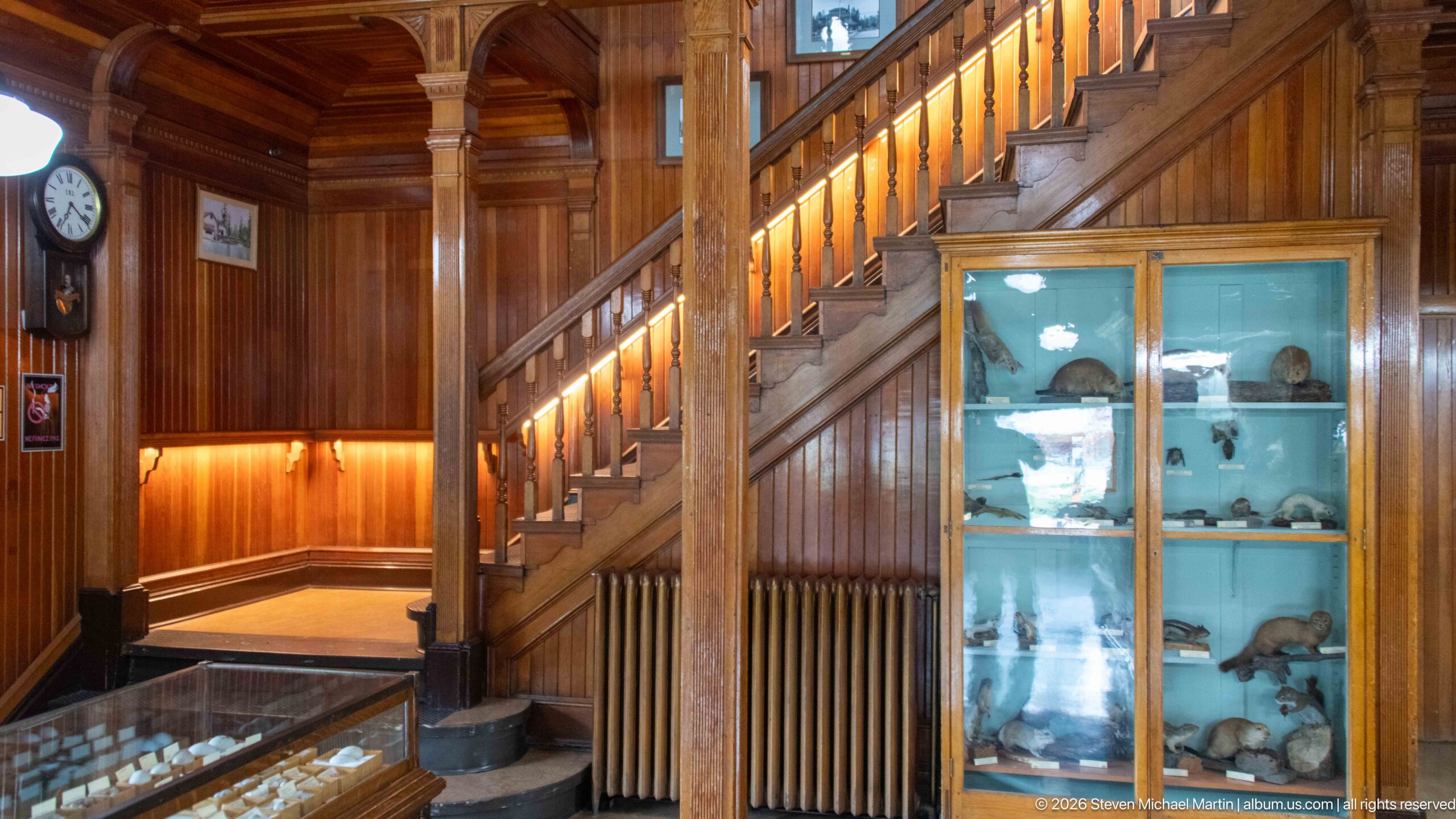
A substantial wooden staircase climbs through the museum interior beside a tall glass cabinet containing small mounted mammals. Warm paneling, turned balusters, a radiator, and a wall clock reinforce the preserved period character of the room. The composition shows how specimen displays were fitted directly into the building’s circulation spaces rather than isolated in modern gallery enclosures.
Caption
A substantial wooden staircase climbs through the museum interior beside a tall glass cabinet containing small mounted mammals. Warm paneling, turned balusters, a radiator, and a wall clock reinforce the preserved period character of the room. The composition shows how specimen displays were fitted directly into the building’s circulation spaces rather than isolated in modern gallery enclosures.
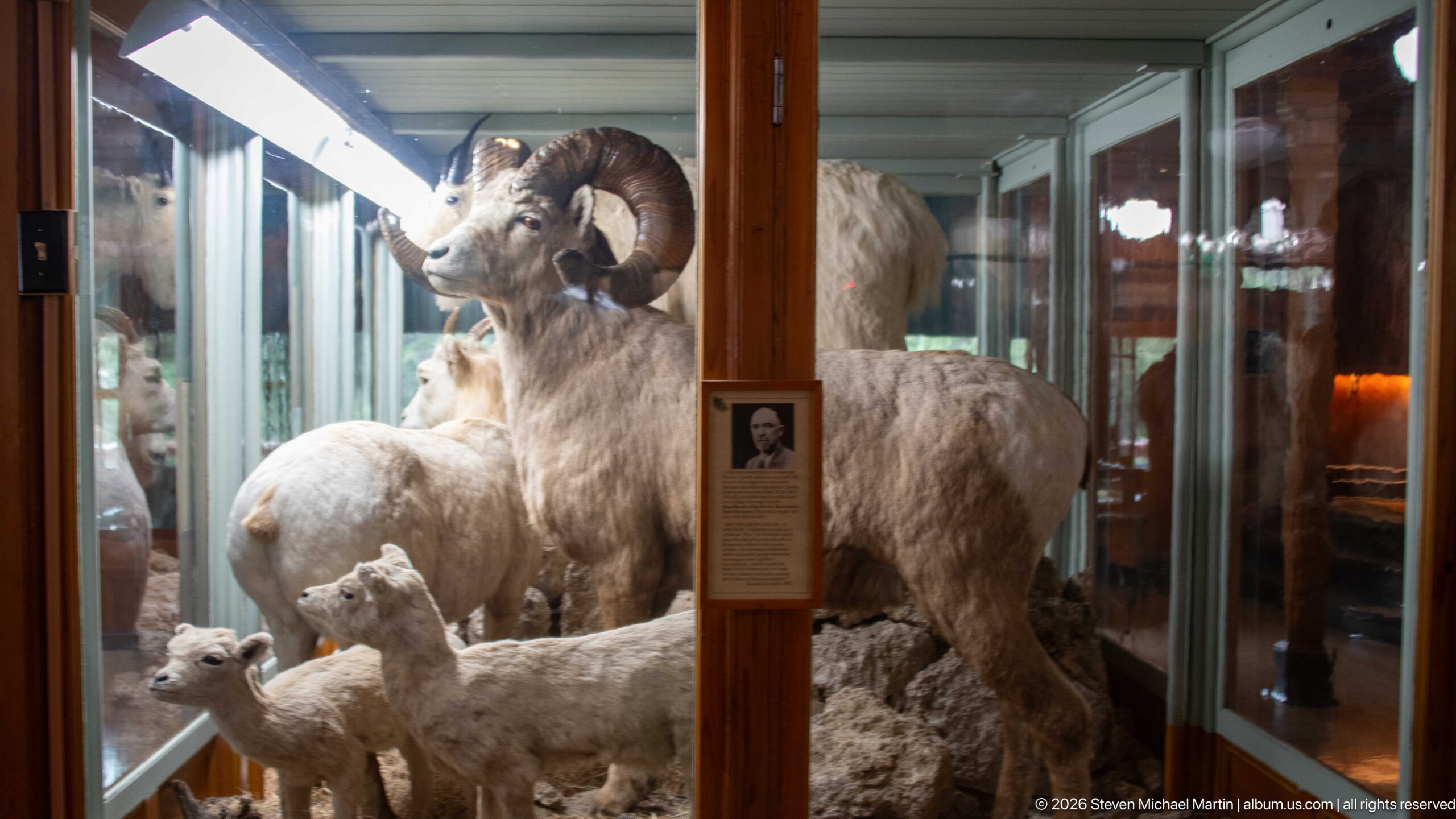
A mature bighorn ram with massive curled horns stands above smaller sheep in a rocky habitat display. The group presents different ages and body sizes together, allowing the ram’s heavy horn growth to be compared with the lighter forms around it. Reflections from the surrounding glass also reveal the historic casework enclosing the diorama.
Caption
A mature bighorn ram with massive curled horns stands above smaller sheep in a rocky habitat display. The group presents different ages and body sizes together, allowing the ram’s heavy horn growth to be compared with the lighter forms around it. Reflections from the surrounding glass also reveal the historic casework enclosing the diorama.
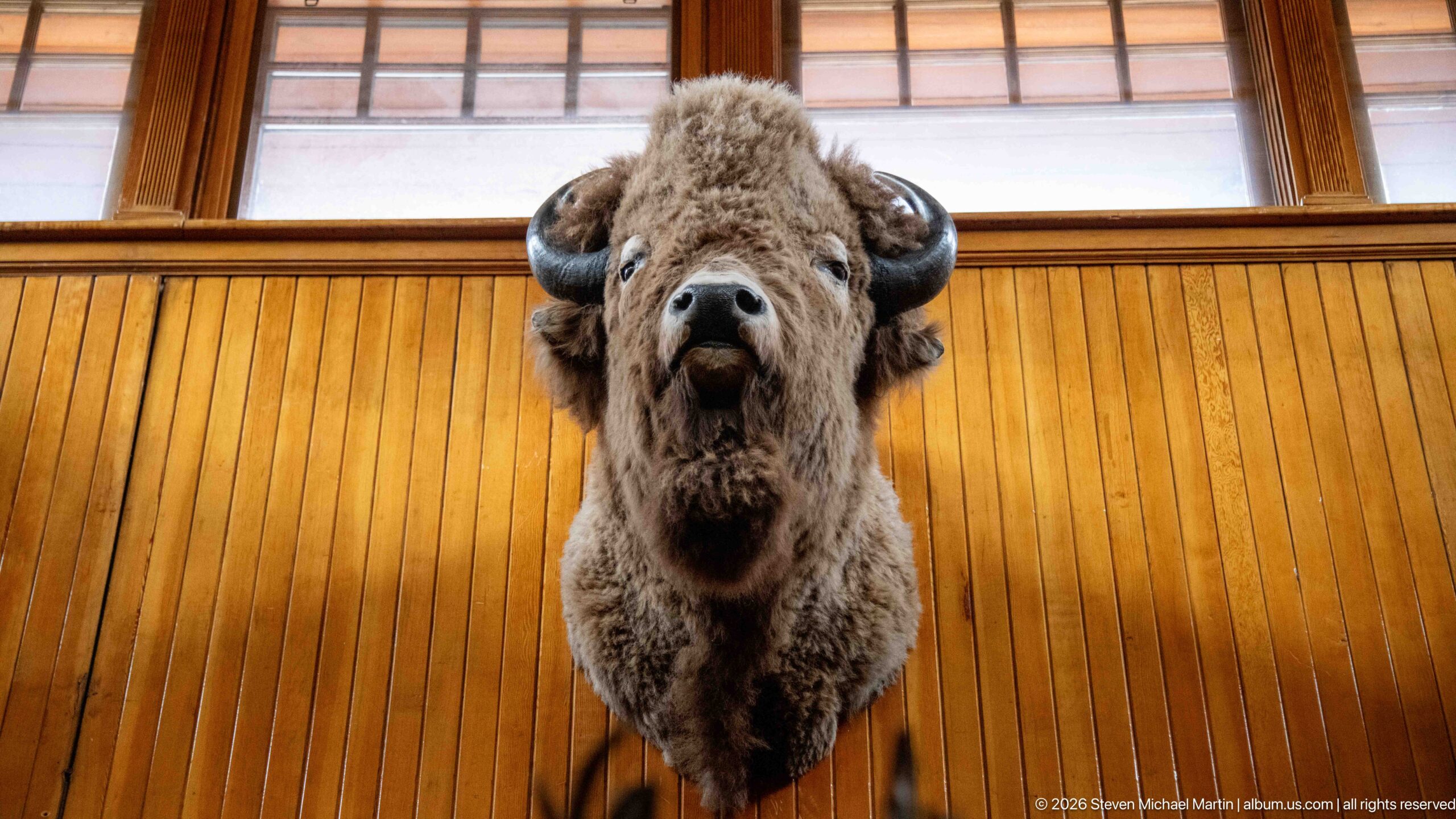
A bison head projects from the paneled wall in a direct frontal view, its short curved horns, broad muzzle, and dense woolly forehead emphasized against the vertical wood boards. Isolated from the body and displayed high on the wall, the mount exemplifies the trophy-style presentation once commonly incorporated into natural-history museums.
Caption
A bison head projects from the paneled wall in a direct frontal view, its short curved horns, broad muzzle, and dense woolly forehead emphasized against the vertical wood boards. Isolated from the body and displayed high on the wall, the mount exemplifies the trophy-style presentation once commonly incorporated into natural-history museums.
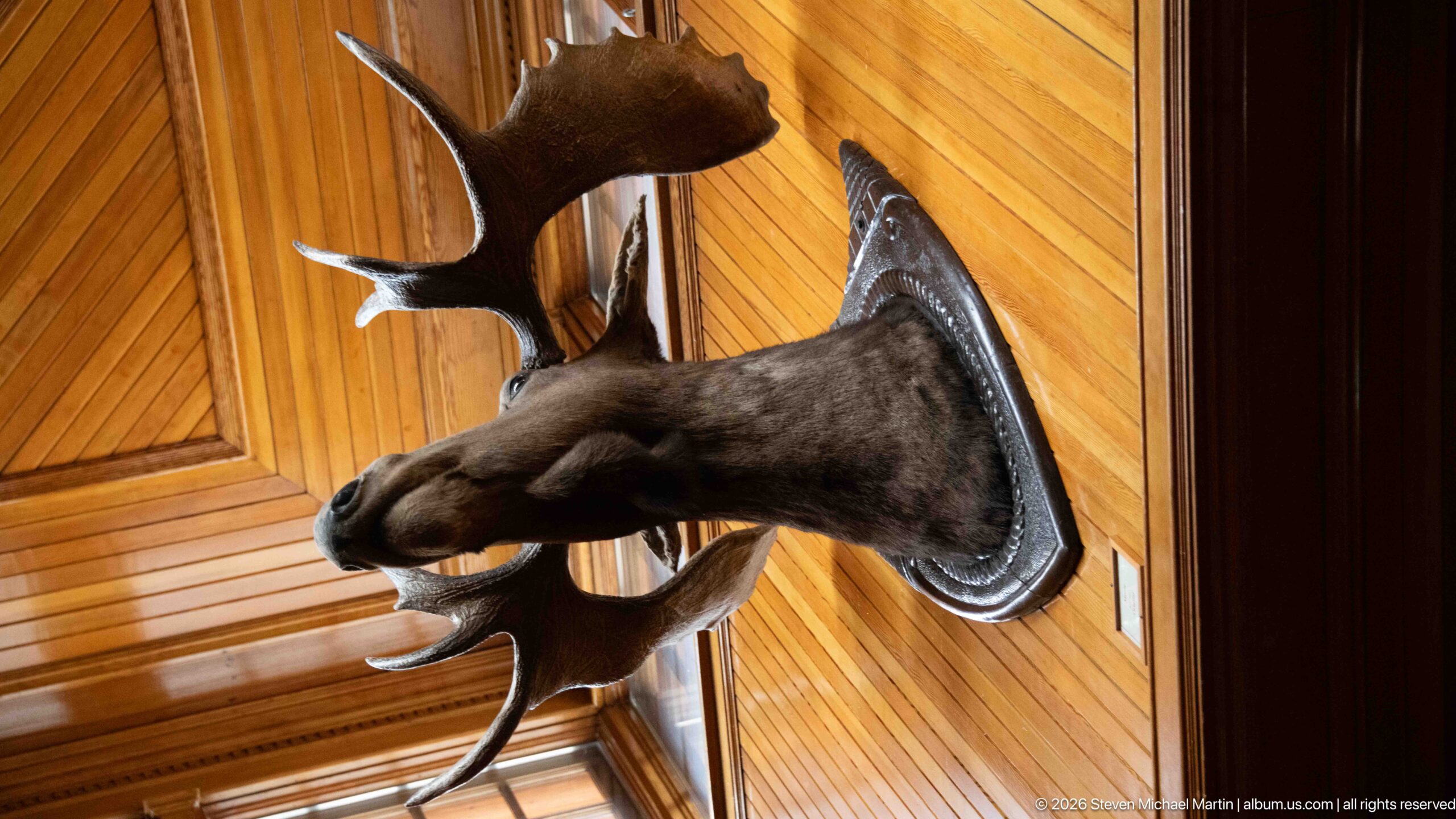
A moose head extends dramatically from an ornamental wall shield, with broad palmate antlers spreading above and behind the long muzzle. Seen from a low oblique angle, the mount is silhouetted against the museum’s honey-colored wooden ceiling and wall boards, emphasizing the scale and distinctive geometry of the antlers.
Caption
A moose head extends dramatically from an ornamental wall shield, with broad palmate antlers spreading above and behind the long muzzle. Seen from a low oblique angle, the mount is silhouetted against the museum’s honey-colored wooden ceiling and wall boards, emphasizing the scale and distinctive geometry of the antlers.
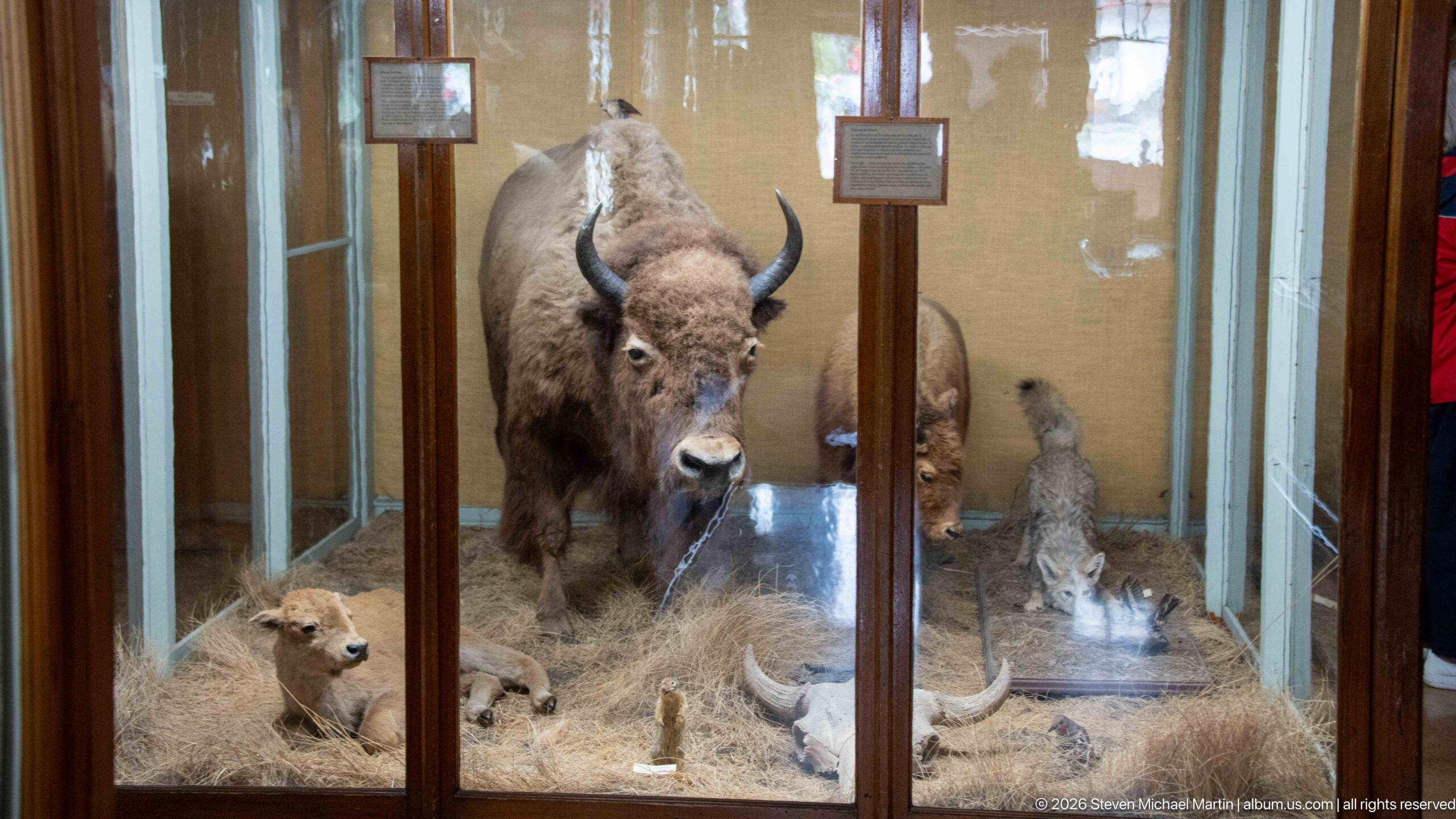
A full-bodied bison stands at the center of a glass habitat display, surrounded by smaller mammals and scattered natural materials. The animal’s massive forequarters and dark head dominate the enclosure, while the supporting specimens broaden the scene into an ecological grouping rather than a single-specimen mount.
Caption
A full-bodied bison stands at the center of a glass habitat display, surrounded by smaller mammals and scattered natural materials. The animal’s massive forequarters and dark head dominate the enclosure, while the supporting specimens broaden the scene into an ecological grouping rather than a single-specimen mount.
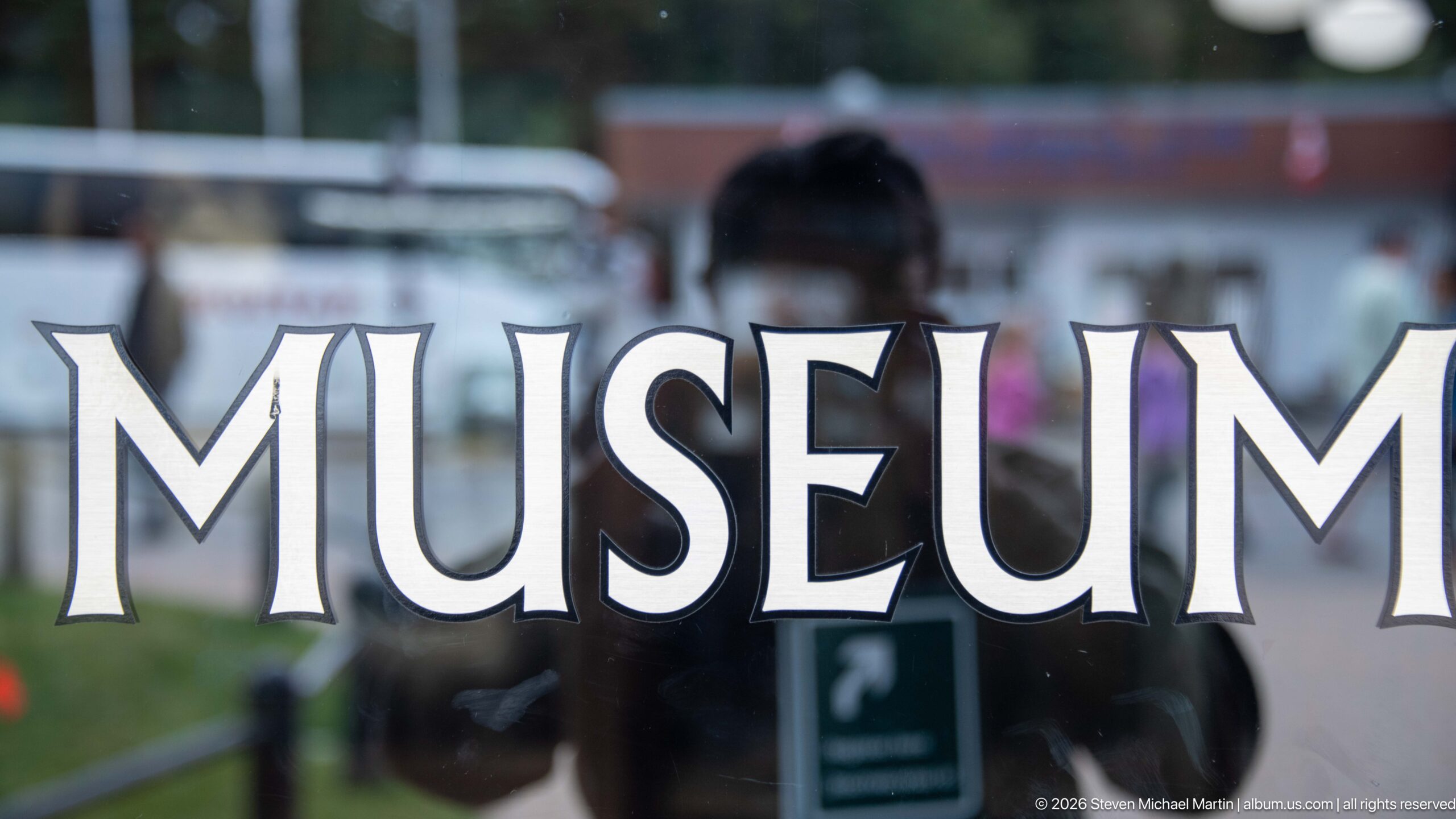
Large serif letters spelling MUSEUM fill the glass in this close view of the entrance, with the photographer and surrounding grounds reflected behind them. The tight composition turns a functional identification mark into a graphic detail while retaining a layered sense of the museum’s relationship to its exterior setting.
Caption
Large serif letters spelling MUSEUM fill the glass in this close view of the entrance, with the photographer and surrounding grounds reflected behind them. The tight composition turns a functional identification mark into a graphic detail while retaining a layered sense of the museum’s relationship to its exterior setting.
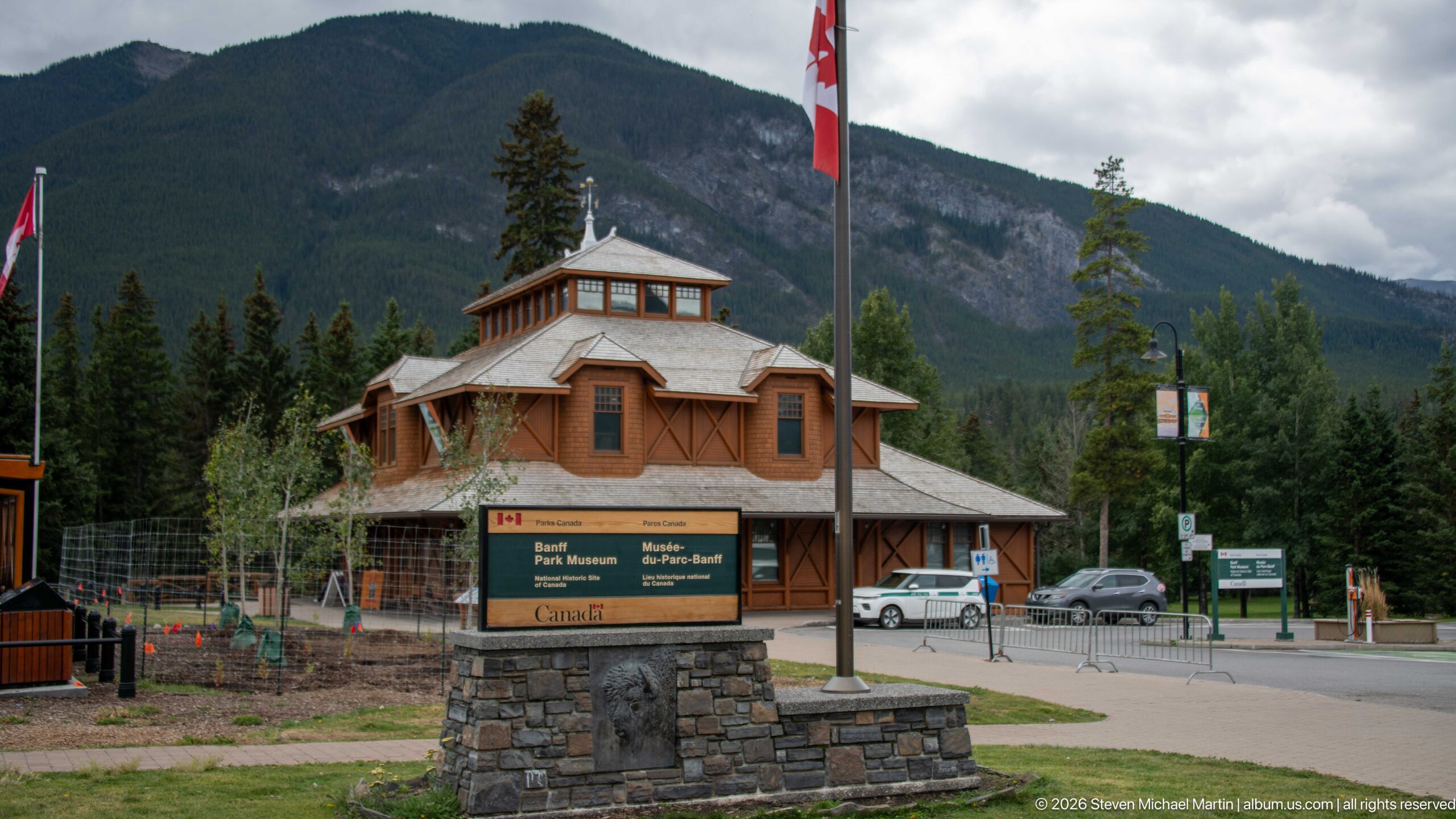
A stone-based Parks Canada sign identifies the Banff Park Museum in the foreground while the timber building rises behind it beneath the Canadian flag and mountain slope. This wider contextual view places the historic museum within its landscaped national-park setting and clearly connects the building’s distinctive roofline with its official site identity.
Caption
A stone-based Parks Canada sign identifies the Banff Park Museum in the foreground while the timber building rises behind it beneath the Canadian flag and mountain slope. This wider contextual view places the historic museum within its landscaped national-park setting and clearly connects the building’s distinctive roofline with its official site identity.
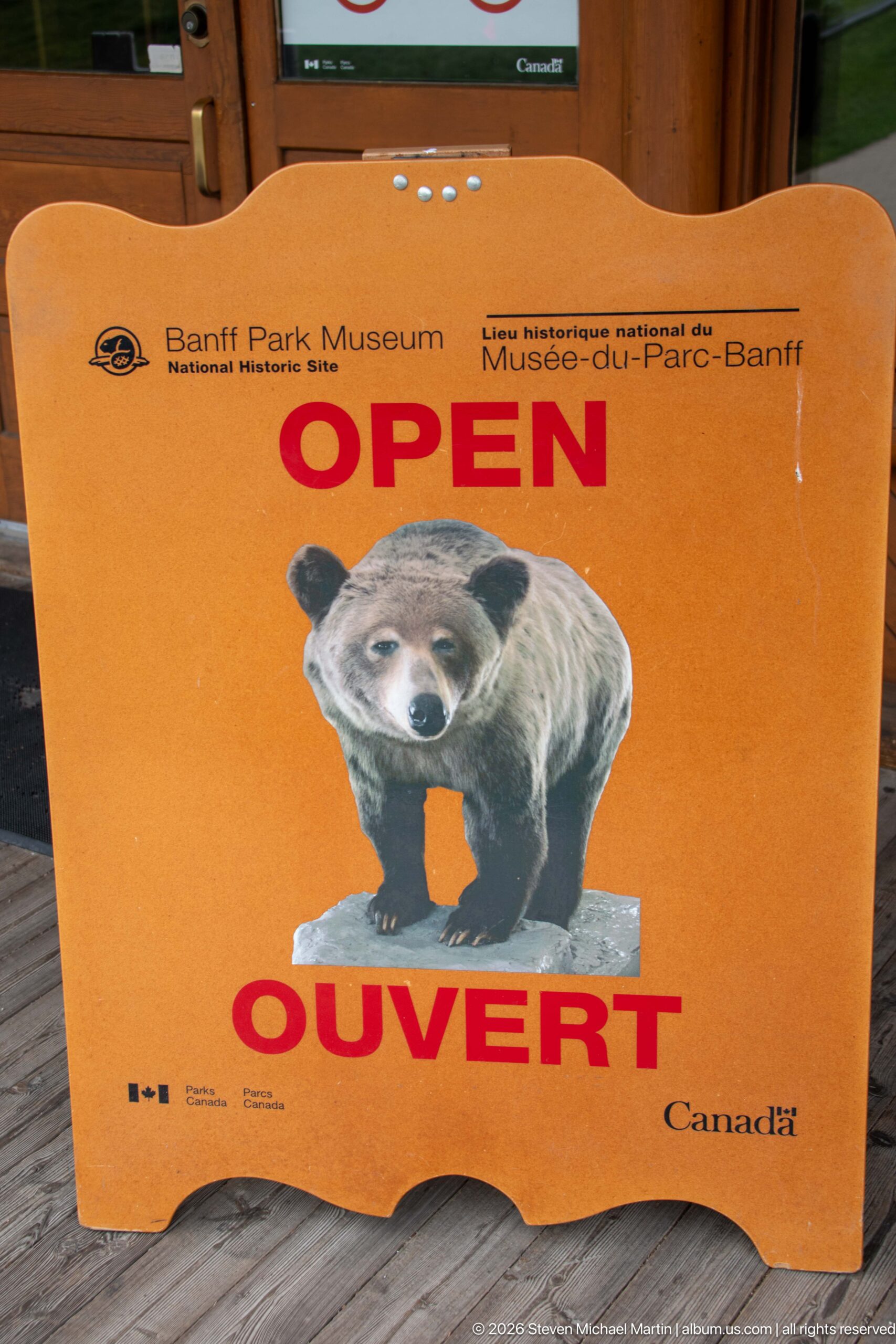
A freestanding sign announces that the Banff Park Museum is OPEN / OUVERT in bold red bilingual lettering above and below an illustrated bear. Parks Canada branding and the museum name identify the site directly, making the sign both a practical visitor marker and a playful introduction to the natural-history collection inside.
Caption
A freestanding sign announces that the Banff Park Museum is OPEN / OUVERT in bold red bilingual lettering above and below an illustrated bear. Parks Canada branding and the museum name identify the site directly, making the sign both a practical visitor marker and a playful introduction to the natural-history collection inside.
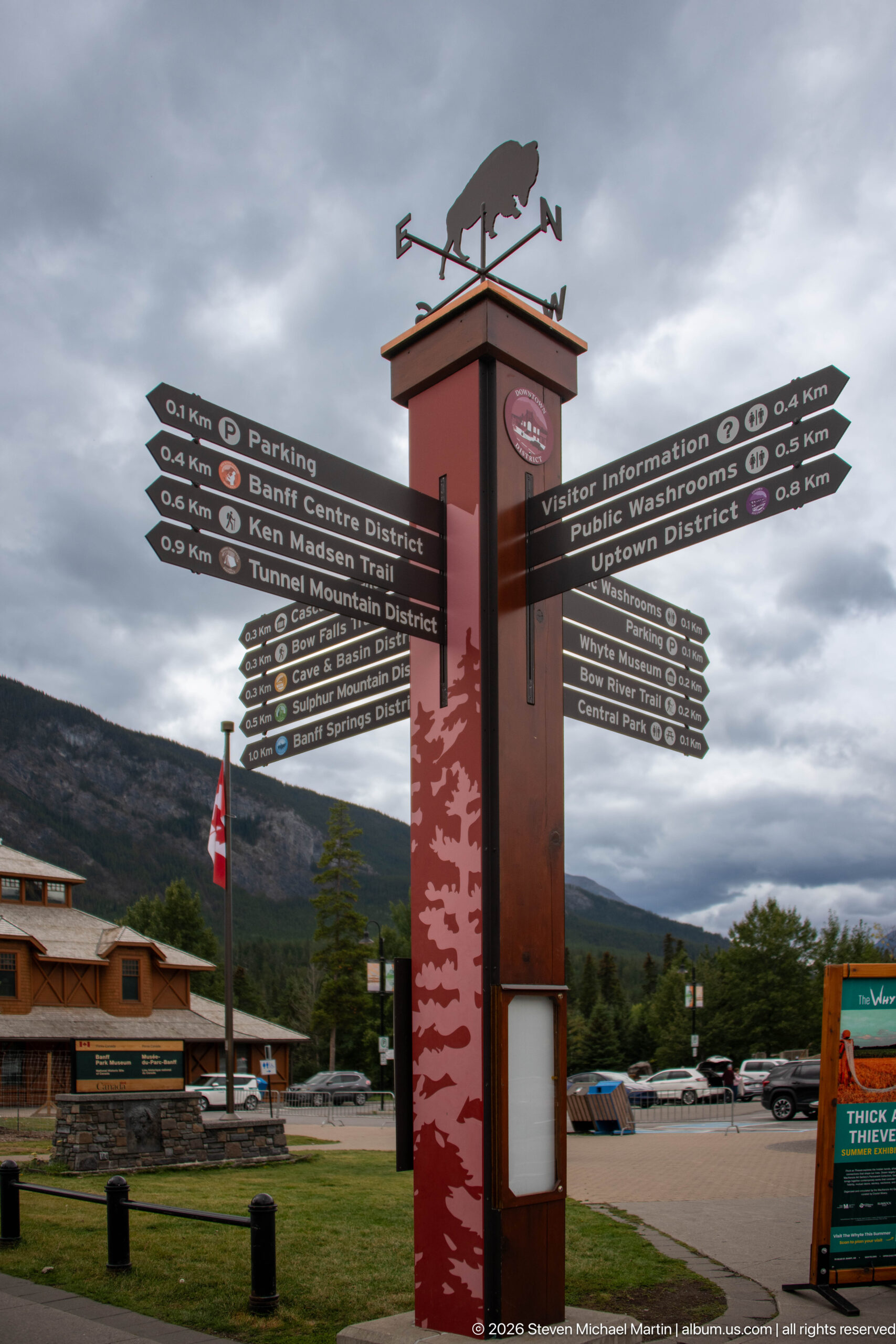
A tall red wayfinding pylon topped by an animal-shaped weather vane points toward destinations around central Banff, including parking, the town centre, visitor information, public washrooms, and other services. Mountains and low buildings frame the sign, placing the museum visit within the broader pedestrian and civic landscape of Banff.
Caption
A tall red wayfinding pylon topped by an animal-shaped weather vane points toward destinations around central Banff, including parking, the town centre, visitor information, public washrooms, and other services. Mountains and low buildings frame the sign, placing the museum visit within the broader pedestrian and civic landscape of Banff.
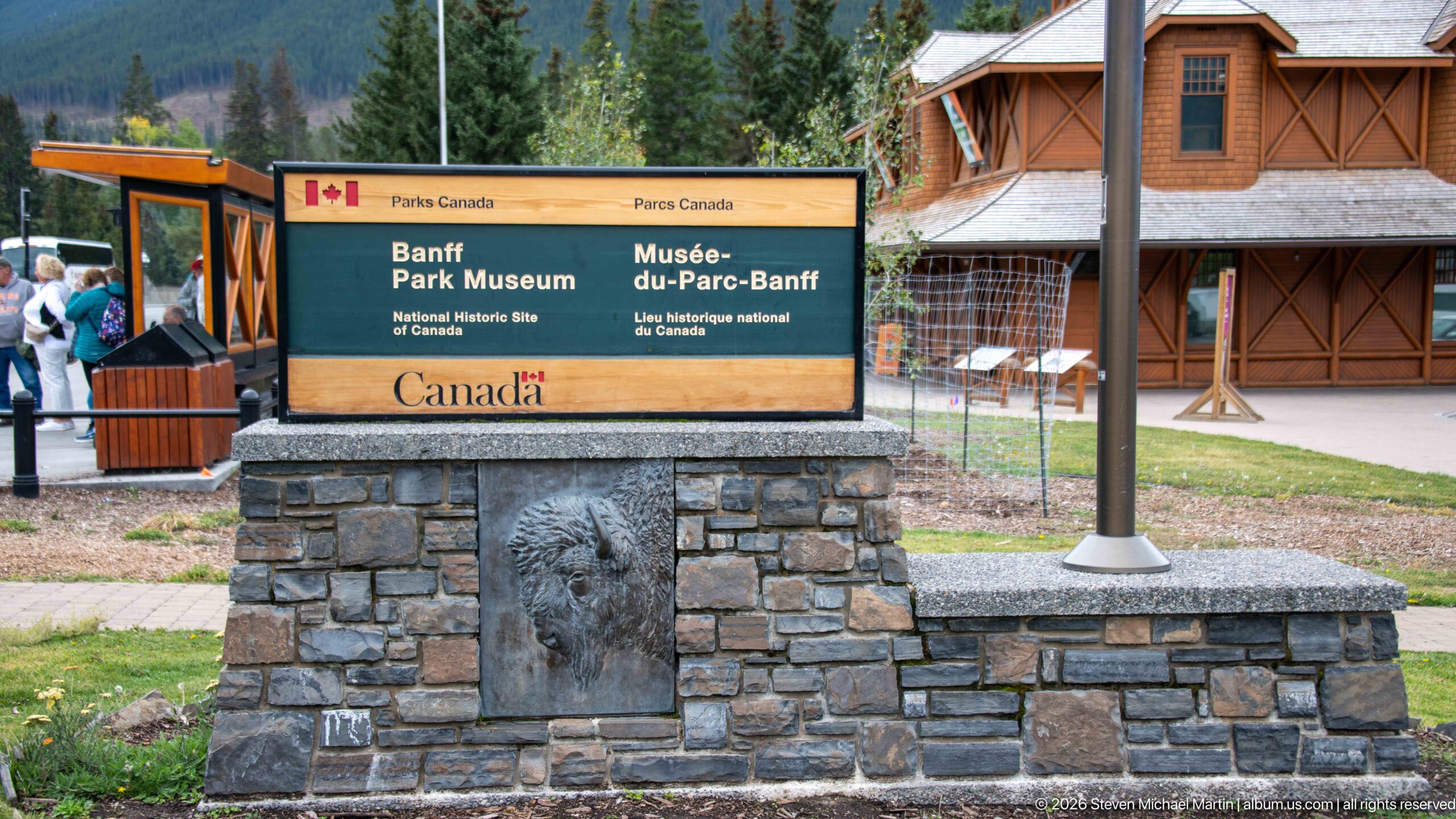
The bilingual Parks Canada sign identifies Banff Park Museum as a National Historic Site of Canada, while the museum’s distinctive wood-clad exterior appears beyond the stone sign base. The composition links the institution’s official identity with its historic building, using the entrance marker, carved wildlife relief, rustic masonry, and timber architecture to establish the site at the close of the portfolio.
Caption
The bilingual Parks Canada sign identifies Banff Park Museum as a National Historic Site of Canada, while the museum’s distinctive wood-clad exterior appears beyond the stone sign base. The composition links the institution’s official identity with its historic building, using the entrance marker, carved wildlife relief, rustic masonry, and timber architecture to establish the site at the close of the portfolio.
🏛️ Museum Field Guide
📍 Overview
Banff Park Museum is both a natural-history collection and a historic museum interior in which architecture, cabinetry, specimens, labels, and display methods remain closely intertwined. Its wood-paneled galleries are densely arranged with mounted birds and mammals, habitat groups, comparative specimen cases, antlers, trophy-style mounts, eggs, and materials associated with collecting and curatorial work. Rather than separating the collection from its setting, the museum presents the two together: visitors encounter natural history through the preserved visual language of an earlier museum, where specimens occupy walls, cabinets, balcony edges, and the central hall.
◆ Institutional History
A federal commemorative plaque at the site traces the museum from an 1895 institution to the purpose-built structure completed in 1903 and identifies curator Norman Bethune Sanson with its early history. The building and collection preserve more than individual specimens; together they document an earlier approach to natural-history museums, when collecting, classification, preparation, display, and public interpretation were visibly connected. Surviving features such as the curator’s office sign, reconstructed workspace, historic cabinetry, and period-style specimen arrangements make the institution’s working history part of what visitors see.
◆ Collections
The collection is especially rich in preserved birds and mammals presented in several complementary ways. Large Rocky Mountain animals appear as full-body mounts, shoulder mounts, head mounts, and habitat groups, while cabinets gather smaller mammals and birds for close comparison. Photographed specimens include elk, moose, bison, wolves, bighorn sheep, grizzly bear, beaver, lynx, American badger, red fox, hooded and red-breasted mergansers, willow ptarmigan, and numerous other birds. An egg collection, specimen-preparation materials, labels, records, and curatorial equipment broaden the story beyond taxidermy to the practices of documenting and organizing natural history.
◆ Signature Objects
The museum’s most commanding objects are often the largest specimens integrated into the architecture: a full-bodied bull elk rising through the central display floor, broad-antlered moose mounts, bison, wolves, bighorn sheep, bears, and large birds of prey displayed high against the timber interior. Smaller cases provide a different kind of significance. Rows of mounted birds, small mammals, eggs, labels, and study material show how comparison and classification shaped the collection. Particularly revealing displays include the historic curator workspace and preparation materials, which shift attention from the finished specimen to the human work of collecting, cataloging, studying, and maintaining a museum.
◆ Interpretation & Display
Banff Park Museum communicates as much through arrangement as through labels. Specimens are layered vertically throughout the building: large mammals occupy the floor and case tops, trophy-style mounts project from paneled walls, birds fill glazed cabinets, and additional displays line the upper gallery. Some animals are isolated for anatomical comparison, while others appear in simplified habitat or predator-prey groupings that suggest ecological relationships. This mixture of taxonomic display and staged habitat presentation allows visitors to see changing interpretive strategies within a collection whose historic cabinetry and architecture remain central to the experience.
🥾 Visitor Experience
The visit unfolds through a compact, visually dense timber interior. From the main floor, large cases and full-bodied mammals create an immersive field of specimens; from the upper gallery, the balustrade opens new sightlines across the central hall and reveals how displays occupy several levels at once. Close inspection rewards attention to small details—individual specimen labels, plumage, antler forms, eggs, preparation tools, painted signs, case construction, and the polished woodwork surrounding them. Outside, the bilingual Parks Canada signage and distinctive timber exterior connect the collection to the museum’s identity as a National Historic Site of Canada.
📷 Photography Notes
Photography is strongest when it treats the museum itself as part of the collection. Wide views from the upper gallery establish the relationship among the central hall, balustrades, cases, and large mounts; tighter studies isolate antlers, plumage, facial features, labels, cabinetry, and curatorial objects. Reflections in historic glass cases can complicate specimen views but also record the physical character of the displays. Exterior photographs benefit from including the roofline, clerestory, veranda, diagonal timber bracing, Parks Canada signage, and surrounding mountain setting, while interior compositions can use the warm wood surfaces to give visual continuity to the varied natural-history material.