Auschwitz – Oświęcim, Poland
Auschwitz lies near the town of Oświęcim in southern Poland, along the Soła River, a tributary of the Vistula River. During the Second World War this location became the site of the largest complex of concentration and extermination camps established by Nazi Germany.
The preserved camp known as Auschwitz I contains rows of brick barracks, guard towers, and the infamous gate bearing the inscription “Arbeit Macht Frei.” A few kilometers away stands Auschwitz II–Birkenau, an immense camp constructed across the flat plains outside the town.
Today the site serves as a memorial and museum dedicated to the millions of victims who suffered and died here. The stark remains of the camp—railway tracks, watchtowers, and endless rows of barracks—stand as a powerful reminder of one of the darkest chapters of twentieth-century history.

Viewed from inside the camp, the Auschwitz I entrance complex combines open gates, timber structures and an elevated guard tower. The “Arbeit macht frei” lettering appears reversed from this interior viewpoint, immediately distinguishing the photograph from exterior approaches. Concrete posts and gate leaves frame the sandy passage, while mature trees soften the edges of the preserved security architecture.
Caption
Viewed from inside the camp, the Auschwitz I entrance complex combines open gates, timber structures and an elevated guard tower. The “Arbeit macht frei” lettering appears reversed from this interior viewpoint, immediately distinguishing the photograph from exterior approaches. Concrete posts and gate leaves frame the sandy passage, while mature trees soften the edges of the preserved security architecture.

A curving road and broad lawn organize this contextual view across the preserved grounds of Auschwitz I. Low wooden and masonry buildings sit beneath mature trees, with larger brick blocks rising farther back. The photograph emphasizes the camp as a spatial complex rather than an isolated structure, showing the relationship among roads, lawns, barracks and institutional buildings under open sky.
Caption
A curving road and broad lawn organize this contextual view across the preserved grounds of Auschwitz I. Low wooden and masonry buildings sit beneath mature trees, with larger brick blocks rising farther back. The photograph emphasizes the camp as a spatial complex rather than an isolated structure, showing the relationship among roads, lawns, barracks and institutional buildings under open sky.

Red-brick camp architecture frames a broad paved area at Auschwitz I. A steep tiled roof, dormer-like upper openings, rows of multi-pane windows and a deep arched passage give the building a more substantial institutional character than the adjacent low barracks. The oblique view emphasizes the long façade and the relationship between the enclosed structure and the open circulation space.
Caption
Red-brick camp architecture frames a broad paved area at Auschwitz I. A steep tiled roof, dormer-like upper openings, rows of multi-pane windows and a deep arched passage give the building a more substantial institutional character than the adjacent low barracks. The oblique view emphasizes the long façade and the relationship between the enclosed structure and the open circulation space.

A dark wooden guard tower stands at the junction of brick camp blocks and fenced circulation routes at Auschwitz I. Its enclosed, windowed observation room projects above a narrow timber base, providing sightlines across the surrounding grounds. Autumn trees, lawn and late-day light broaden the view beyond the tower itself, placing this surveillance structure within the preserved architectural landscape of the camp.
Caption
A dark wooden guard tower stands at the junction of brick camp blocks and fenced circulation routes at Auschwitz I. Its enclosed, windowed observation room projects above a narrow timber base, providing sightlines across the surrounding grounds. Autumn trees, lawn and late-day light broaden the view beyond the tower itself, placing this surveillance structure within the preserved architectural landscape of the camp.

A low-angle view concentrates on an enclosed guard tower at Auschwitz I. Broad bands of windows wrap the upper observation room above shingled cladding and a dark timber base, while a mounted lamp projects near the roofline. The tight framing emphasizes the tower’s elevated visibility and layered construction rather than the surrounding camp landscape.
Caption
A low-angle view concentrates on an enclosed guard tower at Auschwitz I. Broad bands of windows wrap the upper observation room above shingled cladding and a dark timber base, while a mounted lamp projects near the roofline. The tight framing emphasizes the tower’s elevated visibility and layered construction rather than the surrounding camp landscape.

A paved courtyard opens between preserved camp buildings at Auschwitz I, contrasting a substantial red-brick structure with a long, low stucco barrack lined by repeated chimneys. The orderly geometry of windows, roofs and paving records the institutional architecture of the former concentration camp without relying on a single iconic landmark. Low black barriers guide circulation across the open space.
Caption
A paved courtyard opens between preserved camp buildings at Auschwitz I, contrasting a substantial red-brick structure with a long, low stucco barrack lined by repeated chimneys. The orderly geometry of windows, roofs and paving records the institutional architecture of the former concentration camp without relying on a single iconic landmark. Low black barriers guide circulation across the open space.

An open yard extends between two long red-brick blocks at Auschwitz I toward a fenced, tree-filled boundary. Low autumn sunlight warms the masonry and birch foliage, while the broad central roadway remains nearly empty. The symmetrical spacing of the buildings and restrained landscaping provide a clear contextual view of the camp’s internal block arrangement.
Caption
An open yard extends between two long red-brick blocks at Auschwitz I toward a fenced, tree-filled boundary. Low autumn sunlight warms the masonry and birch foliage, while the broad central roadway remains nearly empty. The symmetrical spacing of the buildings and restrained landscaping provide a clear contextual view of the camp’s internal block arrangement.

A long gravel security corridor narrows toward a distant guard tower between parallel barbed-wire fences at Auschwitz I. Curved concrete posts, projecting lamps and dense wire separate the passage from red-brick blocks on both sides. The centered perspective emphasizes the depth and repetition of the preserved perimeter system, with the observation post anchoring the far end.
Caption
A long gravel security corridor narrows toward a distant guard tower between parallel barbed-wire fences at Auschwitz I. Curved concrete posts, projecting lamps and dense wire separate the passage from red-brick blocks on both sides. The centered perspective emphasizes the depth and repetition of the preserved perimeter system, with the observation post anchoring the far end.

A raised guard tower projects above a weathered wooden building along an internal lane at Auschwitz I. Its enclosed observation room, elevated position and broad windows contrast with the low timber structure below. Brick blocks recede along the road, while a birch tree and late-afternoon light frame the preserved security architecture within the camp’s built environment.
Caption
A raised guard tower projects above a weathered wooden building along an internal lane at Auschwitz I. Its enclosed observation room, elevated position and broad windows contrast with the low timber structure below. Brick blocks recede along the road, while a birch tree and late-afternoon light frame the preserved security architecture within the camp’s built environment.

A weathered timber barrack stands close to the visitor route at Auschwitz I, its vertical boards interrupted by small multi-pane windows, plain doors and utility fixtures. The low, elongated structure differs materially from the camp’s better-known brick blocks, preserving the austere construction and repetitive functional openings of a service or barrack building within the historic complex.
Caption
A weathered timber barrack stands close to the visitor route at Auschwitz I, its vertical boards interrupted by small multi-pane windows, plain doors and utility fixtures. The low, elongated structure differs materially from the camp’s better-known brick blocks, preserving the austere construction and repetitive functional openings of a service or barrack building within the historic complex.

Polished memorial plaques list countries and languages associated with victims commemorated at Auschwitz. A central inscription dedicates the memorial to those who suffered and died, while adjoining panels name nations including Austria, France, Germany, Israel, Italy, Poland, Russia, Switzerland, the United Kingdom and the USA. Trees and lawn behind the panels place the memorial within the preserved camp grounds.
Caption
Polished memorial plaques list countries and languages associated with victims commemorated at Auschwitz. A central inscription dedicates the memorial to those who suffered and died, while adjoining panels name nations including Austria, France, Germany, Israel, Italy, Poland, Russia, Switzerland, the United Kingdom and the USA. Trees and lawn behind the panels place the memorial within the preserved camp grounds.

A close frontal view isolates a doorway on a weathered wooden building at Auschwitz I. A small sign on the door reads “PRISONER KITCHEN,” providing unusually direct evidence of the structure’s documented function. Multi-pane windows flank the entrance, while dark vertical boards, simple joinery and the low roof convey the utilitarian character of this part of the preserved camp complex.
Caption
A close frontal view isolates a doorway on a weathered wooden building at Auschwitz I. A small sign on the door reads “PRISONER KITCHEN,” providing unusually direct evidence of the structure’s documented function. Multi-pane windows flank the entrance, while dark vertical boards, simple joinery and the low roof convey the utilitarian character of this part of the preserved camp complex.

An outdoor interpretive panel explains the early history of Auschwitz in Polish, English and Hebrew. The English text states that the SS requisitioned former Polish army barracks in 1940 and established the concentration camp there, initially imprisoning Polish political prisoners and later others. Preserved camp buildings remain visible beyond the sign, linking the historical account to the physical site.
Caption
An outdoor interpretive panel explains the early history of Auschwitz in Polish, English and Hebrew. The English text states that the SS requisitioned former Polish army barracks in 1940 and established the concentration camp there, initially imprisoning Polish political prisoners and later others. Preserved camp buildings remain visible beyond the sign, linking the historical account to the physical site.

A large site plan presents the preserved Auschwitz I complex as an organized grid of barracks, roads and service areas. Numbered markers identify points across the model, while a dense multilingual key below corresponds to individual structures and visitor locations. Seen outdoors with historic buildings behind it, the map provides orientation to the spatial arrangement of the former camp.
Caption
A large site plan presents the preserved Auschwitz I complex as an organized grid of barracks, roads and service areas. Numbered markers identify points across the model, while a dense multilingual key below corresponds to individual structures and visitor locations. Seen outdoors with historic buildings behind it, the map provides orientation to the spatial arrangement of the former camp.

Across a broad green lawn, a substantial red-brick building with a steep tiled roof and large passage stands before a long pale barrack punctuated by tall chimneys. The open foreground gives a clear sense of scale and spacing within Auschwitz I, while the repeated chimney stacks and restrained institutional architecture distinguish the preserved camp landscape.
Caption
Across a broad green lawn, a substantial red-brick building with a steep tiled roof and large passage stands before a long pale barrack punctuated by tall chimneys. The open foreground gives a clear sense of scale and spacing within Auschwitz I, while the repeated chimney stacks and restrained institutional architecture distinguish the preserved camp landscape.

The entrance road into Auschwitz I passes beneath the iron “Arbeit macht frei” inscription, seen obliquely above a raised barrier and gate. Red-brick blocks line the route beyond, while a wooden structure occupies the left foreground. This wider view places the notorious entrance sign within the practical architecture of gates, fencing and the camp’s internal street.
Caption
The entrance road into Auschwitz I passes beneath the iron “Arbeit macht frei” inscription, seen obliquely above a raised barrier and gate. Red-brick blocks line the route beyond, while a wooden structure occupies the left foreground. This wider view places the notorious entrance sign within the practical architecture of gates, fencing and the camp’s internal street.

The iron inscription “Arbeit macht frei” arcs across the entrance to Auschwitz I against a blue, clouded sky. Framed from below, the words dominate the composition while a raised barrier and red-brick camp building remain visible beneath. The close perspective isolates one of the site’s most recognizable surviving entrance elements while retaining enough architectural context to locate it within the camp.
Caption
The iron inscription “Arbeit macht frei” arcs across the entrance to Auschwitz I against a blue, clouded sky. Framed from below, the words dominate the composition while a raised barrier and red-brick camp building remain visible beneath. The close perspective isolates one of the site’s most recognizable surviving entrance elements while retaining enough architectural context to locate it within the camp.

Multiple lines of barbed wire run along curved concrete fence posts between barracks at Auschwitz I. Photographed through an additional mesh barrier, the layered fencing dominates the foreground while long camp buildings and repeated chimneys recede behind it. The compressed viewpoint emphasizes the dense physical separation created by the preserved perimeter-security system.
Caption
Multiple lines of barbed wire run along curved concrete fence posts between barracks at Auschwitz I. Photographed through an additional mesh barrier, the layered fencing dominates the foreground while long camp buildings and repeated chimneys recede behind it. The compressed viewpoint emphasizes the dense physical separation created by the preserved perimeter-security system.
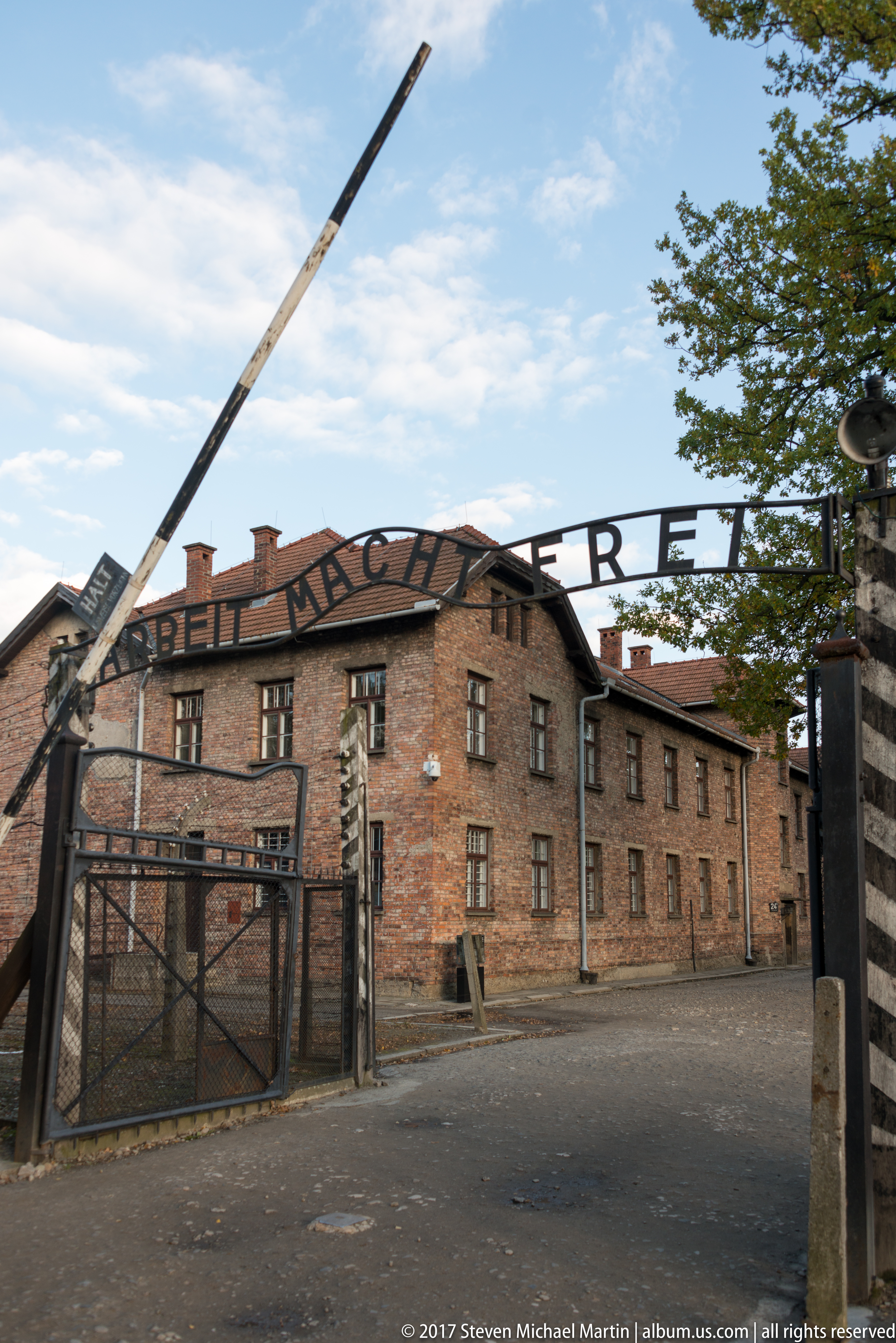
The Auschwitz I entrance is shown frontally beneath the curved iron “Arbeit macht frei” inscription. A raised barrier crosses the approach, and a gate and fence define the threshold before a long red-brick block. Compared with closer views of the sign, this composition emphasizes how the inscription, barrier, gate and camp architecture function together as an entrance sequence.
Caption
The Auschwitz I entrance is shown frontally beneath the curved iron “Arbeit macht frei” inscription. A raised barrier crosses the approach, and a gate and fence define the threshold before a long red-brick block. Compared with closer views of the sign, this composition emphasizes how the inscription, barrier, gate and camp architecture function together as an entrance sequence.

A gravel corridor stretches between parallel rows of curved concrete posts carrying dense strands of barbed wire at Auschwitz I. Lamps project inward from the fence line, and brick and stucco camp buildings stand beyond. The centered perspective turns the preserved security infrastructure into a long vanishing passage, conveying the controlled separation of spaces within the camp.
Caption
A gravel corridor stretches between parallel rows of curved concrete posts carrying dense strands of barbed wire at Auschwitz I. Lamps project inward from the fence line, and brick and stucco camp buildings stand beyond. The centered perspective turns the preserved security infrastructure into a long vanishing passage, conveying the controlled separation of spaces within the camp.

A freestanding wooden gallows structure stands in an open area between red-brick blocks at Auschwitz I. Two large rectangular openings pierce the upper section, and a small weather vane tops the hipped roof. Its dark, rough boards contrast with the surrounding masonry buildings. The nearby interpretive material identifies this area with the camp’s punishment and execution history.
Caption
A freestanding wooden gallows structure stands in an open area between red-brick blocks at Auschwitz I. Two large rectangular openings pierce the upper section, and a small weather vane tops the hipped roof. Its dark, rough boards contrast with the surrounding masonry buildings. The nearby interpretive material identifies this area with the camp’s punishment and execution history.

A long pale barrack with a rhythmic line of brick chimneys parallels a barbed-wire fence at Auschwitz I. The narrow gravel strip between building and fence leads toward a larger brick block in the distance. Backlighting and a dramatic sky silhouette the wire and posts, emphasizing the close spatial relationship between prisoner buildings and the camp’s security boundary.
Caption
A long pale barrack with a rhythmic line of brick chimneys parallels a barbed-wire fence at Auschwitz I. The narrow gravel strip between building and fence leads toward a larger brick block in the distance. Backlighting and a dramatic sky silhouette the wire and posts, emphasizing the close spatial relationship between prisoner buildings and the camp’s security boundary.

Open metal gates frame the Auschwitz I entrance from the camp side, with the “Arbeit macht frei” inscription reversed across the upper left and a guard tower rising behind a low wooden building. A small warning sign and concrete fence posts remain at the threshold. Bright autumn foliage contrasts with the stark preserved architecture of surveillance and controlled access.
Caption
Open metal gates frame the Auschwitz I entrance from the camp side, with the “Arbeit macht frei” inscription reversed across the upper left and a guard tower rising behind a low wooden building. A small warning sign and concrete fence posts remain at the threshold. Bright autumn foliage contrasts with the stark preserved architecture of surveillance and controlled access.

The entrance to Block 15 is set into a weathered red-brick façade at Auschwitz I. The number “15” is mounted beside the doorway, while dark commemorative or interpretive plaques flank the entrance. Concrete steps rise between low brick walls to a plain brown door, giving this close architectural view a strong focus on the block’s identifying number and formal threshold.
Caption
The entrance to Block 15 is set into a weathered red-brick façade at Auschwitz I. The number “15” is mounted beside the doorway, while dark commemorative or interpretive plaques flank the entrance. Concrete steps rise between low brick walls to a plain brown door, giving this close architectural view a strong focus on the block’s identifying number and formal threshold.

A multilingual interpretive panel explains the gallows at Auschwitz I and the public executions carried out there. The English text describes SS officer reporting procedures, prisoners standing at attention, and the use of the gallows for intimidation, including the largest execution on 19 July 1943. The sign also notes that the Auschwitz Museum reconstructed the gallows after the war.
Caption
A multilingual interpretive panel explains the gallows at Auschwitz I and the public executions carried out there. The English text describes SS officer reporting procedures, prisoners standing at attention, and the use of the gallows for intimidation, including the largest execution on 19 July 1943. The sign also notes that the Auschwitz Museum reconstructed the gallows after the war.

Heavy iron bars cover a large multi-pane window set into the worn brickwork of an Auschwitz I block. The close framing excludes most contextual features, concentrating attention on the layered metal grille, darkened panes and patched masonry around the opening. The security treatment distinguishes this window from the ordinary barrack windows seen elsewhere in the camp.
Caption
Heavy iron bars cover a large multi-pane window set into the worn brickwork of an Auschwitz I block. The close framing excludes most contextual features, concentrating attention on the layered metal grille, darkened panes and patched masonry around the opening. The security treatment distinguishes this window from the ordinary barrack windows seen elsewhere in the camp.

The symmetrical front of Block 19 at Auschwitz I is built of red brick with a simple gabled roof and evenly spaced rectangular windows. The number “19” appears beside the central doorway, reached by a short flight of steps. Warm low-angle sunlight and tree shadows reveal the irregular texture of the masonry while preserving a straightforward record of the block’s institutional façade.
Caption
The symmetrical front of Block 19 at Auschwitz I is built of red brick with a simple gabled roof and evenly spaced rectangular windows. The number “19” appears beside the central doorway, reached by a short flight of steps. Warm low-angle sunlight and tree shadows reveal the irregular texture of the masonry while preserving a straightforward record of the block’s institutional façade.

A multilingual historical panel stands among the brick blocks of Auschwitz I. Its English text summarizes the categories of prisoners held in the camp, including political prisoners and people deported from occupied Europe, and describes the lethal conditions imposed on inmates. The freestanding sign is photographed frontally so that the interpretive text, rather than surrounding architecture, is the principal subject.
Caption
A multilingual historical panel stands among the brick blocks of Auschwitz I. Its English text summarizes the categories of prisoners held in the camp, including political prisoners and people deported from occupied Europe, and describes the lethal conditions imposed on inmates. The freestanding sign is photographed frontally so that the interpretive text, rather than surrounding architecture, is the principal subject.
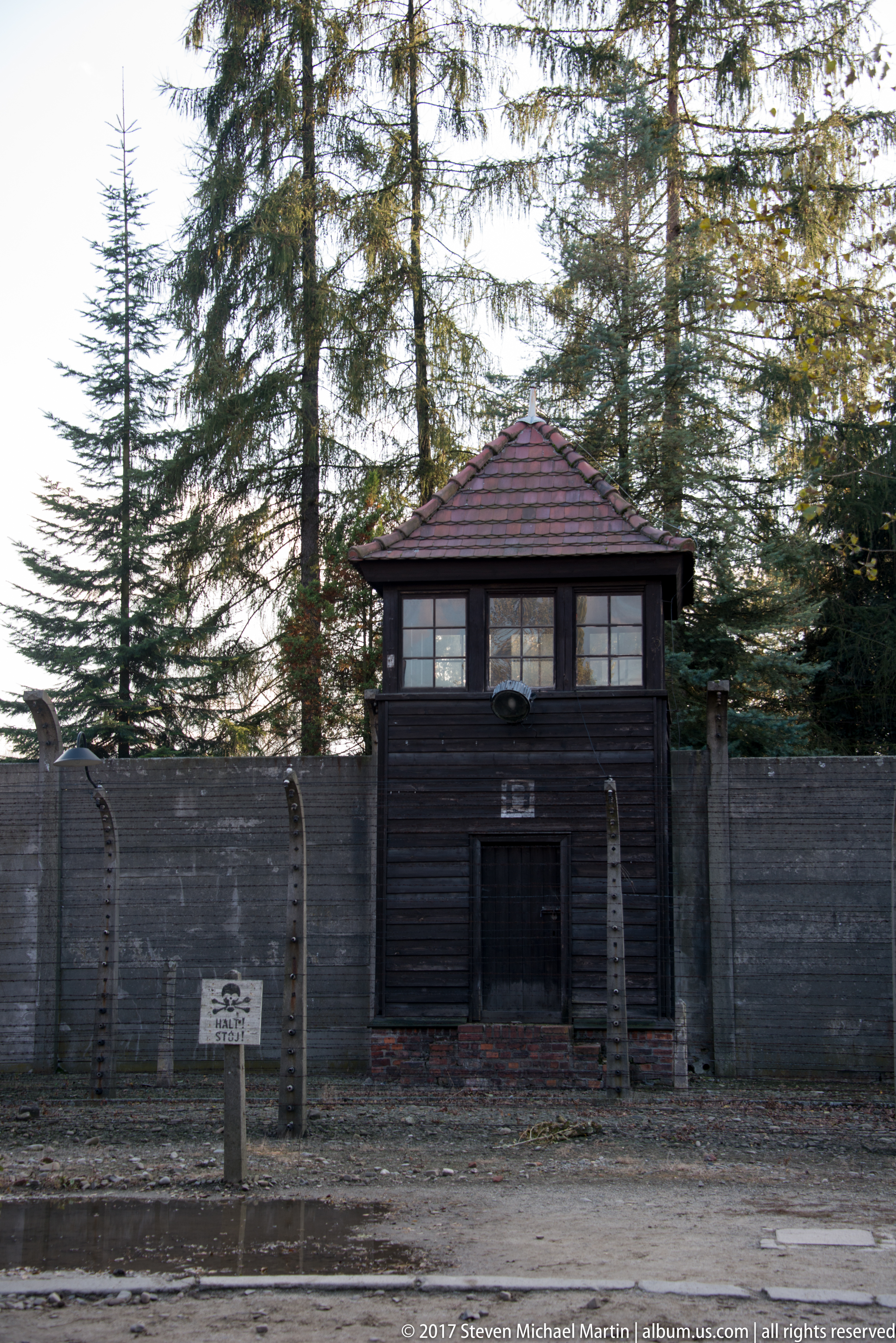
A dark wooden guard tower stands behind a high concrete-and-barbed-wire perimeter fence at Auschwitz I. The tower’s enclosed upper room and hipped roof rise above the barrier, while dense evergreen trees form a shaded backdrop. Seen from outside the fence line, the composition layers observation post, wall and wire into a compact study of the camp’s preserved security infrastructure.
Caption
A dark wooden guard tower stands behind a high concrete-and-barbed-wire perimeter fence at Auschwitz I. The tower’s enclosed upper room and hipped roof rise above the barrier, while dense evergreen trees form a shaded backdrop. Seen from outside the fence line, the composition layers observation post, wall and wire into a compact study of the camp’s preserved security infrastructure.

A bare washroom interior at Auschwitz contains a deep rectangular basin beneath a multi-pane window, with exposed plumbing and a small bench or low fixture in the foreground. Stained plaster walls and the almost complete absence of furnishings reinforce the room’s utilitarian character. Side light from the window reveals the worn surfaces and sparse sanitary provision of the preserved space.
Caption
A bare washroom interior at Auschwitz contains a deep rectangular basin beneath a multi-pane window, with exposed plumbing and a small bench or low fixture in the foreground. Stained plaster walls and the almost complete absence of furnishings reinforce the room’s utilitarian character. Side light from the window reveals the worn surfaces and sparse sanitary provision of the preserved space.

Late-afternoon light rakes across the long red-brick façade of an Auschwitz I block, picking out rows of white-framed windows and the rough masonry surface. A shallow puddle mirrors part of the building in the foreground. The oblique perspective emphasizes the block’s length and repetitive institutional design, while visitors at the far end provide a restrained sense of scale.
Caption
Late-afternoon light rakes across the long red-brick façade of an Auschwitz I block, picking out rows of white-framed windows and the rough masonry surface. A shallow puddle mirrors part of the building in the foreground. The oblique perspective emphasizes the block’s length and repetitive institutional design, while visitors at the far end provide a restrained sense of scale.

A black wooden sign painted “11 BLOCK” in white is mounted directly against weathered red brick at Auschwitz I. The tight crop removes almost all surrounding architecture, turning the block designation itself into the subject. Uneven mortar, chipped brick faces and the rough painted board provide material detail while unmistakably identifying the location as Block 11.
Caption
A black wooden sign painted “11 BLOCK” in white is mounted directly against weathered red brick at Auschwitz I. The tight crop removes almost all surrounding architecture, turning the block designation itself into the subject. Uneven mortar, chipped brick faces and the rough painted board provide material detail while unmistakably identifying the location as Block 11.

A sparse interior in Block 11 contains a narrow metal-framed bed, a plain wooden table, benches and a tall cupboard. Daylight enters through a multi-pane window, casting hard-edged patches of light across bare plaster walls and worn floorboards. The restrained furnishings and uncluttered arrangement convey the austere institutional character of the preserved room without assigning a specific occupant or use not visible here.
Caption
A sparse interior in Block 11 contains a narrow metal-framed bed, a plain wooden table, benches and a tall cupboard. Daylight enters through a multi-pane window, casting hard-edged patches of light across bare plaster walls and worn floorboards. The restrained furnishings and uncluttered arrangement convey the austere institutional character of the preserved room without assigning a specific occupant or use not visible here.

Heavy wooden bunk beds fill a dim room inside Block 11 at Auschwitz I. Thin mattresses or bedding lie on the lower bunks, while closely spaced timber frames create a dense, enclosed composition. Light from windows at the left and rear falls across the dark wood, revealing the simple construction and confined arrangement of the preserved sleeping furniture.
Caption
Heavy wooden bunk beds fill a dim room inside Block 11 at Auschwitz I. Thin mattresses or bedding lie on the lower bunks, while closely spaced timber frames create a dense, enclosed composition. Light from windows at the left and rear falls across the dark wood, revealing the simple construction and confined arrangement of the preserved sleeping furniture.

Striped prisoner garments hang from tall wooden lockers in a preserved interior at Auschwitz. Plain tables, stools and small bowls occupy the foreground, while daylight enters through two high windows. The carefully arranged room presents the clothing within an austere institutional setting, allowing the coarse striped fabric, simple furnishings and worn wall surfaces to be read together as material evidence of camp life.
Caption
Striped prisoner garments hang from tall wooden lockers in a preserved interior at Auschwitz. Plain tables, stools and small bowls occupy the foreground, while daylight enters through two high windows. The carefully arranged room presents the clothing within an austere institutional setting, allowing the coarse striped fabric, simple furnishings and worn wall surfaces to be read together as material evidence of camp life.

Wreaths, bouquets and individual flowers line the base of the reconstructed Execution Wall in the courtyard between Blocks 10 and 11 at Auschwitz I. The dark gray wall of absorbent material fills most of the frame, bordered by red brick above and at the sides. The concentrated memorial offerings mark the place where prisoners were shot during the camp’s operation.
Caption
Wreaths, bouquets and individual flowers line the base of the reconstructed Execution Wall in the courtyard between Blocks 10 and 11 at Auschwitz I. The dark gray wall of absorbent material fills most of the frame, bordered by red brick above and at the sides. The concentrated memorial offerings mark the place where prisoners were shot during the camp’s operation.
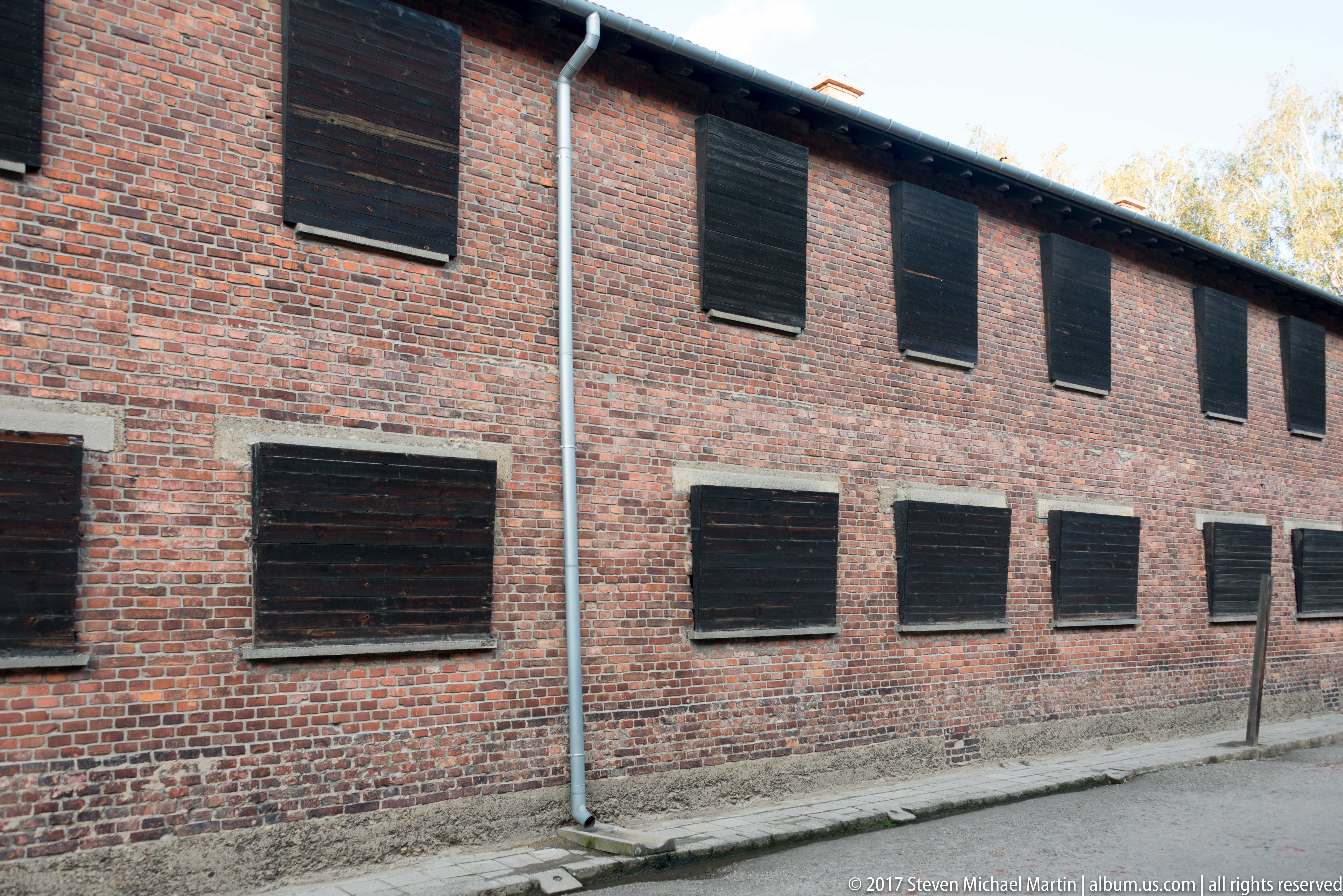
Rows of shuttered windows cover the red-brick façade of a camp block beside the Block 11 courtyard at Auschwitz I. Dark wooden coverings close both upper and lower openings, creating a stark repetitive pattern across the long wall. The treatment is associated with the enclosed courtyard area around the Execution Wall, where windows were screened from prisoners’ view.
Caption
Rows of shuttered windows cover the red-brick façade of a camp block beside the Block 11 courtyard at Auschwitz I. Dark wooden coverings close both upper and lower openings, creating a stark repetitive pattern across the long wall. The treatment is associated with the enclosed courtyard area around the Execution Wall, where windows were screened from prisoners’ view.

A narrow gravel street runs between parallel red-brick blocks at Auschwitz I, terminating at a smaller building and trees. Repeated windows, drainpipes and restrained façades create a strongly linear perspective, while the absence of visitors leaves the institutional layout unobstructed. The view records how closely spaced blocks and internal circulation routes structured this part of the camp.
Caption
A narrow gravel street runs between parallel red-brick blocks at Auschwitz I, terminating at a smaller building and trees. Repeated windows, drainpipes and restrained façades create a strongly linear perspective, while the absence of visitors leaves the institutional layout unobstructed. The view records how closely spaced blocks and internal circulation routes structured this part of the camp.

Large straw-filled mattresses cover the floor in a reconstructed early prisoner sleeping arrangement at Auschwitz. The accompanying English label states that until spring 1941 prisoners slept crowded together on straw mattresses and arranged them in the corner of the room each morning. The close view emphasizes the coarse, bulky bedding rather than the room itself, making the material conditions the central subject.
Caption
Large straw-filled mattresses cover the floor in a reconstructed early prisoner sleeping arrangement at Auschwitz. The accompanying English label states that until spring 1941 prisoners slept crowded together on straw mattresses and arranged them in the corner of the room each morning. The close view emphasizes the coarse, bulky bedding rather than the room itself, making the material conditions the central subject.

Rows of framed identification portraits cover a museum wall at Auschwitz, each pairing a prisoner’s face in striped camp clothing with a name, number and biographical information. The grid brings many individual records into a single field of view, shifting emphasis from one biography to the cumulative presence of named prisoners. Variations in age and facial expression remain visible despite the standardized format.
Caption
Rows of framed identification portraits cover a museum wall at Auschwitz, each pairing a prisoner’s face in striped camp clothing with a name, number and biographical information. The grid brings many individual records into a single field of view, shifting emphasis from one biography to the cumulative presence of named prisoners. Variations in age and facial expression remain visible despite the standardized format.

A framed memorial portrait identifies Władysław Polaczek, prisoner number 1296, wearing the striped Auschwitz uniform. The label records that he was born in Poland on 25 January 1915, deported to Auschwitz on 5 July 1940, and executed on 25 January 1943. The frontal identification photograph and biographical text restore a specific name and life history to one prisoner.
Caption
A framed memorial portrait identifies Władysław Polaczek, prisoner number 1296, wearing the striped Auschwitz uniform. The label records that he was born in Poland on 25 January 1915, deported to Auschwitz on 5 July 1940, and executed on 25 January 1943. The frontal identification photograph and biographical text restore a specific name and life history to one prisoner.

A framed memorial portrait identifies Stanisław Ostrowski, prisoner number 5940, in the striped Auschwitz uniform. The accompanying text records that he was born in Poland on 9 August 1907, deported on 8 October 1940, and died on 14 August 1942. Presented alone against a white mount, the portrait makes the prisoner’s face, name and recorded dates the focus.
Caption
A framed memorial portrait identifies Stanisław Ostrowski, prisoner number 5940, in the striped Auschwitz uniform. The accompanying text records that he was born in Poland on 9 August 1907, deported on 8 October 1940, and died on 14 August 1942. Presented alone against a white mount, the portrait makes the prisoner’s face, name and recorded dates the focus.

A wall map traces deportation routes from cities across occupied Europe toward Auschwitz, marked in red near the center. Radiating lines connect locations from western, northern, southern and eastern Europe, visualizing the camp’s continental reach. A multilingual heading above identifies the subject as the origins of prisoners deported to Auschwitz, while place names and route lines provide the principal visual evidence.
Caption
A wall map traces deportation routes from cities across occupied Europe toward Auschwitz, marked in red near the center. Radiating lines connect locations from western, northern, southern and eastern Europe, visualizing the camp’s continental reach. A multilingual heading above identifies the subject as the origins of prisoners deported to Auschwitz, while place names and route lines provide the principal visual evidence.

A dense accumulation of wire-framed eyeglasses fills the display, with circular and oval lenses appearing among tangled temples and frames. Preserved as personal property taken from deportees, the ordinary objects become evidence of the scale of dispossession at Auschwitz. The close composition removes the surrounding exhibition case and concentrates attention on repetition, fragility and individual variation within the mass.
Caption
A dense accumulation of wire-framed eyeglasses fills the display, with circular and oval lenses appearing among tangled temples and frames. Preserved as personal property taken from deportees, the ordinary objects become evidence of the scale of dispossession at Auschwitz. The close composition removes the surrounding exhibition case and concentrates attention on repetition, fragility and individual variation within the mass.

Small enamel and metal containers form a tightly packed museum display at Auschwitz, their chipped blue, white, red and green surfaces revealing long use before confiscation. Lids, cups and compact vessels overlap in a dense mass, preserving the domestic character of belongings carried by deportees. The close view emphasizes wear, variety and accumulation rather than any single owner or object.
Caption
Small enamel and metal containers form a tightly packed museum display at Auschwitz, their chipped blue, white, red and green surfaces revealing long use before confiscation. Lids, cups and compact vessels overlap in a dense mass, preserving the domestic character of belongings carried by deportees. The close view emphasizes wear, variety and accumulation rather than any single owner or object.

Long illuminated display cases hold large quantities of confiscated belongings at the Auschwitz museum. Seen across an open gallery between white structural columns, the objects form dense horizontal accumulations behind glass. The distant viewpoint emphasizes the scale of the collection and the exhibition architecture rather than individual items, presenting material evidence of deportation and dispossession as a continuous museum installation.
Caption
Long illuminated display cases hold large quantities of confiscated belongings at the Auschwitz museum. Seen across an open gallery between white structural columns, the objects form dense horizontal accumulations behind glass. The distant viewpoint emphasizes the scale of the collection and the exhibition architecture rather than individual items, presenting material evidence of deportation and dispossession as a continuous museum installation.

A vast pile of worn shoes fills the frame at the Auschwitz museum, ranging from sturdy dark leather footwear to smaller shoes with faded red, blue and green details. Scuffed soles, collapsed uppers and mismatched pairs preserve traces of individual use within a mass collection. The close viewpoint makes the accumulated personal belongings an immediate record of deportation and confiscation.
Caption
A vast pile of worn shoes fills the frame at the Auschwitz museum, ranging from sturdy dark leather footwear to smaller shoes with faded red, blue and green details. Scuffed soles, collapsed uppers and mismatched pairs preserve traces of individual use within a mass collection. The close viewpoint makes the accumulated personal belongings an immediate record of deportation and confiscation.

A narrow museum corridor at Auschwitz is flanked by tall glass cases densely filled with confiscated shoes. Queue posts guide visitors along the worn central floor toward a window at the far end, while the footwear rises in continuous banks on both sides. The symmetrical perspective conveys the extraordinary quantity of preserved belongings more strongly than a close view of any individual shoe.
Caption
A narrow museum corridor at Auschwitz is flanked by tall glass cases densely filled with confiscated shoes. Queue posts guide visitors along the worn central floor toward a window at the far end, while the footwear rises in continuous banks on both sides. The symmetrical perspective conveys the extraordinary quantity of preserved belongings more strongly than a close view of any individual shoe.

A hand-painted black sign reading “5 BLOCK” is fixed to weathered red brick beside a square metal-and-glass exterior lamp. The close architectural detail identifies Block 5 at Auschwitz I while preserving the rough textures of masonry, painted timber and aging hardware. The lamp’s translucent panels and projecting bracket add a functional element to the otherwise stark block designation.
Caption
A hand-painted black sign reading “5 BLOCK” is fixed to weathered red brick beside a square metal-and-glass exterior lamp. The close architectural detail identifies Block 5 at Auschwitz I while preserving the rough textures of masonry, painted timber and aging hardware. The lamp’s translucent panels and projecting bracket add a functional element to the otherwise stark block designation.

An English historical panel explains that Blocks 1–10 at Auschwitz I were used as a women’s camp until mid-August 1942, separated from the men’s camp by a high wall. It states that about 17,000 Jewish and non-Jewish women were held there and describes deaths from gassing and camp conditions before surviving prisoners were transferred to Sector BI of Auschwitz II-Birkenau.
Caption
An English historical panel explains that Blocks 1–10 at Auschwitz I were used as a women’s camp until mid-August 1942, separated from the men’s camp by a high wall. It states that about 17,000 Jewish and non-Jewish women were held there and describes deaths from gassing and camp conditions before surviving prisoners were transferred to Sector BI of Auschwitz II-Birkenau.

A large English text panel summarizes the scale of deportation and murder at Auschwitz between 1940 and 1945. It states that at least 1.3 million people were deported, including approximately 1.1 million Jews, 140,000–150,000 Poles, 23,000 Roma, 15,000 Soviet prisoners of war and 25,000 people from other groups, and that about 1.1 million people died there.
Caption
A large English text panel summarizes the scale of deportation and murder at Auschwitz between 1940 and 1945. It states that at least 1.3 million people were deported, including approximately 1.1 million Jews, 140,000–150,000 Poles, 23,000 Roma, 15,000 Soviet prisoners of war and 25,000 people from other groups, and that about 1.1 million people died there.

Through a multi-pane window, the Auschwitz I perimeter appears as parallel wire fences, a green strip of lawn and a low boundary wall beneath autumn trees. The interior window frame divides the scene into four panels, making the viewer’s position inside a camp building central to the composition. A birch trunk crosses the right panes, contrasting natural growth with the preserved security boundary.
Caption
Through a multi-pane window, the Auschwitz I perimeter appears as parallel wire fences, a green strip of lawn and a low boundary wall beneath autumn trees. The interior window frame divides the scene into four panels, making the viewer’s position inside a camp building central to the composition. A birch trunk crosses the right panes, contrasting natural growth with the preserved security boundary.

An outdoor interpretive panel combines a historical drawing of the camp with multilingual text explaining the development of Auschwitz. The illustration shows rows of barracks and surrounding structures from an elevated viewpoint, while the English section below discusses expansion of the camp complex. Photographed among foliage, the sign serves as a historical reconstruction set against the surviving site.
Caption
An outdoor interpretive panel combines a historical drawing of the camp with multilingual text explaining the development of Auschwitz. The illustration shows rows of barracks and surrounding structures from an elevated viewpoint, while the English section below discusses expansion of the camp complex. Photographed among foliage, the sign serves as a historical reconstruction set against the surviving site.

A white warning board mounted on a concrete post bears a black skull and crossbones above the bilingual command “HALT! STÓJ!” beside the Auschwitz I perimeter fence. Barbed wire, curved concrete posts and a camp block remain visible behind it. The sign’s stark graphic language warned prisoners of the lethal danger associated with approaching the electrified boundary.
Caption
A white warning board mounted on a concrete post bears a black skull and crossbones above the bilingual command “HALT! STÓJ!” beside the Auschwitz I perimeter fence. Barbed wire, curved concrete posts and a camp block remain visible behind it. The sign’s stark graphic language warned prisoners of the lethal danger associated with approaching the electrified boundary.

A regional site map locates the principal Auschwitz camp complexes around Oświęcim. Separate diagrams mark KL Auschwitz I, KL Auschwitz II-Birkenau and KL Auschwitz III-Monowitz, connected by roads, rail lines and waterways. The map places the preserved visitor sites within the wider industrial and transportation landscape, clarifying that Auschwitz functioned as a dispersed complex rather than a single enclosed camp.
Caption
A regional site map locates the principal Auschwitz camp complexes around Oświęcim. Separate diagrams mark KL Auschwitz I, KL Auschwitz II-Birkenau and KL Auschwitz III-Monowitz, connected by roads, rail lines and waterways. The map places the preserved visitor sites within the wider industrial and transportation landscape, clarifying that Auschwitz functioned as a dispersed complex rather than a single enclosed camp.

A long internal street at Auschwitz I recedes between red-brick blocks and rows of slender birch trees. Uneven pavement and shallow puddles occupy the center, while narrow grass strips soften the edges of the institutional buildings. The strong central perspective records the ordered layout of the camp blocks and the mature landscape that now surrounds the preserved architecture.
Caption
A long internal street at Auschwitz I recedes between red-brick blocks and rows of slender birch trees. Uneven pavement and shallow puddles occupy the center, while narrow grass strips soften the edges of the institutional buildings. The strong central perspective records the ordered layout of the camp blocks and the mature landscape that now surrounds the preserved architecture.

A close oblique view follows the Auschwitz I perimeter fence, where strands of barbed wire are carried on white porcelain insulators fixed to curved concrete posts. Red-brick blocks and a narrow path run parallel behind the barrier. The repeated insulators provide direct evidence of the fence’s electrical installation, while the receding posts create a strong visual rhythm along the camp boundary.
Caption
A close oblique view follows the Auschwitz I perimeter fence, where strands of barbed wire are carried on white porcelain insulators fixed to curved concrete posts. Red-brick blocks and a narrow path run parallel behind the barrier. The repeated insulators provide direct evidence of the fence’s electrical installation, while the receding posts create a strong visual rhythm along the camp boundary.

Parallel strands of barbed wire cut across a blue, clouded sky in a tightly framed detail of the Auschwitz perimeter. With buildings and posts largely excluded, the repeated twisted wire and sharp barbs become the sole subject. The shallow, graphic composition isolates the material element most closely associated with the camp’s physical confinement rather than presenting the fence as an architectural whole.
Caption
Parallel strands of barbed wire cut across a blue, clouded sky in a tightly framed detail of the Auschwitz perimeter. With buildings and posts largely excluded, the repeated twisted wire and sharp barbs become the sole subject. The shallow, graphic composition isolates the material element most closely associated with the camp’s physical confinement rather than presenting the fence as an architectural whole.

A concrete perimeter post at Auschwitz I fills the foreground, with white porcelain insulators carrying several strands of barbed wire across the frame. A long red-brick camp block falls softly out of focus behind it. The shallow depth of field shifts attention from the broader boundary to the hardware that electrically isolated the wire from its supporting post.
Caption
A concrete perimeter post at Auschwitz I fills the foreground, with white porcelain insulators carrying several strands of barbed wire across the frame. A long red-brick camp block falls softly out of focus behind it. The shallow depth of field shifts attention from the broader boundary to the hardware that electrically isolated the wire from its supporting post.

The gabled red-brick façade of Block 23 at Auschwitz I faces a narrow paved approach enclosed by concrete fence posts and wire. The number “23” is visible beside the central wooden doorway, reached by a short flight of steps. Evenly spaced windows and simple masonry give the building the same restrained institutional character as neighboring prisoner blocks.
Caption
The gabled red-brick façade of Block 23 at Auschwitz I faces a narrow paved approach enclosed by concrete fence posts and wire. The number “23” is visible beside the central wooden doorway, reached by a short flight of steps. Evenly spaced windows and simple masonry give the building the same restrained institutional character as neighboring prisoner blocks.

The skull-and-crossbones warning and the words “HALT! STÓJ!” fill the frame in this close view of an Auschwitz I perimeter sign. Painted in black on a pale board attached to a concrete post, the blunt bilingual command is isolated from most of the surrounding fence. A blurred camp building behind keeps the location legible while directing attention to the warning itself.
Caption
The skull-and-crossbones warning and the words “HALT! STÓJ!” fill the frame in this close view of an Auschwitz I perimeter sign. Painted in black on a pale board attached to a concrete post, the blunt bilingual command is isolated from most of the surrounding fence. A blurred camp building behind keeps the location legible while directing attention to the warning itself.

A narrow gravel corridor runs between parallel electrified barbed-wire fences at Auschwitz I, with curved concrete posts and ceramic insulators forming a dense security barrier. Brick camp buildings flank the passage, while an elevated wooden guard tower rises near its far end. The oblique perspective records the layered fencing, confined circulation space and surveillance architecture as an integrated part of the camp perimeter.
Caption
A narrow gravel corridor runs between parallel electrified barbed-wire fences at Auschwitz I, with curved concrete posts and ceramic insulators forming a dense security barrier. Brick camp buildings flank the passage, while an elevated wooden guard tower rises near its far end. The oblique perspective records the layered fencing, confined circulation space and surveillance architecture as an integrated part of the camp perimeter.

The stark interior of the gas chamber in Crematorium I at Auschwitz I is defined by bare concrete floors, stained masonry walls and a low ceiling punctuated by openings and modern lighting. The largely empty room preserves the severe enclosed volume associated with the camp’s early killing facility. Its worn surfaces and minimal architectural detail distinguish the space from the adjacent cremation-furnace room.
Caption
The stark interior of the gas chamber in Crematorium I at Auschwitz I is defined by bare concrete floors, stained masonry walls and a low ceiling punctuated by openings and modern lighting. The largely empty room preserves the severe enclosed volume associated with the camp’s early killing facility. Its worn surfaces and minimal architectural detail distinguish the space from the adjacent cremation-furnace room.

Brick-built cremation furnaces occupy the preserved interior of Crematorium I at Auschwitz I. Heavy arched iron furnace doors project from the masonry, with smaller ash-removal doors below and metal fittings connecting the paired openings. The close three-quarter view emphasizes the industrial construction of the ovens and their relationship to the brick furnace mass within the former camp crematorium.
Caption
Brick-built cremation furnaces occupy the preserved interior of Crematorium I at Auschwitz I. Heavy arched iron furnace doors project from the masonry, with smaller ash-removal doors below and metal fittings connecting the paired openings. The close three-quarter view emphasizes the industrial construction of the ovens and their relationship to the brick furnace mass within the former camp crematorium.

A weathered German warning sign beside the Auschwitz I perimeter reads “VORSICHT! Hochspannung Lebensgefahr,” warning of deadly high voltage. Mounted low beside concrete fence posts and multiple wire strands, the sign makes the electrical function of the preserved barrier explicit. Red-brick camp blocks extend behind the fence, tying the warning directly to the security infrastructure surrounding the prisoner area.
Caption
A weathered German warning sign beside the Auschwitz I perimeter reads “VORSICHT! Hochspannung Lebensgefahr,” warning of deadly high voltage. Mounted low beside concrete fence posts and multiple wire strands, the sign makes the electrical function of the preserved barrier explicit. Red-brick camp blocks extend behind the fence, tying the warning directly to the security infrastructure surrounding the prisoner area.

The electrified perimeter fence extends through the Auschwitz I grounds between red-brick blocks and a dark wooden camp building. Concrete posts and repeated wire strands recede toward a distant gate or observation point, while grass and mature trees occupy the open strip alongside the barrier. The wider composition closes the portfolio with a contextual view of security infrastructure embedded in the camp’s preserved architectural landscape.
Caption
The electrified perimeter fence extends through the Auschwitz I grounds between red-brick blocks and a dark wooden camp building. Concrete posts and repeated wire strands recede toward a distant gate or observation point, while grass and mature trees occupy the open strip alongside the barrier. The wider composition closes the portfolio with a contextual view of security infrastructure embedded in the camp’s preserved architectural landscape.
⭐ Highlights
- Auschwitz I and Auschwitz II-Birkenau: The two main parts of the largest Nazi concentration and extermination camp.
- Historic Site of the Holocaust: The camp became the central site of mass murder during World War II.
- Preserved Structures: Barracks, watchtowers, fences, and ruins remain as evidence of the camp system.
- Birkenau Railway Tracks: The arrival point for deportees entering the camp.
- Memorial and Museum: The site is preserved to honor victims and educate future generations.
- UNESCO World Heritage Site: Recognized as a place of global historical importance.
🕯️ Auschwitz-Birkenau Field Guide
Major features observed during this visit:
Auschwitz-Birkenau is the largest concentration and extermination camp established by Nazi Germany during World War II. Located in occupied Poland, it became the central site of the systematic murder of European Jews, as well as the imprisonment and death of Poles, Roma, Soviet prisoners of war, and others. Today, the preserved remains of the camp serve as a memorial and museum, bearing witness to one of the most devastating events in human history.
🏛️ Site Structure
- Auschwitz I – The original camp, containing administrative buildings and preserved exhibits.
- Auschwitz II-Birkenau – The larger extermination camp, with vast open grounds and ruins of gas chambers and crematoria.
- Railway Platform – The entry point where deportees arrived and were selected upon arrival.
- Prisoner Barracks – Rows of buildings reflecting the living conditions of those imprisoned.
- Fences and Watchtowers – Elements of the camp’s controlled and enclosed system.
🧠 Historical Significance
- World War II Atrocities – The camp was a central site of the Holocaust and Nazi extermination policies.
- Mass Murder – Over one million people were killed at Auschwitz, most of them Jews.
- Symbol of the Holocaust – Auschwitz has become the most widely recognized symbol of genocide in the 20th century.
- Postwar Memorial – The site was preserved after the war as a place of remembrance and education.
🌄 Setting & Experience
- Memorial Landscape – The site extends across large open areas with preserved and ruined structures.
- Atmosphere of Reflection – The environment emphasizes remembrance and historical awareness.
- Minimal Interpretation – Much of the impact comes from the preserved physical remains.
- Global Significance – Visitors come from around the world to understand and reflect on its history.