Fushimi Inari Taisha
Fushimi Inari Taisha is one of Japan’s most important Shinto shrines, dedicated to Inari, the deity associated with rice, prosperity, and commerce. Founded in the eighth century, the shrine reflects the connection between agricultural success and religious practice in early Japanese society. Its location at the base of Mount Inari emphasizes the spiritual importance of sacred landscapes.
The shrine is known for its thousands of vermilion torii gates forming pathways up the mountainside. These gates were traditionally donated by merchants and individuals seeking blessings for success in business and trade. The repetition of architectural elements illustrates continuity in devotional practice over many centuries.
Fushimi Inari Taisha represents the integration of religious belief with economic life in Japanese cultural tradition. The shrine’s distinctive pathways reflect the enduring importance of Shinto practices within Japanese society.

A monumental vermilion torii frames the upper story of the Rōmon, the formal entrance gate to Fushimi Inari Taisha. The layered composition brings together two defining elements of the shrine approach: the simple post-and-lintel form of the torii and the richly bracketed, tiled-roof architecture beyond. Their saturated red-orange surfaces stand out against trees, sky, and dark rooflines.
Caption
A monumental vermilion torii frames the upper story of the Rōmon, the formal entrance gate to Fushimi Inari Taisha. The layered composition brings together two defining elements of the shrine approach: the simple post-and-lintel form of the torii and the richly bracketed, tiled-roof architecture beyond. Their saturated red-orange surfaces stand out against trees, sky, and dark rooflines.

Visitors move beneath a vermilion torii toward the Rōmon, whose upper pavilion rises above the crowded approach. The wider view places the shrine entrance within its active urban-edge setting, with railings, trees, lanterns, and nearby buildings enclosing the route. Human scale emphasizes the size of both the torii and gate while showing the precinct as a functioning place of worship and pilgrimage.
Caption
Visitors move beneath a vermilion torii toward the Rōmon, whose upper pavilion rises above the crowded approach. The wider view places the shrine entrance within its active urban-edge setting, with railings, trees, lanterns, and nearby buildings enclosing the route. Human scale emphasizes the size of both the torii and gate while showing the precinct as a functioning place of worship and pilgrimage.

A visitor walks toward the camera through a long, tightly spaced succession of vermilion torii. Alternating posts, overhead lintels, and dark protective bases frame the figure at the center of the gravel path. The view emphasizes both the depth of the corridor and the physical experience of following the shrine route through an architecture created by repeated individual donations.
Caption
A visitor walks toward the camera through a long, tightly spaced succession of vermilion torii. Alternating posts, overhead lintels, and dark protective bases frame the figure at the center of the gravel path. The view emphasizes both the depth of the corridor and the physical experience of following the shrine route through an architecture created by repeated individual donations.

The front of a principal worship building extends beneath a broad dark roof, its vermilion columns and white wall panels defining a rhythmic façade. Shimenawa ropes, paper streamers, hanging lanterns, and offerings mark the active ritual zone, while visitors gather along the railing below. The wide composition emphasizes the building’s horizontal scale and the relationship between architecture, devotion, and daily use.
Caption
The front of a principal worship building extends beneath a broad dark roof, its vermilion columns and white wall panels defining a rhythmic façade. Shimenawa ropes, paper streamers, hanging lanterns, and offerings mark the active ritual zone, while visitors gather along the railing below. The wide composition emphasizes the building’s horizontal scale and the relationship between architecture, devotion, and daily use.

A visitor in a vivid blue kimono poses beside a vermilion-and-green railing within the shrine precinct. Large red, white, green, and gold floral motifs cover the garment, while the subdued wood, stone, and painted architectural surfaces behind her create a contrasting frame. The portrait records contemporary participation in the site’s cultural setting without obscuring the surrounding shrine architecture.
Caption
A visitor in a vivid blue kimono poses beside a vermilion-and-green railing within the shrine precinct. Large red, white, green, and gold floral motifs cover the garment, while the subdued wood, stone, and painted architectural surfaces behind her create a contrasting frame. The portrait records contemporary participation in the site’s cultural setting without obscuring the surrounding shrine architecture.

A roofed temizuya occupies the foreground of the entrance precinct, providing a place for ritual purification before visitors proceed farther into the shrine. Its broad tiled roof, vermilion posts, hanging white paper streamers, and stone basin contrast with the taller Rōmon rising behind. The layered view shows how practical ritual facilities and monumental architecture organize movement through the sacred complex.
Caption
A roofed temizuya occupies the foreground of the entrance precinct, providing a place for ritual purification before visitors proceed farther into the shrine. Its broad tiled roof, vermilion posts, hanging white paper streamers, and stone basin contrast with the taller Rōmon rising behind. The layered view shows how practical ritual facilities and monumental architecture organize movement through the sacred complex.

A visitor in a blue shirt raises both arms beneath the vermilion torii, creating a lively human gesture within the strict geometry of the corridor. Repeating posts and lintels frame the central figure, while people farther along the path introduce depth and ongoing activity. The view distinguishes itself from the adjacent portrait through the more animated pose and visible background traffic.
Caption
A visitor in a blue shirt raises both arms beneath the vermilion torii, creating a lively human gesture within the strict geometry of the corridor. Repeating posts and lintels frame the central figure, while people farther along the path introduce depth and ongoing activity. The view distinguishes itself from the adjacent portrait through the more animated pose and visible background traffic.

A full-length portrait places a visitor in a blue shirt at the center of the Senbon Torii. Closely spaced vermilion posts rise on both sides, while the overhead lintels diminish toward the opening behind him. The symmetrical framing turns the corridor into a powerful environmental backdrop and makes the scale and density of the shrine gates immediately legible.
Caption
A full-length portrait places a visitor in a blue shirt at the center of the Senbon Torii. Closely spaced vermilion posts rise on both sides, while the overhead lintels diminish toward the opening behind him. The symmetrical framing turns the corridor into a powerful environmental backdrop and makes the scale and density of the shrine gates immediately legible.

A bronze kitsune sits upright with a key held horizontally in its mouth, framed by the vermilion brackets of the shrine gate. The key is one of the traditional attributes carried by Inari’s fox messengers and alludes to access, guardianship, and the protection of storehouses. A red votive bib and tassels add a devotional layer to the sharply modeled figure.
Caption
A bronze kitsune sits upright with a key held horizontally in its mouth, framed by the vermilion brackets of the shrine gate. The key is one of the traditional attributes carried by Inari’s fox messengers and alludes to access, guardianship, and the protection of storehouses. A red votive bib and tassels add a devotional layer to the sharply modeled figure.

A visitor stands with both arms extended inside the Senbon Torii, where closely spaced vermilion posts and lintels form a vivid architectural corridor. The gently rising stone path and repeating black bases create strong linear perspective, while the figure supplies human scale. The composition records the immersive experience of moving through the shrine’s celebrated sequence of donated gates.
Caption
A visitor stands with both arms extended inside the Senbon Torii, where closely spaced vermilion posts and lintels form a vivid architectural corridor. The gently rising stone path and repeating black bases create strong linear perspective, while the figure supplies human scale. The composition records the immersive experience of moving through the shrine’s celebrated sequence of donated gates.

The Rōmon rises above a broad stone stair in a frontal view that reveals its two-story elevation, deep bracketed eaves, white wall panels, and vermilion structural frame. Visitors gather beneath the central passage, while a stone fox guardian stands on a pedestal to the right. The juxtaposition links the shrine’s monumental entrance architecture with the fox imagery associated with Inari worship.
Caption
The Rōmon rises above a broad stone stair in a frontal view that reveals its two-story elevation, deep bracketed eaves, white wall panels, and vermilion structural frame. Visitors gather beneath the central passage, while a stone fox guardian stands on a pedestal to the right. The juxtaposition links the shrine’s monumental entrance architecture with the fox imagery associated with Inari worship.

A seated bronze fox guardian rises against the sky beside the shrine’s vermilion architecture, wearing a red votive bib with gold trim. Its upright ears, alert posture, and stylized tail identify it as a kitsune, the messenger traditionally associated with Inari worship. The low viewpoint gives the statue a commanding presence while preserving the carved brackets and roofline around it.
Caption
A seated bronze fox guardian rises against the sky beside the shrine’s vermilion architecture, wearing a red votive bib with gold trim. Its upright ears, alert posture, and stylized tail identify it as a kitsune, the messenger traditionally associated with Inari worship. The low viewpoint gives the statue a commanding presence while preserving the carved brackets and roofline around it.

A suspended wooden lantern projects beneath elaborately painted shrine eaves, its white panels enclosed by a green frame and supported by orange-and-green ornamental brackets. Curving copper roof edges, carved details, and layered vermilion beams surround the fixture, turning a functional source of illumination into an architectural ornament. The close view isolates the precise color relationships and craftsmanship that animate the shrine precinct.
Caption
A suspended wooden lantern projects beneath elaborately painted shrine eaves, its white panels enclosed by a green frame and supported by orange-and-green ornamental brackets. Curving copper roof edges, carved details, and layered vermilion beams surround the fixture, turning a functional source of illumination into an architectural ornament. The close view isolates the precise color relationships and craftsmanship that animate the shrine precinct.

A seated stone or metal kitsune holds a golden sheaf of rice in its mouth above a pedestal inscribed in gold. The grain refers to Inari’s longstanding association with rice, agricultural abundance, and prosperity. Photographed from below against the shrine roof and open sky, the guardian appears monumental, while its patterned red bib introduces a vivid devotional accent.
Caption
A seated stone or metal kitsune holds a golden sheaf of rice in its mouth above a pedestal inscribed in gold. The grain refers to Inari’s longstanding association with rice, agricultural abundance, and prosperity. Photographed from below against the shrine roof and open sky, the guardian appears monumental, while its patterned red bib introduces a vivid devotional accent.

A weathered stone kitsune sits alert beside the massive post and crossbeam of a vermilion torii. The guardian’s pointed ears, lifted tail, and forward-facing posture contrast with the smooth painted surface of the gate, while a bright red votive bib draws attention to its devotional role. Dense greenery and passing visitors place the sculpture within the active shrine approach.
Caption
A weathered stone kitsune sits alert beside the massive post and crossbeam of a vermilion torii. The guardian’s pointed ears, lifted tail, and forward-facing posture contrast with the smooth painted surface of the gate, while a bright red votive bib draws attention to its devotional role. Dense greenery and passing visitors place the sculpture within the active shrine approach.

An ornate curved gable crowns the entrance to a shrine building, where painted carving, gilded details, and a dense row of white paper streamers animate the façade. Visitors line the threshold beneath the sweeping roof, giving a clear sense of scale and active use. The view concentrates on the richly decorated portal rather than the broader precinct around it.
Caption
An ornate curved gable crowns the entrance to a shrine building, where painted carving, gilded details, and a dense row of white paper streamers animate the façade. Visitors line the threshold beneath the sweeping roof, giving a clear sense of scale and active use. The view concentrates on the richly decorated portal rather than the broader precinct around it.

A close architectural study isolates the shrine’s undulating gable, layered roof edge, gilded cresting, painted relief, and suspended white paper streamers. The compressed framing reveals how curving forms, carved ornament, and saturated vermilion surfaces are combined to create a ceremonial focal point above the entrance. Small details that recede in wider views become the principal subject here.
Caption
A close architectural study isolates the shrine’s undulating gable, layered roof edge, gilded cresting, painted relief, and suspended white paper streamers. The compressed framing reveals how curving forms, carved ornament, and saturated vermilion surfaces are combined to create a ceremonial focal point above the entrance. Small details that recede in wider views become the principal subject here.

A steeply pitched shrine gable rises above deep purple ceremonial curtains marked with large white chrysanthemum crests. Gilded fittings accent the triangular pediment and roof edges, while the dark timber frame creates a restrained backdrop for the bright emblems below. The tightly framed view emphasizes the formal symmetry of the façade and the visual role of textiles in defining the sacred entrance.
Caption
A steeply pitched shrine gable rises above deep purple ceremonial curtains marked with large white chrysanthemum crests. Gilded fittings accent the triangular pediment and roof edges, while the dark timber frame creates a restrained backdrop for the bright emblems below. The tightly framed view emphasizes the formal symmetry of the façade and the visual role of textiles in defining the sacred entrance.

Long bands of red, white, yellow, and green fabric stream horizontally from a tall pole against a changing blue-and-gray sky. A leafy branch fixed at the pole’s summit adds a natural element to the otherwise spare composition. Isolated from the surrounding architecture, the photograph records the movement, color, and temporary ceremonial character of the shrine precinct.
Caption
Long bands of red, white, yellow, and green fabric stream horizontally from a tall pole against a changing blue-and-gray sky. A leafy branch fixed at the pole’s summit adds a natural element to the otherwise spare composition. Isolated from the surrounding architecture, the photograph records the movement, color, and temporary ceremonial character of the shrine precinct.

Two visitors in patterned kimono stand in profile amid the activity of the shrine precinct. Pale floral hair ornaments decorate their carefully arranged hairstyles, while soft green and gold fabrics distinguish the two figures from the darker crowd behind them. The close composition focuses on contemporary dress and personal presentation rather than the surrounding architecture.
Caption
Two visitors in patterned kimono stand in profile amid the activity of the shrine precinct. Pale floral hair ornaments decorate their carefully arranged hairstyles, while soft green and gold fabrics distinguish the two figures from the darker crowd behind them. The close composition focuses on contemporary dress and personal presentation rather than the surrounding architecture.

A curved entrance gable projects from a larger tiled-roof building, combining dark wood, white wall panels, gilded fittings, and vermilion structural elements. Purple curtains with chrysanthemum crests hang across the opening, while white paper streamers mark the ritual threshold below. The frontal view clarifies how the smaller ceremonial entrance is integrated into the broader architectural elevation.
Caption
A curved entrance gable projects from a larger tiled-roof building, combining dark wood, white wall panels, gilded fittings, and vermilion structural elements. Purple curtains with chrysanthemum crests hang across the opening, while white paper streamers mark the ritual threshold below. The frontal view clarifies how the smaller ceremonial entrance is integrated into the broader architectural elevation.

A front-facing stone kitsune stands rigidly on a carved pedestal before dense green foliage. Its broad chest, pointed ears, curled tail, and uplifted head create a more imposing silhouette than the neighboring side view, while the red bib sharply contrasts with the weathered stone. The isolated composition emphasizes the guardian’s sculptural form and protective presence.
Caption
A front-facing stone kitsune stands rigidly on a carved pedestal before dense green foliage. Its broad chest, pointed ears, curled tail, and uplifted head create a more imposing silhouette than the neighboring side view, while the red bib sharply contrasts with the weathered stone. The isolated composition emphasizes the guardian’s sculptural form and protective presence.

Visitors pass through the celebrated tunnel of closely spaced vermilion torii, where repeating pillars and lintels compress the perspective into a vivid corridor of color. The centered composition emphasizes the immersive experience created by hundreds of donated shrine gates.
Caption
Visitors pass through the celebrated tunnel of closely spaced vermilion torii, where repeating pillars and lintels compress the perspective into a vivid corridor of color. The centered composition emphasizes the immersive experience created by hundreds of donated shrine gates.

The rear view of a pale kimono emphasizes the carefully tied obi and layered decorative bow, complemented by a floral hair ornament. Soft colors contrast with blurred vermilion torii in the background, drawing attention to textile craftsmanship and personal presentation within the shrine precinct.
Caption
The rear view of a pale kimono emphasizes the carefully tied obi and layered decorative bow, complemented by a floral hair ornament. Soft colors contrast with blurred vermilion torii in the background, drawing attention to textile craftsmanship and personal presentation within the shrine precinct.

A monumental vermilion torii spans the forested approach to the shrine, framing visitors entering one of Fushimi Inari Taisha's most recognizable sacred routes. The heavy lintel, cylindrical pillars, and black upper beam contrast with surrounding greenery, emphasizing the symbolic transition from the everyday landscape into ritual space.
Caption
A monumental vermilion torii spans the forested approach to the shrine, framing visitors entering one of Fushimi Inari Taisha's most recognizable sacred routes. The heavy lintel, cylindrical pillars, and black upper beam contrast with surrounding greenery, emphasizing the symbolic transition from the everyday landscape into ritual space.

A compact vermilion shrine with a green copper roof stands beside a tall stone monument and informational sign. Its symmetrical façade, lattice doors, and fenced platform illustrate the smaller devotional structures distributed throughout the Fushimi Inari complex.
Caption
A compact vermilion shrine with a green copper roof stands beside a tall stone monument and informational sign. Its symmetrical façade, lattice doors, and fenced platform illustrate the smaller devotional structures distributed throughout the Fushimi Inari complex.

Successive vermilion torii recede along the pathway while a gilded dedication plaque hangs beneath the nearest lintel. The oblique perspective highlights the repeating rhythm of donated gates that has become the defining visual identity of Fushimi Inari Taisha.
Caption
Successive vermilion torii recede along the pathway while a gilded dedication plaque hangs beneath the nearest lintel. The oblique perspective highlights the repeating rhythm of donated gates that has become the defining visual identity of Fushimi Inari Taisha.

The view looks straight through an uninterrupted corridor of vermilion torii whose black inscriptions identify individual donors. Strong linear perspective draws the eye toward a distant shrine structure while revealing the dense sequence of gates that defines the pilgrimage route.
Caption
The view looks straight through an uninterrupted corridor of vermilion torii whose black inscriptions identify individual donors. Strong linear perspective draws the eye toward a distant shrine structure while revealing the dense sequence of gates that defines the pilgrimage route.

A smiling visitor is photographed against softly blurred vermilion torii, using the repeating shrine gates as a colorful backdrop. The shallow depth of field separates the subject from the sacred setting while preserving enough architectural context to identify the location.
Caption
A smiling visitor is photographed against softly blurred vermilion torii, using the repeating shrine gates as a colorful backdrop. The shallow depth of field separates the subject from the sacred setting while preserving enough architectural context to identify the location.

A traditional stone lantern stands beside the pilgrimage route enclosed by closely spaced vermilion torii. The repeating gates create a rhythmic architectural backdrop while black donor inscriptions and alternating light emphasize the depth of the sacred corridor leading uphill through the shrine grounds.
Caption
A traditional stone lantern stands beside the pilgrimage route enclosed by closely spaced vermilion torii. The repeating gates create a rhythmic architectural backdrop while black donor inscriptions and alternating light emphasize the depth of the sacred corridor leading uphill through the shrine grounds.

Sunlight streams through gaps between successive vermilion torii, creating alternating bands of light and shadow across the pilgrimage passage. The compressed perspective highlights the remarkable density of donated gates while the empty walkway draws attention to the geometry of the repeating wooden structure.
Caption
Sunlight streams through gaps between successive vermilion torii, creating alternating bands of light and shadow across the pilgrimage passage. The compressed perspective highlights the remarkable density of donated gates while the empty walkway draws attention to the geometry of the repeating wooden structure.

A smiling visitor pauses within the closely spaced torii, where bright vermilion pillars covered with black donor inscriptions frame the portrait. The composition balances the individual subject with one of Japan's most recognizable pilgrimage settings while preserving the strong linear rhythm of the surrounding gates.
Caption
A smiling visitor pauses within the closely spaced torii, where bright vermilion pillars covered with black donor inscriptions frame the portrait. The composition balances the individual subject with one of Japan's most recognizable pilgrimage settings while preserving the strong linear rhythm of the surrounding gates.

A visitor stands centered within the glowing passage of vermilion torii while other pilgrims continue along the route behind. A hanging lantern and repeating structural frames reinforce the ceremonial character of the shrine path while shallow depth of field keeps attention on the foreground portrait.
Caption
A visitor stands centered within the glowing passage of vermilion torii while other pilgrims continue along the route behind. A hanging lantern and repeating structural frames reinforce the ceremonial character of the shrine path while shallow depth of field keeps attention on the foreground portrait.

Visitors walk toward the camera through the narrow passage formed by hundreds of donated vermilion torii. Dense black inscriptions cover the pillars, documenting donors while emphasizing the continuous architectural rhythm that distinguishes Fushimi Inari Taisha's celebrated pilgrimage route.
Caption
Visitors walk toward the camera through the narrow passage formed by hundreds of donated vermilion torii. Dense black inscriptions cover the pillars, documenting donors while emphasizing the continuous architectural rhythm that distinguishes Fushimi Inari Taisha's celebrated pilgrimage route.

A close architectural study centers on a shrine gable decorated with a heavy shimenawa rope and hanging white shide paper streamers. Vermilion beams, white wall panels, and gilded cresting combine to create a refined ceremonial façade expressing the architectural vocabulary of a Shinto sanctuary.
Caption
A close architectural study centers on a shrine gable decorated with a heavy shimenawa rope and hanging white shide paper streamers. Vermilion beams, white wall panels, and gilded cresting combine to create a refined ceremonial façade expressing the architectural vocabulary of a Shinto sanctuary.

Two visitors wearing traditional Japanese kimono walk together beneath mature trees bordering the torii pilgrimage route. Dark and pale garments provide visual contrast while the repeating vermilion gates in the background connect the portrait to the distinctive landscape of Fushimi Inari Taisha.
Caption
Two visitors wearing traditional Japanese kimono walk together beneath mature trees bordering the torii pilgrimage route. Dark and pale garments provide visual contrast while the repeating vermilion gates in the background connect the portrait to the distinctive landscape of Fushimi Inari Taisha.

Three kimono-clad visitors pause beneath tall trees while looking toward the winding torii corridors crossing the wooded hillside. The composition combines traditional dress, forest landscape, and sacred architecture into a broader view of the pilgrimage environment.
Caption
Three kimono-clad visitors pause beneath tall trees while looking toward the winding torii corridors crossing the wooded hillside. The composition combines traditional dress, forest landscape, and sacred architecture into a broader view of the pilgrimage environment.
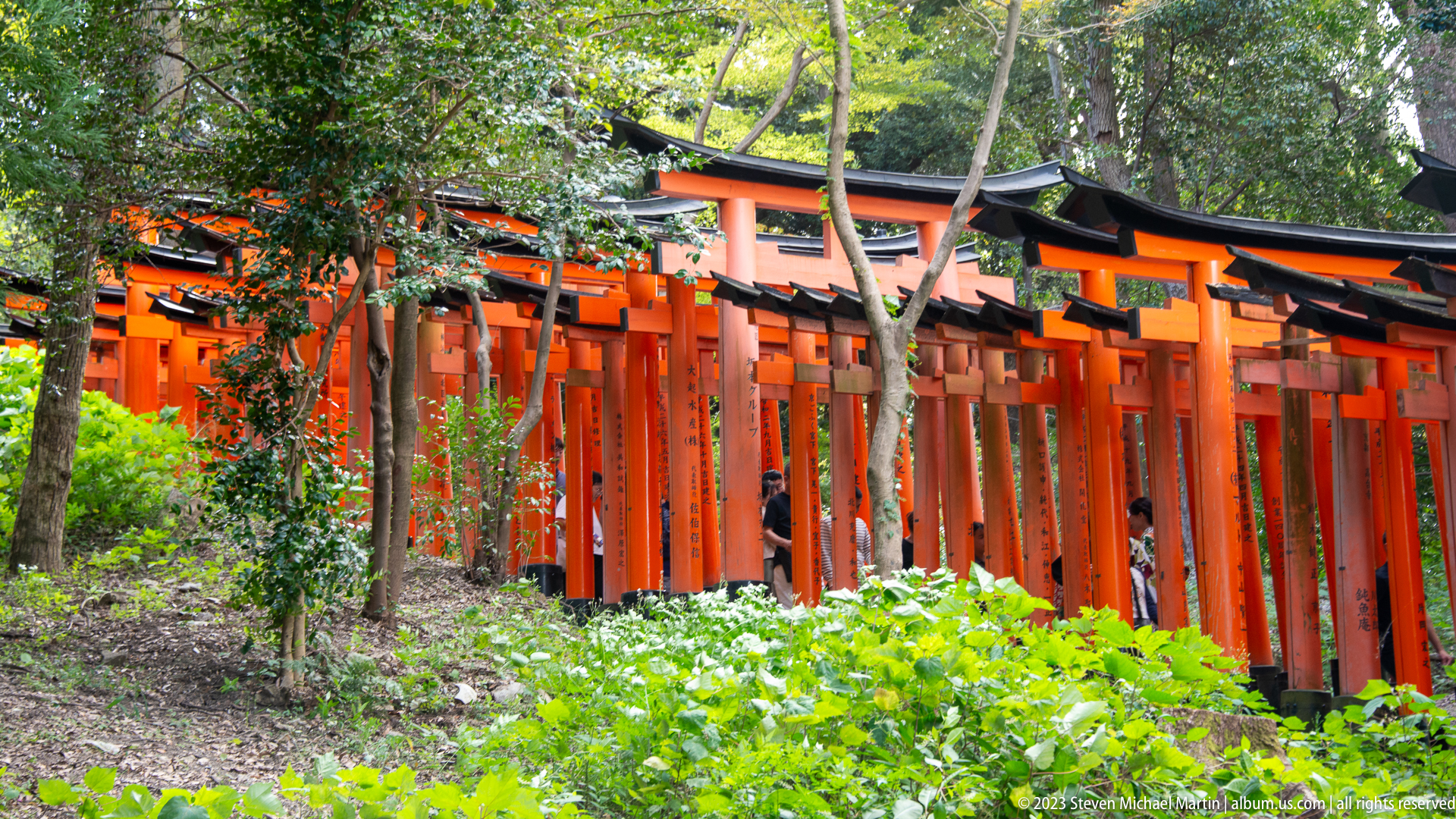
Long rows of vermilion torii climb through the wooded hillside, illustrating how the shrine's donated gates weave through the natural landscape. The elevated viewpoint reveals repeating rooflines, dense vegetation, and the layered progression of the pilgrimage route.
Caption
Long rows of vermilion torii climb through the wooded hillside, illustrating how the shrine's donated gates weave through the natural landscape. The elevated viewpoint reveals repeating rooflines, dense vegetation, and the layered progression of the pilgrimage route.

Viewed through trunks and foliage, the vermilion torii create a striking geometric pattern across the forest floor. The natural framing emphasizes the close relationship between sacred architecture and the wooded slopes of Mount Inari.
Caption
Viewed through trunks and foliage, the vermilion torii create a striking geometric pattern across the forest floor. The natural framing emphasizes the close relationship between sacred architecture and the wooded slopes of Mount Inari.

A smiling couple pose before the repeating vermilion torii that define the pilgrimage route through Fushimi Inari Taisha. Their traditional clothing and relaxed expressions create an engaging environmental portrait while the softly receding gates establish a strong sense of place.
Caption
A smiling couple pose before the repeating vermilion torii that define the pilgrimage route through Fushimi Inari Taisha. Their traditional clothing and relaxed expressions create an engaging environmental portrait while the softly receding gates establish a strong sense of place.

A smiling couple dressed in traditional Japanese clothing pause beside the vermilion torii, using the repeating shrine gates as a vivid backdrop. The close composition balances portraiture with architectural context, highlighting the enduring popularity of Fushimi Inari Taisha as both a place of worship and a cultural destination.
Caption
A smiling couple dressed in traditional Japanese clothing pause beside the vermilion torii, using the repeating shrine gates as a vivid backdrop. The close composition balances portraiture with architectural context, highlighting the enduring popularity of Fushimi Inari Taisha as both a place of worship and a cultural destination.

Successive vermilion torii extend into the distance, creating a powerful sense of depth through repeating structural forms and alternating light. The gently curving path guides the eye through the celebrated shrine corridor while donor inscriptions reinforce the collective tradition behind each gate.
Caption
Successive vermilion torii extend into the distance, creating a powerful sense of depth through repeating structural forms and alternating light. The gently curving path guides the eye through the celebrated shrine corridor while donor inscriptions reinforce the collective tradition behind each gate.

A visitor stands with outstretched arms beneath the repeating vermilion torii, using the vivid architectural corridor as a playful environmental backdrop. The centered composition records both the scale of the donated gates and the immersive character of the pilgrimage route through Fushimi Inari Taisha.
Caption
A visitor stands with outstretched arms beneath the repeating vermilion torii, using the vivid architectural corridor as a playful environmental backdrop. The centered composition records both the scale of the donated gates and the immersive character of the pilgrimage route through Fushimi Inari Taisha.

Standing within the narrow corridor of closely spaced vermilion torii, a couple in traditional clothing pose beneath the repeating lintels. The perspective emphasizes the remarkable depth of the shrine path while preserving the human scale of the pilgrimage experience.
Caption
Standing within the narrow corridor of closely spaced vermilion torii, a couple in traditional clothing pose beneath the repeating lintels. The perspective emphasizes the remarkable depth of the shrine path while preserving the human scale of the pilgrimage experience.

A full-length portrait places a traditionally dressed couple within the uninterrupted sequence of donated torii. The bright vermilion gates frame the figures symmetrically, combining portrait photography with one of Japan's most recognizable sacred architectural settings.
Caption
A full-length portrait places a traditionally dressed couple within the uninterrupted sequence of donated torii. The bright vermilion gates frame the figures symmetrically, combining portrait photography with one of Japan's most recognizable sacred architectural settings.

The empty pathway curves gently through an uninterrupted succession of vermilion torii, emphasizing the rhythm created by repeating pillars, lintels, and black foundations. Without visitors, the photograph focuses entirely on the architectural geometry and contemplative atmosphere of the pilgrimage route.
Caption
The empty pathway curves gently through an uninterrupted succession of vermilion torii, emphasizing the rhythm created by repeating pillars, lintels, and black foundations. Without visitors, the photograph focuses entirely on the architectural geometry and contemplative atmosphere of the pilgrimage route.

A carved stone lantern stands beside a long exterior row of vermilion torii, introducing a contrasting vertical form among the painted wooden posts. Black inscriptions mark the gates, while rooflike upper beams, cables, ground vegetation, and glimpses of the path reveal the corridor’s construction from the side. The photograph emphasizes materials, structure, and the relationship between lantern and sacred route.
Caption
A carved stone lantern stands beside a long exterior row of vermilion torii, introducing a contrasting vertical form among the painted wooden posts. Black inscriptions mark the gates, while rooflike upper beams, cables, ground vegetation, and glimpses of the path reveal the corridor’s construction from the side. The photograph emphasizes materials, structure, and the relationship between lantern and sacred route.

A child in a bright pink floral kimono walks across the gravel while wearing a white fox mask decorated with red and blue markings. The oversized sleeves and patterned obi animate the movement, and accompanying adults remain partially visible behind. At Fushimi Inari Taisha, the fox imagery connects visually with the kitsune guardians associated with Inari, though the child’s exact occasion is not established.
Caption
A child in a bright pink floral kimono walks across the gravel while wearing a white fox mask decorated with red and blue markings. The oversized sleeves and patterned obi animate the movement, and accompanying adults remain partially visible behind. At Fushimi Inari Taisha, the fox imagery connects visually with the kitsune guardians associated with Inari, though the child’s exact occasion is not established.

A monumental vermilion torii bearing a hanging dedication plaque frames the entrance to another sequence of shrine gates. Visitors gather beneath the gateway while successive torii recede into the wooded hillside, illustrating how individual donated structures combine to form the celebrated pilgrimage route through Fushimi Inari Taisha.
Caption
A monumental vermilion torii bearing a hanging dedication plaque frames the entrance to another sequence of shrine gates. Visitors gather beneath the gateway while successive torii recede into the wooded hillside, illustrating how individual donated structures combine to form the celebrated pilgrimage route through Fushimi Inari Taisha.

A weathered stone kitsune guardian sits alert on its pedestal beneath spreading tree branches. The bright red votive bib contrasts with the gray stone while the low viewpoint emphasizes the sculpture's protective presence within the shrine precinct.
Caption
A weathered stone kitsune guardian sits alert on its pedestal beneath spreading tree branches. The bright red votive bib contrasts with the gray stone while the low viewpoint emphasizes the sculpture's protective presence within the shrine precinct.

Seen from a slightly oblique angle, a monumental torii with a suspended dedication plaque stands before additional rows of vermilion gates. Stone lanterns, forest vegetation, and wooden structures frame the approach, placing the architecture within its natural hillside setting.
Caption
Seen from a slightly oblique angle, a monumental torii with a suspended dedication plaque stands before additional rows of vermilion gates. Stone lanterns, forest vegetation, and wooden structures frame the approach, placing the architecture within its natural hillside setting.

An adult and child wearing colorful kimono walk with another companion along the gently curving gravel approach beneath mature trees. Seen from behind, the group leads the eye toward the shrine precinct while illustrating contemporary visitor experience within the wooded landscape of Mount Inari.
Caption
An adult and child wearing colorful kimono walk with another companion along the gently curving gravel approach beneath mature trees. Seen from behind, the group leads the eye toward the shrine precinct while illustrating contemporary visitor experience within the wooded landscape of Mount Inari.

A gently curving pathway passes between stone lanterns and mature woodland before reaching a vivid concentration of vermilion torii. The composition emphasizes the transition from forest landscape to sacred architecture while preserving the tranquil character of the pilgrimage route.
Caption
A gently curving pathway passes between stone lanterns and mature woodland before reaching a vivid concentration of vermilion torii. The composition emphasizes the transition from forest landscape to sacred architecture while preserving the tranquil character of the pilgrimage route.

A compact shrine building stands beyond a vermilion torii and paired stone lanterns. Vermilion fences, timber structures, and mature trees create an intimate devotional setting illustrating the many subsidiary shrines distributed throughout the Fushimi Inari complex.
Caption
A compact shrine building stands beyond a vermilion torii and paired stone lanterns. Vermilion fences, timber structures, and mature trees create an intimate devotional setting illustrating the many subsidiary shrines distributed throughout the Fushimi Inari complex.

A close frontal portrait isolates a stone kitsune guardian against dense green foliage. Pointed ears, raised tail, carved facial features, and a vivid red votive bib distinguish the protective figure while the tight framing concentrates attention on sculptural form and expression.
Caption
A close frontal portrait isolates a stone kitsune guardian against dense green foliage. Pointed ears, raised tail, carved facial features, and a vivid red votive bib distinguish the protective figure while the tight framing concentrates attention on sculptural form and expression.

A seated bronze kitsune guardian overlooks the shrine precinct while wearing a bright red votive bib and an ornamental neck cloth. The polished metal surface contrasts with surrounding stone lanterns and trees, emphasizing the guardian's symbolic association with Inari worship.
Caption
A seated bronze kitsune guardian overlooks the shrine precinct while wearing a bright red votive bib and an ornamental neck cloth. The polished metal surface contrasts with surrounding stone lanterns and trees, emphasizing the guardian's symbolic association with Inari worship.

A smiling visitor poses beside a display of miniature vermilion torii, providing a cheerful concluding portrait for the portfolio. The repeated small gates echo the monumental Senbon Torii encountered throughout the shrine while reinforcing the identity of Fushimi Inari Taisha.
Caption
A smiling visitor poses beside a display of miniature vermilion torii, providing a cheerful concluding portrait for the portfolio. The repeated small gates echo the monumental Senbon Torii encountered throughout the shrine while reinforcing the identity of Fushimi Inari Taisha.

Vermilion columns frame a ceremonial interior where a suspended lantern hangs before decorative panels and ritual furnishings. The symmetrical composition highlights traditional Shinto architectural detailing while drawing attention to the shrine's carefully arranged sacred space.
Caption
Vermilion columns frame a ceremonial interior where a suspended lantern hangs before decorative panels and ritual furnishings. The symmetrical composition highlights traditional Shinto architectural detailing while drawing attention to the shrine's carefully arranged sacred space.

Hundreds of folded white paper fortunes are tied to supporting wires and rails, creating a dense lattice of wishes and prayers. The repeating forms document the widespread Shinto practice of leaving omikuji at shrines after receiving a fortune.
Caption
Hundreds of folded white paper fortunes are tied to supporting wires and rails, creating a dense lattice of wishes and prayers. The repeating forms document the widespread Shinto practice of leaving omikuji at shrines after receiving a fortune.

Purple ceremonial curtains displaying large white chrysanthemum crests hang across the open front of a worship hall. The broad timber roof, ritual furnishings, and symmetrical arrangement emphasize the formal character of the sacred space.
Caption
Purple ceremonial curtains displaying large white chrysanthemum crests hang across the open front of a worship hall. The broad timber roof, ritual furnishings, and symmetrical arrangement emphasize the formal character of the sacred space.

A weathered stone kitsune guardian wearing a red votive bib stands on a pedestal beside a vermilion torii, with shrine buildings beyond. The composition combines two of Fushimi Inari Taisha's defining visual symbols into a single architectural study.
Caption
A weathered stone kitsune guardian wearing a red votive bib stands on a pedestal beside a vermilion torii, with shrine buildings beyond. The composition combines two of Fushimi Inari Taisha's defining visual symbols into a single architectural study.

A compact vermilion subsidiary shrine stands beneath mature trees beside a tall stone monument and orientation signs. Its green copper roof, lattice-front sanctuary, and protective fence illustrate the smaller devotional buildings distributed throughout the Fushimi Inari Taisha precinct.
Caption
A compact vermilion subsidiary shrine stands beneath mature trees beside a tall stone monument and orientation signs. Its green copper roof, lattice-front sanctuary, and protective fence illustrate the smaller devotional buildings distributed throughout the Fushimi Inari Taisha precinct.

A photographer pauses within the Senbon Torii holding a camera while other visitors continue through the narrow corridor behind. Bright vermilion posts and black bases frame the portrait, conveying both the scale of the donated gates and the lively atmosphere of the pilgrimage route.
Caption
A photographer pauses within the Senbon Torii holding a camera while other visitors continue through the narrow corridor behind. Bright vermilion posts and black bases frame the portrait, conveying both the scale of the donated gates and the lively atmosphere of the pilgrimage route.

A close architectural study looks through successive vermilion torii whose black donor inscriptions line the pillars. A traditional hanging lantern reinforces the ceremonial character of the corridor while the repeating gates create a powerful sense of depth.
Caption
A close architectural study looks through successive vermilion torii whose black donor inscriptions line the pillars. A traditional hanging lantern reinforces the ceremonial character of the corridor while the repeating gates create a powerful sense of depth.

Sunlight washes across the closely spaced vermilion torii, producing alternating bands of light and shadow along the narrow walkway. The uninterrupted rhythm of posts and lintels emphasizes the immersive architectural experience of the shrine's famous pilgrimage route.
Caption
Sunlight washes across the closely spaced vermilion torii, producing alternating bands of light and shadow along the narrow walkway. The uninterrupted rhythm of posts and lintels emphasizes the immersive architectural experience of the shrine's famous pilgrimage route.

A photographer carrying camera equipment walks toward the viewer through densely inscribed vermilion torii. The centered figure provides scale while rows of donated gates recede into the distance, emphasizing the remarkable continuity of the Senbon Torii.
Caption
A photographer carrying camera equipment walks toward the viewer through densely inscribed vermilion torii. The centered figure provides scale while rows of donated gates recede into the distance, emphasizing the remarkable continuity of the Senbon Torii.

A photographer pauses inside a corridor of inscribed vermilion torii while holding a camera at chest level. The repeating architectural forms and converging perspective transform the shrine passage into a dramatic environmental portrait setting.
Caption
A photographer pauses inside a corridor of inscribed vermilion torii while holding a camera at chest level. The repeating architectural forms and converging perspective transform the shrine passage into a dramatic environmental portrait setting.

A cluster of weathered carved stone memorial monuments stands on a raised masonry platform beside a vermilion torii. The varied shapes and inscriptions reflect generations of devotional offerings while surrounding trees create a quiet woodland setting within the Fushimi Inari Taisha precinct.
Caption
A cluster of weathered carved stone memorial monuments stands on a raised masonry platform beside a vermilion torii. The varied shapes and inscriptions reflect generations of devotional offerings while surrounding trees create a quiet woodland setting within the Fushimi Inari Taisha precinct.

A large wooden information and dedication board is densely covered with vertical Japanese inscriptions arranged in orderly columns. Positioned along the forested shrine path, the display records information for visitors while demonstrating the extensive use of written text within the shrine environment.
Caption
A large wooden information and dedication board is densely covered with vertical Japanese inscriptions arranged in orderly columns. Positioned along the forested shrine path, the display records information for visitors while demonstrating the extensive use of written text within the shrine environment.

Two traditional carved stone lanterns stand among mature trees beside the shrine path. Their weathered granite surfaces, broad roofs, and pedestal bases illustrate enduring elements of the sacred landscape that complement the surrounding woodland.
Caption
Two traditional carved stone lanterns stand among mature trees beside the shrine path. Their weathered granite surfaces, broad roofs, and pedestal bases illustrate enduring elements of the sacred landscape that complement the surrounding woodland.

A tall stone kitsune guardian stands prominently on its pedestal overlooking the shrine grounds. The vivid red votive bib contrasts with the gray stone while surrounding trees provide a natural backdrop associated with the sacred slopes of Mount Inari.
Caption
A tall stone kitsune guardian stands prominently on its pedestal overlooking the shrine grounds. The vivid red votive bib contrasts with the gray stone while surrounding trees provide a natural backdrop associated with the sacred slopes of Mount Inari.