National Museum of Cambodia
The National Museum of Cambodia houses one of the most significant collections of Khmer art and sculpture spanning more than a millennium of history. The museum’s architecture incorporates traditional Khmer design elements reflecting regional artistic heritage. Its collections provide important context for understanding the development of Angkorian civilization.
Artifacts include stone sculpture, bronze figures, ceramics, and decorative objects illustrating religious and cultural traditions associated with both Hinduism and Buddhism. Many works originate from temple complexes throughout Cambodia, demonstrating the artistic sophistication of Khmer craftsmen. The museum preserves objects that illustrate the evolution of Khmer artistic styles.
The National Museum of Cambodia serves as an important resource for understanding the cultural legacy of the Khmer Empire. Its collections provide insight into the artistic achievements that influenced Southeast Asian architecture and religious expression.

Sunlight, deep shadow, and towering cumulus clouds dramatize this broad courtyard view of the museum’s entrance tower, red roofs, clipped hedges, and tropical plantings. The wider framing reveals the varied roofline extending across the complex and situates the formal architecture within a lush garden setting, emphasizing both the monumentality and accessibility of the museum grounds.
Caption
Sunlight, deep shadow, and towering cumulus clouds dramatize this broad courtyard view of the museum’s entrance tower, red roofs, clipped hedges, and tropical plantings. The wider framing reveals the varied roofline extending across the complex and situates the formal architecture within a lush garden setting, emphasizing both the monumentality and accessibility of the museum grounds.

Set within a deeply carved architectural niche, the seated Buddha is surrounded by attendants, foliage, and layered ornamental borders. The symmetry concentrates attention on the central figure while the elaborate frame evokes a sacred architectural setting in miniature. Rather than acting as mere decoration, the surrounding carving establishes the Buddha’s status and organizes the viewer’s approach to the image.
Caption
Set within a deeply carved architectural niche, the seated Buddha is surrounded by attendants, foliage, and layered ornamental borders. The symmetry concentrates attention on the central figure while the elaborate frame evokes a sacred architectural setting in miniature. Rather than acting as mere decoration, the surrounding carving establishes the Buddha’s status and organizes the viewer’s approach to the image.

Burned and unburned incense sticks crowd a silver-colored holder shaped like an open lotus, while small glasses of clear and amber liquid form an offering group around its base. The arrangement records living devotional practice within the museum grounds, where ritual gestures continue alongside the preservation and interpretation of Cambodia’s historic religious art.
Caption
Burned and unburned incense sticks crowd a silver-colored holder shaped like an open lotus, while small glasses of clear and amber liquid form an offering group around its base. The arrangement records living devotional practice within the museum grounds, where ritual gestures continue alongside the preservation and interpretation of Cambodia’s historic religious art.

Several sandstone Buddhist reliefs are grouped around a large seated Buddha, with smaller attendants and stele fragments arranged nearby. The installation encourages comparison of carving depth, posture, ornament, and preservation across related objects. Seen together, the fragments suggest how devotional images once participated in larger architectural or ritual settings rather than functioning as isolated museum pieces.
Caption
Several sandstone Buddhist reliefs are grouped around a large seated Buddha, with smaller attendants and stele fragments arranged nearby. The installation encourages comparison of carving depth, posture, ornament, and preservation across related objects. Seen together, the fragments suggest how devotional images once participated in larger architectural or ritual settings rather than functioning as isolated museum pieces.

Rows of seated and standing Buddhist sculptures extend through the gallery in a carefully ordered sequence, creating a broad view of the museum’s religious collection. Variations in scale, material, gesture, and preservation become visible across the room. The symmetrical display also shows how the historic interior shapes the experience of moving among devotional objects once intended for temples and shrines.
Caption
Rows of seated and standing Buddhist sculptures extend through the gallery in a carefully ordered sequence, creating a broad view of the museum’s religious collection. Variations in scale, material, gesture, and preservation become visible across the room. The symmetrical display also shows how the historic interior shapes the experience of moving among devotional objects once intended for temples and shrines.

Layered red-tiled roofs rise toward the museum’s slender central tower, their ridges punctuated by flame-like finials that animate the silhouette against a clear sky. Viewed at close range, the roofscape shows how traditional Khmer forms were translated into a unified twentieth-century museum complex, balancing ceremonial vertical accents with long, sheltering roof planes.
Caption
Layered red-tiled roofs rise toward the museum’s slender central tower, their ridges punctuated by flame-like finials that animate the silhouette against a clear sky. Viewed at close range, the roofscape shows how traditional Khmer forms were translated into a unified twentieth-century museum complex, balancing ceremonial vertical accents with long, sheltering roof planes.

Two white water lilies bloom on the surface of a quiet pond within the museum gardens. The flowers provide a peaceful botanical contrast to the surrounding archaeological collections and traditional Khmer architecture.
Caption
Two white water lilies bloom on the surface of a quiet pond within the museum gardens. The flowers provide a peaceful botanical contrast to the surrounding archaeological collections and traditional Khmer architecture.

A seated Buddha anchors the foreground while two standing Buddhist figures rise behind it, creating a layered grouping rather than an isolated object study. Differences in pose, scale, and preservation suggest distinct roles within a devotional ensemble. The arrangement also shows how Cambodian Buddhist sculpture developed multiple visual types for meditation, teaching, protection, and attendance.
Caption
A seated Buddha anchors the foreground while two standing Buddhist figures rise behind it, creating a layered grouping rather than an isolated object study. Differences in pose, scale, and preservation suggest distinct roles within a devotional ensemble. The arrangement also shows how Cambodian Buddhist sculpture developed multiple visual types for meditation, teaching, protection, and attendance.

Garuda stands with feathered wings spread, arms extended, and powerful legs planted at the head of the museum stair. The frontal symmetry and avian features give the pale stone figure a commanding guardian presence. In Hindu and Buddhist traditions, Garuda is both a divine being and an adversary of serpents, making the sculpture especially resonant within Khmer religious imagery.
Caption
Garuda stands with feathered wings spread, arms extended, and powerful legs planted at the head of the museum stair. The frontal symmetry and avian features give the pale stone figure a commanding guardian presence. In Hindu and Buddhist traditions, Garuda is both a divine being and an adversary of serpents, making the sculpture especially resonant within Khmer religious imagery.

An alternate view of the same courtyard sculpture emphasizes the symmetry of the surrounding museum buildings, clipped hedges, and covered walkway framing the seated figure.
Caption
An alternate view of the same courtyard sculpture emphasizes the symmetry of the surrounding museum buildings, clipped hedges, and covered walkway framing the seated figure.

Crowded with human figures, architectural forms, and ornamental borders, this triangular pediment transforms a temple gable into a narrative field. Deep carving creates overlapping layers and strong shadows, allowing the scene to remain legible at architectural height. Although the specific episode cannot be determined from the proof sheet, the relief clearly demonstrates the storytelling capacity of Khmer sacred architecture.
Caption
Crowded with human figures, architectural forms, and ornamental borders, this triangular pediment transforms a temple gable into a narrative field. Deep carving creates overlapping layers and strong shadows, allowing the scene to remain legible at architectural height. Although the specific episode cannot be determined from the proof sheet, the relief clearly demonstrates the storytelling capacity of Khmer sacred architecture.

Behind palms and clipped plantings, the National Museum of Cambodia presents a long red façade crowned by steep tiled roofs, curling finials, and a tiered central tower. Designed in a Khmer Revival idiom, the building prepares visitors for the religious sculpture, bronzes, and decorative arts preserved inside while establishing the museum itself as part of Cambodia’s modern architectural heritage.
Caption
Behind palms and clipped plantings, the National Museum of Cambodia presents a long red façade crowned by steep tiled roofs, curling finials, and a tiered central tower. Designed in a Khmer Revival idiom, the building prepares visitors for the religious sculpture, bronzes, and decorative arts preserved inside while establishing the museum itself as part of Cambodia’s modern architectural heritage.

Vegetal carving fills this triangular gable beneath overlapping red tiles, while slender finials extend from the ridge and eaves to sharpen the roofline against the sky. The close view reveals how the museum’s Khmer Revival architecture draws ornamental energy from traditional temple forms, integrating sculptural detail throughout the building rather than reserving it for the principal entrance.
Caption
Vegetal carving fills this triangular gable beneath overlapping red tiles, while slender finials extend from the ridge and eaves to sharpen the roofline against the sky. The close view reveals how the museum’s Khmer Revival architecture draws ornamental energy from traditional temple forms, integrating sculptural detail throughout the building rather than reserving it for the principal entrance.

Potted plants and flowering branches partially veil the museum’s red façade and rising central tower, turning the courtyard into a layered composition of architecture and cultivated landscape. The low viewpoint softens the building’s formal symmetry and shows how shaded gardens, verandas, and steep gables work together to create an intimate cultural precinct rather than a detached civic monument.
Caption
Potted plants and flowering branches partially veil the museum’s red façade and rising central tower, turning the courtyard into a layered composition of architecture and cultivated landscape. The low viewpoint softens the building’s formal symmetry and shows how shaded gardens, verandas, and steep gables work together to create an intimate cultural precinct rather than a detached civic monument.

A weathered seated bull serves as a devotional focus beside the garden pond, with incense, drinking glasses, and other offerings placed directly before it. The frontal posture, horns, and ornamental bands suggest a sacred bovine figure, possibly associated with Hindu worship. Because no label is visible, the precise identity is best left open pending confirmation from the museum catalog.
Caption
A weathered seated bull serves as a devotional focus beside the garden pond, with incense, drinking glasses, and other offerings placed directly before it. The frontal posture, horns, and ornamental bands suggest a sacred bovine figure, possibly associated with Hindu worship. Because no label is visible, the precise identity is best left open pending confirmation from the museum catalog.

A white-and-brown tabby cat pauses on the paved museum grounds and fixes the camera with an alert, direct gaze. Its upright ears, extended tail, and compact seated posture create a self-contained animal portrait against the patterned pavement. The encounter introduces an unscripted note of everyday life into a portfolio otherwise devoted to architecture, sculpture, and ritual objects.
Caption
A white-and-brown tabby cat pauses on the paved museum grounds and fixes the camera with an alert, direct gaze. Its upright ears, extended tail, and compact seated posture create a self-contained animal portrait against the patterned pavement. The encounter introduces an unscripted note of everyday life into a portfolio otherwise devoted to architecture, sculpture, and ritual objects.

Two admission tickets preserve the practical beginning of the museum visit, each printed with Khmer script, barcodes, serial information, and the date 04 OCT 2023. Their plain administrative design contrasts with the richly ornamented building and collection, yet the tickets provide an exact documentary marker for when the surrounding photographs were made.
Caption
Two admission tickets preserve the practical beginning of the museum visit, each printed with Khmer script, barcodes, serial information, and the date 04 OCT 2023. Their plain administrative design contrasts with the richly ornamented building and collection, yet the tickets provide an exact documentary marker for when the surrounding photographs were made.

Broad shoulders, bent arms, and firmly planted legs give this weathered stone figure a compact, protective presence amid dense greenery. Erosion has softened the face and surface ornament, but the frontal stance still suggests a guardian or attendant associated with a religious or architectural setting. Its exact identity, date, and provenance require confirmation from museum documentation.
Caption
Broad shoulders, bent arms, and firmly planted legs give this weathered stone figure a compact, protective presence amid dense greenery. Erosion has softened the face and surface ornament, but the frontal stance still suggests a guardian or attendant associated with a religious or architectural setting. Its exact identity, date, and provenance require confirmation from museum documentation.

An ornate pavilion frames a seated stone sculpture on the courtyard’s central axis, linking the garden foreground with the surrounding galleries. Its layered roofs, dark carved gable, and tiered finial create a ceremonial threshold while concentrating attention on the sculpture below. The composition demonstrates how the museum uses architecture to guide movement and focus visual attention.
Caption
An ornate pavilion frames a seated stone sculpture on the courtyard’s central axis, linking the garden foreground with the surrounding galleries. Its layered roofs, dark carved gable, and tiered finial create a ceremonial threshold while concentrating attention on the sculpture below. The composition demonstrates how the museum uses architecture to guide movement and focus visual attention.

Set against the museum’s red colonnade and balustrade, this weathered standing figure gains visual force from the contrast between softened stone and crisp architectural geometry. Bent arms, a broad torso, and a frontal stance give the sculpture a compact monumentality. The exact subject is uncertain, but its outdoor placement recalls the relationship between Khmer sculpture and architectural settings.
Caption
Set against the museum’s red colonnade and balustrade, this weathered standing figure gains visual force from the contrast between softened stone and crisp architectural geometry. Bent arms, a broad torso, and a frontal stance give the sculpture a compact monumentality. The exact subject is uncertain, but its outdoor placement recalls the relationship between Khmer sculpture and architectural settings.

Ganesha sits in the landscaped grounds between two historic cannon barrels, his elephant head and multiple arms making the deity immediately recognizable. Clipped shrubs and dense foliage frame the stone image, while the unexpected proximity of sacred sculpture and military objects creates a layered display of Cambodia’s religious, artistic, and political past.
Caption
Ganesha sits in the landscaped grounds between two historic cannon barrels, his elephant head and multiple arms making the deity immediately recognizable. Clipped shrubs and dense foliage frame the stone image, while the unexpected proximity of sacred sculpture and military objects creates a layered display of Cambodia’s religious, artistic, and political past.

Dense relief carving spreads across this triangular pediment from a central sacred figure into scrolling foliage, paired motifs, and ornamental bands. Red framing members and curling roof finials emphasize the steep gable profile. Rather than functioning as applied decoration, the sculpture is integral to the architecture, giving the museum’s Khmer Revival exterior the visual richness of a carved temple façade.
Caption
Dense relief carving spreads across this triangular pediment from a central sacred figure into scrolling foliage, paired motifs, and ornamental bands. Red framing members and curling roof finials emphasize the steep gable profile. Rather than functioning as applied decoration, the sculpture is integral to the architecture, giving the museum’s Khmer Revival exterior the visual richness of a carved temple façade.

A tighter view of the gable reveals a seated central figure surrounded by radiating ornament, scrolling foliage, and paired mythic creatures. An open-mouthed face anchors the lower register and sends carved forms outward across the triangular field. The enlarged detail clarifies the pediment’s layered iconography while leaving the exact identities of the deity and flanking creatures open to catalog verification.
Caption
A tighter view of the gable reveals a seated central figure surrounded by radiating ornament, scrolling foliage, and paired mythic creatures. An open-mouthed face anchors the lower register and sends carved forms outward across the triangular field. The enlarged detail clarifies the pediment’s layered iconography while leaving the exact identities of the deity and flanking creatures open to catalog verification.
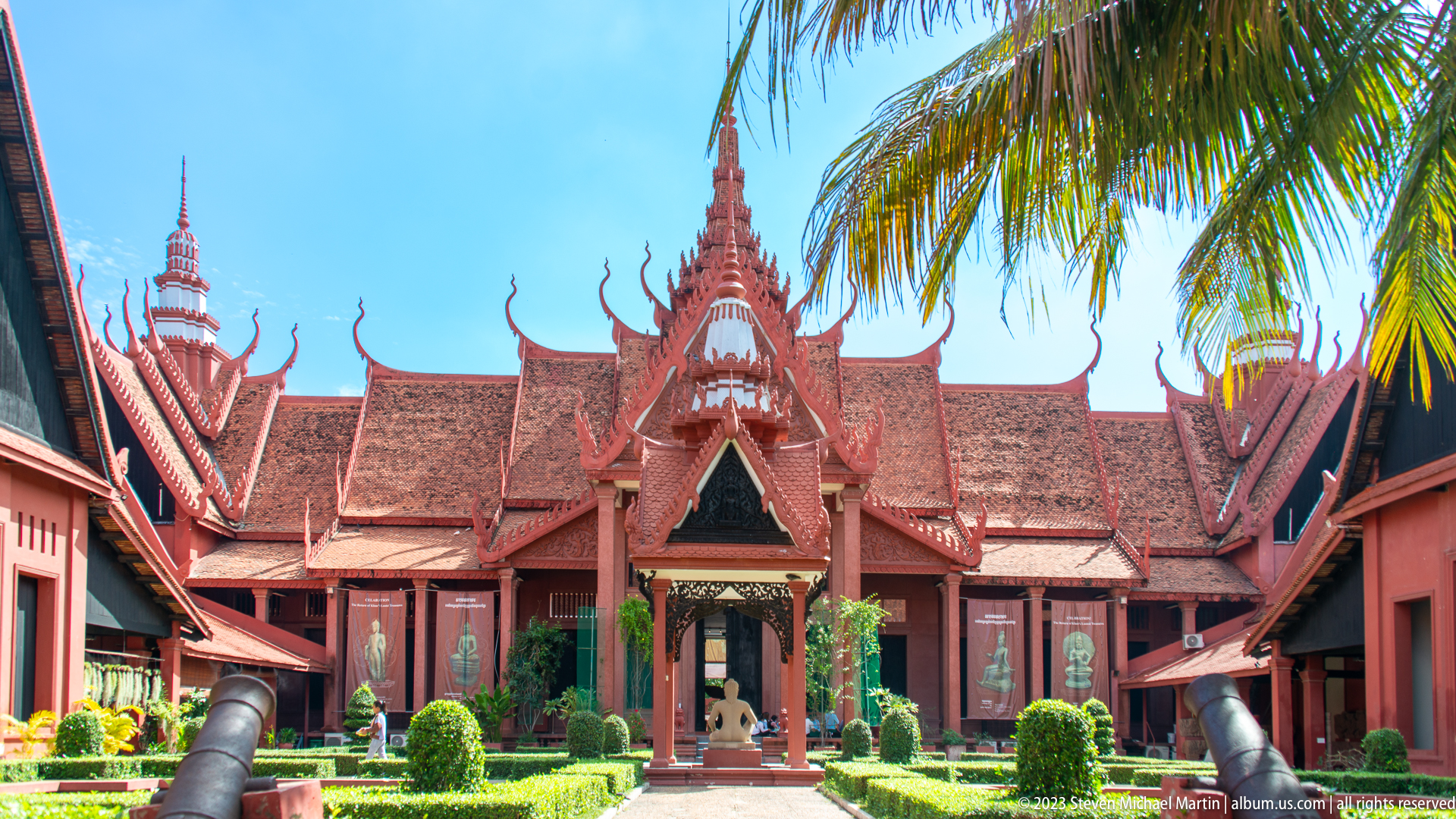
The ceremonial entrance is organized along a strong central axis, with layered roofs, a soaring tower, clipped hedges, and paired historic cannon directing the eye toward the galleries. Sculpture, architecture, and formal landscaping combine to make the courtyard more than a circulation space: it functions as a carefully staged introduction to the museum and its Khmer-inspired design.
Caption
The ceremonial entrance is organized along a strong central axis, with layered roofs, a soaring tower, clipped hedges, and paired historic cannon directing the eye toward the galleries. Sculpture, architecture, and formal landscaping combine to make the courtyard more than a circulation space: it functions as a carefully staged introduction to the museum and its Khmer-inspired design.

Blue-white lotus blossoms rise above broad green leaves in a shallow rectangular pond edged with red stone. Water spilling gently over the near border adds movement to the otherwise quiet scene. Within the museum courtyard, the cultivated pond provides a living counterpoint to the stone and bronze collection and introduces a contemplative element associated with sacred landscape design.
Caption
Blue-white lotus blossoms rise above broad green leaves in a shallow rectangular pond edged with red stone. Water spilling gently over the near border adds movement to the otherwise quiet scene. Within the museum courtyard, the cultivated pond provides a living counterpoint to the stone and bronze collection and introduces a contemplative element associated with sacred landscape design.

Two serpent-like heads project from a sculpted fountain, sending narrow arcs of water into the green pond beside a twisted central column and lotus-shaped bowl. Serpentine forms and lotus imagery are closely tied to Khmer sacred art, but the proof sheet does not resolve whether these creatures are nagas, makaras, or another protective motif.
Caption
Two serpent-like heads project from a sculpted fountain, sending narrow arcs of water into the green pond beside a twisted central column and lotus-shaped bowl. Serpentine forms and lotus imagery are closely tied to Khmer sacred art, but the proof sheet does not resolve whether these creatures are nagas, makaras, or another protective motif.

A seated monkey-faced figure rests against the museum’s red wall with one knee raised, one hand near the thigh, and large circular ornaments framing the head. The simian features and pointed headdress suggest a mythological attendant or guardian, possibly connected with the Ramayana tradition. Surface wear obscures attributes that would allow a firmer identification.
Caption
A seated monkey-faced figure rests against the museum’s red wall with one knee raised, one hand near the thigh, and large circular ornaments framing the head. The simian features and pointed headdress suggest a mythological attendant or guardian, possibly connected with the Ramayana tradition. Surface wear obscures attributes that would allow a firmer identification.

An iced coffee, folded napkin, wrapped straws, and a gray bowl holding a floating plumeria blossom form a quiet still life on a polished wooden table. Condensation on the glass and the flower’s pale petals introduce cool, tactile details into the museum sequence, recording a brief pause between architectural studies and gallery visits.
Caption
An iced coffee, folded napkin, wrapped straws, and a gray bowl holding a floating plumeria blossom form a quiet still life on a polished wooden table. Condensation on the glass and the flower’s pale petals introduce cool, tactile details into the museum sequence, recording a brief pause between architectural studies and gallery visits.

The museum’s long side elevation unfolds as a sequence of connected pavilions beneath layered terracotta roofs and curling finials. A raised veranda and closely spaced columns establish a strong horizontal rhythm, while banana leaves partially screen the lower façade and a small guardian figure marks the steps. The view clarifies the complex’s pavilion-based organization.
Caption
The museum’s long side elevation unfolds as a sequence of connected pavilions beneath layered terracotta roofs and curling finials. A raised veranda and closely spaced columns establish a strong horizontal rhythm, while banana leaves partially screen the lower façade and a small guardian figure marks the steps. The view clarifies the complex’s pavilion-based organization.

A large bronze openwork ornament expands from a narrow stem into a symmetrical crest of bird-like, flame, feather, and vegetal forms. Its scale and construction suggest a ceremonial finial, standard, or architectural fitting rather than a freestanding image. The precise function remains uncertain, but the object demonstrates the complexity achievable in Khmer metalwork.
Caption
A large bronze openwork ornament expands from a narrow stem into a symmetrical crest of bird-like, flame, feather, and vegetal forms. Its scale and construction suggest a ceremonial finial, standard, or architectural fitting rather than a freestanding image. The precise function remains uncertain, but the object demonstrates the complexity achievable in Khmer metalwork.

A four-armed bronze deity stands frontally with a tall cylindrical headdress, layered jewelry, and a finely patterned lower garment. Each hand carries or gestures toward a distinct attribute, though the proof sheet does not make those objects legible enough for a secure identification. Balanced proportions and crisp ornament reveal the formal precision of Khmer bronze casting.
Caption
A four-armed bronze deity stands frontally with a tall cylindrical headdress, layered jewelry, and a finely patterned lower garment. Each hand carries or gestures toward a distinct attribute, though the proof sheet does not make those objects legible enough for a secure identification. Balanced proportions and crisp ornament reveal the formal precision of Khmer bronze casting.

Seen from below, the entrance porch rises above a broad stair, its tall columns supporting steep red roofs tipped with upward-curving finials. Banana plants frame the approach, while a stone guardian and informational sign stand near the threshold. The low viewpoint heightens the sense of ceremony and draws attention to the museum’s elevated, temple-inspired entrance.
Caption
Seen from below, the entrance porch rises above a broad stair, its tall columns supporting steep red roofs tipped with upward-curving finials. Banana plants frame the approach, while a stone guardian and informational sign stand near the threshold. The low viewpoint heightens the sense of ceremony and draws attention to the museum’s elevated, temple-inspired entrance.

Three standing bronze figures form a compact triad, each distinguished by a different hand gesture, attribute, headdress, and arrangement of jewelry. Dark patinated surfaces preserve traces of wear and corrosion, while the side-by-side display encourages close comparison. A partially visible label confirms the grouping as a triad, though the individual deities require catalog verification.
Caption
Three standing bronze figures form a compact triad, each distinguished by a different hand gesture, attribute, headdress, and arrangement of jewelry. Dark patinated surfaces preserve traces of wear and corrosion, while the side-by-side display encourages close comparison. A partially visible label confirms the grouping as a triad, though the individual deities require catalog verification.

Wood-and-glass cases line a gallery devoted to Khmer bronze sculpture, organizing standing figures and small groups by scale, pose, and iconography. Reflections, patterned flooring, and overlapping sightlines preserve the experience of moving through the historic museum interior. The view also shows how intimate metal objects are presented differently from the monumental sandstone sculpture elsewhere in the collection.
Caption
Wood-and-glass cases line a gallery devoted to Khmer bronze sculpture, organizing standing figures and small groups by scale, pose, and iconography. Reflections, patterned flooring, and overlapping sightlines preserve the experience of moving through the historic museum interior. The view also shows how intimate metal objects are presented differently from the monumental sandstone sculpture elsewhere in the collection.

Several seated bronze images of Ganesha are grouped for comparison, revealing variations in scale, posture, hand positions, attributes, and surface patina. The elephant-headed deity’s rounded body and multiple arms remain consistent across the group, while differences among the castings suggest distinct dates, workshops, or ritual histories. A bilingual gallery label confirms the subject.
Caption
Several seated bronze images of Ganesha are grouped for comparison, revealing variations in scale, posture, hand positions, attributes, and surface patina. The elephant-headed deity’s rounded body and multiple arms remain consistent across the group, while differences among the castings suggest distinct dates, workshops, or ritual histories. A bilingual gallery label confirms the subject.

A reclining bronze bull rests with its legs folded beneath the body and its head lifted attentively. Curved horns, a pronounced muzzle, and an ornamental collar animate the otherwise compact silhouette. The sacred animal may represent Nandin, the vehicle and attendant of Shiva, but the identification should remain provisional until confirmed by the museum label.
Caption
A reclining bronze bull rests with its legs folded beneath the body and its head lifted attentively. Curved horns, a pronounced muzzle, and an ornamental collar animate the otherwise compact silhouette. The sacred animal may represent Nandin, the vehicle and attendant of Shiva, but the identification should remain provisional until confirmed by the museum label.

Shown in profile, this large bronze Buddha head combines tightly curled hair, a rounded ushnisha, an elongated earlobe, and a calm downward gaze. Gallery light catches the polished cheek and brow, while reflections reveal another standing image behind the case. The layered view situates an intimate facial study within the broader density of the bronze collection.
Caption
Shown in profile, this large bronze Buddha head combines tightly curled hair, a rounded ushnisha, an elongated earlobe, and a calm downward gaze. Gallery light catches the polished cheek and brow, while reflections reveal another standing image behind the case. The layered view situates an intimate facial study within the broader density of the bronze collection.

Only the upper body and one elegantly bent arm survive from this reclining sandstone figure, yet jewelry, an elaborate coiffure, and the controlled turn of the torso still convey refinement and movement. The fragmentary state exposes the sculpture’s archaeological history while preserving enough detail to suggest that the original composition belonged to a larger narrative or devotional ensemble.
Caption
Only the upper body and one elegantly bent arm survive from this reclining sandstone figure, yet jewelry, an elaborate coiffure, and the controlled turn of the torso still convey refinement and movement. The fragmentary state exposes the sculpture’s archaeological history while preserving enough detail to suggest that the original composition belonged to a larger narrative or devotional ensemble.

Two standing bronzes share a display case, inviting comparison of their elongated proportions, hand gestures, crowns, and jewelry. One figure appears more restrained while the other carries richer ornament, suggesting distinct identities or functions within a Buddhist context. Because the proof sheet does not show the label clearly, the exact relationship between the Buddha and attendant figure remains provisional.
Caption
Two standing bronzes share a display case, inviting comparison of their elongated proportions, hand gestures, crowns, and jewelry. One figure appears more restrained while the other carries richer ornament, suggesting distinct identities or functions within a Buddhist context. Because the proof sheet does not show the label clearly, the exact relationship between the Buddha and attendant figure remains provisional.

A bronze Buddha meditates beneath the expanded hoods of a multi-headed naga, a protective canopy associated with the serpent king Mucalinda sheltering the Buddha from a storm. The compact symmetry of figure and serpent gives the image a powerful stillness, while the dark polished surface catches light along the face, torso, and overlapping cobra hoods.
Caption
A bronze Buddha meditates beneath the expanded hoods of a multi-headed naga, a protective canopy associated with the serpent king Mucalinda sheltering the Buddha from a storm. The compact symmetry of figure and serpent gives the image a powerful stillness, while the dark polished surface catches light along the face, torso, and overlapping cobra hoods.

Closely spaced lines of ancient script cover this fractured stone stele from edge to edge. Breaks, surface wear, and a major diagonal crack interrupt the text but do not erase its documentary character. Such inscriptions can preserve royal, religious, administrative, or dedicatory information, making the object valuable not only as carved stone but also as a historical record requiring specialist reading.
Caption
Closely spaced lines of ancient script cover this fractured stone stele from edge to edge. Breaks, surface wear, and a major diagonal crack interrupt the text but do not erase its documentary character. Such inscriptions can preserve royal, religious, administrative, or dedicatory information, making the object valuable not only as carved stone but also as a historical record requiring specialist reading.

This large stone Buddha is cropped closely at the torso, concentrating attention on tightly curled hair, elongated earlobes, broad shoulders, and a calm frontal expression. Weathering has softened the surface without erasing the image’s meditative authority. The monumental scale suggests that the figure was intended for sustained public or temple viewing rather than private devotion.
Caption
This large stone Buddha is cropped closely at the torso, concentrating attention on tightly curled hair, elongated earlobes, broad shoulders, and a calm frontal expression. Weathering has softened the surface without erasing the image’s meditative authority. The monumental scale suggests that the figure was intended for sustained public or temple viewing rather than private devotion.

A monumental sandstone figure commands the gallery, its damaged arms offset by the surviving jewelry, coiffure, and carefully modeled torso. Additional sculptures recede behind it, placing the object within a sequence of large-scale Khmer religious images. The frontal stance and restrained anatomy convey authority even though the missing attributes prevent a secure identification of the deity or attendant represented.
Caption
A monumental sandstone figure commands the gallery, its damaged arms offset by the surviving jewelry, coiffure, and carefully modeled torso. Additional sculptures recede behind it, placing the object within a sequence of large-scale Khmer religious images. The frontal stance and restrained anatomy convey authority even though the missing attributes prevent a secure identification of the deity or attendant represented.

An elaborate crown, necklaces, and a broad, muscular torso distinguish this finely carved standing figure from the more fragmentary works nearby. A large curved stone element rises behind the body, possibly surviving from an associated support or architectural setting. The sculpture’s formal frontal pose suggests a major divine or royal subject, though the missing attributes leave the exact identity unresolved.
Caption
An elaborate crown, necklaces, and a broad, muscular torso distinguish this finely carved standing figure from the more fragmentary works nearby. A large curved stone element rises behind the body, possibly surviving from an associated support or architectural setting. The sculpture’s formal frontal pose suggests a major divine or royal subject, though the missing attributes leave the exact identity unresolved.

Weathering and major losses have reduced this standing figure to its essential silhouette: compact body, planted feet, curled hair, and a softened face. Against the pale architectural background, the sculpture’s damaged condition becomes part of its visual impact. The surviving stance and proportions identify it as a Khmer monumental figure, but not enough iconography remains to determine the subject confidently.
Caption
Weathering and major losses have reduced this standing figure to its essential silhouette: compact body, planted feet, curled hair, and a softened face. Against the pale architectural background, the sculpture’s damaged condition becomes part of its visual impact. The surviving stance and proportions identify it as a Khmer monumental figure, but not enough iconography remains to determine the subject confidently.

Centered in a long gallery corridor, this monumental standing figure gains scale from the surrounding walls, distant visitors, and smaller works beyond. Missing arms and worn details testify to archaeological damage, yet the balanced proportions and surviving ornament preserve the image’s commanding presence. The photograph functions as both an object record and a study of how monumental Khmer sculpture shapes museum space.
Caption
Centered in a long gallery corridor, this monumental standing figure gains scale from the surrounding walls, distant visitors, and smaller works beyond. Missing arms and worn details testify to archaeological damage, yet the balanced proportions and surviving ornament preserve the image’s commanding presence. The photograph functions as both an object record and a study of how monumental Khmer sculpture shapes museum space.

Carved side supports frame the lower body of this standing sandstone figure, whose broad shoulders, frontal gaze, and surviving garment retain a strong architectural quality. Surface erosion and missing arms limit iconographic interpretation, but the pedestal-like structure suggests that the sculpture was conceived as part of a larger setting rather than as an entirely freestanding image.
Caption
Carved side supports frame the lower body of this standing sandstone figure, whose broad shoulders, frontal gaze, and surviving garment retain a strong architectural quality. Surface erosion and missing arms limit iconographic interpretation, but the pedestal-like structure suggests that the sculpture was conceived as part of a larger setting rather than as an entirely freestanding image.

Ganesha sits cross-legged with a rounded belly, elephant head, and prominent trunk, features that make the deity recognizable despite weathering and the loss of several attributes. In Hindu tradition, Ganesha is associated with beginnings, learning, and the removal of obstacles. The compact sandstone image preserves the approachable physical character that distinguishes him from more austere standing deities.
Caption
Ganesha sits cross-legged with a rounded belly, elephant head, and prominent trunk, features that make the deity recognizable despite weathering and the loss of several attributes. In Hindu tradition, Ganesha is associated with beginnings, learning, and the removal of obstacles. The compact sandstone image preserves the approachable physical character that distinguishes him from more austere standing deities.

Four standing sandstone figures are grouped for direct comparison, revealing variations in crown shape, body proportion, arm position, carving quality, and preservation. Their damaged hands and attributes make individual identities uncertain, yet the shared frontal poses point to recurring conventions in Khmer temple sculpture. The ensemble turns fragmentary archaeological objects into a visual study of style and type.
Caption
Four standing sandstone figures are grouped for direct comparison, revealing variations in crown shape, body proportion, arm position, carving quality, and preservation. Their damaged hands and attributes make individual identities uncertain, yet the shared frontal poses point to recurring conventions in Khmer temple sculpture. The ensemble turns fragmentary archaeological objects into a visual study of style and type.

Four arms, a tall crown, and a rigid frontal stance identify this monumental sandstone figure as a major Hindu deity, although the missing hand-held attributes prevent a more specific identification from the proof sheet. Displayed alone in a spacious gallery, the sculpture’s vertical symmetry, broad shoulders, and measured proportions become the principal evidence of its original ceremonial authority.
Caption
Four arms, a tall crown, and a rigid frontal stance identify this monumental sandstone figure as a major Hindu deity, although the missing hand-held attributes prevent a more specific identification from the proof sheet. Displayed alone in a spacious gallery, the sculpture’s vertical symmetry, broad shoulders, and measured proportions become the principal evidence of its original ceremonial authority.

This second horse-headed sandstone figure survives primarily as a torso, with portions of the arms and lower body lost. The equine muzzle, upright ears, and human chest establish the hybrid form immediately, while the fragmentary condition draws attention to how much iconographic information can disappear through damage. Its relationship to the similar figure nearby deserves catalog confirmation.
Caption
This second horse-headed sandstone figure survives primarily as a torso, with portions of the arms and lower body lost. The equine muzzle, upright ears, and human chest establish the hybrid form immediately, while the fragmentary condition draws attention to how much iconographic information can disappear through damage. Its relationship to the similar figure nearby deserves catalog confirmation.

A four-armed sandstone deity stands with upper hands raised and lower arms extended before the body, creating a controlled, symmetrical silhouette. The cylindrical crown, jewelry, and upright stance indicate a major Hindu image, but the loss of attributes prevents a secure name. Even in fragmentary condition, the sculpture communicates the precision and monumentality of Khmer sacred carving.
Caption
A four-armed sandstone deity stands with upper hands raised and lower arms extended before the body, creating a controlled, symmetrical silhouette. The cylindrical crown, jewelry, and upright stance indicate a major Hindu image, but the loss of attributes prevents a secure name. Even in fragmentary condition, the sculpture communicates the precision and monumentality of Khmer sacred carving.

A towering central figure is flanked by two smaller attendants against a deep red wall, creating the visual logic of a temple triad. Scale establishes hierarchy: the principal image dominates while the companions reinforce its status and symmetry. Although the exact subjects are not legible, the museum arrangement helps recover the relational character that isolated sculptures often lose.
Caption
A towering central figure is flanked by two smaller attendants against a deep red wall, creating the visual logic of a temple triad. Scale establishes hierarchy: the principal image dominates while the companions reinforce its status and symmetry. Although the exact subjects are not legible, the museum arrangement helps recover the relational character that isolated sculptures often lose.

A human torso joined to an elongated horse-like head gives this sandstone fragment an unusually hybrid appearance. The surviving shoulders, chest, and muzzle preserve enough of the original form to distinguish it from neighboring anthropomorphic deities. Without a readable label or attributes, however, the mythological identity should remain open rather than being assigned from resemblance alone.
Caption
A human torso joined to an elongated horse-like head gives this sandstone fragment an unusually hybrid appearance. The surviving shoulders, chest, and muzzle preserve enough of the original form to distinguish it from neighboring anthropomorphic deities. Without a readable label or attributes, however, the mythological identity should remain open rather than being assigned from resemblance alone.

Seated cross-legged in the foreground, this sandstone figure projects calm through a balanced posture, softly modeled torso, and composed expression. Other sculptures recede through the gallery behind it, making the photograph both an object portrait and a spatial study. The absence of visible attributes limits identification, but the work clearly belongs to the refined tradition of Khmer monumental stone carving.
Caption
Seated cross-legged in the foreground, this sandstone figure projects calm through a balanced posture, softly modeled torso, and composed expression. Other sculptures recede through the gallery behind it, making the photograph both an object portrait and a spatial study. The absence of visible attributes limits identification, but the work clearly belongs to the refined tradition of Khmer monumental stone carving.

Shown in three-quarter view, this crowned sandstone figure raises one hand while supporting a rounded vessel in the other. A tall headdress, necklaces, and smooth facial modeling lend the image ceremonial dignity. The surviving vessel may be an important identifying attribute, but the proof sheet alone does not justify assigning a specific deity, donor, or attendant role.
Caption
Shown in three-quarter view, this crowned sandstone figure raises one hand while supporting a rounded vessel in the other. A tall headdress, necklaces, and smooth facial modeling lend the image ceremonial dignity. The surviving vessel may be an important identifying attribute, but the proof sheet alone does not justify assigning a specific deity, donor, or attendant role.

A crowned figure sits astride a large bird-like mount, combining divine and animal forms in a single vertical composition. The mount’s beak, spread body, and supporting role may suggest Garuda, but the proof sheet does not reveal enough detail for certainty. Nearby sculptures establish the gallery context while the pairing of rider and mount preserves the object’s narrative character.
Caption
A crowned figure sits astride a large bird-like mount, combining divine and animal forms in a single vertical composition. The mount’s beak, spread body, and supporting role may suggest Garuda, but the proof sheet does not reveal enough detail for certainty. Nearby sculptures establish the gallery context while the pairing of rider and mount preserves the object’s narrative character.

Two sandstone figures are bound together in an unusually animated composition, one body turning into the other while an arm crosses the group. Weathering has obscured faces and attributes, but the intertwined pose still conveys action, struggle, embrace, or narrative encounter. The scene stands apart from the predominantly frontal gallery sculpture and requires catalog evidence for precise interpretation.
Caption
Two sandstone figures are bound together in an unusually animated composition, one body turning into the other while an arm crosses the group. Weathering has obscured faces and attributes, but the intertwined pose still conveys action, struggle, embrace, or narrative encounter. The scene stands apart from the predominantly frontal gallery sculpture and requires catalog evidence for precise interpretation.

The closer view clarifies the relationship between rider and bird mount: the crowned figure sits calmly above the animal’s feathered body while carved details gather around the junction of the two forms. By tightening the frame, the photograph reveals modeling that disappears in the wider gallery view and makes the sculpture’s hybrid vertical structure easier to read.
Caption
The closer view clarifies the relationship between rider and bird mount: the crowned figure sits calmly above the animal’s feathered body while carved details gather around the junction of the two forms. By tightening the frame, the photograph reveals modeling that disappears in the wider gallery view and makes the sculpture’s hybrid vertical structure easier to read.

A boar-headed figure stands with a human torso and polished sandstone surface, its elongated snout and upright ears immediately setting it apart from the neighboring deities. The form may represent Varaha, the boar incarnation of Vishnu, but that identification depends on attributes not visible here. The caption therefore preserves the strong visual evidence while keeping the iconography provisional.
Caption
A boar-headed figure stands with a human torso and polished sandstone surface, its elongated snout and upright ears immediately setting it apart from the neighboring deities. The form may represent Varaha, the boar incarnation of Vishnu, but that identification depends on attributes not visible here. The caption therefore preserves the strong visual evidence while keeping the iconography provisional.

A kneeling guardian combines a powerful human body with a lion-like head, one knee raised and one hand resting near the thigh. The broad torso, carved garment, and forceful facial features suggest an architectural protector intended to command a threshold or sacred setting. The exact mythological identity remains uncertain because no identifying label or attribute is visible.
Caption
A kneeling guardian combines a powerful human body with a lion-like head, one knee raised and one hand resting near the thigh. The broad torso, carved garment, and forceful facial features suggest an architectural protector intended to command a threshold or sacred setting. The exact mythological identity remains uncertain because no identifying label or attribute is visible.

Viewed from behind, these monumental standing figures reveal details usually subordinated to their frontal iconography: the fall of carved garments, treatment of hair, back contours, and the structural relationship between body and support. The unconventional viewpoint also shows how the museum arranges large sandstone sculptures in an open gallery, allowing visitors to circulate around them rather than encounter only fixed façades.
Caption
Viewed from behind, these monumental standing figures reveal details usually subordinated to their frontal iconography: the fall of carved garments, treatment of hair, back contours, and the structural relationship between body and support. The unconventional viewpoint also shows how the museum arranges large sandstone sculptures in an open gallery, allowing visitors to circulate around them rather than encounter only fixed façades.

Three seated Buddhas are sheltered beneath spreading multi-headed naga canopies, with the largest image centered between two smaller companions. The repeated motif refers to the serpent king Mucalinda protecting the meditating Buddha. Variations in scale, carving, and preservation make the grouping especially useful for comparing how Khmer artists reworked a shared Buddhist subject across different objects.
Caption
Three seated Buddhas are sheltered beneath spreading multi-headed naga canopies, with the largest image centered between two smaller companions. The repeated motif refers to the serpent king Mucalinda protecting the meditating Buddha. Variations in scale, carving, and preservation make the grouping especially useful for comparing how Khmer artists reworked a shared Buddhist subject across different objects.

The enlarged head study isolates the guardian’s leonine features: broad muzzle, deeply set eyes, flared nostrils, and tightly curled hair framing the face. Weathering has softened individual details without diminishing the expression’s force. By removing most of the body and gallery context, the photograph turns an architectural protector into an intense sculptural portrait.
Caption
The enlarged head study isolates the guardian’s leonine features: broad muzzle, deeply set eyes, flared nostrils, and tightly curled hair framing the face. Weathering has softened individual details without diminishing the expression’s force. By removing most of the body and gallery context, the photograph turns an architectural protector into an intense sculptural portrait.

A seated Buddha rests beneath the expanded hoods of a multi-headed naga, while kneeling attendants and vegetal ornament frame the central figure. The protective canopy recalls the serpent king Mucalinda sheltering the Buddha during meditation. Compact symmetry and layered carving transform the stele into both a devotional image and a condensed narrative of protection and spiritual resolve.
Caption
A seated Buddha rests beneath the expanded hoods of a multi-headed naga, while kneeling attendants and vegetal ornament frame the central figure. The protective canopy recalls the serpent king Mucalinda sheltering the Buddha during meditation. Compact symmetry and layered carving transform the stele into both a devotional image and a condensed narrative of protection and spiritual resolve.

Seen from a second angle, the kneeling guardian’s raised knee, broad chest, bent arm, and carved lower garment become easier to read as a unified pose. The plain gallery wall suppresses distractions and emphasizes the sculpture’s mass. Together with the frontal and close views, this image documents how bodily posture contributes as much as the lion-like head to its protective presence.
Caption
Seen from a second angle, the kneeling guardian’s raised knee, broad chest, bent arm, and carved lower garment become easier to read as a unified pose. The plain gallery wall suppresses distractions and emphasizes the sculpture’s mass. Together with the frontal and close views, this image documents how bodily posture contributes as much as the lion-like head to its protective presence.

This interpretive map places the Khmer Empire within mainland Southeast Asia, showing the wider political and geographic setting in which its cities, temples, and artistic traditions developed. By locating neighboring regions and historical spheres of influence, the graphic helps visitors connect the museum’s sculpture to patterns of expansion, exchange, pilgrimage, and courtly power rather than viewing the objects in isolation.
Caption
This interpretive map places the Khmer Empire within mainland Southeast Asia, showing the wider political and geographic setting in which its cities, temples, and artistic traditions developed. By locating neighboring regions and historical spheres of influence, the graphic helps visitors connect the museum’s sculpture to patterns of expansion, exchange, pilgrimage, and courtly power rather than viewing the objects in isolation.

One knee raised and the other folded beneath the body, this sandstone figure adopts a poised kneeling posture that differs from the rigid frontality of many standing deities nearby. Jewelry, drapery, and a composed expression survive despite losses to the arms. The pose may indicate an attendant, donor, or guardian role, but the missing attributes prevent a secure identification.
Caption
One knee raised and the other folded beneath the body, this sandstone figure adopts a poised kneeling posture that differs from the rigid frontality of many standing deities nearby. Jewelry, drapery, and a composed expression survive despite losses to the arms. The pose may indicate an attendant, donor, or guardian role, but the missing attributes prevent a secure identification.

A four-armed sandstone deity stands against a deep red wall, its tall headdress and balanced proportions creating a forceful vertical silhouette. Portions of the hands and attributes are missing, removing the clues needed to distinguish among major Hindu identities. Even so, the surviving arms, jewelry, and formal stance clearly mark the sculpture as an important temple image.
Caption
A four-armed sandstone deity stands against a deep red wall, its tall headdress and balanced proportions creating a forceful vertical silhouette. Portions of the hands and attributes are missing, removing the clues needed to distinguish among major Hindu identities. Even so, the surviving arms, jewelry, and formal stance clearly mark the sculpture as an important temple image.

Headless and incomplete, this standing sandstone torso preserves the lower body, feet, garment, belt, and portions of both arms. The surviving carving reveals how carefully sculptors articulated costume and bodily stance even when the principal iconographic features are lost. Its fragmentary condition makes the object both a work of art and evidence of the archaeological history through which it survived.
Caption
Headless and incomplete, this standing sandstone torso preserves the lower body, feet, garment, belt, and portions of both arms. The surviving carving reveals how carefully sculptors articulated costume and bodily stance even when the principal iconographic features are lost. Its fragmentary condition makes the object both a work of art and evidence of the archaeological history through which it survived.

Tightly curled hair, elongated earlobes, a rounded ushnisha, and a calm inward expression define this monumental sandstone Buddha head. The close framing isolates the face from the missing body and emphasizes the controlled transition between polished planes and softly modeled features. Despite weathering, the image retains the meditative authority intended for a large public or temple sculpture.
Caption
Tightly curled hair, elongated earlobes, a rounded ushnisha, and a calm inward expression define this monumental sandstone Buddha head. The close framing isolates the face from the missing body and emphasizes the controlled transition between polished planes and softly modeled features. Despite weathering, the image retains the meditative authority intended for a large public or temple sculpture.

A major fracture cuts through this sandstone Buddha head, yet curled hair, elongated earlobes, and the serene facial type remain legible. The damage reveals the vulnerability of monumental sculpture while also showing how strongly the Buddha’s identity is carried by a small group of recurring features. The surviving face balances physical loss with an enduring sense of composure.
Caption
A major fracture cuts through this sandstone Buddha head, yet curled hair, elongated earlobes, and the serene facial type remain legible. The damage reveals the vulnerability of monumental sculpture while also showing how strongly the Buddha’s identity is carried by a small group of recurring features. The surviving face balances physical loss with an enduring sense of composure.

This standing Buddha remains largely intact from head to feet despite the loss of both forearms. Tightly curled hair, elongated earlobes, a composed face, and balanced proportions preserve the image’s devotional clarity. The missing hands are especially significant because they once carried gestures that helped define the Buddha’s action, teaching role, or spiritual state.
Caption
This standing Buddha remains largely intact from head to feet despite the loss of both forearms. Tightly curled hair, elongated earlobes, a composed face, and balanced proportions preserve the image’s devotional clarity. The missing hands are especially significant because they once carried gestures that helped define the Buddha’s action, teaching role, or spiritual state.

Reassembled from surviving fragments, this Khmer pediment preserves a triangular field of carved ornament arranged around a central shrine-like motif. Gaps and missing sections make the reconstruction process visible rather than disguising the object’s condition. The display helps recover the architectural scale and visual density of temple sculpture that would otherwise be encountered only as disconnected fragments.
Caption
Reassembled from surviving fragments, this Khmer pediment preserves a triangular field of carved ornament arranged around a central shrine-like motif. Gaps and missing sections make the reconstruction process visible rather than disguising the object’s condition. The display helps recover the architectural scale and visual density of temple sculpture that would otherwise be encountered only as disconnected fragments.

A large seated Buddha dominates this relief, flanked by crowned attendants beneath a carved architectural canopy. Smaller heads and densely packed ornament enrich the surrounding field, creating a hierarchy in which scale directs attention toward the sacred center. The composition demonstrates how Khmer sculptors combined figure, architecture, and decorative pattern within a single devotional surface.
Caption
A large seated Buddha dominates this relief, flanked by crowned attendants beneath a carved architectural canopy. Smaller heads and densely packed ornament enrich the surrounding field, creating a hierarchy in which scale directs attention toward the sacred center. The composition demonstrates how Khmer sculptors combined figure, architecture, and decorative pattern within a single devotional surface.

Multiple seated figures occupy this fragmentary sandstone relief, framed by architectural forms and decorative borders. Losses along the lower edge interrupt the scene, but the surviving arrangement still suggests a narrative or devotional sequence rather than a purely ornamental panel. The image invites close attention to gesture, hierarchy, and spatial grouping even where the specific episode remains uncertain.
Caption
Multiple seated figures occupy this fragmentary sandstone relief, framed by architectural forms and decorative borders. Losses along the lower edge interrupt the scene, but the surviving arrangement still suggests a narrative or devotional sequence rather than a purely ornamental panel. The image invites close attention to gesture, hierarchy, and spatial grouping even where the specific episode remains uncertain.

A seated Buddha presides above an animated lower register crowded with warriors, attendants, and intertwined bodies. The contrast between the calm sacred figure and the energetic narrative below gives the relief unusual dramatic force. Although the precise episode is not legible from the proof sheet, the composition clearly joins Buddhist authority with a scene of conflict, procession, or worldly action.
Caption
A seated Buddha presides above an animated lower register crowded with warriors, attendants, and intertwined bodies. The contrast between the calm sacred figure and the energetic narrative below gives the relief unusual dramatic force. Although the precise episode is not legible from the proof sheet, the composition clearly joins Buddhist authority with a scene of conflict, procession, or worldly action.

Three monumental stone heads are displayed together, allowing direct comparison of crown shape, facial modeling, scale, and preservation. The central head retains an elaborate headdress, while the flanking examples survive more fragmentarily. Grouped in this way, the objects reveal how much individual character Khmer sculptors could achieve within the conventions of monumental sacred and royal portraiture.
Caption
Three monumental stone heads are displayed together, allowing direct comparison of crown shape, facial modeling, scale, and preservation. The central head retains an elaborate headdress, while the flanking examples survive more fragmentarily. Grouped in this way, the objects reveal how much individual character Khmer sculptors could achieve within the conventions of monumental sacred and royal portraiture.

Serpent heads radiate outward in a fan-like arrangement around a central face, creating a powerful protective silhouette. The multi-headed naga form is closely associated with Khmer religious architecture and Buddhist imagery, where serpents can guard sacred space or shelter holy figures. Weathering has softened the carving, but the repeated heads still preserve its rhythmic, emblematic force.
Caption
Serpent heads radiate outward in a fan-like arrangement around a central face, creating a powerful protective silhouette. The multi-headed naga form is closely associated with Khmer religious architecture and Buddhist imagery, where serpents can guard sacred space or shelter holy figures. Weathering has softened the carving, but the repeated heads still preserve its rhythmic, emblematic force.

A kneeling guardian combines a powerful human torso with a long, crocodile-like head, its bent legs and hands at the waist producing a compact, tense posture. The hybrid anatomy points to a mythological or architectural protector rather than a naturalistic creature. Because no identifying attribute or label is visible, the exact species and religious identity should remain provisional.
Caption
A kneeling guardian combines a powerful human torso with a long, crocodile-like head, its bent legs and hands at the waist producing a compact, tense posture. The hybrid anatomy points to a mythological or architectural protector rather than a naturalistic creature. Because no identifying attribute or label is visible, the exact species and religious identity should remain provisional.

A monumental bronze Buddha sits in bhumisparsha mudra, with one hand touching the earth and the other resting in the lap. The gesture recalls the moment of enlightenment, when the Buddha called the earth to witness his victory over Mara. Elongated earlobes, a serene face, and a smoothly draped robe reinforce the image’s meditative authority.
Caption
A monumental bronze Buddha sits in bhumisparsha mudra, with one hand touching the earth and the other resting in the lap. The gesture recalls the moment of enlightenment, when the Buddha called the earth to witness his victory over Mara. Elongated earlobes, a serene face, and a smoothly draped robe reinforce the image’s meditative authority.

Garuda raises an entwined naga above his head in a compact bronze composition charged with opposing forces. Avian features, wings, and the lifted serpent identify a subject rooted in Hindu and Buddhist mythology, where Garuda is both divine mount and adversary of nagas. The polished metal surface gives the dynamic struggle a visual character distinct from the surrounding sandstone sculpture.
Caption
Garuda raises an entwined naga above his head in a compact bronze composition charged with opposing forces. Avian features, wings, and the lifted serpent identify a subject rooted in Hindu and Buddhist mythology, where Garuda is both divine mount and adversary of nagas. The polished metal surface gives the dynamic struggle a visual character distinct from the surrounding sandstone sculpture.

A seated royal figure occupies an elaborate gilded throne against a deep red wall, flanked by formal portraits that extend the display beyond a single sculptural object. The balanced presentation evokes court ceremony, dynastic memory, and the visual language of authority. Gold surfaces, symmetrical placement, and the frontal pose turn the gallery installation into a carefully staged statement of kingship.
Caption
A seated royal figure occupies an elaborate gilded throne against a deep red wall, flanked by formal portraits that extend the display beyond a single sculptural object. The balanced presentation evokes court ceremony, dynastic memory, and the visual language of authority. Gold surfaces, symmetrical placement, and the frontal pose turn the gallery installation into a carefully staged statement of kingship.

Three tall painted panels unfold as a sequence of crowded scenes containing architecture, landscapes, processions, and ceremonial figures. Their vertical format and repeated visual motifs encourage the eye to read across the group as a continuous narrative. The paintings preserve a storytelling tradition in which courtly life, sacred space, and historical memory are organized through dense, episodic imagery.
Caption
Three tall painted panels unfold as a sequence of crowded scenes containing architecture, landscapes, processions, and ceremonial figures. Their vertical format and repeated visual motifs encourage the eye to read across the group as a continuous narrative. The paintings preserve a storytelling tradition in which courtly life, sacred space, and historical memory are organized through dense, episodic imagery.

This substantial wooden loom preserves the frame, rollers, and working structure used to transform thread into cloth. Rather than presenting textiles only as finished objects, the display makes the technology of Cambodian weaving visible. Its scale and construction reveal the physical coordination, tension control, and repeated handwork required to produce patterned fabrics within domestic or workshop settings.
Caption
This substantial wooden loom preserves the frame, rollers, and working structure used to transform thread into cloth. Rather than presenting textiles only as finished objects, the display makes the technology of Cambodian weaving visible. Its scale and construction reveal the physical coordination, tension control, and repeated handwork required to produce patterned fabrics within domestic or workshop settings.

Traces of red, gold, and black lacquer survive across this seated Buddha, revealing that the sculpture was once far more vividly colored than bare stone or metal might suggest. The remaining polychromy draws attention to robe, body, and sacred presence while also documenting centuries of wear. Its surface preserves both devotional renewal and the gradual loss of earlier painted layers.
Caption
Traces of red, gold, and black lacquer survive across this seated Buddha, revealing that the sculpture was once far more vividly colored than bare stone or metal might suggest. The remaining polychromy draws attention to robe, body, and sacred presence while also documenting centuries of wear. Its surface preserves both devotional renewal and the gradual loss of earlier painted layers.

A fierce guardian face projects from the body of this cast bronze vessel, surrounded by angular ornaments and a dark, weathered patina. The combination of container and protective imagery suggests a ritual or ceremonial function, though the exact use is not legible from the proof sheet. Corrosion and surface wear preserve evidence of both age and repeated handling.
Caption
A fierce guardian face projects from the body of this cast bronze vessel, surrounded by angular ornaments and a dark, weathered patina. The combination of container and protective imagery suggests a ritual or ceremonial function, though the exact use is not legible from the proof sheet. Corrosion and surface wear preserve evidence of both age and repeated handling.

Elaborate radiating ornament surrounds this large bronze guardian, giving the figure a dynamic silhouette that dominates its display case. The combination of mythological form, projecting elements, and dark patina demonstrates the technical ambition of Khmer metal casting. Without a readable label, the exact identity remains uncertain, but the object’s scale and ceremonial character are unmistakable.
Caption
Elaborate radiating ornament surrounds this large bronze guardian, giving the figure a dynamic silhouette that dominates its display case. The combination of mythological form, projecting elements, and dark patina demonstrates the technical ambition of Khmer metal casting. Without a readable label, the exact identity remains uncertain, but the object’s scale and ceremonial character are unmistakable.

A striped krama remains stretched across the loom, allowing the weaving process to be read from unfinished threads to completed cloth. The familiar Cambodian scarf is represented not simply as costume or souvenir but as the result of skilled, rhythmic labor. Pattern, color, and loom structure together connect a widely used textile with the craft knowledge behind its production.
Caption
A striped krama remains stretched across the loom, allowing the weaving process to be read from unfinished threads to completed cloth. The familiar Cambodian scarf is represented not simply as costume or souvenir but as the result of skilled, rhythmic labor. Pattern, color, and loom structure together connect a widely used textile with the craft knowledge behind its production.

A monumental seated Buddha anchors this dense arrangement of smaller standing and seated images in bronze and stone. The grouping reveals the range of bodily types, hand gestures, surface treatments, and devotional formats used in Cambodian Buddhist art. Seen together, the figures create a visual history of repetition and variation rather than a series of isolated masterpieces.
Caption
A monumental seated Buddha anchors this dense arrangement of smaller standing and seated images in bronze and stone. The grouping reveals the range of bodily types, hand gestures, surface treatments, and devotional formats used in Cambodian Buddhist art. Seen together, the figures create a visual history of repetition and variation rather than a series of isolated masterpieces.

Openwork casting surrounds a central deity with attendants beneath an ornate arched frame, creating a devotional plaque that balances sacred hierarchy with decorative intricacy. Pierced spaces lighten the bronze and sharpen the silhouettes of figures and ornament. The compact object demonstrates how Khmer metalworkers translated the visual density of temple sculpture into a portable ritual format.
Caption
Openwork casting surrounds a central deity with attendants beneath an ornate arched frame, creating a devotional plaque that balances sacred hierarchy with decorative intricacy. Pierced spaces lighten the bronze and sharpen the silhouettes of figures and ornament. The compact object demonstrates how Khmer metalworkers translated the visual density of temple sculpture into a portable ritual format.

This double-ended bronze vajra, or ritual thunderbolt, is displayed horizontally so that its symmetrical prongs and central grip can be read clearly. In Buddhist ritual, the object symbolizes indestructibility, spiritual power, and the unshakable nature of awakened insight. Its compact geometry contrasts with the figural bronzes nearby while carrying equally concentrated religious meaning.
Caption
This double-ended bronze vajra, or ritual thunderbolt, is displayed horizontally so that its symmetrical prongs and central grip can be read clearly. In Buddhist ritual, the object symbolizes indestructibility, spiritual power, and the unshakable nature of awakened insight. Its compact geometry contrasts with the figural bronzes nearby while carrying equally concentrated religious meaning.

A painted wooden panel depicts a celestial figure in elaborate Khmer costume set within a circular frame against a blue background. The graceful pose and refined decoration reflect traditional Cambodian mural painting and courtly artistic conventions.
Caption
A painted wooden panel depicts a celestial figure in elaborate Khmer costume set within a circular frame against a blue background. The graceful pose and refined decoration reflect traditional Cambodian mural painting and courtly artistic conventions.

A companion painted panel portrays another celestial figure holding ceremonial objects while wearing richly patterned garments. Together with the adjacent panel, it demonstrates the elegance and symbolism of Khmer decorative painting.
Caption
A companion painted panel portrays another celestial figure holding ceremonial objects while wearing richly patterned garments. Together with the adjacent panel, it demonstrates the elegance and symbolism of Khmer decorative painting.

A seated sandstone figure is displayed beneath an ornate pavilion overlooking the landscaped courtyard of the National Museum of Cambodia. The composition combines sculpture, traditional architecture, and formal gardens.
Caption
A seated sandstone figure is displayed beneath an ornate pavilion overlooking the landscaped courtyard of the National Museum of Cambodia. The composition combines sculpture, traditional architecture, and formal gardens.

A close view of an intricately carved Khmer architectural relief centers on a kala mask surrounded by scrolling foliage, mythical creatures, and decorative motifs. The carving illustrates the richness of Khmer temple ornamentation.
Caption
A close view of an intricately carved Khmer architectural relief centers on a kala mask surrounded by scrolling foliage, mythical creatures, and decorative motifs. The carving illustrates the richness of Khmer temple ornamentation.

A finely carved architectural relief depicts a celestial figure framed by dense scrolling foliage and mythical ornament. The elegant composition reflects the remarkable decorative craftsmanship associated with Khmer temple architecture.
Caption
A finely carved architectural relief depicts a celestial figure framed by dense scrolling foliage and mythical ornament. The elegant composition reflects the remarkable decorative craftsmanship associated with Khmer temple architecture.

A companion relief presents another divine figure surrounded by richly carved vegetal scrolls and ornamental borders. Together the carvings demonstrate the sophisticated decorative vocabulary employed by Khmer artisans.
Caption
A companion relief presents another divine figure surrounded by richly carved vegetal scrolls and ornamental borders. Together the carvings demonstrate the sophisticated decorative vocabulary employed by Khmer artisans.

A monumental stone finial crowned by multiple naga heads once formed part of a Khmer temple roof or architectural ornament. The radiating serpent imagery symbolizes protection and divine authority within Khmer religious architecture.
Caption
A monumental stone finial crowned by multiple naga heads once formed part of a Khmer temple roof or architectural ornament. The radiating serpent imagery symbolizes protection and divine authority within Khmer religious architecture.

A weathered multi-headed naga finial preserves the dramatic radiating form despite centuries of erosion. The surviving carving illustrates the scale and complexity of Khmer architectural sculpture.
Caption
A weathered multi-headed naga finial preserves the dramatic radiating form despite centuries of erosion. The surviving carving illustrates the scale and complexity of Khmer architectural sculpture.

A richly ornamented Khmer temple pediment fills the frame with elaborate floral scrolls, sacred motifs, and deeply carved decorative patterns. The composition exemplifies the extraordinary stone-carving tradition of the Angkor period.
Caption
A richly ornamented Khmer temple pediment fills the frame with elaborate floral scrolls, sacred motifs, and deeply carved decorative patterns. The composition exemplifies the extraordinary stone-carving tradition of the Angkor period.

A large circular stone mill or grinding stone concludes the museum visit by illustrating practical technology alongside monumental religious art. The massive carved object demonstrates the museum's preservation of everyday historical artifacts in addition to sculpture.
Caption
A large circular stone mill or grinding stone concludes the museum visit by illustrating practical technology alongside monumental religious art. The massive carved object demonstrates the museum's preservation of everyday historical artifacts in addition to sculpture.