Fortress of Louisbourg – Cape Breton Island, Nova Scotia
The Fortress of Louisbourg stands along the rugged Atlantic coast of Cape Breton Island in Nova Scotia, overlooking the entrance to the Gulf of St. Lawrence. Originally constructed by the French in the early 18th century, the fortress served as one of the most important fortified ports in North America, protecting France’s fishing fleets and trade routes in the North Atlantic.
Today the site is one of the largest historical reconstructions in the world, where massive stone walls, bastions, and cannon batteries recreate the appearance of the original fortified town. Inside the walls, reconstructed houses, streets, and government buildings illustrate life in a French colonial port during the height of the Atlantic fisheries.
Set against the windswept coastline of Cape Breton, the fortress reflects the strategic importance of this harbor during the colonial struggles between France and Britain.
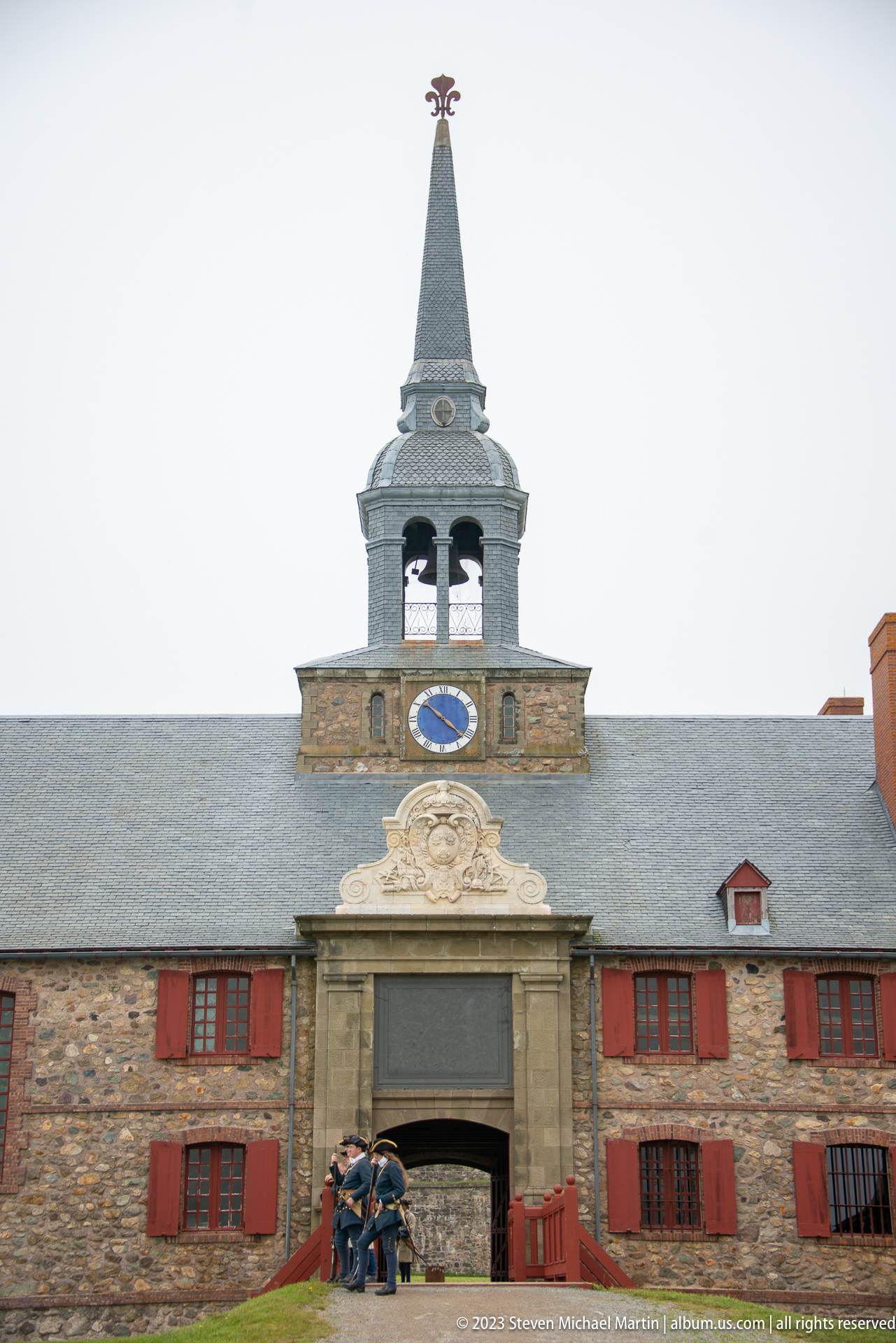
The principal gateway rises through a long stone façade punctuated by red shutters, with a central arched opening surmounted by carved stone ornament, a clock, and an open bell stage beneath a slender spire. The symmetrical composition gives the entrance a ceremonial presence while also marking the controlled passage through Louisbourg's fortified complex.
Caption
The principal gateway rises through a long stone façade punctuated by red shutters, with a central arched opening surmounted by carved stone ornament, a clock, and an open bell stage beneath a slender spire. The symmetrical composition gives the entrance a ceremonial presence while also marking the controlled passage through Louisbourg's fortified complex.
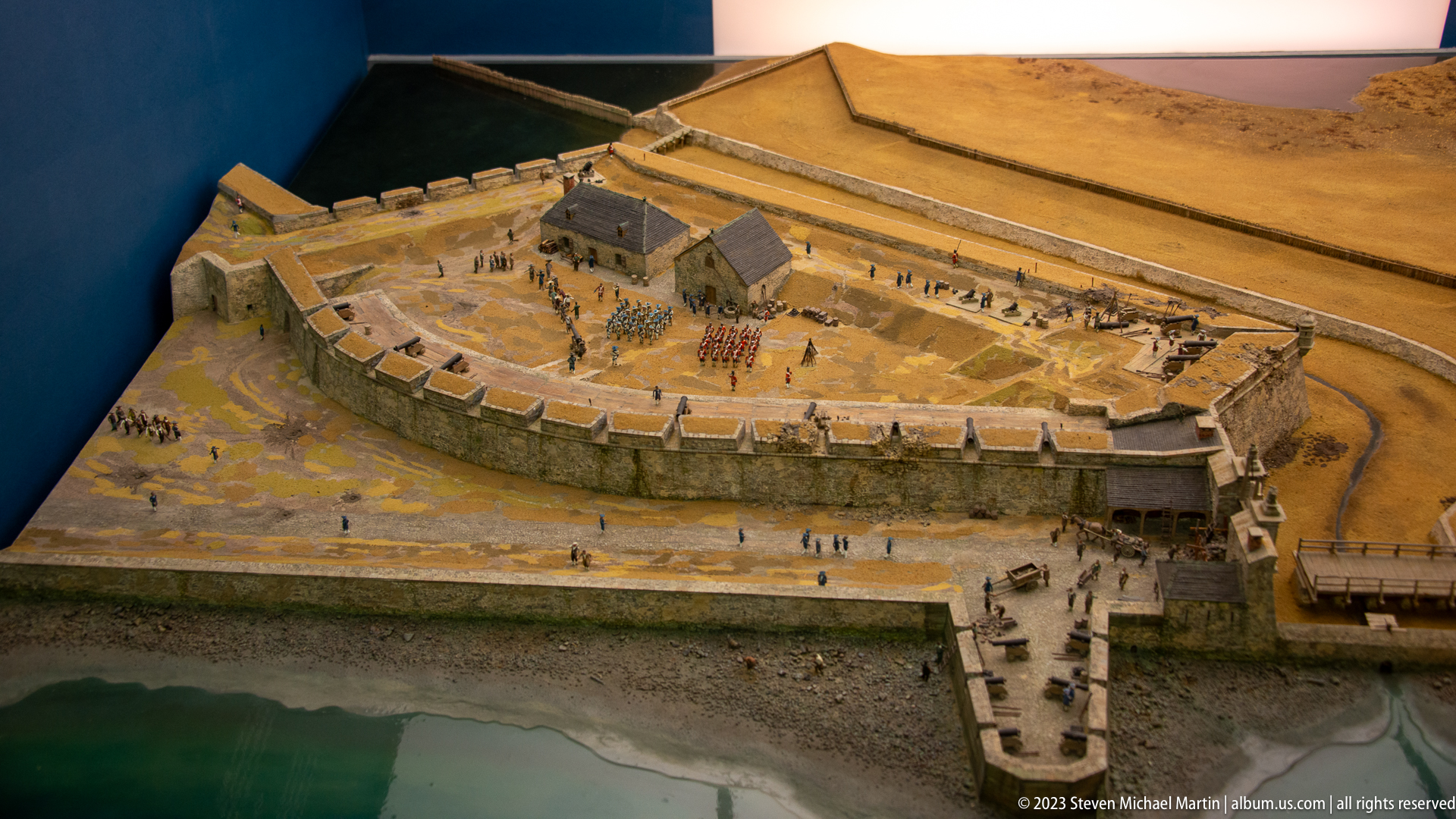
A detailed scale model reconstructs a compact enclosed defensive work, with thick perimeter walls, projecting angles, interior buildings, assembled troops, and a waterfront approach. Seen from above, the model clarifies the relationship between ramparts, circulation, barracks-like structures, and the shoreline more readily than a ground-level visit could.
Caption
A detailed scale model reconstructs a compact enclosed defensive work, with thick perimeter walls, projecting angles, interior buildings, assembled troops, and a waterfront approach. Seen from above, the model clarifies the relationship between ramparts, circulation, barracks-like structures, and the shoreline more readily than a ground-level visit could.
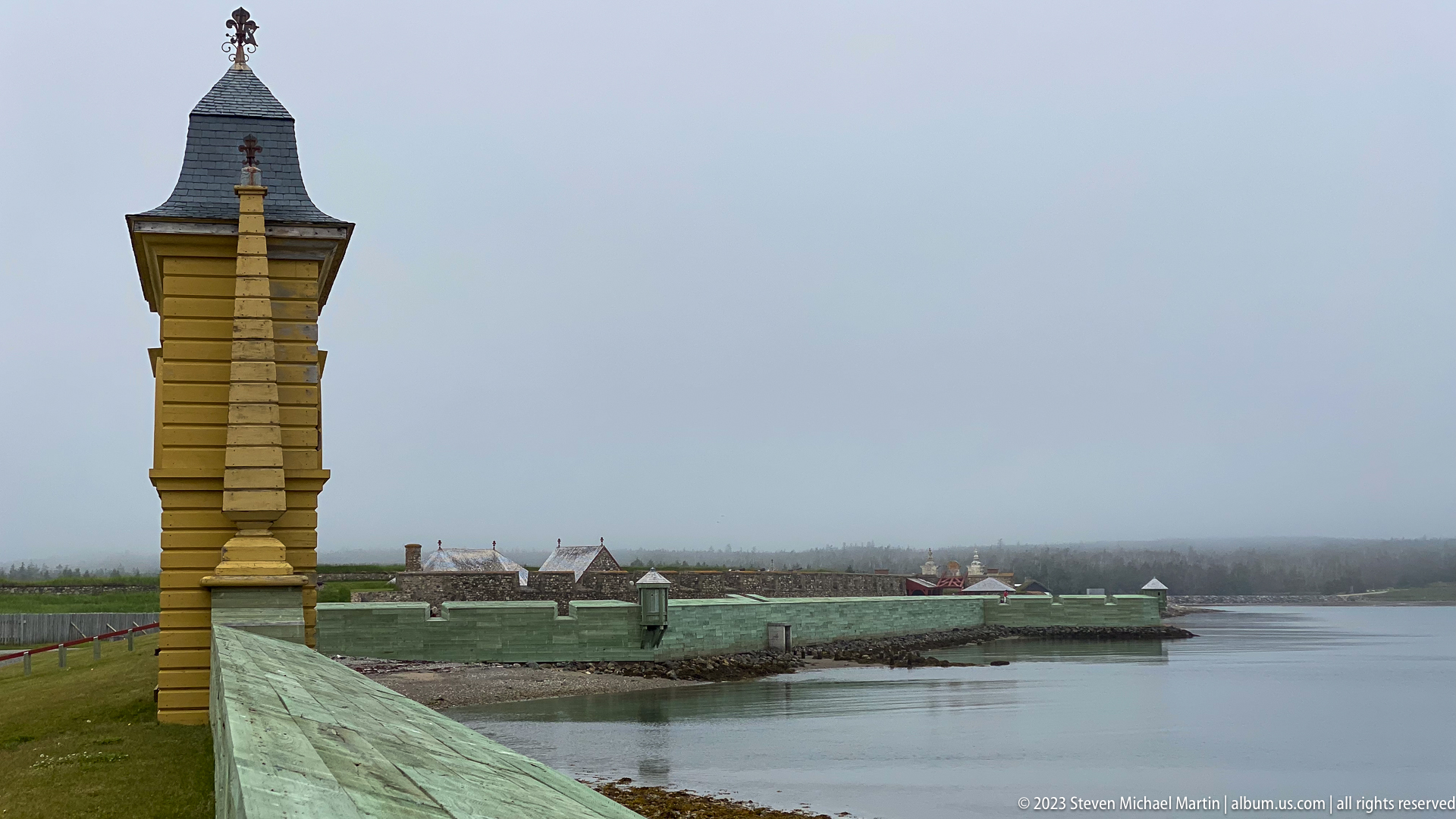
A tall, narrow wooden sentry structure rises beside a green-painted parapet overlooking Louisbourg Harbour. Across the calm water, low reconstructed fortifications and buildings sit beneath a gray, misty horizon. The elevated viewpoint links the defensive architecture in the foreground with the harbour approaches beyond, emphasizing the fortress’s strategic relationship to the waterfront.
Caption
A tall, narrow wooden sentry structure rises beside a green-painted parapet overlooking Louisbourg Harbour. Across the calm water, low reconstructed fortifications and buildings sit beneath a gray, misty horizon. The elevated viewpoint links the defensive architecture in the foreground with the harbour approaches beyond, emphasizing the fortress’s strategic relationship to the waterfront.
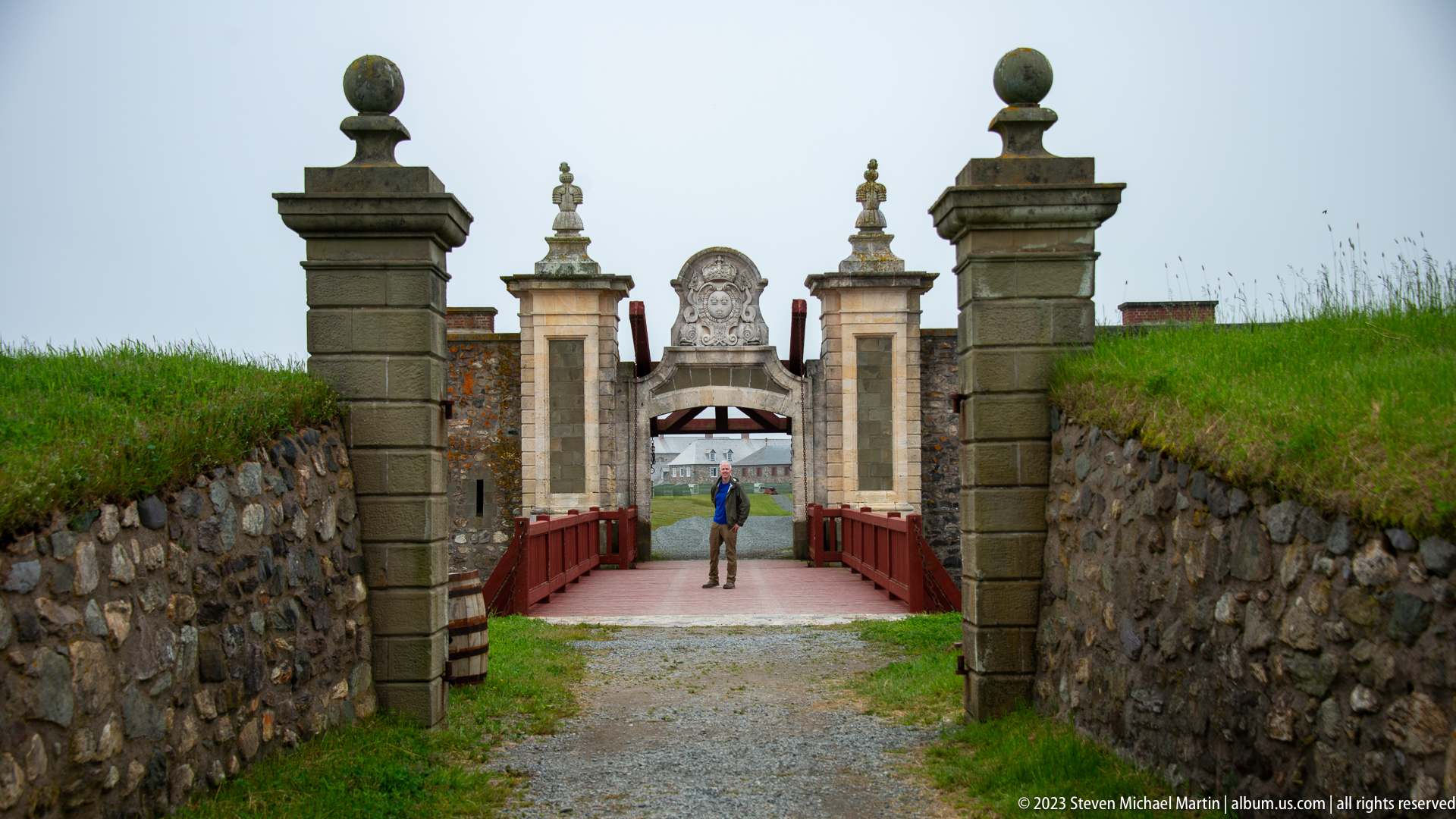
Two dark stone posts frame a descending approach toward the ornate fortress gate and its red bridge. Grassy embankments and rubble-stone retaining walls create a narrow passage, while a lone visitor provides scale. The layered sequence of outer posts, bridge, and inner gateway illustrates the controlled movement built into the fortification's entrance system.
Caption
Two dark stone posts frame a descending approach toward the ornate fortress gate and its red bridge. Grassy embankments and rubble-stone retaining walls create a narrow passage, while a lone visitor provides scale. The layered sequence of outer posts, bridge, and inner gateway illustrates the controlled movement built into the fortification's entrance system.
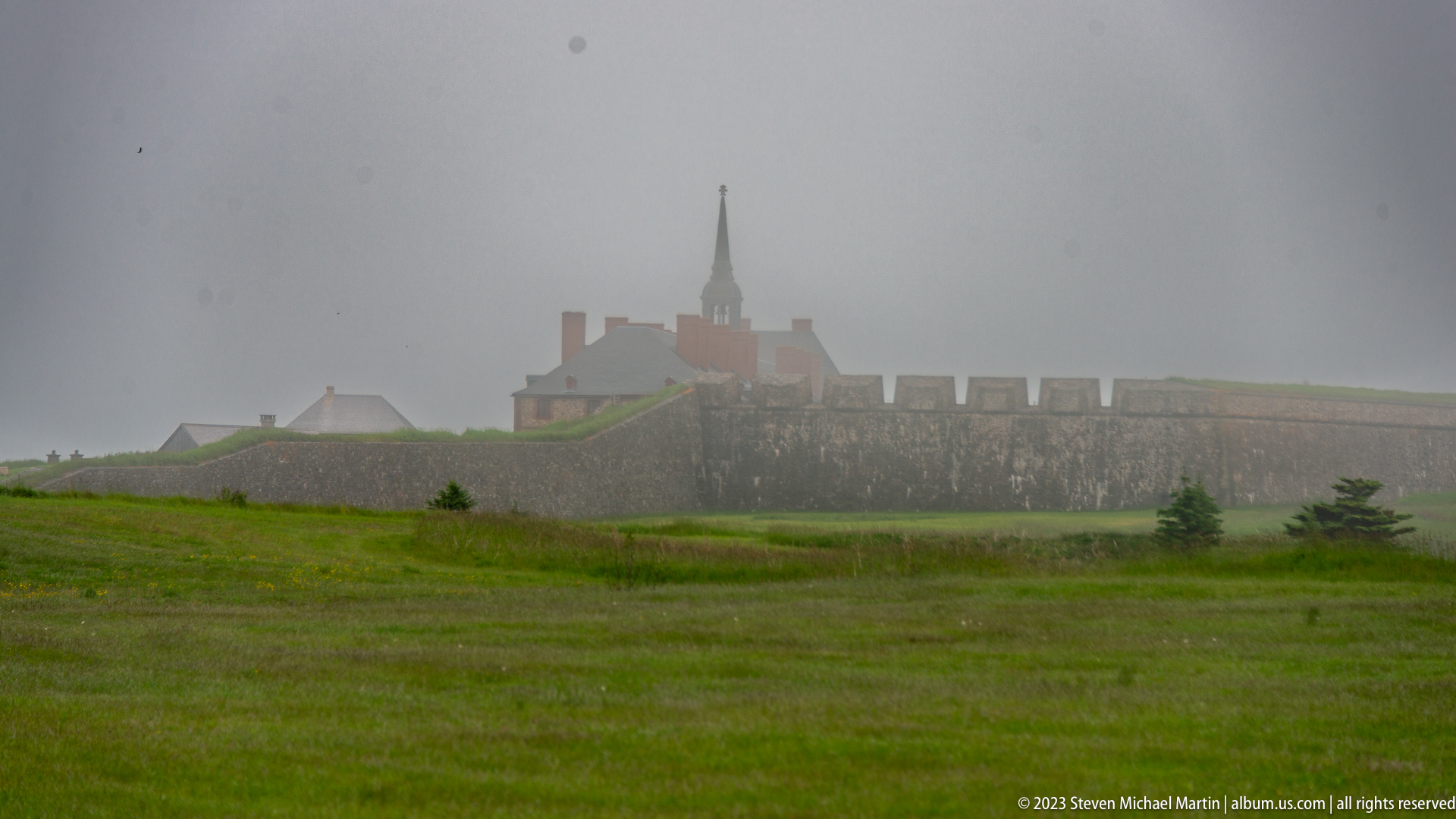
Low fog softens the reconstructed Louisbourg skyline, where long stone walls, earthworks, clustered roofs, and a slender church tower emerge across a broad green foreground. The subdued weather compresses detail and gives the fortifications a distant, atmospheric presence, emphasizing their horizontal spread across the coastal landscape.
Caption
Low fog softens the reconstructed Louisbourg skyline, where long stone walls, earthworks, clustered roofs, and a slender church tower emerge across a broad green foreground. The subdued weather compresses detail and gives the fortifications a distant, atmospheric presence, emphasizing their horizontal spread across the coastal landscape.
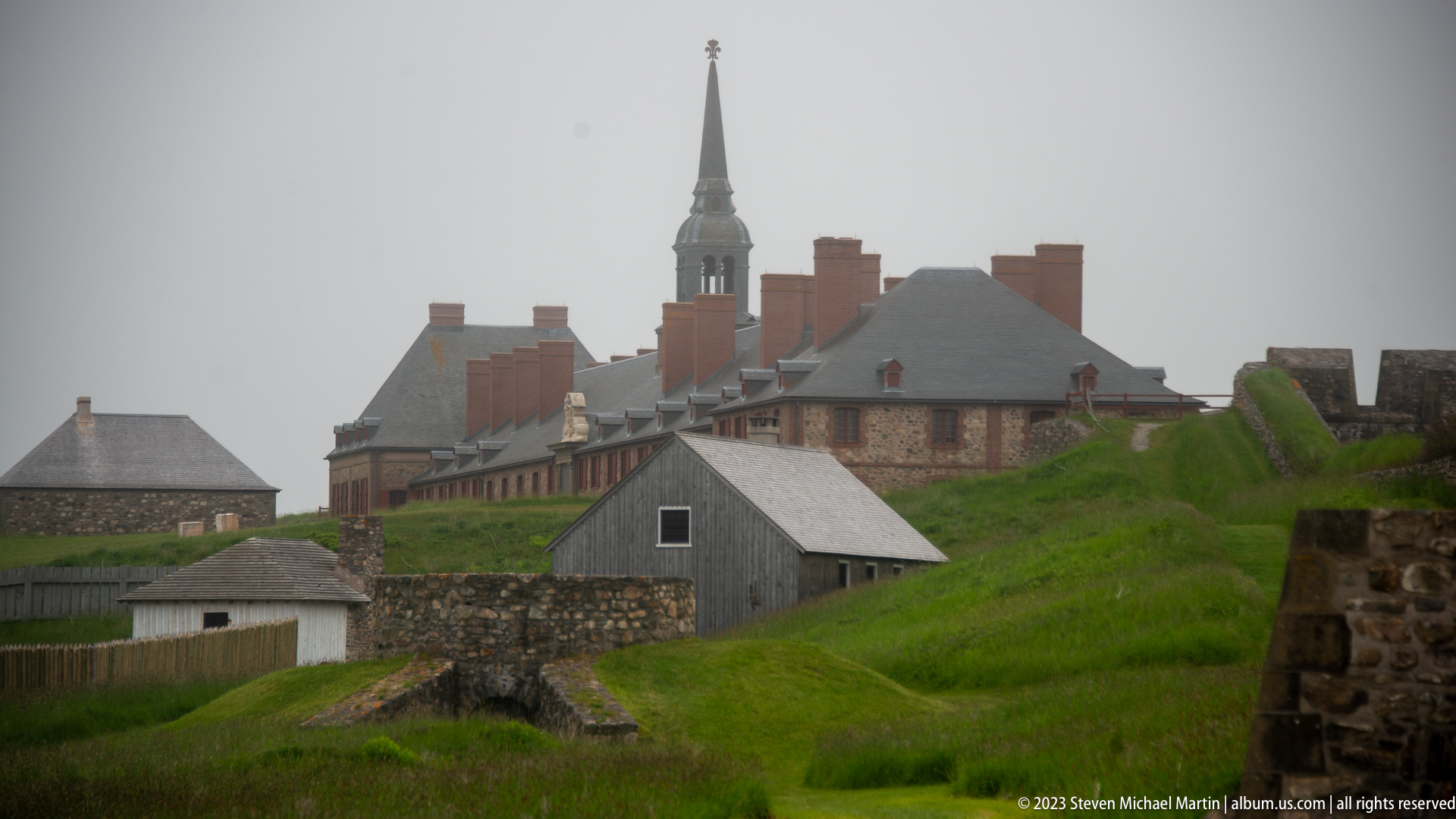
Roofs, chimneys, and clustered masonry buildings rise behind grassy earthworks, culminating in a slender church spire that anchors the misty skyline. A gray wooden outbuilding and low stone walls occupy the foreground. The layered view shows the density and varied building materials of the reconstructed eighteenth-century town within its defensive landscape.
Caption
Roofs, chimneys, and clustered masonry buildings rise behind grassy earthworks, culminating in a slender church spire that anchors the misty skyline. A gray wooden outbuilding and low stone walls occupy the foreground. The layered view shows the density and varied building materials of the reconstructed eighteenth-century town within its defensive landscape.
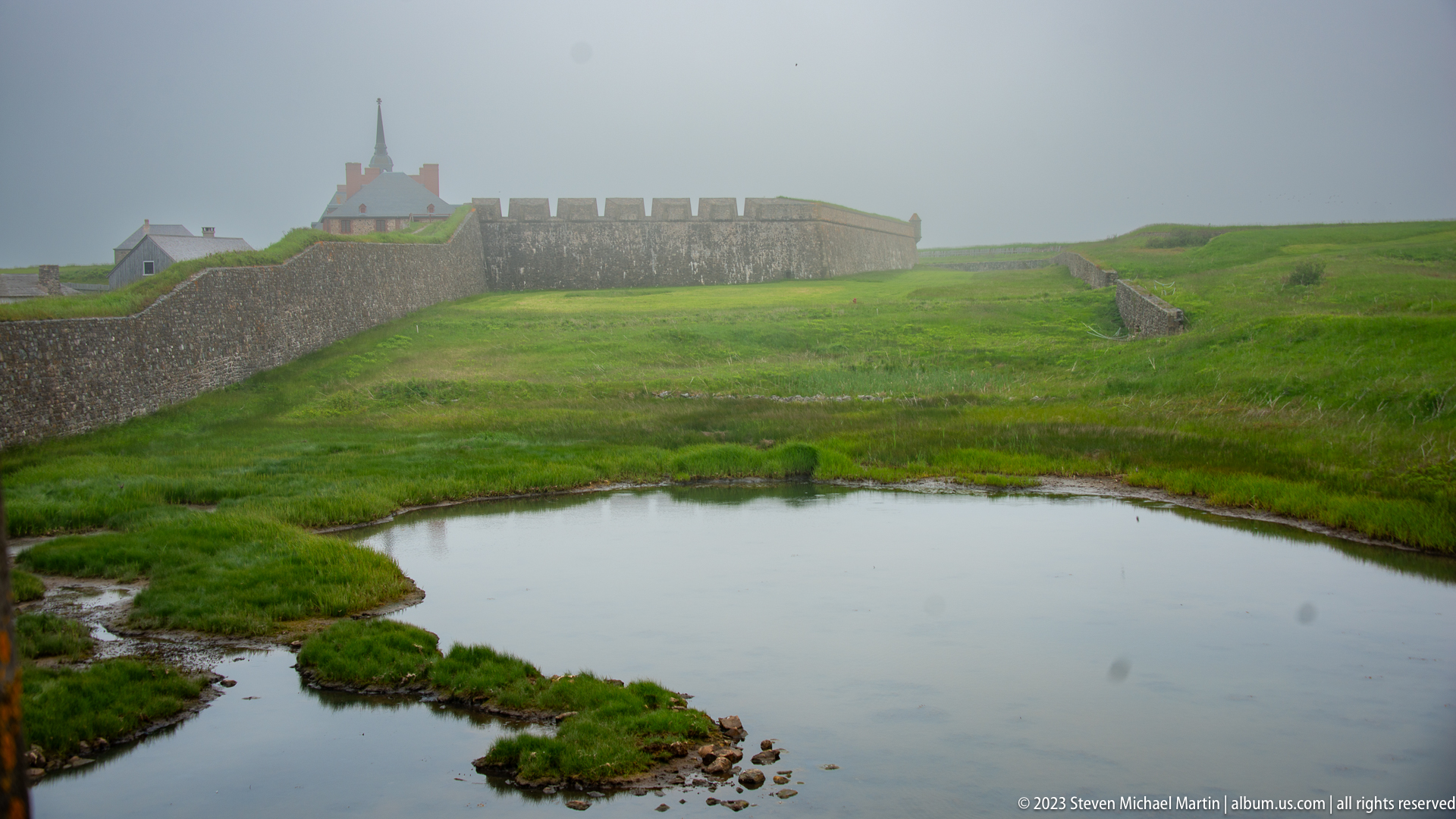
A broad pool fills the foreground of the defensive ditch, edged by saturated grass and low marshy vegetation. Beyond it, long stone walls climb gently across the earthworks toward reconstructed buildings softened by fog. The wide view makes the fortification's combination of terrain, water, and masonry easier to read than in the closer wall studies.
Caption
A broad pool fills the foreground of the defensive ditch, edged by saturated grass and low marshy vegetation. Beyond it, long stone walls climb gently across the earthworks toward reconstructed buildings softened by fog. The wide view makes the fortification's combination of terrain, water, and masonry easier to read than in the closer wall studies.
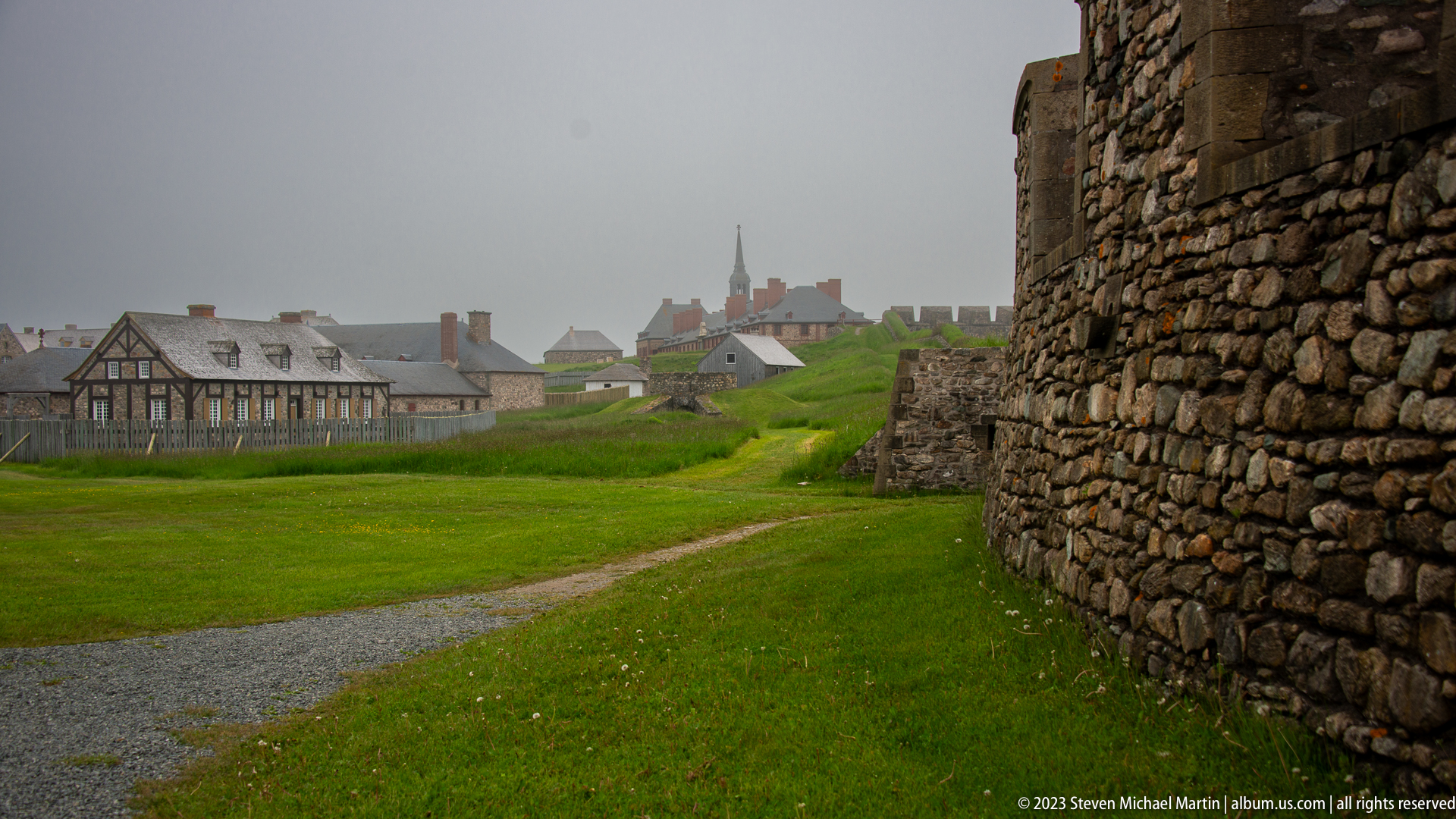
A rough stone wall dominates the right side of a grassy lane leading into the reconstructed settlement. Timber-framed and masonry buildings appear through mist on the left, with the church spire faintly visible farther back. The low viewpoint emphasizes the contrast between utilitarian defensive masonry and the domestic architecture clustered within the fortified town.
Caption
A rough stone wall dominates the right side of a grassy lane leading into the reconstructed settlement. Timber-framed and masonry buildings appear through mist on the left, with the church spire faintly visible farther back. The low viewpoint emphasizes the contrast between utilitarian defensive masonry and the domestic architecture clustered within the fortified town.

Costumed interpreters move along a gravel path inside the reconstructed town, several wearing bright red military coats while others stand in pale civilian or military dress near a red wooden railing. Stone walls, grass, and a yellow building frame the procession, placing living-history interpretation directly within the rebuilt streetscape of the Fortress of Louisbourg NHS.
Caption
Costumed interpreters move along a gravel path inside the reconstructed town, several wearing bright red military coats while others stand in pale civilian or military dress near a red wooden railing. Stone walls, grass, and a yellow building frame the procession, placing living-history interpretation directly within the rebuilt streetscape of the Fortress of Louisbourg NHS.
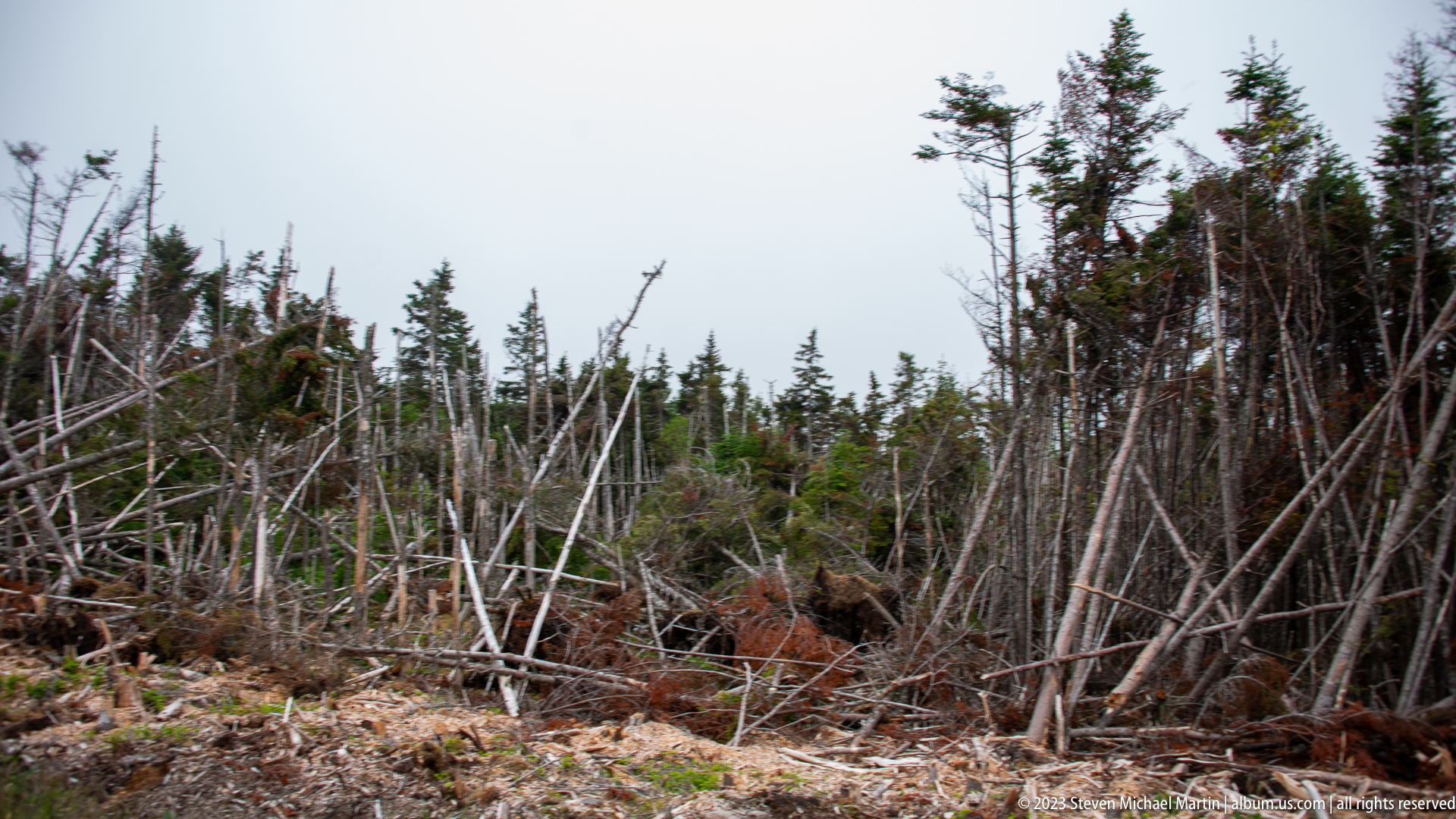
A swath of broken and uprooted conifers forms a dense tangle of pale trunks beside the access route to Louisbourg. The damaged woodland provides a contemporary natural-history counterpoint to the historic site, showing how exposed coastal forests can be reshaped by severe weather while surviving trees remain upright along the margins.
Caption
A swath of broken and uprooted conifers forms a dense tangle of pale trunks beside the access route to Louisbourg. The damaged woodland provides a contemporary natural-history counterpoint to the historic site, showing how exposed coastal forests can be reshaped by severe weather while surviving trees remain upright along the margins.
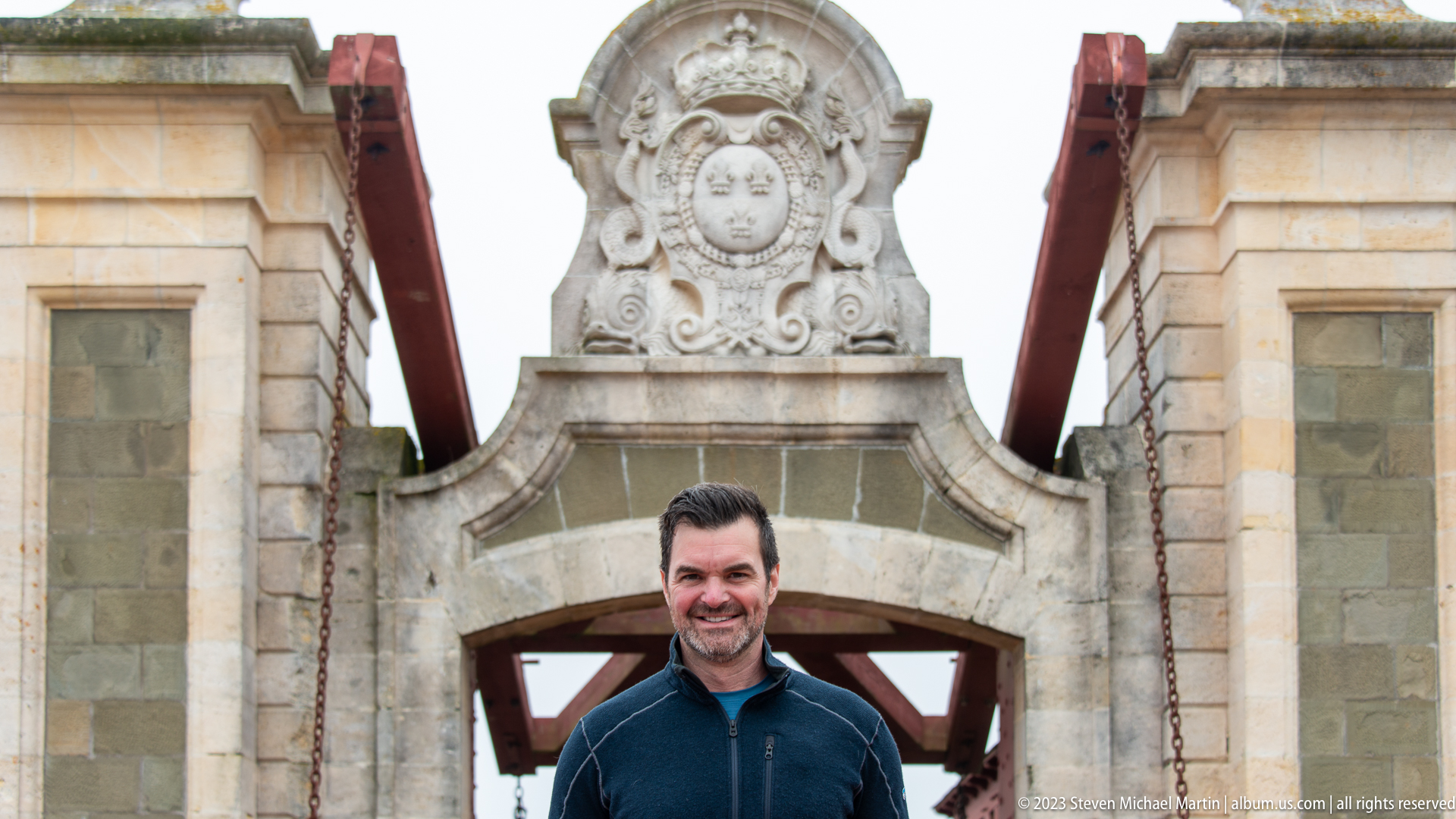
A waist-up visitor portrait is positioned directly beneath the gateway's carved royal arms, visually aligning the figure with the crowned fleur-de-lis shield overhead. Pale stone piers and the raised bridge mechanism frame the background. The tight composition shifts emphasis from the entrance as architecture to the human experience of the historic site.
Caption
A waist-up visitor portrait is positioned directly beneath the gateway's carved royal arms, visually aligning the figure with the crowned fleur-de-lis shield overhead. Pale stone piers and the raised bridge mechanism frame the background. The tight composition shifts emphasis from the entrance as architecture to the human experience of the historic site.
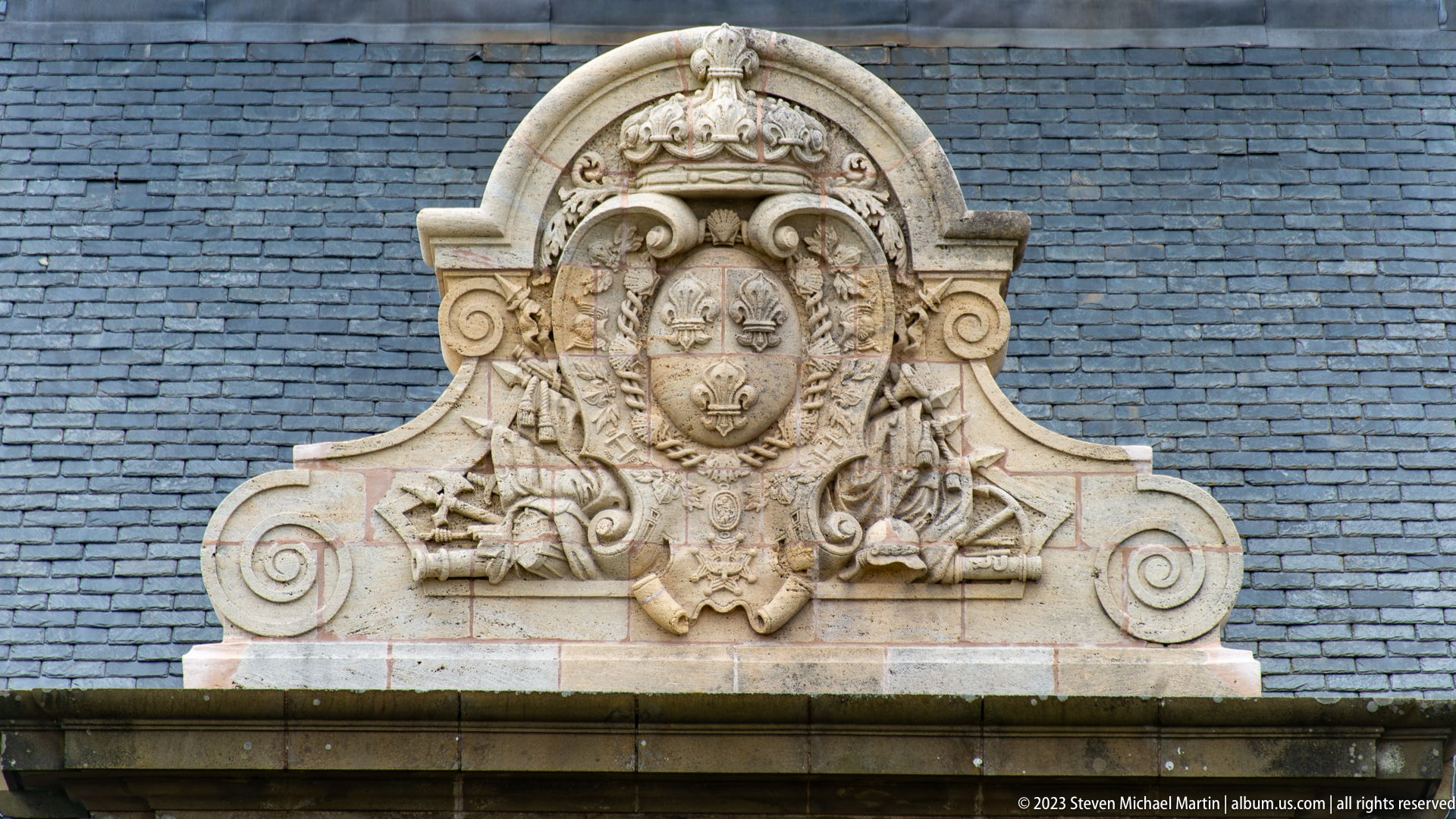
An ornate stone relief crowns the gateway, centered on a shield bearing fleur-de-lis motifs and surrounded by a crown, scrolling foliage, military trophies, and heraldic devices. Set against the dark slate roof, the pale carving serves as a prominent statement of royal authority above the formal entrance to the reconstructed fortress complex.
Caption
An ornate stone relief crowns the gateway, centered on a shield bearing fleur-de-lis motifs and surrounded by a crown, scrolling foliage, military trophies, and heraldic devices. Set against the dark slate roof, the pale carving serves as a prominent statement of royal authority above the formal entrance to the reconstructed fortress complex.
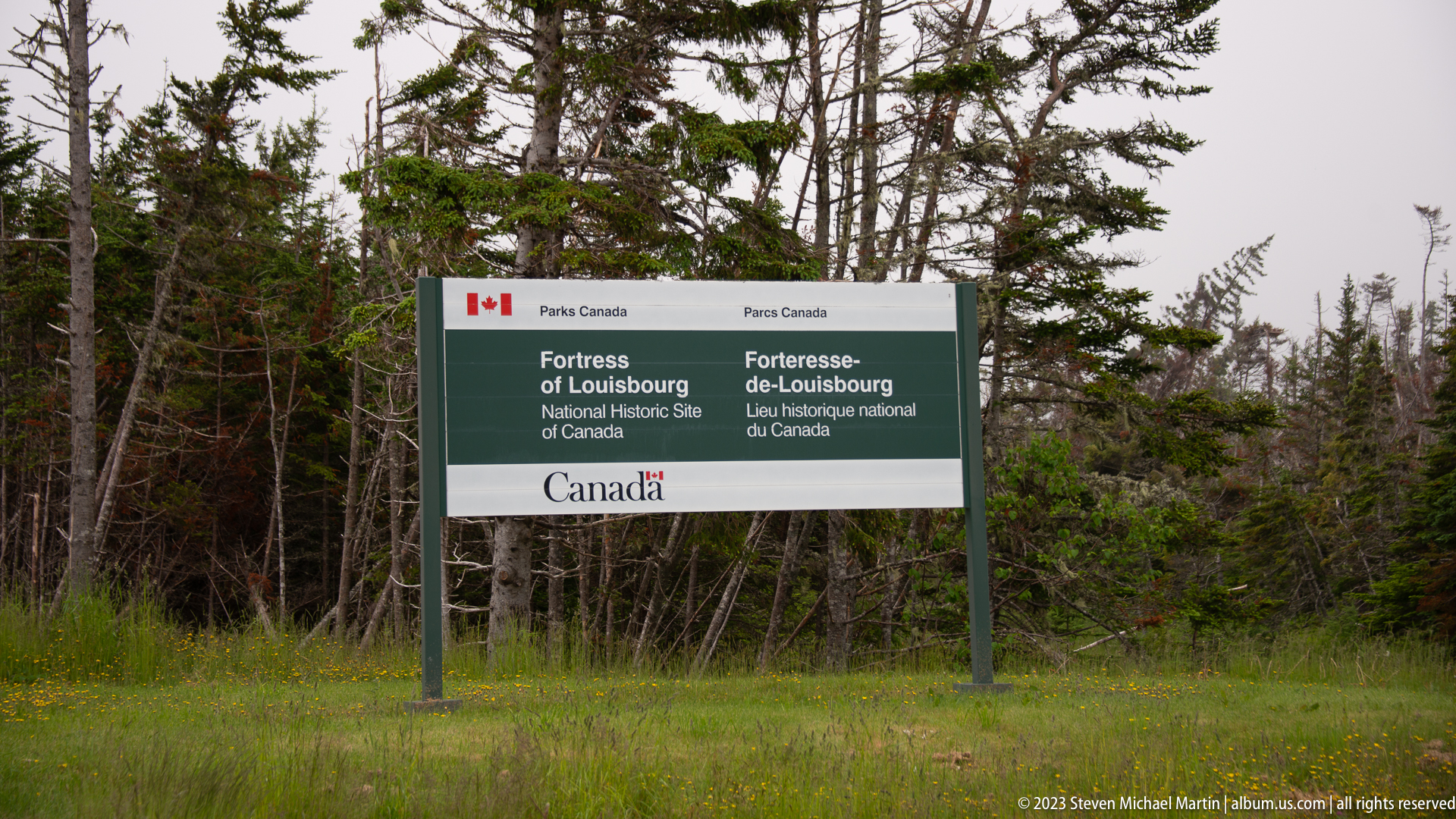
A bilingual Parks Canada sign marks the entrance to the Fortress of Louisbourg National Historic Site, set against spruce and fir woodland. The roadside marker establishes the protected site before the reconstructed town and fortifications come into view, linking the modern visitor arrival sequence with one of Canada’s major preserved eighteenth-century military and settlement landscapes.
Caption
A bilingual Parks Canada sign marks the entrance to the Fortress of Louisbourg National Historic Site, set against spruce and fir woodland. The roadside marker establishes the protected site before the reconstructed town and fortifications come into view, linking the modern visitor arrival sequence with one of Canada’s major preserved eighteenth-century military and settlement landscapes.

Splintered trunks, toppled stems, and exposed branches fill this closer view of storm damage in the forest near Louisbourg. The compressed composition emphasizes the chaotic overlap of broken timber and the contrast between stripped gray trunks and surviving green crowns, making the physical effects of high winds especially legible.
Caption
Splintered trunks, toppled stems, and exposed branches fill this closer view of storm damage in the forest near Louisbourg. The compressed composition emphasizes the chaotic overlap of broken timber and the contrast between stripped gray trunks and surviving green crowns, making the physical effects of high winds especially legible.

Broken trunks lean toward a rough corridor cut through a heavily damaged stand of conifers. The receding line of the opening gives the scene unusual depth and shows the scale of disturbance across the forest edge, where snapped stems create an almost continuous lattice beside the cleared route.
Caption
Broken trunks lean toward a rough corridor cut through a heavily damaged stand of conifers. The receding line of the opening gives the scene unusual depth and shows the scale of disturbance across the forest edge, where snapped stems create an almost continuous lattice beside the cleared route.
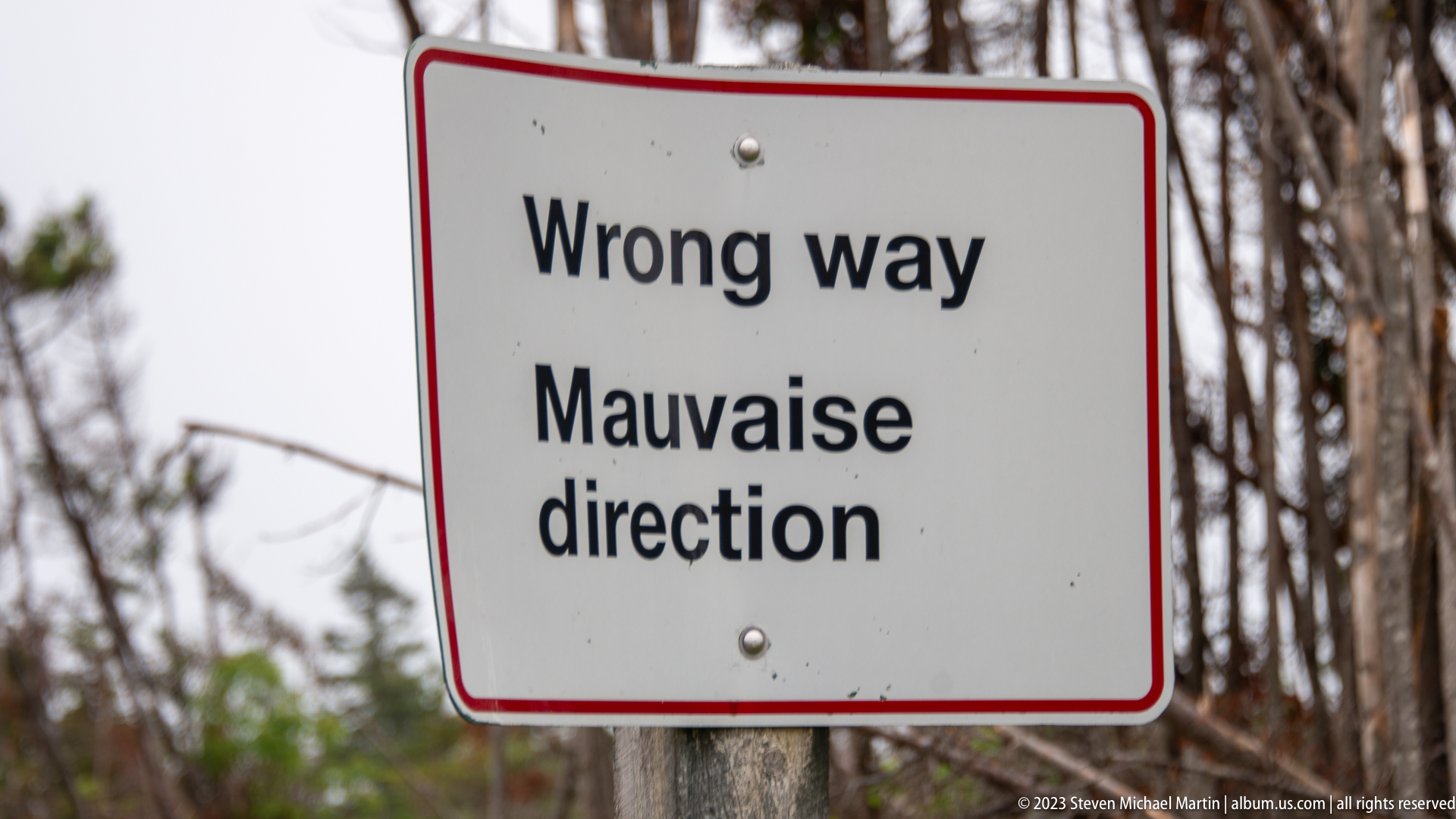
A bilingual “Wrong way / Mauvaise direction” traffic sign appears against a blurred woodland background on the approach to Louisbourg. The simple modern directional marker is a small but distinctive element of the visitor circulation system, contrasting sharply with the historic architecture and interpretive settings encountered deeper within the site.
Caption
A bilingual “Wrong way / Mauvaise direction” traffic sign appears against a blurred woodland background on the approach to Louisbourg. The simple modern directional marker is a small but distinctive element of the visitor circulation system, contrasting sharply with the historic architecture and interpretive settings encountered deeper within the site.

Broad bands of red, orange, yellow, green, blue, and violet create a rainbow-striped pedestrian crossing on the paved visitor route. Weathering, cracks, and faded paint remain visible across the colored bands, giving the contemporary intervention a strong graphic presence within the otherwise subdued road surface.
Caption
Broad bands of red, orange, yellow, green, blue, and violet create a rainbow-striped pedestrian crossing on the paved visitor route. Weathering, cracks, and faded paint remain visible across the colored bands, giving the contemporary intervention a strong graphic presence within the otherwise subdued road surface.
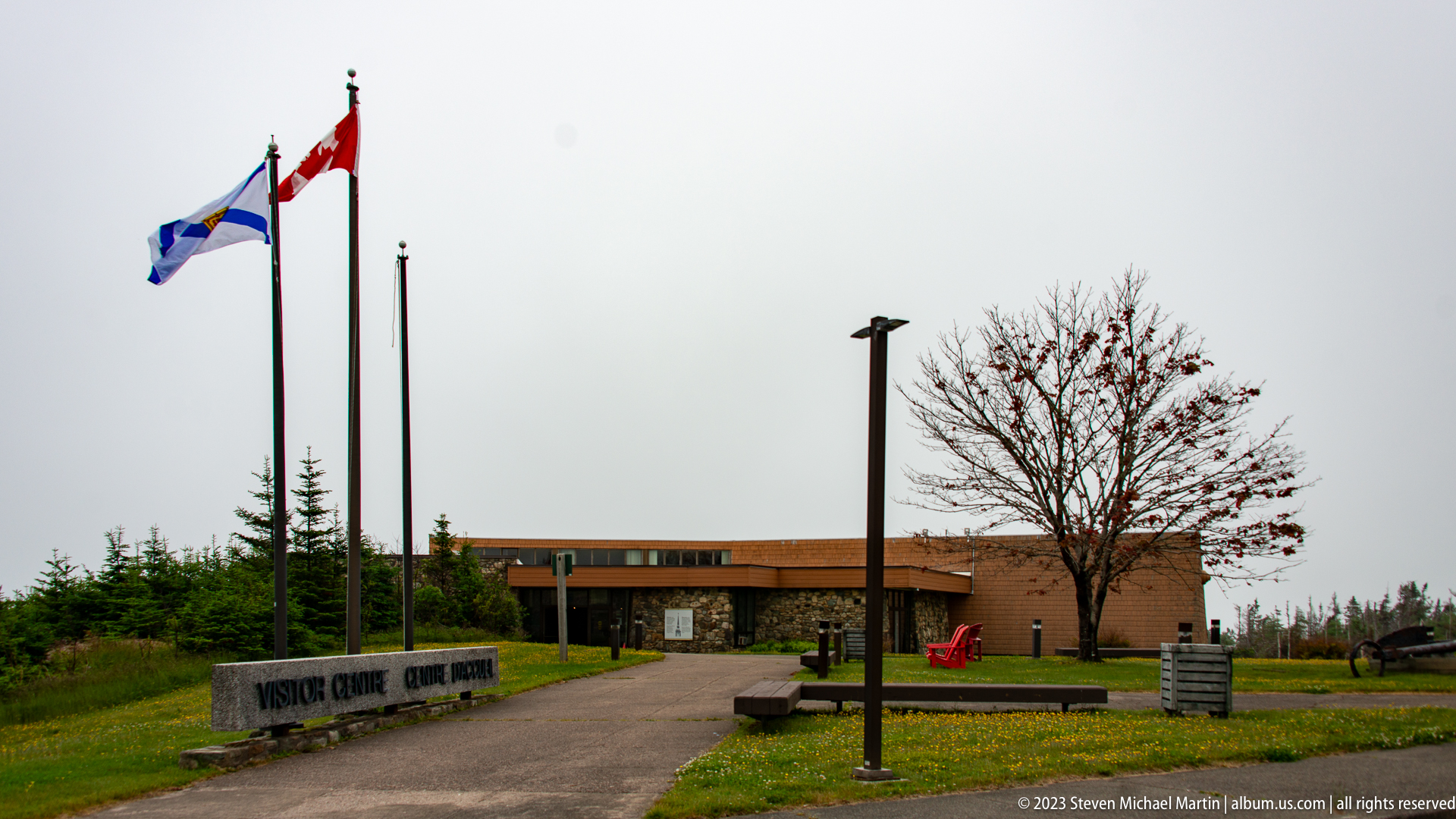
Nova Scotia and Canadian flags rise over the landscaped forecourt of the Louisbourg Visitor Centre. Benches, a leafless tree, low plantings, and the horizontal architecture of the building give this view a broader sense of the visitor complex than the tighter entrance photograph, emphasizing the site’s modern reception landscape.
Caption
Nova Scotia and Canadian flags rise over the landscaped forecourt of the Louisbourg Visitor Centre. Benches, a leafless tree, low plantings, and the horizontal architecture of the building give this view a broader sense of the visitor complex than the tighter entrance photograph, emphasizing the site’s modern reception landscape.
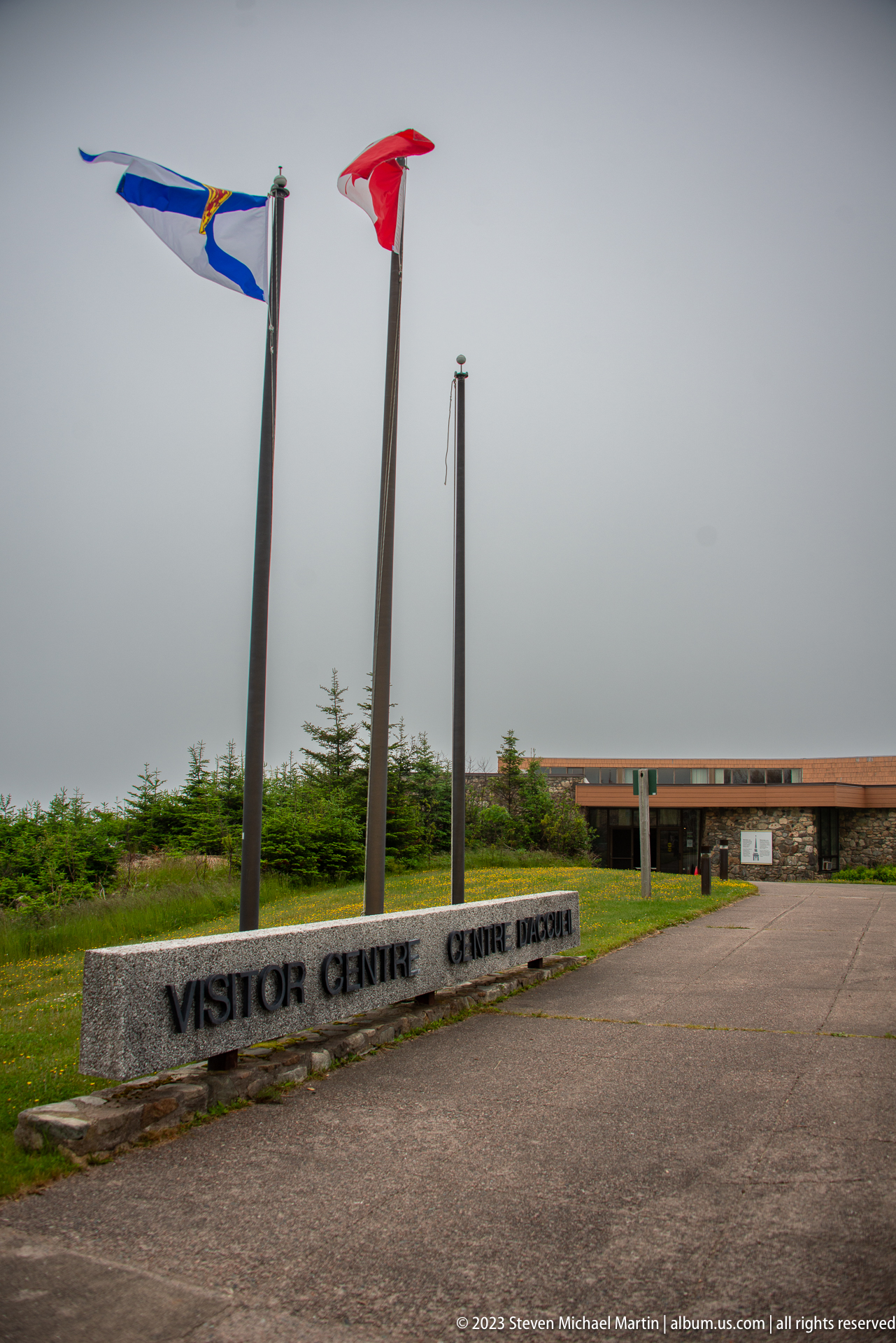
The approach to the Fortress of Louisbourg Visitor Centre is framed by tall flagpoles and a low stone sign reading “Visitor Centre / Centre d’accueil.” A long, low modern building stretches across the background, establishing the contemporary orientation point from which visitors begin their transfer into the historic site.
Caption
The approach to the Fortress of Louisbourg Visitor Centre is framed by tall flagpoles and a low stone sign reading “Visitor Centre / Centre d’accueil.” A long, low modern building stretches across the background, establishing the contemporary orientation point from which visitors begin their transfer into the historic site.
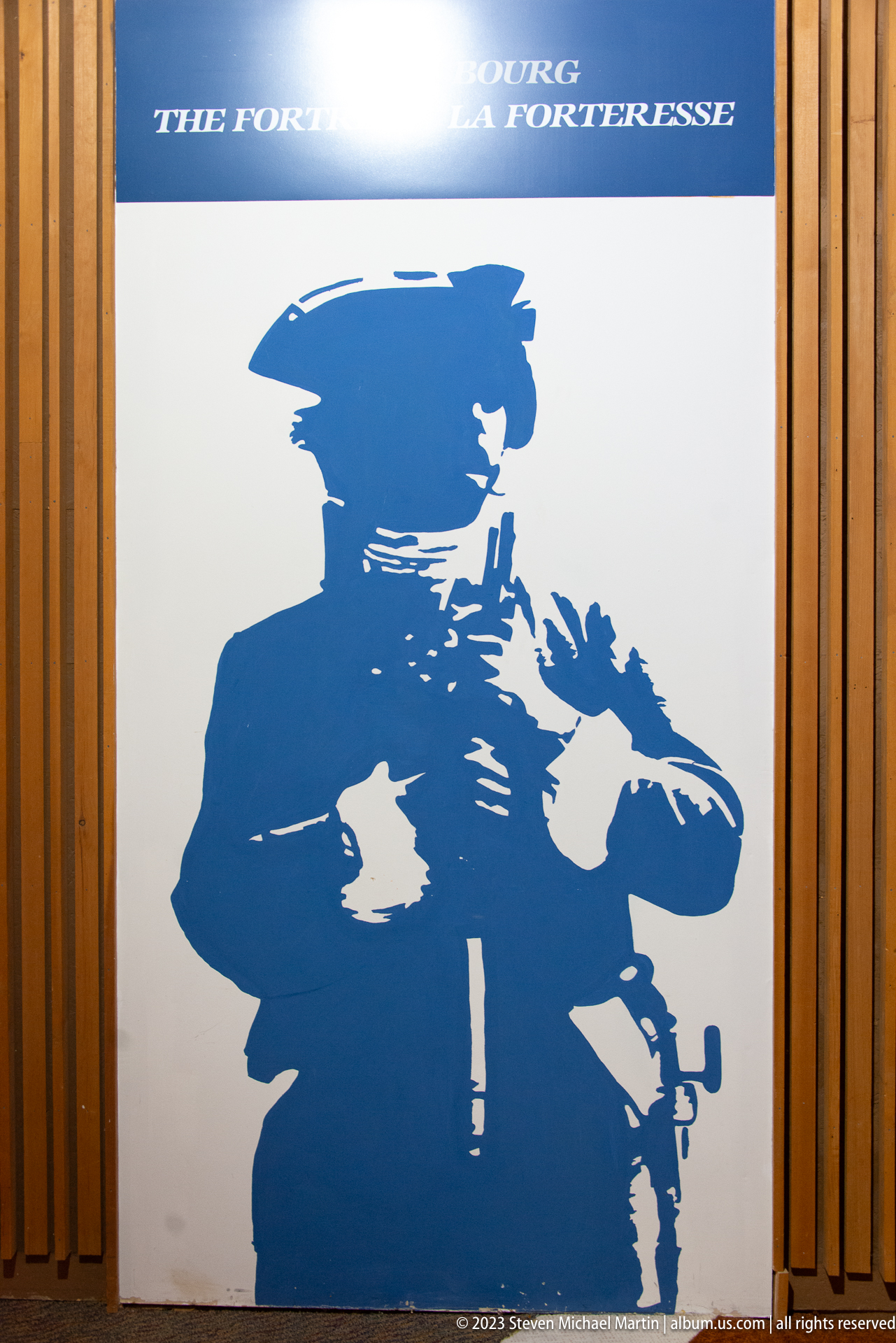
A bold blue silhouette presents an eighteenth-century soldier in profile, with hat, coat, and carried equipment reduced to crisp graphic shapes. Framed by wood and set beneath partial Fortress of Louisbourg branding, the image functions as a visual transition from the modern visitor centre to the reconstructed military world interpreted at the site.
Caption
A bold blue silhouette presents an eighteenth-century soldier in profile, with hat, coat, and carried equipment reduced to crisp graphic shapes. Framed by wood and set beneath partial Fortress of Louisbourg branding, the image functions as a visual transition from the modern visitor centre to the reconstructed military world interpreted at the site.
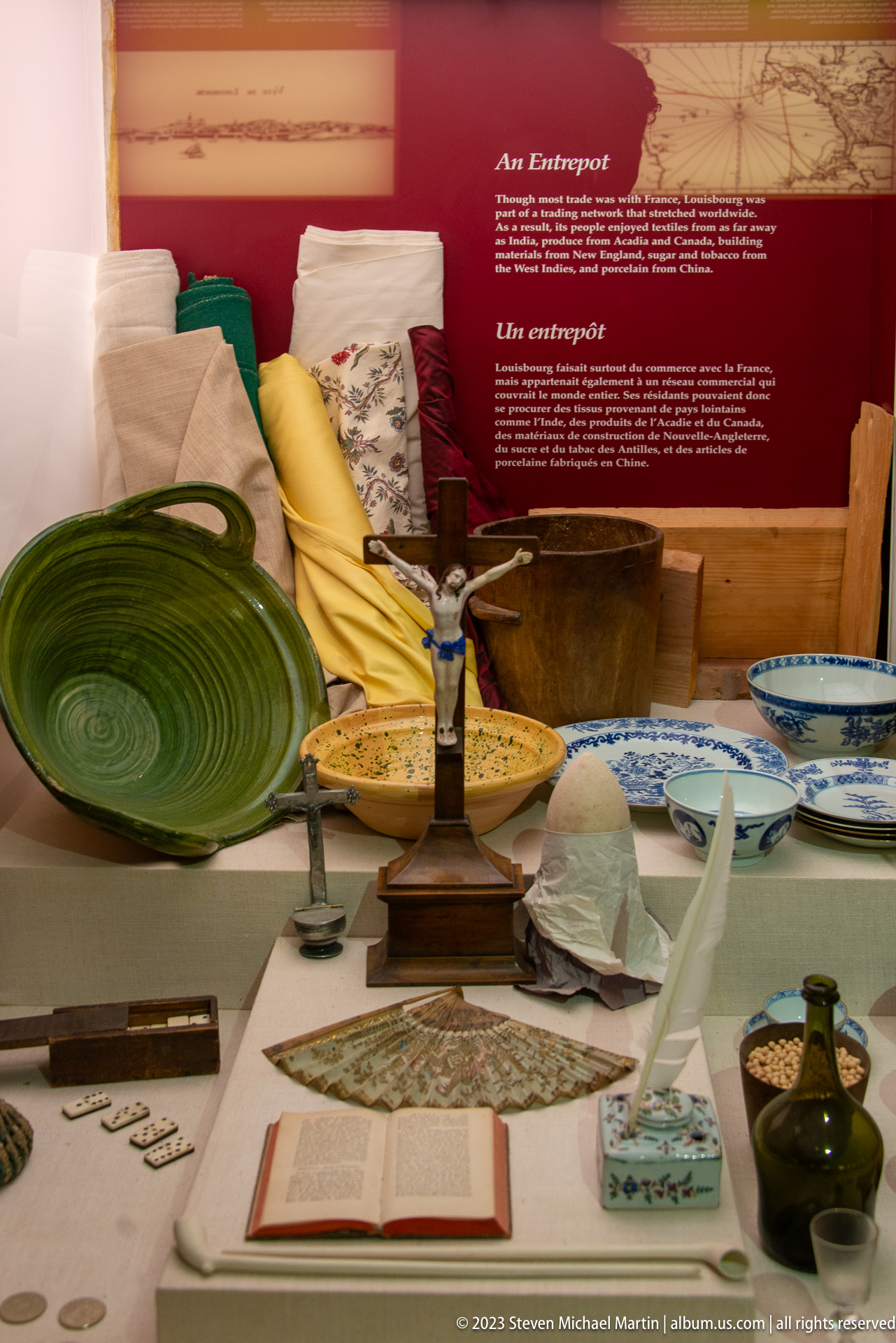
Ceramics, folded textiles, books, metal objects, tableware, and small personal items are arranged in a museum display beneath the heading “An Entrepôt / Un entrepôt.” The dense assortment evokes the flow of household goods and trade commodities through Louisbourg, presenting the fortified town not only as a military post but also as a commercial and domestic community.
Caption
Ceramics, folded textiles, books, metal objects, tableware, and small personal items are arranged in a museum display beneath the heading “An Entrepôt / Un entrepôt.” The dense assortment evokes the flow of household goods and trade commodities through Louisbourg, presenting the fortified town not only as a military post but also as a commercial and domestic community.
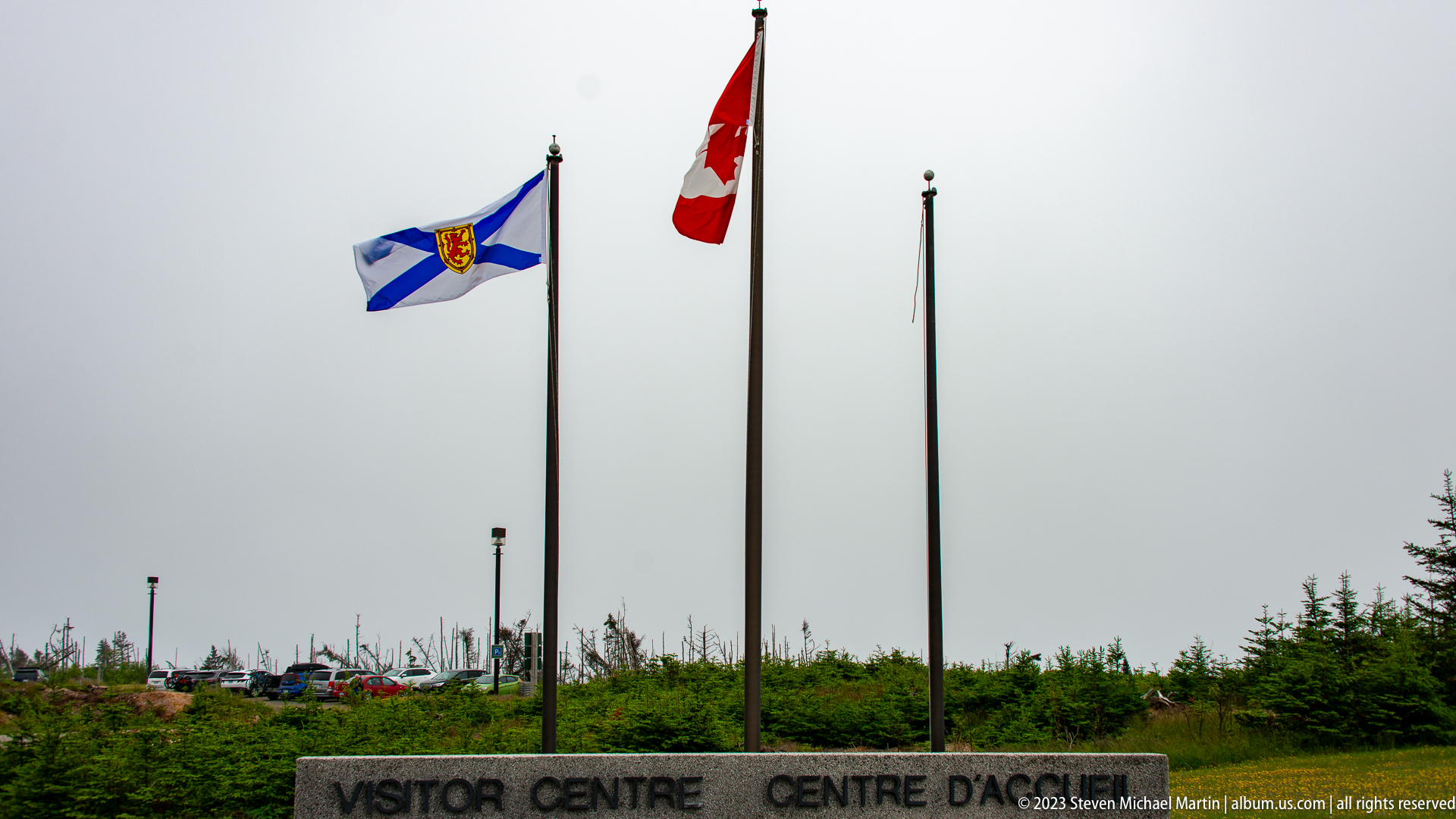
The provincial flag of Nova Scotia and the Canadian flag dominate the approach to the Visitor Centre, their bright colors standing out against an overcast sky. The low bilingual stone sign anchors the lower edge of the frame, while additional poles and distant vehicles indicate the active arrival zone.
Caption
The provincial flag of Nova Scotia and the Canadian flag dominate the approach to the Visitor Centre, their bright colors standing out against an overcast sky. The low bilingual stone sign anchors the lower edge of the frame, while additional poles and distant vehicles indicate the active arrival zone.
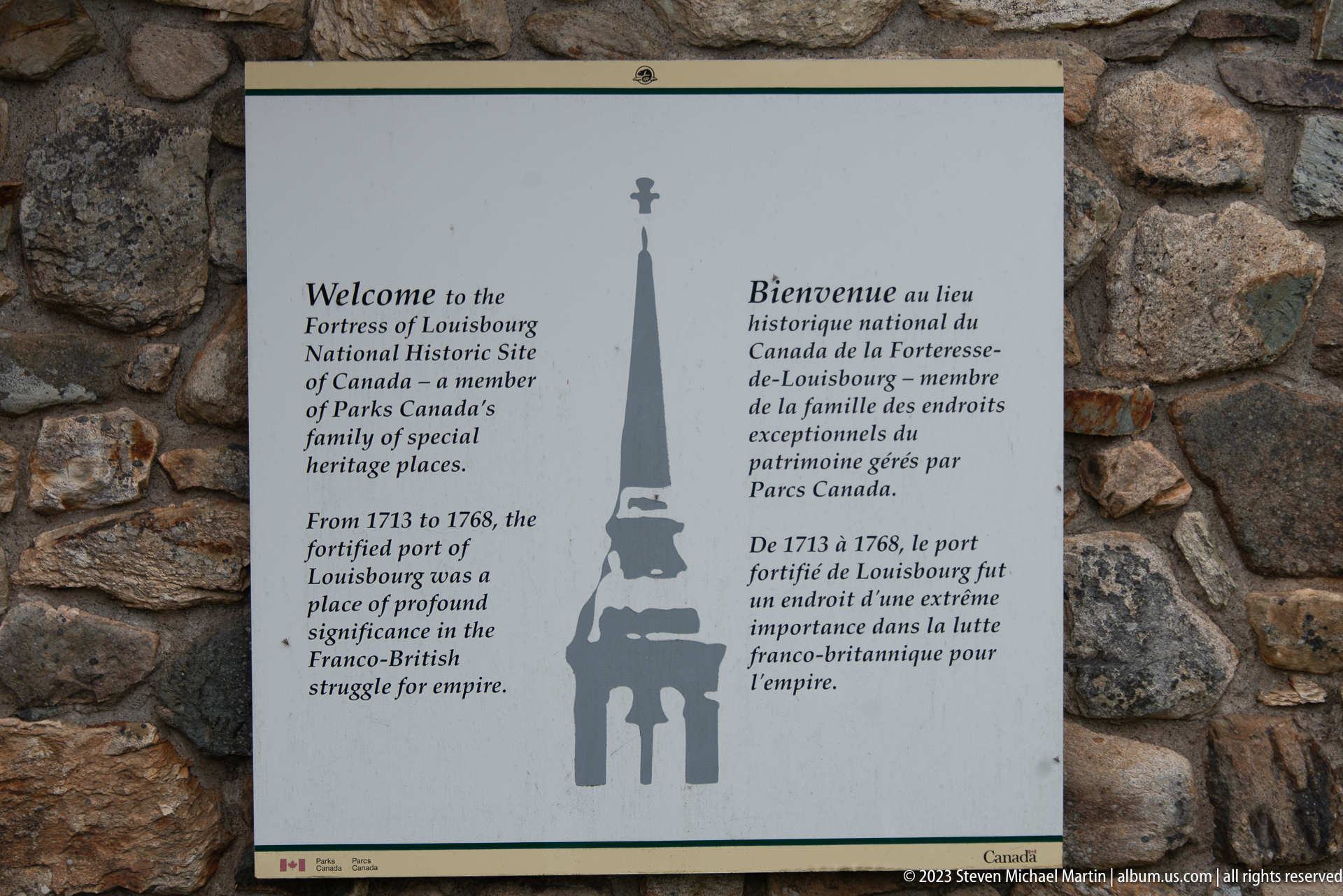
A bilingual interpretive panel welcomes visitors to the Fortress of Louisbourg National Historic Site and introduces the place as a member of Parks Canada’s family of special heritage places. Mounted against a rough stone wall, the sign combines text with a stylized fortified-tower silhouette, visually linking orientation information to the site’s military character.
Caption
A bilingual interpretive panel welcomes visitors to the Fortress of Louisbourg National Historic Site and introduces the place as a member of Parks Canada’s family of special heritage places. Mounted against a rough stone wall, the sign combines text with a stylized fortified-tower silhouette, visually linking orientation information to the site’s military character.
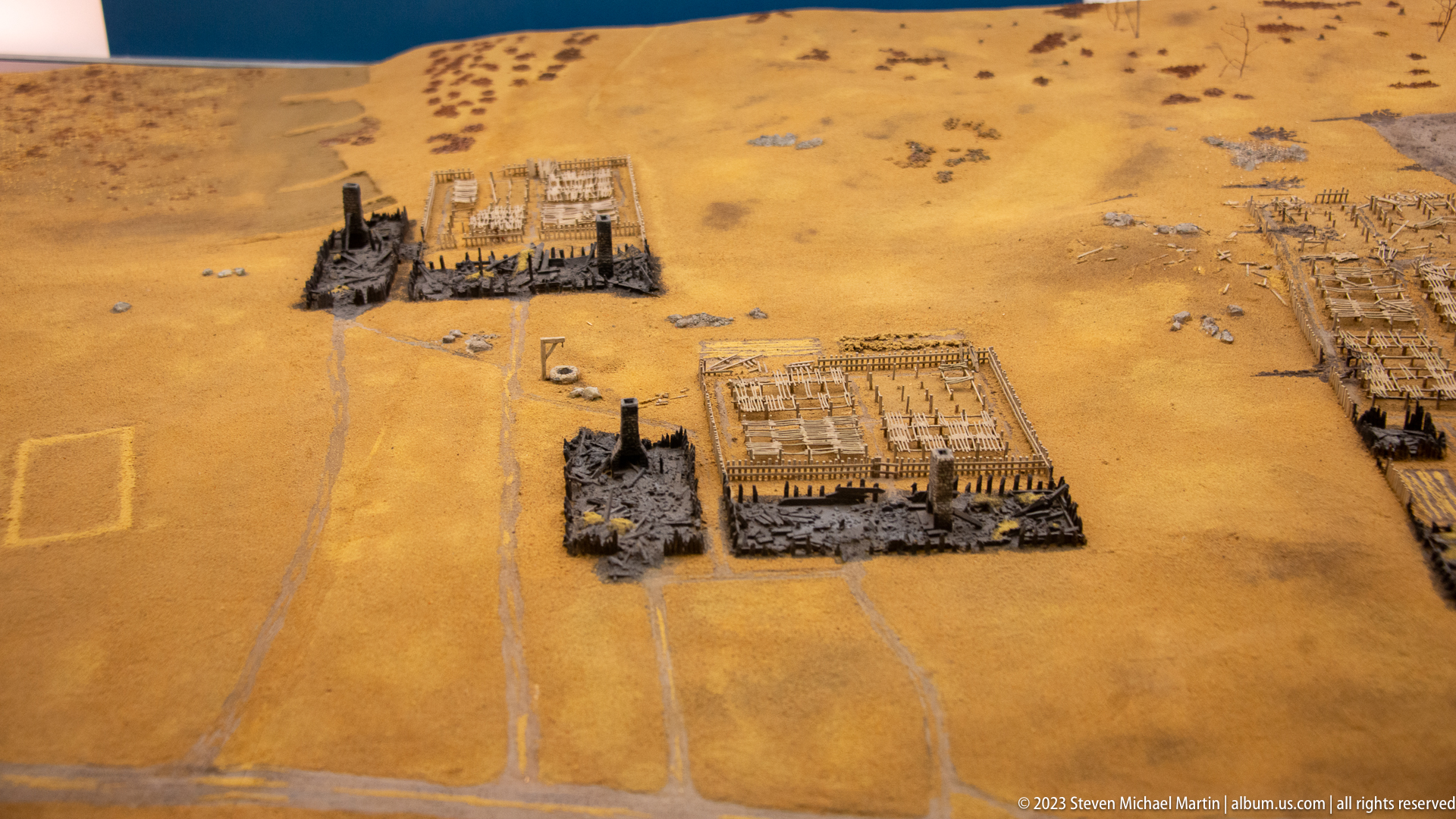
Separated clusters of miniature buildings and pale road lines spread across a sandy model surface, suggesting the spatial organization of the historic settlement beyond the main fortified works. This view emphasizes individual building compounds and open ground, helping visitors read the town as a broader inhabited landscape rather than only a single fortress enclosure.
Caption
Separated clusters of miniature buildings and pale road lines spread across a sandy model surface, suggesting the spatial organization of the historic settlement beyond the main fortified works. This view emphasizes individual building compounds and open ground, helping visitors read the town as a broader inhabited landscape rather than only a single fortress enclosure.
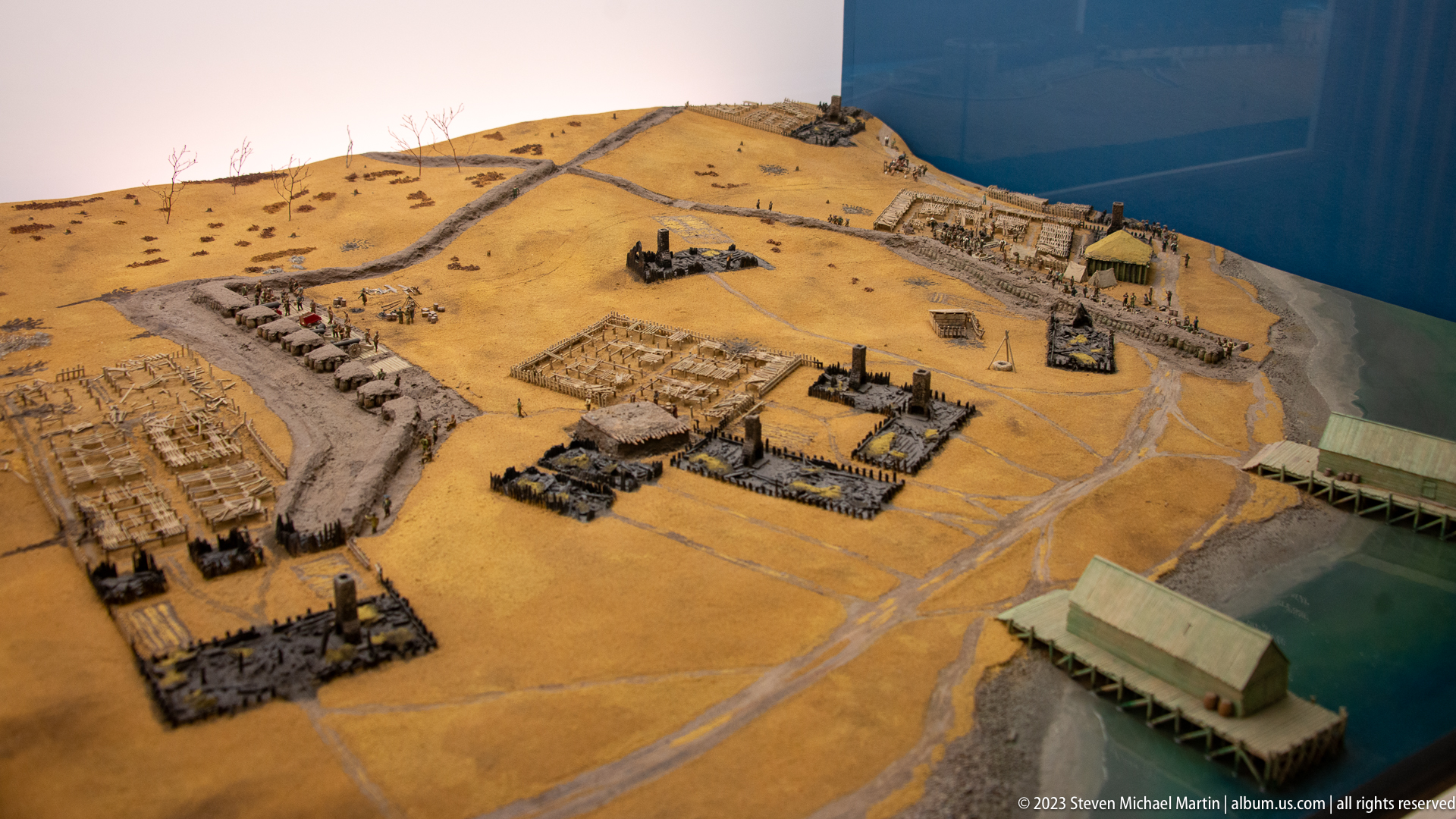
This oblique view of the Louisbourg model expands the settlement toward the waterfront, where reconstructed building groups, roads, open ground, and shore structures meet the blue edge representing the harbor. The elevated angle makes the site’s maritime setting explicit and underscores the connection between the defended town and its coastal access.
Caption
This oblique view of the Louisbourg model expands the settlement toward the waterfront, where reconstructed building groups, roads, open ground, and shore structures meet the blue edge representing the harbor. The elevated angle makes the site’s maritime setting explicit and underscores the connection between the defended town and its coastal access.
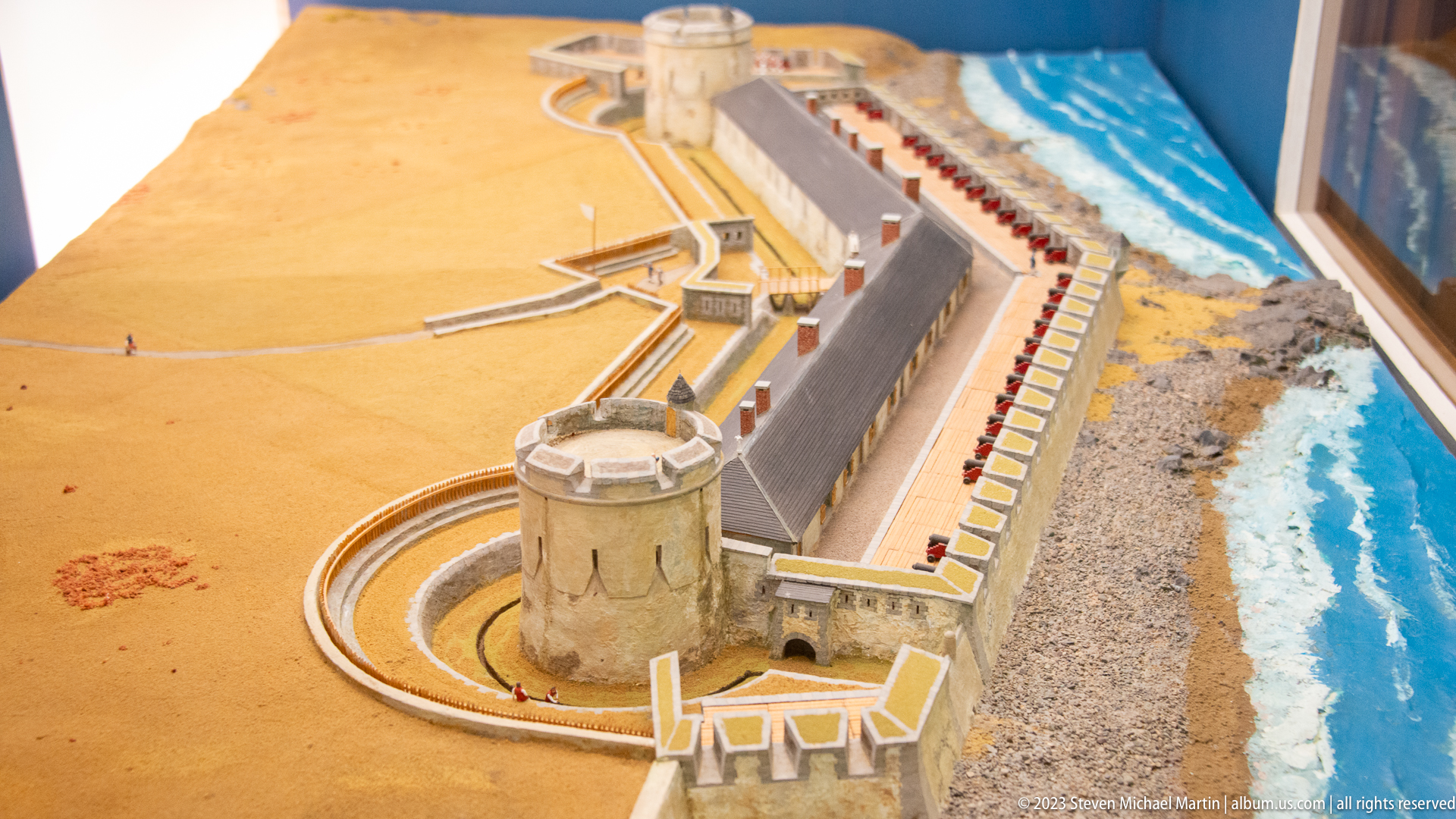
A long stone-fronted defensive complex runs parallel to the model shoreline, terminating near a prominent round tower and curved outer works. The elevated view highlights the geometry of walls, ditches, and buildings in relation to the sea, offering a concise architectural reading of how coastal defense shaped Louisbourg’s fortified landscape.
Caption
A long stone-fronted defensive complex runs parallel to the model shoreline, terminating near a prominent round tower and curved outer works. The elevated view highlights the geometry of walls, ditches, and buildings in relation to the sea, offering a concise architectural reading of how coastal defense shaped Louisbourg’s fortified landscape.
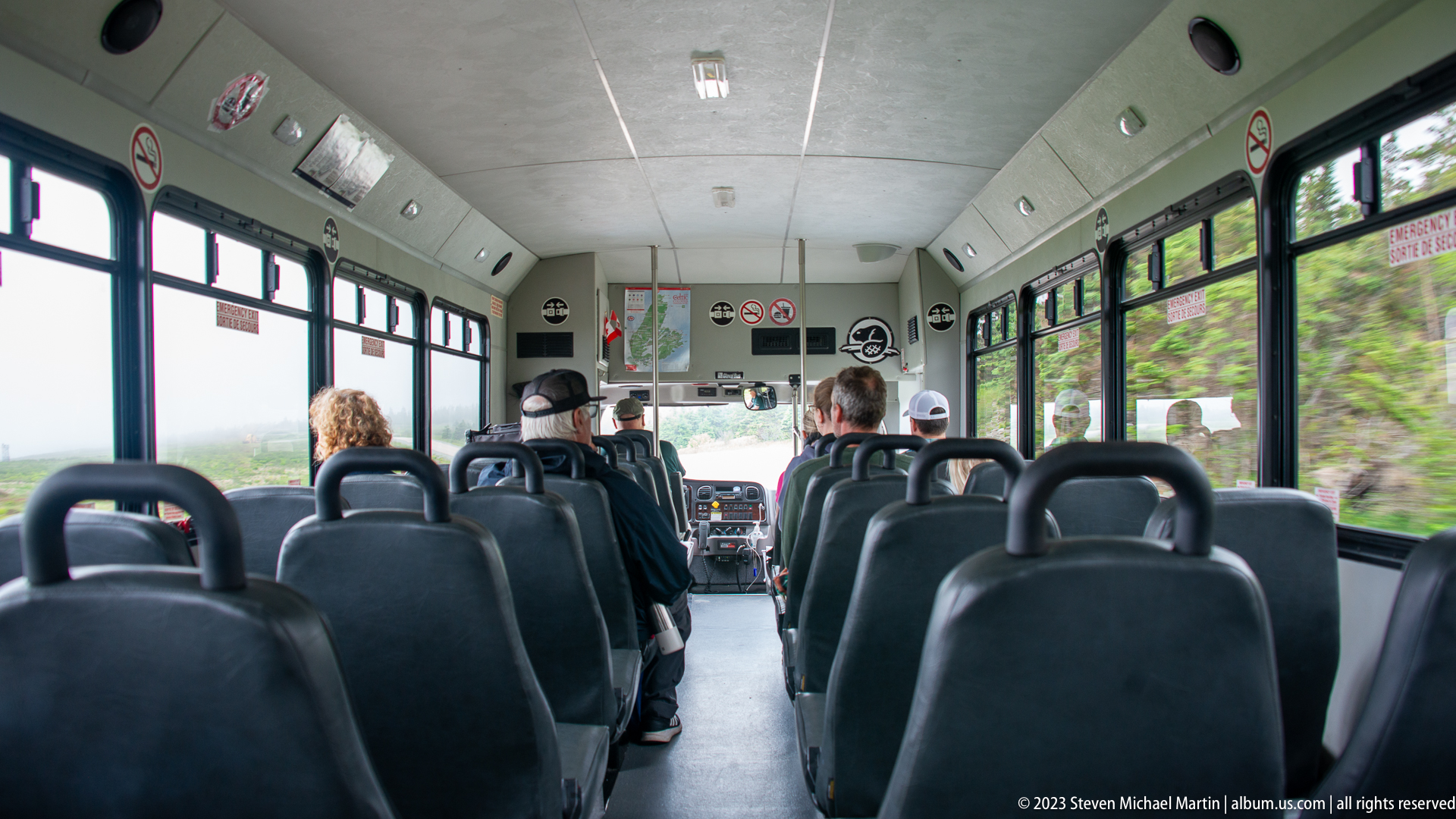
Rows of dark molded seats lead toward the driver’s area inside a visitor shuttle bus used to move people through the Louisbourg site experience. Passengers sit near the front while the large side windows reveal blurred greenery outside, documenting the practical transport connection between the visitor centre and the historic reconstruction.
Caption
Rows of dark molded seats lead toward the driver’s area inside a visitor shuttle bus used to move people through the Louisbourg site experience. Passengers sit near the front while the large side windows reveal blurred greenery outside, documenting the practical transport connection between the visitor centre and the historic reconstruction.

A male visitor sits sideways across the rear seating of the Louisbourg shuttle, one arm extended along the seat back and the other gripping a headrest. The informal portrait contrasts with the preceding interior view, shifting attention from transport infrastructure to the human experience of traveling between the modern visitor centre and the historic site.
Caption
A male visitor sits sideways across the rear seating of the Louisbourg shuttle, one arm extended along the seat back and the other gripping a headrest. The informal portrait contrasts with the preceding interior view, shifting attention from transport infrastructure to the human experience of traveling between the modern visitor centre and the historic site.

A reconstructed timber house combines whitewashed walls, dark gable siding, green doors and shutters, and a thick living roof of grass and low vegetation. Slender exterior braces support the eaves, while a masonry chimney rises behind the roofline, creating a vivid example of the practical vernacular architecture interpreted at Louisbourg.
Caption
A reconstructed timber house combines whitewashed walls, dark gable siding, green doors and shutters, and a thick living roof of grass and low vegetation. Slender exterior braces support the eaves, while a masonry chimney rises behind the roofline, creating a vivid example of the practical vernacular architecture interpreted at Louisbourg.

A bearded male interpreter smiles in a linen cap, white shirt, and dark waistcoat fastened with a row of prominent buttons. His clothing evokes everyday eighteenth-century dress rather than a formal military uniform, introducing the living-history dimension of Louisbourg through a close human portrait.
Caption
A bearded male interpreter smiles in a linen cap, white shirt, and dark waistcoat fastened with a row of prominent buttons. His clothing evokes everyday eighteenth-century dress rather than a formal military uniform, introducing the living-history dimension of Louisbourg through a close human portrait.
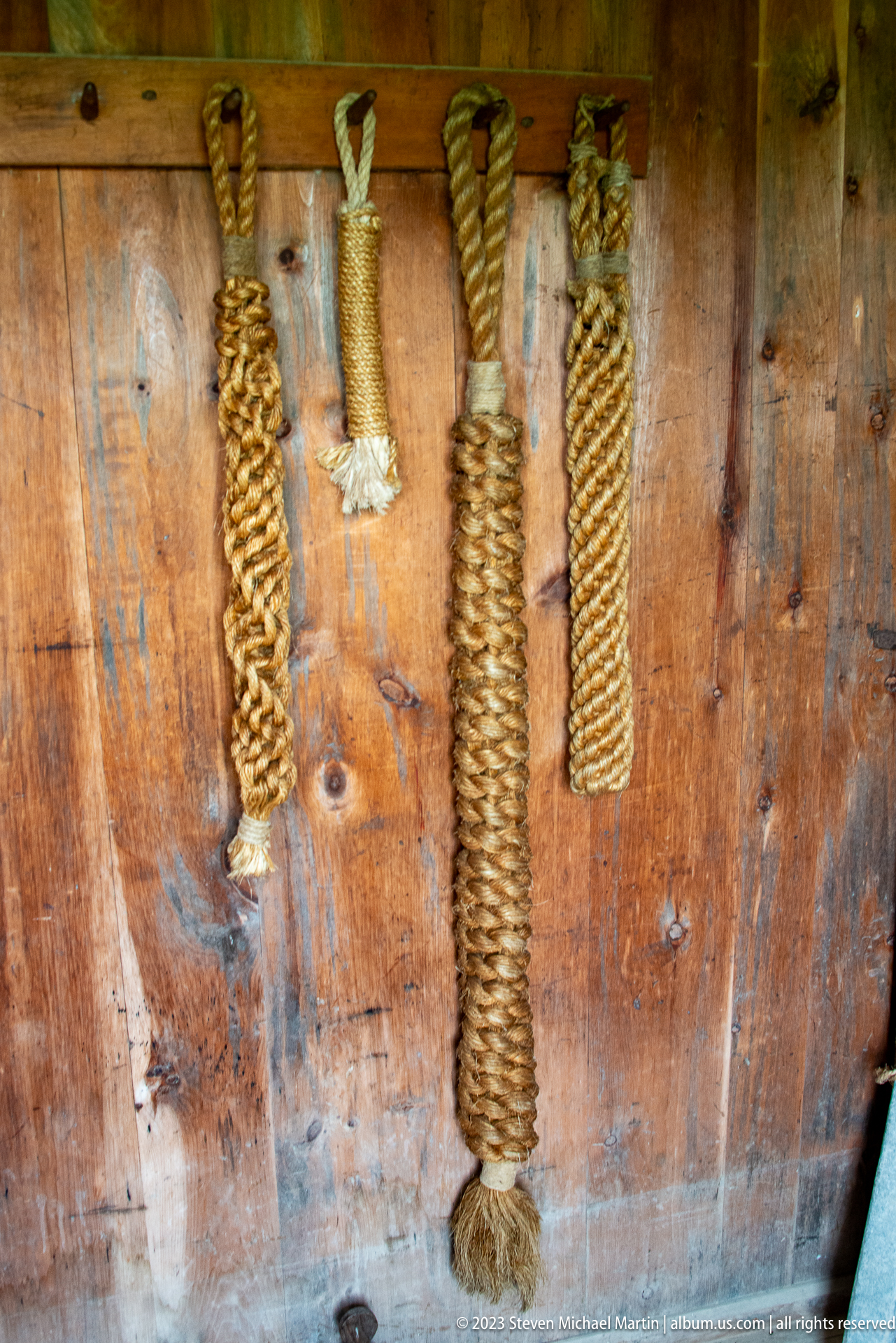
Several short ropework samples hang against a wooden board, each formed with different coils, wraps, knots, and looped terminations. Displayed as discrete examples, the pieces highlight the hand skills required to secure, protect, and finish cordage in a maritime and military environment where rope was a fundamental working material.
Caption
Several short ropework samples hang against a wooden board, each formed with different coils, wraps, knots, and looped terminations. Displayed as discrete examples, the pieces highlight the hand skills required to secure, protect, and finish cordage in a maritime and military environment where rope was a fundamental working material.
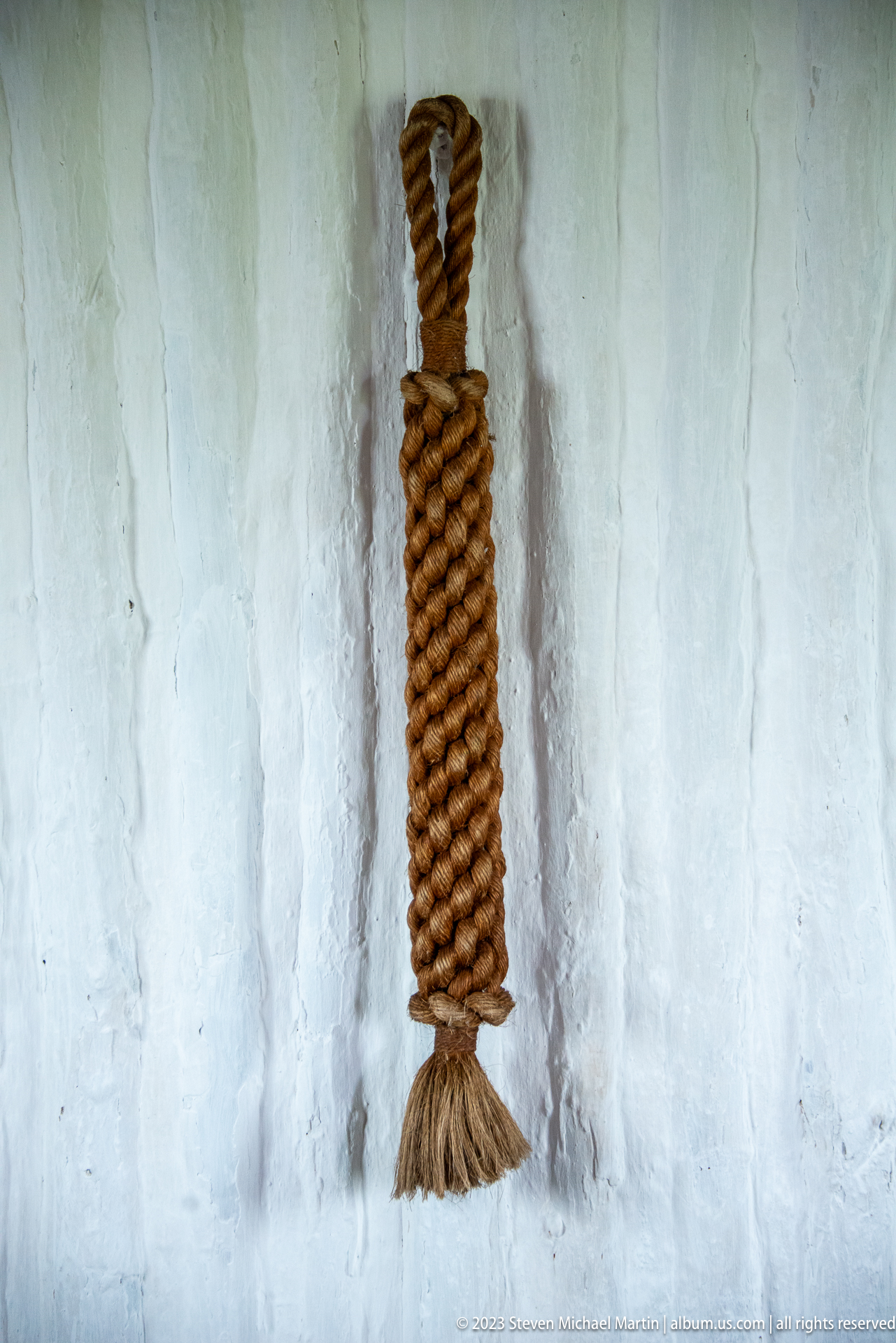
A single cylindrical ropework piece hangs against a whitewashed wall, tightly wrapped from top to bottom and finished with a loop at the top and tassel-like fibers below. Isolated from the larger group display, its construction is especially easy to study, revealing the repetitive handwork and durable cordage associated with maritime equipment.
Caption
A single cylindrical ropework piece hangs against a whitewashed wall, tightly wrapped from top to bottom and finished with a loop at the top and tassel-like fibers below. Isolated from the larger group display, its construction is especially easy to study, revealing the repetitive handwork and durable cordage associated with maritime equipment.
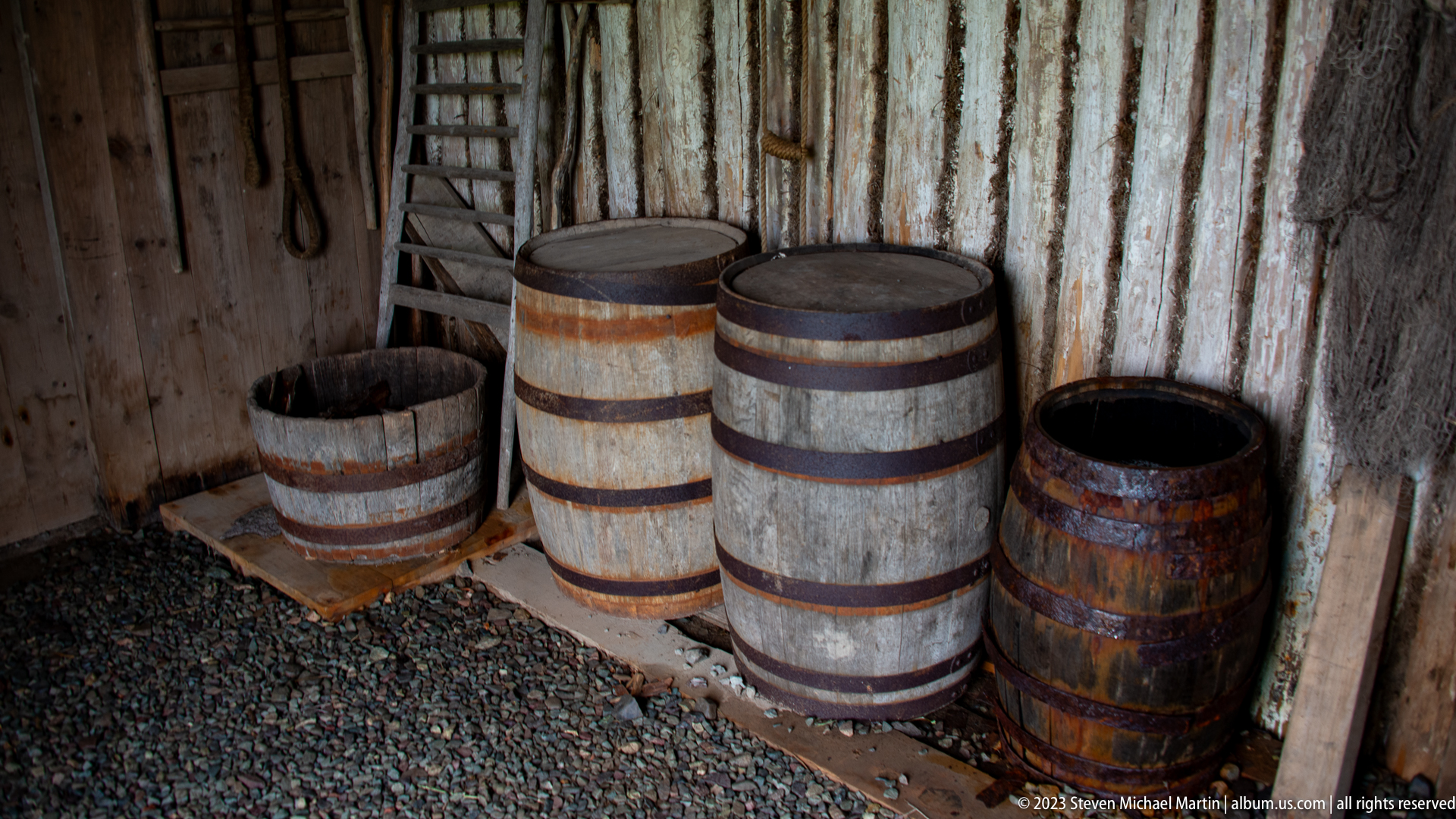
Five wooden vessels of different sizes stand against rough vertical boards inside a reconstructed storage space. Iron hoops, weathered staves, and contrasting barrel shapes emphasize the material texture of preindustrial storage, when casks and tubs were essential containers for foodstuffs, liquids, and other goods moving through a maritime settlement.
Caption
Five wooden vessels of different sizes stand against rough vertical boards inside a reconstructed storage space. Iron hoops, weathered staves, and contrasting barrel shapes emphasize the material texture of preindustrial storage, when casks and tubs were essential containers for foodstuffs, liquids, and other goods moving through a maritime settlement.
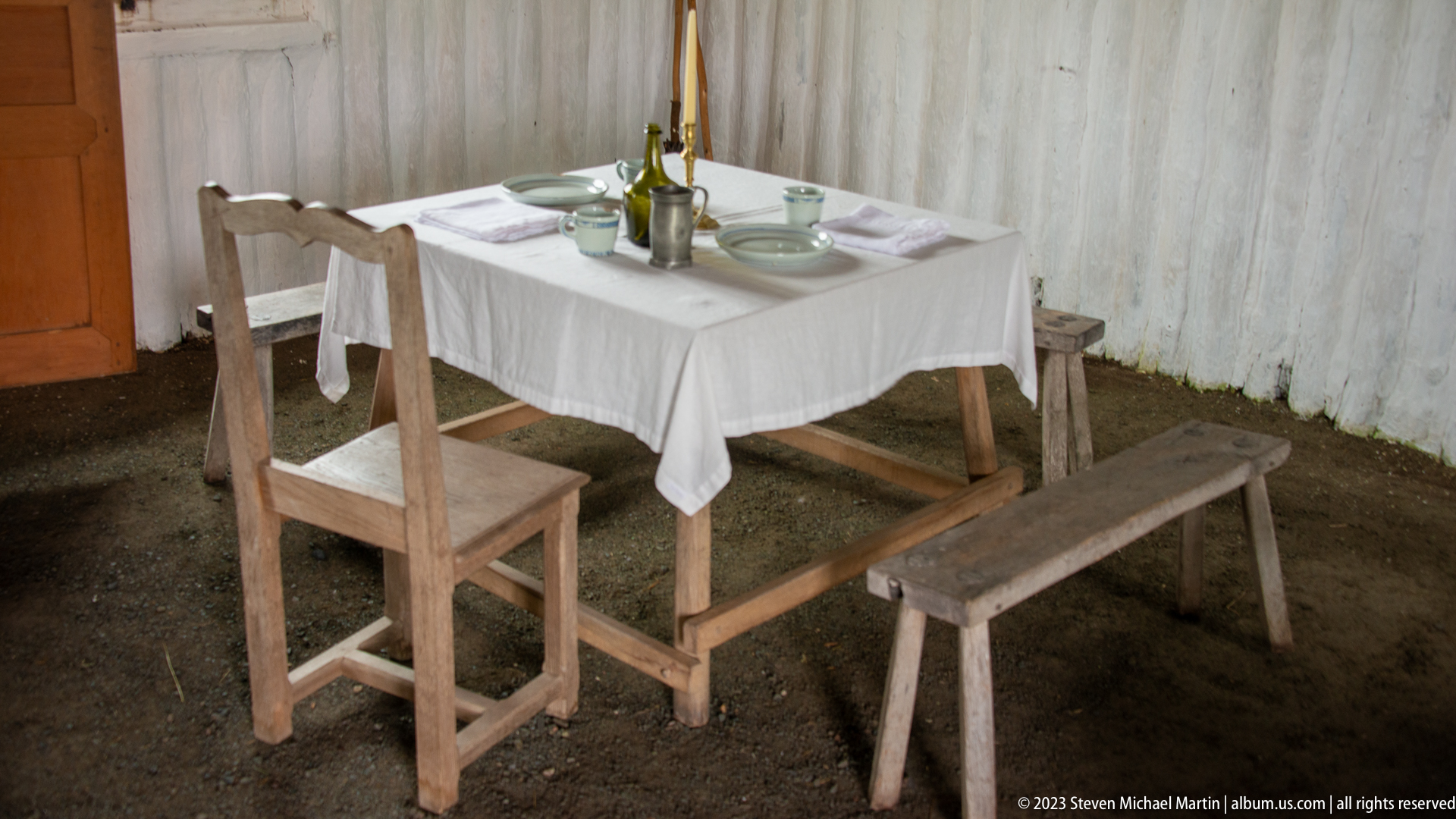
A small table covered with a white cloth is set with green-and-white ceramics, simple glassware, and tall candles, flanked by plain wooden seating. The modest arrangement suggests an interpreted domestic meal setting, emphasizing the restrained furnishings and practical household objects used to evoke everyday life inside the reconstructed Louisbourg community.
Caption
A small table covered with a white cloth is set with green-and-white ceramics, simple glassware, and tall candles, flanked by plain wooden seating. The modest arrangement suggests an interpreted domestic meal setting, emphasizing the restrained furnishings and practical household objects used to evoke everyday life inside the reconstructed Louisbourg community.

A costumed male interpreter stands behind a table laid with earthenware and household vessels in a reconstructed room, with a broad whitewashed hearth directly behind him. Wooden beams, hanging utensils, and plain furnishings frame the scene, creating a convincing living-history interpretation of domestic work within the fortified town.
Caption
A costumed male interpreter stands behind a table laid with earthenware and household vessels in a reconstructed room, with a broad whitewashed hearth directly behind him. Wooden beams, hanging utensils, and plain furnishings frame the scene, creating a convincing living-history interpretation of domestic work within the fortified town.
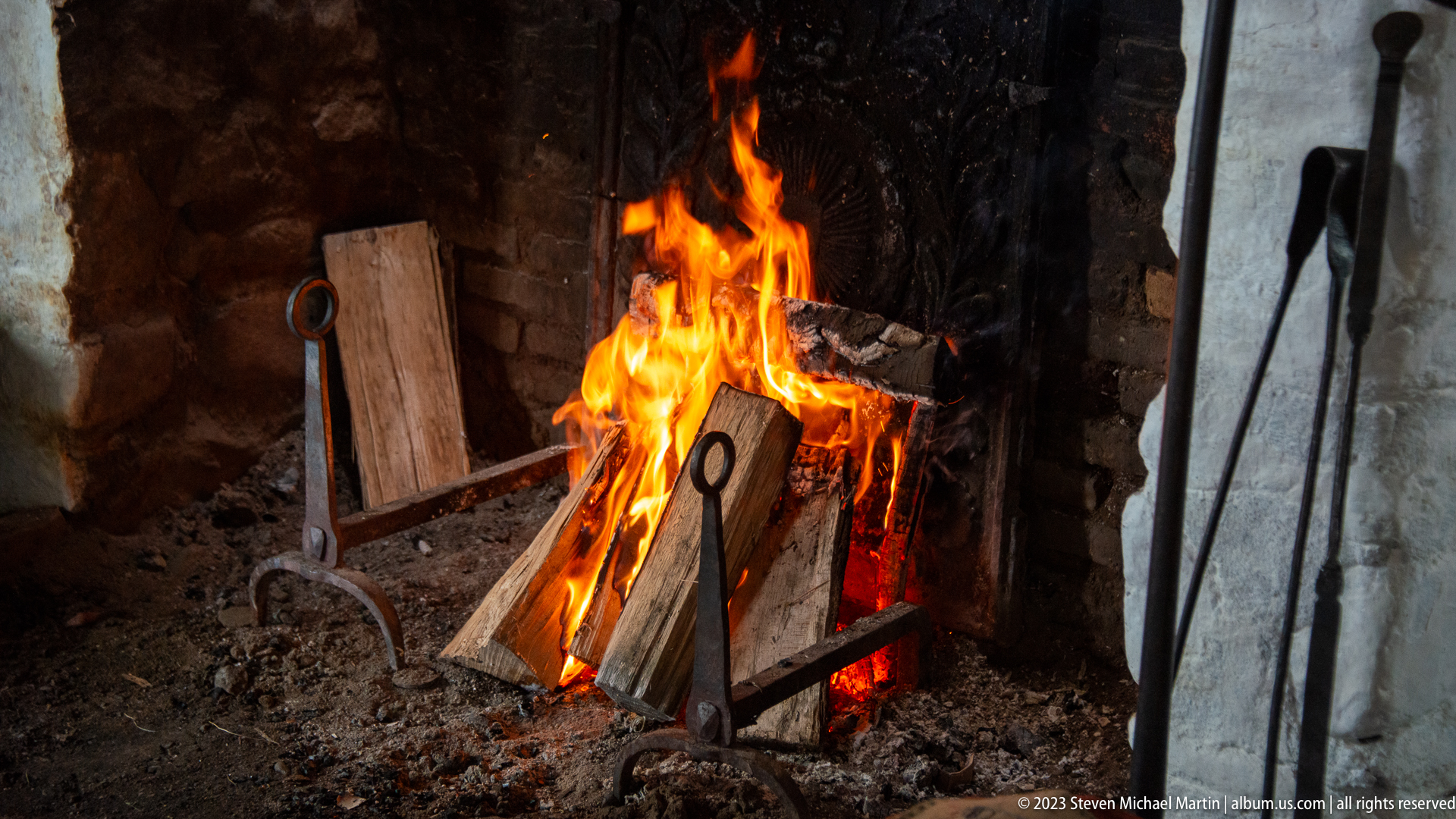
Split logs burn brightly inside a deep masonry hearth, sending orange flames upward against a blackened firebox. Iron tools stand ready at the side and soot coats the surrounding surfaces, making this one of the most tactile views of the reconstructed interior and illustrating the central role of open-fire heating and cooking.
Caption
Split logs burn brightly inside a deep masonry hearth, sending orange flames upward against a blackened firebox. Iron tools stand ready at the side and soot coats the surrounding surfaces, making this one of the most tactile views of the reconstructed interior and illustrating the central role of open-fire heating and cooking.

A folding wooden table holds papers, a quill, and a tall candle beside a bright multi-pane window, while benches and a chest-like furnishing line the walls. The restrained setting suggests clerical or domestic writing work and draws attention to the sparse, functional character of the reconstructed room.
Caption
A folding wooden table holds papers, a quill, and a tall candle beside a bright multi-pane window, while benches and a chest-like furnishing line the walls. The restrained setting suggests clerical or domestic writing work and draws attention to the sparse, functional character of the reconstructed room.
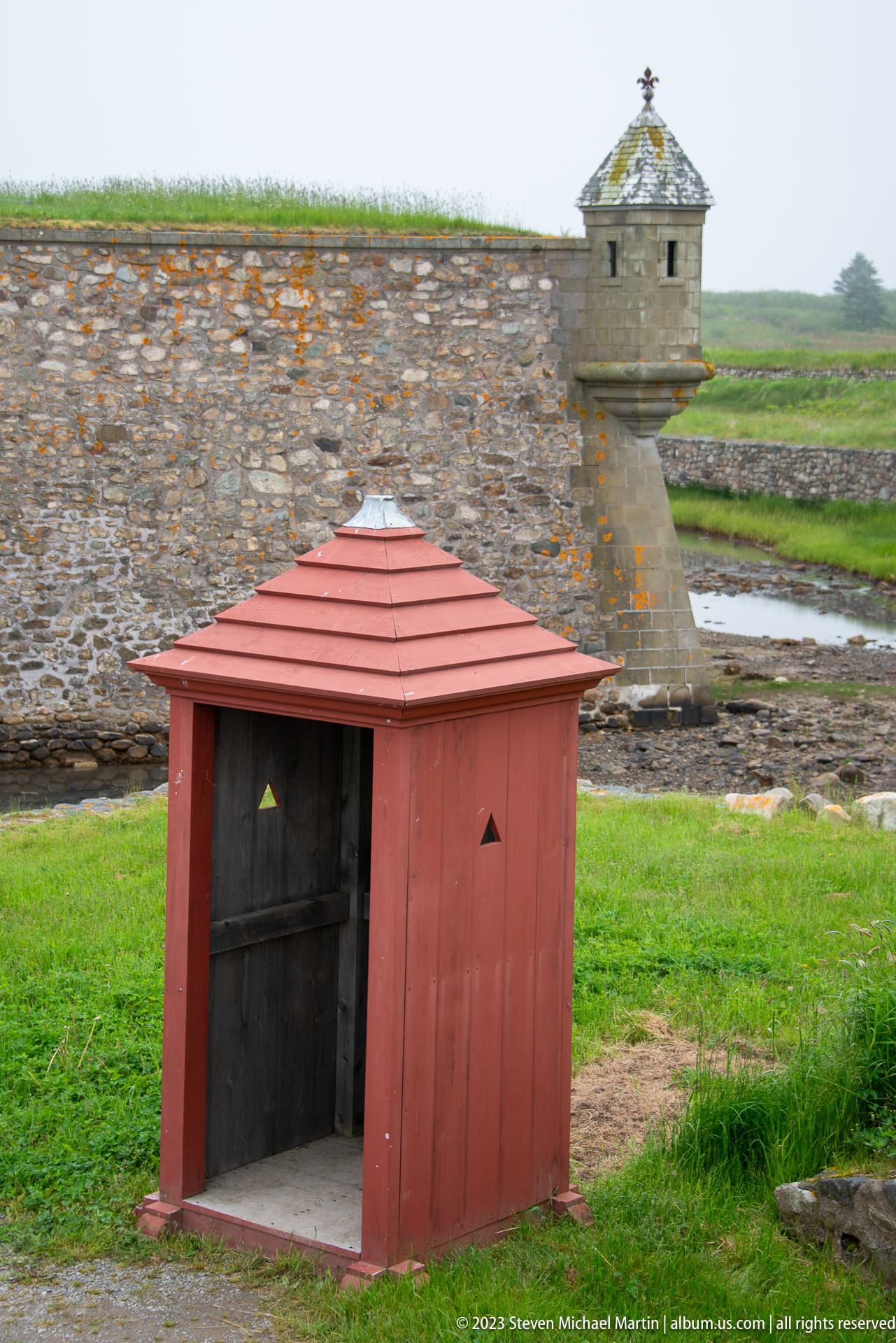
A small red-painted wooden shelter stands in vivid contrast to the gray masonry walls and wet grass of the fortified landscape. Behind it, a stone wall meets a projecting square sentry structure, while drainage channels and earthworks reveal the layered defensive setting around this modest utility building.
Caption
A small red-painted wooden shelter stands in vivid contrast to the gray masonry walls and wet grass of the fortified landscape. Behind it, a stone wall meets a projecting square sentry structure, while drainage channels and earthworks reveal the layered defensive setting around this modest utility building.

A compact stone sentry box rises from the fortification wall, its shingled pyramidal roof mottled with lichen and topped by a decorative metal weather vane. Narrow rectangular openings pierce the masonry on two sides, while the rounded stone projection beneath the wall emphasizes the defensive structure's heavy construction and exposed coastal setting.
Caption
A compact stone sentry box rises from the fortification wall, its shingled pyramidal roof mottled with lichen and topped by a decorative metal weather vane. Narrow rectangular openings pierce the masonry on two sides, while the rounded stone projection beneath the wall emphasizes the defensive structure's heavy construction and exposed coastal setting.
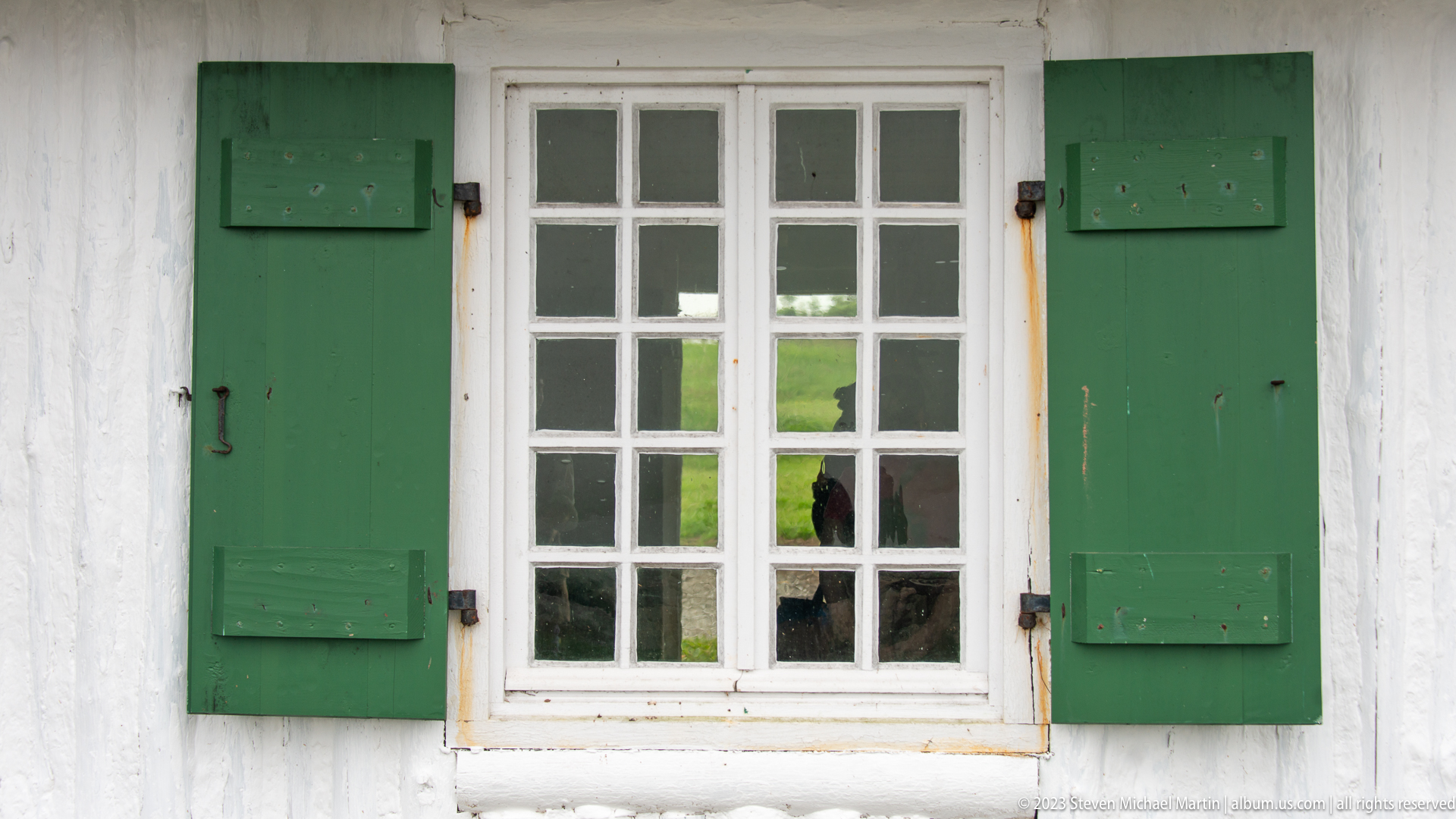
A white multi-pane sash window is framed by broad green wooden shutters against a whitewashed exterior wall. The close architectural study emphasizes joinery, hinges, latch hardware, paint wear, and the strong color contrast between green woodwork and pale wall surface, details that are easily lost in wider building views.
Caption
A white multi-pane sash window is framed by broad green wooden shutters against a whitewashed exterior wall. The close architectural study emphasizes joinery, hinges, latch hardware, paint wear, and the strong color contrast between green woodwork and pale wall surface, details that are easily lost in wider building views.

A red-painted wooden bridge crosses the ditch to an elaborate stone gateway set into the fortress wall. Paired masonry piers, finials, and a carved royal armorial panel frame the entrance, contrasting with the dark rubble-stone curtain wall. The composition shows how ceremonial design and controlled access were combined within the reconstructed defensive works.
Caption
A red-painted wooden bridge crosses the ditch to an elaborate stone gateway set into the fortress wall. Paired masonry piers, finials, and a carved royal armorial panel frame the entrance, contrasting with the dark rubble-stone curtain wall. The composition shows how ceremonial design and controlled access were combined within the reconstructed defensive works.
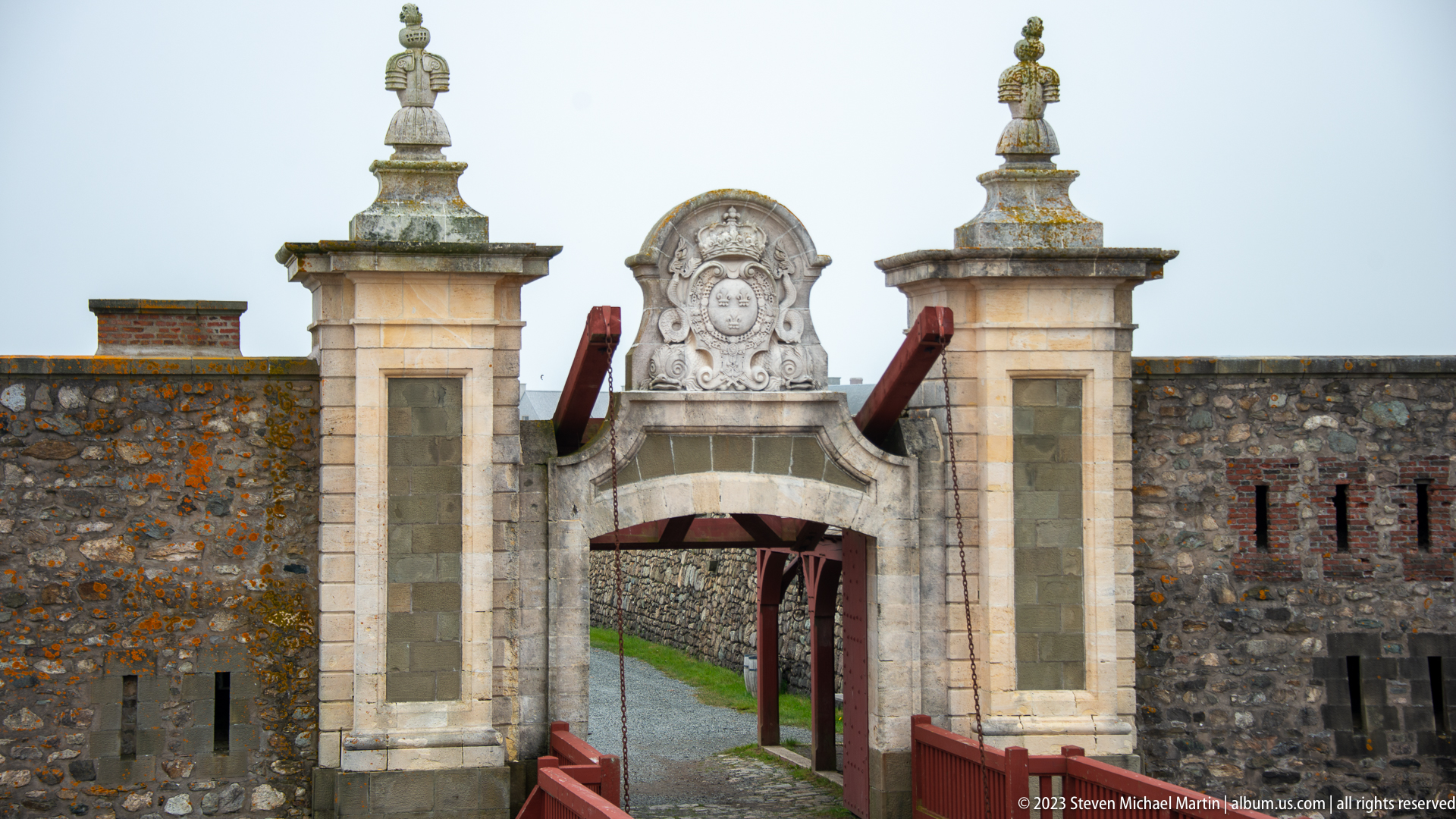
The fortress gateway is shown frontally, concentrating attention on its pale dressed-stone piers and sculpted armorial crown. A large carved shield bearing fleurs-de-lis sits beneath a crown and scrollwork above the arched entrance, with dark masonry walls extending to either side. The close view emphasizes the formal symbolism applied to a controlled military entry.
Caption
The fortress gateway is shown frontally, concentrating attention on its pale dressed-stone piers and sculpted armorial crown. A large carved shield bearing fleurs-de-lis sits beneath a crown and scrollwork above the arched entrance, with dark masonry walls extending to either side. The close view emphasizes the formal symbolism applied to a controlled military entry.
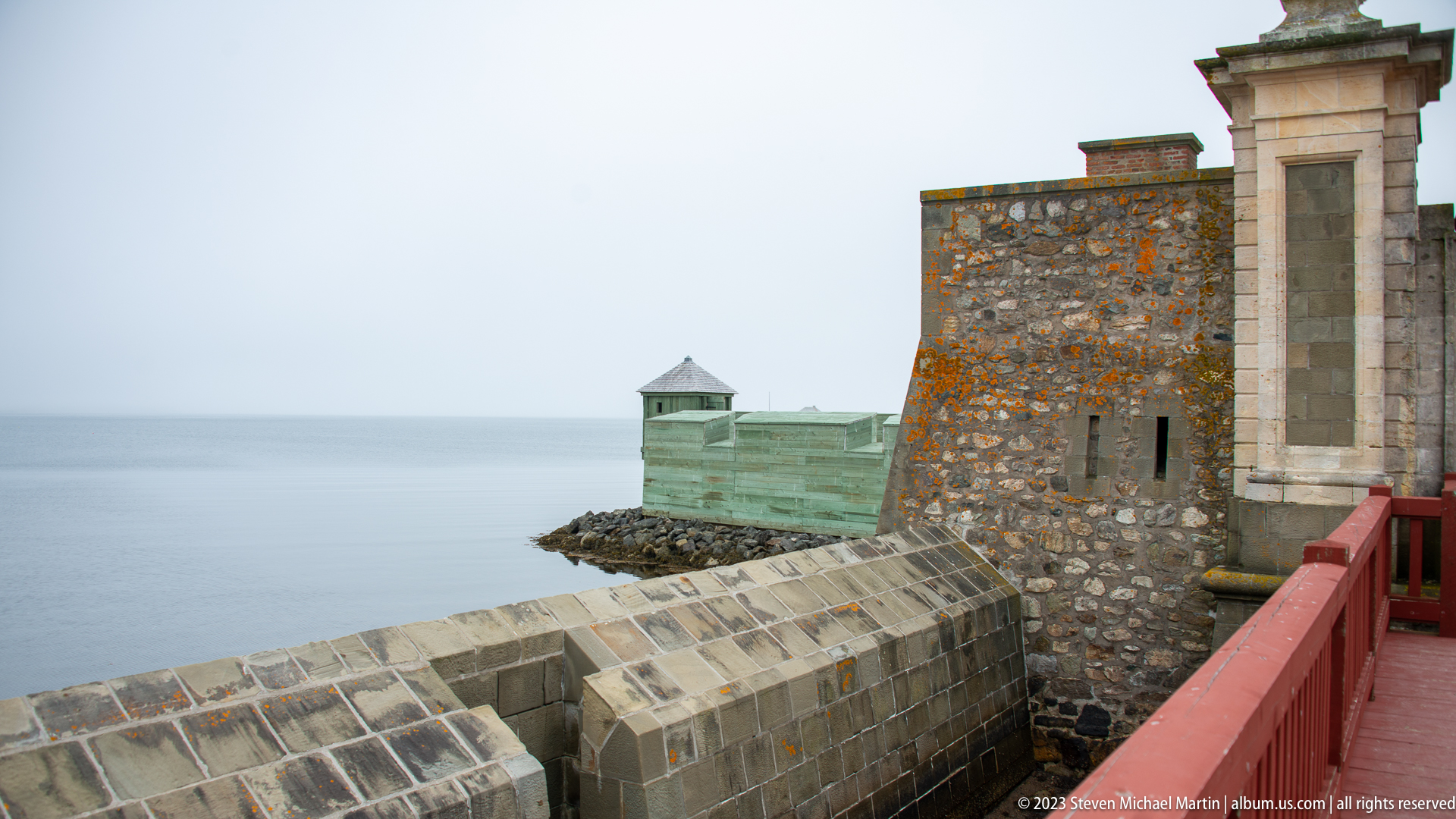
The outer works meet the harbor edge in this oblique view from the entrance bridge. A high rubble-stone wall with narrow openings stands above angular masonry revetments, while a small roofed sentry box projects near the water. The calm gray sea beyond makes the fortification's close relationship to the shoreline particularly clear.
Caption
The outer works meet the harbor edge in this oblique view from the entrance bridge. A high rubble-stone wall with narrow openings stands above angular masonry revetments, while a small roofed sentry box projects near the water. The calm gray sea beyond makes the fortification's close relationship to the shoreline particularly clear.

A monumental carved armorial panel crowns the fortress entrance, centered on a shield with three fleurs-de-lis beneath a royal crown. Chains, scrolls, foliage, and trophy-like ornaments surround the shield in high relief. The close framing isolates the gateway's heraldic program and its explicit reference to French royal authority.
Caption
A monumental carved armorial panel crowns the fortress entrance, centered on a shield with three fleurs-de-lis beneath a royal crown. Chains, scrolls, foliage, and trophy-like ornaments surround the shield in high relief. The close framing isolates the gateway's heraldic program and its explicit reference to French royal authority.

A visitor stands centered on the red wooden bridge directly before the ornate stone gateway, creating a strong sense of scale for the entrance. The crowned armorial carving, flanking piers, and dark masonry walls rise behind him, while the bridge rails guide the eye toward the arched opening. The portrait places contemporary visitation within the reconstructed defensive setting.
Caption
A visitor stands centered on the red wooden bridge directly before the ornate stone gateway, creating a strong sense of scale for the entrance. The crowned armorial carving, flanking piers, and dark masonry walls rise behind him, while the bridge rails guide the eye toward the arched opening. The portrait places contemporary visitation within the reconstructed defensive setting.

The visitor fills the foreground in a close portrait, with the fortress gateway softened behind him. The crowned armorial panel remains recognizable above his shoulder, and one pale stone pier rises at the right. By reducing the architectural setting to a shallow-focus backdrop, the photograph emphasizes the personal encounter with the reconstructed fortifications.
Caption
The visitor fills the foreground in a close portrait, with the fortress gateway softened behind him. The crowned armorial panel remains recognizable above his shoulder, and one pale stone pier rises at the right. By reducing the architectural setting to a shallow-focus backdrop, the photograph emphasizes the personal encounter with the reconstructed fortifications.
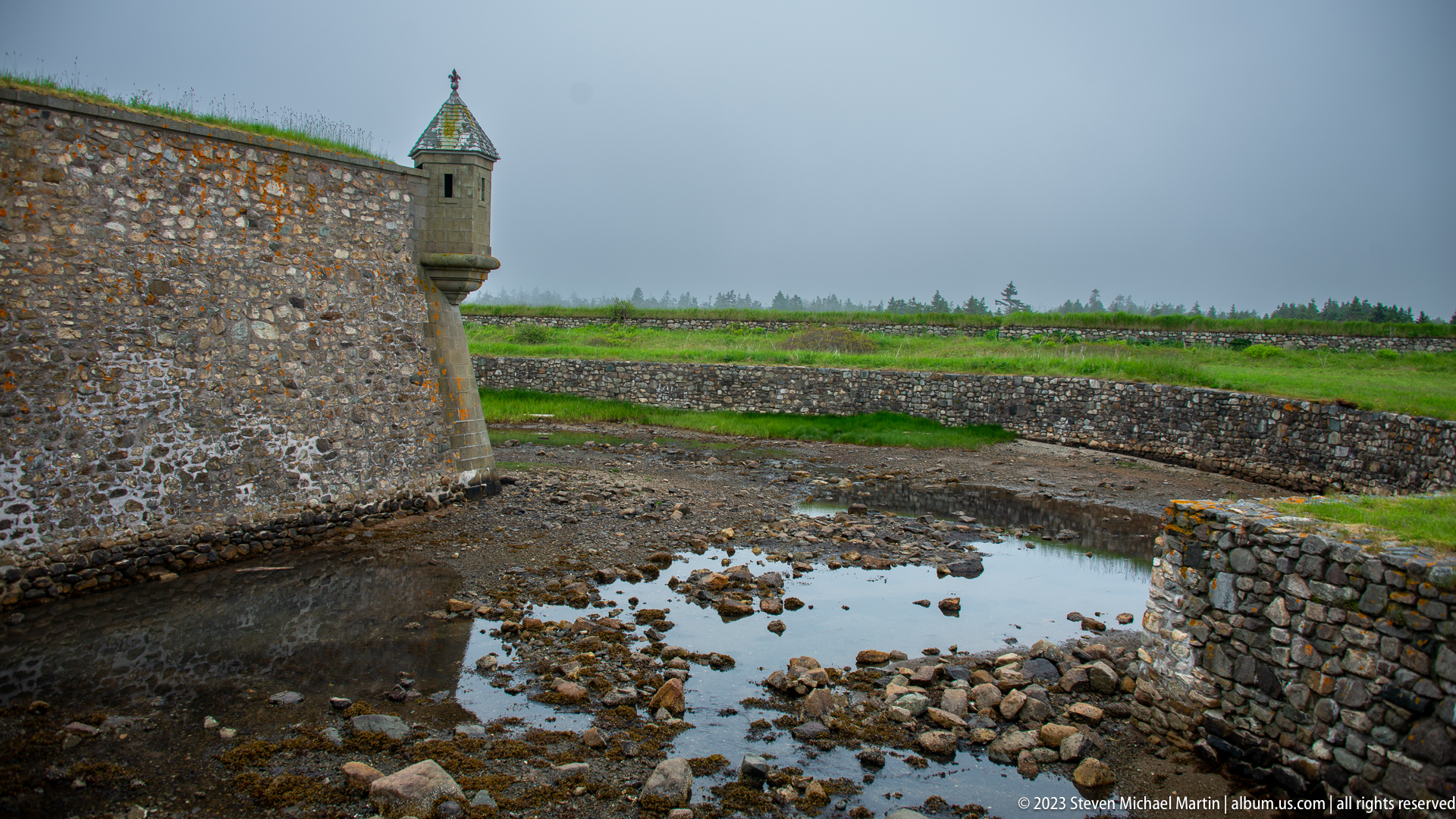
A massive stone wall angles across a shallow, water-filled ditch, with a small projecting roofed lookout at the corner. Low walls and grassy earthworks extend into the foggy distance, revealing the fortification as a system of masonry, ditches, and raised ground rather than a single wall. Wet rocks and muted light reinforce the exposed maritime environment.
Caption
A massive stone wall angles across a shallow, water-filled ditch, with a small projecting roofed lookout at the corner. Low walls and grassy earthworks extend into the foggy distance, revealing the fortification as a system of masonry, ditches, and raised ground rather than a single wall. Wet rocks and muted light reinforce the exposed maritime environment.
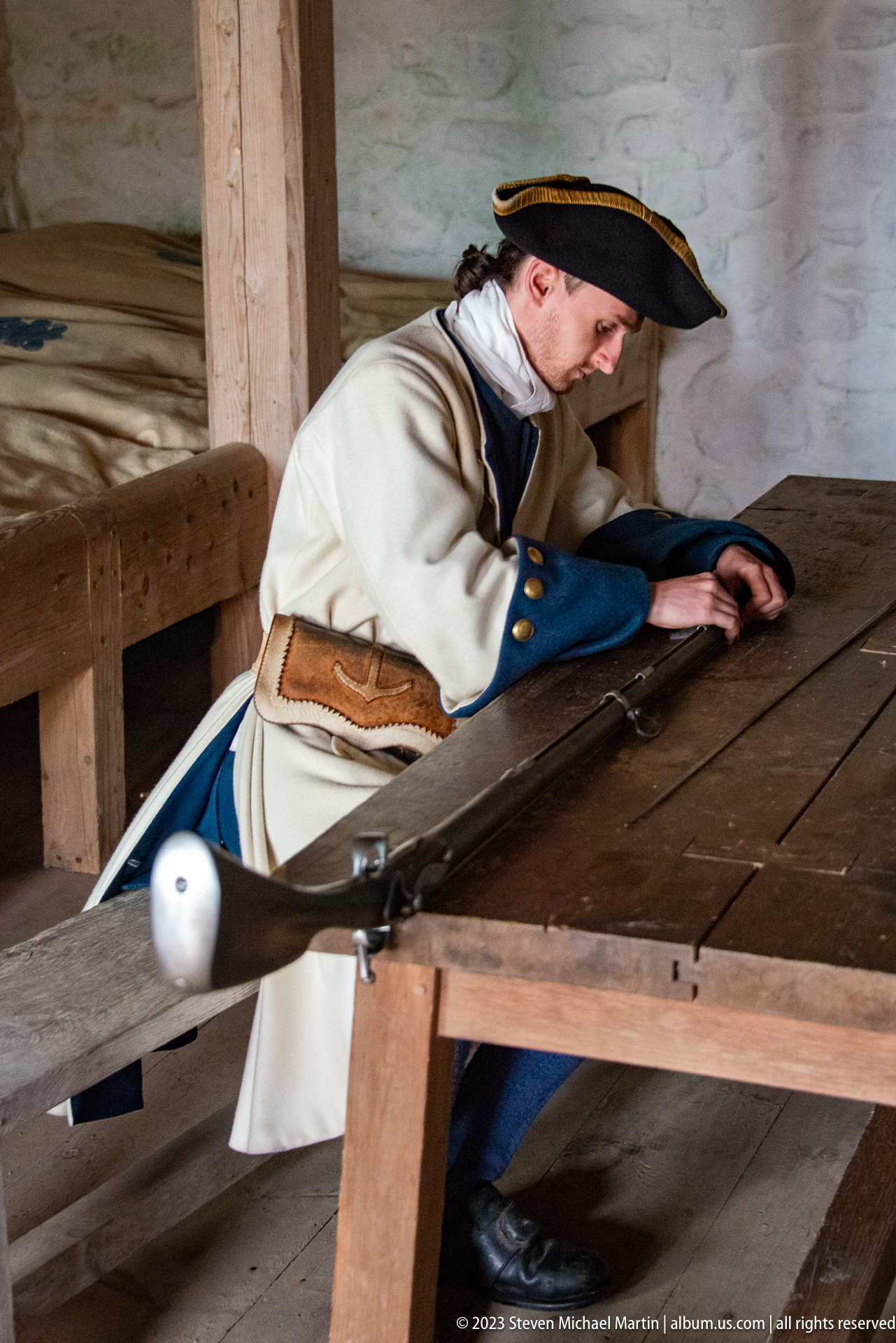
A historical interpreter in an eighteenth-century-style military uniform leans over a heavy wooden workbench inside a simple timber-and-plaster space. His cocked hat, light coat, blue cuffs, and brass-colored buttons establish the period presentation, while hand activity at the bench suggests a craft or maintenance demonstration. The setting foregrounds living-history interpretation at the fortress.
Caption
A historical interpreter in an eighteenth-century-style military uniform leans over a heavy wooden workbench inside a simple timber-and-plaster space. His cocked hat, light coat, blue cuffs, and brass-colored buttons establish the period presentation, while hand activity at the bench suggests a craft or maintenance demonstration. The setting foregrounds living-history interpretation at the fortress.
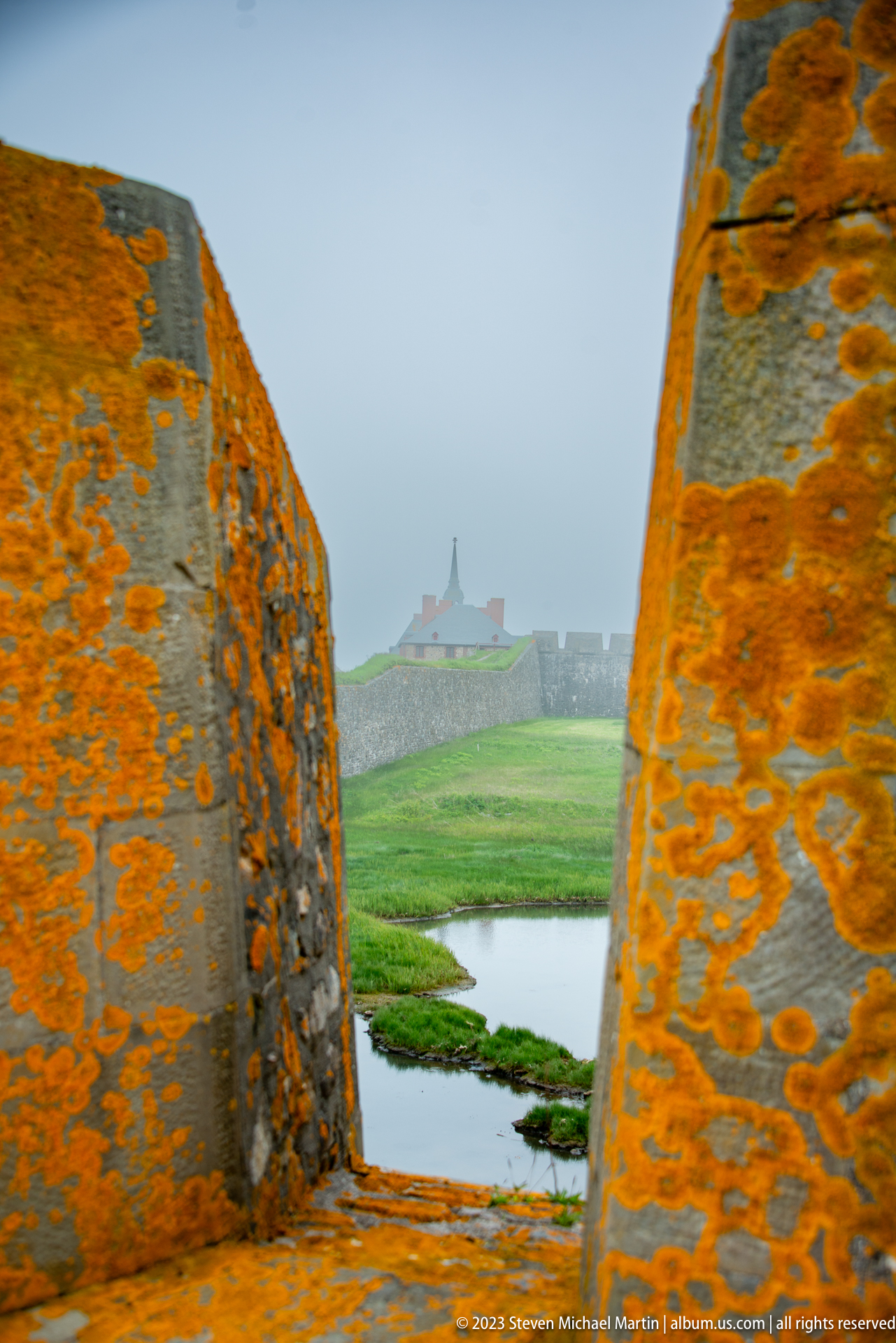
The camera looks through a narrow opening between heavily lichen-covered stone masses toward a flooded ditch, green earthworks, and distant fortress buildings. The orange-stained masonry creates a strong foreground frame, while the softer landscape beyond reveals the depth of the defensive zone. The composition links close material detail with the wider fortification system.
Caption
The camera looks through a narrow opening between heavily lichen-covered stone masses toward a flooded ditch, green earthworks, and distant fortress buildings. The orange-stained masonry creates a strong foreground frame, while the softer landscape beyond reveals the depth of the defensive zone. The composition links close material detail with the wider fortification system.

A small stone sentry box projects from the rampart, its steep lichen-covered roof sheltering a seated visitor inside. The narrow approach between masonry parapets and the confined interior demonstrate the compact scale of a guard post positioned to protect soldiers from Atlantic weather while maintaining surveillance over the fortress approaches.
Caption
A small stone sentry box projects from the rampart, its steep lichen-covered roof sheltering a seated visitor inside. The narrow approach between masonry parapets and the confined interior demonstrate the compact scale of a guard post positioned to protect soldiers from Atlantic weather while maintaining surveillance over the fortress approaches.
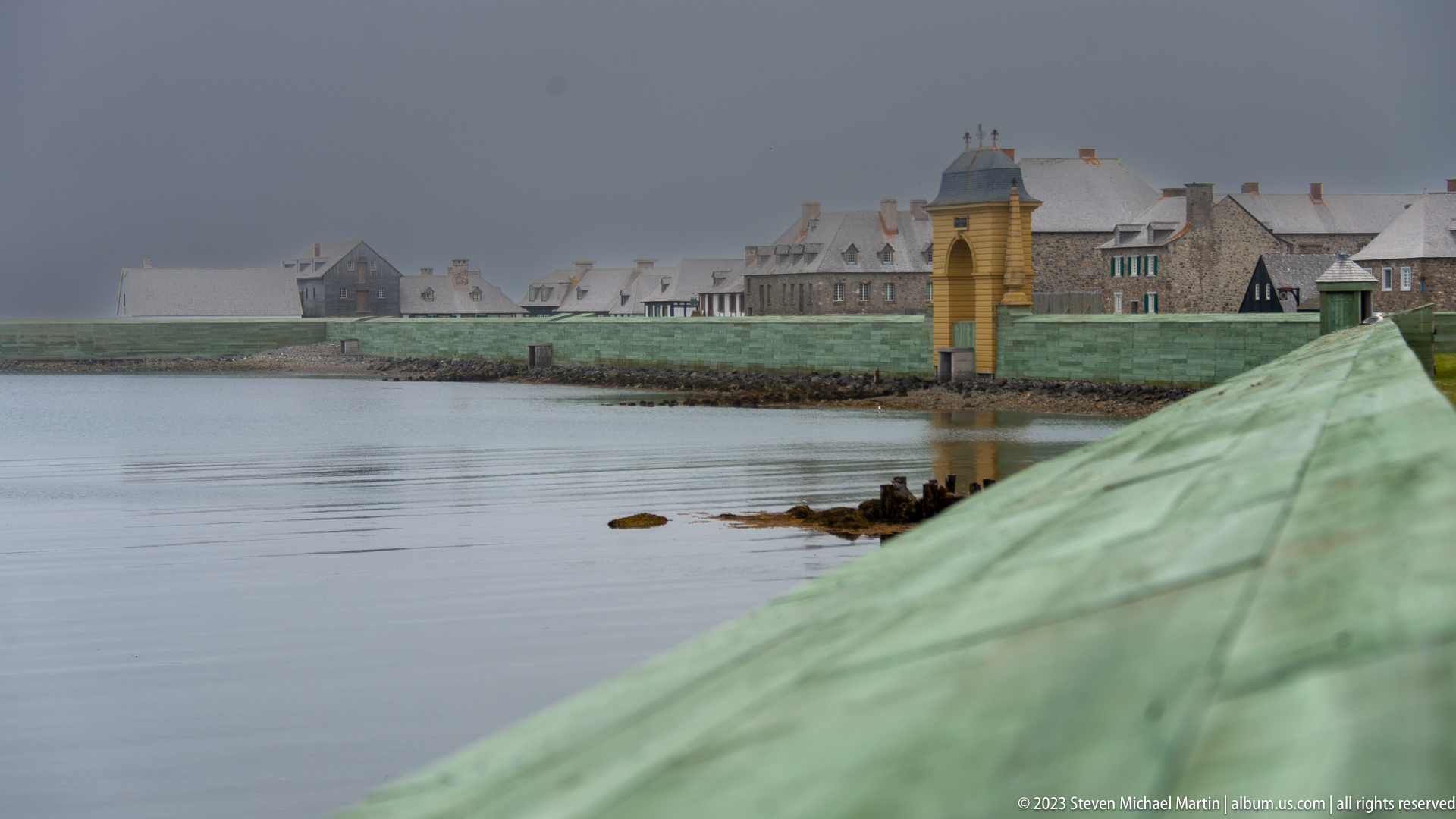
Across still gray water, reconstructed buildings line the fortress settlement beneath low mist. A tall yellow gate-like structure stands near the shore, while a pale green roof or rampart occupies the near foreground. The compressed view layers harbor, defensive edge, and town architecture, conveying the close integration of military works and civilian settlement at Louisbourg.
Caption
Across still gray water, reconstructed buildings line the fortress settlement beneath low mist. A tall yellow gate-like structure stands near the shore, while a pale green roof or rampart occupies the near foreground. The compressed view layers harbor, defensive edge, and town architecture, conveying the close integration of military works and civilian settlement at Louisbourg.

A long half-timbered building stands behind a pale wooden fence, its dark structural framing alternating with light infill panels beneath a steep shingled roof. Dormer windows and tall chimneys punctuate the roofline, while adjoining stone construction is visible at the rear. The façade demonstrates one of the varied domestic and administrative building traditions recreated at Louisbourg.
Caption
A long half-timbered building stands behind a pale wooden fence, its dark structural framing alternating with light infill panels beneath a steep shingled roof. Dormer windows and tall chimneys punctuate the roofline, while adjoining stone construction is visible at the rear. The façade demonstrates one of the varied domestic and administrative building traditions recreated at Louisbourg.
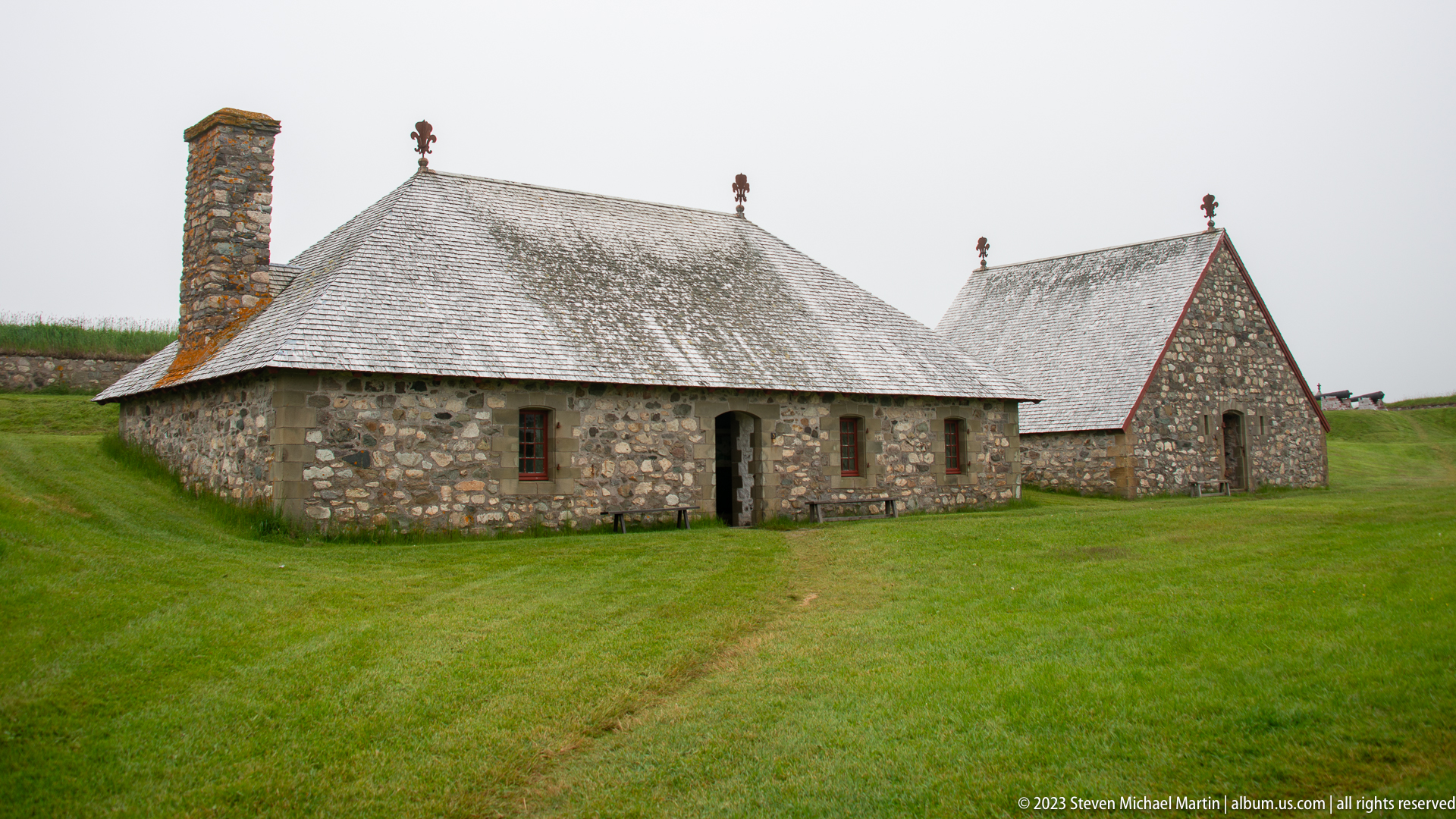
Two low stone buildings sit on an open green, each capped by a steep shingled roof and simple red-trimmed openings. A tall masonry chimney rises from the nearer structure, whose broad rectangular form contrasts with the smaller gabled building behind. The spare arrangement and sturdy materials suggest utilitarian service architecture within the reconstructed settlement.
Caption
Two low stone buildings sit on an open green, each capped by a steep shingled roof and simple red-trimmed openings. A tall masonry chimney rises from the nearer structure, whose broad rectangular form contrasts with the smaller gabled building behind. The spare arrangement and sturdy materials suggest utilitarian service architecture within the reconstructed settlement.
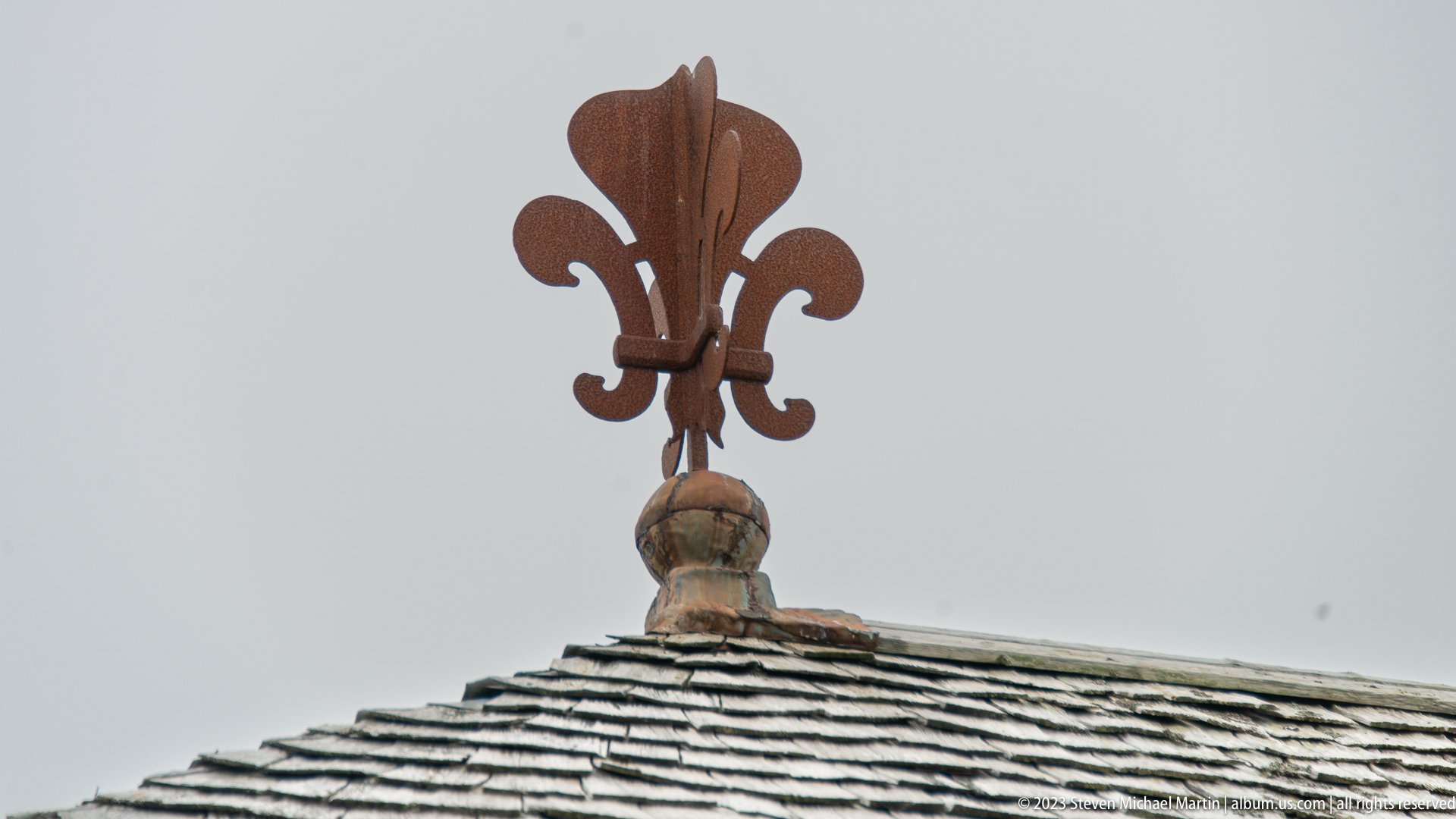
A large metal fleur-de-lis forms a decorative finial above the crest of a shingled roof, mounted on a turned wooden base. Seen against a blank gray sky, the silhouette isolates the emblem and its curving lobes from the surrounding architecture. The motif echoes the French royal symbolism used elsewhere throughout the reconstructed fortress.
Caption
A large metal fleur-de-lis forms a decorative finial above the crest of a shingled roof, mounted on a turned wooden base. Seen against a blank gray sky, the silhouette isolates the emblem and its curving lobes from the surrounding architecture. The motif echoes the French royal symbolism used elsewhere throughout the reconstructed fortress.

A small red-painted multi-pane window is set into a thick wall of irregular fieldstone, framed by carefully cut rectangular blocks. The contrast between rough rubble masonry, smooth dressed stone, and bright wooden joinery makes construction technique the subject of the photograph. Small iron fittings beside the frame add another layer of functional detail.
Caption
A small red-painted multi-pane window is set into a thick wall of irregular fieldstone, framed by carefully cut rectangular blocks. The contrast between rough rubble masonry, smooth dressed stone, and bright wooden joinery makes construction technique the subject of the photograph. Small iron fittings beside the frame add another layer of functional detail.

A narrow red plank door occupies a dressed-stone surround in a rough fieldstone wall, flanked by two slim vertical openings. Heavy iron hinges and a simple latch reinforce the utilitarian character of the entrance, while a small marker bearing the number 2 is fixed beside it. The tight framing highlights texture, hardware, and masonry craft.
Caption
A narrow red plank door occupies a dressed-stone surround in a rough fieldstone wall, flanked by two slim vertical openings. Heavy iron hinges and a simple latch reinforce the utilitarian character of the entrance, while a small marker bearing the number 2 is fixed beside it. The tight framing highlights texture, hardware, and masonry craft.
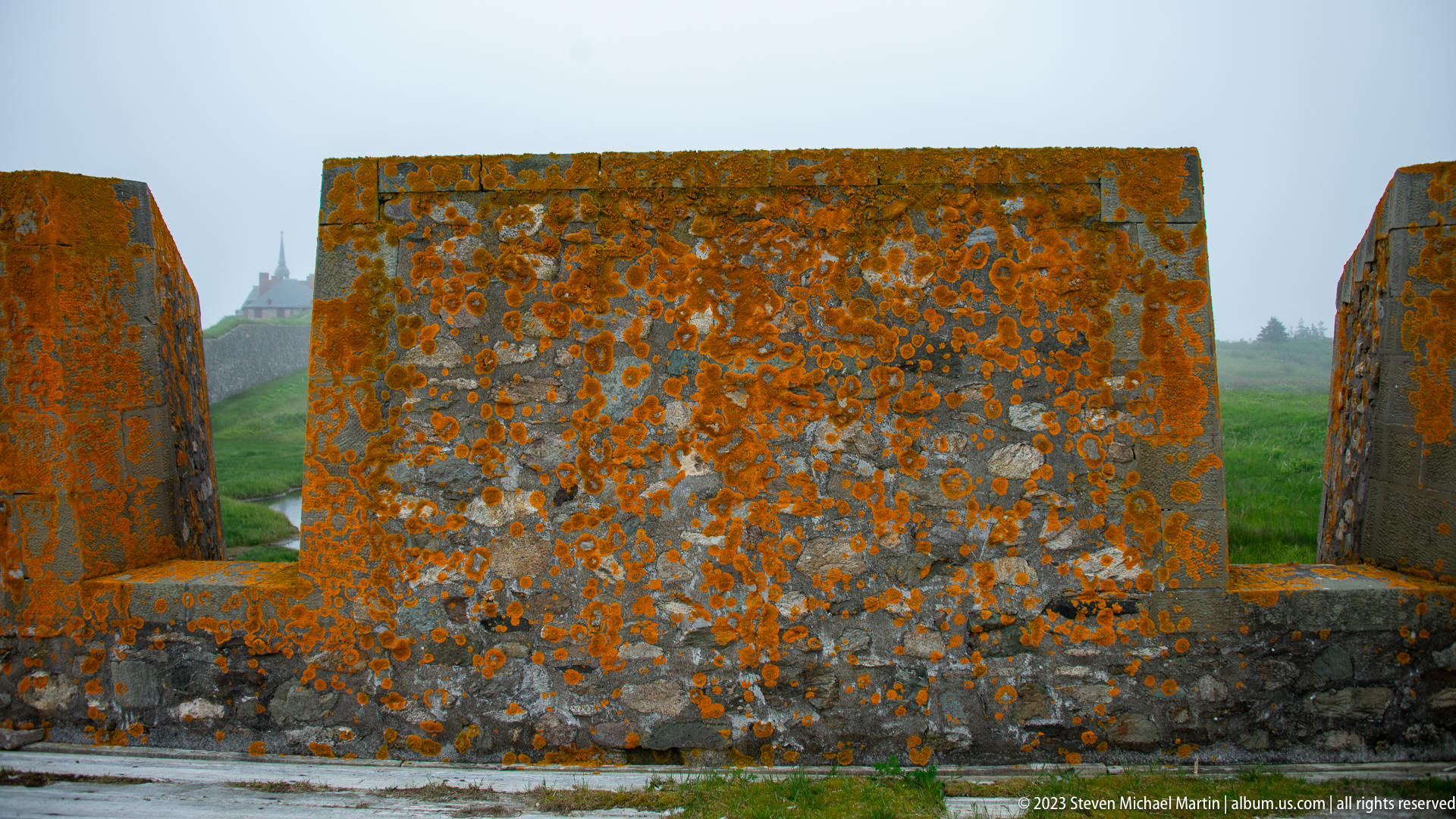
Bright orange lichen spreads across the rough stone faces of a parapet broken by broad rectangular openings. Through the gaps, fog-softened grass and distant buildings are barely visible. The close view emphasizes weathering and exposure on the fortification, turning the defensive wall into a study of masonry surfaces, embrasures, and coastal growth.
Caption
Bright orange lichen spreads across the rough stone faces of a parapet broken by broad rectangular openings. Through the gaps, fog-softened grass and distant buildings are barely visible. The close view emphasizes weathering and exposure on the fortification, turning the defensive wall into a study of masonry surfaces, embrasures, and coastal growth.
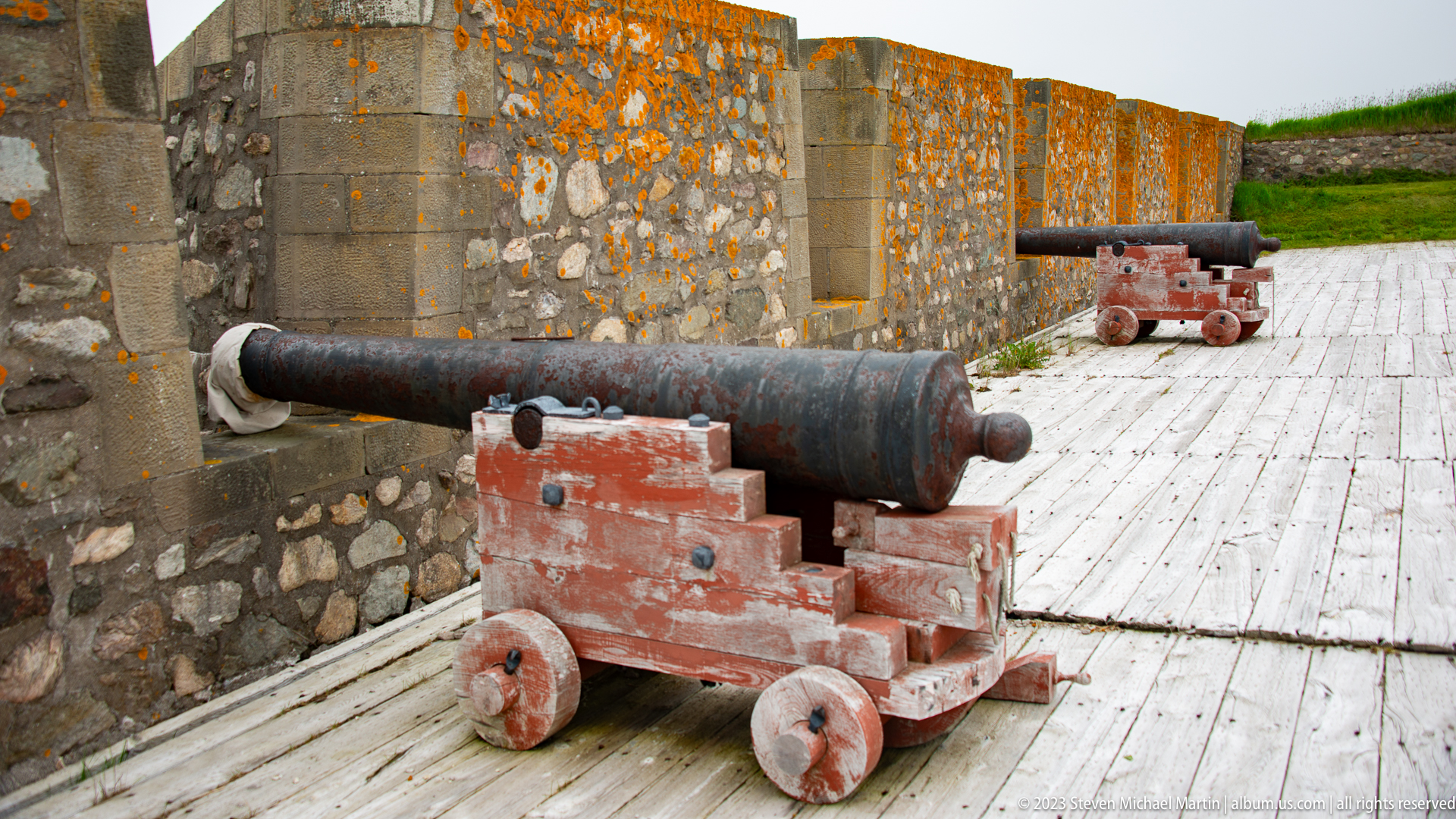
An iron cannon rests on a red-painted wooden carriage beside the fortress wall, with a second gun positioned farther along the timber platform. The masonry behind is pierced by openings and heavily mottled with orange lichen. The perspective down the gun line evokes the practical arrangement of artillery along a defended firing position.
Caption
An iron cannon rests on a red-painted wooden carriage beside the fortress wall, with a second gun positioned farther along the timber platform. The masonry behind is pierced by openings and heavily mottled with orange lichen. The perspective down the gun line evokes the practical arrangement of artillery along a defended firing position.

A low circular masonry structure rises above an arched passage cut through the surrounding stonework. Grass caps parts of the embankment, while the dark opening below leads into the fortified earthwork. The unusual stacked geometry suggests a compact defensive or service feature integrated with the rampart rather than a freestanding building.
Caption
A low circular masonry structure rises above an arched passage cut through the surrounding stonework. Grass caps parts of the embankment, while the dark opening below leads into the fortified earthwork. The unusual stacked geometry suggests a compact defensive or service feature integrated with the rampart rather than a freestanding building.
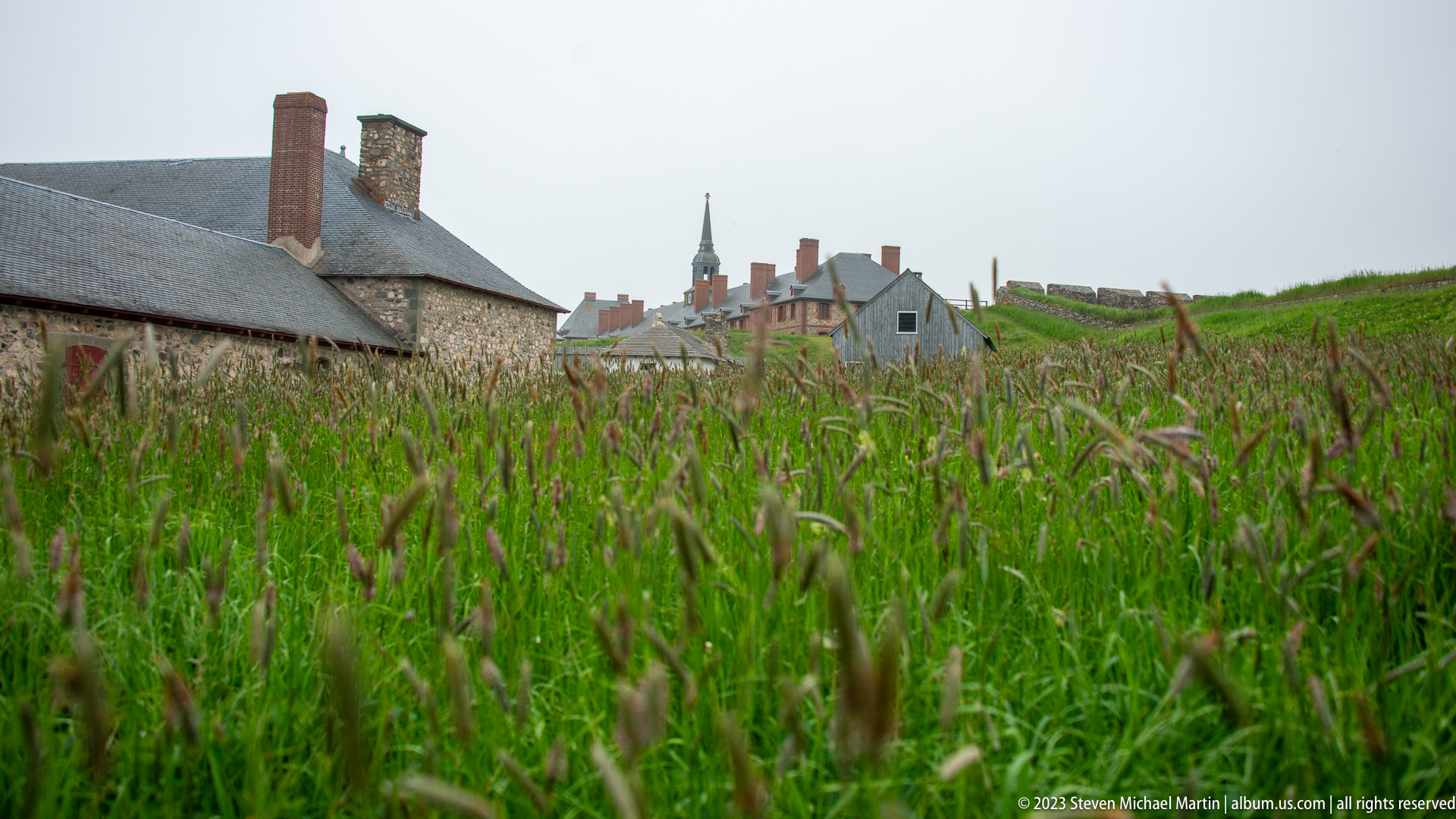
Tall wet grass fills most of the foreground, with the reconstructed town rising beyond in a soft band of roofs, chimneys, and a church spire. A dark stone building anchors the left edge while a rough fence line crosses the right. The low viewpoint presents Louisbourg as a settlement embedded in its windswept coastal landscape.
Caption
Tall wet grass fills most of the foreground, with the reconstructed town rising beyond in a soft band of roofs, chimneys, and a church spire. A dark stone building anchors the left edge while a rough fence line crosses the right. The low viewpoint presents Louisbourg as a settlement embedded in its windswept coastal landscape.
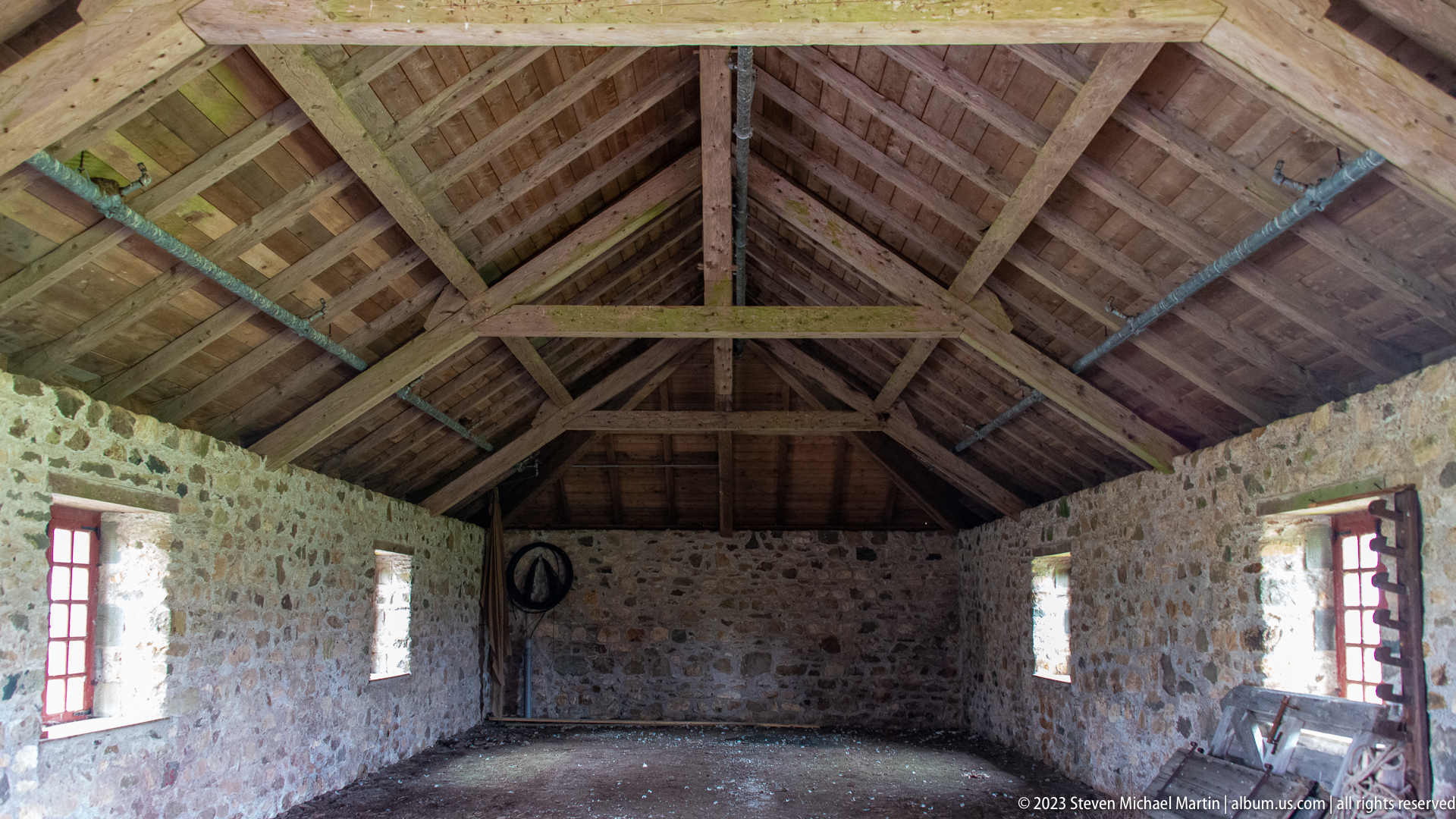
An empty rectangular room reveals rough stone walls, red-trimmed windows, and a fully exposed timber roof structure. Heavy rafters, purlins, and collar beams converge beneath the steep gable, making the building's construction legible from floor to ridge. Sparse furnishings leave the masonry and carpentry as the principal historical evidence in the space.
Caption
An empty rectangular room reveals rough stone walls, red-trimmed windows, and a fully exposed timber roof structure. Heavy rafters, purlins, and collar beams converge beneath the steep gable, making the building's construction legible from floor to ridge. Sparse furnishings leave the masonry and carpentry as the principal historical evidence in the space.
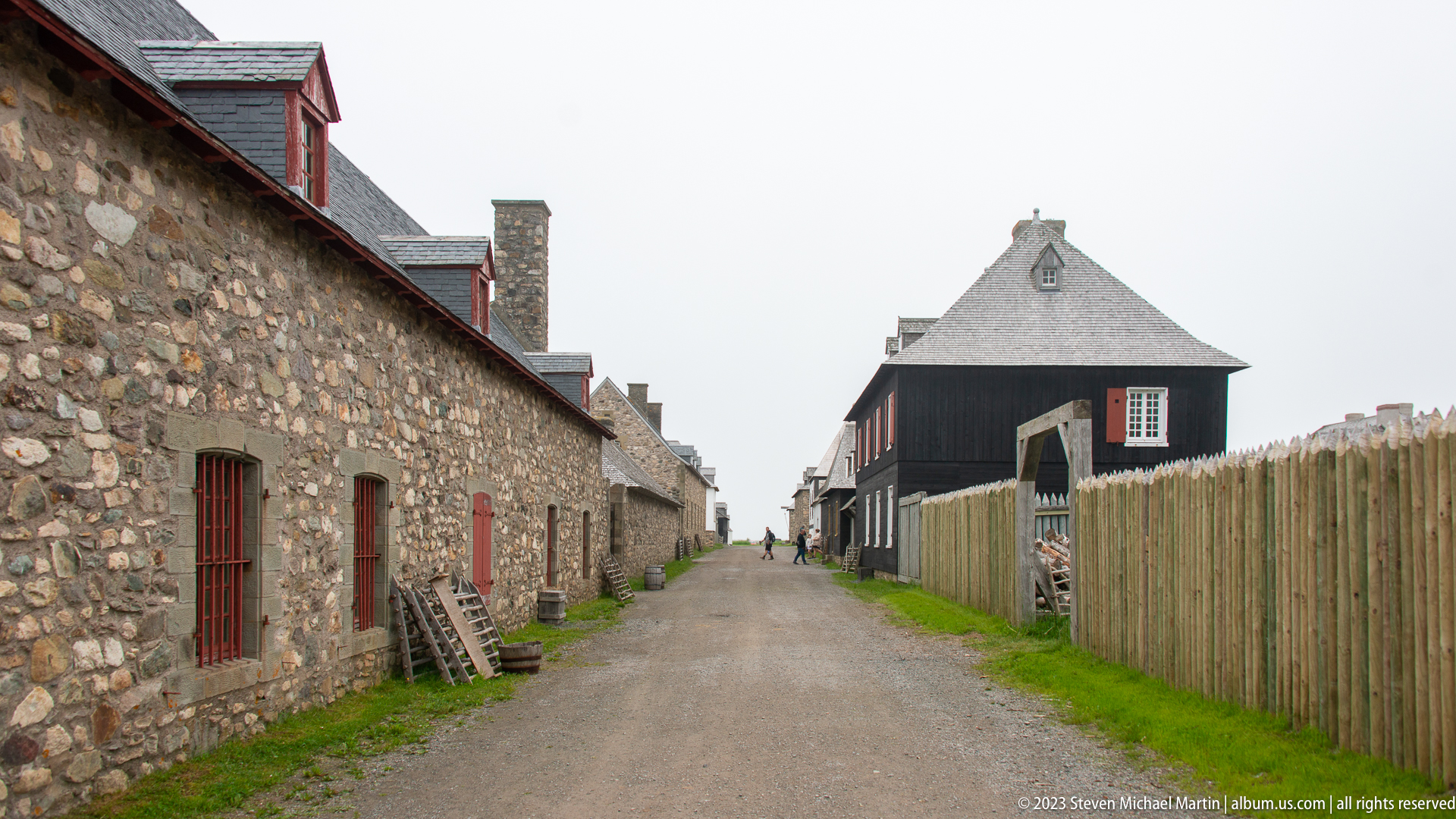
A straight gravel lane runs between a long rubble-stone building on the left and a tall wooden palisade on the right. Red doors and windows punctuate the masonry, while a dark timber-clad building closes the middle distance. The restrained streetscape conveys the tight organization of service and domestic structures within the reconstructed fortified town.
Caption
A straight gravel lane runs between a long rubble-stone building on the left and a tall wooden palisade on the right. Red doors and windows punctuate the masonry, while a dark timber-clad building closes the middle distance. The restrained streetscape conveys the tight organization of service and domestic structures within the reconstructed fortified town.
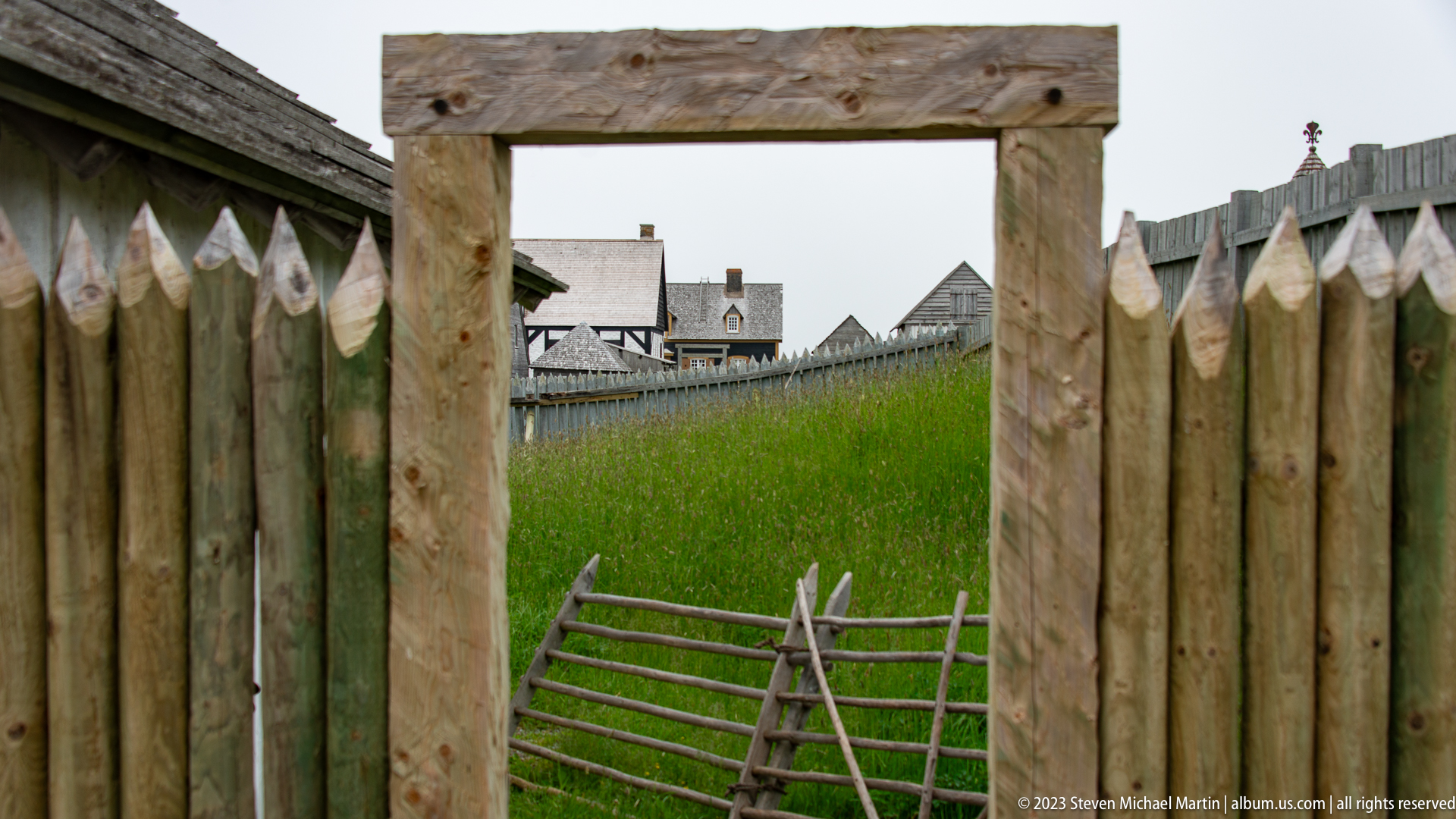
A simple rectangular opening in a pointed-log palisade frames a grassy enclosure and slatted wooden gate beyond. Reconstructed buildings rise above the slope in the distance, turning the opening into a visual link between defensive boundary and settlement. The close foreground emphasizes sharpened timber stakes and the practical texture of wooden enclosure construction.
Caption
A simple rectangular opening in a pointed-log palisade frames a grassy enclosure and slatted wooden gate beyond. Reconstructed buildings rise above the slope in the distance, turning the opening into a visual link between defensive boundary and settlement. The close foreground emphasizes sharpened timber stakes and the practical texture of wooden enclosure construction.
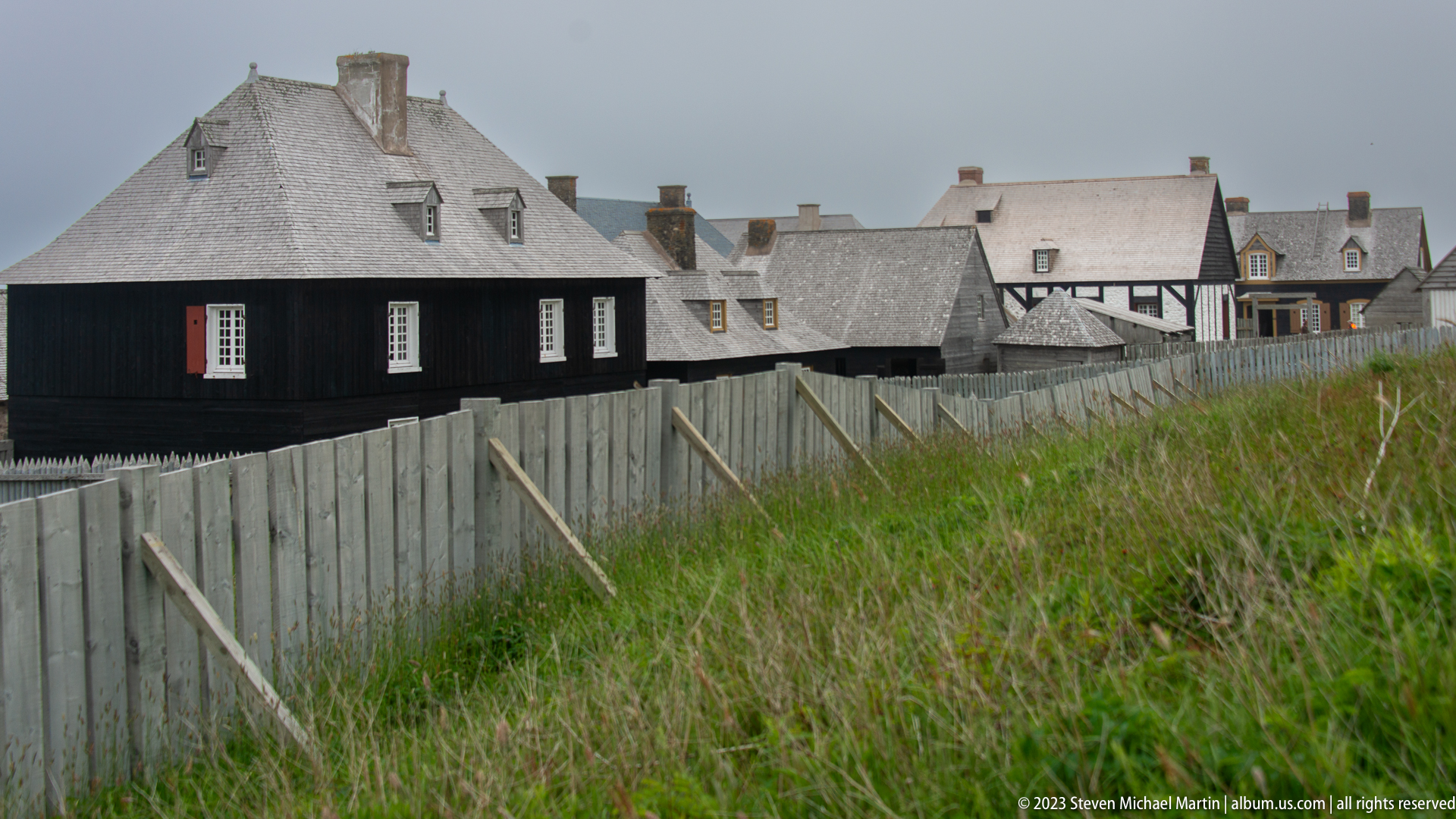
A long black timber-clad building with white-and-red windows stands behind a weathered gray fence, with lighter masonry and half-timbered buildings layered beyond. Tall grass softens the foreground, while multiple steep roofs and chimneys create a dense settlement profile. The view highlights the varied materials and tightly spaced architecture of reconstructed Louisbourg.
Caption
A long black timber-clad building with white-and-red windows stands behind a weathered gray fence, with lighter masonry and half-timbered buildings layered beyond. Tall grass softens the foreground, while multiple steep roofs and chimneys create a dense settlement profile. The view highlights the varied materials and tightly spaced architecture of reconstructed Louisbourg.
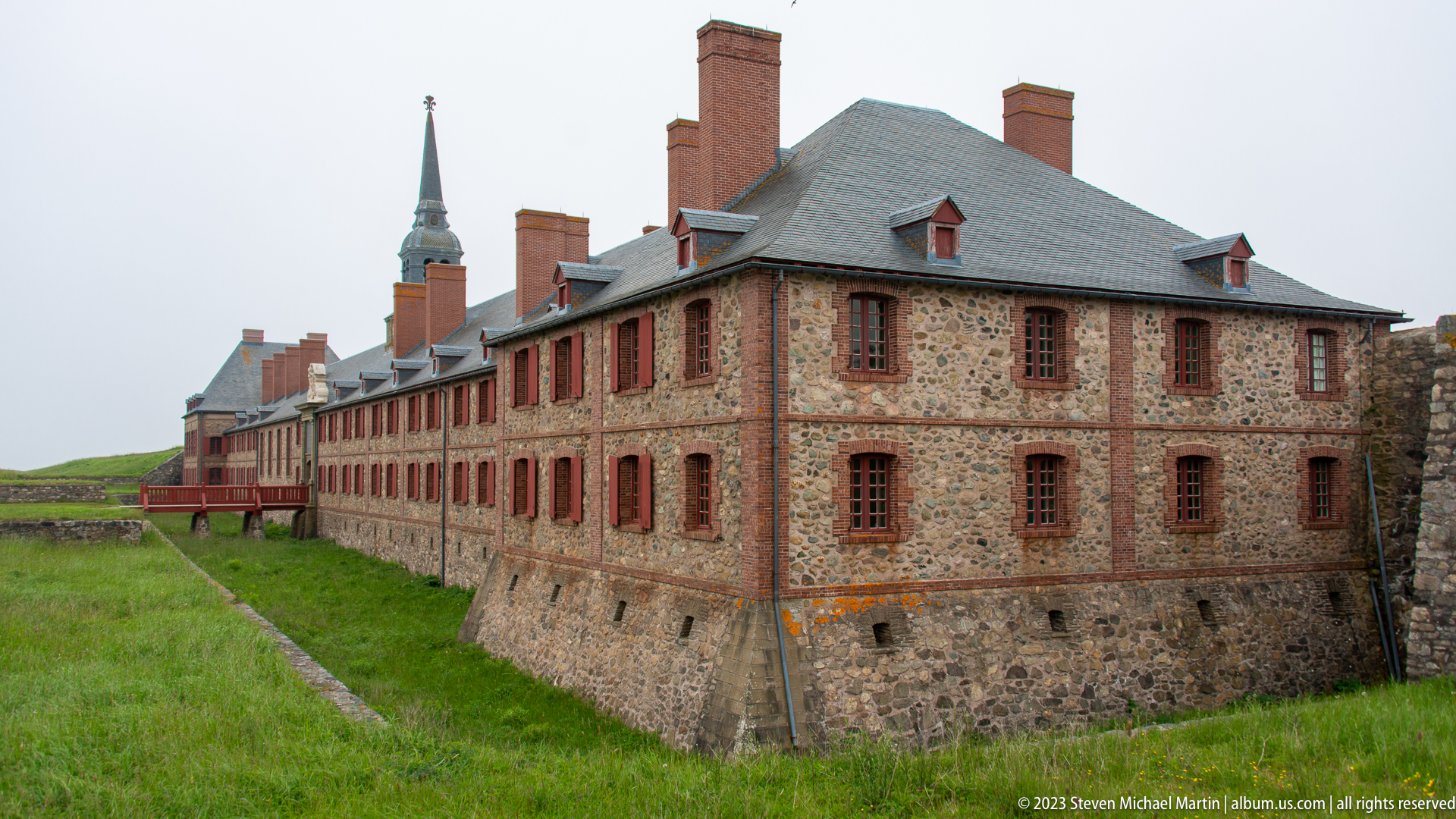
A substantial two-story masonry building dominates the edge of the reconstructed town, combining rough stone walls with red brick trim around corners and window openings. A steep gray hipped roof, tall chimneys, and repeated windows give the long façade a formal institutional character. Additional attached ranges recede toward the church spire in the distance.
Caption
A substantial two-story masonry building dominates the edge of the reconstructed town, combining rough stone walls with red brick trim around corners and window openings. A steep gray hipped roof, tall chimneys, and repeated windows give the long façade a formal institutional character. Additional attached ranges recede toward the church spire in the distance.

A cluster of reconstructed timber-and-masonry buildings stands behind palisade fencing, with a conical-roofed structure and grassy earthworks in the foreground. The mixed rooflines, enclosed yards, and coastal setting show how domestic and service architecture occupied the protected interior of the Fortress of Louisbourg, rather than presenting the site only as a system of ramparts and batteries.
Caption
A cluster of reconstructed timber-and-masonry buildings stands behind palisade fencing, with a conical-roofed structure and grassy earthworks in the foreground. The mixed rooflines, enclosed yards, and coastal setting show how domestic and service architecture occupied the protected interior of the Fortress of Louisbourg, rather than presenting the site only as a system of ramparts and batteries.
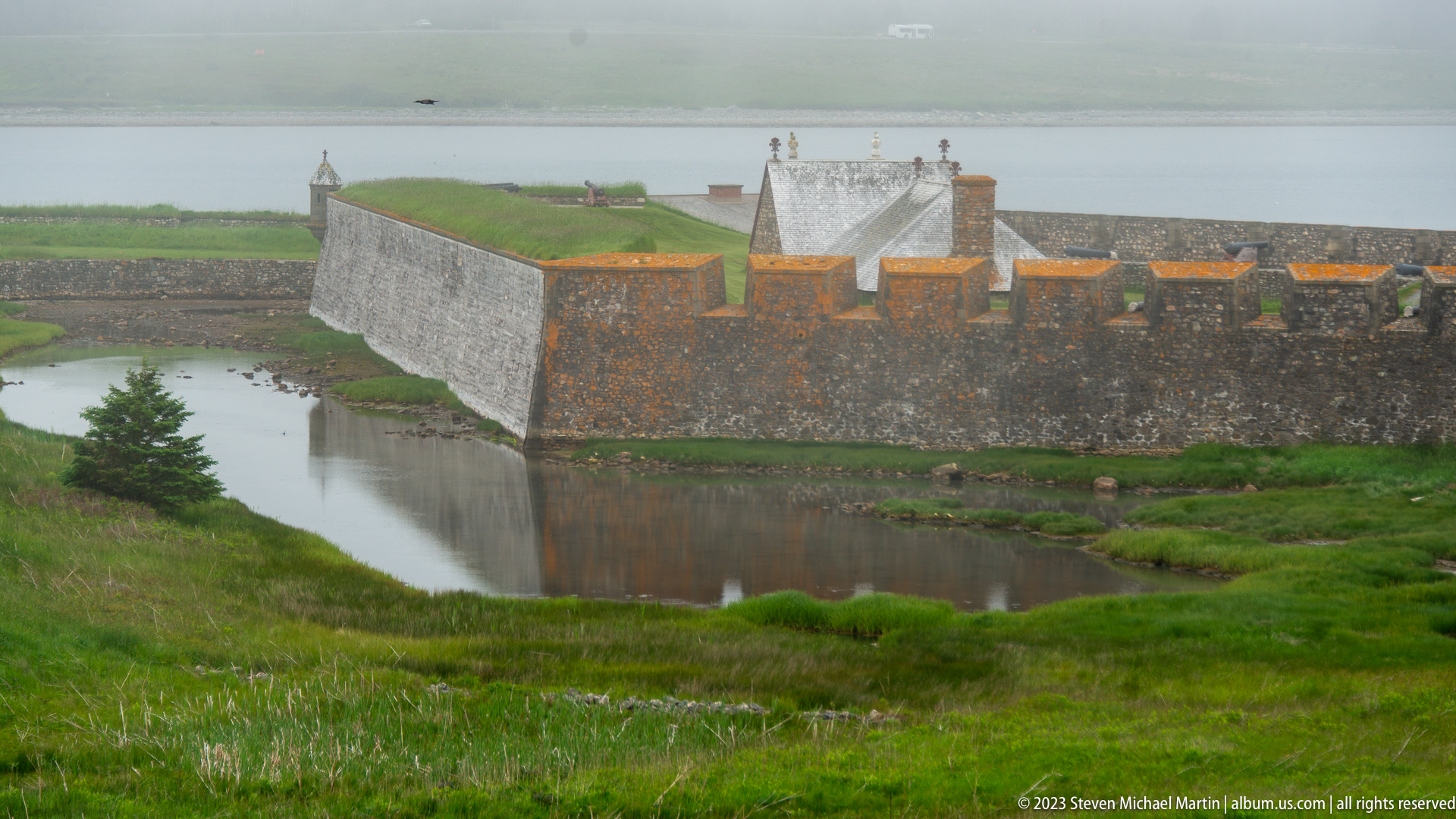
A broad stone defensive wall rises beside a water-filled ditch, its upper surface capped with turf and its inner buildings visible beyond. The angled masonry, controlled approach, and low wet ground illustrate the fortress’s layered defensive landscape, where walls, ditches, and open fields of fire worked together to protect the reconstructed eighteenth-century settlement at Louisbourg.
Caption
A broad stone defensive wall rises beside a water-filled ditch, its upper surface capped with turf and its inner buildings visible beyond. The angled masonry, controlled approach, and low wet ground illustrate the fortress’s layered defensive landscape, where walls, ditches, and open fields of fire worked together to protect the reconstructed eighteenth-century settlement at Louisbourg.
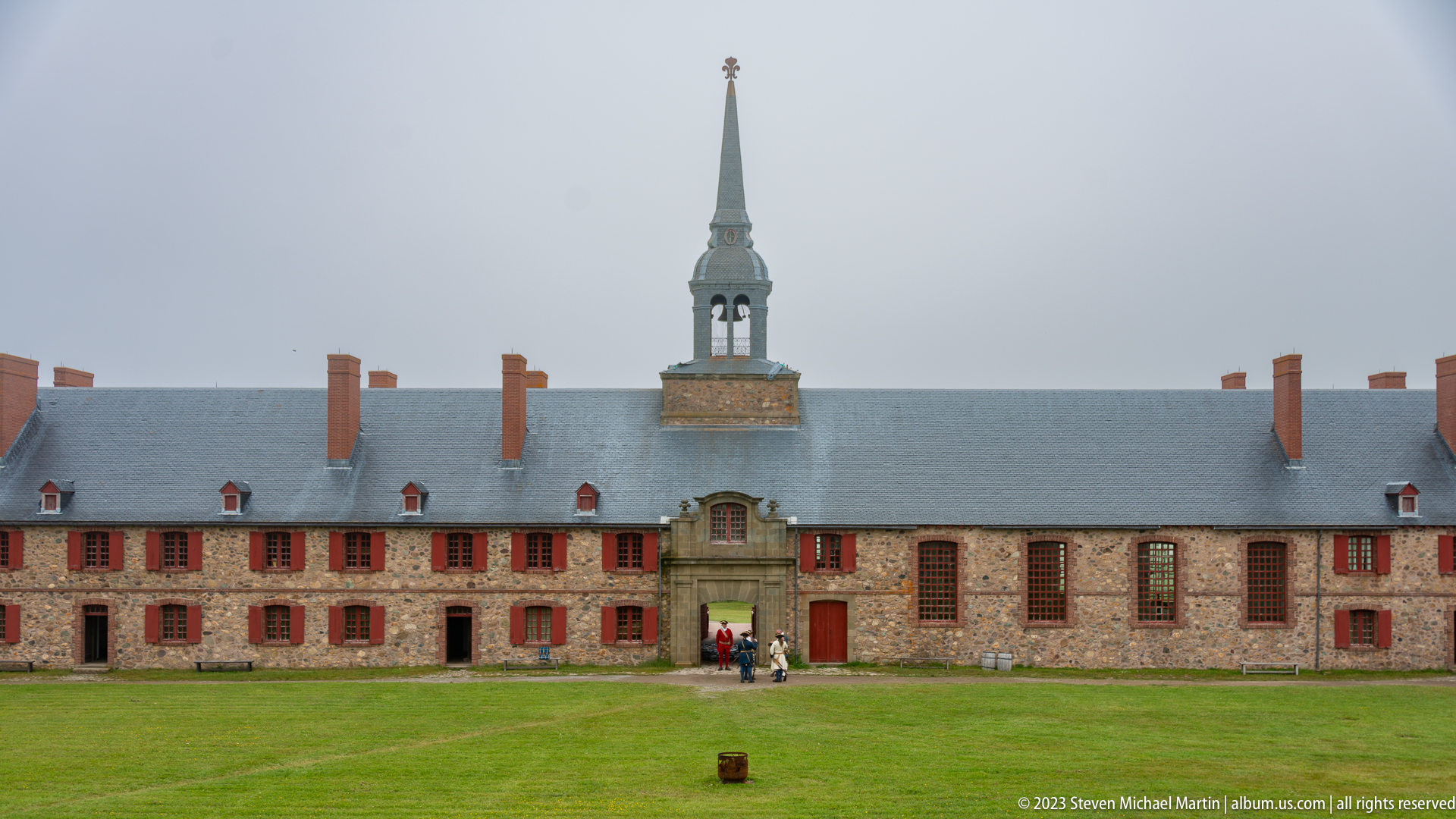
The long masonry façade of the King’s Bastion barracks stretches beneath a slate roof, punctuated by red shutters and a central entrance below the chapel tower. Its formal symmetry and imposing scale distinguish this principal military complex from the smaller domestic buildings of the reconstructed town and convey the administrative and ceremonial importance of the bastion.
Caption
The long masonry façade of the King’s Bastion barracks stretches beneath a slate roof, punctuated by red shutters and a central entrance below the chapel tower. Its formal symmetry and imposing scale distinguish this principal military complex from the smaller domestic buildings of the reconstructed town and convey the administrative and ceremonial importance of the bastion.
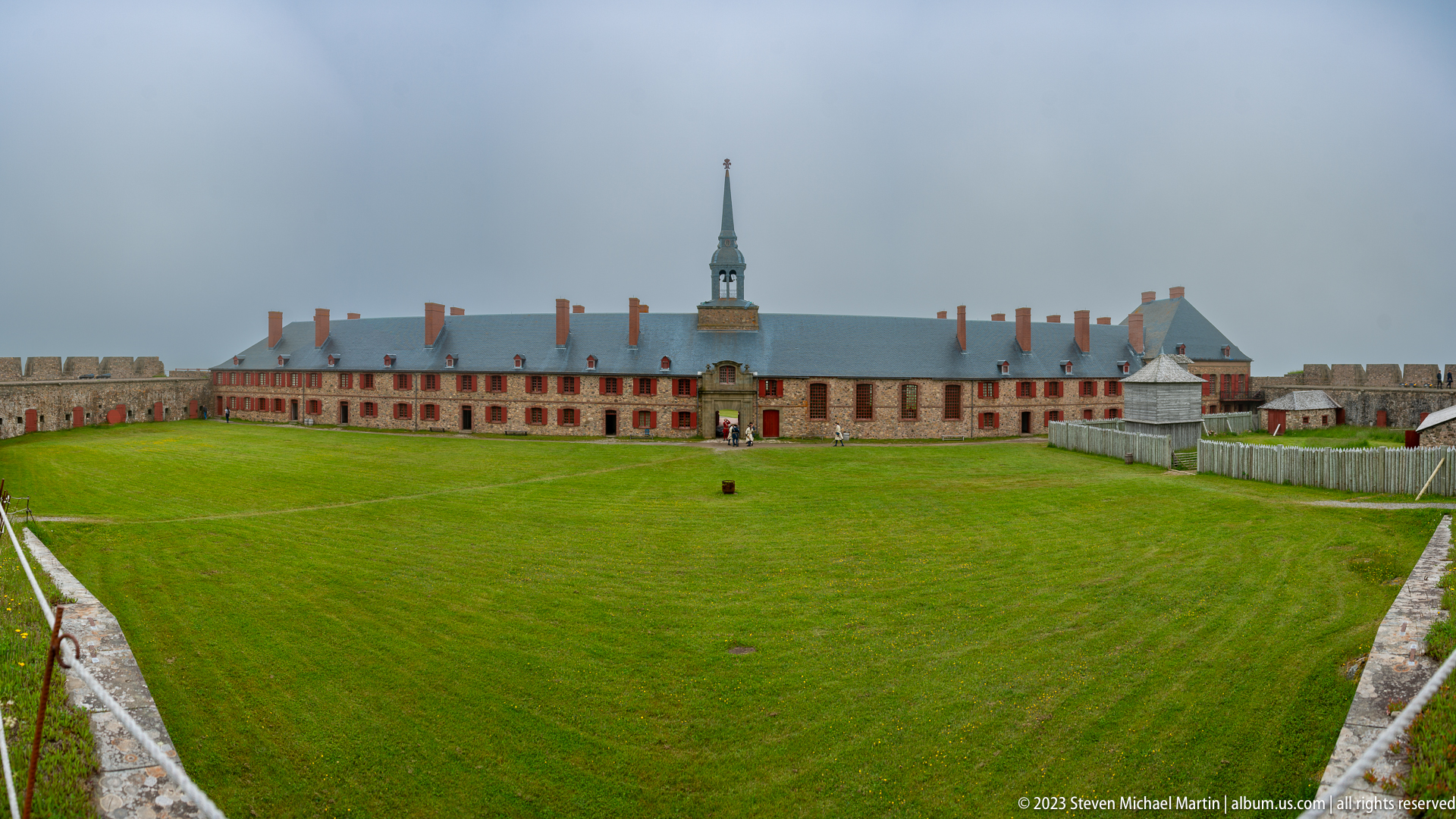
The broad green parade ground opens in front of the King’s Bastion barracks, with the chapel tower rising above the long roofline. Seen from the ramparts, the enclosed courtyard emphasizes the geometric order of the military complex and the relationship between the defensive perimeter, troop accommodations, and ceremonial space at the heart of the fortress.
Caption
The broad green parade ground opens in front of the King’s Bastion barracks, with the chapel tower rising above the long roofline. Seen from the ramparts, the enclosed courtyard emphasizes the geometric order of the military complex and the relationship between the defensive perimeter, troop accommodations, and ceremonial space at the heart of the fortress.

A distant stone wall and turf-covered defensive work are framed from beside another masonry rampart, with a broad grassy slope and wet ditch between them. This oblique view makes the depth of Louisbourg’s fortifications legible, showing how separated walls, low ground, and overlapping fields of observation created a layered defensive system.
Caption
A distant stone wall and turf-covered defensive work are framed from beside another masonry rampart, with a broad grassy slope and wet ditch between them. This oblique view makes the depth of Louisbourg’s fortifications legible, showing how separated walls, low ground, and overlapping fields of observation created a layered defensive system.

A white crested chicken forages at the edge of dense greenery on the reconstructed fortress grounds. The bird introduces an element of everyday domestic life that would have accompanied a working eighteenth-century settlement, complementing the site’s architecture with a reminder that livestock and poultry formed part of the inhabited townscape.
Caption
A white crested chicken forages at the edge of dense greenery on the reconstructed fortress grounds. The bird introduces an element of everyday domestic life that would have accompanied a working eighteenth-century settlement, complementing the site’s architecture with a reminder that livestock and poultry formed part of the inhabited townscape.
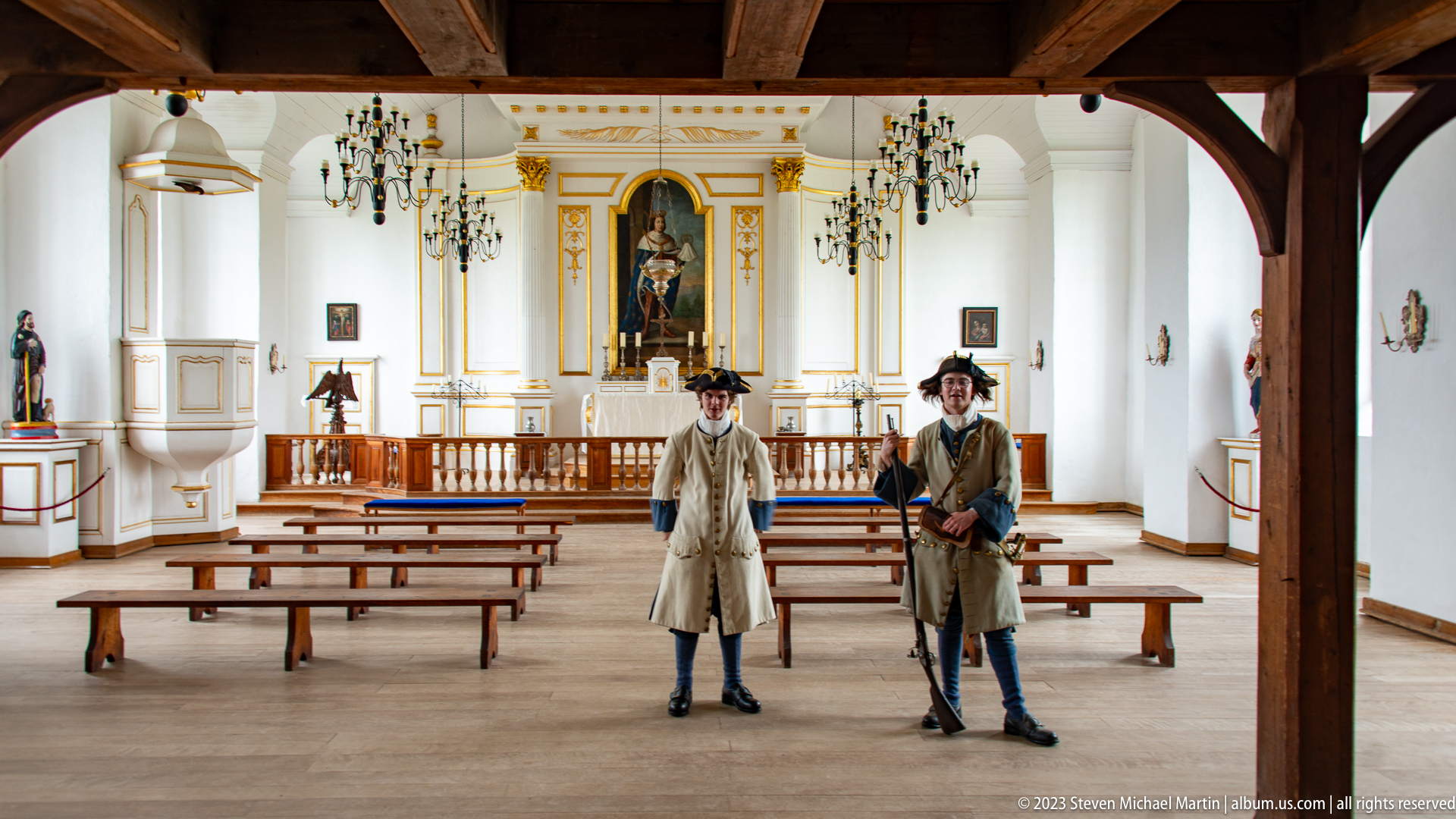
Two costumed interpreters stand in the nave of the reconstructed chapel, with rows of wooden benches leading toward a gilded white altar. The simple timber floor and structural posts contrast with the formal altar treatment, showing how religious ceremony occupied a prominent place within the military and administrative complex of the King’s Bastion.
Caption
Two costumed interpreters stand in the nave of the reconstructed chapel, with rows of wooden benches leading toward a gilded white altar. The simple timber floor and structural posts contrast with the formal altar treatment, showing how religious ceremony occupied a prominent place within the military and administrative complex of the King’s Bastion.

A costumed military interpreter stands on the grass in front of a stone building, holding a long musket upright. His tricorn hat, knee-length coat, gaiters, belt equipment, and sword recreate the appearance of an eighteenth-century soldier and help translate Louisbourg’s defensive architecture into the lived routines of the garrison that occupied it.
Caption
A costumed military interpreter stands on the grass in front of a stone building, holding a long musket upright. His tricorn hat, knee-length coat, gaiters, belt equipment, and sword recreate the appearance of an eighteenth-century soldier and help translate Louisbourg’s defensive architecture into the lived routines of the garrison that occupied it.
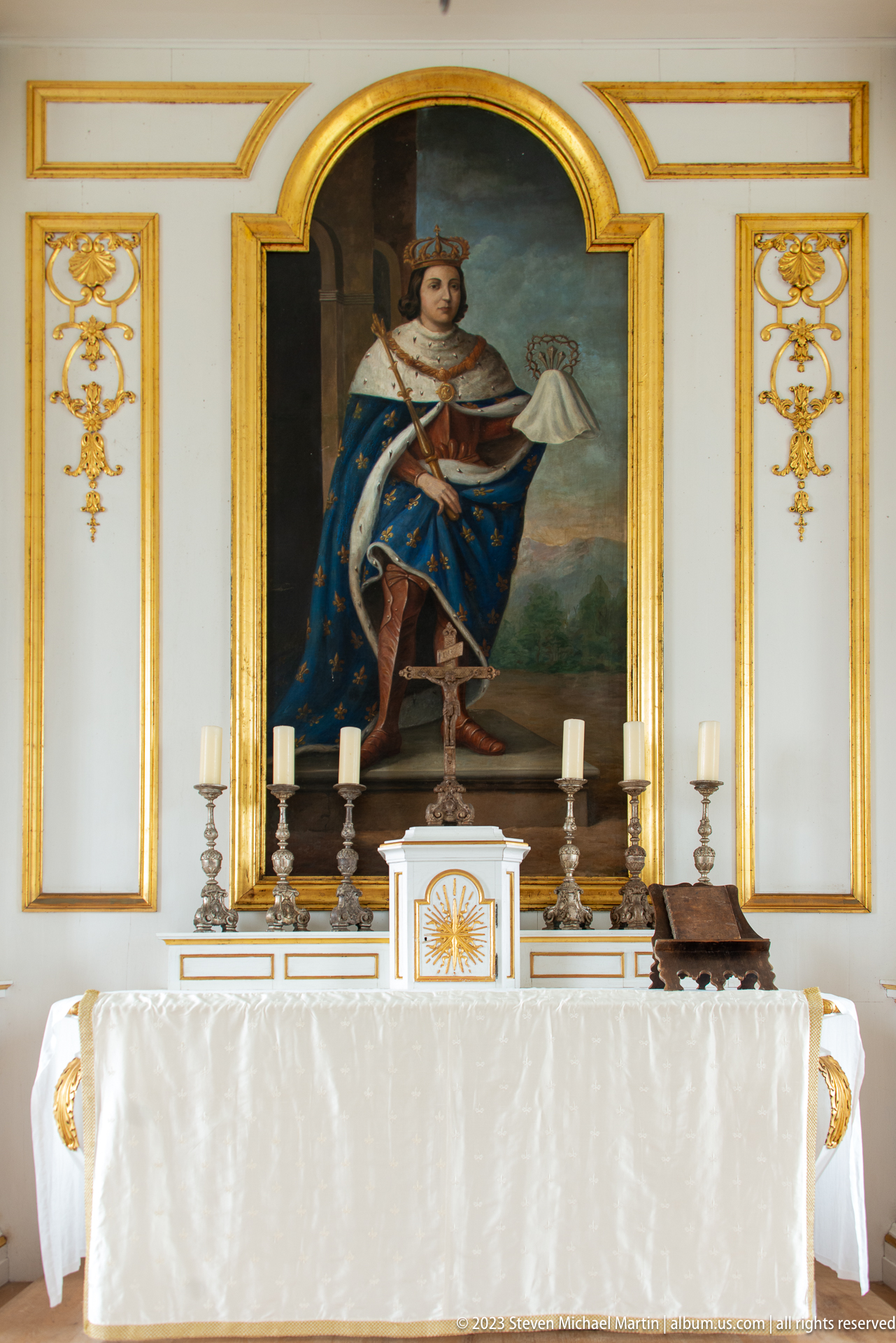
A large framed painting of a crowned, richly dressed figure dominates the wall above the chapel altar, where candles and white textiles are arranged symmetrically below. The gilded architectural surround and blue-and-gold costume reinforce the formal, courtly character of the sanctuary decoration and make the painting the principal visual focus of the altar ensemble.
Caption
A large framed painting of a crowned, richly dressed figure dominates the wall above the chapel altar, where candles and white textiles are arranged symmetrically below. The gilded architectural surround and blue-and-gold costume reinforce the formal, courtly character of the sanctuary decoration and make the painting the principal visual focus of the altar ensemble.
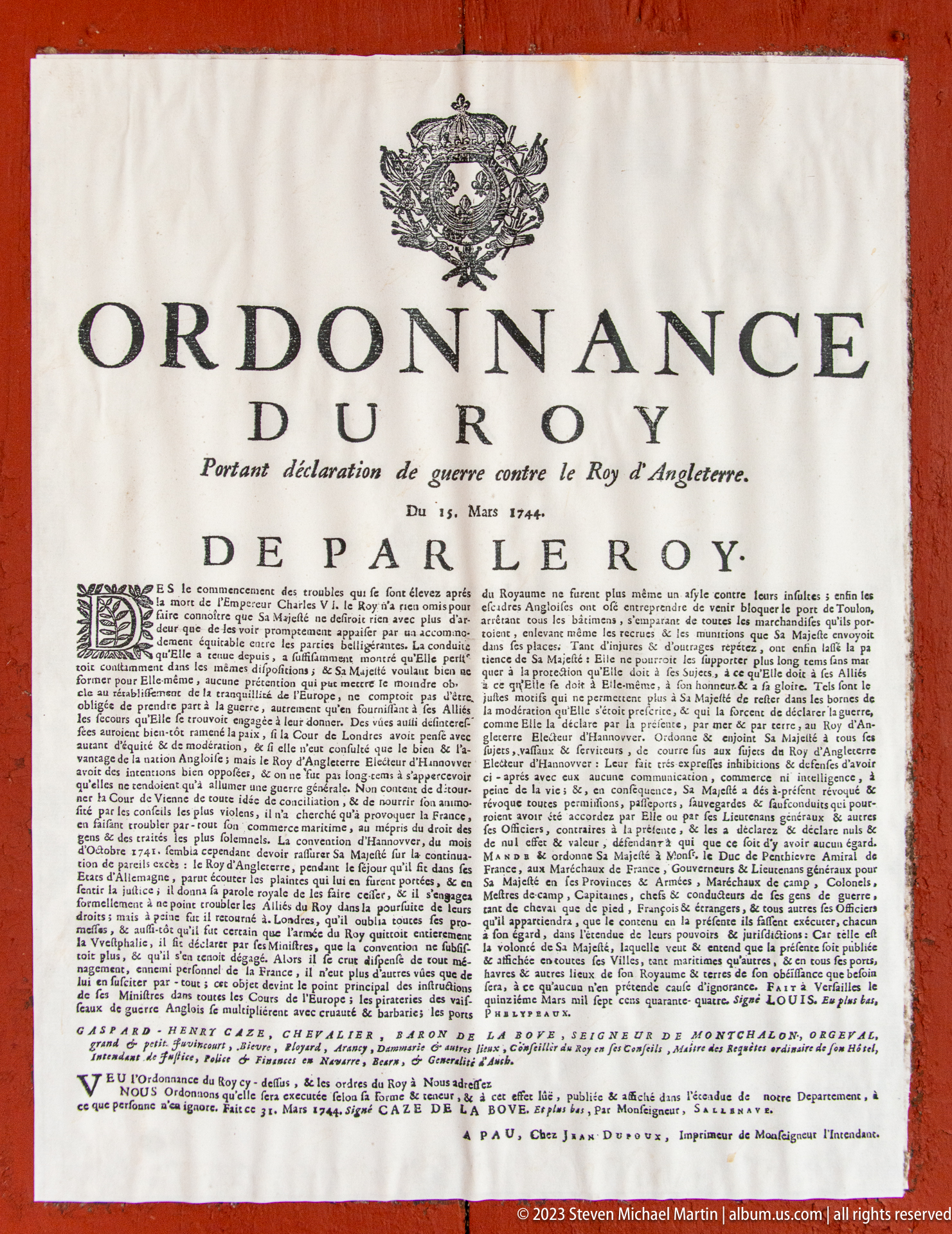
A framed printed broadside headed “ORDONNANCE DU ROY” fills the composition, followed by dense French text and a royal emblem. The document evokes the administrative machinery of the French crown and provides a material counterpart to the reconstructed military and civic spaces presented throughout Louisbourg.
Caption
A framed printed broadside headed “ORDONNANCE DU ROY” fills the composition, followed by dense French text and a royal emblem. The document evokes the administrative machinery of the French crown and provides a material counterpart to the reconstructed military and civic spaces presented throughout Louisbourg.

A close portrait isolates a young costumed interpreter wearing a black tricorn hat with gold trim, white neckcloth, and pale eighteenth-century-style coat. The shallow depth of field softens the chapel interior behind him, shifting attention from the reconstructed architecture to the clothing and personal presentation used in living-history interpretation at Louisbourg.
Caption
A close portrait isolates a young costumed interpreter wearing a black tricorn hat with gold trim, white neckcloth, and pale eighteenth-century-style coat. The shallow depth of field softens the chapel interior behind him, shifting attention from the reconstructed architecture to the clothing and personal presentation used in living-history interpretation at Louisbourg.

A second living-history interpreter is shown in close view wearing spectacles, a dark tricorn hat with gold edging, and a pale coat over a blue waistcoat. A musket appears at the edge of the composition. The portrait emphasizes individual costume details that support the site’s interpretation of eighteenth-century military life.
Caption
A second living-history interpreter is shown in close view wearing spectacles, a dark tricorn hat with gold edging, and a pale coat over a blue waistcoat. A musket appears at the edge of the composition. The portrait emphasizes individual costume details that support the site’s interpretation of eighteenth-century military life.

The chapel sanctuary is centered on a white and gold altar framed by paired chandeliers and a painted religious image. Classical moldings, gilded ornament, and the symmetrical wooden rail create a formal focal point within the otherwise restrained interior, illustrating the ceremonial character of the reconstructed chapel inside the King’s Bastion complex.
Caption
The chapel sanctuary is centered on a white and gold altar framed by paired chandeliers and a painted religious image. Classical moldings, gilded ornament, and the symmetrical wooden rail create a formal focal point within the otherwise restrained interior, illustrating the ceremonial character of the reconstructed chapel inside the King’s Bastion complex.

A white tabernacle decorated with a radiating gold motif stands at the center of the altar, flanked by ornate metal candlesticks and backed by a crucifix. The close view reveals the sanctuary’s layered devotional furnishings and the careful symmetry of its reconstructed eighteenth-century religious display.
Caption
A white tabernacle decorated with a radiating gold motif stands at the center of the altar, flanked by ornate metal candlesticks and backed by a crucifix. The close view reveals the sanctuary’s layered devotional furnishings and the careful symmetry of its reconstructed eighteenth-century religious display.
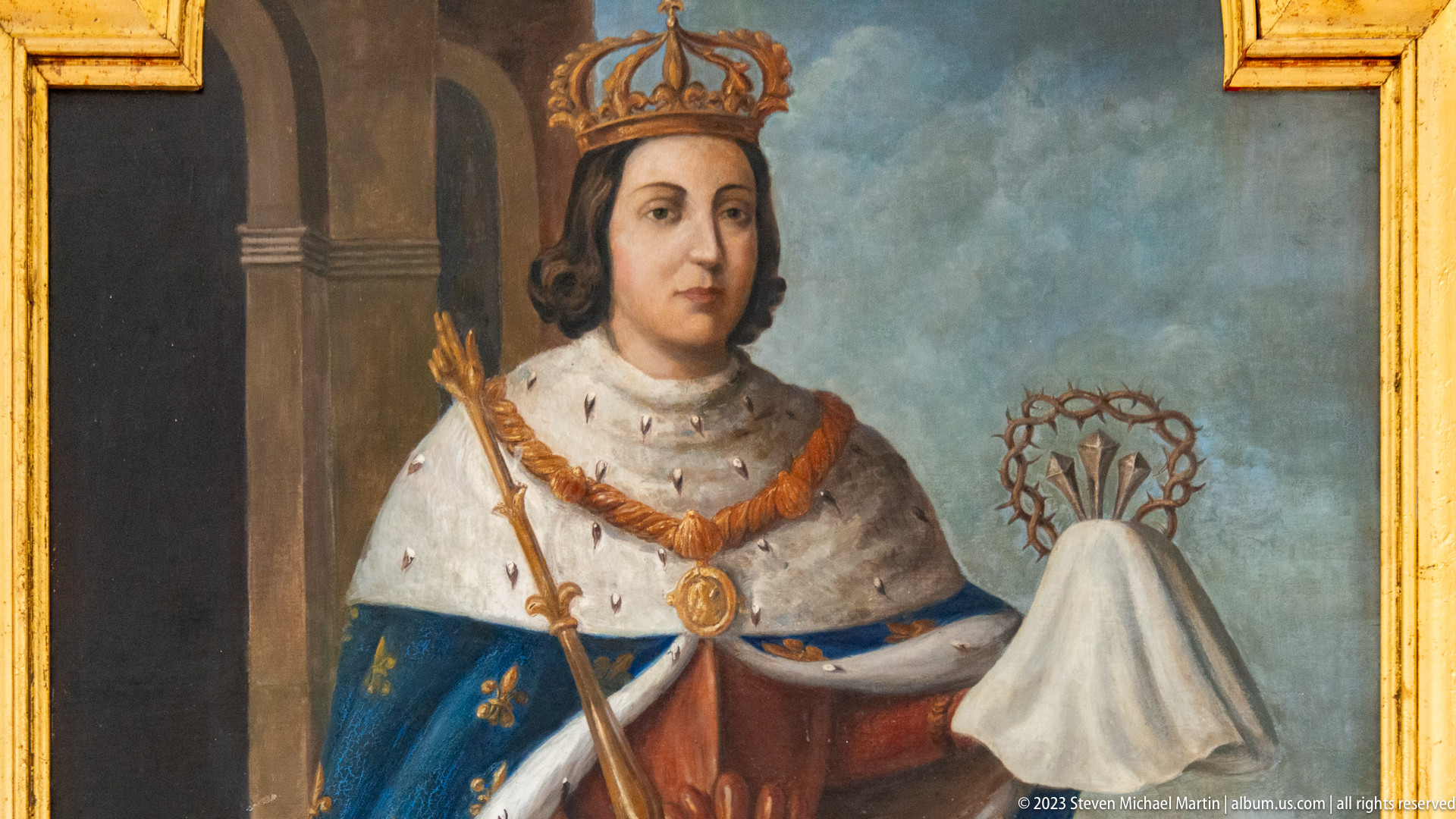
A close view of a painted crowned ruler shows a blue fleur-de-lis mantle, ermine-trimmed robes, scepter, and other symbols of monarchy. Displayed within the chapel, the portrait visually links religious space with royal authority and the French imperial context represented throughout the reconstructed Fortress of Louisbourg.
Caption
A close view of a painted crowned ruler shows a blue fleur-de-lis mantle, ermine-trimmed robes, scepter, and other symbols of monarchy. Displayed within the chapel, the portrait visually links religious space with royal authority and the French imperial context represented throughout the reconstructed Fortress of Louisbourg.
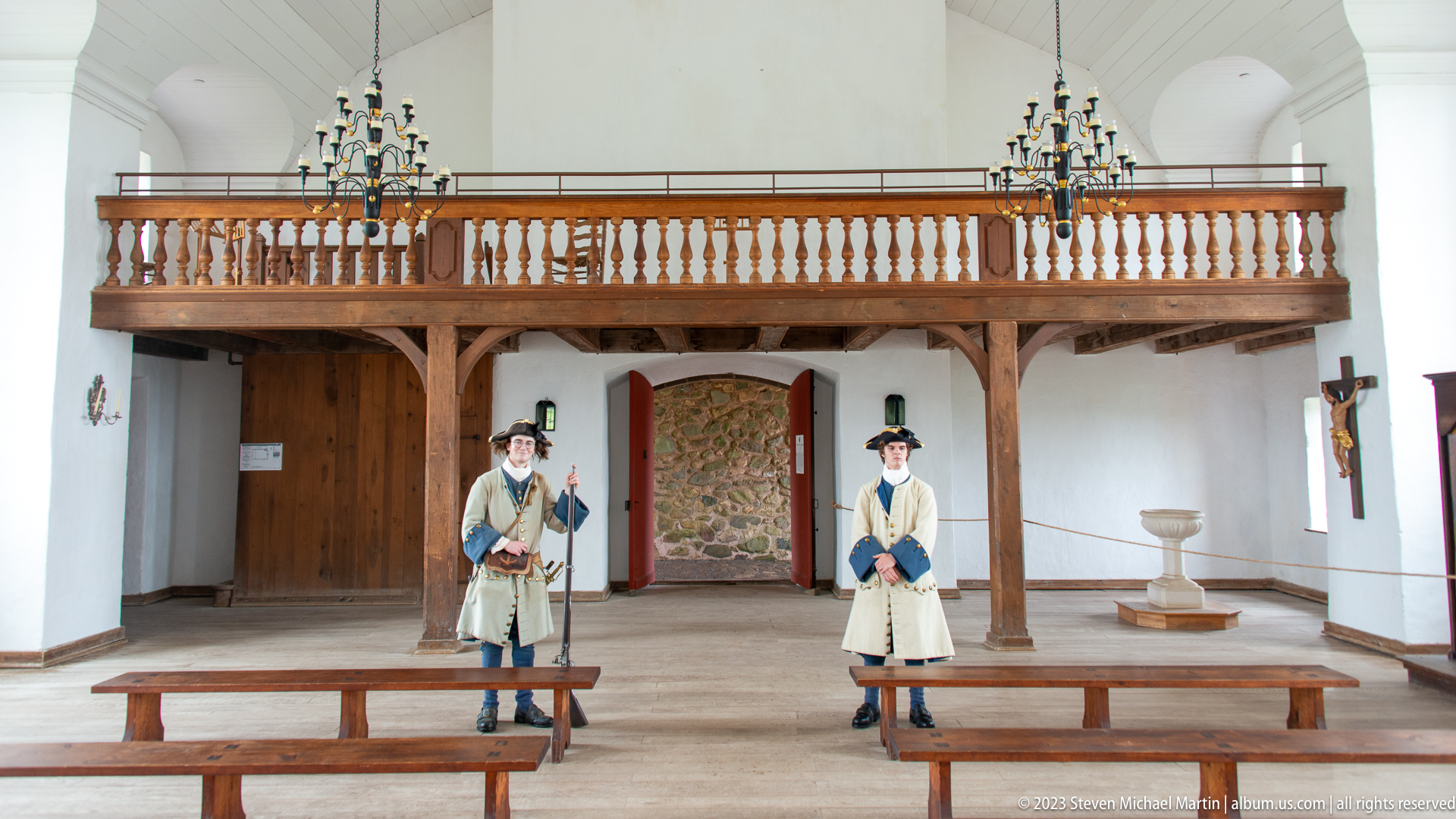
Two costumed interpreters stand beneath a timber gallery at the rear of the chapel, with benches in the foreground and chandeliers suspended above. The view emphasizes the interior’s wooden structural system, balcony rail, and circulation space, offering a counterpoint to the gilded sanctuary at the opposite end of the room.
Caption
Two costumed interpreters stand beneath a timber gallery at the rear of the chapel, with benches in the foreground and chandeliers suspended above. The view emphasizes the interior’s wooden structural system, balcony rail, and circulation space, offering a counterpoint to the gilded sanctuary at the opposite end of the room.

Open red studded doors frame a view through a stone gateway toward a pale reconstructed building beyond. The timber bridge and deep masonry passage emphasize the thickness of the defensive work and the controlled nature of movement through the fortress, turning the gateway itself into a sequence of protected thresholds.
Caption
Open red studded doors frame a view through a stone gateway toward a pale reconstructed building beyond. The timber bridge and deep masonry passage emphasize the thickness of the defensive work and the controlled nature of movement through the fortress, turning the gateway itself into a sequence of protected thresholds.

A blue fleur-de-lis is embroidered onto coarse off-white fabric, its stitching and woven texture shown in extreme close-up. The emblem, strongly associated with the French monarchy, appears here as a small material detail that connects reconstructed clothing and furnishings to the French colonial identity interpreted at Louisbourg.
Caption
A blue fleur-de-lis is embroidered onto coarse off-white fabric, its stitching and woven texture shown in extreme close-up. The emblem, strongly associated with the French monarchy, appears here as a small material detail that connects reconstructed clothing and furnishings to the French colonial identity interpreted at Louisbourg.

A reconstructed barracks room is furnished with stacked wooden bunks, simple bedding, a rough table, benches, barrels, lantern, and small personal items. The cramped arrangement conveys the utilitarian conditions of communal military accommodation and provides a domestic-scale contrast to the monumental exterior of the King’s Bastion barracks.
Caption
A reconstructed barracks room is furnished with stacked wooden bunks, simple bedding, a rough table, benches, barrels, lantern, and small personal items. The cramped arrangement conveys the utilitarian conditions of communal military accommodation and provides a domestic-scale contrast to the monumental exterior of the King’s Bastion barracks.

A costumed military interpreter stands between rows of wooden bunks inside the reconstructed barracks, wearing a tricorn hat, pale coat, blue cuffs, and waist equipment. His presence establishes the scale of the sleeping quarters and connects the room’s sparse furnishings with the daily routines of soldiers quartered within the fortress.
Caption
A costumed military interpreter stands between rows of wooden bunks inside the reconstructed barracks, wearing a tricorn hat, pale coat, blue cuffs, and waist equipment. His presence establishes the scale of the sleeping quarters and connects the room’s sparse furnishings with the daily routines of soldiers quartered within the fortress.
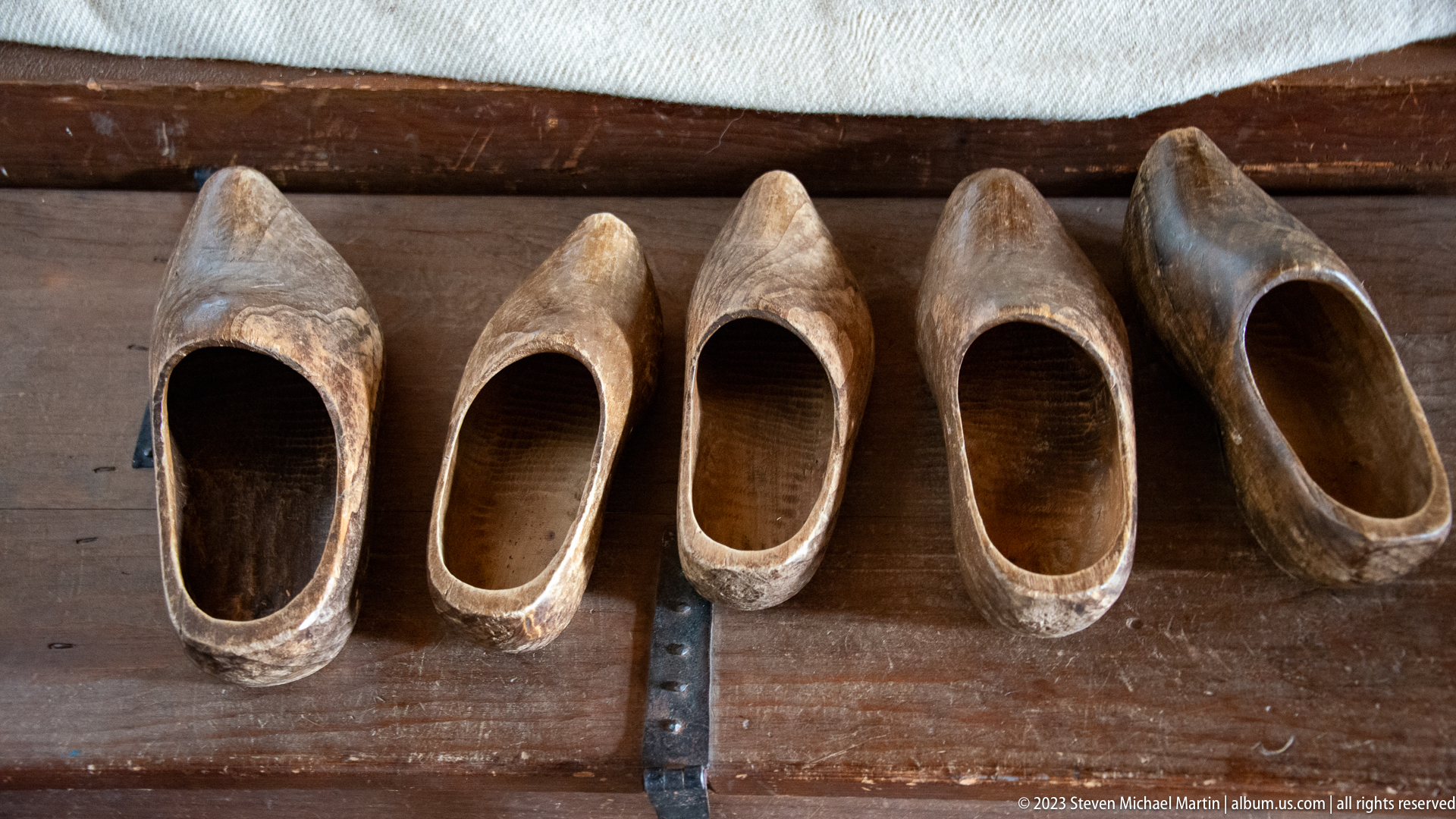
Five worn wooden shoes are lined along a dark plank beside a bunk, their hollowed interiors and irregular handmade forms clearly visible. Grouped as everyday equipment rather than ceremonial objects, the footwear underscores the practical material culture associated with ordinary life inside the reconstructed military quarters.
Caption
Five worn wooden shoes are lined along a dark plank beside a bunk, their hollowed interiors and irregular handmade forms clearly visible. Grouped as everyday equipment rather than ceremonial objects, the footwear underscores the practical material culture associated with ordinary life inside the reconstructed military quarters.
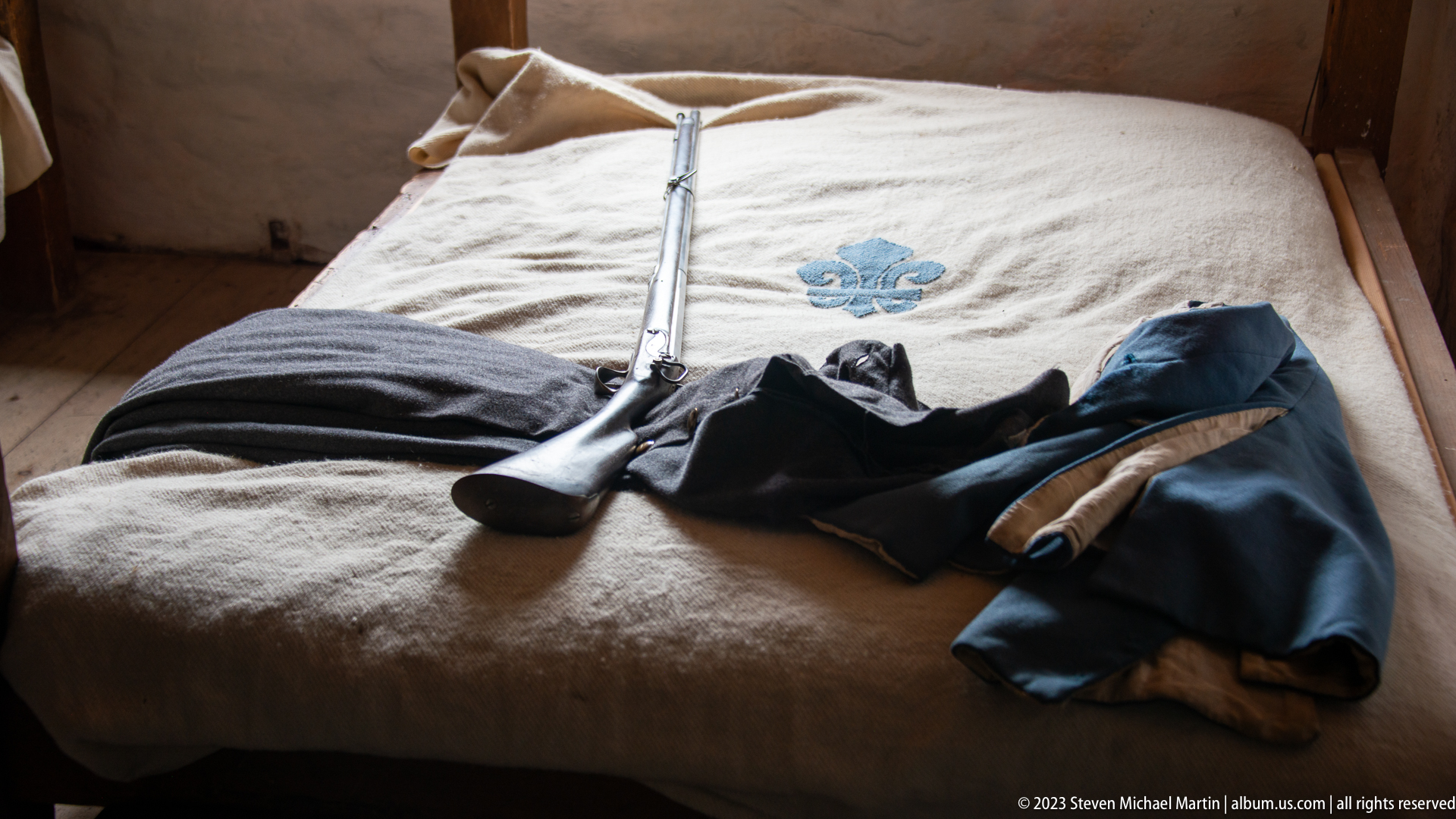
A long firearm, black shoe, blue-and-pale uniform garments, and other clothing are laid across a simple barracks mattress marked with a blue fleur-de-lis. The arranged equipment links personal dress, weaponry, and sleeping space, illustrating how a soldier’s belongings could be concentrated within the limited area of a shared bunk room.
Caption
A long firearm, black shoe, blue-and-pale uniform garments, and other clothing are laid across a simple barracks mattress marked with a blue fleur-de-lis. The arranged equipment links personal dress, weaponry, and sleeping space, illustrating how a soldier’s belongings could be concentrated within the limited area of a shared bunk room.
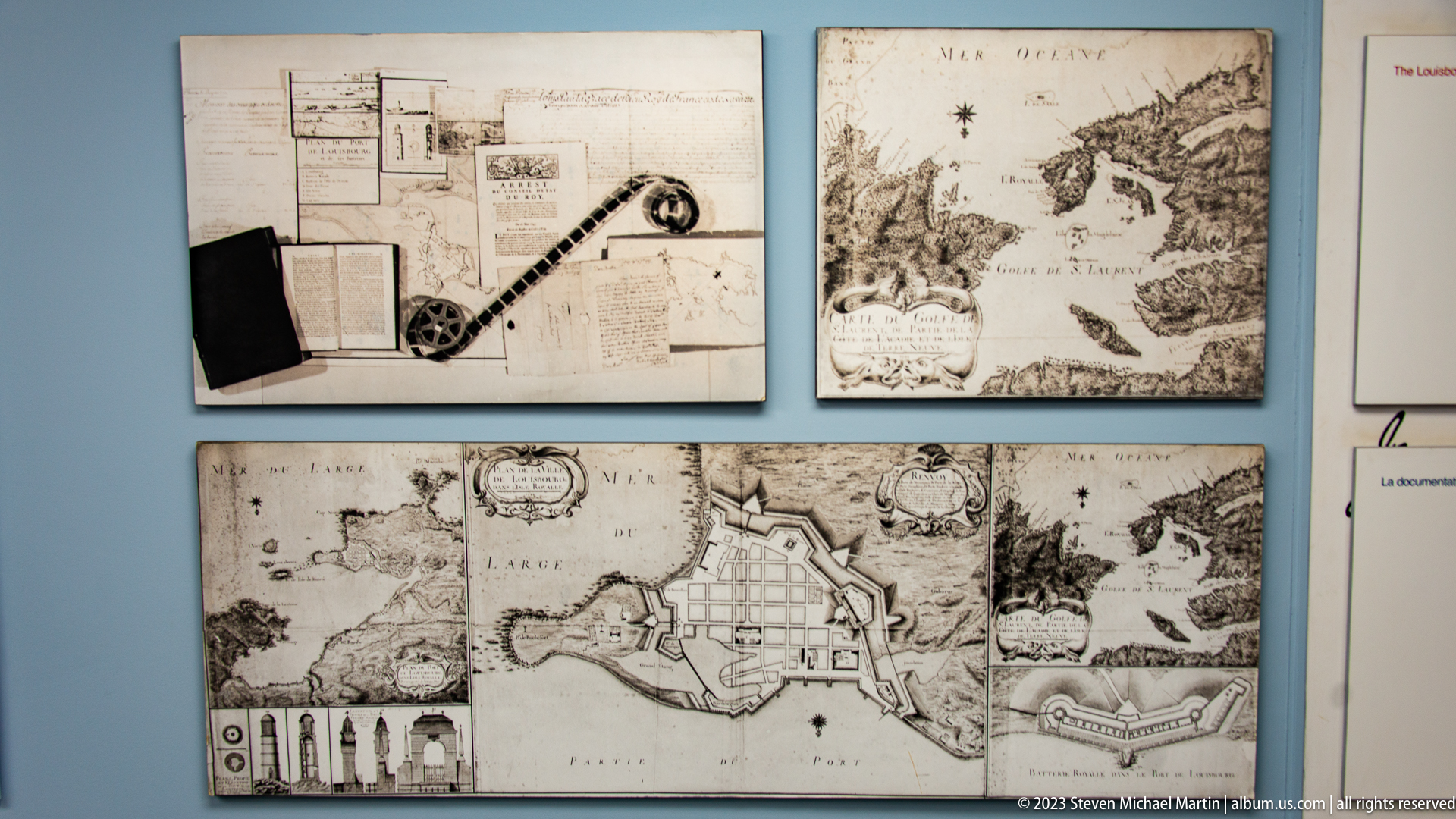
A museum panel assembles historic maps, fortification plans, and coastal charts related to Louisbourg. The documents combine urban layouts with regional geographic views, allowing visitors to read the fortress both as a designed military settlement and as a strategic Atlantic port connected to the surrounding harbor and coastline.
Caption
A museum panel assembles historic maps, fortification plans, and coastal charts related to Louisbourg. The documents combine urban layouts with regional geographic views, allowing visitors to read the fortress both as a designed military settlement and as a strategic Atlantic port connected to the surrounding harbor and coastline.

Boxes of excavated ceramic sherds are arranged beside a partially reconstructed white vessel with blue decoration. The grouped fragments display variations in glaze, painted pattern, clay body, and vessel form, illustrating how archaeological material can document household consumption and imported goods in the eighteenth-century settlement.
Caption
Boxes of excavated ceramic sherds are arranged beside a partially reconstructed white vessel with blue decoration. The grouped fragments display variations in glaze, painted pattern, clay body, and vessel form, illustrating how archaeological material can document household consumption and imported goods in the eighteenth-century settlement.
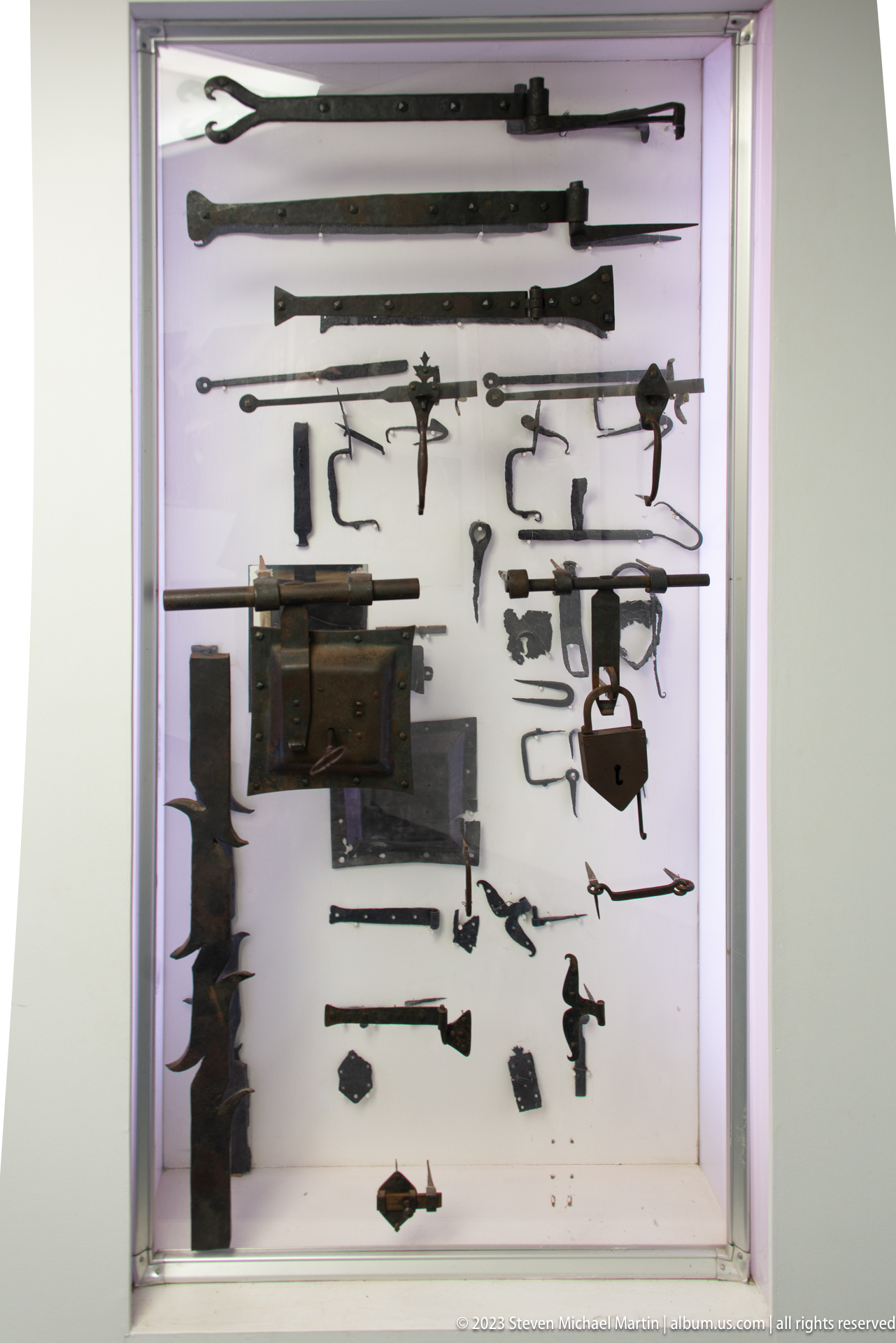
A backlit display case presents an array of corroded iron objects, including long firearm components, locks, tools, fasteners, and fittings. Their silhouettes reveal the variety of military and domestic metalwork recovered or preserved in connection with Louisbourg, shifting attention from reconstructed rooms to the material evidence of occupation.
Caption
A backlit display case presents an array of corroded iron objects, including long firearm components, locks, tools, fasteners, and fittings. Their silhouettes reveal the variety of military and domestic metalwork recovered or preserved in connection with Louisbourg, shifting attention from reconstructed rooms to the material evidence of occupation.

A full yellow gown with fitted bodice, wide skirt, white cuffs, and pale central trim is displayed on a mannequin. The garment demonstrates the volume and layered construction of eighteenth-century women’s dress and broadens the site’s interpretation beyond military life to include the clothing and social world of civilian residents.
Caption
A full yellow gown with fitted bodice, wide skirt, white cuffs, and pale central trim is displayed on a mannequin. The garment demonstrates the volume and layered construction of eighteenth-century women’s dress and broadens the site’s interpretation beyond military life to include the clothing and social world of civilian residents.

An elaborately carved and gilded mirror fills the frame, its scrolling crest, pierced side ornament, and curved lower rail surrounding a reflective glass panel. The mirror is displayed within a reconstructed period interior at the Fortress of Louisbourg NHS, where its decorative exuberance contrasts with the plain wooden floor and white walls visible in reflection.
Caption
An elaborately carved and gilded mirror fills the frame, its scrolling crest, pierced side ornament, and curved lower rail surrounding a reflective glass panel. The mirror is displayed within a reconstructed period interior at the Fortress of Louisbourg NHS, where its decorative exuberance contrasts with the plain wooden floor and white walls visible in reflection.

A large visitor map presents the reconstructed fortress as a labeled three-dimensional plan with color-coded buildings, services, routes, and interpretive features. The dense legend and numbered site markers show how the extensive historic landscape is organized for modern visitors while preserving the spatial logic of streets, walls, bastions, and waterfront areas.
Caption
A large visitor map presents the reconstructed fortress as a labeled three-dimensional plan with color-coded buildings, services, routes, and interpretive features. The dense legend and numbered site markers show how the extensive historic landscape is organized for modern visitors while preserving the spatial logic of streets, walls, bastions, and waterfront areas.
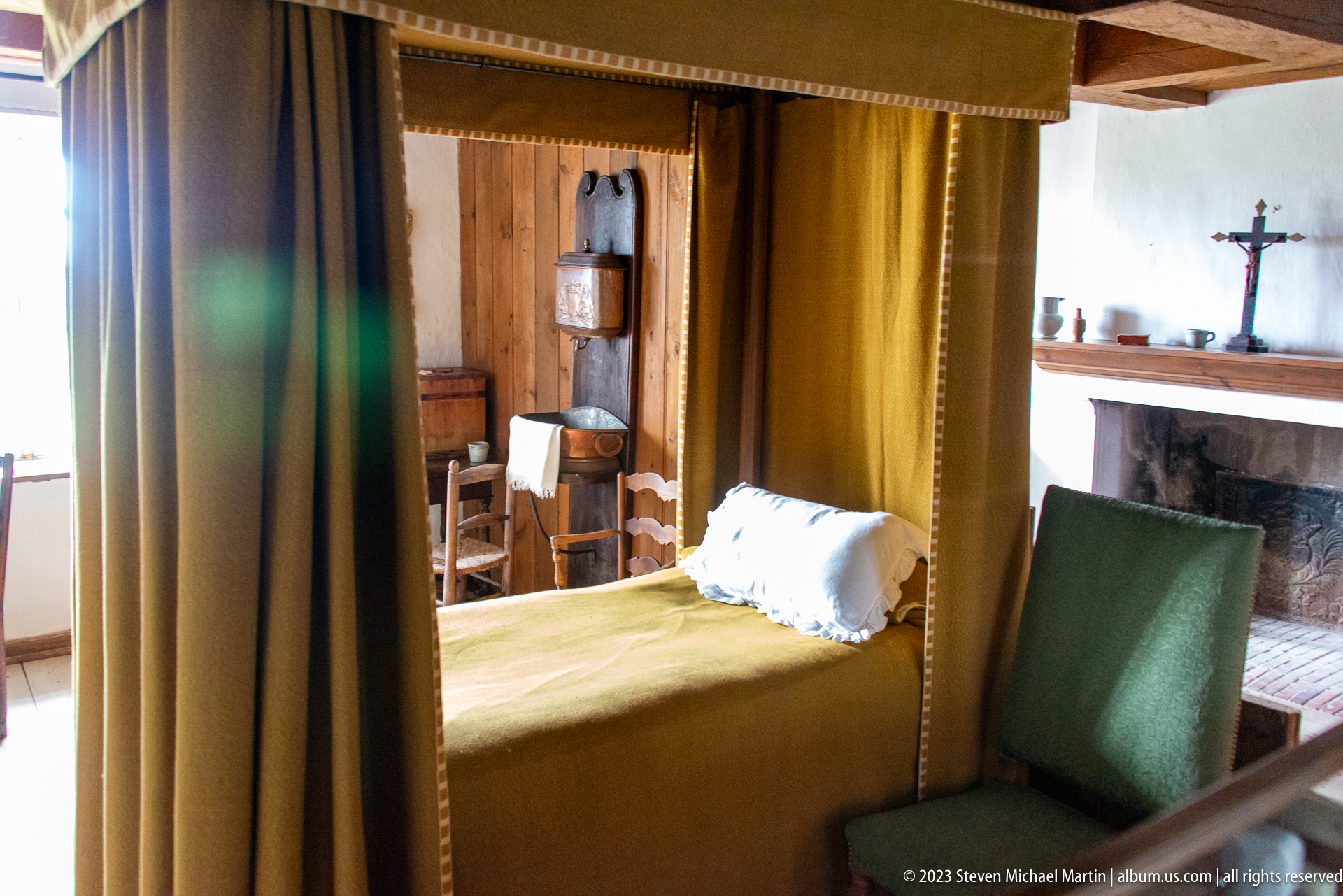
A reconstructed bedchamber contains a mustard-colored canopied bed, green upholstered chair, timber furnishings, and a fireplace with a crucifix above the mantel. The textiles and comparatively refined furniture distinguish this room from the soldiers’ barracks, suggesting a more private and socially elevated domestic setting within the fortified town.
Caption
A reconstructed bedchamber contains a mustard-colored canopied bed, green upholstered chair, timber furnishings, and a fireplace with a crucifix above the mantel. The textiles and comparatively refined furniture distinguish this room from the soldiers’ barracks, suggesting a more private and socially elevated domestic setting within the fortified town.

A dim reconstructed room is furnished with a large wooden chest, small table set with dishes, side table, ceramic vessels, and a hearth or mantel along the wall. Light from the multi-pane window falls across the simple plank floor, emphasizing the compact arrangement of storage, food service, and household equipment in an eighteenth-century interior.
Caption
A dim reconstructed room is furnished with a large wooden chest, small table set with dishes, side table, ceramic vessels, and a hearth or mantel along the wall. Light from the multi-pane window falls across the simple plank floor, emphasizing the compact arrangement of storage, food service, and household equipment in an eighteenth-century interior.
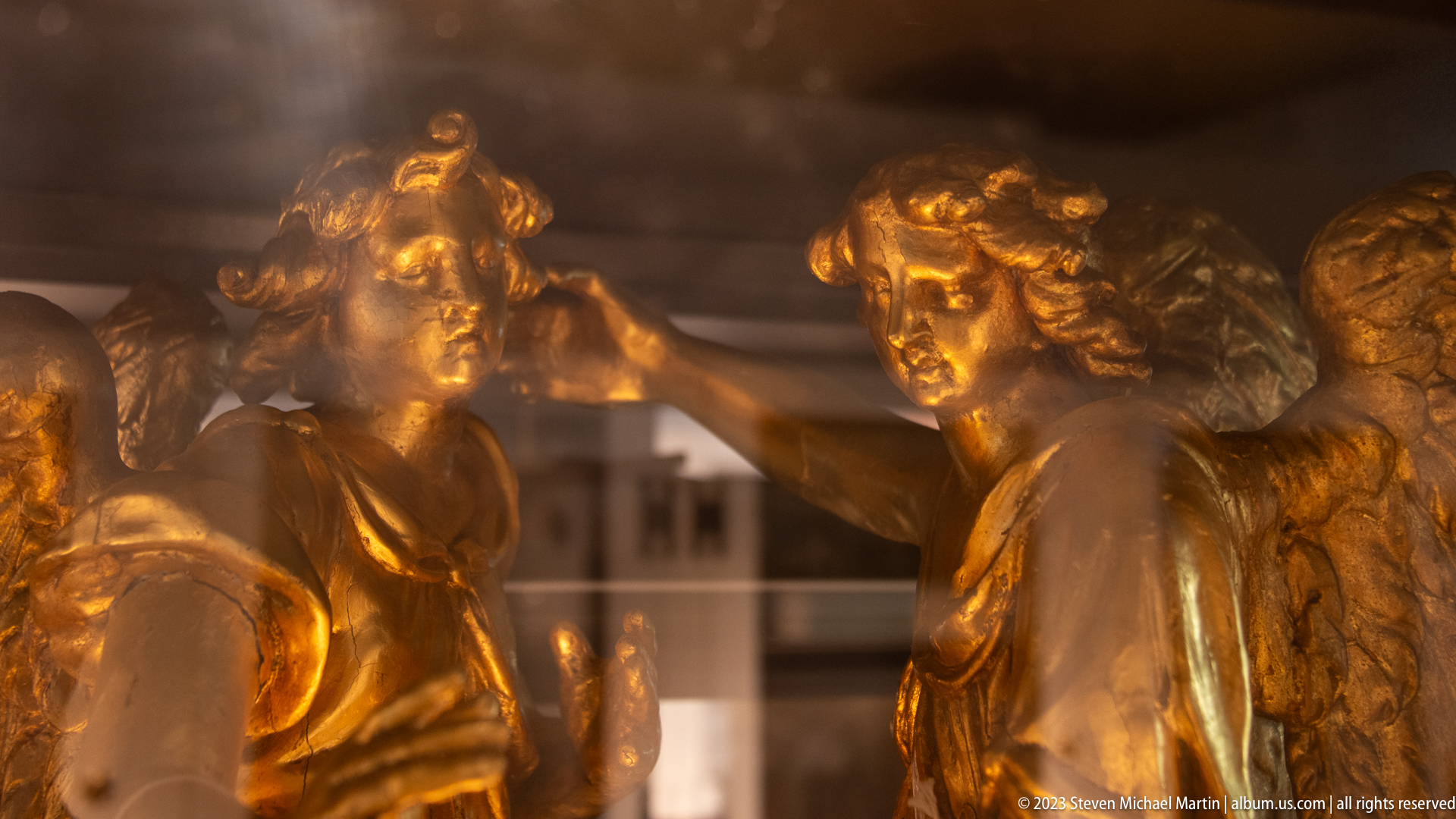
Two gilded winged figures face one another at close range, their modeled faces, curled hair, and feathered wings emerging from a richly reflective surface. The tight composition isolates the sculptural detail and reveals the dramatic modeling and metallic finish of a decorative object displayed in a reconstructed interior at the Fortress of Louisbourg NHS.
Caption
Two gilded winged figures face one another at close range, their modeled faces, curled hair, and feathered wings emerging from a richly reflective surface. The tight composition isolates the sculptural detail and reveals the dramatic modeling and metallic finish of a decorative object displayed in a reconstructed interior at the Fortress of Louisbourg NHS.
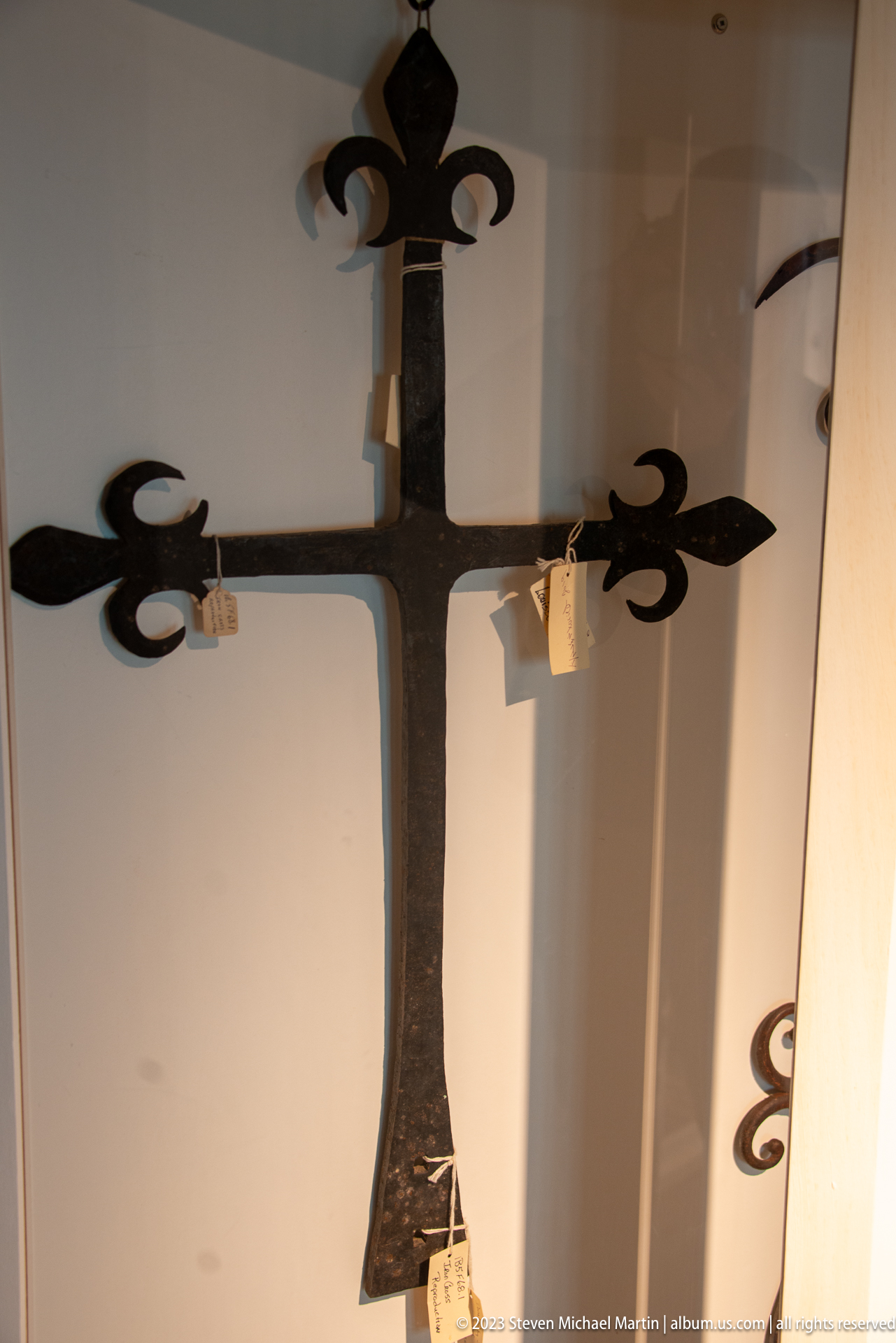
A dark forged-iron cross is displayed vertically against a pale wall, with fleur-de-lis-shaped terminals extending from the arms and top. Its broad central shaft and simple hand-worked surface emphasize the contrast between the functional strength of iron and the symbolic ornament at each end, suggesting an ecclesiastical or devotional object within the site's interpretive collections.
Caption
A dark forged-iron cross is displayed vertically against a pale wall, with fleur-de-lis-shaped terminals extending from the arms and top. Its broad central shaft and simple hand-worked surface emphasize the contrast between the functional strength of iron and the symbolic ornament at each end, suggesting an ecclesiastical or devotional object within the site's interpretive collections.
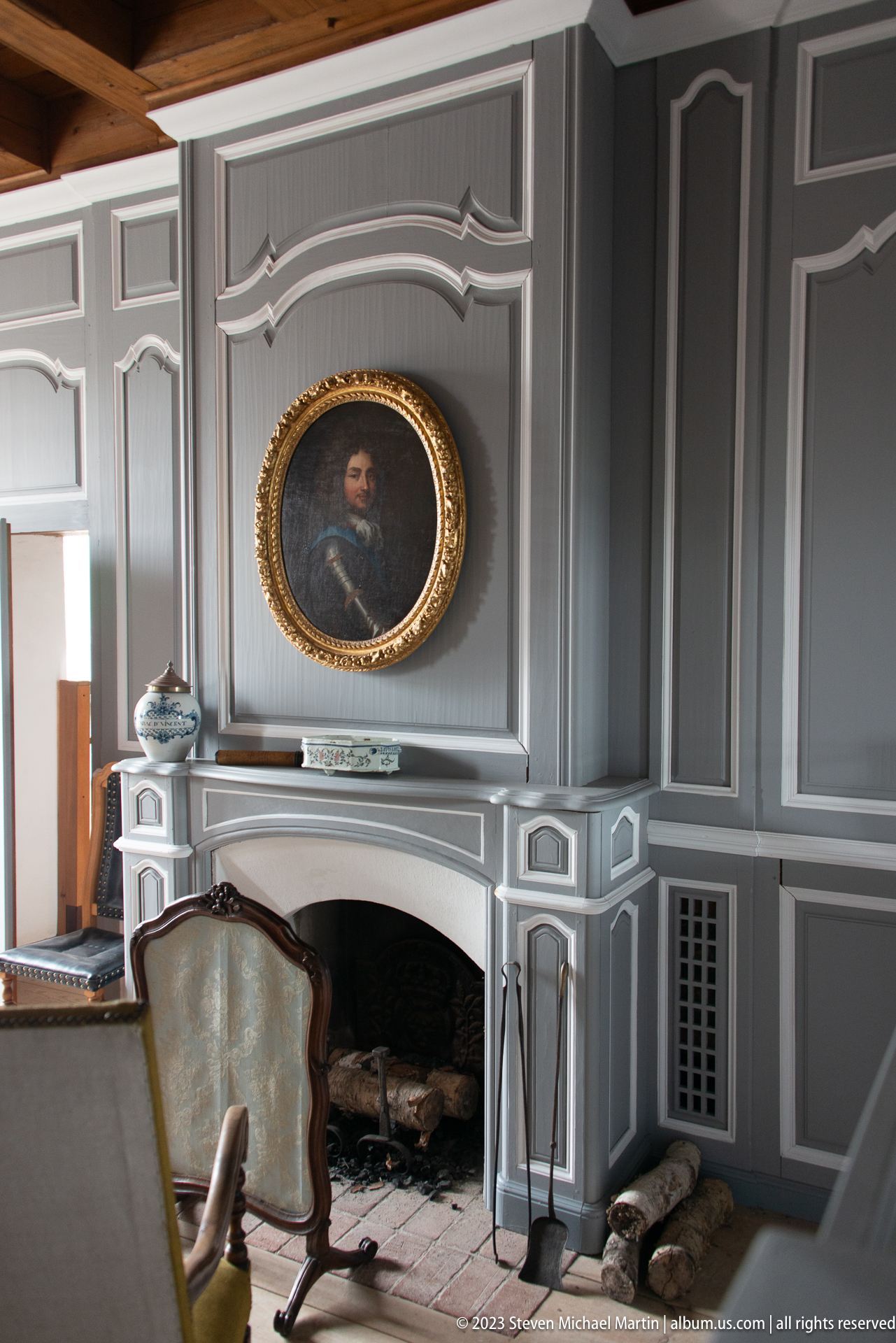
A white-painted fireplace is integrated into elaborate gray wall paneling, with a gilded oval portrait centered above the mantel. The molded surrounds, symmetrical panel divisions, and restrained color palette give the wall an architectural character beyond simple decoration, illustrating the refined interior finish used in a reconstructed high-status residence at Louisbourg.
Caption
A white-painted fireplace is integrated into elaborate gray wall paneling, with a gilded oval portrait centered above the mantel. The molded surrounds, symmetrical panel divisions, and restrained color palette give the wall an architectural character beyond simple decoration, illustrating the refined interior finish used in a reconstructed high-status residence at Louisbourg.

A blue hanging sign marked “Hôtel de la Marine” projects from a stone wall on a decorative iron bracket. Painted with a stylized sailing vessel and edged in gold, the sign uses maritime imagery to identify an establishment within the reconstructed town while reinforcing Louisbourg's historic dependence on seaborne trade and harbor traffic.
Caption
A blue hanging sign marked “Hôtel de la Marine” projects from a stone wall on a decorative iron bracket. Painted with a stylized sailing vessel and edged in gold, the sign uses maritime imagery to identify an establishment within the reconstructed town while reinforcing Louisbourg's historic dependence on seaborne trade and harbor traffic.
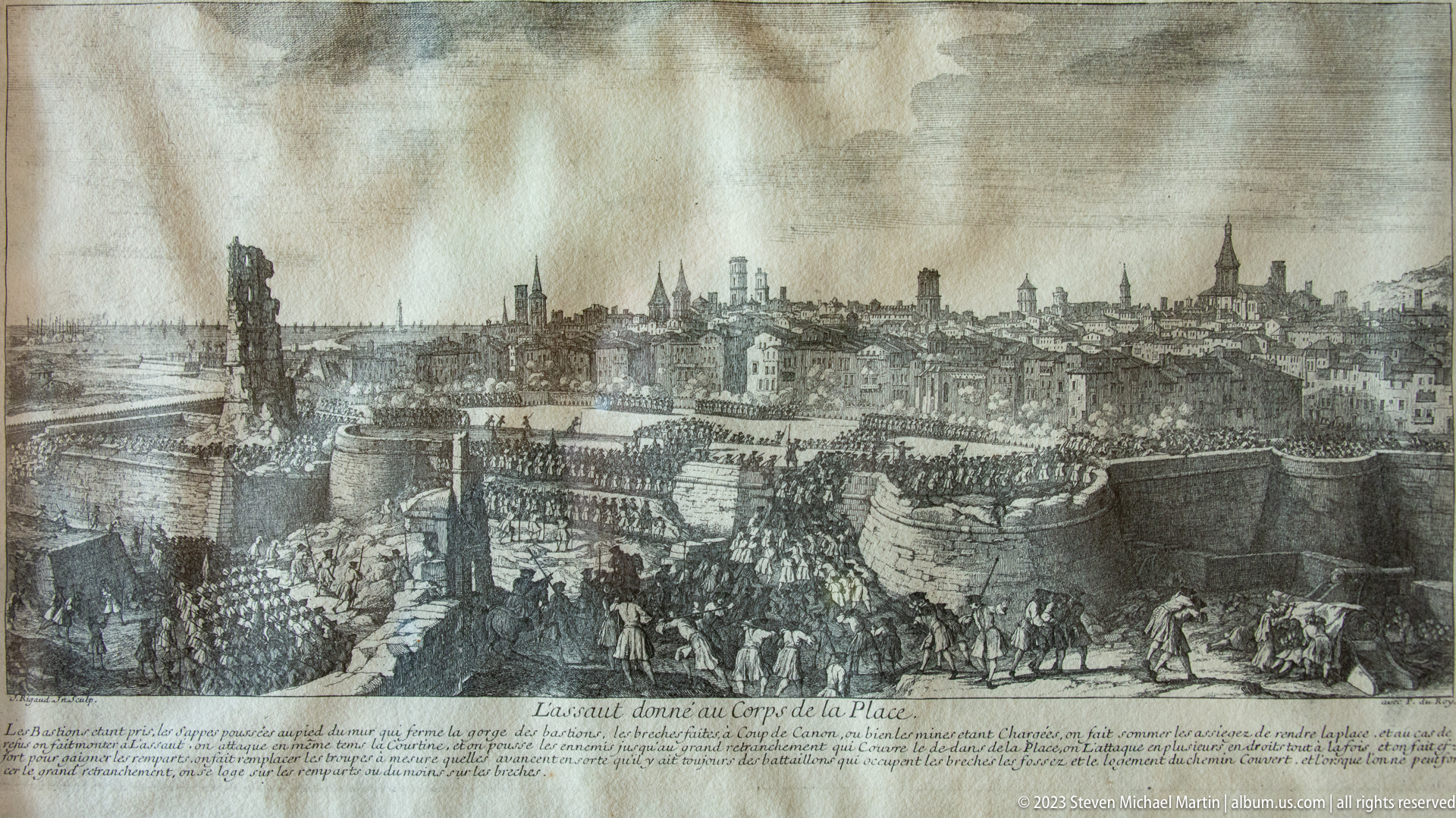
A historic print presents a bird's-eye view of a fortified settlement under military pressure, with walls, batteries, troop formations, and clustered buildings rendered in dense engraved detail. The composition places the defensive works and surrounding approaches at the center of the scene, conveying the scale and geometry of eighteenth-century siege warfare associated with Louisbourg.
Caption
A historic print presents a bird's-eye view of a fortified settlement under military pressure, with walls, batteries, troop formations, and clustered buildings rendered in dense engraved detail. The composition places the defensive works and surrounding approaches at the center of the scene, conveying the scale and geometry of eighteenth-century siege warfare associated with Louisbourg.
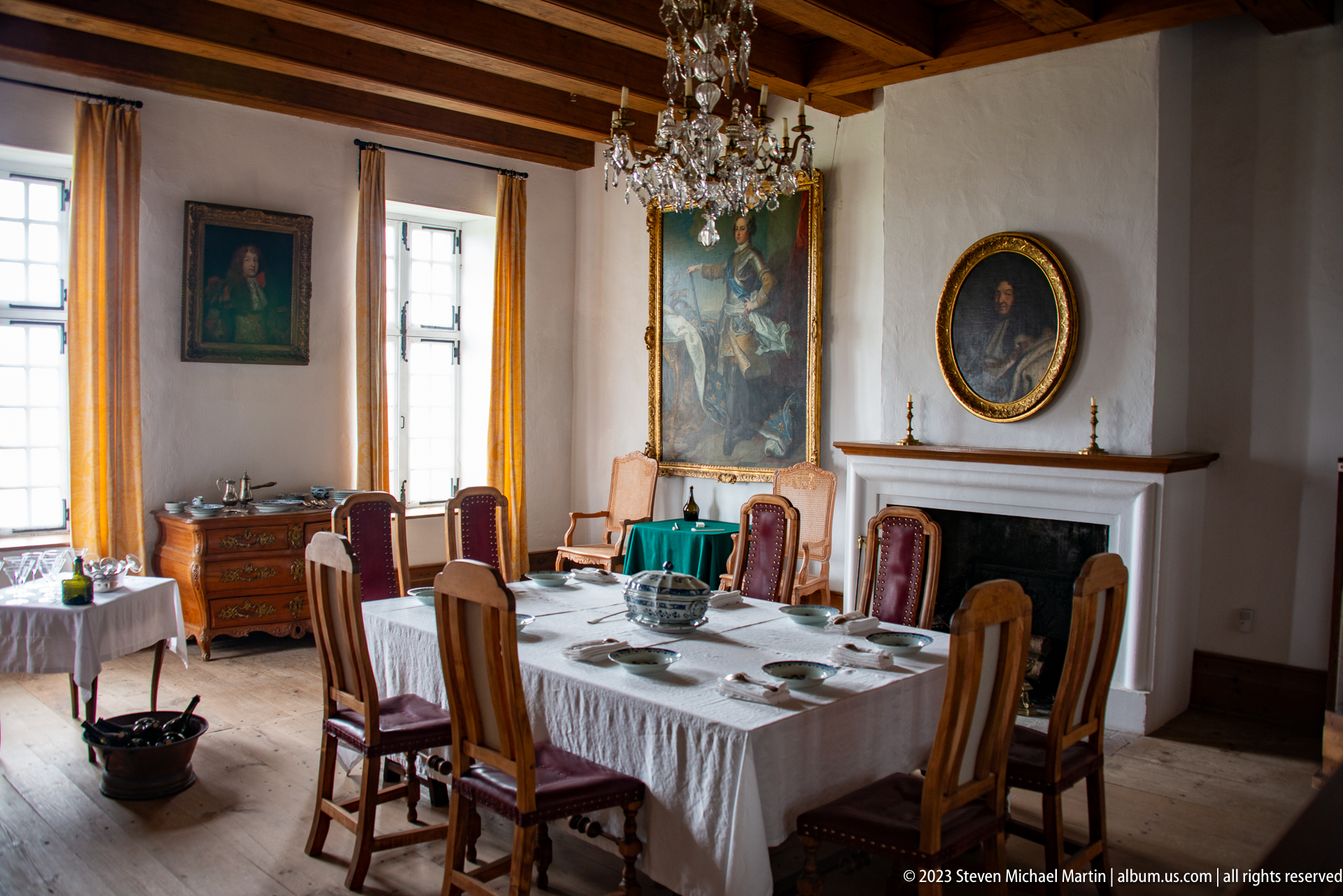
A furnished dining room is arranged around a white-covered table set with dishes, glassware, and chairs beneath exposed ceiling beams and a crystal chandelier. Framed portraits and paintings hang above a fireplace and side furniture, creating a formal domestic setting that evokes the material culture and social rituals of elite households in eighteenth-century Louisbourg.
Caption
A furnished dining room is arranged around a white-covered table set with dishes, glassware, and chairs beneath exposed ceiling beams and a crystal chandelier. Framed portraits and paintings hang above a fireplace and side furniture, creating a formal domestic setting that evokes the material culture and social rituals of elite households in eighteenth-century Louisbourg.

A tall red canopy bed dominates this reconstructed bedchamber, its striped textiles and scalloped valance standing beside a large travel chest and a green-covered writing table. Floral curtains, framed paintings, and mixed seating complete the room, offering a vivid interpretation of private domestic space and furnishings in eighteenth-century Louisbourg.
Caption
A tall red canopy bed dominates this reconstructed bedchamber, its striped textiles and scalloped valance standing beside a large travel chest and a green-covered writing table. Floral curtains, framed paintings, and mixed seating complete the room, offering a vivid interpretation of private domestic space and furnishings in eighteenth-century Louisbourg.

A curtained tester bed occupies the rear of this subdued bedchamber, accompanied by a writing desk, upholstered armchair, small table, and framed wall decoration. Soft gray paneling and floral window curtains give the room a restrained elegance, while the close viewpoint emphasizes the intimate scale of private sleeping quarters in a reconstructed eighteenth-century residence.
Caption
A curtained tester bed occupies the rear of this subdued bedchamber, accompanied by a writing desk, upholstered armchair, small table, and framed wall decoration. Soft gray paneling and floral window curtains give the room a restrained elegance, while the close viewpoint emphasizes the intimate scale of private sleeping quarters in a reconstructed eighteenth-century residence.
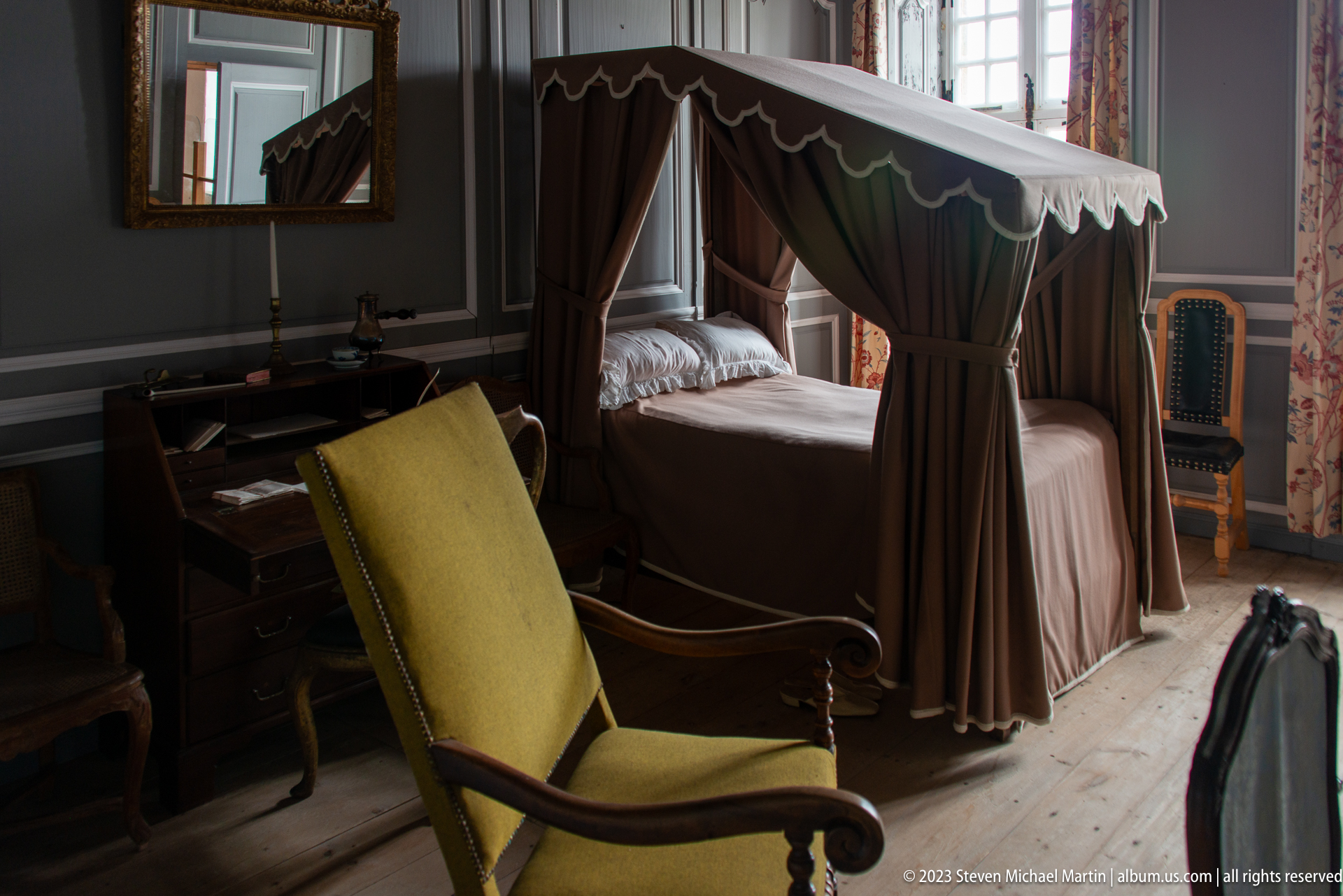
From a slightly wider angle, the reconstructed sleeping chamber shows the tester bed framed by drawn curtains beside a writing desk and upholstered armchair. The muted gray wall paneling, tall windows, and sparse arrangement create a formal but private interior, preserving the visual hierarchy of furnishings typical of an affluent eighteenth-century domestic setting.
Caption
From a slightly wider angle, the reconstructed sleeping chamber shows the tester bed framed by drawn curtains beside a writing desk and upholstered armchair. The muted gray wall paneling, tall windows, and sparse arrangement create a formal but private interior, preserving the visual hierarchy of furnishings typical of an affluent eighteenth-century domestic setting.

A long table covered with patterned blue cloth is lined by high-backed blue chairs and set with folded napkins, candlesticks, and tableware. Tall windows admit cool daylight while a large portrait anchors the far wall, creating a formal dining setting that evokes ceremonial meals and elite social life in reconstructed eighteenth-century Louisbourg.
Caption
A long table covered with patterned blue cloth is lined by high-backed blue chairs and set with folded napkins, candlesticks, and tableware. Tall windows admit cool daylight while a large portrait anchors the far wall, creating a formal dining setting that evokes ceremonial meals and elite social life in reconstructed eighteenth-century Louisbourg.

A historical interpreter in a dark tricorn hat, pale coat, and spectacles turns toward the camera while another similarly dressed figure stands with a long firearm at his shoulder. The close portrait isolates period clothing and personal equipment against the softened background of reconstructed buildings, emphasizing the human dimension of living-history interpretation at Louisbourg.
Caption
A historical interpreter in a dark tricorn hat, pale coat, and spectacles turns toward the camera while another similarly dressed figure stands with a long firearm at his shoulder. The close portrait isolates period clothing and personal equipment against the softened background of reconstructed buildings, emphasizing the human dimension of living-history interpretation at Louisbourg.
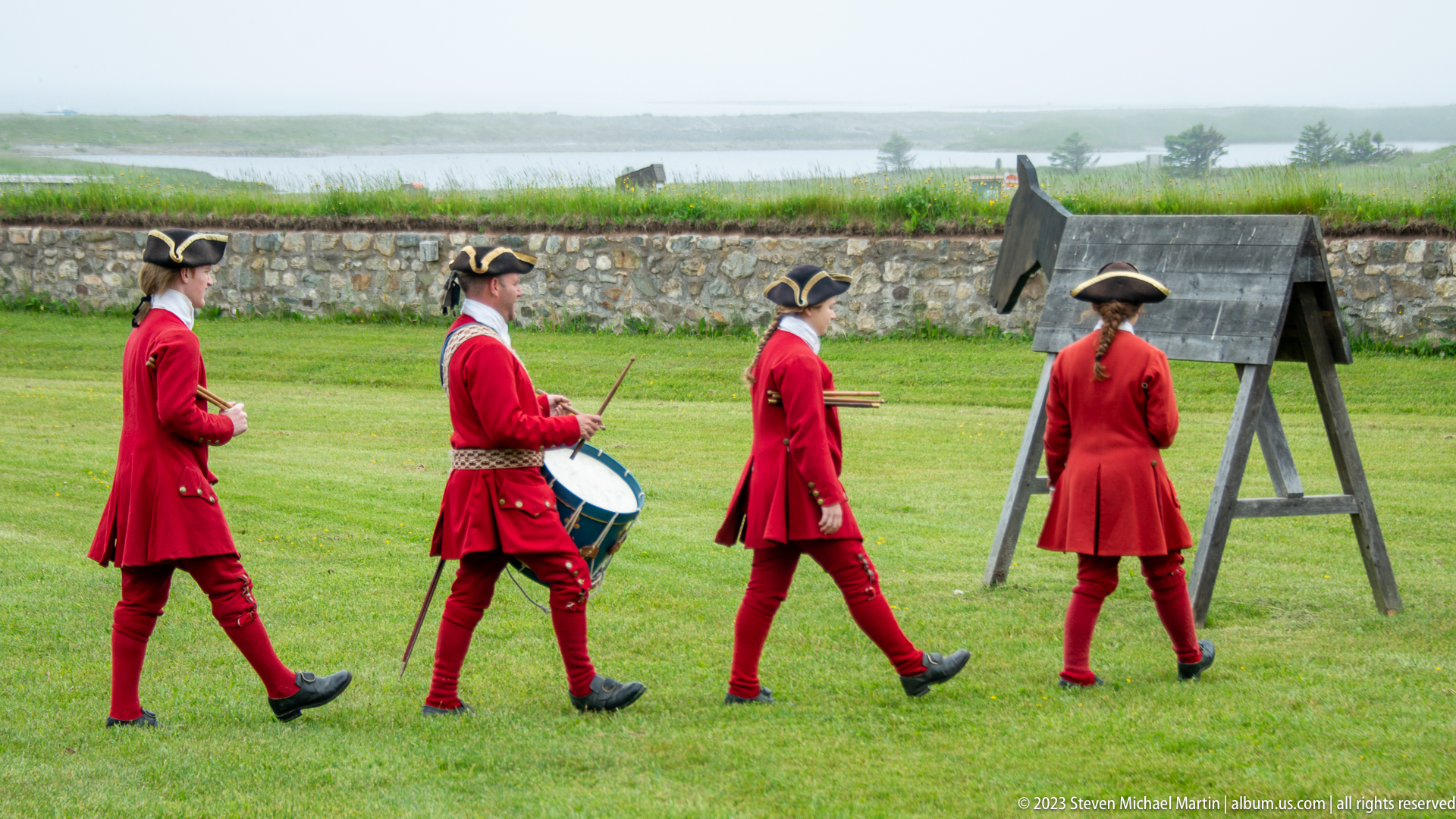
Four red-coated interpreters stride across a broad grassy area, one carrying and playing a side drum while the others hold small implements or equipment. Their matching coats, breeches, stockings, and tricorn hats create a coordinated military appearance, while the stone wall and misty waterfront beyond situate the activity within Louisbourg's reconstructed defensive landscape.
Caption
Four red-coated interpreters stride across a broad grassy area, one carrying and playing a side drum while the others hold small implements or equipment. Their matching coats, breeches, stockings, and tricorn hats create a coordinated military appearance, while the stone wall and misty waterfront beyond situate the activity within Louisbourg's reconstructed defensive landscape.
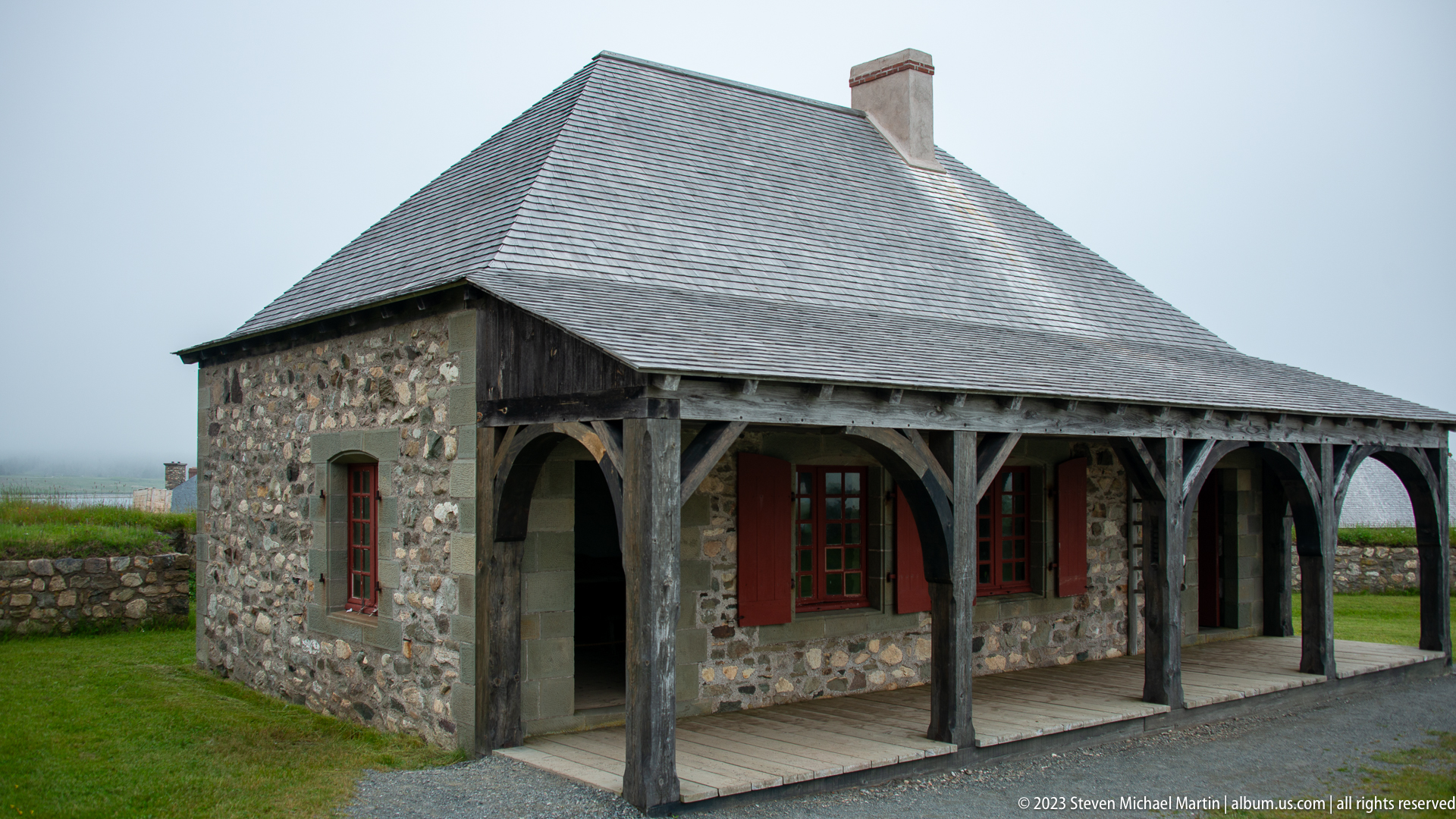
A compact stone building stands beneath a steep hipped roof, its front sheltered by a timber veranda supported on heavy posts and curved braces. Red shutters and multipane windows enliven the rough masonry walls, while the simple porch and chimney give the structure the practical character of a reconstructed eighteenth-century service or domestic building at Louisbourg.
Caption
A compact stone building stands beneath a steep hipped roof, its front sheltered by a timber veranda supported on heavy posts and curved braces. Red shutters and multipane windows enliven the rough masonry walls, while the simple porch and chimney give the structure the practical character of a reconstructed eighteenth-century service or domestic building at Louisbourg.
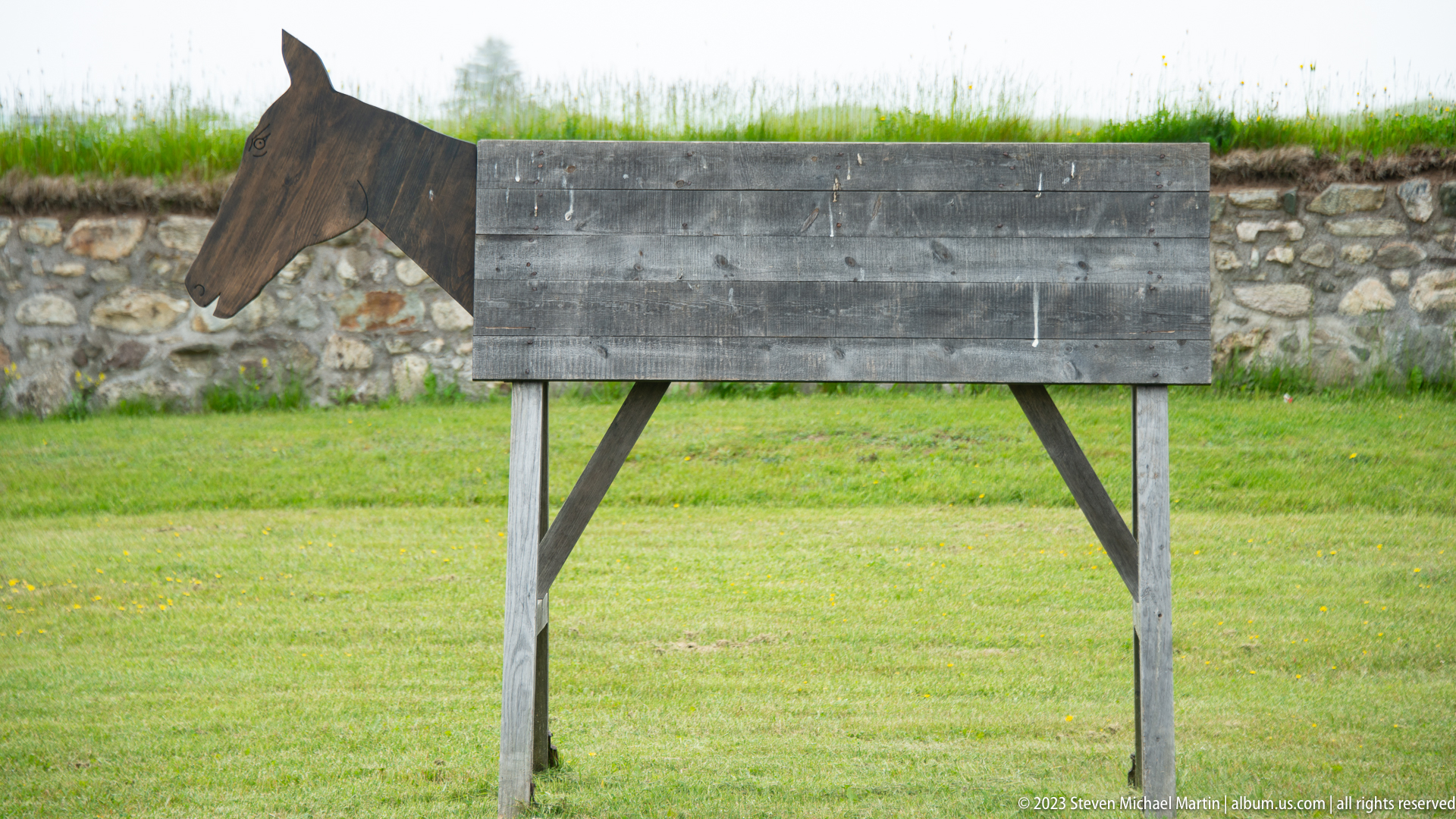
A weathered wooden structure stands alone on the grass, formed from a long plank body, four braced legs, and a roughly cut horse-shaped head. Its deliberately simplified construction suggests a functional training, drill, or interpretive prop rather than a finished sculptural object, set against the low stone wall of the reconstructed fortress grounds.
Caption
A weathered wooden structure stands alone on the grass, formed from a long plank body, four braced legs, and a roughly cut horse-shaped head. Its deliberately simplified construction suggests a functional training, drill, or interpretive prop rather than a finished sculptural object, set against the low stone wall of the reconstructed fortress grounds.
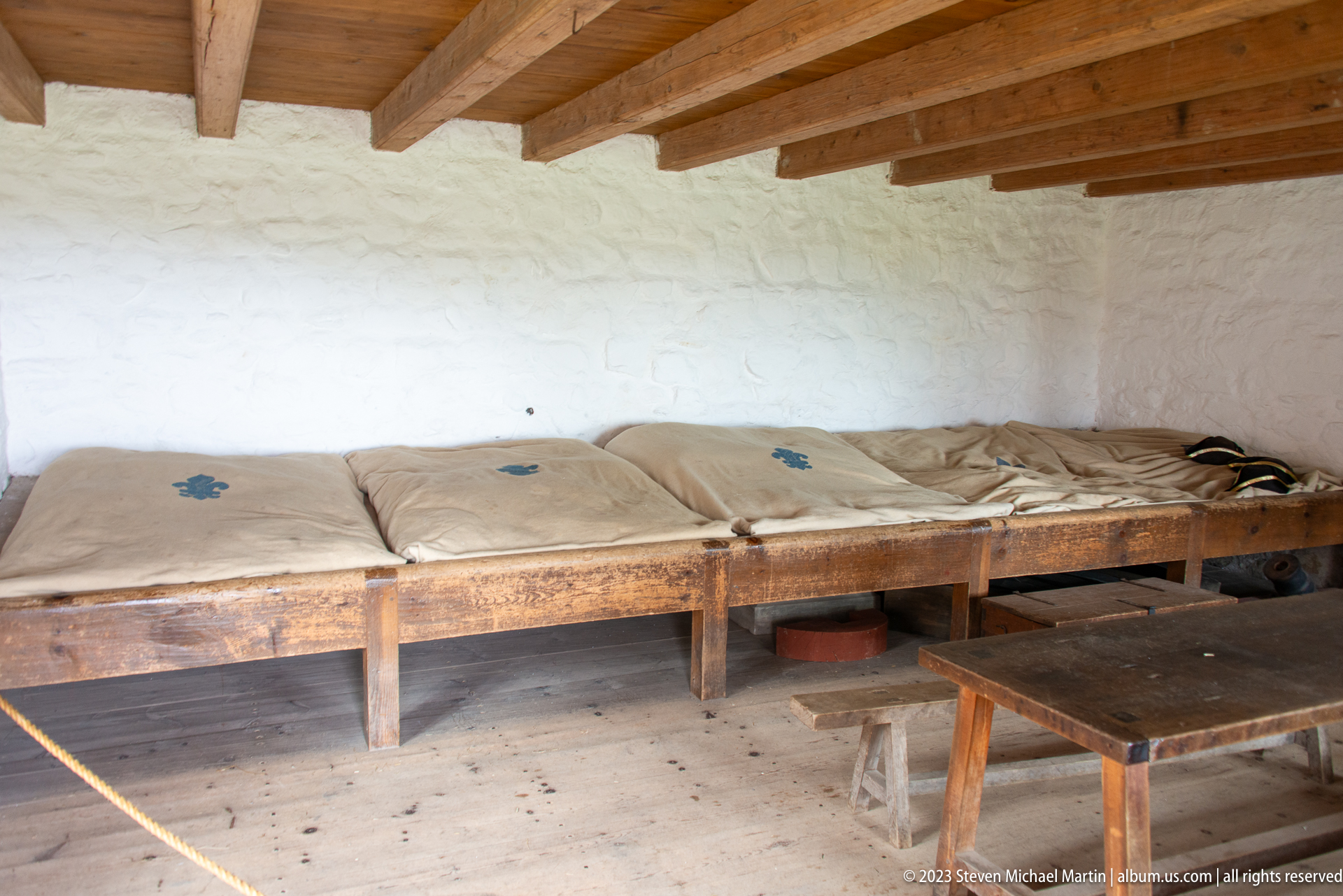
A row of simple wooden sleeping platforms runs along a whitewashed stone wall beneath exposed ceiling beams. Thin bedding and a few personal items rest on the bunks, while rough tables and benches occupy the foreground, presenting the austere communal conditions associated with military or working quarters in eighteenth-century Louisbourg.
Caption
A row of simple wooden sleeping platforms runs along a whitewashed stone wall beneath exposed ceiling beams. Thin bedding and a few personal items rest on the bunks, while rough tables and benches occupy the foreground, presenting the austere communal conditions associated with military or working quarters in eighteenth-century Louisbourg.

A compact black-painted timber house presents a strongly symmetrical front, with a central white door flanked by yellow-trimmed multipane windows and white shutters beneath a steep shingled roof. The restrained façade and simple massing contrast with more formal stone buildings in Louisbourg, illustrating the variety of reconstructed domestic architecture within the town.
Caption
A compact black-painted timber house presents a strongly symmetrical front, with a central white door flanked by yellow-trimmed multipane windows and white shutters beneath a steep shingled roof. The restrained façade and simple massing contrast with more formal stone buildings in Louisbourg, illustrating the variety of reconstructed domestic architecture within the town.
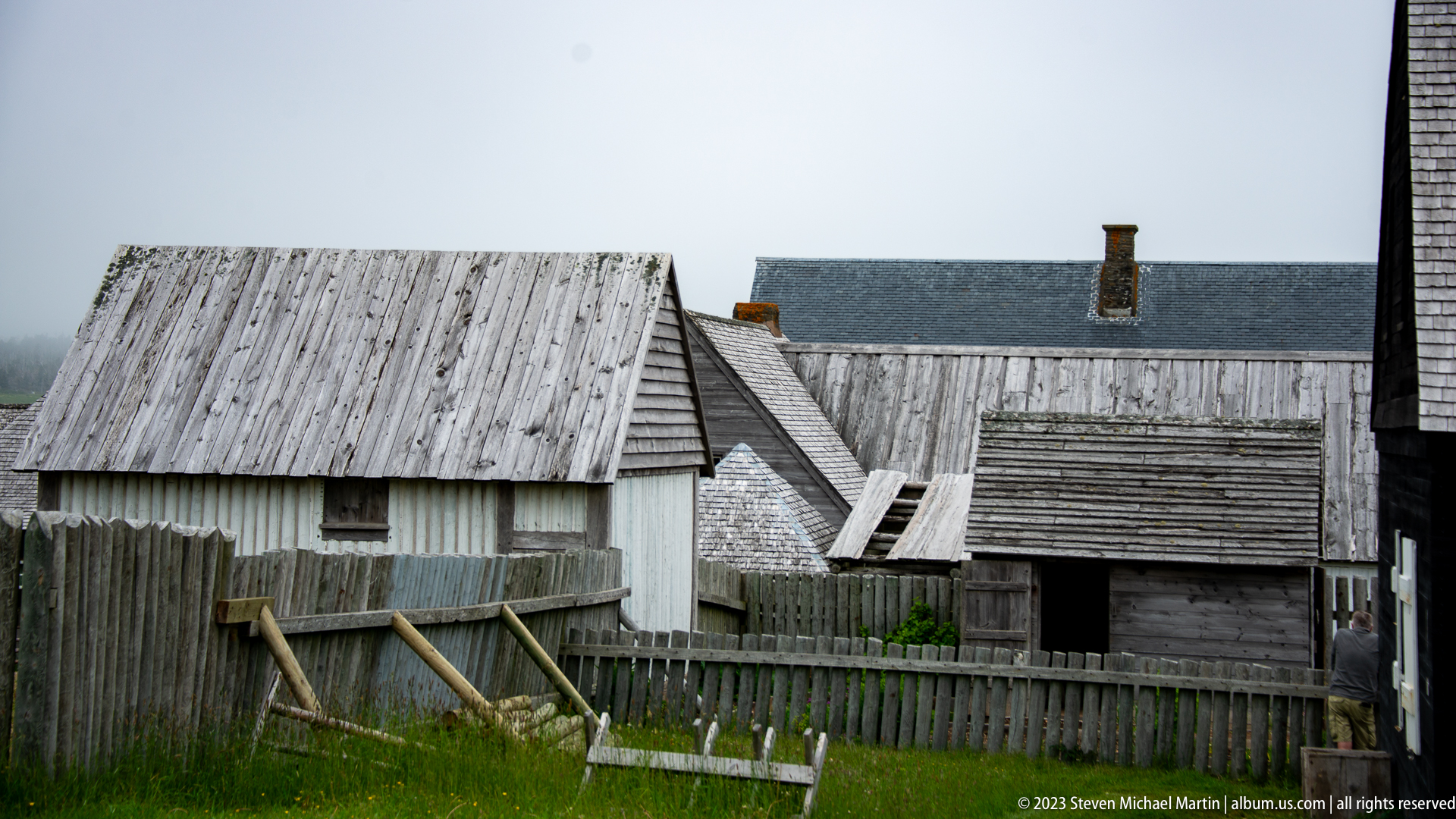
Weathered wooden sheds, steep roofs, and irregular fences crowd a narrow yard behind the main streetscape. The buildings vary in finish from rough plank walls to lighter painted siding, conveying the utilitarian character of service spaces where storage, craft, and household work would have taken place away from more formal public façades.
Caption
Weathered wooden sheds, steep roofs, and irregular fences crowd a narrow yard behind the main streetscape. The buildings vary in finish from rough plank walls to lighter painted siding, conveying the utilitarian character of service spaces where storage, craft, and household work would have taken place away from more formal public façades.
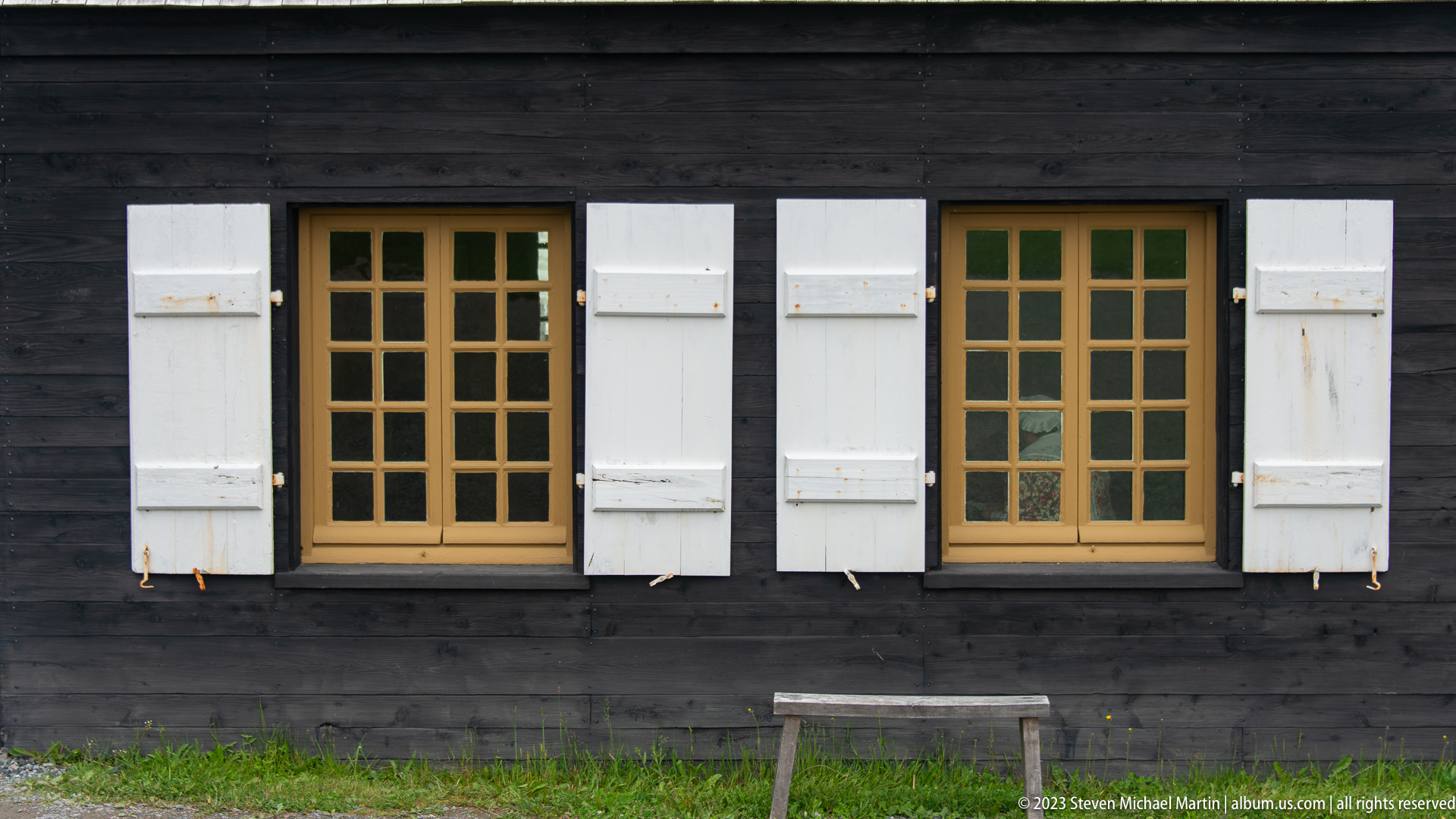
Two tall multipane windows are set side by side in a black timber wall, each framed in warm ochre and flanked by simple white shutters hung on iron hardware. The close architectural detail highlights the contrast of paint colors, joinery, and repeated glazing pattern that give this reconstructed wooden house its distinctive street façade.
Caption
Two tall multipane windows are set side by side in a black timber wall, each framed in warm ochre and flanked by simple white shutters hung on iron hardware. The close architectural detail highlights the contrast of paint colors, joinery, and repeated glazing pattern that give this reconstructed wooden house its distinctive street façade.
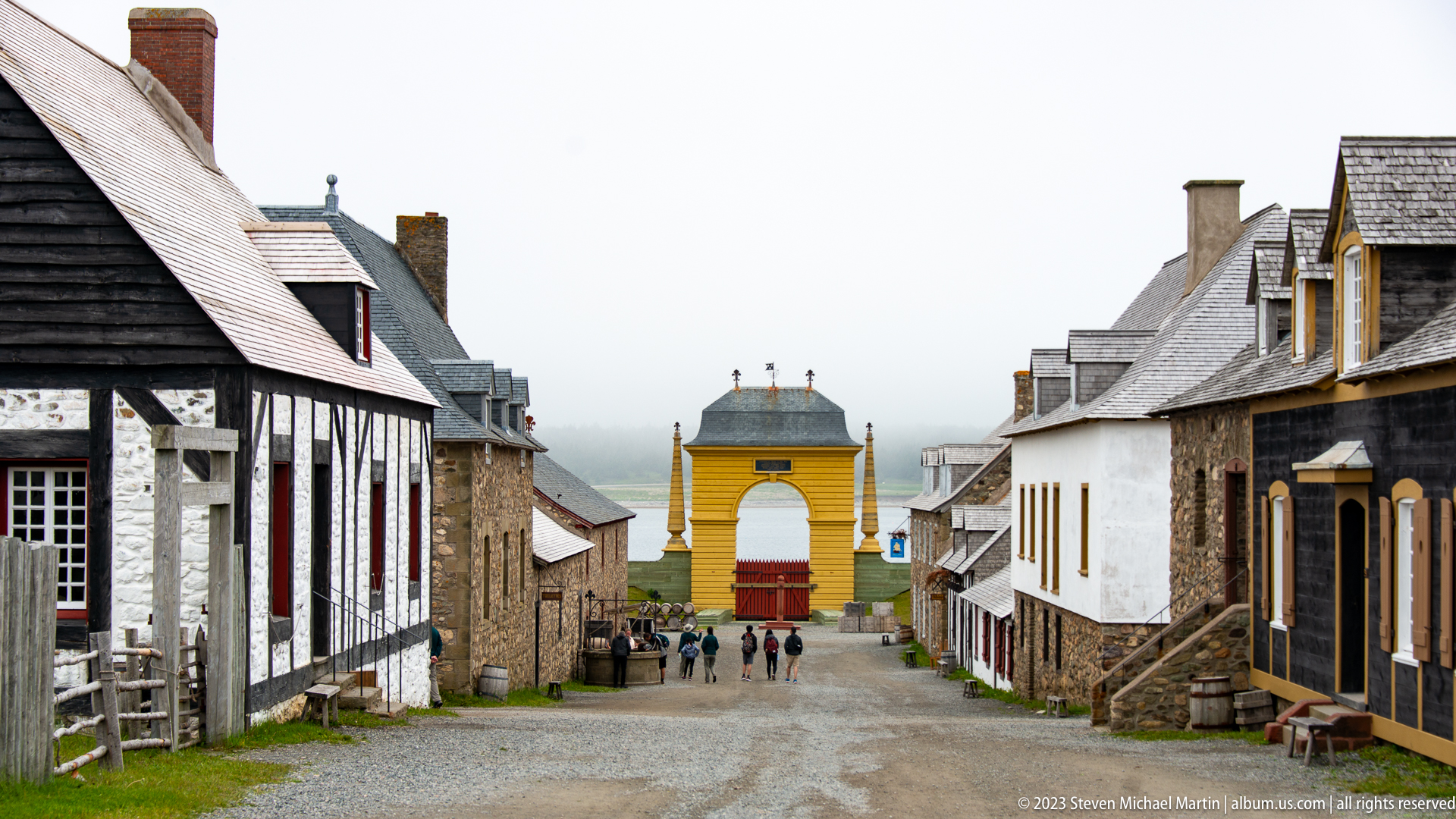
A gravel street descends between closely spaced reconstructed houses toward a bright yellow gate at the far end, where a small group of visitors gathers. Timber and stone façades, steep roofs, chimneys, and projecting porches create a dense eighteenth-century streetscape, while the distant gateway provides a strong visual axis through the restored town.
Caption
A gravel street descends between closely spaced reconstructed houses toward a bright yellow gate at the far end, where a small group of visitors gathers. Timber and stone façades, steep roofs, chimneys, and projecting porches create a dense eighteenth-century streetscape, while the distant gateway provides a strong visual axis through the restored town.
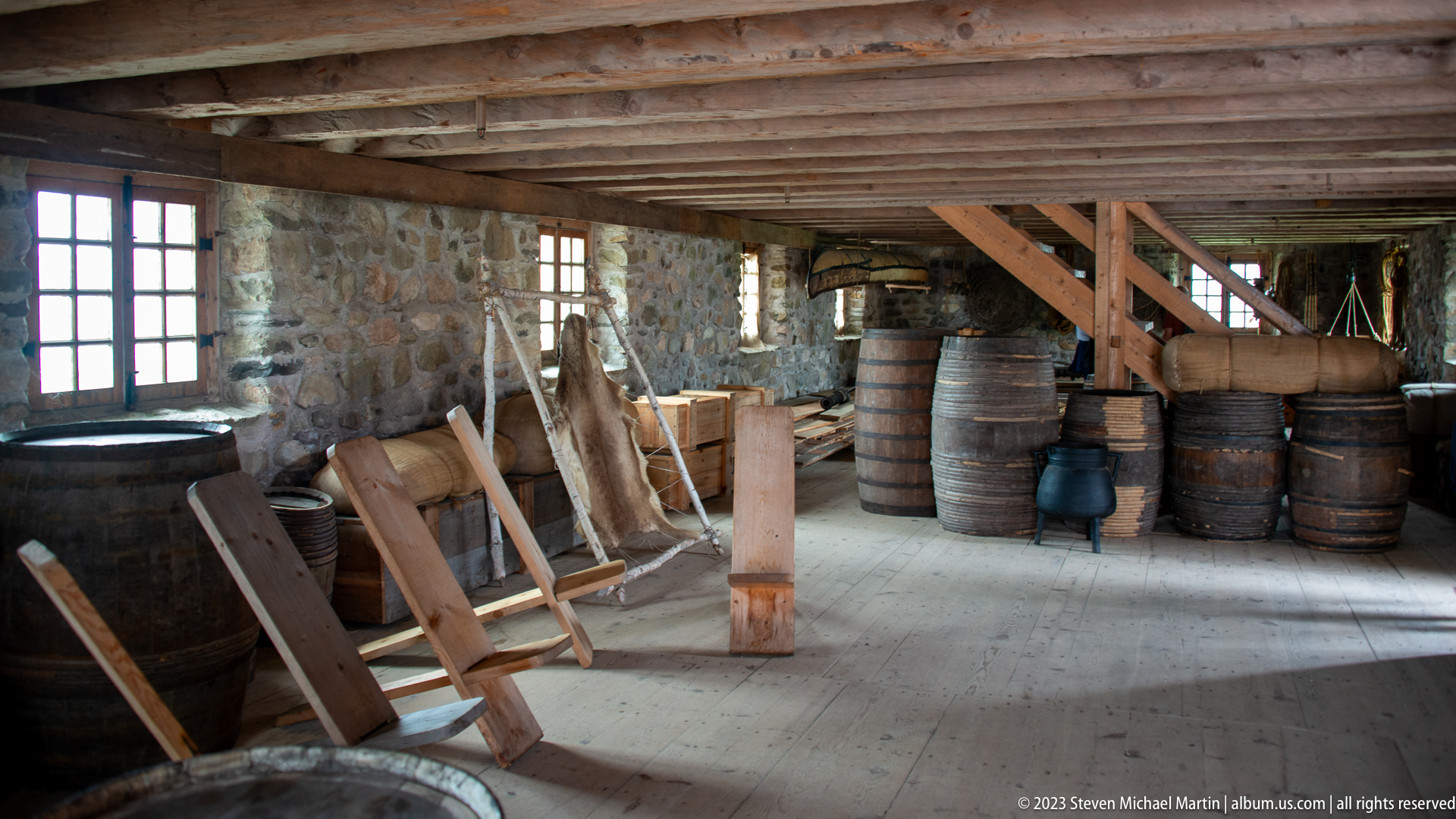
Large wooden barrels, tubs, planks, and work supports fill a rough interior of stone walls and exposed timber framing. The utilitarian arrangement and unfinished surfaces suggest a storage or workshop function, revealing the material infrastructure required to support trade, provisioning, and daily work in the reconstructed port community of Louisbourg.
Caption
Large wooden barrels, tubs, planks, and work supports fill a rough interior of stone walls and exposed timber framing. The utilitarian arrangement and unfinished surfaces suggest a storage or workshop function, revealing the material infrastructure required to support trade, provisioning, and daily work in the reconstructed port community of Louisbourg.

A circular stone well stands in a gravel courtyard against a rough masonry wall, fitted with an ornate wrought-iron frame, pulley, and suspended bucket. The compact ensemble combines practical water access with decorative ironwork, making a normally utilitarian feature visually prominent within the reconstructed urban fabric of Louisbourg.
Caption
A circular stone well stands in a gravel courtyard against a rough masonry wall, fitted with an ornate wrought-iron frame, pulley, and suspended bucket. The compact ensemble combines practical water access with decorative ironwork, making a normally utilitarian feature visually prominent within the reconstructed urban fabric of Louisbourg.
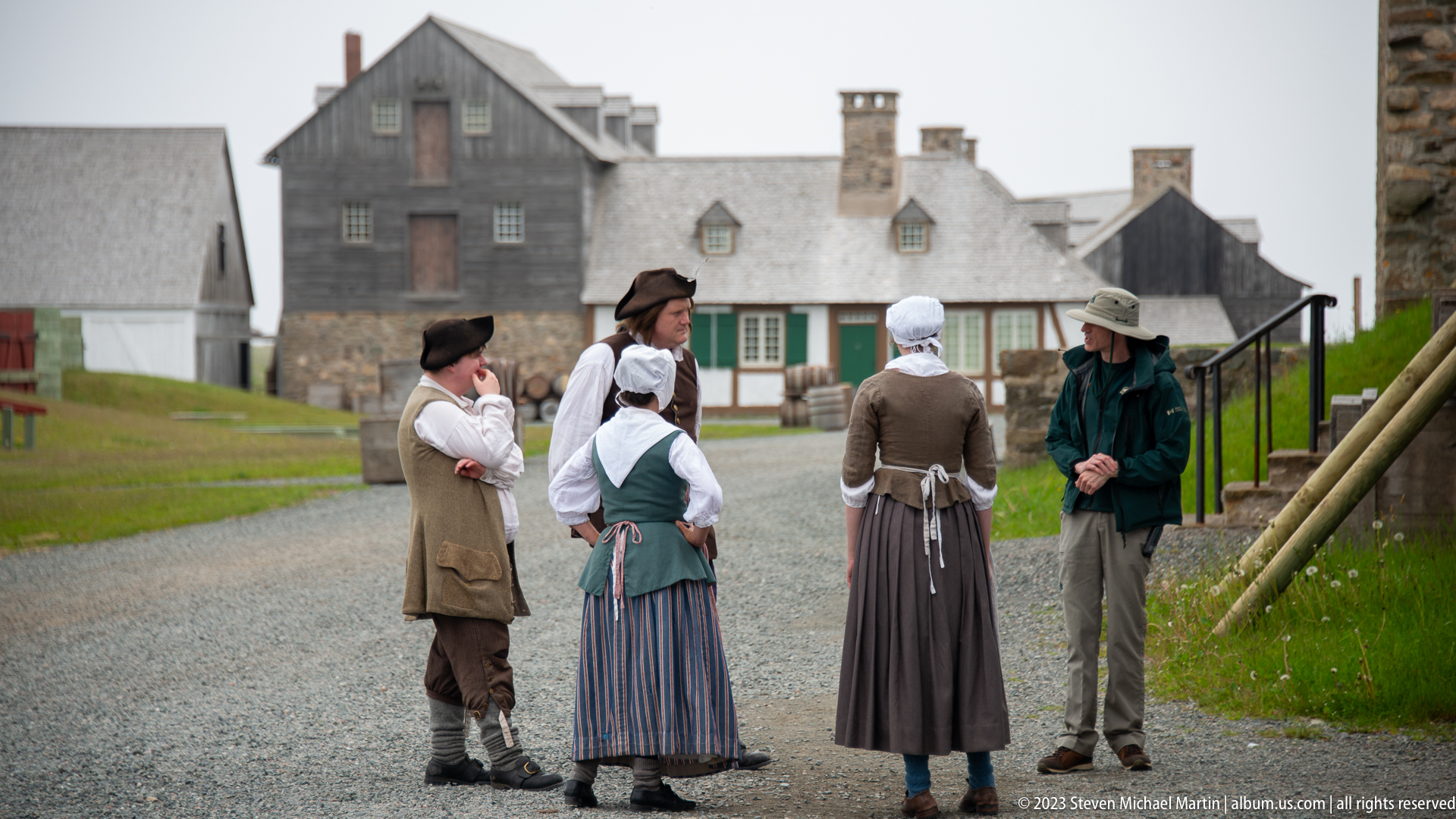
Four costumed interpreters in eighteenth-century civilian dress converse with a modern visitor on a gravel street inside the reconstructed town. Linen caps, waistcoats, long skirts, and layered garments distinguish the historical clothing, while stone and timber buildings in the background place the exchange within an active living-history setting.
Caption
Four costumed interpreters in eighteenth-century civilian dress converse with a modern visitor on a gravel street inside the reconstructed town. Linen caps, waistcoats, long skirts, and layered garments distinguish the historical clothing, while stone and timber buildings in the background place the exchange within an active living-history setting.

A bold yellow gateway spans the road, its large central arch framed by horizontal timber siding and flanked by sloping side walls. Red double doors close the passage beneath a small plaque, while roofline ornaments silhouette against the pale sky, making the gate a striking threshold within the reconstructed fortified town.
Caption
A bold yellow gateway spans the road, its large central arch framed by horizontal timber siding and flanked by sloping side walls. Red double doors close the passage beneath a small plaque, while roofline ornaments silhouette against the pale sky, making the gate a striking threshold within the reconstructed fortified town.

Elaborate carved stonework crowns an arched entrance at the Fortress of Louisbourg. A central shield bearing fleur-de-lis motifs is surrounded by scrolling ornament and surmounted by a crown, creating a conspicuous statement of royal authority above the gate. The low-angle close view isolates the sculptural crest from the surrounding fortification and reveals the depth of the relief carving and dressed masonry.
Caption
Elaborate carved stonework crowns an arched entrance at the Fortress of Louisbourg. A central shield bearing fleur-de-lis motifs is surrounded by scrolling ornament and surmounted by a crown, creating a conspicuous statement of royal authority above the gate. The low-angle close view isolates the sculptural crest from the surrounding fortification and reveals the depth of the relief carving and dressed masonry.

A narrow opening between thick, lichen-covered stone walls frames a view across water, grassy earthworks, and distant reconstructed buildings at the Fortress of Louisbourg. The fortified masonry dominates the foreground while the landscape beyond reveals the defensive depth of the site. The composition uses the embrasure as a frame, connecting the massive wall fabric to the open ground and controlled sightlines outside it.
Caption
A narrow opening between thick, lichen-covered stone walls frames a view across water, grassy earthworks, and distant reconstructed buildings at the Fortress of Louisbourg. The fortified masonry dominates the foreground while the landscape beyond reveals the defensive depth of the site. The composition uses the embrasure as a frame, connecting the massive wall fabric to the open ground and controlled sightlines outside it.

A blue plaque with gold Latin lettering is mounted above an arched opening in the yellow gateway. The inscription begins with the royal title of Louis XV and commemorates the establishment or construction of the portal, visually linking the reconstructed entrance to the authority and ceremonial language of the French monarchy.
Caption
A blue plaque with gold Latin lettering is mounted above an arched opening in the yellow gateway. The inscription begins with the royal title of Louis XV and commemorates the establishment or construction of the portal, visually linking the reconstructed entrance to the authority and ceremonial language of the French monarchy.
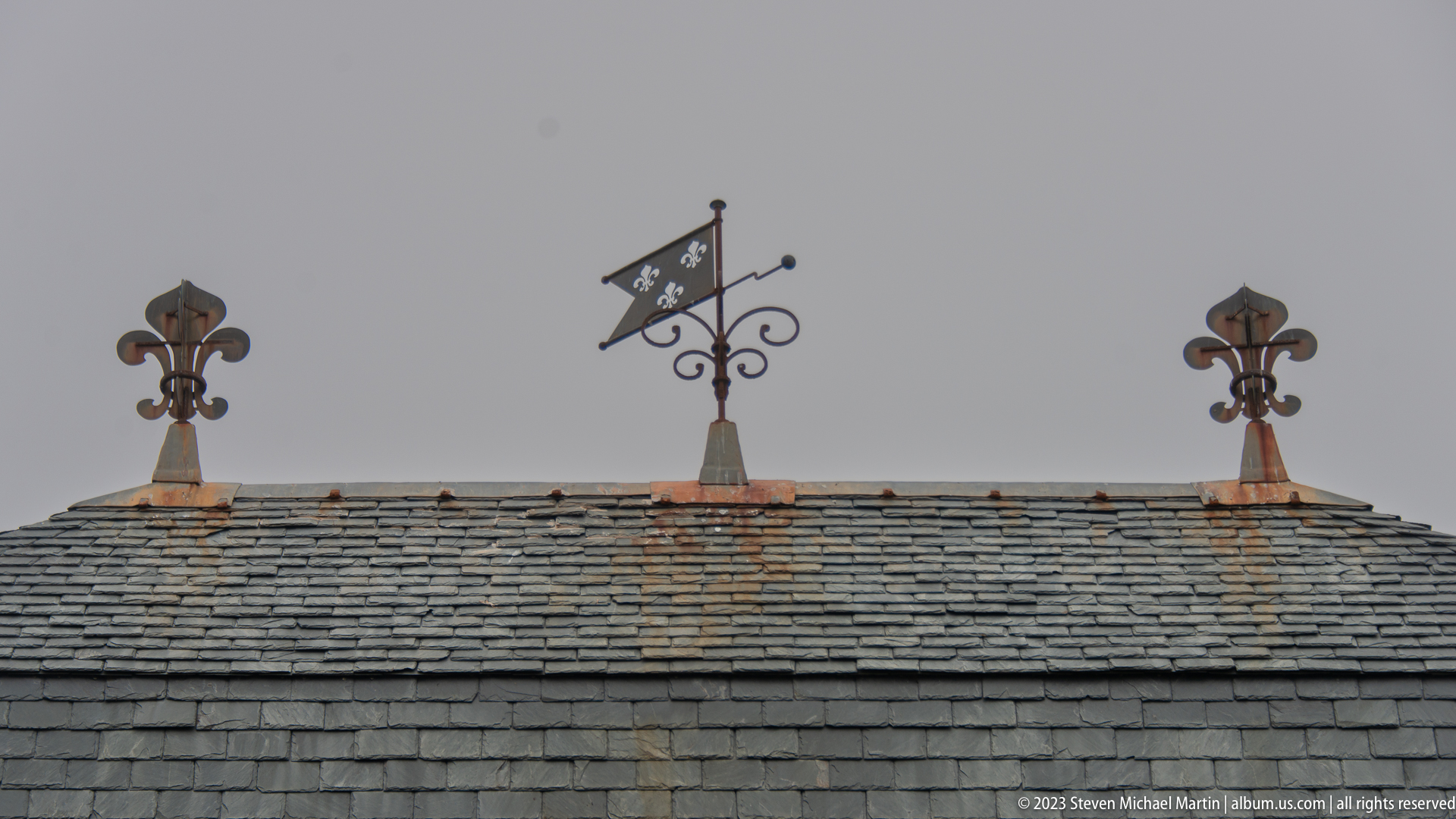
Three decorative metal finials rise from a slate roof, the central ornament incorporating a small flag-like panel while the flanking pieces resemble stylized fleur-de-lis forms. Their dark silhouettes and weathered bases provide a close view of ornamental metalwork used to enliven the roofline of a reconstructed building at Louisbourg.
Caption
Three decorative metal finials rise from a slate roof, the central ornament incorporating a small flag-like panel while the flanking pieces resemble stylized fleur-de-lis forms. Their dark silhouettes and weathered bases provide a close view of ornamental metalwork used to enliven the roofline of a reconstructed building at Louisbourg.
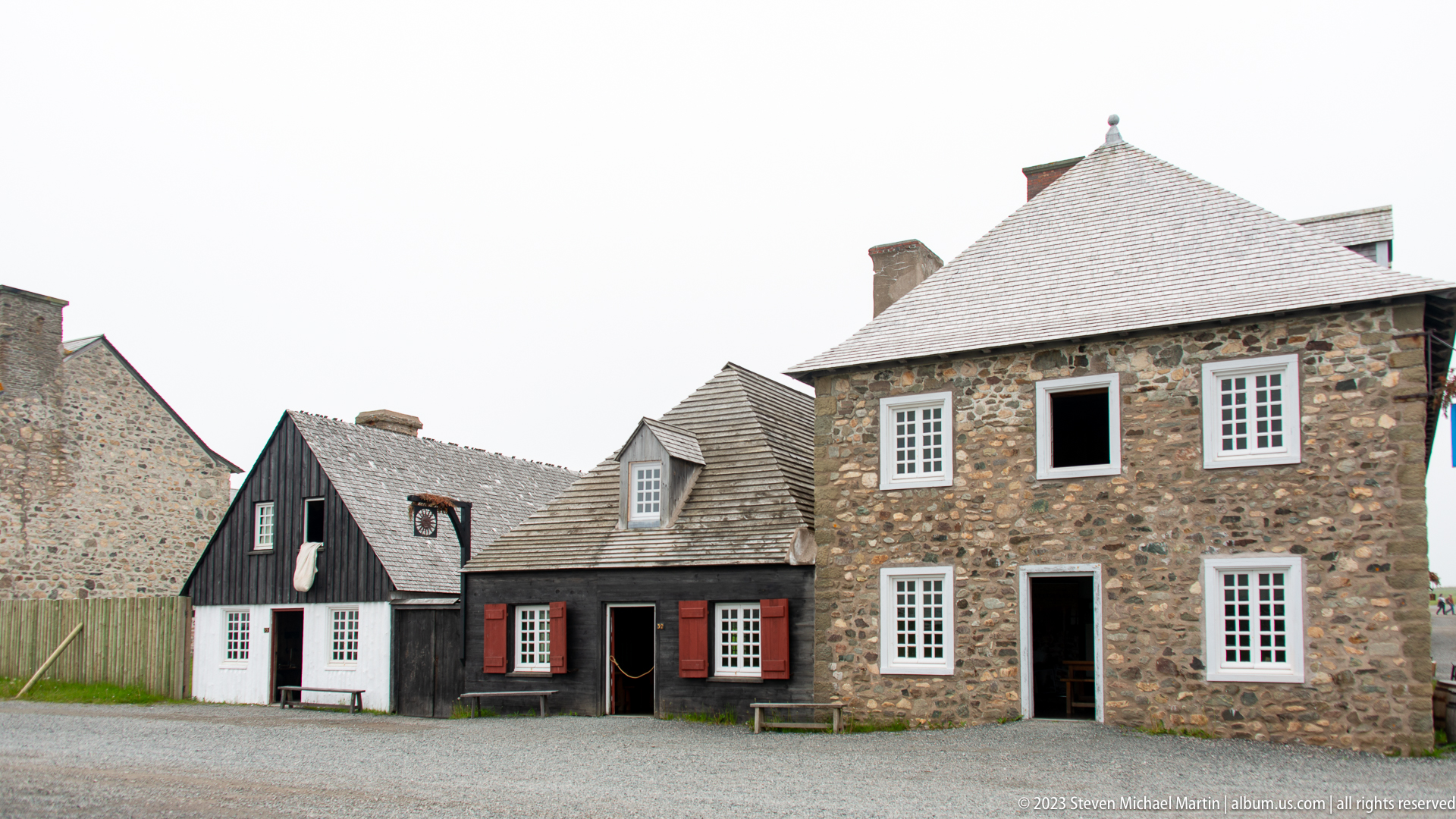
Three reconstructed buildings meet around a small open space: a tall stone house with white-framed windows, a low black timber structure with red shutters, and a white-and-black building beyond. Their contrasting materials, roof forms, and façade treatments illustrate the architectural variety of eighteenth-century Louisbourg and the close grain of its rebuilt streetscape.
Caption
Three reconstructed buildings meet around a small open space: a tall stone house with white-framed windows, a low black timber structure with red shutters, and a white-and-black building beyond. Their contrasting materials, roof forms, and façade treatments illustrate the architectural variety of eighteenth-century Louisbourg and the close grain of its rebuilt streetscape.

Rows of reconstructed stone buildings line a gravel street inside the Fortress of Louisbourg. Steep roofs, tall chimneys, shuttered windows, timber fencing, and a narrow strip of grass recreate the compact appearance of the eighteenth-century fortified town. The oblique view emphasizes the continuity of masonry façades and the close relationship between domestic architecture, service yards, and the street.
Caption
Rows of reconstructed stone buildings line a gravel street inside the Fortress of Louisbourg. Steep roofs, tall chimneys, shuttered windows, timber fencing, and a narrow strip of grass recreate the compact appearance of the eighteenth-century fortified town. The oblique view emphasizes the continuity of masonry façades and the close relationship between domestic architecture, service yards, and the street.
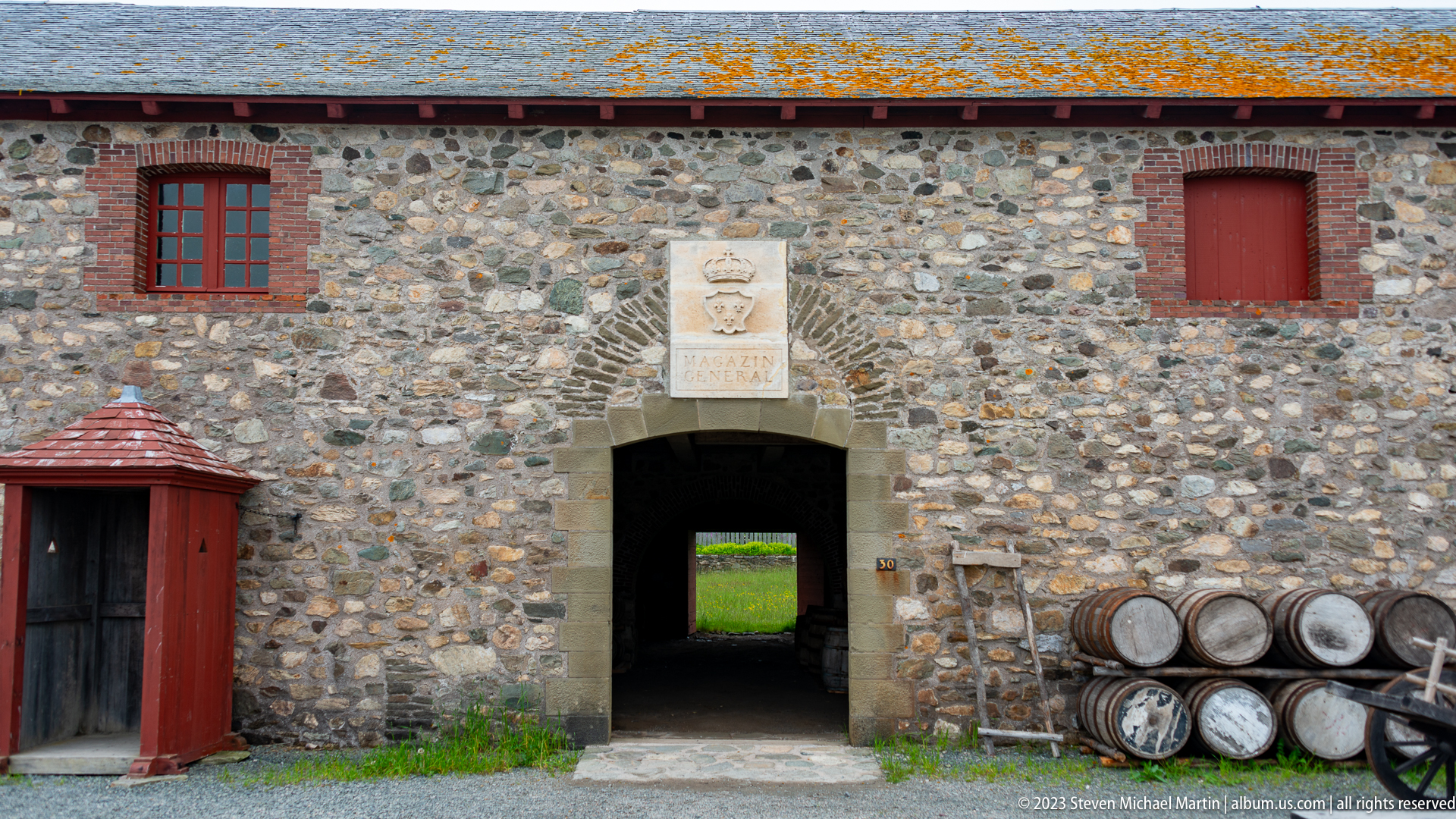
A stone façade marked “MAGAZIN GENERAL” frames a central passageway at the Fortress of Louisbourg, with red-painted doors and stacked wooden barrels along the wall. The masonry opening creates a strong axis through the building toward a patch of green beyond. The composition highlights how reconstructed commercial and storage architecture is presented through functional details such as casks, heavy doors, and a controlled passage.
Caption
A stone façade marked “MAGAZIN GENERAL” frames a central passageway at the Fortress of Louisbourg, with red-painted doors and stacked wooden barrels along the wall. The masonry opening creates a strong axis through the building toward a patch of green beyond. The composition highlights how reconstructed commercial and storage architecture is presented through functional details such as casks, heavy doors, and a controlled passage.
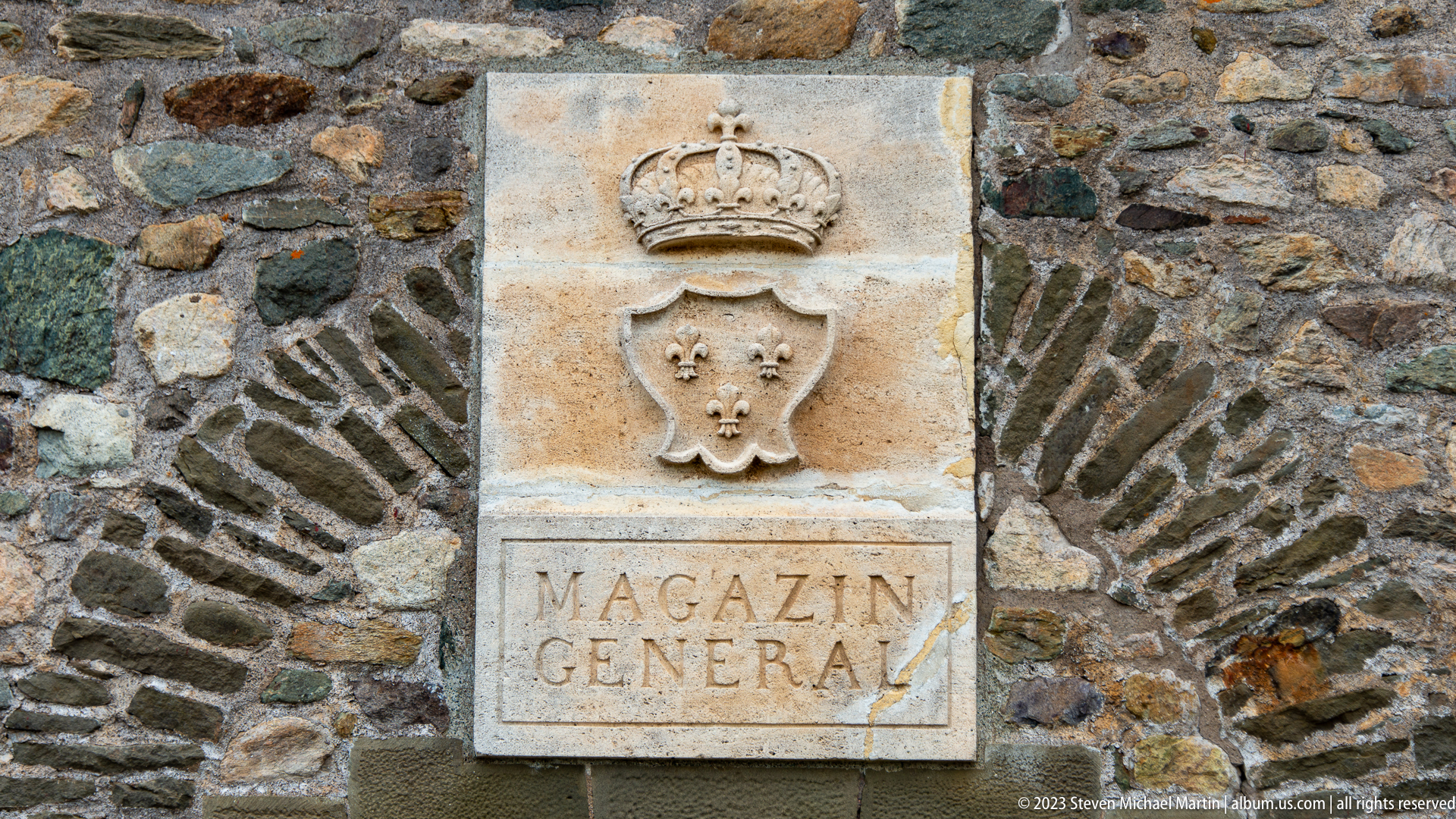
A carved stone plaque set into rough masonry identifies the Magasin Général at the Fortress of Louisbourg. Above the inscription, a crown and shield with fleur-de-lis motifs signal the French royal context of the reconstructed site. The close view isolates the emblematic stonework from the surrounding wall, making the lettering, relief carving, and contrast between dressed stone and rubble masonry the primary subjects.
Caption
A carved stone plaque set into rough masonry identifies the Magasin Général at the Fortress of Louisbourg. Above the inscription, a crown and shield with fleur-de-lis motifs signal the French royal context of the reconstructed site. The close view isolates the emblematic stonework from the surrounding wall, making the lettering, relief carving, and contrast between dressed stone and rubble masonry the primary subjects.
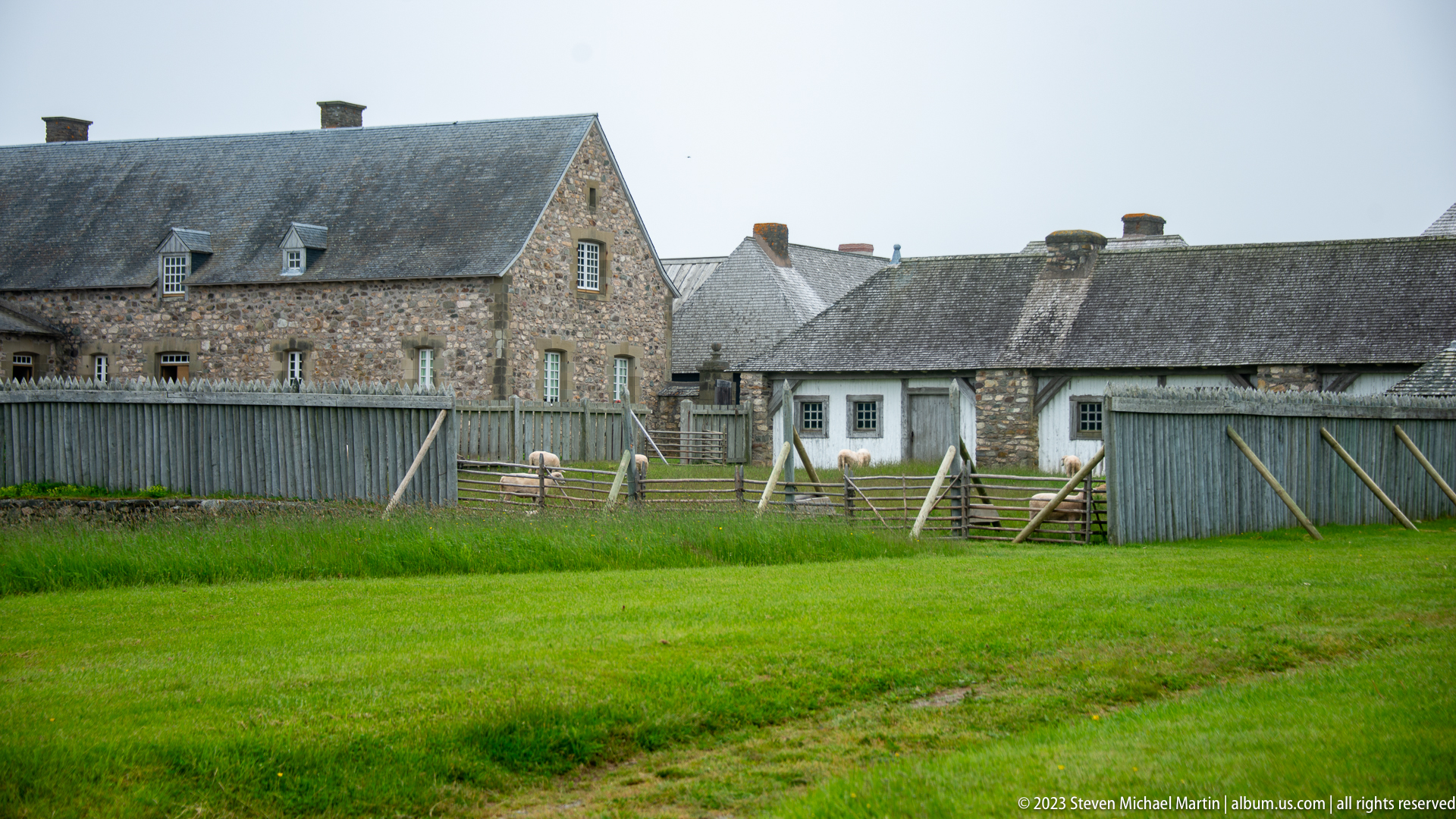
A fenced grassy yard sits among reconstructed stone and timber buildings at the Fortress of Louisbourg. Rough masonry walls, steep shingled roofs, wooden gates, and stacked lumber create a utilitarian setting distinct from the more formal streetscape. The view shows how service spaces, outbuildings, work materials, and enclosed yards contributed to the practical organization of the fortified town.
Caption
A fenced grassy yard sits among reconstructed stone and timber buildings at the Fortress of Louisbourg. Rough masonry walls, steep shingled roofs, wooden gates, and stacked lumber create a utilitarian setting distinct from the more formal streetscape. The view shows how service spaces, outbuildings, work materials, and enclosed yards contributed to the practical organization of the fortified town.
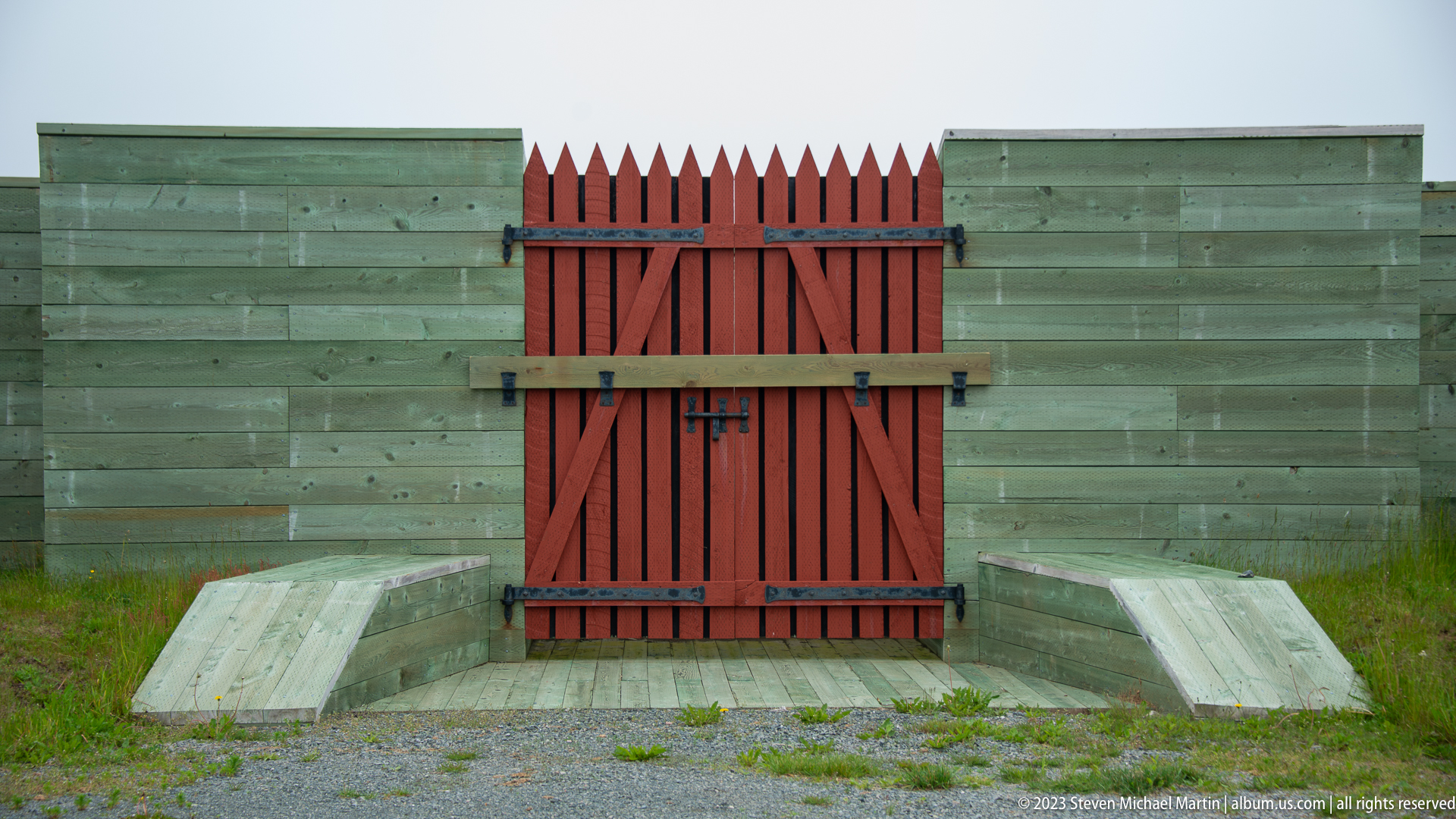
A red-painted timber gate punctuates a green plank barrier at the Fortress of Louisbourg. Vertical boards, diagonal bracing, iron hinges, and pointed upper pickets give the entrance a strongly defensive, utilitarian appearance. Low wooden platforms flank the opening in the foreground. The close frontal composition concentrates attention on construction details rather than the broader fortification, showing how timberwork supplemented Louisbourg’s masonry defenses and controlled circulation.
Caption
A red-painted timber gate punctuates a green plank barrier at the Fortress of Louisbourg. Vertical boards, diagonal bracing, iron hinges, and pointed upper pickets give the entrance a strongly defensive, utilitarian appearance. Low wooden platforms flank the opening in the foreground. The close frontal composition concentrates attention on construction details rather than the broader fortification, showing how timberwork supplemented Louisbourg’s masonry defenses and controlled circulation.
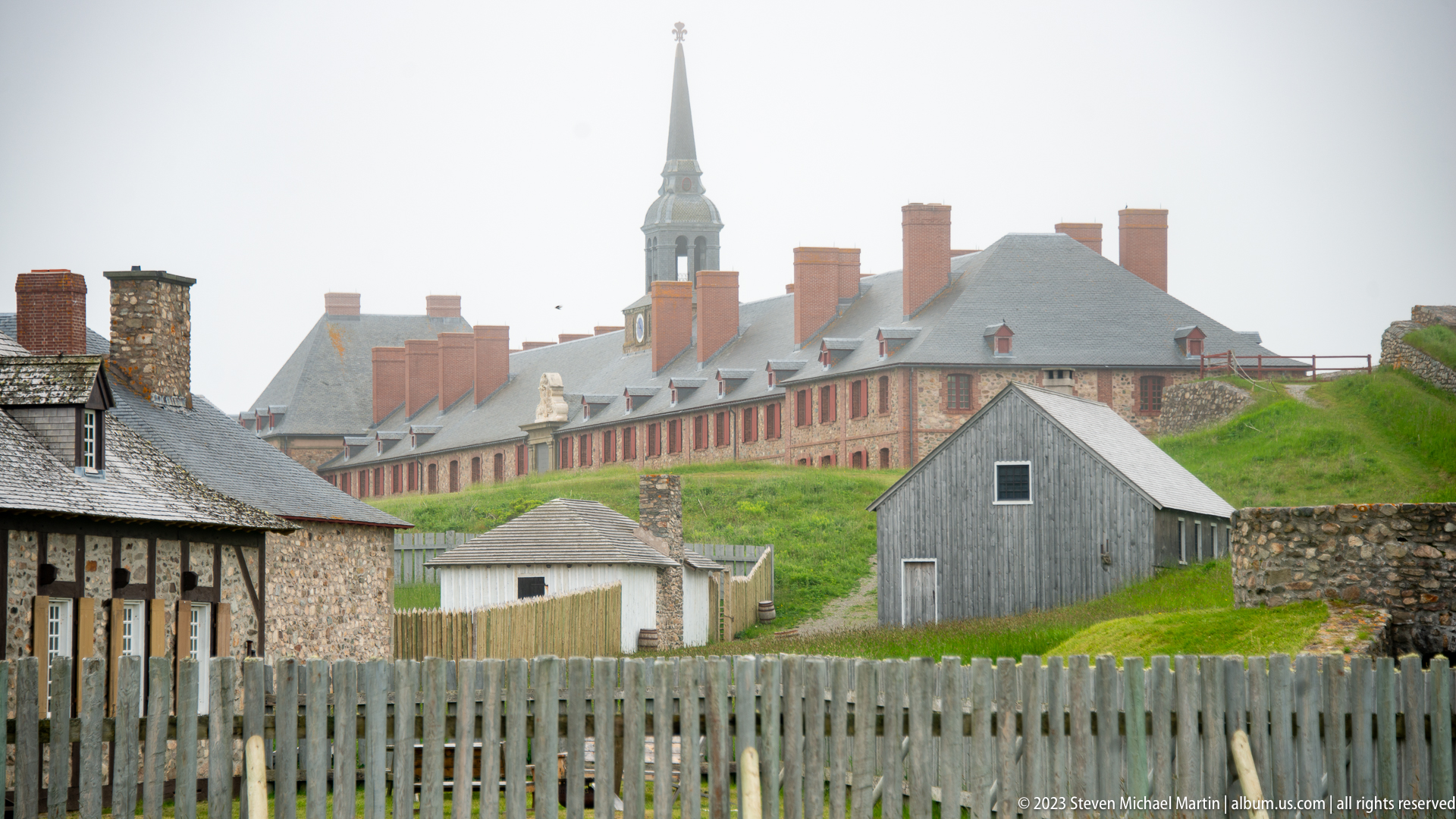
Across fences and low outbuildings, the long red-trimmed barracks of the King’s Bastion rise on higher ground, marked by a central chapel spire. Foreground roofs, timber fences, and stone walls layer the reconstructed town in front of the prominent complex. The telephoto view compresses the settlement and emphasizes the bastion’s architectural dominance within the Fortress of Louisbourg.
Caption
Across fences and low outbuildings, the long red-trimmed barracks of the King’s Bastion rise on higher ground, marked by a central chapel spire. Foreground roofs, timber fences, and stone walls layer the reconstructed town in front of the prominent complex. The telephoto view compresses the settlement and emphasizes the bastion’s architectural dominance within the Fortress of Louisbourg.

A dense stand of bright yellow wildflowers rises against a soft green background within the Fortress of Louisbourg landscape. The close composition shifts attention away from architecture to the vegetation growing around the reconstructed site. Numerous small blossoms cluster along branching stems, creating a vivid natural detail that contrasts with the muted stone, timber, and earth tones elsewhere in the fortifications.
Caption
A dense stand of bright yellow wildflowers rises against a soft green background within the Fortress of Louisbourg landscape. The close composition shifts attention away from architecture to the vegetation growing around the reconstructed site. Numerous small blossoms cluster along branching stems, creating a vivid natural detail that contrasts with the muted stone, timber, and earth tones elsewhere in the fortifications.

A costumed interpreter stands beside a working open hearth in a reconstructed room at the Fortress of Louisbourg. Wearing eighteenth-century-style clothing and a black cap, he is framed by white plaster, timber walls, a blazing fire, table linens, and domestic implements. The setting presents living-history interpretation through a working interior rather than a static display, connecting architecture, furnishings, and human activity.
Caption
A costumed interpreter stands beside a working open hearth in a reconstructed room at the Fortress of Louisbourg. Wearing eighteenth-century-style clothing and a black cap, he is framed by white plaster, timber walls, a blazing fire, table linens, and domestic implements. The setting presents living-history interpretation through a working interior rather than a static display, connecting architecture, furnishings, and human activity.
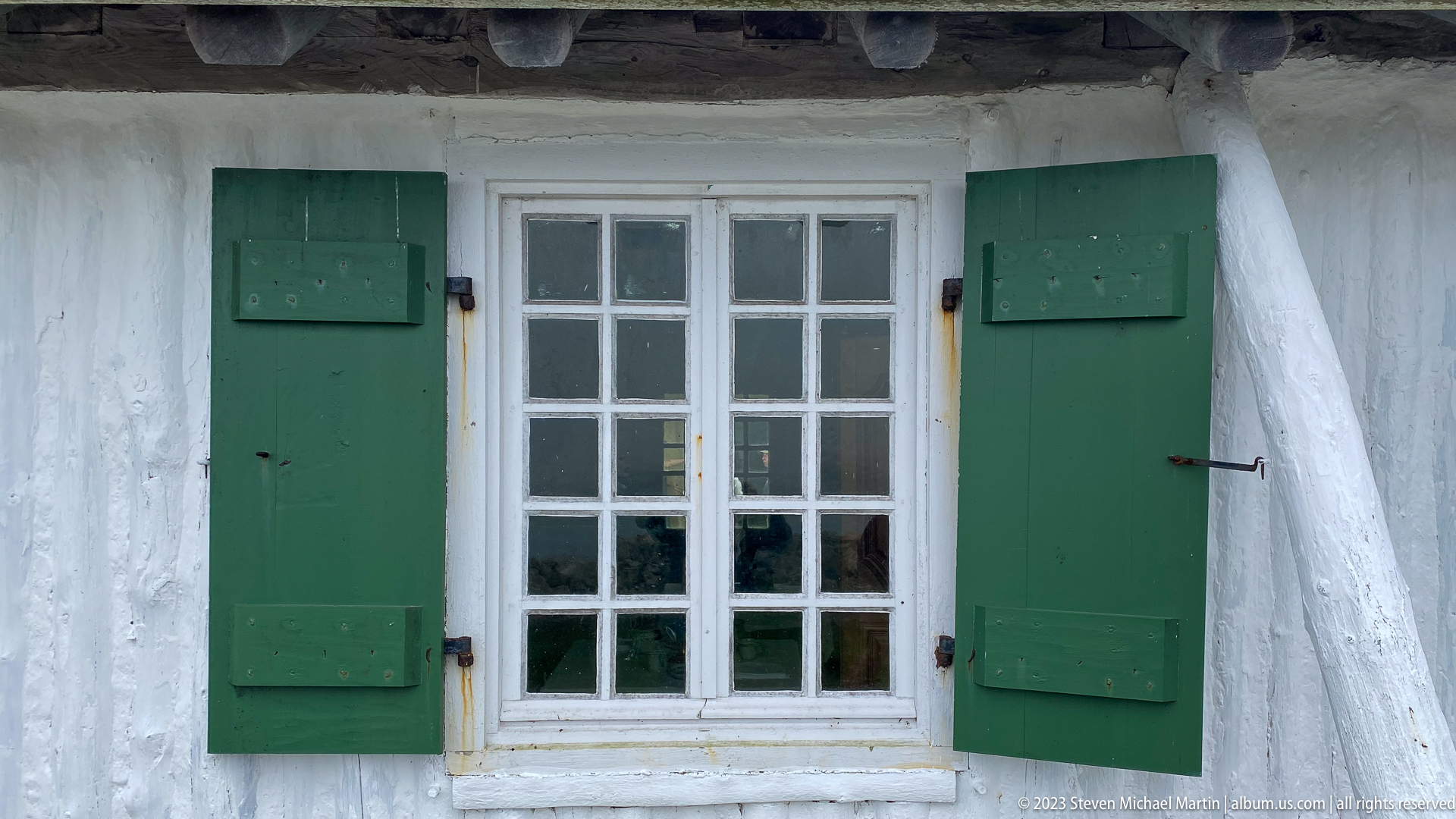
A multi-pane casement window with dark green wooden shutters is set into a thick whitewashed wall at the Fortress of Louisbourg. Heavy hinges, simple latches, deep reveals, and uneven plaster emphasize the practical construction of the reconstructed building. The tightly framed detail records the contrast between crisp painted woodwork and the irregular texture of the wall, a characteristic visual feature of Louisbourg’s vernacular architecture.
Caption
A multi-pane casement window with dark green wooden shutters is set into a thick whitewashed wall at the Fortress of Louisbourg. Heavy hinges, simple latches, deep reveals, and uneven plaster emphasize the practical construction of the reconstructed building. The tightly framed detail records the contrast between crisp painted woodwork and the irregular texture of the wall, a characteristic visual feature of Louisbourg’s vernacular architecture.

A red wooden bridge leads directly toward an ornate stone gateway in the reconstructed defenses of the Fortress of Louisbourg. Tall stone piers, sculptural ornament, masonry walls, and the controlled passage beyond create a ceremonial entrance within the military landscape. The centered perspective turns the bridge into a strong visual axis, emphasizing the sequence of approach, crossing, and entry through the fortification.
Caption
A red wooden bridge leads directly toward an ornate stone gateway in the reconstructed defenses of the Fortress of Louisbourg. Tall stone piers, sculptural ornament, masonry walls, and the controlled passage beyond create a ceremonial entrance within the military landscape. The centered perspective turns the bridge into a strong visual axis, emphasizing the sequence of approach, crossing, and entry through the fortification.
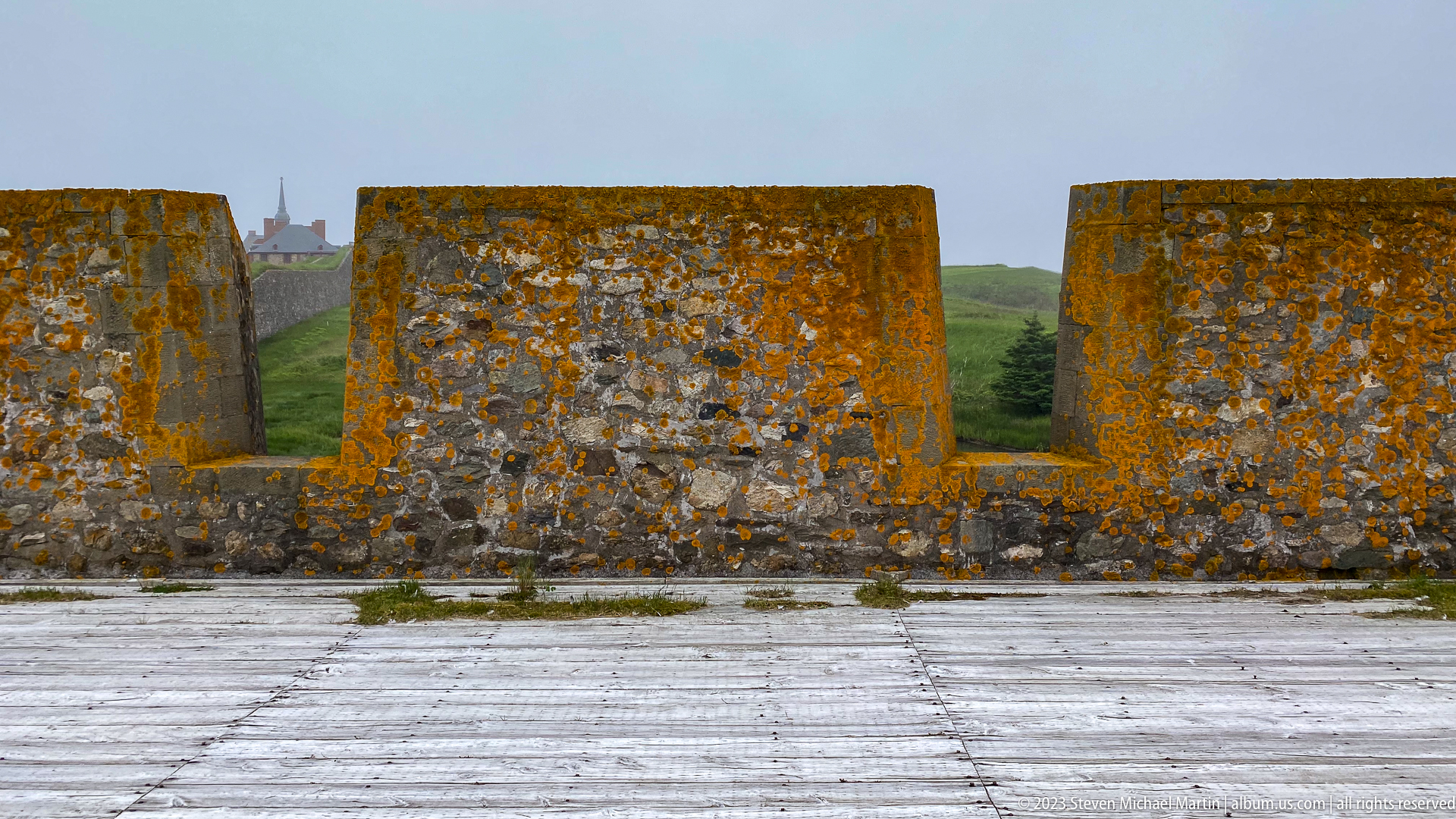
Massive stone merlons and rectangular embrasures form a lichen-covered section of the Fortress of Louisbourg’s reconstructed defenses. The close, low view emphasizes wall thickness, irregular rubble masonry, and the orange growth spreading across the exposed surfaces. Through one opening, distant roofs and a spire appear on higher ground, linking this defensive element to the larger fortified town.
Caption
Massive stone merlons and rectangular embrasures form a lichen-covered section of the Fortress of Louisbourg’s reconstructed defenses. The close, low view emphasizes wall thickness, irregular rubble masonry, and the orange growth spreading across the exposed surfaces. Through one opening, distant roofs and a spire appear on higher ground, linking this defensive element to the larger fortified town.
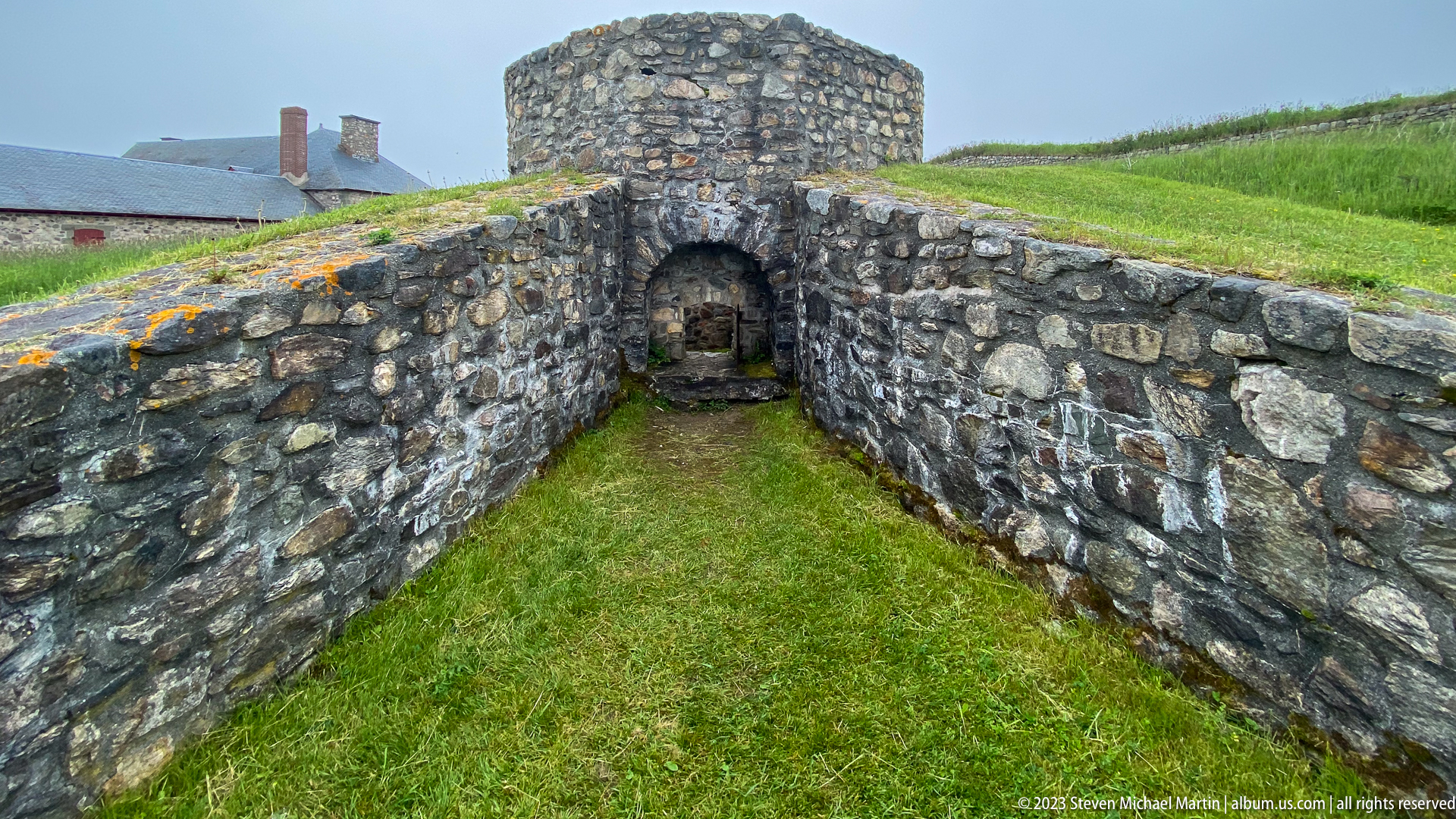
A narrow, grass-lined passage runs between low stone walls toward a small arched opening beneath a rounded masonry mass at the Fortress of Louisbourg. The confined geometry suggests a controlled defensive or service passage built into the earthworks. The close perspective emphasizes rough stone construction, the gradual rise of the surrounding grassed embankment, and the way circulation was channeled through the fortification.
Caption
A narrow, grass-lined passage runs between low stone walls toward a small arched opening beneath a rounded masonry mass at the Fortress of Louisbourg. The confined geometry suggests a controlled defensive or service passage built into the earthworks. The close perspective emphasizes rough stone construction, the gradual rise of the surrounding grassed embankment, and the way circulation was channeled through the fortification.
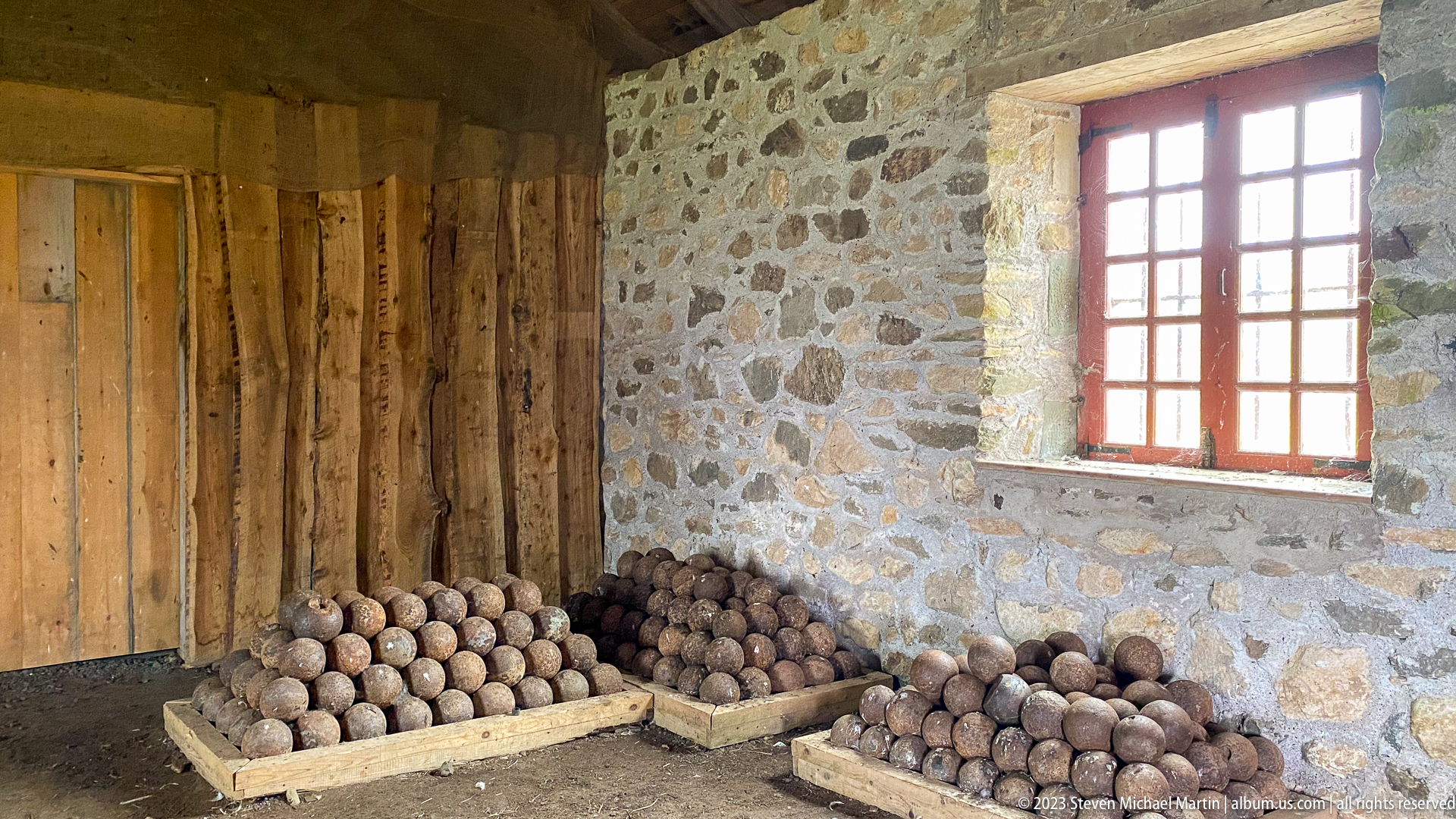
Dozens of iron cannonballs are stacked in orderly pyramids on low wooden platforms inside a stone-walled room at the Fortress of Louisbourg. A timber partition and multi-pane window flank the display, reinforcing the setting as a reconstructed military storage interior. The arrangement makes the heavy spherical ammunition itself the focus, illustrating how artillery supplies could be organized and kept ready within the fortress.
Caption
Dozens of iron cannonballs are stacked in orderly pyramids on low wooden platforms inside a stone-walled room at the Fortress of Louisbourg. A timber partition and multi-pane window flank the display, reinforcing the setting as a reconstructed military storage interior. The arrangement makes the heavy spherical ammunition itself the focus, illustrating how artillery supplies could be organized and kept ready within the fortress.
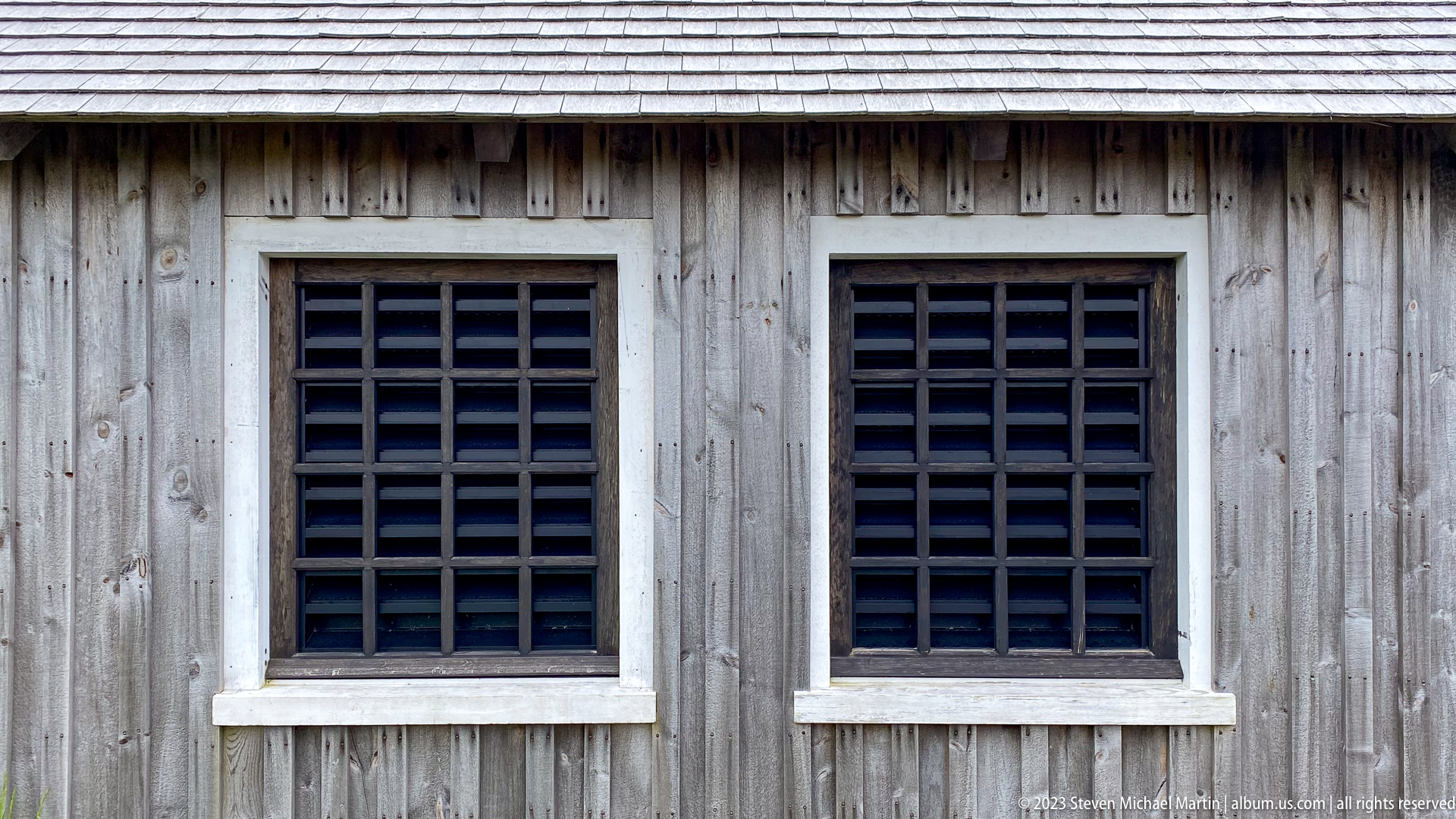
Two square windows with heavy dark grilles punctuate a weathered vertical-board wall at the Fortress of Louisbourg. Pale wooden trim frames the openings beneath a shingled roof edge, while the regular grids contrast with the rough grain and silvery patina of the siding. The tightly cropped façade detail records a utilitarian building surface and the robust treatment of its openings.
Caption
Two square windows with heavy dark grilles punctuate a weathered vertical-board wall at the Fortress of Louisbourg. Pale wooden trim frames the openings beneath a shingled roof edge, while the regular grids contrast with the rough grain and silvery patina of the siding. The tightly cropped façade detail records a utilitarian building surface and the robust treatment of its openings.

A visitor walks across grassy ground below a dense cluster of reconstructed buildings at the Fortress of Louisbourg. Black-painted timber façades, pale roofs, stone walls, fences, and a conical-roofed outbuilding create a layered view of the town’s varied architecture. The human figure provides scale, making the relationship between defensive ground, enclosed yards, and tightly packed structures especially clear.
Caption
A visitor walks across grassy ground below a dense cluster of reconstructed buildings at the Fortress of Louisbourg. Black-painted timber façades, pale roofs, stone walls, fences, and a conical-roofed outbuilding create a layered view of the town’s varied architecture. The human figure provides scale, making the relationship between defensive ground, enclosed yards, and tightly packed structures especially clear.
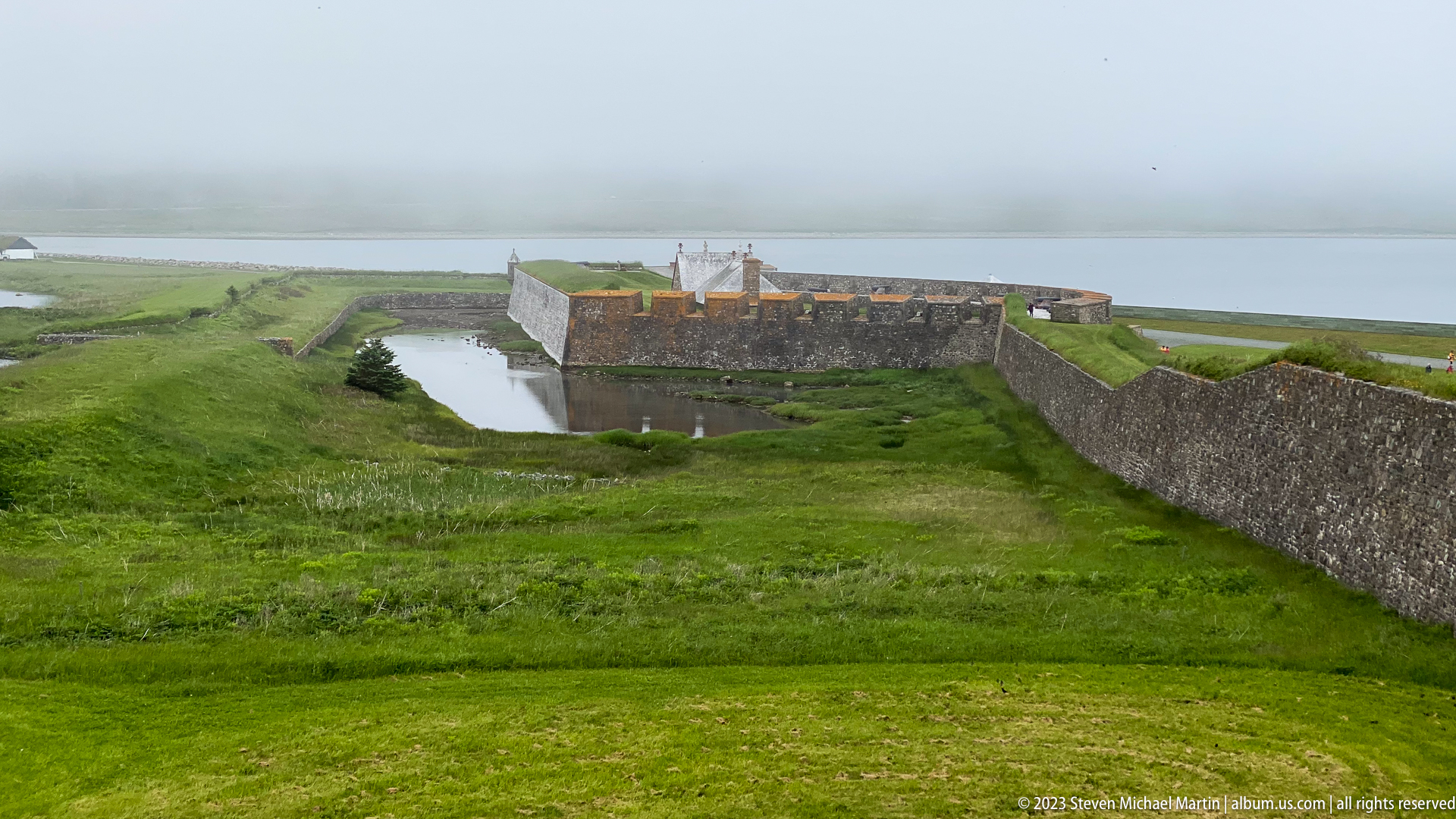
A broad view across the Fortress of Louisbourg’s outer defenses shows long stone walls, a water-filled ditch, grassy embankments, and a projecting fortified work in the distance. The muted sky and open ground make the engineered landscape particularly legible. Rather than focusing on a single building, the photograph shows how masonry, water, earthworks, and sightlines combined to create layered defensive depth.
Caption
A broad view across the Fortress of Louisbourg’s outer defenses shows long stone walls, a water-filled ditch, grassy embankments, and a projecting fortified work in the distance. The muted sky and open ground make the engineered landscape particularly legible. Rather than focusing on a single building, the photograph shows how masonry, water, earthworks, and sightlines combined to create layered defensive depth.
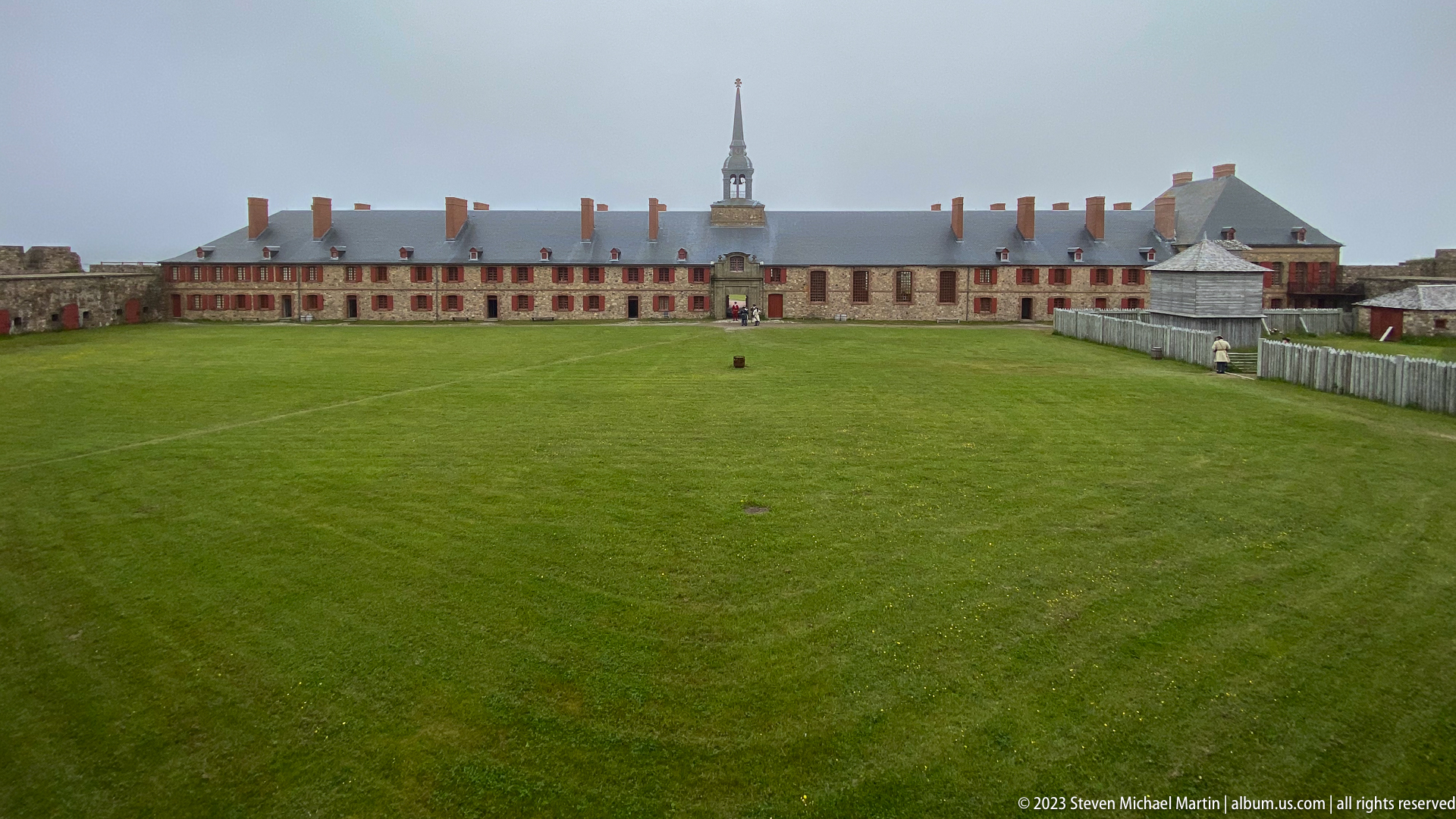
A broad green parade ground stretches toward the long barracks and chapel complex of the King’s Bastion at the Fortress of Louisbourg. The central spire, red-trimmed façade, steep slate-colored roofs, and flanking walls create the principal architectural focus. The large open field in the foreground demonstrates the scale of the formal military space and the commanding position of the barracks along its edge.
Caption
A broad green parade ground stretches toward the long barracks and chapel complex of the King’s Bastion at the Fortress of Louisbourg. The central spire, red-trimmed façade, steep slate-colored roofs, and flanking walls create the principal architectural focus. The large open field in the foreground demonstrates the scale of the formal military space and the commanding position of the barracks along its edge.
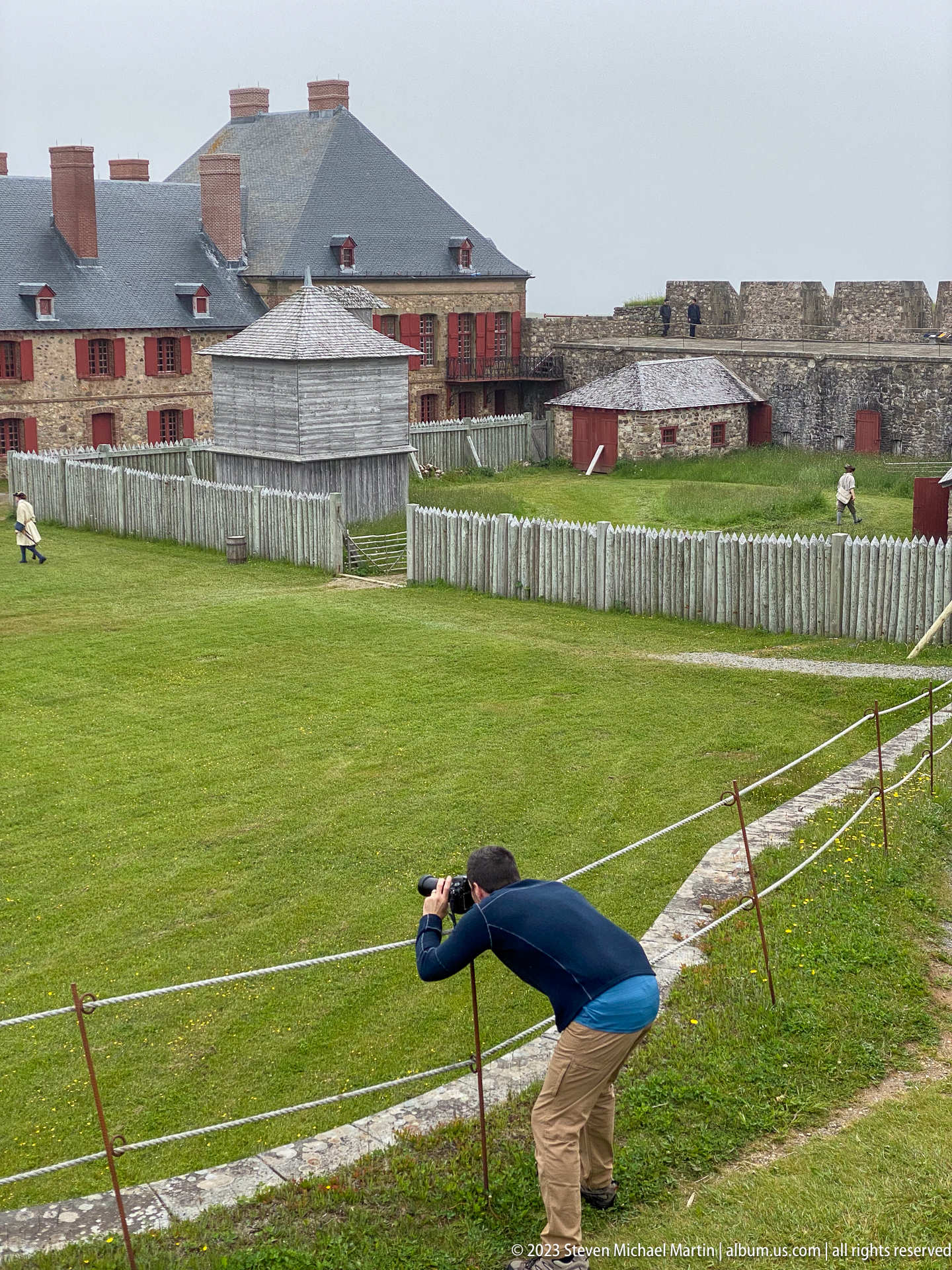
A visitor leans forward with a camera at the edge of the parade ground while the large red-trimmed barracks of the Fortress of Louisbourg rise beyond fenced enclosures. The figure introduces a contemporary layer into the reconstructed military landscape. Timber fencing, a small polygonal outbuilding, stone defenses, and the long formal façade create a dense background against the broad lawn.
Caption
A visitor leans forward with a camera at the edge of the parade ground while the large red-trimmed barracks of the Fortress of Louisbourg rise beyond fenced enclosures. The figure introduces a contemporary layer into the reconstructed military landscape. Timber fencing, a small polygonal outbuilding, stone defenses, and the long formal façade create a dense background against the broad lawn.
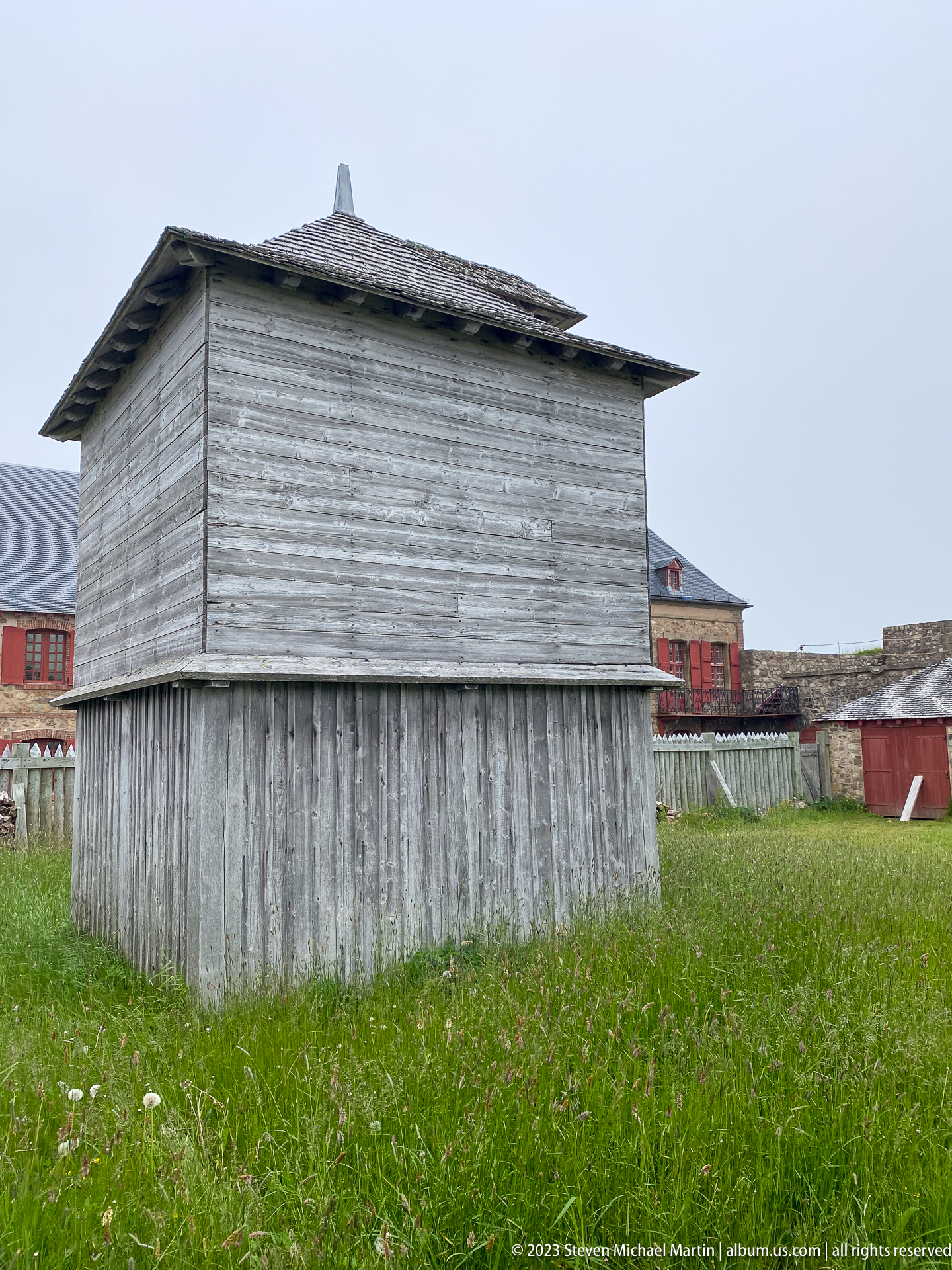
A plain, weathered timber outbuilding stands alone in the grass at the Fortress of Louisbourg. Vertical board cladding, a low hipped shingle roof, and an almost windowless exterior give the structure a deliberately utilitarian character. The close side view emphasizes simple carpentry and weathered surfaces, distinguishing this modest service building from the larger stone and formal military architecture nearby.
Caption
A plain, weathered timber outbuilding stands alone in the grass at the Fortress of Louisbourg. Vertical board cladding, a low hipped shingle roof, and an almost windowless exterior give the structure a deliberately utilitarian character. The close side view emphasizes simple carpentry and weathered surfaces, distinguishing this modest service building from the larger stone and formal military architecture nearby.
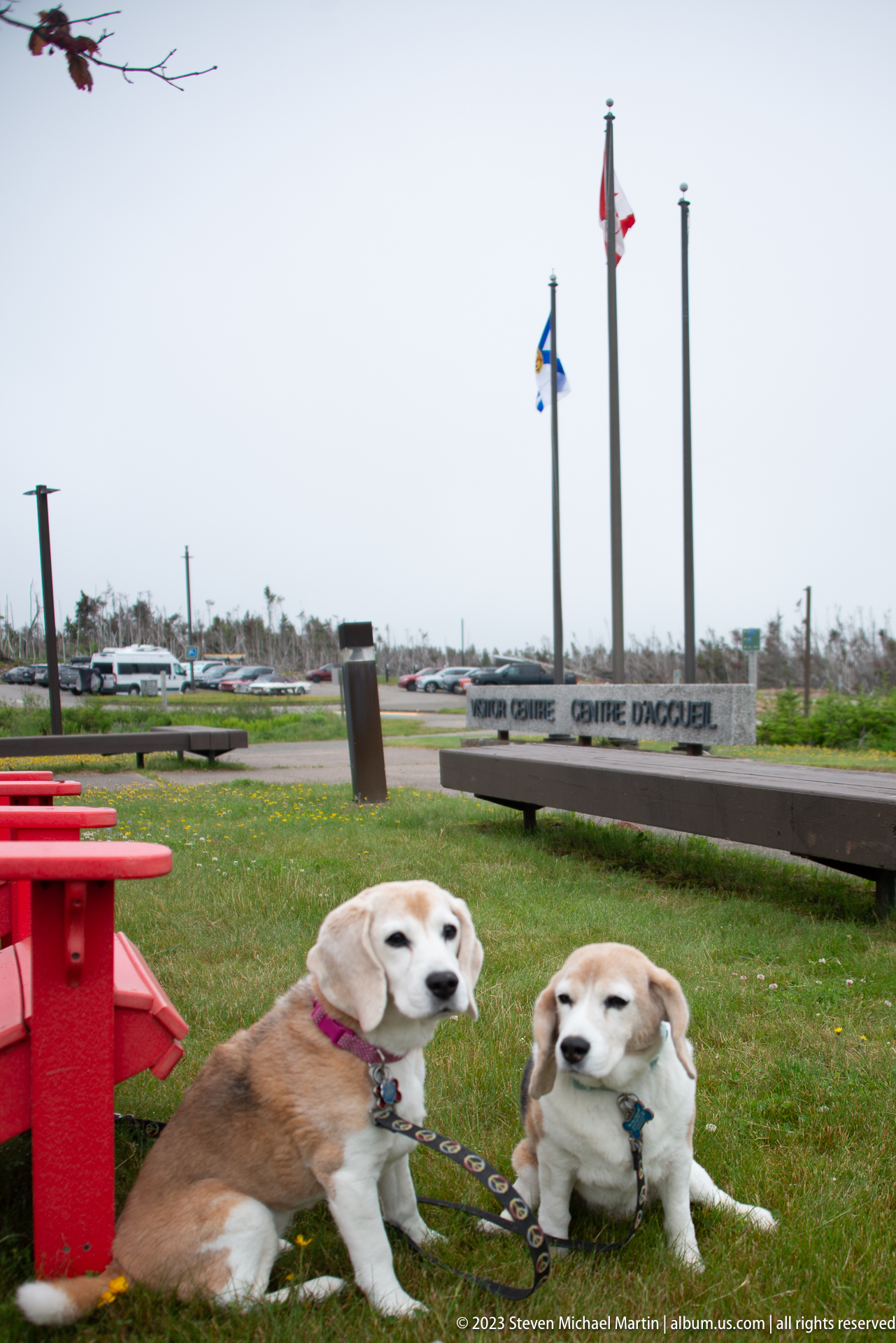
Two beagles sit on the grass near a red Adirondack chair in a visitor area at the Fortress of Louisbourg. Flagpoles and a long site sign reading “Forteresse de Louisbourg” extend across the background, placing the dogs clearly within the modern visitor landscape. Their attentive poses and leashes add a casual human-scale moment at the edge of the historic site.
Caption
Two beagles sit on the grass near a red Adirondack chair in a visitor area at the Fortress of Louisbourg. Flagpoles and a long site sign reading “Forteresse de Louisbourg” extend across the background, placing the dogs clearly within the modern visitor landscape. Their attentive poses and leashes add a casual human-scale moment at the edge of the historic site.

Two narrow vertical openings cut through a massive dressed-stone wall at the Fortress of Louisbourg, revealing slivers of the green landscape outside. The deep splayed reveals expose the thickness of the defensive masonry and the controlled field of view available from within. This close interior detail concentrates on the functional geometry of the openings rather than the fortification as a whole.
Caption
Two narrow vertical openings cut through a massive dressed-stone wall at the Fortress of Louisbourg, revealing slivers of the green landscape outside. The deep splayed reveals expose the thickness of the defensive masonry and the controlled field of view available from within. This close interior detail concentrates on the functional geometry of the openings rather than the fortification as a whole.
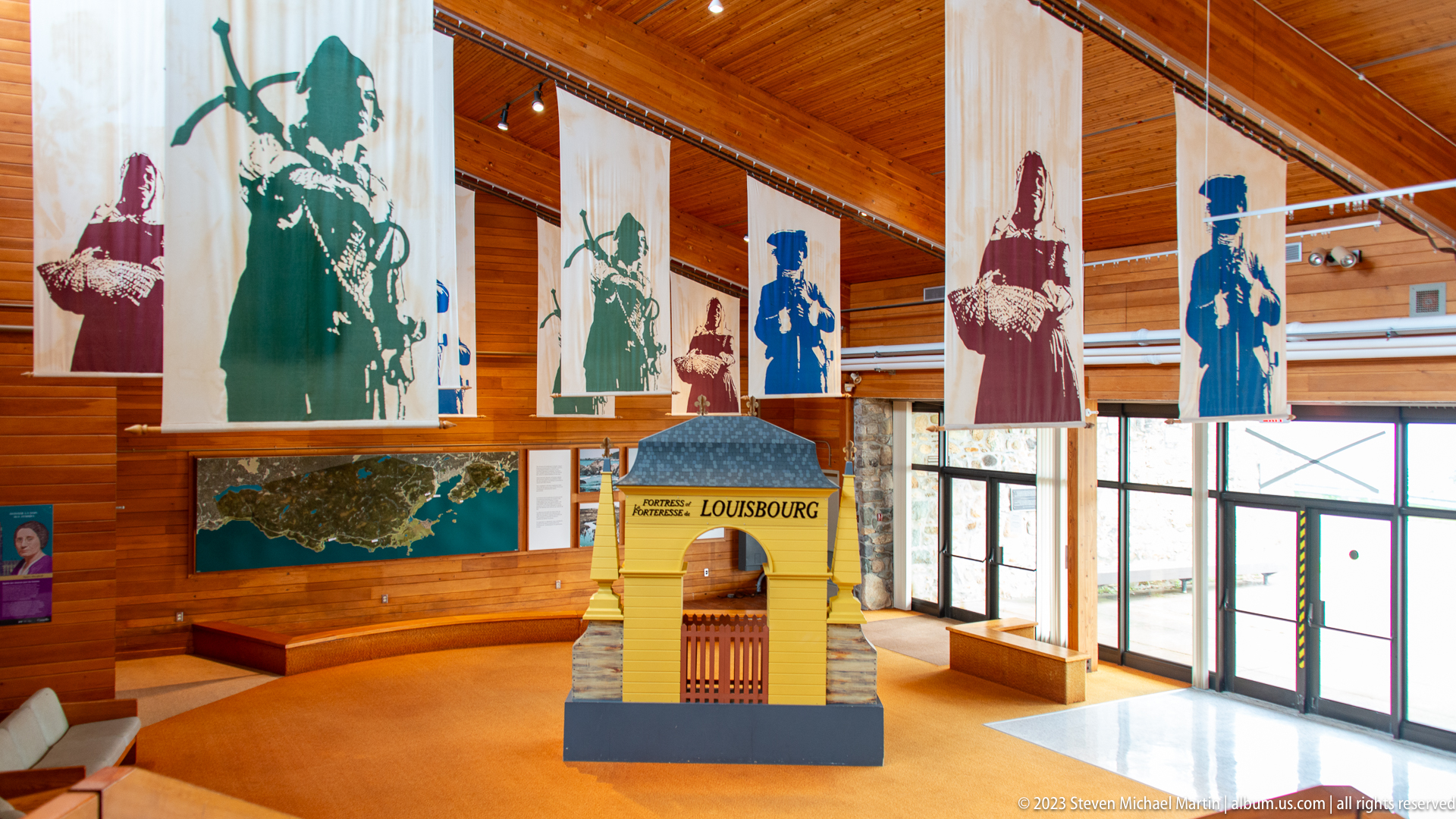
Inside the visitor centre, large graphic portraits hang above an interpretive gallery containing a regional map and a scale model of a Louisbourg gateway. Warm timber walls and exposed roof structure contrast with the brightly colored exhibition elements. The wide view records the modern interpretive setting through which visitors are introduced to the people, geography, and reconstructed architecture of the Fortress of Louisbourg.
Caption
Inside the visitor centre, large graphic portraits hang above an interpretive gallery containing a regional map and a scale model of a Louisbourg gateway. Warm timber walls and exposed roof structure contrast with the brightly colored exhibition elements. The wide view records the modern interpretive setting through which visitors are introduced to the people, geography, and reconstructed architecture of the Fortress of Louisbourg.

A brightly painted scale model of a fortress gateway stands in the Louisbourg visitor centre. The yellow structure, gray roof, red gate, and bold “FORTRESS / FORTERESSE LOUISBOURG” lettering reduce monumental defensive architecture to an accessible interpretive object. Set against exhibition panels and a stone wall, the model functions as a visual introduction to the site’s gates and fortifications.
Caption
A brightly painted scale model of a fortress gateway stands in the Louisbourg visitor centre. The yellow structure, gray roof, red gate, and bold “FORTRESS / FORTERESSE LOUISBOURG” lettering reduce monumental defensive architecture to an accessible interpretive object. Set against exhibition panels and a stone wall, the model functions as a visual introduction to the site’s gates and fortifications.

A reconstructed chapel interior at the Fortress of Louisbourg is arranged around a white-and-gold altar beneath a classical pediment. A large devotional image occupies the central niche, while black chandeliers, tall windows, framed pictures, and a wooden communion rail define the bright nave. The symmetrical composition emphasizes the formal contrast between polished ecclesiastical decoration and the otherwise restrained reconstructed interiors of the fortress.
Caption
A reconstructed chapel interior at the Fortress of Louisbourg is arranged around a white-and-gold altar beneath a classical pediment. A large devotional image occupies the central niche, while black chandeliers, tall windows, framed pictures, and a wooden communion rail define the bright nave. The symmetrical composition emphasizes the formal contrast between polished ecclesiastical decoration and the otherwise restrained reconstructed interiors of the fortress.
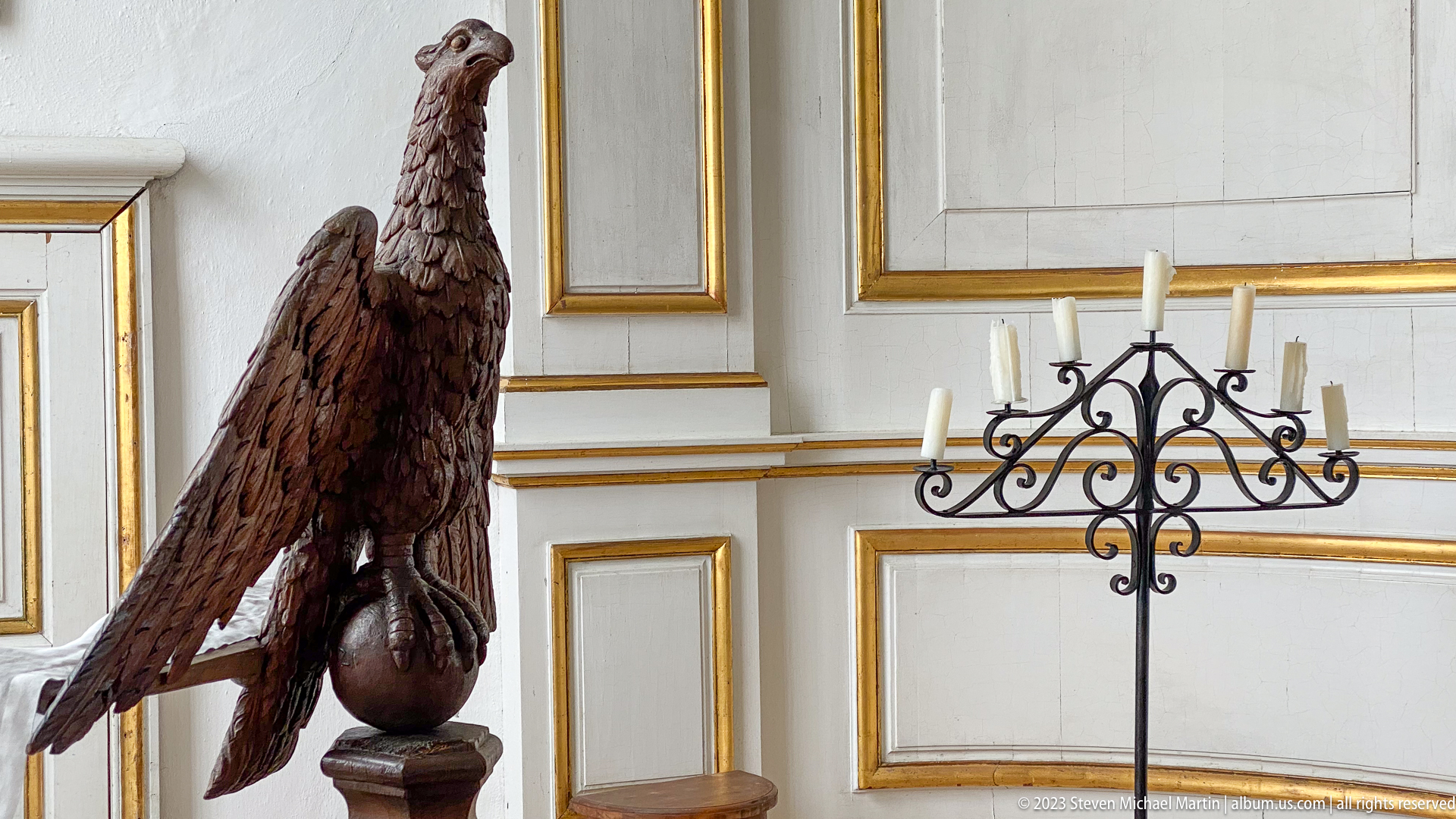
A dark carved wooden eagle stands prominently inside the reconstructed chapel at the Fortress of Louisbourg, beside a wrought-iron candle stand fitted with white tapers. Gilded moldings and pale wall panels form a restrained ecclesiastical backdrop. The close framing isolates the sculptural bird, its spread wings, talons, and rounded support, making the object a distinctive decorative feature of the chapel interior.
Caption
A dark carved wooden eagle stands prominently inside the reconstructed chapel at the Fortress of Louisbourg, beside a wrought-iron candle stand fitted with white tapers. Gilded moldings and pale wall panels form a restrained ecclesiastical backdrop. The close framing isolates the sculptural bird, its spread wings, talons, and rounded support, making the object a distinctive decorative feature of the chapel interior.
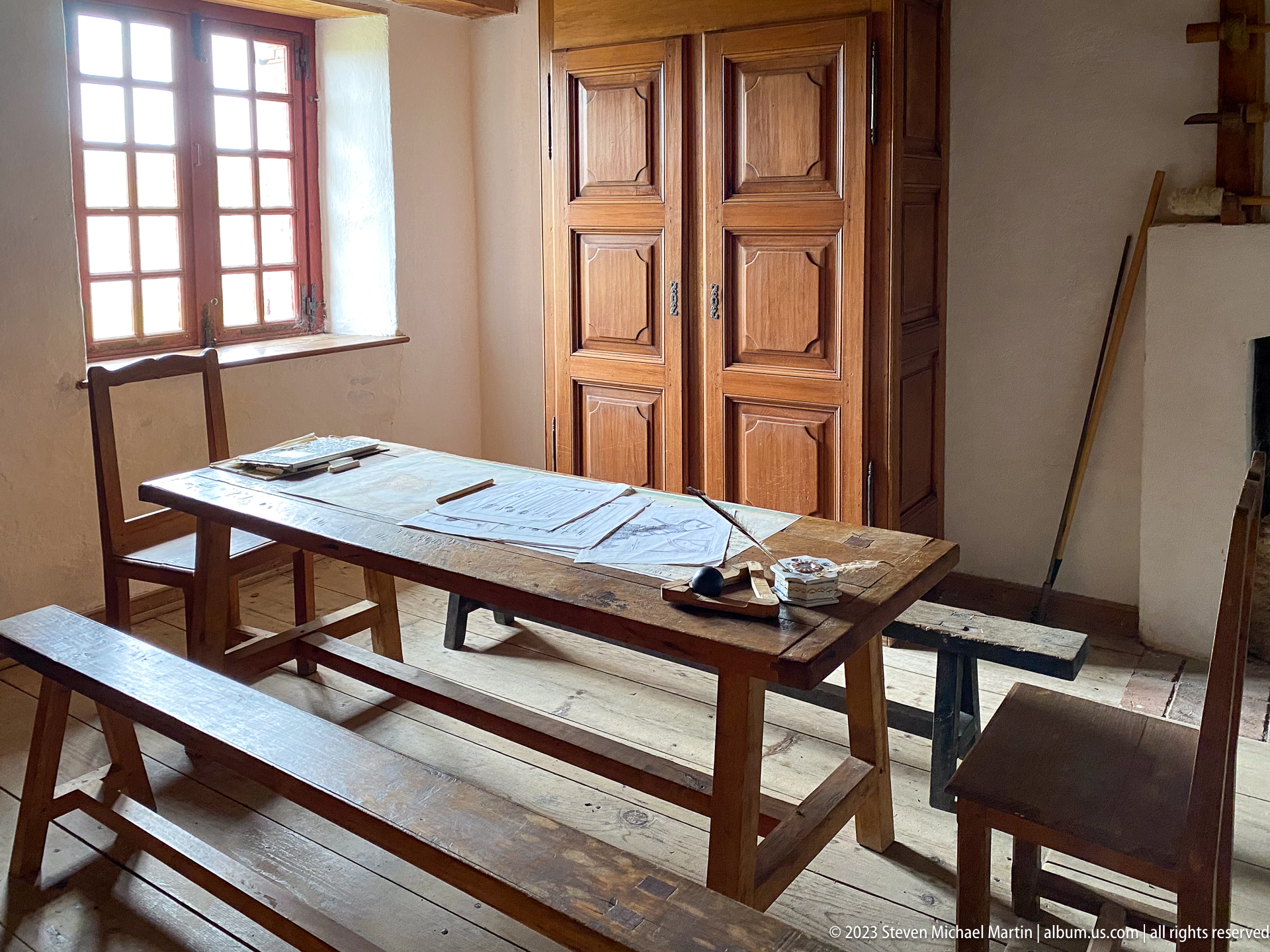
A long scarred wooden table occupies the center of a reconstructed workroom at the Fortress of Louisbourg, surrounded by benches, papers, writing materials, a window, and a tall paneled cupboard. The sparse furnishings and practical arrangement suggest an administrative, instructional, or clerical setting. The room’s rough floorboards and plain plaster walls reinforce the functional character of the interior.
Caption
A long scarred wooden table occupies the center of a reconstructed workroom at the Fortress of Louisbourg, surrounded by benches, papers, writing materials, a window, and a tall paneled cupboard. The sparse furnishings and practical arrangement suggest an administrative, instructional, or clerical setting. The room’s rough floorboards and plain plaster walls reinforce the functional character of the interior.
Two beagles stand on the grass near bright red Adirondack chairs at the Fortress of Louisbourg. Their tricolor coats and low, sturdy profiles are clearly visible against the green lawn. The informal scene introduces contemporary visitor life into the historic setting, contrasting sharply colored outdoor seating and companion animals with the site’s reconstructed eighteenth-century architecture and fortifications.
Caption
Two beagles stand on the grass near bright red Adirondack chairs at the Fortress of Louisbourg. Their tricolor coats and low, sturdy profiles are clearly visible against the green lawn. The informal scene introduces contemporary visitor life into the historic setting, contrasting sharply colored outdoor seating and companion animals with the site’s reconstructed eighteenth-century architecture and fortifications.
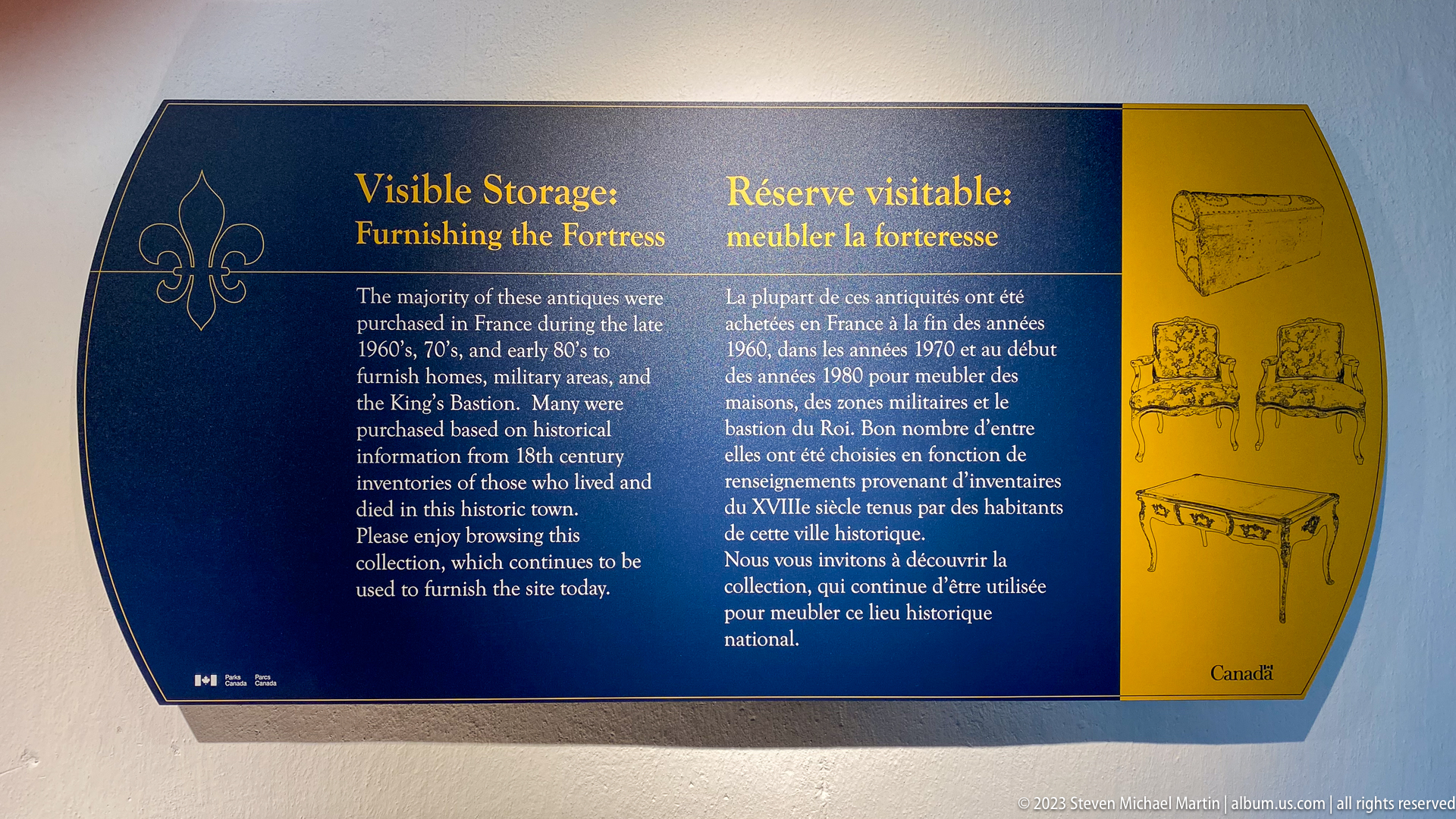
An interpretive panel titled “Visible Storage: Furnishing the Fortress” explains how historic interiors at the Fortress of Louisbourg are furnished and presented. English and French text appears beside line drawings of period furniture on a blue-and-yellow graphic field. The panel itself becomes the subject, documenting how Parks Canada interprets the reconstructed site and distinguishes historic objects from modern curatorial presentation.
Caption
An interpretive panel titled “Visible Storage: Furnishing the Fortress” explains how historic interiors at the Fortress of Louisbourg are furnished and presented. English and French text appears beside line drawings of period furniture on a blue-and-yellow graphic field. The panel itself becomes the subject, documenting how Parks Canada interprets the reconstructed site and distinguishes historic objects from modern curatorial presentation.

A painted armillary sphere is displayed behind glass in the visitor centre at the Fortress of Louisbourg. Intersecting colored rings encircle a central axis on a dark pedestal, forming a compact model of the celestial sphere. Reflections from the case cross the object, but its distinctive ring structure remains visible. The instrument evokes the navigational and astronomical knowledge essential to the wider maritime world connected with Louisbourg.
Caption
A painted armillary sphere is displayed behind glass in the visitor centre at the Fortress of Louisbourg. Intersecting colored rings encircle a central axis on a dark pedestal, forming a compact model of the celestial sphere. Reflections from the case cross the object, but its distinctive ring structure remains visible. The instrument evokes the navigational and astronomical knowledge essential to the wider maritime world connected with Louisbourg.
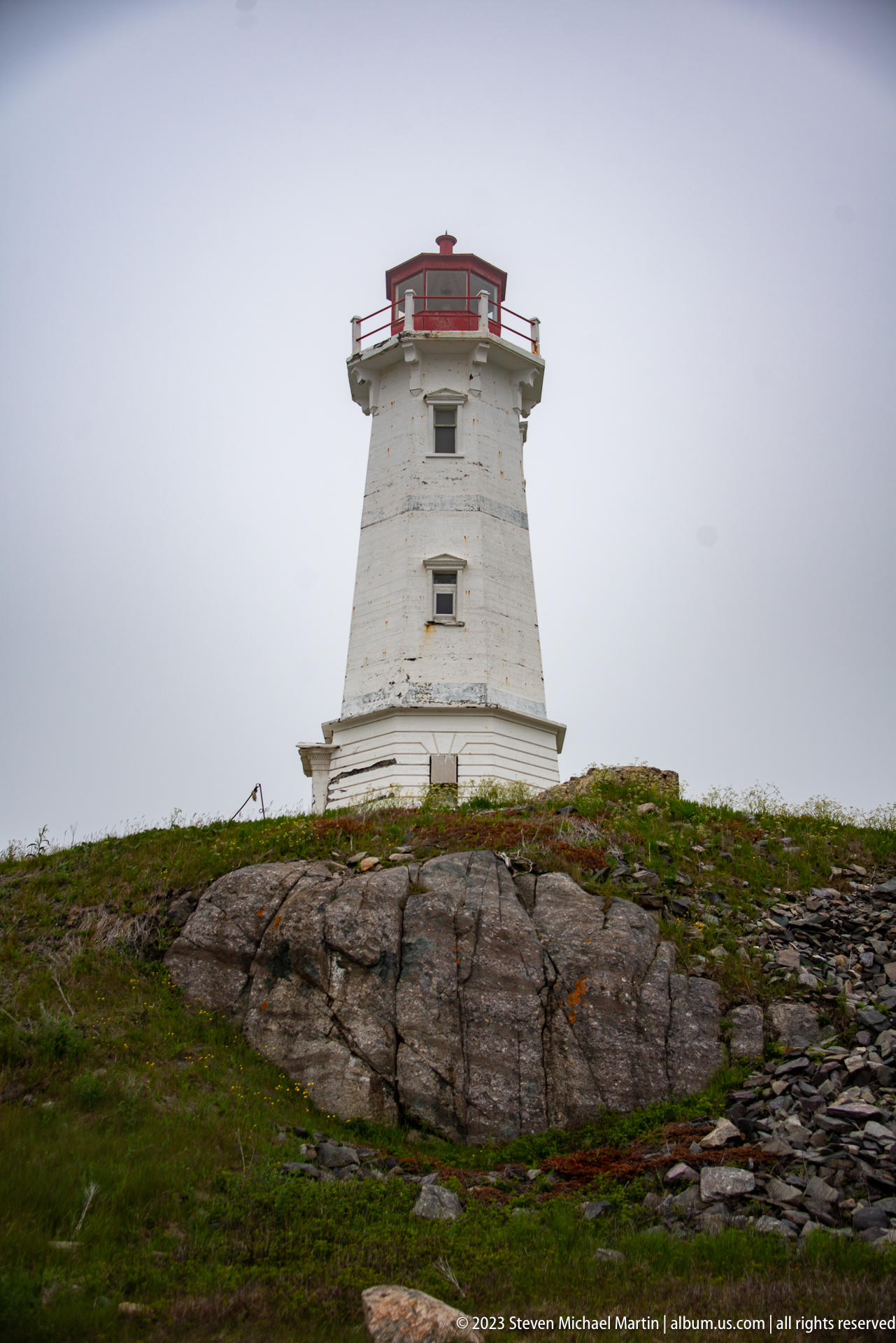
A white tapered lighthouse with a red-trimmed lantern room stands on a low rocky rise near Louisbourg Harbour. Small windows punctuate the tower above a broader base, while exposed bedrock and coastal vegetation fill the foreground. The isolated vertical form contrasts with the subdued sky, making the lighthouse a prominent maritime landmark associated with the harbour approaches to Louisbourg.
Caption
A white tapered lighthouse with a red-trimmed lantern room stands on a low rocky rise near Louisbourg Harbour. Small windows punctuate the tower above a broader base, while exposed bedrock and coastal vegetation fill the foreground. The isolated vertical form contrasts with the subdued sky, making the lighthouse a prominent maritime landmark associated with the harbour approaches to Louisbourg.

Purple lupines rise in dense vertical spikes against lush green foliage near Louisbourg. Individual pea-like blossoms form layered whorls around each stem, with additional purple spikes receding into soft focus. The close composition emphasizes the structure and saturated color of the flowers, shifting the portfolio from historic architecture to the coastal vegetation surrounding the national historic site.
Caption
Purple lupines rise in dense vertical spikes against lush green foliage near Louisbourg. Individual pea-like blossoms form layered whorls around each stem, with additional purple spikes receding into soft focus. The close composition emphasizes the structure and saturated color of the flowers, shifting the portfolio from historic architecture to the coastal vegetation surrounding the national historic site.
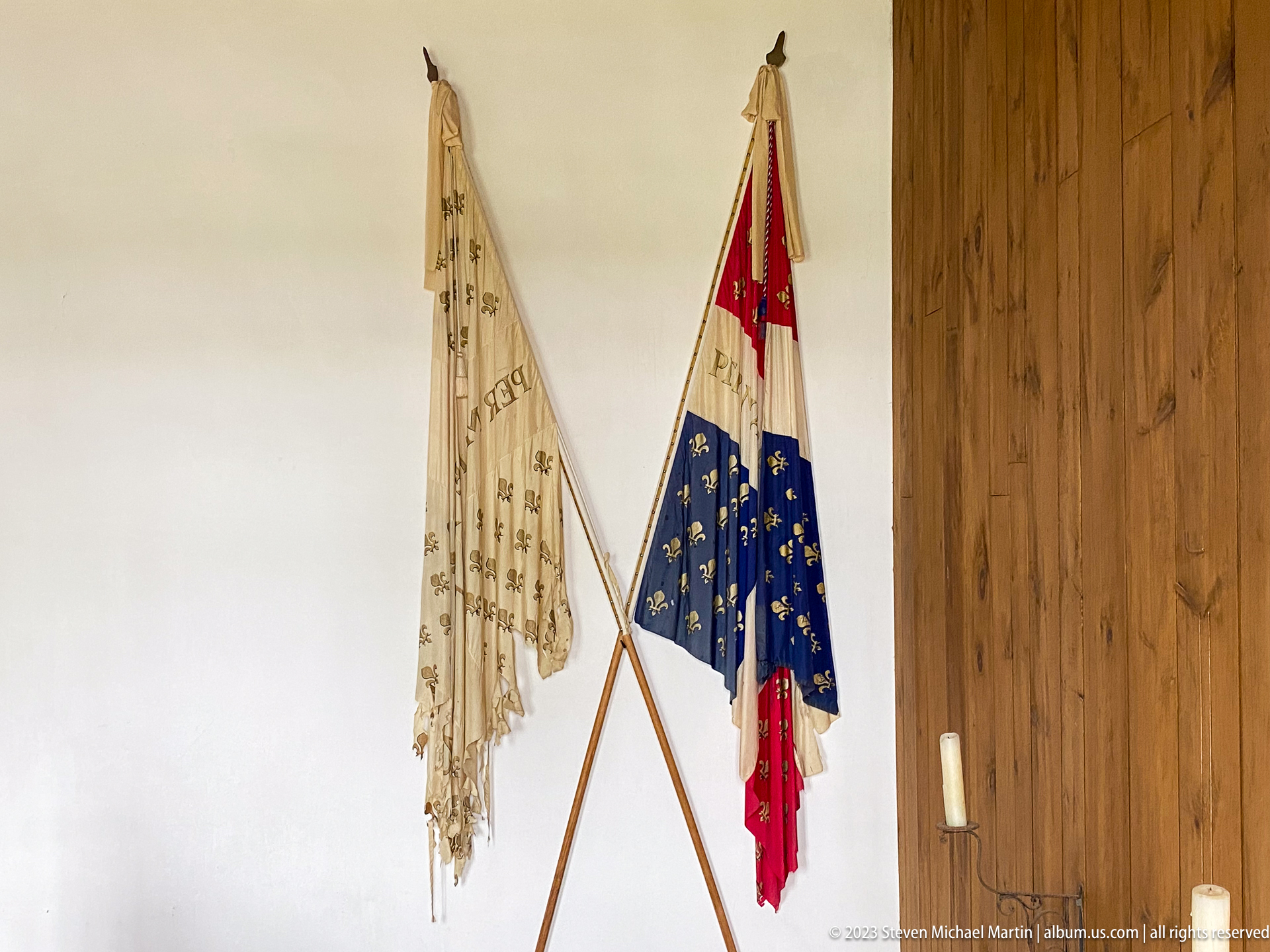
Two reconstructed standards hang from crossed poles inside a timber-and-plaster interior at the Fortress of Louisbourg. One is pale and patterned with fleur-de-lis motifs; the other combines blue, red, and white fields with repeated fleurs-de-lis. Their display evokes the French royal and military identity associated with eighteenth-century Louisbourg while preserving the textiles as interpretive objects rather than active flags.
Caption
Two reconstructed standards hang from crossed poles inside a timber-and-plaster interior at the Fortress of Louisbourg. One is pale and patterned with fleur-de-lis motifs; the other combines blue, red, and white fields with repeated fleurs-de-lis. Their display evokes the French royal and military identity associated with eighteenth-century Louisbourg while preserving the textiles as interpretive objects rather than active flags.

A long table covered with a patterned cloth and arranged with blue upholstered chairs occupies a formal reconstructed interior at the Fortress of Louisbourg. Candlesticks, papers, tall windows, and a large portrait create an administrative or ceremonial atmosphere. The centered composition emphasizes symmetry and order, contrasting this refined room with the more utilitarian kitchens, barracks, and storehouses elsewhere in the reconstructed fortress.
Caption
A long table covered with a patterned cloth and arranged with blue upholstered chairs occupies a formal reconstructed interior at the Fortress of Louisbourg. Candlesticks, papers, tall windows, and a large portrait create an administrative or ceremonial atmosphere. The centered composition emphasizes symmetry and order, contrasting this refined room with the more utilitarian kitchens, barracks, and storehouses elsewhere in the reconstructed fortress.
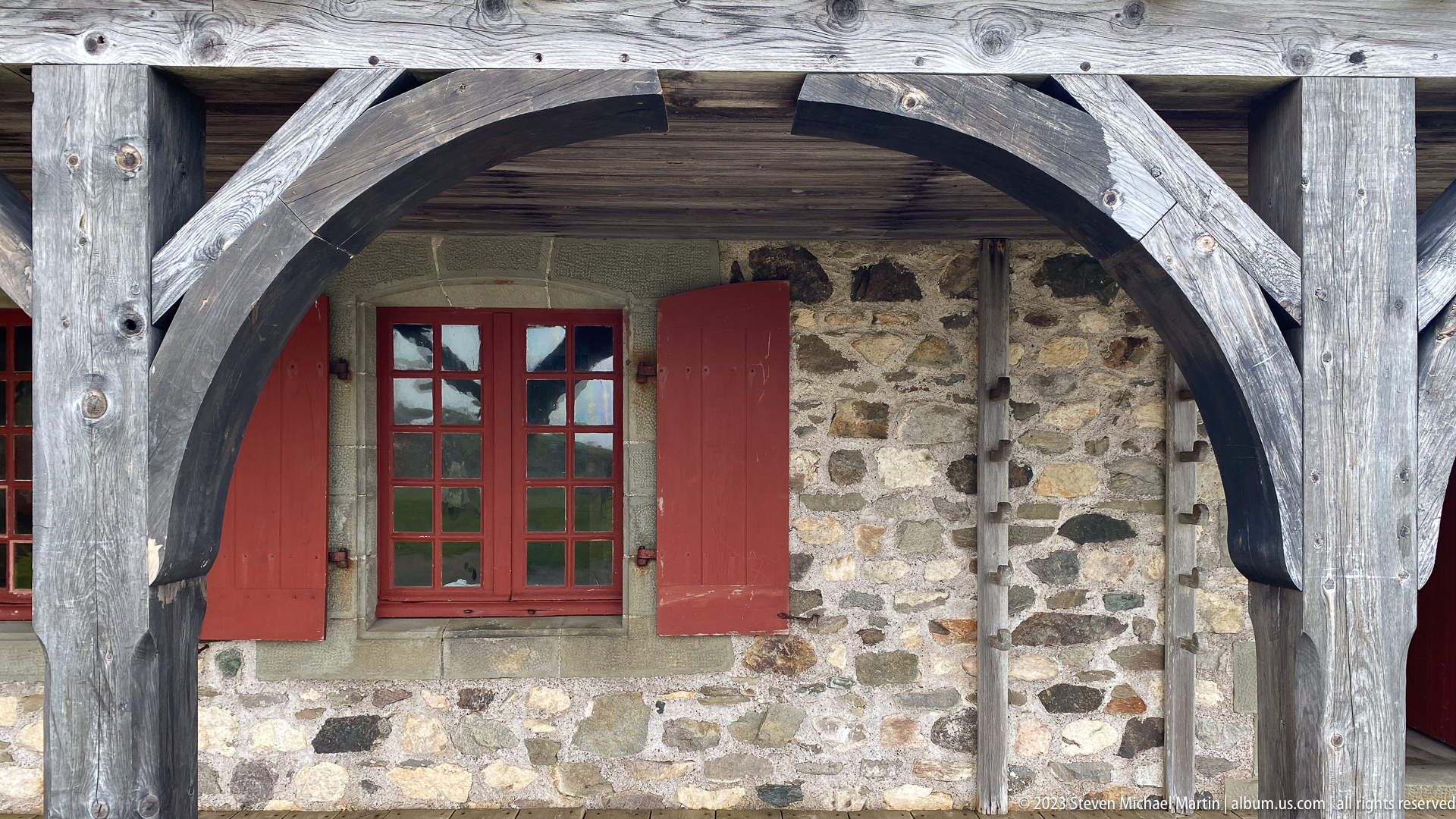
A red multi-pane window with matching wooden shutters is set into a rough stone wall beneath heavy curved timber bracing at the Fortress of Louisbourg. Weathered posts and beams frame the masonry, making the junction between timber structure and stone enclosure the central visual feature. The close view records the materials, joinery, and contrasting painted woodwork of a reconstructed eighteenth-century building.
Caption
A red multi-pane window with matching wooden shutters is set into a rough stone wall beneath heavy curved timber bracing at the Fortress of Louisbourg. Weathered posts and beams frame the masonry, making the junction between timber structure and stone enclosure the central visual feature. The close view records the materials, joinery, and contrasting painted woodwork of a reconstructed eighteenth-century building.

Simple wooden sleeping platforms line a whitewashed wall in reconstructed barracks quarters at the Fortress of Louisbourg. Coarse blankets, storage boxes, hanging garments, benches, and a plain table create a deliberately austere military interior. Exposed beams and unfinished plank floors reinforce the practical character of the room, offering a close view of the sparse furnishings associated with soldiers’ daily life.
Caption
Simple wooden sleeping platforms line a whitewashed wall in reconstructed barracks quarters at the Fortress of Louisbourg. Coarse blankets, storage boxes, hanging garments, benches, and a plain table create a deliberately austere military interior. Exposed beams and unfinished plank floors reinforce the practical character of the room, offering a close view of the sparse furnishings associated with soldiers’ daily life.

Four costumed interpreters in red military coats cross the parade ground before the long King’s Bastion barracks at the Fortress of Louisbourg. The stone façade, red-trimmed windows, steep roof, central entrance, and chapel spire create the dominant architectural backdrop. The figures animate the reconstructed military space and provide scale for one of Louisbourg’s largest formal buildings.
Caption
Four costumed interpreters in red military coats cross the parade ground before the long King’s Bastion barracks at the Fortress of Louisbourg. The stone façade, red-trimmed windows, steep roof, central entrance, and chapel spire create the dominant architectural backdrop. The figures animate the reconstructed military space and provide scale for one of Louisbourg’s largest formal buildings.
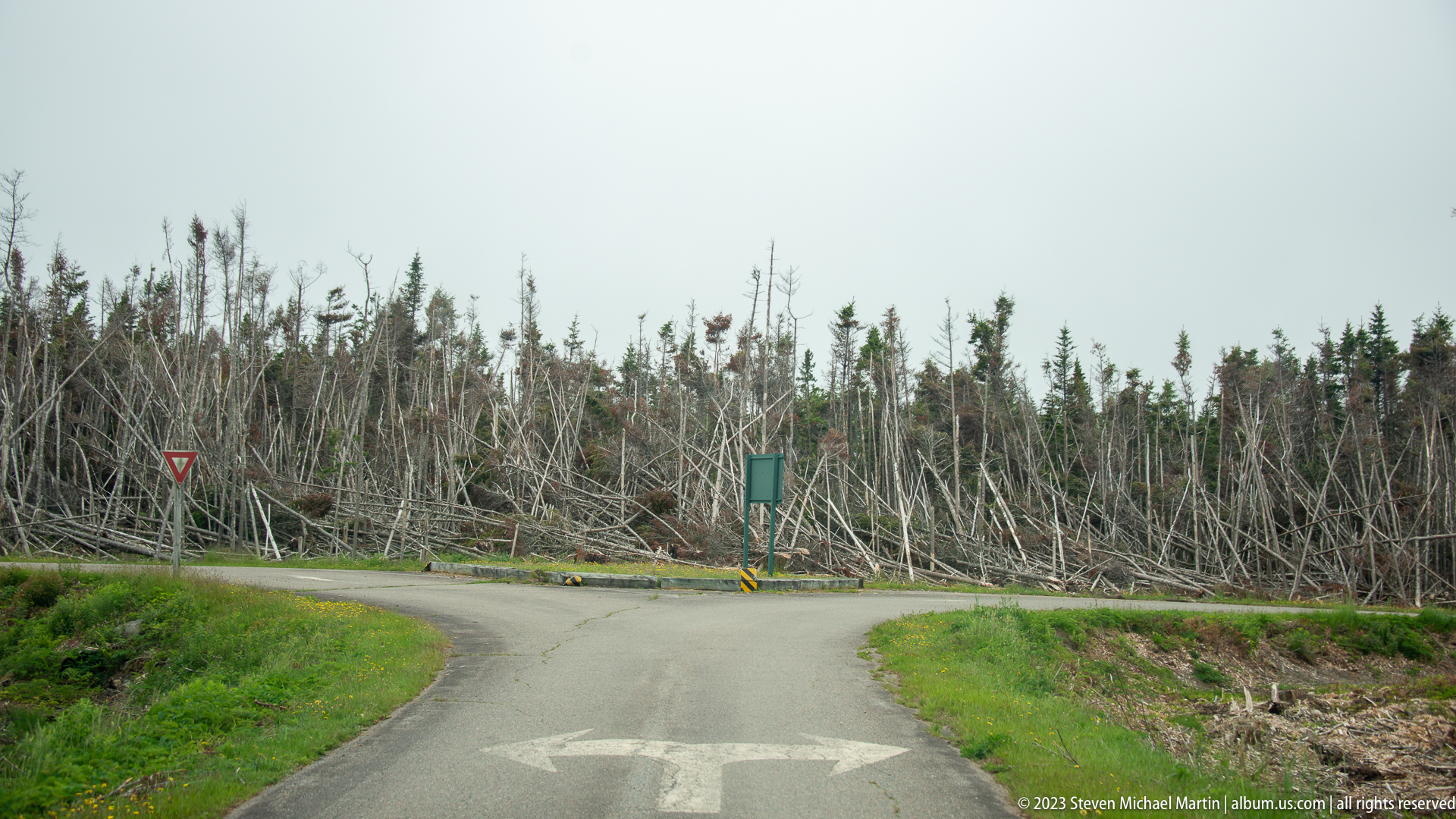
A paved road curves through a heavily damaged forest near the Fortress of Louisbourg, where numerous trunks stand bare, lean at sharp angles, or lie fallen across the understory. Road signs and a directional arrow provide scale against the dense field of broken trees. The photograph records a contemporary landscape disturbance at the edge of the historic site without attributing the damage to a specific event.
Caption
A paved road curves through a heavily damaged forest near the Fortress of Louisbourg, where numerous trunks stand bare, lean at sharp angles, or lie fallen across the understory. Road signs and a directional arrow provide scale against the dense field of broken trees. The photograph records a contemporary landscape disturbance at the edge of the historic site without attributing the damage to a specific event.

Large wooden barrels, hides, crates, planks, and a black iron vessel fill a reconstructed stone storehouse at the Fortress of Louisbourg. The varied containers and raw materials suggest the practical organization of goods within the fortified port. Rough masonry walls, small windows, and plank floors reinforce the utilitarian setting, while the dense arrangement conveys the physical character of eighteenth-century storage and provisioning.
Caption
Large wooden barrels, hides, crates, planks, and a black iron vessel fill a reconstructed stone storehouse at the Fortress of Louisbourg. The varied containers and raw materials suggest the practical organization of goods within the fortified port. Rough masonry walls, small windows, and plank floors reinforce the utilitarian setting, while the dense arrangement conveys the physical character of eighteenth-century storage and provisioning.
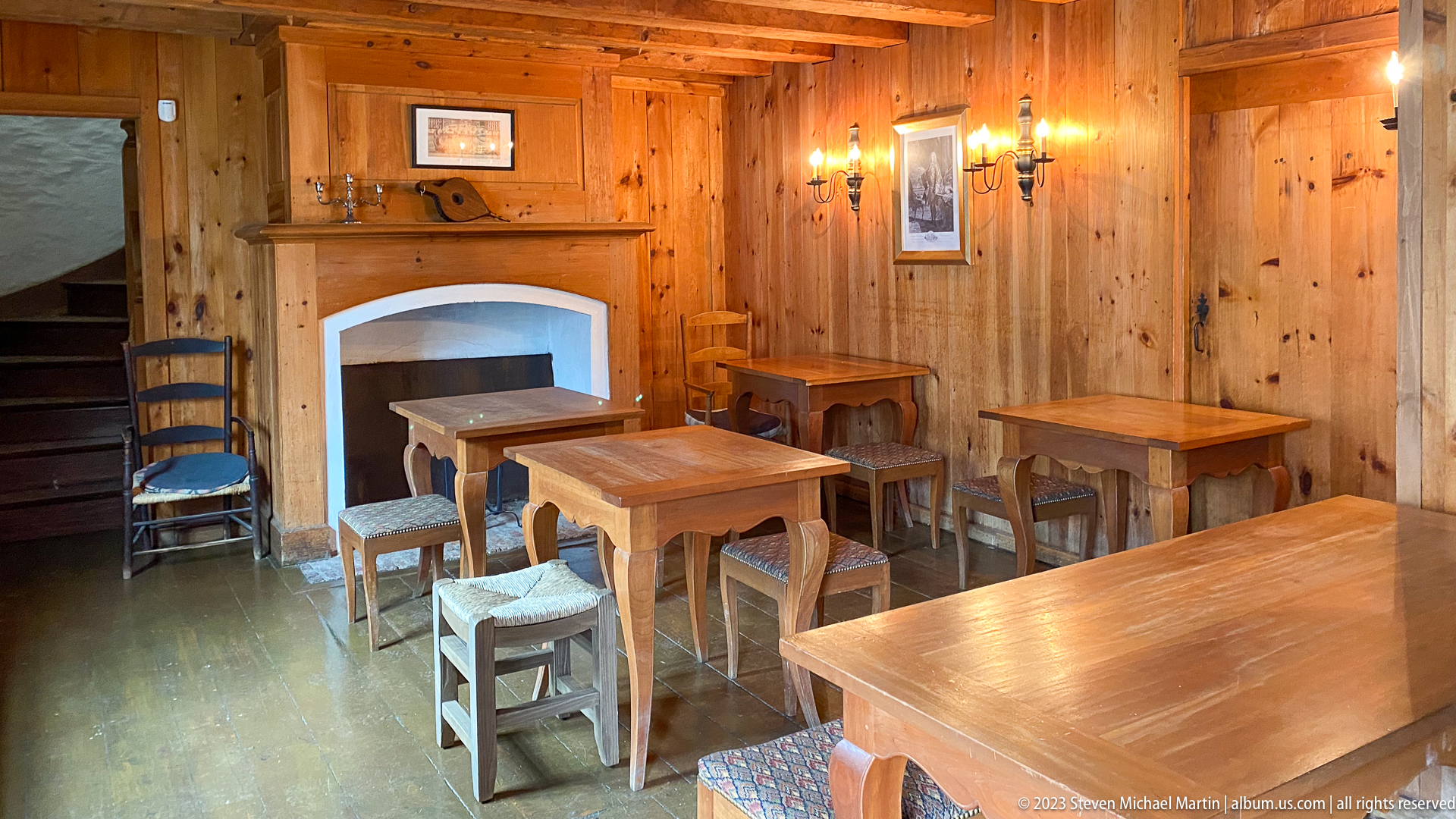
Small wooden tables, stools, and chairs fill a warmly lit reconstructed room at the Fortress of Louisbourg. Plank walls, wall-mounted candle fixtures, a white-plastered hearth opening, and simple furniture create the atmosphere of an eighteenth-century public or domestic eating space. The empty room emphasizes the practical furnishings and intimate scale rather than a specific living-history activity.
Caption
Small wooden tables, stools, and chairs fill a warmly lit reconstructed room at the Fortress of Louisbourg. Plank walls, wall-mounted candle fixtures, a white-plastered hearth opening, and simple furniture create the atmosphere of an eighteenth-century public or domestic eating space. The empty room emphasizes the practical furnishings and intimate scale rather than a specific living-history activity.
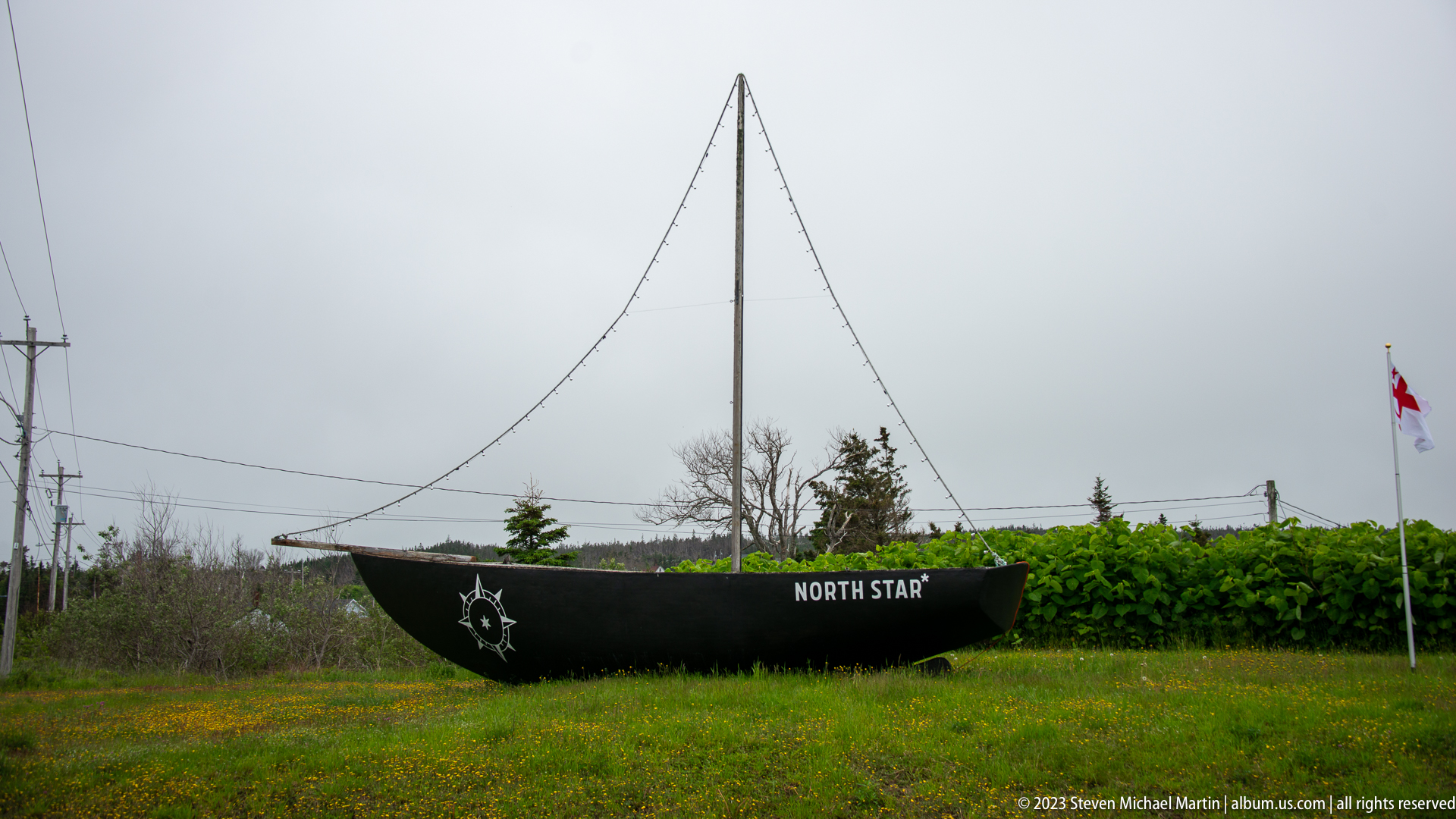
A black boat-shaped installation labeled “NORTH STAR” rests on grass near the Fortress of Louisbourg, with a tall mast-like pole and rigging lines rising above it. A compass-rose emblem appears on the hull and a Canadian flag flies nearby. The display is clearly modern and interpretive, providing a maritime visual reference at the edge of the historic site rather than representing an eighteenth-century vessel in use.
Caption
A black boat-shaped installation labeled “NORTH STAR” rests on grass near the Fortress of Louisbourg, with a tall mast-like pole and rigging lines rising above it. A compass-rose emblem appears on the hull and a Canadian flag flies nearby. The display is clearly modern and interpretive, providing a maritime visual reference at the edge of the historic site rather than representing an eighteenth-century vessel in use.
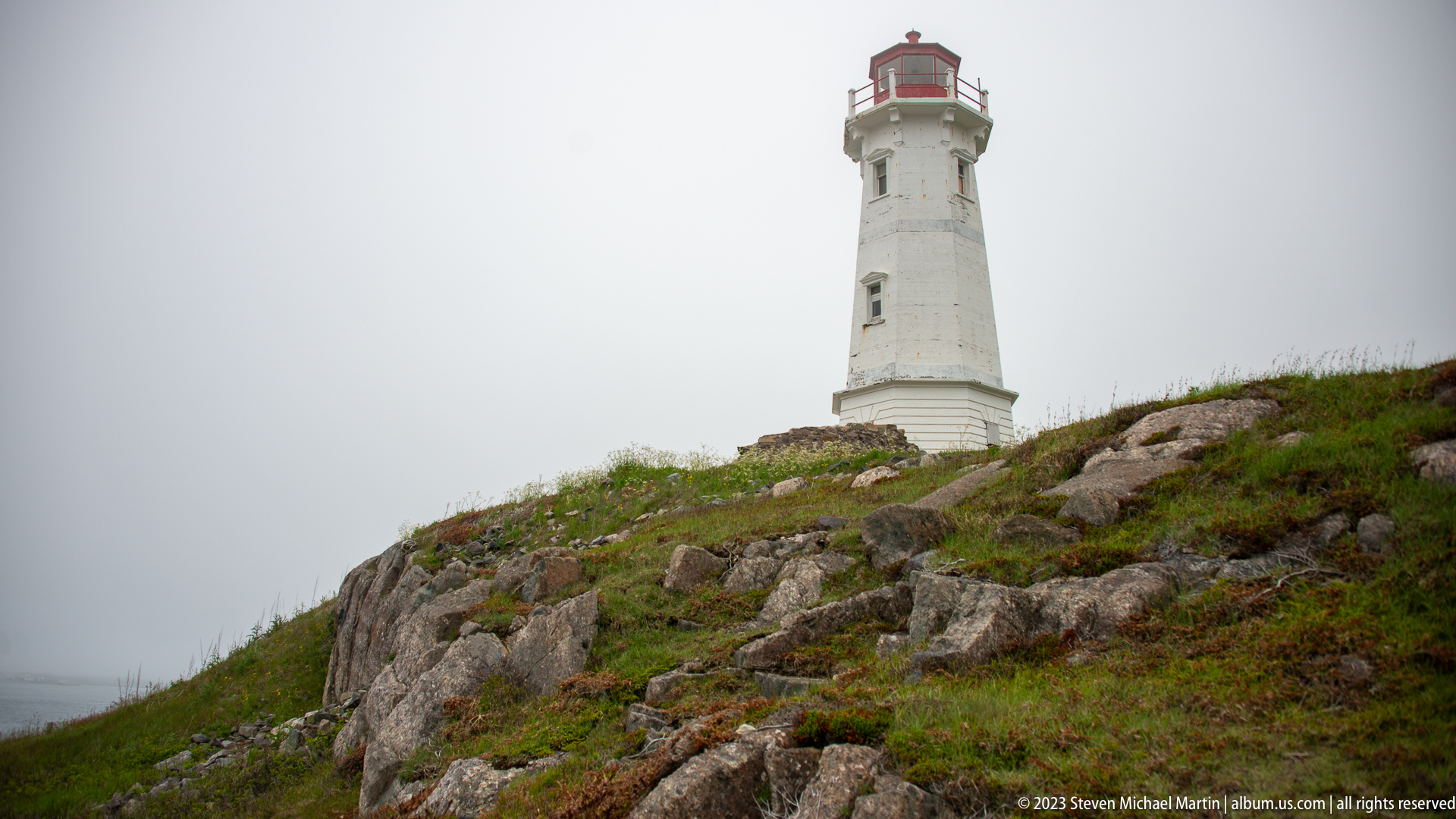
The Louisbourg Lighthouse rises above exposed rock and low coastal vegetation in a low-angle view that emphasizes the height and taper of the white tower. A red-trimmed lantern room caps the structure against a pale sky. Seen from the rocky slope below, the lighthouse reads as an isolated maritime marker overlooking the harbour approaches and Atlantic coast.
Caption
The Louisbourg Lighthouse rises above exposed rock and low coastal vegetation in a low-angle view that emphasizes the height and taper of the white tower. A red-trimmed lantern room caps the structure against a pale sky. Seen from the rocky slope below, the lighthouse reads as an isolated maritime marker overlooking the harbour approaches and Atlantic coast.
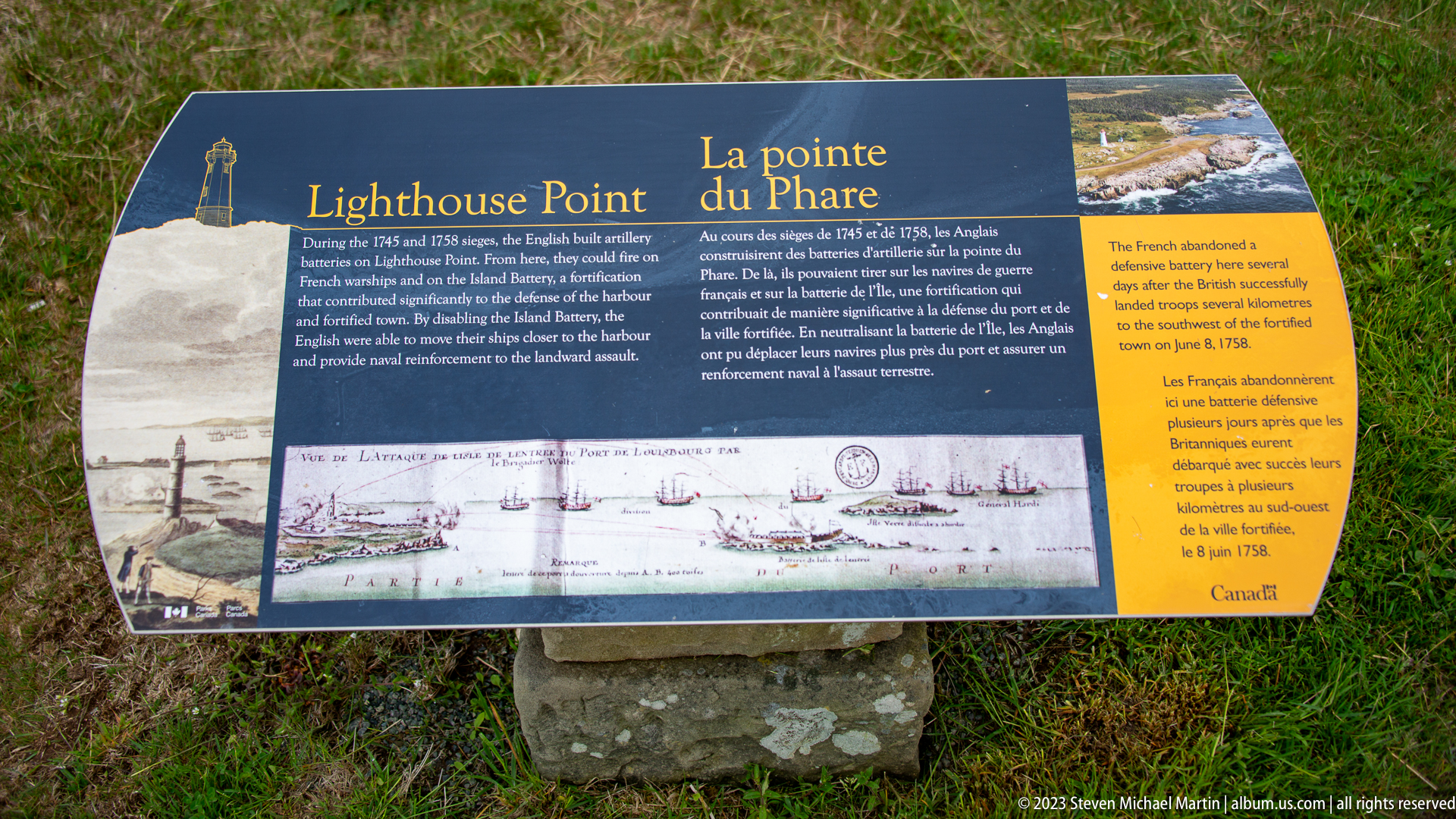
A bilingual outdoor panel titled “Lighthouse Point / La pointe du Phare” interprets the lighthouse site near Louisbourg. Historic illustrations, a map or panoramic drawing, modern photographs, and explanatory text are arranged across the sign. Positioned directly on the grassy coastal landscape, the panel documents how the lighthouse and harbour history are presented to visitors at this maritime viewpoint.
Caption
A bilingual outdoor panel titled “Lighthouse Point / La pointe du Phare” interprets the lighthouse site near Louisbourg. Historic illustrations, a map or panoramic drawing, modern photographs, and explanatory text are arranged across the sign. Positioned directly on the grassy coastal landscape, the panel documents how the lighthouse and harbour history are presented to visitors at this maritime viewpoint.

Several purple lupine spikes rise from tall grass beside the Louisbourg waterfront, with boats and a red harbour-side structure blurred across the water. The flowers dominate the foreground while the maritime setting remains legible behind them. The composition connects the seasonal vegetation around the site with the working harbour landscape beyond.
Caption
Several purple lupine spikes rise from tall grass beside the Louisbourg waterfront, with boats and a red harbour-side structure blurred across the water. The flowers dominate the foreground while the maritime setting remains legible behind them. The composition connects the seasonal vegetation around the site with the working harbour landscape beyond.

A single purple lupine flower spike fills the frame, its lower blossoms open while tightly packed green buds remain at the tip. The shallow depth of field isolates the inflorescence against a smooth green background, revealing the progression of flowering along the stem. The botanical close-up highlights the plant’s distinctive pea-shaped blossoms and orderly vertical form.
Caption
A single purple lupine flower spike fills the frame, its lower blossoms open while tightly packed green buds remain at the tip. The shallow depth of field isolates the inflorescence against a smooth green background, revealing the progression of flowering along the stem. The botanical close-up highlights the plant’s distinctive pea-shaped blossoms and orderly vertical form.

Two pale pink lupine spikes dominate a shallow-focus botanical portrait near Louisbourg. Their dense lower blossoms gradually transition to green unopened buds at the tips, while purple flowers form a soft background. The pairing reveals both the vertical growth pattern and subtle color gradations of the lupines that spread through the coastal landscape around the historic site.
Caption
Two pale pink lupine spikes dominate a shallow-focus botanical portrait near Louisbourg. Their dense lower blossoms gradually transition to green unopened buds at the tips, while purple flowers form a soft background. The pairing reveals both the vertical growth pattern and subtle color gradations of the lupines that spread through the coastal landscape around the historic site.
Pale pink lupine spikes rise together from dense green foliage near Louisbourg, with additional purple and pink flowers receding into the background. The upright blossoms range from tightly closed buds at the tips to fully open pea-shaped flowers lower on each stem. The clustered composition emphasizes color variation within the surrounding lupine population.
Caption
Pale pink lupine spikes rise together from dense green foliage near Louisbourg, with additional purple and pink flowers receding into the background. The upright blossoms range from tightly closed buds at the tips to fully open pea-shaped flowers lower on each stem. The clustered composition emphasizes color variation within the surrounding lupine population.

A visitor crouches on a paved path with two leashed beagles near the Fortress of Louisbourg. Red Adirondack chairs, grass, and a wooded edge frame the casual scene. One dog stands slightly forward while the other sits close to the visitor, creating an informal portrait that contrasts contemporary recreation with the historic and natural subjects elsewhere in the portfolio.
Caption
A visitor crouches on a paved path with two leashed beagles near the Fortress of Louisbourg. Red Adirondack chairs, grass, and a wooded edge frame the casual scene. One dog stands slightly forward while the other sits close to the visitor, creating an informal portrait that contrasts contemporary recreation with the historic and natural subjects elsewhere in the portfolio.
A dense meadow of lupines fills the frame with hundreds of vertical flower spikes in purple, blue, pink, and white tones. Green palmate foliage forms a continuous base beneath the blossoms, creating a richly patterned floral landscape near Louisbourg. The broad view emphasizes the abundance and color variation of the flowering stand rather than any single plant.
Caption
A dense meadow of lupines fills the frame with hundreds of vertical flower spikes in purple, blue, pink, and white tones. Green palmate foliage forms a continuous base beneath the blossoms, creating a richly patterned floral landscape near Louisbourg. The broad view emphasizes the abundance and color variation of the flowering stand rather than any single plant.

Purple lupines dominate a broad flowering meadow while scattered pale pink and white spikes punctuate the field. The repeated vertical forms extend deep into the background, creating a layered pattern across the green vegetation near Louisbourg. Compared with the closer botanical portraits, this view records the scale of the flowering colony and its varied color distribution.
Caption
Purple lupines dominate a broad flowering meadow while scattered pale pink and white spikes punctuate the field. The repeated vertical forms extend deep into the background, creating a layered pattern across the green vegetation near Louisbourg. Compared with the closer botanical portraits, this view records the scale of the flowering colony and its varied color distribution.

A tall pale pink lupine rises prominently among darker purple spikes in a dense flowering stand near Louisbourg. Selective focus draws the eye to the lighter central plant while the surrounding flowers form alternating bands of purple and green. The photograph highlights both individual floral structure and the striking color variation within the larger lupine meadow.
Caption
A tall pale pink lupine rises prominently among darker purple spikes in a dense flowering stand near Louisbourg. Selective focus draws the eye to the lighter central plant while the surrounding flowers form alternating bands of purple and green. The photograph highlights both individual floral structure and the striking color variation within the larger lupine meadow.

A close botanical study isolates the upper portion of a pink lupine spike against a softly blurred purple-and-green background. Fully opened pea-shaped flowers occupy the lower stem while tightly folded green-and-pink buds cluster toward the tip. The shallow depth of field reveals the sequential development of the inflorescence and the delicate color transitions within individual blossoms.
Caption
A close botanical study isolates the upper portion of a pink lupine spike against a softly blurred purple-and-green background. Fully opened pea-shaped flowers occupy the lower stem while tightly folded green-and-pink buds cluster toward the tip. The shallow depth of field reveals the sequential development of the inflorescence and the delicate color transitions within individual blossoms.

Pink and blue-purple lupine spikes stand side by side in a colorful meadow near Louisbourg. Both flowers show the same tiered pea-blossom structure, while their differing hues make the pairing visually distinctive. Additional lupines blur into the green background, giving the close composition enough context to suggest the larger flowering stand without distracting from the two principal stems.
Caption
Pink and blue-purple lupine spikes stand side by side in a colorful meadow near Louisbourg. Both flowers show the same tiered pea-blossom structure, while their differing hues make the pairing visually distinctive. Additional lupines blur into the green background, giving the close composition enough context to suggest the larger flowering stand without distracting from the two principal stems.

Tall blue-purple lupine spikes rise sharply from a dense meadow of softer purple, pink, and green forms. The selective focus isolates several foreground stems while preserving the sense of an extensive flowering stand beyond. As the final image in the portfolio sequence, the photograph closes on the seasonal vegetation surrounding Louisbourg rather than its reconstructed architecture.
Caption
Tall blue-purple lupine spikes rise sharply from a dense meadow of softer purple, pink, and green forms. The selective focus isolates several foreground stems while preserving the sense of an extensive flowering stand beyond. As the final image in the portfolio sequence, the photograph closes on the seasonal vegetation surrounding Louisbourg rather than its reconstructed architecture.
⭐ Highlights
- Reconstructed Fortress: The largest reconstructed 18th-century French fortified town in North America.
- Massive Stone Walls: Extensive fortifications built to defend France’s key North Atlantic outpost.
- King’s Bastion: The administrative and ceremonial center of the fortress.
- Harbor Defenses: Strategic positioning controlling access to the Gulf of St. Lawrence.
- Living History: Period interpreters recreate daily life within the fortress.
- Atlantic Setting: A rugged coastal environment shaping both design and experience.
🏰 Fortress of Louisbourg Field Guide
Major features observed during this visit:
The Fortress of Louisbourg was one of France’s most important military and commercial centers in North America during the 18th century. Founded in 1713, it became a major fortified port protecting access to the St. Lawrence River and supporting France’s Atlantic trade. Today, the site is partially reconstructed as a living historical environment, offering a detailed view into colonial life, military engineering, and the struggle between French and British empires.
🏰 Architectural Features
- Fortified Walls – Extensive stone walls and bastions constructed between 1720 and 1740 to defend against naval attack.
- King’s Bastion – The political and military heart of the fortress, symbolizing royal authority.
- Town Layout – Streets, homes, and public buildings recreate the structure of a functioning colonial settlement.
- Harbor Defenses – Coastal positioning allowed control of shipping routes and access to the interior of the continent.
🧠 Historical Significance
- French Colonial Stronghold – Established in 1713 as a key base for France in North America.
- Strategic Importance – Controlled access to the St. Lawrence River and protected vital trade and fishing industries.
- Sieges of 1745 and 1758 – Captured twice by British forces in conflicts that shaped the future of Canada.
- Destruction and Reconstruction – Destroyed after 1758 and partially rebuilt beginning in the 1960s as a major historical project.
🌊 Landscape & Setting
- Atlantic Coast – Located on Cape Breton Island along a rugged and weather-exposed shoreline.
- Natural Harbor – One of the busiest ports in 18th-century North America and central to French trade.
- Integration with Terrain – Defensive design adapted to the coastal landscape.
- Living Environment – The setting reinforces both the isolation and strategic importance of the fortress.