Chief’s Island – Okavango Delta, Botswana
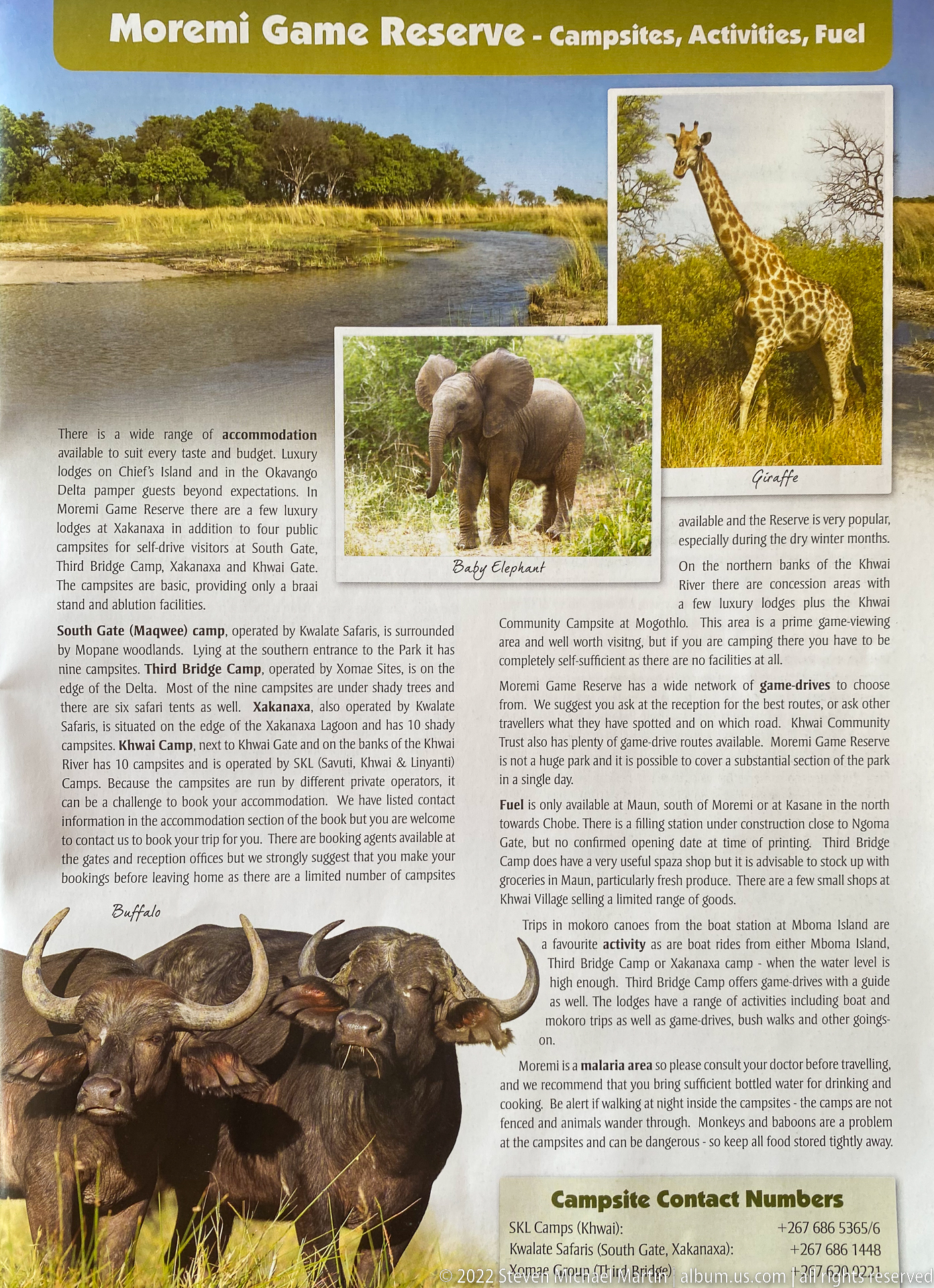
At the heart of the Okavango Delta lies Chief’s Island, the largest landmass within the delta and one of Botswana’s premier wildlife regions. The island was once reserved as a royal hunting ground for local leaders, allowing the area’s wildlife populations to remain largely undisturbed.
Today Chief’s Island forms a core part of the protected wilderness within the delta and supports remarkable concentrations of animals. Elephants, buffalo, lions, leopards, and numerous other species roam the grasslands and woodlands that rise above the surrounding seasonal floodwaters.
Because of its abundant wildlife and pristine environment, Chief’s Island is considered one of the finest safari destinations in Africa.
Photos:
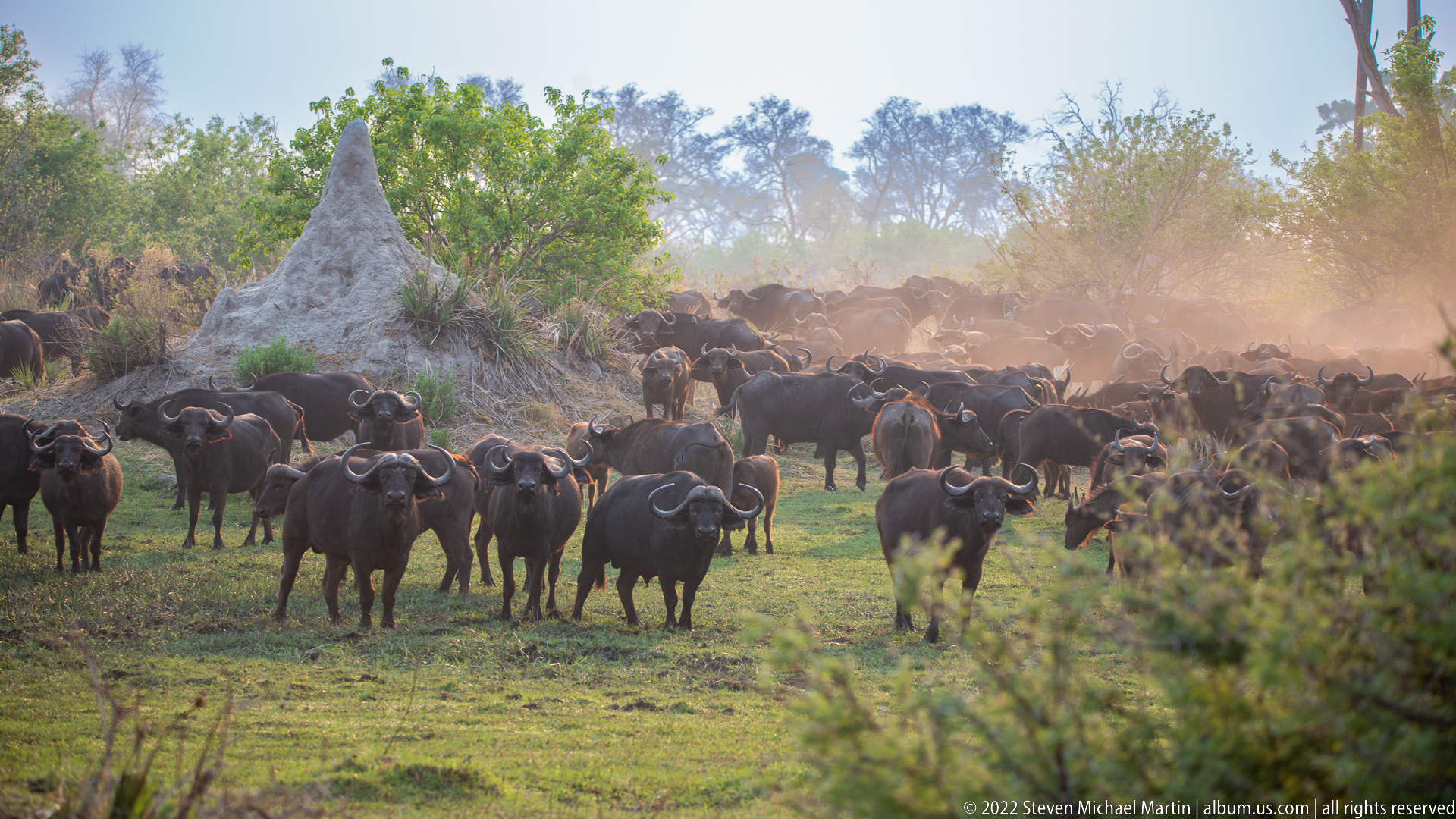
A buffalo herd fills the clearing around a towering termite mound, with several animals approaching the foreground while the larger group recedes into dusty shade. Compared with the wider preceding view, this frame places the mound closer to the left edge and gives greater prominence to individual horned faces at the front of the herd.
Caption
A buffalo herd fills the clearing around a towering termite mound, with several animals approaching the foreground while the larger group recedes into dusty shade. Compared with the wider preceding view, this frame places the mound closer to the left edge and gives greater prominence to individual horned faces at the front of the herd.

An African bush elephant advances toward the camera through tawny grass and broken woodland, trunk lifted vertically and tusks exposed on either side of the face. The raised trunk gives the portrait a strong behavioral focus, while the large ears, wrinkled skin, and open savanna setting provide clear species and habitat cues.
Caption
An African bush elephant advances toward the camera through tawny grass and broken woodland, trunk lifted vertically and tusks exposed on either side of the face. The raised trunk gives the portrait a strong behavioral focus, while the large ears, wrinkled skin, and open savanna setting provide clear species and habitat cues.

A white-clothed dining table is arranged beneath large canvas parasols at the edge of the Chief’s Island floodplain. Place settings, bottles, floral or grass arrangements, chairs, and side tables face an expansive green wetland, turning the meal setup into a deliberately framed landscape experience. The scene records the hospitality side of safari travel without losing the surrounding wilderness context.
Caption
A white-clothed dining table is arranged beneath large canvas parasols at the edge of the Chief’s Island floodplain. Place settings, bottles, floral or grass arrangements, chairs, and side tables face an expansive green wetland, turning the meal setup into a deliberately framed landscape experience. The scene records the hospitality side of safari travel without losing the surrounding wilderness context.

A common hippopotamus stands on open green floodplain grass, facing slightly toward the camera. Out of water, its barrel-shaped torso, short columnar legs, broad muzzle, small ears, and high-set eyes are especially apparent, presenting the massive proportions of this semiaquatic grazer against the wetland landscape.
Caption
A common hippopotamus stands on open green floodplain grass, facing slightly toward the camera. Out of water, its barrel-shaped torso, short columnar legs, broad muzzle, small ears, and high-set eyes are especially apparent, presenting the massive proportions of this semiaquatic grazer against the wetland landscape.

A raised canvas safari tent sits beneath large shade trees on Chief’s Island, its broad peaked awning sheltering a wooden veranda with railings, chairs, and an open entrance. The structure is integrated into dry woodland rather than isolated from it, with mature trunks immediately beside the platform and natural ground left largely undisturbed.
Caption
A raised canvas safari tent sits beneath large shade trees on Chief’s Island, its broad peaked awning sheltering a wooden veranda with railings, chairs, and an open entrance. The structure is integrated into dry woodland rather than isolated from it, with mature trunks immediately beside the platform and natural ground left largely undisturbed.
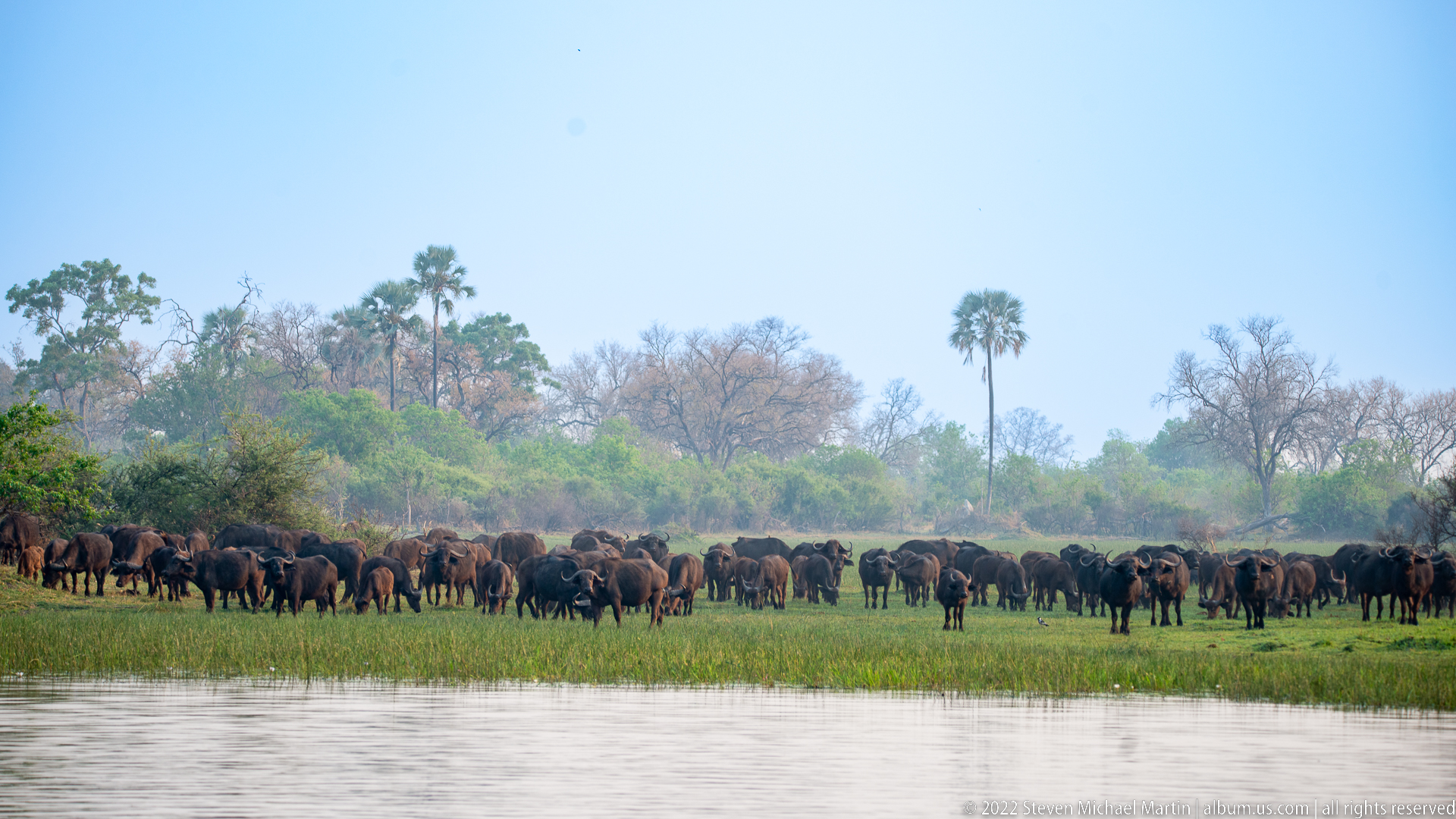
A large herd of African buffalo stretches across a green floodplain beyond a strip of open water, forming a dense dark band beneath palms and mixed woodland. The wide view shifts attention from individual animals to herd scale and habitat, showing how buffalo congregate along the productive wetland margins of Chief’s Island.
Caption
A large herd of African buffalo stretches across a green floodplain beyond a strip of open water, forming a dense dark band beneath palms and mixed woodland. The wide view shifts attention from individual animals to herd scale and habitat, showing how buffalo congregate along the productive wetland margins of Chief’s Island.
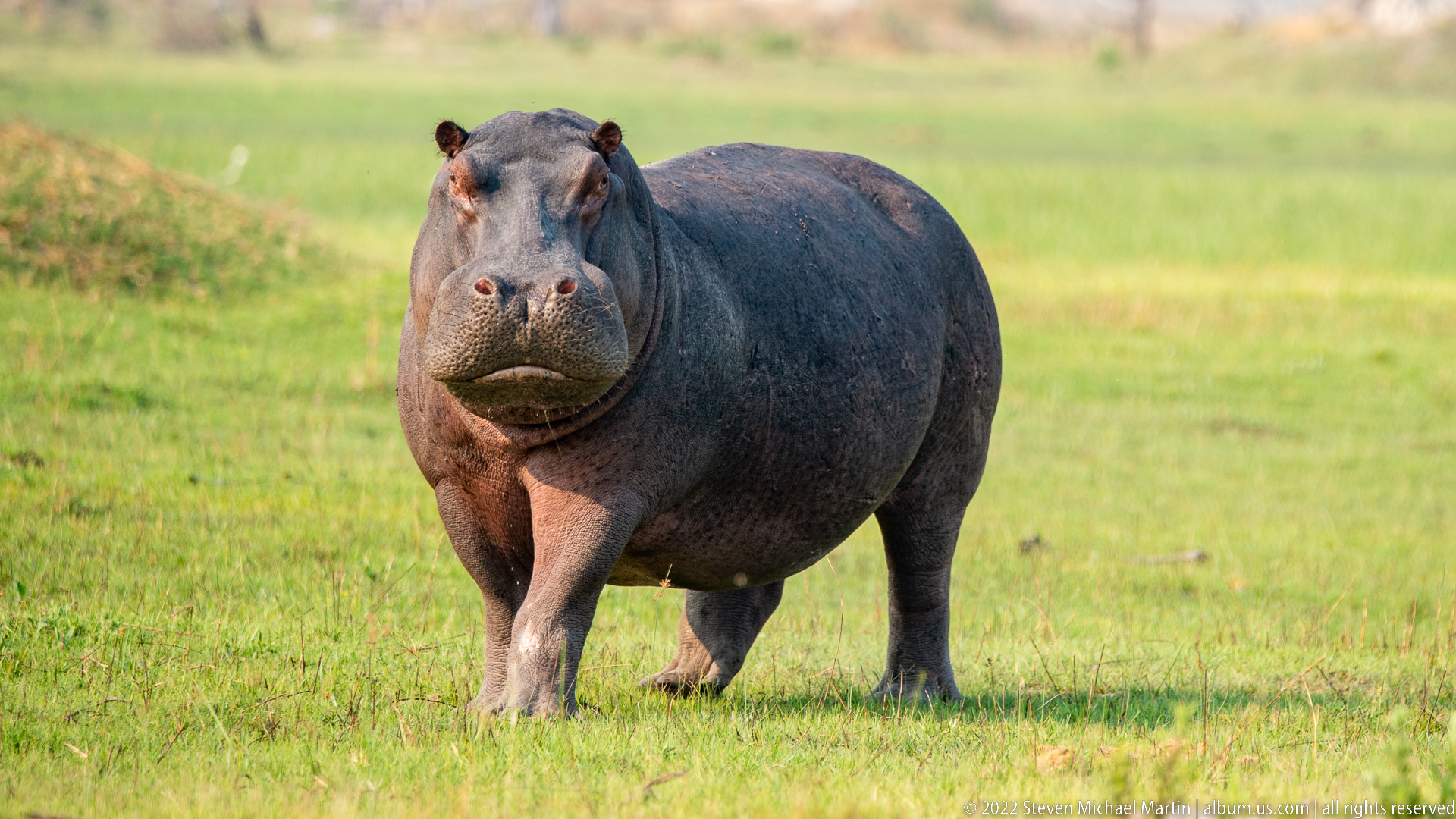
A hippopotamus faces almost squarely toward the camera on a sunlit grassland, its broad head and rounded body isolated from the soft green background. The frontal stance emphasizes the animal’s small ears and eyes, expansive muzzle, and thick limbs, while warm light models the folds and texture of its skin.
Caption
A hippopotamus faces almost squarely toward the camera on a sunlit grassland, its broad head and rounded body isolated from the soft green background. The frontal stance emphasizes the animal’s small ears and eyes, expansive muzzle, and thick limbs, while warm light models the folds and texture of its skin.

A group of lion cubs lounges on green grass, with one youngster sitting upright behind two reclining companions and another cub facing the camera from the right. Shallow water fills the background, while reeds partially divide the group in the foreground. The different head positions give this frame a layered view of alertness and rest within the same litter group.
Caption
A group of lion cubs lounges on green grass, with one youngster sitting upright behind two reclining companions and another cub facing the camera from the right. Shallow water fills the background, while reeds partially divide the group in the foreground. The different head positions give this frame a layered view of alertness and rest within the same litter group.

Hippopotamuses cluster in the foreground channel while a large herd of African buffalo gathers across the green floodplain behind them. The layered composition brings two of Chief’s Island’s dominant large mammals into a single wetland scene, separating the semi-aquatic hippos in open water from the grazing buffalo massed along the distant bank.
Caption
Hippopotamuses cluster in the foreground channel while a large herd of African buffalo gathers across the green floodplain behind them. The layered composition brings two of Chief’s Island’s dominant large mammals into a single wetland scene, separating the semi-aquatic hippos in open water from the grazing buffalo massed along the distant bank.
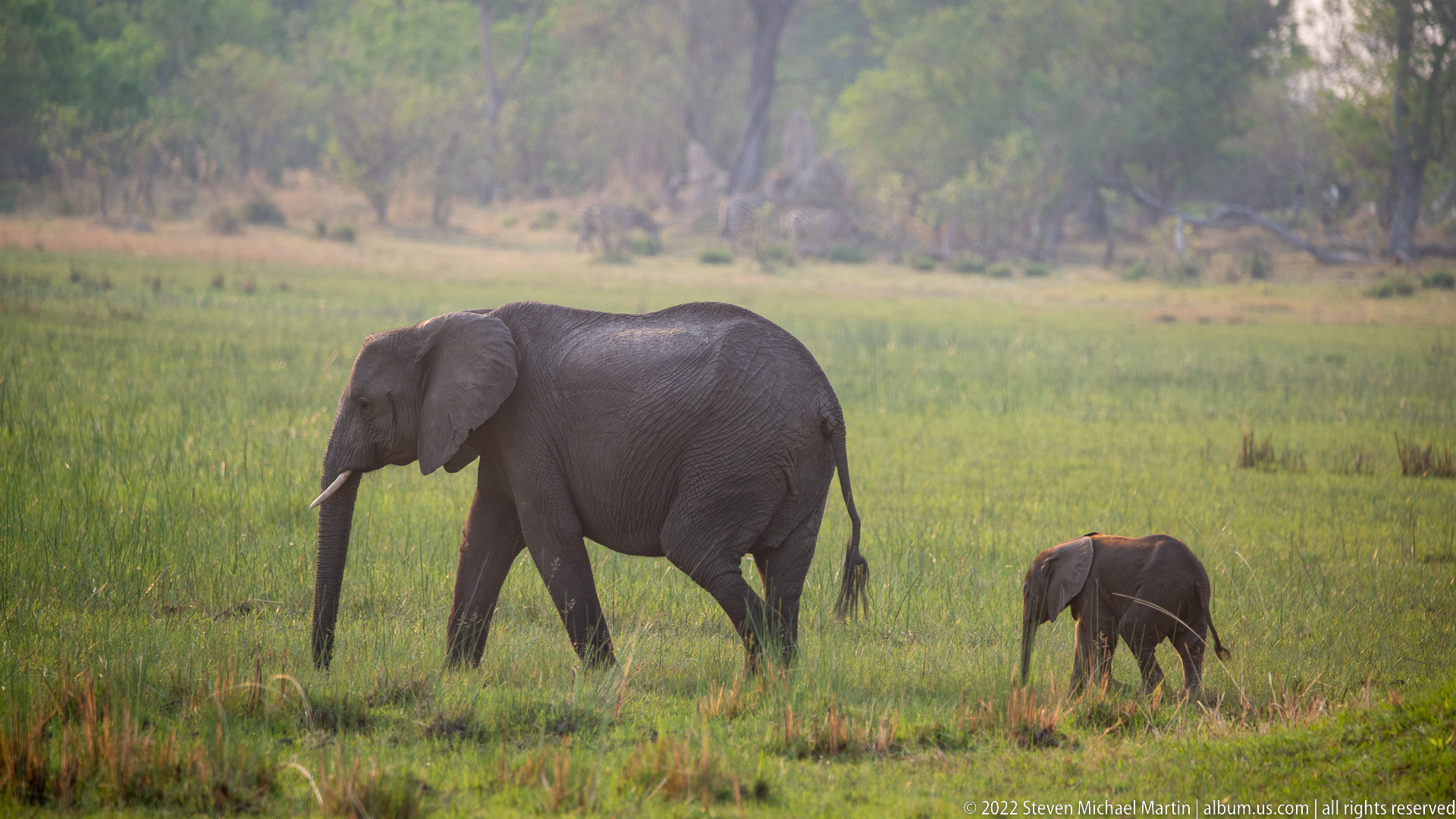
An adult African bush elephant walks through lush floodplain grass with a calf following several steps behind. The adult’s trunk hangs nearly to the ground as it moves forward, while the much smaller calf mirrors the same direction of travel. Haze and distant woodland soften the background, focusing attention on the scale difference between the two animals.
Caption
An adult African bush elephant walks through lush floodplain grass with a calf following several steps behind. The adult’s trunk hangs nearly to the ground as it moves forward, while the much smaller calf mirrors the same direction of travel. Haze and distant woodland soften the background, focusing attention on the scale difference between the two animals.
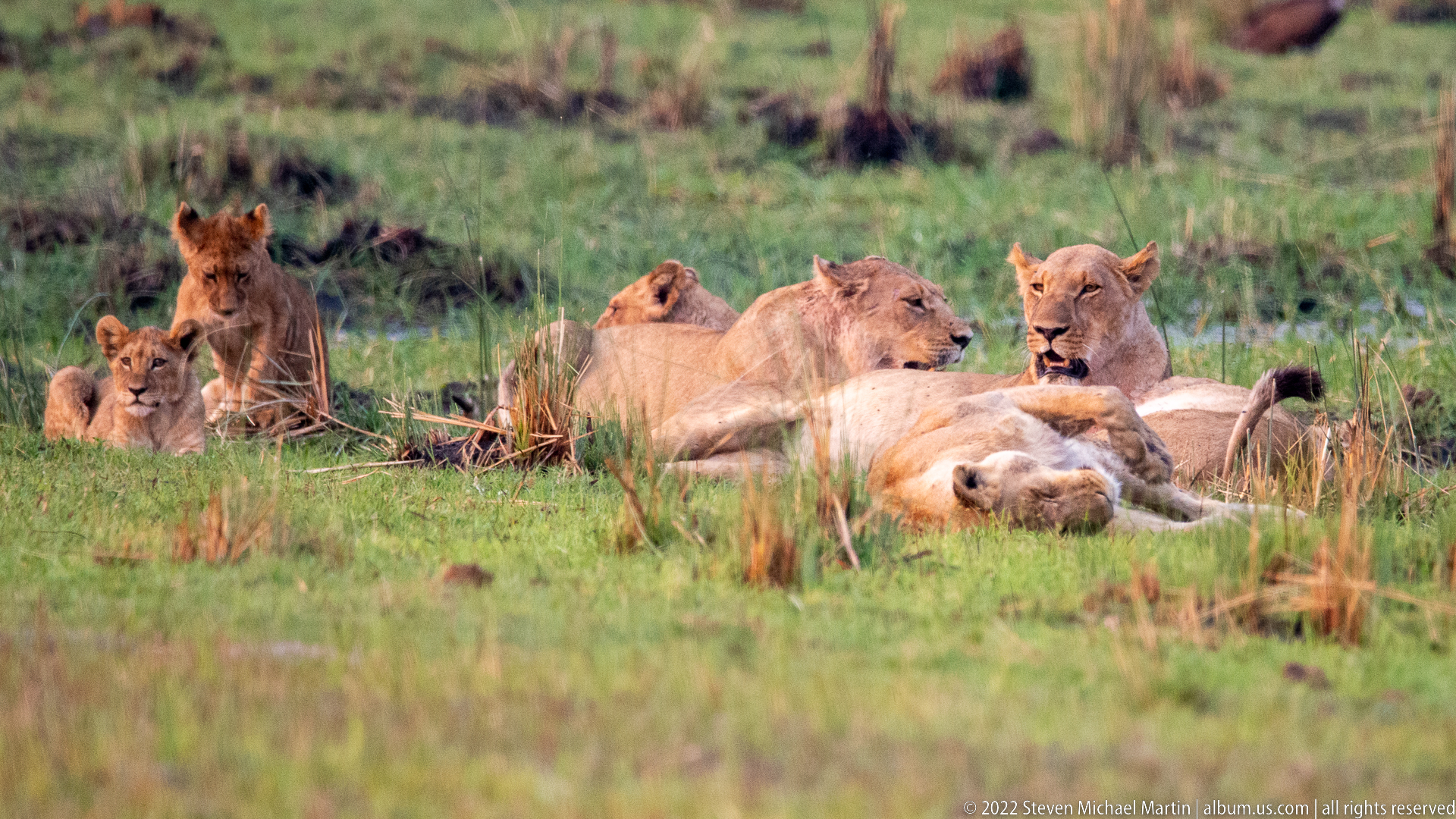
Adult lionesses and cubs gather tightly together on the floodplain, several bodies overlapping as the pride rests in grass near shallow water. One adult reclines on its side in the foreground while others sit or lie behind, and small cubs remain close to the group. The compressed composition emphasizes the pride’s physical closeness and social cohesion.
Caption
Adult lionesses and cubs gather tightly together on the floodplain, several bodies overlapping as the pride rests in grass near shallow water. One adult reclines on its side in the foreground while others sit or lie behind, and small cubs remain close to the group. The compressed composition emphasizes the pride’s physical closeness and social cohesion.
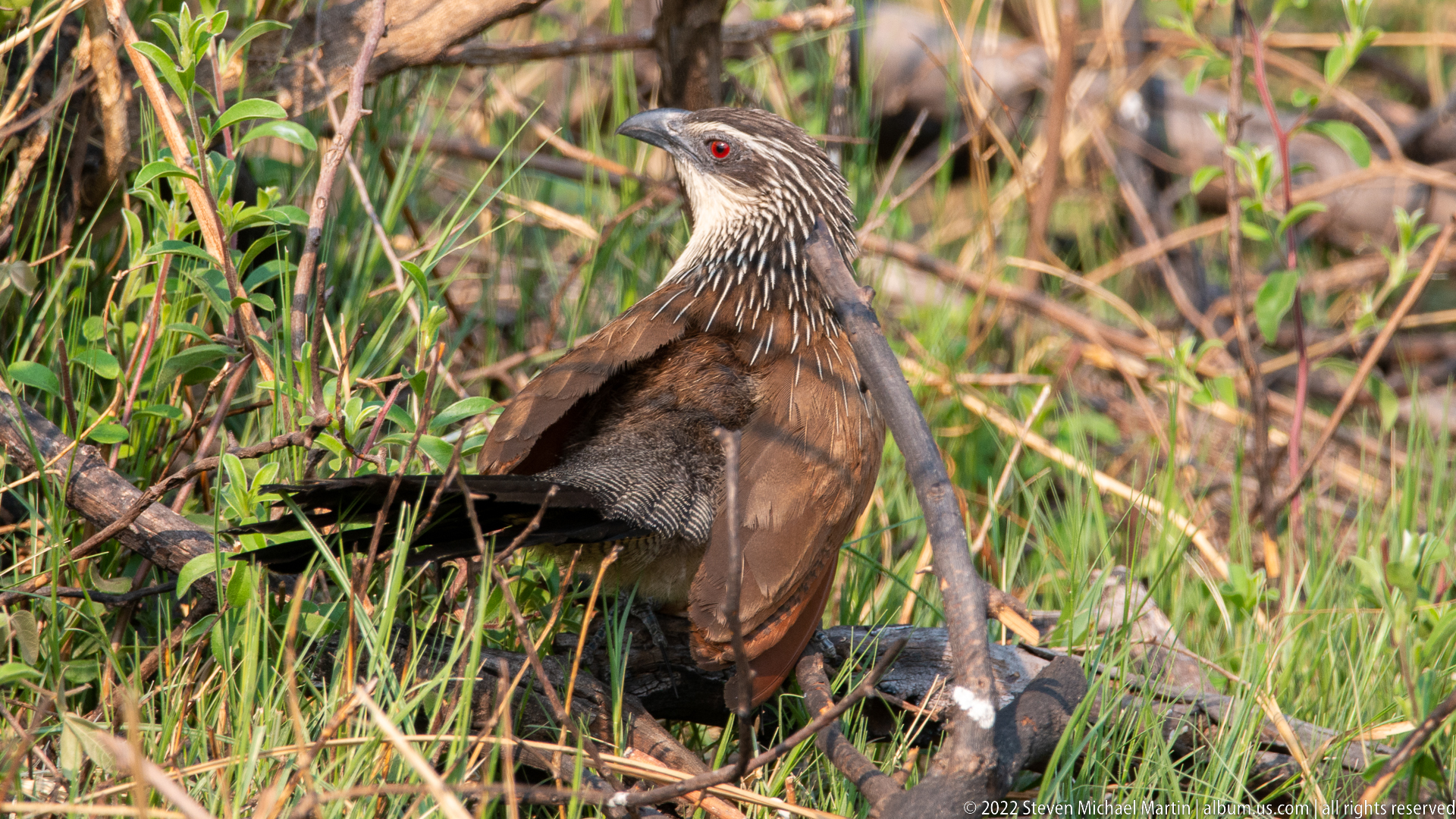
A coucal stands low among tangled wetland stems, its long dark tail stretched behind the body. The bird shows chestnut wings, a dark body, pale streaking on the head and neck, and a striking red eye—features consistent with the coppery-tailed coucal of south-central African wetlands.
Caption
A coucal stands low among tangled wetland stems, its long dark tail stretched behind the body. The bird shows chestnut wings, a dark body, pale streaking on the head and neck, and a striking red eye—features consistent with the coppery-tailed coucal of south-central African wetlands.
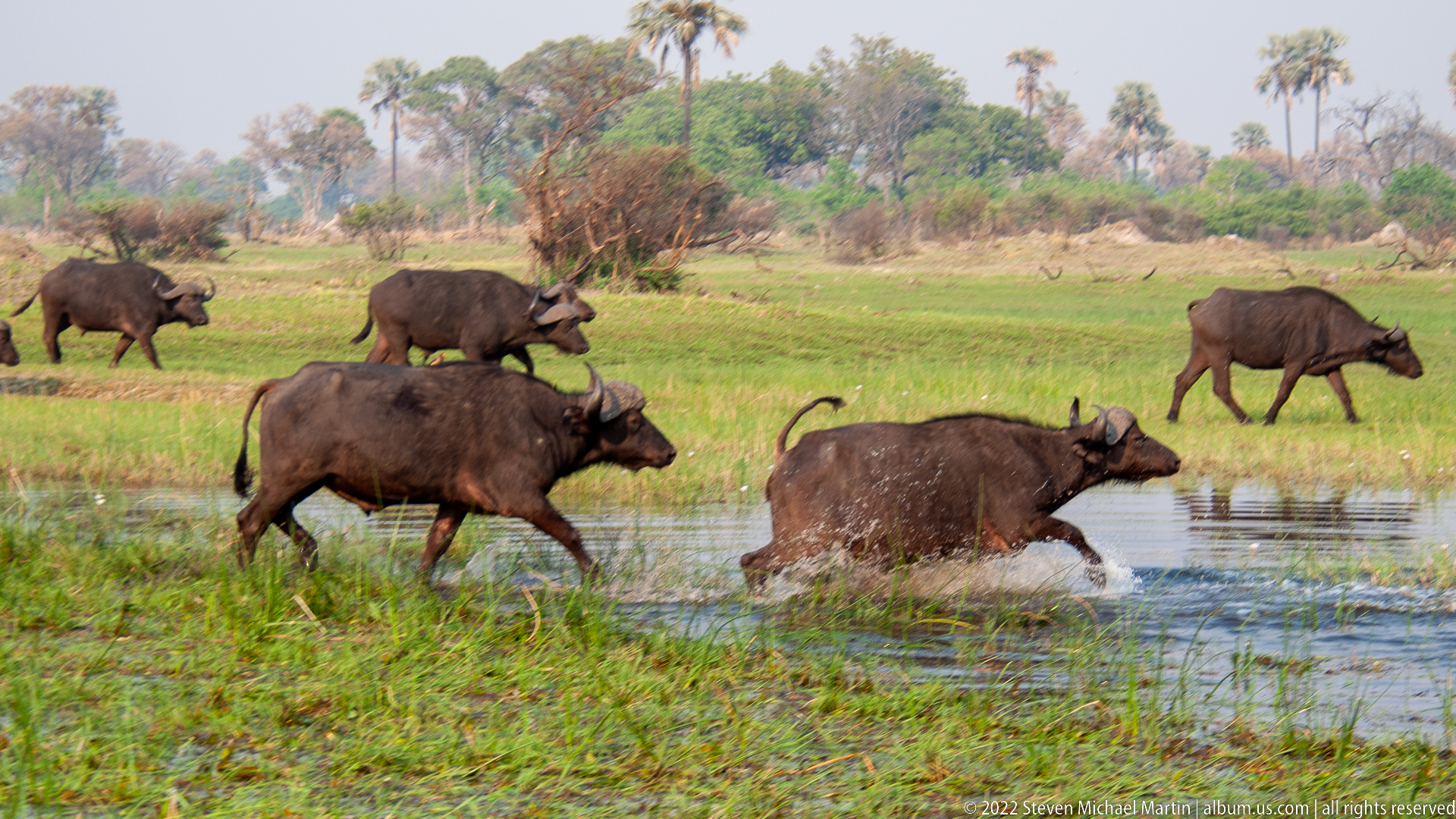
African buffalo move through a shallow, grass-fringed channel on Chief’s Island, with several animals already on firmer ground beyond the water. The leading buffalo lift their legs high through the flooded vegetation, turning a routine herd movement into a study of how large grazers negotiate the seasonally inundated margins of the Okavango Delta.
Caption
African buffalo move through a shallow, grass-fringed channel on Chief’s Island, with several animals already on firmer ground beyond the water. The leading buffalo lift their legs high through the flooded vegetation, turning a routine herd movement into a study of how large grazers negotiate the seasonally inundated margins of the Okavango Delta.
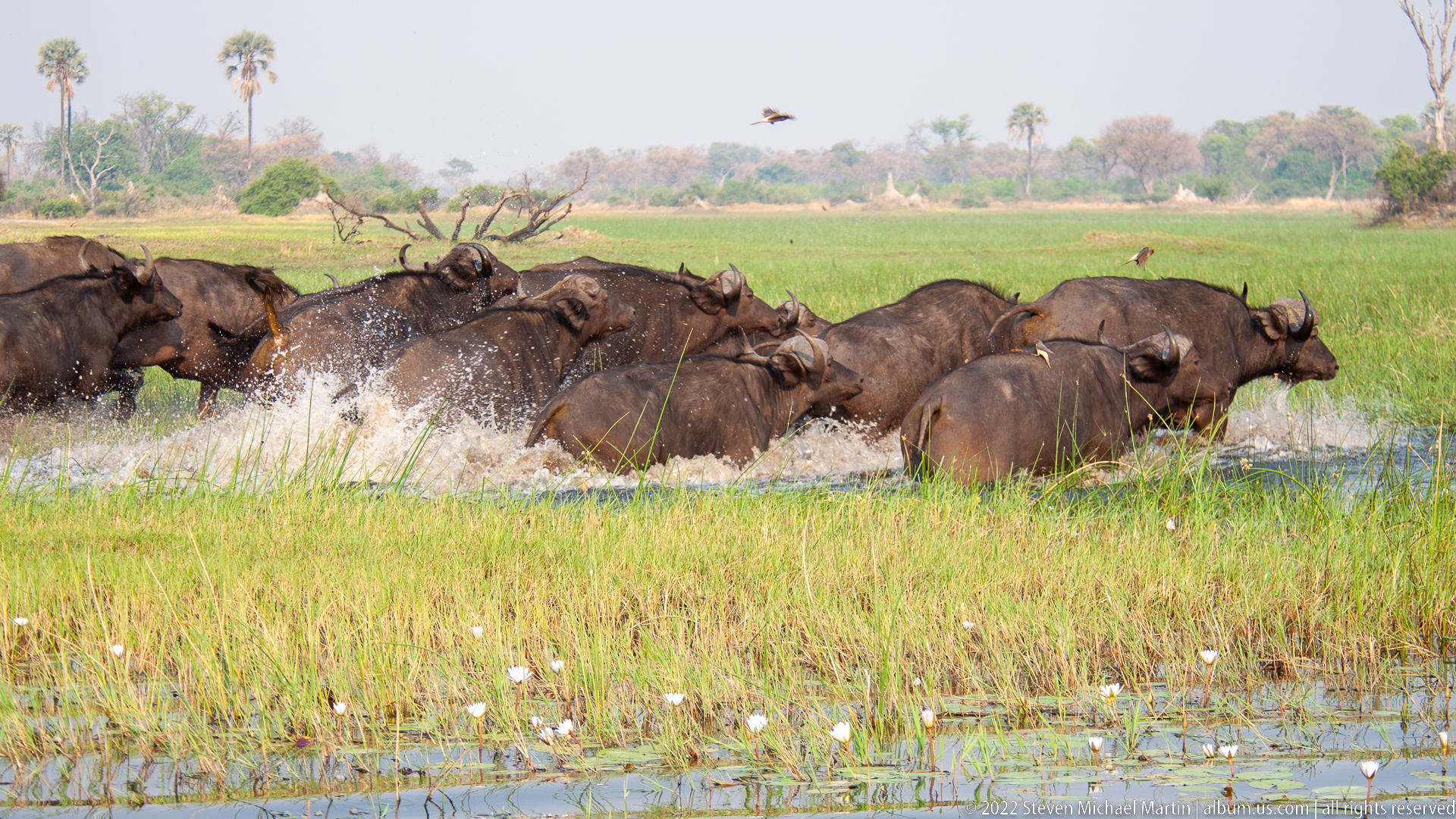
A tightly packed group of African buffalo surges through shallow water on Chief’s Island, throwing spray around their legs as they cross a flooded opening. The compressed herd, overlapping horn profiles, and bright green sedges emphasize collective movement, while the low waterline places the animals firmly within the wetland mosaic characteristic of the Okavango Delta.
Caption
A tightly packed group of African buffalo surges through shallow water on Chief’s Island, throwing spray around their legs as they cross a flooded opening. The compressed herd, overlapping horn profiles, and bright green sedges emphasize collective movement, while the low waterline places the animals firmly within the wetland mosaic characteristic of the Okavango Delta.
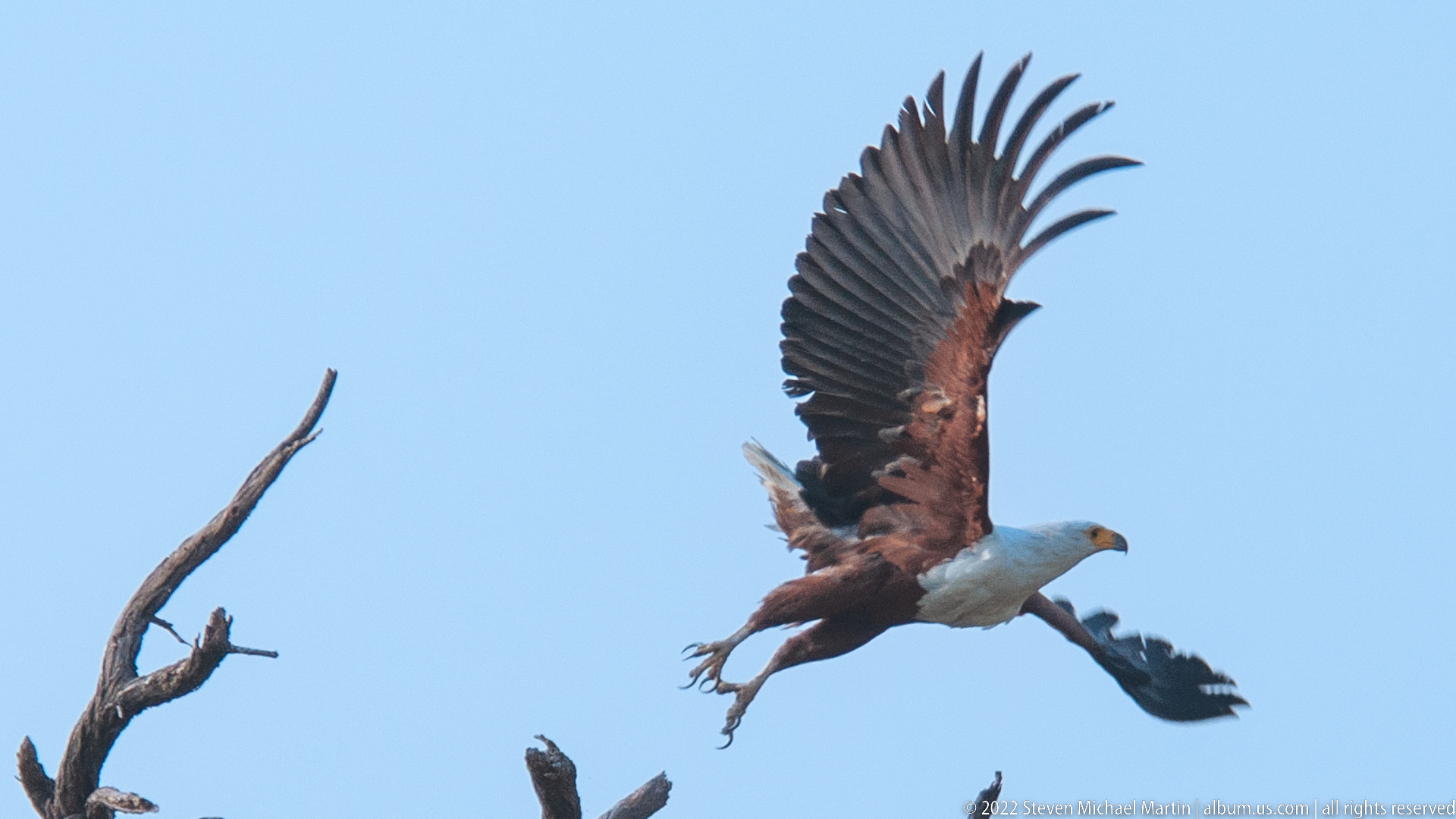
An African fish eagle launches from a bare snag against a clear blue sky, wings raised and talons still extended from the perch. Its white head and breast contrast sharply with the chestnut body and dark flight feathers, making the species’ classic plumage pattern especially legible in this dynamic departure from the branch.
Caption
An African fish eagle launches from a bare snag against a clear blue sky, wings raised and talons still extended from the perch. Its white head and breast contrast sharply with the chestnut body and dark flight feathers, making the species’ classic plumage pattern especially legible in this dynamic departure from the branch.
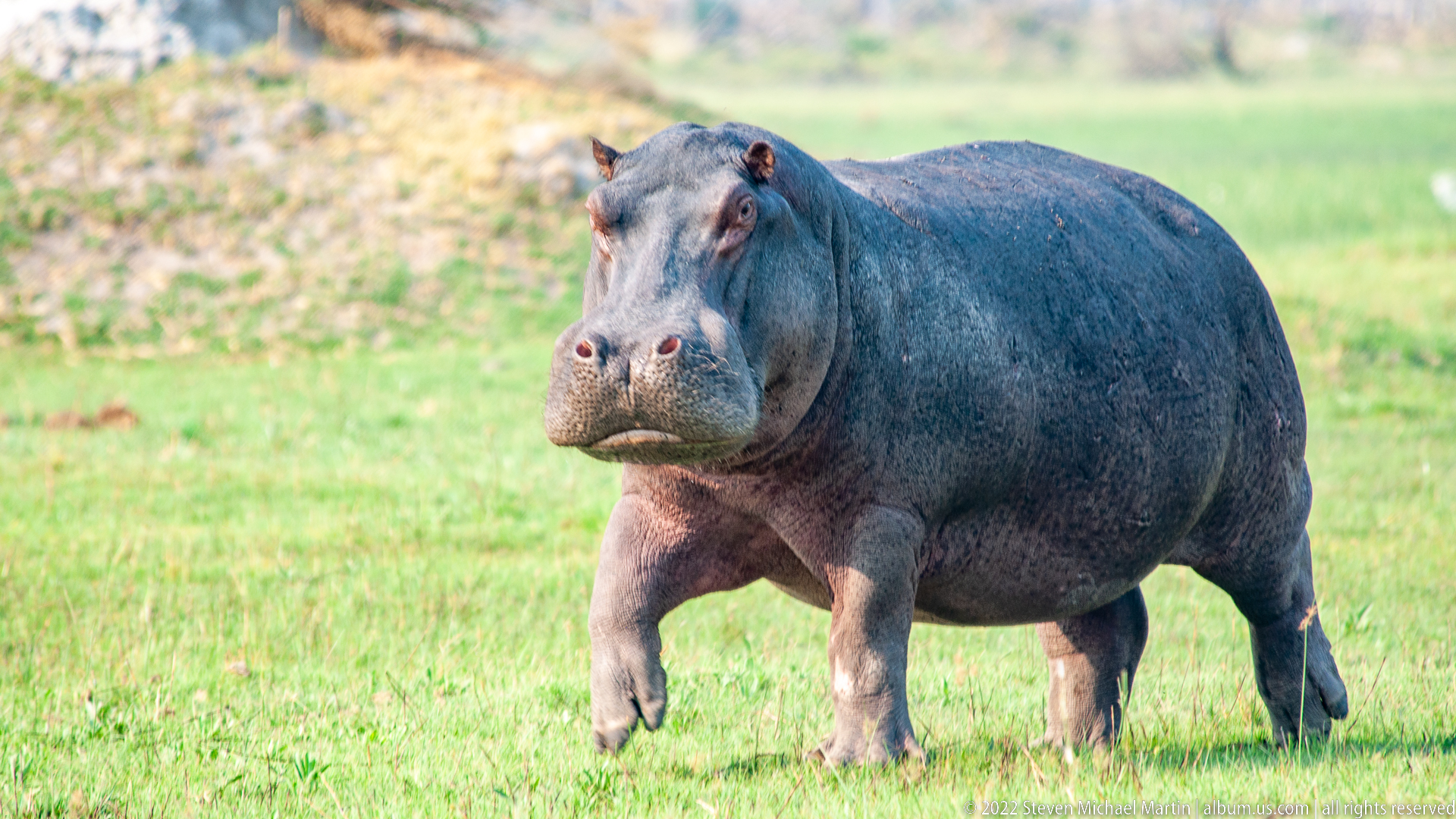
A hippopotamus stands fully out of the water on short green floodplain grass, offering an unusually unobstructed view of its barrel-shaped body, short columnar legs, broad muzzle, and small high-set ears. The frontal three-quarter pose reveals the animal’s massive terrestrial form beyond the more familiar image of hippos submerged in channels and lagoons.
Caption
A hippopotamus stands fully out of the water on short green floodplain grass, offering an unusually unobstructed view of its barrel-shaped body, short columnar legs, broad muzzle, and small high-set ears. The frontal three-quarter pose reveals the animal’s massive terrestrial form beyond the more familiar image of hippos submerged in channels and lagoons.
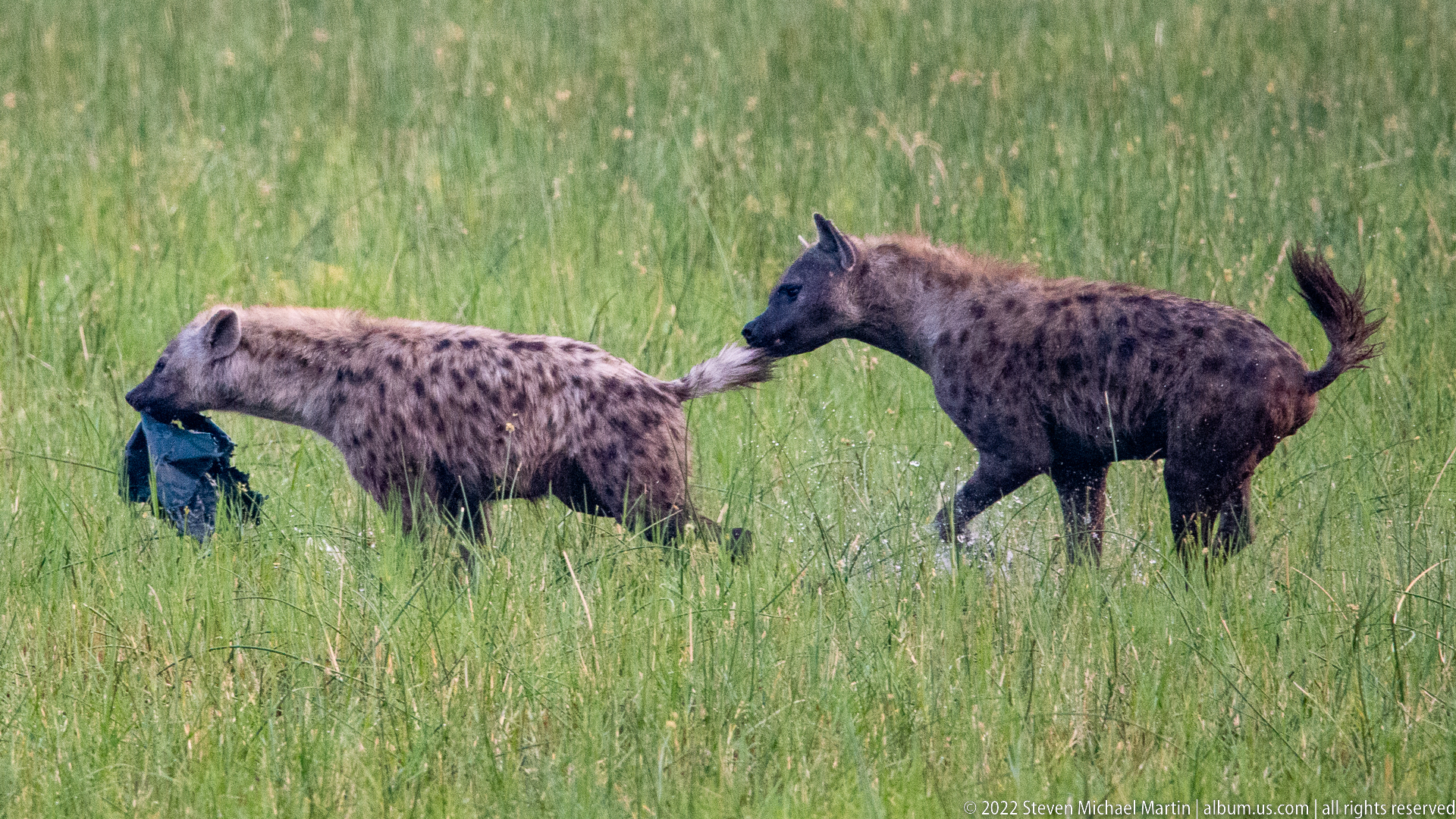
Two spotted hyenas move through tall grass while interacting with a dark object held by the animal at left. Their sloping backs, rounded ears, powerful shoulders, and mottled coats are clearly visible; the second hyena reaches toward the trailing material, creating a moment of active social or feeding behavior rather than a static portrait.
Caption
Two spotted hyenas move through tall grass while interacting with a dark object held by the animal at left. Their sloping backs, rounded ears, powerful shoulders, and mottled coats are clearly visible; the second hyena reaches toward the trailing material, creating a moment of active social or feeding behavior rather than a static portrait.
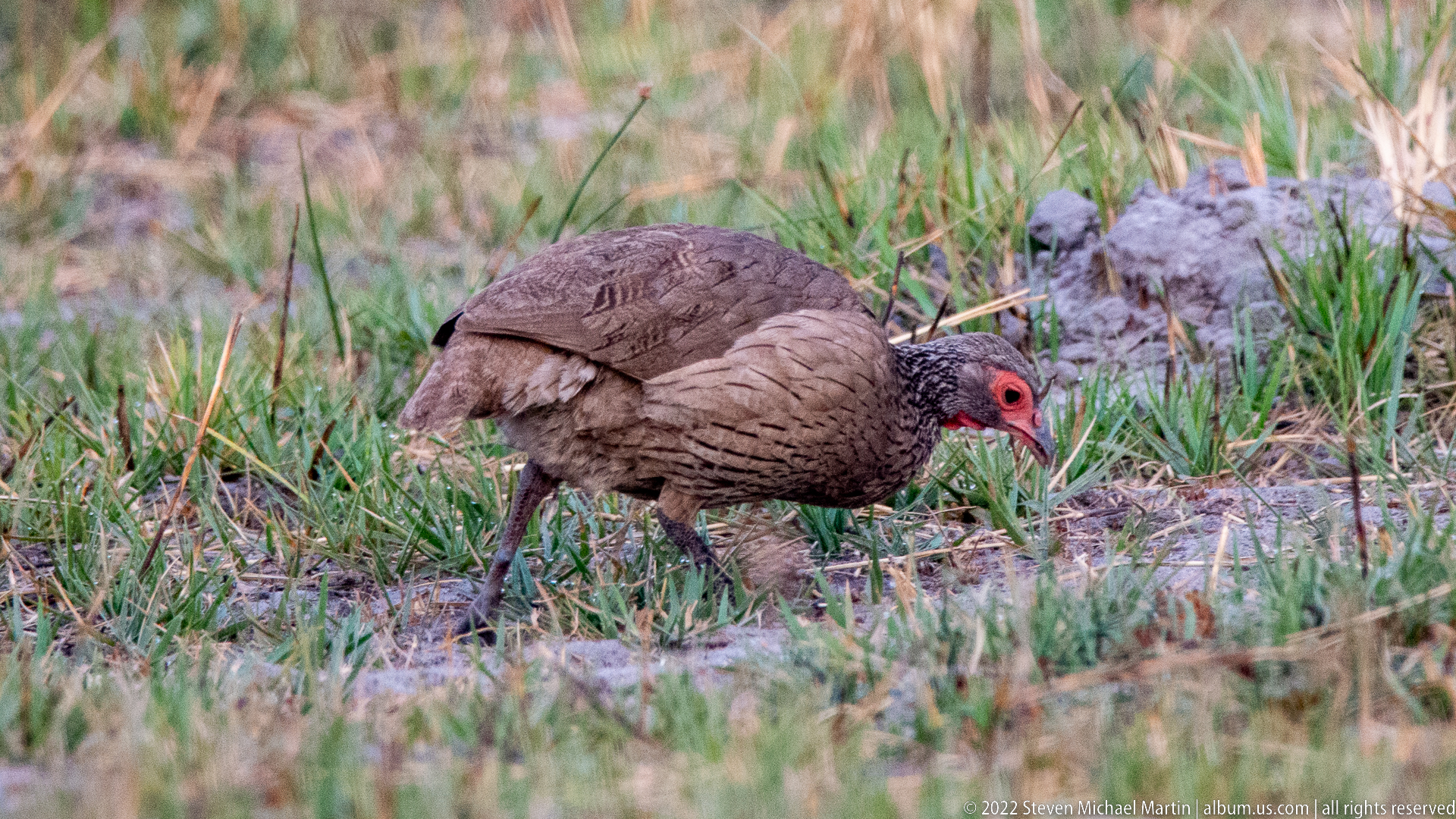
A ground-dwelling spurfowl forages among short grasses and damp soil, its brown, finely patterned plumage offset by a vivid red facial patch. The compact body, sturdy legs, and terrestrial feeding posture fit the francolin-spurfowl group common in southern African savanna and wetland margins, with the visible facial pattern most consistent with Swainson’s spurfowl.
Caption
A ground-dwelling spurfowl forages among short grasses and damp soil, its brown, finely patterned plumage offset by a vivid red facial patch. The compact body, sturdy legs, and terrestrial feeding posture fit the francolin-spurfowl group common in southern African savanna and wetland margins, with the visible facial pattern most consistent with Swainson’s spurfowl.
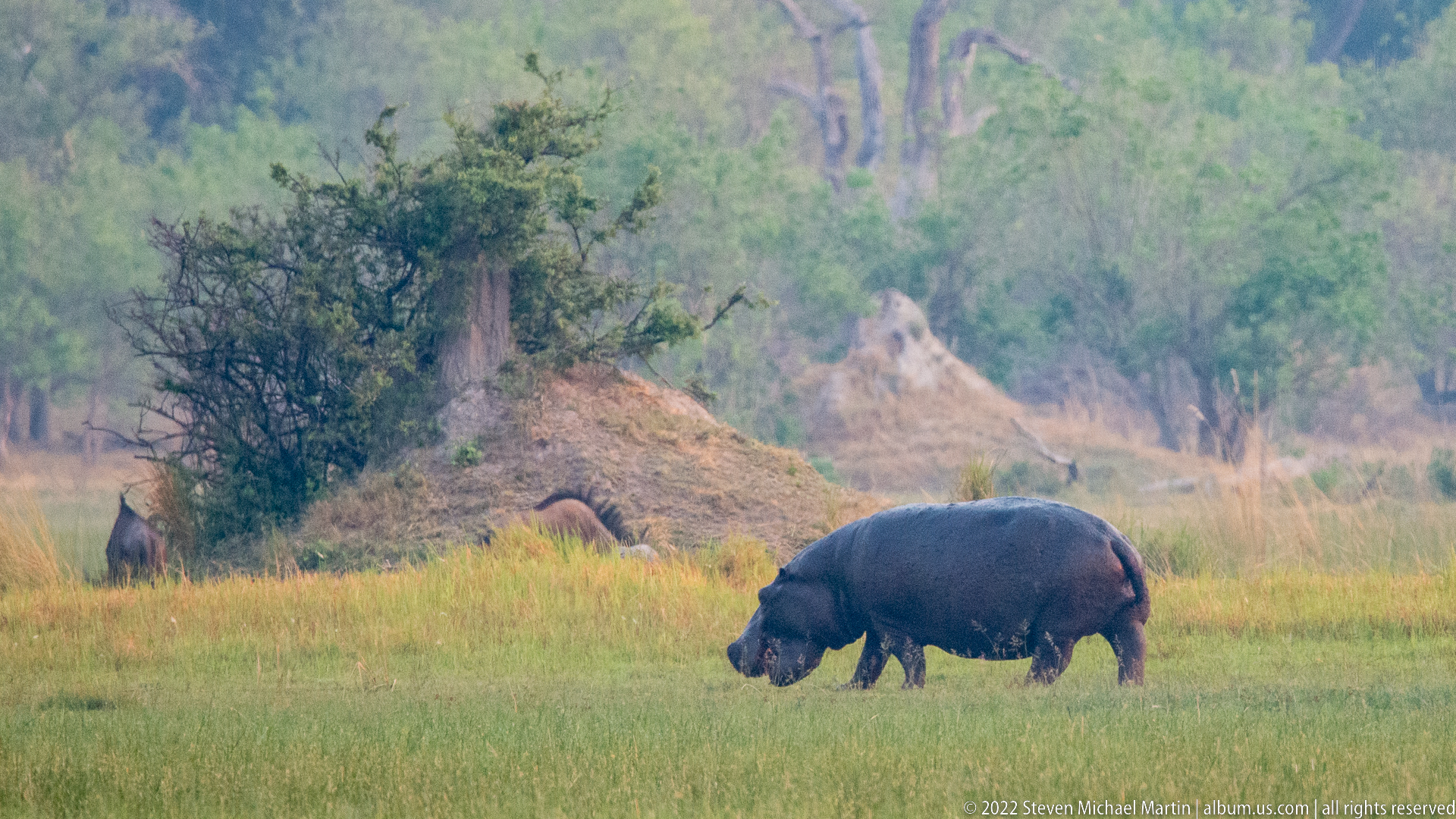
A hippopotamus grazes across a green floodplain with a large termite mound rising behind it at the edge of woodland. Seen broadside and fully terrestrial, the animal’s massive body contrasts with the fine grasses underfoot, while the mound and scattered shrubs add a distinctly savanna-wetland context to the scene on Chief’s Island.
Caption
A hippopotamus grazes across a green floodplain with a large termite mound rising behind it at the edge of woodland. Seen broadside and fully terrestrial, the animal’s massive body contrasts with the fine grasses underfoot, while the mound and scattered shrubs add a distinctly savanna-wetland context to the scene on Chief’s Island.

An adult plains zebra stands beside a young foal in open, dry-season woodland. The foal’s narrower frame and softer brown-toned striping contrast with the adult’s crisp black-and-white pattern, while their close spacing suggests the protective association typical of mare-and-foal pairs. Warm grasses and scattered shrubs frame the two animals without obscuring their markings.
Caption
An adult plains zebra stands beside a young foal in open, dry-season woodland. The foal’s narrower frame and softer brown-toned striping contrast with the adult’s crisp black-and-white pattern, while their close spacing suggests the protective association typical of mare-and-foal pairs. Warm grasses and scattered shrubs frame the two animals without obscuring their markings.
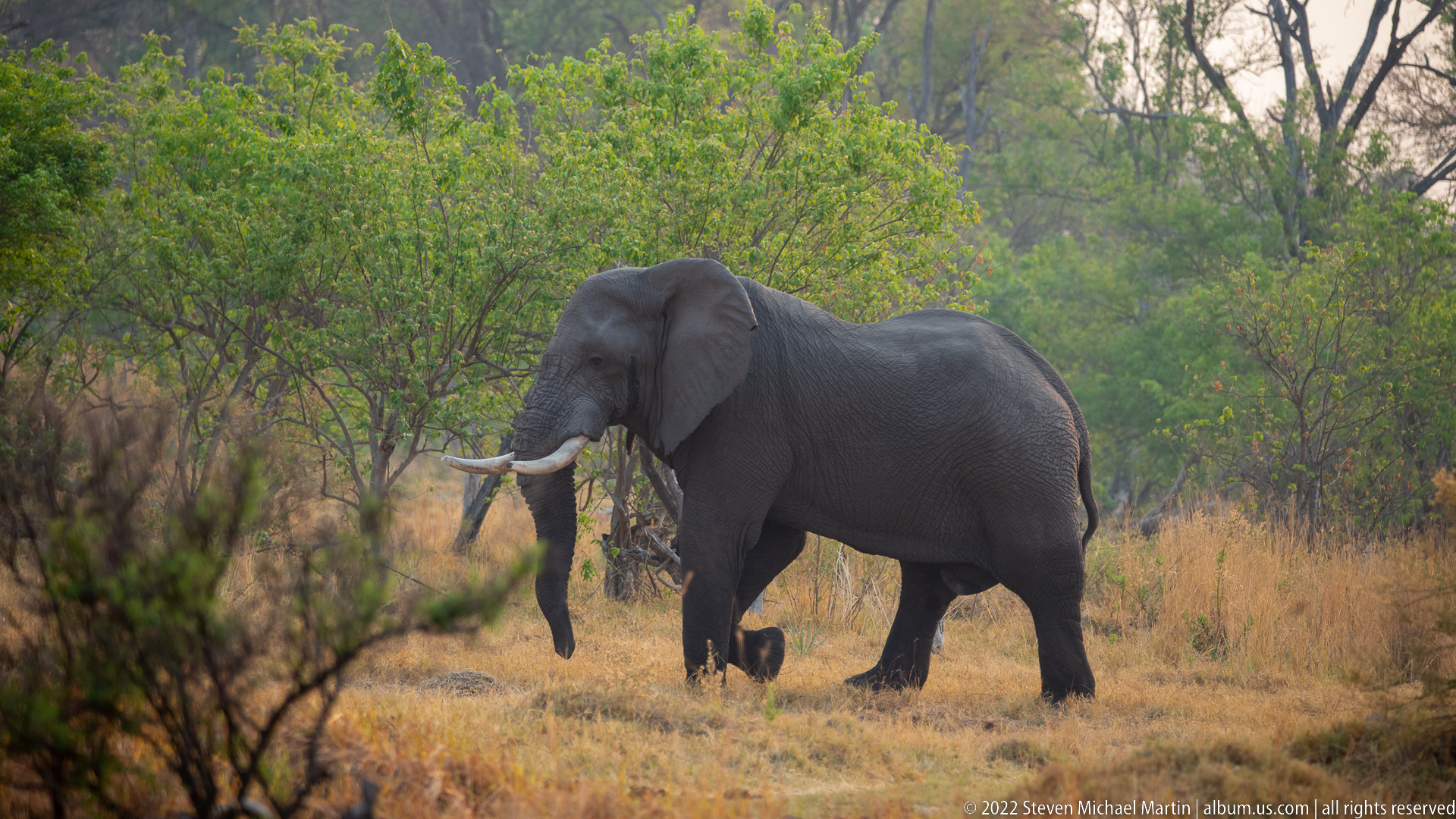
A solitary African bush elephant walks in profile across pale dry grass at the edge of dense green woodland. Its long tusks angle forward while the trunk hangs relaxed near the ground, producing a quieter counterpoint to the preceding frontal view. The side-on stance clearly shows the animal’s shoulder height, broad ear, and heavy, columnar legs.
Caption
A solitary African bush elephant walks in profile across pale dry grass at the edge of dense green woodland. Its long tusks angle forward while the trunk hangs relaxed near the ground, producing a quieter counterpoint to the preceding frontal view. The side-on stance clearly shows the animal’s shoulder height, broad ear, and heavy, columnar legs.
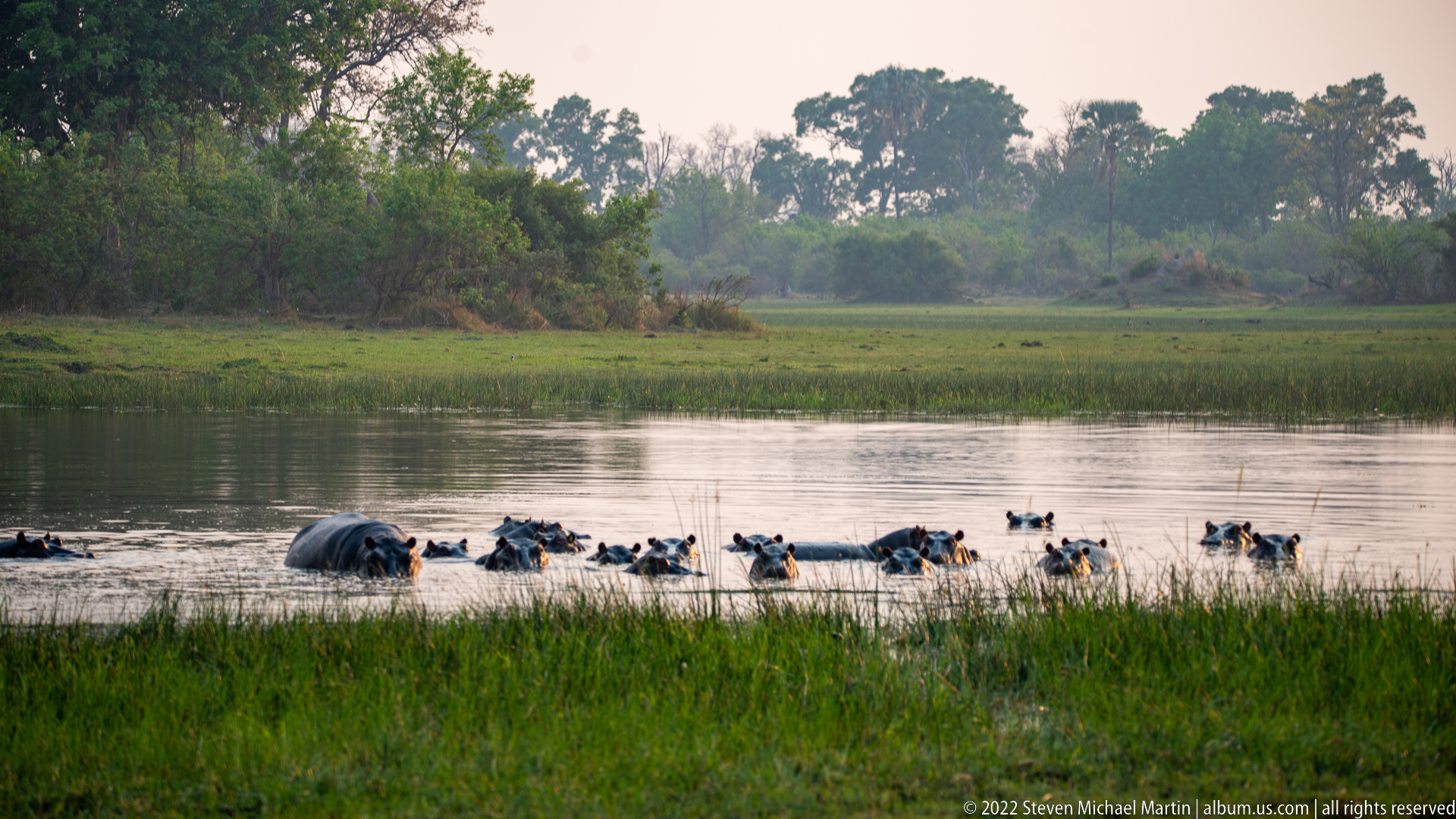
A broad line of hippopotamuses rests almost fully submerged in a calm channel, with only heads, ears, eyes, and portions of backs breaking the water’s surface. Seen from a distance, the pod forms a low horizontal band between reflective water and green floodplain vegetation, emphasizing the species’ strongly aquatic daytime behavior.
Caption
A broad line of hippopotamuses rests almost fully submerged in a calm channel, with only heads, ears, eyes, and portions of backs breaking the water’s surface. Seen from a distance, the pod forms a low horizontal band between reflective water and green floodplain vegetation, emphasizing the species’ strongly aquatic daytime behavior.

A hippopotamus pushes forward through a channel with its head raised above the surface, water folding around the shoulders and muzzle. The low viewpoint brings the animal close to eye level and isolates its rounded ears, high-set eyes, broad snout, and glistening skin against the rippled water, creating an intimate aquatic portrait.
Caption
A hippopotamus pushes forward through a channel with its head raised above the surface, water folding around the shoulders and muzzle. The low viewpoint brings the animal close to eye level and isolates its rounded ears, high-set eyes, broad snout, and glistening skin against the rippled water, creating an intimate aquatic portrait.
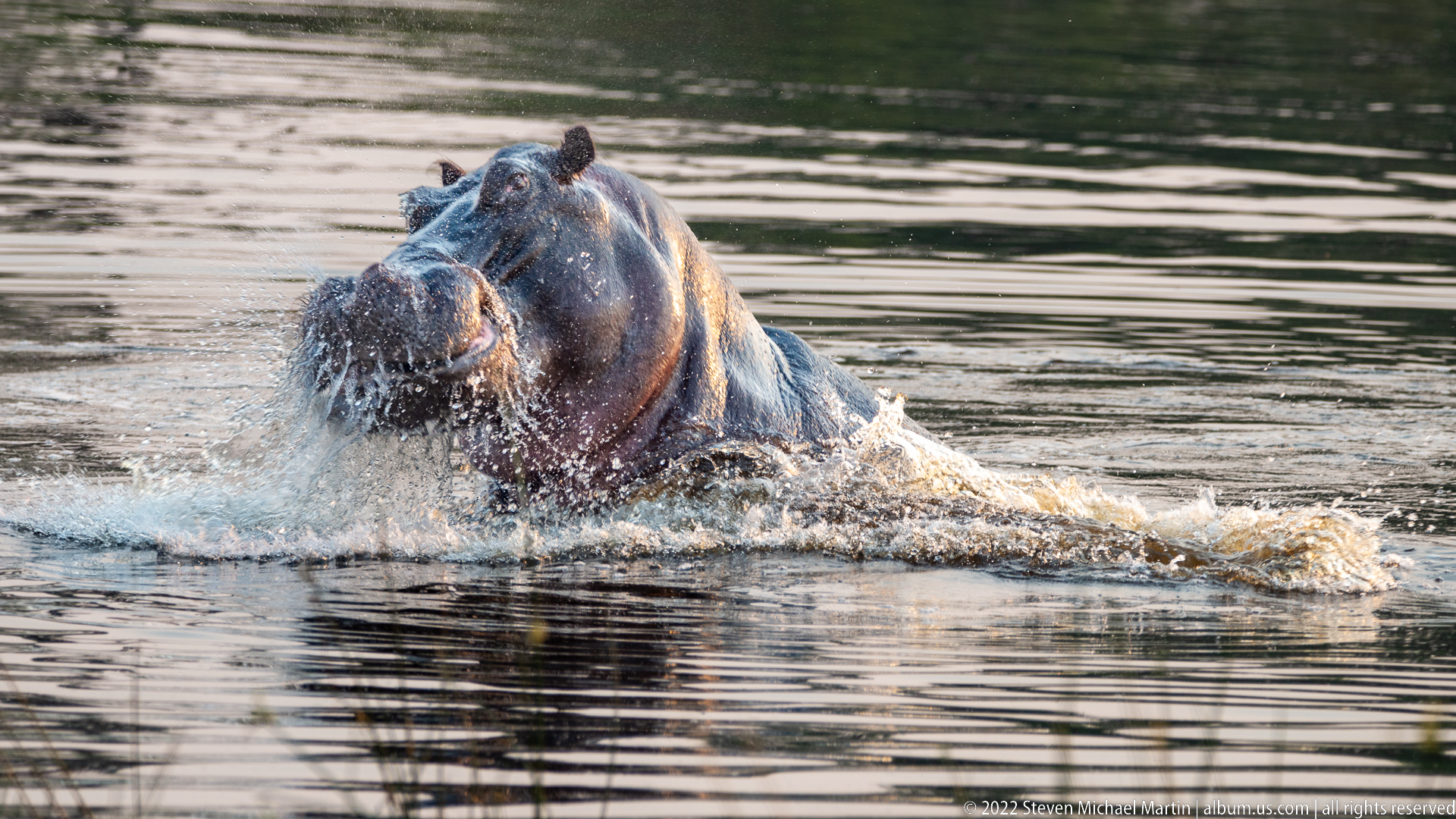
A hippopotamus surges through the channel, throwing a curtain of spray around its face and shoulders. The animal’s momentum is conveyed by the bow wave and droplets suspended across the frame, while the broad muzzle and high-set eyes remain visible through the splash. This view emphasizes forceful movement rather than the species’ more familiar stationary, half-submerged posture.
Caption
A hippopotamus surges through the channel, throwing a curtain of spray around its face and shoulders. The animal’s momentum is conveyed by the bow wave and droplets suspended across the frame, while the broad muzzle and high-set eyes remain visible through the splash. This view emphasizes forceful movement rather than the species’ more familiar stationary, half-submerged posture.

A hippopotamus opens its jaws widely while moving through shallow water, exposing the large canines, incisors, and pink interior of the mouth. Spray arcs from the lower jaw as the animal turns slightly in profile. The dramatic gape displays the formidable dental anatomy used in threat displays and combat, though the photograph alone does not establish the behavior’s immediate cause.
Caption
A hippopotamus opens its jaws widely while moving through shallow water, exposing the large canines, incisors, and pink interior of the mouth. Spray arcs from the lower jaw as the animal turns slightly in profile. The dramatic gape displays the formidable dental anatomy used in threat displays and combat, though the photograph alone does not establish the behavior’s immediate cause.
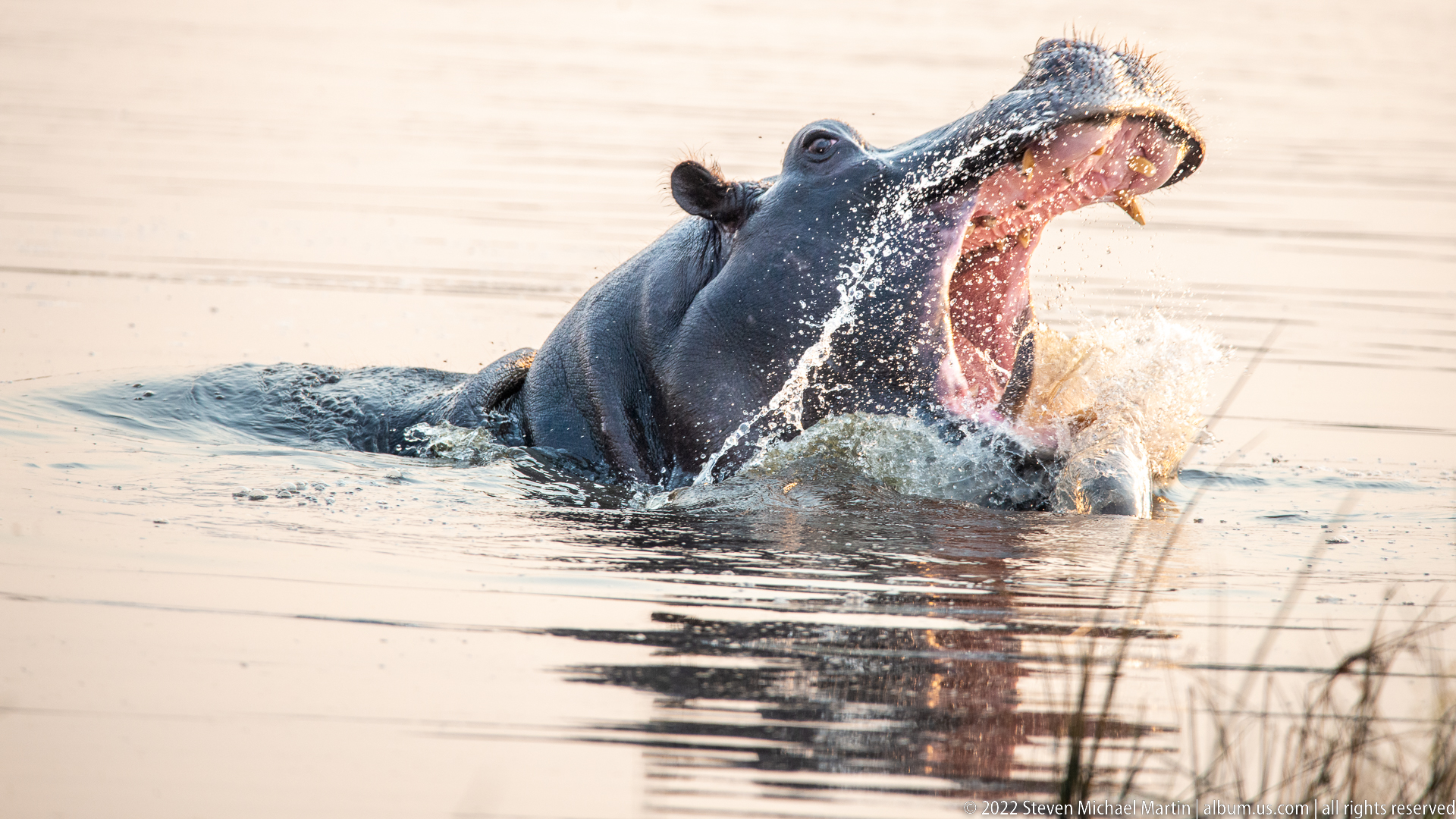
A hippopotamus lifts its head from the water and opens its mouth to an extreme gape, exposing long lower canines and the deep pink oral cavity. Backlit droplets sparkle along the upper jaw and whiskered muzzle, while the rest of the animal remains mostly submerged. The close framing makes the gape and dental structure the central visual subject.
Caption
A hippopotamus lifts its head from the water and opens its mouth to an extreme gape, exposing long lower canines and the deep pink oral cavity. Backlit droplets sparkle along the upper jaw and whiskered muzzle, while the rest of the animal remains mostly submerged. The close framing makes the gape and dental structure the central visual subject.
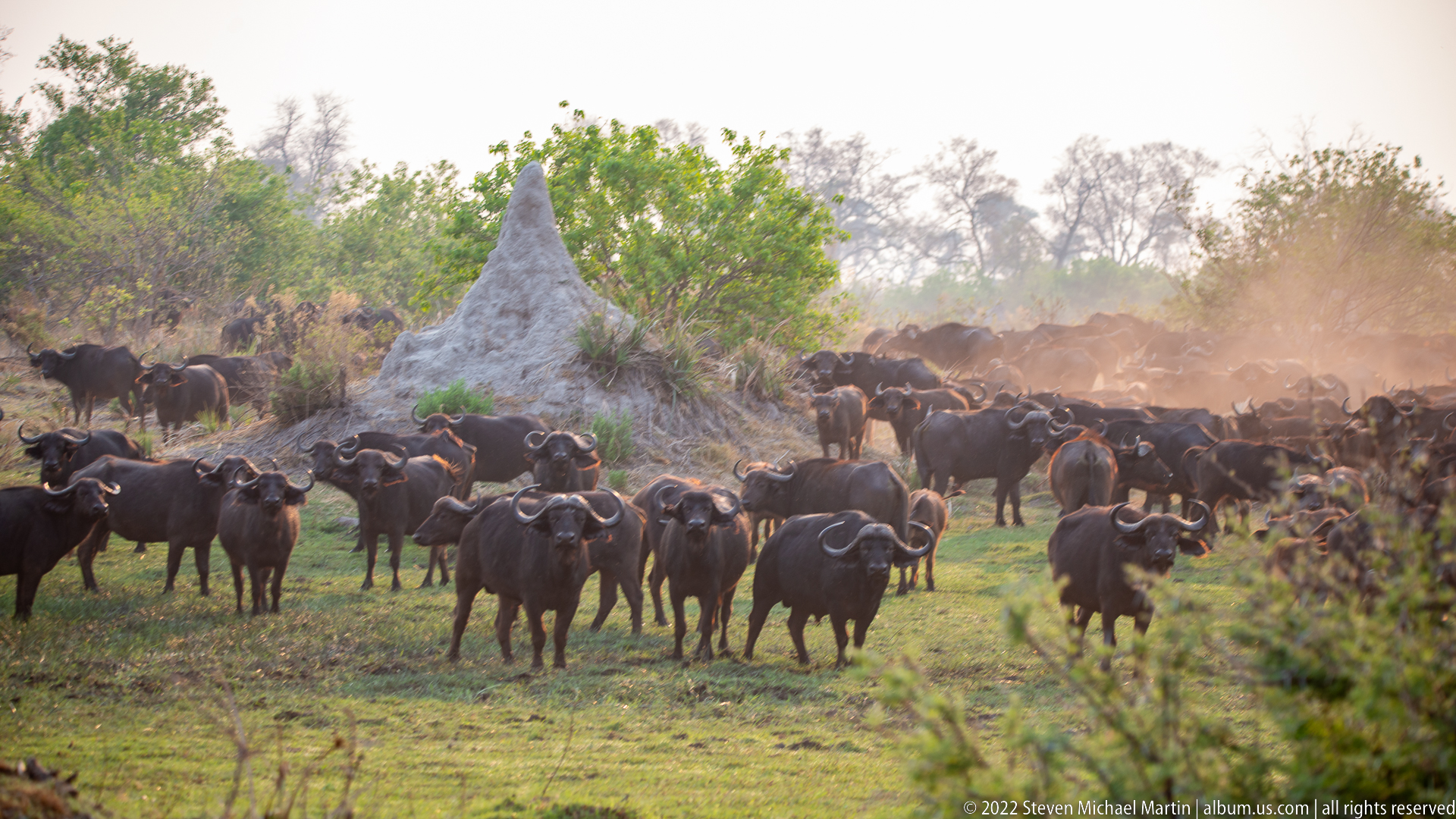
African buffalo crowd a grassy clearing around a tall conical termite mound, with dust hanging in warm light behind the herd. Several animals face the camera while others move laterally through the group, their curved horns catching the light. The mound provides a strong vertical landmark within the otherwise low floodplain vegetation and emphasizes the herd’s density.
Caption
African buffalo crowd a grassy clearing around a tall conical termite mound, with dust hanging in warm light behind the herd. Several animals face the camera while others move laterally through the group, their curved horns catching the light. The mound provides a strong vertical landmark within the otherwise low floodplain vegetation and emphasizes the herd’s density.
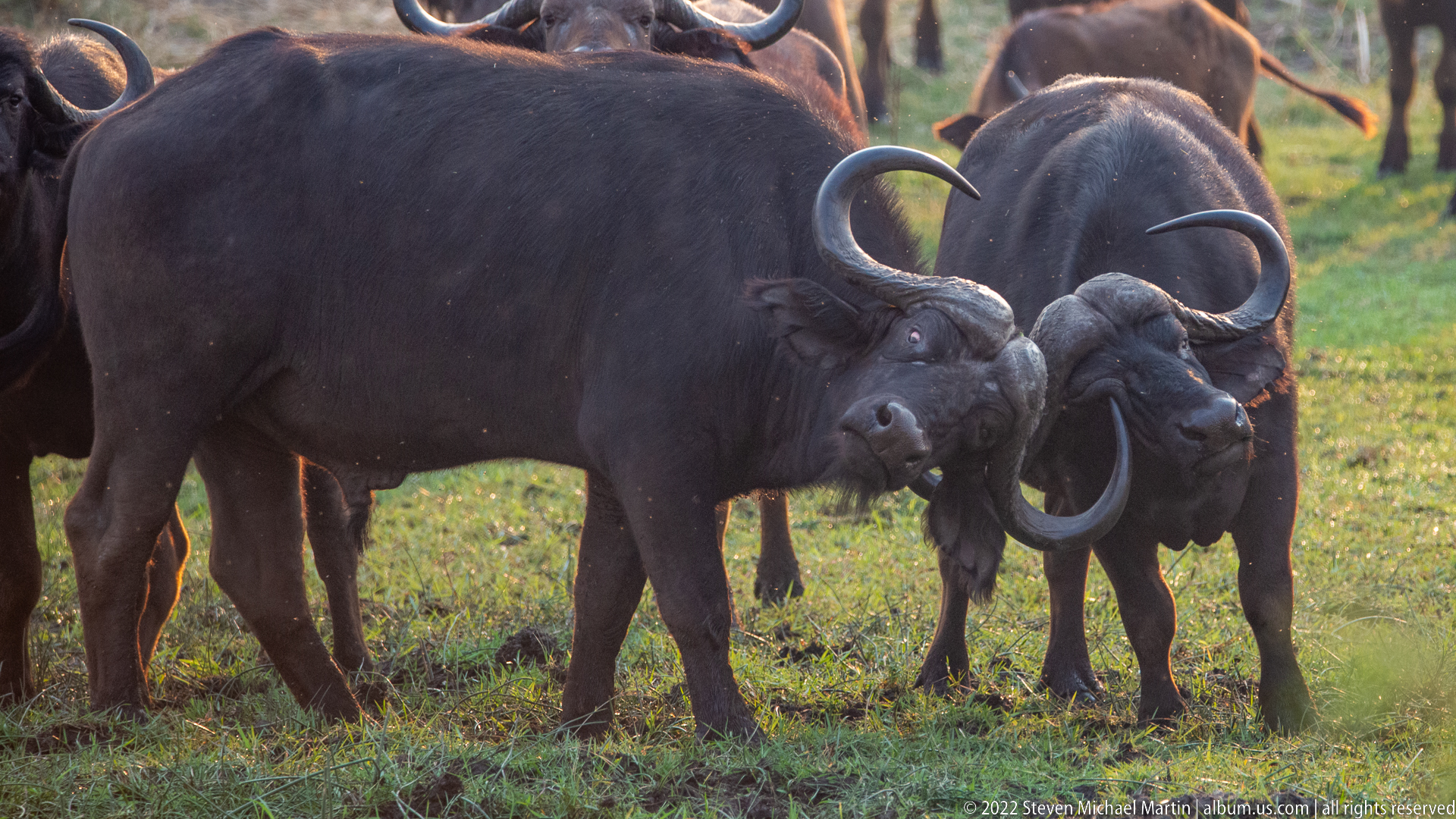
Two African buffalo press their massive horn bosses and curved horns together within the herd, their heads tilted inward at close range. The tight crop emphasizes the heavy forehead shields, sweeping horn tips, and muscular necks that characterize mature buffalo. Whether sparring or asserting dominance, the visible interaction centers on direct horn-to-horn contact.
Caption
Two African buffalo press their massive horn bosses and curved horns together within the herd, their heads tilted inward at close range. The tight crop emphasizes the heavy forehead shields, sweeping horn tips, and muscular necks that characterize mature buffalo. Whether sparring or asserting dominance, the visible interaction centers on direct horn-to-horn contact.
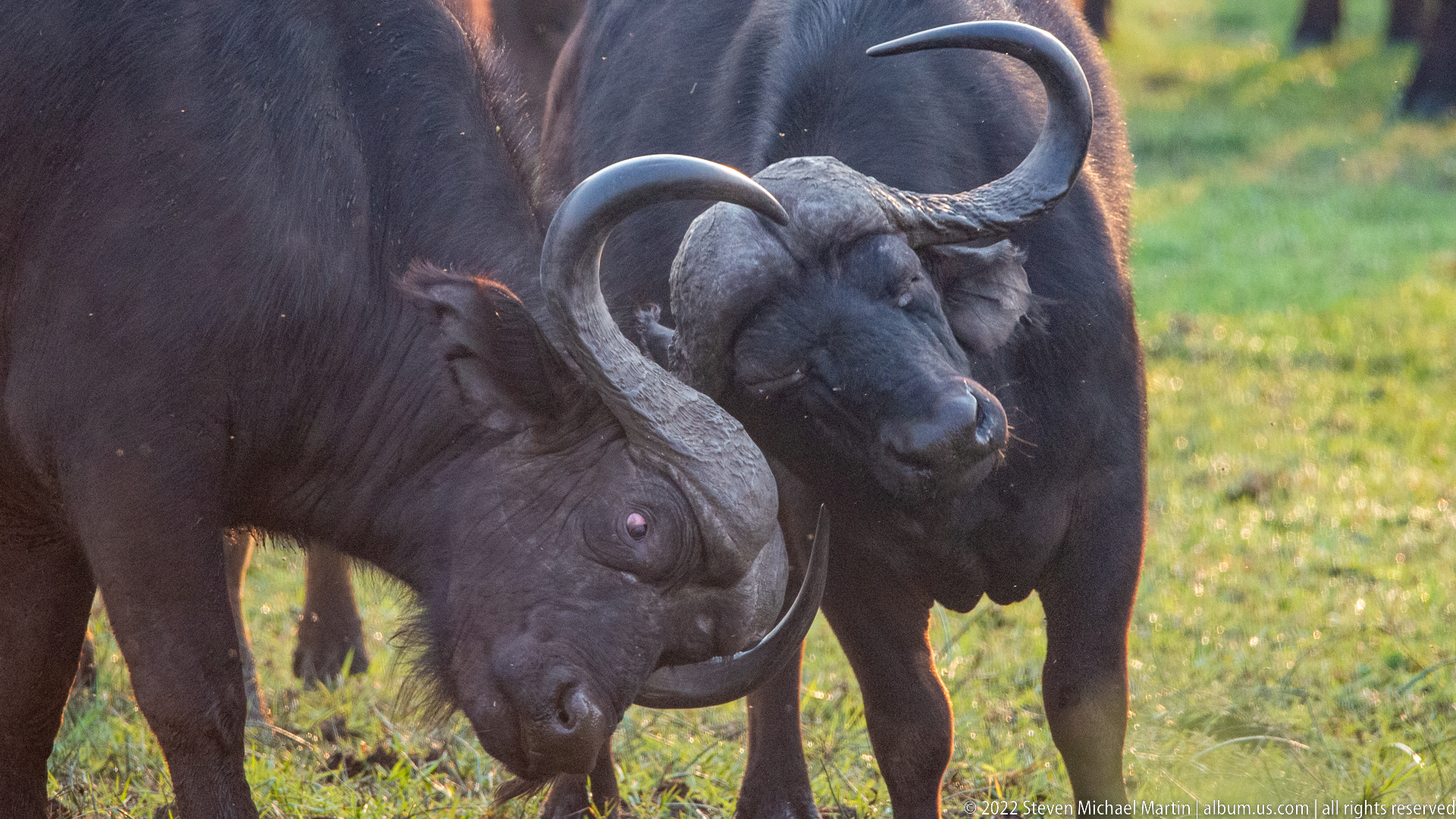
A close view isolates the interlocking horn structures of two African buffalo, one animal lowering its head as the other presses in from behind. The frame reveals the thick, ridged horn bosses and polished curves in greater detail than the adjacent herd scenes, turning a brief social encounter into a study of the species’ formidable headgear.
Caption
A close view isolates the interlocking horn structures of two African buffalo, one animal lowering its head as the other presses in from behind. The frame reveals the thick, ridged horn bosses and polished curves in greater detail than the adjacent herd scenes, turning a brief social encounter into a study of the species’ formidable headgear.
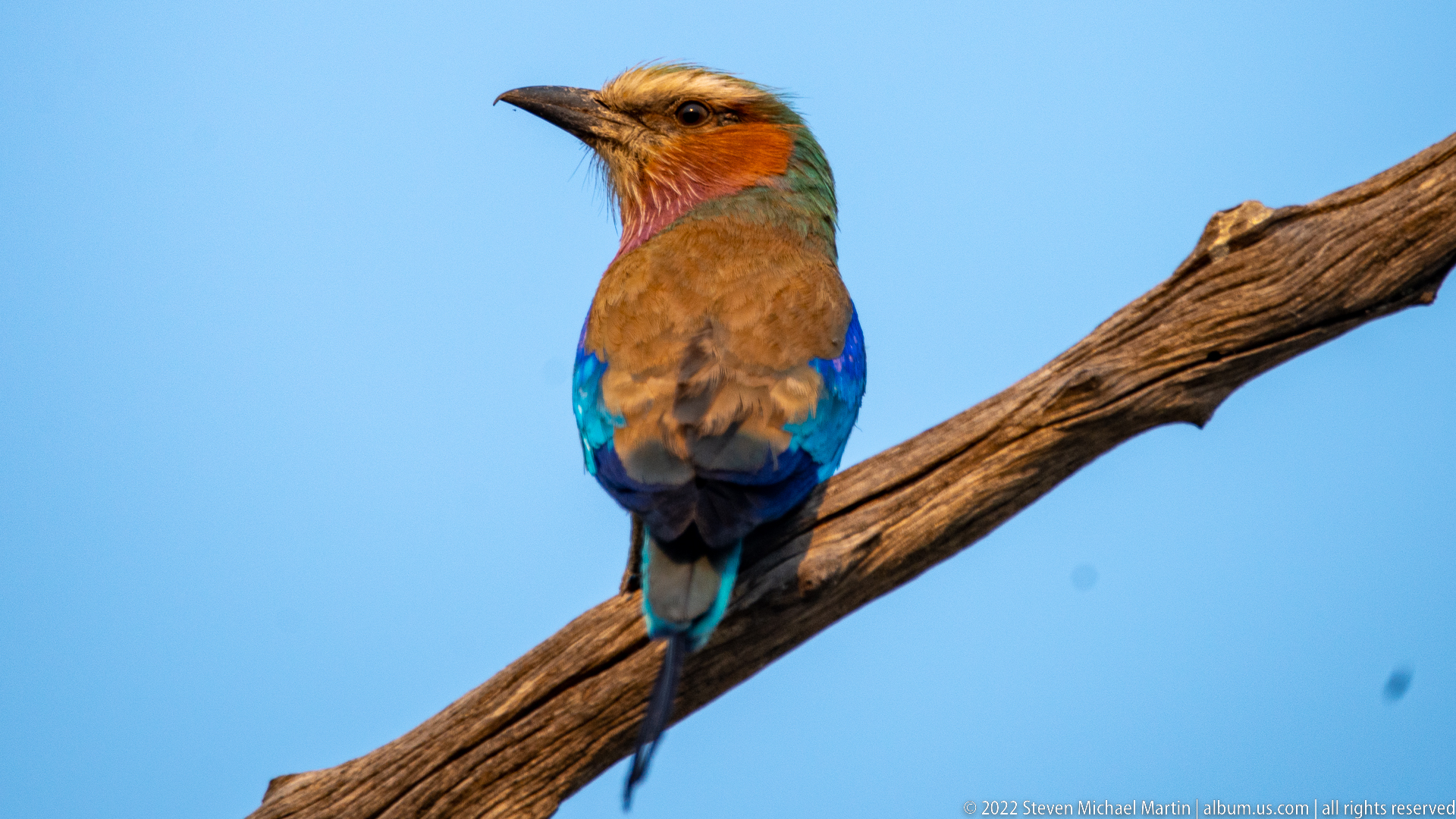
A lilac-breasted roller perches upright on a bare diagonal branch against a clear blue sky. Its lilac throat and breast, turquoise belly and wing panels, greenish crown, and warm brown back create the vivid color pattern for which the species is known. The uncluttered background makes the bird’s plumage and stout dark bill especially easy to distinguish.
Caption
A lilac-breasted roller perches upright on a bare diagonal branch against a clear blue sky. Its lilac throat and breast, turquoise belly and wing panels, greenish crown, and warm brown back create the vivid color pattern for which the species is known. The uncluttered background makes the bird’s plumage and stout dark bill especially easy to distinguish.

A chacma baboon sits upright on sandy ground among young palm shoots, resting one arm across its body while looking toward the camera. The long doglike muzzle, heavy brow, coarse olive-brown coat, and substantial build fit the southern African species. The ground-level setting gives a clear view of posture and body proportions rather than arboreal movement.
Caption
A chacma baboon sits upright on sandy ground among young palm shoots, resting one arm across its body while looking toward the camera. The long doglike muzzle, heavy brow, coarse olive-brown coat, and substantial build fit the southern African species. The ground-level setting gives a clear view of posture and body proportions rather than arboreal movement.
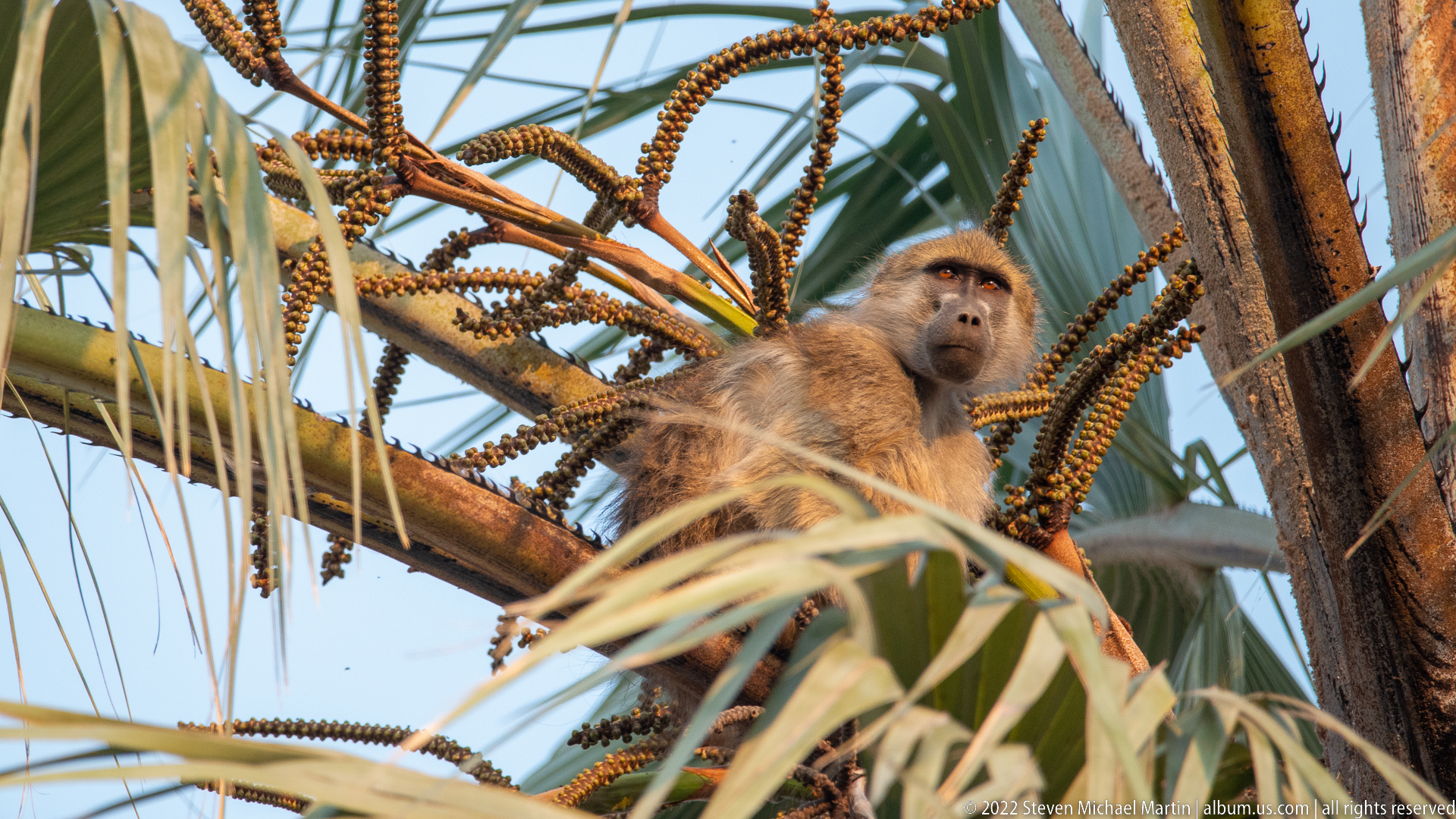
A chacma baboon sits high among the branching flower stalks and fronds of a palm, looking outward from the crown. The elevated viewpoint places the primate within a distinctly arboreal feeding or resting setting, contrasting with the ground-seated baboon in the preceding frame. Its elongated muzzle, brown-gray coat, and robust build remain visible through the foliage.
Caption
A chacma baboon sits high among the branching flower stalks and fronds of a palm, looking outward from the crown. The elevated viewpoint places the primate within a distinctly arboreal feeding or resting setting, contrasting with the ground-seated baboon in the preceding frame. Its elongated muzzle, brown-gray coat, and robust build remain visible through the foliage.
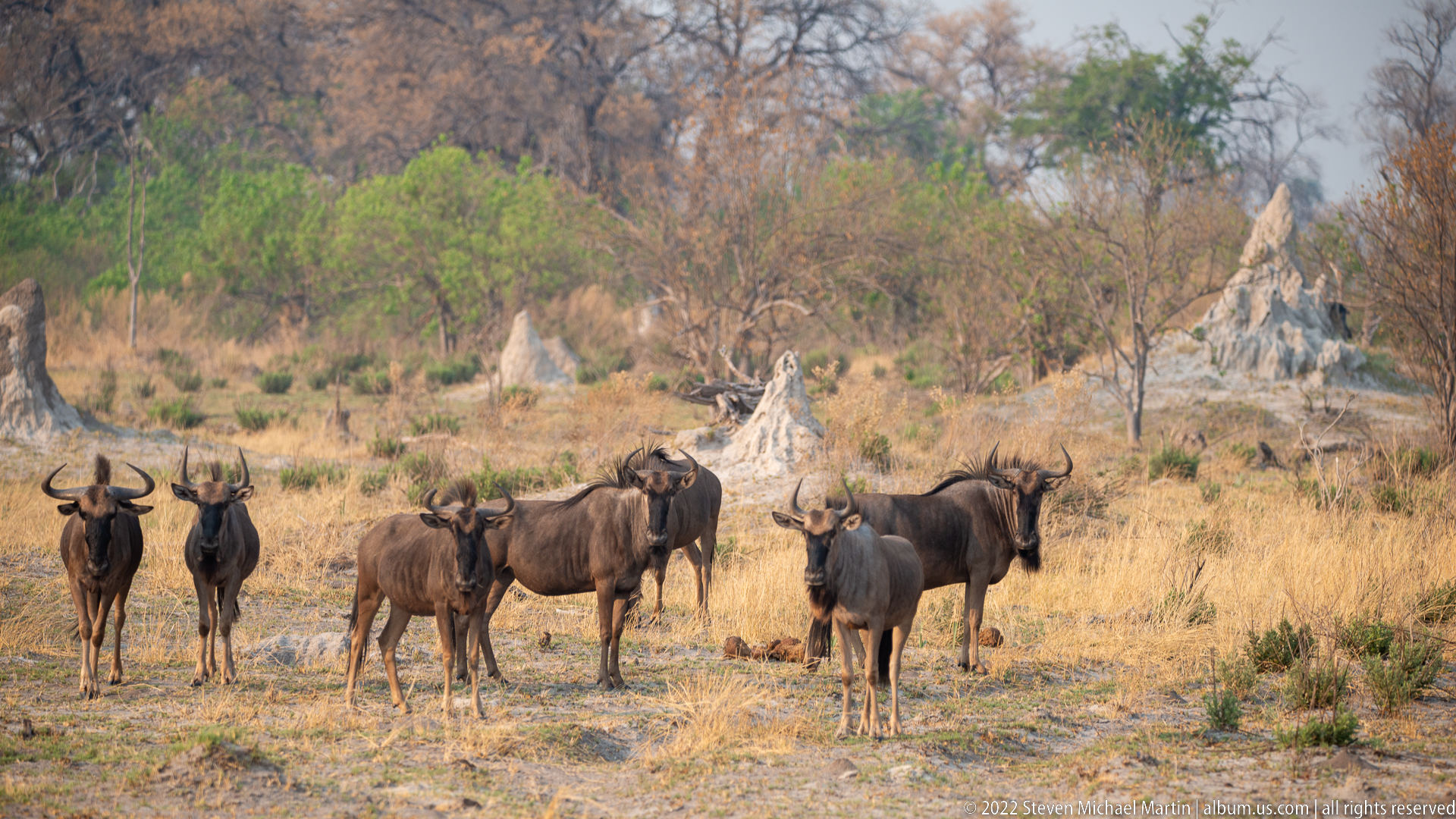
A small group of blue wildebeest stands alert on pale dry ground among scattered shrubs and multiple termite mounds. Several animals face the camera, showing broad muzzles, dark facial markings, heavy forequarters, and outward-curving horns. The open spacing and repeated mound forms give this herd portrait a strong sense of the drier savanna patches within Chief’s Island.
Caption
A small group of blue wildebeest stands alert on pale dry ground among scattered shrubs and multiple termite mounds. Several animals face the camera, showing broad muzzles, dark facial markings, heavy forequarters, and outward-curving horns. The open spacing and repeated mound forms give this herd portrait a strong sense of the drier savanna patches within Chief’s Island.
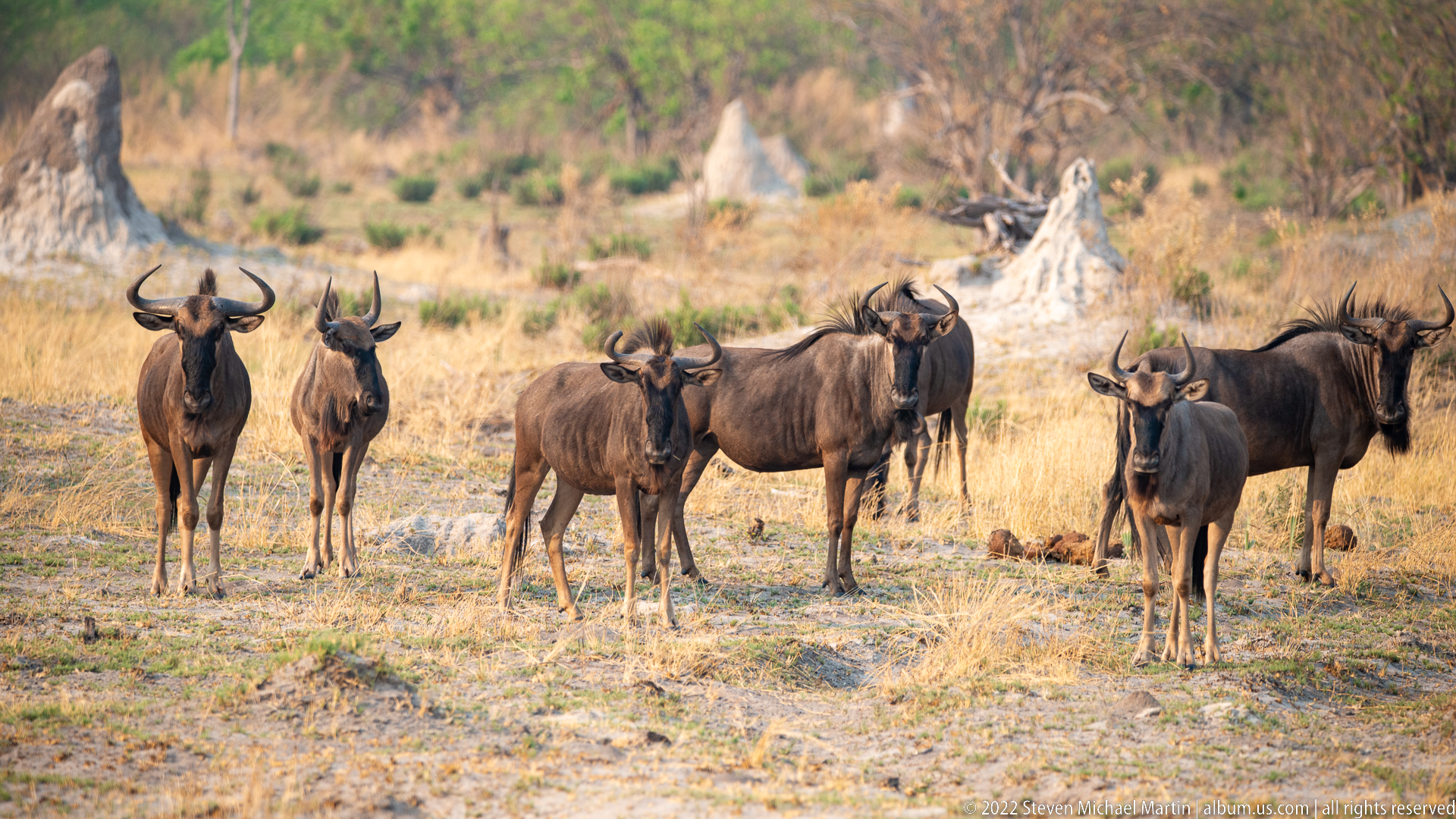
Blue wildebeest stand in a loose semicircle on a dry, sparsely vegetated patch, with pale termite mounds punctuating the scrub behind them. The animals’ differing orientations reveal both frontal horn shape and broadside body profile, while the central pair stands close enough to show variation in size and mane development within the group.
Caption
Blue wildebeest stand in a loose semicircle on a dry, sparsely vegetated patch, with pale termite mounds punctuating the scrub behind them. The animals’ differing orientations reveal both frontal horn shape and broadside body profile, while the central pair stands close enough to show variation in size and mane development within the group.
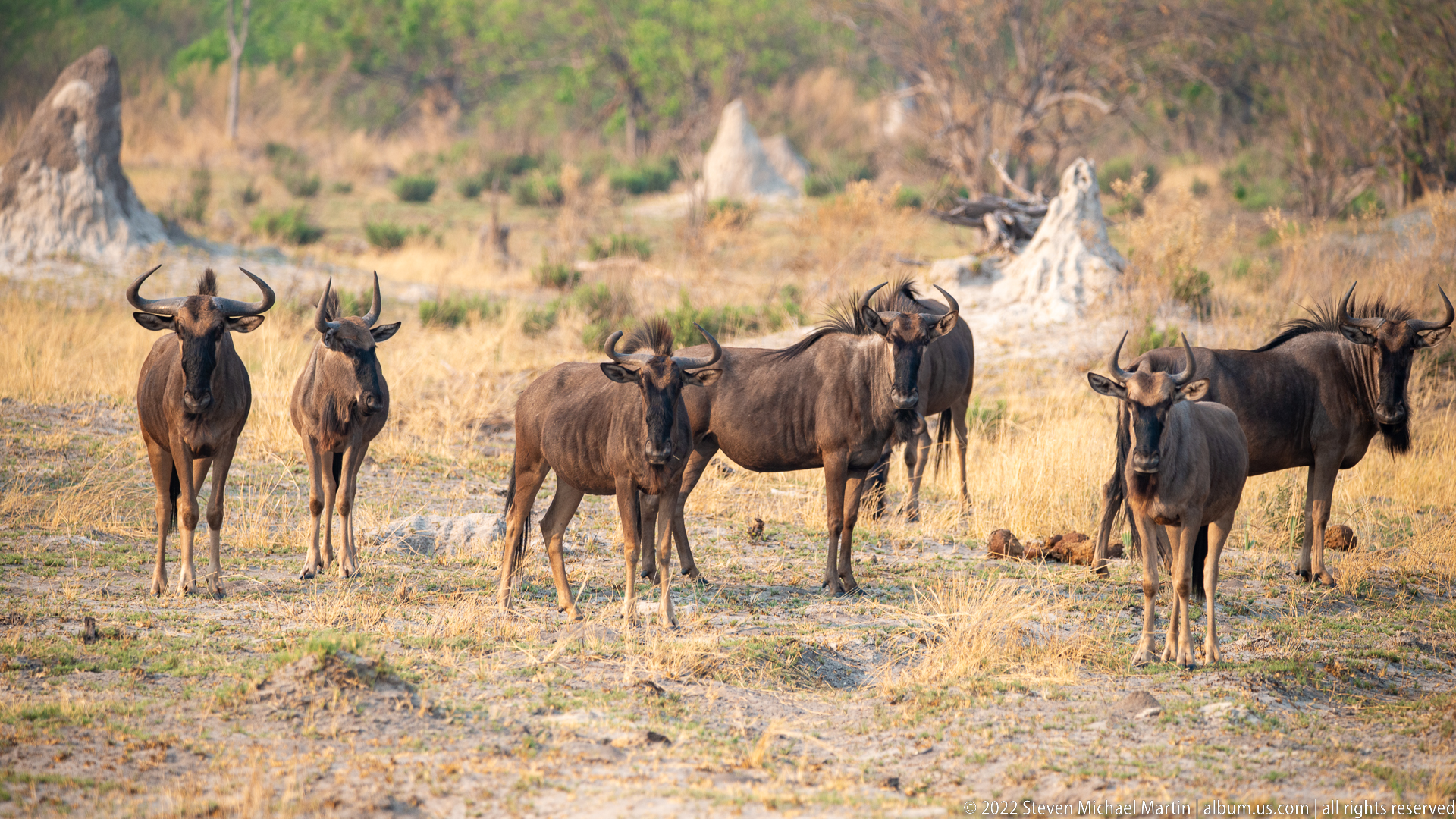
A second view of the blue wildebeest group shows the animals more evenly spread across the frame, each standing alert amid short dry grass and low scrub. Pale termite mounds repeat in the background, while the mixed frontal and side-on poses make the species’ curved horns, shaggy manes, dark forequarters, and high shoulders easy to compare.
Caption
A second view of the blue wildebeest group shows the animals more evenly spread across the frame, each standing alert amid short dry grass and low scrub. Pale termite mounds repeat in the background, while the mixed frontal and side-on poses make the species’ curved horns, shaggy manes, dark forequarters, and high shoulders easy to compare.
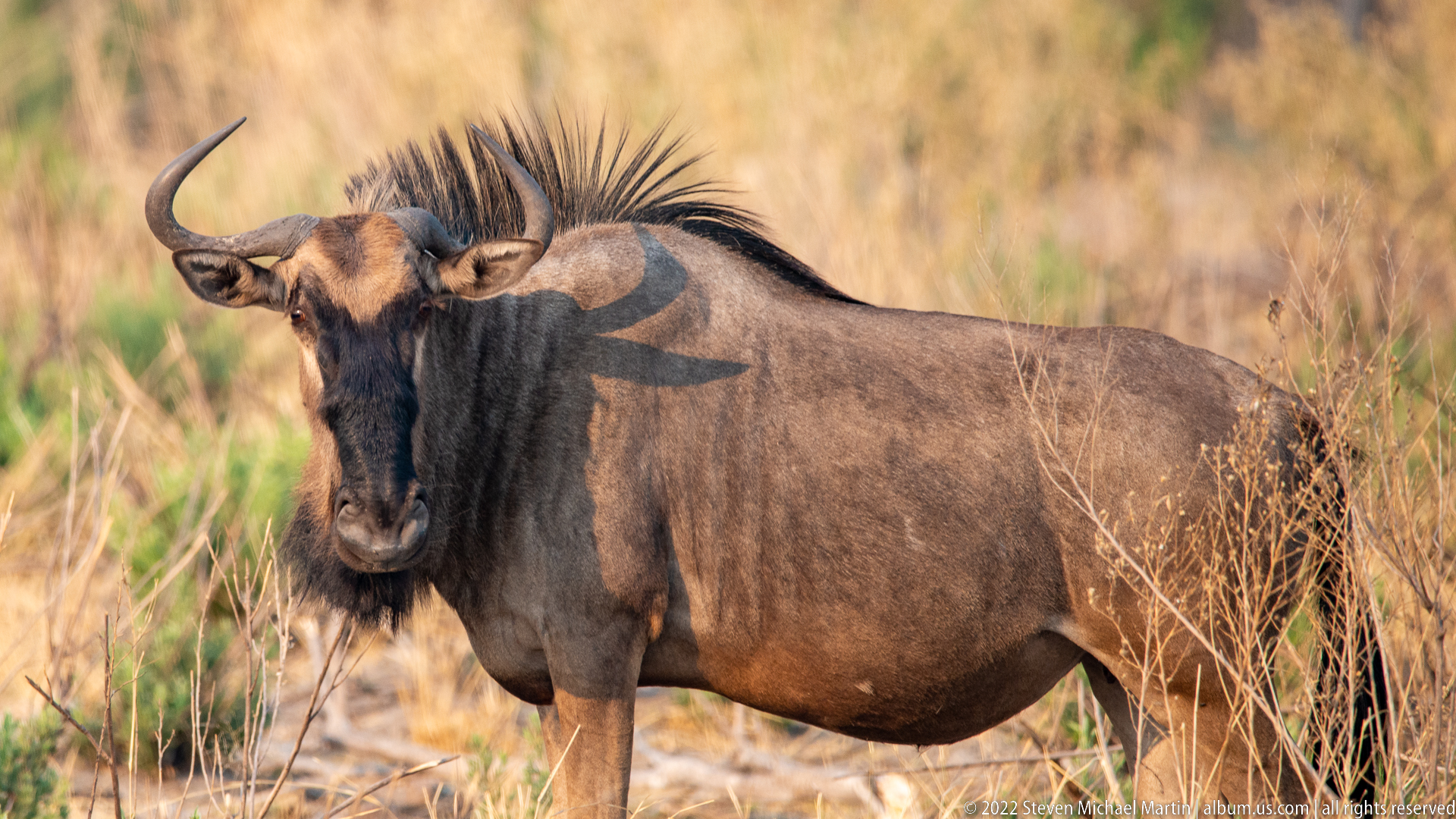
A blue wildebeest stands broadside in warm dry grass, turning its dark face toward the camera. The close view reveals the heavy, curved horns, black mane and beard, muscular shoulders, and faint vertical striping along the gray-brown body. Sunlight across the flank and horn base gives this frame the character of a formal species portrait.
Caption
A blue wildebeest stands broadside in warm dry grass, turning its dark face toward the camera. The close view reveals the heavy, curved horns, black mane and beard, muscular shoulders, and faint vertical striping along the gray-brown body. Sunlight across the flank and horn base gives this frame the character of a formal species portrait.
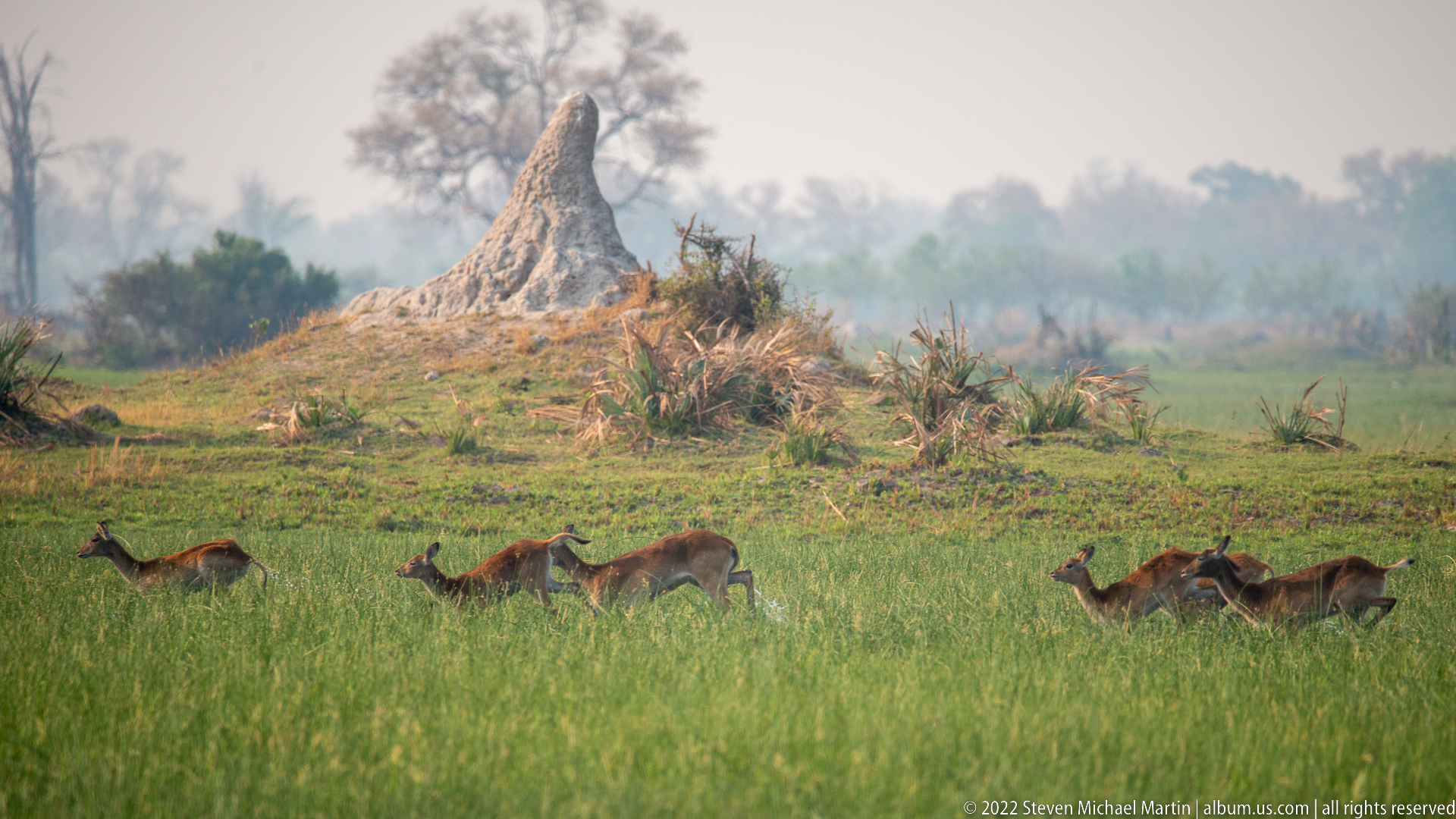
Red lechwe move in a loose line through lush green floodplain grass, passing below a large termite mound that rises above the wetland. Their reddish-brown coats, pale underparts, and dark lower legs stand out against the vegetation. The broad contextual view links these water-adapted antelope to the seasonally flooded grasslands that define much of the Okavango Delta.
Caption
Red lechwe move in a loose line through lush green floodplain grass, passing below a large termite mound that rises above the wetland. Their reddish-brown coats, pale underparts, and dark lower legs stand out against the vegetation. The broad contextual view links these water-adapted antelope to the seasonally flooded grasslands that define much of the Okavango Delta.
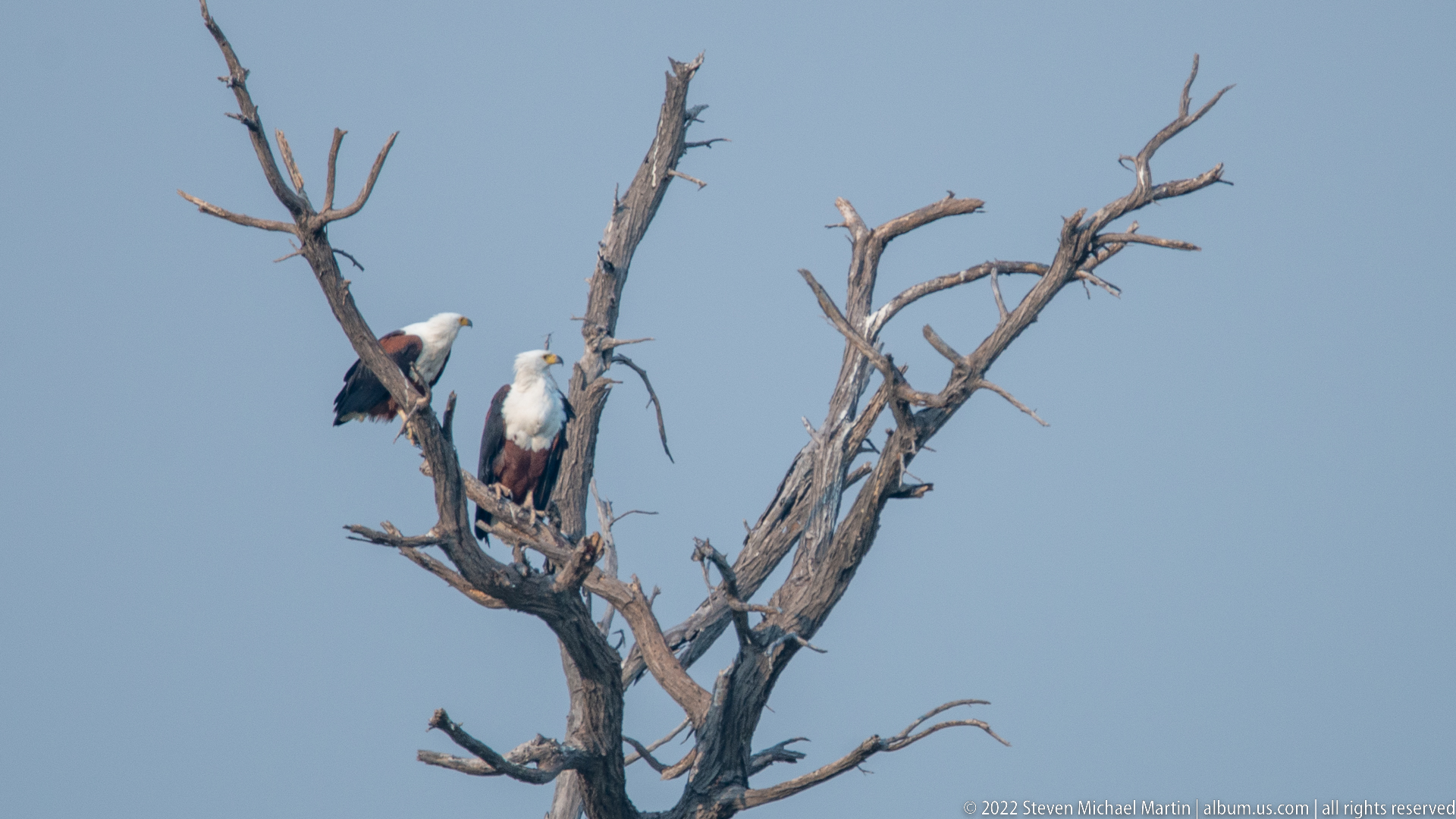
Two African fish eagles perch together in the upper forks of a leafless tree, their white heads and breasts bright against the gray-blue sky. One bird faces outward from a higher branch while the second sits just below, allowing the pair’s dark wings and chestnut bodies to read clearly. The bare snag provides an open lookout typical of waterside raptors.
Caption
Two African fish eagles perch together in the upper forks of a leafless tree, their white heads and breasts bright against the gray-blue sky. One bird faces outward from a higher branch while the second sits just below, allowing the pair’s dark wings and chestnut bodies to read clearly. The bare snag provides an open lookout typical of waterside raptors.
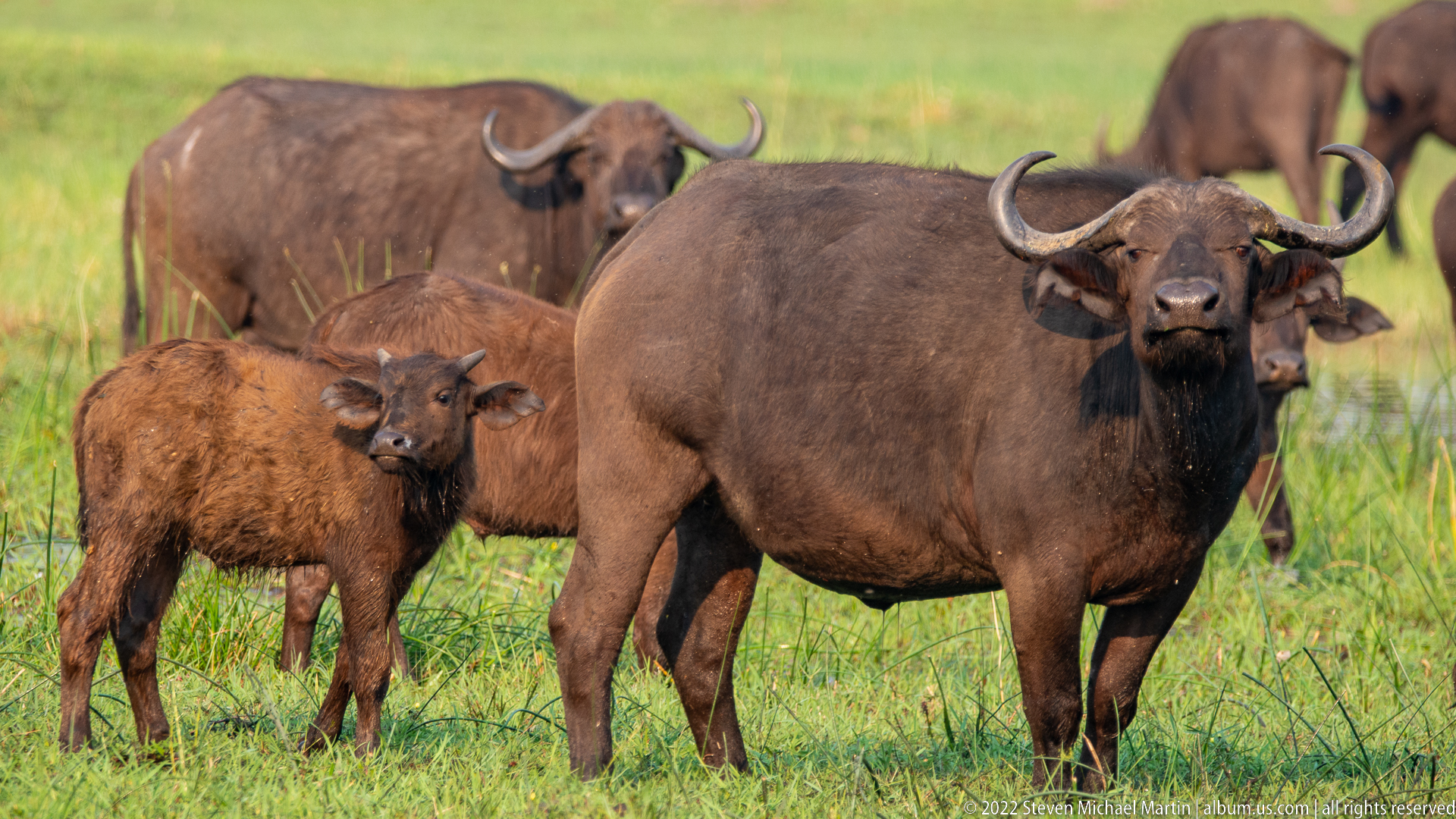
An African buffalo cow stands squarely in wet grass beside a reddish-brown calf, with other buffalo grazing behind them on Chief’s Island. The close grouping shows the herd structure typical of this large African bovid, while the calf’s smaller body and softer coat distinguish it clearly from the heavy, dark adults.
Caption
An African buffalo cow stands squarely in wet grass beside a reddish-brown calf, with other buffalo grazing behind them on Chief’s Island. The close grouping shows the herd structure typical of this large African bovid, while the calf’s smaller body and softer coat distinguish it clearly from the heavy, dark adults.
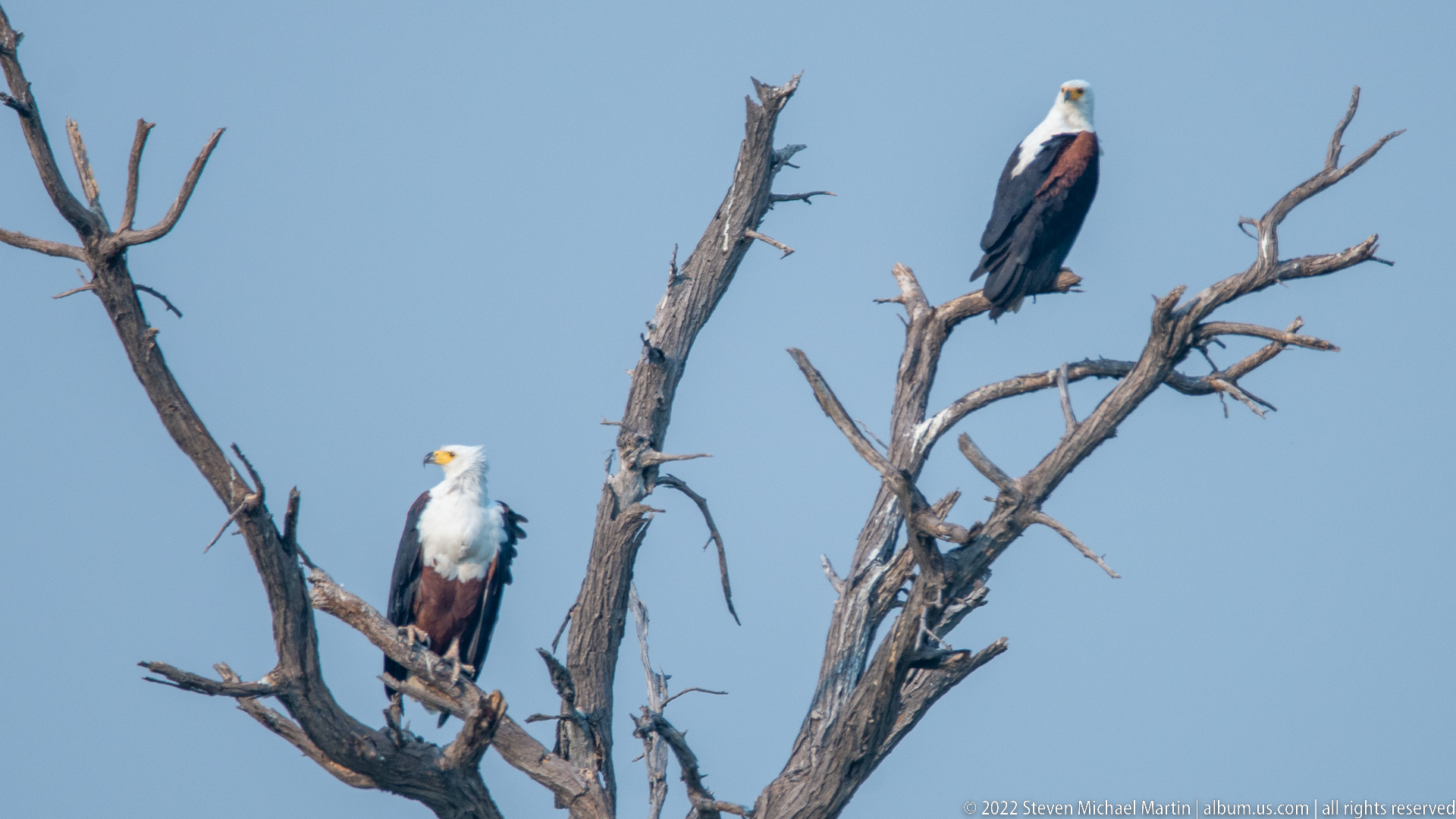
Two African fish eagles perch at different heights in the bare crown of a dead tree against a clear blue sky. Their white heads and breasts, chestnut bodies, dark wings, and yellow facial skin make the species distinctive, while the open perch provides the elevated lookout commonly used by these waterside raptors.
Caption
Two African fish eagles perch at different heights in the bare crown of a dead tree against a clear blue sky. Their white heads and breasts, chestnut bodies, dark wings, and yellow facial skin make the species distinctive, while the open perch provides the elevated lookout commonly used by these waterside raptors.

A buffalo cow and calf move side by side through tall, damp marsh vegetation on Chief’s Island. Seen in profile, the adult’s massive shoulder, dark hide, and swept horns contrast with the calf’s compact reddish coat, while reeds and shallow water place the pair within the seasonally flooded grassland habitat.
Caption
A buffalo cow and calf move side by side through tall, damp marsh vegetation on Chief’s Island. Seen in profile, the adult’s massive shoulder, dark hide, and swept horns contrast with the calf’s compact reddish coat, while reeds and shallow water place the pair within the seasonally flooded grassland habitat.
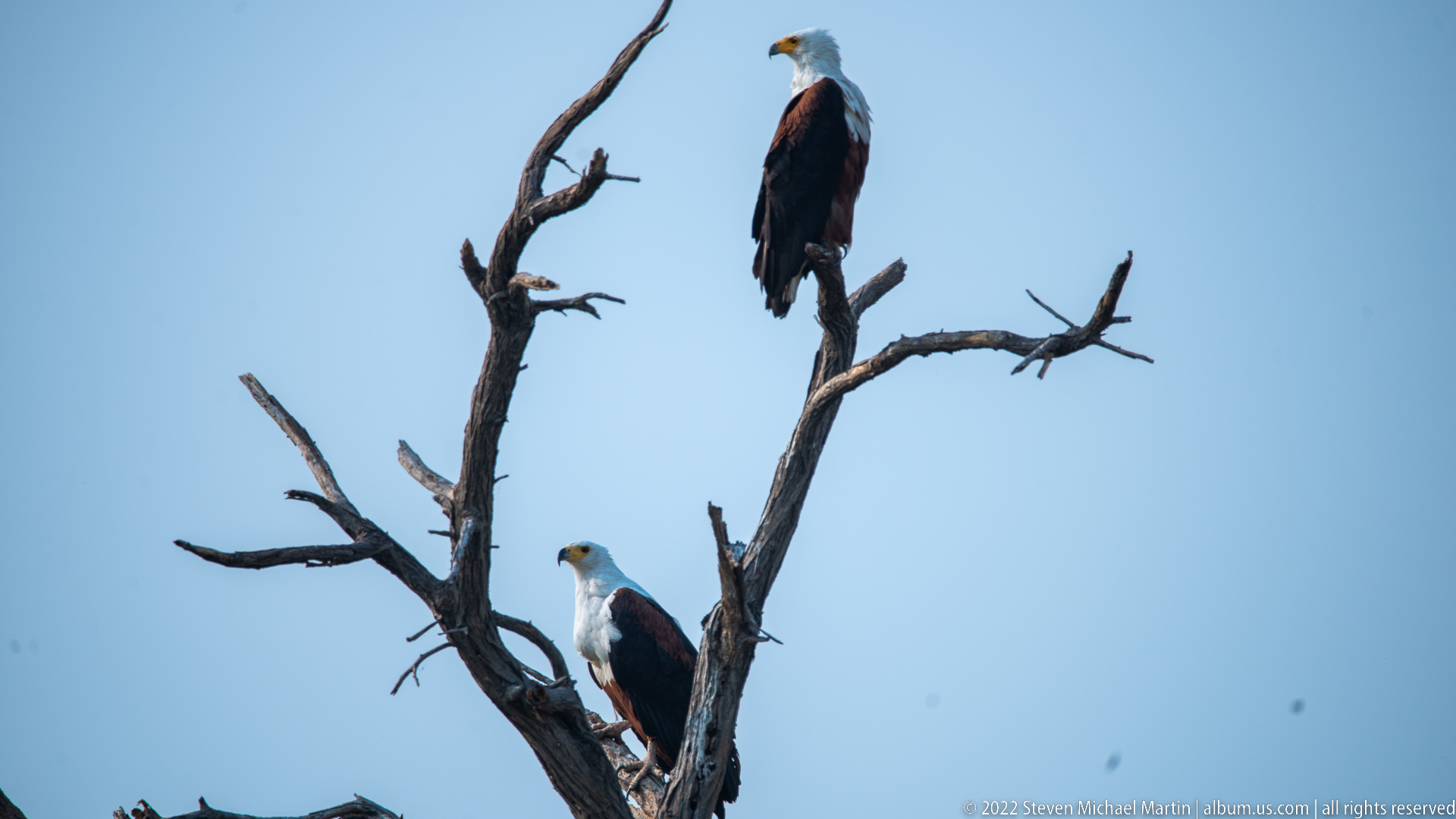
A tall dead trunk creates a vertical frame for two African fish eagles perched one above the other. The upper bird is silhouetted more strongly against the sky, while the lower eagle sits within the forked branches, giving this view a pronounced sense of height and spacing between the pair.
Caption
A tall dead trunk creates a vertical frame for two African fish eagles perched one above the other. The upper bird is silhouetted more strongly against the sky, while the lower eagle sits within the forked branches, giving this view a pronounced sense of height and spacing between the pair.
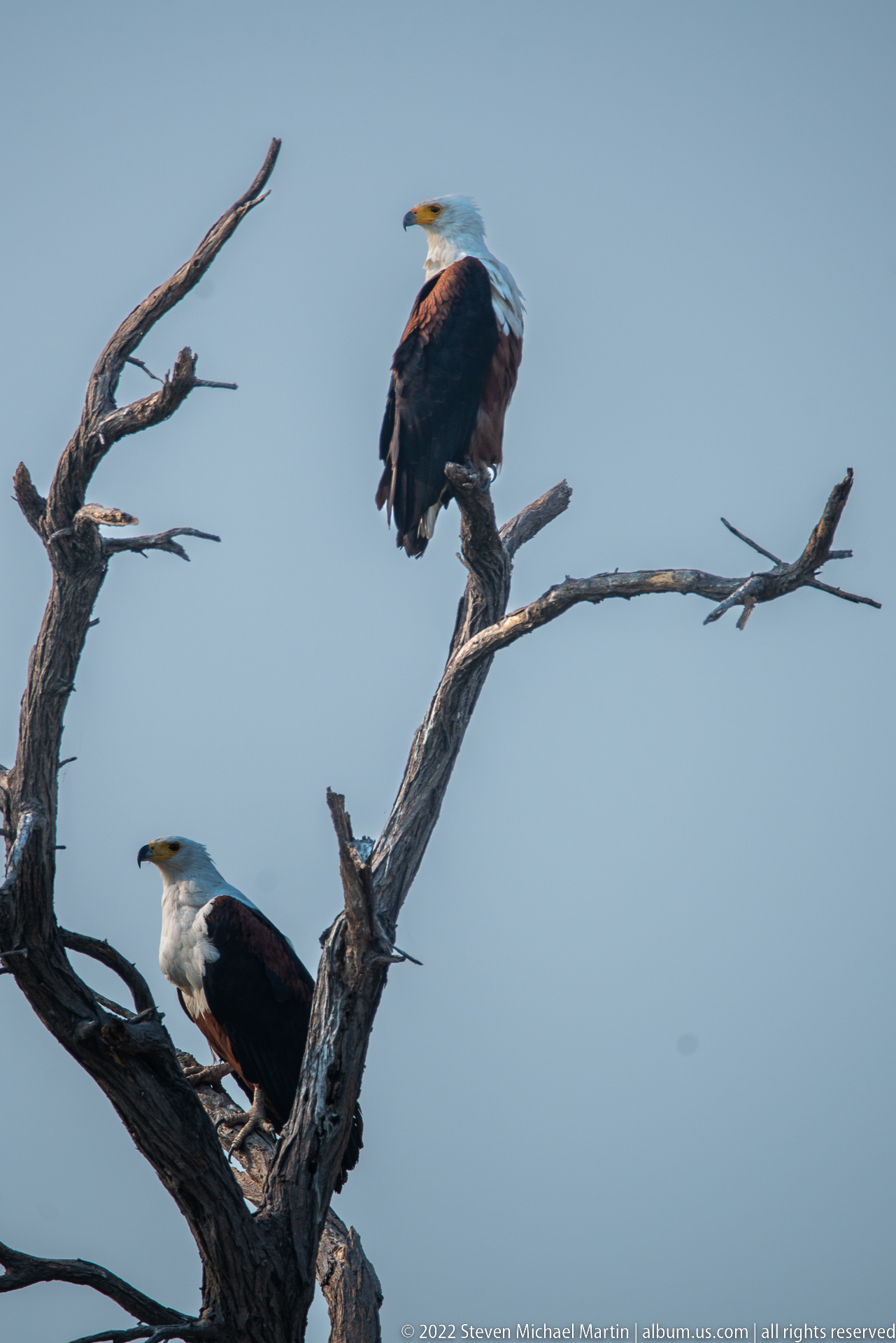
A pair of African fish eagles occupies separate limbs of a weathered snag, one perched high and the other lower in the branching crown. The composition isolates their white heads and upper bodies against open sky and records the birds sharing a prominent lookout rather than presenting a single close portrait.
Caption
A pair of African fish eagles occupies separate limbs of a weathered snag, one perched high and the other lower in the branching crown. The composition isolates their white heads and upper bodies against open sky and records the birds sharing a prominent lookout rather than presenting a single close portrait.
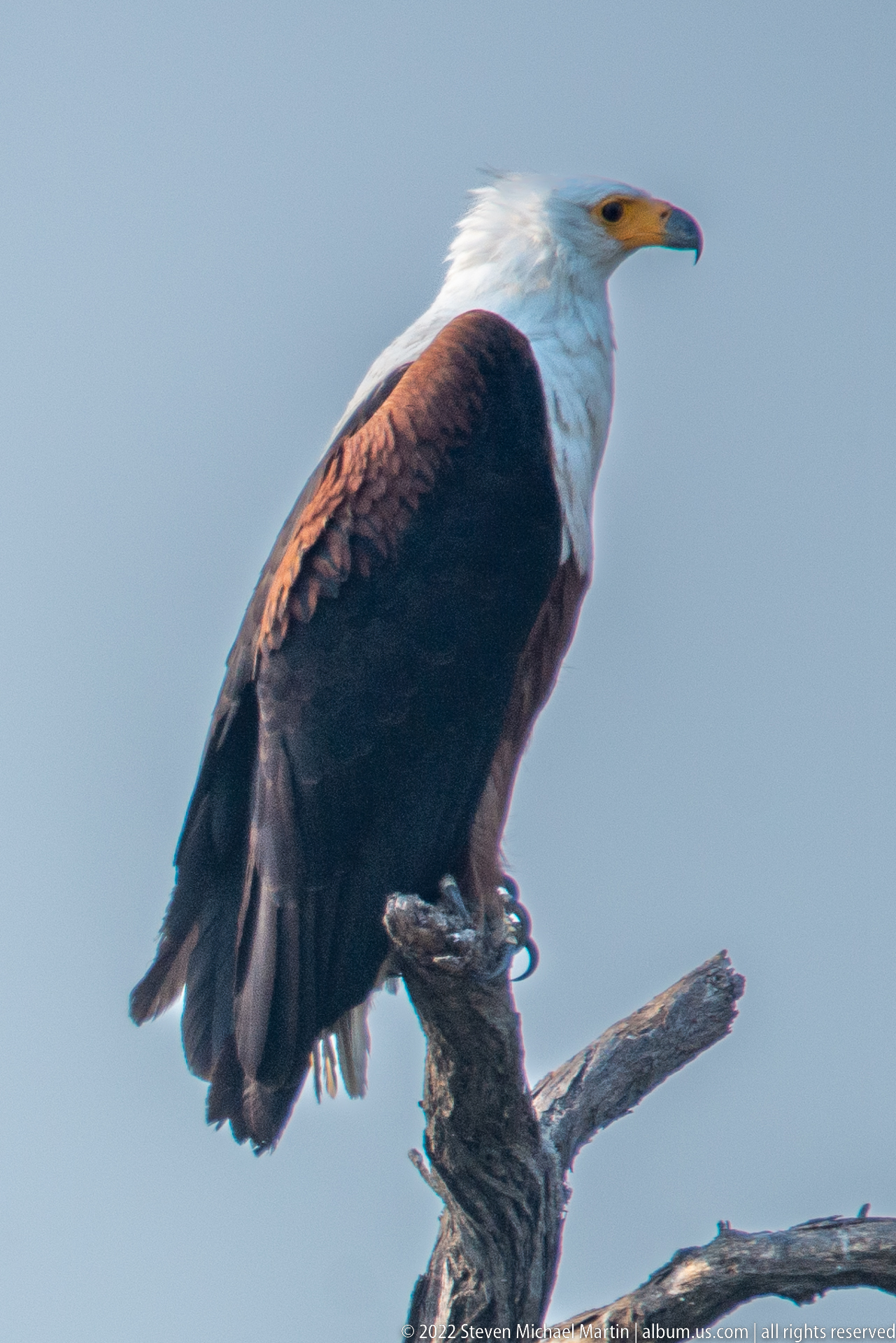
An adult African fish eagle rests on the tip of a broken branch, filling the frame in profile. Fine detail reveals the white head and mantle, chestnut shoulder and body, black flight feathers, yellow cere, and powerful talons—features that make this one of southern Africa’s most readily recognized wetland raptors.
Caption
An adult African fish eagle rests on the tip of a broken branch, filling the frame in profile. Fine detail reveals the white head and mantle, chestnut shoulder and body, black flight feathers, yellow cere, and powerful talons—features that make this one of southern Africa’s most readily recognized wetland raptors.
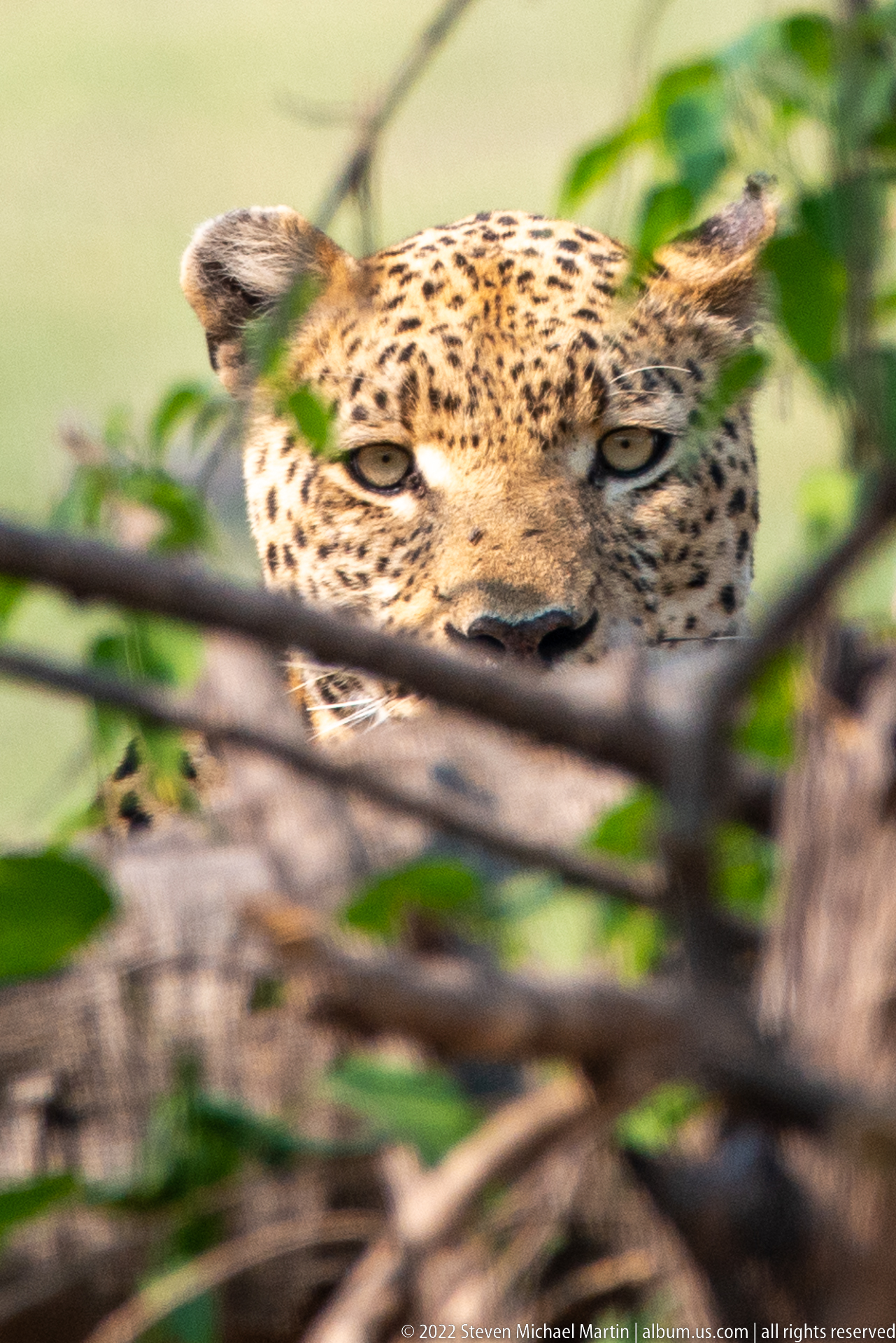
A close portrait of an African leopard emerges between foreground branches on Chief’s Island. The face is nearly level with the camera, bringing the pale eyes, black nose, whisker spots, and small forehead rosettes into sharp relief while the body disappears behind the woodland screen. The framing creates a direct encounter without losing the sense of concealment.
Caption
A close portrait of an African leopard emerges between foreground branches on Chief’s Island. The face is nearly level with the camera, bringing the pale eyes, black nose, whisker spots, and small forehead rosettes into sharp relief while the body disappears behind the woodland screen. The framing creates a direct encounter without losing the sense of concealment.
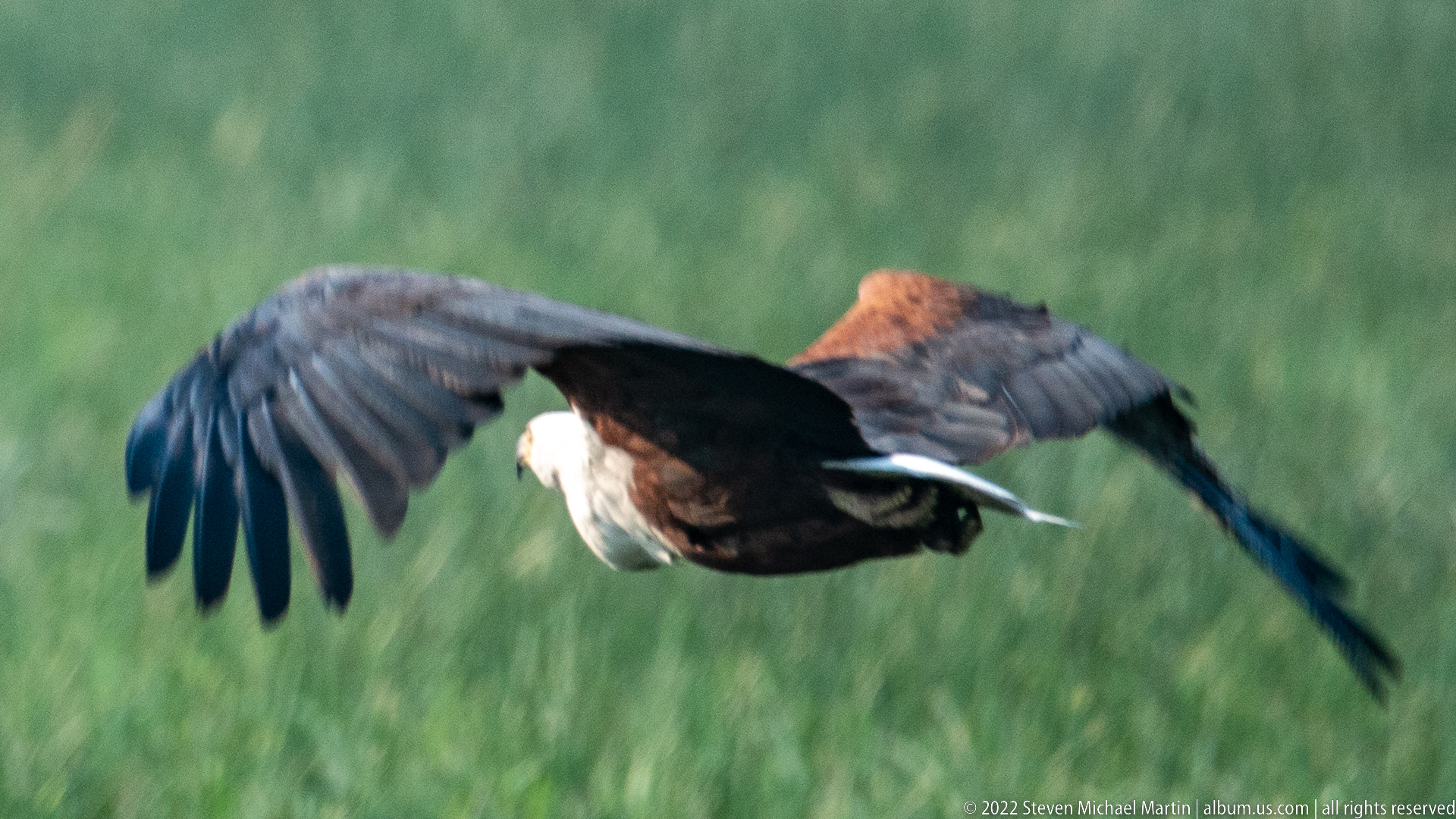
An African fish eagle flies low over green floodplain vegetation with broad wings extended and tail trailing behind. Motion blur conveys the speed of the pass, while the bird’s white head and breast, chestnut body, and dark flight feathers remain visible enough to distinguish the adult raptor in flight.
Caption
An African fish eagle flies low over green floodplain vegetation with broad wings extended and tail trailing behind. Motion blur conveys the speed of the pass, while the bird’s white head and breast, chestnut body, and dark flight feathers remain visible enough to distinguish the adult raptor in flight.
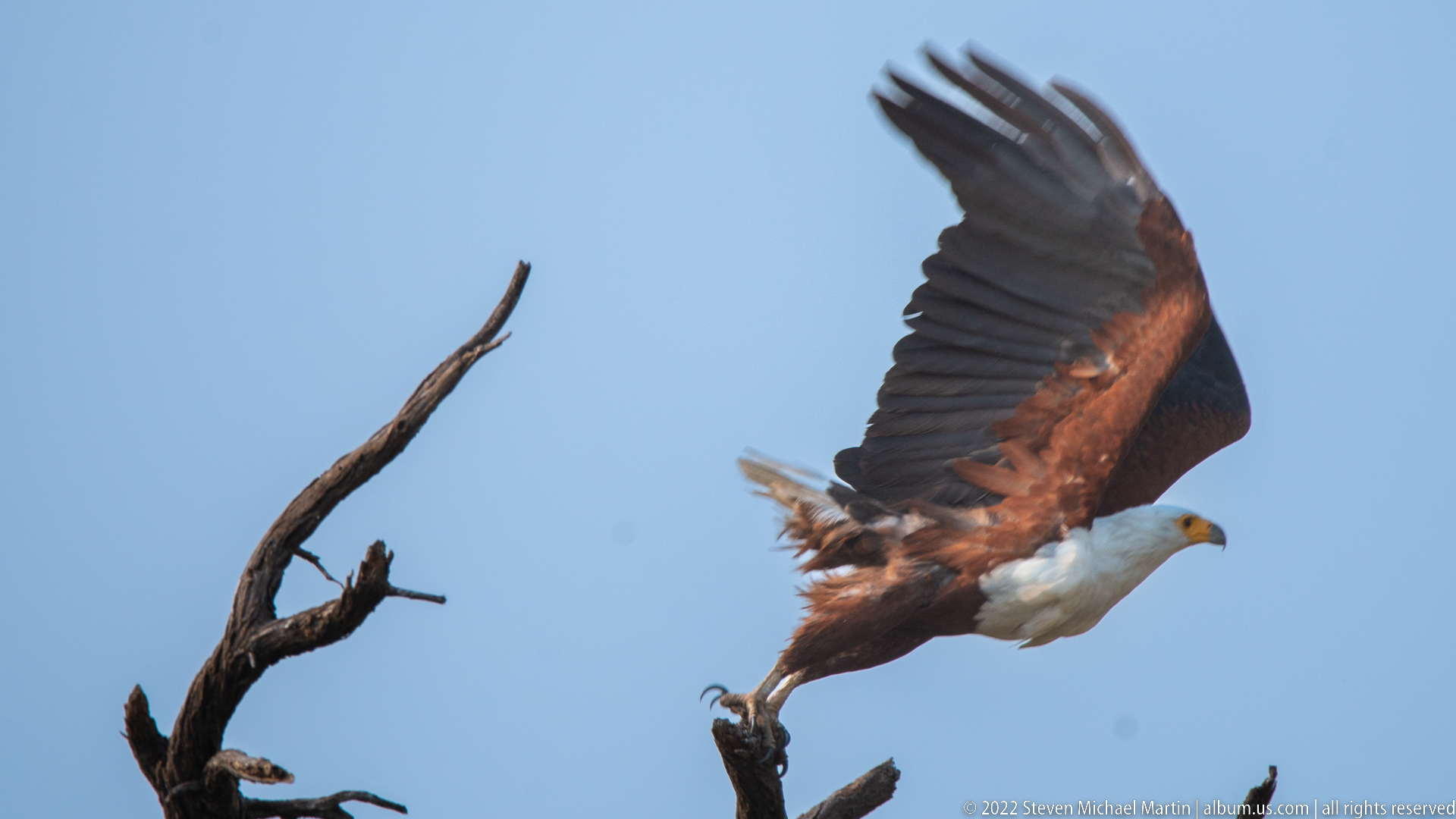
An African fish eagle pushes away from a bare branch with wings raised to their full breadth. The upward sweep exposes the dark flight feathers and chestnut wing coverts while the white head and breast remain bright against the sky, freezing the instant between perch and powered flight.
Caption
An African fish eagle pushes away from a bare branch with wings raised to their full breadth. The upward sweep exposes the dark flight feathers and chestnut wing coverts while the white head and breast remain bright against the sky, freezing the instant between perch and powered flight.

An adult African fish eagle sits within the heavy limbs of a living tree, its body partly enclosed by trunks and foliage. The shaded perch produces a more intimate woodland context than the exposed snags in neighboring views, while the white head, yellow facial skin, and chestnut breast remain conspicuous.
Caption
An adult African fish eagle sits within the heavy limbs of a living tree, its body partly enclosed by trunks and foliage. The shaded perch produces a more intimate woodland context than the exposed snags in neighboring views, while the white head, yellow facial skin, and chestnut breast remain conspicuous.

A small-to-medium female antelope rests in lush grass, turning her head toward the camera. Her gray-brown coat, pale underparts, large rounded ears, and hornless head are consistent with a female common reedbuck, a wet-grassland antelope of the Okavango region; facial flies are conspicuous across the forehead and muzzle.
Caption
A small-to-medium female antelope rests in lush grass, turning her head toward the camera. Her gray-brown coat, pale underparts, large rounded ears, and hornless head are consistent with a female common reedbuck, a wet-grassland antelope of the Okavango region; facial flies are conspicuous across the forehead and muzzle.
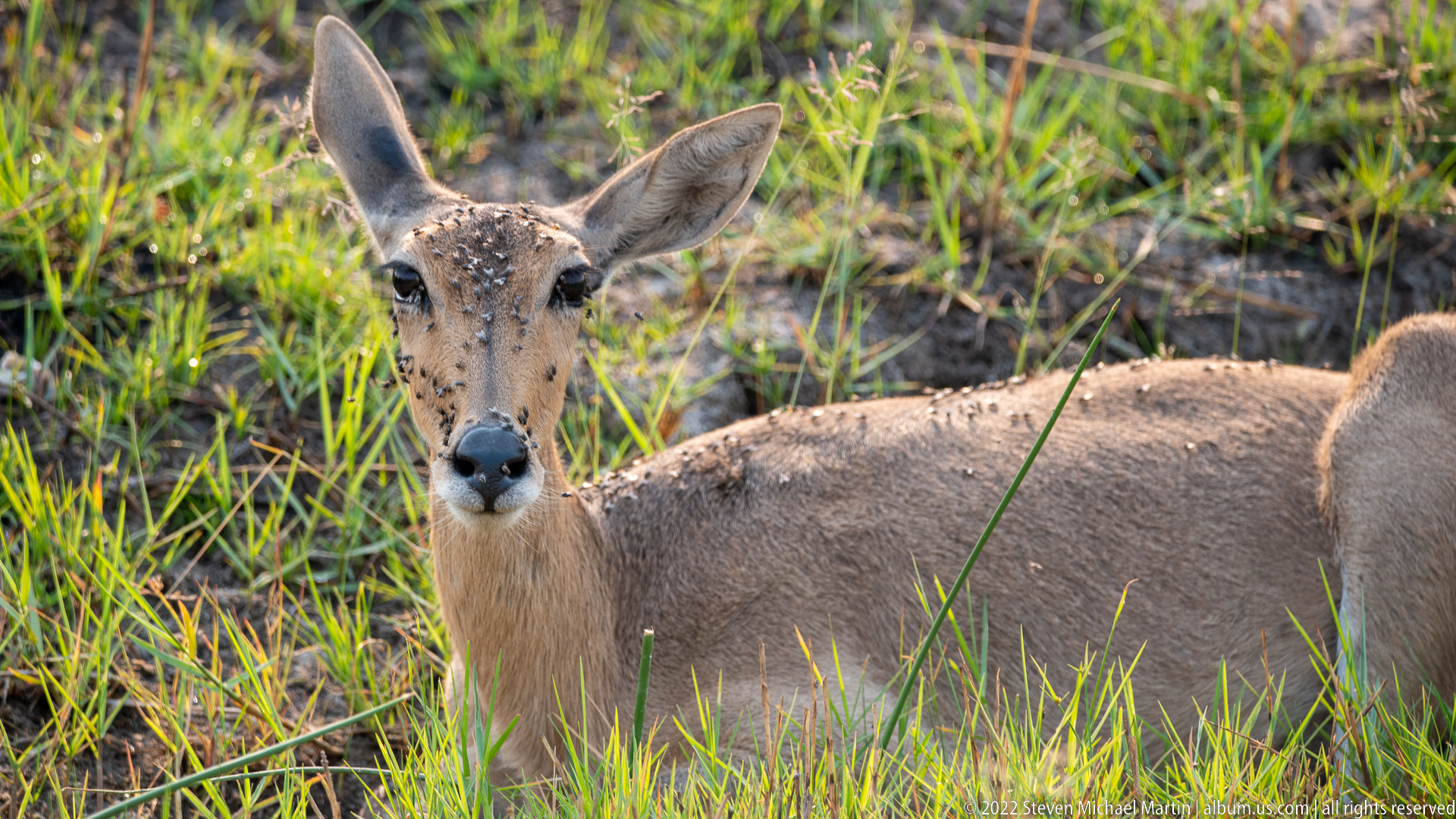
Facing the camera from low grass, the hornless antelope presents a frontal study of her broad ears, dark eyes, pale muzzle, and fly-covered forehead. The tighter viewpoint separates the animal from the surrounding vegetation and provides a useful companion portrait to the wider resting view.
Caption
Facing the camera from low grass, the hornless antelope presents a frontal study of her broad ears, dark eyes, pale muzzle, and fly-covered forehead. The tighter viewpoint separates the animal from the surrounding vegetation and provides a useful companion portrait to the wider resting view.
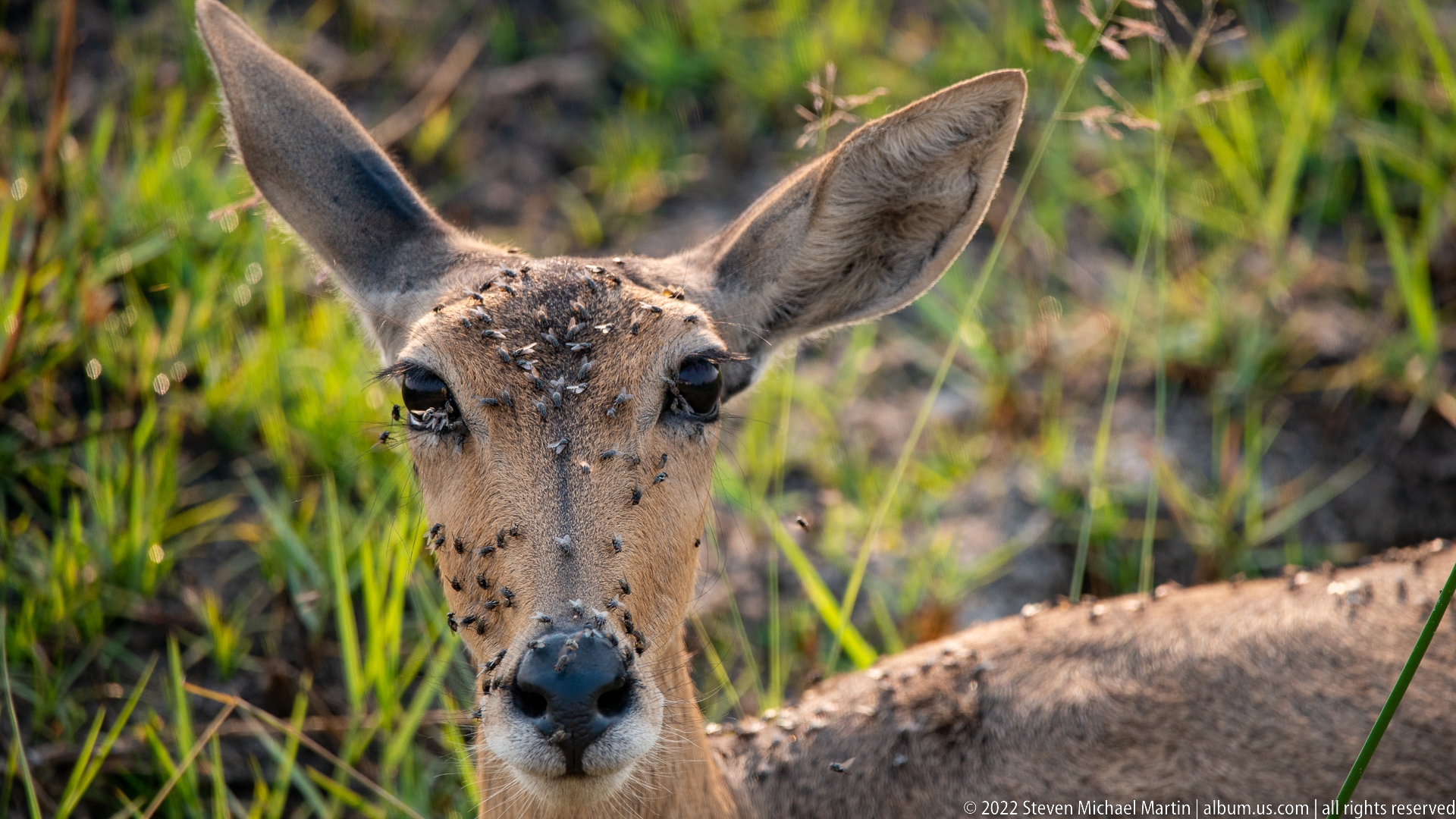
A close head-and-shoulders view concentrates on the female antelope’s alert ears and face, where numerous flies cluster around the forehead and eyes. The portrait records fine surface detail and the animal’s direct gaze while minimizing the grassy habitat visible in the preceding frames.
Caption
A close head-and-shoulders view concentrates on the female antelope’s alert ears and face, where numerous flies cluster around the forehead and eyes. The portrait records fine surface detail and the animal’s direct gaze while minimizing the grassy habitat visible in the preceding frames.

Greater kudu rest together in dappled woodland shade, with a spiral-horned male at left and several females reclining nearby. Their large ears, gray-brown coats, and narrow white vertical flank stripes identify the species, while the mixed group and fallen branches create a layered view of herd life on Chief’s Island.
Caption
Greater kudu rest together in dappled woodland shade, with a spiral-horned male at left and several females reclining nearby. Their large ears, gray-brown coats, and narrow white vertical flank stripes identify the species, while the mixed group and fallen branches create a layered view of herd life on Chief’s Island.

A female greater kudu rests upright on short grass, her body turned sideways while she watches the camera. The portrait clearly shows the species’ oversized ears, gently sloping back, gray-brown coat, and fine white vertical stripes, with woodland ground and a tree trunk softly receding behind her.
Caption
A female greater kudu rests upright on short grass, her body turned sideways while she watches the camera. The portrait clearly shows the species’ oversized ears, gently sloping back, gray-brown coat, and fine white vertical stripes, with woodland ground and a tree trunk softly receding behind her.
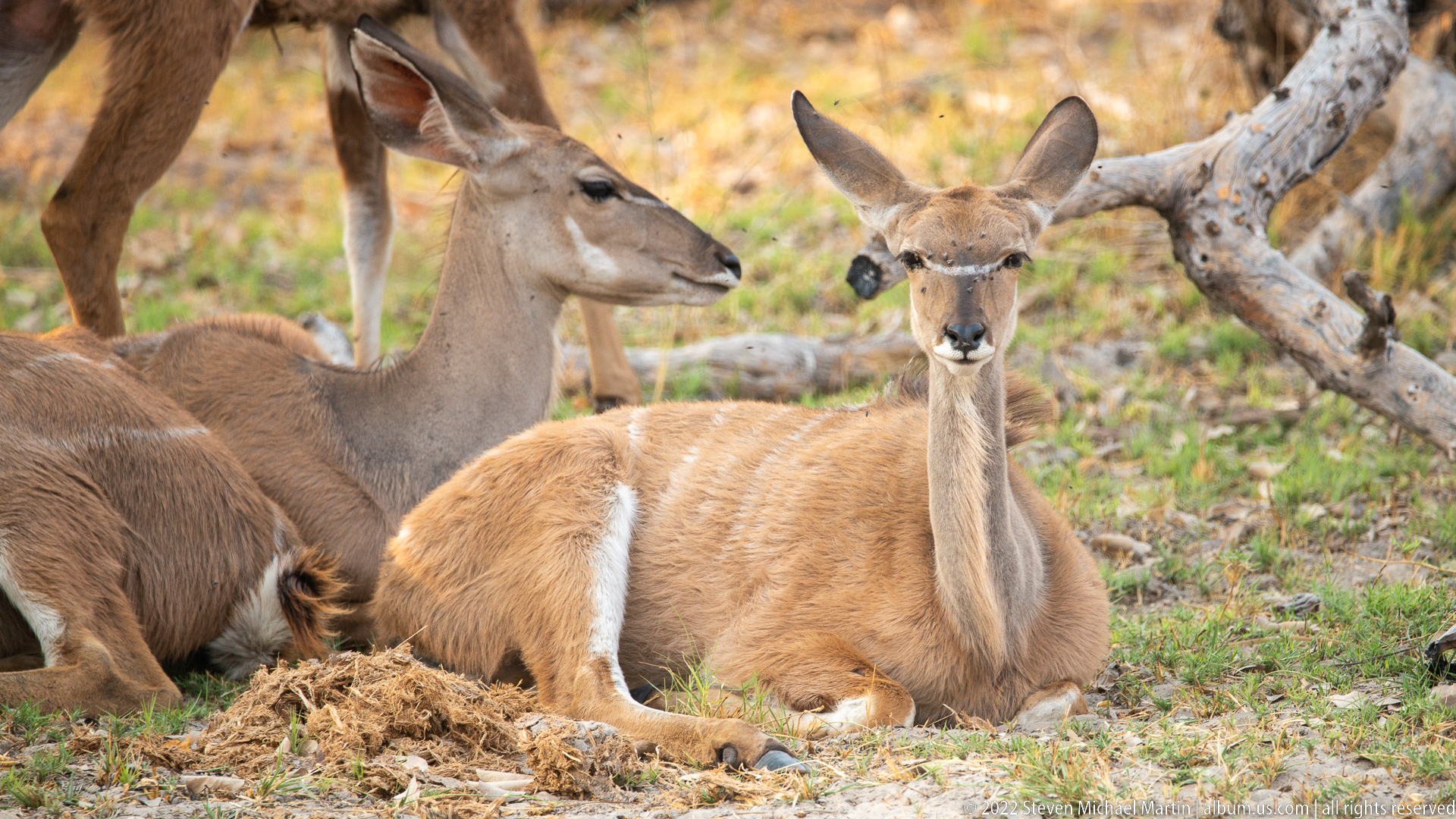
A reclining female greater kudu faces forward from the center of a resting group. Warm light catches her tan-gray coat and the pale vertical flank stripes, while neighboring kudu overlap at the edges of the frame, emphasizing the close spacing of animals gathered in the shade.
Caption
A reclining female greater kudu faces forward from the center of a resting group. Warm light catches her tan-gray coat and the pale vertical flank stripes, while neighboring kudu overlap at the edges of the frame, emphasizing the close spacing of animals gathered in the shade.
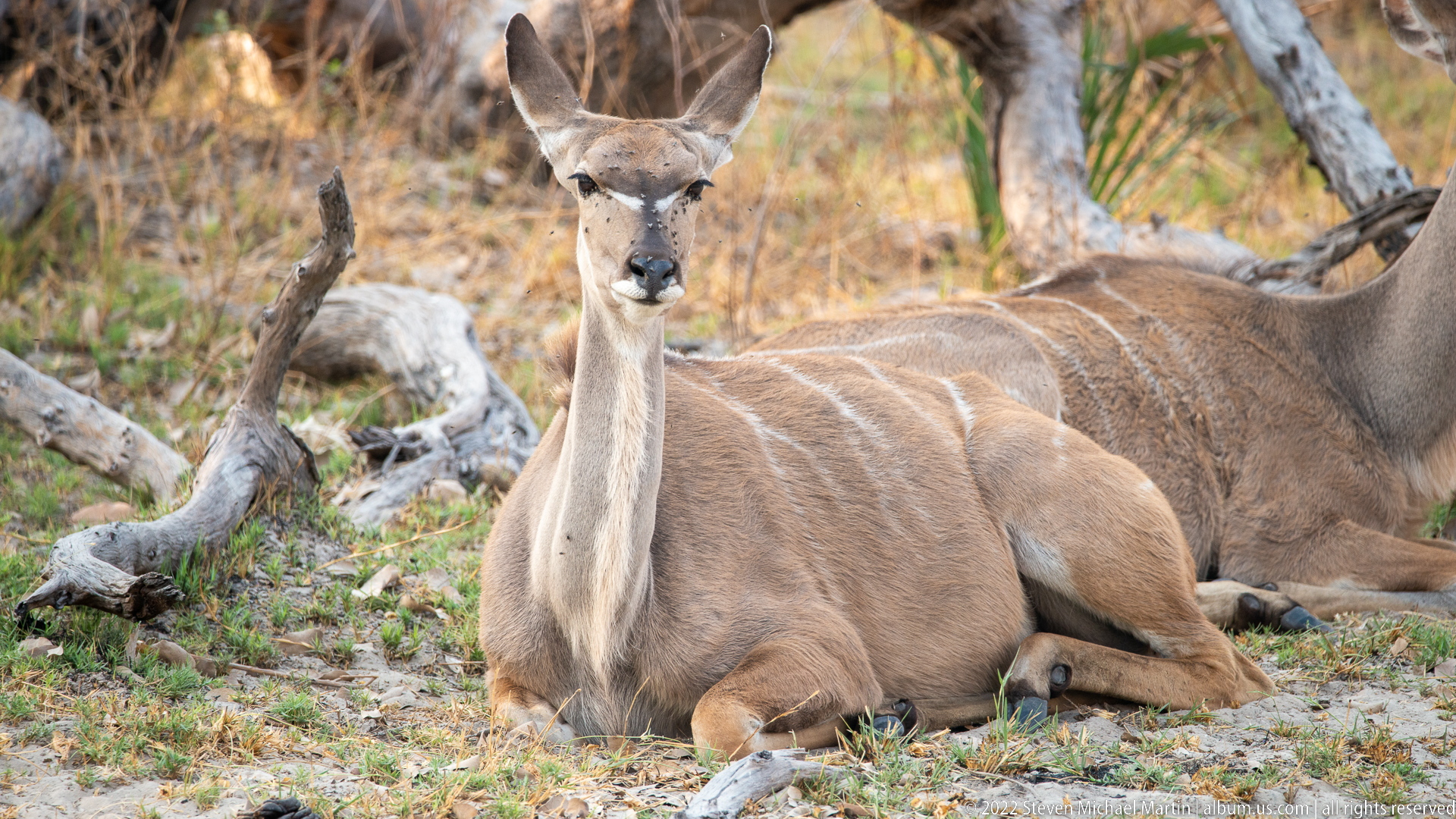
A female greater kudu reclines with her long neck upright and ears angled outward, meeting the camera directly. White flank stripes remain visible across the body, while another kudu lies behind her; the frontal posture makes the long face and broad ears the dominant features of this individual study.
Caption
A female greater kudu reclines with her long neck upright and ears angled outward, meeting the camera directly. White flank stripes remain visible across the body, while another kudu lies behind her; the frontal posture makes the long face and broad ears the dominant features of this individual study.
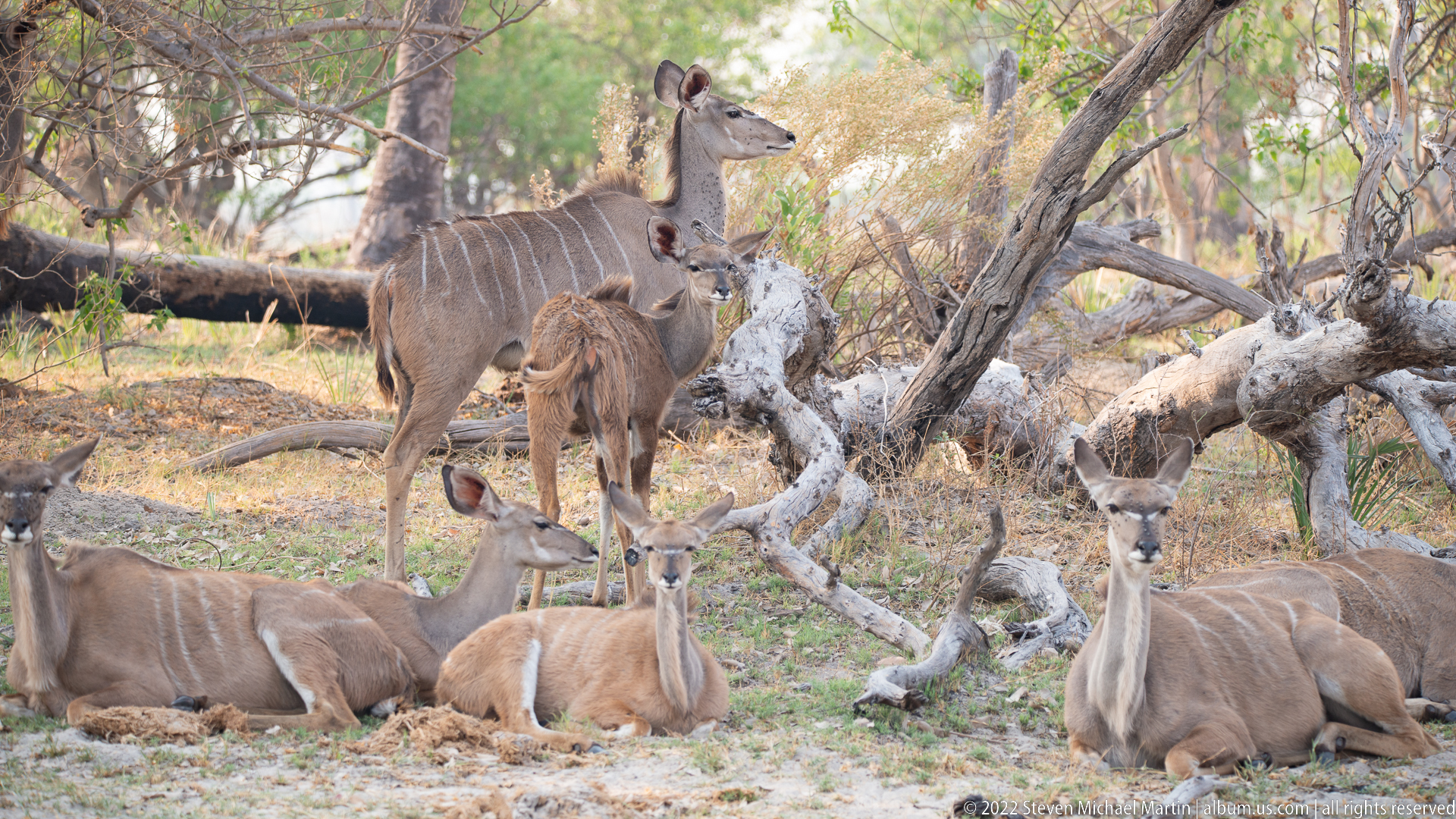
A small group of greater kudu occupies a patch of open woodland beneath pale fallen trunks. One female stands at the rear while several others rest on the ground, their striped flanks and large ears repeating across the composition and revealing different postures within the same herd.
Caption
A small group of greater kudu occupies a patch of open woodland beneath pale fallen trunks. One female stands at the rear while several others rest on the ground, their striped flanks and large ears repeating across the composition and revealing different postures within the same herd.

Resting greater kudu fill the frame in a compact herd portrait, their broad ears, long faces, and striped gray-brown coats forming a dense pattern of overlapping bodies. Several animals look directly toward the camera, while a spiral-horned male is partly visible behind the females.
Caption
Resting greater kudu fill the frame in a compact herd portrait, their broad ears, long faces, and striped gray-brown coats forming a dense pattern of overlapping bodies. Several animals look directly toward the camera, while a spiral-horned male is partly visible behind the females.
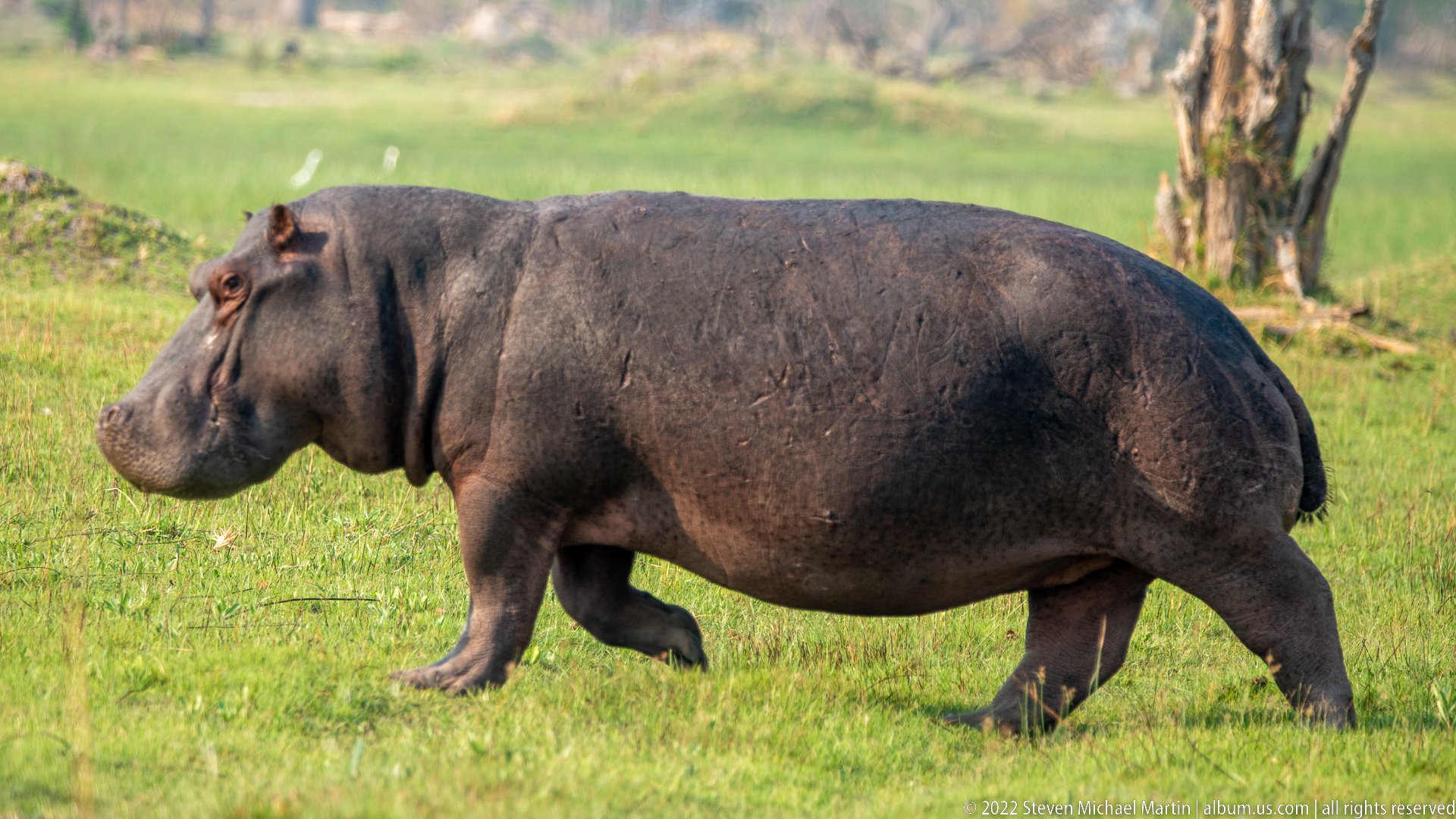
Seen in full profile, a common hippopotamus strides across short green floodplain grass. One foreleg is lifted mid-step, giving the heavy body an unusual sense of motion, while the rounded belly, short tail, thick neck, and broad muzzle remain clearly defined against the open habitat.
Caption
Seen in full profile, a common hippopotamus strides across short green floodplain grass. One foreleg is lifted mid-step, giving the heavy body an unusual sense of motion, while the rounded belly, short tail, thick neck, and broad muzzle remain clearly defined against the open habitat.
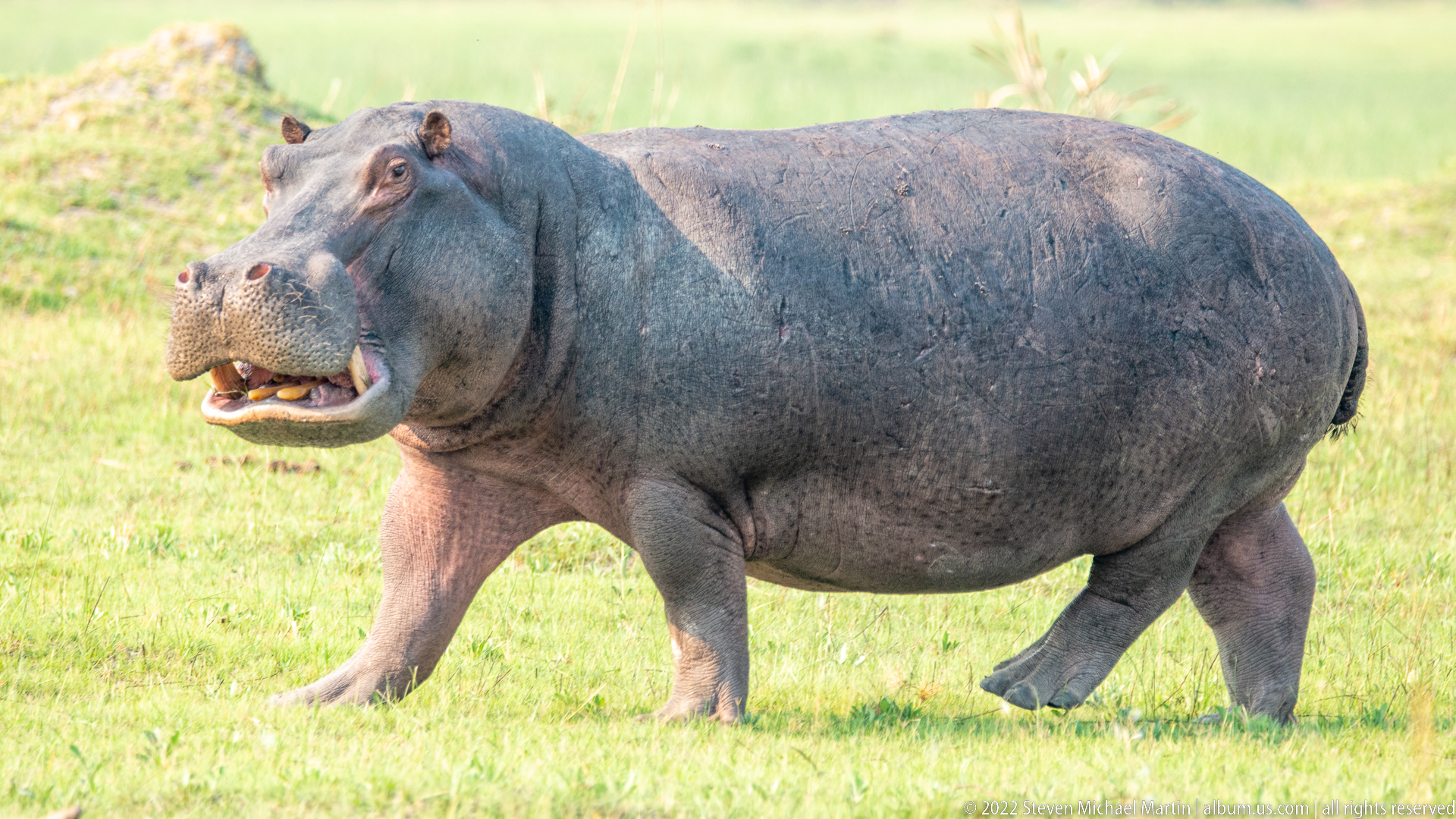
A common hippopotamus walks across bright grass with its mouth partly open, exposing the massive jaw and several teeth. The side-on view combines locomotion with a brief display of the species’ formidable gape, while the rounded torso and thick folds of skin remain sharply visible in the strong light.
Caption
A common hippopotamus walks across bright grass with its mouth partly open, exposing the massive jaw and several teeth. The side-on view combines locomotion with a brief display of the species’ formidable gape, while the rounded torso and thick folds of skin remain sharply visible in the strong light.
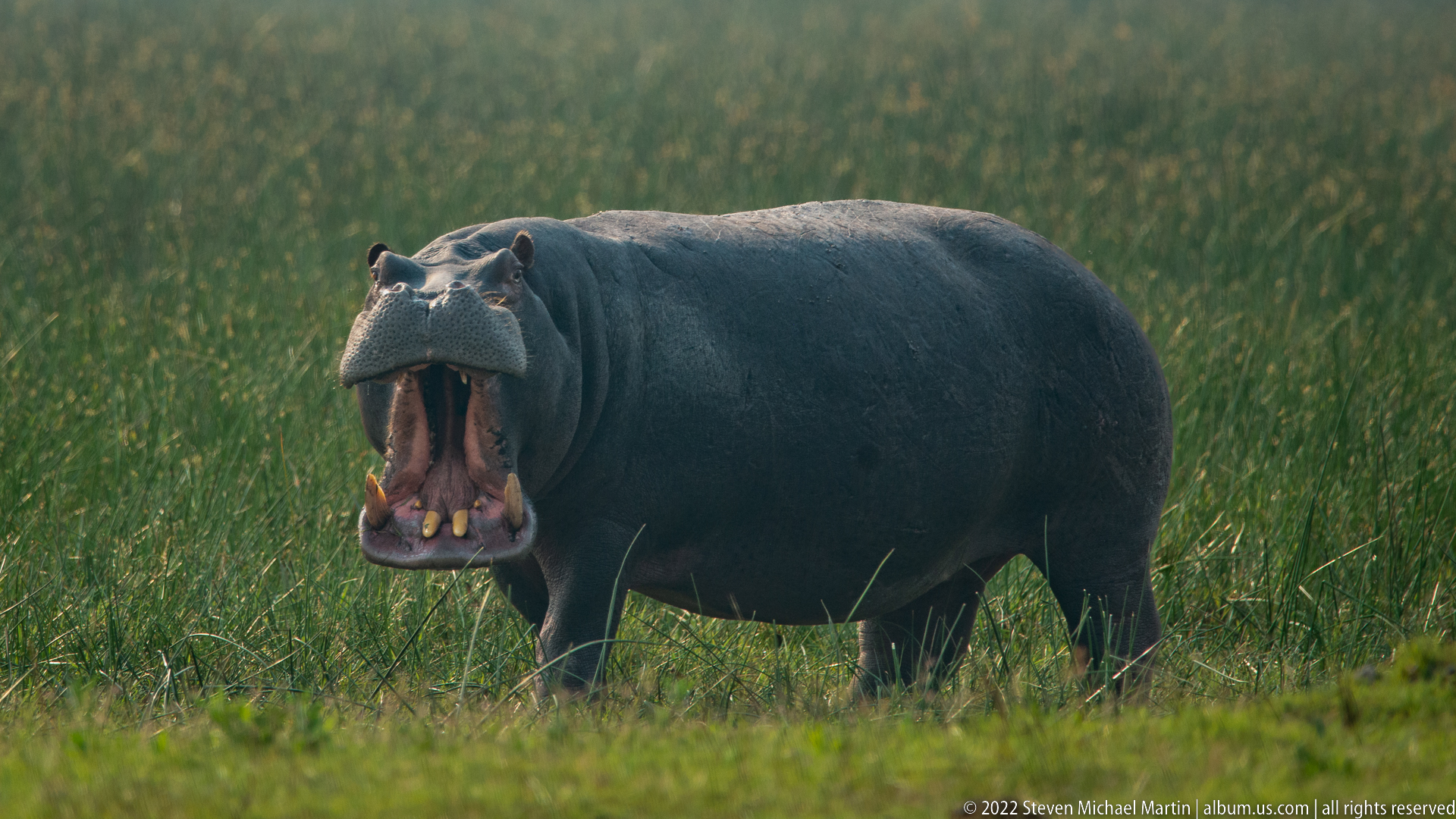
A hippopotamus opens its jaws to an extraordinary width while standing amid tall wetland vegetation. The frontal display exposes the pink mouth, large lower canines, incisors, and heavy lips; whether yawn or social threat, the posture dramatically reveals the jaw anatomy that is usually hidden when the animal’s mouth is closed.
Caption
A hippopotamus opens its jaws to an extraordinary width while standing amid tall wetland vegetation. The frontal display exposes the pink mouth, large lower canines, incisors, and heavy lips; whether yawn or social threat, the posture dramatically reveals the jaw anatomy that is usually hidden when the animal’s mouth is closed.
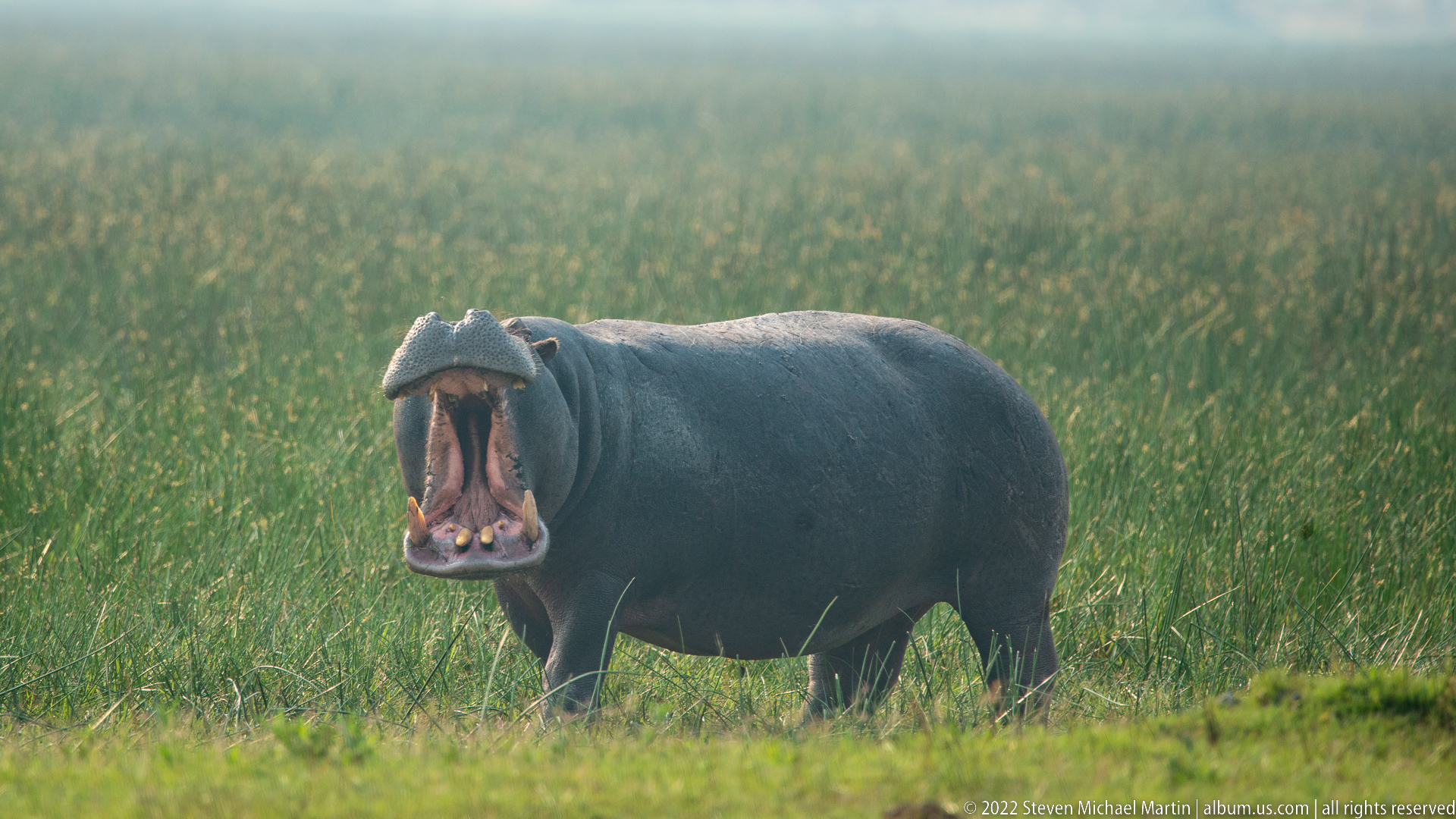
Standing beyond a low grassy bank, a common hippopotamus presents a full frontal gape, its mouth forming a broad vertical oval against the darker reed bed. The greater environmental distance distinguishes this frame from the preceding close view and shows the dramatic display within its wetland setting.
Caption
Standing beyond a low grassy bank, a common hippopotamus presents a full frontal gape, its mouth forming a broad vertical oval against the darker reed bed. The greater environmental distance distinguishes this frame from the preceding close view and shows the dramatic display within its wetland setting.
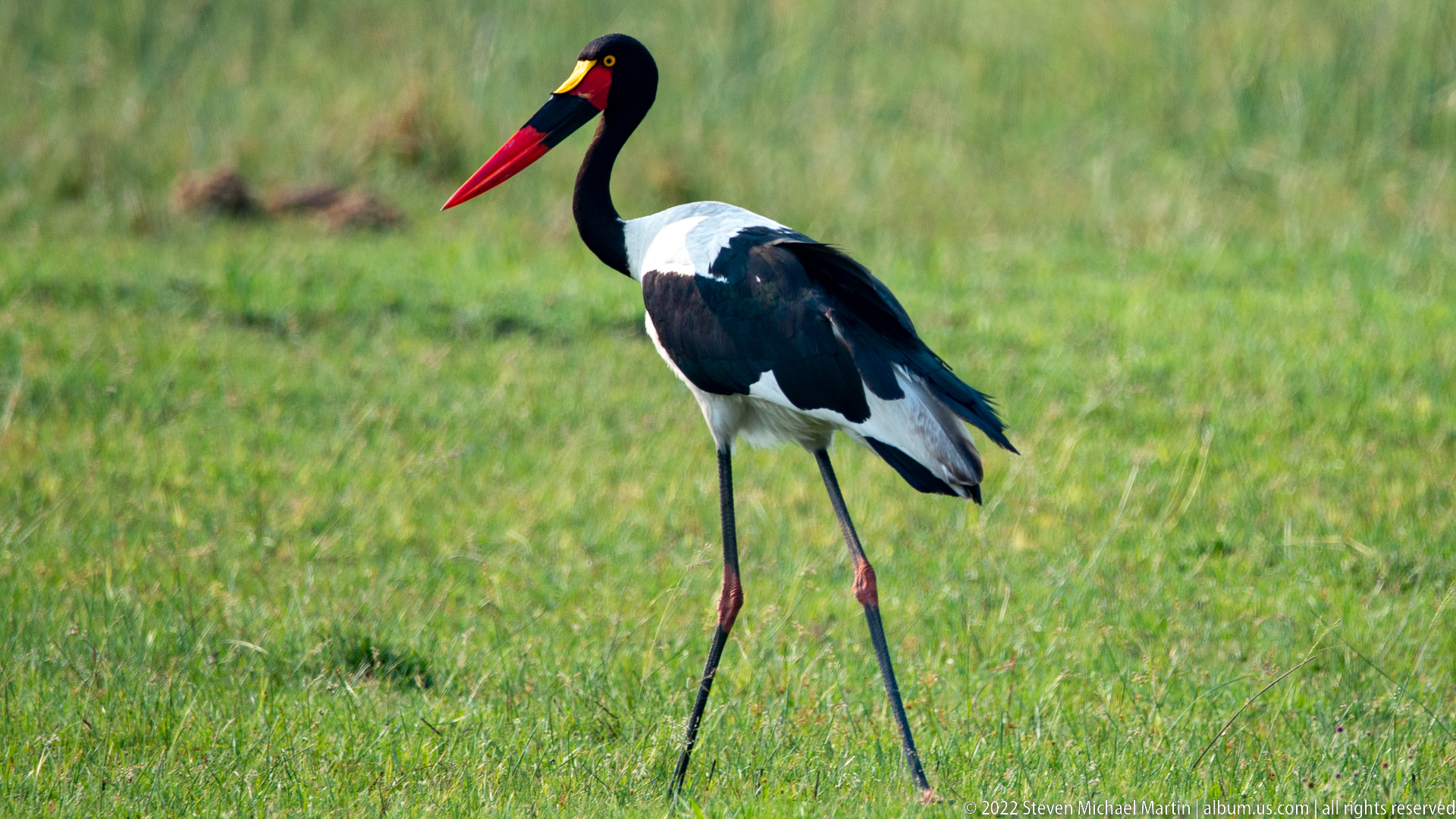
A saddle-billed stork walks across short green floodplain grass, its exceptionally long legs and towering black-and-white body shown in clean profile. The red-and-black bill with a yellow saddle at the base is unmistakable, as are the glossy black neck and wing panels contrasting with white underparts.
Caption
A saddle-billed stork walks across short green floodplain grass, its exceptionally long legs and towering black-and-white body shown in clean profile. The red-and-black bill with a yellow saddle at the base is unmistakable, as are the glossy black neck and wing panels contrasting with white underparts.

Several antelope move through tall floodplain vegetation in a broad wetland view, with a hippopotamus visible farther back near the tree line. The reddish-brown antelope and their marsh setting are consistent with red lechwe, a species strongly associated with seasonally inundated Okavango grasslands.
Caption
Several antelope move through tall floodplain vegetation in a broad wetland view, with a hippopotamus visible farther back near the tree line. The reddish-brown antelope and their marsh setting are consistent with red lechwe, a species strongly associated with seasonally inundated Okavango grasslands.
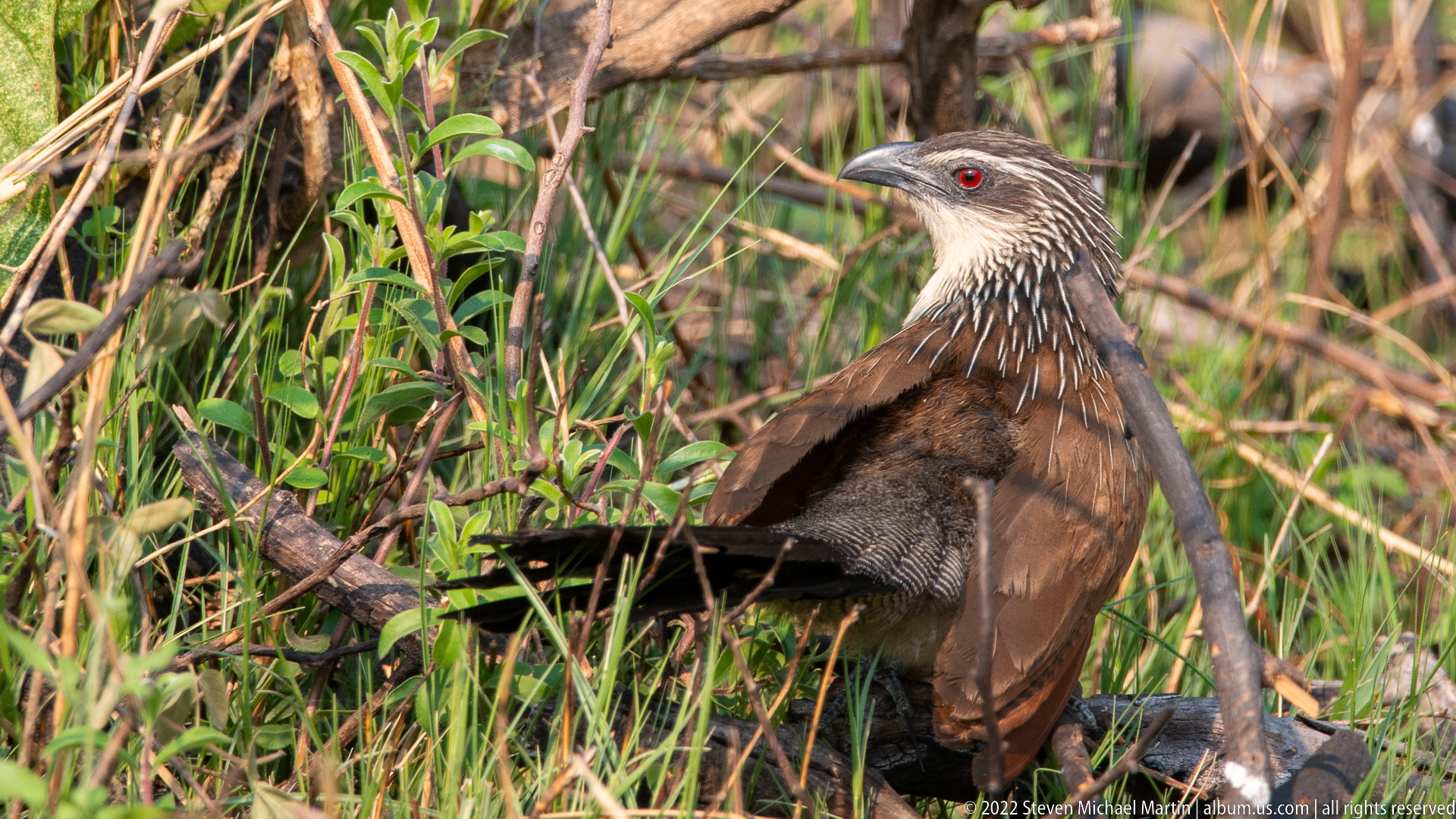
In a second close view, the coucal raises its head among reeds and fallen stems, bringing the red iris and strongly streaked neck into sharper prominence. Rich chestnut wing coverts contrast with the darker body and long tail, while the dense low vegetation reflects the bird’s secretive wetland habitat.
Caption
In a second close view, the coucal raises its head among reeds and fallen stems, bringing the red iris and strongly streaked neck into sharper prominence. Rich chestnut wing coverts contrast with the darker body and long tail, while the dense low vegetation reflects the bird’s secretive wetland habitat.
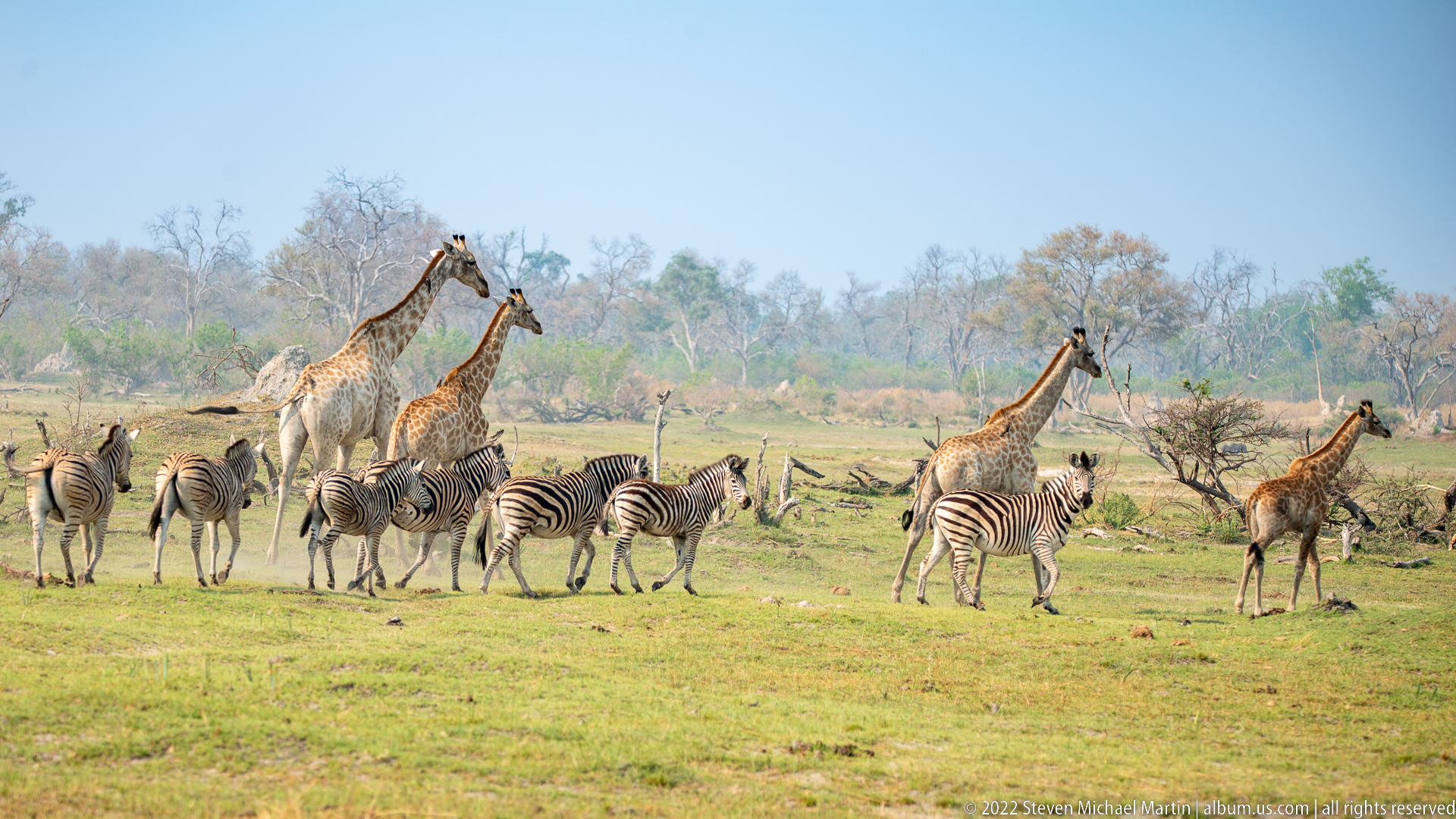
Plains zebras and giraffes share an open grassy clearing, creating a broad multi-species view of Chief’s Island. Several zebras graze in the foreground while giraffes rise above them at varying distances, their contrasting striped and patterned coats standing out against scattered woodland at the edge of the plain.
Caption
Plains zebras and giraffes share an open grassy clearing, creating a broad multi-species view of Chief’s Island. Several zebras graze in the foreground while giraffes rise above them at varying distances, their contrasting striped and patterned coats standing out against scattered woodland at the edge of the plain.
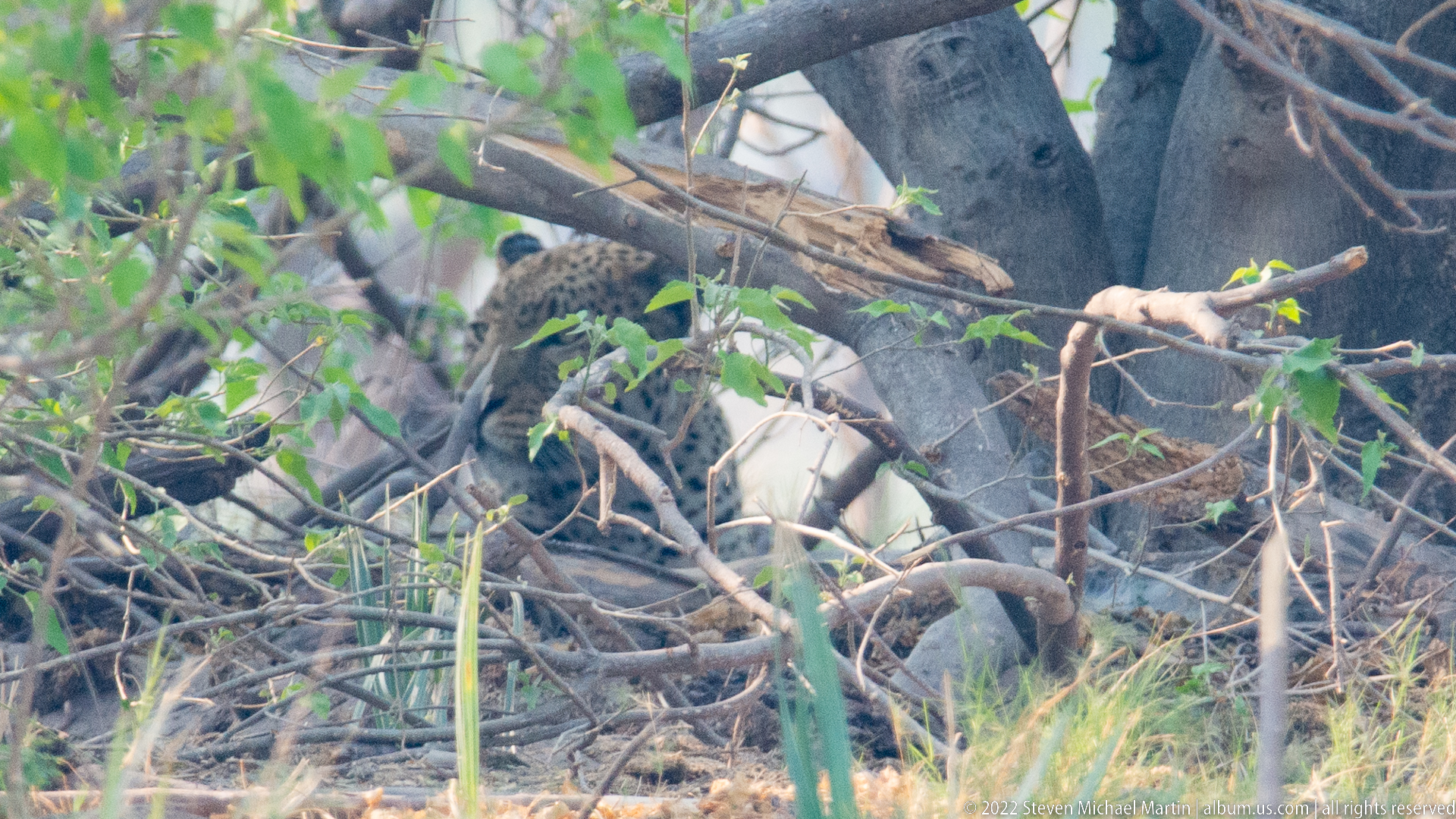
A leopard lies partly concealed within the fork of a tree, its spotted coat broken by branches, leaves, and deep shade. Only portions of the head and rosetted body are visible, making this a habitat-rich encounter rather than a clear portrait and demonstrating how effectively the cat’s pattern disappears into woodland cover.
Caption
A leopard lies partly concealed within the fork of a tree, its spotted coat broken by branches, leaves, and deep shade. Only portions of the head and rosetted body are visible, making this a habitat-rich encounter rather than a clear portrait and demonstrating how effectively the cat’s pattern disappears into woodland cover.
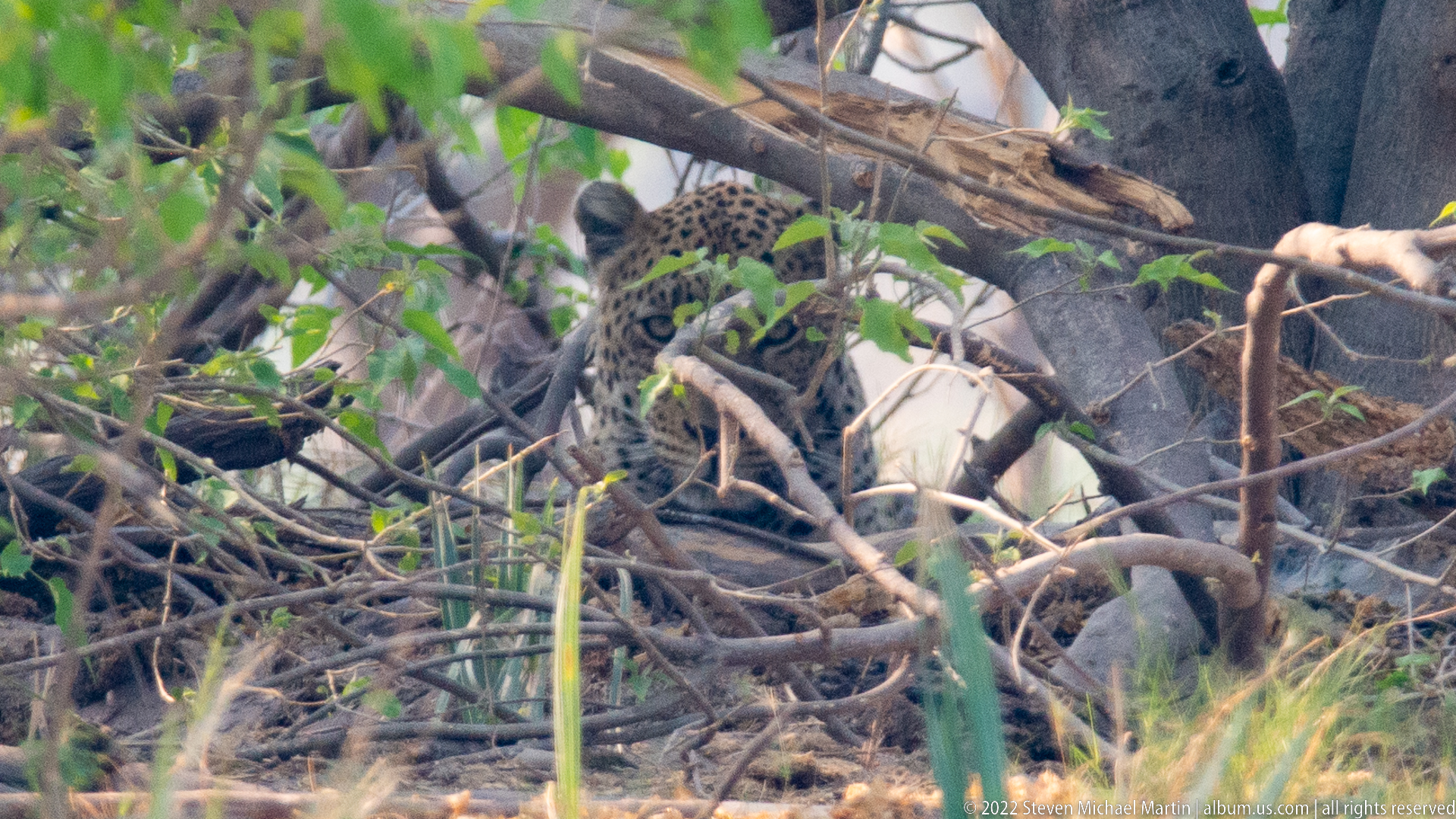
An African leopard moves through a dense lattice of fallen branches and leafy woodland on Chief’s Island. Its rosette-patterned coat breaks into the mottled light and shadow of the understory, demonstrating how effectively the cat disappears in tangled cover. Only part of the body and head are visible, making this a strongly habitat-centered view rather than a conventional portrait.
Caption
An African leopard moves through a dense lattice of fallen branches and leafy woodland on Chief’s Island. Its rosette-patterned coat breaks into the mottled light and shadow of the understory, demonstrating how effectively the cat disappears in tangled cover. Only part of the body and head are visible, making this a strongly habitat-centered view rather than a conventional portrait.
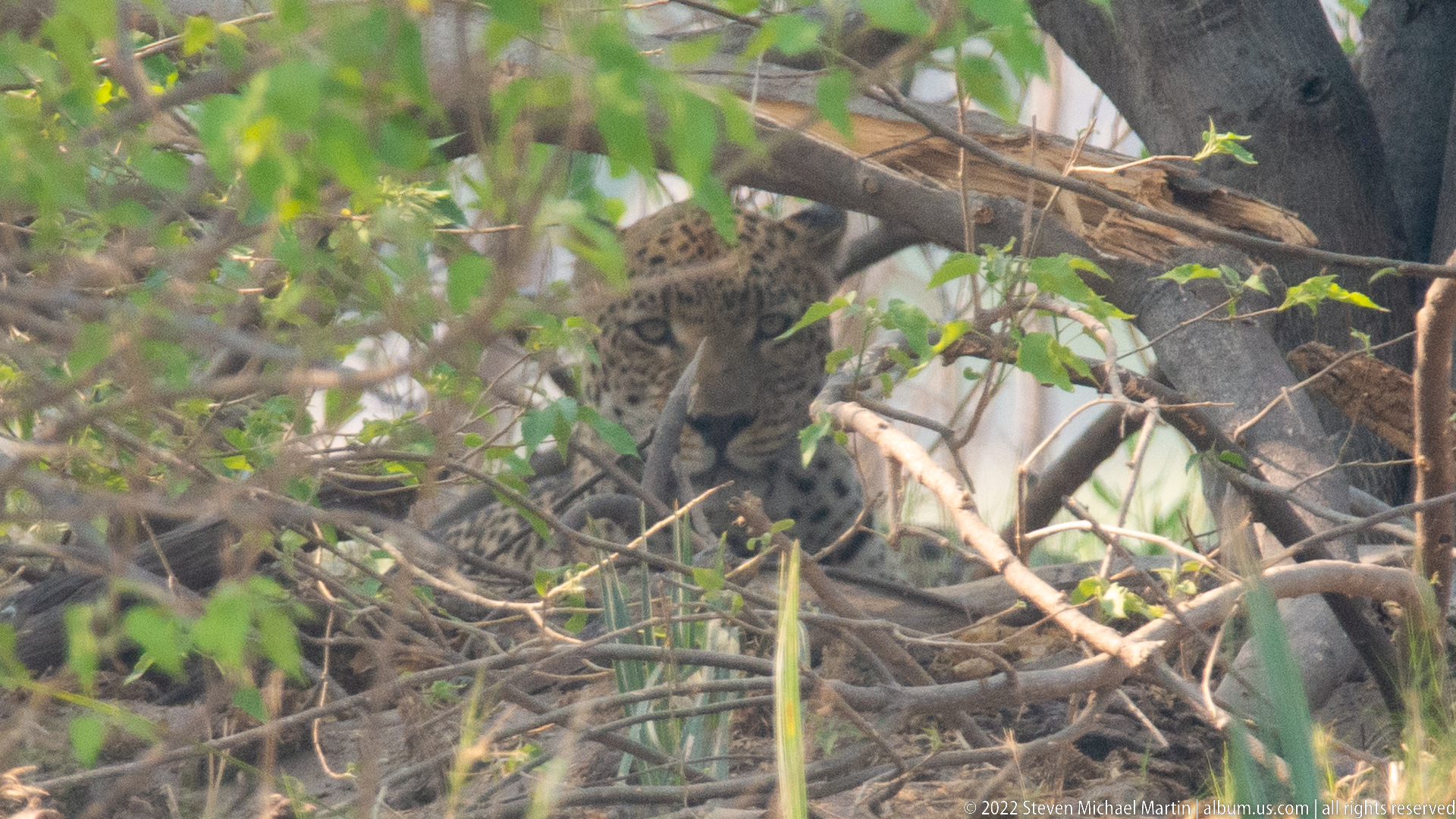
Seen through a screen of leaves and branches, an African leopard advances within the shaded woodland of Chief’s Island. The frontal angle reveals the cat’s broad head, pale muzzle, and dark rosettes while vegetation obscures much of the body. The compressed view conveys the difficulty of following a leopard once it enters dense cover.
Caption
Seen through a screen of leaves and branches, an African leopard advances within the shaded woodland of Chief’s Island. The frontal angle reveals the cat’s broad head, pale muzzle, and dark rosettes while vegetation obscures much of the body. The compressed view conveys the difficulty of following a leopard once it enters dense cover.

An African leopard pauses beneath a leaning tree trunk, its face framed by branches in the woodland understory. The animal’s eyes are directed toward the camera while the spotted forequarters remain partly screened by vegetation. Compared with the surrounding sequence, this closer view gives unusual emphasis to the cat’s attentive expression and facial markings.
Caption
An African leopard pauses beneath a leaning tree trunk, its face framed by branches in the woodland understory. The animal’s eyes are directed toward the camera while the spotted forequarters remain partly screened by vegetation. Compared with the surrounding sequence, this closer view gives unusual emphasis to the cat’s attentive expression and facial markings.
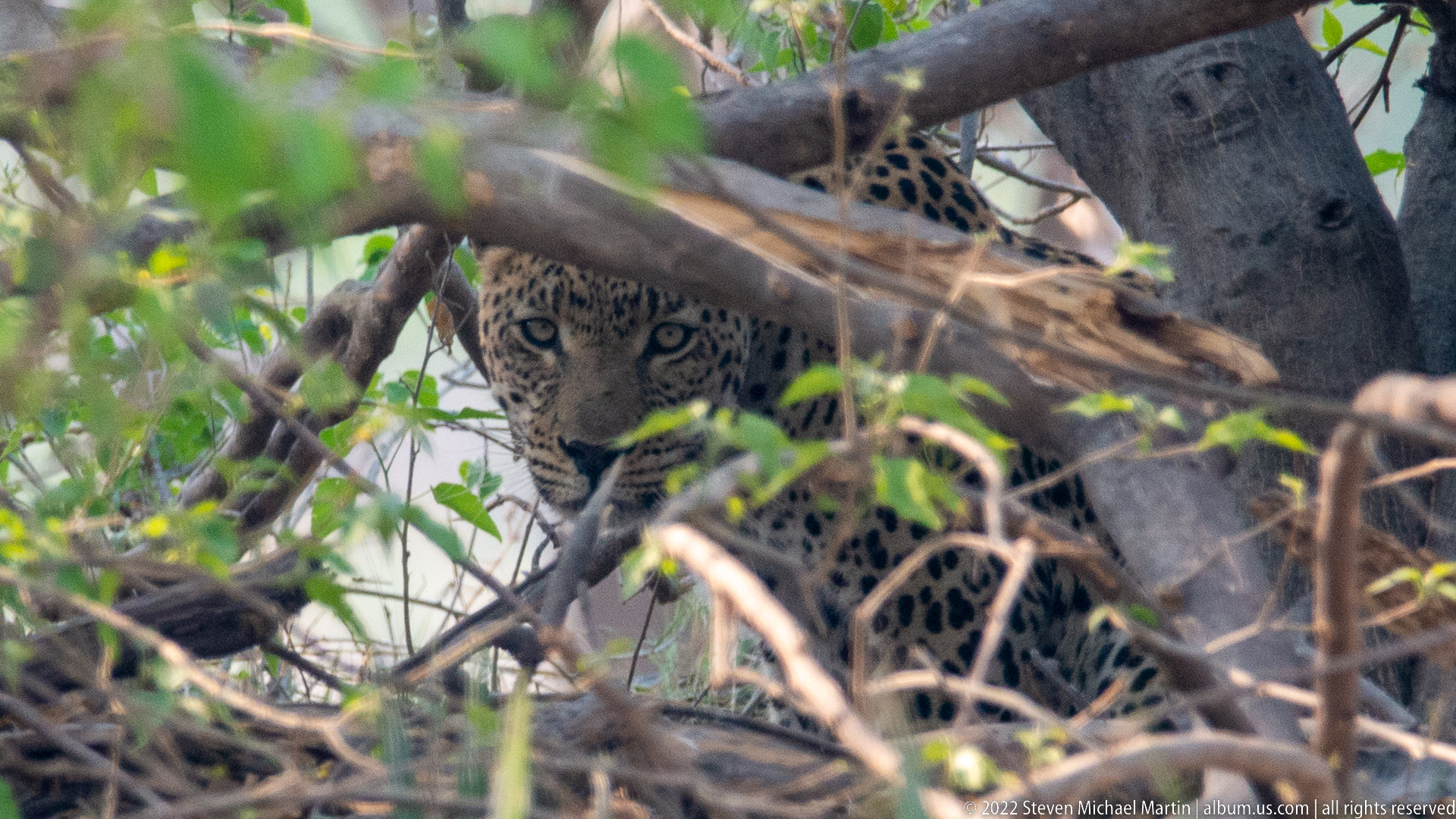
Framed tightly by interlaced branches, an African leopard watches from the cover of woodland on Chief’s Island. The cat’s face occupies the visual center, with the eyes and whisker pads sharply visible between foreground twigs. Its patterned shoulder and foreleg recede into the brush, emphasizing the animal’s concealment at close range.
Caption
Framed tightly by interlaced branches, an African leopard watches from the cover of woodland on Chief’s Island. The cat’s face occupies the visual center, with the eyes and whisker pads sharply visible between foreground twigs. Its patterned shoulder and foreleg recede into the brush, emphasizing the animal’s concealment at close range.
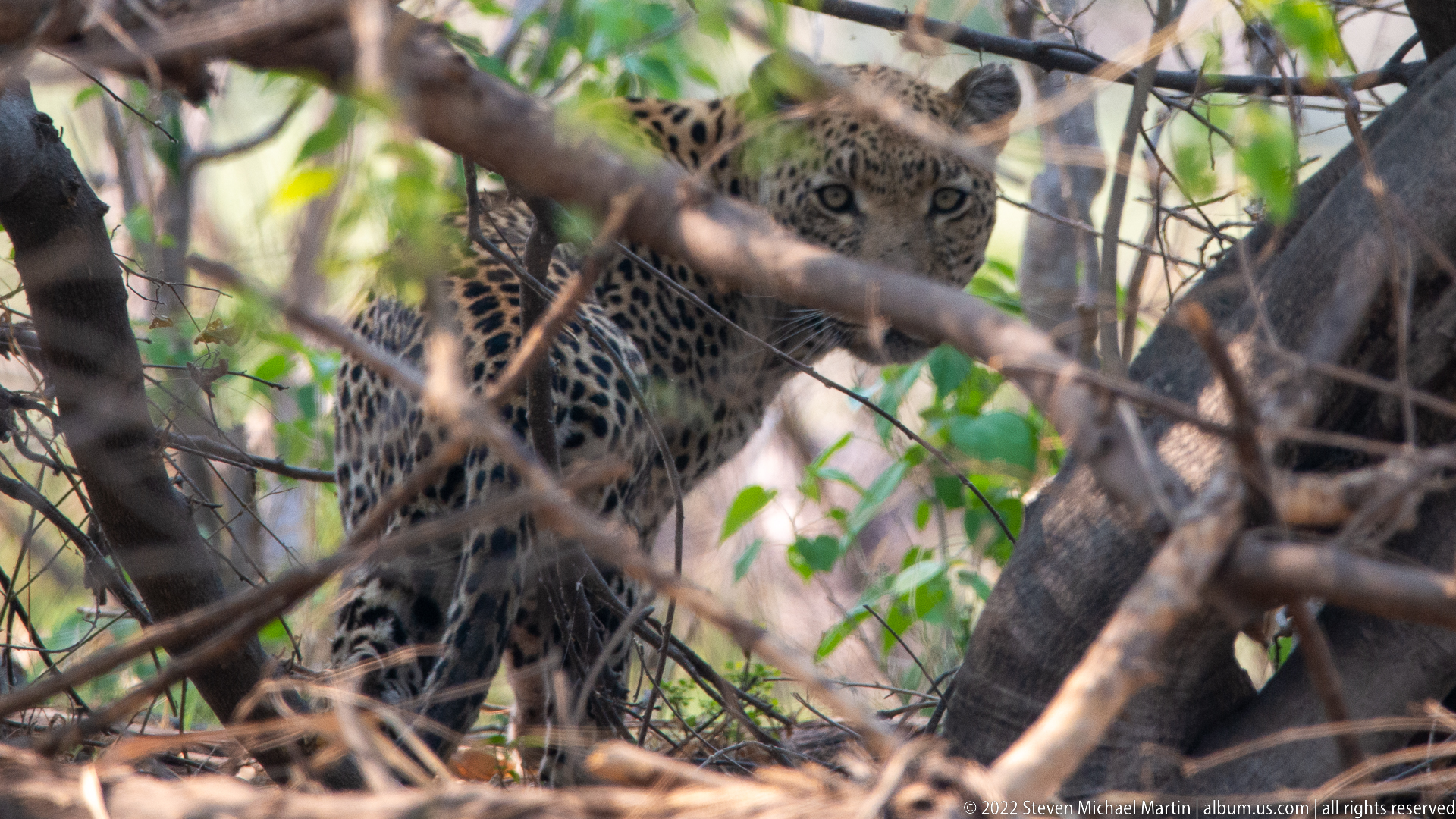
An African leopard stands nearly upright within thick brush, looking out through a layered network of branches. More of the chest and forelegs are visible here than in the preceding close portraits, showing the cat’s vertical posture against trunks and leaf litter. The rosette pattern remains conspicuous even as the surrounding woodland fragments the outline of its body.
Caption
An African leopard stands nearly upright within thick brush, looking out through a layered network of branches. More of the chest and forelegs are visible here than in the preceding close portraits, showing the cat’s vertical posture against trunks and leaf litter. The rosette pattern remains conspicuous even as the surrounding woodland fragments the outline of its body.
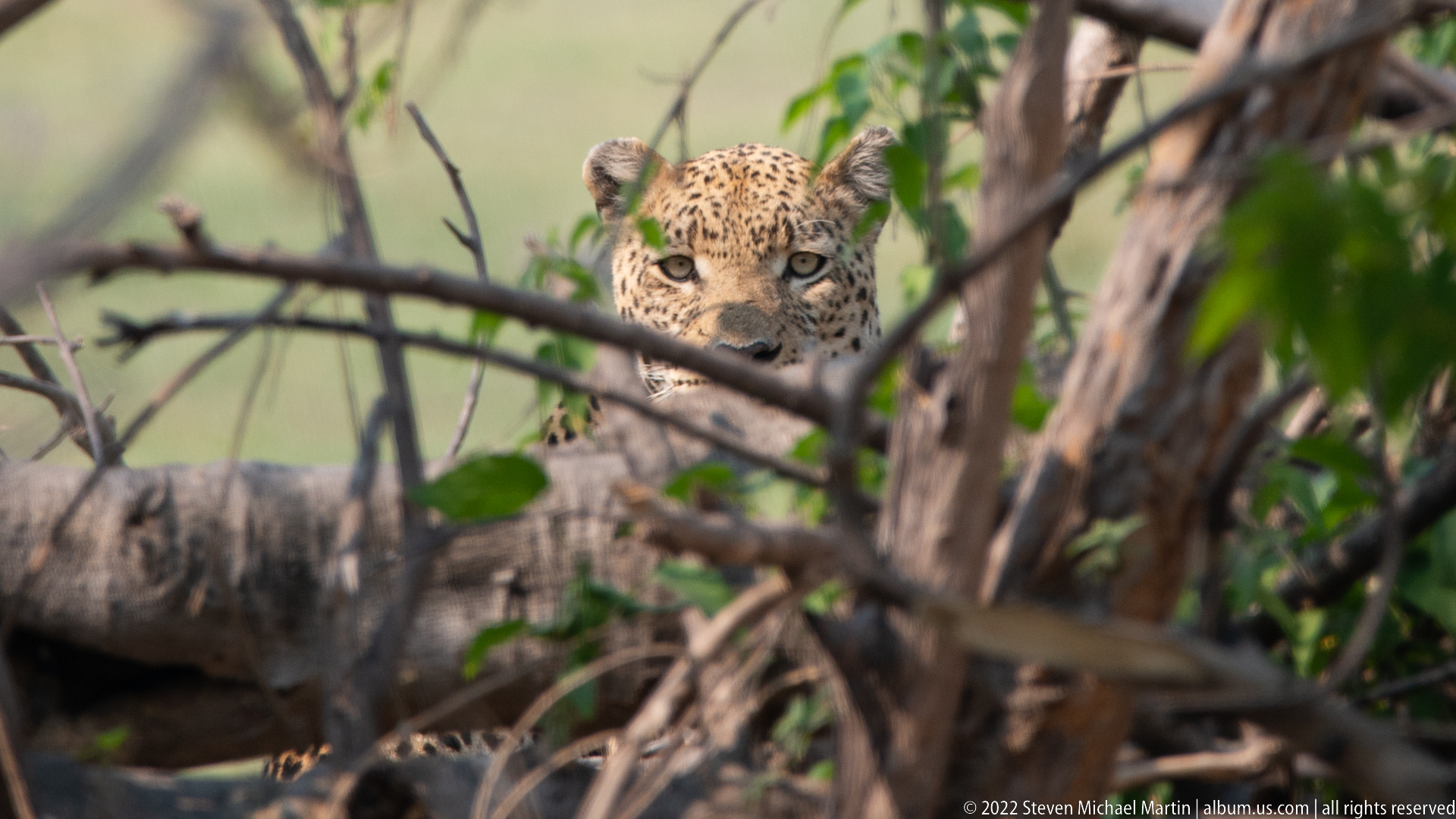
Only the head of an African leopard rises clearly above a fallen limb in this low, intimate view from Chief’s Island. The cat looks directly forward while branches and foliage mask the rest of its body. The composition isolates the rounded ears, pale eyes, and dense forehead spotting against softly blurred green habitat.
Caption
Only the head of an African leopard rises clearly above a fallen limb in this low, intimate view from Chief’s Island. The cat looks directly forward while branches and foliage mask the rest of its body. The composition isolates the rounded ears, pale eyes, and dense forehead spotting against softly blurred green habitat.

An African leopard stands in an open patch of grass beside mature woodland, turning its head toward the camera. With the cat fully visible from head to tail, the view clearly shows its muscular build, long legs, and dense rosette pattern. The transition from tangled cover to open ground gives the animal a markedly different presence from the preceding concealed portraits.
Caption
An African leopard stands in an open patch of grass beside mature woodland, turning its head toward the camera. With the cat fully visible from head to tail, the view clearly shows its muscular build, long legs, and dense rosette pattern. The transition from tangled cover to open ground gives the animal a markedly different presence from the preceding concealed portraits.
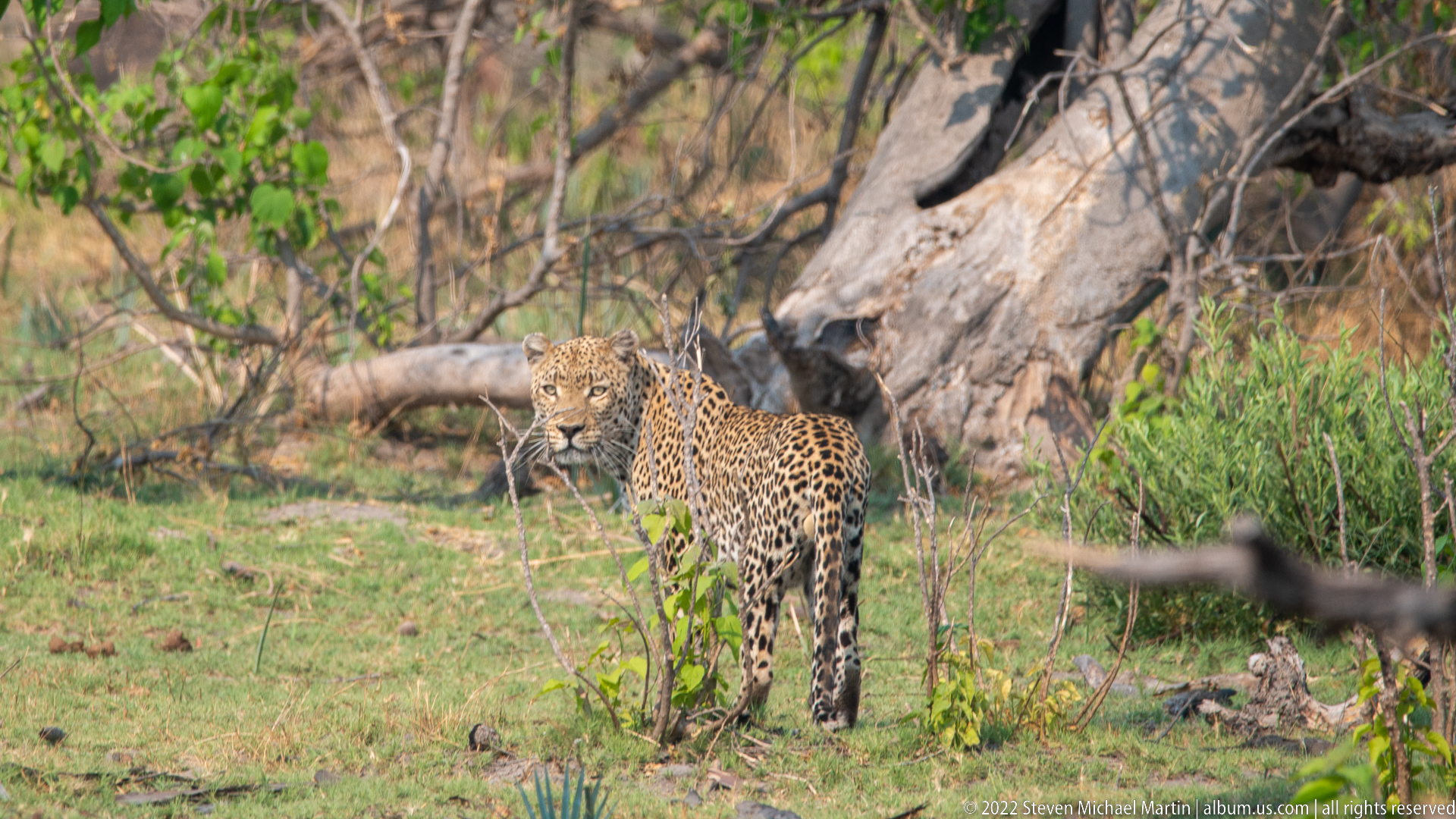
An African leopard stands farther back in a grassy clearing at the edge of Chief’s Island woodland. The greater distance places the cat within its surroundings: short green grass, scattered saplings, fallen wood, and a massive tree trunk. Its upright posture and forward gaze remain clear despite the broader environmental framing.
Caption
An African leopard stands farther back in a grassy clearing at the edge of Chief’s Island woodland. The greater distance places the cat within its surroundings: short green grass, scattered saplings, fallen wood, and a massive tree trunk. Its upright posture and forward gaze remain clear despite the broader environmental framing.
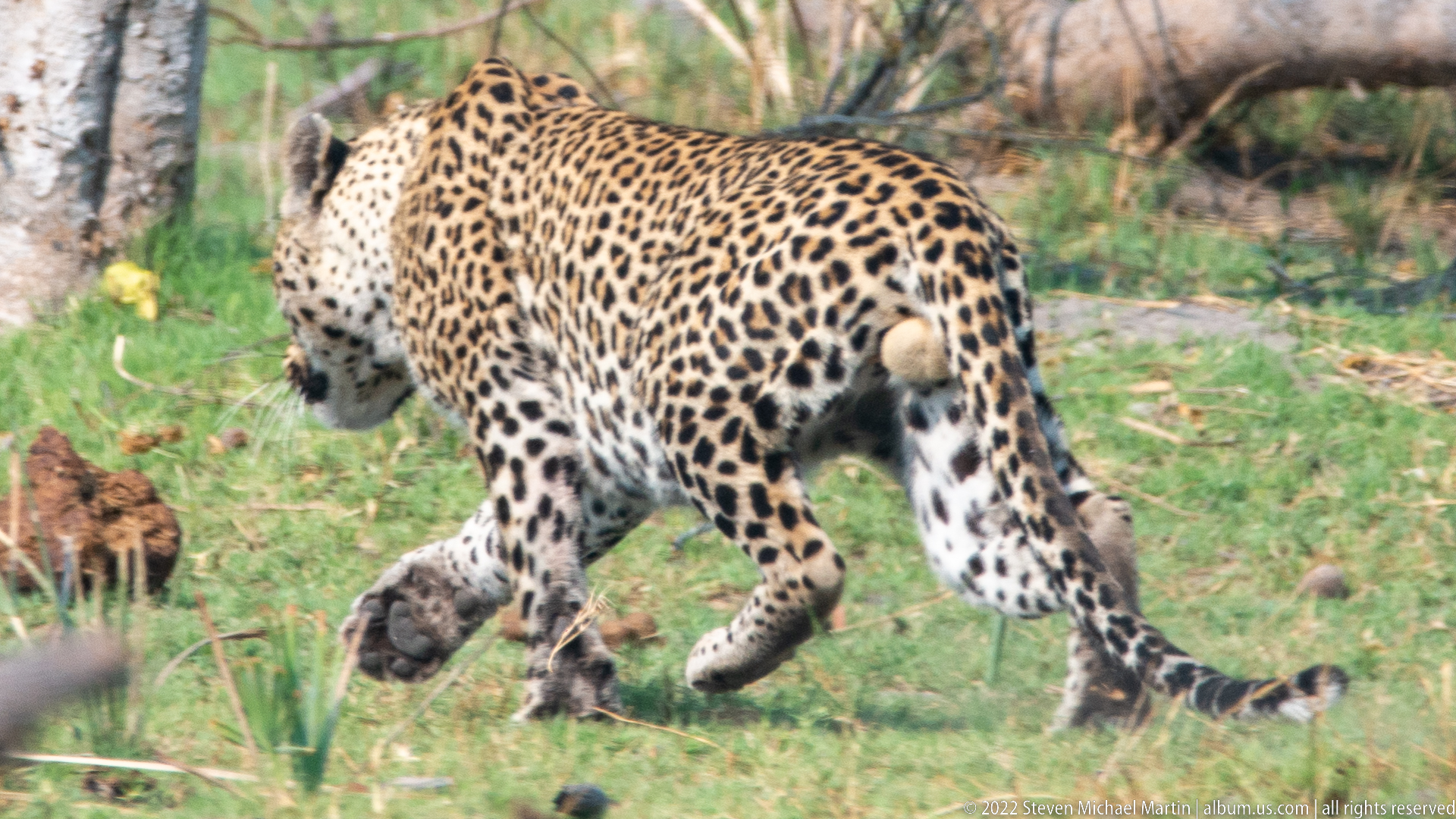
Moving away across short grass, an African leopard is seen from the rear quarter with one forepaw lifted mid-stride. The angle emphasizes the heavy rosettes across its back and flanks, the white inner hind legs, and the long ringed tail. This departure view records the cat in motion rather than at rest or under cover.
Caption
Moving away across short grass, an African leopard is seen from the rear quarter with one forepaw lifted mid-stride. The angle emphasizes the heavy rosettes across its back and flanks, the white inner hind legs, and the long ringed tail. This departure view records the cat in motion rather than at rest or under cover.
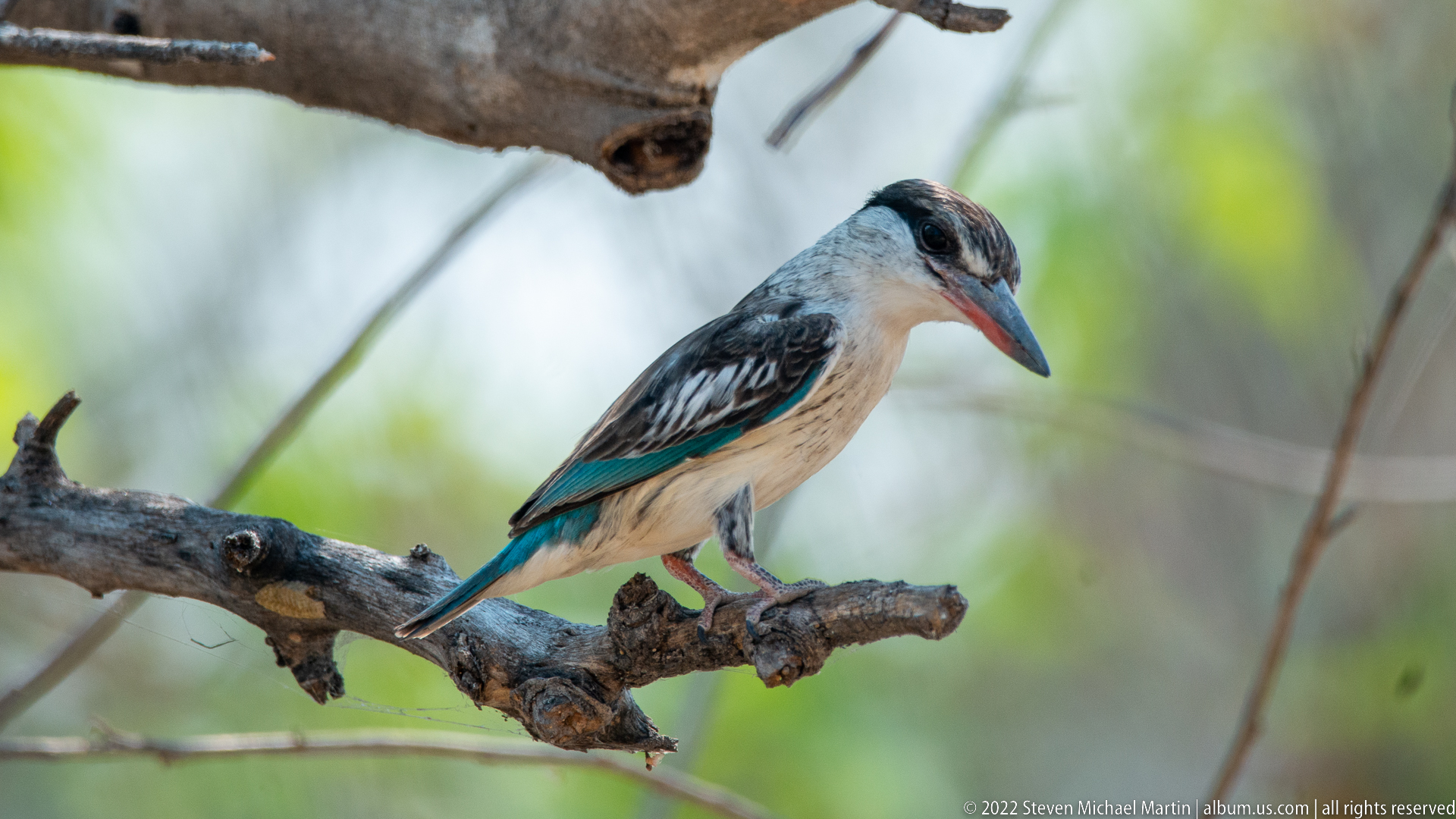
A woodland kingfisher perches sideways on a bare branch, its pale head and underparts contrasting with dark upper wings and a vivid turquoise-blue rump and tail. The long red-and-dark bill and compact kingfisher profile are clearly visible. Soft green foliage in the background isolates the bird and its distinctive color pattern.
Caption
A woodland kingfisher perches sideways on a bare branch, its pale head and underparts contrasting with dark upper wings and a vivid turquoise-blue rump and tail. The long red-and-dark bill and compact kingfisher profile are clearly visible. Soft green foliage in the background isolates the bird and its distinctive color pattern.
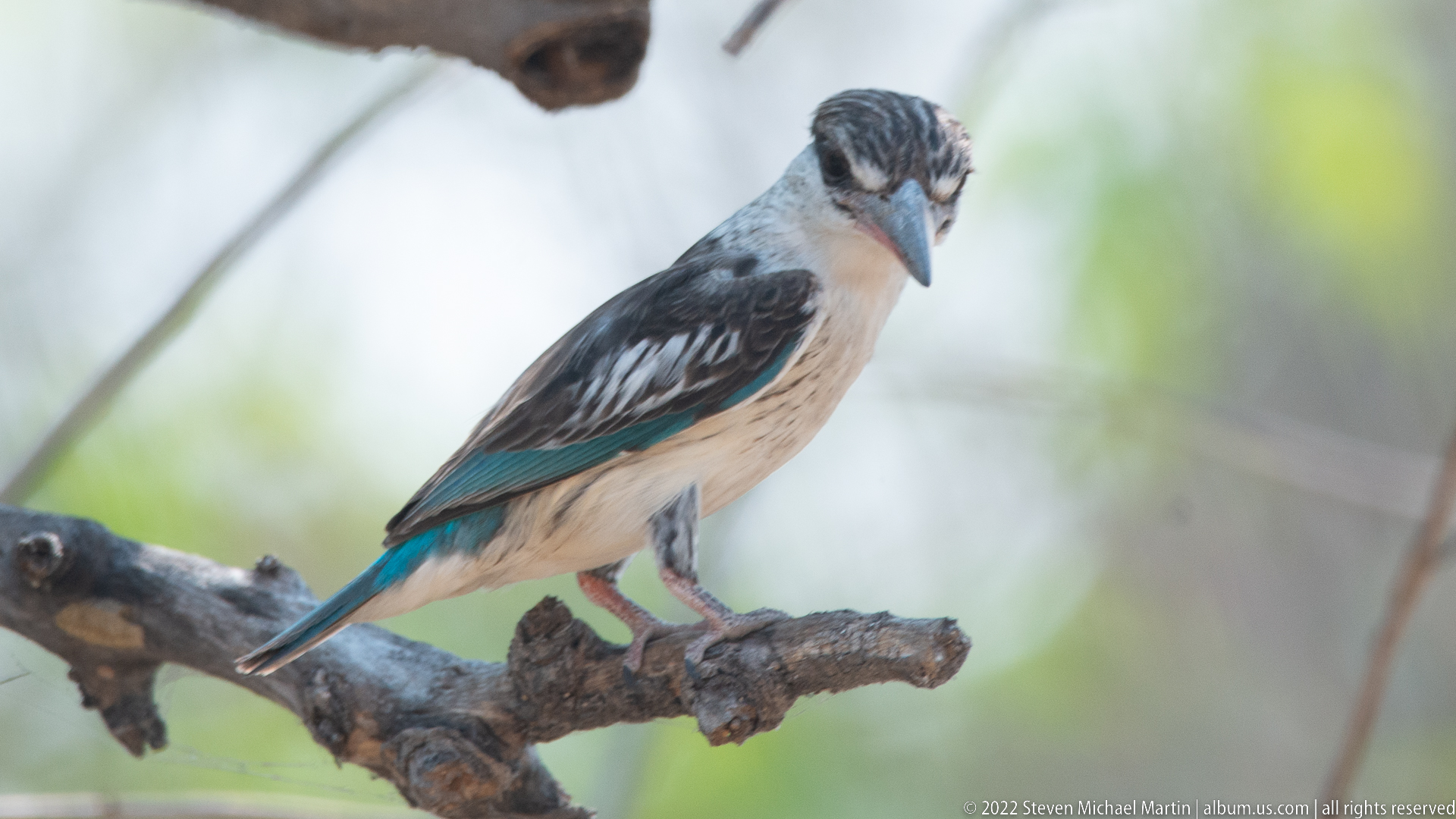
A woodland kingfisher balances on a rough horizontal branch with its head angled downward, as though inspecting the ground below. The pose exposes the pale throat and belly, dark patterned wings, and bright turquoise tail while the long bill points toward the perch. The shallow background keeps attention on the bird’s posture and plumage.
Caption
A woodland kingfisher balances on a rough horizontal branch with its head angled downward, as though inspecting the ground below. The pose exposes the pale throat and belly, dark patterned wings, and bright turquoise tail while the long bill points toward the perch. The shallow background keeps attention on the bird’s posture and plumage.

A woodland kingfisher is shown in a clean side profile on a bare branch, presenting the species’ long two-toned bill, pale head and underparts, dark wing coverts, and brilliant turquoise-blue lower back and tail. The uncluttered pose and soft background make this the most diagnostic portrait of the bird in the sequence.
Caption
A woodland kingfisher is shown in a clean side profile on a bare branch, presenting the species’ long two-toned bill, pale head and underparts, dark wing coverts, and brilliant turquoise-blue lower back and tail. The uncluttered pose and soft background make this the most diagnostic portrait of the bird in the sequence.

A blue wildebeest trots across open grass on Chief’s Island, one foreleg extended and the mane lifted along its neck and back. The heavy shoulders, sloping hindquarters, dark facial mask, curved horns, and vertical body striping are all visible in profile. The raised gait gives the portrait a sense of purposeful movement through the floodplain habitat.
Caption
A blue wildebeest trots across open grass on Chief’s Island, one foreleg extended and the mane lifted along its neck and back. The heavy shoulders, sloping hindquarters, dark facial mask, curved horns, and vertical body striping are all visible in profile. The raised gait gives the portrait a sense of purposeful movement through the floodplain habitat.

A southern carmine bee-eater perches at the tip of a slender bare stem above open grassland. Its saturated carmine body is set off by a turquoise-blue crown and lower back, while elongated central tail feathers extend well below the perch. The isolated setting makes the bird’s characteristic silhouette and vivid breeding plumage especially clear.
Caption
A southern carmine bee-eater perches at the tip of a slender bare stem above open grassland. Its saturated carmine body is set off by a turquoise-blue crown and lower back, while elongated central tail feathers extend well below the perch. The isolated setting makes the bird’s characteristic silhouette and vivid breeding plumage especially clear.
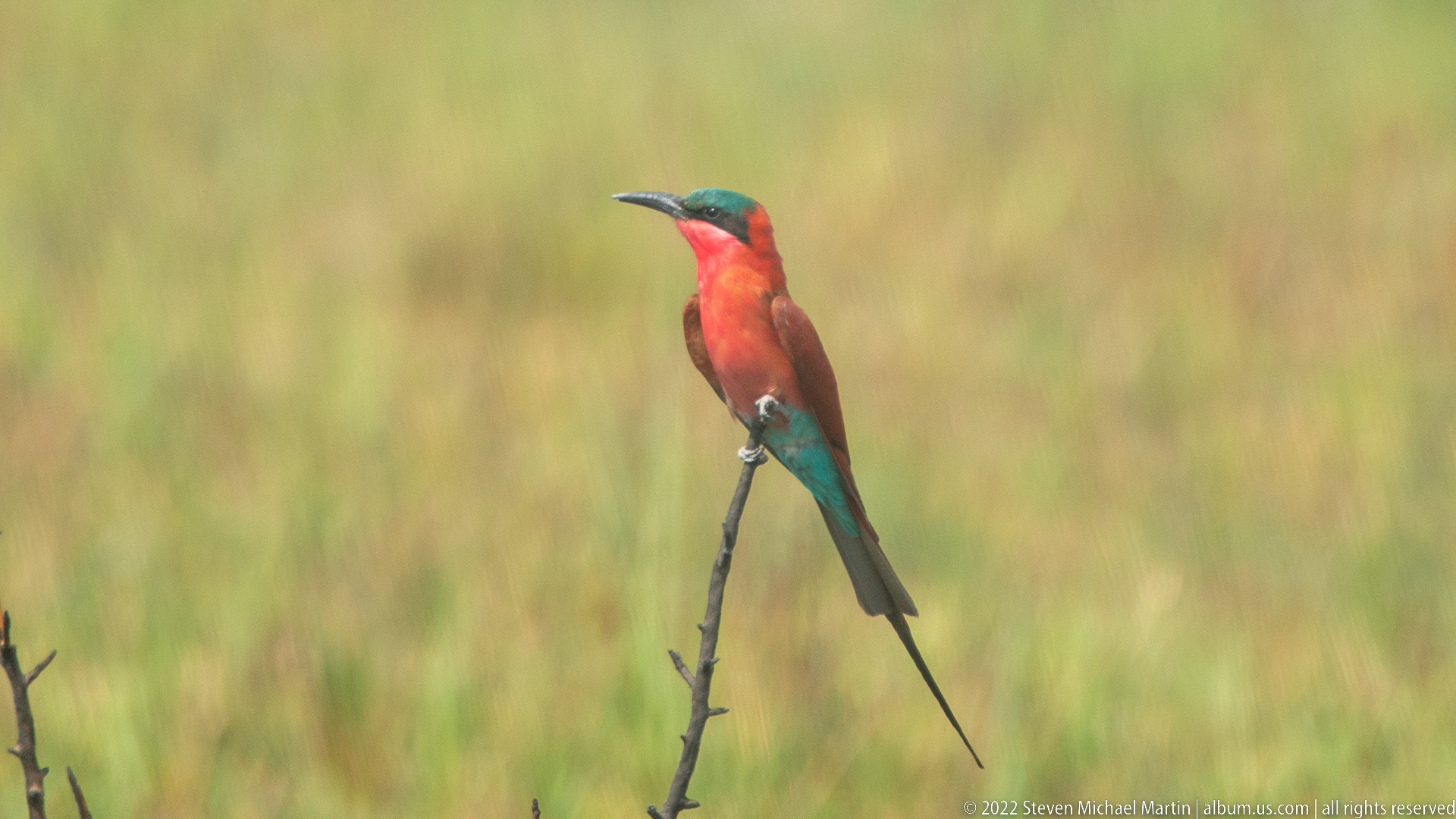
A southern carmine bee-eater holds an upright perch against a softly blurred field, turning slightly away from the camera. The profile emphasizes the narrow decurved bill, turquoise crown and back, warm carmine breast, and long paired tail streamers. The open background separates the bird’s outline from the surrounding floodplain.
Caption
A southern carmine bee-eater holds an upright perch against a softly blurred field, turning slightly away from the camera. The profile emphasizes the narrow decurved bill, turquoise crown and back, warm carmine breast, and long paired tail streamers. The open background separates the bird’s outline from the surrounding floodplain.
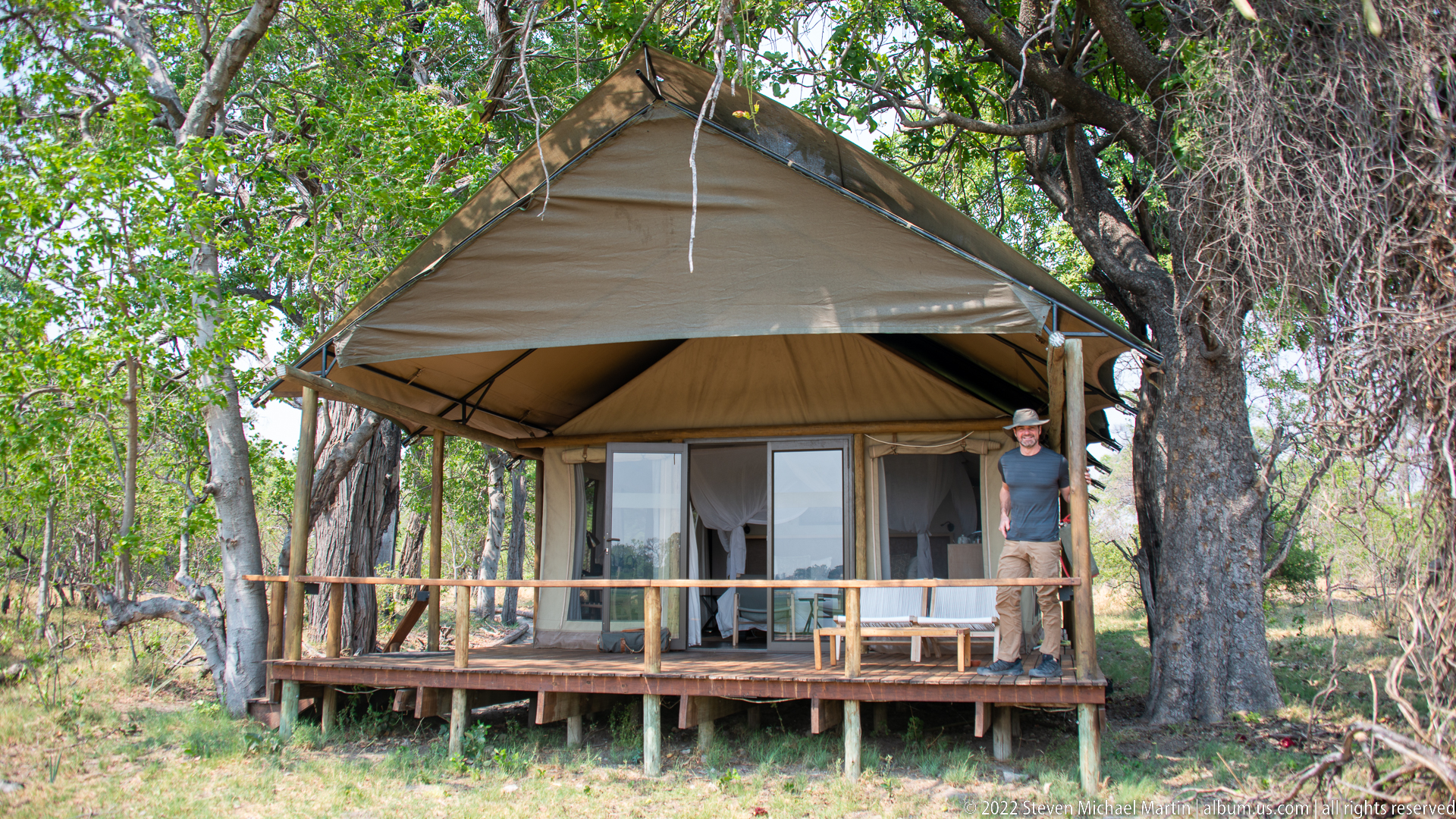
A guest stands at the edge of the raised veranda of a canvas safari tent on Chief’s Island, providing a useful sense of scale for the camp accommodation. The peaked awning, timber deck, railing, chairs, and open doorway are visible beneath the surrounding trees. Human presence turns this from a purely architectural view into a record of the lived safari setting.
Caption
A guest stands at the edge of the raised veranda of a canvas safari tent on Chief’s Island, providing a useful sense of scale for the camp accommodation. The peaked awning, timber deck, railing, chairs, and open doorway are visible beneath the surrounding trees. Human presence turns this from a purely architectural view into a record of the lived safari setting.

An adult guest stands with arms folded in front of a canvas safari tent on Chief’s Island. The close portrait retains enough of the camp setting to show the tan awning and glazed entrance behind him, while the broad-brimmed field hat and casual clothing place the figure within the practical rhythm of safari travel.
Caption
An adult guest stands with arms folded in front of a canvas safari tent on Chief’s Island. The close portrait retains enough of the camp setting to show the tan awning and glazed entrance behind him, while the broad-brimmed field hat and casual clothing place the figure within the practical rhythm of safari travel.
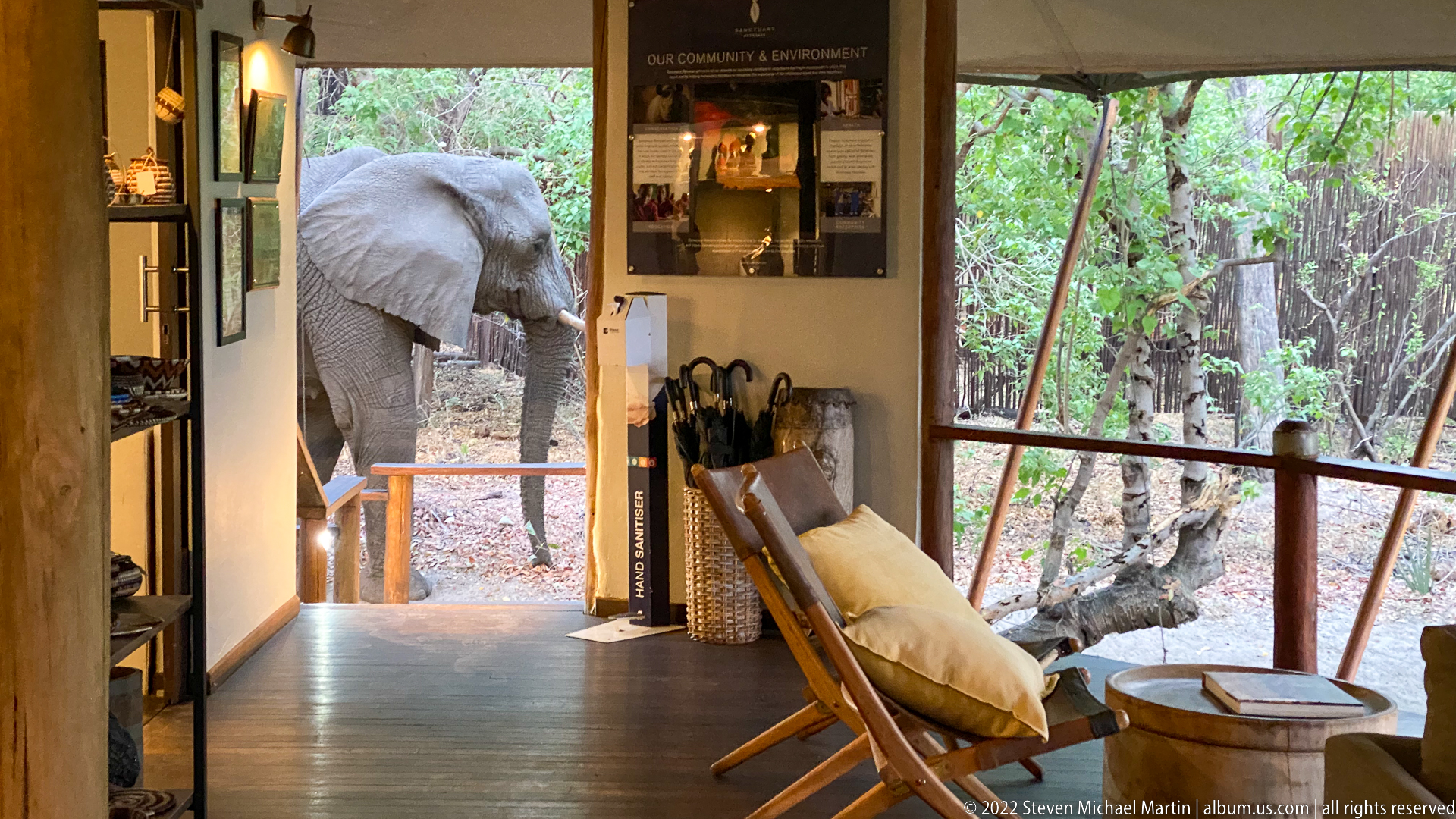
An African bush elephant passes immediately outside a covered camp walkway on Chief’s Island, its massive body appearing through the open entrance beyond the wooden floor. Interior chairs, umbrellas, display panels, and railings frame the animal from inside the lodge space, underscoring how closely wildlife and camp infrastructure can intersect in an unfenced safari setting.
Caption
An African bush elephant passes immediately outside a covered camp walkway on Chief’s Island, its massive body appearing through the open entrance beyond the wooden floor. Interior chairs, umbrellas, display panels, and railings frame the animal from inside the lodge space, underscoring how closely wildlife and camp infrastructure can intersect in an unfenced safari setting.
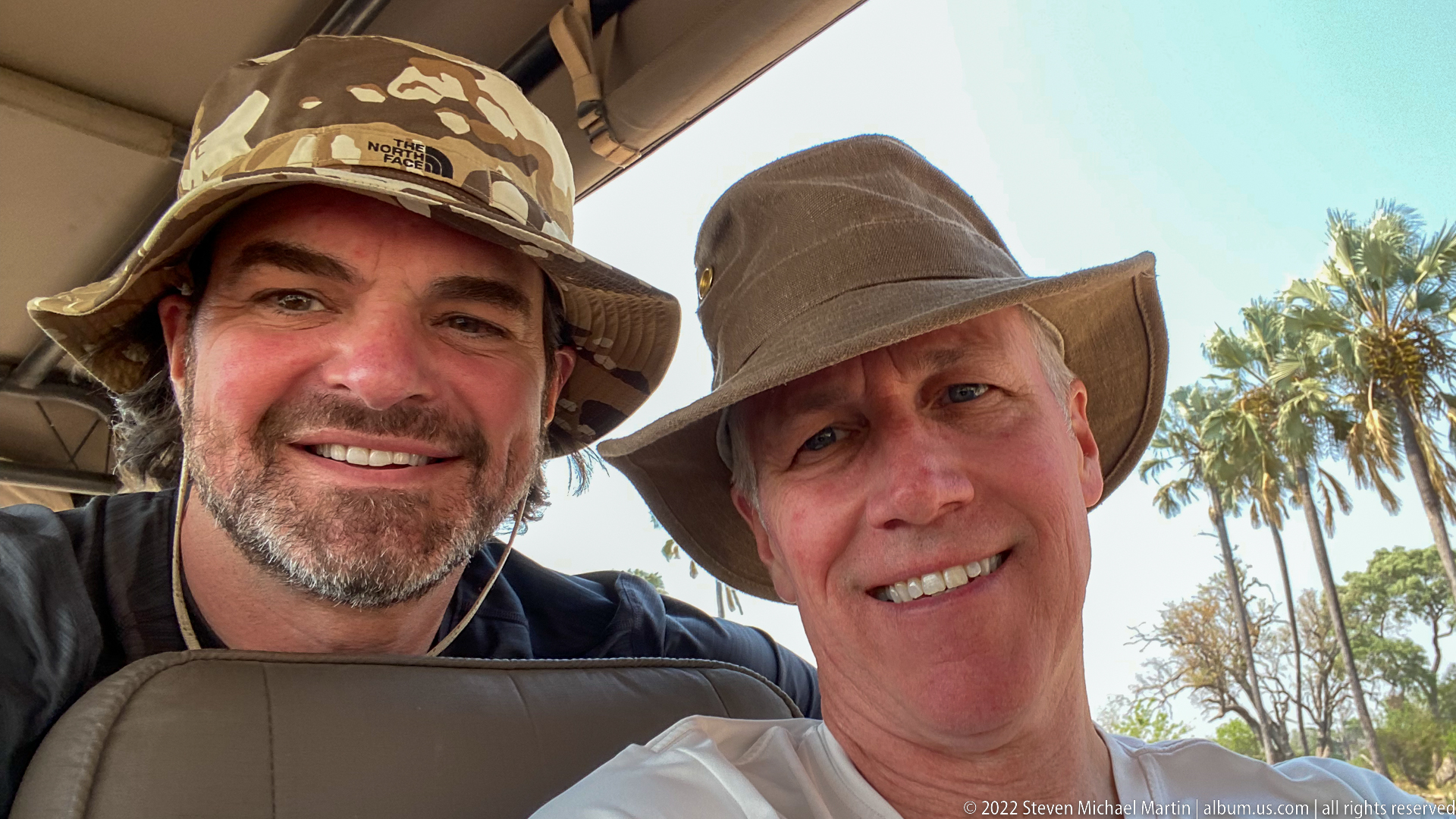
Two safari travelers lean together for a close self-portrait in an open vehicle on Chief’s Island. Both wear broad-brimmed sun hats, and the vehicle seat and canopy edge remain visible around them; palms and bright sky appear in the background. The informal frame records the human side of the wildlife excursion rather than a specific animal encounter.
Caption
Two safari travelers lean together for a close self-portrait in an open vehicle on Chief’s Island. Both wear broad-brimmed sun hats, and the vehicle seat and canopy edge remain visible around them; palms and bright sky appear in the background. The informal frame records the human side of the wildlife excursion rather than a specific animal encounter.
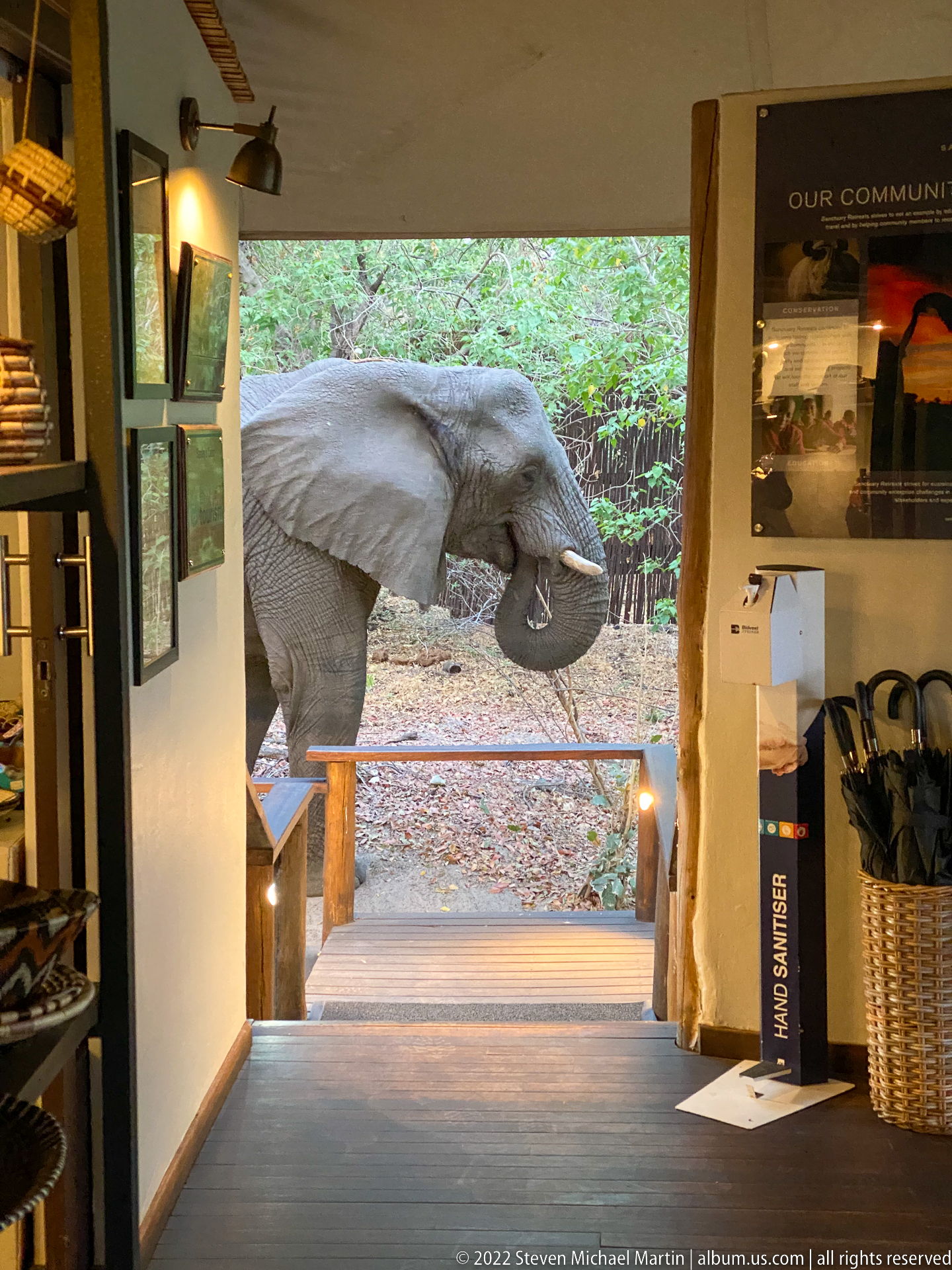
From deeper inside the camp structure, an African bush elephant is seen crossing just beyond the open entrance. Its head, trunk, tusk, ear, and shoulder fill the exterior opening, while the interior walls and display boards create a strong architectural frame. The juxtaposition conveys the remarkable proximity of a free-ranging elephant to occupied safari facilities.
Caption
From deeper inside the camp structure, an African bush elephant is seen crossing just beyond the open entrance. Its head, trunk, tusk, ear, and shoulder fill the exterior opening, while the interior walls and display boards create a strong architectural frame. The juxtaposition conveys the remarkable proximity of a free-ranging elephant to occupied safari facilities.

A vivid red oval dessert rests on a bed of fine dark chocolate crumb and is topped with a glossy green leaf-shaped garnish dusted with white crystals. The minimalist plating isolates color, texture, and form against a broad white plate. The precise dessert type is not visually certain, so the caption stays with its clearly visible presentation.
Caption
A vivid red oval dessert rests on a bed of fine dark chocolate crumb and is topped with a glossy green leaf-shaped garnish dusted with white crystals. The minimalist plating isolates color, texture, and form against a broad white plate. The precise dessert type is not visually certain, so the caption stays with its clearly visible presentation.
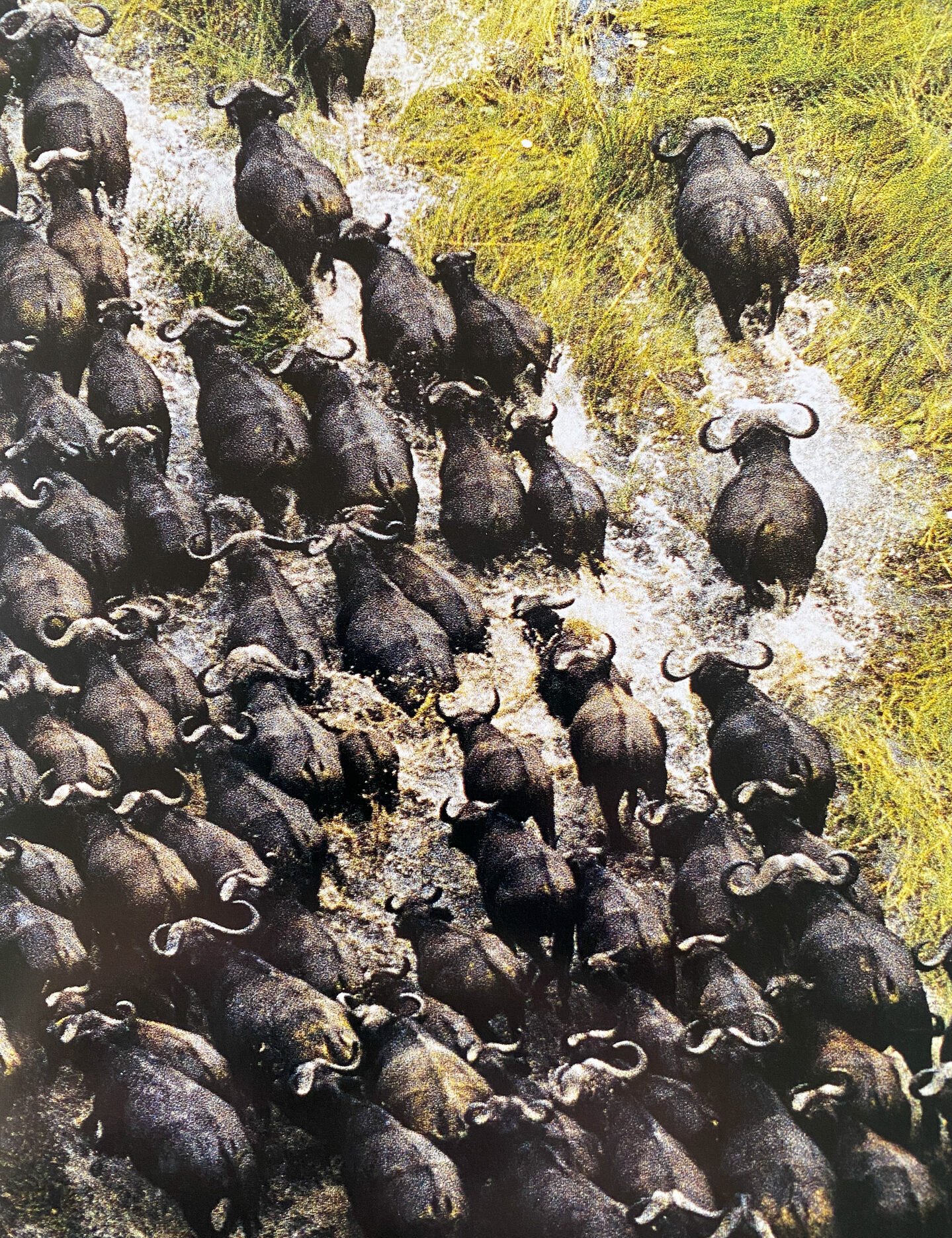
A dense herd of African buffalo moves through a pale muddy channel and surrounding grassland, seen from an elevated or aerial viewpoint. Dozens of dark bodies and sweeping horn shapes overlap tightly, while a few animals spread toward the margins. The unusual perspective reveals both the scale of the herd and the patterned movement of individuals through the wet floodplain.
Caption
A dense herd of African buffalo moves through a pale muddy channel and surrounding grassland, seen from an elevated or aerial viewpoint. Dozens of dark bodies and sweeping horn shapes overlap tightly, while a few animals spread toward the margins. The unusual perspective reveals both the scale of the herd and the patterned movement of individuals through the wet floodplain.

Two spotted hyenas rest side by side in short green grass at the edge of a sandy bank on Chief’s Island. Both animals lie stretched out with heads down, their rounded ears, sloping backs, and irregular dark spotting visible in the low light. The paired resting posture contrasts with the species’ more familiar scenes of active scavenging or hunting.
Caption
Two spotted hyenas rest side by side in short green grass at the edge of a sandy bank on Chief’s Island. Both animals lie stretched out with heads down, their rounded ears, sloping backs, and irregular dark spotting visible in the low light. The paired resting posture contrasts with the species’ more familiar scenes of active scavenging or hunting.
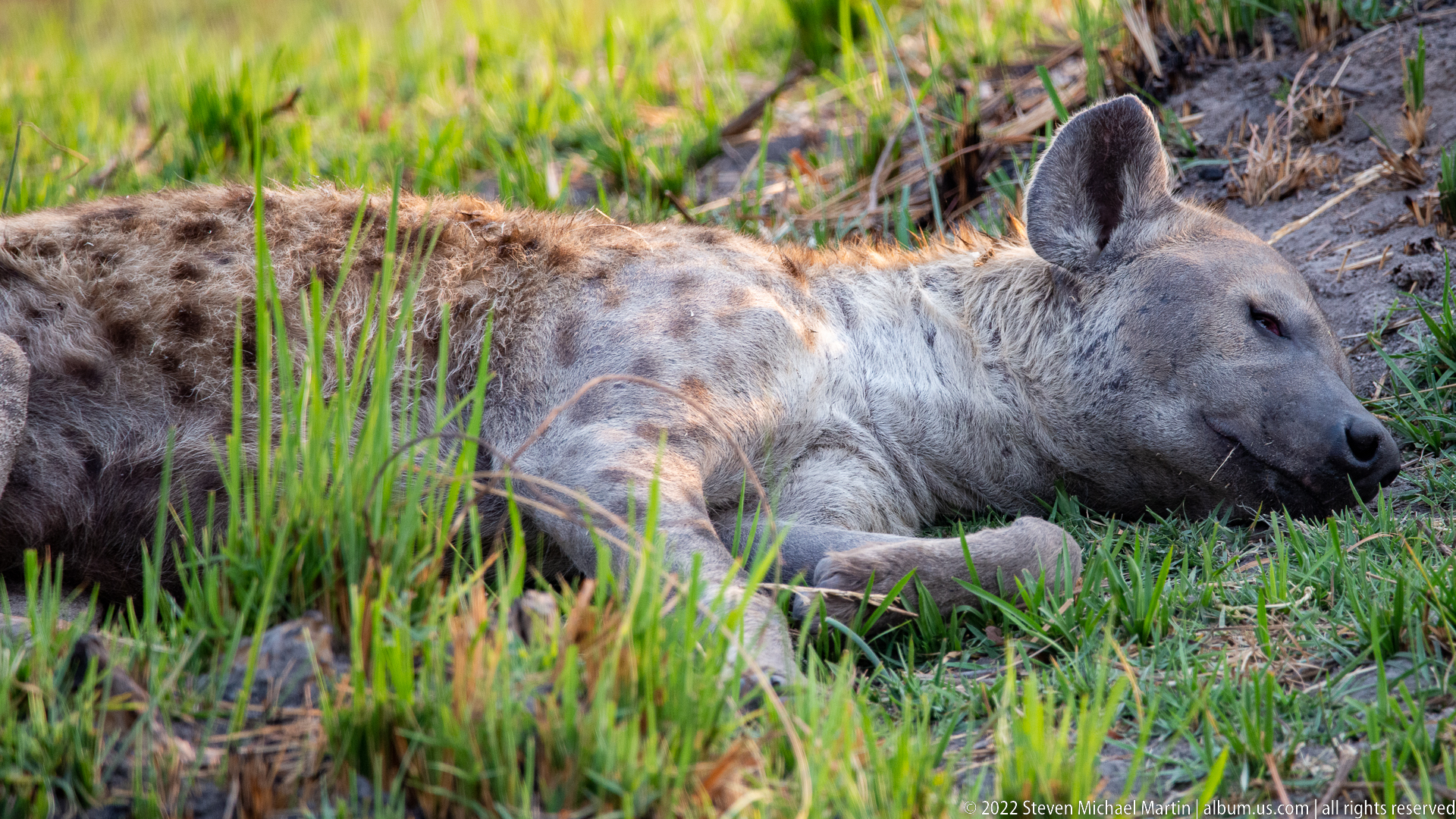
A spotted hyena lies on its side among grass and reeds, head resting low and eyes partly closed. The close view reveals the coarse gray-brown coat, dark spots, heavy muzzle, and large rounded ears characteristic of the species. Warm, low-angle light across the animal’s shoulder gives this quiet resting portrait a distinctly different mood from the wider paired view.
Caption
A spotted hyena lies on its side among grass and reeds, head resting low and eyes partly closed. The close view reveals the coarse gray-brown coat, dark spots, heavy muzzle, and large rounded ears characteristic of the species. Warm, low-angle light across the animal’s shoulder gives this quiet resting portrait a distinctly different mood from the wider paired view.
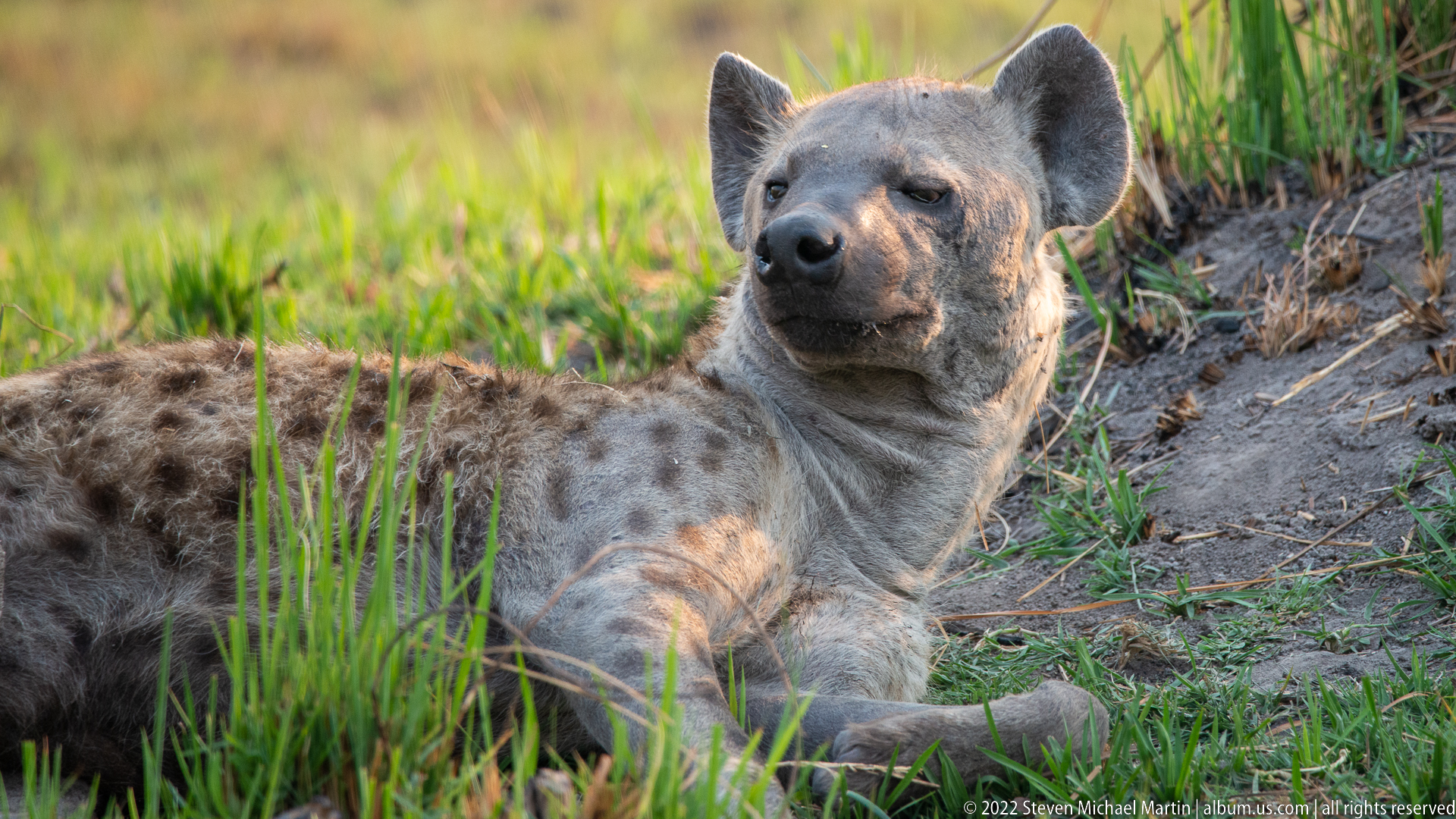
A spotted hyena rests on the ground but lifts its head high, ears pricked and gaze directed forward. The semi-reclining posture reveals the animal’s thick neck, powerful forequarters, mottled coat, and broad muzzle against green grass and sandy soil. The attentive head position distinguishes this portrait from the more relaxed resting views immediately before it.
Caption
A spotted hyena rests on the ground but lifts its head high, ears pricked and gaze directed forward. The semi-reclining posture reveals the animal’s thick neck, powerful forequarters, mottled coat, and broad muzzle against green grass and sandy soil. The attentive head position distinguishes this portrait from the more relaxed resting views immediately before it.
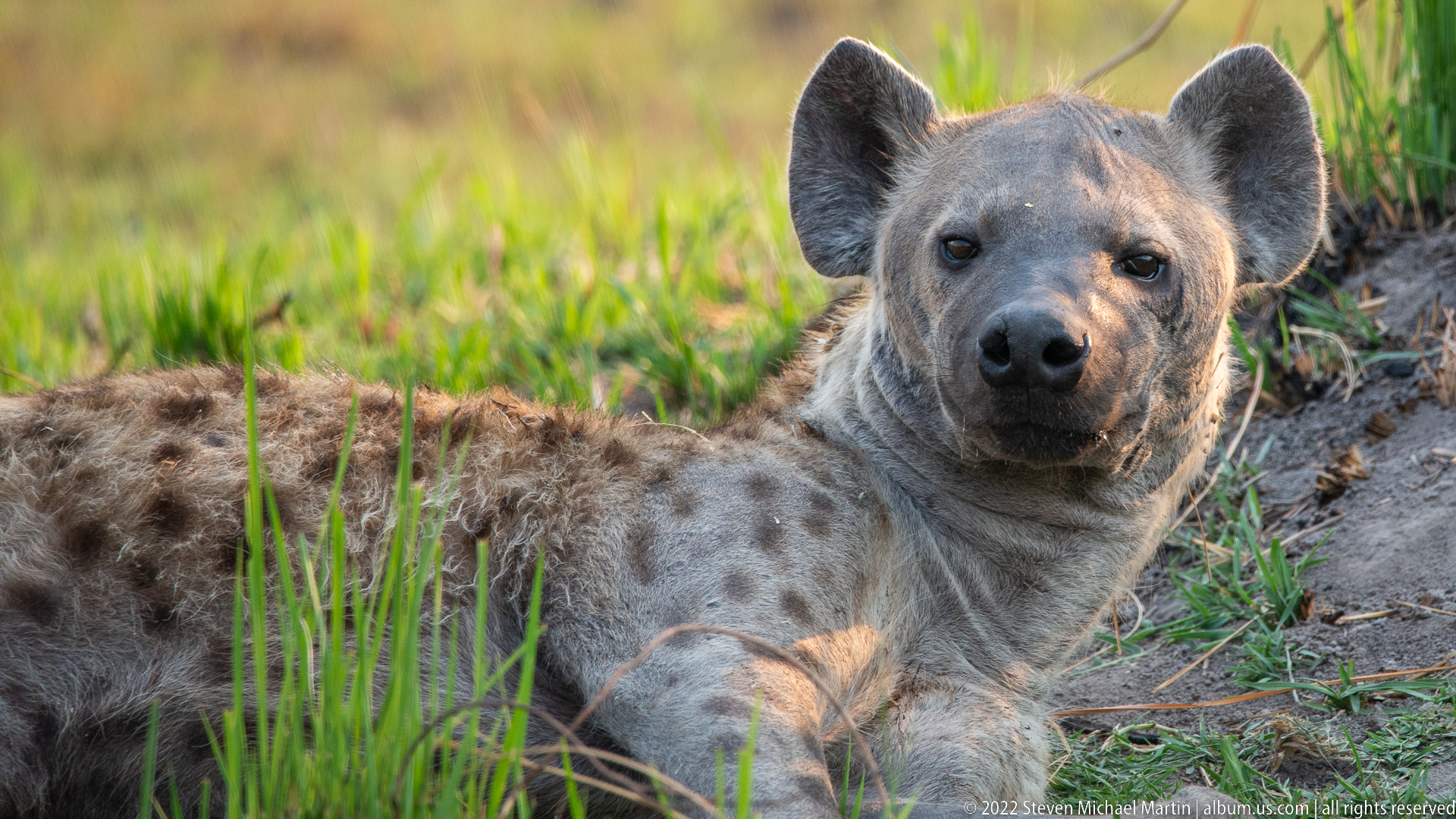
A spotted hyena looks directly toward the camera while reclining at the edge of a grassy bank. The frontal head angle brings attention to the rounded ears, dark eyes, broad black nose, and powerful jaws, while the patterned shoulder and flank remain visible behind. Soft background light separates the animal clearly from its habitat.
Caption
A spotted hyena looks directly toward the camera while reclining at the edge of a grassy bank. The frontal head angle brings attention to the rounded ears, dark eyes, broad black nose, and powerful jaws, while the patterned shoulder and flank remain visible behind. Soft background light separates the animal clearly from its habitat.
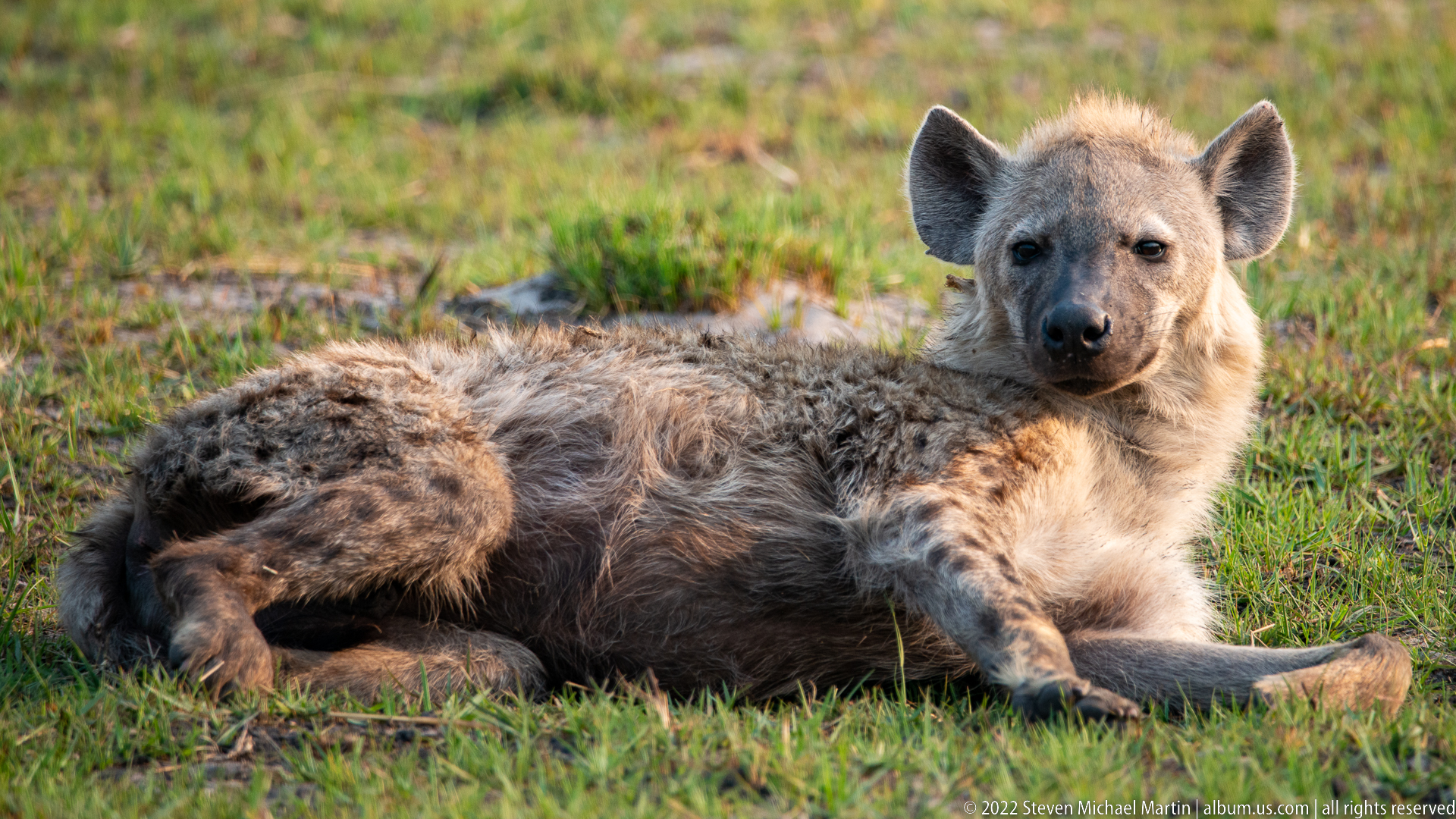
A spotted hyena lies curled on short open grass, facing the camera with forelegs extended. Its darker shaggy back contrasts with the paler neck and face, and the irregular flank spots are visible along the reclining body. The wider composition gives more space to the surrounding grassland than the preceding close portraits.
Caption
A spotted hyena lies curled on short open grass, facing the camera with forelegs extended. Its darker shaggy back contrasts with the paler neck and face, and the irregular flank spots are visible along the reclining body. The wider composition gives more space to the surrounding grassland than the preceding close portraits.
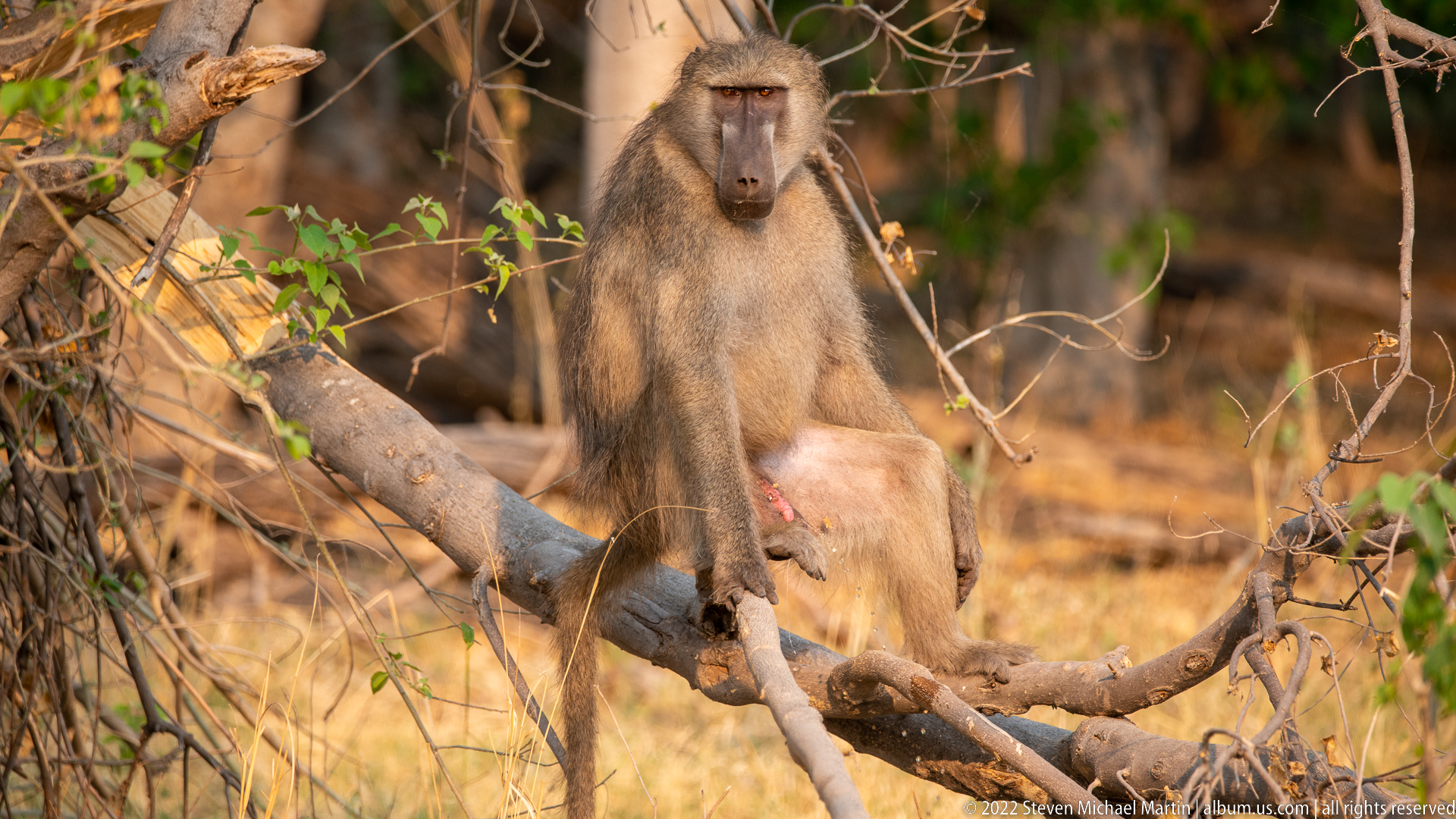
An adult chacma baboon sits astride a low tree branch with a juvenile close beneath its body. The adult’s long doglike muzzle, gray-brown coat, and bare face are clearly visible, while the smaller youngster clings to the branch below. Warm woodland light and the close physical proximity of the pair make this a strong social-behavior portrait.
Caption
An adult chacma baboon sits astride a low tree branch with a juvenile close beneath its body. The adult’s long doglike muzzle, gray-brown coat, and bare face are clearly visible, while the smaller youngster clings to the branch below. Warm woodland light and the close physical proximity of the pair make this a strong social-behavior portrait.
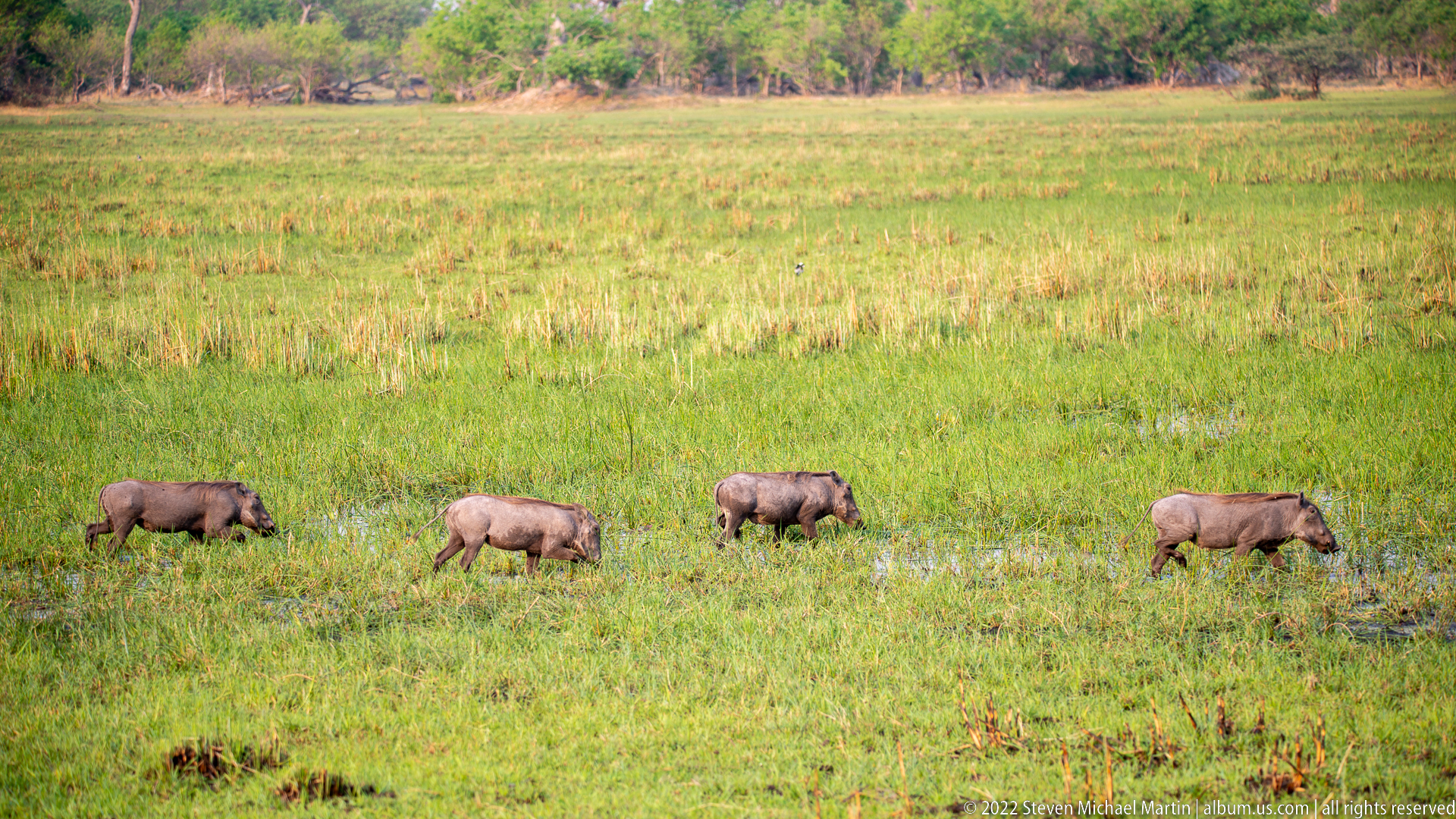
Four common warthogs move in a loose line across a broad green floodplain on Chief’s Island. Their low-slung bodies, large heads, and short legs are visible at a distance as they cross the open wet grassland. The wide environmental view emphasizes the scale of the habitat and the animals’ small presence within it.
Caption
Four common warthogs move in a loose line across a broad green floodplain on Chief’s Island. Their low-slung bodies, large heads, and short legs are visible at a distance as they cross the open wet grassland. The wide environmental view emphasizes the scale of the habitat and the animals’ small presence within it.

An adult African bush elephant walks through lush floodplain grass with a young calf following a few paces behind. The adult’s tusks, deeply wrinkled hide, broad ears, and lowered trunk contrast with the calf’s compact proportions and short trunk. Their parallel movement across open vegetation makes the size and age difference between the two animals especially clear.
Caption
An adult African bush elephant walks through lush floodplain grass with a young calf following a few paces behind. The adult’s tusks, deeply wrinkled hide, broad ears, and lowered trunk contrast with the calf’s compact proportions and short trunk. Their parallel movement across open vegetation makes the size and age difference between the two animals especially clear.
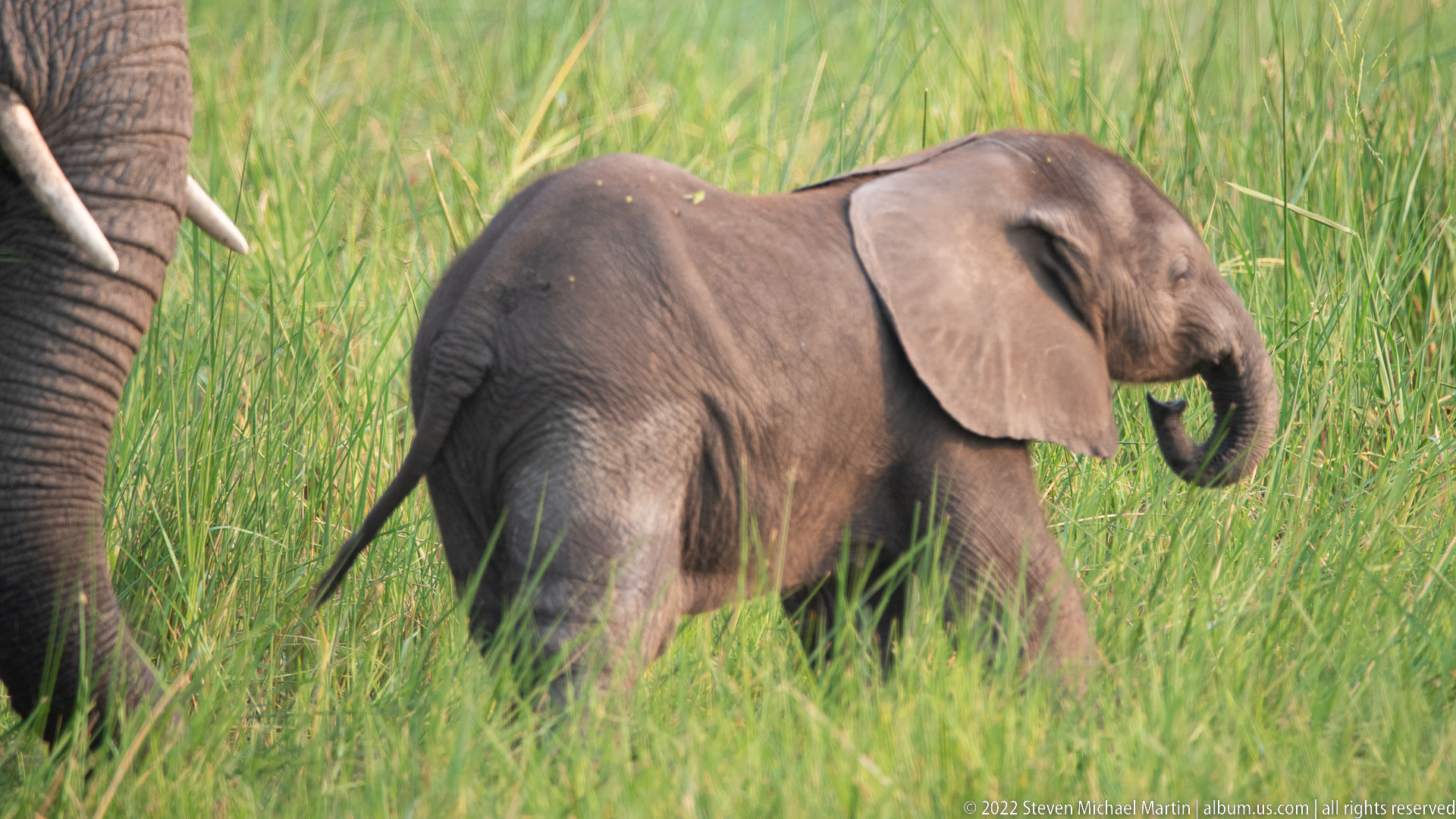
A young African bush elephant strides through tall green grass, curling its trunk upward toward its mouth. The calf’s rounded forehead, relatively large ears, short tuskless face, and compact body identify its juvenile age, while part of an adult elephant remains at the left edge. The close view isolates the calf’s animated trunk movement within the wet-season vegetation.
Caption
A young African bush elephant strides through tall green grass, curling its trunk upward toward its mouth. The calf’s rounded forehead, relatively large ears, short tuskless face, and compact body identify its juvenile age, while part of an adult elephant remains at the left edge. The close view isolates the calf’s animated trunk movement within the wet-season vegetation.
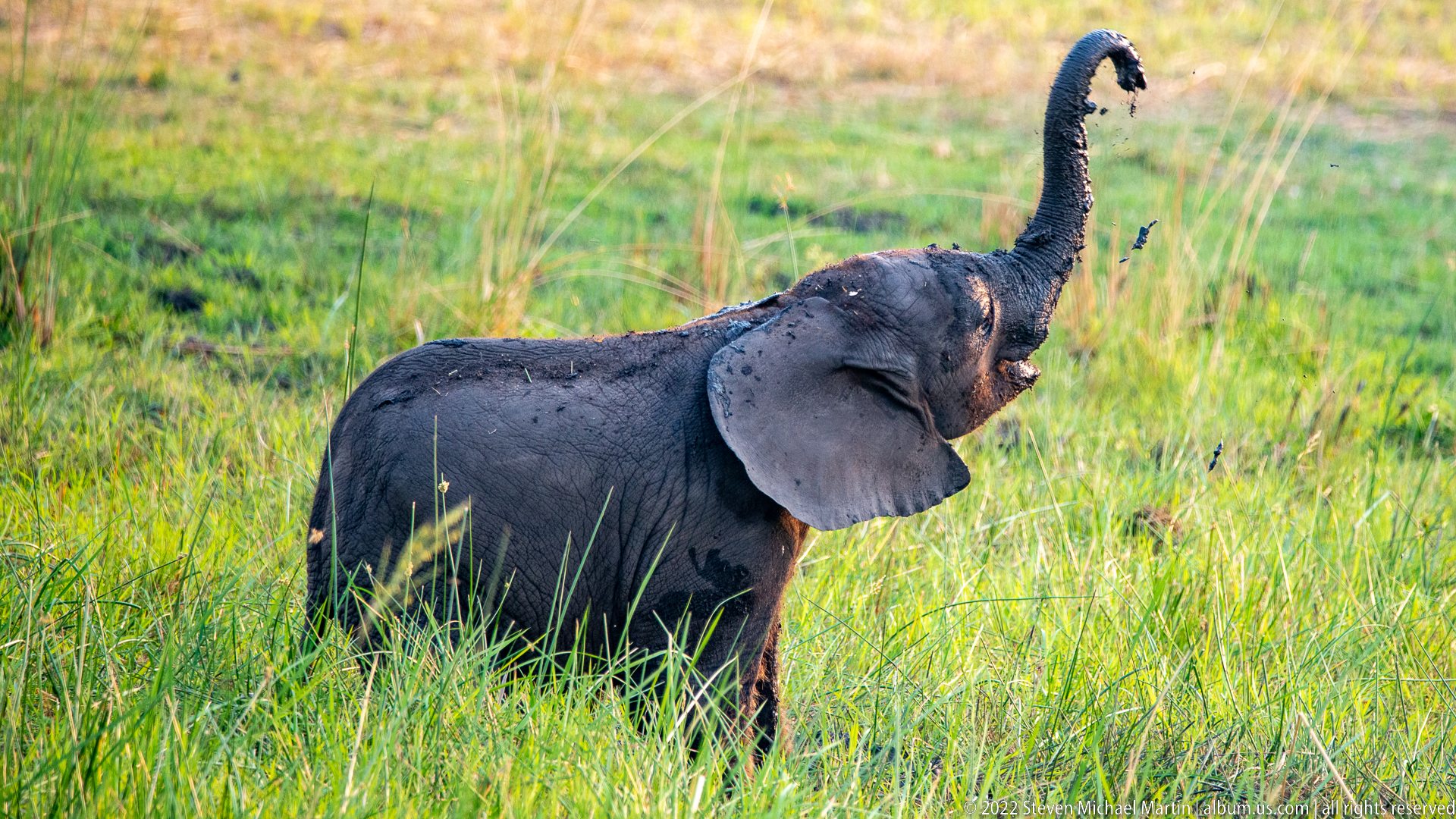
A young African bush elephant lifts its trunk high above its head while standing in dense green grass. Mud darkens much of the calf’s body, and droplets or bits of vegetation appear around the raised trunk, suggesting recent contact with wet ground or water. The exaggerated upward gesture gives this frame a playful, energetic character distinct from the surrounding walking views.
Caption
A young African bush elephant lifts its trunk high above its head while standing in dense green grass. Mud darkens much of the calf’s body, and droplets or bits of vegetation appear around the raised trunk, suggesting recent contact with wet ground or water. The exaggerated upward gesture gives this frame a playful, energetic character distinct from the surrounding walking views.
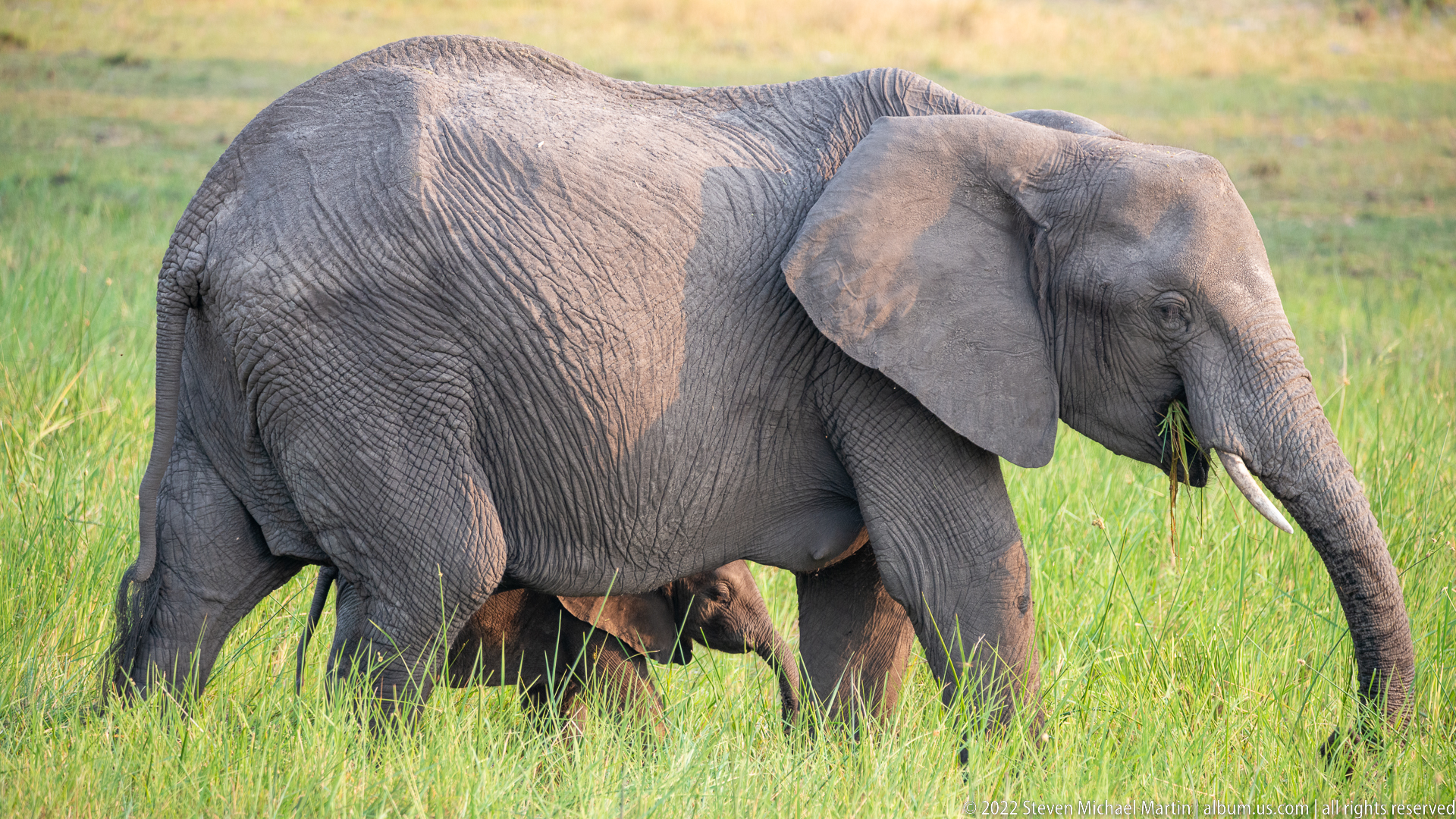
An adult African bush elephant moves across open grass with a calf tucked closely beneath and behind its body. The adult’s broad flank, tusks, and lowered trunk dominate the frame, while the calf is partially concealed between the legs. Their close spacing conveys the physical protection young elephants receive while moving with older herd members.
Caption
An adult African bush elephant moves across open grass with a calf tucked closely beneath and behind its body. The adult’s broad flank, tusks, and lowered trunk dominate the frame, while the calf is partially concealed between the legs. Their close spacing conveys the physical protection young elephants receive while moving with older herd members.

An adult African bush elephant and calf walk side by side through sunlit grass on Chief’s Island. The adult’s trunk curves inward as it steps forward, while the calf remains close beside the forelegs with its own trunk lifted. The paired profile shows both animals clearly enough to compare their proportions while retaining the protective closeness of the family grouping.
Caption
An adult African bush elephant and calf walk side by side through sunlit grass on Chief’s Island. The adult’s trunk curves inward as it steps forward, while the calf remains close beside the forelegs with its own trunk lifted. The paired profile shows both animals clearly enough to compare their proportions while retaining the protective closeness of the family grouping.
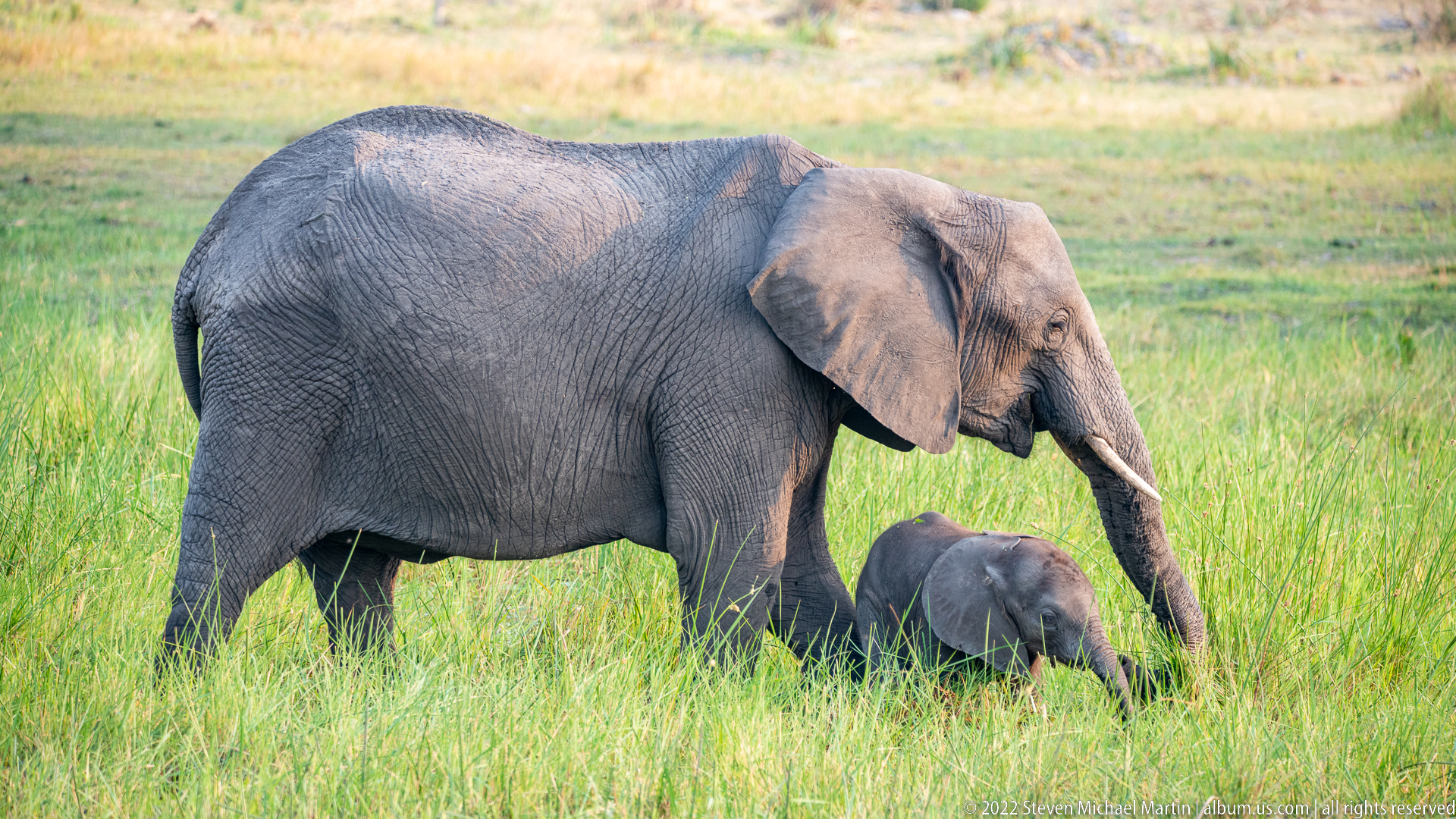
A young African bush elephant lies low in the grass while an adult stands immediately beside it. The adult’s foreleg and lowered trunk frame the calf, whose rounded body and head are visible at ground level. This unusual resting posture creates an intimate family scene and shows the calf at rest while remaining within the adult’s immediate protective space.
Caption
A young African bush elephant lies low in the grass while an adult stands immediately beside it. The adult’s foreleg and lowered trunk frame the calf, whose rounded body and head are visible at ground level. This unusual resting posture creates an intimate family scene and shows the calf at rest while remaining within the adult’s immediate protective space.
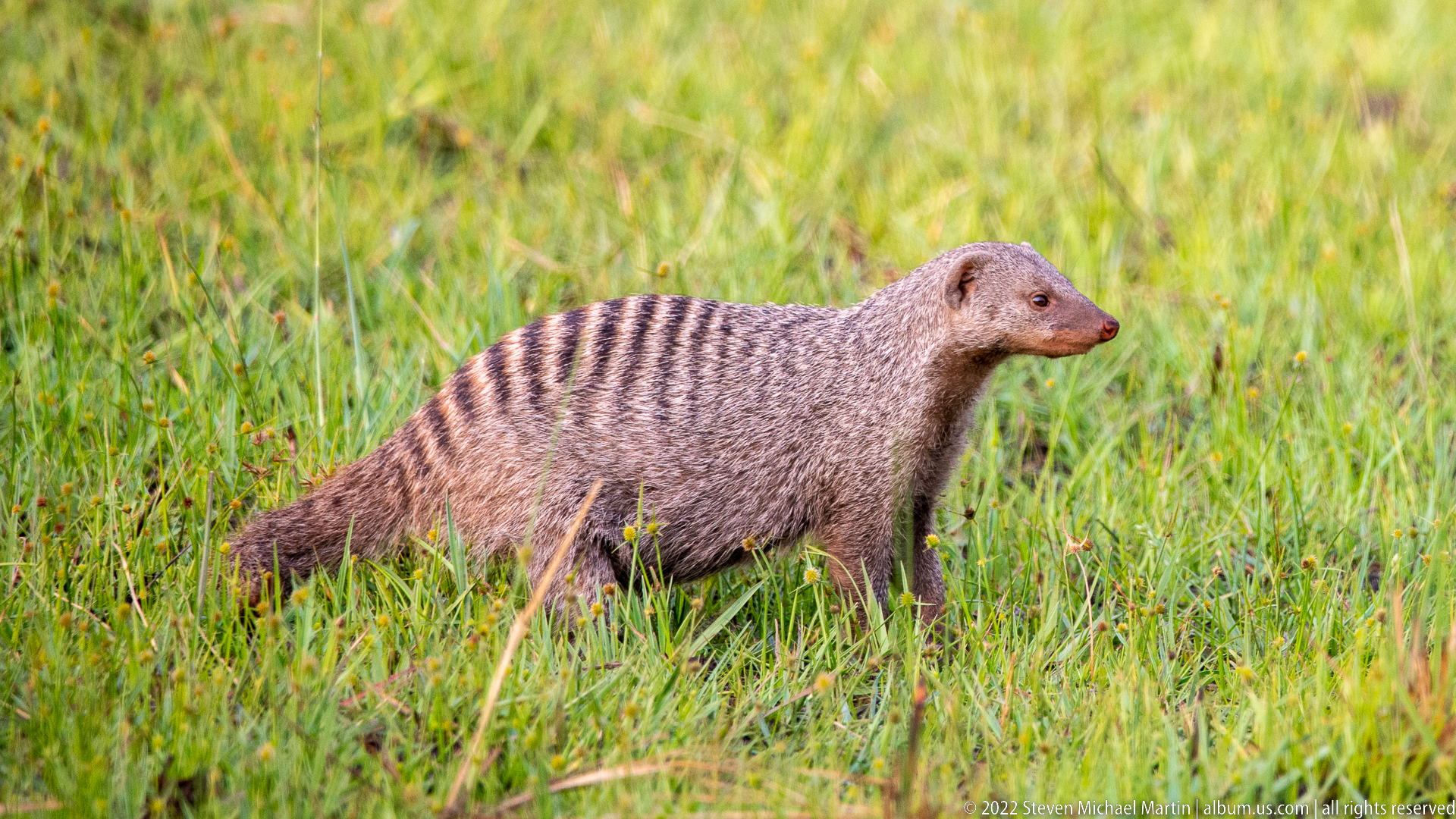
A banded mongoose pauses in short wet grass, presenting a clean side profile of its elongated body and low stance. Dark transverse bands run across the gray-brown back, while the pointed muzzle, small rounded ears, short legs, and tapering tail are clearly visible. The open setting provides a diagnostic view of the species’ characteristic striping.
Caption
A banded mongoose pauses in short wet grass, presenting a clean side profile of its elongated body and low stance. Dark transverse bands run across the gray-brown back, while the pointed muzzle, small rounded ears, short legs, and tapering tail are clearly visible. The open setting provides a diagnostic view of the species’ characteristic striping.
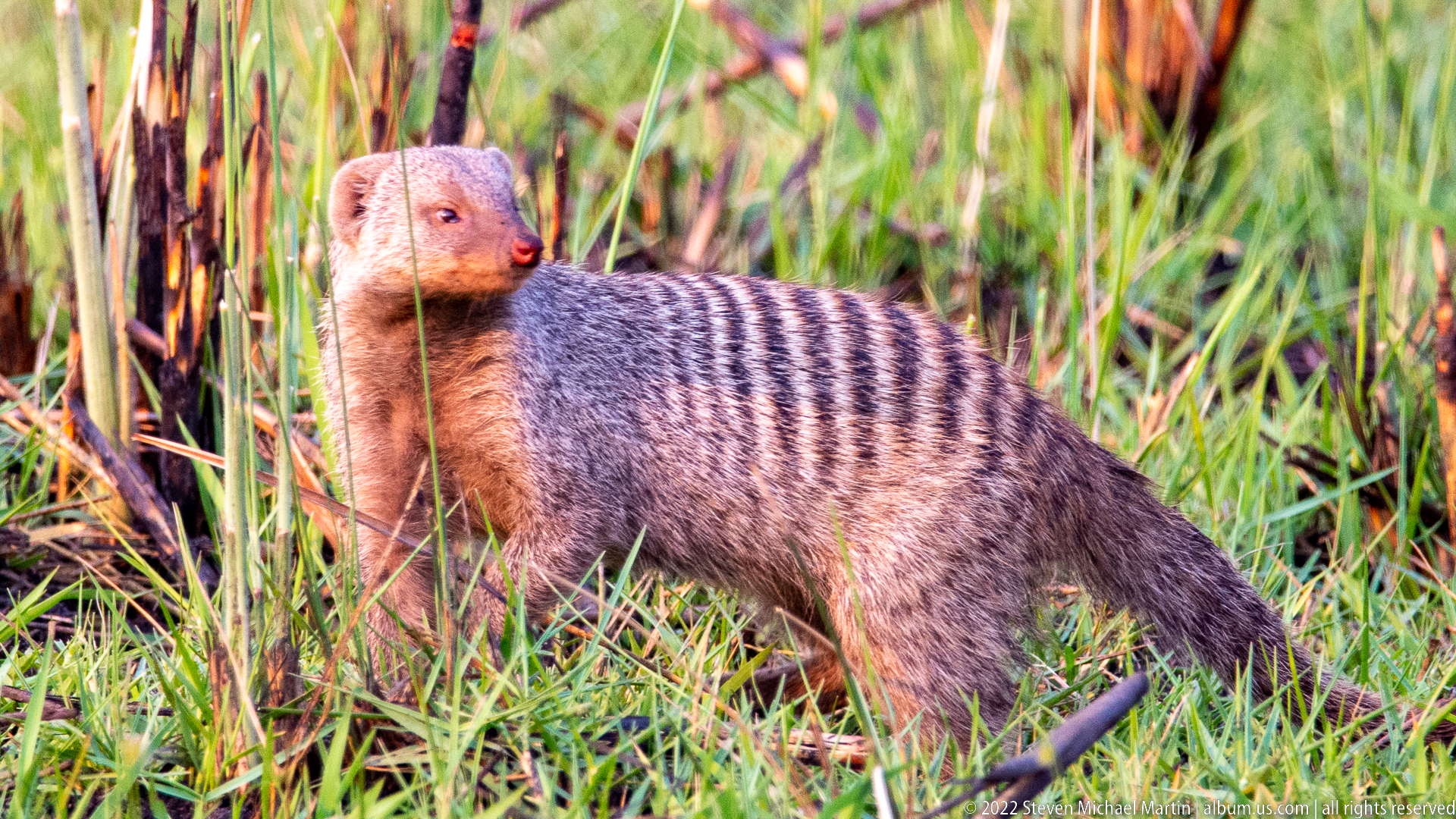
A banded mongoose stands among reeds and wet grass, turning its head slightly upward while its body remains broadside to the camera. Strong dark bands cross the back from shoulder to rump, and warm light catches the face and forequarters. The reed-filled setting places the animal at the wetter margin of the floodplain rather than in open short grass.
Caption
A banded mongoose stands among reeds and wet grass, turning its head slightly upward while its body remains broadside to the camera. Strong dark bands cross the back from shoulder to rump, and warm light catches the face and forequarters. The reed-filled setting places the animal at the wetter margin of the floodplain rather than in open short grass.
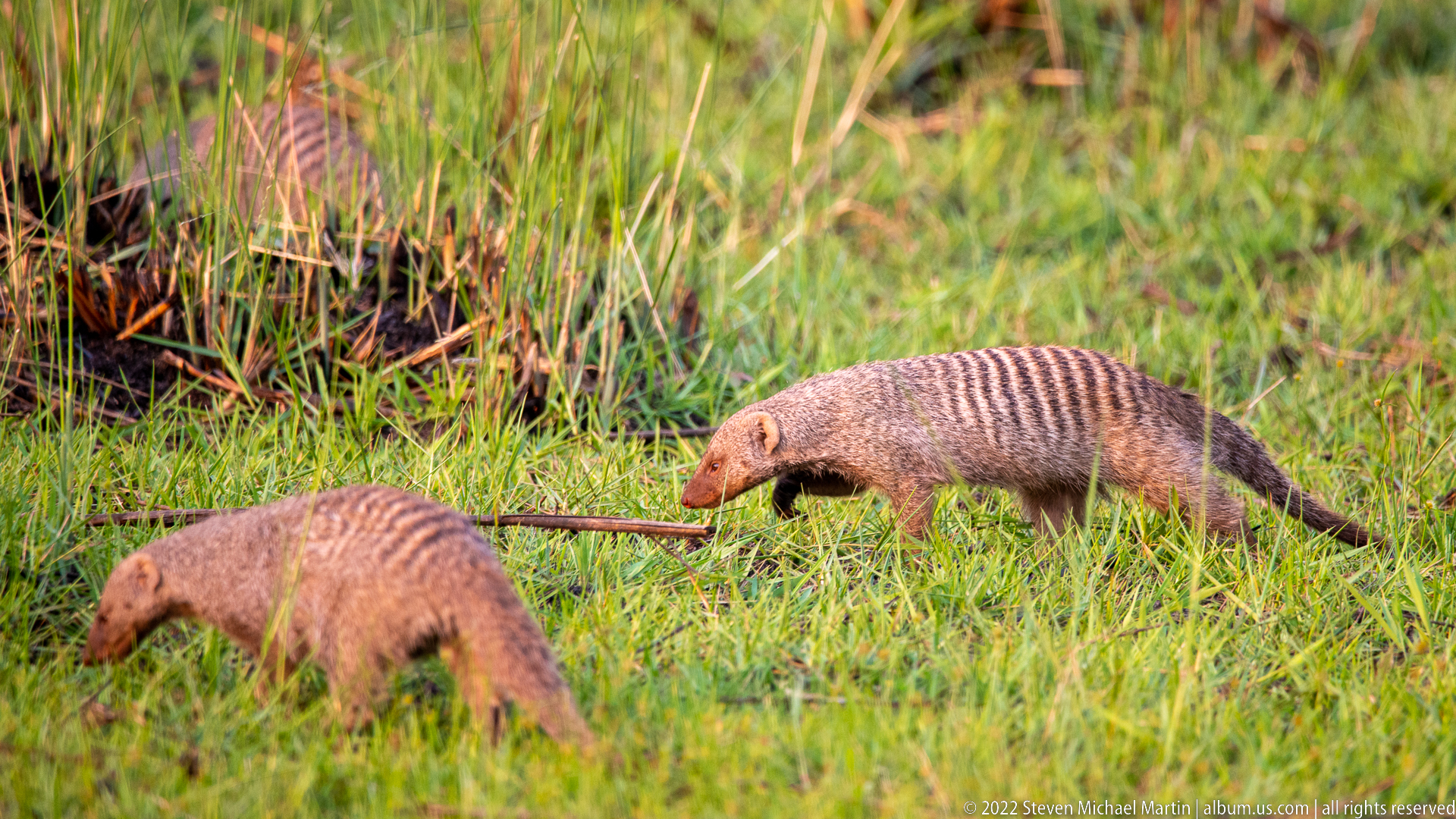
Two banded mongooses forage through wet grass near a patch of reeds. One animal crosses the foreground with its head down, while the second is sharper in the midground, nosing close to the ground with its banded back fully visible. Their low searching posture records active feeding behavior rather than the alert standing poses of the preceding photographs.
Caption
Two banded mongooses forage through wet grass near a patch of reeds. One animal crosses the foreground with its head down, while the second is sharper in the midground, nosing close to the ground with its banded back fully visible. Their low searching posture records active feeding behavior rather than the alert standing poses of the preceding photographs.
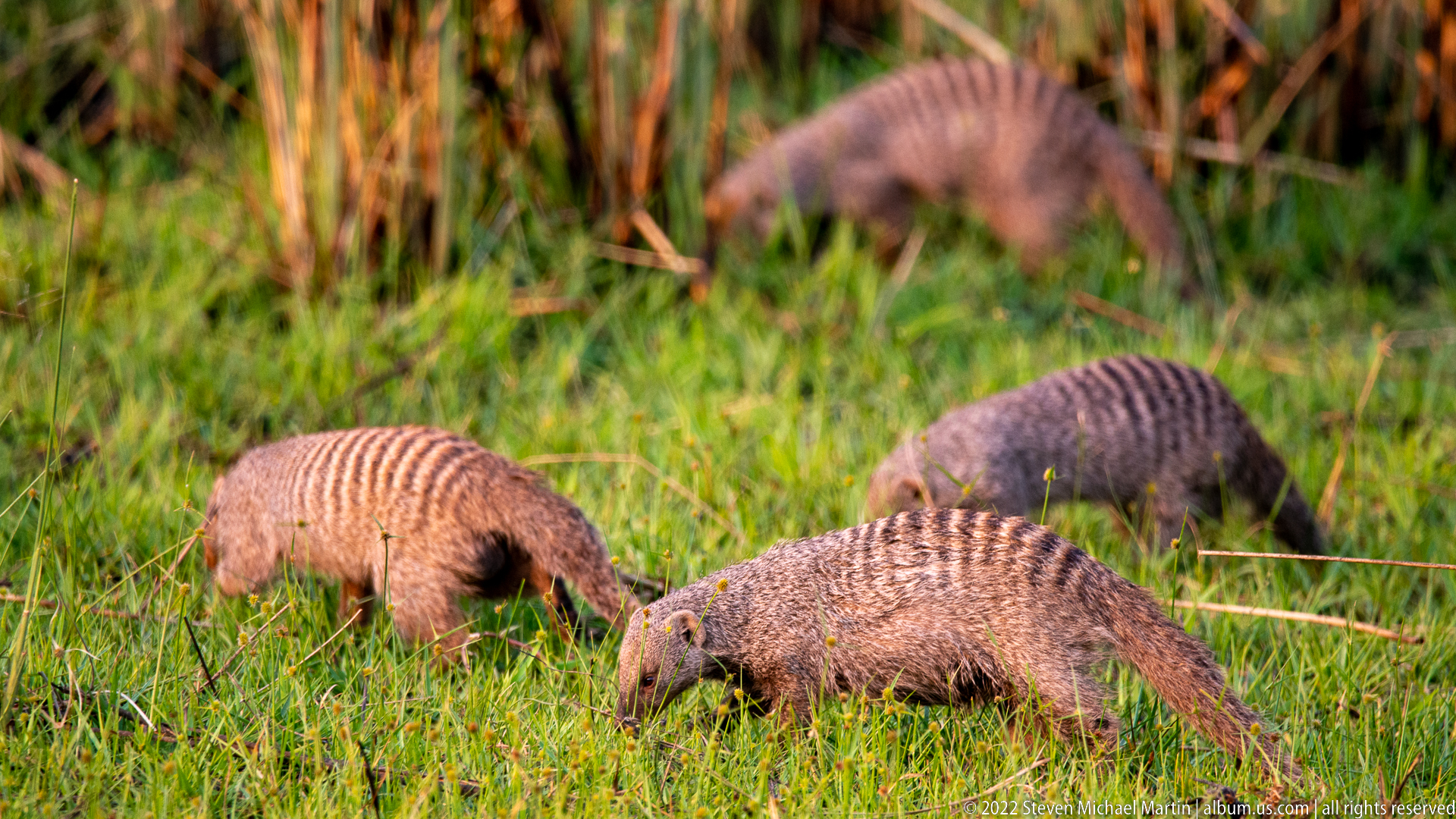
A small group of banded mongooses spreads across the wet grass, each animal bent low with its muzzle near the ground. Several striped backs overlap within the frame, while another individual moves through the blurred background. The group arrangement illustrates the species’ social foraging pattern and expands the preceding pair into a broader view of coordinated feeding activity.
Caption
A small group of banded mongooses spreads across the wet grass, each animal bent low with its muzzle near the ground. Several striped backs overlap within the frame, while another individual moves through the blurred background. The group arrangement illustrates the species’ social foraging pattern and expands the preceding pair into a broader view of coordinated feeding activity.

A large bird sits silhouetted on the broken limb of a dead tree as the low sun glows through orange haze behind it. The strongly backlit conditions reduce the animal to a dark outline and prevent reliable species-level identification, but the elevated perch and branching snag create a graphic sunset composition distinct from the close wildlife portraits elsewhere in the sequence.
Caption
A large bird sits silhouetted on the broken limb of a dead tree as the low sun glows through orange haze behind it. The strongly backlit conditions reduce the animal to a dark outline and prevent reliable species-level identification, but the elevated perch and branching snag create a graphic sunset composition distinct from the close wildlife portraits elsewhere in the sequence.
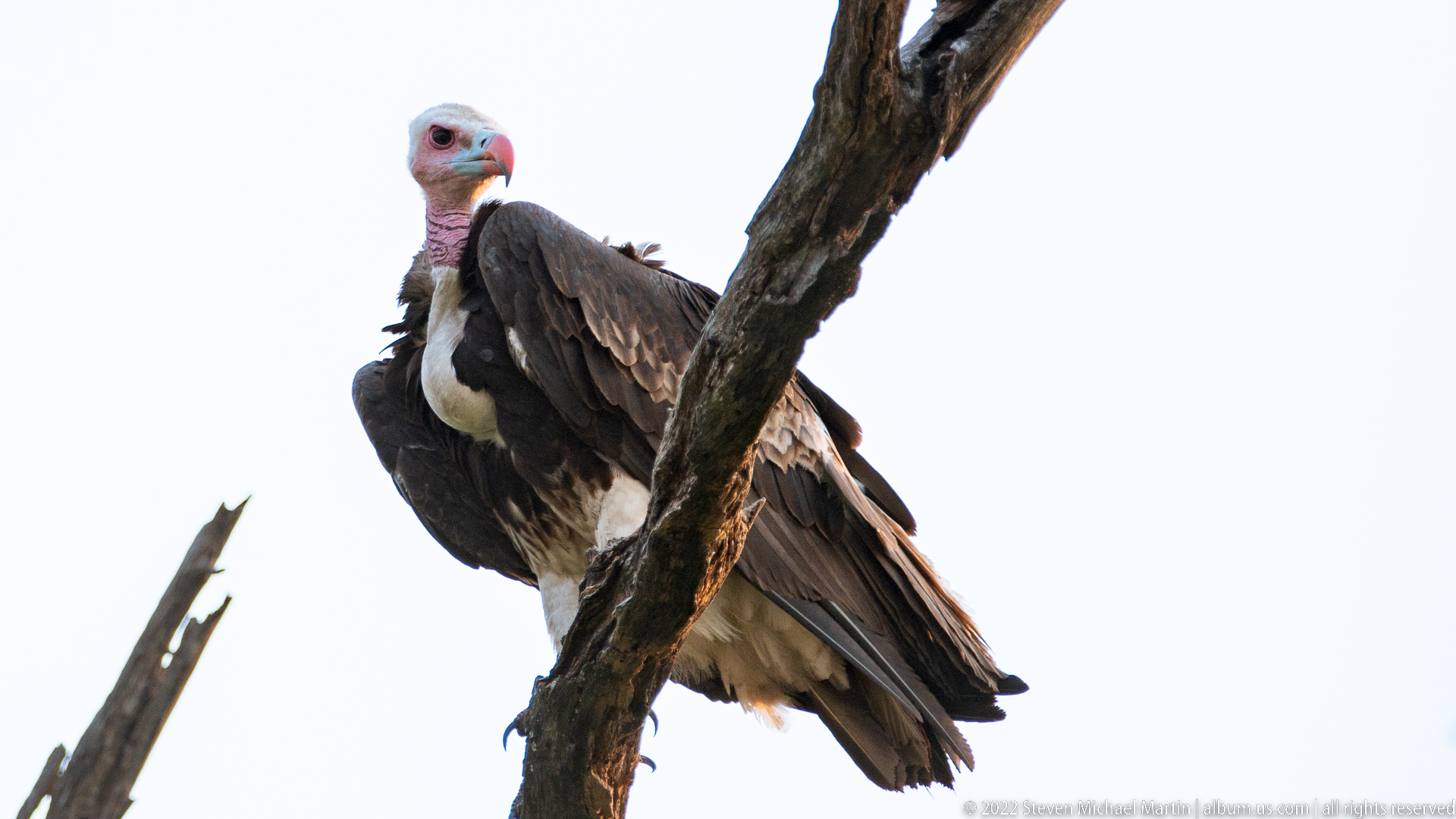
A hooded vulture perches high on a dead branch, viewed from below against a pale sky. The bird’s dark brown wings, contrasting pale underparts, bare pinkish face, and narrow hooked bill are visible despite the steep angle. The elevated snag provides an open lookout typical of large scavenging birds using woodland and floodplain edges.
Caption
A hooded vulture perches high on a dead branch, viewed from below against a pale sky. The bird’s dark brown wings, contrasting pale underparts, bare pinkish face, and narrow hooked bill are visible despite the steep angle. The elevated snag provides an open lookout typical of large scavenging birds using woodland and floodplain edges.
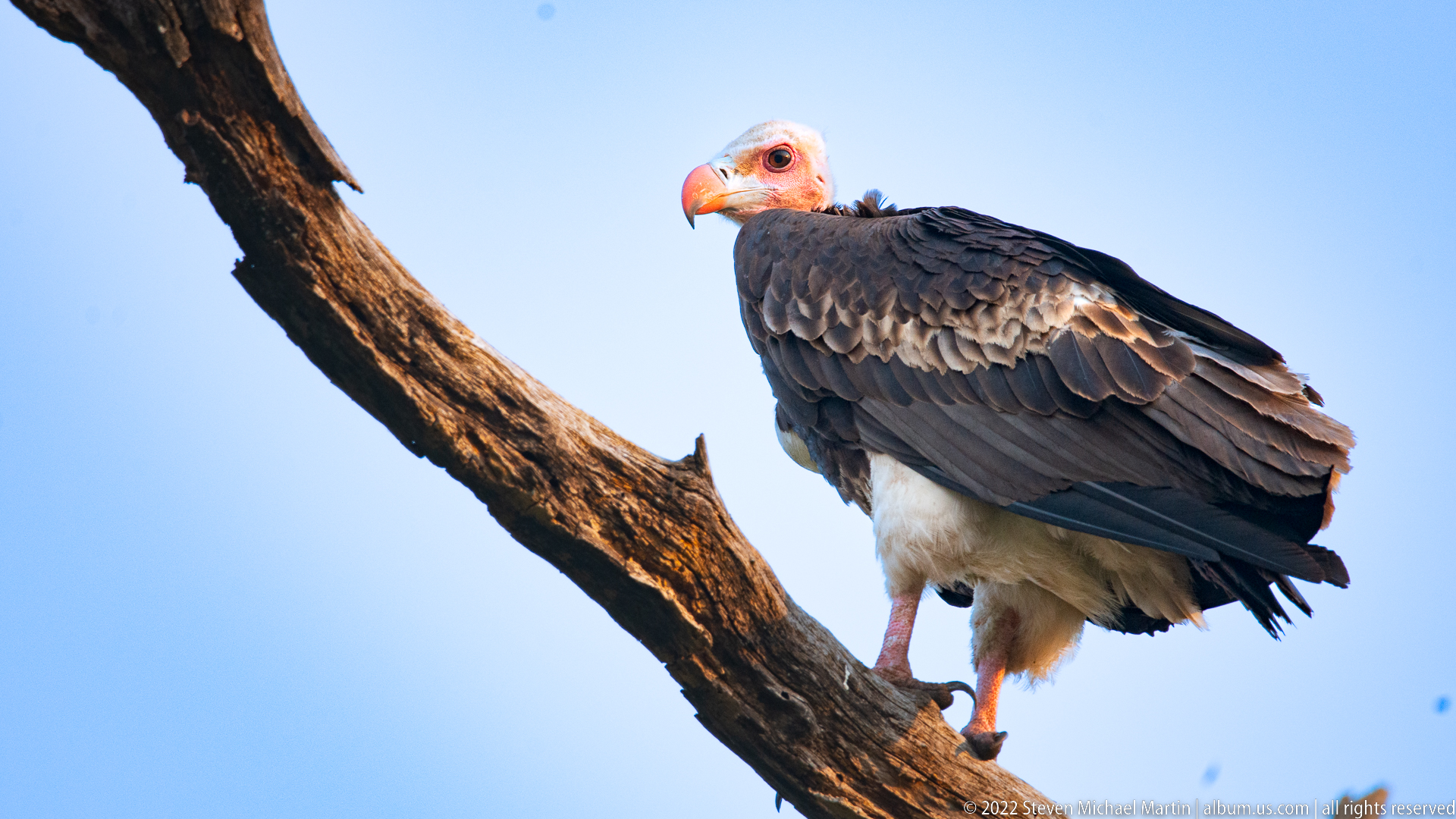
A hooded vulture stands on a sloping bare branch in clear side view. Its bare pink face, slender hooked orange-red bill, dark layered wing feathers, pale belly, and comparatively small head are all visible against blue sky. This closer portrait provides substantially stronger diagnostic detail than the preceding backlit and low-angle vulture views.
Caption
A hooded vulture stands on a sloping bare branch in clear side view. Its bare pink face, slender hooked orange-red bill, dark layered wing feathers, pale belly, and comparatively small head are all visible against blue sky. This closer portrait provides substantially stronger diagnostic detail than the preceding backlit and low-angle vulture views.
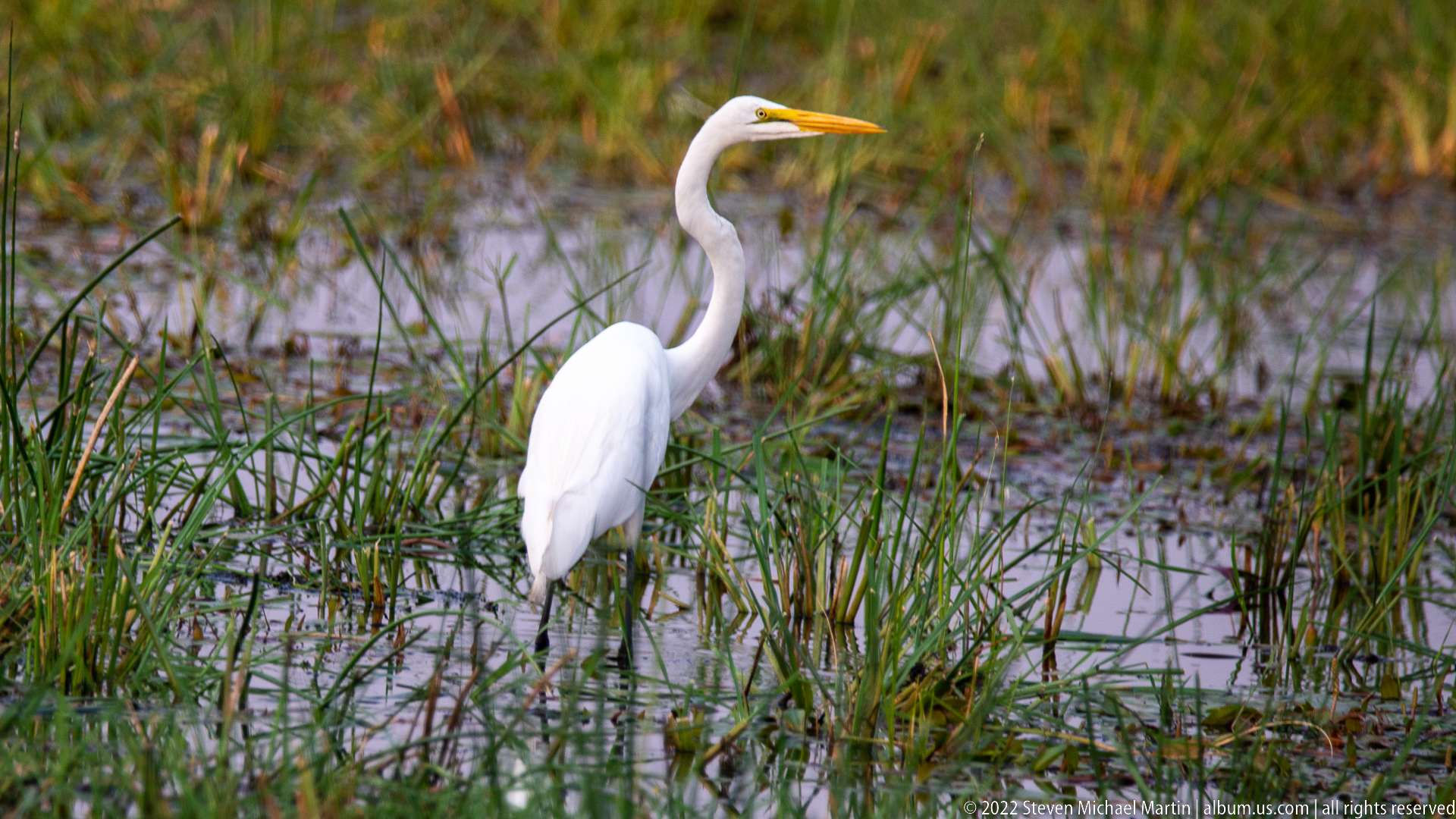
A great egret stands in shallow floodplain water among emergent grasses, its long white neck held in a gentle S-curve. The straight yellow bill, white plumage, long dark legs, and tall heron-like proportions are clearly visible. The wetland setting places the bird within the aquatic habitat where it typically stalks fish and other small prey.
Caption
A great egret stands in shallow floodplain water among emergent grasses, its long white neck held in a gentle S-curve. The straight yellow bill, white plumage, long dark legs, and tall heron-like proportions are clearly visible. The wetland setting places the bird within the aquatic habitat where it typically stalks fish and other small prey.
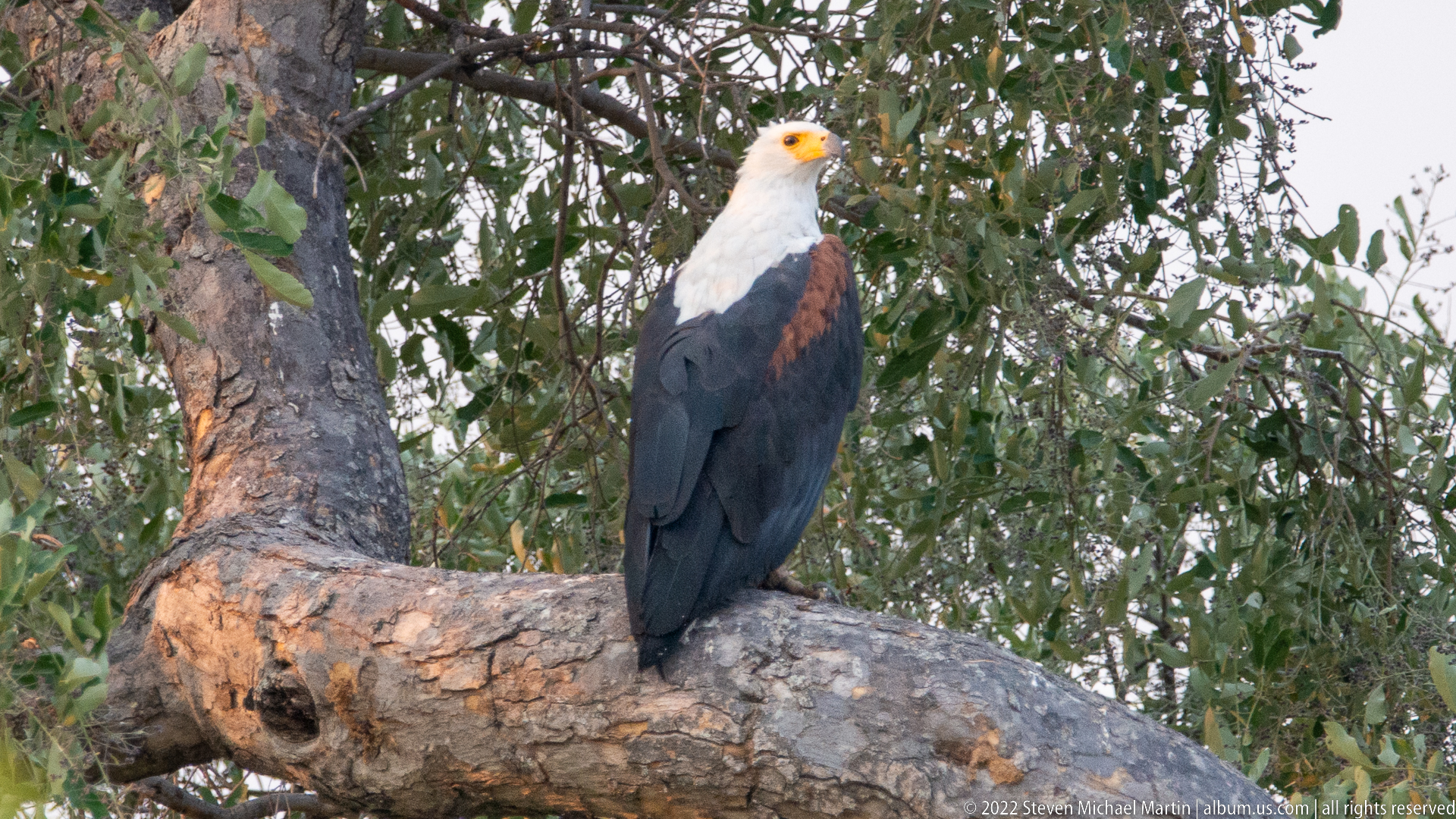
An African fish eagle perches upright on a broad tree limb within leafy woodland. The white head and breast, chestnut shoulders, dark wings, yellow facial skin, and heavy hooked bill form the species’ unmistakable adult pattern. The bird’s elevated stance and commanding posture make this a classic portrait of one of the Okavango region’s most conspicuous raptors.
Caption
An African fish eagle perches upright on a broad tree limb within leafy woodland. The white head and breast, chestnut shoulders, dark wings, yellow facial skin, and heavy hooked bill form the species’ unmistakable adult pattern. The bird’s elevated stance and commanding posture make this a classic portrait of one of the Okavango region’s most conspicuous raptors.
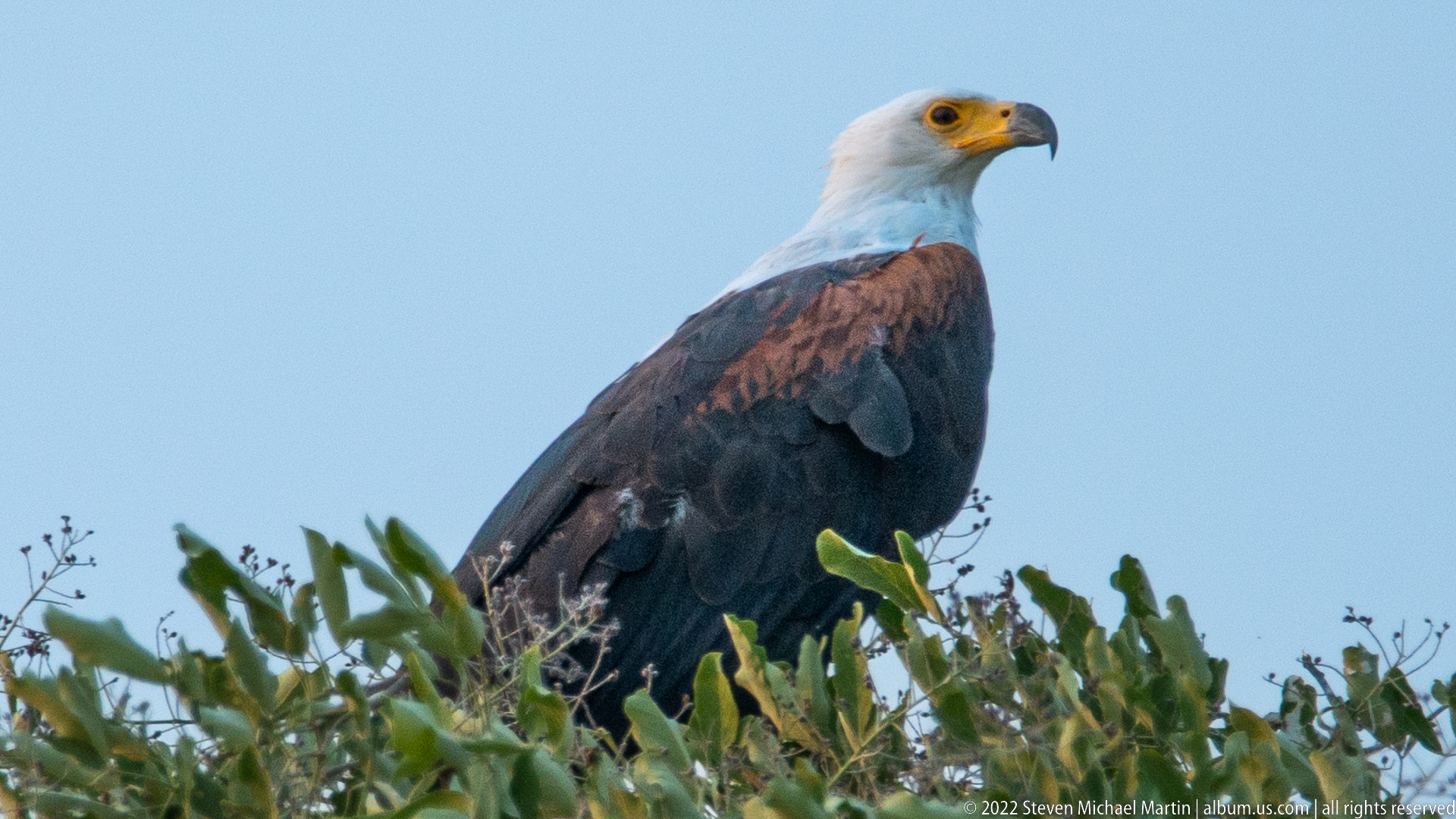
An African fish eagle rises above the leafy crown of a tree, viewed from a low angle against blue sky. Its white head and neck contrast sharply with chestnut upperparts and dark folded wings, while the yellow cere and powerful hooked bill remain visible. The uncluttered background gives this portrait a more monumental, watchful character than the preceding woodland view.
Caption
An African fish eagle rises above the leafy crown of a tree, viewed from a low angle against blue sky. Its white head and neck contrast sharply with chestnut upperparts and dark folded wings, while the yellow cere and powerful hooked bill remain visible. The uncluttered background gives this portrait a more monumental, watchful character than the preceding woodland view.
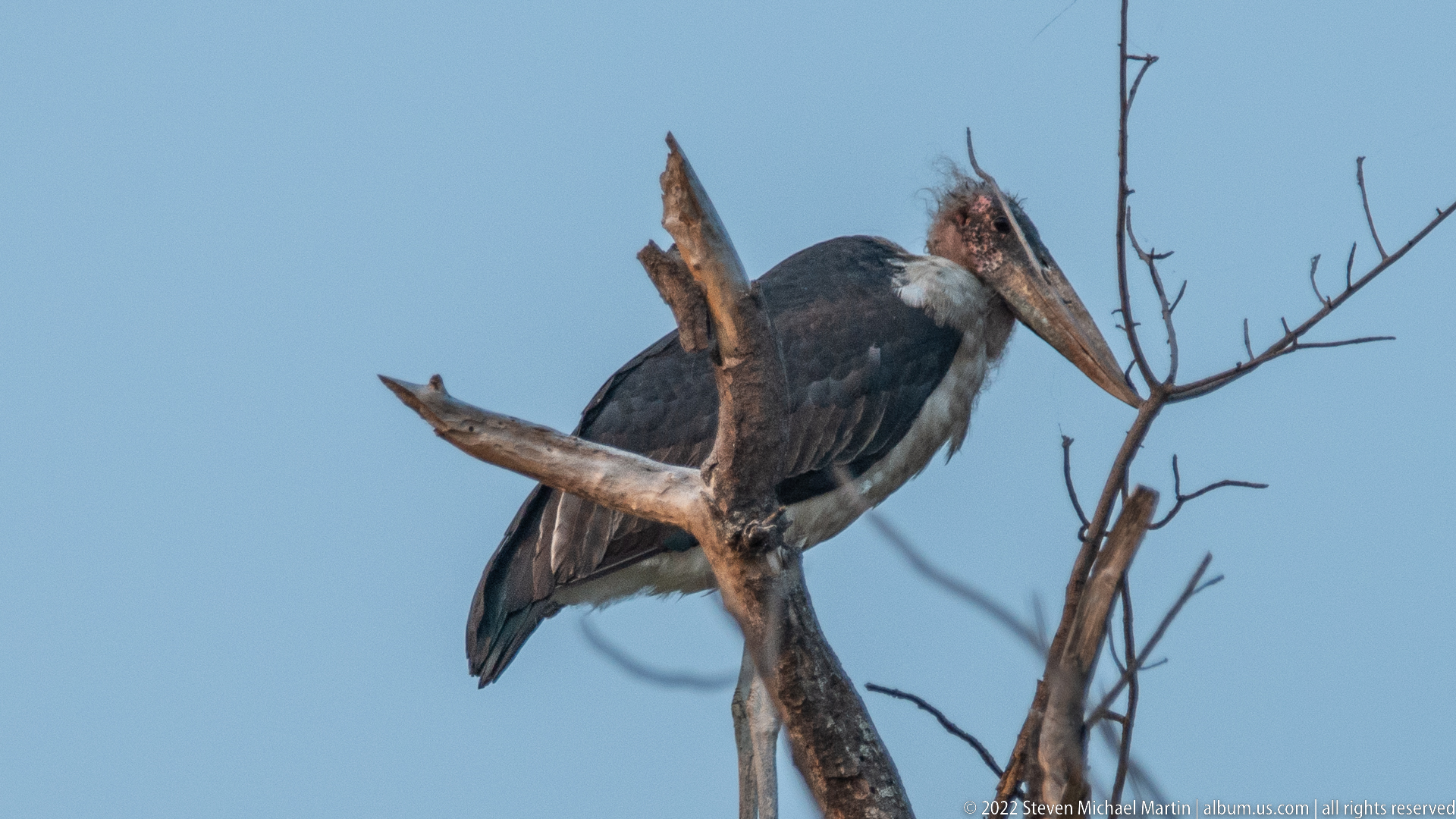
A marabou stork perches awkwardly among the upper forks of a dead tree, its large body partly screened by bare branches. The massive wedge-shaped bill, naked head and neck, white neck ruff, dark wings, and pale underparts identify this specialized scavenging stork. The compressed pose emphasizes the bird’s bulky silhouette rather than its unusually long legs.
Caption
A marabou stork perches awkwardly among the upper forks of a dead tree, its large body partly screened by bare branches. The massive wedge-shaped bill, naked head and neck, white neck ruff, dark wings, and pale underparts identify this specialized scavenging stork. The compressed pose emphasizes the bird’s bulky silhouette rather than its unusually long legs.
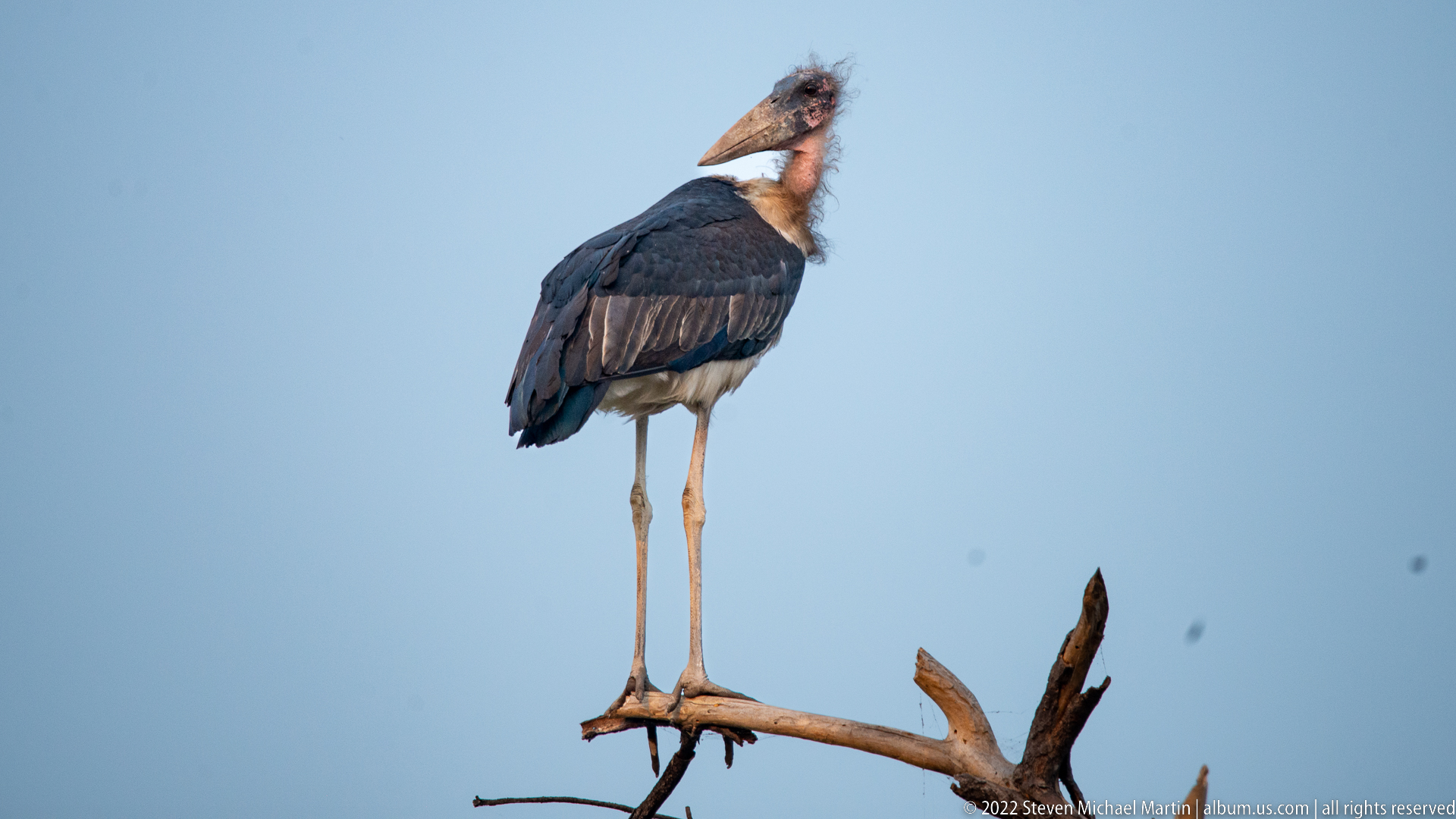
A marabou stork stands fully exposed on the tip of a dead snag, revealing its extraordinary proportions from bill to feet. The bare head, heavy wedge-shaped bill, dark mantle, white underparts, and extremely long pale legs are all visible against open sky. The isolated perch creates a diagnostic full-body view of this large African scavenging stork.
Caption
A marabou stork stands fully exposed on the tip of a dead snag, revealing its extraordinary proportions from bill to feet. The bare head, heavy wedge-shaped bill, dark mantle, white underparts, and extremely long pale legs are all visible against open sky. The isolated perch creates a diagnostic full-body view of this large African scavenging stork.
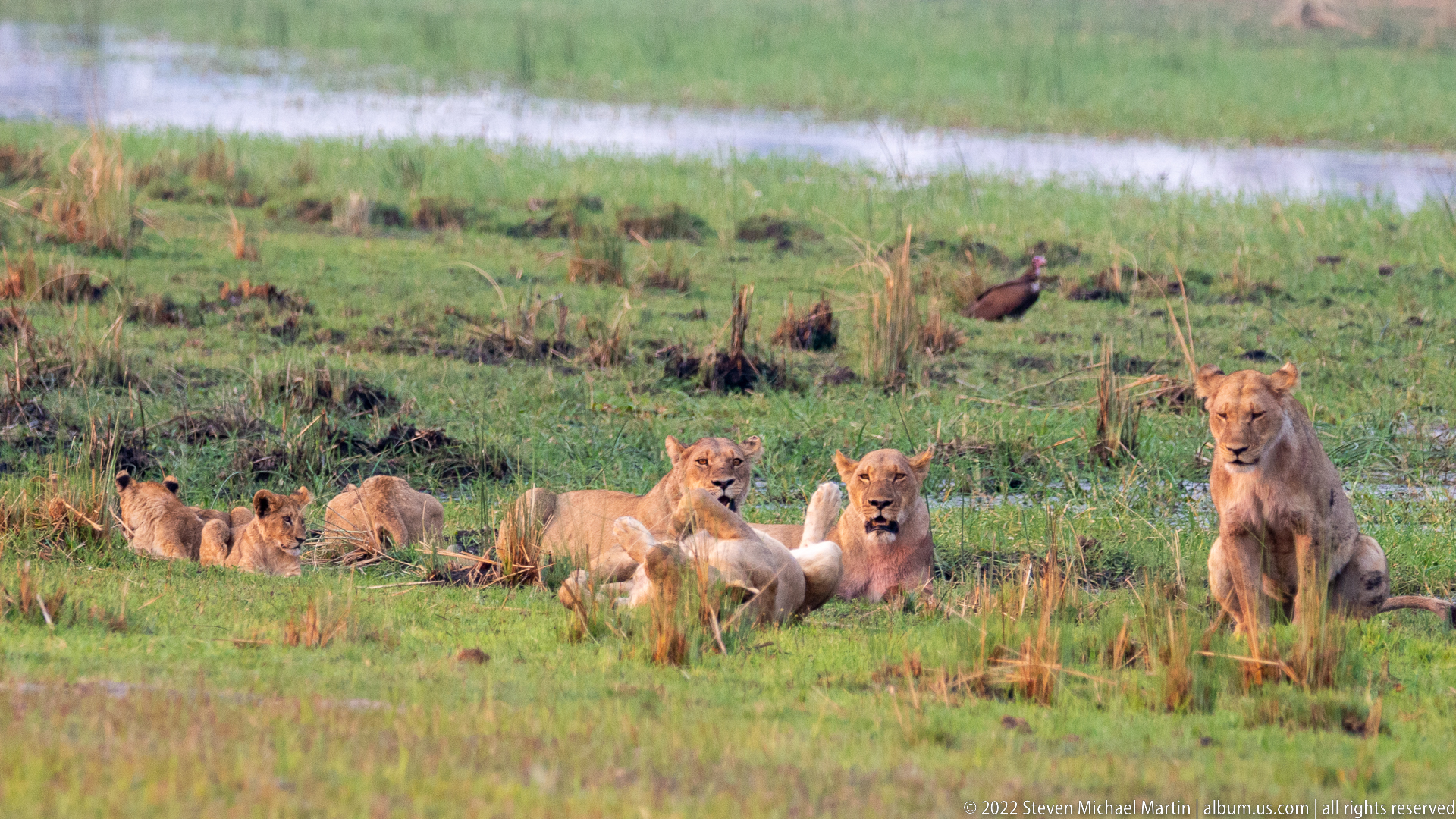
A lion pride rests across a green floodplain beside shallow water, with several cubs clustered near adult females. Some animals lie flat in the grass while one lioness sits upright, creating a broad social tableau rather than an individual portrait. The wetland surroundings and dispersed arrangement show the pride occupying open floodplain habitat on Chief’s Island.
Caption
A lion pride rests across a green floodplain beside shallow water, with several cubs clustered near adult females. Some animals lie flat in the grass while one lioness sits upright, creating a broad social tableau rather than an individual portrait. The wetland surroundings and dispersed arrangement show the pride occupying open floodplain habitat on Chief’s Island.
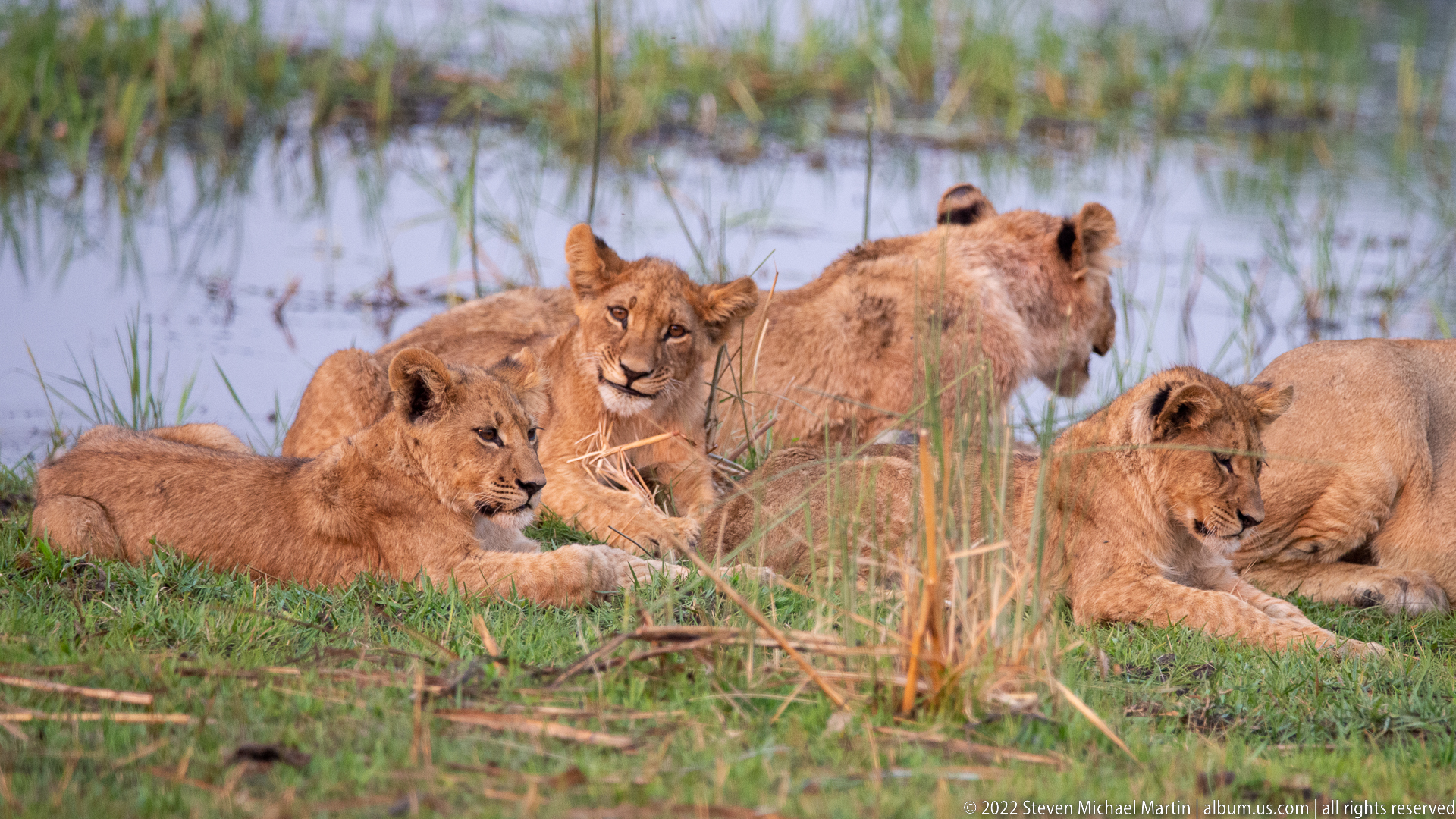
Four young lion cubs rest together at the edge of shallow floodplain water, their small rounded faces and faint juvenile spotting visible in the closer view. Two cubs face left, one looks toward the camera, and another turns away, creating a varied group portrait. Their proximity and relaxed postures record the social nature of young lions within the pride.
Caption
Four young lion cubs rest together at the edge of shallow floodplain water, their small rounded faces and faint juvenile spotting visible in the closer view. Two cubs face left, one looks toward the camera, and another turns away, creating a varied group portrait. Their proximity and relaxed postures record the social nature of young lions within the pride.

Lion cubs remain gathered beside the floodplain, but this frame centers the two youngsters reclining at left and right while another sits partly turned away between them. Their rounded ears, oversized paws, soft tawny coats, and faint spotting are visible at close range. The quiet grouping presents the cubs as individuals within the larger pride.
Caption
Lion cubs remain gathered beside the floodplain, but this frame centers the two youngsters reclining at left and right while another sits partly turned away between them. Their rounded ears, oversized paws, soft tawny coats, and faint spotting are visible at close range. The quiet grouping presents the cubs as individuals within the larger pride.
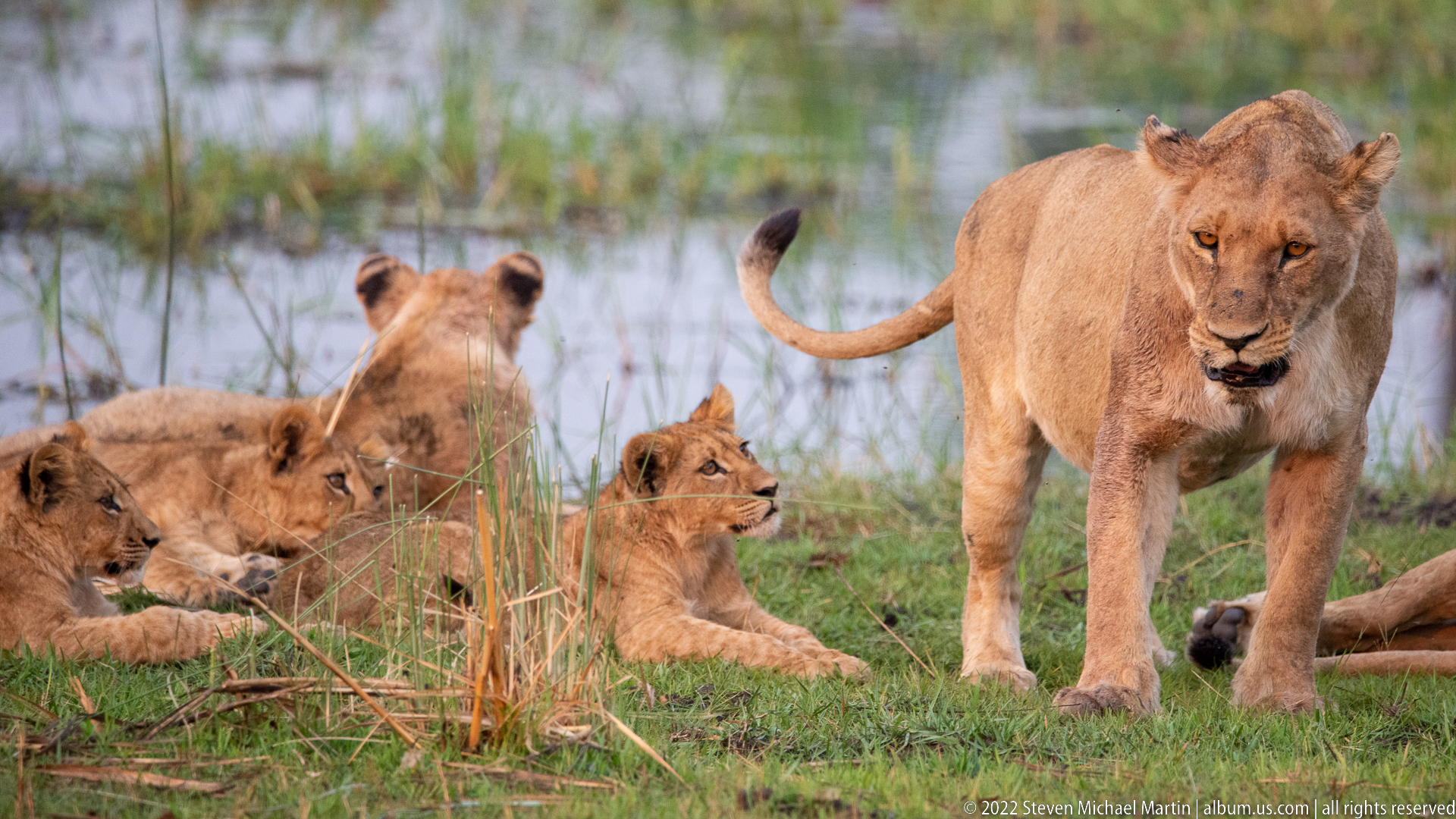
An adult lioness stands at the edge of a resting cluster of cubs, her body filling the right side of the frame while the youngsters remain on the grass behind her. The lioness’s muscular build, plain tawny coat, and focused downward gaze contrast with the smaller, softer-featured cubs. The composition makes the protective adult–juvenile relationship immediately legible.
Caption
An adult lioness stands at the edge of a resting cluster of cubs, her body filling the right side of the frame while the youngsters remain on the grass behind her. The lioness’s muscular build, plain tawny coat, and focused downward gaze contrast with the smaller, softer-featured cubs. The composition makes the protective adult–juvenile relationship immediately legible.
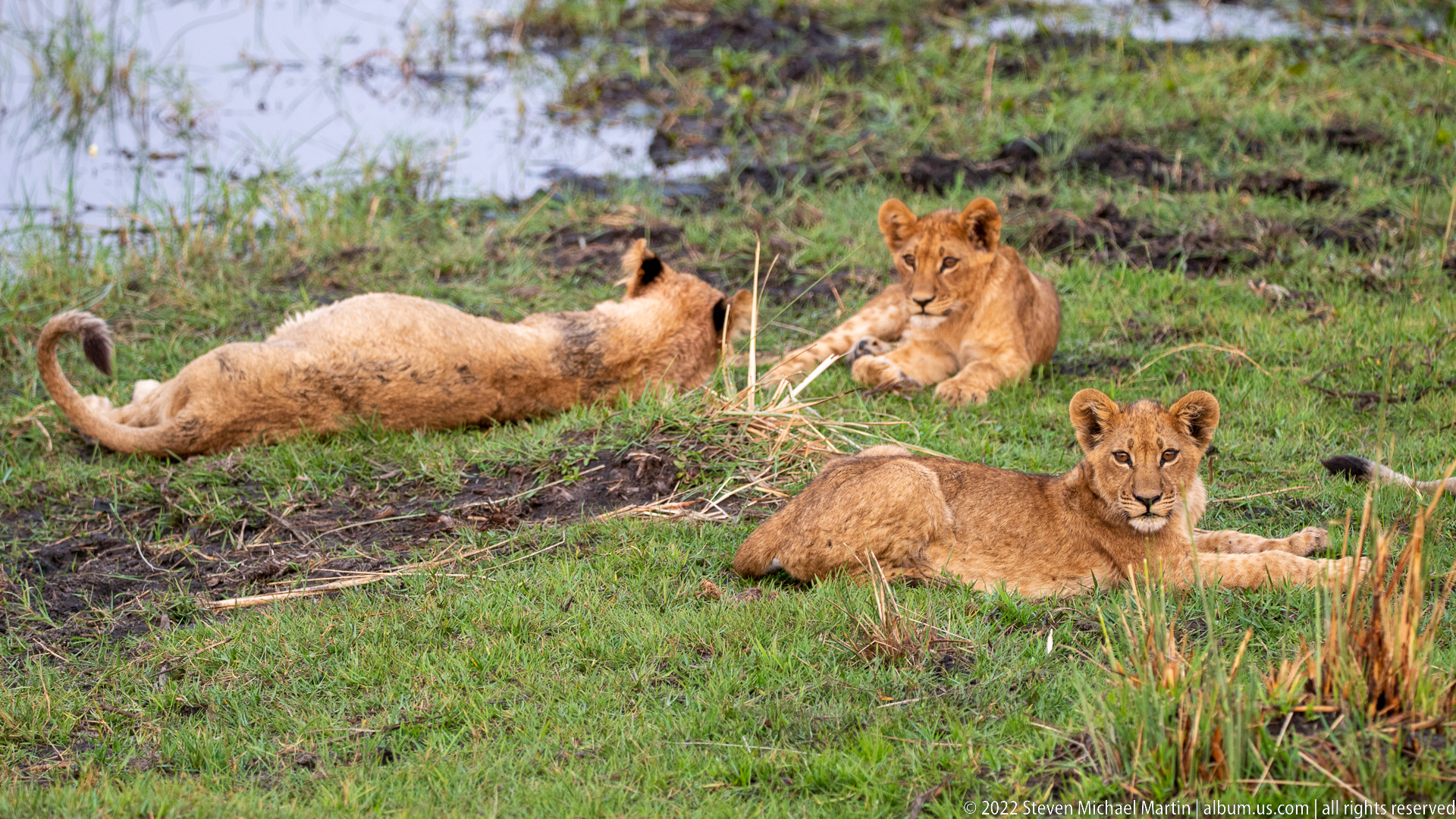
Three lion cubs occupy a patch of green grass near the wetland edge, two facing the camera while a third lies stretched on its back with tail curved upward. The playful supine posture contrasts with the alert expressions of the other cubs, adding behavioral variety to the pride sequence. Muddy ground and shallow water remain visible behind them.
Caption
Three lion cubs occupy a patch of green grass near the wetland edge, two facing the camera while a third lies stretched on its back with tail curved upward. The playful supine posture contrasts with the alert expressions of the other cubs, adding behavioral variety to the pride sequence. Muddy ground and shallow water remain visible behind them.

A lion cub reclines on the grass and looks up toward another young lion entering from the left. The seated cub’s rounded ears, pale muzzle, faint facial markings, and oversized forepaws are sharply visible, while the cropped companion introduces a moment of social interaction. The close framing shifts attention from the pride as a group to the cub’s attentive expression.
Caption
A lion cub reclines on the grass and looks up toward another young lion entering from the left. The seated cub’s rounded ears, pale muzzle, faint facial markings, and oversized forepaws are sharply visible, while the cropped companion introduces a moment of social interaction. The close framing shifts attention from the pride as a group to the cub’s attentive expression.
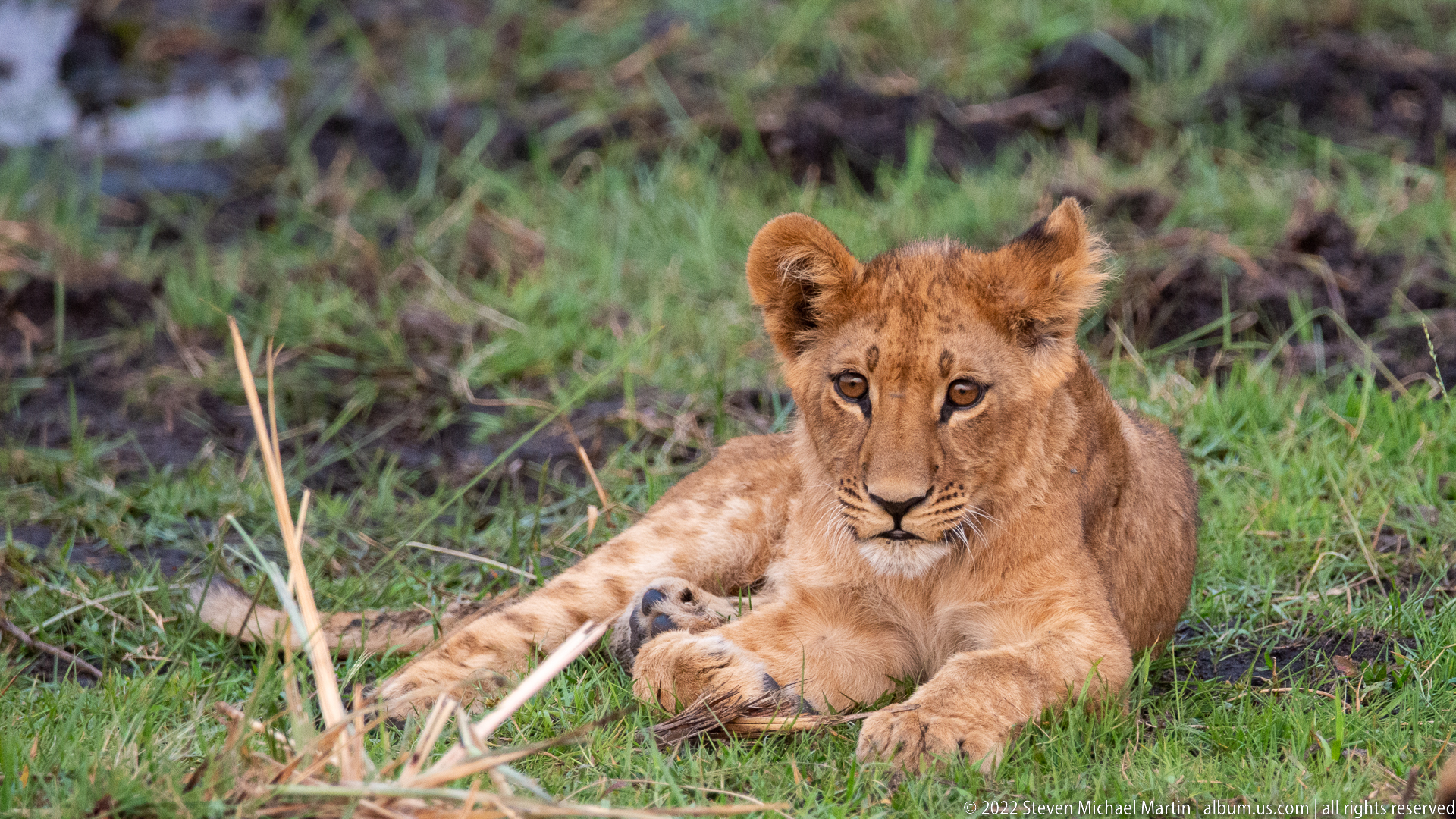
A young lion rests upright on green grass, facing the camera with both forepaws extended. Faint juvenile spots remain visible on the legs and forehead, while the rounded ears, broad paws, short muzzle, and amber eyes are rendered clearly. The uncluttered close portrait provides one of the most direct individual studies of a cub in the sequence.
Caption
A young lion rests upright on green grass, facing the camera with both forepaws extended. Faint juvenile spots remain visible on the legs and forehead, while the rounded ears, broad paws, short muzzle, and amber eyes are rendered clearly. The uncluttered close portrait provides one of the most direct individual studies of a cub in the sequence.
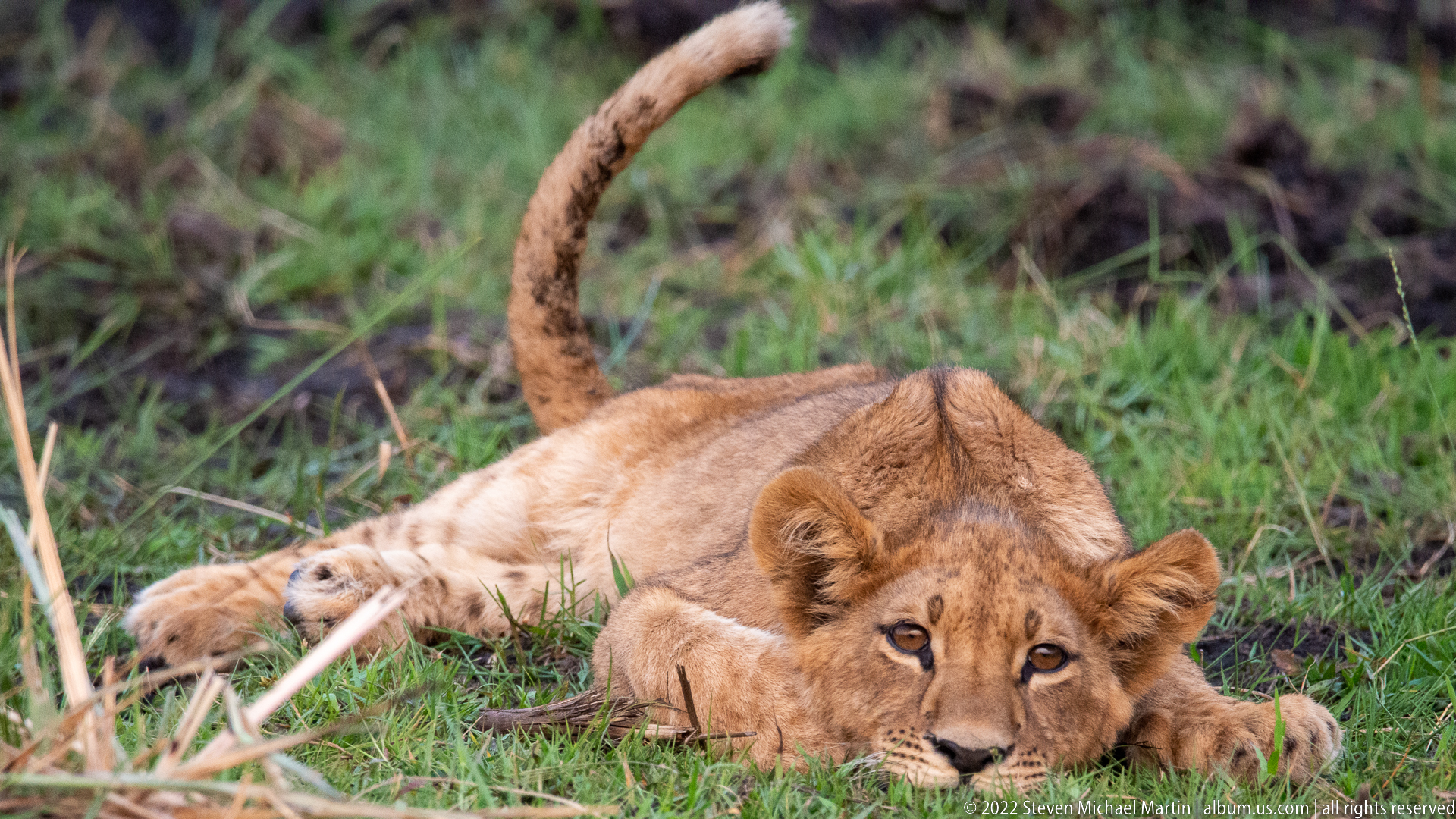
A lion cub lies almost flat against the grass with its chin close to the ground and forelegs stretched forward. The low posture brings the cub’s eyes level with the camera and accentuates its rounded ears and soft juvenile features, while a raised tail from another nearby lion curves into the upper left of the frame. The viewpoint gives the resting cub an unusually intimate presence.
Caption
A lion cub lies almost flat against the grass with its chin close to the ground and forelegs stretched forward. The low posture brings the cub’s eyes level with the camera and accentuates its rounded ears and soft juvenile features, while a raised tail from another nearby lion curves into the upper left of the frame. The viewpoint gives the resting cub an unusually intimate presence.
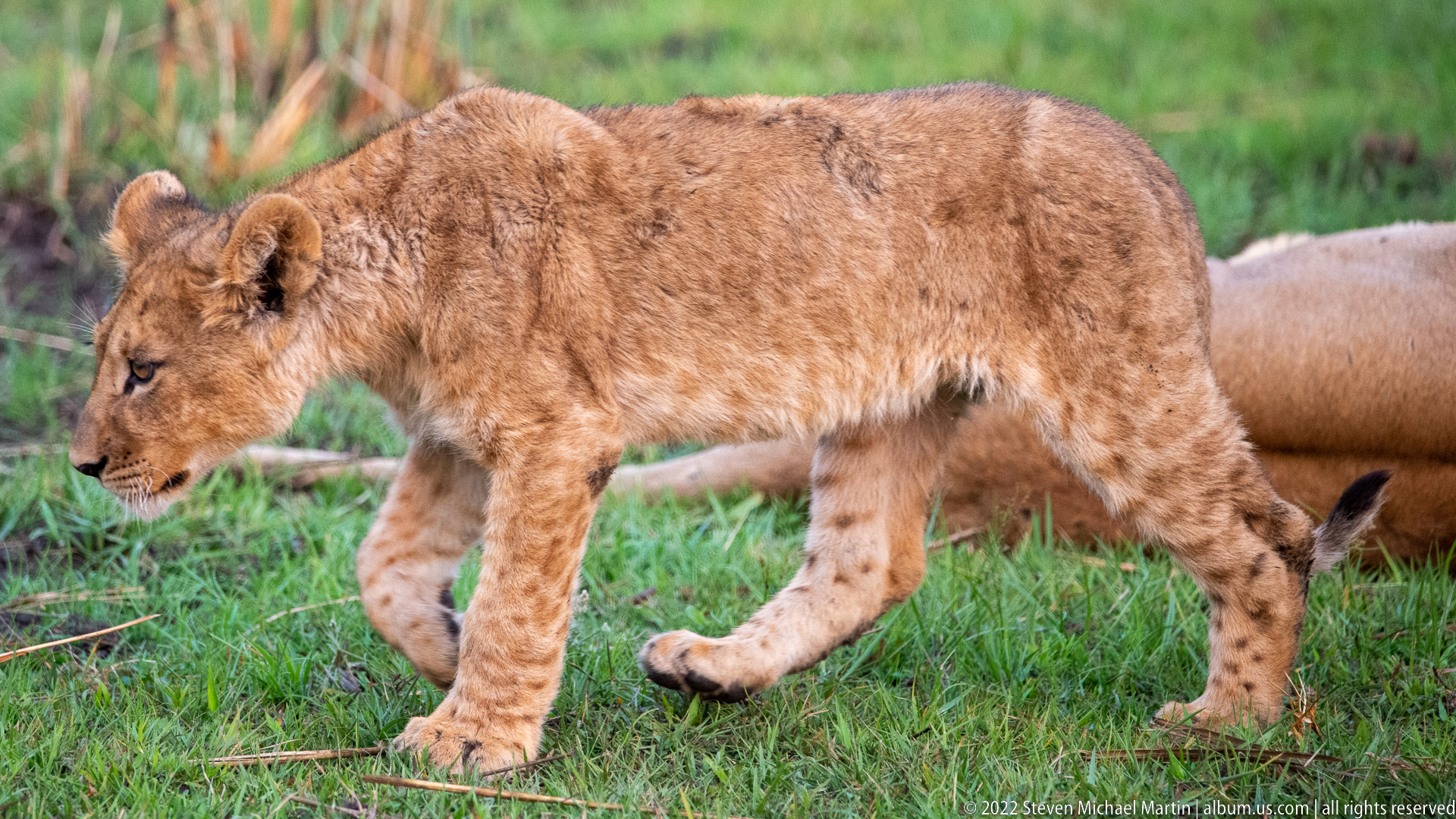
A lion cub walks across short green grass in side profile, one forepaw lifted mid-stride. Faint spotting along the belly and legs, rounded ears, relatively long juvenile limbs, and a soft tawny coat remain visible as the youngster moves past resting pride members in the background. The frame adds a clear locomotion study to the preceding sequence of reclining cub portraits.
Caption
A lion cub walks across short green grass in side profile, one forepaw lifted mid-stride. Faint spotting along the belly and legs, rounded ears, relatively long juvenile limbs, and a soft tawny coat remain visible as the youngster moves past resting pride members in the background. The frame adds a clear locomotion study to the preceding sequence of reclining cub portraits.
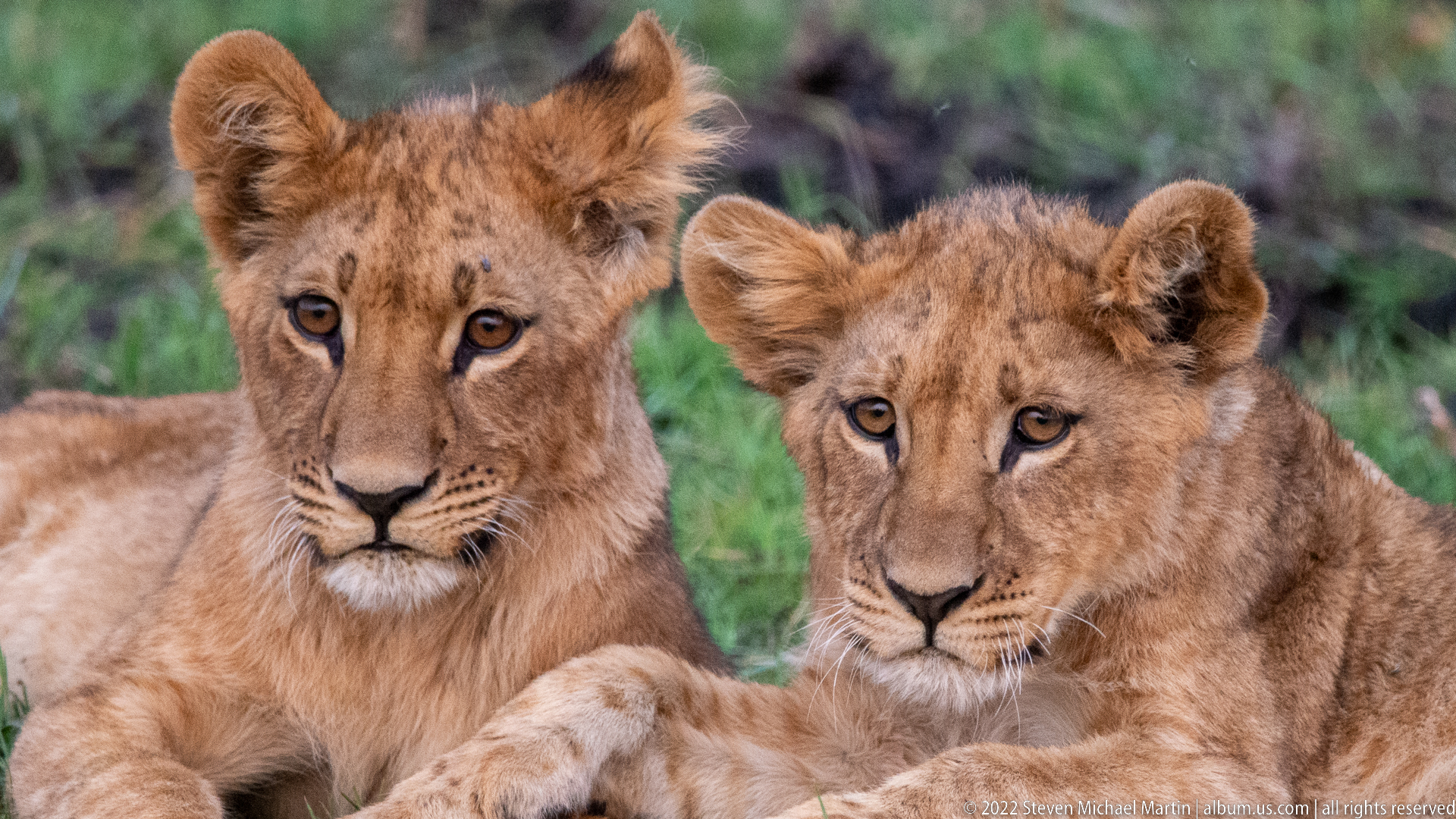
Two lion cubs rest shoulder to shoulder in short green grass, both facing the camera with calm, attentive expressions. Their rounded ears, broad juvenile paws, pale muzzles, and faint spotting remain visible at close range. The tightly cropped portrait emphasizes sibling proximity and facial differences rather than the wider pride setting seen elsewhere in the sequence.
Caption
Two lion cubs rest shoulder to shoulder in short green grass, both facing the camera with calm, attentive expressions. Their rounded ears, broad juvenile paws, pale muzzles, and faint spotting remain visible at close range. The tightly cropped portrait emphasizes sibling proximity and facial differences rather than the wider pride setting seen elsewhere in the sequence.
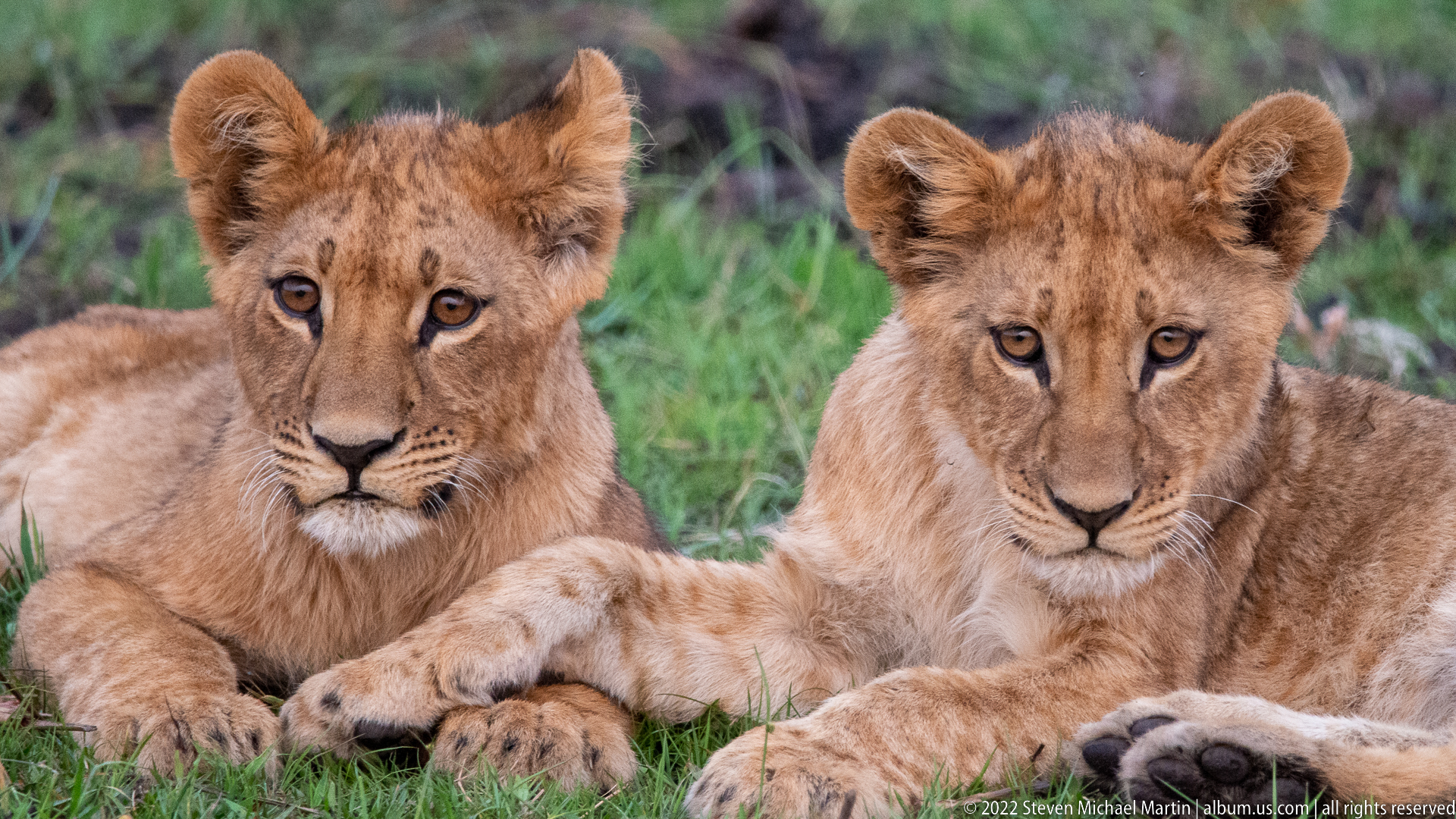
A pair of lion cubs reclines in open grass, one resting a forepaw across the other’s legs while both hold their heads upright. The close view shows their developing facial structure, soft tawny coats, and oversized paws. Their relaxed physical contact gives this frame a distinctly social character within the broader series of pride portraits.
Caption
A pair of lion cubs reclines in open grass, one resting a forepaw across the other’s legs while both hold their heads upright. The close view shows their developing facial structure, soft tawny coats, and oversized paws. Their relaxed physical contact gives this frame a distinctly social character within the broader series of pride portraits.

Three lion cubs rest at different depths across a patch of floodplain grass. The foreground cub lies broadside with its head raised, while two others recline close together behind it near reeds and wetter ground. The layered arrangement creates a small-group study that distinguishes individual postures while retaining the social context of the pride.
Caption
Three lion cubs rest at different depths across a patch of floodplain grass. The foreground cub lies broadside with its head raised, while two others recline close together behind it near reeds and wetter ground. The layered arrangement creates a small-group study that distinguishes individual postures while retaining the social context of the pride.
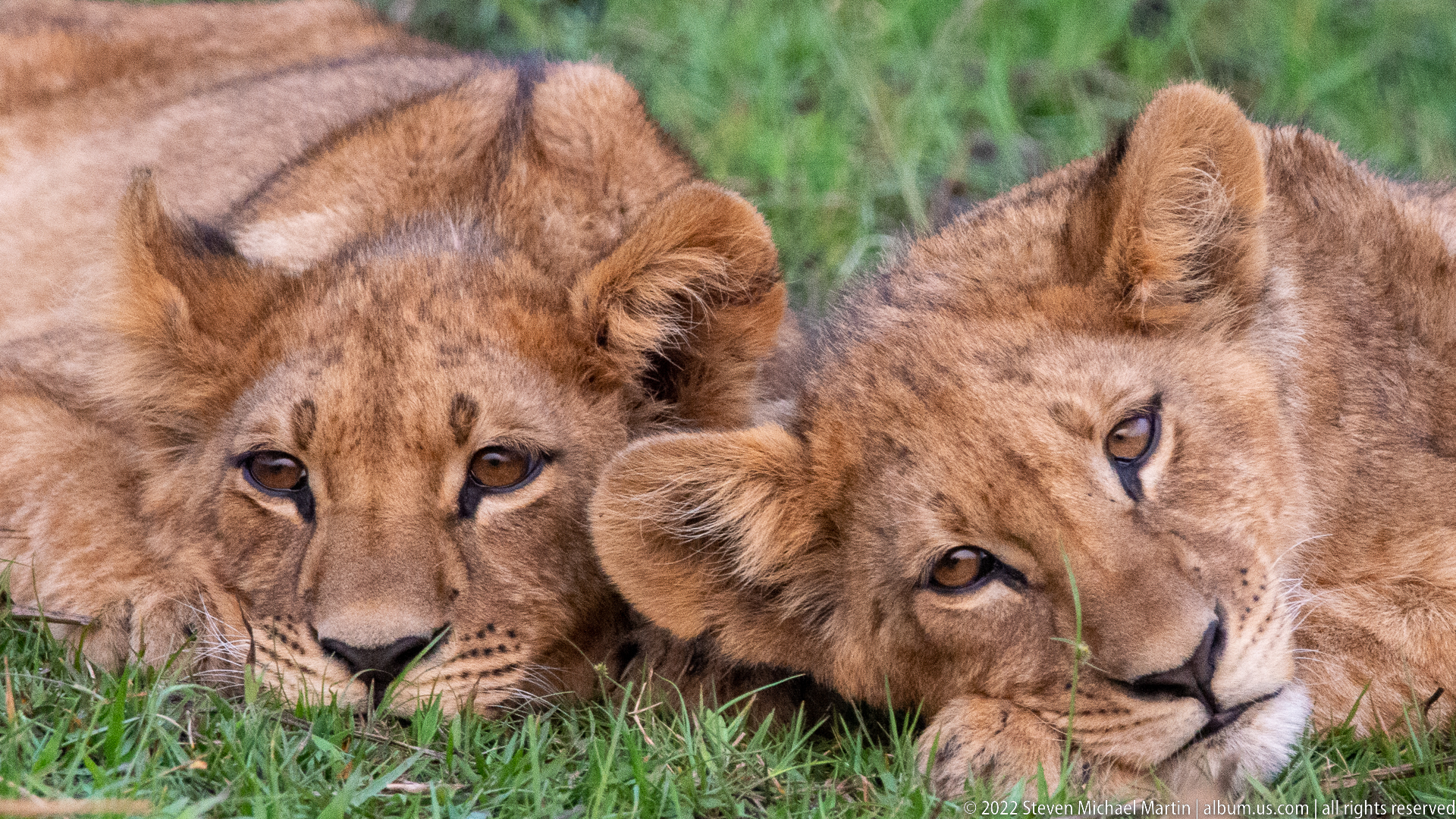
Two lion cubs lie pressed closely together in the grass, their heads touching as they rest. One faces forward while the other tilts its head sideways, revealing the soft fur, dark eye lines, rounded ears, and whiskered muzzles characteristic of young lions. The intimate framing turns a quiet resting moment into a close study of sibling contact.
Caption
Two lion cubs lie pressed closely together in the grass, their heads touching as they rest. One faces forward while the other tilts its head sideways, revealing the soft fur, dark eye lines, rounded ears, and whiskered muzzles characteristic of young lions. The intimate framing turns a quiet resting moment into a close study of sibling contact.
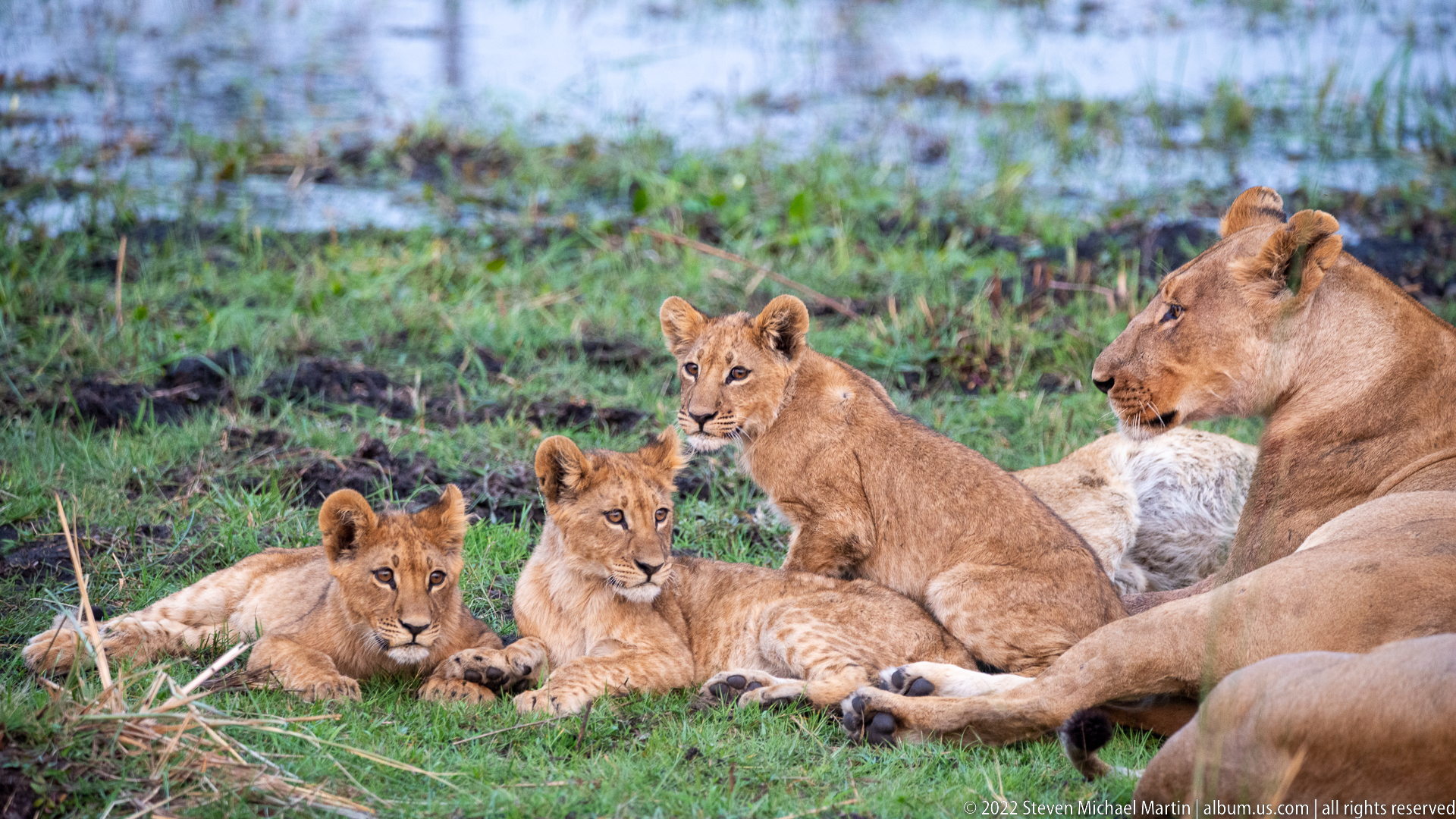
A lioness rests beside a cluster of cubs on green floodplain grass, with at least four youngsters gathered around her. Some cubs face the camera while others turn toward the adult, creating a compact family scene. The surrounding shallow water and reeds place the group within the wetland mosaic characteristic of Chief’s Island.
Caption
A lioness rests beside a cluster of cubs on green floodplain grass, with at least four youngsters gathered around her. Some cubs face the camera while others turn toward the adult, creating a compact family scene. The surrounding shallow water and reeds place the group within the wetland mosaic characteristic of Chief’s Island.
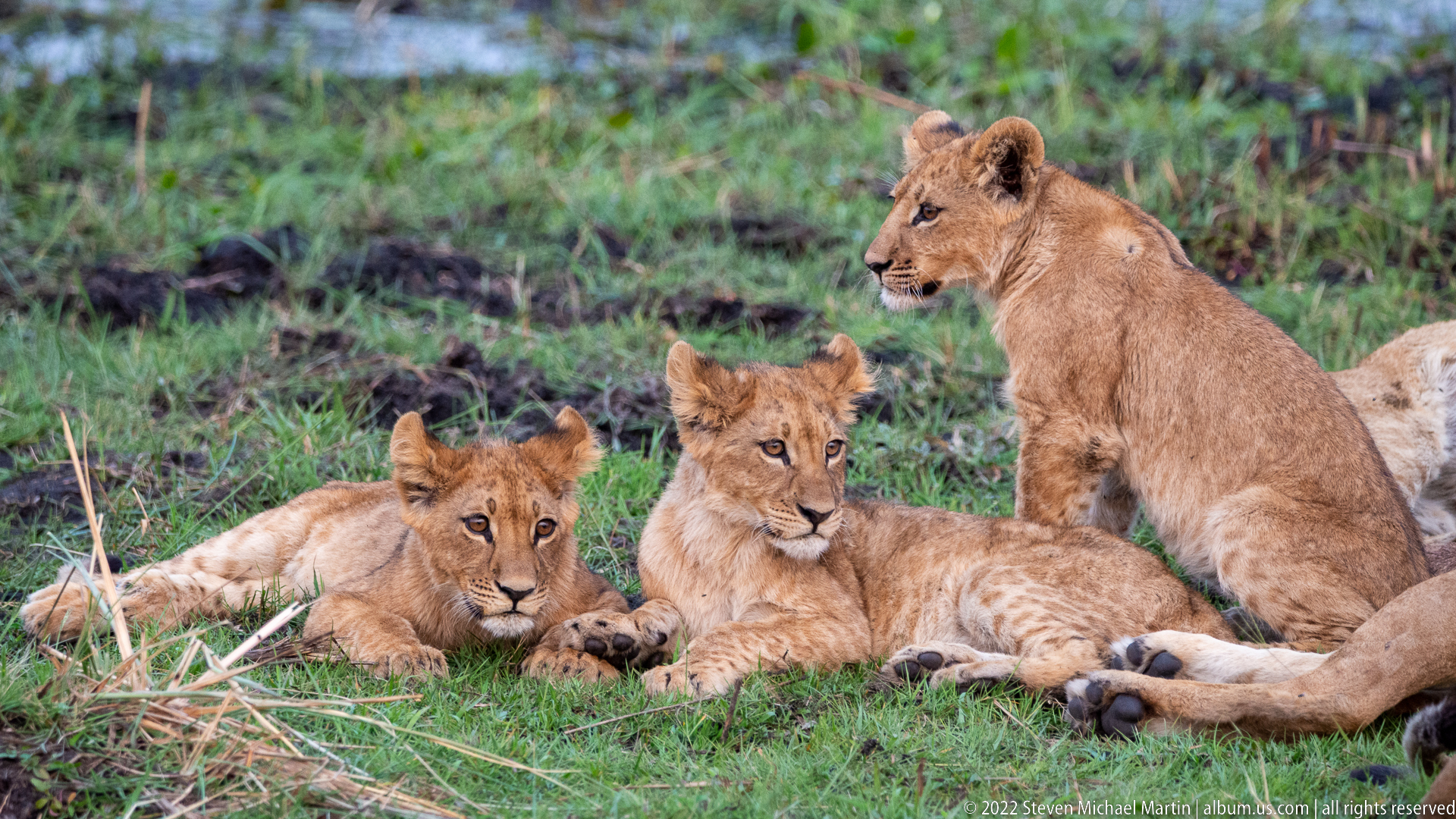
Three lion cubs gather beside the body of a resting lioness, two lying in the grass while a third sits upright and looks to the right. Their varied postures and overlapping bodies give the photograph a more dynamic family composition than the preceding pride overview. Wet ground and green vegetation remain visible around the group.
Caption
Three lion cubs gather beside the body of a resting lioness, two lying in the grass while a third sits upright and looks to the right. Their varied postures and overlapping bodies give the photograph a more dynamic family composition than the preceding pride overview. Wet ground and green vegetation remain visible around the group.
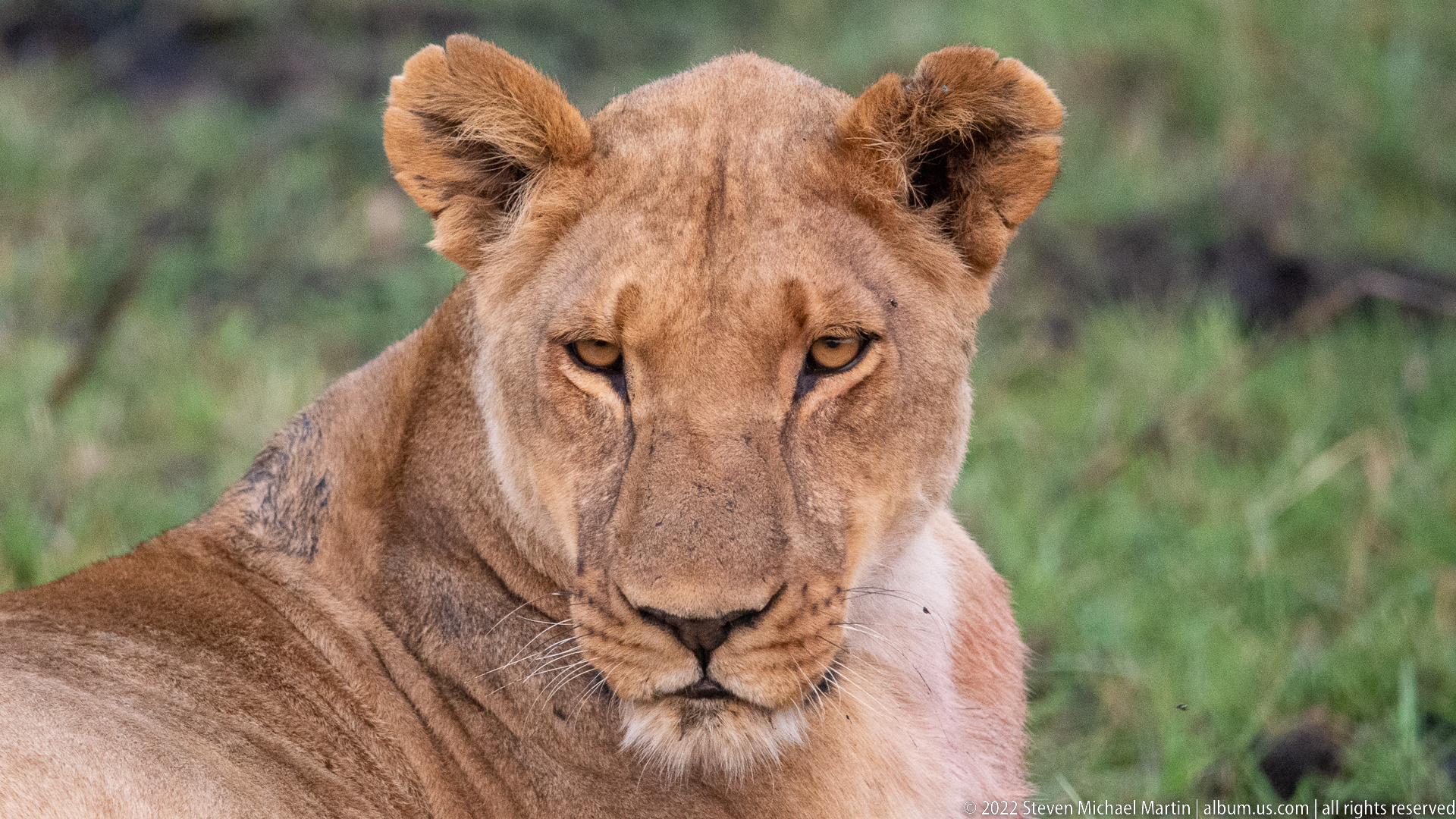
An adult lioness sits upright in short grass and looks directly toward the camera. The close portrait reveals her amber eyes, broad muzzle, rounded ears, tawny coat, and darkened patches of damp or muddy fur across the shoulder. With no cubs in the immediate frame, attention shifts entirely to the adult female’s expression and powerful facial structure.
Caption
An adult lioness sits upright in short grass and looks directly toward the camera. The close portrait reveals her amber eyes, broad muzzle, rounded ears, tawny coat, and darkened patches of damp or muddy fur across the shoulder. With no cubs in the immediate frame, attention shifts entirely to the adult female’s expression and powerful facial structure.
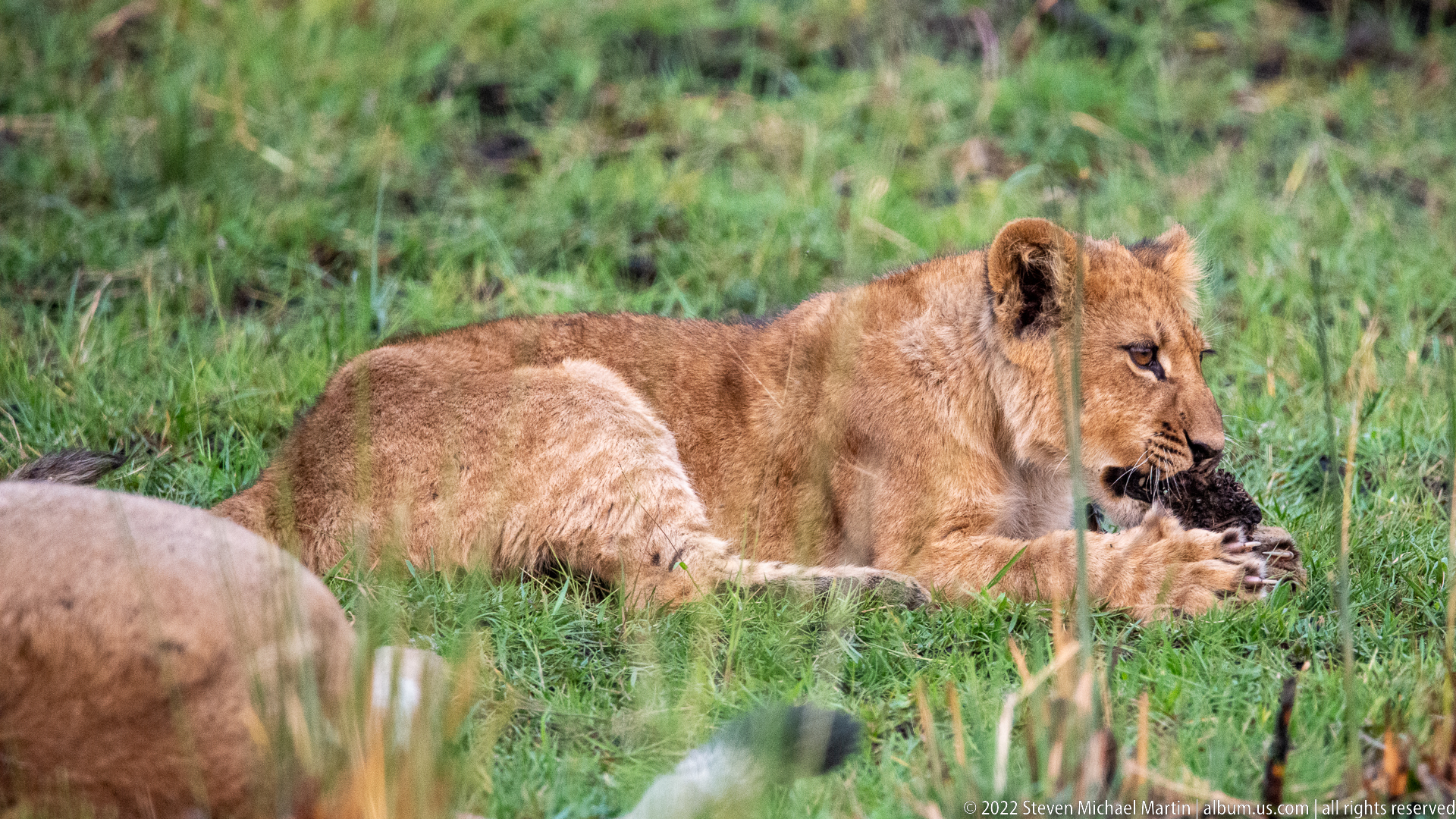
A lion cub lies on the grass with both forepaws braced around a dark object that it mouths intently. The youngster’s head is turned in profile, showing its rounded ears, developing jaws, and faint juvenile spotting along the flank. The behavior-centered view records exploratory chewing rather than simple resting.
Caption
A lion cub lies on the grass with both forepaws braced around a dark object that it mouths intently. The youngster’s head is turned in profile, showing its rounded ears, developing jaws, and faint juvenile spotting along the flank. The behavior-centered view records exploratory chewing rather than simple resting.
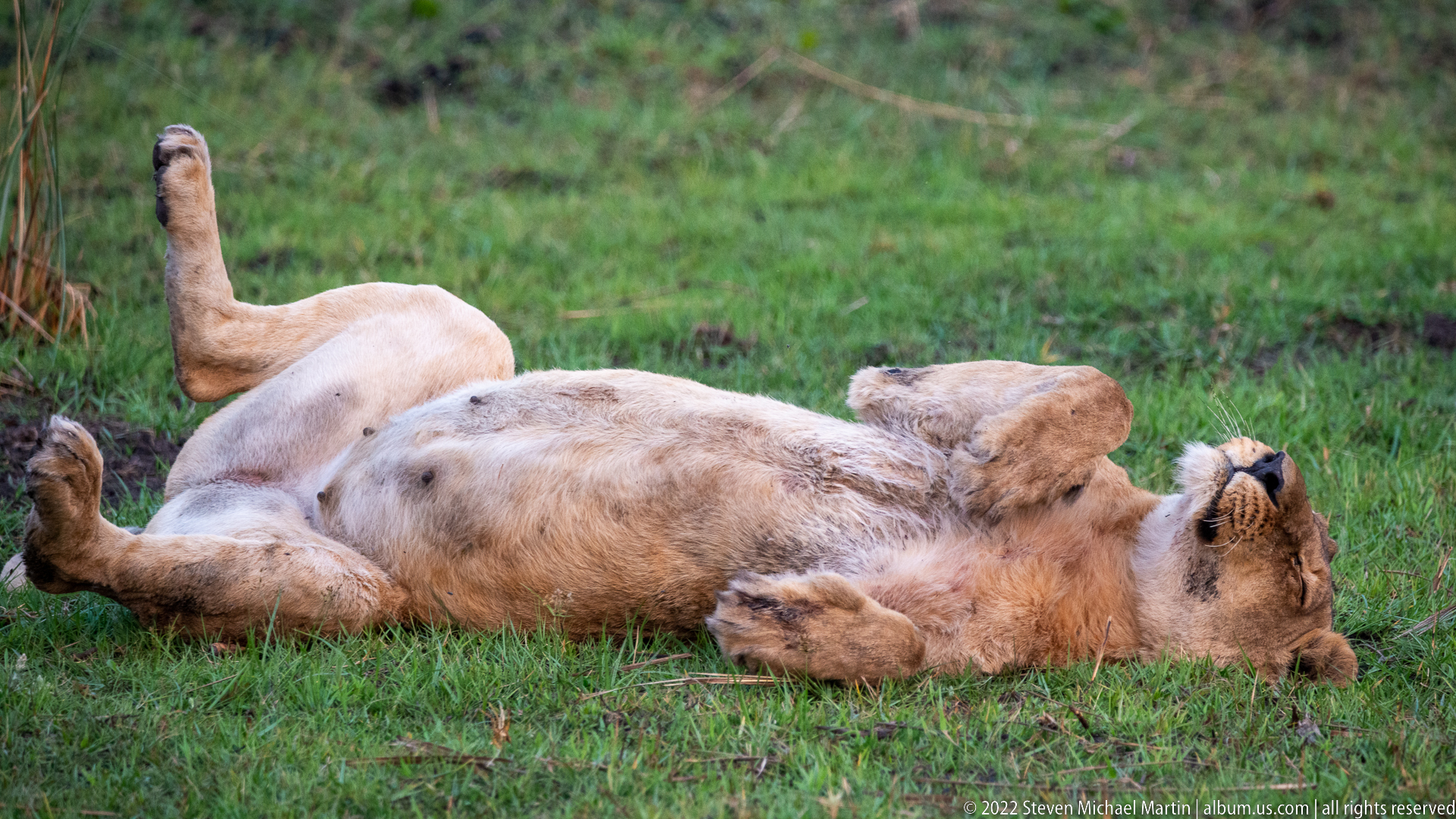
An adult lioness rolls onto her back in the grass, exposing her belly and lifting one hind leg while her forepaws curl loosely toward the chest. The relaxed, inverted posture contrasts strongly with the upright portraits in the sequence and records a moment of comfort behavior within the pride’s resting area.
Caption
An adult lioness rolls onto her back in the grass, exposing her belly and lifting one hind leg while her forepaws curl loosely toward the chest. The relaxed, inverted posture contrasts strongly with the upright portraits in the sequence and records a moment of comfort behavior within the pride’s resting area.
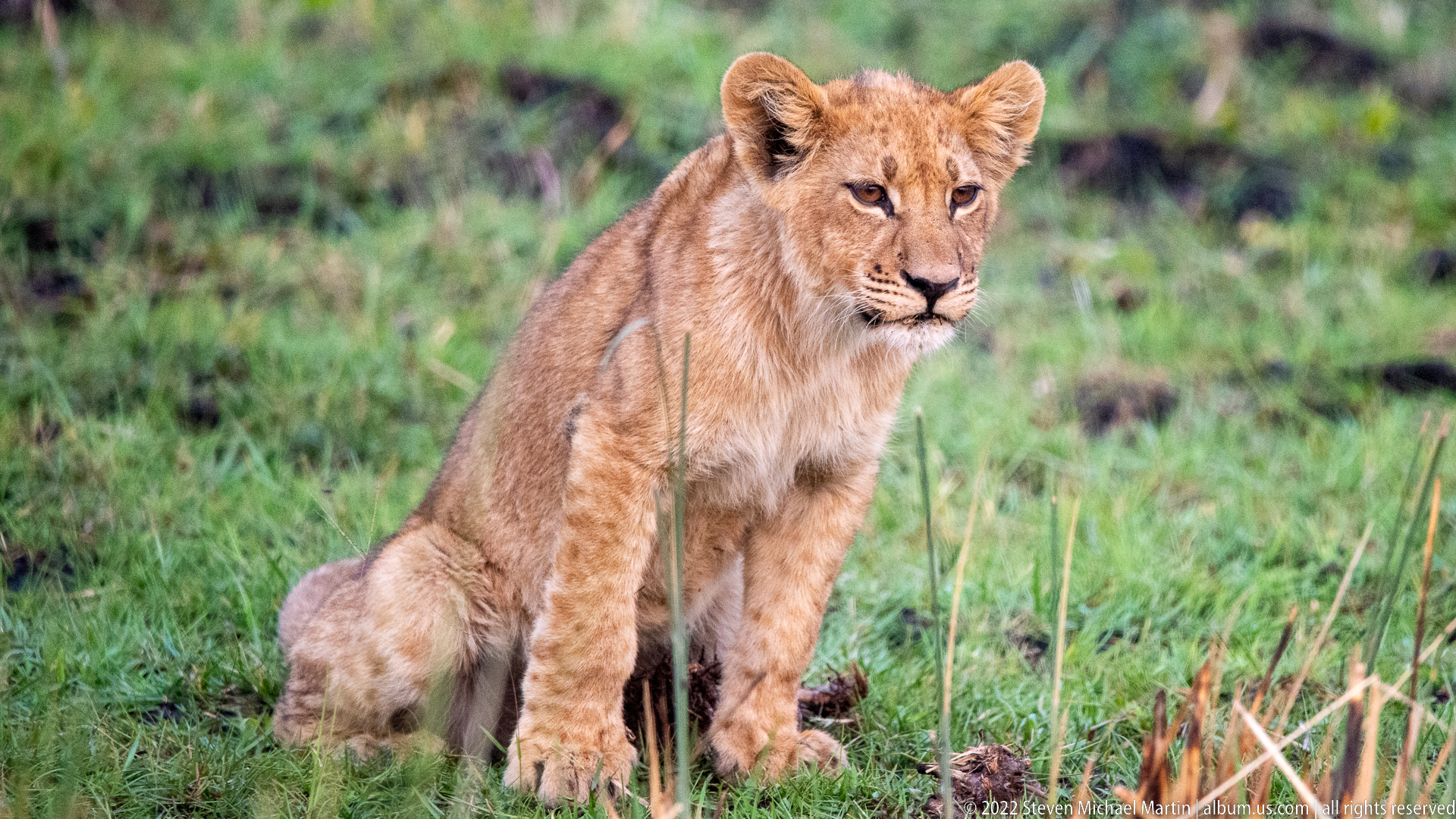
A lion cub sits upright on damp green ground with its forelegs straight and body facing forward. The youngster turns its head slightly to the right, displaying rounded ears, a pale muzzle, faint leg spotting, and the long-legged proportions of a growing juvenile. The isolated posture creates a simple full-body study against the floodplain vegetation.
Caption
A lion cub sits upright on damp green ground with its forelegs straight and body facing forward. The youngster turns its head slightly to the right, displaying rounded ears, a pale muzzle, faint leg spotting, and the long-legged proportions of a growing juvenile. The isolated posture creates a simple full-body study against the floodplain vegetation.
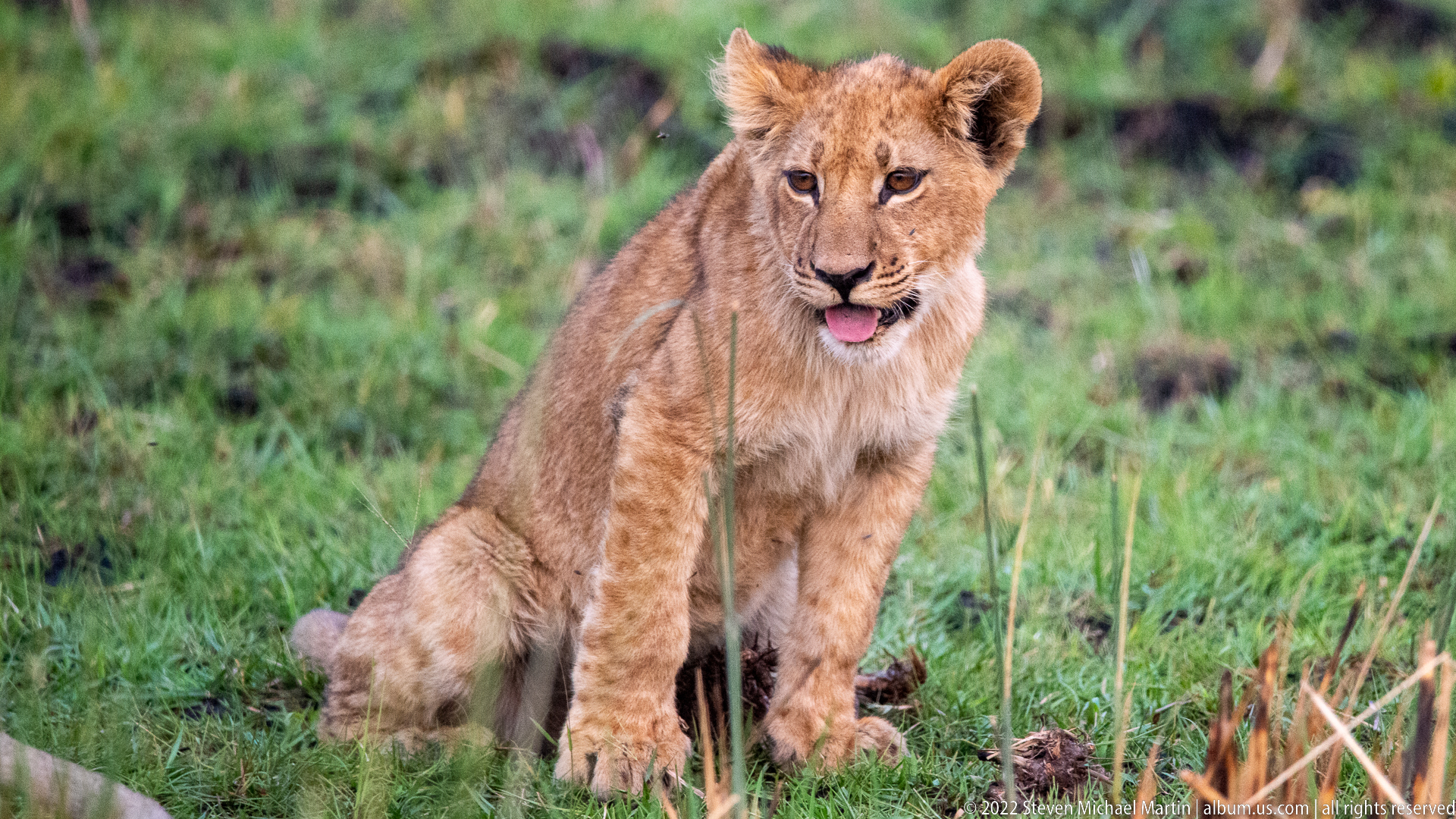
A seated lion cub briefly extends its tongue while facing the camera, adding a small behavioral detail to an otherwise formal portrait. The cub’s long forelegs, broad paws, rounded ears, and pale chest are clearly visible against green grass. Its direct gaze and tongue movement distinguish this frame from the nearly identical seated view immediately before it.
Caption
A seated lion cub briefly extends its tongue while facing the camera, adding a small behavioral detail to an otherwise formal portrait. The cub’s long forelegs, broad paws, rounded ears, and pale chest are clearly visible against green grass. Its direct gaze and tongue movement distinguish this frame from the nearly identical seated view immediately before it.

Two lion cubs interact at close range, one standing over the other while the reclining cub mouths a dark object between its paws. The standing youngster looks off to the right, creating a layered scene of alertness and play. Their overlapping bodies and contrasting postures make this a more active social frame than the preceding solo portraits.
Caption
Two lion cubs interact at close range, one standing over the other while the reclining cub mouths a dark object between its paws. The standing youngster looks off to the right, creating a layered scene of alertness and play. Their overlapping bodies and contrasting postures make this a more active social frame than the preceding solo portraits.

Two lion cubs occupy the same patch of grass, one lying down with a dark object between its paws while the other steps forward from behind. The standing cub faces the camera with tail raised, giving the scene a playful sense of movement. Their contrasting positions create a compact study of juvenile social behavior.
Caption
Two lion cubs occupy the same patch of grass, one lying down with a dark object between its paws while the other steps forward from behind. The standing cub faces the camera with tail raised, giving the scene a playful sense of movement. Their contrasting positions create a compact study of juvenile social behavior.
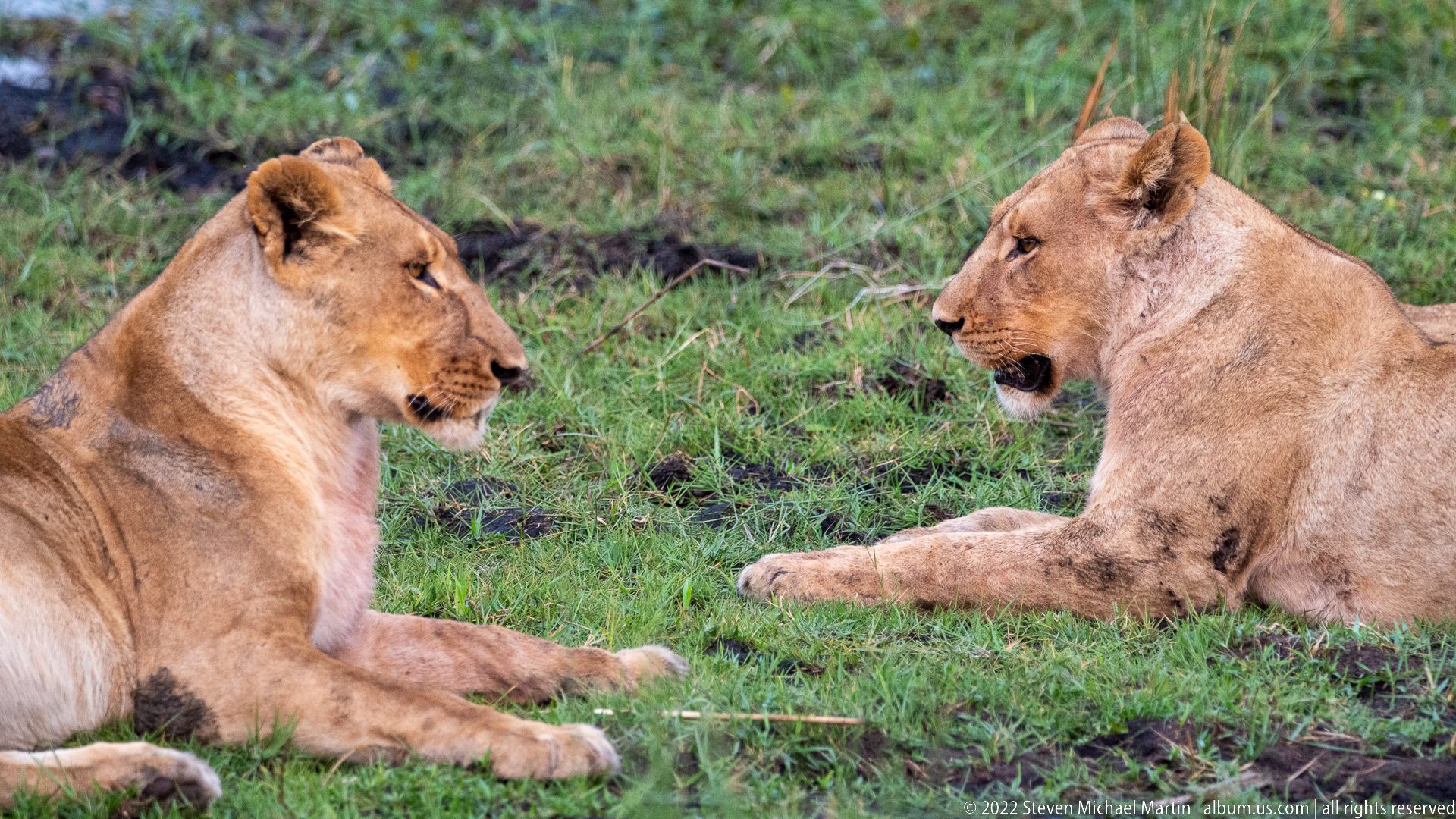
Two adult lionesses lie several feet apart on the grass and face one another directly. Both hold their heads raised, and one has its mouth slightly open, creating the impression of a brief social exchange within the pride. The uncluttered spacing allows the mirrored body positions and attentive eye contact to define the composition.
Caption
Two adult lionesses lie several feet apart on the grass and face one another directly. Both hold their heads raised, and one has its mouth slightly open, creating the impression of a brief social exchange within the pride. The uncluttered spacing allows the mirrored body positions and attentive eye contact to define the composition.
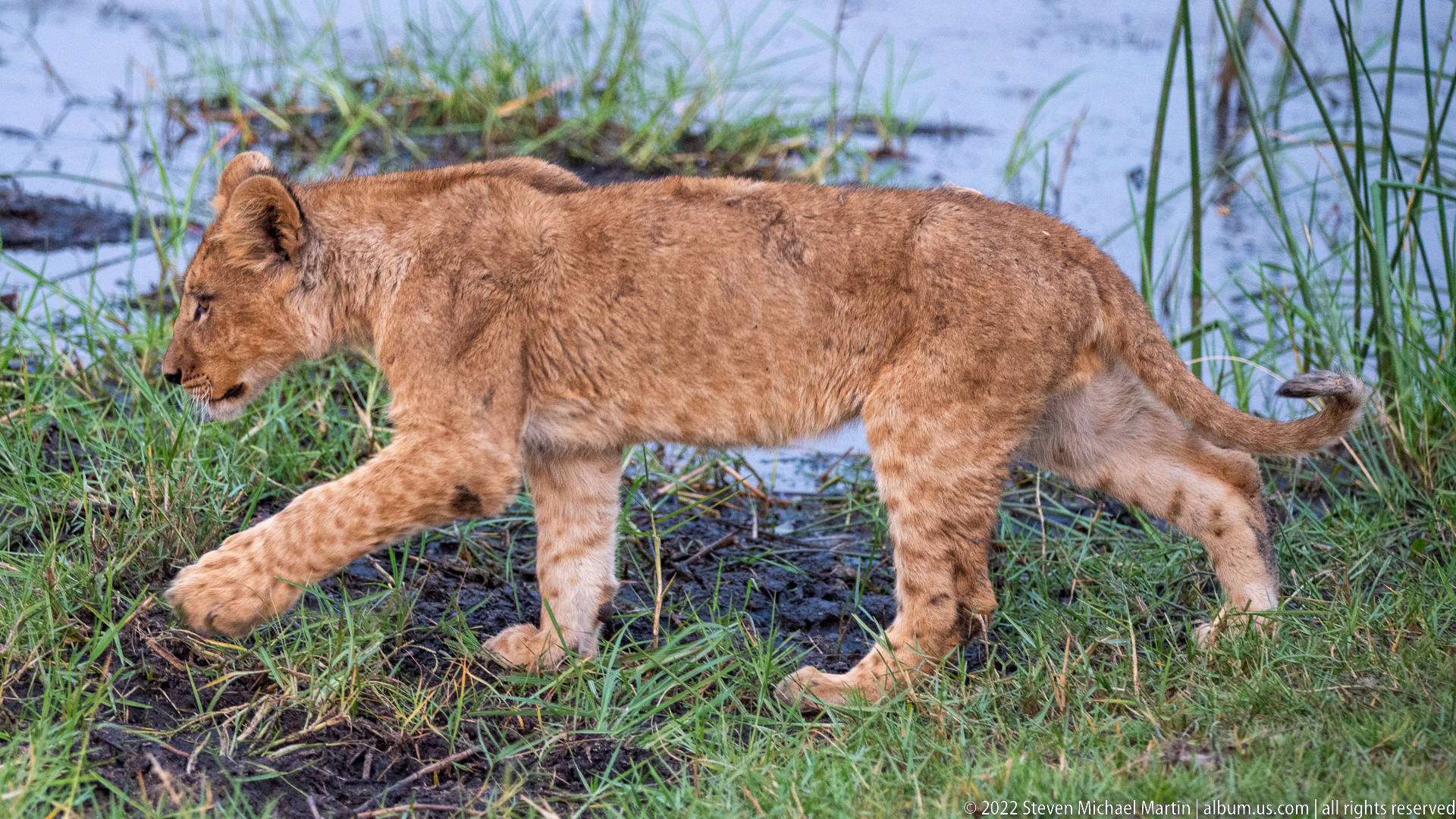
A lion cub strides across muddy grass at the edge of shallow floodplain water. The broadside view shows its long juvenile legs, large paws, faint body spotting, rounded ears, and slightly curled tail. Water and emergent reeds behind the youngster place this movement study firmly within Chief’s Island’s wetland habitat.
Caption
A lion cub strides across muddy grass at the edge of shallow floodplain water. The broadside view shows its long juvenile legs, large paws, faint body spotting, rounded ears, and slightly curled tail. Water and emergent reeds behind the youngster place this movement study firmly within Chief’s Island’s wetland habitat.
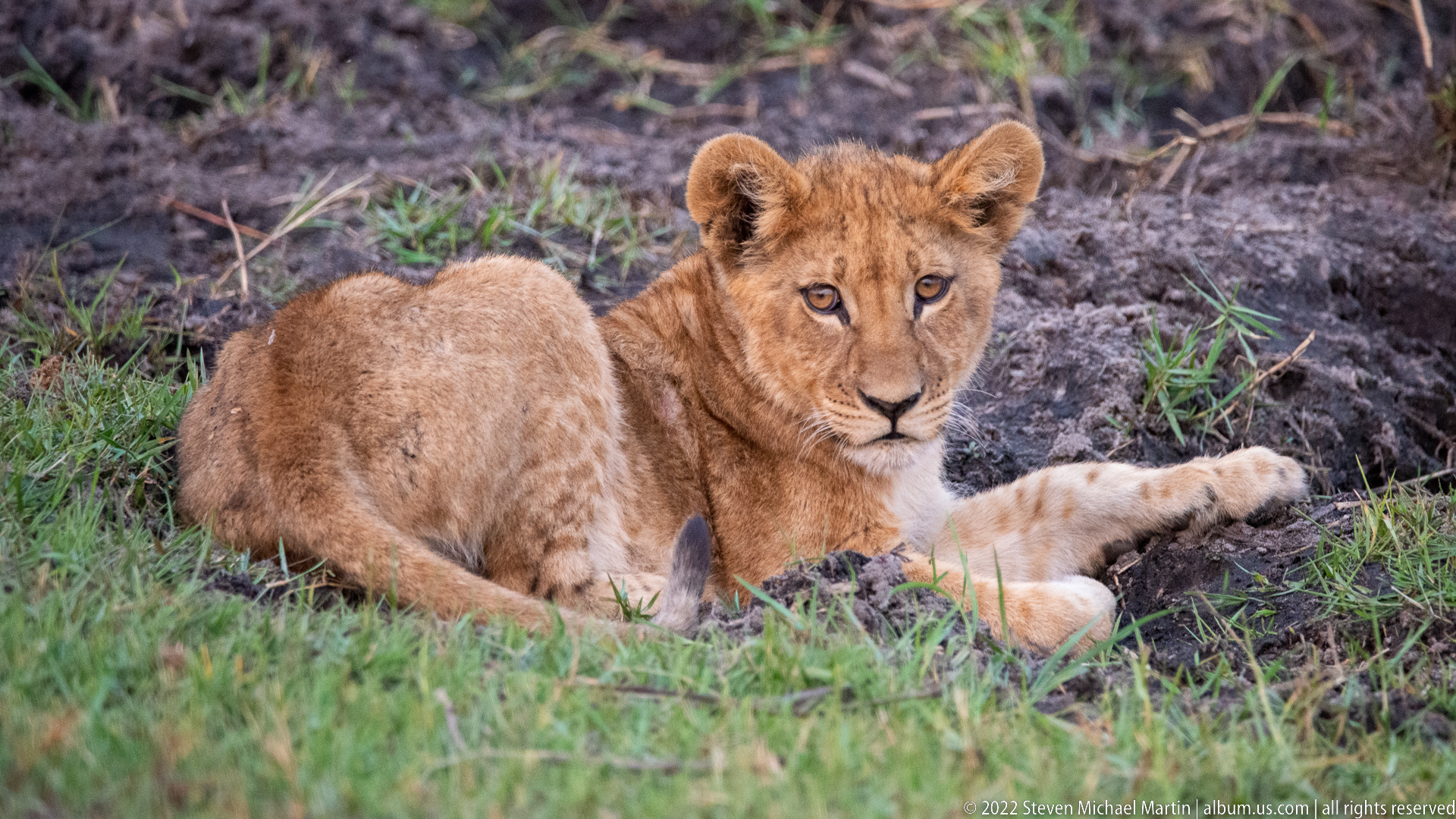
A young lion rests on damp, dark soil with one foreleg stretched forward and its body curved to the side. The cub looks directly toward the camera, showing a pale muzzle, rounded ears, soft tawny coat, and faint juvenile spotting. The muddy setting differs from the greener grass portraits and suggests a well-used resting area near water.
Caption
A young lion rests on damp, dark soil with one foreleg stretched forward and its body curved to the side. The cub looks directly toward the camera, showing a pale muzzle, rounded ears, soft tawny coat, and faint juvenile spotting. The muddy setting differs from the greener grass portraits and suggests a well-used resting area near water.
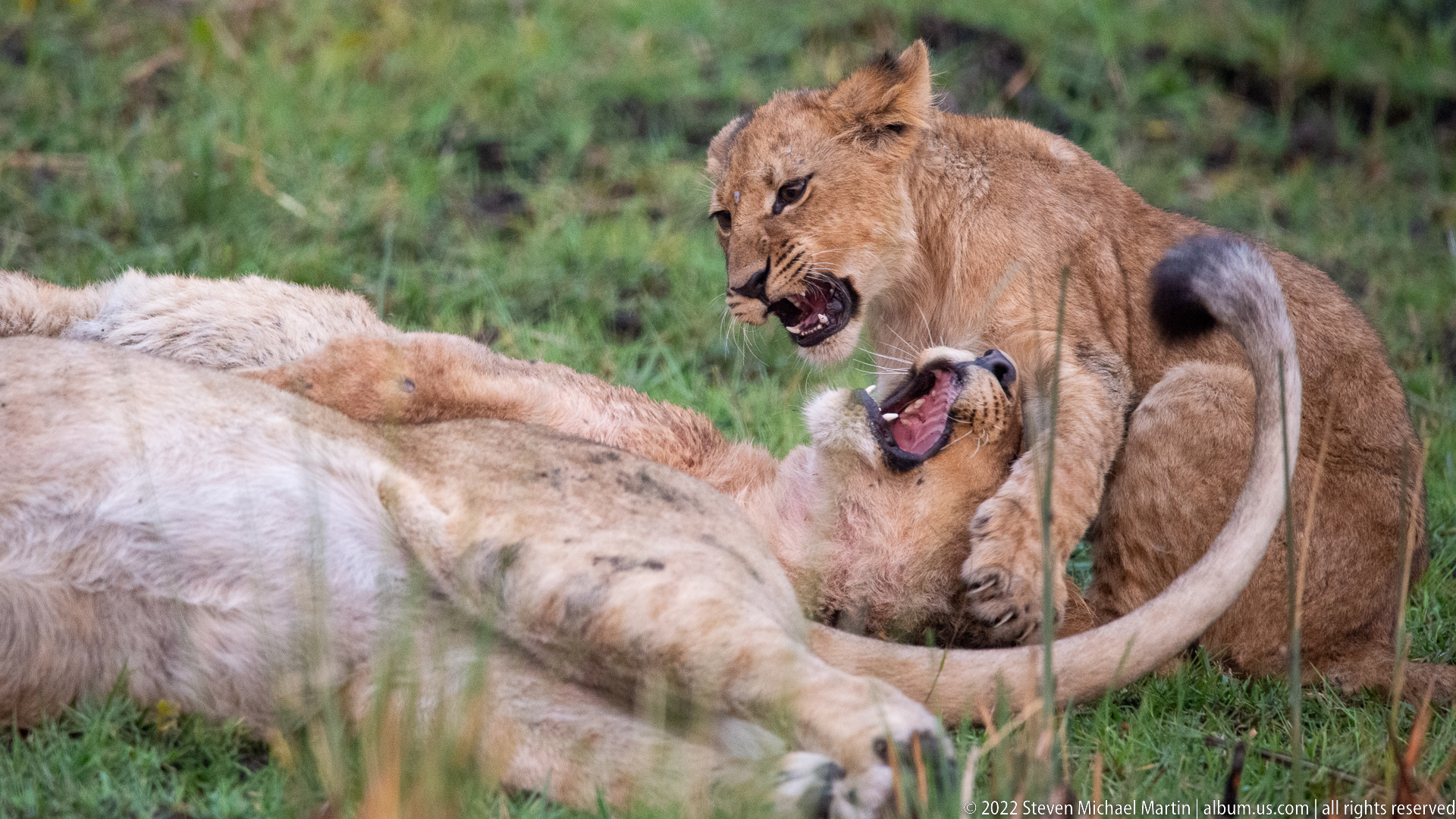
A lion cub stands over the head and shoulders of a reclining lioness as both animals hold their mouths open. The adult lies on her back or side while the youngster leans forward above her, producing an animated scene of close-contact social behavior. The frame records playful or affiliative interaction without requiring a more specific behavioral interpretation.
Caption
A lion cub stands over the head and shoulders of a reclining lioness as both animals hold their mouths open. The adult lies on her back or side while the youngster leans forward above her, producing an animated scene of close-contact social behavior. The frame records playful or affiliative interaction without requiring a more specific behavioral interpretation.
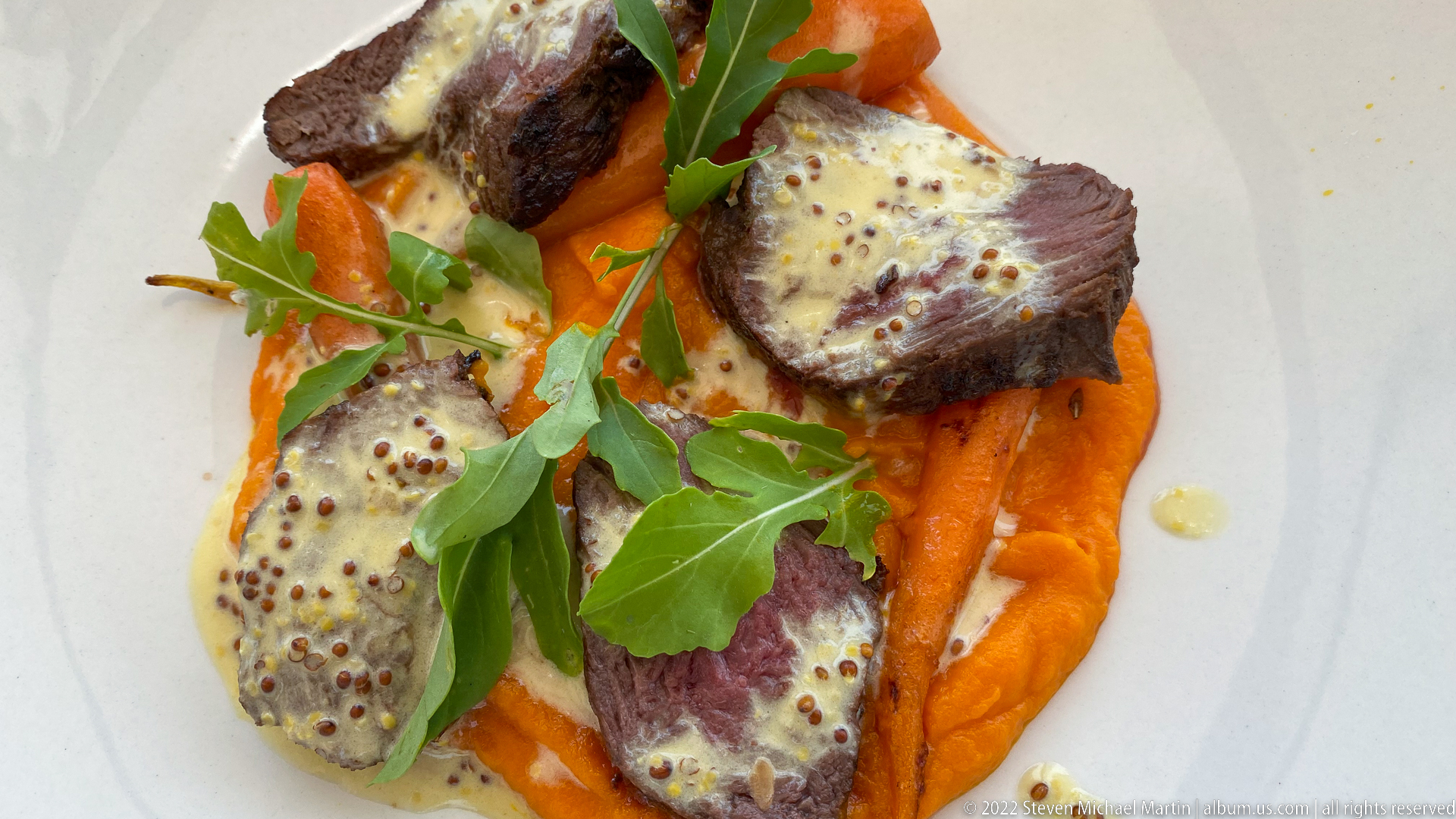
A plated safari-camp meal combines slices of seared red meat with a whole-grain mustard sauce, a vivid orange purée, and fresh green leaves. The meat is arranged diagonally across the plate, with the sauce spooned over several pieces and the purée providing a contrasting base. The overhead view documents camp cuisine rather than the wildlife field experience.
Caption
A plated safari-camp meal combines slices of seared red meat with a whole-grain mustard sauce, a vivid orange purée, and fresh green leaves. The meat is arranged diagonally across the plate, with the sauce spooned over several pieces and the purée providing a contrasting base. The overhead view documents camp cuisine rather than the wildlife field experience.
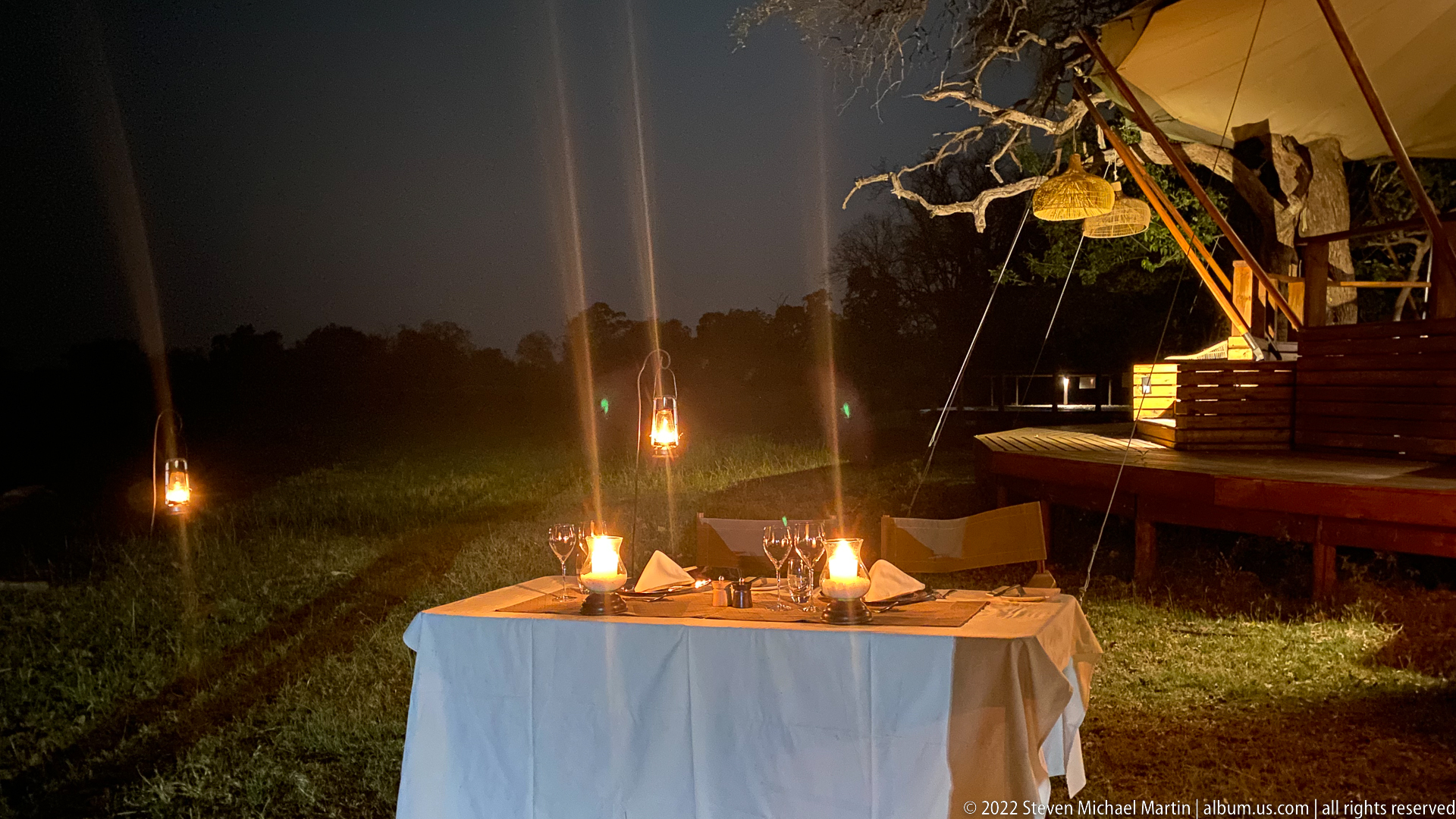
A small dining table set with a white cloth, folded napkins, glassware, and candlelight stands on the grass beside the raised safari camp deck. Additional lanterns trace a path into the dark landscape, while another table is visible farther away. The scene records an intimate outdoor dinner arranged within the open night environment of Chief’s Island.
Caption
A small dining table set with a white cloth, folded napkins, glassware, and candlelight stands on the grass beside the raised safari camp deck. Additional lanterns trace a path into the dark landscape, while another table is visible farther away. The scene records an intimate outdoor dinner arranged within the open night environment of Chief’s Island.
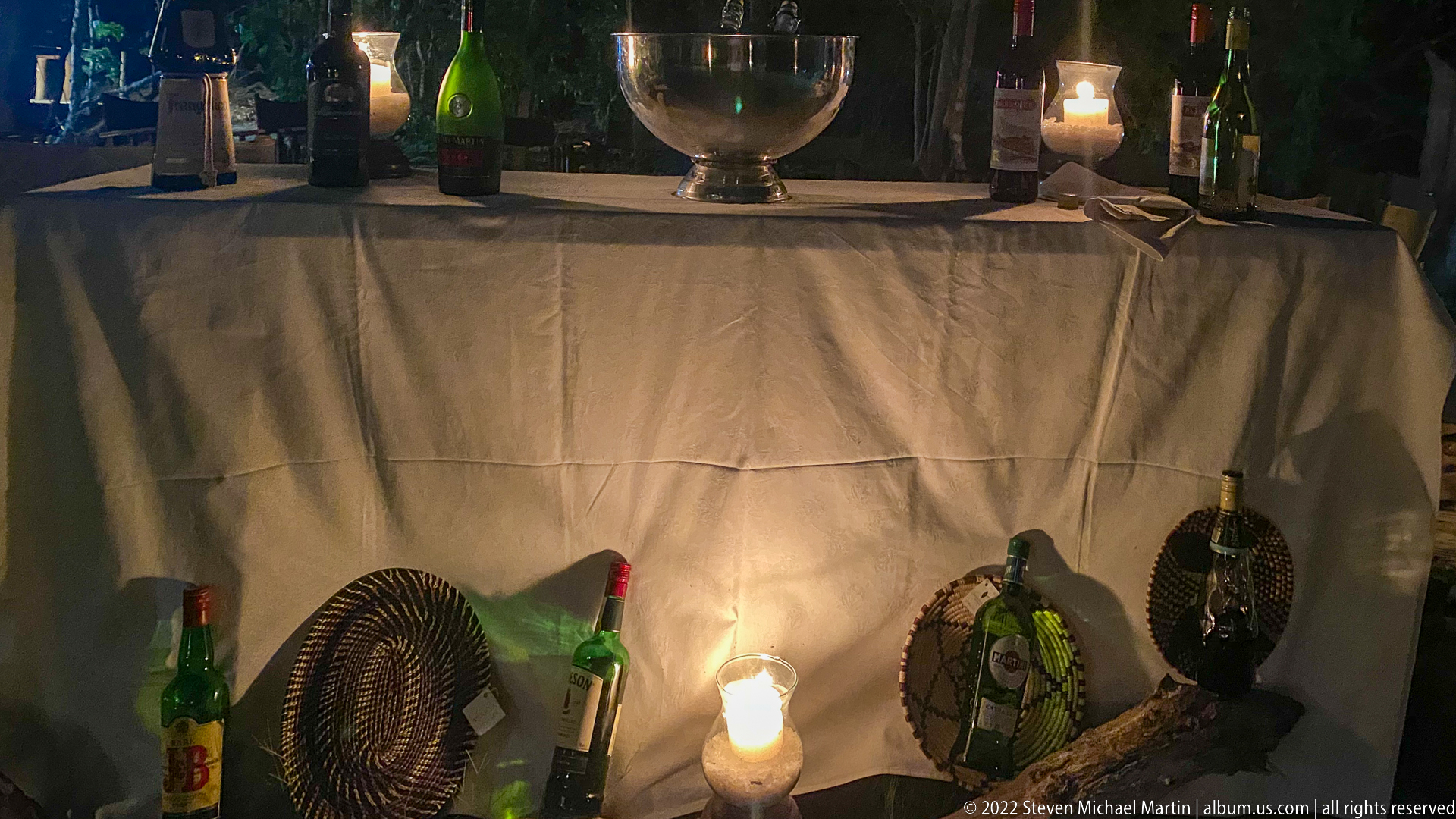
A candlelit drinks station is arranged against a white-draped table at the safari camp, with bottles, woven decorative bottle covers, glassware, and a large metal bowl visible in the low light. The compact display combines practical beverage service with handcrafted decorative elements, adding detail to the nighttime hospitality sequence.
Caption
A candlelit drinks station is arranged against a white-draped table at the safari camp, with bottles, woven decorative bottle covers, glassware, and a large metal bowl visible in the low light. The compact display combines practical beverage service with handcrafted decorative elements, adding detail to the nighttime hospitality sequence.

A bright kerosene-style lantern glows in the foreground beside wooden director’s chairs at the safari camp. The lantern’s glass chimney and metal frame are sharply illuminated while the chairs and sandy ground recede into darkness. The close detail captures the practical, low-level lighting used around the open camp at night.
Caption
A bright kerosene-style lantern glows in the foreground beside wooden director’s chairs at the safari camp. The lantern’s glass chimney and metal frame are sharply illuminated while the chairs and sandy ground recede into darkness. The close detail captures the practical, low-level lighting used around the open camp at night.
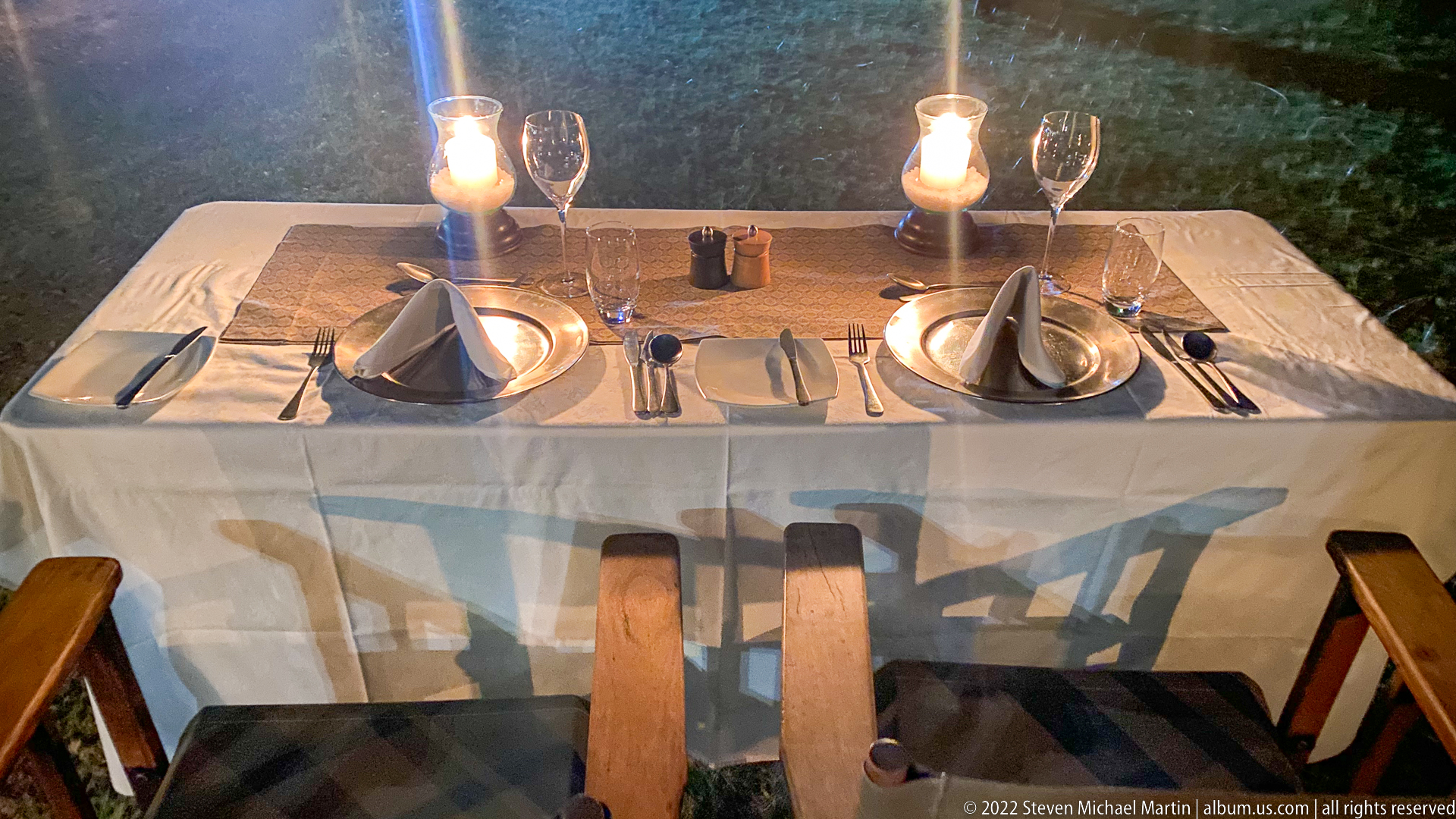
A white-clothed table is set for two with woven placemats, plates, folded napkins, wine glasses, cutlery, salt and pepper, and twin candle lanterns. Viewed from slightly above, the symmetrical place settings are fully visible against the dark grass beyond. The arrangement presents the finished bush-dinner setting before guests are seated.
Caption
A white-clothed table is set for two with woven placemats, plates, folded napkins, wine glasses, cutlery, salt and pepper, and twin candle lanterns. Viewed from slightly above, the symmetrical place settings are fully visible against the dark grass beyond. The arrangement presents the finished bush-dinner setting before guests are seated.
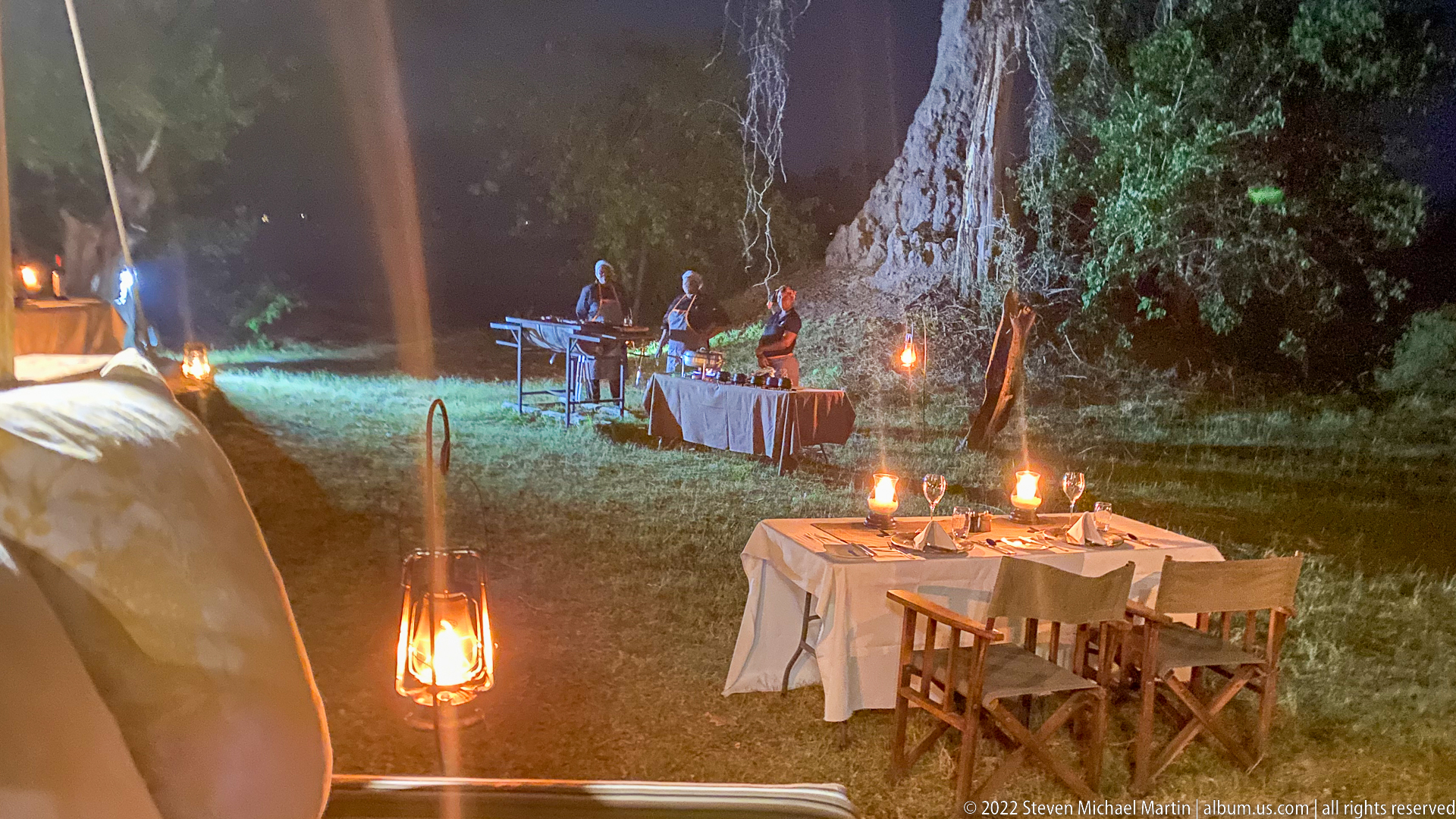
Several candlelit dinner tables are spaced across the grass beneath large trees beside the Chief’s Island safari camp. Lanterns and table candles create pools of warm light, while a small group of guests sits farther back near a massive trunk. The wider view shows how individual dining stations are distributed through the open landscape at night.
Caption
Several candlelit dinner tables are spaced across the grass beneath large trees beside the Chief’s Island safari camp. Lanterns and table candles create pools of warm light, while a small group of guests sits farther back near a massive trunk. The wider view shows how individual dining stations are distributed through the open landscape at night.
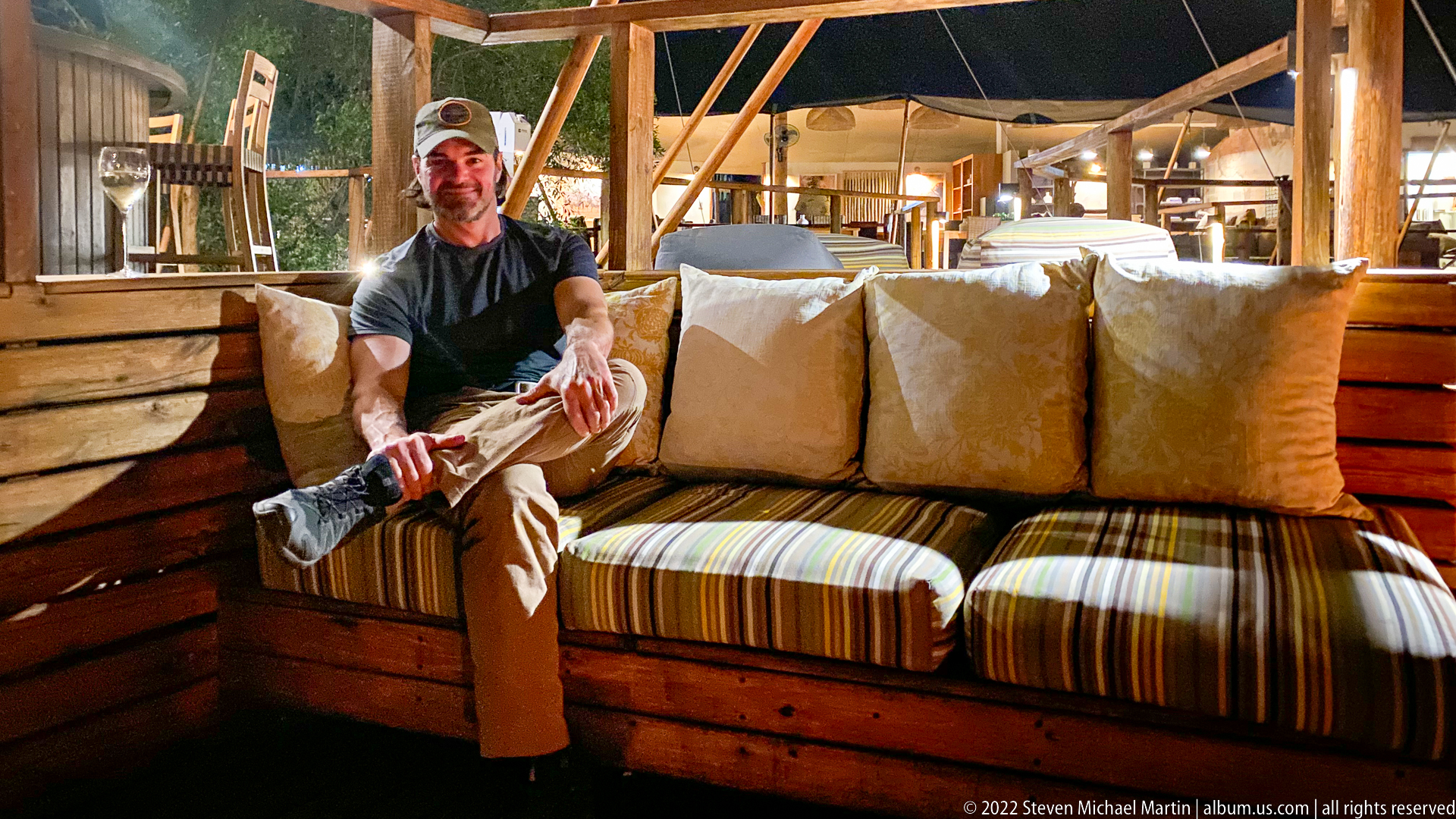
An adult guest sits casually on a built-in wooden bench with striped cushions and large cream pillows inside the open-sided safari lodge. Timber rails, canvas roofing, and softly lit dining areas extend behind him. The portrait places the traveler within the relaxed communal architecture of the camp rather than in the field.
Caption
An adult guest sits casually on a built-in wooden bench with striped cushions and large cream pillows inside the open-sided safari lodge. Timber rails, canvas roofing, and softly lit dining areas extend behind him. The portrait places the traveler within the relaxed communal architecture of the camp rather than in the field.
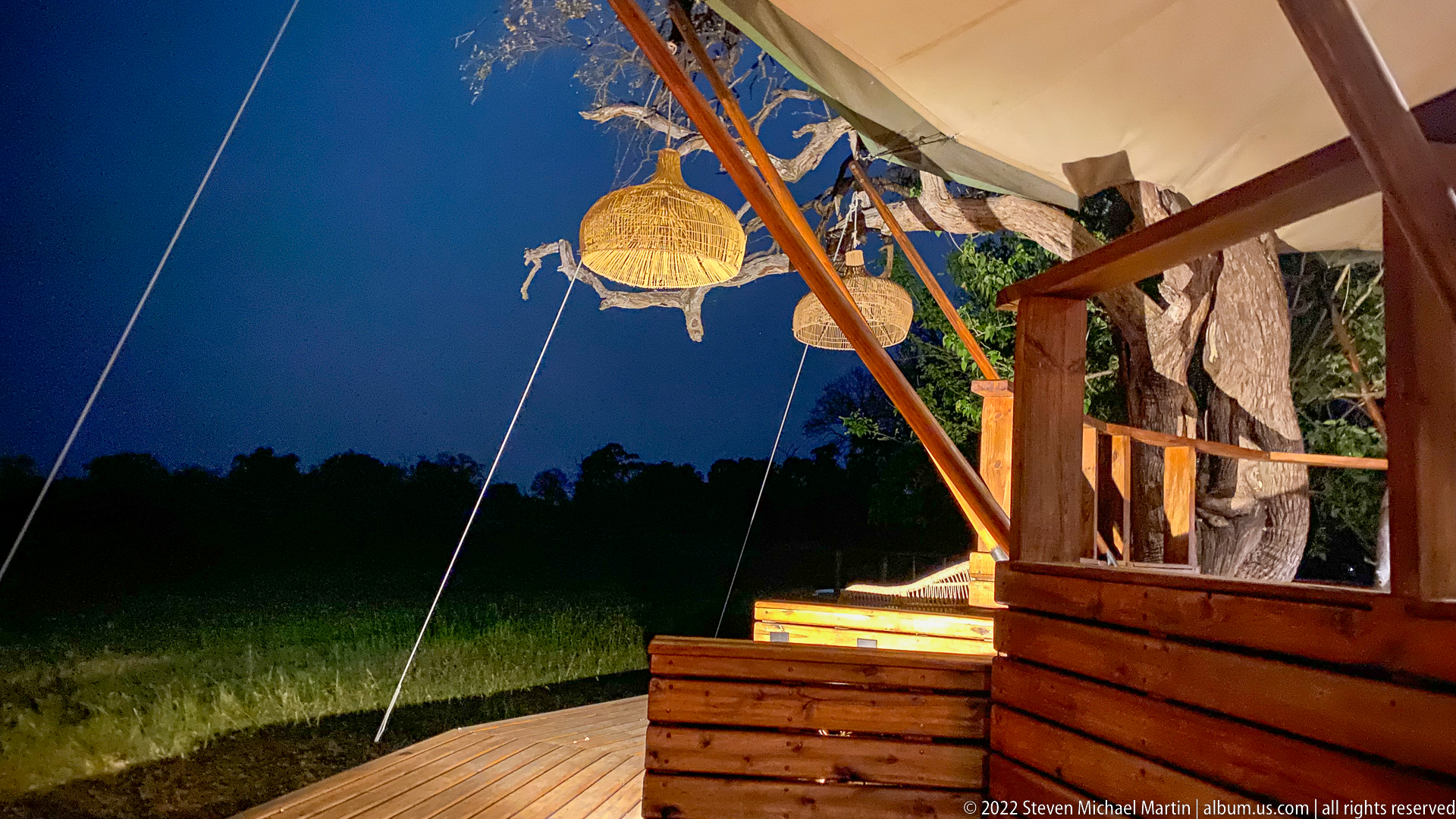
A raised timber deck opens toward the dark floodplain under a deep blue evening sky. Canvas roofing, wooden posts, guy lines, steps, and woven pendant lamps define the open-sided camp structure, while the surrounding grassland remains unlit beyond the platform. The composition emphasizes the lodge’s lightweight construction and direct connection to the landscape.
Caption
A raised timber deck opens toward the dark floodplain under a deep blue evening sky. Canvas roofing, wooden posts, guy lines, steps, and woven pendant lamps define the open-sided camp structure, while the surrounding grassland remains unlit beyond the platform. The composition emphasizes the lodge’s lightweight construction and direct connection to the landscape.
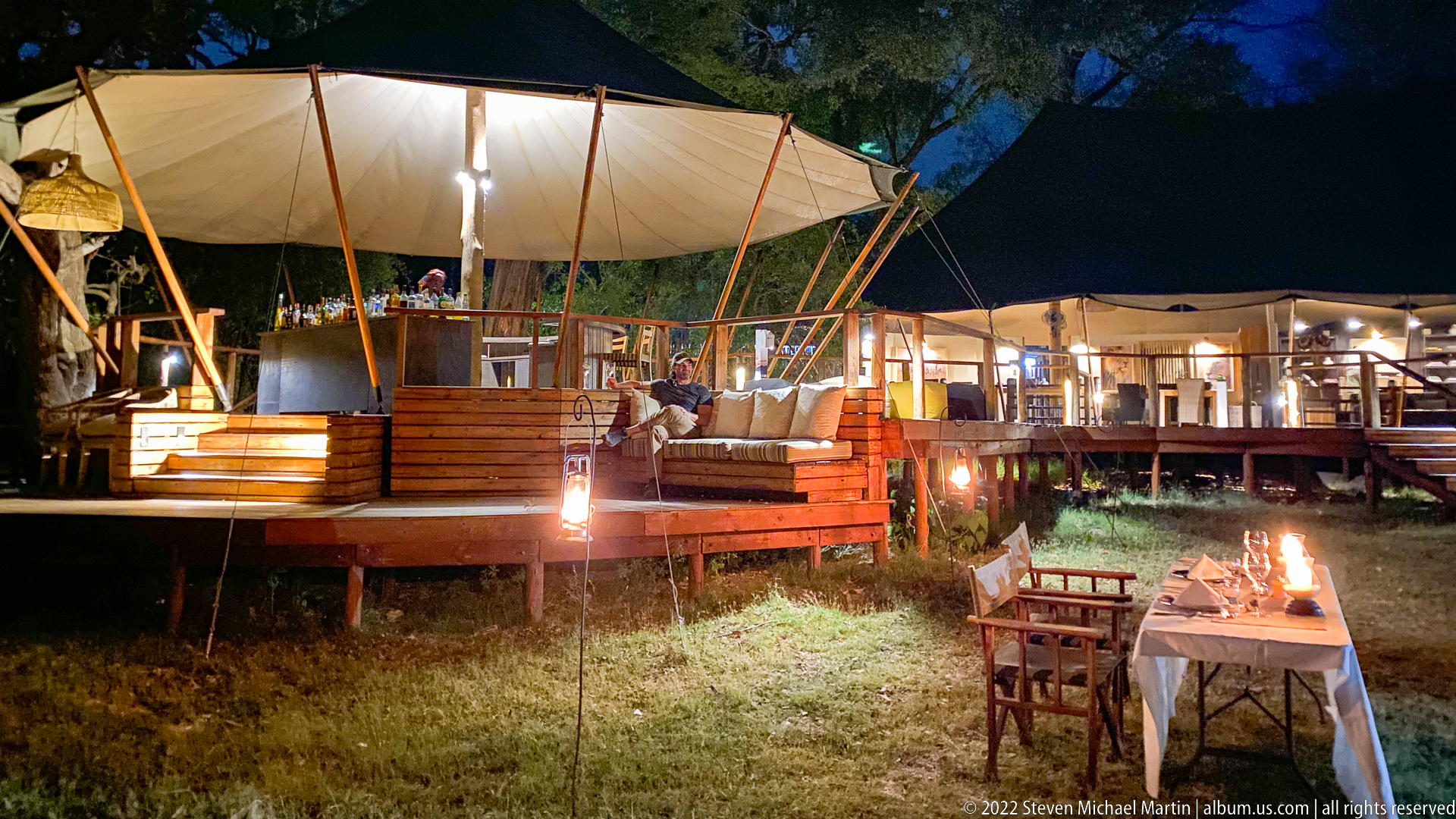
The open-sided safari lodge glows against the dark night sky, revealing raised timber platforms, canvas canopies, stairs, lounge seating, and dining areas arranged in connected sections. A candlelit table occupies the grass in front, linking the camp architecture with the outdoor dinner setup. The wide view records the camp as a complete nighttime environment.
Caption
The open-sided safari lodge glows against the dark night sky, revealing raised timber platforms, canvas canopies, stairs, lounge seating, and dining areas arranged in connected sections. A candlelit table occupies the grass in front, linking the camp architecture with the outdoor dinner setup. The wide view records the camp as a complete nighttime environment.
A small black plush bear sits beside a tightly woven lidded basket on a round tray or tabletop, with the open floodplain stretching beyond. The handcrafted basket’s alternating dark and light bands contrast with the soft toy’s black fur and pale muzzle. The still-life detail adds a domestic, whimsical note to the safari-camp environment.
Caption
A small black plush bear sits beside a tightly woven lidded basket on a round tray or tabletop, with the open floodplain stretching beyond. The handcrafted basket’s alternating dark and light bands contrast with the soft toy’s black fur and pale muzzle. The still-life detail adds a domestic, whimsical note to the safari-camp environment.

An open dining and bar area occupies the interior of the tented safari lodge, with wooden tables, woven chairs, shelving, a service counter, and ceiling-mounted fans arranged around a central timber post. The high canvas roof and open perimeter allow daylight and vegetation into the space, illustrating the camp’s airy pavilion-style design.
Caption
An open dining and bar area occupies the interior of the tented safari lodge, with wooden tables, woven chairs, shelving, a service counter, and ceiling-mounted fans arranged around a central timber post. The high canvas roof and open perimeter allow daylight and vegetation into the space, illustrating the camp’s airy pavilion-style design.
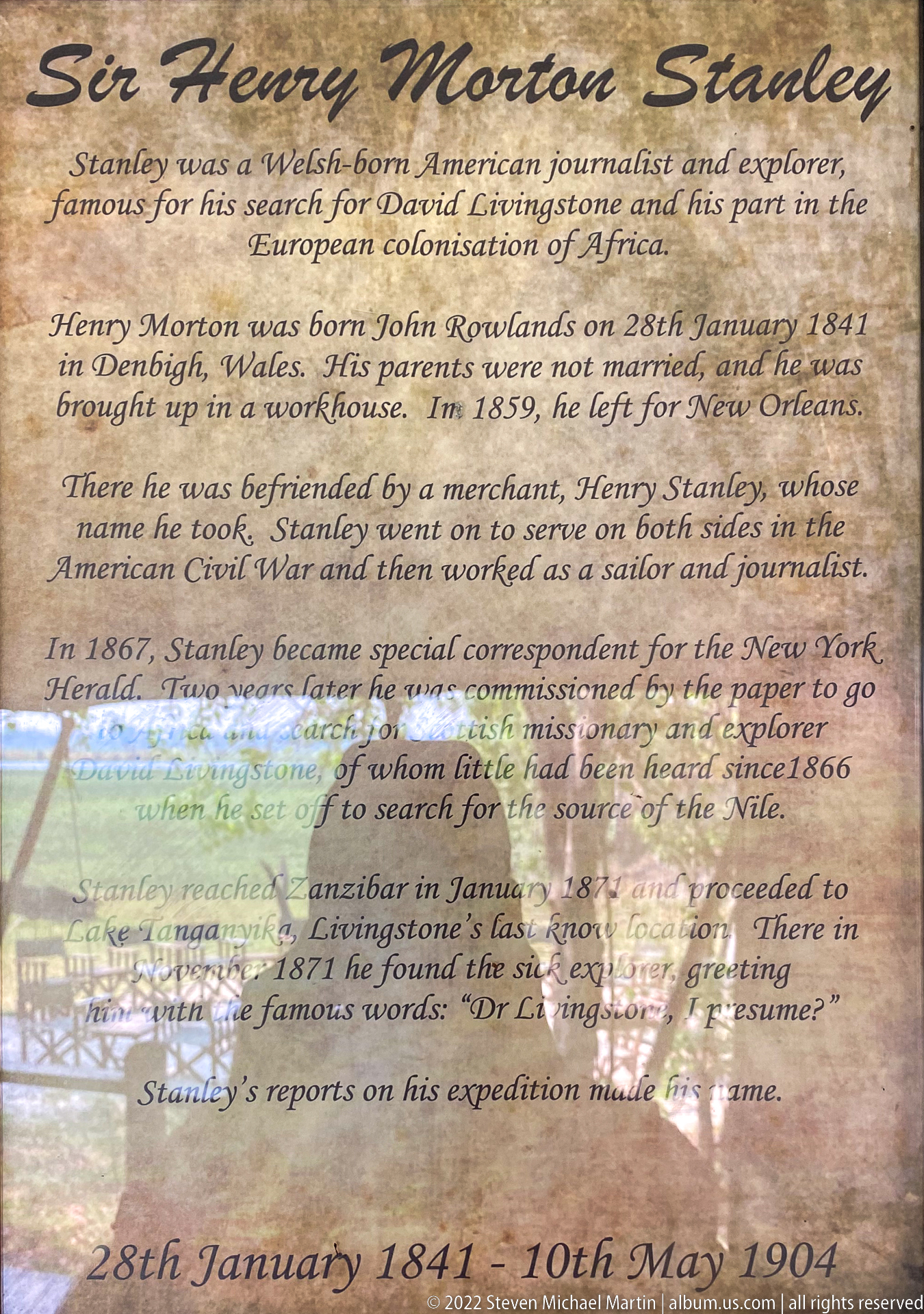
A weathered interpretive panel presents a short biography of explorer and journalist Henry Morton Stanley, including his birth name, John Rowlands, his transatlantic career, African expeditions, and the famous greeting associated with his search for David Livingstone. The photographed panel functions as historical interpretation within the travel sequence rather than as a wildlife subject.
Caption
A weathered interpretive panel presents a short biography of explorer and journalist Henry Morton Stanley, including his birth name, John Rowlands, his transatlantic career, African expeditions, and the famous greeting associated with his search for David Livingstone. The photographed panel functions as historical interpretation within the travel sequence rather than as a wildlife subject.
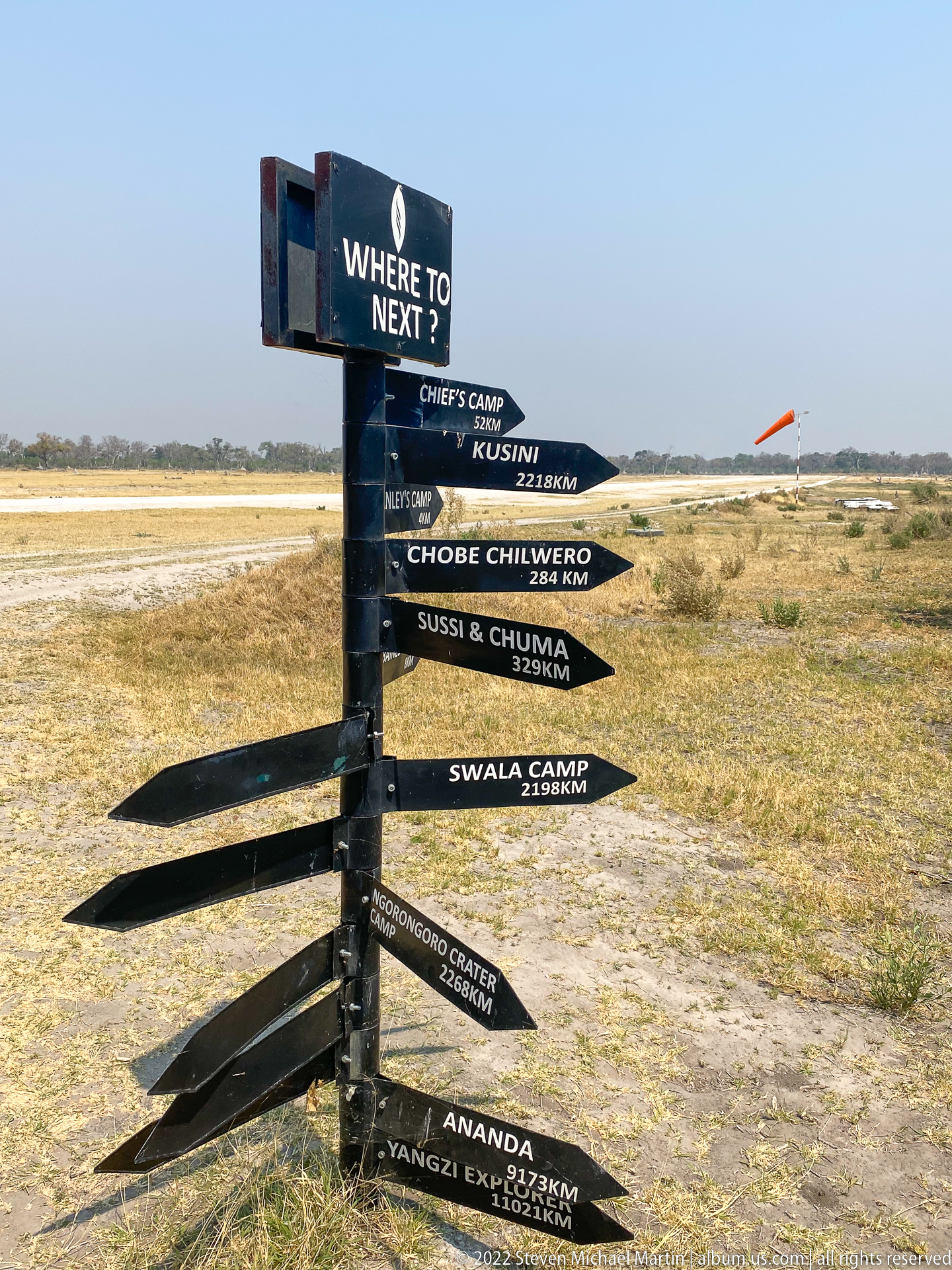
A black directional signpost beside the runway points toward multiple safari camps and destinations, with distances painted on stacked arrow boards. An orange windsock is visible across the pale airstrip behind it. The sign condenses the geography of the surrounding safari network into a practical wayfinding object at the remote landing point.
Caption
A black directional signpost beside the runway points toward multiple safari camps and destinations, with distances painted on stacked arrow boards. An orange windsock is visible across the pale airstrip behind it. The sign condenses the geography of the surrounding safari network into a practical wayfinding object at the remote landing point.

A guest stands at the railing of the raised airstrip platform while an open game-drive vehicle is parked beneath the timber deck. The broad thatched roof provides shade over the elevated waiting area, and another person stands beside the vehicle below. The view clearly shows how the structure combines lookout, shelter, and transfer point.
Caption
A guest stands at the railing of the raised airstrip platform while an open game-drive vehicle is parked beneath the timber deck. The broad thatched roof provides shade over the elevated waiting area, and another person stands beside the vehicle below. The view clearly shows how the structure combines lookout, shelter, and transfer point.
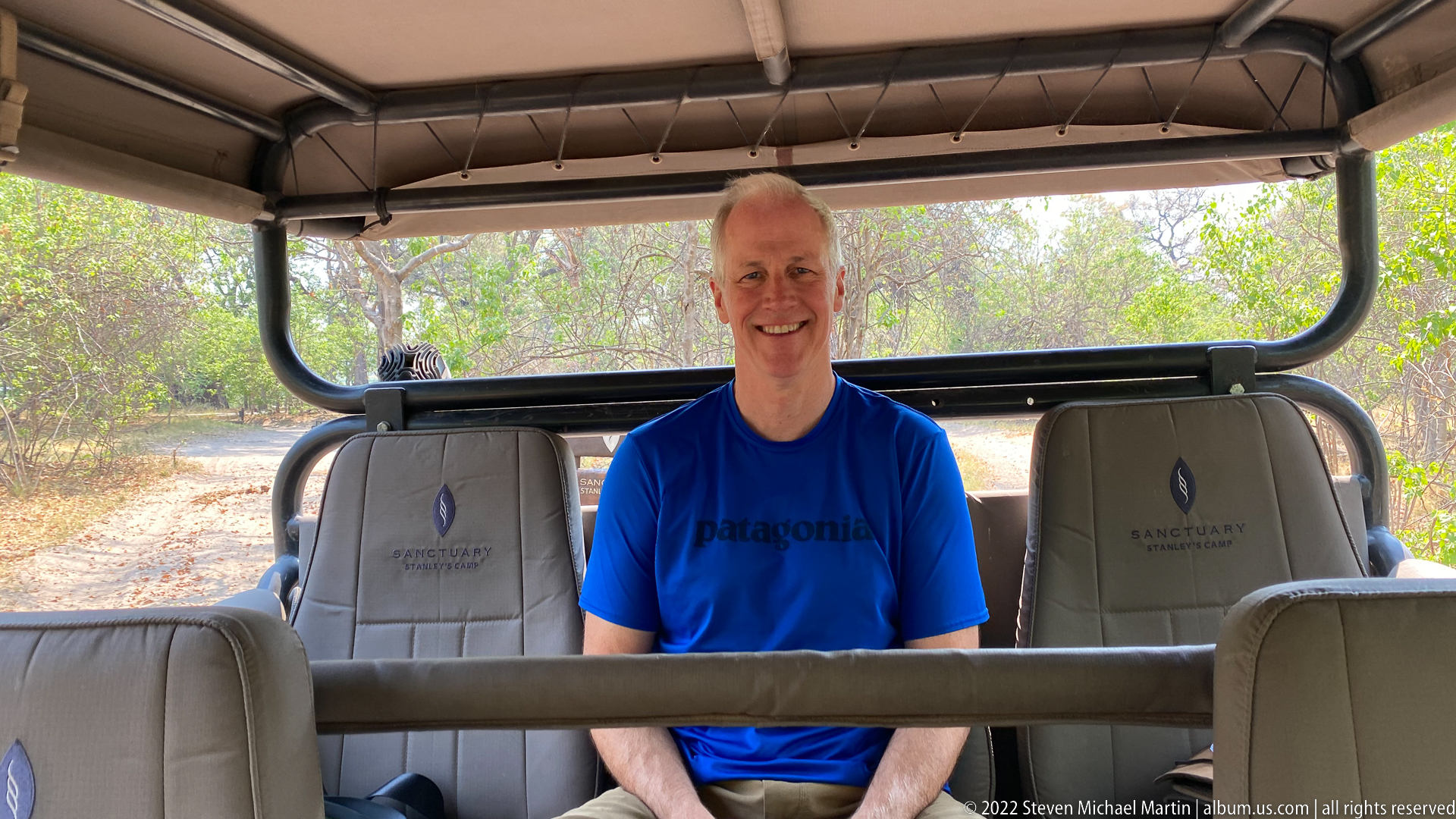
A safari traveler sits smiling in the rear of an open game-drive vehicle, framed by padded seats and the vehicle’s canvas roof. Dry woodland is visible through the open sides, while embroidered seat backs identify the safari-camp setting. The portrait marks a transition from Chief’s Island wildlife encounters toward departure and airstrip travel.
Caption
A safari traveler sits smiling in the rear of an open game-drive vehicle, framed by padded seats and the vehicle’s canvas roof. Dry woodland is visible through the open sides, while embroidered seat backs identify the safari-camp setting. The portrait marks a transition from Chief’s Island wildlife encounters toward departure and airstrip travel.
A narrow unpaved runway extends across a dry, open landscape toward a simple elevated structure and bright orange windsock. Pale compacted ground contrasts with yellow-brown grass and a distant tree line. The utilitarian scene records the small bush-airstrip infrastructure used to connect remote safari areas with regional air transport.
Caption
A narrow unpaved runway extends across a dry, open landscape toward a simple elevated structure and bright orange windsock. Pale compacted ground contrasts with yellow-brown grass and a distant tree line. The utilitarian scene records the small bush-airstrip infrastructure used to connect remote safari areas with regional air transport.
Several tilted rectangular solar panels stand in rows on dry ground beside the bush airstrip, accompanied by a tall striped pole. Their exposed placement under a cloudless sky suggests practical off-grid infrastructure serving the remote site. The canted camera angle emphasizes the repeating panel surfaces against sparse grass and woodland.
Caption
Several tilted rectangular solar panels stand in rows on dry ground beside the bush airstrip, accompanied by a tall striped pole. Their exposed placement under a cloudless sky suggests practical off-grid infrastructure serving the remote site. The canted camera angle emphasizes the repeating panel surfaces against sparse grass and woodland.

A timber platform with stairs, railings, and a high thatched roof stands beside the unpaved safari runway. Elevated on sturdy posts, the open structure provides shade and a clear view across the airstrip and surrounding grassland. A safari vehicle enters the lower foreground, linking the platform directly to ground transfers at the remote landing site.
Caption
A timber platform with stairs, railings, and a high thatched roof stands beside the unpaved safari runway. Elevated on sturdy posts, the open structure provides shade and a clear view across the airstrip and surrounding grassland. A safari vehicle enters the lower foreground, linking the platform directly to ground transfers at the remote landing site.
A smiling safari traveler stands close to the camera with the unpaved runway stretching behind him. The orange windsock and dry grassland provide unmistakable airstrip context, while the elevated viewpoint suggests the portrait was made from or near the raised platform. The scene records departure logistics as part of the Chief’s Island journey.
Caption
A smiling safari traveler stands close to the camera with the unpaved runway stretching behind him. The orange windsock and dry grassland provide unmistakable airstrip context, while the elevated viewpoint suggests the portrait was made from or near the raised platform. The scene records departure logistics as part of the Chief’s Island journey.
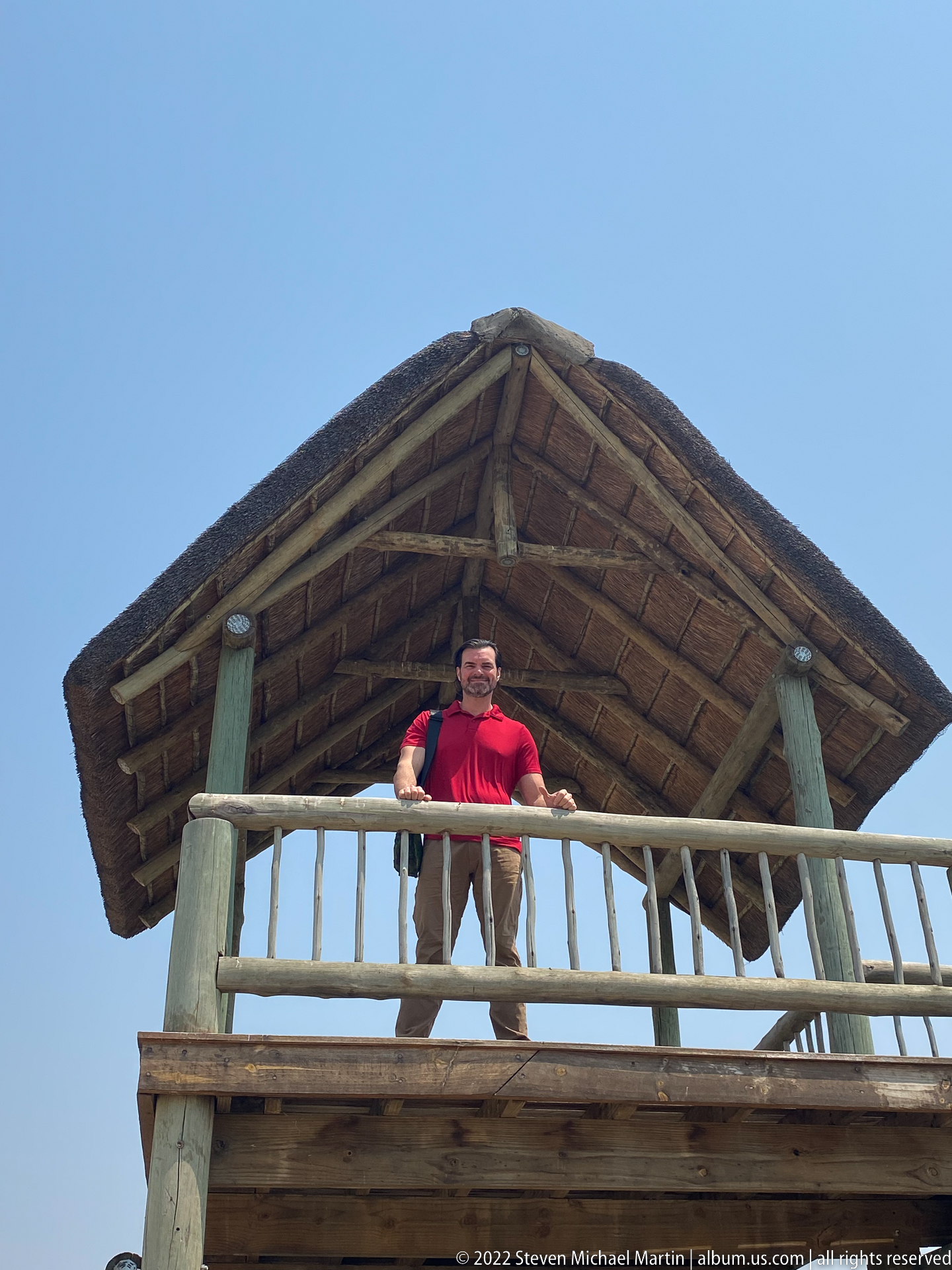
A traveler stands behind the timber railing of the raised airstrip shelter, photographed from below against a clear blue sky. The steep angle isolates the figure beneath the broad thatched roof and reveals the platform’s heavy log posts and rustic construction. This final Chief’s Island frame emphasizes the human departure point rather than the surrounding runway.
Caption
A traveler stands behind the timber railing of the raised airstrip shelter, photographed from below against a clear blue sky. The steep angle isolates the figure beneath the broad thatched roof and reveals the platform’s heavy log posts and rustic construction. This final Chief’s Island frame emphasizes the human departure point rather than the surrounding runway.
Chief’s Island felt like one of those rare safari places where wildlife never seemed far away. From floodplains and grasslands to tree-lined channels and open savannah, every drive revealed a different side of the Okavango Delta.
What made the experience memorable was not just the number of animals, but the rhythm of it all — birds perched against the morning sky, elephants crossing through grass, hippos surfacing in quiet water, leopards hidden in the brush, and lions resting with cubs near the floodplain. Between drives, camp itself became part of the story, adding comfort, stillness, and time to take it all in.
Highlights
- Exceptional wildlife density across open floodplains and woodland
- Leopard, lion, hyena, elephant, buffalo, hippo, and giraffe sightings
- Classic Okavango Delta landscapes shaped by seasonal water
- Strong variety of birds, from fish eagles to bee-eaters and rollers
- Beautiful camp atmosphere that became part of the overall experience
Field Guide
📍 Location
Chief’s Island lies in the heart of the Okavango Delta in Botswana and is one of the best-known wildlife areas in the region. Surrounded by channels, floodplains, and seasonal wetlands, it offers a mix of habitats that support extraordinary concentrations of wildlife.
🌍 Landscape
The landscape shifts constantly between open grassland, marshy edges, scattered woodland, and shallow channels. Some scenes feel vast and open, while others narrow into quiet places where predators disappear into brush or birds perch above the water. This variety gives the island a rich visual rhythm throughout the day.
🦁 Wildlife
Chief’s Island supports a remarkable range of large mammals and birdlife. Elephants, buffalo, hippos, giraffes, zebras, wildebeest, antelope, hyenas, leopards, and lions all appeared in different settings, often within the same day. The combination of predators, grazers, and wetland wildlife makes the island feel constantly alive.
🦅 Birdlife
Birds added color, movement, and contrast throughout the experience. African fish eagles, marabou storks, kingfishers, bee-eaters, rollers, egrets, and vultures all helped define the atmosphere of the Delta as much as the larger mammals did.
🚙 Experience
Game drives on Chief’s Island unfold slowly. Wildlife appears across open ground, gathers near water, or emerges unexpectedly from brush. Some moments are dramatic, like a leopard stepping into view or hyenas greeting each other, while others are quieter — cubs resting together, mongooses moving through grass, or an elephant passing through morning haze.
📸 Photography Notes
- Wide views work well for floodplains, herds, and the sense of scale
- Longer lenses help isolate predators and distant wildlife
- Look for water reflections and soft light near channels
- Birdlife adds strong visual contrast between mammal sequences
- Camp details and evening light help tell the full story of the experience
Story & Experience
Arrival in the Delta
The first impression of Chief’s Island was abundance. Wildlife seemed to appear in every direction — buffalo near water, hippos surfacing in channels, birds scanning the floodplain, and elephants moving steadily through grass. The Delta did not reveal itself in one dramatic moment, but through a steady accumulation of sightings that made the whole landscape feel active.
Predators and Tension
Some of the strongest moments came when the pace shifted and attention narrowed. A leopard hidden among branches required patience before it finally resolved into view. Hyenas resting and interacting revealed a different kind of energy. Lions with cubs brought a more intimate side of predator life, turning what could have been a distant sighting into something much more personal.
Life Around Water
Water shaped the experience at every turn. Hippos clustered in channels, buffalo gathered at the edges, and birds used bare branches and wetland margins as lookout points. Even when the landscape seemed dry, the presence of water could still be felt in the patterns of movement and concentration of animals.
Camp as Part of the Experience
The camp was more than just a place to sleep. It became part of the memory of Chief’s Island — lantern-lit dinners, open decks, quiet interiors, and even wildlife passing close to the lodge. Those moments created a softer counterpoint to the intensity of the game drives and helped the experience feel complete.
Looking Back
What stays with me most is the balance of the place: open landscapes and hidden predators, powerful wildlife encounters and quiet evening light, the wildness of the Delta and the comfort of camp. Chief’s Island felt both expansive and intimate at the same time, which is part of what made it unforgettable.
Quick Facts
- Country: Botswana
- Region: Okavango Delta
- Landscape: Floodplains, grassland, woodland, and seasonal channels
- Key Wildlife: Elephant, lion, leopard, buffalo, hippo, giraffe, hyena, antelope, and rich birdlife
- Experience Style: Classic Delta safari with a strong mix of wildlife and camp atmosphere
Other Safari Pictures:

Serengeti
The Serengeti ecosystem supports one of the largest wildlife migrations on Earth, as wildebeest, zebra, and gazelle move across vast plains in search of fresh grazing. Predators closely follow these seasonal movements, creating opportunities to observe complex interactions between species. The open landscape allows for expansive photographic compositions that emphasize scale, movement, and natural behavior.

Ngorongoro Crater
Ngorongoro Crater forms a natural enclosure that supports an unusually dense concentration of wildlife within a relatively compact area. Grasslands, wetlands, and forest edges provide habitat for elephants, lions, buffalo, and diverse bird species. The crater’s dramatic geological setting creates unique opportunities to observe animals within a clearly defined ecosystem.
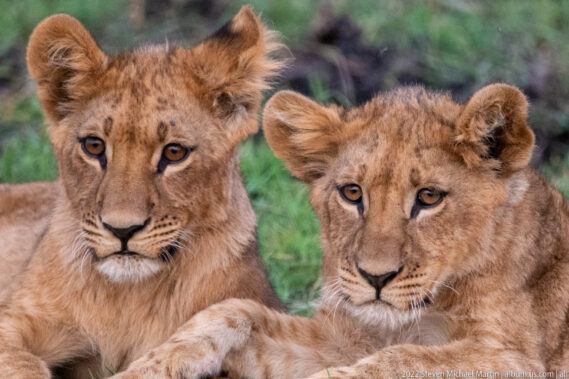
Chief's Island
Chief’s Island lies within the Okavango Delta, where seasonal floodwaters create a mosaic of channels, lagoons, and grasslands that attract exceptional wildlife diversity. Elephants, antelope, and predators move through this water-shaped landscape, often traveling between islands formed by shifting water levels. The contrast between dry land and reflective wetlands provides distinctive photographic perspectives.
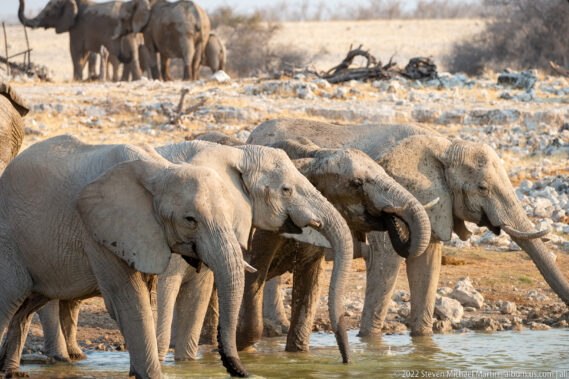
Etosha Watering Hole
Etosha National Park is known for its waterholes, where wildlife gathers in otherwise dry surroundings. Elephants, giraffes, antelope, and other species visit these limited water sources, creating predictable viewing opportunities throughout the day. The stark, open terrain emphasizes animal movement across a minimalist landscape.
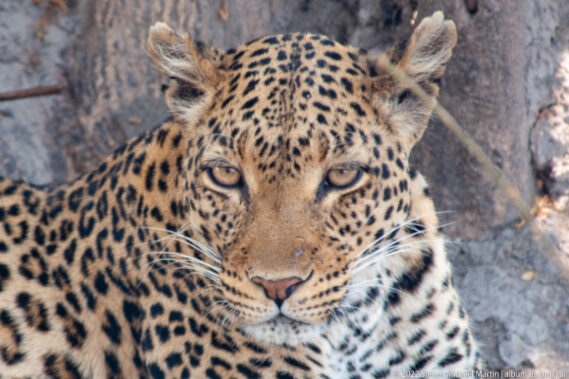
Chobe National Park
The Chobe River supports one of Africa’s largest elephant populations, with herds frequently seen moving along the riverbanks. The permanent water source attracts a wide range of wildlife, including hippos, crocodiles, and abundant birdlife. River-based viewing offers a unique vantage point for observing animal behavior along the shoreline.
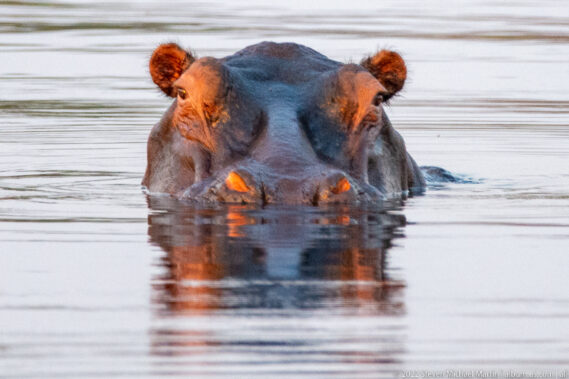
Other Safaris
Additional safari experiences across eastern and southern Africa highlight the diversity of environments supporting wildlife, from forest habitats and wetlands to open savanna and desert terrain. Each ecosystem shapes animal movement, behavior, and photographic opportunities in distinct ways. Together, these journeys illustrate the remarkable adaptability of species across varied landscapes.