Etosha Pan – Etosha National Park, Namibia
At the heart of Etosha National Park lies the vast expanse of Etosha Pan, a massive white salt flat that dominates the landscape of the park. Formed from an ancient lake that gradually dried over thousands of years, the pan stretches across hundreds of square kilometers.
During the dry season the surface appears as a brilliant white plain visible for miles across the horizon. After seasonal rains, shallow water may collect in parts of the pan, attracting flocks of flamingos and other migratory birds.
The immense openness of Etosha Pan creates one of the most striking landscapes in southern Africa.
Photos:
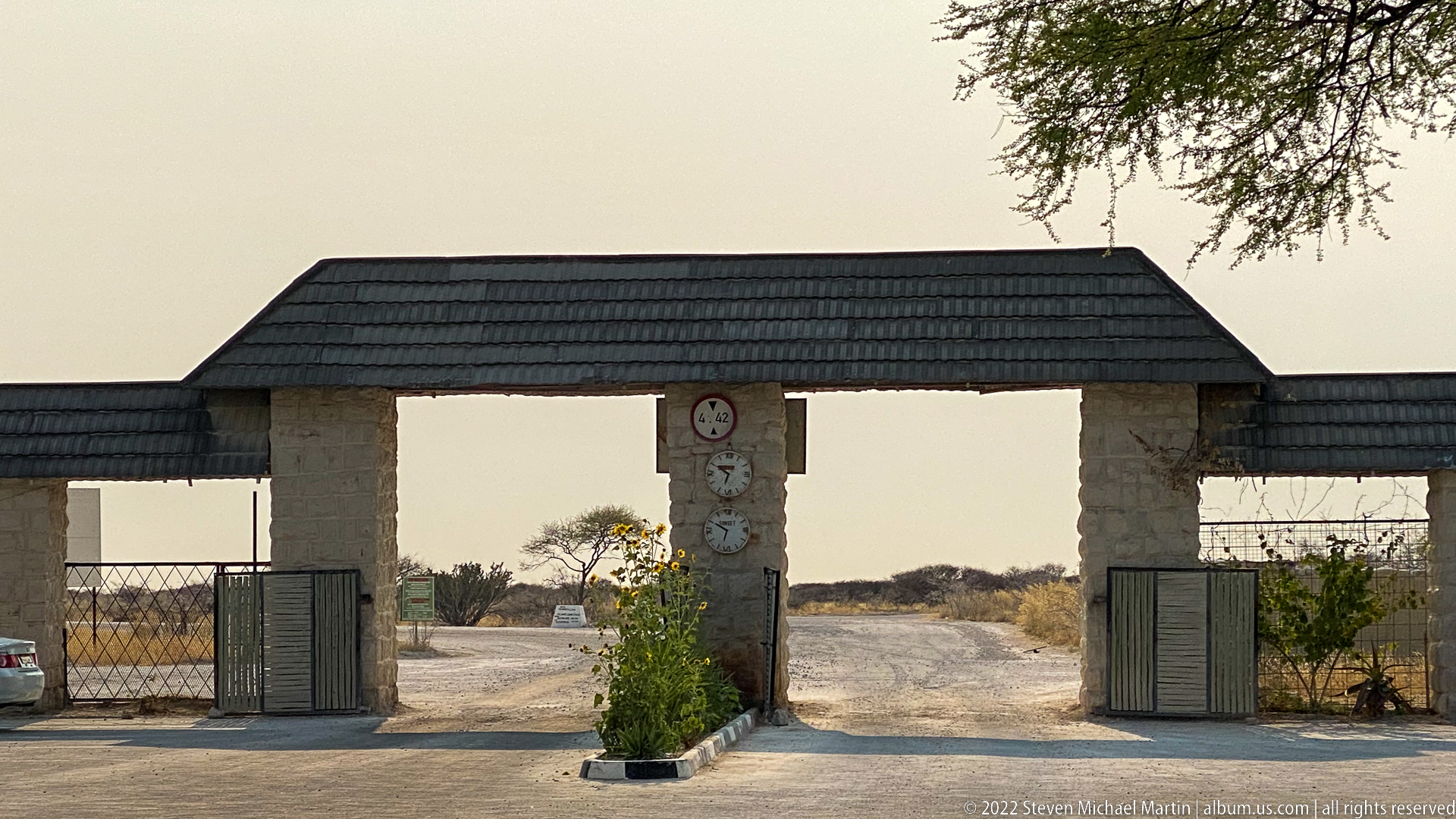
A broad tiled roof spans a stone gateway with two vehicle openings, a central pier, and open metal gates. Beyond the entrance, a pale road leads into dry woodland. The symmetrical structure functions as a formal threshold between visitor facilities and the surrounding Etosha landscape.
Caption
A broad tiled roof spans a stone gateway with two vehicle openings, a central pier, and open metal gates. Beyond the entrance, a pale road leads into dry woodland. The symmetrical structure functions as a formal threshold between visitor facilities and the surrounding Etosha landscape.
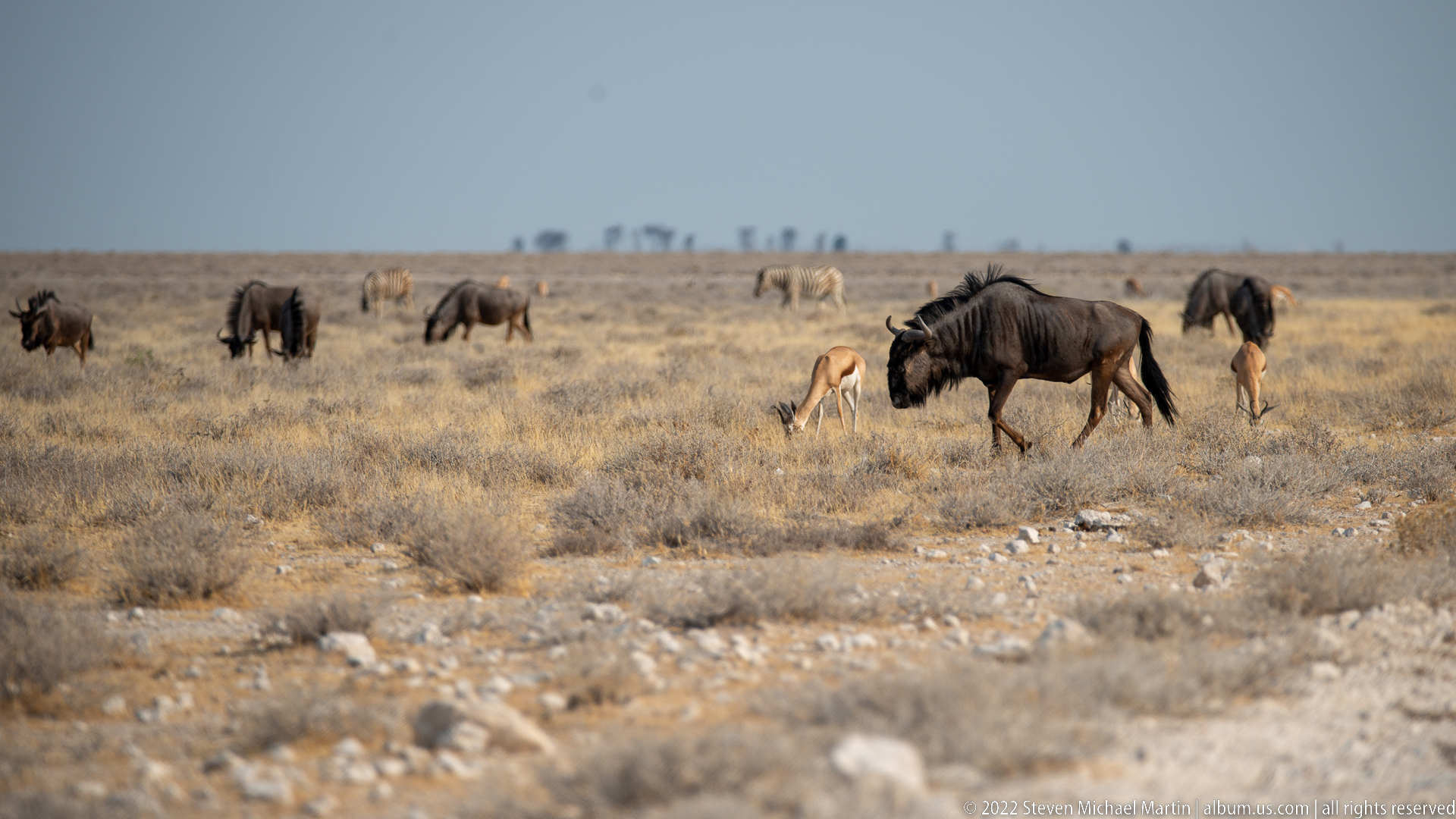
Blue wildebeest are scattered across the dry grassland, with one dark adult crossing the foreground while others graze or stand at varying distances. The layered herd and broad open setting make this an ecological context view, showing the animals dispersed across Etosha’s sparse grazing habitat rather than isolated as individual portraits.
Caption
Blue wildebeest are scattered across the dry grassland, with one dark adult crossing the foreground while others graze or stand at varying distances. The layered herd and broad open setting make this an ecological context view, showing the animals dispersed across Etosha’s sparse grazing habitat rather than isolated as individual portraits.
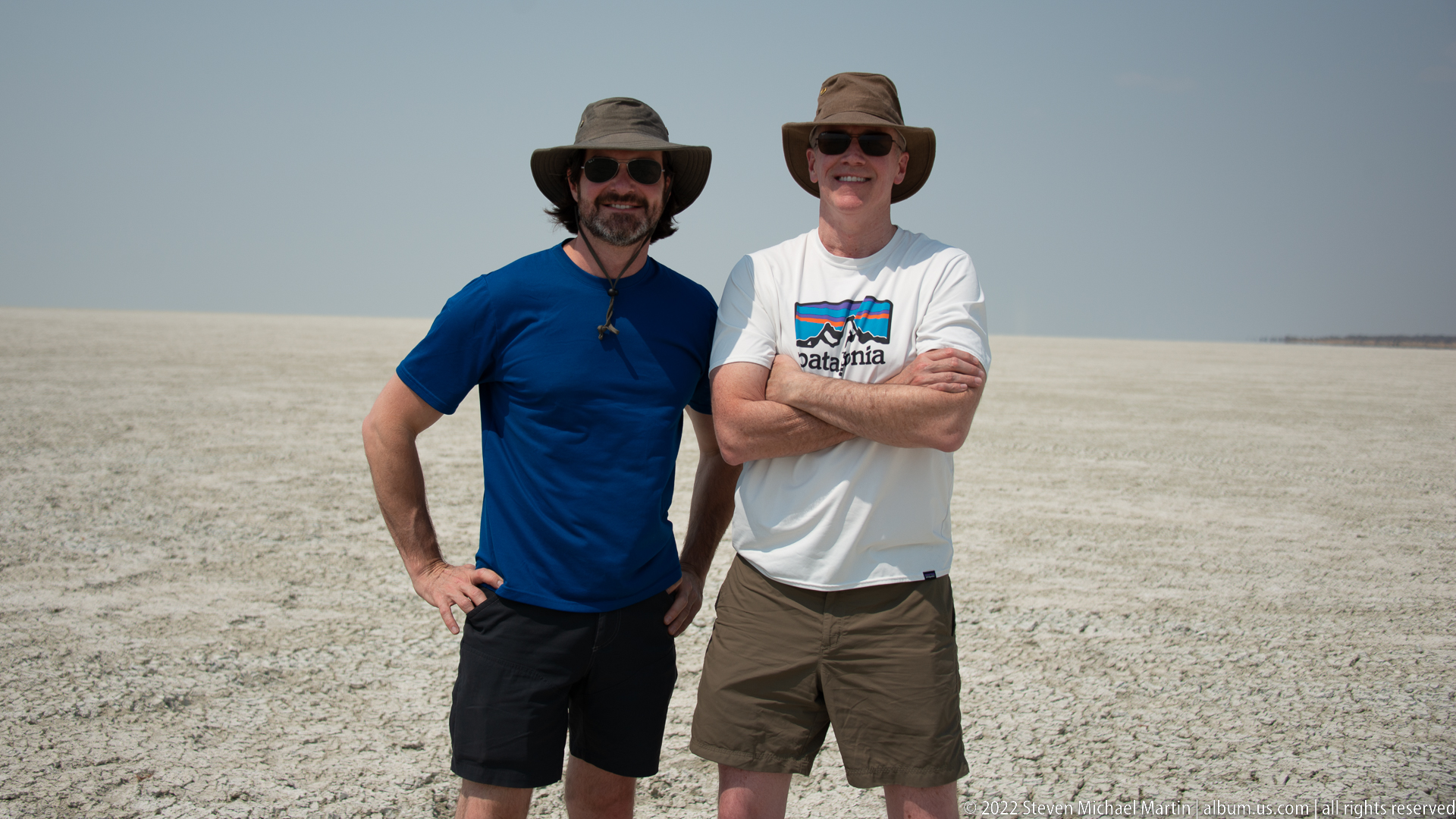
A full-length portrait shows two travelers standing on the textured salt surface of Etosha Pan. One rests a hand on his hip while the other folds his arms; hats, sunglasses, shorts, and lightweight shirts suit the exposed, sunny setting. More foreground is visible here, revealing the rough crust beneath their feet.
Caption
A full-length portrait shows two travelers standing on the textured salt surface of Etosha Pan. One rests a hand on his hip while the other folds his arms; hats, sunglasses, shorts, and lightweight shirts suit the exposed, sunny setting. More foreground is visible here, revealing the rough crust beneath their feet.
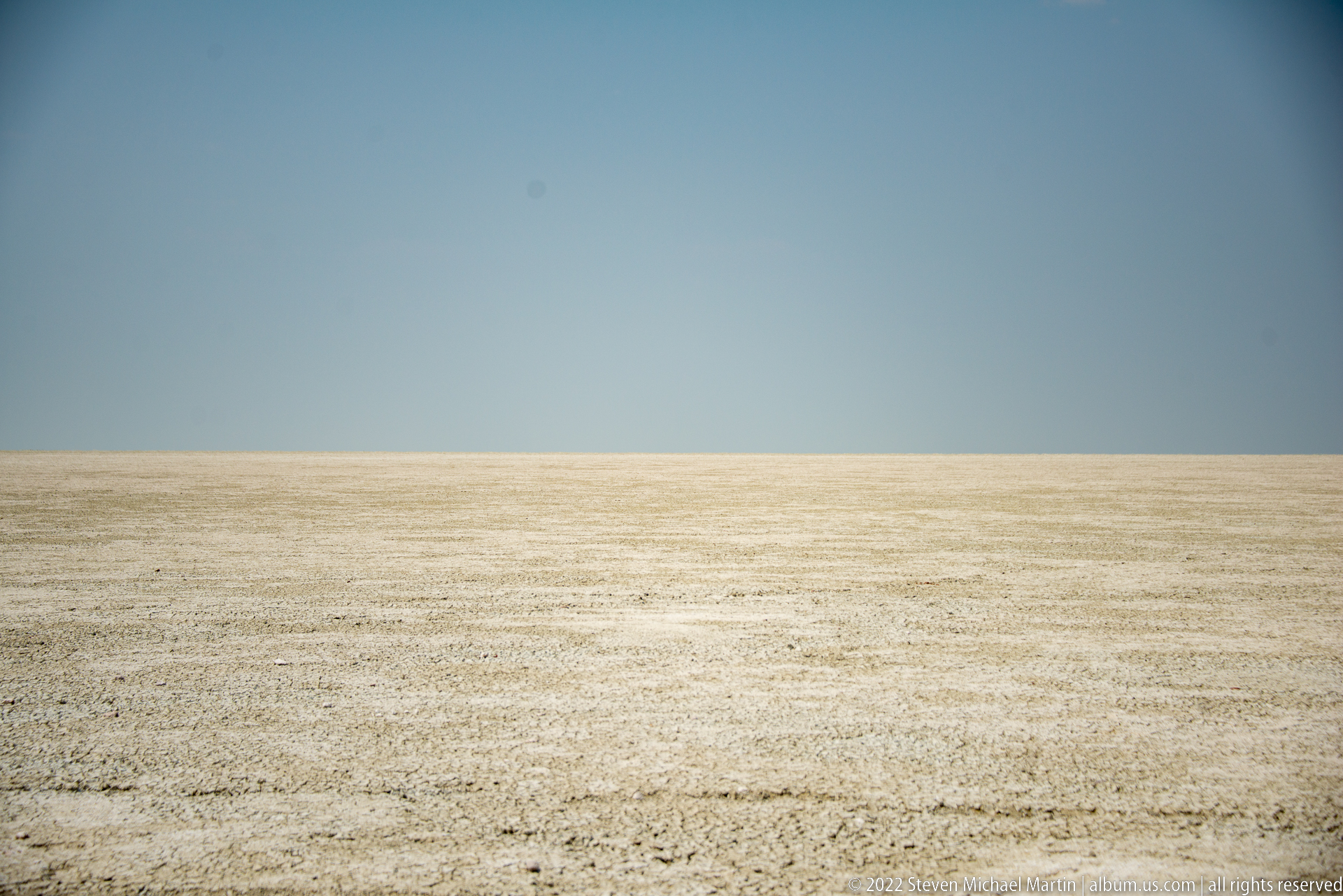
A low horizon divides the warm, pale salt surface from a broad blue sky, creating an almost abstract study of Etosha Pan. Subtle tonal bands and surface ripples replace the single-cloud accent of the adjacent view, emphasizing the crusted ground and immense lateral continuity of the basin.
Caption
A low horizon divides the warm, pale salt surface from a broad blue sky, creating an almost abstract study of Etosha Pan. Subtle tonal bands and surface ripples replace the single-cloud accent of the adjacent view, emphasizing the crusted ground and immense lateral continuity of the basin.
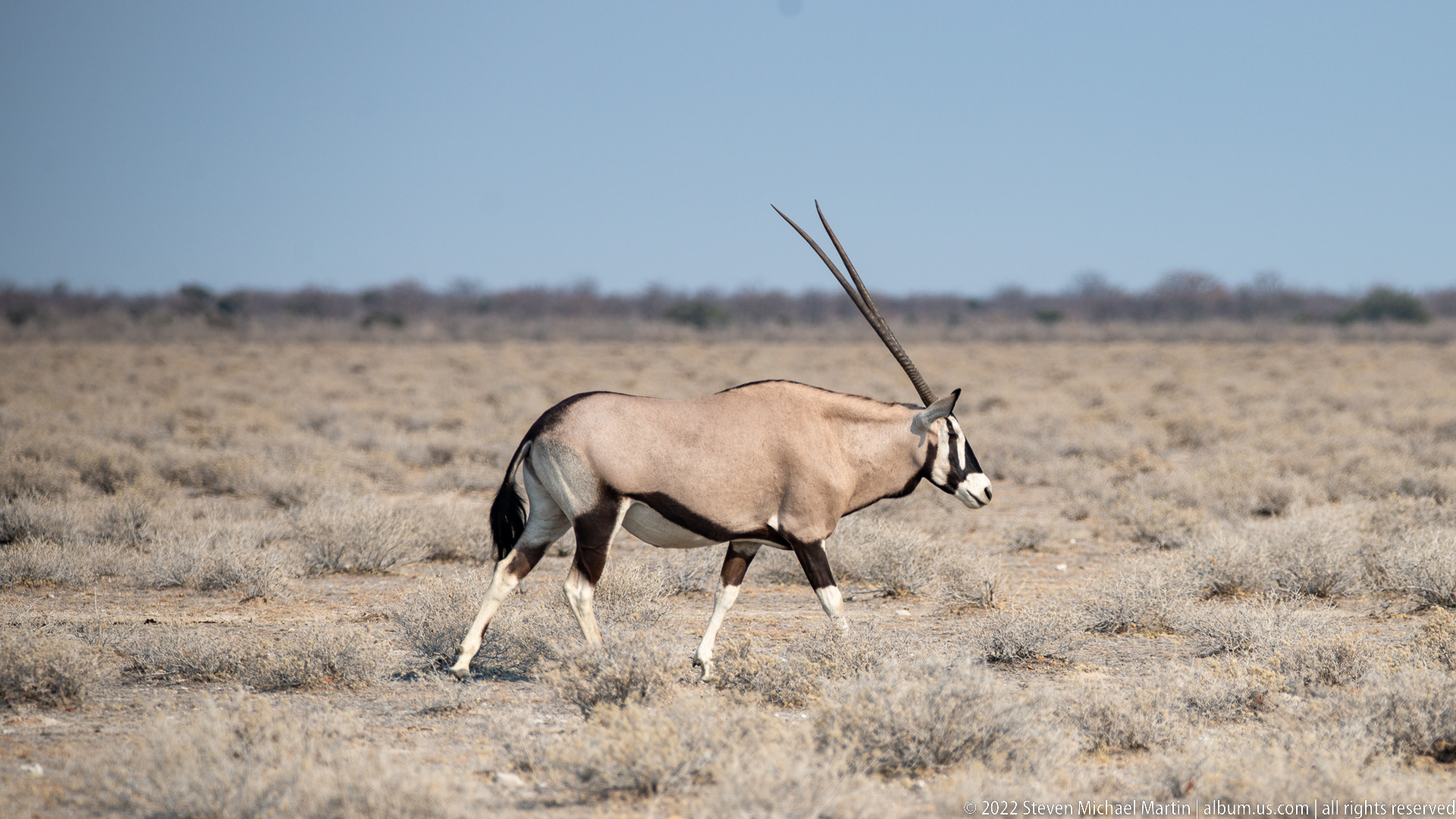
A gemsbok walks across the open Etosha plain, its exceptionally long straight horns rising above a gray-tan body marked by bold black-and-white facial patterning. The side view also reveals dark flank and leg markings, while the sparse scrub and distant tree line reinforce the antelope’s arid-country setting.
Caption
A gemsbok walks across the open Etosha plain, its exceptionally long straight horns rising above a gray-tan body marked by bold black-and-white facial patterning. The side view also reveals dark flank and leg markings, while the sparse scrub and distant tree line reinforce the antelope’s arid-country setting.
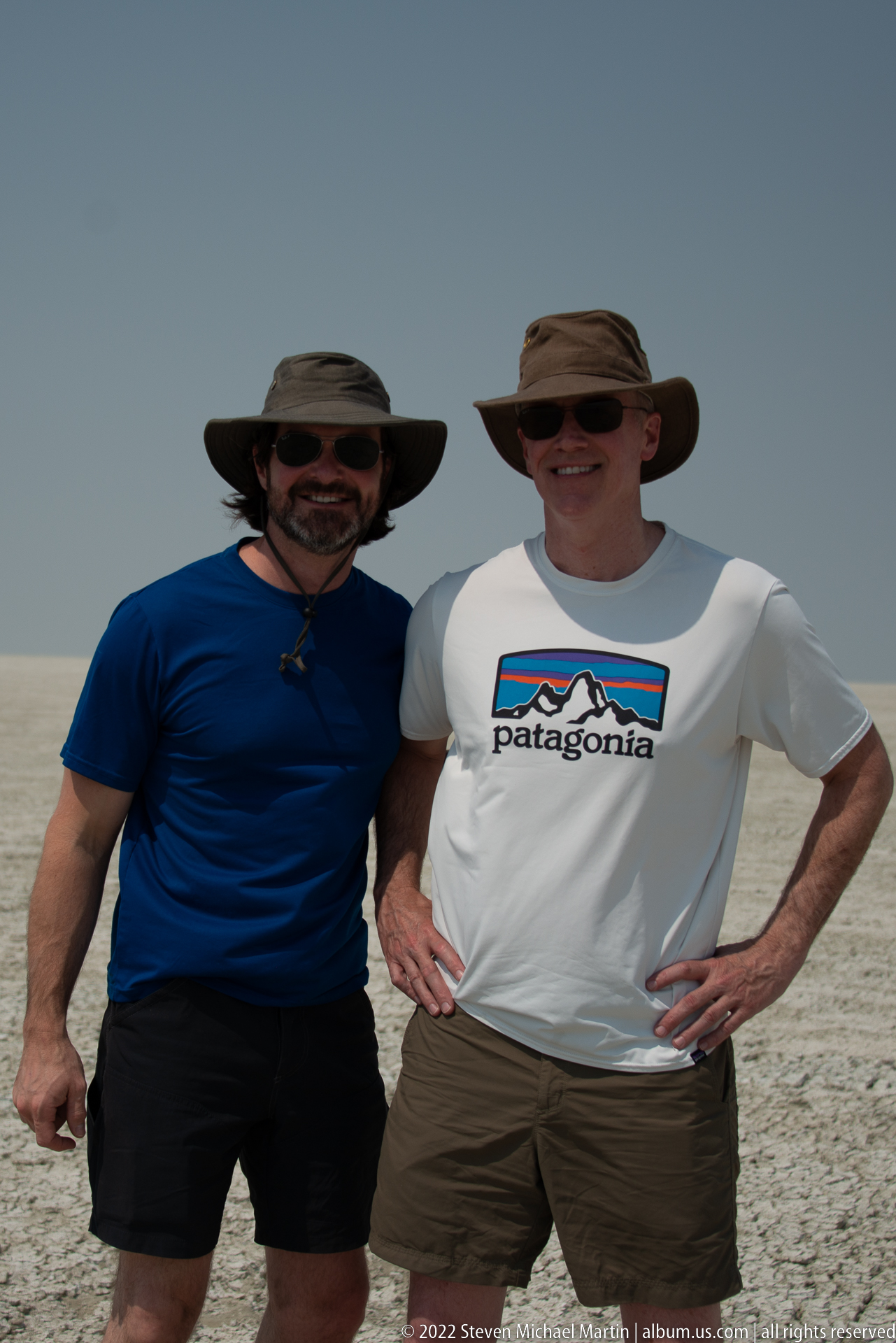
Two travelers stand shoulder to shoulder on the open pan, both wearing broad-brimmed hats and sunglasses under intense midday light. Their close pose fills the frame while the flat, pale horizon remains visible behind them, shifting attention from the vehicle portraits to the people experiencing the landscape.
Caption
Two travelers stand shoulder to shoulder on the open pan, both wearing broad-brimmed hats and sunglasses under intense midday light. Their close pose fills the frame while the flat, pale horizon remains visible behind them, shifting attention from the vehicle portraits to the people experiencing the landscape.

A straight gravel road runs to a vanishing point beneath a broad blue sky, bordered by low scrub and pale stony ground. The central perspective creates a strong axis through the otherwise level Etosha landscape, marking the transition from wildlife views back to the practical experience of traveling through the park.
Caption
A straight gravel road runs to a vanishing point beneath a broad blue sky, bordered by low scrub and pale stony ground. The central perspective creates a strong axis through the otherwise level Etosha landscape, marking the transition from wildlife views back to the practical experience of traveling through the park.
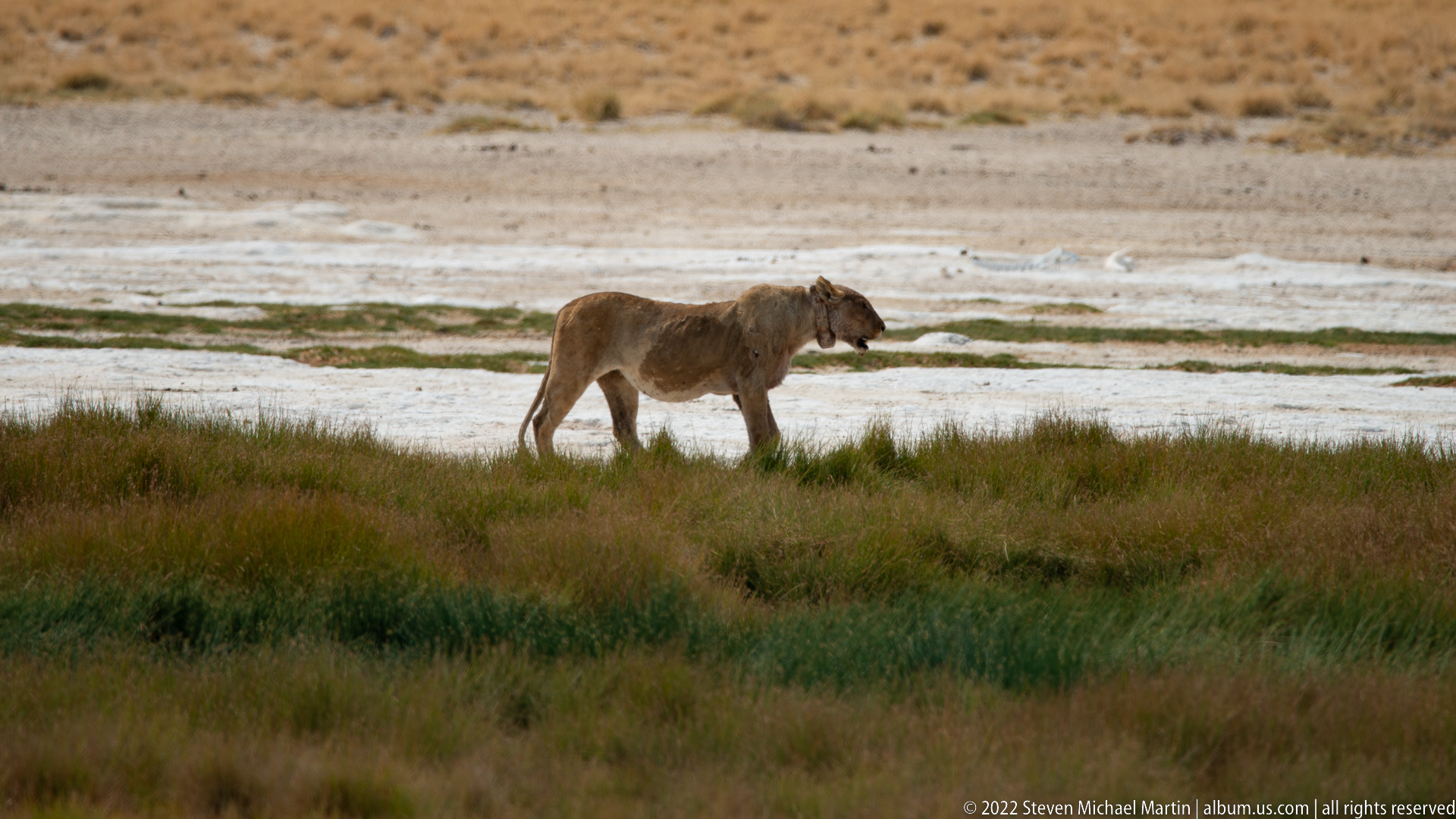
A lioness walks steadily across a band of green vegetation bordering the pale mineral surface of Etosha Pan. Her tawny coat is sharply separated from the white pan behind her, while the low grasses in the foreground place the predator within the narrow, more productive margin between salt pan and dry savanna.
Caption
A lioness walks steadily across a band of green vegetation bordering the pale mineral surface of Etosha Pan. Her tawny coat is sharply separated from the white pan behind her, while the low grasses in the foreground place the predator within the narrow, more productive margin between salt pan and dry savanna.
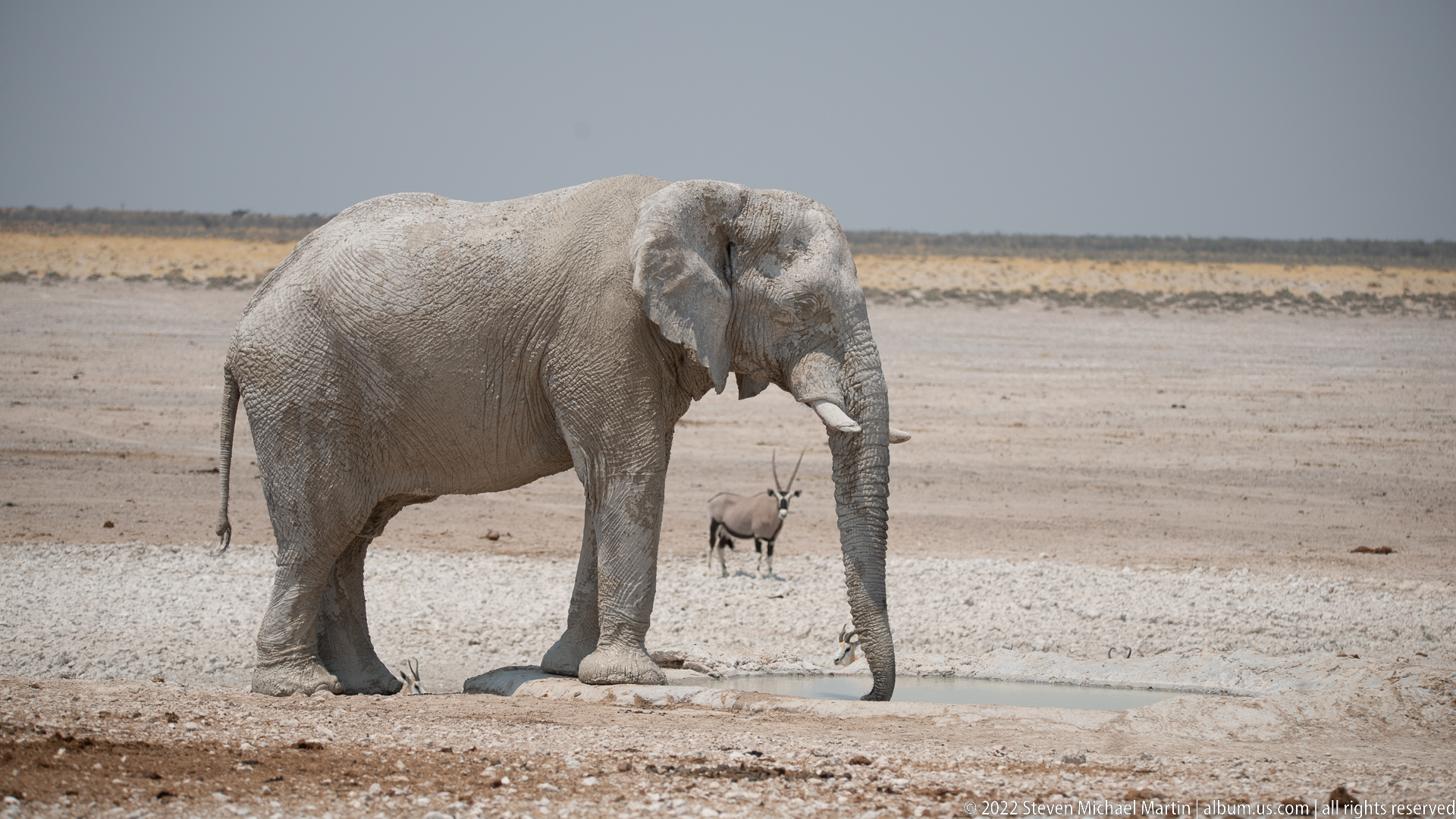
An African bush elephant stands beside a small waterhole on the pale Etosha flats, its skin coated with light-colored dust or dried mud. The trunk hangs toward the water and one tusk is visible; a gemsbok in the distance provides a striking sense of scale across the open pan.
Caption
An African bush elephant stands beside a small waterhole on the pale Etosha flats, its skin coated with light-colored dust or dried mud. The trunk hangs toward the water and one tusk is visible; a gemsbok in the distance provides a striking sense of scale across the open pan.
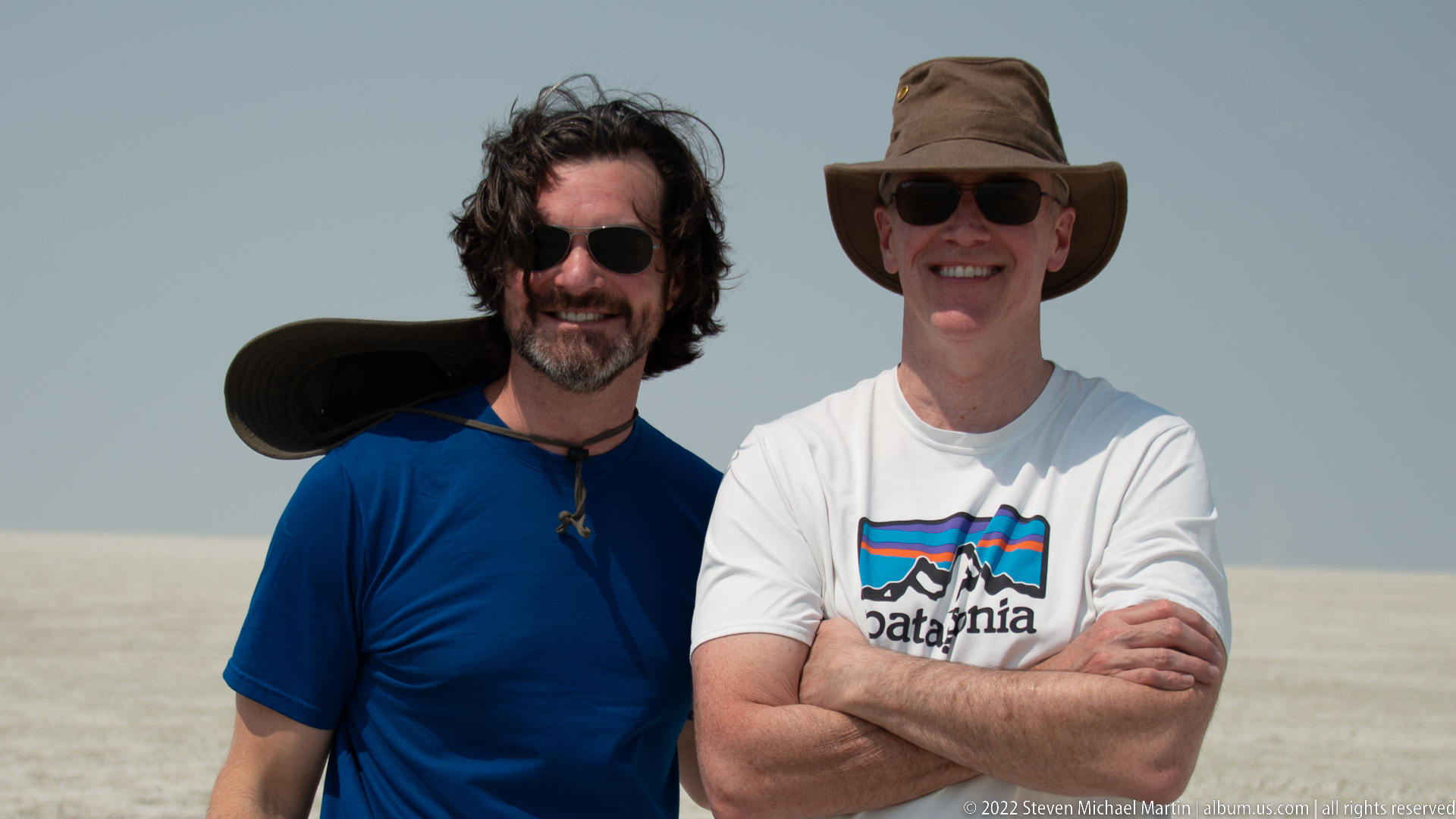
A close portrait frames two travelers from the waist up against the pale Etosha horizon. Wind lifts the brim of one hat while the other traveler stands with arms folded, adding a moment of movement to an otherwise spare composition. The strong sun and nearly empty background keep attention on expression, clothing, and posture.
Caption
A close portrait frames two travelers from the waist up against the pale Etosha horizon. Wind lifts the brim of one hat while the other traveler stands with arms folded, adding a moment of movement to an otherwise spare composition. The strong sun and nearly empty background keep attention on expression, clothing, and posture.
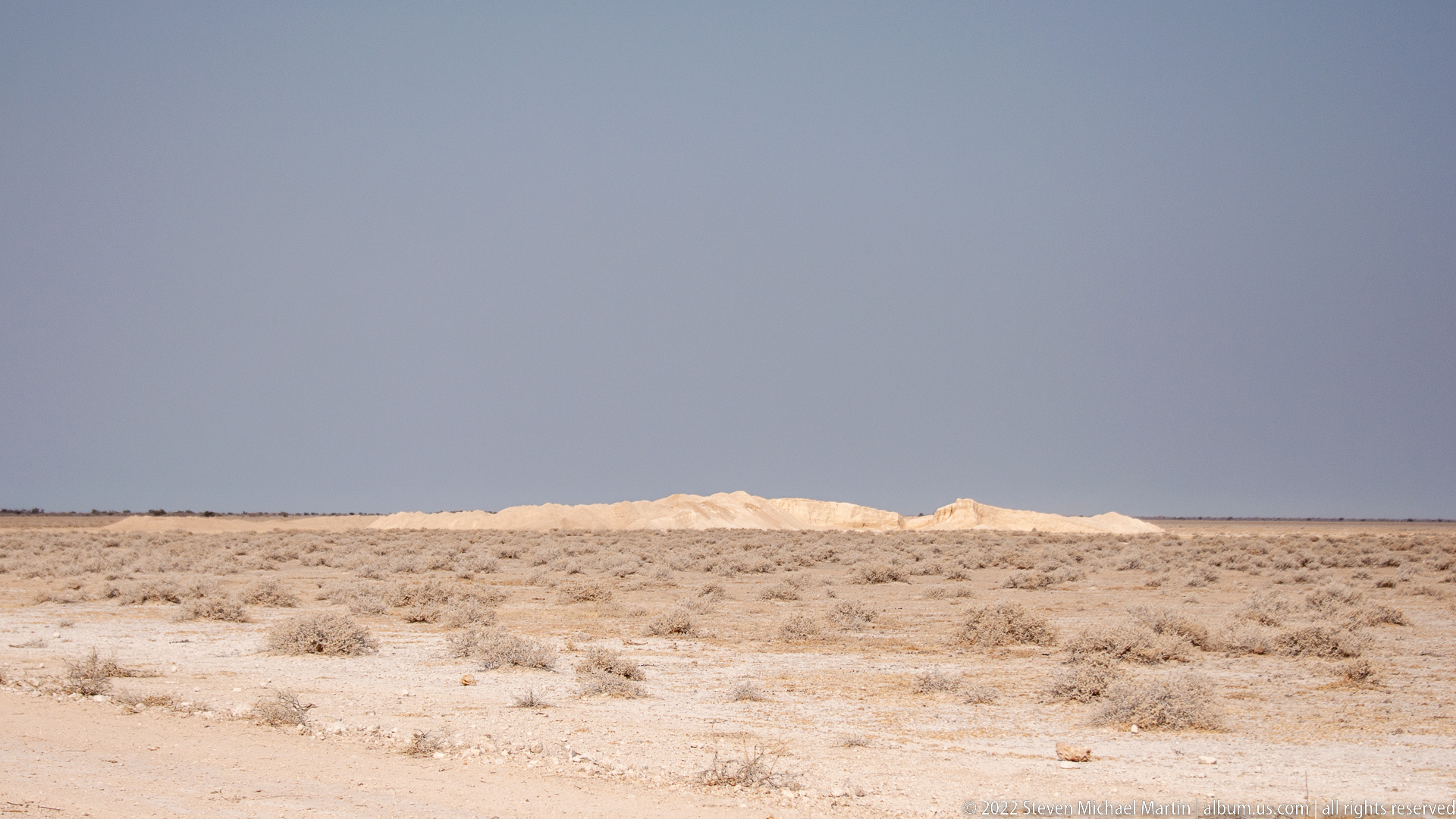
A broad, nearly treeless margin of Etosha Pan stretches beneath a clear blue-gray sky, with low pale mineral ridges breaking the horizon. Sparse tufts and scrub punctuate the chalky ground, emphasizing the extreme openness and aridity that define the pan landscape in northern Namibia.
Caption
A broad, nearly treeless margin of Etosha Pan stretches beneath a clear blue-gray sky, with low pale mineral ridges breaking the horizon. Sparse tufts and scrub punctuate the chalky ground, emphasizing the extreme openness and aridity that define the pan landscape in northern Namibia.
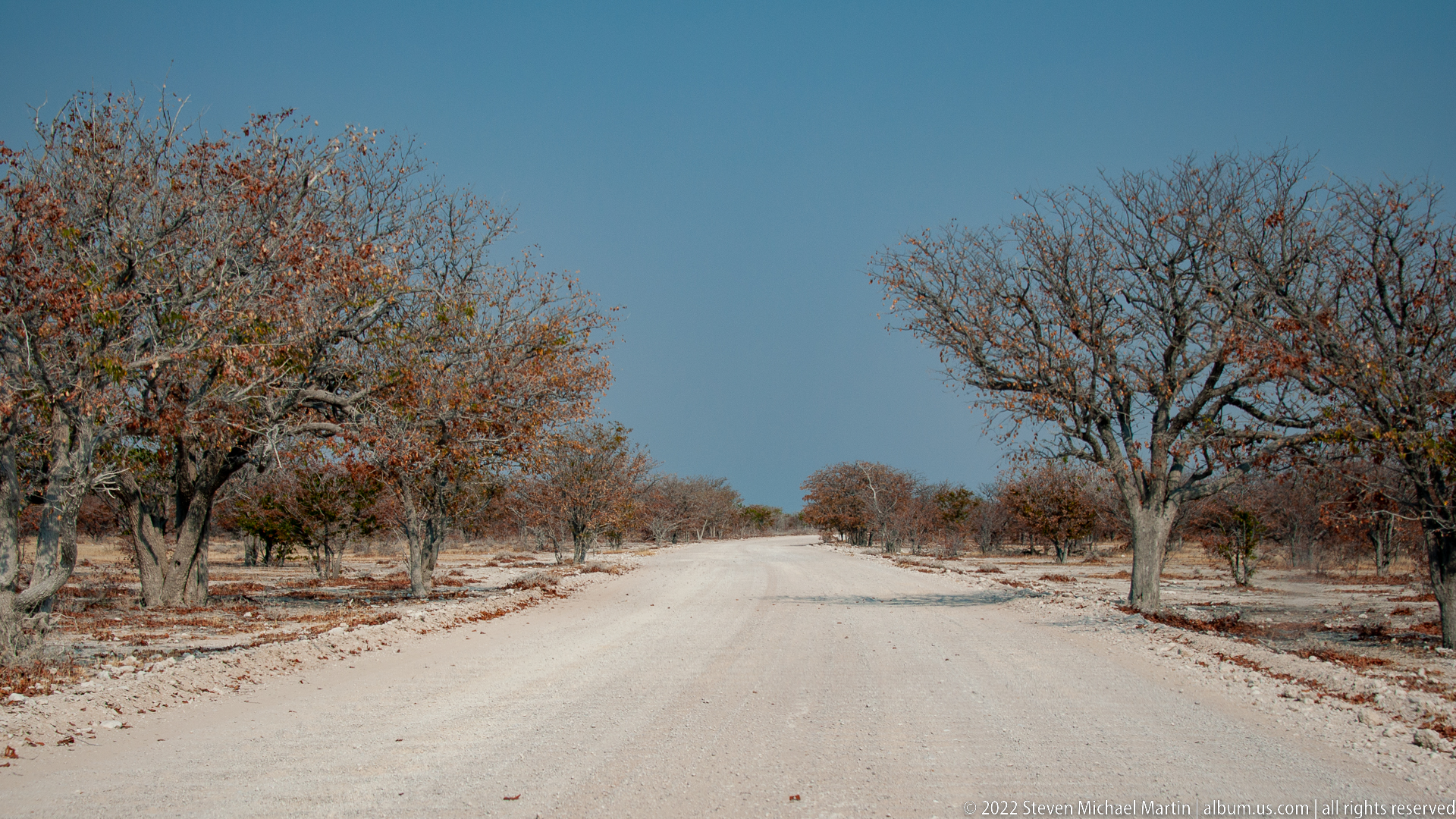
A pale gravel road runs straight through dry, open woodland near Etosha Pan, framed by leaf-sparse trees with scattered reddish foliage. The centered perspective draws the eye toward the distant vanishing point while the dusty road surface and parched understory register the dry-season character of the surrounding savanna.
Caption
A pale gravel road runs straight through dry, open woodland near Etosha Pan, framed by leaf-sparse trees with scattered reddish foliage. The centered perspective draws the eye toward the distant vanishing point while the dusty road surface and parched understory register the dry-season character of the surrounding savanna.
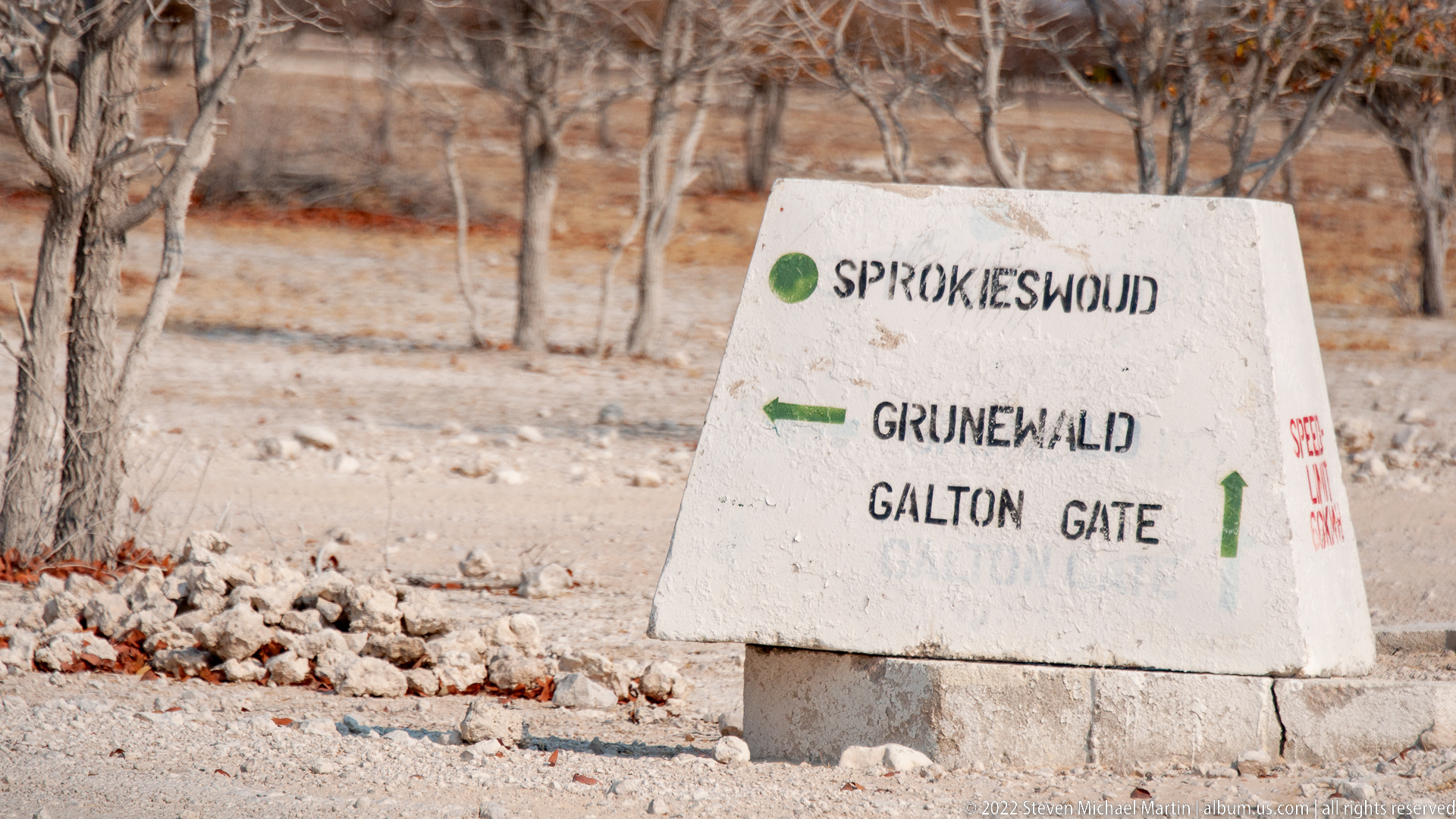
A concrete directional marker beside an Etosha road points travelers toward Sprokieswoud, Grünewald, and Galton Gate. Hand-painted lettering and green arrows turn a utilitarian wayfinding object into a precise geographic record, while the dry woodland behind it places the sign within the park’s arid interior.
Caption
A concrete directional marker beside an Etosha road points travelers toward Sprokieswoud, Grünewald, and Galton Gate. Hand-painted lettering and green arrows turn a utilitarian wayfinding object into a precise geographic record, while the dry woodland behind it places the sign within the park’s arid interior.

Seen in its wider setting, the concrete marker for Sprokieswoud, Grünewald, and Galton Gate stands at the edge of a pale gravel road amid open dry woodland. The broader view shows how simple painted arrows guide movement through Etosha’s road network while retaining the spacious character of the surrounding landscape.
Caption
Seen in its wider setting, the concrete marker for Sprokieswoud, Grünewald, and Galton Gate stands at the edge of a pale gravel road amid open dry woodland. The broader view shows how simple painted arrows guide movement through Etosha’s road network while retaining the spacious character of the surrounding landscape.
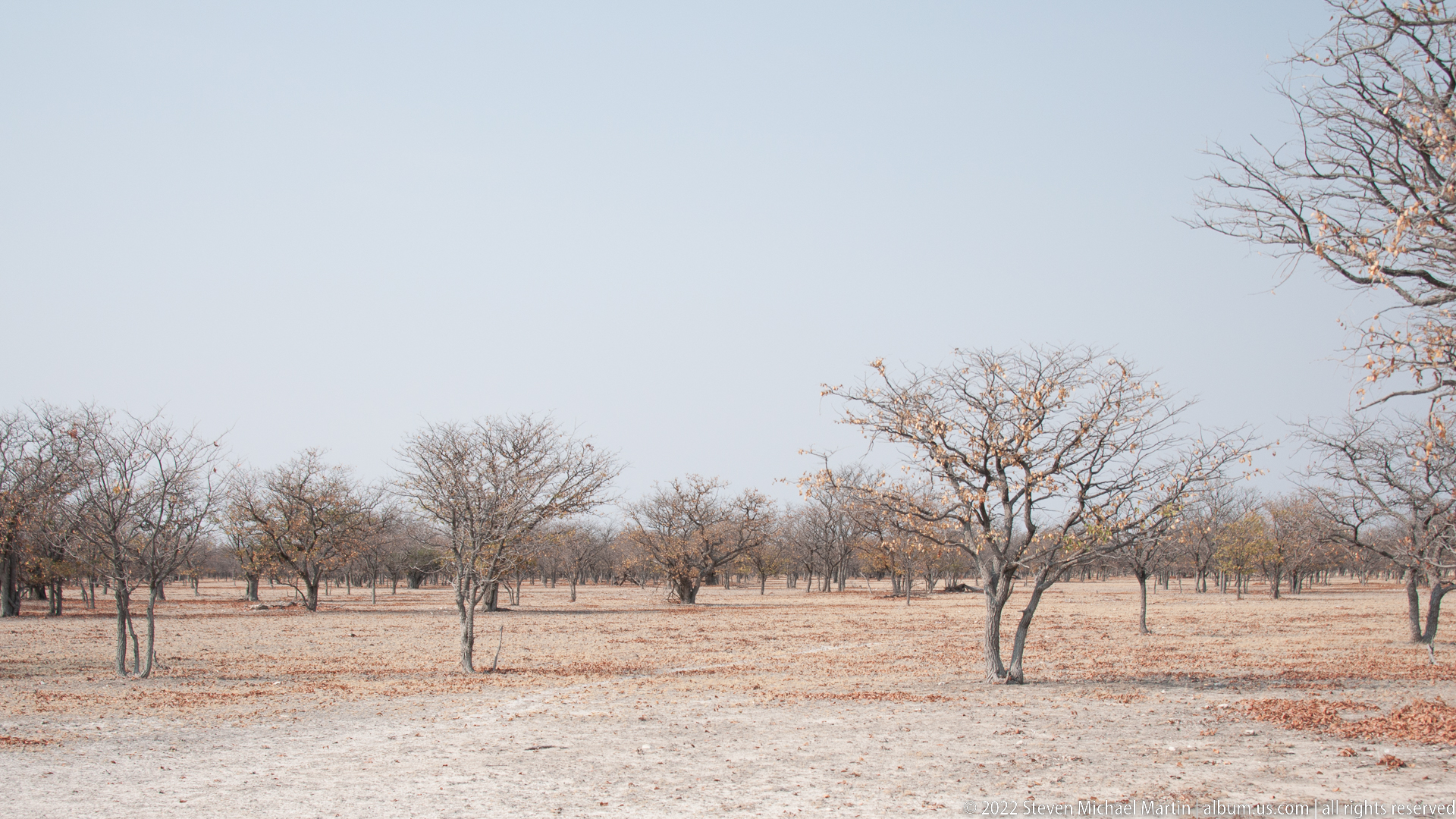
Widely spaced deciduous trees rise from pale, nearly bare ground in the dry woodland bordering Etosha Pan. Fine branches, limited foliage, and scattered leaf litter create a spare pattern across the frame, documenting the open structure of the vegetation during the dry season rather than the treeless pan itself.
Caption
Widely spaced deciduous trees rise from pale, nearly bare ground in the dry woodland bordering Etosha Pan. Fine branches, limited foliage, and scattered leaf litter create a spare pattern across the frame, documenting the open structure of the vegetation during the dry season rather than the treeless pan itself.
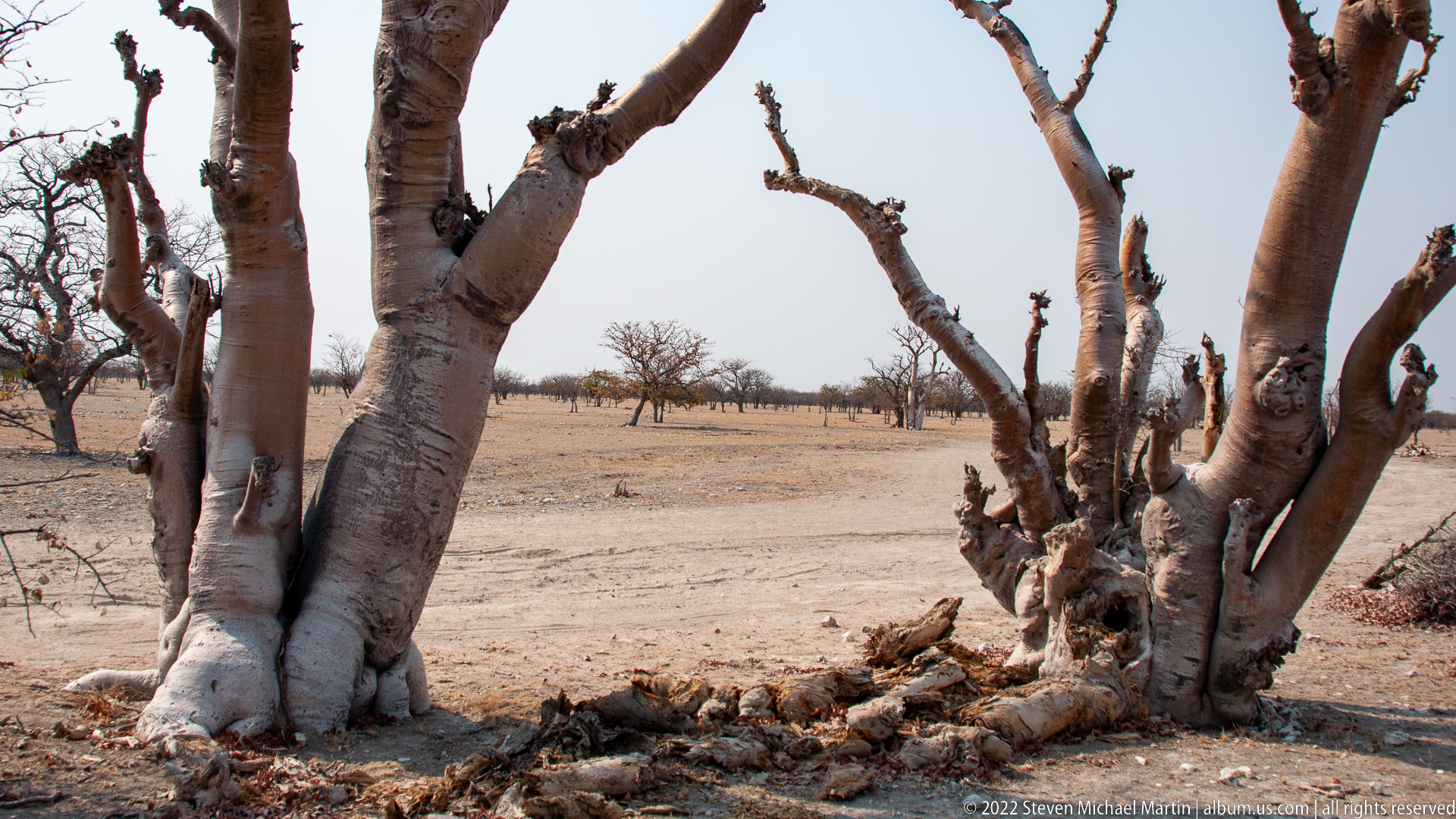
Thick, pale trunks twist upward from a weathered base at the edge of Etosha’s dry woodland, their cropped and broken branches forming an almost sculptural silhouette. The close foreground view emphasizes swollen stems, scars, cavities, and exposed wood, with the flat, sparsely wooded landscape receding beyond.
Caption
Thick, pale trunks twist upward from a weathered base at the edge of Etosha’s dry woodland, their cropped and broken branches forming an almost sculptural silhouette. The close foreground view emphasizes swollen stems, scars, cavities, and exposed wood, with the flat, sparsely wooded landscape receding beyond.
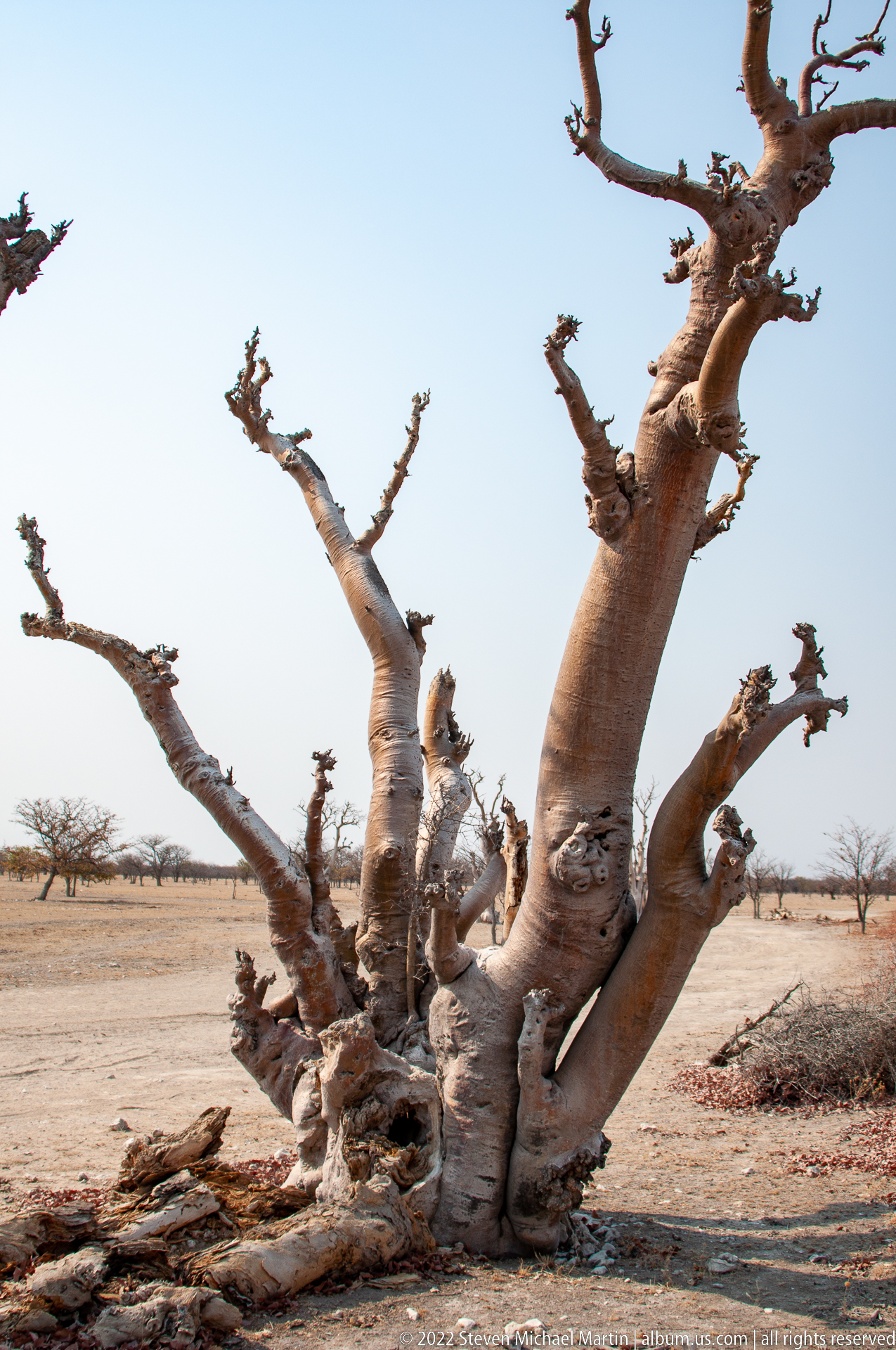
A sprawling pale-barked tree fills the foreground, its thick limbs dividing into a crown of broken, leafless branches above the dry Etosha plain. Viewed from farther back than the preceding detail, the entire irregular architecture is visible, including fallen wood at the base and the sparse woodland stretching behind it.
Caption
A sprawling pale-barked tree fills the foreground, its thick limbs dividing into a crown of broken, leafless branches above the dry Etosha plain. Viewed from farther back than the preceding detail, the entire irregular architecture is visible, including fallen wood at the base and the sparse woodland stretching behind it.
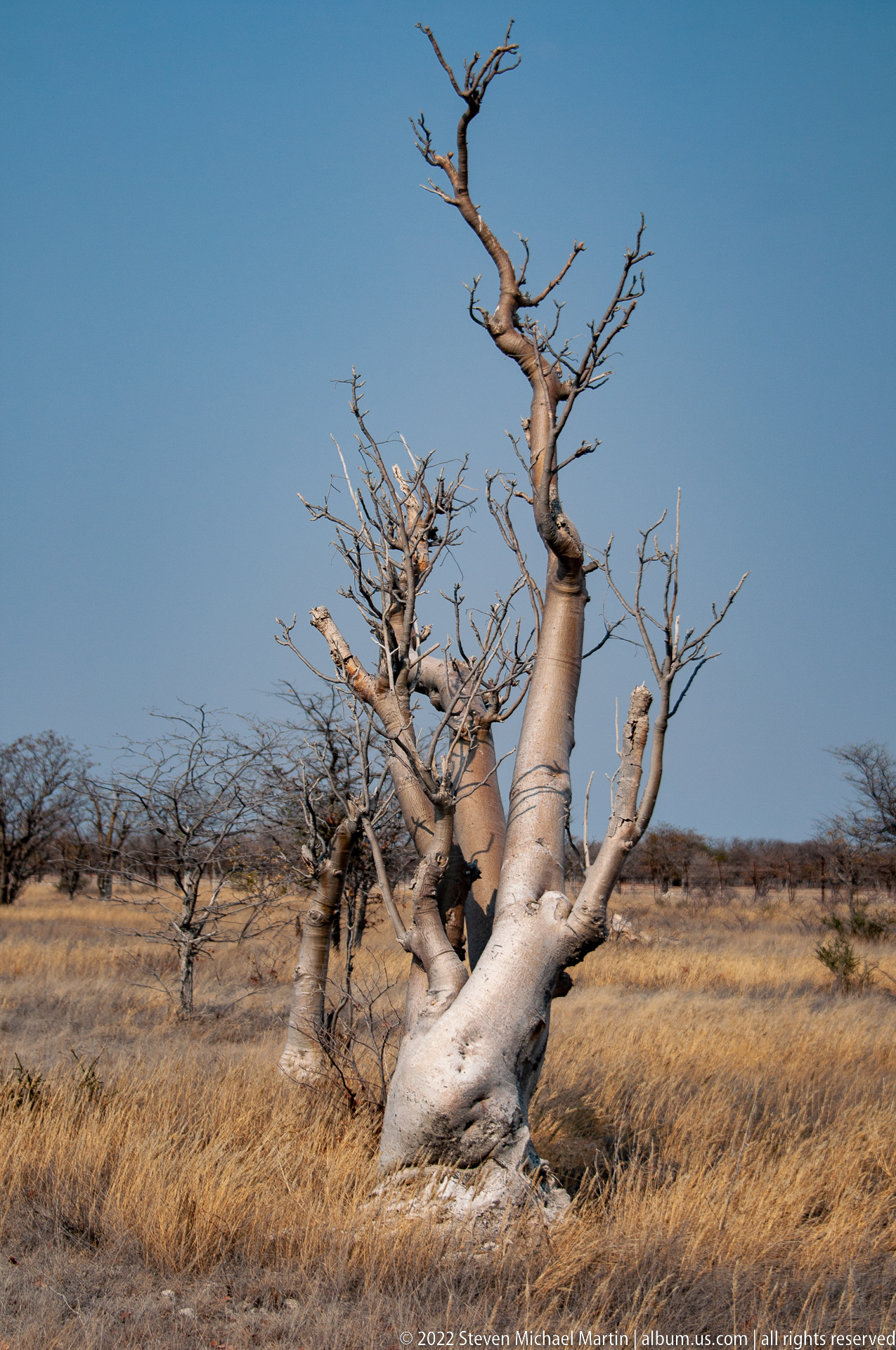
A large leafless tree with a thick, pale, branching trunk stands alone in golden dry grassland near Etosha Pan. Its contorted crown and smooth, light-toned stems contrast with the finer dark trees behind, making the individual tree the dominant form against a cloudless blue sky.
Caption
A large leafless tree with a thick, pale, branching trunk stands alone in golden dry grassland near Etosha Pan. Its contorted crown and smooth, light-toned stems contrast with the finer dark trees behind, making the individual tree the dominant form against a cloudless blue sky.
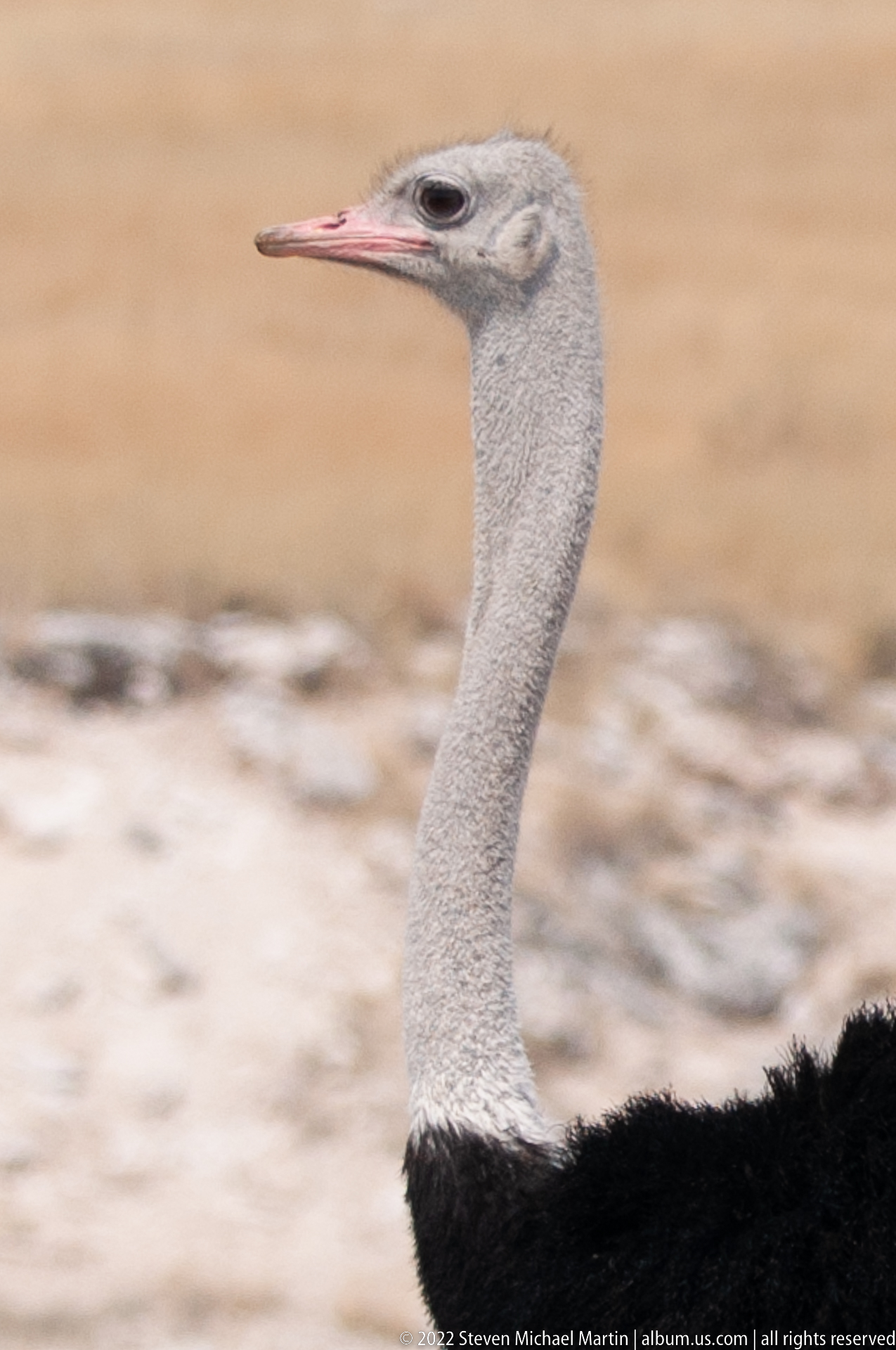
A tight portrait isolates the head and long gray neck of a common ostrich against a softly blurred background. Fine facial feathers, the large dark eye, and the pinkish bill are rendered in profile, while a strip of black body plumage at the lower edge anchors the close study to the bird’s larger form.
Caption
A tight portrait isolates the head and long gray neck of a common ostrich against a softly blurred background. Fine facial feathers, the large dark eye, and the pinkish bill are rendered in profile, while a strip of black body plumage at the lower edge anchors the close study to the bird’s larger form.
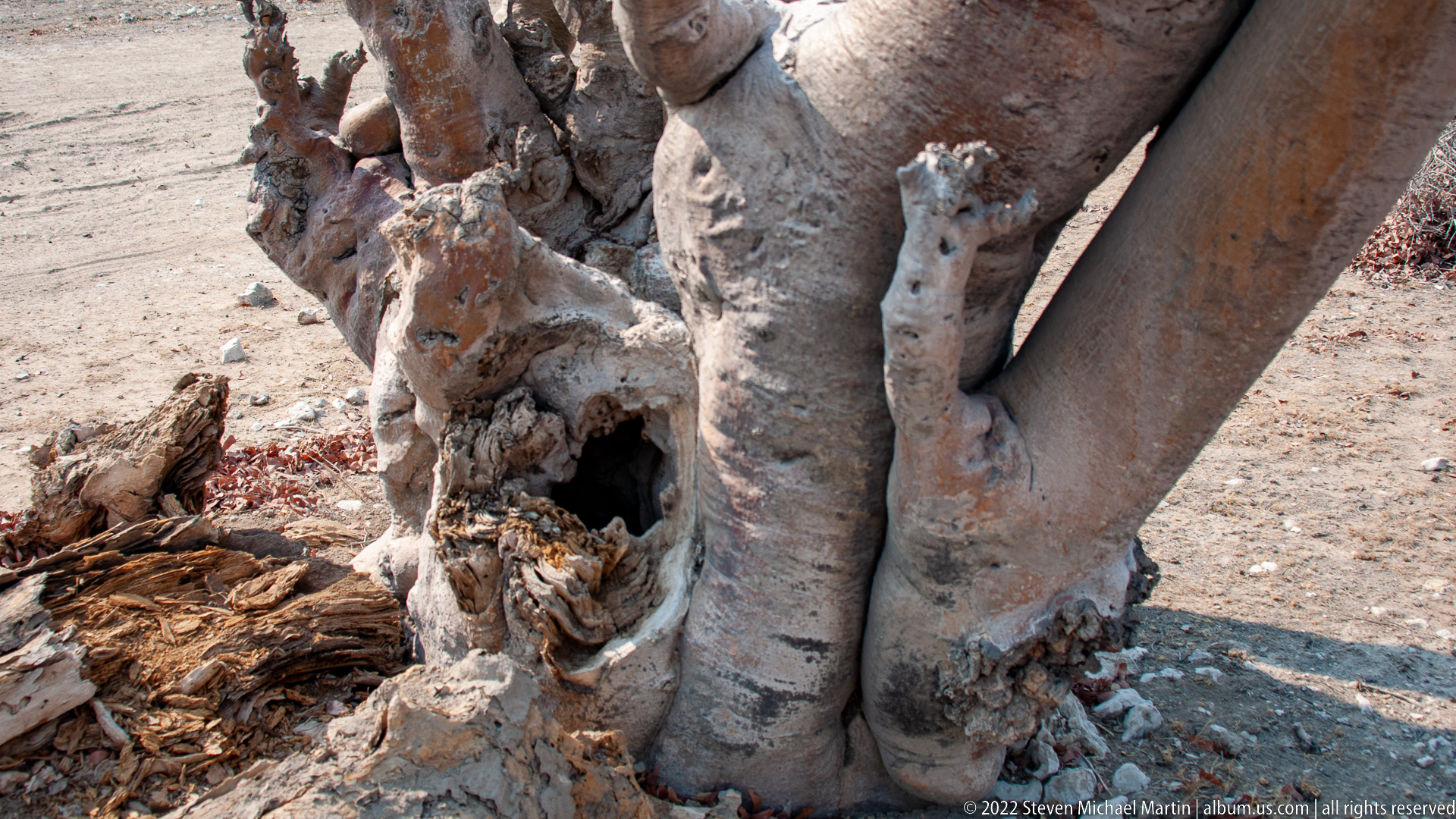
A close view isolates the damaged base of a massive pale-barked tree, where a dark cavity opens amid knots, callused growth, and splintered deadwood. The tight framing shifts attention from landscape to structure, revealing how weathering and injury have reshaped the trunk at ground level.
Caption
A close view isolates the damaged base of a massive pale-barked tree, where a dark cavity opens amid knots, callused growth, and splintered deadwood. The tight framing shifts attention from landscape to structure, revealing how weathering and injury have reshaped the trunk at ground level.
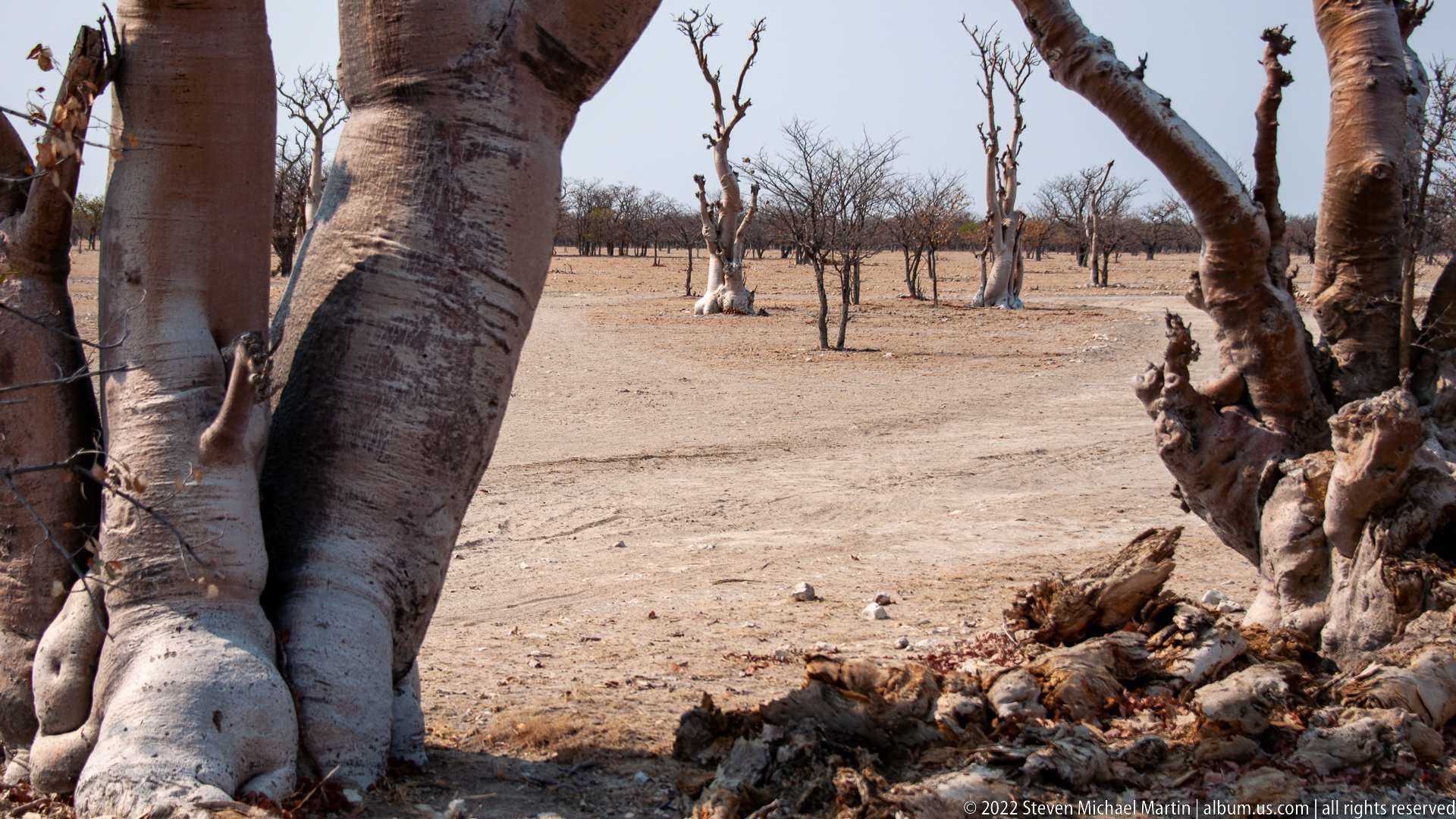
Two thick pale trunks frame a view into Etosha’s open dry woodland, where scattered trees stand across dusty, nearly bare ground. Broken wood and roughened growth at the base provide a close counterpoint to the more distant vertical trunks, creating a layered study of tree form and arid habitat.
Caption
Two thick pale trunks frame a view into Etosha’s open dry woodland, where scattered trees stand across dusty, nearly bare ground. Broken wood and roughened growth at the base provide a close counterpoint to the more distant vertical trunks, creating a layered study of tree form and arid habitat.
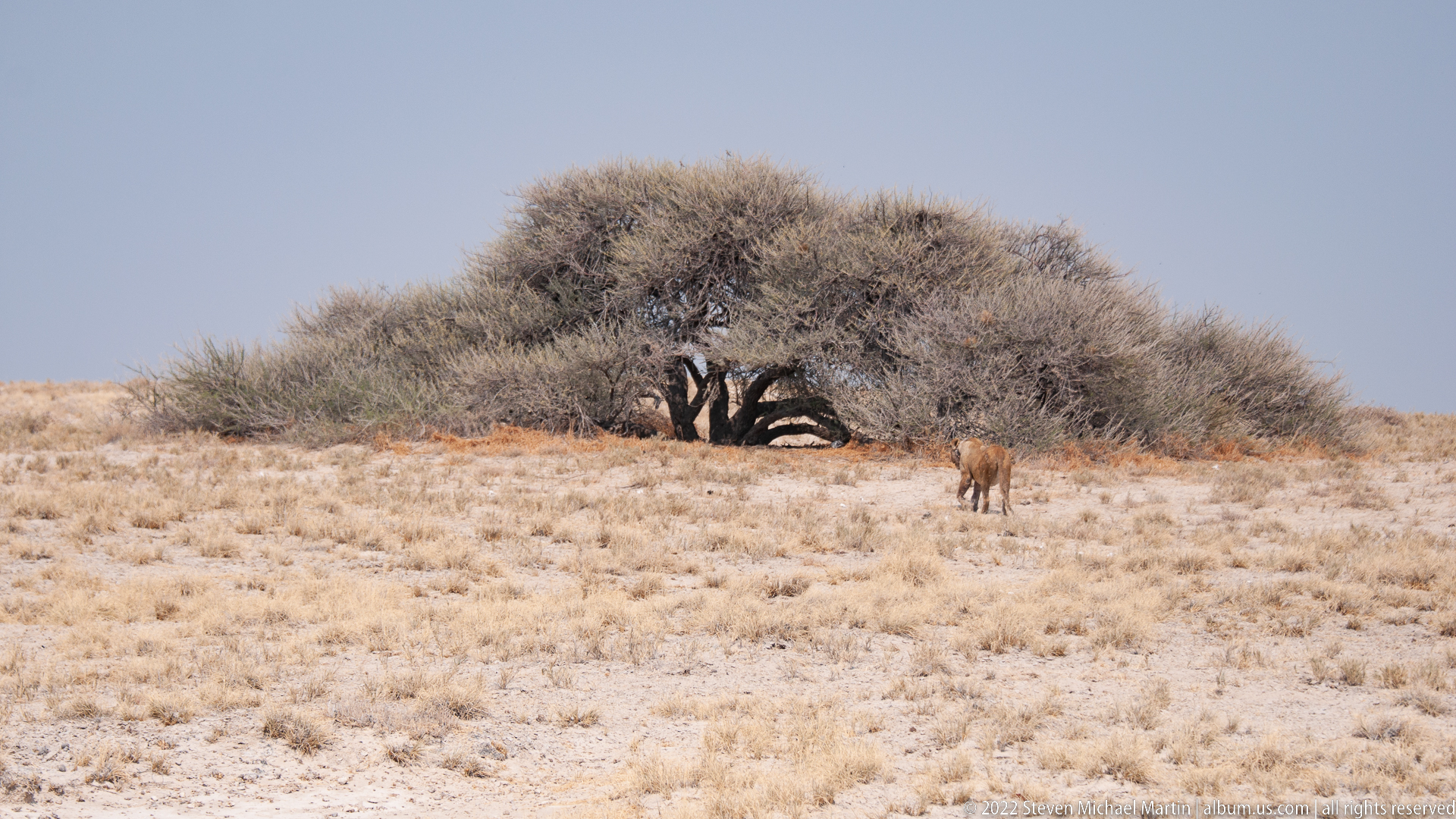
A lion appears small against the expansive pale grassland, positioned near the shade line of a broad, low-canopied tree. The long view places the animal within its habitat rather than presenting a portrait, emphasizing scale, concealment, and the sparse cover available across the Etosha landscape.
Caption
A lion appears small against the expansive pale grassland, positioned near the shade line of a broad, low-canopied tree. The long view places the animal within its habitat rather than presenting a portrait, emphasizing scale, concealment, and the sparse cover available across the Etosha landscape.
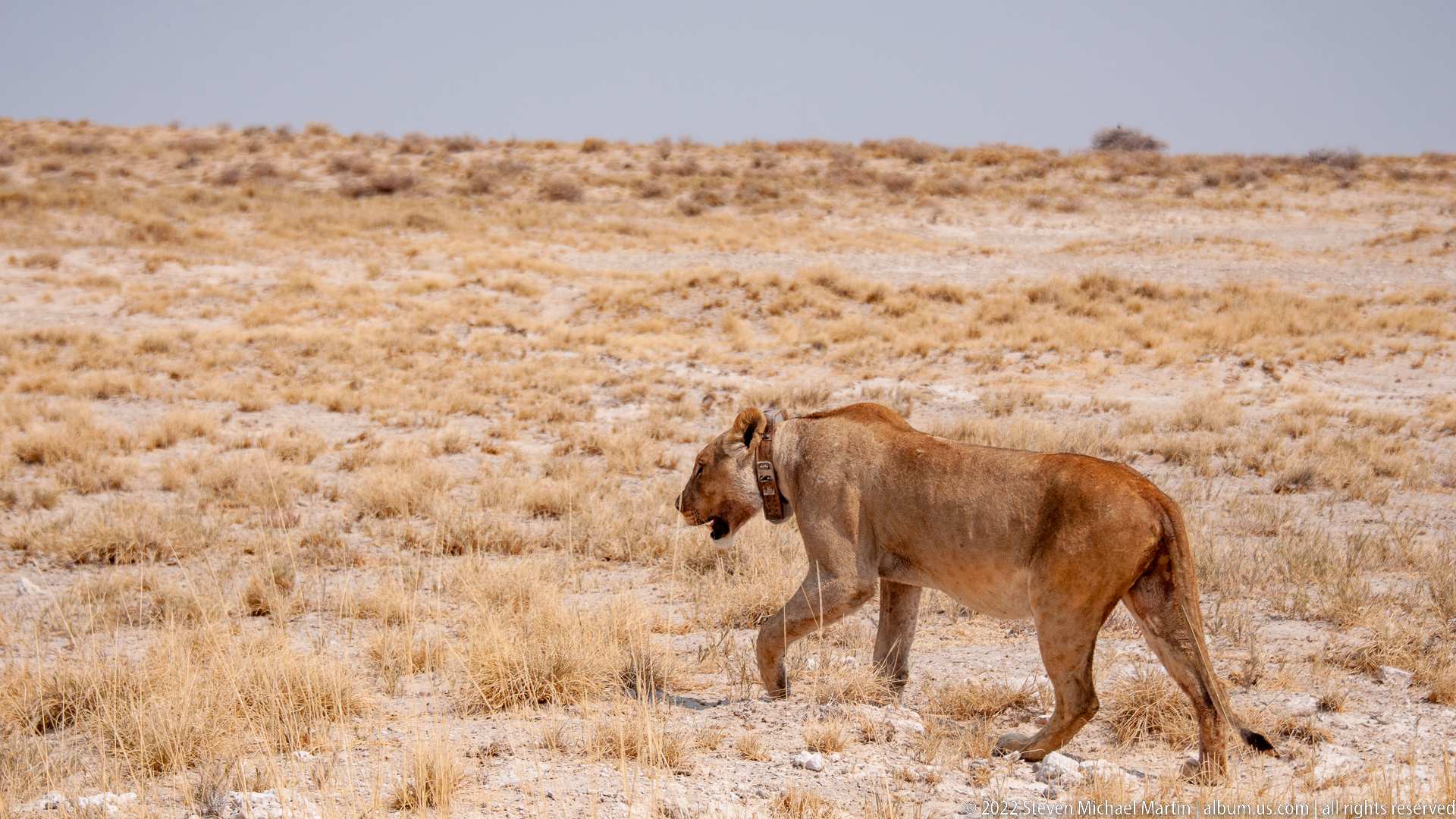
An adult lioness walks steadily across the pale grassland bordering Etosha Pan, shown in profile with her head lowered slightly and tail extended behind. The unobstructed side view reveals the powerful shoulders, tawny coat, and lean outline of a lion adapted to moving through open savanna.
Caption
An adult lioness walks steadily across the pale grassland bordering Etosha Pan, shown in profile with her head lowered slightly and tail extended behind. The unobstructed side view reveals the powerful shoulders, tawny coat, and lean outline of a lion adapted to moving through open savanna.
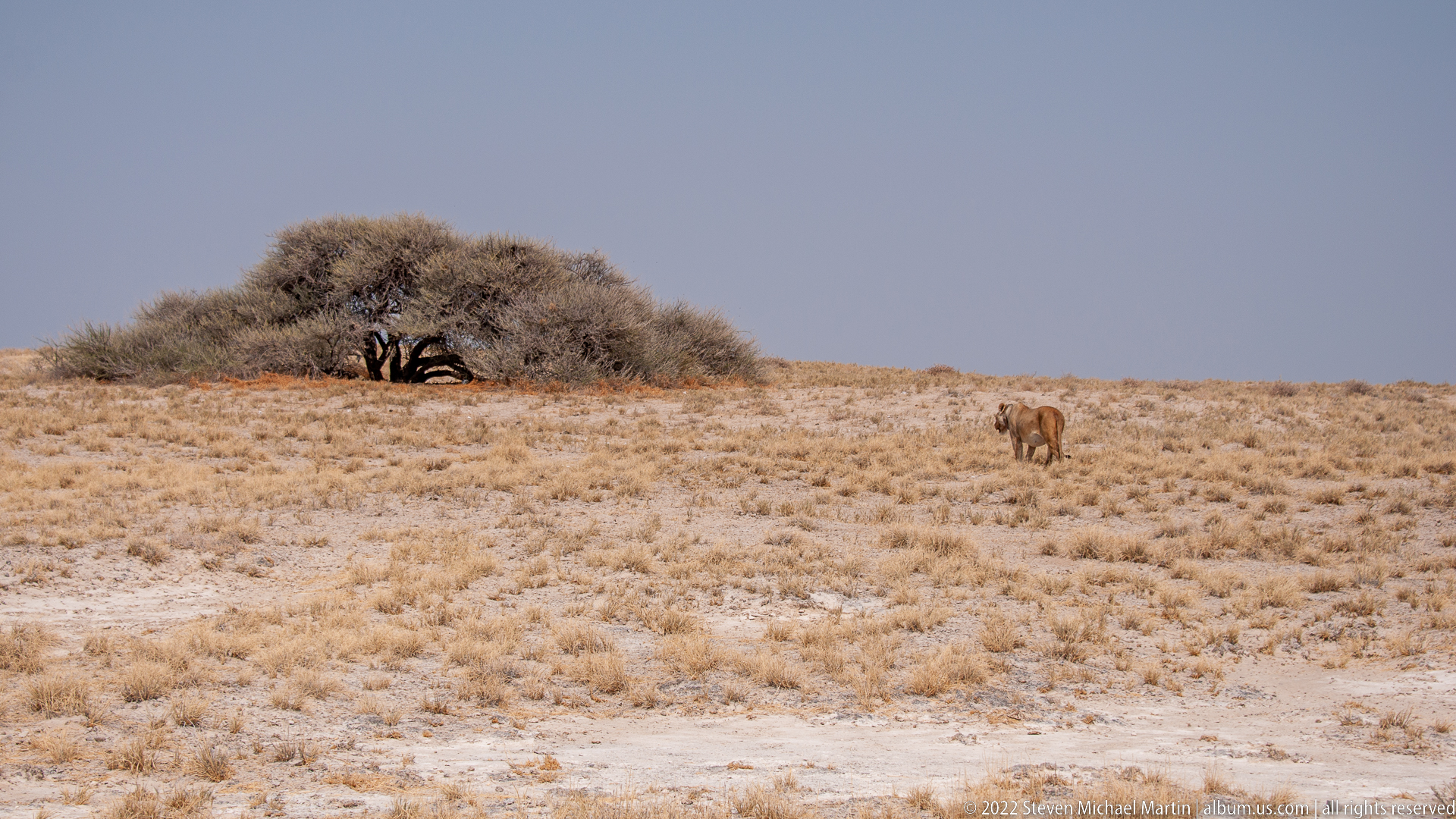
A lone lion crosses open, straw-colored ground near a broad-canopied tree, dwarfed by the horizontal sweep of the Etosha landscape. The animal’s small scale and the generous surrounding space make this primarily a habitat view, showing how wildlife can nearly disappear into the muted tones of the dry season.
Caption
A lone lion crosses open, straw-colored ground near a broad-canopied tree, dwarfed by the horizontal sweep of the Etosha landscape. The animal’s small scale and the generous surrounding space make this primarily a habitat view, showing how wildlife can nearly disappear into the muted tones of the dry season.
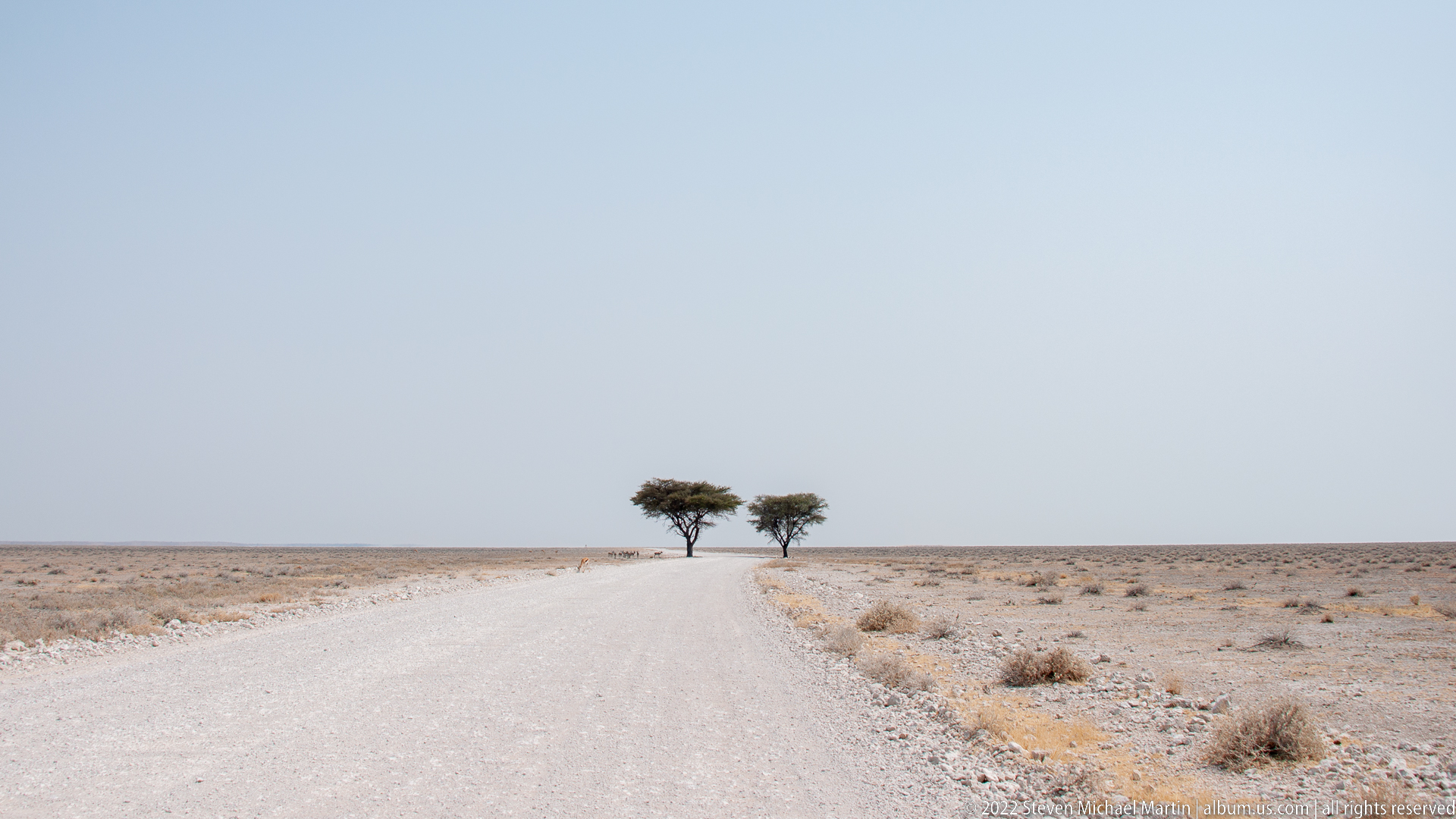
A straight gravel road cuts across the nearly level Etosha landscape toward two isolated trees on the horizon. With little vegetation and no traffic in view, the road becomes a strong geometric axis through the pale pan country, conveying the scale and visual austerity of travel across this arid environment.
Caption
A straight gravel road cuts across the nearly level Etosha landscape toward two isolated trees on the horizon. With little vegetation and no traffic in view, the road becomes a strong geometric axis through the pale pan country, conveying the scale and visual austerity of travel across this arid environment.
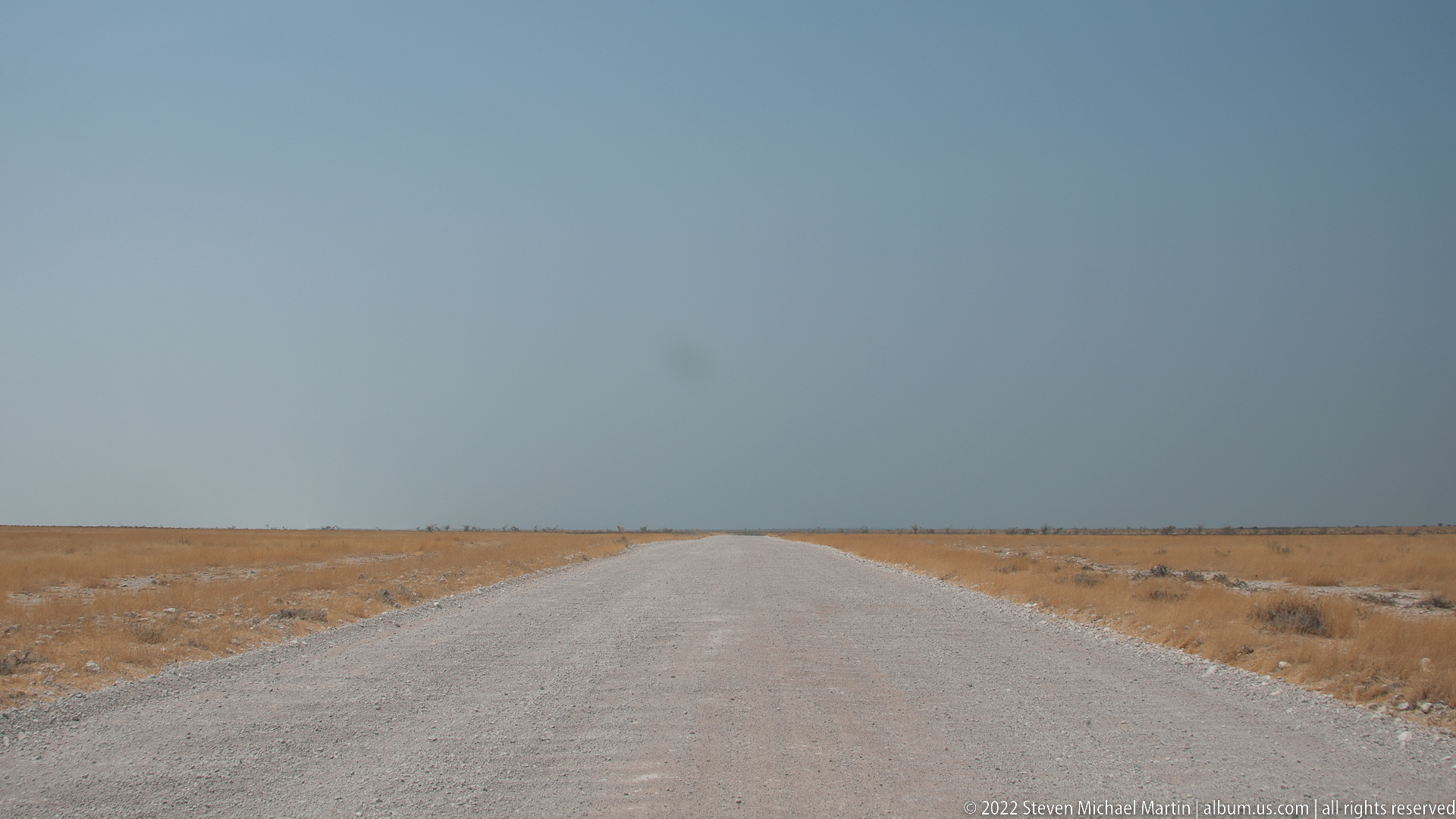
A long, pale roadway runs toward an almost featureless horizon, dividing dry golden ground beneath an unusually expansive blue-gray sky. The low horizon and minimal roadside vegetation make this one of the portfolio’s most abstract landscape views, reducing Etosha’s road system to line, color, and distance.
Caption
A long, pale roadway runs toward an almost featureless horizon, dividing dry golden ground beneath an unusually expansive blue-gray sky. The low horizon and minimal roadside vegetation make this one of the portfolio’s most abstract landscape views, reducing Etosha’s road system to line, color, and distance.
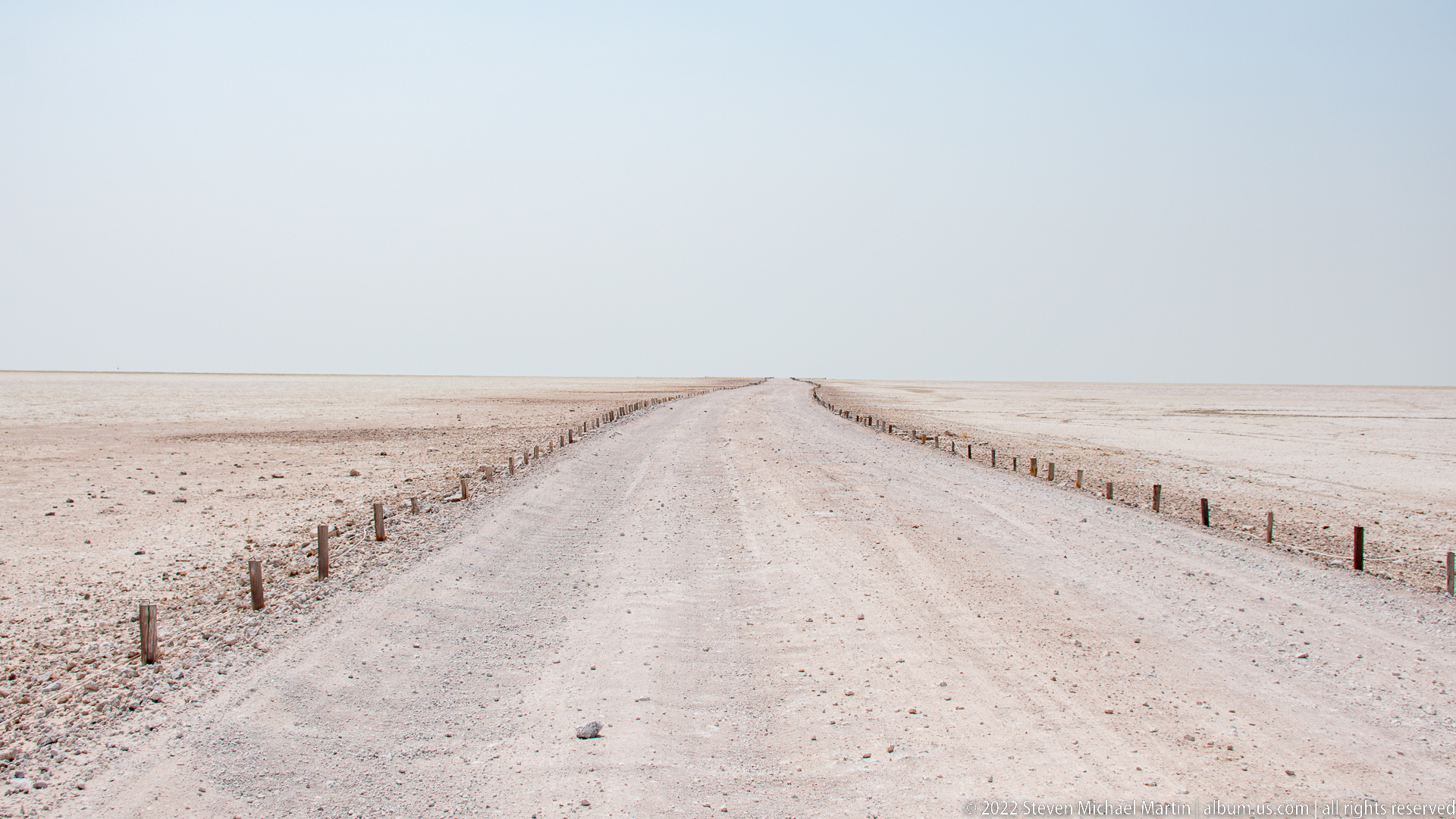
A raised gravel road extends across the brilliant pale surface of Etosha Pan, bordered on both sides by evenly spaced posts. The road narrows toward the horizon while the surrounding salt-flat tones merge with the hazy sky, creating a stark linear passage through the pan’s exposed interior.
Caption
A raised gravel road extends across the brilliant pale surface of Etosha Pan, bordered on both sides by evenly spaced posts. The road narrows toward the horizon while the surrounding salt-flat tones merge with the hazy sky, creating a stark linear passage through the pan’s exposed interior.
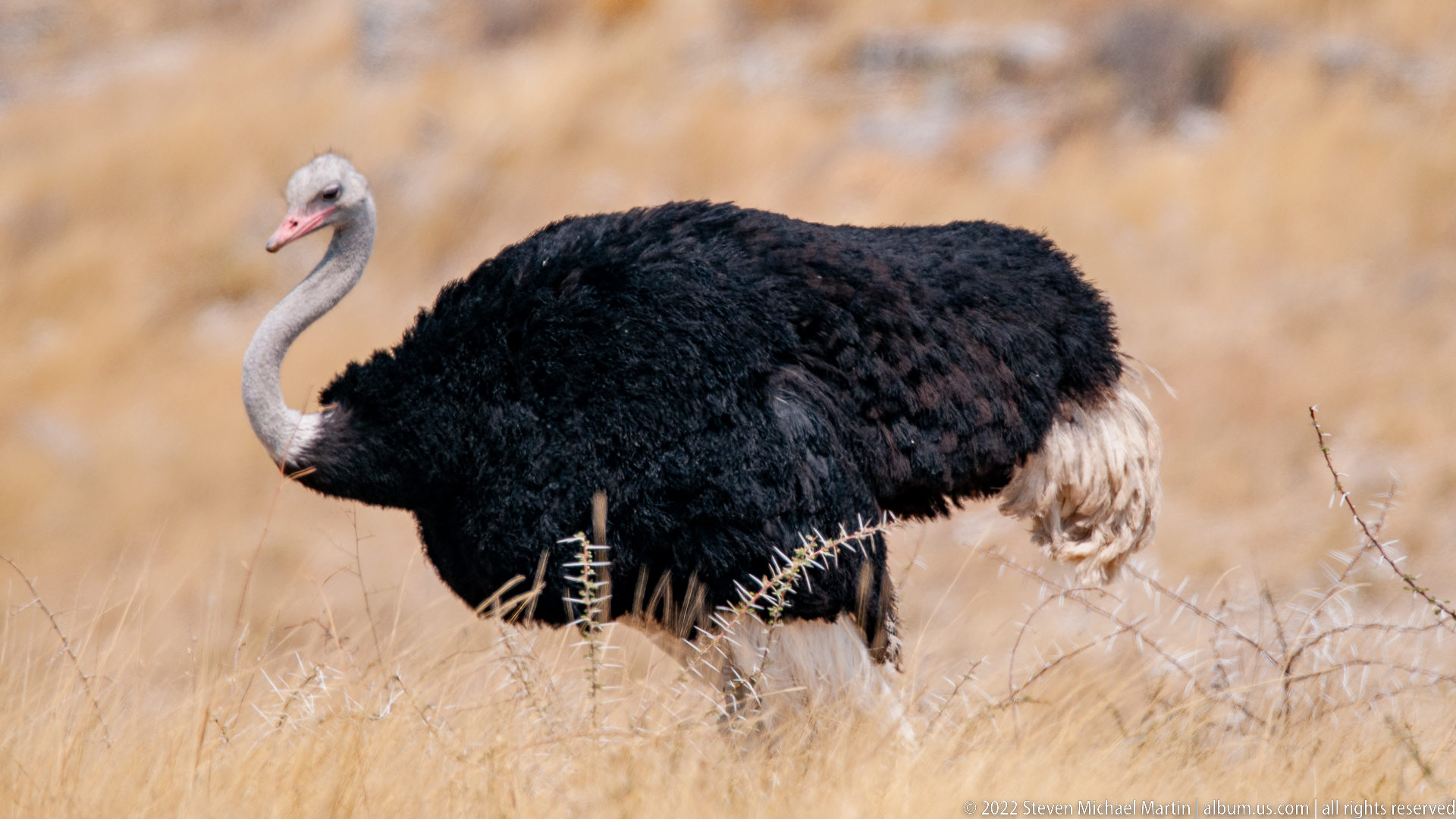
A male common ostrich stands in dry Etosha grassland, its black body plumage contrasting sharply with white wing and tail feathers. The long bare neck, pinkish bill, and powerful gray legs are shown in clear side profile, providing a detailed wildlife portrait against softly blurred golden vegetation.
Caption
A male common ostrich stands in dry Etosha grassland, its black body plumage contrasting sharply with white wing and tail feathers. The long bare neck, pinkish bill, and powerful gray legs are shown in clear side profile, providing a detailed wildlife portrait against softly blurred golden vegetation.

A male common ostrich lowers his head and neck while standing among dry grasses near Etosha Pan. The rounded mass of black plumage and pale tail feathers dominates the frame, while the curved neck and downward posture distinguish this behavioral view from the upright portrait immediately before it.
Caption
A male common ostrich lowers his head and neck while standing among dry grasses near Etosha Pan. The rounded mass of black plumage and pale tail feathers dominates the frame, while the curved neck and downward posture distinguish this behavioral view from the upright portrait immediately before it.
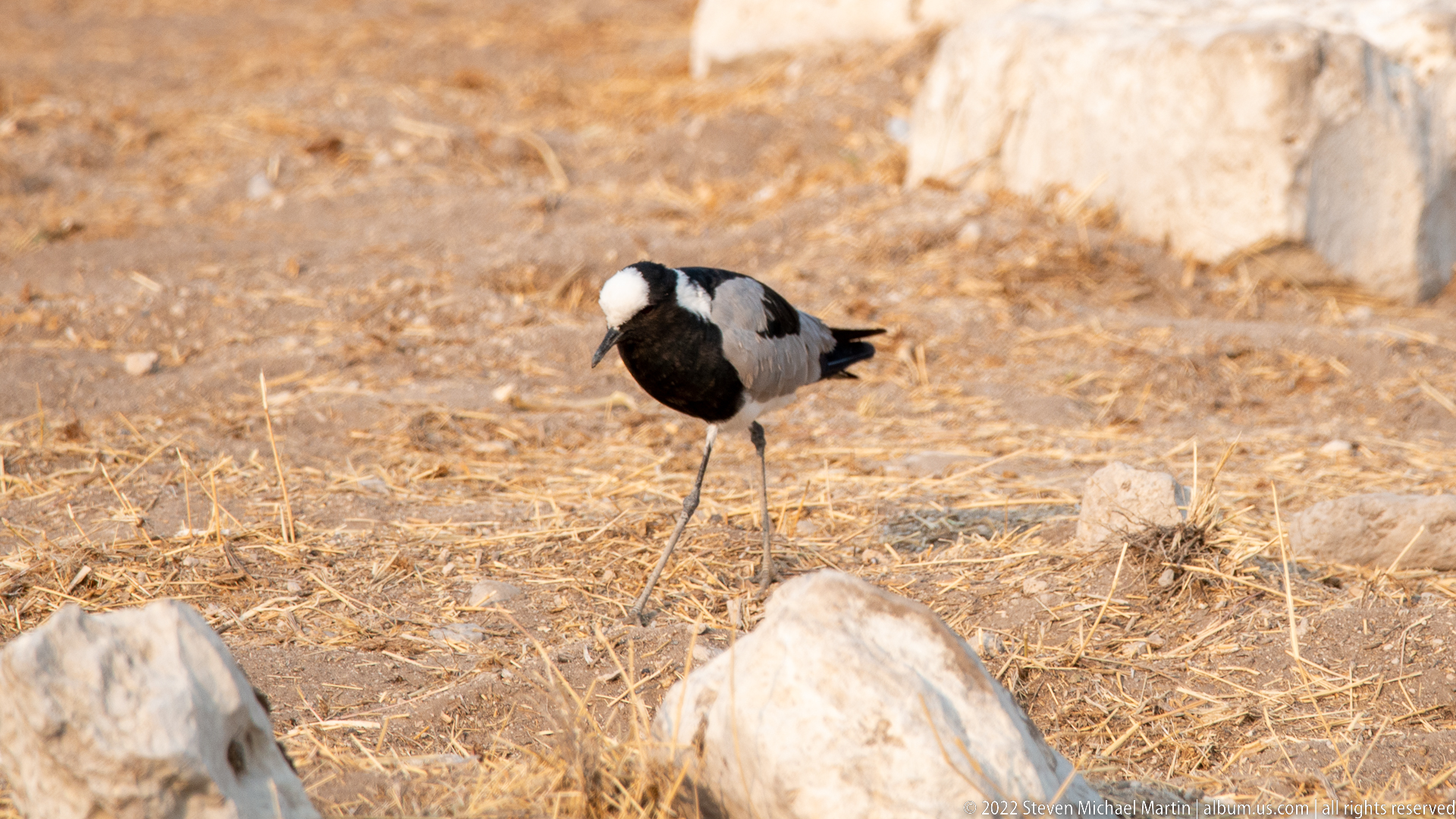
A blacksmith lapwing stands on long legs among pale stones and dry ground, its bold black, white, and gray plumage forming a crisp pattern against the earth tones. The frontal three-quarter view shows the white crown and face patches, black breast, and contrasting pale wings characteristic of this southern African wader.
Caption
A blacksmith lapwing stands on long legs among pale stones and dry ground, its bold black, white, and gray plumage forming a crisp pattern against the earth tones. The frontal three-quarter view shows the white crown and face patches, black breast, and contrasting pale wings characteristic of this southern African wader.
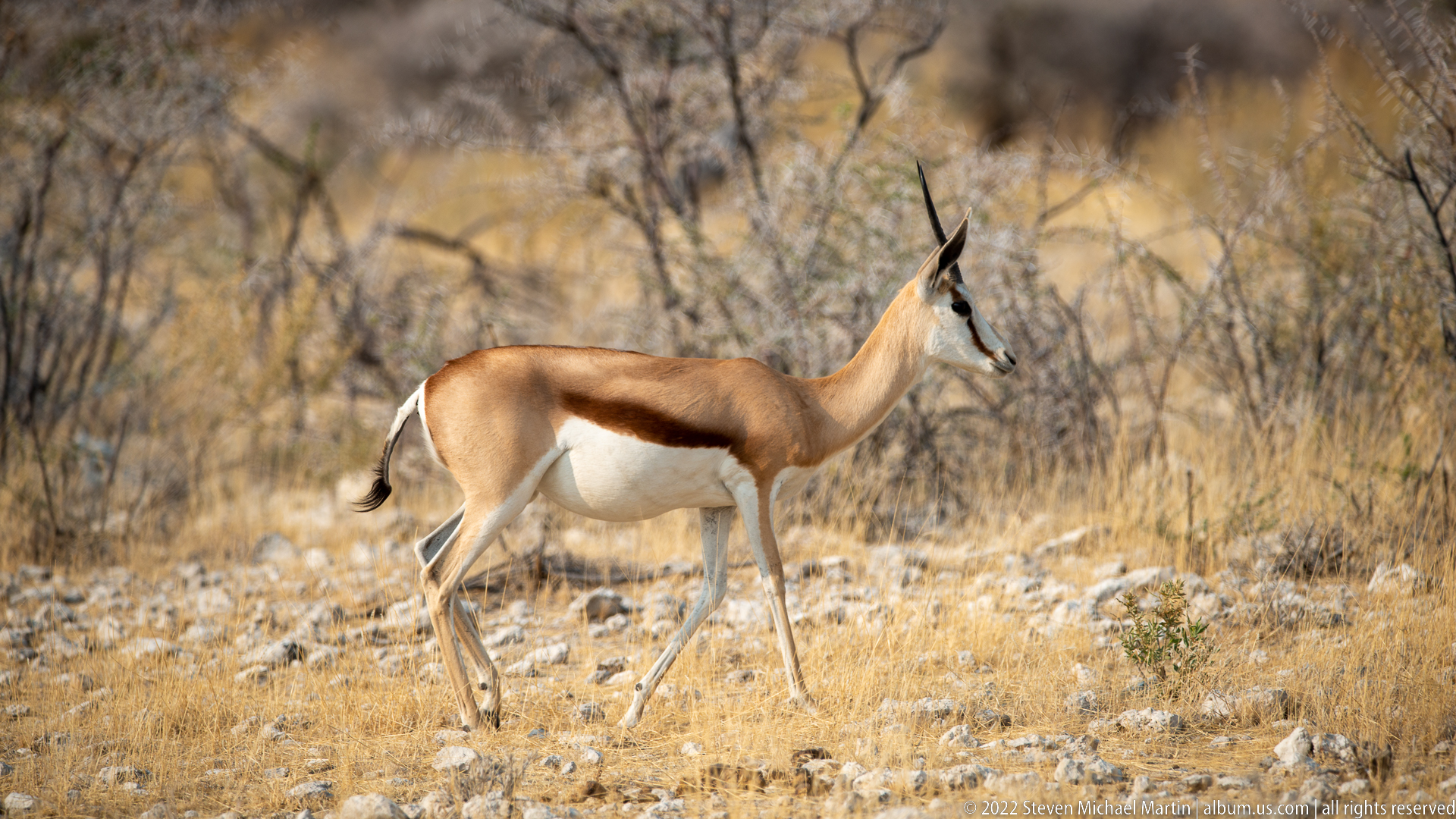
A springbok walks through dry thorn scrub on stony ground, shown in profile with its dark facial stripe, white underparts, and rich brown flank band clearly visible. The slender legs and lyre-shaped horns stand out against the tangled vegetation, placing the antelope within the harsher, brushier edge of the Etosha landscape.
Caption
A springbok walks through dry thorn scrub on stony ground, shown in profile with its dark facial stripe, white underparts, and rich brown flank band clearly visible. The slender legs and lyre-shaped horns stand out against the tangled vegetation, placing the antelope within the harsher, brushier edge of the Etosha landscape.
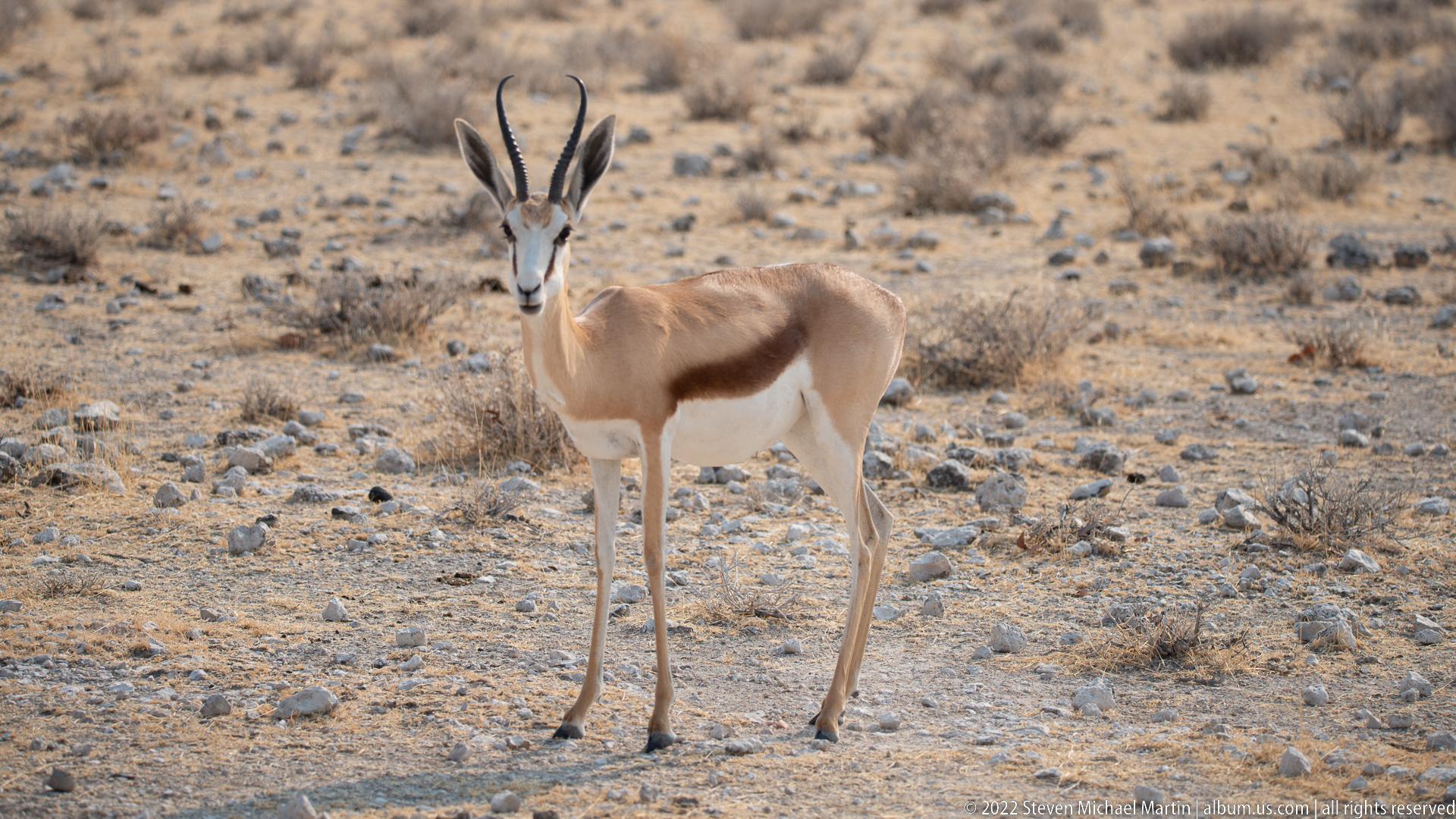
A springbok pauses on pale rocky ground and faces the camera at a slight angle, ears upright and horns rising in a symmetrical curve. Its white face, dark eye stripe, cinnamon-brown sides, and clean white underparts are clearly separated in the open light, producing a direct alert portrait.
Caption
A springbok pauses on pale rocky ground and faces the camera at a slight angle, ears upright and horns rising in a symmetrical curve. Its white face, dark eye stripe, cinnamon-brown sides, and clean white underparts are clearly separated in the open light, producing a direct alert portrait.
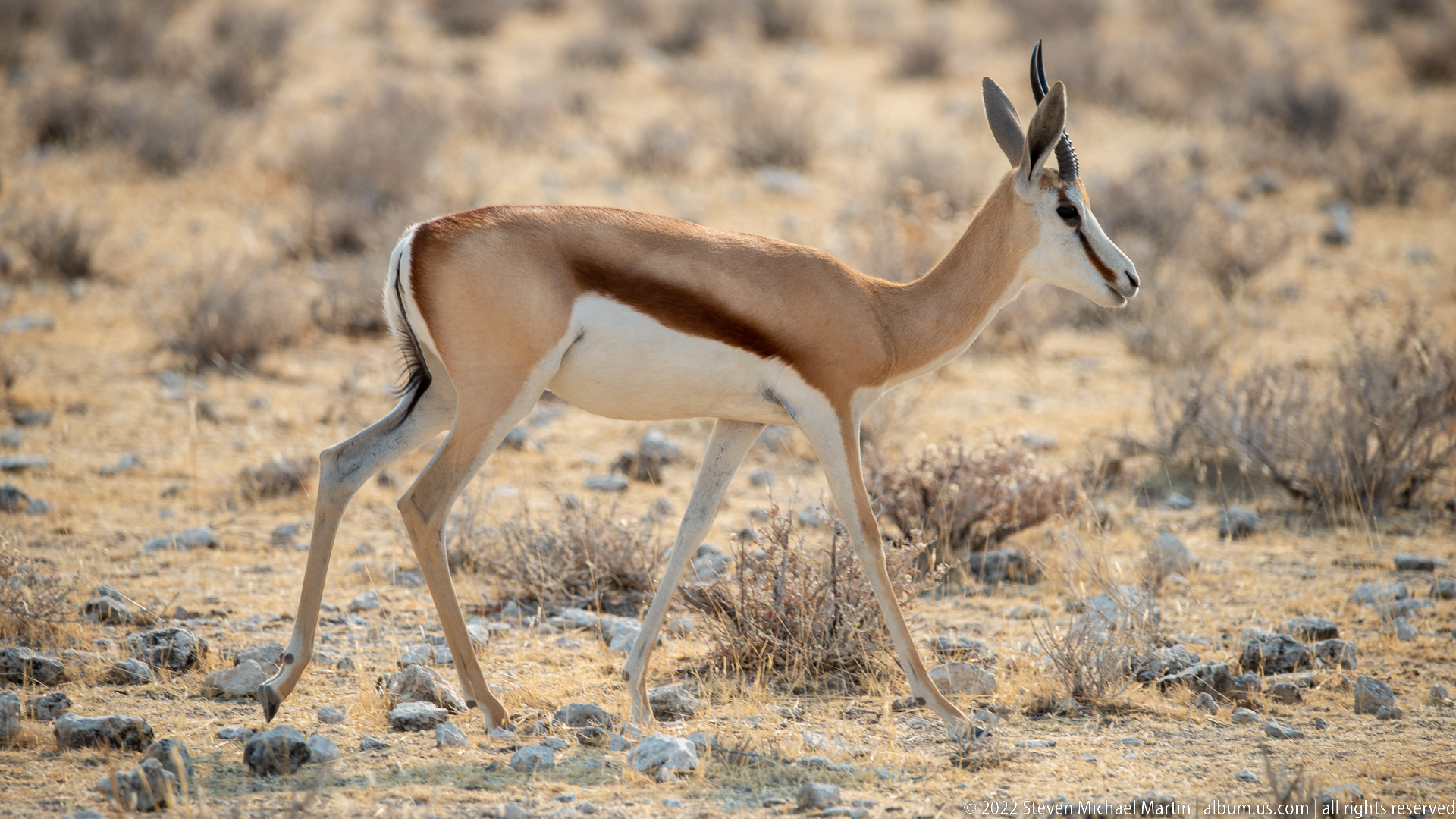
A springbok strides across open stony savanna, its body extended in a clean side profile that emphasizes the species’ light build and long legs. The dark facial stripe and sharply divided brown-and-white coat remain visible, while the sparse background isolates the animal more strongly than the brush-framed view earlier on the page.
Caption
A springbok strides across open stony savanna, its body extended in a clean side profile that emphasizes the species’ light build and long legs. The dark facial stripe and sharply divided brown-and-white coat remain visible, while the sparse background isolates the animal more strongly than the brush-framed view earlier on the page.
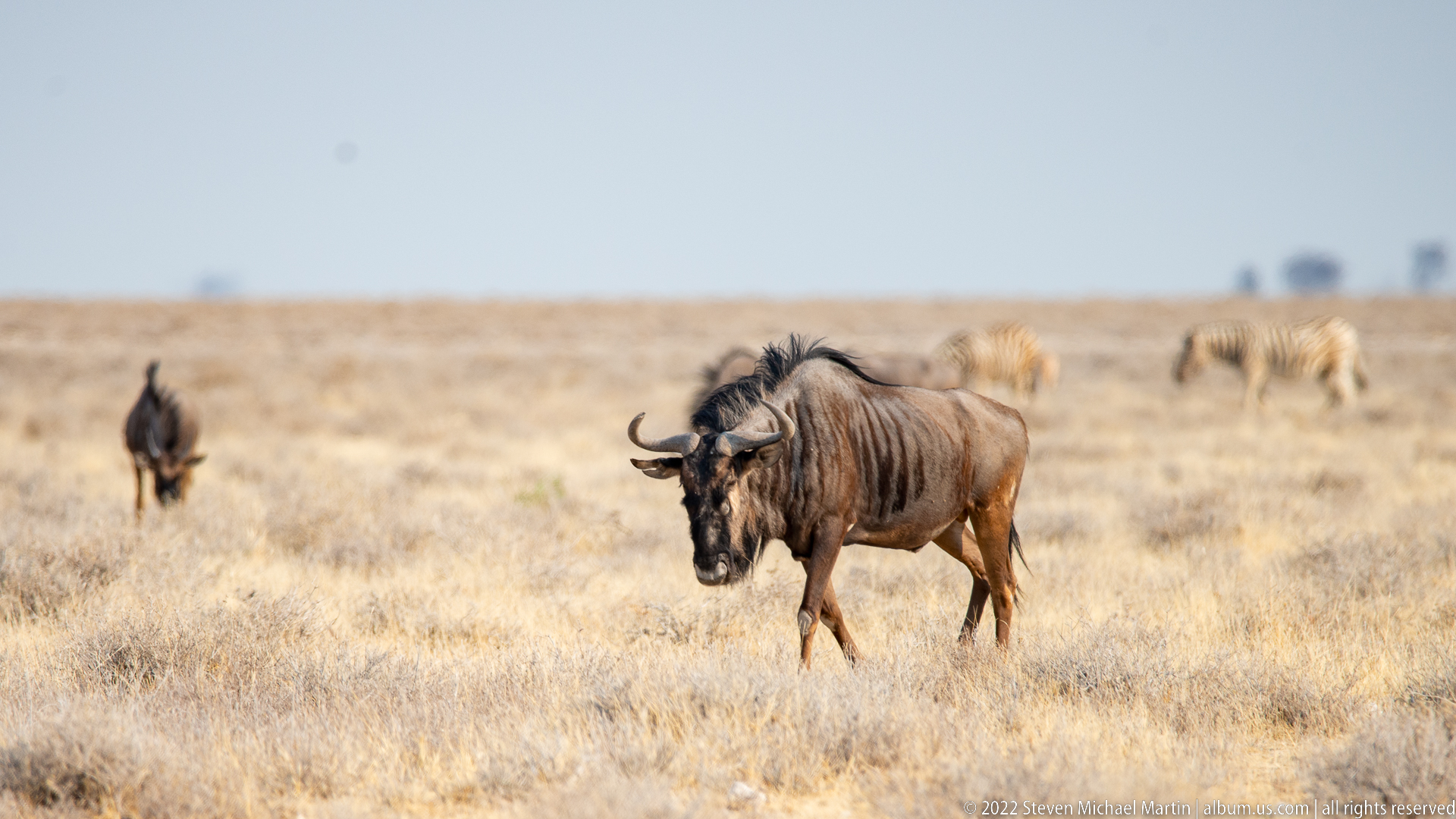
A blue wildebeest walks through pale Etosha grassland while zebras graze in the softly focused background. The wildebeest’s heavy shoulders, dark mane, curved horns, and vertical rib shading are clear, and the mixed-species setting adds depth to this dry-season view of animals sharing open grazing country.
Caption
A blue wildebeest walks through pale Etosha grassland while zebras graze in the softly focused background. The wildebeest’s heavy shoulders, dark mane, curved horns, and vertical rib shading are clear, and the mixed-species setting adds depth to this dry-season view of animals sharing open grazing country.
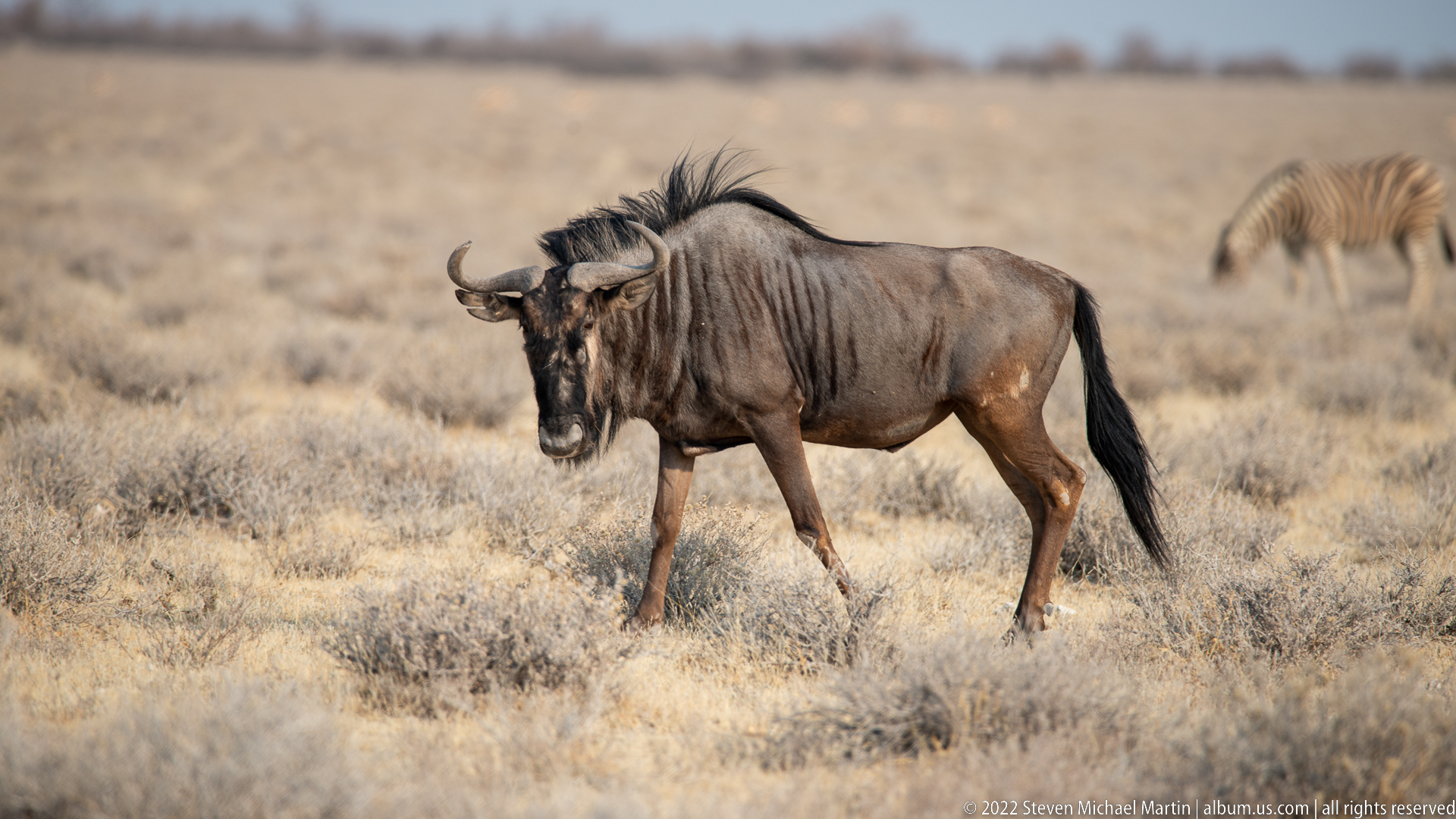
An adult blue wildebeest crosses low gray scrub in a strong side profile, with the dark mane, beard, curved horns, and sloping back sharply defined. Warm light picks out the brown-gray coat and vertical striping along the shoulders, while a zebra in the distant background provides a subtle sense of the wider grazing assemblage.
Caption
An adult blue wildebeest crosses low gray scrub in a strong side profile, with the dark mane, beard, curved horns, and sloping back sharply defined. Warm light picks out the brown-gray coat and vertical striping along the shoulders, while a zebra in the distant background provides a subtle sense of the wider grazing assemblage.
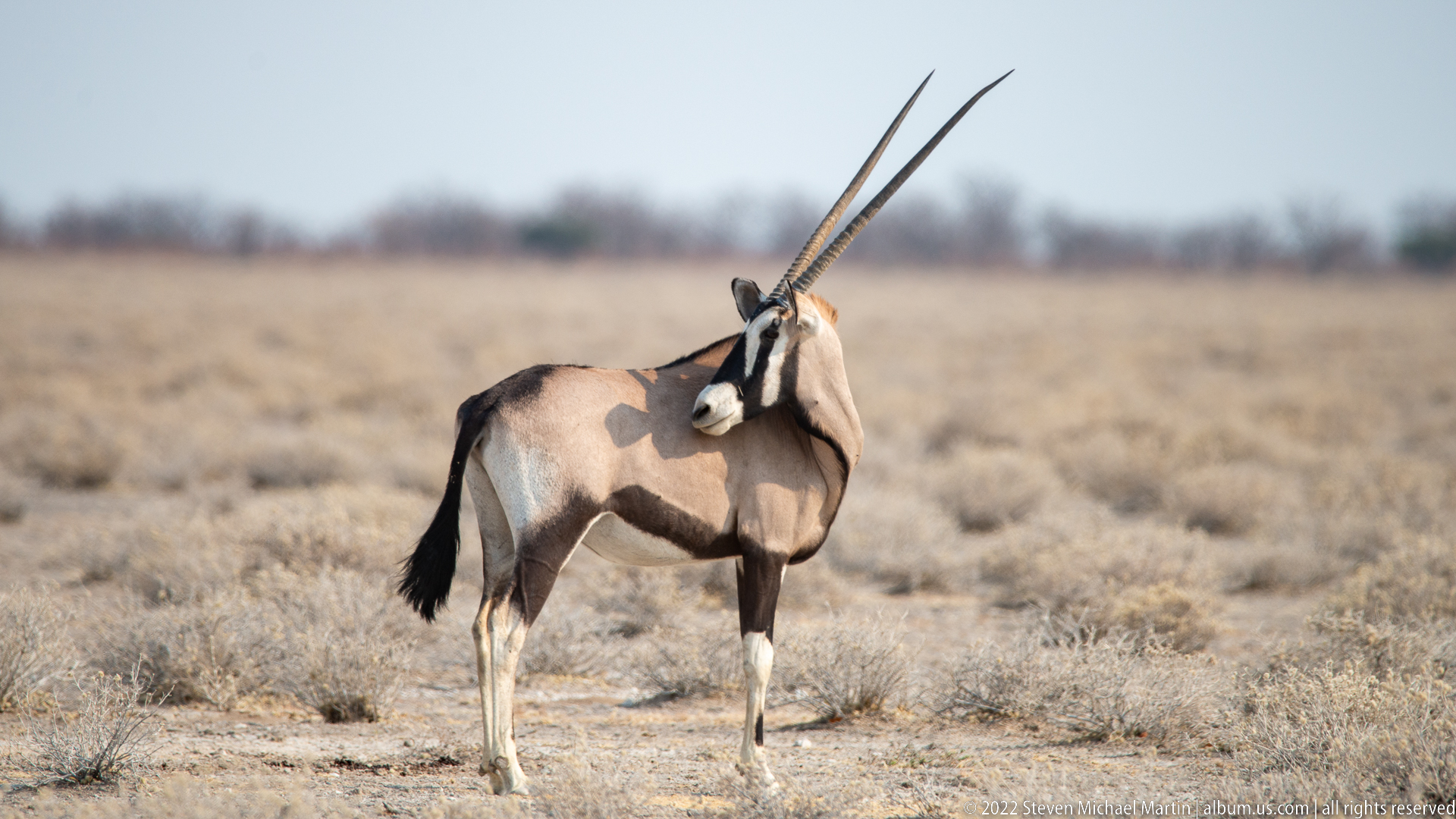
A gemsbok stands nearly still in open dry grassland, turning its head to present the long parallel horns and striking black facial mask at a three-quarter angle. The broad shoulder markings, pale body, and black tail are clearly visible, creating a more formal portrait than the walking view that precedes it.
Caption
A gemsbok stands nearly still in open dry grassland, turning its head to present the long parallel horns and striking black facial mask at a three-quarter angle. The broad shoulder markings, pale body, and black tail are clearly visible, creating a more formal portrait than the walking view that precedes it.
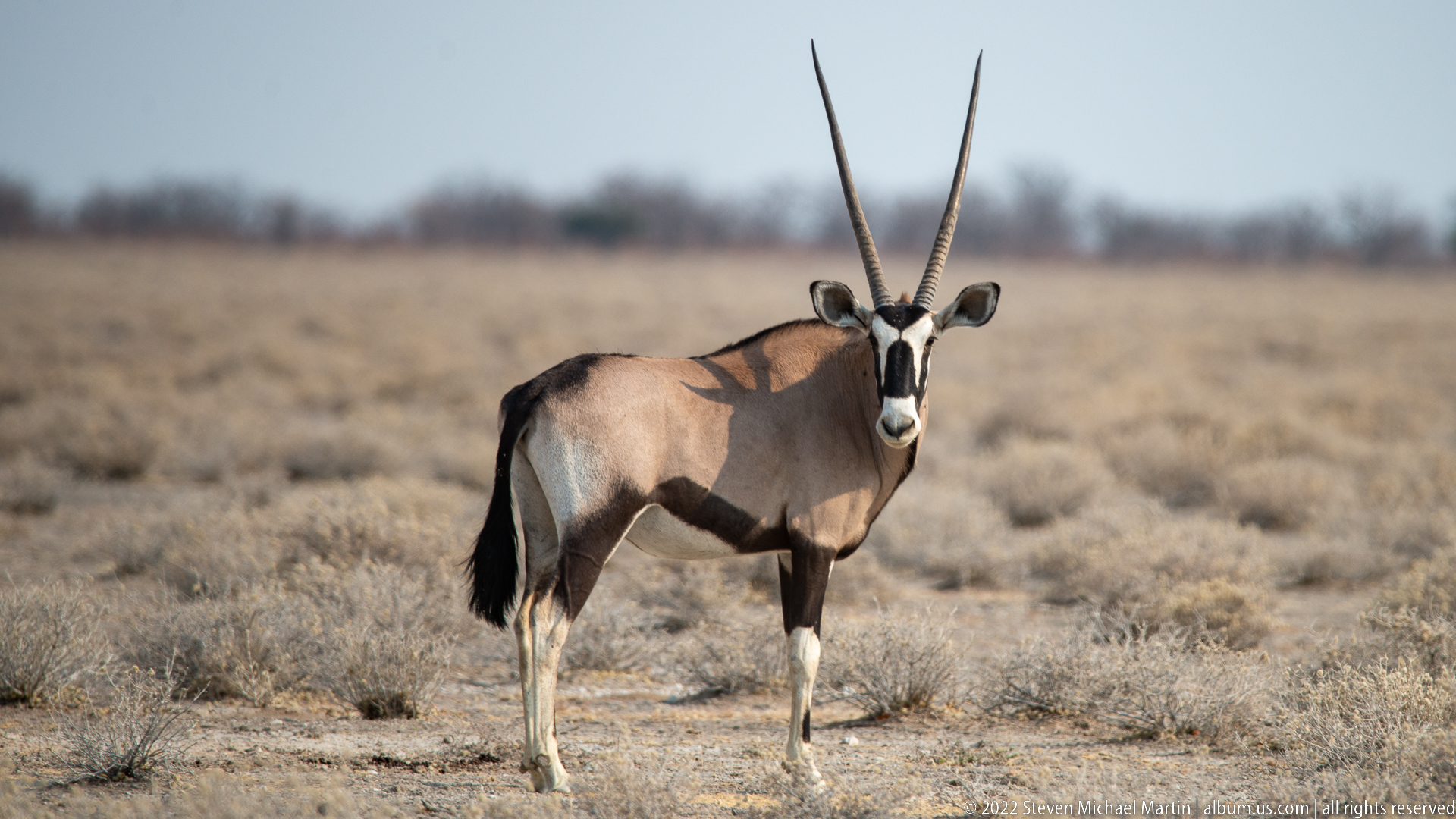
A gemsbok faces the camera almost directly, its long spear-like horns forming two near-vertical lines above the head. The symmetrical black-and-white facial mask, dark chest markings, and pale gray-brown coat are especially prominent in this frontal stance, while the softly blurred Etosha plain keeps attention on the animal’s distinctive geometry.
Caption
A gemsbok faces the camera almost directly, its long spear-like horns forming two near-vertical lines above the head. The symmetrical black-and-white facial mask, dark chest markings, and pale gray-brown coat are especially prominent in this frontal stance, while the softly blurred Etosha plain keeps attention on the animal’s distinctive geometry.
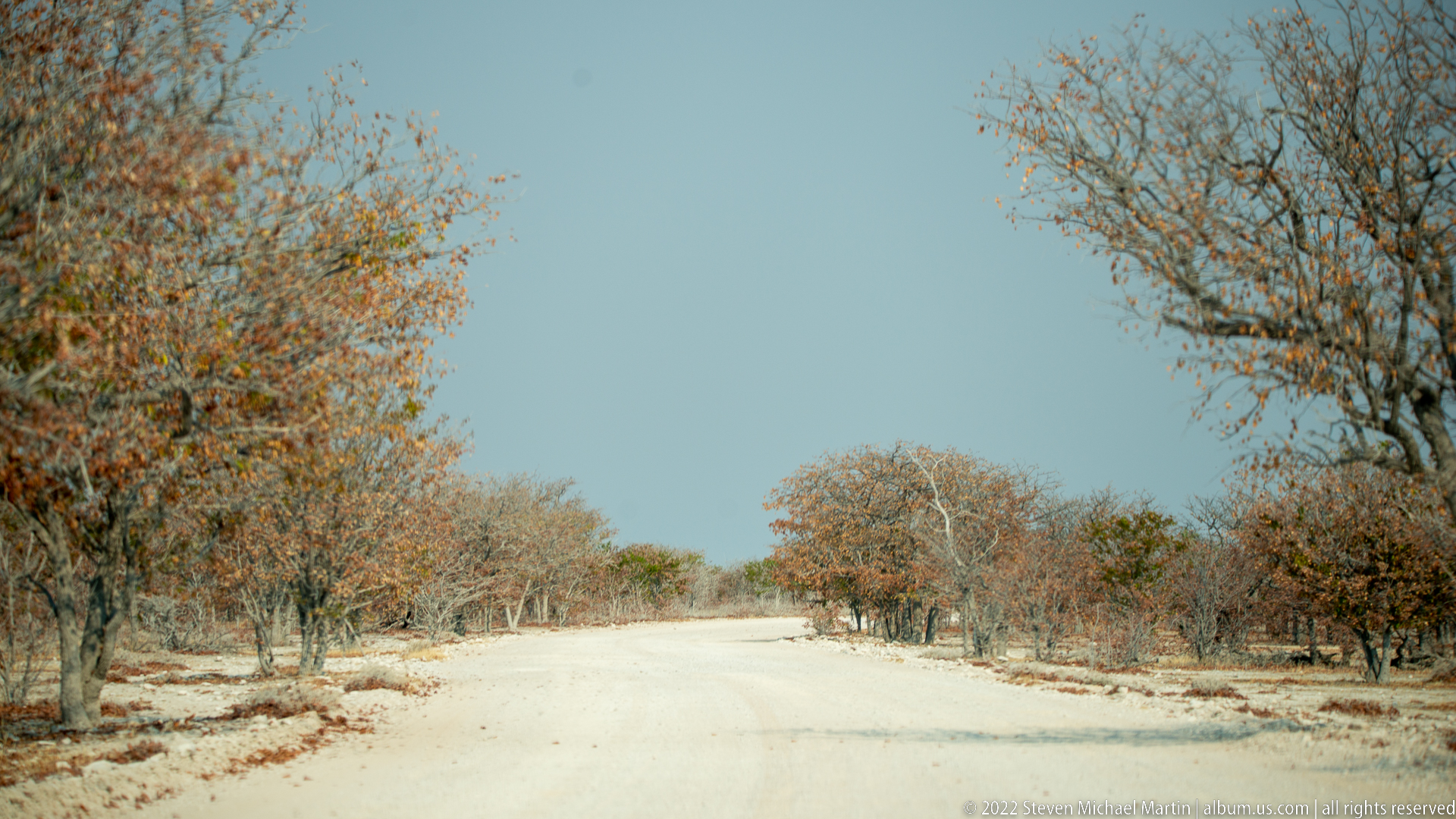
A pale gravel road leads through dry woodland beneath a saturated blue sky, with mature trees arching in from both sides and sparse foliage catching warm light. Compared with the stark pan roads earlier in the sequence, this view is more enclosed, marking a transition back into wooded habitat along the Etosha route.
Caption
A pale gravel road leads through dry woodland beneath a saturated blue sky, with mature trees arching in from both sides and sparse foliage catching warm light. Compared with the stark pan roads earlier in the sequence, this view is more enclosed, marking a transition back into wooded habitat along the Etosha route.
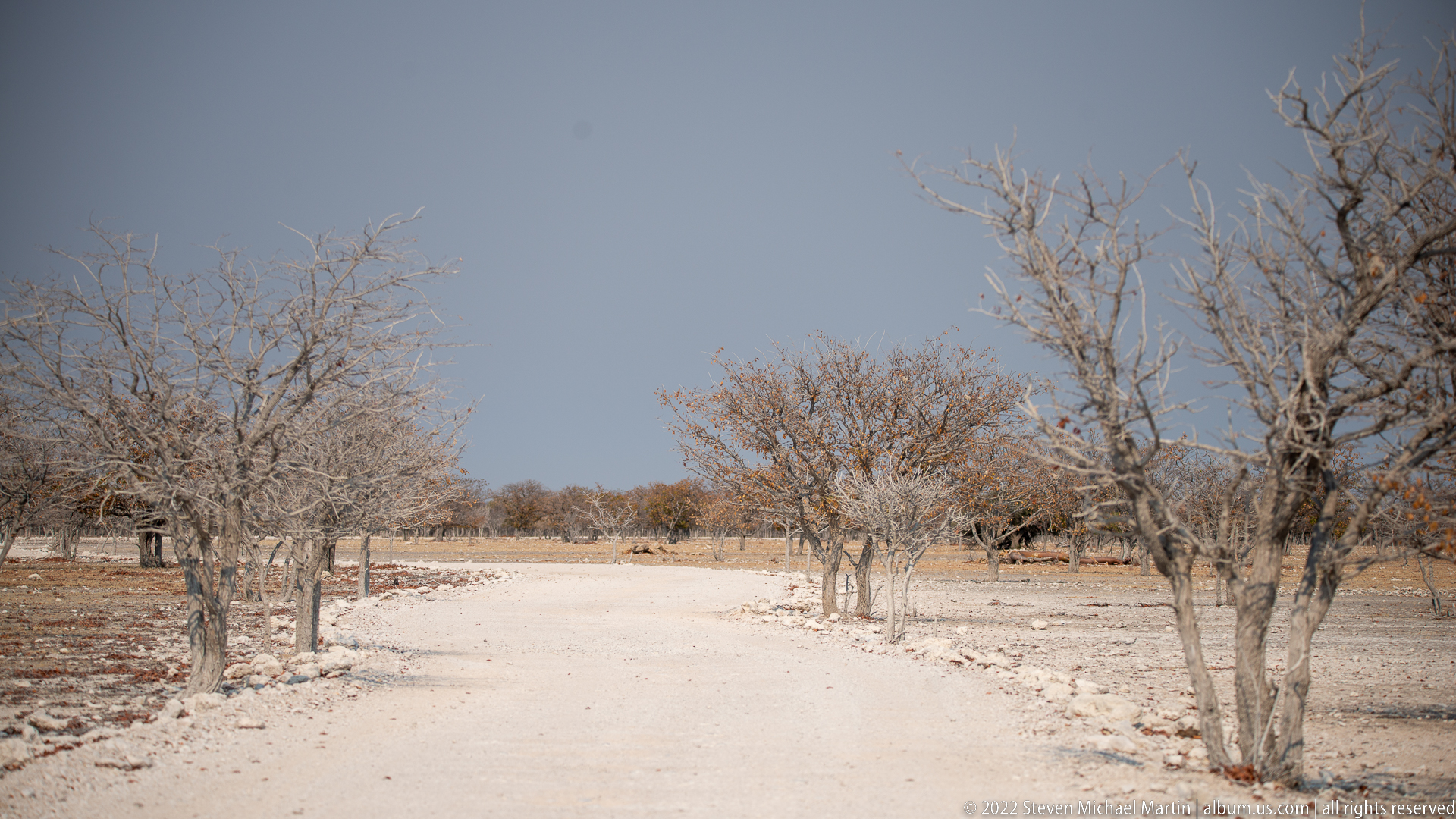
A pale gravel road runs straight through sparse, leafless woodland near Etosha Pan, its chalky surface bordered by low posts and dry, open ground. The view records the transition between wooded margins and the stark, arid landscapes associated with the pan, with the road itself providing a strong central line into the distance.
Caption
A pale gravel road runs straight through sparse, leafless woodland near Etosha Pan, its chalky surface bordered by low posts and dry, open ground. The view records the transition between wooded margins and the stark, arid landscapes associated with the pan, with the road itself providing a strong central line into the distance.
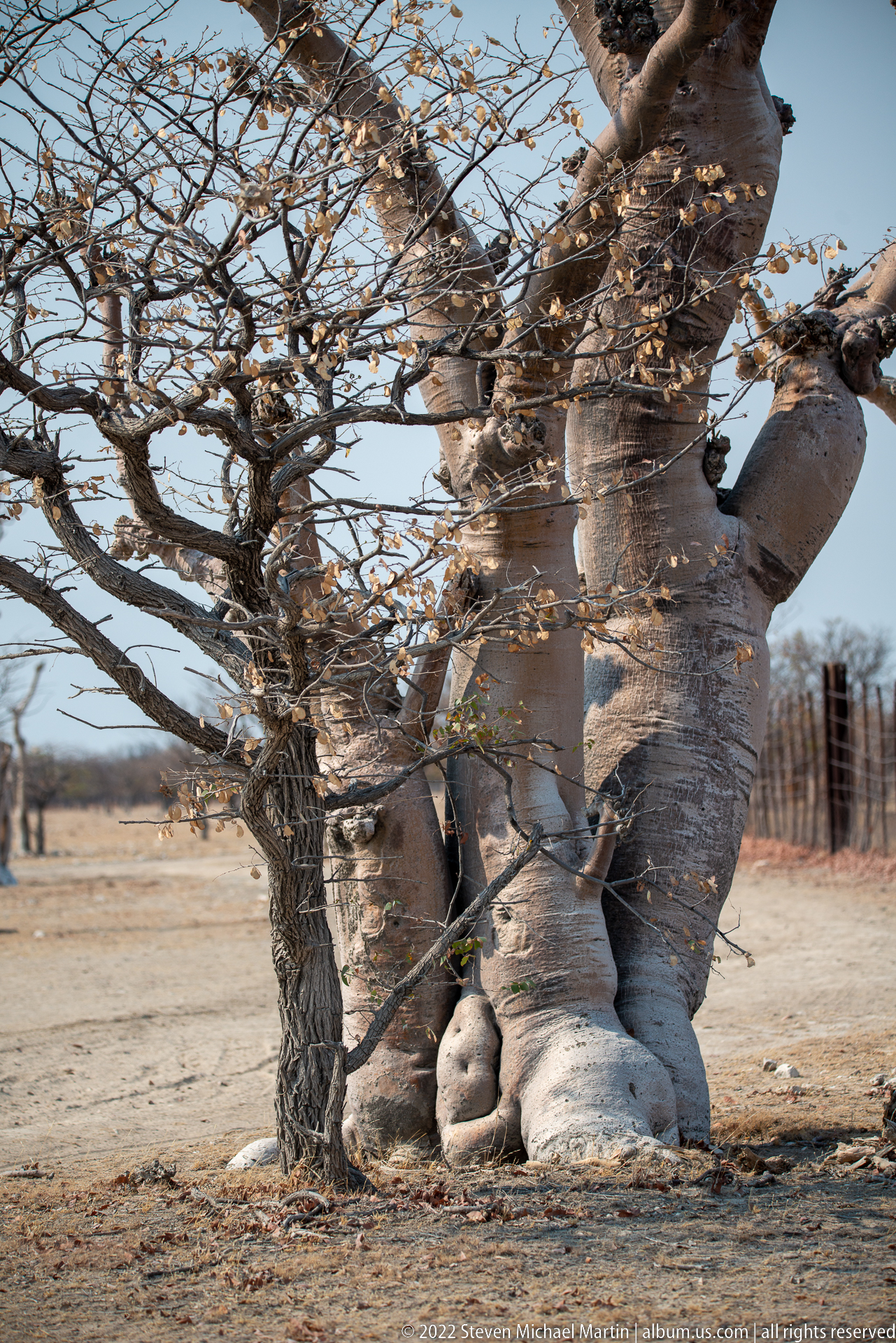
A massive baobab dominates the frame, its swollen, smooth-barked trunk dividing into heavy limbs above the dry ground. Fine twig growth and a scattering of leaves contrast with the sculptural bulk of the trunk, making this a close contextual study of one of the most distinctive tree forms in Namibia’s arid landscapes.
Caption
A massive baobab dominates the frame, its swollen, smooth-barked trunk dividing into heavy limbs above the dry ground. Fine twig growth and a scattering of leaves contrast with the sculptural bulk of the trunk, making this a close contextual study of one of the most distinctive tree forms in Namibia’s arid landscapes.
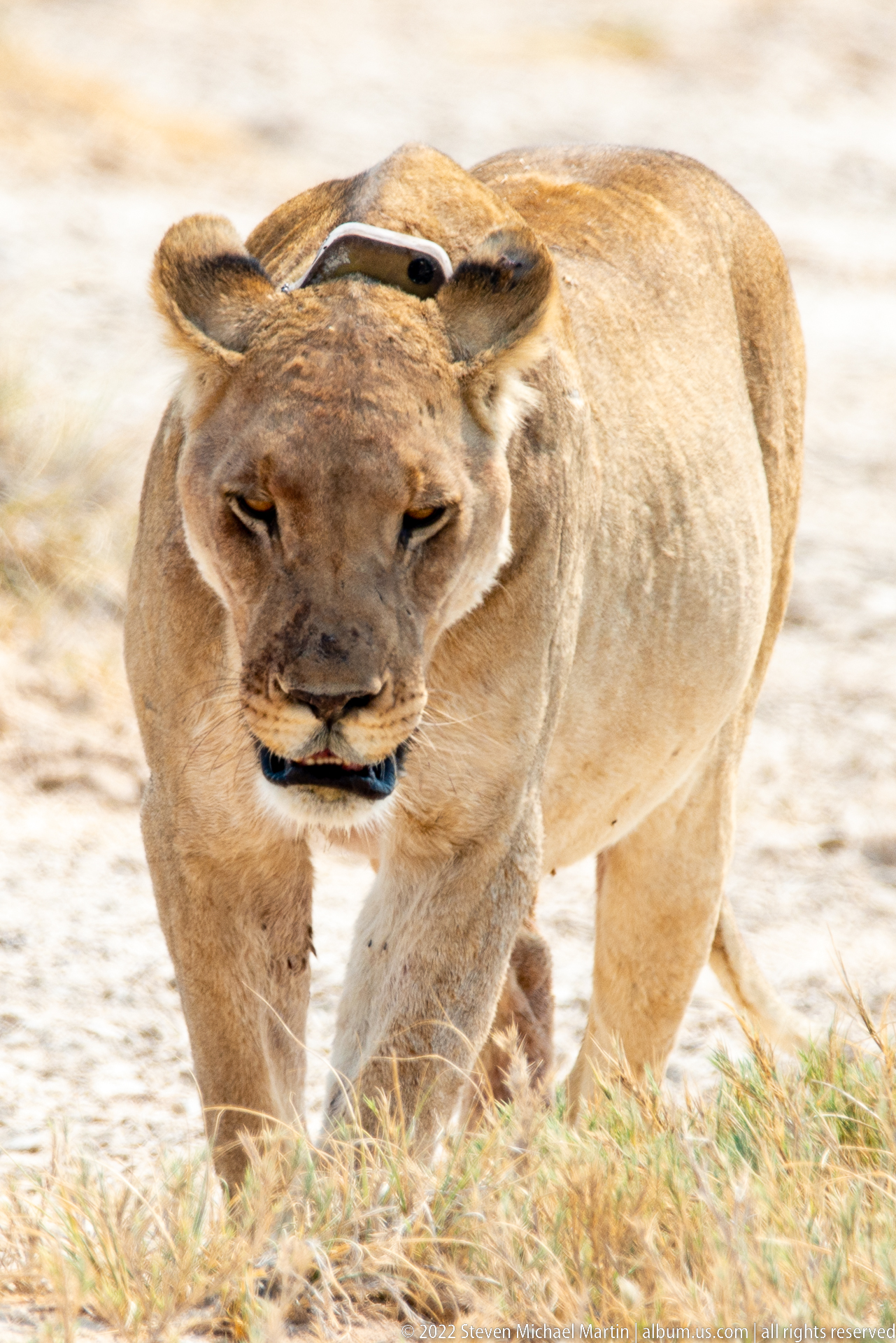
A tight frontal view isolates the lioness’s head, shoulders, and forequarters as she advances through the Etosha landscape. Her narrowed eyes, dark muzzle, and powerful forelimbs fill the frame, while a small bird remains perched along her back. Shallow depth of field turns the pale ground behind into a soft backdrop.
Caption
A tight frontal view isolates the lioness’s head, shoulders, and forequarters as she advances through the Etosha landscape. Her narrowed eyes, dark muzzle, and powerful forelimbs fill the frame, while a small bird remains perched along her back. Shallow depth of field turns the pale ground behind into a soft backdrop.

A smartphone screenshot shows a Google Maps view centered on Etosha National Park in northern Namibia, with the broad blue-gray Etosha Pan dominating the map. Labels for nearby settlements and roads provide geographic orientation, making this a documentary location reference rather than a field photograph of the landscape itself.
Caption
A smartphone screenshot shows a Google Maps view centered on Etosha National Park in northern Namibia, with the broad blue-gray Etosha Pan dominating the map. Labels for nearby settlements and roads provide geographic orientation, making this a documentary location reference rather than a field photograph of the landscape itself.
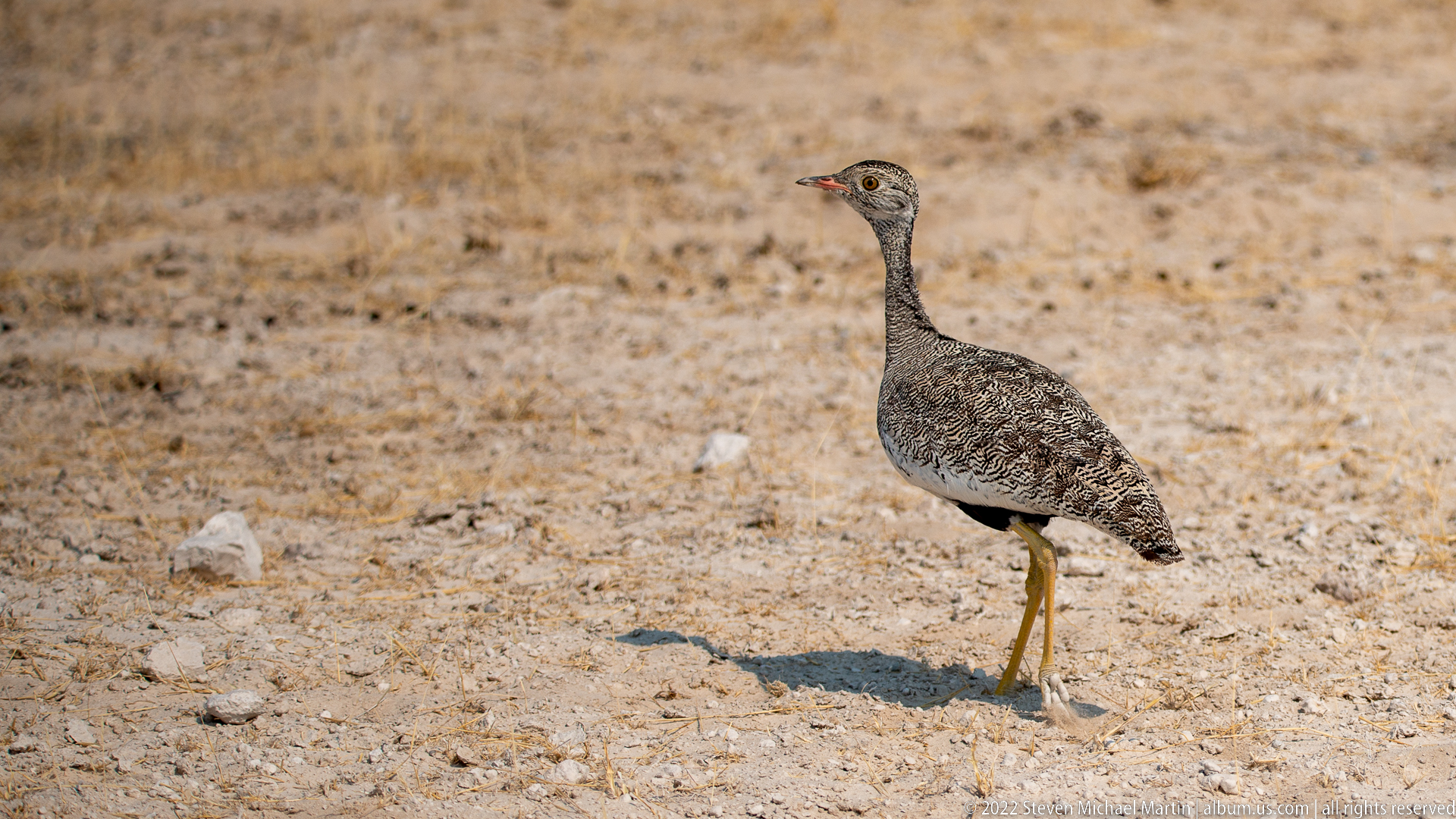
A long-legged korhaan stands alert on stony, ocher-colored ground, its finely patterned gray-brown plumage blending closely with the dry Etosha landscape. The upright neck, compact body, and strong yellow legs are clearly visible, while the uncluttered setting emphasizes the bird’s adaptation to open, sparsely vegetated country.
Caption
A long-legged korhaan stands alert on stony, ocher-colored ground, its finely patterned gray-brown plumage blending closely with the dry Etosha landscape. The upright neck, compact body, and strong yellow legs are clearly visible, while the uncluttered setting emphasizes the bird’s adaptation to open, sparsely vegetated country.
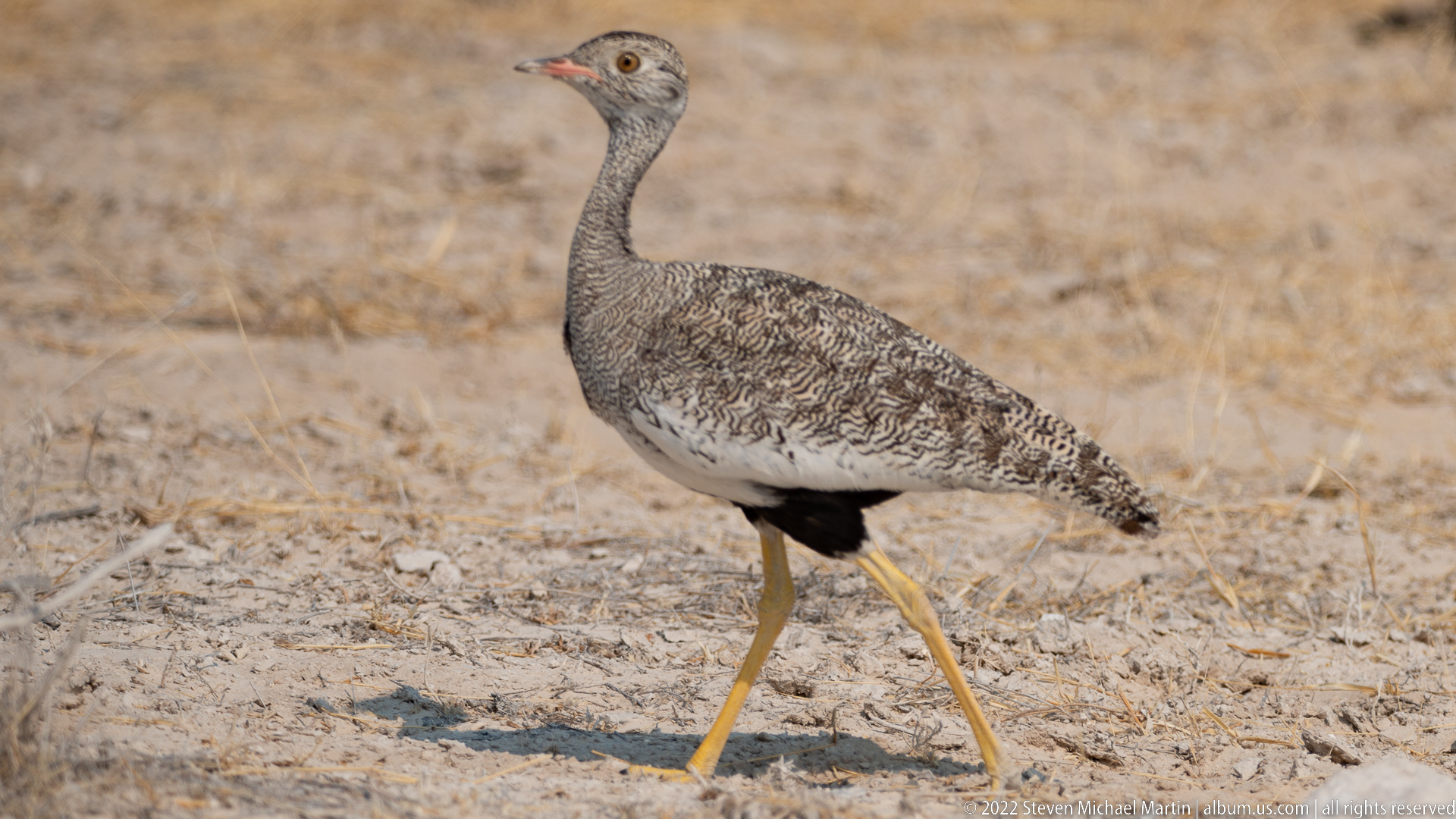
Seen in profile, a korhaan strides across pale, dry ground with its neck extended and one yellow leg lifted. Fine barred and mottled plumage covers the body, while the pale throat and small reddish bill stand out against the muted grassland. The closer view records body pattern and walking posture more clearly than the preceding frame.
Caption
Seen in profile, a korhaan strides across pale, dry ground with its neck extended and one yellow leg lifted. Fine barred and mottled plumage covers the body, while the pale throat and small reddish bill stand out against the muted grassland. The closer view records body pattern and walking posture more clearly than the preceding frame.
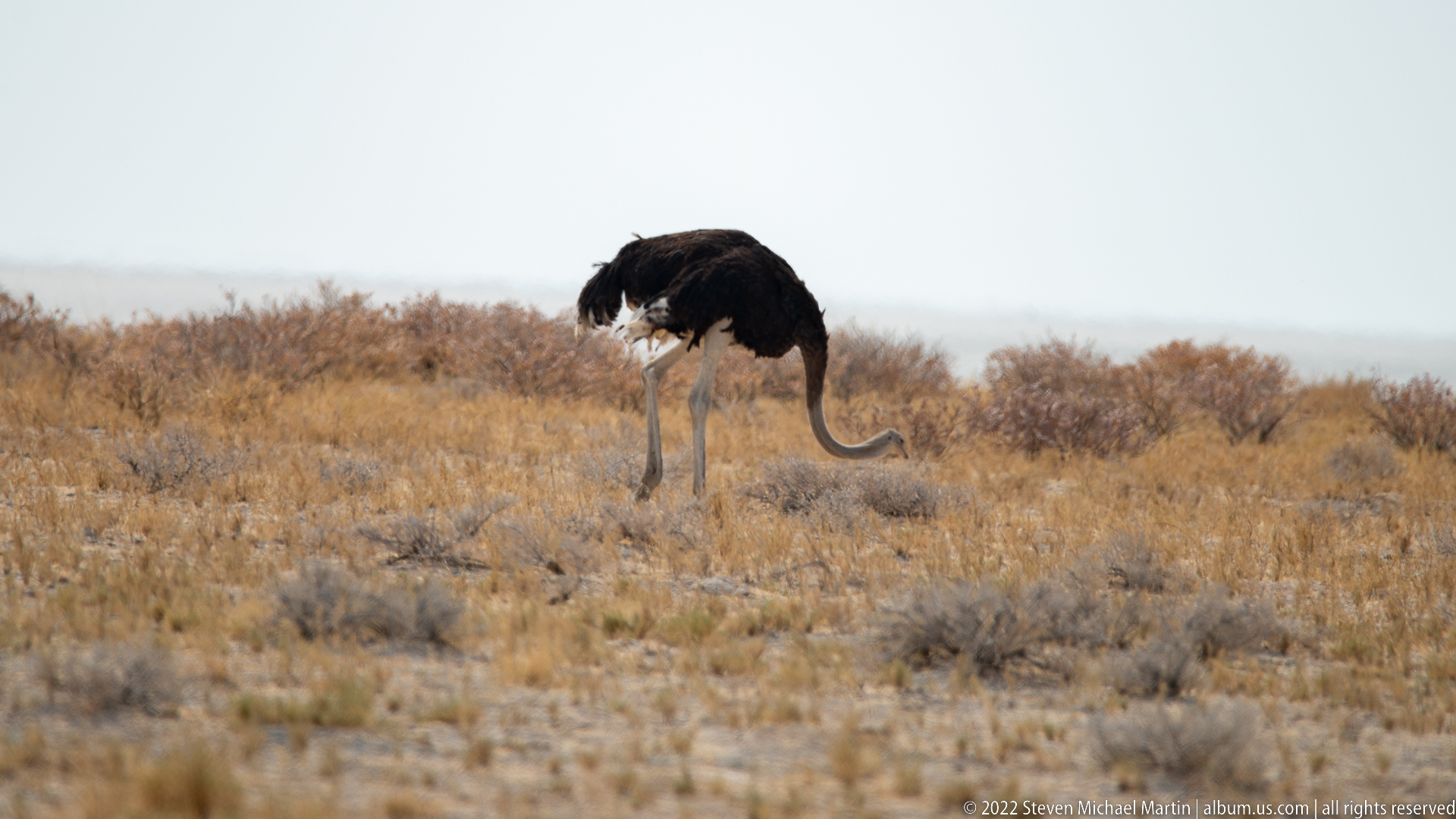
A common ostrich bends its long neck toward the ground while foraging among low shrubs and dry grass. The black body plumage and pale legs identify an adult male, while the lowered feeding posture creates a compact silhouette against the open Etosha terrain rather than the familiar upright stance of the species.
Caption
A common ostrich bends its long neck toward the ground while foraging among low shrubs and dry grass. The black body plumage and pale legs identify an adult male, while the lowered feeding posture creates a compact silhouette against the open Etosha terrain rather than the familiar upright stance of the species.
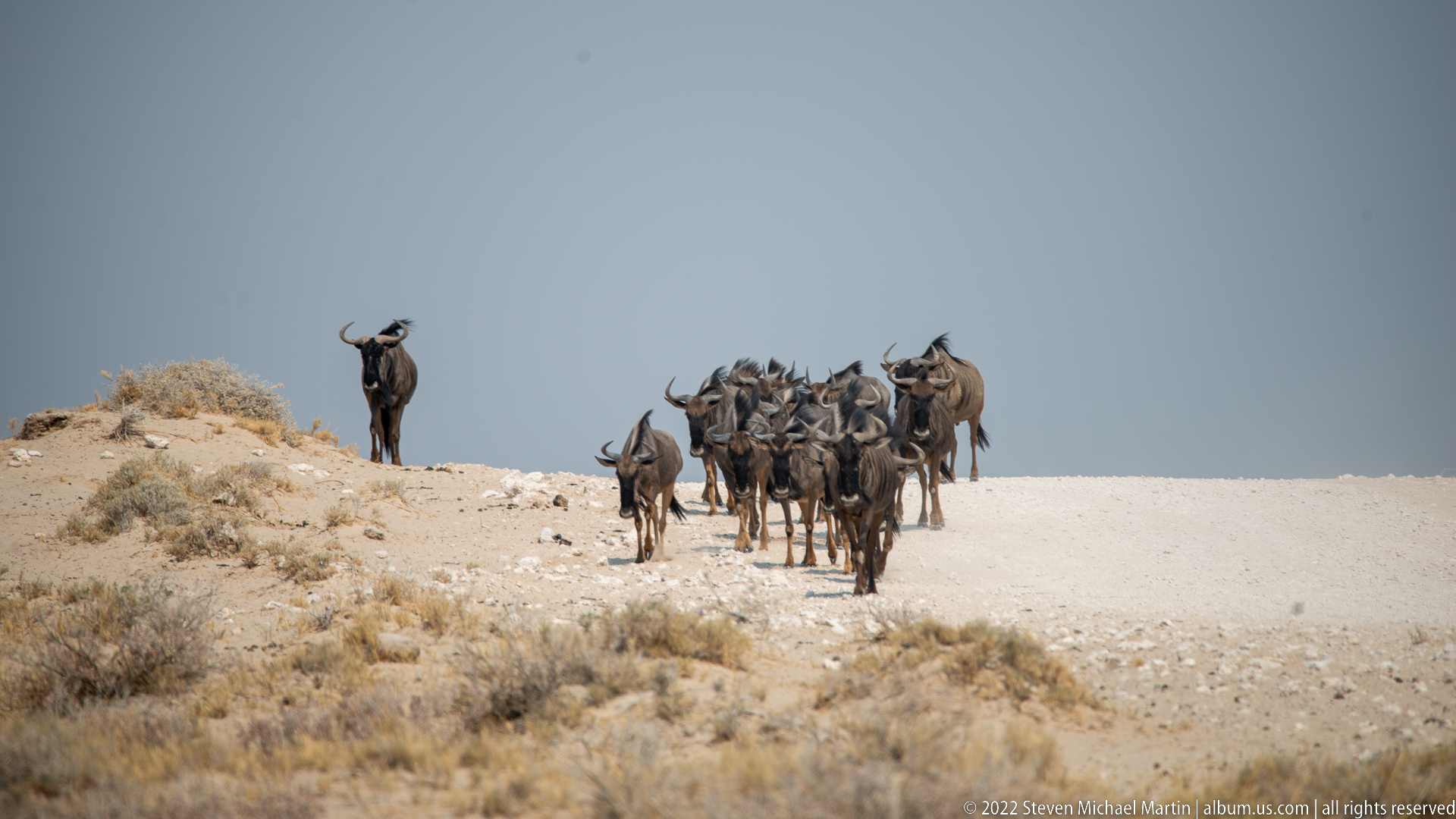
A small herd of blue wildebeest advances toward the camera along a bright, nearly white track at the edge of the Etosha landscape. Several animals cluster tightly in the center while others stand apart, their dark faces, curved horns, and sloping backs silhouetted against the pale ground and deep blue-gray sky.
Caption
A small herd of blue wildebeest advances toward the camera along a bright, nearly white track at the edge of the Etosha landscape. Several animals cluster tightly in the center while others stand apart, their dark faces, curved horns, and sloping backs silhouetted against the pale ground and deep blue-gray sky.
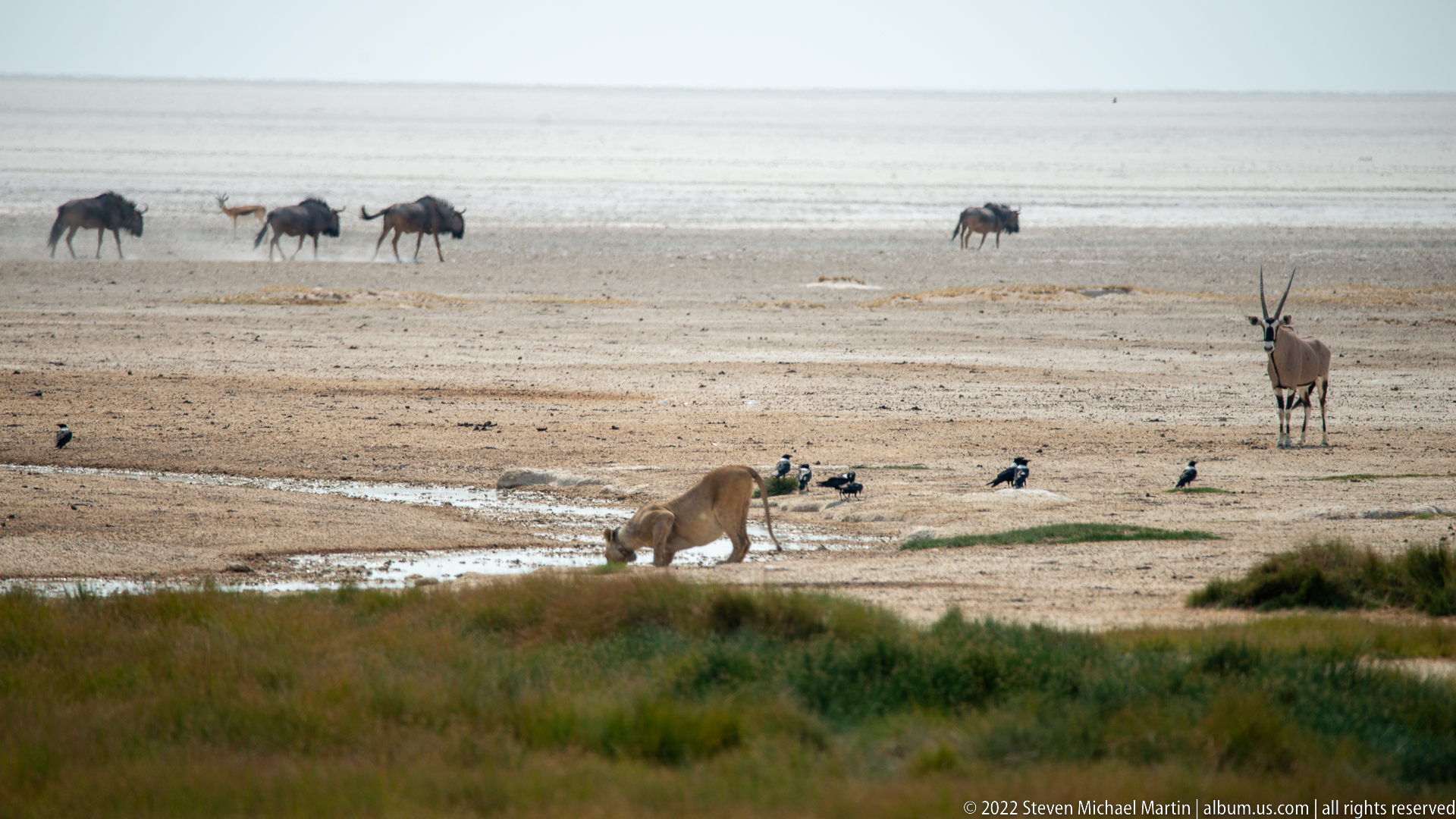
A lioness lowers her head near a wet patch on the pan while other wildlife remains dispersed across the open flats. Blue wildebeest cross the background, a gemsbok stands to the right, and several birds gather near the water, creating a layered view of predator and prey sharing the broad Etosha Pan margin.
Caption
A lioness lowers her head near a wet patch on the pan while other wildlife remains dispersed across the open flats. Blue wildebeest cross the background, a gemsbok stands to the right, and several birds gather near the water, creating a layered view of predator and prey sharing the broad Etosha Pan margin.
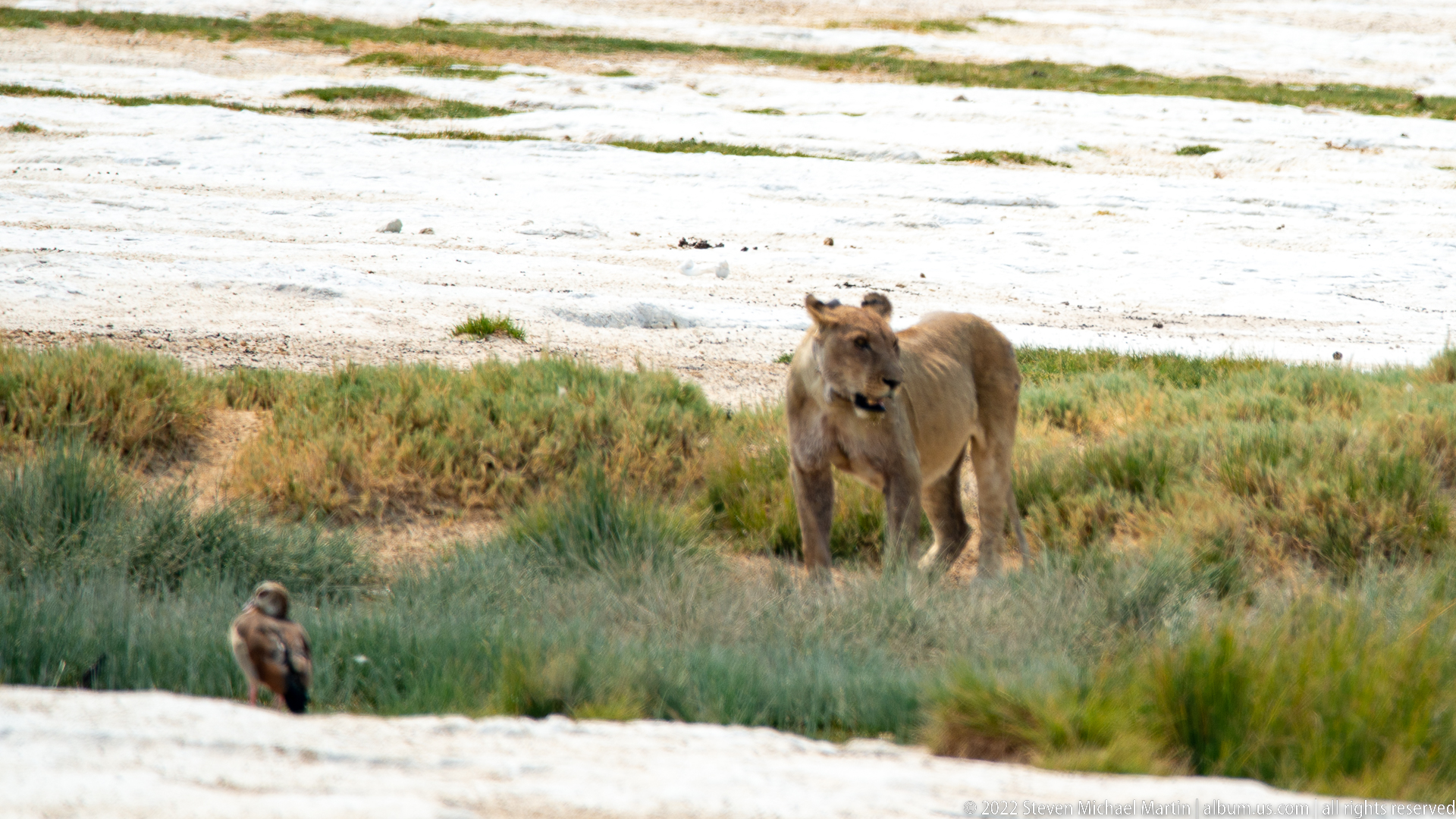
A lioness faces the camera while moving through low green vegetation at the edge of the salt pan. Her direct gaze and forward posture dominate the composition, with a small bird in the foreground and broad white mineral flats behind. The frame emphasizes the contrast between tawny coat, green margin vegetation, and the pan’s bright surface.
Caption
A lioness faces the camera while moving through low green vegetation at the edge of the salt pan. Her direct gaze and forward posture dominate the composition, with a small bird in the foreground and broad white mineral flats behind. The frame emphasizes the contrast between tawny coat, green margin vegetation, and the pan’s bright surface.
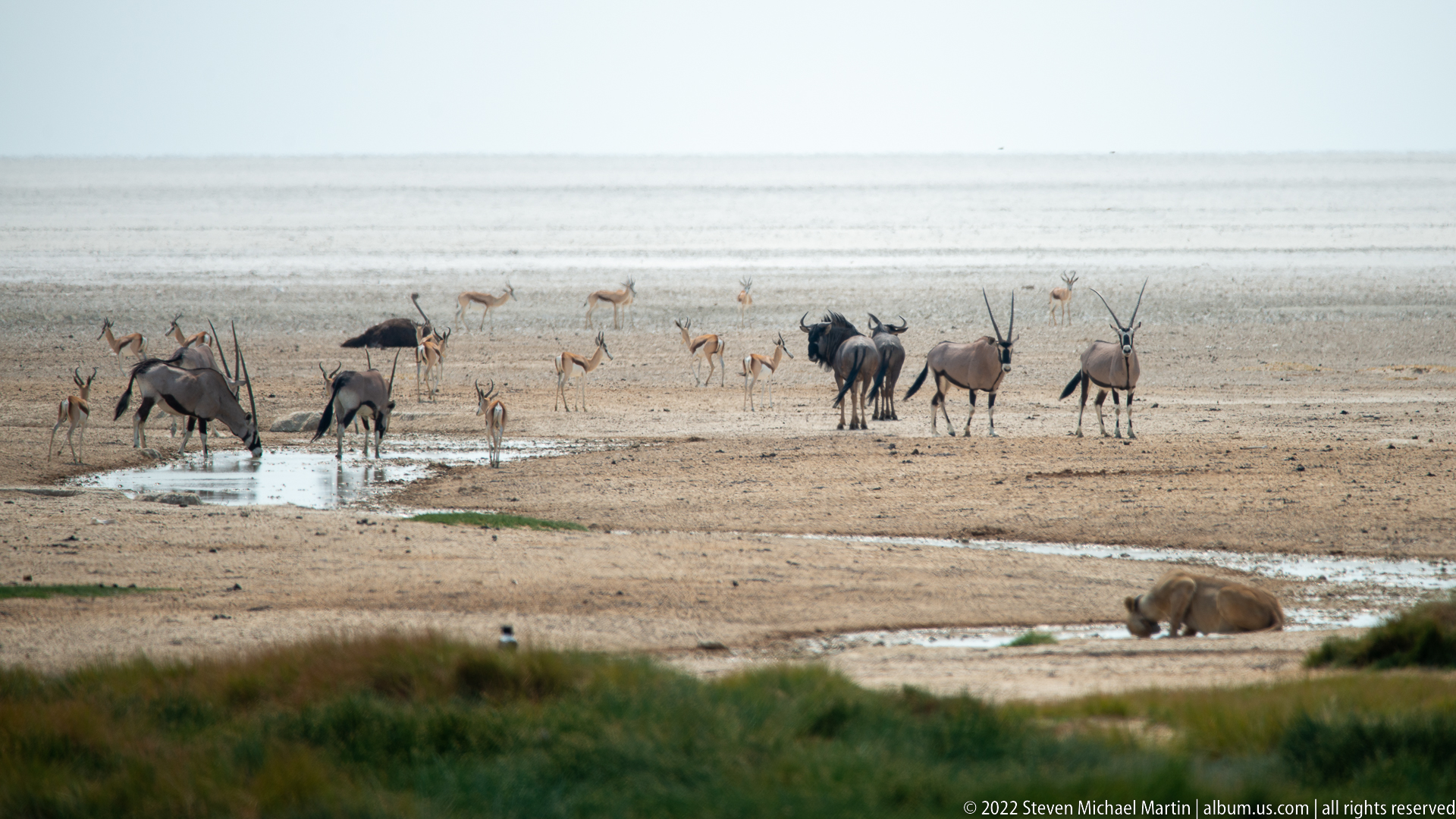
Gemsbok, blue wildebeest, and numerous springbok gather around a shallow wet area on the open pan, while a lioness lies at the lower right edge of the scene. The wide composition shows the spacing and vigilance of several herbivore species sharing limited water in the exposed Etosha landscape.
Caption
Gemsbok, blue wildebeest, and numerous springbok gather around a shallow wet area on the open pan, while a lioness lies at the lower right edge of the scene. The wide composition shows the spacing and vigilance of several herbivore species sharing limited water in the exposed Etosha landscape.
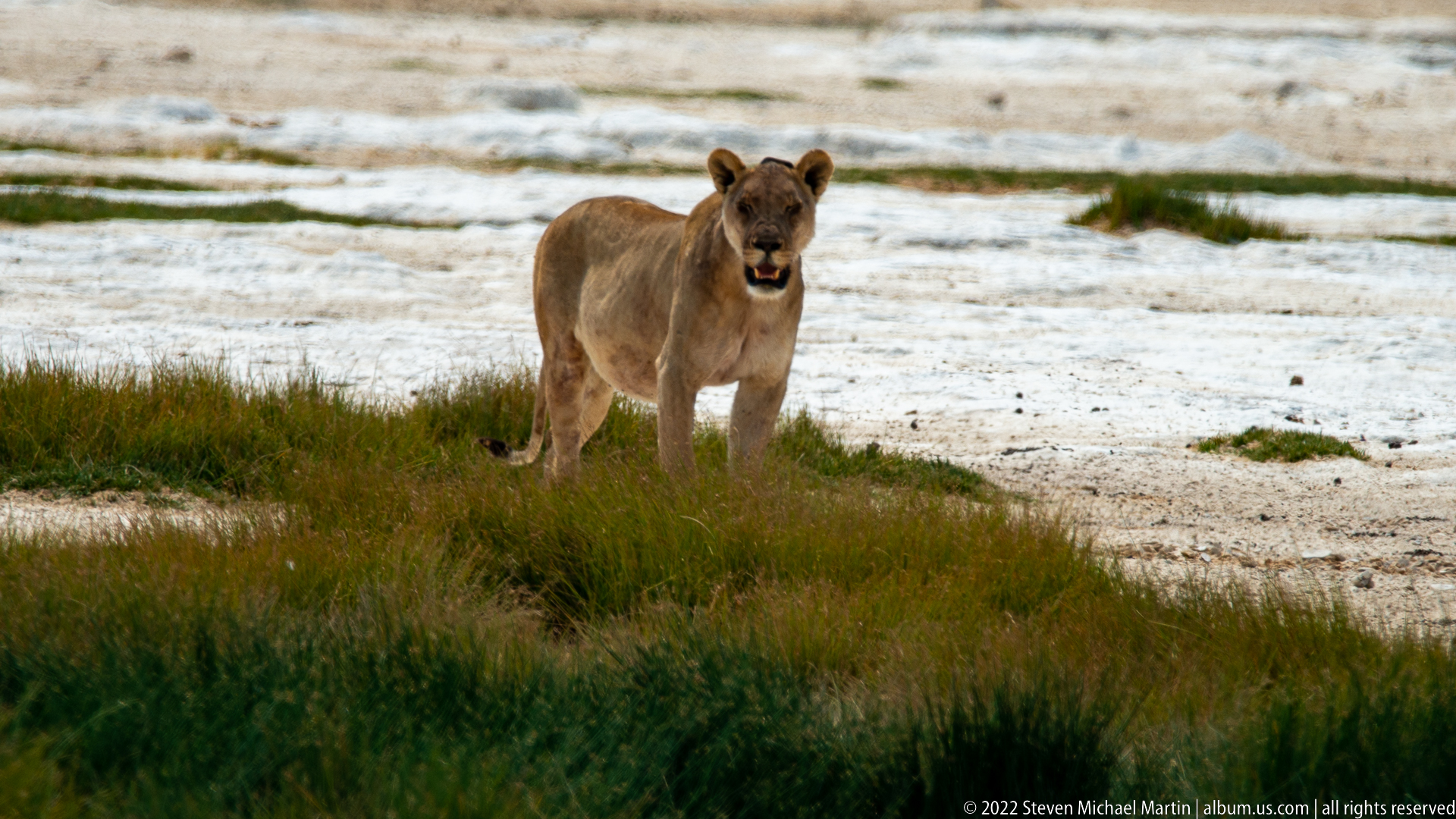
Standing squarely on a grassy rise, a lioness looks directly toward the camera with her mouth slightly open. White salt flats stretch behind her, making the tawny animal and dark green vegetation especially prominent. The frontal stance gives this frame a more watchful, stationary character than the surrounding walking views.
Caption
Standing squarely on a grassy rise, a lioness looks directly toward the camera with her mouth slightly open. White salt flats stretch behind her, making the tawny animal and dark green vegetation especially prominent. The frontal stance gives this frame a more watchful, stationary character than the surrounding walking views.
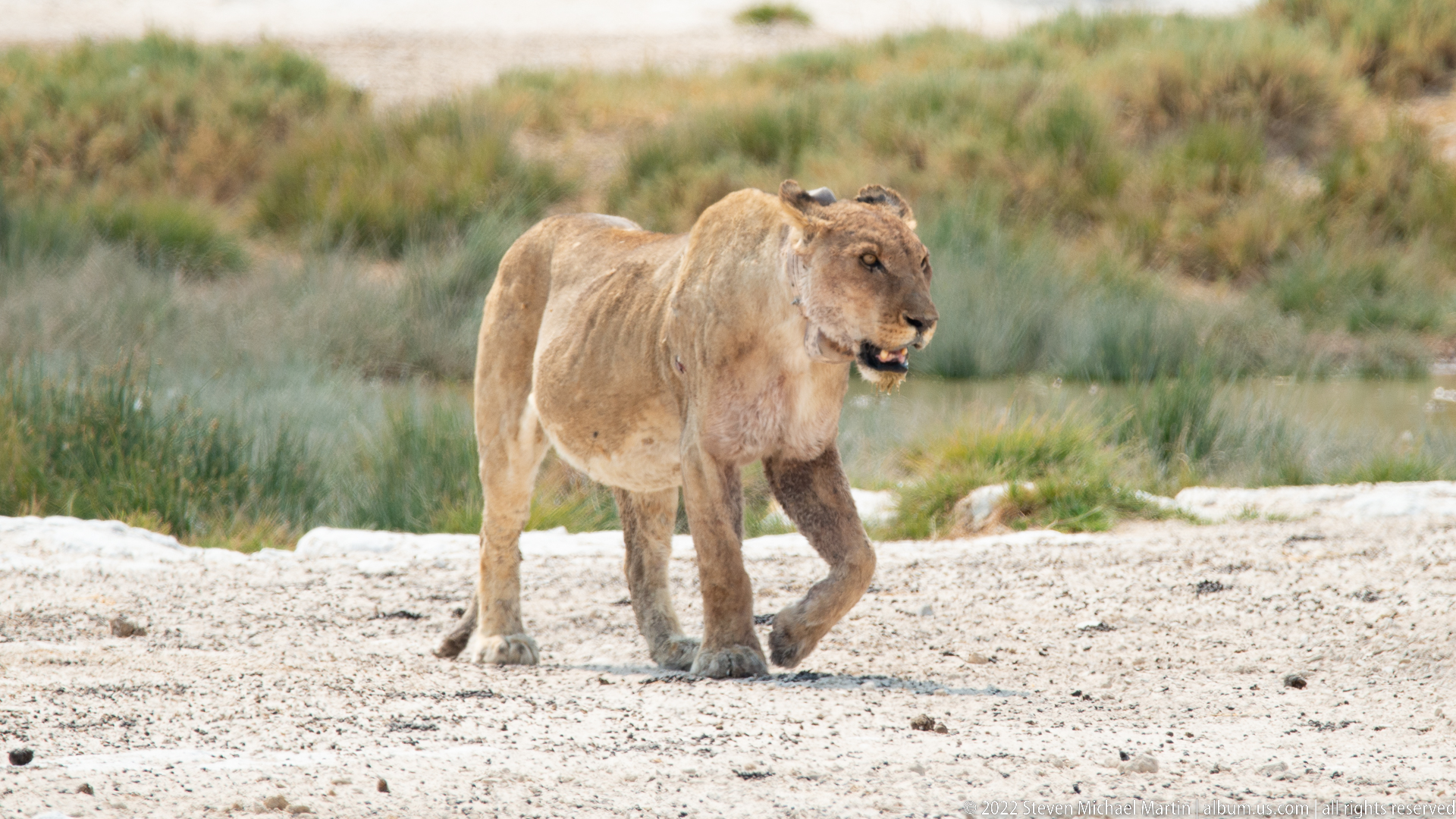
A lioness crosses the pale, crusted ground of the Etosha Pan margin at close range, one forepaw lifted in mid-stride. The tighter framing reveals the muscular shoulders, worn tawny coat, and focused expression, while blurred green vegetation behind separates her body from the otherwise bright, mineral landscape.
Caption
A lioness crosses the pale, crusted ground of the Etosha Pan margin at close range, one forepaw lifted in mid-stride. The tighter framing reveals the muscular shoulders, worn tawny coat, and focused expression, while blurred green vegetation behind separates her body from the otherwise bright, mineral landscape.
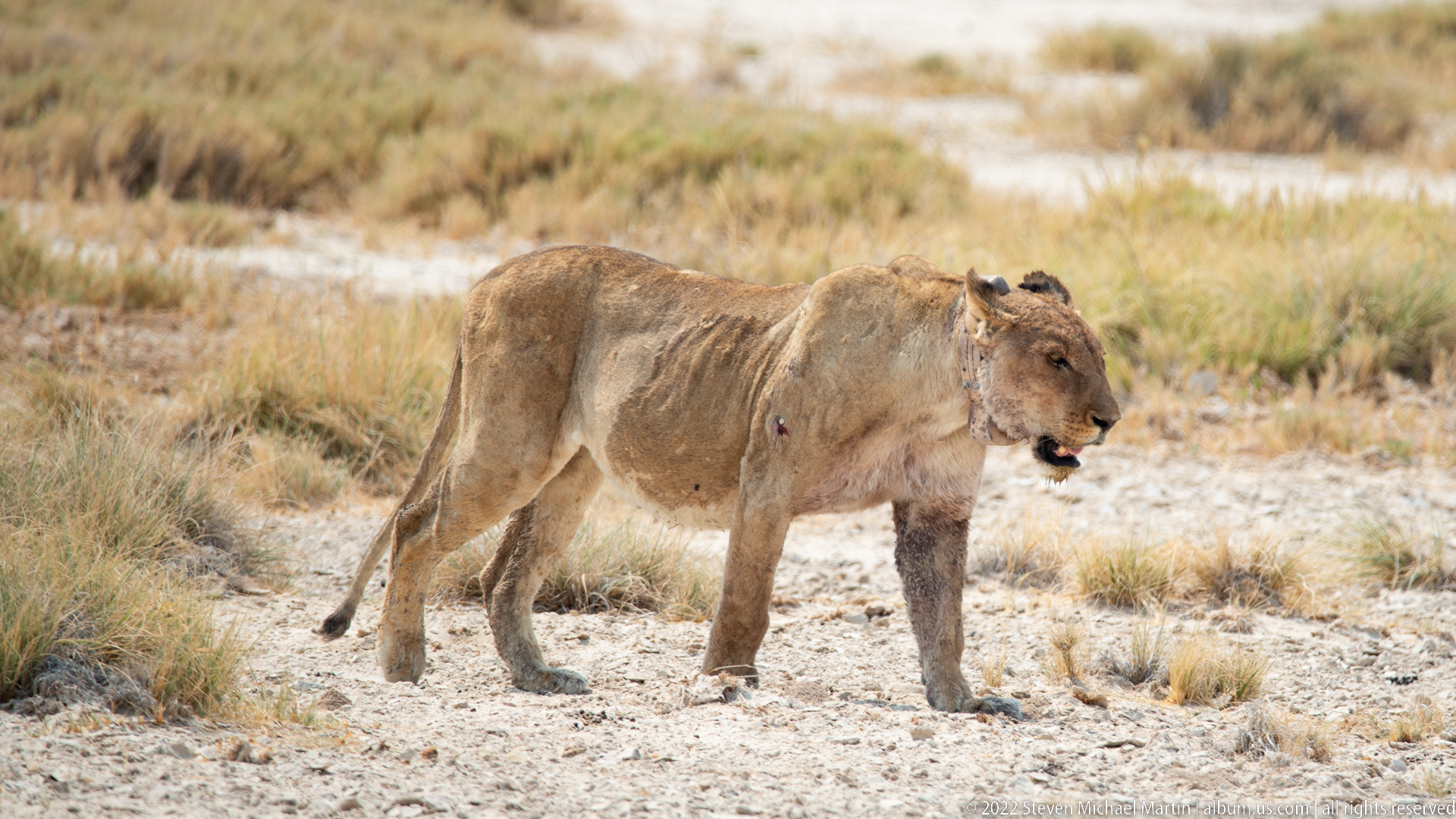
A lioness moves left to right across salt-crusted ground broken by tufts of dry grass. Small dark birds appear on and around her back, suggesting opportunistic feeding on insects or ectoparasites. The broadside view clearly records her lean profile and the harsh, pale substrate of the Etosha Pan margin.
Caption
A lioness moves left to right across salt-crusted ground broken by tufts of dry grass. Small dark birds appear on and around her back, suggesting opportunistic feeding on insects or ectoparasites. The broadside view clearly records her lean profile and the harsh, pale substrate of the Etosha Pan margin.
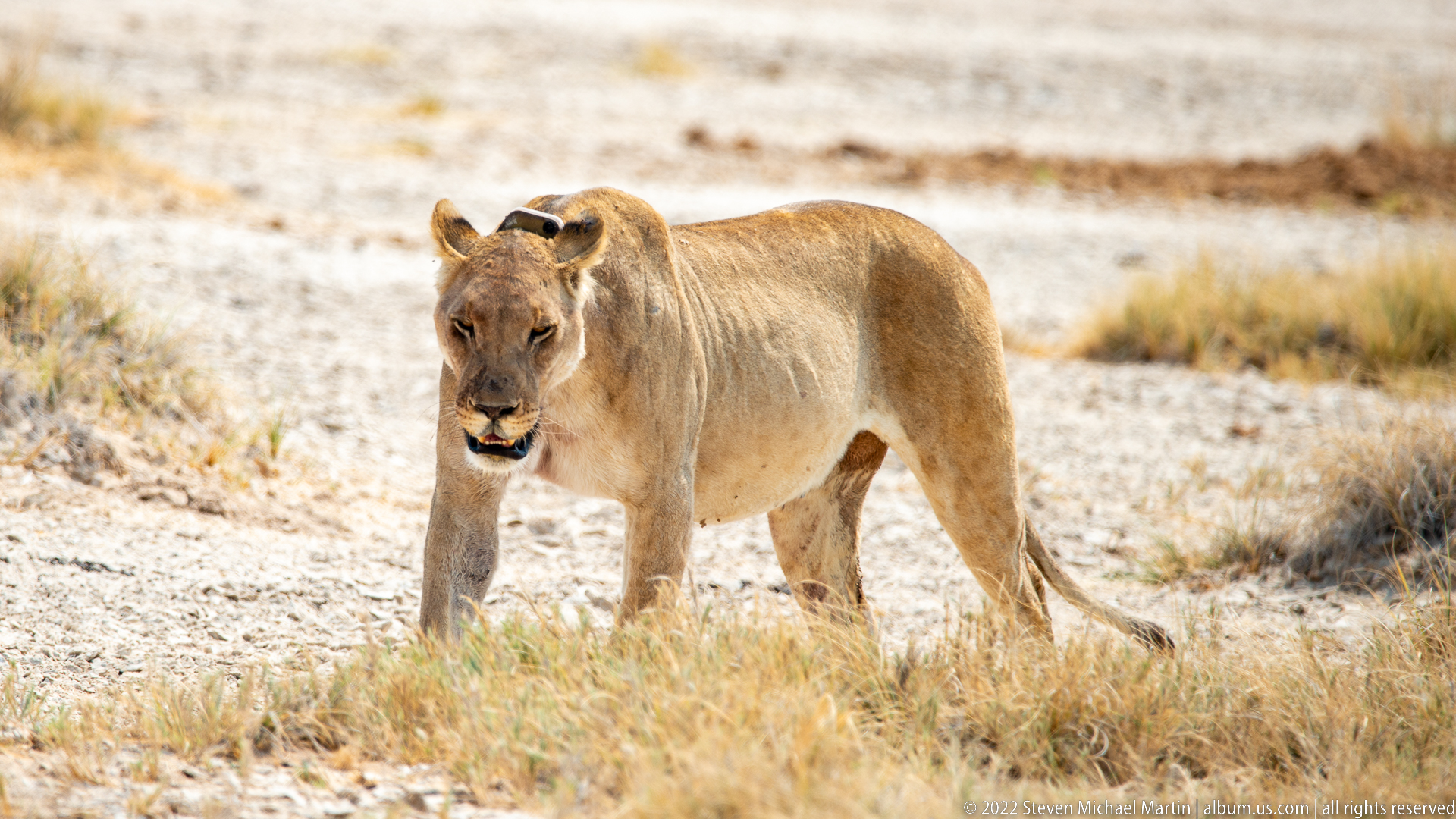
A lioness pauses in open, sunlit terrain, facing slightly toward the camera with her mouth parted. A small dark bird perches on her back, adding a conspicuous interspecies detail to the portrait. Dry grass and pale mineral soil form a subdued background that keeps attention on the lioness’s stance and expression.
Caption
A lioness pauses in open, sunlit terrain, facing slightly toward the camera with her mouth parted. A small dark bird perches on her back, adding a conspicuous interspecies detail to the portrait. Dry grass and pale mineral soil form a subdued background that keeps attention on the lioness’s stance and expression.
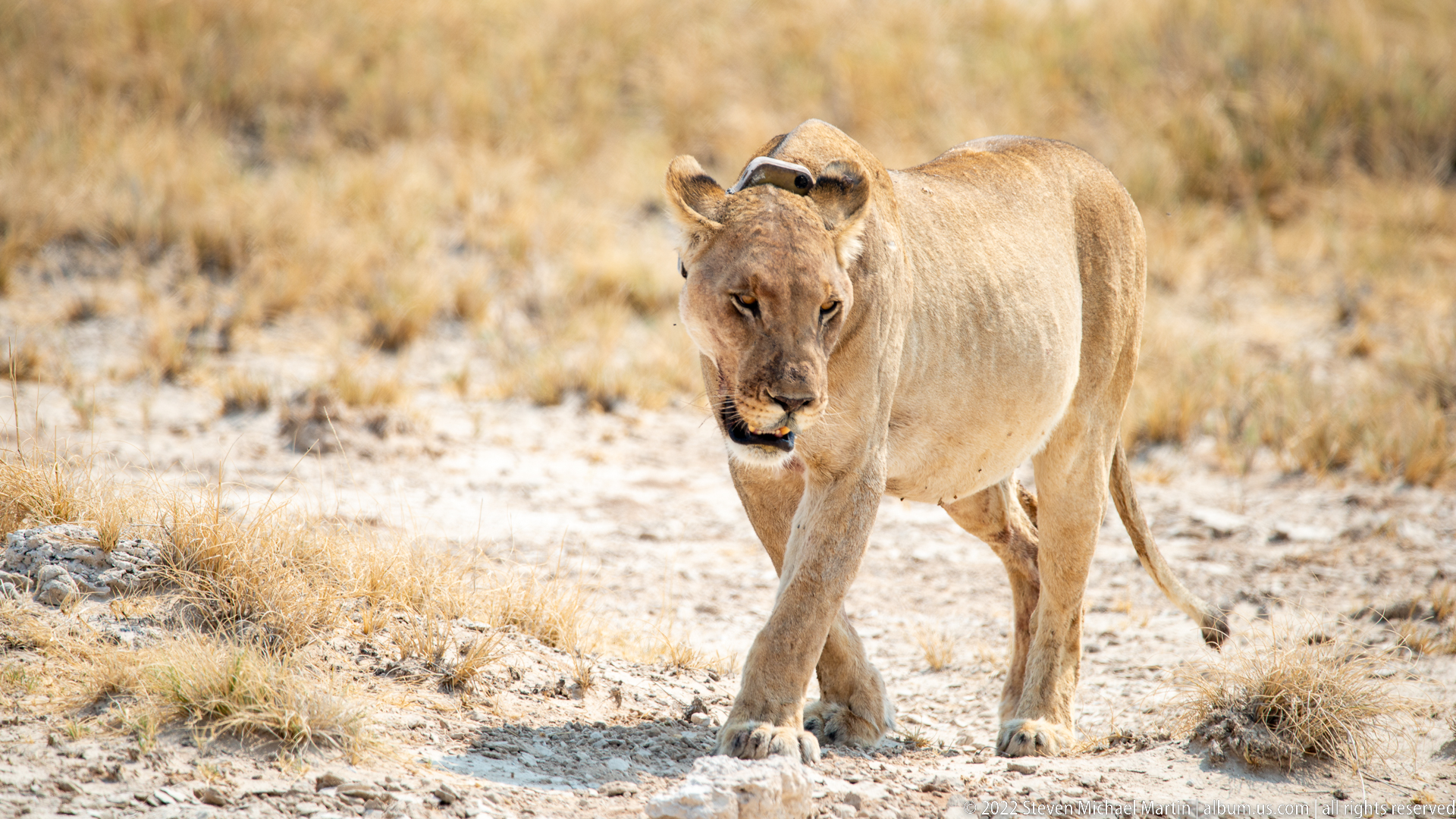
A lioness walks directly toward the camera through dry grass and patches of pale soil. Her head is lowered slightly and her forelegs align in a deliberate stride, producing a strong frontal portrait. The open composition retains enough surrounding habitat to place the animal within the arid Etosha Pan margin.
Caption
A lioness walks directly toward the camera through dry grass and patches of pale soil. Her head is lowered slightly and her forelegs align in a deliberate stride, producing a strong frontal portrait. The open composition retains enough surrounding habitat to place the animal within the arid Etosha Pan margin.
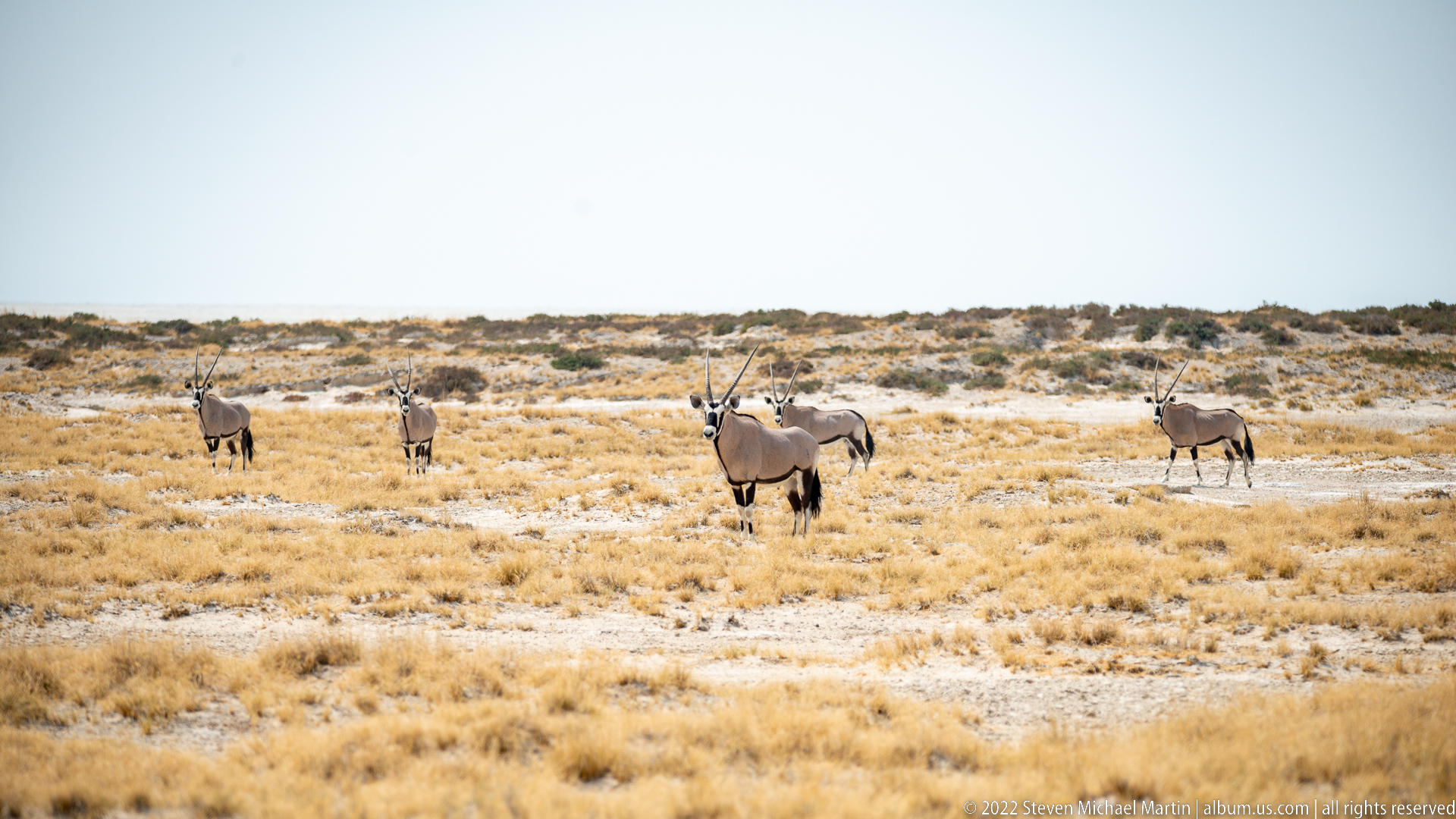
Several gemsbok stand widely spaced across open yellow grassland, their long straight horns rising above the low vegetation. The broad landscape view emphasizes distance and distribution rather than individual detail, with pale tracks and scrub marking the dry ground near Etosha Pan.
Caption
Several gemsbok stand widely spaced across open yellow grassland, their long straight horns rising above the low vegetation. The broad landscape view emphasizes distance and distribution rather than individual detail, with pale tracks and scrub marking the dry ground near Etosha Pan.
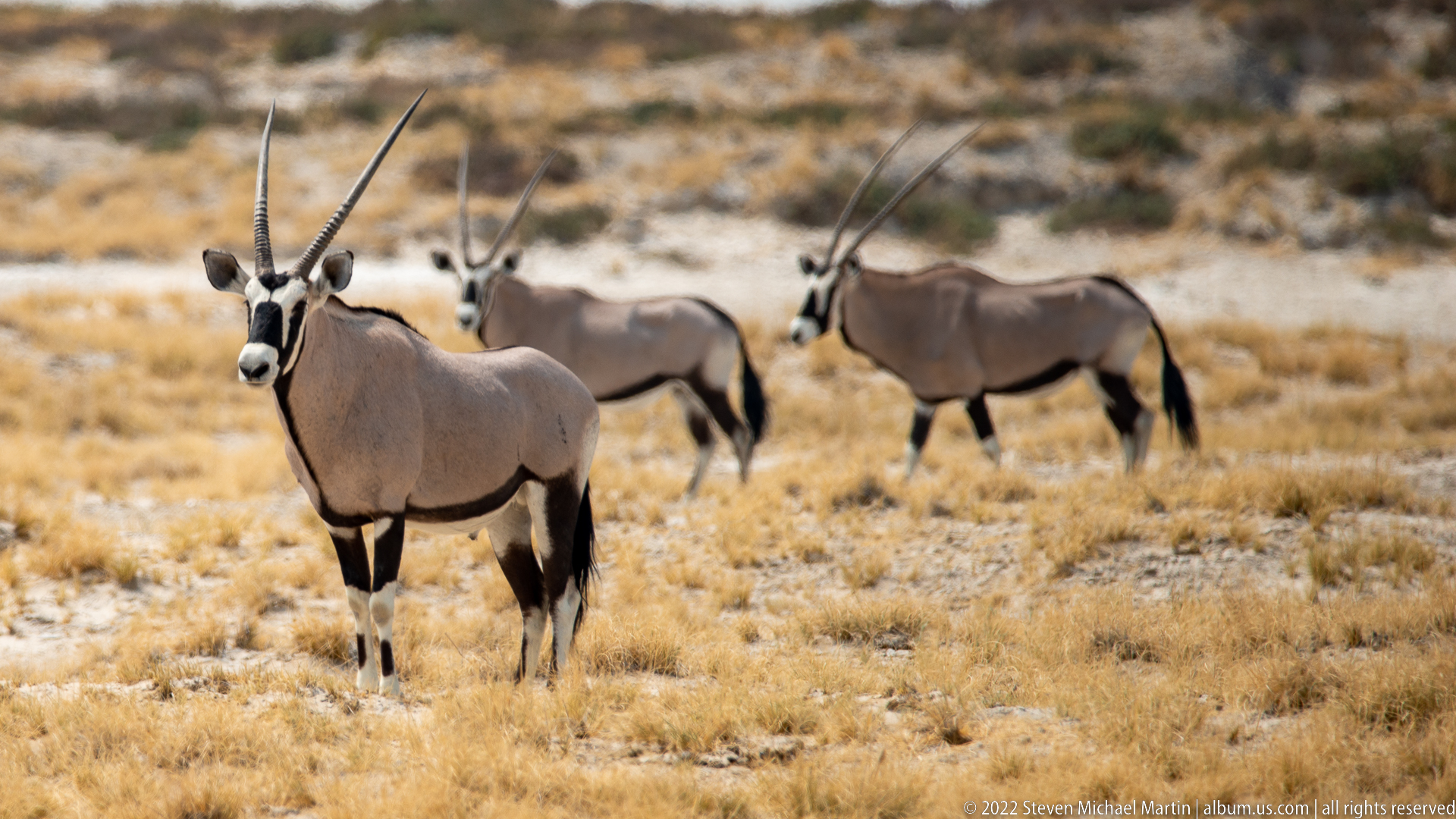
Three gemsbok stand in dry grass, the nearest animal facing the camera while two others remain behind in profile. Bold black-and-white facial markings, dark flank stripes, and exceptionally long straight horns are prominent, providing a clear species portrait against the muted Etosha savanna.
Caption
Three gemsbok stand in dry grass, the nearest animal facing the camera while two others remain behind in profile. Bold black-and-white facial markings, dark flank stripes, and exceptionally long straight horns are prominent, providing a clear species portrait against the muted Etosha savanna.

Two gemsbok move together through low scrub, their long, nearly parallel horns extending dramatically above their heads. The side view clearly shows gray-tan bodies, black flank markings, white lower legs, and dark tails. Sparse thorny vegetation places the pair in the dry savanna bordering Etosha Pan.
Caption
Two gemsbok move together through low scrub, their long, nearly parallel horns extending dramatically above their heads. The side view clearly shows gray-tan bodies, black flank markings, white lower legs, and dark tails. Sparse thorny vegetation places the pair in the dry savanna bordering Etosha Pan.
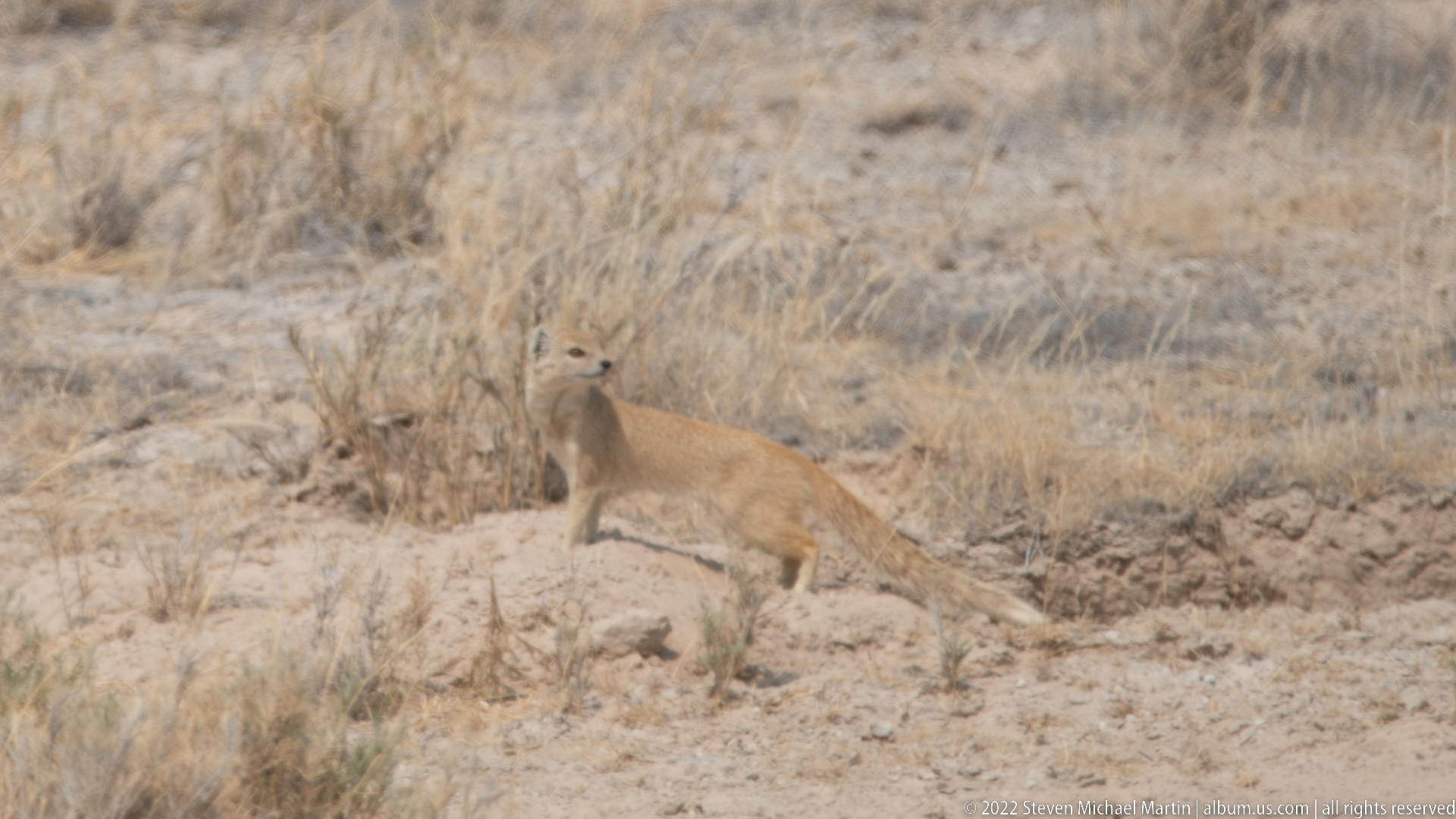
Partly screened by dry stems and scrub, a lioness walks across sandy ground with her body held low and head forward. The muted tawny coat blends closely with the surrounding vegetation, demonstrating how effectively the predator disappears into Etosha’s dry-season palette when away from the bright salt pan.
Caption
Partly screened by dry stems and scrub, a lioness walks across sandy ground with her body held low and head forward. The muted tawny coat blends closely with the surrounding vegetation, demonstrating how effectively the predator disappears into Etosha’s dry-season palette when away from the bright salt pan.
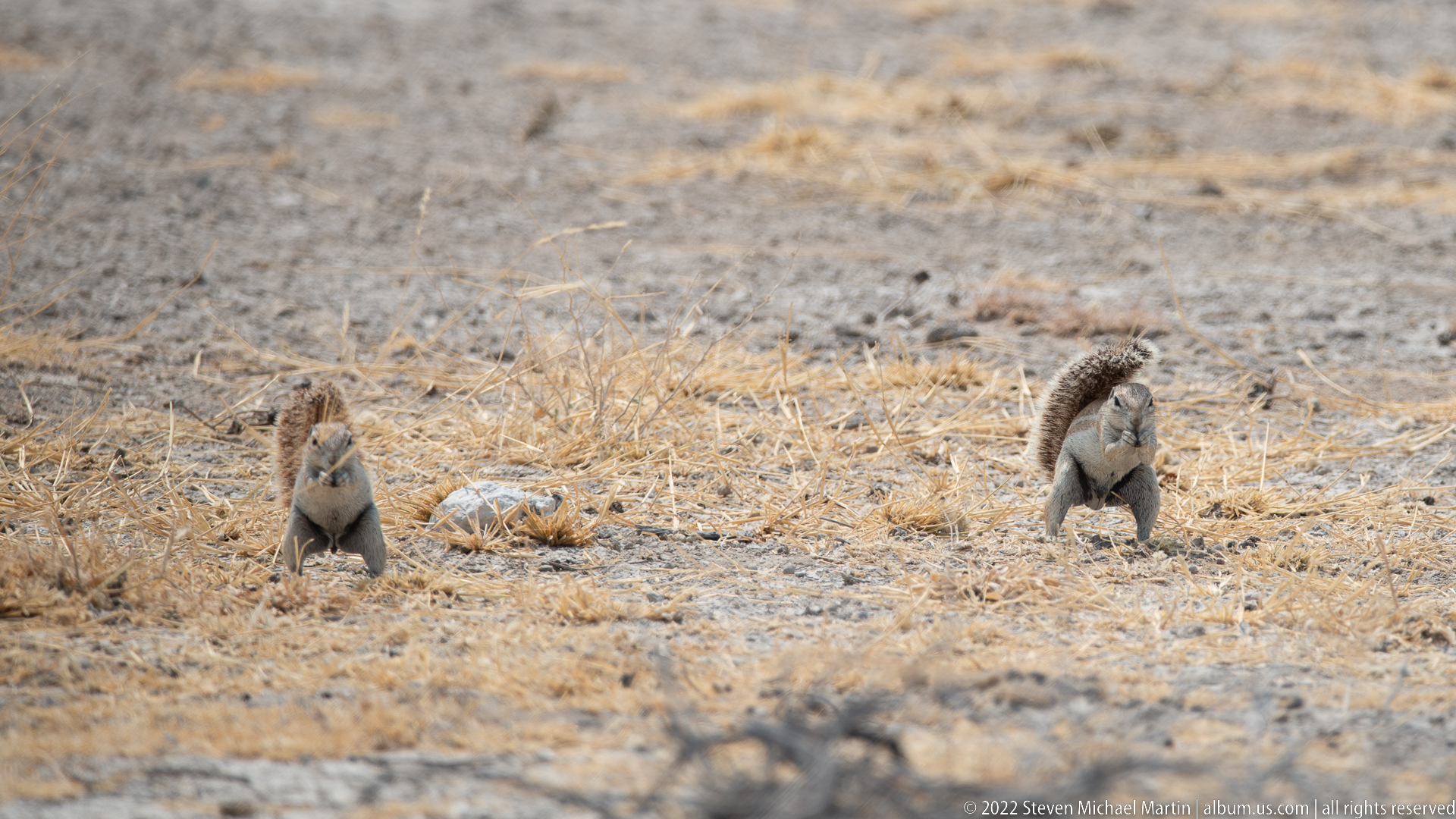
Two ground squirrels stand several meters apart on bare, straw-littered ground, each upright enough to show the long bushy tail characteristic of these terrestrial rodents. The wider framing records their spacing and open habitat, with scattered dry grass and stones providing little cover.
Caption
Two ground squirrels stand several meters apart on bare, straw-littered ground, each upright enough to show the long bushy tail characteristic of these terrestrial rodents. The wider framing records their spacing and open habitat, with scattered dry grass and stones providing little cover.
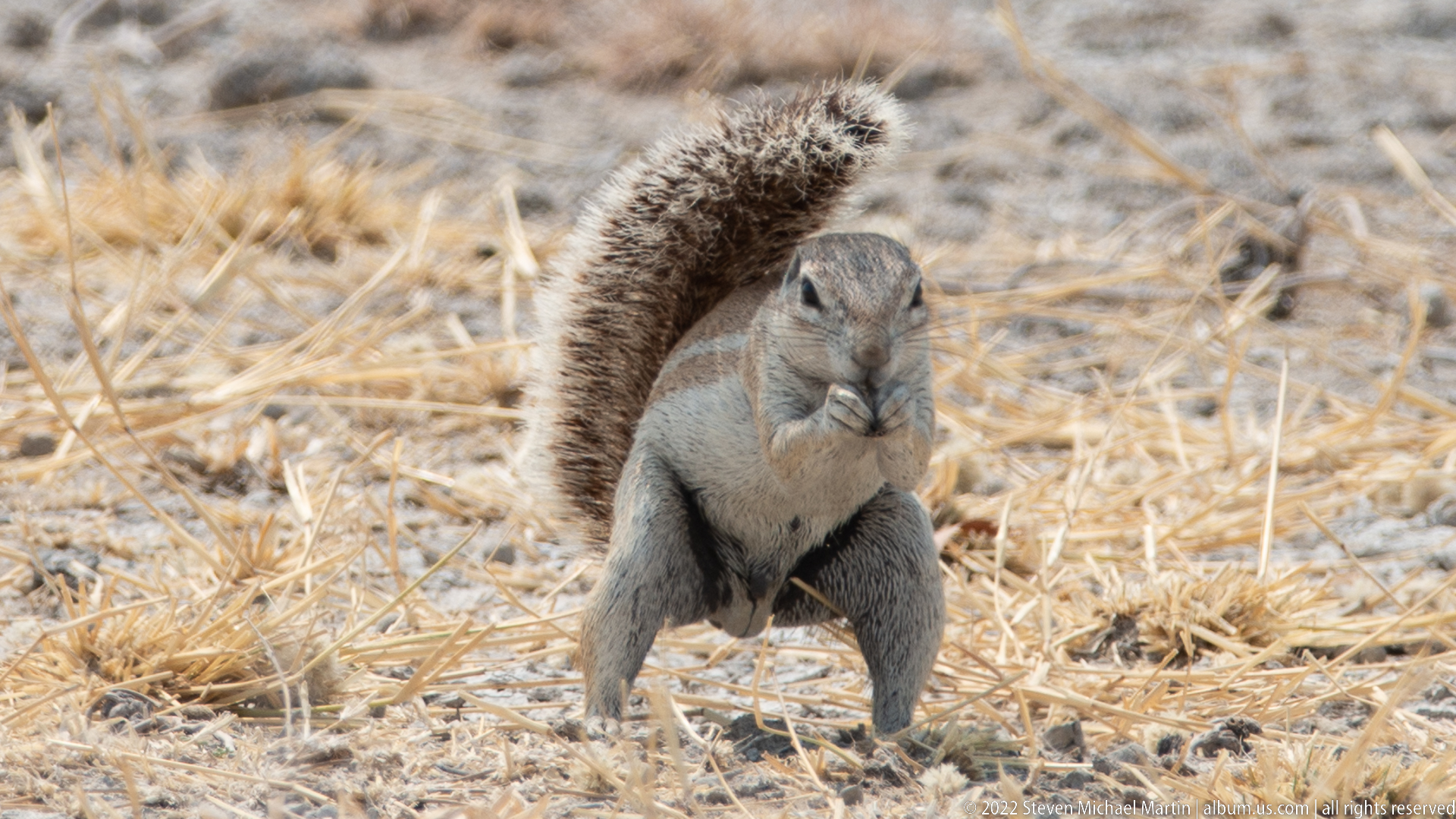
A ground squirrel pauses upright on the dry Etosha ground, forepaws held close to its chest and a large bushy tail arched behind its back. The close view reveals gray-brown fur, small rounded ears, and the animal’s alert posture amid straw-colored grass and dusty soil.
Caption
A ground squirrel pauses upright on the dry Etosha ground, forepaws held close to its chest and a large bushy tail arched behind its back. The close view reveals gray-brown fur, small rounded ears, and the animal’s alert posture amid straw-colored grass and dusty soil.
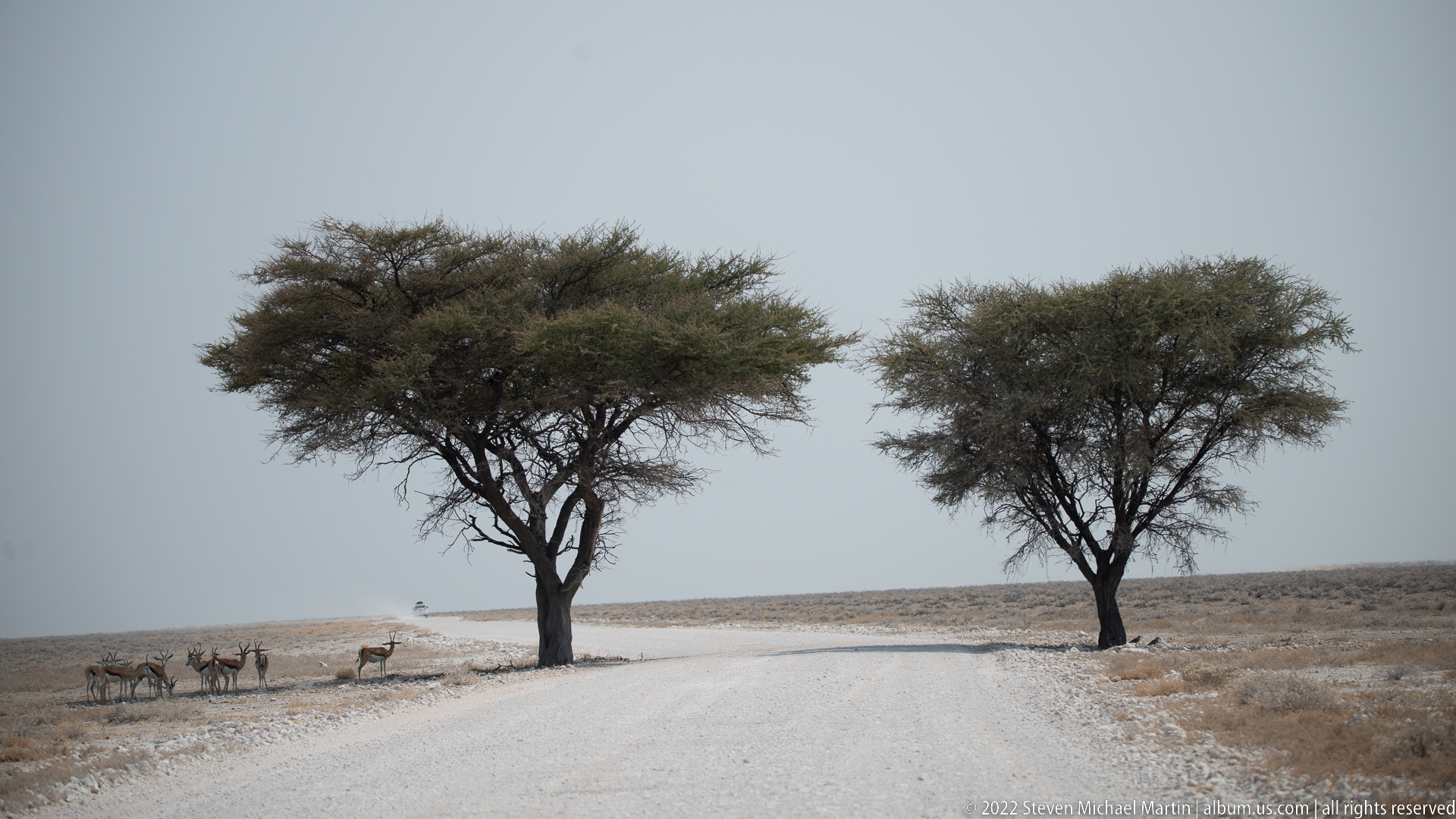
A pale gravel road passes between two broad-canopied savanna trees before continuing toward the flat Etosha horizon. Small antelope stand off the left shoulder, adding scale to the otherwise spare landscape. The symmetrical roadside trees create a natural gateway into the open pan country beyond.
Caption
A pale gravel road passes between two broad-canopied savanna trees before continuing toward the flat Etosha horizon. Small antelope stand off the left shoulder, adding scale to the otherwise spare landscape. The symmetrical roadside trees create a natural gateway into the open pan country beyond.
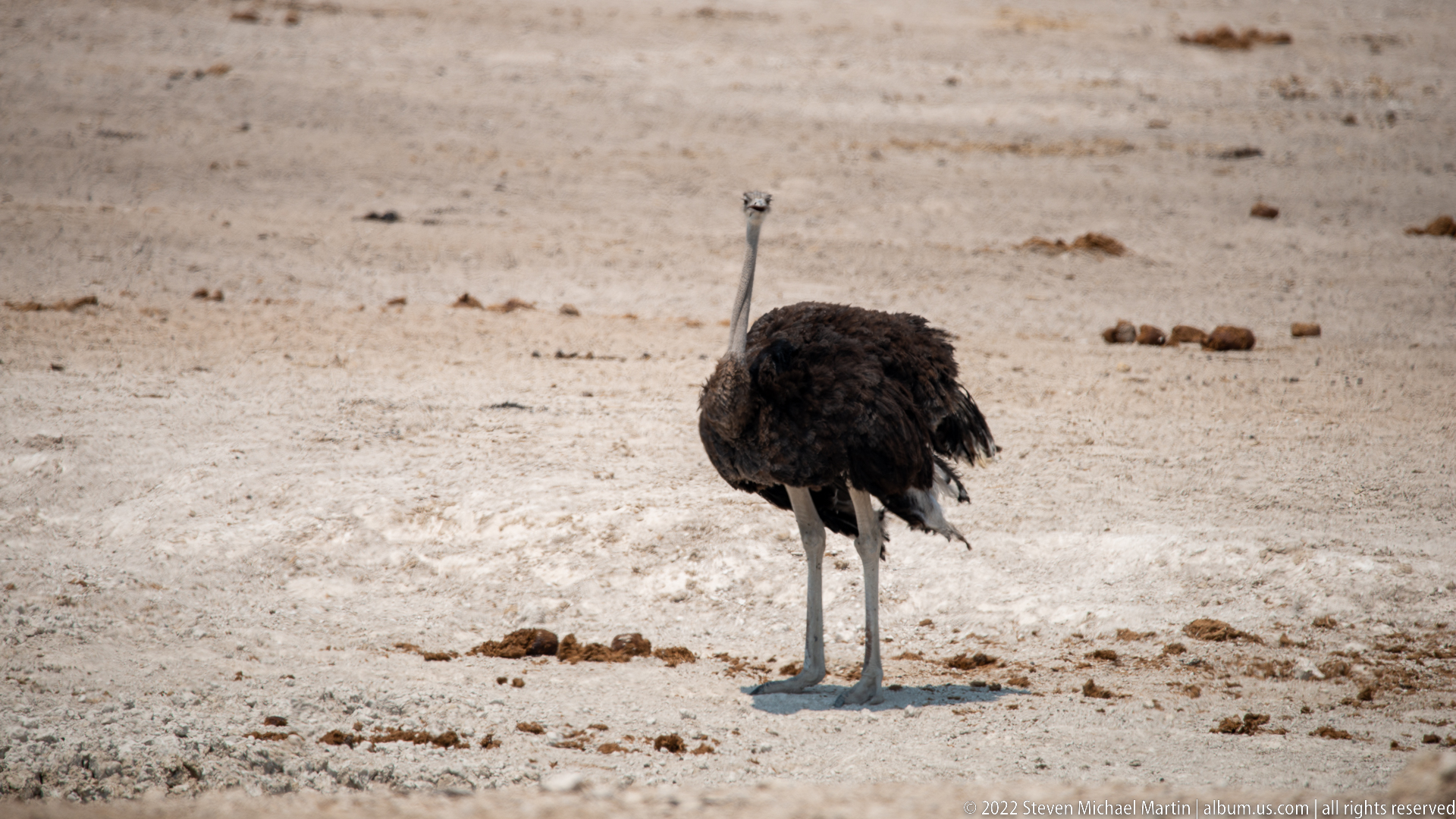
A common ostrich stands on the open pale ground with its back toward the camera, long gray legs supporting a dense mass of dark body feathers. The raised neck and small head break the otherwise low horizon, while scattered droppings and bare mineral soil reinforce the stark dryness of the setting.
Caption
A common ostrich stands on the open pale ground with its back toward the camera, long gray legs supporting a dense mass of dark body feathers. The raised neck and small head break the otherwise low horizon, while scattered droppings and bare mineral soil reinforce the stark dryness of the setting.
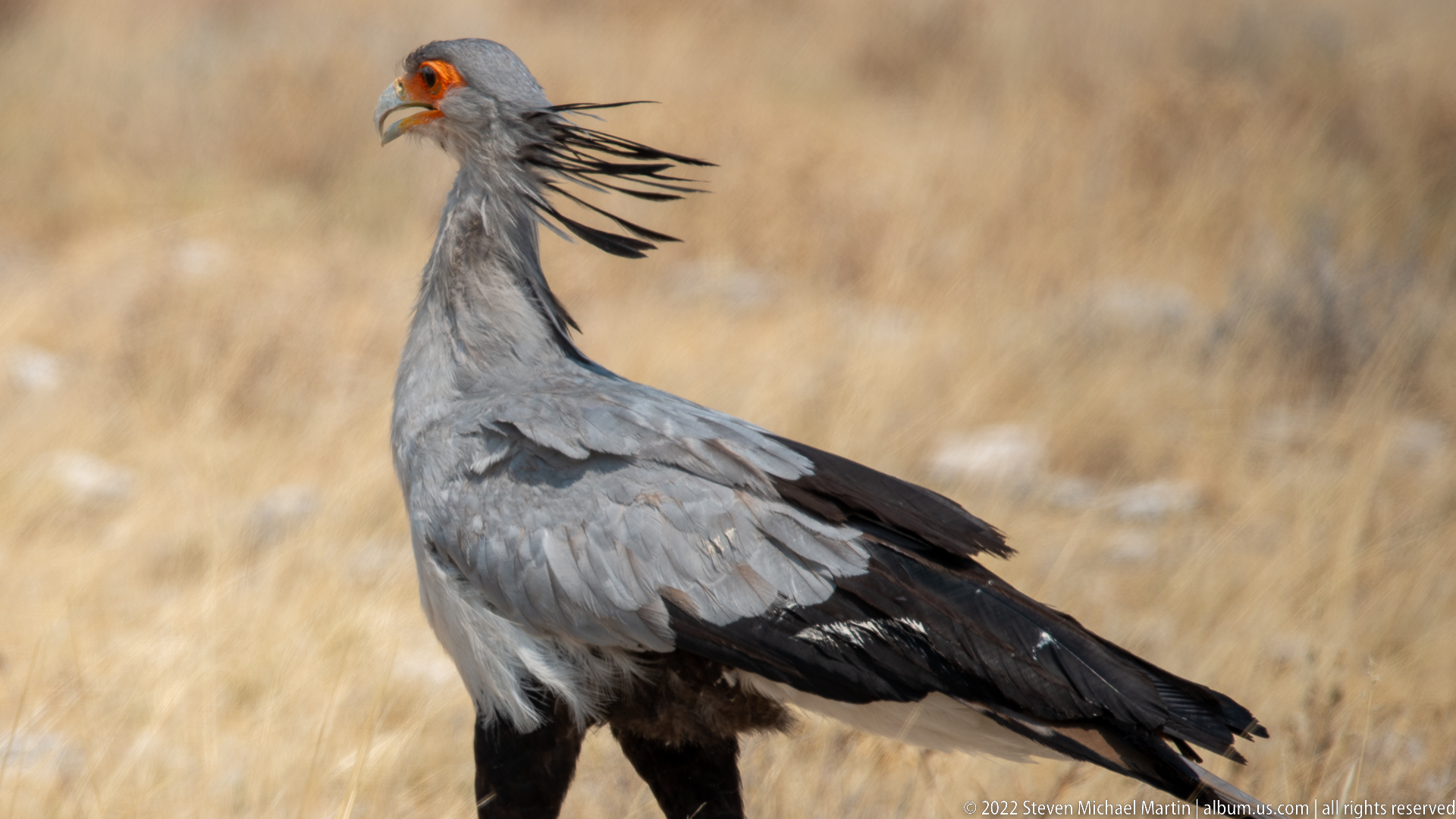
A secretarybird fills the frame in profile, showing its gray body, black flight feathers, long tail, and distinctive crest of elongated black feathers. The close crop concentrates on the upper body and head, where the orange-red facial skin and hooked bill identify this terrestrial raptor of open African grasslands.
Caption
A secretarybird fills the frame in profile, showing its gray body, black flight feathers, long tail, and distinctive crest of elongated black feathers. The close crop concentrates on the upper body and head, where the orange-red facial skin and hooked bill identify this terrestrial raptor of open African grasslands.

A secretarybird strides through dry yellow grass on exceptionally long pinkish legs, its black crest swept behind the head and elongated tail feathers trailing. The full-body view shows the bird’s unusual ground-hunting proportions more completely than the preceding portrait, including black thigh feathers that resemble breeches.
Caption
A secretarybird strides through dry yellow grass on exceptionally long pinkish legs, its black crest swept behind the head and elongated tail feathers trailing. The full-body view shows the bird’s unusual ground-hunting proportions more completely than the preceding portrait, including black thigh feathers that resemble breeches.
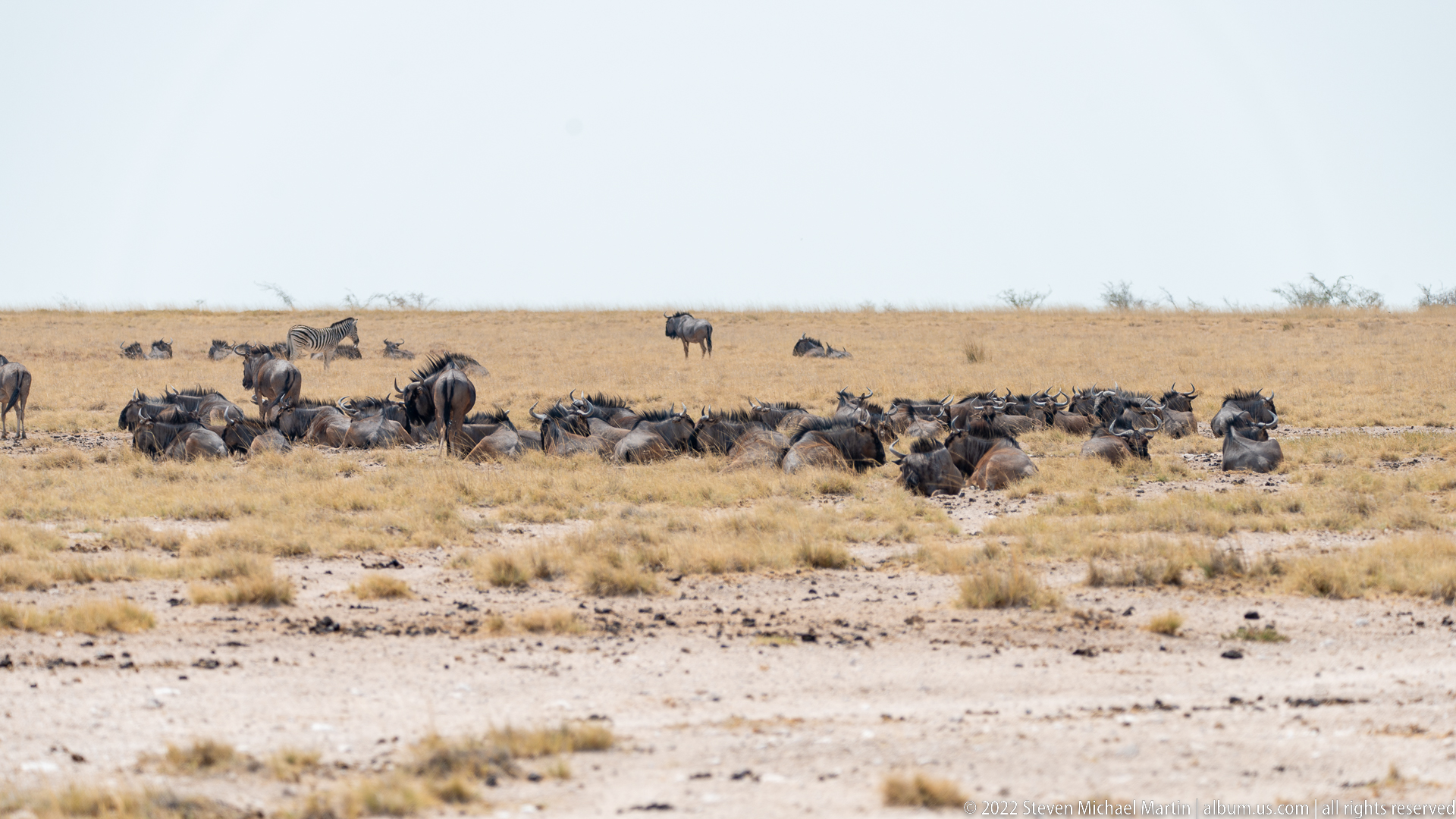
A large aggregation of blue wildebeest crowds a shallow depression amid dry Etosha grassland. Dozens of dark-backed animals cluster tightly in the middle distance while scattered individuals extend toward the horizon, turning the frame from an individual wildlife portrait into a study of herd density and social gathering.
Caption
A large aggregation of blue wildebeest crowds a shallow depression amid dry Etosha grassland. Dozens of dark-backed animals cluster tightly in the middle distance while scattered individuals extend toward the horizon, turning the frame from an individual wildlife portrait into a study of herd density and social gathering.
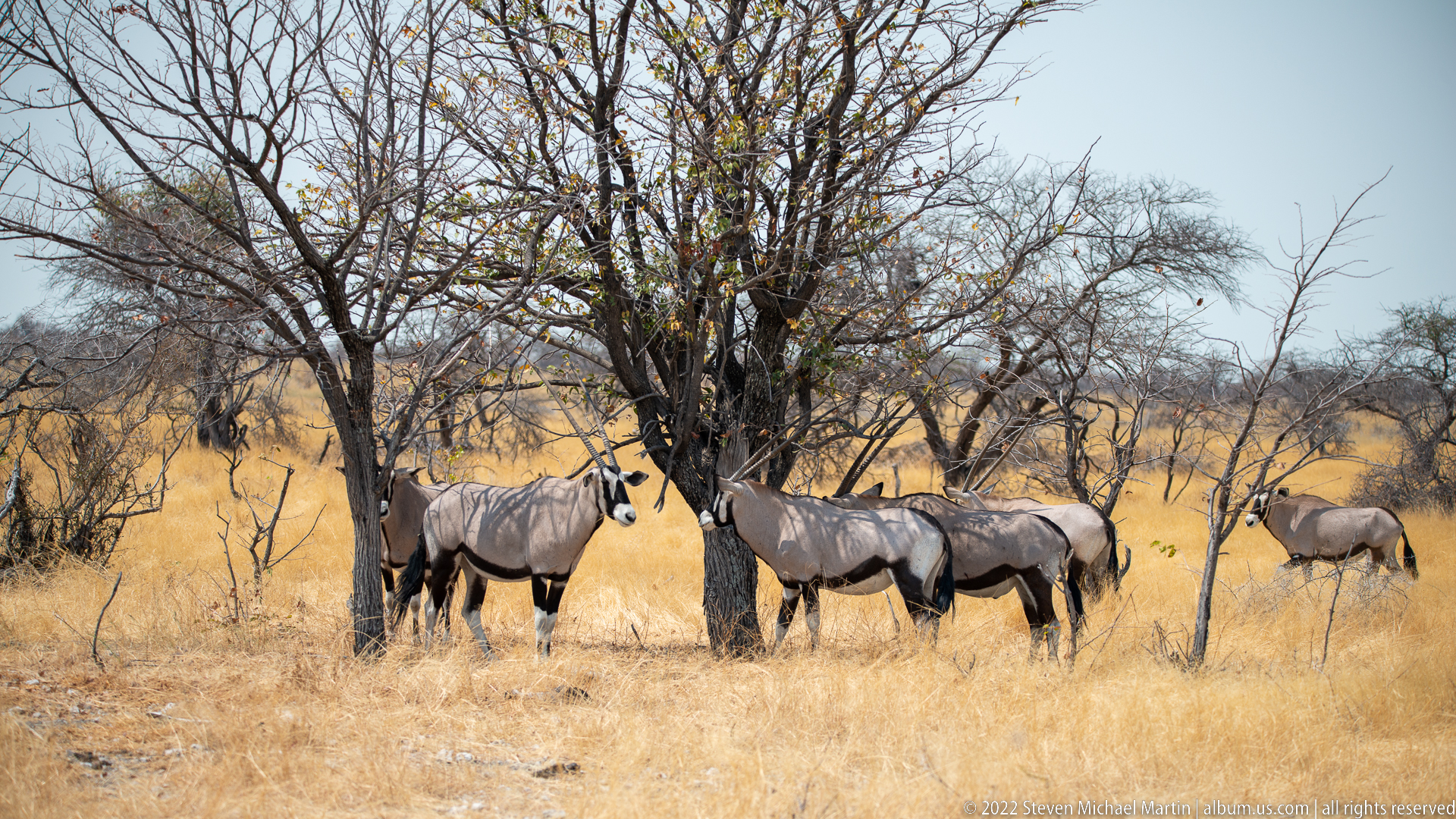
Several gemsbok stand closely together beneath sparse trees, using the patch of shade within otherwise sunlit, dry grassland. Their pale bodies and long straight horns overlap among trunks and branches, while another animal remains farther right in the open. The scene records shade-seeking behavior during harsh daytime conditions.
Caption
Several gemsbok stand closely together beneath sparse trees, using the patch of shade within otherwise sunlit, dry grassland. Their pale bodies and long straight horns overlap among trunks and branches, while another animal remains farther right in the open. The scene records shade-seeking behavior during harsh daytime conditions.

Several gemsbok stand among trunks and pale grass at the wooded edge of the Etosha landscape. Their long straight horns, bold black-and-white facial markings, gray-tan bodies, and dark flank bands make the species unmistakable. The group is dispersed between trees rather than crossing open pan, showing the woodland habitat used by these desert-adapted antelope.
Caption
Several gemsbok stand among trunks and pale grass at the wooded edge of the Etosha landscape. Their long straight horns, bold black-and-white facial markings, gray-tan bodies, and dark flank bands make the species unmistakable. The group is dispersed between trees rather than crossing open pan, showing the woodland habitat used by these desert-adapted antelope.
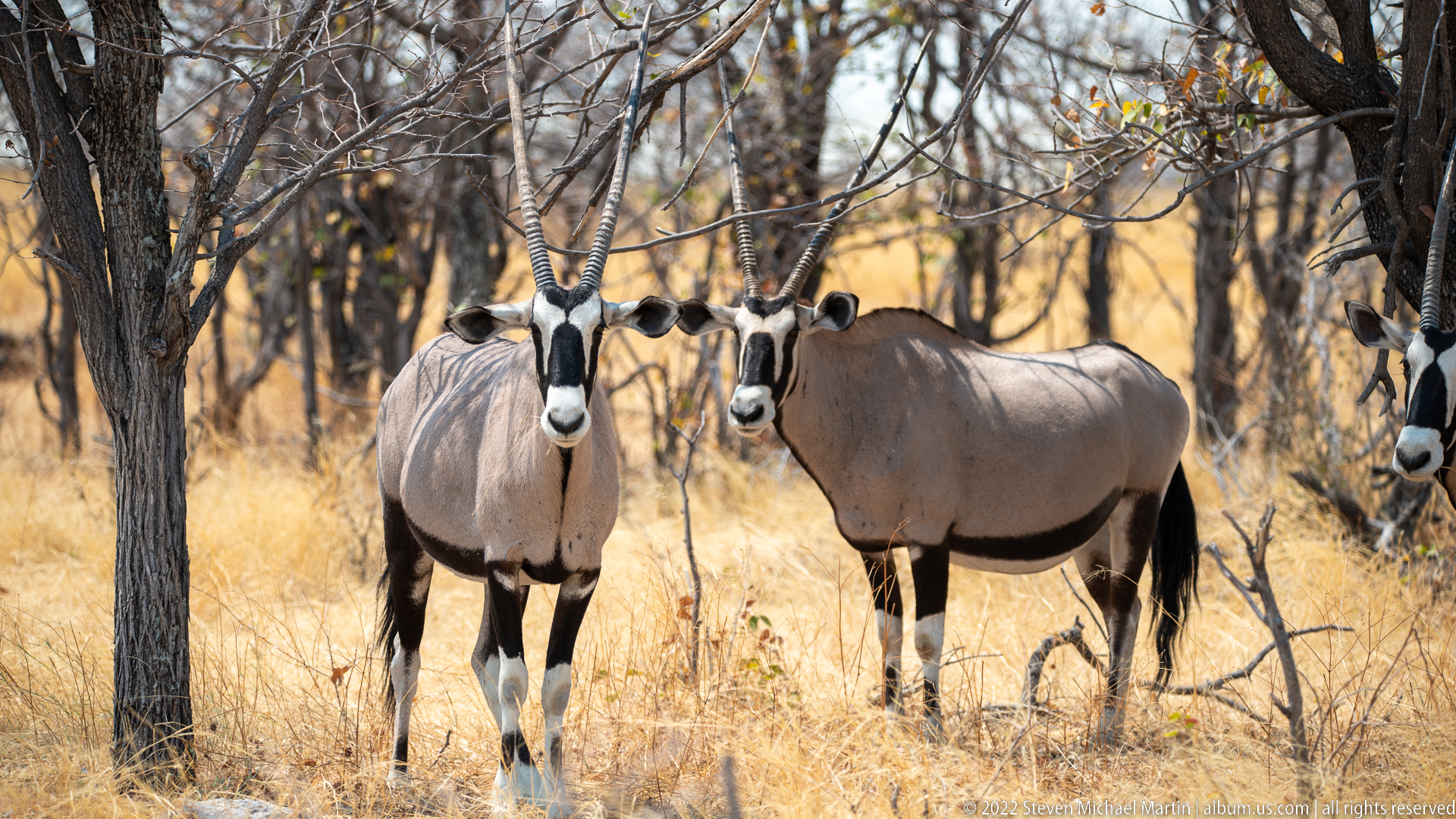
A pair of gemsbok faces the viewer beneath sparse trees, with a third animal cropped at the right edge. Their nearly parallel horns rise above sharply patterned faces, while warm grass and mottled shade soften the woodland background. The tighter framing isolates the animals’ symmetry and contrasting markings more strongly than the wider herd view.
Caption
A pair of gemsbok faces the viewer beneath sparse trees, with a third animal cropped at the right edge. Their nearly parallel horns rise above sharply patterned faces, while warm grass and mottled shade soften the woodland background. The tighter framing isolates the animals’ symmetry and contrasting markings more strongly than the wider herd view.
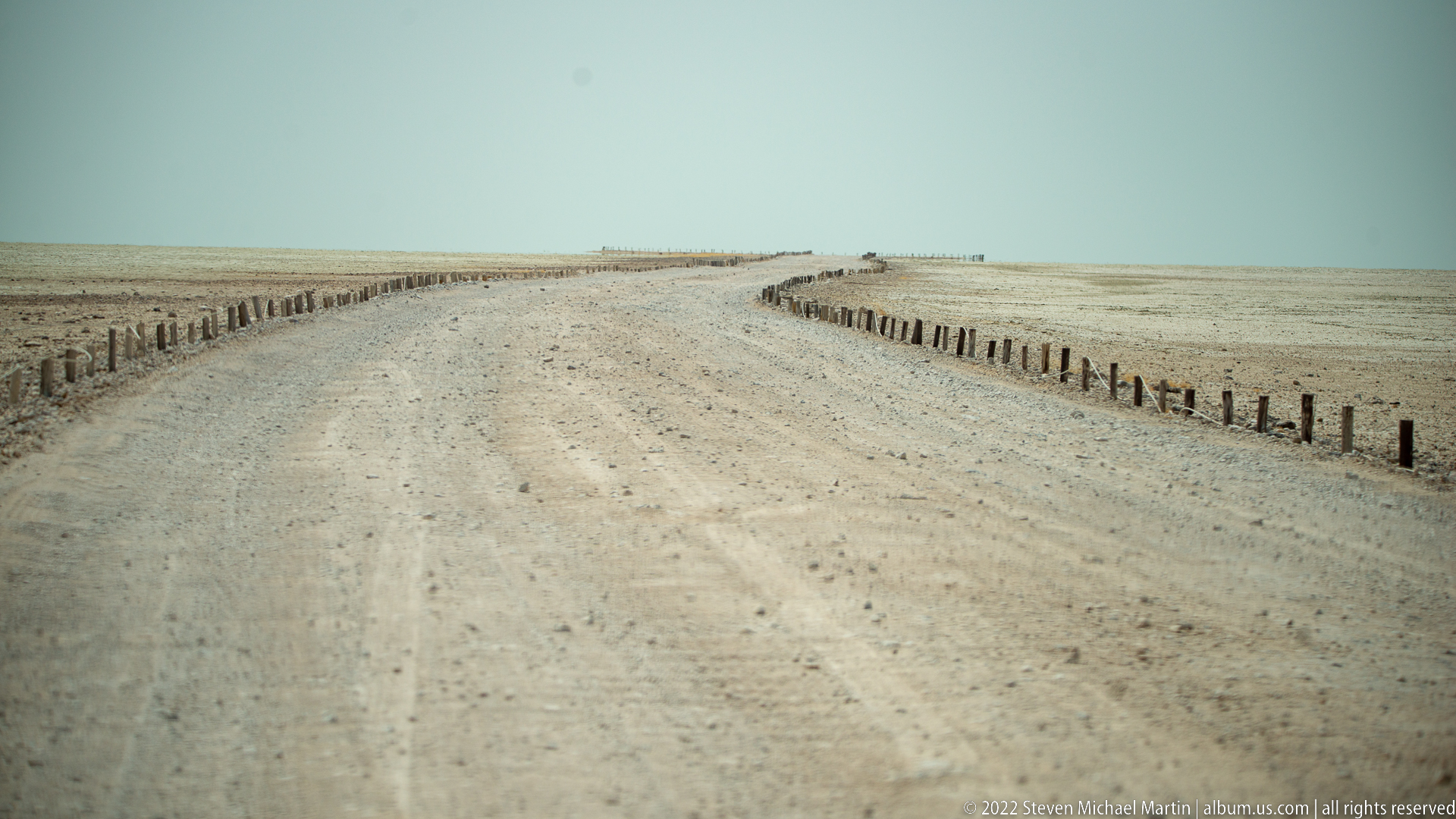
An unpaved road runs toward the flat horizon across Etosha’s pale, mineral-crusted landscape. Short rows of posts line both sides, guiding vehicles through terrain where vegetation is almost absent. The converging roadway and uninterrupted horizon emphasize the pan’s exceptional openness and the practical route by which visitors cross this exposed environment.
Caption
An unpaved road runs toward the flat horizon across Etosha’s pale, mineral-crusted landscape. Short rows of posts line both sides, guiding vehicles through terrain where vegetation is almost absent. The converging roadway and uninterrupted horizon emphasize the pan’s exceptional openness and the practical route by which visitors cross this exposed environment.
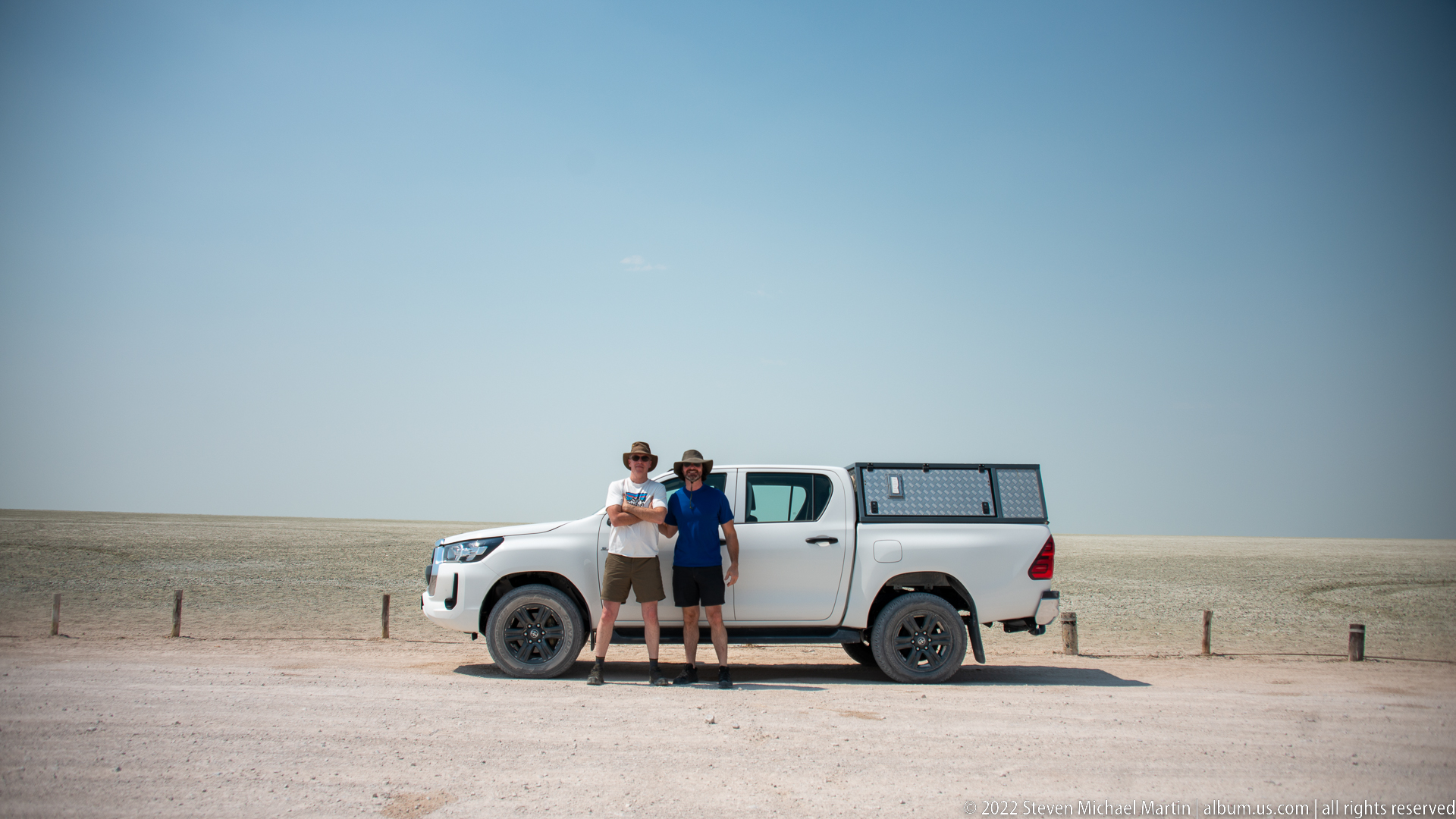
Two travelers stand beside a white double-cab pickup against the immense pale surface of Etosha Pan. The vehicle is shown in profile, its enclosed utility canopy and dark wheels contrasting with the bright ground and blue sky. Human scale makes the flat horizon and sparse landscape appear especially expansive.
Caption
Two travelers stand beside a white double-cab pickup against the immense pale surface of Etosha Pan. The vehicle is shown in profile, its enclosed utility canopy and dark wheels contrasting with the bright ground and blue sky. Human scale makes the flat horizon and sparse landscape appear especially expansive.
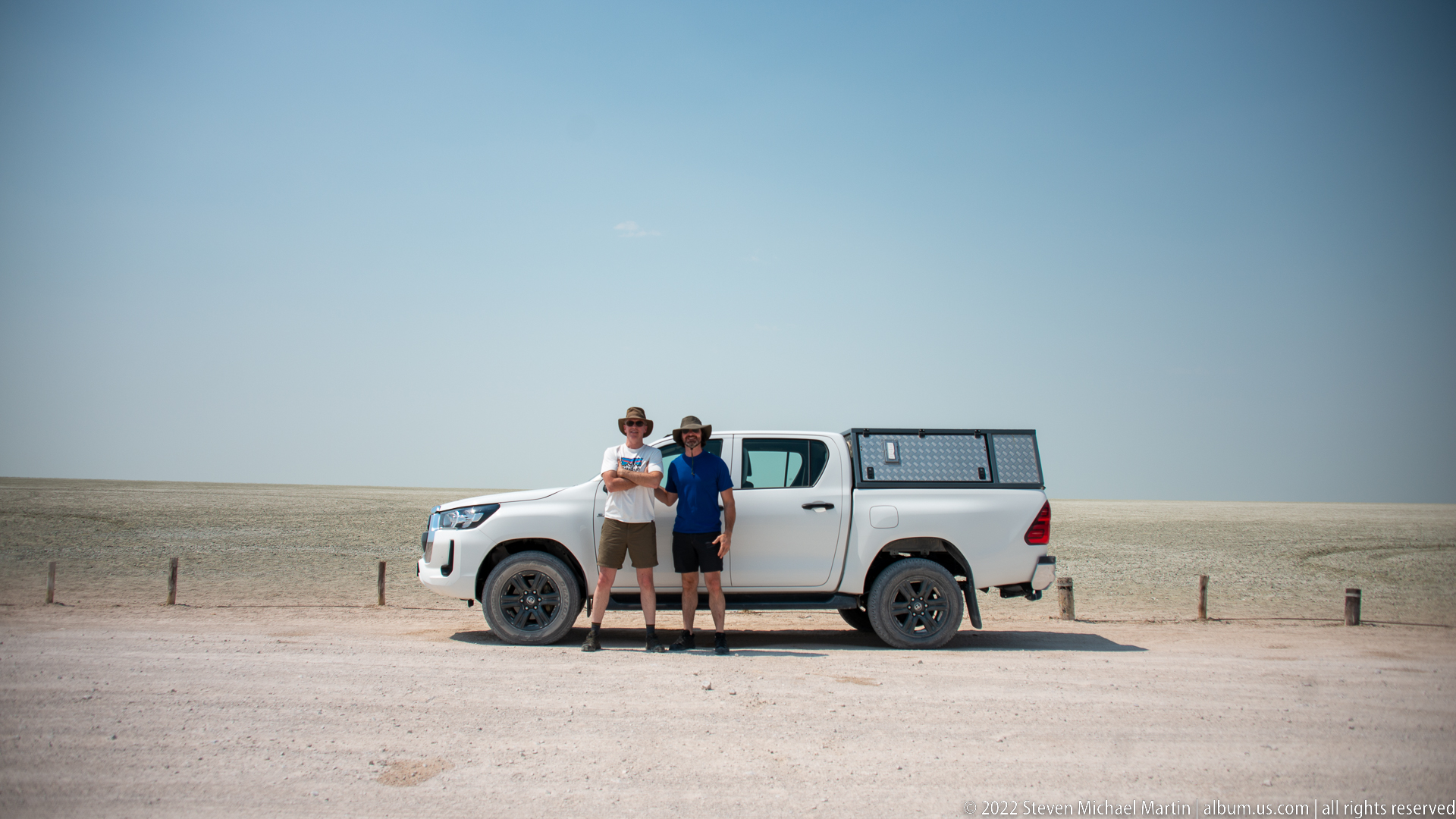
A wide portrait places two travelers and their white pickup low in the frame, leaving most of the composition to Etosha’s blue sky and pale horizon. The spare arrangement turns the parked vehicle and figures into scale markers for the pan’s broad, nearly featureless surface.
Caption
A wide portrait places two travelers and their white pickup low in the frame, leaving most of the composition to Etosha’s blue sky and pale horizon. The spare arrangement turns the parked vehicle and figures into scale markers for the pan’s broad, nearly featureless surface.
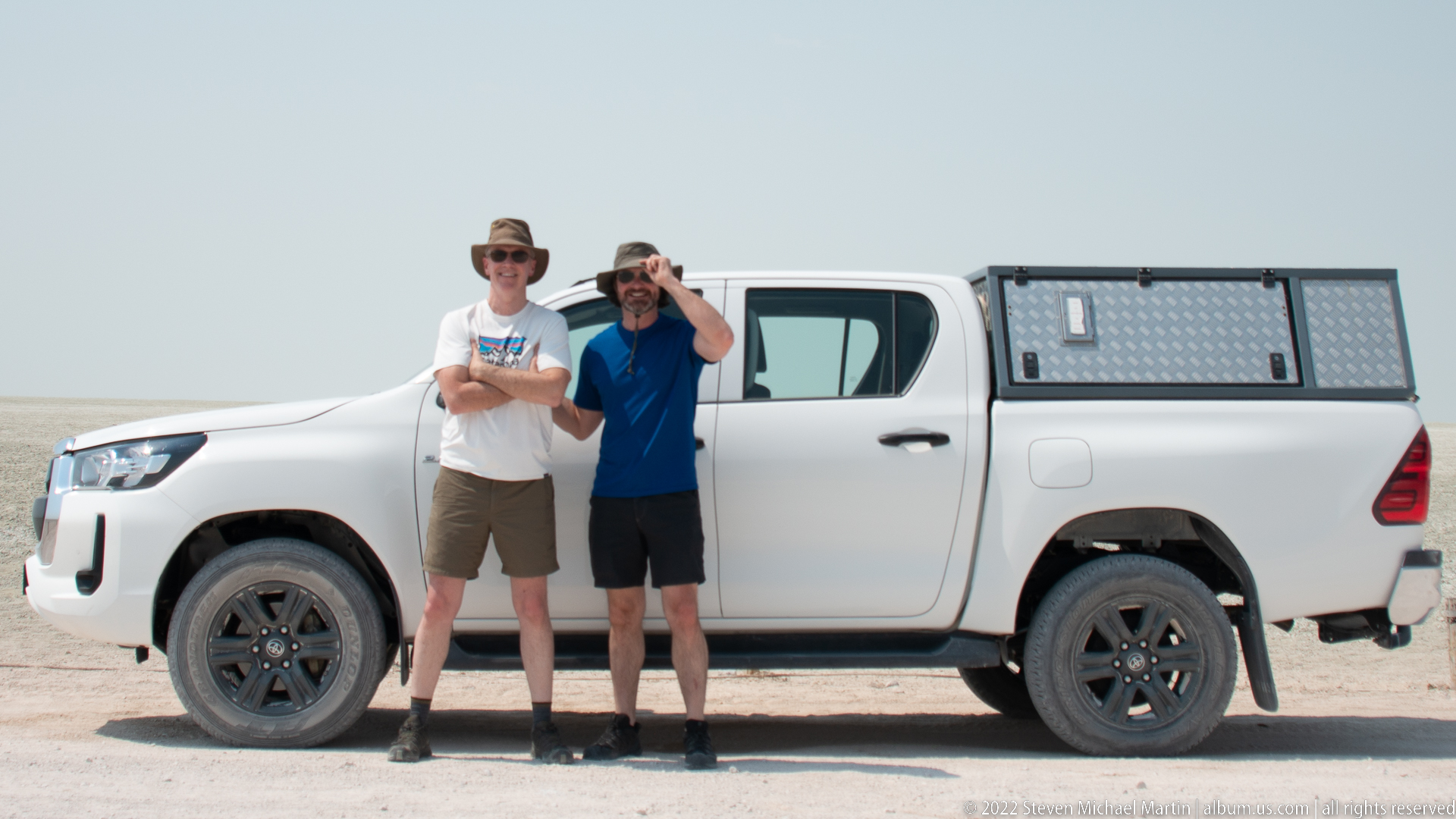
Two travelers pose directly in front of a white double-cab pickup, bringing the human subjects and vehicle details forward while the pale pan remains as a minimal backdrop. The closer viewpoint records hats, sunglasses, casual safari clothing, and the vehicle’s metal utility canopy, contrasting with the broader landscape portraits nearby.
Caption
Two travelers pose directly in front of a white double-cab pickup, bringing the human subjects and vehicle details forward while the pale pan remains as a minimal backdrop. The closer viewpoint records hats, sunglasses, casual safari clothing, and the vehicle’s metal utility canopy, contrasting with the broader landscape portraits nearby.
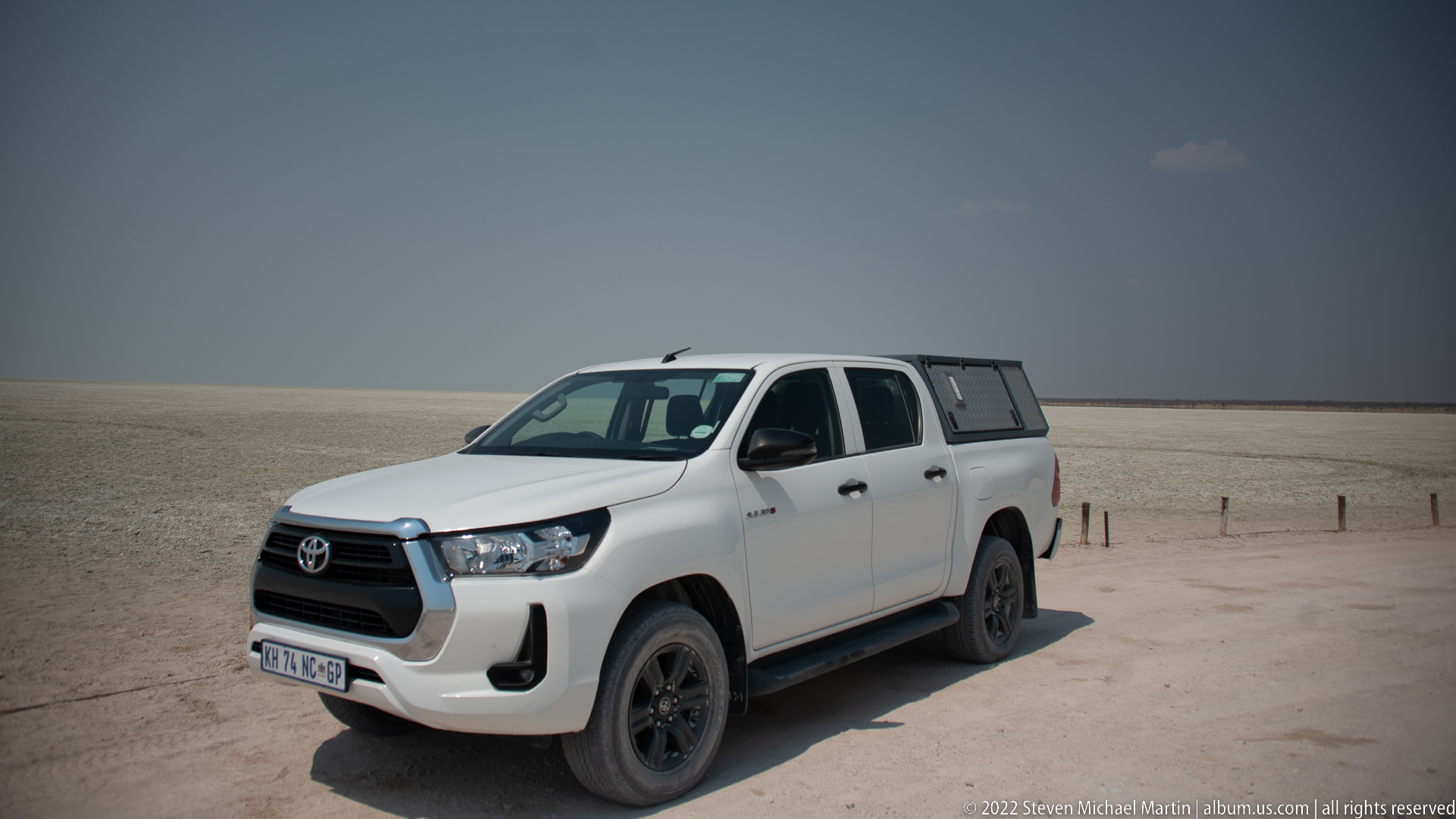
A white Toyota double-cab pickup is parked alone on the bright edge of Etosha Pan. Seen from the front three-quarter angle, the vehicle’s dark grille, wheels, and enclosed rear canopy stand out against the almost monochrome salt surface. The isolated vehicle conveys the practical scale of travel across the open pan.
Caption
A white Toyota double-cab pickup is parked alone on the bright edge of Etosha Pan. Seen from the front three-quarter angle, the vehicle’s dark grille, wheels, and enclosed rear canopy stand out against the almost monochrome salt surface. The isolated vehicle conveys the practical scale of travel across the open pan.
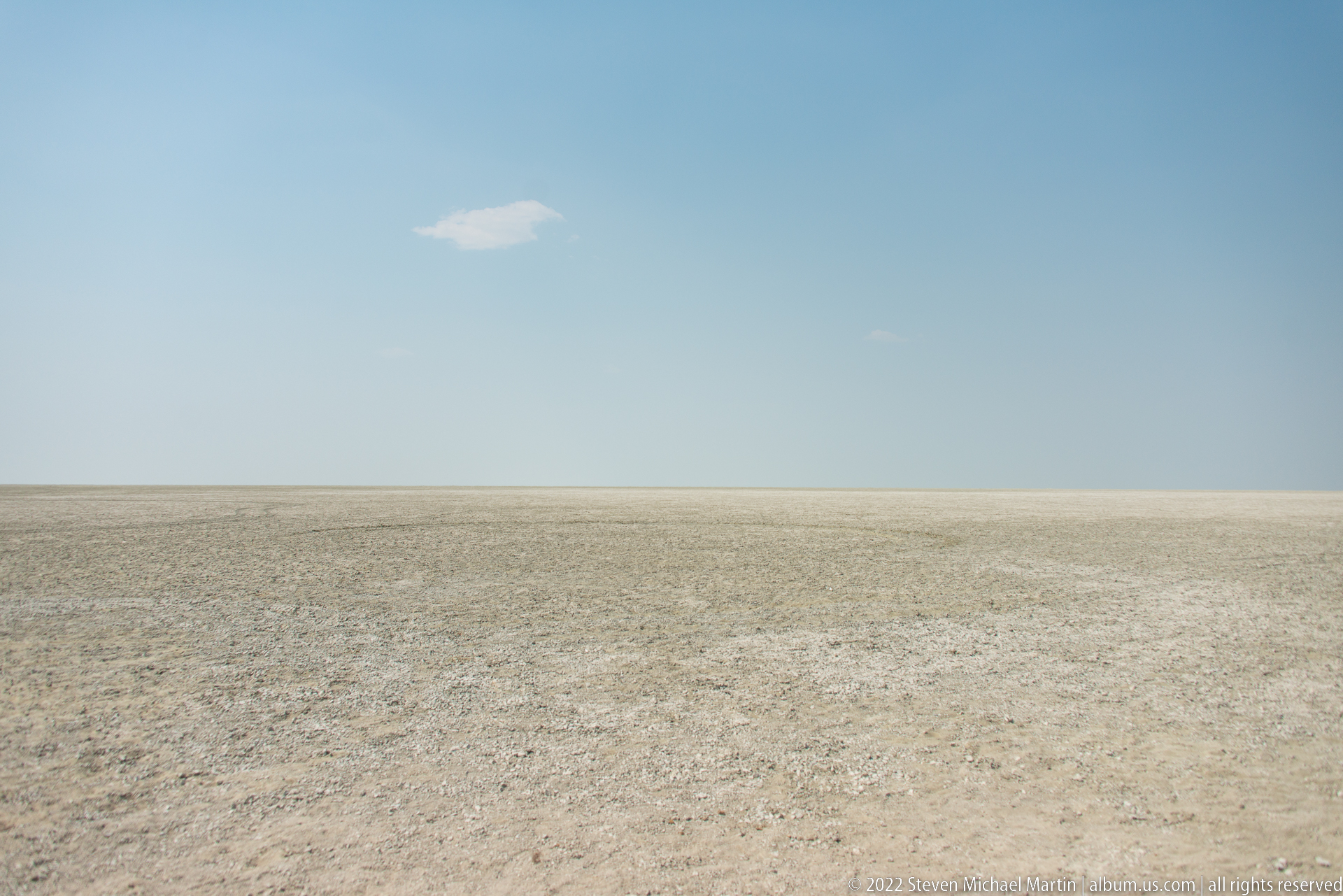
The Etosha Pan stretches as a pale, cracked expanse to an almost perfectly level horizon beneath a clear blue sky. A single small cloud hangs high above the empty foreground. With no animals, vehicles, or structures present, the view isolates the pan’s texture, scale, and austere openness.
Caption
The Etosha Pan stretches as a pale, cracked expanse to an almost perfectly level horizon beneath a clear blue sky. A single small cloud hangs high above the empty foreground. With no animals, vehicles, or structures present, the view isolates the pan’s texture, scale, and austere openness.
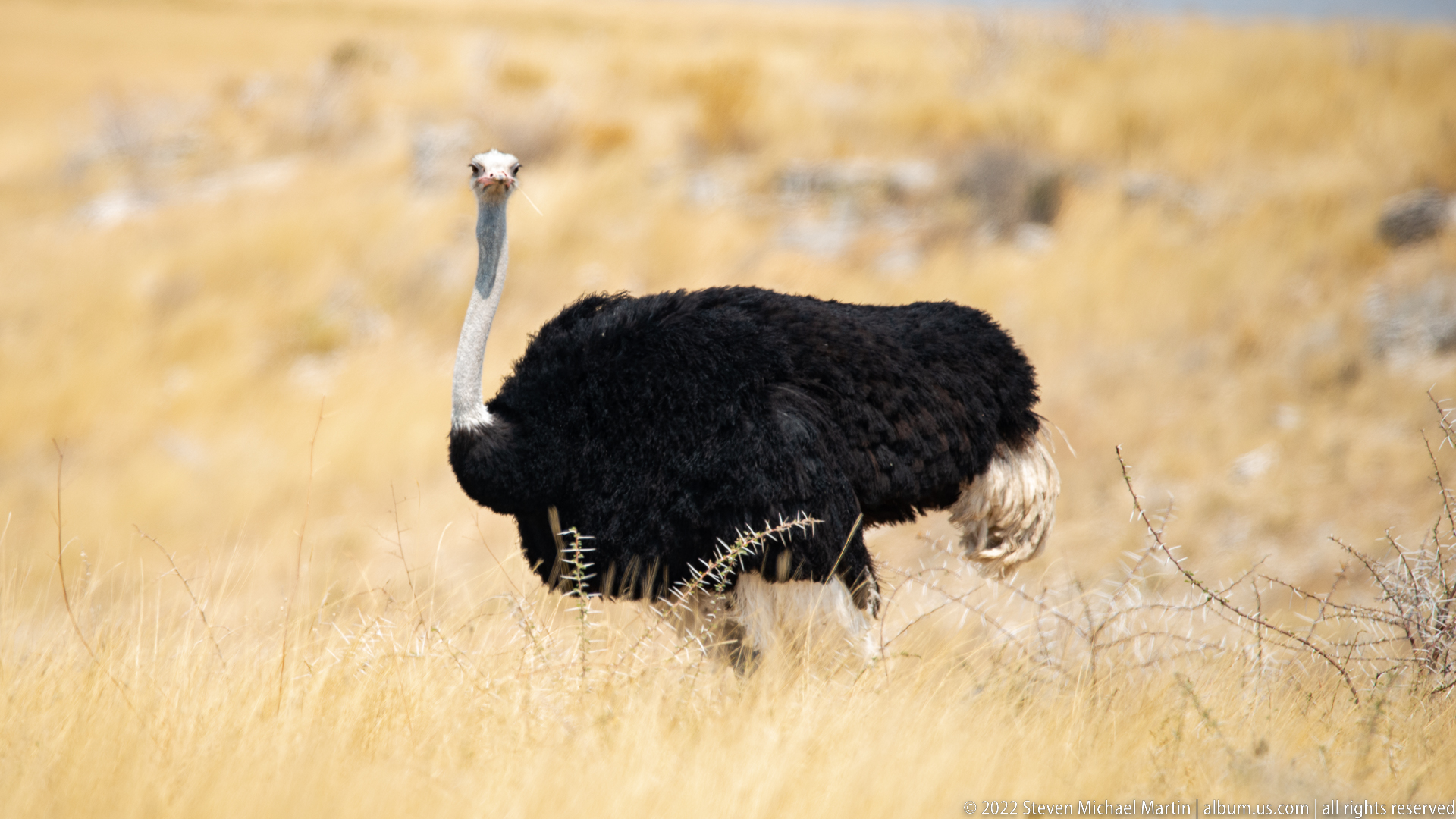
An adult male ostrich stands alert in dry golden grass, its black body plumage contrasting with white wing and tail feathers. The long bare neck rises vertically as the bird looks toward the camera, while the shallow depth of field separates the large flightless bird from the sunlit Etosha grassland.
Caption
An adult male ostrich stands alert in dry golden grass, its black body plumage contrasting with white wing and tail feathers. The long bare neck rises vertically as the bird looks toward the camera, while the shallow depth of field separates the large flightless bird from the sunlit Etosha grassland.
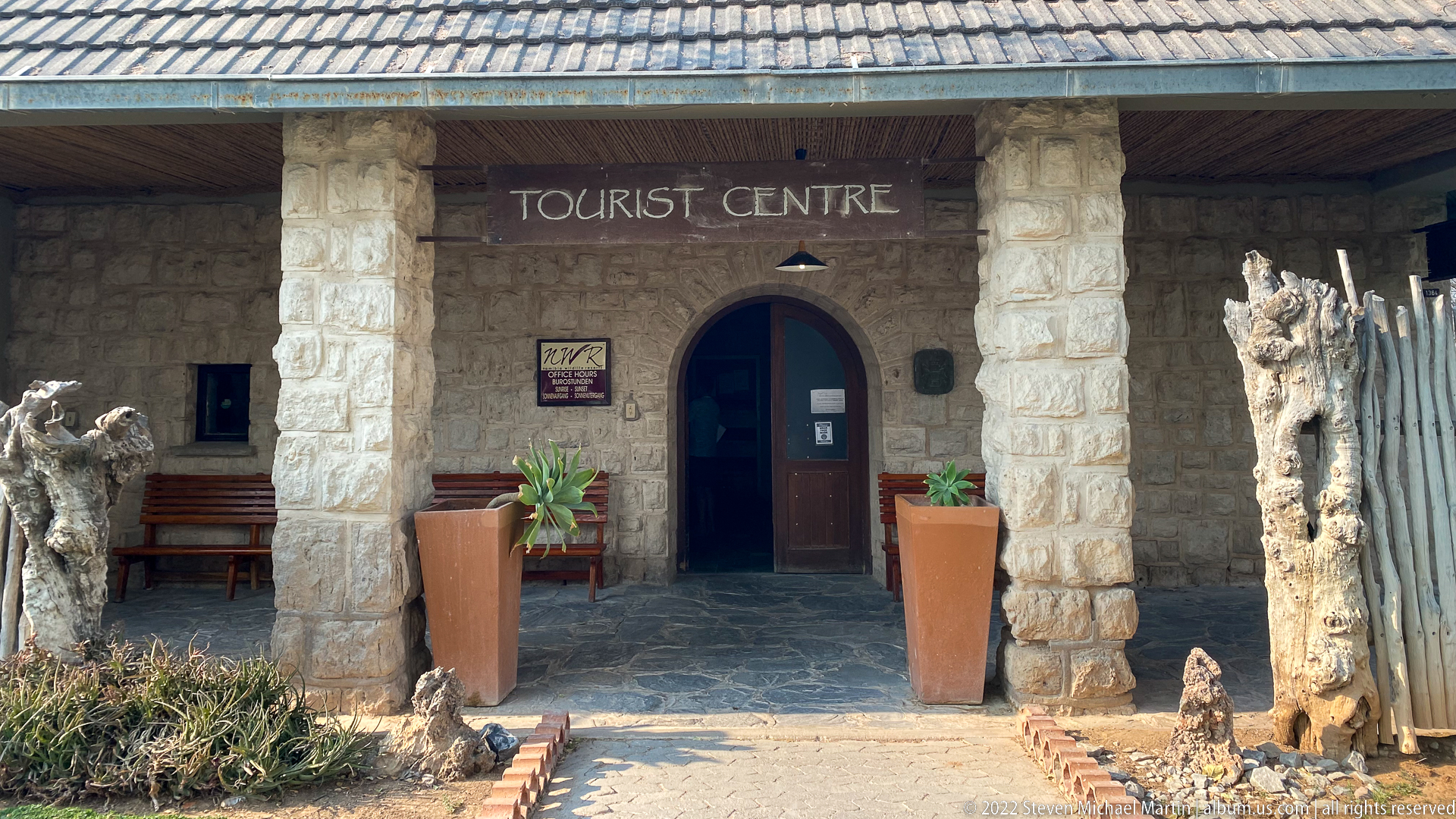
The entrance to a stone-built Tourist Centre is framed by square masonry columns, a shaded porch, benches, and large planters. “TOURIST CENTRE” is painted above the arched doorway, making the building’s function explicit. Rough wood elements and local stone give the visitor facility a deliberately rustic park character.
Caption
The entrance to a stone-built Tourist Centre is framed by square masonry columns, a shaded porch, benches, and large planters. “TOURIST CENTRE” is painted above the arched doorway, making the building’s function explicit. Rough wood elements and local stone give the visitor facility a deliberately rustic park character.

A weathered metal plaque mounted on a stone wall preserves an older conservation emblem associated with South West Africa. The relief combines stylized wildlife flanking a central fort-like motif, with the words “SWA” and “CONSERVATION” legible across the design. Its patina and masonry setting make it a material record of an earlier administrative era.
Caption
A weathered metal plaque mounted on a stone wall preserves an older conservation emblem associated with South West Africa. The relief combines stylized wildlife flanking a central fort-like motif, with the words “SWA” and “CONSERVATION” legible across the design. Its patina and masonry setting make it a material record of an earlier administrative era.

A cylindrical stone tower rises beyond a rustic fence of irregular upright logs at an Etosha visitor complex. Viewed from beneath a shaded roofline, the scene layers rough timber, pale masonry, and sparse trees. The tower’s elevated form suggests the practical lookout architecture characteristic of park rest-camp facilities without relying on a specific site name.
Caption
A cylindrical stone tower rises beyond a rustic fence of irregular upright logs at an Etosha visitor complex. Viewed from beneath a shaded roofline, the scene layers rough timber, pale masonry, and sparse trees. The tower’s elevated form suggests the practical lookout architecture characteristic of park rest-camp facilities without relying on a specific site name.
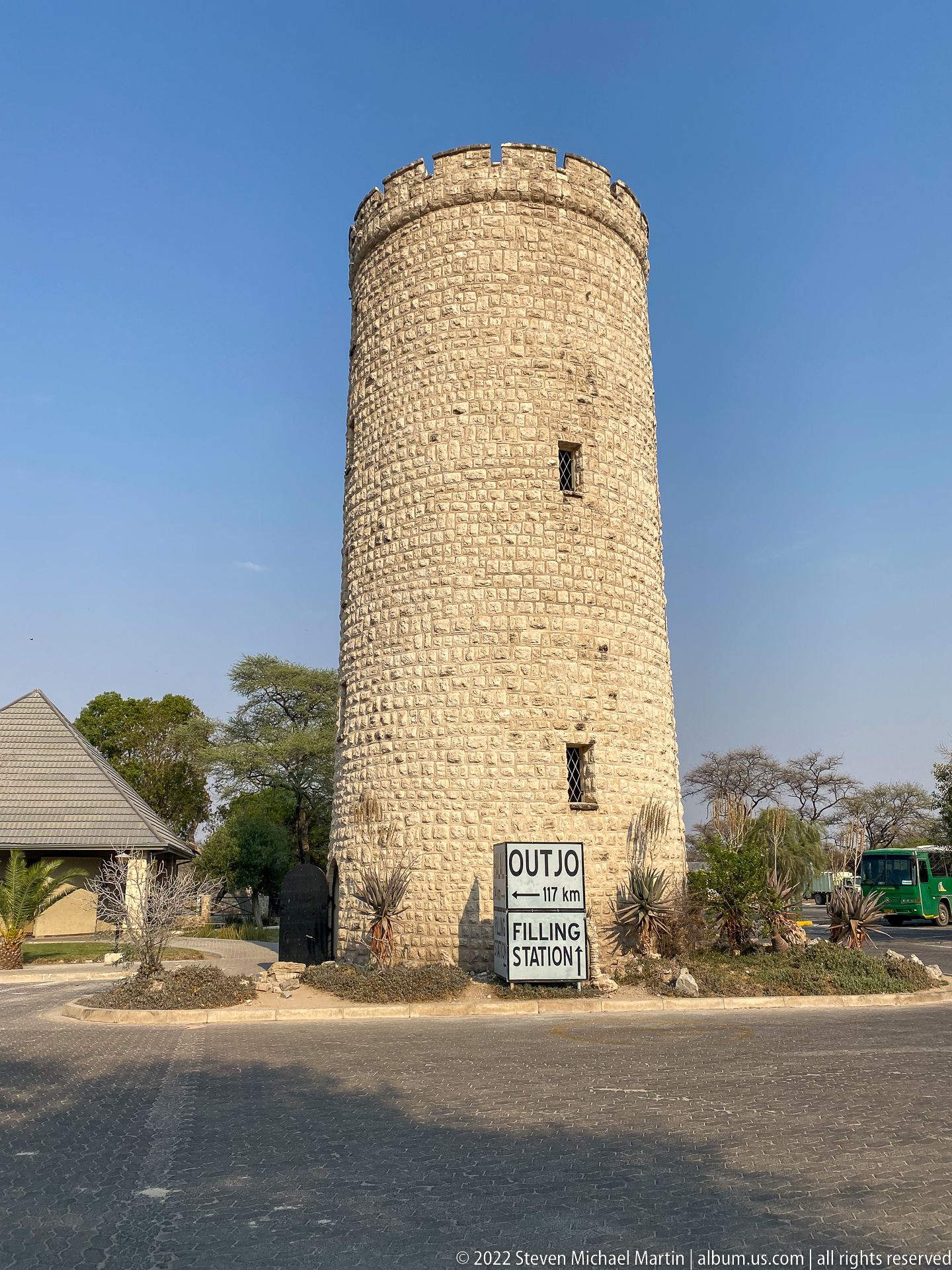
A cylindrical stone tower stands prominently at an Etosha visitor area, with small rectangular openings and a crenellated rim. At its base, a roadside sign points toward Outjo and a filling station, tying the structure to the park’s service network. The frontal view records the tower’s mass and masonry more clearly than the fenced contextual view.
Caption
A cylindrical stone tower stands prominently at an Etosha visitor area, with small rectangular openings and a crenellated rim. At its base, a roadside sign points toward Outjo and a filling station, tying the structure to the park’s service network. The frontal view records the tower’s mass and masonry more clearly than the fenced contextual view.
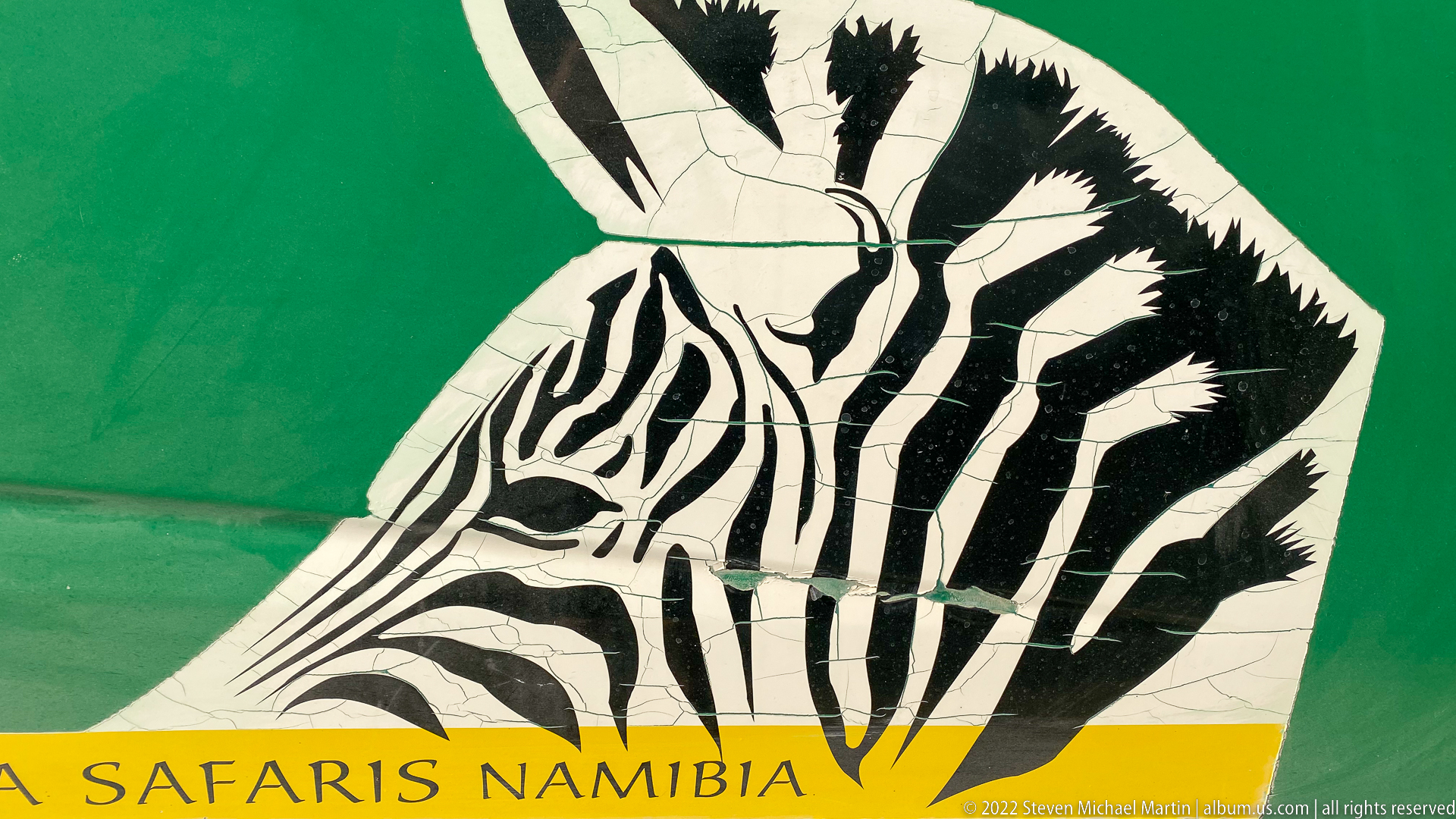
A bold black-and-white zebra head fills a green field above a yellow band carrying the visible words “SAFARIS NAMIBIA.” The cropped graphic reduces the animal to sharply contrasting stripes and angular contours, functioning as safari branding rather than a wildlife record.
Caption
A bold black-and-white zebra head fills a green field above a yellow band carrying the visible words “SAFARIS NAMIBIA.” The cropped graphic reduces the animal to sharply contrasting stripes and angular contours, functioning as safari branding rather than a wildlife record.
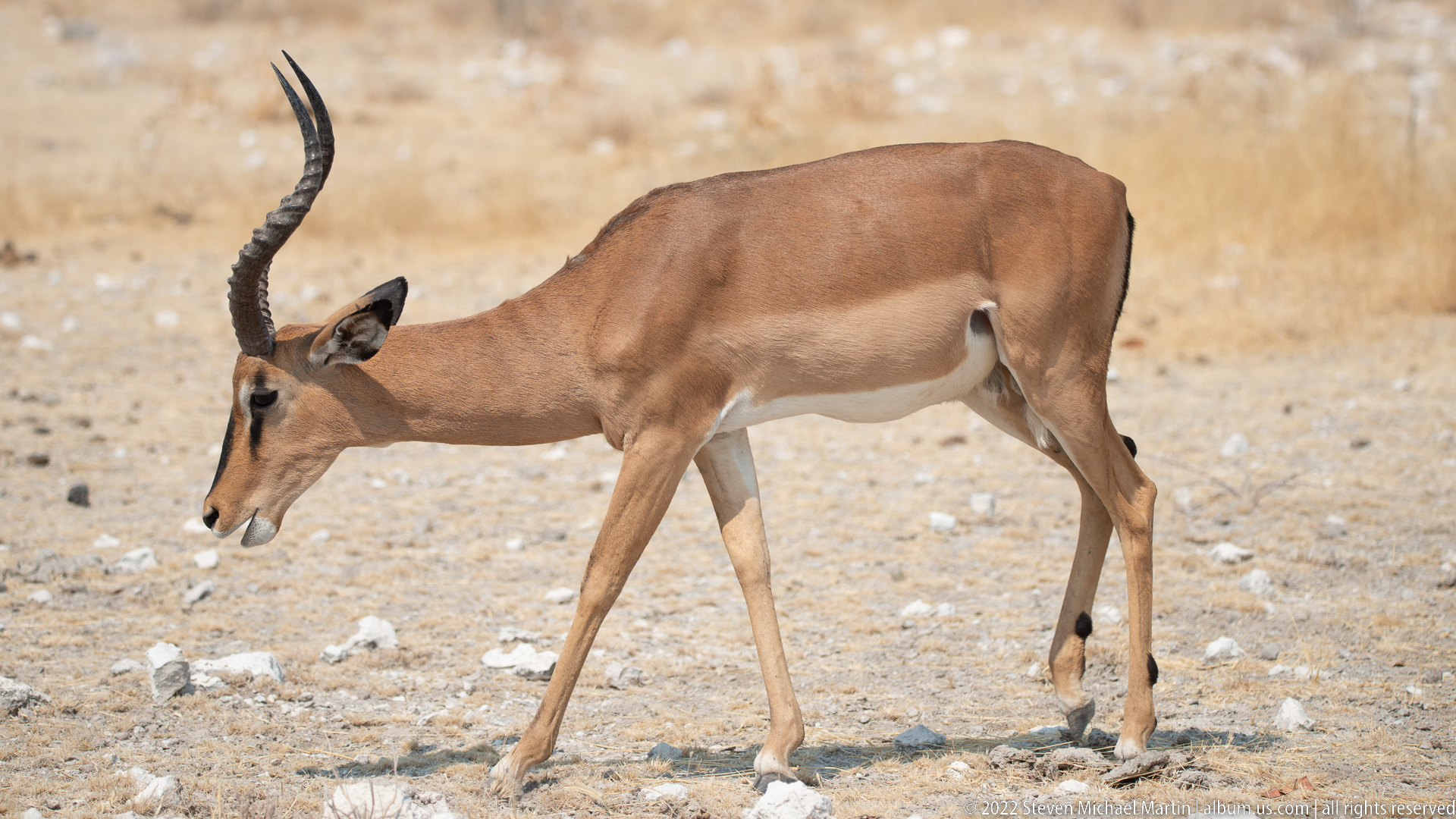
A male impala walks with its head lowered across pale, stony ground. Slender legs, a warm reddish-brown coat, white underparts, and long lyre-shaped ridged horns distinguish the antelope. The side profile gives an especially clear view of body proportions and horn curvature in the dry Etosha environment.
Caption
A male impala walks with its head lowered across pale, stony ground. Slender legs, a warm reddish-brown coat, white underparts, and long lyre-shaped ridged horns distinguish the antelope. The side profile gives an especially clear view of body proportions and horn curvature in the dry Etosha environment.
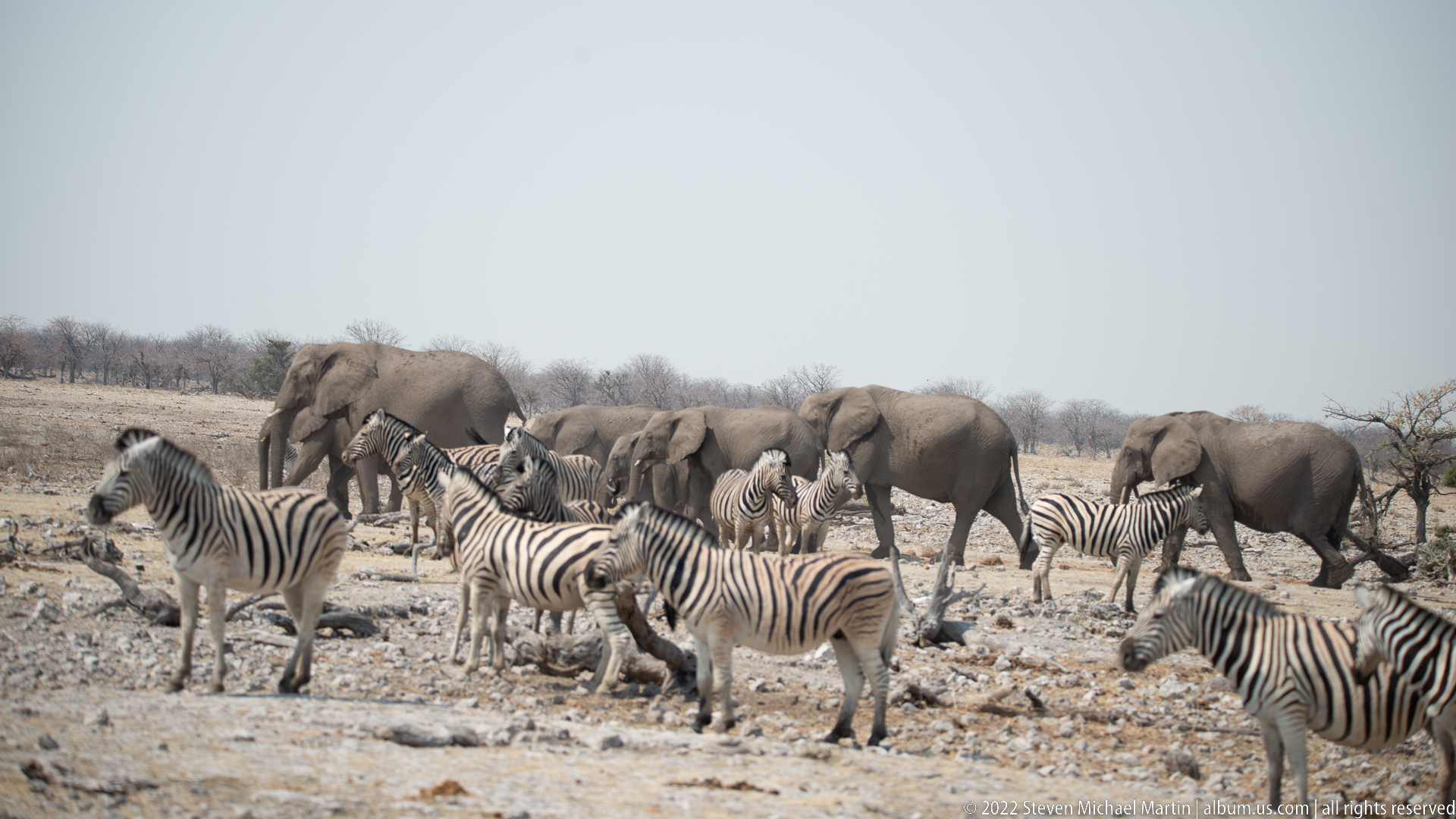
Plains zebras crowd the rocky foreground while several African elephants move behind them through the dry landscape. The mixed-species scene layers striped equids against the larger gray bodies of elephants, suggesting animals gathering in the same open area near sparse vegetation.
Caption
Plains zebras crowd the rocky foreground while several African elephants move behind them through the dry landscape. The mixed-species scene layers striped equids against the larger gray bodies of elephants, suggesting animals gathering in the same open area near sparse vegetation.
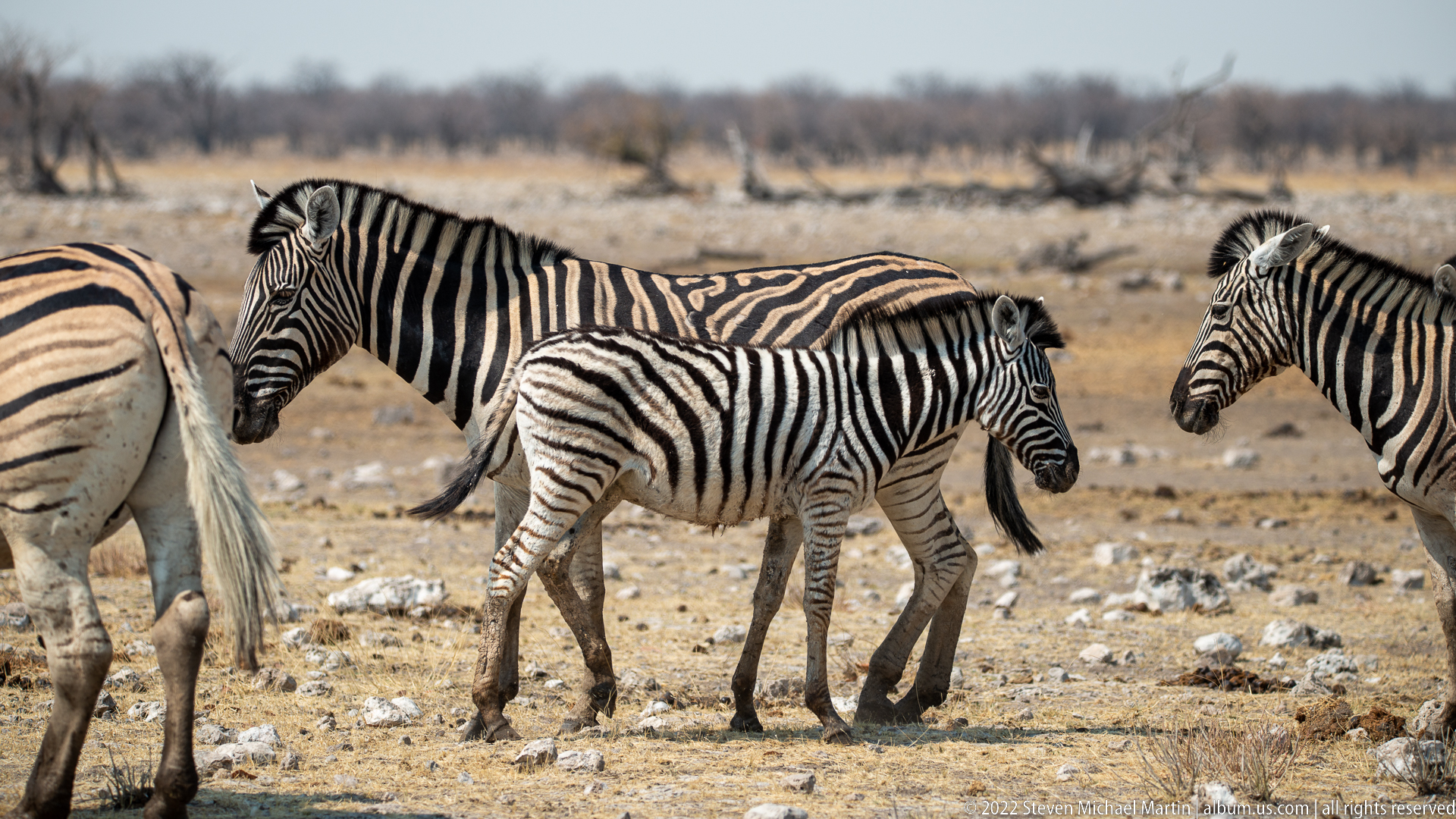
Several plains zebras stand close together on a dry, stone-strewn plain, their overlapping bodies creating a dense pattern of vertical and diagonal stripes. One animal is centered in side profile while others are cropped at the frame edges, emphasizing herd proximity and the visual complexity of their markings.
Caption
Several plains zebras stand close together on a dry, stone-strewn plain, their overlapping bodies creating a dense pattern of vertical and diagonal stripes. One animal is centered in side profile while others are cropped at the frame edges, emphasizing herd proximity and the visual complexity of their markings.
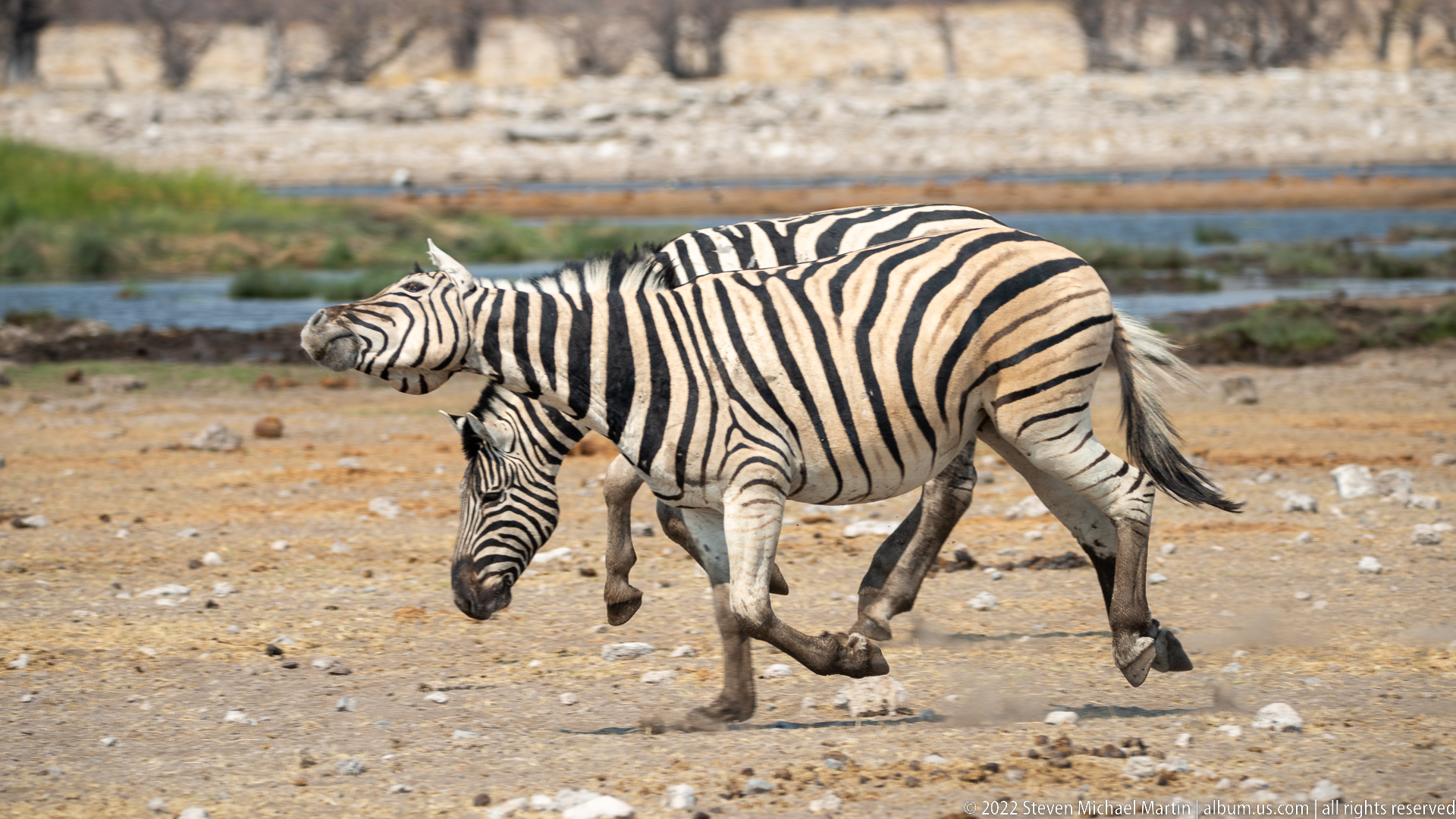
Two plains zebras stride across dry ground with a band of water and green vegetation behind them. Their bodies overlap, creating alternating bands of stripes, while lifted legs record both animals in motion. The waterline gives this view a stronger ecological context than the drier herd portraits on the same page.
Caption
Two plains zebras stride across dry ground with a band of water and green vegetation behind them. Their bodies overlap, creating alternating bands of stripes, while lifted legs record both animals in motion. The waterline gives this view a stronger ecological context than the drier herd portraits on the same page.
Etosha Pan is the defining landscape of Etosha National Park and one of the most visually distinctive environments in Namibia. The immense pale surface stretches toward the horizon in every direction, creating a sense of openness that shapes both the ecology of the park and the experience of traveling through it.
What makes the pan so memorable is the contrast between apparent emptiness and quiet life. Long roads disappear into the distance, isolated trees punctuate the horizon, and animals appear almost unexpectedly across the white and ochre terrain. Rather than concentrating wildlife in one place, the pan reveals how species adapt to scale, exposure, and scarcity.
Highlights
- Immense horizon-dominant landscape defined by salt and mineral soils
- Strong sense of scale created by roads, vehicles, and isolated trees
- Wildlife adapted to arid conditions including oryx, springbok, wildebeest, ostrich, and zebra
- Occasional predator sightings reinforcing the openness of the environment
- A distinctive minimalist visual character unlike greener safari regions
Field Guide
📍 Location
Etosha Pan lies at the heart of Etosha National Park in northern Namibia and forms one of the park’s most important geographic features. The pan occupies a vast central portion of the reserve and influences wildlife movement throughout the surrounding region.
🌍 Landscape
The pan is a broad salt and mineral basin bordered by dry grassland and sparse woodland. Its pale surface, open sky, and minimal relief create one of the most expansive landscapes in southern Africa. Even when wildlife is present, the environment often feels larger than the subjects within it.
Long straight roads, scattered trees, and occasional patches of grass or scrub provide visual structure within an otherwise stripped-down environment. This simplicity is one of the defining strengths of the Etosha Pan experience.
🦓 Wildlife
Although the pan can appear empty at first glance, it supports and shapes a surprising range of wildlife. Animals are often encountered along the pan’s margins or crossing open terrain where the broad landscape emphasizes their scale and isolation.
- Springbok: Commonly seen moving across lightly vegetated terrain and open mineral ground.
- Oryx (gemsbok): Particularly well adapted to arid conditions and visually striking against the pale landscape.
- Blue wildebeest: Often encountered in small groups or larger distant herds across the open plain.
- Plains zebra: Frequently visible near the pan edge or shared water sources.
- Ostrich: Well suited to the openness of the environment and often seen at a distance.
- Secretary bird and ground squirrel: Smaller but memorable species that reinforce the pan’s ecological diversity.
- Elephant and lion: Less constant but especially striking when they appear within such an open setting.
🌤 Atmosphere
The atmosphere of Etosha Pan is defined by brightness, distance, and exposure. Heat shimmer, pale soil, dust, and flat light during the middle of the day can make the environment feel almost abstract. Early and late light often reveal more surface texture and depth.
🚙 Experience
Travel across the pan is as much about environmental immersion as wildlife viewing. The roads, viewpoints, and long visual corridors make the experience feel reflective and spacious. Even simple stops beside the vehicle can communicate the scale of the setting in a way photographs alone rarely capture.
Story & Experience
First Impressions of Scale
The strongest first impression of Etosha Pan is distance. Roads run straight toward the horizon, trees appear isolated, and the pale surface seems to continue almost without interruption. The landscape immediately establishes itself as the subject.
Life Within the Openness
What appears empty from afar gradually reveals movement. Oryx, springbok, wildebeest, ostrich, zebra, and other species emerge from the heat and distance, often as small figures against a much larger environment. Their presence feels subtle rather than concentrated.
Predators in a Minimal Landscape
The lion images are especially effective within this portfolio because they interrupt the minimal rhythm of the pan with something more immediate and alive. In such an exposed landscape, a predator sighting feels even more dramatic because there is so little visual clutter around it.
Roads, Trees, and Orientation
Roads and isolated tree forms give the pan much of its visual structure. They also help communicate scale, direction, and the feeling of crossing a very large environment rather than simply stopping at a single viewpoint.
Human Perspective
The vehicle and travel-context images add an important layer to the page. They show how small a person or vehicle feels against the vastness of the pan and help turn the portfolio into a record of experience rather than a set of disconnected landscape studies.
Why the Pan Matters
Etosha Pan helps explain the broader rhythm of the park. Its scale and dryness make the surrounding waterholes more important, concentrating wildlife elsewhere while also giving the region its unmistakable visual identity. In that way, the pan is not just scenery — it is the environmental core of Etosha.
Photography Notes
- Wide compositions work especially well because scale is the main subject
- Roads, trees, and distant wildlife help create structure within minimalist scenes
- Animals are often strongest when used to show proportion rather than fill the frame
- Heat shimmer and bright light can soften detail but also enhance atmosphere
- A few vehicle or visitor images help communicate how immense the landscape feels in person
Quick Facts
- Park: Etosha National Park
- Region: Northern Namibia
- Landscape: Salt pan, mineral plain, dry grassland, and sparse woodland
- Representative Wildlife: Oryx, springbok, wildebeest, zebra, ostrich, secretary bird, elephant, and lion
- Experience Style: Landscape-driven safari focused on scale, atmosphere, and adapted wildlife
Guide Book
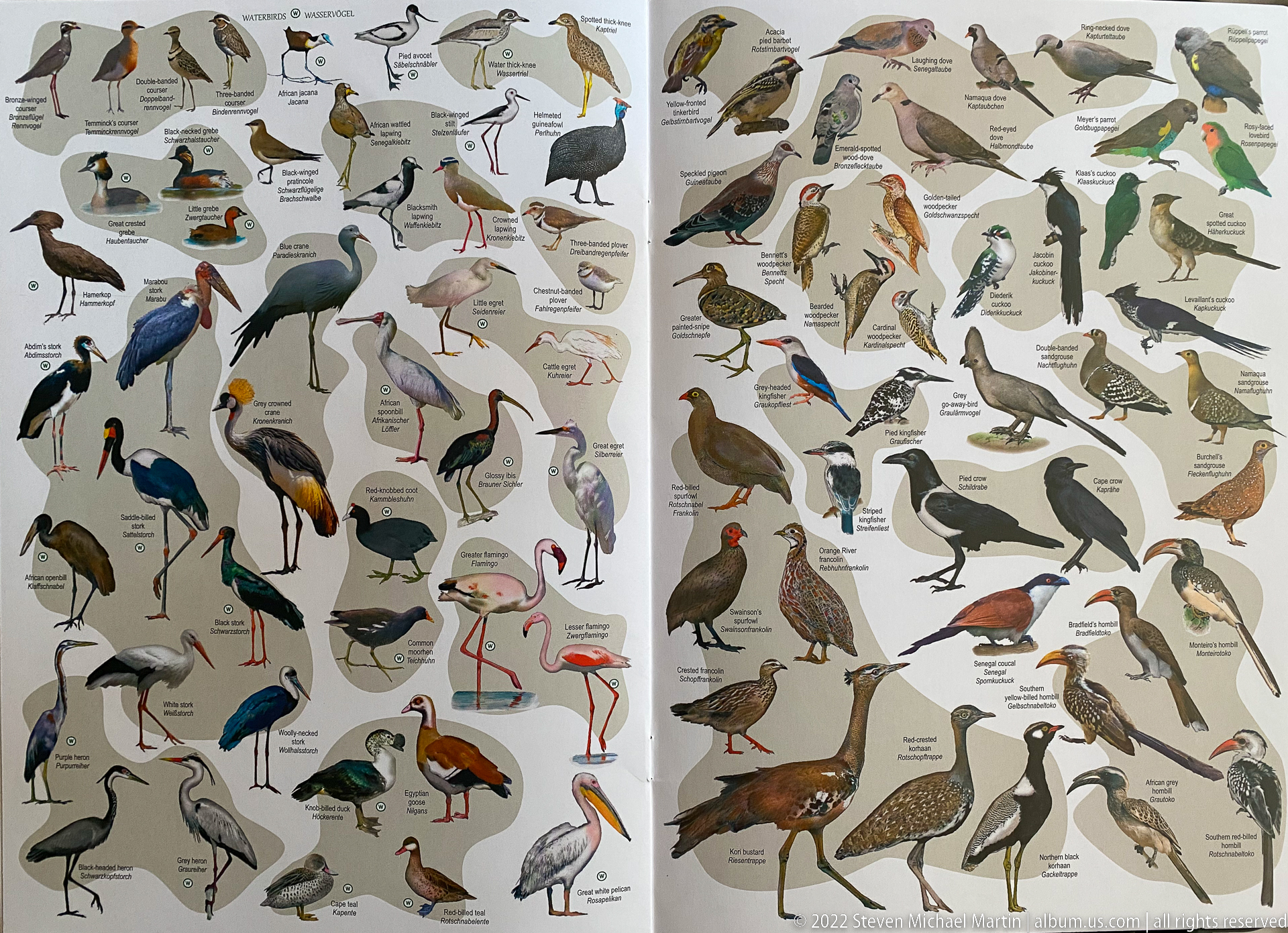
Two densely illustrated bird-identification plates present a wide range of Etosha avifauna in profile. The left page is dominated by long-legged waterbirds and waders, including crane-, stork-, and flamingo-like forms, while the facing page shifts to a broader assortment of terrestrial and wetland birds. Individual labels turn the spread into a compact visual key for field recognition.
Caption
Two densely illustrated bird-identification plates present a wide range of Etosha avifauna in profile. The left page is dominated by long-legged waterbirds and waders, including crane-, stork-, and flamingo-like forms, while the facing page shifts to a broader assortment of terrestrial and wetland birds. Individual labels turn the spread into a compact visual key for field recognition.

The cover of an Etosha wildlife-identification guide combines illustrated mammals and birds with the bilingual title “Map of Etosha / Karte von Etoscha.” A lower panel centers elephants and other animals at a waterhole, signaling the guide’s field-identification purpose. The photographed publication provides contextual reference material for recognizing species and navigating wildlife encounters across the Etosha landscape.
Caption
The cover of an Etosha wildlife-identification guide combines illustrated mammals and birds with the bilingual title “Map of Etosha / Karte von Etoscha.” A lower panel centers elephants and other animals at a waterhole, signaling the guide’s field-identification purpose. The photographed publication provides contextual reference material for recognizing species and navigating wildlife encounters across the Etosha landscape.
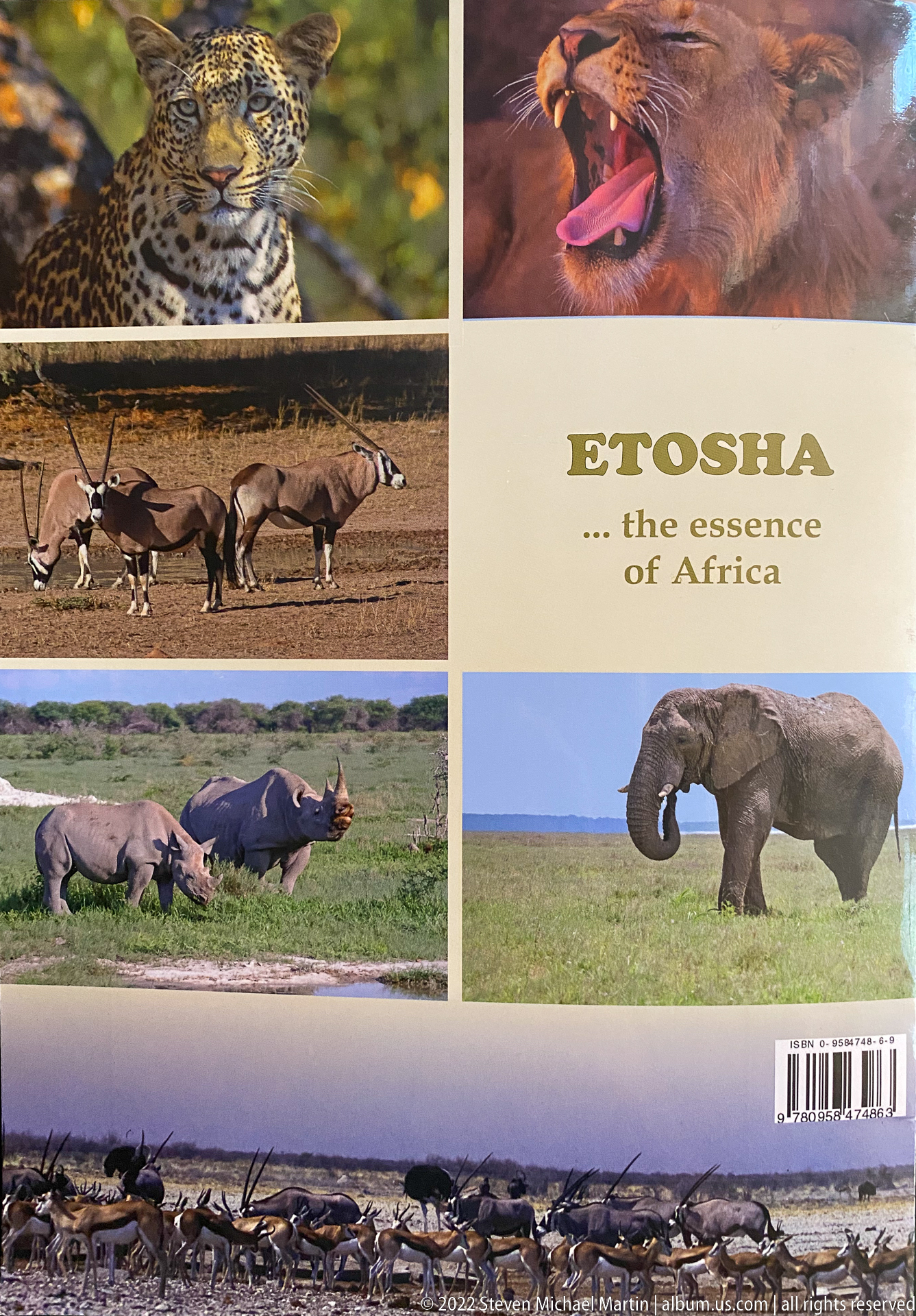
The closing cover of the Etosha guide uses a wildlife collage beneath the phrase “ETOSHA — the essence of Africa.” Separate panels feature close and contextual views of prominent African animals, while a panoramic strip along the bottom shows a large concentration of wildlife across open terrain. The design concludes the field guide by presenting Etosha through the abundance and variety of its fauna.
Caption
The closing cover of the Etosha guide uses a wildlife collage beneath the phrase “ETOSHA — the essence of Africa.” Separate panels feature close and contextual views of prominent African animals, while a panoramic strip along the bottom shows a large concentration of wildlife across open terrain. The design concludes the field guide by presenting Etosha through the abundance and variety of its fauna.

An information spread from the Etosha guide assembles practical park material with natural-history reference: visitor information, timetables, a table of distances, wildlife illustrations, and a color-coded vegetation map. The dense layout shows how field guides integrate route planning with ecological orientation, allowing travelers to relate roads and facilities to the broad vegetation zones that structure wildlife habitat in Etosha.
Caption
An information spread from the Etosha guide assembles practical park material with natural-history reference: visitor information, timetables, a table of distances, wildlife illustrations, and a color-coded vegetation map. The dense layout shows how field guides integrate route planning with ecological orientation, allowing travelers to relate roads and facilities to the broad vegetation zones that structure wildlife habitat in Etosha.
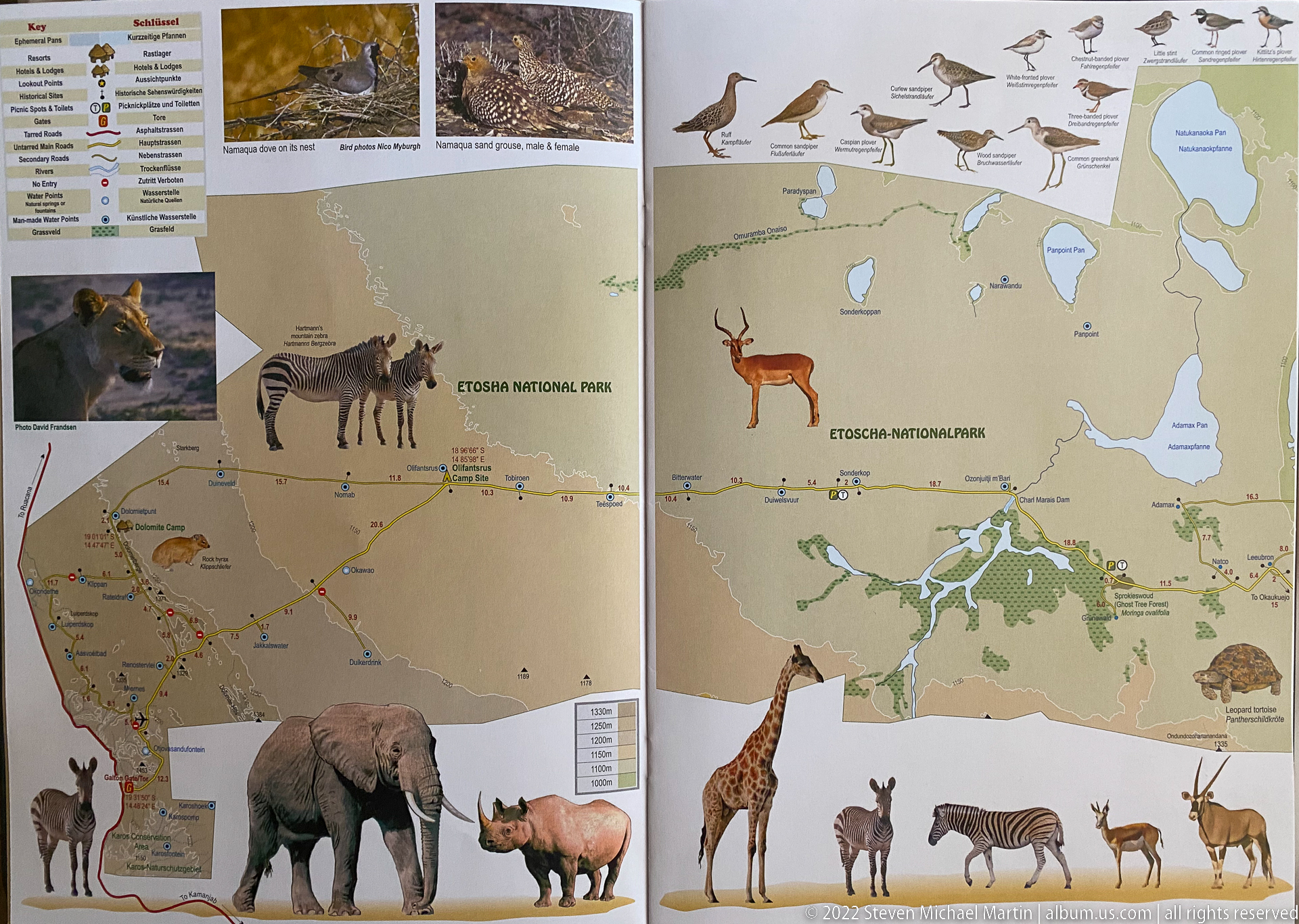
Two facing map pages place Etosha National Park’s road network and water features beneath rows of illustrated wildlife. Large figures of zebra, elephant, rhinoceros, giraffe, antelope, and other species turn the map into a combined navigation and identification aid. The spread visually links animal recognition with the geography of the park, including the broad pale expanse of the Etosha Pan.
Caption
Two facing map pages place Etosha National Park’s road network and water features beneath rows of illustrated wildlife. Large figures of zebra, elephant, rhinoceros, giraffe, antelope, and other species turn the map into a combined navigation and identification aid. The spread visually links animal recognition with the geography of the park, including the broad pale expanse of the Etosha Pan.

A detailed Etosha National Park map spread traces roads, waterholes, settlements, and the margins of the pan across two pages. Wildlife illustrations—including large herbivores and predators—frame the cartography and reinforce the guide’s dual role as route reference and species primer. The layout emphasizes the scale of the protected landscape and the importance of mapped water points to safari movement.
Caption
A detailed Etosha National Park map spread traces roads, waterholes, settlements, and the margins of the pan across two pages. Wildlife illustrations—including large herbivores and predators—frame the cartography and reinforce the guide’s dual role as route reference and species primer. The layout emphasizes the scale of the protected landscape and the importance of mapped water points to safari movement.
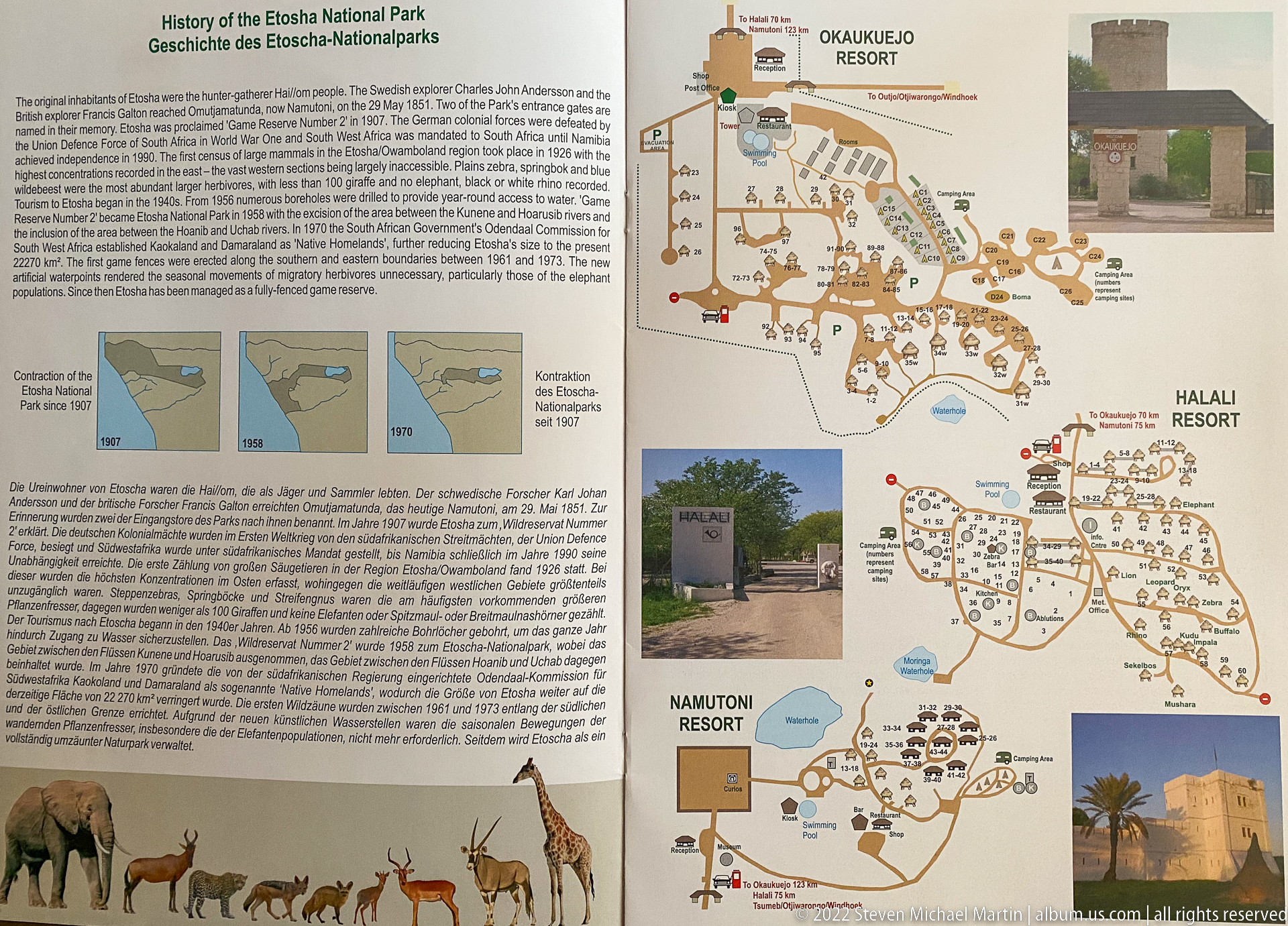
This guide spread pairs a text history of Etosha National Park with schematic plans of three major park resorts: Okaukuejo, Halali, and Namutoni. Small historic and site photographs accompany the maps, while animal illustrations run along the lower margin. The page connects the park’s administrative history with the visitor infrastructure from which many wildlife drives and waterhole observations are organized.
Caption
This guide spread pairs a text history of Etosha National Park with schematic plans of three major park resorts: Okaukuejo, Halali, and Namutoni. Small historic and site photographs accompany the maps, while animal illustrations run along the lower margin. The page connects the park’s administrative history with the visitor infrastructure from which many wildlife drives and waterhole observations are organized.

Photographs and descriptive text survey accommodation and camping facilities associated with Etosha National Park. Separate sections present resort or campsite settings with pools, buildings, shaded grounds, and entrances, giving the spread the character of a practical lodging directory. Rather than wildlife identification, these pages document the visitor infrastructure that supports multi-day travel through the Etosha region.
Caption
Photographs and descriptive text survey accommodation and camping facilities associated with Etosha National Park. Separate sections present resort or campsite settings with pools, buildings, shaded grounds, and entrances, giving the spread the character of a practical lodging directory. Rather than wildlife identification, these pages document the visitor infrastructure that supports multi-day travel through the Etosha region.
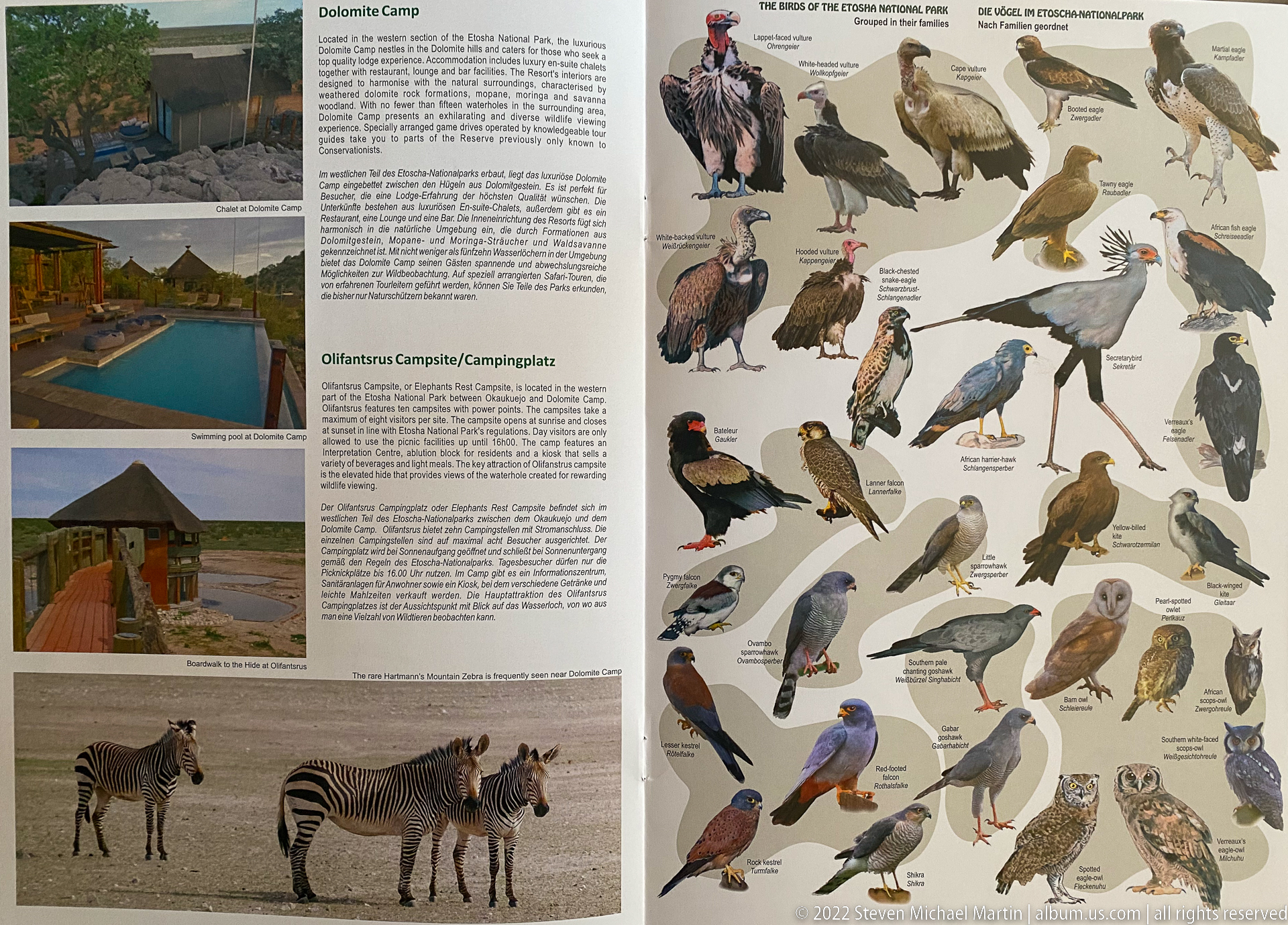
A practical campsite page faces a dense identification plate devoted to birds of prey recorded in the Etosha region. Photographs of lodging, a pool, and zebras occupy the left page, while the right arranges illustrated vultures, eagles, owls, and other raptors with labels. The juxtaposition reflects the guide’s broad scope, moving directly from visitor logistics to field identification.
Caption
A practical campsite page faces a dense identification plate devoted to birds of prey recorded in the Etosha region. Photographs of lodging, a pool, and zebras occupy the left page, while the right arranges illustrated vultures, eagles, owls, and other raptors with labels. The juxtaposition reflects the guide’s broad scope, moving directly from visitor logistics to field identification.
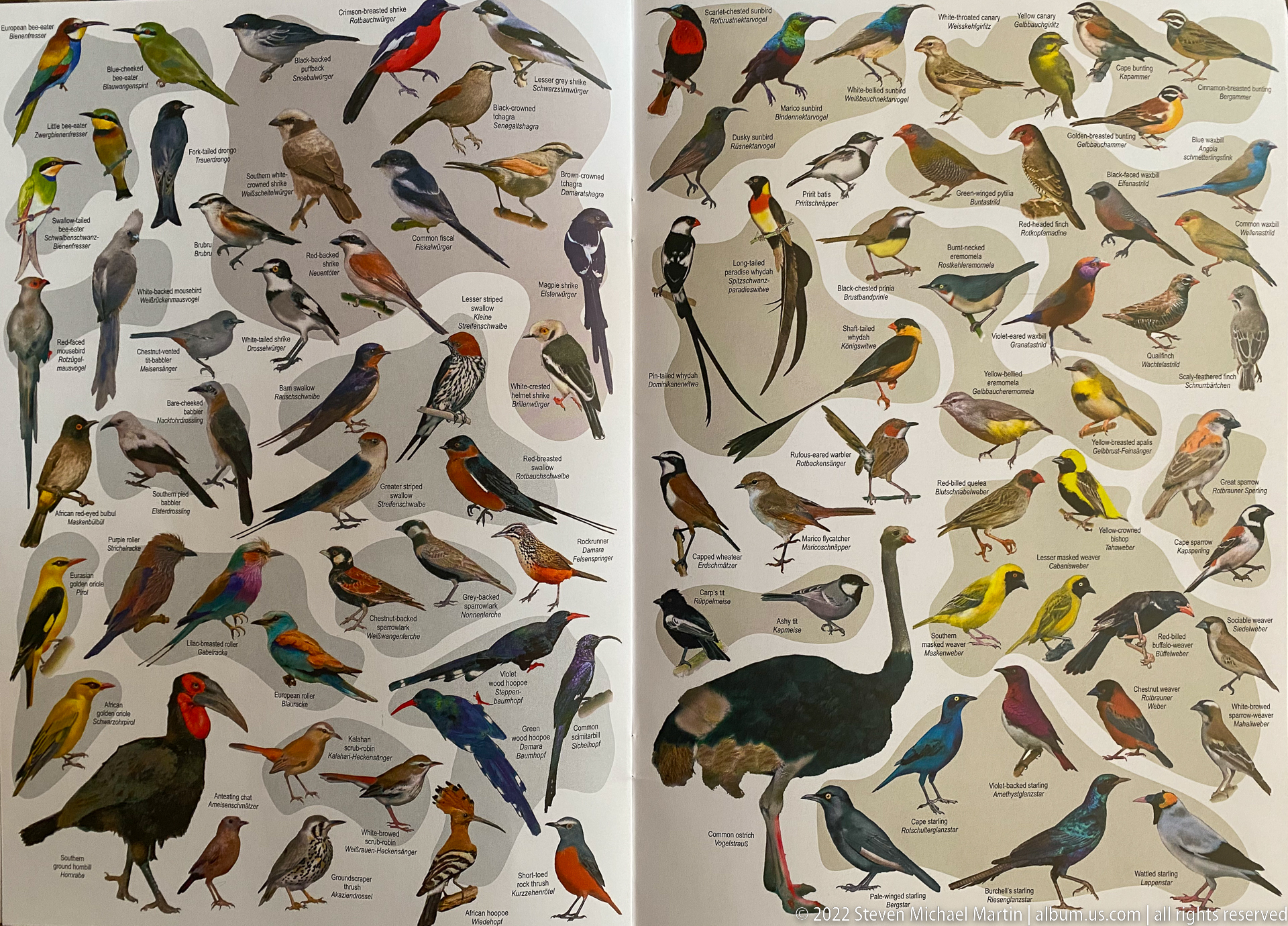
Colorful land birds fill this two-page identification spread, with dozens of labeled species arranged against a pale background. Perching forms dominate, joined by conspicuous larger birds and several vividly patterned species. The compact plate format is designed for visual comparison of plumage, body shape, bill form, and relative proportions—features central to identifying Etosha’s diverse birdlife in the field.
Caption
Colorful land birds fill this two-page identification spread, with dozens of labeled species arranged against a pale background. Perching forms dominate, joined by conspicuous larger birds and several vividly patterned species. The compact plate format is designed for visual comparison of plumage, body shape, bill form, and relative proportions—features central to identifying Etosha’s diverse birdlife in the field.
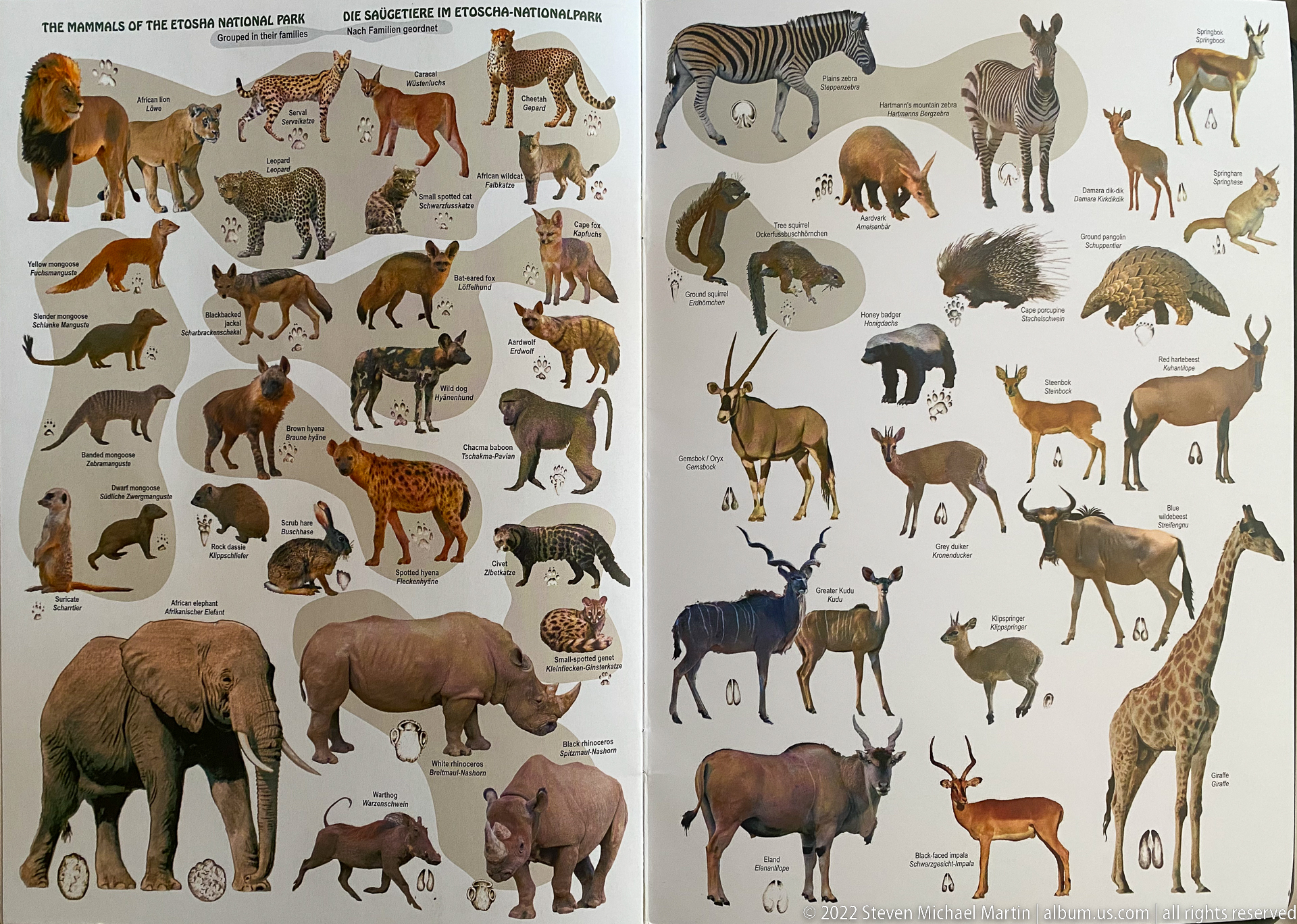
A two-page mammal plate gathers many of Etosha’s characteristic species into a single comparative reference. Carnivores, antelope, equids, primates, small mammals, and large herbivores are shown at differing scales, with elephant, rhinoceros, giraffe, zebra, and wildebeest among the most conspicuous forms. Labeled illustrations emphasize silhouette, coat pattern, horns, and body proportions used in field identification.
Caption
A two-page mammal plate gathers many of Etosha’s characteristic species into a single comparative reference. Carnivores, antelope, equids, primates, small mammals, and large herbivores are shown at differing scales, with elephant, rhinoceros, giraffe, zebra, and wildebeest among the most conspicuous forms. Labeled illustrations emphasize silhouette, coat pattern, horns, and body proportions used in field identification.