Crocodile Bridge – Kruger National Park, South Africa
The southern gateway of Crocodile Bridge provides access to one of the most wildlife-rich regions of Kruger National Park. Located along the Crocodile River, the area attracts large numbers of animals that come to drink along the riverbanks.
The surrounding savanna supports abundant populations of grazing animals such as zebras, impalas, and wildebeest, which in turn attract predators including lions and hyenas. Because of the reliable water source and open landscapes, the Crocodile Bridge region is known for frequent wildlife sightings.
For many visitors, this entrance marks the beginning of a classic safari experience in Kruger.

A rounded granite kopje rises above dry grass and scattered trees under a clear blue sky, creating a strong geological landmark on the horizon. Exposed pale rock forms a compact dome-like summit while lower outcrops extend along the ridge to the right. The foreground of tawny grass and open woodland places the rocky hill within the characteristic lowveld landscape of Kruger National Park.
Caption
A rounded granite kopje rises above dry grass and scattered trees under a clear blue sky, creating a strong geological landmark on the horizon. Exposed pale rock forms a compact dome-like summit while lower outcrops extend along the ridge to the right. The foreground of tawny grass and open woodland places the rocky hill within the characteristic lowveld landscape of Kruger National Park.

A broad thatched-roof structure spans the roadway, its deep eaves and rounded openings forming a prominent park gateway or reception point. Landscaping and traffic markings guide vehicles toward the shaded passage, while flags rise above the roofline. The view records the built infrastructure that organizes movement through a Kruger National Park camp or gate complex.
Caption
A broad thatched-roof structure spans the roadway, its deep eaves and rounded openings forming a prominent park gateway or reception point. Landscaping and traffic markings guide vehicles toward the shaded passage, while flags rise above the roofline. The view records the built infrastructure that organizes movement through a Kruger National Park camp or gate complex.

A close outdoor portrait places a safari traveler against the shaded walkways and vegetation of a Kruger National Park rest camp. The shallow depth of field separates his face from the timber structure behind, creating a personal transition between the visitor facilities and the wildlife encounters that define the Crocodile Bridge sequence.
Caption
A close outdoor portrait places a safari traveler against the shaded walkways and vegetation of a Kruger National Park rest camp. The shallow depth of field separates his face from the timber structure behind, creating a personal transition between the visitor facilities and the wildlife encounters that define the Crocodile Bridge sequence.

Several impalas gather on a green and muddy bank while a Nile crocodile rests partly in the foreground water. The photograph places terrestrial grazers and a large aquatic predator within the same waterhole habitat, with additional antelope visible among the brush behind.
Caption
Several impalas gather on a green and muddy bank while a Nile crocodile rests partly in the foreground water. The photograph places terrestrial grazers and a large aquatic predator within the same waterhole habitat, with additional antelope visible among the brush behind.

A traveler sits at an outdoor café table with two takeaway drinks and camera equipment, framed by the shaded veranda of a Kruger National Park rest-camp facility. The casual pause introduces the human side of a safari day at Crocodile Bridge, where meals, photography gear, and wildlife excursions intersect before visitors return to the park roads.
Caption
A traveler sits at an outdoor café table with two takeaway drinks and camera equipment, framed by the shaded veranda of a Kruger National Park rest-camp facility. The casual pause introduces the human side of a safari day at Crocodile Bridge, where meals, photography gear, and wildlife excursions intersect before visitors return to the park roads.

A traveler raises a takeaway cup while seated at the same open-air rest-camp café, with camera equipment resting on the table in front of him. The tighter composition shifts attention from the surrounding veranda to the brief refreshment break itself, a familiar interval between wildlife drives in the Crocodile Bridge area of Kruger National Park.
Caption
A traveler raises a takeaway cup while seated at the same open-air rest-camp café, with camera equipment resting on the table in front of him. The tighter composition shifts attention from the surrounding veranda to the brief refreshment break itself, a familiar interval between wildlife drives in the Crocodile Bridge area of Kruger National Park.

A smiling traveler holds up a plush primate toy inside a colorful park shop, turning a small safari souvenir into the focus of the frame. Shelves and merchandise blur behind him while the toy’s pale face and dark limbs remain prominent, documenting the retail side of a Kruger rest-camp visit rather than wildlife in the field.
Caption
A smiling traveler holds up a plush primate toy inside a colorful park shop, turning a small safari souvenir into the focus of the frame. Shelves and merchandise blur behind him while the toy’s pale face and dark limbs remain prominent, documenting the retail side of a Kruger rest-camp visit rather than wildlife in the field.

A rustic stone wall carries tall wooden panels spelling “CROCODILE BRIDGE,” marking the named Kruger National Park location in materials that echo the surrounding bushveld architecture. A timber gate and walkway lead past the sign, making this an environmental wayfinding view rather than a formal monument or wildlife photograph.
Caption
A rustic stone wall carries tall wooden panels spelling “CROCODILE BRIDGE,” marking the named Kruger National Park location in materials that echo the surrounding bushveld architecture. A timber gate and walkway lead past the sign, making this an environmental wayfinding view rather than a formal monument or wildlife photograph.

An adult male African lion walks steadily along the edge of an unpaved road, his dark mane, muscular shoulders, and tawny coat sharply visible against dense bush. The side-on view records the animal in motion rather than at rest, showing the long stride and heavy forequarters characteristic of a mature male encountered on a Kruger National Park game drive.
Caption
An adult male African lion walks steadily along the edge of an unpaved road, his dark mane, muscular shoulders, and tawny coat sharply visible against dense bush. The side-on view records the animal in motion rather than at rest, showing the long stride and heavy forequarters characteristic of a mature male encountered on a Kruger National Park game drive.

A mature male African lion strides past low roadside vegetation, photographed broadside as one forepaw reaches forward. His mane forms a dark collar around the head and shoulders while the lean flank and long, tufted tail remain fully visible. This second walking view emphasizes gait and body proportions during a close roadside encounter in Kruger National Park.
Caption
A mature male African lion strides past low roadside vegetation, photographed broadside as one forepaw reaches forward. His mane forms a dark collar around the head and shoulders while the lean flank and long, tufted tail remain fully visible. This second walking view emphasizes gait and body proportions during a close roadside encounter in Kruger National Park.

A lioness sits with her back toward the camera while a mature male lion reclines a short distance beyond her on a bare, sun-dappled patch of ground. Their relaxed postures contrast with the earlier walking sequence, documenting a quieter social moment as the pair settles beside the bush in Kruger National Park.
Caption
A lioness sits with her back toward the camera while a mature male lion reclines a short distance beyond her on a bare, sun-dappled patch of ground. Their relaxed postures contrast with the earlier walking sequence, documenting a quieter social moment as the pair settles beside the bush in Kruger National Park.

A mature male African lion lies in partial shade with his forelegs extended and head lowered, the heavy mane catching warm light along its upper edge. The close view isolates the resting animal from the surrounding bush and reveals the massive shoulders, paws, and layered mane of an adult male after the roadside walking sequence.
Caption
A mature male African lion lies in partial shade with his forelegs extended and head lowered, the heavy mane catching warm light along its upper edge. The close view isolates the resting animal from the surrounding bush and reveals the massive shoulders, paws, and layered mane of an adult male after the roadside walking sequence.

An open-sided pavilion combines a service counter, seating, timber posts, and a high exposed roof, creating a shaded communal space within a Kruger National Park rest camp. Visitors gather around the counter and tables while daylight enters from the open perimeter, giving the scene the practical, informal character of a safari stop between drives.
Caption
An open-sided pavilion combines a service counter, seating, timber posts, and a high exposed roof, creating a shaded communal space within a Kruger National Park rest camp. Visitors gather around the counter and tables while daylight enters from the open perimeter, giving the scene the practical, informal character of a safari stop between drives.

A small herd of African bush elephants clusters in the shade of woodland, with several adults gathered closely together and a younger animal partly protected among them. One elephant stands apart at right, feeding or investigating vegetation. The group arrangement gives the scene the compact, protective character often seen in elephant family units moving through Kruger’s bushveld.
Caption
A small herd of African bush elephants clusters in the shade of woodland, with several adults gathered closely together and a younger animal partly protected among them. One elephant stands apart at right, feeding or investigating vegetation. The group arrangement gives the scene the compact, protective character often seen in elephant family units moving through Kruger’s bushveld.

Vertical timber panels spelling “CROCODILE BRIDGE” are mounted against a rough stone wall, filling the frame more tightly than the preceding entrance view. The close composition emphasizes the hand-crafted lettering, natural materials, and shaded setting of the Kruger National Park rest-camp marker while retaining a glimpse of the adjoining walkway.
Caption
Vertical timber panels spelling “CROCODILE BRIDGE” are mounted against a rough stone wall, filling the frame more tightly than the preceding entrance view. The close composition emphasizes the hand-crafted lettering, natural materials, and shaded setting of the Kruger National Park rest-camp marker while retaining a glimpse of the adjoining walkway.

An African elephant skull is displayed frontally with both tusks still attached, its enormous air-filled cranium and central nasal opening dominating the composition. Seen from this angle, the skull demonstrates how different elephant skeletal anatomy appears from the living animal, especially around the trunk attachment, cheek teeth, and sweeping ivory tusks.
Caption
An African elephant skull is displayed frontally with both tusks still attached, its enormous air-filled cranium and central nasal opening dominating the composition. Seen from this angle, the skull demonstrates how different elephant skeletal anatomy appears from the living animal, especially around the trunk attachment, cheek teeth, and sweeping ivory tusks.

A trail sign announces a crossing on the Berg-en-Dal Rhino Trail and lists rules for visitors entering the route. Set in dry, thorny vegetation beside the path, the board marks a managed walking experience within Kruger National Park and underscores the additional safety requirements that apply when people leave vehicles in wildlife habitat.
Caption
A trail sign announces a crossing on the Berg-en-Dal Rhino Trail and lists rules for visitors entering the route. Set in dry, thorny vegetation beside the path, the board marks a managed walking experience within Kruger National Park and underscores the additional safety requirements that apply when people leave vehicles in wildlife habitat.

A large bovid skull with massive sweeping horns is mounted beside an interpretive panel in an outdoor natural-history display. The frontal view emphasizes the heavy horn bases, broad cranium, and elongated muzzle, allowing visitors to compare skeletal structure with the living ungulates encountered on safari in Kruger National Park.
Caption
A large bovid skull with massive sweeping horns is mounted beside an interpretive panel in an outdoor natural-history display. The frontal view emphasizes the heavy horn bases, broad cranium, and elongated muzzle, allowing visitors to compare skeletal structure with the living ungulates encountered on safari in Kruger National Park.

An elongated ungulate skull is presented in profile beside a mounted interpretive panel, its long facial bones, tooth row, and orbital opening exposed by the display angle. Seen among a sequence of comparative skulls, the specimen turns the rest-camp setting into a small field-guide lesson in mammal anatomy and identification.
Caption
An elongated ungulate skull is presented in profile beside a mounted interpretive panel, its long facial bones, tooth row, and orbital opening exposed by the display angle. Seen among a sequence of comparative skulls, the specimen turns the rest-camp setting into a small field-guide lesson in mammal anatomy and identification.

A robust carnivore skull rests beside an interpretive panel, photographed at an angle that reveals the broad snout, large eye sockets, and prominent canine teeth. The specimen provides a skeletal counterpoint to living predators seen in Kruger, focusing attention on the dentition and jaw structure adapted for a meat-eating mammal.
Caption
A robust carnivore skull rests beside an interpretive panel, photographed at an angle that reveals the broad snout, large eye sockets, and prominent canine teeth. The specimen provides a skeletal counterpoint to living predators seen in Kruger, focusing attention on the dentition and jaw structure adapted for a meat-eating mammal.

A hippopotamus skull faces the viewer with its jaws open, exposing the enormous curved canines and incisors that make the species’ skull immediately distinctive. Mounted above an interpretive panel, the specimen highlights the formidable dentition hidden behind the rounded head of a living hippo and gives a direct anatomical reference for later waterside encounters.
Caption
A hippopotamus skull faces the viewer with its jaws open, exposing the enormous curved canines and incisors that make the species’ skull immediately distinctive. Mounted above an interpretive panel, the specimen highlights the formidable dentition hidden behind the rounded head of a living hippo and gives a direct anatomical reference for later waterside encounters.

Two large mammal skulls stand side by side on a timber rack, allowing direct comparison of contrasting cranial shapes and scale. One has a broad, deep face while the other is markedly elongated, and both are painted or weathered pale against the shaded enclosure. The pairing emphasizes comparative anatomy within the rest-camp natural-history display.
Caption
Two large mammal skulls stand side by side on a timber rack, allowing direct comparison of contrasting cranial shapes and scale. One has a broad, deep face while the other is markedly elongated, and both are painted or weathered pale against the shaded enclosure. The pairing emphasizes comparative anatomy within the rest-camp natural-history display.

A white enamel mug with a blue rim hangs from a wooden post and serves as a tiny planter, with a succulent branch emerging through the cup. The improvised detail brings domestic, hand-made character to the rest-camp environment and rewards attention to the small decorative touches found between larger wildlife and landscape subjects.
Caption
A white enamel mug with a blue rim hangs from a wooden post and serves as a tiny planter, with a succulent branch emerging through the cup. The improvised detail brings domestic, hand-made character to the rest-camp environment and rewards attention to the small decorative touches found between larger wildlife and landscape subjects.

A tall open gateway of timber posts and exposed roof trusses spans a roadway or pedestrian approach within the park. Its steep pitched roof and skeletal construction frame the bright landscape beyond, creating a strong architectural threshold between the shaded rest-camp precinct and the open Kruger bush.
Caption
A tall open gateway of timber posts and exposed roof trusses spans a roadway or pedestrian approach within the park. Its steep pitched roof and skeletal construction frame the bright landscape beyond, creating a strong architectural threshold between the shaded rest-camp precinct and the open Kruger bush.

A small herd of impalas gathers beneath a broad shade tree, some standing alert while others remain partly concealed among trunks and branches. Their reddish-brown coats, pale underparts, and slender build blend into the dry woodland, illustrating how common antelope use scattered tree cover for shade and security in Kruger’s bushveld.
Caption
A small herd of impalas gathers beneath a broad shade tree, some standing alert while others remain partly concealed among trunks and branches. Their reddish-brown coats, pale underparts, and slender build blend into the dry woodland, illustrating how common antelope use scattered tree cover for shade and security in Kruger’s bushveld.

A steep rocky koppie rises above dry bushveld, its exposed boulders and sparse vegetation forming a rugged landmark against a clear blue sky. The isolated hill introduces the granitic terrain associated with parts of southern Kruger, contrasting with the flatter woodland and riverine scenes elsewhere in the Crocodile Bridge sequence.
Caption
A steep rocky koppie rises above dry bushveld, its exposed boulders and sparse vegetation forming a rugged landmark against a clear blue sky. The isolated hill introduces the granitic terrain associated with parts of southern Kruger, contrasting with the flatter woodland and riverine scenes elsewhere in the Crocodile Bridge sequence.

A brick entrance wall welcomes visitors to Berg-en-Dal, with a white rhinoceros silhouette painted beneath the words “WELCOME TO” and the camp name repeated below. A second wooden sign rises behind the wall beside thatched architecture, making the location identification explicit and marking a shift from the Crocodile Bridge area to another Kruger rest camp.
Caption
A brick entrance wall welcomes visitors to Berg-en-Dal, with a white rhinoceros silhouette painted beneath the words “WELCOME TO” and the camp name repeated below. A second wooden sign rises behind the wall beside thatched architecture, making the location identification explicit and marking a shift from the Crocodile Bridge area to another Kruger rest camp.

A lone African bush elephant stands at the far edge of a broad waterhole, dwarfed by the open water and dry hillside behind it. The long-distance composition emphasizes habitat and scale rather than portrait detail, placing the animal within the seasonal bushveld landscape and showing the importance of permanent water sources to Kruger wildlife.
Caption
A lone African bush elephant stands at the far edge of a broad waterhole, dwarfed by the open water and dry hillside behind it. The long-distance composition emphasizes habitat and scale rather than portrait detail, placing the animal within the seasonal bushveld landscape and showing the importance of permanent water sources to Kruger wildlife.

A dense herd of African buffalo rests and stands along the exposed shore of a waterhole, many animals lying shoulder to shoulder near the water. A leafy tree frames the foreground, giving the scene depth while the dark bodies and heavy horn bosses of the herd form a broad band across the dry bank.
Caption
A dense herd of African buffalo rests and stands along the exposed shore of a waterhole, many animals lying shoulder to shoulder near the water. A leafy tree frames the foreground, giving the scene depth while the dark bodies and heavy horn bosses of the herd form a broad band across the dry bank.

African buffalo crowd the waterhole margin in a wide, unobstructed view, with some animals lying on the dry bank and others standing behind them. The composition reveals the scale of the aggregation more clearly than the preceding framed view, documenting communal resting behavior around a dependable water source in Kruger National Park.
Caption
African buffalo crowd the waterhole margin in a wide, unobstructed view, with some animals lying on the dry bank and others standing behind them. The composition reveals the scale of the aggregation more clearly than the preceding framed view, documenting communal resting behavior around a dependable water source in Kruger National Park.

A line of hippopotamuses moves through the water with only heads and backs breaking the surface, while impalas stand on the far bank behind them. A dead tree trunk rises from the water near center, dividing aquatic and terrestrial layers of the scene and bringing two very different Kruger herbivores into one shared waterhole habitat.
Caption
A line of hippopotamuses moves through the water with only heads and backs breaking the surface, while impalas stand on the far bank behind them. A dead tree trunk rises from the water near center, dividing aquatic and terrestrial layers of the scene and bringing two very different Kruger herbivores into one shared waterhole habitat.

A dense cluster of woven grass nests hangs from a tree, with several bright yellow weaver birds perched among the entrances. The close view reveals the remarkable concentration of suspended chambers and loose fibers that make a communal nesting tree visually distinctive, shifting attention from Kruger’s large mammals to the park’s active birdlife.
Caption
A dense cluster of woven grass nests hangs from a tree, with several bright yellow weaver birds perched among the entrances. The close view reveals the remarkable concentration of suspended chambers and loose fibers that make a communal nesting tree visually distinctive, shifting attention from Kruger’s large mammals to the park’s active birdlife.

A small group of common hippopotamuses rests almost completely submerged, with eyes, ears, nostrils, and rounded backs breaking the water surface. The tight grouping shows the species’ aquatic daytime behavior, using the water as refuge from heat while remaining able to watch and breathe above the surface.
Caption
A small group of common hippopotamuses rests almost completely submerged, with eyes, ears, nostrils, and rounded backs breaking the water surface. The tight grouping shows the species’ aquatic daytime behavior, using the water as refuge from heat while remaining able to watch and breathe above the surface.

A black-winged stilt stands in shallow open water, its exceptionally long pink-red legs, white head and underparts, dark back, and fine straight bill clearly visible. The isolated profile emphasizes the wader’s long-legged proportions and its adaptation for foraging in shallow wetlands.
Caption
A black-winged stilt stands in shallow open water, its exceptionally long pink-red legs, white head and underparts, dark back, and fine straight bill clearly visible. The isolated profile emphasizes the wader’s long-legged proportions and its adaptation for foraging in shallow wetlands.

Bending forward on long pink legs, a black-winged stilt probes the water with its slender black bill. Concentric ripples and the bird’s reflected body make the feeding action especially legible, distinguishing this behavioral view from the adjacent standing portraits.
Caption
Bending forward on long pink legs, a black-winged stilt probes the water with its slender black bill. Concentric ripples and the bird’s reflected body make the feeding action especially legible, distinguishing this behavioral view from the adjacent standing portraits.

A black-winged stilt strides through smooth shallow water in side profile. One elongated pink leg is lifted while the other supports the bird, and the white plumage, dark wings, needle-like bill, and mirrored reflection define the species against an uncluttered blue-gray surface.
Caption
A black-winged stilt strides through smooth shallow water in side profile. One elongated pink leg is lifted while the other supports the bird, and the white plumage, dark wings, needle-like bill, and mirrored reflection define the species against an uncluttered blue-gray surface.

Two hippopotamuses surface close together while a small oxpecker perches prominently on the nearer animal’s back. The composition pairs the massive, mostly submerged mammals with a much smaller bird commonly seen feeding on large African mammals, while another hippopotamus remains farther behind.
Caption
Two hippopotamuses surface close together while a small oxpecker perches prominently on the nearer animal’s back. The composition pairs the massive, mostly submerged mammals with a much smaller bird commonly seen feeding on large African mammals, while another hippopotamus remains farther behind.

A black-winged stilt pauses in deeper blue-toned water, seen in three-quarter profile with its long bill angled downward. Its extended legs and elongated reflection create a strong vertical composition, while the dark mantle contrasts sharply with the white neck and breast.
Caption
A black-winged stilt pauses in deeper blue-toned water, seen in three-quarter profile with its long bill angled downward. Its extended legs and elongated reflection create a strong vertical composition, while the dark mantle contrasts sharply with the white neck and breast.

A young African bush elephant moves through dense green undergrowth in close side view. Its small tusks, wrinkled gray skin, large ear, and lowered trunk are clearly visible, while a dark bird perched on its back adds a small interspecies detail.
Caption
A young African bush elephant moves through dense green undergrowth in close side view. Its small tusks, wrinkled gray skin, large ear, and lowered trunk are clearly visible, while a dark bird perched on its back adds a small interspecies detail.

A young African bush elephant advances through leafy bush with its trunk curled toward the vegetation. Small emerging tusks and proportionally large ears mark the juvenile animal, while a dark bird remains perched on its back in this closer behavioral portrait.
Caption
A young African bush elephant advances through leafy bush with its trunk curled toward the vegetation. Small emerging tusks and proportionally large ears mark the juvenile animal, while a dark bird remains perched on its back in this closer behavioral portrait.

A yellow-billed stork stands upright on a muddy bank while several Nile crocodiles lie at the water’s edge and in the shallows. The stork’s white body, black flight feathers, red facial skin, and yellow bill contrast with the low, armored forms of the crocodiles.
Caption
A yellow-billed stork stands upright on a muddy bank while several Nile crocodiles lie at the water’s edge and in the shallows. The stork’s white body, black flight feathers, red facial skin, and yellow bill contrast with the low, armored forms of the crocodiles.

A yellow-billed stork stands on the exposed shoreline directly behind multiple Nile crocodiles, including a large animal stretched along the waterline. This closer framing emphasizes the striking coexistence of a tall wading bird and large aquatic reptiles sharing the same drying margin.
Caption
A yellow-billed stork stands on the exposed shoreline directly behind multiple Nile crocodiles, including a large animal stretched along the waterline. This closer framing emphasizes the striking coexistence of a tall wading bird and large aquatic reptiles sharing the same drying margin.

A large Nile crocodile lies nearly motionless in shallow water, its broad head and heavily armored back exposed above the surface. The side-on view reveals rows of raised dorsal scutes and the long tapering tail, with a clear reflection beneath the reptile.
Caption
A large Nile crocodile lies nearly motionless in shallow water, its broad head and heavily armored back exposed above the surface. The side-on view reveals rows of raised dorsal scutes and the long tapering tail, with a clear reflection beneath the reptile.

A broad waterhole view shows impalas dispersed across the muddy shore and vegetation, a yellow-billed stork near the center, and crocodiles close to the waterline. The wider framing records how several species occupy different zones of the same dry-season aquatic habitat.
Caption
A broad waterhole view shows impalas dispersed across the muddy shore and vegetation, a yellow-billed stork near the center, and crocodiles close to the waterline. The wider framing records how several species occupy different zones of the same dry-season aquatic habitat.

A bright yellow male weaver clings to the side of a densely woven grass nest suspended from a thorny branch. Its dark facial mask and red eye stand out against the yellow plumage as it works at the nest entrance, illustrating the intricate suspended construction characteristic of weaver birds.
Caption
A bright yellow male weaver clings to the side of a densely woven grass nest suspended from a thorny branch. Its dark facial mask and red eye stand out against the yellow plumage as it works at the nest entrance, illustrating the intricate suspended construction characteristic of weaver birds.

A male weaver hangs upside down beneath a compact woven nest attached to a thorny branch. The wider view reveals the nest’s suspended placement and tightly interlaced grass structure, while the bird’s yellow plumage remains visible below the entrance.
Caption
A male weaver hangs upside down beneath a compact woven nest attached to a thorny branch. The wider view reveals the nest’s suspended placement and tightly interlaced grass structure, while the bird’s yellow plumage remains visible below the entrance.

A solitary common hippopotamus rests almost fully submerged in calm water, with only the head, ears, back, and upper flank exposed. The low profile demonstrates the animal’s aquatic adaptation, allowing it to remain cool while keeping its nostrils and sensory organs near the surface.
Caption
A solitary common hippopotamus rests almost fully submerged in calm water, with only the head, ears, back, and upper flank exposed. The low profile demonstrates the animal’s aquatic adaptation, allowing it to remain cool while keeping its nostrils and sensory organs near the surface.

Large painted letters reading “LOWER SABIE” identify the location on a masonry wall behind a metal gate and security fencing. The utilitarian entrance detail provides a human-made geographic marker within the Kruger National Park sequence, contrasting with the surrounding wildlife photographs.
Caption
Large painted letters reading “LOWER SABIE” identify the location on a masonry wall behind a metal gate and security fencing. The utilitarian entrance detail provides a human-made geographic marker within the Kruger National Park sequence, contrasting with the surrounding wildlife photographs.

A common hippopotamus walks along a sandy bank beside the water, its massive barrel-shaped body fully visible out of the river. Tall green vegetation frames the animal, offering an uncommon terrestrial view compared with the largely submerged hippopotamuses elsewhere in the sequence.
Caption
A common hippopotamus walks along a sandy bank beside the water, its massive barrel-shaped body fully visible out of the river. Tall green vegetation frames the animal, offering an uncommon terrestrial view compared with the largely submerged hippopotamuses elsewhere in the sequence.

Several white, star-like trumpet flowers open among glossy green leaves and woody thorny stems, while nearby buds and aging yellowed blooms show different flowering stages. The close botanical view records vegetation within the park rather than its larger animal subjects.
Caption
Several white, star-like trumpet flowers open among glossy green leaves and woody thorny stems, while nearby buds and aging yellowed blooms show different flowering stages. The close botanical view records vegetation within the park rather than its larger animal subjects.

An African buffalo faces the camera from tall dry grass and scrub, its heavy outward-curving horns forming a broad symmetrical arc. The frontal view emphasizes the massive head, dark coat, broad muzzle, and horn shape that distinguish this large bovine of the southern African bushveld.
Caption
An African buffalo faces the camera from tall dry grass and scrub, its heavy outward-curving horns forming a broad symmetrical arc. The frontal view emphasizes the massive head, dark coat, broad muzzle, and horn shape that distinguish this large bovine of the southern African bushveld.

A close African buffalo portrait fills the frame with the animal’s broad forehead, dark muzzle, large ears, and sweeping horns. Bits of vegetation hang from its mouth, indicating recent feeding, while another buffalo is partly visible behind the primary subject.
Caption
A close African buffalo portrait fills the frame with the animal’s broad forehead, dark muzzle, large ears, and sweeping horns. Bits of vegetation hang from its mouth, indicating recent feeding, while another buffalo is partly visible behind the primary subject.

An African buffalo stands broadside on a paved road, temporarily occupying the roadway between dry grass and scrub. Its dark body, heavy shoulders, curved horns, and long tail are fully visible, placing the large wild bovine in direct relation to Kruger’s visitor infrastructure.
Caption
An African buffalo stands broadside on a paved road, temporarily occupying the roadway between dry grass and scrub. Its dark body, heavy shoulders, curved horns, and long tail are fully visible, placing the large wild bovine in direct relation to Kruger’s visitor infrastructure.

A buffalo’s head and horns dominate this tight frontal composition, with additional animals crowded behind it. The foreground individual’s thick horn bases, wide ears, textured muzzle, and watchful eyes are rendered in detail, turning the herd encounter into an intimate species portrait.
Caption
A buffalo’s head and horns dominate this tight frontal composition, with additional animals crowded behind it. The foreground individual’s thick horn bases, wide ears, textured muzzle, and watchful eyes are rendered in detail, turning the herd encounter into an intimate species portrait.

Several giraffes stand among low shrubs and dry woodland, with two tall adults crossing their long necks near the center of the composition. Their irregular brown patches and towering silhouettes rise above the surrounding vegetation, while another giraffe is partly concealed behind them.
Caption
Several giraffes stand among low shrubs and dry woodland, with two tall adults crossing their long necks near the center of the composition. Their irregular brown patches and towering silhouettes rise above the surrounding vegetation, while another giraffe is partly concealed behind them.

Two giraffes stand closely together with their long necks crossing to form an X-shaped composition. Their patterned coats, ossicones, alert ears, and contrasting head orientations are sharply visible against a softly focused bushveld background.
Caption
Two giraffes stand closely together with their long necks crossing to form an X-shaped composition. Their patterned coats, ossicones, alert ears, and contrasting head orientations are sharply visible against a softly focused bushveld background.

Two giraffes bend their long necks steeply downward to feed among low shrubs, creating mirrored arches above the vegetation. The unusual feeding posture shows how these tall browsers also reach plants below shoulder height rather than feeding only from tree canopies.
Caption
Two giraffes bend their long necks steeply downward to feed among low shrubs, creating mirrored arches above the vegetation. The unusual feeding posture shows how these tall browsers also reach plants below shoulder height rather than feeding only from tree canopies.

A blue wildebeest stands in the foreground of open green grassland, its sloping back, dark face, mane, beard, and curved horns clearly visible. A giraffe browses in soft focus on the distant rise, adding depth and showing multiple large herbivores sharing the same habitat.
Caption
A blue wildebeest stands in the foreground of open green grassland, its sloping back, dark face, mane, beard, and curved horns clearly visible. A giraffe browses in soft focus on the distant rise, adding depth and showing multiple large herbivores sharing the same habitat.

Two giraffes move in opposite orientations through low bush, their bodies and necks overlapping in a dynamic crossing pattern. Raised legs and angled necks convey motion, while the open dry landscape situates the pair within Kruger’s broad savanna-bushveld habitat.
Caption
Two giraffes move in opposite orientations through low bush, their bodies and necks overlapping in a dynamic crossing pattern. Raised legs and angled necks convey motion, while the open dry landscape situates the pair within Kruger’s broad savanna-bushveld habitat.

A tight portrait isolates the head and shoulders of a feeding common warthog, revealing the thick, upward-curving tusks, coarse bristles and paired facial protuberances in exceptional detail. The snout remains against the grass while the eye is nearly closed, producing a quiet behavioral study. Shallow depth of field removes most habitat context and turns the photograph into a close anatomical field-guide view.
Caption
A tight portrait isolates the head and shoulders of a feeding common warthog, revealing the thick, upward-curving tusks, coarse bristles and paired facial protuberances in exceptional detail. The snout remains against the grass while the eye is nearly closed, producing a quiet behavioral study. Shallow depth of field removes most habitat context and turns the photograph into a close anatomical field-guide view.

A close side portrait of a southern white rhinoceros concentrates on the enormous head, eye, ear and long front horn. Deep skin folds and fine surface texture are visible across the cheek and neck, with the lower muzzle resting close to the grass. A small bird passes behind the animal’s back, adding scale to this tightly framed study of the rhinoceros’s distinctive profile.
Caption
A close side portrait of a southern white rhinoceros concentrates on the enormous head, eye, ear and long front horn. Deep skin folds and fine surface texture are visible across the cheek and neck, with the lower muzzle resting close to the grass. A small bird passes behind the animal’s back, adding scale to this tightly framed study of the rhinoceros’s distinctive profile.

A blue wildebeest lowers its head toward short green vegetation, presenting a clear side view of its robust shoulders, dark mane, beard, and curved horns. The close framing isolates the grazing animal against scattered woodland and emphasizes the characteristic front-heavy build of the species.
Caption
A blue wildebeest lowers its head toward short green vegetation, presenting a clear side view of its robust shoulders, dark mane, beard, and curved horns. The close framing isolates the grazing animal against scattered woodland and emphasizes the characteristic front-heavy build of the species.

A male impala grazes in the foreground, its lyre-shaped ridged horns and reddish coat sharply defined, while a vervet monkey stands several meters behind. The layered composition brings two familiar Kruger species together without implying interaction, recording their simultaneous use of the same grassy clearing.
Caption
A male impala grazes in the foreground, its lyre-shaped ridged horns and reddish coat sharply defined, while a vervet monkey stands several meters behind. The layered composition brings two familiar Kruger species together without implying interaction, recording their simultaneous use of the same grassy clearing.

A vervet monkey sits upright in low grass beside a weathered tree trunk, its pale gray coat and dark face sharply defined against the sunlit bushveld. The alert posture and close ground-level setting distinguish this quiet portrait from the more active wildlife scenes nearby. Vervet monkeys are common, adaptable primates of southern African savanna and woodland habitats, including Kruger National Park.
Caption
A vervet monkey sits upright in low grass beside a weathered tree trunk, its pale gray coat and dark face sharply defined against the sunlit bushveld. The alert posture and close ground-level setting distinguish this quiet portrait from the more active wildlife scenes nearby. Vervet monkeys are common, adaptable primates of southern African savanna and woodland habitats, including Kruger National Park.

A vervet monkey walks through short grass in profile, one forelimb extended and its long tail held nearly horizontal behind the body. Fine gray fur, a black face and pale fringe around the forehead are clearly visible. The low viewpoint isolates the animal against the dry-green ground cover, emphasizing locomotion and the vervet’s slender, agile build in Kruger National Park.
Caption
A vervet monkey walks through short grass in profile, one forelimb extended and its long tail held nearly horizontal behind the body. Fine gray fur, a black face and pale fringe around the forehead are clearly visible. The low viewpoint isolates the animal against the dry-green ground cover, emphasizing locomotion and the vervet’s slender, agile build in Kruger National Park.

A common warthog crosses open grass in full side profile, showing the long rectangular head, upward-curving tusks, bristly mane and thin tail. Sunlight reveals the coarse brown coat and sturdy shoulders while the uncluttered background makes the animal’s distinctive silhouette easy to read. The view provides a useful field-guide profile of one of Kruger’s characteristic grazing and rooting mammals.
Caption
A common warthog crosses open grass in full side profile, showing the long rectangular head, upward-curving tusks, bristly mane and thin tail. Sunlight reveals the coarse brown coat and sturdy shoulders while the uncluttered background makes the animal’s distinctive silhouette easy to read. The view provides a useful field-guide profile of one of Kruger’s characteristic grazing and rooting mammals.

Three common warthogs forage together in short grass, their heads lowered as they search the ground while another animal stands just behind. The overlapping bodies show variation in size and posture within the small group, and the low vegetation keeps the animals fully visible. This social foraging scene contrasts with the solitary side-profile portraits elsewhere in the sequence.
Caption
Three common warthogs forage together in short grass, their heads lowered as they search the ground while another animal stands just behind. The overlapping bodies show variation in size and posture within the small group, and the low vegetation keeps the animals fully visible. This social foraging scene contrasts with the solitary side-profile portraits elsewhere in the sequence.

A common warthog moves through taller grass in a close side view, its arched back, coarse mane and elongated head filling most of the frame. The visible facial warts and projecting tusk add detail to the portrait, while the lifted tail curves behind the rump. Dense grass partly obscures the lower legs, placing the animal firmly within its savanna habitat.
Caption
A common warthog moves through taller grass in a close side view, its arched back, coarse mane and elongated head filling most of the frame. The visible facial warts and projecting tusk add detail to the portrait, while the lifted tail curves behind the rump. Dense grass partly obscures the lower legs, placing the animal firmly within its savanna habitat.

The green Hippo Pools Lookout sign welcomes visitors to Kruger National Park and sets out behavior and safety rules for the site. Pictograms prohibit littering, feeding or disturbing animals, alcohol, fires, camping and leaving the vehicle, while a prominent warning notes that wild animals roam freely. Emergency and anti-poaching telephone numbers appear along the bottom, making the sign both orientation marker and visitor-safety document.
Caption
The green Hippo Pools Lookout sign welcomes visitors to Kruger National Park and sets out behavior and safety rules for the site. Pictograms prohibit littering, feeding or disturbing animals, alcohol, fires, camping and leaving the vehicle, while a prominent warning notes that wild animals roam freely. Emergency and anti-poaching telephone numbers appear along the bottom, making the sign both orientation marker and visitor-safety document.

A common warthog grazes with its snout pressed into short green grass, bringing the heavy head, upward-curving tusks and facial warts into clear view. The animal’s forelegs remain straight rather than kneeling, and its broad shoulders dominate the frame. This close field-guide view emphasizes the specialized head and tusks used while feeding across Kruger’s open savanna.
Caption
A common warthog grazes with its snout pressed into short green grass, bringing the heavy head, upward-curving tusks and facial warts into clear view. The animal’s forelegs remain straight rather than kneeling, and its broad shoulders dominate the frame. This close field-guide view emphasizes the specialized head and tusks used while feeding across Kruger’s open savanna.

With its head lowered almost vertically, a common warthog feeds in a patch of bright grass. The three-quarter angle exposes the ridged forehead, cheek warts and paired tusks while the rounded torso and dark lower legs remain visible behind. The compressed viewpoint concentrates attention on the animal’s feeding anatomy rather than the broader landscape, creating a more intimate study than the preceding profile views.
Caption
With its head lowered almost vertically, a common warthog feeds in a patch of bright grass. The three-quarter angle exposes the ridged forehead, cheek warts and paired tusks while the rounded torso and dark lower legs remain visible behind. The compressed viewpoint concentrates attention on the animal’s feeding anatomy rather than the broader landscape, creating a more intimate study than the preceding profile views.

A grey go-away-bird perches prominently at the top of a thorny, leafless shrub, its long tail and raised gray crest silhouetted against a pale background. The bird’s uniform gray plumage and upright stance are characteristic of this southern African species. Its exposed perch above the thorn branches creates a clear field-guide portrait while also showing the dry bushveld structure around Crocodile Bridge.
Caption
A grey go-away-bird perches prominently at the top of a thorny, leafless shrub, its long tail and raised gray crest silhouetted against a pale background. The bird’s uniform gray plumage and upright stance are characteristic of this southern African species. Its exposed perch above the thorn branches creates a clear field-guide portrait while also showing the dry bushveld structure around Crocodile Bridge.

A southern white rhinoceros walks away through open bushveld, its massive hindquarters and broad back framed by low shrubs and scattered trees. Seen from the rear at some distance, the animal’s size, thick gray hide and low head remain evident even though the horns are largely concealed. The surrounding vegetation supplies valuable scale and habitat context before the closer rhinoceros studies that follow.
Caption
A southern white rhinoceros walks away through open bushveld, its massive hindquarters and broad back framed by low shrubs and scattered trees. Seen from the rear at some distance, the animal’s size, thick gray hide and low head remain evident even though the horns are largely concealed. The surrounding vegetation supplies valuable scale and habitat context before the closer rhinoceros studies that follow.

A southern white rhinoceros grazes with its head lowered, seen from behind and slightly to one side in open grassland. Caked mud coats much of the back and flanks, while the barrel-shaped body and broad muzzle posture suggest a grazing white rhinoceros. The photograph records both feeding behavior and the animal’s heavy, armor-like folds of skin in the dry Kruger landscape.
Caption
A southern white rhinoceros grazes with its head lowered, seen from behind and slightly to one side in open grassland. Caked mud coats much of the back and flanks, while the barrel-shaped body and broad muzzle posture suggest a grazing white rhinoceros. The photograph records both feeding behavior and the animal’s heavy, armor-like folds of skin in the dry Kruger landscape.

A southern white rhinoceros grazes with its head buried in short grass, viewed from behind at close range. Dried mud forms pale patches across the broad back and rump, accentuating the folds and texture of the thick hide. The tucked head and massive body convey the species’ low, grass-feeding posture while the sparse vegetation keeps attention centered on the animal.
Caption
A southern white rhinoceros grazes with its head buried in short grass, viewed from behind at close range. Dried mud forms pale patches across the broad back and rump, accentuating the folds and texture of the thick hide. The tucked head and massive body convey the species’ low, grass-feeding posture while the sparse vegetation keeps attention centered on the animal.

A southern white rhinoceros stands broadside near a muddy depression, partly screened by out-of-focus vegetation in the foreground. The low-set head, long front horn and heavy, square-lipped profile are visible against open grassland, while a ground bird appears lower in the frame. The layered composition places the rhinoceros within a wider waterhole-edge habitat rather than presenting a tightly isolated portrait.
Caption
A southern white rhinoceros stands broadside near a muddy depression, partly screened by out-of-focus vegetation in the foreground. The low-set head, long front horn and heavy, square-lipped profile are visible against open grassland, while a ground bird appears lower in the frame. The layered composition places the rhinoceros within a wider waterhole-edge habitat rather than presenting a tightly isolated portrait.

A mud-coated southern white rhinoceros grazes in full side profile beside a churned patch of earth. Its long front horn, smaller rear horn, broad mouth and thick neck are sharply outlined, while dried mud streaks the back and flank. The unobstructed lateral view is particularly useful for reading the species’ grazing-adapted head carriage and heavy body proportions.
Caption
A mud-coated southern white rhinoceros grazes in full side profile beside a churned patch of earth. Its long front horn, smaller rear horn, broad mouth and thick neck are sharply outlined, while dried mud streaks the back and flank. The unobstructed lateral view is particularly useful for reading the species’ grazing-adapted head carriage and heavy body proportions.

A southern white rhinoceros fills the frame in a clean broadside view, its head lowered as it grazes beside a muddy patch. The long anterior horn, compact second horn, broad mouth and mud-streaked hide are all visible at once. Compared with the preceding close-up, this photograph restores the full proportions of the animal, from heavy shoulders to rounded hindquarters and short tail.
Caption
A southern white rhinoceros fills the frame in a clean broadside view, its head lowered as it grazes beside a muddy patch. The long anterior horn, compact second horn, broad mouth and mud-streaked hide are all visible at once. Compared with the preceding close-up, this photograph restores the full proportions of the animal, from heavy shoulders to rounded hindquarters and short tail.

A southern white rhinoceros advances through sunlit grass from the edge of thicker vegetation, turning slightly toward the camera. Its long front horn projects forward from the lowered head while one foreleg is lifted mid-step. The three-quarter view conveys the animal’s bulk and movement more strongly than the adjacent grazing portraits, with shrubs and trees forming a shaded backdrop.
Caption
A southern white rhinoceros advances through sunlit grass from the edge of thicker vegetation, turning slightly toward the camera. Its long front horn projects forward from the lowered head while one foreleg is lifted mid-step. The three-quarter view conveys the animal’s bulk and movement more strongly than the adjacent grazing portraits, with shrubs and trees forming a shaded backdrop.

A southern white rhinoceros faces the camera while moving through dry scrub, its long front horn centered above the broad muzzle. Sparse branches cut across the lower body and foreground, giving the encounter a more concealed, habitat-rich character than the open grassland portraits. The frontal view emphasizes the wide-set ears, heavy shoulders and symmetrical horn arrangement as the animal emerges from bushveld cover.
Caption
A southern white rhinoceros faces the camera while moving through dry scrub, its long front horn centered above the broad muzzle. Sparse branches cut across the lower body and foreground, giving the encounter a more concealed, habitat-rich character than the open grassland portraits. The frontal view emphasizes the wide-set ears, heavy shoulders and symmetrical horn arrangement as the animal emerges from bushveld cover.

A wattled lapwing stands on a muddy rise at the edge of shallow water, its long yellow legs and yellow facial wattles contrasting with gray-brown plumage. The upright bird is shown in full profile against green emergent vegetation, making the wader’s posture and proportions easy to compare. The wetland setting distinguishes this photograph from the surrounding large-mammal sequence.
Caption
A wattled lapwing stands on a muddy rise at the edge of shallow water, its long yellow legs and yellow facial wattles contrasting with gray-brown plumage. The upright bird is shown in full profile against green emergent vegetation, making the wader’s posture and proportions easy to compare. The wetland setting distinguishes this photograph from the surrounding large-mammal sequence.

A close portrait of a wattled lapwing isolates the head and upper breast against softly blurred wetland vegetation. Yellow wattles and bill, a red facial accent, pale forehead marking and finely streaked neck are rendered in crisp detail around the large dark eye. The tight crop turns a habitat photograph into a field-guide study of the bird’s distinctive facial pattern and plumage.
Caption
A close portrait of a wattled lapwing isolates the head and upper breast against softly blurred wetland vegetation. Yellow wattles and bill, a red facial accent, pale forehead marking and finely streaked neck are rendered in crisp detail around the large dark eye. The tight crop turns a habitat photograph into a field-guide study of the bird’s distinctive facial pattern and plumage.

A sculpted rhinoceros head projects from a rectangular green plaque, presenting the animal in low relief with two horns, wrinkled muzzle and a rounded ear. Weathering and surface wear are visible across both the gray sculpture and painted background. The object appears to be decorative or interpretive park imagery, linking rhinoceros iconography to the built visitor environment rather than the surrounding wildlife habitat.
Caption
A sculpted rhinoceros head projects from a rectangular green plaque, presenting the animal in low relief with two horns, wrinkled muzzle and a rounded ear. Weathering and surface wear are visible across both the gray sculpture and painted background. The object appears to be decorative or interpretive park imagery, linking rhinoceros iconography to the built visitor environment rather than the surrounding wildlife habitat.

A wattled lapwing wades through shallow water in side profile, its yellow legs partly submerged and its body reflected below on the rippled surface. Gray-brown plumage, a patterned head and bright yellow-red facial details stand out against the green shoreline. The reflection and low waterline make this a behavioral wetland portrait rather than the static bank-side view seen earlier in the sequence.
Caption
A wattled lapwing wades through shallow water in side profile, its yellow legs partly submerged and its body reflected below on the rippled surface. Gray-brown plumage, a patterned head and bright yellow-red facial details stand out against the green shoreline. The reflection and low waterline make this a behavioral wetland portrait rather than the static bank-side view seen earlier in the sequence.

A bright blue souvenir T-shirt hangs among other garments, printed with a stylized zebra face behind horizontal bars and the words “WANTED IN SA.” The playful graphic turns a familiar safari animal into visitor merchandise, providing a cultural counterpoint to the preceding wildlife portraits. The retail display also records the visual language used to market South African safari experiences around Kruger National Park.
Caption
A bright blue souvenir T-shirt hangs among other garments, printed with a stylized zebra face behind horizontal bars and the words “WANTED IN SA.” The playful graphic turns a familiar safari animal into visitor merchandise, providing a cultural counterpoint to the preceding wildlife portraits. The retail display also records the visual language used to market South African safari experiences around Kruger National Park.

Two helmeted guineafowl feed side by side on bare ground, their heads lowered so the cobalt-blue facial skin and red wattles stand out beneath dark casque-like crowns. Dense white spotting covers the rounded black-gray bodies, creating the species’ characteristic speckled pattern. The paired posture makes this a compact behavioral study of ground feeding in Kruger’s camp and bushveld environment.
Caption
Two helmeted guineafowl feed side by side on bare ground, their heads lowered so the cobalt-blue facial skin and red wattles stand out beneath dark casque-like crowns. Dense white spotting covers the rounded black-gray bodies, creating the species’ characteristic speckled pattern. The paired posture makes this a compact behavioral study of ground feeding in Kruger’s camp and bushveld environment.

Conical thatched roofs rise behind feathery tree branches against a cloudless blue sky, their dense reed surfaces ending in crisp pointed caps. The close architectural crop emphasizes traditional thatching texture and roof geometry rather than the full building complex. Seen through foliage, the structures situate the portfolio within the designed visitor environment associated with the Crocodile Bridge area of Kruger National Park.
Caption
Conical thatched roofs rise behind feathery tree branches against a cloudless blue sky, their dense reed surfaces ending in crisp pointed caps. The close architectural crop emphasizes traditional thatching texture and roof geometry rather than the full building complex. Seen through foliage, the structures situate the portfolio within the designed visitor environment associated with the Crocodile Bridge area of Kruger National Park.

A helmeted guineafowl fills the frame in profile, revealing the species’ extraordinary head colors and textures at close range. Cobalt-blue bare skin surrounds the eye and neck, red wattles frame the bill, and a dark bony casque rises above the crown. Fine white spotting begins across the shoulder, while the blurred green background isolates the bird’s sculptural head and sharply curved bill.
Caption
A helmeted guineafowl fills the frame in profile, revealing the species’ extraordinary head colors and textures at close range. Cobalt-blue bare skin surrounds the eye and neck, red wattles frame the bill, and a dark bony casque rises above the crown. Fine white spotting begins across the shoulder, while the blurred green background isolates the bird’s sculptural head and sharply curved bill.

A visitor building with steep conical thatched roofs stands under a vivid blue sky, its open-sided entrance framed by timber posts and red-painted wall sections. Multiple roof cones create a rhythmic silhouette while shaded interior spaces contrast with the bright exterior. The view records the architectural character of the developed Crocodile Bridge visitor area, complementing the wildlife and landscape subjects that dominate the portfolio.
Caption
A visitor building with steep conical thatched roofs stands under a vivid blue sky, its open-sided entrance framed by timber posts and red-painted wall sections. Multiple roof cones create a rhythmic silhouette while shaded interior spaces contrast with the bright exterior. The view records the architectural character of the developed Crocodile Bridge visitor area, complementing the wildlife and landscape subjects that dominate the portfolio.
Field Guide
Overview
Crocodile Bridge provides an excellent introduction to southern Kruger National Park, where wildlife viewing often begins almost immediately after entering the park. The surrounding bushveld, river systems, and open grassland support a high concentration of animals and create strong opportunities for varied sightings in a relatively compact area.
During this visit, lion, elephant, rhinoceros, buffalo, giraffe, hippopotamus, crocodile, antelope, and a wide range of birdlife were observed across both riverine and savanna habitats. The combination of roadside encounters, river activity, and camp context makes Crocodile Bridge feel both accessible and richly productive.
Location
- 📍 Crocodile Bridge Gate, southern Kruger National Park, South Africa
- Habitat: bushveld savanna, riverine woodland, and open grassland
- Water source: Crocodile River and nearby river systems attracting concentrated wildlife
Wildlife
- 🦁 Male lion resting and walking near roadside vegetation
- 🦏 White rhinoceros grazing and moving through open savanna
- 🐘 Elephant feeding in woodland and near water
- 🐃 African buffalo, including individuals accompanied by oxpeckers
- 🦒 Giraffe browsing and engaging in necking behavior
- 🦛 Hippopotamus both submerged in water and grazing on land
- 🐊 Nile crocodile resting at the edge of the river
- 🦌 Impala, wildebeest, and warthog feeding in open habitat
- 🪶 Birdlife including stilt, heron, weaver, hornbill, lapwing, and guineafowl
Behavior
- Predators use roadside shade and vegetation for cover
- Riverbanks attract concentrated wildlife activity
- Buffalo and antelope gather near water and grazing areas
- Giraffes browse widely and may engage in necking displays
- Birdlife remains especially active near river edges and nesting sites
Best Time of Day
- Early morning provides strong wildlife movement and softer light
- Late afternoon offers warm tones across the bushveld
- River habitats remain productive throughout the day
Photography Notes
- Wildlife can often be photographed close to the park entrance
- Riverbanks provide strong opportunities for behavioral scenes
- Long lenses help isolate birds and distant mammals
- Roadside sightings reward patience and careful observation
- Mixed habitat creates variety in both background and light
Why This Stop is Special
Crocodile Bridge offers one of the most accessible and wildlife-rich introductions to Kruger National Park. The combination of major mammals, productive river habitat, and diverse birdlife creates a safari experience that feels active from the very beginning and continues to reward close attention throughout the day.
Park Guide:
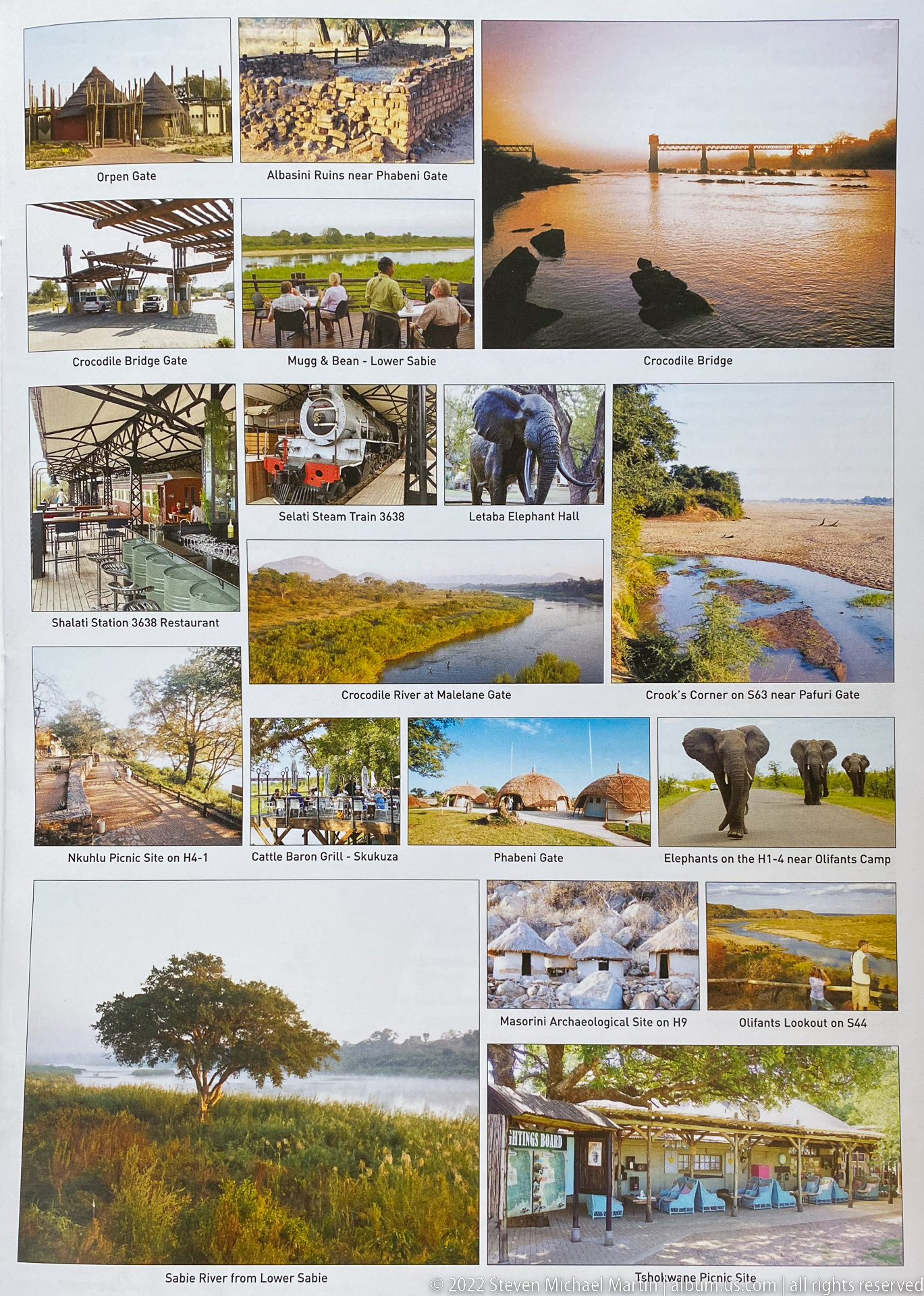
A montage page presents Kruger National Park through labeled photographs of camp facilities, gates, river crossings, landscapes, and visitor sites. The varied scenes move from architecture and bridges to broad river views and woodland, providing a visual index to the park's built and natural environments.
Caption
A montage page presents Kruger National Park through labeled photographs of camp facilities, gates, river crossings, landscapes, and visitor sites. The varied scenes move from architecture and bridges to broad river views and woodland, providing a visual index to the park's built and natural environments.

A densely illustrated Kruger National Park visitor-information page combines gate and camp times, speed-limit reminders, a checklist of visitor rules, park contact numbers, shop and restaurant hours, and malaria guidance. Photographs and icons reinforce the practical information, making this a compact reference page for navigating the park responsibly and safely.
Caption
A densely illustrated Kruger National Park visitor-information page combines gate and camp times, speed-limit reminders, a checklist of visitor rules, park contact numbers, shop and restaurant hours, and malaria guidance. Photographs and icons reinforce the practical information, making this a compact reference page for navigating the park responsibly and safely.
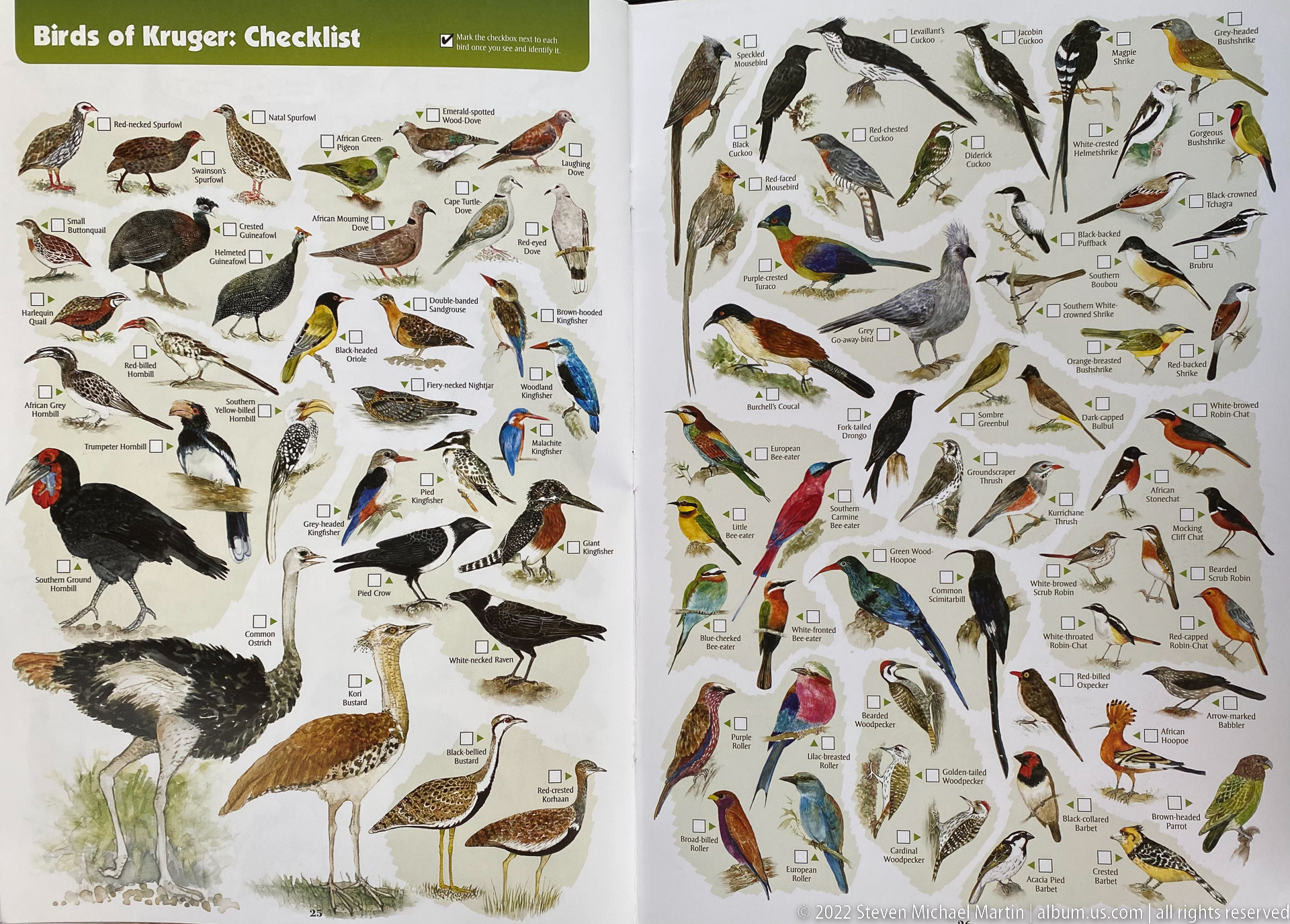
A second bird-checklist spread expands the visual field guide with hornbills, kingfishers, woodpeckers, rollers, bee-eaters, passerines, and other woodland and open-country birds. The dense arrangement encourages comparison of plumage, body shape, bill form, and size across many species.
Caption
A second bird-checklist spread expands the visual field guide with hornbills, kingfishers, woodpeckers, rollers, bee-eaters, passerines, and other woodland and open-country birds. The dense arrangement encourages comparison of plumage, body shape, bill form, and size across many species.

A two-page bird checklist presents a broad range of Kruger species, including raptors, owls, gamebirds, waterbirds, storks, herons, and other conspicuous groups. Labeled illustrations and check boxes support field identification and allow visitors to record species observed during a park visit.
Caption
A two-page bird checklist presents a broad range of Kruger species, including raptors, owls, gamebirds, waterbirds, storks, herons, and other conspicuous groups. Labeled illustrations and check boxes support field identification and allow visitors to record species observed during a park visit.

A 'Hot Spots in the Park' guide page organizes recommended wildlife-viewing areas into seasonal categories, pairing short location notes with photographs of waterholes, rivers, large mammals, and birds. The layout emphasizes how changing rainfall and water availability influence where visitors may encounter wildlife across Kruger.
Caption
A 'Hot Spots in the Park' guide page organizes recommended wildlife-viewing areas into seasonal categories, pairing short location notes with photographs of waterholes, rivers, large mammals, and birds. The layout emphasizes how changing rainfall and water availability influence where visitors may encounter wildlife across Kruger.
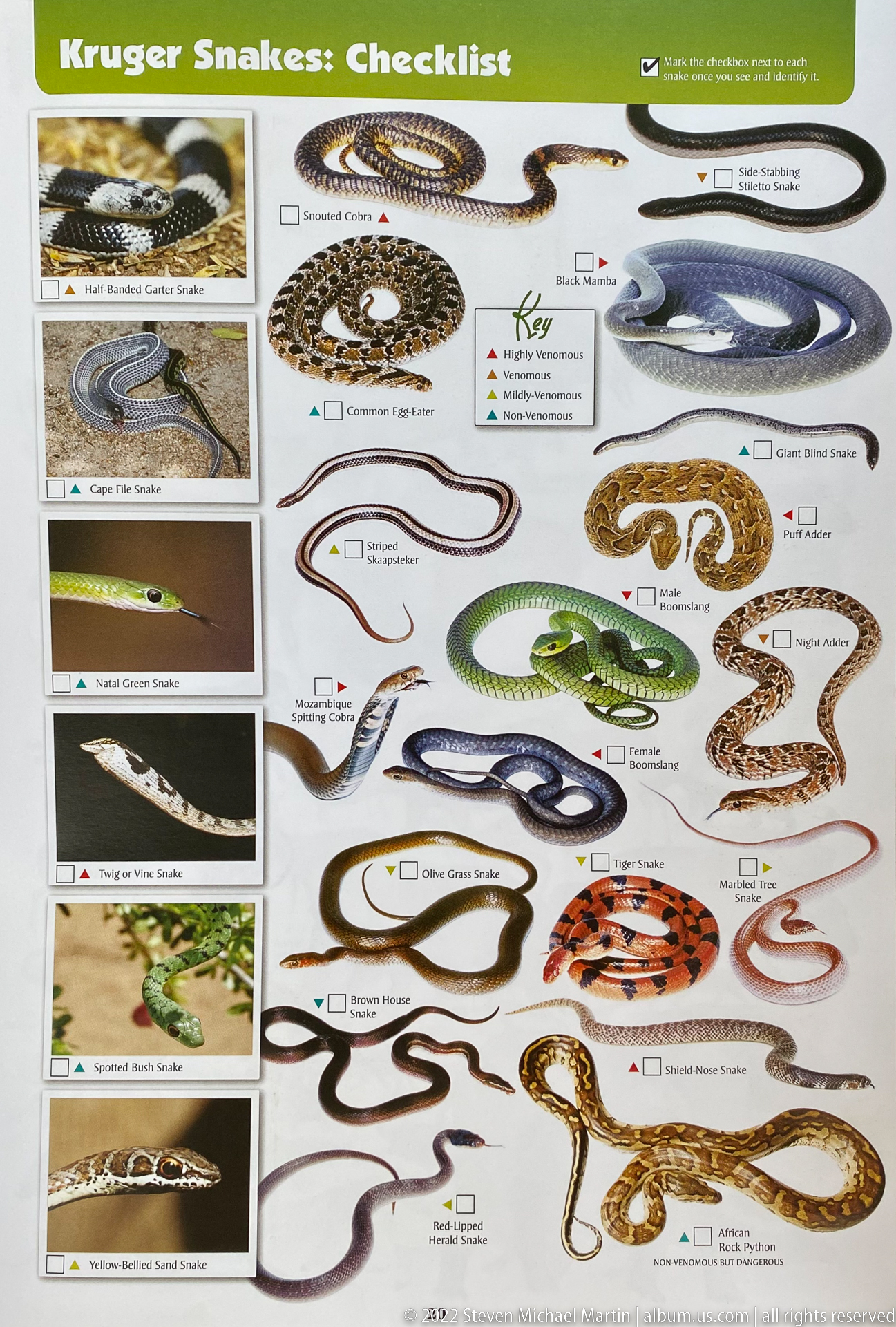
An illustrated snake checklist presents numerous Kruger reptiles in comparative rows, pairing drawings or photographs with species names and check boxes. Differences in body color, banding, head shape, and pattern are shown side by side, making the page a visual field reference rather than a photograph of a single species.
Caption
An illustrated snake checklist presents numerous Kruger reptiles in comparative rows, pairing drawings or photographs with species names and check boxes. Differences in body color, banding, head shape, and pattern are shown side by side, making the page a visual field reference rather than a photograph of a single species.
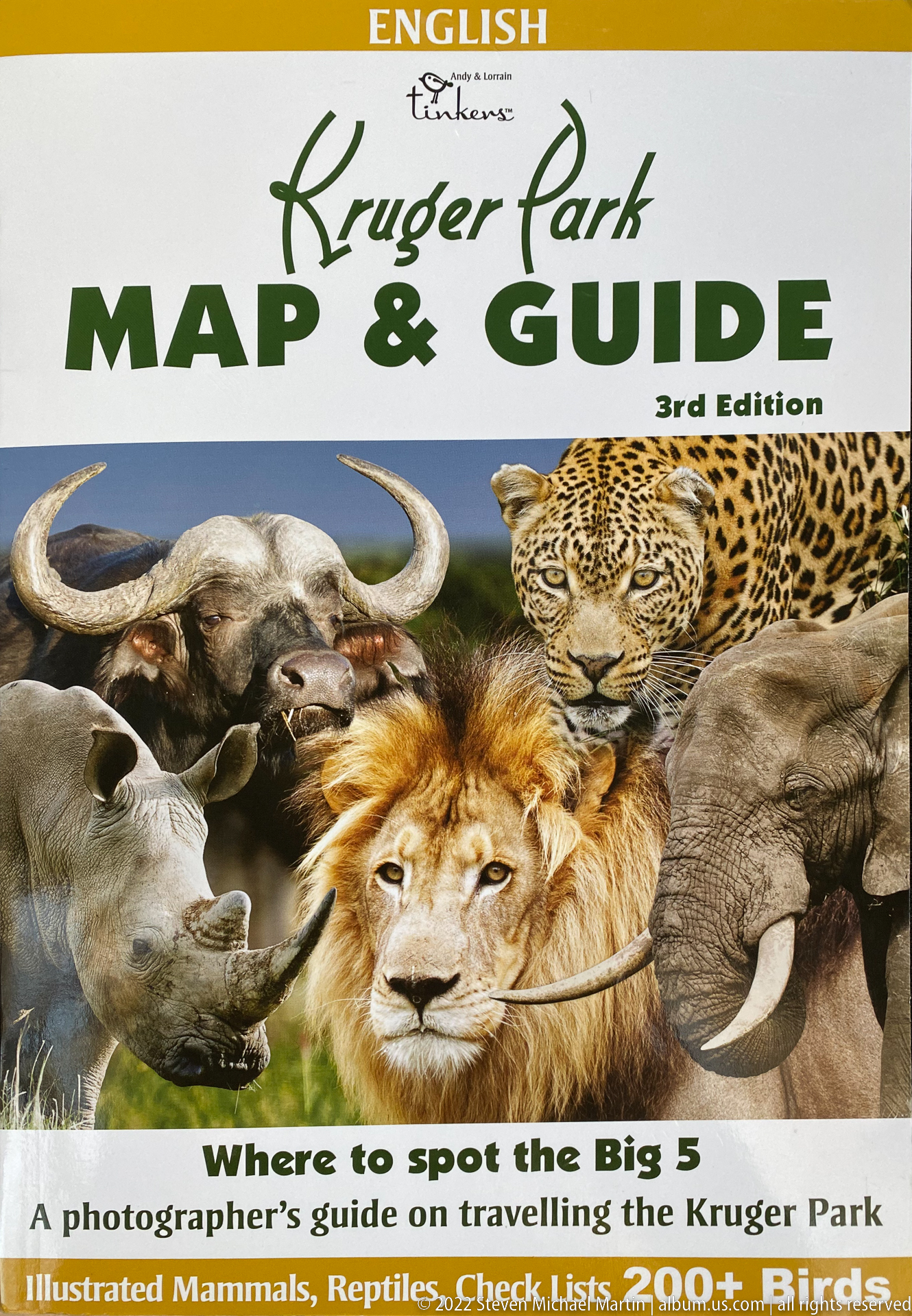
The cover of an English-language 'Kruger Park Map & Guide,' 3rd Edition, combines photographs of prominent park wildlife including buffalo, leopard, rhinoceros, lion, and elephant. Its subtitle promotes guidance on where to spot the 'Big 5,' while additional cover text advertises illustrated mammals, reptiles, checklists, and more than 200 birds.
Caption
The cover of an English-language 'Kruger Park Map & Guide,' 3rd Edition, combines photographs of prominent park wildlife including buffalo, leopard, rhinoceros, lion, and elephant. Its subtitle promotes guidance on where to spot the 'Big 5,' while additional cover text advertises illustrated mammals, reptiles, checklists, and more than 200 birds.
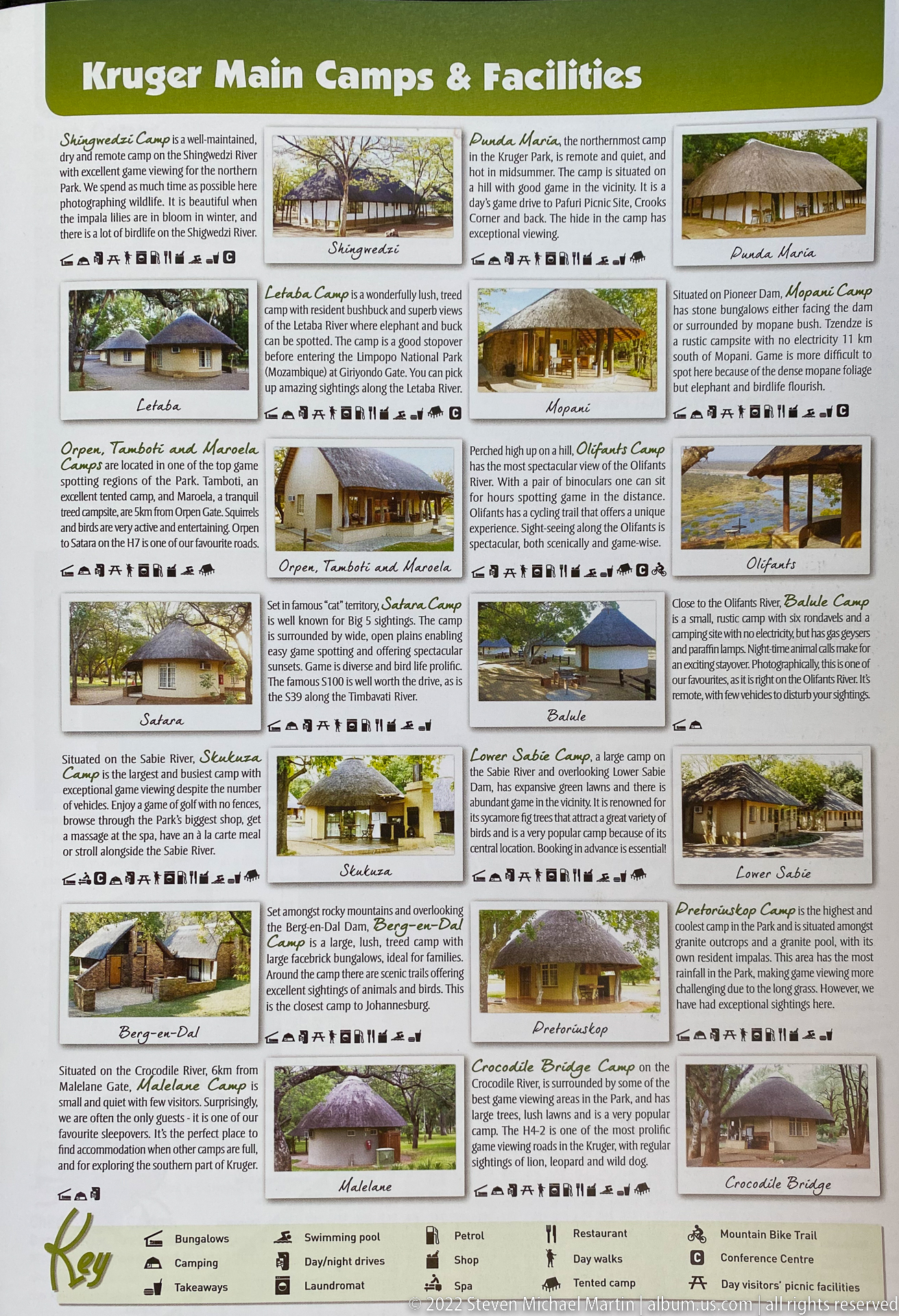
An illustrated guide page surveys Kruger National Park's main camps and visitor facilities through small photographs and short descriptive entries. Camp names are paired with images of accommodation, landscapes, and amenities, while a symbol key along the bottom summarizes services available across the park.
Caption
An illustrated guide page surveys Kruger National Park's main camps and visitor facilities through small photographs and short descriptive entries. Camp names are paired with images of accommodation, landscapes, and amenities, while a symbol key along the bottom summarizes services available across the park.

A reference page combines a short history of Kruger National Park with landmark dates, a large triangular distance-and-time chart, and illustrated natural-history details. Photographs of rhinoceros, flowers, archaeological remains, and an insect broaden the page from travel logistics into the park's cultural and ecological context.
Caption
A reference page combines a short history of Kruger National Park with landmark dates, a large triangular distance-and-time chart, and illustrated natural-history details. Photographs of rhinoceros, flowers, archaeological remains, and an insect broaden the page from travel logistics into the park's cultural and ecological context.
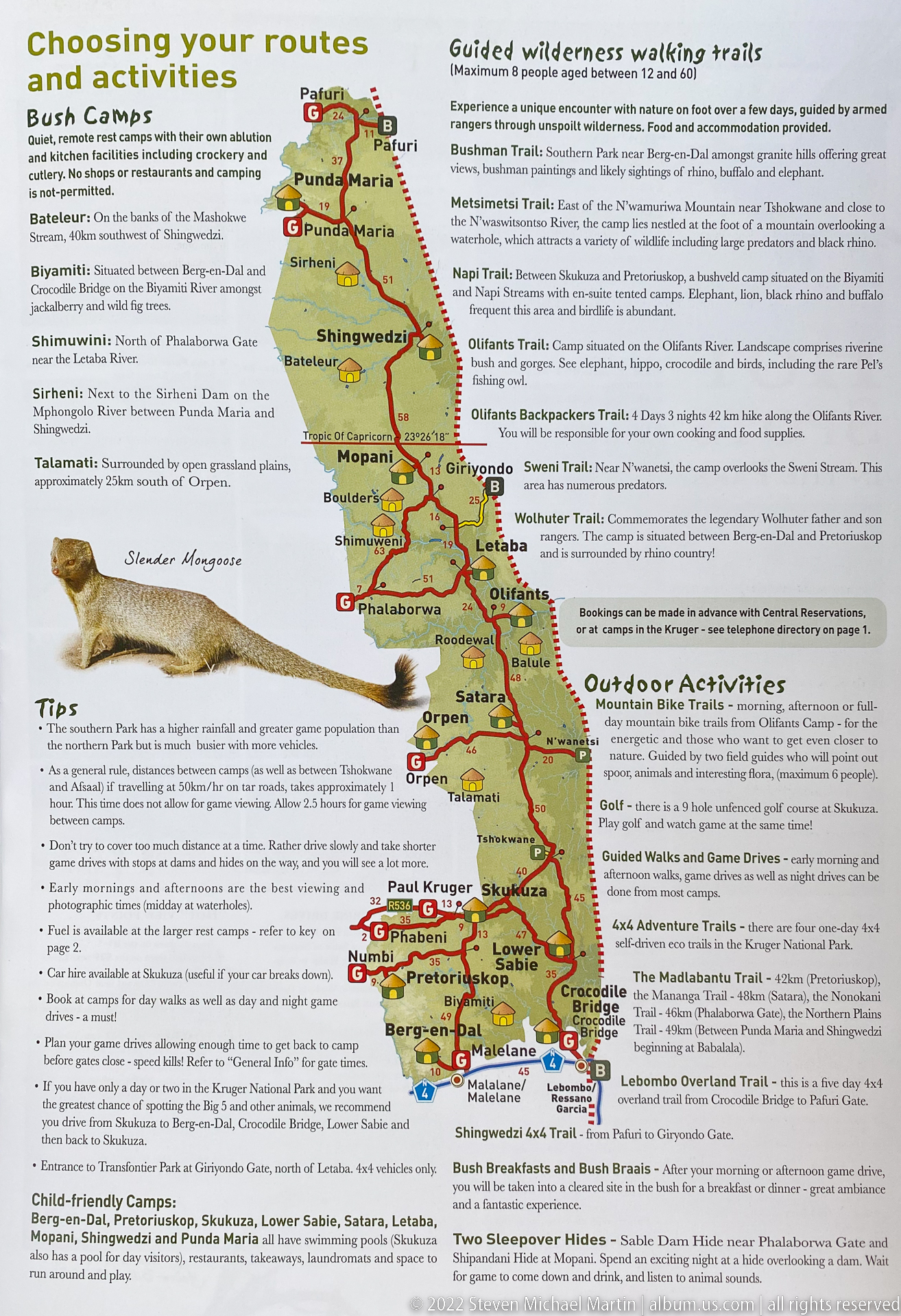
A full-height map of Kruger National Park anchors a page devoted to route planning and outdoor activities. Colored roads connect named camps from north to south, while surrounding text introduces guided wilderness walking trails, suggested drives, tips, outdoor activities, and child-friendly camp options.
Caption
A full-height map of Kruger National Park anchors a page devoted to route planning and outdoor activities. Colored roads connect named camps from north to south, while surrounding text introduces guided wilderness walking trails, suggested drives, tips, outdoor activities, and child-friendly camp options.

A color-coded ecoregions map divides Kruger National Park into broad ecological zones, with descriptive text blocks naming vegetation and landscape types along both sides. The diagram emphasizes the park's north-south environmental variation and provides ecological context for differences in habitat and wildlife distribution.
Caption
A color-coded ecoregions map divides Kruger National Park into broad ecological zones, with descriptive text blocks naming vegetation and landscape types along both sides. The diagram emphasizes the park's north-south environmental variation and provides ecological context for differences in habitat and wildlife distribution.

A final illustrated bird-checklist page features an especially varied selection of Kruger species, from large hornbills and long-tailed birds to bright weavers, bee-eaters, rollers, shrikes, and other savanna birds. The labeled artwork and check boxes form a compact visual record for comparing and logging sightings.
Caption
A final illustrated bird-checklist page features an especially varied selection of Kruger species, from large hornbills and long-tailed birds to bright weavers, bee-eaters, rollers, shrikes, and other savanna birds. The labeled artwork and check boxes form a compact visual record for comparing and logging sightings.
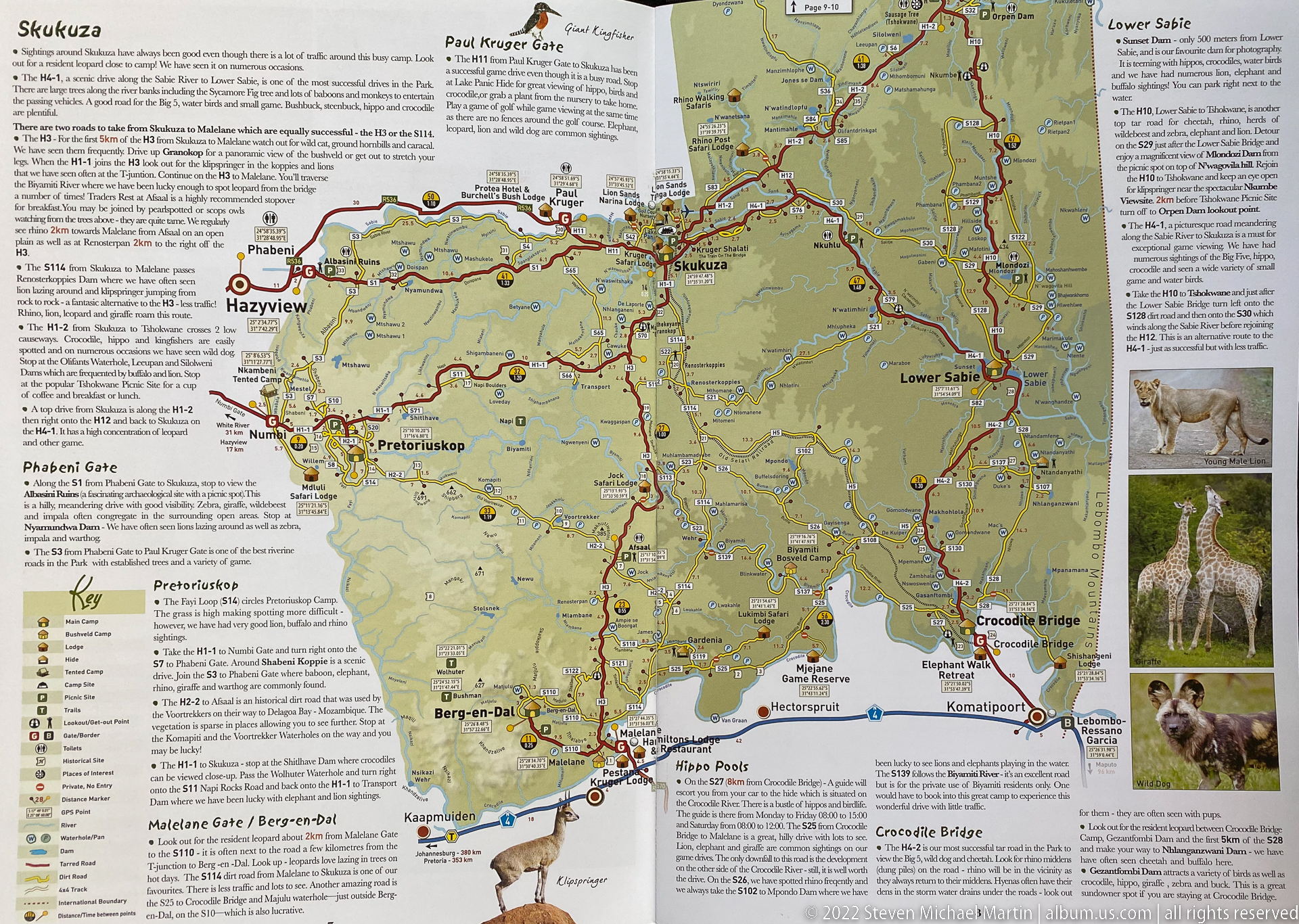
A detailed regional map covers the southern portion of Kruger National Park, with roads, rivers, camps, gates, and nearby towns plotted across the landscape. Insets and surrounding text highlight destinations and wildlife, turning the map into both a navigation aid and a compact introduction to the park's southern sector.
Caption
A detailed regional map covers the southern portion of Kruger National Park, with roads, rivers, camps, gates, and nearby towns plotted across the landscape. Insets and surrounding text highlight destinations and wildlife, turning the map into both a navigation aid and a compact introduction to the park's southern sector.
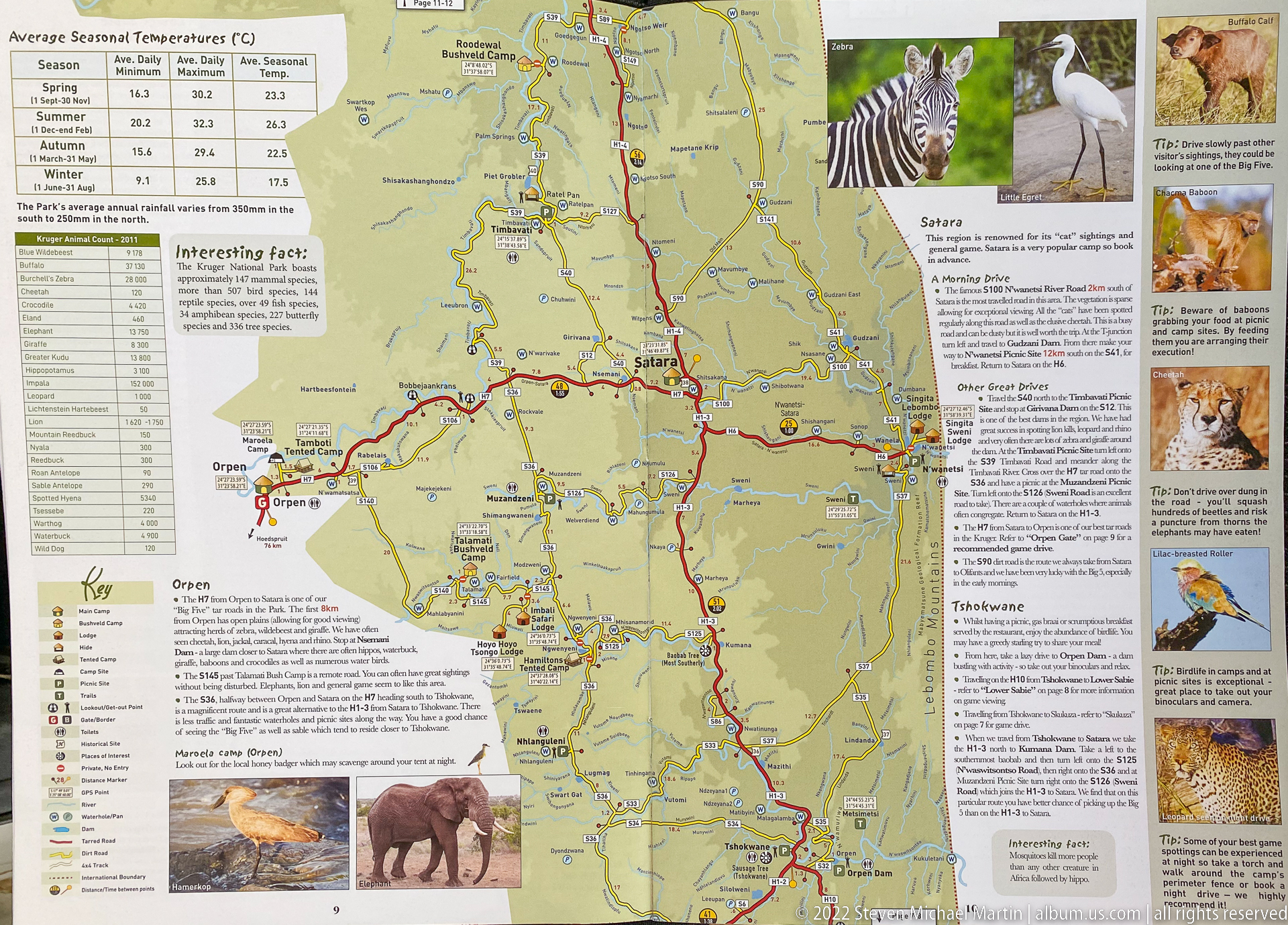
A regional map focuses on central Kruger National Park around Satara, tracing major roads, rivers, camps, and junctions through the central savanna. Wildlife photographs and route notes flank the map, linking practical navigation with species and places visitors may encounter in this part of the park.
Caption
A regional map focuses on central Kruger National Park around Satara, tracing major roads, rivers, camps, and junctions through the central savanna. Wildlife photographs and route notes flank the map, linking practical navigation with species and places visitors may encounter in this part of the park.
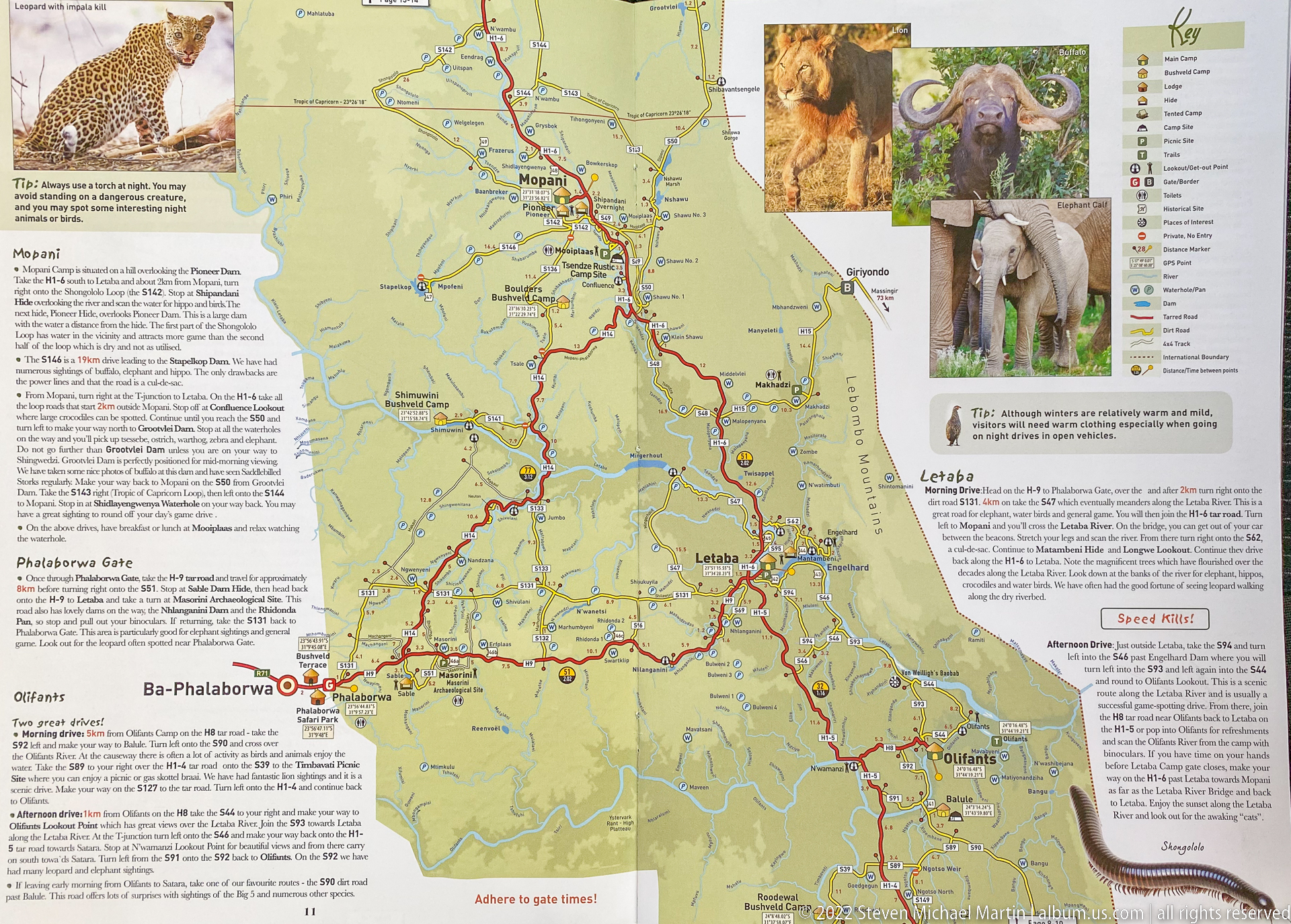
A regional map charts central-northern Kruger around Mopani, Letaba, and the Phalaborwa area, with roads and waterways linking camps and viewpoints. Photographs of large mammals and smaller wildlife accompany destination notes, combining route planning with a visual introduction to the region's fauna.
Caption
A regional map charts central-northern Kruger around Mopani, Letaba, and the Phalaborwa area, with roads and waterways linking camps and viewpoints. Photographs of large mammals and smaller wildlife accompany destination notes, combining route planning with a visual introduction to the region's fauna.
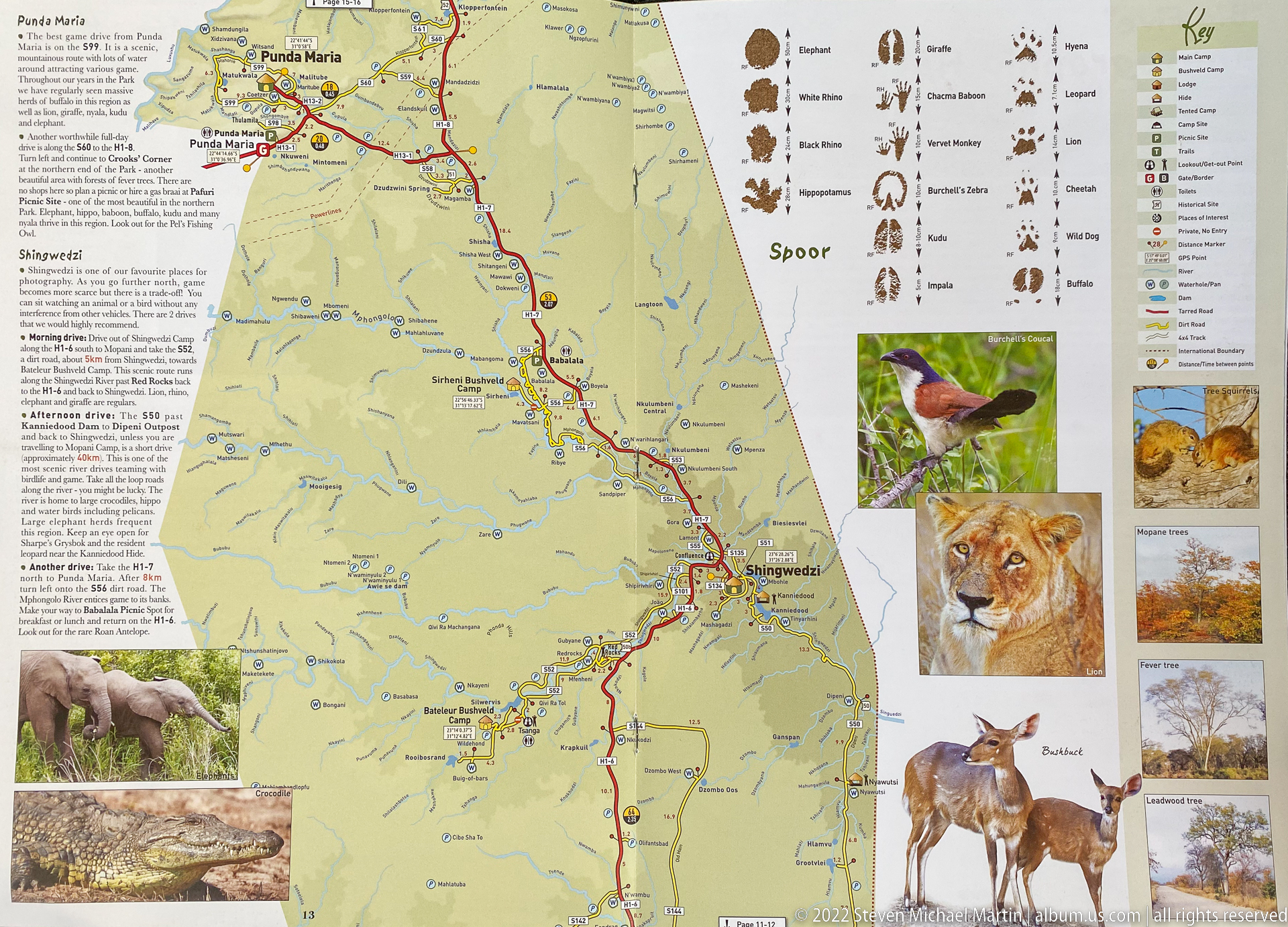
A regional map of northern Kruger is paired with a compact spoor-identification panel and wildlife illustrations. Roads and rivers run through the map while surrounding images depict mammals, birds, reptiles, and landscapes, expanding the page from route planning into field identification and natural-history observation.
Caption
A regional map of northern Kruger is paired with a compact spoor-identification panel and wildlife illustrations. Roads and rivers run through the map while surrounding images depict mammals, birds, reptiles, and landscapes, expanding the page from route planning into field identification and natural-history observation.
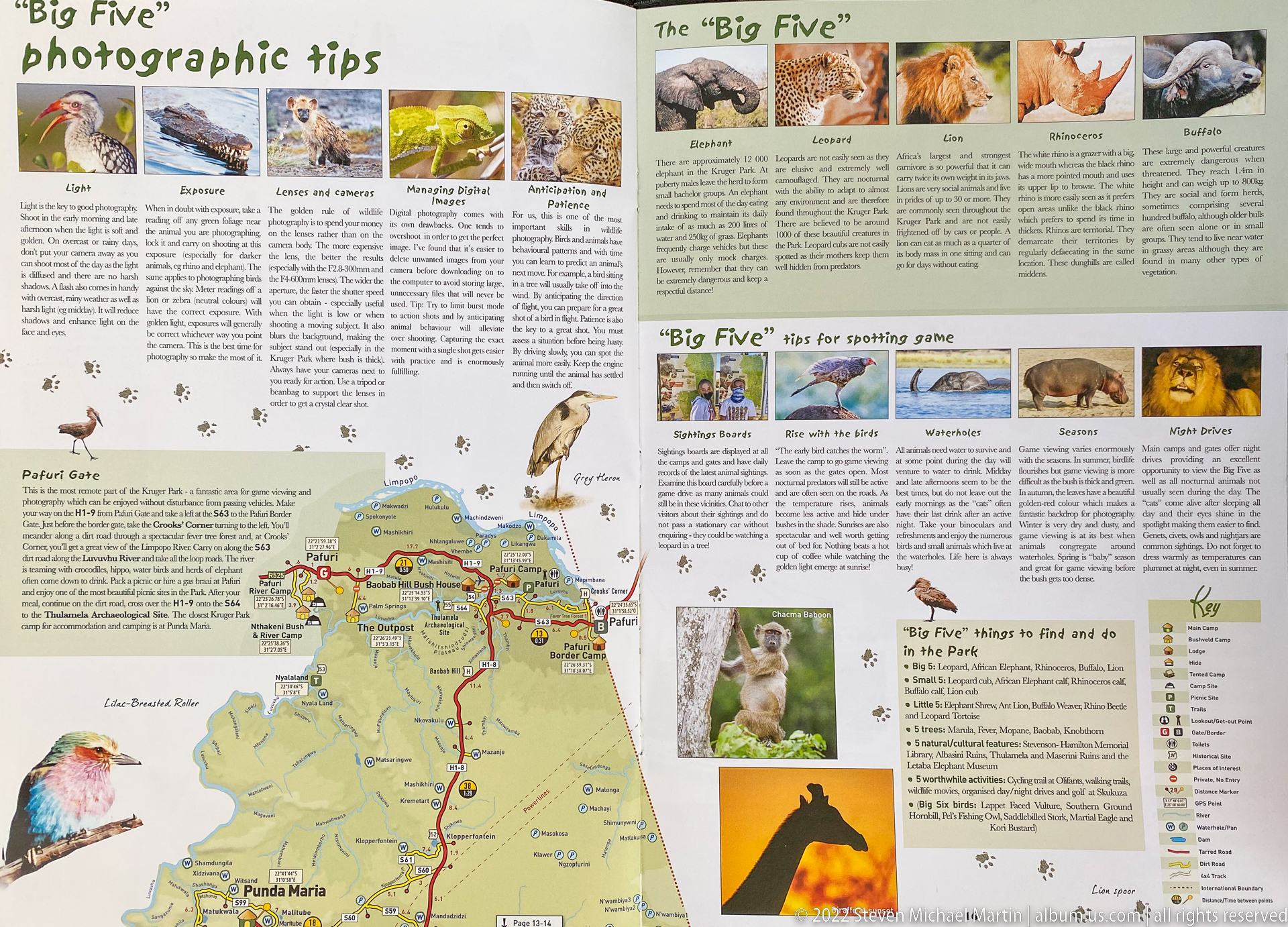
A 'Big Five' guide page introduces lion, elephant, leopard, rhinoceros, and buffalo through short species profiles, photographs, and practical spotting tips. A park map and additional bird and mammal illustrations broaden the field-guide function, helping visitors connect species identification with likely viewing areas.
Caption
A 'Big Five' guide page introduces lion, elephant, leopard, rhinoceros, and buffalo through short species profiles, photographs, and practical spotting tips. A park map and additional bird and mammal illustrations broaden the field-guide function, helping visitors connect species identification with likely viewing areas.
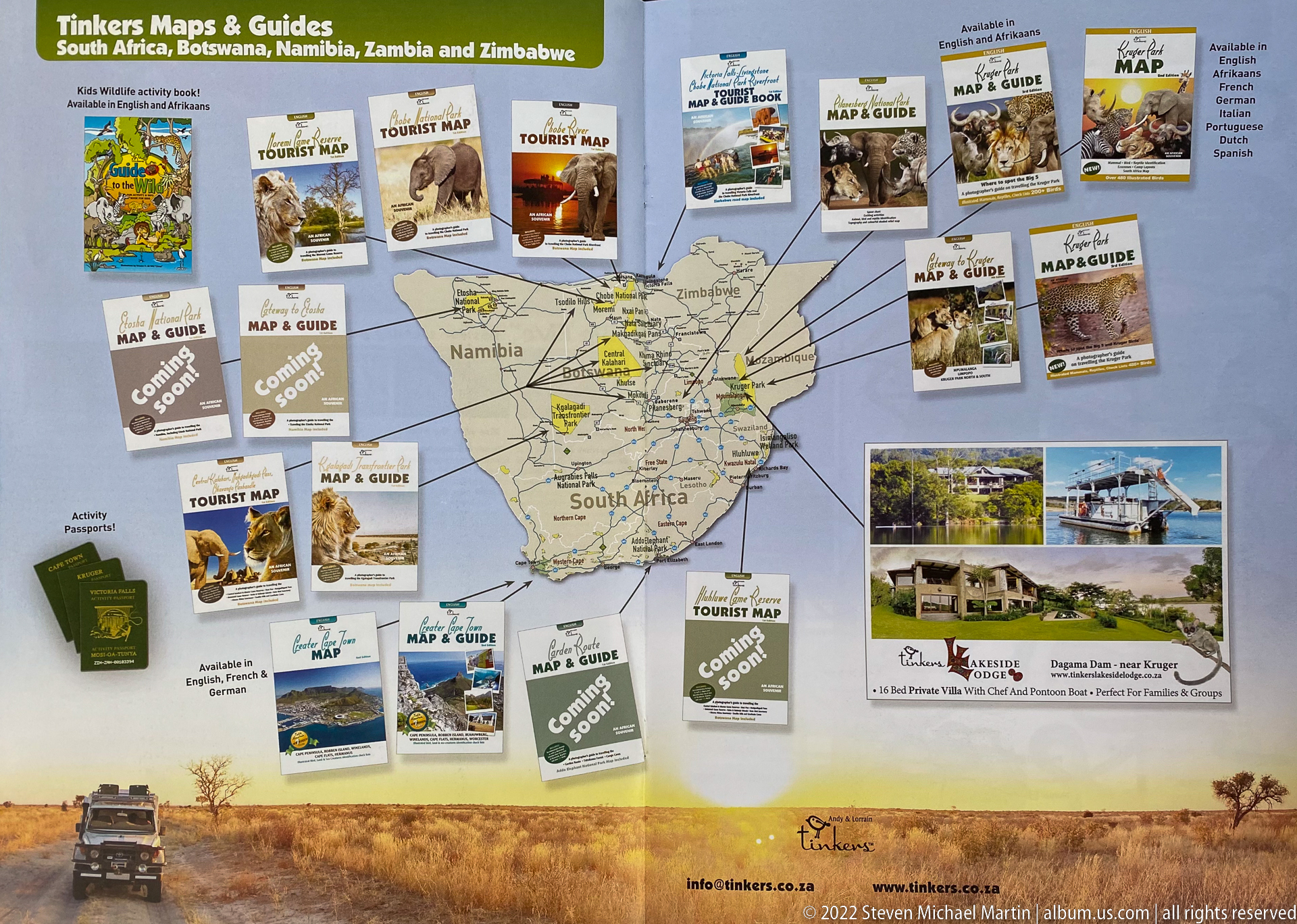
An advertisement for Tinkers Maps & Guides arranges numerous regional map and guidebook covers around a map of southern Africa. Publications for national parks, countries, cities, and tourist regions surround the central map, presenting the wider travel-reference series to which the Kruger guide belongs.
Caption
An advertisement for Tinkers Maps & Guides arranges numerous regional map and guidebook covers around a map of southern Africa. Publications for national parks, countries, cities, and tourist regions surround the central map, presenting the wider travel-reference series to which the Kruger guide belongs.
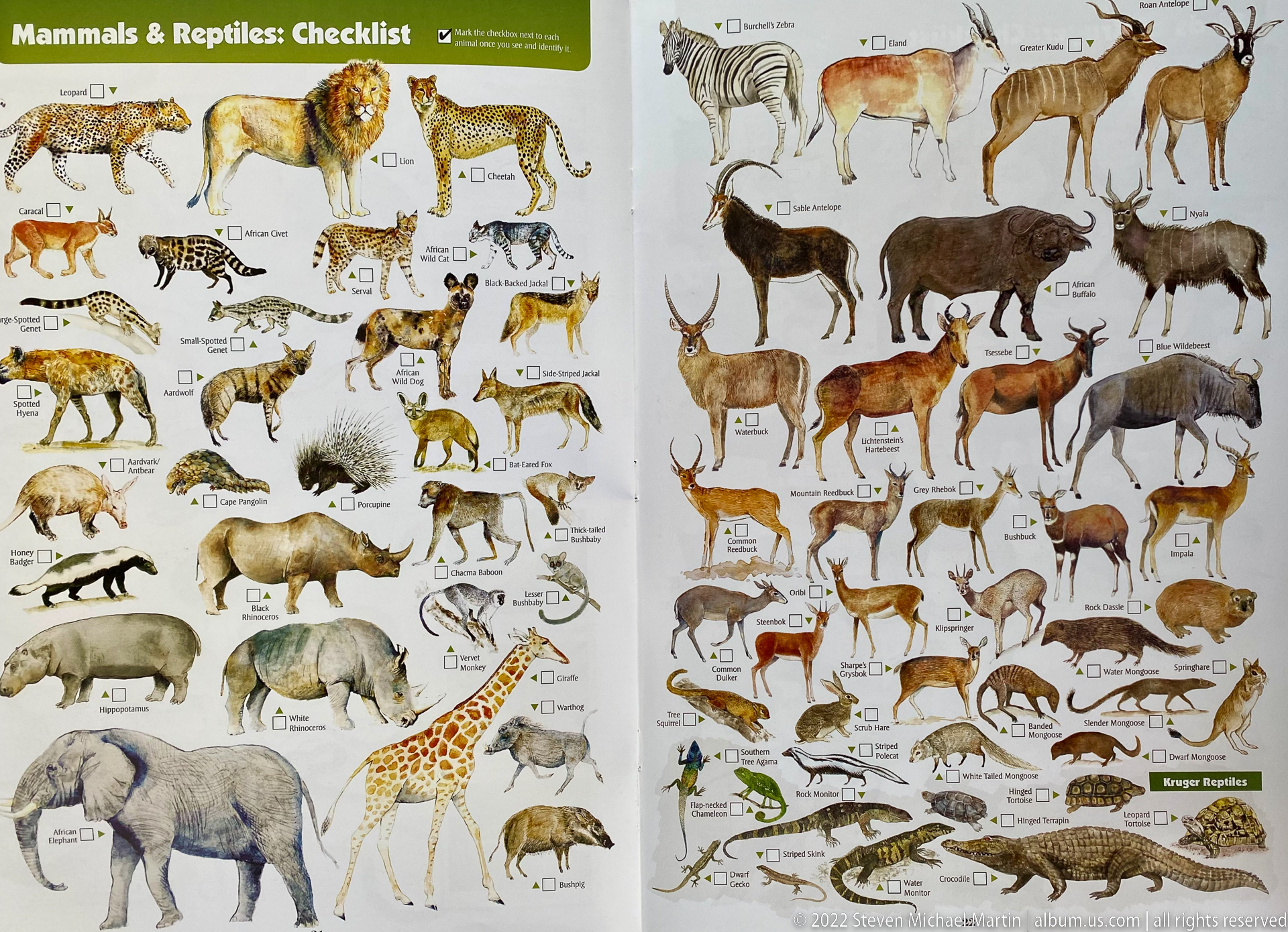
An illustrated checklist assembles Kruger's mammals in comparative groups, from large predators and ungulates to primates, small carnivores, rodents, and other species, with a smaller reptile section along the bottom. Labeled drawings and check boxes make the spread a compact visual index for recording sightings.
Caption
An illustrated checklist assembles Kruger's mammals in comparative groups, from large predators and ungulates to primates, small carnivores, rodents, and other species, with a smaller reptile section along the bottom. Labeled drawings and check boxes make the spread a compact visual index for recording sightings.