Skukuza – Kruger National Park, South Africa
The settlement of Skukuza Rest Camp serves as the largest and most developed camp within Kruger National Park. Located along the banks of the Sabie River, Skukuza functions as a central hub for visitors exploring the southern part of the park.
The surrounding region is known for its excellent wildlife viewing opportunities, particularly for large mammals such as lions, elephants, and rhinoceroses. The riverine habitats nearby attract diverse birdlife and other animals that depend on the permanent water source.
Because of its central location and rich wildlife environment, Skukuza is often considered one of the best bases for safari exploration in Kruger.
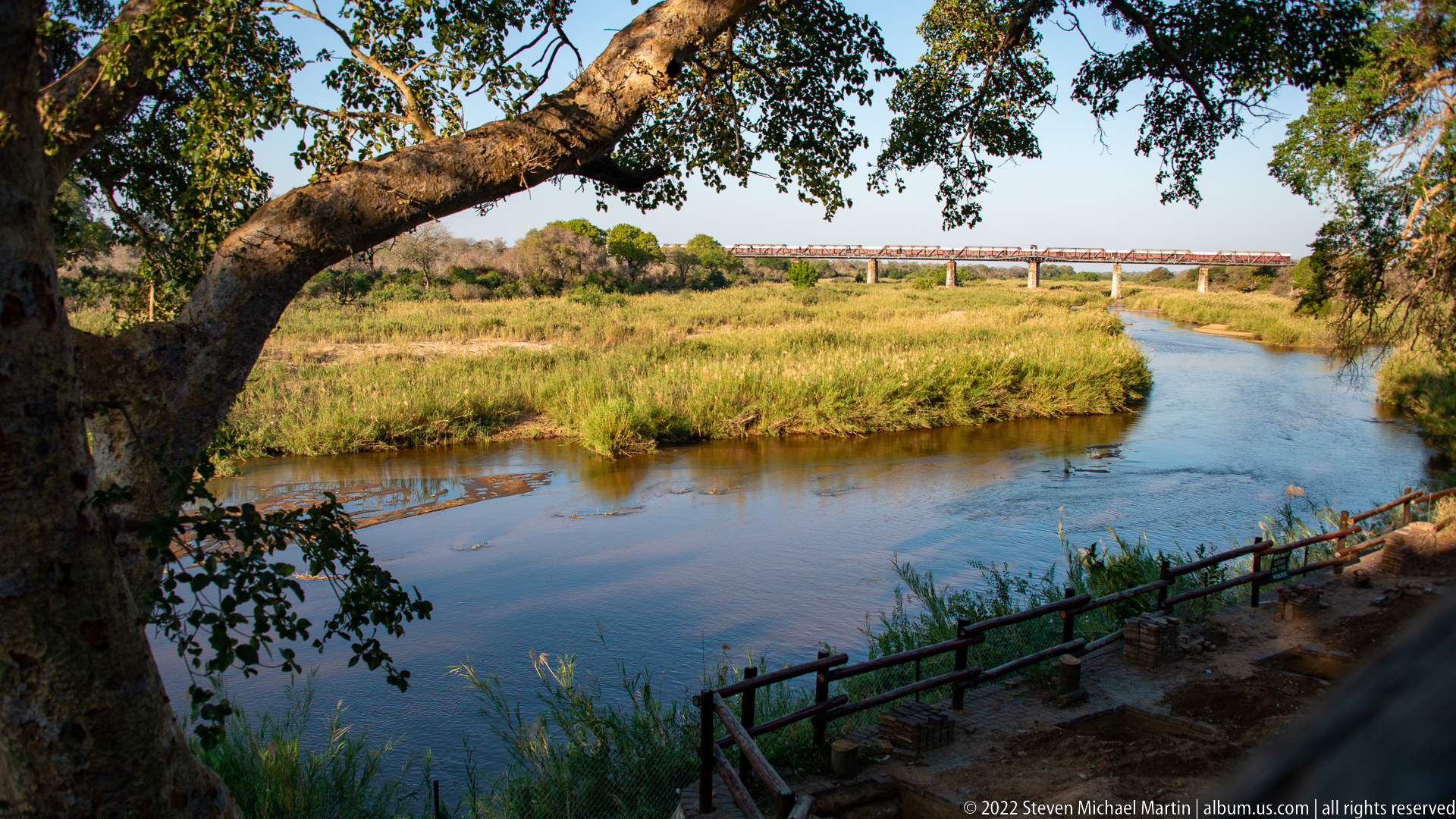
The Sabie River curves through a broad belt of green vegetation below a shaded riverside terrace at Skukuza. A large overhanging tree frames the foreground while a low bridge spans the distant channel, linking the camp setting with the river corridor that supports abundant wildlife in southern Kruger.
Caption
The Sabie River curves through a broad belt of green vegetation below a shaded riverside terrace at Skukuza. A large overhanging tree frames the foreground while a low bridge spans the distant channel, linking the camp setting with the river corridor that supports abundant wildlife in southern Kruger.
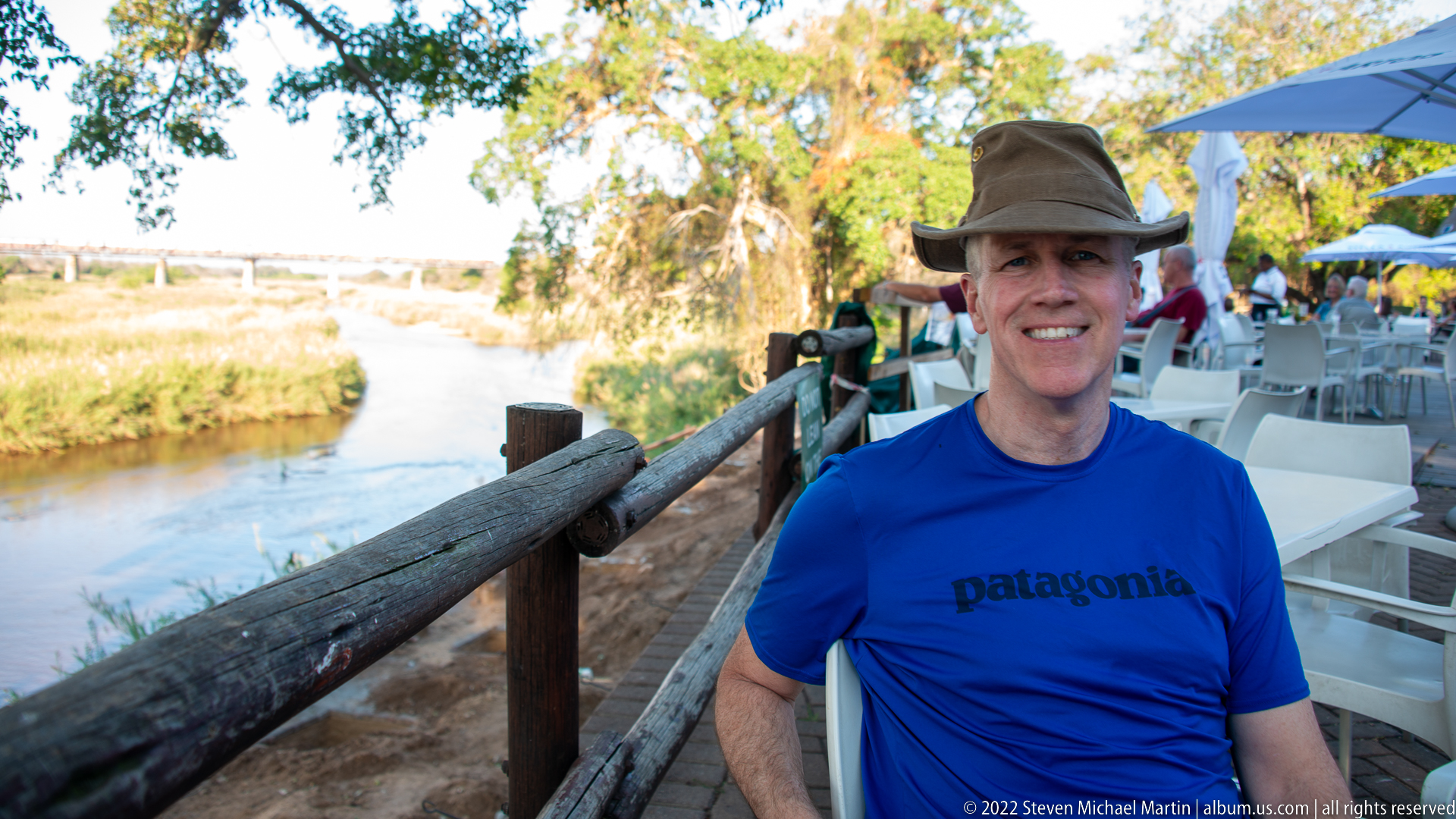
A traveler sits beside the river at Skukuza, wearing a brimmed hat and blue shirt with the water and outdoor seating area behind. The relaxed portrait places a human presence within the camp's riverside setting, contrasting with the wildlife and landscape studies that dominate the surrounding sequence.
Caption
A traveler sits beside the river at Skukuza, wearing a brimmed hat and blue shirt with the water and outdoor seating area behind. The relaxed portrait places a human presence within the camp's riverside setting, contrasting with the wildlife and landscape studies that dominate the surrounding sequence.
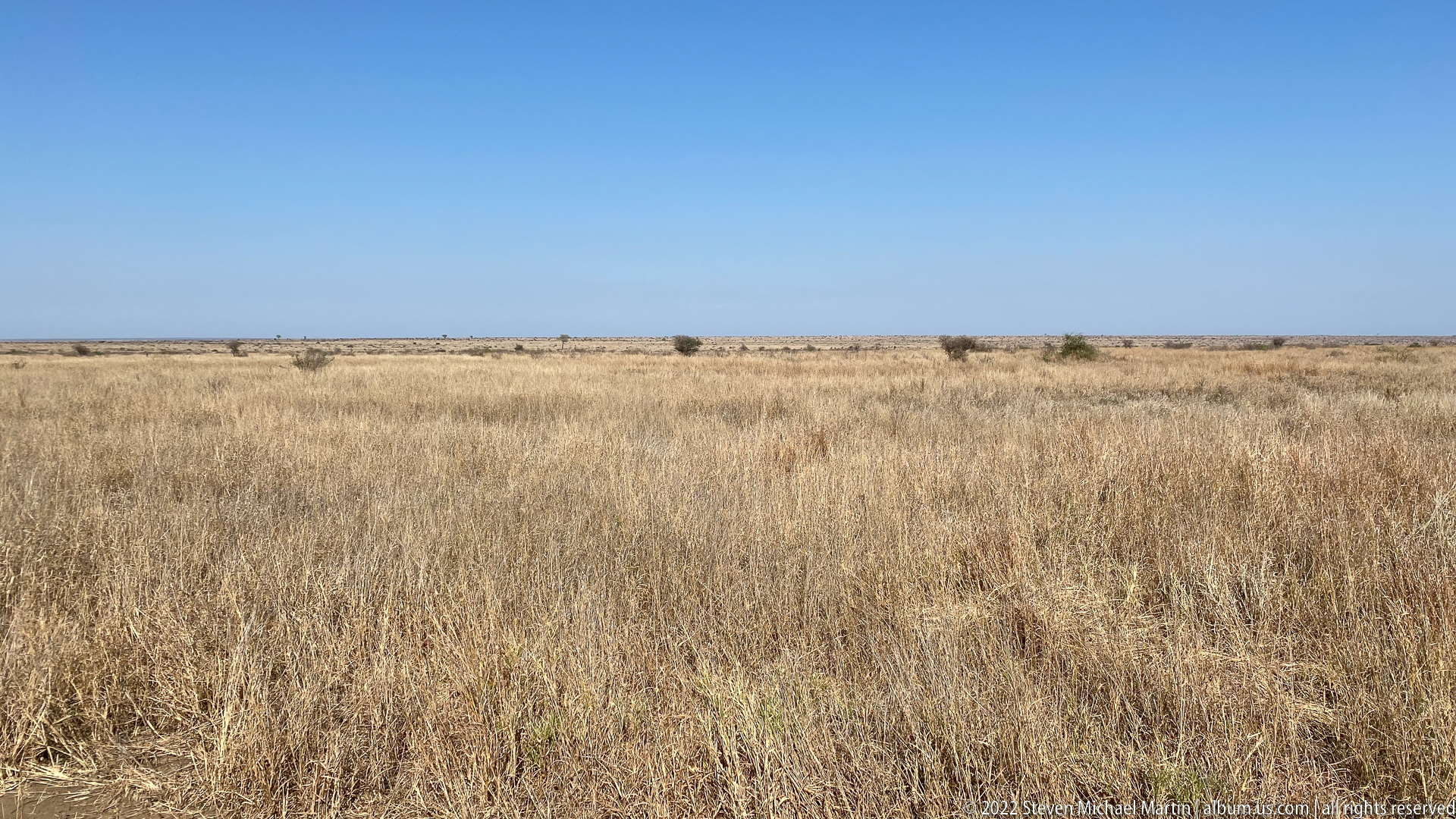
A broad expanse of dry grass stretches to a low horizon beneath a cloudless blue sky. Sparse shrubs and isolated trees punctuate the open plain, creating a simple landscape study of Kruger's seasonally dry savanna at its most exposed and expansive.
Caption
A broad expanse of dry grass stretches to a low horizon beneath a cloudless blue sky. Sparse shrubs and isolated trees punctuate the open plain, creating a simple landscape study of Kruger's seasonally dry savanna at its most exposed and expansive.
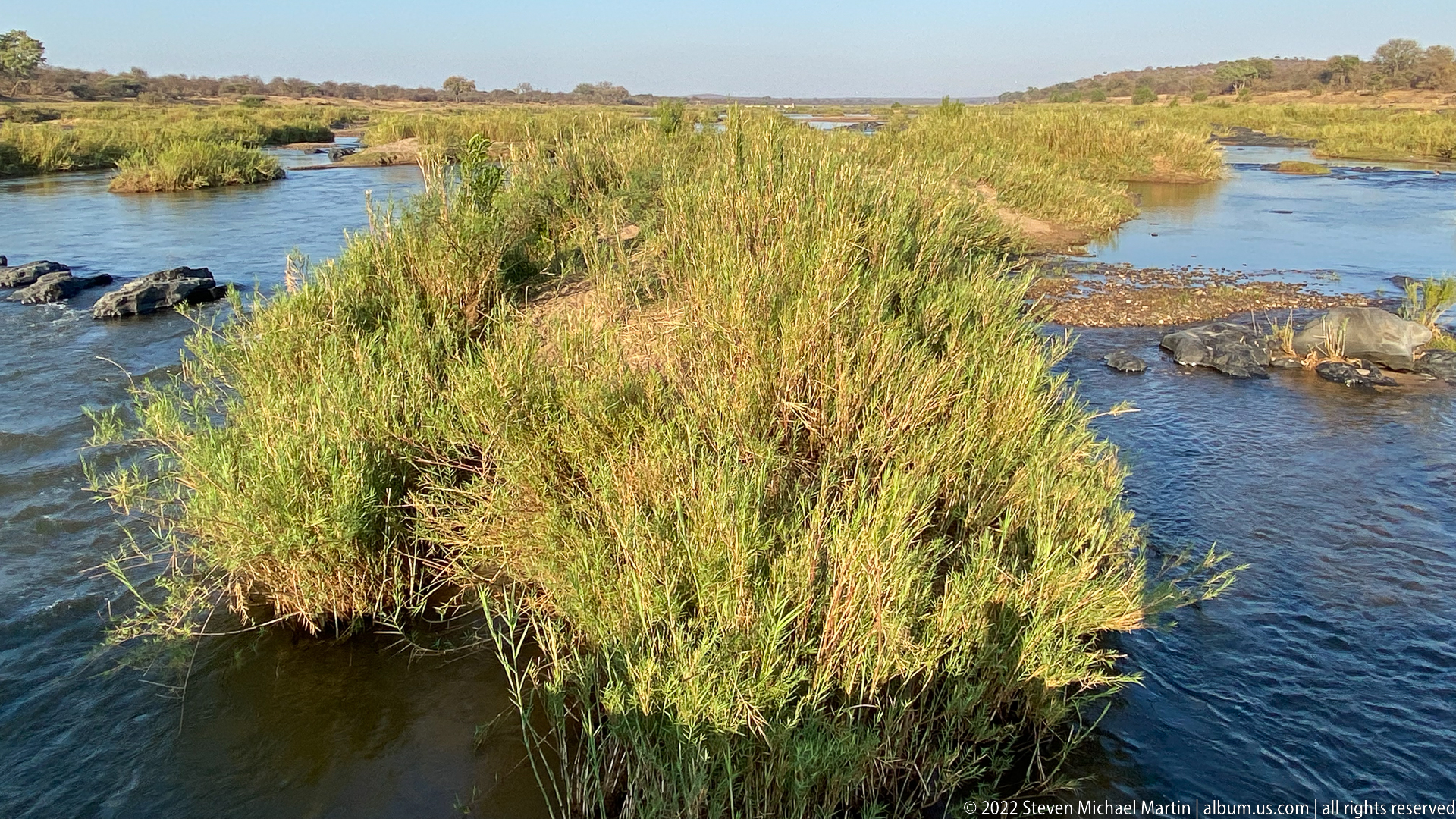
Dense reed beds form elongated islands within a shallow river channel, splitting the blue water into narrow flows around exposed dark rocks. The elevated view emphasizes vegetation patterns and channel structure rather than wildlife. Dry-season conditions are suggested by visible rocks and modest water depth, while green emergent plants remain concentrated along the watercourse.
Caption
Dense reed beds form elongated islands within a shallow river channel, splitting the blue water into narrow flows around exposed dark rocks. The elevated view emphasizes vegetation patterns and channel structure rather than wildlife. Dry-season conditions are suggested by visible rocks and modest water depth, while green emergent plants remain concentrated along the watercourse.
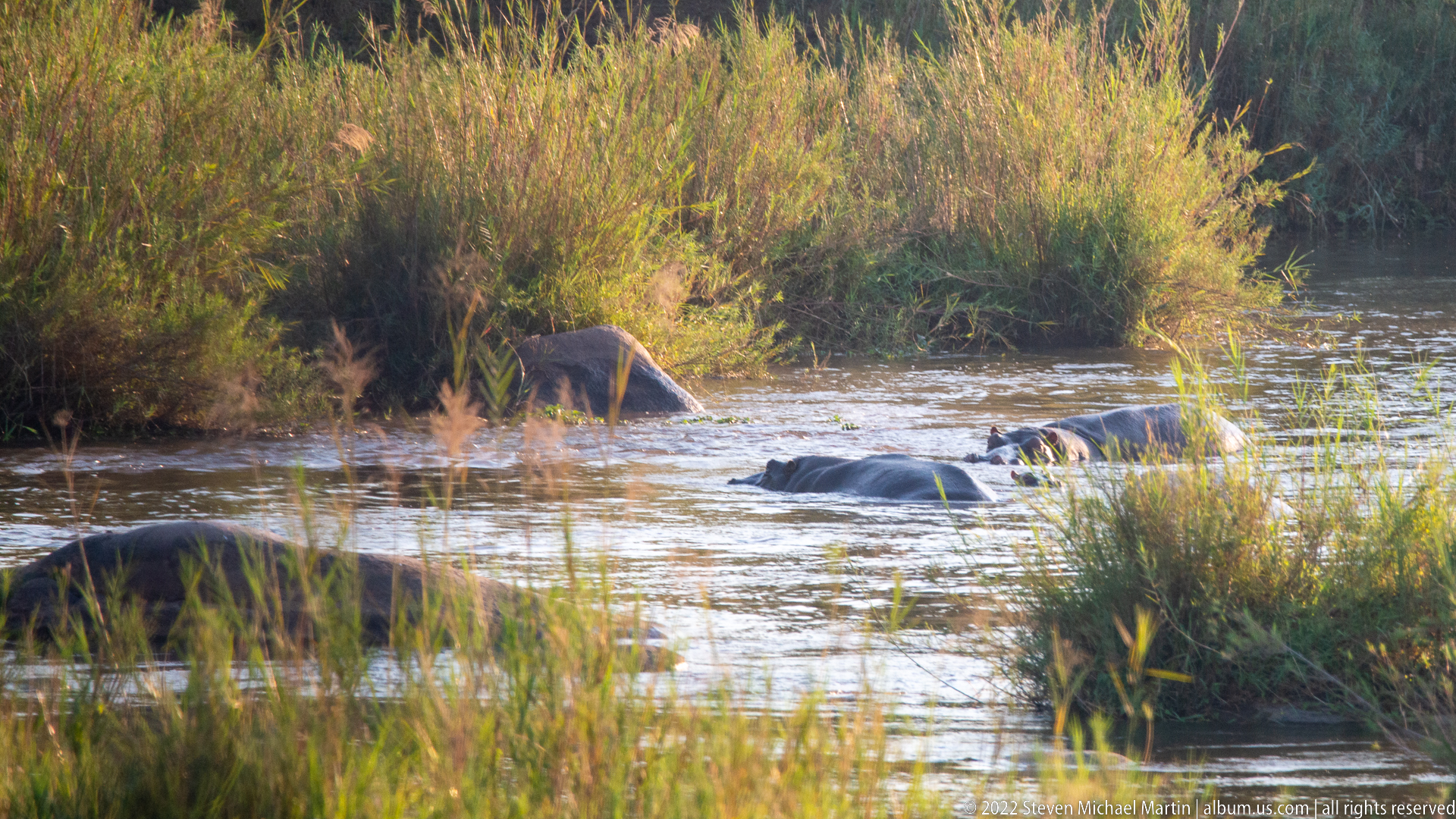
Shallow water threads between rounded boulders and clumps of tall reeds in a quiet river channel near Skukuza. Warm light catches the grasses and reflective surface, emphasizing the mosaic of exposed rock, flowing water, and dense marginal vegetation that creates refuge for birds and other wildlife.
Caption
Shallow water threads between rounded boulders and clumps of tall reeds in a quiet river channel near Skukuza. Warm light catches the grasses and reflective surface, emphasizing the mosaic of exposed rock, flowing water, and dense marginal vegetation that creates refuge for birds and other wildlife.
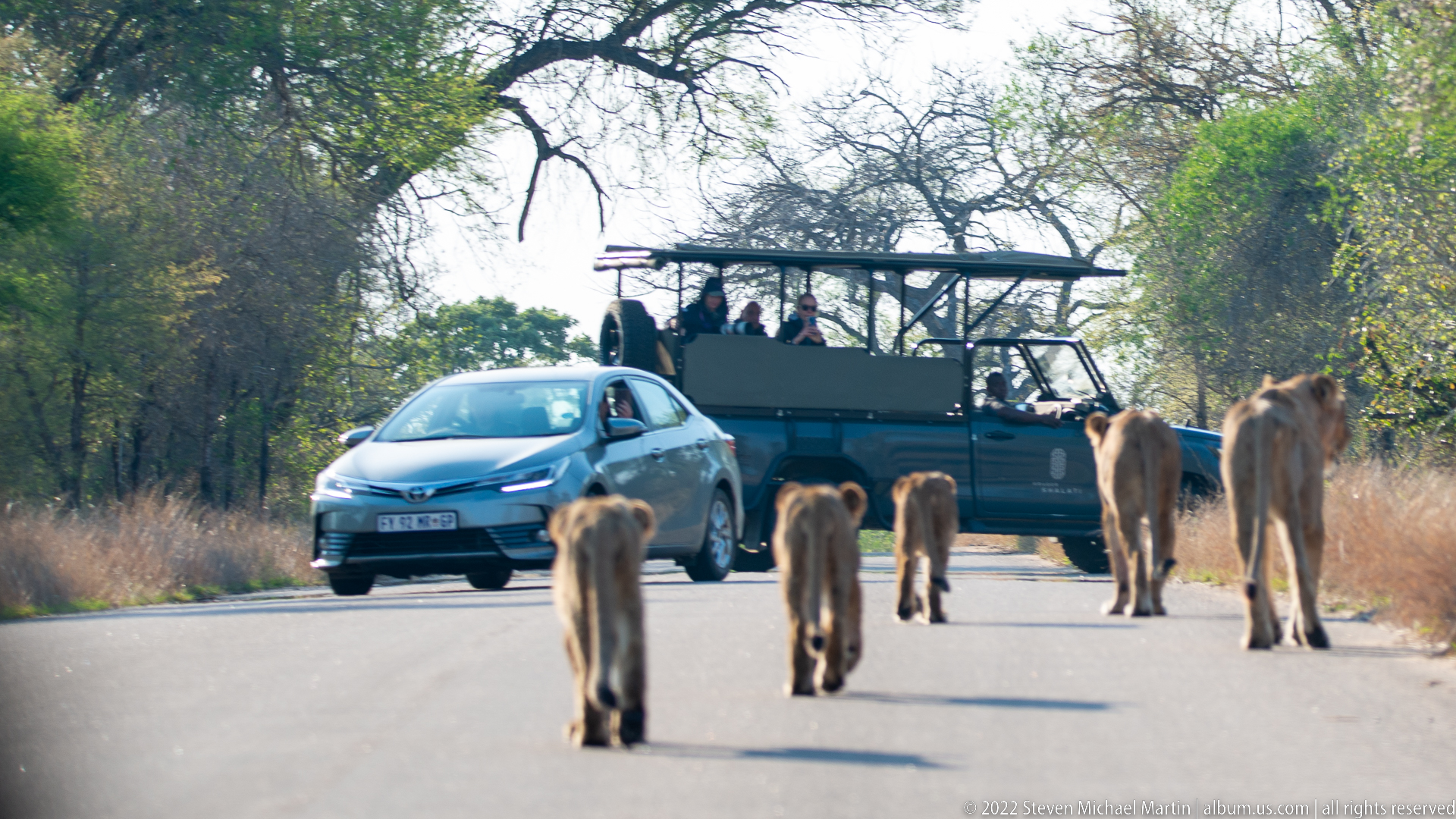
Lionesses and cubs walk down the center of a paved Kruger road as a passenger car and open safari vehicle wait nearby. The frame shows the practical interaction between wildlife and park traffic, with motorists yielding the roadway while the pride moves through at its own pace.
Caption
Lionesses and cubs walk down the center of a paved Kruger road as a passenger car and open safari vehicle wait nearby. The frame shows the practical interaction between wildlife and park traffic, with motorists yielding the roadway while the pride moves through at its own pace.
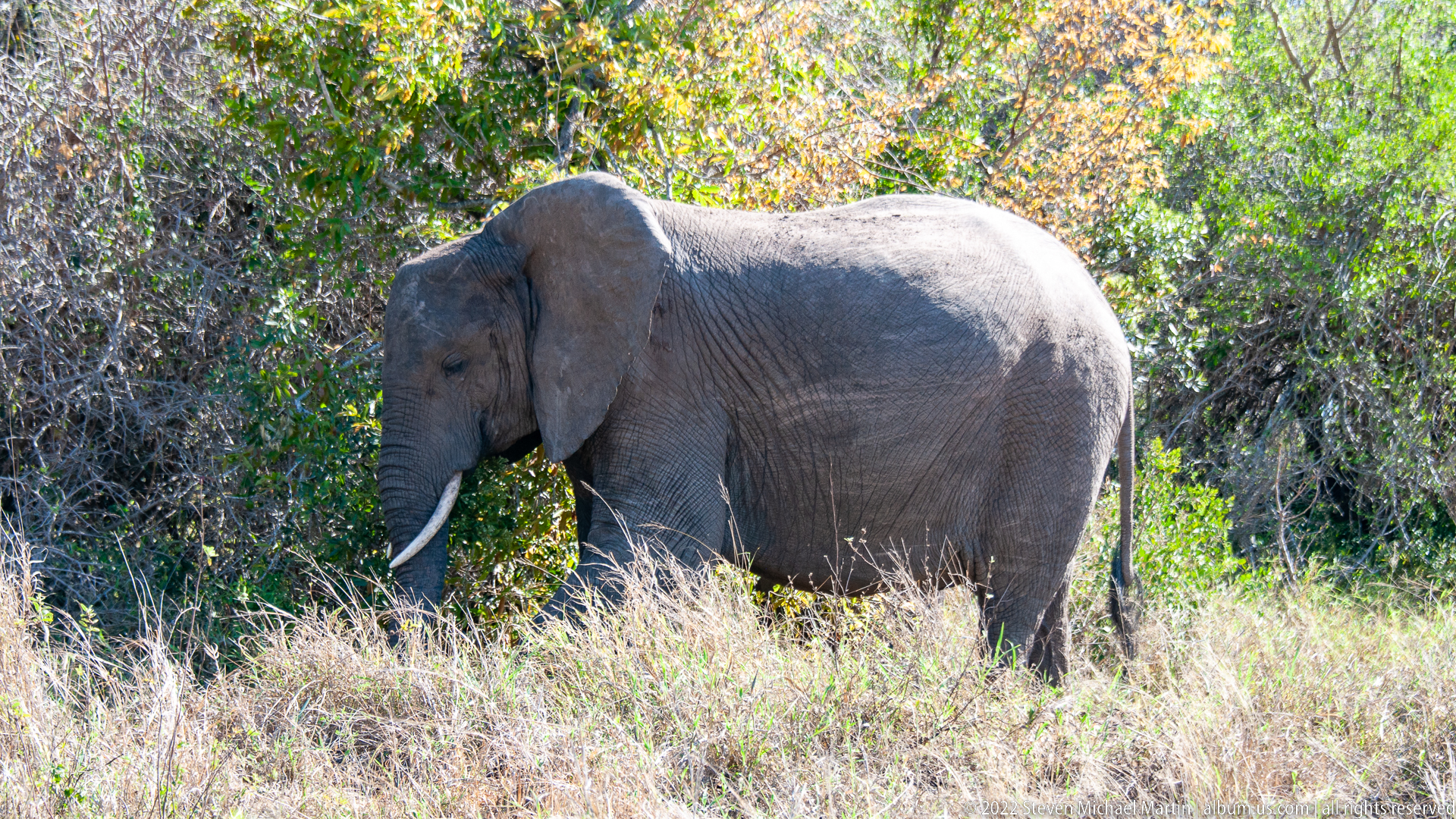
An African bush elephant moves through dense roadside scrub near Skukuza, its trunk lowered into the vegetation while one tusk catches the light. The side-on view shows the animal’s massive shoulder, wrinkled gray hide, broad ear, and columnar legs against dry winter grass. The surrounding thicket places the elephant within the mixed woodland habitat characteristic of southern Kruger National Park.
Caption
An African bush elephant moves through dense roadside scrub near Skukuza, its trunk lowered into the vegetation while one tusk catches the light. The side-on view shows the animal’s massive shoulder, wrinkled gray hide, broad ear, and columnar legs against dry winter grass. The surrounding thicket places the elephant within the mixed woodland habitat characteristic of southern Kruger National Park.

A broad thatched gateway spans a paved access road in the Skukuza area of Kruger National Park, with vehicles passing beneath the central opening. Stone piers, a deep grass roof, roadside signage, and tall flagpoles give the structure the character of a formal park entrance or checkpoint. Dry woodland and scrub frame the road, situating the built feature within Kruger’s lowveld landscape.
Caption
A broad thatched gateway spans a paved access road in the Skukuza area of Kruger National Park, with vehicles passing beneath the central opening. Stone piers, a deep grass roof, roadside signage, and tall flagpoles give the structure the character of a formal park entrance or checkpoint. Dry woodland and scrub frame the road, situating the built feature within Kruger’s lowveld landscape.
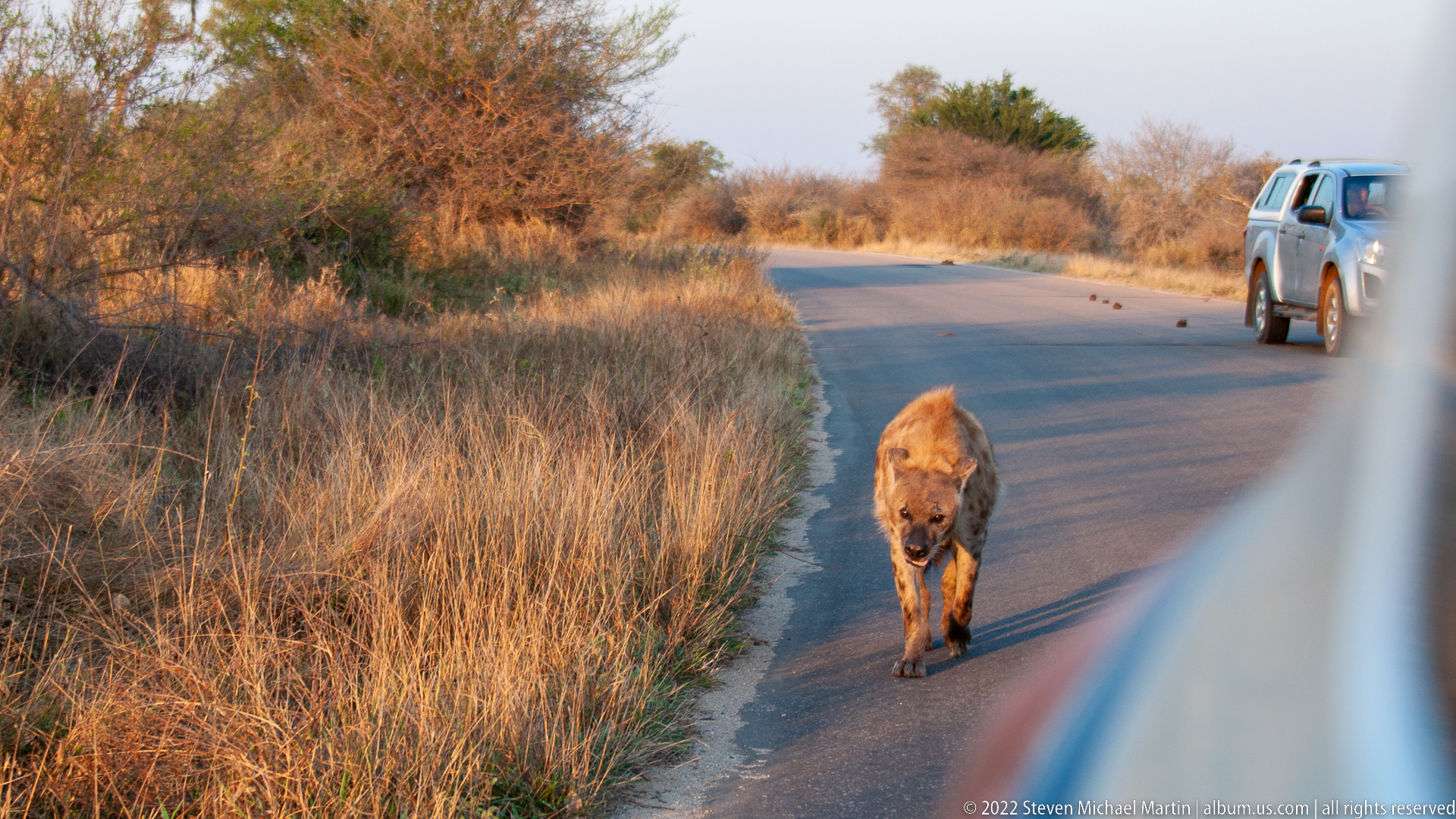
A spotted hyena walks directly toward the camera along the edge of a paved park road, its sloping back and heavy forequarters clearly visible. A safari vehicle follows at a respectful distance while dry grasses and scrub line the verge. The encounter illustrates how Kruger’s large carnivores routinely use roads as unobstructed travel corridors, especially where dense bush borders the pavement.
Caption
A spotted hyena walks directly toward the camera along the edge of a paved park road, its sloping back and heavy forequarters clearly visible. A safari vehicle follows at a respectful distance while dry grasses and scrub line the verge. The encounter illustrates how Kruger’s large carnivores routinely use roads as unobstructed travel corridors, especially where dense bush borders the pavement.
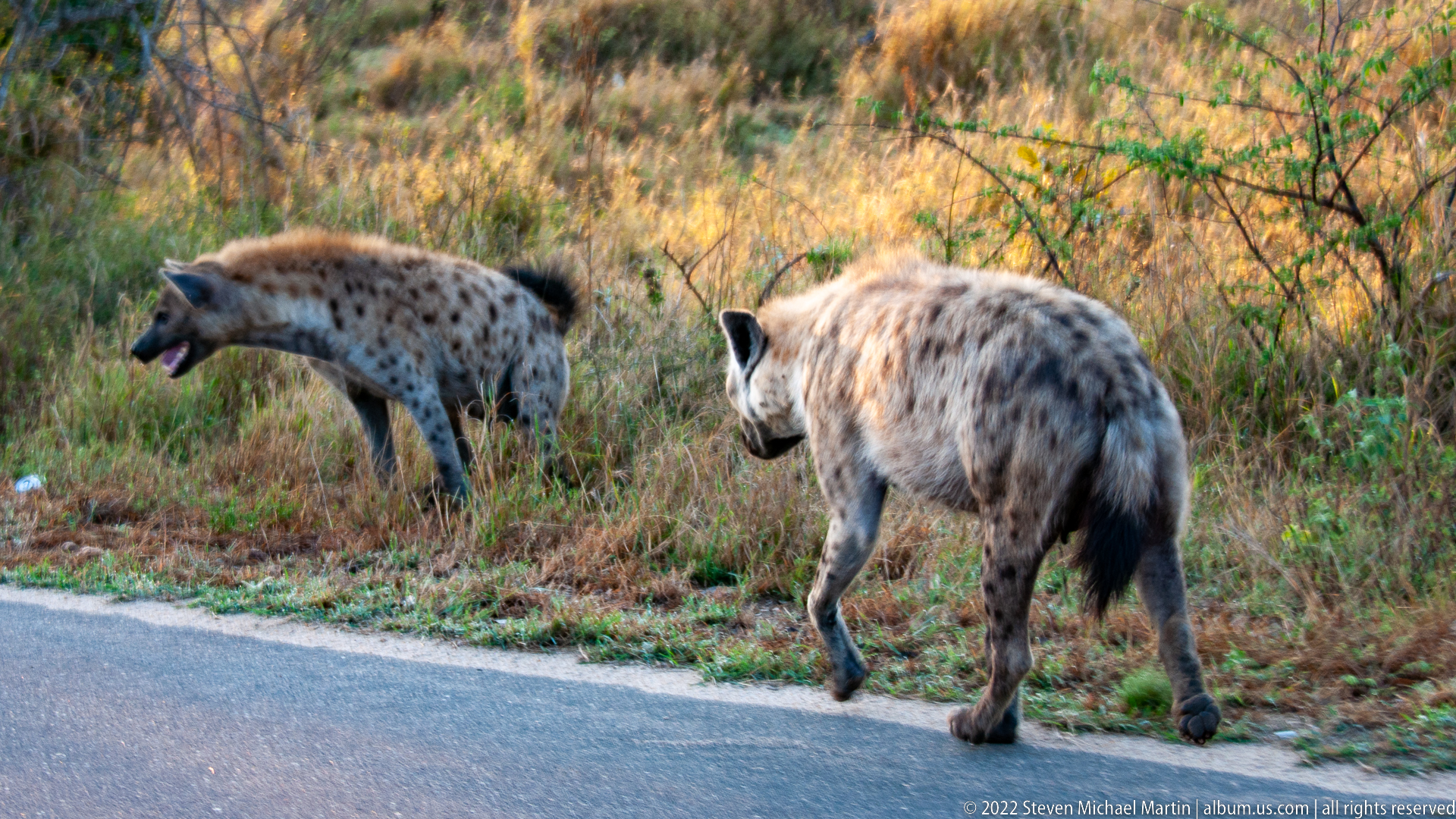
Two spotted hyenas pause beside the paved road, one broadside in the grass and the nearer animal turning away toward the verge. Their mottled coats, rounded ears, powerful shoulders, and descending toplines are distinct in the warm low-angle light. Seen together at the woodland edge, the pair provides a clear behavioral context for this highly social carnivore of Kruger’s savanna ecosystem.
Caption
Two spotted hyenas pause beside the paved road, one broadside in the grass and the nearer animal turning away toward the verge. Their mottled coats, rounded ears, powerful shoulders, and descending toplines are distinct in the warm low-angle light. Seen together at the woodland edge, the pair provides a clear behavioral context for this highly social carnivore of Kruger’s savanna ecosystem.
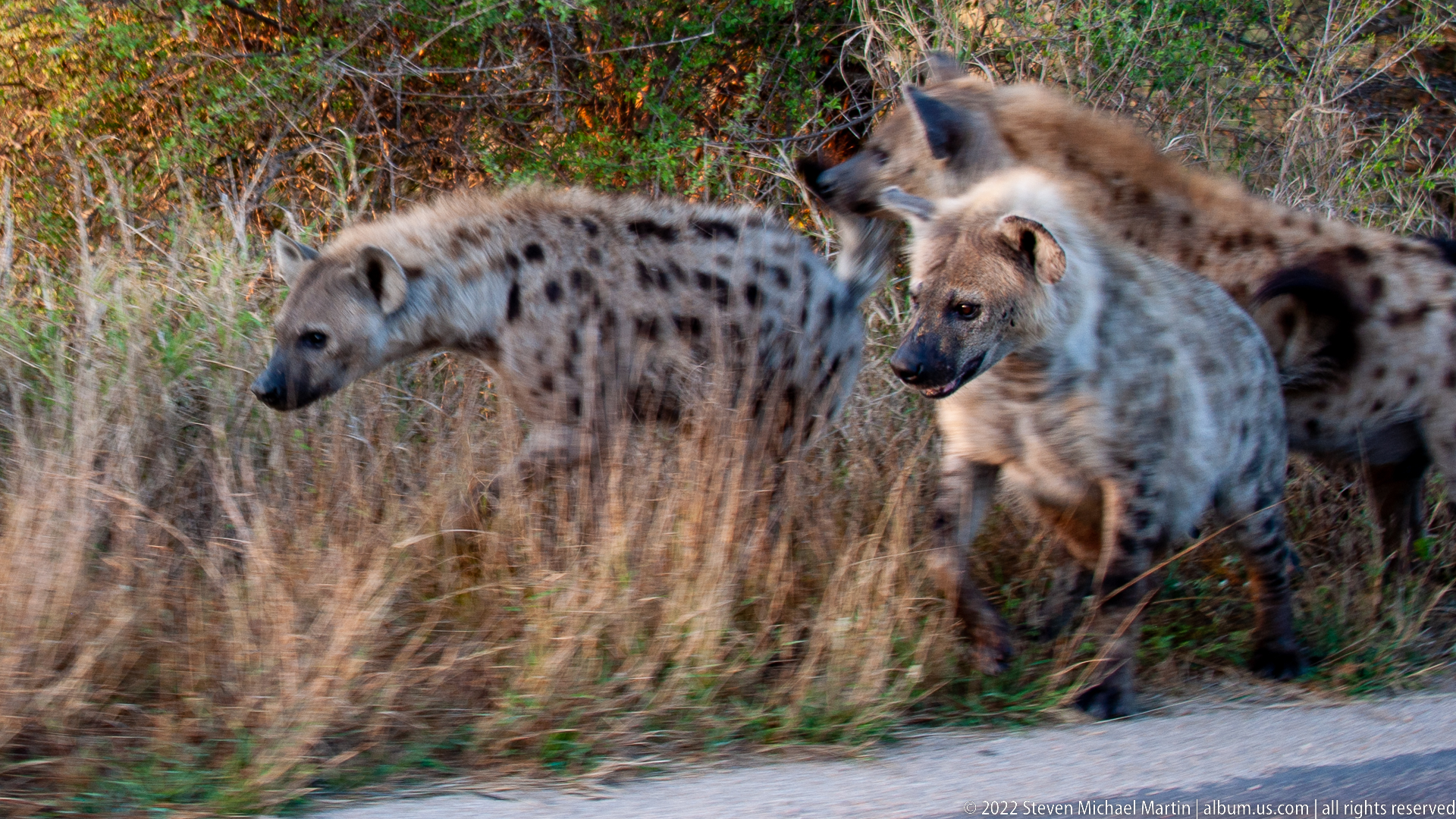
A small group of spotted hyenas emerges from roadside cover, with the foremost animal sharply visible as it steps toward the pavement and companions overlapping behind. The close grouping emphasizes differences in coat pattern and body position while retaining the species’ characteristic heavy forequarters and rounded ears. Dry grass and tangled brush create a compressed woodland-edge setting typical of wildlife encounters along Kruger roads.
Caption
A small group of spotted hyenas emerges from roadside cover, with the foremost animal sharply visible as it steps toward the pavement and companions overlapping behind. The close grouping emphasizes differences in coat pattern and body position while retaining the species’ characteristic heavy forequarters and rounded ears. Dry grass and tangled brush create a compressed woodland-edge setting typical of wildlife encounters along Kruger roads.
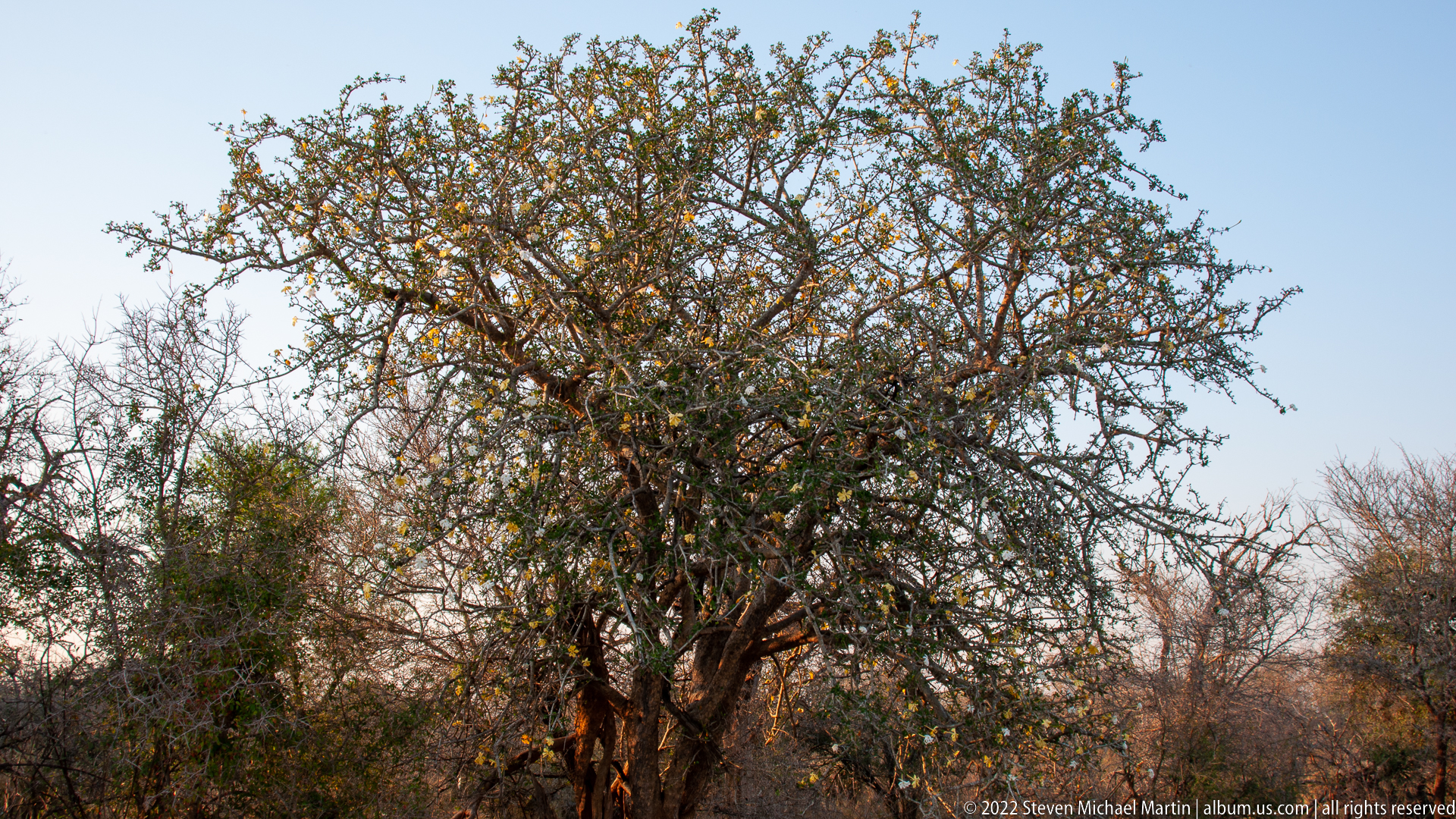
A mature tree carries scattered pale blossoms above the dry woodland near Skukuza, its branching crown standing out against a clear blue sky. The contrast between fresh flowers and the surrounding drought-toned vegetation marks a seasonal botanical detail within the bushveld. Because leaves, bark, and flowers are too small in the proof sheet for a secure species determination, the image is best treated as a habitat and flowering-phenology study.
Caption
A mature tree carries scattered pale blossoms above the dry woodland near Skukuza, its branching crown standing out against a clear blue sky. The contrast between fresh flowers and the surrounding drought-toned vegetation marks a seasonal botanical detail within the bushveld. Because leaves, bark, and flowers are too small in the proof sheet for a secure species determination, the image is best treated as a habitat and flowering-phenology study.
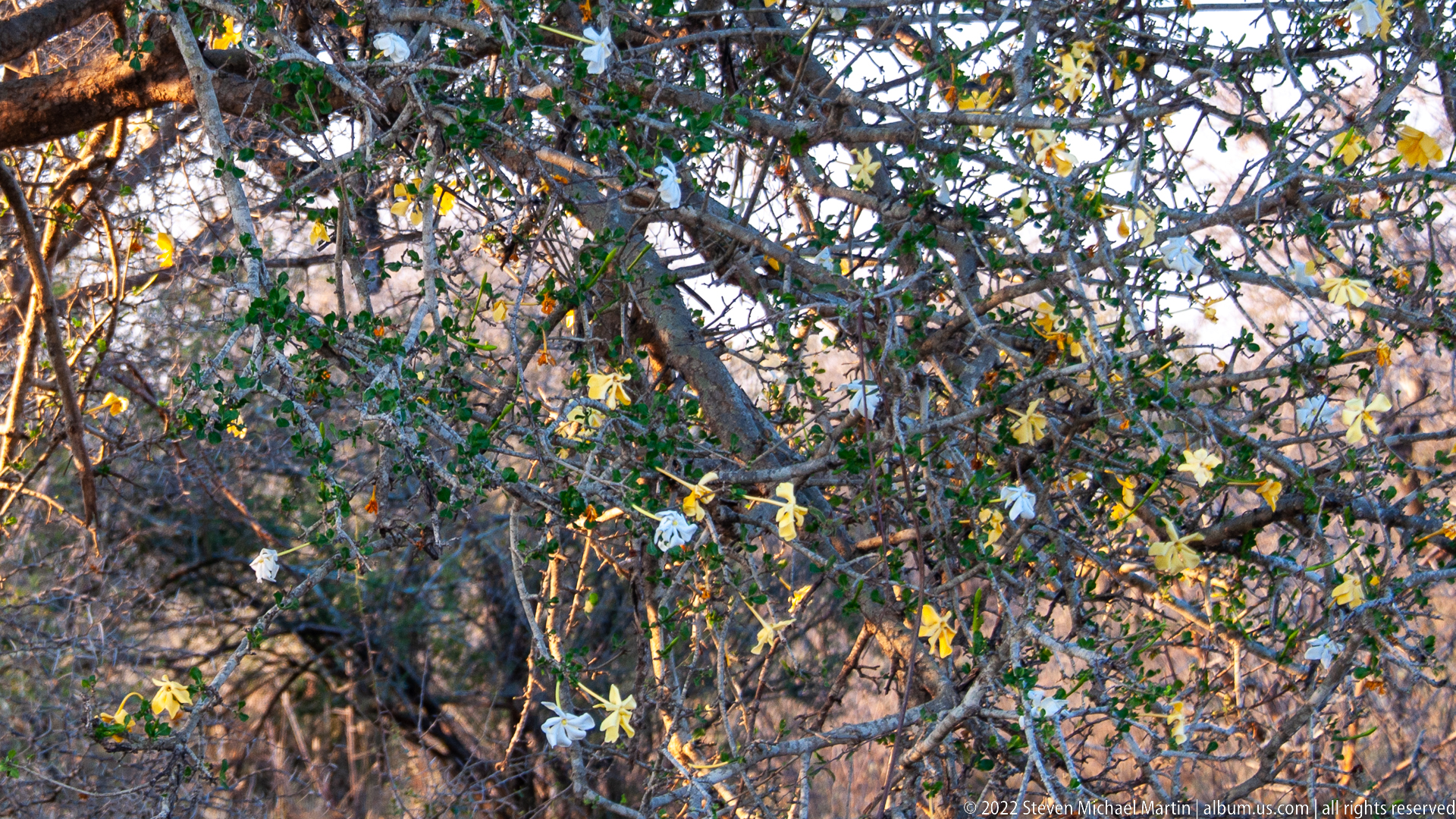
Small white flowers punctuate a dense network of gray-brown branches and green leaves in the Skukuza bushveld. The photograph concentrates on the plant’s flowering canopy rather than the wider landscape, recording a seasonal botanical detail amid otherwise dry vegetation. Individual blossoms and leaves remain too small for a defensible species-level identification, so the image is retained as a close habitat study rather than assigned an uncertain botanical name.
Caption
Small white flowers punctuate a dense network of gray-brown branches and green leaves in the Skukuza bushveld. The photograph concentrates on the plant’s flowering canopy rather than the wider landscape, recording a seasonal botanical detail amid otherwise dry vegetation. Individual blossoms and leaves remain too small for a defensible species-level identification, so the image is retained as a close habitat study rather than assigned an uncertain botanical name.
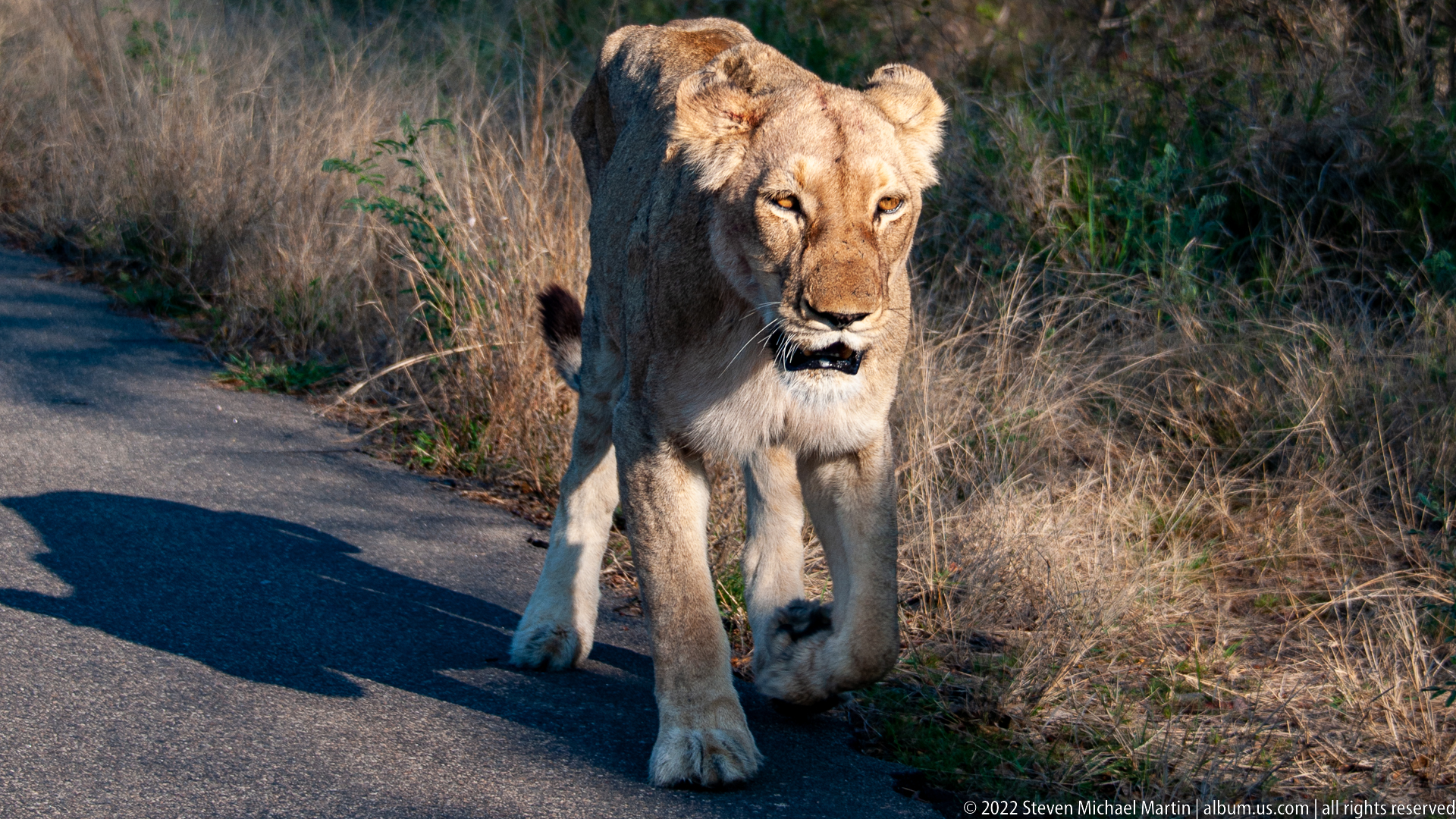
A lioness approaches head-on along the road margin, her gaze directed forward as one forepaw advances into the light. Tawny fur blends with the dry grass behind her, while the broad muzzle, rounded ears, powerful forequarters, and dark tail tip remain distinct. The frontal composition shifts attention from the wider pride to the individual animal’s deliberate movement through the Skukuza landscape.
Caption
A lioness approaches head-on along the road margin, her gaze directed forward as one forepaw advances into the light. Tawny fur blends with the dry grass behind her, while the broad muzzle, rounded ears, powerful forequarters, and dark tail tip remain distinct. The frontal composition shifts attention from the wider pride to the individual animal’s deliberate movement through the Skukuza landscape.
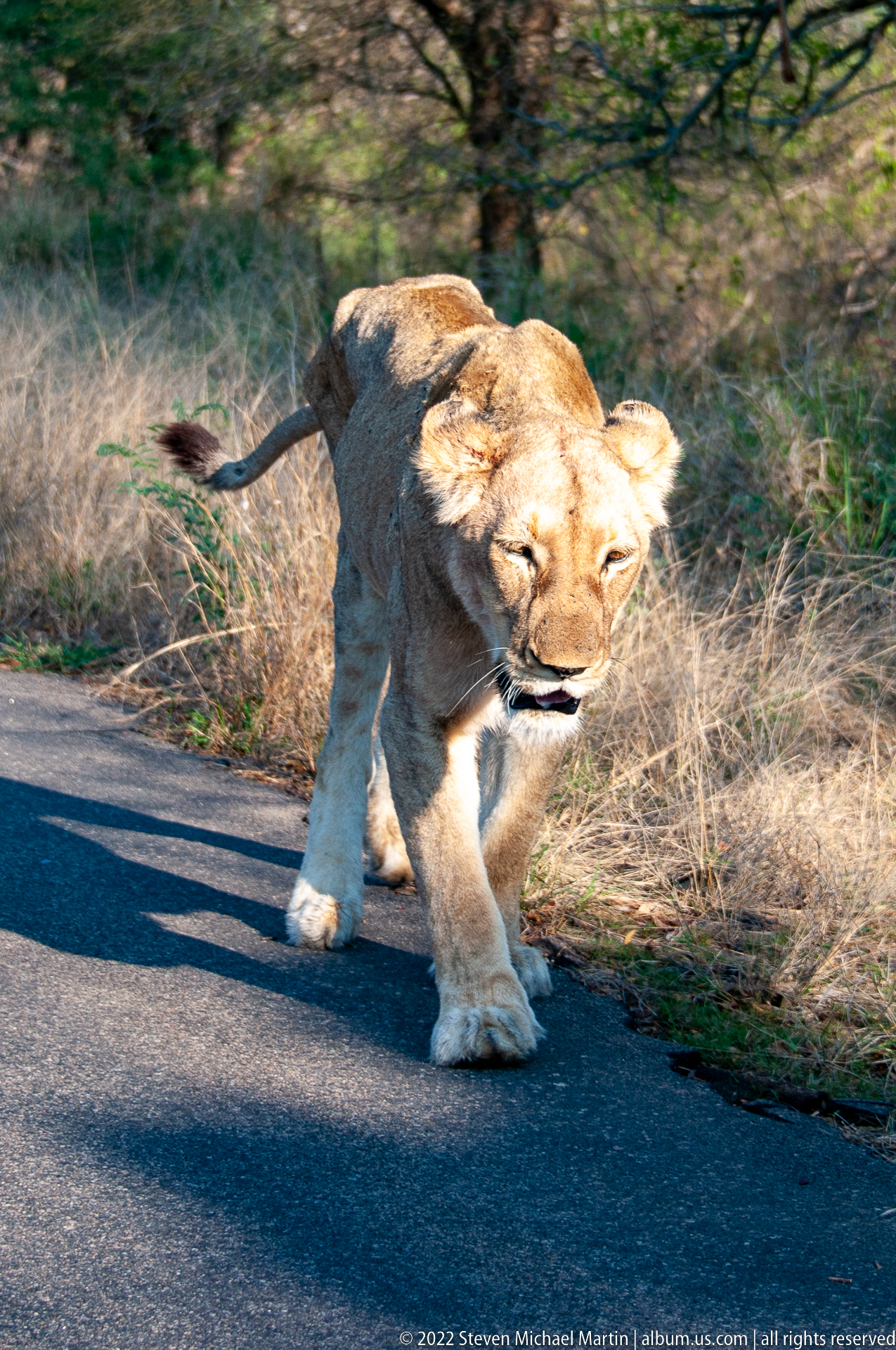
A lioness strides across the paved road in bright morning light, caught mid-step with her head turned slightly to the side. Her tawny coat, muscular shoulders, rounded ears, and long black-tufted tail are clearly defined against dry grass and shadowed woodland. The low viewpoint and close crossing convey the scale of a free-ranging predator moving through the road network near Skukuza.
Caption
A lioness strides across the paved road in bright morning light, caught mid-step with her head turned slightly to the side. Her tawny coat, muscular shoulders, rounded ears, and long black-tufted tail are clearly defined against dry grass and shadowed woodland. The low viewpoint and close crossing convey the scale of a free-ranging predator moving through the road network near Skukuza.
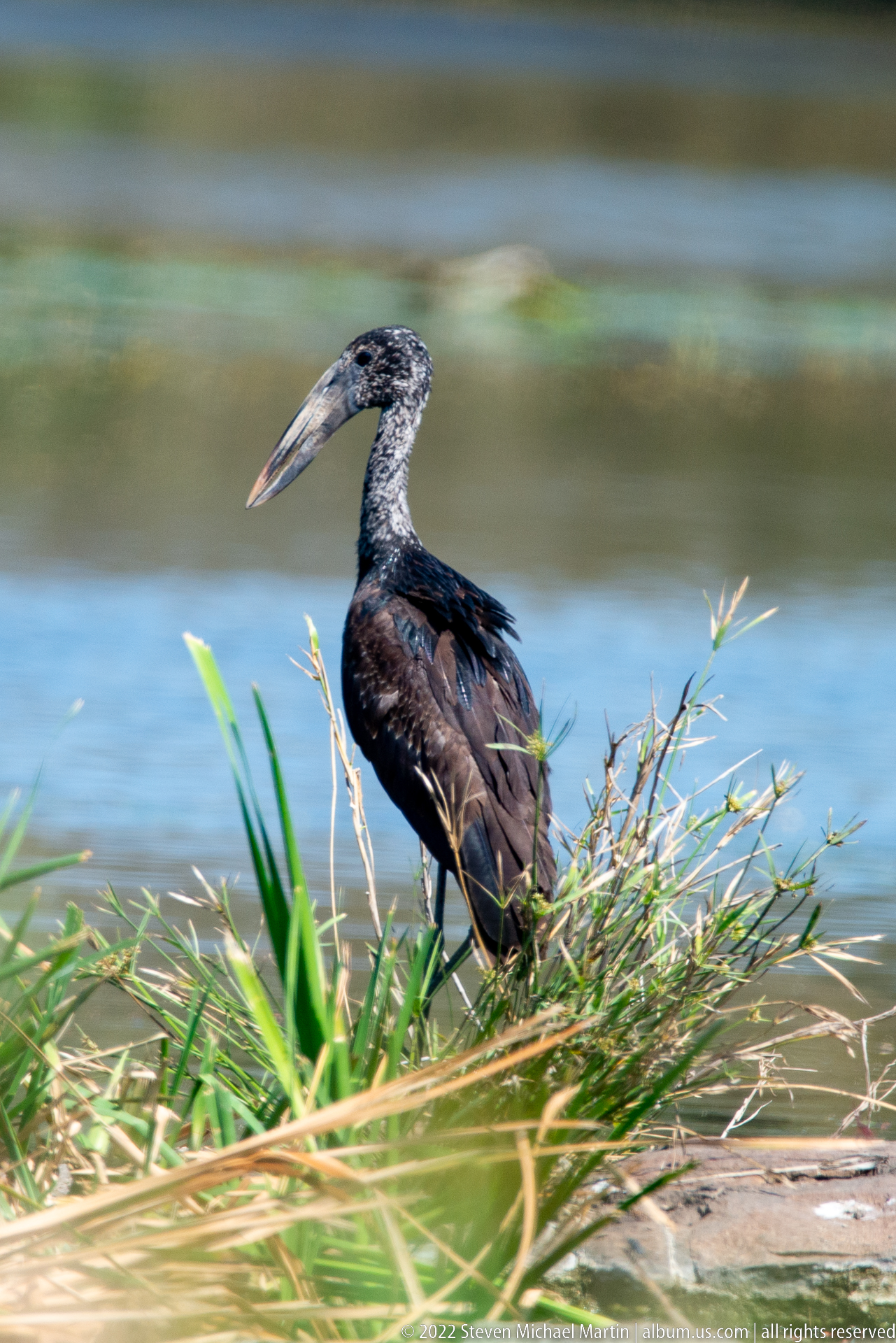
A closer profile isolates an African openbill on the wetland edge, revealing the specialized bill with its conspicuous gap and the mottled sheen of the dark plumage. The bird faces left above a tangle of sedges and broad green leaves, with soft blue water behind. This tighter view emphasizes the feeding anatomy that distinguishes the species from other storks found in Kruger.
Caption
A closer profile isolates an African openbill on the wetland edge, revealing the specialized bill with its conspicuous gap and the mottled sheen of the dark plumage. The bird faces left above a tangle of sedges and broad green leaves, with soft blue water behind. This tighter view emphasizes the feeding anatomy that distinguishes the species from other storks found in Kruger.
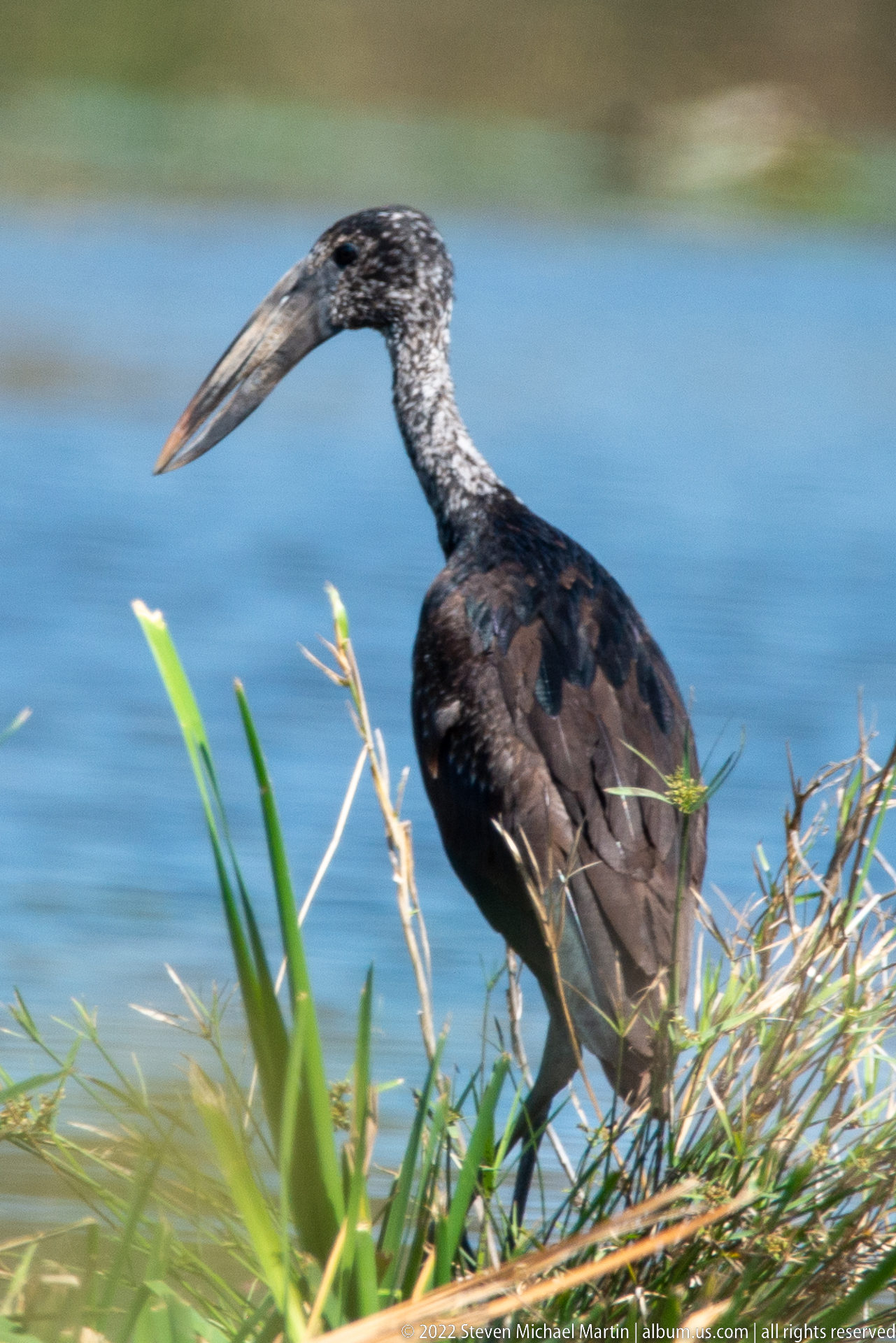
An African openbill stands in profile above the waterline, its long specialized bill silhouetted against a smooth blue background. Dark plumage with lighter mottling, long legs, and the characteristic gap between the mandibles are clearly visible. The uncluttered side view makes this one of the strongest identification images in the wetland sequence, emphasizing the anatomical feature for which the species is named.
Caption
An African openbill stands in profile above the waterline, its long specialized bill silhouetted against a smooth blue background. Dark plumage with lighter mottling, long legs, and the characteristic gap between the mandibles are clearly visible. The uncluttered side view makes this one of the strongest identification images in the wetland sequence, emphasizing the anatomical feature for which the species is named.
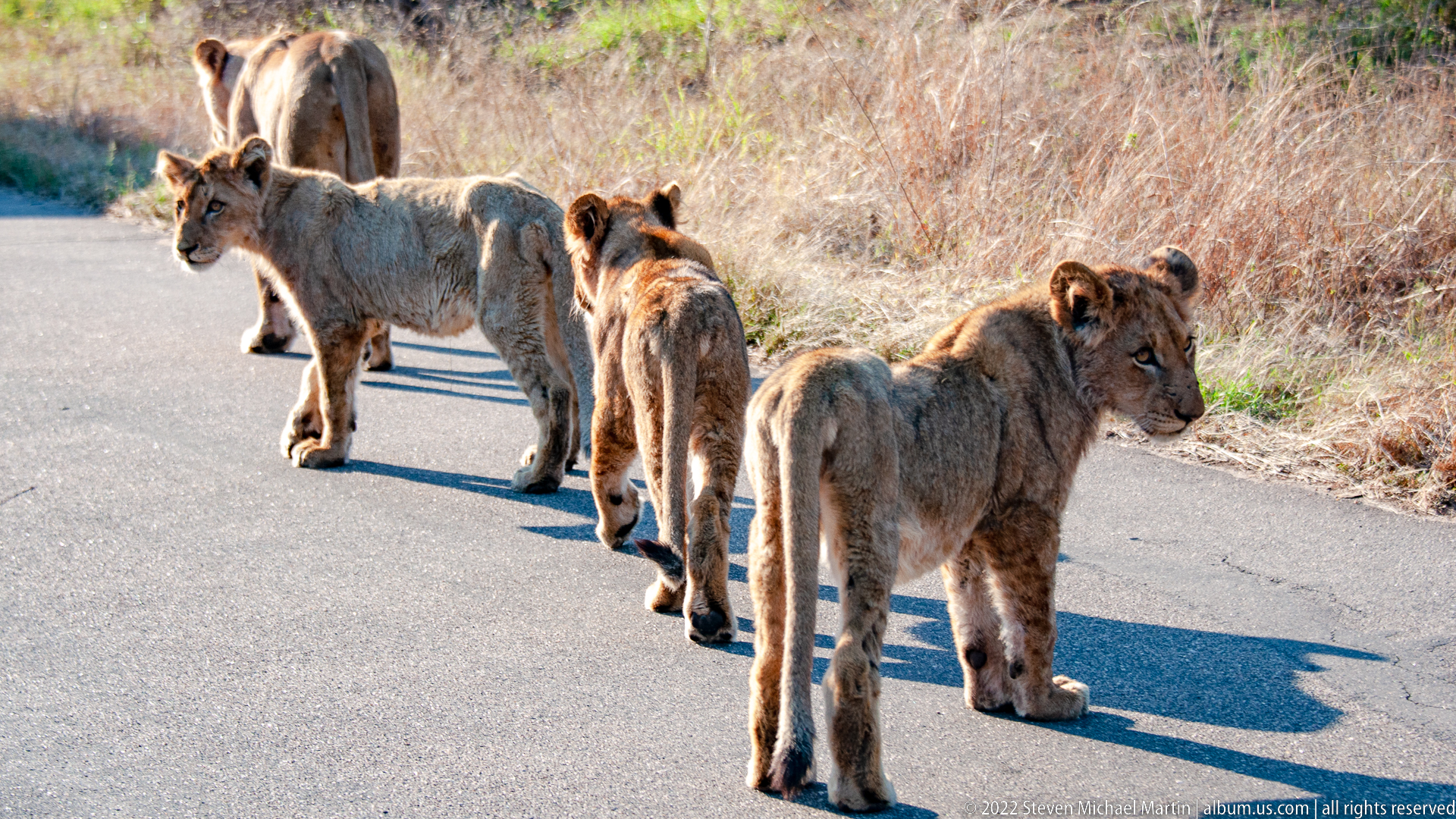
Several lions move together along the paved road, forming a loose line that includes larger lionesses and smaller juvenile animals. Their tawny coats glow against the pale winter grass, while overlapping bodies and varied sizes make the social structure of the group visible. The road provides an open travel corridor through the surrounding bush, allowing a clear view of coordinated pride movement near Skukuza.
Caption
Several lions move together along the paved road, forming a loose line that includes larger lionesses and smaller juvenile animals. Their tawny coats glow against the pale winter grass, while overlapping bodies and varied sizes make the social structure of the group visible. The road provides an open travel corridor through the surrounding bush, allowing a clear view of coordinated pride movement near Skukuza.
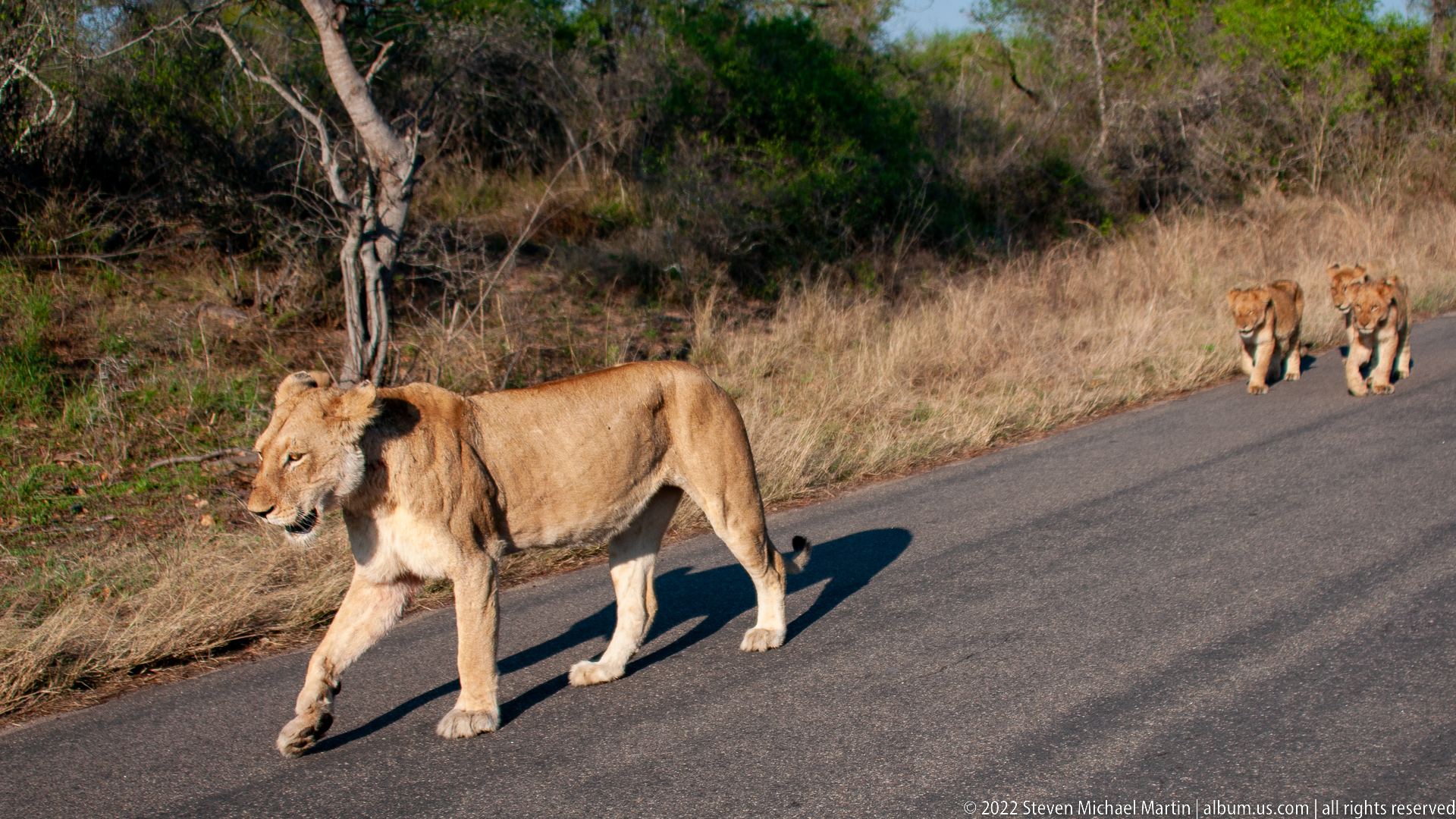
A lioness crosses the foreground at the edge of the paved road while two other pride members follow at a distance. Her long stride and side profile dominate the frame, with the trailing lions providing depth and social context. Dry grass, scattered shrubs, and the open roadway define the winter bushveld setting, showing how a pride can spread out while traveling through Kruger National Park.
Caption
A lioness crosses the foreground at the edge of the paved road while two other pride members follow at a distance. Her long stride and side profile dominate the frame, with the trailing lions providing depth and social context. Dry grass, scattered shrubs, and the open roadway define the winter bushveld setting, showing how a pride can spread out while traveling through Kruger National Park.
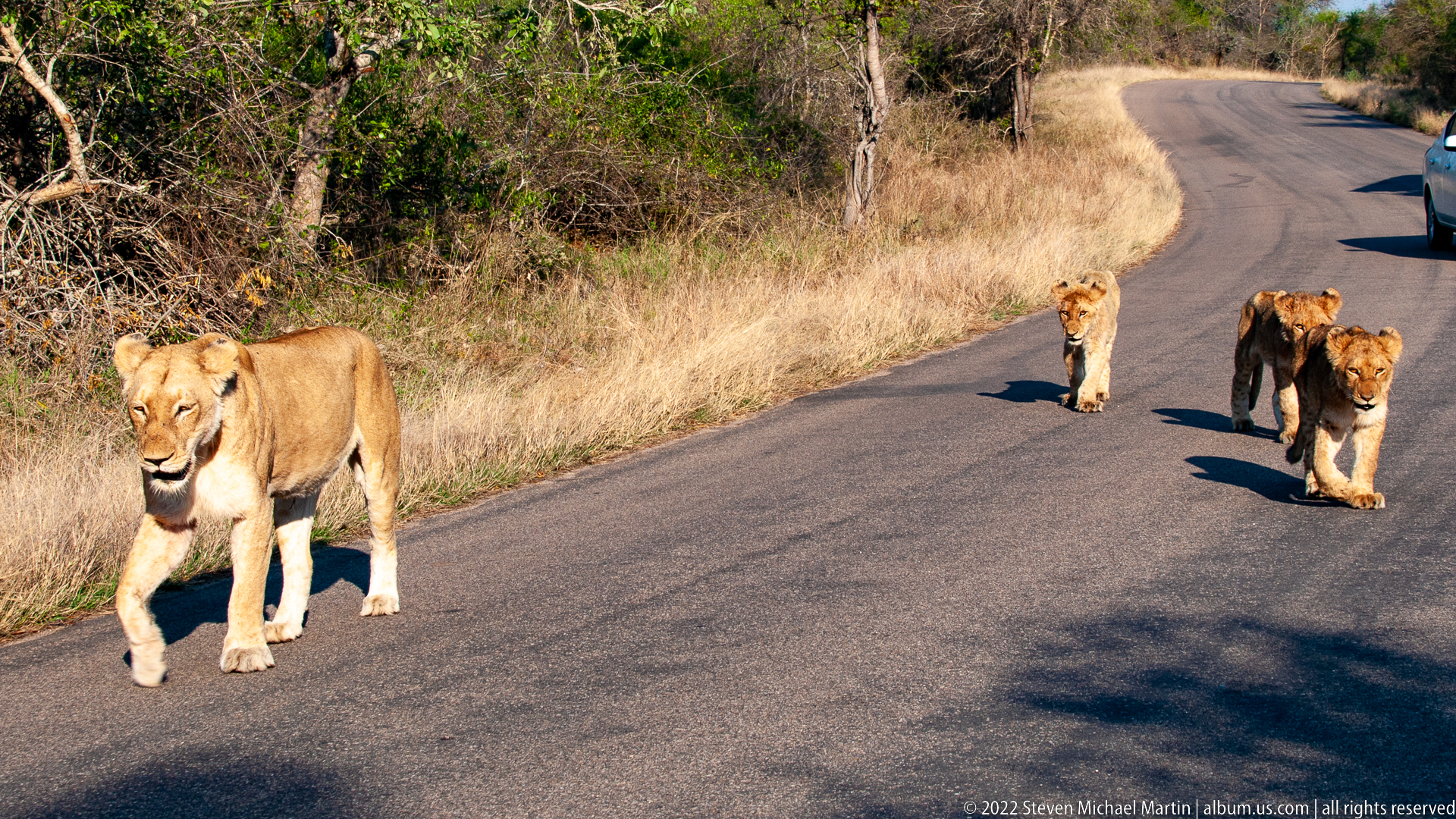
A lioness leads three other lions toward the camera along a curving paved road, their spacing creating a strong sense of coordinated travel. The lead animal occupies the sunlit left foreground while the others advance from the road’s bend, casting long shadows across the asphalt. Dry grasses and scrub border the route, placing the pride’s movement firmly within the winter landscape around Skukuza.
Caption
A lioness leads three other lions toward the camera along a curving paved road, their spacing creating a strong sense of coordinated travel. The lead animal occupies the sunlit left foreground while the others advance from the road’s bend, casting long shadows across the asphalt. Dry grasses and scrub border the route, placing the pride’s movement firmly within the winter landscape around Skukuza.
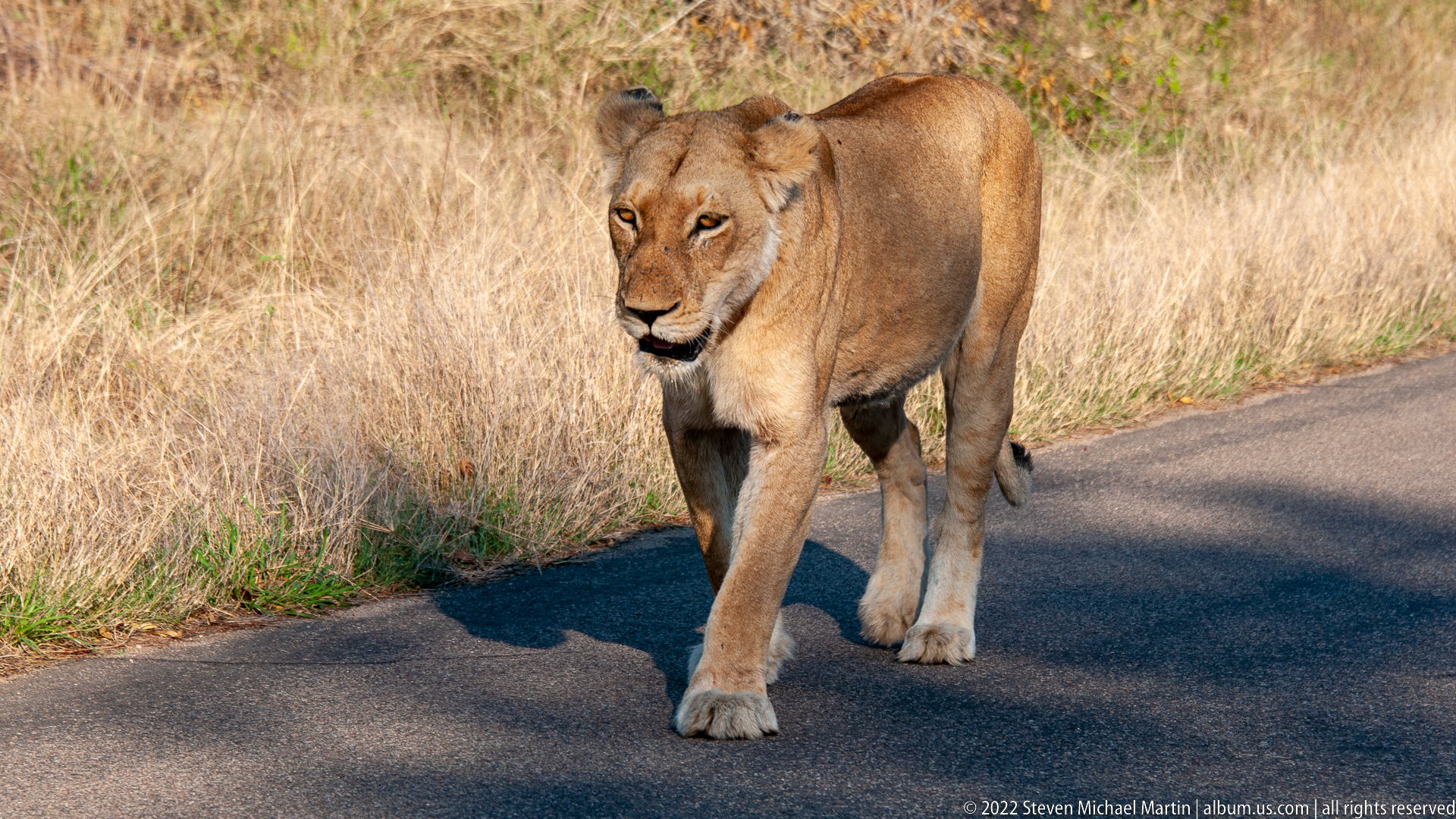
A lioness continues along the paved road with a steady, forward stride, isolated against a band of sun-bleached grass. The side-front angle shows her broad muzzle, muscular chest, heavy paws, and tawny coat without the distraction of other pride members. Long directional light models the animal’s body and reinforces the dry-season character of the Skukuza bushveld.
Caption
A lioness continues along the paved road with a steady, forward stride, isolated against a band of sun-bleached grass. The side-front angle shows her broad muzzle, muscular chest, heavy paws, and tawny coat without the distraction of other pride members. Long directional light models the animal’s body and reinforces the dry-season character of the Skukuza bushveld.
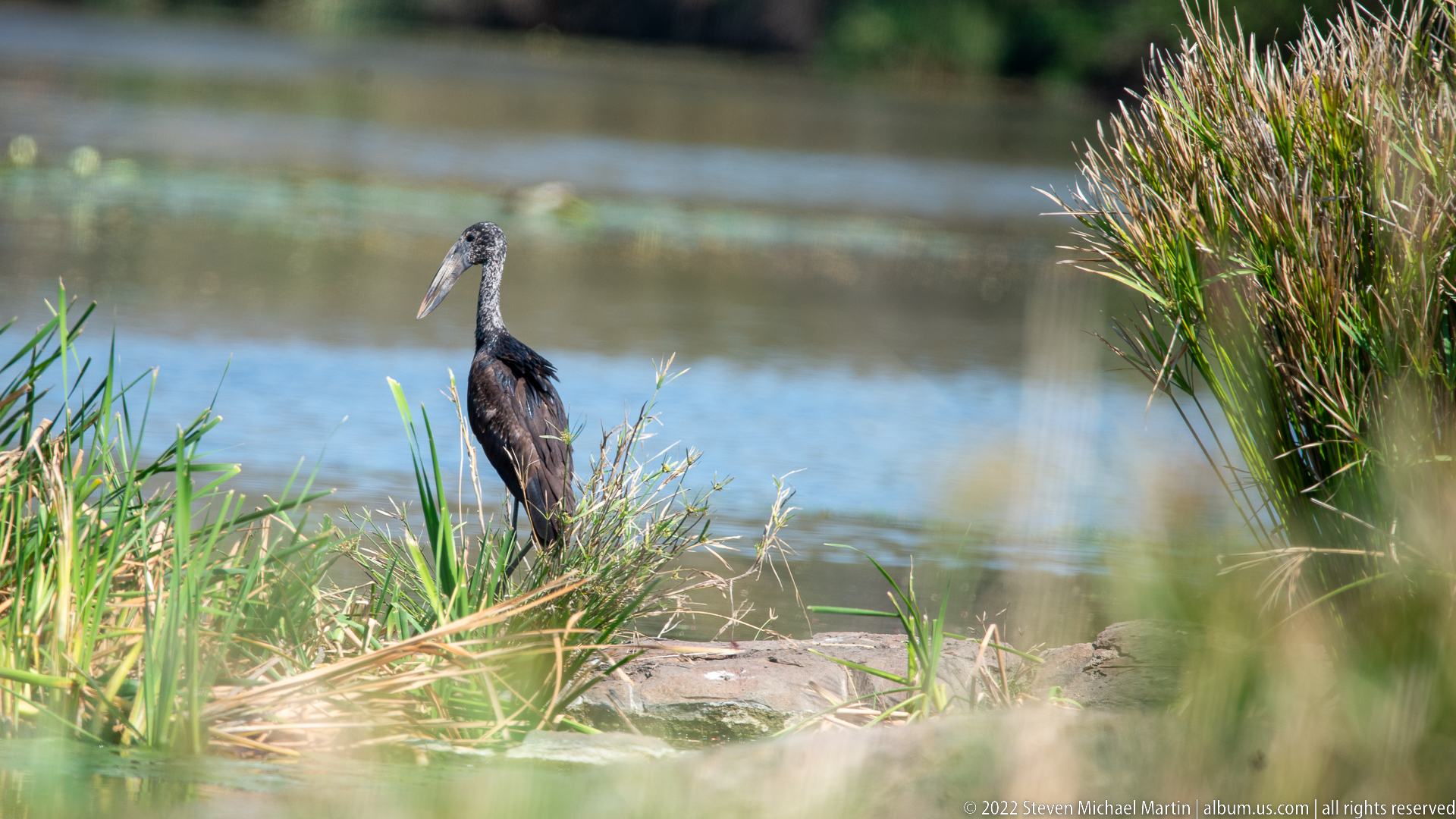
An African openbill stands upright on a grassy margin beside still water, its dark plumage contrasting with the bright wetland vegetation. The long bill shows the characteristic open gap between the mandibles, an adaptation associated with handling aquatic snails. Reeds and emergent plants frame the bird at the water’s edge, documenting wetland habitat within the broader Skukuza landscape.
Caption
An African openbill stands upright on a grassy margin beside still water, its dark plumage contrasting with the bright wetland vegetation. The long bill shows the characteristic open gap between the mandibles, an adaptation associated with handling aquatic snails. Reeds and emergent plants frame the bird at the water’s edge, documenting wetland habitat within the broader Skukuza landscape.
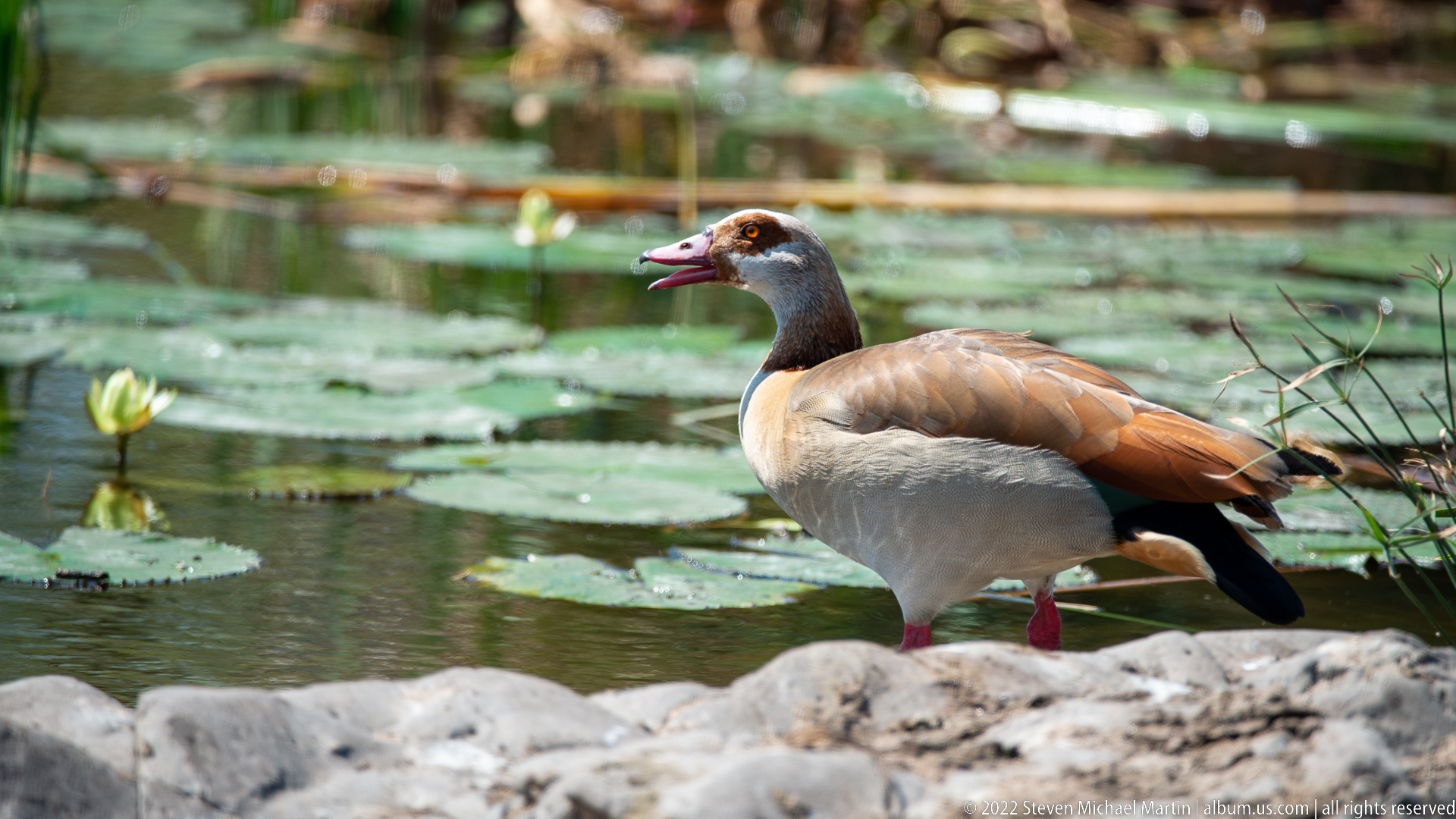
An Egyptian goose stands on a pale rock at the edge of a lily-covered pool, calling with its bill open. The chestnut eye patch, warm brown back, pale breast, pink legs, and contrasting dark tail identify the familiar southern African waterfowl. Floating lily pads and shaded water form a lush setting that differs markedly from the dry grasslands visible elsewhere in the Skukuza portfolio.
Caption
An Egyptian goose stands on a pale rock at the edge of a lily-covered pool, calling with its bill open. The chestnut eye patch, warm brown back, pale breast, pink legs, and contrasting dark tail identify the familiar southern African waterfowl. Floating lily pads and shaded water form a lush setting that differs markedly from the dry grasslands visible elsewhere in the Skukuza portfolio.
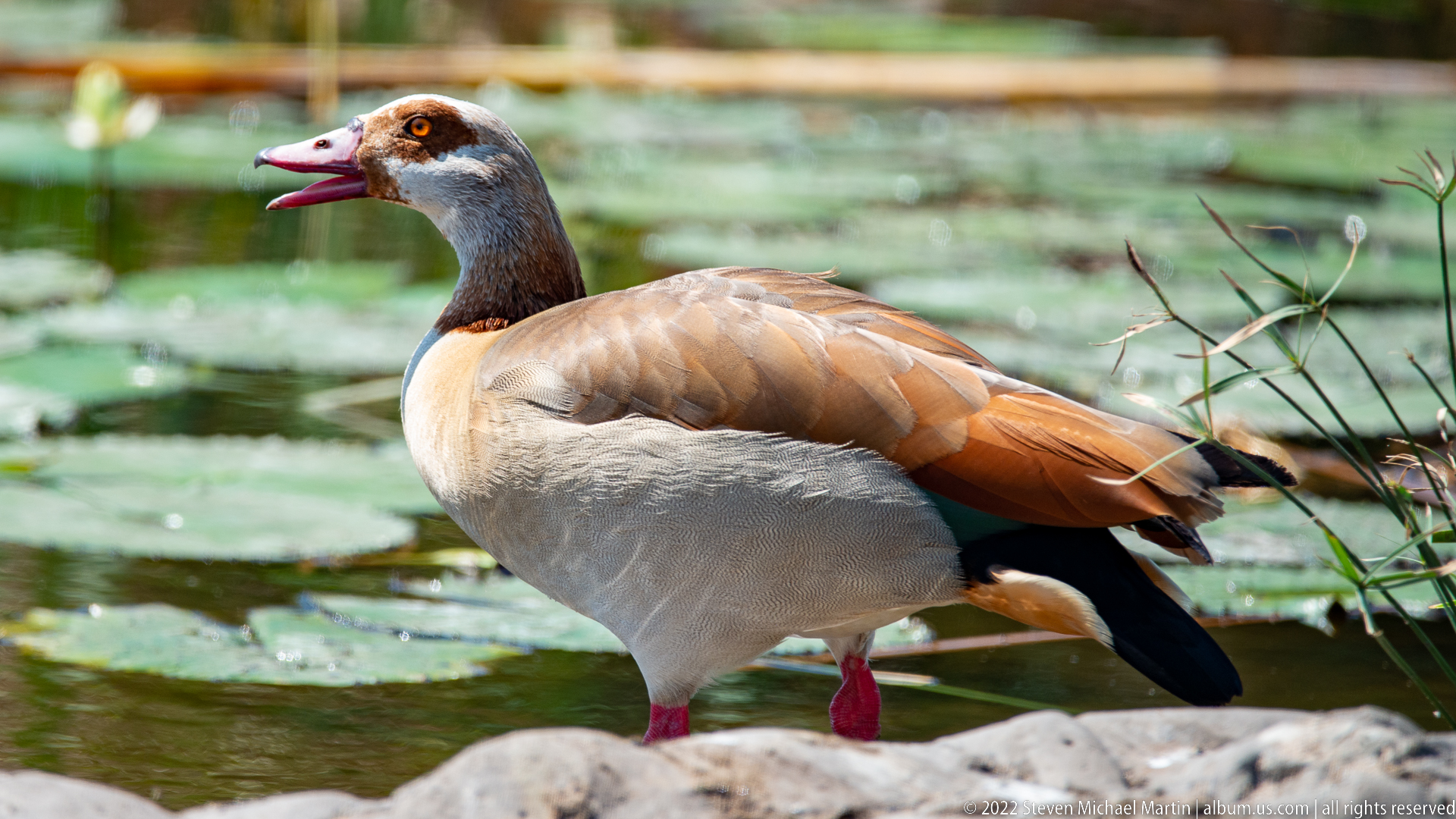
A close side view of an Egyptian goose fills the frame as it stands beside the water, its open bill suggesting a call. Fine feather patterning is visible across the buff breast and brown wing coverts, while the chestnut eye patch and pink legs provide strong field marks. The surrounding lily pads place the bird within a quiet freshwater habitat near Skukuza.
Caption
A close side view of an Egyptian goose fills the frame as it stands beside the water, its open bill suggesting a call. Fine feather patterning is visible across the buff breast and brown wing coverts, while the chestnut eye patch and pink legs provide strong field marks. The surrounding lily pads place the bird within a quiet freshwater habitat near Skukuza.
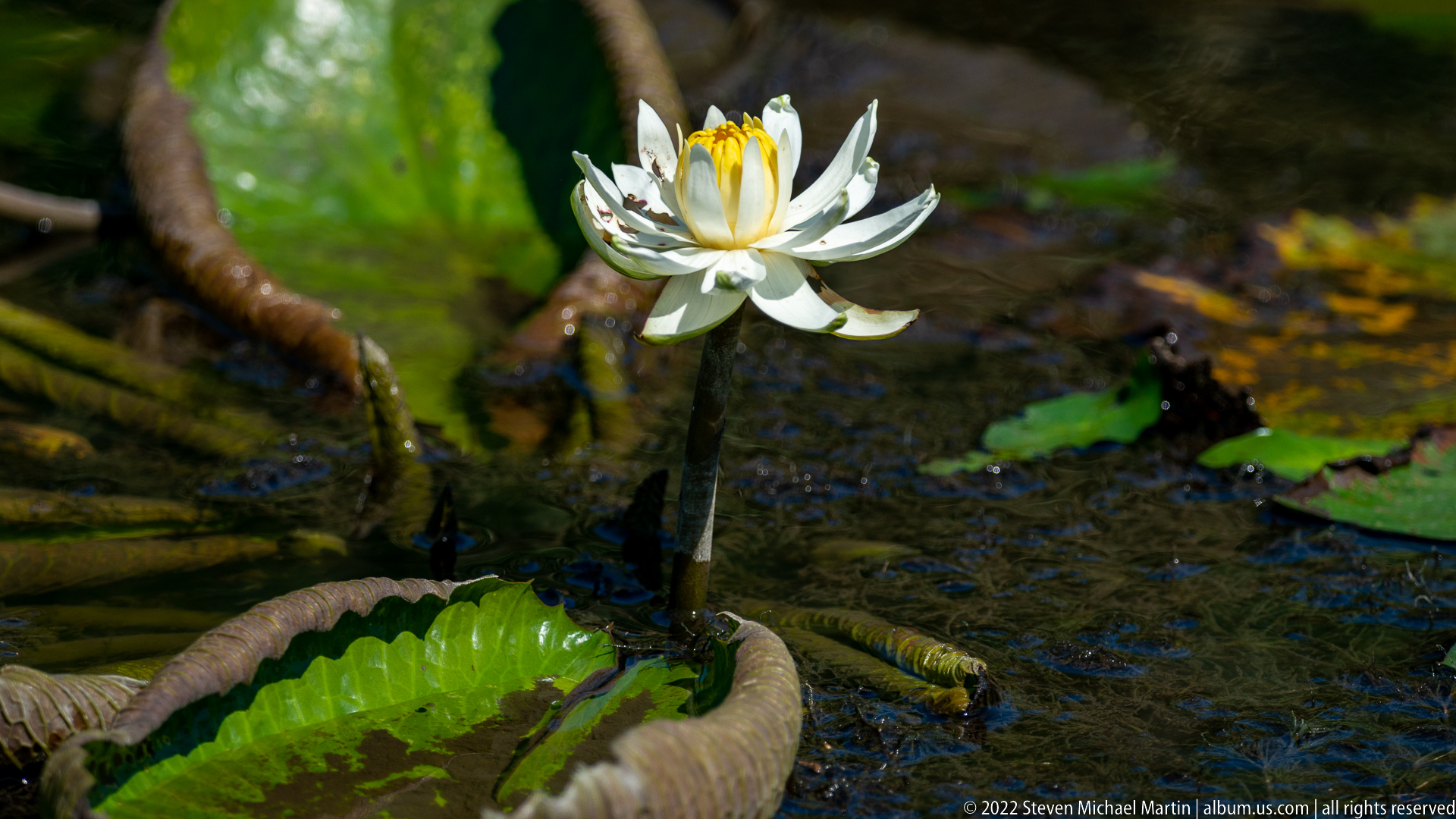
A single white water lily rises above dark pond water, its open petals surrounding a dense yellow center. Broad floating leaves and curled, aging pads encircle the bloom, while submerged stems and reflections create a layered wetland study. The flower is clearly a Nymphaea water lily, although the proof sheet does not provide enough botanical detail to assign a species with confidence.
Caption
A single white water lily rises above dark pond water, its open petals surrounding a dense yellow center. Broad floating leaves and curled, aging pads encircle the bloom, while submerged stems and reflections create a layered wetland study. The flower is clearly a Nymphaea water lily, although the proof sheet does not provide enough botanical detail to assign a species with confidence.
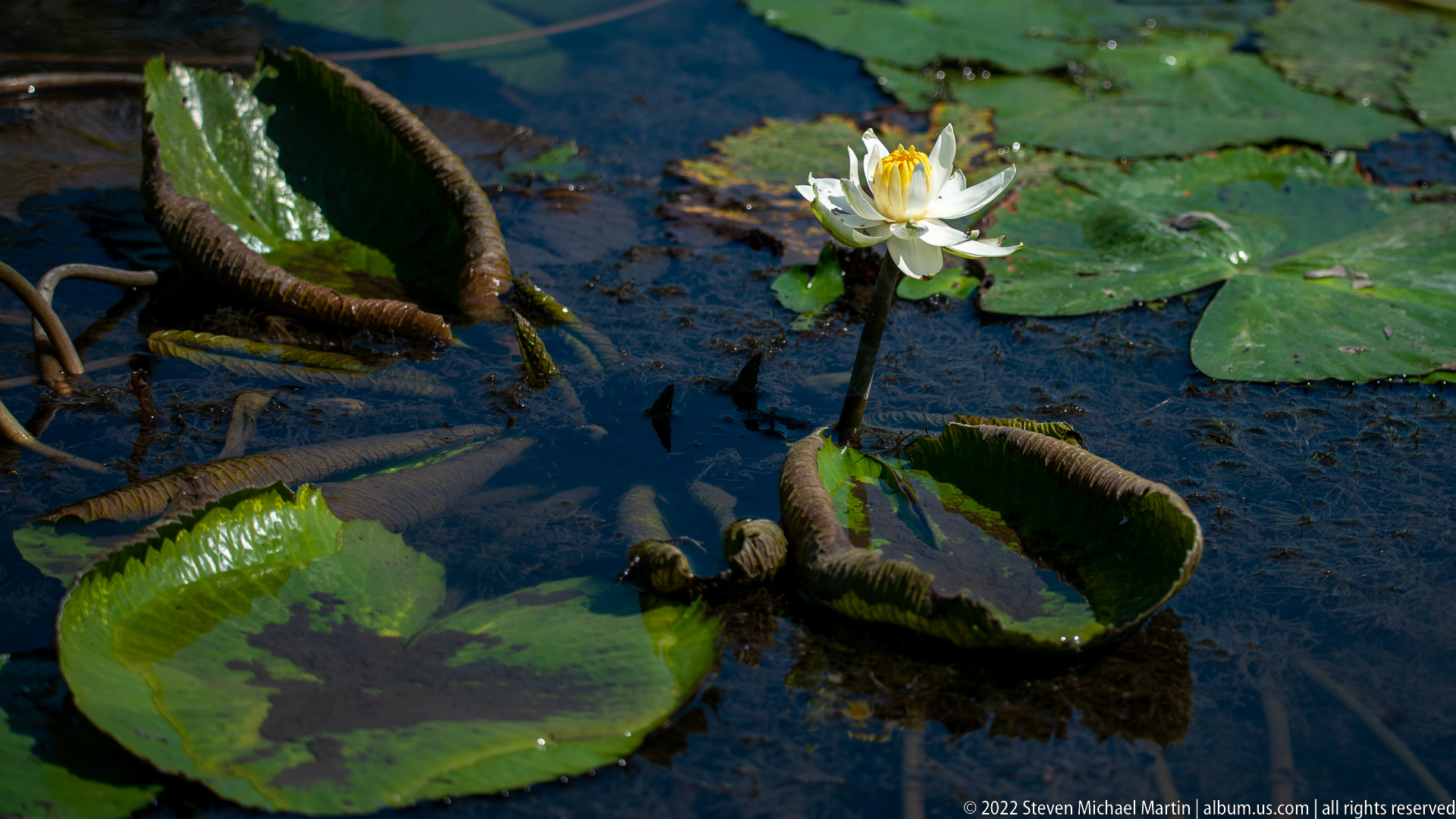
A white water lily stands above a patchwork of floating pads, its pale petals and yellow center catching sunlight against the dark water. Wider framing than the preceding close view reveals the bloom’s relationship to curled older leaves, fresh green pads, and submerged stems. The composition records the structure of a small freshwater plant community in the Skukuza area rather than isolating the flower alone.
Caption
A white water lily stands above a patchwork of floating pads, its pale petals and yellow center catching sunlight against the dark water. Wider framing than the preceding close view reveals the bloom’s relationship to curled older leaves, fresh green pads, and submerged stems. The composition records the structure of a small freshwater plant community in the Skukuza area rather than isolating the flower alone.
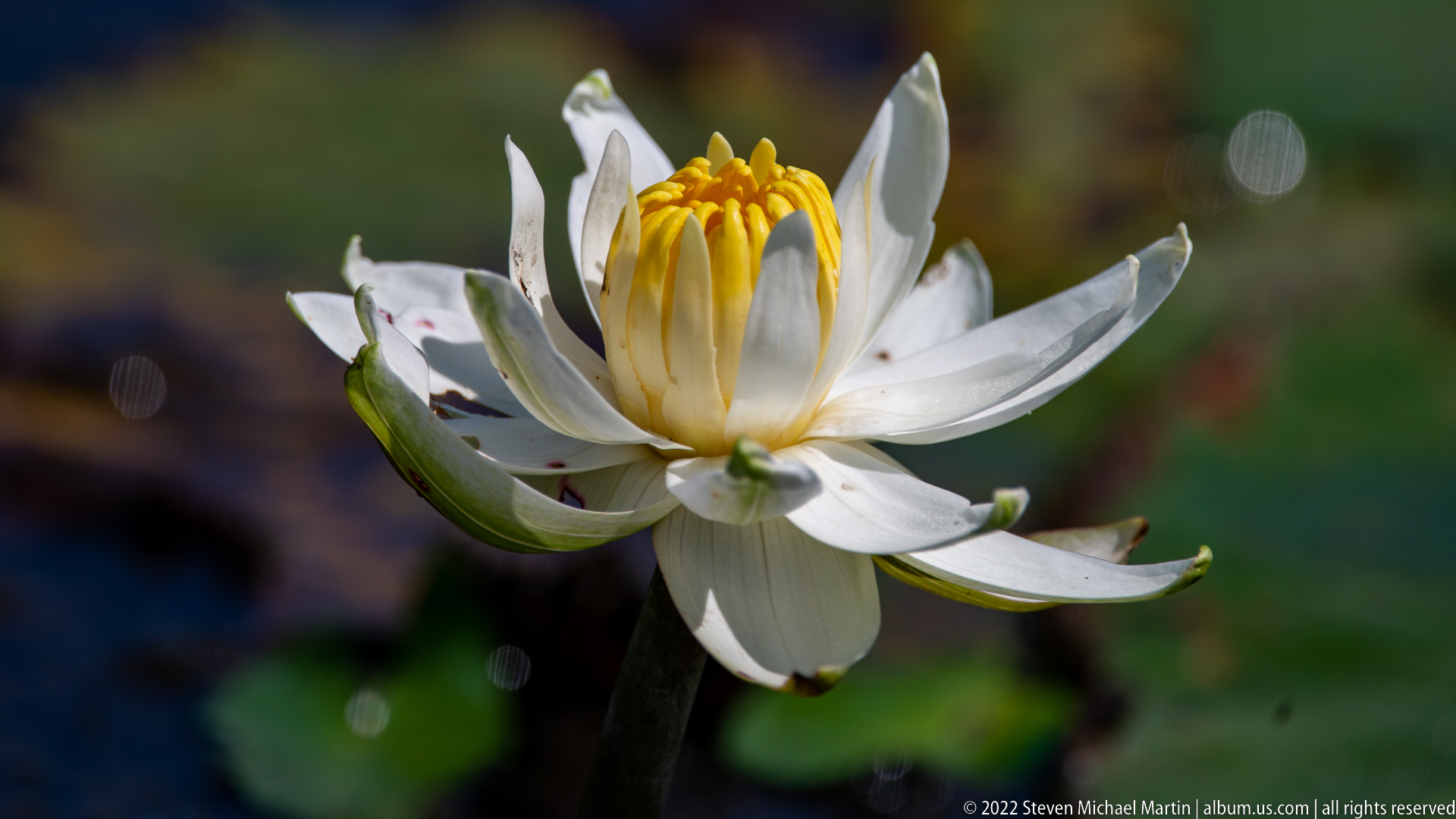
The open bloom of a white water lily is shown in tight detail, with long white petals radiating around upright yellow stamens. A few petals carry small blemishes, adding botanical texture to the otherwise fresh flower, while the pond and lily pads dissolve into soft background color. This close study provides the clearest view in the sequence of the flower’s structure, though not enough for a certain species assignment.
Caption
The open bloom of a white water lily is shown in tight detail, with long white petals radiating around upright yellow stamens. A few petals carry small blemishes, adding botanical texture to the otherwise fresh flower, while the pond and lily pads dissolve into soft background color. This close study provides the clearest view in the sequence of the flower’s structure, though not enough for a certain species assignment.
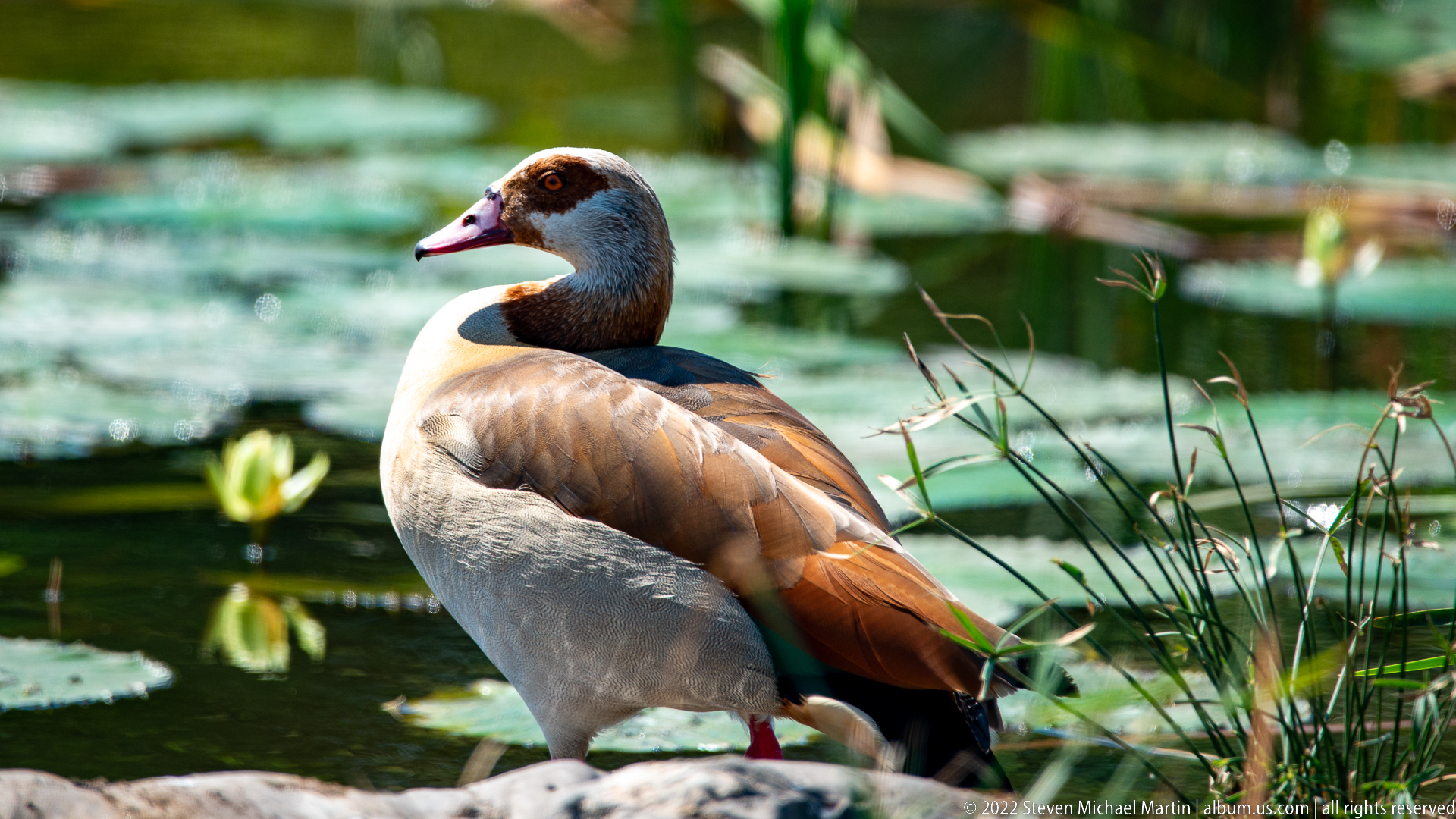
An Egyptian goose stands alert on a rock beside a lily pond, turning its head left while the body remains in profile. The chestnut eye patch, brown saddle, pale underparts, pink legs, and dark tail are sharply rendered. Reeds and floating vegetation fill the background, giving this portrait a strong wetland context and distinguishing it from the more tightly cropped goose views in the preceding sequence.
Caption
An Egyptian goose stands alert on a rock beside a lily pond, turning its head left while the body remains in profile. The chestnut eye patch, brown saddle, pale underparts, pink legs, and dark tail are sharply rendered. Reeds and floating vegetation fill the background, giving this portrait a strong wetland context and distinguishing it from the more tightly cropped goose views in the preceding sequence.
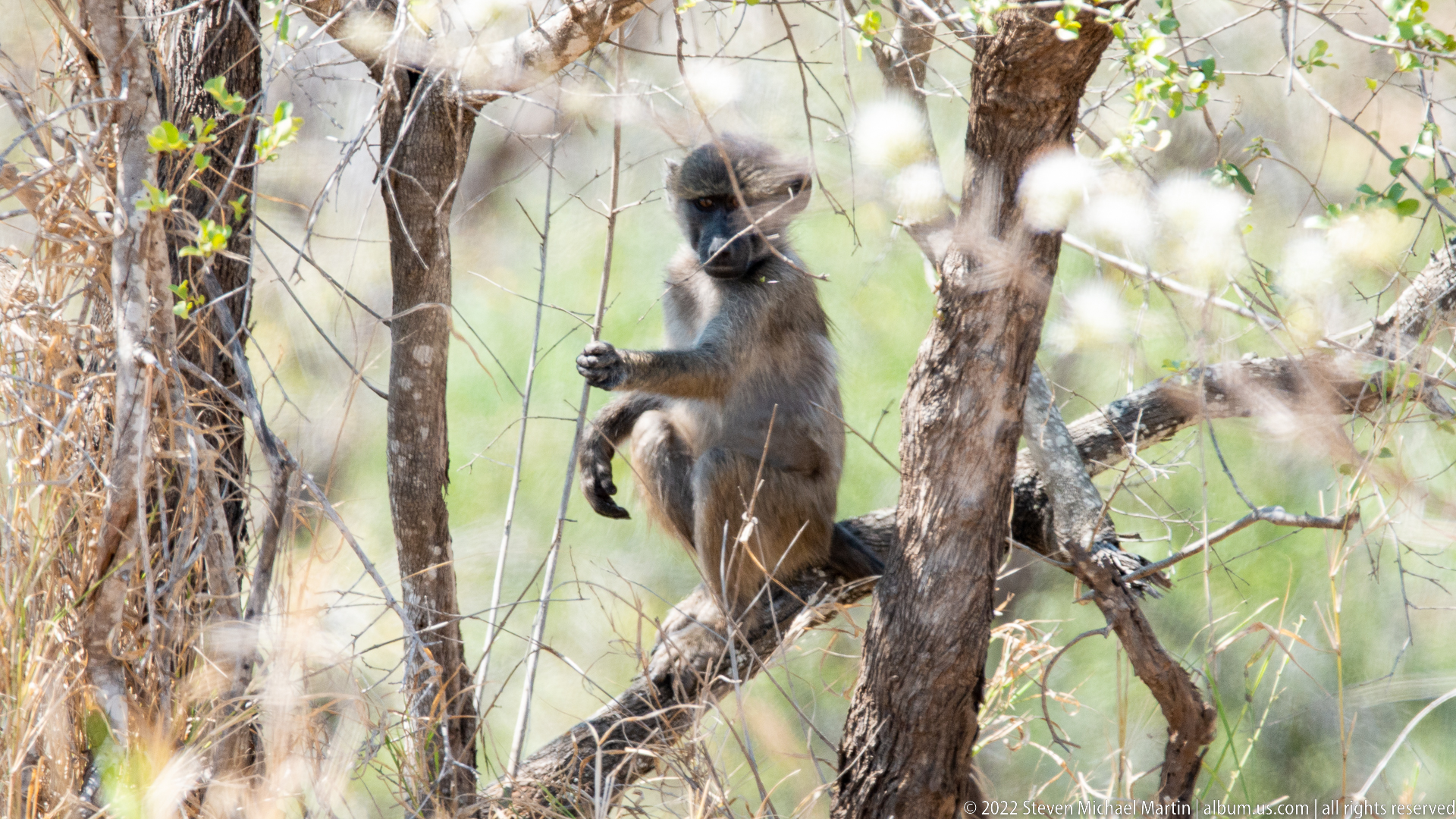
A vervet monkey sits among thin branches and dry woodland stems, partially screened by foliage. Its gray coat, dark face, pale brow, and long limbs are visible as it holds a small object or plant material in one hand. The layered branches create a natural, observational portrait of an arboreal primate using the woodland around Skukuza for cover and foraging.
Caption
A vervet monkey sits among thin branches and dry woodland stems, partially screened by foliage. Its gray coat, dark face, pale brow, and long limbs are visible as it holds a small object or plant material in one hand. The layered branches create a natural, observational portrait of an arboreal primate using the woodland around Skukuza for cover and foraging.
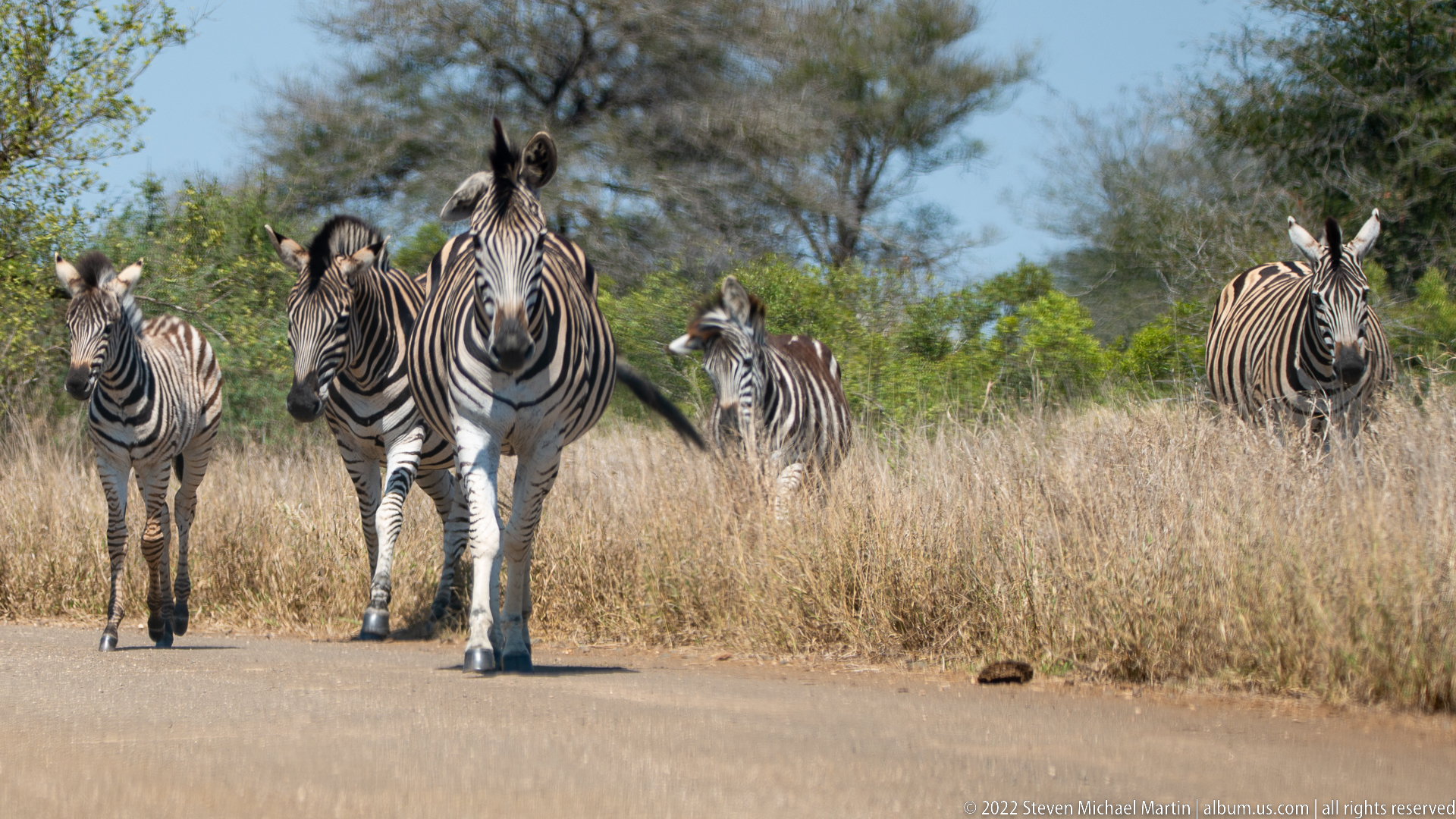
A small herd of plains zebras advances toward the camera along and beside a paved road, with one large animal centered in the foreground. Bold black-and-white striping contrasts with tawny winter grass, while additional zebras emerge from the scrub at different distances. The frontal arrangement conveys herd movement and depth as the animals use the open roadside corridor near Skukuza.
Caption
A small herd of plains zebras advances toward the camera along and beside a paved road, with one large animal centered in the foreground. Bold black-and-white striping contrasts with tawny winter grass, while additional zebras emerge from the scrub at different distances. The frontal arrangement conveys herd movement and depth as the animals use the open roadside corridor near Skukuza.
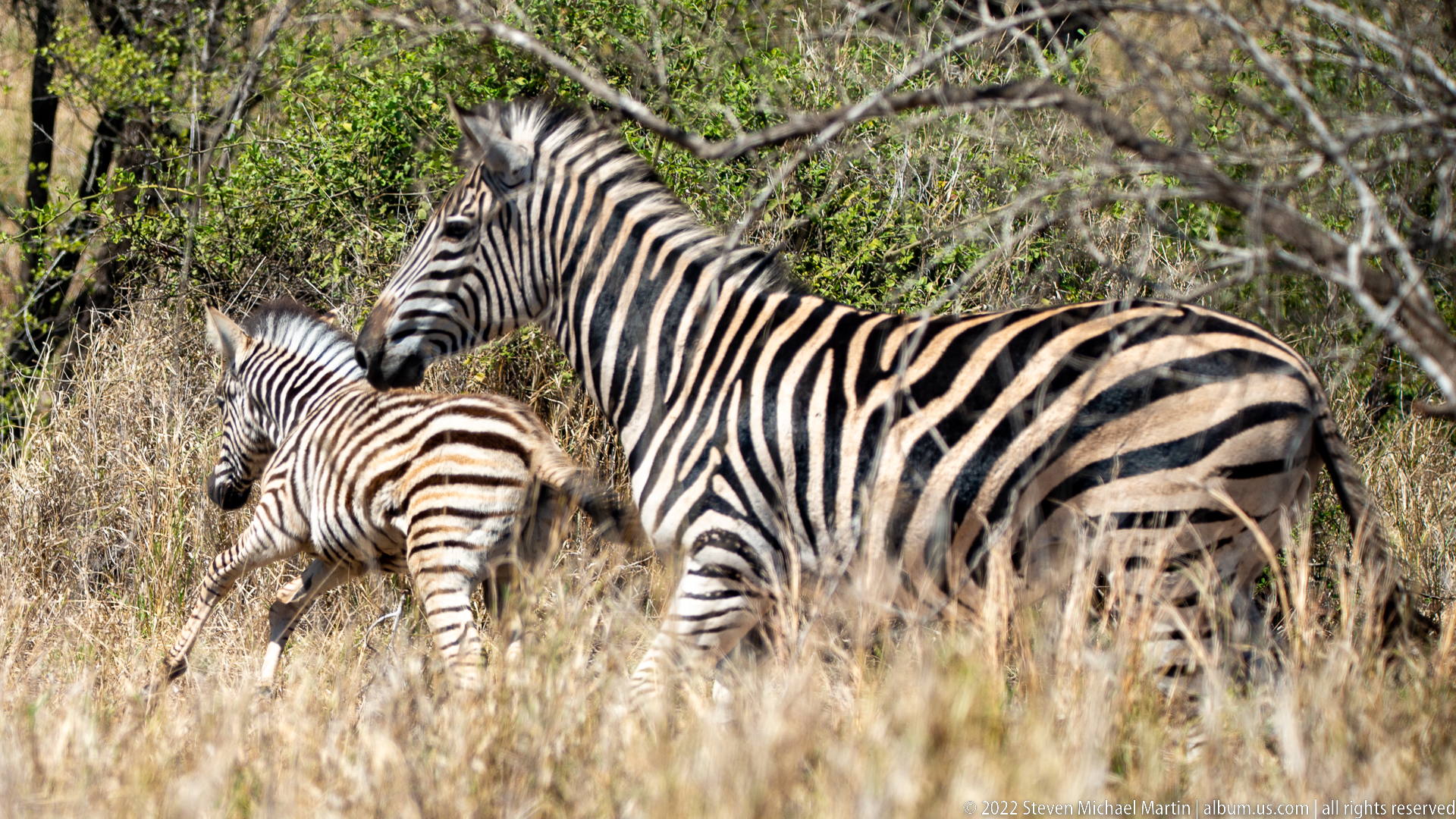
An adult plains zebra stands close beside a young foal in dry grass and scrub, the pair angled in opposite directions while remaining tightly associated. The foal’s narrower body and softer brownish-black striping contrast with the adult’s bold mature pattern. This intimate family grouping records both age-related coat differences and the protective proximity typical of mare-and-foal associations in zebra herds.
Caption
An adult plains zebra stands close beside a young foal in dry grass and scrub, the pair angled in opposite directions while remaining tightly associated. The foal’s narrower body and softer brownish-black striping contrast with the adult’s bold mature pattern. This intimate family grouping records both age-related coat differences and the protective proximity typical of mare-and-foal associations in zebra herds.
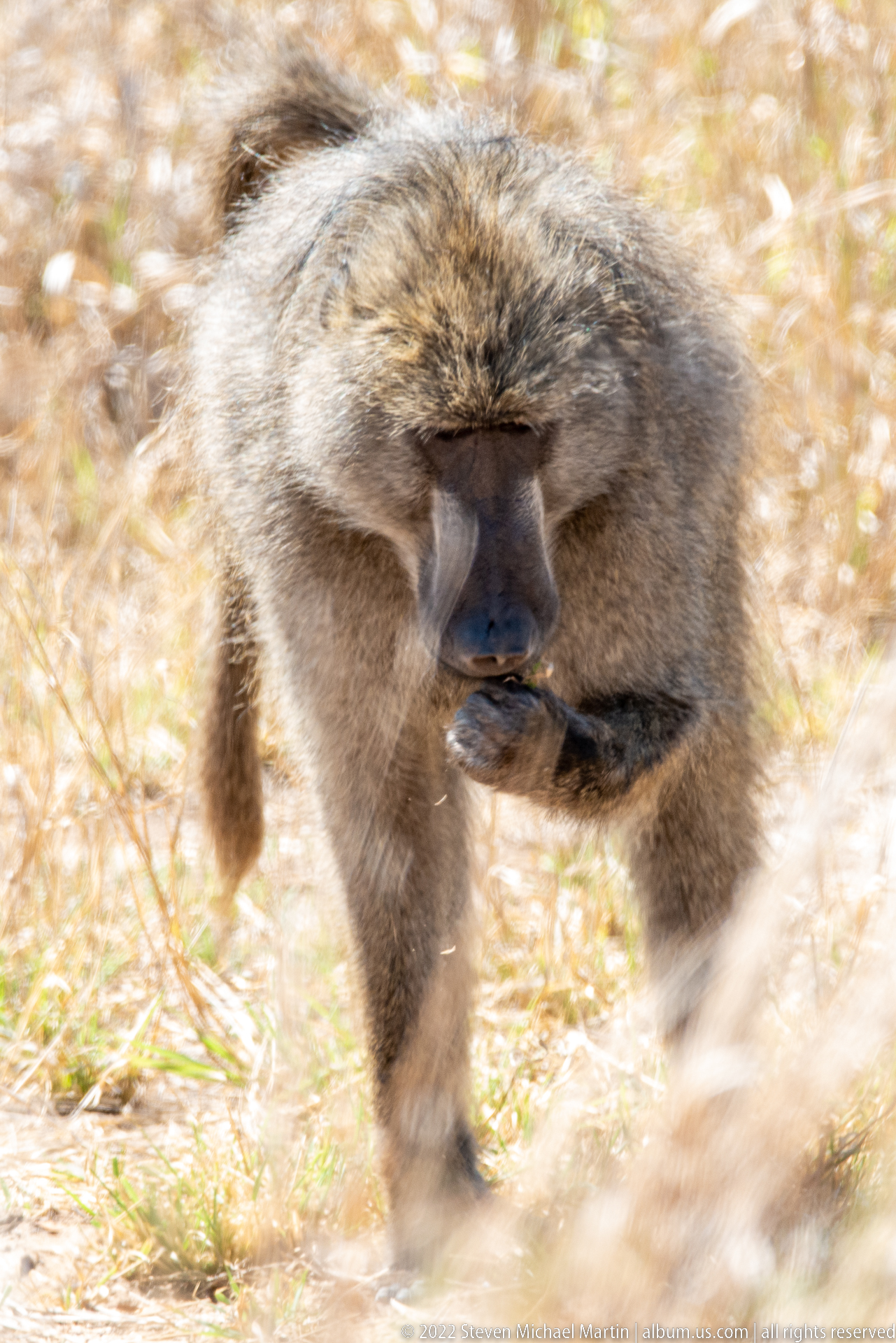
A chacma baboon moves low across sunlit dry ground, its body angled toward the camera while the long muzzle and heavy gray-brown coat dominate the frame. Motion and foreground vegetation soften parts of the animal, but the powerful limbs, doglike face, and dark muzzle remain clear. The close encounter shifts the portfolio from herd mammals to one of Kruger’s conspicuous ground-foraging primates.
Caption
A chacma baboon moves low across sunlit dry ground, its body angled toward the camera while the long muzzle and heavy gray-brown coat dominate the frame. Motion and foreground vegetation soften parts of the animal, but the powerful limbs, doglike face, and dark muzzle remain clear. The close encounter shifts the portfolio from herd mammals to one of Kruger’s conspicuous ground-foraging primates.
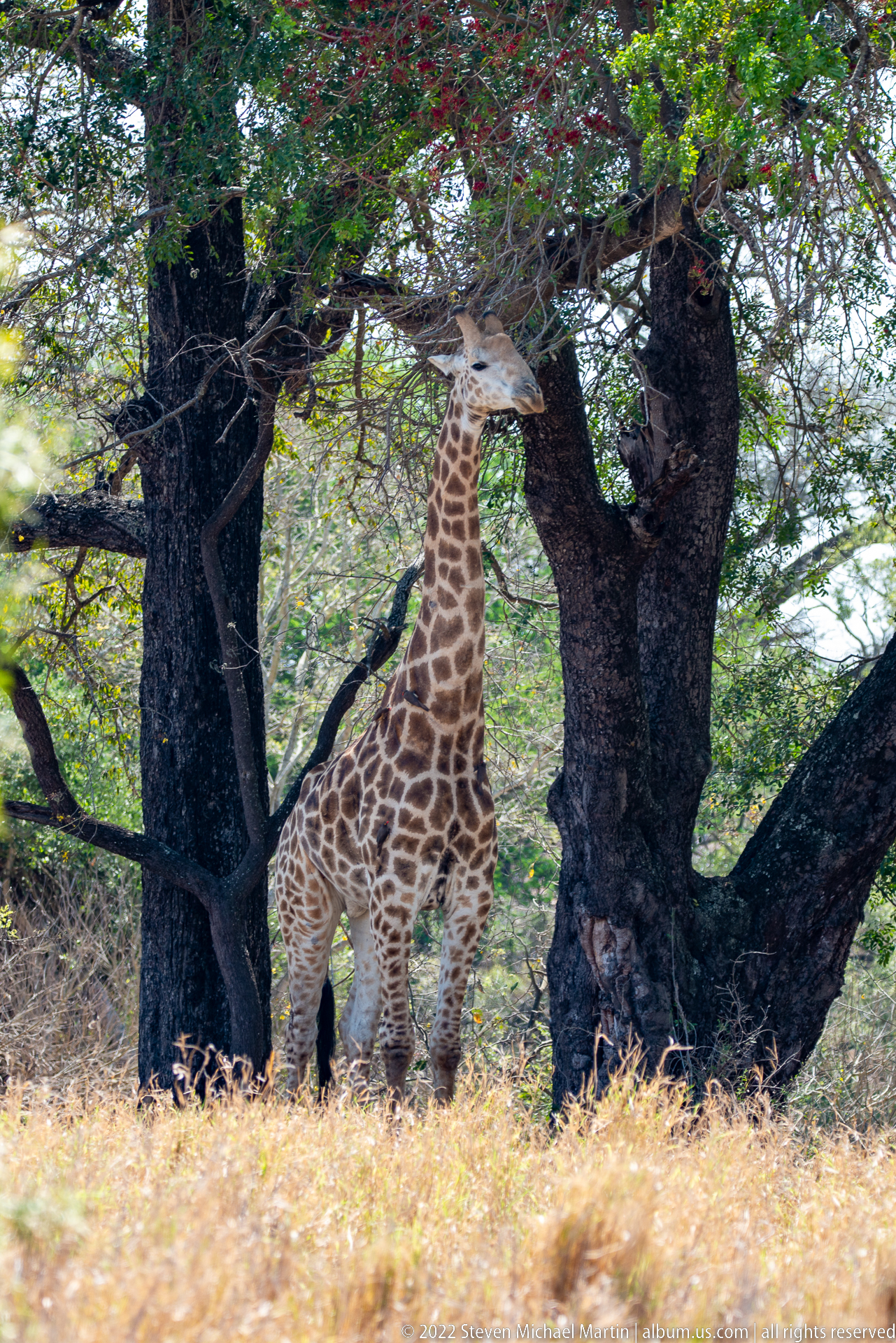
A giraffe stretches its neck into the dense lower canopy of a massive mature tree, framed between dark trunks and spreading branches. Its patterned body is partly shaded while the head reaches toward foliage overhead, making feeding behavior the central subject. The scale contrast between animal and tree creates a strong habitat portrait of browsing in Kruger’s wooded savanna near Skukuza.
Caption
A giraffe stretches its neck into the dense lower canopy of a massive mature tree, framed between dark trunks and spreading branches. Its patterned body is partly shaded while the head reaches toward foliage overhead, making feeding behavior the central subject. The scale contrast between animal and tree creates a strong habitat portrait of browsing in Kruger’s wooded savanna near Skukuza.
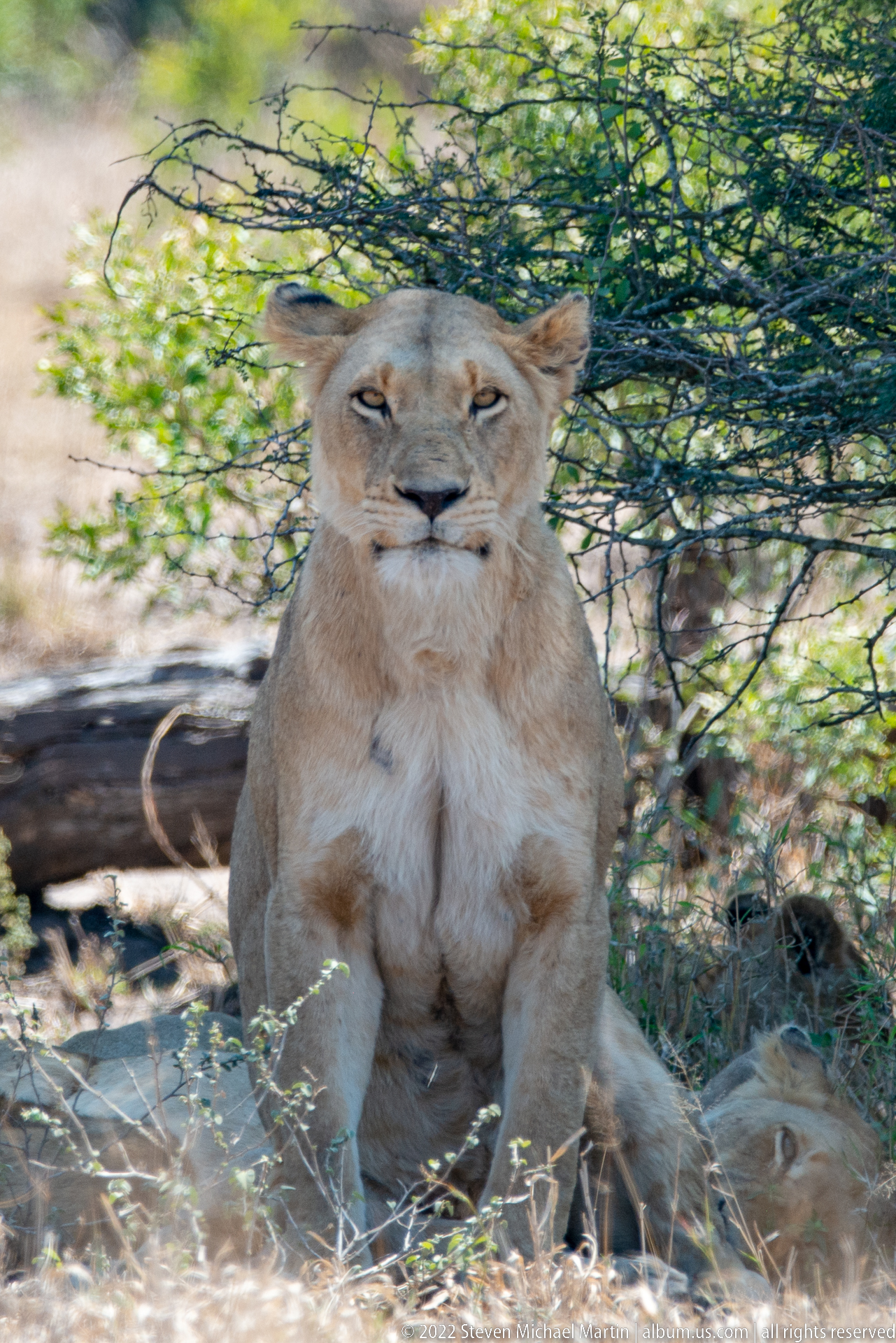
A lioness sits squarely facing the camera beneath low thorn branches, her forelegs planted wide and pale chest catching the light. The frontal pose gives a clear view of rounded ears, broad muzzle, and tawny coat while a reclining lion is only partly visible behind her. This portrait isolates the female’s sturdy build against the shaded savanna floor.
Caption
A lioness sits squarely facing the camera beneath low thorn branches, her forelegs planted wide and pale chest catching the light. The frontal pose gives a clear view of rounded ears, broad muzzle, and tawny coat while a reclining lion is only partly visible behind her. This portrait isolates the female’s sturdy build against the shaded savanna floor.
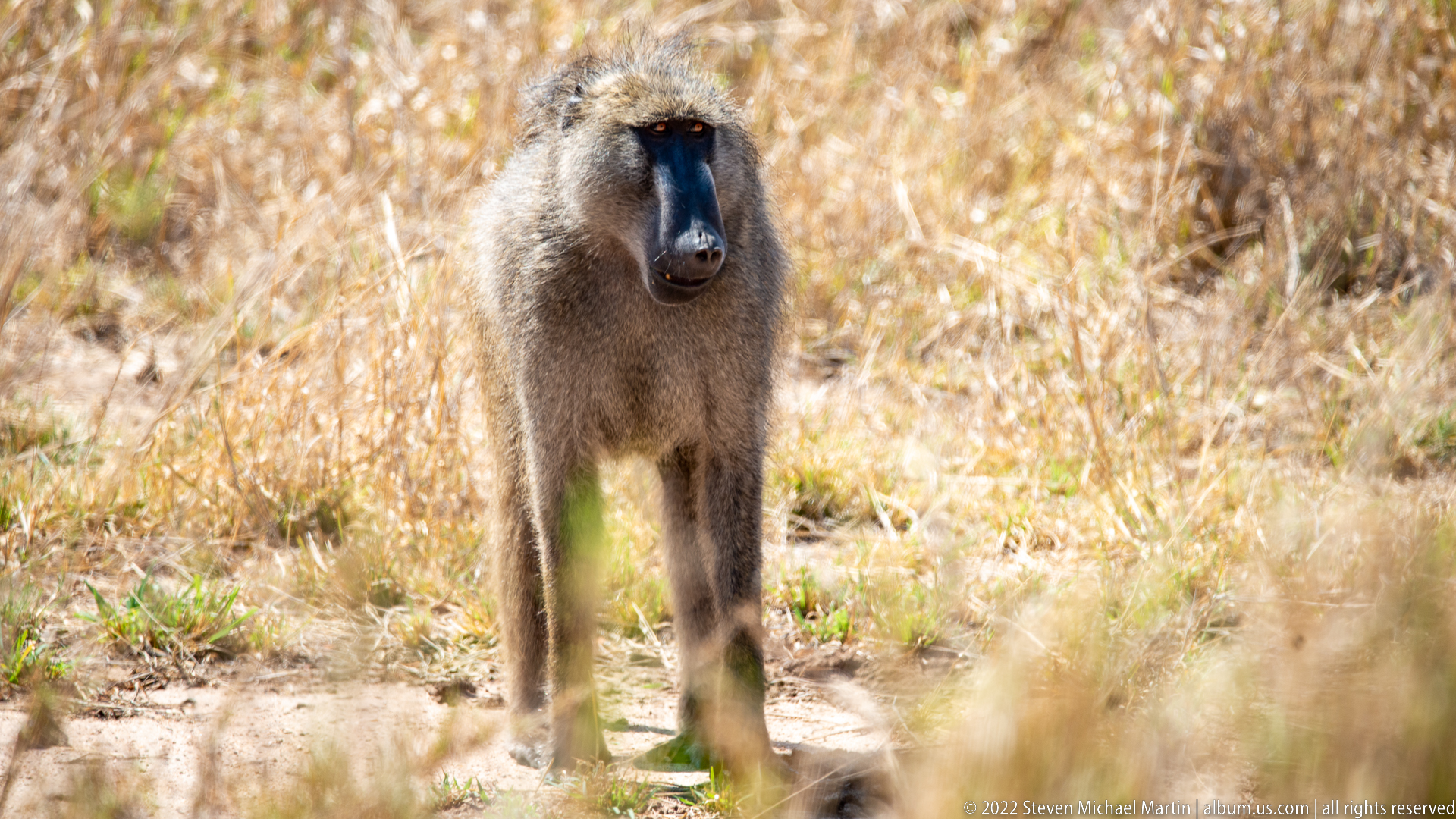
A chacma baboon stands facing the camera in a patch of pale dry grass, offering a clear frontal view of its elongated black muzzle and deep-set eyes. The animal’s shaggy gray-brown coat and sturdy limbs contrast with the sunlit vegetation behind it. Unlike the preceding moving view, this stationary portrait emphasizes facial structure and the alert posture of a terrestrial primate in Kruger’s dry-season bushveld.
Caption
A chacma baboon stands facing the camera in a patch of pale dry grass, offering a clear frontal view of its elongated black muzzle and deep-set eyes. The animal’s shaggy gray-brown coat and sturdy limbs contrast with the sunlit vegetation behind it. Unlike the preceding moving view, this stationary portrait emphasizes facial structure and the alert posture of a terrestrial primate in Kruger’s dry-season bushveld.
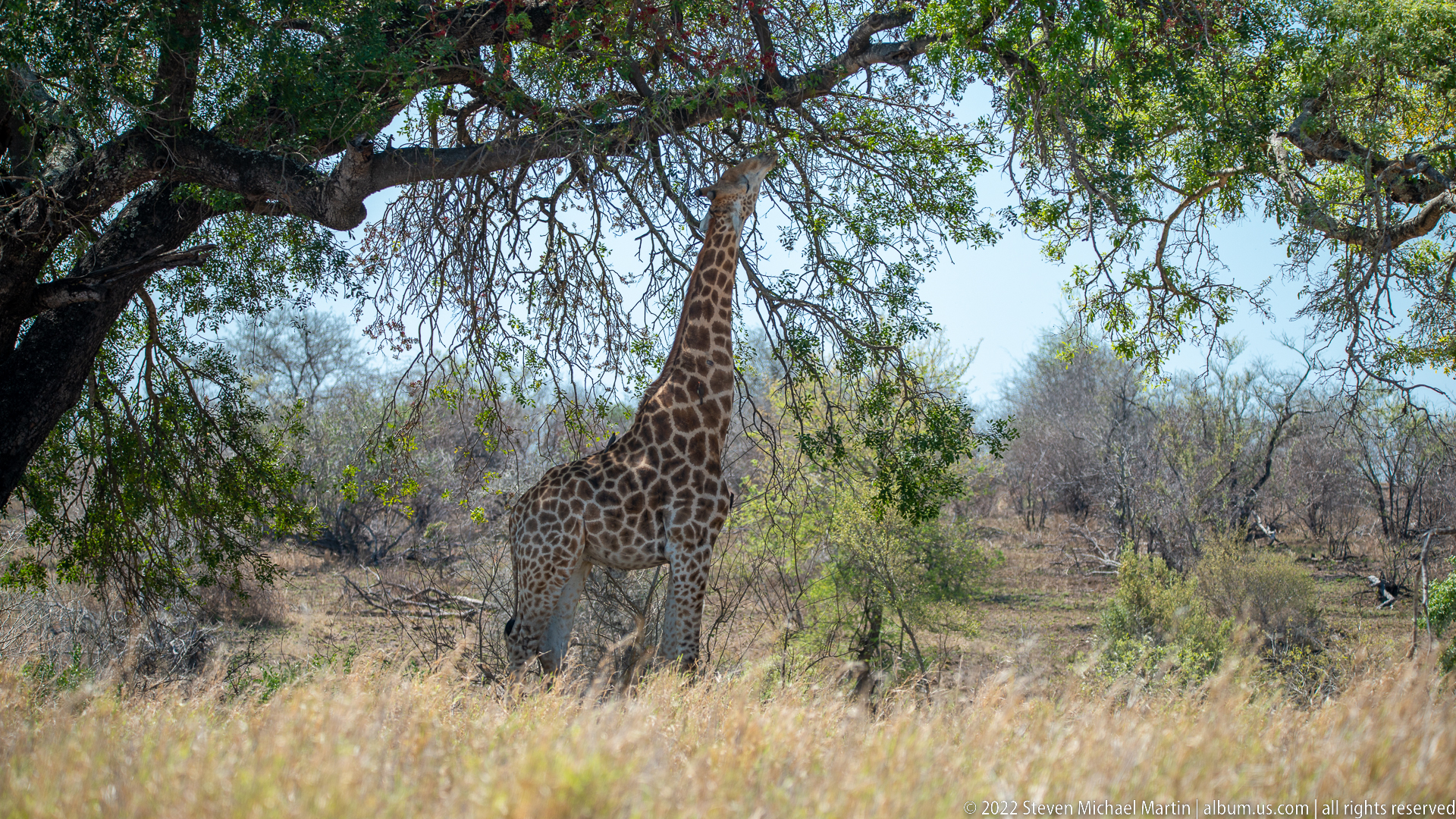
A giraffe browses beneath a spreading tree in open woodland, its long neck reaching into the leafy canopy while the patterned body remains fully visible below. The animal’s height is emphasized by the low vegetation and broad horizontal branches overhead. Dry grass, scattered shrubs, and mature trees place the scene within classic Kruger bushveld, where giraffes feed selectively on foliage beyond the reach of most other browsers.
Caption
A giraffe browses beneath a spreading tree in open woodland, its long neck reaching into the leafy canopy while the patterned body remains fully visible below. The animal’s height is emphasized by the low vegetation and broad horizontal branches overhead. Dry grass, scattered shrubs, and mature trees place the scene within classic Kruger bushveld, where giraffes feed selectively on foliage beyond the reach of most other browsers.
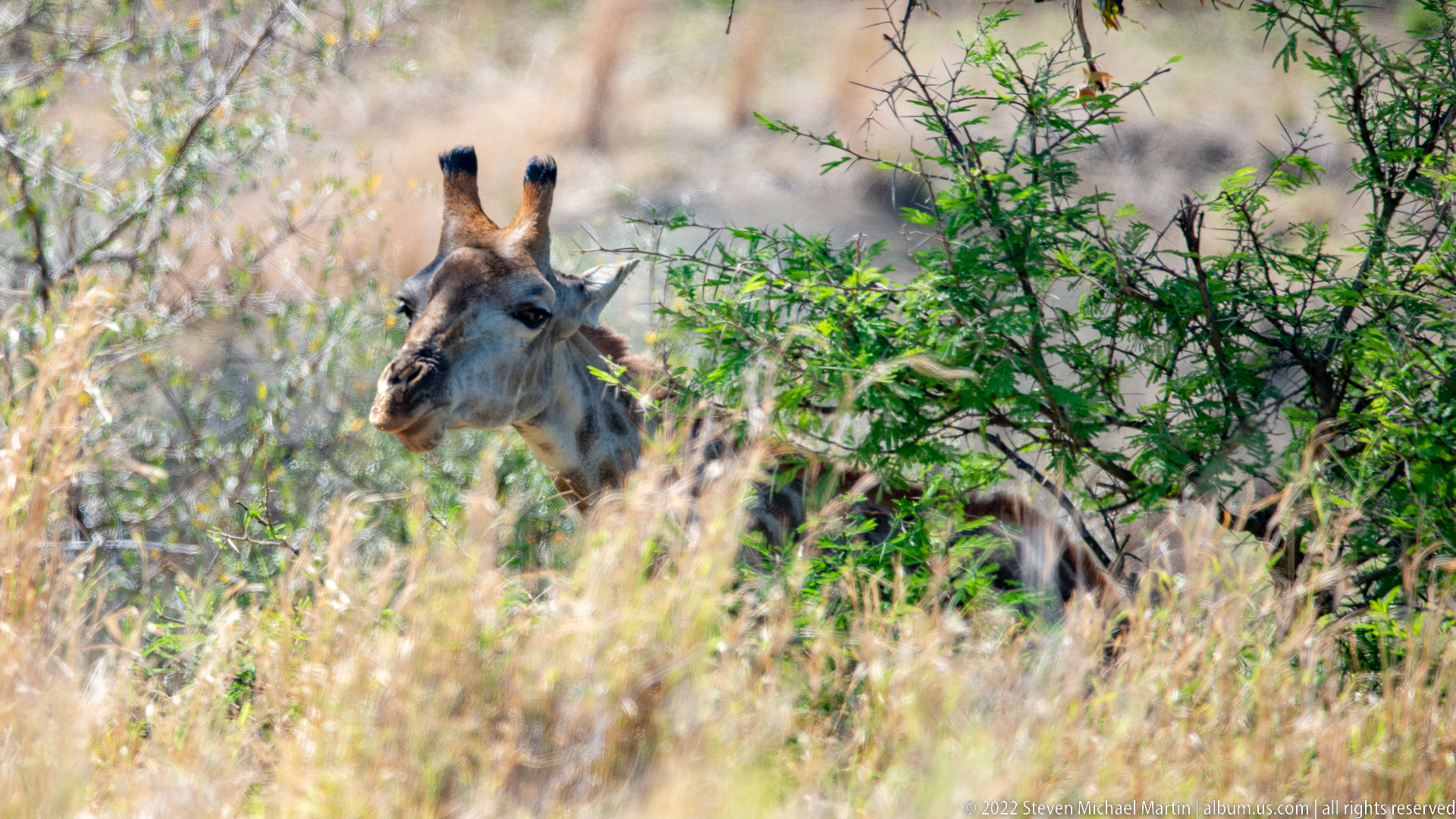
The head and upper neck of a giraffe rise above tall dry grass and green thorny scrub, with much of the animal concealed by vegetation. Ossicones, large ears, patterned face, and long neck remain visible through the foliage. This partially obscured view emphasizes camouflage and scale within dense bushveld rather than the full-body proportions seen in the preceding giraffe photographs.
Caption
The head and upper neck of a giraffe rise above tall dry grass and green thorny scrub, with much of the animal concealed by vegetation. Ossicones, large ears, patterned face, and long neck remain visible through the foliage. This partially obscured view emphasizes camouflage and scale within dense bushveld rather than the full-body proportions seen in the preceding giraffe photographs.
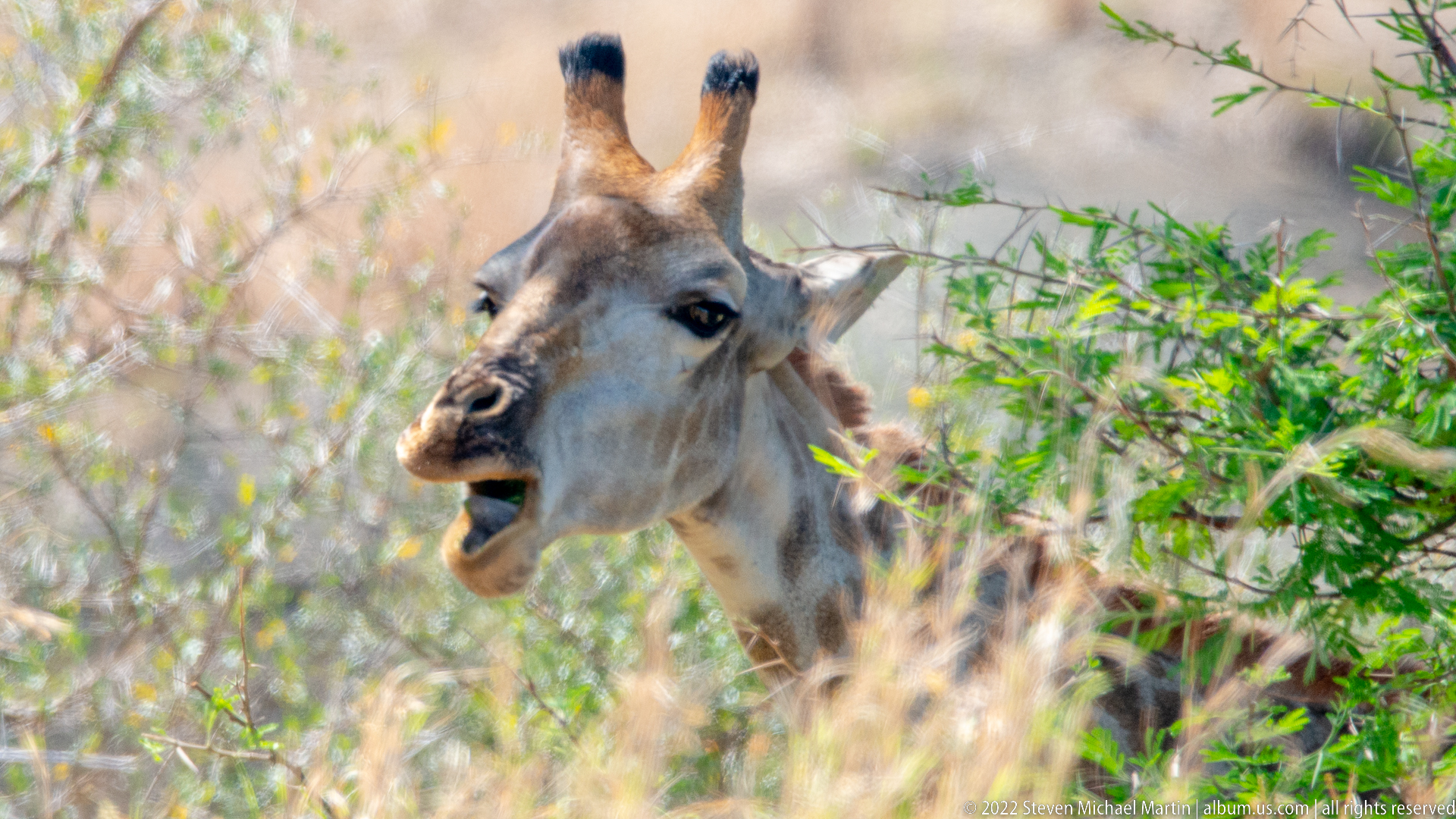
A giraffe raises its head above pale winter grass and leafy browse near Skukuza. The close view isolates the animal’s long face, ossicones, large dark eye, and patterned neck while retaining enough thornveld vegetation to place the portrait in Kruger’s dry-season savanna. Its partly open mouth suggests active browsing or chewing rather than a static pose.
Caption
A giraffe raises its head above pale winter grass and leafy browse near Skukuza. The close view isolates the animal’s long face, ossicones, large dark eye, and patterned neck while retaining enough thornveld vegetation to place the portrait in Kruger’s dry-season savanna. Its partly open mouth suggests active browsing or chewing rather than a static pose.

A dispersed herd of blue wildebeest grazes across an open, dry clearing bordered by bush and small trees. Individuals are spread from foreground to background, some feeding with heads lowered while others stand alert. The broad view records both herd structure and the patchwork of grassland and woody cover characteristic of wildlife habitat around Skukuza.
Caption
A dispersed herd of blue wildebeest grazes across an open, dry clearing bordered by bush and small trees. Individuals are spread from foreground to background, some feeding with heads lowered while others stand alert. The broad view records both herd structure and the patchwork of grassland and woody cover characteristic of wildlife habitat around Skukuza.
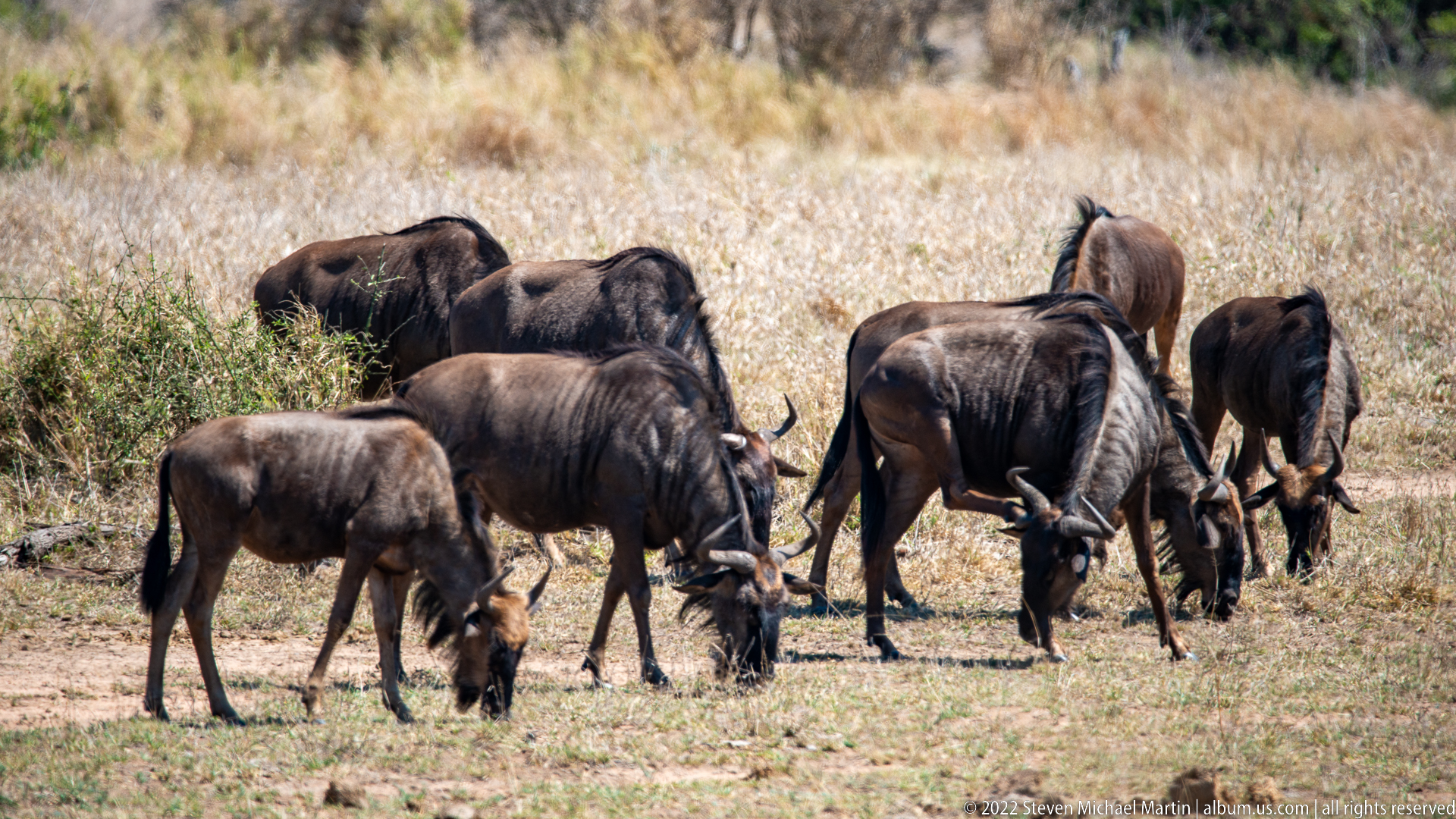
Blue wildebeest feed in a compact group on short, dry grass, bringing the herd’s muscular shoulders, curved horns, dark faces, and vertical flank striping into clearer view. Several animals overlap within the frame, emphasizing the social concentration of the herd while their uniformly lowered heads show active grazing in the dry-season landscape.
Caption
Blue wildebeest feed in a compact group on short, dry grass, bringing the herd’s muscular shoulders, curved horns, dark faces, and vertical flank striping into clearer view. Several animals overlap within the frame, emphasizing the social concentration of the herd while their uniformly lowered heads show active grazing in the dry-season landscape.
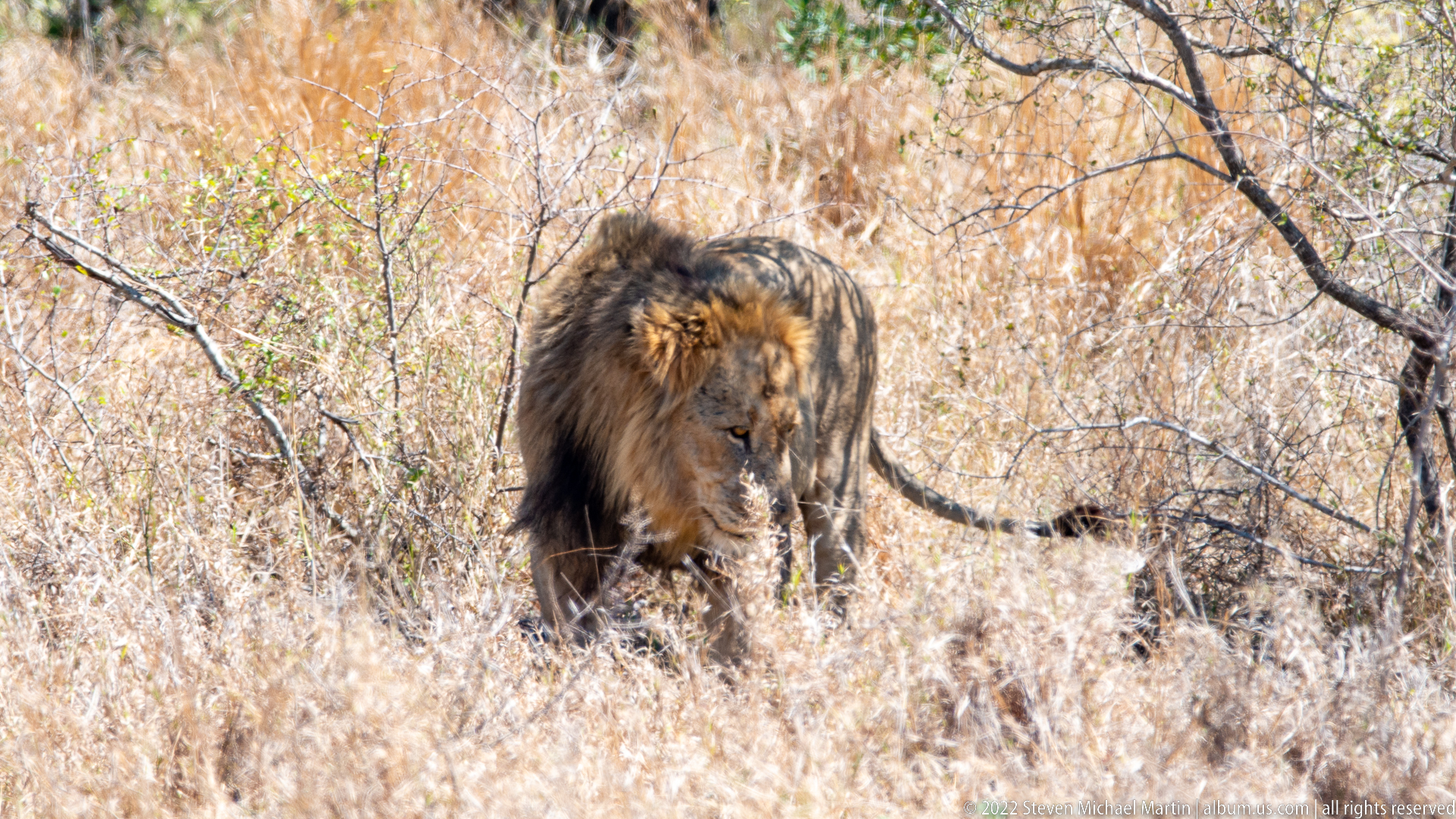
An adult male African lion moves forward through tall, sun-bleached grass beneath sparse woodland. His dark, full mane frames the face and shoulders, while the partially obscured legs and body show how effectively a large predator can disappear into Kruger’s dry vegetation. The frontal approach gives the scene a strong sense of movement without losing the surrounding habitat.
Caption
An adult male African lion moves forward through tall, sun-bleached grass beneath sparse woodland. His dark, full mane frames the face and shoulders, while the partially obscured legs and body show how effectively a large predator can disappear into Kruger’s dry vegetation. The frontal approach gives the scene a strong sense of movement without losing the surrounding habitat.
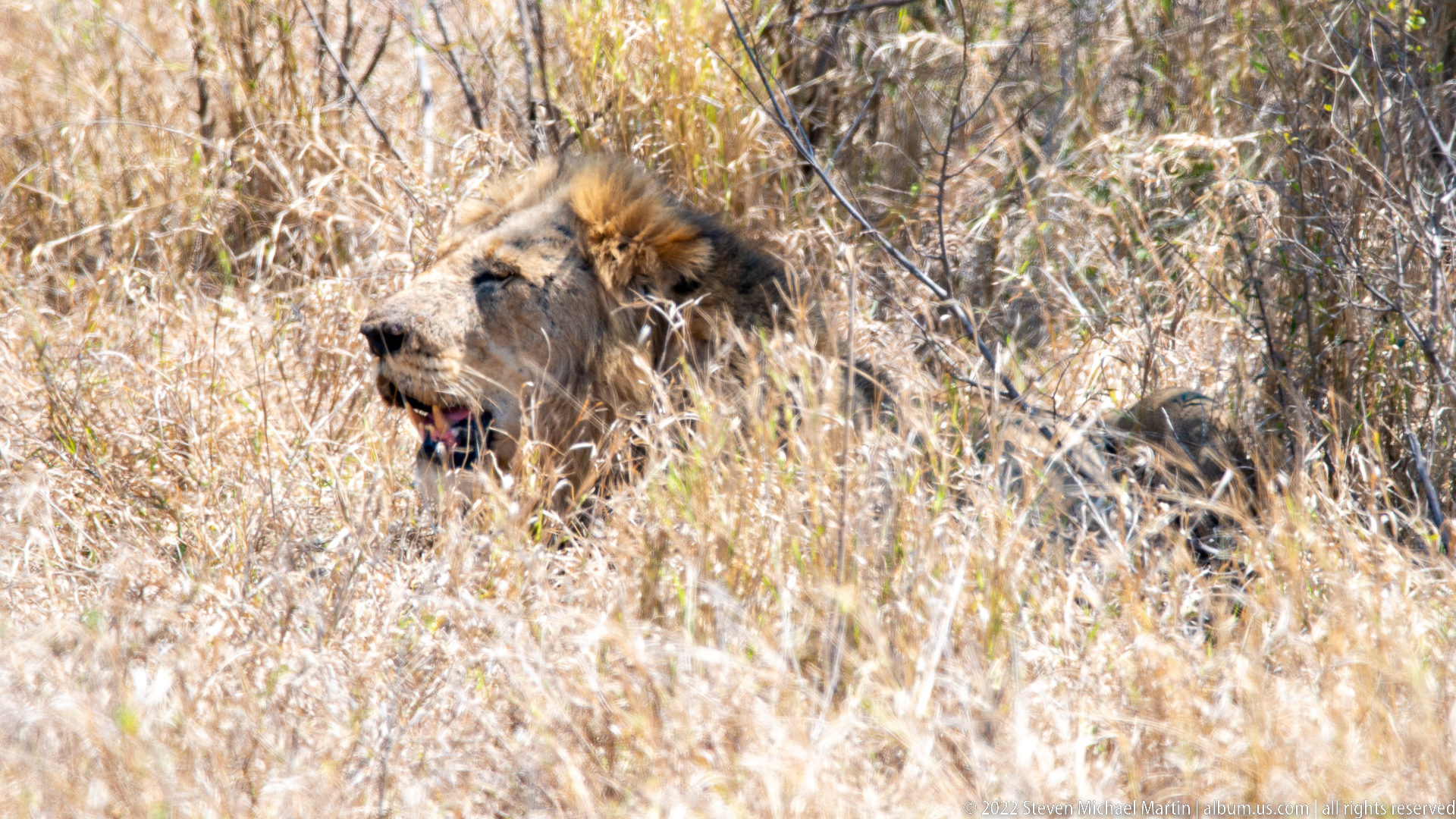
A male African lion rests low in tawny grass, his mane blending with the surrounding stems. Seen in profile with his mouth open and tongue visible, the lion appears to be panting, a common heat-dissipation behavior in large cats. The low viewpoint and intervening grass create an intimate portrait of a predator at rest rather than on the move.
Caption
A male African lion rests low in tawny grass, his mane blending with the surrounding stems. Seen in profile with his mouth open and tongue visible, the lion appears to be panting, a common heat-dissipation behavior in large cats. The low viewpoint and intervening grass create an intimate portrait of a predator at rest rather than on the move.
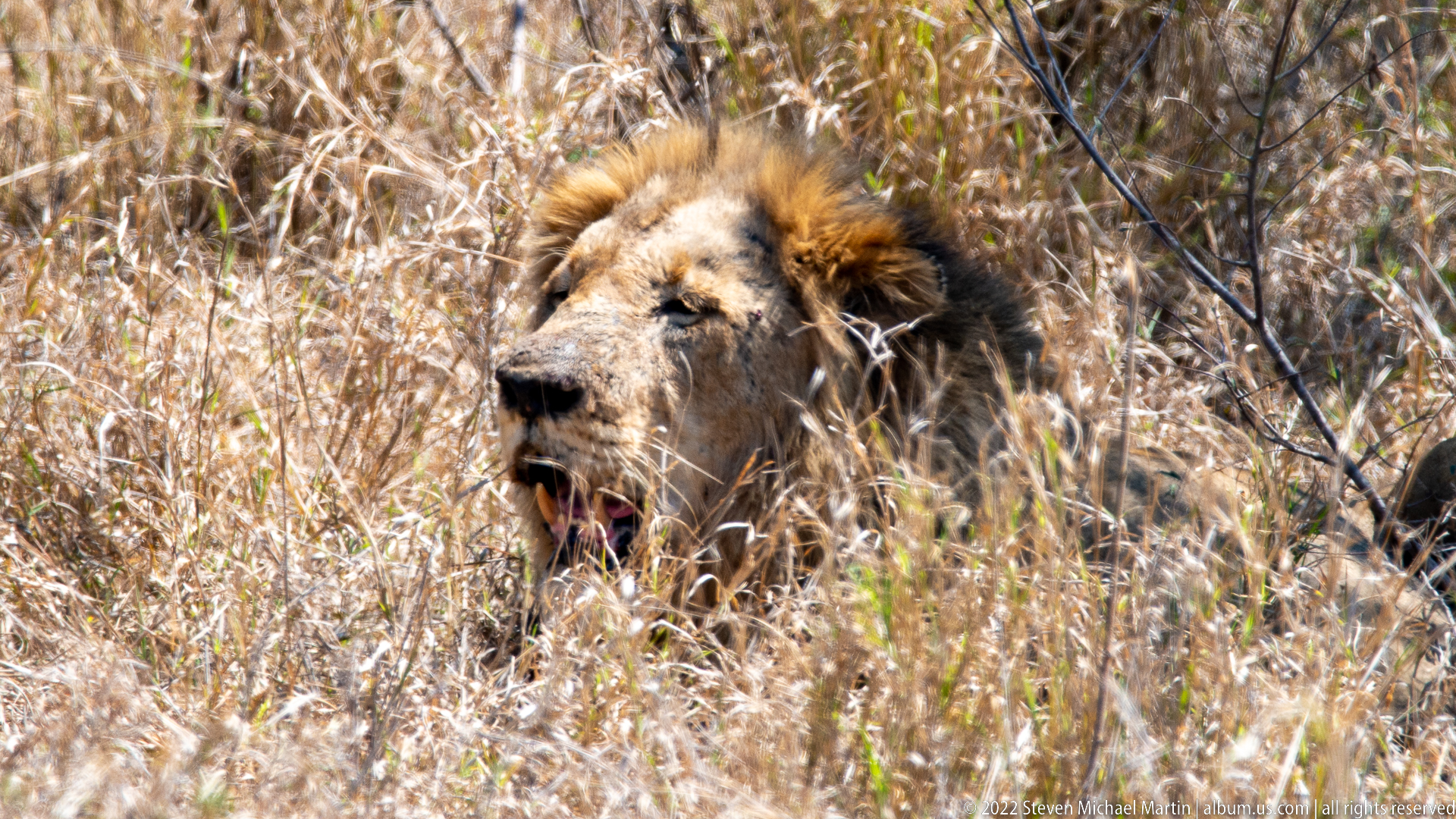
Tall grass parts around the face of a resting male African lion, producing a close portrait dominated by his weathered muzzle, dark nose, amber eyes, and mane. His open mouth and visible tongue indicate panting while he remains low in cover. Compared with the preceding wider view, this frame concentrates on facial detail and the texture of mane and grass.
Caption
Tall grass parts around the face of a resting male African lion, producing a close portrait dominated by his weathered muzzle, dark nose, amber eyes, and mane. His open mouth and visible tongue indicate panting while he remains low in cover. Compared with the preceding wider view, this frame concentrates on facial detail and the texture of mane and grass.
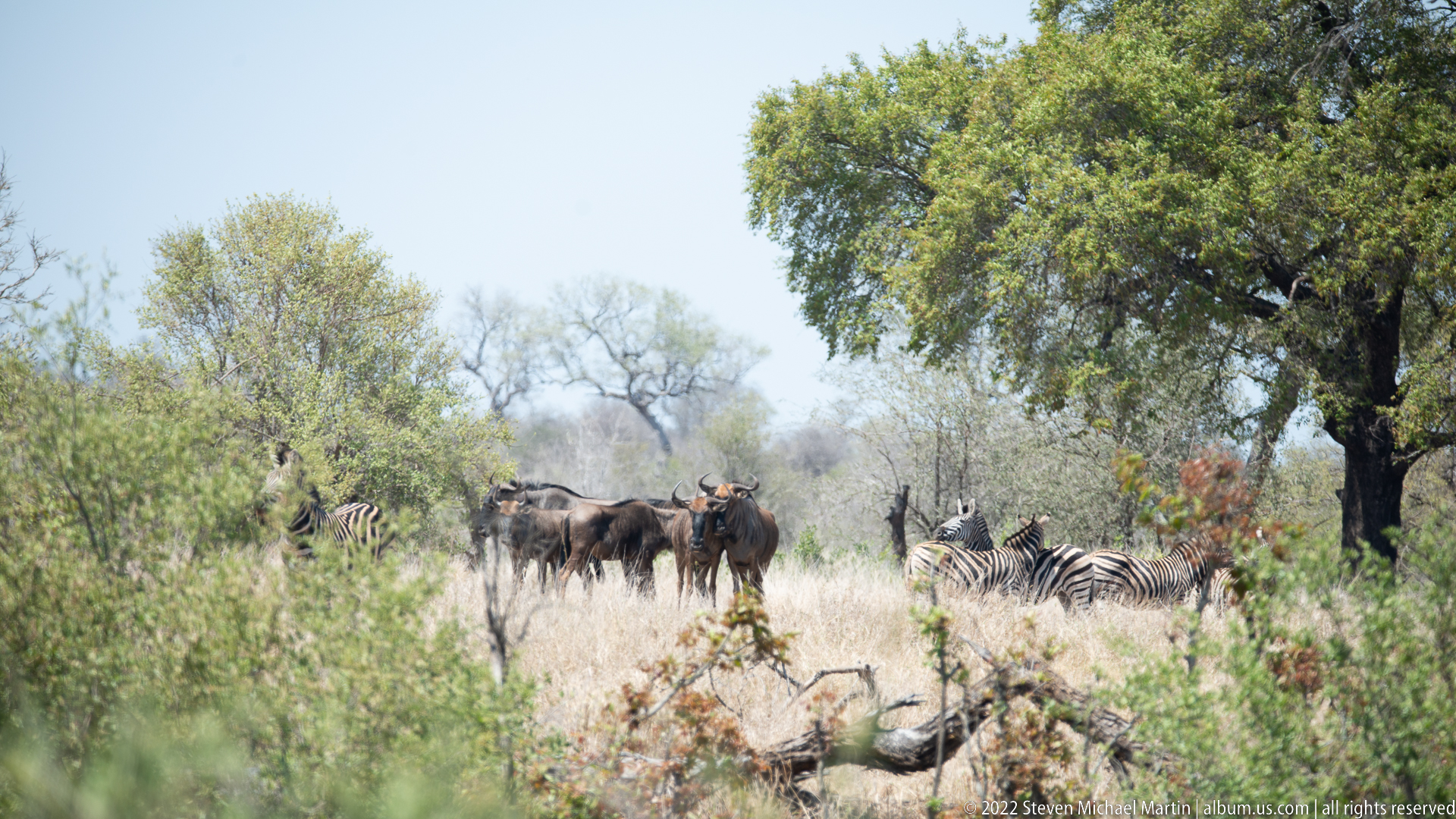
Blue wildebeest and plains zebra occupy the same dry woodland clearing, partly screened by shrubs and tall grass. The wider composition shows the two grazing species intermingled rather than isolated, with wildebeest clustered to the left and zebra more visible to the right. Such mixed-herd scenes reveal how multiple large herbivores use the same open patches within Kruger’s savanna.
Caption
Blue wildebeest and plains zebra occupy the same dry woodland clearing, partly screened by shrubs and tall grass. The wider composition shows the two grazing species intermingled rather than isolated, with wildebeest clustered to the left and zebra more visible to the right. Such mixed-herd scenes reveal how multiple large herbivores use the same open patches within Kruger’s savanna.
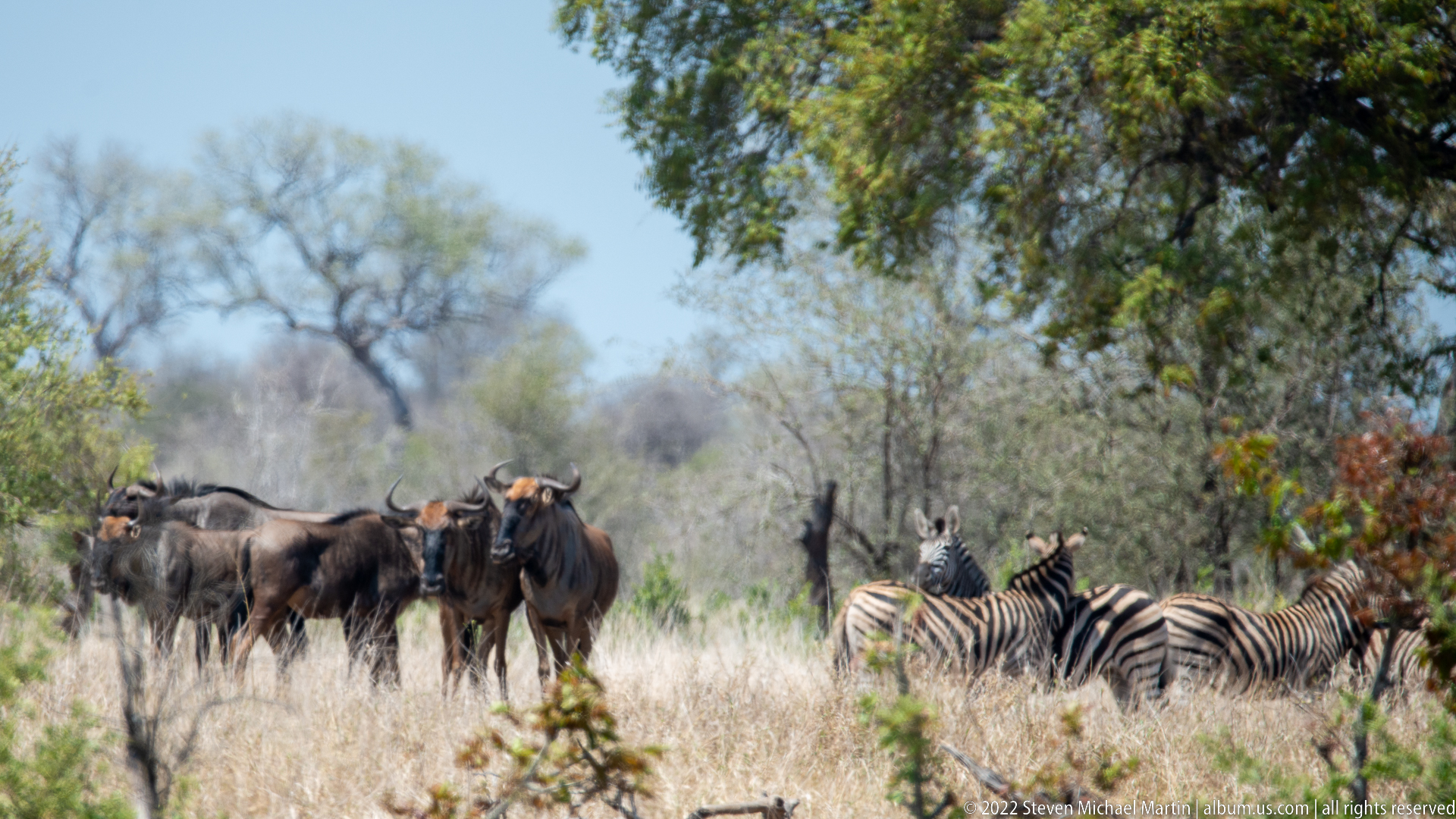
A closer view brings blue wildebeest and plains zebra together beneath scattered trees, contrasting the wildebeest’s dark, heavy forequarters and curved horns with the zebra’s bold striping. Several animals stand alert while others remain loosely grouped in the pale grass. The frame emphasizes species differences within a shared patch of dry savanna.
Caption
A closer view brings blue wildebeest and plains zebra together beneath scattered trees, contrasting the wildebeest’s dark, heavy forequarters and curved horns with the zebra’s bold striping. Several animals stand alert while others remain loosely grouped in the pale grass. The frame emphasizes species differences within a shared patch of dry savanna.
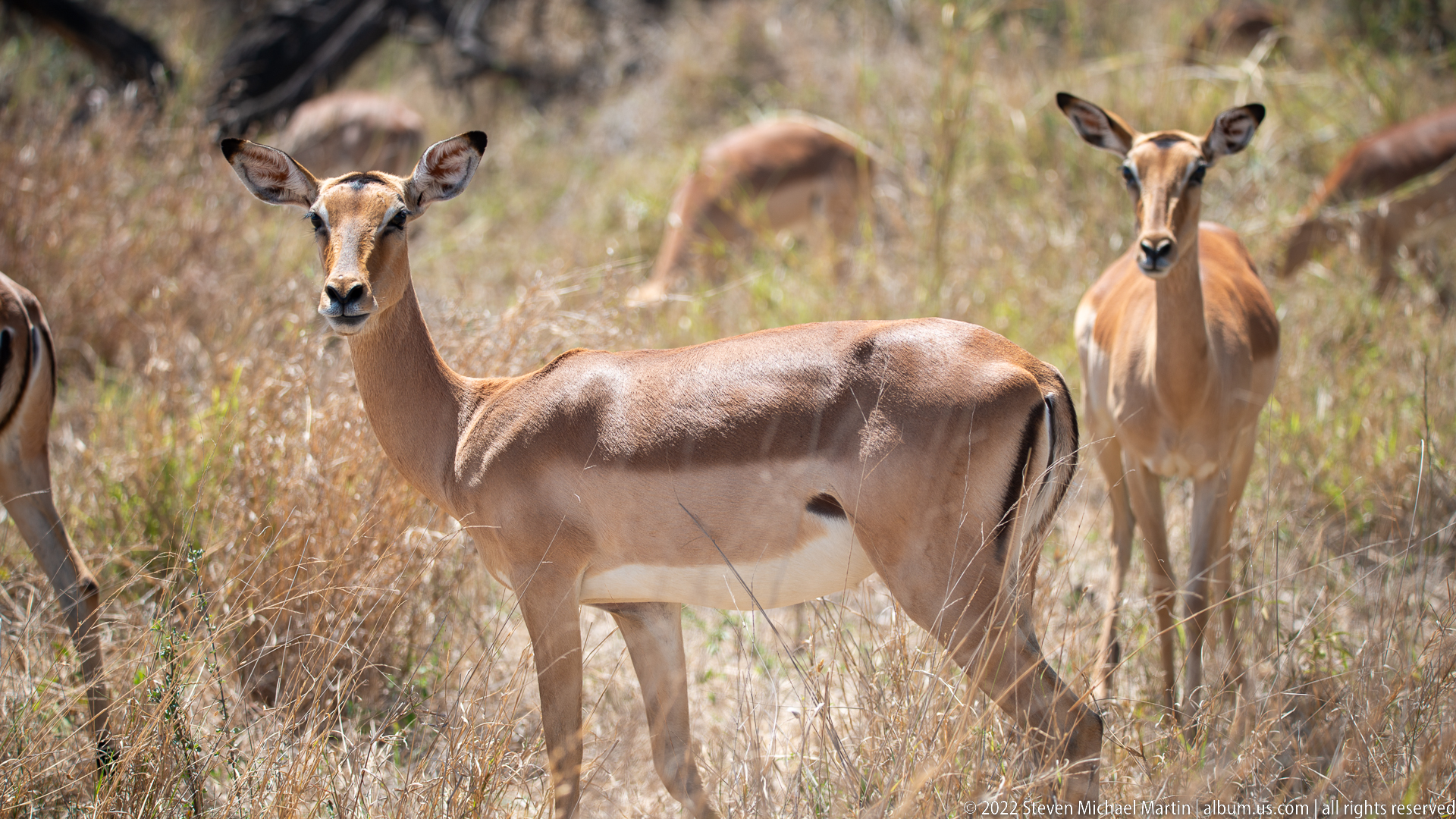
Female impalas pause in dry grass, the nearest animal broadside but turning her head directly toward the camera. Her smooth reddish-tan coat, pale underparts, large ears, and lack of horns identify a ewe; another female stands behind her while additional antelope blur into the background. The portrait highlights the watchful posture typical of prey animals in open savanna.
Caption
Female impalas pause in dry grass, the nearest animal broadside but turning her head directly toward the camera. Her smooth reddish-tan coat, pale underparts, large ears, and lack of horns identify a ewe; another female stands behind her while additional antelope blur into the background. The portrait highlights the watchful posture typical of prey animals in open savanna.
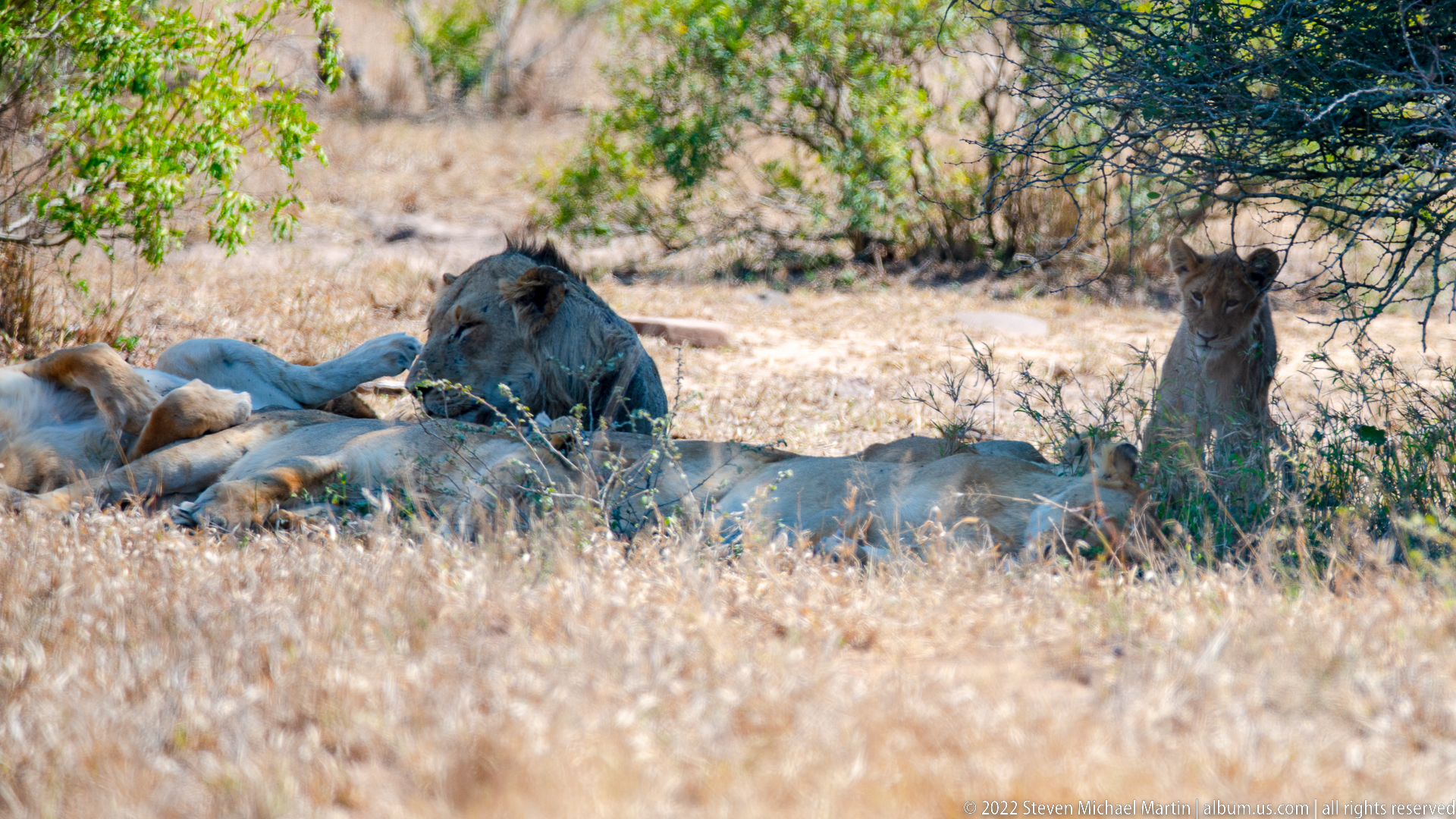
A small pride of African lions rests together in sparse shade, with an adult male sitting upright among reclining lionesses. Tawny bodies overlap across the dry ground while a lioness at right remains more erect and attentive. The group arrangement contrasts the male’s developing mane with the smoother heads of the females and records a quiet social interval during the heat of the day.
Caption
A small pride of African lions rests together in sparse shade, with an adult male sitting upright among reclining lionesses. Tawny bodies overlap across the dry ground while a lioness at right remains more erect and attentive. The group arrangement contrasts the male’s developing mane with the smoother heads of the females and records a quiet social interval during the heat of the day.
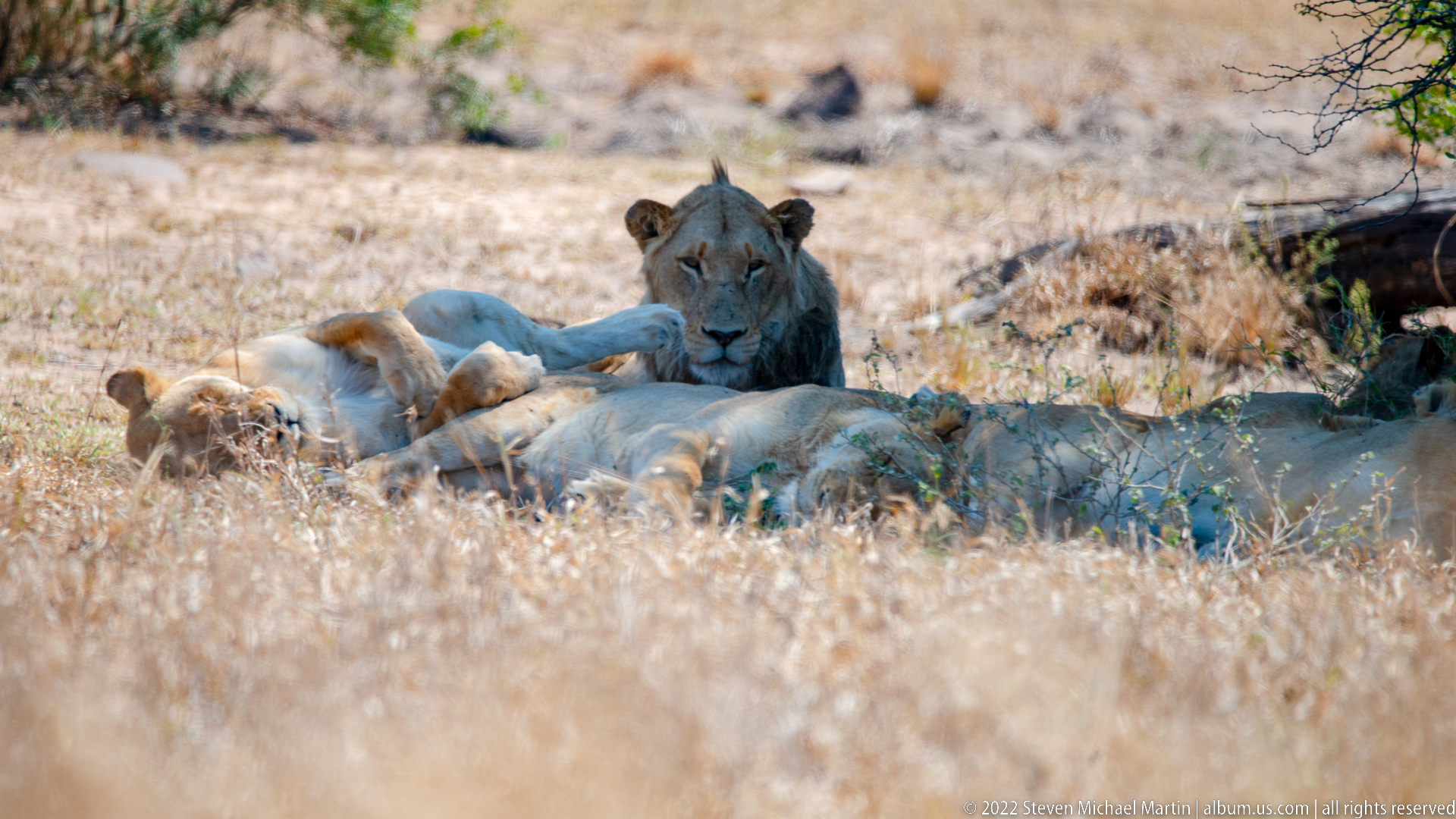
Several African lions lie close together on dry ground, their pale tawny coats merging into a layered cluster of bodies and paws. A mane-bearing male sits behind the reclining females, looking outward while the pride rests. The tighter composition emphasizes physical proximity within the group and the stillness of midday rest rather than the surrounding habitat.
Caption
Several African lions lie close together on dry ground, their pale tawny coats merging into a layered cluster of bodies and paws. A mane-bearing male sits behind the reclining females, looking outward while the pride rests. The tighter composition emphasizes physical proximity within the group and the stillness of midday rest rather than the surrounding habitat.
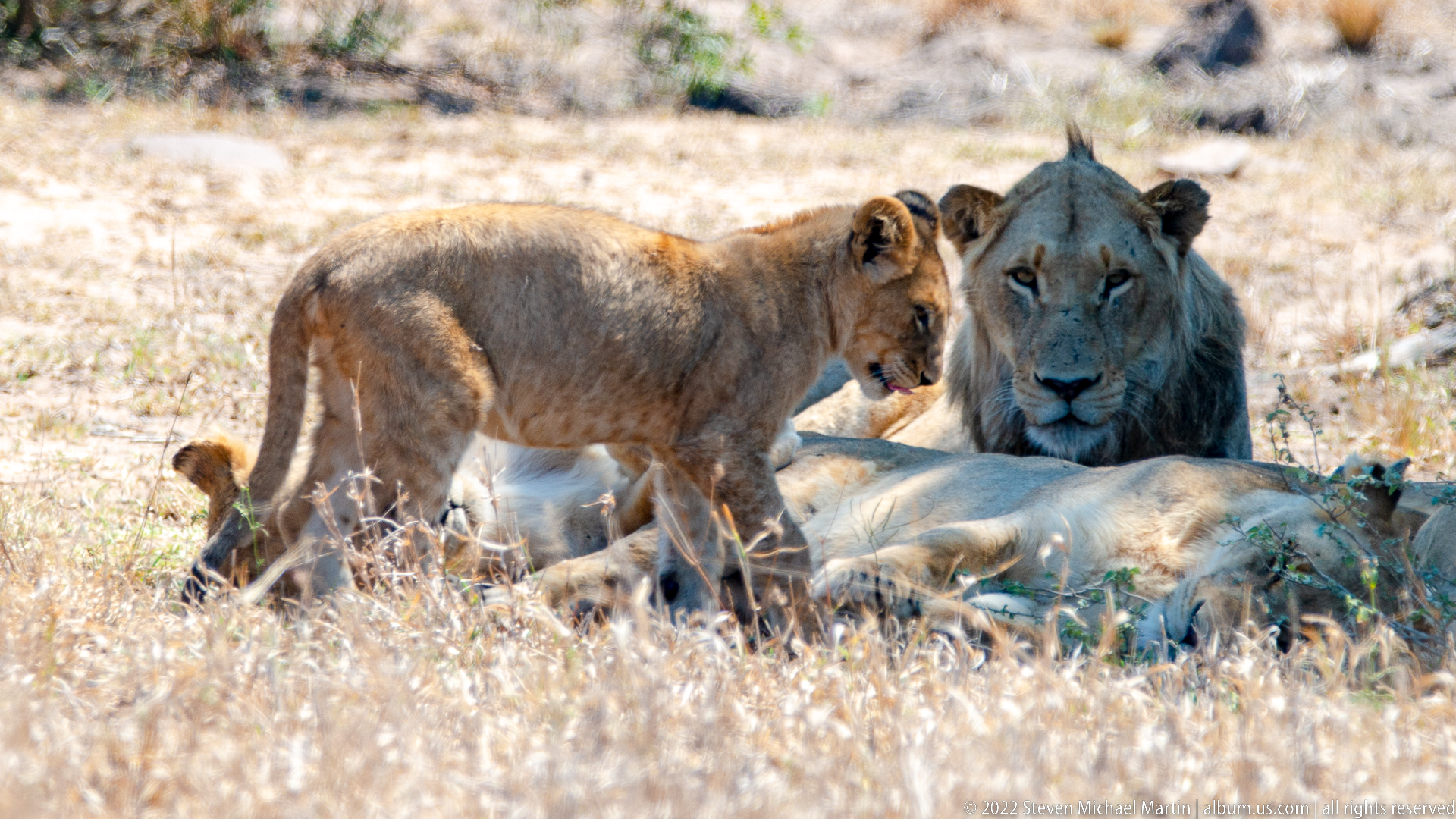
A young African lion stands beside a reclining adult male, its smaller body and undeveloped mane contrasting with the male’s broad face and fuller mane. Other pride members lie across the ground behind them. The close social view focuses on age and size differences within the group, with both standing juvenile and resting adult looking toward the camera.
Caption
A young African lion stands beside a reclining adult male, its smaller body and undeveloped mane contrasting with the male’s broad face and fuller mane. Other pride members lie across the ground behind them. The close social view focuses on age and size differences within the group, with both standing juvenile and resting adult looking toward the camera.
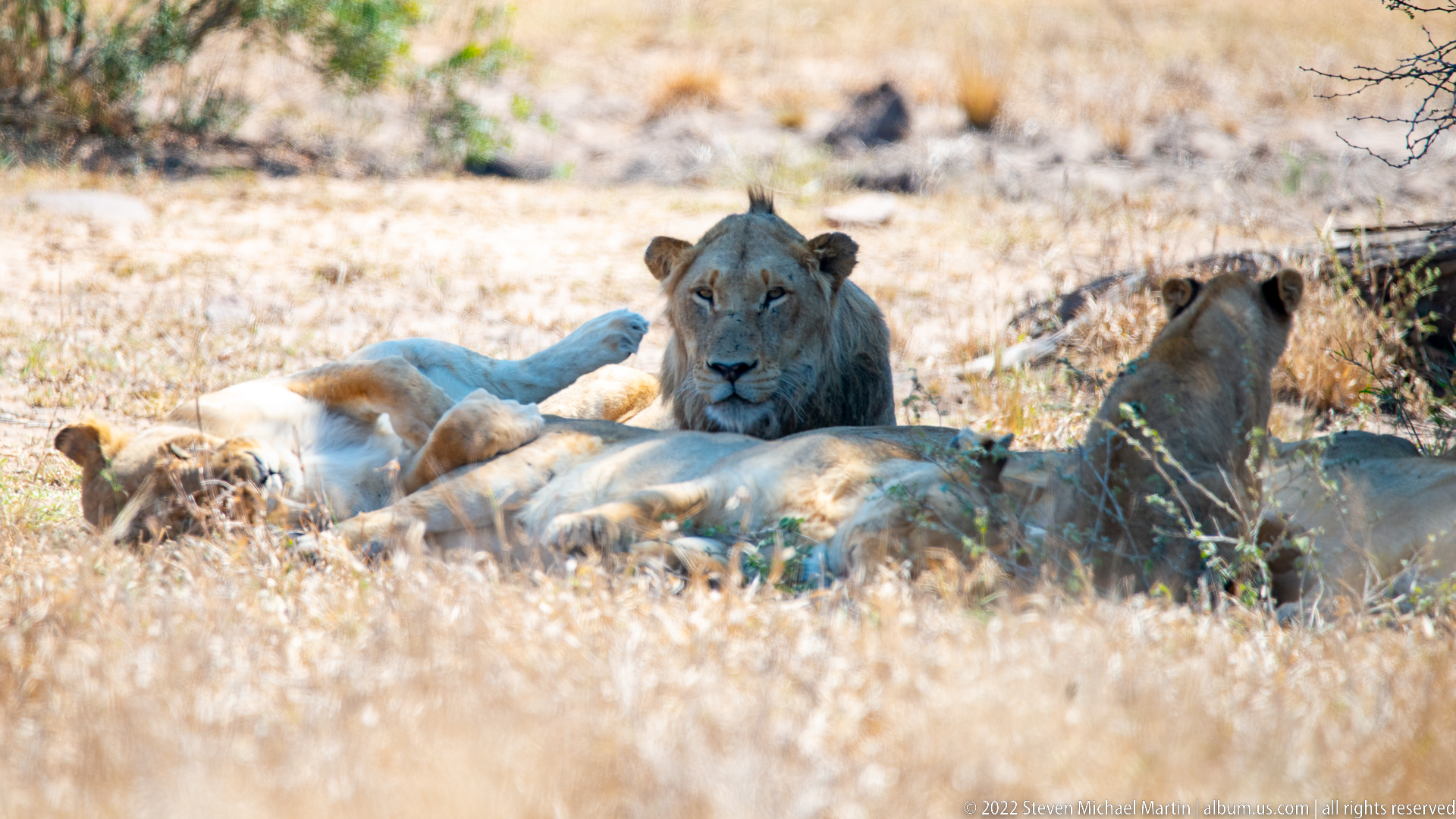
An adult male African lion sits upright at the center of a resting pride while lionesses recline around him in the pale grass. One female lies on her back with legs raised, adding a relaxed posture to the otherwise watchful group. The scene records the pride at rest in open shade, with the male’s mane visually anchoring the cluster.
Caption
An adult male African lion sits upright at the center of a resting pride while lionesses recline around him in the pale grass. One female lies on her back with legs raised, adding a relaxed posture to the otherwise watchful group. The scene records the pride at rest in open shade, with the male’s mane visually anchoring the cluster.
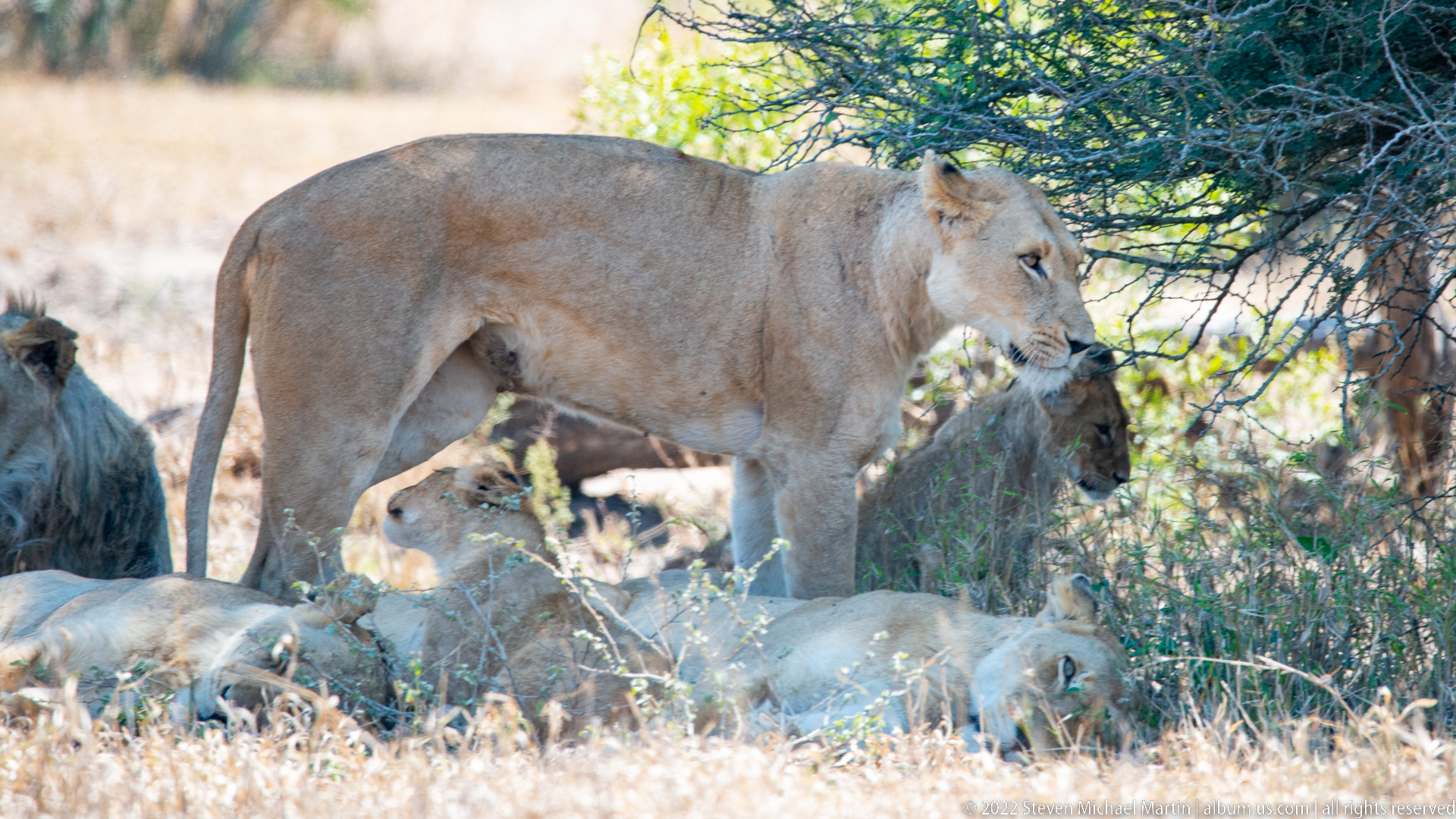
A lioness walks through the resting pride beneath low thorny branches, stepping between reclining companions while the male’s mane is partly visible at left. Her standing profile and forward movement distinguish this frame from the surrounding resting views. Dappled shade, dry grass, and close-packed lions convey the pride’s use of limited cover during a hot, dry period.
Caption
A lioness walks through the resting pride beneath low thorny branches, stepping between reclining companions while the male’s mane is partly visible at left. Her standing profile and forward movement distinguish this frame from the surrounding resting views. Dappled shade, dry grass, and close-packed lions convey the pride’s use of limited cover during a hot, dry period.
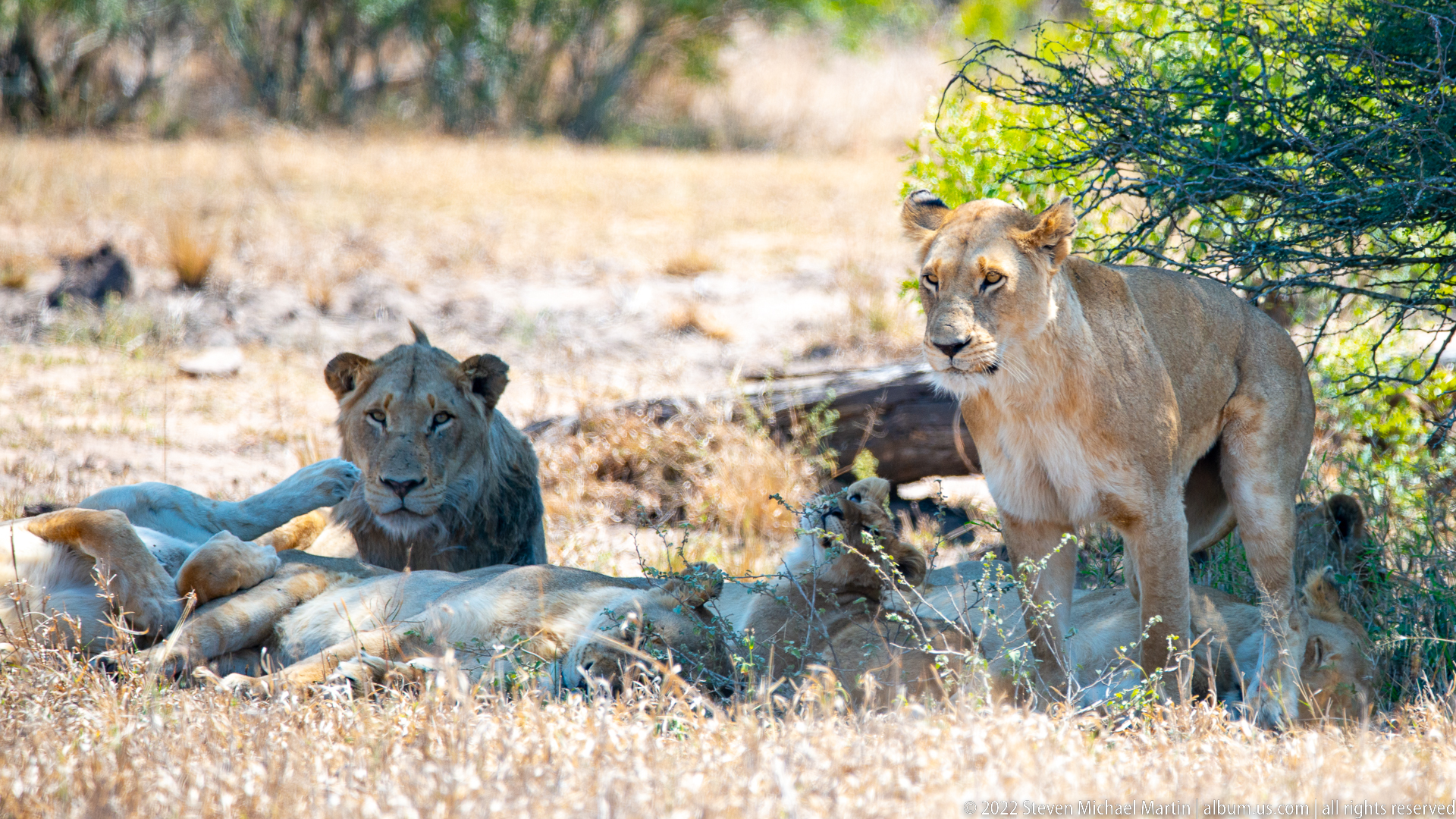
A lioness stands alert at the edge of a resting group, facing the camera while an adult male sits just behind her and other lions remain prone. The vertical stance of the female and the male’s mane create a layered portrait of the pride beneath sparse shade. Dry grass and thorny vegetation frame the group without obscuring their distinct postures.
Caption
A lioness stands alert at the edge of a resting group, facing the camera while an adult male sits just behind her and other lions remain prone. The vertical stance of the female and the male’s mane create a layered portrait of the pride beneath sparse shade. Dry grass and thorny vegetation frame the group without obscuring their distinct postures.
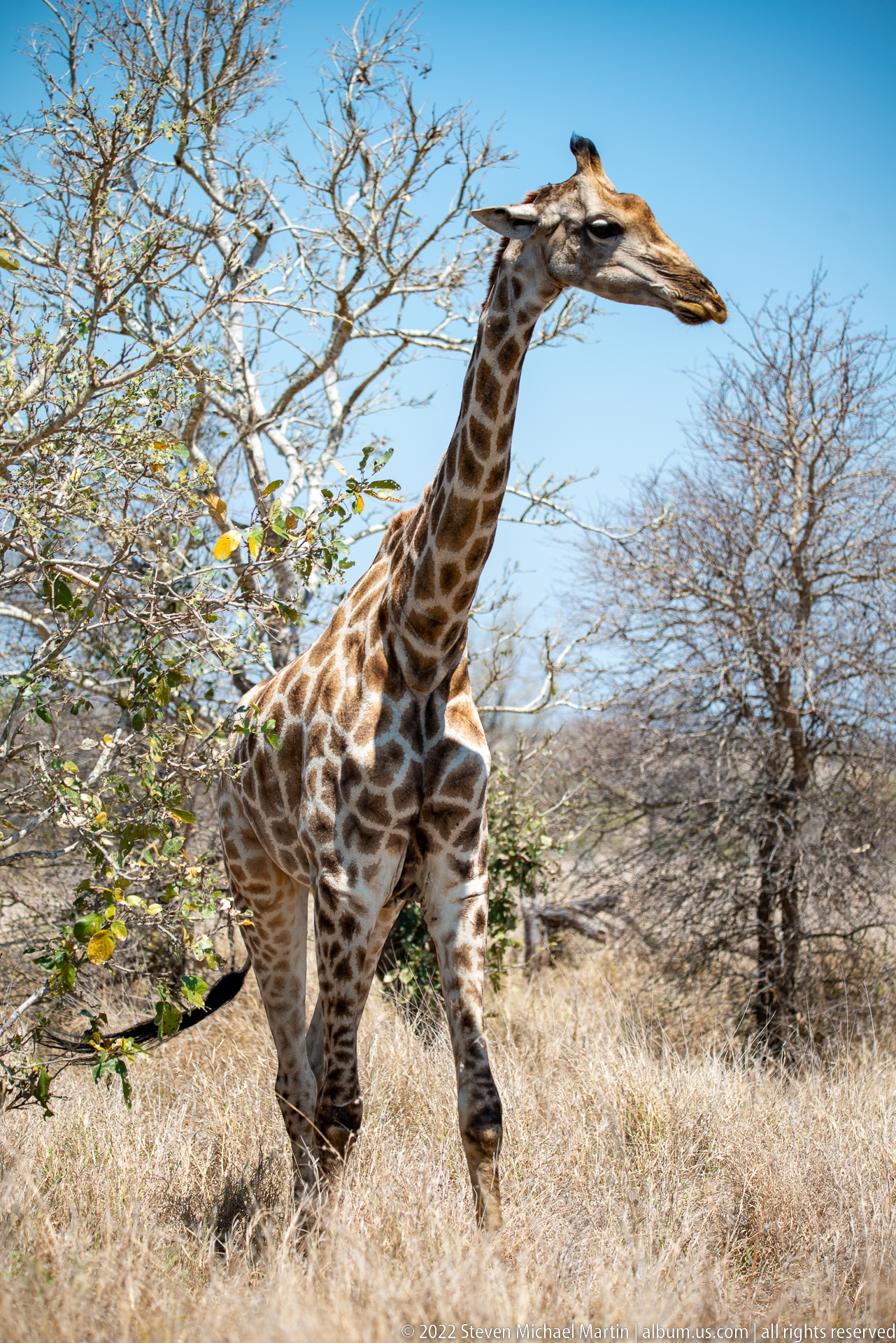
A giraffe strides through dry thornveld with its long neck extended almost horizontally toward sparse foliage. The full-body view shows the irregular brown-and-cream coat pattern, long legs, sloping back, and browsing-height anatomy against leafless trees and pale grass. Its forward step and stretched neck give the frame more movement and habitat context than a conventional upright giraffe portrait.
Caption
A giraffe strides through dry thornveld with its long neck extended almost horizontally toward sparse foliage. The full-body view shows the irregular brown-and-cream coat pattern, long legs, sloping back, and browsing-height anatomy against leafless trees and pale grass. Its forward step and stretched neck give the frame more movement and habitat context than a conventional upright giraffe portrait.
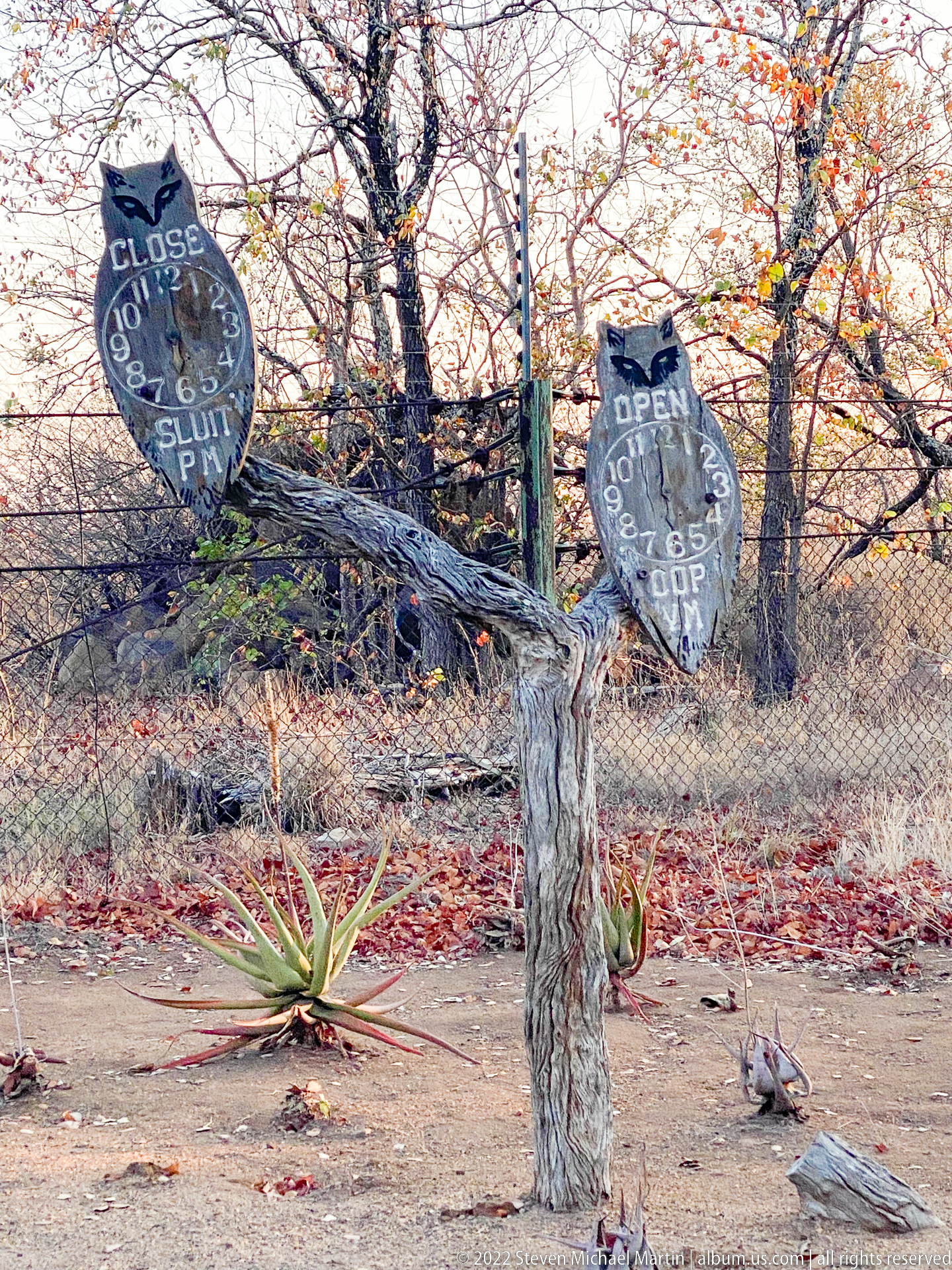
Two shield-shaped signs marked “CLOSED” and “OPEN” hang from rustic wooden posts beside a fenced, landscaped area. Their paired directional function and hand-painted lettering make this a human-made wayfinding detail rather than a wildlife scene. Aloes, dry ground, fallen branches, and red-orange foliage place the signs within the park’s developed visitor environment.
Caption
Two shield-shaped signs marked “CLOSED” and “OPEN” hang from rustic wooden posts beside a fenced, landscaped area. Their paired directional function and hand-painted lettering make this a human-made wayfinding detail rather than a wildlife scene. Aloes, dry ground, fallen branches, and red-orange foliage place the signs within the park’s developed visitor environment.
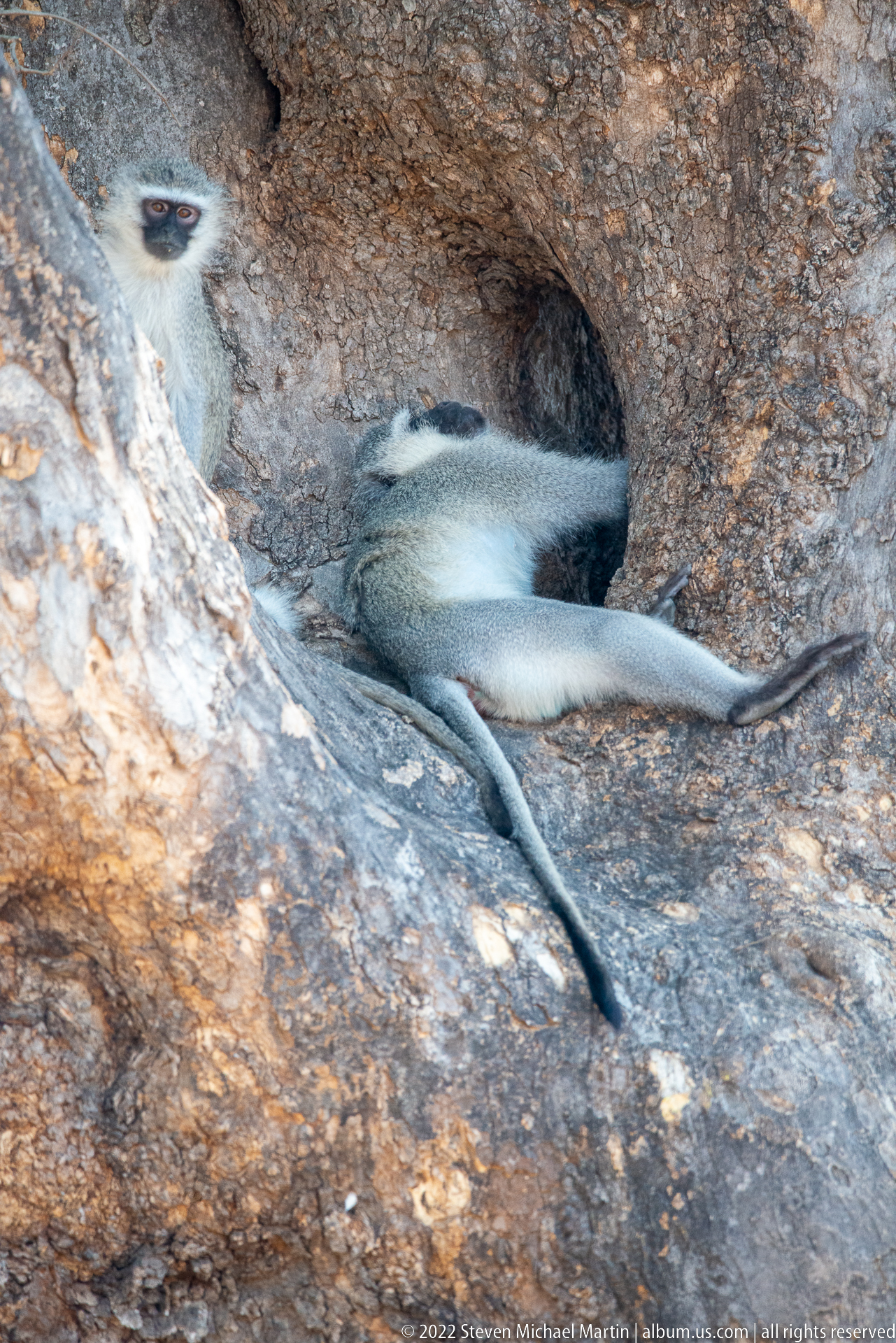
A vervet monkey lies stretched out in a shallow hollow of warm-toned rock, using the shaded depression as a resting place. Its long tail extends along the stone while gray fur and darker extremities contrast with the textured surface. The unusual overhead angle emphasizes the animal’s relaxed posture and the protective shape of the rocky recess.
Caption
A vervet monkey lies stretched out in a shallow hollow of warm-toned rock, using the shaded depression as a resting place. Its long tail extends along the stone while gray fur and darker extremities contrast with the textured surface. The unusual overhead angle emphasizes the animal’s relaxed posture and the protective shape of the rocky recess.

A giraffe’s head and upper neck fill the frame against a clear blue sky, revealing the paired ossicones, large ears, long eyelashes, mottled facial markings, and dark muzzle in unusually close detail. The upward viewpoint removes most habitat context and turns the animal’s distinctive anatomy into the subject, with asymmetrical ears and a slightly working mouth adding character to the portrait.
Caption
A giraffe’s head and upper neck fill the frame against a clear blue sky, revealing the paired ossicones, large ears, long eyelashes, mottled facial markings, and dark muzzle in unusually close detail. The upward viewpoint removes most habitat context and turns the animal’s distinctive anatomy into the subject, with asymmetrical ears and a slightly working mouth adding character to the portrait.
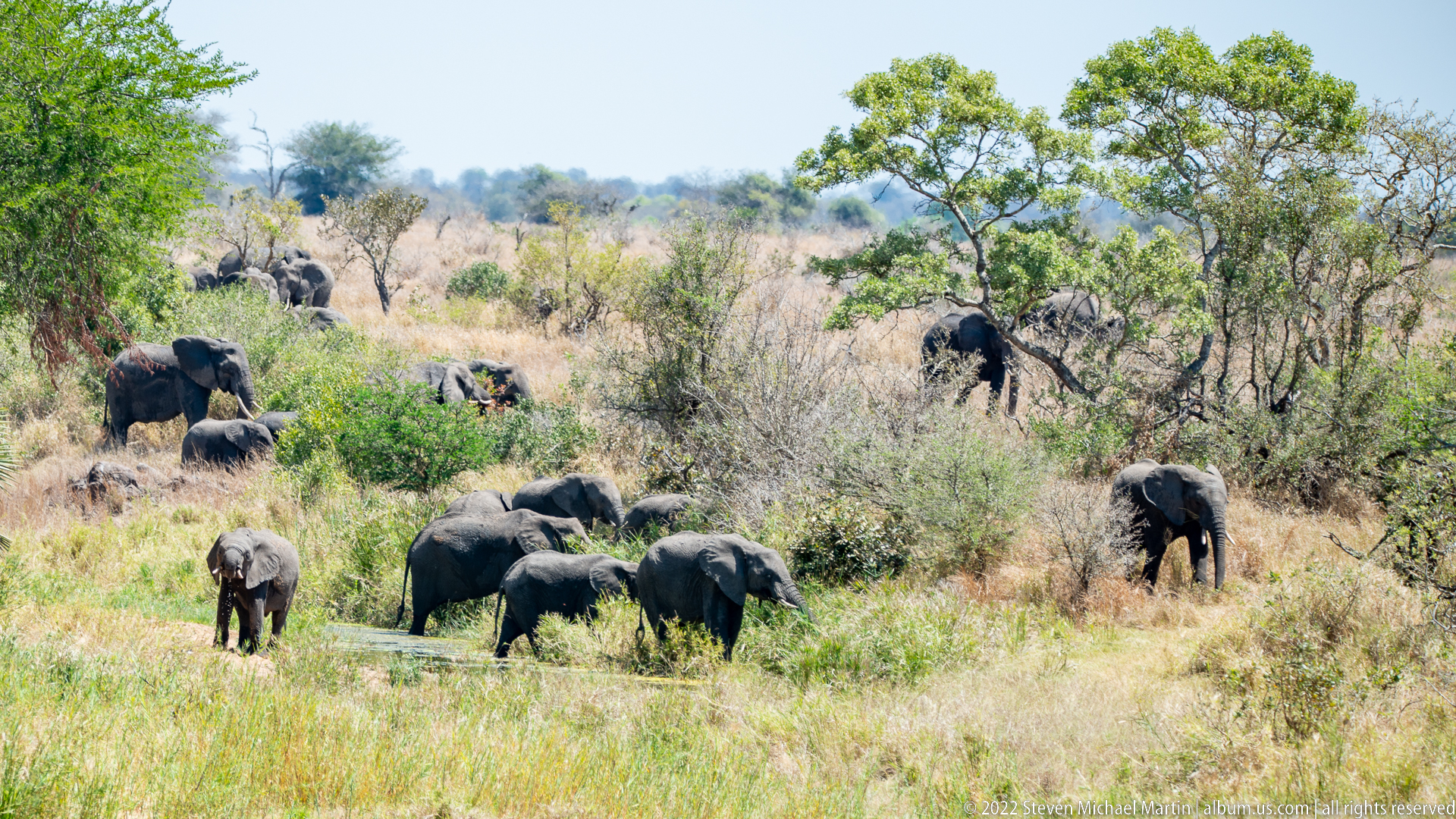
A herd of African elephants spreads across a broad bushveld slope, with adults and smaller juveniles occupying several distances in the frame. Some feed among shrubs while others move through open grass, making the landscape as important as any single animal. The wide view conveys the scale of the herd’s use of mixed grass and woody vegetation near Skukuza.
Caption
A herd of African elephants spreads across a broad bushveld slope, with adults and smaller juveniles occupying several distances in the frame. Some feed among shrubs while others move through open grass, making the landscape as important as any single animal. The wide view conveys the scale of the herd’s use of mixed grass and woody vegetation near Skukuza.
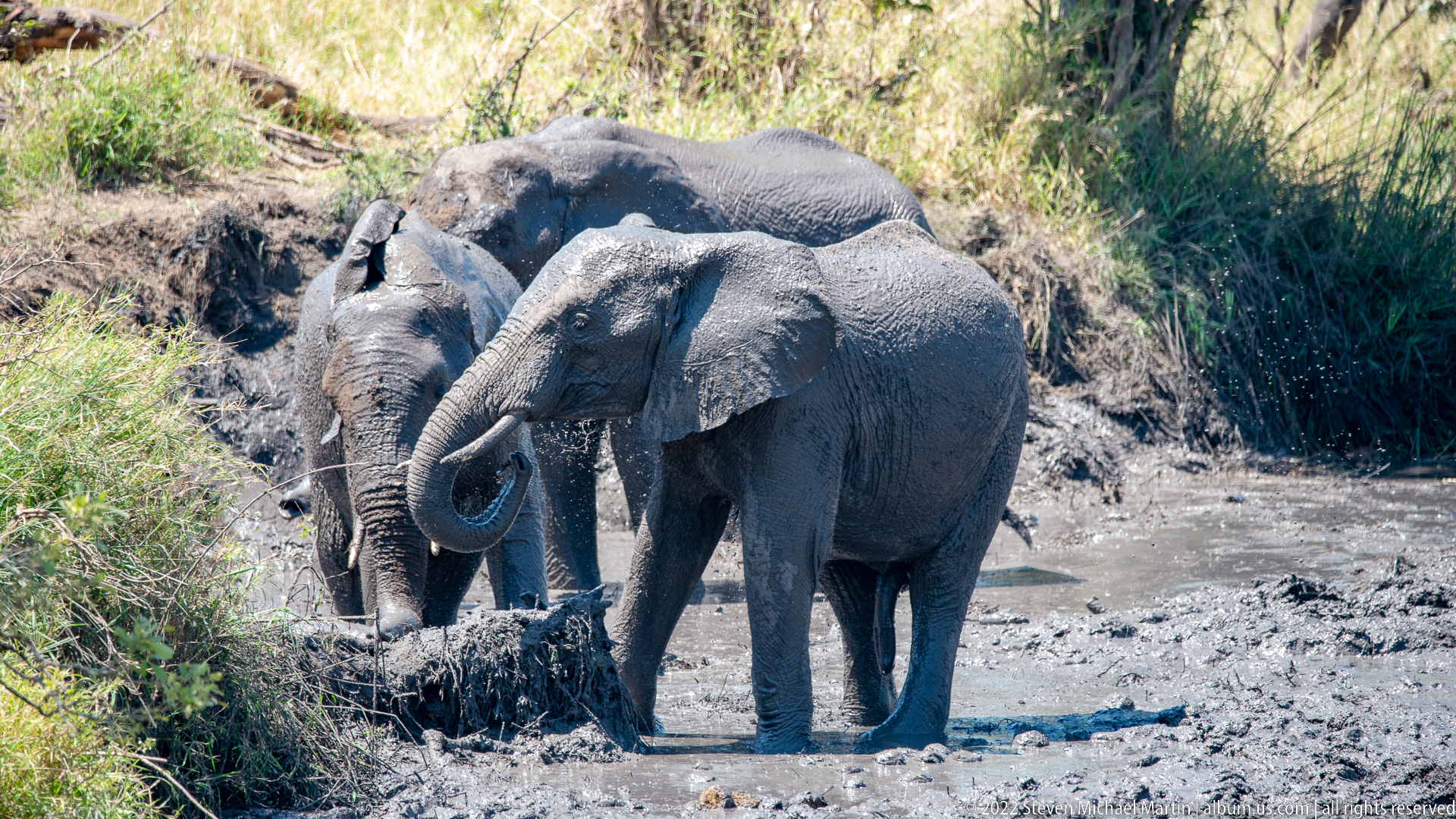
Two African elephants stand at the edge of a muddy wallow, their skin darkened and textured by wet mud. The nearer animal curls its trunk upward while the second stands close behind, both framed tightly enough to show mud clinging to ears, forehead, and flanks. The scene records wallowing and mud-coating behavior used by elephants in hot, dry environments.
Caption
Two African elephants stand at the edge of a muddy wallow, their skin darkened and textured by wet mud. The nearer animal curls its trunk upward while the second stands close behind, both framed tightly enough to show mud clinging to ears, forehead, and flanks. The scene records wallowing and mud-coating behavior used by elephants in hot, dry environments.
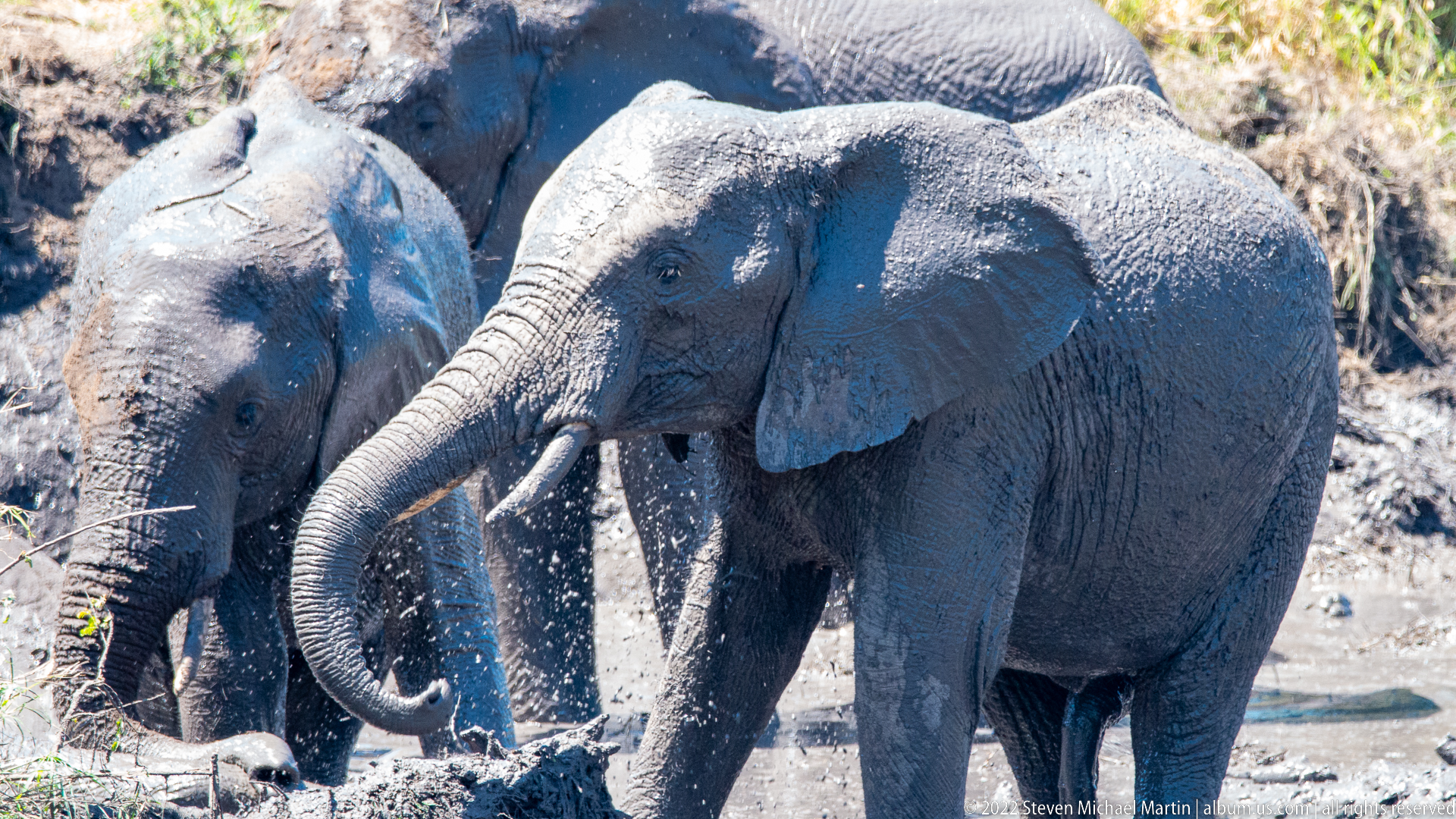
Wet mud coats the head, ears, and shoulders of two African elephants at close range. The foreground animal raises and curls its trunk across its face while droplets and slick patches of mud catch the light; a second elephant stands immediately behind. The compressed composition concentrates on the tactile detail of mud-covered skin and trunk movement rather than the surrounding wallow.
Caption
Wet mud coats the head, ears, and shoulders of two African elephants at close range. The foreground animal raises and curls its trunk across its face while droplets and slick patches of mud catch the light; a second elephant stands immediately behind. The compressed composition concentrates on the tactile detail of mud-covered skin and trunk movement rather than the surrounding wallow.
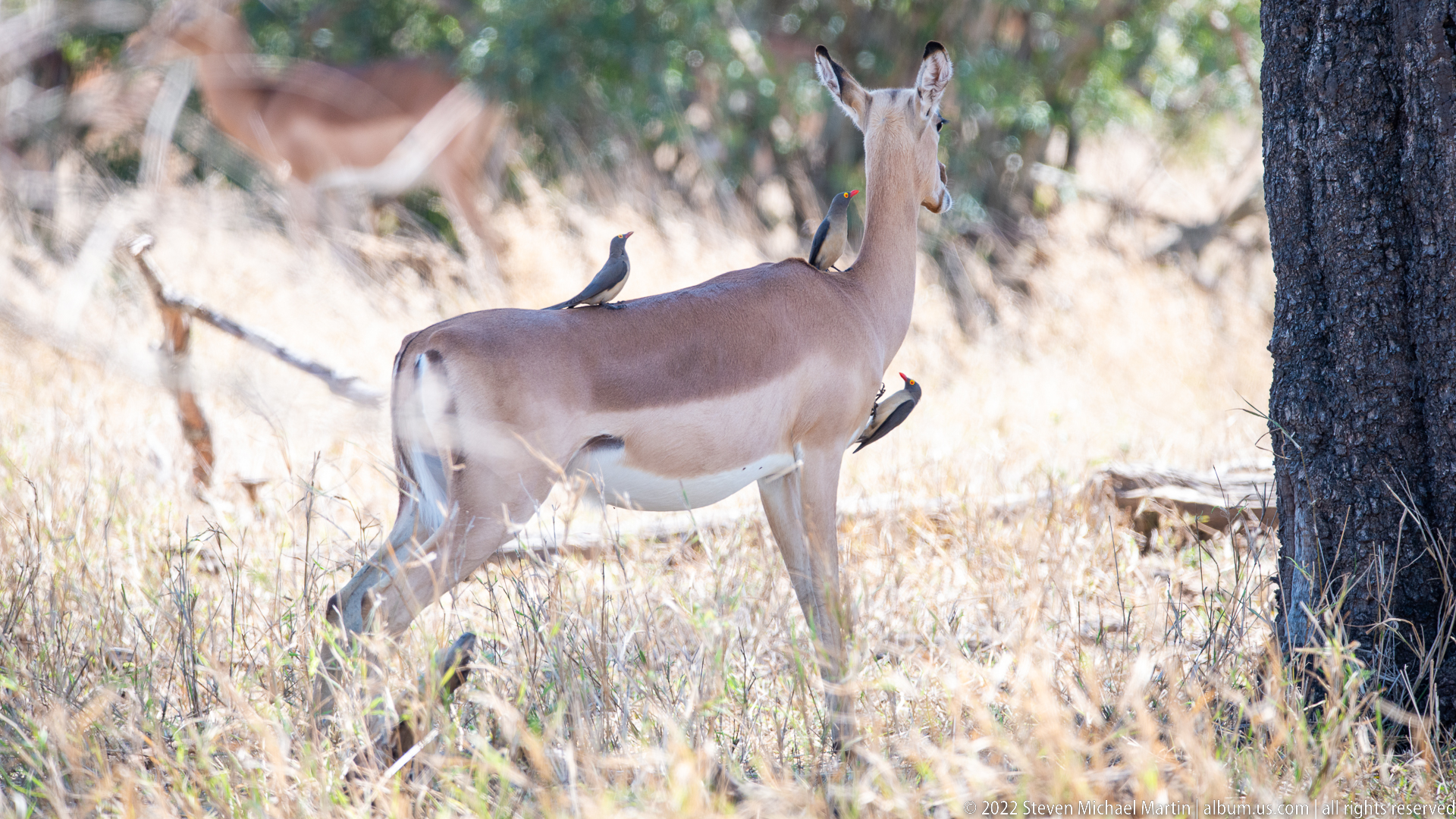
A female impala walks through open woodland with oxpeckers perched on her back and neck. The birds’ close contact with the antelope records the familiar association in which oxpeckers forage on large African mammals. The impala’s reddish-tan back, white belly, and hornless head are visible in profile, while the perched birds add a distinct interspecies behavioral element.
Caption
A female impala walks through open woodland with oxpeckers perched on her back and neck. The birds’ close contact with the antelope records the familiar association in which oxpeckers forage on large African mammals. The impala’s reddish-tan back, white belly, and hornless head are visible in profile, while the perched birds add a distinct interspecies behavioral element.

A vervet monkey sits upright among dry stems at the base of dense vegetation, its pale gray coat and dark face sharply separated by a fringe of lighter fur. The animal looks toward the camera while remaining partly concealed by grass. The portrait shows the primate using low cover at ground level rather than moving through the canopy.
Caption
A vervet monkey sits upright among dry stems at the base of dense vegetation, its pale gray coat and dark face sharply separated by a fringe of lighter fur. The animal looks toward the camera while remaining partly concealed by grass. The portrait shows the primate using low cover at ground level rather than moving through the canopy.
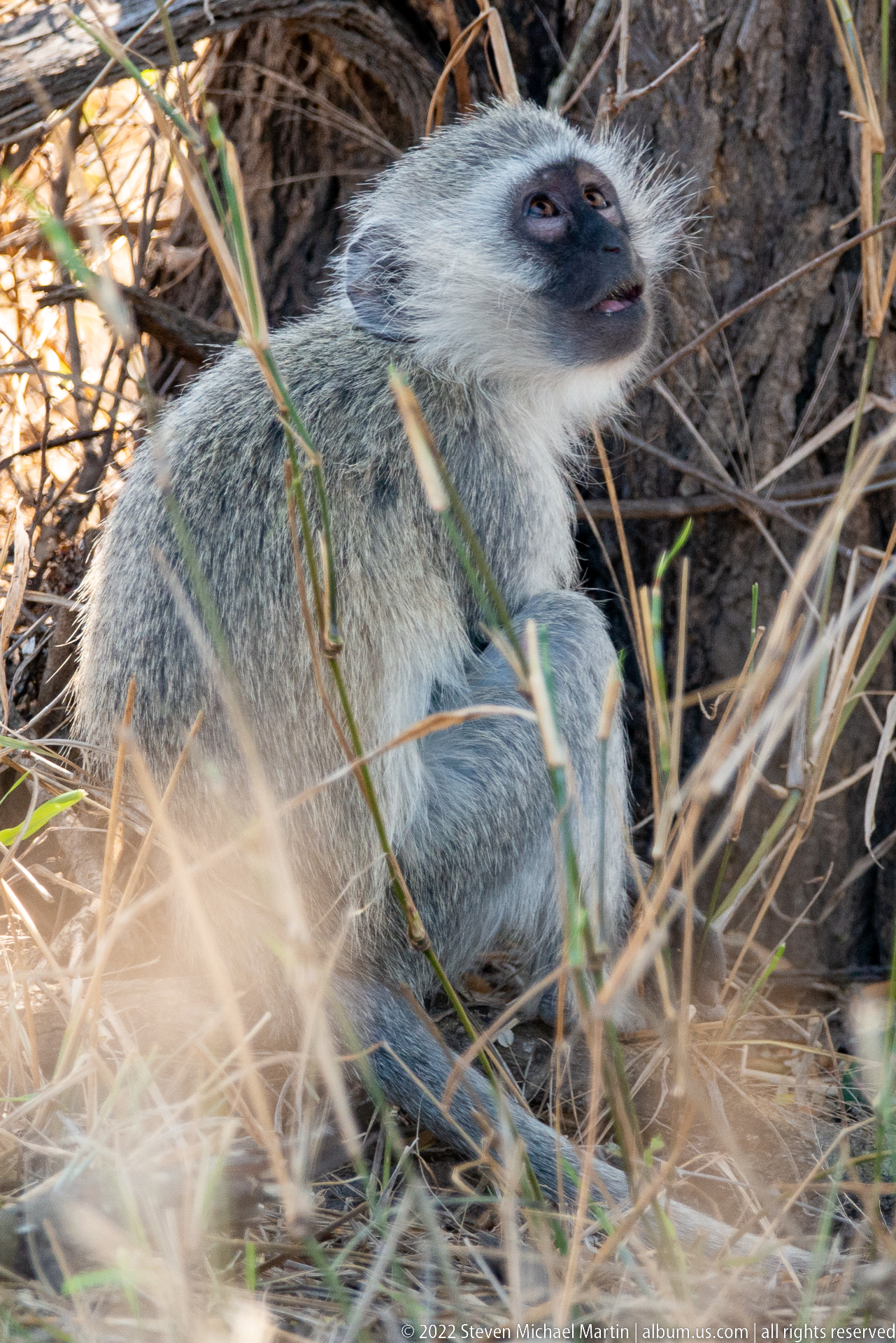
A vervet monkey sits low beside a tree base, turning its dark face upward in profile. Coarse gray fur, pale cheek fringe, small rounded ears, and the black facial mask are visible at close range, while dry stems cross the foreground. The tighter composition shifts attention from habitat to facial structure and coat texture.
Caption
A vervet monkey sits low beside a tree base, turning its dark face upward in profile. Coarse gray fur, pale cheek fringe, small rounded ears, and the black facial mask are visible at close range, while dry stems cross the foreground. The tighter composition shifts attention from habitat to facial structure and coat texture.
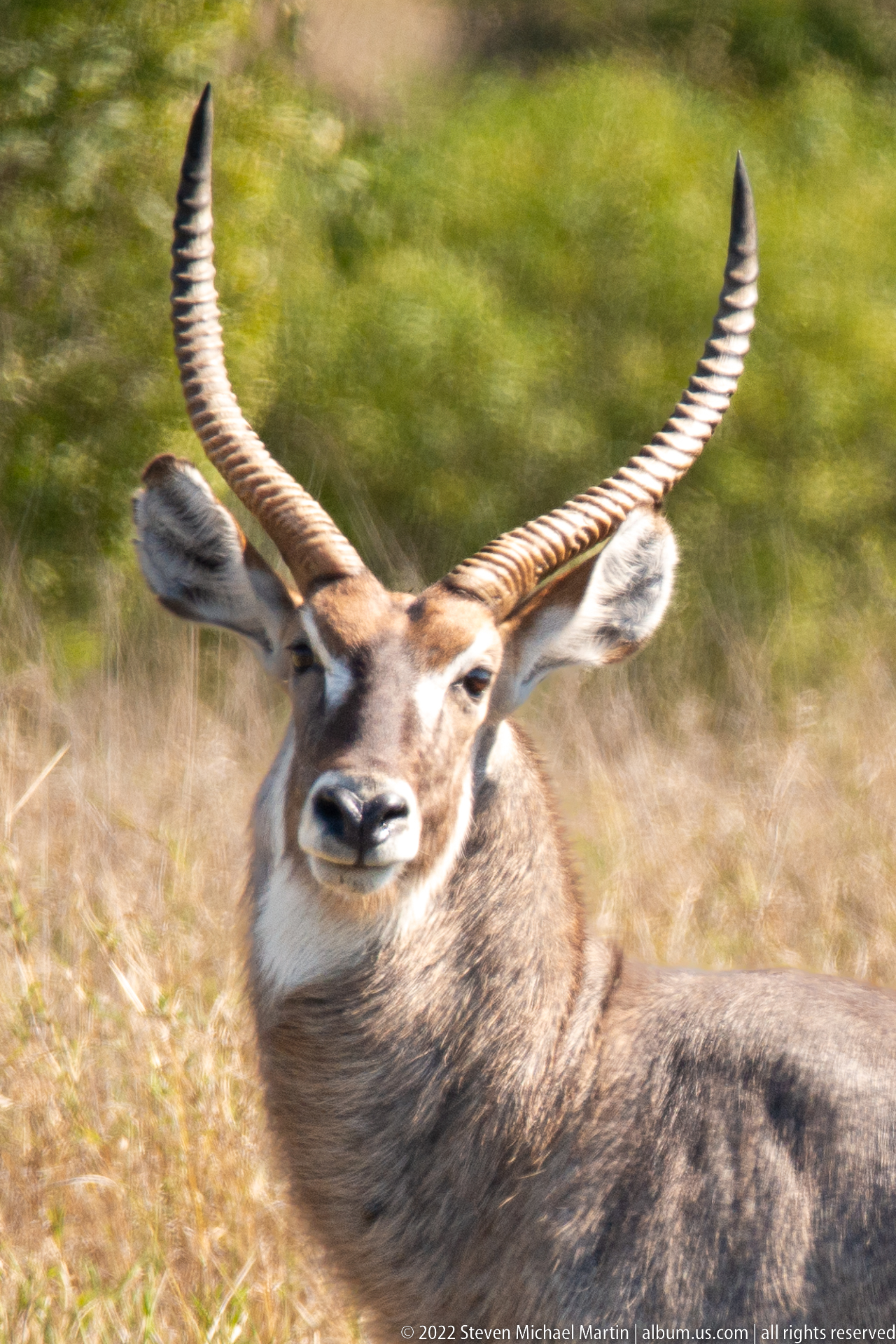
A close portrait isolates the head and shoulders of a male waterbuck, with strongly ridged horns extending high above the frame. The tighter view reveals the pale muzzle, large ears, coarse coat, and heavy facial proportions that help distinguish waterbuck from other common Kruger antelopes.
Caption
A close portrait isolates the head and shoulders of a male waterbuck, with strongly ridged horns extending high above the frame. The tighter view reveals the pale muzzle, large ears, coarse coat, and heavy facial proportions that help distinguish waterbuck from other common Kruger antelopes.
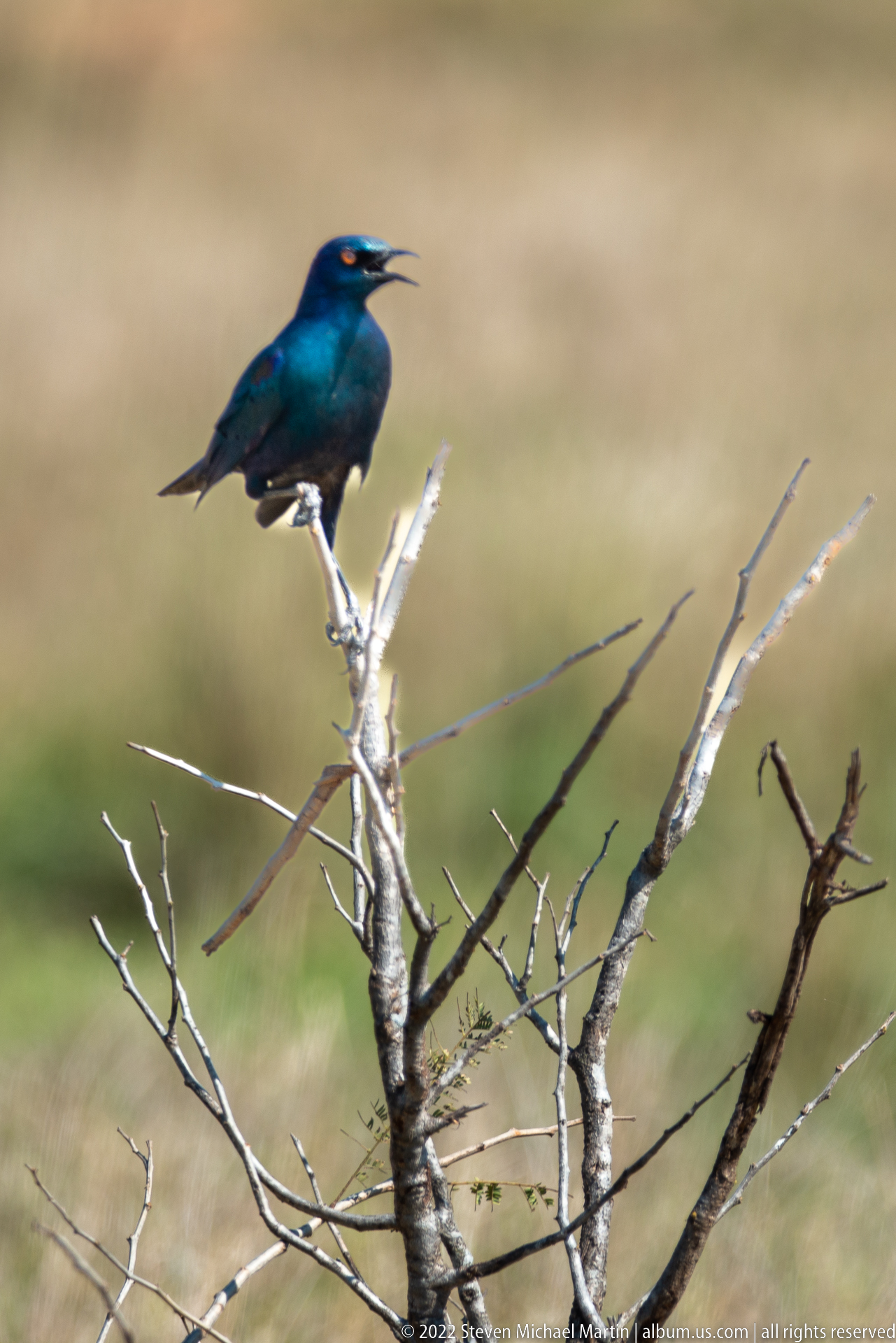
An iridescent blue glossy starling perches on a dead branch with its bill open, apparently calling. Metallic blue-green plumage and a bright eye stand out against the soft, neutral background, while the exposed perch gives the bird a clear vantage point over the surrounding savanna.
Caption
An iridescent blue glossy starling perches on a dead branch with its bill open, apparently calling. Metallic blue-green plumage and a bright eye stand out against the soft, neutral background, while the exposed perch gives the bird a clear vantage point over the surrounding savanna.

Water flows across a broad, shallow rocky channel between low islands of green reeds and grasses. Dark bedrock breaks the surface in the foreground, creating small riffles and contrasting with the calm blue reaches beyond. The wider downstream view records the mosaic of open water, exposed rock, and emergent vegetation that defines this dry-season riparian habitat near Skukuza.
Caption
Water flows across a broad, shallow rocky channel between low islands of green reeds and grasses. Dark bedrock breaks the surface in the foreground, creating small riffles and contrasting with the calm blue reaches beyond. The wider downstream view records the mosaic of open water, exposed rock, and emergent vegetation that defines this dry-season riparian habitat near Skukuza.
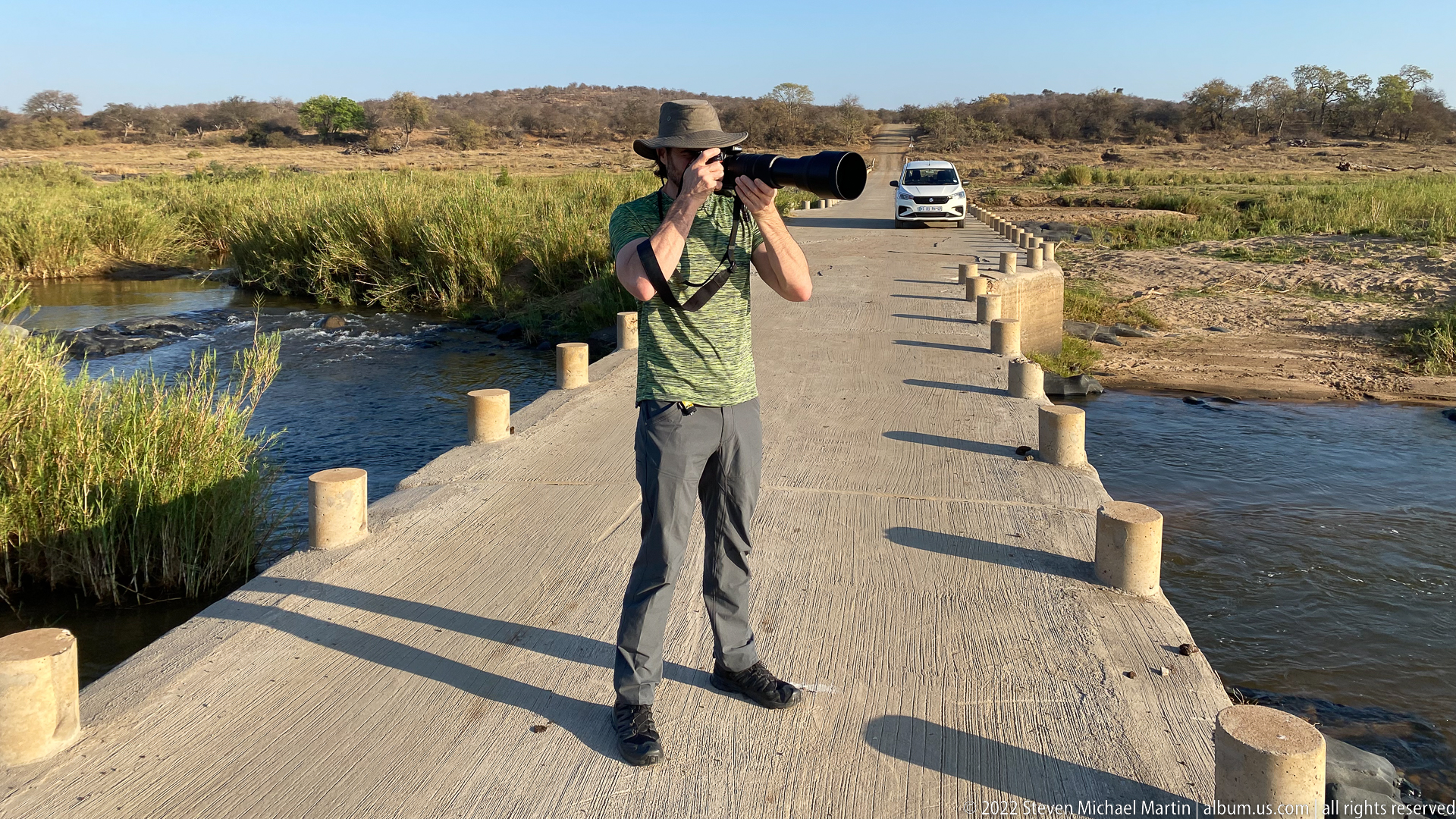
A photographer stands on a narrow concrete low-water bridge, raising a long telephoto lens toward wildlife beyond the frame. Short bollards line the crossing, with shallow river channels and reed beds on both sides and a vehicle farther back. The scene documents field photography within Kruger’s riverine landscape and the working distance required for photographing wild animals.
Caption
A photographer stands on a narrow concrete low-water bridge, raising a long telephoto lens toward wildlife beyond the frame. Short bollards line the crossing, with shallow river channels and reed beds on both sides and a vehicle farther back. The scene documents field photography within Kruger’s riverine landscape and the working distance required for photographing wild animals.
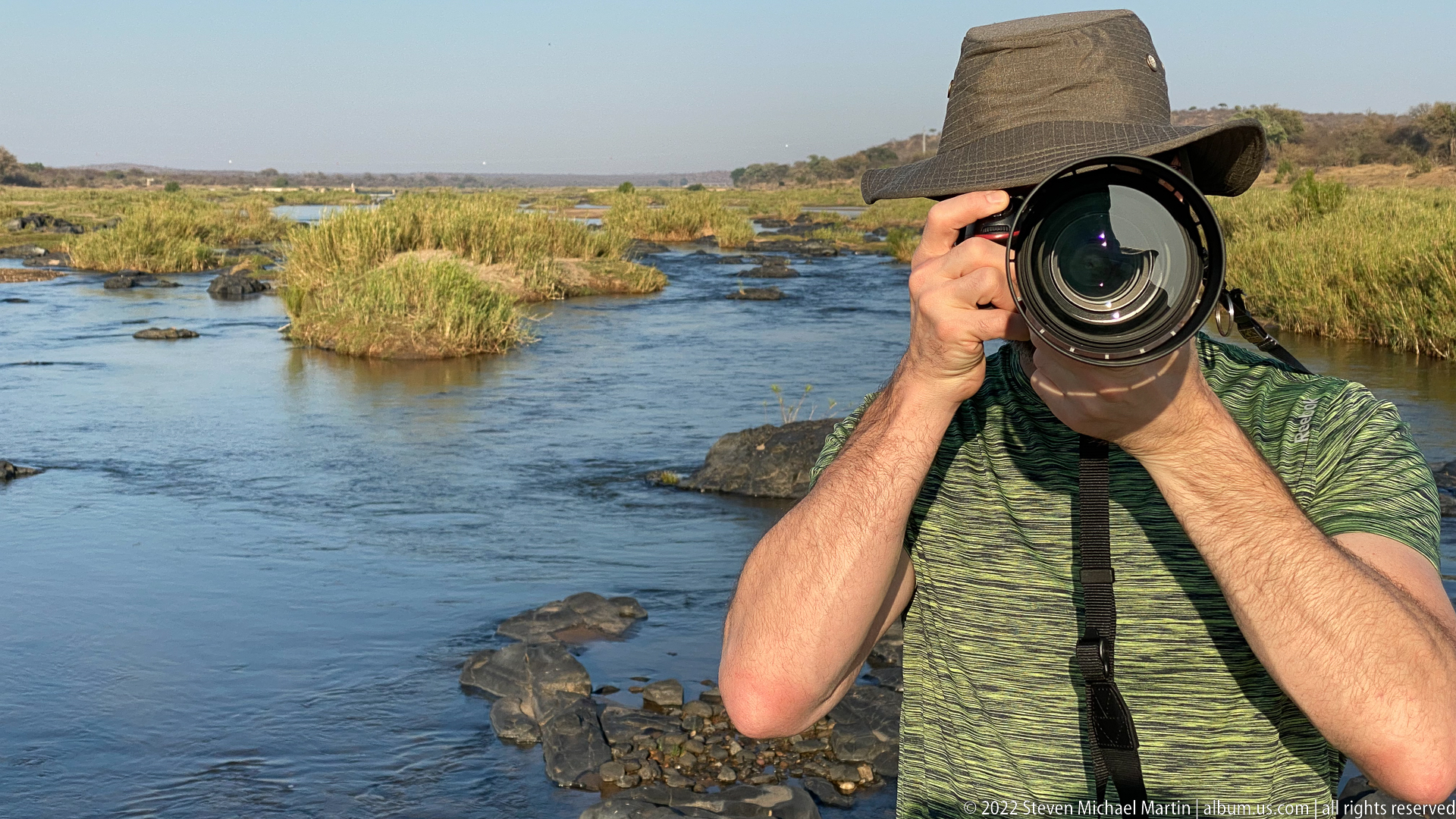
A photographer aims a large camera lens directly toward the viewer, filling the foreground with the circular glass of the telephoto lens. A broad-brimmed hat shades the face, while the shallow river and reed-covered islands remain visible behind. The close composition turns the act of wildlife photography itself into the subject, contrasting precision equipment with the open Kruger landscape.
Caption
A photographer aims a large camera lens directly toward the viewer, filling the foreground with the circular glass of the telephoto lens. A broad-brimmed hat shades the face, while the shallow river and reed-covered islands remain visible behind. The close composition turns the act of wildlife photography itself into the subject, contrasting precision equipment with the open Kruger landscape.
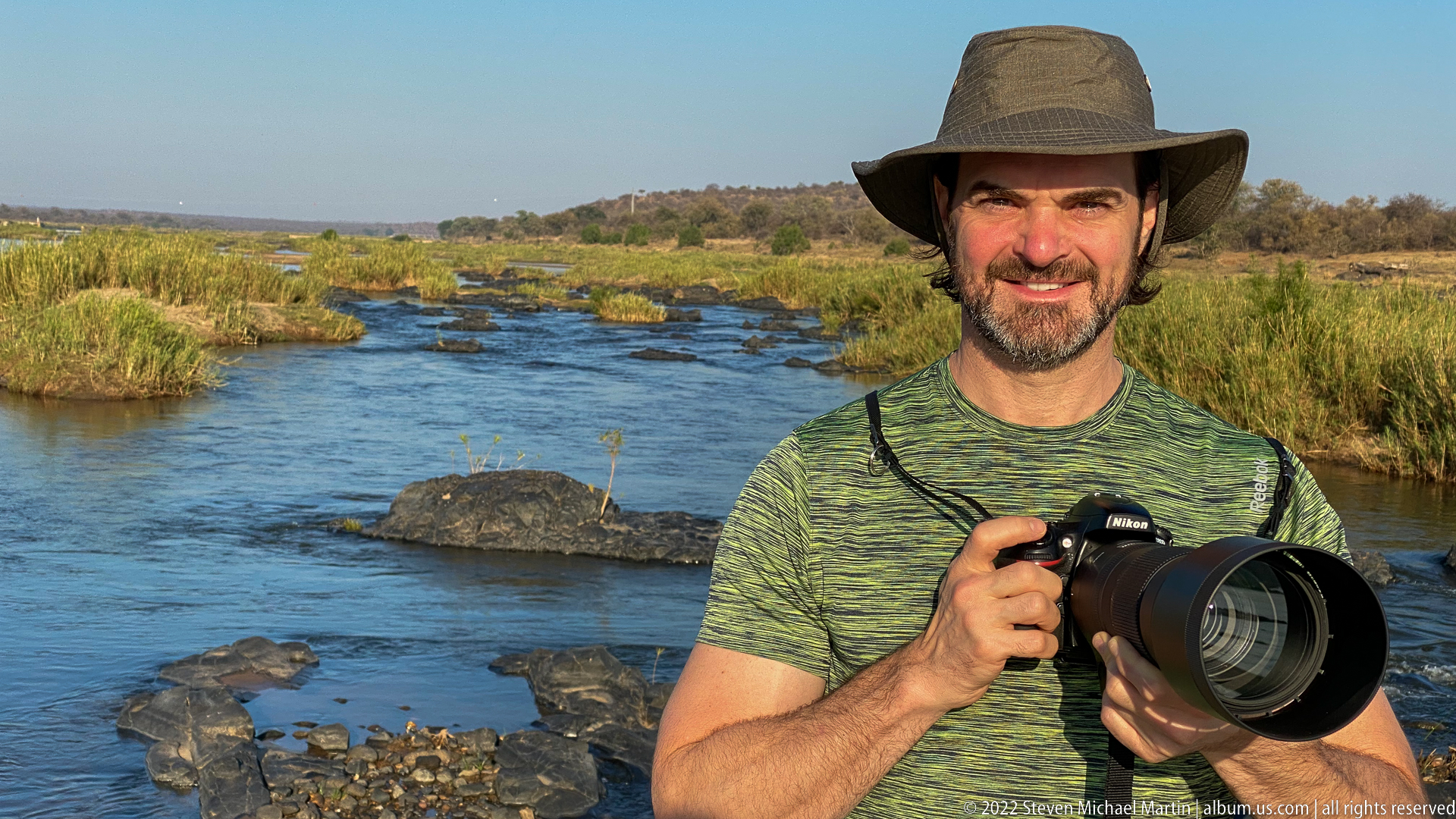
A safari traveler stands with a large telephoto camera beside a broad, rocky river channel near Skukuza. The portrait links wildlife observation with the riverine landscape that shapes this part of Kruger National Park, where open water, exposed rocks, reeds, and low woodland create varied habitat along the banks.
Caption
A safari traveler stands with a large telephoto camera beside a broad, rocky river channel near Skukuza. The portrait links wildlife observation with the riverine landscape that shapes this part of Kruger National Park, where open water, exposed rocks, reeds, and low woodland create varied habitat along the banks.
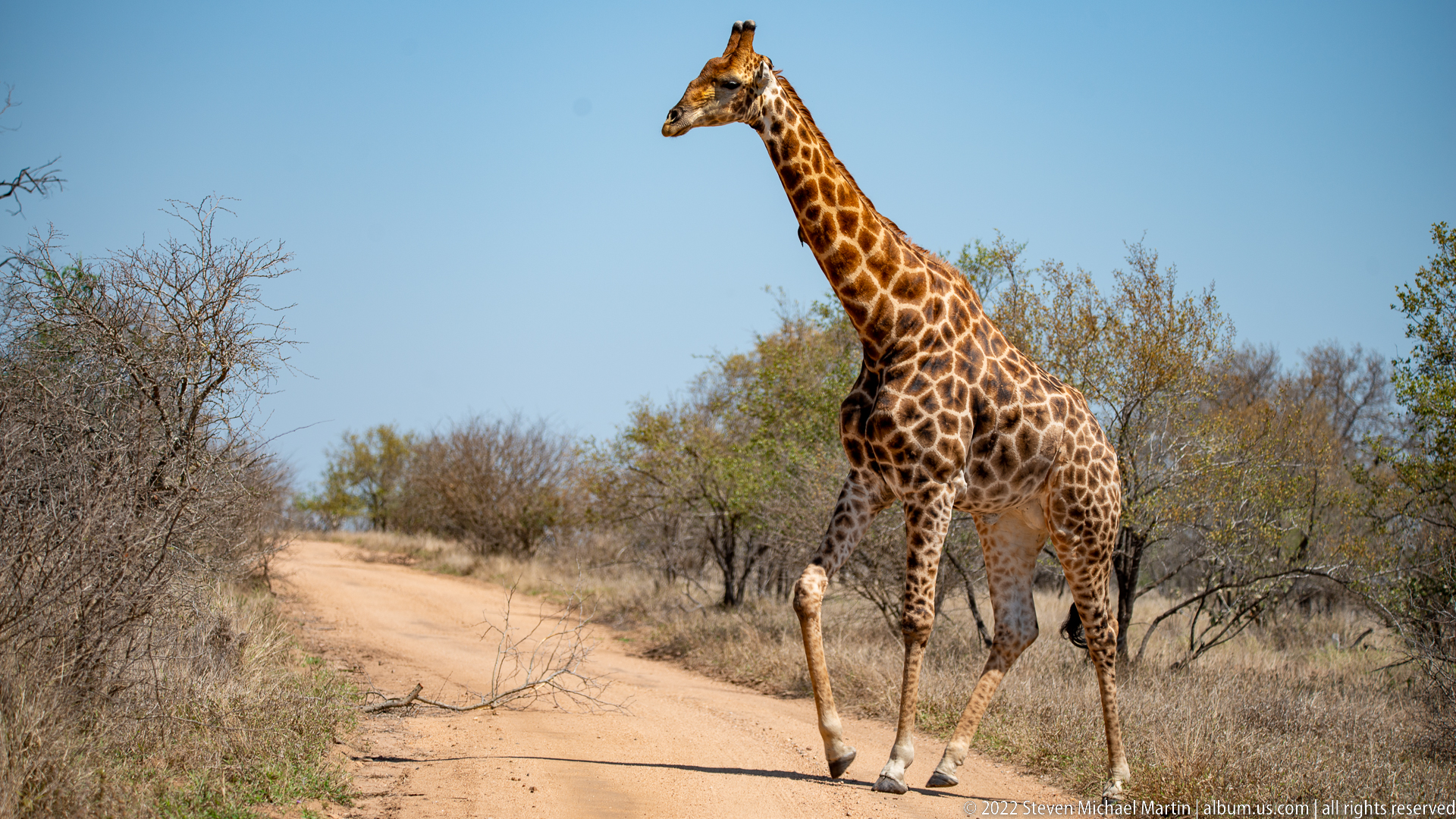
A giraffe strides beside a sandy track through dry savanna near Skukuza, its long neck and patterned coat standing out against sparse thorn scrub. The low viewpoint shows the animal in motion and places it within the open, seasonally dry woodland typical of the central-southern Kruger landscape.
Caption
A giraffe strides beside a sandy track through dry savanna near Skukuza, its long neck and patterned coat standing out against sparse thorn scrub. The low viewpoint shows the animal in motion and places it within the open, seasonally dry woodland typical of the central-southern Kruger landscape.
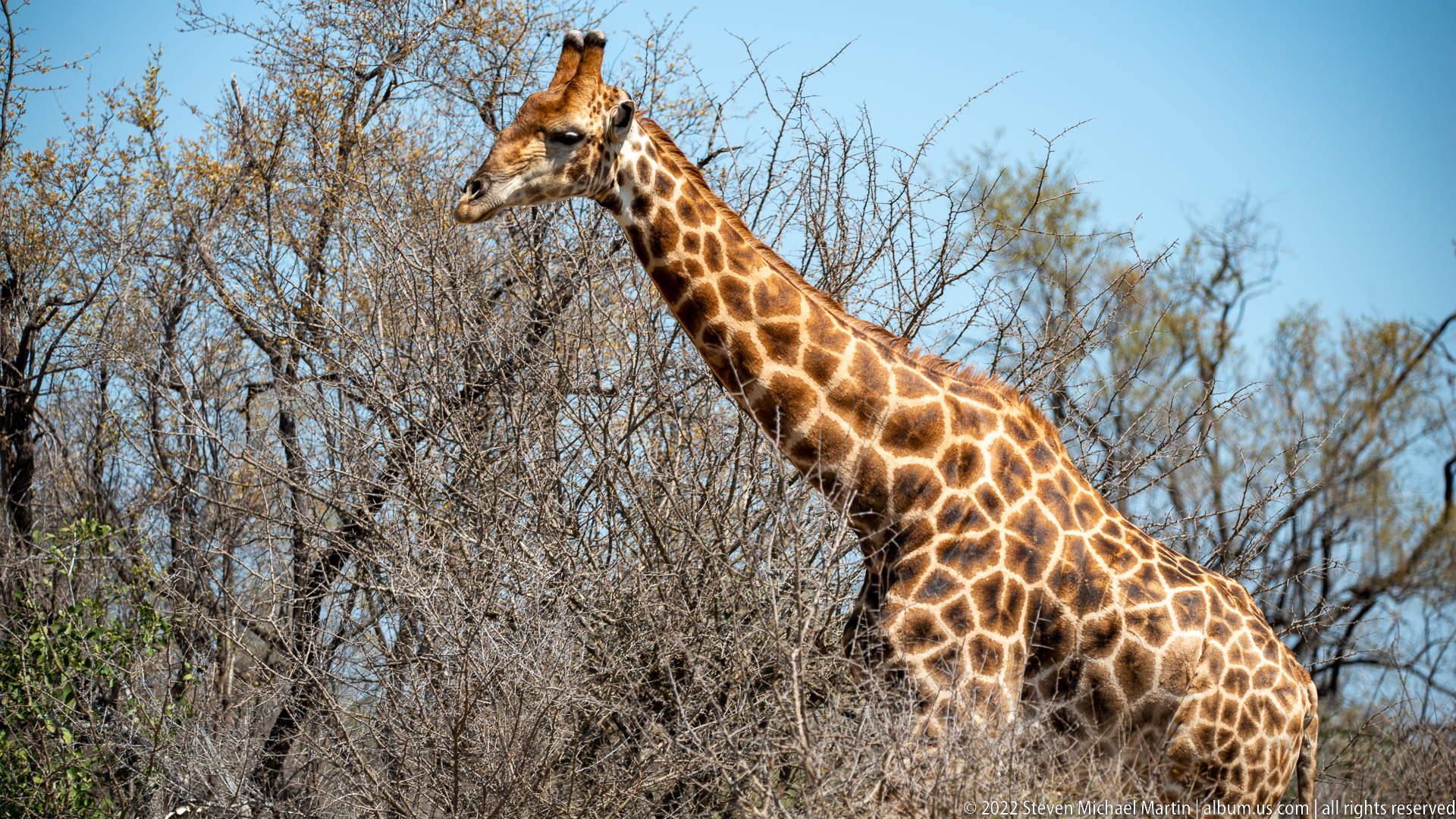
A giraffe moves through dense thorny brush, its neck and shoulders rising above the tangled branches. The tighter framing emphasizes how the animal's height gives it access to foliage well above the reach of most grazers and browsers, while the mottled coat visually breaks up against the sunlit woodland.
Caption
A giraffe moves through dense thorny brush, its neck and shoulders rising above the tangled branches. The tighter framing emphasizes how the animal's height gives it access to foliage well above the reach of most grazers and browsers, while the mottled coat visually breaks up against the sunlit woodland.
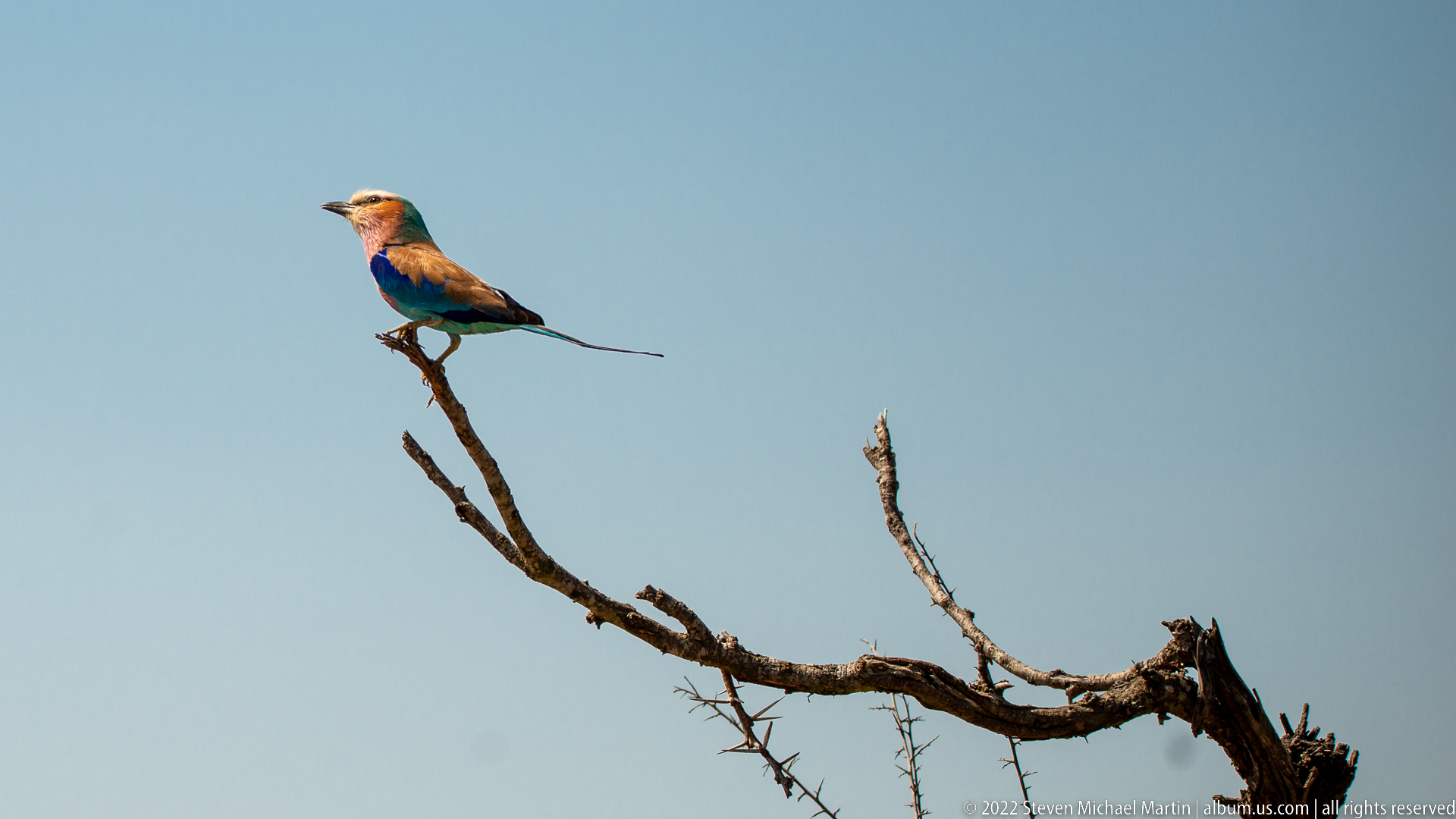
A lilac-breasted roller perches at the tip of a dead branch against an uninterrupted blue sky. Its turquoise-blue wings, warm brown back, pale crown, and lilac-toned breast form the vivid color combination that makes this species one of the most conspicuous birds of open savanna in Kruger National Park.
Caption
A lilac-breasted roller perches at the tip of a dead branch against an uninterrupted blue sky. Its turquoise-blue wings, warm brown back, pale crown, and lilac-toned breast form the vivid color combination that makes this species one of the most conspicuous birds of open savanna in Kruger National Park.
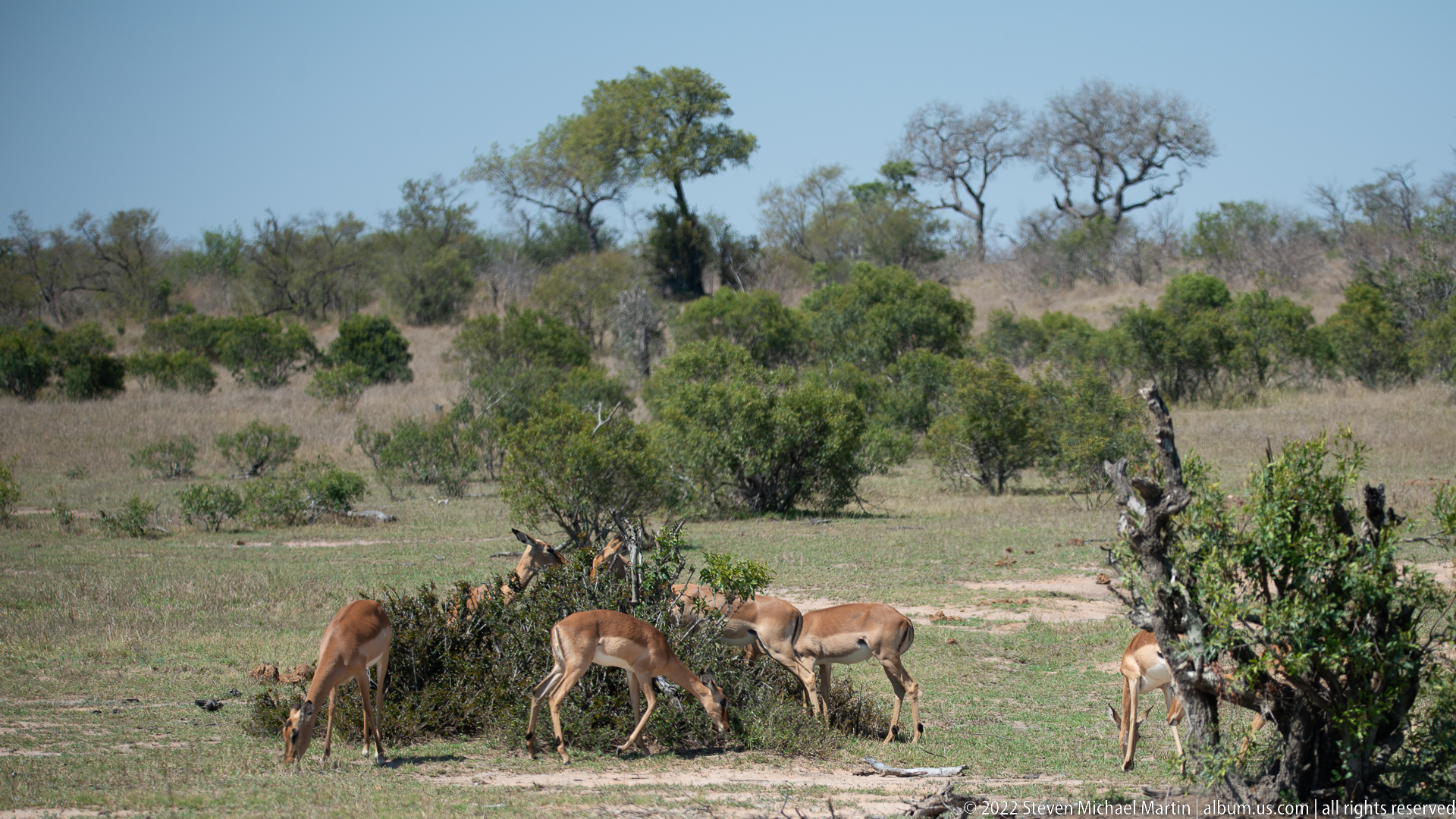
A small group of impalas feeds around a low shrub in open savanna, several animals lowering their heads while others remain alert. The scene shows the mixed grazing and browsing behavior that helps impalas exploit changing food resources across Kruger's grass-and-shrub mosaic.
Caption
A small group of impalas feeds around a low shrub in open savanna, several animals lowering their heads while others remain alert. The scene shows the mixed grazing and browsing behavior that helps impalas exploit changing food resources across Kruger's grass-and-shrub mosaic.
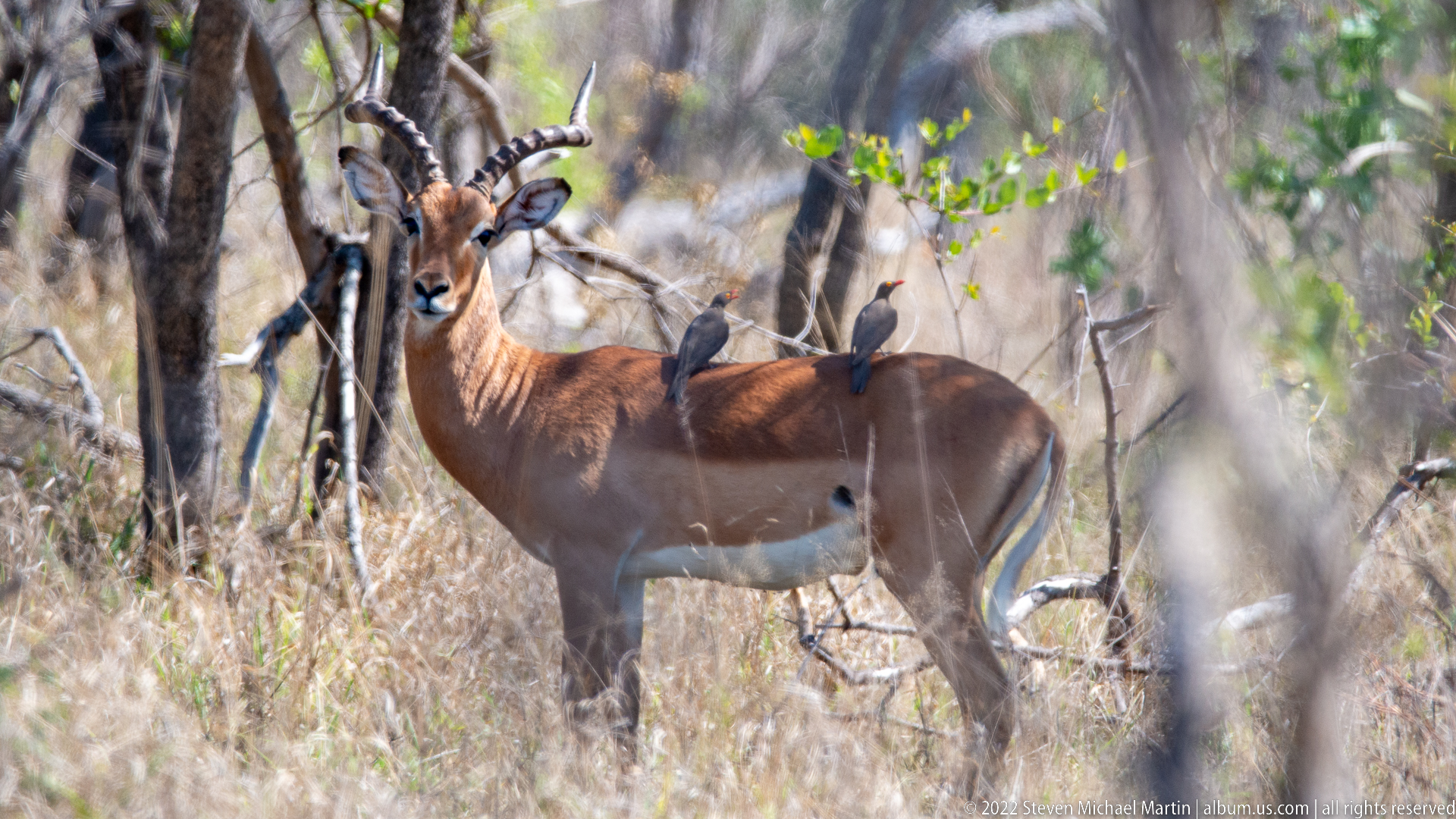
An adult male impala stands in dappled woodland light, facing the camera with its ridged, lyre-shaped horns fully visible. Two oxpecker-like birds rest along its back, adding a second layer of wildlife interaction to the portrait while the shaded brush creates a quiet, intimate setting.
Caption
An adult male impala stands in dappled woodland light, facing the camera with its ridged, lyre-shaped horns fully visible. Two oxpecker-like birds rest along its back, adding a second layer of wildlife interaction to the portrait while the shaded brush creates a quiet, intimate setting.
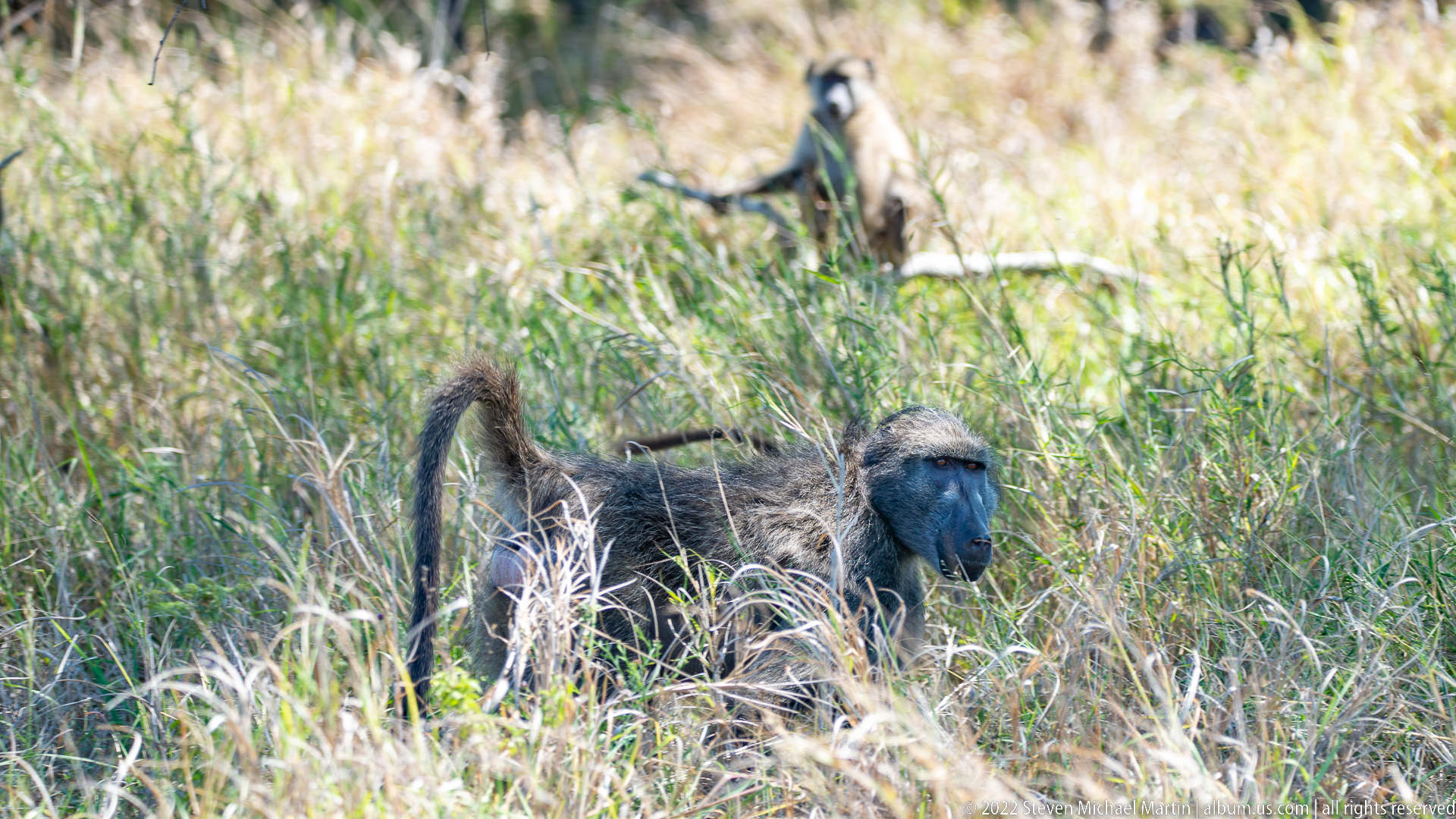
A chacma baboon moves through tall grass at ground level, with another baboon visible farther back in the same clearing. The low posture and scattered troop members suggest active foraging, a common behavior for this adaptable primate in Kruger's woodland and riverine environments.
Caption
A chacma baboon moves through tall grass at ground level, with another baboon visible farther back in the same clearing. The low posture and scattered troop members suggest active foraging, a common behavior for this adaptable primate in Kruger's woodland and riverine environments.
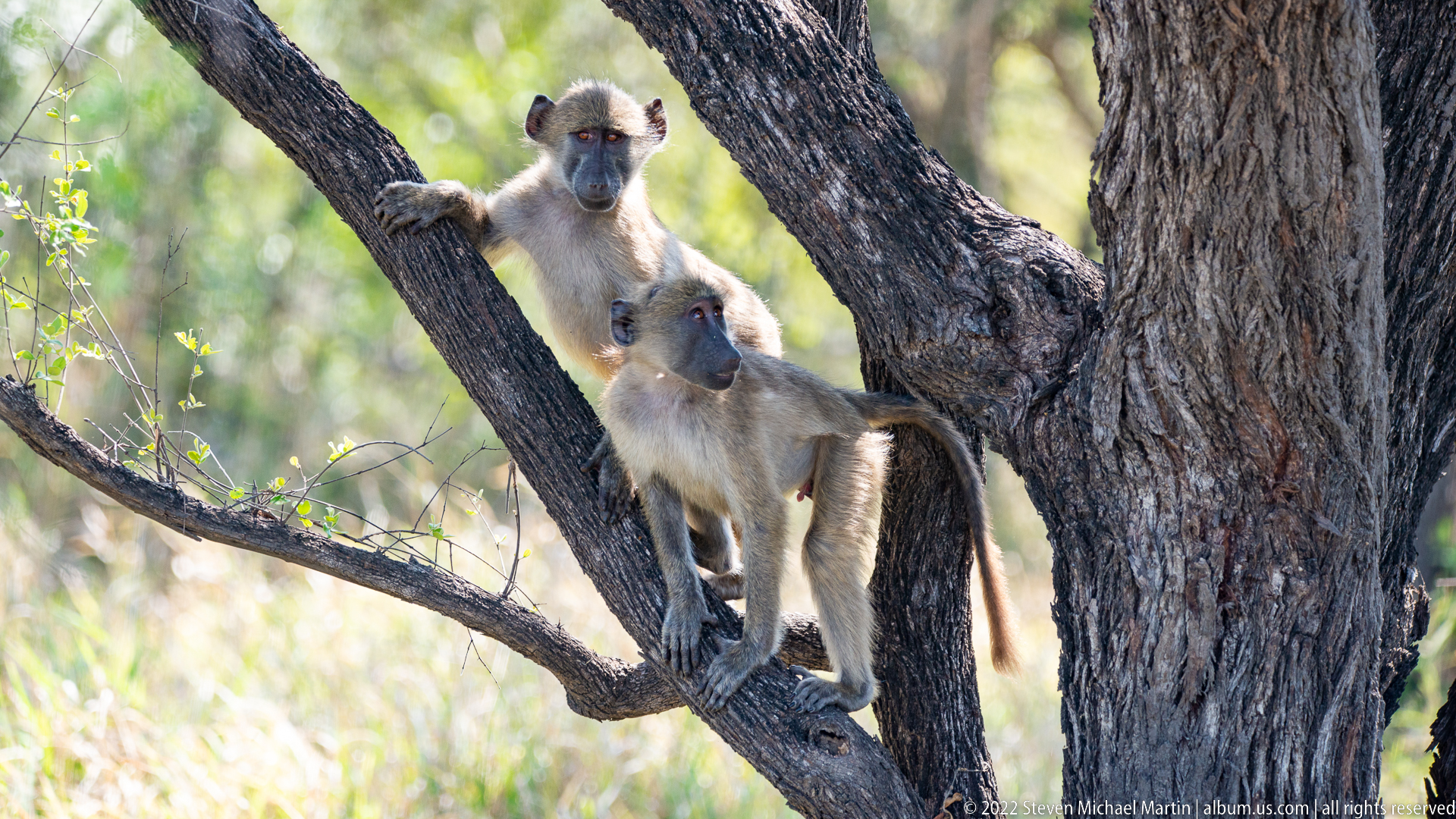
Two chacma baboons occupy the fork of a large tree, one seated higher on a sloping branch and the other braced below. Their elevated position offers a clear view of the troop's use of trees for resting, observation, and refuge within the wooded habitats around Skukuza.
Caption
Two chacma baboons occupy the fork of a large tree, one seated higher on a sloping branch and the other braced below. Their elevated position offers a clear view of the troop's use of trees for resting, observation, and refuge within the wooded habitats around Skukuza.
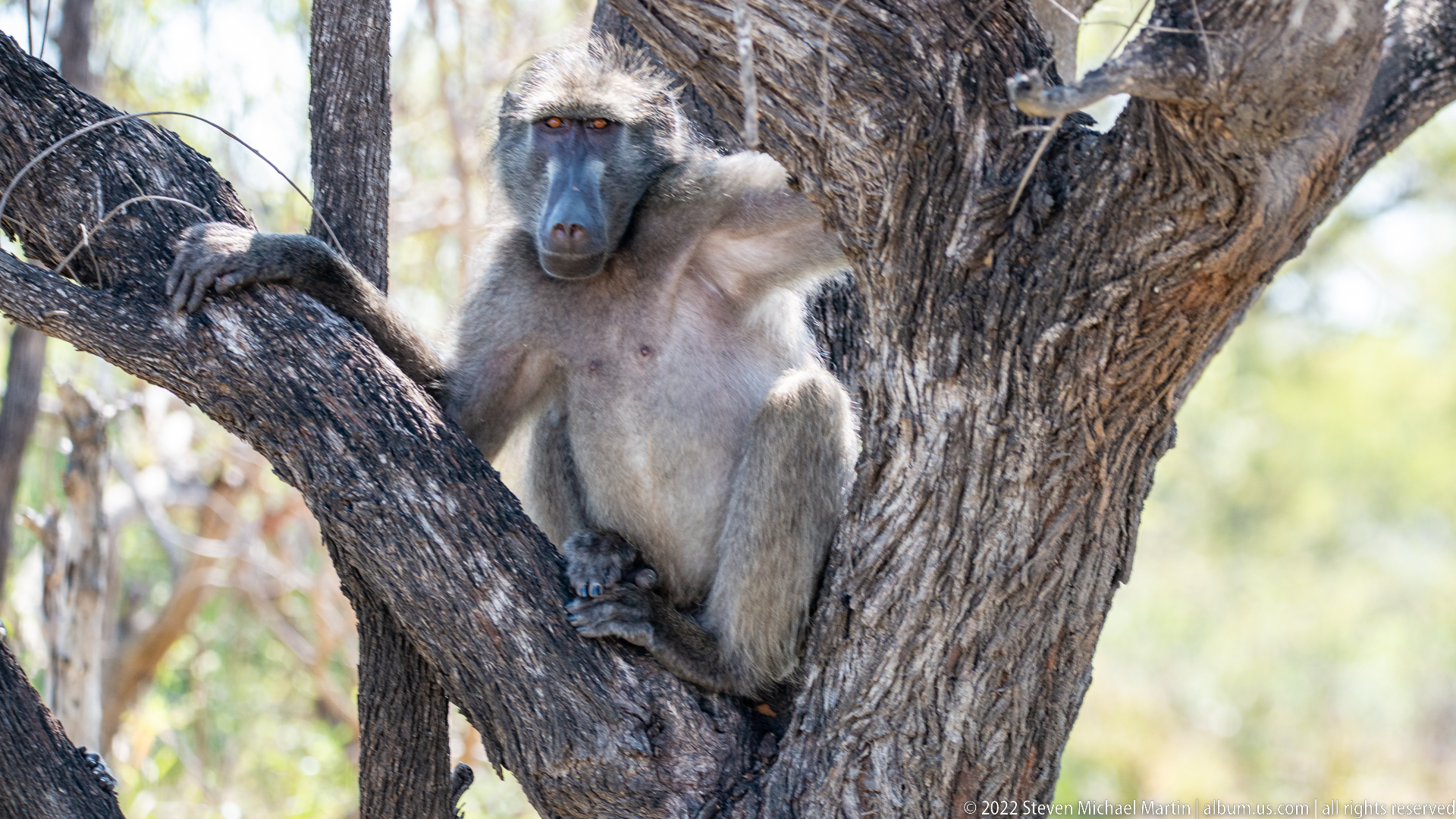
An adult chacma baboon sits upright against the fork of a rough-barked tree, its long muzzle and heavy shoulders prominent in the close view. The direct gaze and shaded setting produce a portrait that emphasizes the species' robust build and strong association with wooded resting sites.
Caption
An adult chacma baboon sits upright against the fork of a rough-barked tree, its long muzzle and heavy shoulders prominent in the close view. The direct gaze and shaded setting produce a portrait that emphasizes the species' robust build and strong association with wooded resting sites.
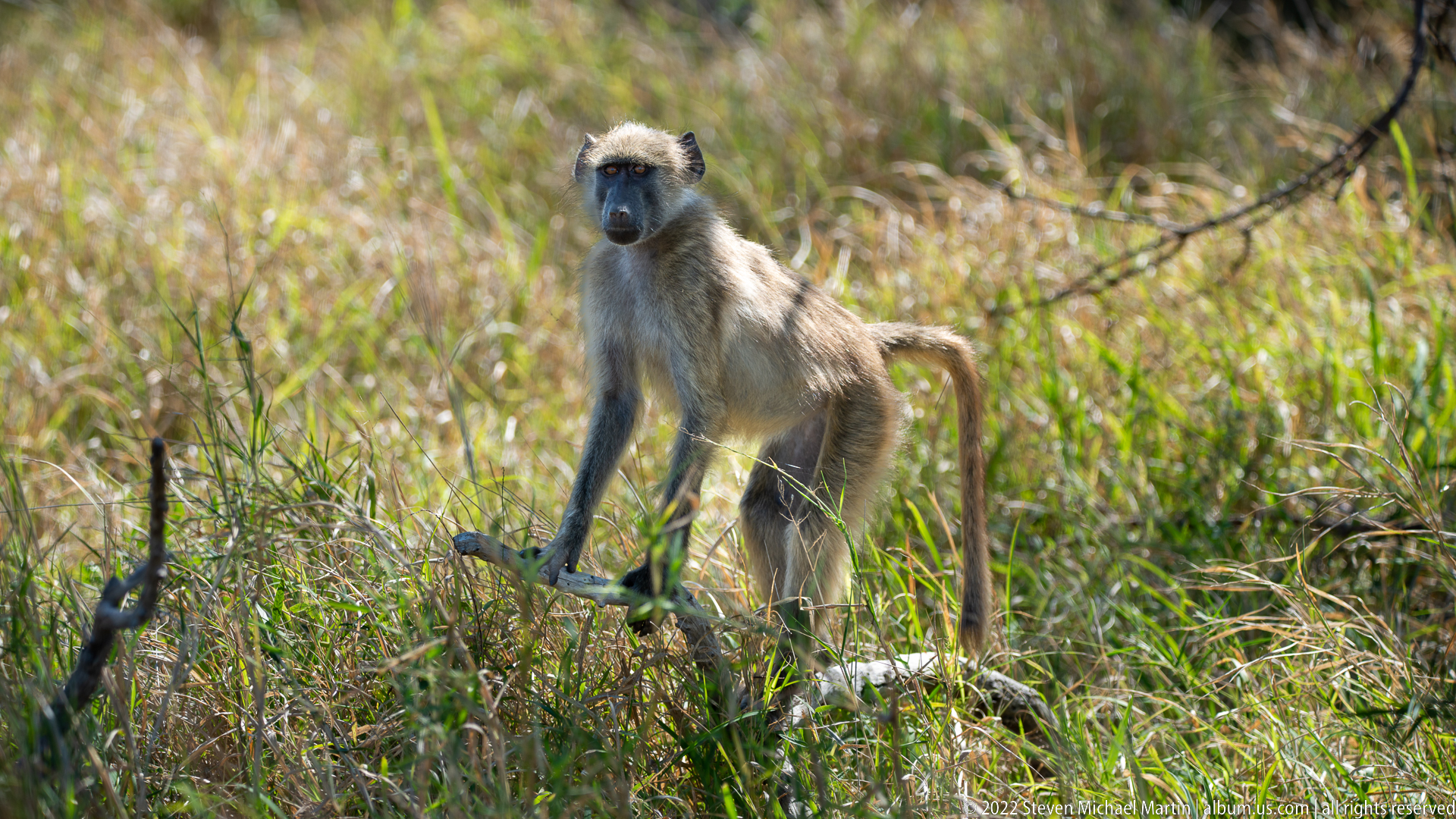
A young chacma baboon walks through sunlit grass with its long tail curved behind it. The smaller frame and relatively youthful proportions distinguish this individual from the heavier adults seen nearby, while the open understory gives a clear view of its terrestrial movement.
Caption
A young chacma baboon walks through sunlit grass with its long tail curved behind it. The smaller frame and relatively youthful proportions distinguish this individual from the heavier adults seen nearby, while the open understory gives a clear view of its terrestrial movement.
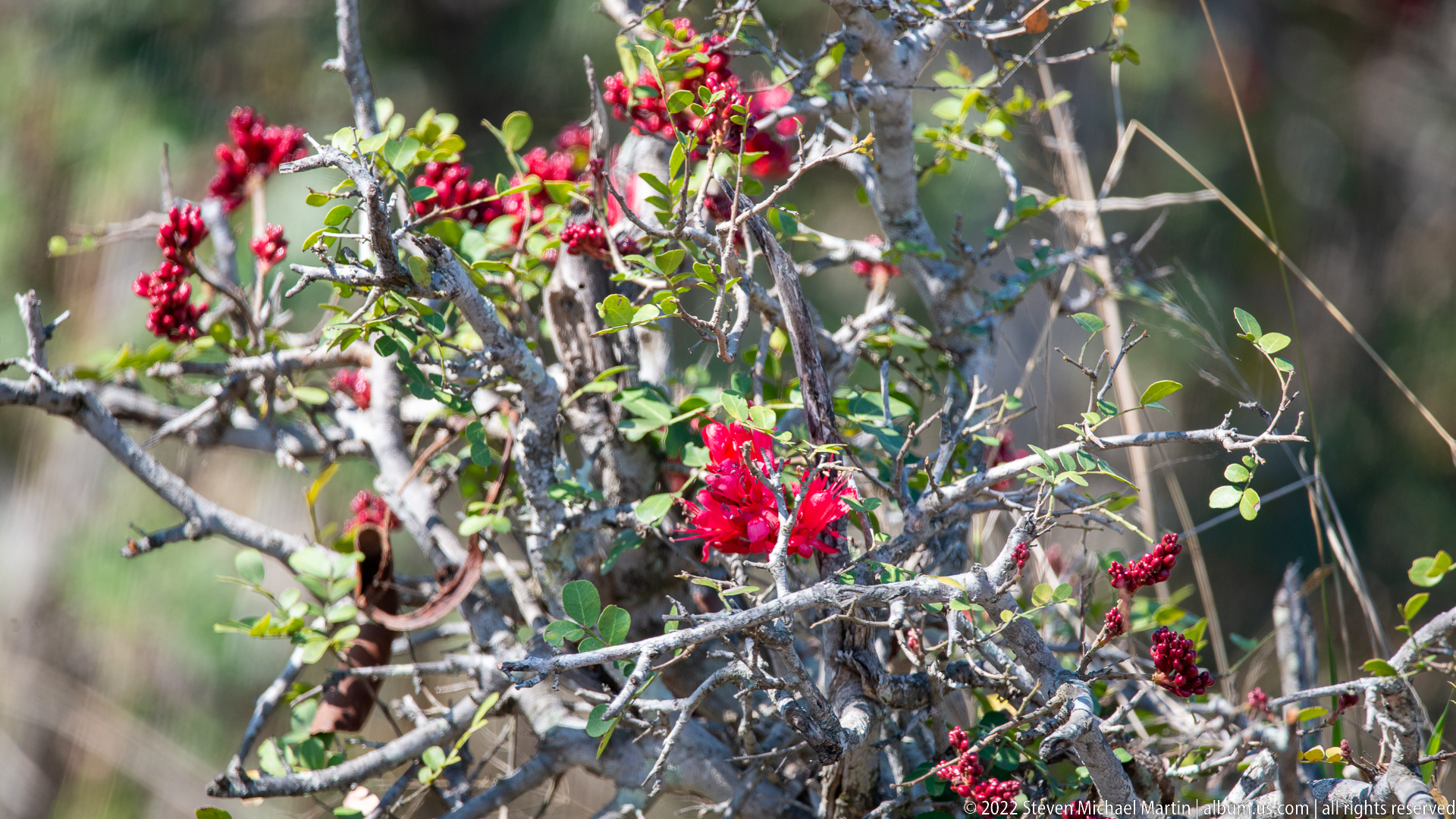
A thorny woodland shrub carries dense clusters of vivid red flowers and small red fruits among glossy green leaves. The close botanical study shifts attention from Kruger's large animals to the seasonal plant resources that add color and food to the savanna understory.
Caption
A thorny woodland shrub carries dense clusters of vivid red flowers and small red fruits among glossy green leaves. The close botanical study shifts attention from Kruger's large animals to the seasonal plant resources that add color and food to the savanna understory.
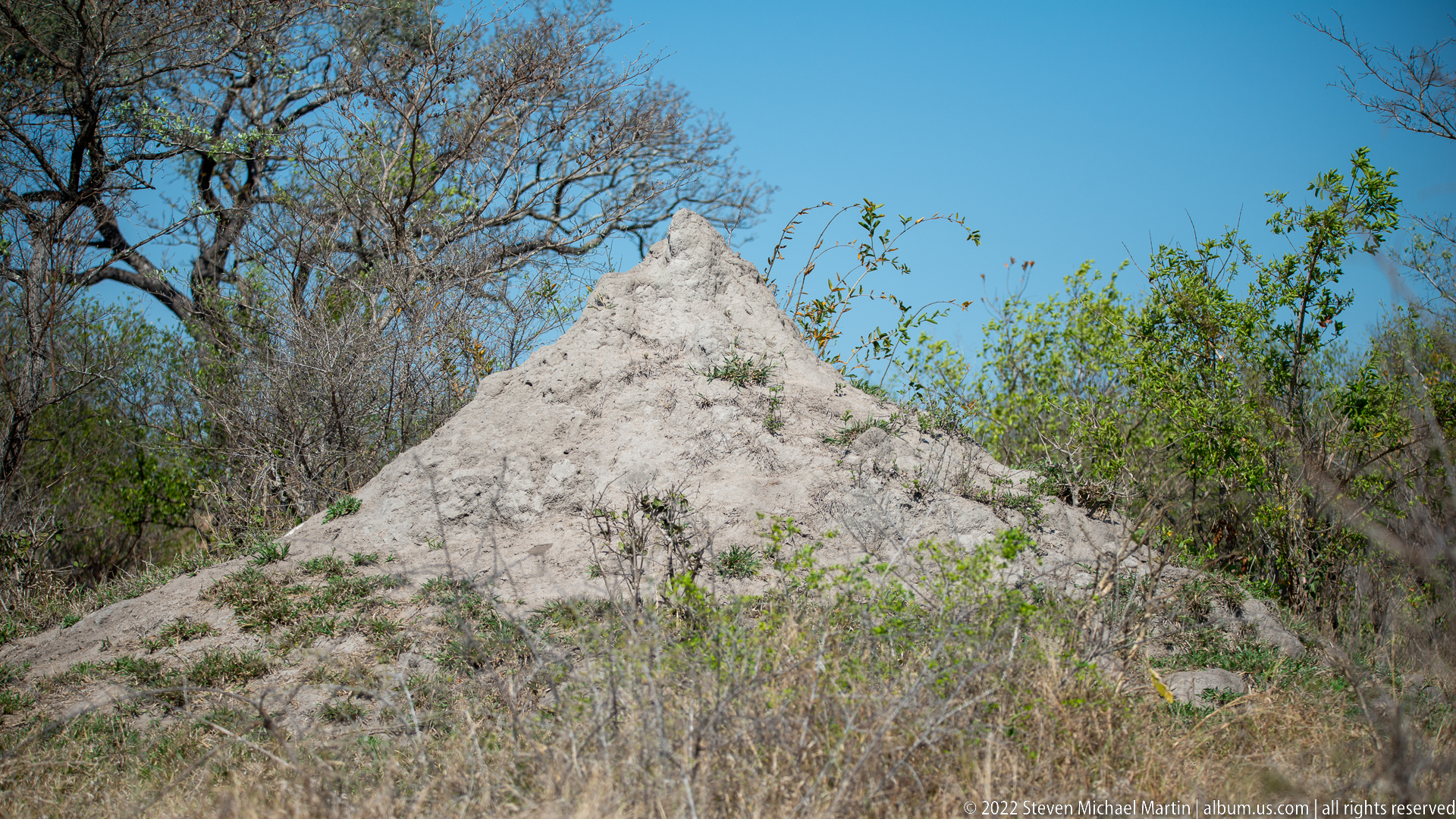
A large conical termite mound rises above low brush and dry grass beneath a clear blue sky. Built from reworked soil, such structures become conspicuous landscape features in the savanna and can alter drainage, vegetation, and habitat conditions immediately around them.
Caption
A large conical termite mound rises above low brush and dry grass beneath a clear blue sky. Built from reworked soil, such structures become conspicuous landscape features in the savanna and can alter drainage, vegetation, and habitat conditions immediately around them.
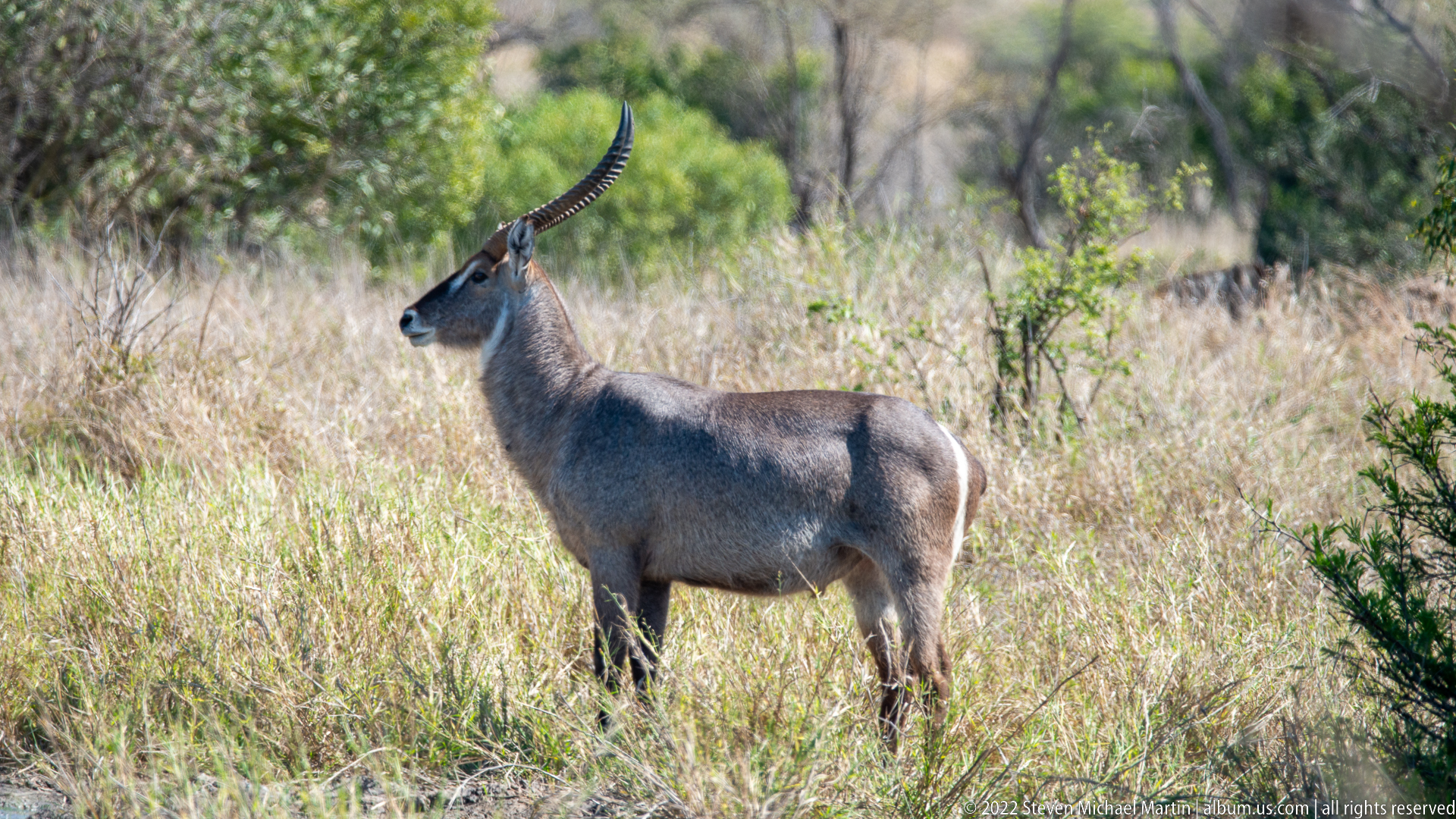
A male waterbuck stands in profile in tall grass, its long, ringed horns sweeping upward and slightly forward. The shaggy gray-brown coat and sturdy body distinguish it from the more lightly built impala, while the sunlit grassland setting places the antelope in typical savanna-edge habitat.
Caption
A male waterbuck stands in profile in tall grass, its long, ringed horns sweeping upward and slightly forward. The shaggy gray-brown coat and sturdy body distinguish it from the more lightly built impala, while the sunlit grassland setting places the antelope in typical savanna-edge habitat.
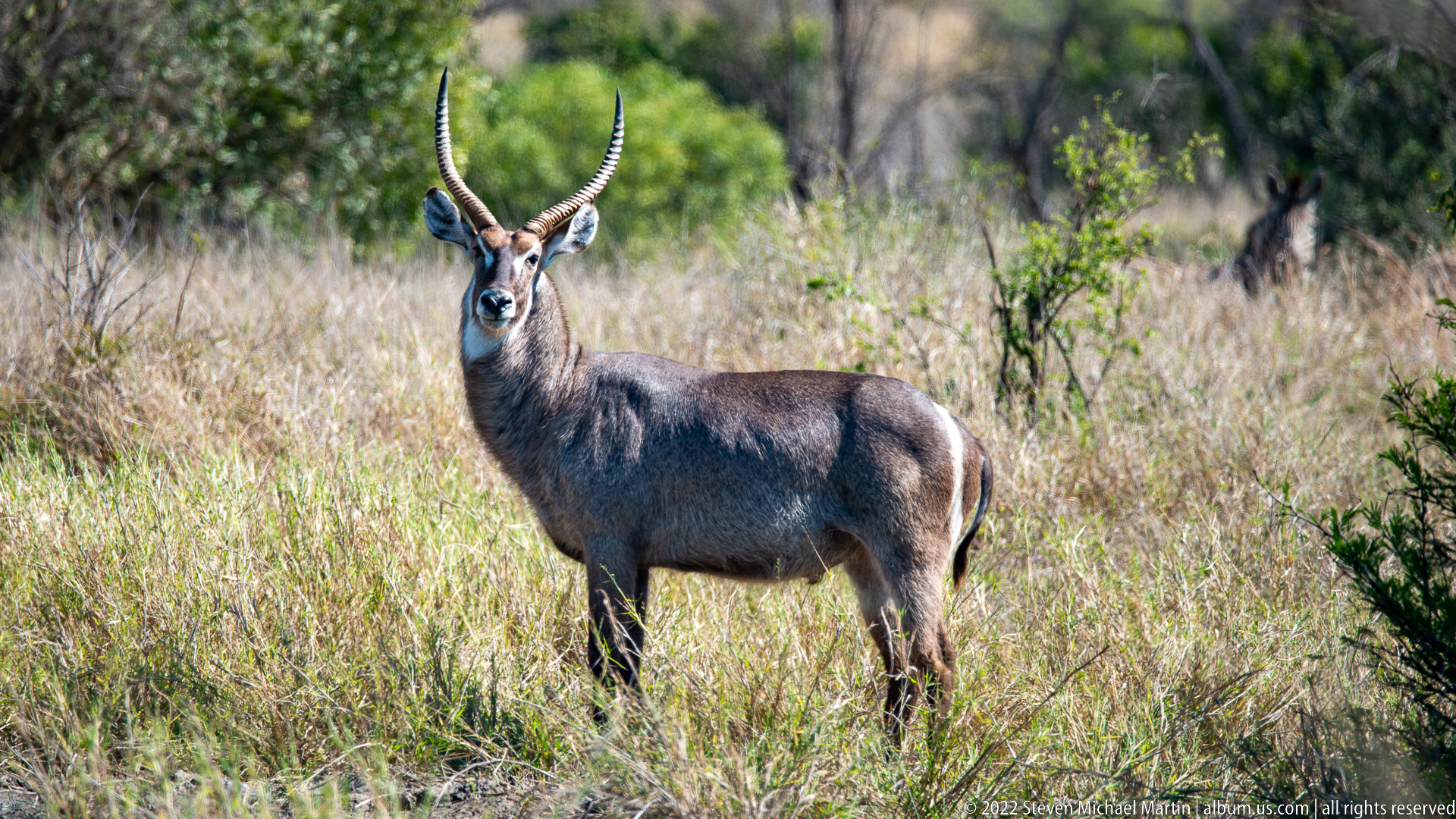
A male waterbuck turns toward the camera in a sunlit patch of grass, presenting a nearly frontal view of its symmetrical, ringed horns. The angle emphasizes the spacing and curvature of the horns as well as the animal's heavy neck and coarse gray-brown coat.
Caption
A male waterbuck turns toward the camera in a sunlit patch of grass, presenting a nearly frontal view of its symmetrical, ringed horns. The angle emphasizes the spacing and curvature of the horns as well as the animal's heavy neck and coarse gray-brown coat.
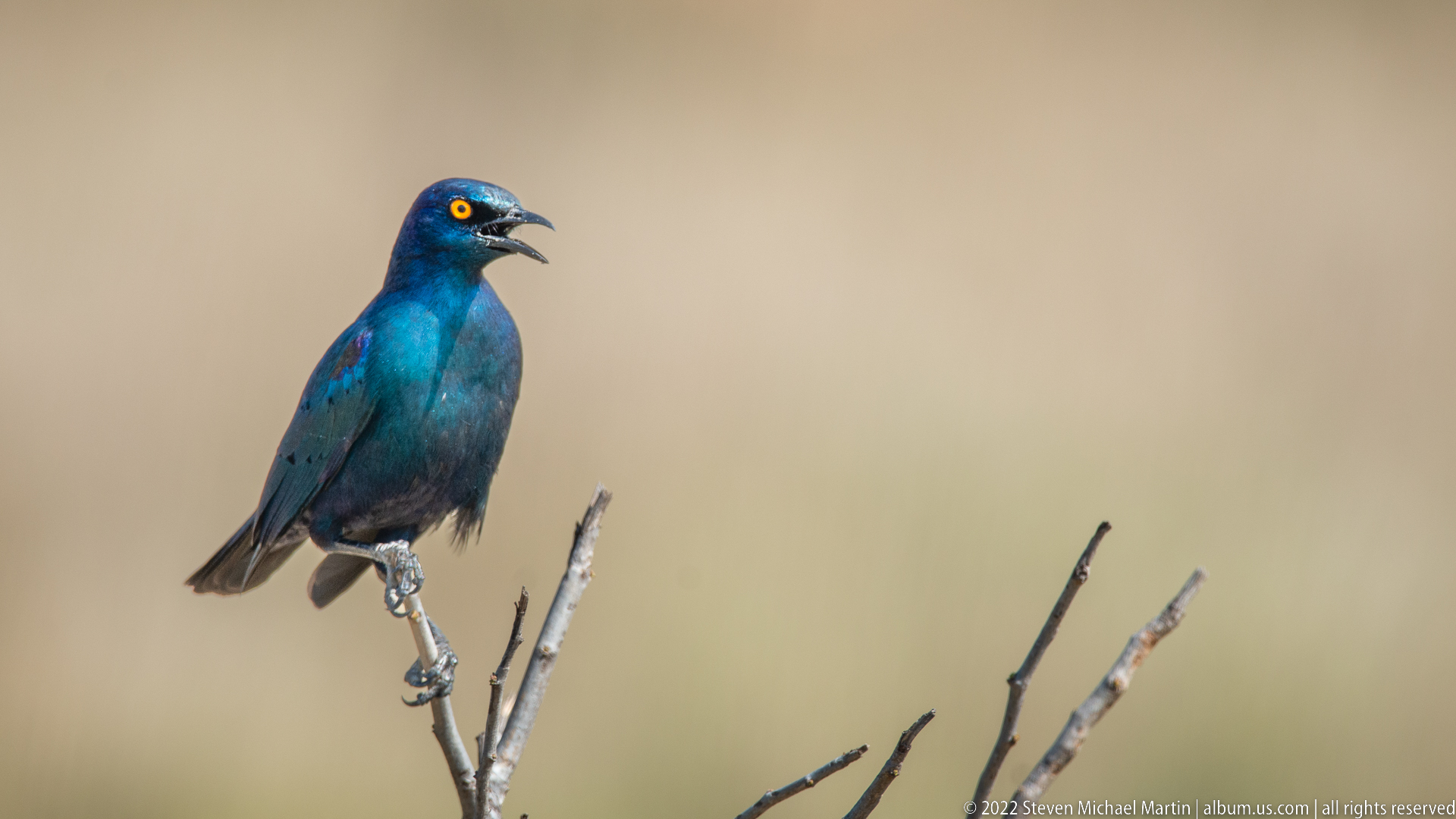
A glossy starling sits at the end of a bare twig, its blue-green iridescent plumage shifting in tone across the head, breast, and folded wings. The uncluttered background and close framing make the bird's brilliant structural coloration and bright eye the dominant features of the portrait.
Caption
A glossy starling sits at the end of a bare twig, its blue-green iridescent plumage shifting in tone across the head, breast, and folded wings. The uncluttered background and close framing make the bird's brilliant structural coloration and bright eye the dominant features of the portrait.
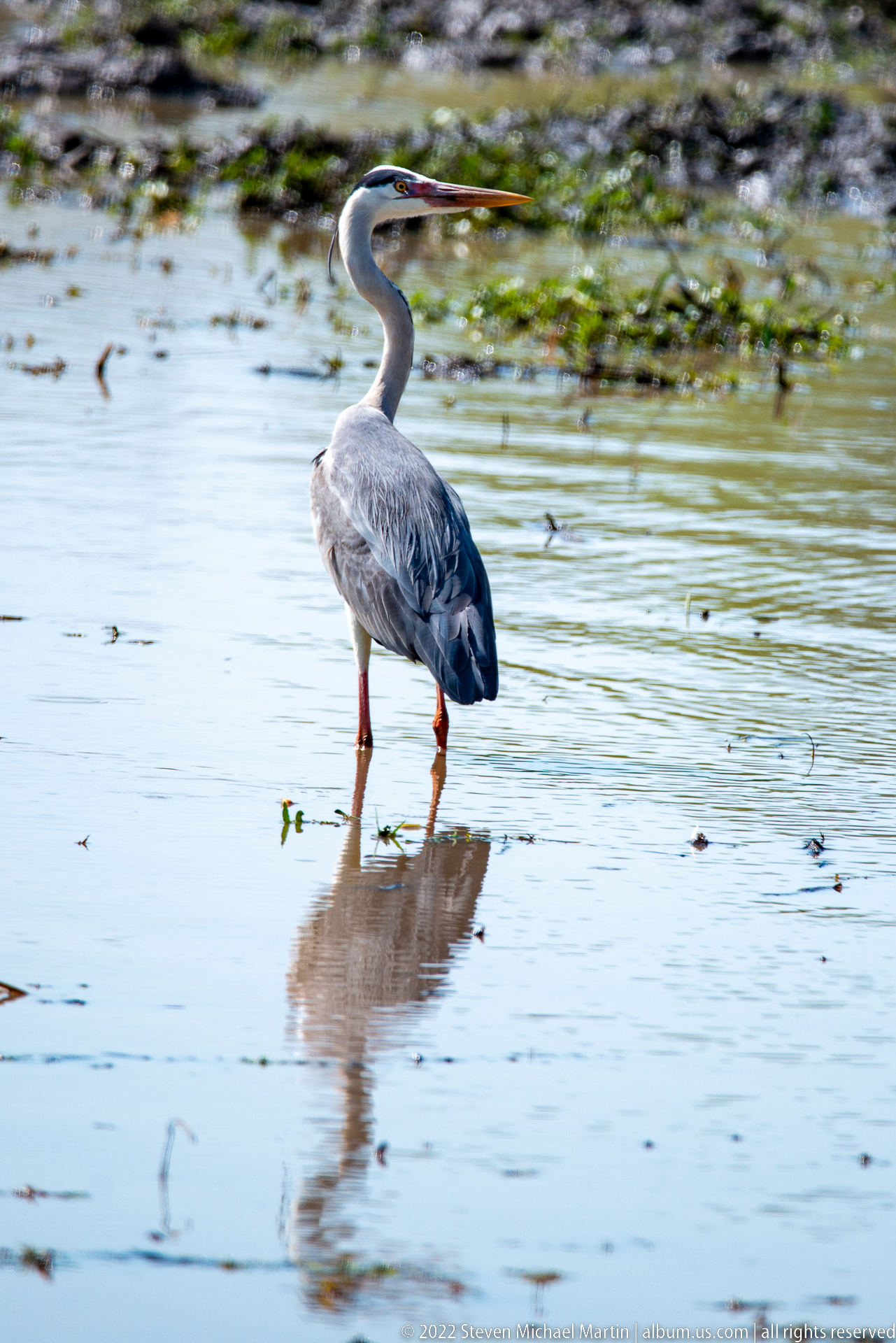
A grey heron stands in shallow water with its long bill held level and its reflection broken by gentle ripples. Gray wings, a pale neck, black head stripe, and long reddish legs are visible as the bird pauses in a classic hunting posture along the wetland margin.
Caption
A grey heron stands in shallow water with its long bill held level and its reflection broken by gentle ripples. Gray wings, a pale neck, black head stripe, and long reddish legs are visible as the bird pauses in a classic hunting posture along the wetland margin.
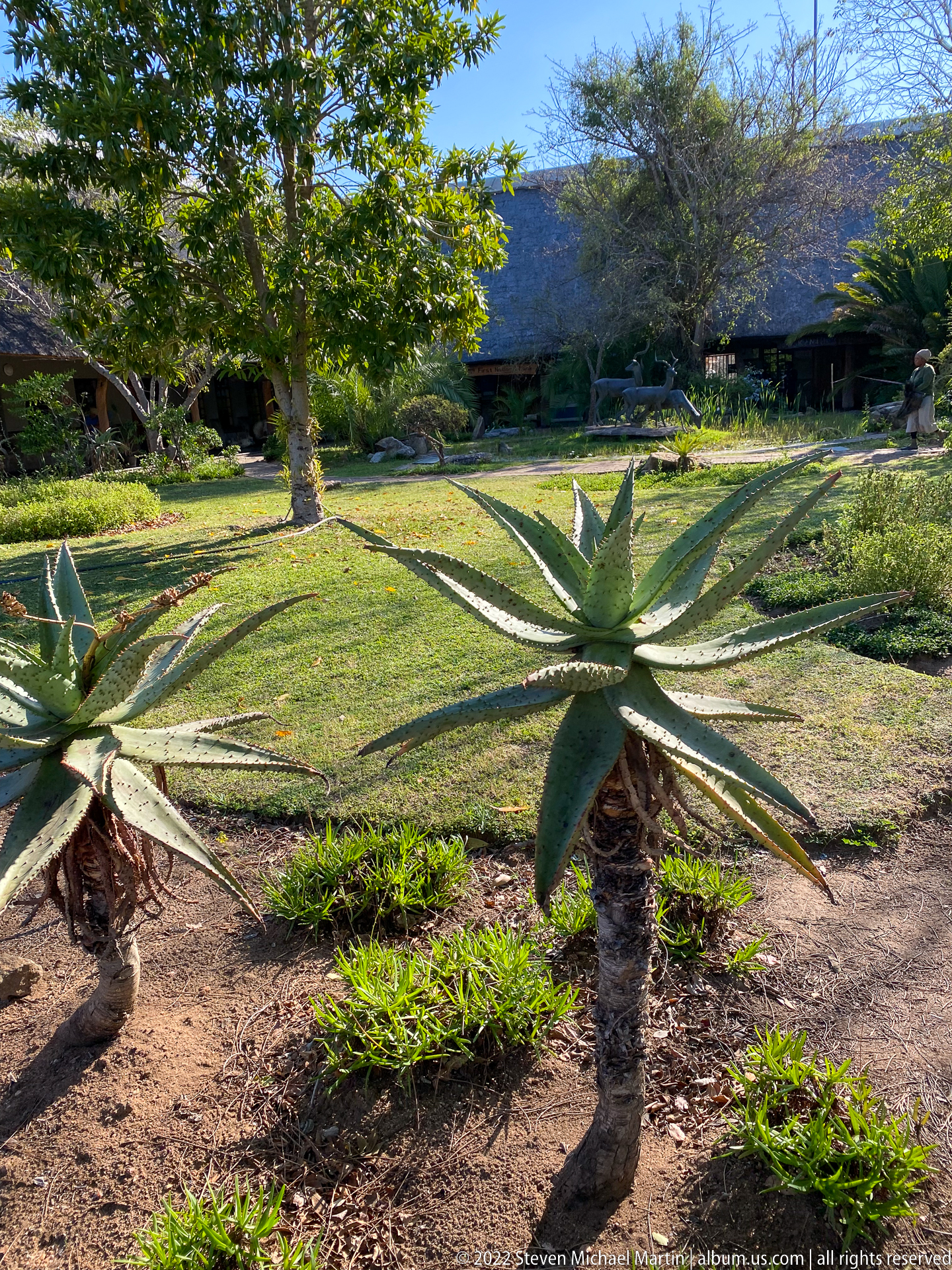
Large agave-like succulents form dramatic rosettes in a neatly maintained lawn near camp buildings. Their thick, pointed leaves contrast with the clipped grass and shade trees, documenting the landscaped side of Skukuza alongside the portfolio's surrounding views of wild savanna and river habitat.
Caption
Large agave-like succulents form dramatic rosettes in a neatly maintained lawn near camp buildings. Their thick, pointed leaves contrast with the clipped grass and shade trees, documenting the landscaped side of Skukuza alongside the portfolio's surrounding views of wild savanna and river habitat.
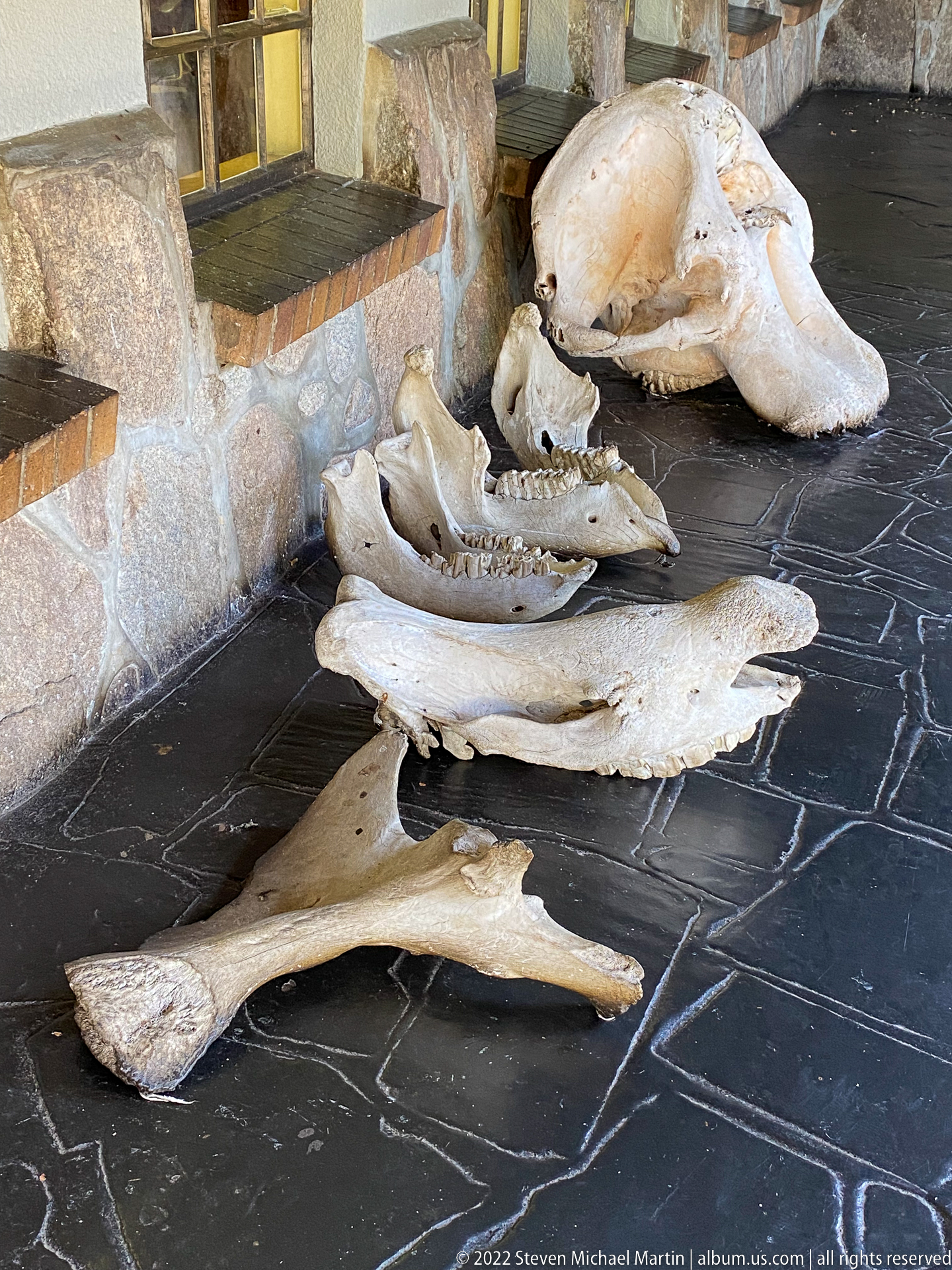
A collection of large mammal bones is arranged on a dark floor beside a stone wall, including a massive skull, lower jaw, broad scapula, and long limb bones. The scale and robust proportions suggest a very large African ungulate or elephant-sized animal, but the display lacks visible labels in this view.
Caption
A collection of large mammal bones is arranged on a dark floor beside a stone wall, including a massive skull, lower jaw, broad scapula, and long limb bones. The scale and robust proportions suggest a very large African ungulate or elephant-sized animal, but the display lacks visible labels in this view.
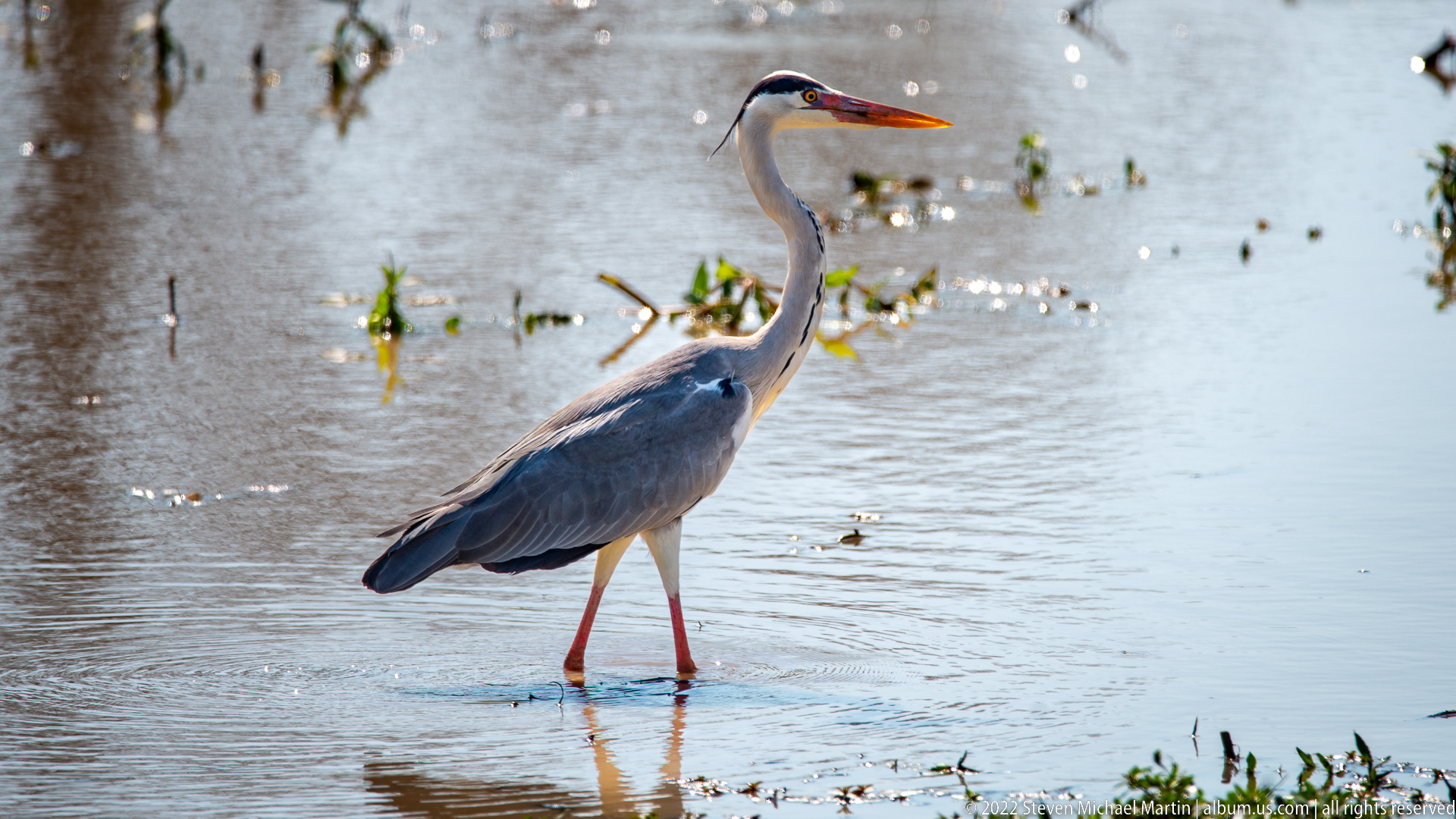
A grey heron stands motionless in sunlit shallows, its long legs partly submerged and its body reflected on the water's surface. The full-body view shows the species' elegant hunting posture, with an extended neck, dagger-like bill, slate-gray wings, and contrasting black-and-white head pattern.
Caption
A grey heron stands motionless in sunlit shallows, its long legs partly submerged and its body reflected on the water's surface. The full-body view shows the species' elegant hunting posture, with an extended neck, dagger-like bill, slate-gray wings, and contrasting black-and-white head pattern.
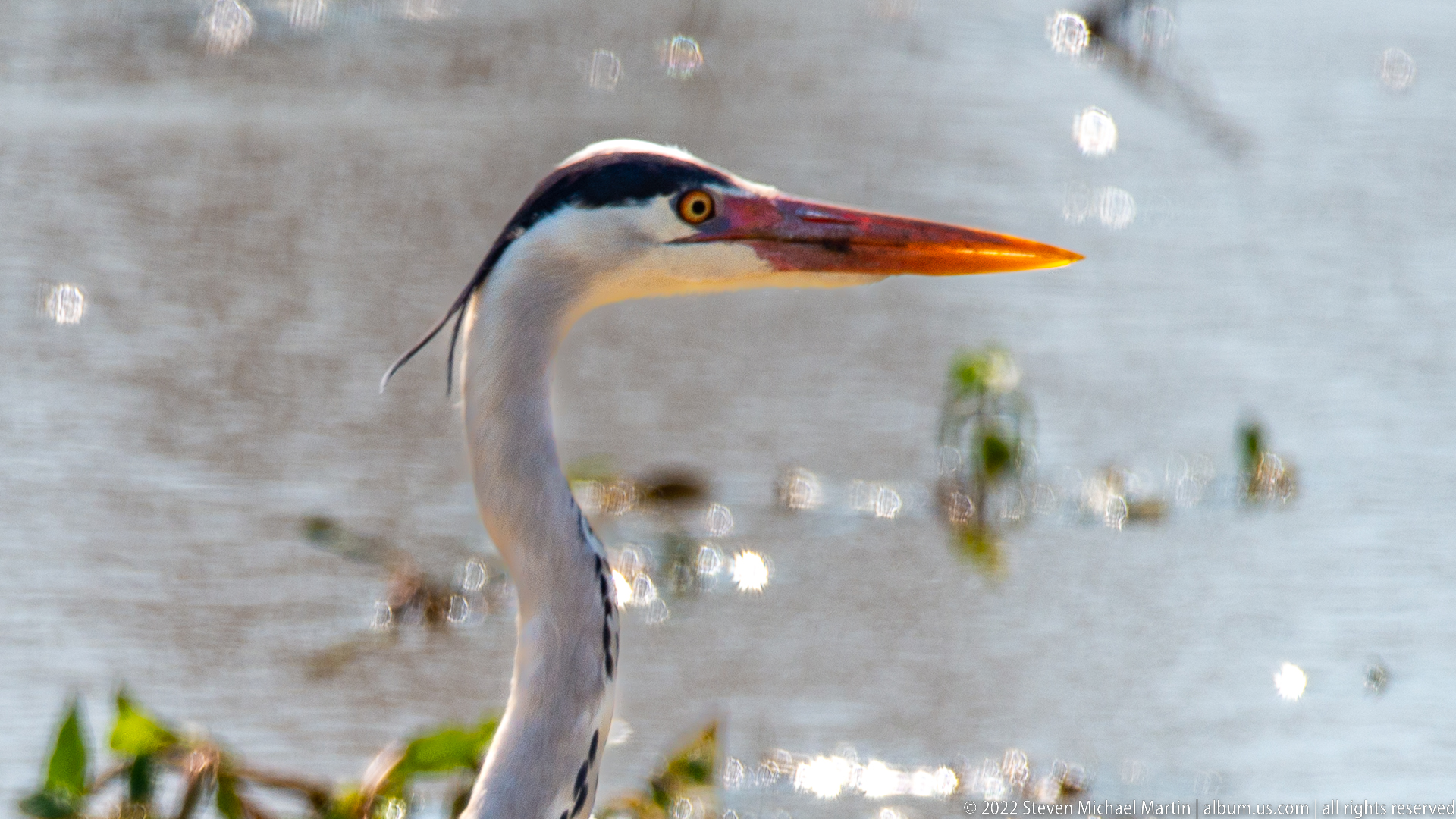
A tight profile isolates the head and upper neck of a grey heron against sparkling water. Fine facial details are visible: the black crown stripe and trailing plume, pale face, yellow eye, and long orange-red bill adapted for striking at fish and other aquatic prey.
Caption
A tight profile isolates the head and upper neck of a grey heron against sparkling water. Fine facial details are visible: the black crown stripe and trailing plume, pale face, yellow eye, and long orange-red bill adapted for striking at fish and other aquatic prey.
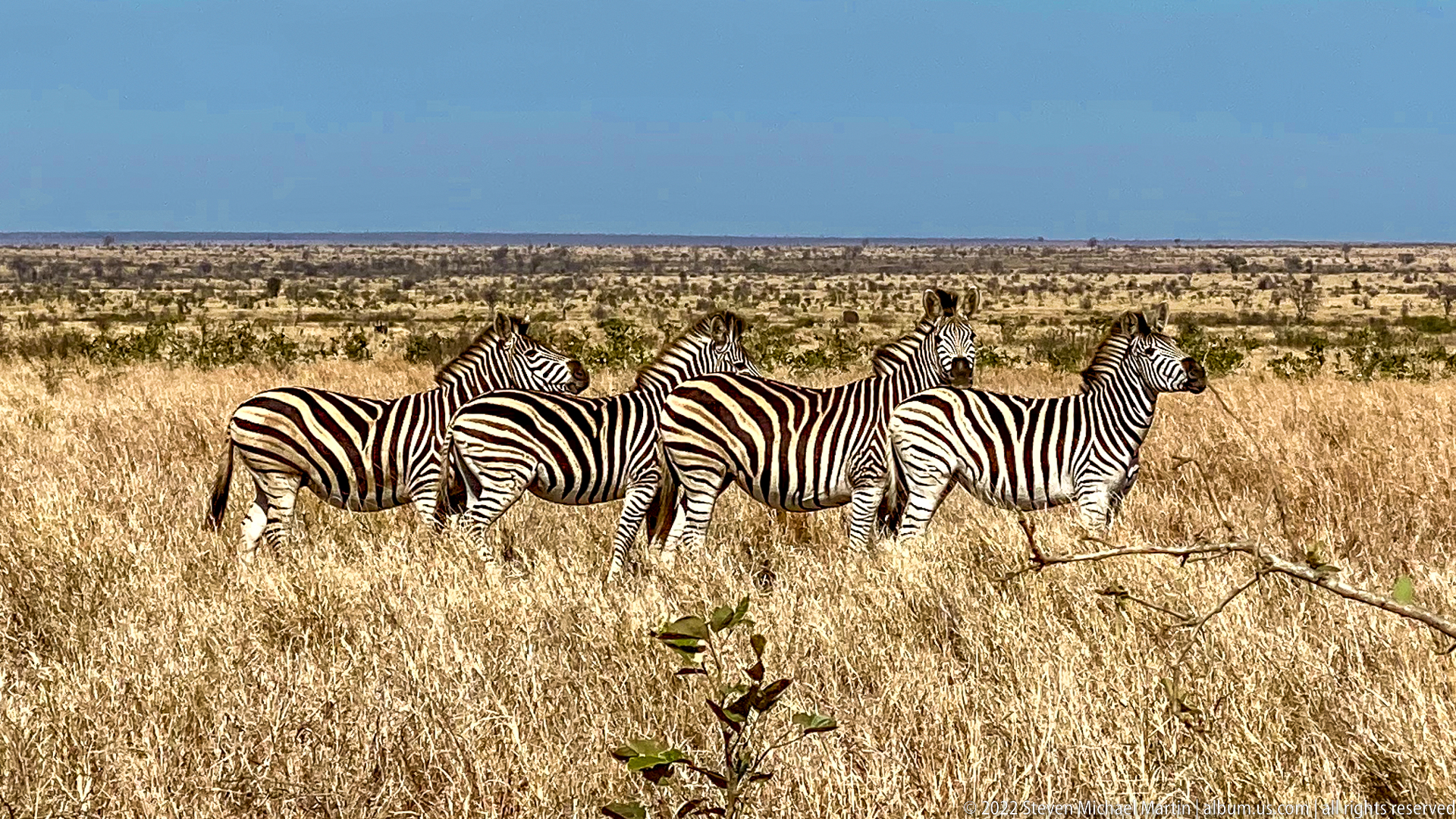
A small herd of plains zebras stands closely grouped in dry grassland, their black-and-white striping overlapping into a dense pattern. The animals face different directions, a formation that also provides multiple lines of sight across the open savanna while keeping the group compact.
Caption
A small herd of plains zebras stands closely grouped in dry grassland, their black-and-white striping overlapping into a dense pattern. The animals face different directions, a formation that also provides multiple lines of sight across the open savanna while keeping the group compact.
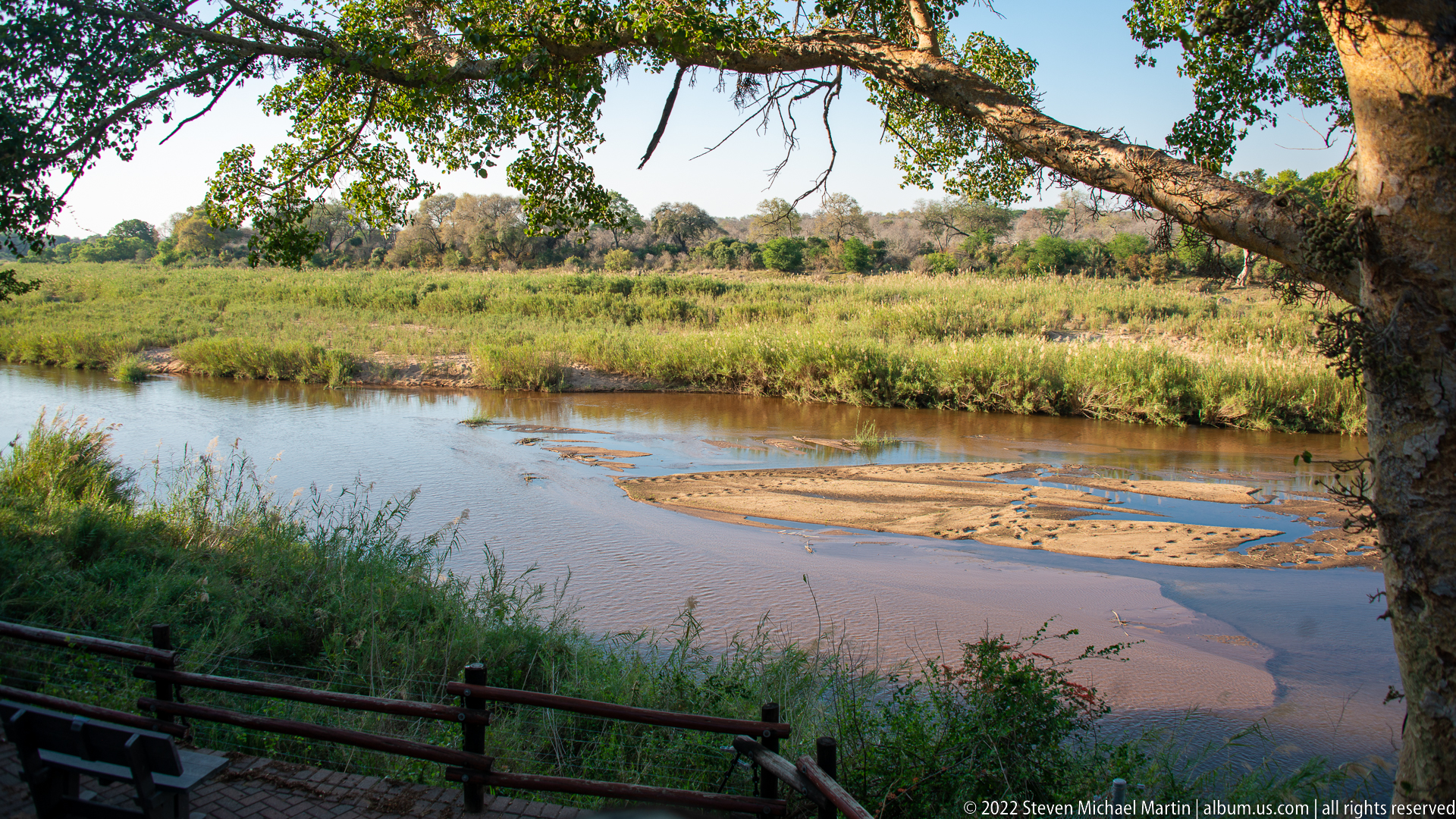
Shallow channels wind around exposed sandbars in the Sabie River below Skukuza's shaded riverbank. The view highlights the river's changing low-water structure, where open sand, slow-moving water, and dense green margins create contrasting habitats within a compact stretch of the channel.
Caption
Shallow channels wind around exposed sandbars in the Sabie River below Skukuza's shaded riverbank. The view highlights the river's changing low-water structure, where open sand, slow-moving water, and dense green margins create contrasting habitats within a compact stretch of the channel.
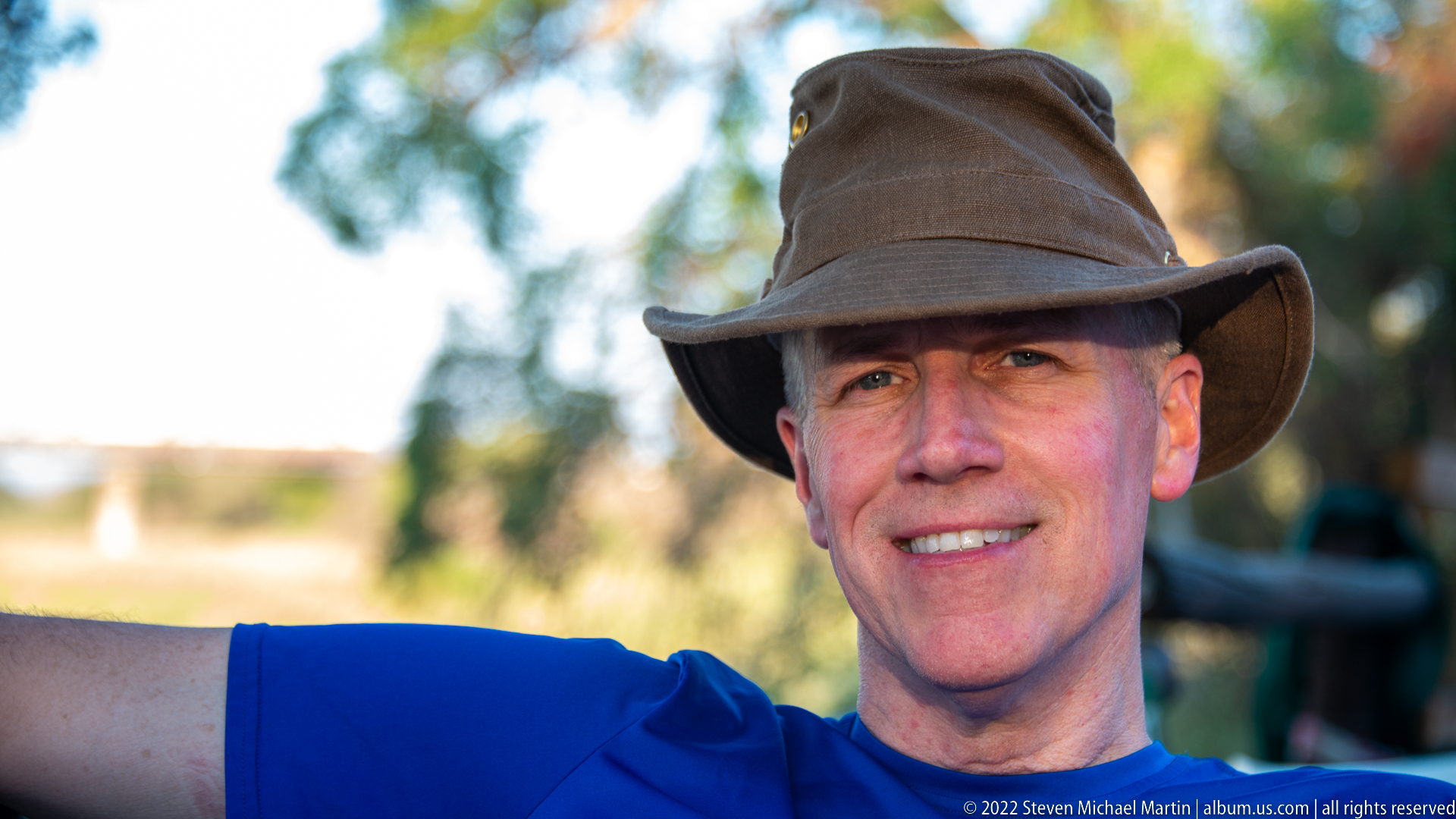
A close outdoor portrait shows a smiling traveler in a broad-brimmed hat and blue shirt, with the riverside setting softly blurred behind. The shallow depth of field separates the face from the background and gives the sequence a personal counterpoint to its surrounding wildlife and landscape photographs.
Caption
A close outdoor portrait shows a smiling traveler in a broad-brimmed hat and blue shirt, with the riverside setting softly blurred behind. The shallow depth of field separates the face from the background and gives the sequence a personal counterpoint to its surrounding wildlife and landscape photographs.
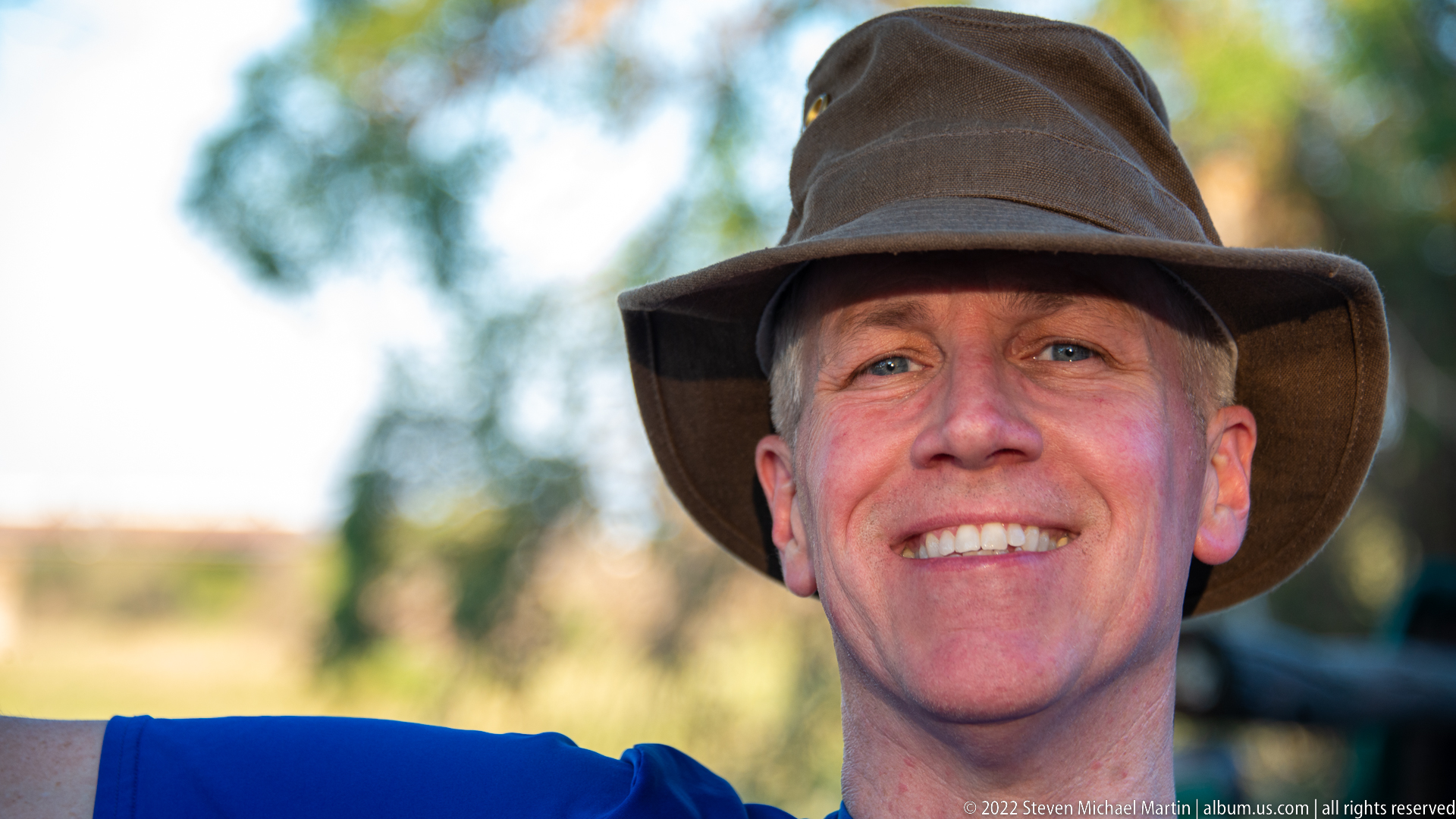
A tighter smiling portrait fills the frame with the traveler's face beneath a soft brown safari hat. Warm side light and a blurred green background create an informal, candid character, while the framing emphasizes expression rather than the broader camp environment visible in the neighboring portrait.
Caption
A tighter smiling portrait fills the frame with the traveler's face beneath a soft brown safari hat. Warm side light and a blurred green background create an informal, candid character, while the framing emphasizes expression rather than the broader camp environment visible in the neighboring portrait.
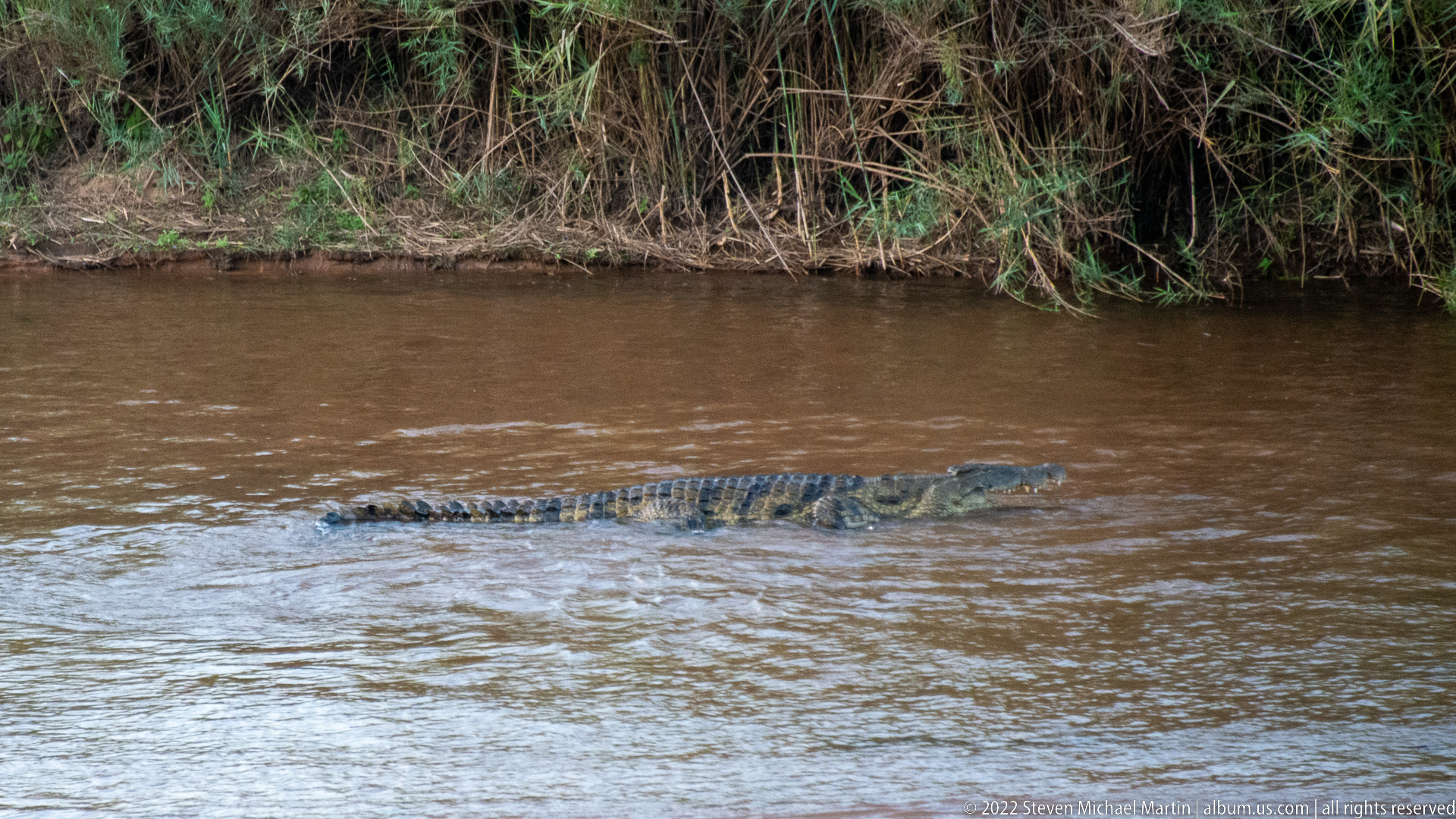
A Nile crocodile glides through brown river water with only its armored back, eyes, and upper snout breaking the surface. The low profile reveals the species' stealthy aquatic posture, allowing most of the body to remain submerged while the animal surveys the channel ahead.
Caption
A Nile crocodile glides through brown river water with only its armored back, eyes, and upper snout breaking the surface. The low profile reveals the species' stealthy aquatic posture, allowing most of the body to remain submerged while the animal surveys the channel ahead.
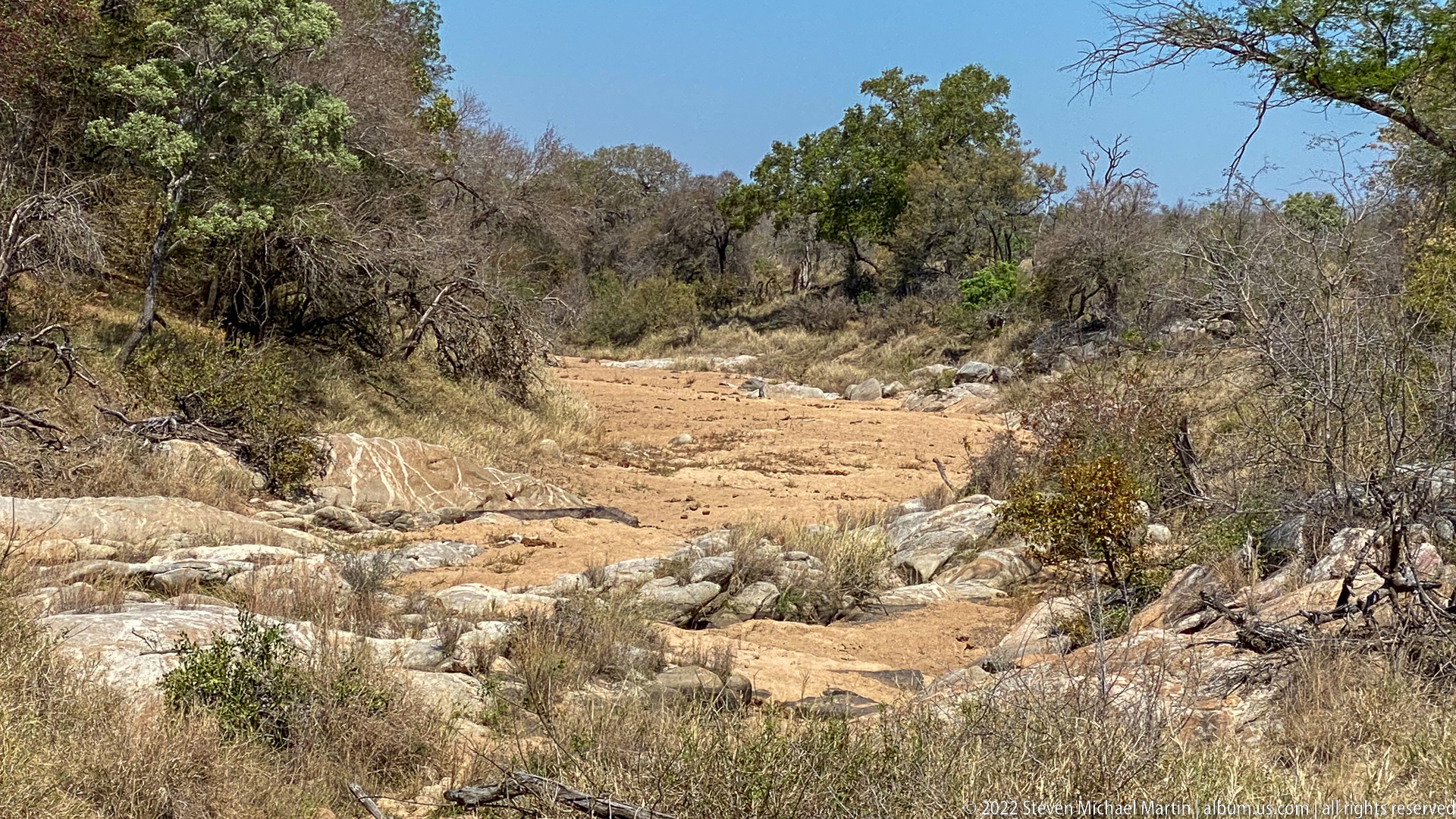
A seasonally dry rocky drainage cuts through low woodland, its exposed bed formed by pale bedrock, stones, and patches of sandy sediment. Sparse shrubs and leafless branches reinforce the dry-season character of the scene and show how ephemeral watercourses remain visible even when surface flow has disappeared.
Caption
A seasonally dry rocky drainage cuts through low woodland, its exposed bed formed by pale bedrock, stones, and patches of sandy sediment. Sparse shrubs and leafless branches reinforce the dry-season character of the scene and show how ephemeral watercourses remain visible even when surface flow has disappeared.
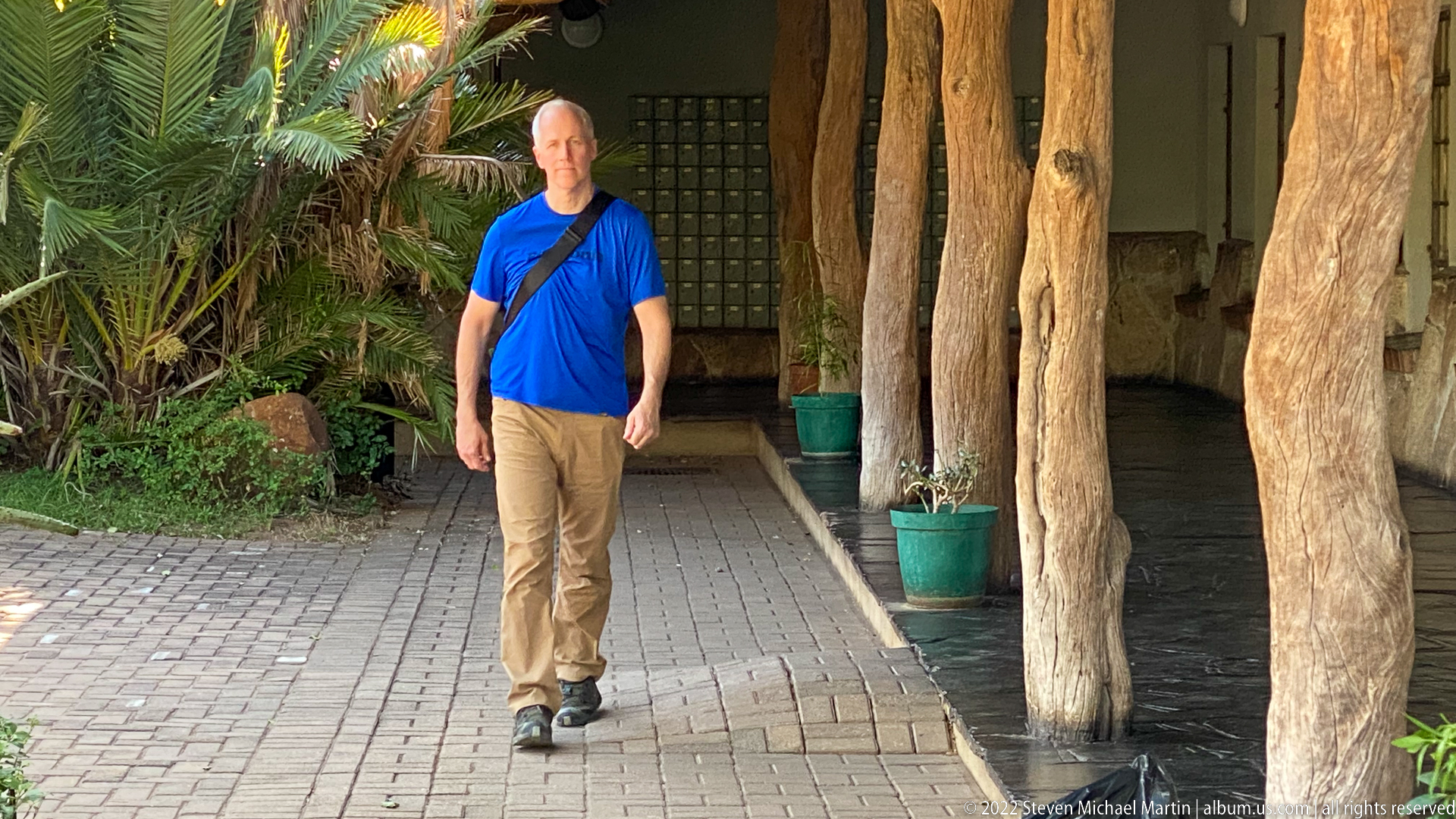
A traveler walks along a shaded paved walkway framed by rough timber posts and tropical-looking plantings at Skukuza. The informal camp setting contrasts with the portfolio's wildlife encounters, showing the built environment from which visitors explore this part of Kruger National Park.
Caption
A traveler walks along a shaded paved walkway framed by rough timber posts and tropical-looking plantings at Skukuza. The informal camp setting contrasts with the portfolio's wildlife encounters, showing the built environment from which visitors explore this part of Kruger National Park.
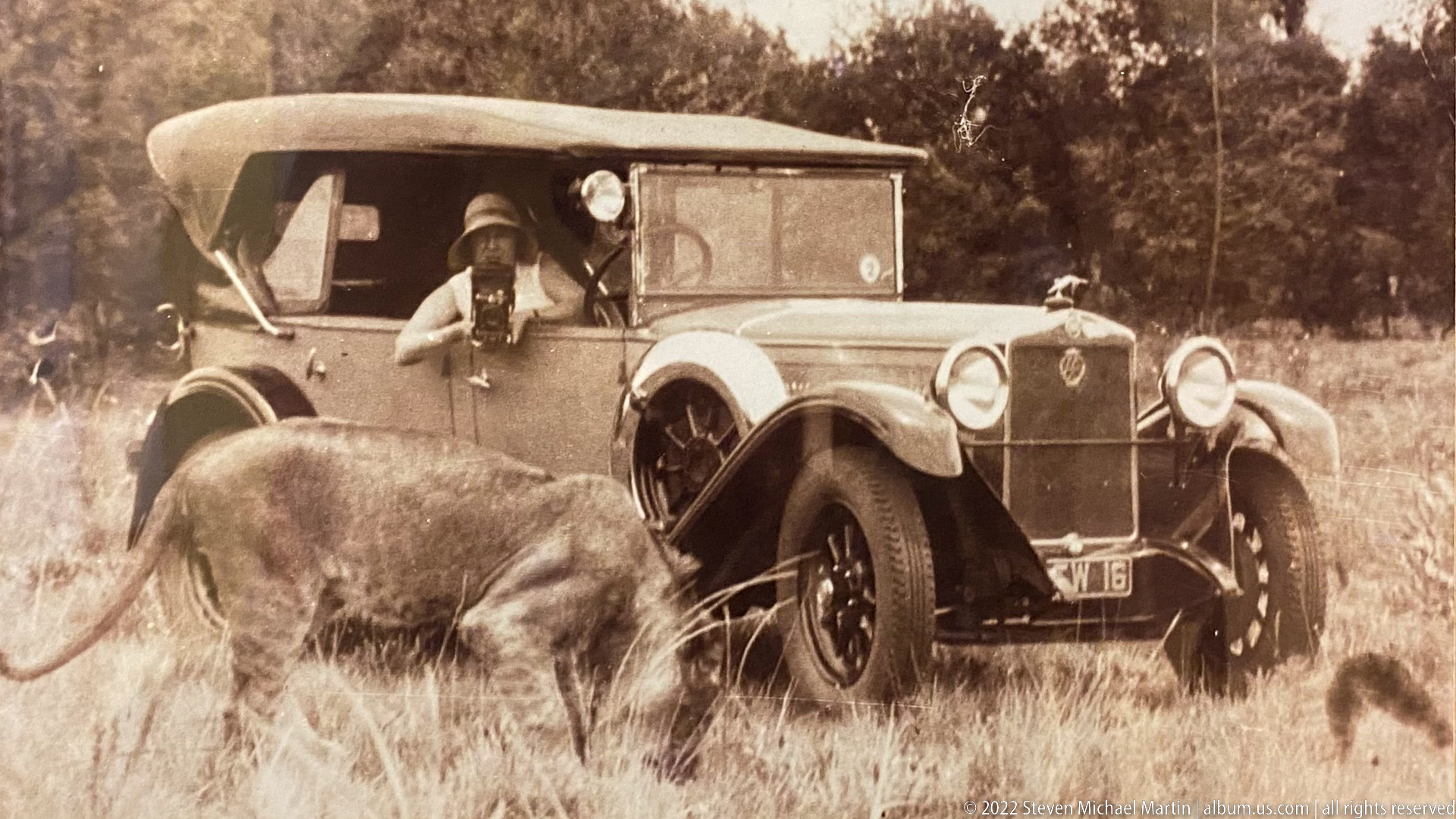
A sepia-toned historical photograph shows an early open motorcar stopped in grassland while a lion passes close to the vehicle. The scene evokes the early era of motor tourism and wildlife viewing in southern Africa, when automobiles began to transform access to protected landscapes.
Caption
A sepia-toned historical photograph shows an early open motorcar stopped in grassland while a lion passes close to the vehicle. The scene evokes the early era of motor tourism and wildlife viewing in southern Africa, when automobiles began to transform access to protected landscapes.
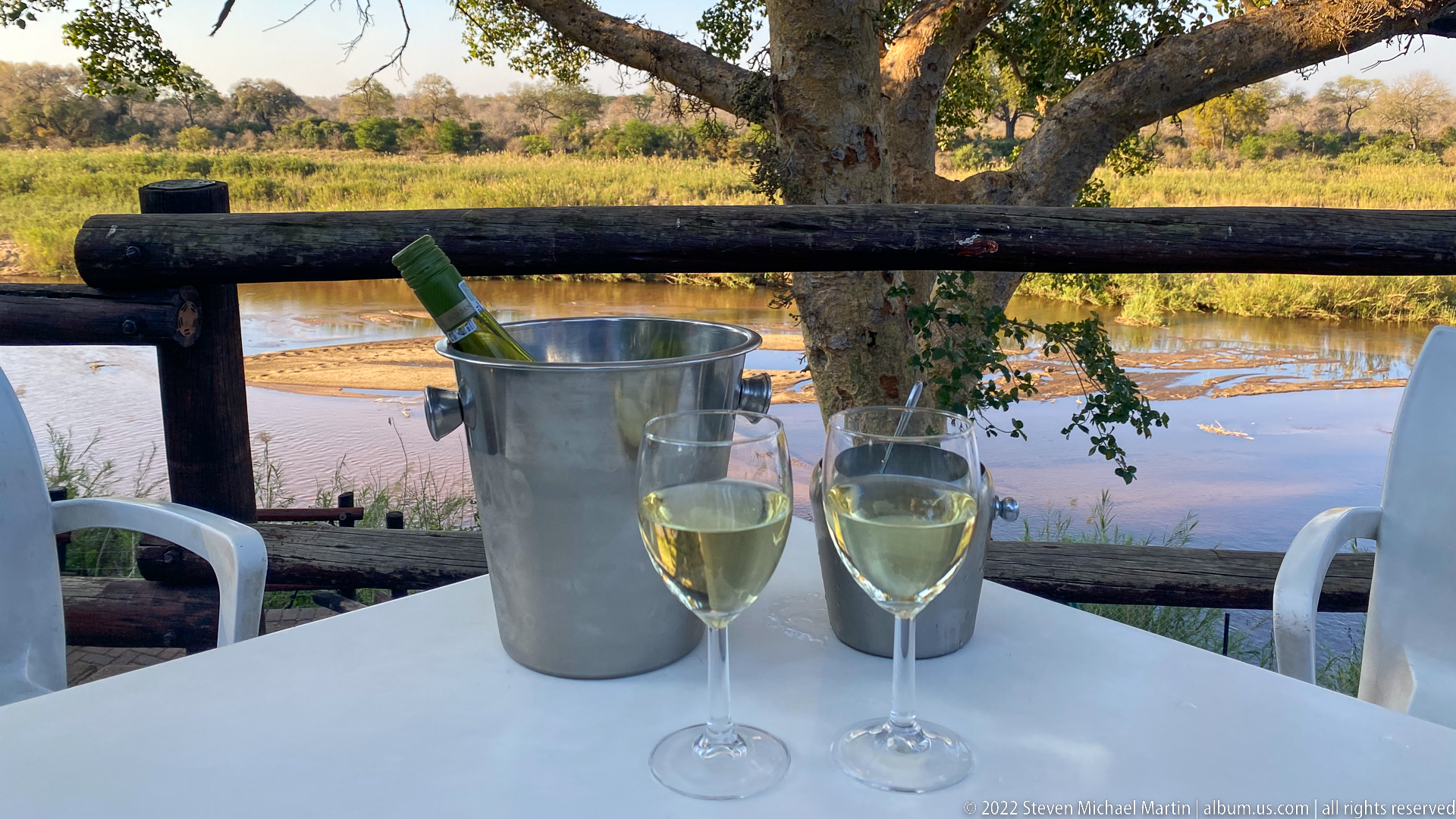
Two glasses of white wine and a chilled bottle sit on a table overlooking a river channel in warm late-day light. The foreground dining arrangement and the water, reeds, and large shade tree beyond create a distinctly riverside camp scene at Skukuza.
Caption
Two glasses of white wine and a chilled bottle sit on a table overlooking a river channel in warm late-day light. The foreground dining arrangement and the water, reeds, and large shade tree beyond create a distinctly riverside camp scene at Skukuza.
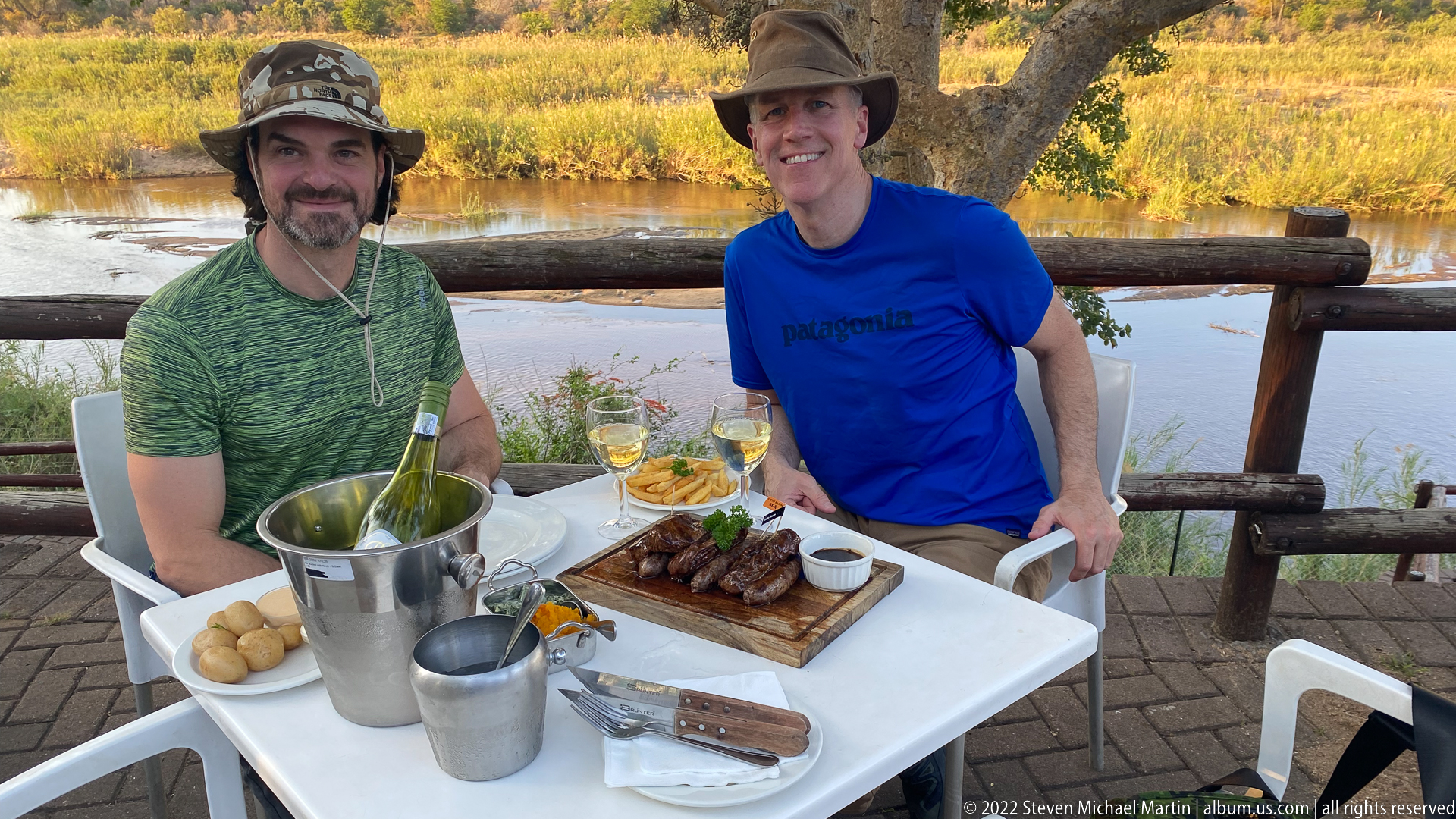
Two travelers pose beside an outdoor dinner table set with a mixed grill, wine, and an ice bucket, with the river glowing behind them in evening light. The scene combines the social side of safari travel with Skukuza's riverside setting and open-air dining atmosphere.
Caption
Two travelers pose beside an outdoor dinner table set with a mixed grill, wine, and an ice bucket, with the river glowing behind them in evening light. The scene combines the social side of safari travel with Skukuza's riverside setting and open-air dining atmosphere.
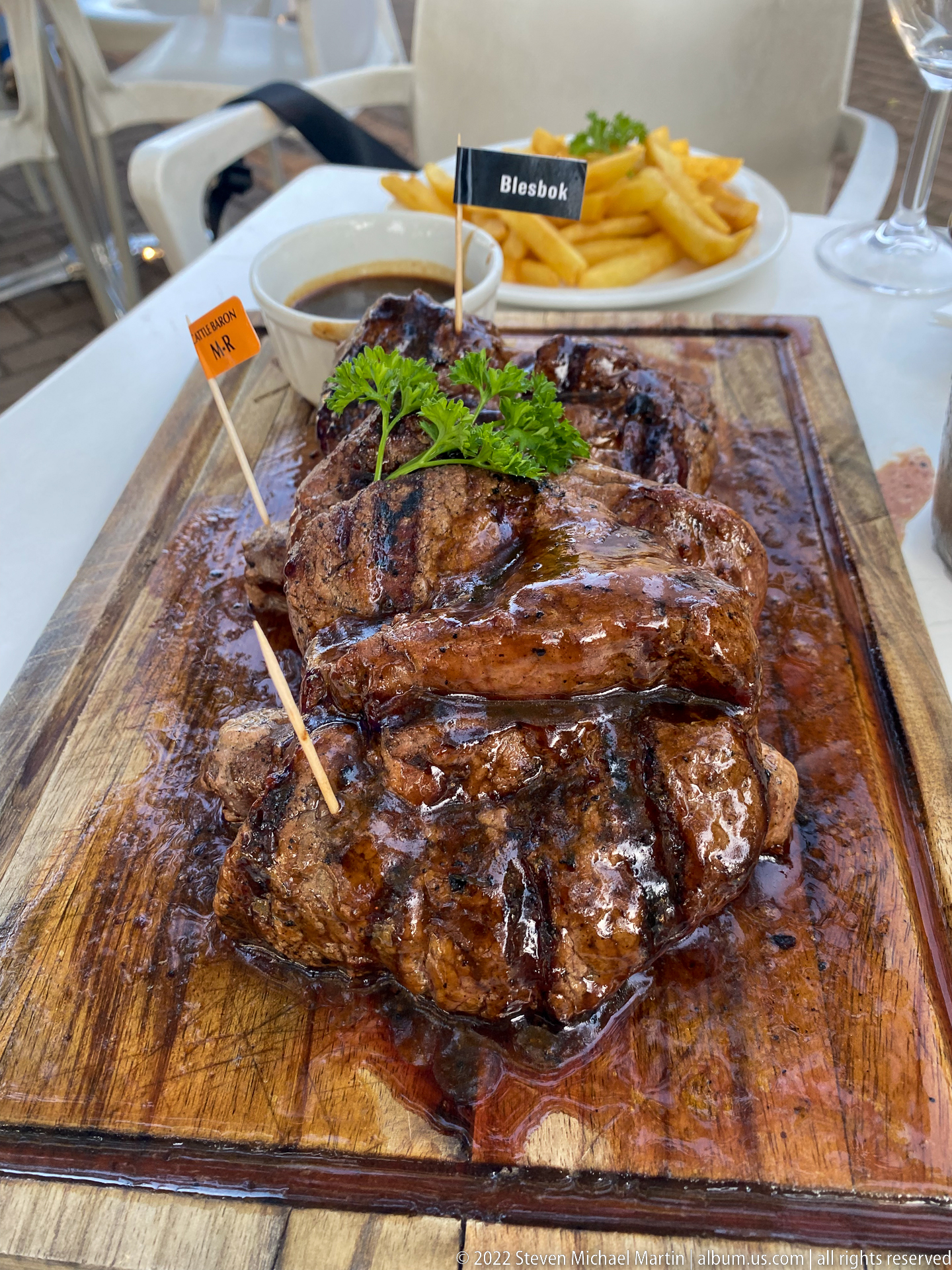
A generous mixed grill is served on a large wooden board, with several cuts of meat marked by small labeled flags and accompanied by fries and greens. The close food study records the dining experience at Skukuza without relying on labels that are too small to read confidently from the proof sheet.
Caption
A generous mixed grill is served on a large wooden board, with several cuts of meat marked by small labeled flags and accompanied by fries and greens. The close food study records the dining experience at Skukuza without relying on labels that are too small to read confidently from the proof sheet.
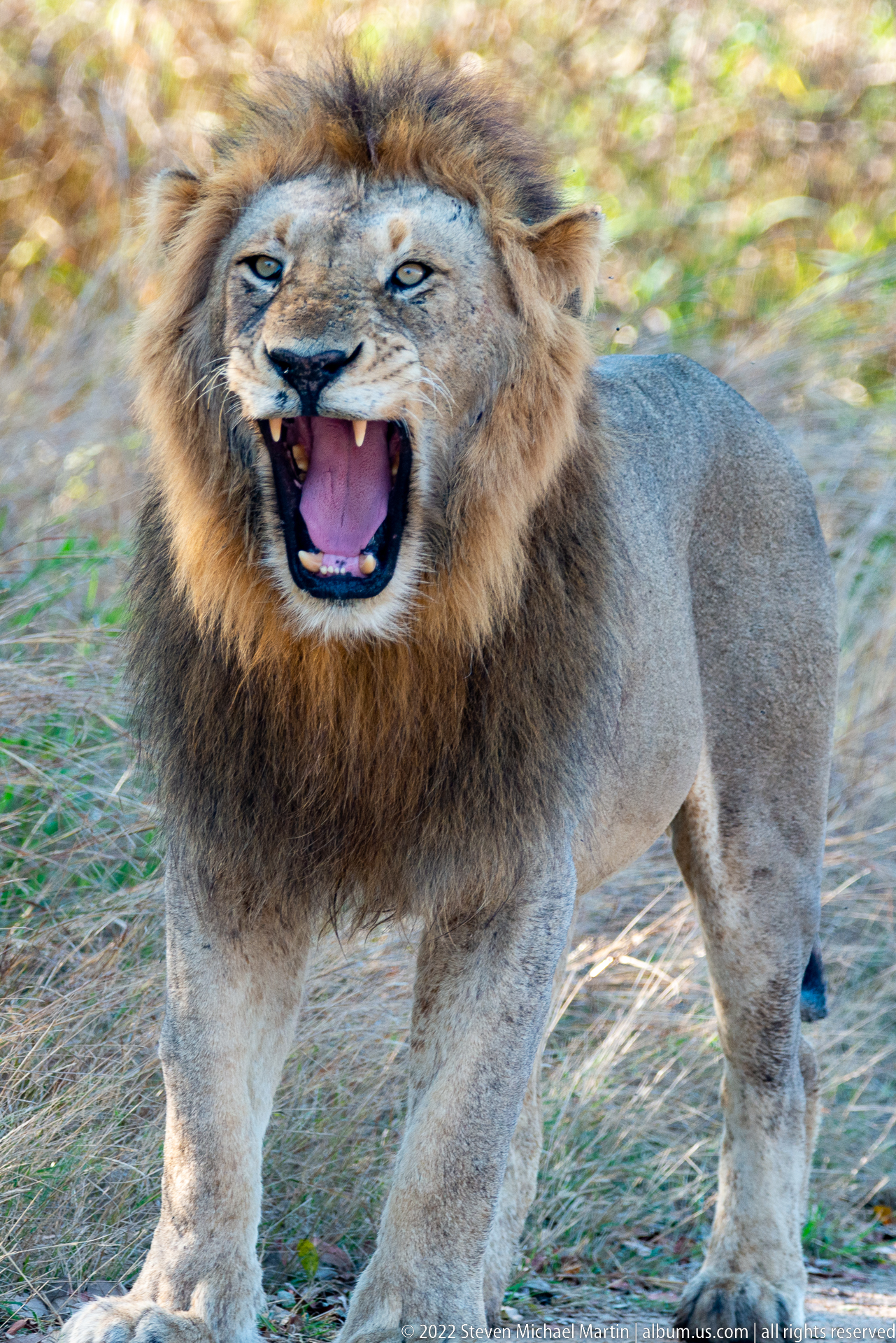
A dark-maned male lion raises his upper lip and opens his mouth, exposing large canines and the pink tongue in an intense facial display. The expression may relate to scent investigation or a brief snarl, but the photograph most securely records the exposed dentition, wrinkled muzzle, and powerful head of the adult male.
Caption
A dark-maned male lion raises his upper lip and opens his mouth, exposing large canines and the pink tongue in an intense facial display. The expression may relate to scent investigation or a brief snarl, but the photograph most securely records the exposed dentition, wrinkled muzzle, and powerful head of the adult male.
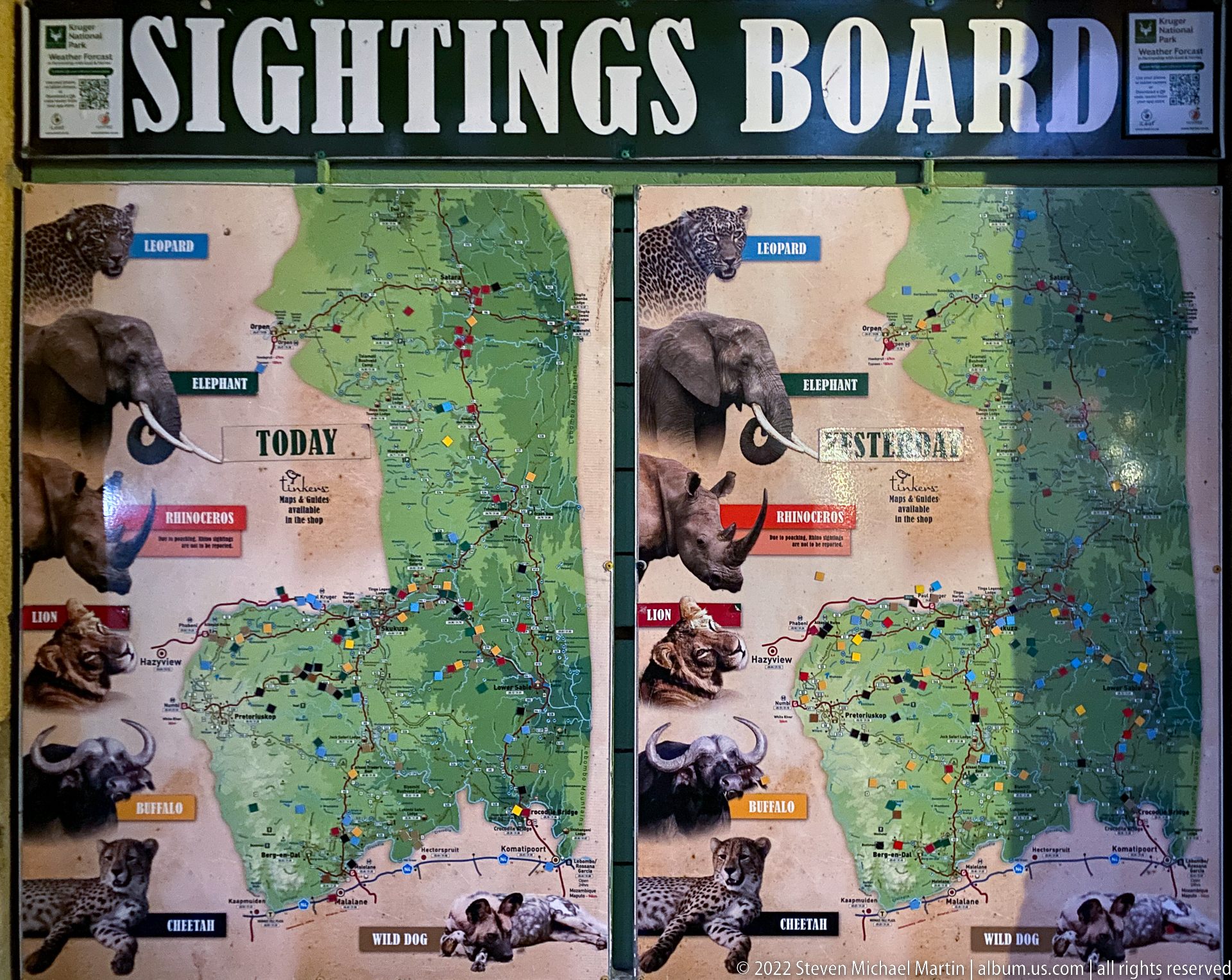
A wildlife sightings board presents two regional maps labeled for recent observations, with colored markers and illustrated reference images for species including leopard, elephant, rhinoceros, lion, buffalo, cheetah, and wild dog. Such boards help visitors compare reported locations while emphasizing that sightings remain temporary and unpredictable.
Caption
A wildlife sightings board presents two regional maps labeled for recent observations, with colored markers and illustrated reference images for species including leopard, elephant, rhinoceros, lion, buffalo, cheetah, and wild dog. Such boards help visitors compare reported locations while emphasizing that sightings remain temporary and unpredictable.
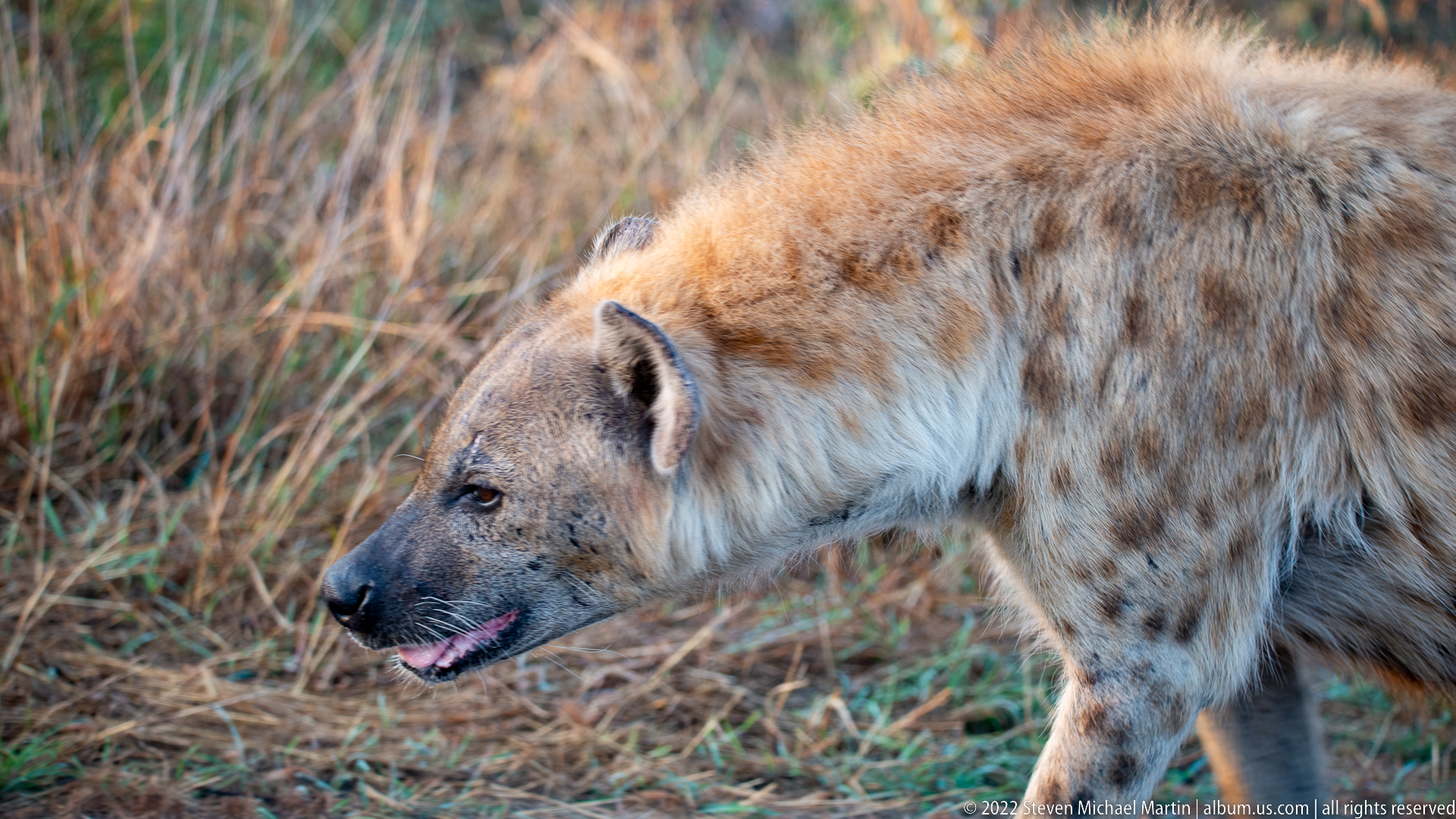
A spotted hyena walks through dry grass in profile, showing its sloping back, powerful forequarters, rounded ears, and mottled coat. The close view reveals the coarse fur and dark muzzle characteristic of this formidable scavenger and hunter of Kruger's savanna ecosystems.
Caption
A spotted hyena walks through dry grass in profile, showing its sloping back, powerful forequarters, rounded ears, and mottled coat. The close view reveals the coarse fur and dark muzzle characteristic of this formidable scavenger and hunter of Kruger's savanna ecosystems.
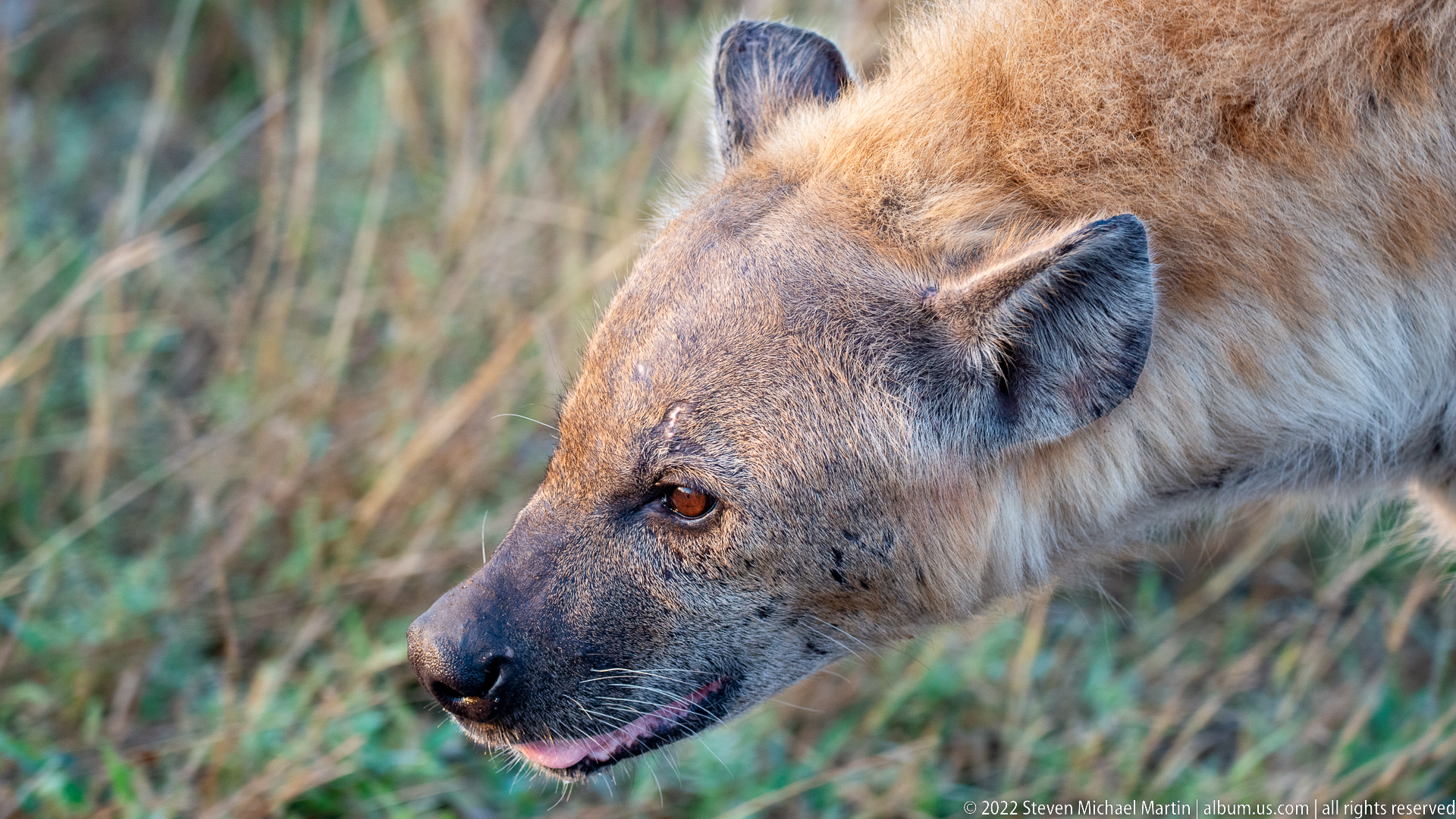
A tight portrait isolates the head and shoulders of a spotted hyena, bringing attention to the rounded ears, amber eye, dark muzzle, and coarse golden-gray fur. The shallow depth of field separates the animal from the grass and gives a detailed view of its facial structure.
Caption
A tight portrait isolates the head and shoulders of a spotted hyena, bringing attention to the rounded ears, amber eye, dark muzzle, and coarse golden-gray fur. The shallow depth of field separates the animal from the grass and gives a detailed view of its facial structure.
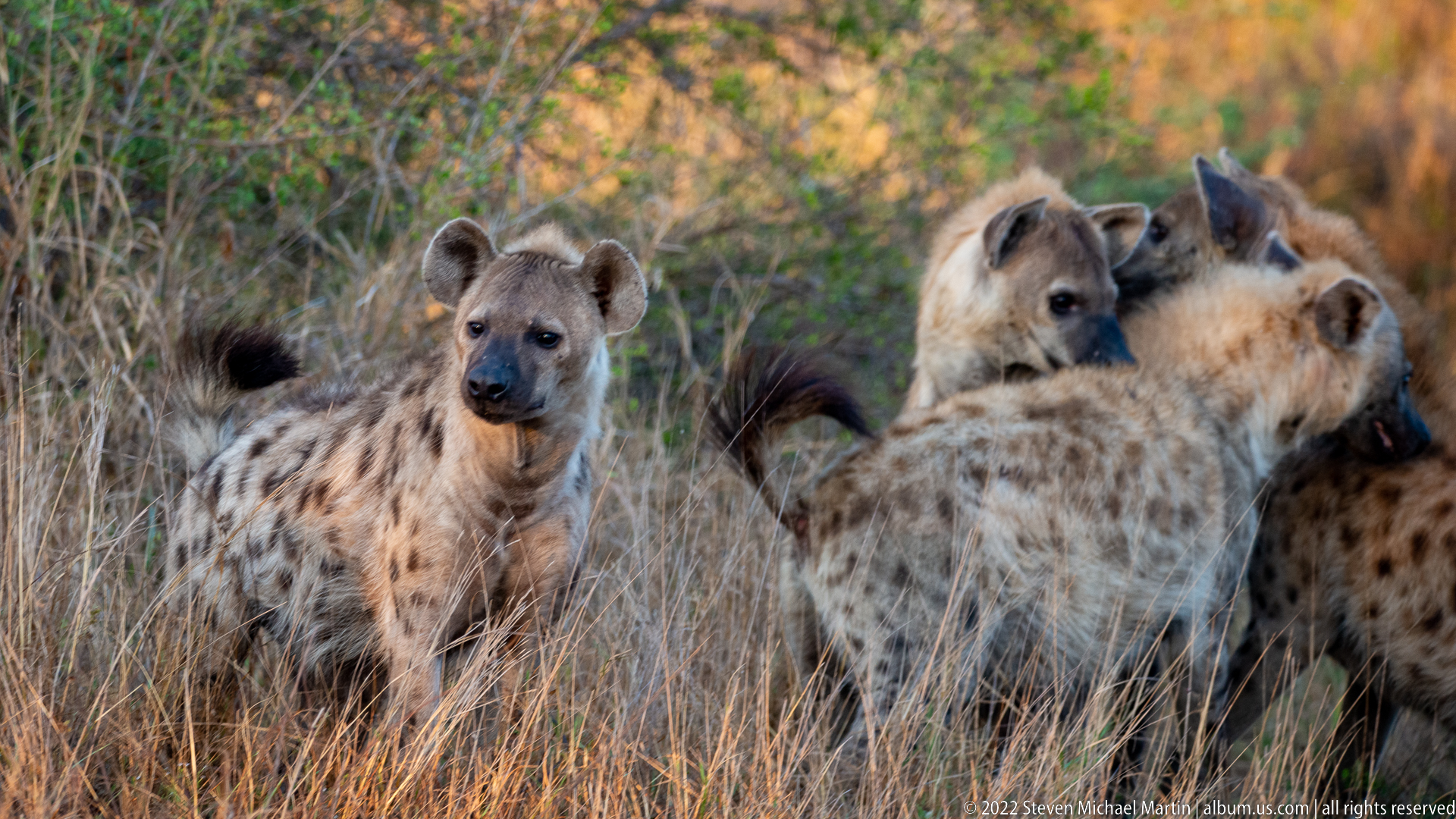
Several spotted hyenas cluster in dry grass, with one animal facing the camera while others turn and overlap behind it. The group composition conveys the social nature of the species and provides contrasting views of facial markings, spotted coats, and bushy dark-tipped tails.
Caption
Several spotted hyenas cluster in dry grass, with one animal facing the camera while others turn and overlap behind it. The group composition conveys the social nature of the species and provides contrasting views of facial markings, spotted coats, and bushy dark-tipped tails.
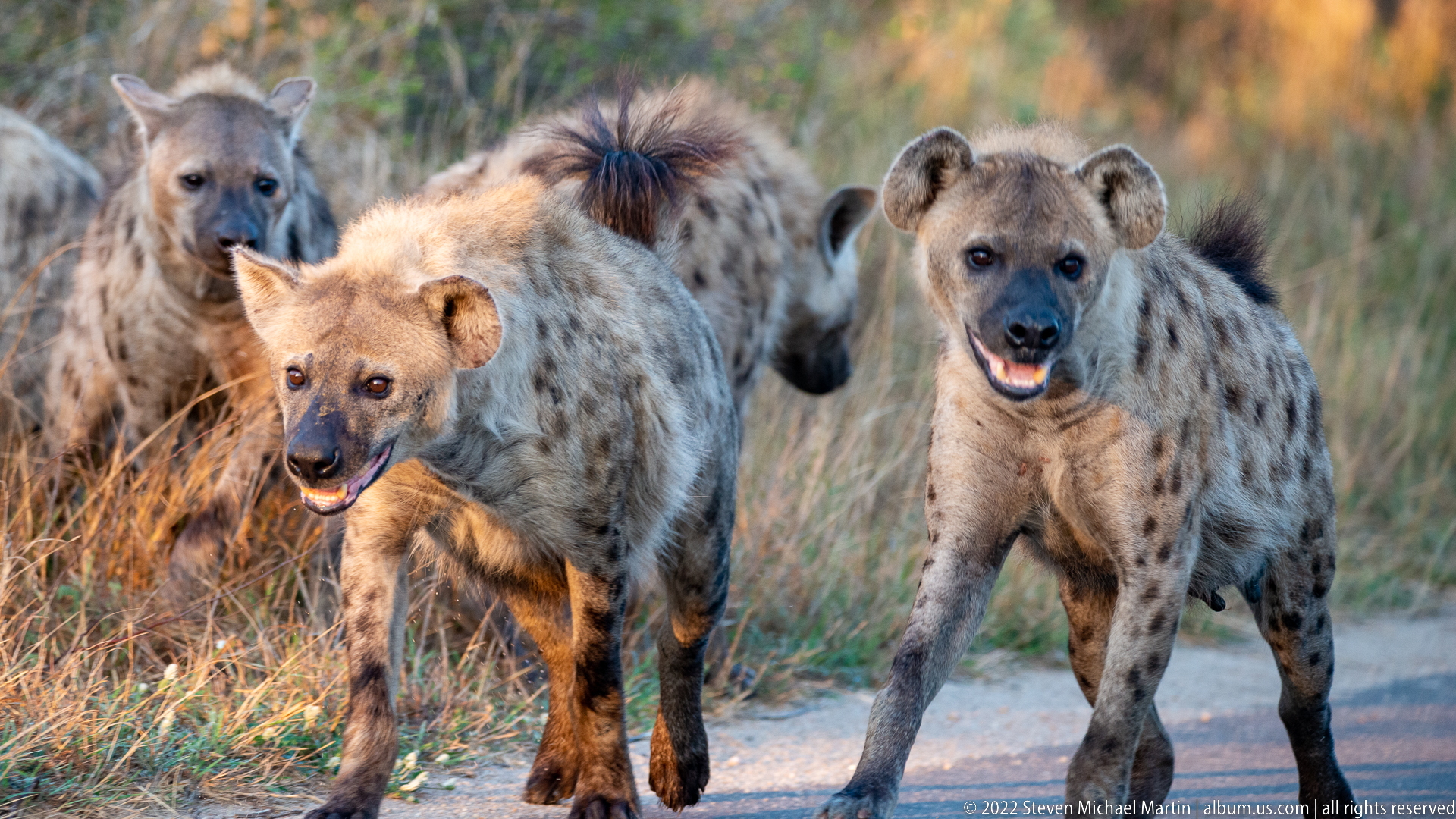
Two spotted hyenas approach along the edge of a paved road while a third animal follows behind. Their forward movement gives the frame a strong sense of encounter, and the open roadway makes the animals' uneven body proportions and spotted pelage especially easy to compare.
Caption
Two spotted hyenas approach along the edge of a paved road while a third animal follows behind. Their forward movement gives the frame a strong sense of encounter, and the open roadway makes the animals' uneven body proportions and spotted pelage especially easy to compare.
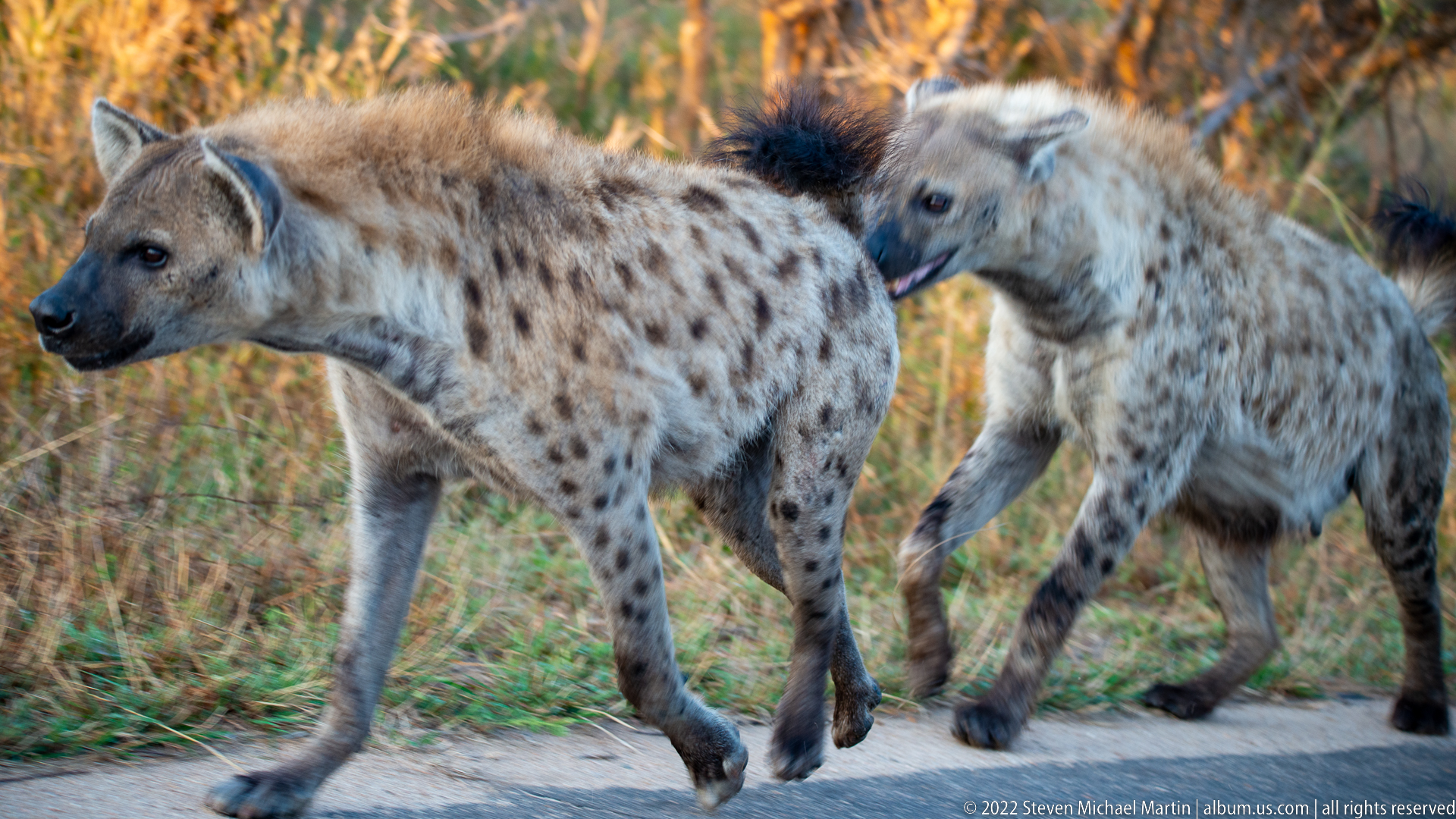
Two spotted hyenas cross a paved road in profile, one slightly ahead of the other. The side view emphasizes their long forelegs, lower hindquarters, rounded ears, and irregular spotting, while the warm background light picks out the coarse texture of their coats.
Caption
Two spotted hyenas cross a paved road in profile, one slightly ahead of the other. The side view emphasizes their long forelegs, lower hindquarters, rounded ears, and irregular spotting, while the warm background light picks out the coarse texture of their coats.
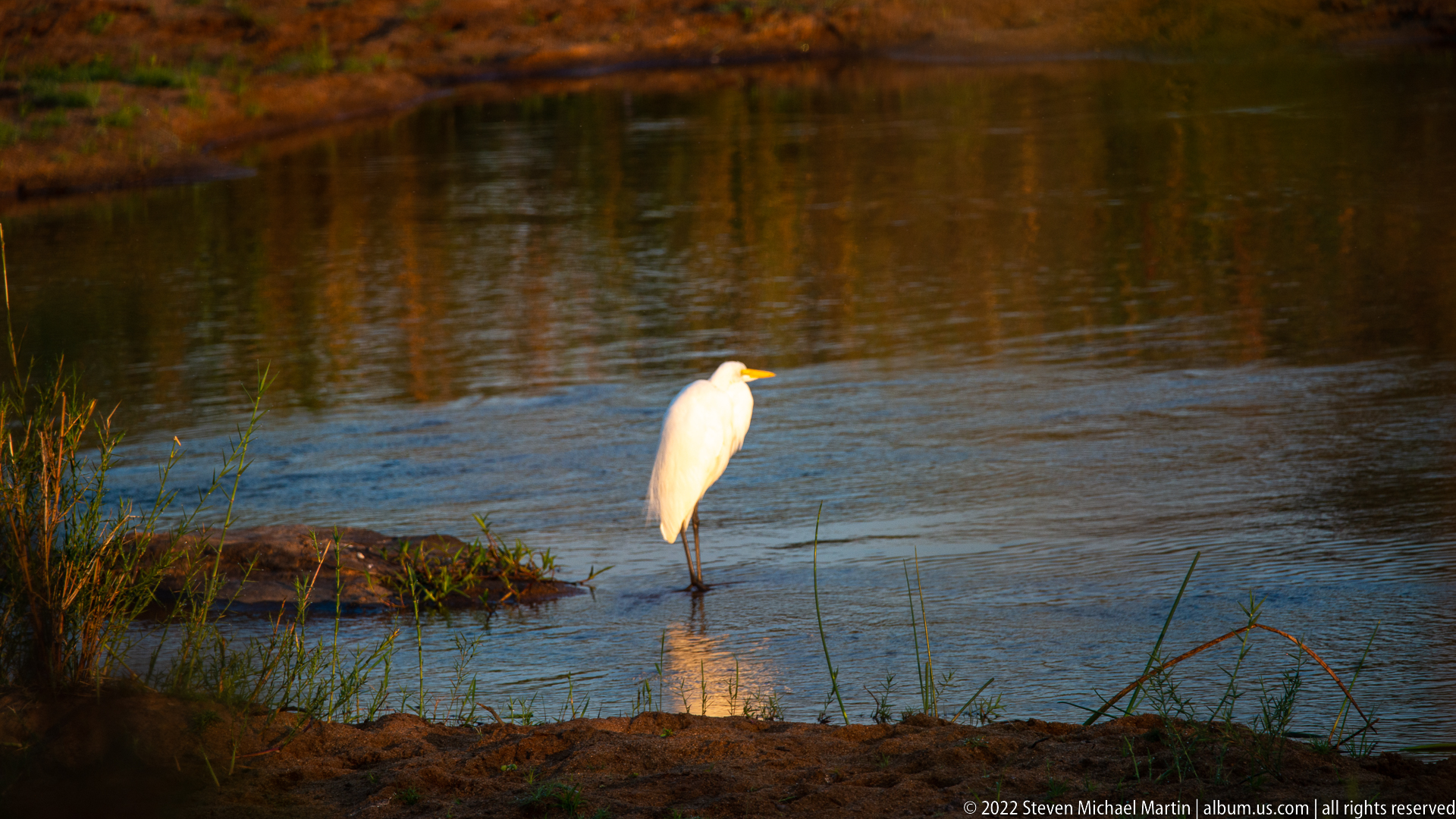
A great egret stands at the margin of gently flowing water, its white plumage glowing in low warm light. The long dark legs, slender neck, and yellow bill distinguish the bird as it waits motionless along the shallow river edge for aquatic prey.
Caption
A great egret stands at the margin of gently flowing water, its white plumage glowing in low warm light. The long dark legs, slender neck, and yellow bill distinguish the bird as it waits motionless along the shallow river edge for aquatic prey.
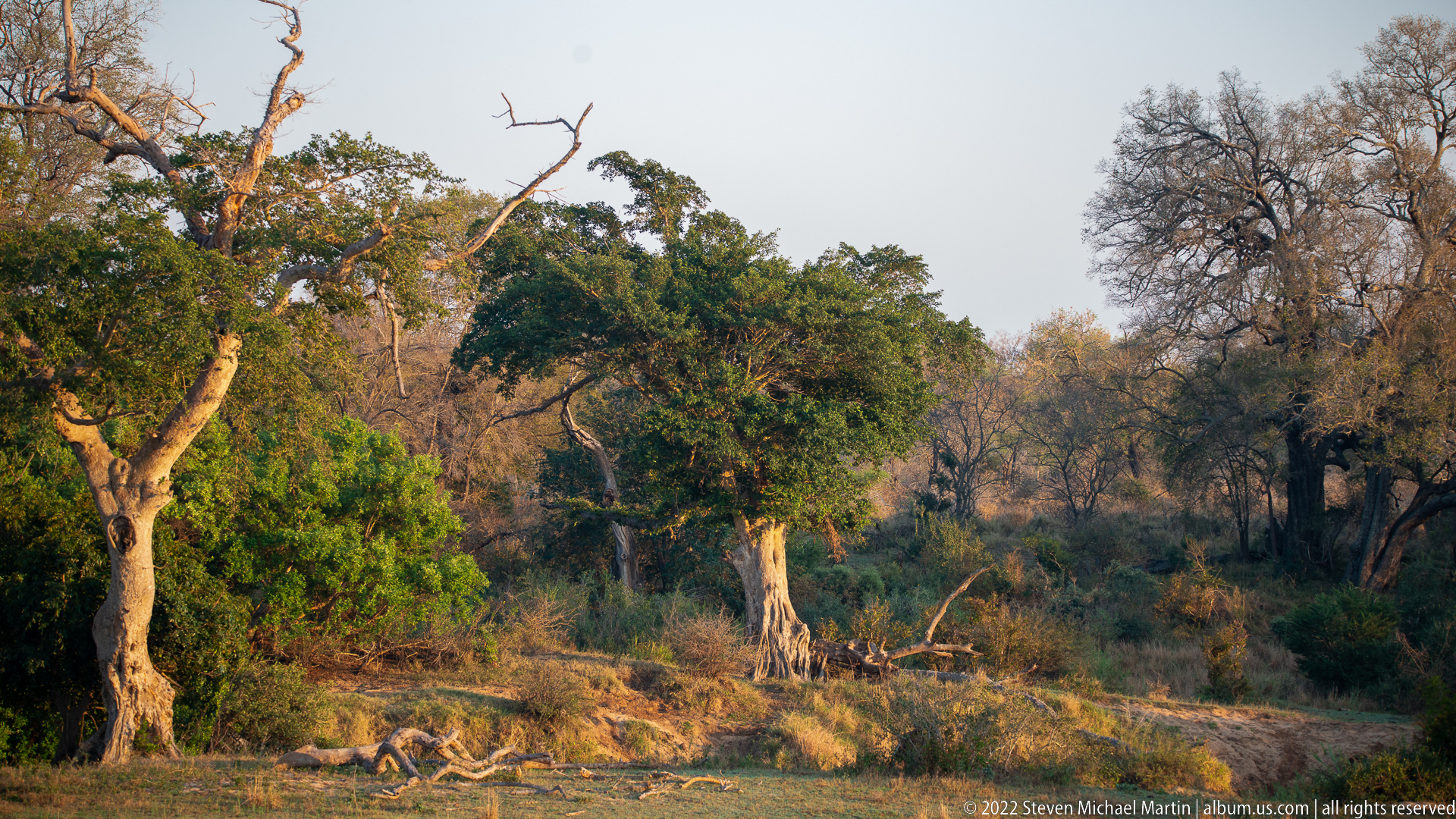
Massive mature trees rise from a dry, brushy understory in warm evening light, with greener foliage concentrated around the larger trunks. The scene records the structural variety of Kruger's riverine woodland, where tall old trees create shade and vertical complexity above seasonally dry ground.
Caption
Massive mature trees rise from a dry, brushy understory in warm evening light, with greener foliage concentrated around the larger trunks. The scene records the structural variety of Kruger's riverine woodland, where tall old trees create shade and vertical complexity above seasonally dry ground.
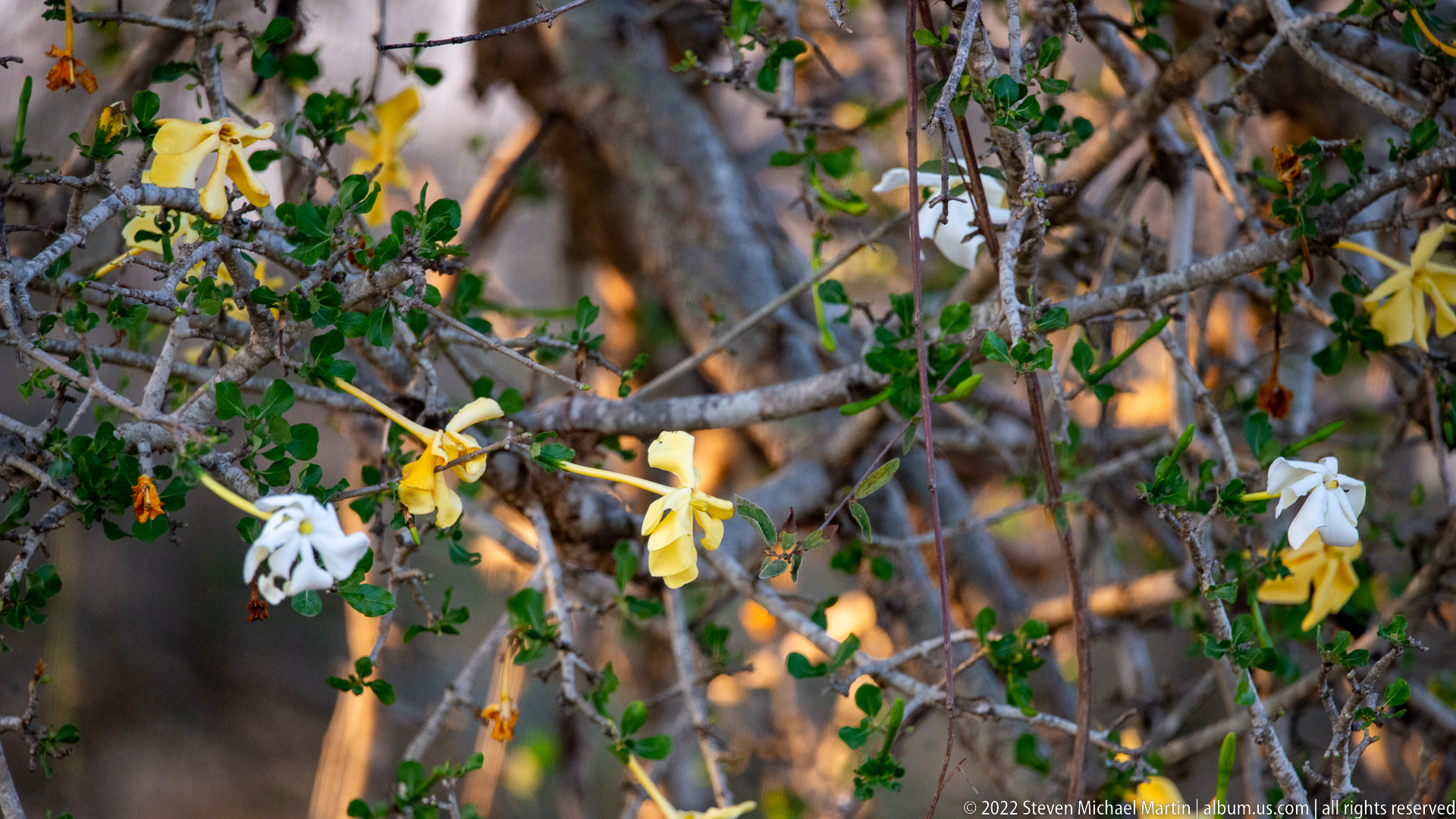
White and yellow tubular flowers hang among small green leaves and a lattice of woody branches. The close botanical view highlights a flowering shrub within the dry woodland understory, where seasonal blooms can provide nectar and color even when much of the surrounding vegetation appears sparse.
Caption
White and yellow tubular flowers hang among small green leaves and a lattice of woody branches. The close botanical view highlights a flowering shrub within the dry woodland understory, where seasonal blooms can provide nectar and color even when much of the surrounding vegetation appears sparse.
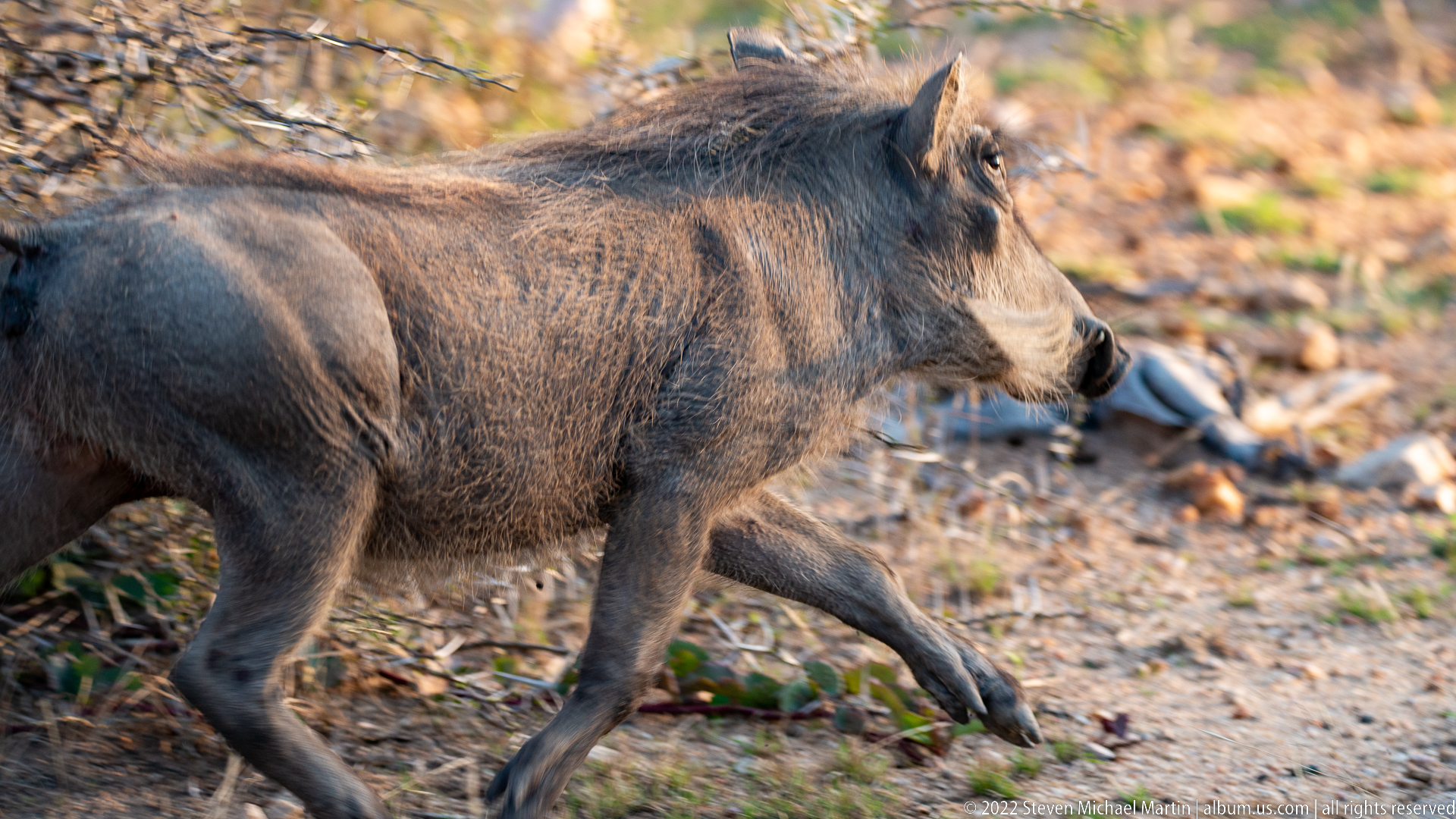
A common warthog trots across dry ground with one foreleg lifted, its coarse mane, facial warts, and upward-curving tusks visible in profile. The movement freezes the animal mid-stride and shows the compact, powerful build suited to foraging and rapid travel through open bush.
Caption
A common warthog trots across dry ground with one foreleg lifted, its coarse mane, facial warts, and upward-curving tusks visible in profile. The movement freezes the animal mid-stride and shows the compact, powerful build suited to foraging and rapid travel through open bush.
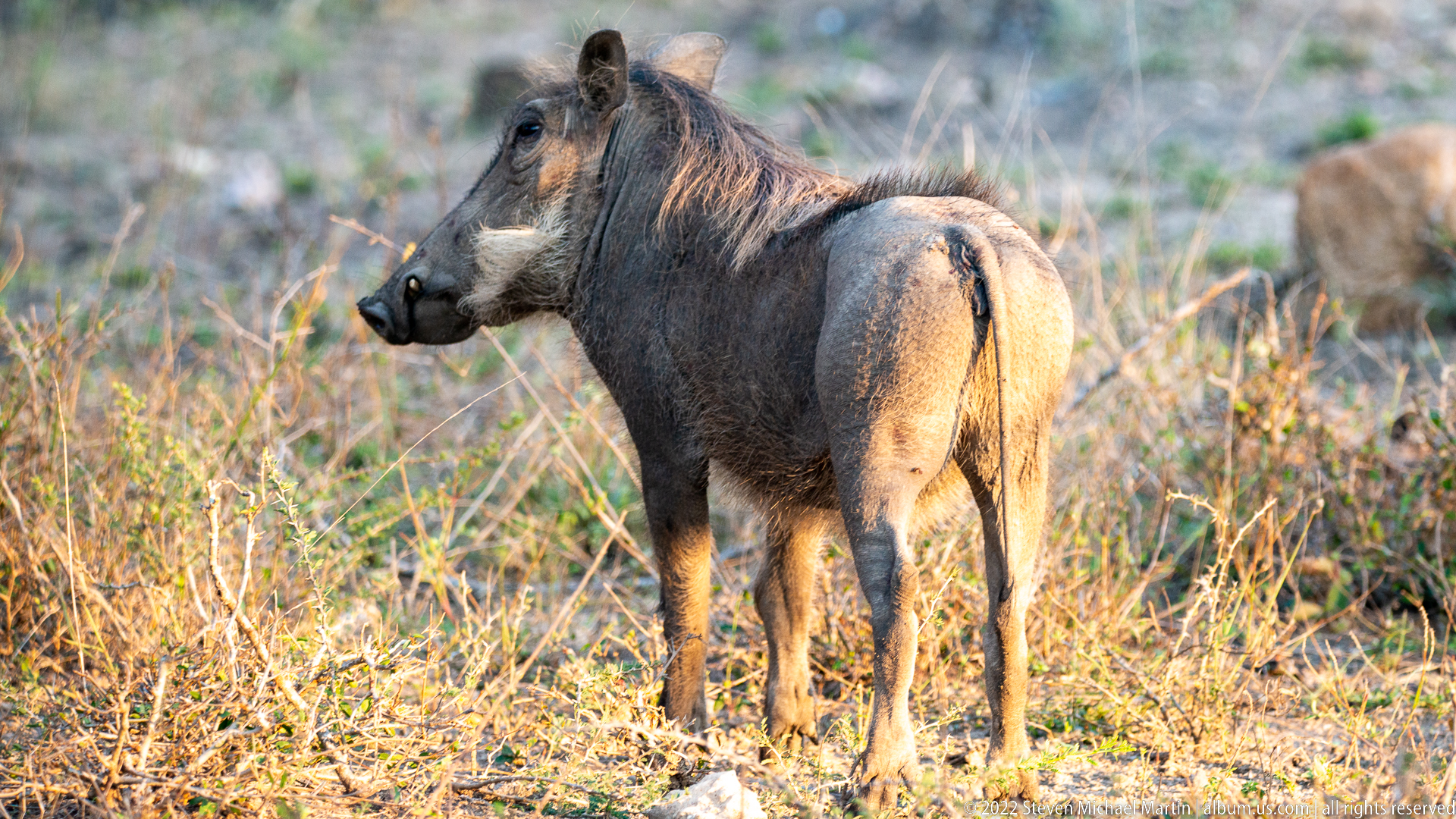
A common warthog pauses in dry grass, turning its head while its body remains angled away from the camera. The backlit rump, bristly mane, facial profile, and upright stance create a clear portrait of the species in the open understory.
Caption
A common warthog pauses in dry grass, turning its head while its body remains angled away from the camera. The backlit rump, bristly mane, facial profile, and upright stance create a clear portrait of the species in the open understory.
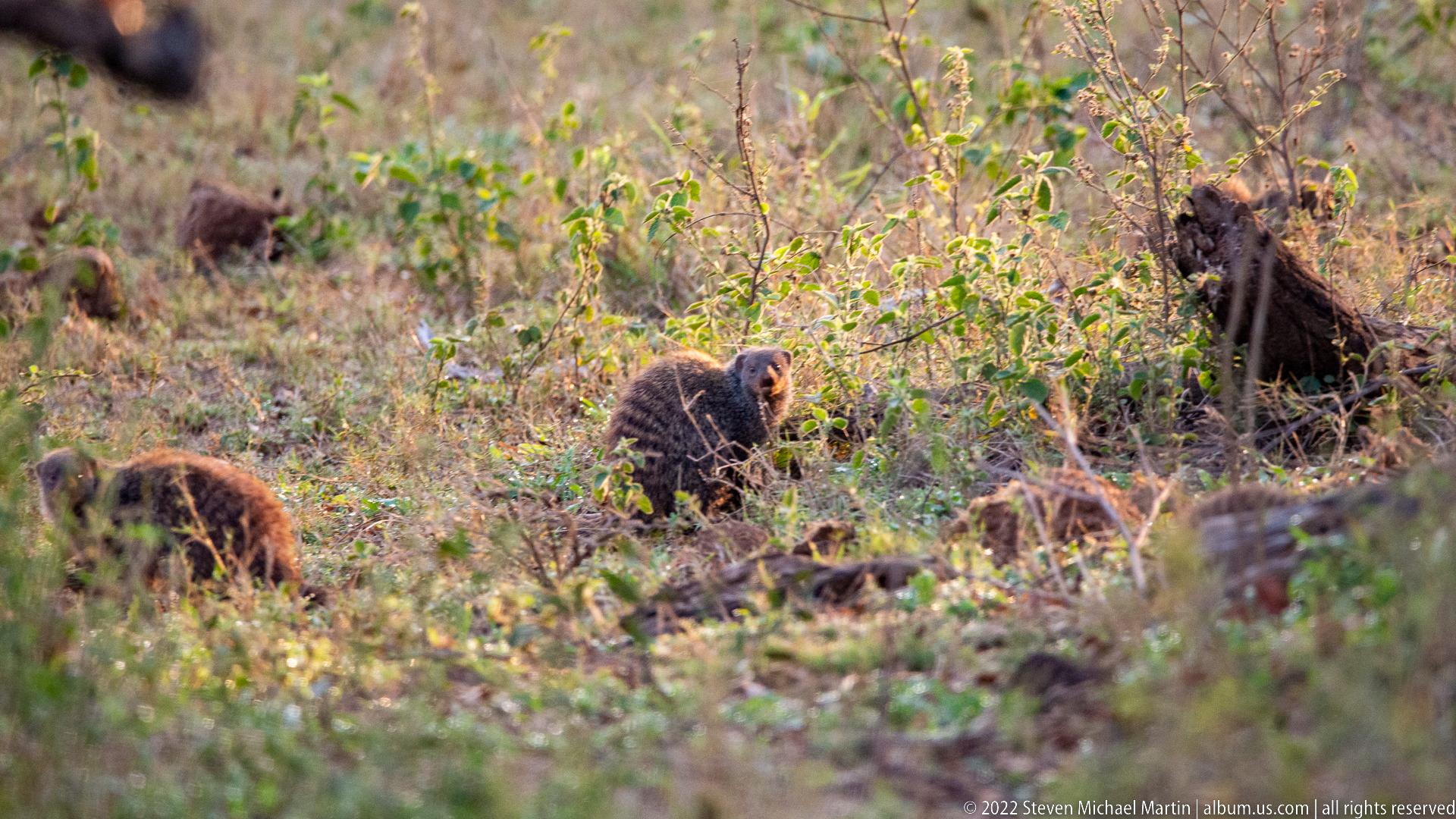
Several common warthogs forage separately through low woodland vegetation, with animals at different distances partly screened by brush. The dispersed group gives a naturalistic view of a sounder feeding across a patch of ground rather than posing in open terrain.
Caption
Several common warthogs forage separately through low woodland vegetation, with animals at different distances partly screened by brush. The dispersed group gives a naturalistic view of a sounder feeding across a patch of ground rather than posing in open terrain.
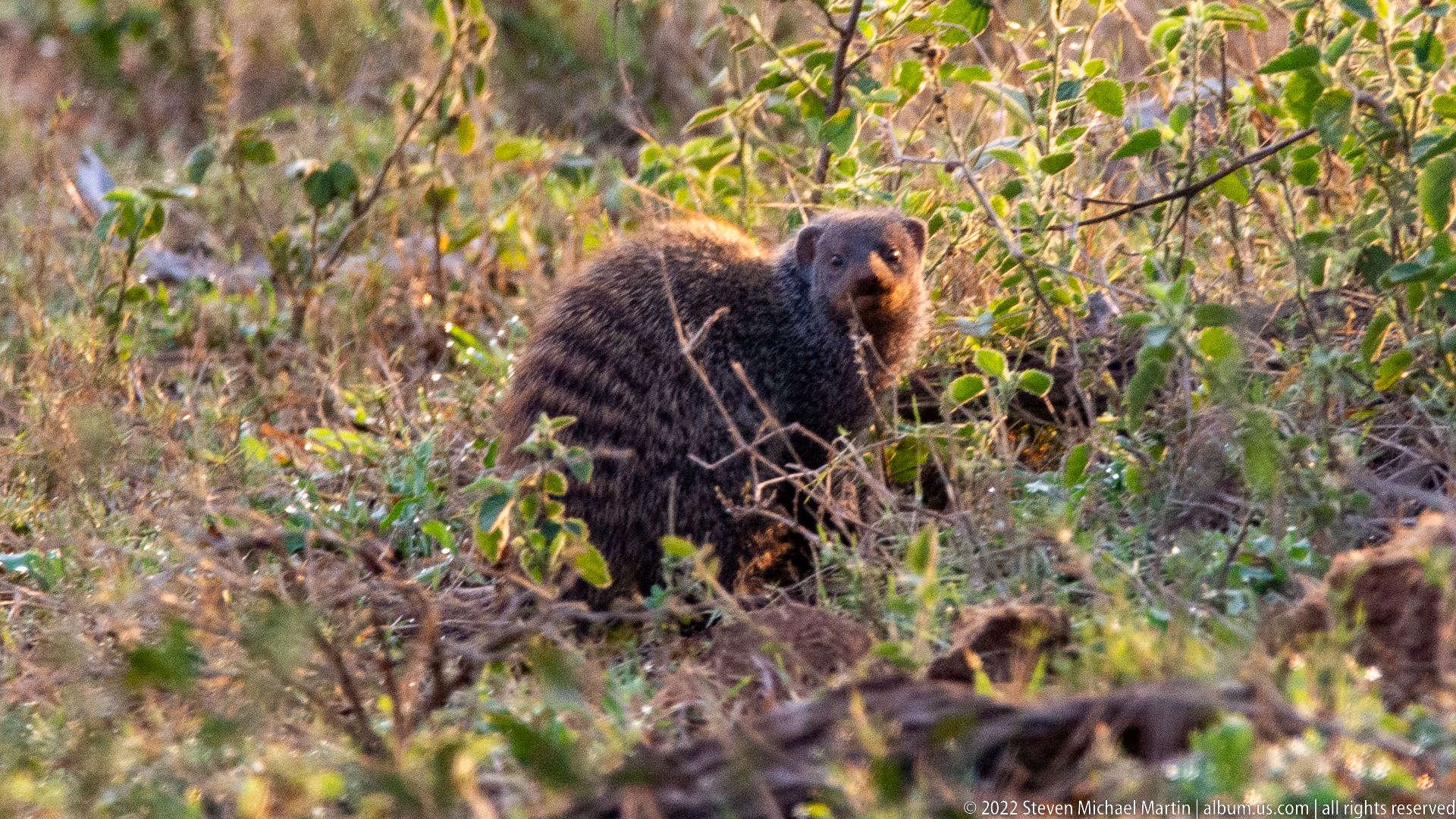
A dark, grizzled mongoose sits upright among low vegetation and leaf litter, turning its head toward the camera. The compact body, small rounded ears, pointed muzzle, and coarse coat are clear, although the proof-sheet view does not reliably resolve the exact mongoose species.
Caption
A dark, grizzled mongoose sits upright among low vegetation and leaf litter, turning its head toward the camera. The compact body, small rounded ears, pointed muzzle, and coarse coat are clear, although the proof-sheet view does not reliably resolve the exact mongoose species.
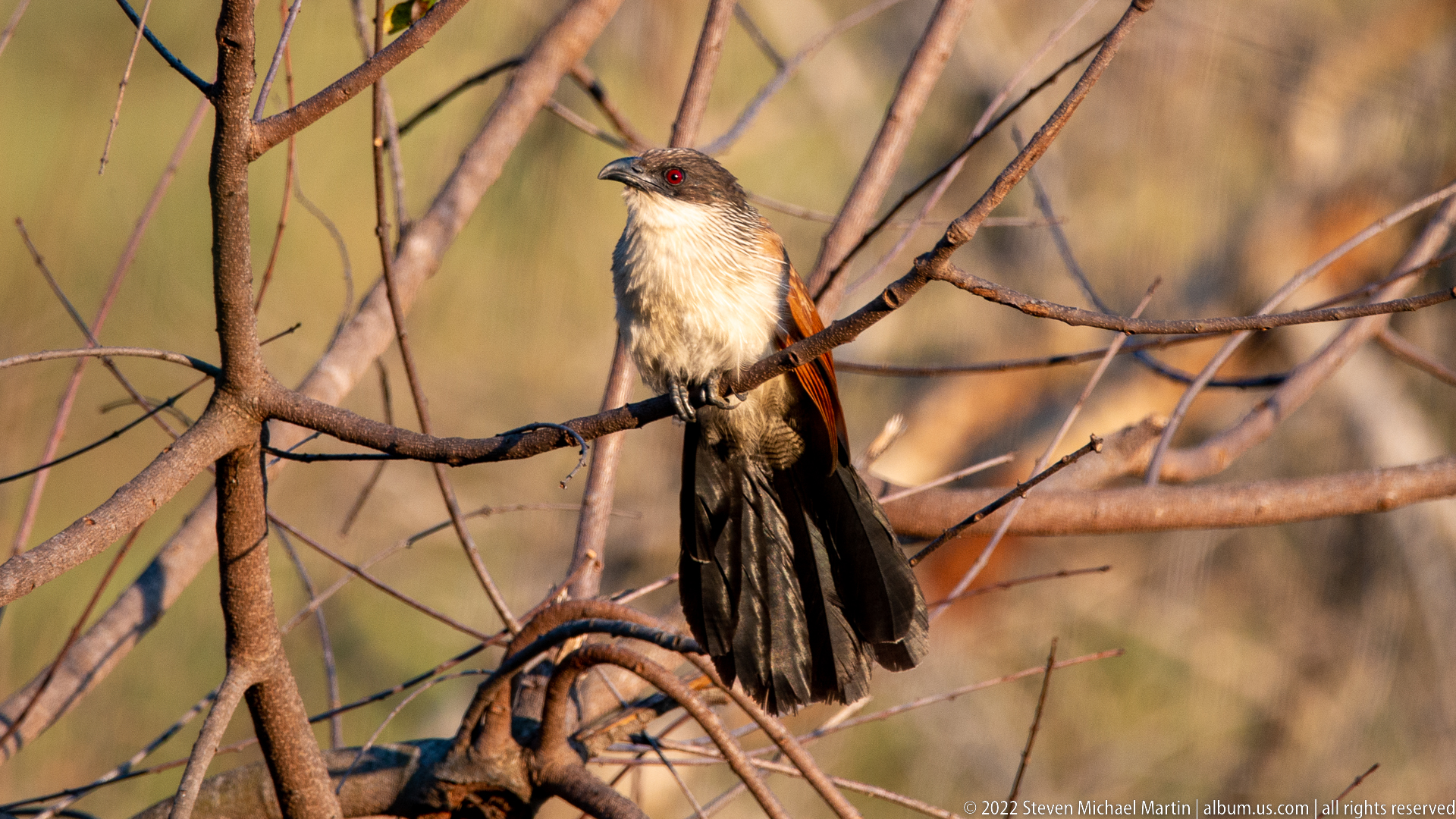
A Burchell's coucal perches among bare branches, showing a pale streaked head and breast, chestnut wings, long dark tail, and striking red eye. The warm side light reveals the contrasting plumage of this large cuckoo relative while the tangled perch places it naturally within dense savanna scrub.
Caption
A Burchell's coucal perches among bare branches, showing a pale streaked head and breast, chestnut wings, long dark tail, and striking red eye. The warm side light reveals the contrasting plumage of this large cuckoo relative while the tangled perch places it naturally within dense savanna scrub.
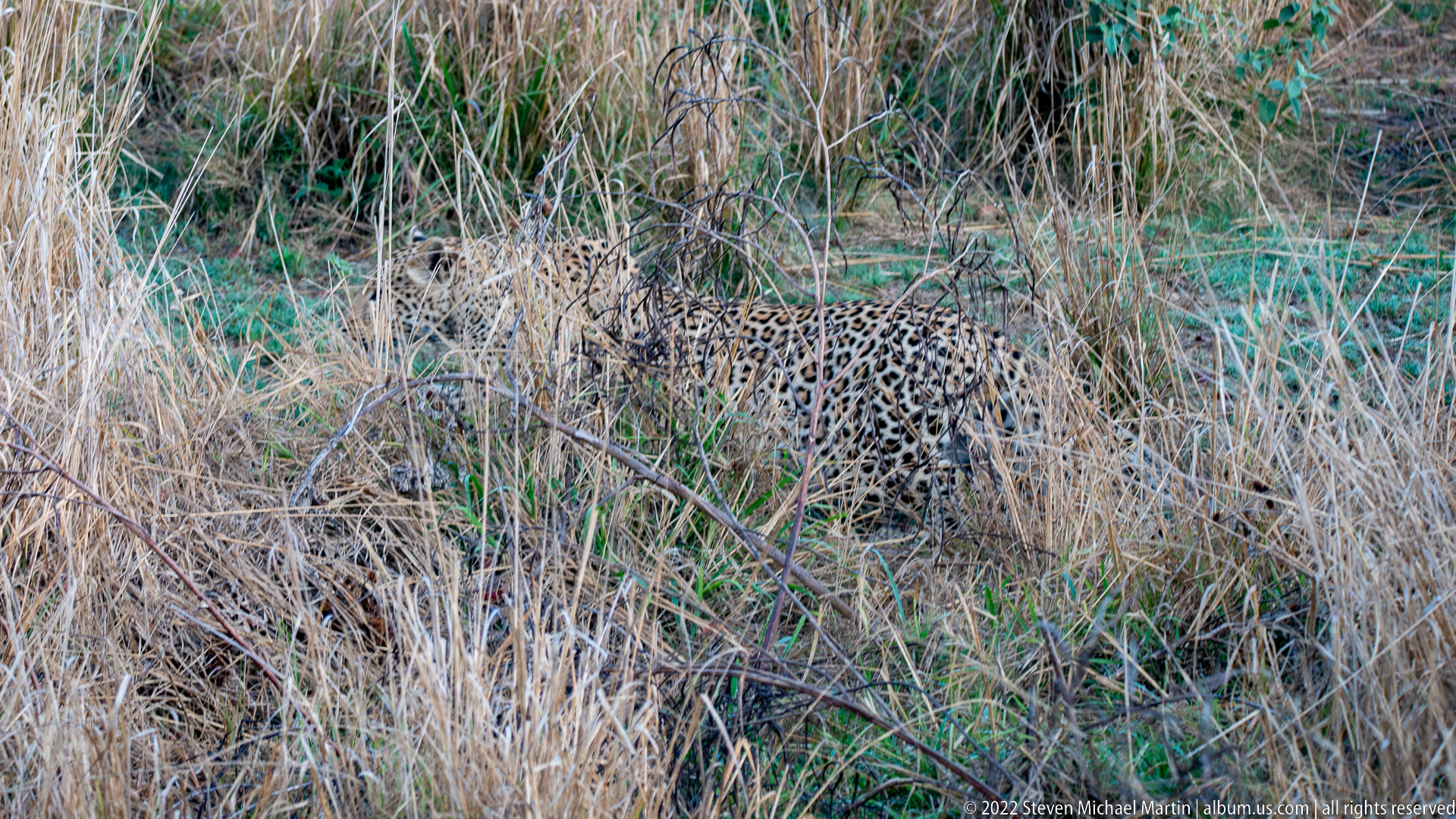
A leopard moves through tall dry grass, its rosetted coat broken into fragments by the vertical stems. The partially concealed cat demonstrates the visual camouflage that makes leopards so difficult to detect in Kruger's woodland-edge habitats, even when they are only a short distance from the viewer.
Caption
A leopard moves through tall dry grass, its rosetted coat broken into fragments by the vertical stems. The partially concealed cat demonstrates the visual camouflage that makes leopards so difficult to detect in Kruger's woodland-edge habitats, even when they are only a short distance from the viewer.
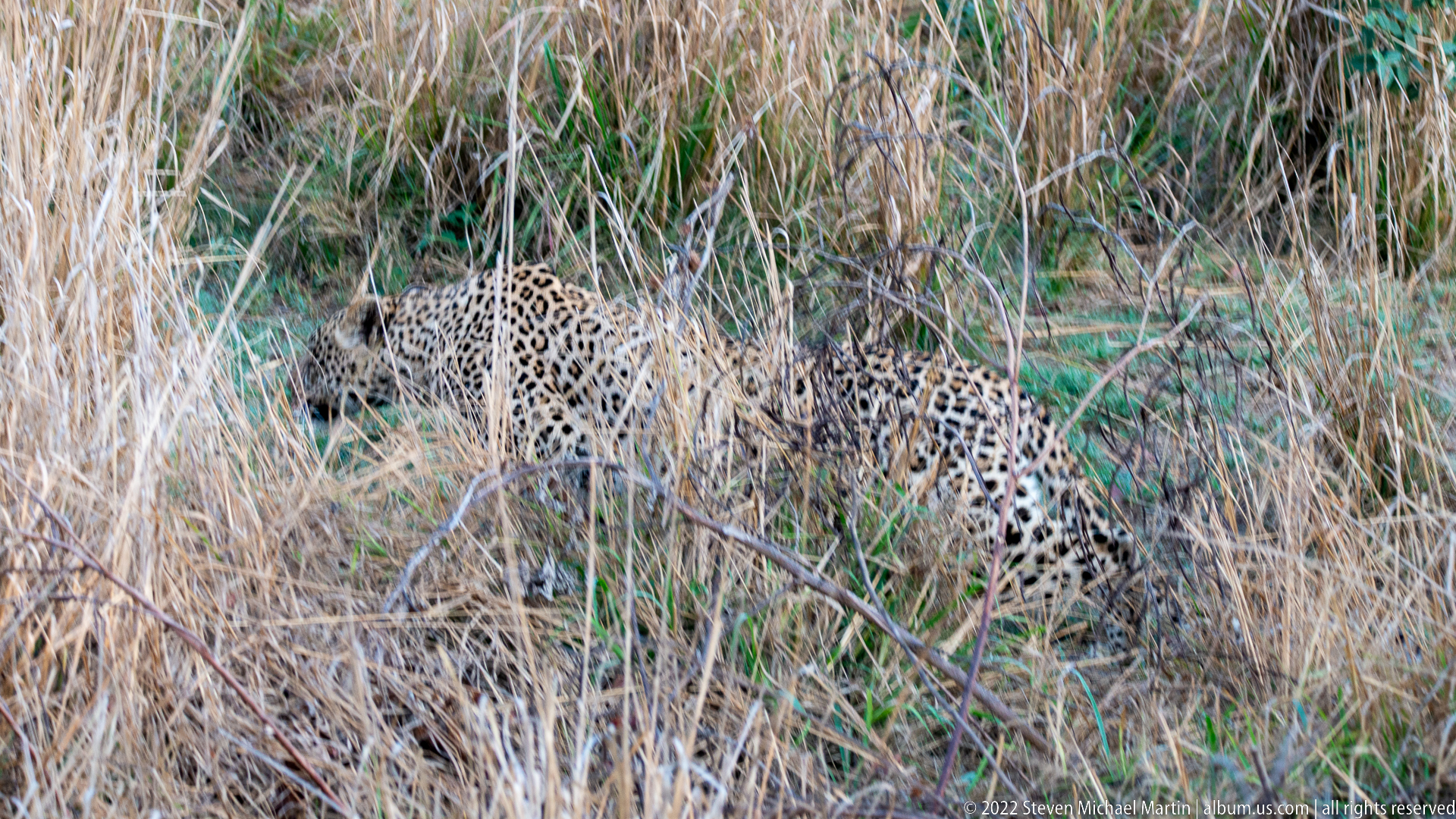
A leopard advances through pale dry grass in a clearer side view, revealing the long muscular body, rounded ears, and dense field of black rosettes. The cat remains partly screened by stems, but this angle shows more of its shoulder and flank than the preceding frame.
Caption
A leopard advances through pale dry grass in a clearer side view, revealing the long muscular body, rounded ears, and dense field of black rosettes. The cat remains partly screened by stems, but this angle shows more of its shoulder and flank than the preceding frame.
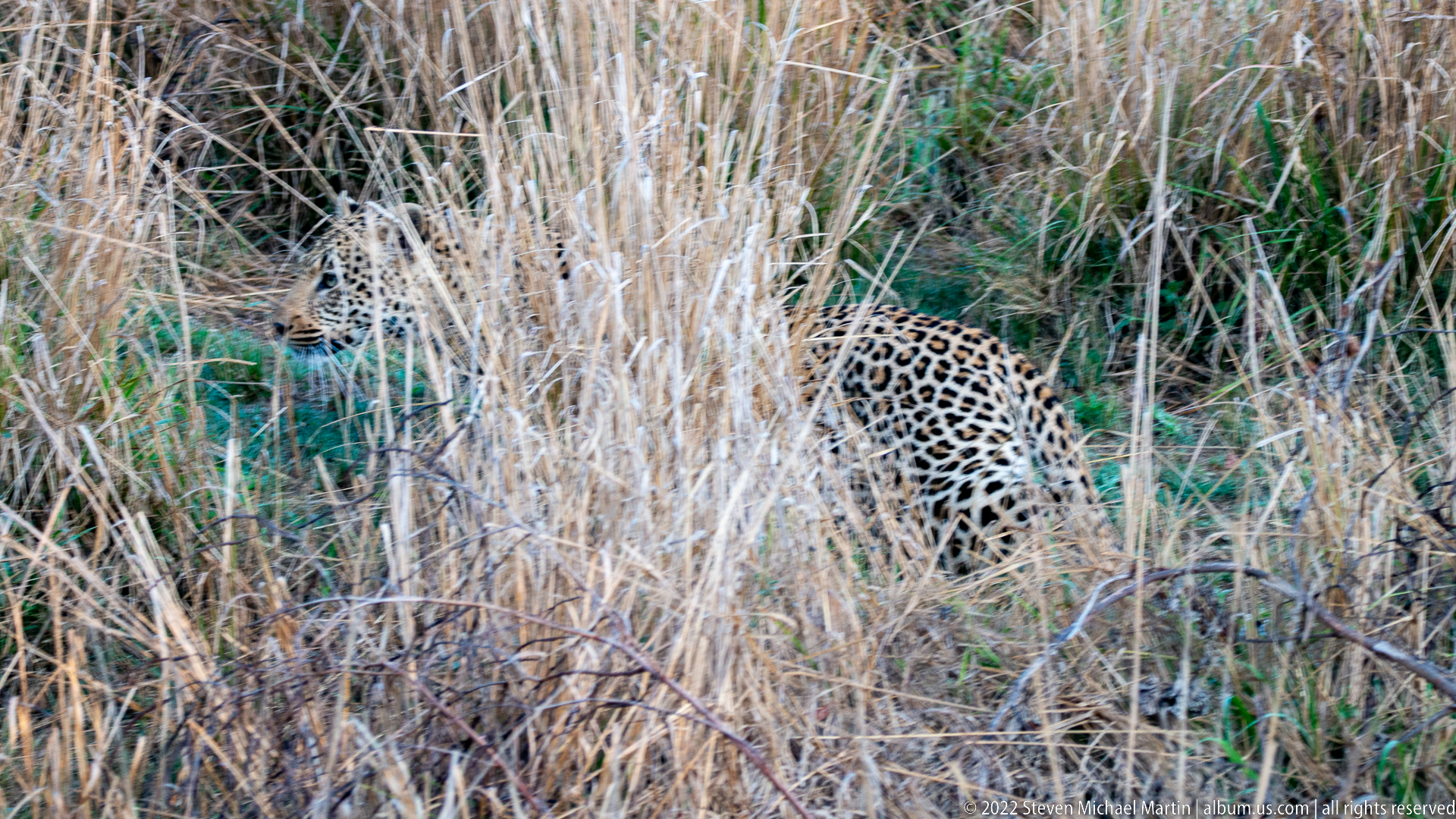
A leopard passes behind a dense curtain of tall dry stems, leaving only its head, shoulders, and rosetted back clearly visible. The heavily screened view emphasizes how quickly the cat disappears into ordinary savanna cover, with its coat pattern blending into the broken light and vegetation.
Caption
A leopard passes behind a dense curtain of tall dry stems, leaving only its head, shoulders, and rosetted back clearly visible. The heavily screened view emphasizes how quickly the cat disappears into ordinary savanna cover, with its coat pattern blending into the broken light and vegetation.
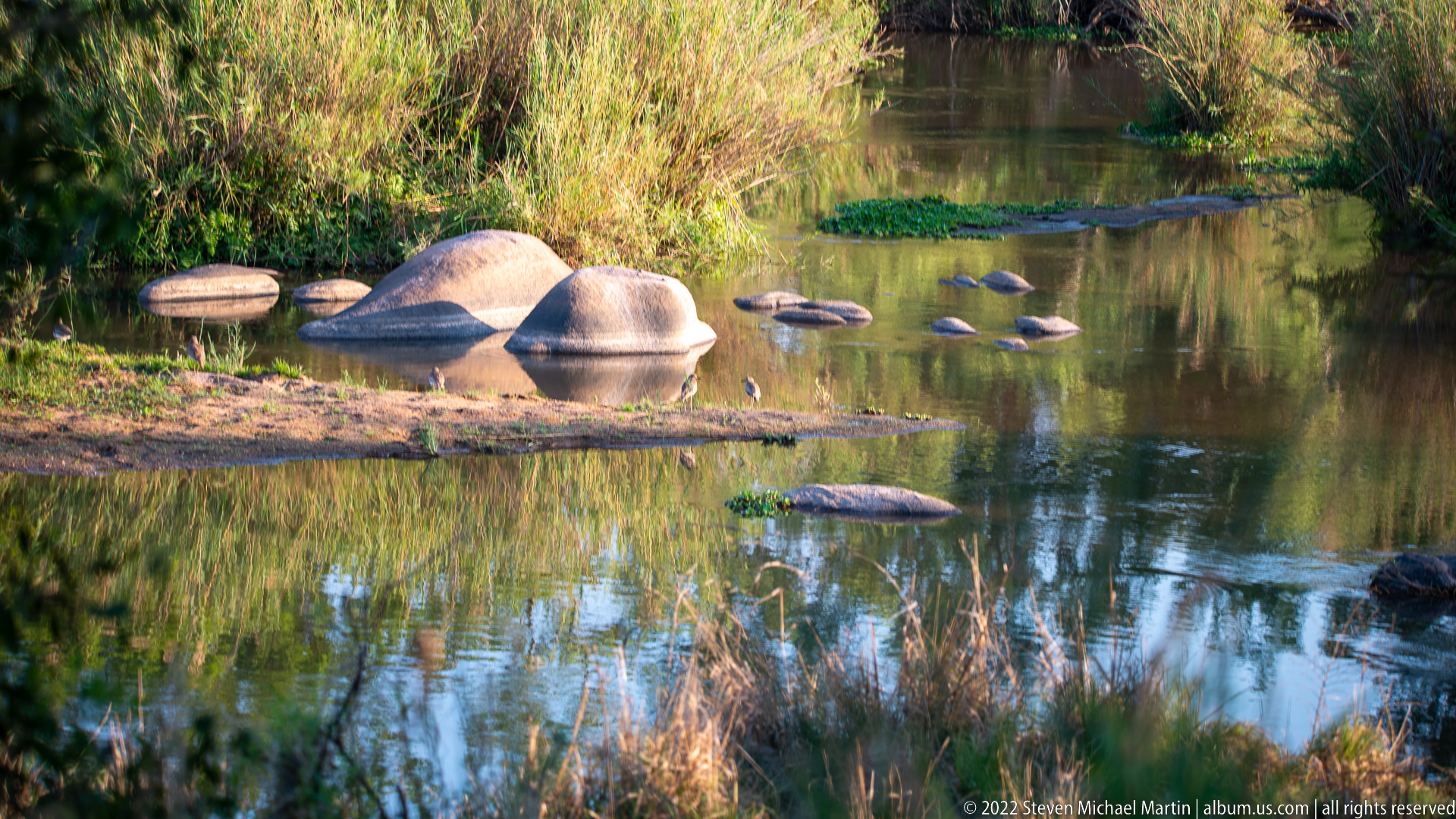
A calm river pool gathers around smooth rounded boulders and small vegetated bars, reflecting trees and grasses along the banks. The quiet water and polished rock forms create a more intimate river study than the broader channels elsewhere in the portfolio.
Caption
A calm river pool gathers around smooth rounded boulders and small vegetated bars, reflecting trees and grasses along the banks. The quiet water and polished rock forms create a more intimate river study than the broader channels elsewhere in the portfolio.
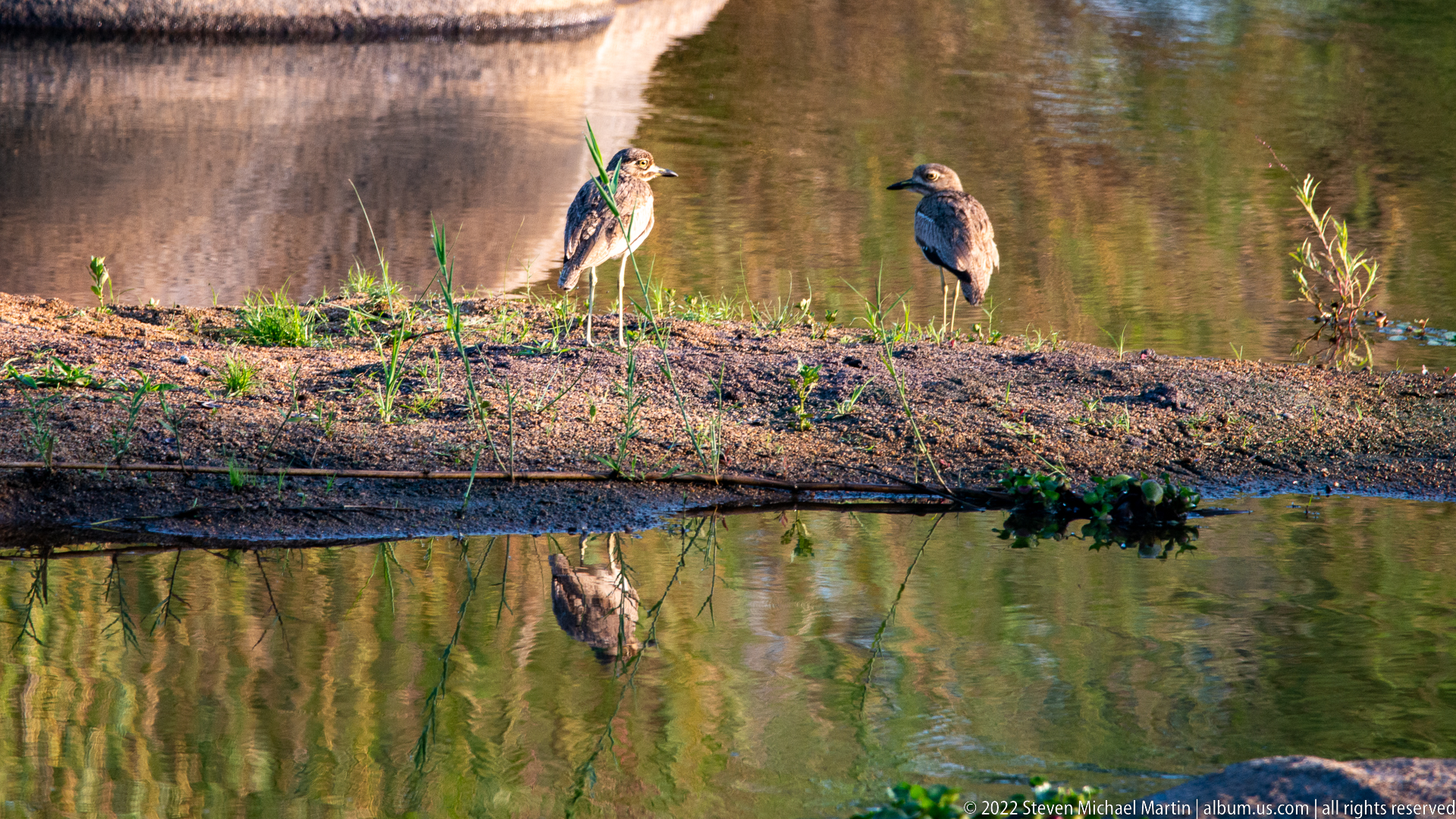
Two hamerkops stand on a narrow muddy riverbank, their distinctive hammer-shaped head profiles silhouetted against reflective water. The pair occupies the exposed edge between shallow channel and vegetation, a typical feeding zone for this unusual African wading bird.
Caption
Two hamerkops stand on a narrow muddy riverbank, their distinctive hammer-shaped head profiles silhouetted against reflective water. The pair occupies the exposed edge between shallow channel and vegetation, a typical feeding zone for this unusual African wading bird.
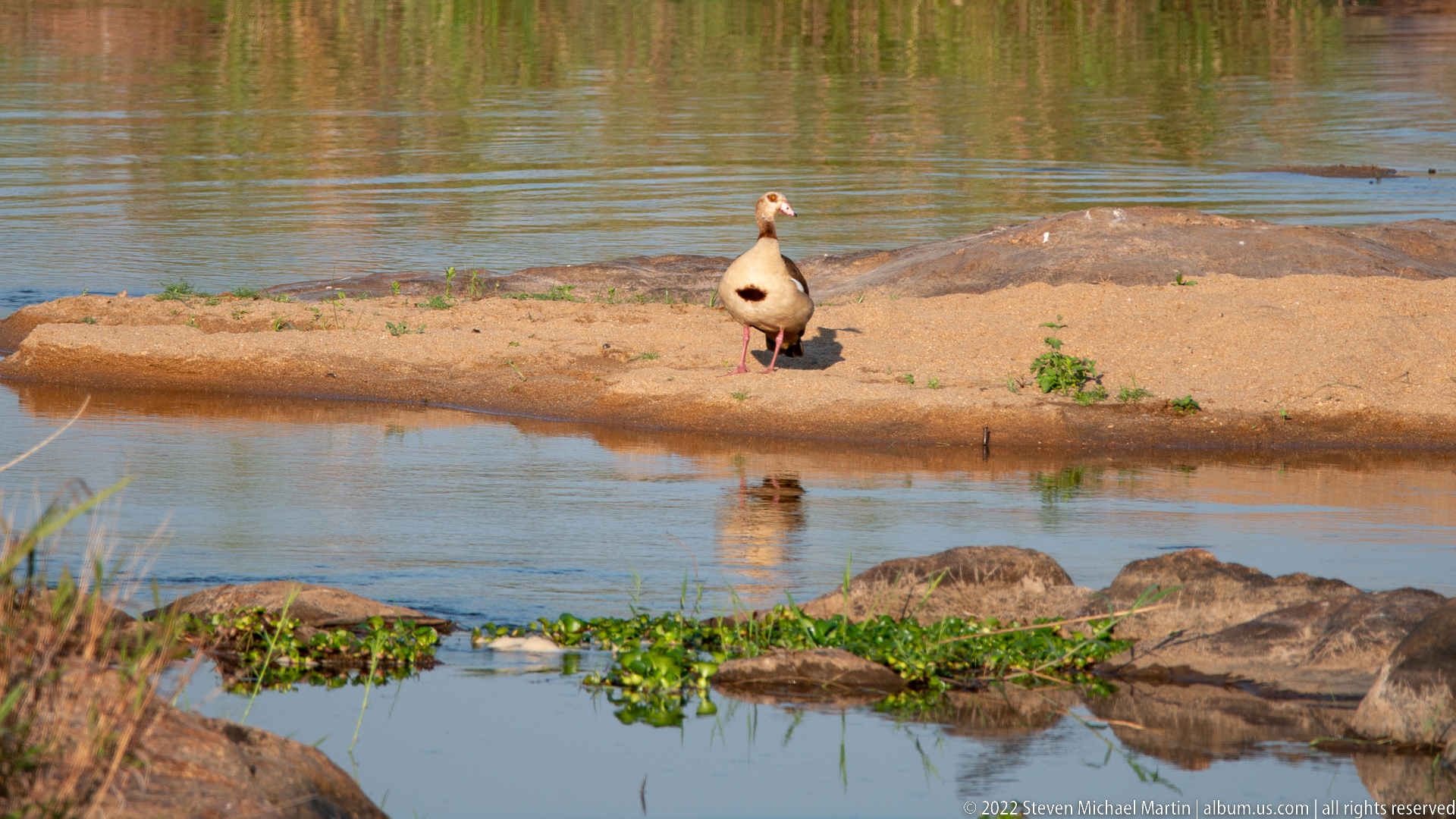
An Egyptian goose stands alone on a sandy bar surrounded by shallow water and exposed rocks. Its pale head, dark eye patch, chestnut breast marking, pink legs, and upright stance are visible in the open setting, making the species easy to distinguish against the muted river colors.
Caption
An Egyptian goose stands alone on a sandy bar surrounded by shallow water and exposed rocks. Its pale head, dark eye patch, chestnut breast marking, pink legs, and upright stance are visible in the open setting, making the species easy to distinguish against the muted river colors.
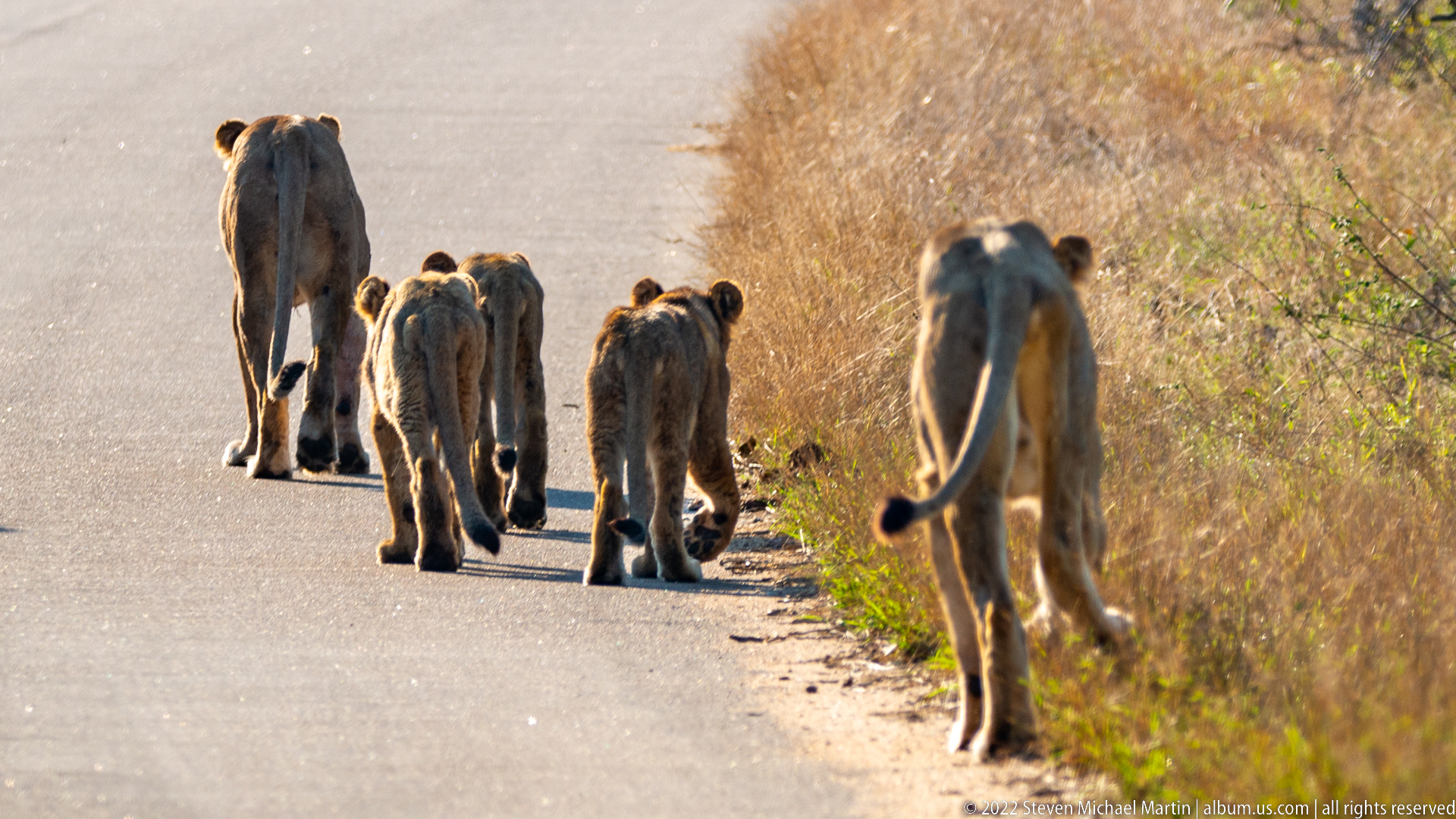
A lion pride walks away along a paved road, with several cubs clustered between adult lionesses. The rear view shows the size contrast between the young animals and the adults while the group uses the open roadway as an easy travel corridor through the surrounding dry bush.
Caption
A lion pride walks away along a paved road, with several cubs clustered between adult lionesses. The rear view shows the size contrast between the young animals and the adults while the group uses the open roadway as an easy travel corridor through the surrounding dry bush.
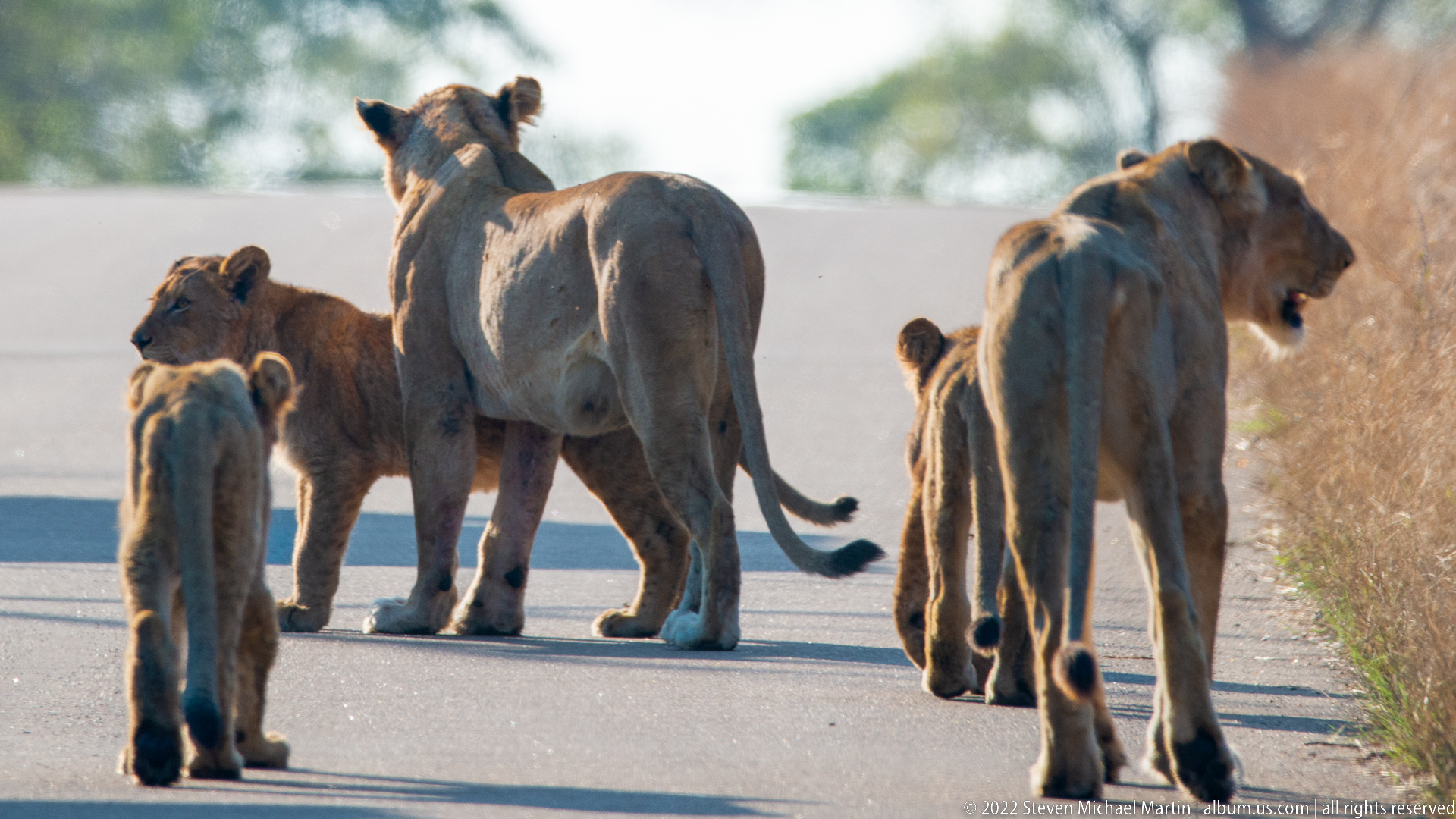
Adult lionesses and cubs pause and bunch together on the road, some turning sideways while others continue forward. The closer arrangement reveals the cubs' smaller proportions and the muscular build of the adults, offering a more intimate view of pride cohesion during travel.
Caption
Adult lionesses and cubs pause and bunch together on the road, some turning sideways while others continue forward. The closer arrangement reveals the cubs' smaller proportions and the muscular build of the adults, offering a more intimate view of pride cohesion during travel.
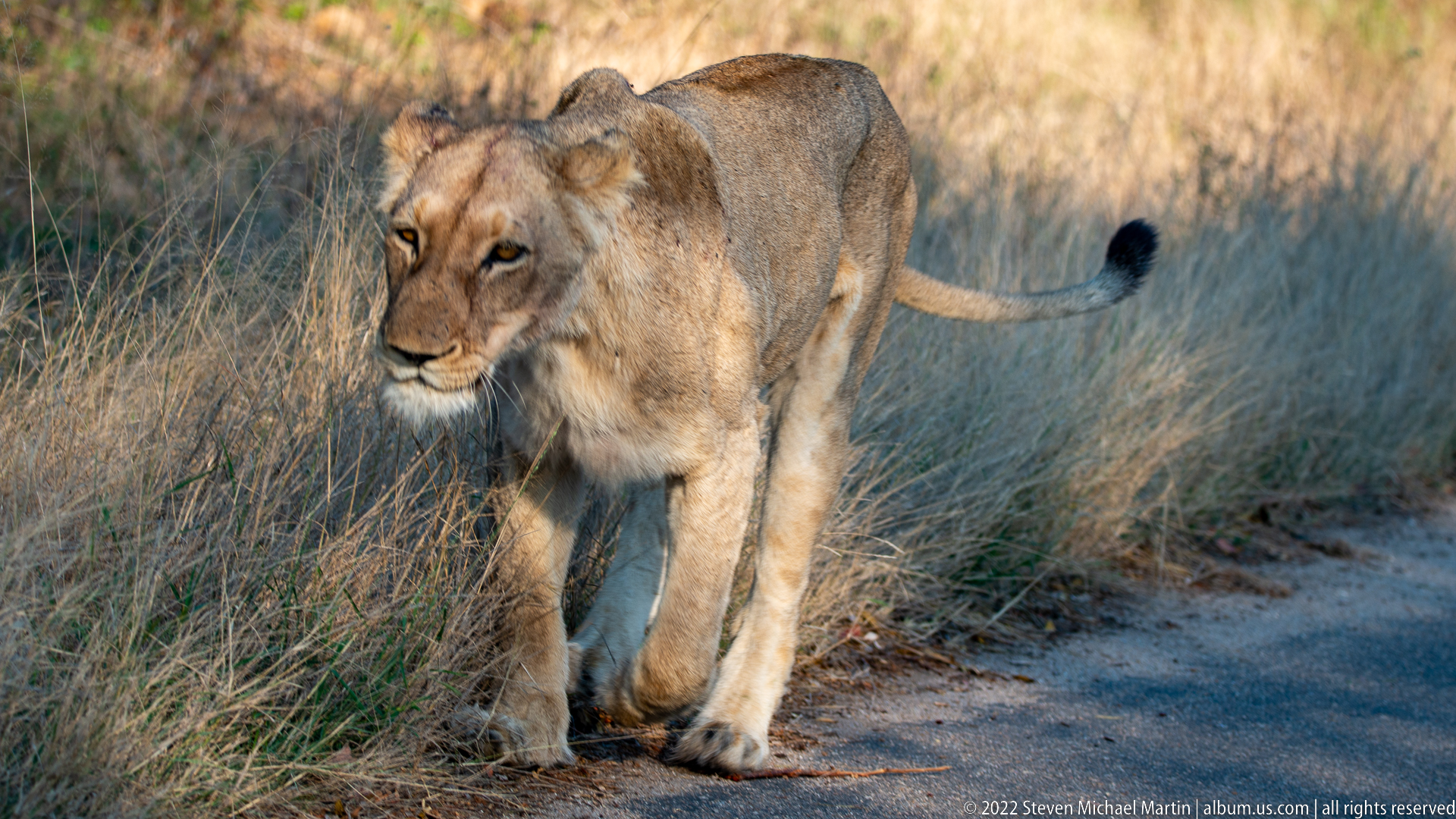
An adult lioness walks along the grassy verge of a paved road, her head lowered slightly as she advances through warm morning light. The close approach reveals the muscular shoulders, tawny coat, rounded ears, and dark tail tuft that distinguish the species while placing the animal squarely within the road corridor used by both wildlife and safari traffic.
Caption
An adult lioness walks along the grassy verge of a paved road, her head lowered slightly as she advances through warm morning light. The close approach reveals the muscular shoulders, tawny coat, rounded ears, and dark tail tuft that distinguish the species while placing the animal squarely within the road corridor used by both wildlife and safari traffic.
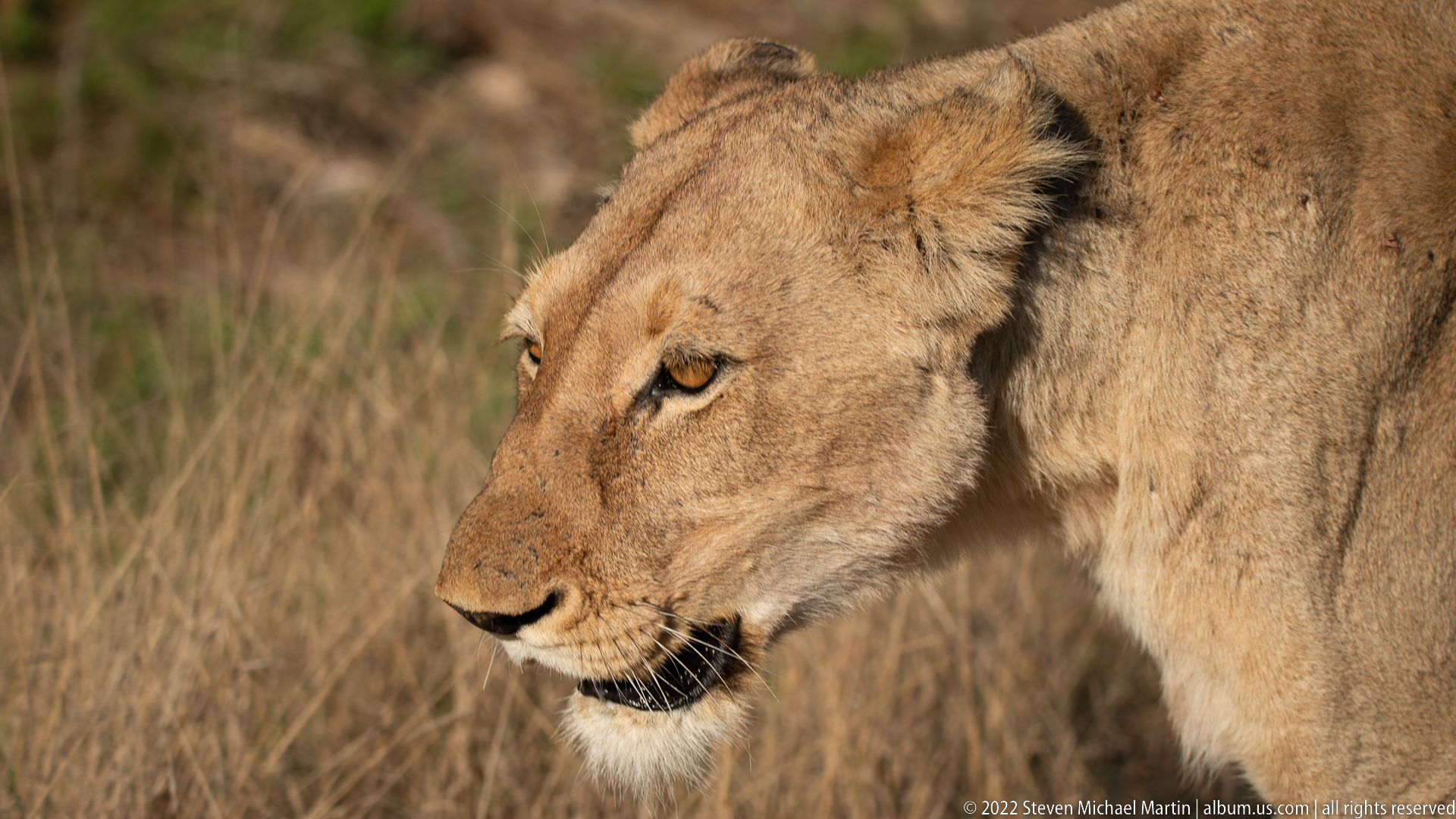
A close profile isolates a lioness as she moves through dry grass, bringing the fine texture of her tawny coat and the dark edging of her eyes and muzzle into sharp relief. The tight crop emphasizes expression and facial structure rather than the broader pride or roadway context visible in neighboring frames.
Caption
A close profile isolates a lioness as she moves through dry grass, bringing the fine texture of her tawny coat and the dark edging of her eyes and muzzle into sharp relief. The tight crop emphasizes expression and facial structure rather than the broader pride or roadway context visible in neighboring frames.
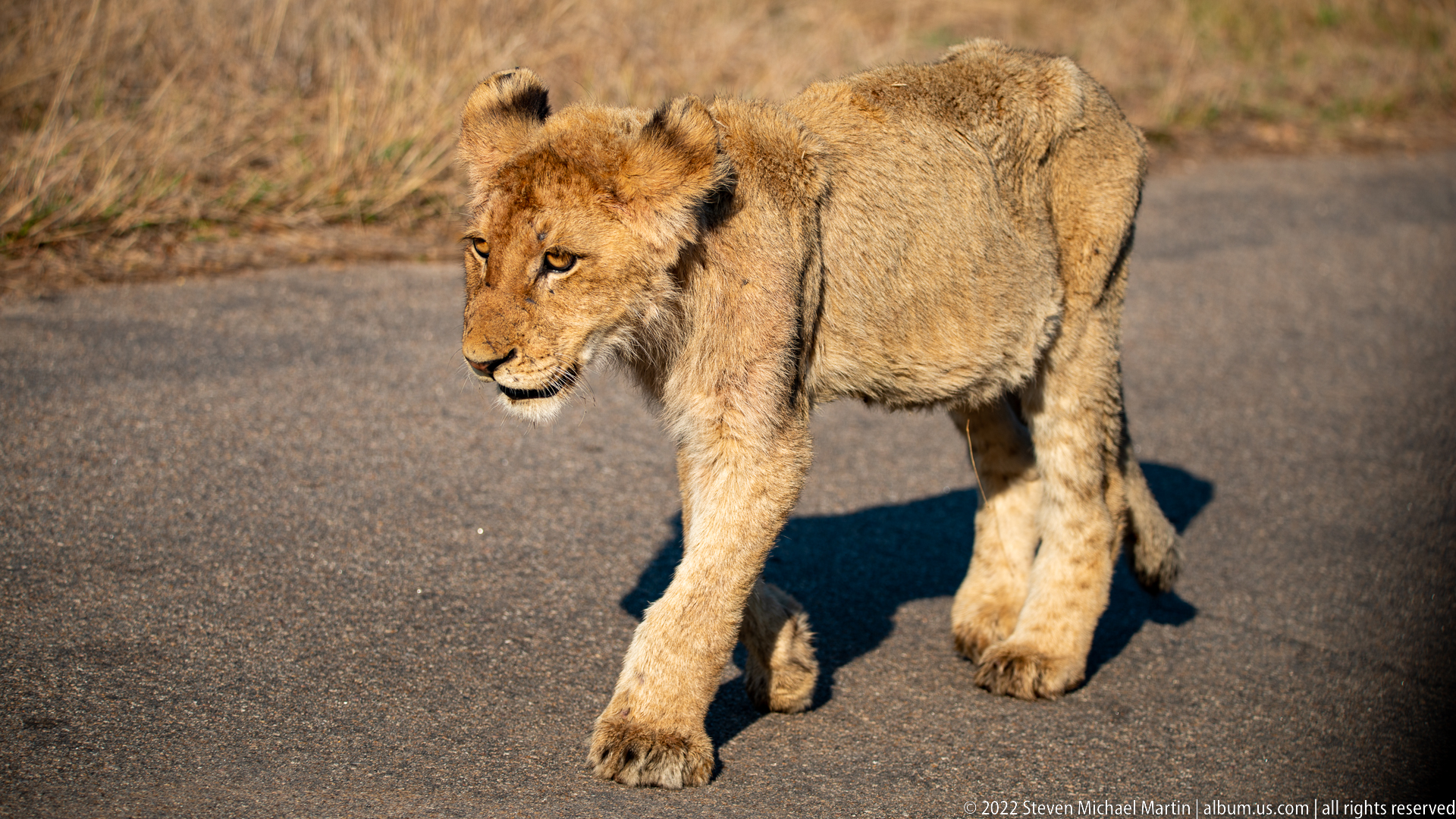
A young lion cub walks alone across a paved road in strong low-angle light, its oversized paws and still-developing facial features clearly visible. Faint juvenile spotting remains on the legs and underside, while the compact body and rounded ears distinguish the cub from the adult lionesses nearby.
Caption
A young lion cub walks alone across a paved road in strong low-angle light, its oversized paws and still-developing facial features clearly visible. Faint juvenile spotting remains on the legs and underside, while the compact body and rounded ears distinguish the cub from the adult lionesses nearby.
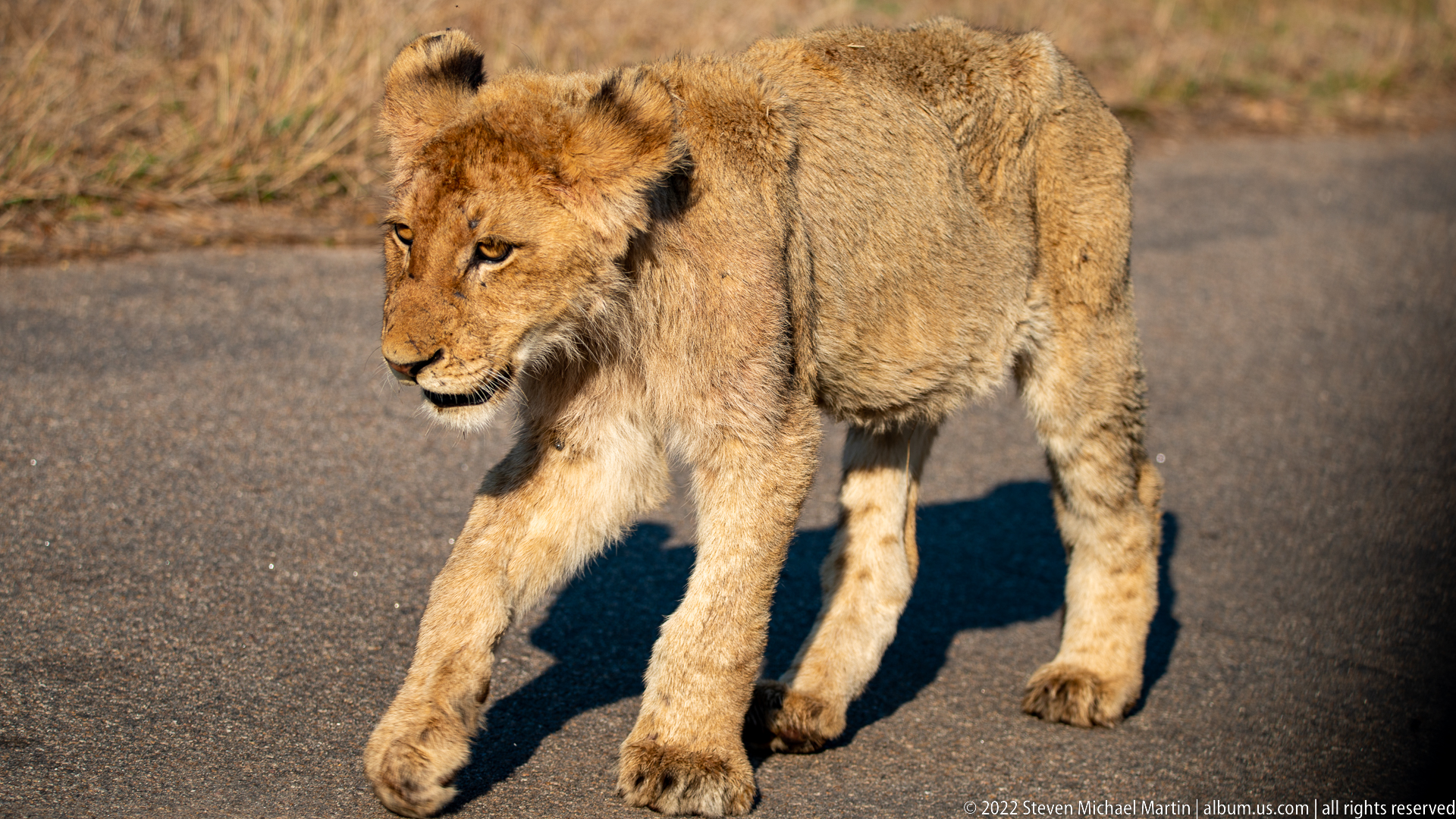
A lion cub strides across the sunlit roadway with one forepaw raised, its broad feet, rounded ears, and mottled juvenile coat picked out against the dark asphalt. The nearly full-body view shows the cub's developing strength while retaining the softer proportions of a young animal.
Caption
A lion cub strides across the sunlit roadway with one forepaw raised, its broad feet, rounded ears, and mottled juvenile coat picked out against the dark asphalt. The nearly full-body view shows the cub's developing strength while retaining the softer proportions of a young animal.
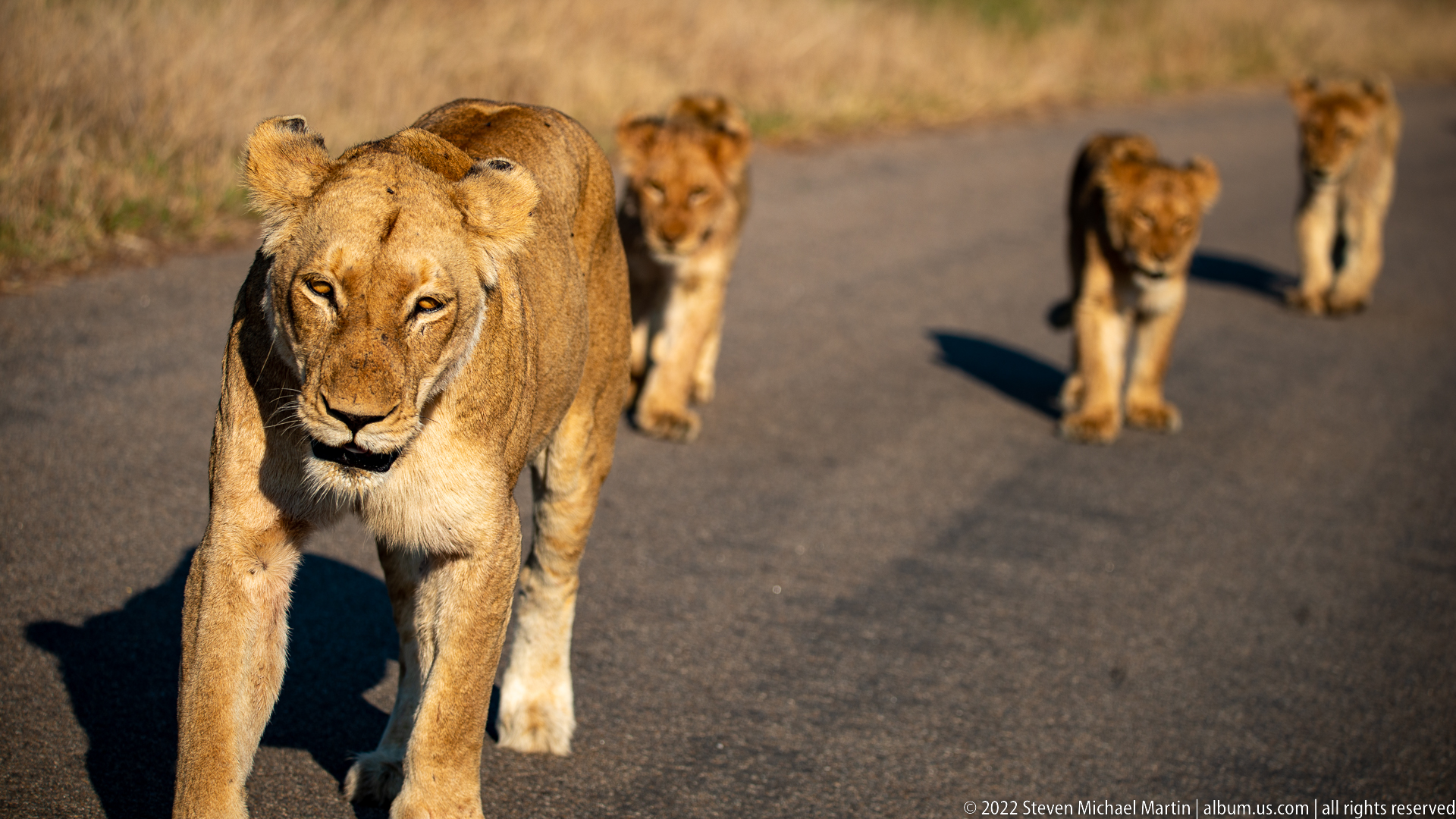
An adult lioness approaches along the road with several cubs following in a loose line behind her. The composition shows the pride in motion and the size difference between the mature female and young lions, while the open roadway provides an unobstructed travel route through the surrounding grassland.
Caption
An adult lioness approaches along the road with several cubs following in a loose line behind her. The composition shows the pride in motion and the size difference between the mature female and young lions, while the open roadway provides an unobstructed travel route through the surrounding grassland.
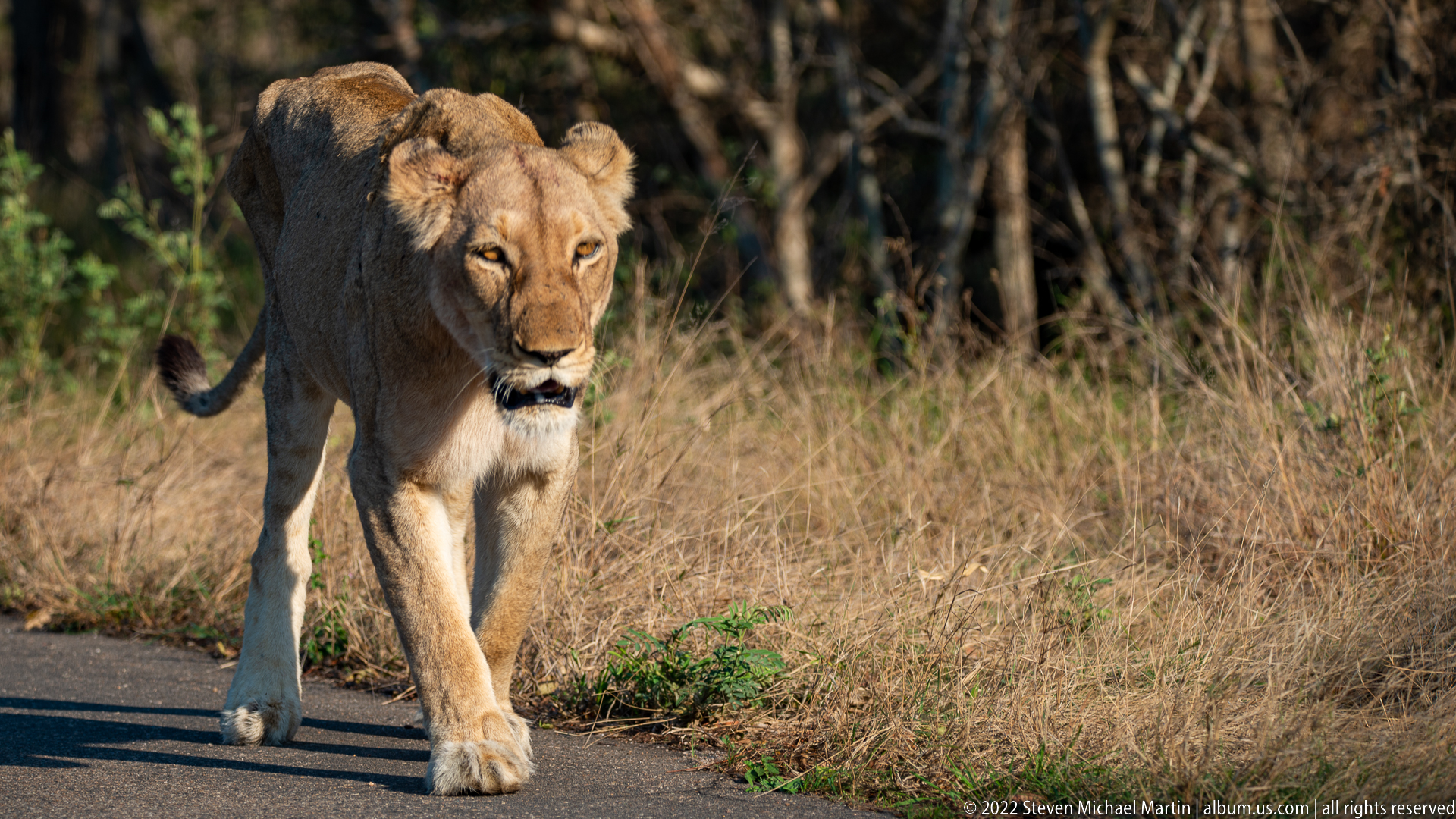
A lioness approaches head-on along the road verge, emerging from the shaded edge of dry woodland into brighter light. Her direct gaze, powerful forequarters, white chin, and black-tipped tail give the portrait a strong sense of proximity while retaining clear environmental context.
Caption
A lioness approaches head-on along the road verge, emerging from the shaded edge of dry woodland into brighter light. Her direct gaze, powerful forequarters, white chin, and black-tipped tail give the portrait a strong sense of proximity while retaining clear environmental context.
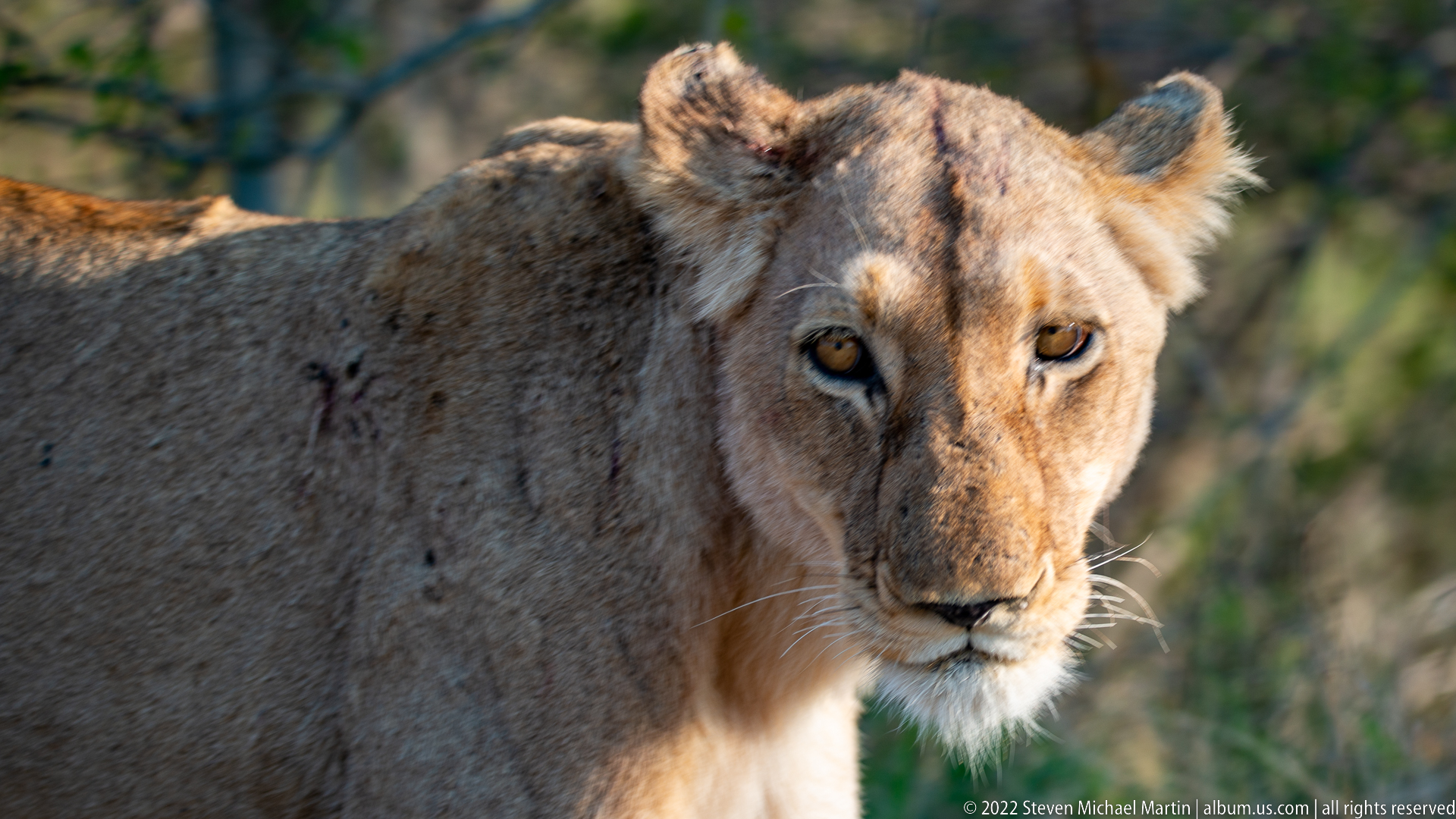
An adult lioness looks directly toward the camera in a tightly framed portrait, her amber eyes, whisker pads, scarred muzzle, and short tawny coat rendered in fine detail. Dappled shade crosses the forehead and ears, giving the face added depth while emphasizing the individual wear visible on a wild predator.
Caption
An adult lioness looks directly toward the camera in a tightly framed portrait, her amber eyes, whisker pads, scarred muzzle, and short tawny coat rendered in fine detail. Dappled shade crosses the forehead and ears, giving the face added depth while emphasizing the individual wear visible on a wild predator.

A lioness walks beside two cubs on the paved road, the three animals overlapping closely as they move together. The cubs' shorter legs, oversized paws, and faint juvenile markings contrast with the adult's taller, leaner frame, making the family relationship immediately legible.
Caption
A lioness walks beside two cubs on the paved road, the three animals overlapping closely as they move together. The cubs' shorter legs, oversized paws, and faint juvenile markings contrast with the adult's taller, leaner frame, making the family relationship immediately legible.
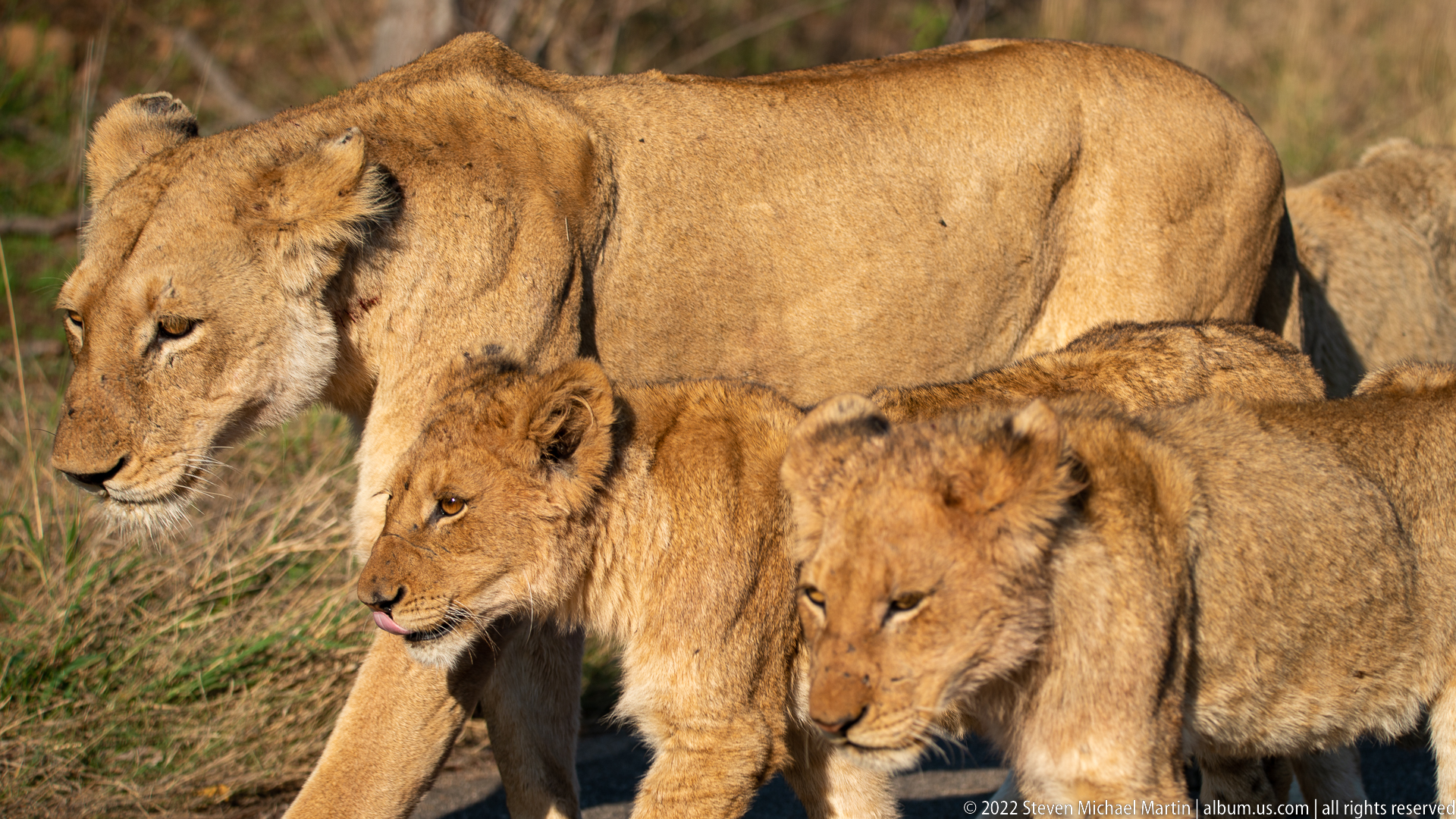
A lioness and two cubs fill the frame as they move along the road shoulder, compressing the pride into a layered family portrait. The adult's broad shoulder and calm expression contrast with the cubs' rounder faces and softer, slightly spotted coats.
Caption
A lioness and two cubs fill the frame as they move along the road shoulder, compressing the pride into a layered family portrait. The adult's broad shoulder and calm expression contrast with the cubs' rounder faces and softer, slightly spotted coats.
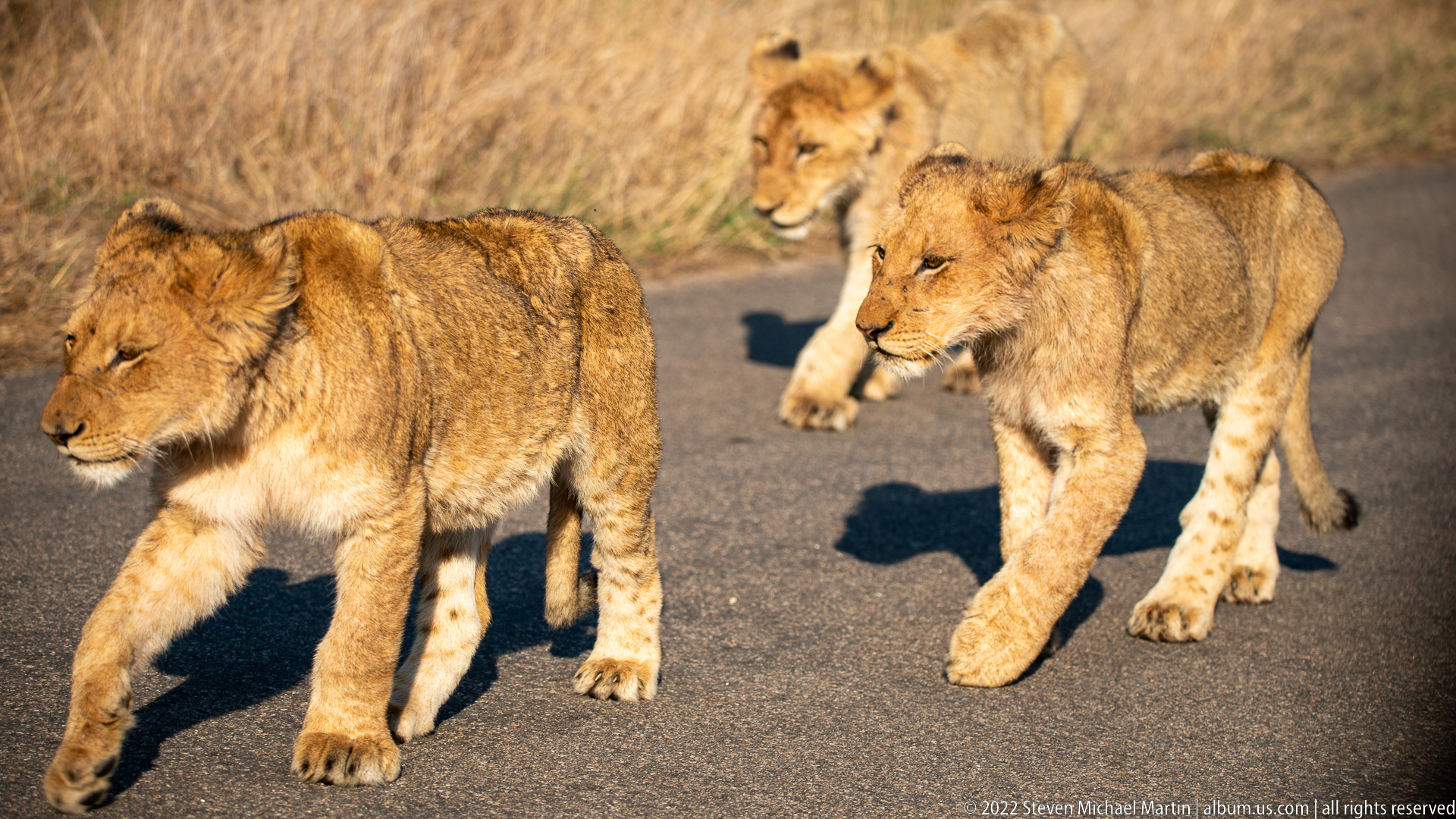
Three lion cubs walk together along the roadway, each at a slightly different stride and distance from the camera. Their oversized paws, rounded ears, and remnants of juvenile spotting are especially visible without an adult in the immediate foreground, creating a clear study of young lions traveling as a group.
Caption
Three lion cubs walk together along the roadway, each at a slightly different stride and distance from the camera. Their oversized paws, rounded ears, and remnants of juvenile spotting are especially visible without an adult in the immediate foreground, creating a clear study of young lions traveling as a group.
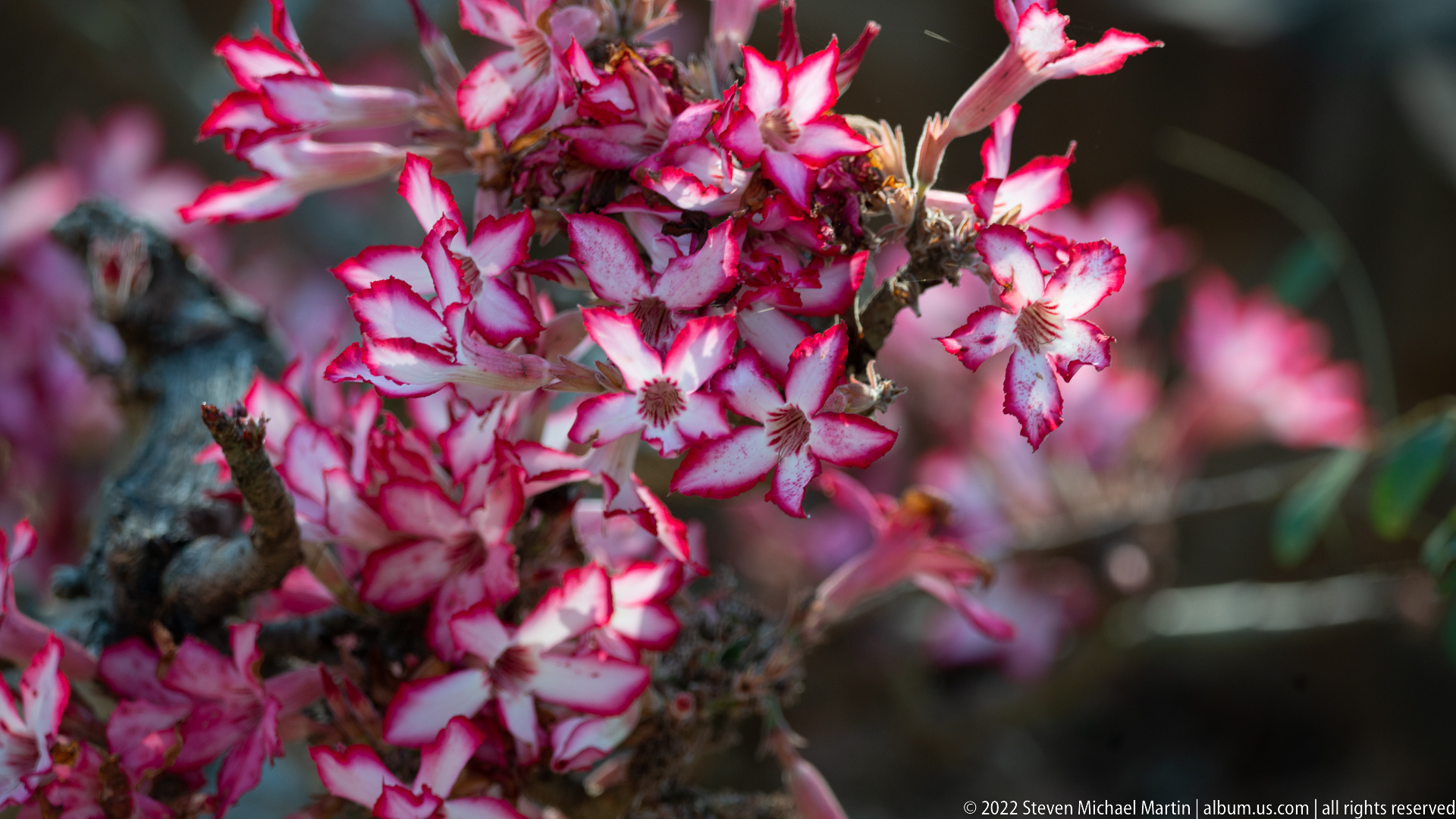
An impala lily produces a dense cluster of star-shaped flowers, each white petal dramatically edged in deep pink-red around a pale throat. The succulent shrub is a characteristic dry-season flowering plant of the Lowveld, and its vivid blossoms stand out strongly against the muted woodland background.
Caption
An impala lily produces a dense cluster of star-shaped flowers, each white petal dramatically edged in deep pink-red around a pale throat. The succulent shrub is a characteristic dry-season flowering plant of the Lowveld, and its vivid blossoms stand out strongly against the muted woodland background.
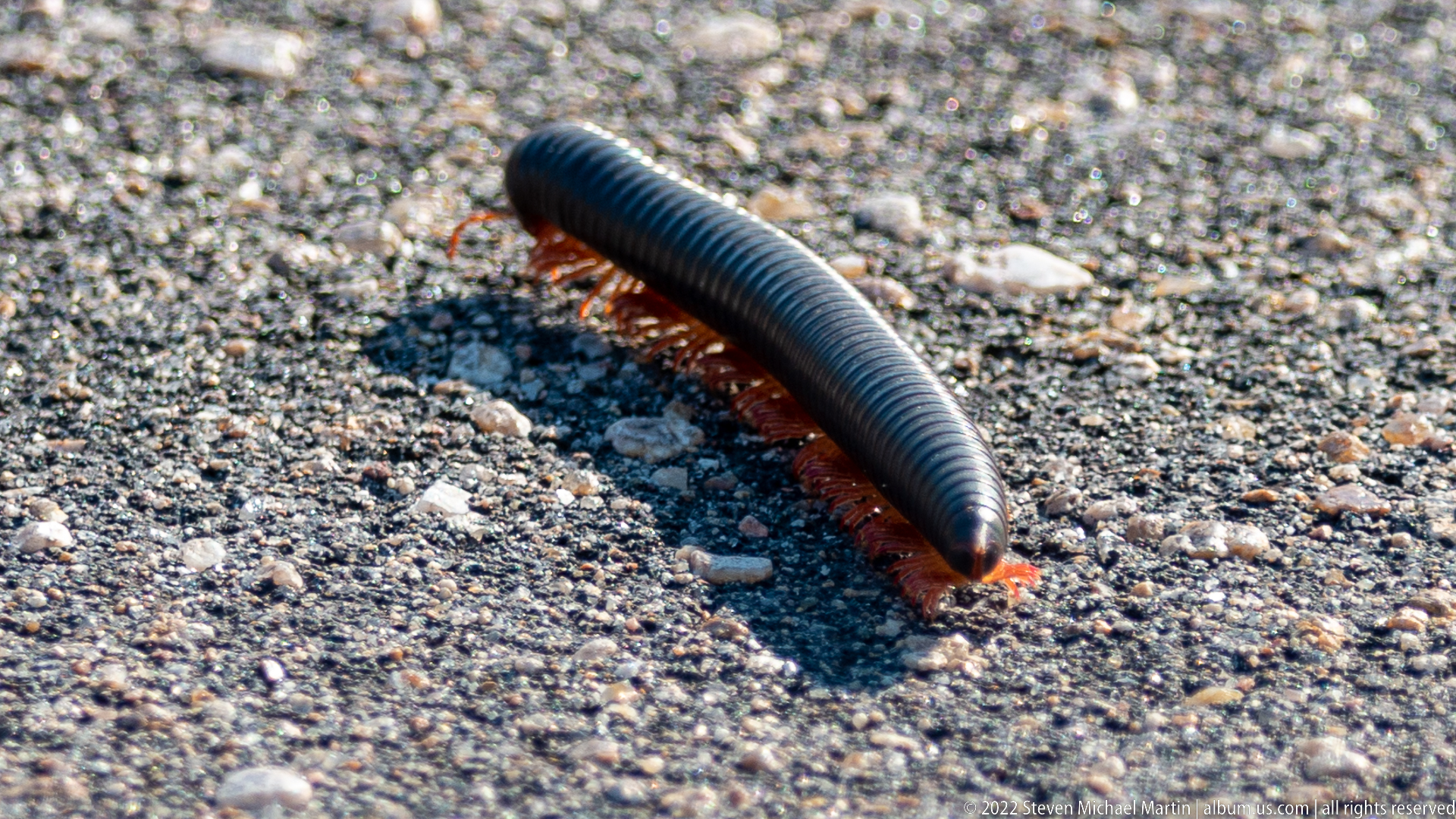
A large black millipede crosses a coarse paved surface, its cylindrical segmented body elevated above rows of reddish legs. The close ground-level view makes the many body rings and coordinated walking legs visible, turning a small invertebrate encounter into a detailed natural-history study.
Caption
A large black millipede crosses a coarse paved surface, its cylindrical segmented body elevated above rows of reddish legs. The close ground-level view makes the many body rings and coordinated walking legs visible, turning a small invertebrate encounter into a detailed natural-history study.
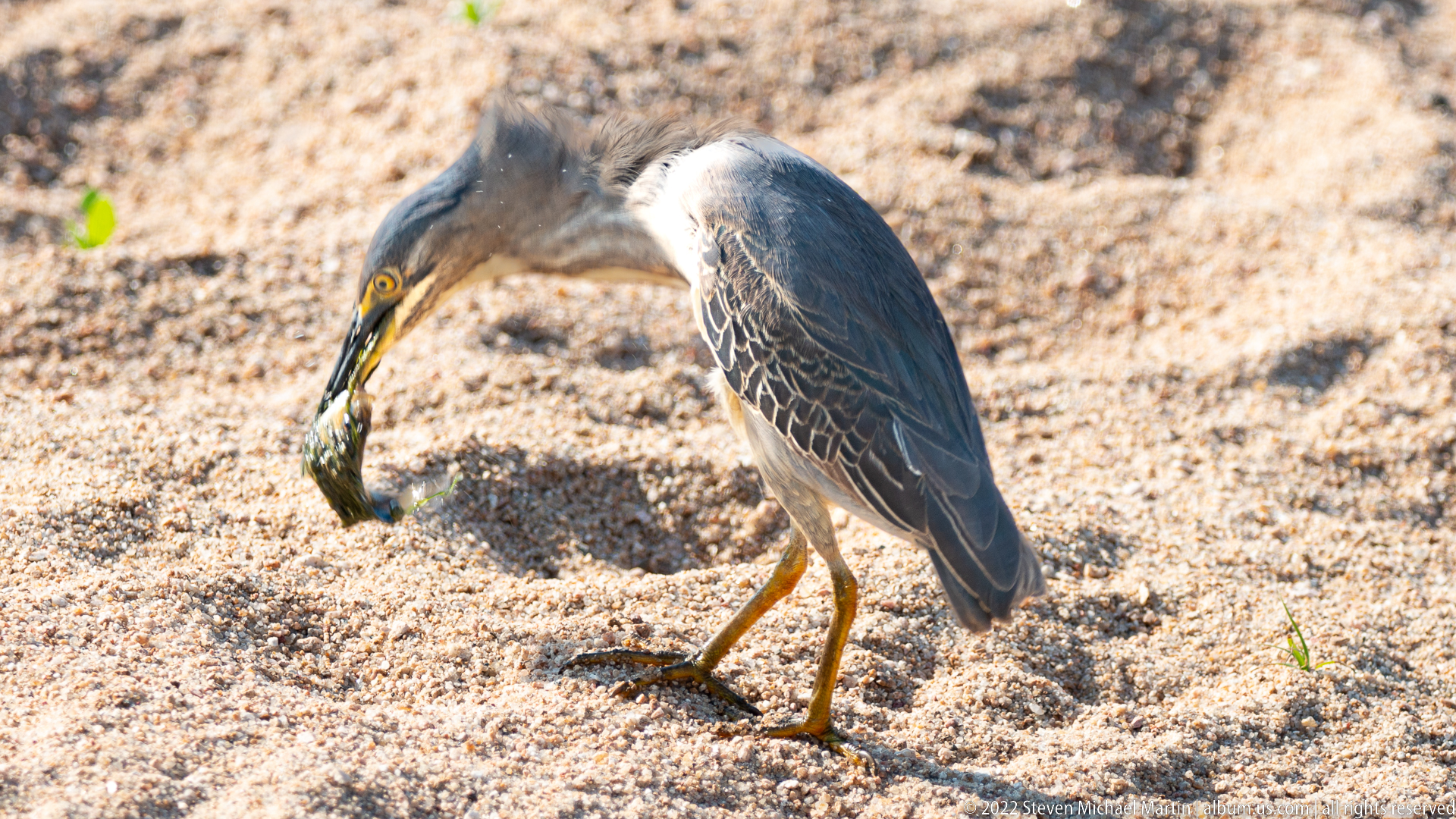
A striated heron bends over prey on a sandy riverbank, gripping a dark amphibian in its bill. The compact heron's gray-blue back, streaked neck, yellow eye, and short yellow legs are visible as it manipulates the catch before swallowing it.
Caption
A striated heron bends over prey on a sandy riverbank, gripping a dark amphibian in its bill. The compact heron's gray-blue back, streaked neck, yellow eye, and short yellow legs are visible as it manipulates the catch before swallowing it.
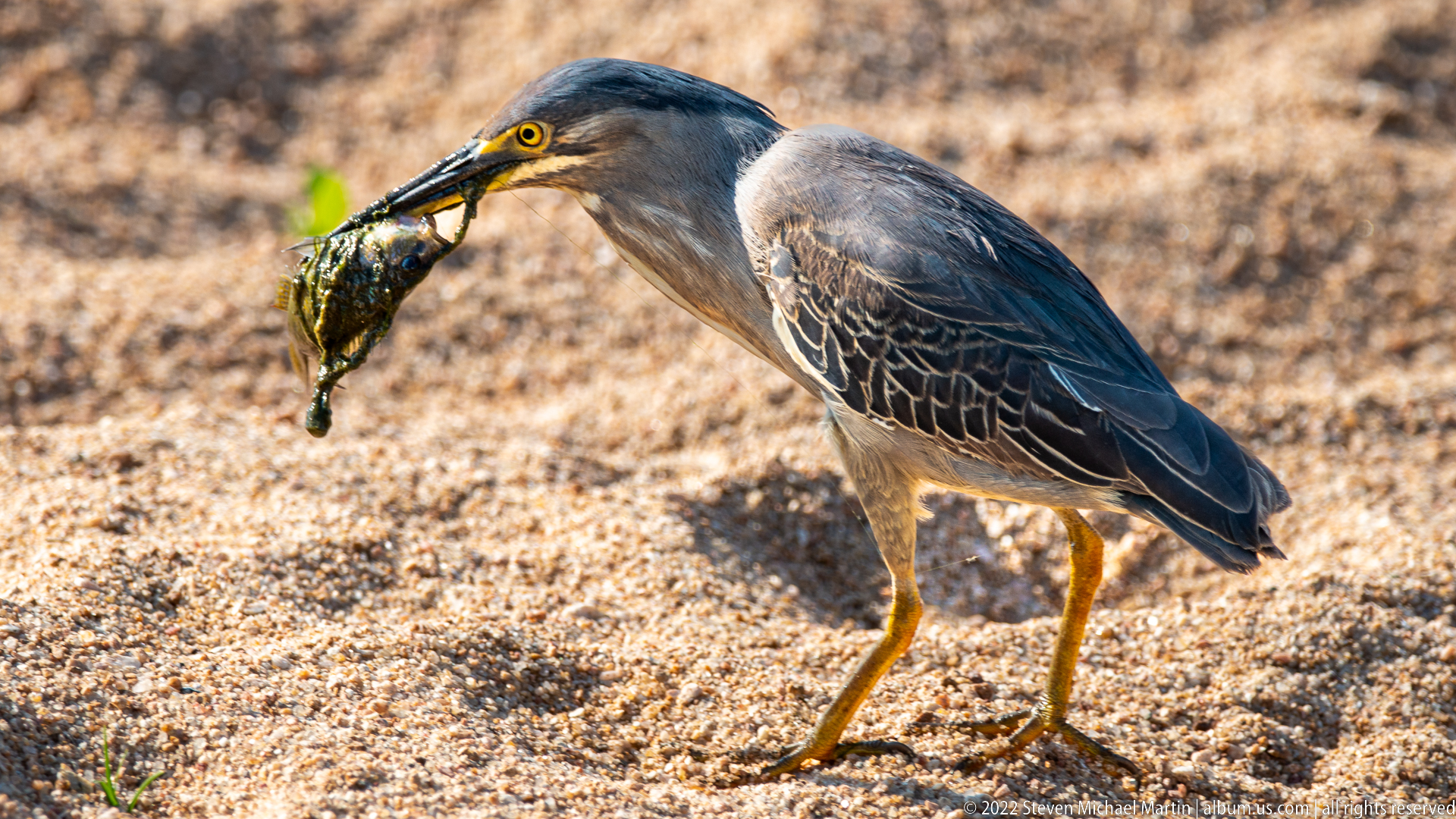
A striated heron stands upright on the sandy bank with a frog clamped crosswise in its bill. The side view gives a particularly clear look at the bird's slate-gray crown and wings, fine neck streaking, yellow eye, and yellow legs while preserving the dramatic feeding behavior.
Caption
A striated heron stands upright on the sandy bank with a frog clamped crosswise in its bill. The side view gives a particularly clear look at the bird's slate-gray crown and wings, fine neck streaking, yellow eye, and yellow legs while preserving the dramatic feeding behavior.
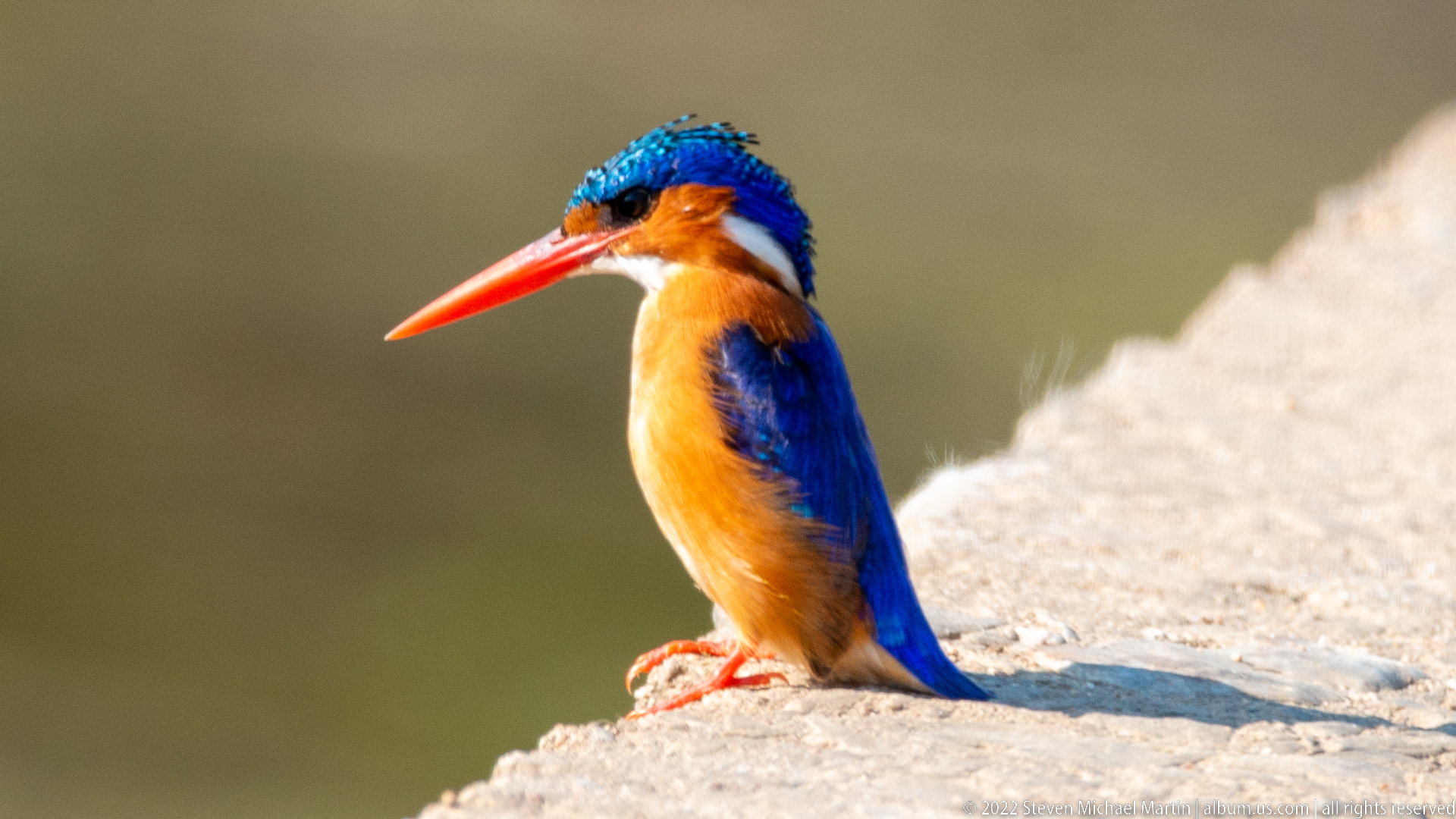
A malachite kingfisher perches on a pale rock above the water, its brilliant cobalt-and-turquoise crown and back contrasting with a rich orange breast and long red bill. The tiny bird's compact stance and vivid plumage make it one of the most distinctive river-edge species in the sequence.
Caption
A malachite kingfisher perches on a pale rock above the water, its brilliant cobalt-and-turquoise crown and back contrasting with a rich orange breast and long red bill. The tiny bird's compact stance and vivid plumage make it one of the most distinctive river-edge species in the sequence.
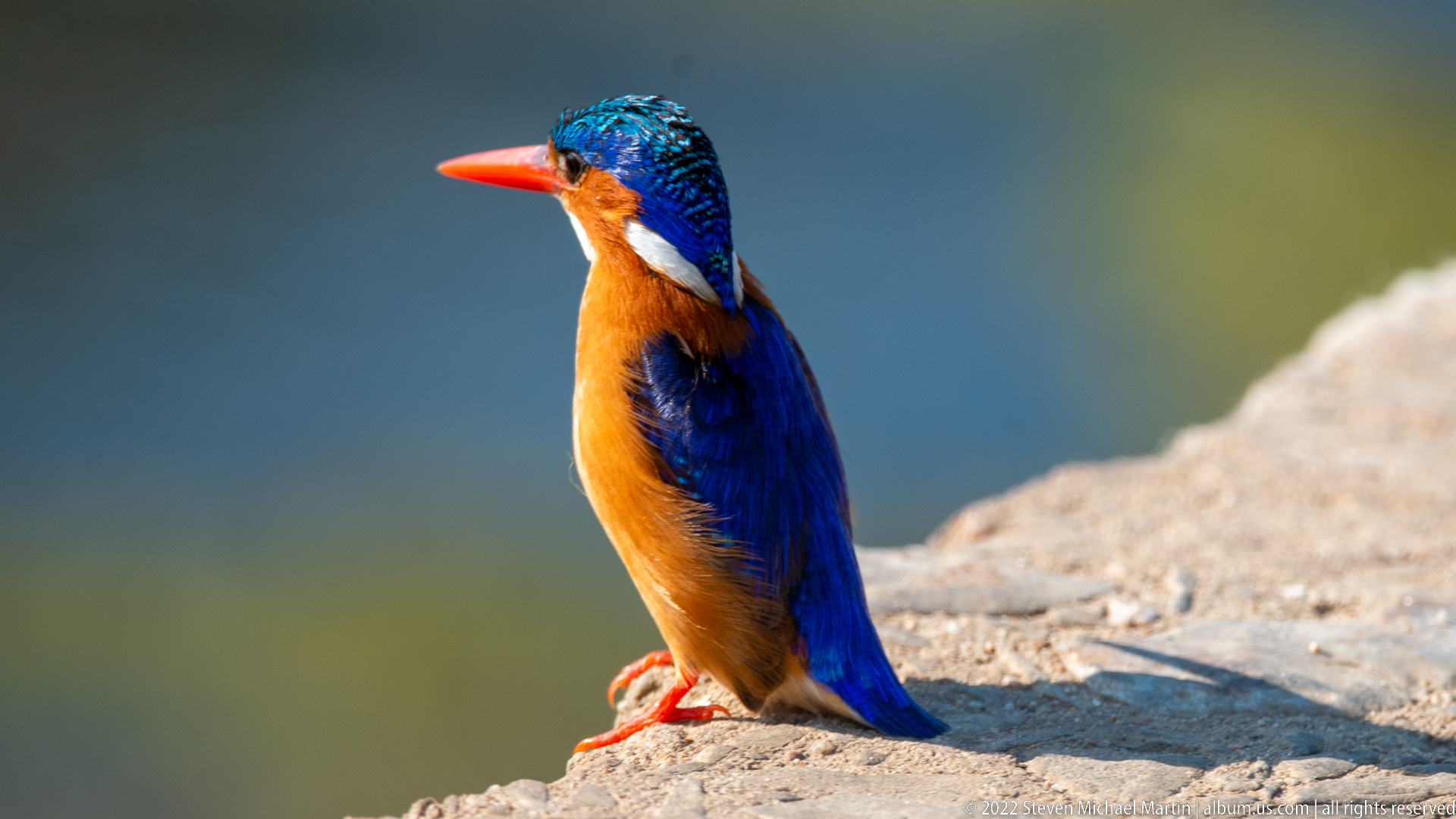
A malachite kingfisher turns in profile on a pale rock, revealing the layered blue crown, cobalt back, orange breast, white neck patch, and red feet and bill. A softly blurred blue-green background isolates the bird and gives the portrait exceptional clarity.
Caption
A malachite kingfisher turns in profile on a pale rock, revealing the layered blue crown, cobalt back, orange breast, white neck patch, and red feet and bill. A softly blurred blue-green background isolates the bird and gives the portrait exceptional clarity.
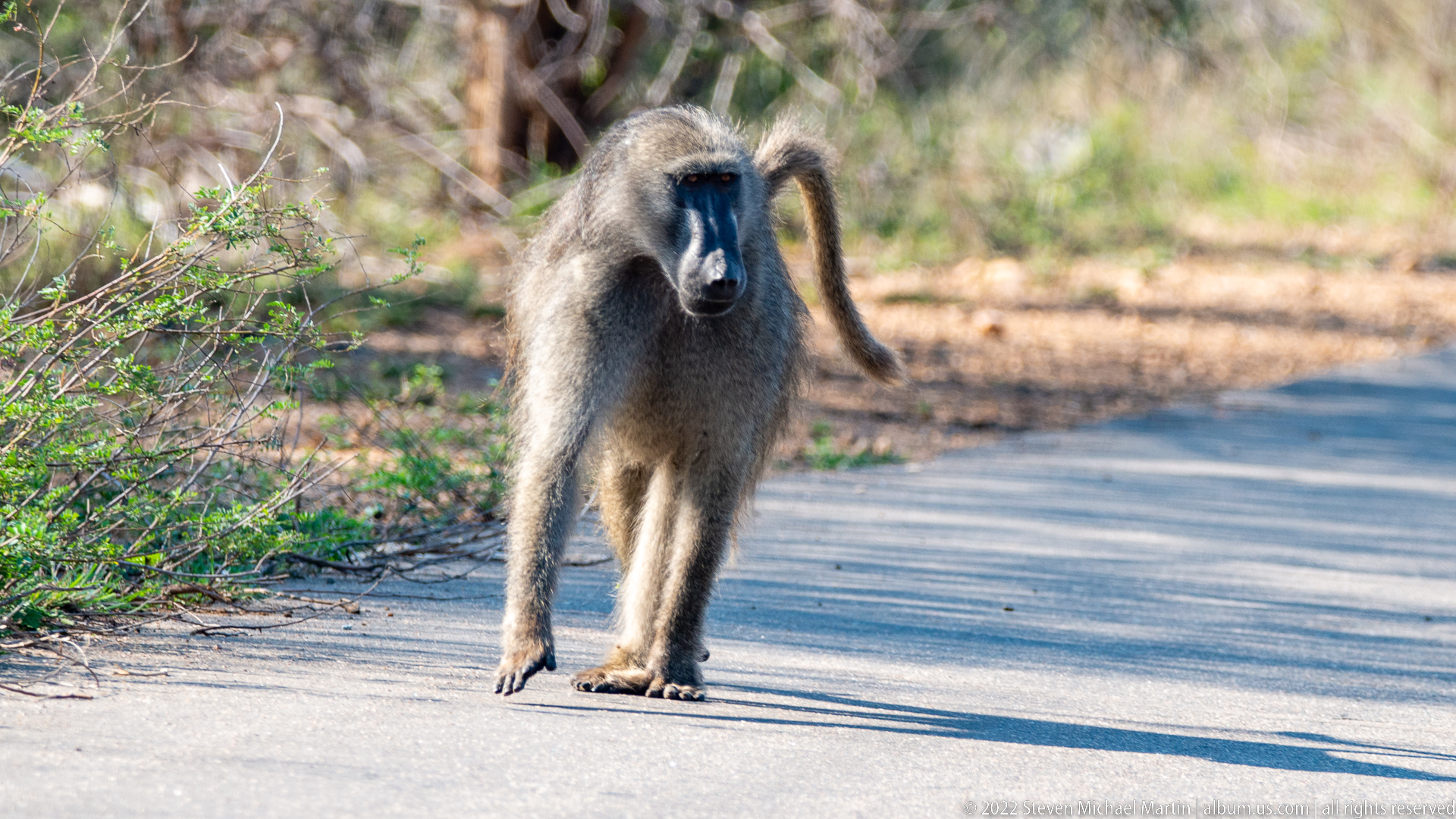
A chacma baboon walks directly toward the camera along a paved road, its long tail arcing behind and its dark, elongated muzzle framed by a grizzled gray coat. The open road provides a full-body view of this terrestrial movement, with woodland vegetation lining both sides.
Caption
A chacma baboon walks directly toward the camera along a paved road, its long tail arcing behind and its dark, elongated muzzle framed by a grizzled gray coat. The open road provides a full-body view of this terrestrial movement, with woodland vegetation lining both sides.
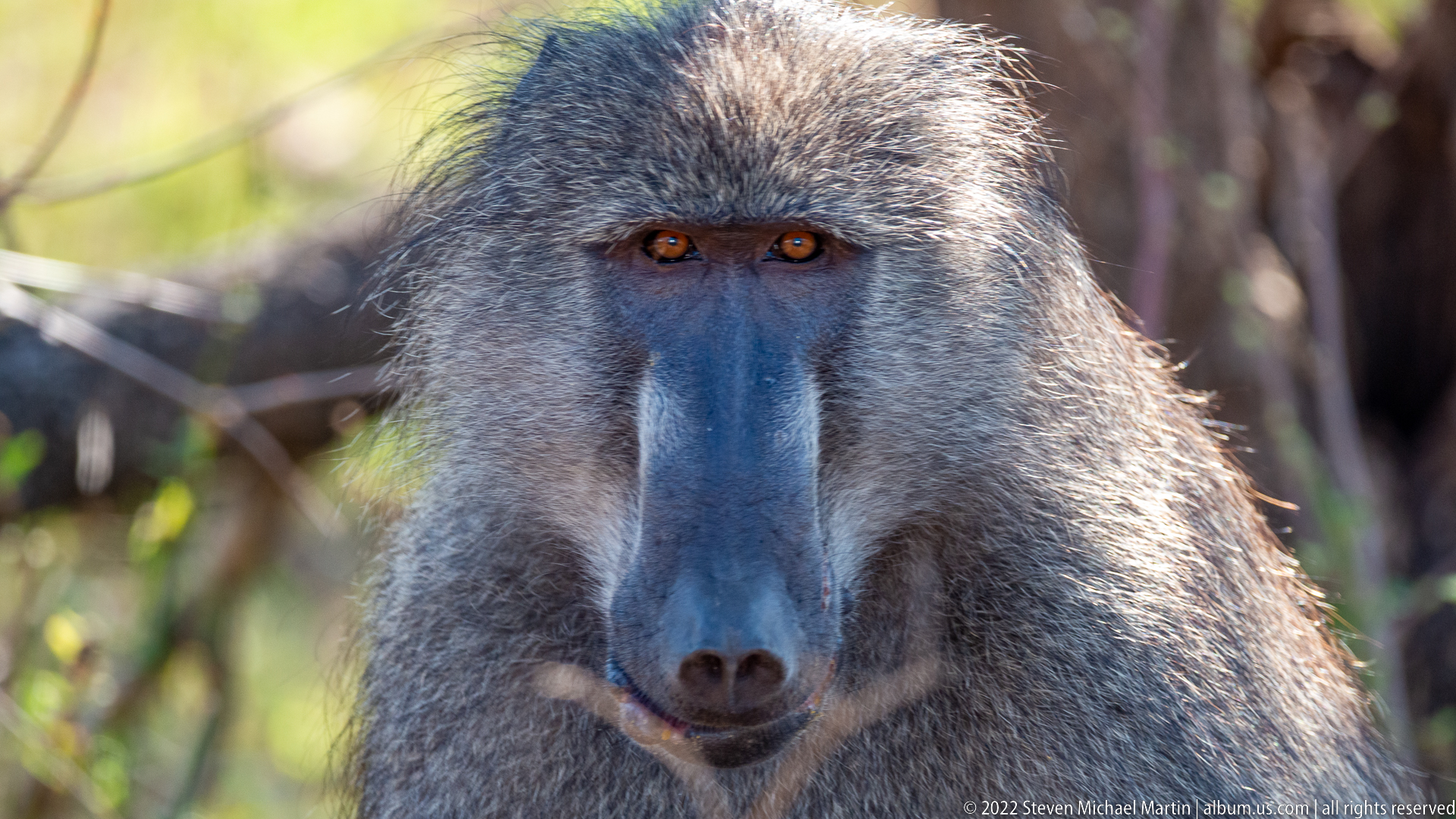
A tight frontal portrait fills the frame with the face of a chacma baboon, emphasizing its amber eyes, elongated dark muzzle, heavy brow, and dense grizzled fur. The direct gaze and shallow depth of field create an unusually intimate study of the species' facial anatomy.
Caption
A tight frontal portrait fills the frame with the face of a chacma baboon, emphasizing its amber eyes, elongated dark muzzle, heavy brow, and dense grizzled fur. The direct gaze and shallow depth of field create an unusually intimate study of the species' facial anatomy.
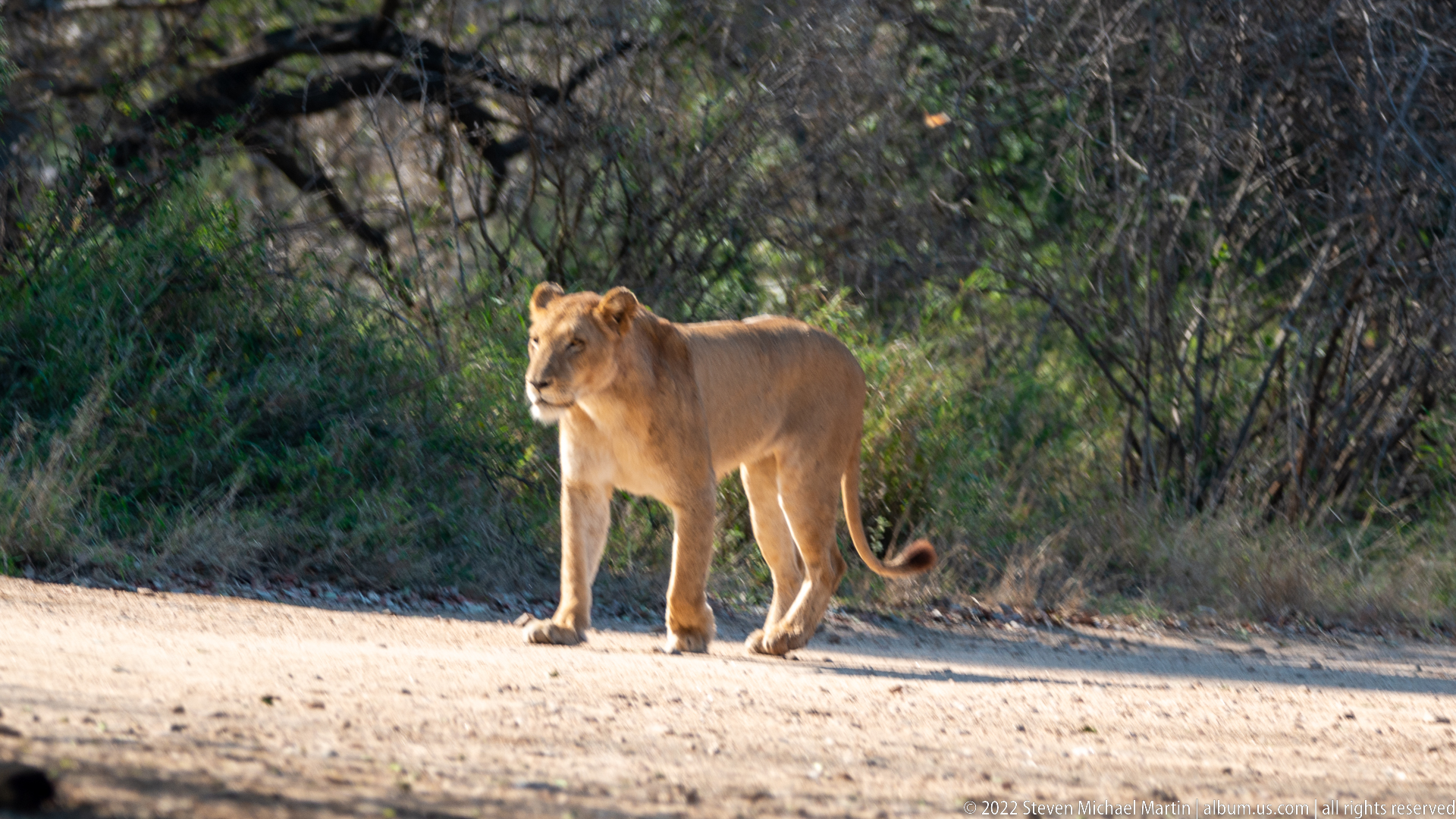
A lioness crosses a pale sandy road from the shaded woodland edge into open light. The wider view gives the animal room within the landscape, showing the long tail, lean torso, and deliberate gait while retaining dense bush as environmental context.
Caption
A lioness crosses a pale sandy road from the shaded woodland edge into open light. The wider view gives the animal room within the landscape, showing the long tail, lean torso, and deliberate gait while retaining dense bush as environmental context.
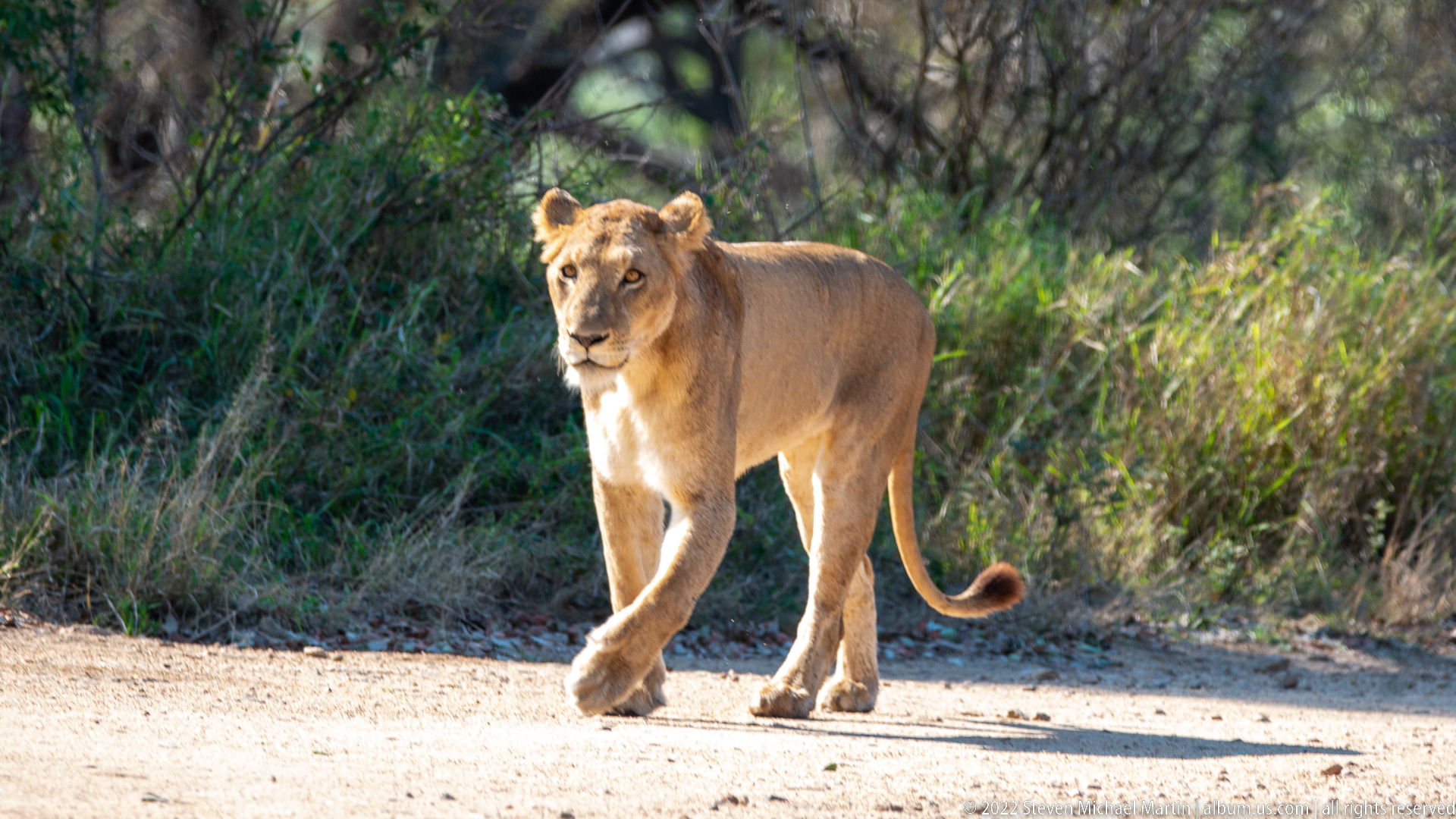
A lioness walks diagonally toward the camera across a sandy road, one forepaw extended and her tail curved into a dark-tufted hook behind. Strong sunlight separates her tawny body from the darker vegetation and gives a clear view of her purposeful stride.
Caption
A lioness walks diagonally toward the camera across a sandy road, one forepaw extended and her tail curved into a dark-tufted hook behind. Strong sunlight separates her tawny body from the darker vegetation and gives a clear view of her purposeful stride.
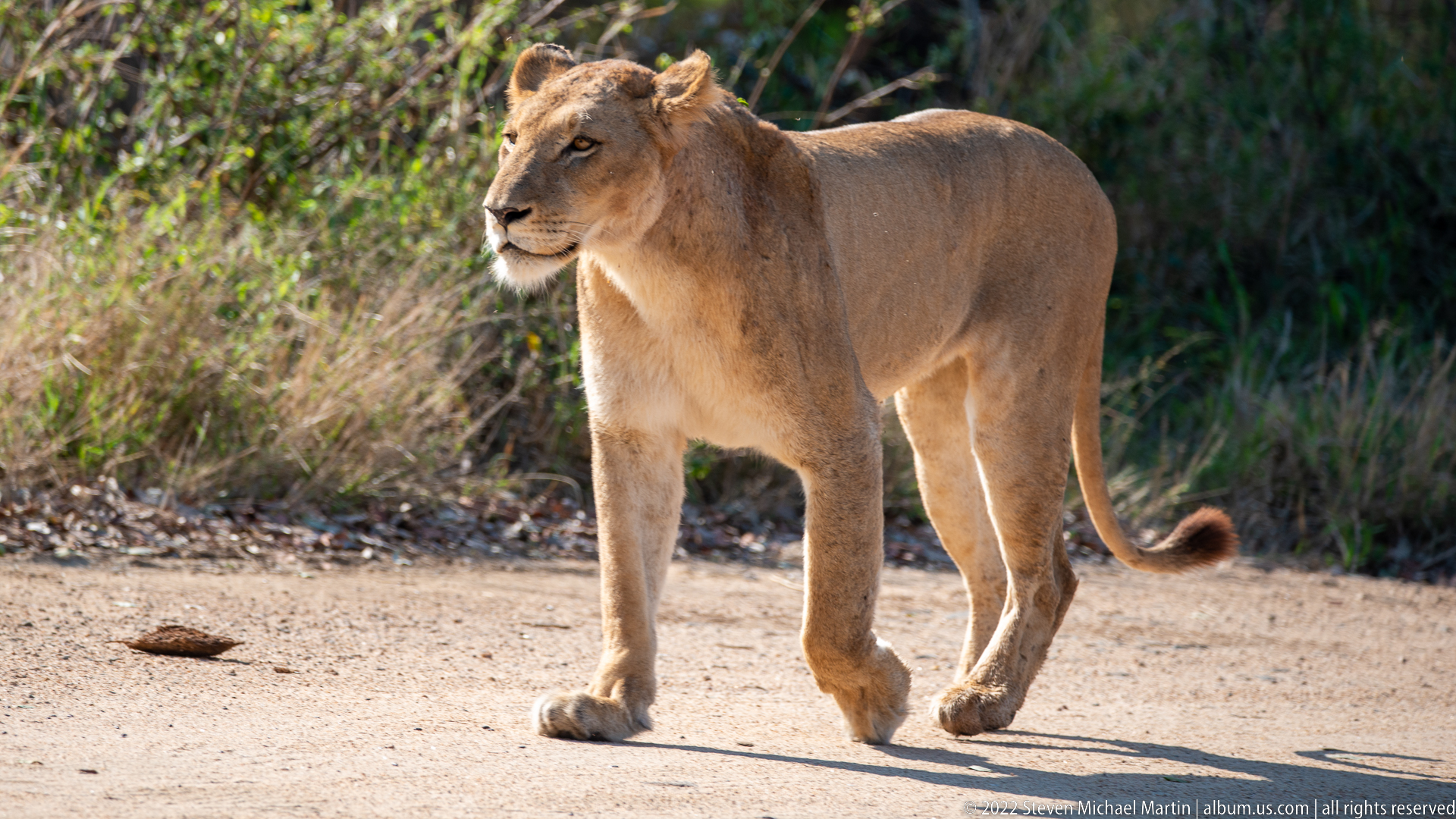
A lioness passes in a near-profile view along the dirt road, her shoulders and hindquarters aligned in a relaxed walking stride. The open foreground and dark woodland background make the animal's smooth tawny coat, pale underside, and long tail especially distinct.
Caption
A lioness passes in a near-profile view along the dirt road, her shoulders and hindquarters aligned in a relaxed walking stride. The open foreground and dark woodland background make the animal's smooth tawny coat, pale underside, and long tail especially distinct.
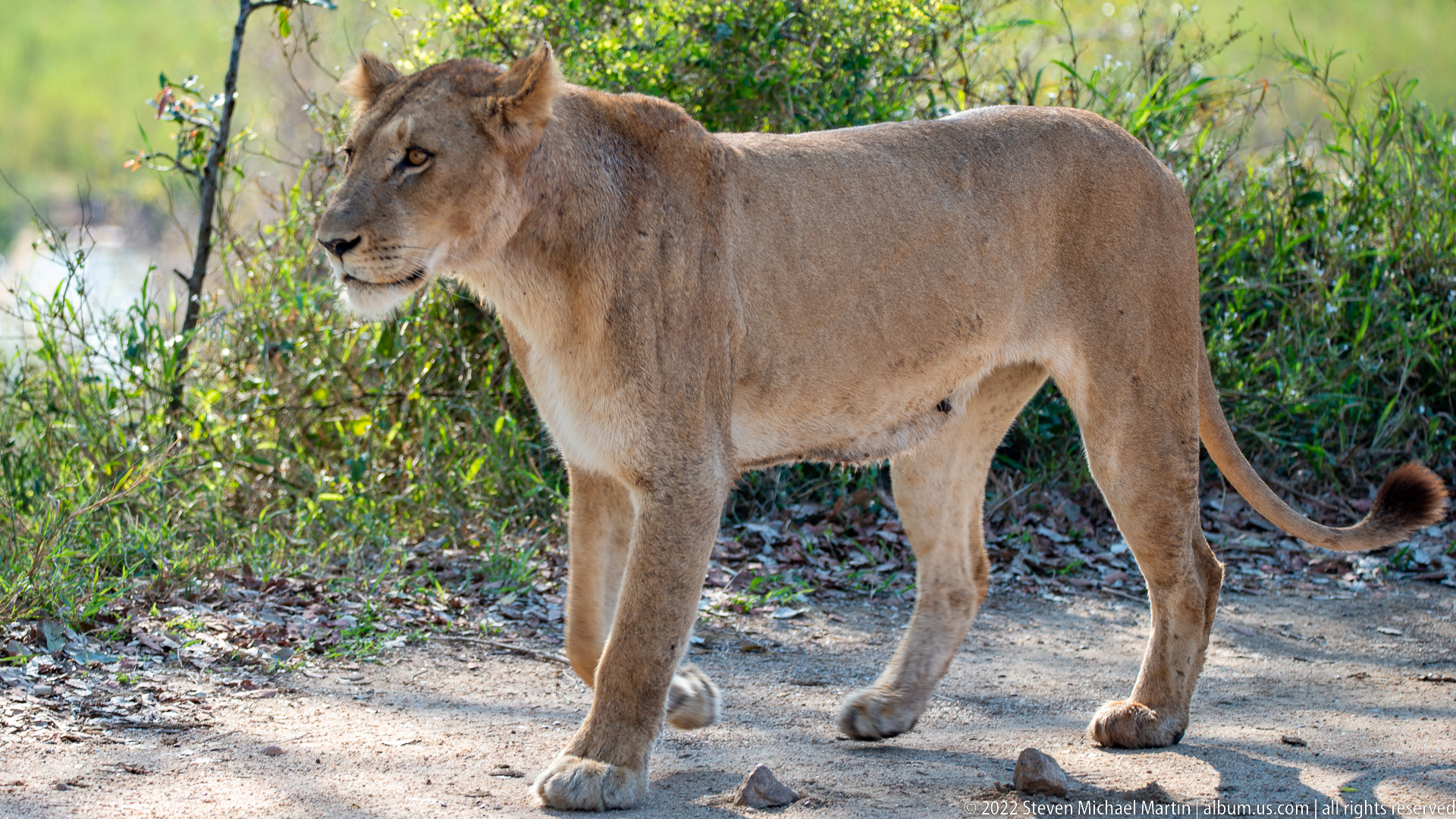
A lioness pauses in profile at the road edge beside greener vegetation, her body fully exposed from head to tail. The still stance allows a clear study of her muscular limbs, pale belly, long back, and dark tail tuft, contrasting with the more dynamic walking frames that precede it.
Caption
A lioness pauses in profile at the road edge beside greener vegetation, her body fully exposed from head to tail. The still stance allows a clear study of her muscular limbs, pale belly, long back, and dark tail tuft, contrasting with the more dynamic walking frames that precede it.
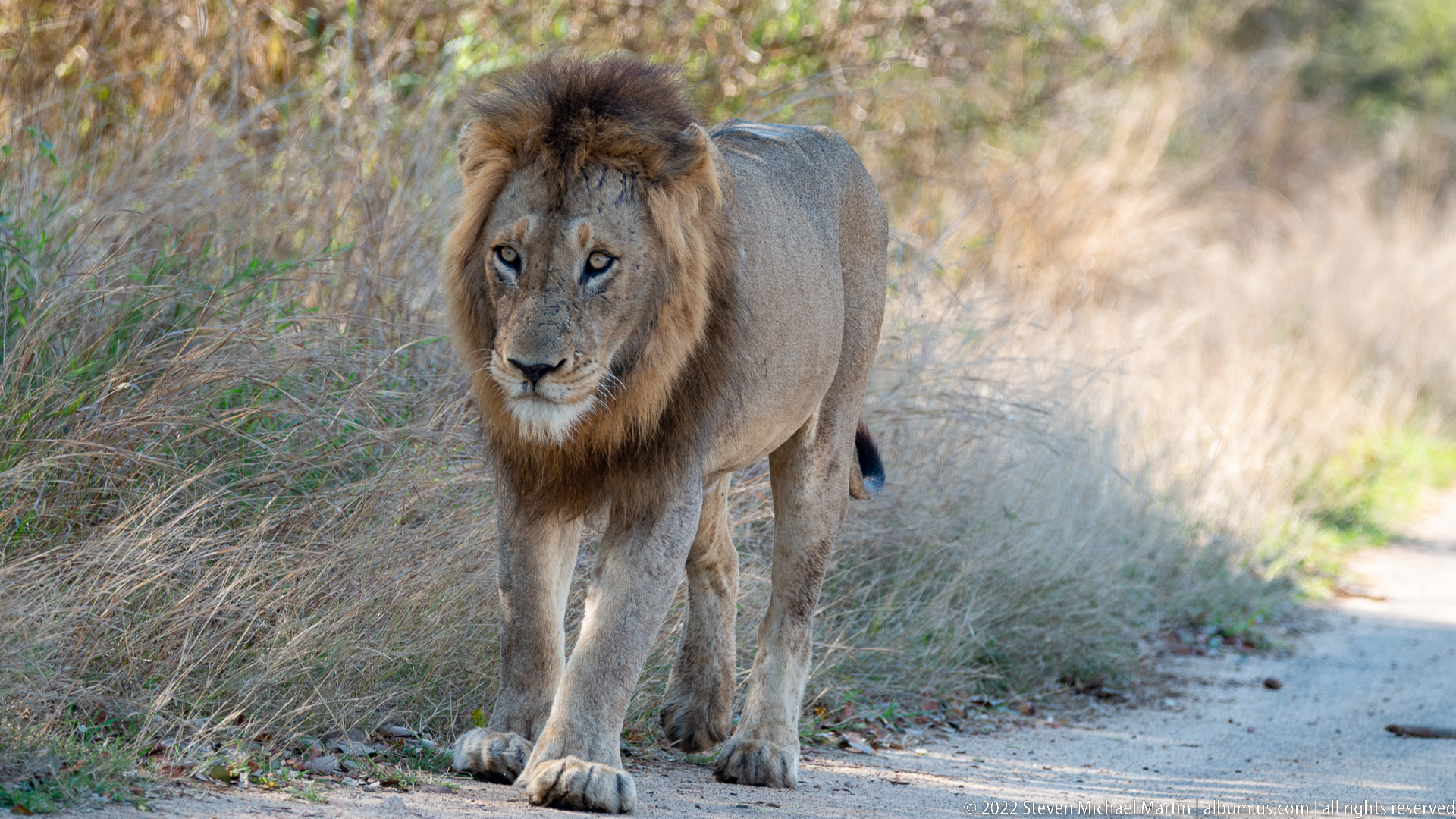
An adult male lion walks toward the camera along a narrow track, his dark full mane framing the face and chest. The nearly frontal approach emphasizes the animal's heavy forequarters, broad paws, and pale eyes while dry grass and brush close in on both sides of the road.
Caption
An adult male lion walks toward the camera along a narrow track, his dark full mane framing the face and chest. The nearly frontal approach emphasizes the animal's heavy forequarters, broad paws, and pale eyes while dry grass and brush close in on both sides of the road.
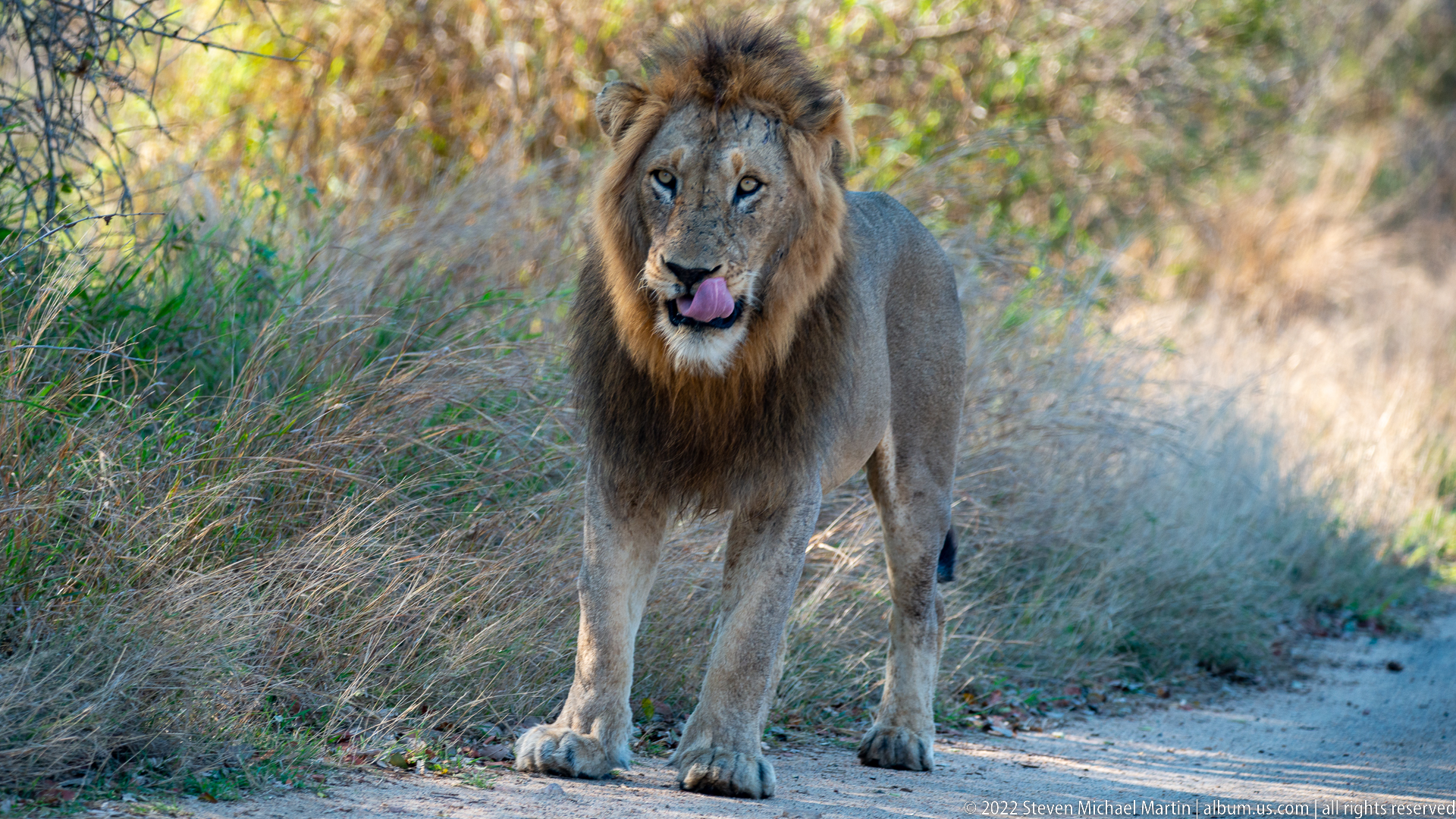
An adult male lion pauses on the track with his tongue curled over his nose, a fleeting grooming gesture caught between steps. His dark mane, pale muzzle, and powerful forequarters stand out against dry grass and scrub, giving the portrait both behavioral detail and strong physical presence.
Caption
An adult male lion pauses on the track with his tongue curled over his nose, a fleeting grooming gesture caught between steps. His dark mane, pale muzzle, and powerful forequarters stand out against dry grass and scrub, giving the portrait both behavioral detail and strong physical presence.
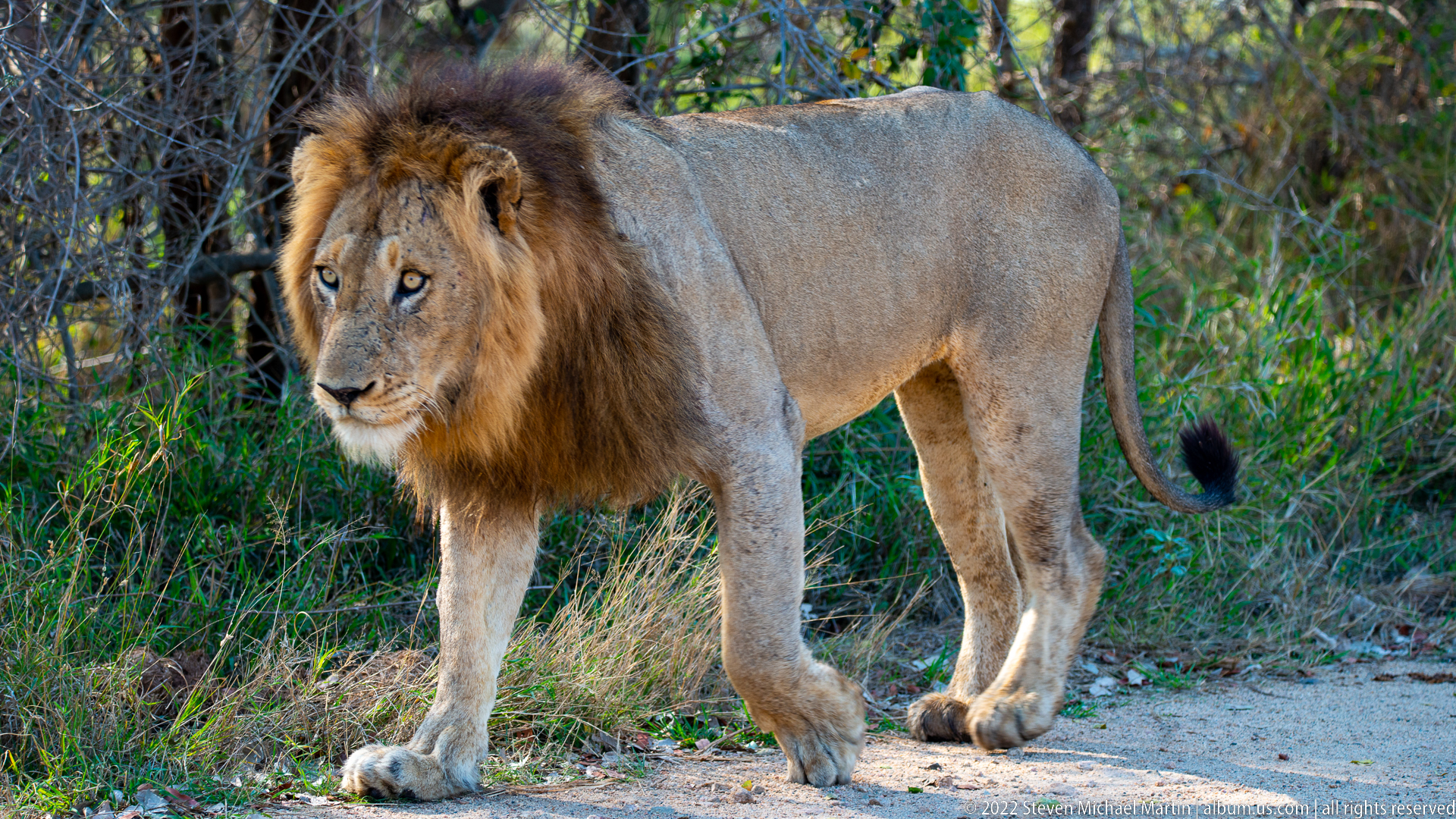
A mature male lion stands in profile at the woodland edge, his dense dark mane extending over the shoulders and chest. The full-body composition reveals the contrast between the heavy mane and the sleek tawny torso, with the black tail tuft hanging behind above the sandy track.
Caption
A mature male lion stands in profile at the woodland edge, his dense dark mane extending over the shoulders and chest. The full-body composition reveals the contrast between the heavy mane and the sleek tawny torso, with the black tail tuft hanging behind above the sandy track.
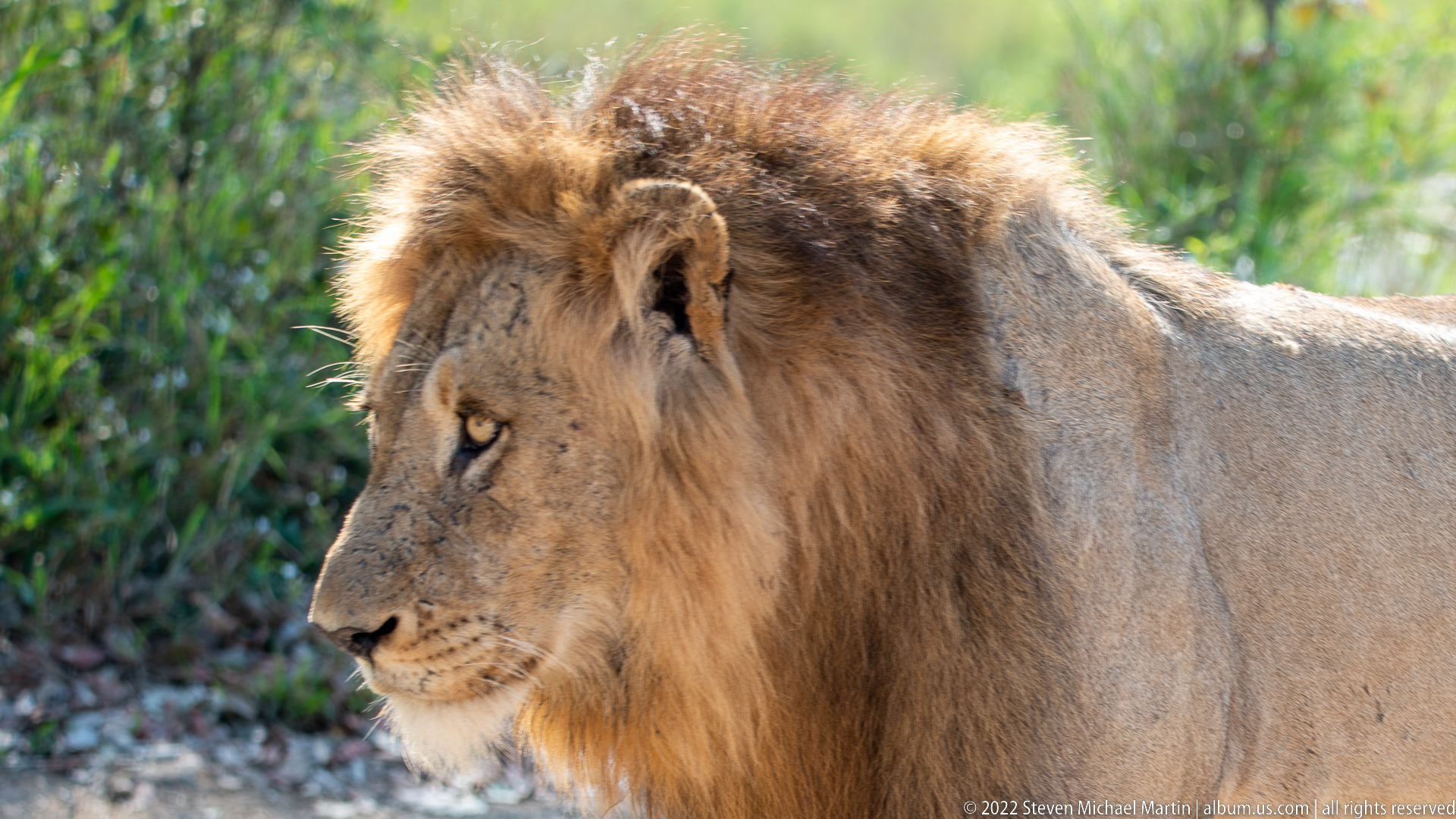
A close profile concentrates on the head and mane of a mature male lion, revealing individual strands of tawny and dark brown hair around the cheek and neck. The pale eye, scarred muzzle, and heavy facial structure are sharply defined against a softly blurred green background.
Caption
A close profile concentrates on the head and mane of a mature male lion, revealing individual strands of tawny and dark brown hair around the cheek and neck. The pale eye, scarred muzzle, and heavy facial structure are sharply defined against a softly blurred green background.
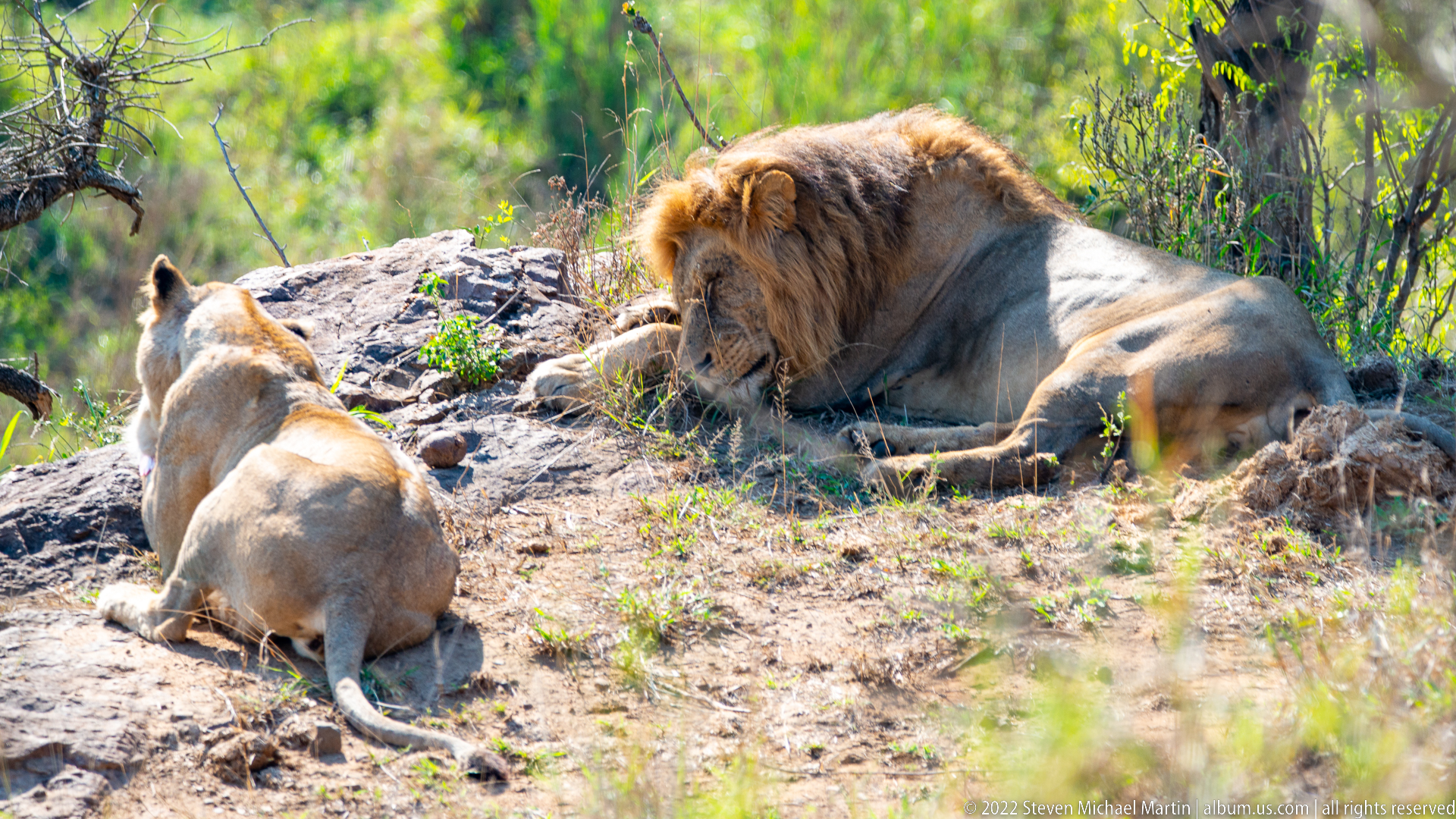
A male lion and lioness rest a short distance apart on a rocky, shaded patch beneath vegetation. The male lies facing the female while she sits with her back partly toward the camera, creating a quiet social scene distinct from the road-walking encounters earlier in the sequence.
Caption
A male lion and lioness rest a short distance apart on a rocky, shaded patch beneath vegetation. The male lies facing the female while she sits with her back partly toward the camera, creating a quiet social scene distinct from the road-walking encounters earlier in the sequence.
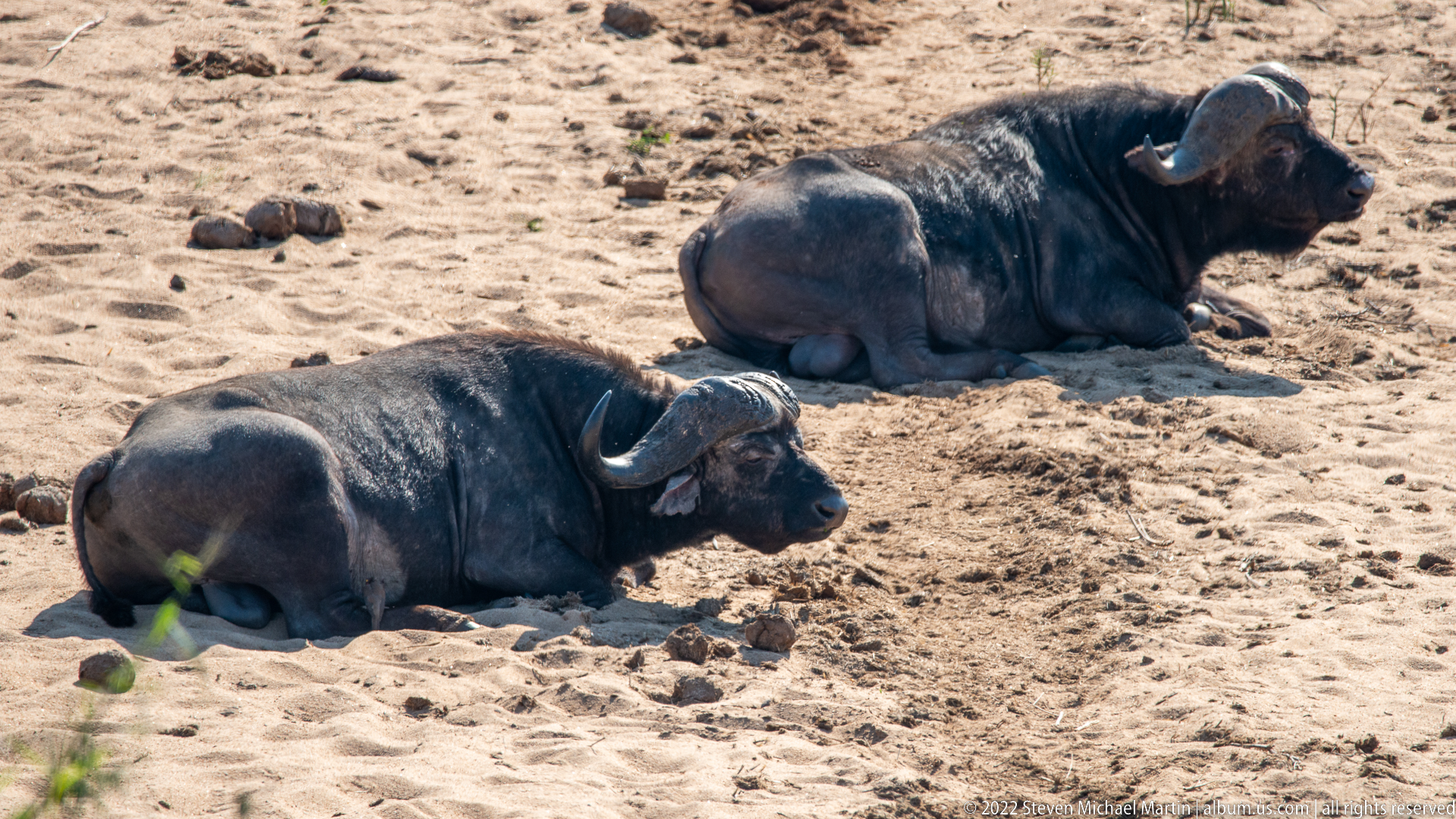
Two African buffalo rest on sandy ground, one lying in the foreground and the other slightly higher behind. Their massive bodies, dark coats, broad muzzles, and heavy curved horns with thickened bases identify one of Kruger's characteristic large bovids in a quiet resting posture.
Caption
Two African buffalo rest on sandy ground, one lying in the foreground and the other slightly higher behind. Their massive bodies, dark coats, broad muzzles, and heavy curved horns with thickened bases identify one of Kruger's characteristic large bovids in a quiet resting posture.
Field Guide
Overview
Skukuza sits along the Sabie River and is one of the most wildlife-rich regions of Kruger National Park. The permanent river supports a dense concentration of animals and birdlife, while the surrounding roads pass through a mosaic of riverine woodland, open grassland, and lightly wooded savanna.
During this visit, the area produced an impressive variety of sightings including lions, hyenas, leopard, elephant, giraffe, zebra, antelope, primates, and numerous birds. The photographs also show how Skukuza combines rich habitat diversity with easy access to scenic river viewpoints, camp facilities, and frequent roadside wildlife encounters.
Location
- 📍 Skukuza, southern Kruger National Park, South Africa
- Habitat: Sabie River corridor, riverine woodland, mixed savanna, and open grassland
- Water source: Sabie River and associated pools, crossings, and riverbank habitat
Wildlife
- 🦁 Lions including lionesses, cubs, and a mature male moving along roads and resting near cover
- 🐆 Leopard partially concealed in tall grass beside the river system
- 🐘 Elephant herds feeding and bathing along river margins
- 🦒 Giraffe browsing among dry trees and riverine vegetation
- 🦓 Zebra grazing in open grassland near woodland edges
- 🦌 Impala and waterbuck using both open and lightly wooded habitat
- 🐗 Warthogs foraging and resting near roads and sandy ground
- 🐒 Vervet monkeys and baboons active near trees, roads, and camp edges
- 🪶 Birdlife including hamerkop, heron, Egyptian goose, roller, owl, kingfisher, and glossy starling
- 🦛 Hippopotamus using deeper river pools and calm channels
- 🦊 Spotted hyenas moving through grassland and roadside vegetation
Behavior
- Lions use roads and open edges for movement between cover and hunting areas
- Riverbanks attract elephants, birds, and herbivores throughout the day
- Leopards rely on grass and vegetation for concealment near the river corridor
- Primates remain active around trees, viewpoints, and camp-adjacent habitat
- Birdlife concentrates along water, sandbanks, and branches overlooking the river
Best Time of Day
- Early morning offers active predator movement and soft light
- Late afternoon gives warm tones across river and savanna habitats
- River viewpoints can remain productive throughout the day for birds and large mammals
Photography Notes
- Roadside sightings allow strong close-range wildlife portraits
- River crossings and viewpoints work well for environmental compositions
- Telephoto lenses help isolate birds, leopard, and distant river activity
- Mixed habitat gives useful variation in background and light
- Small details such as flowers, insects, and camp scenes help round out the story
Why This Stop is Special
Skukuza stands out because it combines the richness of a permanent river ecosystem with the accessibility of one of Kruger’s major camps. Wildlife can appear almost anywhere: along roads, near crossings, beneath riverside trees, or just beyond camp facilities. The result is a safari experience that feels both highly productive and ecologically layered, with large mammals, predators, birds, and small natural details all contributing to the story.
Park Guide:
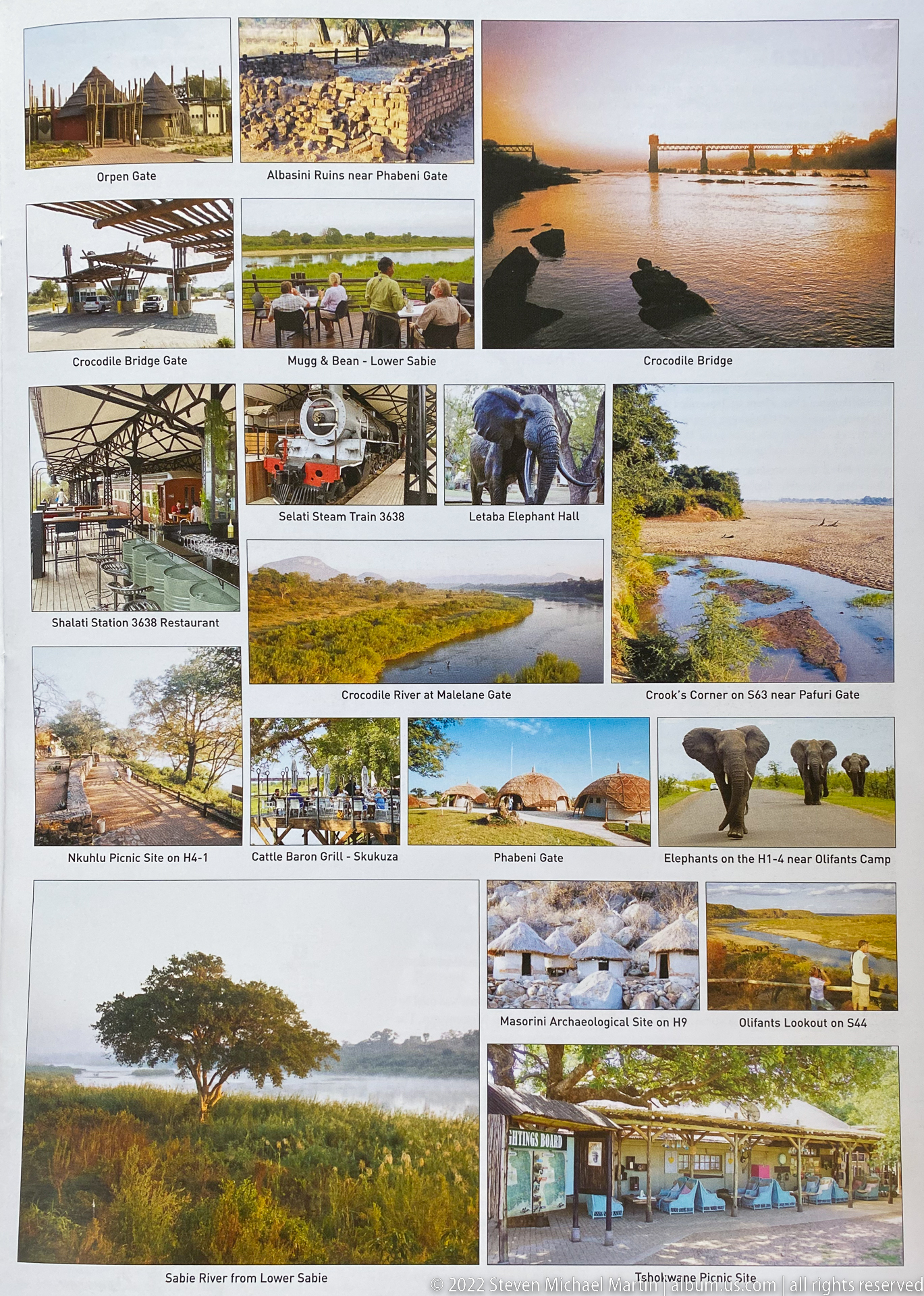
A montage page presents Kruger National Park through labeled photographs of camp facilities, gates, river crossings, landscapes, and visitor sites. The varied scenes move from architecture and bridges to broad river views and woodland, providing a visual index to the park's built and natural environments.
Caption
A montage page presents Kruger National Park through labeled photographs of camp facilities, gates, river crossings, landscapes, and visitor sites. The varied scenes move from architecture and bridges to broad river views and woodland, providing a visual index to the park's built and natural environments.

A densely illustrated Kruger National Park visitor-information page combines gate and camp times, speed-limit reminders, a checklist of visitor rules, park contact numbers, shop and restaurant hours, and malaria guidance. Photographs and icons reinforce the practical information, making this a compact reference page for navigating the park responsibly and safely.
Caption
A densely illustrated Kruger National Park visitor-information page combines gate and camp times, speed-limit reminders, a checklist of visitor rules, park contact numbers, shop and restaurant hours, and malaria guidance. Photographs and icons reinforce the practical information, making this a compact reference page for navigating the park responsibly and safely.
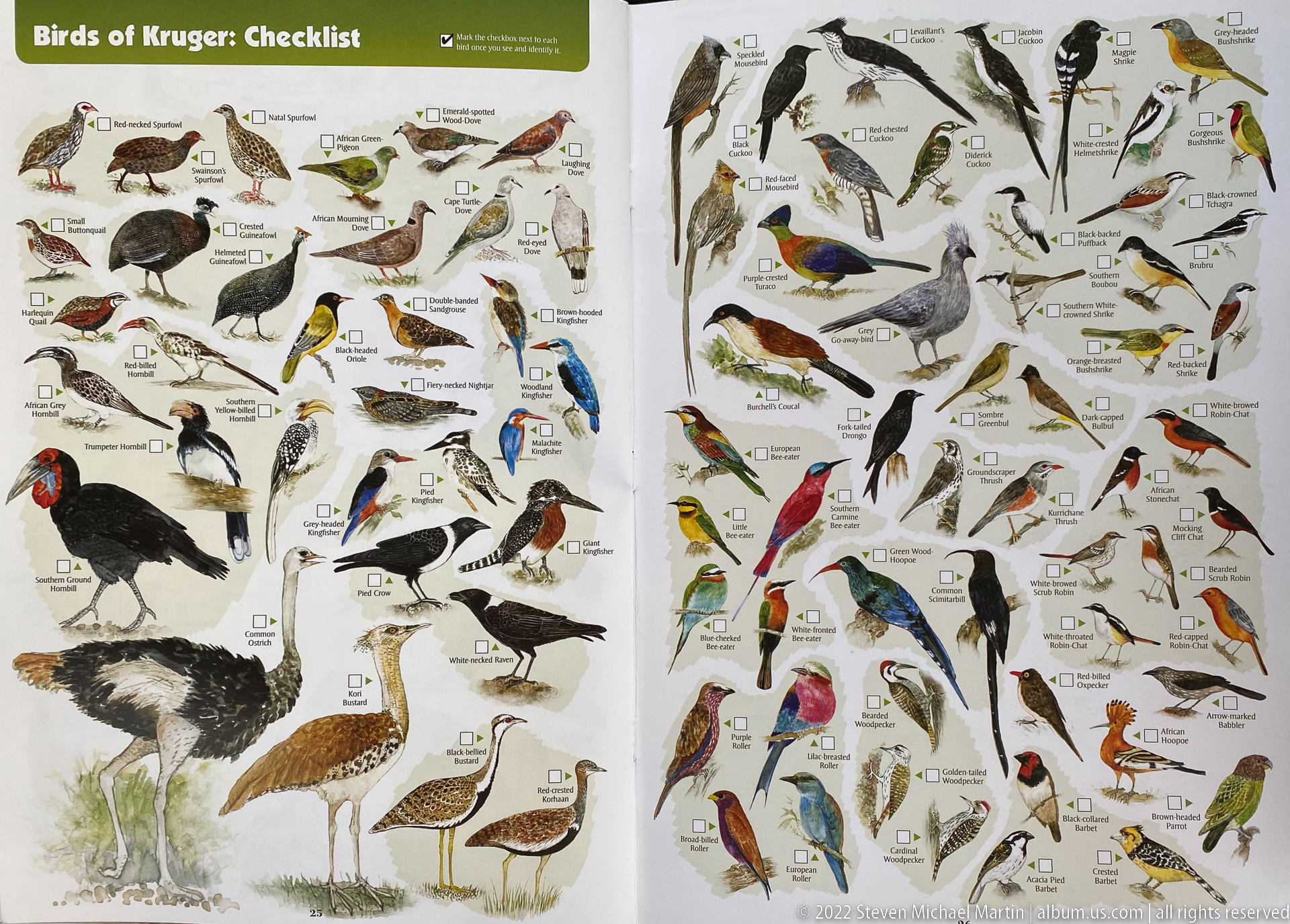
A second bird-checklist spread expands the visual field guide with hornbills, kingfishers, woodpeckers, rollers, bee-eaters, passerines, and other woodland and open-country birds. The dense arrangement encourages comparison of plumage, body shape, bill form, and size across many species.
Caption
A second bird-checklist spread expands the visual field guide with hornbills, kingfishers, woodpeckers, rollers, bee-eaters, passerines, and other woodland and open-country birds. The dense arrangement encourages comparison of plumage, body shape, bill form, and size across many species.

A two-page bird checklist presents a broad range of Kruger species, including raptors, owls, gamebirds, waterbirds, storks, herons, and other conspicuous groups. Labeled illustrations and check boxes support field identification and allow visitors to record species observed during a park visit.
Caption
A two-page bird checklist presents a broad range of Kruger species, including raptors, owls, gamebirds, waterbirds, storks, herons, and other conspicuous groups. Labeled illustrations and check boxes support field identification and allow visitors to record species observed during a park visit.

A 'Hot Spots in the Park' guide page organizes recommended wildlife-viewing areas into seasonal categories, pairing short location notes with photographs of waterholes, rivers, large mammals, and birds. The layout emphasizes how changing rainfall and water availability influence where visitors may encounter wildlife across Kruger.
Caption
A 'Hot Spots in the Park' guide page organizes recommended wildlife-viewing areas into seasonal categories, pairing short location notes with photographs of waterholes, rivers, large mammals, and birds. The layout emphasizes how changing rainfall and water availability influence where visitors may encounter wildlife across Kruger.
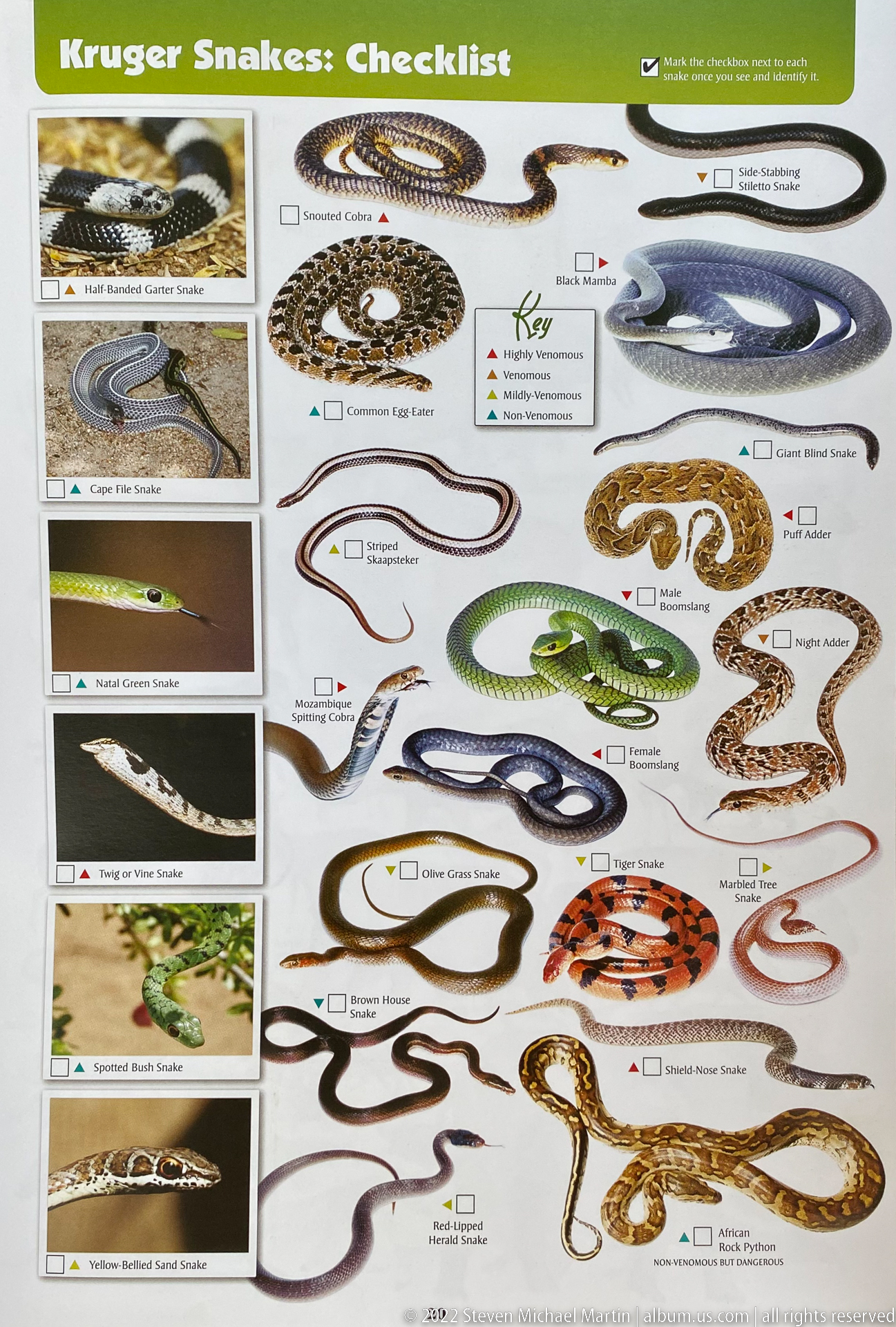
An illustrated snake checklist presents numerous Kruger reptiles in comparative rows, pairing drawings or photographs with species names and check boxes. Differences in body color, banding, head shape, and pattern are shown side by side, making the page a visual field reference rather than a photograph of a single species.
Caption
An illustrated snake checklist presents numerous Kruger reptiles in comparative rows, pairing drawings or photographs with species names and check boxes. Differences in body color, banding, head shape, and pattern are shown side by side, making the page a visual field reference rather than a photograph of a single species.
The cover of an English-language 'Kruger Park Map & Guide,' 3rd Edition, combines photographs of prominent park wildlife including buffalo, leopard, rhinoceros, lion, and elephant. Its subtitle promotes guidance on where to spot the 'Big 5,' while additional cover text advertises illustrated mammals, reptiles, checklists, and more than 200 birds.
Caption
The cover of an English-language 'Kruger Park Map & Guide,' 3rd Edition, combines photographs of prominent park wildlife including buffalo, leopard, rhinoceros, lion, and elephant. Its subtitle promotes guidance on where to spot the 'Big 5,' while additional cover text advertises illustrated mammals, reptiles, checklists, and more than 200 birds.
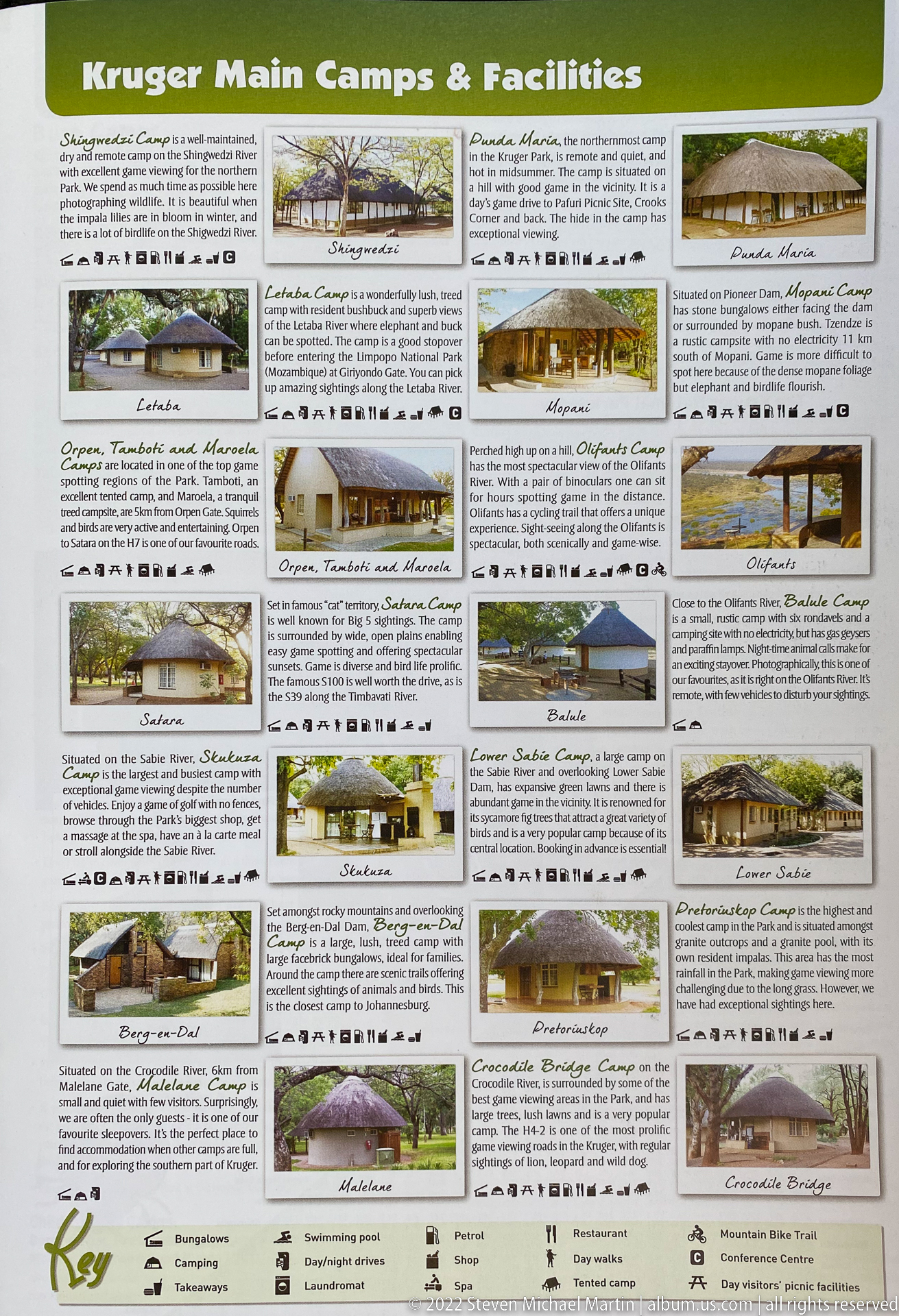
An illustrated guide page surveys Kruger National Park's main camps and visitor facilities through small photographs and short descriptive entries. Camp names are paired with images of accommodation, landscapes, and amenities, while a symbol key along the bottom summarizes services available across the park.
Caption
An illustrated guide page surveys Kruger National Park's main camps and visitor facilities through small photographs and short descriptive entries. Camp names are paired with images of accommodation, landscapes, and amenities, while a symbol key along the bottom summarizes services available across the park.

A reference page combines a short history of Kruger National Park with landmark dates, a large triangular distance-and-time chart, and illustrated natural-history details. Photographs of rhinoceros, flowers, archaeological remains, and an insect broaden the page from travel logistics into the park's cultural and ecological context.
Caption
A reference page combines a short history of Kruger National Park with landmark dates, a large triangular distance-and-time chart, and illustrated natural-history details. Photographs of rhinoceros, flowers, archaeological remains, and an insect broaden the page from travel logistics into the park's cultural and ecological context.
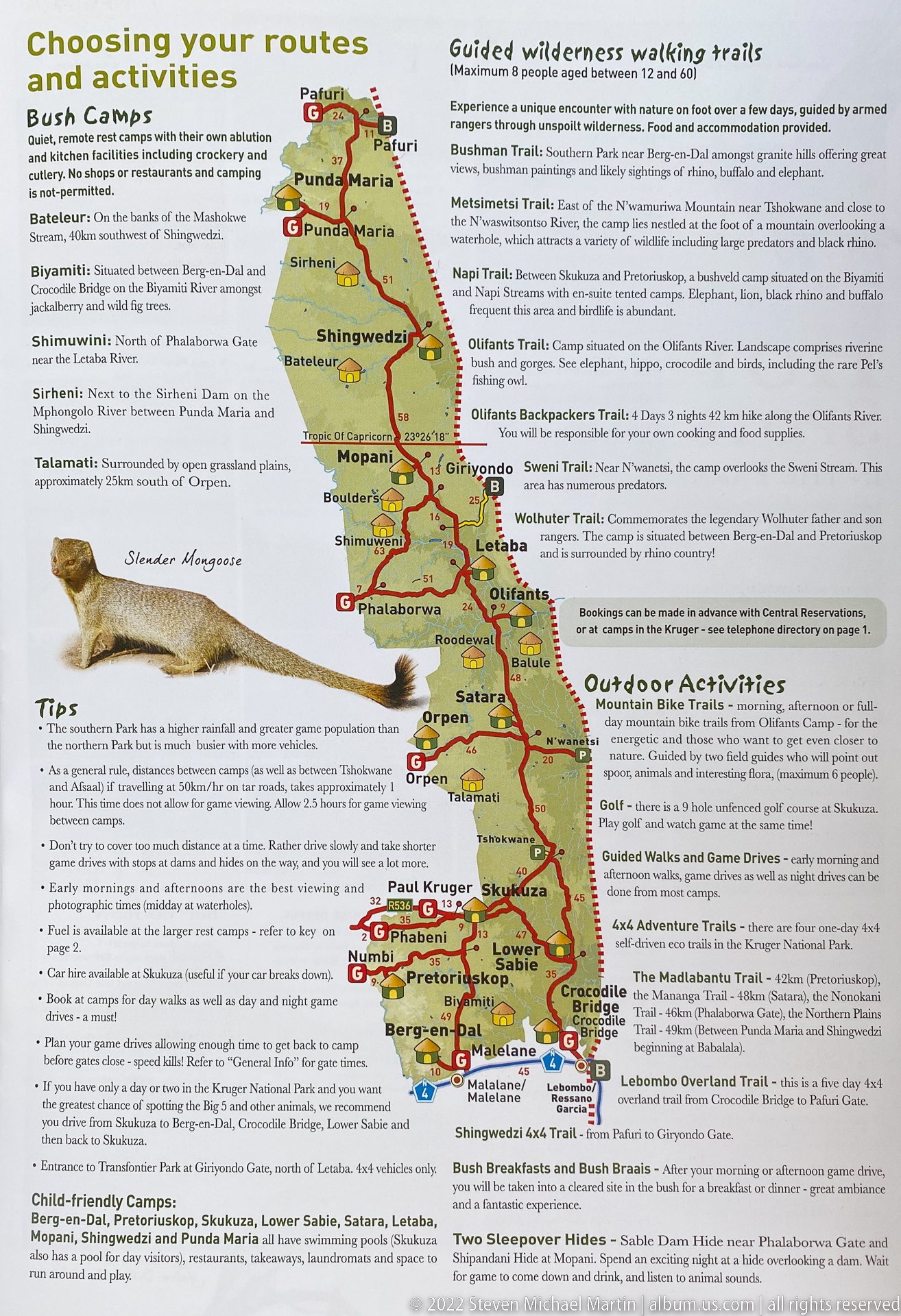
A full-height map of Kruger National Park anchors a page devoted to route planning and outdoor activities. Colored roads connect named camps from north to south, while surrounding text introduces guided wilderness walking trails, suggested drives, tips, outdoor activities, and child-friendly camp options.
Caption
A full-height map of Kruger National Park anchors a page devoted to route planning and outdoor activities. Colored roads connect named camps from north to south, while surrounding text introduces guided wilderness walking trails, suggested drives, tips, outdoor activities, and child-friendly camp options.

A color-coded ecoregions map divides Kruger National Park into broad ecological zones, with descriptive text blocks naming vegetation and landscape types along both sides. The diagram emphasizes the park's north-south environmental variation and provides ecological context for differences in habitat and wildlife distribution.
Caption
A color-coded ecoregions map divides Kruger National Park into broad ecological zones, with descriptive text blocks naming vegetation and landscape types along both sides. The diagram emphasizes the park's north-south environmental variation and provides ecological context for differences in habitat and wildlife distribution.

A final illustrated bird-checklist page features an especially varied selection of Kruger species, from large hornbills and long-tailed birds to bright weavers, bee-eaters, rollers, shrikes, and other savanna birds. The labeled artwork and check boxes form a compact visual record for comparing and logging sightings.
Caption
A final illustrated bird-checklist page features an especially varied selection of Kruger species, from large hornbills and long-tailed birds to bright weavers, bee-eaters, rollers, shrikes, and other savanna birds. The labeled artwork and check boxes form a compact visual record for comparing and logging sightings.
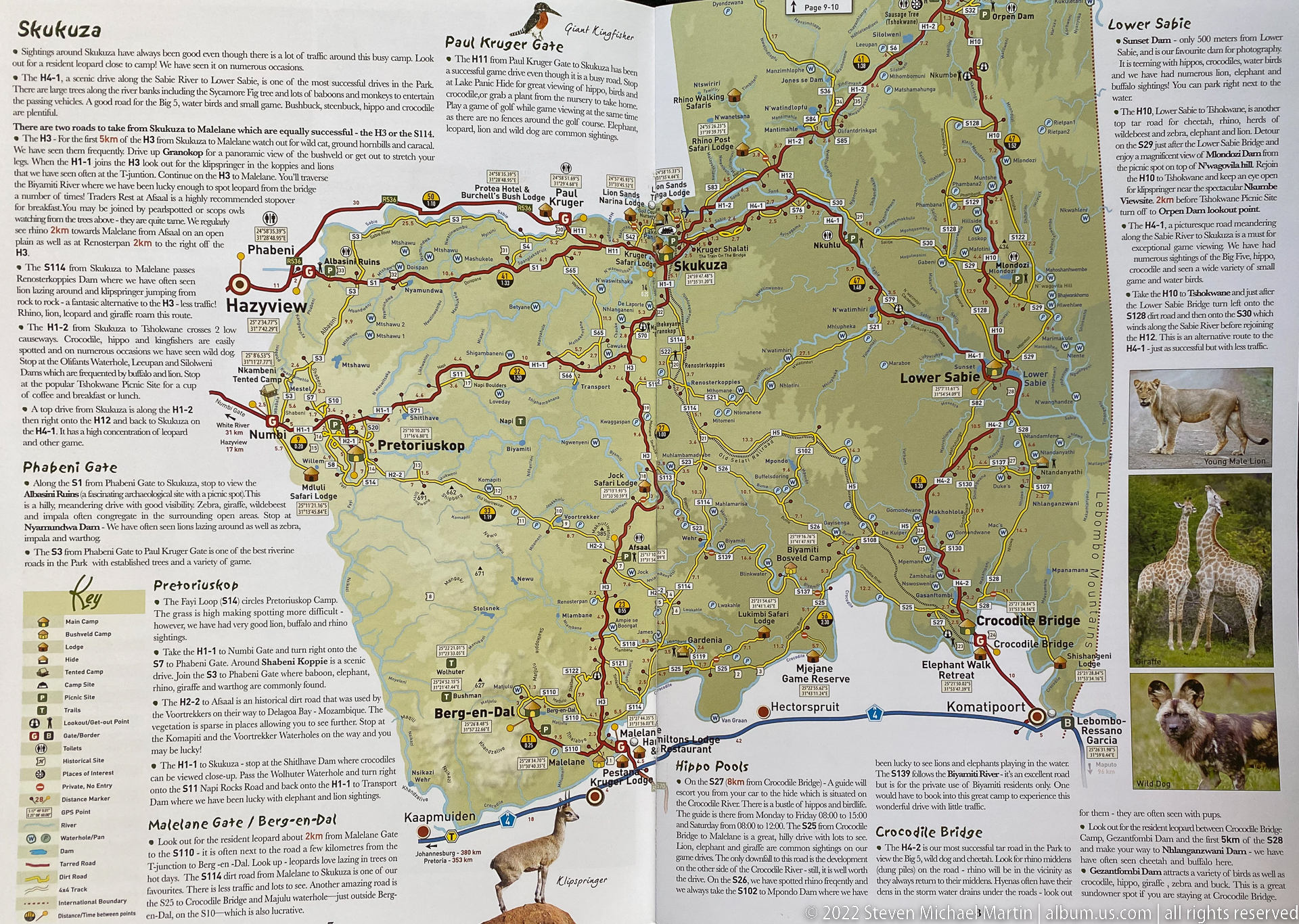
A detailed regional map covers the southern portion of Kruger National Park, with roads, rivers, camps, gates, and nearby towns plotted across the landscape. Insets and surrounding text highlight destinations and wildlife, turning the map into both a navigation aid and a compact introduction to the park's southern sector.
Caption
A detailed regional map covers the southern portion of Kruger National Park, with roads, rivers, camps, gates, and nearby towns plotted across the landscape. Insets and surrounding text highlight destinations and wildlife, turning the map into both a navigation aid and a compact introduction to the park's southern sector.
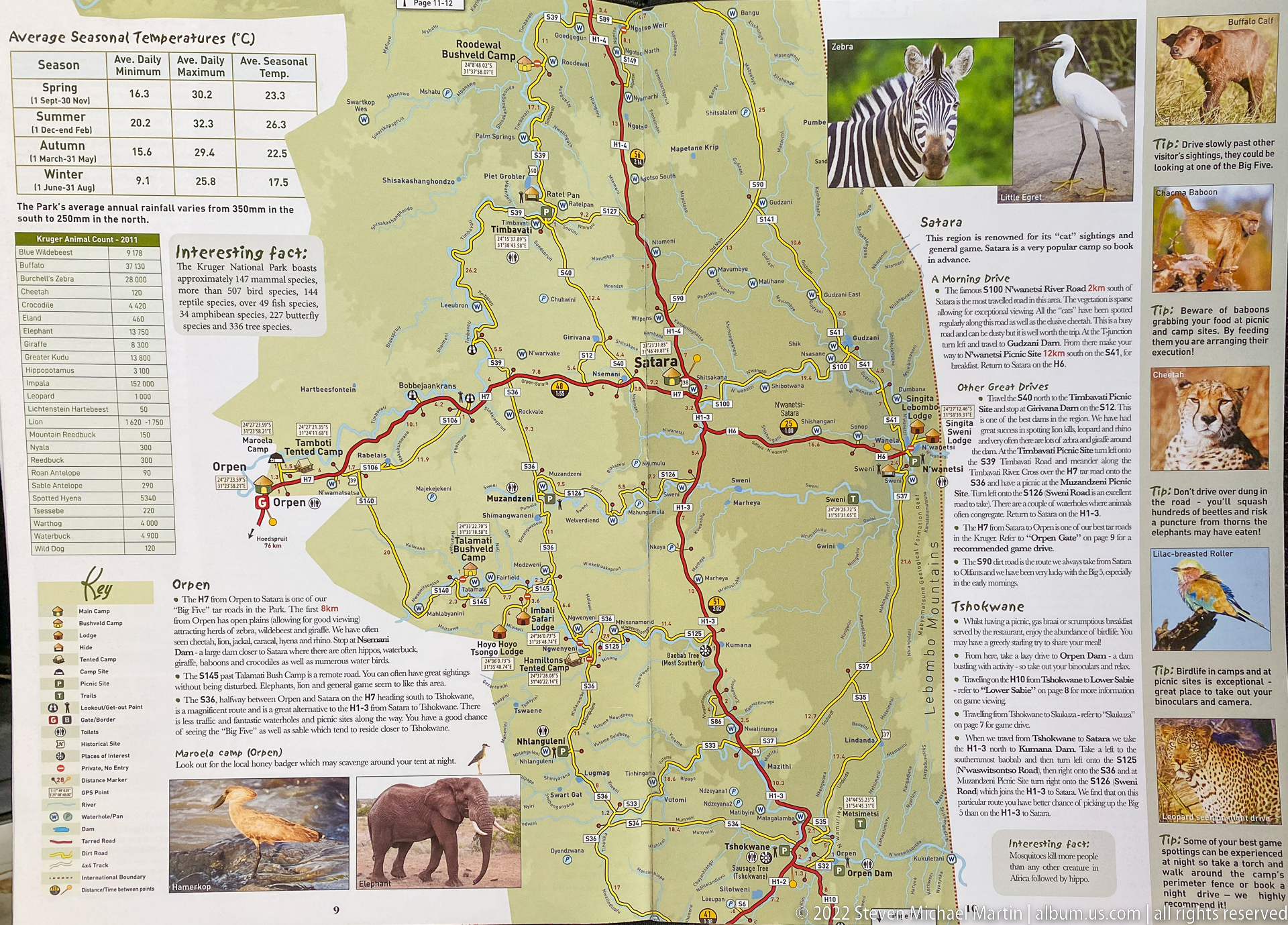
A regional map focuses on central Kruger National Park around Satara, tracing major roads, rivers, camps, and junctions through the central savanna. Wildlife photographs and route notes flank the map, linking practical navigation with species and places visitors may encounter in this part of the park.
Caption
A regional map focuses on central Kruger National Park around Satara, tracing major roads, rivers, camps, and junctions through the central savanna. Wildlife photographs and route notes flank the map, linking practical navigation with species and places visitors may encounter in this part of the park.
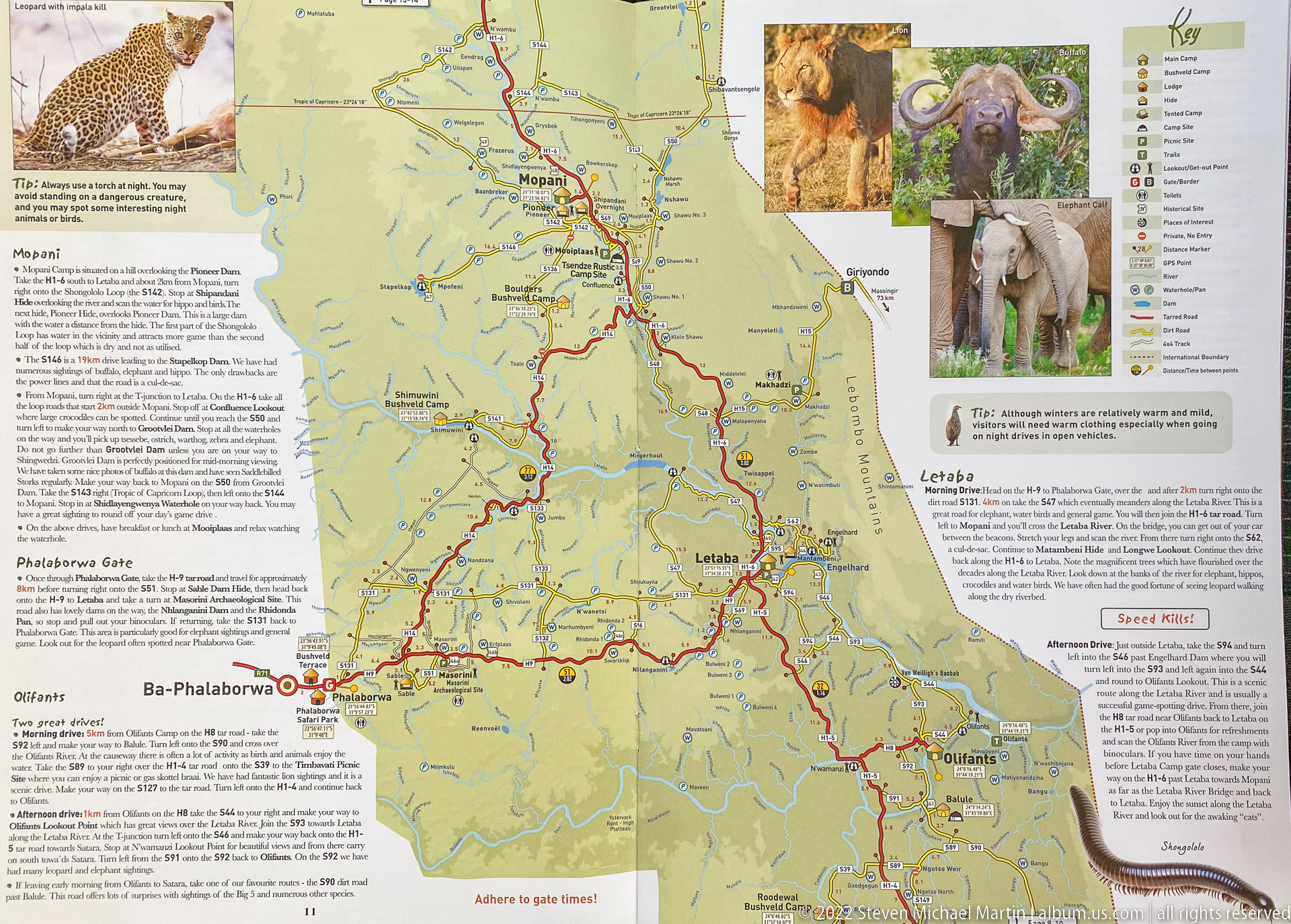
A regional map charts central-northern Kruger around Mopani, Letaba, and the Phalaborwa area, with roads and waterways linking camps and viewpoints. Photographs of large mammals and smaller wildlife accompany destination notes, combining route planning with a visual introduction to the region's fauna.
Caption
A regional map charts central-northern Kruger around Mopani, Letaba, and the Phalaborwa area, with roads and waterways linking camps and viewpoints. Photographs of large mammals and smaller wildlife accompany destination notes, combining route planning with a visual introduction to the region's fauna.
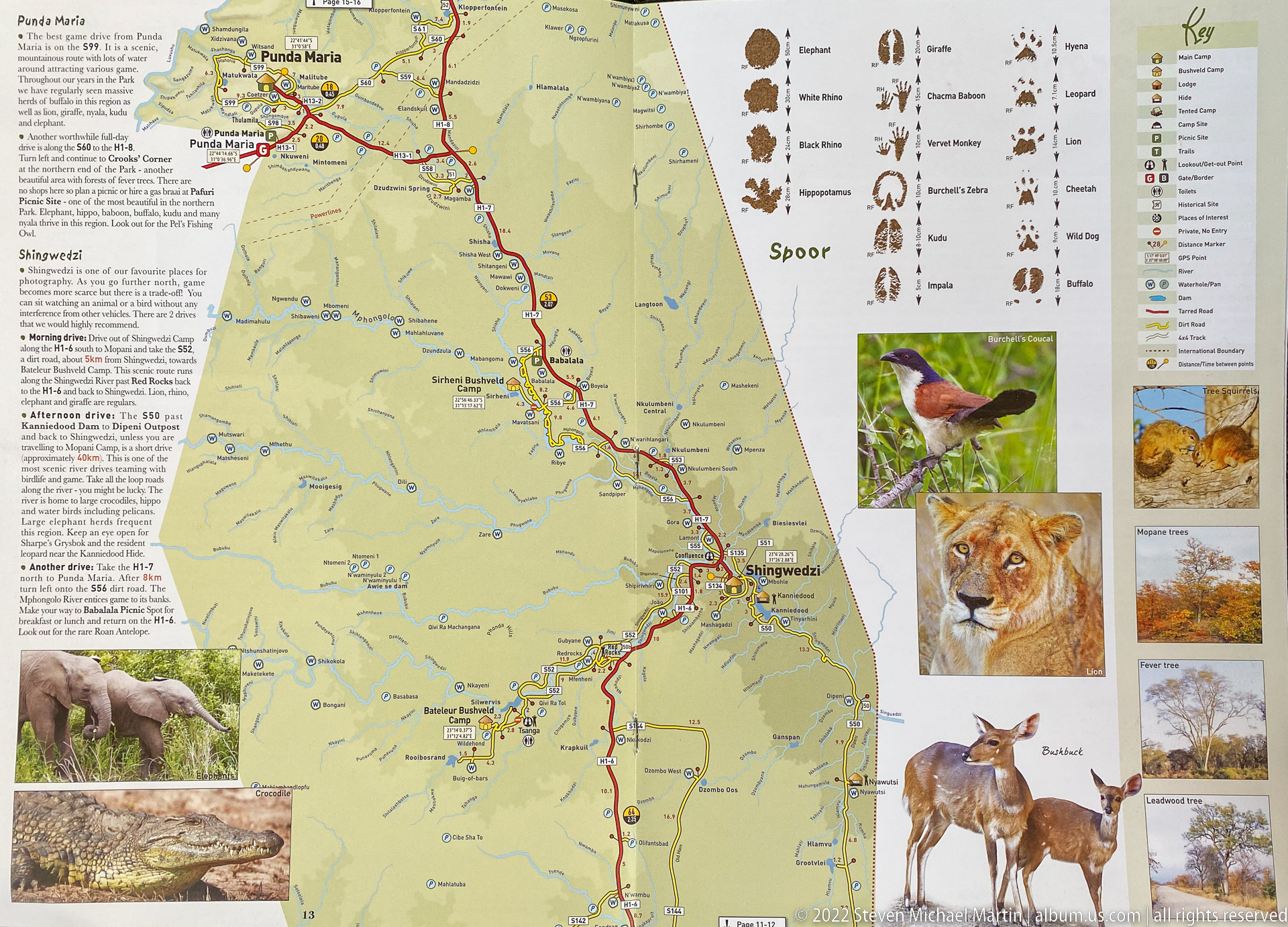
A regional map of northern Kruger is paired with a compact spoor-identification panel and wildlife illustrations. Roads and rivers run through the map while surrounding images depict mammals, birds, reptiles, and landscapes, expanding the page from route planning into field identification and natural-history observation.
Caption
A regional map of northern Kruger is paired with a compact spoor-identification panel and wildlife illustrations. Roads and rivers run through the map while surrounding images depict mammals, birds, reptiles, and landscapes, expanding the page from route planning into field identification and natural-history observation.
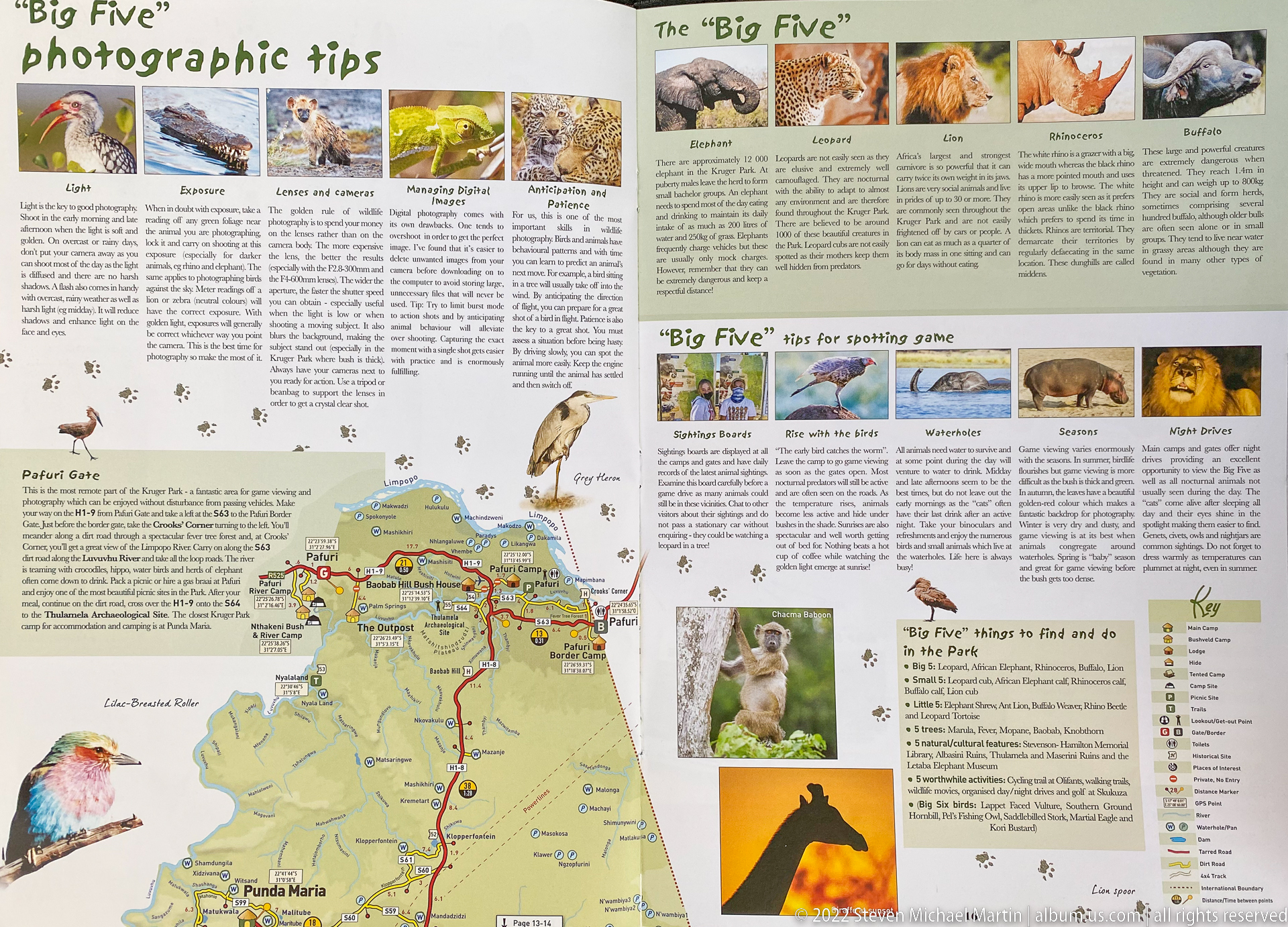
A 'Big Five' guide page introduces lion, elephant, leopard, rhinoceros, and buffalo through short species profiles, photographs, and practical spotting tips. A park map and additional bird and mammal illustrations broaden the field-guide function, helping visitors connect species identification with likely viewing areas.
Caption
A 'Big Five' guide page introduces lion, elephant, leopard, rhinoceros, and buffalo through short species profiles, photographs, and practical spotting tips. A park map and additional bird and mammal illustrations broaden the field-guide function, helping visitors connect species identification with likely viewing areas.
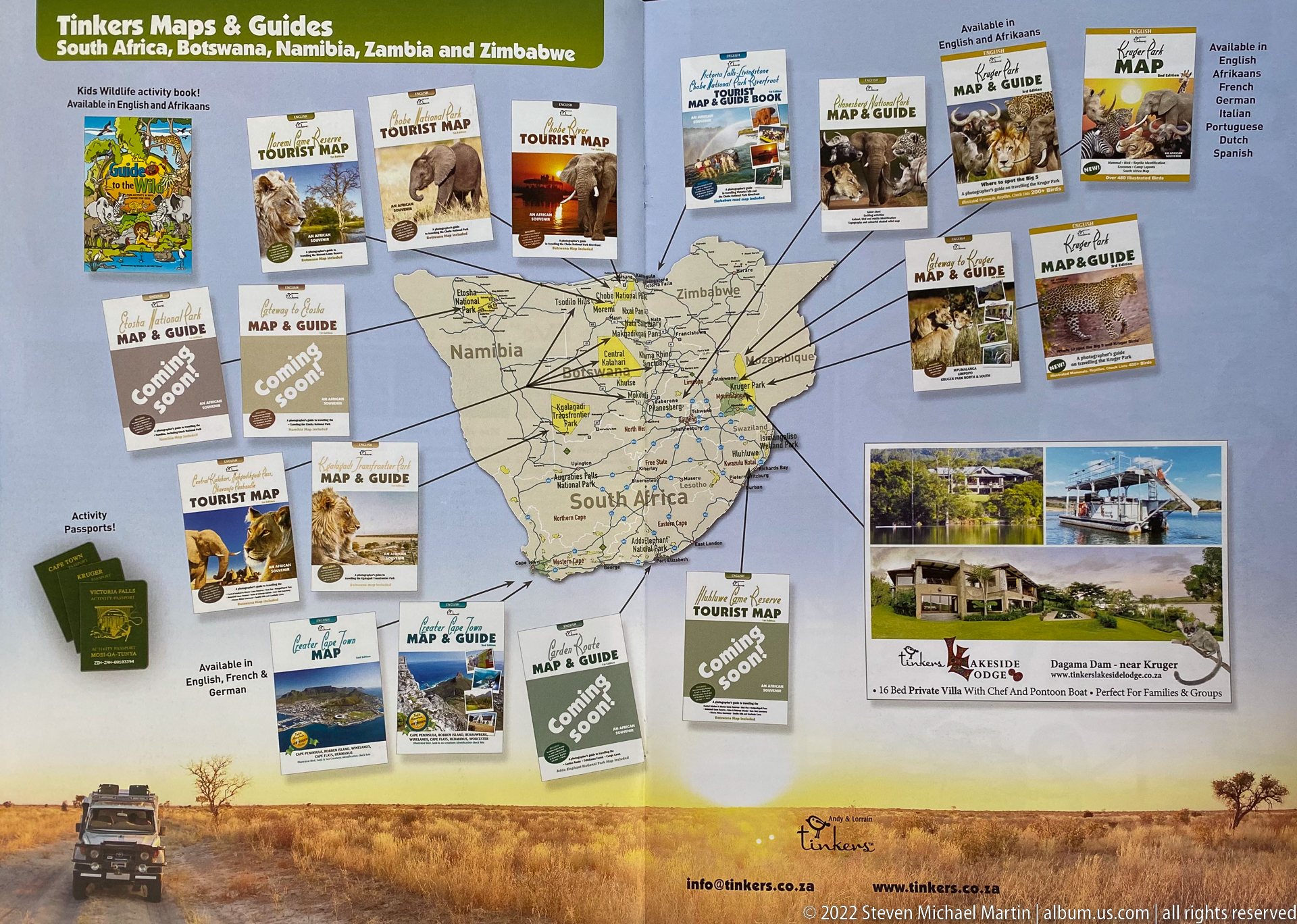
An advertisement for Tinkers Maps & Guides arranges numerous regional map and guidebook covers around a map of southern Africa. Publications for national parks, countries, cities, and tourist regions surround the central map, presenting the wider travel-reference series to which the Kruger guide belongs.
Caption
An advertisement for Tinkers Maps & Guides arranges numerous regional map and guidebook covers around a map of southern Africa. Publications for national parks, countries, cities, and tourist regions surround the central map, presenting the wider travel-reference series to which the Kruger guide belongs.
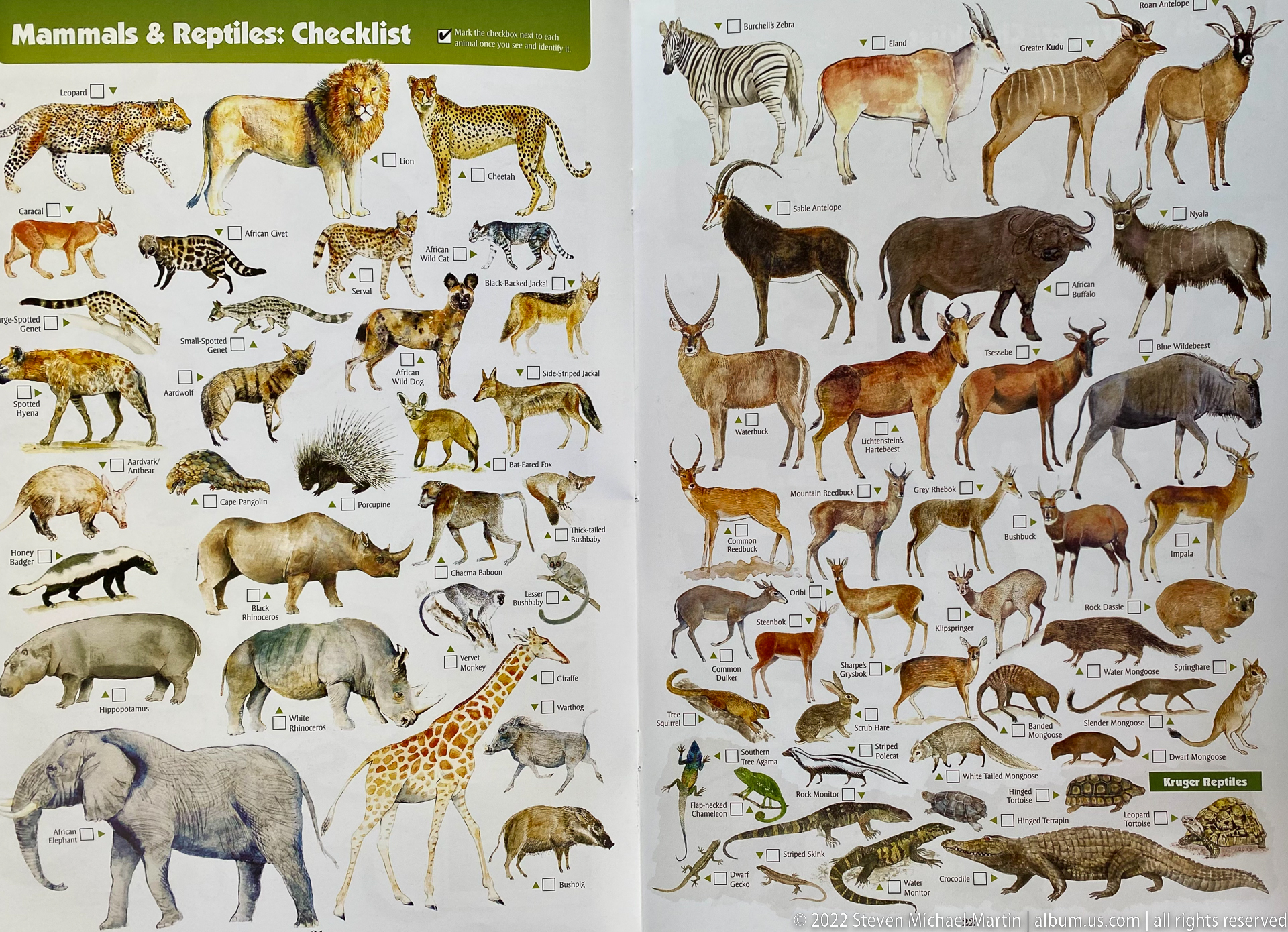
An illustrated checklist assembles Kruger's mammals in comparative groups, from large predators and ungulates to primates, small carnivores, rodents, and other species, with a smaller reptile section along the bottom. Labeled drawings and check boxes make the spread a compact visual index for recording sightings.
Caption
An illustrated checklist assembles Kruger's mammals in comparative groups, from large predators and ungulates to primates, small carnivores, rodents, and other species, with a smaller reptile section along the bottom. Labeled drawings and check boxes make the spread a compact visual index for recording sightings.