Olifants River – Kruger National Park, South Africa
The Olifants River flows through the central portion of Kruger National Park, carving a broad valley through the surrounding savanna. The river attracts a wide variety of wildlife that gathers along its banks to drink and feed.
Large animals such as elephants, buffalo, and giraffes are frequently seen in the area, while hippos and crocodiles inhabit the waters of the river itself. Elevated viewpoints along the river offer sweeping views across the valley and the surrounding plains.
The Olifants River forms one of the most important ecological corridors within Kruger National Park.
Photos:
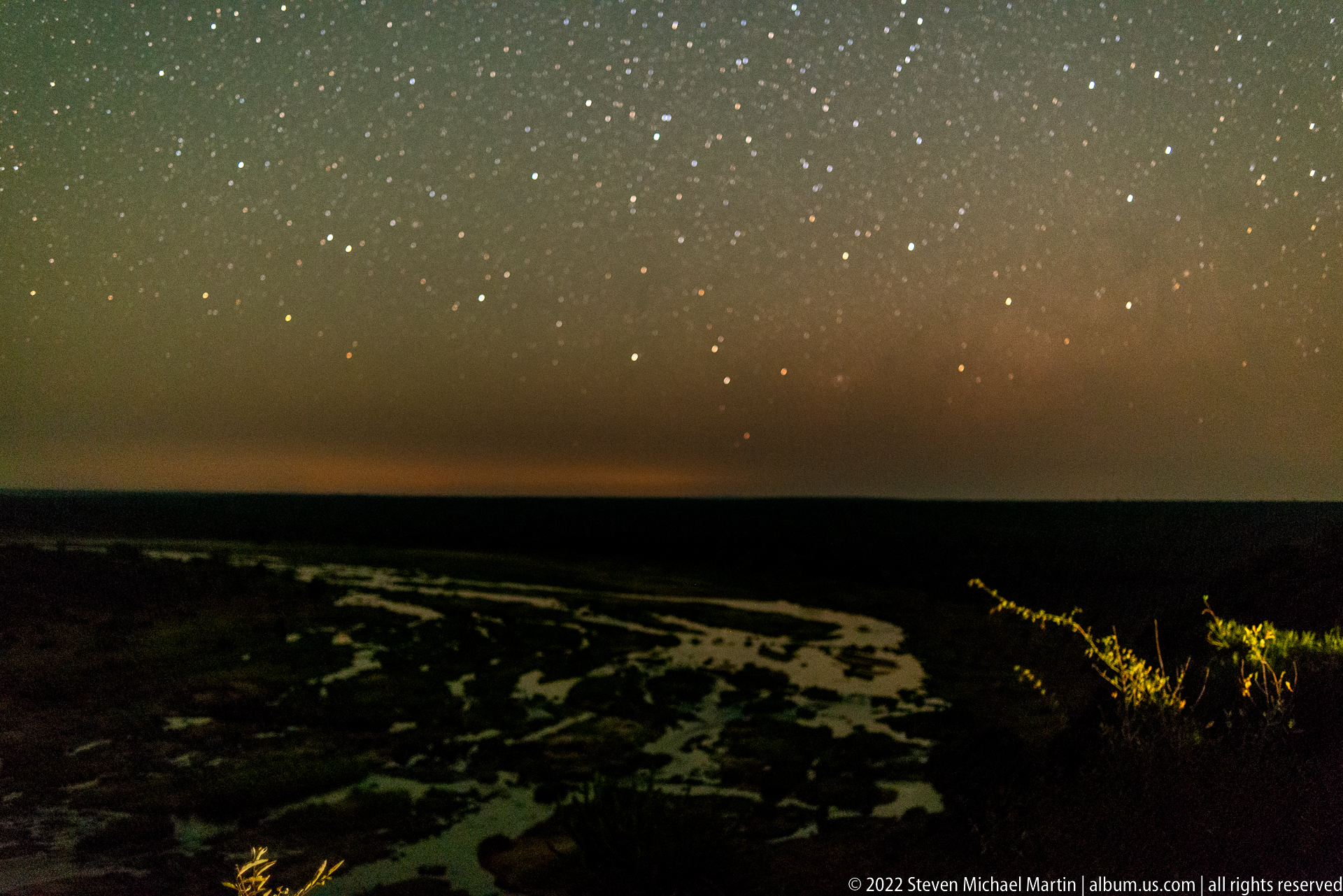
Stars arc across a broad night sky above the dark Olifants River floodplain, where pale water channels and irregular islands remain visible in the lower half of the frame. A warm glow along the horizon separates sky from land, while a foreground shrub catches a small amount of light. This view balances astrophotography with a recognizable river landscape.
Caption
Stars arc across a broad night sky above the dark Olifants River floodplain, where pale water channels and irregular islands remain visible in the lower half of the frame. A warm glow along the horizon separates sky from land, while a foreground shrub catches a small amount of light. This view balances astrophotography with a recognizable river landscape.

A broad dry-season clearing opens beneath a solitary leafy tree, with green reeds and low vegetation tracing a shallow drainage or wet margin across the foreground. Bare earth, muted scrub, and a distant woodland horizon show the mosaic of moisture and drought that structures wildlife habitat around the Olifants River in Kruger National Park.
Caption
A broad dry-season clearing opens beneath a solitary leafy tree, with green reeds and low vegetation tracing a shallow drainage or wet margin across the foreground. Bare earth, muted scrub, and a distant woodland horizon show the mosaic of moisture and drought that structures wildlife habitat around the Olifants River in Kruger National Park.

A lone impala stands on dry reddish ground beside a calm, vegetation-fringed river channel. The antelope is small within the broad landscape, allowing the green reeds, reflective water, rocky islets, and dry-season bank to dominate the composition. Its pale underside and reddish-tan body provide a delicate wildlife focal point within the wider Olifants River habitat.
Caption
A lone impala stands on dry reddish ground beside a calm, vegetation-fringed river channel. The antelope is small within the broad landscape, allowing the green reeds, reflective water, rocky islets, and dry-season bank to dominate the composition. Its pale underside and reddish-tan body provide a delicate wildlife focal point within the wider Olifants River habitat.
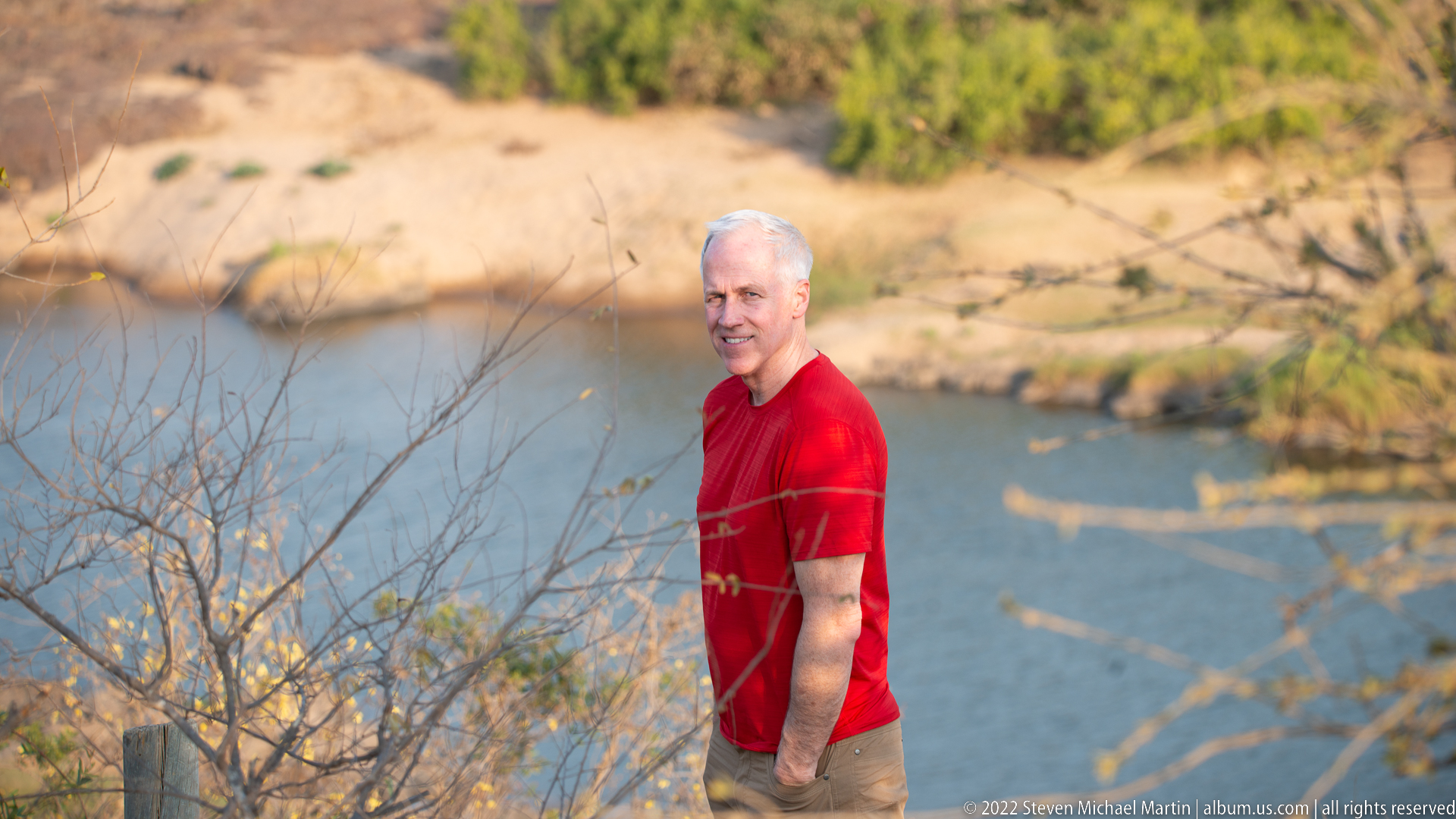
A visitor in a bright red shirt stands at a wooded overlook above the Olifants River, turning toward the camera with the water and pale opposite bank behind him. Thin dry branches cross the foreground, while warm late-day light separates the figure from the muted river landscape. The human presence provides scale and a personal travel context within the wildlife-focused portfolio.
Caption
A visitor in a bright red shirt stands at a wooded overlook above the Olifants River, turning toward the camera with the water and pale opposite bank behind him. Thin dry branches cross the foreground, while warm late-day light separates the figure from the muted river landscape. The human presence provides scale and a personal travel context within the wildlife-focused portfolio.

Several waterbuck graze on short green vegetation at the edge of the river, their reflections visible in the calm water below. One animal feeds close to the bank while others occupy the drier ground behind it. The composition emphasizes the contrast between the narrow lush riparian margin and the surrounding dry-season landscape on the Olifants River.
Caption
Several waterbuck graze on short green vegetation at the edge of the river, their reflections visible in the calm water below. One animal feeds close to the bank while others occupy the drier ground behind it. The composition emphasizes the contrast between the narrow lush riparian margin and the surrounding dry-season landscape on the Olifants River.
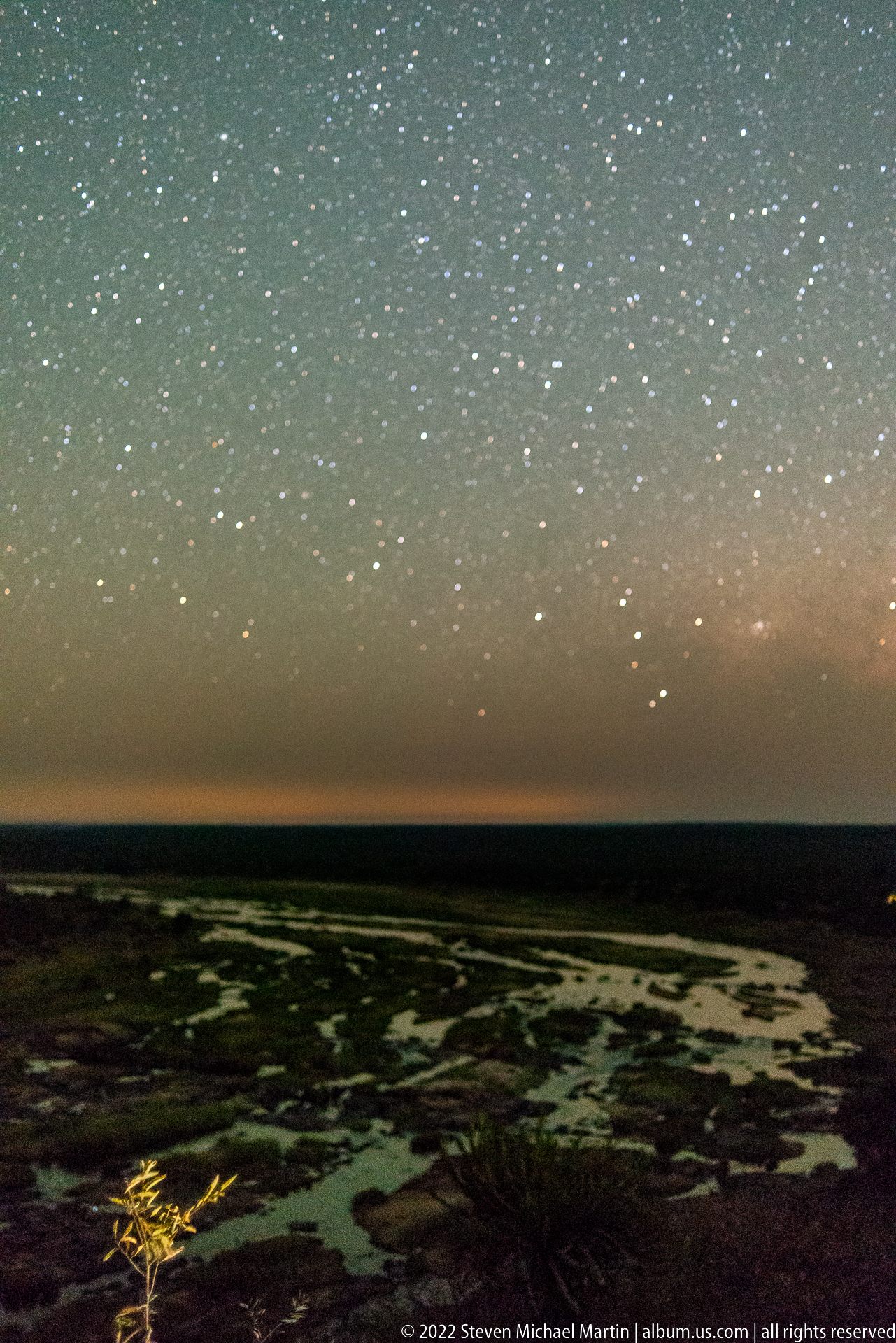
A dense field of stars spans the night sky above the dark Olifants River landscape, where pale channels and vegetated islands remain faintly visible below the horizon. Diffuse luminous patches in the sky suggest the Magellanic Clouds, but the broader composition is best read as a southern African nightscape. The river foreground anchors the celestial view to the safari landscape.
Caption
A dense field of stars spans the night sky above the dark Olifants River landscape, where pale channels and vegetated islands remain faintly visible below the horizon. Diffuse luminous patches in the sky suggest the Magellanic Clouds, but the broader composition is best read as a southern African nightscape. The river foreground anchors the celestial view to the safari landscape.

A wider view places a large pod of hippopotamuses across the shallow river channel, where backs, heads, and partially submerged bodies form a loose cluster below a bright green bank. Several animals rest almost entirely underwater while others stand near the vegetation. The elevated perspective emphasizes the number of hippos and their distribution through the river habitat.
Caption
A wider view places a large pod of hippopotamuses across the shallow river channel, where backs, heads, and partially submerged bodies form a loose cluster below a bright green bank. Several animals rest almost entirely underwater while others stand near the vegetation. The elevated perspective emphasizes the number of hippos and their distribution through the river habitat.

A small group of waterbuck stands and wades in a shallow channel of the Olifants River, spaced across open water between green banks. Reflections form beneath their legs, and the elevated viewpoint shows the animals using the river itself rather than only the shoreline. The scene records a direct interaction between the herd and its riparian habitat.
Caption
A small group of waterbuck stands and wades in a shallow channel of the Olifants River, spaced across open water between green banks. Reflections form beneath their legs, and the elevated viewpoint shows the animals using the river itself rather than only the shoreline. The scene records a direct interaction between the herd and its riparian habitat.

A broader view reveals a dispersed herd of waterbuck feeding across a green-and-gold river margin. Animals at different distances graze, stand, and rest along the curved bank, allowing the herd’s use of the riparian zone to be read as a whole. The river occupies one side of the frame while dry-season grassland extends inland behind the antelope.
Caption
A broader view reveals a dispersed herd of waterbuck feeding across a green-and-gold river margin. Animals at different distances graze, stand, and rest along the curved bank, allowing the herd’s use of the riparian zone to be read as a whole. The river occupies one side of the frame while dry-season grassland extends inland behind the antelope.
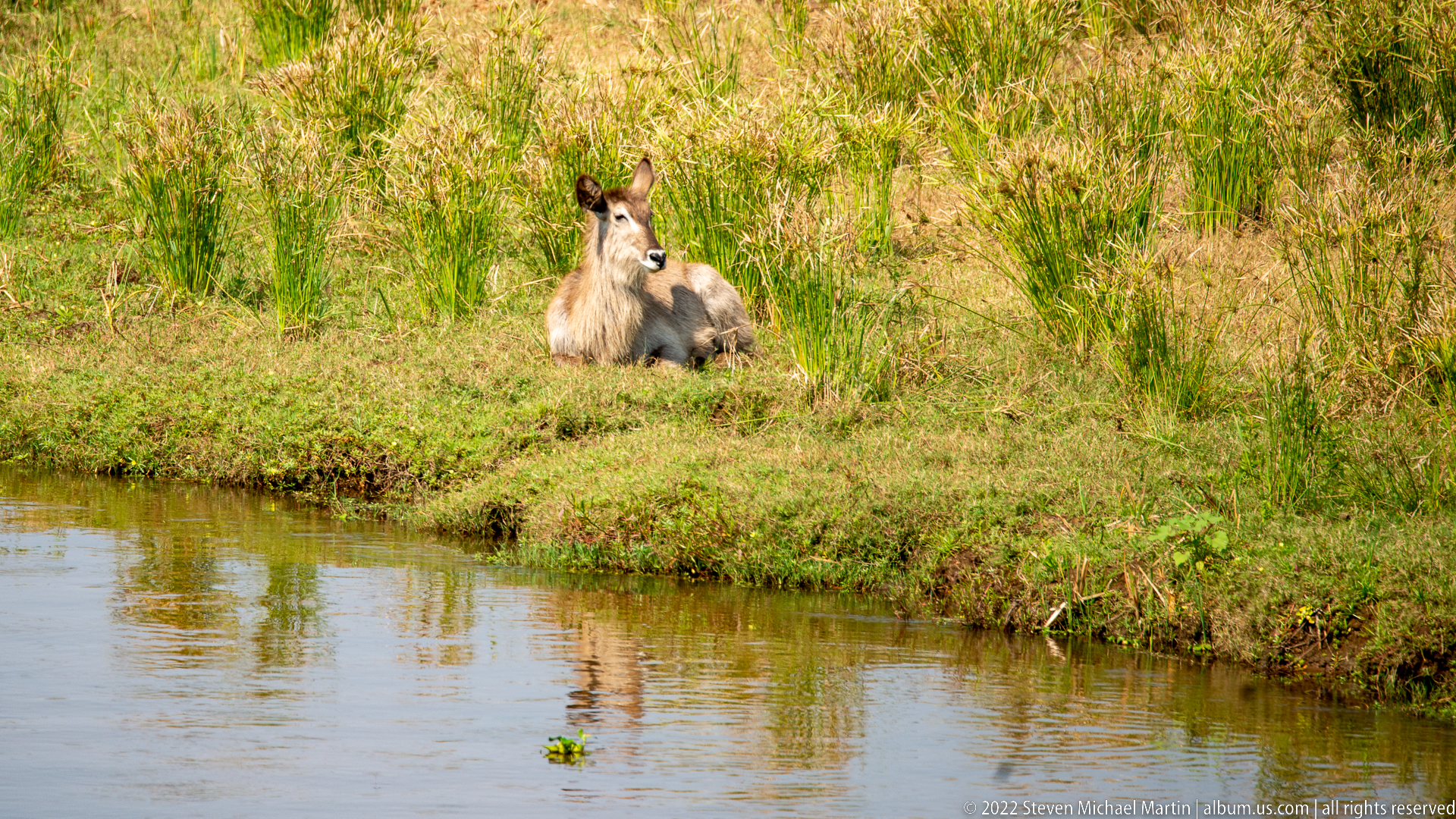
A waterbuck rests on the grassy bank just above the waterline, facing outward with its body tucked beneath it. The animal’s large rounded ears and shaggy gray-brown coat stand out against bright green sedges and low bank vegetation. Its still posture and proximity to the channel provide a quiet behavioral counterpoint to the grazing herd shown in adjacent photographs.
Caption
A waterbuck rests on the grassy bank just above the waterline, facing outward with its body tucked beneath it. The animal’s large rounded ears and shaggy gray-brown coat stand out against bright green sedges and low bank vegetation. Its still posture and proximity to the channel provide a quiet behavioral counterpoint to the grazing herd shown in adjacent photographs.
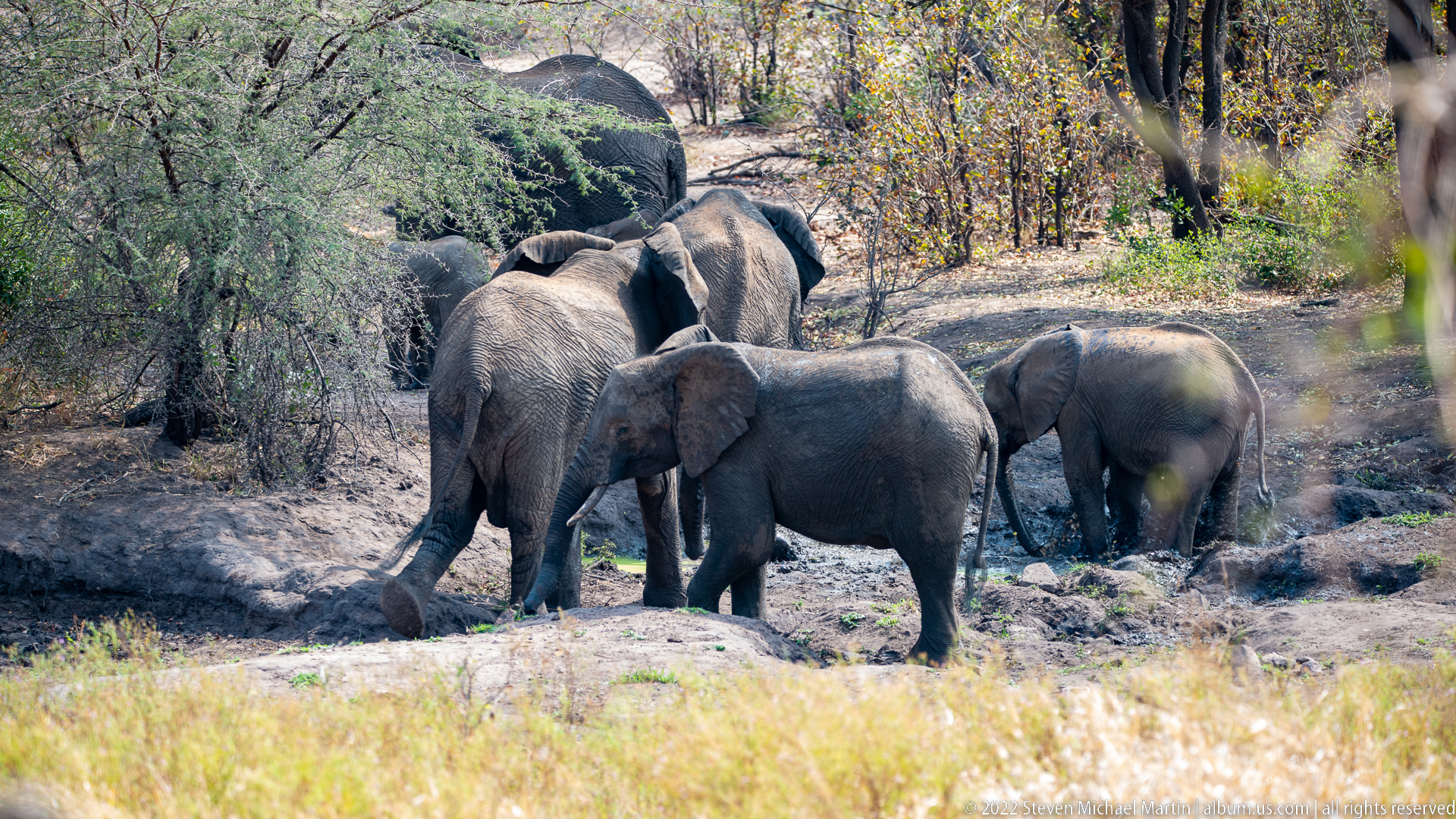
A small herd of African bush elephants gathers at a muddy waterhole in dry woodland near the Olifants River. Adults and younger animals overlap at the water’s edge, creating a layered view of herd structure and shared access to a scarce wet-season resource. The pale grass in front and dense scrub behind place the group within Kruger National Park’s seasonally dry savanna landscape.
Caption
A small herd of African bush elephants gathers at a muddy waterhole in dry woodland near the Olifants River. Adults and younger animals overlap at the water’s edge, creating a layered view of herd structure and shared access to a scarce wet-season resource. The pale grass in front and dense scrub behind place the group within Kruger National Park’s seasonally dry savanna landscape.
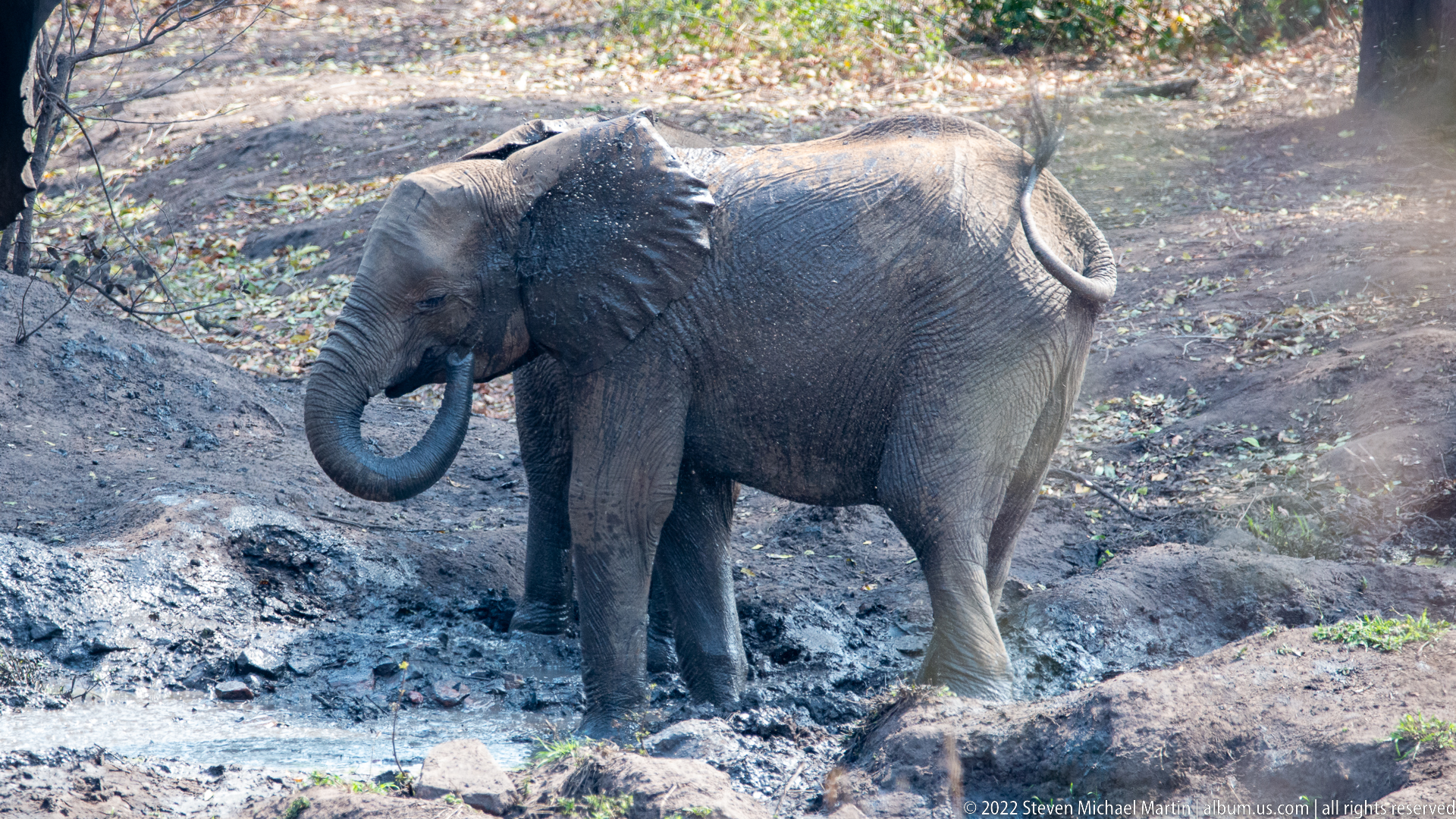
An African bush elephant stands ankle-deep in churned mud, curling its trunk toward its mouth after drawing water from the shallow pool. Side light reveals the folds of the animal’s skin and the dampened lower legs, while the compact framing isolates this individual from the larger herd seen in neighboring views.
Caption
An African bush elephant stands ankle-deep in churned mud, curling its trunk toward its mouth after drawing water from the shallow pool. Side light reveals the folds of the animal’s skin and the dampened lower legs, while the compact framing isolates this individual from the larger herd seen in neighboring views.
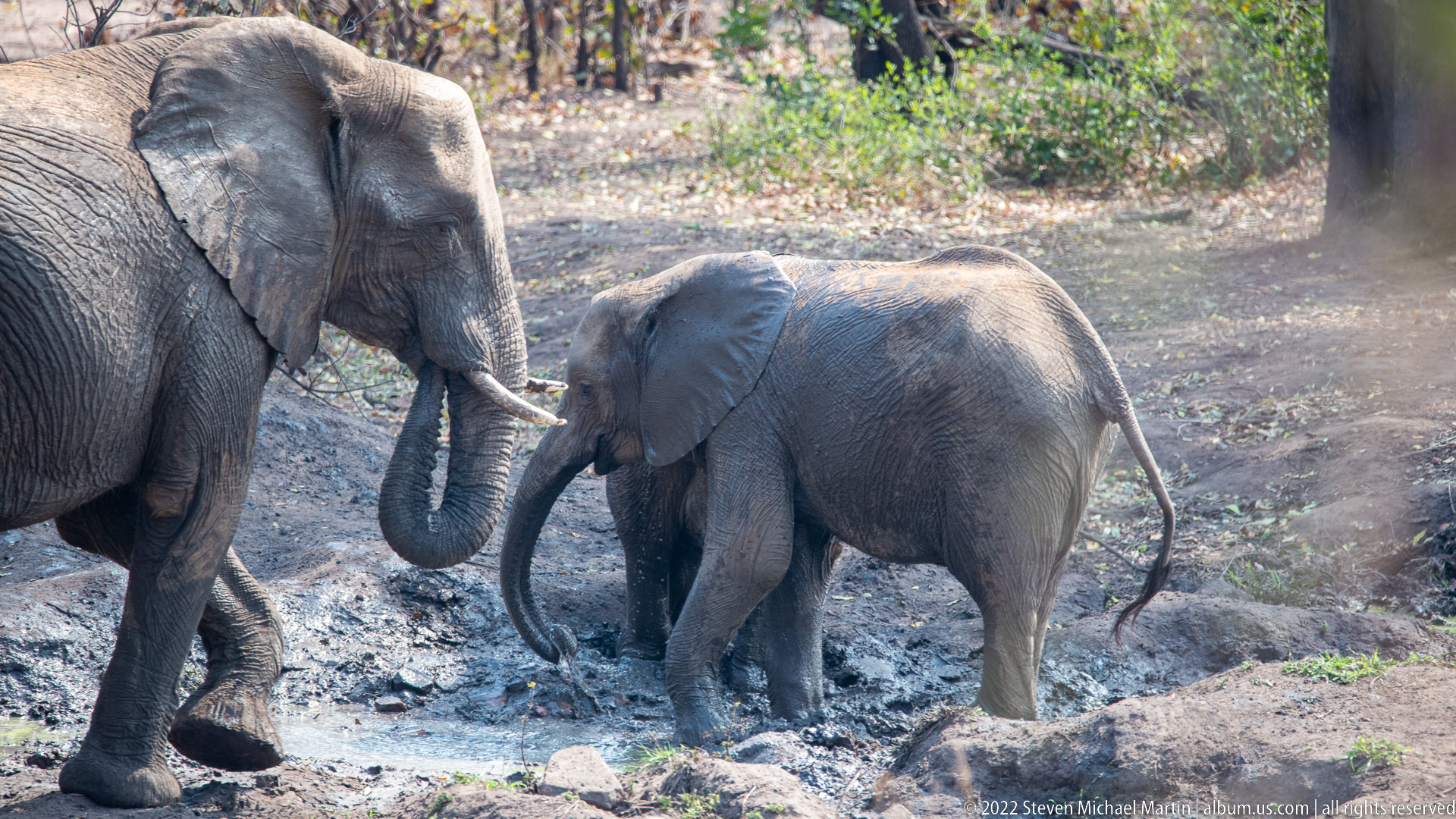
An adult African bush elephant and a smaller companion meet at the edge of a muddy waterhole, their trunks and heads close together. The younger animal stands fully visible in profile while the adult enters from the left, emphasizing the contrast in scale. Damp ground and sparse dry-season vegetation anchor the interaction in Kruger’s riverine savanna environment.
Caption
An adult African bush elephant and a smaller companion meet at the edge of a muddy waterhole, their trunks and heads close together. The younger animal stands fully visible in profile while the adult enters from the left, emphasizing the contrast in scale. Damp ground and sparse dry-season vegetation anchor the interaction in Kruger’s riverine savanna environment.

A juvenile African bush elephant stands beside an adult at the muddy margin of a waterhole, its trunk curved inward as the larger animal’s trunk hangs vertically in front. The close spacing and opposing body scales make this a compact study of age difference within the herd, set against dry woodland and trampled wet earth.
Caption
A juvenile African bush elephant stands beside an adult at the muddy margin of a waterhole, its trunk curved inward as the larger animal’s trunk hangs vertically in front. The close spacing and opposing body scales make this a compact study of age difference within the herd, set against dry woodland and trampled wet earth.

An African bush elephant works through the muddy waterhole as fine droplets scatter across its body and the air around it. The adult at left provides scale but remains secondary, leaving the central animal’s wet skin, curled trunk, and active mud-bathing behavior as the focus. Mud coating can help elephants cool and protect their skin in exposed savanna conditions.
Caption
An African bush elephant works through the muddy waterhole as fine droplets scatter across its body and the air around it. The adult at left provides scale but remains secondary, leaving the central animal’s wet skin, curled trunk, and active mud-bathing behavior as the focus. Mud coating can help elephants cool and protect their skin in exposed savanna conditions.

An African bush elephant faces the camera from beyond a strip of green riverside vegetation, ears spread and trunk hanging straight down. The head-on viewpoint gives unusual prominence to the broad ears, small tusks, and forehead, while shallow water and bare ground behind indicate the animal’s proximity to a watering area near the Olifants River.
Caption
An African bush elephant faces the camera from beyond a strip of green riverside vegetation, ears spread and trunk hanging straight down. The head-on viewpoint gives unusual prominence to the broad ears, small tusks, and forehead, while shallow water and bare ground behind indicate the animal’s proximity to a watering area near the Olifants River.

Facing forward near the waterhole, an African bush elephant flings a cloud of loose earth or dried mud across its chest and face. Individual particles are frozen in midair, turning a routine dusting action into the dominant visual event. The behavior complements mud bathing by helping coat the skin in Kruger’s hot, dry savanna environment.
Caption
Facing forward near the waterhole, an African bush elephant flings a cloud of loose earth or dried mud across its chest and face. Individual particles are frozen in midair, turning a routine dusting action into the dominant visual event. The behavior complements mud bathing by helping coat the skin in Kruger’s hot, dry savanna environment.
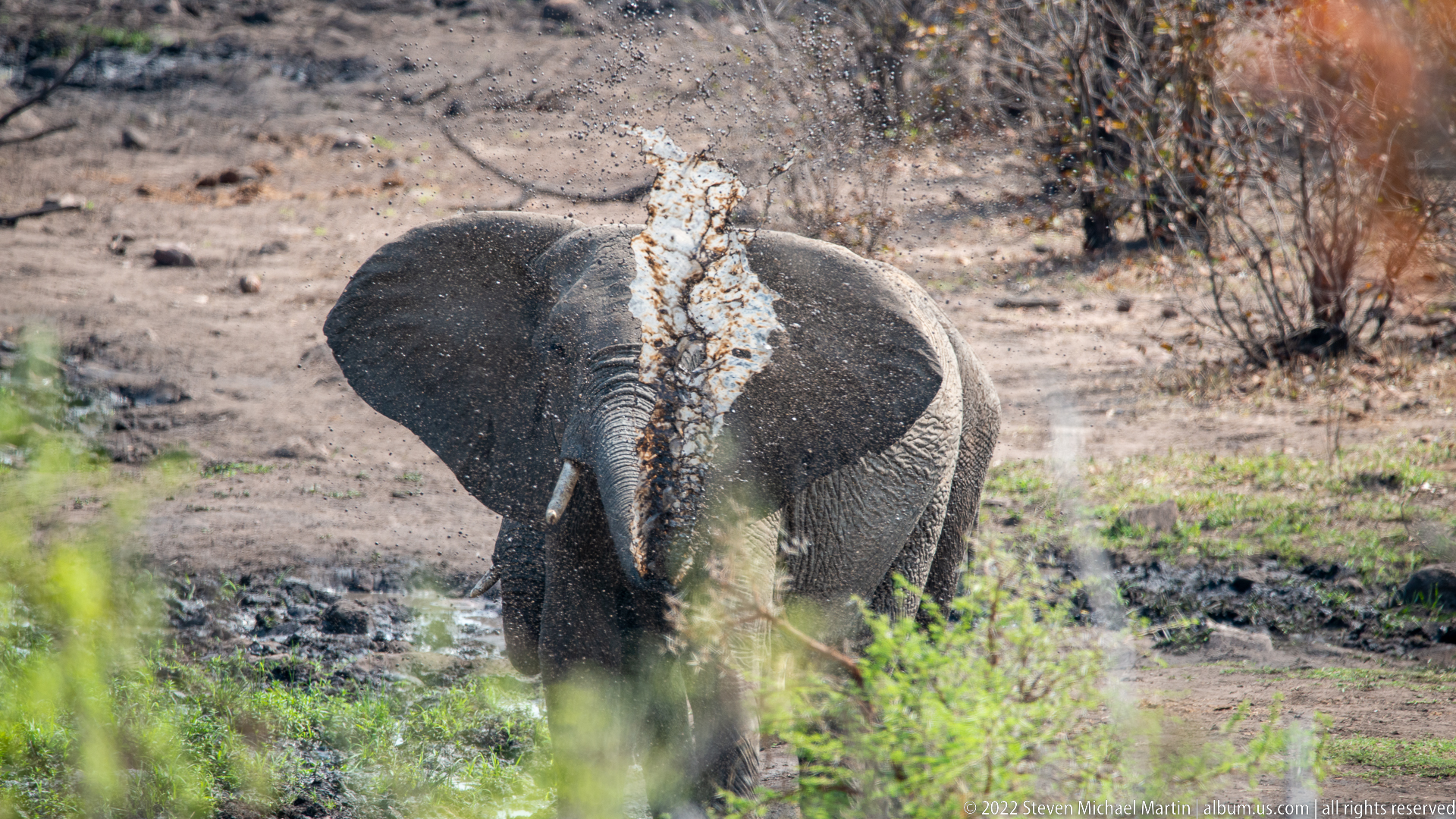
An African bush elephant sends a dramatic sheet of muddy water and debris over the crown of its head and along its back. The spray forms a bright vertical plume against the dark ears, clearly recording self-coating behavior at the waterhole. Dry brush and bare soil beyond heighten the contrast between the wet animal and its arid surroundings.
Caption
An African bush elephant sends a dramatic sheet of muddy water and debris over the crown of its head and along its back. The spray forms a bright vertical plume against the dark ears, clearly recording self-coating behavior at the waterhole. Dry brush and bare soil beyond heighten the contrast between the wet animal and its arid surroundings.
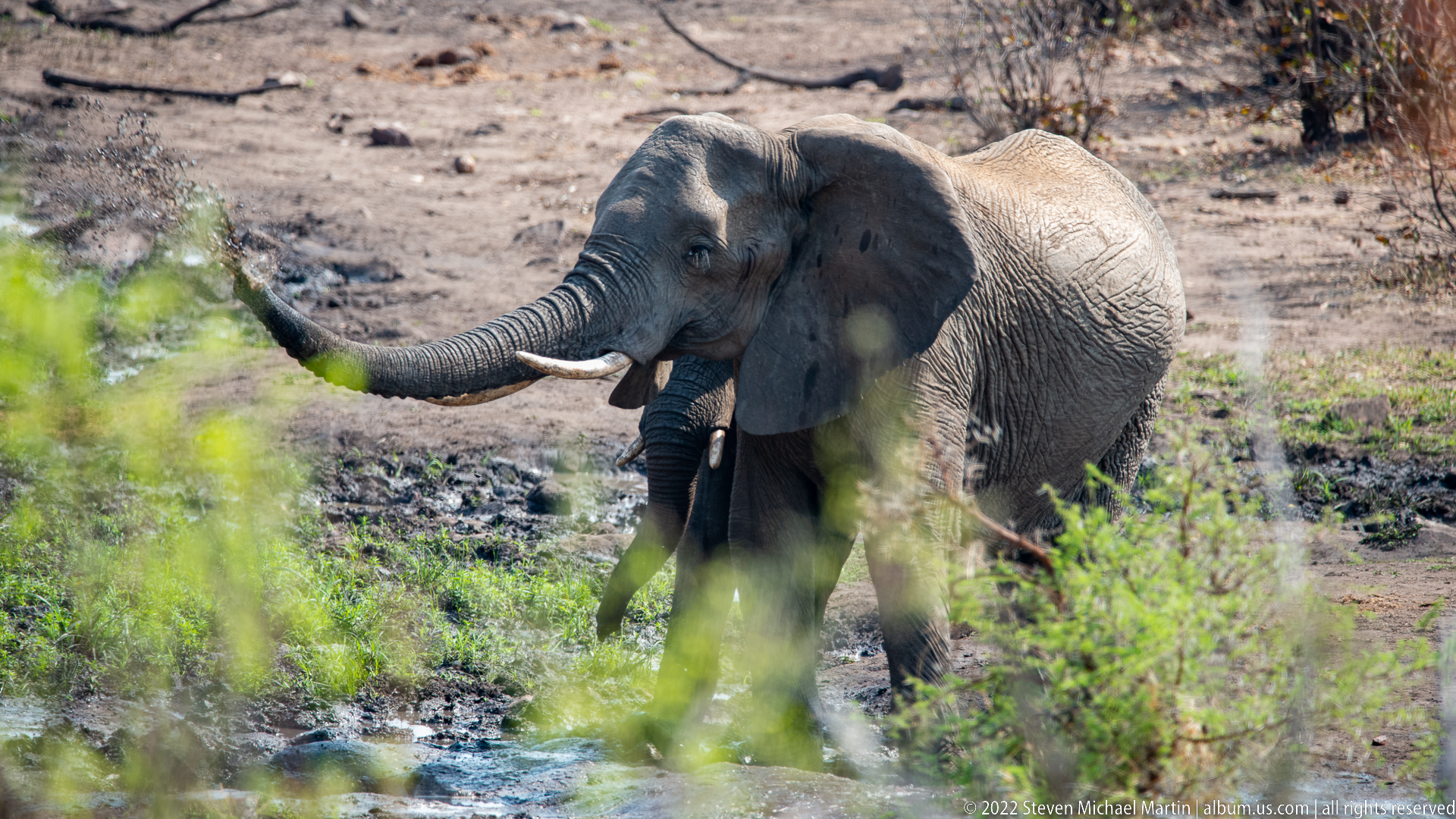
An African bush elephant extends its trunk nearly horizontal while standing at the muddy waterhole, the tip lifted as if smelling or directing the next movement. Damp skin and dark mud on the lower body connect this portrait to the preceding bathing sequence, while the open side profile clearly shows the animal’s tusk, ear, and muscular trunk.
Caption
An African bush elephant extends its trunk nearly horizontal while standing at the muddy waterhole, the tip lifted as if smelling or directing the next movement. Damp skin and dark mud on the lower body connect this portrait to the preceding bathing sequence, while the open side profile clearly shows the animal’s tusk, ear, and muscular trunk.

Three African bush elephants occupy different positions around a muddy waterhole: a large adult stands behind, a smaller animal pauses at left, and another elephant remains at the wet margin in front. Their staggered placement shows how herd members share a confined watering site while maintaining individual space within the group.
Caption
Three African bush elephants occupy different positions around a muddy waterhole: a large adult stands behind, a smaller animal pauses at left, and another elephant remains at the wet margin in front. Their staggered placement shows how herd members share a confined watering site while maintaining individual space within the group.
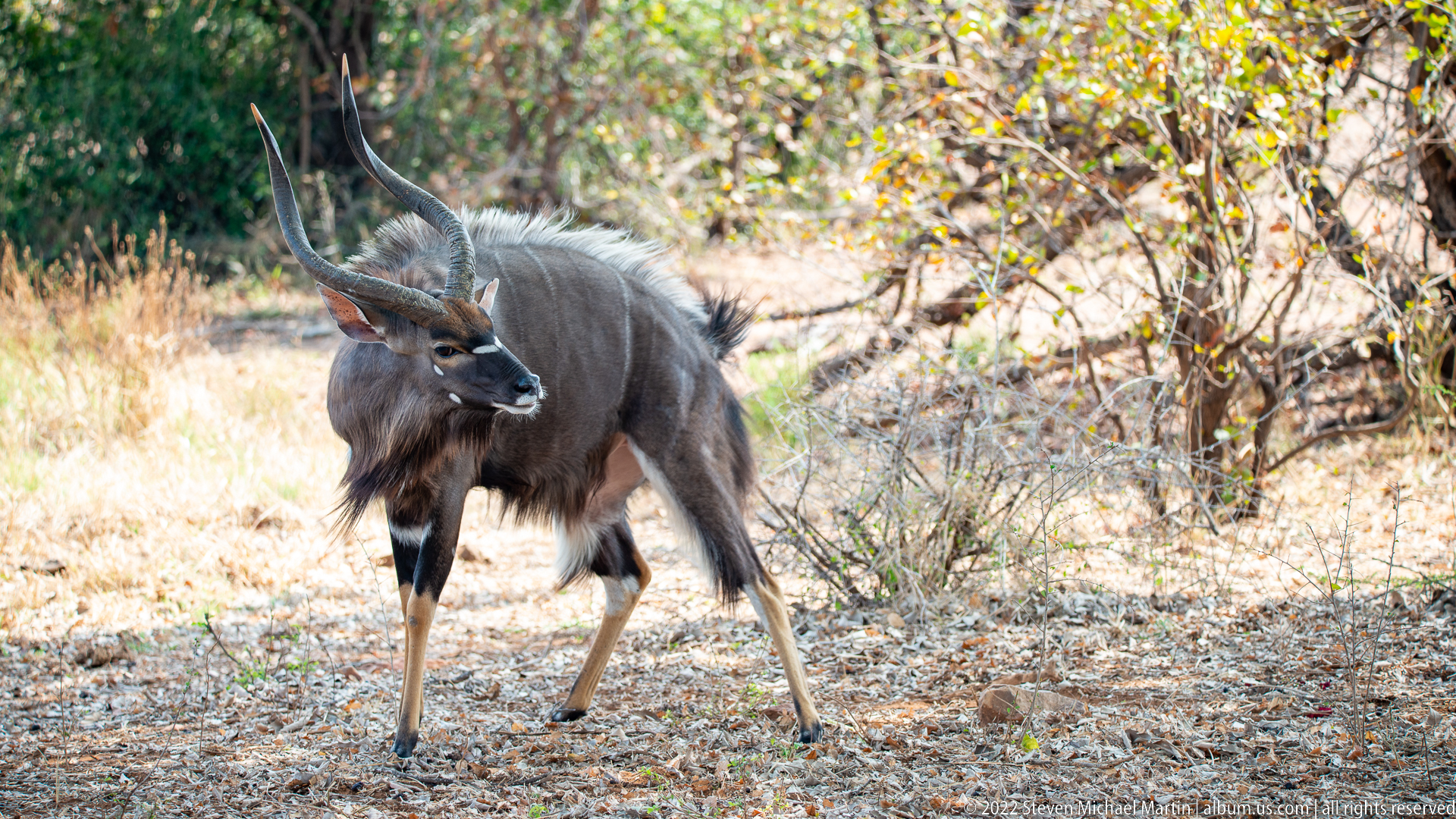
An adult male nyala walks through dry woodland, its long spiral horns rising above a dark shaggy coat marked by faint vertical white stripes. White facial markings and pale lower legs are visible as the antelope steps across leaf litter. The oblique view emphasizes the mature bull’s heavier build and mane-like fringe.
Caption
An adult male nyala walks through dry woodland, its long spiral horns rising above a dark shaggy coat marked by faint vertical white stripes. White facial markings and pale lower legs are visible as the antelope steps across leaf litter. The oblique view emphasizes the mature bull’s heavier build and mane-like fringe.

A mature male nyala stands broadside in open dry grass, turning its head toward the camera. Tall spiral horns, a dark gray-brown coat crossed by narrow white stripes, and a shaggy throat and belly fringe distinguish the species and sex. The uncluttered background makes this a particularly clear field-guide portrait of the antelope.
Caption
A mature male nyala stands broadside in open dry grass, turning its head toward the camera. Tall spiral horns, a dark gray-brown coat crossed by narrow white stripes, and a shaggy throat and belly fringe distinguish the species and sex. The uncluttered background makes this a particularly clear field-guide portrait of the antelope.

A giraffe stands among leaf-sparse woodland, its long neck rising above tangled branches as it browses at canopy height. The full-body view places the animal within the dry-season vegetation rather than isolating it as a portrait, showing the vertical feeding niche that allows giraffes to reach foliage beyond most other large herbivores.
Caption
A giraffe stands among leaf-sparse woodland, its long neck rising above tangled branches as it browses at canopy height. The full-body view places the animal within the dry-season vegetation rather than isolating it as a portrait, showing the vertical feeding niche that allows giraffes to reach foliage beyond most other large herbivores.
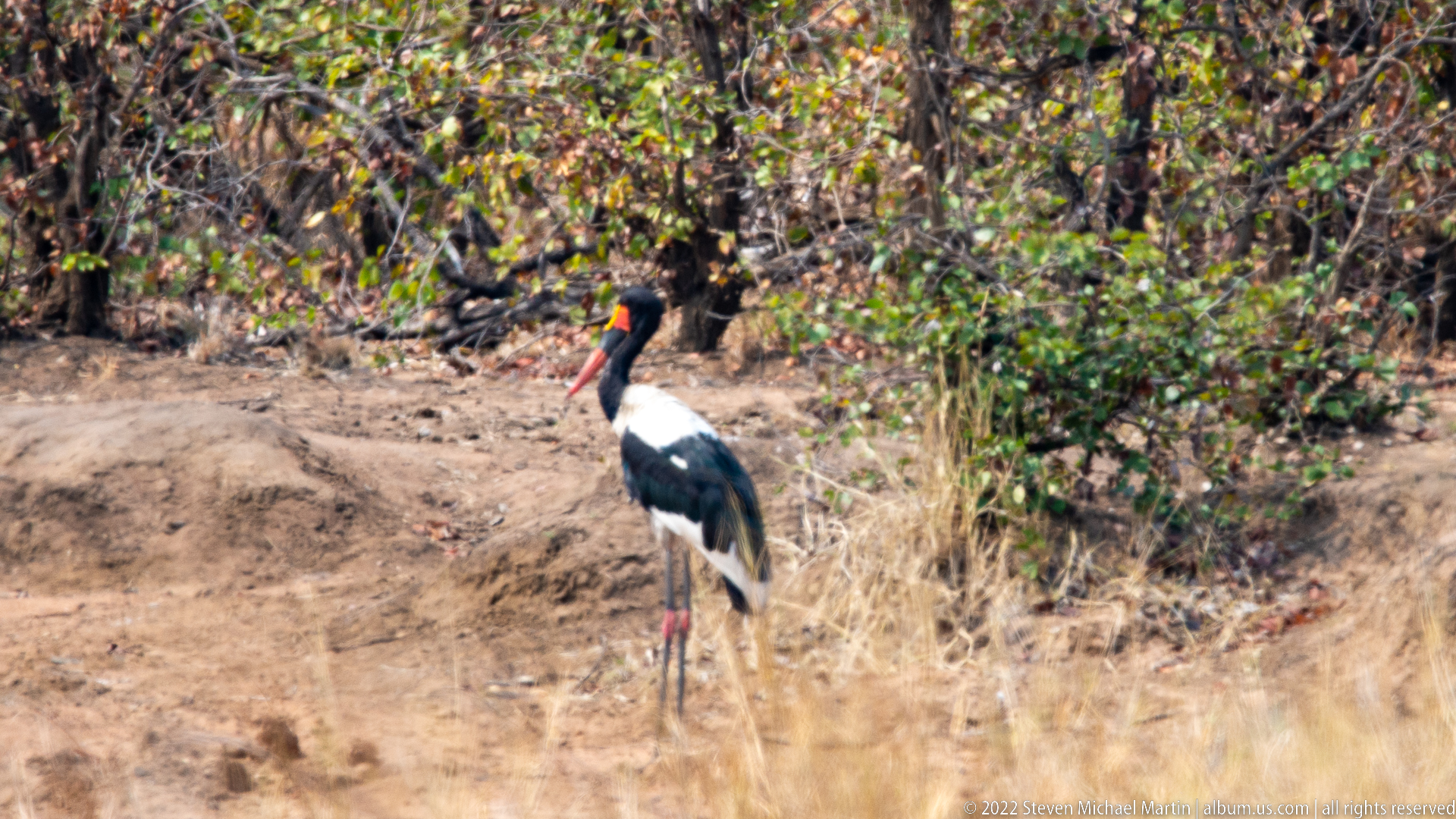
A saddle-billed stork stands upright at the edge of dry grass and woodland, its black-and-white plumage and long red-and-black bill visible even at distance. The bird’s tall stance and contrasting body pattern separate it sharply from the muted brown surroundings, providing a field-guide view of one of Kruger’s conspicuous wetland-associated birds.
Caption
A saddle-billed stork stands upright at the edge of dry grass and woodland, its black-and-white plumage and long red-and-black bill visible even at distance. The bird’s tall stance and contrasting body pattern separate it sharply from the muted brown surroundings, providing a field-guide view of one of Kruger’s conspicuous wetland-associated birds.
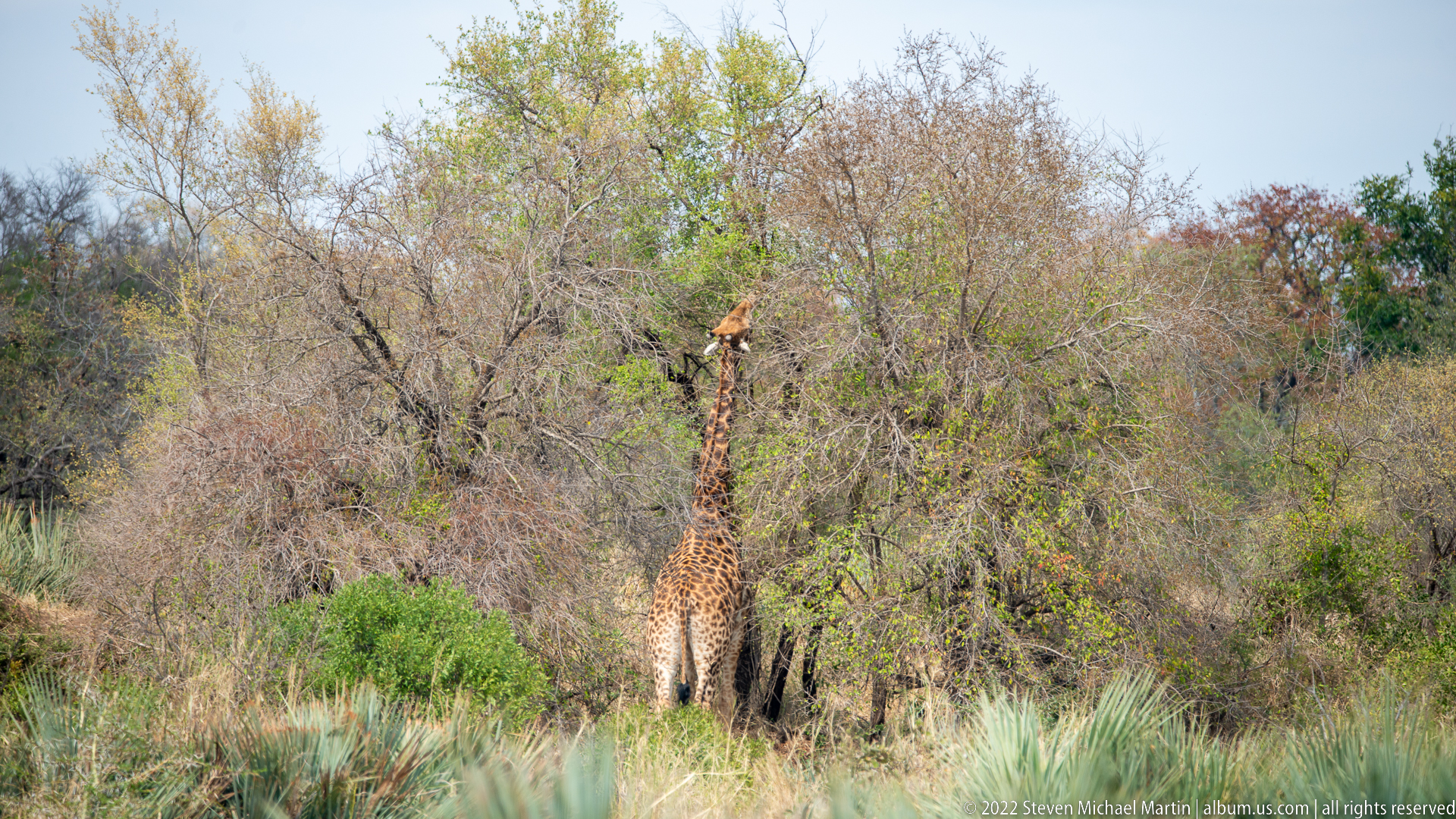
A giraffe rises from dense mixed vegetation near the river corridor, with only the upper body and long neck clearly separating from the surrounding shrubs. Fresh green growth in the foreground contrasts with the drier woodland behind, making this a habitat-centered view of a browser moving through layered Olifants River vegetation.
Caption
A giraffe rises from dense mixed vegetation near the river corridor, with only the upper body and long neck clearly separating from the surrounding shrubs. Fresh green growth in the foreground contrasts with the drier woodland behind, making this a habitat-centered view of a browser moving through layered Olifants River vegetation.

A distant giraffe is partially hidden within dense bush, its head, neck, and patterned shoulder emerging between green and gray branches. Unlike the more open giraffe portraits on this page, this frame stresses concealment and scale: the animal nearly disappears into the structurally complex woodland despite its height.
Caption
A distant giraffe is partially hidden within dense bush, its head, neck, and patterned shoulder emerging between green and gray branches. Unlike the more open giraffe portraits on this page, this frame stresses concealment and scale: the animal nearly disappears into the structurally complex woodland despite its height.
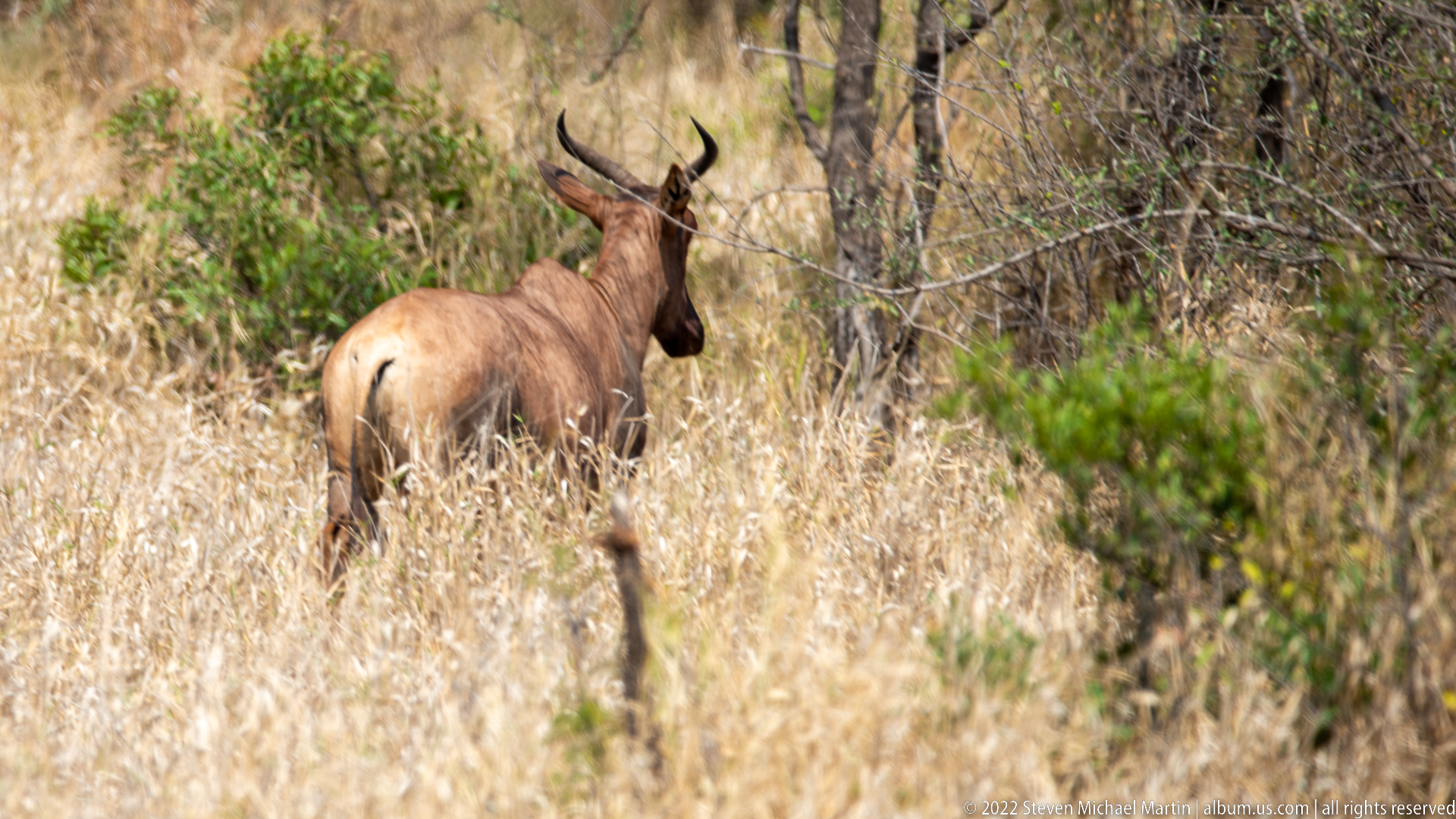
A male impala moves away through tall dry grass at the woodland edge, its lyre-shaped horns and reddish-brown hindquarters seen from behind. The rear-facing angle shifts attention from a conventional portrait to movement through habitat, with the animal partly screened by grasses and low shrubs as it enters denser cover.
Caption
A male impala moves away through tall dry grass at the woodland edge, its lyre-shaped horns and reddish-brown hindquarters seen from behind. The rear-facing angle shifts attention from a conventional portrait to movement through habitat, with the animal partly screened by grasses and low shrubs as it enters denser cover.
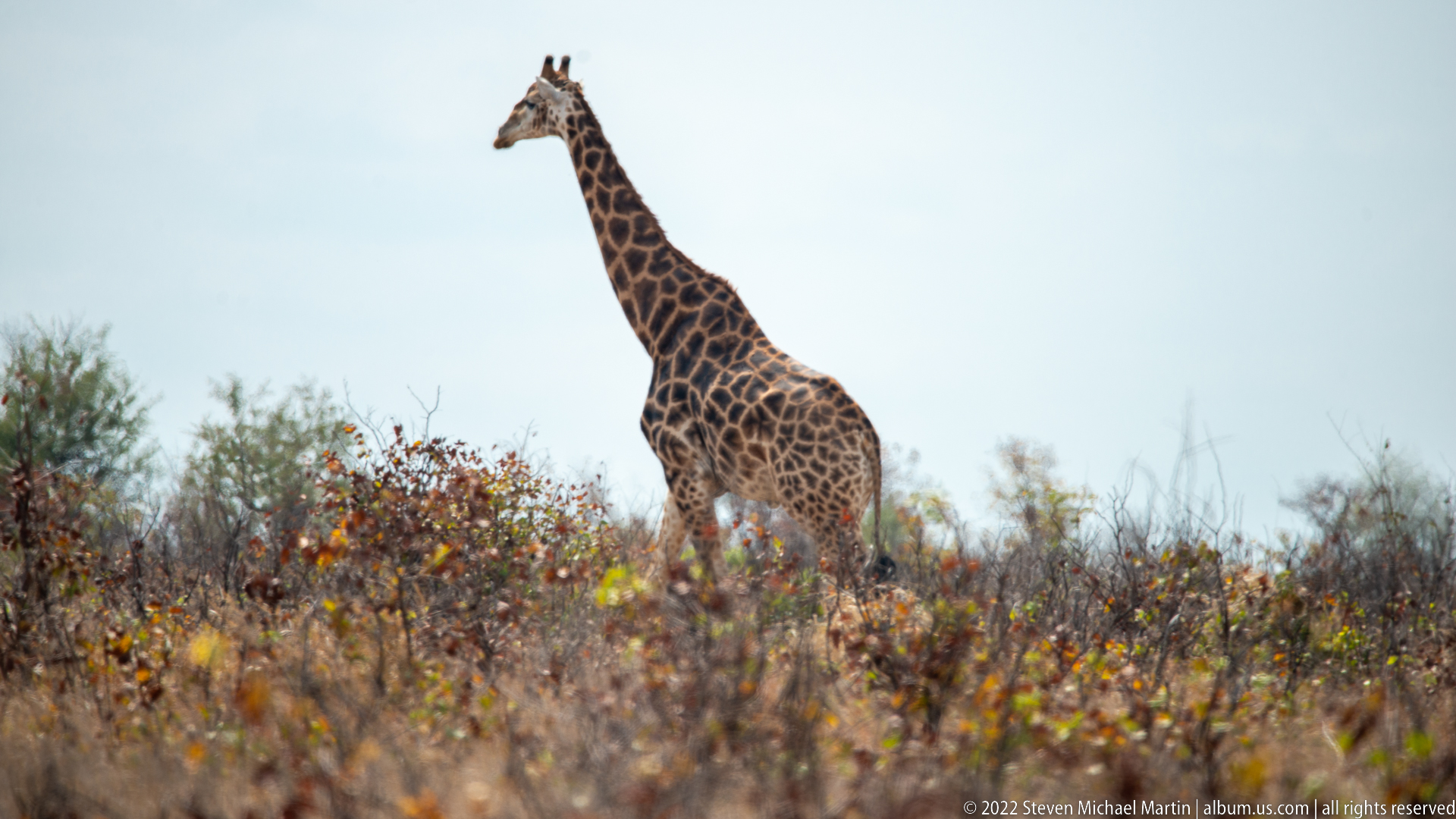
A giraffe stands above low dry-season scrub against an open pale sky, its full neck and upper body cleanly outlined over the vegetation. The elevated profile reduces visual clutter and emphasizes the animal’s height and reticulated coat pattern, while reddish leaves and thorny shrubs retain the seasonal character of Kruger’s savanna.
Caption
A giraffe stands above low dry-season scrub against an open pale sky, its full neck and upper body cleanly outlined over the vegetation. The elevated profile reduces visual clutter and emphasizes the animal’s height and reticulated coat pattern, while reddish leaves and thorny shrubs retain the seasonal character of Kruger’s savanna.
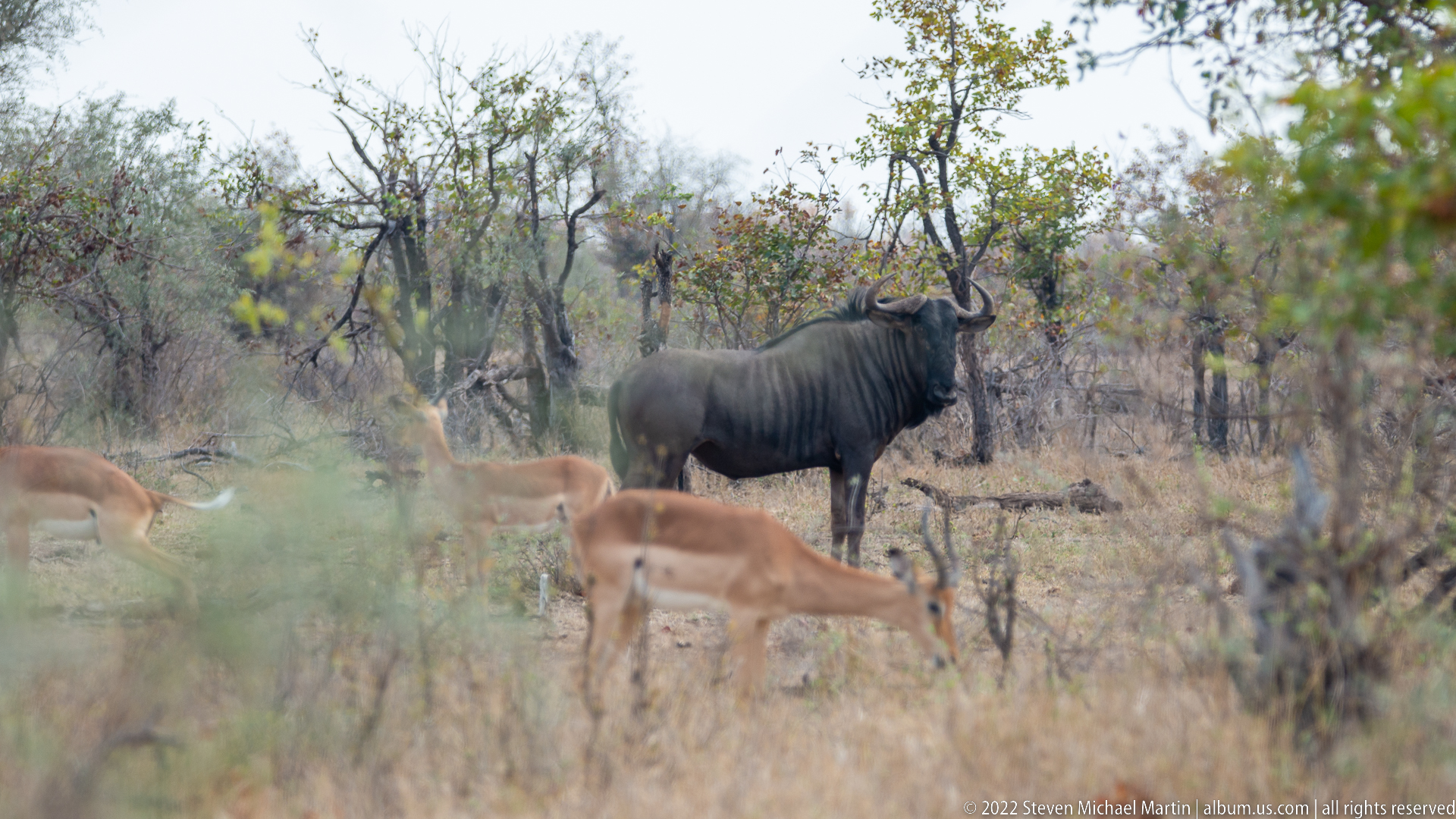
A blue wildebeest stands upright among several impalas feeding in dry woodland. Its dark, heavy forequarters, sloping back, beard, and outward-curving horns contrast with the smaller reddish antelopes in the foreground. The mixed-species grouping gives a contextual view of large herbivores sharing the same dry-season feeding area.
Caption
A blue wildebeest stands upright among several impalas feeding in dry woodland. Its dark, heavy forequarters, sloping back, beard, and outward-curving horns contrast with the smaller reddish antelopes in the foreground. The mixed-species grouping gives a contextual view of large herbivores sharing the same dry-season feeding area.
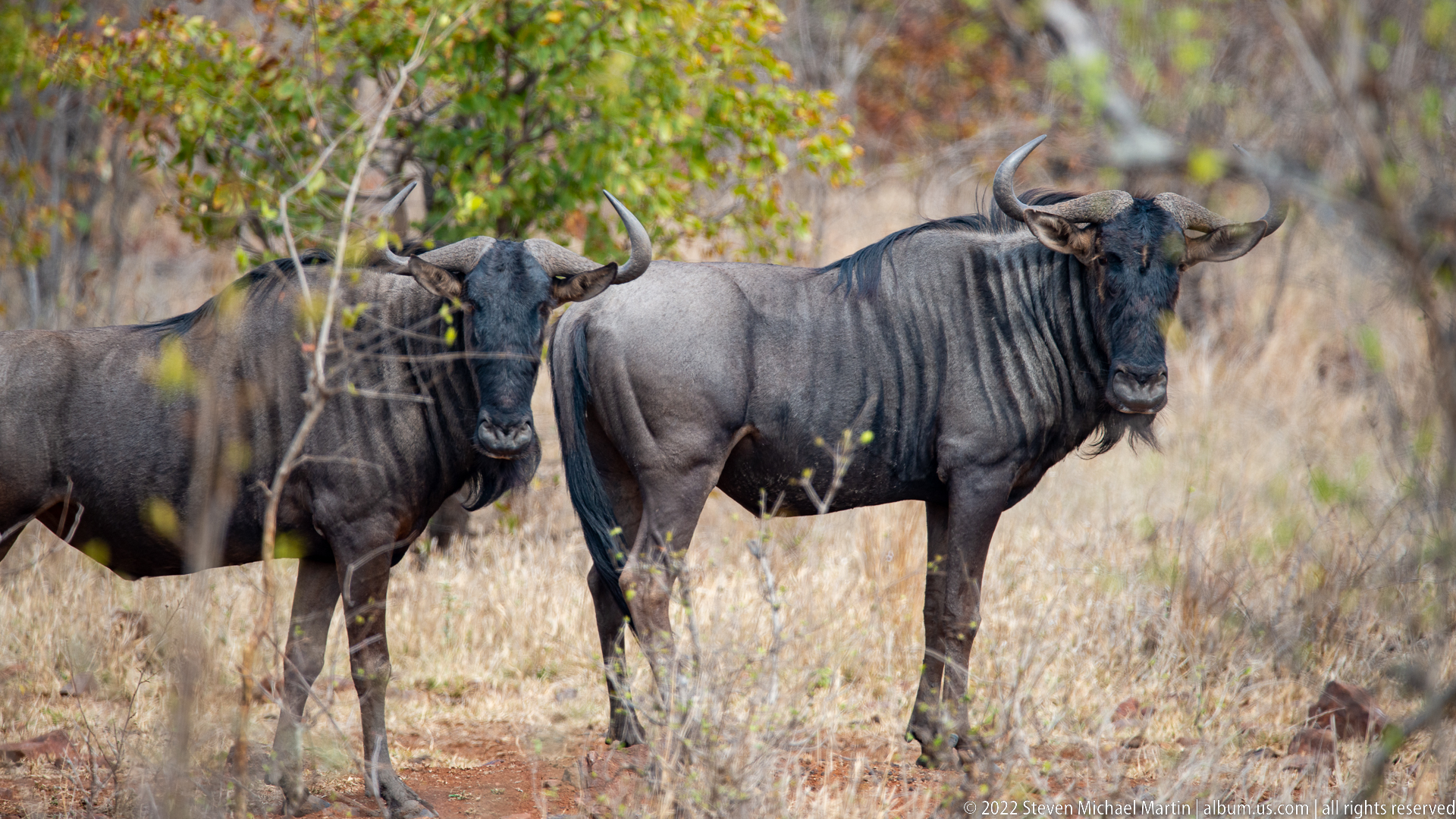
Two blue wildebeest stand close together in dry woodland, both facing toward the camera. Their broad muzzles, dark vertical shoulder striping, beards, and heavy horns are clearly visible, while the overlapping bodies create a compact herd portrait. Dry grass and scattered leaves place the pair within Kruger’s late-season savanna.
Caption
Two blue wildebeest stand close together in dry woodland, both facing toward the camera. Their broad muzzles, dark vertical shoulder striping, beards, and heavy horns are clearly visible, while the overlapping bodies create a compact herd portrait. Dry grass and scattered leaves place the pair within Kruger’s late-season savanna.

A blue wildebeest stands broadside in pale dry grass, turning its head directly toward the camera. The clear side view records the species’ sloping back, muscular shoulders, dark mane and beard, vertical body striping, and outward-curving horns. Sparse woodland behind keeps the animal visually isolated for a strong field-guide portrait.
Caption
A blue wildebeest stands broadside in pale dry grass, turning its head directly toward the camera. The clear side view records the species’ sloping back, muscular shoulders, dark mane and beard, vertical body striping, and outward-curving horns. Sparse woodland behind keeps the animal visually isolated for a strong field-guide portrait.
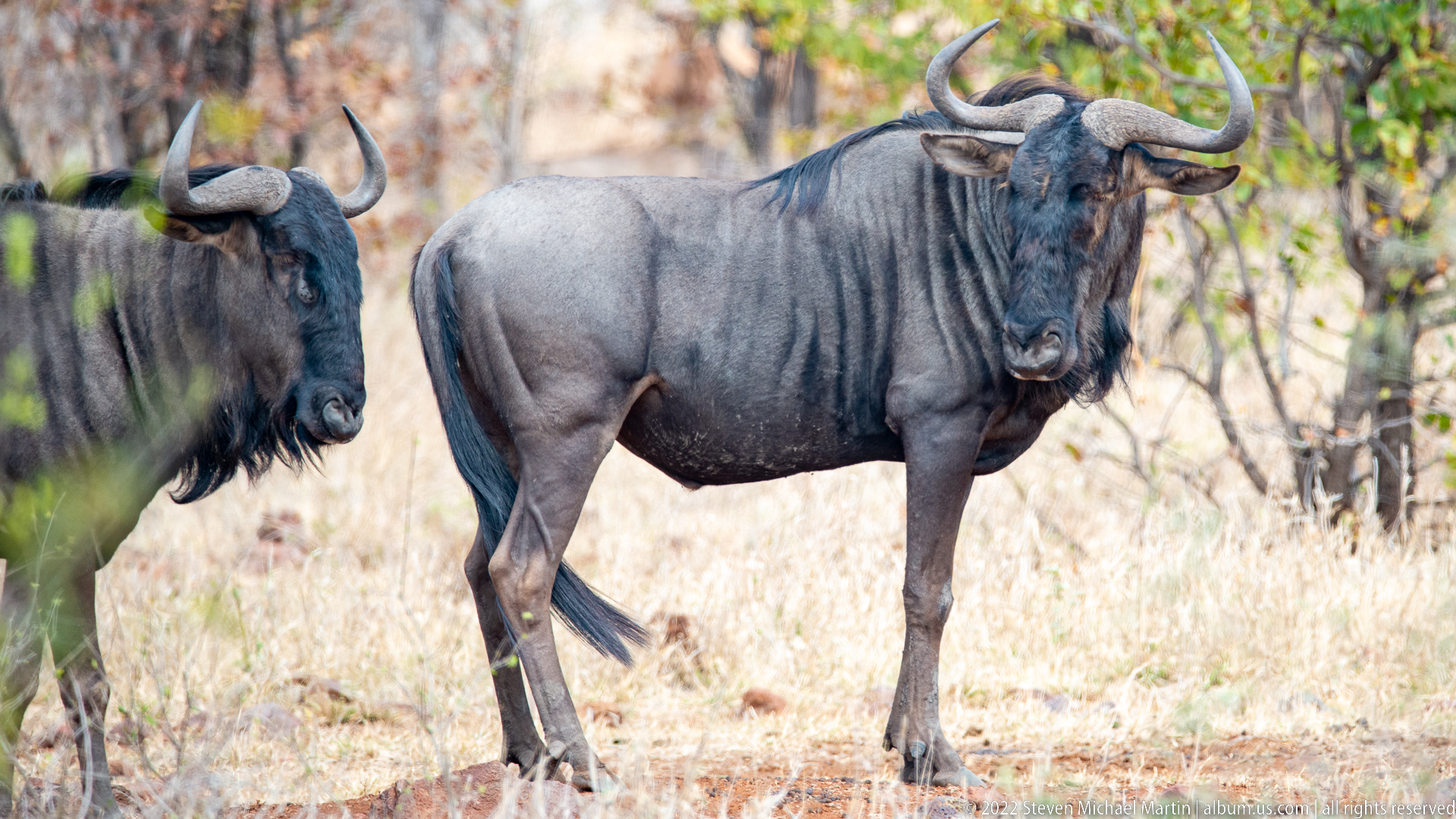
Two blue wildebeest overlap at close range, the nearer animal standing broadside while a second bull’s head and shoulder enter from the left. The composition emphasizes differences in horn angle and facial profile without losing the species’ characteristic sloping torso, mane, beard, and dark vertical striping.
Caption
Two blue wildebeest overlap at close range, the nearer animal standing broadside while a second bull’s head and shoulder enter from the left. The composition emphasizes differences in horn angle and facial profile without losing the species’ characteristic sloping torso, mane, beard, and dark vertical striping.

A small herd of plains zebras bunches tightly beneath woodland foliage, their overlapping black-and-white stripes breaking up the outlines of individual bodies. Several animals face different directions, suggesting collective vigilance while resting or pausing in cover. The close grouping turns the stripe pattern itself into the dominant visual structure of the scene.
Caption
A small herd of plains zebras bunches tightly beneath woodland foliage, their overlapping black-and-white stripes breaking up the outlines of individual bodies. Several animals face different directions, suggesting collective vigilance while resting or pausing in cover. The close grouping turns the stripe pattern itself into the dominant visual structure of the scene.
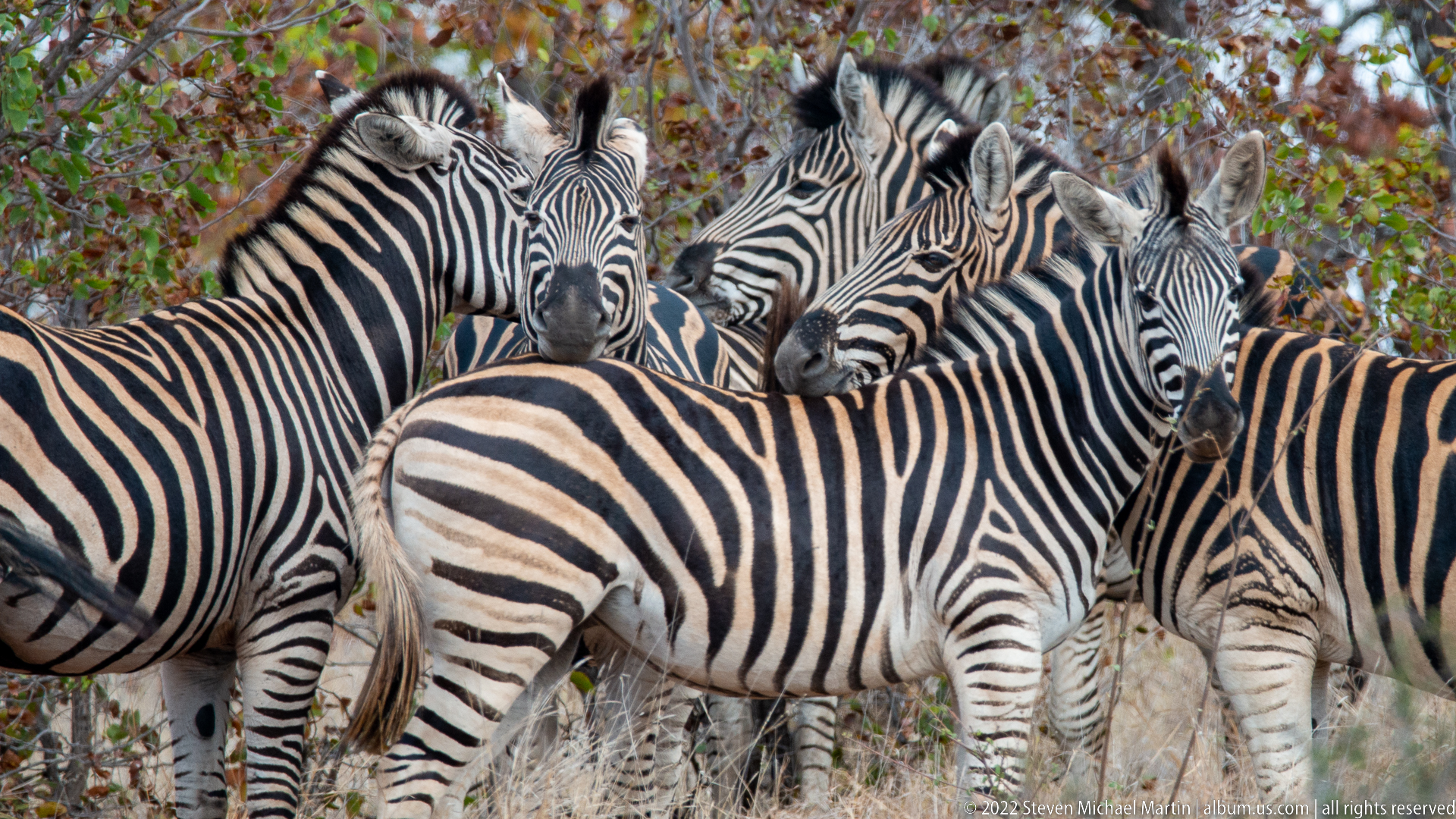
Plains zebras crowd together in a close herd portrait, with heads, shoulders, and striped flanks interlocking across nearly the entire frame. The compressed view makes it difficult to separate individual outlines, illustrating how disruptive striping becomes especially complex when animals stand shoulder to shoulder. Woodland foliage provides only a narrow backdrop.
Caption
Plains zebras crowd together in a close herd portrait, with heads, shoulders, and striped flanks interlocking across nearly the entire frame. The compressed view makes it difficult to separate individual outlines, illustrating how disruptive striping becomes especially complex when animals stand shoulder to shoulder. Woodland foliage provides only a narrow backdrop.

A plains zebra and a female waterbuck pause several meters apart on a red dirt road through dry bush. The zebra stands nearer the left verge while the larger gray-brown antelope faces the camera from the road center. Their separation and direct attention create a clear mixed-species encounter framed by tawny grass and leaf-sparse woodland.
Caption
A plains zebra and a female waterbuck pause several meters apart on a red dirt road through dry bush. The zebra stands nearer the left verge while the larger gray-brown antelope faces the camera from the road center. Their separation and direct attention create a clear mixed-species encounter framed by tawny grass and leaf-sparse woodland.
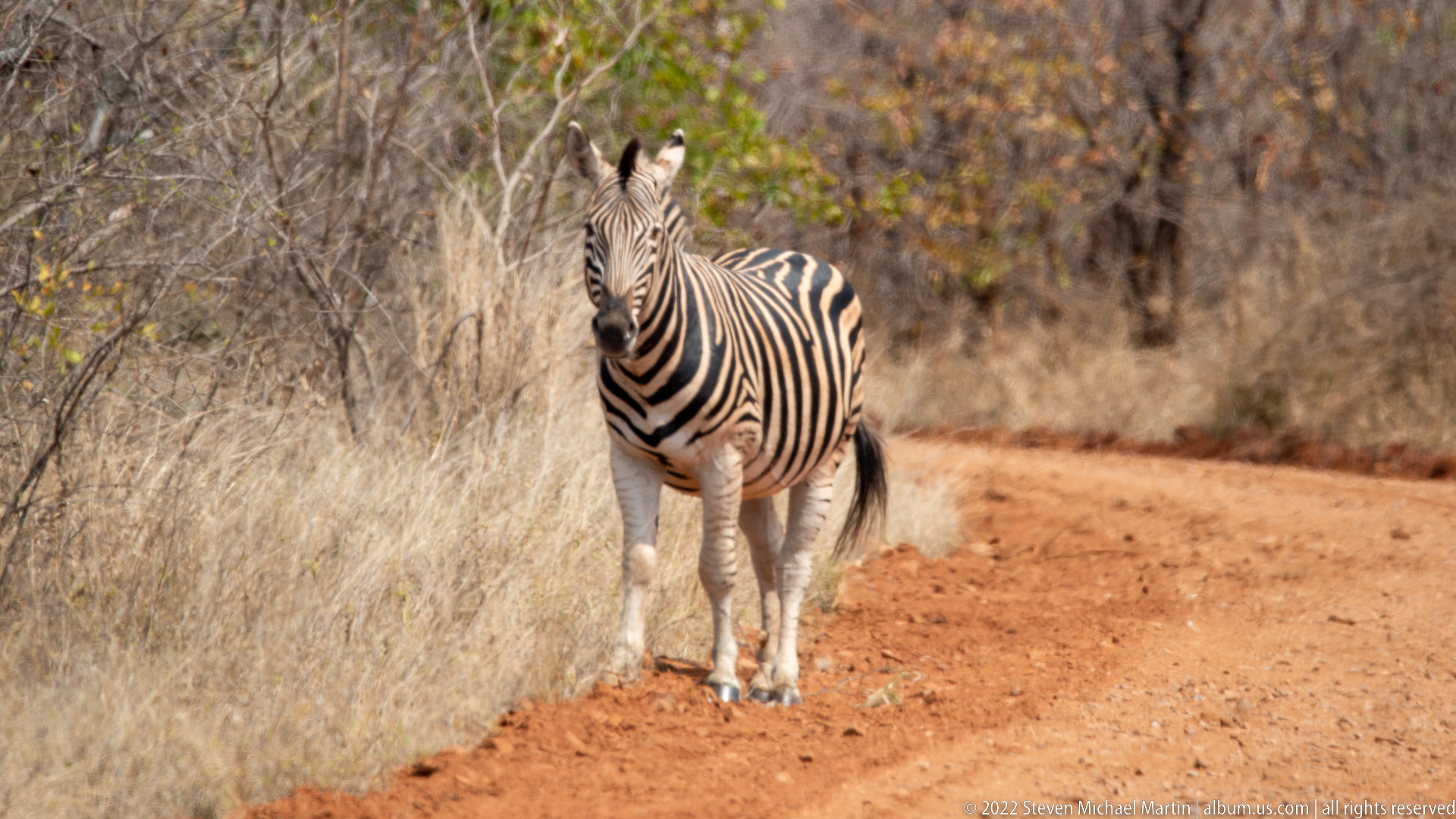
A plains zebra stands alone at the edge of a red dirt road, facing the camera with ears raised. The frontal stance narrows the striped torso into a compact pattern while the road curves behind into dry woodland. Compared with the preceding mixed-species view, this frame isolates the zebra and its alert posture.
Caption
A plains zebra stands alone at the edge of a red dirt road, facing the camera with ears raised. The frontal stance narrows the striped torso into a compact pattern while the road curves behind into dry woodland. Compared with the preceding mixed-species view, this frame isolates the zebra and its alert posture.
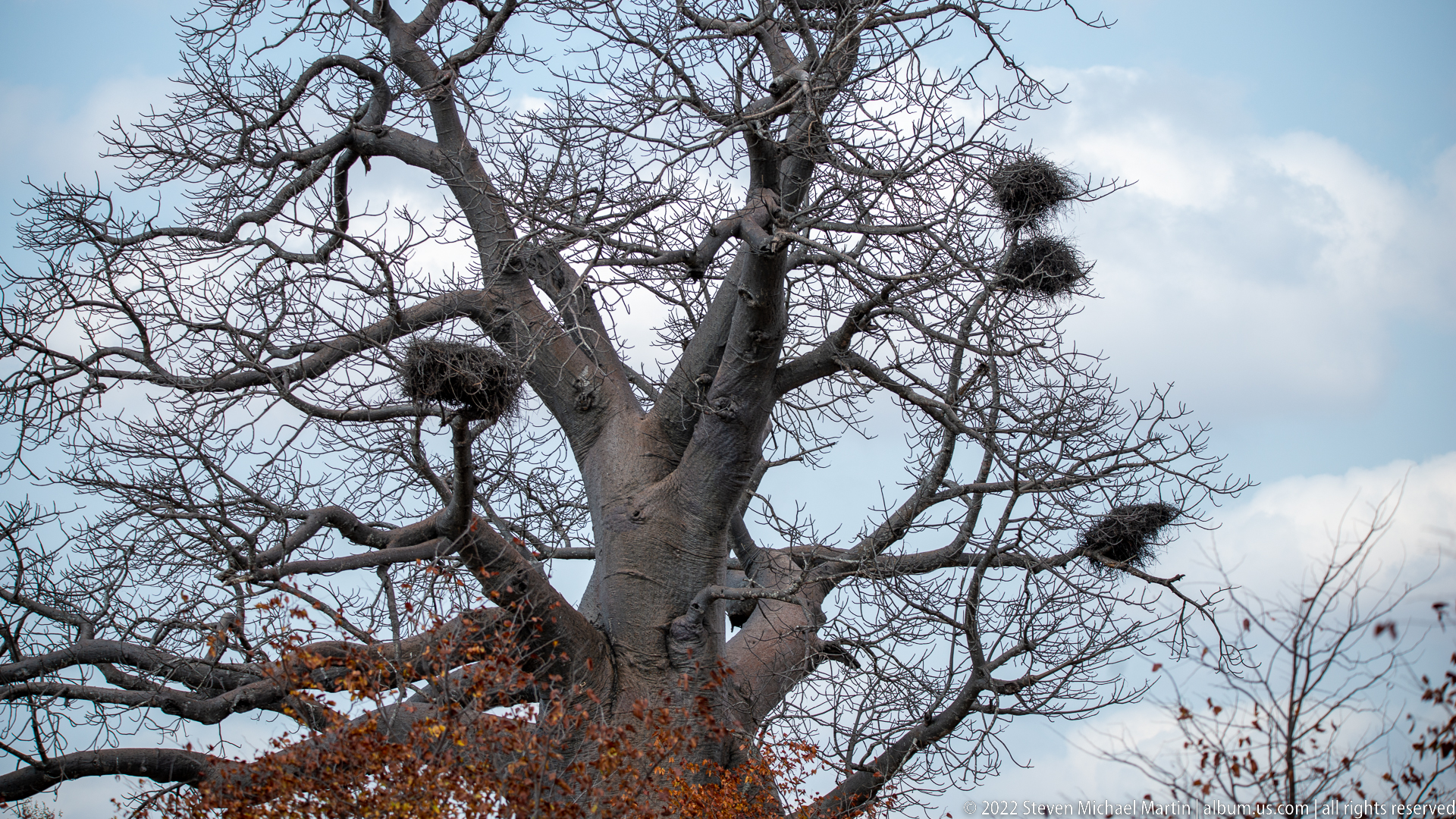
A massive leafless baobab rises above the surrounding vegetation with several bulky stick nests lodged in its upper branches. The low upward viewpoint emphasizes the swollen trunk and branching architecture, while the nests show how large savanna trees provide elevated nesting structures for birds. The occupants are not visible clearly enough here for a reliable species identification.
Caption
A massive leafless baobab rises above the surrounding vegetation with several bulky stick nests lodged in its upper branches. The low upward viewpoint emphasizes the swollen trunk and branching architecture, while the nests show how large savanna trees provide elevated nesting structures for birds. The occupants are not visible clearly enough here for a reliable species identification.

An African buffalo faces the camera from tall dry grass, framed by the dark bodies of herd mates behind it. The frontal view clearly shows the massive horn bosses sweeping outward and downward before curving up at the tips, along with the broad muzzle and heavy build characteristic of an adult Cape buffalo.
Caption
An African buffalo faces the camera from tall dry grass, framed by the dark bodies of herd mates behind it. The frontal view clearly shows the massive horn bosses sweeping outward and downward before curving up at the tips, along with the broad muzzle and heavy build characteristic of an adult Cape buffalo.

A close frontal portrait isolates an African buffalo’s face and horn structure against pale dry grass and blurred herd mates. The heavy bosses meet across the forehead before the horns sweep down and turn upward, while the broad ears extend beneath them. Fine facial details and the direct gaze make this a strong field-guide study of an adult animal.
Caption
A close frontal portrait isolates an African buffalo’s face and horn structure against pale dry grass and blurred herd mates. The heavy bosses meet across the forehead before the horns sweep down and turn upward, while the broad ears extend beneath them. Fine facial details and the direct gaze make this a strong field-guide study of an adult animal.

A herd of African buffalo moves across a paved road in Kruger National Park, temporarily filling the roadway from verge to verge. The broad procession includes animals of different sizes, while a safari vehicle waits at the left edge. Dry grass and mixed woodland frame this characteristic encounter between wildlife movement and the park road network.
Caption
A herd of African buffalo moves across a paved road in Kruger National Park, temporarily filling the roadway from verge to verge. The broad procession includes animals of different sizes, while a safari vehicle waits at the left edge. Dry grass and mixed woodland frame this characteristic encounter between wildlife movement and the park road network.
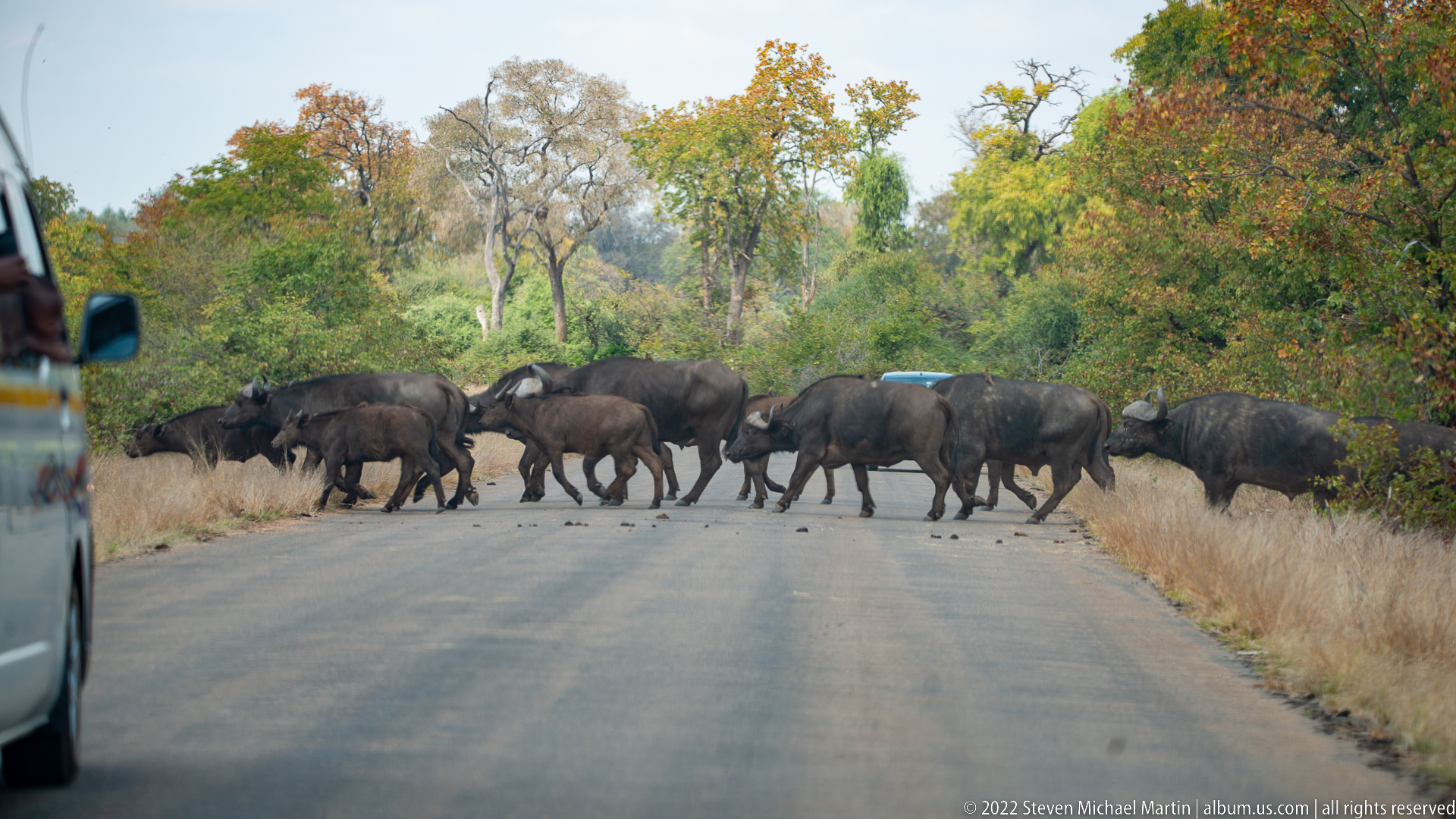
African buffalo continue their road crossing in a closer view, with several adults striding broadside across the asphalt and others emerging from the roadside vegetation. Their dark bodies and heavy horn bosses stand out against the pale road and dry grass, showing how a large herd can briefly control traffic along a Kruger National Park route.
Caption
African buffalo continue their road crossing in a closer view, with several adults striding broadside across the asphalt and others emerging from the roadside vegetation. Their dark bodies and heavy horn bosses stand out against the pale road and dry grass, showing how a large herd can briefly control traffic along a Kruger National Park route.

A rosette-forming aloe grows from sandy, reddish soil beside rocks and dry plant litter. Long, fleshy blue-green leaves radiate from the center and carry small teeth along their margins, adaptations typical of aloes in seasonally dry southern African landscapes. The photograph concentrates on the plant’s sculptural form rather than the broader habitat.
Caption
A rosette-forming aloe grows from sandy, reddish soil beside rocks and dry plant litter. Long, fleshy blue-green leaves radiate from the center and carry small teeth along their margins, adaptations typical of aloes in seasonally dry southern African landscapes. The photograph concentrates on the plant’s sculptural form rather than the broader habitat.

White flowers edged in vivid crimson open along the thick gray-green stem of an impala lily, a conspicuous dry-season flowering plant of the Kruger region. Several blossoms and buds appear at different stages, while the dark, softly blurred background isolates the saturated margins and striped throats of the flowers.
Caption
White flowers edged in vivid crimson open along the thick gray-green stem of an impala lily, a conspicuous dry-season flowering plant of the Kruger region. Several blossoms and buds appear at different stages, while the dark, softly blurred background isolates the saturated margins and striped throats of the flowers.
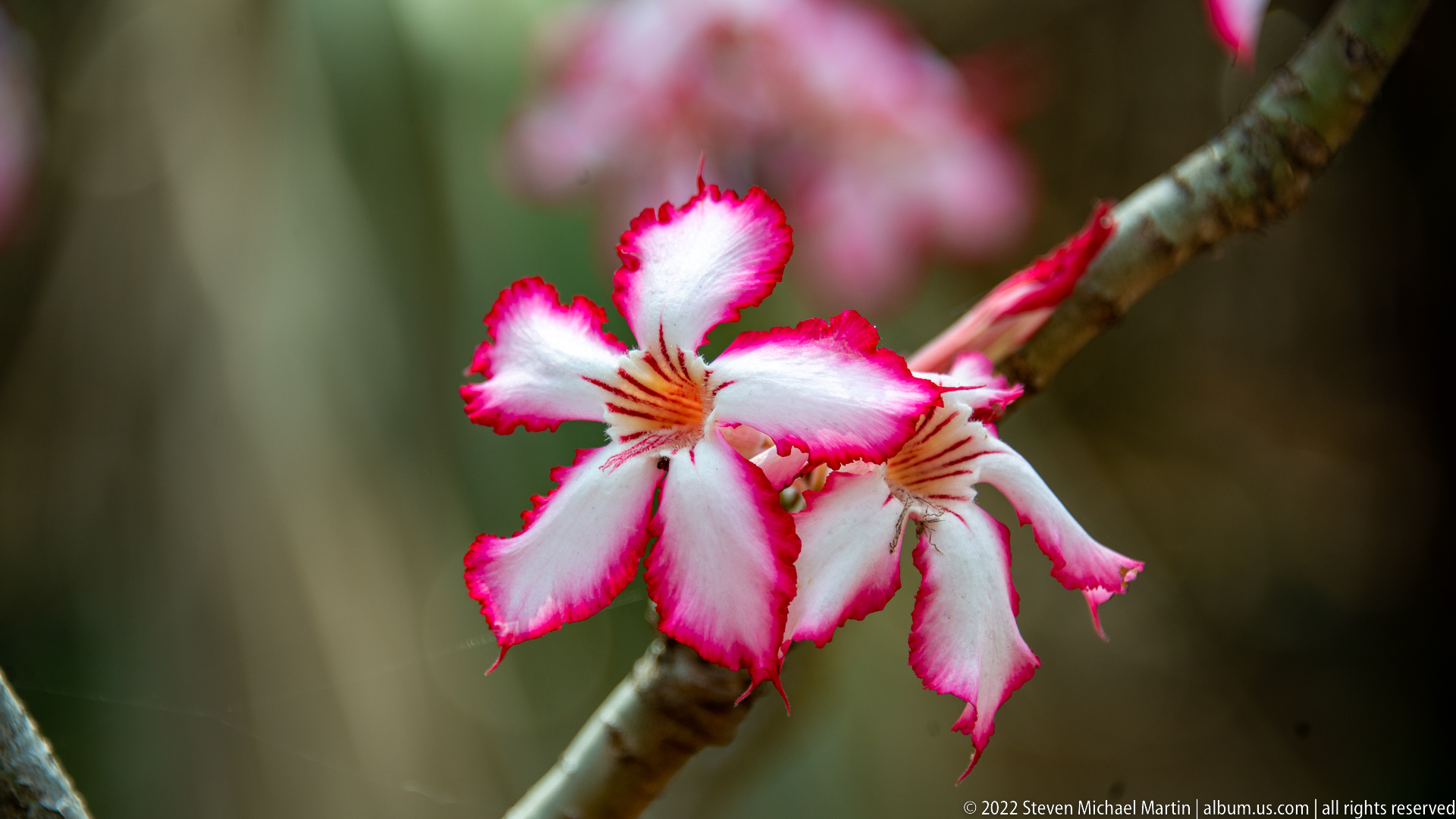
A close view isolates a single open impala lily blossom and a neighboring flower against a soft green-brown background. The petals are white at their centers and sharply rimmed in crimson, with reddish lines converging toward the throat. The tight composition records the flower’s diagnostic pattern more clearly than the wider flowering-stem view.
Caption
A close view isolates a single open impala lily blossom and a neighboring flower against a soft green-brown background. The petals are white at their centers and sharply rimmed in crimson, with reddish lines converging toward the throat. The tight composition records the flower’s diagnostic pattern more clearly than the wider flowering-stem view.
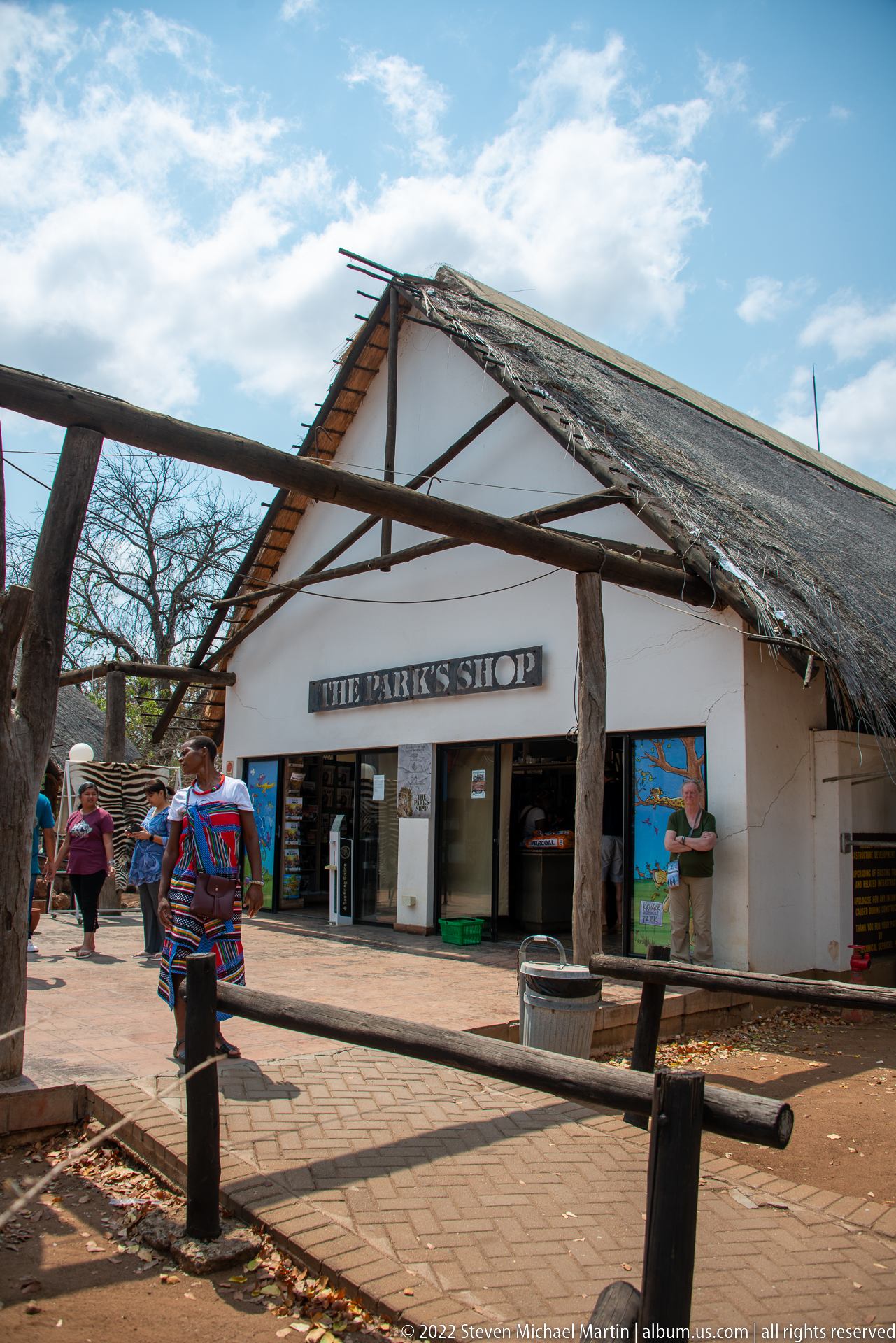
A park shop occupies a whitewashed building beneath a broad thatched roof, with rustic timber supports extending over the paved forecourt. Visitors stand near the entrance and display panels flank the doorway. The scene records the practical visitor infrastructure that accompanies wildlife travel through Kruger National Park.
Caption
A park shop occupies a whitewashed building beneath a broad thatched roof, with rustic timber supports extending over the paved forecourt. Visitors stand near the entrance and display panels flank the doorway. The scene records the practical visitor infrastructure that accompanies wildlife travel through Kruger National Park.

A large framed map presents the Great Limpopo Transfrontier Conservation Area across southeastern Africa, with national borders, protected areas, rivers, and landscape shading visible across the regional view. Logos and flags along the lower edge reinforce the cross-border conservation framework linking protected landscapes in South Africa, Mozambique, and Zimbabwe.
Caption
A large framed map presents the Great Limpopo Transfrontier Conservation Area across southeastern Africa, with national borders, protected areas, rivers, and landscape shading visible across the regional view. Logos and flags along the lower edge reinforce the cross-border conservation framework linking protected landscapes in South Africa, Mozambique, and Zimbabwe.
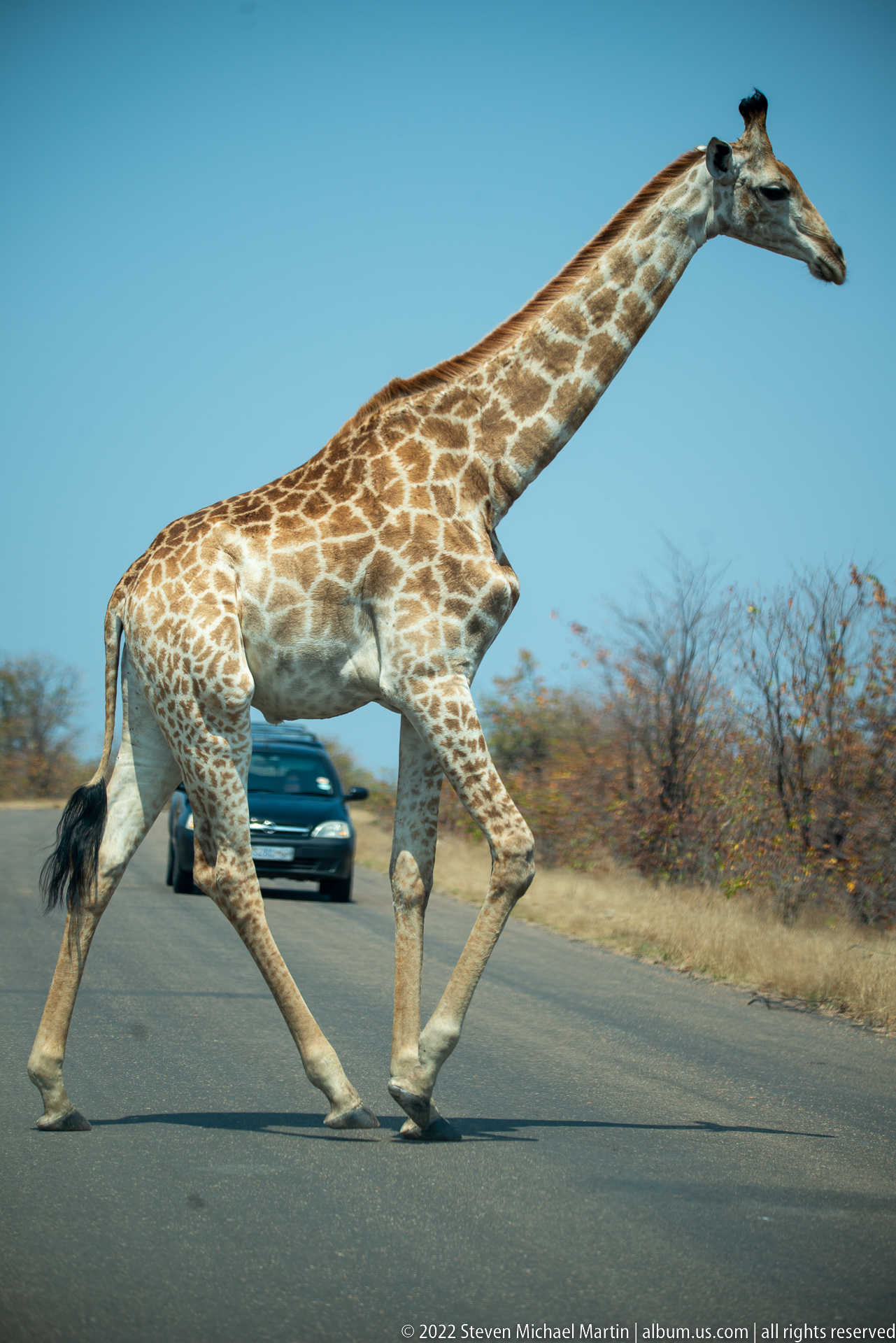
A giraffe strides across a paved Kruger road in full profile, its long legs extended in a purposeful walk as a vehicle waits behind. The low roadside vegetation and open blue sky isolate the animal’s exceptional height and elongated proportions. The encounter shows the practical priority given to free-ranging wildlife on the park’s road network.
Caption
A giraffe strides across a paved Kruger road in full profile, its long legs extended in a purposeful walk as a vehicle waits behind. The low roadside vegetation and open blue sky isolate the animal’s exceptional height and elongated proportions. The encounter shows the practical priority given to free-ranging wildlife on the park’s road network.
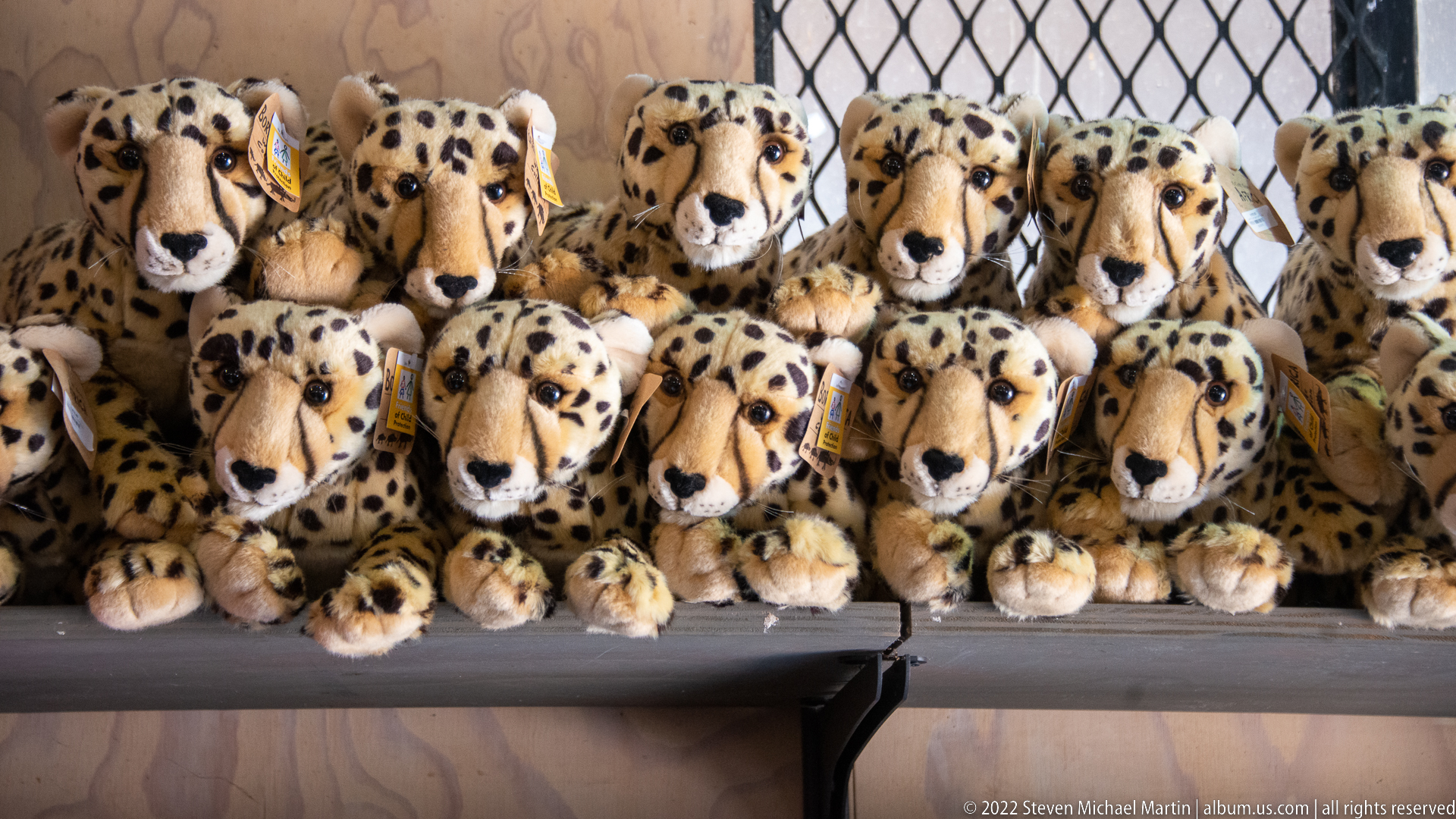
Rows of spotted cheetah plush toys crowd a shelf in a Kruger National Park shop, their repeated faces and patterned coats forming a dense souvenir display. The merchandise translates one of southern Africa’s best-known predators into a visitor keepsake, while the tight framing emphasizes repetition, texture, and the commercial side of the park experience.
Caption
Rows of spotted cheetah plush toys crowd a shelf in a Kruger National Park shop, their repeated faces and patterned coats forming a dense souvenir display. The merchandise translates one of southern Africa’s best-known predators into a visitor keepsake, while the tight framing emphasizes repetition, texture, and the commercial side of the park experience.

A souvenir shirt carries the name “Shingwedzi” above a row of yellow wildlife road-sign symbols and the words “Kruger National Park · Mpumalanga / Limpopo · South Africa.” Stamp-like graphics and multilingual country names complete the design, making the garment both merchandise and a compact visual record of place identity within the park.
Caption
A souvenir shirt carries the name “Shingwedzi” above a row of yellow wildlife road-sign symbols and the words “Kruger National Park · Mpumalanga / Limpopo · South Africa.” Stamp-like graphics and multilingual country names complete the design, making the garment both merchandise and a compact visual record of place identity within the park.

A steep thatched gable shelters the front of a low white building at Shingwedzi, with exposed timber trusses and poles creating a deep shaded veranda. Air-conditioning units and a service window reveal its modern working function beneath the rustic camp architecture. The frontal composition emphasizes the contrast between traditional-looking thatch and practical visitor infrastructure.
Caption
A steep thatched gable shelters the front of a low white building at Shingwedzi, with exposed timber trusses and poles creating a deep shaded veranda. Air-conditioning units and a service window reveal its modern working function beneath the rustic camp architecture. The frontal composition emphasizes the contrast between traditional-looking thatch and practical visitor infrastructure.

A large green orientation sign maps Shingwedzi camp, marking reception and shop, conference center, guesthouse, numbered accommodation areas, fuel, and the main and east approaches. A “You Are Here” marker anchors the visitor’s position. The diagram documents the spatial organization of one of Kruger National Park’s developed rest camps.
Caption
A large green orientation sign maps Shingwedzi camp, marking reception and shop, conference center, guesthouse, numbered accommodation areas, fuel, and the main and east approaches. A “You Are Here” marker anchors the visitor’s position. The diagram documents the spatial organization of one of Kruger National Park’s developed rest camps.
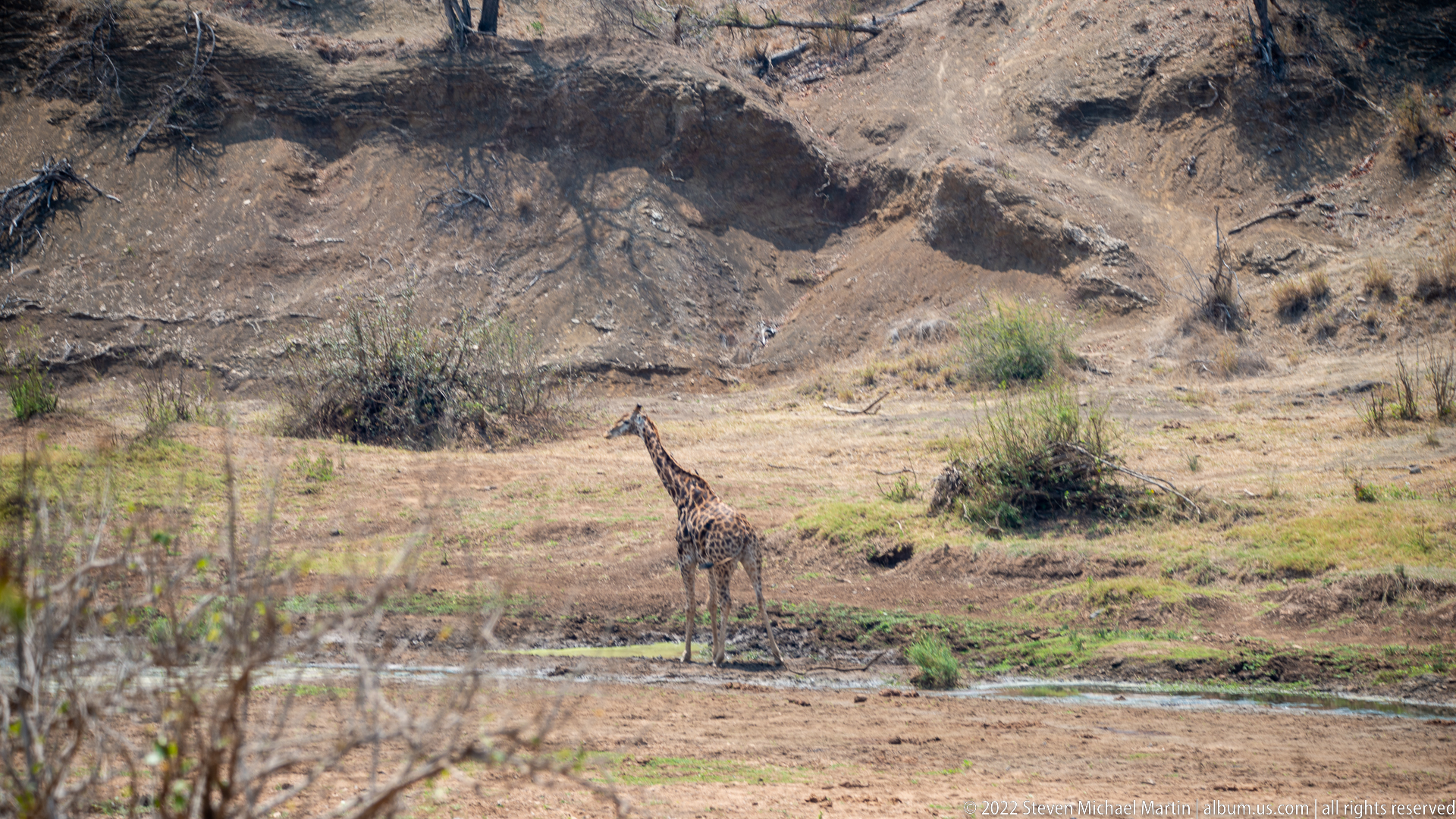
A giraffe stands alone on an open patch near a shallow watercourse, its tall patterned body rising against a dry, eroded slope and sparse vegetation. Seen from a distance, the animal becomes a vertical focal point within a broad habitat view rather than a close wildlife portrait, conveying scale across the dry Kruger landscape.
Caption
A giraffe stands alone on an open patch near a shallow watercourse, its tall patterned body rising against a dry, eroded slope and sparse vegetation. Seen from a distance, the animal becomes a vertical focal point within a broad habitat view rather than a close wildlife portrait, conveying scale across the dry Kruger landscape.

A saddle-billed stork stands on a muddy bank, its black-and-white plumage and long red-and-black bill accented by a bright yellow saddle. A smaller white wading bird stands nearer the water behind it. The layered riverbank scene places two feeding birds within the exposed mud and sparse vegetation of a dry-season aquatic habitat.
Caption
A saddle-billed stork stands on a muddy bank, its black-and-white plumage and long red-and-black bill accented by a bright yellow saddle. A smaller white wading bird stands nearer the water behind it. The layered riverbank scene places two feeding birds within the exposed mud and sparse vegetation of a dry-season aquatic habitat.
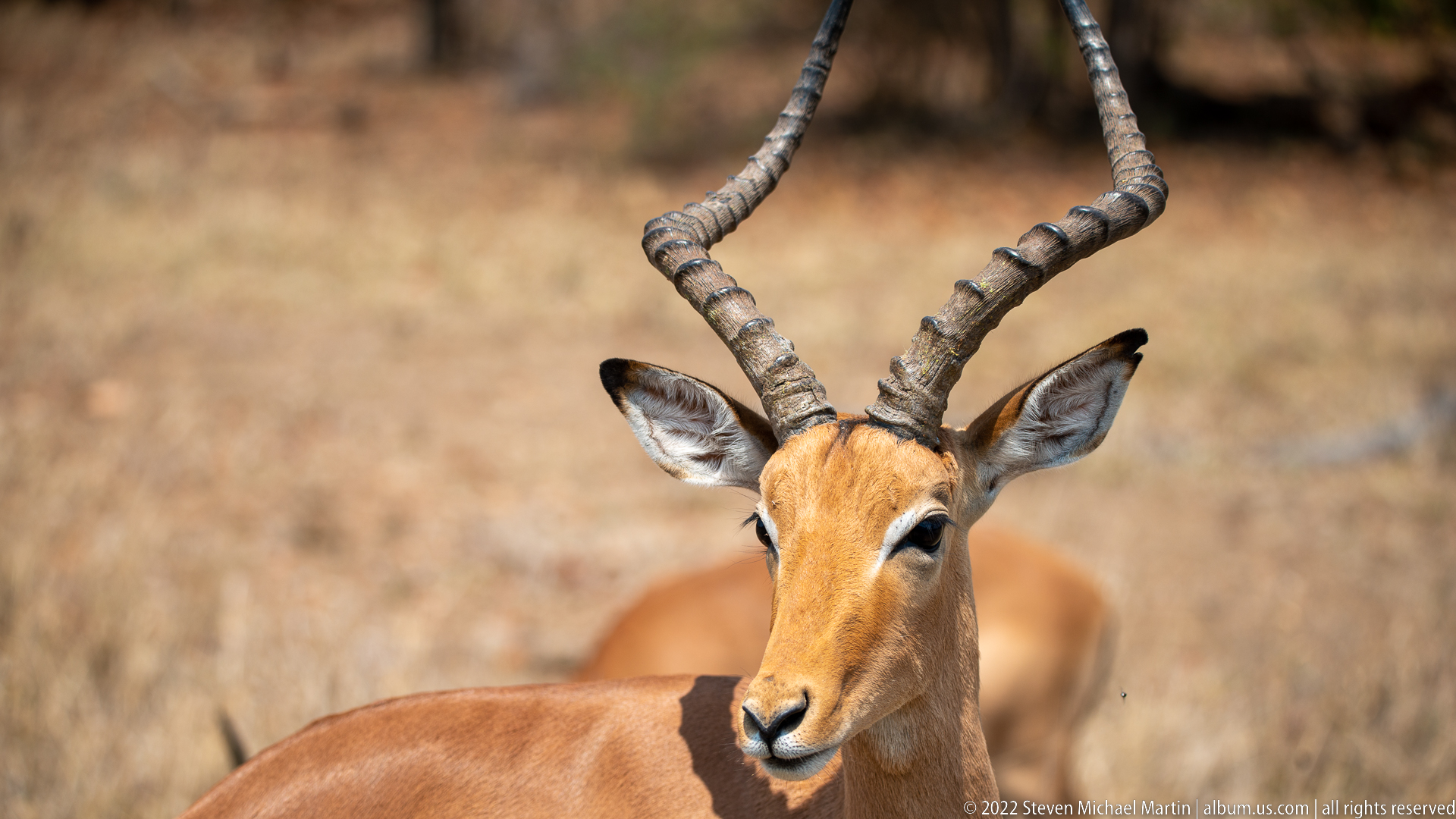
A male impala faces the camera in a close portrait, with long ridged lyre-shaped horns rising above alert ears. Warm tawny fur contrasts with the pale dry grass behind him, while shallow depth of field separates the animal from its surroundings. The view concentrates on the facial markings, horn structure, and poised vigilance of an adult ram.
Caption
A male impala faces the camera in a close portrait, with long ridged lyre-shaped horns rising above alert ears. Warm tawny fur contrasts with the pale dry grass behind him, while shallow depth of field separates the animal from its surroundings. The view concentrates on the facial markings, horn structure, and poised vigilance of an adult ram.

A plains zebra walks across a paved Kruger road in full side profile, one foreleg lifted mid-stride. Its bold striping is sharply defined against the pale asphalt and dry woodland, while the empty road extends behind it. The composition records a routine but consequential wildlife crossing where park traffic yields to free-ranging animals.
Caption
A plains zebra walks across a paved Kruger road in full side profile, one foreleg lifted mid-stride. Its bold striping is sharply defined against the pale asphalt and dry woodland, while the empty road extends behind it. The composition records a routine but consequential wildlife crossing where park traffic yields to free-ranging animals.

A plains zebra pauses beside the road among dry woodland and leaf litter, shown almost entirely in profile. The alternating stripes curve around its barrel and legs, while sparse autumnal foliage breaks up the background. Unlike the preceding road-crossing view, this frame places the animal within vegetation and emphasizes camouflage-like visual disruption in the bush.
Caption
A plains zebra pauses beside the road among dry woodland and leaf litter, shown almost entirely in profile. The alternating stripes curve around its barrel and legs, while sparse autumnal foliage breaks up the background. Unlike the preceding road-crossing view, this frame places the animal within vegetation and emphasizes camouflage-like visual disruption in the bush.

The head, neck, and shoulder of a plains zebra fill the frame, revealing the individual geometry of its stripes, upright mane, rounded muzzle, and large ear. A softly blurred woodland background keeps attention on the pattern changes across face and body, turning a roadside encounter into a detailed wildlife portrait.
Caption
The head, neck, and shoulder of a plains zebra fill the frame, revealing the individual geometry of its stripes, upright mane, rounded muzzle, and large ear. A softly blurred woodland background keeps attention on the pattern changes across face and body, turning a roadside encounter into a detailed wildlife portrait.
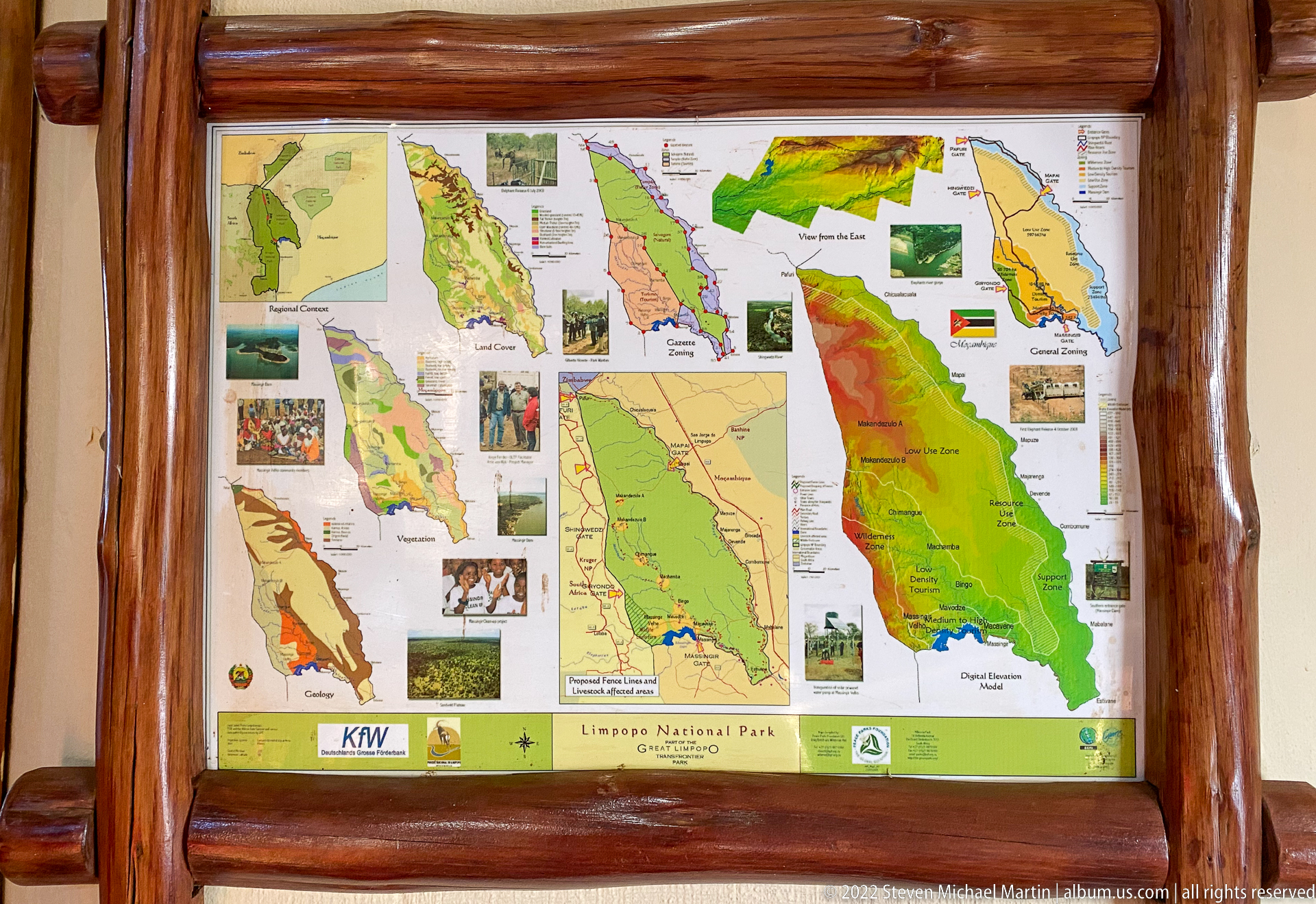
A framed interpretive display assembles multiple maps of Limpopo National Park and neighboring conservation landscapes, combining topographic color, boundaries, photographs, and explanatory graphics. The central and surrounding panels place the park within a wider cross-border ecological context, presenting geography as part of the visitor interpretation of the greater Kruger region.
Caption
A framed interpretive display assembles multiple maps of Limpopo National Park and neighboring conservation landscapes, combining topographic color, boundaries, photographs, and explanatory graphics. The central and surrounding panels place the park within a wider cross-border ecological context, presenting geography as part of the visitor interpretation of the greater Kruger region.

A plains zebra stands nearly motionless in tall straw-colored grass at the edge of dense dry woodland. Its body is angled slightly away while the head turns left, allowing the black-and-white stripes to contrast strongly with muted vegetation. The wider framing gives the animal breathing room and records its position within the seasonal bush habitat.
Caption
A plains zebra stands nearly motionless in tall straw-colored grass at the edge of dense dry woodland. Its body is angled slightly away while the head turns left, allowing the black-and-white stripes to contrast strongly with muted vegetation. The wider framing gives the animal breathing room and records its position within the seasonal bush habitat.
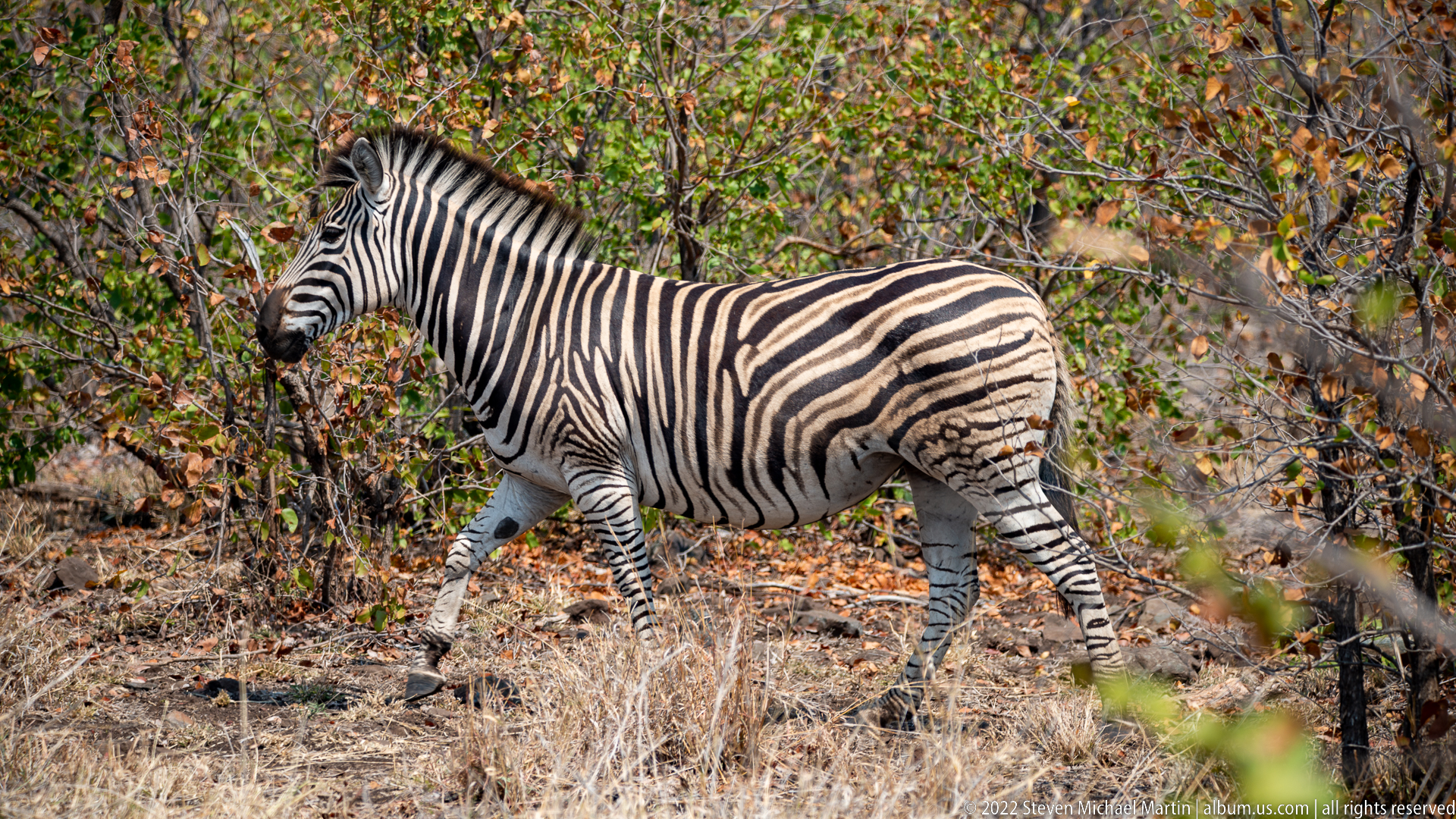
A plains zebra strides through dry woodland in a full broadside view, one foreleg lifted and the rounded body framed by sparse leaves and pale grass. The close lateral angle shows the changing stripe patterns from neck to hindquarters and the faint shadow striping between darker bands, useful field marks for the species.
Caption
A plains zebra strides through dry woodland in a full broadside view, one foreleg lifted and the rounded body framed by sparse leaves and pale grass. The close lateral angle shows the changing stripe patterns from neck to hindquarters and the faint shadow striping between darker bands, useful field marks for the species.

The interior of Punda Maria’s reception area combines a wooden service counter with visitor information displays, framed certificates, maps, and a television screen. Photographs and official material line the walls beneath a thatched or timbered ceiling, presenting the administrative and interpretive side of a Kruger rest camp rather than its wildlife setting.
Caption
The interior of Punda Maria’s reception area combines a wooden service counter with visitor information displays, framed certificates, maps, and a television screen. Photographs and official material line the walls beneath a thatched or timbered ceiling, presenting the administrative and interpretive side of a Kruger rest camp rather than its wildlife setting.
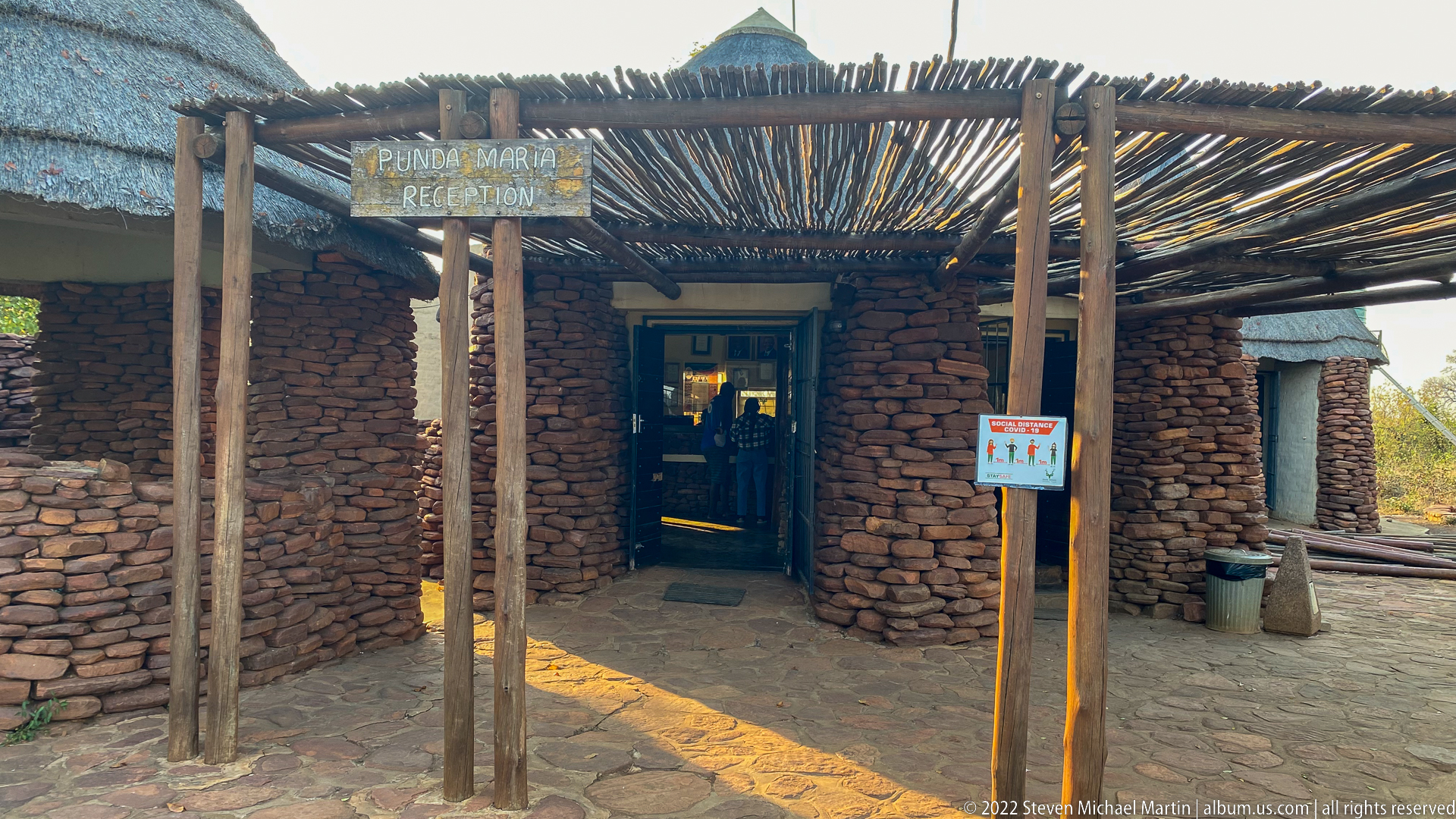
The entrance to Punda Maria Reception is built of rough stacked stone beneath a rustic pole canopy that casts linear shadows across the paved approach. The name “Punda Maria Reception” is visible above the doorway, while a small directional sign stands beside the entrance. The architecture blends durable masonry with the informal timber vocabulary of Kruger’s camp facilities.
Caption
The entrance to Punda Maria Reception is built of rough stacked stone beneath a rustic pole canopy that casts linear shadows across the paved approach. The name “Punda Maria Reception” is visible above the doorway, while a small directional sign stands beside the entrance. The architecture blends durable masonry with the informal timber vocabulary of Kruger’s camp facilities.

Two adjoining round buildings at Punda Maria have conical thatched roofs, earth-toned walls, and bases faced with reddish stone. Small wall lights and numbered plaques mark the structures as maintained camp facilities, while a tall succulent grows beside the walkway. Their compact circular forms echo the rondavel tradition widely used in southern African park accommodation.
Caption
Two adjoining round buildings at Punda Maria have conical thatched roofs, earth-toned walls, and bases faced with reddish stone. Small wall lights and numbered plaques mark the structures as maintained camp facilities, while a tall succulent grows beside the walkway. Their compact circular forms echo the rondavel tradition widely used in southern African park accommodation.
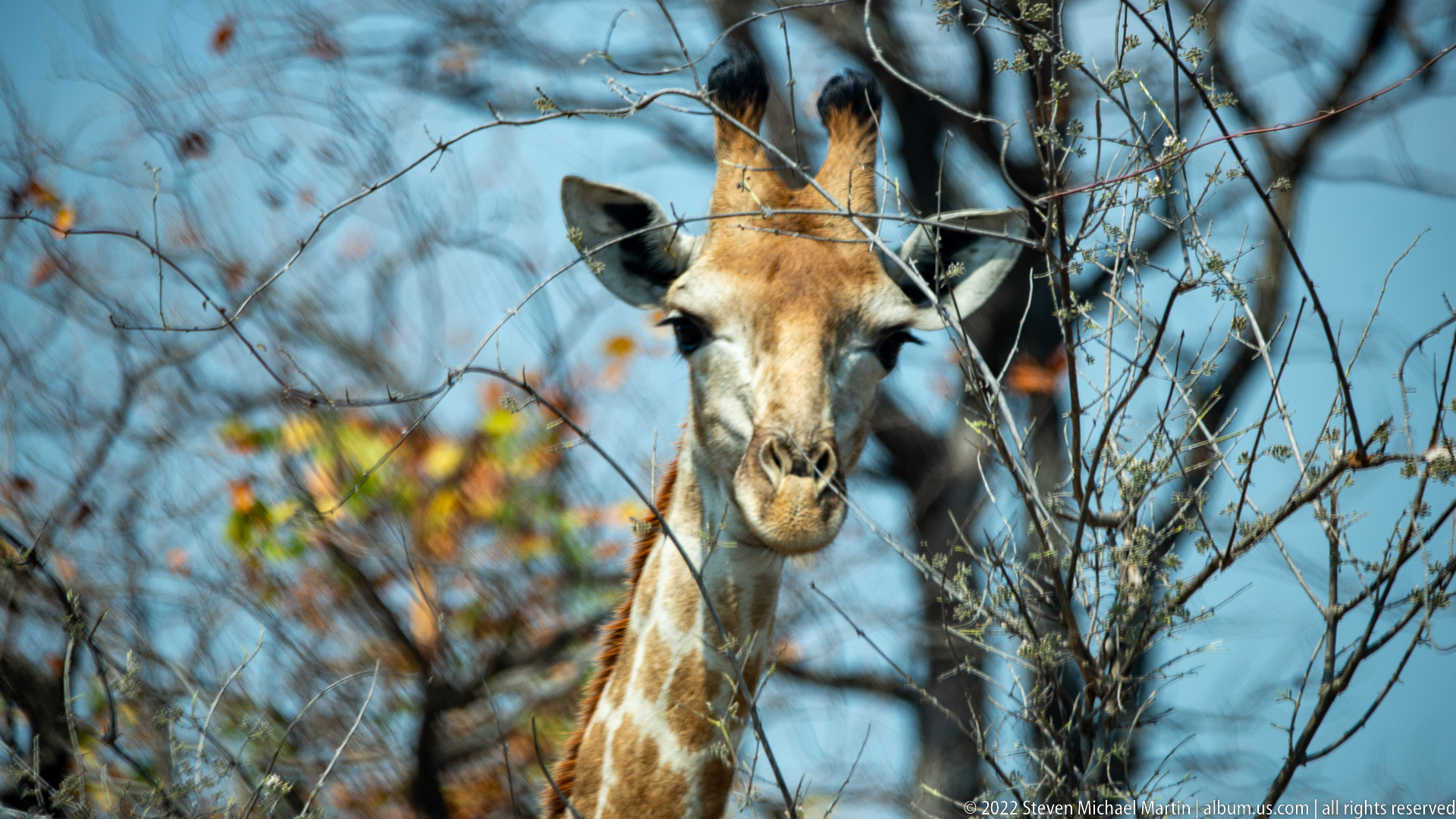
A giraffe peers through a lattice of thin branches, its face and upper neck framed by dry-season woodland. The elevated head is partly screened by twigs and leaves, creating a more intimate, habitat-centered portrait than the earlier distant view. Ossicones, large ears, and the mottled neck pattern remain clearly visible through the vegetation.
Caption
A giraffe peers through a lattice of thin branches, its face and upper neck framed by dry-season woodland. The elevated head is partly screened by twigs and leaves, creating a more intimate, habitat-centered portrait than the earlier distant view. Ossicones, large ears, and the mottled neck pattern remain clearly visible through the vegetation.

An adult male lion rests in dry leaf litter and grass, his head raised above a companion lying close beside him. Branches and warm-toned foliage partially veil the foreground, reinforcing the shaded, concealed character of the resting site. His developed mane and broad muzzle identify the animal as a mature male during a quiet period between activity.
Caption
An adult male lion rests in dry leaf litter and grass, his head raised above a companion lying close beside him. Branches and warm-toned foliage partially veil the foreground, reinforcing the shaded, concealed character of the resting site. His developed mane and broad muzzle identify the animal as a mature male during a quiet period between activity.
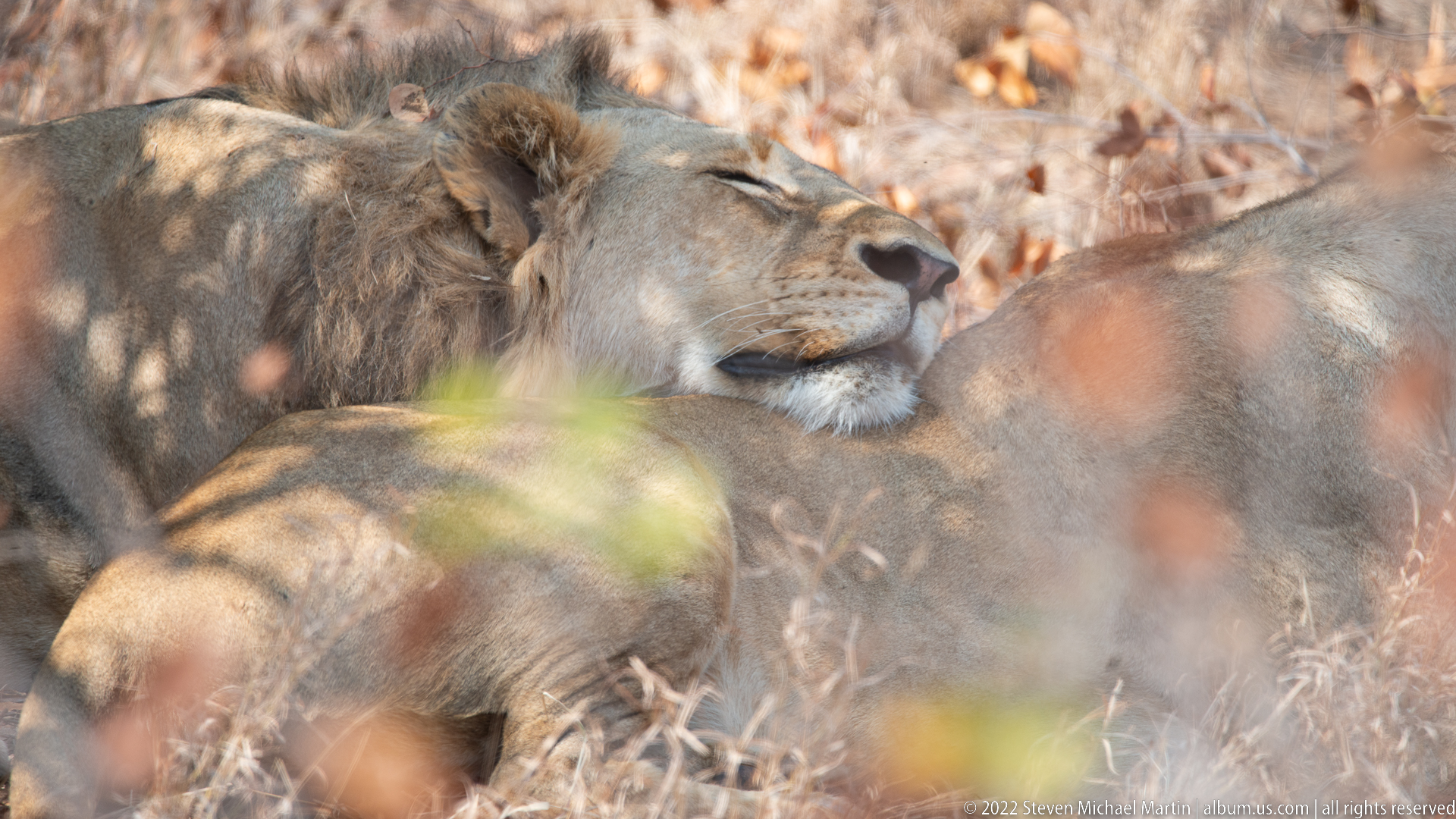
A tighter view centers the face and mane of a resting adult male lion, his eyes partly closed and muzzle relaxed as another lion’s body fills the near foreground. Dry leaves and soft branches blur around the pair, while the shallow depth of field draws attention to the male’s facial structure and tawny mane.
Caption
A tighter view centers the face and mane of a resting adult male lion, his eyes partly closed and muzzle relaxed as another lion’s body fills the near foreground. Dry leaves and soft branches blur around the pair, while the shallow depth of field draws attention to the male’s facial structure and tawny mane.
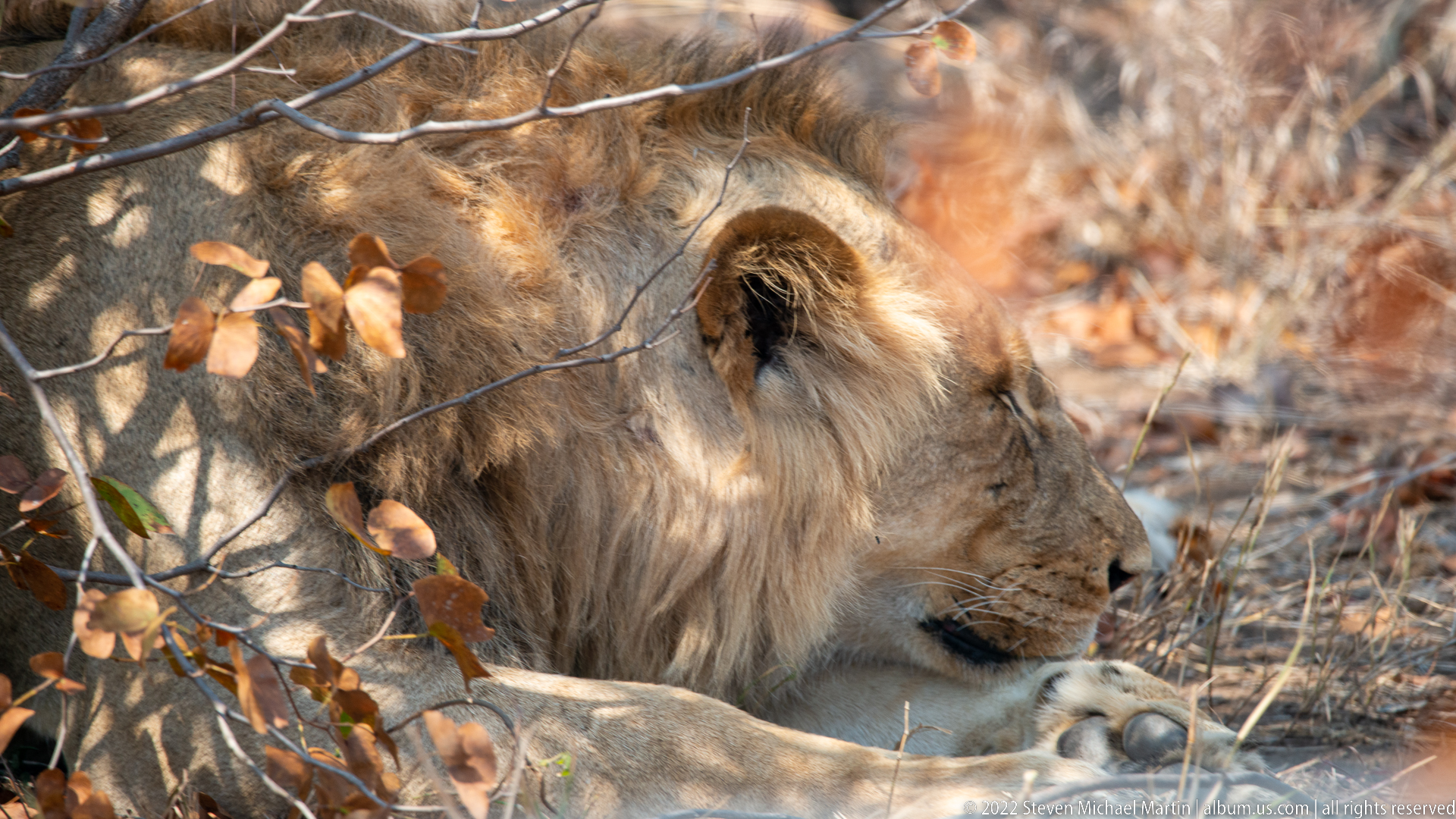
An adult male lion lies under low brush with his head turned to the right, framed by dry leaves and thin branches. His forepaws rest together in front of his chest, while the mane forms a darker halo around the neck and ear. The side-on pose offers a clear profile of the muzzle, whisker pads, and heavy mane.
Caption
An adult male lion lies under low brush with his head turned to the right, framed by dry leaves and thin branches. His forepaws rest together in front of his chest, while the mane forms a darker halo around the neck and ear. The side-on pose offers a clear profile of the muzzle, whisker pads, and heavy mane.
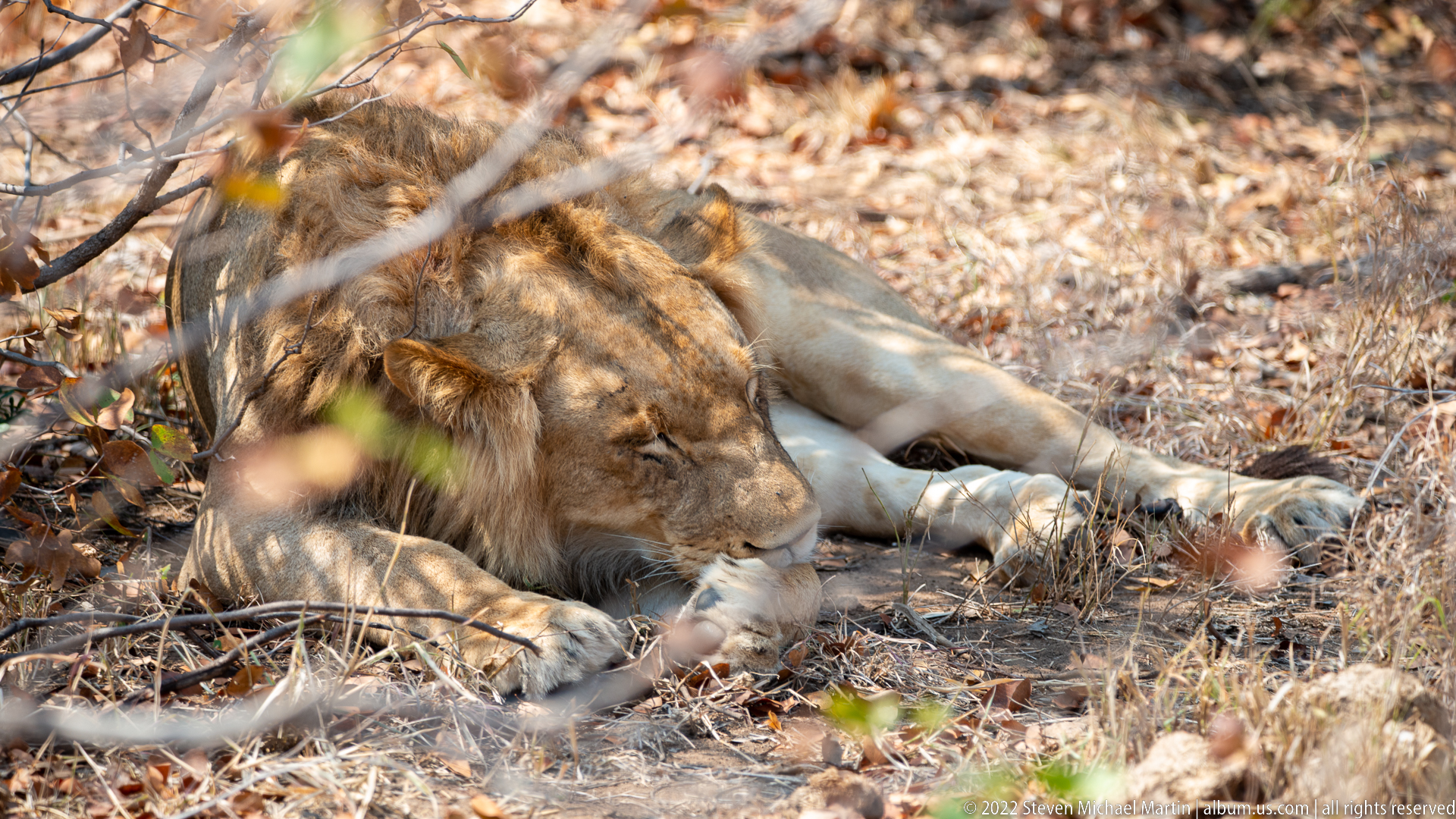
A male lion sleeps stretched on the dry woodland floor, his head lowered onto his forelegs and pale body extending into the shade behind him. Branches cross the foreground and fallen leaves cover the ground, giving the resting animal substantial visual concealment. The wider composition records both the lion and the sheltered microhabitat selected for daytime rest.
Caption
A male lion sleeps stretched on the dry woodland floor, his head lowered onto his forelegs and pale body extending into the shade behind him. Branches cross the foreground and fallen leaves cover the ground, giving the resting animal substantial visual concealment. The wider composition records both the lion and the sheltered microhabitat selected for daytime rest.
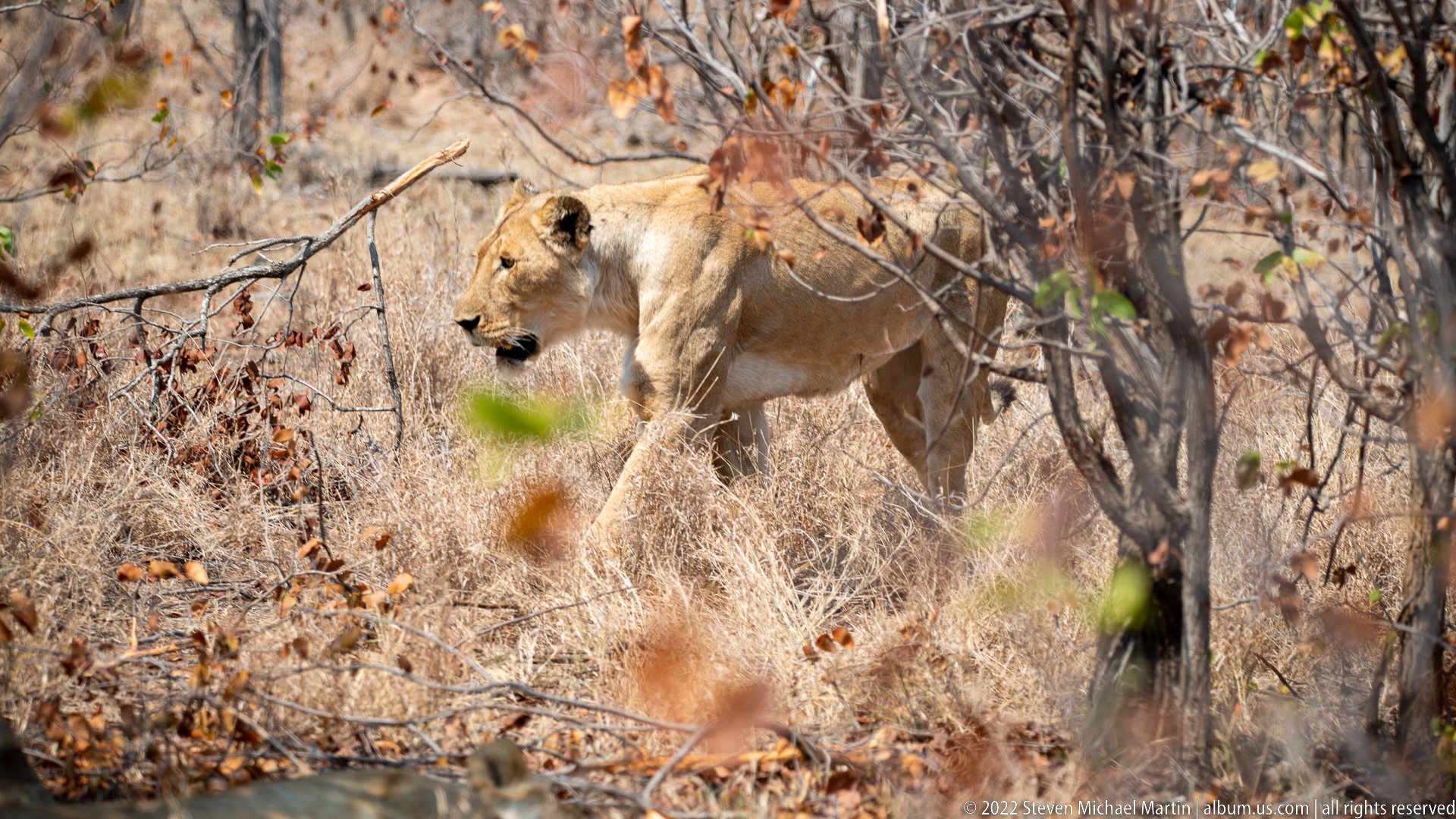
An adult lioness walks through tawny grass and sparse dry brush, head level and gaze directed ahead as she threads between branches. Without a mane, her streamlined tawny body and rounded ears are fully apparent. The photograph shifts from the preceding resting male to active movement, showing a lion navigating dense seasonal vegetation.
Caption
An adult lioness walks through tawny grass and sparse dry brush, head level and gaze directed ahead as she threads between branches. Without a mane, her streamlined tawny body and rounded ears are fully apparent. The photograph shifts from the preceding resting male to active movement, showing a lion navigating dense seasonal vegetation.
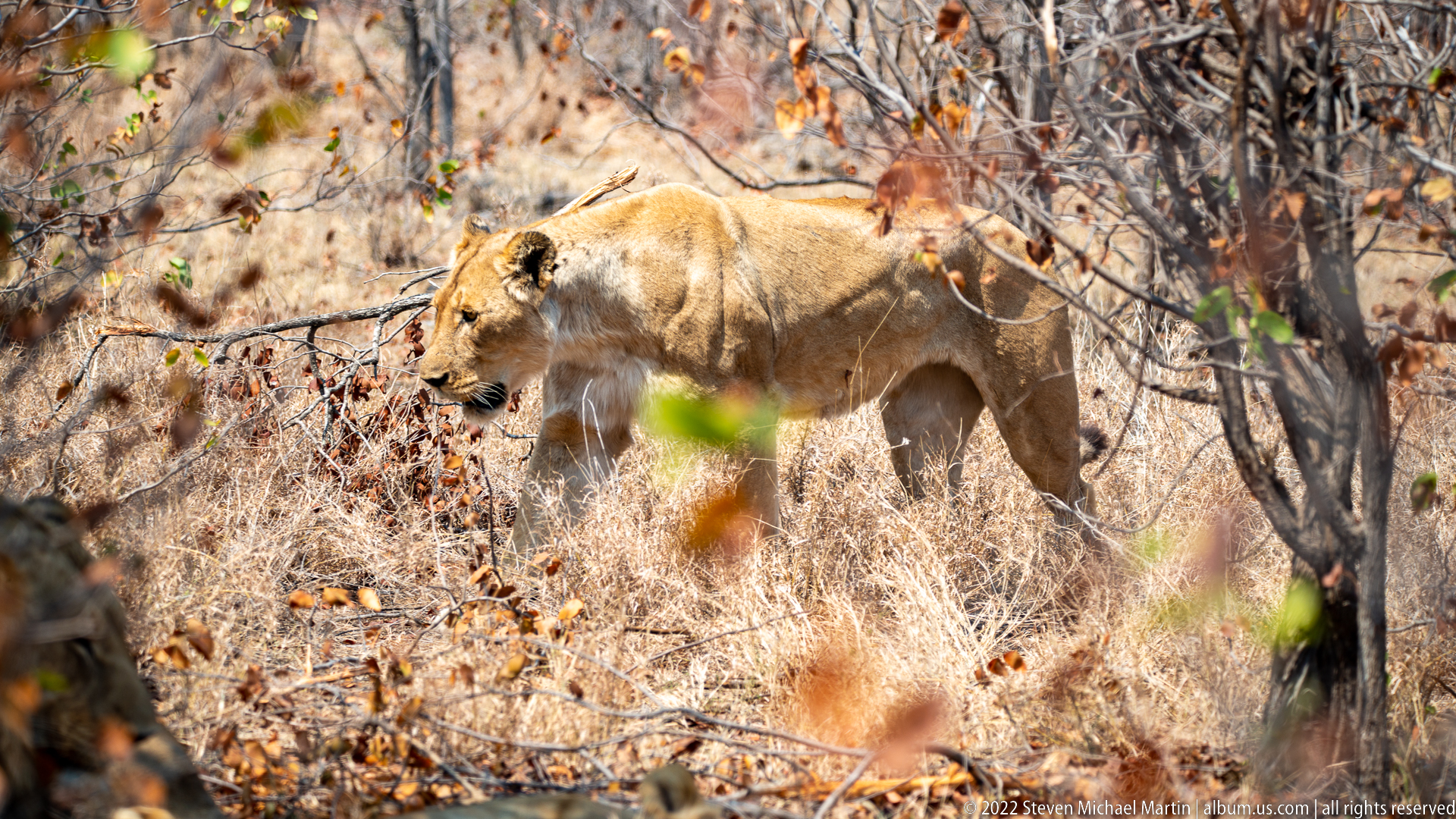
A lioness moves through brittle grass and sparse woodland near the Olifants River, her tawny coat blending closely with the dry-season vegetation. The side-on view shows the powerful shoulders, long tail, and low, deliberate gait typical of a large cat moving through cover, while foreground leaves partially screen the animal and reinforce the sense of an encounter within dense bush.
Caption
A lioness moves through brittle grass and sparse woodland near the Olifants River, her tawny coat blending closely with the dry-season vegetation. The side-on view shows the powerful shoulders, long tail, and low, deliberate gait typical of a large cat moving through cover, while foreground leaves partially screen the animal and reinforce the sense of an encounter within dense bush.
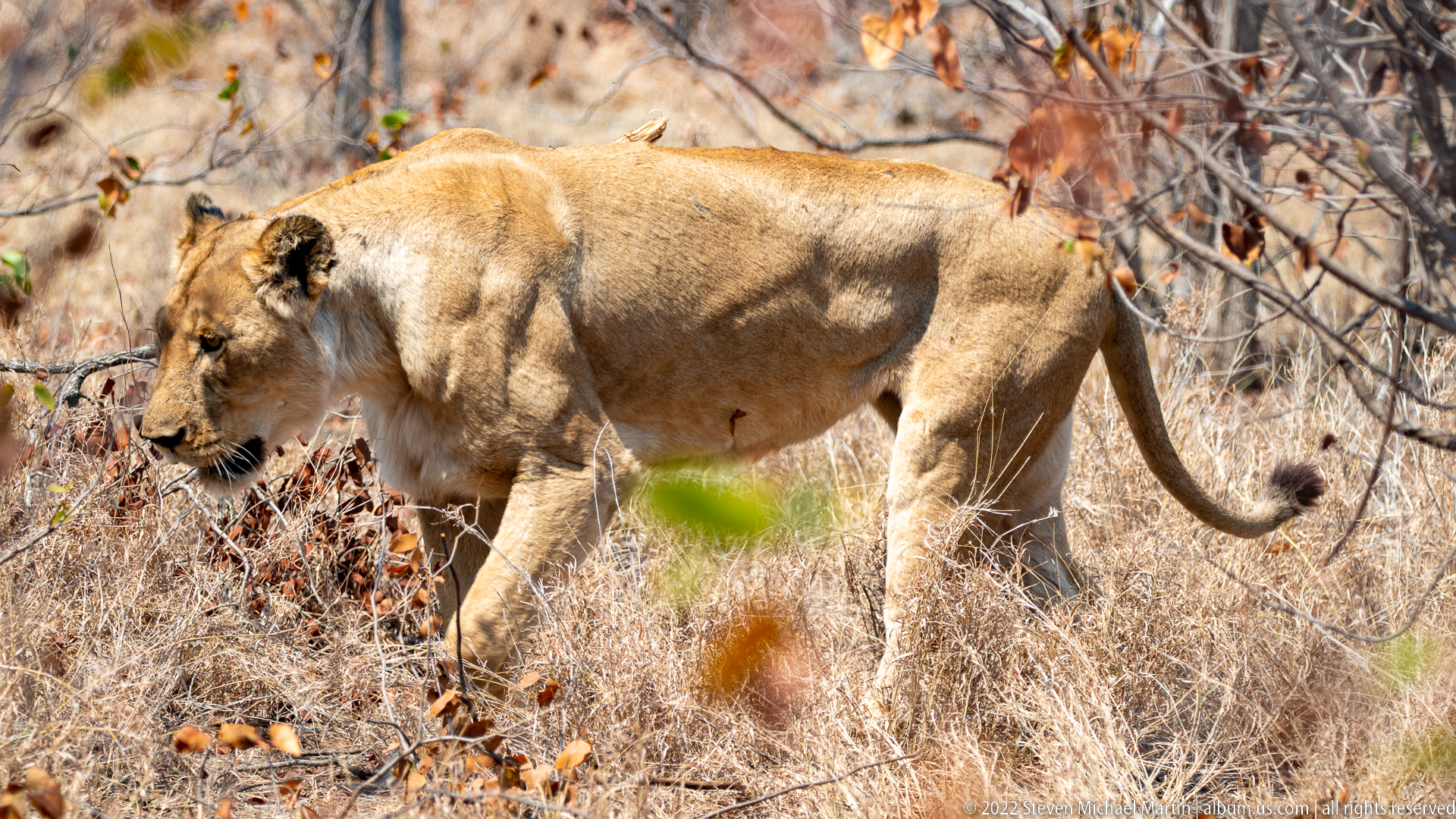
In a clear side profile, a lioness crosses pale grass and leaf litter beneath dry woodland near the Olifants River. Her muscular torso, rounded ears, and long tail are fully visible, making this a strong field-guide view of the female African lion. Dappled shade and sparse reddish leaves place the animal within the parched bushveld characteristic of Kruger’s dry season.
Caption
In a clear side profile, a lioness crosses pale grass and leaf litter beneath dry woodland near the Olifants River. Her muscular torso, rounded ears, and long tail are fully visible, making this a strong field-guide view of the female African lion. Dappled shade and sparse reddish leaves place the animal within the parched bushveld characteristic of Kruger’s dry season.

A lioness advances directly through a narrow opening in dry brush, facing the camera with an alert, concentrated expression. Branches and leaf litter frame the cat on both sides, and the frontal viewpoint emphasizes her broad muzzle, rounded ears, and steady forward posture. The partially obscured setting distinguishes this encounter from the more open side-profile views on the same sequence.
Caption
A lioness advances directly through a narrow opening in dry brush, facing the camera with an alert, concentrated expression. Branches and leaf litter frame the cat on both sides, and the frontal viewpoint emphasizes her broad muzzle, rounded ears, and steady forward posture. The partially obscured setting distinguishes this encounter from the more open side-profile views on the same sequence.
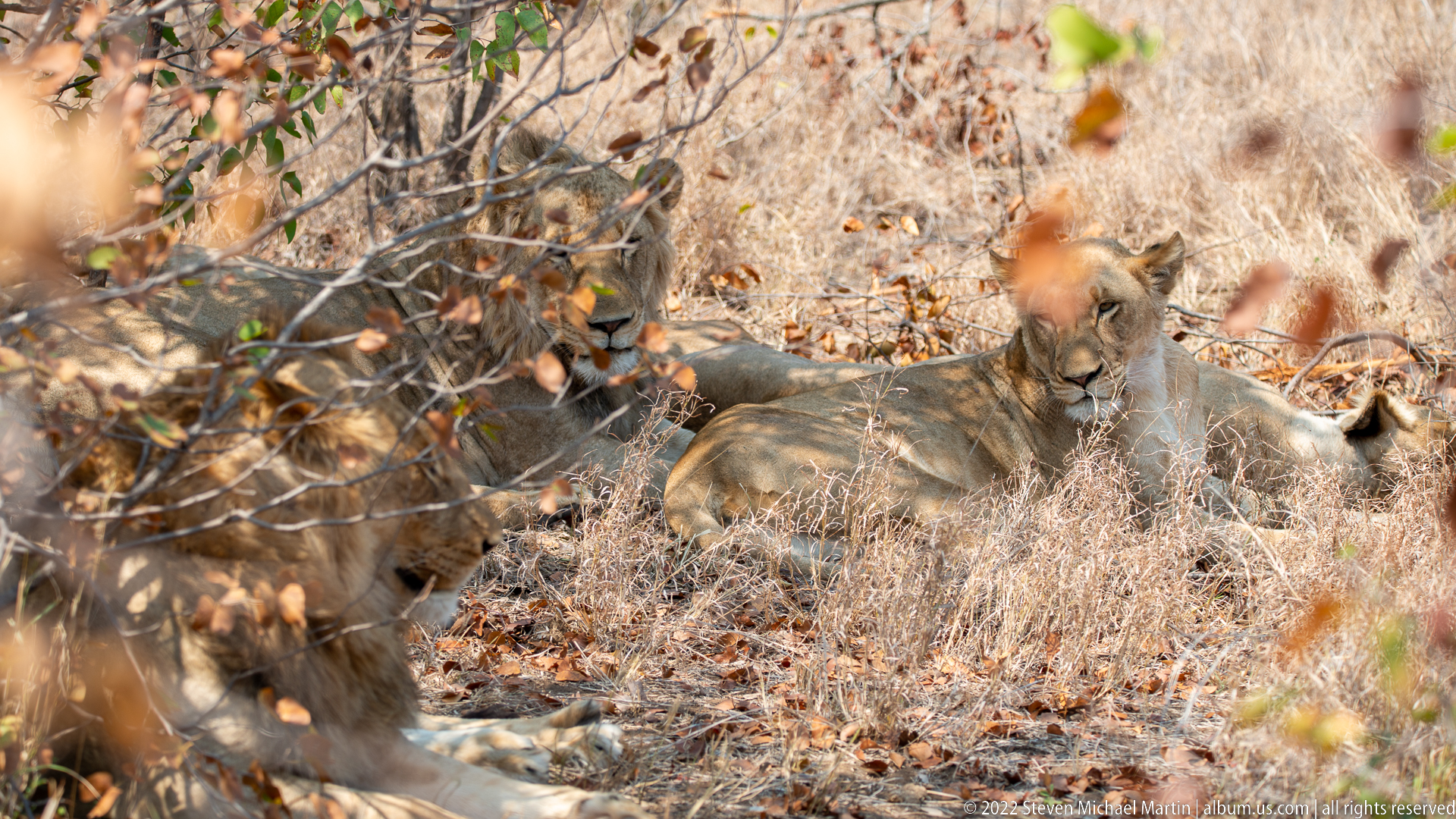
A lioness rests on the ground beneath tangled branches and dry foliage, watching outward from a patch of shade. Her body lies low against the leaf litter while the head remains upright and attentive. The layered vegetation partly conceals her flanks, creating a quiet, intimate field view of a resting predator using dense cover during the heat of the day.
Caption
A lioness rests on the ground beneath tangled branches and dry foliage, watching outward from a patch of shade. Her body lies low against the leaf litter while the head remains upright and attentive. The layered vegetation partly conceals her flanks, creating a quiet, intimate field view of a resting predator using dense cover during the heat of the day.

A lioness passes close to the camera at a quick, purposeful pace, one foreleg lifted as her body angles through the dry bush. Motion blur in the surrounding vegetation contrasts with the cat’s face and shoulders, conveying movement rather than a static portrait. The low head, narrowed eyes, and compact stride give this frame a distinctly kinetic character within the larger lion sequence.
Caption
A lioness passes close to the camera at a quick, purposeful pace, one foreleg lifted as her body angles through the dry bush. Motion blur in the surrounding vegetation contrasts with the cat’s face and shoulders, conveying movement rather than a static portrait. The low head, narrowed eyes, and compact stride give this frame a distinctly kinetic character within the larger lion sequence.
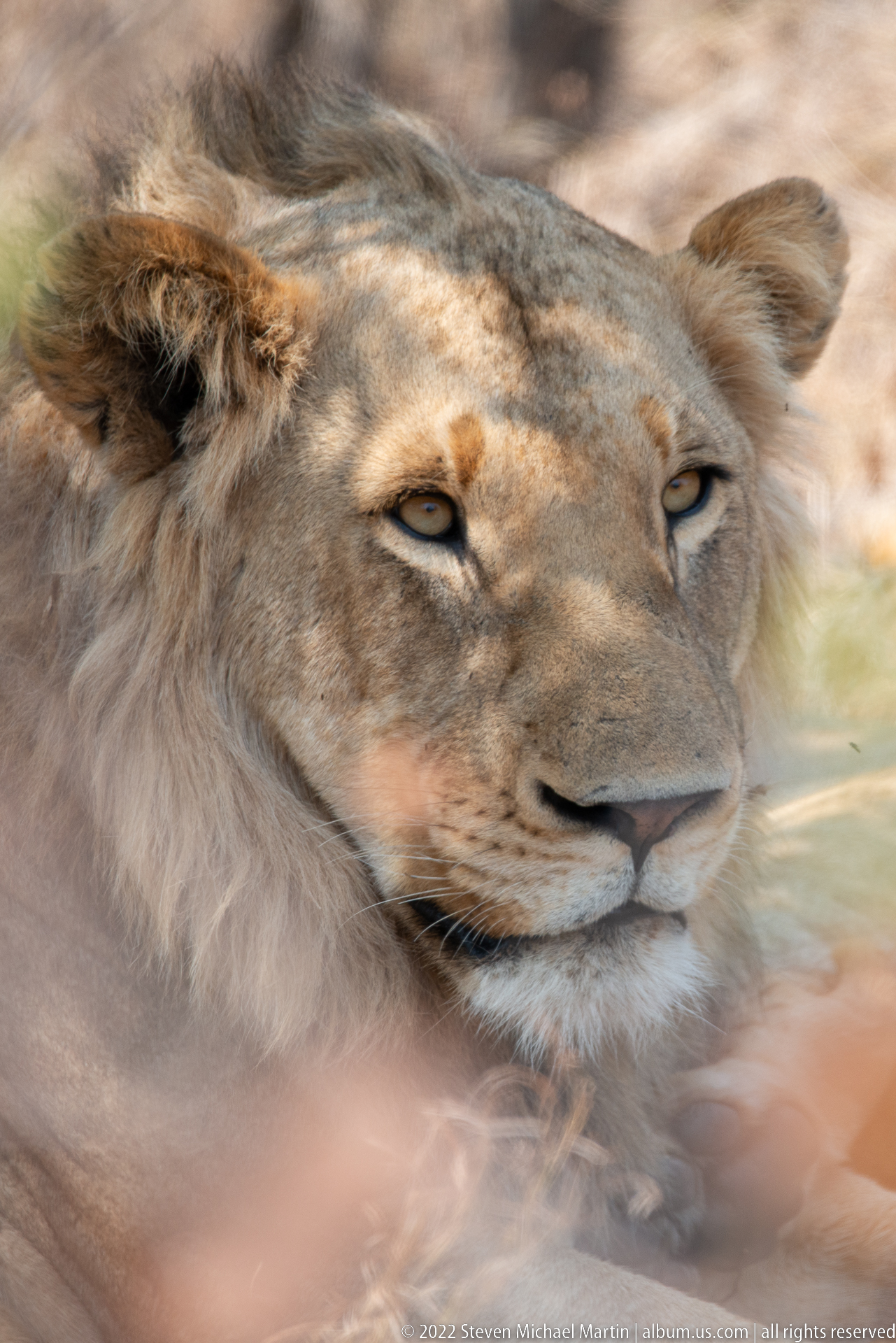
A resting male lion turns his head slightly across the frame, seen through a veil of blurred leaves and stems. The photograph isolates the heavy muzzle, whisker pads, amber eye, and short mane around the cheeks, while the shallow depth of field softens the surrounding bush. The sideward gaze creates a calmer, more contemplative portrait than the frontal views in this sequence.
Caption
A resting male lion turns his head slightly across the frame, seen through a veil of blurred leaves and stems. The photograph isolates the heavy muzzle, whisker pads, amber eye, and short mane around the cheeks, while the shallow depth of field softens the surrounding bush. The sideward gaze creates a calmer, more contemplative portrait than the frontal views in this sequence.
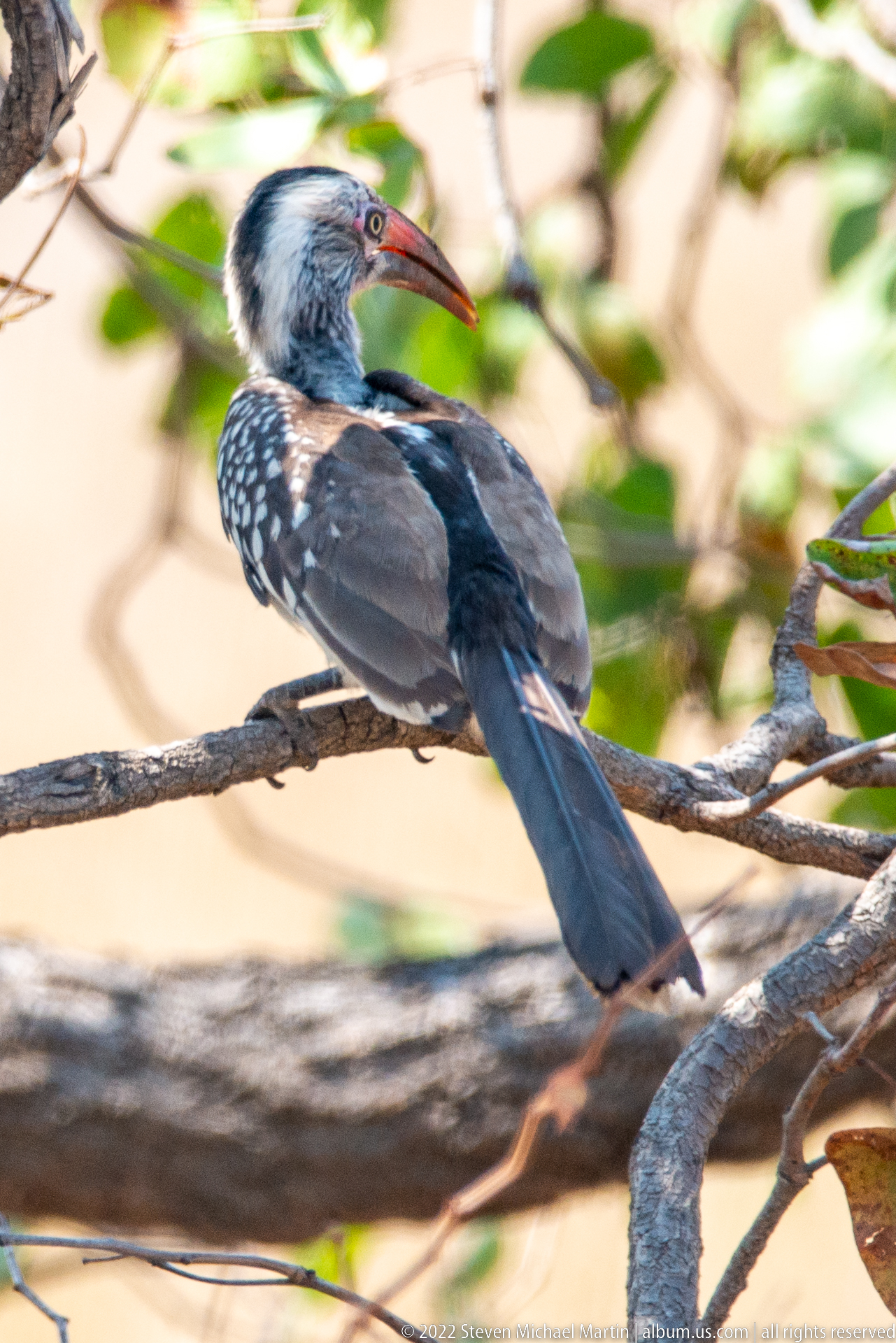
A southern red-billed hornbill perches sideways on a horizontal branch beneath leafy woodland. Its long red bill, pale head, dark wings patterned with white spotting, and elongated dark tail are clearly visible. The open, sunlit background separates the bird from the branch and provides a useful field-guide profile of one of the conspicuous hornbills of Kruger’s bushveld.
Caption
A southern red-billed hornbill perches sideways on a horizontal branch beneath leafy woodland. Its long red bill, pale head, dark wings patterned with white spotting, and elongated dark tail are clearly visible. The open, sunlit background separates the bird from the branch and provides a useful field-guide profile of one of the conspicuous hornbills of Kruger’s bushveld.
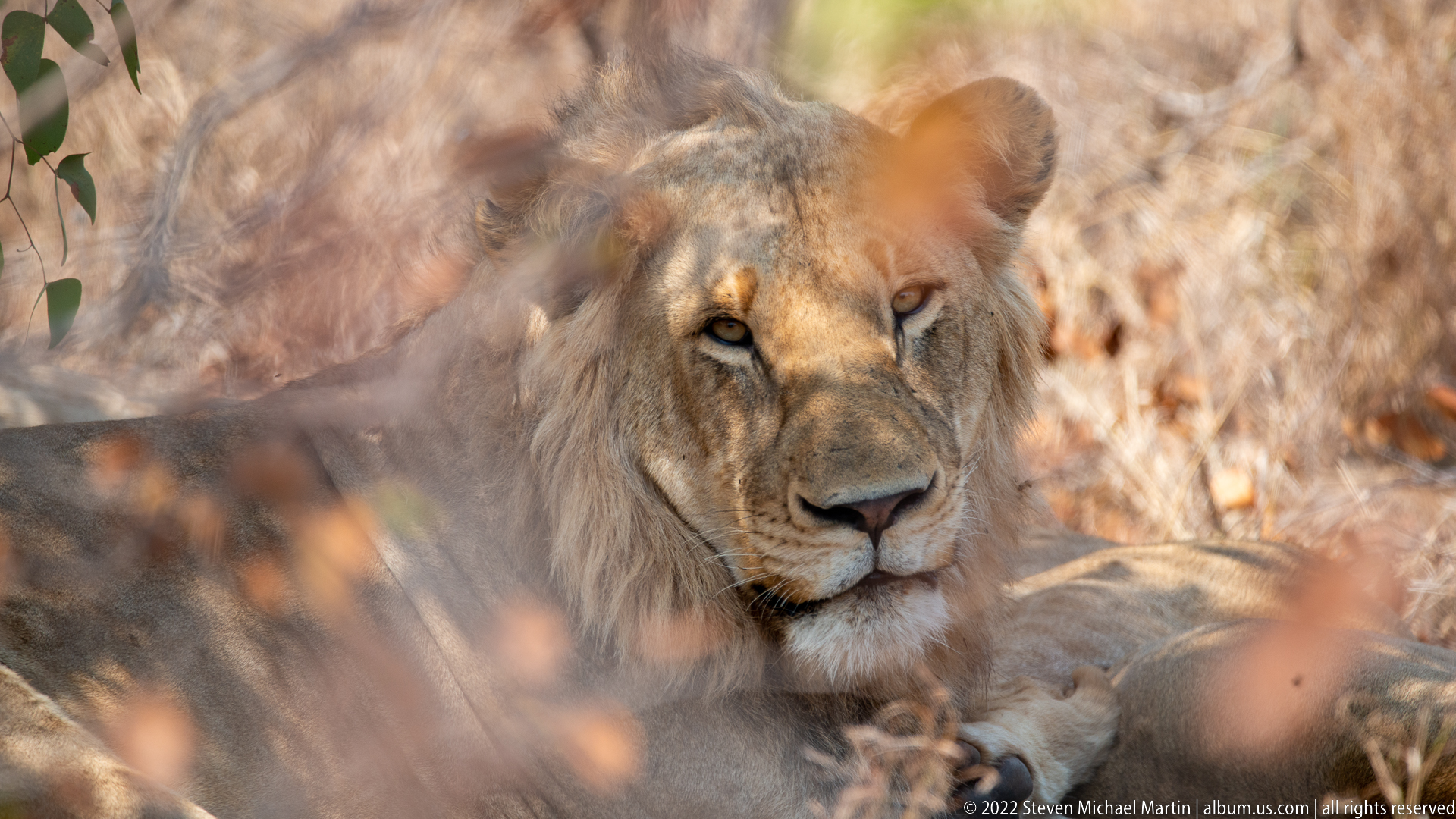
An adult male lion rests in dry cover, his face emerging between out-of-focus stems and leaves. A developing to moderate mane frames the cheeks and neck, while the direct gaze and broad muzzle dominate the close portrait. Soft vegetation in the foreground compresses the scene and gives the photograph the feel of a concealed observation from within the bush.
Caption
An adult male lion rests in dry cover, his face emerging between out-of-focus stems and leaves. A developing to moderate mane frames the cheeks and neck, while the direct gaze and broad muzzle dominate the close portrait. Soft vegetation in the foreground compresses the scene and gives the photograph the feel of a concealed observation from within the bush.
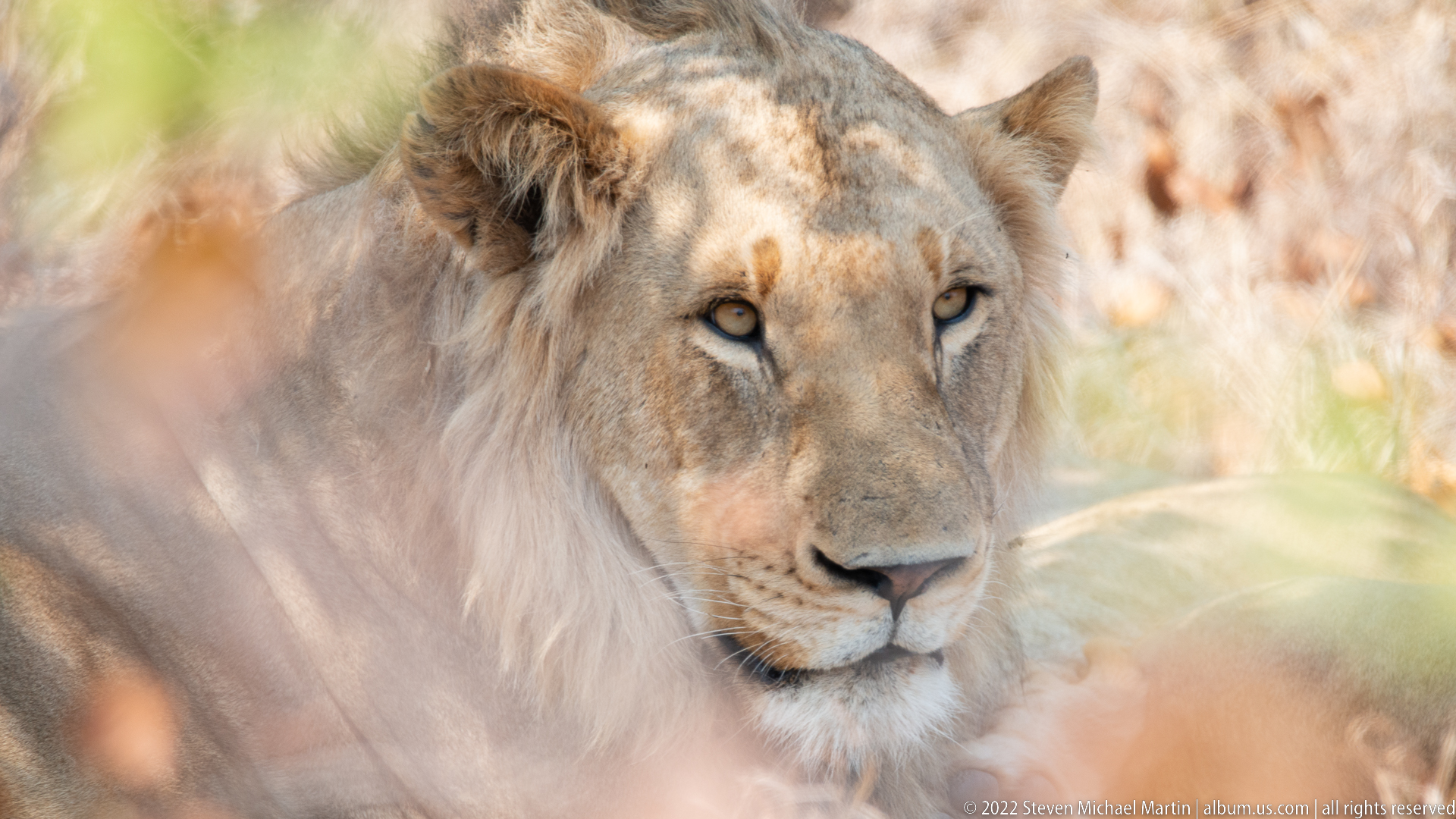
An adult male lion fills the frame in a close portrait, his amber eyes and broad muzzle sharply defined against softly blurred dry vegetation. The mane is lighter and less voluminous around the face than in some mature males, but it clearly frames the cheeks and neck. Dappled light across the forehead and muzzle gives the portrait a textured, intimate quality.
Caption
An adult male lion fills the frame in a close portrait, his amber eyes and broad muzzle sharply defined against softly blurred dry vegetation. The mane is lighter and less voluminous around the face than in some mature males, but it clearly frames the cheeks and neck. Dappled light across the forehead and muzzle gives the portrait a textured, intimate quality.
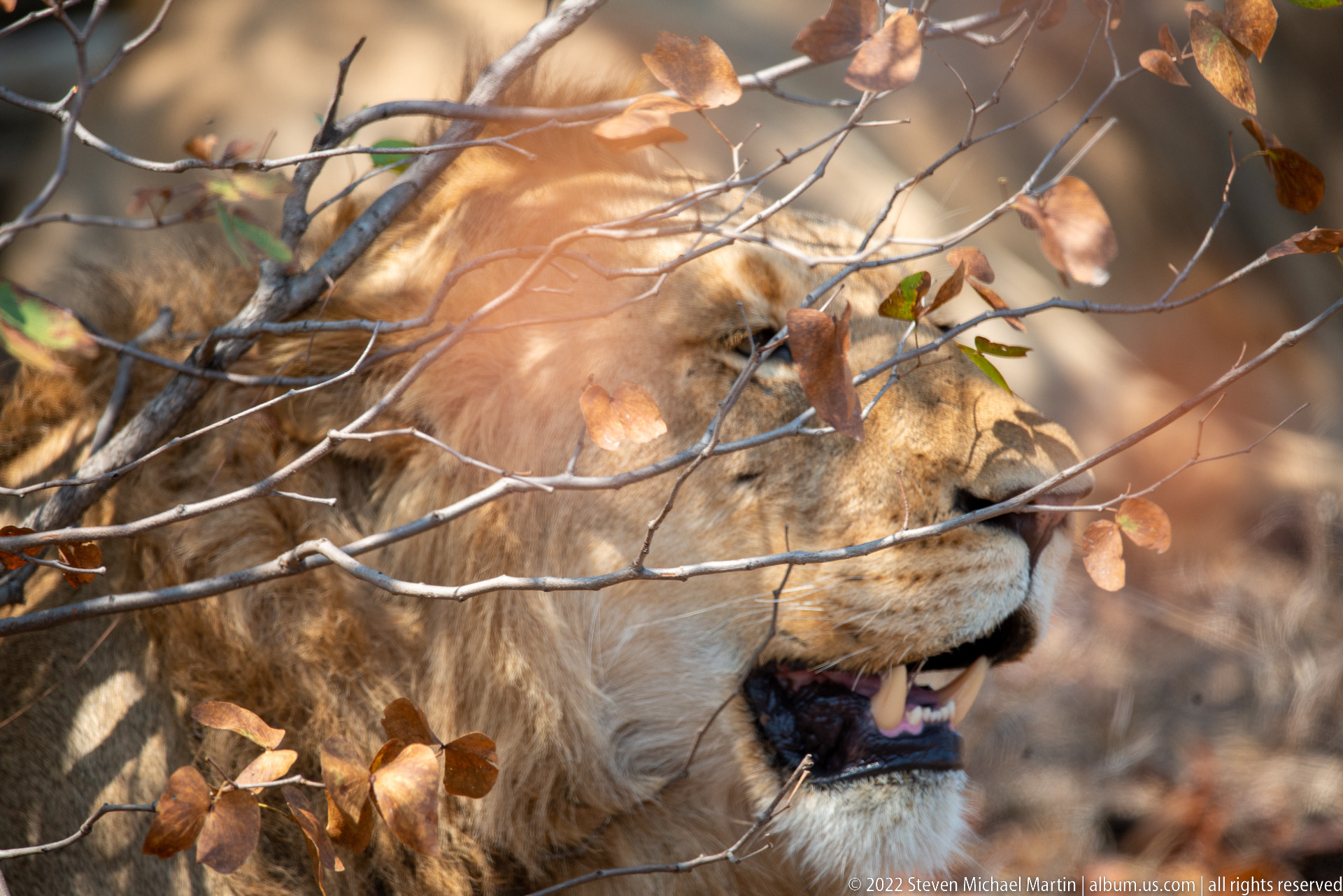
A male lion pants in the shade, his open mouth and teeth visible between a lattice of thin branches and dry leaves. The side profile emphasizes the muzzle and mane while the foreground vegetation fragments the view, suggesting the animal is resting within dense cover. Heat-dissipating panting is clearly visible, giving the photograph a behavioral dimension beyond portraiture.
Caption
A male lion pants in the shade, his open mouth and teeth visible between a lattice of thin branches and dry leaves. The side profile emphasizes the muzzle and mane while the foreground vegetation fragments the view, suggesting the animal is resting within dense cover. Heat-dissipating panting is clearly visible, giving the photograph a behavioral dimension beyond portraiture.

Framed by dry twigs and rust-colored leaves, a male lion sits or lies in cover with his mouth open in a broad pant. The mane and face are more fully visible than in the preceding obstructed profile, and the direct angle reveals the dark mouth, canines, and heavy lower jaw. The scene records a common heat-management behavior in Kruger’s warm, dry conditions.
Caption
Framed by dry twigs and rust-colored leaves, a male lion sits or lies in cover with his mouth open in a broad pant. The mane and face are more fully visible than in the preceding obstructed profile, and the direct angle reveals the dark mouth, canines, and heavy lower jaw. The scene records a common heat-management behavior in Kruger’s warm, dry conditions.
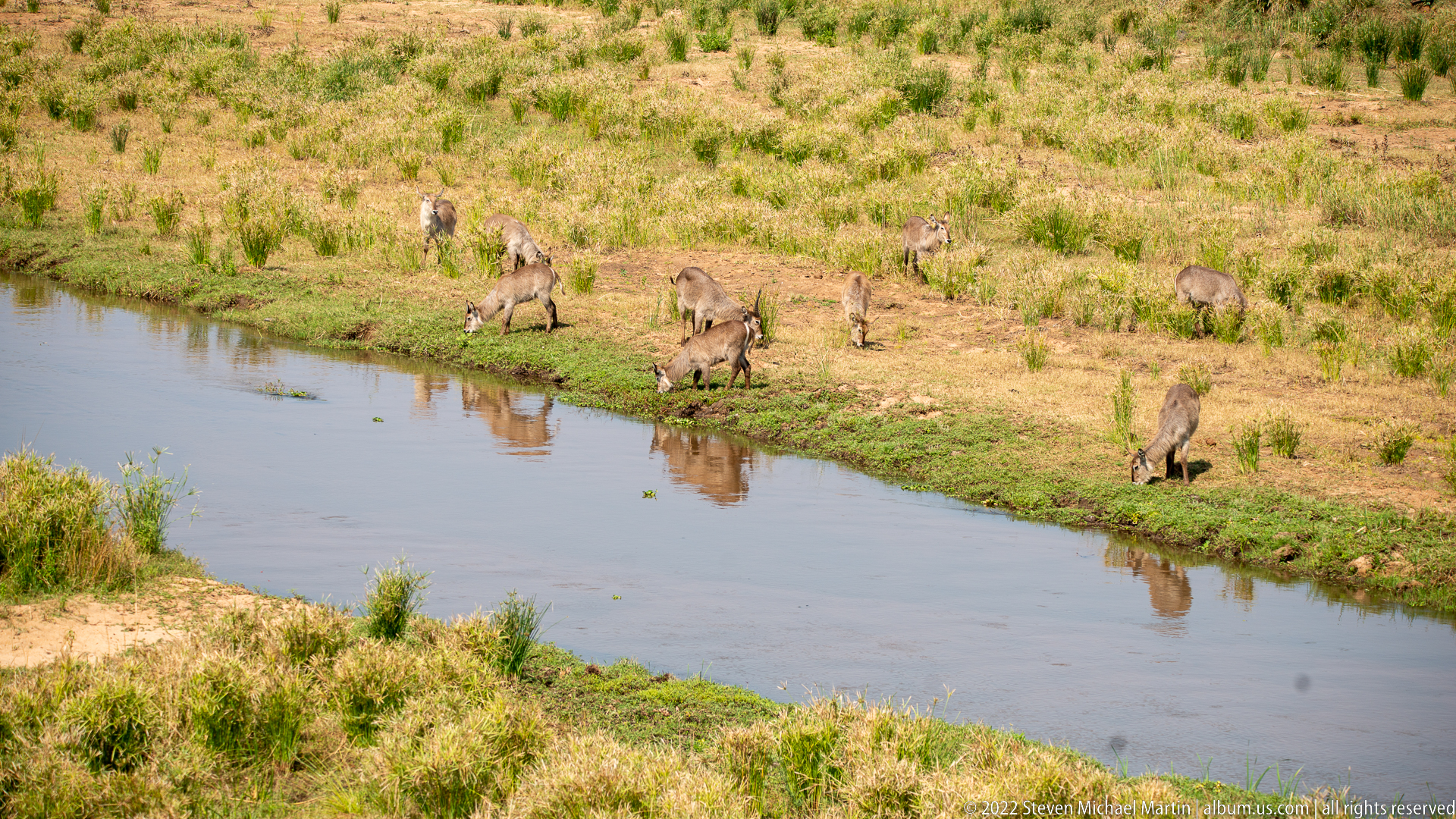
A herd of waterbuck spreads along the grassy edge of a narrow water channel, some grazing while others stand near the bank. The elevated viewpoint shows how the antelope use the greener riparian strip amid drier surrounding ground. Their shaggy gray-brown coats, large ears, and stocky build are visible even at distance, tying the herd closely to the Olifants River habitat.
Caption
A herd of waterbuck spreads along the grassy edge of a narrow water channel, some grazing while others stand near the bank. The elevated viewpoint shows how the antelope use the greener riparian strip amid drier surrounding ground. Their shaggy gray-brown coats, large ears, and stocky build are visible even at distance, tying the herd closely to the Olifants River habitat.
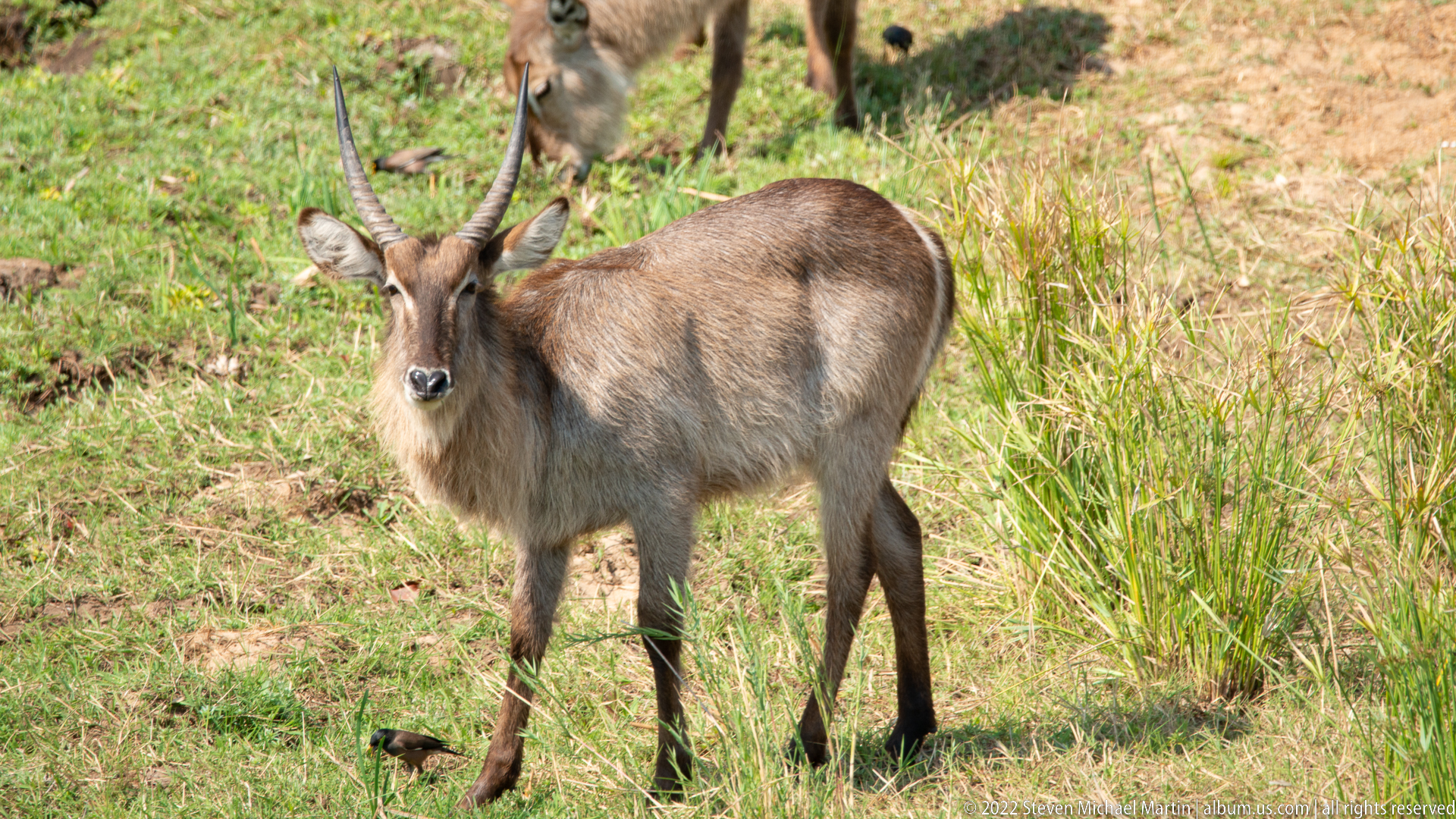
An adult male waterbuck stands in a patch of green grass near the river, facing the camera at a slight angle. Long, ridged horns sweep upward and back above a shaggy gray-brown coat, while the dark muzzle and large ears are sharply defined. The closer scale makes this a useful field-guide portrait of a mature male within the Olifants River herd.
Caption
An adult male waterbuck stands in a patch of green grass near the river, facing the camera at a slight angle. Long, ridged horns sweep upward and back above a shaggy gray-brown coat, while the dark muzzle and large ears are sharply defined. The closer scale makes this a useful field-guide portrait of a mature male within the Olifants River herd.
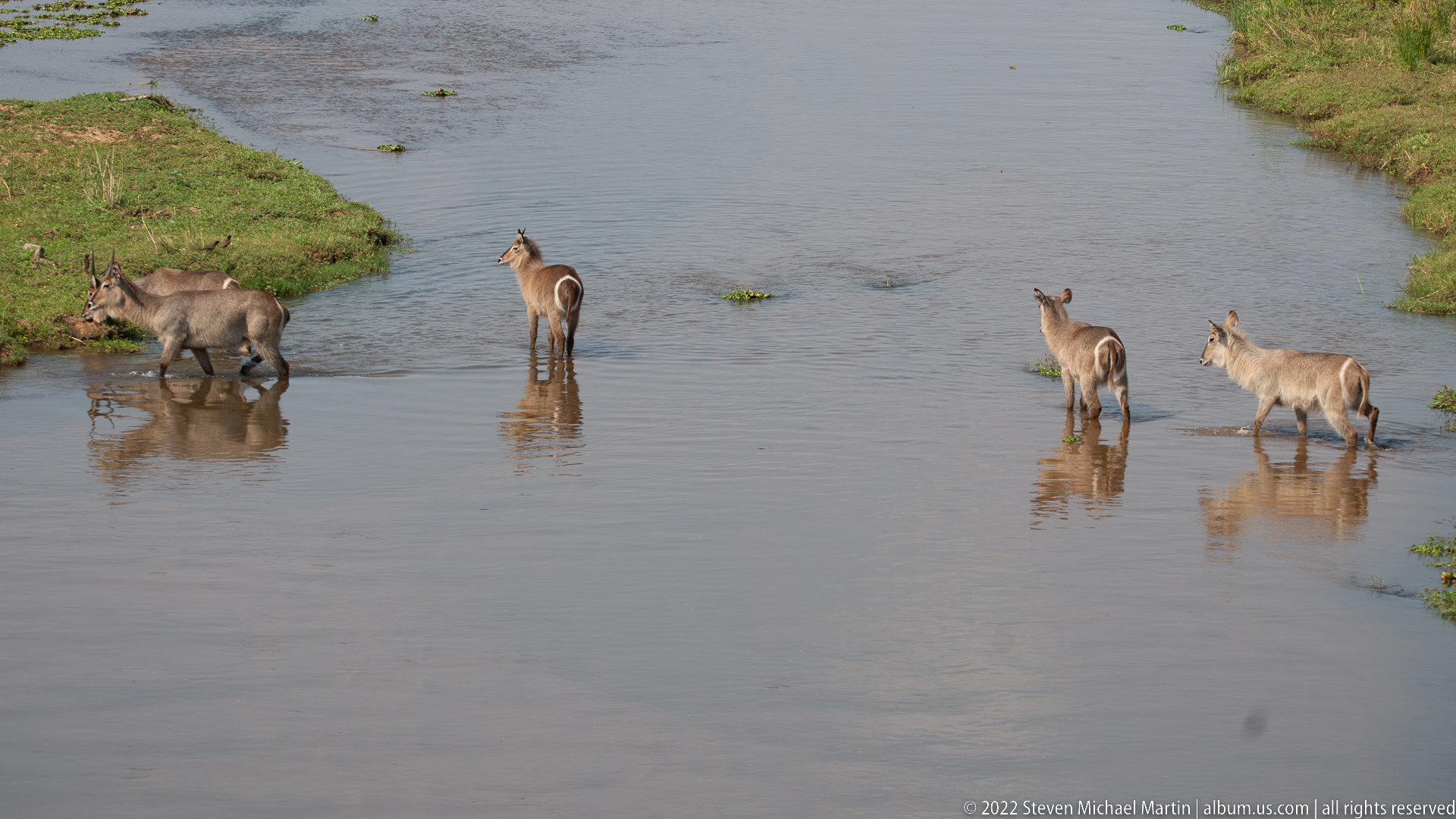
Waterbuck occupy a shallow stretch of the river in a loosely spaced crossing, with some animals standing midstream and others stepping toward the bank. Their legs and lower bodies reflect in the still water, while patches of green vegetation break the channel into small islands and edges. The composition emphasizes movement across the river rather than grazing along its margins.
Caption
Waterbuck occupy a shallow stretch of the river in a loosely spaced crossing, with some animals standing midstream and others stepping toward the bank. Their legs and lower bodies reflect in the still water, while patches of green vegetation break the channel into small islands and edges. The composition emphasizes movement across the river rather than grazing along its margins.
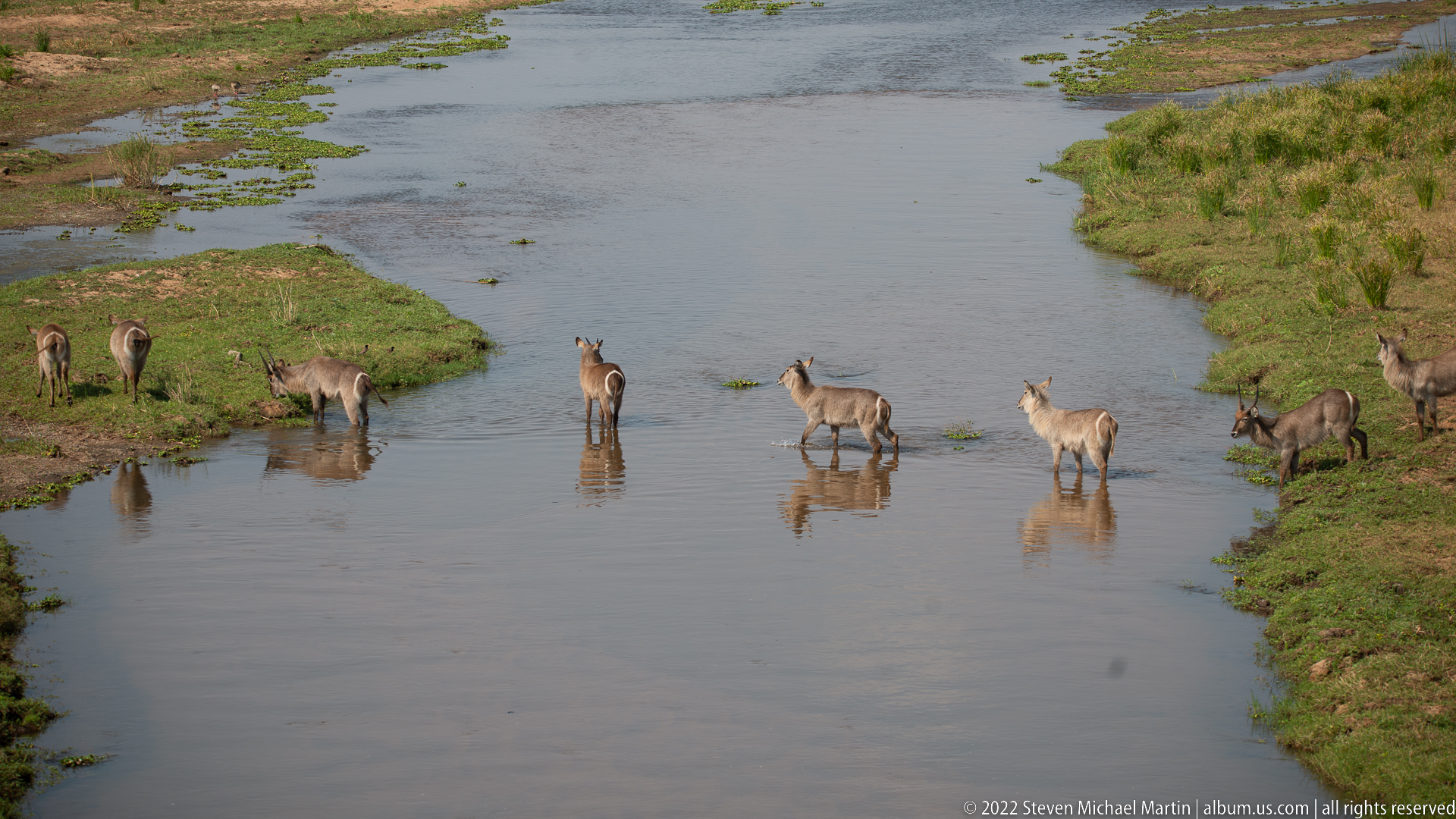
A wider river view shows waterbuck scattered across the shallow channel and adjacent green banks, with individuals facing different directions as they cross or pause. The spacing of the animals and the open water create a strong sense of the herd’s scale and movement through the riparian corridor. Dry-season vegetation beyond the water frames the crossing within Kruger’s broader savanna landscape.
Caption
A wider river view shows waterbuck scattered across the shallow channel and adjacent green banks, with individuals facing different directions as they cross or pause. The spacing of the animals and the open water create a strong sense of the herd’s scale and movement through the riparian corridor. Dry-season vegetation beyond the water frames the crossing within Kruger’s broader savanna landscape.
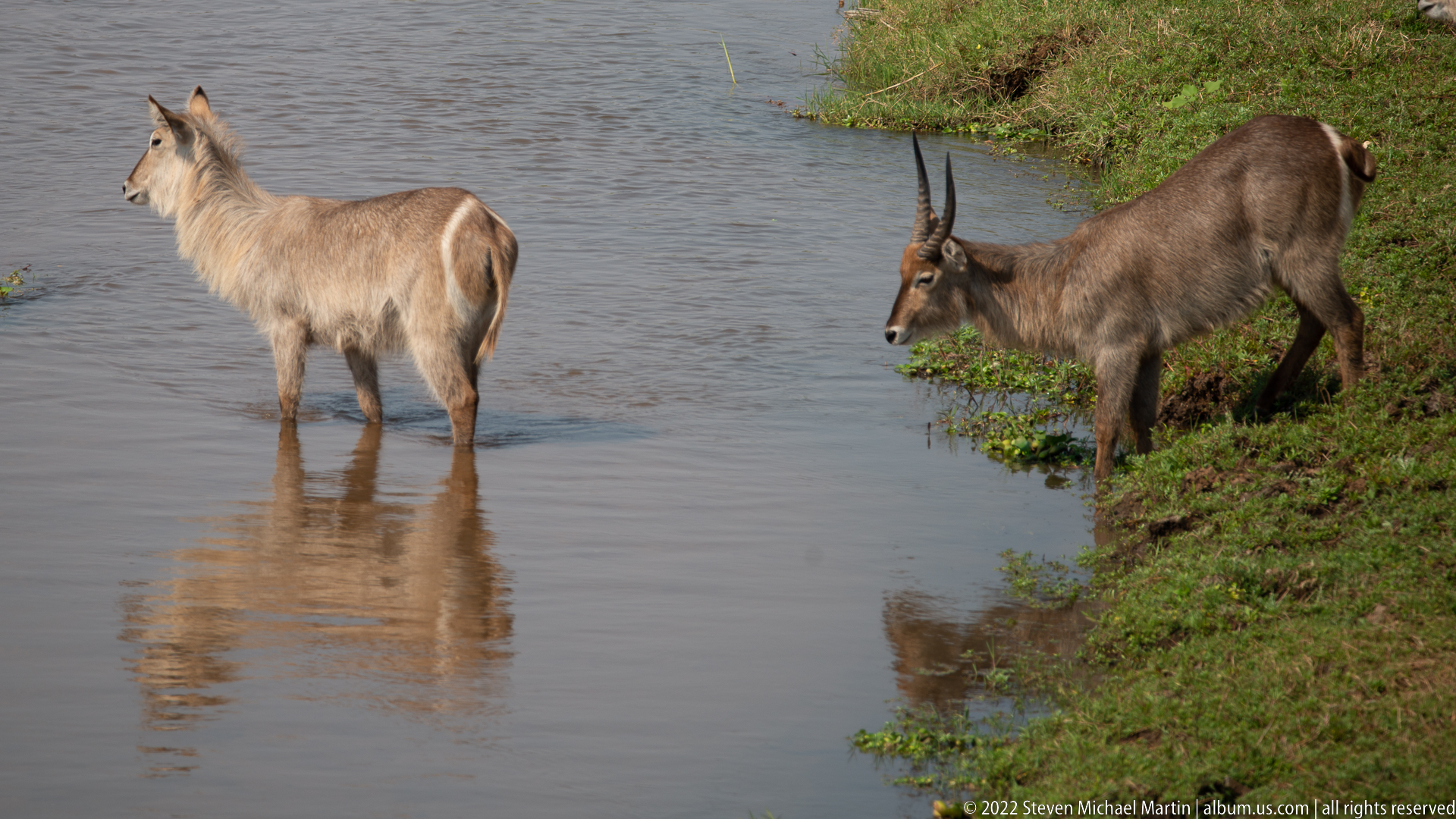
Two waterbuck stand at the edge of the river, one horned male feeding or drinking near the green bank while a hornless companion stands in shallow water. Their contrasting profiles make the sexual dimorphism readily visible: the male carries long ridged horns, while the other animal lacks them. Reflections and low aquatic vegetation anchor both animals to the waterline.
Caption
Two waterbuck stand at the edge of the river, one horned male feeding or drinking near the green bank while a hornless companion stands in shallow water. Their contrasting profiles make the sexual dimorphism readily visible: the male carries long ridged horns, while the other animal lacks them. Reflections and low aquatic vegetation anchor both animals to the waterline.
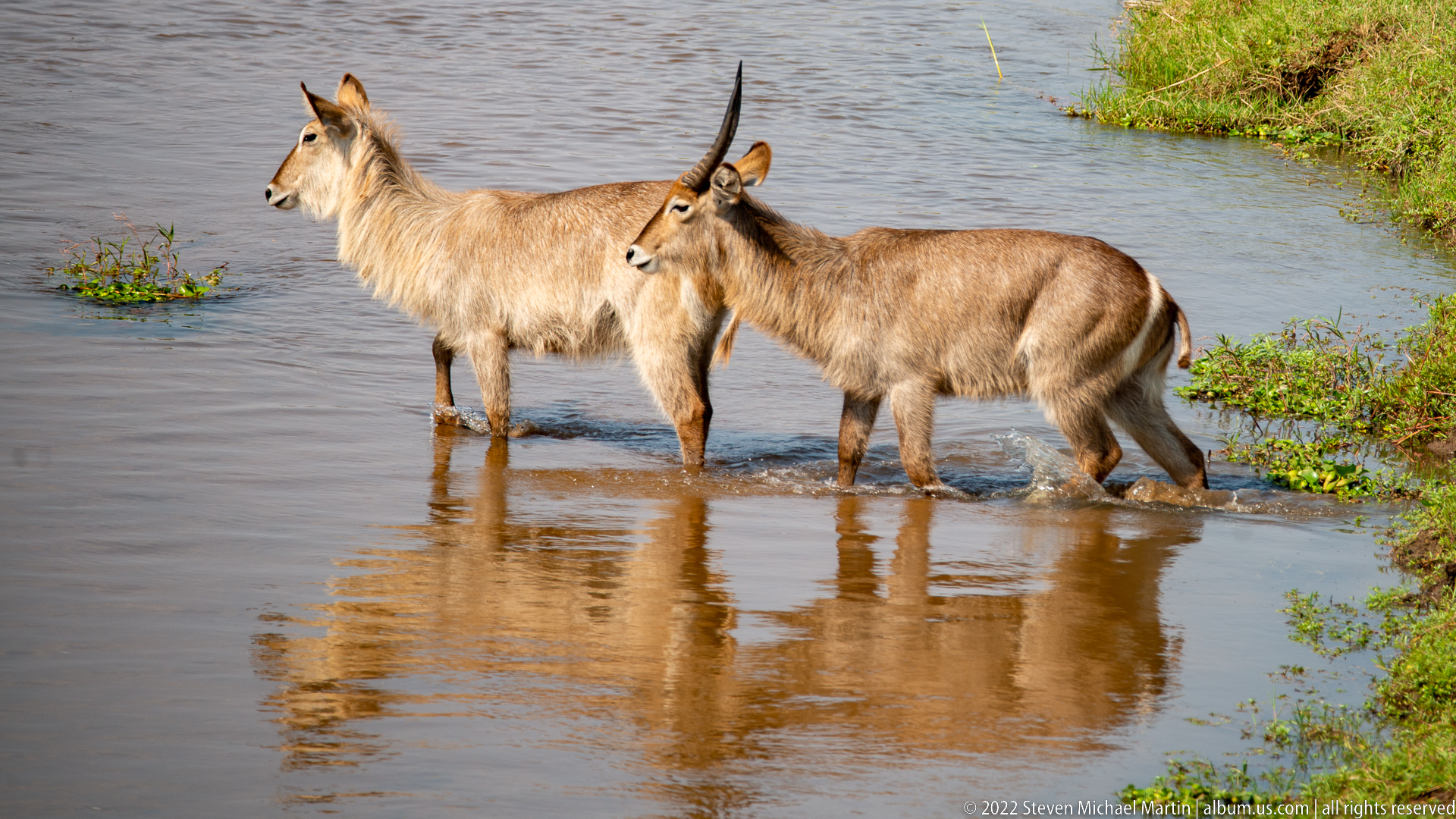
A horned male waterbuck wades through shallow water beside a hornless female, the pair overlapping in a compact side view. The male’s long, ridged horns rise above both bodies, while the female’s pale shaggy coat and large ears remain visible behind him. Sunlight on the water and their reflected legs emphasize the close relationship between these antelope and the river margin.
Caption
A horned male waterbuck wades through shallow water beside a hornless female, the pair overlapping in a compact side view. The male’s long, ridged horns rise above both bodies, while the female’s pale shaggy coat and large ears remain visible behind him. Sunlight on the water and their reflected legs emphasize the close relationship between these antelope and the river margin.
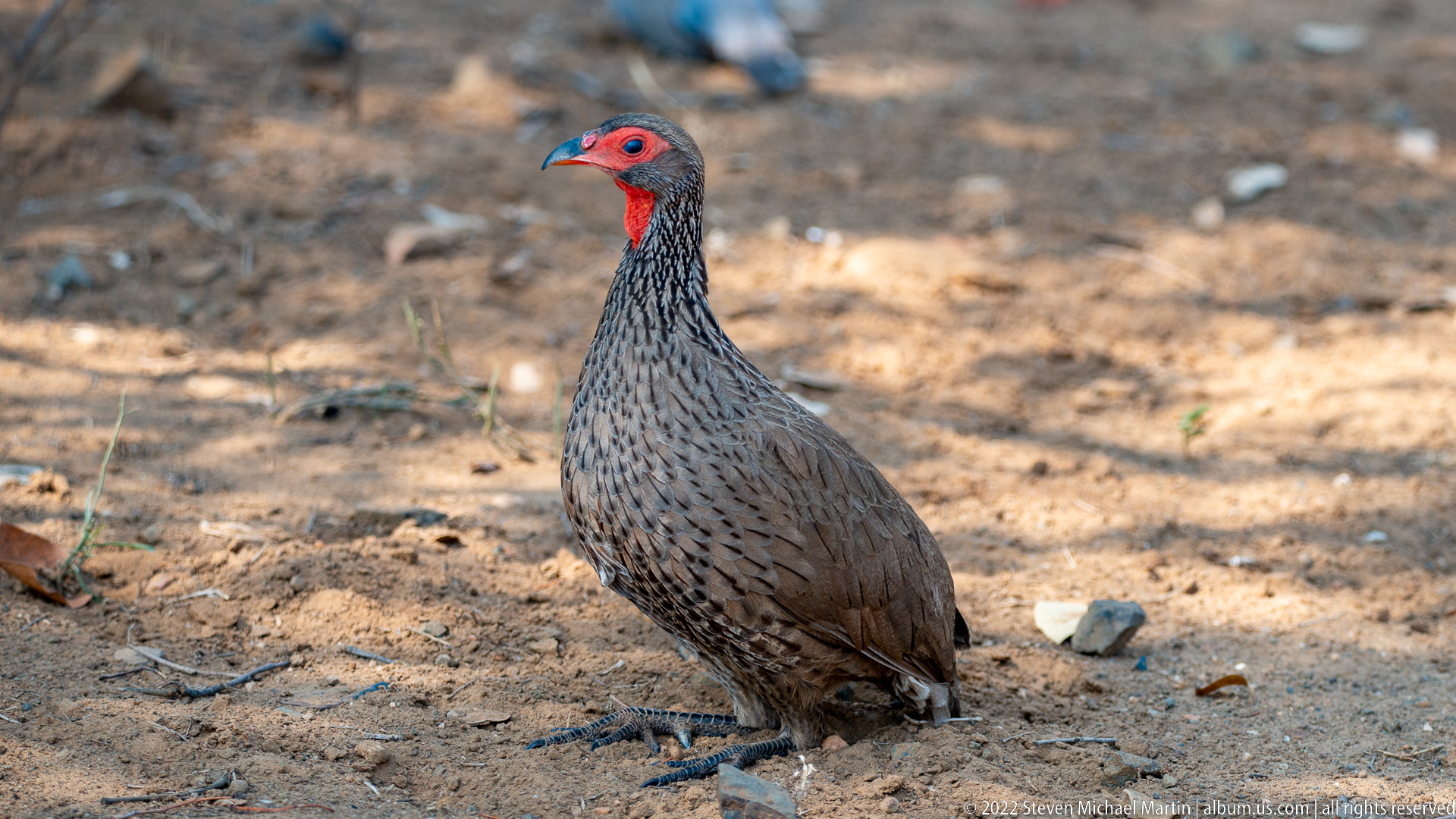
A red-faced spurfowl stands alert on bare, dusty ground, its heavily barred gray-brown plumage contrasting with the bright red skin around the face and throat. The stout ground-bird posture, short dark bill, and patterned body are clearly visible in profile. The exact species is less certain from this proof-sheet view, but the bird is unmistakably one of the francolin-spurfowl group common in southern African bushveld.
Caption
A red-faced spurfowl stands alert on bare, dusty ground, its heavily barred gray-brown plumage contrasting with the bright red skin around the face and throat. The stout ground-bird posture, short dark bill, and patterned body are clearly visible in profile. The exact species is less certain from this proof-sheet view, but the bird is unmistakably one of the francolin-spurfowl group common in southern African bushveld.
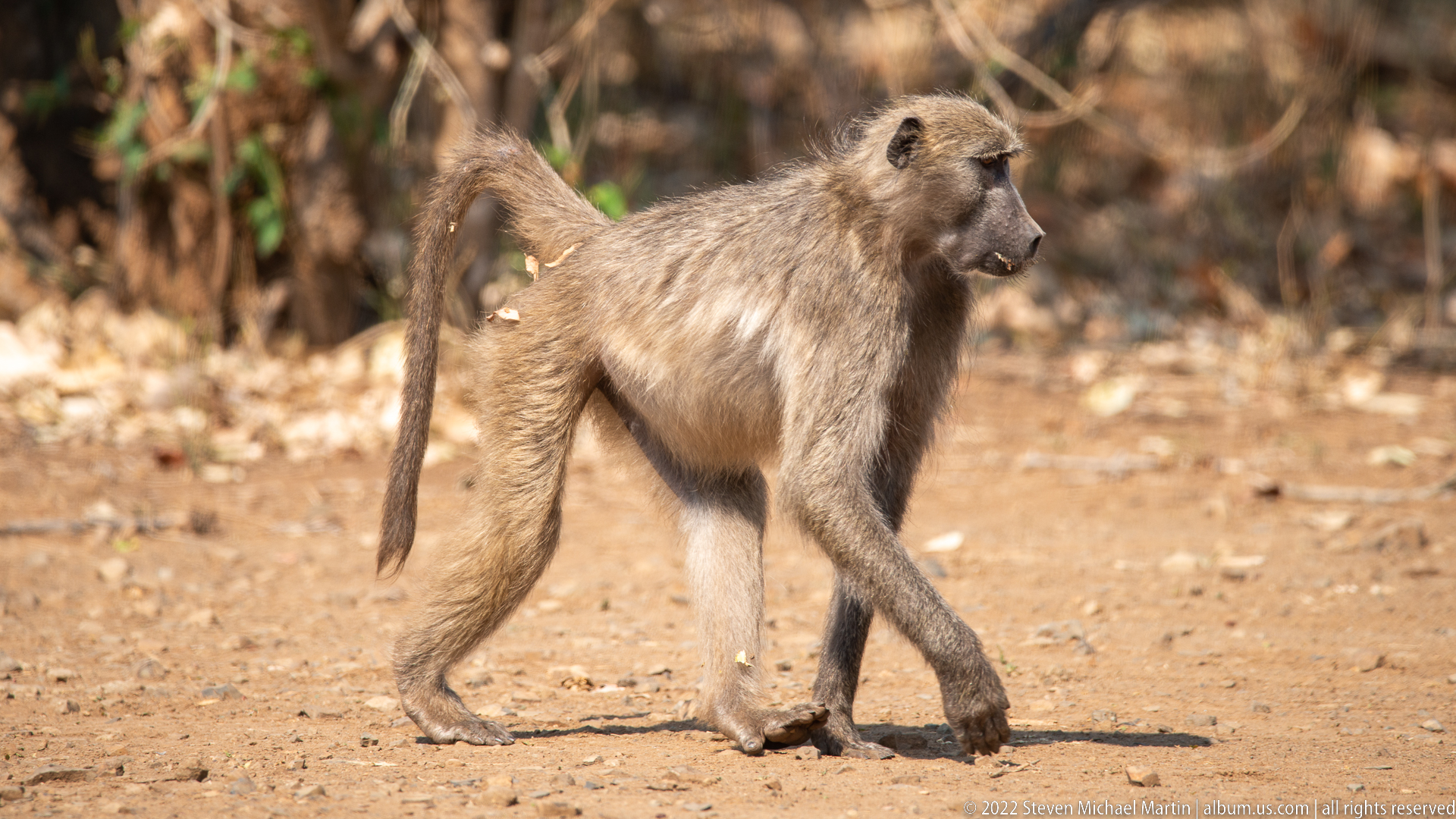
A chacma baboon walks across a sunlit dirt track, shown in full side profile with one forelimb extended. The long limbs, dog-like muzzle, coarse gray-brown coat, and long downward-curving tail are all clearly visible. Dry woodland and leaf litter form the background, making this a straightforward field-guide view of the species moving through Kruger’s bushveld.
Caption
A chacma baboon walks across a sunlit dirt track, shown in full side profile with one forelimb extended. The long limbs, dog-like muzzle, coarse gray-brown coat, and long downward-curving tail are all clearly visible. Dry woodland and leaf litter form the background, making this a straightforward field-guide view of the species moving through Kruger’s bushveld.
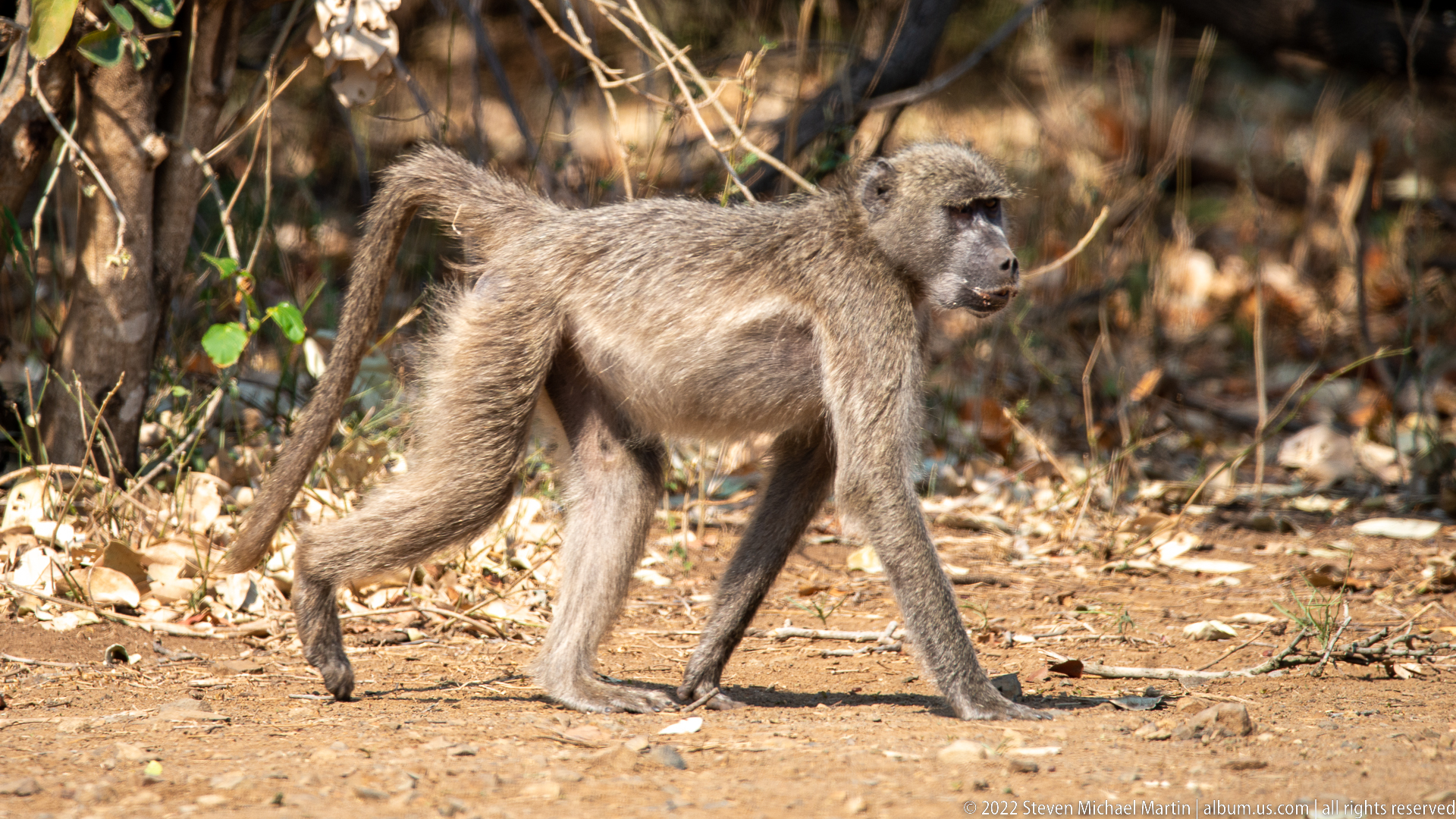
A chacma baboon strides across dry ground at the edge of woodland, its body angled slightly toward the camera. The raised rear foot and extended forelimb freeze the animal mid-step, while the long tail curves downward behind it. Strong side light picks out the coarse coat and muscular limbs against a darker background of brush and fallen leaves.
Caption
A chacma baboon strides across dry ground at the edge of woodland, its body angled slightly toward the camera. The raised rear foot and extended forelimb freeze the animal mid-step, while the long tail curves downward behind it. Strong side light picks out the coarse coat and muscular limbs against a darker background of brush and fallen leaves.
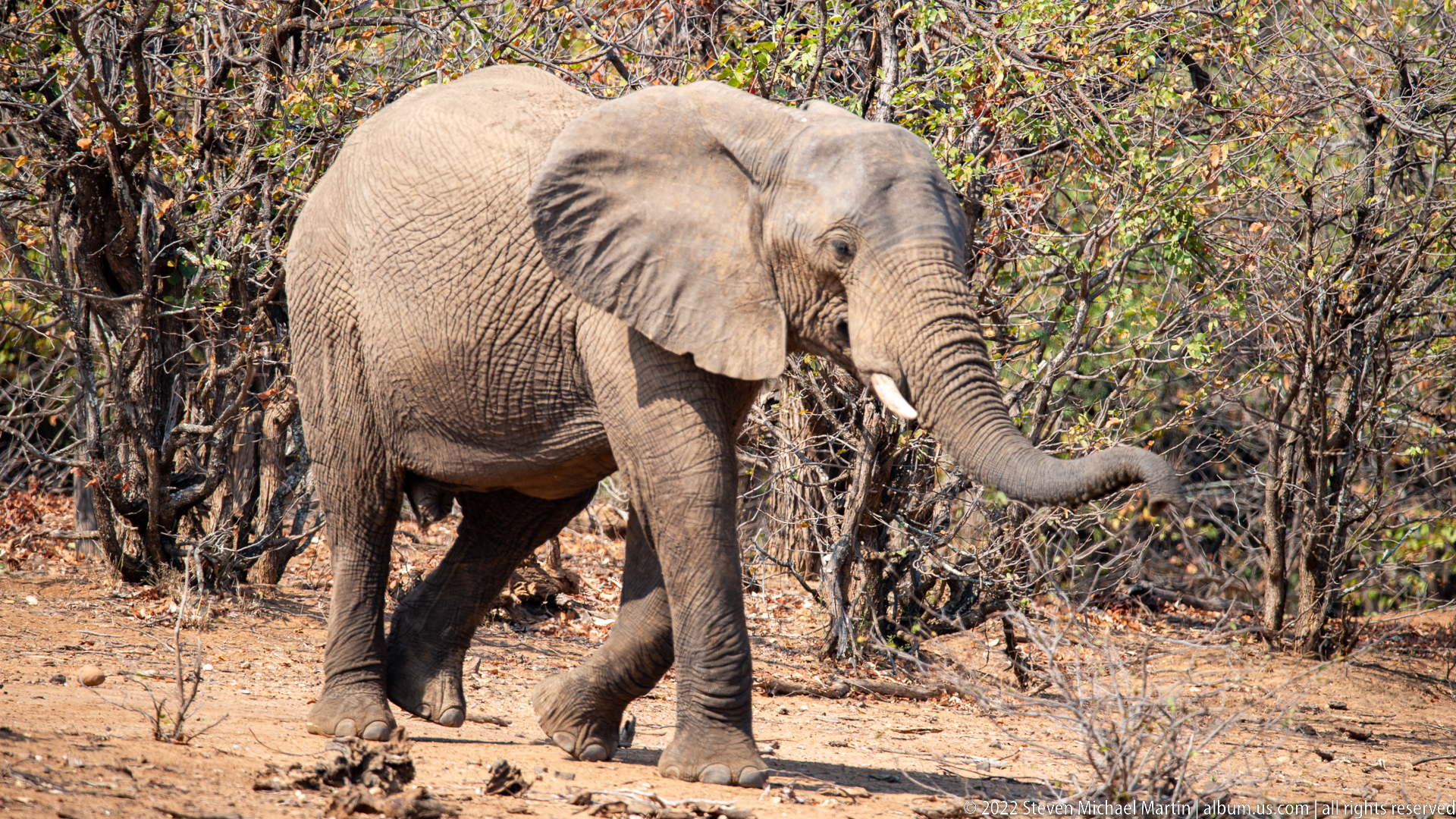
An African bush elephant walks through dry woodland with its trunk extended forward and one foreleg lifted mid-step. The close side view shows the large fan-shaped ears, wrinkled gray skin, and short visible tusks in strong sunlight. Sparse brush and leaf litter emphasize the dry-season setting, while the animal’s forward motion gives the frame a direct, energetic character.
Caption
An African bush elephant walks through dry woodland with its trunk extended forward and one foreleg lifted mid-step. The close side view shows the large fan-shaped ears, wrinkled gray skin, and short visible tusks in strong sunlight. Sparse brush and leaf litter emphasize the dry-season setting, while the animal’s forward motion gives the frame a direct, energetic character.

A family group of African bush elephants stands together in shallow water, with adults and several younger animals clustered tightly near the riverbank. The varied body sizes make the herd’s age structure immediately visible, while trunks hang toward the water and some individuals stand shoulder to shoulder. The elevated view places the social group within the Olifants River landscape rather than isolating a single animal.
Caption
A family group of African bush elephants stands together in shallow water, with adults and several younger animals clustered tightly near the riverbank. The varied body sizes make the herd’s age structure immediately visible, while trunks hang toward the water and some individuals stand shoulder to shoulder. The elevated view places the social group within the Olifants River landscape rather than isolating a single animal.
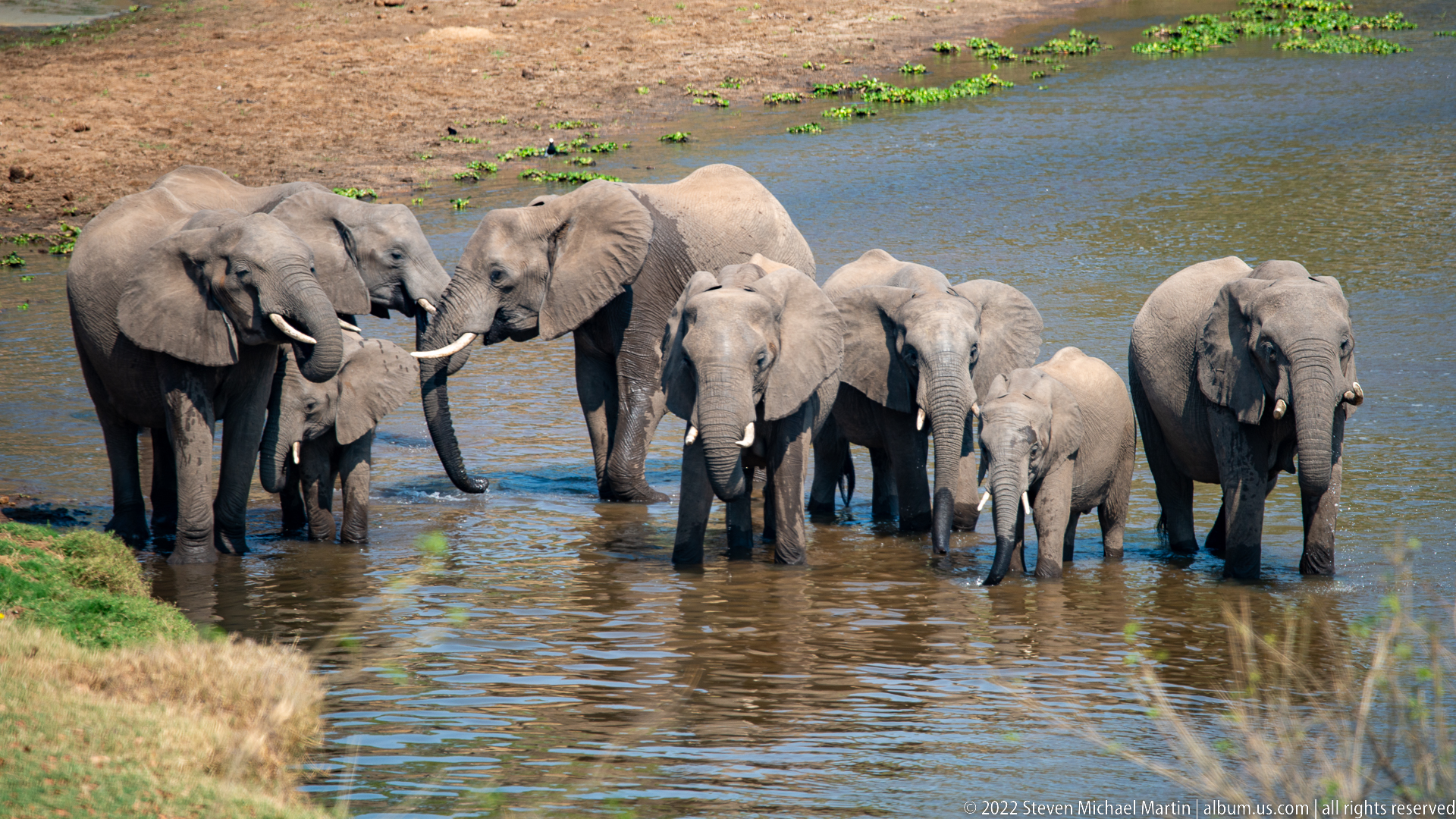
Elephants crowd the shallows in a compact herd, several adults forming a protective cluster around smaller juveniles and calves. The group faces different directions while standing knee-deep in water, creating a dense pattern of trunks, ears, tusks, and overlapping bodies. This closer framing emphasizes social cohesion and the mixed ages of the herd more strongly than the wider river view beside it.
Caption
Elephants crowd the shallows in a compact herd, several adults forming a protective cluster around smaller juveniles and calves. The group faces different directions while standing knee-deep in water, creating a dense pattern of trunks, ears, tusks, and overlapping bodies. This closer framing emphasizes social cohesion and the mixed ages of the herd more strongly than the wider river view beside it.
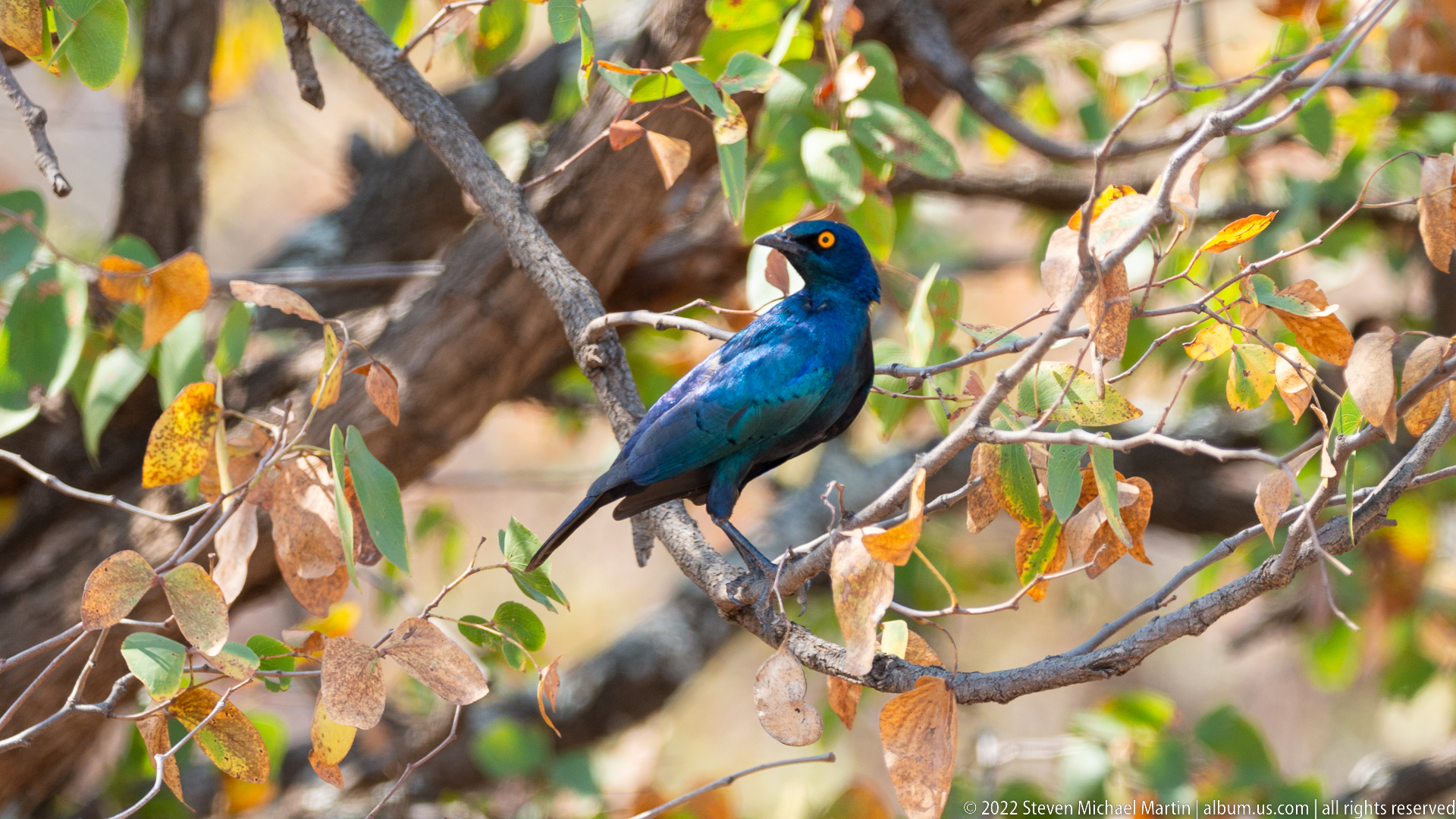
A greater blue-eared starling perches on a branch among green and rust-colored leaves, its metallic blue-green plumage glowing against the warm woodland background. The bright yellow eye and slender dark bill are sharply visible, while the tail extends below the perch. The surrounding foliage gives this portrait more environmental context than the tighter starling views that follow.
Caption
A greater blue-eared starling perches on a branch among green and rust-colored leaves, its metallic blue-green plumage glowing against the warm woodland background. The bright yellow eye and slender dark bill are sharply visible, while the tail extends below the perch. The surrounding foliage gives this portrait more environmental context than the tighter starling views that follow.

A glossy starling is shown in a clean side portrait on a narrow branch, its iridescent turquoise-blue body and darker head set off by a vivid yellow eye. The wings lie folded along the flank and the tail angles down behind the perch. With less foliage obscuring the body, this view clearly displays the sleek proportions and reflective plumage typical of greater blue-eared starlings.
Caption
A glossy starling is shown in a clean side portrait on a narrow branch, its iridescent turquoise-blue body and darker head set off by a vivid yellow eye. The wings lie folded along the flank and the tail angles down behind the perch. With less foliage obscuring the body, this view clearly displays the sleek proportions and reflective plumage typical of greater blue-eared starlings.
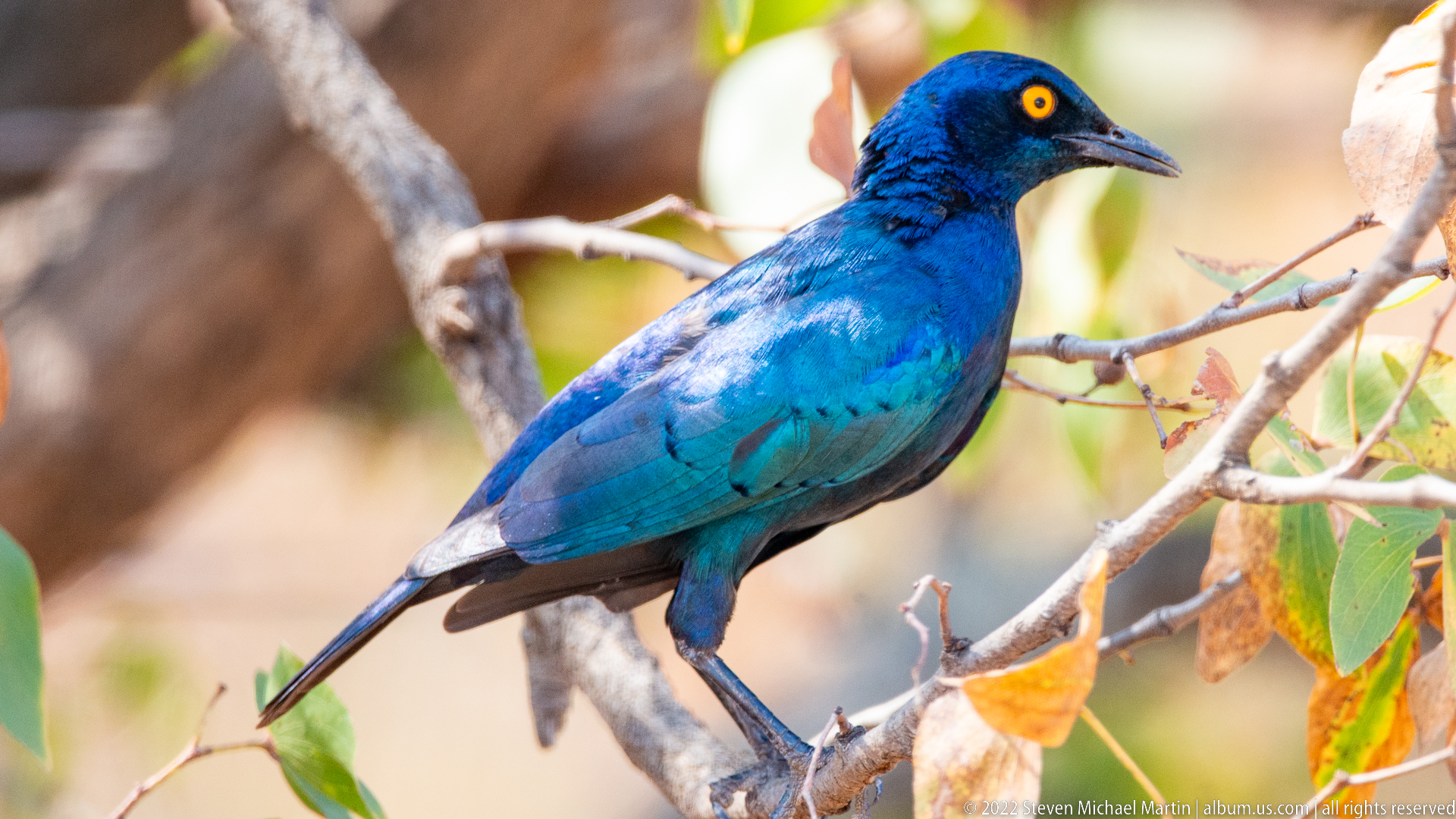
A tight portrait isolates the glossy starling’s head, chest, and upper body, revealing intense cobalt and turquoise iridescence across the feathers. The round yellow eye stands out against the dark blue face, and the bird’s fine black bill points toward the edge of the frame. The enlarged scale makes this the most detailed plumage study in the three-image starling sequence.
Caption
A tight portrait isolates the glossy starling’s head, chest, and upper body, revealing intense cobalt and turquoise iridescence across the feathers. The round yellow eye stands out against the dark blue face, and the bird’s fine black bill points toward the edge of the frame. The enlarged scale makes this the most detailed plumage study in the three-image starling sequence.
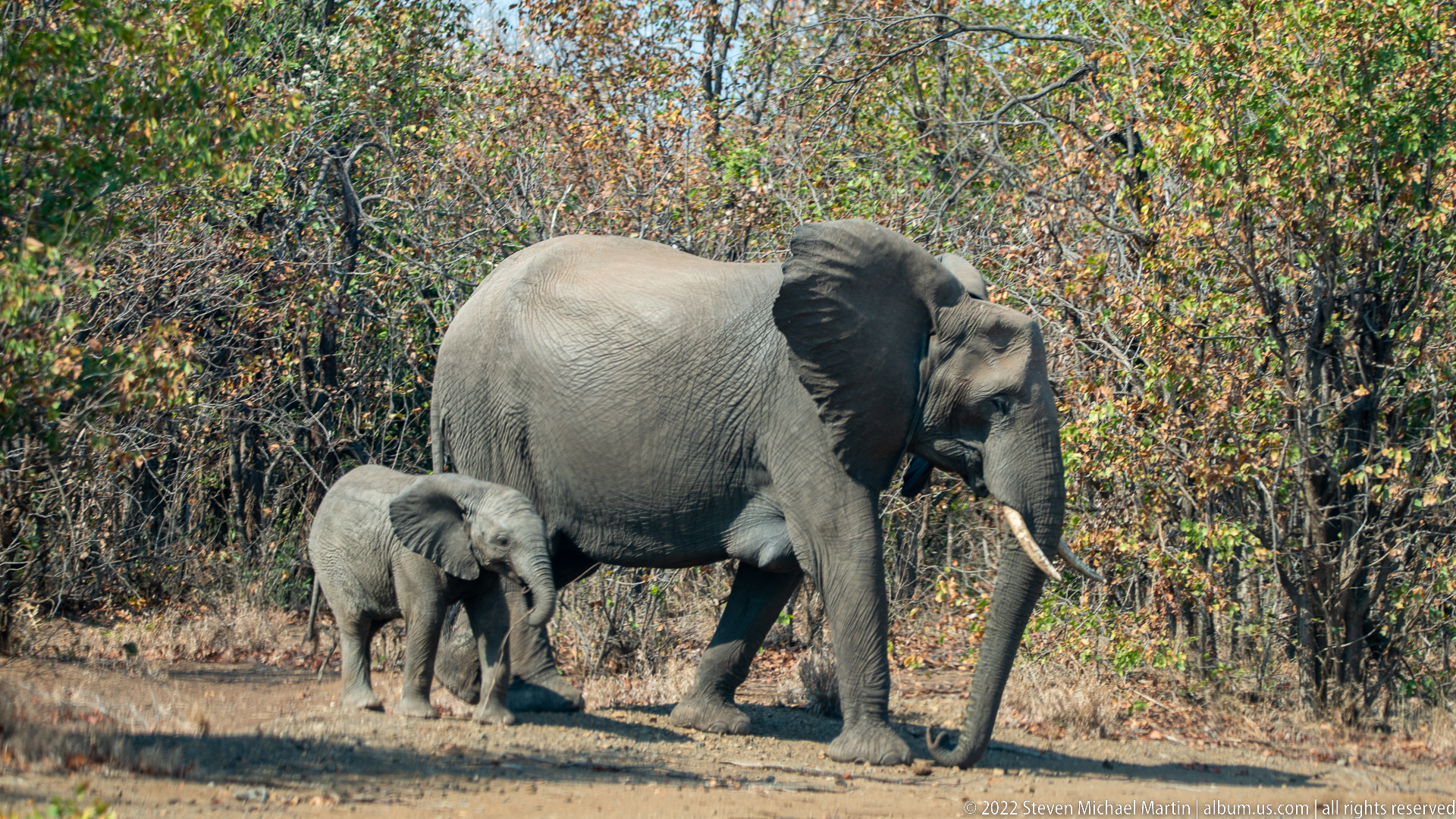
An adult African bush elephant walks beside a small calf through dry woodland, the pair moving in close formation across pale ground. The adult’s broad ears, tusks, and extended trunk contrast with the calf’s compact proportions and shorter trunk. Their side-by-side movement gives the frame a strong sense of maternal association and scale within Kruger’s dry-season bushveld.
Caption
An adult African bush elephant walks beside a small calf through dry woodland, the pair moving in close formation across pale ground. The adult’s broad ears, tusks, and extended trunk contrast with the calf’s compact proportions and shorter trunk. Their side-by-side movement gives the frame a strong sense of maternal association and scale within Kruger’s dry-season bushveld.
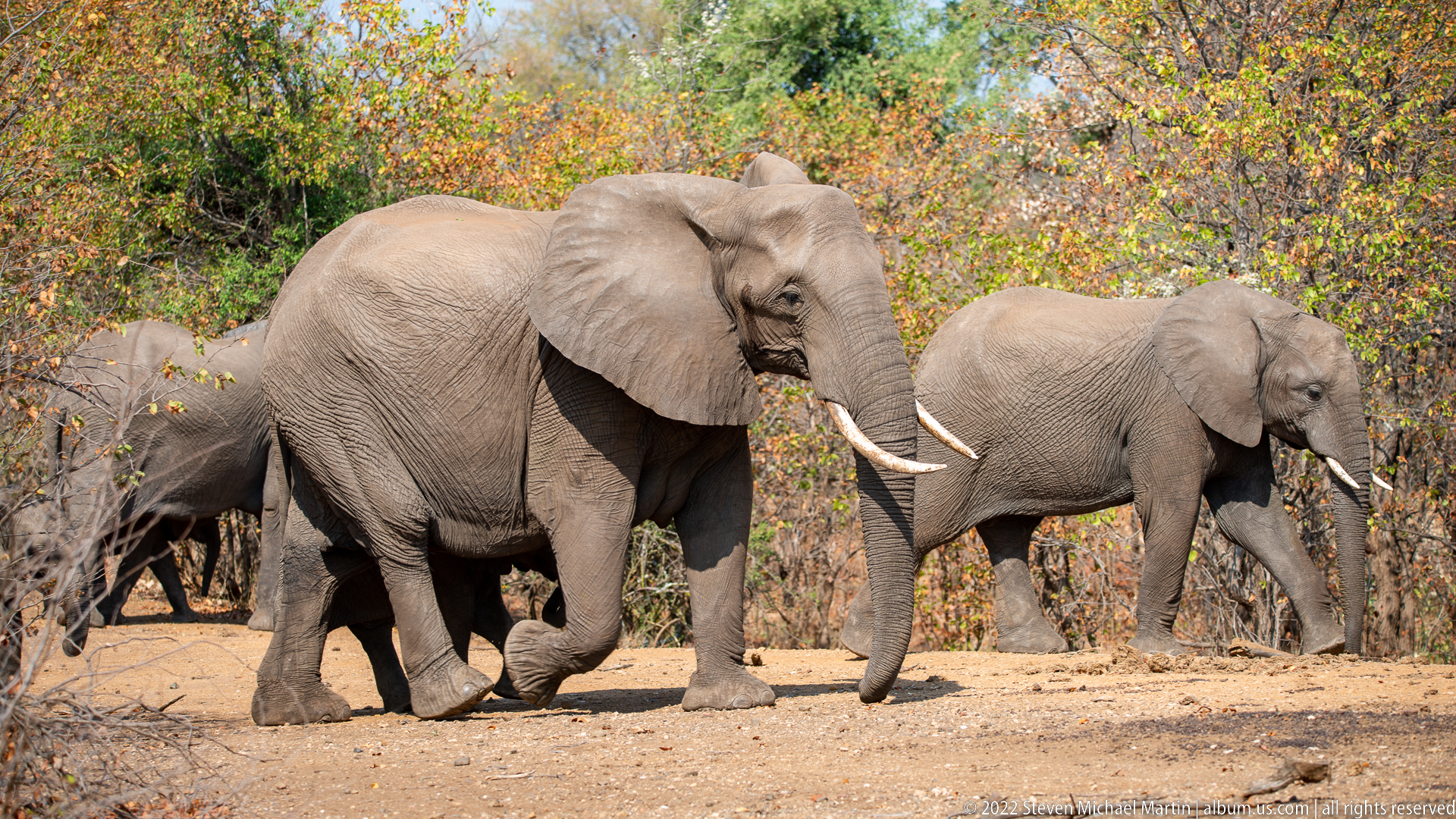
A small group of African bush elephants crosses open, sunlit ground, led by a large tusked adult while another adult and a partly obscured elephant follow. The broad side view reveals differences in body size and tusk development across the group. Dry shrubs and sparse trees frame the elephants against the warm, dusty palette of Kruger’s seasonal woodland.
Caption
A small group of African bush elephants crosses open, sunlit ground, led by a large tusked adult while another adult and a partly obscured elephant follow. The broad side view reveals differences in body size and tusk development across the group. Dry shrubs and sparse trees frame the elephants against the warm, dusty palette of Kruger’s seasonal woodland.
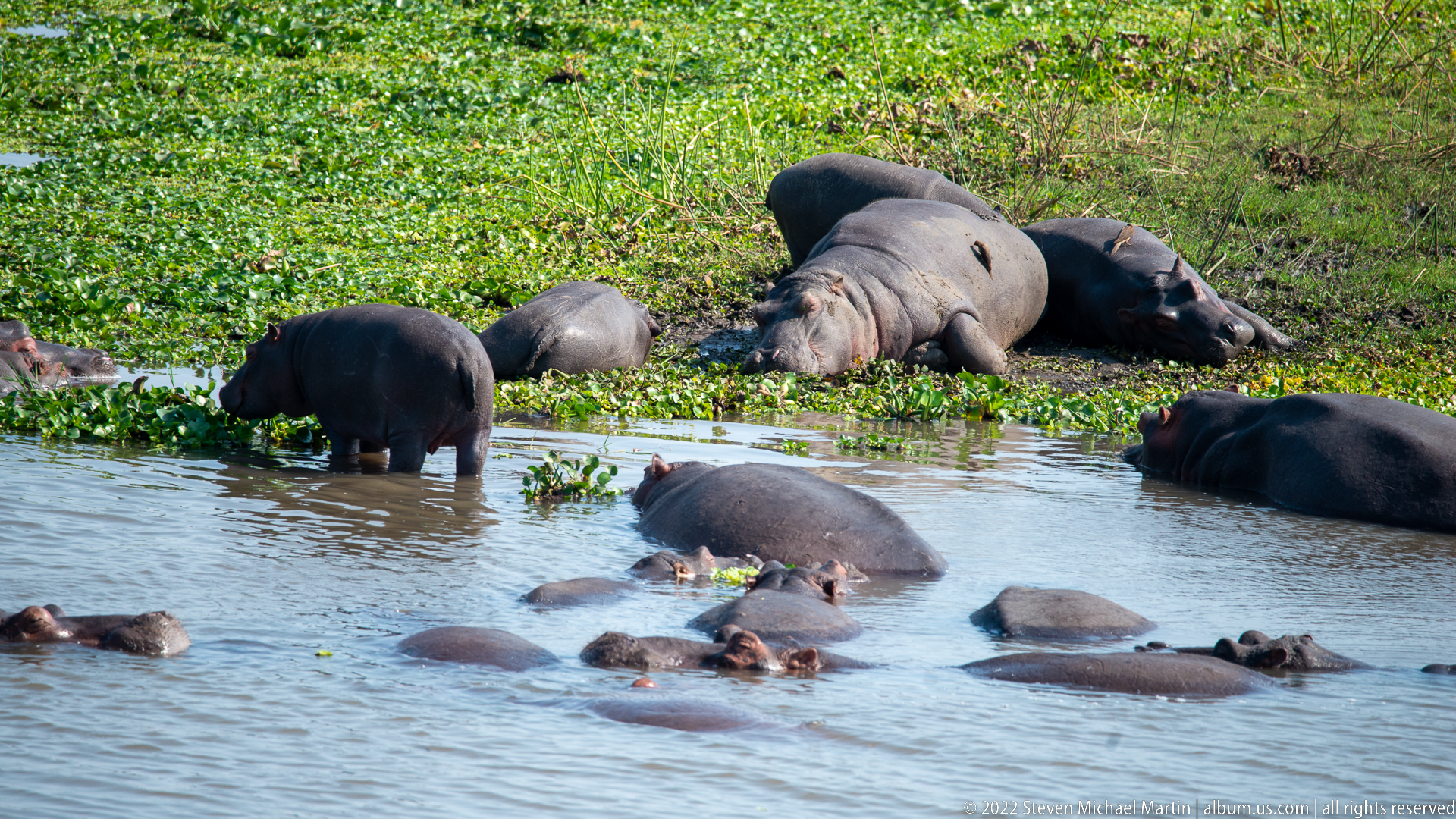
A pod of hippopotamuses occupies the shallow margin of the Olifants River, with several animals submerged while others rest on the green bank. One large hippo lies partly out of the water among dense aquatic plants, and multiple rounded backs and heads break the surface in front. The mixed land-and-water composition shows the herd using both the channel and its lush edge.
Caption
A pod of hippopotamuses occupies the shallow margin of the Olifants River, with several animals submerged while others rest on the green bank. One large hippo lies partly out of the water among dense aquatic plants, and multiple rounded backs and heads break the surface in front. The mixed land-and-water composition shows the herd using both the channel and its lush edge.

A young African bush elephant reaches into low foliage with its trunk, curling the tip around leafy growth while standing beneath woodland branches. The closer view emphasizes the dexterity of the trunk and the animal’s relatively small body and tuskless face. Dry leaf litter underfoot and green browse above create a clear record of feeding behavior in mixed seasonal vegetation.
Caption
A young African bush elephant reaches into low foliage with its trunk, curling the tip around leafy growth while standing beneath woodland branches. The closer view emphasizes the dexterity of the trunk and the animal’s relatively small body and tuskless face. Dry leaf litter underfoot and green browse above create a clear record of feeding behavior in mixed seasonal vegetation.
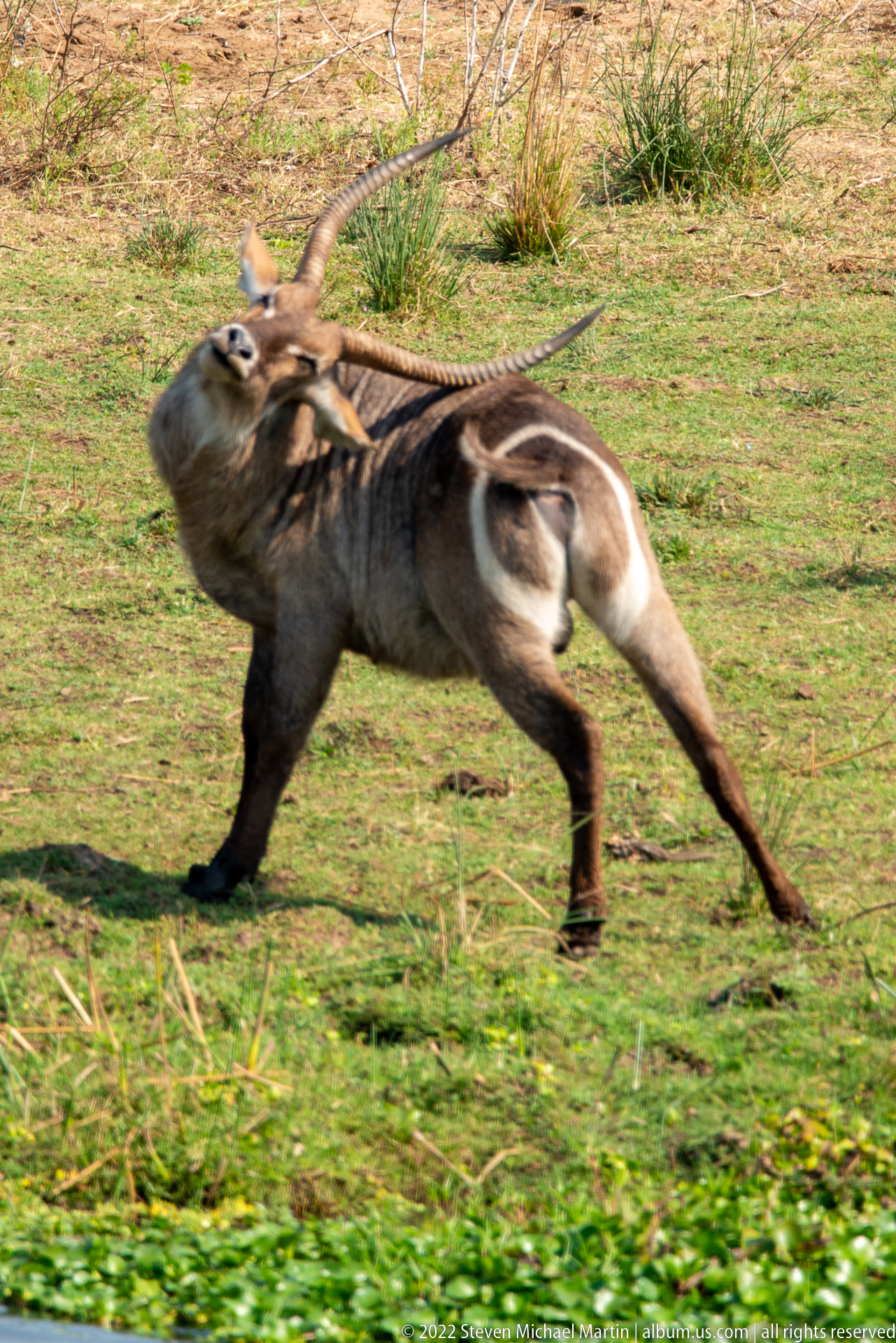
A male waterbuck runs across open green ground in a dynamic side view, body stretched forward and all four legs caught in an extended stride. Long ringed horns sweep back above the head, while the pale rump marking is visible near the tail. Motion blur in the background reinforces the speed of the animal and sharply distinguishes this frame from the preceding grazing portrait.
Caption
A male waterbuck runs across open green ground in a dynamic side view, body stretched forward and all four legs caught in an extended stride. Long ringed horns sweep back above the head, while the pale rump marking is visible near the tail. Motion blur in the background reinforces the speed of the animal and sharply distinguishes this frame from the preceding grazing portrait.
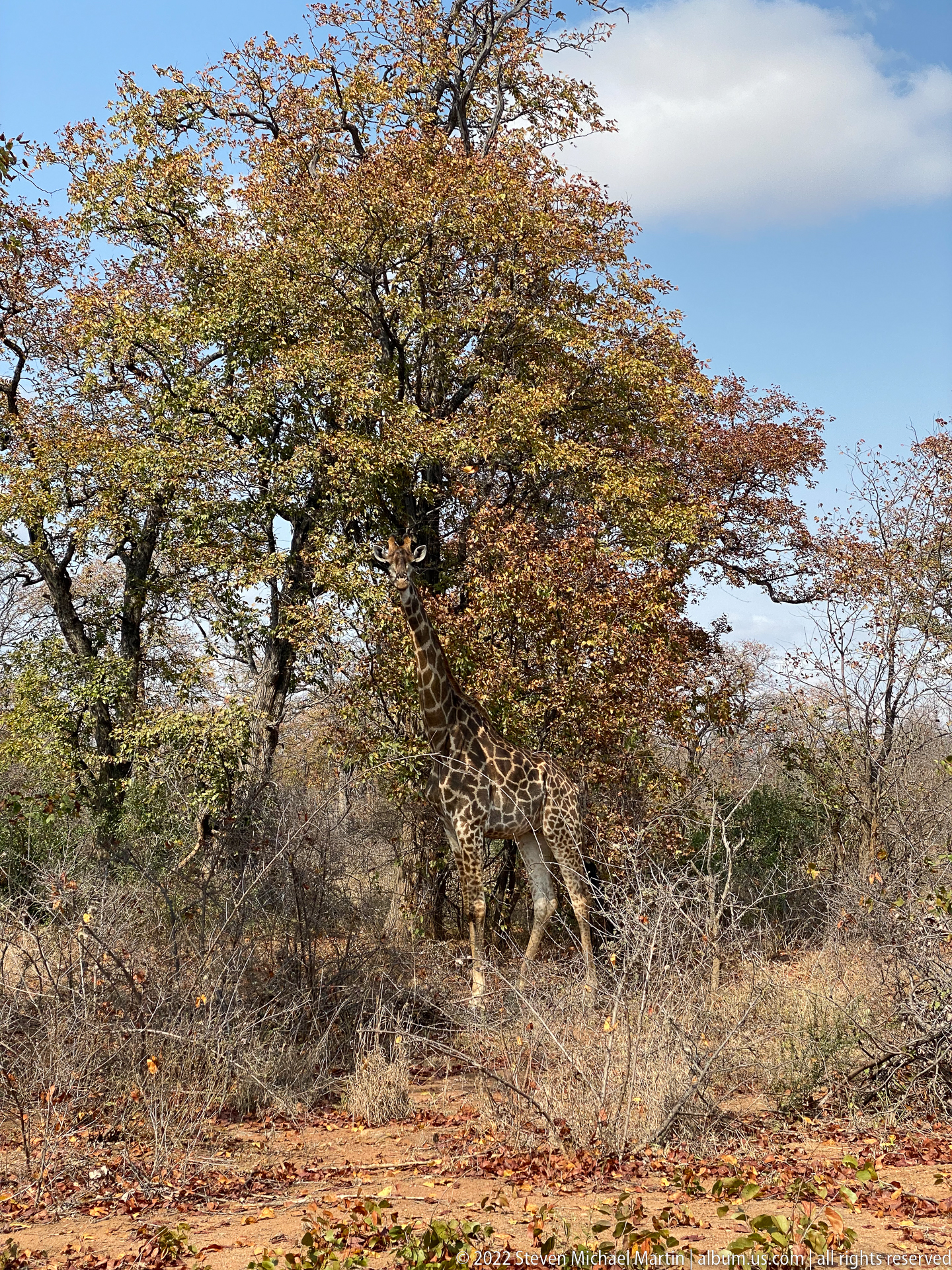
A giraffe moves beneath the broad canopy of a mature tree, its patterned neck and body partly screened by branches and dry understory. The wider composition emphasizes how effectively the animal’s mottled coat merges with the dappled woodland. Rather than a formal portrait, this frame records the giraffe at habitat scale, surrounded by the vegetation it uses for browse and cover.
Caption
A giraffe moves beneath the broad canopy of a mature tree, its patterned neck and body partly screened by branches and dry understory. The wider composition emphasizes how effectively the animal’s mottled coat merges with the dappled woodland. Rather than a formal portrait, this frame records the giraffe at habitat scale, surrounded by the vegetation it uses for browse and cover.
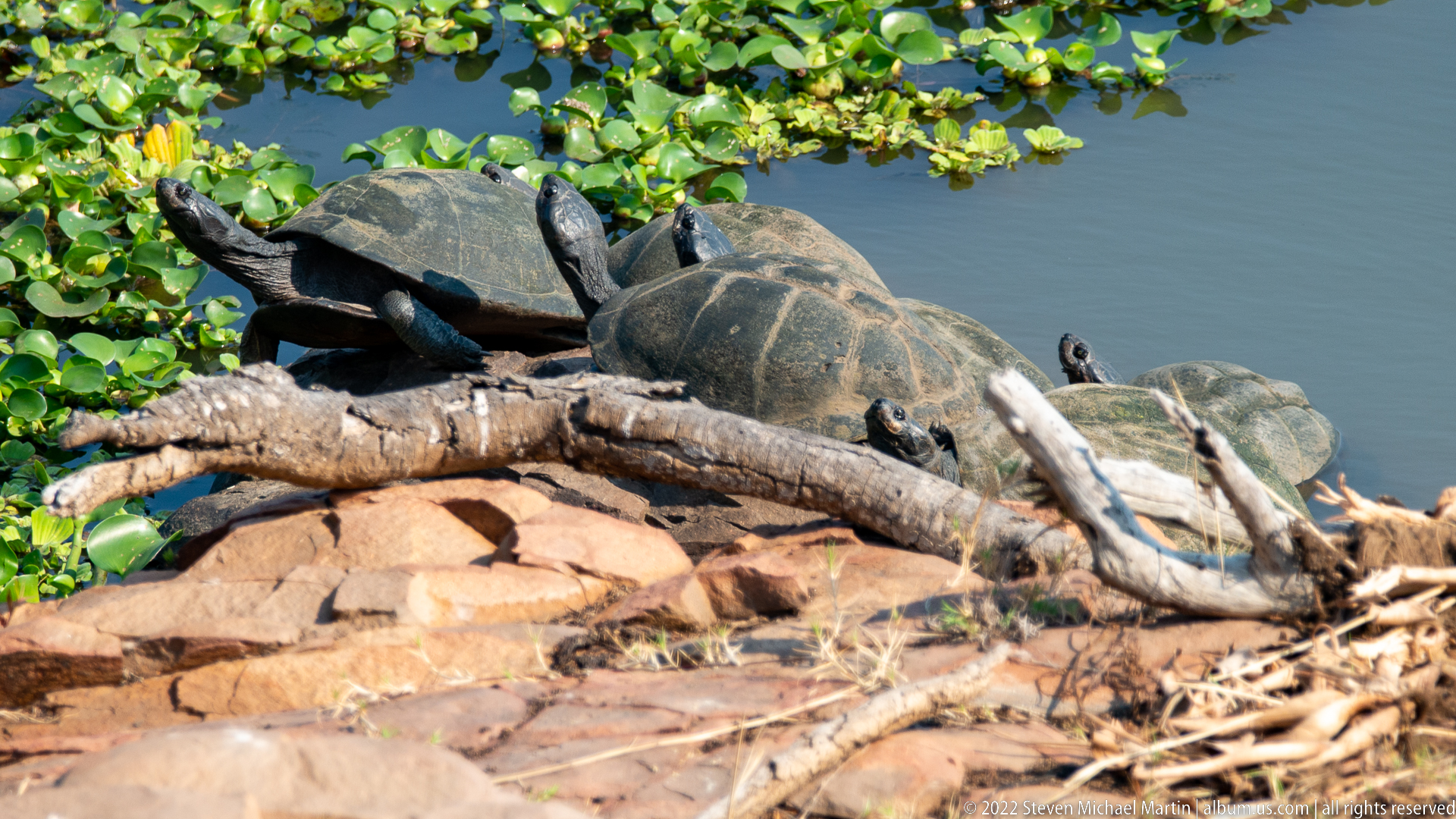
Several freshwater terrapins bask on a fallen trunk and exposed debris at the river’s edge, their dark oval shells overlapping in a compact cluster above the water. Aquatic plants crowd the background, while the angled log provides a dry sunning surface. The proof sheet supports a southern African hinged-terrapin identification, though species-level separation is not fully secure at this scale.
Caption
Several freshwater terrapins bask on a fallen trunk and exposed debris at the river’s edge, their dark oval shells overlapping in a compact cluster above the water. Aquatic plants crowd the background, while the angled log provides a dry sunning surface. The proof sheet supports a southern African hinged-terrapin identification, though species-level separation is not fully secure at this scale.
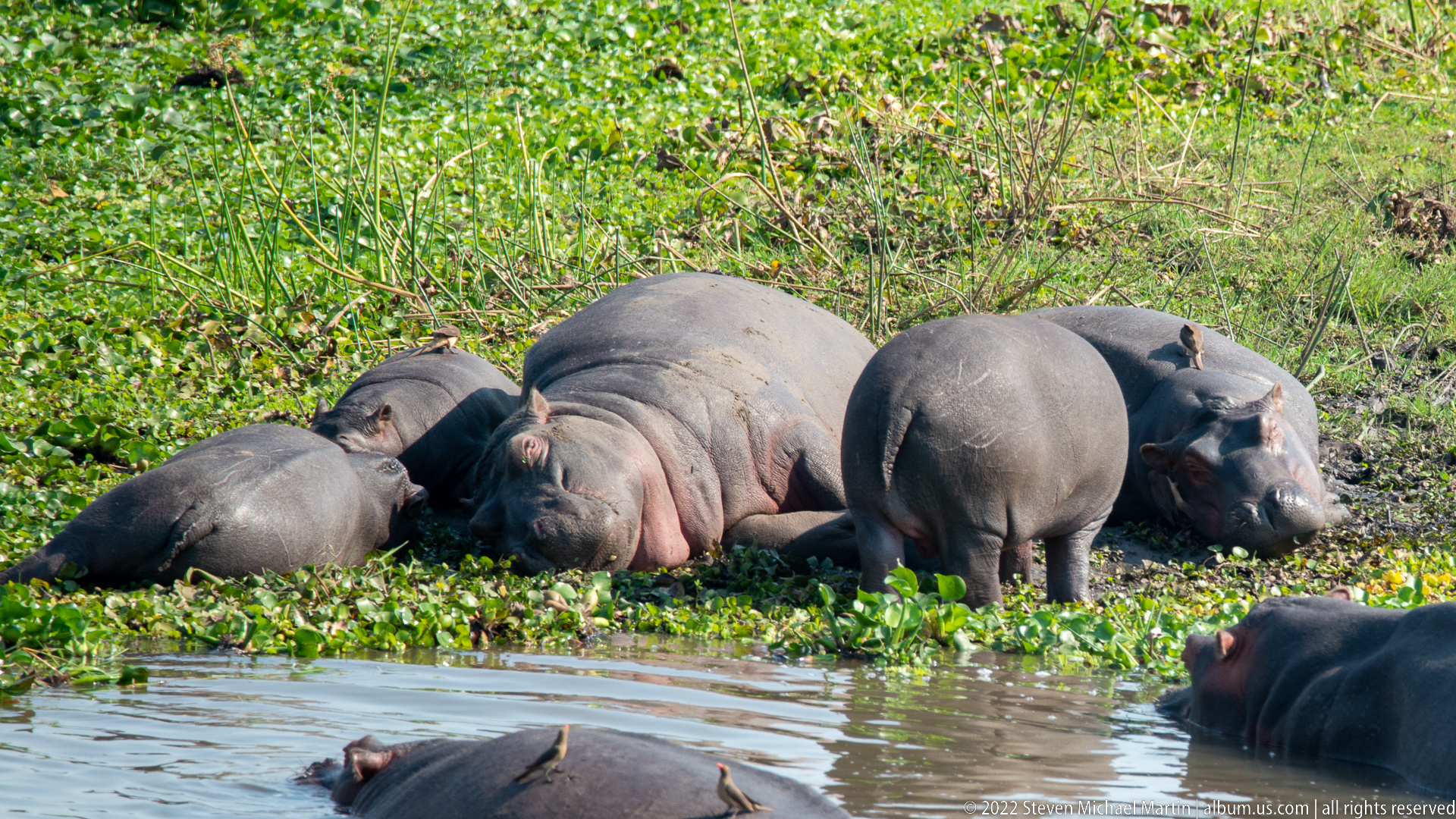
Several hippopotamuses rest shoulder-to-shoulder on the green river margin while others remain partly submerged in the foreground. The tight grouping shows massive bodies pressed together at the water’s edge, including smaller individuals nestled near larger adults. Moist vegetation and shallow water distinguish the resting site from the more open channel views in the preceding sequence.
Caption
Several hippopotamuses rest shoulder-to-shoulder on the green river margin while others remain partly submerged in the foreground. The tight grouping shows massive bodies pressed together at the water’s edge, including smaller individuals nestled near larger adults. Moist vegetation and shallow water distinguish the resting site from the more open channel views in the preceding sequence.

A Nile crocodile lies on a grassy, muddy bank immediately above the waterline, its long armored body aligned roughly parallel to the river. The broad head, heavy jaws, raised dorsal scutes, and tapering tail are clearly visible in sunlight. Sparse reeds and floating vegetation along the edge place the reptile directly within the Olifants River’s riparian habitat.
Caption
A Nile crocodile lies on a grassy, muddy bank immediately above the waterline, its long armored body aligned roughly parallel to the river. The broad head, heavy jaws, raised dorsal scutes, and tapering tail are clearly visible in sunlight. Sparse reeds and floating vegetation along the edge place the reptile directly within the Olifants River’s riparian habitat.
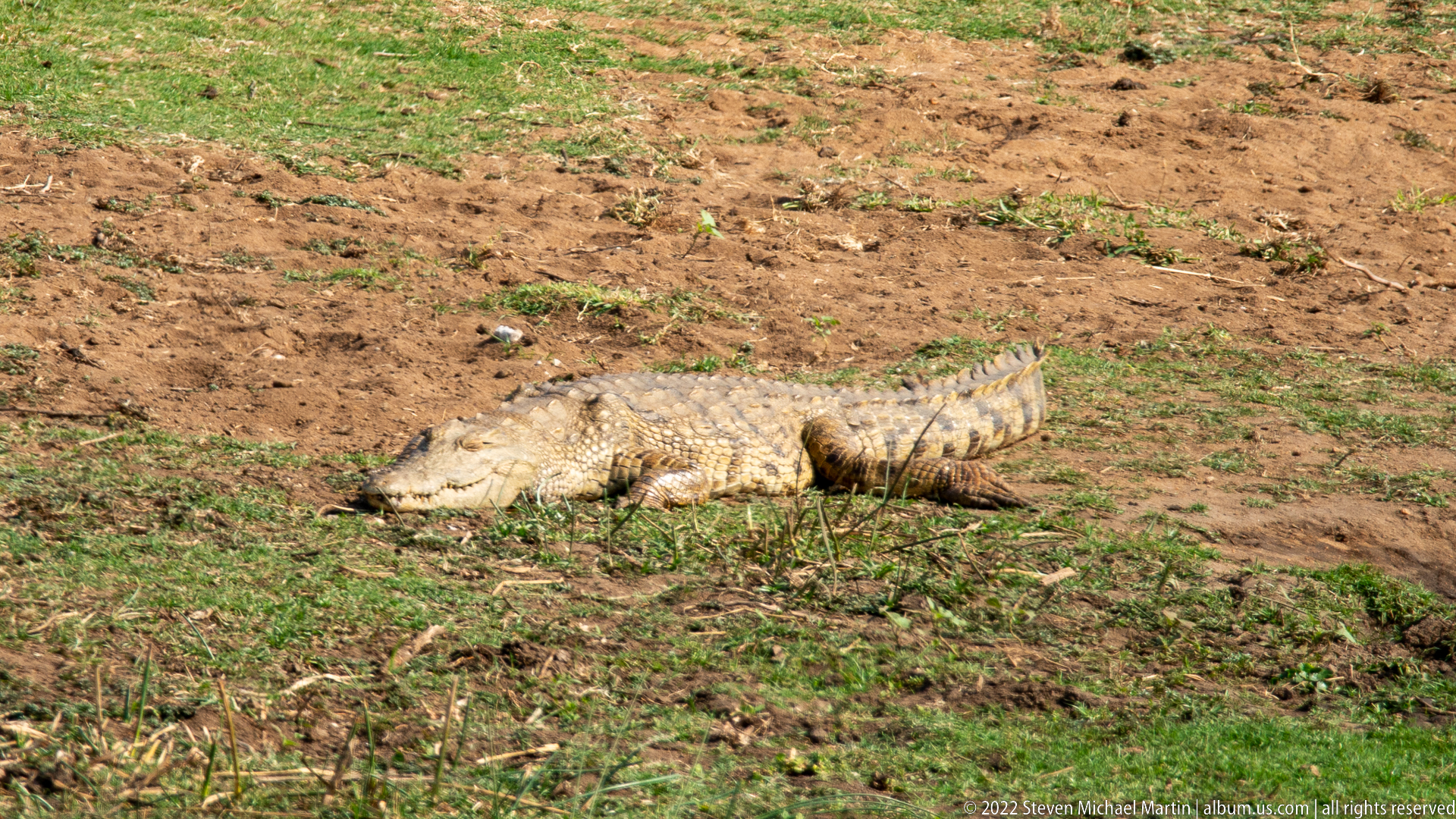
A Nile crocodile basks on open mud and short grass, its body fully exposed and viewed from slightly above. Sunlight reveals the patterned scales, ridged back, powerful tail, and broad snout more clearly than in the preceding river-edge view. The animal’s flattened posture and complete silhouette make this a particularly useful field-guide record of the species at rest.
Caption
A Nile crocodile basks on open mud and short grass, its body fully exposed and viewed from slightly above. Sunlight reveals the patterned scales, ridged back, powerful tail, and broad snout more clearly than in the preceding river-edge view. The animal’s flattened posture and complete silhouette make this a particularly useful field-guide record of the species at rest.
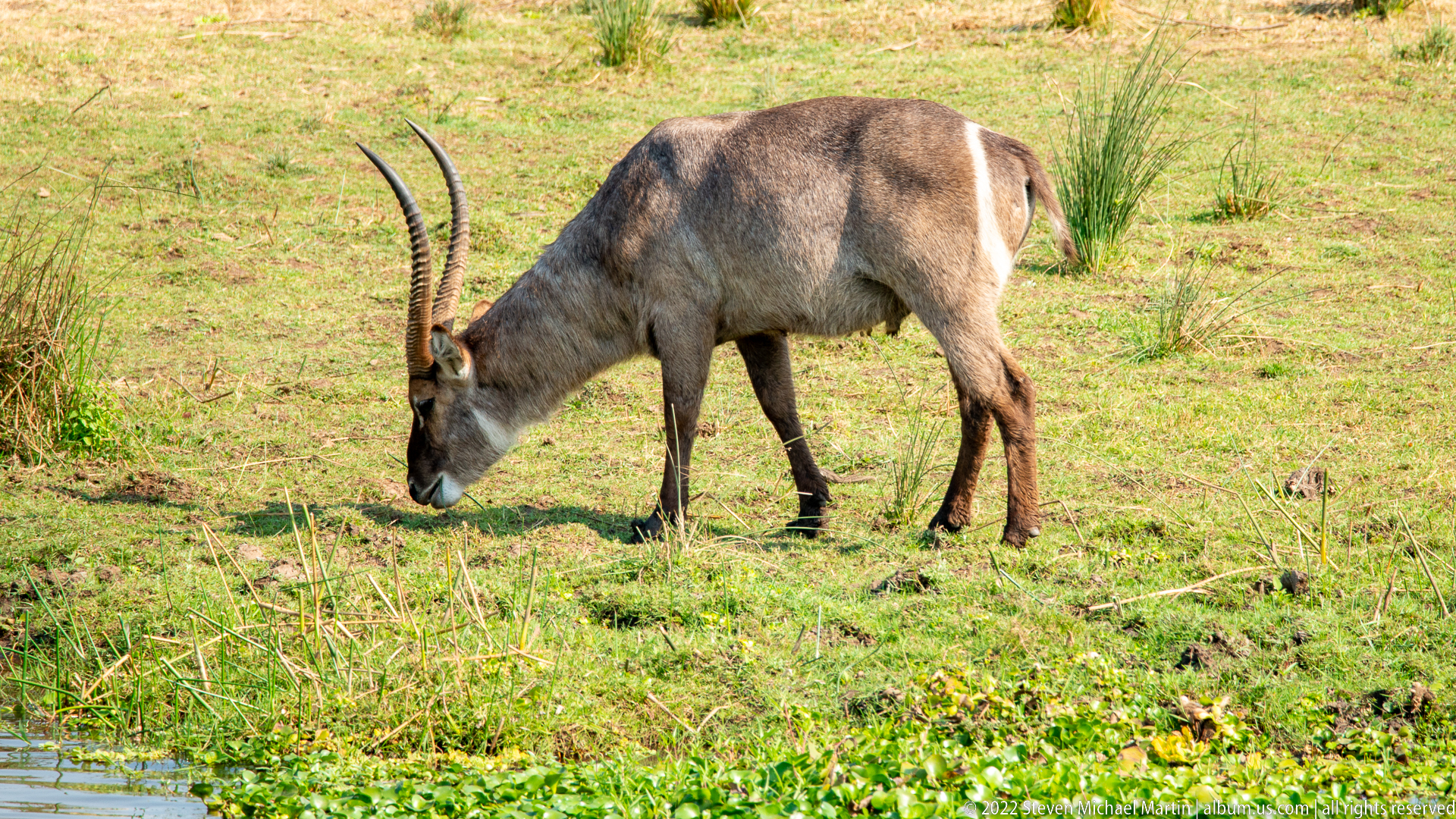
An adult male waterbuck grazes on short green vegetation near the river, his long, ringed horns rising in a gentle backward sweep above the head. The shaggy gray-brown coat and darker lower legs are clearly visible in side profile. This solitary feeding view isolates the mature male from the larger herd scenes and shows the species’ characteristic association with greener riparian ground.
Caption
An adult male waterbuck grazes on short green vegetation near the river, his long, ringed horns rising in a gentle backward sweep above the head. The shaggy gray-brown coat and darker lower legs are clearly visible in side profile. This solitary feeding view isolates the mature male from the larger herd scenes and shows the species’ characteristic association with greener riparian ground.

Two African bush elephants walk through dry grass and open woodland, a larger adult following closely behind a smaller companion. Both are shown in side profile with trunks hanging low as they move across the sunlit bushveld. The wider environmental view emphasizes the scale of the animals against the sparse trees and tawny dry-season vegetation.
Caption
Two African bush elephants walk through dry grass and open woodland, a larger adult following closely behind a smaller companion. Both are shown in side profile with trunks hanging low as they move across the sunlit bushveld. The wider environmental view emphasizes the scale of the animals against the sparse trees and tawny dry-season vegetation.
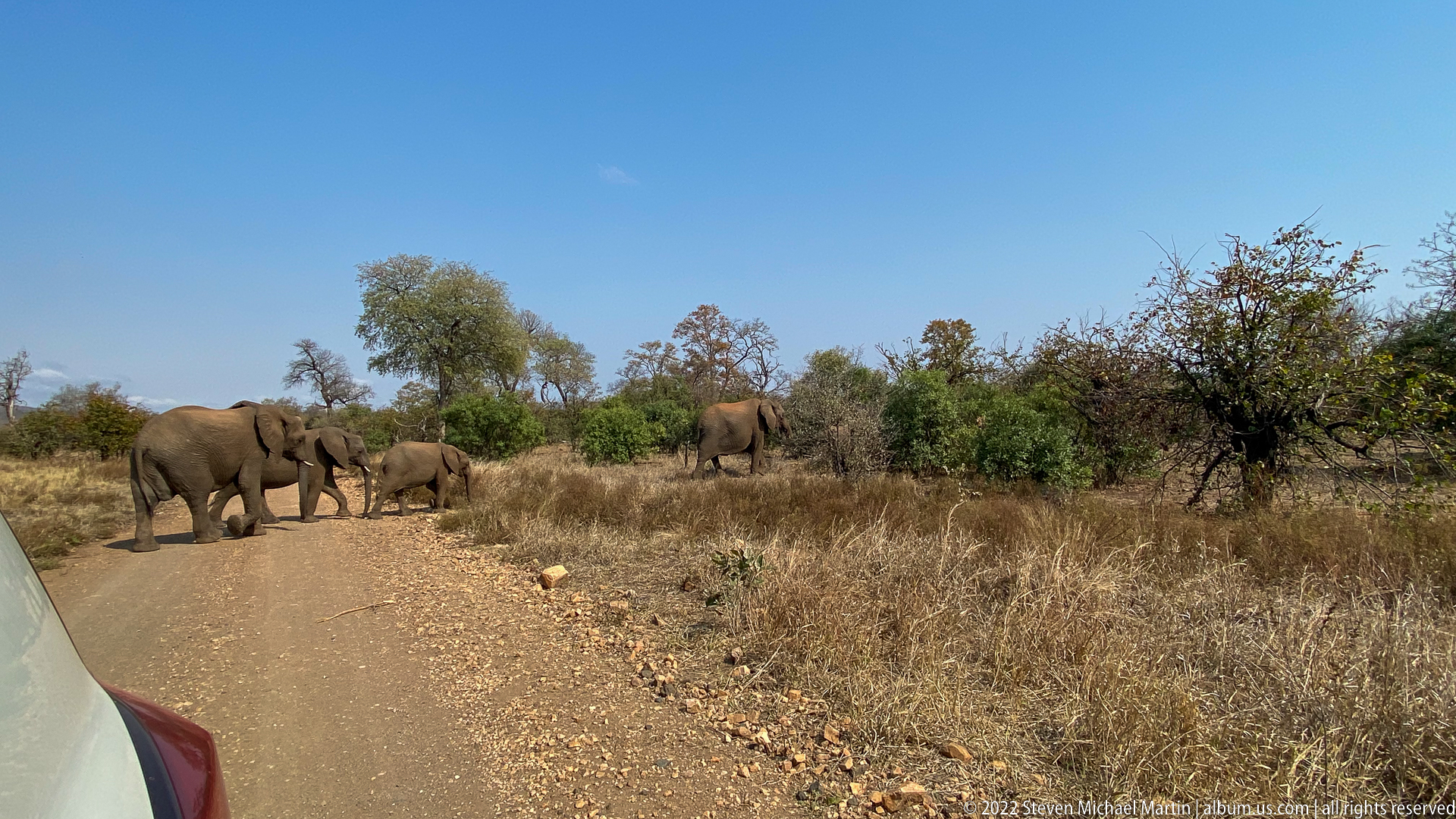
A small elephant group crosses a gravel safari road directly ahead of the photographer’s vehicle, including adults and a calf. One adult steps onto the road at left while other elephants stand beyond in the dry bush. The visible edge of the vehicle anchors the scene as a close roadside wildlife encounter and conveys the scale of the animals within the park landscape.
Caption
A small elephant group crosses a gravel safari road directly ahead of the photographer’s vehicle, including adults and a calf. One adult steps onto the road at left while other elephants stand beyond in the dry bush. The visible edge of the vehicle anchors the scene as a close roadside wildlife encounter and conveys the scale of the animals within the park landscape.
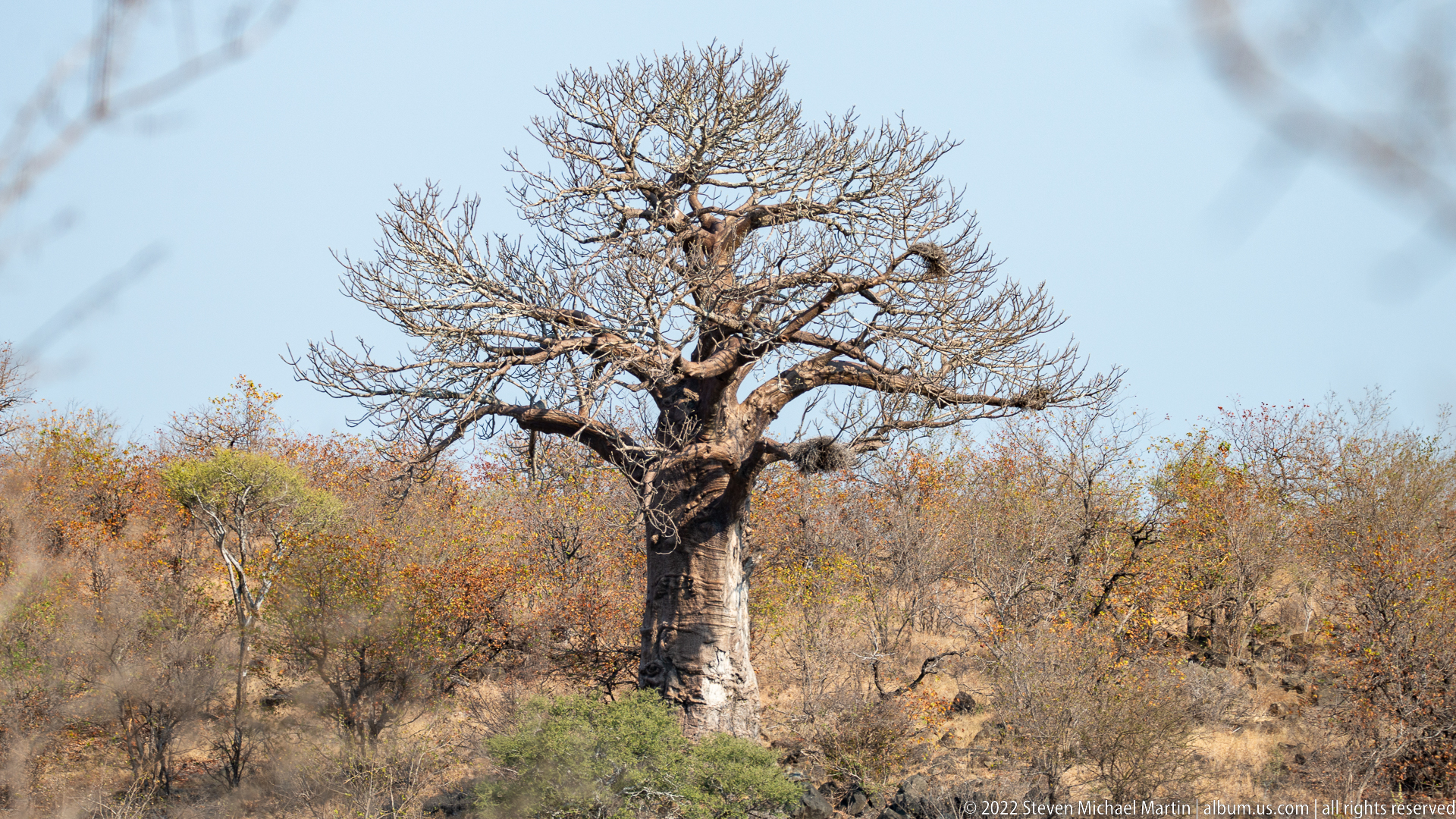
A massive baobab rises above the surrounding dry woodland, its swollen pale trunk supporting a broad crown of mostly leafless, twisting branches. The isolated form is especially conspicuous against the blue sky and lower seasonal vegetation. This landscape portrait records one of the characteristic large trees of northeastern South African savanna without relying on an architectural or named-site identification.
Caption
A massive baobab rises above the surrounding dry woodland, its swollen pale trunk supporting a broad crown of mostly leafless, twisting branches. The isolated form is especially conspicuous against the blue sky and lower seasonal vegetation. This landscape portrait records one of the characteristic large trees of northeastern South African savanna without relying on an architectural or named-site identification.
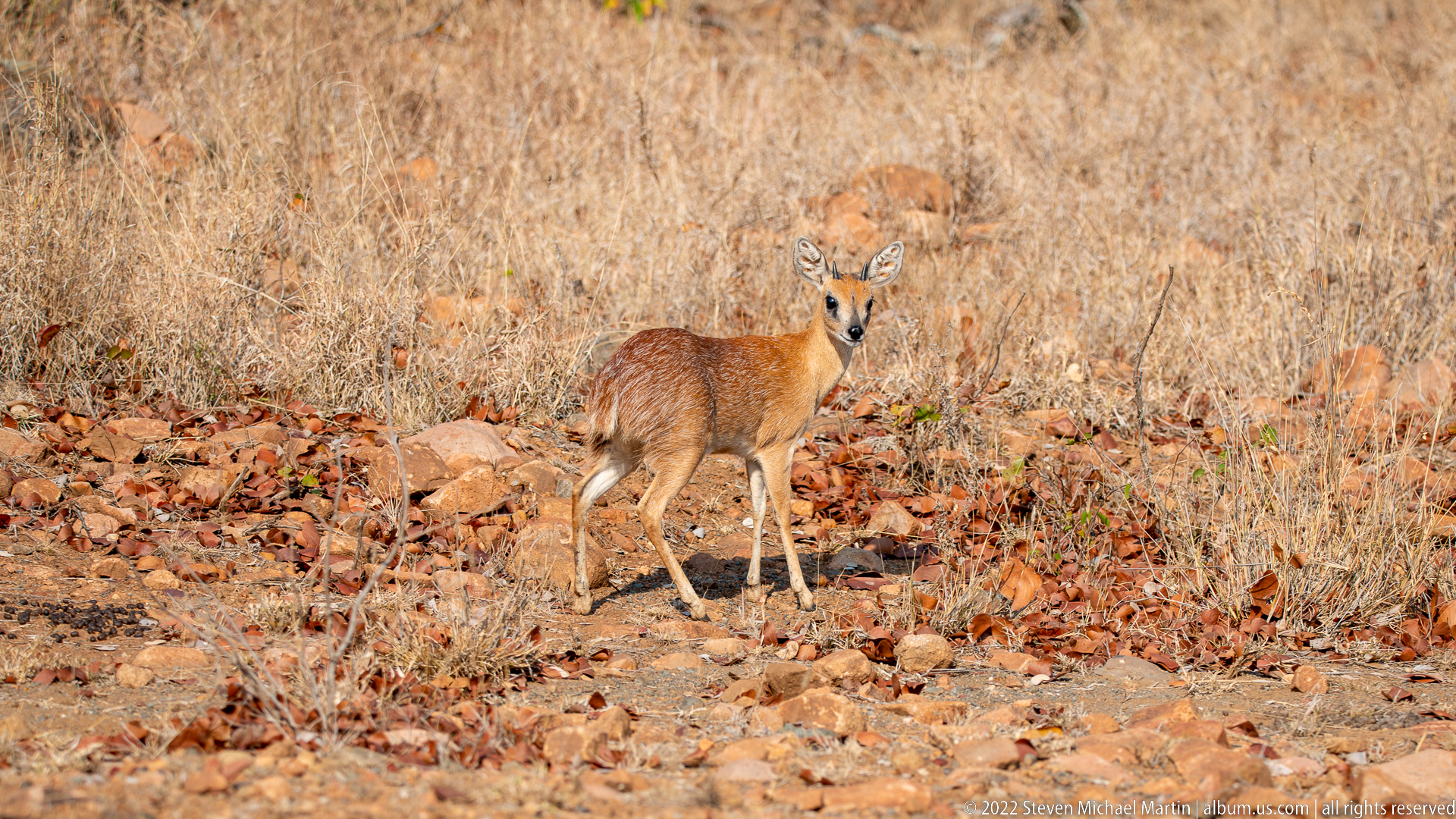
A small male steenbok stands alert among reddish stones and dry grass, facing the camera while a second antelope is partly visible behind. The compact body, large ears, warm rufous coat, white underparts, and short straight horns are evident at this distance. The rocky, dry setting and delicate proportions distinguish the species from the larger antelopes elsewhere in the portfolio.
Caption
A small male steenbok stands alert among reddish stones and dry grass, facing the camera while a second antelope is partly visible behind. The compact body, large ears, warm rufous coat, white underparts, and short straight horns are evident at this distance. The rocky, dry setting and delicate proportions distinguish the species from the larger antelopes elsewhere in the portfolio.
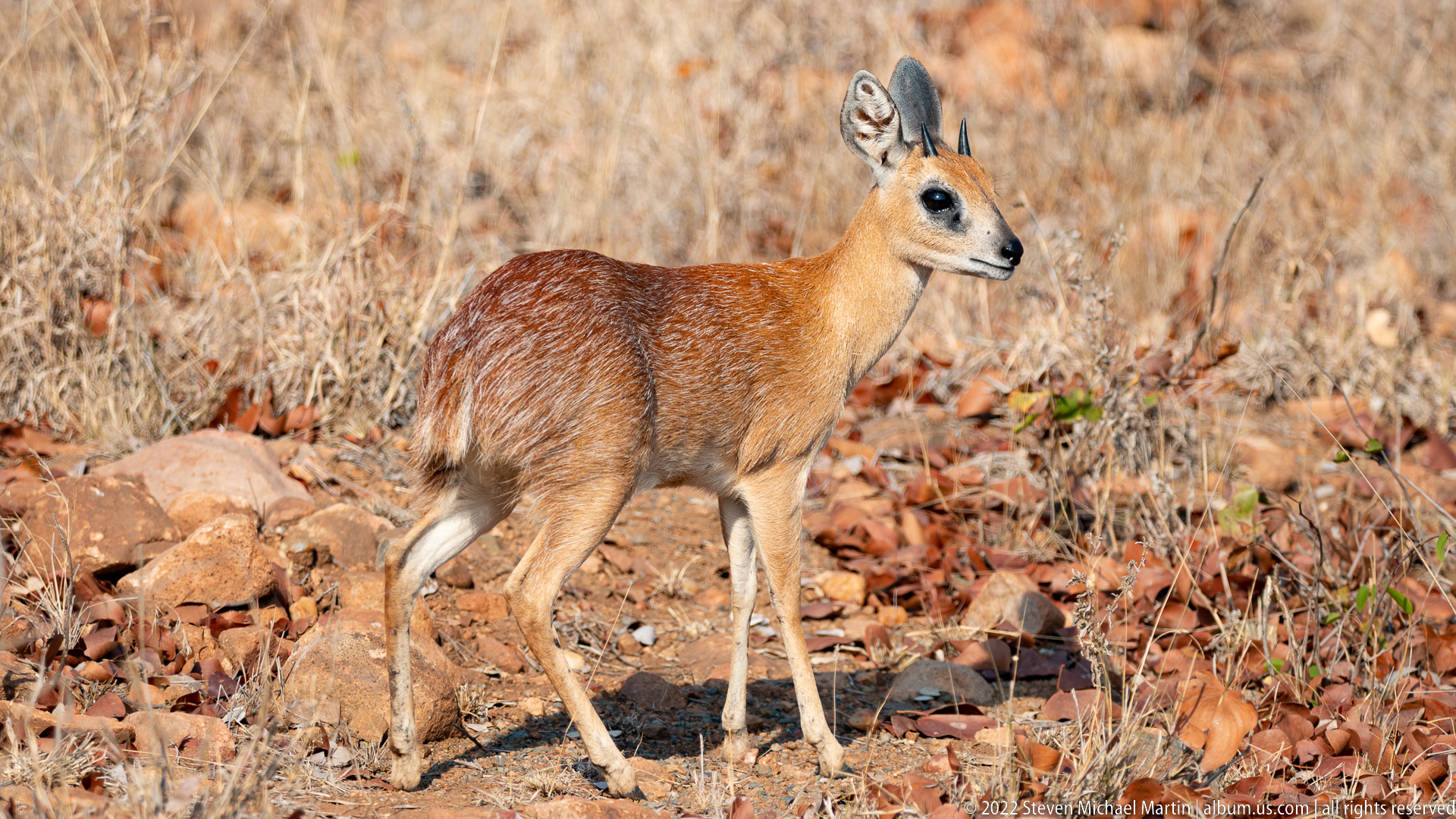
A male steenbok pauses in a clean side profile on stony ground, its fine legs and compact rufous body outlined against pale dry grass. Short, straight black horns project above the forehead, while the oversized ears and dark facial markings are sharply visible. The unobstructed composition provides a strong field-guide view of this small solitary antelope.
Caption
A male steenbok pauses in a clean side profile on stony ground, its fine legs and compact rufous body outlined against pale dry grass. Short, straight black horns project above the forehead, while the oversized ears and dark facial markings are sharply visible. The unobstructed composition provides a strong field-guide view of this small solitary antelope.
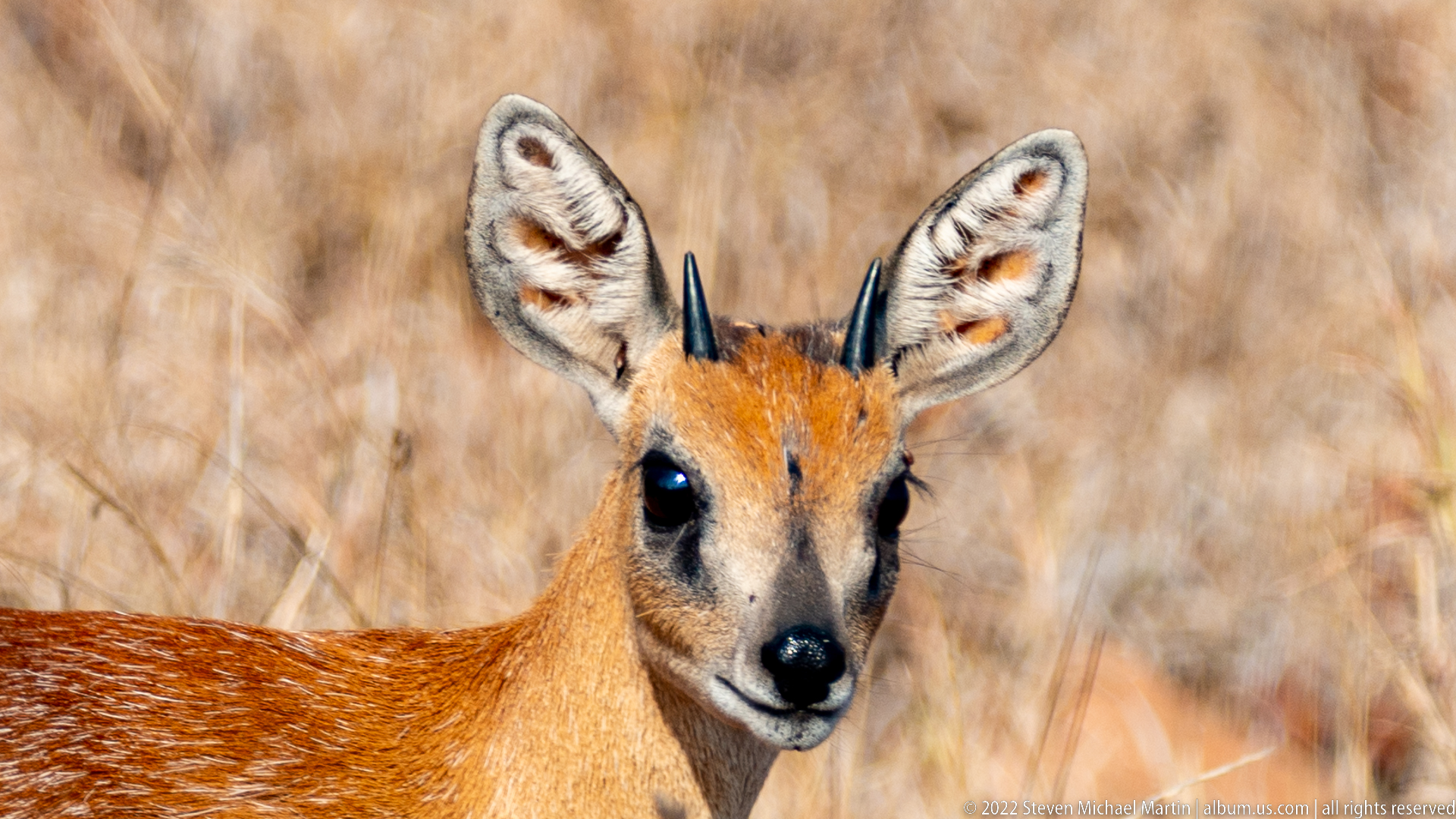
A tight head-and-shoulders portrait of a male steenbok emphasizes its enormous inner-furred ears, glossy dark eyes, narrow muzzle, and short black horns. Fine facial markings and the warm orange-brown forehead stand out against a softly blurred dry-grass background. The close scale makes this the most detailed identification view in the steenbok sequence.
Caption
A tight head-and-shoulders portrait of a male steenbok emphasizes its enormous inner-furred ears, glossy dark eyes, narrow muzzle, and short black horns. Fine facial markings and the warm orange-brown forehead stand out against a softly blurred dry-grass background. The close scale makes this the most detailed identification view in the steenbok sequence.
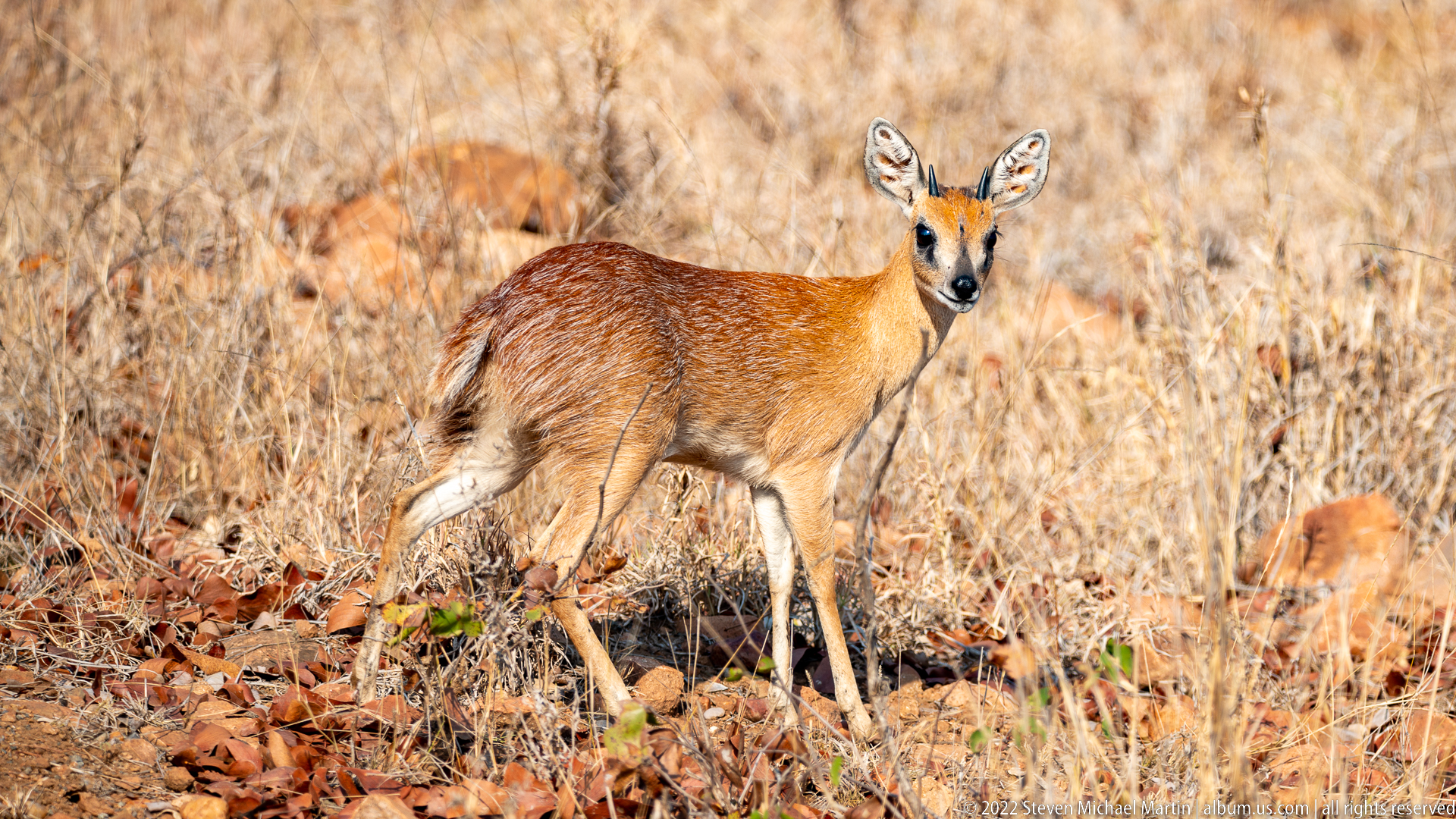
A male steenbok stands among straw-colored grass and scattered leaves, turning its head toward the camera while its body angles away. The small straight horns, large ears, and rich rufous coat remain clearly visible despite the busier background. The alert posture and backward glance distinguish this environmental view from the closer, more formal portraits immediately before it.
Caption
A male steenbok stands among straw-colored grass and scattered leaves, turning its head toward the camera while its body angles away. The small straight horns, large ears, and rich rufous coat remain clearly visible despite the busier background. The alert posture and backward glance distinguish this environmental view from the closer, more formal portraits immediately before it.

An African fish eagle perches high on a bare-limbed tree, its white head and breast contrasting with the dark chestnut-and-black body. The bird is small within the frame, allowing the branching crown and surrounding dry-season foliage to establish its elevated lookout. The upright stance and riverside portfolio context fit the species’ characteristic use of prominent perches near water.
Caption
An African fish eagle perches high on a bare-limbed tree, its white head and breast contrasting with the dark chestnut-and-black body. The bird is small within the frame, allowing the branching crown and surrounding dry-season foliage to establish its elevated lookout. The upright stance and riverside portfolio context fit the species’ characteristic use of prominent perches near water.
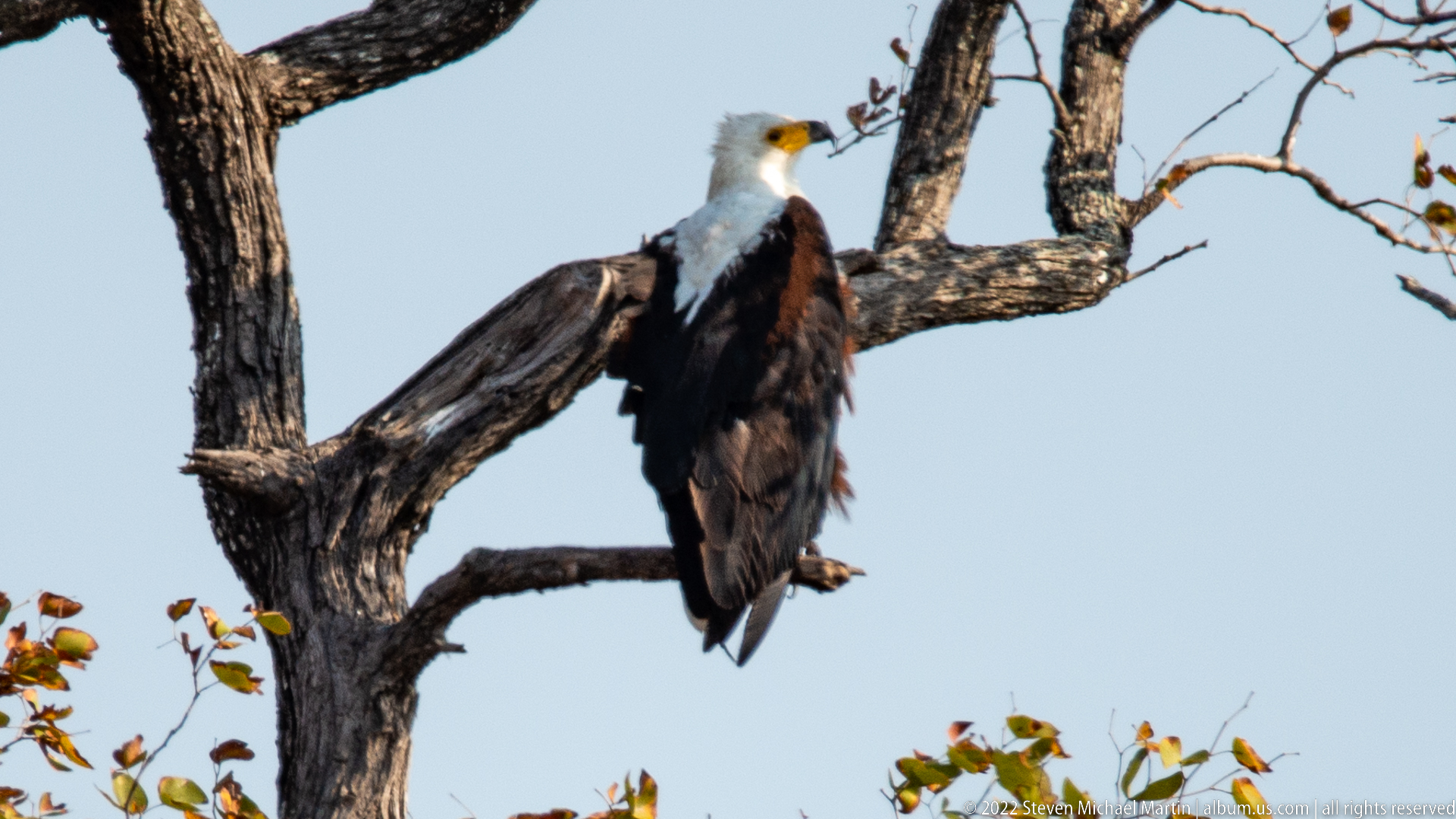
A closer view isolates an African fish eagle on a sturdy dead branch, revealing the white head, yellow bill, white breast, rich chestnut body, and dark folded wings. The bird faces slightly upward, giving a clear profile of the hooked bill and powerful chest. Compared with the preceding wide view, this frame functions as a direct field-guide portrait of the adult raptor.
Caption
A closer view isolates an African fish eagle on a sturdy dead branch, revealing the white head, yellow bill, white breast, rich chestnut body, and dark folded wings. The bird faces slightly upward, giving a clear profile of the hooked bill and powerful chest. Compared with the preceding wide view, this frame functions as a direct field-guide portrait of the adult raptor.

A female greater kudu stands alert in sparse woodland, facing the camera with oversized ears spread wide. Vertical white stripes run down the gray-brown torso, while the hornless head and slender legs identify the animal as a female or immature kudu rather than an adult bull. Brush partially overlaps the body, placing the antelope naturally within dense dry-season cover.
Caption
A female greater kudu stands alert in sparse woodland, facing the camera with oversized ears spread wide. Vertical white stripes run down the gray-brown torso, while the hornless head and slender legs identify the animal as a female or immature kudu rather than an adult bull. Brush partially overlaps the body, placing the antelope naturally within dense dry-season cover.

A vervet monkey stands upright on its hind legs in open dry ground, its pale gray body and black face clearly separated from the brown vegetation behind. The vertical posture raises the head above low brush, suggesting an alert scan of the surroundings. This ground-level behavior contrasts with the arboreal vervet views that follow on the next frames.
Caption
A vervet monkey stands upright on its hind legs in open dry ground, its pale gray body and black face clearly separated from the brown vegetation behind. The vertical posture raises the head above low brush, suggesting an alert scan of the surroundings. This ground-level behavior contrasts with the arboreal vervet views that follow on the next frames.

A vervet monkey sits among a network of thin, leafless branches, facing forward with its dark face framed by pale gray fur. The tree’s fine twigs partly obscure the body, while the elevated perch provides a clear behavioral shift from the preceding ground view. Isolated green leaves punctuate the otherwise dry branches and reinforce the seasonal setting.
Caption
A vervet monkey sits among a network of thin, leafless branches, facing forward with its dark face framed by pale gray fur. The tree’s fine twigs partly obscure the body, while the elevated perch provides a clear behavioral shift from the preceding ground view. Isolated green leaves punctuate the otherwise dry branches and reinforce the seasonal setting.
A closer portrait shows a vervet monkey seated among bare twigs, its black face, pale brow, and silver-gray coat standing out against the softly blurred savanna beyond. Branches cross the foreground and partially mask the torso, giving the view a layered, naturalistic quality. The animal’s direct gaze and upright posture make this a more intimate companion to the wider arboreal frame.
Caption
A closer portrait shows a vervet monkey seated among bare twigs, its black face, pale brow, and silver-gray coat standing out against the softly blurred savanna beyond. Branches cross the foreground and partially mask the torso, giving the view a layered, naturalistic quality. The animal’s direct gaze and upright posture make this a more intimate companion to the wider arboreal frame.
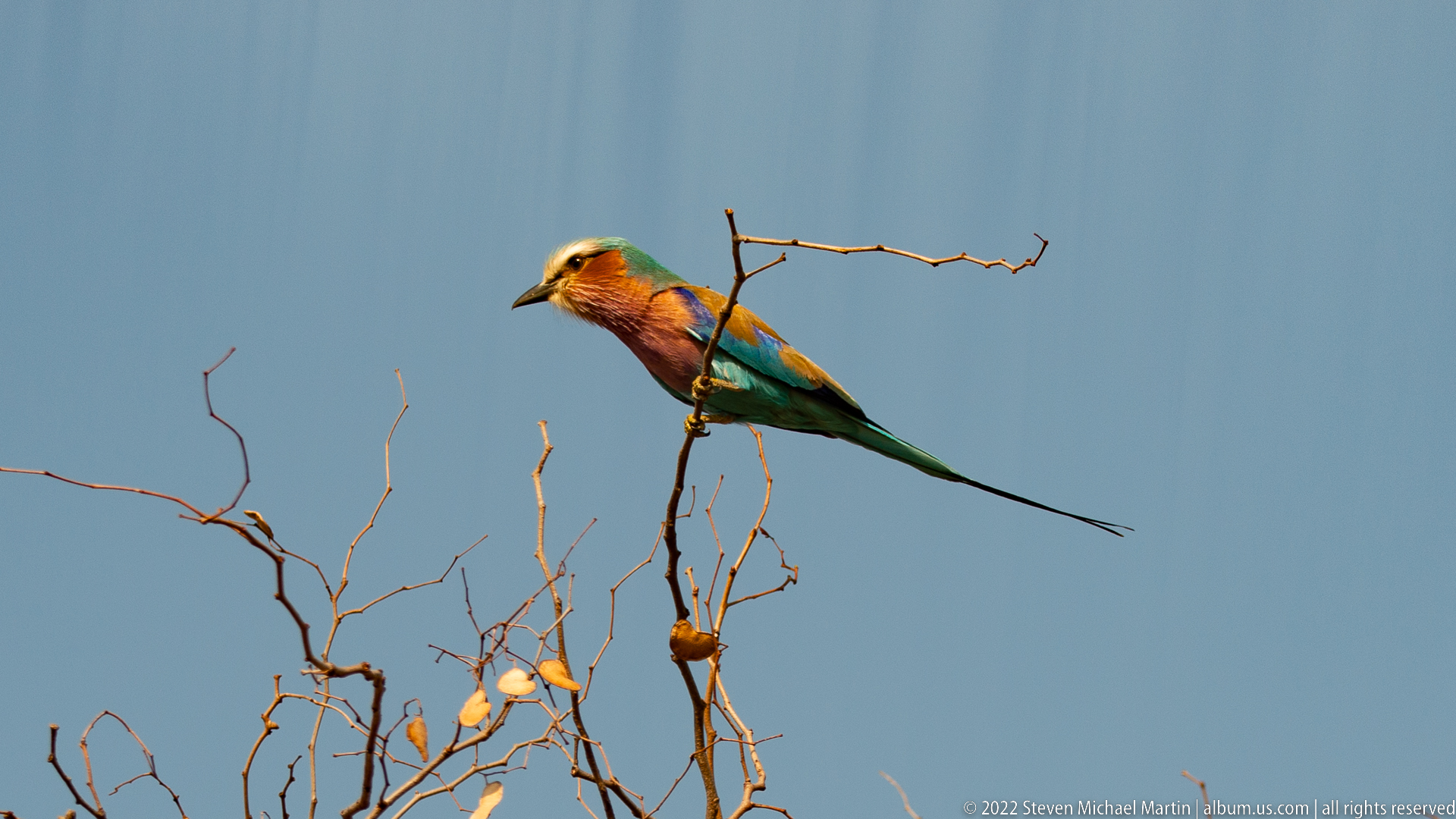
A lilac-breasted roller perches on the tip of a bare twig against an uncluttered blue-gray background. Its lilac chest, turquoise belly and wings, greenish crown, warm rufous shoulders, and elongated black tail streamers create the species’ unmistakable multicolored pattern. The spare composition isolates the bird’s silhouette and makes the long forked tail especially prominent.
Caption
A lilac-breasted roller perches on the tip of a bare twig against an uncluttered blue-gray background. Its lilac chest, turquoise belly and wings, greenish crown, warm rufous shoulders, and elongated black tail streamers create the species’ unmistakable multicolored pattern. The spare composition isolates the bird’s silhouette and makes the long forked tail especially prominent.
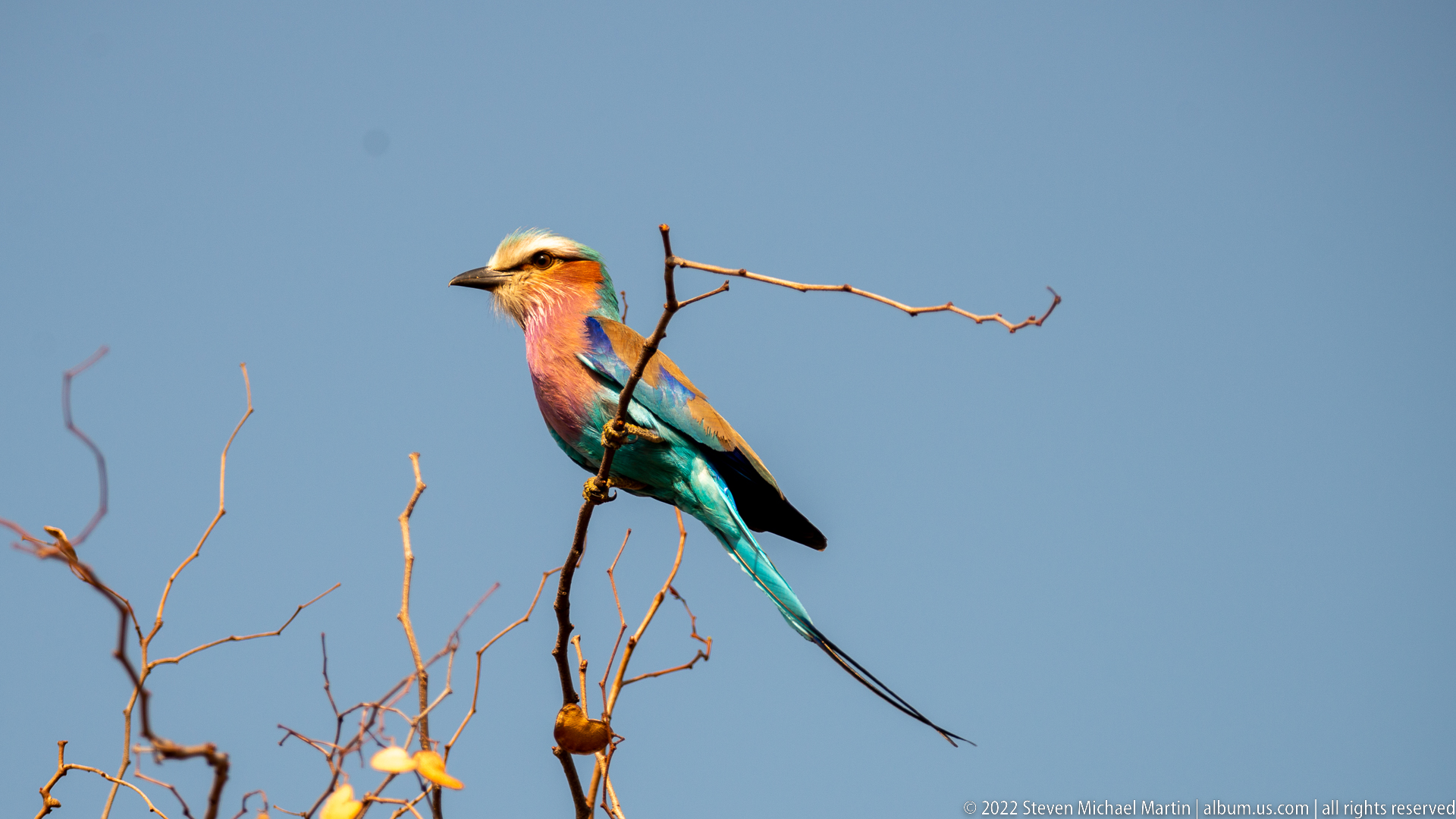
A lilac-breasted roller sits upright on a slender branch, turning slightly toward the camera so the lilac chest and turquoise belly are fully displayed. Long tail streamers descend well below the perch, while the pale green crown and dark eye stripe remain visible. This frontal three-quarter view emphasizes the saturated breast colors more strongly than the preceding side profile.
Caption
A lilac-breasted roller sits upright on a slender branch, turning slightly toward the camera so the lilac chest and turquoise belly are fully displayed. Long tail streamers descend well below the perch, while the pale green crown and dark eye stripe remain visible. This frontal three-quarter view emphasizes the saturated breast colors more strongly than the preceding side profile.

Viewed in crisp side profile, a lilac-breasted roller balances on a thorny branch with both elongated tail streamers extending diagonally behind. The photograph resolves the turquoise wing coverts, lilac breast, buff-green head, and warm brown back in strong sunlight. The horizontal pose provides the clearest structural view of the bird’s long-tailed silhouette within this sequence.
Caption
Viewed in crisp side profile, a lilac-breasted roller balances on a thorny branch with both elongated tail streamers extending diagonally behind. The photograph resolves the turquoise wing coverts, lilac breast, buff-green head, and warm brown back in strong sunlight. The horizontal pose provides the clearest structural view of the bird’s long-tailed silhouette within this sequence.

A grey go-away-bird fills the frame in side profile, its raised shaggy crest, dark bill, gray-brown plumage, and very long tail clearly visible among bare twigs. The open bill suggests calling, while the enlarged scale resolves feather texture and the darker wing pattern more clearly than the preceding environmental view. This is a strong close identification portrait of the species.
Caption
A grey go-away-bird fills the frame in side profile, its raised shaggy crest, dark bill, gray-brown plumage, and very long tail clearly visible among bare twigs. The open bill suggests calling, while the enlarged scale resolves feather texture and the darker wing pattern more clearly than the preceding environmental view. This is a strong close identification portrait of the species.

A glossy black fork-tailed drongo perches among pale bare branches, its red eye catching the light against otherwise dark plumage. The stout slightly hooked bill and long tail are visible despite the crossing twigs. This close woodland portrait emphasizes the bird’s dark silhouette and alert posture, features typical of a drongo using exposed perches to scan for prey.
Caption
A glossy black fork-tailed drongo perches among pale bare branches, its red eye catching the light against otherwise dark plumage. The stout slightly hooked bill and long tail are visible despite the crossing twigs. This close woodland portrait emphasizes the bird’s dark silhouette and alert posture, features typical of a drongo using exposed perches to scan for prey.

A lilac-breasted roller perches nearly vertical on a twig with its bill tilted upward, the long turquoise-and-black tail descending below the branch. The raised head exposes the warm lilac throat and chest while sunlight intensifies the blue-green body plumage. The upward-looking posture gives this frame a distinct behavioral character within the otherwise static perch sequence.
Caption
A lilac-breasted roller perches nearly vertical on a twig with its bill tilted upward, the long turquoise-and-black tail descending below the branch. The raised head exposes the warm lilac throat and chest while sunlight intensifies the blue-green body plumage. The upward-looking posture gives this frame a distinct behavioral character within the otherwise static perch sequence.
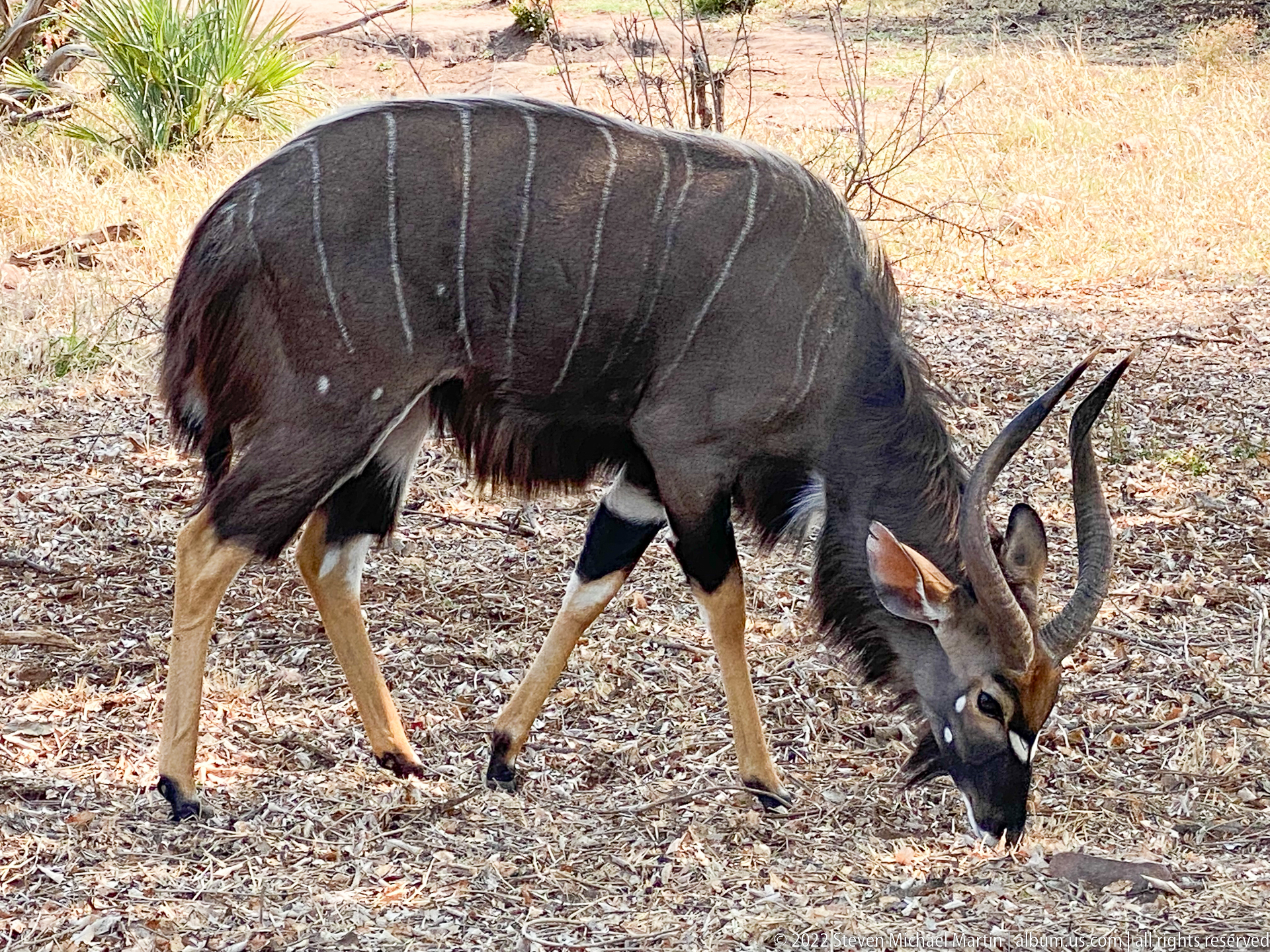
An adult male nyala grazes on dry ground in a clear side profile, showing the species’ dark shaggy coat, narrow white vertical stripes, pale facial chevrons, and long spiral horns. Tawny lower legs contrast with the charcoal body, and the heavy mane and throat fringe add to the bull’s distinctive appearance. The unobstructed view provides a strong field-guide portrait of a mature male.
Caption
An adult male nyala grazes on dry ground in a clear side profile, showing the species’ dark shaggy coat, narrow white vertical stripes, pale facial chevrons, and long spiral horns. Tawny lower legs contrast with the charcoal body, and the heavy mane and throat fringe add to the bull’s distinctive appearance. The unobstructed view provides a strong field-guide portrait of a mature male.
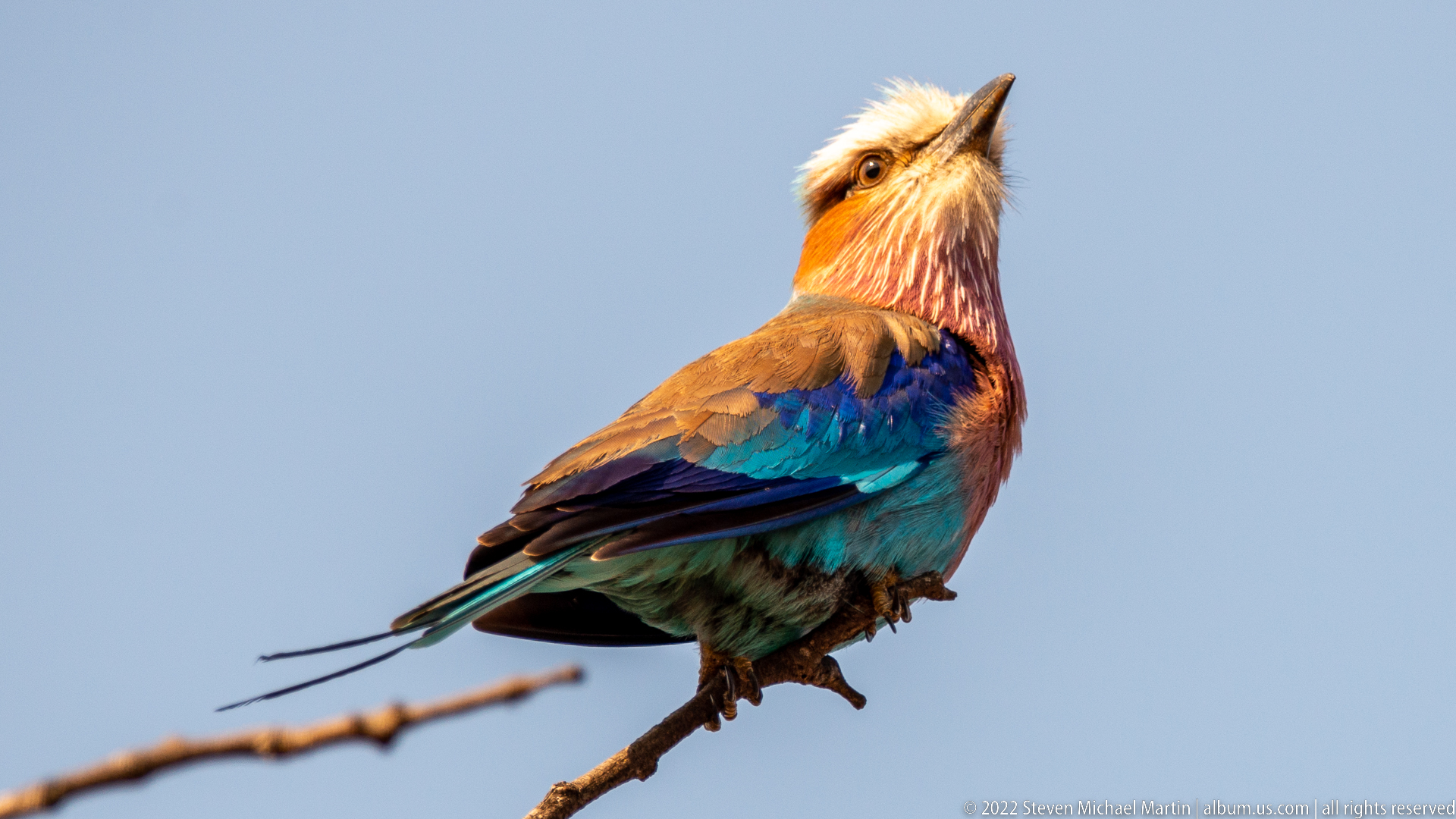
A lilac-breasted roller perches on a bare twig with its head tilted upward, displaying a brilliant turquoise belly, blue wing panels, lilac throat, and warm buff crown. The upward pose reveals the layered colors across the breast and folded wings, while the long tail streamers extend behind the perch. The uncluttered blue sky makes this a particularly clear field-guide portrait.
Caption
A lilac-breasted roller perches on a bare twig with its head tilted upward, displaying a brilliant turquoise belly, blue wing panels, lilac throat, and warm buff crown. The upward pose reveals the layered colors across the breast and folded wings, while the long tail streamers extend behind the perch. The uncluttered blue sky makes this a particularly clear field-guide portrait.

A grey go-away-bird stands high in a thorny tree with its crest raised and bill open, apparently calling. Its long tail hangs well below the perch, and the soft gray-brown body is strongly silhouetted against the pale sky. The open beak and erect crest give this frame a behavioral emphasis beyond a simple perched portrait.
Caption
A grey go-away-bird stands high in a thorny tree with its crest raised and bill open, apparently calling. Its long tail hangs well below the perch, and the soft gray-brown body is strongly silhouetted against the pale sky. The open beak and erect crest give this frame a behavioral emphasis beyond a simple perched portrait.
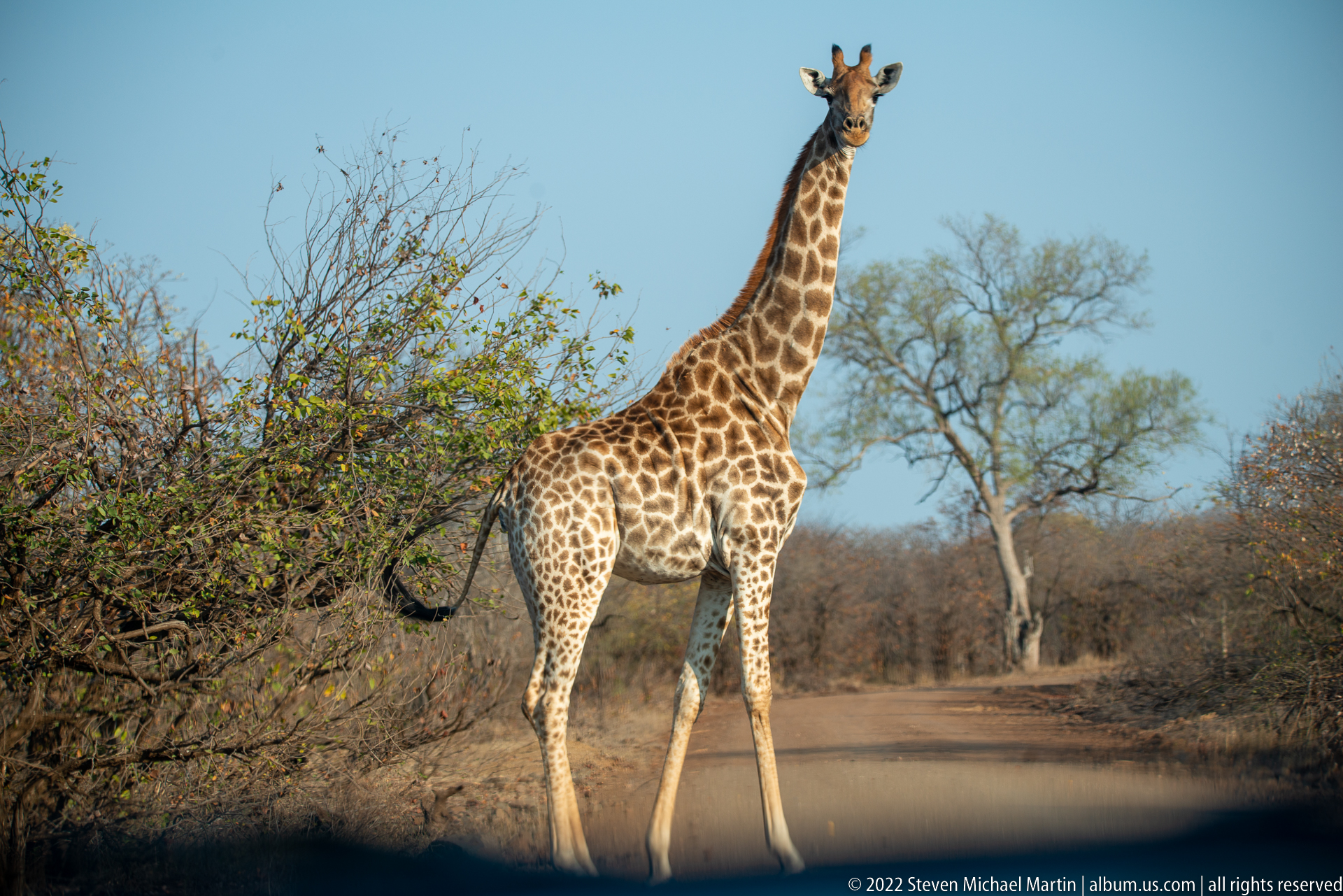
A giraffe stands squarely on a dirt safari road, facing the camera while dry woodland recedes behind it. The frontal view emphasizes the animal’s extraordinary height, long straight legs, ossicones, and irregular brown-and-cream coat pattern. Open road space around the giraffe provides a clear sense of scale and turns the encounter into a distinctive roadside portrait.
Caption
A giraffe stands squarely on a dirt safari road, facing the camera while dry woodland recedes behind it. The frontal view emphasizes the animal’s extraordinary height, long straight legs, ossicones, and irregular brown-and-cream coat pattern. Open road space around the giraffe provides a clear sense of scale and turns the encounter into a distinctive roadside portrait.
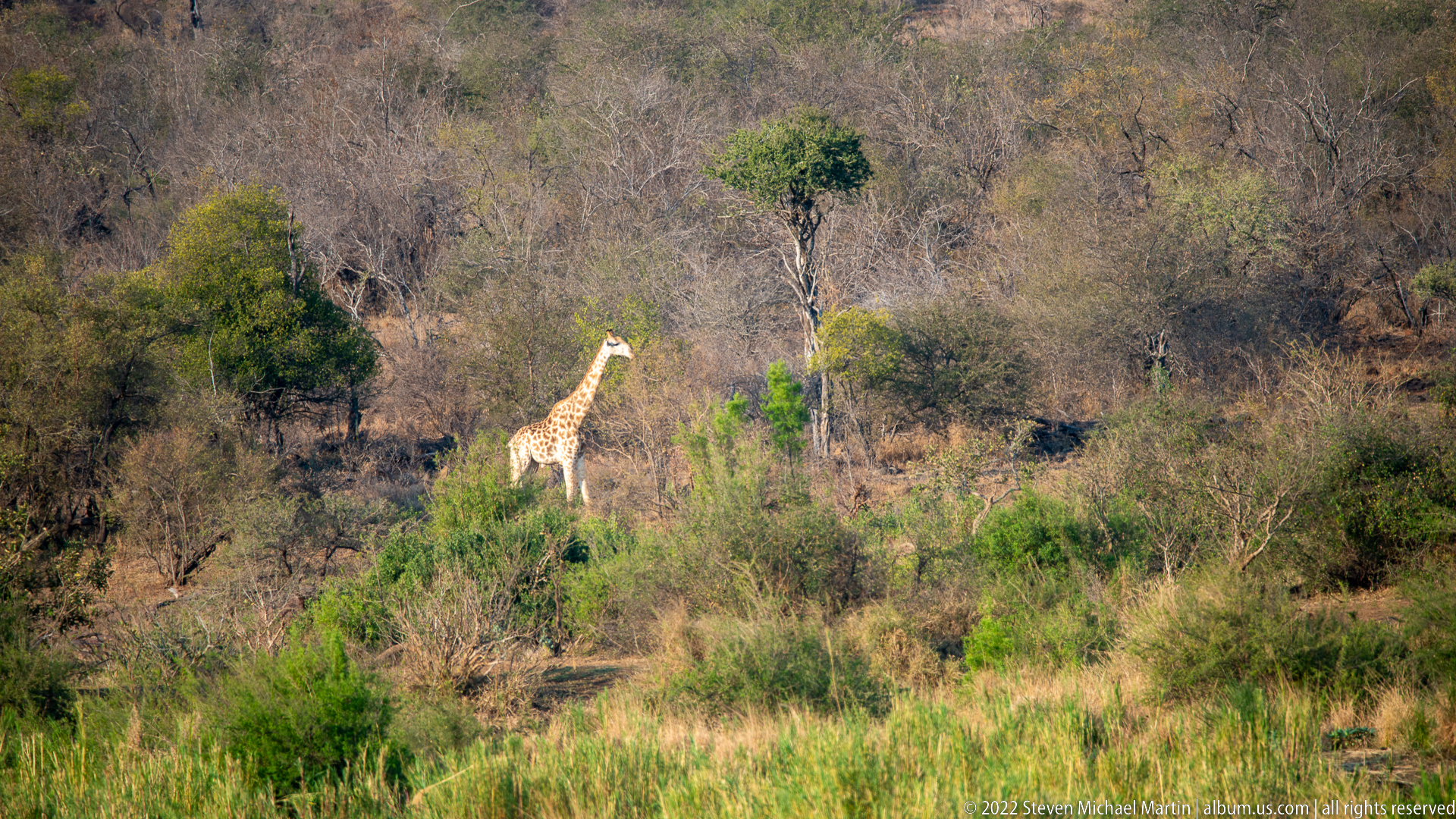
A giraffe stands partly enclosed by mixed shrubs and trees on a sloping riverine margin, its pale patterned neck rising above the surrounding foliage. The animal is relatively small in the frame, so the photograph reads primarily as habitat context: green reeds in the foreground transition into dry scrub and woodland behind. The elevated neck makes the giraffe visible even within dense cover.
Caption
A giraffe stands partly enclosed by mixed shrubs and trees on a sloping riverine margin, its pale patterned neck rising above the surrounding foliage. The animal is relatively small in the frame, so the photograph reads primarily as habitat context: green reeds in the foreground transition into dry scrub and woodland behind. The elevated neck makes the giraffe visible even within dense cover.

A monumental baobab dominates the dry woodland, its swollen gray trunk dividing into massive limbs beneath a broad, nearly leafless crown. Lower trees with rusty seasonal foliage surround the trunk, accentuating the baobab’s scale and sculptural branching pattern. The full environmental view records the tree as a landmark of the savanna rather than isolating botanical details.
Caption
A monumental baobab dominates the dry woodland, its swollen gray trunk dividing into massive limbs beneath a broad, nearly leafless crown. Lower trees with rusty seasonal foliage surround the trunk, accentuating the baobab’s scale and sculptural branching pattern. The full environmental view records the tree as a landmark of the savanna rather than isolating botanical details.
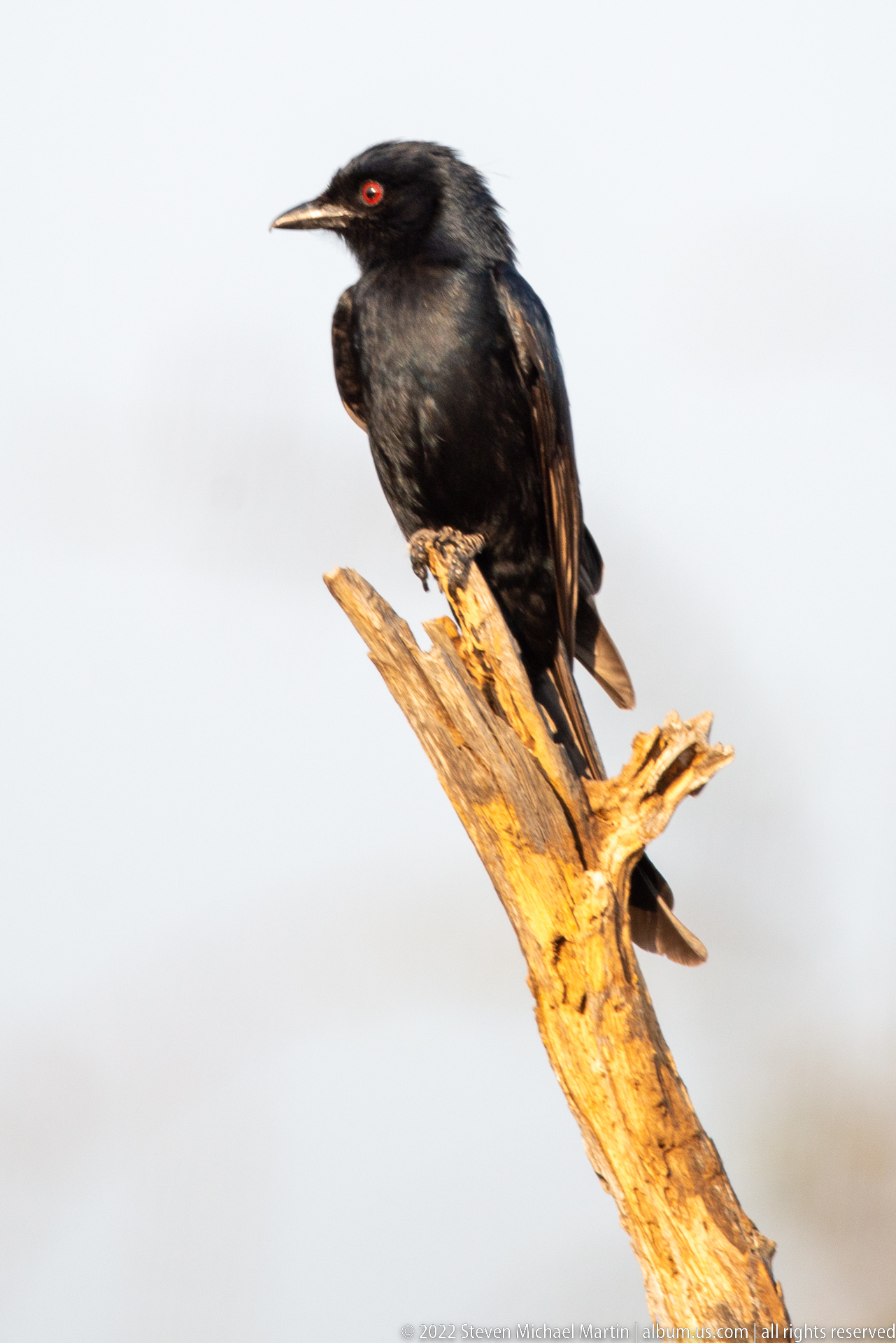
A fork-tailed drongo perches on the tip of a broken branch against a pale, softly blurred background. Glossy black plumage, a vivid red eye, and a stout dark bill are sharply resolved, while the tail drops behind the perch. The isolated composition provides a cleaner identification portrait than the branch-obscured drongo photographed moments earlier.
Caption
A fork-tailed drongo perches on the tip of a broken branch against a pale, softly blurred background. Glossy black plumage, a vivid red eye, and a stout dark bill are sharply resolved, while the tail drops behind the perch. The isolated composition provides a cleaner identification portrait than the branch-obscured drongo photographed moments earlier.

A wide southern-sky view isolates thousands of stars above a low dark horizon, with a bright diffuse cloudlike patch suspended near the center. The landscape is reduced to a narrow silhouette so the stellar field dominates the frame. The luminous patch is consistent with one of the Magellanic Clouds, though the proof sheet alone does not establish which one with complete certainty.
Caption
A wide southern-sky view isolates thousands of stars above a low dark horizon, with a bright diffuse cloudlike patch suspended near the center. The landscape is reduced to a narrow silhouette so the stellar field dominates the frame. The luminous patch is consistent with one of the Magellanic Clouds, though the proof sheet alone does not establish which one with complete certainty.
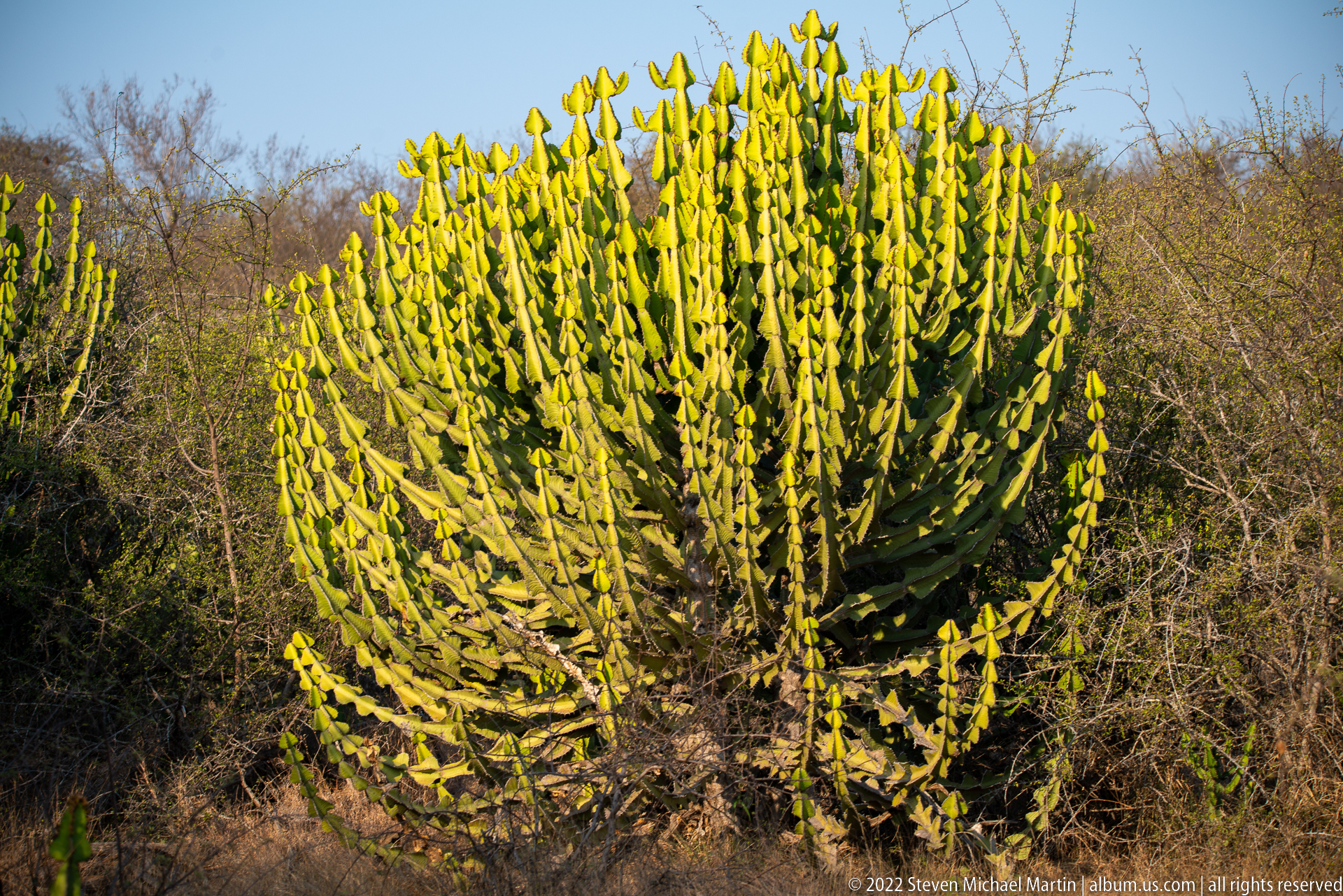
A large candelabra-form euphorbia grows in open dry bush, its many upright succulent branches forming a dense rounded crown from a woody base. Strong sunlight picks out the ribbed green stems against the muted brown woodland behind. The plant’s architectural branching is distinctive, though the proof-sheet view does not provide enough botanical detail for a secure species-level determination.
Caption
A large candelabra-form euphorbia grows in open dry bush, its many upright succulent branches forming a dense rounded crown from a woody base. Strong sunlight picks out the ribbed green stems against the muted brown woodland behind. The plant’s architectural branching is distinctive, though the proof-sheet view does not provide enough botanical detail for a secure species-level determination.
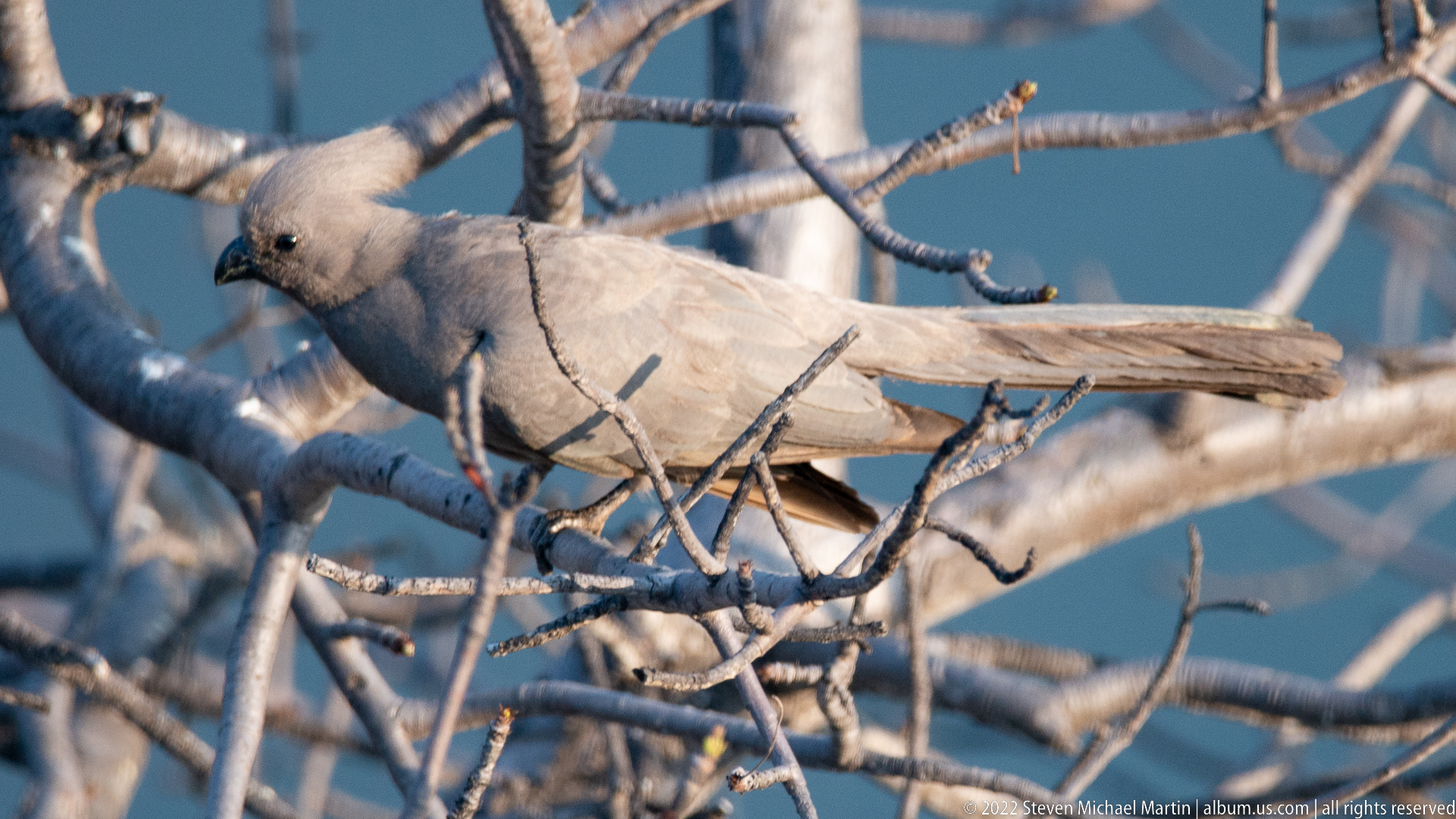
A grey go-away-bird balances on a branch amid a dense lattice of pale twigs, its body stretched horizontally and long tail extending behind. The subdued gray plumage, dark bill, and short raised crest blend closely with the woody background. The low side profile emphasizes the bird’s elongated shape and branch-hopping posture rather than the calling behavior seen in earlier views.
Caption
A grey go-away-bird balances on a branch amid a dense lattice of pale twigs, its body stretched horizontally and long tail extending behind. The subdued gray plumage, dark bill, and short raised crest blend closely with the woody background. The low side profile emphasizes the bird’s elongated shape and branch-hopping posture rather than the calling behavior seen in earlier views.
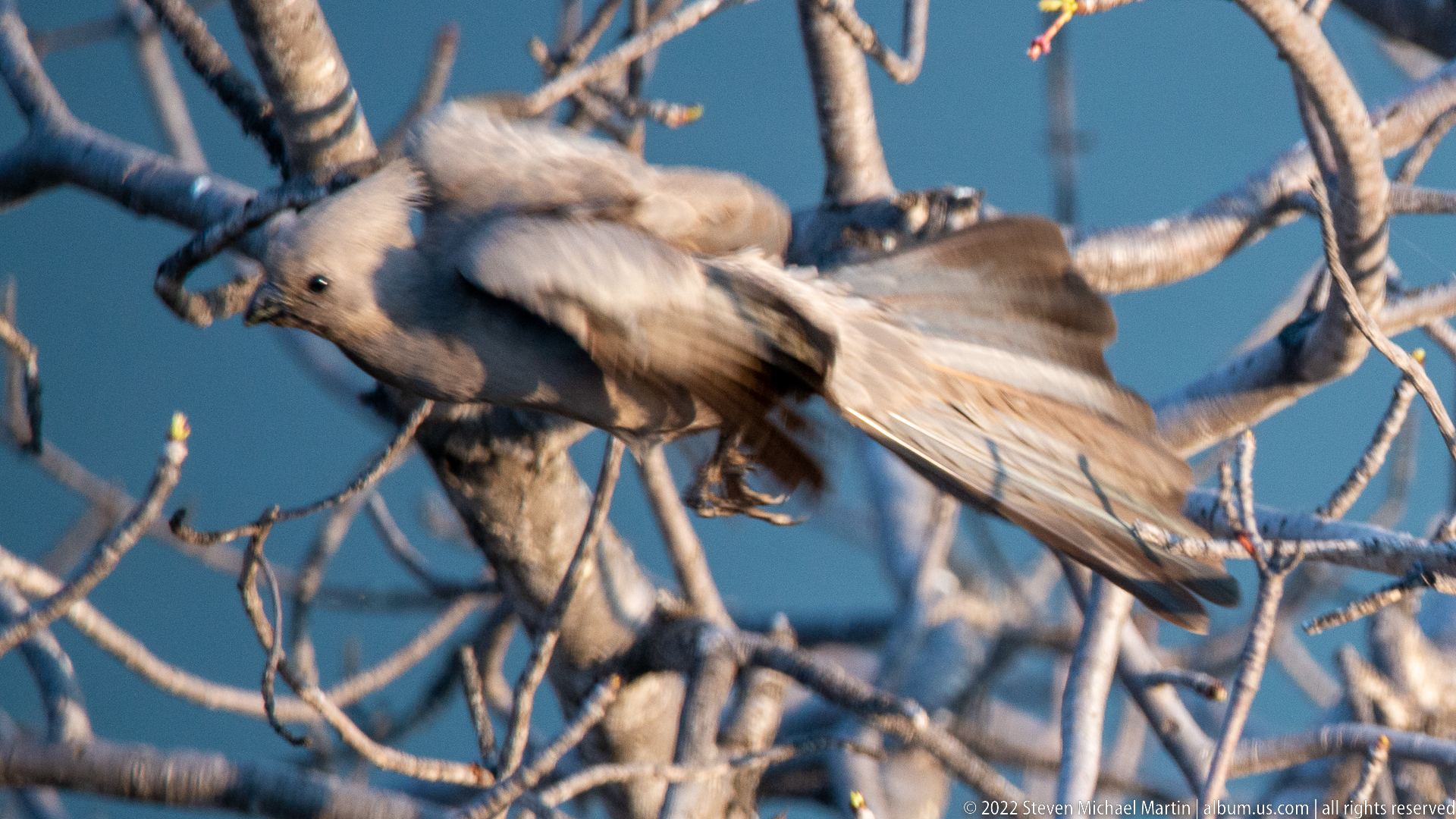
A grey go-away-bird launches through a tangle of branches, wings lifted and body pitched forward as it leaves its perch. Motion blur softens the wing feathers and trailing tail, giving the frame an energetic contrast with the static perched portraits. The raised crest, gray body, and long tail remain identifiable despite the rapid movement.
Caption
A grey go-away-bird launches through a tangle of branches, wings lifted and body pitched forward as it leaves its perch. Motion blur softens the wing feathers and trailing tail, giving the frame an energetic contrast with the static perched portraits. The raised crest, gray body, and long tail remain identifiable despite the rapid movement.

A Nile crocodile swims through calm water close to a rocky bank, with only the head, eyes, armored back, and upper tail breaking the surface. A narrow V-shaped wake trails behind the reptile, recording steady forward motion across the channel. The partly submerged viewpoint contrasts strongly with the earlier basking crocodiles photographed fully exposed on land.
Caption
A Nile crocodile swims through calm water close to a rocky bank, with only the head, eyes, armored back, and upper tail breaking the surface. A narrow V-shaped wake trails behind the reptile, recording steady forward motion across the channel. The partly submerged viewpoint contrasts strongly with the earlier basking crocodiles photographed fully exposed on land.
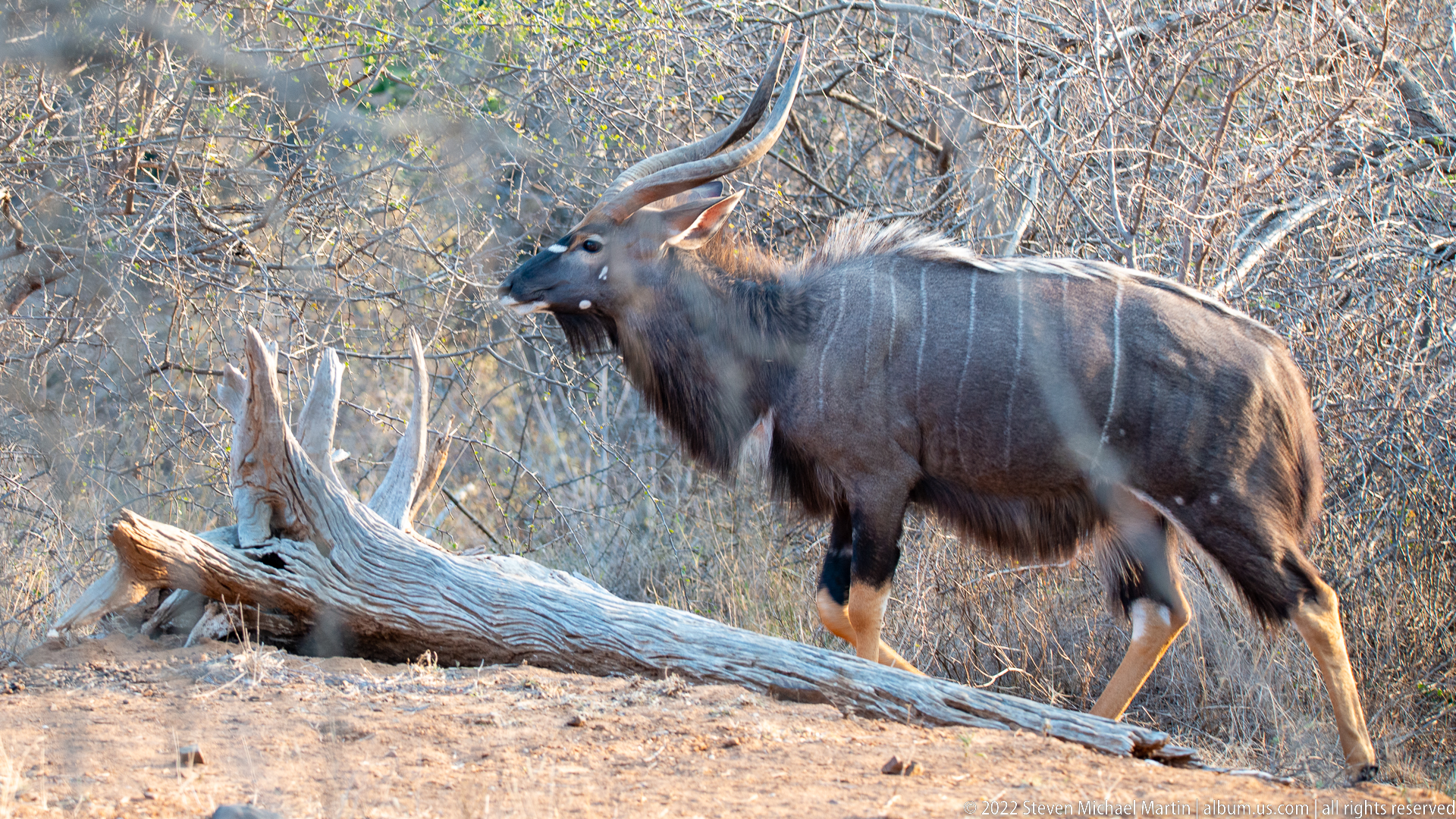
An adult male nyala stands beside a bleached fallen tree in dense dry scrub, his dark shaggy coat crossed by faint white vertical stripes. Long spiral horns rise above the head, while rusty lower legs and a pale facial chevron add contrast to the charcoal body. The woodland setting and full side profile make this a particularly strong field-guide view of a mature bull.
Caption
An adult male nyala stands beside a bleached fallen tree in dense dry scrub, his dark shaggy coat crossed by faint white vertical stripes. Long spiral horns rise above the head, while rusty lower legs and a pale facial chevron add contrast to the charcoal body. The woodland setting and full side profile make this a particularly strong field-guide view of a mature bull.

A low stone route marker stands beside a dry park road, carrying painted directional panels for several Kruger destinations. The masonry base is built from irregular reddish stone, while green and brown signboards with arrows are set into the front face. Surrounded by leafless bushveld, the marker records the practical road-navigation infrastructure used within the national park.
Caption
A low stone route marker stands beside a dry park road, carrying painted directional panels for several Kruger destinations. The masonry base is built from irregular reddish stone, while green and brown signboards with arrows are set into the front face. Surrounded by leafless bushveld, the marker records the practical road-navigation infrastructure used within the national park.
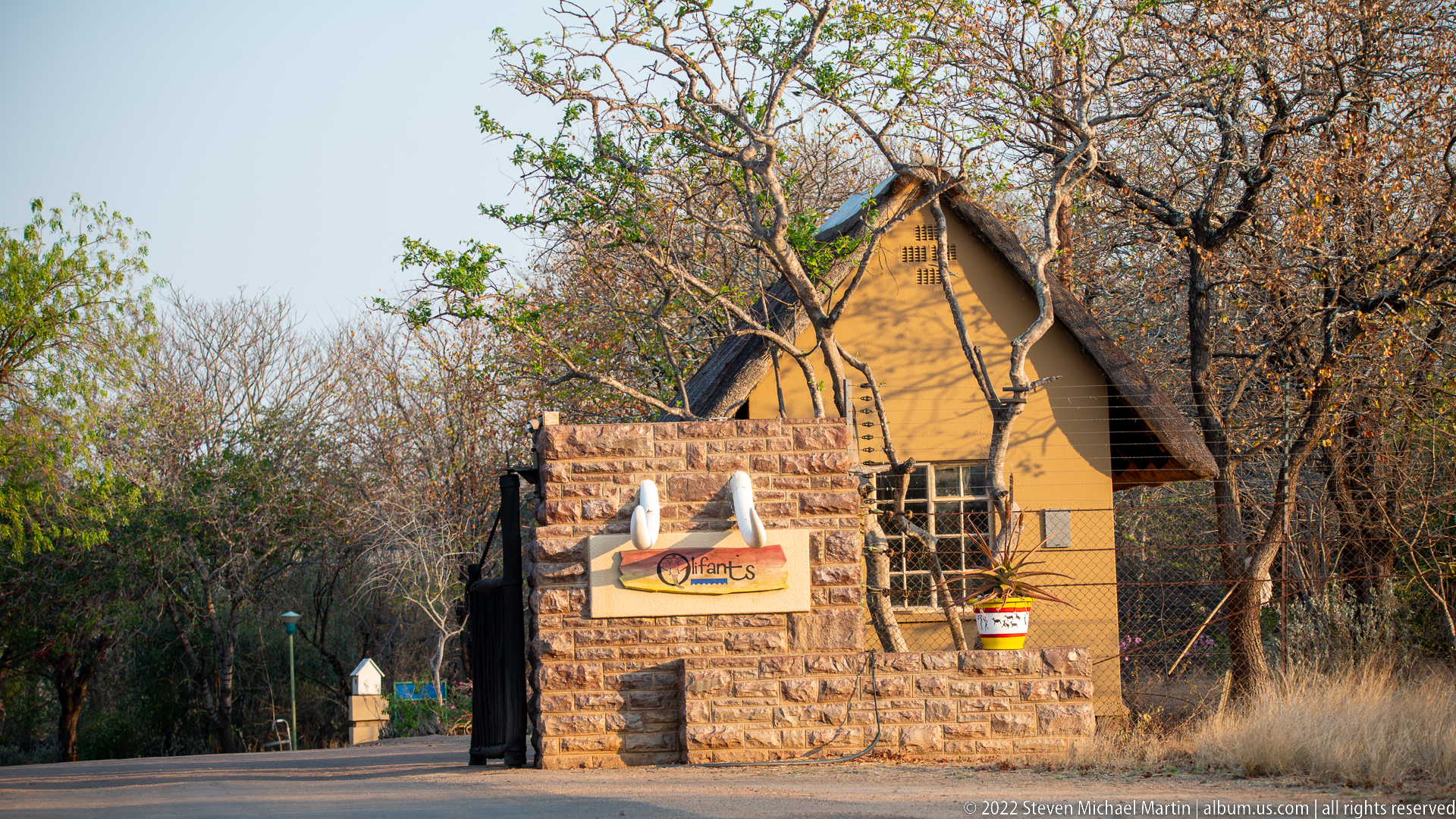
A stone entrance feature marked “Olifants” stands beside the road in front of a small thatched-roof building enclosed by fencing. Dry woodland surrounds the structure, and the warm ochre walls echo the stonework of the sign. The clearly visible camp name supports identification as the Olifants Rest Camp entrance area within Kruger National Park.
Caption
A stone entrance feature marked “Olifants” stands beside the road in front of a small thatched-roof building enclosed by fencing. Dry woodland surrounds the structure, and the warm ochre walls echo the stonework of the sign. The clearly visible camp name supports identification as the Olifants Rest Camp entrance area within Kruger National Park.

A luminous star field fills nearly the entire frame, fading toward a warm-toned horizon above a low black landscape silhouette. A diffuse, irregular celestial glow sits high in the sky, surrounded by countless pinpoint stars. The composition emphasizes the clarity and darkness of the southern African night sky rather than terrestrial detail.
Caption
A luminous star field fills nearly the entire frame, fading toward a warm-toned horizon above a low black landscape silhouette. A diffuse, irregular celestial glow sits high in the sky, surrounded by countless pinpoint stars. The composition emphasizes the clarity and darkness of the southern African night sky rather than terrestrial detail.
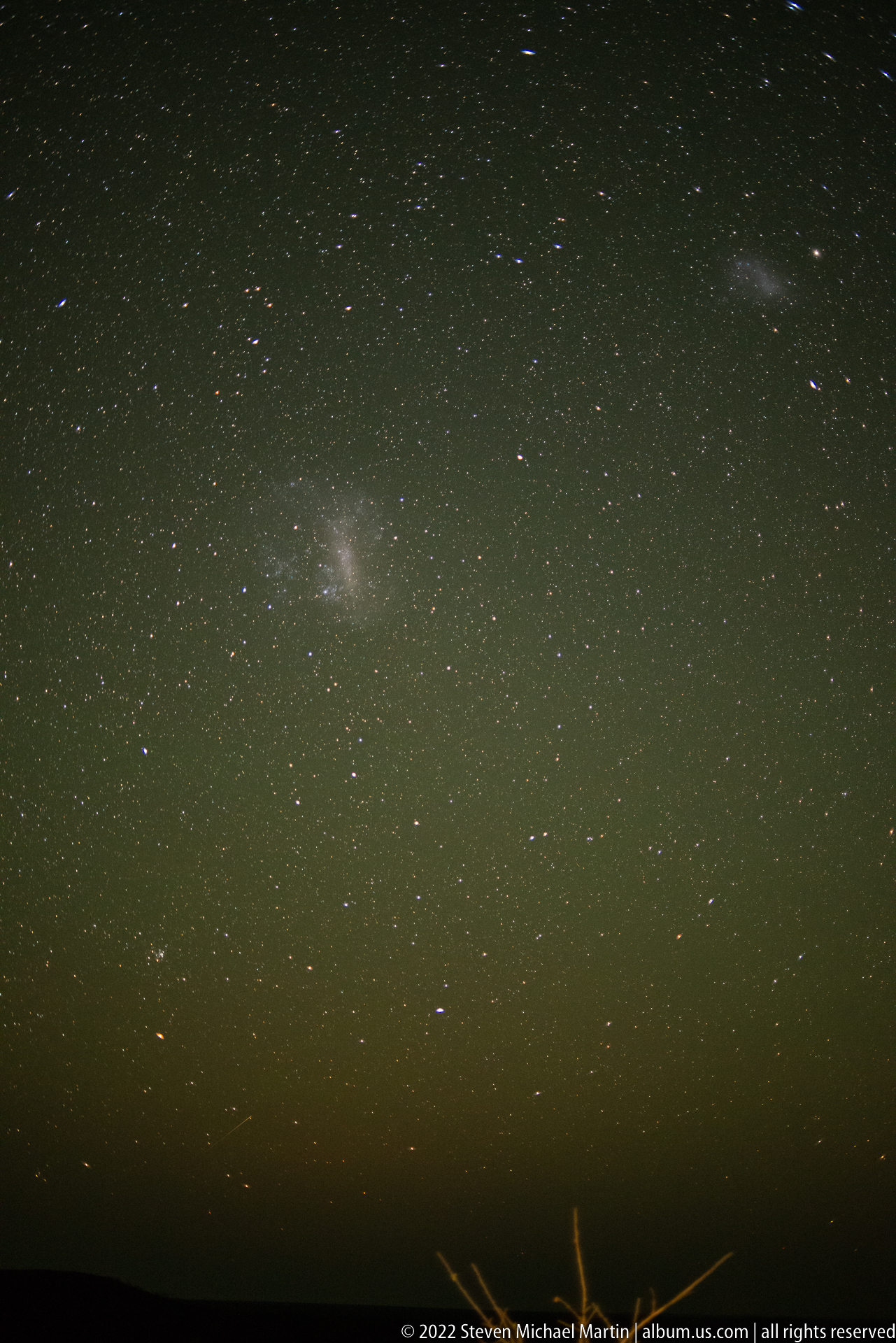
A dark, densely starred sky contains two separate diffuse luminous patches at different positions in the frame, with only a thin landscape silhouette along the bottom edge. Their paired appearance is consistent with the Large and Small Magellanic Clouds, familiar features of southern skies. Because the proof sheet offers no orientation data, the pair is identified conservatively at medium confidence.
Caption
A dark, densely starred sky contains two separate diffuse luminous patches at different positions in the frame, with only a thin landscape silhouette along the bottom edge. Their paired appearance is consistent with the Large and Small Magellanic Clouds, familiar features of southern skies. Because the proof sheet offers no orientation data, the pair is identified conservatively at medium confidence.
Kruger National Park – Olifants River
The Olifants River region offers one of the most dramatic viewpoints in Kruger National Park, where elevated landscapes overlook a winding river that sustains wildlife year-round. In this drier northern environment, water becomes the central organizing force of the ecosystem, drawing elephants, hippos, crocodiles, antelope, and birds to its banks.
Compared with the open plains of Satara or the biodiversity density near Skukuza, Olifants presents a quieter experience defined by scenic overlooks, baobab-dotted terrain, and the rhythm of life along a permanent river channel.
Portfolio Highlights
- Elephants gathering at river crossings and feeding along the banks
- Hippo pods resting in shallow pools surrounded by green vegetation
- Nile crocodiles basking on sandy edges of the river
- Giraffe and antelope moving through dry woodland habitat
- Baobab trees defining the character of northern Kruger landscapes
- Colorful birdlife including rollers, hornbills, and fish eagles
- Clear night skies revealing southern hemisphere stars
The Olifants River Landscape
The Olifants River cuts through dry savanna, forming a vital corridor for wildlife movement. Elevated viewpoints reveal wide bends in the river and layered vegetation zones that support both grazers and predators.
Baobab trees, rocky outcrops, and open woodland distinguish this region from southern Kruger. The combination of water and dry terrain creates strong visual contrast and supports remarkable biodiversity.
Wildlife Encounters
Elephants frequently gather along the riverbanks, often accompanied by calves navigating uneven terrain. Hippos occupy deeper channels, surfacing periodically before disappearing beneath calm water. Crocodiles remain motionless along muddy edges, blending into the landscape.
Antelope species such as kudu, waterbuck, and steenbok browse among scattered trees, while giraffes move gracefully across open hillsides. Occasional lion sightings add to the diversity of wildlife present in this ecosystem.
Birdlife Along the River
The Olifants River attracts an impressive variety of birdlife. Brightly colored lilac-breasted rollers perch on exposed branches, while fish eagles survey the water from high vantage points. Hornbills and starlings add movement and color contrast to the muted tones of dry vegetation.
Riverbanks and shallow pools create ideal habitat for both resident and migratory species, making the area rewarding for patient observation.
Night Skies Over Olifants
With minimal artificial light, the Olifants region offers excellent conditions for night photography. Clear skies reveal dense star fields and subtle detail within the Milky Way. The stillness of the landscape enhances the sense of remoteness and completes the experience of this distinctive part of Kruger National Park.
Photography Approach
- Elevated viewpoints allow wide landscape compositions
- Riverbanks provide layered scenes with wildlife and reflections
- Long lenses isolate subjects across broad distances
- Warm light enhances texture in baobab bark and dry grasses
- Patience often reveals subtle animal movement near water
- Night photography benefits from stable support and clear skies
Field Guide
The Olifants River region demonstrates how water shapes wildlife distribution across Kruger National Park. Permanent rivers create gathering points that support large mammals, birds, and reptiles throughout the year.
Elevated terrain provides perspective on the relationship between landscape and wildlife movement. Observing activity along the river offers insight into how animals adapt to seasonal conditions in the African savanna.
- Permanent river ecosystems attract diverse wildlife
- Baobab trees indicate transition into northern Kruger habitat
- Dry woodland environments support browsing antelope
- Bird diversity increases near water sources
- Night skies provide additional photographic opportunities
Park Guide:

A two-page bird checklist presents a broad range of Kruger species, including raptors, owls, gamebirds, waterbirds, storks, herons, and other conspicuous groups. Labeled illustrations and check boxes support field identification and allow visitors to record species observed during a park visit.
Caption
A two-page bird checklist presents a broad range of Kruger species, including raptors, owls, gamebirds, waterbirds, storks, herons, and other conspicuous groups. Labeled illustrations and check boxes support field identification and allow visitors to record species observed during a park visit.

A 'Hot Spots in the Park' guide page organizes recommended wildlife-viewing areas into seasonal categories, pairing short location notes with photographs of waterholes, rivers, large mammals, and birds. The layout emphasizes how changing rainfall and water availability influence where visitors may encounter wildlife across Kruger.
Caption
A 'Hot Spots in the Park' guide page organizes recommended wildlife-viewing areas into seasonal categories, pairing short location notes with photographs of waterholes, rivers, large mammals, and birds. The layout emphasizes how changing rainfall and water availability influence where visitors may encounter wildlife across Kruger.
The cover of an English-language 'Kruger Park Map & Guide,' 3rd Edition, combines photographs of prominent park wildlife including buffalo, leopard, rhinoceros, lion, and elephant. Its subtitle promotes guidance on where to spot the 'Big 5,' while additional cover text advertises illustrated mammals, reptiles, checklists, and more than 200 birds.
Caption
The cover of an English-language 'Kruger Park Map & Guide,' 3rd Edition, combines photographs of prominent park wildlife including buffalo, leopard, rhinoceros, lion, and elephant. Its subtitle promotes guidance on where to spot the 'Big 5,' while additional cover text advertises illustrated mammals, reptiles, checklists, and more than 200 birds.

A densely illustrated Kruger National Park visitor-information page combines gate and camp times, speed-limit reminders, a checklist of visitor rules, park contact numbers, shop and restaurant hours, and malaria guidance. Photographs and icons reinforce the practical information, making this a compact reference page for navigating the park responsibly and safely.
Caption
A densely illustrated Kruger National Park visitor-information page combines gate and camp times, speed-limit reminders, a checklist of visitor rules, park contact numbers, shop and restaurant hours, and malaria guidance. Photographs and icons reinforce the practical information, making this a compact reference page for navigating the park responsibly and safely.
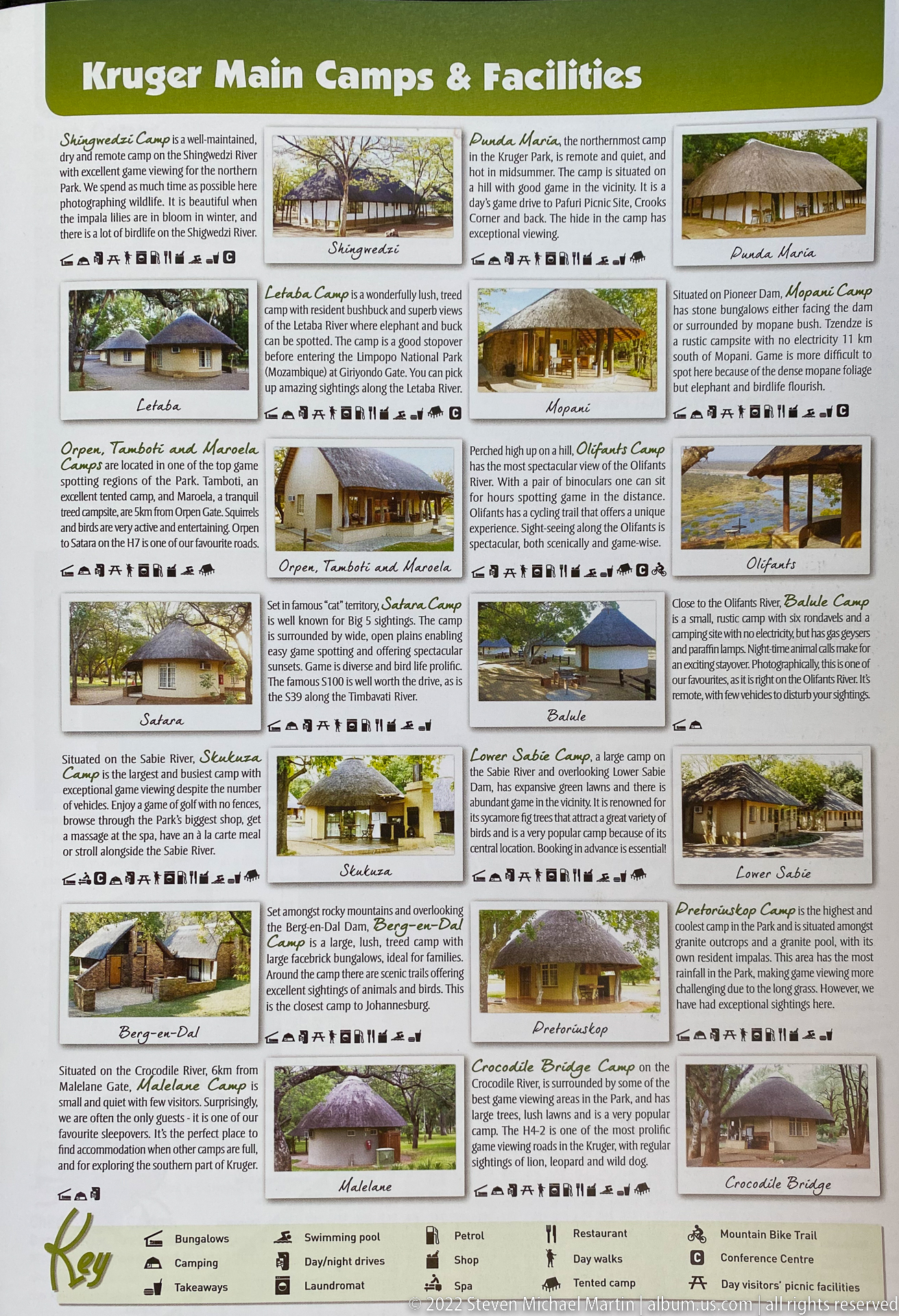
An illustrated guide page surveys Kruger National Park's main camps and visitor facilities through small photographs and short descriptive entries. Camp names are paired with images of accommodation, landscapes, and amenities, while a symbol key along the bottom summarizes services available across the park.
Caption
An illustrated guide page surveys Kruger National Park's main camps and visitor facilities through small photographs and short descriptive entries. Camp names are paired with images of accommodation, landscapes, and amenities, while a symbol key along the bottom summarizes services available across the park.

A reference page combines a short history of Kruger National Park with landmark dates, a large triangular distance-and-time chart, and illustrated natural-history details. Photographs of rhinoceros, flowers, archaeological remains, and an insect broaden the page from travel logistics into the park's cultural and ecological context.
Caption
A reference page combines a short history of Kruger National Park with landmark dates, a large triangular distance-and-time chart, and illustrated natural-history details. Photographs of rhinoceros, flowers, archaeological remains, and an insect broaden the page from travel logistics into the park's cultural and ecological context.
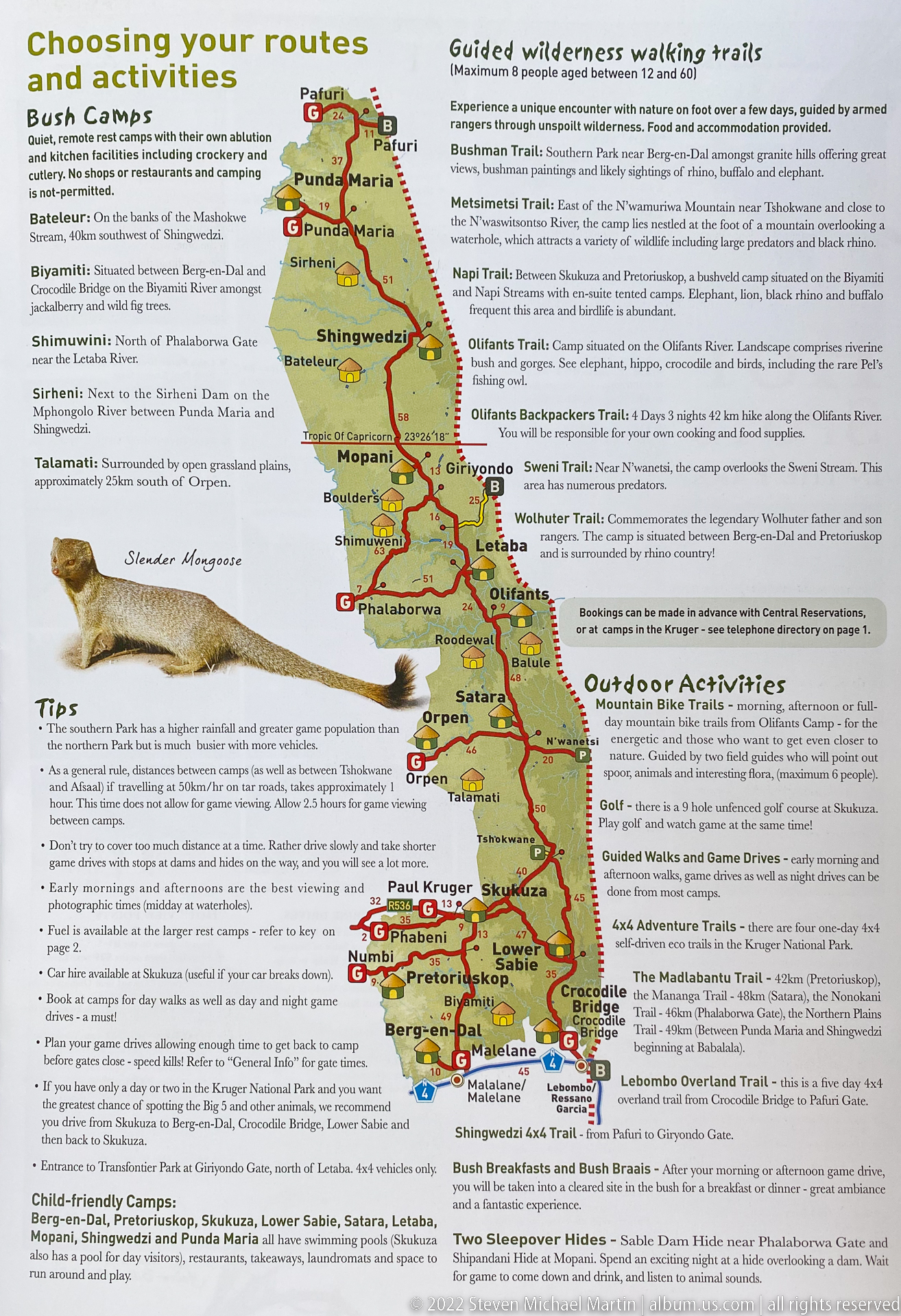
A full-height map of Kruger National Park anchors a page devoted to route planning and outdoor activities. Colored roads connect named camps from north to south, while surrounding text introduces guided wilderness walking trails, suggested drives, tips, outdoor activities, and child-friendly camp options.
Caption
A full-height map of Kruger National Park anchors a page devoted to route planning and outdoor activities. Colored roads connect named camps from north to south, while surrounding text introduces guided wilderness walking trails, suggested drives, tips, outdoor activities, and child-friendly camp options.
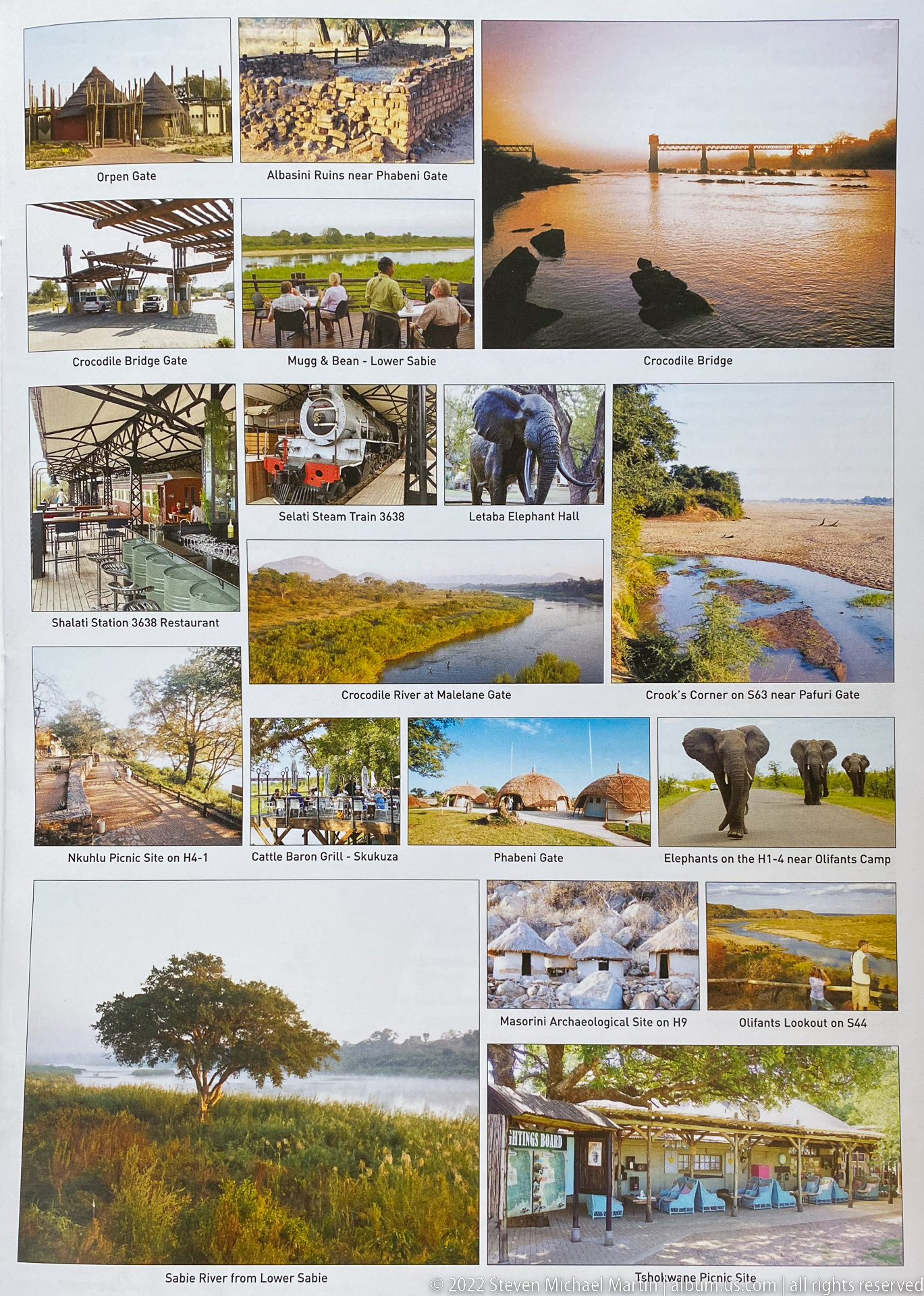
A montage page presents Kruger National Park through labeled photographs of camp facilities, gates, river crossings, landscapes, and visitor sites. The varied scenes move from architecture and bridges to broad river views and woodland, providing a visual index to the park's built and natural environments.
Caption
A montage page presents Kruger National Park through labeled photographs of camp facilities, gates, river crossings, landscapes, and visitor sites. The varied scenes move from architecture and bridges to broad river views and woodland, providing a visual index to the park's built and natural environments.
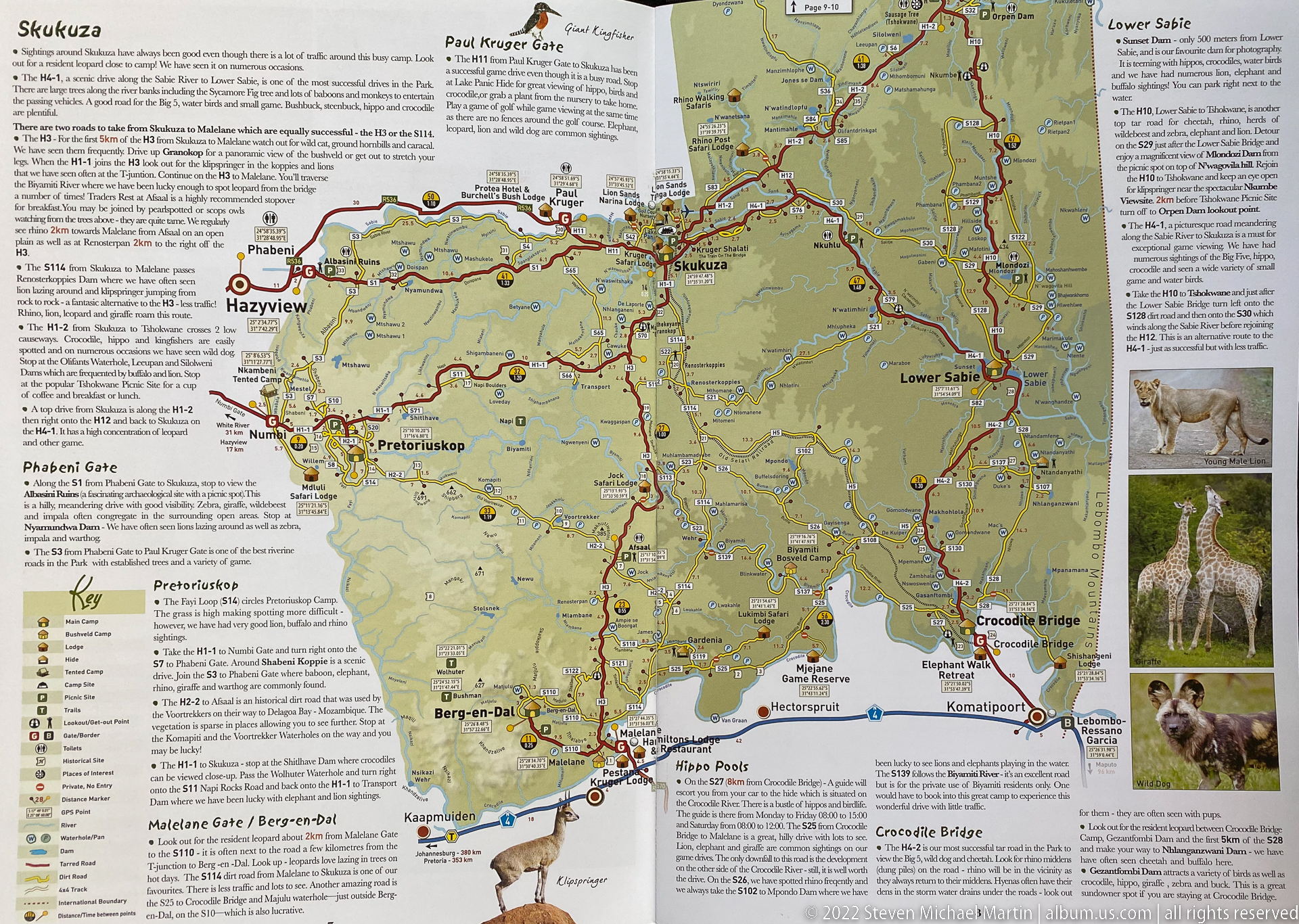
A detailed regional map covers the southern portion of Kruger National Park, with roads, rivers, camps, gates, and nearby towns plotted across the landscape. Insets and surrounding text highlight destinations and wildlife, turning the map into both a navigation aid and a compact introduction to the park's southern sector.
Caption
A detailed regional map covers the southern portion of Kruger National Park, with roads, rivers, camps, gates, and nearby towns plotted across the landscape. Insets and surrounding text highlight destinations and wildlife, turning the map into both a navigation aid and a compact introduction to the park's southern sector.
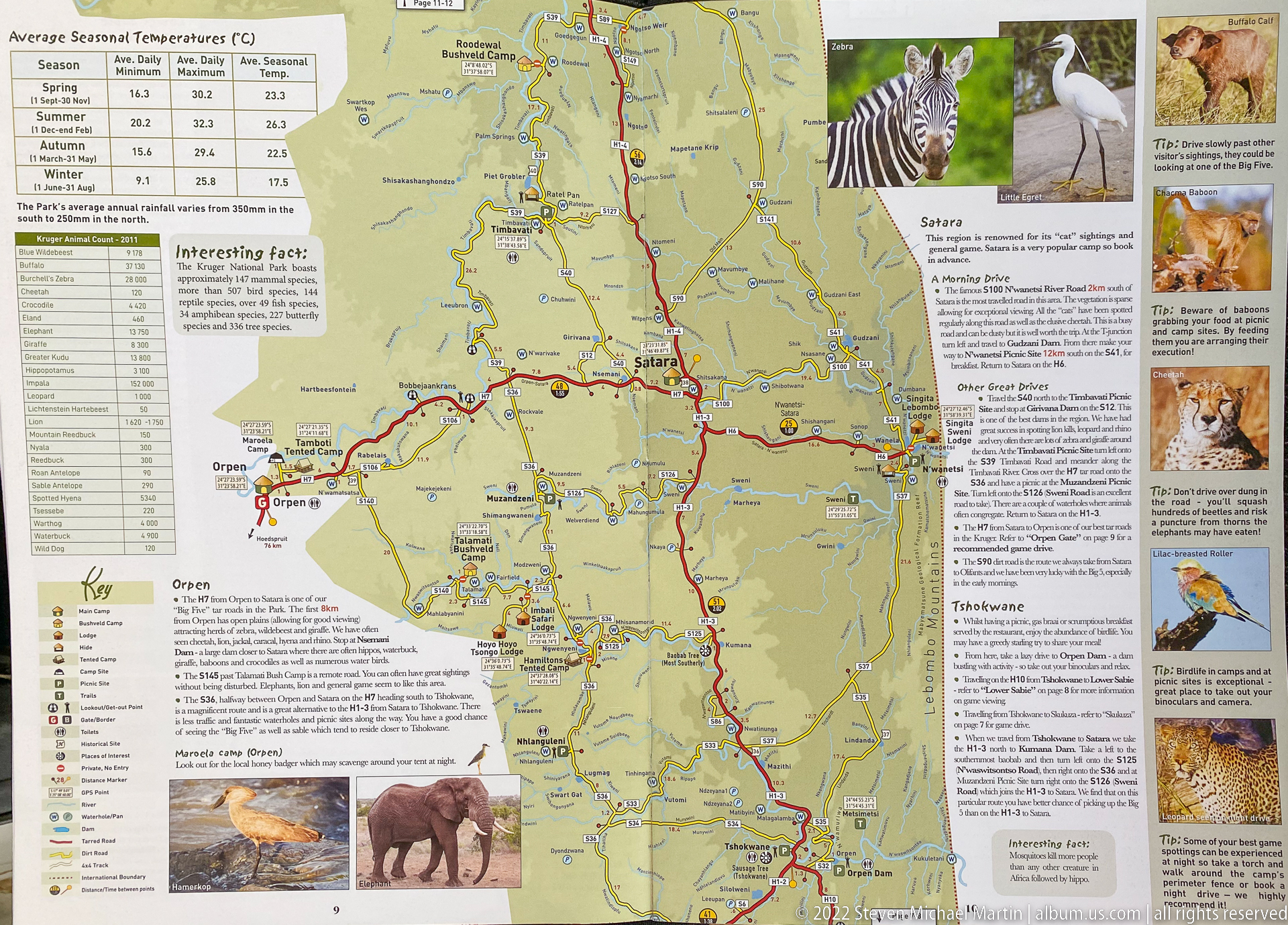
A regional map focuses on central Kruger National Park around Satara, tracing major roads, rivers, camps, and junctions through the central savanna. Wildlife photographs and route notes flank the map, linking practical navigation with species and places visitors may encounter in this part of the park.
Caption
A regional map focuses on central Kruger National Park around Satara, tracing major roads, rivers, camps, and junctions through the central savanna. Wildlife photographs and route notes flank the map, linking practical navigation with species and places visitors may encounter in this part of the park.
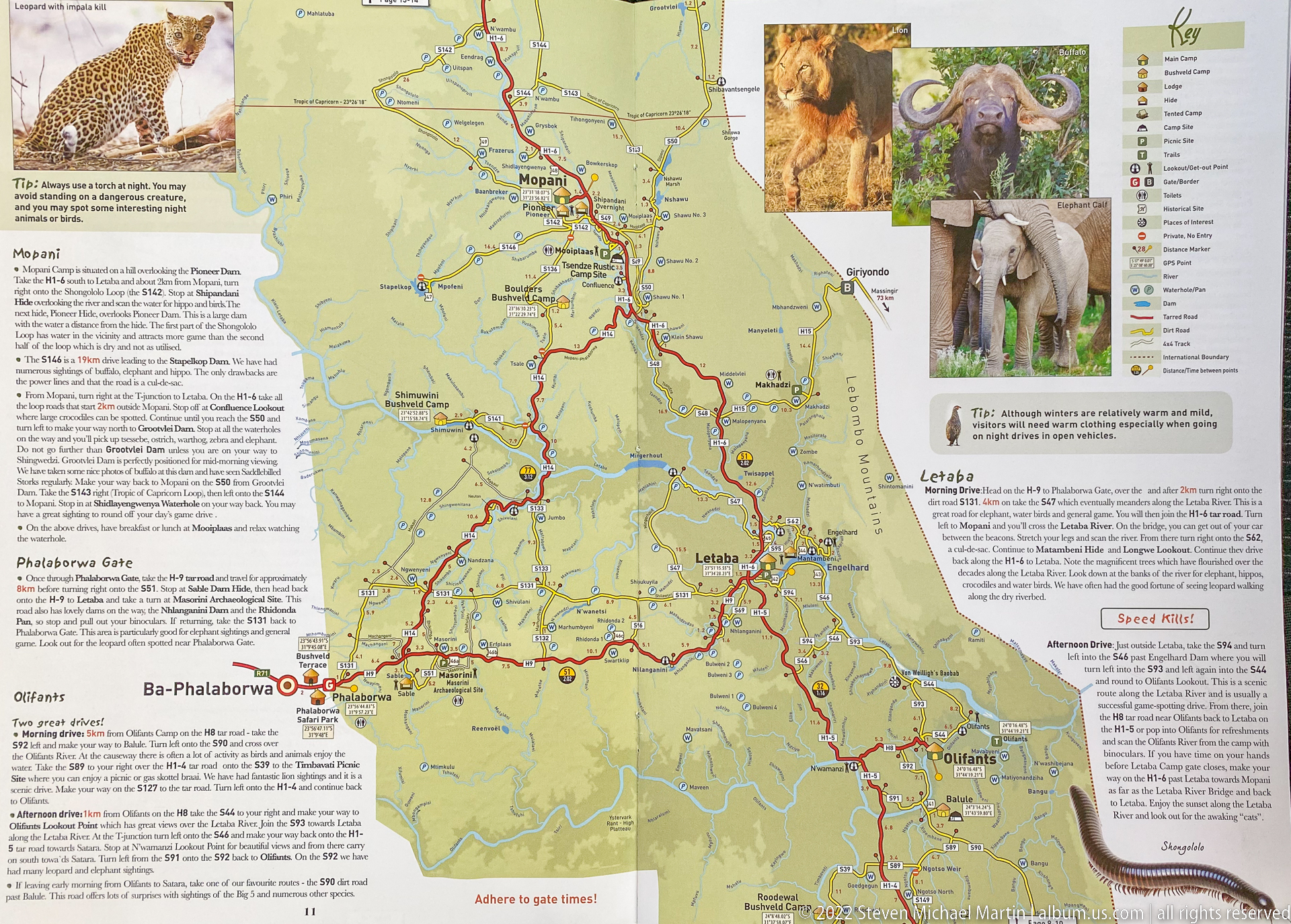
A regional map charts central-northern Kruger around Mopani, Letaba, and the Phalaborwa area, with roads and waterways linking camps and viewpoints. Photographs of large mammals and smaller wildlife accompany destination notes, combining route planning with a visual introduction to the region's fauna.
Caption
A regional map charts central-northern Kruger around Mopani, Letaba, and the Phalaborwa area, with roads and waterways linking camps and viewpoints. Photographs of large mammals and smaller wildlife accompany destination notes, combining route planning with a visual introduction to the region's fauna.
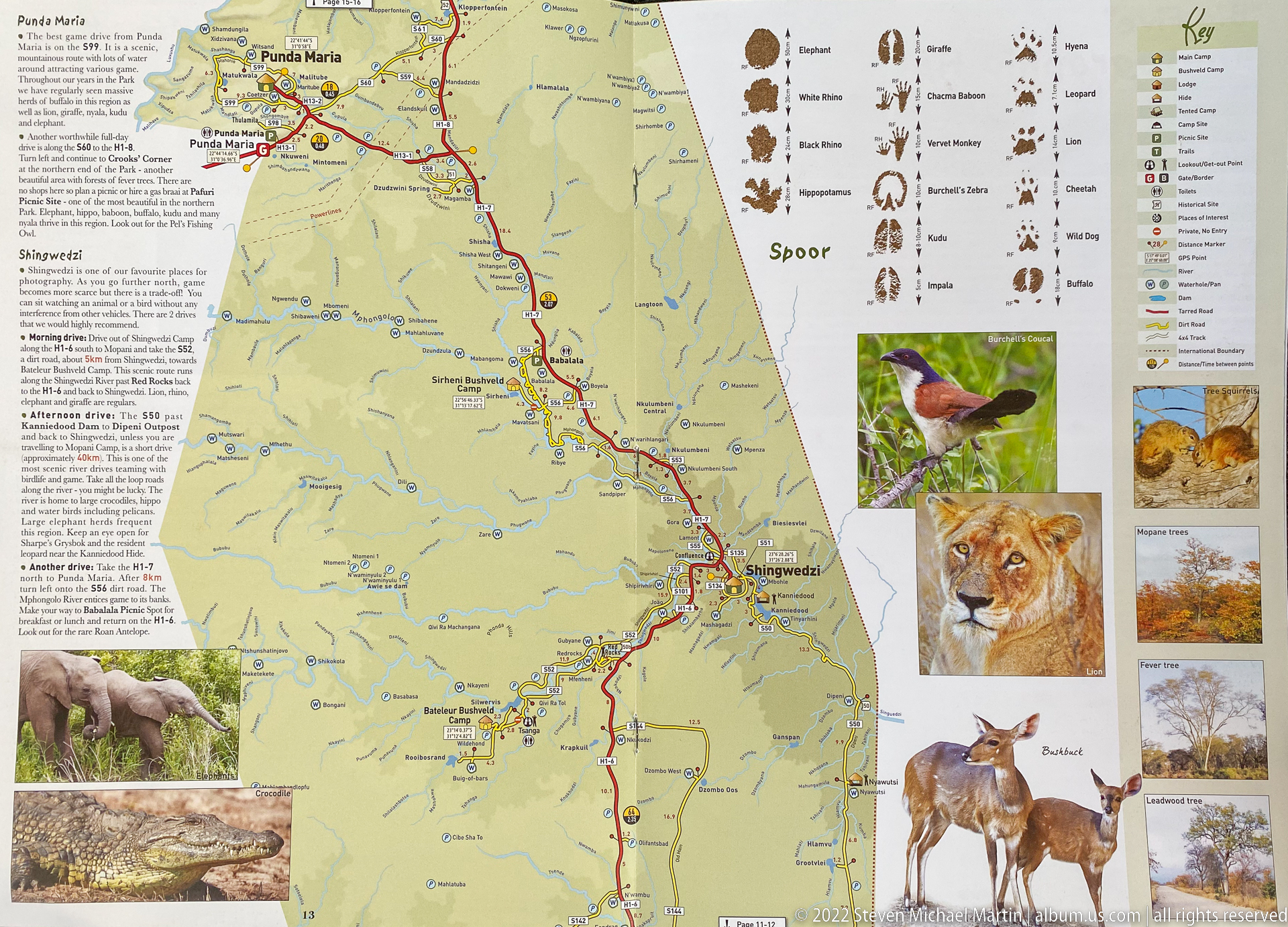
A regional map of northern Kruger is paired with a compact spoor-identification panel and wildlife illustrations. Roads and rivers run through the map while surrounding images depict mammals, birds, reptiles, and landscapes, expanding the page from route planning into field identification and natural-history observation.
Caption
A regional map of northern Kruger is paired with a compact spoor-identification panel and wildlife illustrations. Roads and rivers run through the map while surrounding images depict mammals, birds, reptiles, and landscapes, expanding the page from route planning into field identification and natural-history observation.
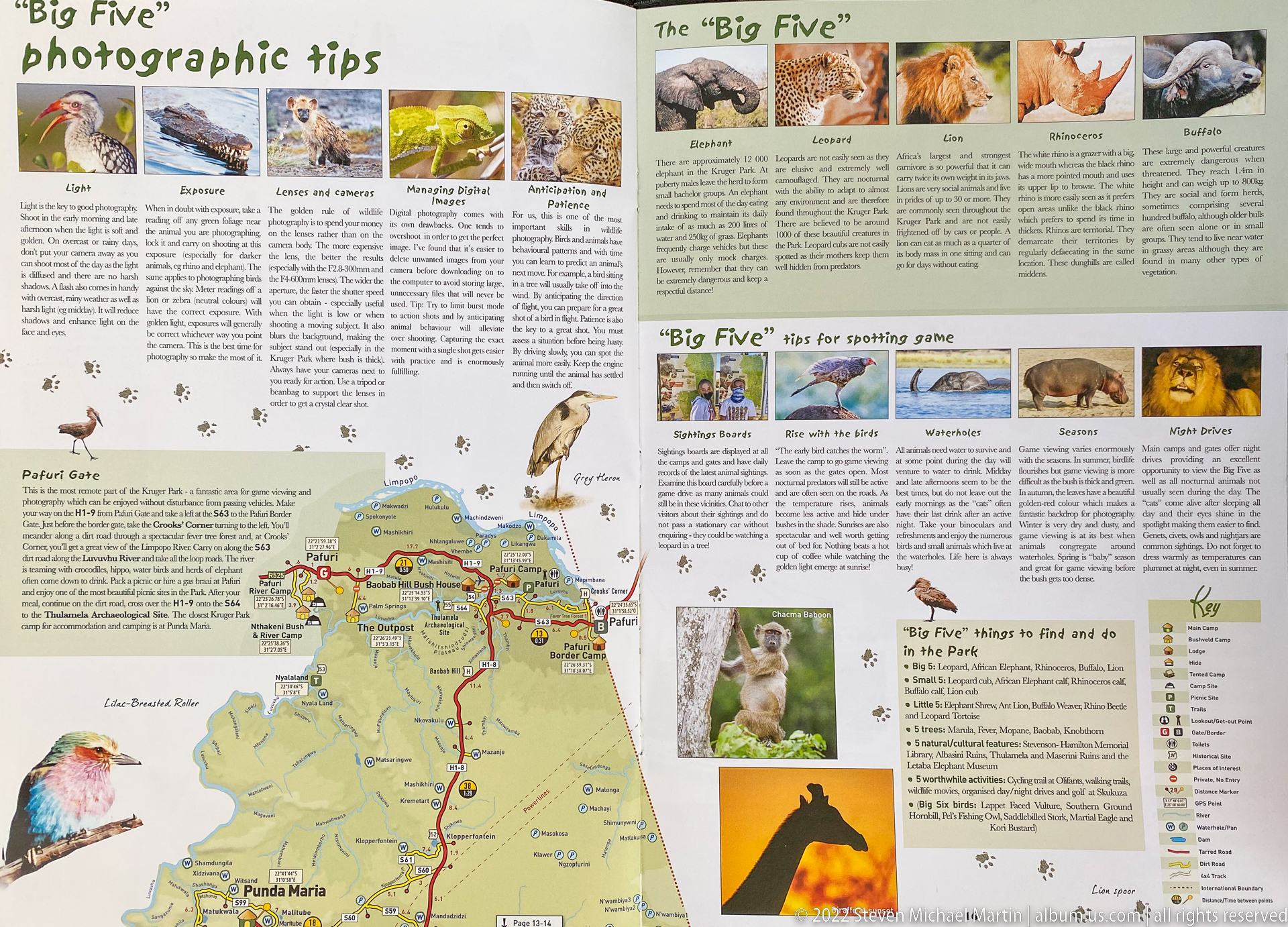
A 'Big Five' guide page introduces lion, elephant, leopard, rhinoceros, and buffalo through short species profiles, photographs, and practical spotting tips. A park map and additional bird and mammal illustrations broaden the field-guide function, helping visitors connect species identification with likely viewing areas.
Caption
A 'Big Five' guide page introduces lion, elephant, leopard, rhinoceros, and buffalo through short species profiles, photographs, and practical spotting tips. A park map and additional bird and mammal illustrations broaden the field-guide function, helping visitors connect species identification with likely viewing areas.
An advertisement for Tinkers Maps & Guides arranges numerous regional map and guidebook covers around a map of southern Africa. Publications for national parks, countries, cities, and tourist regions surround the central map, presenting the wider travel-reference series to which the Kruger guide belongs.
Caption
An advertisement for Tinkers Maps & Guides arranges numerous regional map and guidebook covers around a map of southern Africa. Publications for national parks, countries, cities, and tourist regions surround the central map, presenting the wider travel-reference series to which the Kruger guide belongs.

A color-coded ecoregions map divides Kruger National Park into broad ecological zones, with descriptive text blocks naming vegetation and landscape types along both sides. The diagram emphasizes the park's north-south environmental variation and provides ecological context for differences in habitat and wildlife distribution.
Caption
A color-coded ecoregions map divides Kruger National Park into broad ecological zones, with descriptive text blocks naming vegetation and landscape types along both sides. The diagram emphasizes the park's north-south environmental variation and provides ecological context for differences in habitat and wildlife distribution.
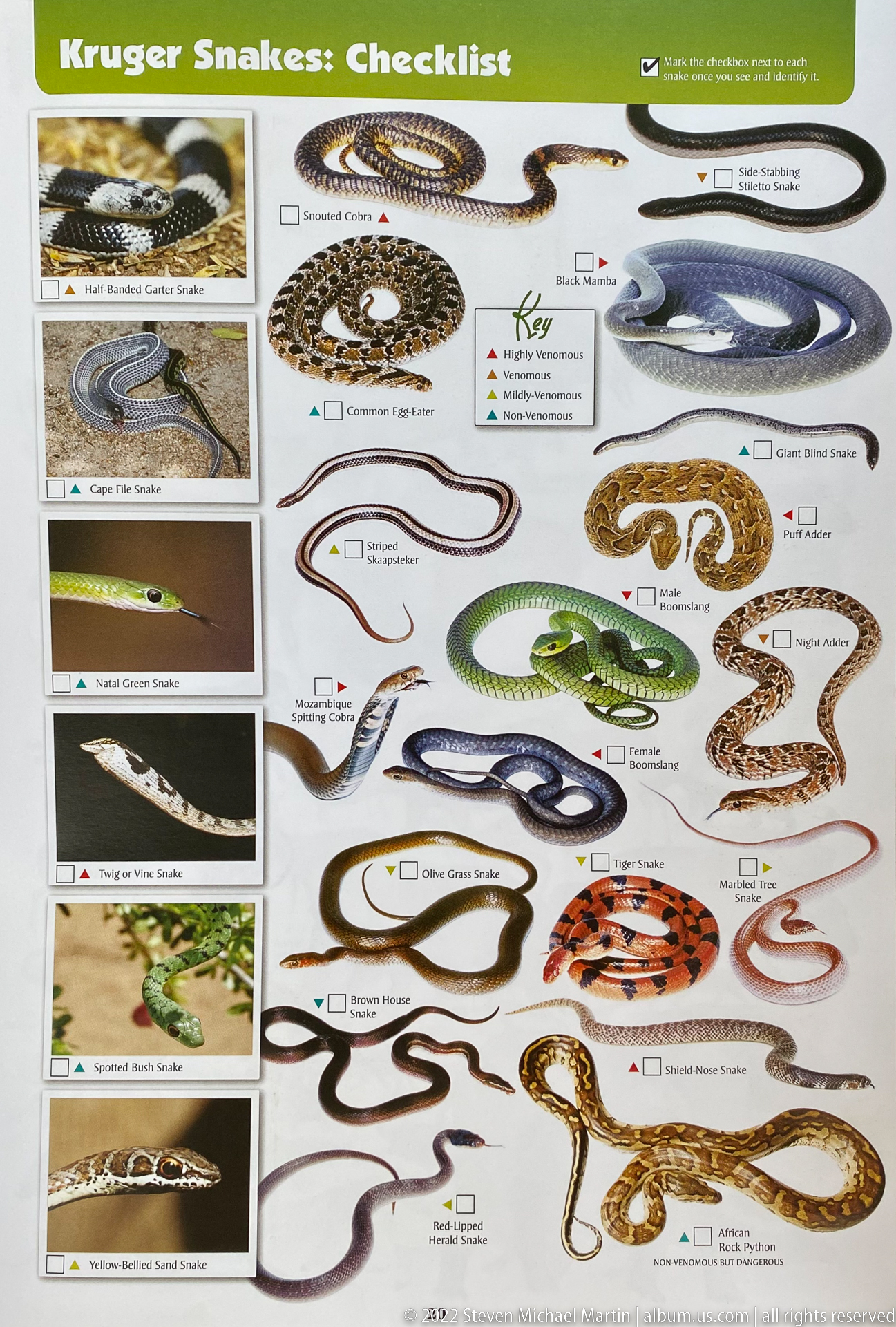
An illustrated snake checklist presents numerous Kruger reptiles in comparative rows, pairing drawings or photographs with species names and check boxes. Differences in body color, banding, head shape, and pattern are shown side by side, making the page a visual field reference rather than a photograph of a single species.
Caption
An illustrated snake checklist presents numerous Kruger reptiles in comparative rows, pairing drawings or photographs with species names and check boxes. Differences in body color, banding, head shape, and pattern are shown side by side, making the page a visual field reference rather than a photograph of a single species.

A final illustrated bird-checklist page features an especially varied selection of Kruger species, from large hornbills and long-tailed birds to bright weavers, bee-eaters, rollers, shrikes, and other savanna birds. The labeled artwork and check boxes form a compact visual record for comparing and logging sightings.
Caption
A final illustrated bird-checklist page features an especially varied selection of Kruger species, from large hornbills and long-tailed birds to bright weavers, bee-eaters, rollers, shrikes, and other savanna birds. The labeled artwork and check boxes form a compact visual record for comparing and logging sightings.
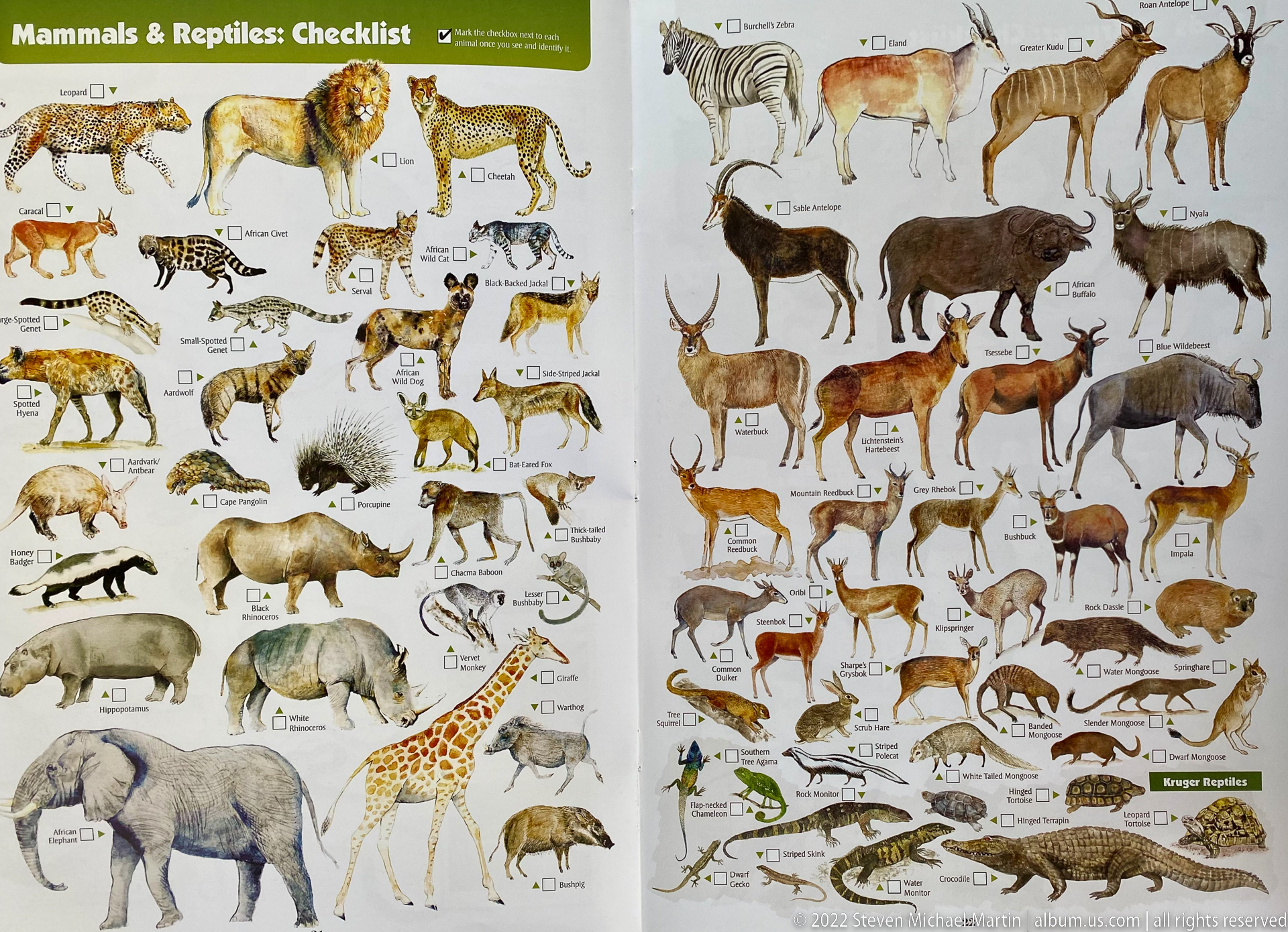
An illustrated checklist assembles Kruger's mammals in comparative groups, from large predators and ungulates to primates, small carnivores, rodents, and other species, with a smaller reptile section along the bottom. Labeled drawings and check boxes make the spread a compact visual index for recording sightings.
Caption
An illustrated checklist assembles Kruger's mammals in comparative groups, from large predators and ungulates to primates, small carnivores, rodents, and other species, with a smaller reptile section along the bottom. Labeled drawings and check boxes make the spread a compact visual index for recording sightings.
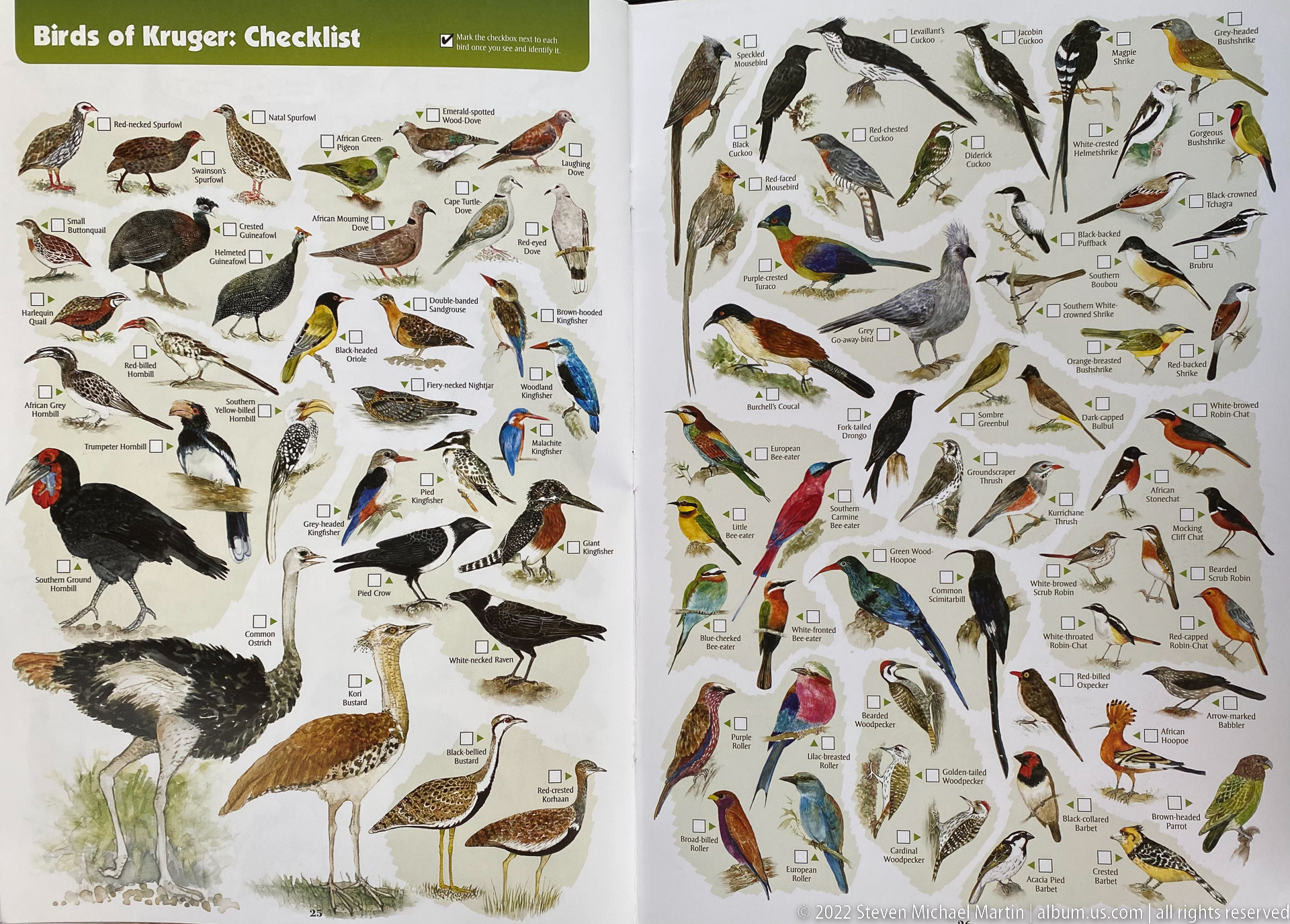
A second bird-checklist spread expands the visual field guide with hornbills, kingfishers, woodpeckers, rollers, bee-eaters, passerines, and other woodland and open-country birds. The dense arrangement encourages comparison of plumage, body shape, bill form, and size across many species.
Caption
A second bird-checklist spread expands the visual field guide with hornbills, kingfishers, woodpeckers, rollers, bee-eaters, passerines, and other woodland and open-country birds. The dense arrangement encourages comparison of plumage, body shape, bill form, and size across many species.