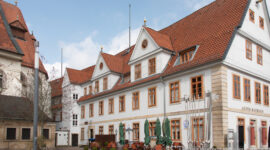
Lisse – South Holland, Netherlands
The town of Lisse lies in the coastal province of South Holland, between the cities of Leiden and Haarlem. The surrounding countryside is famous for its vast flower fields, where rows of tulips, hyacinths, and daffodils bloom each spring.
These fields form part of the historic Dutch bulb-growing region, where flower cultivation became an important agricultural industry beginning in the 17th century. During the spring season, the brightly colored fields create one of the most recognizable landscapes in the Netherlands.
Lisse serves as the gateway to the nearby gardens of Keukenhof and the surrounding flower-growing region.
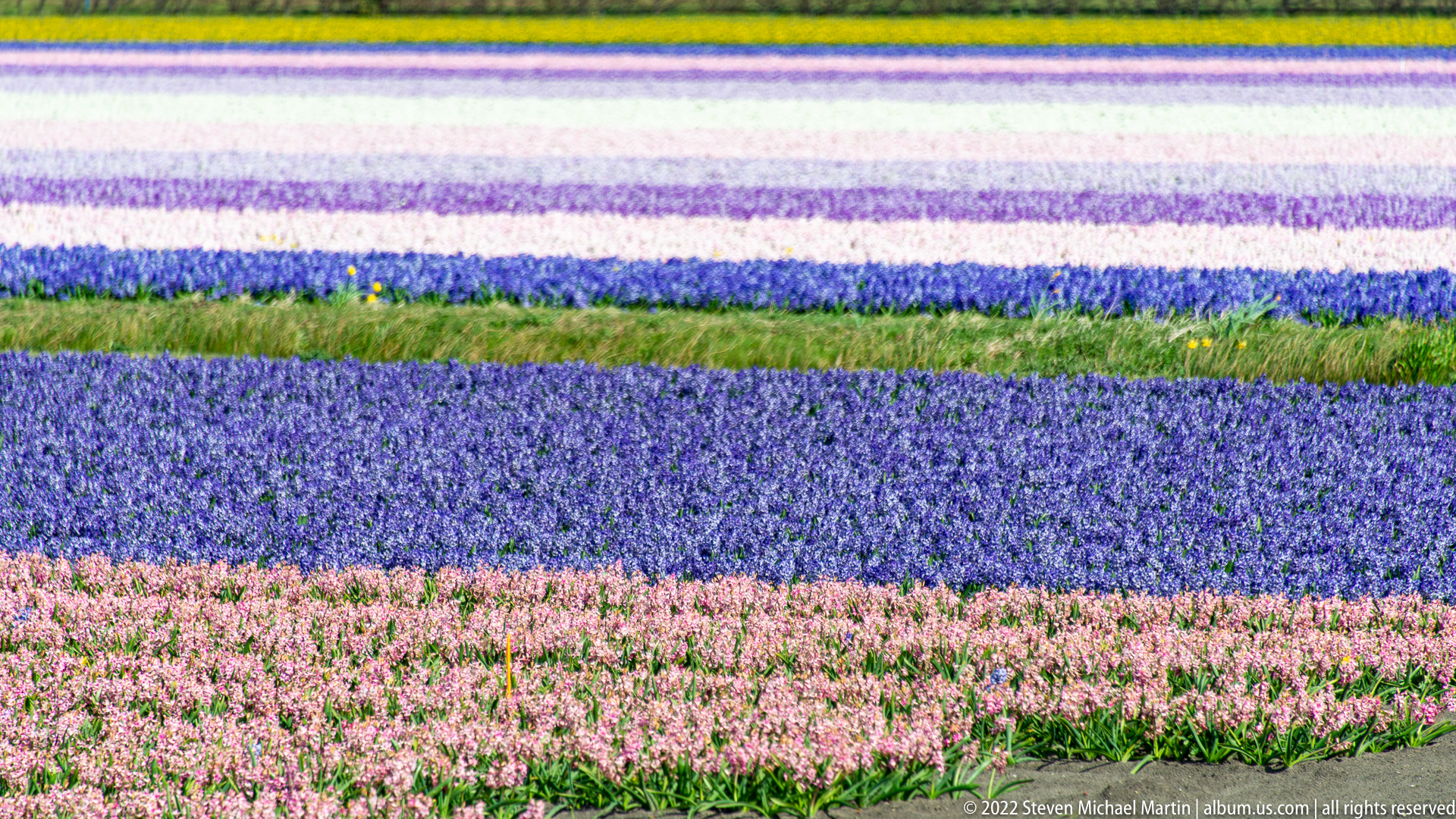
Multiple bulb fields near Lisse stack across the frame in sharply separated bands of pink, deep blue-purple, white, lavender, and yellow-green. A strip of grass divides two planting blocks, making the field boundaries easy to read. This long-lens view minimizes depth and instead emphasizes how neighboring crops create a patchwork of saturated color across the spring agricultural landscape.
Caption
Multiple bulb fields near Lisse stack across the frame in sharply separated bands of pink, deep blue-purple, white, lavender, and yellow-green. A strip of grass divides two planting blocks, making the field boundaries easy to read. This long-lens view minimizes depth and instead emphasizes how neighboring crops create a patchwork of saturated color across the spring agricultural landscape.
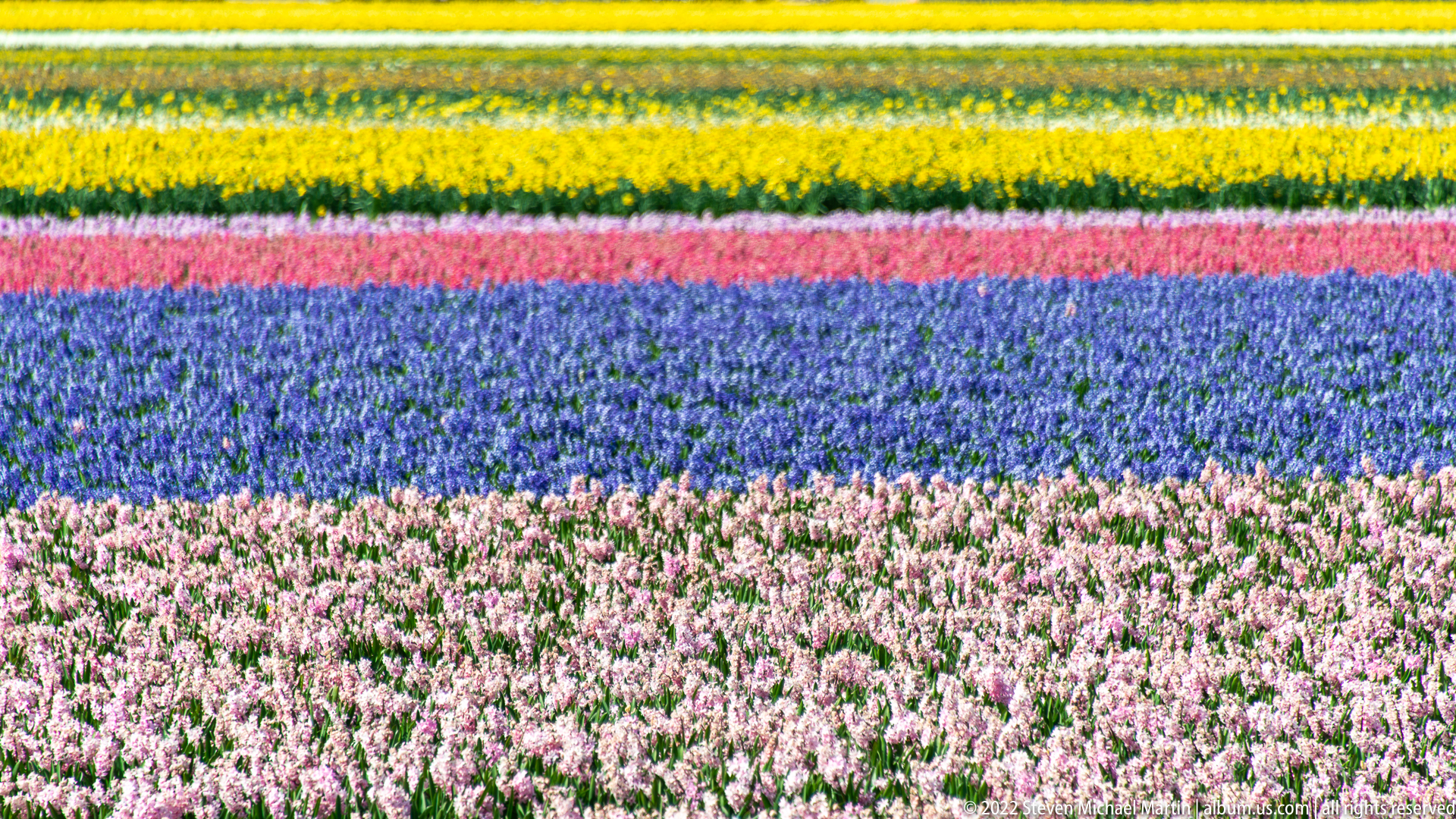
Spring bulb fields near Lisse form broad horizontal bands of pale pink, blue-purple, bright pink, green, and yellow. The flat, stacked composition turns adjacent agricultural plots into a nearly abstract pattern while still showing dense individual flower spikes in the foreground. The image emphasizes color zoning across commercial plantings and the visual continuity created when several neighboring fields reach bloom at the same time.
Caption
Spring bulb fields near Lisse form broad horizontal bands of pale pink, blue-purple, bright pink, green, and yellow. The flat, stacked composition turns adjacent agricultural plots into a nearly abstract pattern while still showing dense individual flower spikes in the foreground. The image emphasizes color zoning across commercial plantings and the visual continuity created when several neighboring fields reach bloom at the same time.
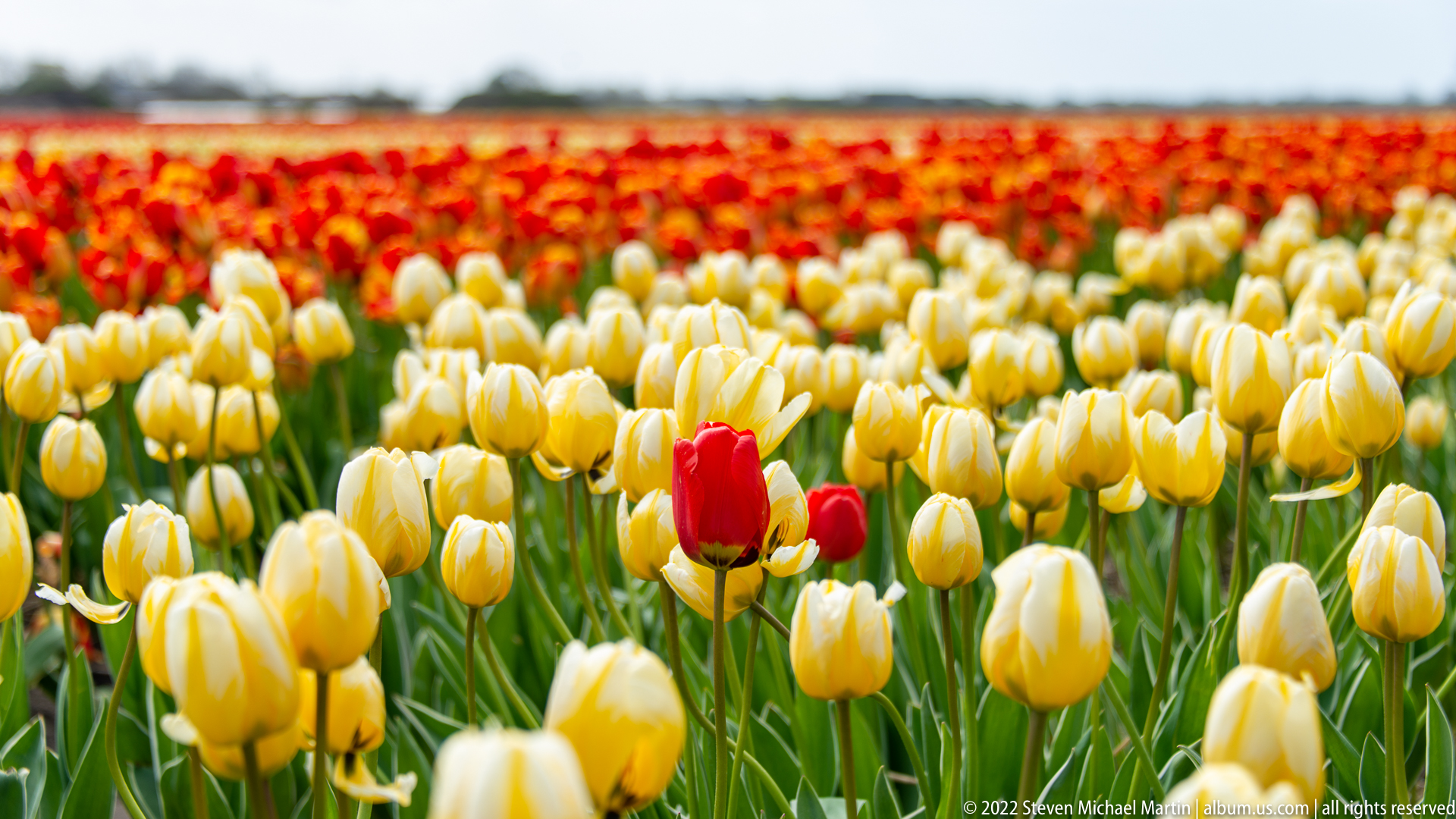
Pale yellow tulips fill the foreground near Lisse, interrupted by a pair of red blooms and backed by a broad red-orange planting. The image uses depth and color contrast to connect a close view of individual flowers with the larger agricultural field beyond. The transition from pale foreground to fiery background creates a layered composition while still showing the commercial density of both crops.
Caption
Pale yellow tulips fill the foreground near Lisse, interrupted by a pair of red blooms and backed by a broad red-orange planting. The image uses depth and color contrast to connect a close view of individual flowers with the larger agricultural field beyond. The transition from pale foreground to fiery background creates a layered composition while still showing the commercial density of both crops.
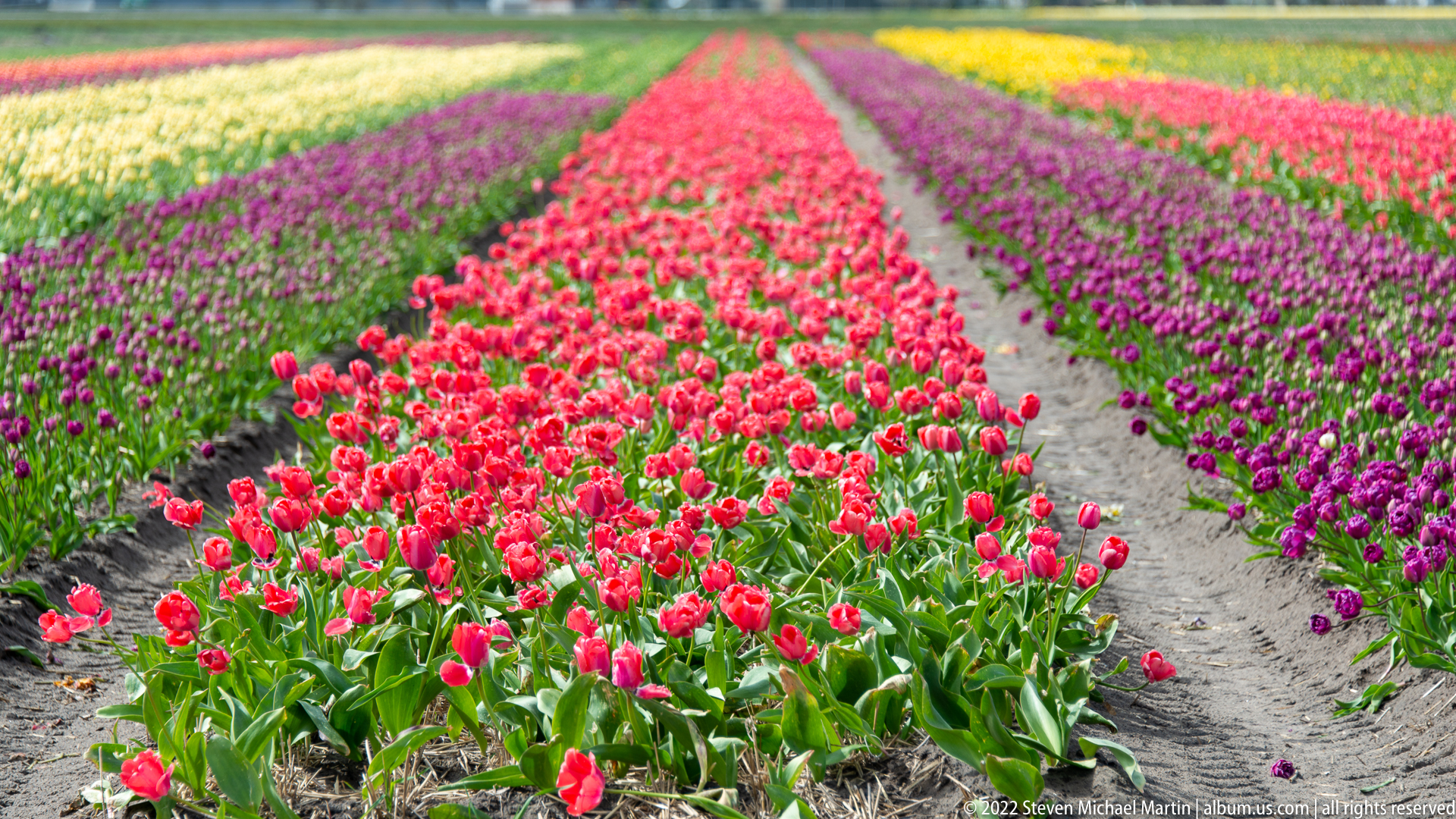
A central row of red tulips leads away through the field near Lisse, bordered by purple plantings and additional yellow and pink rows farther back. The camera’s centered perspective turns the cultivated beds into strong converging lines while leaving broad green leaves and individual blossoms visible in the foreground. The composition clearly records how contrasting flower colors are arranged in separate, parallel production strips.
Caption
A central row of red tulips leads away through the field near Lisse, bordered by purple plantings and additional yellow and pink rows farther back. The camera’s centered perspective turns the cultivated beds into strong converging lines while leaving broad green leaves and individual blossoms visible in the foreground. The composition clearly records how contrasting flower colors are arranged in separate, parallel production strips.
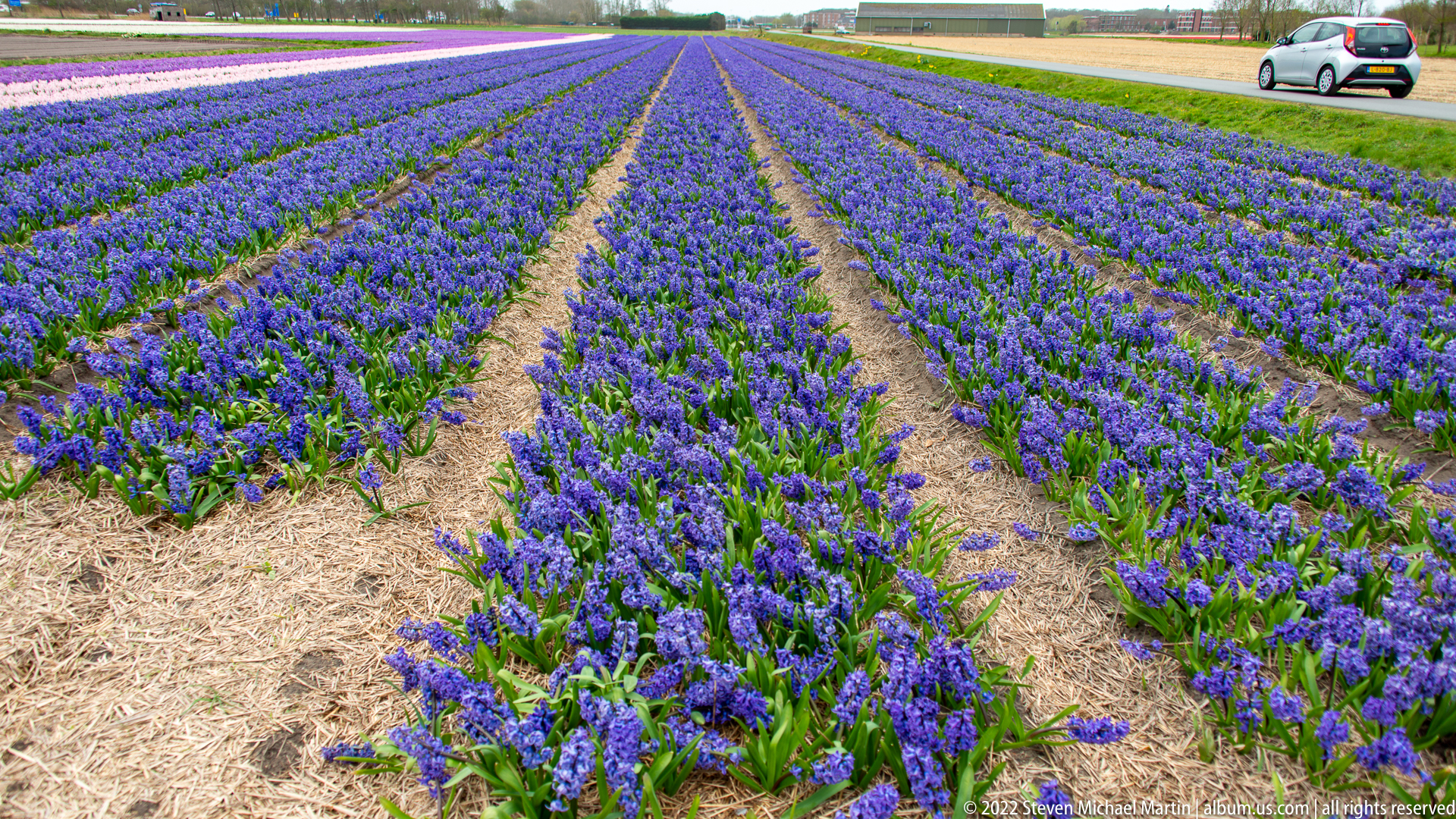
Rows of blue-purple hyacinths run toward the horizon in a bulb field near Lisse, divided by straw-covered paths that make the planting pattern especially legible. The low perspective places individual flower spikes and broad green leaves in the foreground while a roadside vehicle and farm structures appear along the upper edge. The view links the beauty of spring bloom with the practical organization of cultivated land.
Caption
Rows of blue-purple hyacinths run toward the horizon in a bulb field near Lisse, divided by straw-covered paths that make the planting pattern especially legible. The low perspective places individual flower spikes and broad green leaves in the foreground while a roadside vehicle and farm structures appear along the upper edge. The view links the beauty of spring bloom with the practical organization of cultivated land.
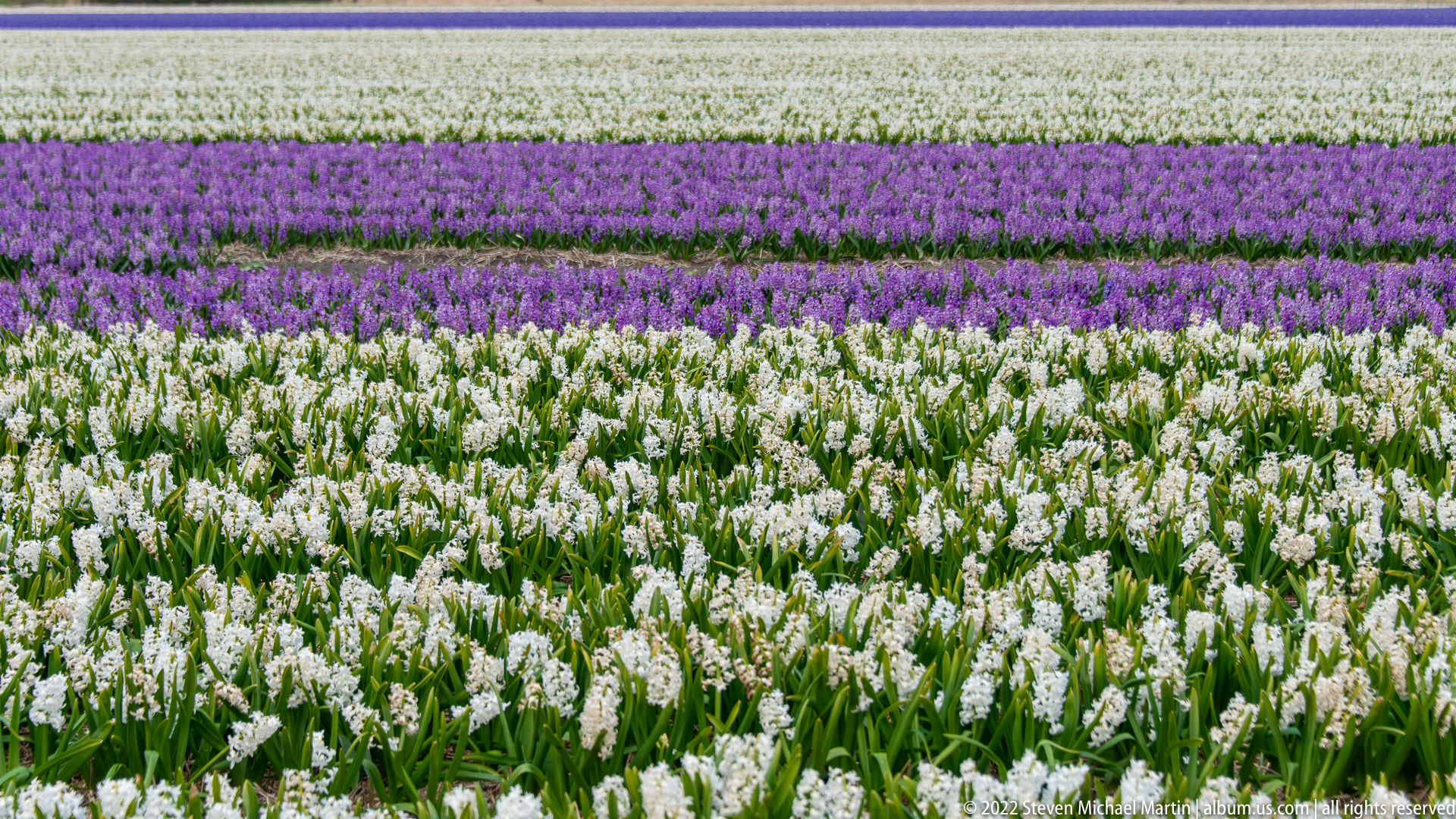
Broad horizontal bands of white and purple hyacinths create a layered field pattern near Lisse. Unlike the strongly converging row views elsewhere in the portfolio, this composition is read laterally, emphasizing blocks of color and the dense uniformity of each planting. Individual flower spikes remain visible in the foreground, while successive strips of purple and white show the organization of adjacent cultivated varieties or color selections.
Caption
Broad horizontal bands of white and purple hyacinths create a layered field pattern near Lisse. Unlike the strongly converging row views elsewhere in the portfolio, this composition is read laterally, emphasizing blocks of color and the dense uniformity of each planting. Individual flower spikes remain visible in the foreground, while successive strips of purple and white show the organization of adjacent cultivated varieties or color selections.
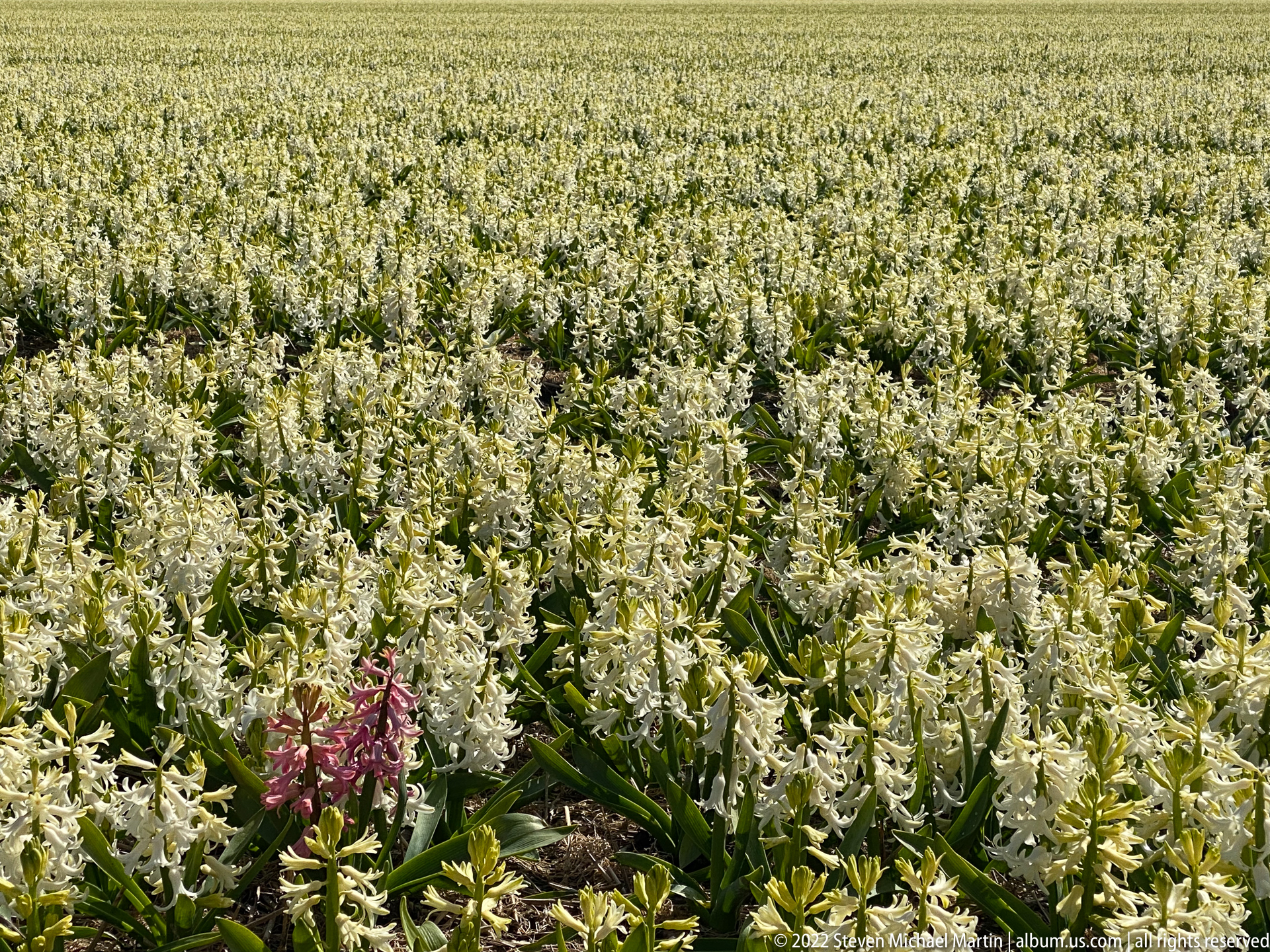
White hyacinths cover a cultivated field near Lisse, their upright flower spikes forming a pale, textured surface above dense green leaves. One purple-pink spike appears conspicuously in the lower foreground, interrupting the otherwise uniform planting. The elevated view reveals the enormous density of the crop while the contrasting flower provides a precise visual marker within the repeated white blooms.
Caption
White hyacinths cover a cultivated field near Lisse, their upright flower spikes forming a pale, textured surface above dense green leaves. One purple-pink spike appears conspicuously in the lower foreground, interrupting the otherwise uniform planting. The elevated view reveals the enormous density of the crop while the contrasting flower provides a precise visual marker within the repeated white blooms.
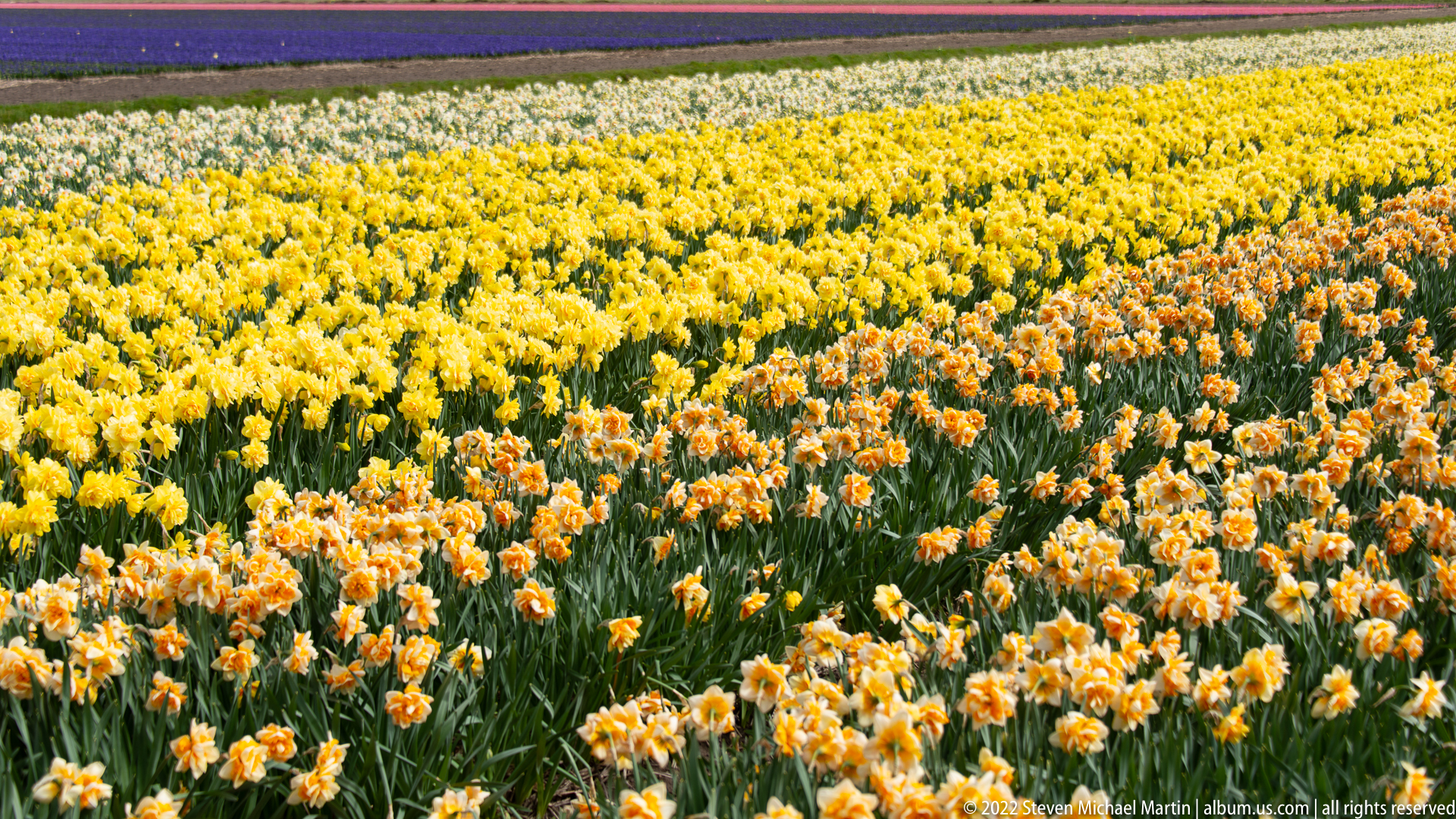
Dense bands of daffodils spread across the bulb fields near Lisse, with bright yellow flowers occupying the upper planting and white-to-cream petals with orange centers dominating the foreground. The oblique viewpoint lets the two color selections overlap visually while their separate cultivation blocks remain legible. Green foliage and glimpses of soil preserve the working-field character beneath the mass of spring bloom.
Caption
Dense bands of daffodils spread across the bulb fields near Lisse, with bright yellow flowers occupying the upper planting and white-to-cream petals with orange centers dominating the foreground. The oblique viewpoint lets the two color selections overlap visually while their separate cultivation blocks remain legible. Green foliage and glimpses of soil preserve the working-field character beneath the mass of spring bloom.
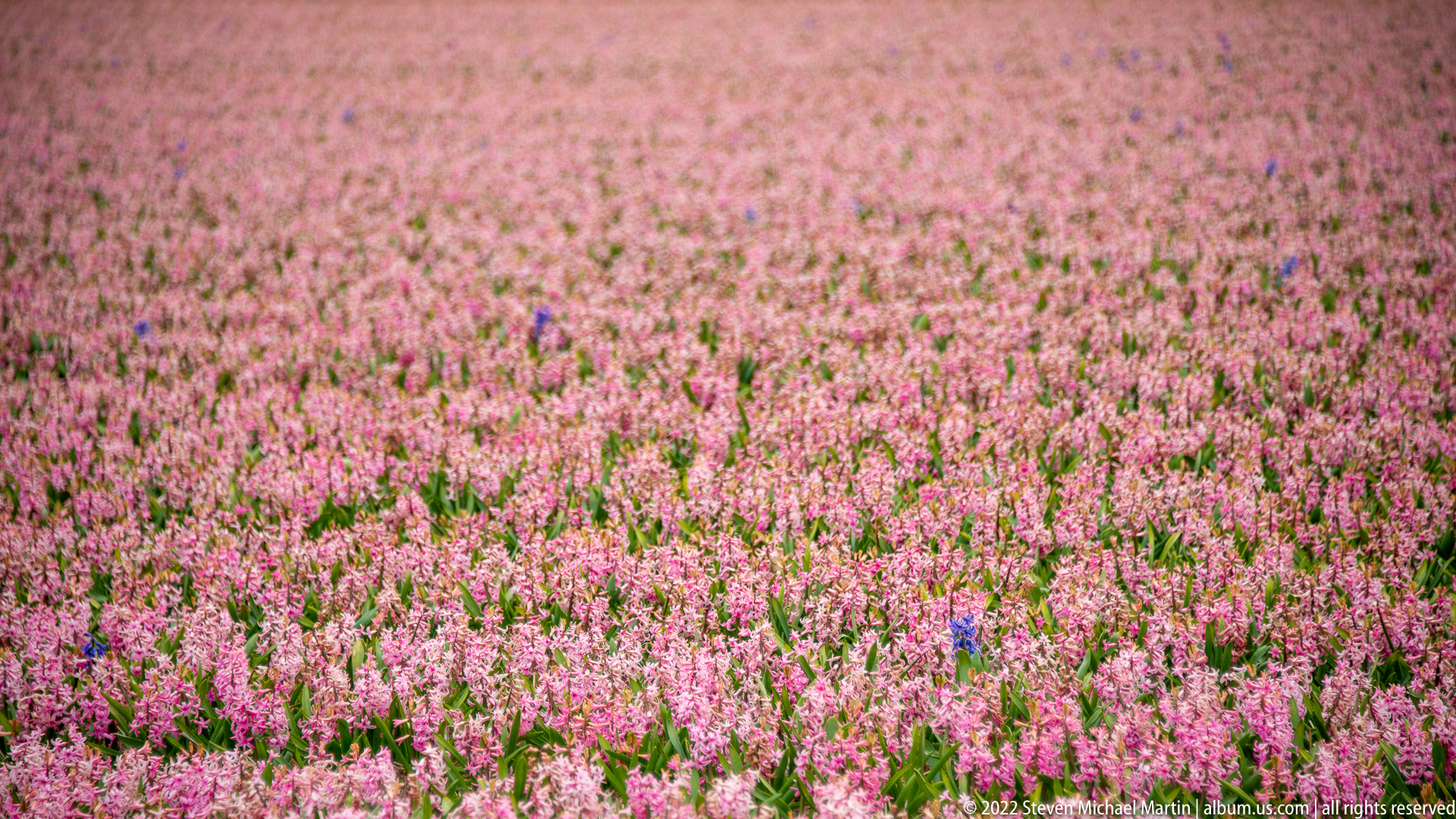
A dense expanse of pink hyacinths fills the frame near Lisse, photographed with shallow depth of field so that the nearest flower spikes remain distinct while the rest merge into a soft pink field. Narrow glimpses of green leaves reveal the crop beneath the color. The intimate composition shifts attention from field geometry to the texture created by thousands of closely spaced spring flower spikes.
Caption
A dense expanse of pink hyacinths fills the frame near Lisse, photographed with shallow depth of field so that the nearest flower spikes remain distinct while the rest merge into a soft pink field. Narrow glimpses of green leaves reveal the crop beneath the color. The intimate composition shifts attention from field geometry to the texture created by thousands of closely spaced spring flower spikes.
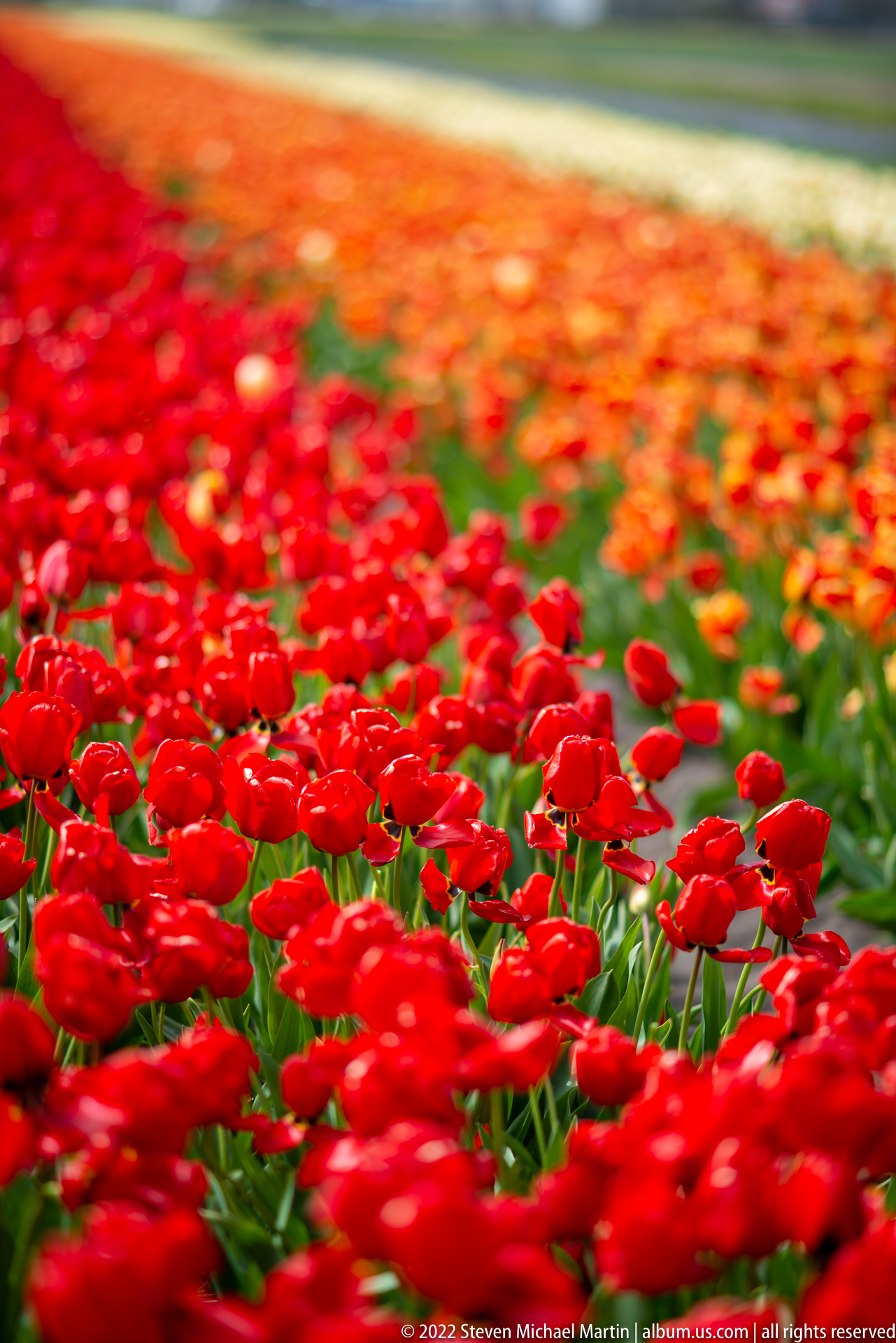
Bright red tulips fill the foreground of this low field view near Lisse, while orange and pale flowering bands sweep across the background. Selective focus sharpens the nearest red blossoms and softens the more distant crop rows, giving the scene both immediacy and depth. The photograph emphasizes the saturated red planting while retaining a glimpse of the larger multicolored agricultural mosaic around it.
Caption
Bright red tulips fill the foreground of this low field view near Lisse, while orange and pale flowering bands sweep across the background. Selective focus sharpens the nearest red blossoms and softens the more distant crop rows, giving the scene both immediacy and depth. The photograph emphasizes the saturated red planting while retaining a glimpse of the larger multicolored agricultural mosaic around it.
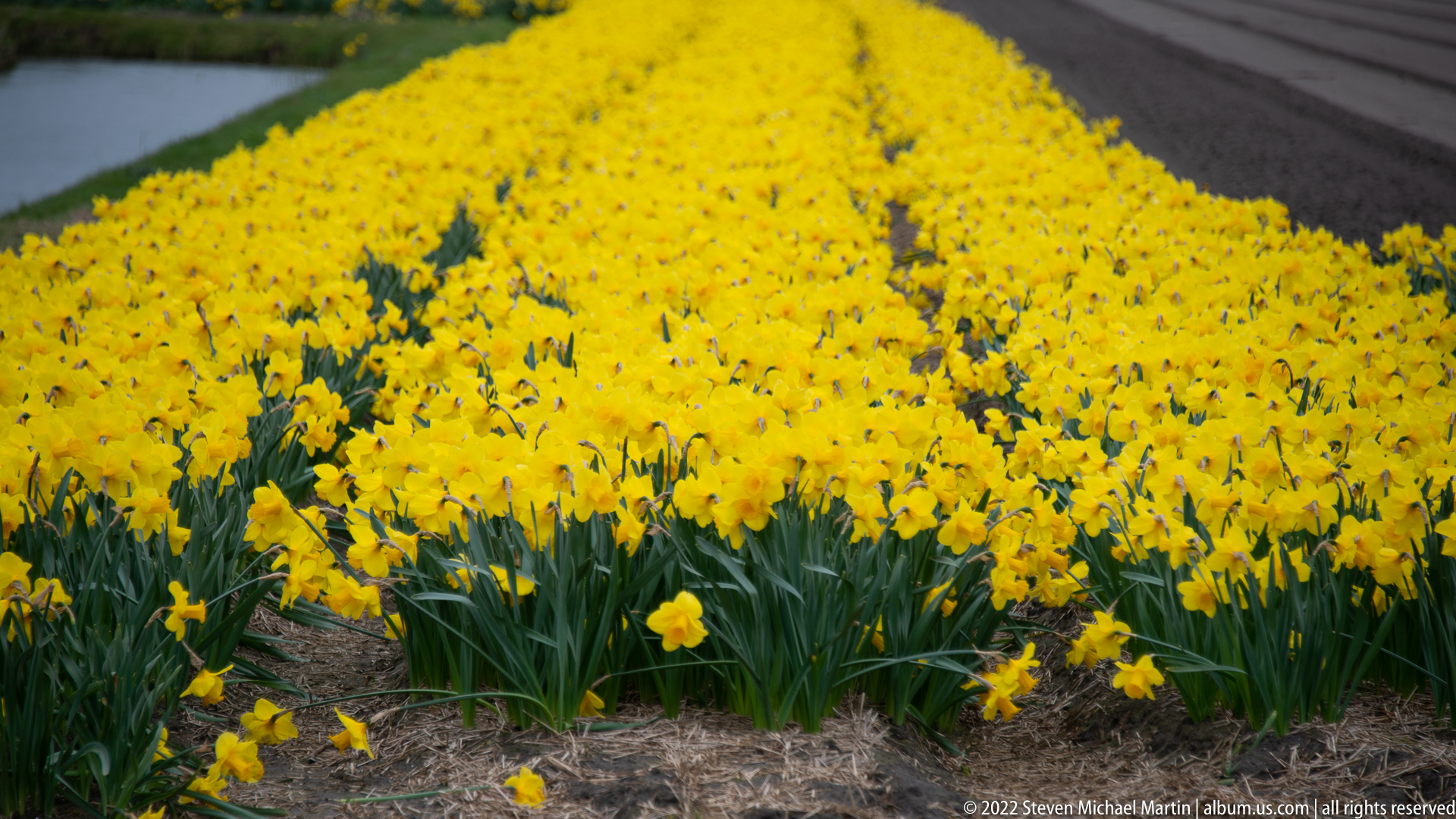
Massed yellow daffodils fill a bulb field near Lisse, their trumpet-shaped flowers forming an almost continuous band of color. The low viewpoint keeps the dark soil and green foliage visible along the field edge, emphasizing the density of spring growth rather than the broader agricultural setting. The scene records one of the bulb crops characteristic of the cultivated landscape around Lisse.
Caption
Massed yellow daffodils fill a bulb field near Lisse, their trumpet-shaped flowers forming an almost continuous band of color. The low viewpoint keeps the dark soil and green foliage visible along the field edge, emphasizing the density of spring growth rather than the broader agricultural setting. The scene records one of the bulb crops characteristic of the cultivated landscape around Lisse.
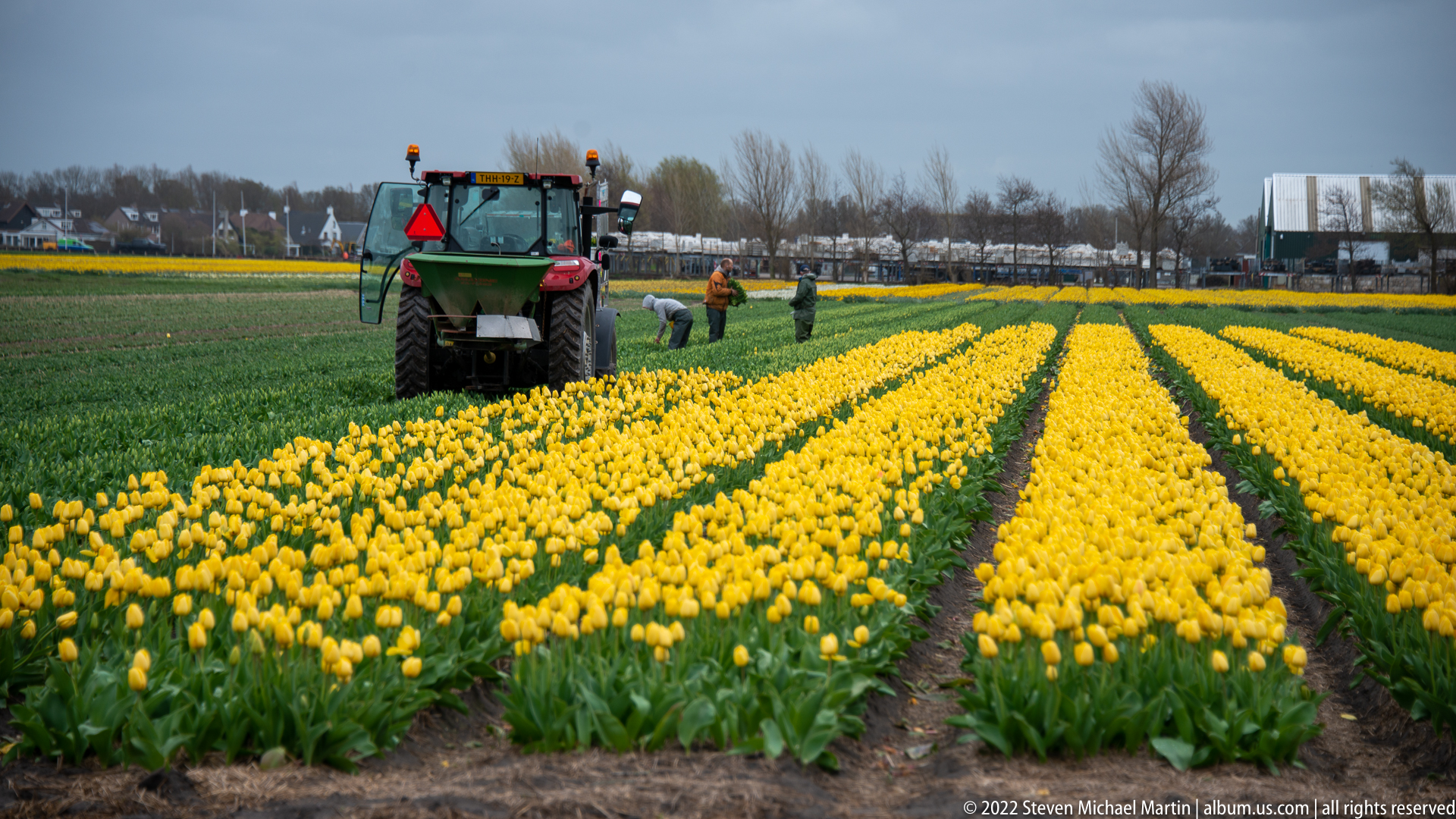
Long rows of yellow tulips converge toward a tractor and several workers in a cultivated field near Lisse. The machinery and people place the flowers within an active agricultural operation rather than a display garden, while alternating planted and unplanted strips reveal the disciplined geometry of commercial bulb production. A gray spring sky and distant farm structures complete the working-landscape context.
Caption
Long rows of yellow tulips converge toward a tractor and several workers in a cultivated field near Lisse. The machinery and people place the flowers within an active agricultural operation rather than a display garden, while alternating planted and unplanted strips reveal the disciplined geometry of commercial bulb production. A gray spring sky and distant farm structures complete the working-landscape context.
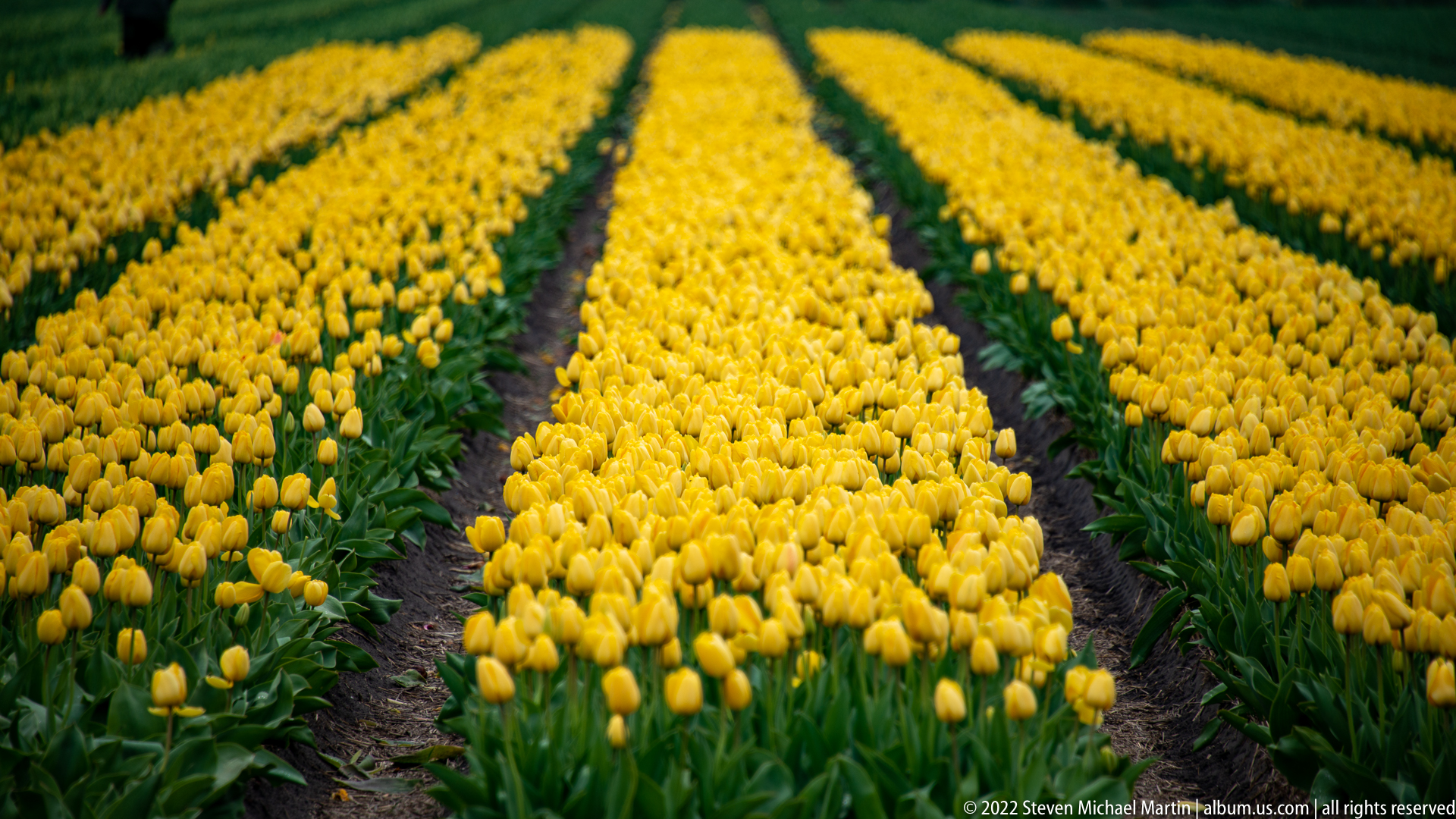
Parallel beds of yellow tulips stretch diagonally across the frame near Lisse, separated by dark earthen furrows. The compressed viewpoint turns the cultivated field into repeating bands of yellow and green while still preserving the working structure of the crop rows. This closer field study emphasizes uniformity, planting density, and the linear order of bulb cultivation in the Dutch spring landscape.
Caption
Parallel beds of yellow tulips stretch diagonally across the frame near Lisse, separated by dark earthen furrows. The compressed viewpoint turns the cultivated field into repeating bands of yellow and green while still preserving the working structure of the crop rows. This closer field study emphasizes uniformity, planting density, and the linear order of bulb cultivation in the Dutch spring landscape.
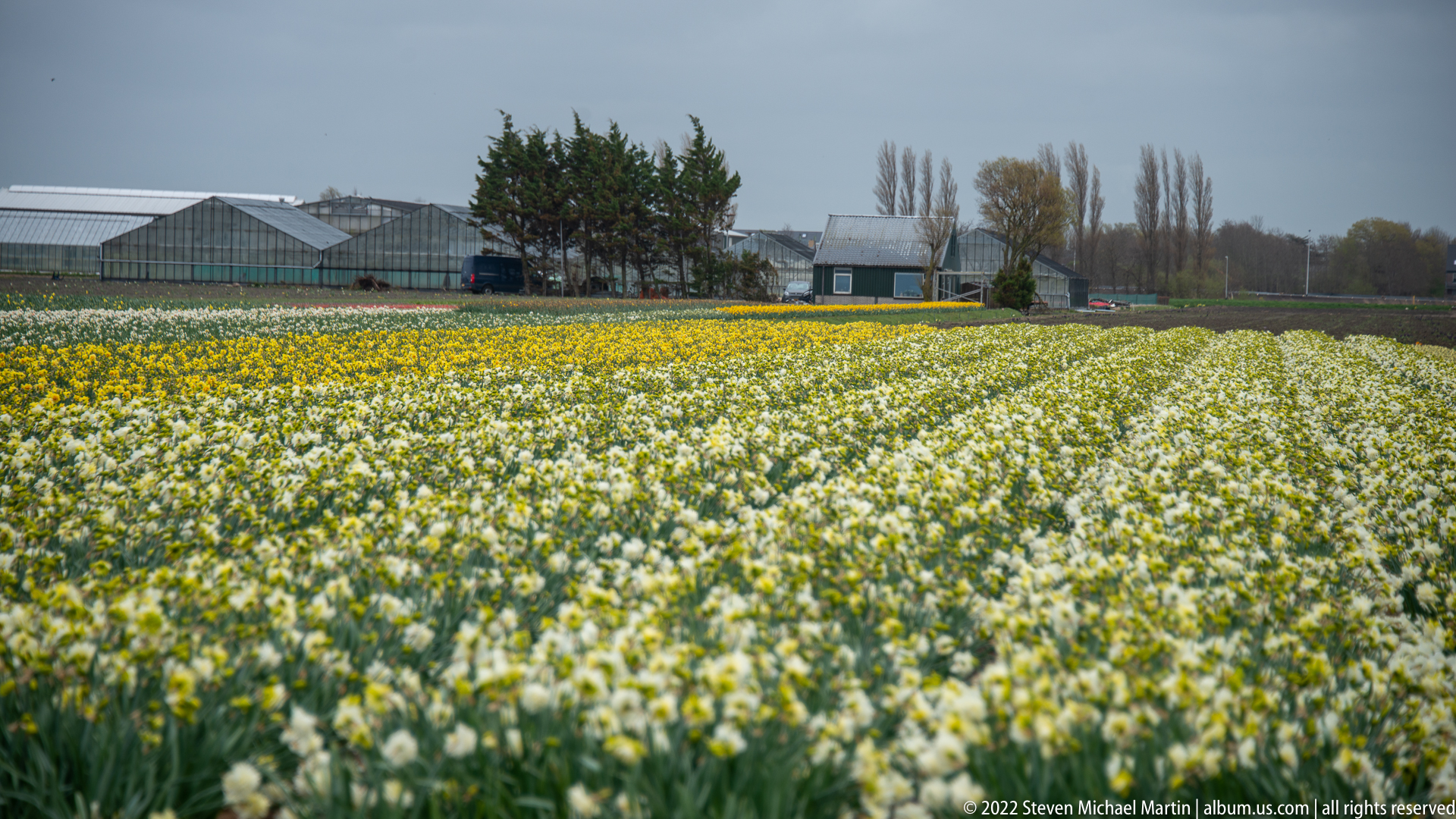
A broad field of white spring flowers dominates this view near Lisse, backed by a narrower band of yellow blooms and a line of glasshouses, trees, and farm buildings. The layered composition shows how intensely cultivated flower fields sit directly beside agricultural infrastructure. From this distance the white crop is not specific enough for a secure species identification, but its planting pattern clearly belongs to the region’s bulb-growing landscape.
Caption
A broad field of white spring flowers dominates this view near Lisse, backed by a narrower band of yellow blooms and a line of glasshouses, trees, and farm buildings. The layered composition shows how intensely cultivated flower fields sit directly beside agricultural infrastructure. From this distance the white crop is not specific enough for a secure species identification, but its planting pattern clearly belongs to the region’s bulb-growing landscape.

Blue-purple hyacinths are shown at close range in a cultivated field near Lisse, where individual florets, thick flower spikes, and arching leaves remain clearly visible. Straw mulch between the plants identifies the bed as part of an agricultural planting rather than a formal garden. The angled composition creates a repeating rhythm of blossoms while retaining enough ground detail to show how the crop is grown.
Caption
Blue-purple hyacinths are shown at close range in a cultivated field near Lisse, where individual florets, thick flower spikes, and arching leaves remain clearly visible. Straw mulch between the plants identifies the bed as part of an agricultural planting rather than a formal garden. The angled composition creates a repeating rhythm of blossoms while retaining enough ground detail to show how the crop is grown.

A central row of pale pink hyacinths forms a strong vanishing line through a field near Lisse, flanked by deeper purple and blue flowering rows. The symmetrical viewpoint makes the narrow earthen path and disciplined planting geometry the main visual structure. Color variation between adjoining beds demonstrates how separate flower selections are cultivated in contiguous strips across the commercial bulb landscape.
Caption
A central row of pale pink hyacinths forms a strong vanishing line through a field near Lisse, flanked by deeper purple and blue flowering rows. The symmetrical viewpoint makes the narrow earthen path and disciplined planting geometry the main visual structure. Color variation between adjoining beds demonstrates how separate flower selections are cultivated in contiguous strips across the commercial bulb landscape.
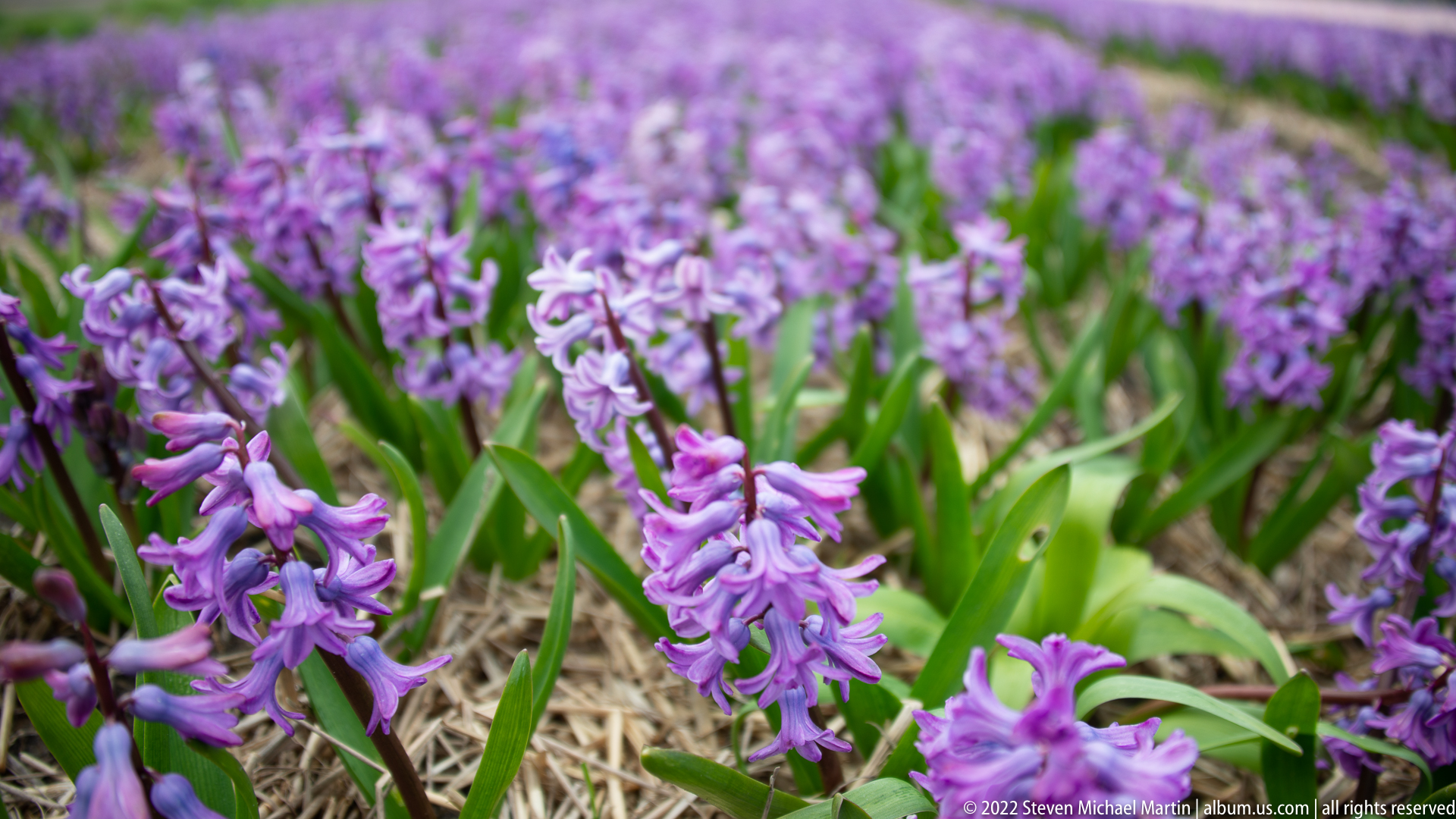
Pink-lilac hyacinths fill this close field study near Lisse, with several foreground flower spikes sharply rendered against a softer mass of blossoms behind. The view isolates the clustered tubular florets and fleshy leaves that distinguish the crop from nearby tulip plantings. Straw visible at ground level reinforces the agricultural setting while the shallow focus gives the photograph the character of a botanical detail.
Caption
Pink-lilac hyacinths fill this close field study near Lisse, with several foreground flower spikes sharply rendered against a softer mass of blossoms behind. The view isolates the clustered tubular florets and fleshy leaves that distinguish the crop from nearby tulip plantings. Straw visible at ground level reinforces the agricultural setting while the shallow focus gives the photograph the character of a botanical detail.
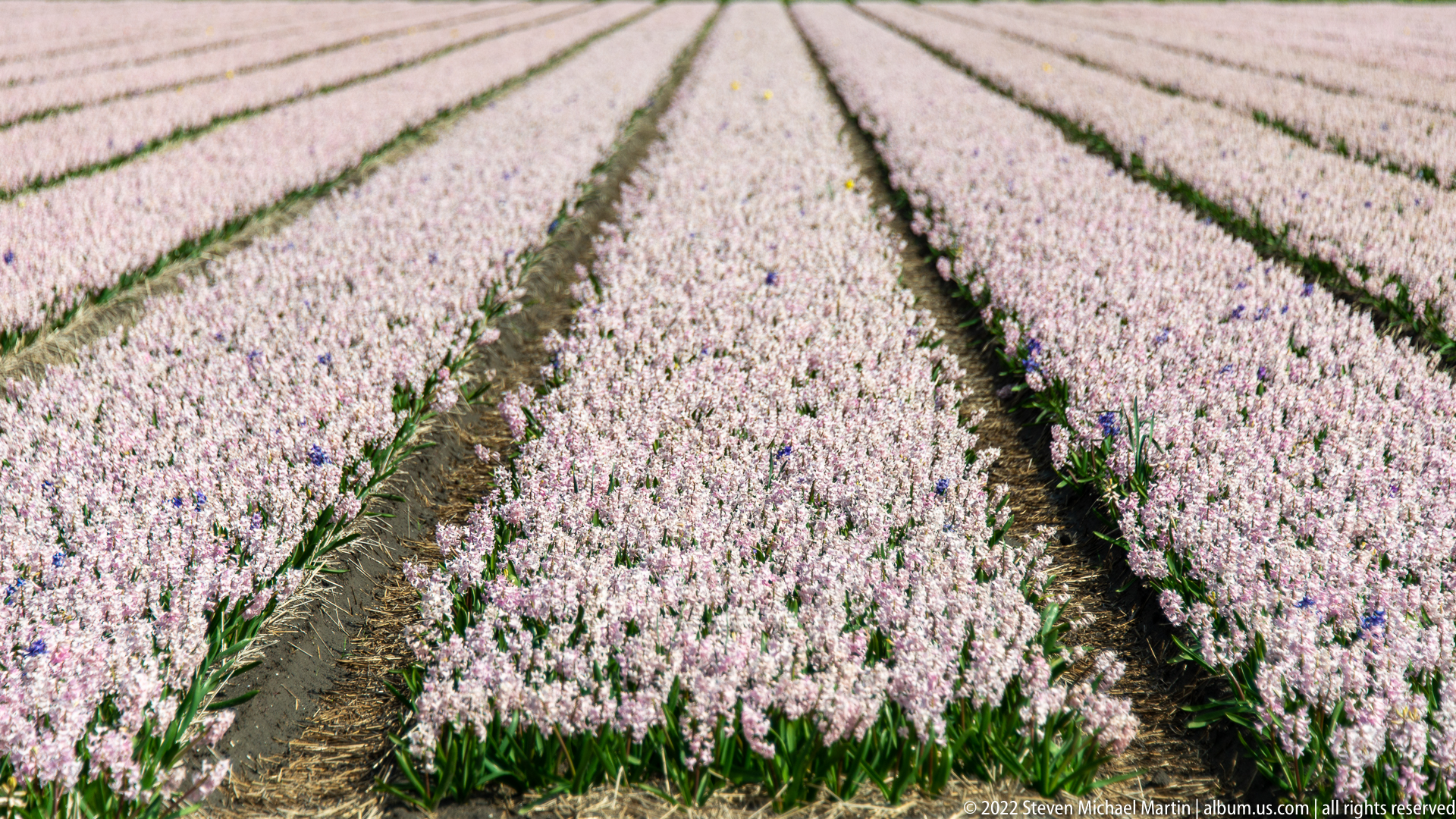
Long beds of pale pink hyacinths extend away from the camera near Lisse, separated by narrow strips of dark soil. The elevated viewpoint makes the field’s cultivation pattern unusually clear: each row is densely packed with flowering bulbs, while the parallel furrows provide access and drainage. The subtle blush color and restrained palette distinguish this view from the stronger blue and purple beds photographed nearby.
Caption
Long beds of pale pink hyacinths extend away from the camera near Lisse, separated by narrow strips of dark soil. The elevated viewpoint makes the field’s cultivation pattern unusually clear: each row is densely packed with flowering bulbs, while the parallel furrows provide access and drainage. The subtle blush color and restrained palette distinguish this view from the stronger blue and purple beds photographed nearby.
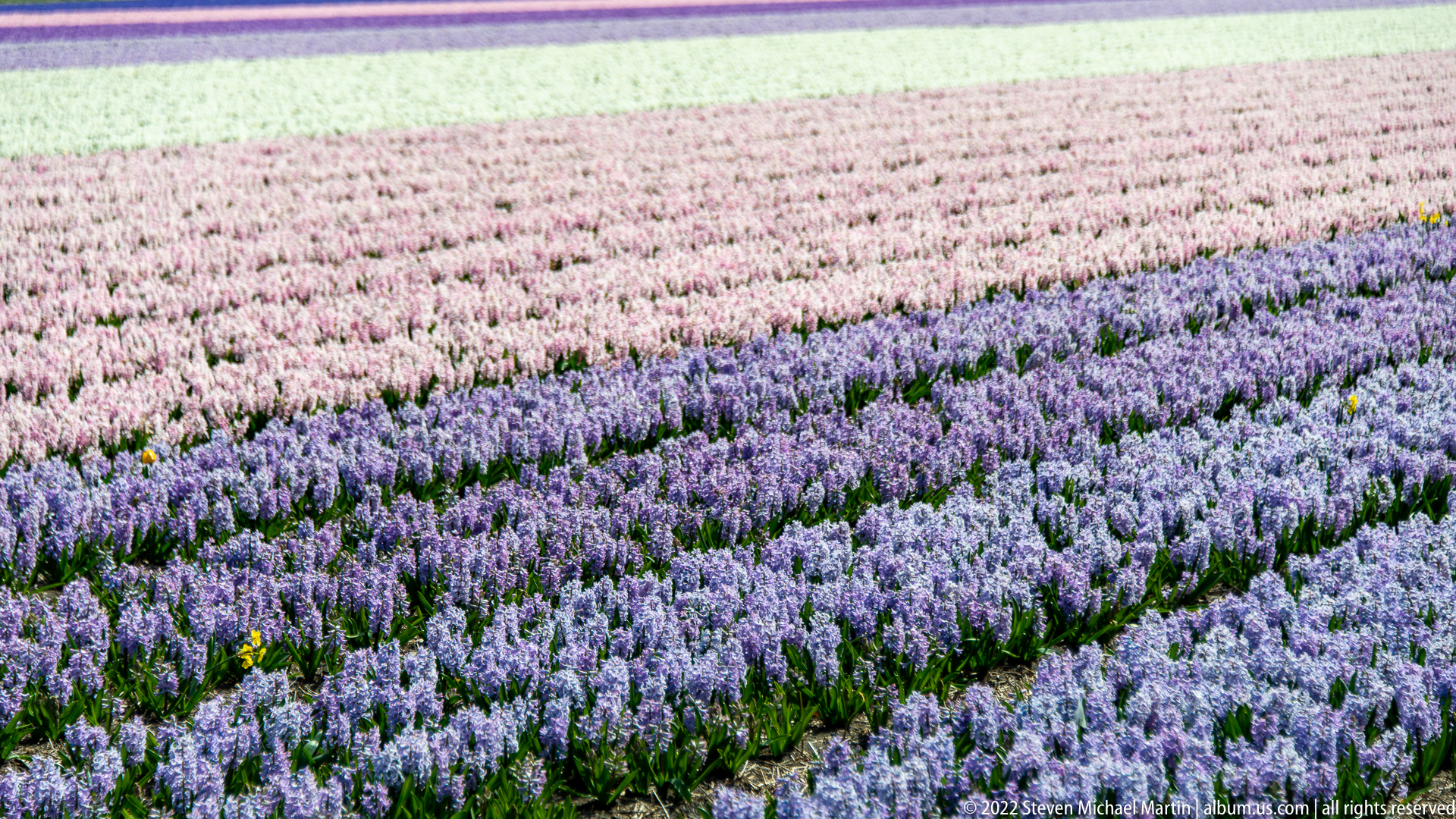
Blue-purple hyacinths occupy the foreground of this layered field view near Lisse, followed by broad pink and pale flowering bands farther back. The shallow viewing angle compresses the crop rows into horizontal ribbons of color, producing a different visual reading from the portfolio’s perspective-driven field studies. The repeated bands make the scale of commercial flower cultivation especially apparent while keeping the foreground blossoms individually legible.
Caption
Blue-purple hyacinths occupy the foreground of this layered field view near Lisse, followed by broad pink and pale flowering bands farther back. The shallow viewing angle compresses the crop rows into horizontal ribbons of color, producing a different visual reading from the portfolio’s perspective-driven field studies. The repeated bands make the scale of commercial flower cultivation especially apparent while keeping the foreground blossoms individually legible.
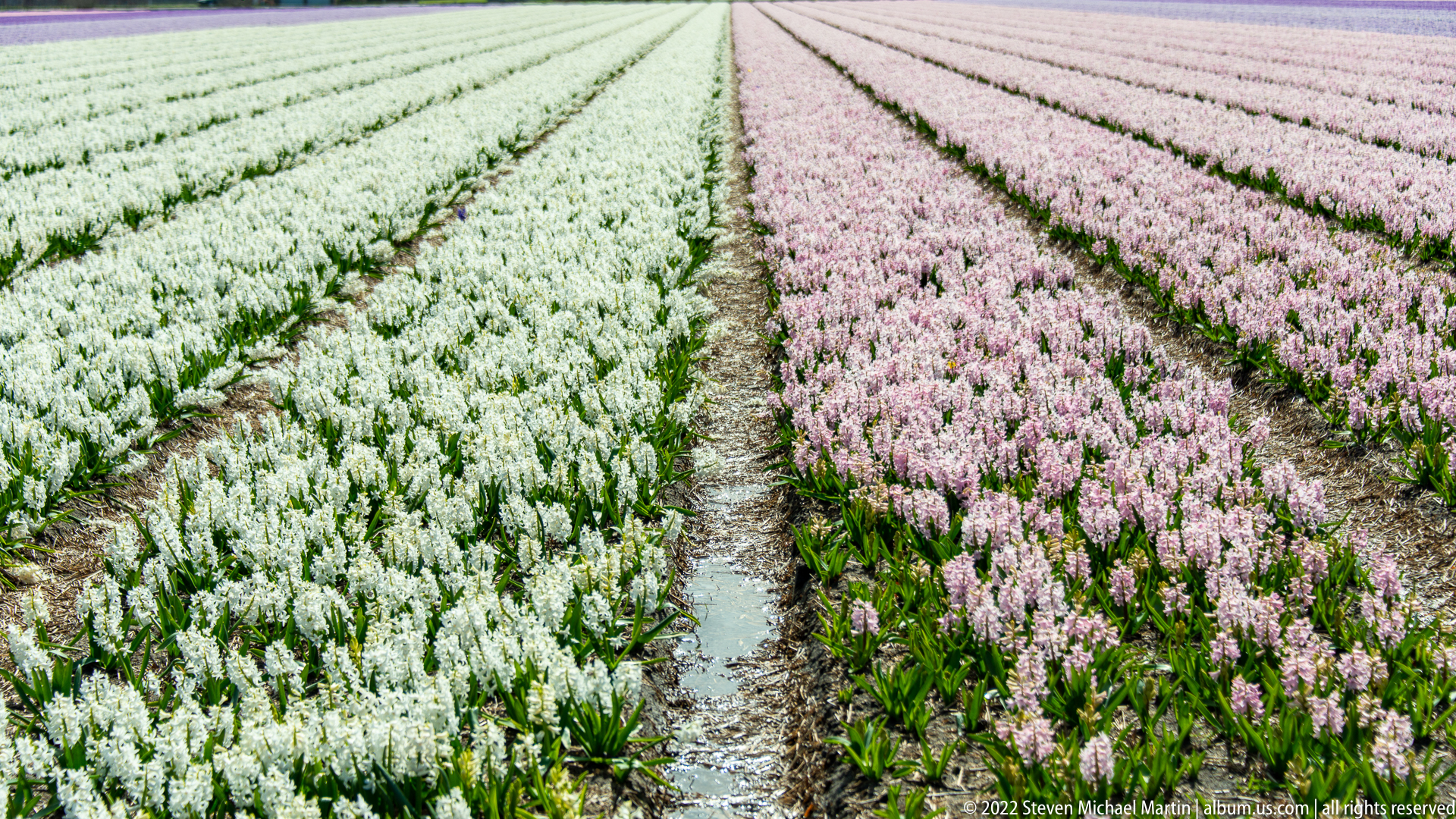
White and pale pink hyacinths run in parallel rows through a bulb field near Lisse, separated by a central earthen track that draws the eye toward the distance. The near-symmetrical composition highlights both color contrast and the practical spacing of the crop. Dense flower spikes soften the geometry, while the visible soil keeps the scene grounded in commercial cultivation rather than ornamental garden design.
Caption
White and pale pink hyacinths run in parallel rows through a bulb field near Lisse, separated by a central earthen track that draws the eye toward the distance. The near-symmetrical composition highlights both color contrast and the practical spacing of the crop. Dense flower spikes soften the geometry, while the visible soil keeps the scene grounded in commercial cultivation rather than ornamental garden design.

Rows of white hyacinths dominate this restrained field study near Lisse, their dense flower spikes forming pale bands divided by narrow strips of exposed earth. The high viewpoint and muted palette emphasize repetition, spacing, and texture more than dramatic color. A faint pink planting appears at the far upper edge, indicating another crop section beyond the large white block.
Caption
Rows of white hyacinths dominate this restrained field study near Lisse, their dense flower spikes forming pale bands divided by narrow strips of exposed earth. The high viewpoint and muted palette emphasize repetition, spacing, and texture more than dramatic color. A faint pink planting appears at the far upper edge, indicating another crop section beyond the large white block.
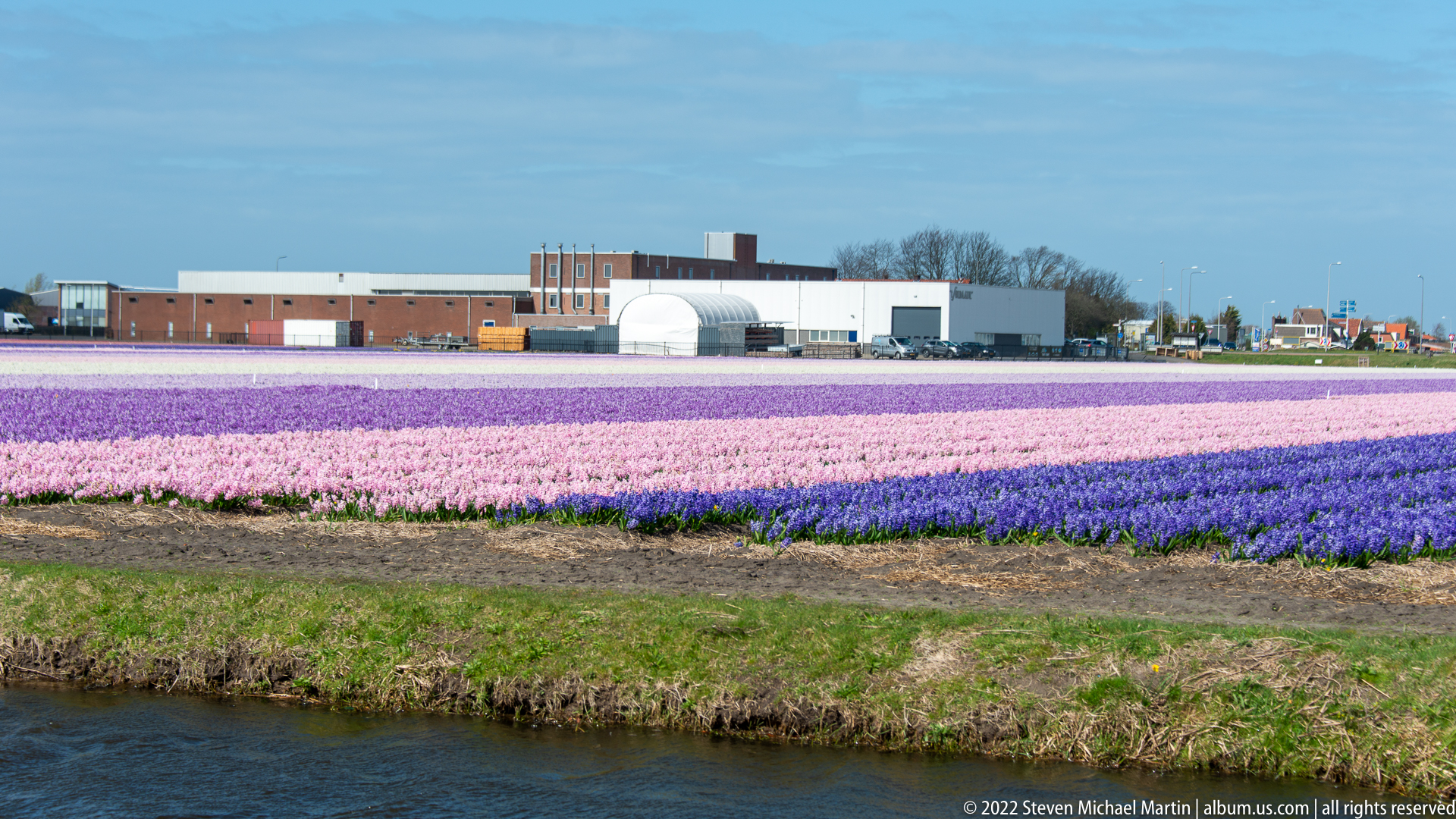
A canal borders broad pink, purple, and pale flowering fields near Lisse, with warehouses and other utilitarian buildings beyond. The composition places the intensely colored bulb crops within a working Dutch landscape shaped by water management and modern development. Rather than isolating the flowers, this wider view records the close physical relationship between cultivated fields, drainage waterways, roads, and built infrastructure.
Caption
A canal borders broad pink, purple, and pale flowering fields near Lisse, with warehouses and other utilitarian buildings beyond. The composition places the intensely colored bulb crops within a working Dutch landscape shaped by water management and modern development. Rather than isolating the flowers, this wider view records the close physical relationship between cultivated fields, drainage waterways, roads, and built infrastructure.
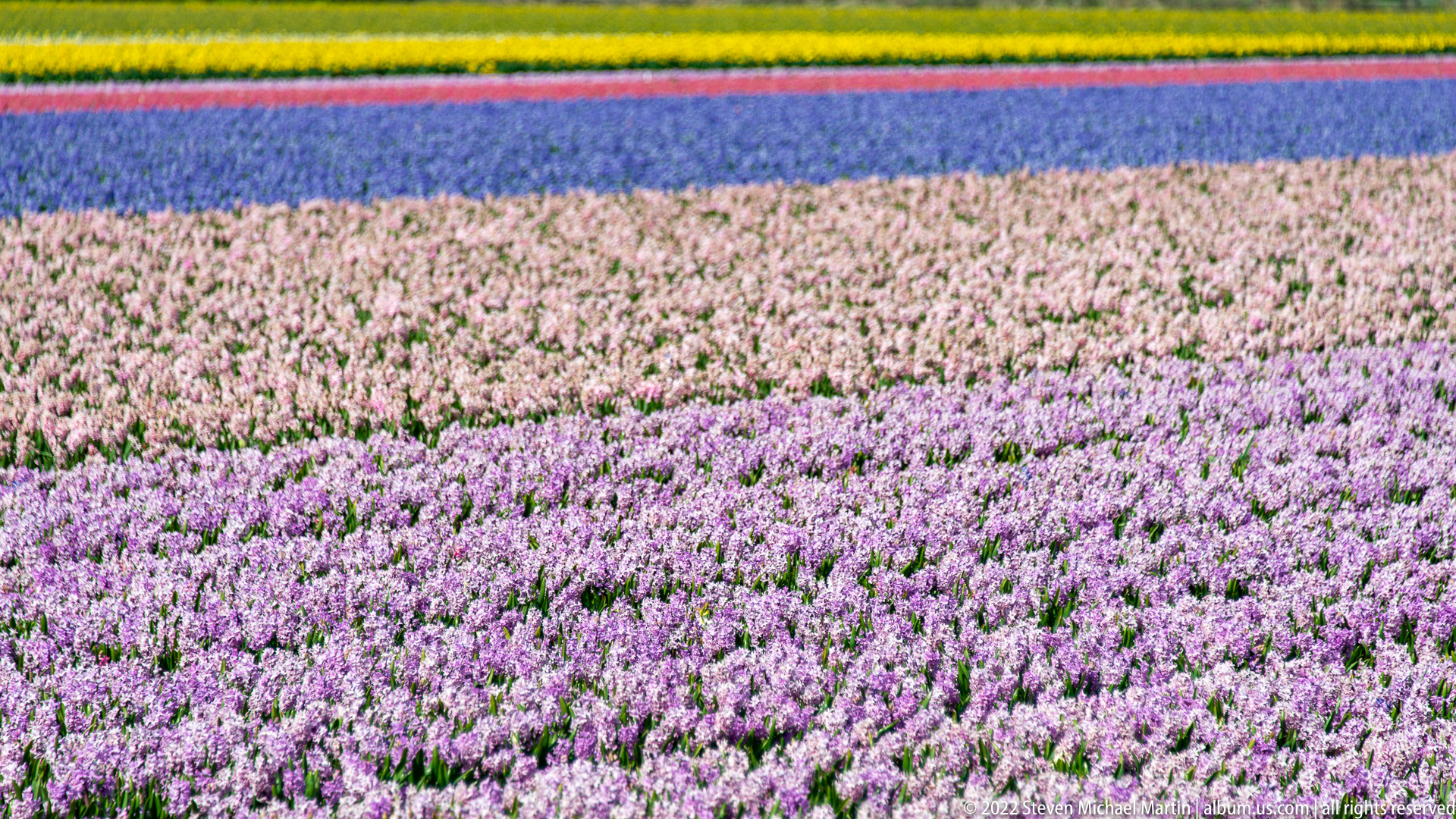
Pink and purple hyacinths fill most of this layered field composition near Lisse, while narrow bands of blue, red, and yellow flowers mark additional plantings in the distance. The compressed perspective transforms separate crop beds into broad stripes of color, yet individual hyacinth spikes remain visible in the foreground. The result documents both the scale and deliberate color segregation of spring bulb cultivation.
Caption
Pink and purple hyacinths fill most of this layered field composition near Lisse, while narrow bands of blue, red, and yellow flowers mark additional plantings in the distance. The compressed perspective transforms separate crop beds into broad stripes of color, yet individual hyacinth spikes remain visible in the foreground. The result documents both the scale and deliberate color segregation of spring bulb cultivation.
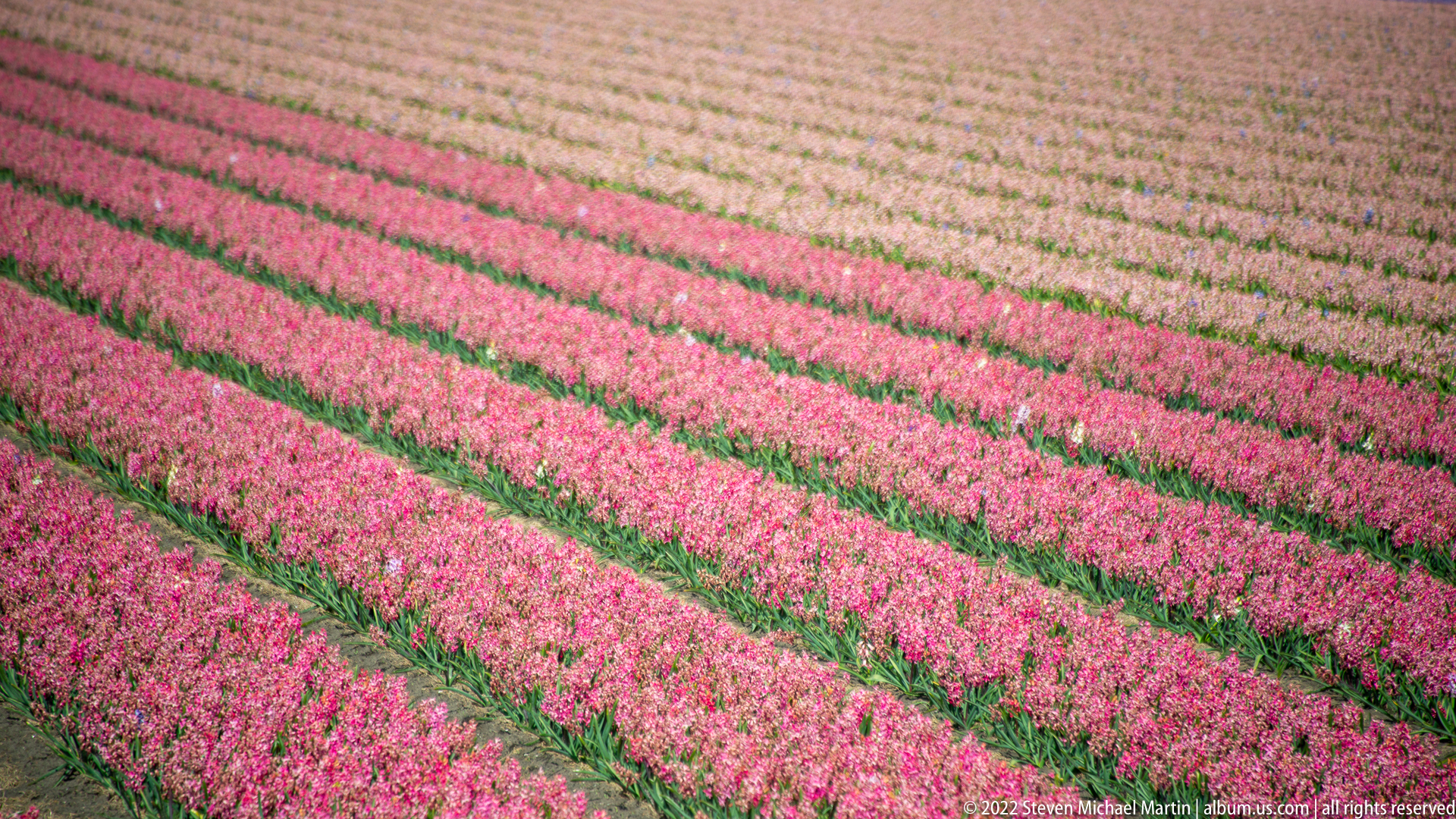
Vivid pink-red tulips form long diagonal rows across a cultivated field near Lisse, separated by narrow green and earthen lines. The oblique viewpoint reduces the flowers to a rhythmic sequence of color bands while preserving enough leaf and row structure to identify the crop. A muted tan planting in the upper field provides a subdued counterpoint to the saturated foreground tulips.
Caption
Vivid pink-red tulips form long diagonal rows across a cultivated field near Lisse, separated by narrow green and earthen lines. The oblique viewpoint reduces the flowers to a rhythmic sequence of color bands while preserving enough leaf and row structure to identify the crop. A muted tan planting in the upper field provides a subdued counterpoint to the saturated foreground tulips.
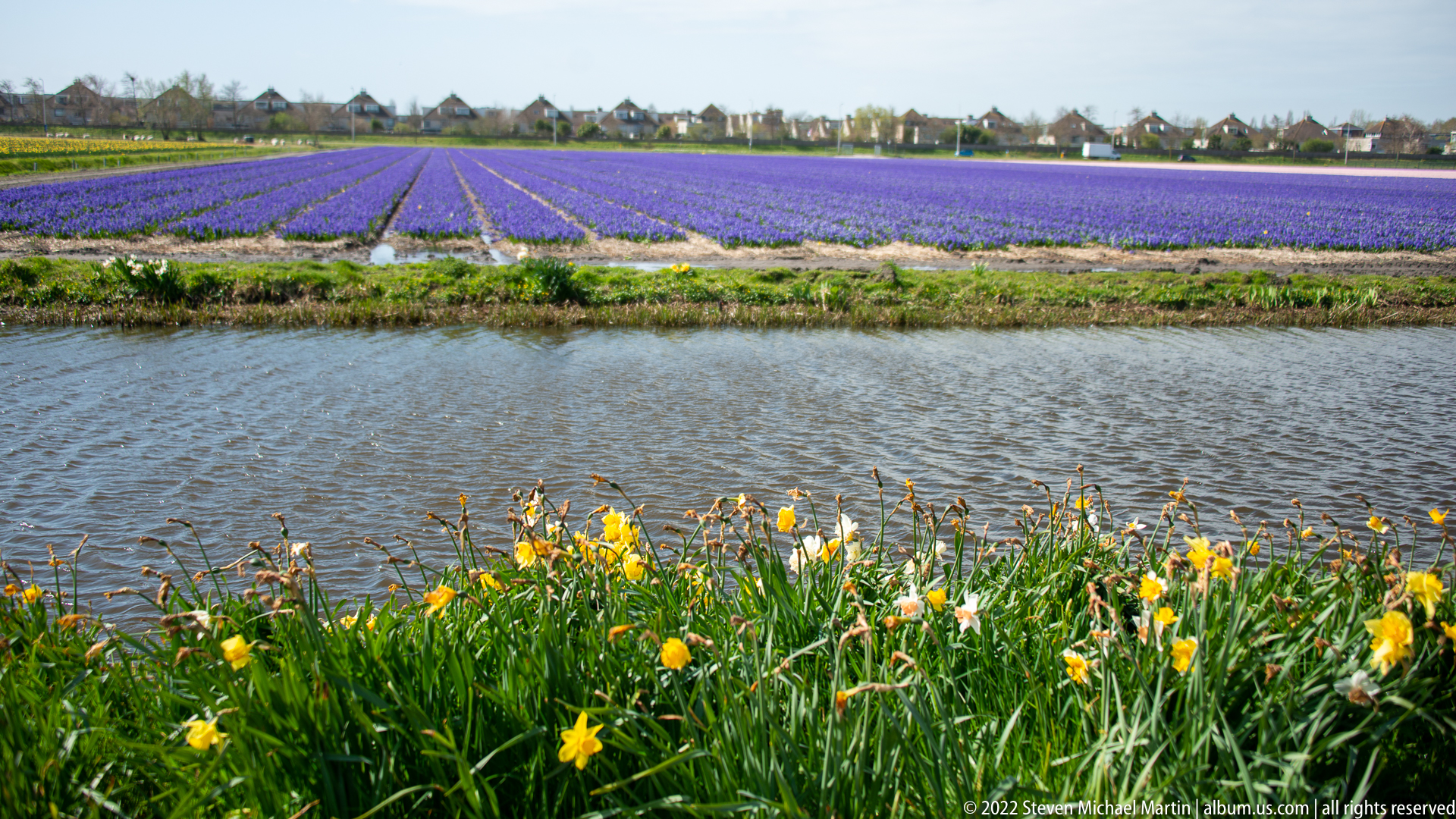
A drainage canal separates roadside daffodils in the foreground from a broad purple-flowering bulb field near Lisse. Beyond the crop, a line of houses marks the settlement edge. The view is especially informative as a landscape study, showing the coexistence of water-control infrastructure, commercial flower cultivation, residential development, and informal spring flowers within a single low-lying Dutch agricultural scene.
Caption
A drainage canal separates roadside daffodils in the foreground from a broad purple-flowering bulb field near Lisse. Beyond the crop, a line of houses marks the settlement edge. The view is especially informative as a landscape study, showing the coexistence of water-control infrastructure, commercial flower cultivation, residential development, and informal spring flowers within a single low-lying Dutch agricultural scene.
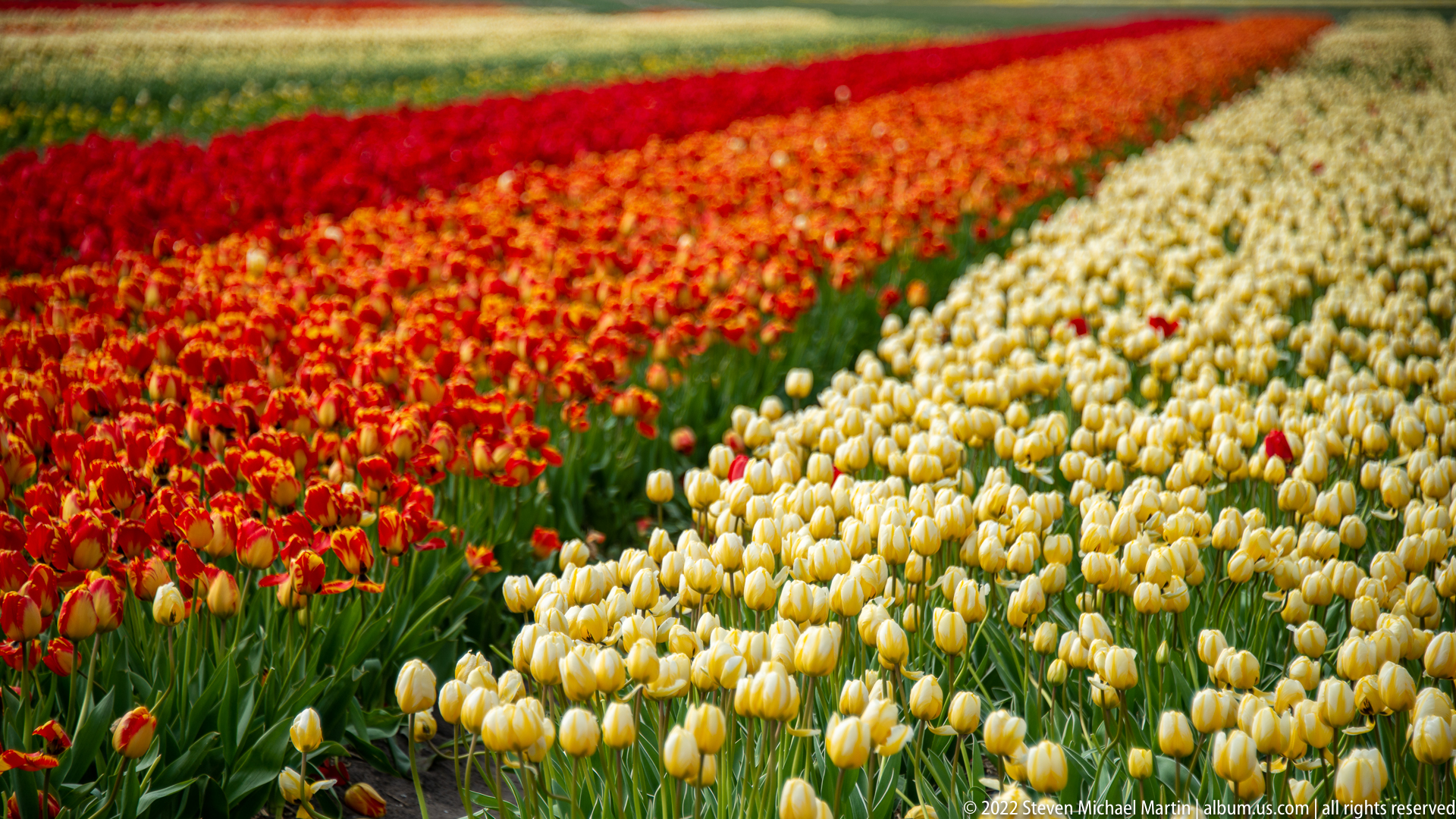
Red-orange tulips and cream-colored tulips form adjacent sweeping rows in a field near Lisse, with a deeper red band farther back. The angled view lets the planting blocks converge gently toward the upper frame while keeping individual blossoms distinct. Contrasting warm and pale colors make the crop separation immediately legible and highlight the careful organization of commercial tulip production.
Caption
Red-orange tulips and cream-colored tulips form adjacent sweeping rows in a field near Lisse, with a deeper red band farther back. The angled view lets the planting blocks converge gently toward the upper frame while keeping individual blossoms distinct. Contrasting warm and pale colors make the crop separation immediately legible and highlight the careful organization of commercial tulip production.
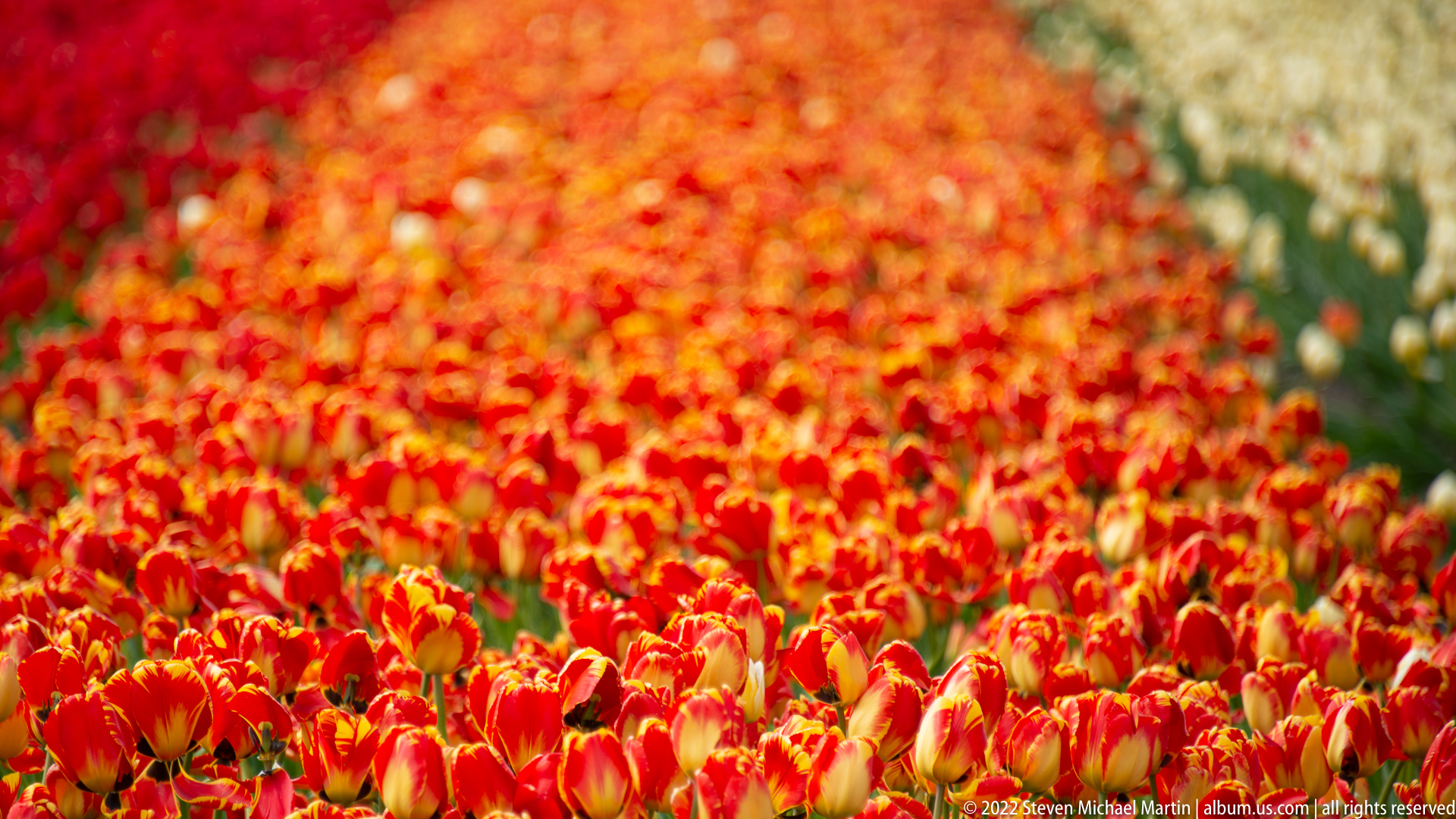
A dense block of red-orange tulips fills the foreground near Lisse, photographed with shallow focus so the nearest blossoms carry the strongest definition and the field gradually softens behind them. Yellow edging on many petals creates a two-tone effect across the planting. The close composition emphasizes flower shape, color, and repetition rather than the larger geometry of the surrounding bulb fields.
Caption
A dense block of red-orange tulips fills the foreground near Lisse, photographed with shallow focus so the nearest blossoms carry the strongest definition and the field gradually softens behind them. Yellow edging on many petals creates a two-tone effect across the planting. The close composition emphasizes flower shape, color, and repetition rather than the larger geometry of the surrounding bulb fields.
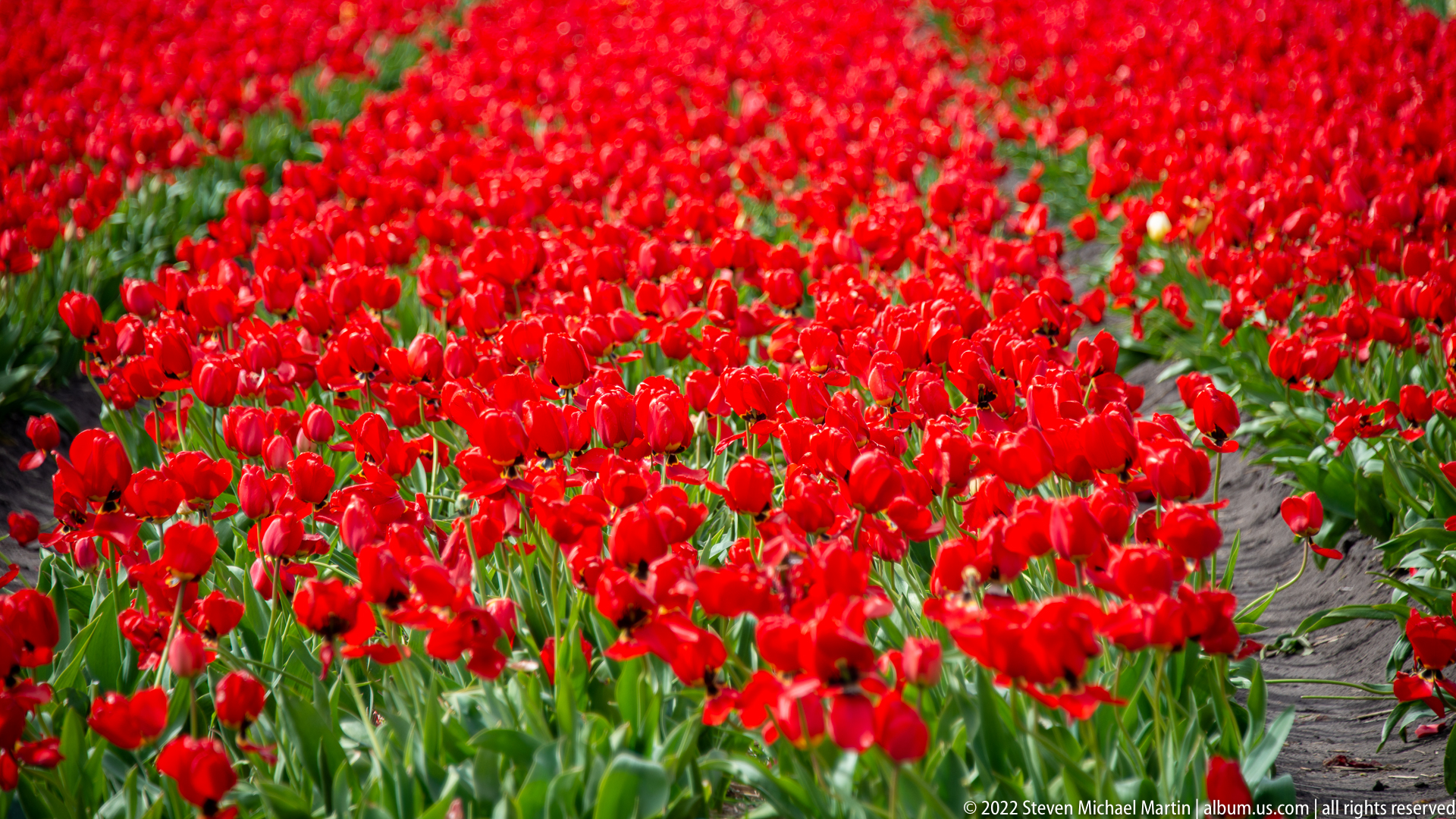
A saturated field of red tulips extends across the frame near Lisse, with green leaves and narrow glimpses of soil breaking through the massed blossoms. The camera is close enough to distinguish individual flower heads yet wide enough to convey the density of the crop. Compared with the adjacent multicolored field views, this composition focuses almost entirely on the impact of a single planted color.
Caption
A saturated field of red tulips extends across the frame near Lisse, with green leaves and narrow glimpses of soil breaking through the massed blossoms. The camera is close enough to distinguish individual flower heads yet wide enough to convey the density of the crop. Compared with the adjacent multicolored field views, this composition focuses almost entirely on the impact of a single planted color.

Parallel rows of purple, pink, yellow, and red tulips converge toward farm buildings on the horizon near Lisse. Two bare access tracks frame the central purple planting, making the field’s working layout especially clear. The low, centered viewpoint combines the visual drama of spring color with practical evidence of crop separation, machinery access, and the long rectilinear beds typical of commercial bulb cultivation.
Caption
Parallel rows of purple, pink, yellow, and red tulips converge toward farm buildings on the horizon near Lisse. Two bare access tracks frame the central purple planting, making the field’s working layout especially clear. The low, centered viewpoint combines the visual drama of spring color with practical evidence of crop separation, machinery access, and the long rectilinear beds typical of commercial bulb cultivation.
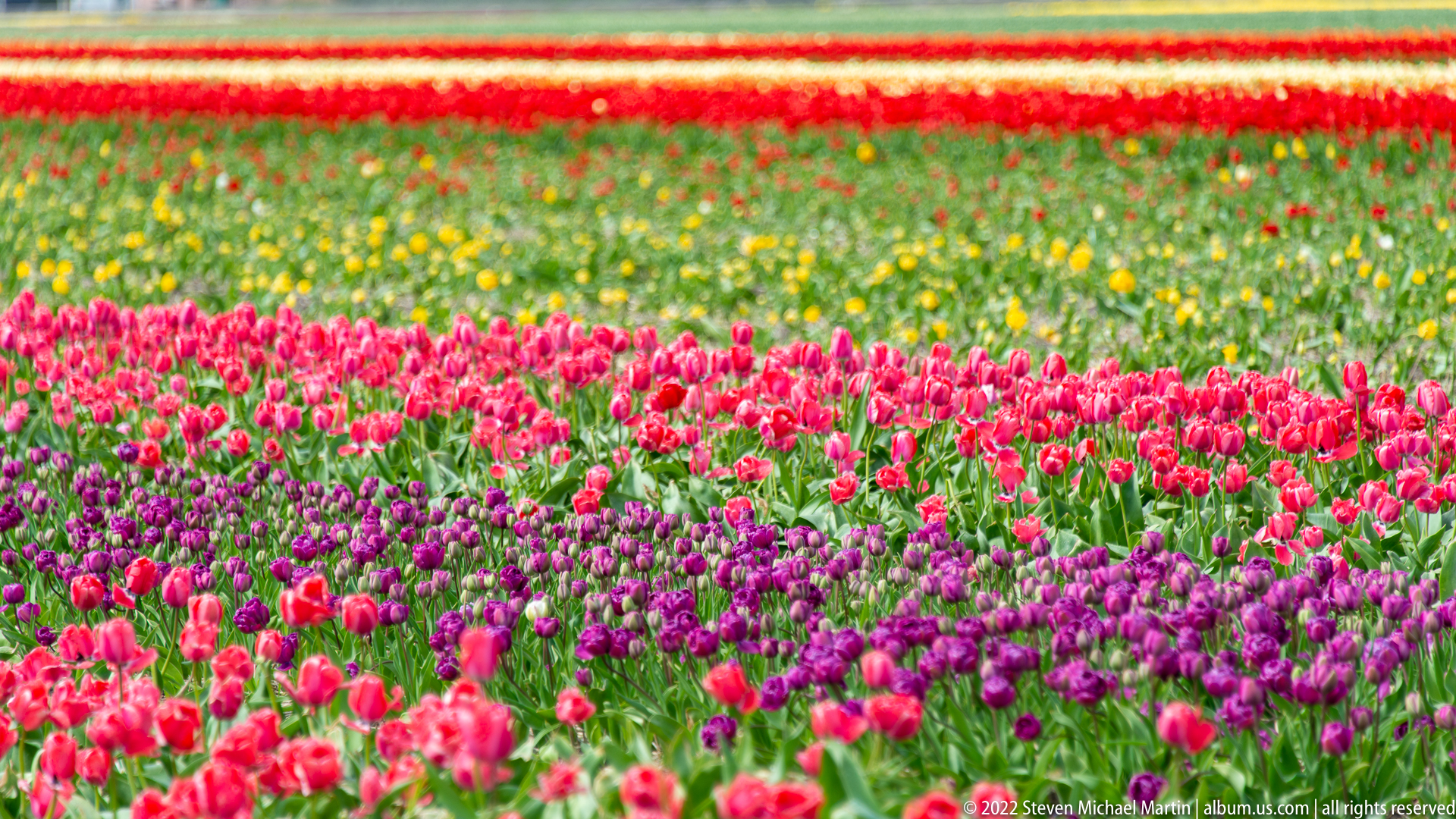
Red and purple tulips fill the foreground of this broader spring field view near Lisse, with mixed yellow-green flowering ground and crisp red and white bands beyond. The layered arrangement shows several cultivation blocks at once rather than isolating a single row. Individual tulip heads remain readable in front, while increasingly compressed color strips carry the eye toward the far edge of the agricultural landscape.
Caption
Red and purple tulips fill the foreground of this broader spring field view near Lisse, with mixed yellow-green flowering ground and crisp red and white bands beyond. The layered arrangement shows several cultivation blocks at once rather than isolating a single row. Individual tulip heads remain readable in front, while increasingly compressed color strips carry the eye toward the far edge of the agricultural landscape.
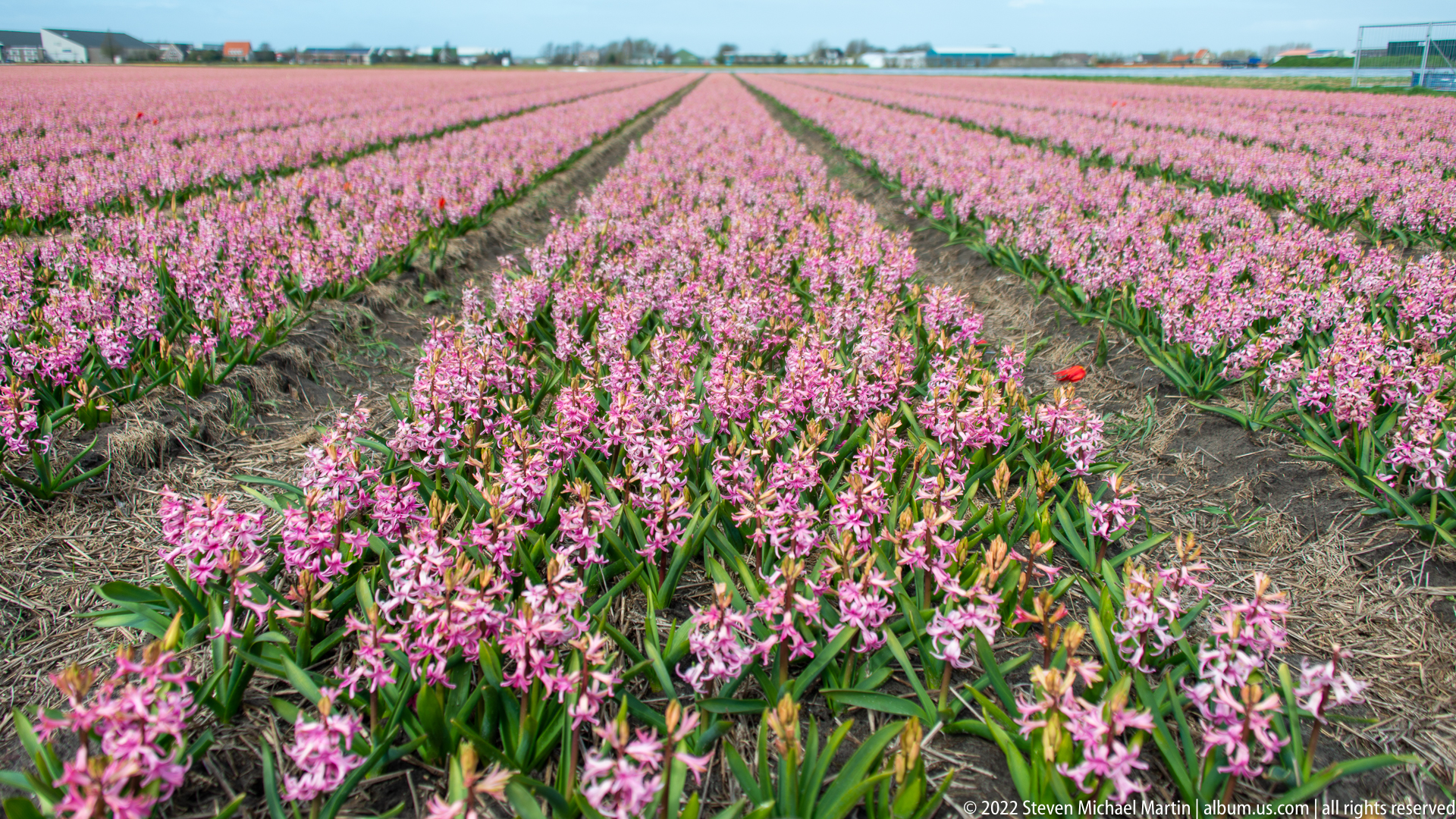
Pale pink hyacinths form long cultivated rows near Lisse, their flower spikes divided by straw-covered tracks that emphasize the field’s depth. A single red tulip rising among the hyacinths provides a conspicuous interruption to the otherwise uniform crop. The photograph combines the repeating structure of commercial bulb cultivation with a small botanical anomaly that immediately distinguishes this particular section of the field.
Caption
Pale pink hyacinths form long cultivated rows near Lisse, their flower spikes divided by straw-covered tracks that emphasize the field’s depth. A single red tulip rising among the hyacinths provides a conspicuous interruption to the otherwise uniform crop. The photograph combines the repeating structure of commercial bulb cultivation with a small botanical anomaly that immediately distinguishes this particular section of the field.
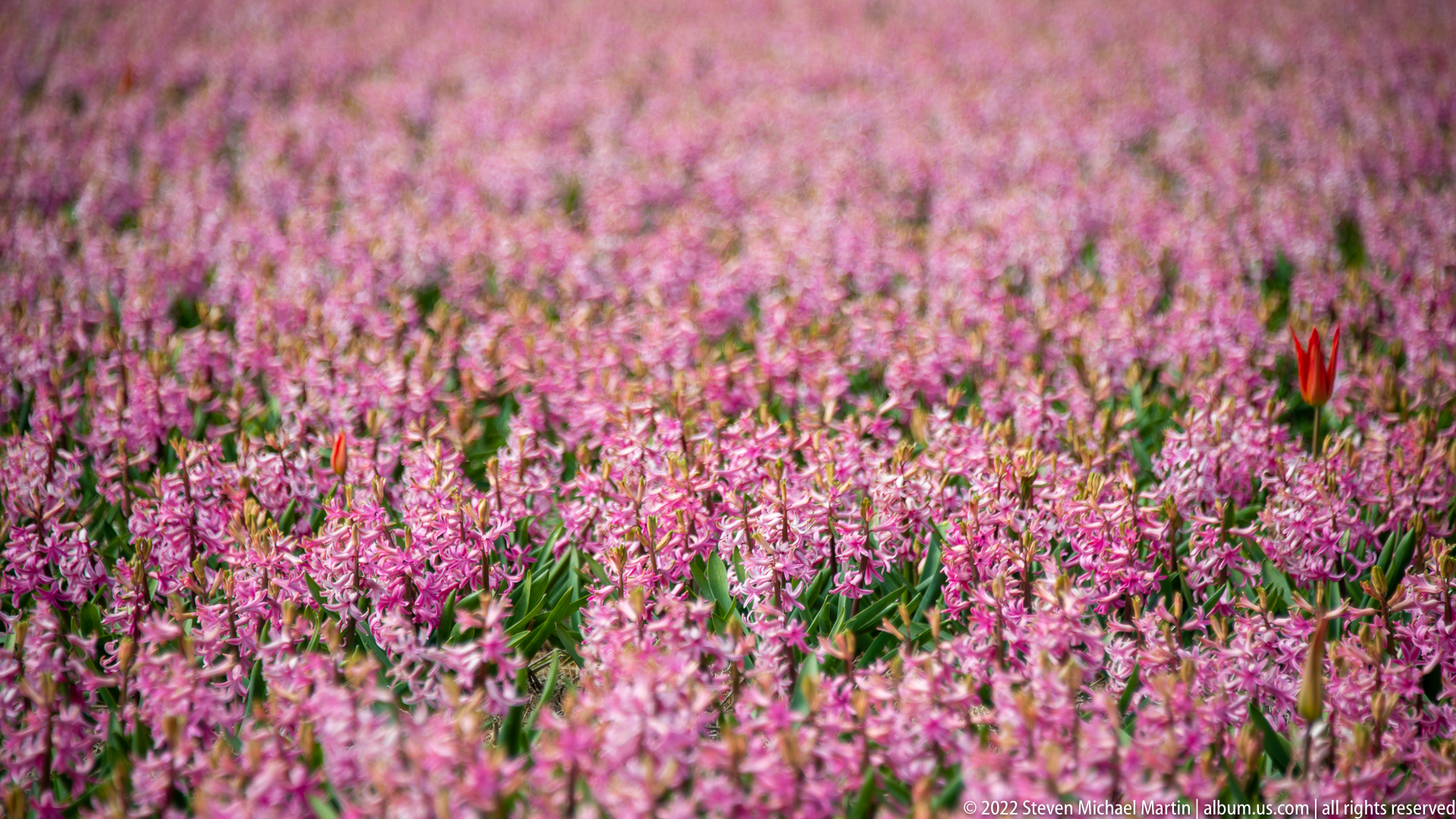
A sea of pale pink hyacinths fills this tighter composition near Lisse, with a single red tulip standing upright near the right side of the frame. Shallow depth of field softens the background and makes the contrasting tulip particularly prominent against the repeated hyacinth spikes. The view is less about field geometry than about color contrast and the unexpected presence of one different flower within a uniform commercial planting.
Caption
A sea of pale pink hyacinths fills this tighter composition near Lisse, with a single red tulip standing upright near the right side of the frame. Shallow depth of field softens the background and makes the contrasting tulip particularly prominent against the repeated hyacinth spikes. The view is less about field geometry than about color contrast and the unexpected presence of one different flower within a uniform commercial planting.
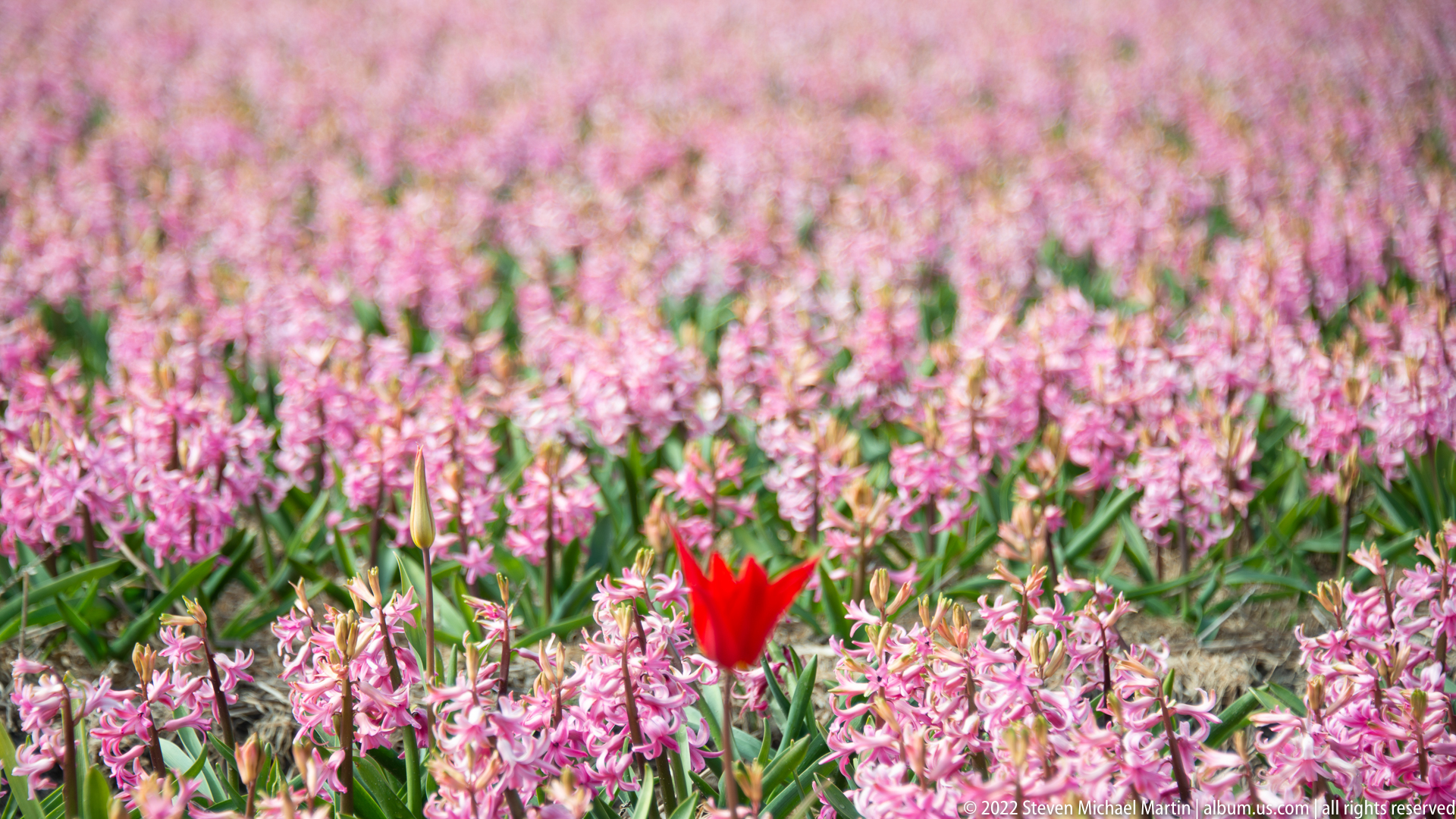
A lone red tulip rises sharply among pale pink hyacinths near Lisse, creating an unmistakable focal point in a densely planted bulb field. The shallow focus separates the tulip from the repeated pink flower spikes around it while the green leaves and exposed soil retain the agricultural context. This closer framing turns a small irregularity in the crop into the defining subject of the photograph.
Caption
A lone red tulip rises sharply among pale pink hyacinths near Lisse, creating an unmistakable focal point in a densely planted bulb field. The shallow focus separates the tulip from the repeated pink flower spikes around it while the green leaves and exposed soil retain the agricultural context. This closer framing turns a small irregularity in the crop into the defining subject of the photograph.
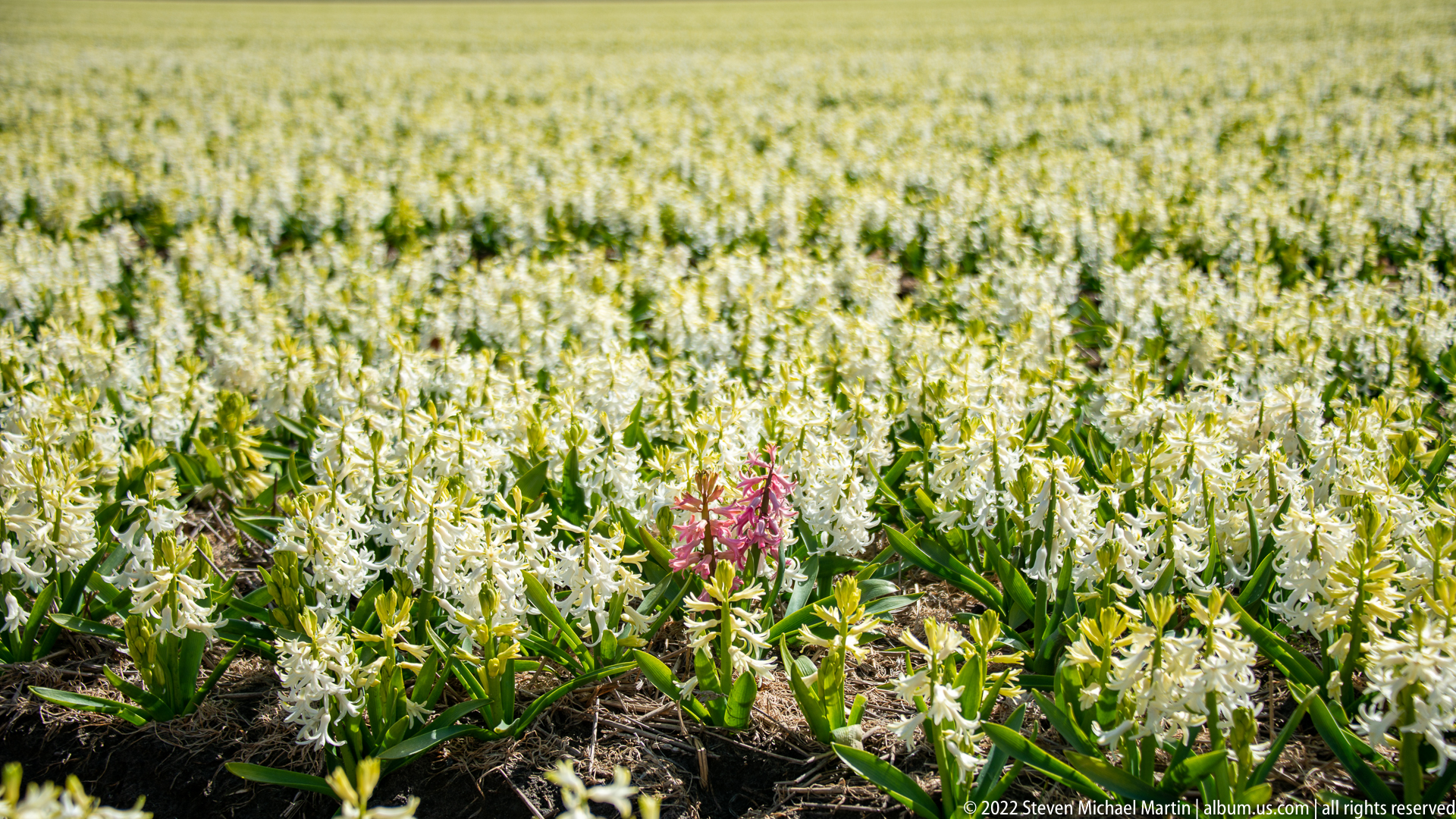
White hyacinths spread across a broad field near Lisse, their pale flower spikes interrupted in the foreground by one distinctly pink flowering spike. The low perspective keeps leaf structure, soil, and individual florets visible before the white crop recedes into a luminous mass. Like the neighboring views with isolated tulips, this photograph records a small variation within an otherwise highly uniform commercial planting.
Caption
White hyacinths spread across a broad field near Lisse, their pale flower spikes interrupted in the foreground by one distinctly pink flowering spike. The low perspective keeps leaf structure, soil, and individual florets visible before the white crop recedes into a luminous mass. Like the neighboring views with isolated tulips, this photograph records a small variation within an otherwise highly uniform commercial planting.
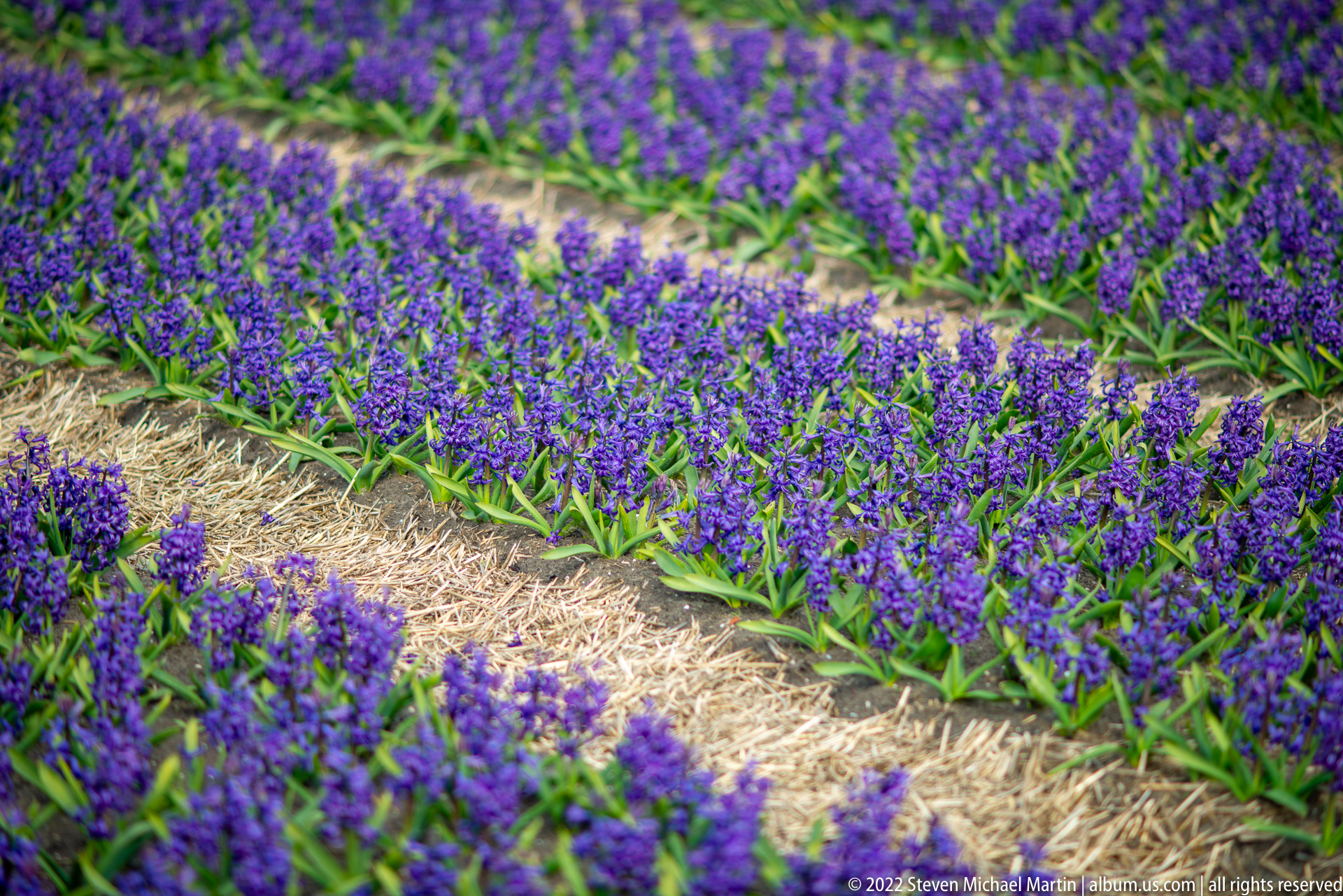
Purple hyacinths grow in closely spaced rows near Lisse, divided by pale straw-covered paths that curve gently through the planting. The oblique viewpoint reveals individual flower spikes and broad green leaves while also showing the practical access pattern within the field. The image balances botanical detail with the organized geometry of commercial spring bulb cultivation.
Caption
Purple hyacinths grow in closely spaced rows near Lisse, divided by pale straw-covered paths that curve gently through the planting. The oblique viewpoint reveals individual flower spikes and broad green leaves while also showing the practical access pattern within the field. The image balances botanical detail with the organized geometry of commercial spring bulb cultivation.
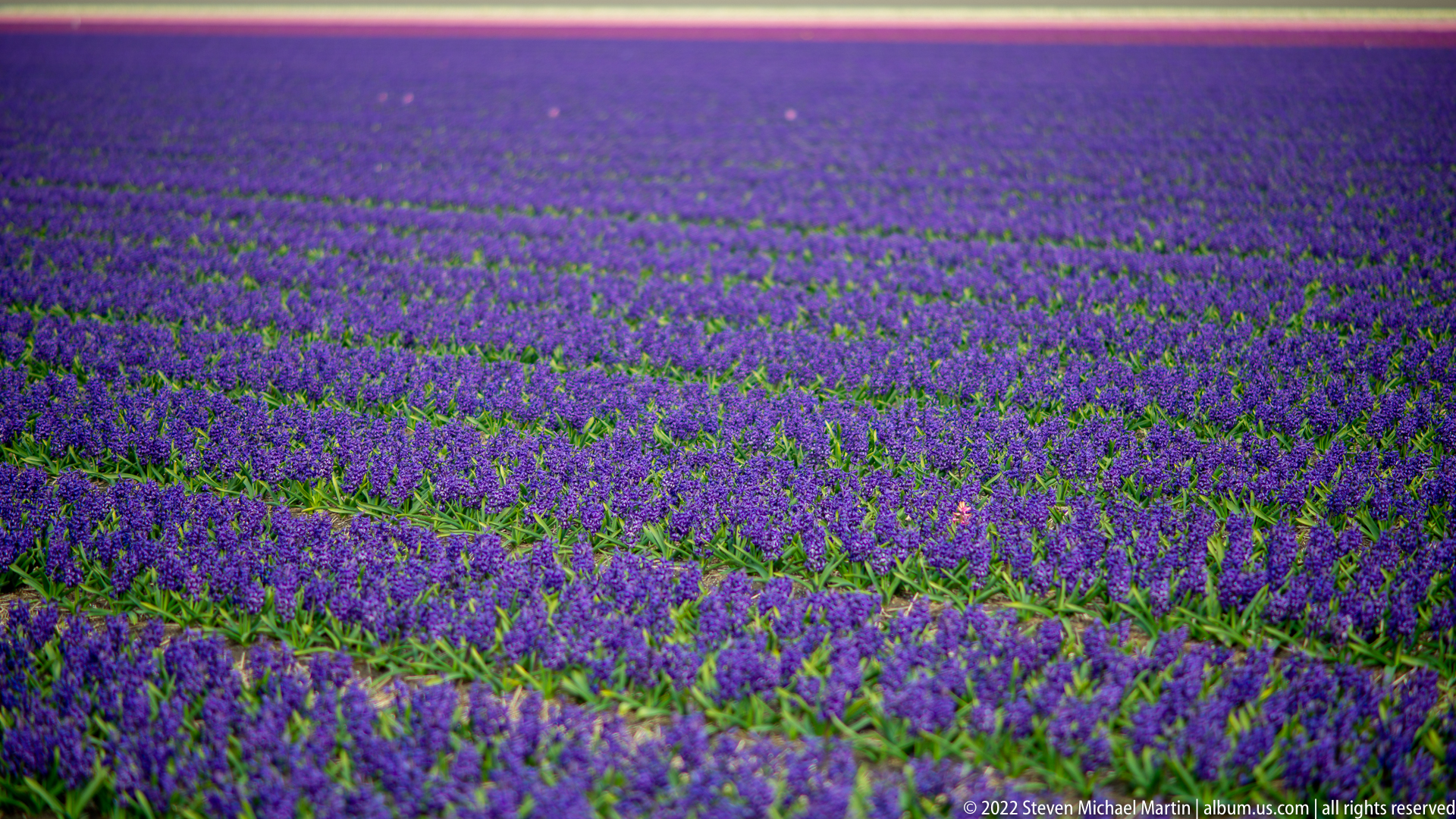
A broad field of purple hyacinths stretches across the frame near Lisse, its planting rows becoming increasingly compressed toward the horizon. The elevated view emphasizes the extraordinary density of the crop and the subtle linear divisions between rows. A narrow pink band at the far edge marks another flowering block, reinforcing the large scale and color-zoned organization of the surrounding bulb-growing landscape.
Caption
A broad field of purple hyacinths stretches across the frame near Lisse, its planting rows becoming increasingly compressed toward the horizon. The elevated view emphasizes the extraordinary density of the crop and the subtle linear divisions between rows. A narrow pink band at the far edge marks another flowering block, reinforcing the large scale and color-zoned organization of the surrounding bulb-growing landscape.
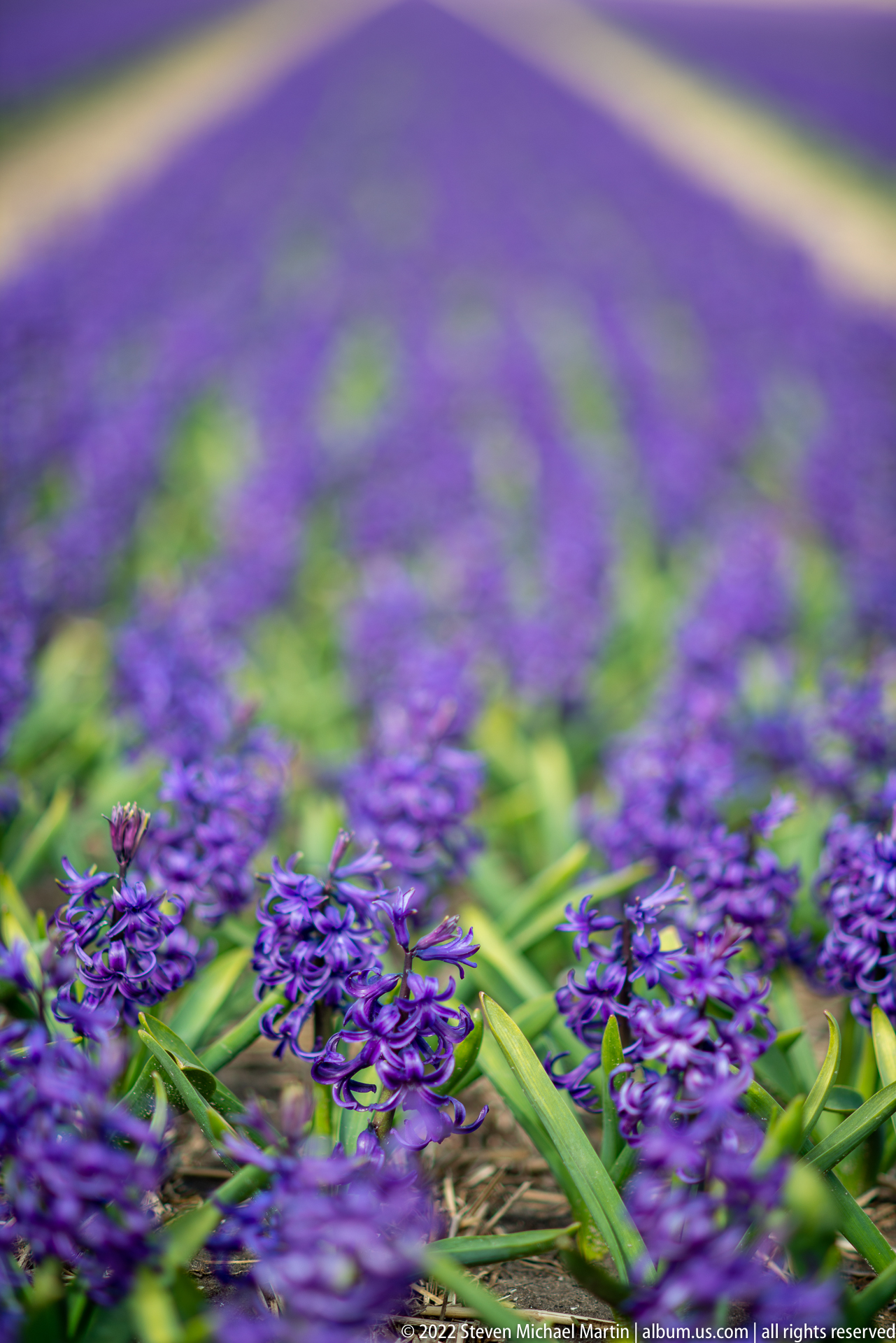
Purple hyacinths are isolated in a shallow-focus field study near Lisse, with several foreground spikes rendered sharply against a softly blurred background of repeating flowers. The close perspective highlights the compact florets and arching leaves that define the plants, while the indistinct rows behind preserve the sense of a much larger cultivated field. The composition is more botanical portrait than landscape.
Caption
Purple hyacinths are isolated in a shallow-focus field study near Lisse, with several foreground spikes rendered sharply against a softly blurred background of repeating flowers. The close perspective highlights the compact florets and arching leaves that define the plants, while the indistinct rows behind preserve the sense of a much larger cultivated field. The composition is more botanical portrait than landscape.
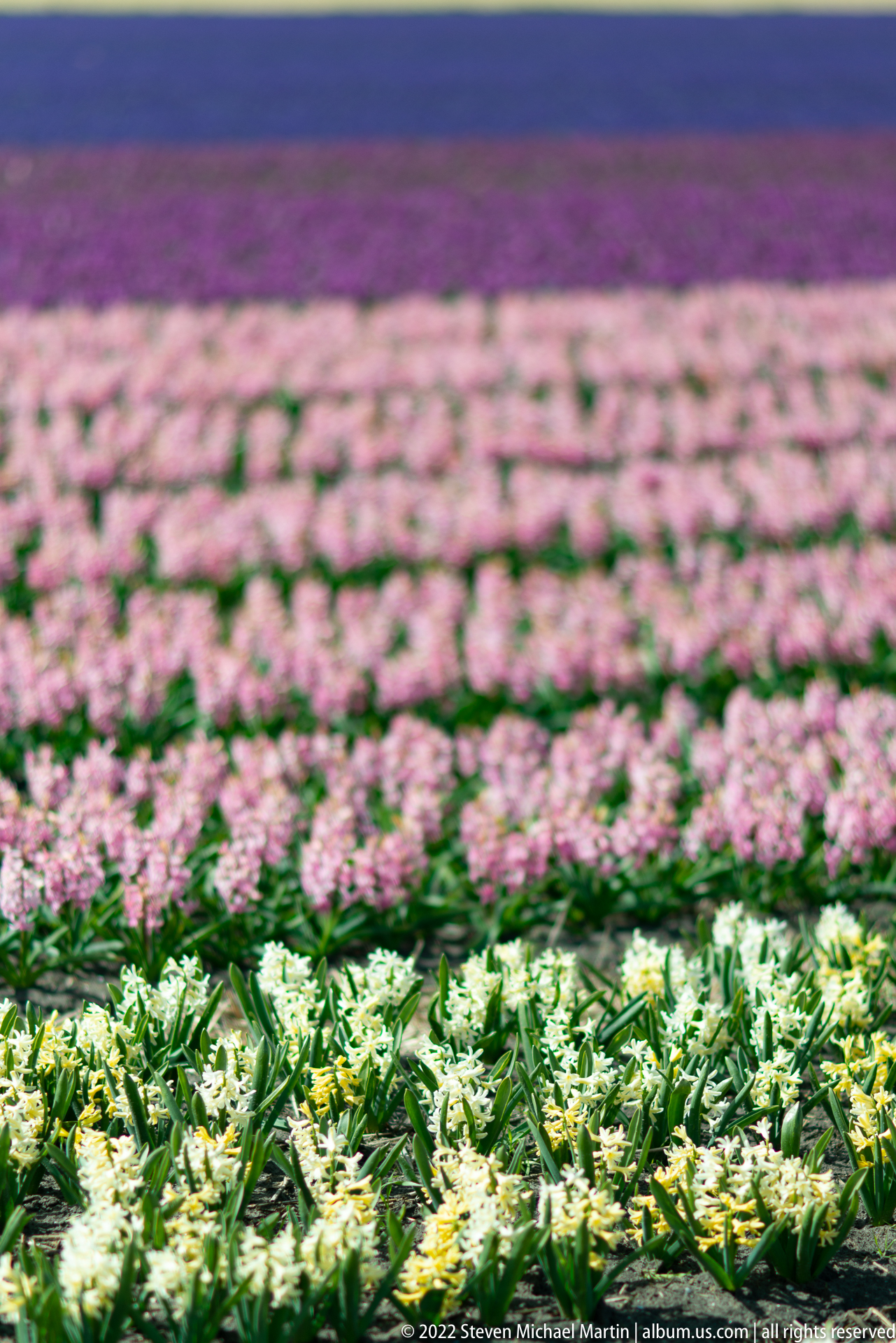
Successive bulb plantings near Lisse create a layered sequence of cream-white, pale pink, magenta, and blue-purple hyacinths. A narrow zone of dark green foliage separates the nearest pale flowers from the pink block behind, making the crop boundaries especially clear. The shallow focus and horizontal composition turn the fields into softly graduated color bands while retaining agricultural context.
Caption
Successive bulb plantings near Lisse create a layered sequence of cream-white, pale pink, magenta, and blue-purple hyacinths. A narrow zone of dark green foliage separates the nearest pale flowers from the pink block behind, making the crop boundaries especially clear. The shallow focus and horizontal composition turn the fields into softly graduated color bands while retaining agricultural context.
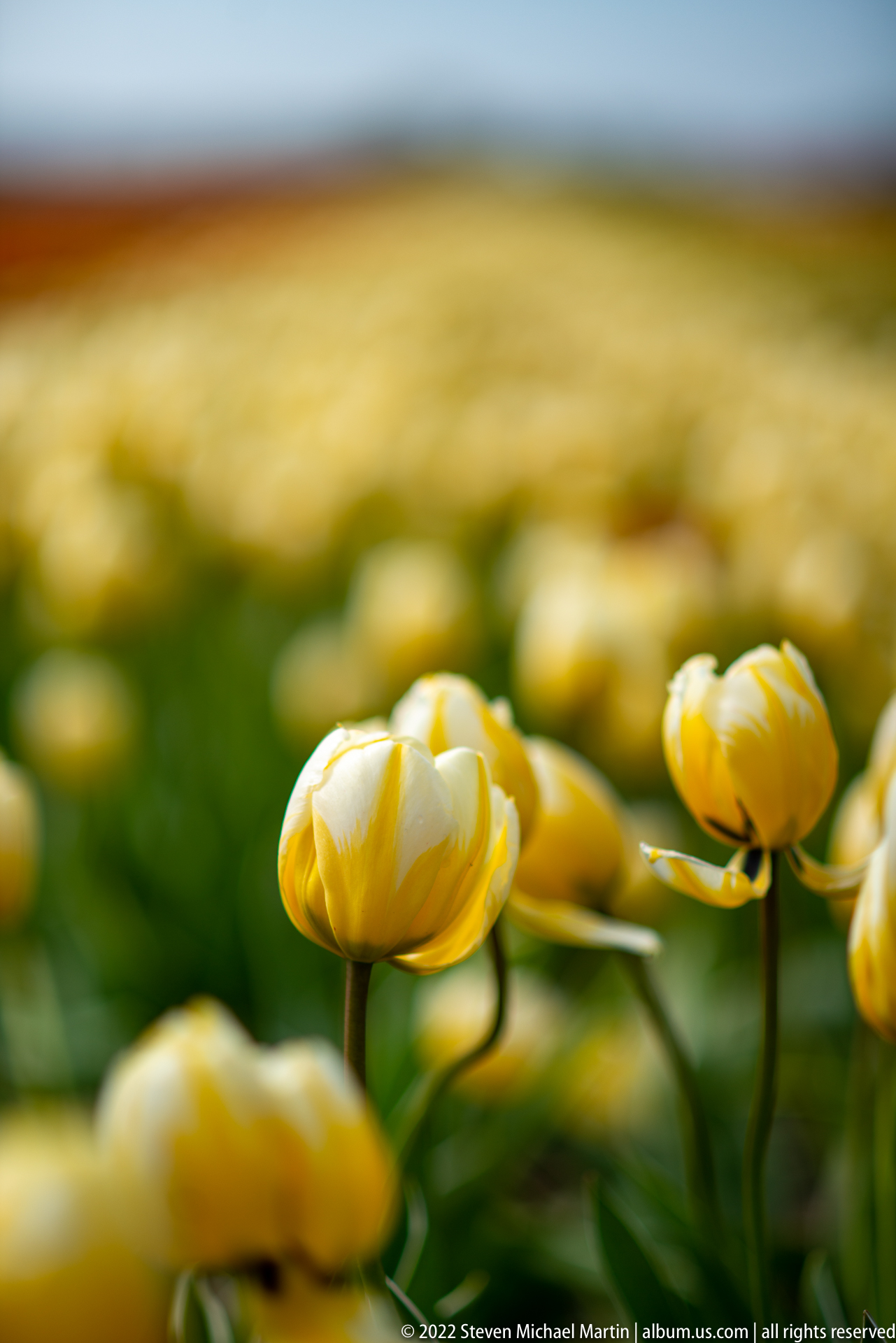
Double yellow tulips bloom in a cultivated field near Lisse, their layered petals giving the flowers a fuller, peony-like form than standard single tulips. The shallow depth of field isolates several blossoms against a softly blurred mass of yellow behind them. Green leaves and stems remain visible at ground level, preserving the sense of a field crop rather than a cut-flower arrangement.
Caption
Double yellow tulips bloom in a cultivated field near Lisse, their layered petals giving the flowers a fuller, peony-like form than standard single tulips. The shallow depth of field isolates several blossoms against a softly blurred mass of yellow behind them. Green leaves and stems remain visible at ground level, preserving the sense of a field crop rather than a cut-flower arrangement.
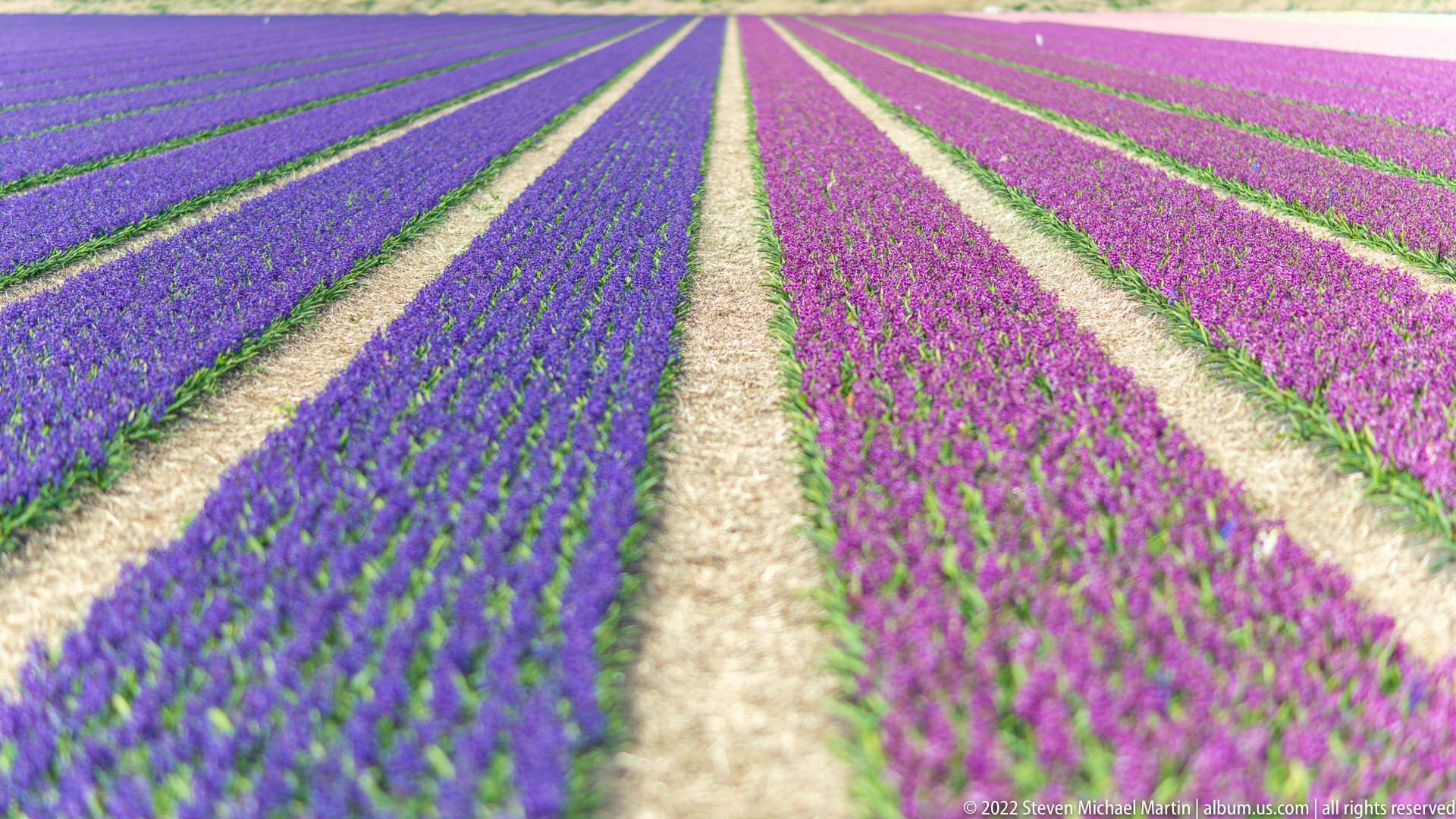
Alternating rows of purple and pink hyacinths converge dramatically toward the horizon near Lisse, separated by pale straw-covered access lanes. The centered, low perspective transforms the agricultural planting into strong bands of color while still preserving the texture of individual flower spikes. The photograph is distinguished by its nearly symmetrical geometry and the contrast between cool purple and warmer pink beds.
Caption
Alternating rows of purple and pink hyacinths converge dramatically toward the horizon near Lisse, separated by pale straw-covered access lanes. The centered, low perspective transforms the agricultural planting into strong bands of color while still preserving the texture of individual flower spikes. The photograph is distinguished by its nearly symmetrical geometry and the contrast between cool purple and warmer pink beds.
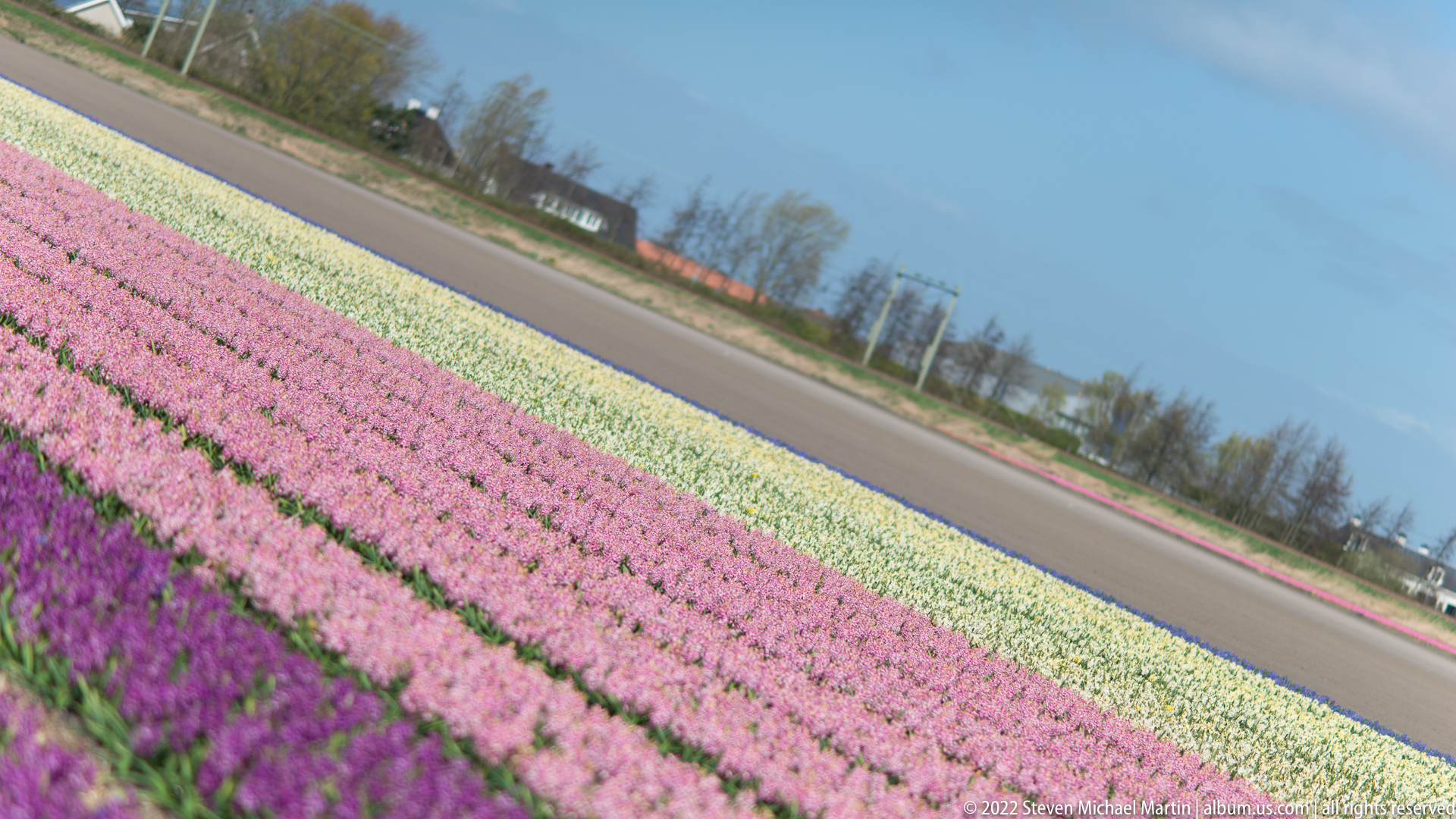
Pink and white hyacinth fields border a paved road near Lisse, photographed at a pronounced diagonal that makes the cultivated bands sweep across the frame. Beyond the road, sparse trees and low structures define the edge of the agricultural landscape. The tilted composition sets this view apart from the portfolio’s more formal field studies and emphasizes how closely commercial flower plots meet local transport routes.
Caption
Pink and white hyacinth fields border a paved road near Lisse, photographed at a pronounced diagonal that makes the cultivated bands sweep across the frame. Beyond the road, sparse trees and low structures define the edge of the agricultural landscape. The tilted composition sets this view apart from the portfolio’s more formal field studies and emphasizes how closely commercial flower plots meet local transport routes.
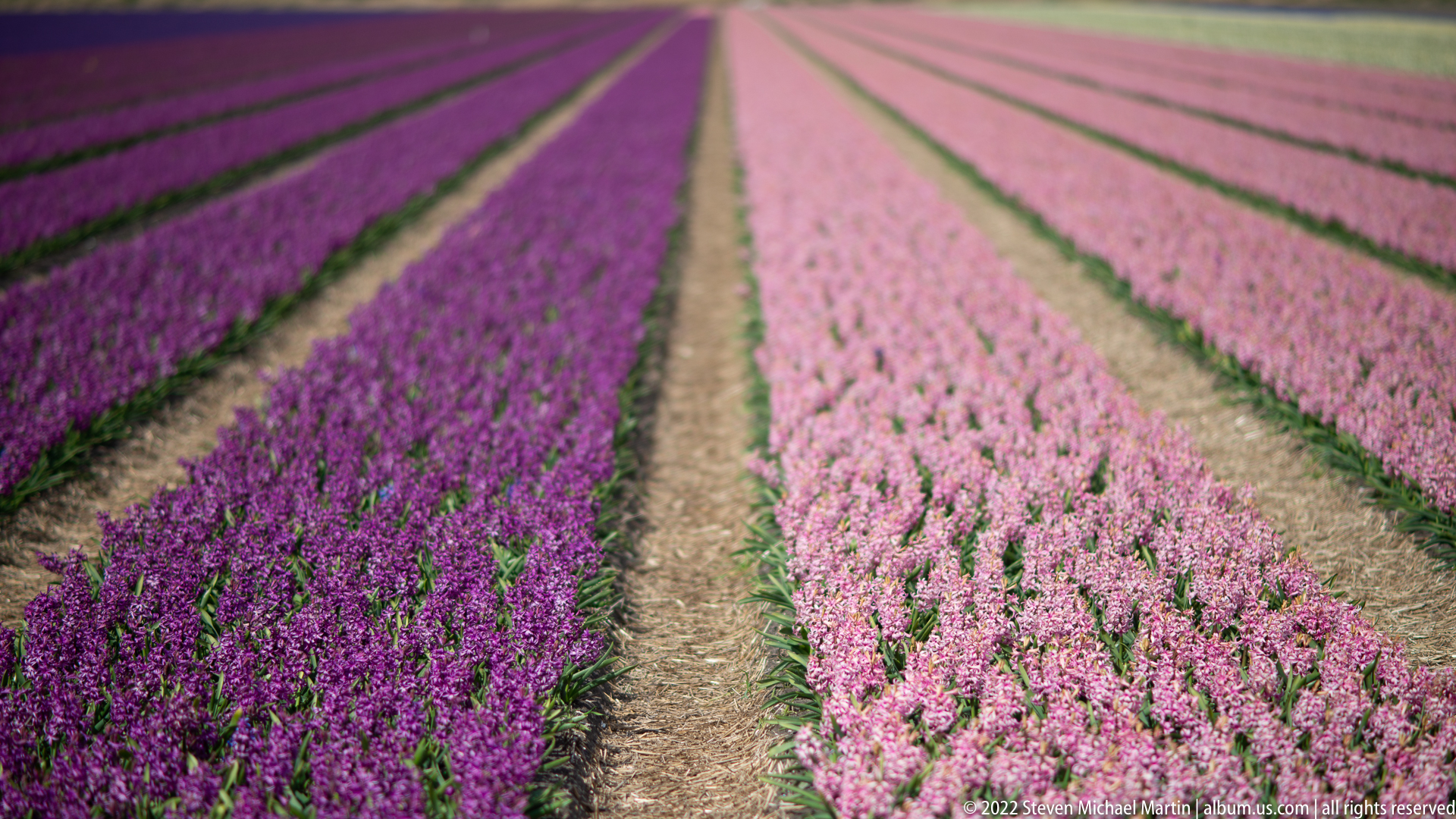
Deep purple and pale pink hyacinths form parallel beds near Lisse, divided by narrow straw-covered lanes that lead directly into the distance. The low viewpoint accentuates the height and density of the nearest flower spikes while the color blocks taper toward a shared vanishing point. The pairing of a dark purple bed with a softer pink bed gives this field view a particularly clear two-color structure.
Caption
Deep purple and pale pink hyacinths form parallel beds near Lisse, divided by narrow straw-covered lanes that lead directly into the distance. The low viewpoint accentuates the height and density of the nearest flower spikes while the color blocks taper toward a shared vanishing point. The pairing of a dark purple bed with a softer pink bed gives this field view a particularly clear two-color structure.
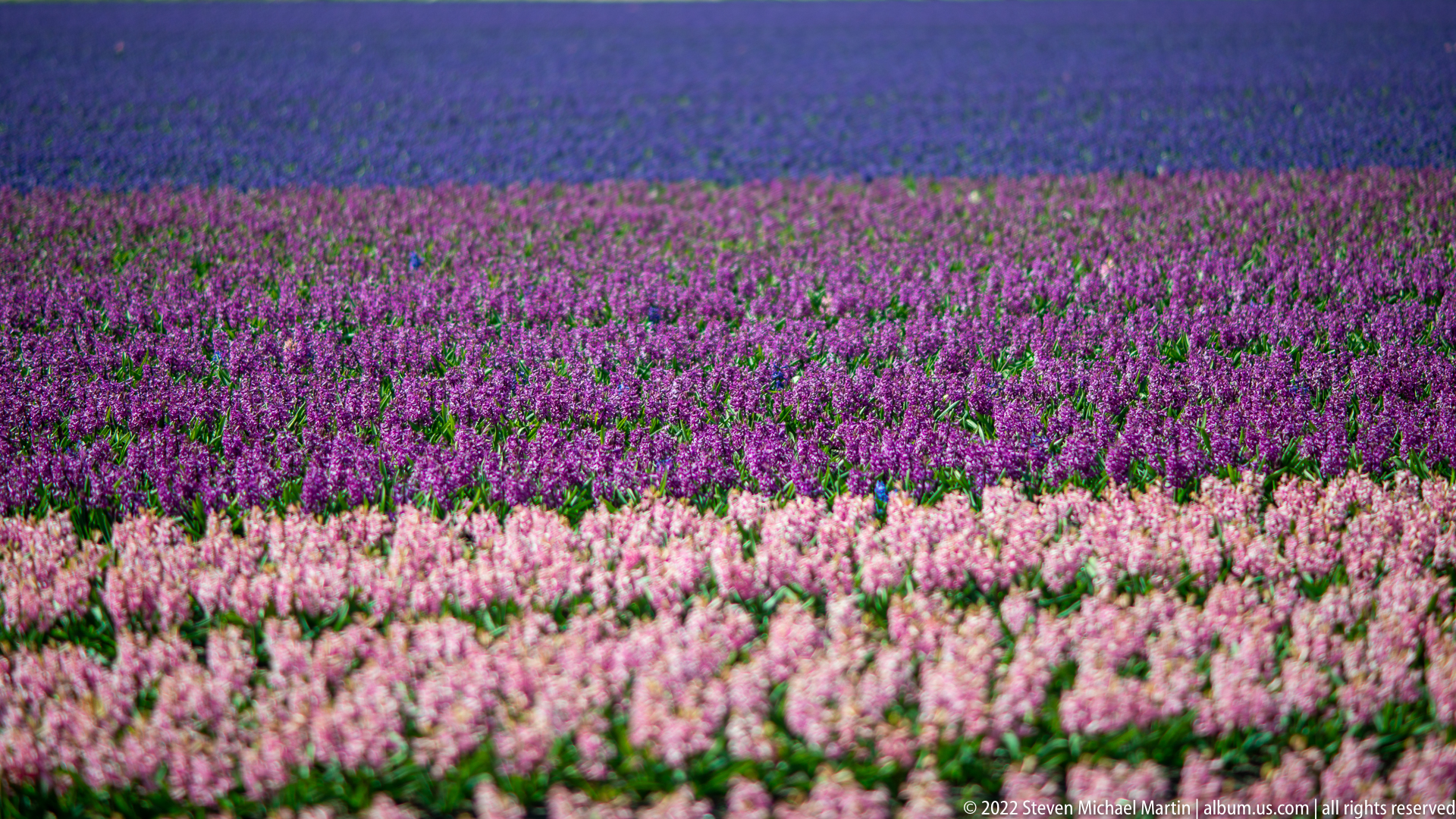
Broad bands of pale pink, magenta, and blue-purple hyacinths stack across the field near Lisse. The telephoto-like compression reduces visible paths and makes the crop read as horizontal layers of color, while individual flower spikes remain distinct in the foreground. This composition emphasizes the contrast between adjoining plantings more than the linear geometry of the rows themselves.
Caption
Broad bands of pale pink, magenta, and blue-purple hyacinths stack across the field near Lisse. The telephoto-like compression reduces visible paths and makes the crop read as horizontal layers of color, while individual flower spikes remain distinct in the foreground. This composition emphasizes the contrast between adjoining plantings more than the linear geometry of the rows themselves.
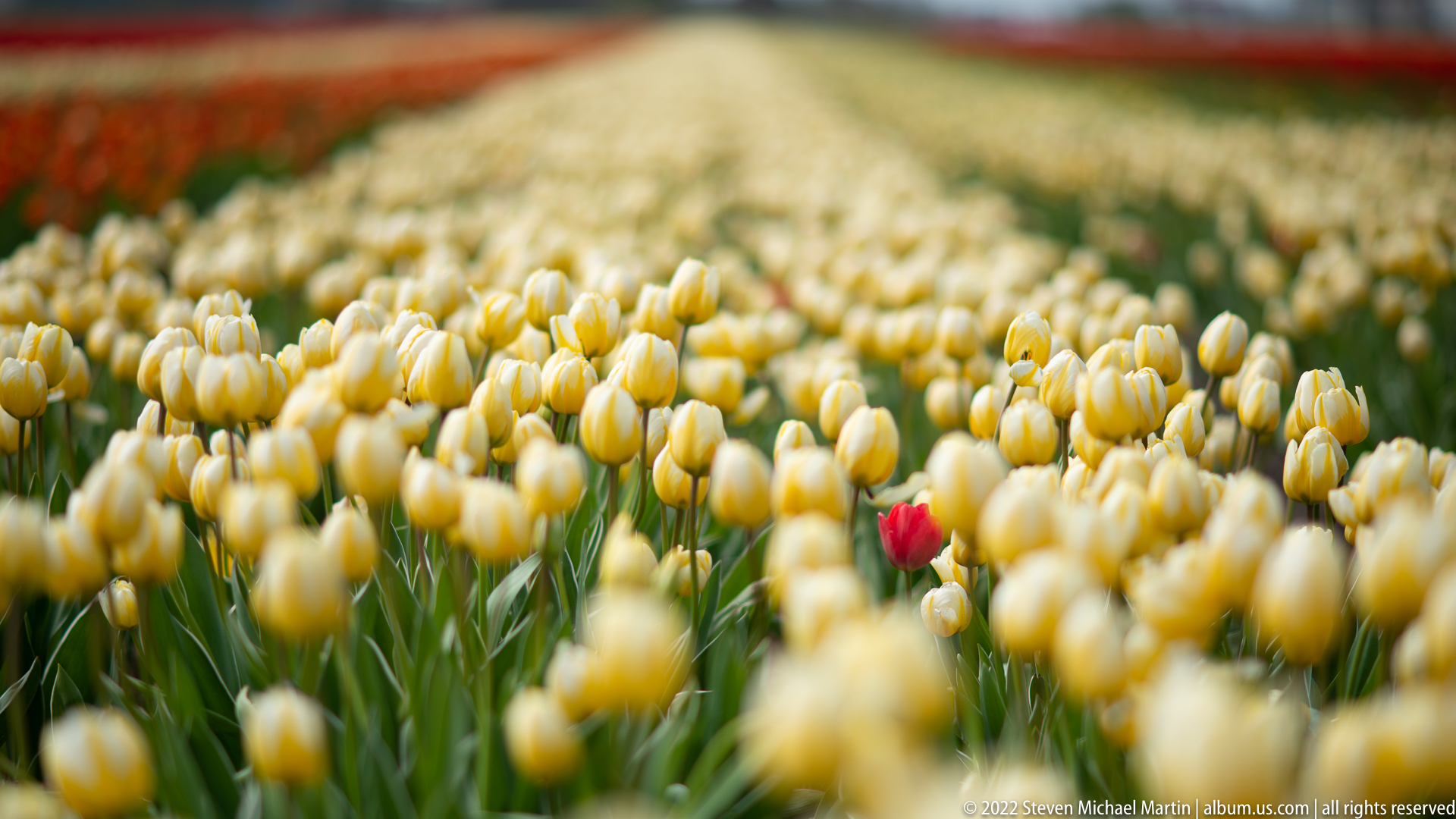
A single red tulip rises among a broad field of cream-yellow tulips near Lisse, creating a striking point of contrast within an otherwise uniform planting. The surrounding flowers recede in shallow focus, drawing attention to the isolated red bloom without losing the scale of the cultivated bed. The photograph records a small irregularity in the crop as its defining visual feature.
Caption
A single red tulip rises among a broad field of cream-yellow tulips near Lisse, creating a striking point of contrast within an otherwise uniform planting. The surrounding flowers recede in shallow focus, drawing attention to the isolated red bloom without losing the scale of the cultivated bed. The photograph records a small irregularity in the crop as its defining visual feature.
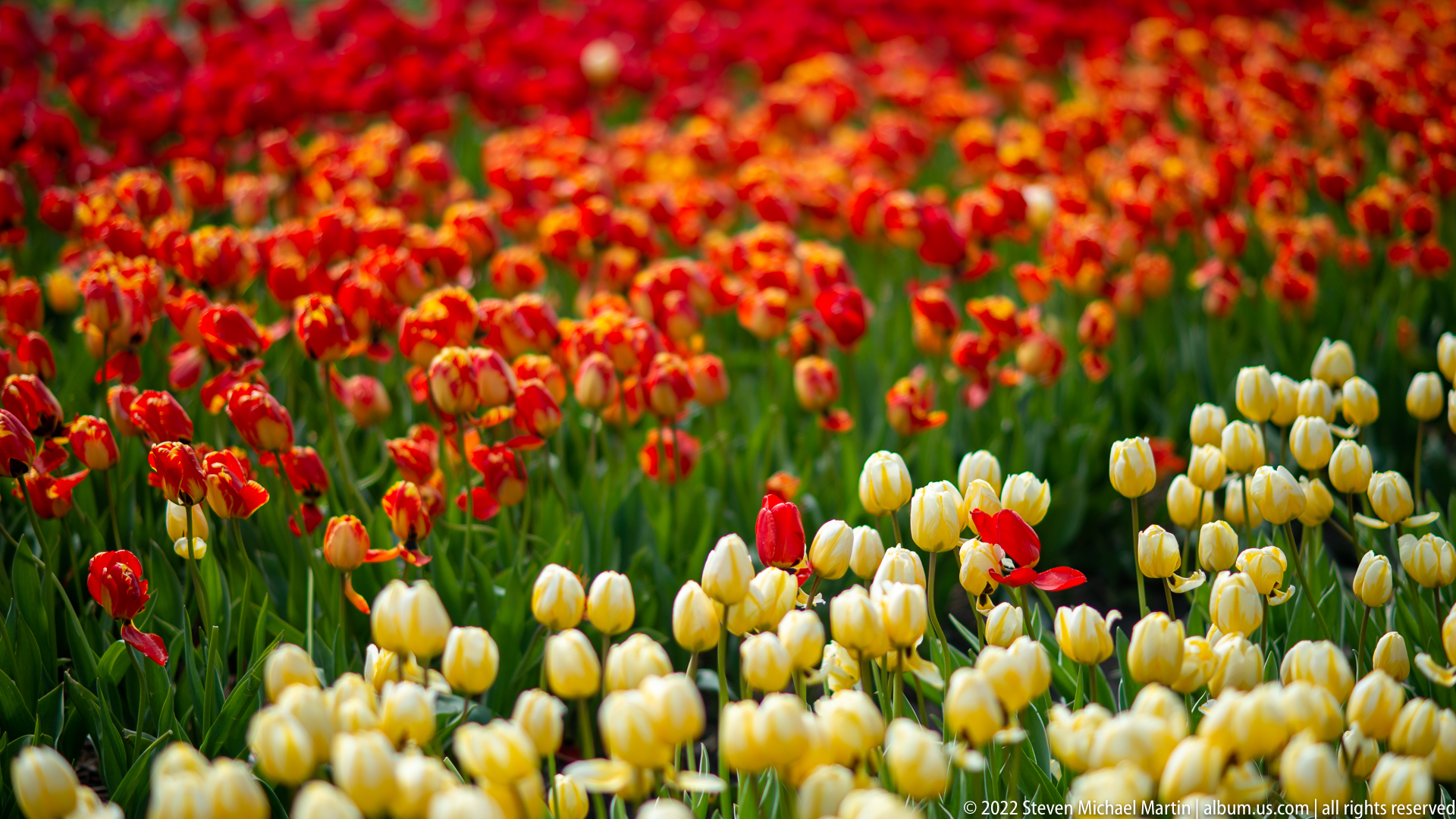
Cream-yellow tulips dominate the foreground near Lisse, interrupted by a few red blooms and backed by a saturated band of red-orange tulips. The layered arrangement produces a strong contrast between pale and warm colors while preserving the density of commercial planting. Unlike the closer single-flower studies, this view combines both individual blossoms and the broader structure of adjacent crop blocks.
Caption
Cream-yellow tulips dominate the foreground near Lisse, interrupted by a few red blooms and backed by a saturated band of red-orange tulips. The layered arrangement produces a strong contrast between pale and warm colors while preserving the density of commercial planting. Unlike the closer single-flower studies, this view combines both individual blossoms and the broader structure of adjacent crop blocks.
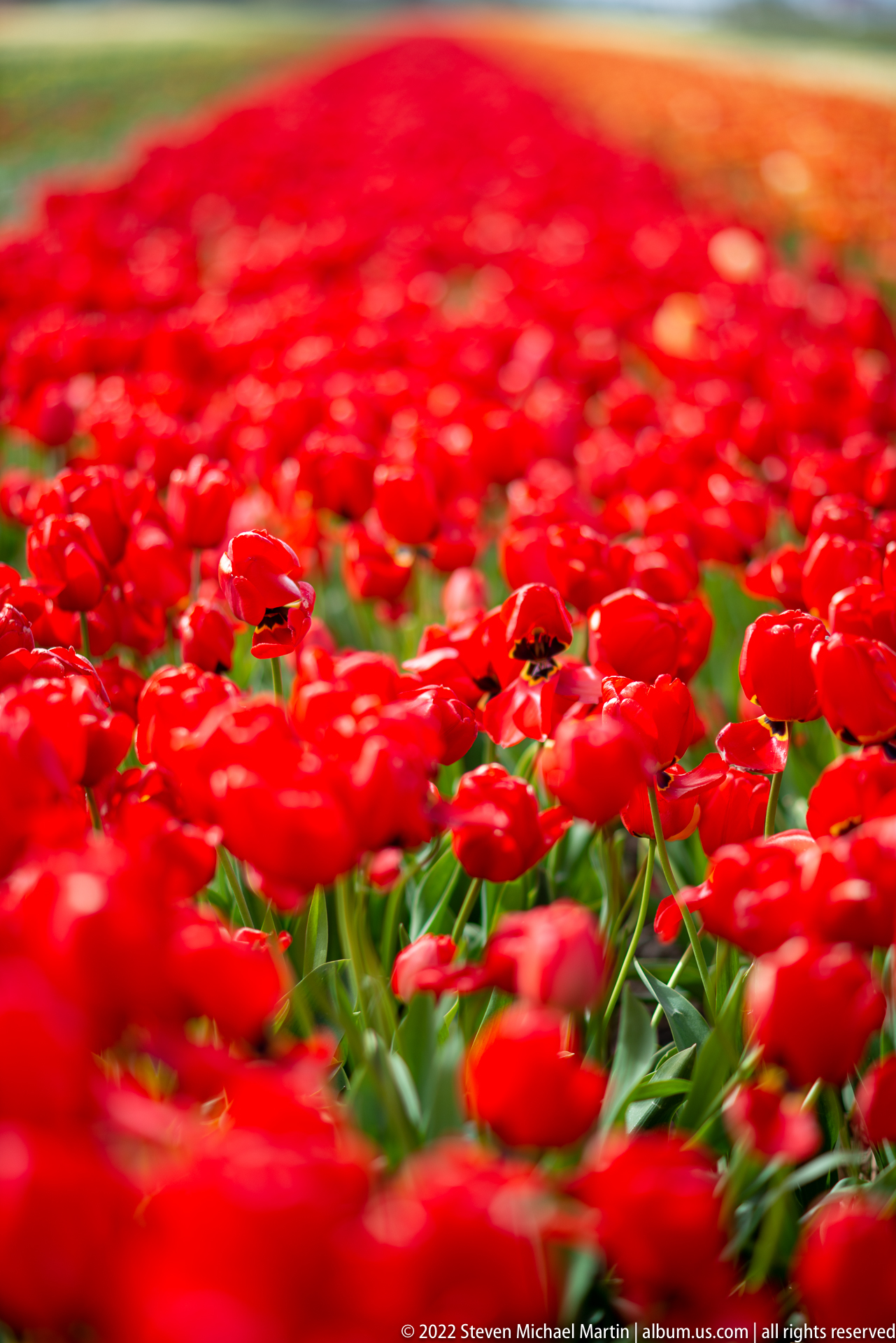
A dense field of red tulips spreads across the foreground near Lisse, with a warm orange planting forming a narrow band near the horizon. The low camera position keeps many individual red blooms distinct before they merge into a continuous mass of color. Green leaves and stems break through the foreground, providing texture and confirming the tightly packed agricultural planting.
Caption
A dense field of red tulips spreads across the foreground near Lisse, with a warm orange planting forming a narrow band near the horizon. The low camera position keeps many individual red blooms distinct before they merge into a continuous mass of color. Green leaves and stems break through the foreground, providing texture and confirming the tightly packed agricultural planting.
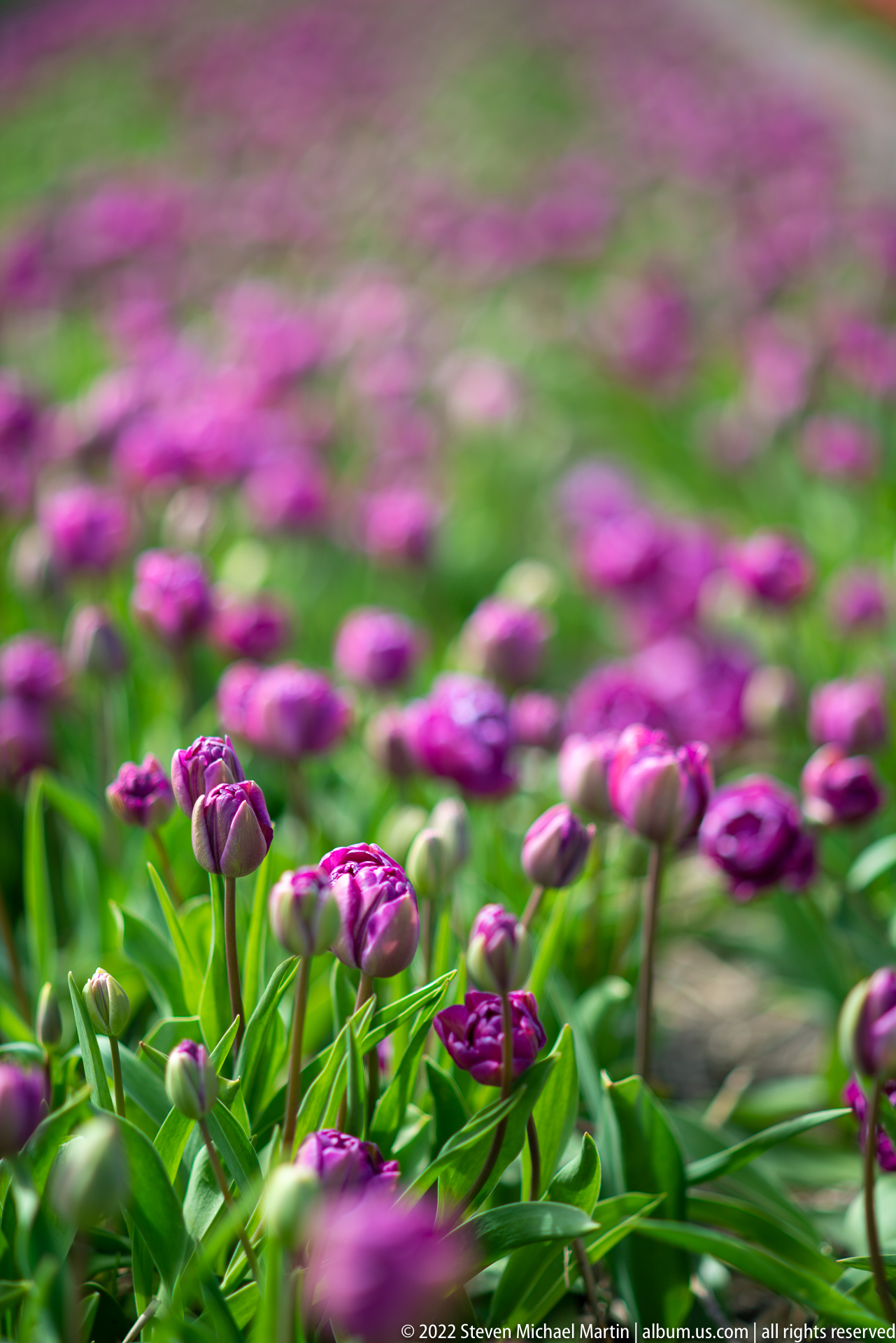
Purple double tulips fill this close field study near Lisse, their layered petals producing rounded, peony-like flower heads above dense green leaves. Several foreground blooms remain sharply defined while the larger planting recedes into soft focus. The unusual flower form, coupled with the saturated purple color, distinguishes the crop from nearby fields of standard single tulips.
Caption
Purple double tulips fill this close field study near Lisse, their layered petals producing rounded, peony-like flower heads above dense green leaves. Several foreground blooms remain sharply defined while the larger planting recedes into soft focus. The unusual flower form, coupled with the saturated purple color, distinguishes the crop from nearby fields of standard single tulips.

Double cream-yellow tulips bloom in a field near Lisse, their layered petals forming full, rounded flower heads. The central blossoms are sharply focused while the rest of the field fades into a soft golden background, emphasizing the unusual floral form. One partly open flower exposes a darker center, adding botanical detail to an otherwise luminous, monochromatic composition.
Caption
Double cream-yellow tulips bloom in a field near Lisse, their layered petals forming full, rounded flower heads. The central blossoms are sharply focused while the rest of the field fades into a soft golden background, emphasizing the unusual floral form. One partly open flower exposes a darker center, adding botanical detail to an otherwise luminous, monochromatic composition.
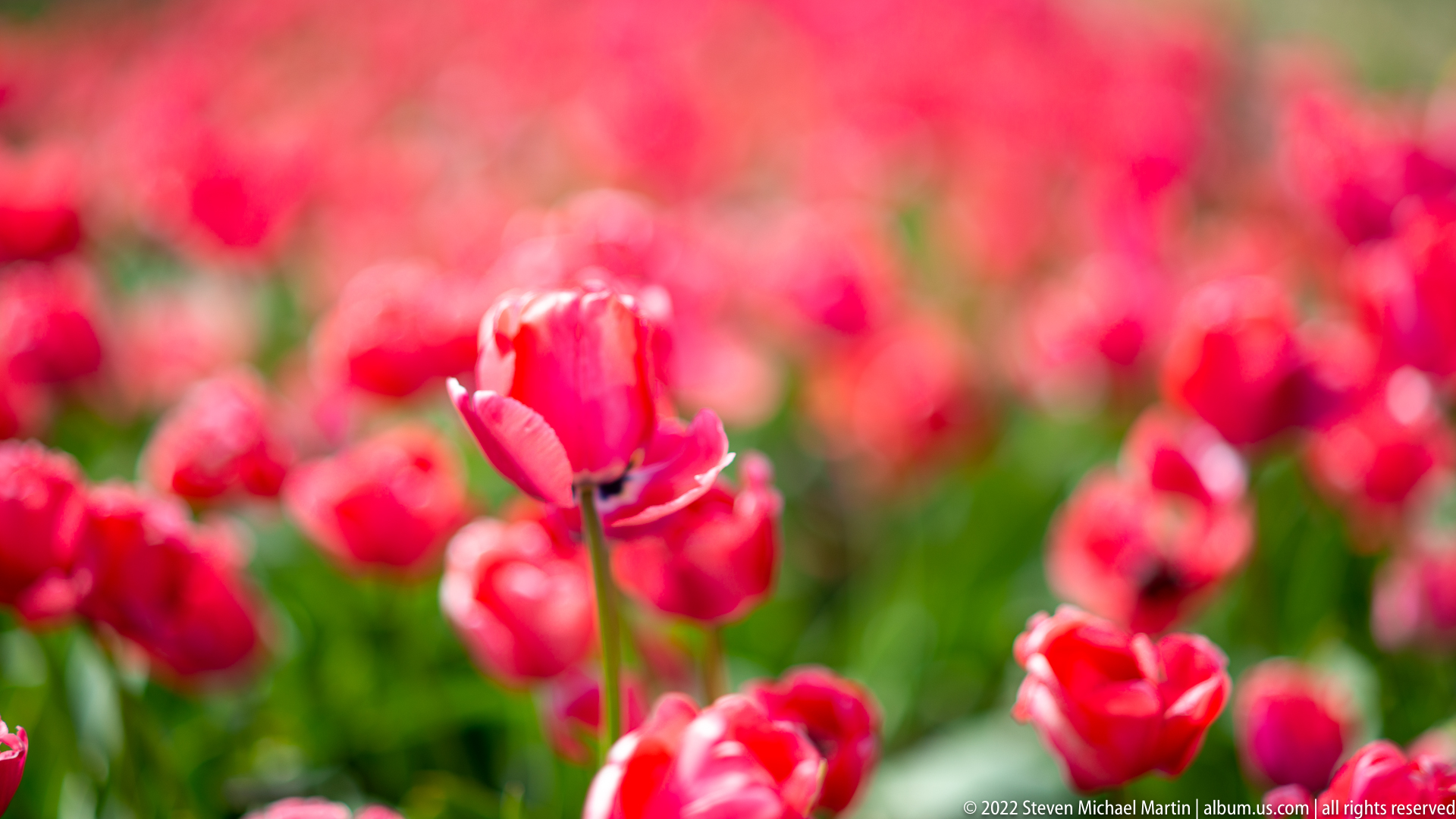
A pink-red tulip stands prominently above neighboring flowers in a cultivated field near Lisse, its open petals edged by bright sunlight. The extremely shallow depth of field dissolves the surrounding tulips into a soft field of pink and red, creating a portrait-like study centered on one bloom. The image focuses on form, petal translucency, and selective focus rather than field structure.
Caption
A pink-red tulip stands prominently above neighboring flowers in a cultivated field near Lisse, its open petals edged by bright sunlight. The extremely shallow depth of field dissolves the surrounding tulips into a soft field of pink and red, creating a portrait-like study centered on one bloom. The image focuses on form, petal translucency, and selective focus rather than field structure.
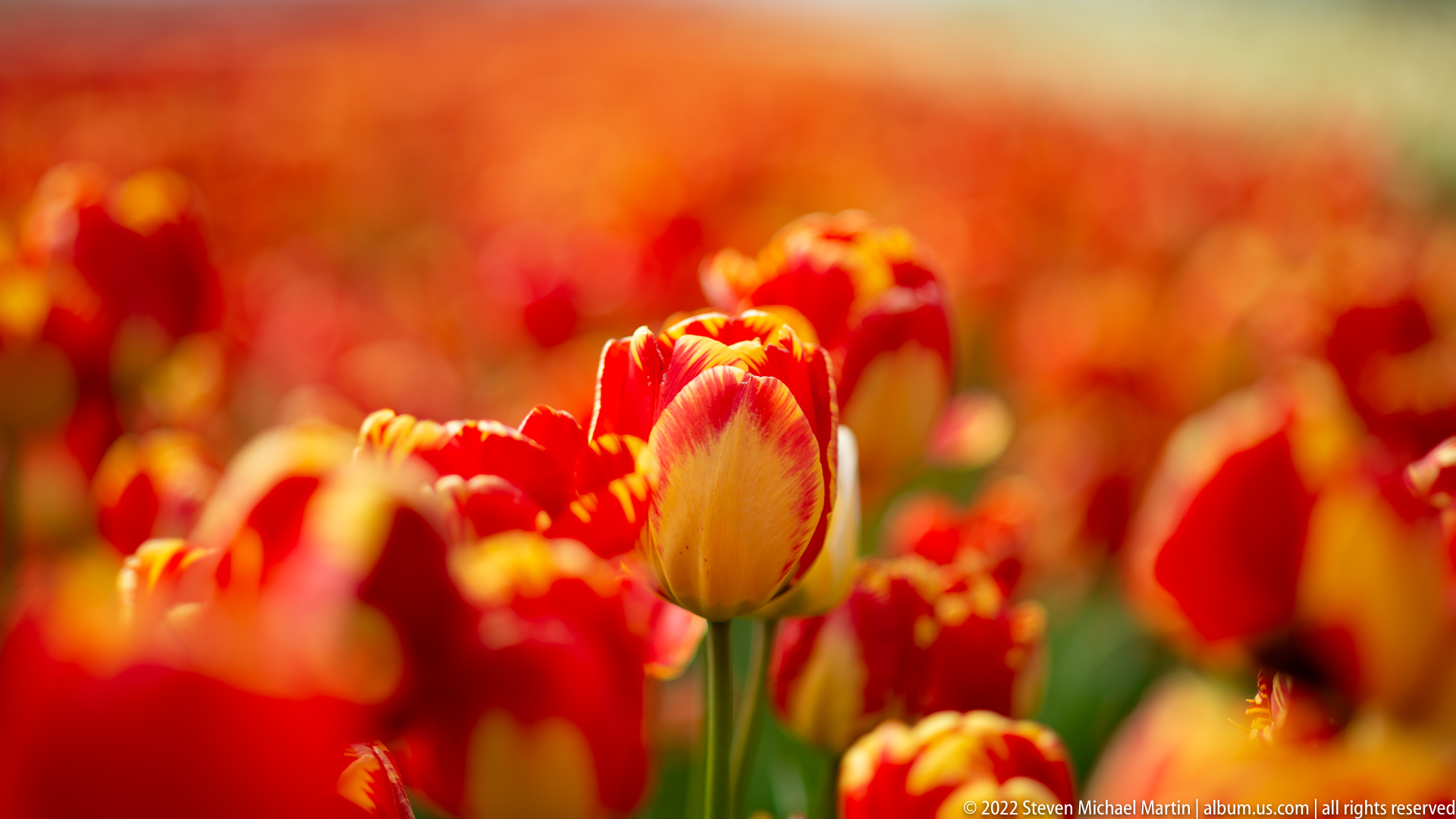
A red-and-yellow bicolored tulip rises above a warm field of similarly colored blooms near Lisse. Sunlight catches the yellow interior and red-edged petals, making the central flower stand out against the softly blurred orange-red background. The close composition isolates the contrasting color pattern and petal structure while still suggesting the scale of a densely cultivated tulip field.
Caption
A red-and-yellow bicolored tulip rises above a warm field of similarly colored blooms near Lisse. Sunlight catches the yellow interior and red-edged petals, making the central flower stand out against the softly blurred orange-red background. The close composition isolates the contrasting color pattern and petal structure while still suggesting the scale of a densely cultivated tulip field.
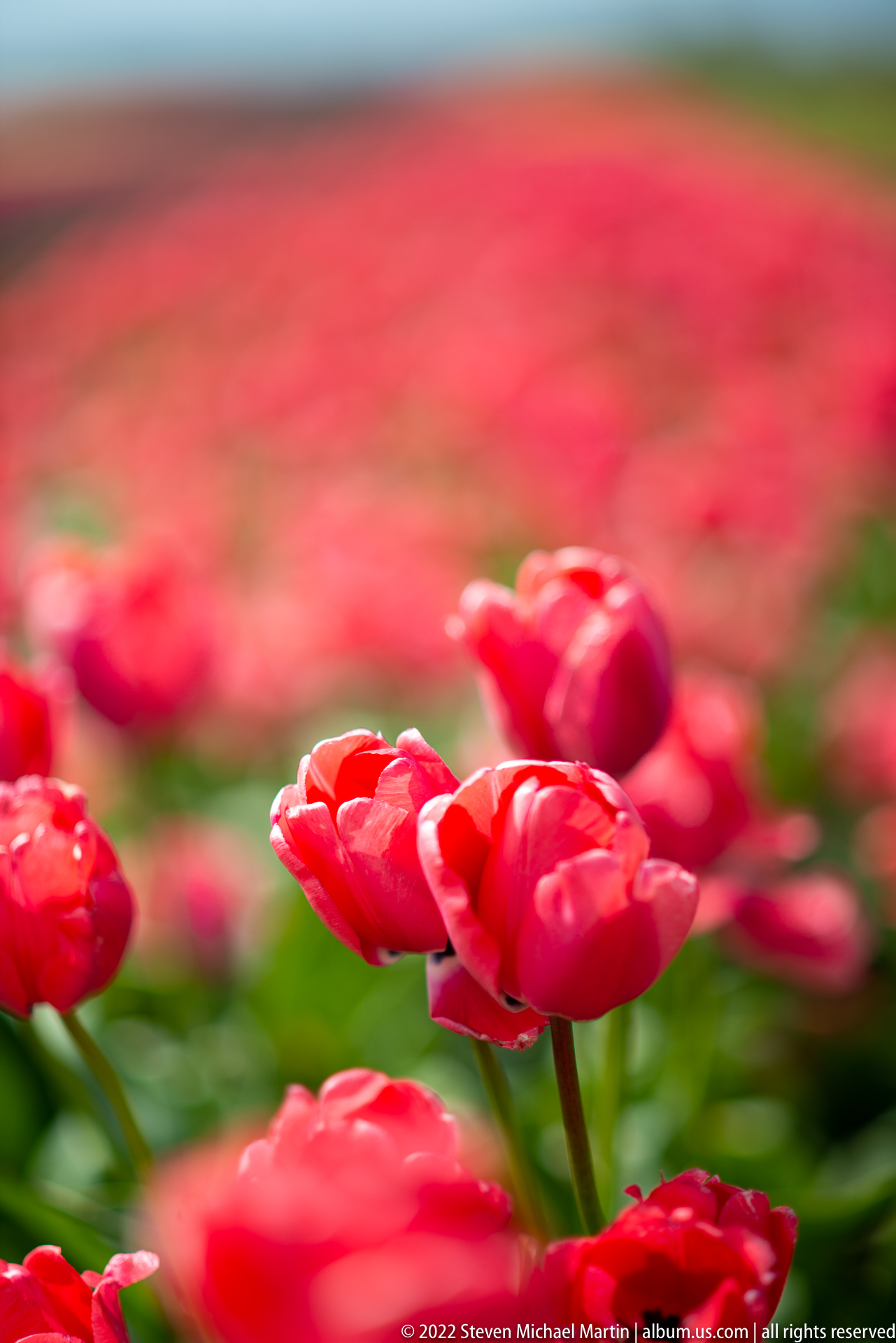
Double pink-red tulips form a vivid field study near Lisse, with layered blossoms in the foreground set against a broad wash of red and pink. The shallow depth of field makes the nearest flowers appear sculptural while the distant planting becomes an abstract color field. Broad green leaves remain visible between stems, anchoring the close botanical treatment within a commercial bulb crop.
Caption
Double pink-red tulips form a vivid field study near Lisse, with layered blossoms in the foreground set against a broad wash of red and pink. The shallow depth of field makes the nearest flowers appear sculptural while the distant planting becomes an abstract color field. Broad green leaves remain visible between stems, anchoring the close botanical treatment within a commercial bulb crop.
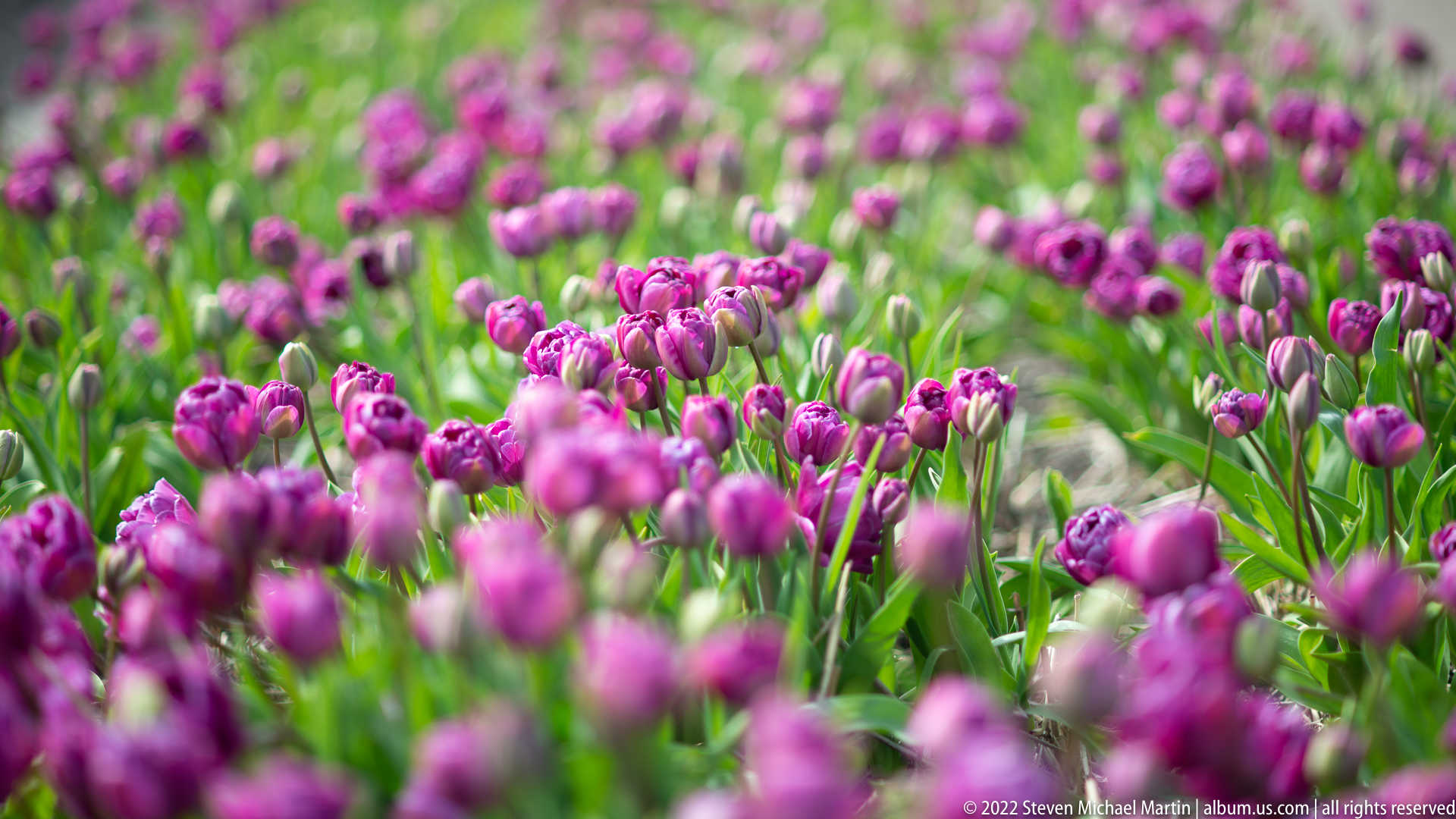
Purple double tulips extend through a cultivated field near Lisse, their rounded, many-petaled blossoms scattered among tall green leaves. The selective focus sharpens the central cluster and allows flowers in front and behind to soften progressively. This wider close-up conveys both the distinctive double-flower form and the density of the crop more clearly than a single-blossom portrait.
Caption
Purple double tulips extend through a cultivated field near Lisse, their rounded, many-petaled blossoms scattered among tall green leaves. The selective focus sharpens the central cluster and allows flowers in front and behind to soften progressively. This wider close-up conveys both the distinctive double-flower form and the density of the crop more clearly than a single-blossom portrait.
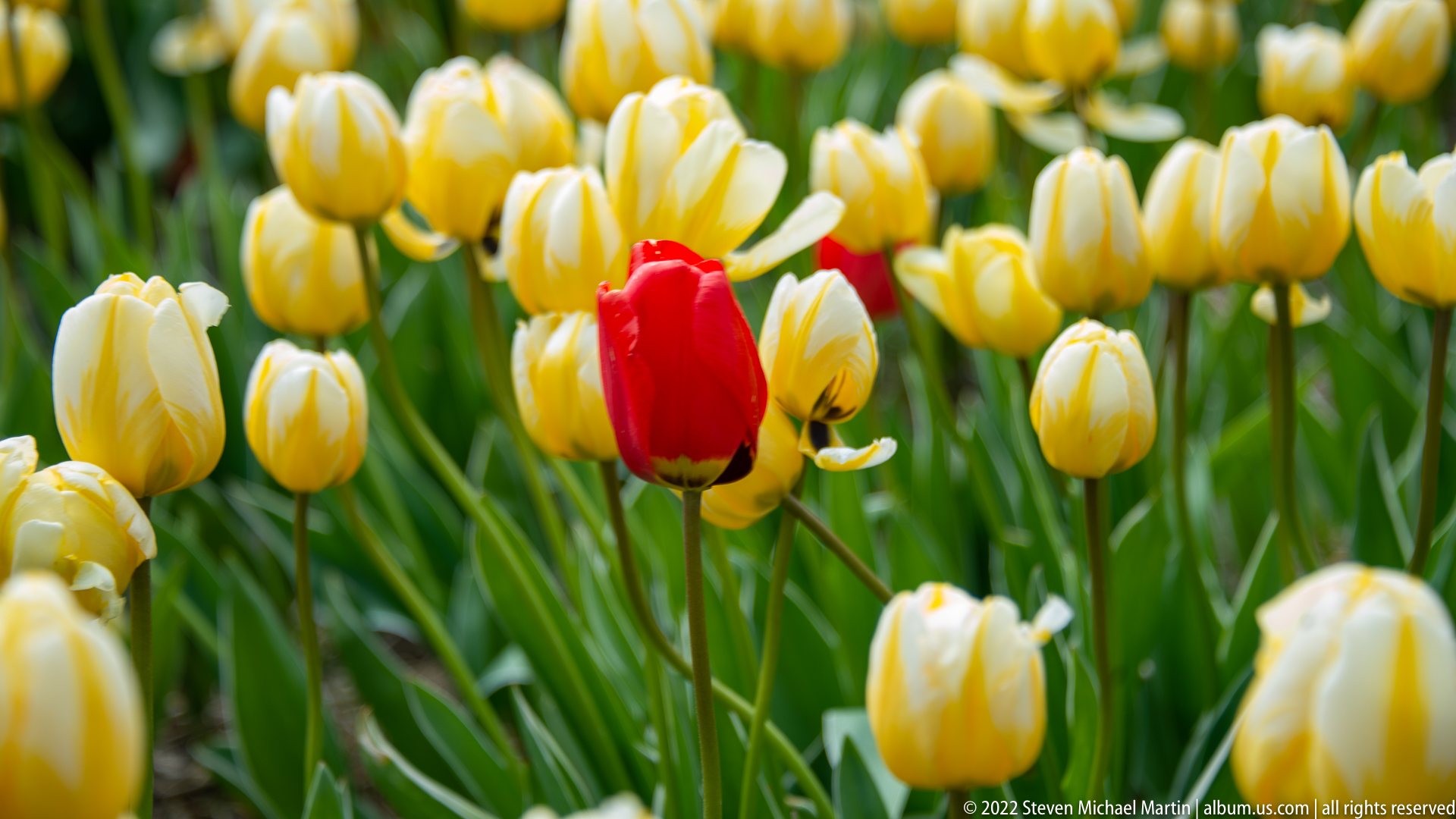
A single upright red tulip stands among pale yellow tulips near Lisse, its saturated color immediately distinguishing it from the surrounding crop. The closer framing makes the red flower the clear focal point while the yellow blossoms form a dense backdrop. Several yellow flowers show partly open petals, adding variation to the otherwise uniform pale planting.
Caption
A single upright red tulip stands among pale yellow tulips near Lisse, its saturated color immediately distinguishing it from the surrounding crop. The closer framing makes the red flower the clear focal point while the yellow blossoms form a dense backdrop. Several yellow flowers show partly open petals, adding variation to the otherwise uniform pale planting.
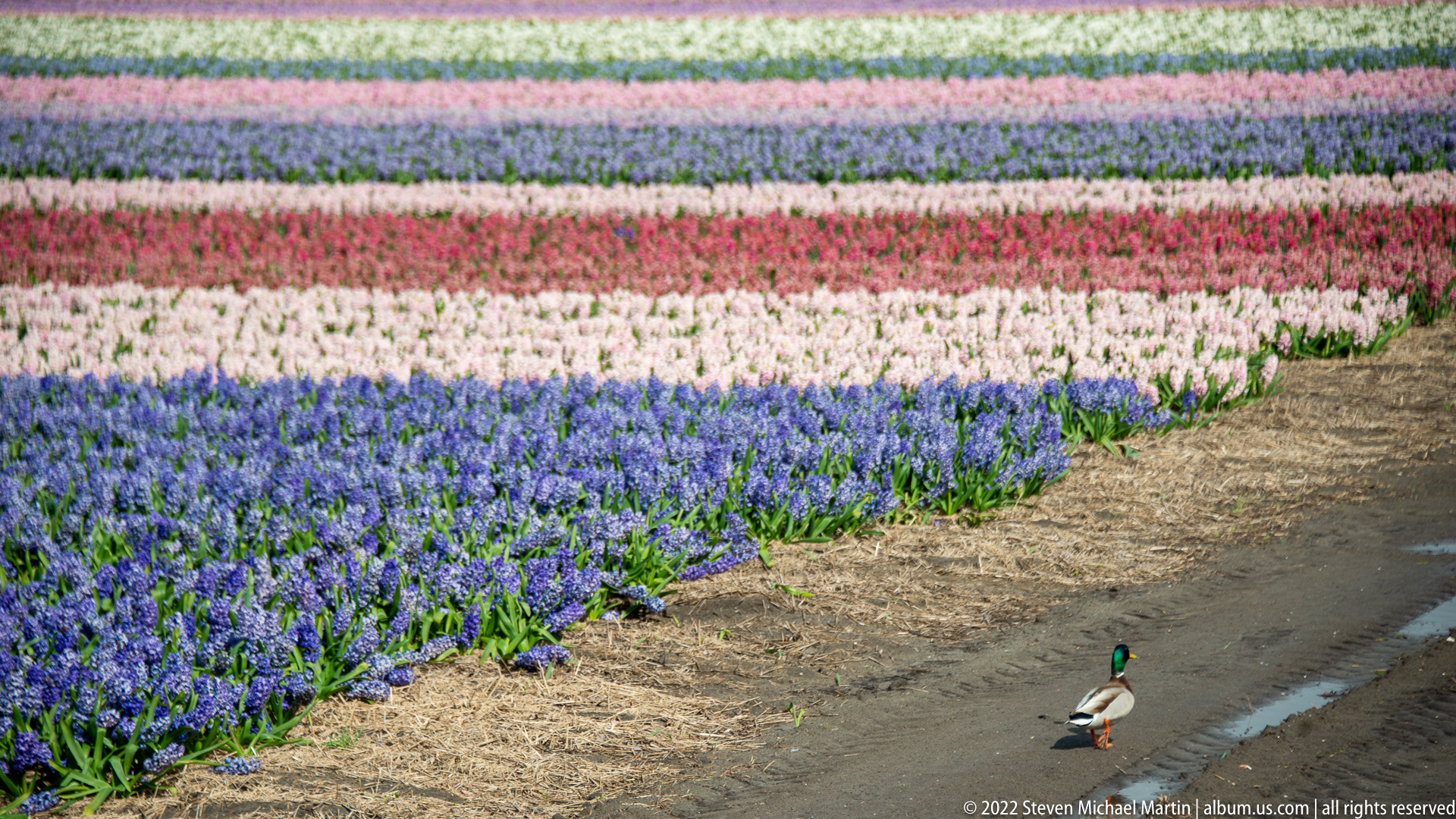
A male mallard stands on a muddy track beside multicolored bulb fields near Lisse. Behind the bird, blue-purple, pale pink, magenta, and white hyacinth bands stretch across the landscape in orderly horizontal strips. The juxtaposition of wildlife with cultivated flower fields distinguishes this view from the portfolio’s purely agricultural studies and places the bird within the managed Dutch field environment.
Caption
A male mallard stands on a muddy track beside multicolored bulb fields near Lisse. Behind the bird, blue-purple, pale pink, magenta, and white hyacinth bands stretch across the landscape in orderly horizontal strips. The juxtaposition of wildlife with cultivated flower fields distinguishes this view from the portfolio’s purely agricultural studies and places the bird within the managed Dutch field environment.

A male mallard flies low across the bulb fields near Lisse, wings raised as it passes above blue-purple, pink, white, and red flowering bands. The bird’s motion contrasts with the rigid horizontal geometry of the crops below. A line of leafless trees closes the horizon, placing the flight within a broad agricultural landscape rather than isolating it as a wildlife portrait.
Caption
A male mallard flies low across the bulb fields near Lisse, wings raised as it passes above blue-purple, pink, white, and red flowering bands. The bird’s motion contrasts with the rigid horizontal geometry of the crops below. A line of leafless trees closes the horizon, placing the flight within a broad agricultural landscape rather than isolating it as a wildlife portrait.

A male mallard is shown in a close side view as it flies across the bulb fields near Lisse. The green head, yellow bill, gray body, chestnut breast, and blue wing speculum are clearly visible, allowing secure species identification. Behind the bird, colorful rows of spring flowers blur into horizontal bands, emphasizing speed and separating the sharply rendered duck from the cultivated landscape.
Caption
A male mallard is shown in a close side view as it flies across the bulb fields near Lisse. The green head, yellow bill, gray body, chestnut breast, and blue wing speculum are clearly visible, allowing secure species identification. Behind the bird, colorful rows of spring flowers blur into horizontal bands, emphasizing speed and separating the sharply rendered duck from the cultivated landscape.

A male mallard flies just above striped bulb fields near Lisse, crossing a landscape of pink, purple, white, and red flowering rows. The bird is shown in profile with wings extended, while a line of bare trees forms a subdued backdrop beyond the fields. The composition places native wildlife directly within the intensely cultivated spring landscape of the bulb-growing district.
Caption
A male mallard flies just above striped bulb fields near Lisse, crossing a landscape of pink, purple, white, and red flowering rows. The bird is shown in profile with wings extended, while a line of bare trees forms a subdued backdrop beyond the fields. The composition places native wildlife directly within the intensely cultivated spring landscape of the bulb-growing district.

A tractor moves across broad spring bulb fields near Lisse, dwarfed by horizontal bands of pale pink, blue-purple, white, and green flowering crops. The distant machinery provides scale and makes the agricultural function of the landscape unmistakable. A line of tall leafless trees defines the horizon, while the stacked color bands show the large, highly organized extent of commercial bulb cultivation.
Caption
A tractor moves across broad spring bulb fields near Lisse, dwarfed by horizontal bands of pale pink, blue-purple, white, and green flowering crops. The distant machinery provides scale and makes the agricultural function of the landscape unmistakable. A line of tall leafless trees defines the horizon, while the stacked color bands show the large, highly organized extent of commercial bulb cultivation.
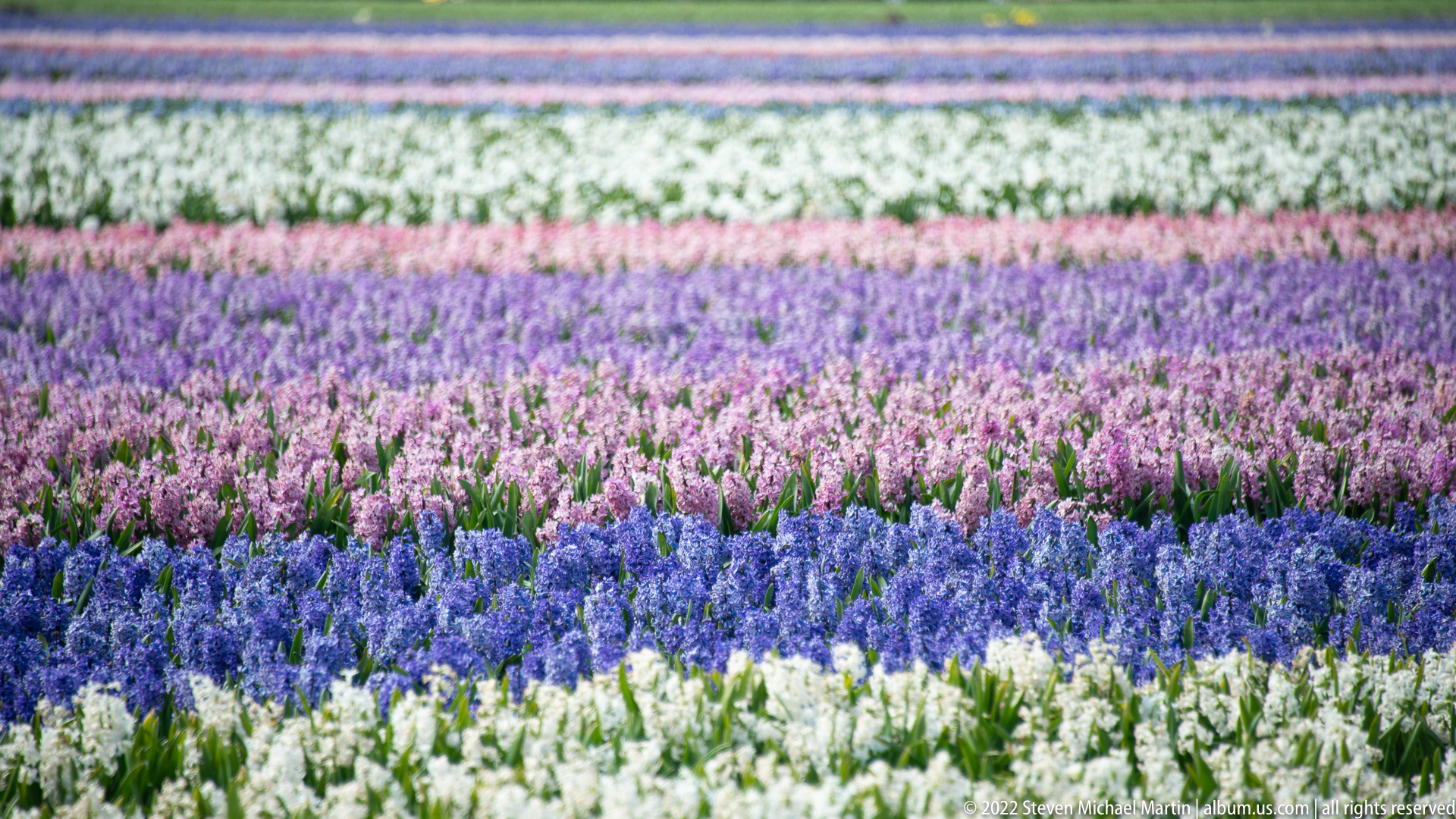
Layered hyacinth plantings near Lisse create repeating horizontal bands of white, blue-purple, pale pink, and lavender. The closer framing excludes roads and buildings, allowing flower color and planting density to dominate the composition. Individual spikes remain legible in the foreground while the farther rows compress into broad stripes, emphasizing both botanical texture and the deliberate separation of crop varieties.
Caption
Layered hyacinth plantings near Lisse create repeating horizontal bands of white, blue-purple, pale pink, and lavender. The closer framing excludes roads and buildings, allowing flower color and planting density to dominate the composition. Individual spikes remain legible in the foreground while the farther rows compress into broad stripes, emphasizing both botanical texture and the deliberate separation of crop varieties.
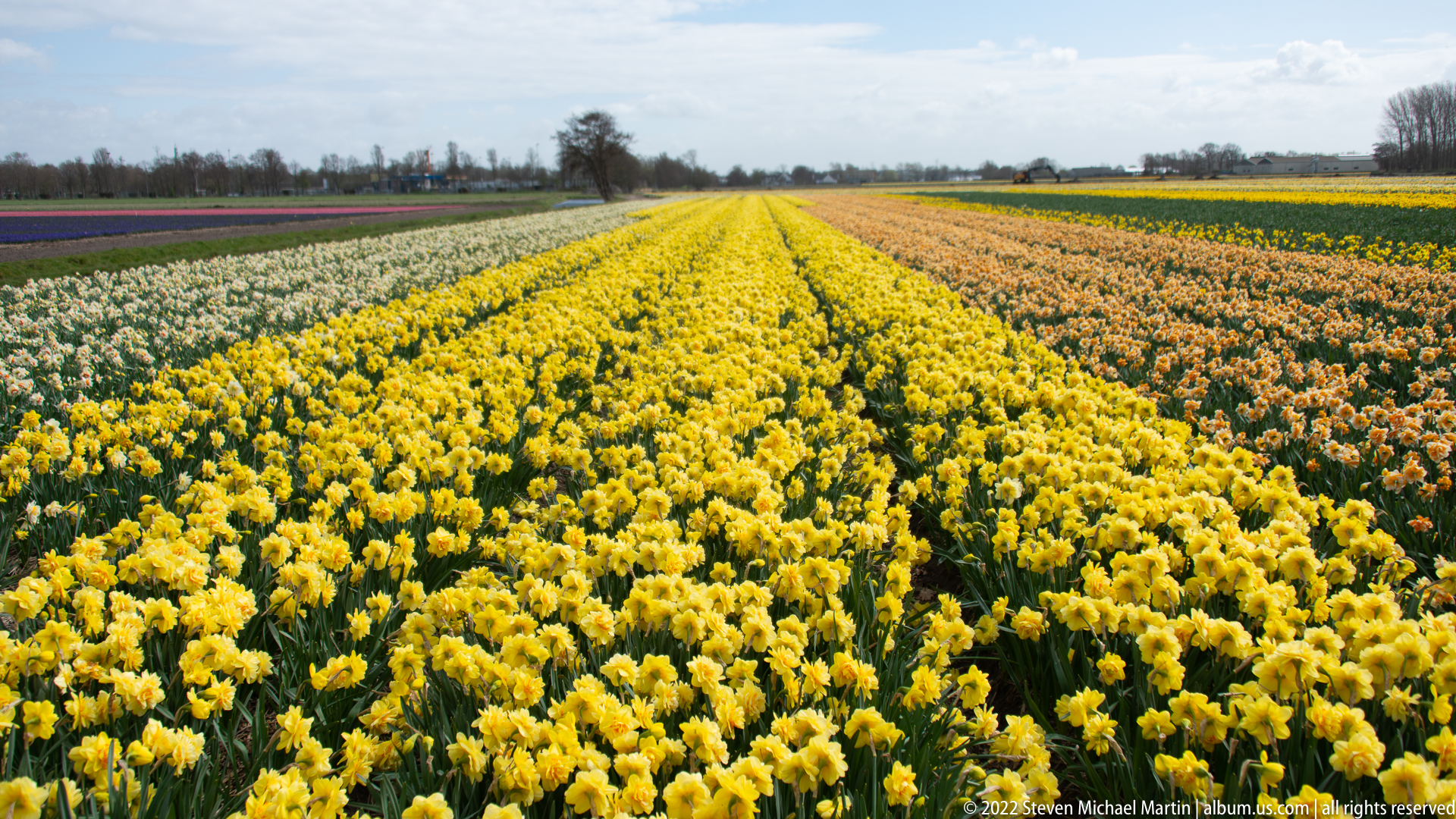
Long rows of yellow and apricot-toned daffodils converge toward the horizon in a bulb field near Lisse. The low, centered viewpoint creates strong perspective lines through the dense spring planting, while additional yellow flowering blocks extend across the distance. The warmer apricot band on the right introduces a distinct color variation within a crop otherwise dominated by bright yellow.
Caption
Long rows of yellow and apricot-toned daffodils converge toward the horizon in a bulb field near Lisse. The low, centered viewpoint creates strong perspective lines through the dense spring planting, while additional yellow flowering blocks extend across the distance. The warmer apricot band on the right introduces a distinct color variation within a crop otherwise dominated by bright yellow.
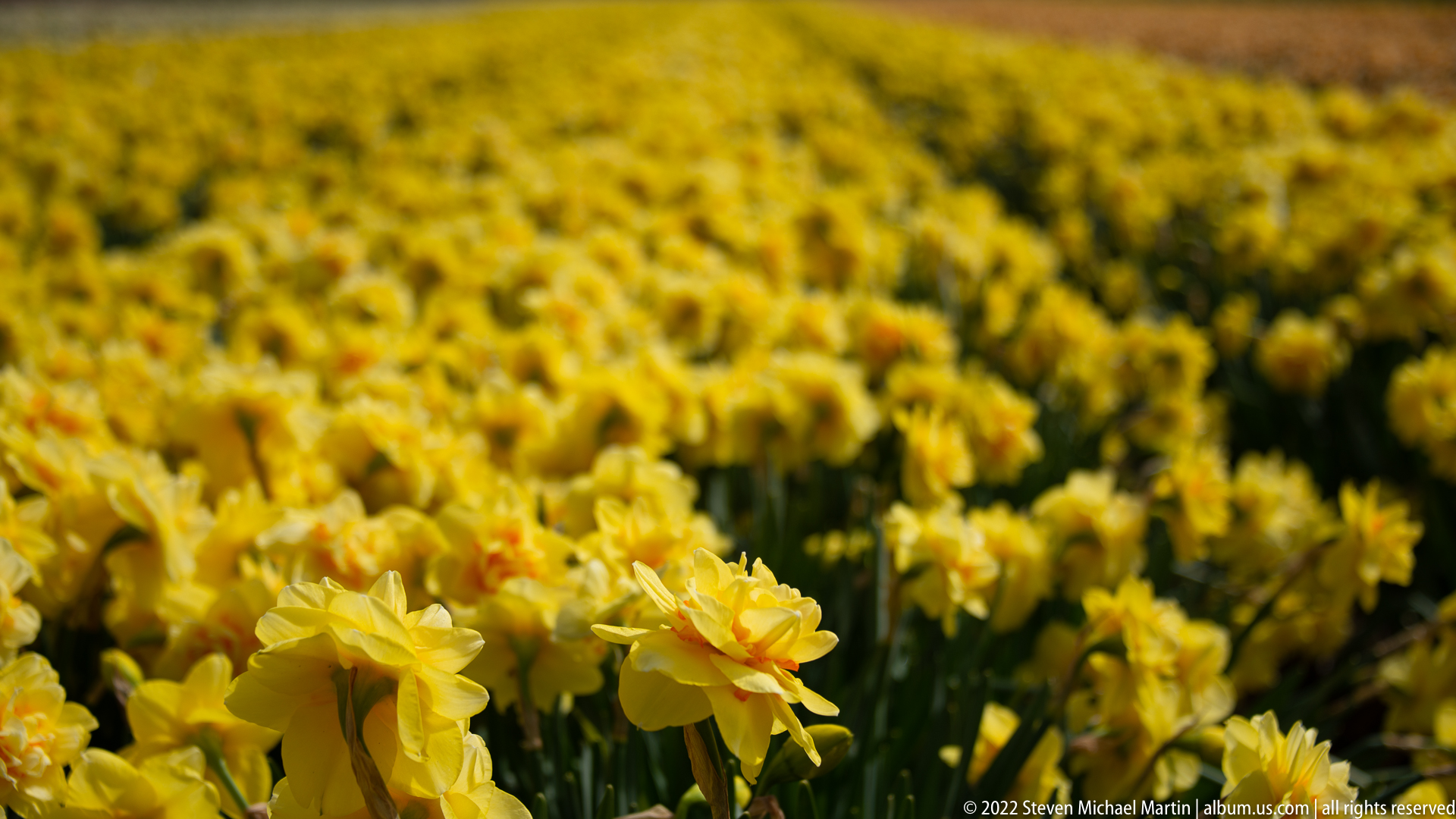
Double yellow daffodils fill a cultivated field near Lisse, their ruffled, layered centers giving the blooms a fuller appearance than standard trumpet forms. The nearest flowers are sharply focused while the surrounding crop dissolves into a soft golden field. The close treatment emphasizes the unusual floral structure and dense planting rather than the larger agricultural geometry of the bulb field.
Caption
Double yellow daffodils fill a cultivated field near Lisse, their ruffled, layered centers giving the blooms a fuller appearance than standard trumpet forms. The nearest flowers are sharply focused while the surrounding crop dissolves into a soft golden field. The close treatment emphasizes the unusual floral structure and dense planting rather than the larger agricultural geometry of the bulb field.
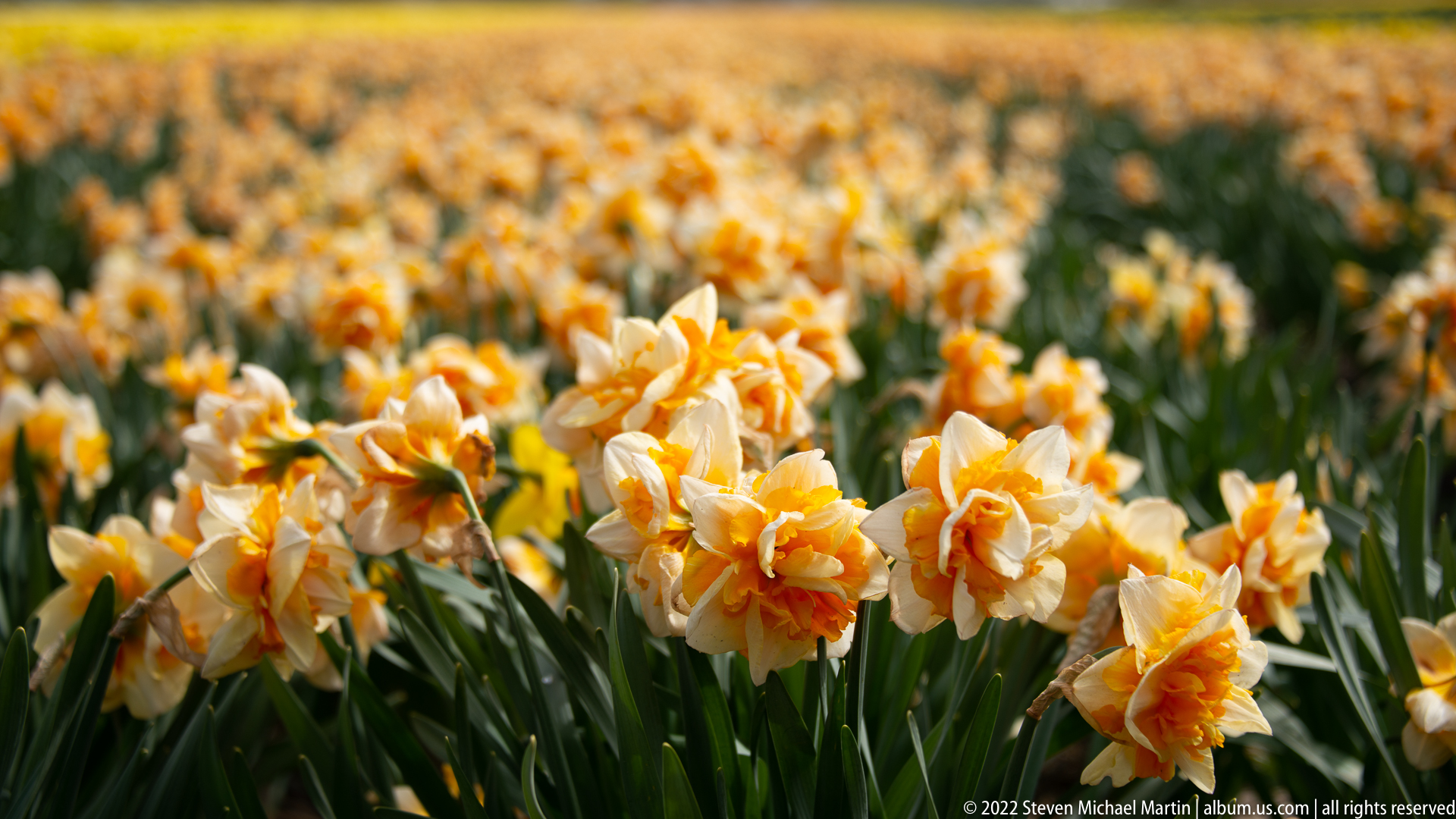
Double daffodils with cream outer petals and apricot-orange ruffled centers bloom in a cultivated field near Lisse. Several foreground clusters are shown in crisp detail against a softly blurred background of similar flowers. The bicolored, layered form creates a markedly different appearance from the portfolio’s solid-yellow daffodils, making this close study particularly useful for distinguishing variation within the spring crop.
Caption
Double daffodils with cream outer petals and apricot-orange ruffled centers bloom in a cultivated field near Lisse. Several foreground clusters are shown in crisp detail against a softly blurred background of similar flowers. The bicolored, layered form creates a markedly different appearance from the portfolio’s solid-yellow daffodils, making this close study particularly useful for distinguishing variation within the spring crop.
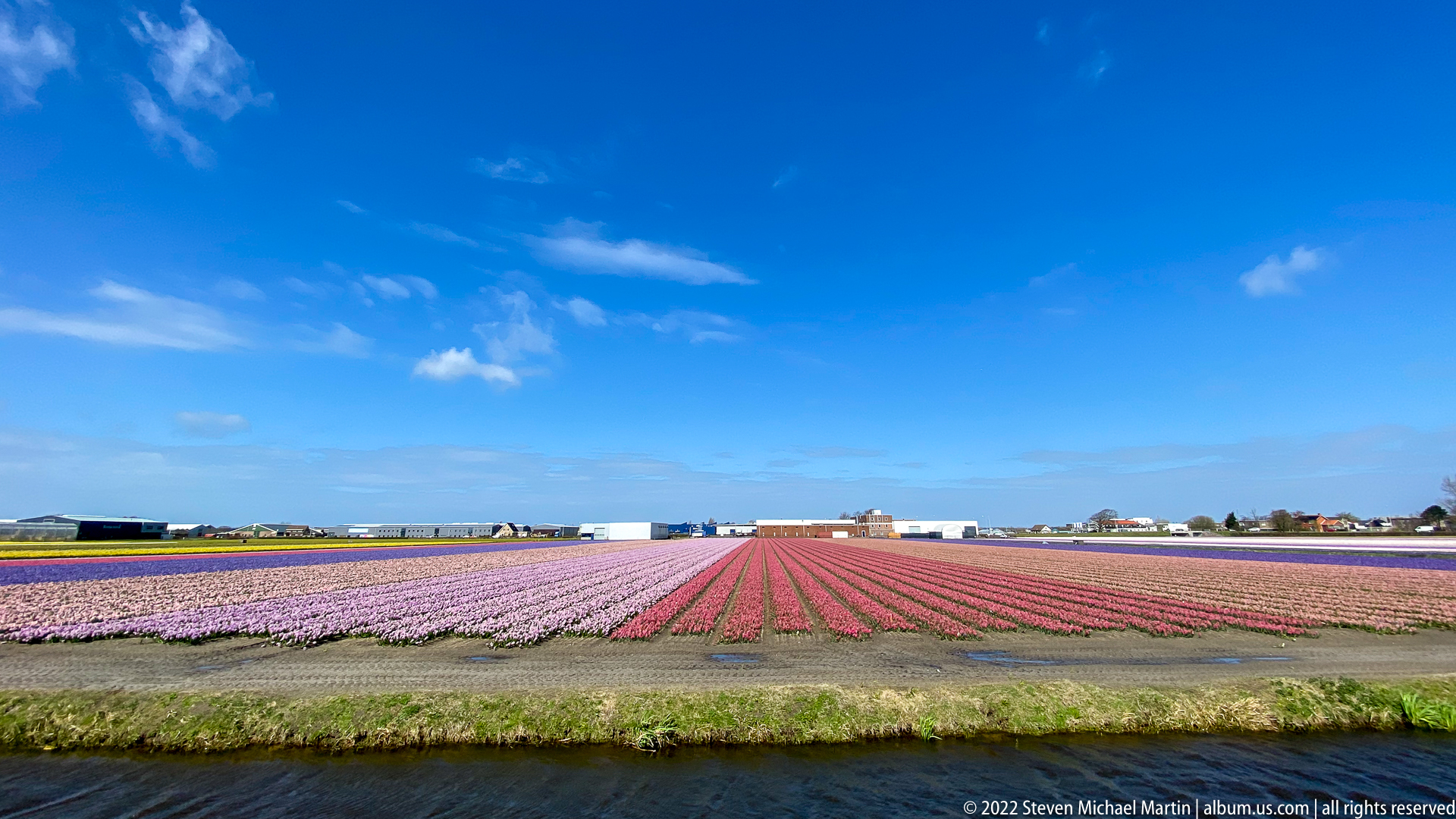
Long pink and red flowering rows extend across the flat agricultural landscape near Lisse, viewed from the opposite side of a drainage canal. The wide composition places the cultivated color bands beneath an expansive blue sky, with low farm and industrial buildings scattered along the horizon. Water, level fields, and rectilinear crop blocks together provide a clear contextual view of the bulb-growing landscape beyond the close flower studies.
Caption
Long pink and red flowering rows extend across the flat agricultural landscape near Lisse, viewed from the opposite side of a drainage canal. The wide composition places the cultivated color bands beneath an expansive blue sky, with low farm and industrial buildings scattered along the horizon. Water, level fields, and rectilinear crop blocks together provide a clear contextual view of the bulb-growing landscape beyond the close flower studies.
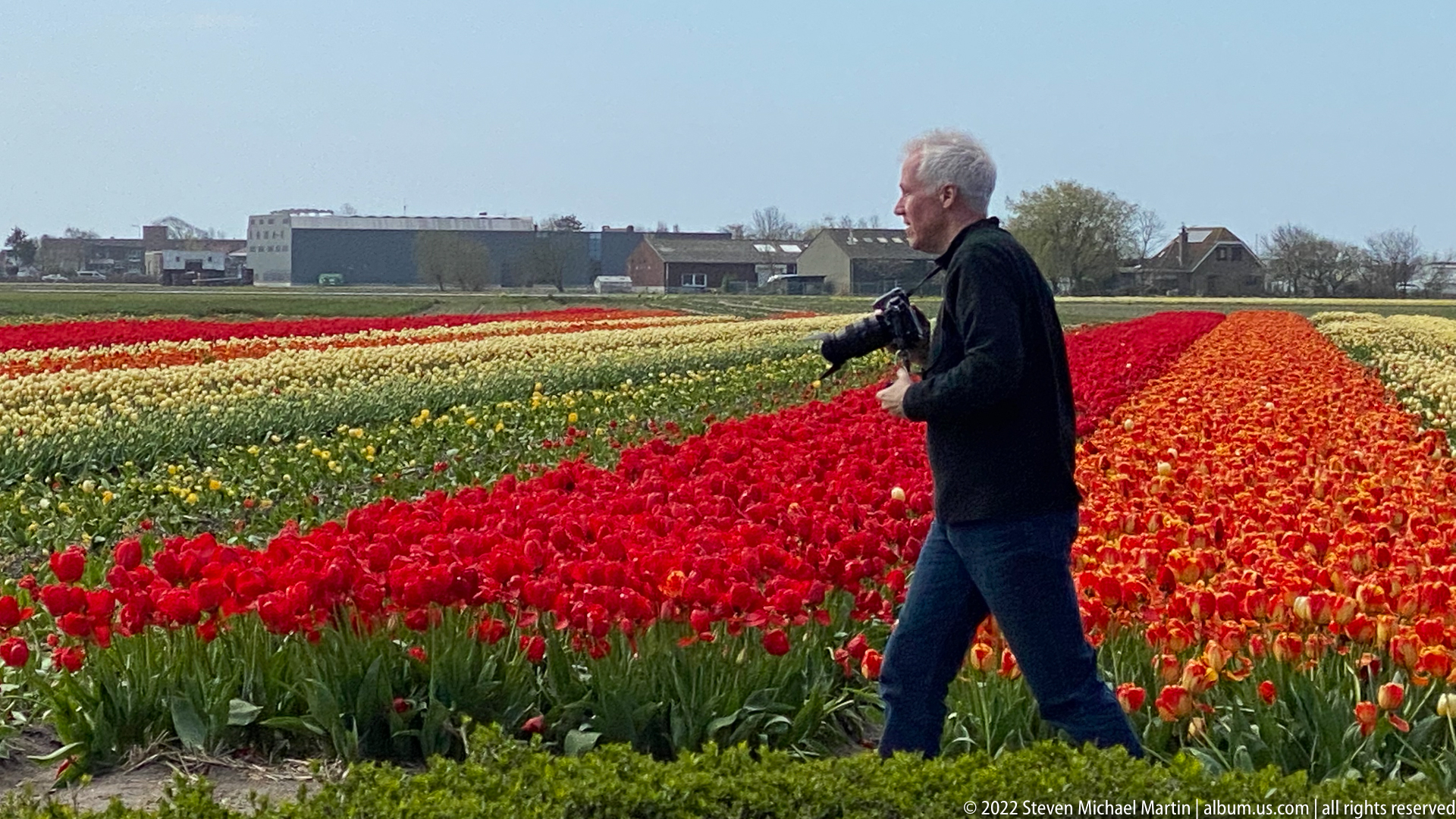
A man carrying a camera walks along the narrow working space between vivid red and orange tulip rows near Lisse. Pale yellow and white flowering bands continue behind him toward houses and utilitarian buildings at the field edge. His presence supplies human scale and shows how visitors or photographers move through the cultivated landscape without obscuring the strongly ordered geometry of the commercial flower beds.
Caption
A man carrying a camera walks along the narrow working space between vivid red and orange tulip rows near Lisse. Pale yellow and white flowering bands continue behind him toward houses and utilitarian buildings at the field edge. His presence supplies human scale and shows how visitors or photographers move through the cultivated landscape without obscuring the strongly ordered geometry of the commercial flower beds.