Keukenhof – Netherlands
Keukenhof Gardens are located near the town of Lisse and are among the most famous flower gardens in the world. Each spring the gardens display millions of blooming flowers, particularly tulips, which have become a national symbol of the Netherlands.
The gardens were originally established in the 20th century as a showcase for the Dutch flower industry. Landscaped paths wind through colorful flower beds, ponds, and pavilions filled with elaborate floral displays.
Keukenhof offers visitors a remarkable view of the horticultural traditions that have long been associated with the Netherlands.
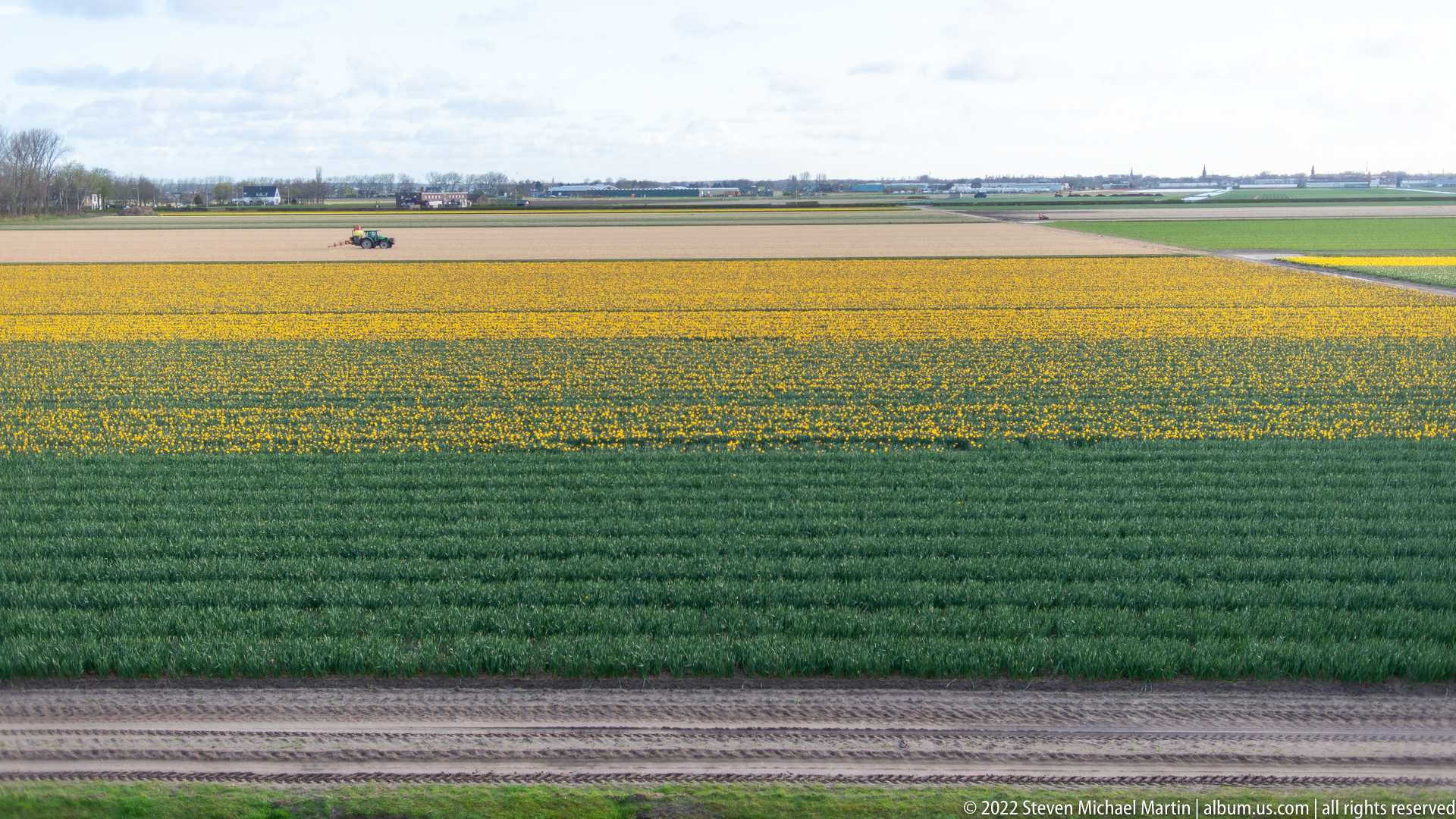
A wide, elevated view looks across long horizontal bands of green and yellow flowering fields in the flat countryside beside Keukenhof. Parallel service tracks and field divisions create strong geometric lines, while distant farm structures and a small vehicle establish scale. The broad composition emphasizes commercial bulb cultivation rather than the curated garden displays within the park.
Caption
A wide, elevated view looks across long horizontal bands of green and yellow flowering fields in the flat countryside beside Keukenhof. Parallel service tracks and field divisions create strong geometric lines, while distant farm structures and a small vehicle establish scale. The broad composition emphasizes commercial bulb cultivation rather than the curated garden displays within the park.

The Keukenhof windmill appears at middle distance beyond sweeping beds of pink and red tulips, with open lawn and a small garden structure framing the scene. Unlike the closer windmill portrait, this view sets the mill within a much broader horticultural landscape. The flower beds occupy most of the foreground, making the structure a visual anchor within the spring garden rather than the sole subject.
Caption
The Keukenhof windmill appears at middle distance beyond sweeping beds of pink and red tulips, with open lawn and a small garden structure framing the scene. Unlike the closer windmill portrait, this view sets the mill within a much broader horticultural landscape. The flower beds occupy most of the foreground, making the structure a visual anchor within the spring garden rather than the sole subject.

A broad lawn leads toward the Keukenhof windmill, with a low border of pink tulips sweeping across the foreground and a small garden kiosk at left. The wider viewpoint gives the mill more breathing room than the preceding close views and shows how the structure is integrated into a public garden landscape of paths, trees, flowers, and visitor amenities.
Caption
A broad lawn leads toward the Keukenhof windmill, with a low border of pink tulips sweeping across the foreground and a small garden kiosk at left. The wider viewpoint gives the mill more breathing room than the preceding close views and shows how the structure is integrated into a public garden landscape of paths, trees, flowers, and visitor amenities.
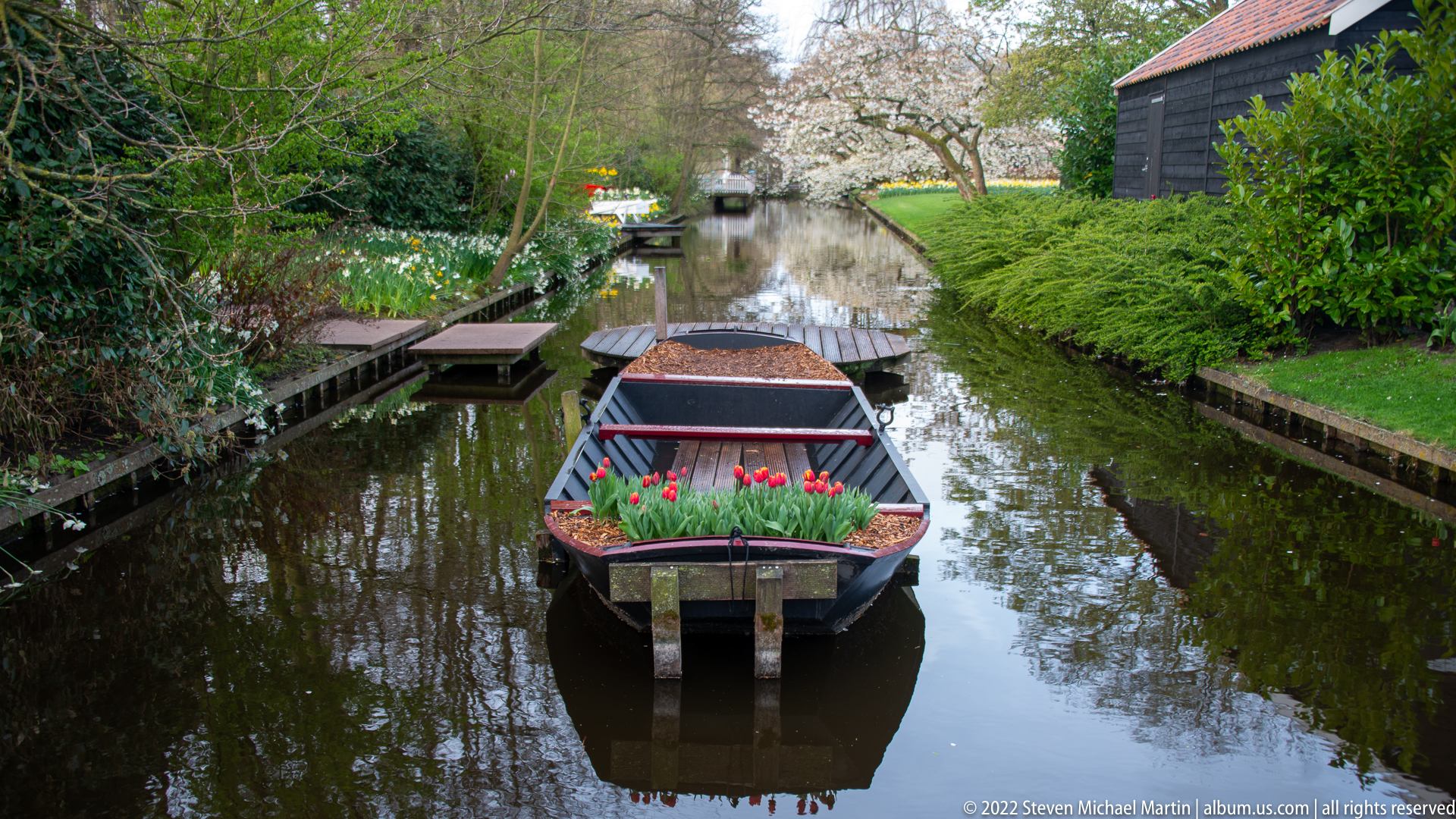
A small flat-bottomed boat sits moored on a narrow garden canal, its bow decorated with blooming red tulips. Flowering trees, clipped greenery, wooden edges, and a dark garden structure frame the reflective waterway, creating a quieter counterpoint to Keukenhof’s large formal bulb displays and linking the plantings to a distinctly Dutch waterside setting.
Caption
A small flat-bottomed boat sits moored on a narrow garden canal, its bow decorated with blooming red tulips. Flowering trees, clipped greenery, wooden edges, and a dark garden structure frame the reflective waterway, creating a quieter counterpoint to Keukenhof’s large formal bulb displays and linking the plantings to a distinctly Dutch waterside setting.
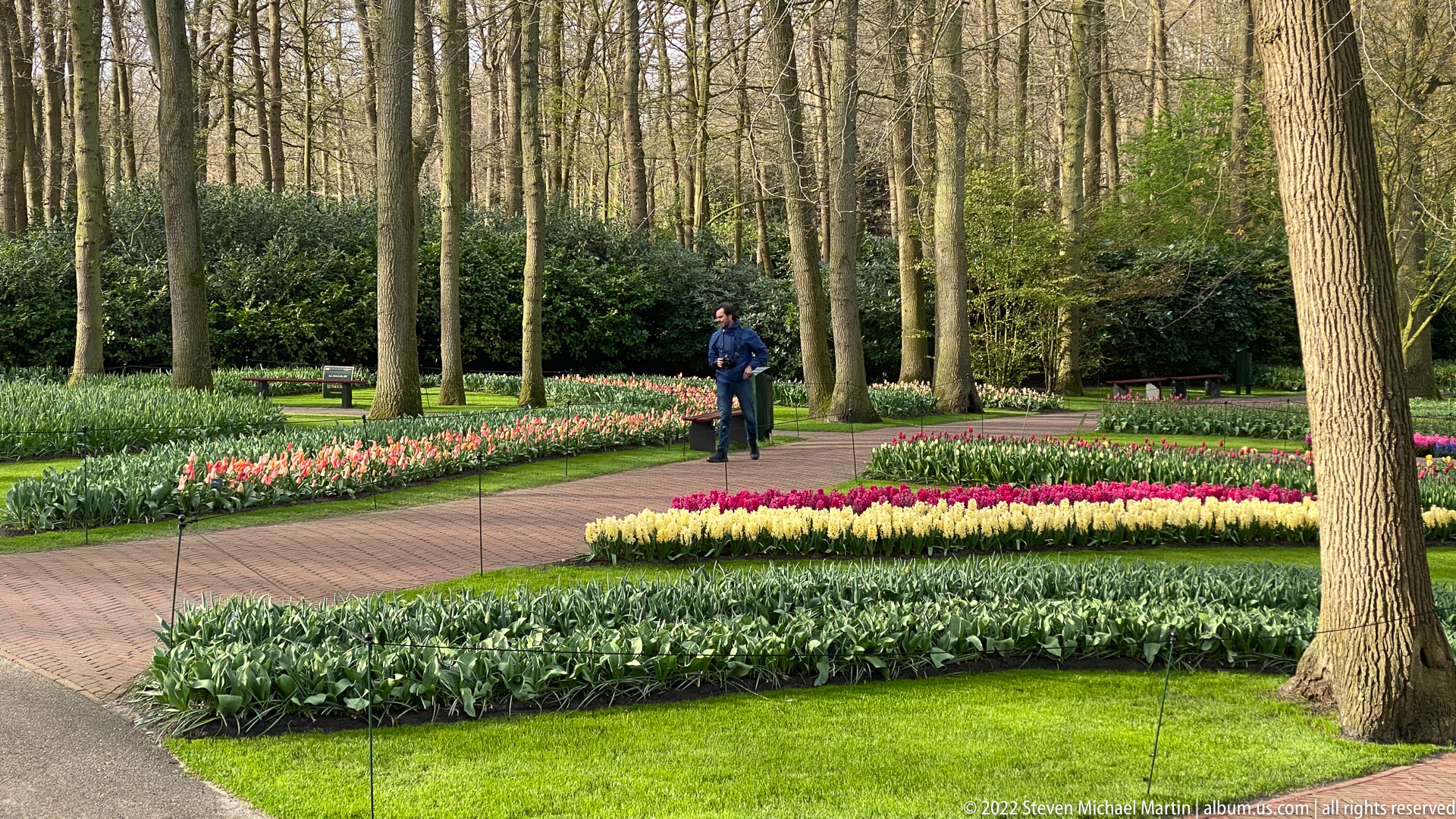
A brick path curves between mature tree trunks and precisely edged spring bulb beds planted in yellow, magenta, white, and coral bands. A visitor walks through the middle distance, giving scale to the repeated beds and the tall woodland canopy. The combination of clipped lawn, curved circulation, and color-blocked plantings shows how Keukenhof integrates formal horticulture into a mature grove.
Caption
A brick path curves between mature tree trunks and precisely edged spring bulb beds planted in yellow, magenta, white, and coral bands. A visitor walks through the middle distance, giving scale to the repeated beds and the tall woodland canopy. The combination of clipped lawn, curved circulation, and color-blocked plantings shows how Keukenhof integrates formal horticulture into a mature grove.
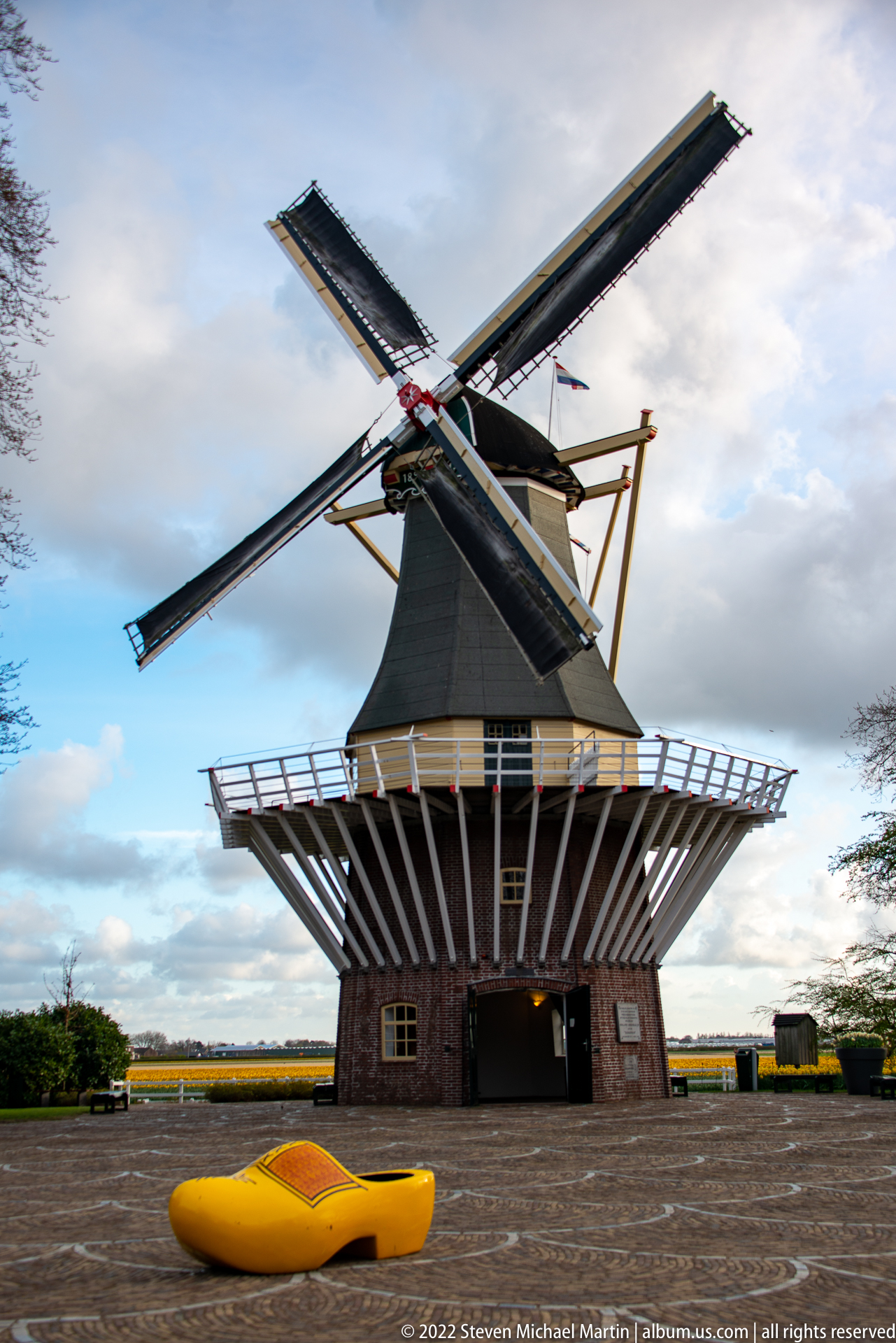
An oversized yellow wooden clog rests on the terrace in front of the Keukenhof windmill, creating a playful juxtaposition of two familiar Dutch visual motifs. The low angle enlarges the mill’s four sails and white gallery while keeping the brightly colored shoe prominent in the foreground, distinguishing this view from the surrounding floral compositions.
Caption
An oversized yellow wooden clog rests on the terrace in front of the Keukenhof windmill, creating a playful juxtaposition of two familiar Dutch visual motifs. The low angle enlarges the mill’s four sails and white gallery while keeping the brightly colored shoe prominent in the foreground, distinguishing this view from the surrounding floral compositions.
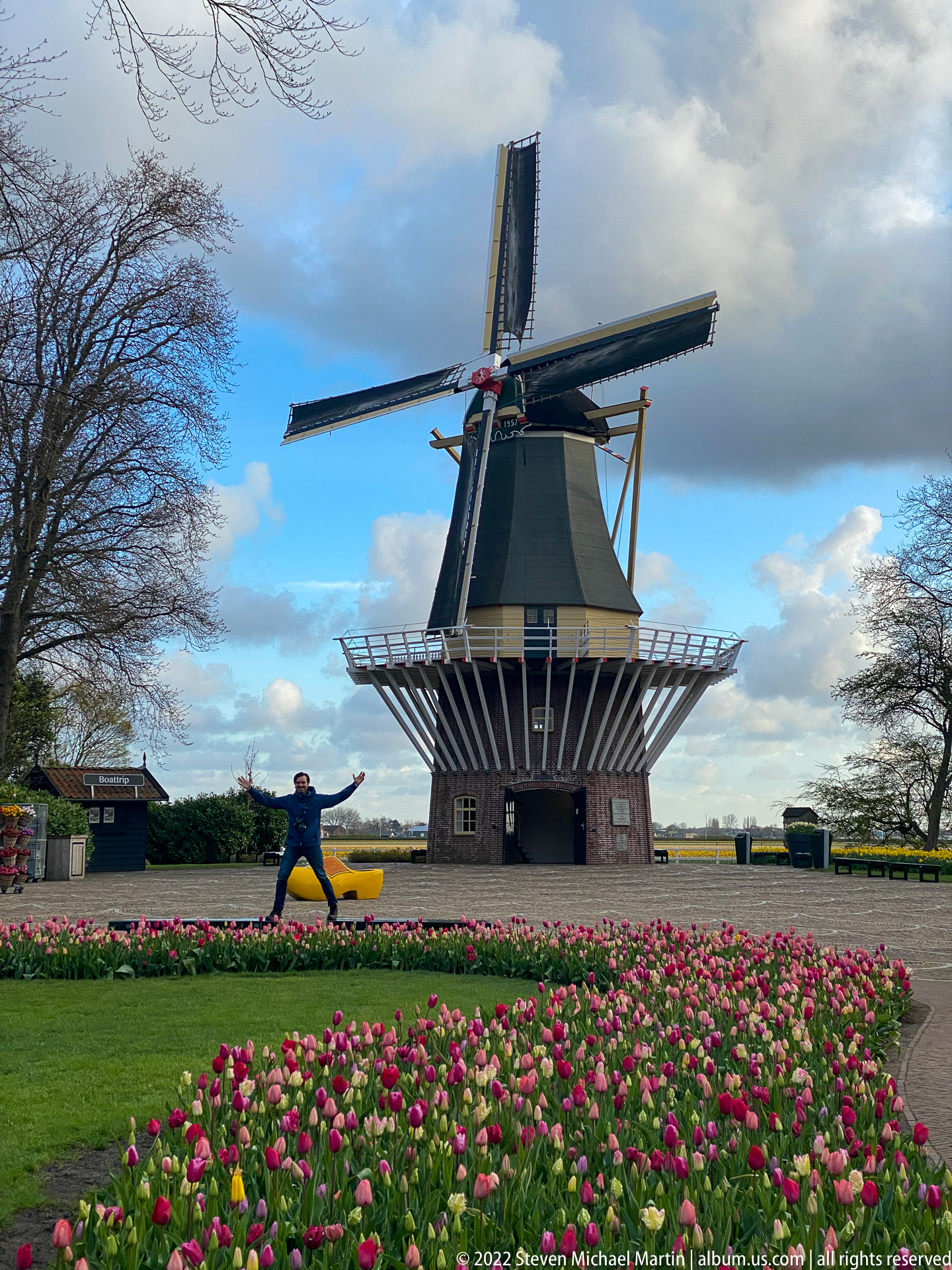
A traditional Dutch windmill rises beyond a broad foreground of pink and red tulips, its four sails extending across a blue-and-clouded spring sky. The dark tapered mill body stands on a raised gallery with white railings, and a visitor near the base provides a sense of scale. The view combines one of Keukenhof's recognizable structures with the garden's seasonal bulb display.
Caption
A traditional Dutch windmill rises beyond a broad foreground of pink and red tulips, its four sails extending across a blue-and-clouded spring sky. The dark tapered mill body stands on a raised gallery with white railings, and a visitor near the base provides a sense of scale. The view combines one of Keukenhof's recognizable structures with the garden's seasonal bulb display.
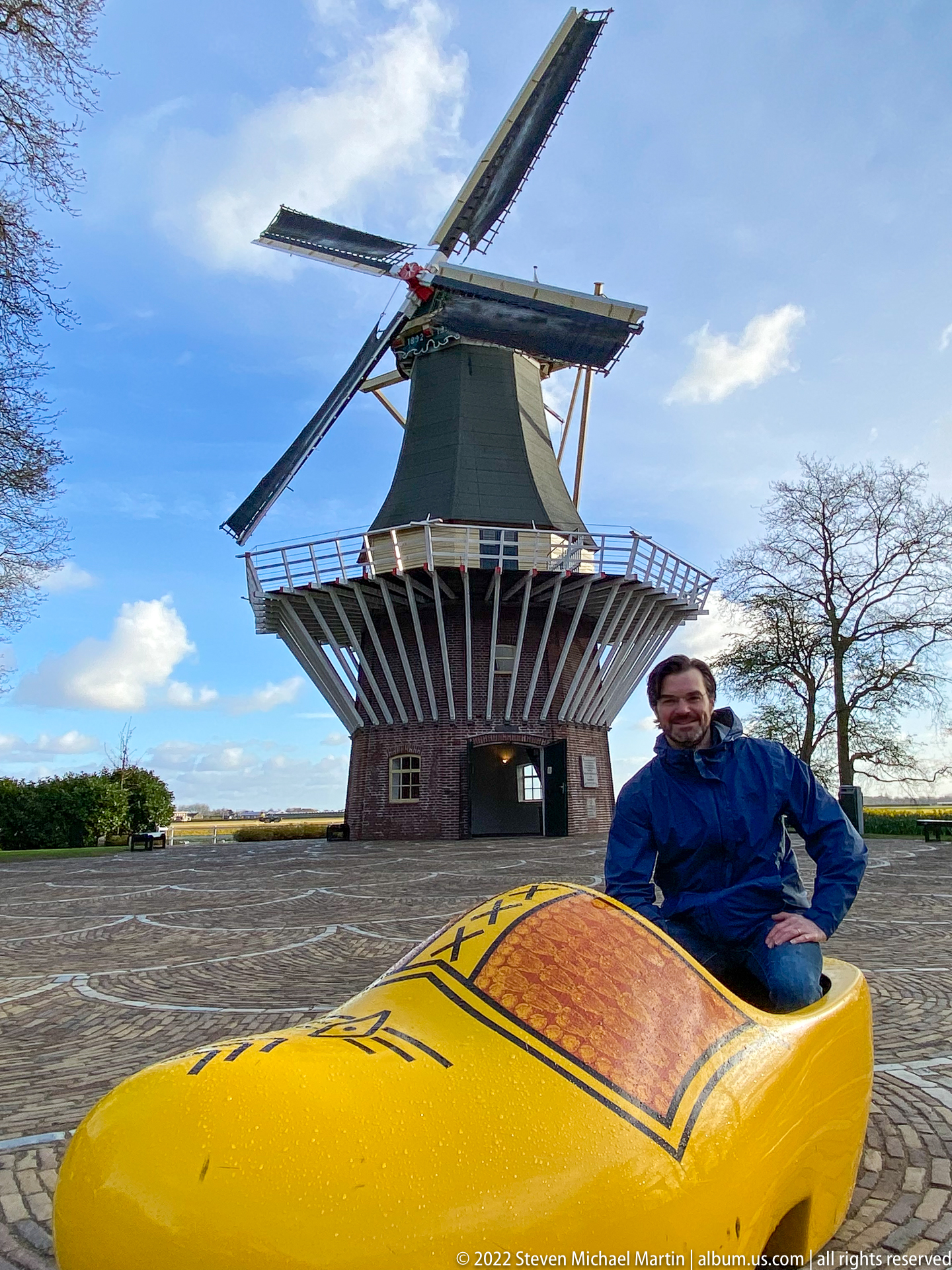
The Keukenhof windmill rises behind an oversized yellow Dutch clog used as a playful foreground display, while a visitor stands beside it on the cobbled forecourt. Four sails cross the blue sky above the mill’s dark tapered body and broad white-railed gallery. The unusual pairing combines two recognizable Dutch visual motifs, but the low camera position makes the brightly painted clog dominate the immediate foreground.
Caption
The Keukenhof windmill rises behind an oversized yellow Dutch clog used as a playful foreground display, while a visitor stands beside it on the cobbled forecourt. Four sails cross the blue sky above the mill’s dark tapered body and broad white-railed gallery. The unusual pairing combines two recognizable Dutch visual motifs, but the low camera position makes the brightly painted clog dominate the immediate foreground.

A visitor kneels beside an oversized yellow wooden clog on the terrace in front of the Keukenhof windmill. The playful foreground prop occupies nearly as much visual attention as the person, while the mill’s dark body, white gallery, and lower sail remain prominent behind. The human scale makes the exaggerated size of the decorative shoe immediately apparent.
Caption
A visitor kneels beside an oversized yellow wooden clog on the terrace in front of the Keukenhof windmill. The playful foreground prop occupies nearly as much visual attention as the person, while the mill’s dark body, white gallery, and lower sail remain prominent behind. The human scale makes the exaggerated size of the decorative shoe immediately apparent.
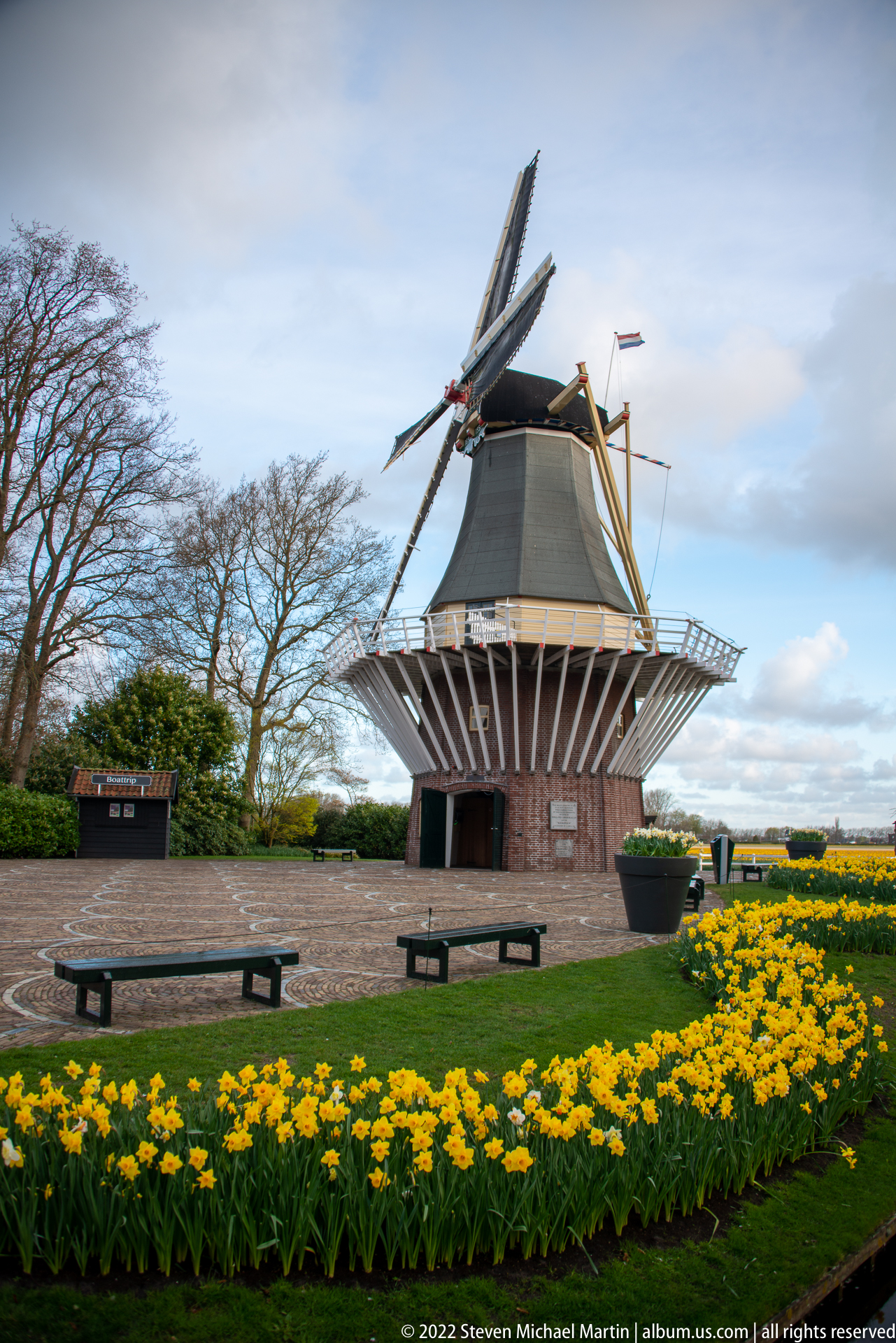
The Keukenhof windmill rises behind a broad foreground bed of yellow spring flowers, its dark smock, white gallery, and four sails set against a bright sky. Benches on the paved terrace reinforce the structure’s role as a garden landmark, while the low floral foreground provides a seasonal frame and a strong contrast with the mill’s angular timber construction.
Caption
The Keukenhof windmill rises behind a broad foreground bed of yellow spring flowers, its dark smock, white gallery, and four sails set against a bright sky. Benches on the paved terrace reinforce the structure’s role as a garden landmark, while the low floral foreground provides a seasonal frame and a strong contrast with the mill’s angular timber construction.
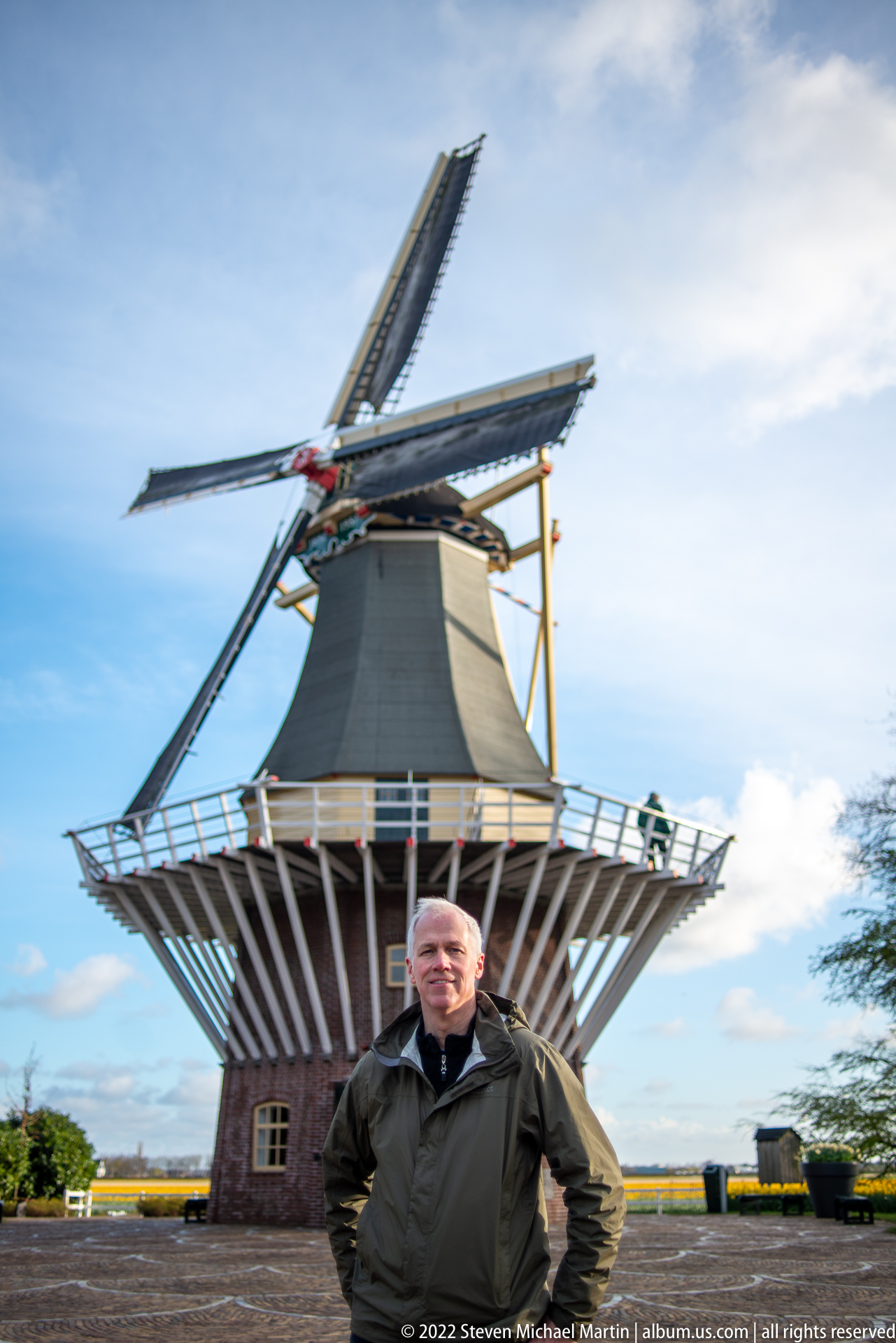
A visitor stands centered in front of the Keukenhof windmill, framed by the mill’s dark tapered body, white-railed gallery, and broad crossing sails. The low viewpoint places the figure against the structure while leaving enough sky to reveal the full span of the blades. Unlike the preceding architectural views, this composition uses the windmill as a backdrop for a human-scale portrait.
Caption
A visitor stands centered in front of the Keukenhof windmill, framed by the mill’s dark tapered body, white-railed gallery, and broad crossing sails. The low viewpoint places the figure against the structure while leaving enough sky to reveal the full span of the blades. Unlike the preceding architectural views, this composition uses the windmill as a backdrop for a human-scale portrait.
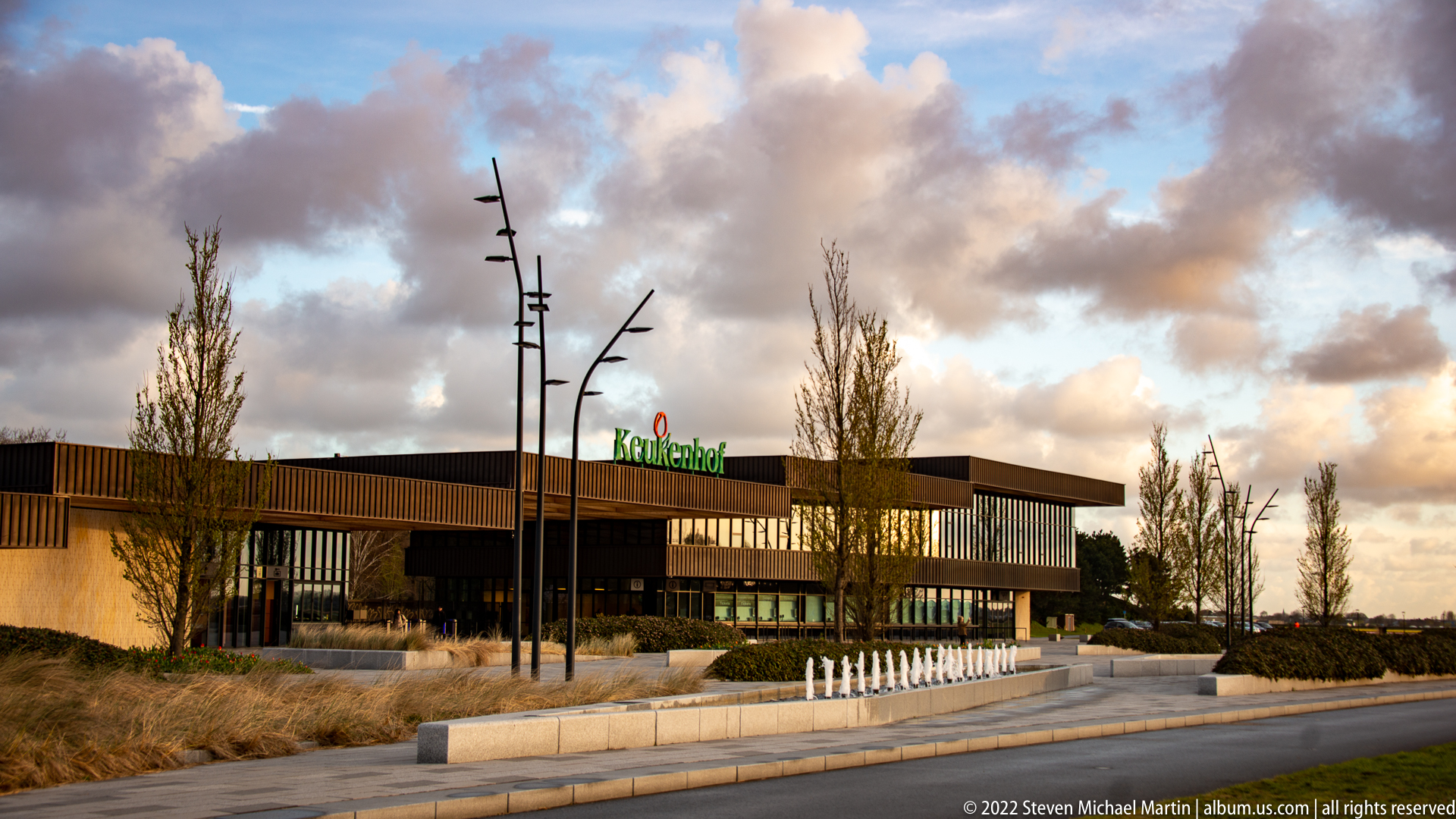
The modern entrance complex at Keukenhof stretches beneath a dramatic spring sky, its low horizontal roofline and warm-toned cladding framing the garden’s arrival court. Slender young trees, sculptural light poles, broad paving, and a stepped water feature give the forecourt a deliberately contemporary character before visitors enter the historic flower park.
Caption
The modern entrance complex at Keukenhof stretches beneath a dramatic spring sky, its low horizontal roofline and warm-toned cladding framing the garden’s arrival court. Slender young trees, sculptural light poles, broad paving, and a stepped water feature give the forecourt a deliberately contemporary character before visitors enter the historic flower park.
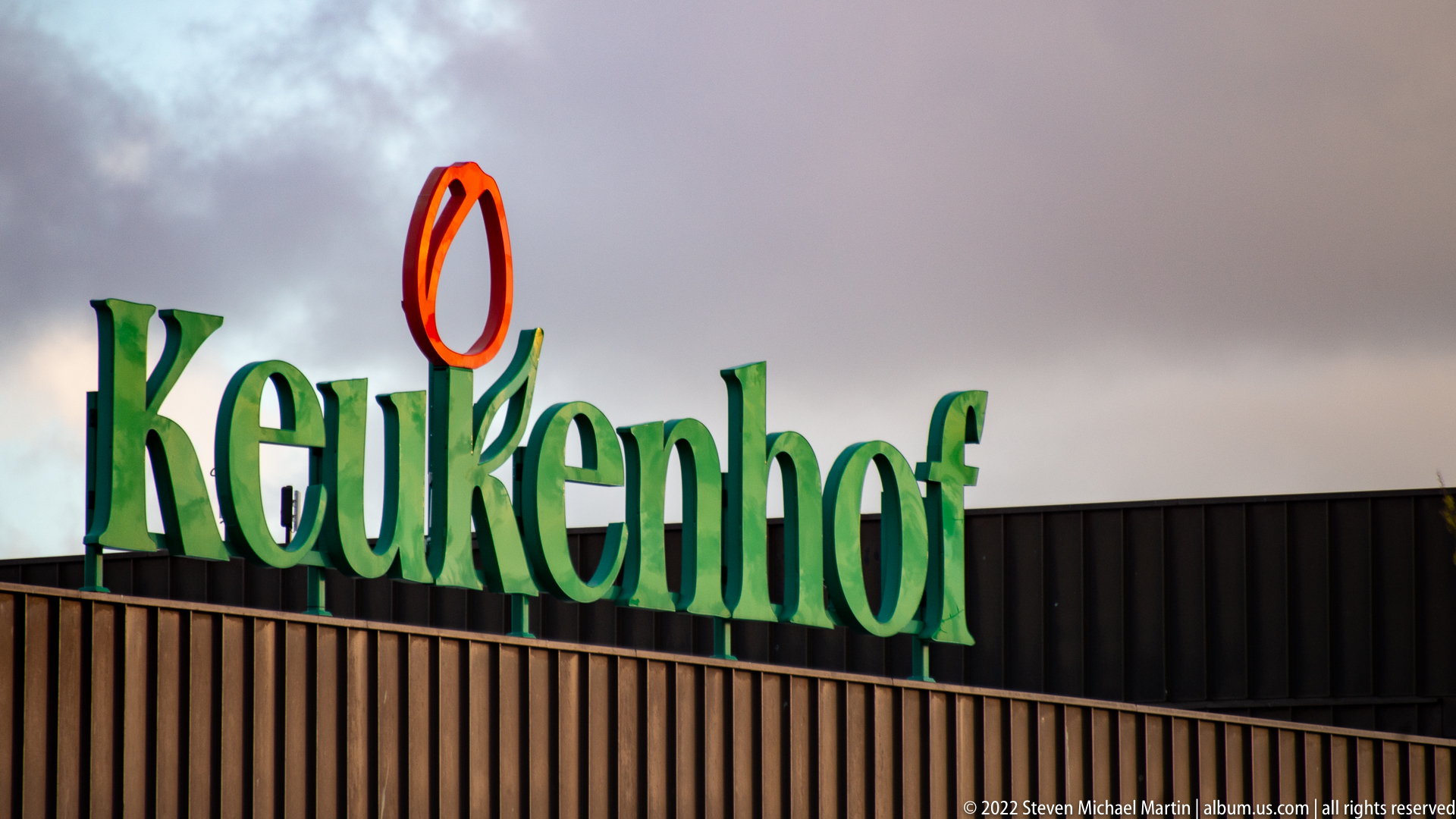
The Keukenhof name rises above the entrance roof in oversized green letters, capped by the park’s orange tulip-like emblem. Seen against a gray-violet sky, the sculptural wordmark functions as both branding and a landmark for arriving visitors, while the dark roof edge and vertical screen below keep the composition spare and graphic.
Caption
The Keukenhof name rises above the entrance roof in oversized green letters, capped by the park’s orange tulip-like emblem. Seen against a gray-violet sky, the sculptural wordmark functions as both branding and a landmark for arriving visitors, while the dark roof edge and vertical screen below keep the composition spare and graphic.
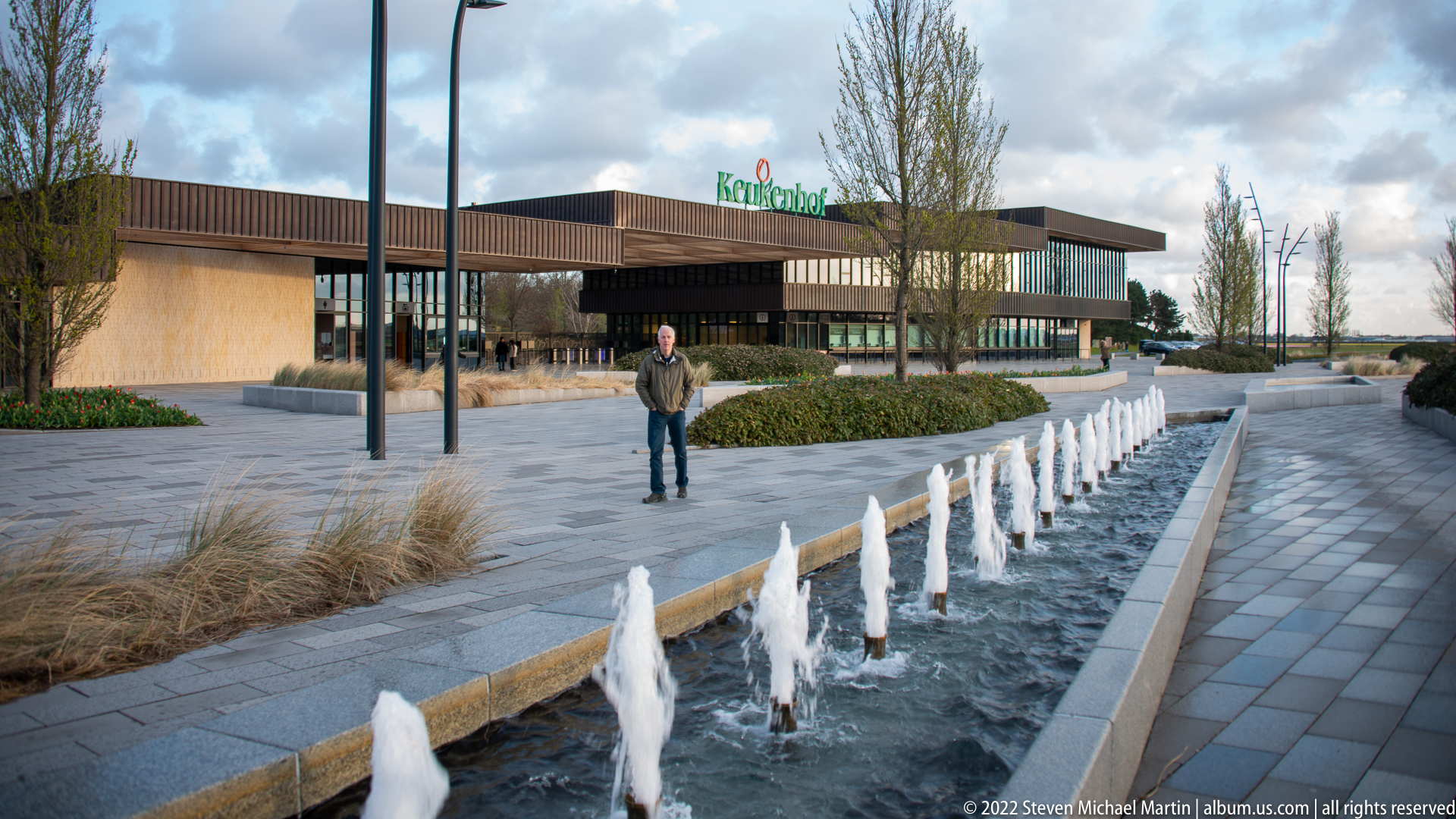
A row of white fountain jets leads the eye toward Keukenhof’s modern entrance building, turning the arrival plaza into a strong perspective composition. A lone visitor stands beside the water channel, while clipped planting beds, ornamental grasses, fresh spring trees, and the low visitor complex establish the carefully designed threshold between parking area and gardens.
Caption
A row of white fountain jets leads the eye toward Keukenhof’s modern entrance building, turning the arrival plaza into a strong perspective composition. A lone visitor stands beside the water channel, while clipped planting beds, ornamental grasses, fresh spring trees, and the low visitor complex establish the carefully designed threshold between parking area and gardens.
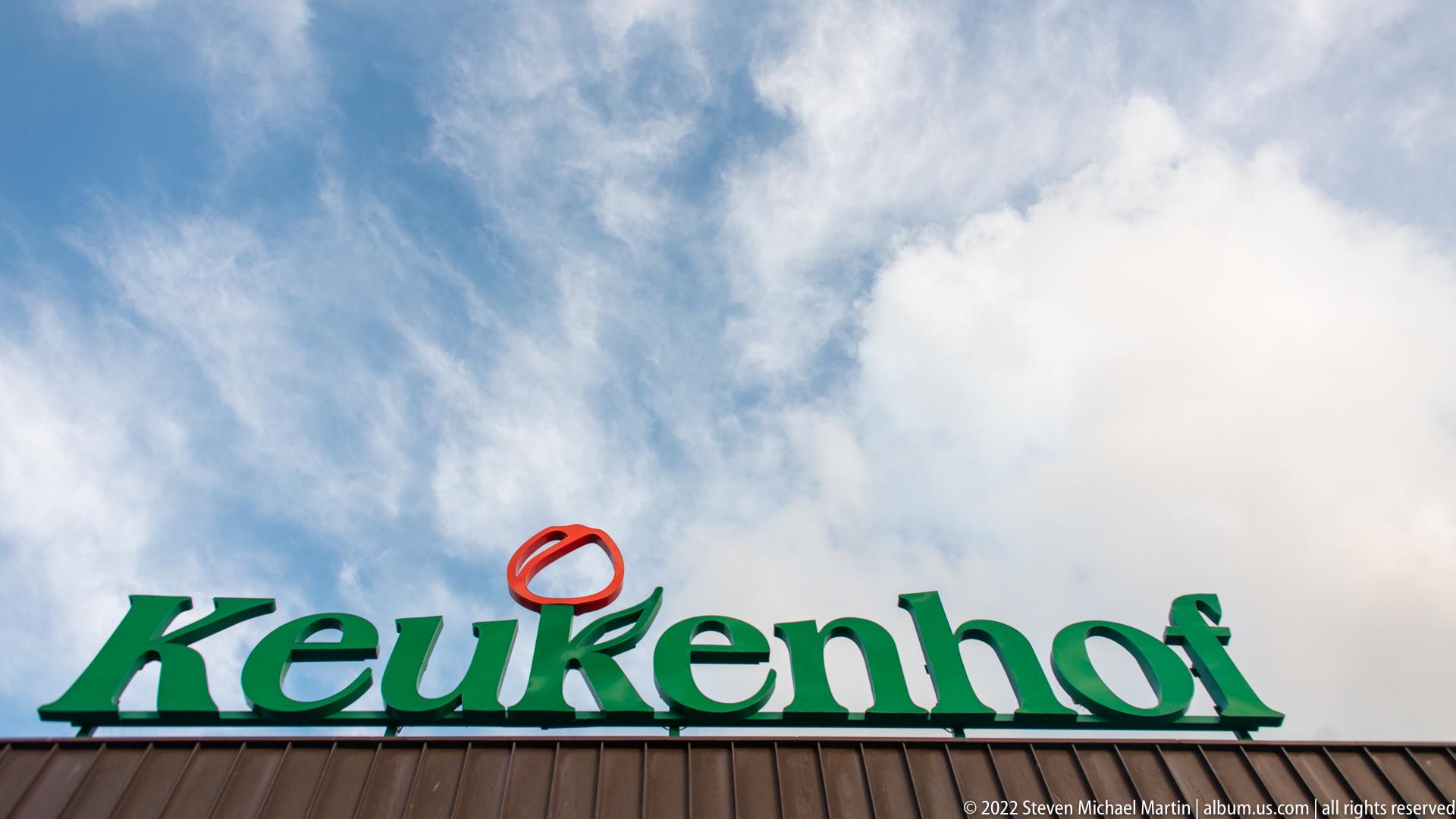
Viewed from a low angle, the green Keukenhof wordmark sits along the roofline beneath a wide expanse of textured cloud. The orange tulip emblem interrupts the lettering as a compact visual accent, while the restrained framing isolates the park’s identity from the surrounding architecture and turns the sign itself into the subject.
Caption
Viewed from a low angle, the green Keukenhof wordmark sits along the roofline beneath a wide expanse of textured cloud. The orange tulip emblem interrupts the lettering as a compact visual accent, while the restrained framing isolates the park’s identity from the surrounding architecture and turns the sign itself into the subject.
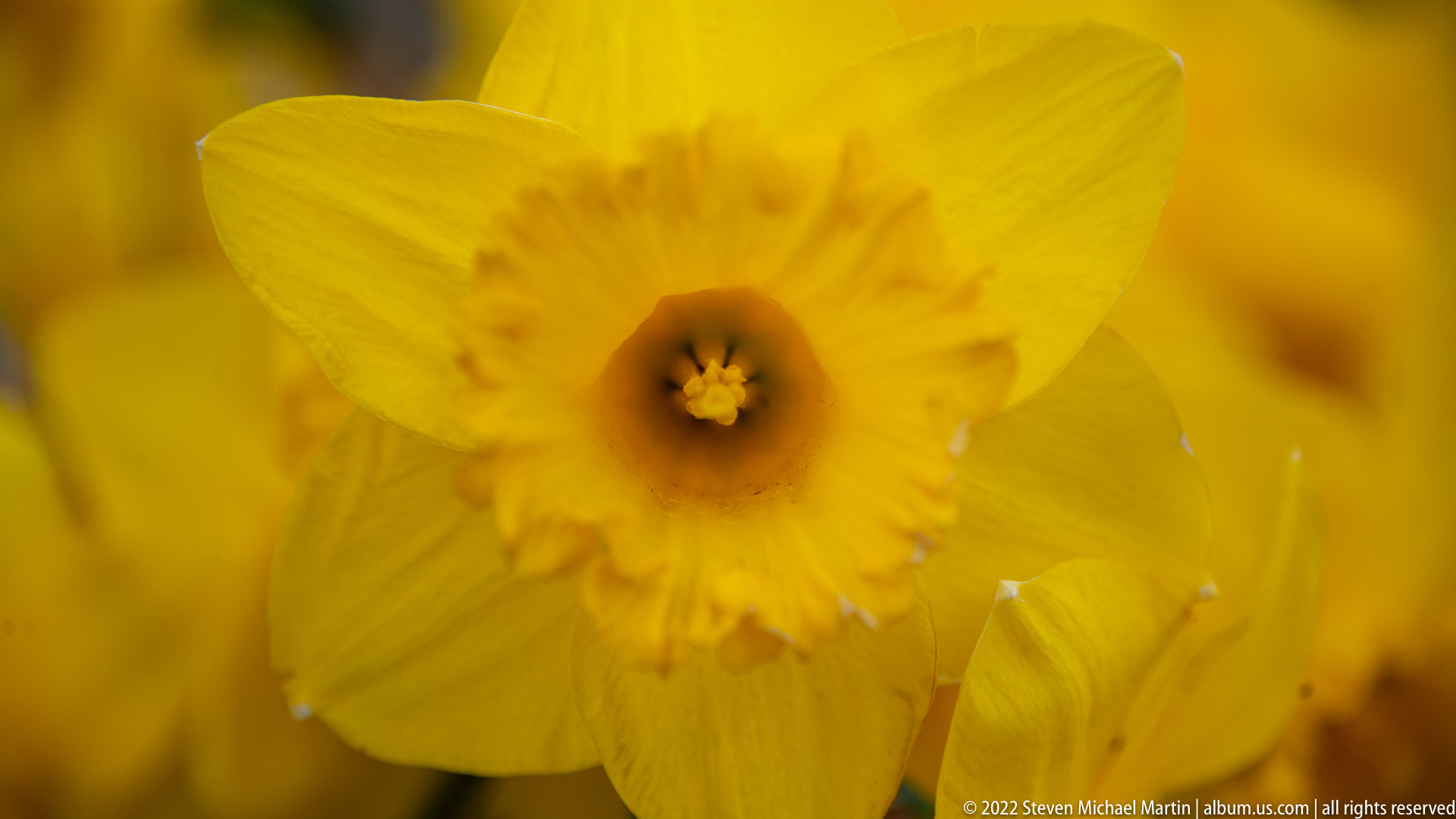
A single yellow daffodil fills the frame, its flared trumpet centered inside six broad tepals. Shallow focus softens neighboring blooms into a warm field of gold, emphasizing the flower’s radial form and saturated spring color rather than the wider garden setting.
Caption
A single yellow daffodil fills the frame, its flared trumpet centered inside six broad tepals. Shallow focus softens neighboring blooms into a warm field of gold, emphasizing the flower’s radial form and saturated spring color rather than the wider garden setting.
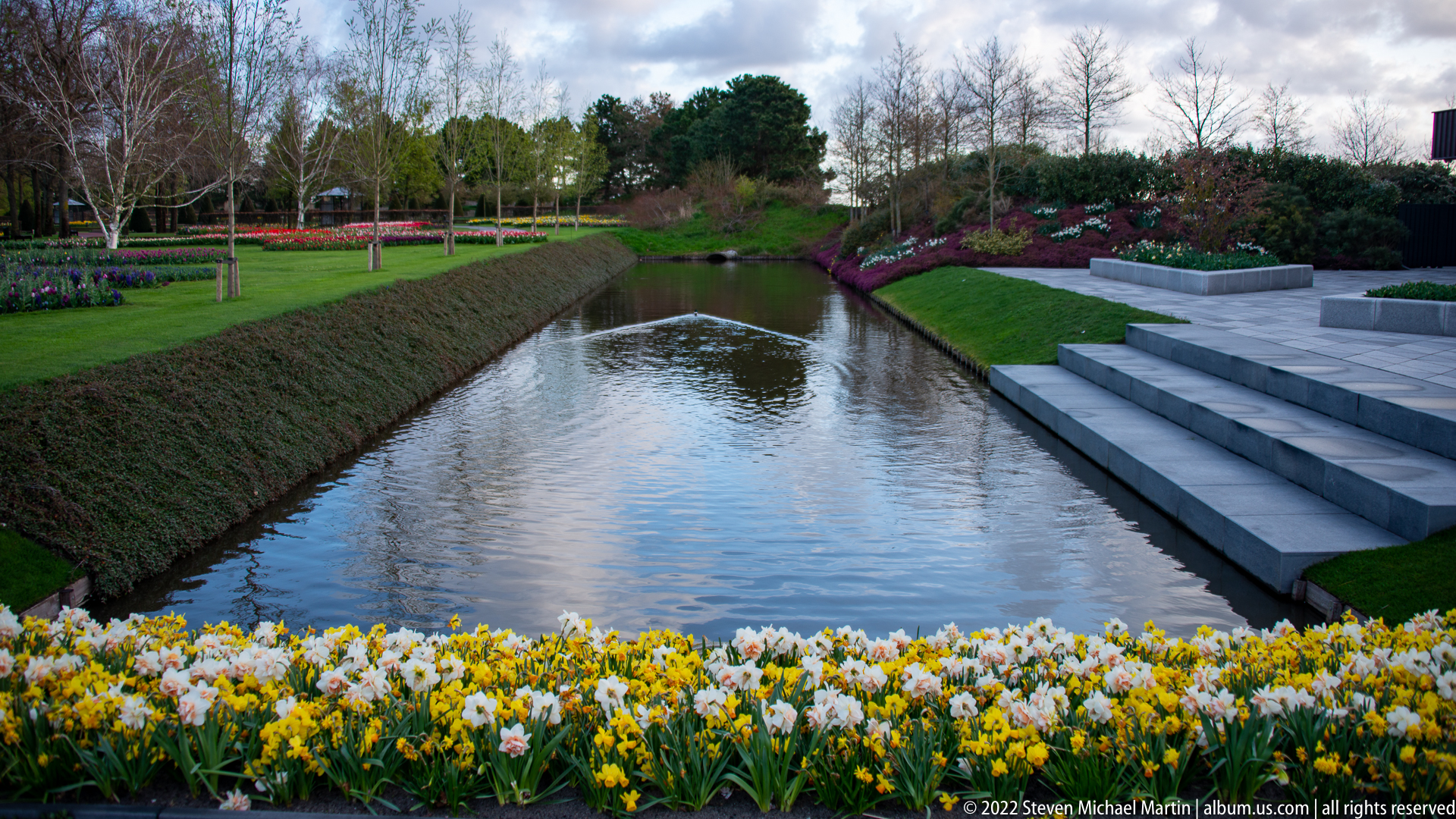
A dense border of yellow-and-white daffodils edges a narrow formal canal at Keukenhof, with broad stone steps descending on the right. Across the water, clipped lawns, low hedges, and curving beds of early spring bulbs create a layered garden view, while bare and newly leafing trees place the scene early in the season.
Caption
A dense border of yellow-and-white daffodils edges a narrow formal canal at Keukenhof, with broad stone steps descending on the right. Across the water, clipped lawns, low hedges, and curving beds of early spring bulbs create a layered garden view, while bare and newly leafing trees place the scene early in the season.
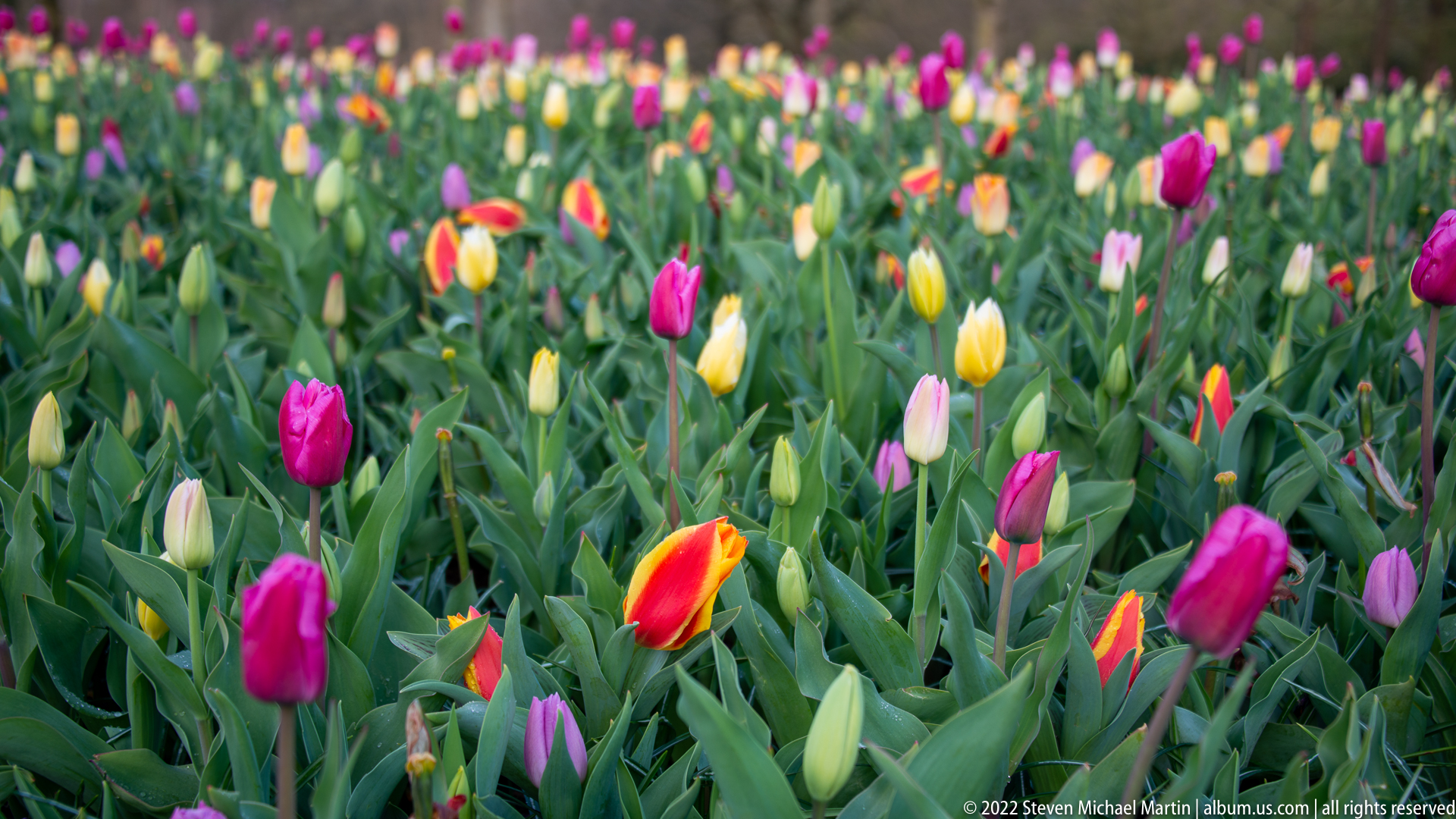
Mixed tulips in red, magenta, yellow, cream, and orange rise from a dense mass of green leaves, creating a deliberately irregular field of color. The close, eye-level framing excludes paths and architecture, concentrating attention on variation in bloom shape, maturity, and hue across the planting.
Caption
Mixed tulips in red, magenta, yellow, cream, and orange rise from a dense mass of green leaves, creating a deliberately irregular field of color. The close, eye-level framing excludes paths and architecture, concentrating attention on variation in bloom shape, maturity, and hue across the planting.
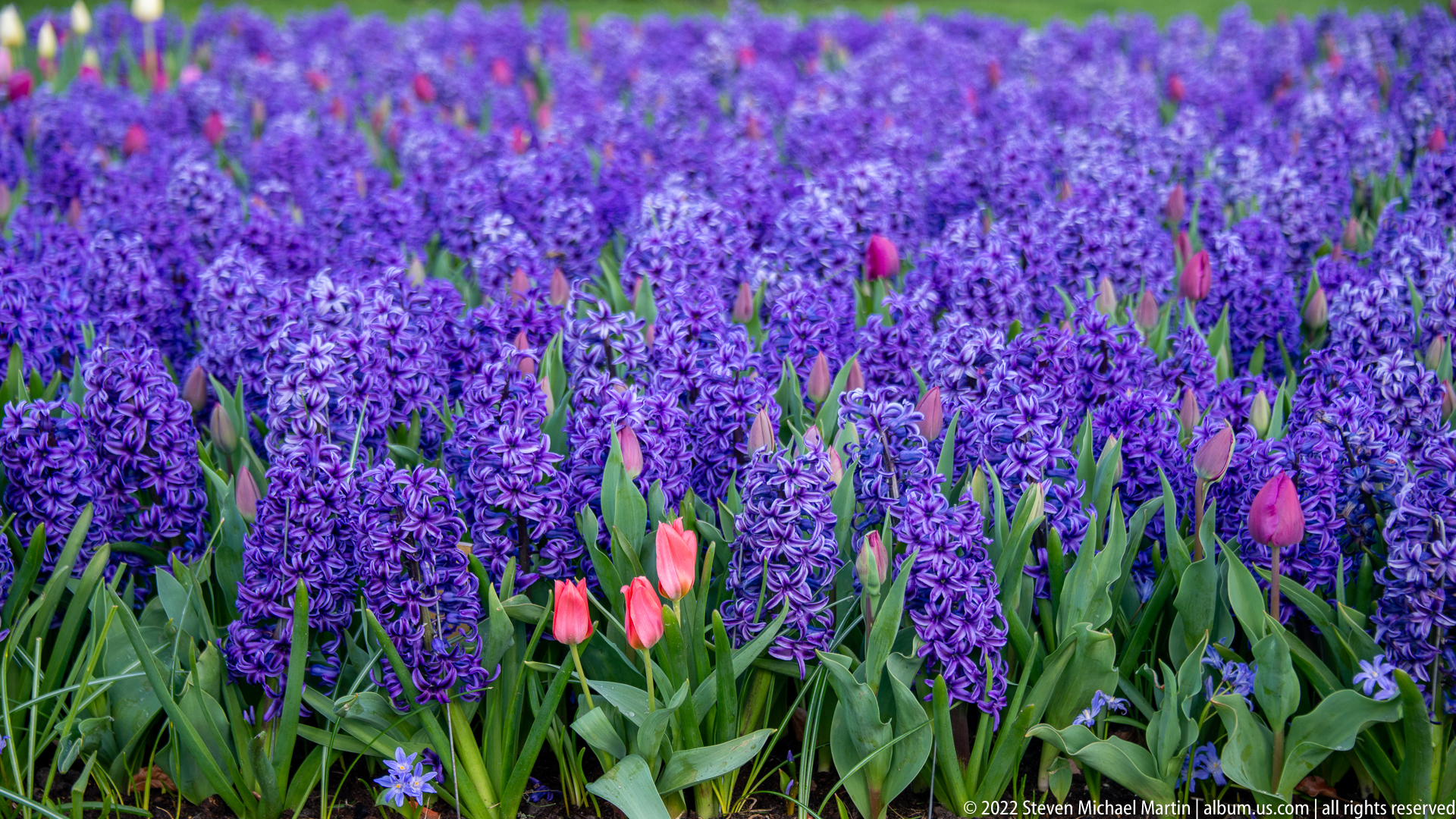
A broad planting of purple hyacinths forms an almost continuous carpet, punctuated by scattered pink and red tulips. The upright hyacinth spikes create a dense textured surface, while the contrasting tulips break the repetition with taller, simpler forms and warmer color accents.
Caption
A broad planting of purple hyacinths forms an almost continuous carpet, punctuated by scattered pink and red tulips. The upright hyacinth spikes create a dense textured surface, while the contrasting tulips break the repetition with taller, simpler forms and warmer color accents.
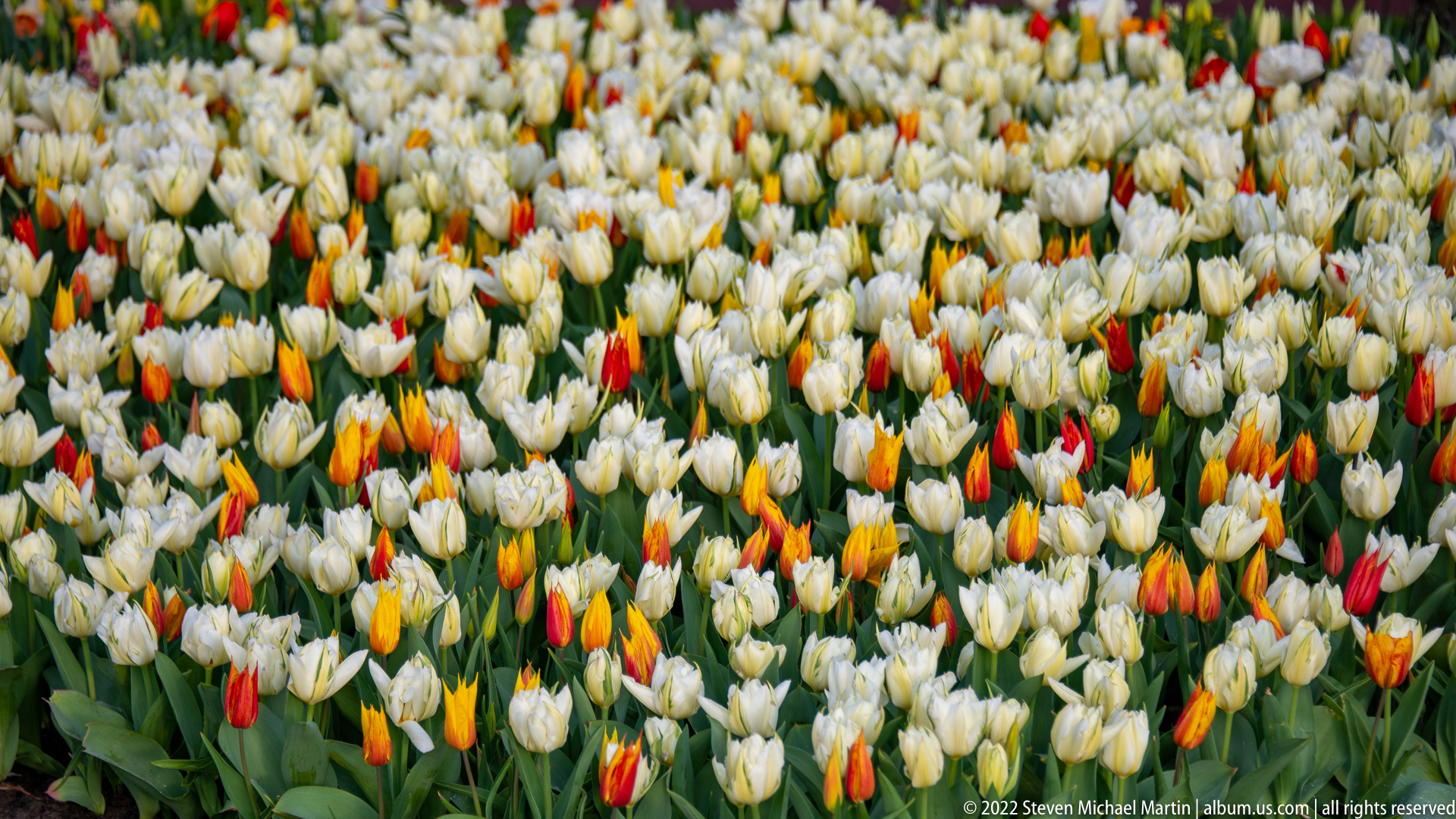
A mass of predominantly white tulips is peppered with red, orange, and yellow flowers, producing a pointillist pattern across the bed. The elevated viewpoint compresses hundreds of stems into a single surface of color and allows the occasional contrasting bloom to register as a deliberate accent rather than a separate planting block.
Caption
A mass of predominantly white tulips is peppered with red, orange, and yellow flowers, producing a pointillist pattern across the bed. The elevated viewpoint compresses hundreds of stems into a single surface of color and allows the occasional contrasting bloom to register as a deliberate accent rather than a separate planting block.
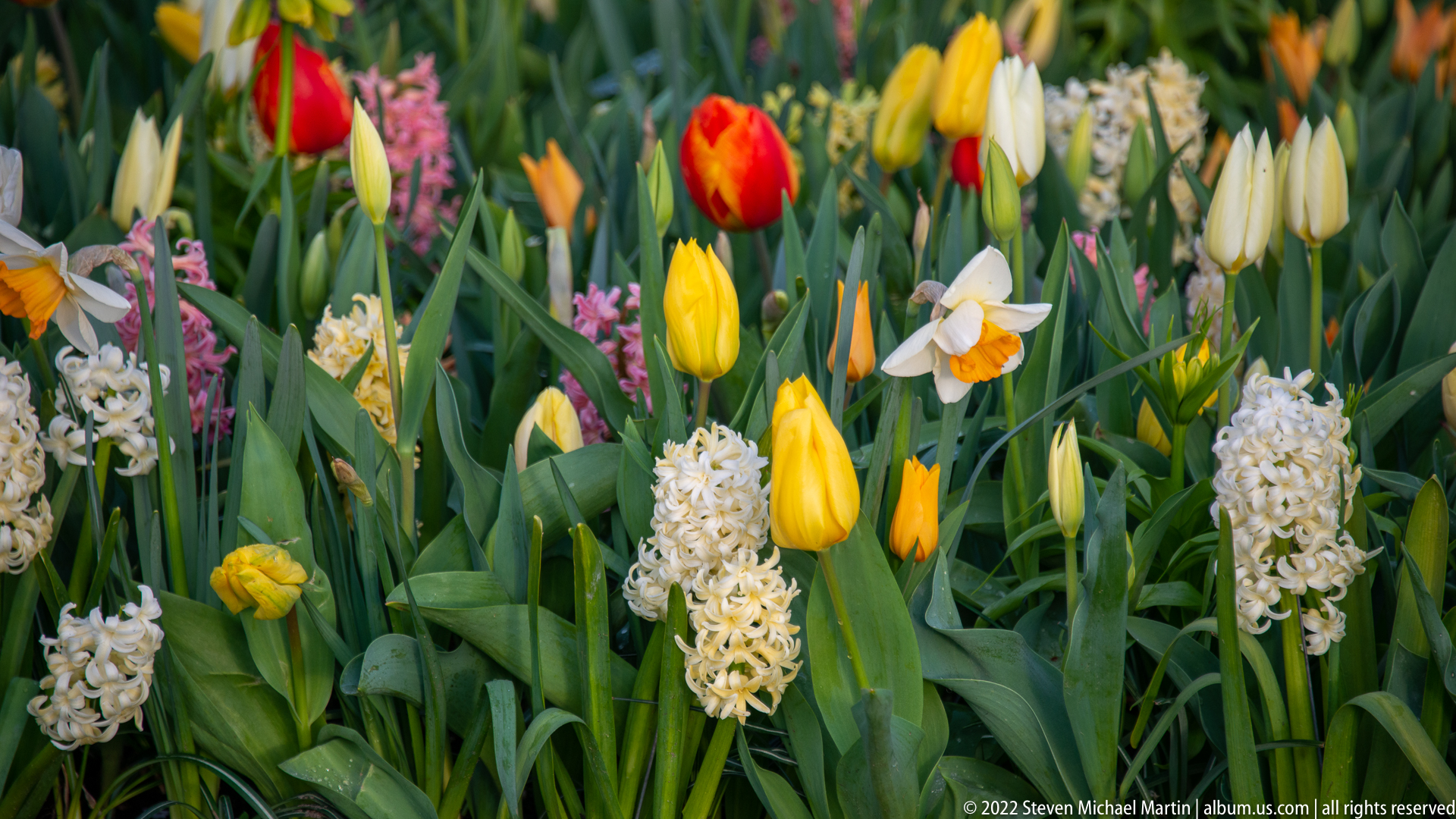
Yellow and red tulips rise among creamy hyacinths, small daffodils, and other spring bulbs in a layered mixed bed. The tighter composition reveals differences in flower architecture—smooth tulip cups, densely packed hyacinth spikes, and trumpet-shaped narcissus—showing how Keukenhof combines contrasting forms as well as colors.
Caption
Yellow and red tulips rise among creamy hyacinths, small daffodils, and other spring bulbs in a layered mixed bed. The tighter composition reveals differences in flower architecture—smooth tulip cups, densely packed hyacinth spikes, and trumpet-shaped narcissus—showing how Keukenhof combines contrasting forms as well as colors.

An adult male mallard stands on damp grass, his glossy green head, white neck ring, chestnut breast, gray body, and curled black tail feathers shown in crisp profile. The low viewpoint and tight crop turn an everyday park bird into a detailed wildlife portrait, with orange feet and blue wing speculum adding bright accents.
Caption
An adult male mallard stands on damp grass, his glossy green head, white neck ring, chestnut breast, gray body, and curled black tail feathers shown in crisp profile. The low viewpoint and tight crop turn an everyday park bird into a detailed wildlife portrait, with orange feet and blue wing speculum adding bright accents.
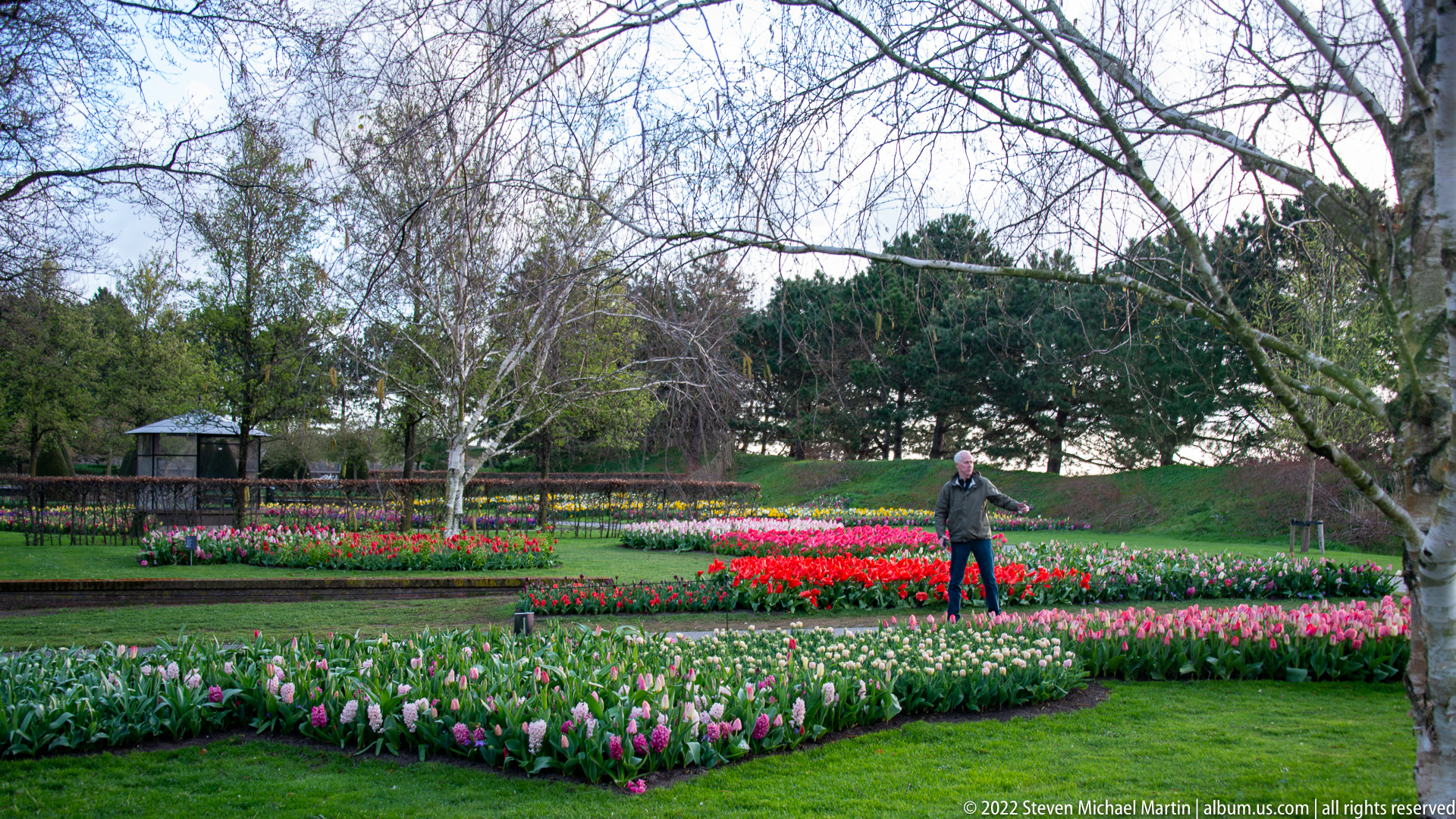
Geometric tulip beds in pink, red, and white spread across a clipped lawn, their low bands of color framed by mature trees and bare branches. A visitor standing among the beds provides scale, while a small pavilion-like structure and distant plantings show the garden as a composed landscape rather than an isolated floral close-up.
Caption
Geometric tulip beds in pink, red, and white spread across a clipped lawn, their low bands of color framed by mature trees and bare branches. A visitor standing among the beds provides scale, while a small pavilion-like structure and distant plantings show the garden as a composed landscape rather than an isolated floral close-up.
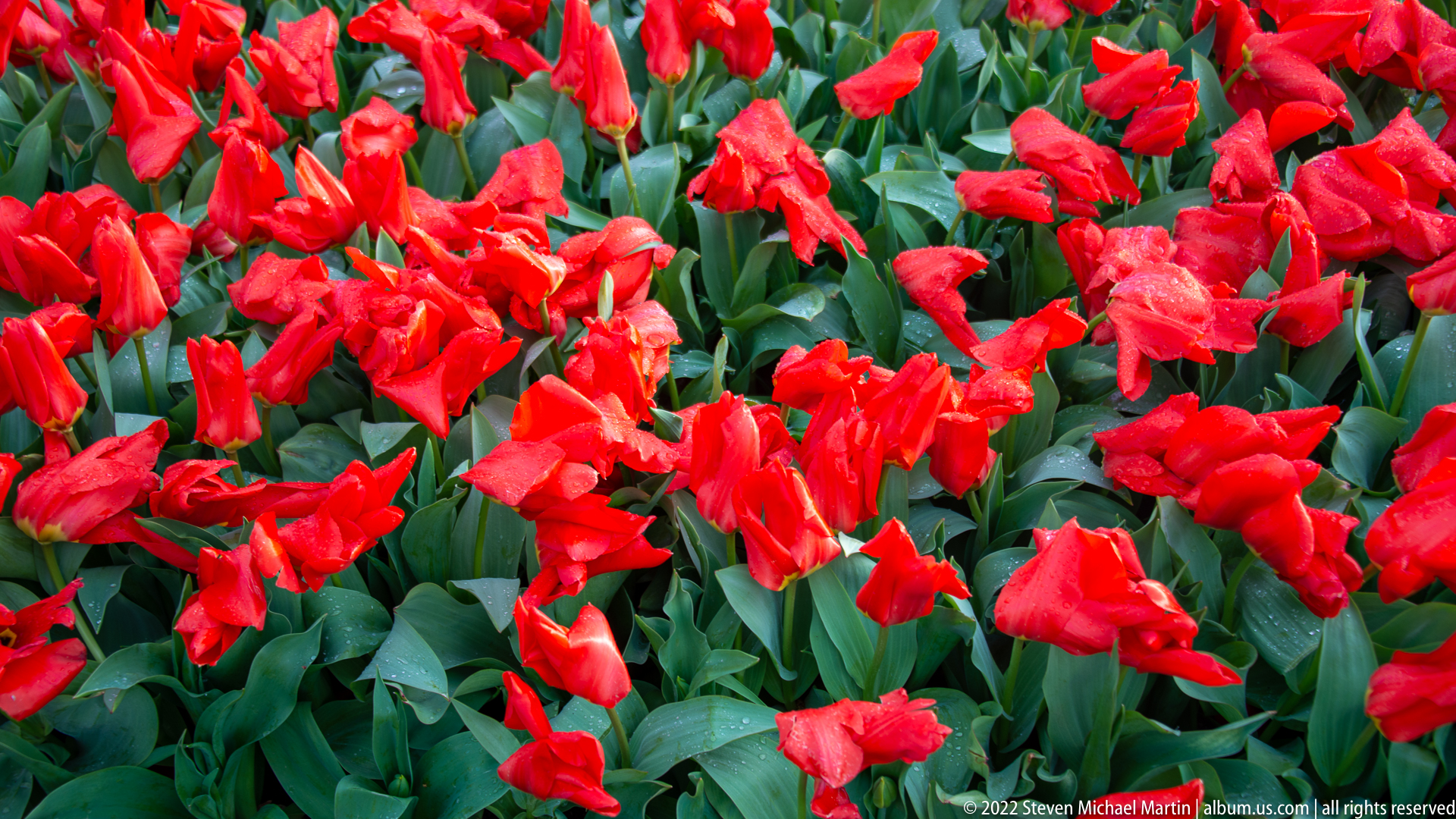
A dense planting of vivid red tulips displays unusually ruffled, irregular petals that give the bed a restless, textured surface. Seen from slightly above, the flowers overlap tightly enough to obscure most stems, making petal form and saturated red color the primary visual information.
Caption
A dense planting of vivid red tulips displays unusually ruffled, irregular petals that give the bed a restless, textured surface. Seen from slightly above, the flowers overlap tightly enough to obscure most stems, making petal form and saturated red color the primary visual information.

Rows of deep pink-red tulips stand at nearly even height, their closed-to-partly-open cups forming a rhythmic band above upright green leaves. The shallow depth of field softens the rear rows, giving the foreground blooms greater dimensionality while preserving the sense of a large, uniform planting.
Caption
Rows of deep pink-red tulips stand at nearly even height, their closed-to-partly-open cups forming a rhythmic band above upright green leaves. The shallow depth of field softens the rear rows, giving the foreground blooms greater dimensionality while preserving the sense of a large, uniform planting.
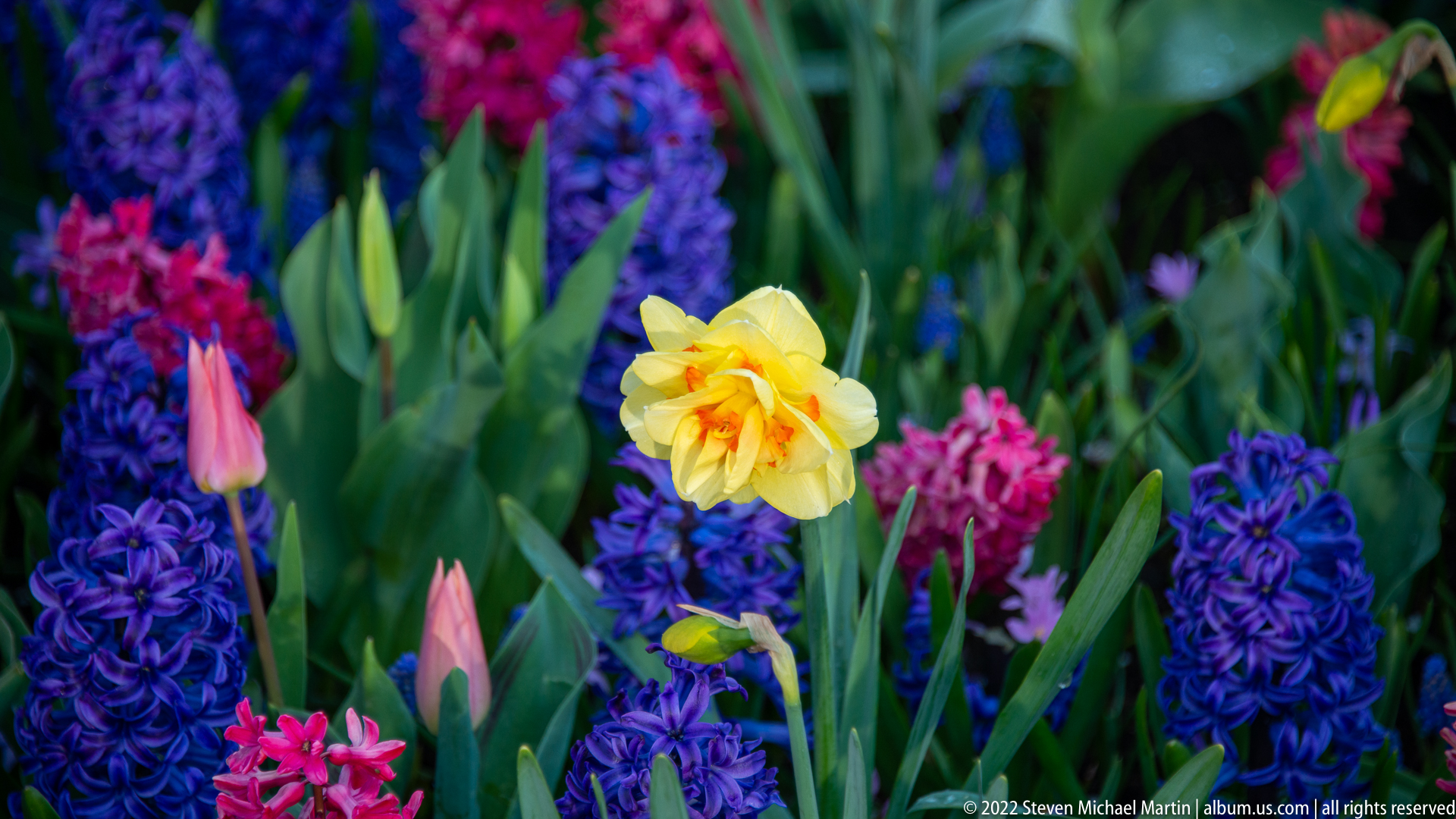
A yellow double daffodil becomes the focal point within a richly layered spring planting of purple hyacinths, pink flower spikes, and scattered tulips. Selective focus isolates the daffodil against darker blue-purple forms, turning the mixed border into a study of contrasting flower shapes, heights, and complementary color.
Caption
A yellow double daffodil becomes the focal point within a richly layered spring planting of purple hyacinths, pink flower spikes, and scattered tulips. Selective focus isolates the daffodil against darker blue-purple forms, turning the mixed border into a study of contrasting flower shapes, heights, and complementary color.
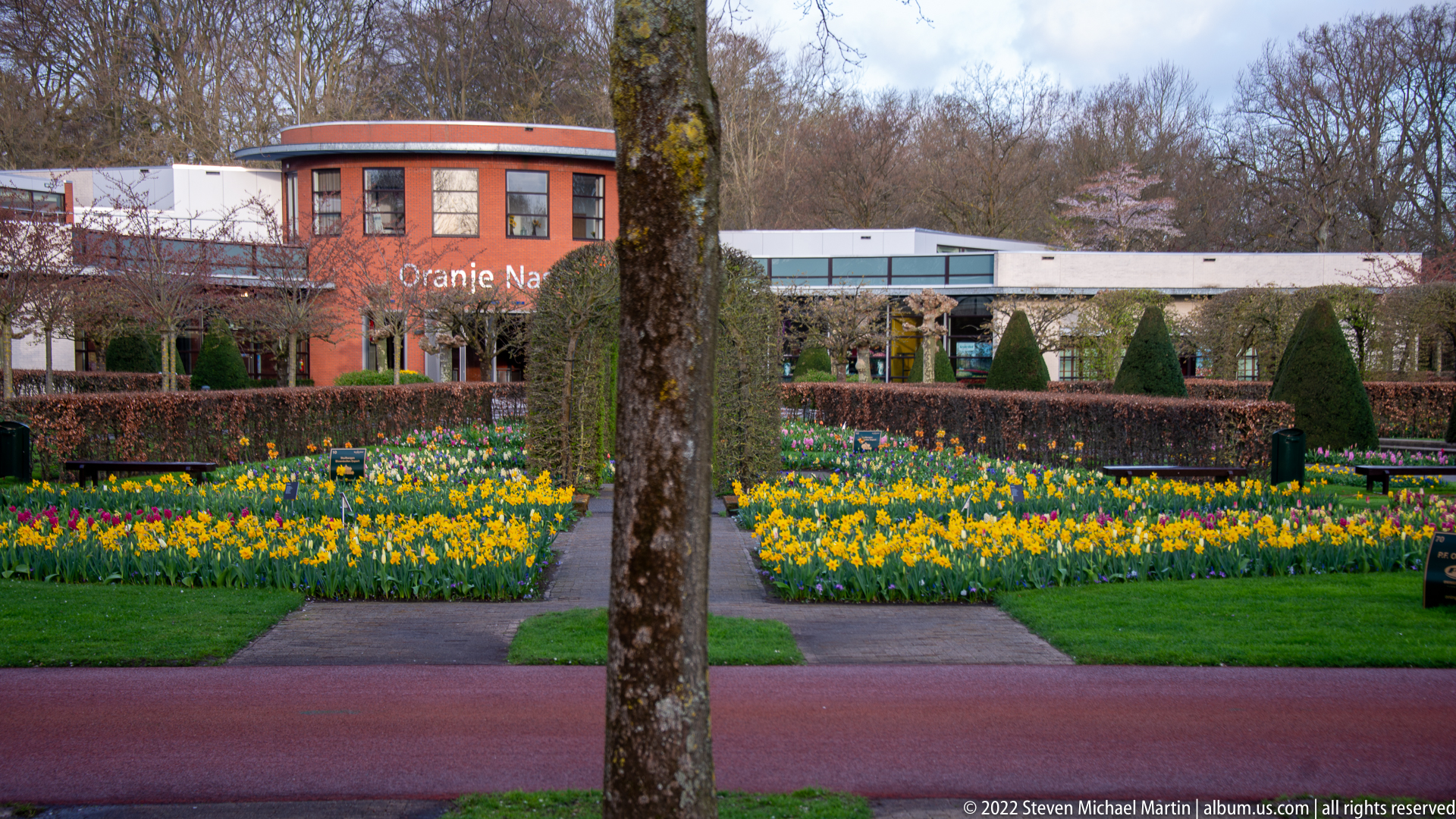
The Oranje Nassau pavilion appears beyond symmetrical beds of yellow and white spring flowers, its orange-brown façade partly screened by a mature tree trunk. Straight paths, clipped hedges, and geometric beds organize the foreground into a formal garden axis, while the pavilion signage anchors the scene within Keukenhof.
Caption
The Oranje Nassau pavilion appears beyond symmetrical beds of yellow and white spring flowers, its orange-brown façade partly screened by a mature tree trunk. Straight paths, clipped hedges, and geometric beds organize the foreground into a formal garden axis, while the pavilion signage anchors the scene within Keukenhof.
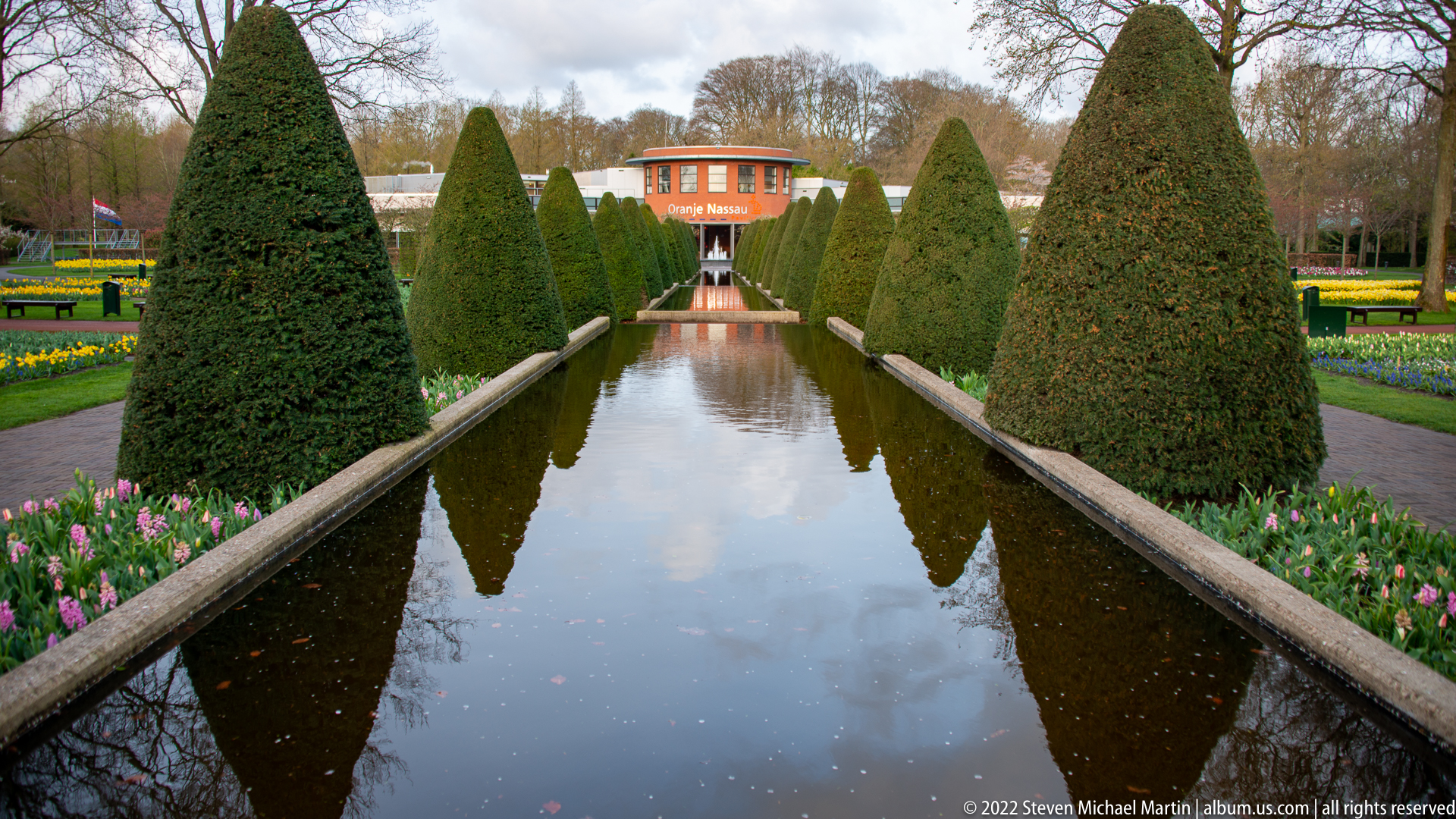
A narrow reflecting canal forms a strong central axis through a formal section of Keukenhof, lined on both sides by tall, clipped conical topiary. Pink tulip beds and other spring plantings flank the water, while the Oranje Nassau pavilion closes the vista in the distance, reinforcing the deliberately symmetrical composition.
Caption
A narrow reflecting canal forms a strong central axis through a formal section of Keukenhof, lined on both sides by tall, clipped conical topiary. Pink tulip beds and other spring plantings flank the water, while the Oranje Nassau pavilion closes the vista in the distance, reinforcing the deliberately symmetrical composition.
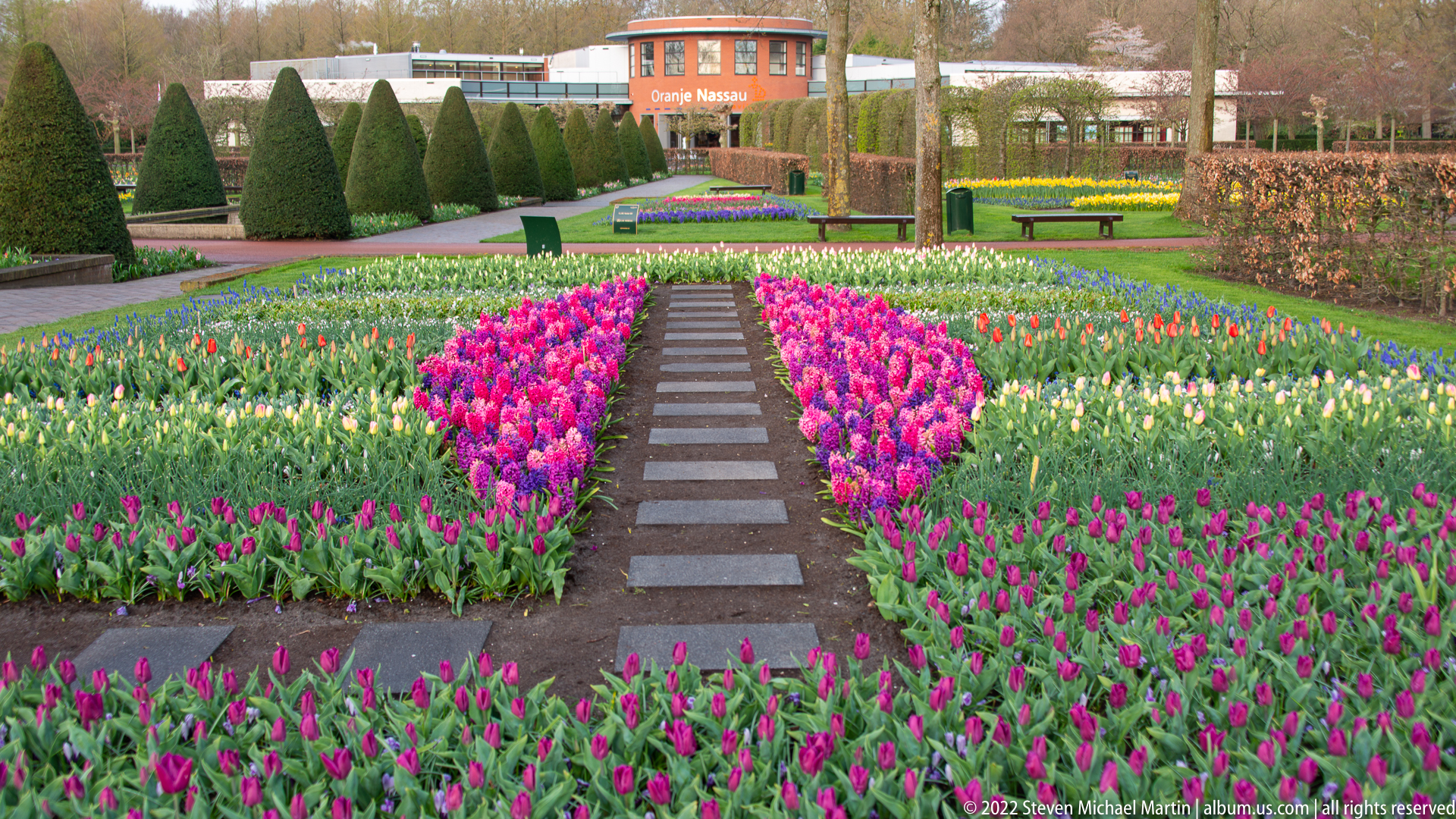
A straight stepping-stone path cuts through symmetrical beds of bright pink tulips and mixed spring bulbs, drawing the eye toward clipped topiary and the Oranje Nassau pavilion. The elevated viewpoint emphasizes the geometry of the layout, with repeated rows of flowers creating color bands across the formal garden.
Caption
A straight stepping-stone path cuts through symmetrical beds of bright pink tulips and mixed spring bulbs, drawing the eye toward clipped topiary and the Oranje Nassau pavilion. The elevated viewpoint emphasizes the geometry of the layout, with repeated rows of flowers creating color bands across the formal garden.
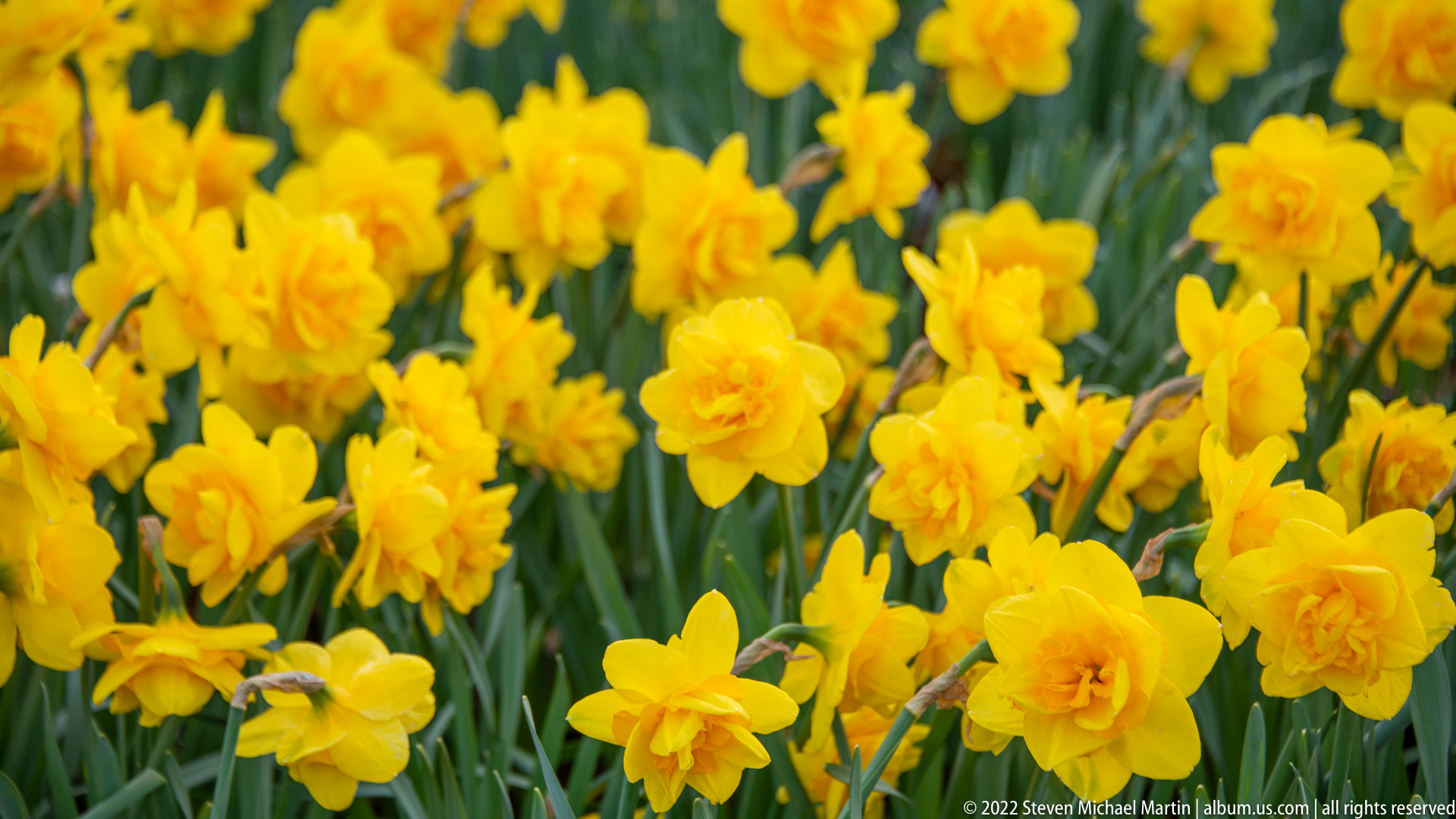
Double yellow daffodils fill the frame with layered, ruffled centers and broad golden outer petals. The flowers stand at varying heights among narrow blue-green leaves, producing a dense floral study in which subtle differences in bloom angle and petal structure become more prominent than the surrounding garden.
Caption
Double yellow daffodils fill the frame with layered, ruffled centers and broad golden outer petals. The flowers stand at varying heights among narrow blue-green leaves, producing a dense floral study in which subtle differences in bloom angle and petal structure become more prominent than the surrounding garden.
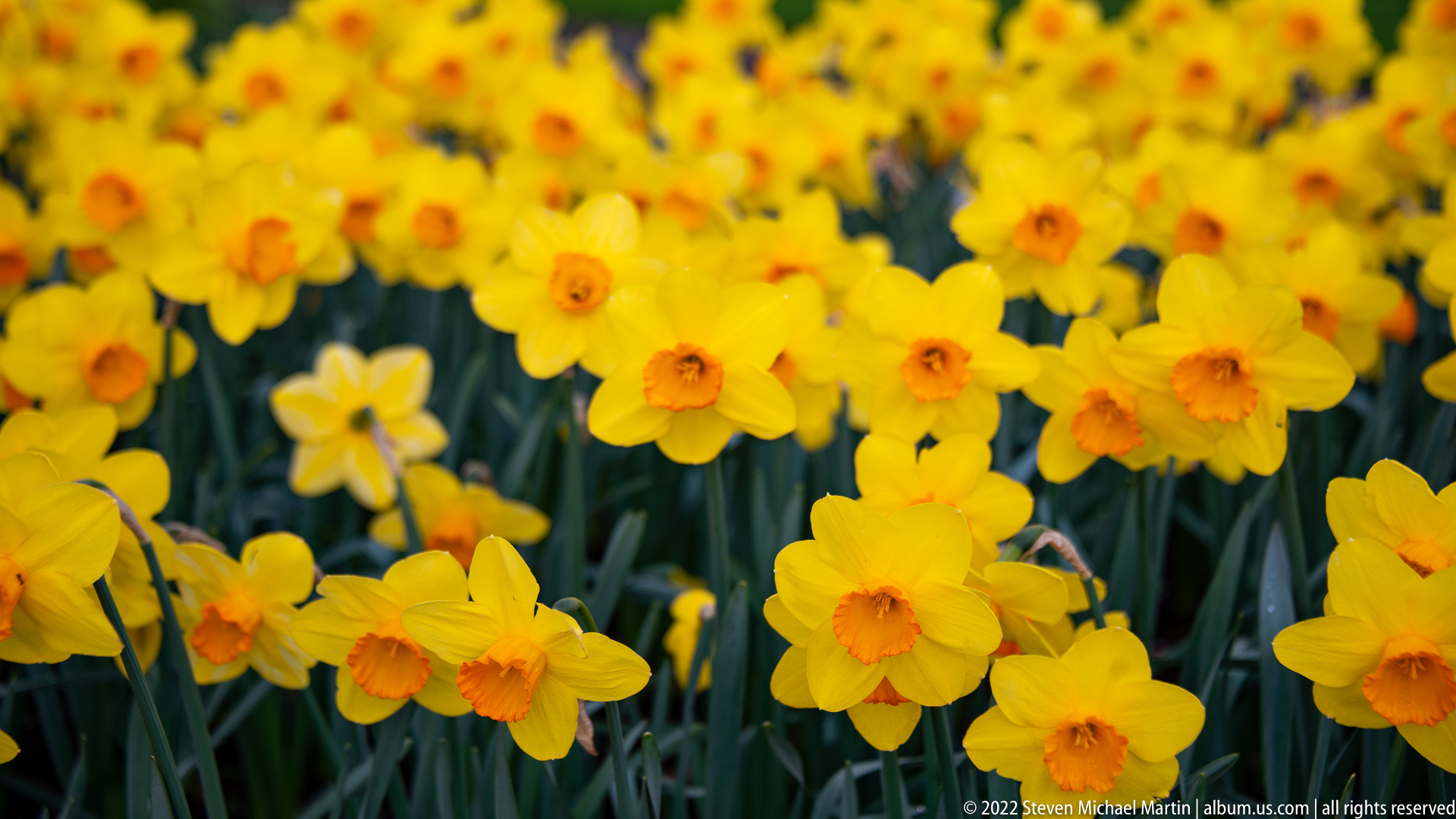
Yellow daffodils with vivid orange cups repeat across a deep planting, their open faces alternating with side views and partially hidden blooms. Shallow focus softens the rear flowers into a golden backdrop, while the sharper foreground blossoms reveal the classic trumpet-and-tepal structure associated with narcissus.
Caption
Yellow daffodils with vivid orange cups repeat across a deep planting, their open faces alternating with side views and partially hidden blooms. Shallow focus softens the rear flowers into a golden backdrop, while the sharper foreground blossoms reveal the classic trumpet-and-tepal structure associated with narcissus.
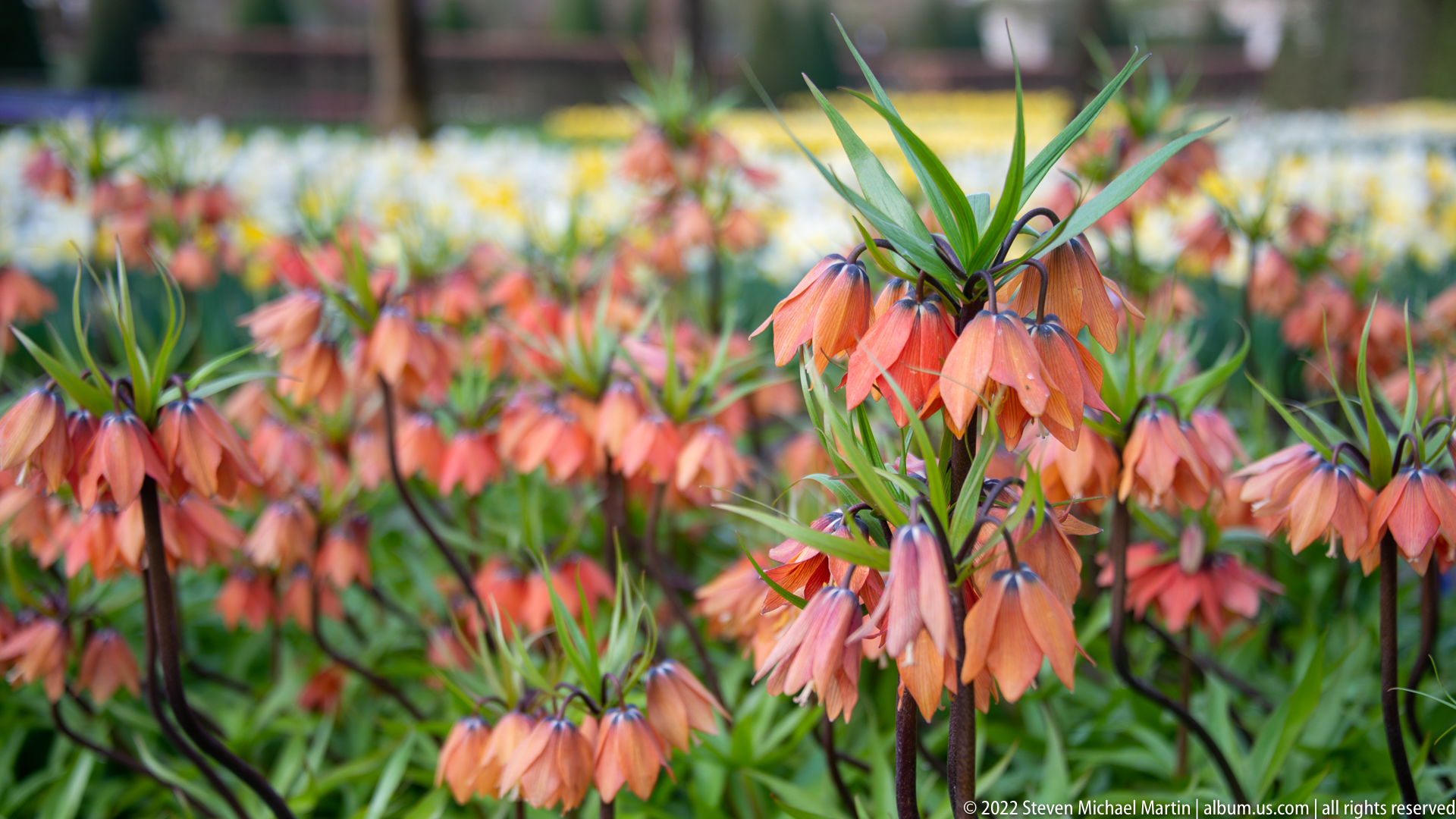
Orange crown imperial blooms hang in bell-shaped clusters beneath tufts of narrow green leaves, creating a distinctive tiered silhouette. Repeated plants recede across the bed, and the blurred bands of tulips behind them place these unusual spring bulbs within Keukenhof’s larger seasonal display.
Caption
Orange crown imperial blooms hang in bell-shaped clusters beneath tufts of narrow green leaves, creating a distinctive tiered silhouette. Repeated plants recede across the bed, and the blurred bands of tulips behind them place these unusual spring bulbs within Keukenhof’s larger seasonal display.
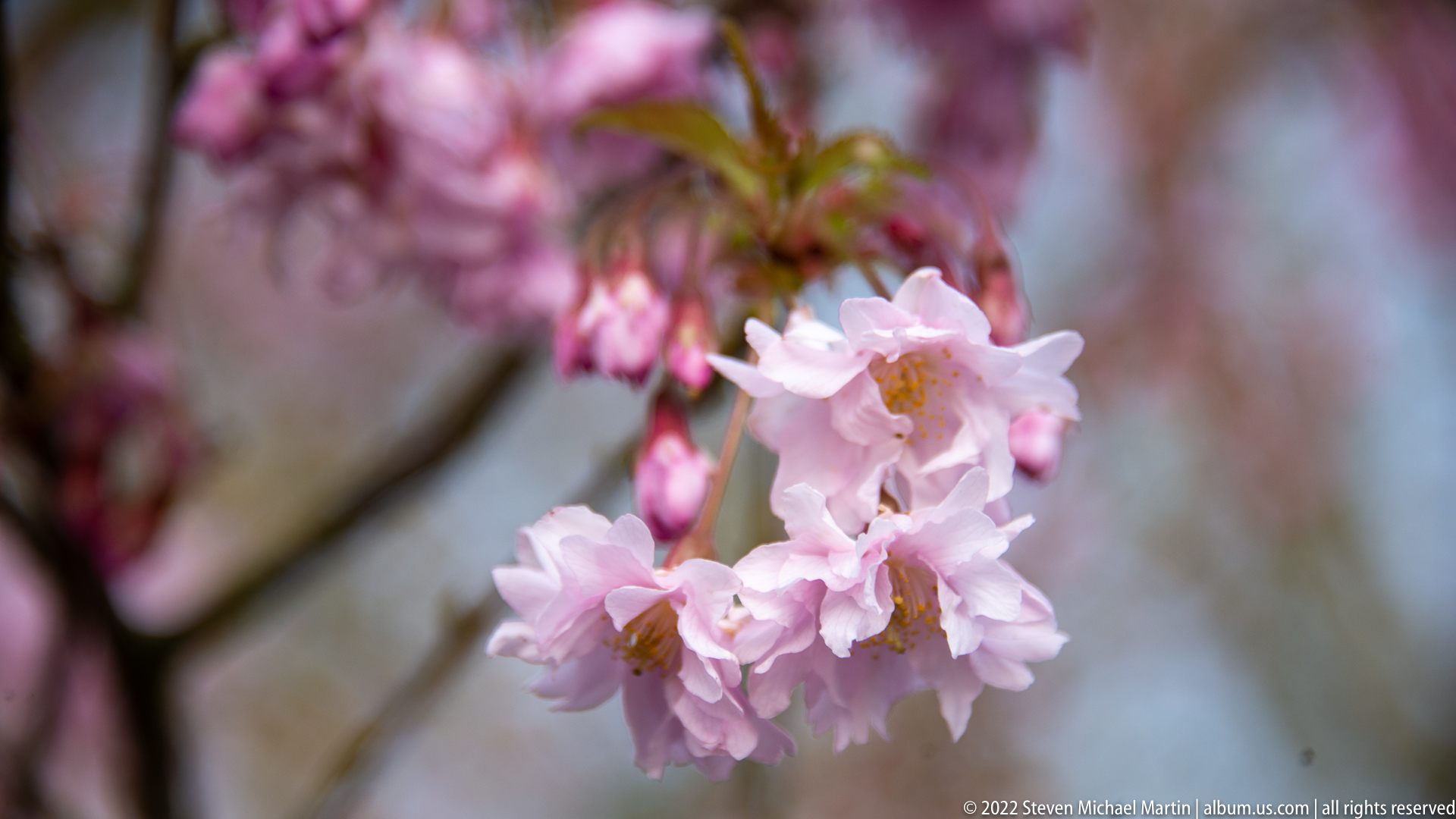
A small cluster of pale pink, double blossoms hangs from a woody branch, isolated against a softly blurred background of additional flowers and sky. The tight framing emphasizes layered petals, visible stamens, and the drooping cluster arrangement, presenting the tree as a spring botanical detail rather than a landscape element.
Caption
A small cluster of pale pink, double blossoms hangs from a woody branch, isolated against a softly blurred background of additional flowers and sky. The tight framing emphasizes layered petals, visible stamens, and the drooping cluster arrangement, presenting the tree as a spring botanical detail rather than a landscape element.

A single double daffodil combines creamy outer petals with a densely ruffled apricot-peach center. The flower is sharply isolated from a muted background of leaves and neighboring blooms, allowing the layered corona and slightly irregular petal edges to become the defining features of the portrait.
Caption
A single double daffodil combines creamy outer petals with a densely ruffled apricot-peach center. The flower is sharply isolated from a muted background of leaves and neighboring blooms, allowing the layered corona and slightly irregular petal edges to become the defining features of the portrait.
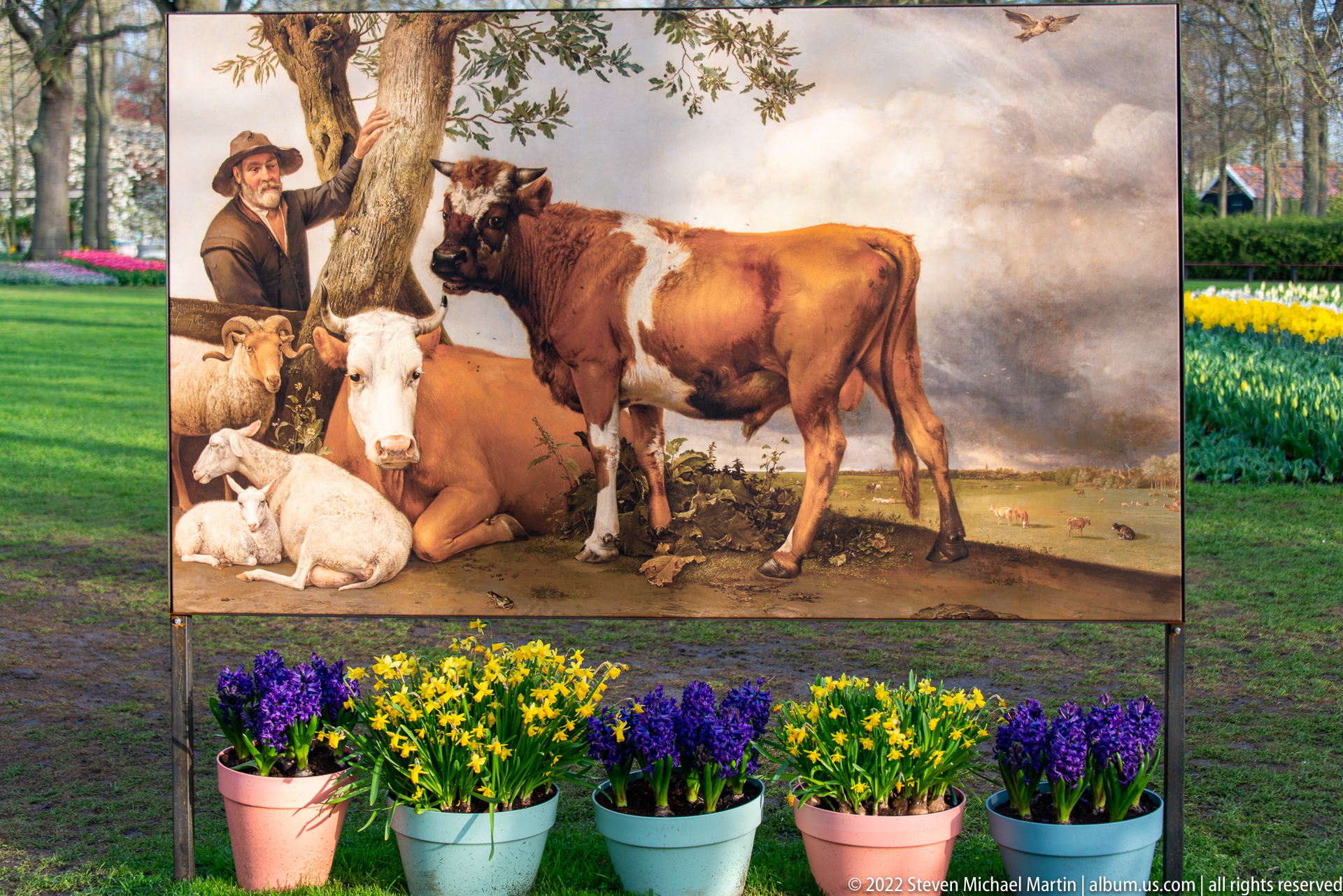
A large outdoor reproduction of a Dutch pastoral scene shows cattle and sheep gathered in a landscape, with potted hyacinths and daffodils arranged along the base of the panel. Set on a lawn amid Keukenhof flower beds, the display pairs Dutch painting traditions with seasonal horticulture without identifying the original work in the visible frame.
Caption
A large outdoor reproduction of a Dutch pastoral scene shows cattle and sheep gathered in a landscape, with potted hyacinths and daffodils arranged along the base of the panel. Set on a lawn amid Keukenhof flower beds, the display pairs Dutch painting traditions with seasonal horticulture without identifying the original work in the visible frame.
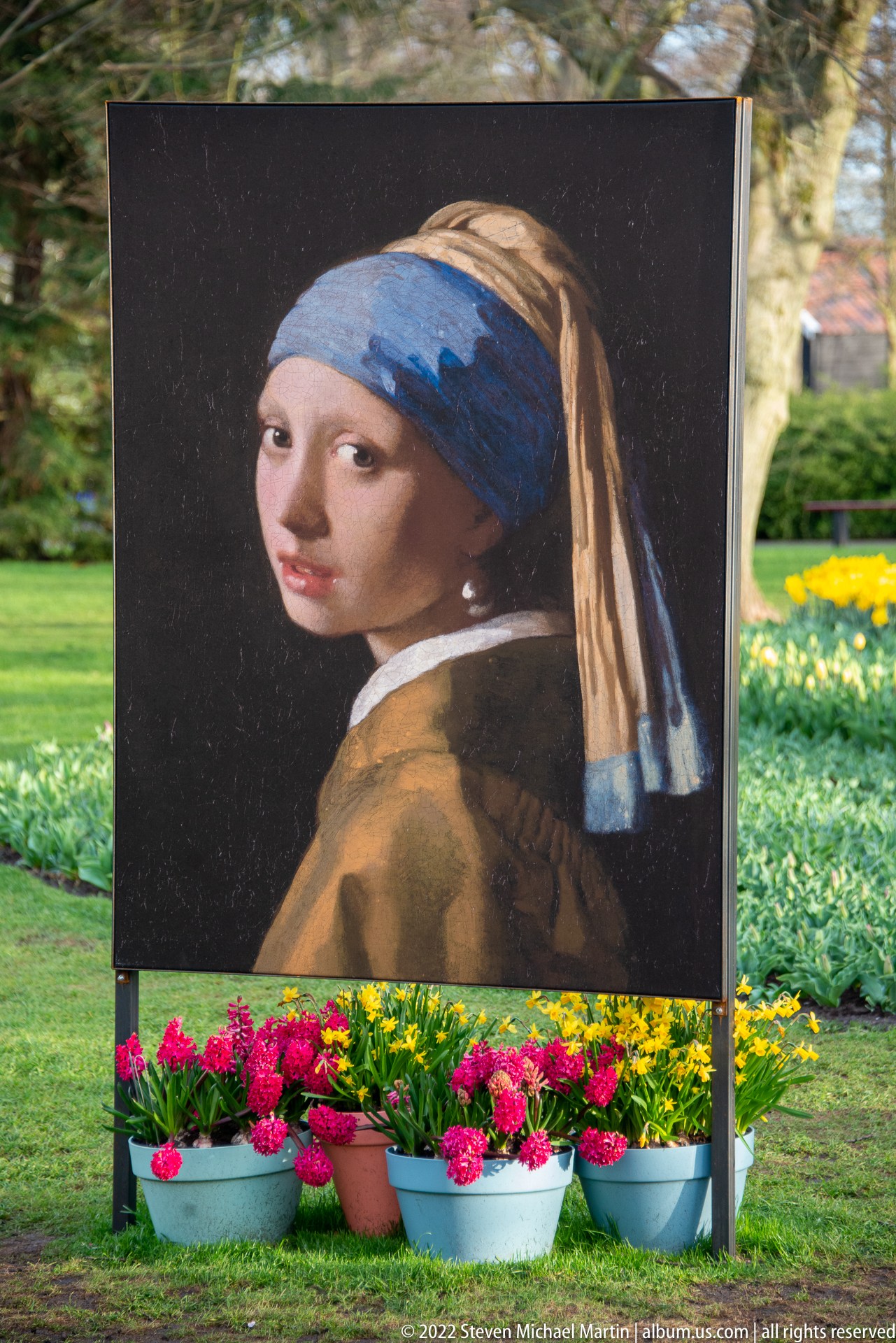
An outdoor panel reproducing Johannes Vermeer’s Girl with a Pearl Earring stands among Keukenhof flower beds, with pots of red and yellow blooms arranged at its base. The large portrait links Dutch painting to the garden’s floral displays, while the surrounding lawn and trees make clear that this is an exhibition reproduction rather than the original artwork.
Caption
An outdoor panel reproducing Johannes Vermeer’s Girl with a Pearl Earring stands among Keukenhof flower beds, with pots of red and yellow blooms arranged at its base. The large portrait links Dutch painting to the garden’s floral displays, while the surrounding lawn and trees make clear that this is an exhibition reproduction rather than the original artwork.
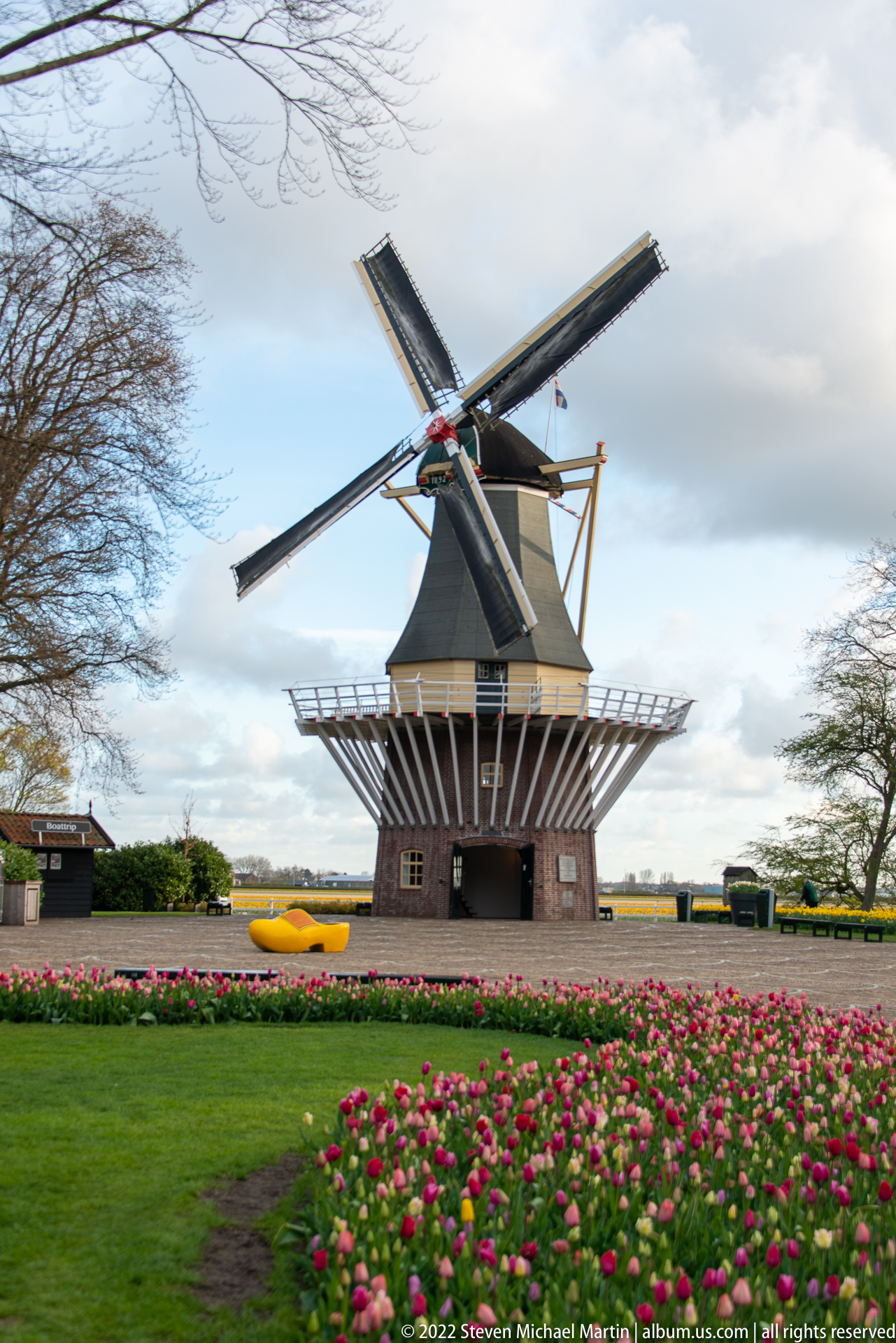
Pink tulips spread across the foreground lawn while the Keukenhof windmill stands centered beyond them, its white gallery and dark tapered body fully visible. Compared with the closer architectural views, this composition places the mill within its designed garden setting, using the flower bed, open grass, and flanking trees to establish scale and seasonal context.
Caption
Pink tulips spread across the foreground lawn while the Keukenhof windmill stands centered beyond them, its white gallery and dark tapered body fully visible. Compared with the closer architectural views, this composition places the mill within its designed garden setting, using the flower bed, open grass, and flanking trees to establish scale and seasonal context.

A rounded tulip bud is marked by bold crimson-red margins over a creamy white center, isolated against a smooth green field of foliage and scattered red blooms. The near-symmetrical frontal view concentrates attention on the crisp color boundary and closed floral form, presenting a more restrained shape than the ruffled parrot tulips elsewhere on the page.
Caption
A rounded tulip bud is marked by bold crimson-red margins over a creamy white center, isolated against a smooth green field of foliage and scattered red blooms. The near-symmetrical frontal view concentrates attention on the crisp color boundary and closed floral form, presenting a more restrained shape than the ruffled parrot tulips elsewhere on the page.
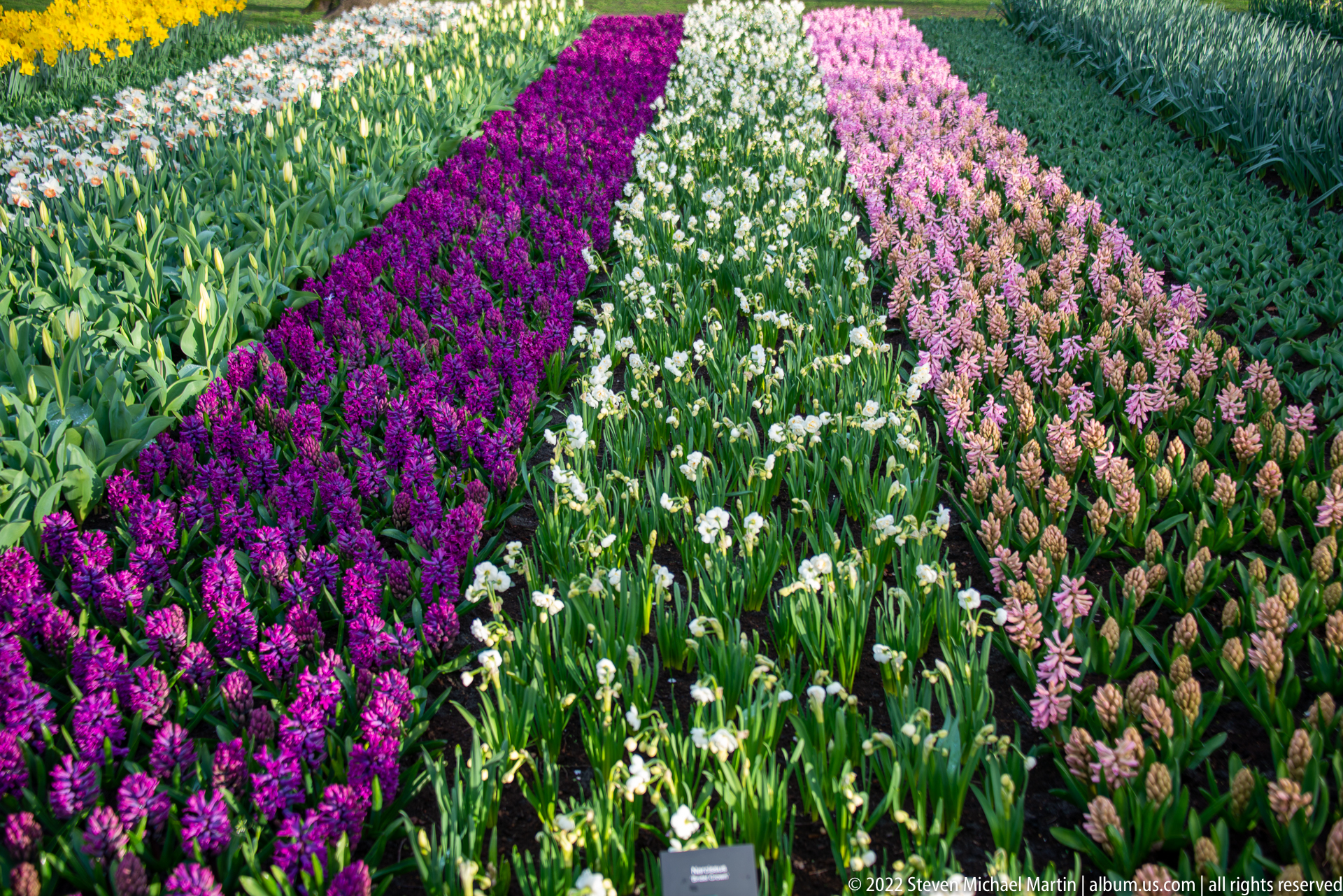
Long, parallel bands of spring bulbs create a striped display in saturated purple, white, blush pink, and green. Dense hyacinth spikes dominate the colored rows, while a central white-flowering band adds contrast; the diagonal viewpoint accentuates the garden’s precise planting pattern and the scale of the display.
Caption
Long, parallel bands of spring bulbs create a striped display in saturated purple, white, blush pink, and green. Dense hyacinth spikes dominate the colored rows, while a central white-flowering band adds contrast; the diagonal viewpoint accentuates the garden’s precise planting pattern and the scale of the display.
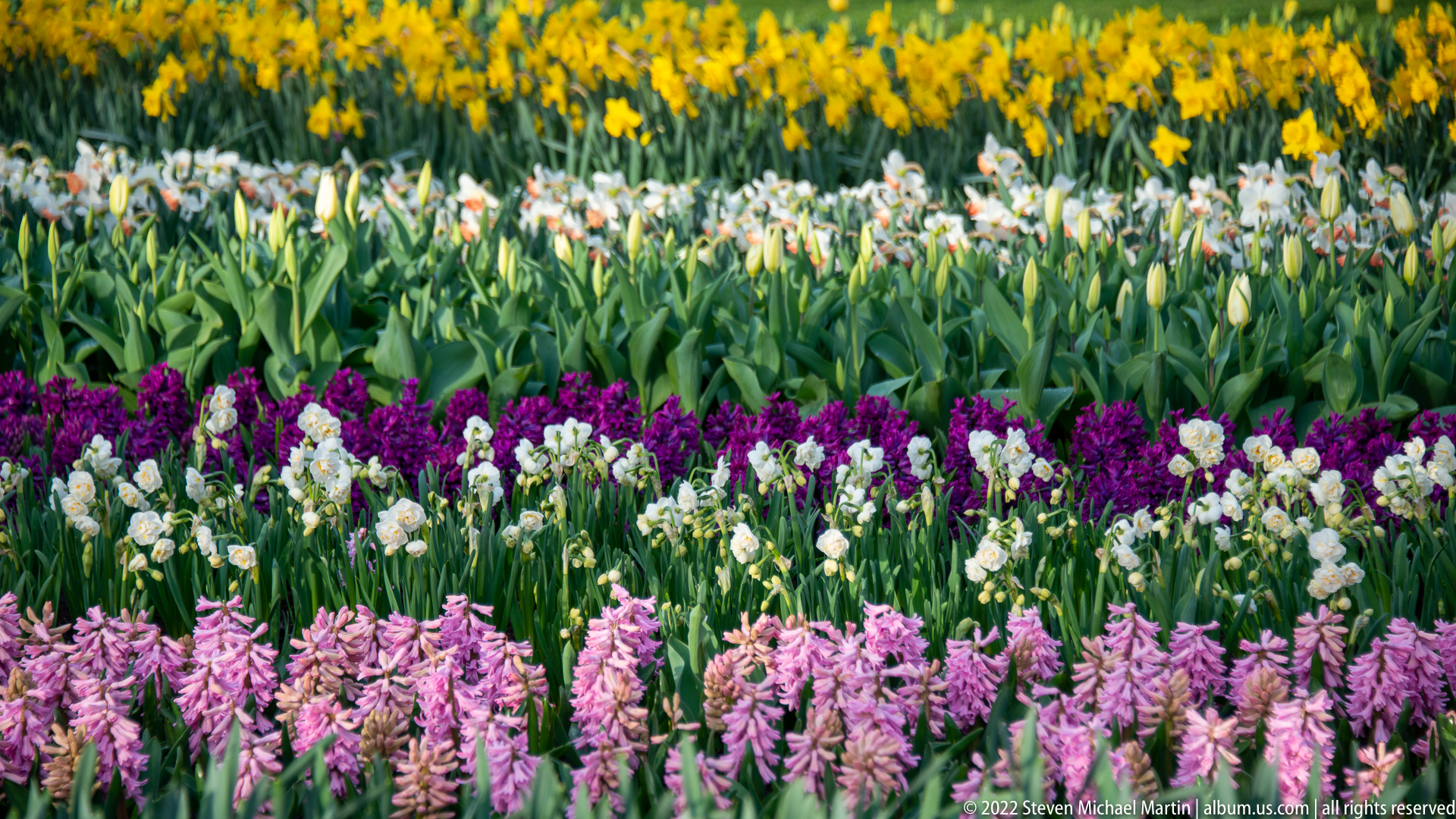
Horizontal bands of spring bulbs stack across the frame: pale pink and purple hyacinths in front, white flowers and mixed tulips in the middle, and a bright sweep of yellow daffodils behind. The telephoto compression turns separate beds into a tapestry of repeated color and flower form.
Caption
Horizontal bands of spring bulbs stack across the frame: pale pink and purple hyacinths in front, white flowers and mixed tulips in the middle, and a bright sweep of yellow daffodils behind. The telephoto compression turns separate beds into a tapestry of repeated color and flower form.
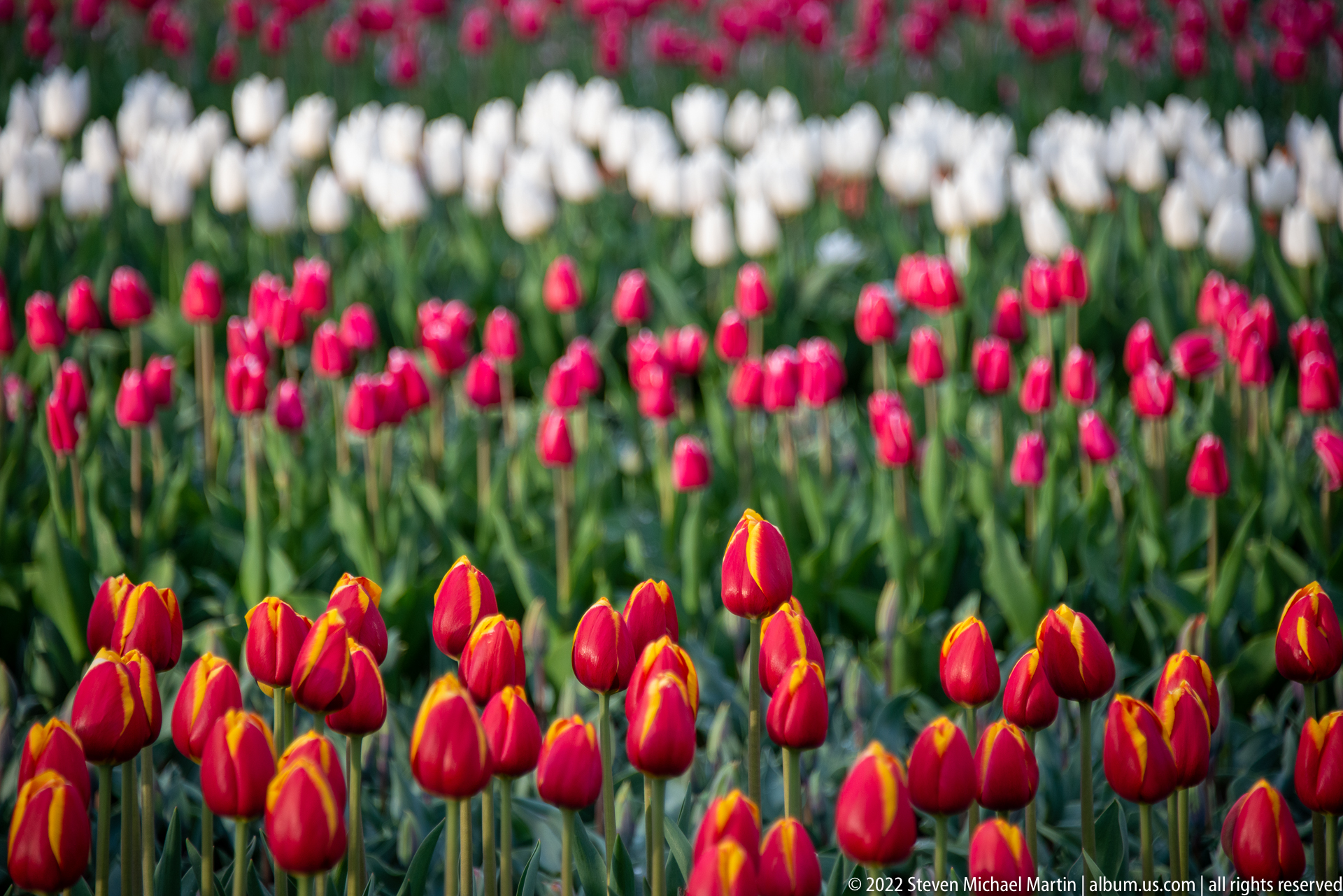
Red tulips streaked or edged with yellow fill the foreground, backed by a soft-focus band of plain red blooms and a farther row of white tulips. The layered planting creates three distinct color zones, while the selective focus makes the patterned foreground flowers the clear subject.
Caption
Red tulips streaked or edged with yellow fill the foreground, backed by a soft-focus band of plain red blooms and a farther row of white tulips. The layered planting creates three distinct color zones, while the selective focus makes the patterned foreground flowers the clear subject.
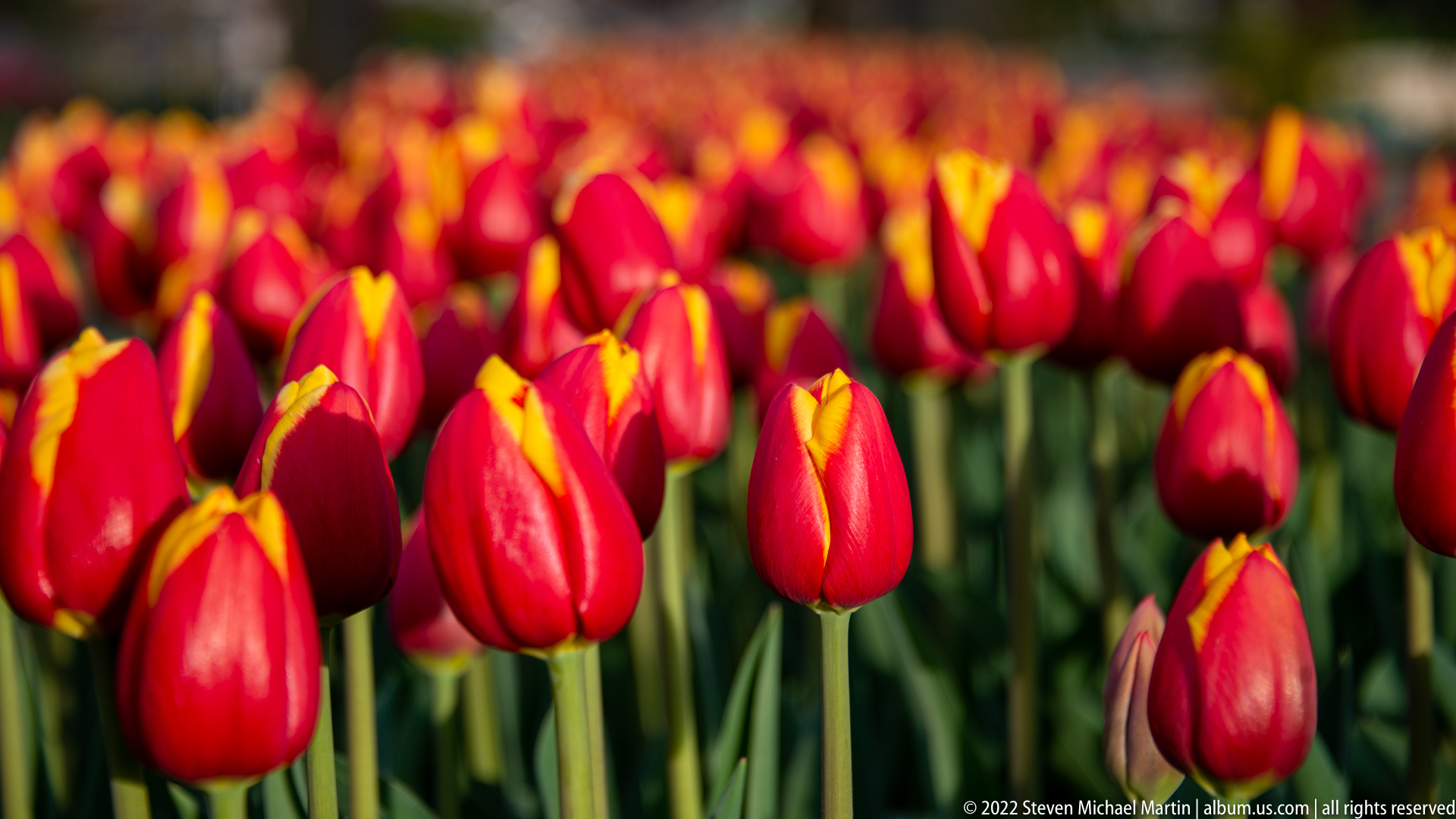
A tight cluster of red tulips carries bold yellow, flame-like markings along the upper petals, producing a striking two-color pattern. Warm side light models the smooth cups and catches the yellow edges, while the shallow background reduces the surrounding bed to soft red shapes.
Caption
A tight cluster of red tulips carries bold yellow, flame-like markings along the upper petals, producing a striking two-color pattern. Warm side light models the smooth cups and catches the yellow edges, while the shallow background reduces the surrounding bed to soft red shapes.
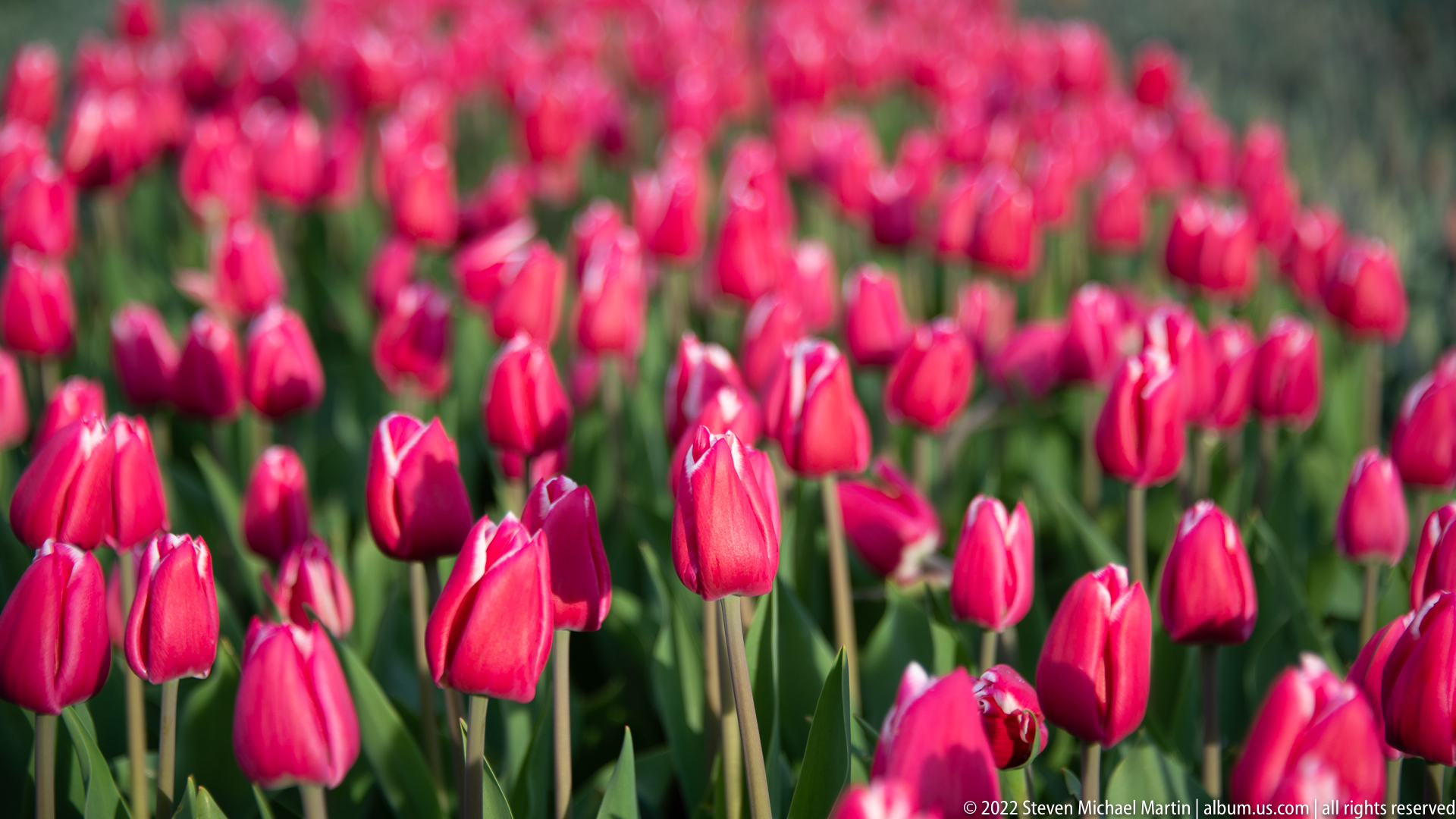
Pink tulips spread across the frame in staggered rows, the nearest blooms rendered sharply against a progressively softer field of magenta and green. Slight differences in opening and petal shape give the planting visual variety, while the shallow depth of field isolates individual flowers within the larger mass display.
Caption
Pink tulips spread across the frame in staggered rows, the nearest blooms rendered sharply against a progressively softer field of magenta and green. Slight differences in opening and petal shape give the planting visual variety, while the shallow depth of field isolates individual flowers within the larger mass display.
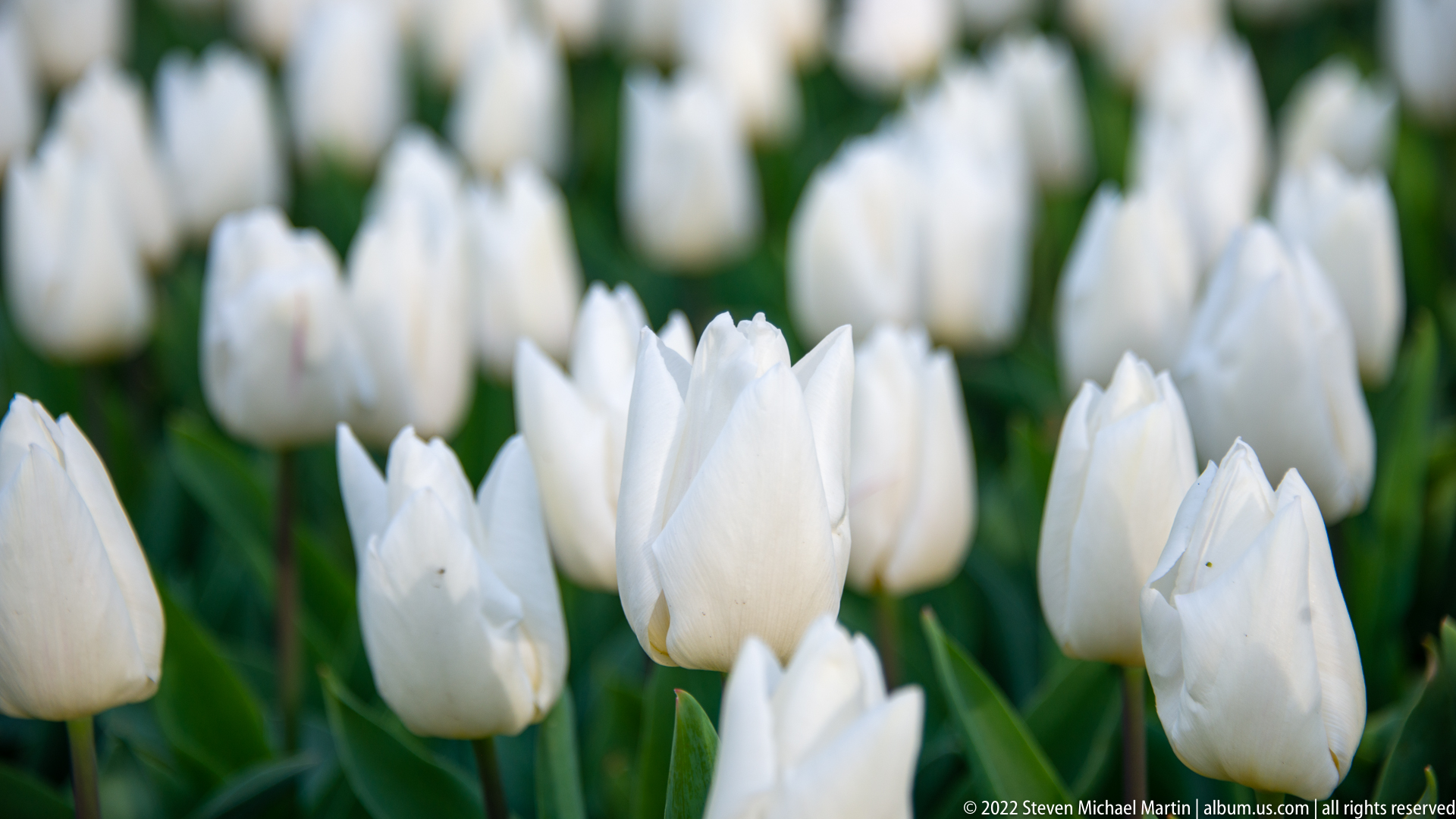
A dense planting of white tulips fills the frame, with several blossoms in crisp focus against a softly blurred mass of matching flowers and green foliage. The close viewpoint isolates the clean cup-shaped blooms and subtle creamy shading near the petal bases, turning a large garden display into an intimate study of repetition, form, and spring color.
Caption
A dense planting of white tulips fills the frame, with several blossoms in crisp focus against a softly blurred mass of matching flowers and green foliage. The close viewpoint isolates the clean cup-shaped blooms and subtle creamy shading near the petal bases, turning a large garden display into an intimate study of repetition, form, and spring color.
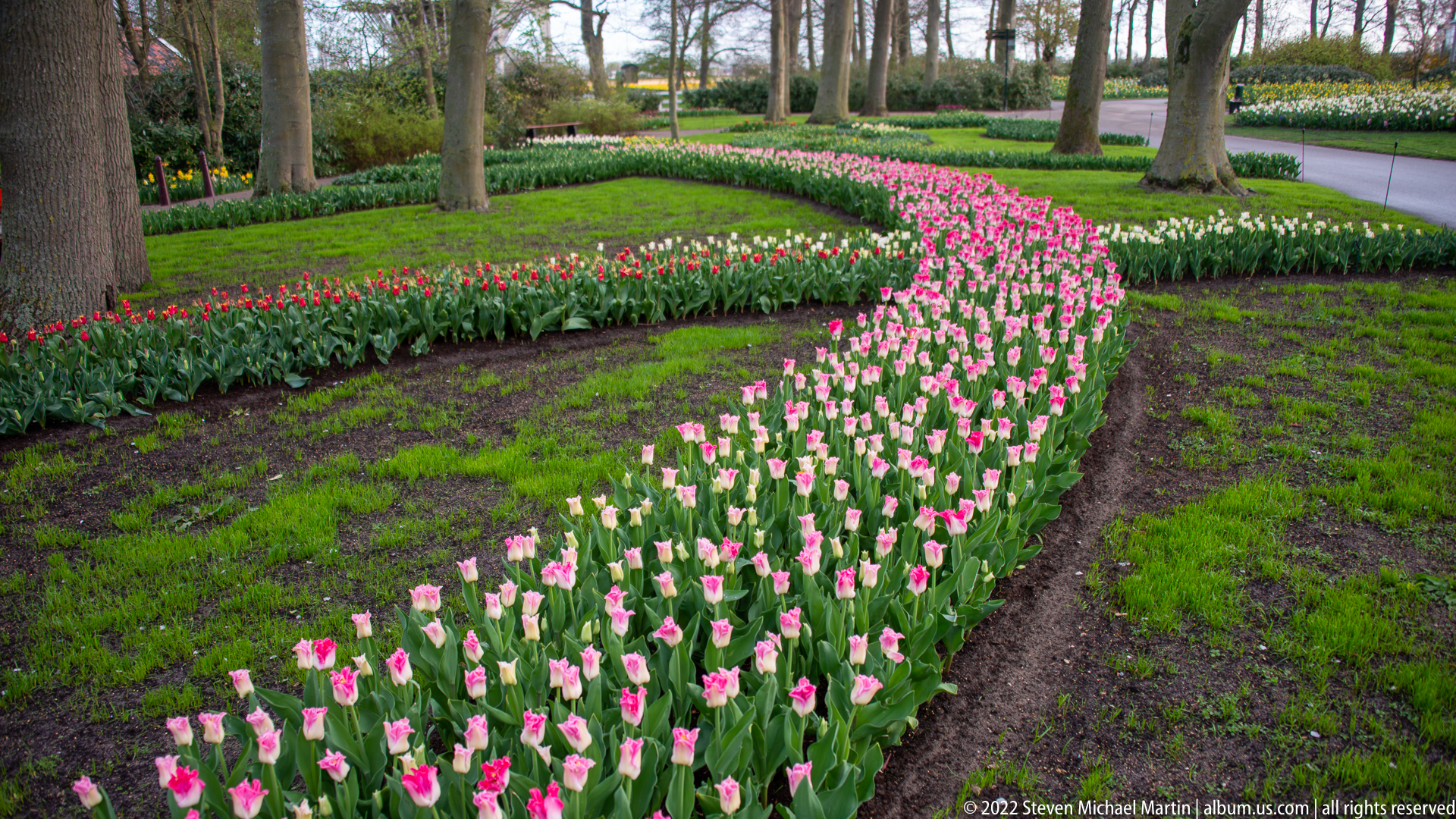
Curving ribbons of pink-and-white tulips sweep through a wooded section of Keukenhof, bordered by red and white plantings farther back. The sinuous layout follows the lawn between mature tree trunks, emphasizing the garden’s use of massed bulb color as a landscape-design element rather than as isolated specimen flowers.
Caption
Curving ribbons of pink-and-white tulips sweep through a wooded section of Keukenhof, bordered by red and white plantings farther back. The sinuous layout follows the lawn between mature tree trunks, emphasizing the garden’s use of massed bulb color as a landscape-design element rather than as isolated specimen flowers.

A cream-colored parrot tulip with deeply ruffled, irregular petals stands in sharp focus while taller pink tulips recede into a soft green background. The shallow depth of field separates the sculptural bloom from its neighbors, drawing attention to the feathered petal edges and subtle pale-yellow tones rather than to the larger garden arrangement.
Caption
A cream-colored parrot tulip with deeply ruffled, irregular petals stands in sharp focus while taller pink tulips recede into a soft green background. The shallow depth of field separates the sculptural bloom from its neighbors, drawing attention to the feathered petal edges and subtle pale-yellow tones rather than to the larger garden arrangement.
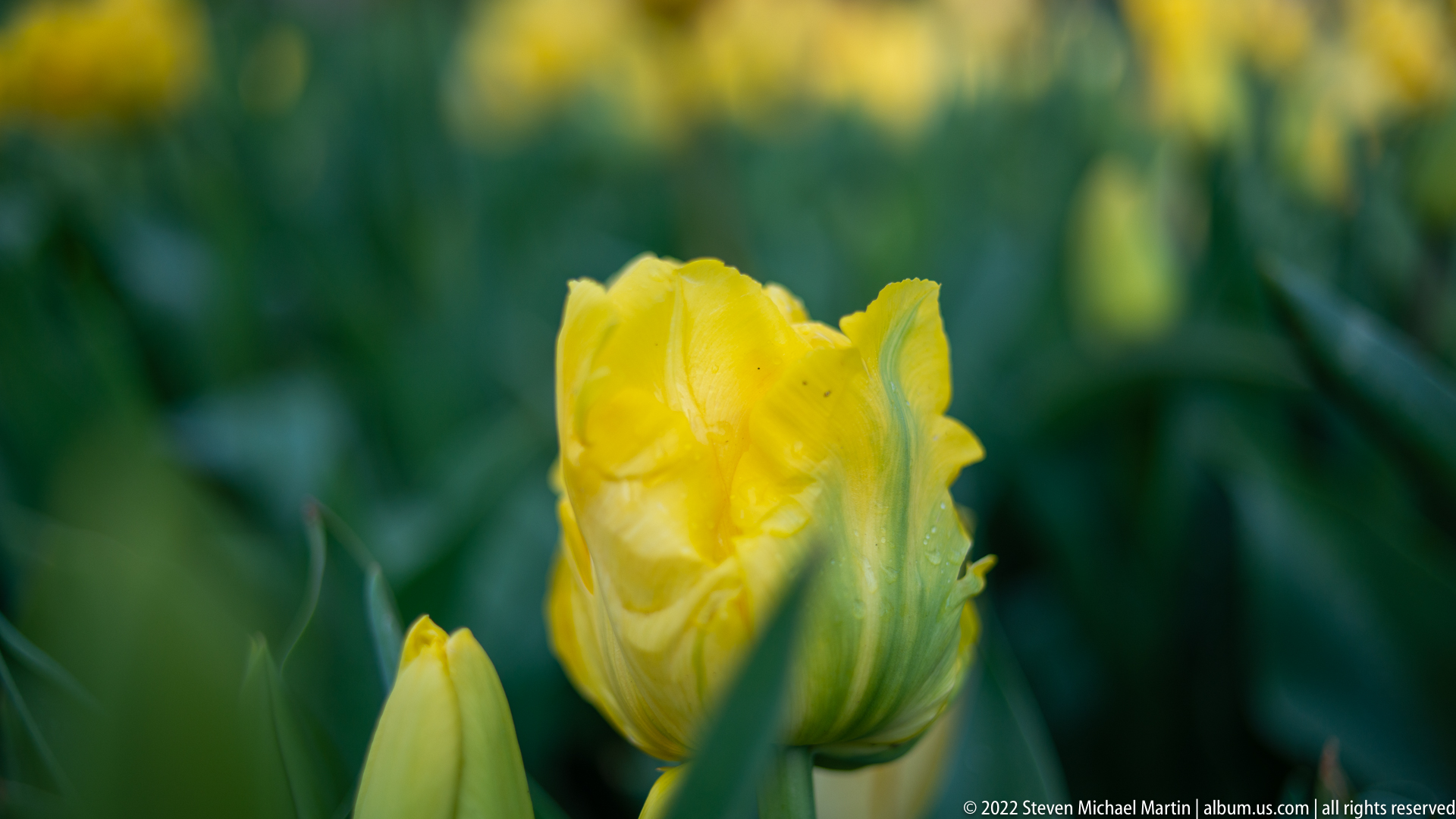
A yellow tulip bud opens into heavily crimped and irregular petals, its folded green outer segments still wrapping the lower bloom. Soft yellow flowers in the distance echo the color without competing for attention. The close crop records the flower at a transitional stage between bud and full opening, emphasizing texture and form rather than the surrounding bed.
Caption
A yellow tulip bud opens into heavily crimped and irregular petals, its folded green outer segments still wrapping the lower bloom. Soft yellow flowers in the distance echo the color without competing for attention. The close crop records the flower at a transitional stage between bud and full opening, emphasizing texture and form rather than the surrounding bed.

A cream tulip streaked and edged with pink curls outward in a loose, feathered form characteristic of parrot-type tulips. Seen against a dark green blur of foliage and unopened buds, the single blossom becomes a study in asymmetry, veining, and petal texture, with pale green traces still visible along some outer folds.
Caption
A cream tulip streaked and edged with pink curls outward in a loose, feathered form characteristic of parrot-type tulips. Seen against a dark green blur of foliage and unopened buds, the single blossom becomes a study in asymmetry, veining, and petal texture, with pale green traces still visible along some outer folds.
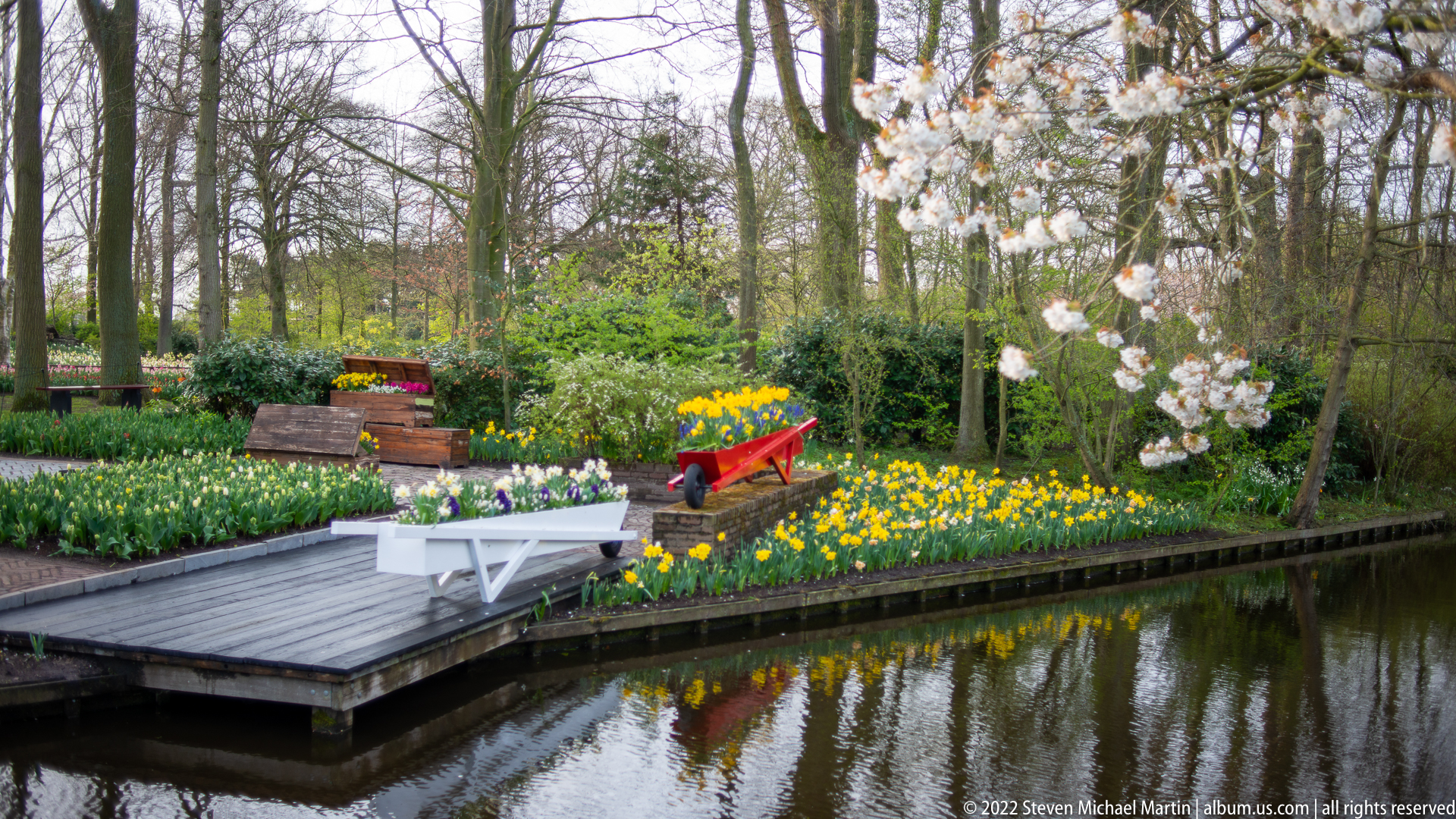
A narrow canal reflects a spring display arranged along a wooden landing, where yellow and pale tulips surround white benches and brightly painted decorative carts or barrows. A flowering tree hangs over the right side of the scene, while woodland and additional beds extend behind, combining horticulture, water, and rustic garden props in a layered Keukenhof composition.
Caption
A narrow canal reflects a spring display arranged along a wooden landing, where yellow and pale tulips surround white benches and brightly painted decorative carts or barrows. A flowering tree hangs over the right side of the scene, while woodland and additional beds extend behind, combining horticulture, water, and rustic garden props in a layered Keukenhof composition.
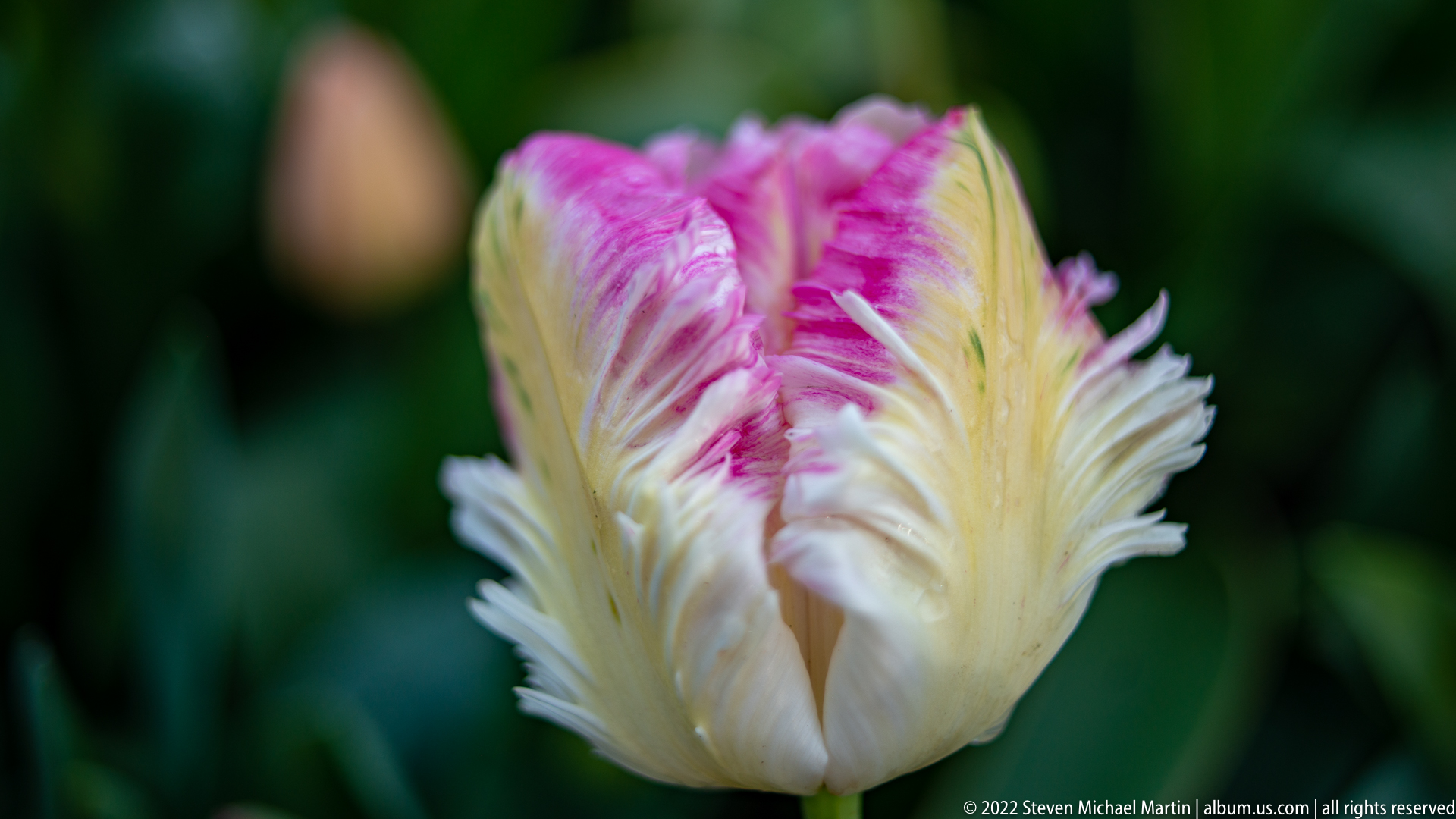
A single parrot tulip fills the frame with cream petals heavily feathered and brushed in magenta near the upper edges. The bloom’s irregular fringes and folded surfaces create a layered, almost sculptural profile against dark green foliage. This tighter view reveals the color veining and petal texture more clearly than the related parrot-tulip portraits on the preceding page.
Caption
A single parrot tulip fills the frame with cream petals heavily feathered and brushed in magenta near the upper edges. The bloom’s irregular fringes and folded surfaces create a layered, almost sculptural profile against dark green foliage. This tighter view reveals the color veining and petal texture more clearly than the related parrot-tulip portraits on the preceding page.
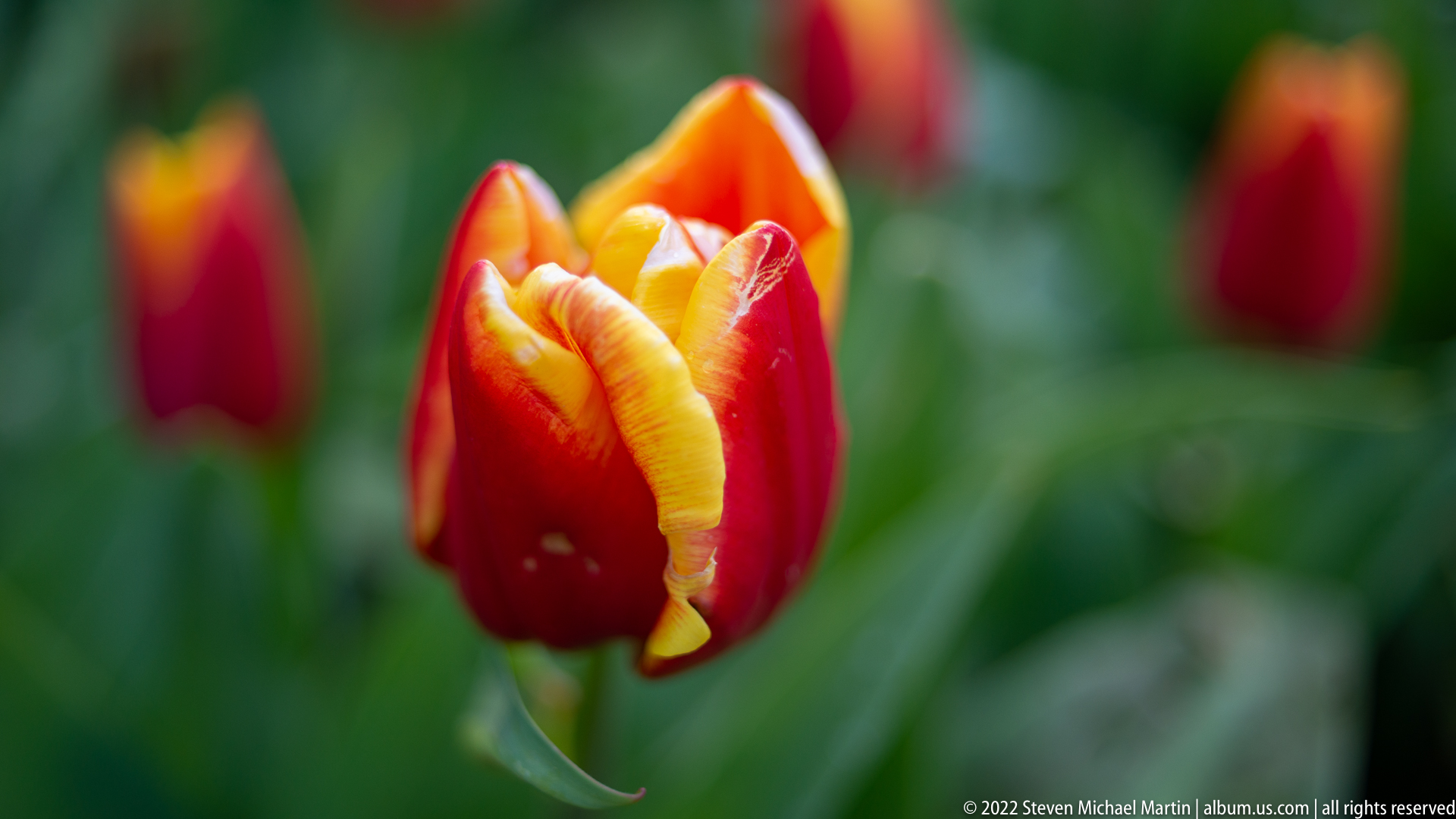
A red tulip with a vivid yellow interior and curled, irregular petal edges stands sharply against a soft background of red blooms and green leaves. The flower is partly open, allowing the yellow inner surfaces to become a central visual feature, while the twisted outer edges give the bloom a more animated silhouette than a conventional cup-shaped tulip.
Caption
A red tulip with a vivid yellow interior and curled, irregular petal edges stands sharply against a soft background of red blooms and green leaves. The flower is partly open, allowing the yellow inner surfaces to become a central visual feature, while the twisted outer edges give the bloom a more animated silhouette than a conventional cup-shaped tulip.
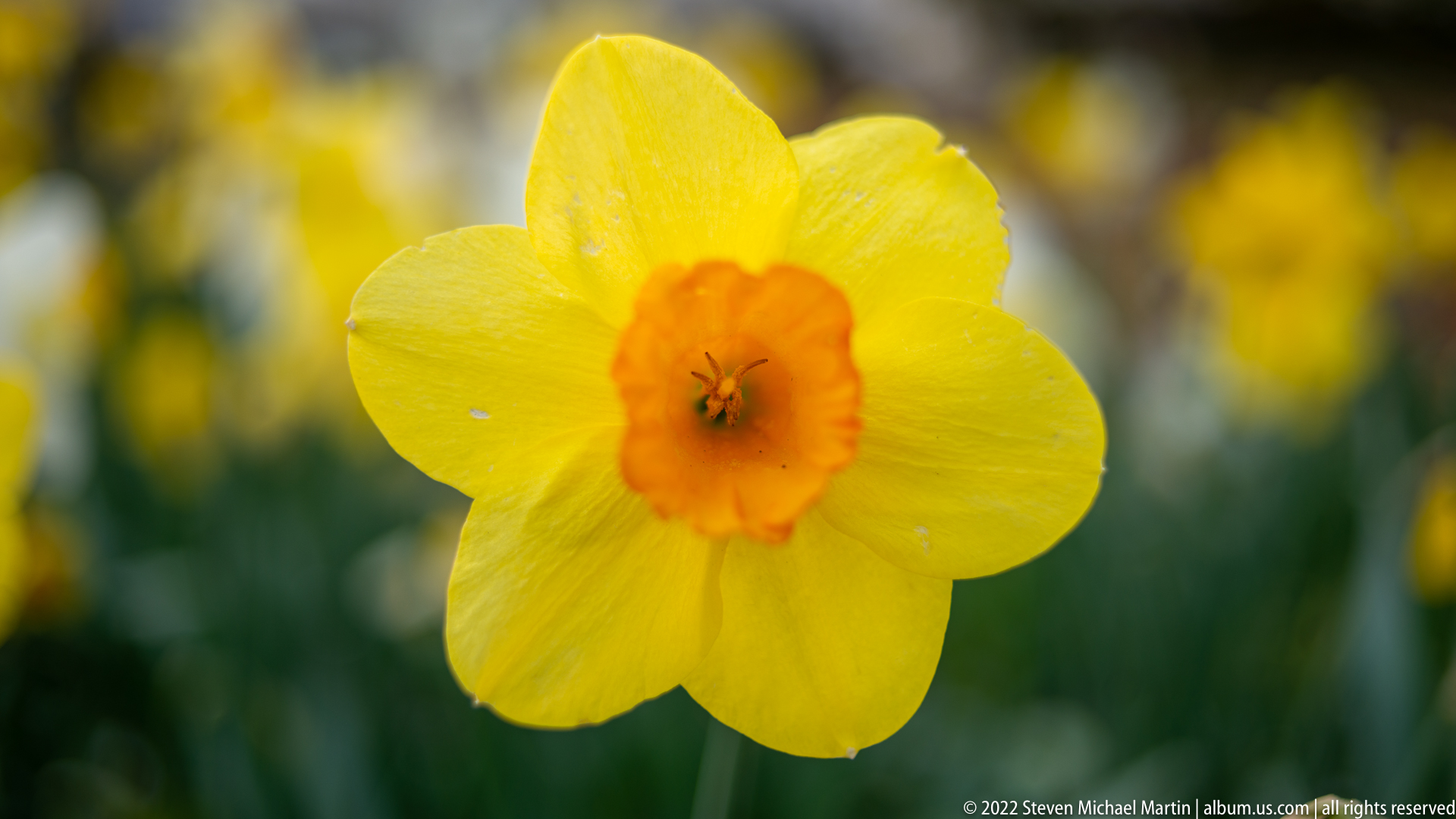
A yellow daffodil faces the camera almost squarely, its six broad outer tepals framing a saturated orange trumpet-like corona. Other yellow daffodils dissolve into the background, leaving the central flower isolated in shallow focus. The direct viewpoint clearly records the radial floral structure and contrasting center characteristic of ornamental Narcissus displays.
Caption
A yellow daffodil faces the camera almost squarely, its six broad outer tepals framing a saturated orange trumpet-like corona. Other yellow daffodils dissolve into the background, leaving the central flower isolated in shallow focus. The direct viewpoint clearly records the radial floral structure and contrasting center characteristic of ornamental Narcissus displays.

A densely petaled magenta tulip opens like a compact peony, with overlapping inner petals forming a deep rosette and broader outer petals beginning to flare. The close view isolates the bloom against green foliage, making the double-flowered structure the defining feature. Slight irregularities and pale edges on some petals add texture to the saturated pink-magenta mass.
Caption
A densely petaled magenta tulip opens like a compact peony, with overlapping inner petals forming a deep rosette and broader outer petals beginning to flare. The close view isolates the bloom against green foliage, making the double-flowered structure the defining feature. Slight irregularities and pale edges on some petals add texture to the saturated pink-magenta mass.

A close crop of a stone or concrete inscription preserves the clearly legible words “AMERIKA” and “AAN DE ‘KEUKENHOF’,” while the beginning of the upper line falls outside the frame. The detail functions as documentary evidence of a commemorative or donor text connected with the windmill area, but the incomplete wording cautions against reconstructing the full inscription from this photograph alone.
Caption
A close crop of a stone or concrete inscription preserves the clearly legible words “AMERIKA” and “AAN DE ‘KEUKENHOF’,” while the beginning of the upper line falls outside the frame. The detail functions as documentary evidence of a commemorative or donor text connected with the windmill area, but the incomplete wording cautions against reconstructing the full inscription from this photograph alone.

Bands of yellow and green bulb fields stretch across the flat landscape beyond a canal, seen from an elevated viewpoint at Keukenhof. Two narrow blue boats occupy the water below, while a visitor at the railing gestures toward the fields. The composition connects the ornamental garden with the broader Dutch bulb-growing landscape immediately beyond its boundaries.
Caption
Bands of yellow and green bulb fields stretch across the flat landscape beyond a canal, seen from an elevated viewpoint at Keukenhof. Two narrow blue boats occupy the water below, while a visitor at the railing gestures toward the fields. The composition connects the ornamental garden with the broader Dutch bulb-growing landscape immediately beyond its boundaries.
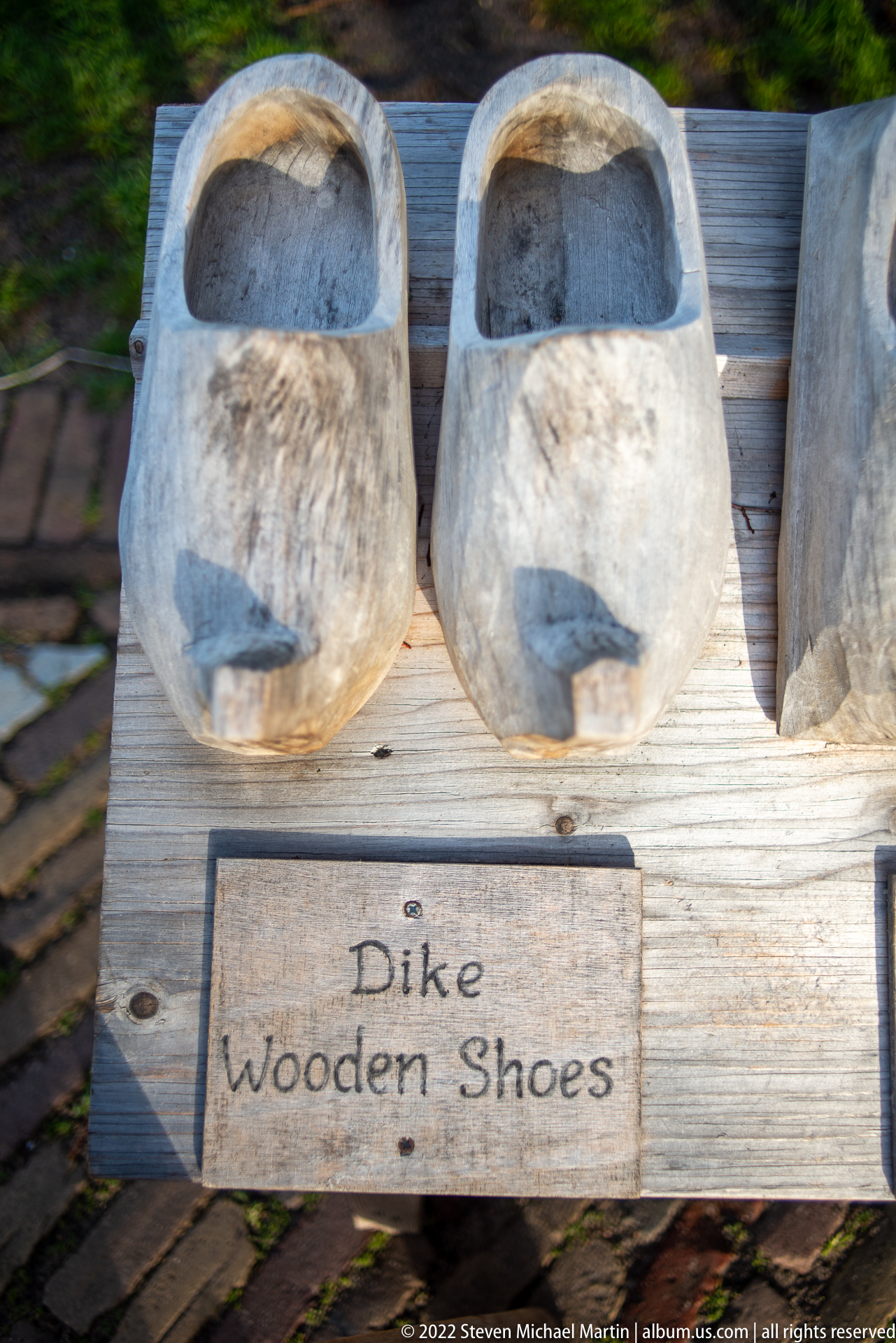
A pair of pale, unfinished-looking wooden shoes rests on a plank display above a handwritten sign reading “Dike Wooden Shoes.” Their hollowed interiors, rounded toes, and visible tool-marked surfaces make the construction especially legible. The close view records the objects as vernacular craft and display items rather than presenting them as worn footwear.
Caption
A pair of pale, unfinished-looking wooden shoes rests on a plank display above a handwritten sign reading “Dike Wooden Shoes.” Their hollowed interiors, rounded toes, and visible tool-marked surfaces make the construction especially legible. The close view records the objects as vernacular craft and display items rather than presenting them as worn footwear.
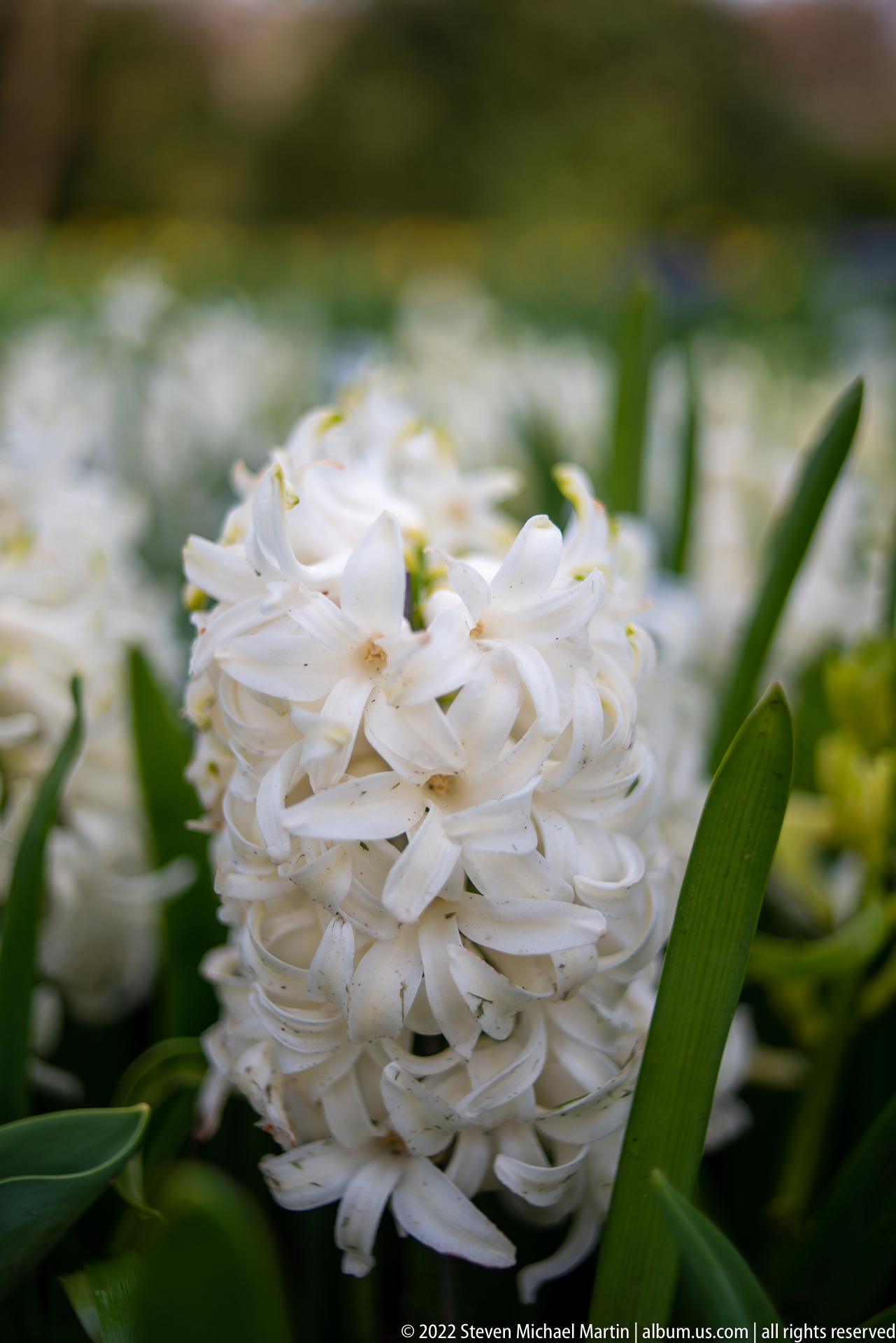
A compact white hyacinth spike dominates the frame, its densely packed, curling florets forming a rounded mass above thick green leaves. Additional white blooms blur into the background, reinforcing the planting as part of a larger bed. The shallow depth of field isolates the tightly clustered petals and gives this view a more sculptural character than the broader hyacinth grouping nearby.
Caption
A compact white hyacinth spike dominates the frame, its densely packed, curling florets forming a rounded mass above thick green leaves. Additional white blooms blur into the background, reinforcing the planting as part of a larger bed. The shallow depth of field isolates the tightly clustered petals and gives this view a more sculptural character than the broader hyacinth grouping nearby.
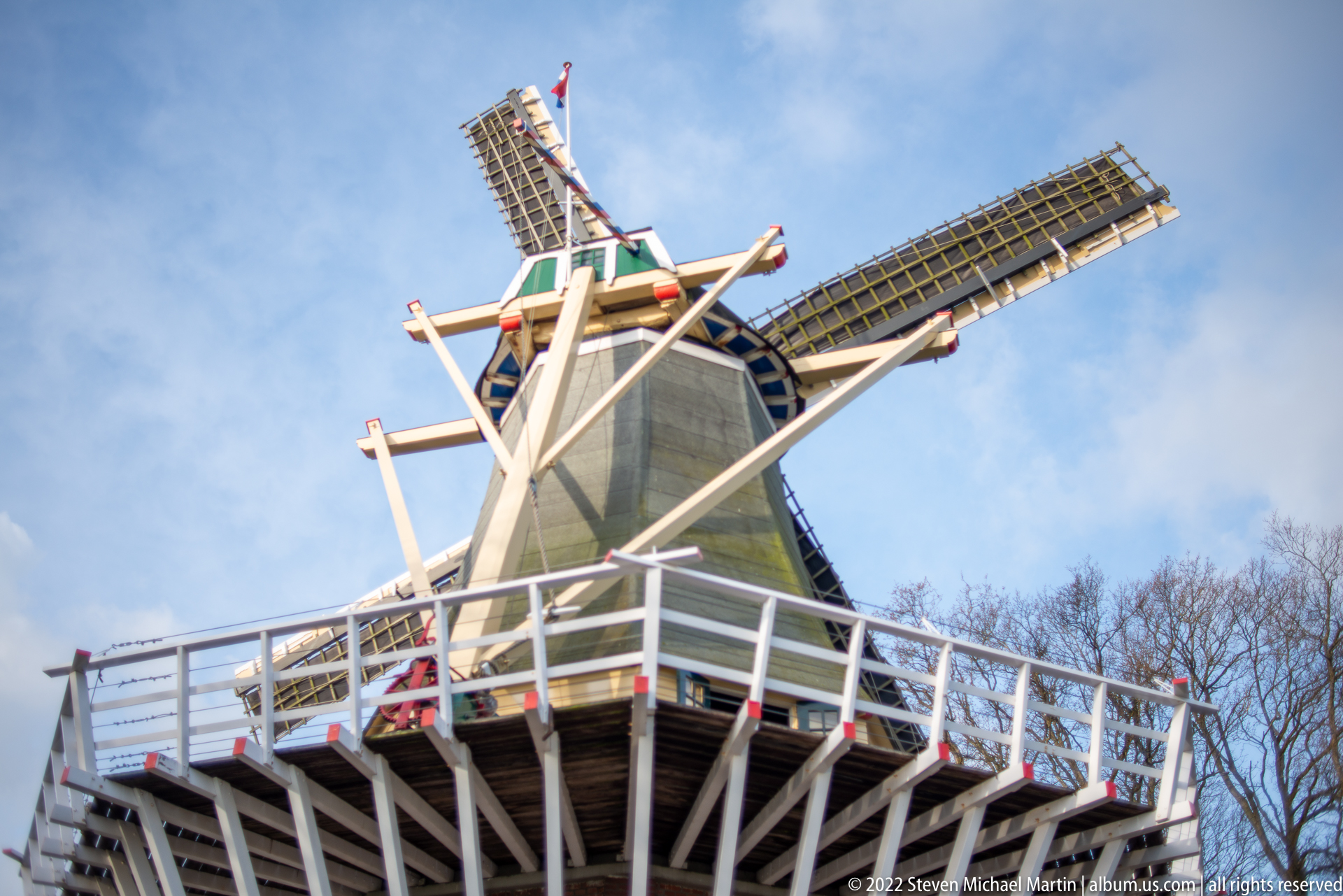
Viewed from below, the upper body of the Keukenhof windmill rises above its white gallery, with the latticework sails and pale timber braces sharply silhouetted against a blue, lightly clouded sky. The low-angle composition concentrates on the mill’s mechanical and structural geometry rather than its garden setting, making the sail framework and gallery railings the dominant visual elements.
Caption
Viewed from below, the upper body of the Keukenhof windmill rises above its white gallery, with the latticework sails and pale timber braces sharply silhouetted against a blue, lightly clouded sky. The low-angle composition concentrates on the mill’s mechanical and structural geometry rather than its garden setting, making the sail framework and gallery railings the dominant visual elements.

Drooping yellow-orange bells cluster beneath a whorl of narrow green leaves on a crown imperial plant, photographed against a softly blurred garden background. Several flowers hang from the same sturdy stem, with pale stamens visible below the petals. The distinctive pendant arrangement and leafy crown make this spring bulb markedly different from the tulips and daffodils dominating nearby views.
Caption
Drooping yellow-orange bells cluster beneath a whorl of narrow green leaves on a crown imperial plant, photographed against a softly blurred garden background. Several flowers hang from the same sturdy stem, with pale stamens visible below the petals. The distinctive pendant arrangement and leafy crown make this spring bulb markedly different from the tulips and daffodils dominating nearby views.
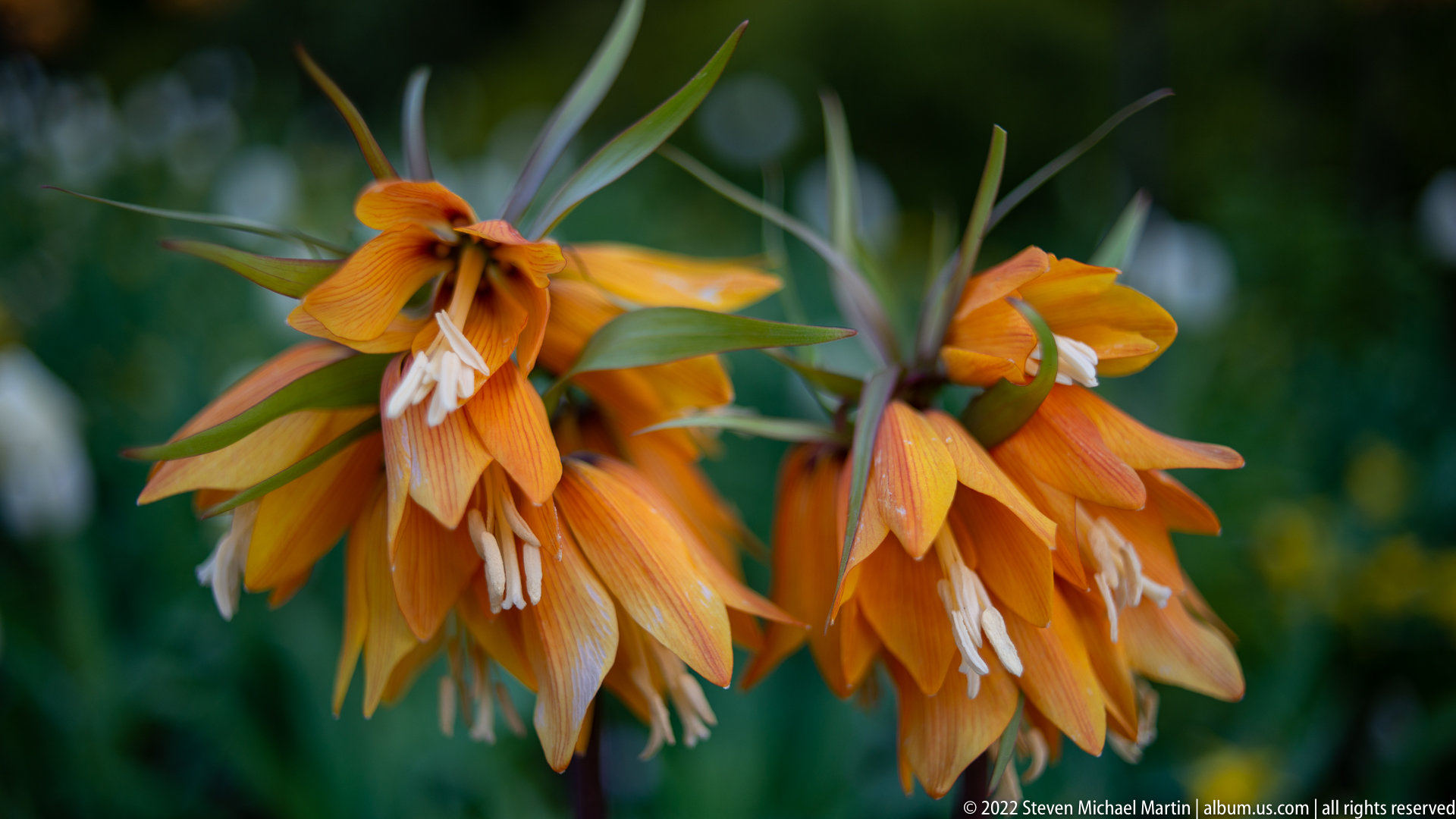
Two clusters of orange crown imperial flowers hang beneath narrow lance-like leaves, their pendant bells exposing pale stamens below. The paired stems create a fuller botanical study than the preceding yellow form, while the dark, softly focused background isolates the warm orange blossoms. The unusual inverted flowers and leafy crowns are characteristic features of Fritillaria imperialis.
Caption
Two clusters of orange crown imperial flowers hang beneath narrow lance-like leaves, their pendant bells exposing pale stamens below. The paired stems create a fuller botanical study than the preceding yellow form, while the dark, softly focused background isolates the warm orange blossoms. The unusual inverted flowers and leafy crowns are characteristic features of Fritillaria imperialis.
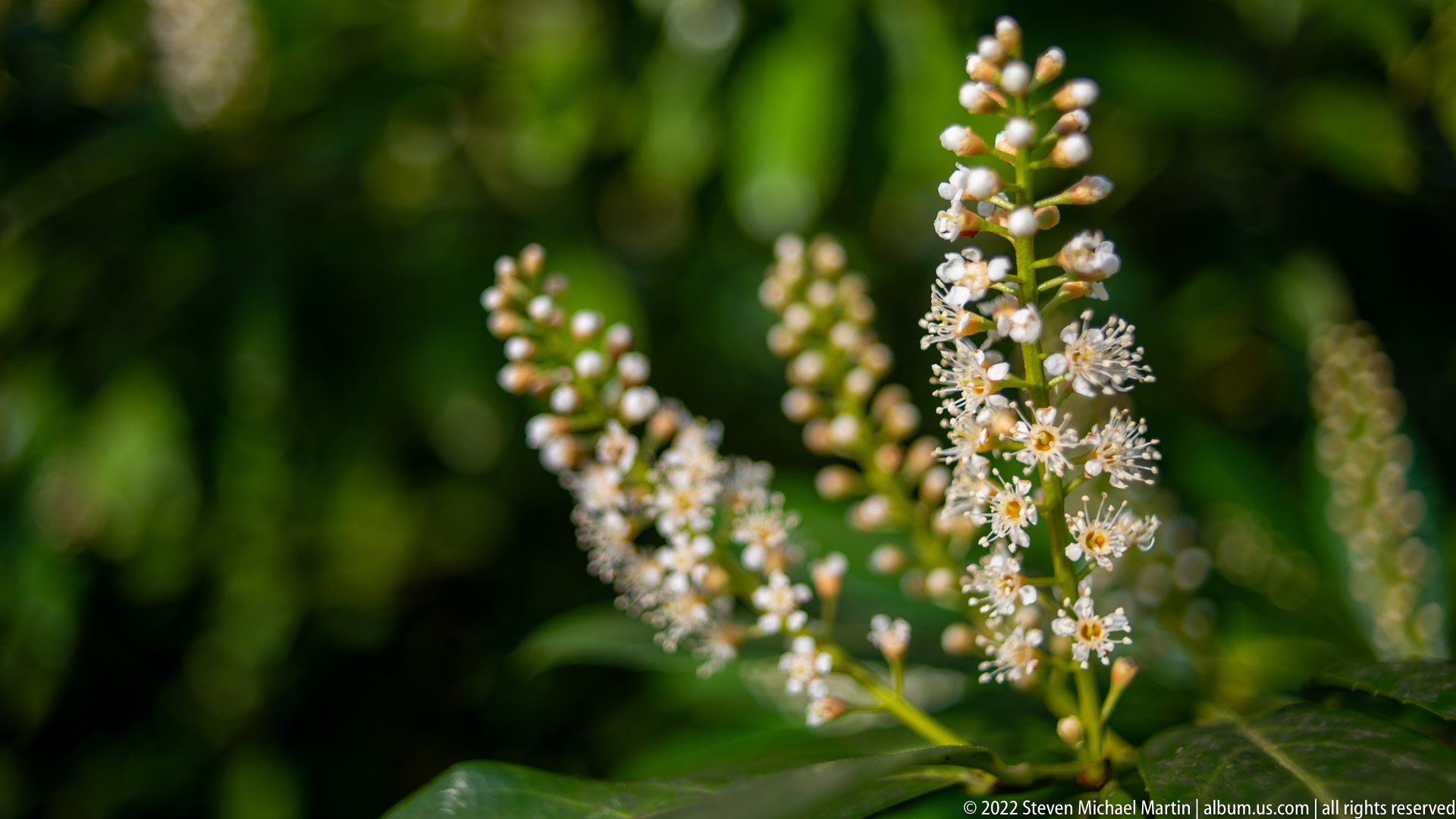
Slender upright racemes of small white blossoms rise above glossy evergreen leaves, with one flowering spike sharply focused against a dark green background. Numerous buds remain closed along the upper portions while open flowers reveal fine stamens below. The image records the shrub’s inflorescence structure clearly, but the proof sheet does not support a definitive species-level identification.
Caption
Slender upright racemes of small white blossoms rise above glossy evergreen leaves, with one flowering spike sharply focused against a dark green background. Numerous buds remain closed along the upper portions while open flowers reveal fine stamens below. The image records the shrub’s inflorescence structure clearly, but the proof sheet does not support a definitive species-level identification.
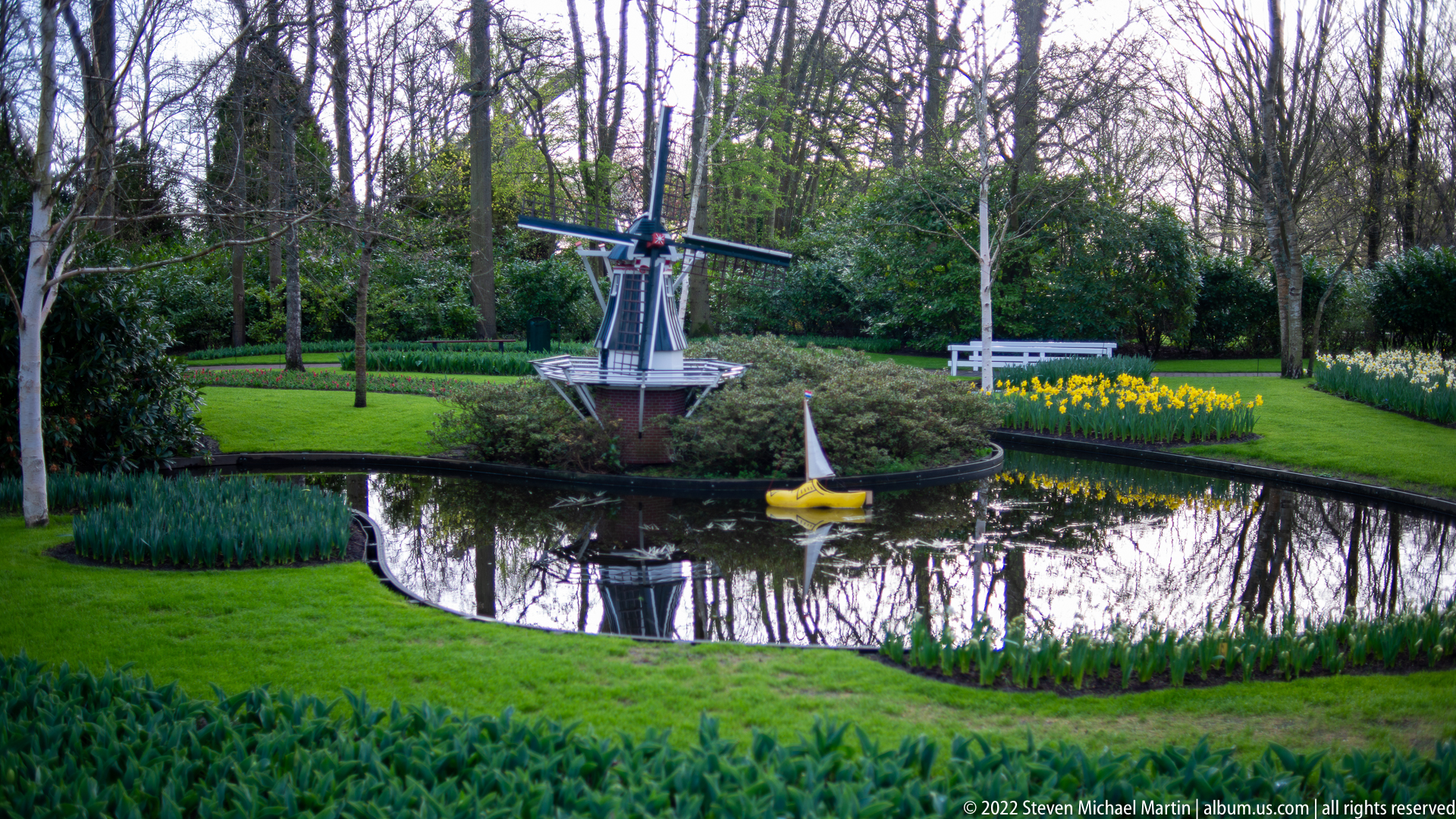
A small decorative windmill stands across a rounded garden pond, reflected in the still water and surrounded by clipped lawn, trees, and bands of emerging bulb foliage. A white swan-shaped ornament floats near the center, while a bright yellow flower bed and white bench punctuate the far bank. The intimate scale distinguishes this feature from Keukenhof’s large landmark windmill.
Caption
A small decorative windmill stands across a rounded garden pond, reflected in the still water and surrounded by clipped lawn, trees, and bands of emerging bulb foliage. A white swan-shaped ornament floats near the center, while a bright yellow flower bed and white bench punctuate the far bank. The intimate scale distinguishes this feature from Keukenhof’s large landmark windmill.

Pink and lavender hyacinths form low, dense flower spikes among glossy strap-like leaves, with several clusters crossing the frame at different depths. The close garden view emphasizes the star-shaped individual florets and compact racemes rather than a single specimen, creating a layered study of texture and color within Keukenhof’s spring bulb planting.
Caption
Pink and lavender hyacinths form low, dense flower spikes among glossy strap-like leaves, with several clusters crossing the frame at different depths. The close garden view emphasizes the star-shaped individual florets and compact racemes rather than a single specimen, creating a layered study of texture and color within Keukenhof’s spring bulb planting.
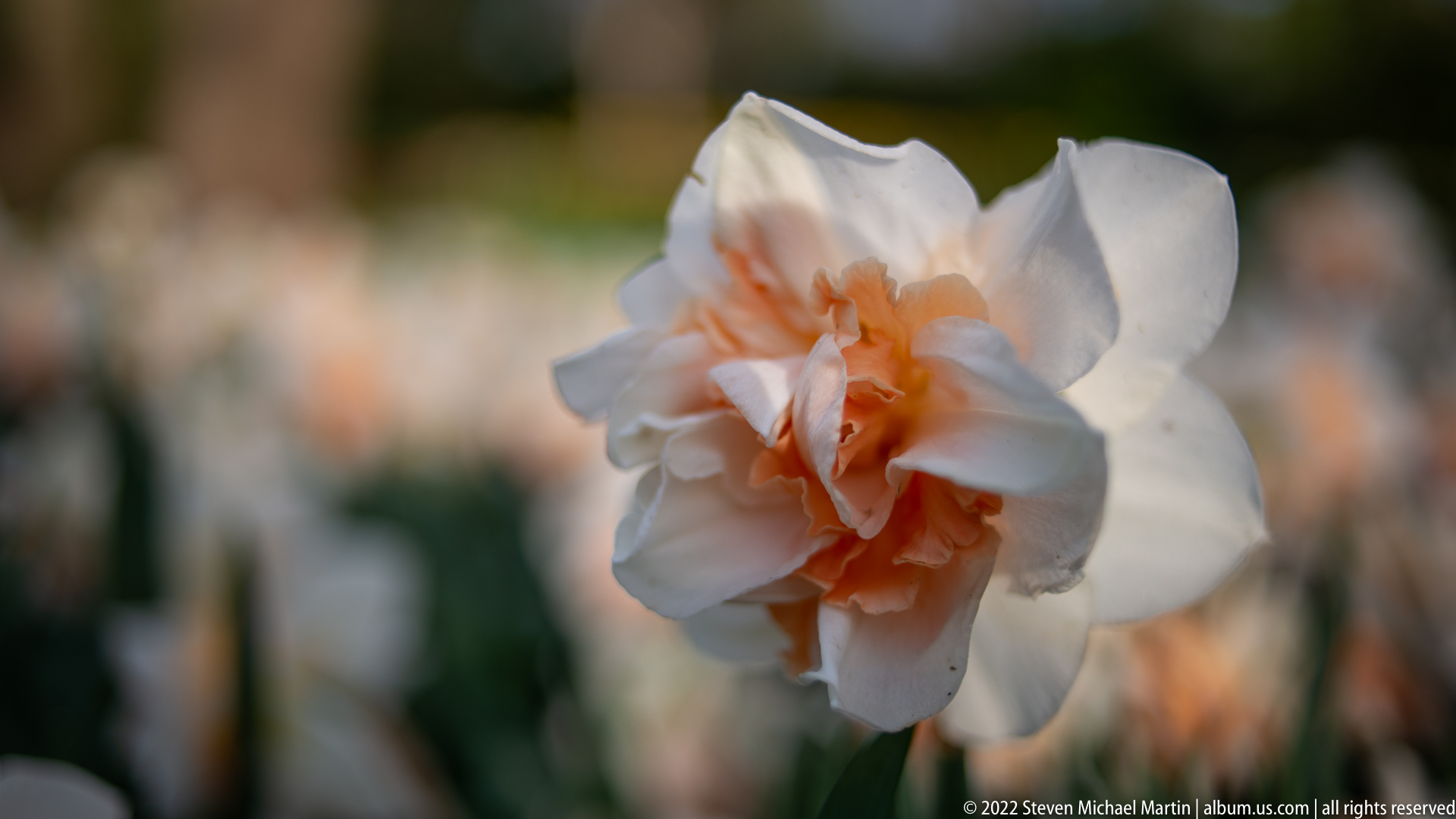
A double daffodil opens with broad creamy white outer petals surrounding a densely ruffled peach and pale-orange center. The bloom is isolated against a softly blurred bed of similarly colored flowers, allowing the layered central segments to stand out. Its complex double form contrasts sharply with the simple yellow-and-orange daffodil seen earlier in the sequence.
Caption
A double daffodil opens with broad creamy white outer petals surrounding a densely ruffled peach and pale-orange center. The bloom is isolated against a softly blurred bed of similarly colored flowers, allowing the layered central segments to stand out. Its complex double form contrasts sharply with the simple yellow-and-orange daffodil seen earlier in the sequence.
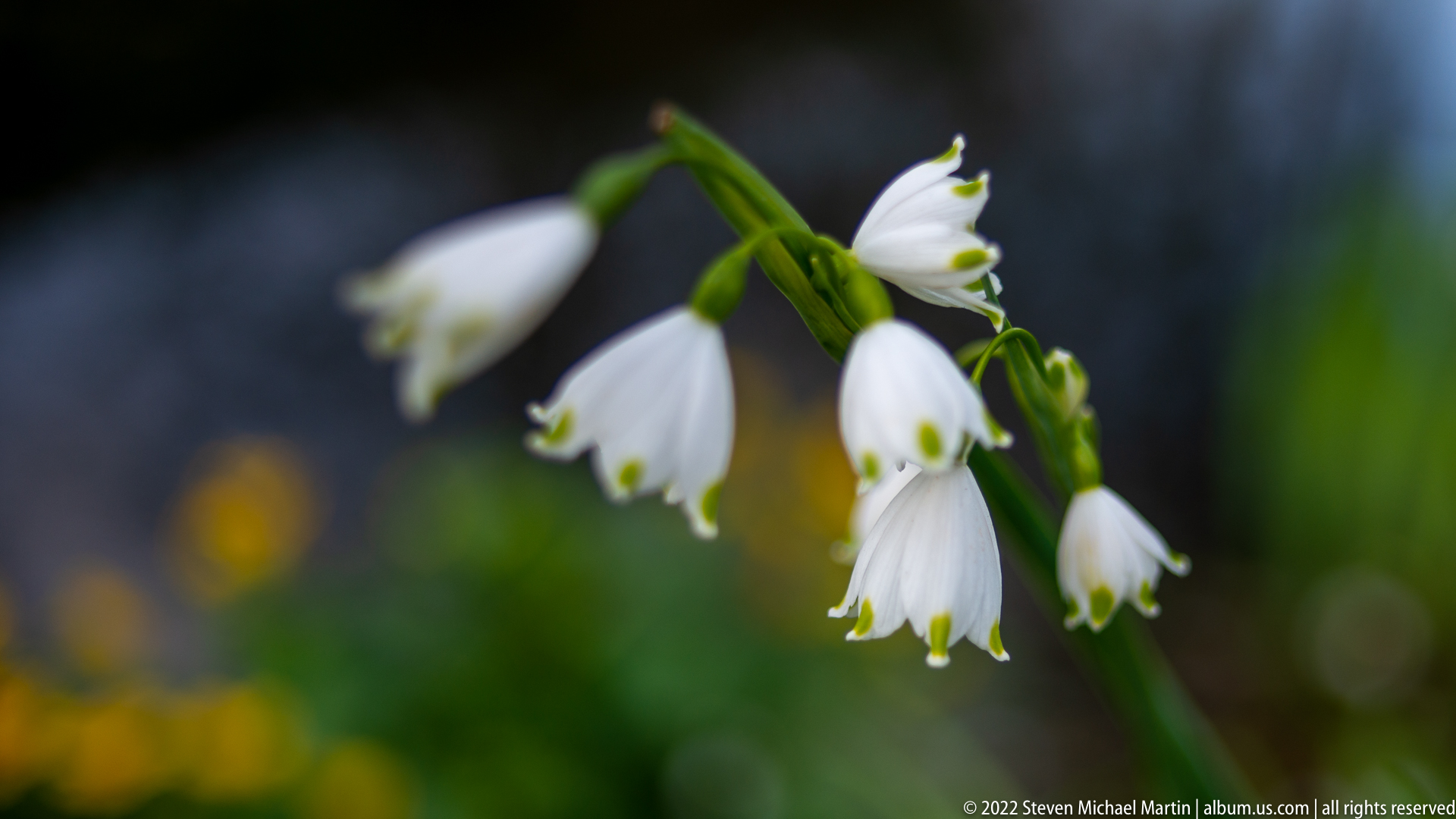
Several white bell-shaped flowers droop from a single arching stem, each petal tipped with a small green mark. The cluster hangs above a softly blurred garden background, with the multiple flowers per stem and green-tipped bells supporting identification as summer snowflake, Leucojum aestivum. The close view highlights the plant’s delicate pendant form and restrained white-and-green coloration.
Caption
Several white bell-shaped flowers droop from a single arching stem, each petal tipped with a small green mark. The cluster hangs above a softly blurred garden background, with the multiple flowers per stem and green-tipped bells supporting identification as summer snowflake, Leucojum aestivum. The close view highlights the plant’s delicate pendant form and restrained white-and-green coloration.
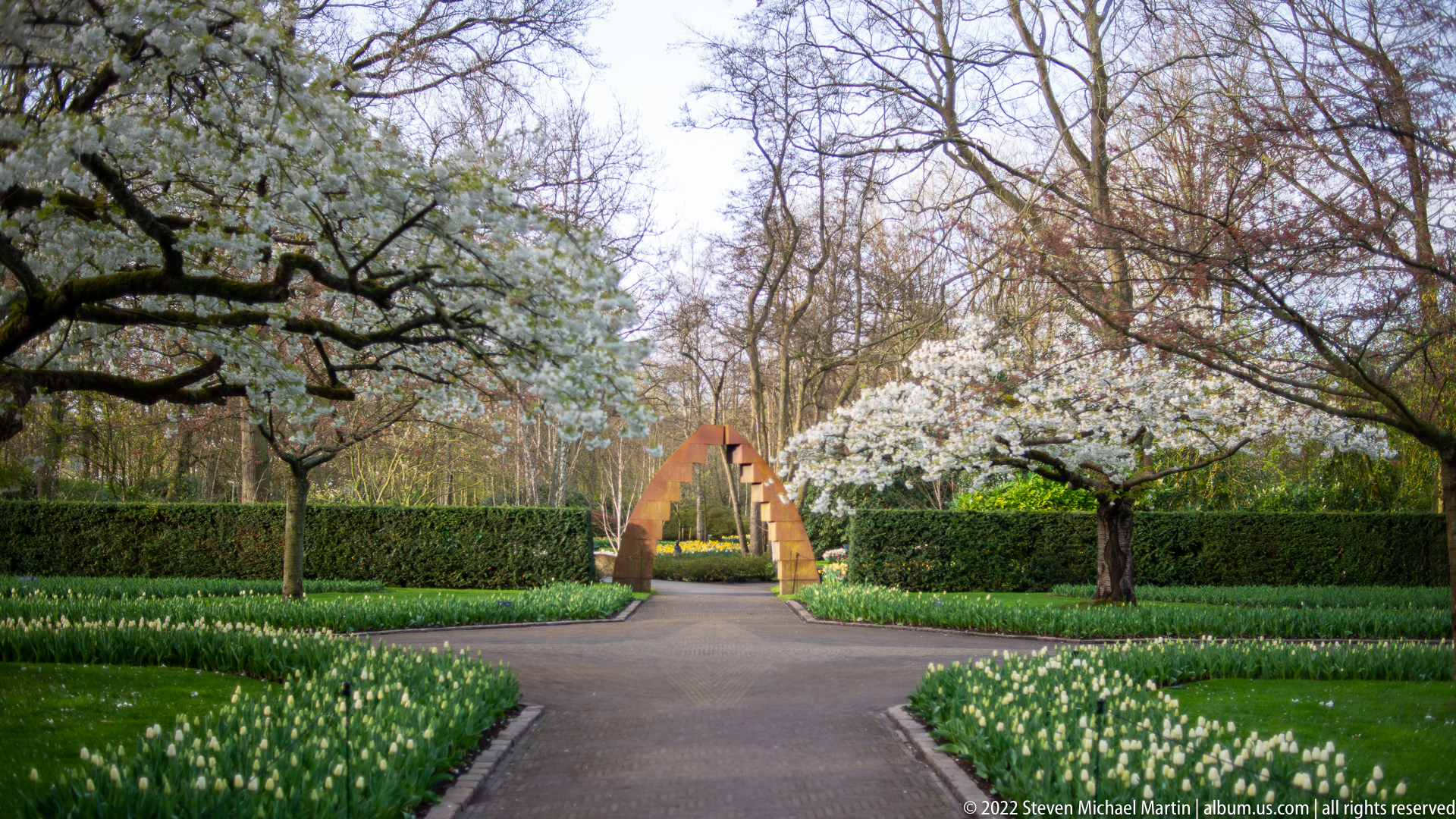
A straight garden walk passes between clipped hedges, spring bulb beds, and low flowering trees, ending at a sculptural arch framed by woodland. White blossoms spread across the branching canopies while narrow bands of pale flowers edge the lawns. The balanced composition records Keukenhof's formal garden design as it transitions into a more wooded setting.
Caption
A straight garden walk passes between clipped hedges, spring bulb beds, and low flowering trees, ending at a sculptural arch framed by woodland. White blossoms spread across the branching canopies while narrow bands of pale flowers edge the lawns. The balanced composition records Keukenhof's formal garden design as it transitions into a more wooded setting.
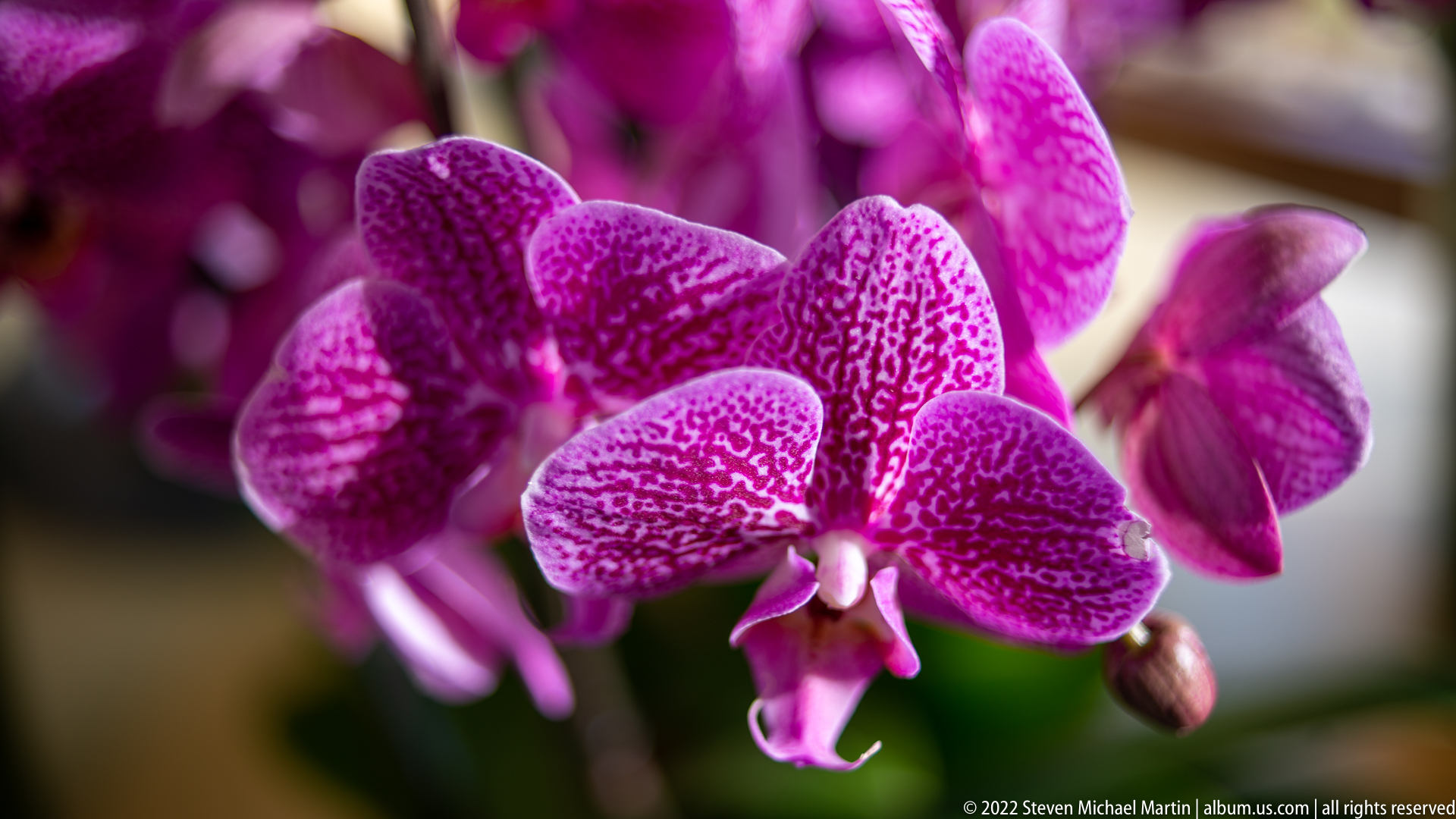
Velvety magenta orchid flowers fill the frame, their broad petals marked with dense pale veining and mottling. A sharply focused central bloom shows the sculptural lip and column while neighboring blossoms fall softly out of focus. The close view isolates color, pattern, and floral structure, distinguishing this greenhouse-style display from the outdoor bulb beds elsewhere at Keukenhof.
Caption
Velvety magenta orchid flowers fill the frame, their broad petals marked with dense pale veining and mottling. A sharply focused central bloom shows the sculptural lip and column while neighboring blossoms fall softly out of focus. The close view isolates color, pattern, and floral structure, distinguishing this greenhouse-style display from the outdoor bulb beds elsewhere at Keukenhof.

White orchid blossoms overlap in a dense spray, each flower centered by a yellow-and-pink throat. Curving stems carry multiple open blooms at different angles, creating a layered floral study against a subdued background. The image emphasizes the clean white petals and repeated flower form characteristic of a cultivated orchid display rather than the massed outdoor plantings of Keukenhof's bulb gardens.
Caption
White orchid blossoms overlap in a dense spray, each flower centered by a yellow-and-pink throat. Curving stems carry multiple open blooms at different angles, creating a layered floral study against a subdued background. The image emphasizes the clean white petals and repeated flower form characteristic of a cultivated orchid display rather than the massed outdoor plantings of Keukenhof's bulb gardens.
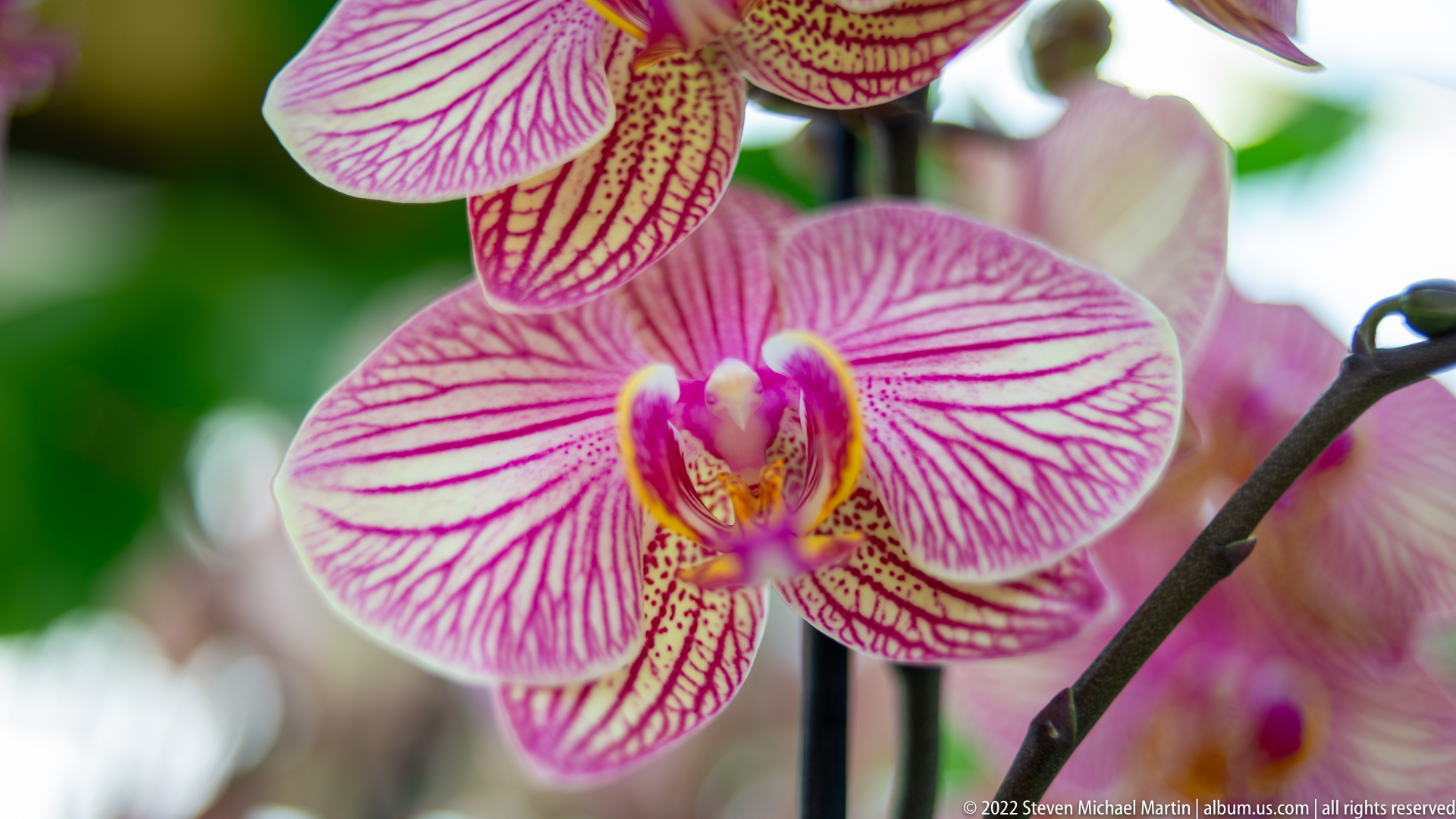
A pink-and-white orchid blossom dominates the composition, its pale petals crossed by vivid magenta veins that converge toward a richly patterned center. Additional flowers appear behind it at different depths, while a dark supporting stem cuts diagonally through the frame. The tight framing concentrates attention on the contrasting venation, symmetry, and complex reproductive structures of the cultivated bloom.
Caption
A pink-and-white orchid blossom dominates the composition, its pale petals crossed by vivid magenta veins that converge toward a richly patterned center. Additional flowers appear behind it at different depths, while a dark supporting stem cuts diagonally through the frame. The tight framing concentrates attention on the contrasting venation, symmetry, and complex reproductive structures of the cultivated bloom.
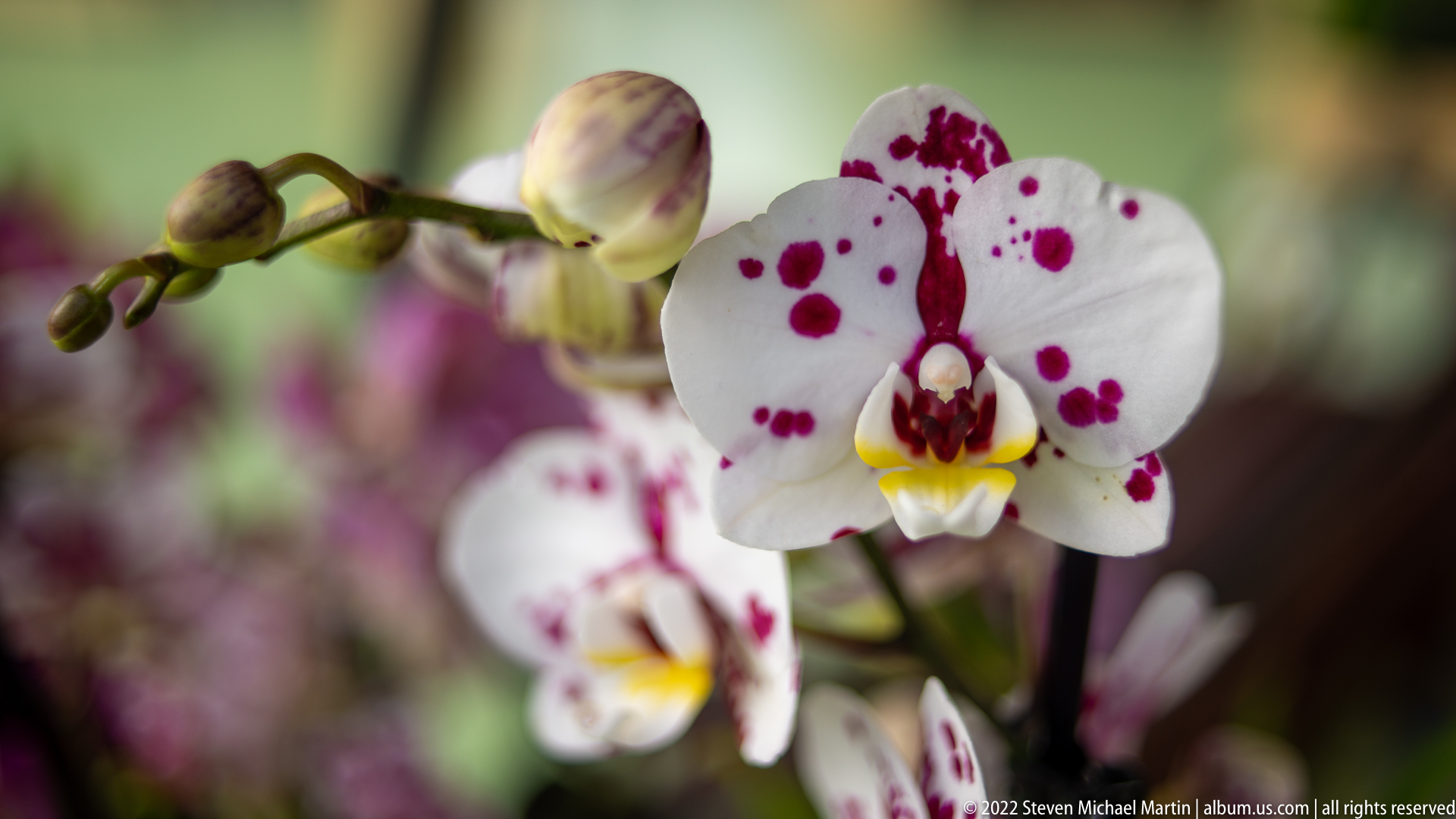
A white orchid flower is patterned with irregular burgundy spots and patches, especially across the upper petals and central lip. Several unopened buds extend along the same stem, while a second spotted bloom recedes into soft focus. The photograph pairs the mature flower with developing buds, giving a compact view of both decorative markings and the growth sequence within the display.
Caption
A white orchid flower is patterned with irregular burgundy spots and patches, especially across the upper petals and central lip. Several unopened buds extend along the same stem, while a second spotted bloom recedes into soft focus. The photograph pairs the mature flower with developing buds, giving a compact view of both decorative markings and the growth sequence within the display.

Two pale pink orchid blossoms fill the frame, each centered by a vivid magenta lip with warm yellow-orange details. Their broad, softly tinted petals overlap against a muted background, while the lower flower reveals fine curling structures around the lip. The close composition favors subtle color gradation and the contrasting centers, presenting the flowers as a paired botanical study.
Caption
Two pale pink orchid blossoms fill the frame, each centered by a vivid magenta lip with warm yellow-orange details. Their broad, softly tinted petals overlap against a muted background, while the lower flower reveals fine curling structures around the lip. The close composition favors subtle color gradation and the contrasting centers, presenting the flowers as a paired botanical study.
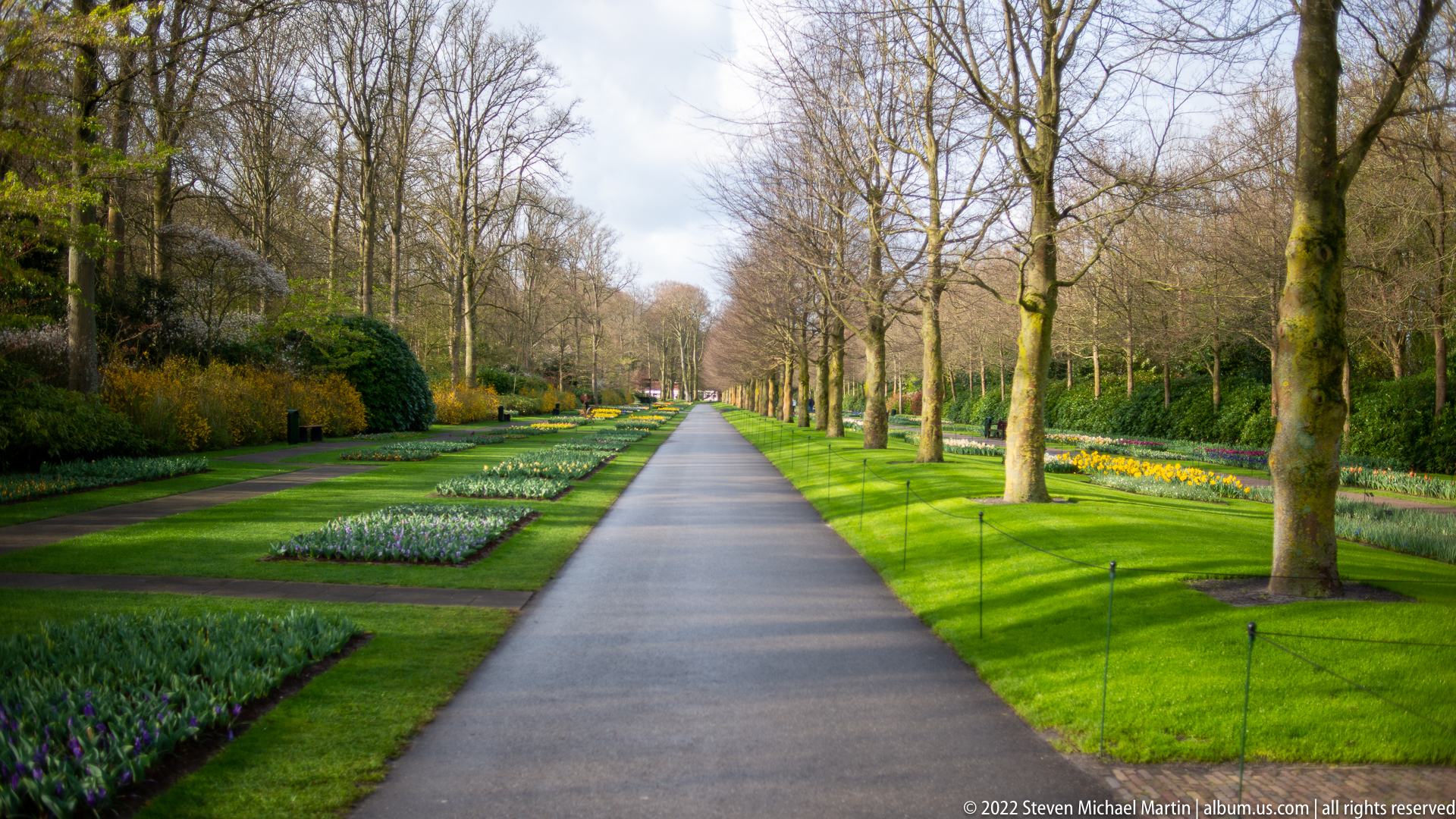
A long paved avenue runs straight through Keukenhof beneath rows of leafless deciduous trees, with rectangular spring bulb beds set into closely clipped lawns on both sides. Repetition of trunks, paths, and flower plots creates strong linear perspective toward a distant vanishing point. The early-season canopy leaves the garden open to sunlight while the planted beds supply concentrated bands of color.
Caption
A long paved avenue runs straight through Keukenhof beneath rows of leafless deciduous trees, with rectangular spring bulb beds set into closely clipped lawns on both sides. Repetition of trunks, paths, and flower plots creates strong linear perspective toward a distant vanishing point. The early-season canopy leaves the garden open to sunlight while the planted beds supply concentrated bands of color.
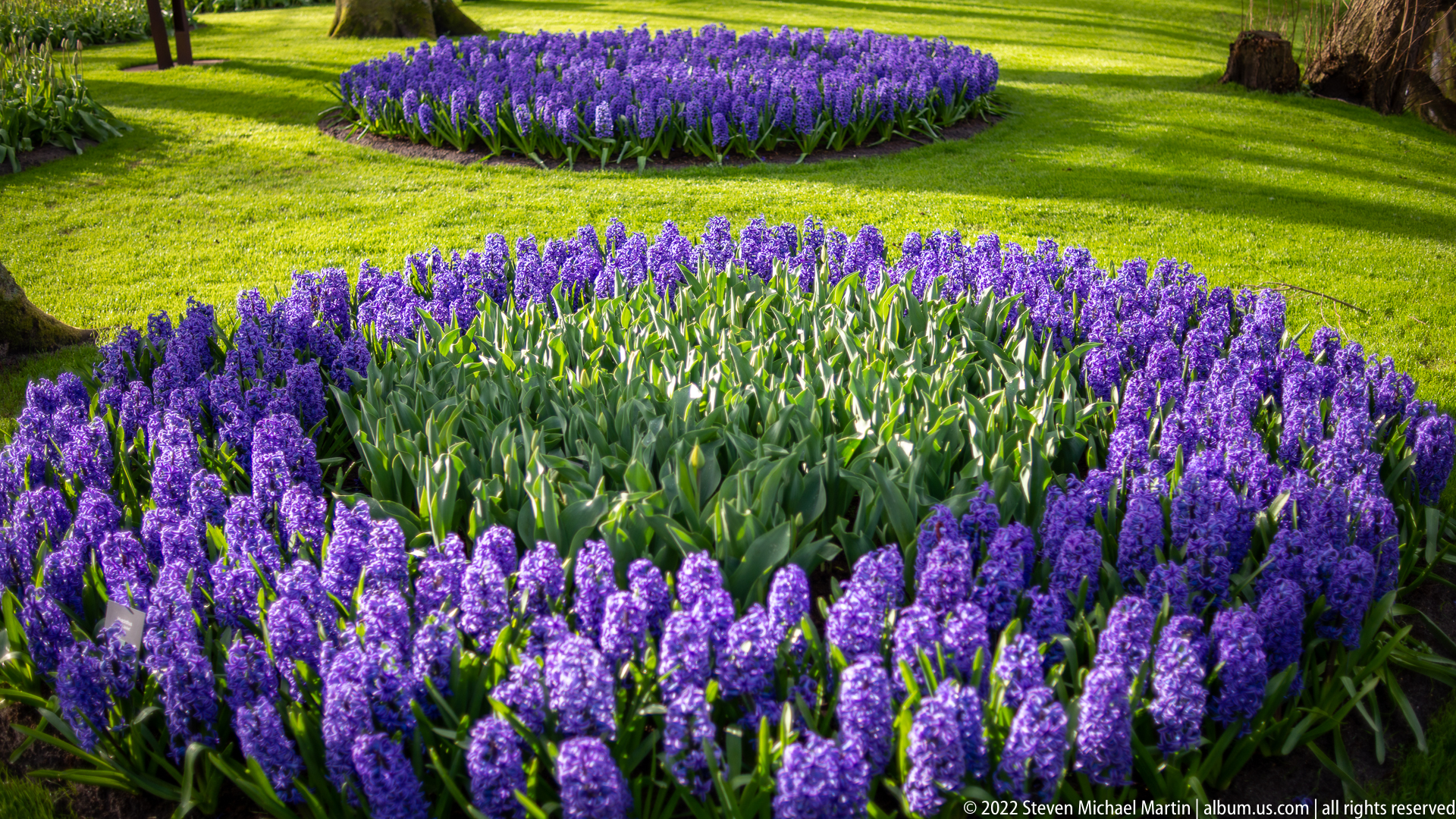
A circular bed of purple hyacinths encloses a central ring of emerging tulip foliage, with a second purple planting visible farther across the lawn. The concentric arrangement contrasts the dense flower spikes at the edge with the upright green leaves in the middle. This overhead-leaning view records the geometry of the planting as much as the individual flowers.
Caption
A circular bed of purple hyacinths encloses a central ring of emerging tulip foliage, with a second purple planting visible farther across the lawn. The concentric arrangement contrasts the dense flower spikes at the edge with the upright green leaves in the middle. This overhead-leaning view records the geometry of the planting as much as the individual flowers.
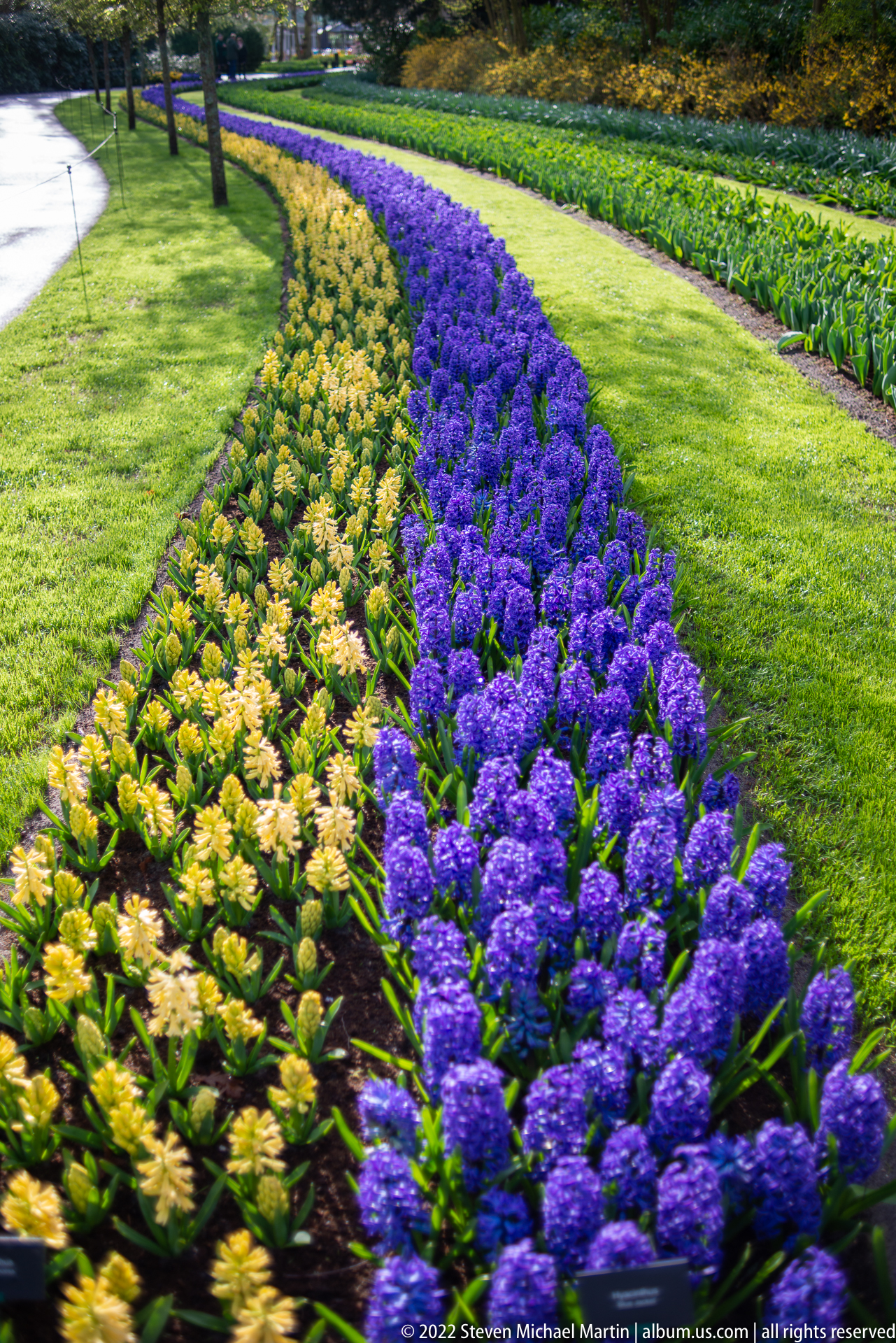
Curving ribbons of densely planted hyacinths sweep across a broad lawn, pairing a saturated blue-purple band with a paler cream-and-pink planting beside it. The beds follow the contour of the turf rather than a rigid geometric grid, creating a flowing transition between flower mass and open grass. The view highlights Keukenhof's use of color blocking and curved bed design.
Caption
Curving ribbons of densely planted hyacinths sweep across a broad lawn, pairing a saturated blue-purple band with a paler cream-and-pink planting beside it. The beds follow the contour of the turf rather than a rigid geometric grid, creating a flowing transition between flower mass and open grass. The view highlights Keukenhof's use of color blocking and curved bed design.

Broad parallel bands of pink and white hyacinths run along a sloping lawn toward a pond, with the two colors separated into distinct, densely flowering rows. The curved shoreline and gray stone edging beyond the beds give the composition a strong landscape context. From this angle, the massed blossoms read as coordinated color fields integrated into Keukenhof's waterside planting scheme.
Caption
Broad parallel bands of pink and white hyacinths run along a sloping lawn toward a pond, with the two colors separated into distinct, densely flowering rows. The curved shoreline and gray stone edging beyond the beds give the composition a strong landscape context. From this angle, the massed blossoms read as coordinated color fields integrated into Keukenhof's waterside planting scheme.
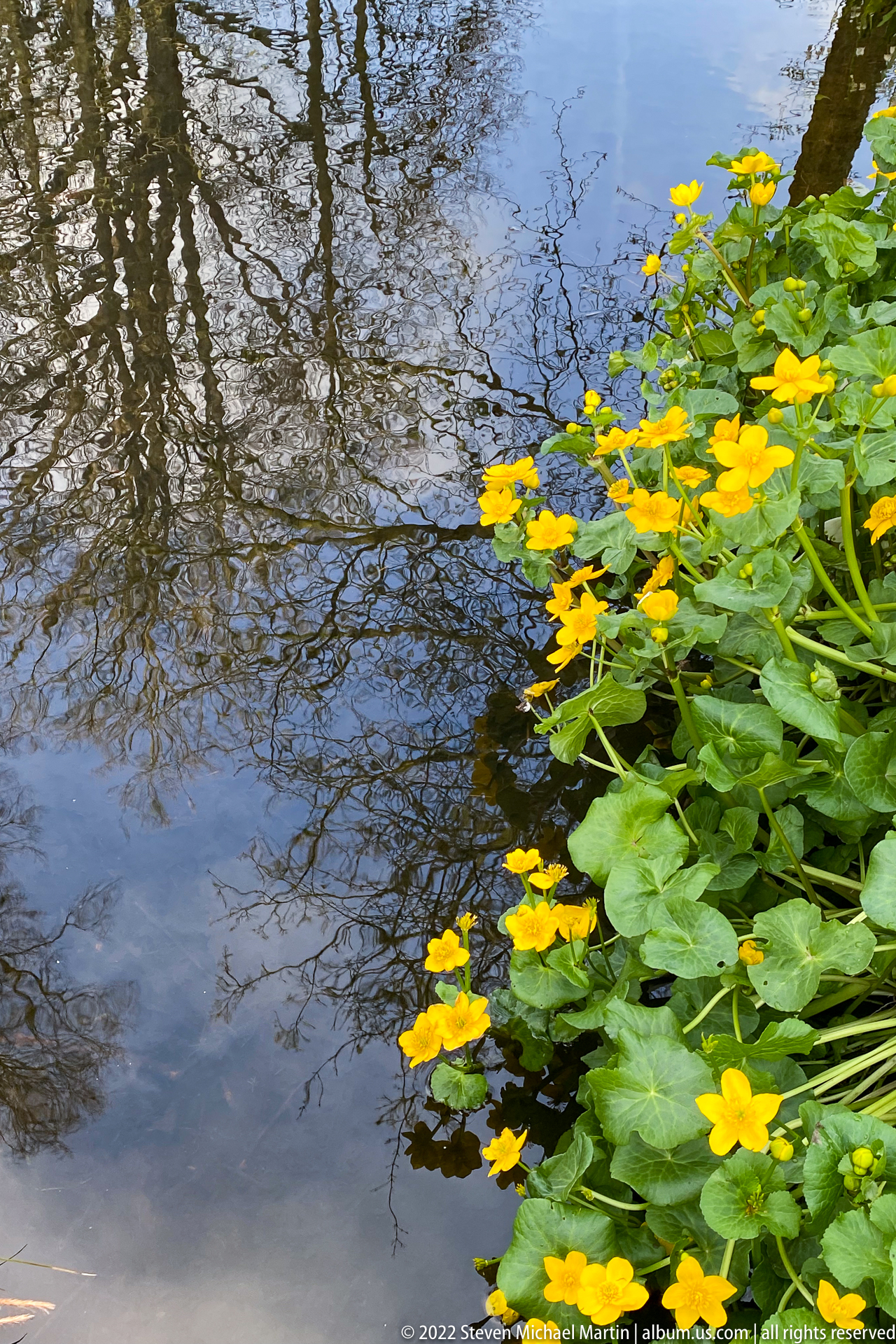
Bright yellow waterside flowers cluster at the edge of a still pond, their rounded green leaves projecting over dark reflective water. Bare tree branches and sky appear as wavering reflections across the open half of the composition. The low, close viewpoint gives equal weight to the flowering margin and the pond surface, recording a quieter naturalistic planting treatment within Keukenhof’s broader ornamental landscape.
Caption
Bright yellow waterside flowers cluster at the edge of a still pond, their rounded green leaves projecting over dark reflective water. Bare tree branches and sky appear as wavering reflections across the open half of the composition. The low, close viewpoint gives equal weight to the flowering margin and the pond surface, recording a quieter naturalistic planting treatment within Keukenhof’s broader ornamental landscape.

A round spring bed combines a white center of hyacinths with a broad outer ring of purple blooms, forming a crisp two-color target against dark soil and surrounding grass. Small plant labels punctuate the display without disrupting its symmetry. The elevated viewpoint makes the circular layout especially legible and emphasizes Keukenhof's deliberate use of contrasting flower masses.
Caption
A round spring bed combines a white center of hyacinths with a broad outer ring of purple blooms, forming a crisp two-color target against dark soil and surrounding grass. Small plant labels punctuate the display without disrupting its symmetry. The elevated viewpoint makes the circular layout especially legible and emphasizes Keukenhof's deliberate use of contrasting flower masses.

A narrow ribbon of red-orange tulips curves through bright green lawn, its flower heads following the garden edge toward a reflective watercourse beyond. The low, continuous planting creates a strong directional line through the frame, while the water and opposite bank add landscape context. The view records a more linear planting treatment than the circular hyacinth beds nearby.
Caption
A narrow ribbon of red-orange tulips curves through bright green lawn, its flower heads following the garden edge toward a reflective watercourse beyond. The low, continuous planting creates a strong directional line through the frame, while the water and opposite bank add landscape context. The view records a more linear planting treatment than the circular hyacinth beds nearby.
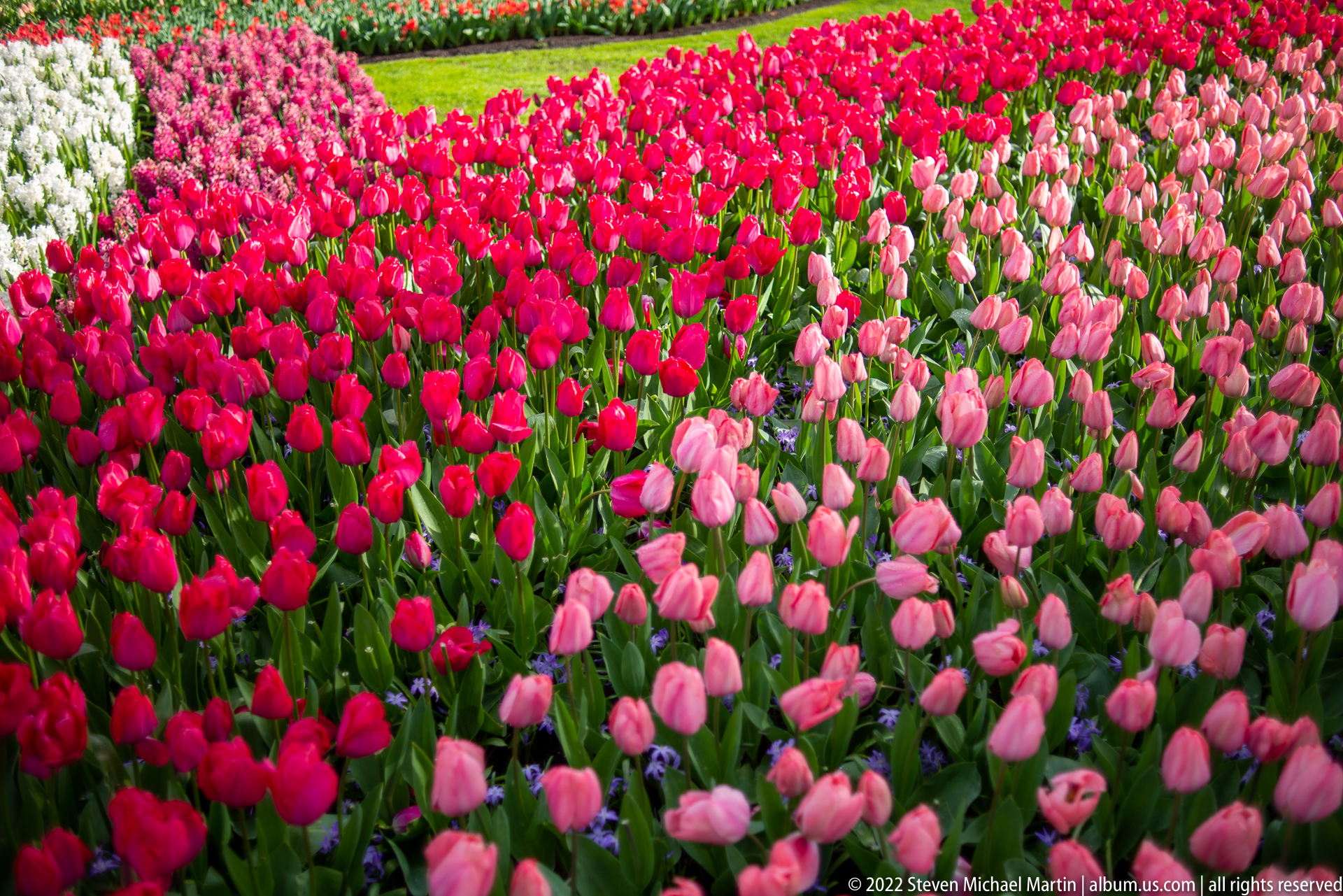
A dense field of tulips fills the frame with two contrasting color masses: saturated red blooms and a lighter section of pale pink flowers. The closely spaced stems and overlapping cups create an almost continuous surface of color, with only small glimpses of green foliage between them. The tight composition focuses on planting density and tonal contrast rather than the wider garden setting.
Caption
A dense field of tulips fills the frame with two contrasting color masses: saturated red blooms and a lighter section of pale pink flowers. The closely spaced stems and overlapping cups create an almost continuous surface of color, with only small glimpses of green foliage between them. The tight composition focuses on planting density and tonal contrast rather than the wider garden setting.
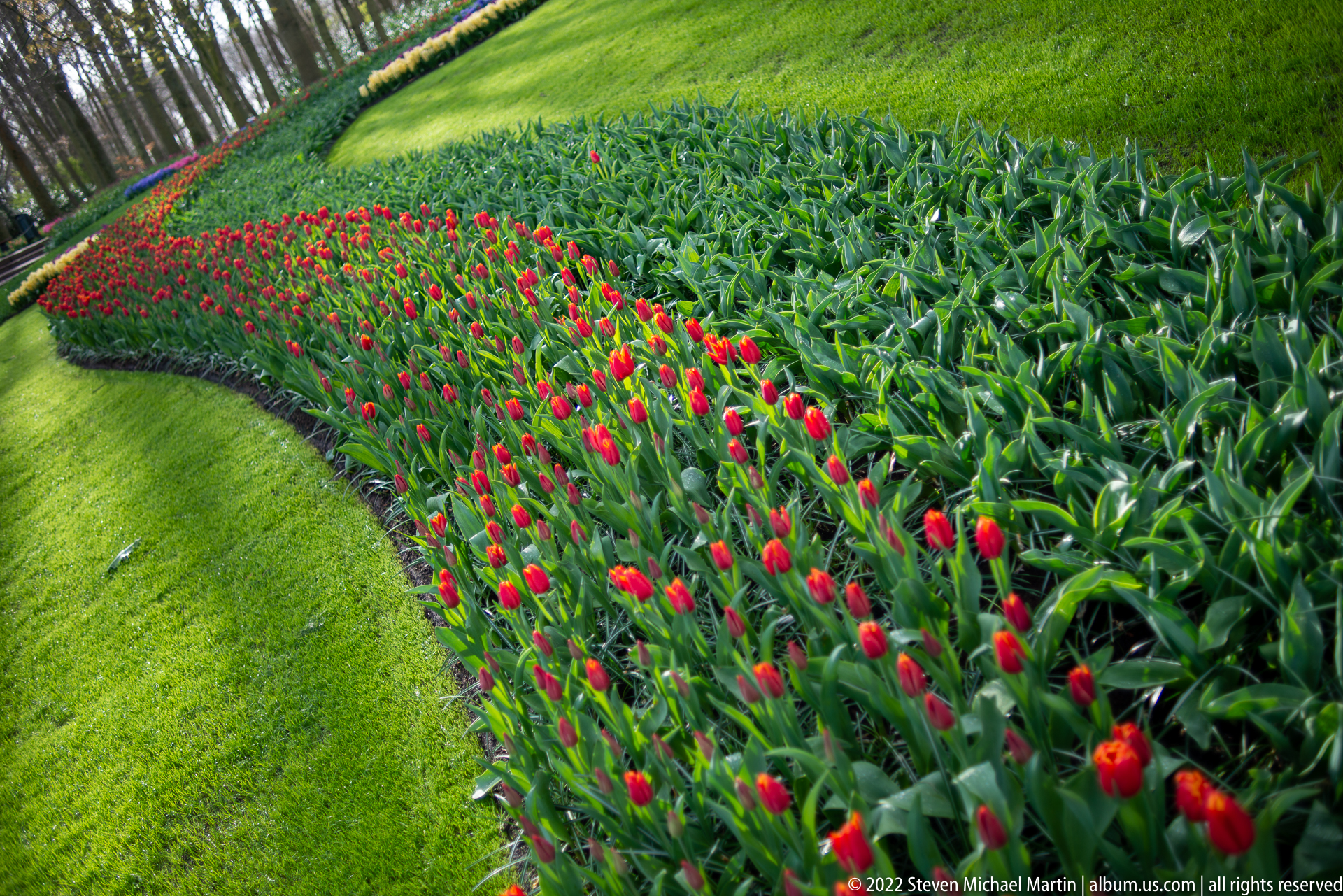
A curved bed of red tulips traces the edge of a bright green lawn, while a broad area of taller green bulb foliage occupies the opposite side. The sweeping line of flowers narrows into the distance, using the lawn as negative space between planted zones. This angled view emphasizes Keukenhof's layered bed geometry before all neighboring bulbs have reached full bloom.
Caption
A curved bed of red tulips traces the edge of a bright green lawn, while a broad area of taller green bulb foliage occupies the opposite side. The sweeping line of flowers narrows into the distance, using the lawn as negative space between planted zones. This angled view emphasizes Keukenhof's layered bed geometry before all neighboring bulbs have reached full bloom.

Rectangular and angled flower beds divide the lawn into a patchwork of spring color, including purple and cream hyacinths with red and blue-purple plantings farther back. Bare tree trunks rise through the scene, linking the formal ground pattern to the wooded garden setting. The elevated view is especially useful for reading the repeated bed shapes and their deliberate color sequencing.
Caption
Rectangular and angled flower beds divide the lawn into a patchwork of spring color, including purple and cream hyacinths with red and blue-purple plantings farther back. Bare tree trunks rise through the scene, linking the formal ground pattern to the wooded garden setting. The elevated view is especially useful for reading the repeated bed shapes and their deliberate color sequencing.
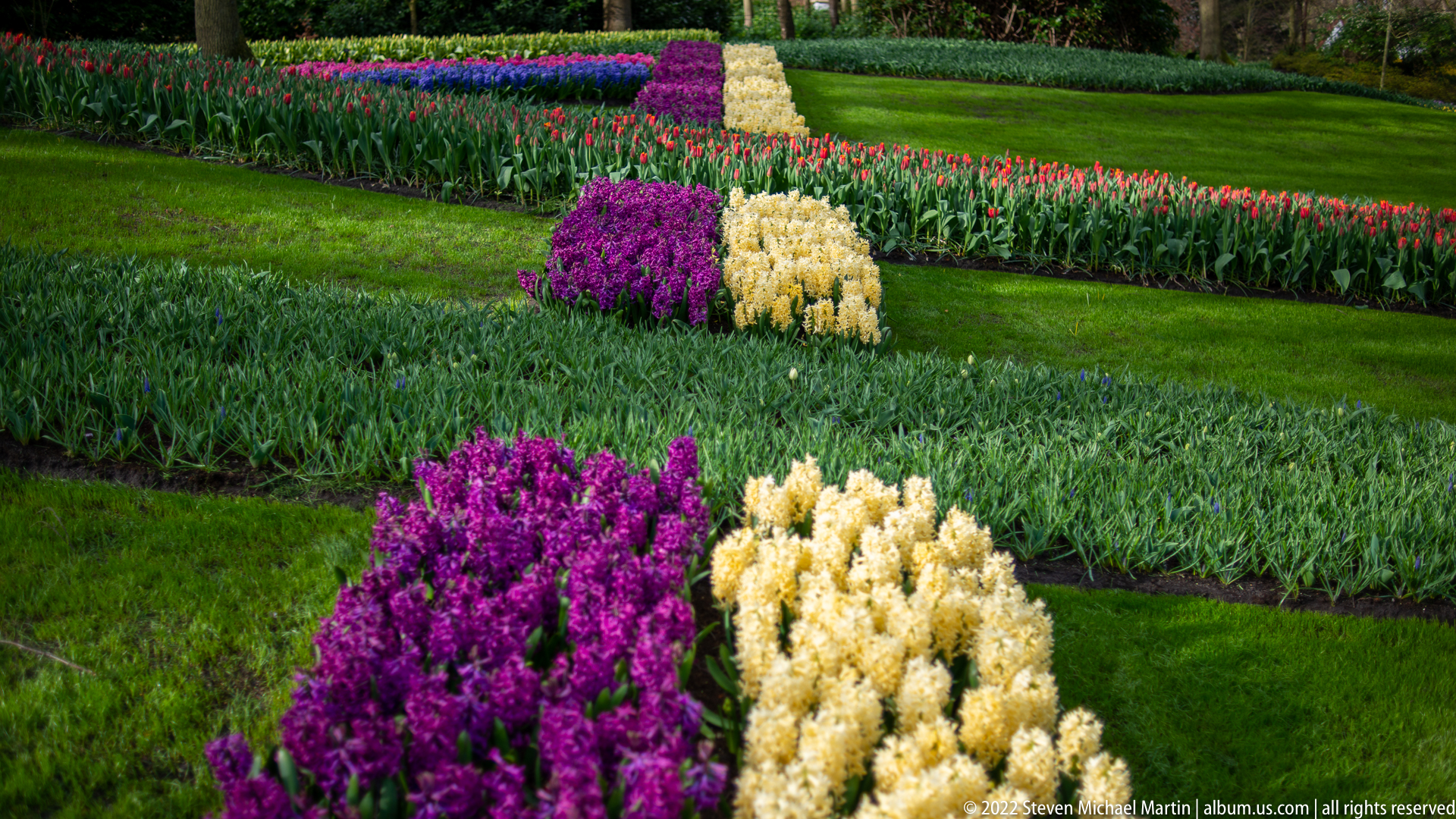
Compact blocks of purple and cream hyacinths sit within a larger spring garden, repeating the two-color pairing at several distances across the lawn. Their dense flower spikes contrast with surrounding areas of green bulb foliage that have not yet opened. The composition shows how Keukenhof combines fully blooming sections with developing beds to create staggered seasonal texture.
Caption
Compact blocks of purple and cream hyacinths sit within a larger spring garden, repeating the two-color pairing at several distances across the lawn. Their dense flower spikes contrast with surrounding areas of green bulb foliage that have not yet opened. The composition shows how Keukenhof combines fully blooming sections with developing beds to create staggered seasonal texture.
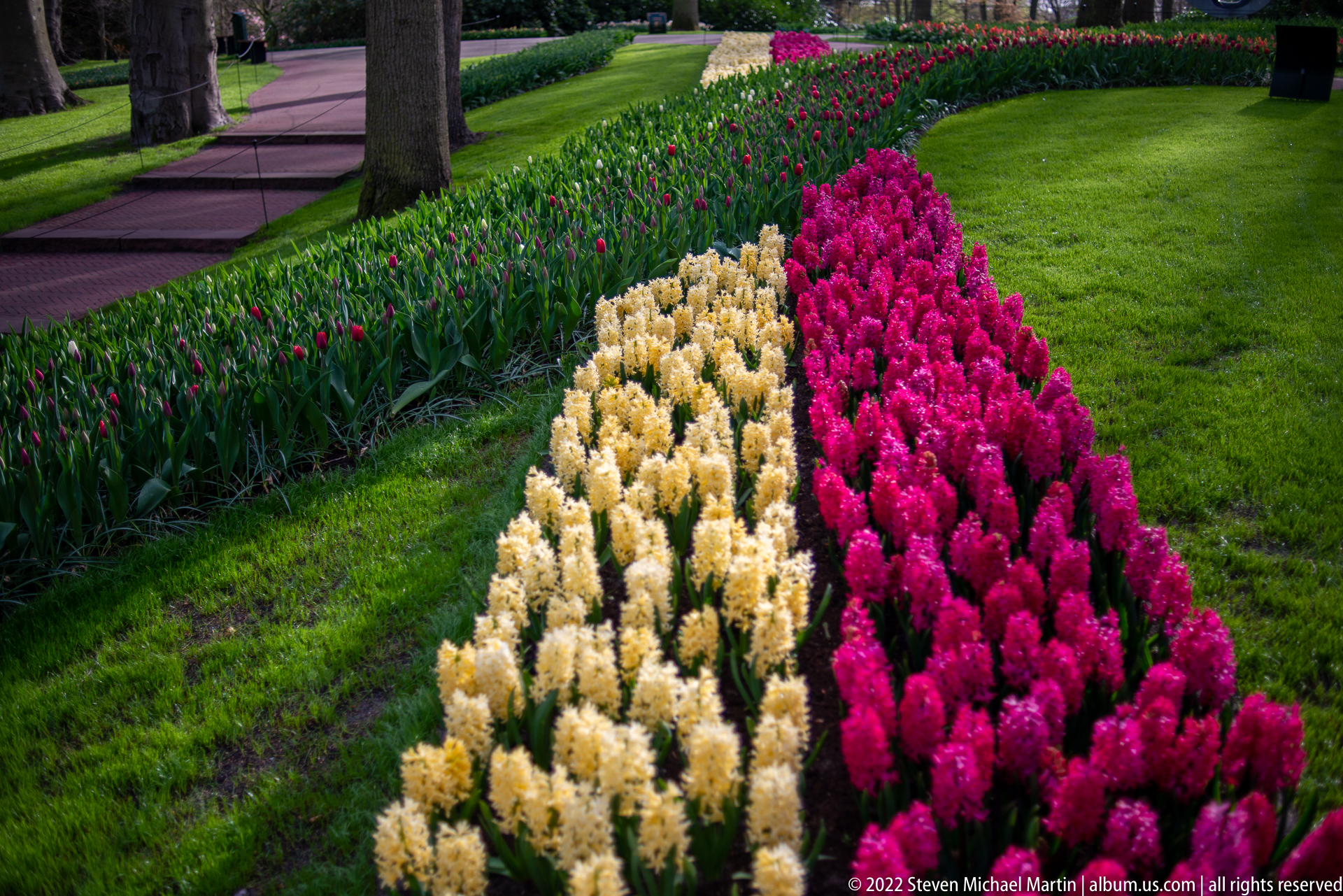
Two dense hyacinth borders run toward the camera in contrasting cream and deep magenta, their narrow rectangular beds separated by strips of lawn. Red tulips and darker green bulb foliage continue across the background. The strong diagonal perspective makes the paired rows feel almost architectural, turning the spring planting into a study of color, alignment, and depth.
Caption
Two dense hyacinth borders run toward the camera in contrasting cream and deep magenta, their narrow rectangular beds separated by strips of lawn. Red tulips and darker green bulb foliage continue across the background. The strong diagonal perspective makes the paired rows feel almost architectural, turning the spring planting into a study of color, alignment, and depth.
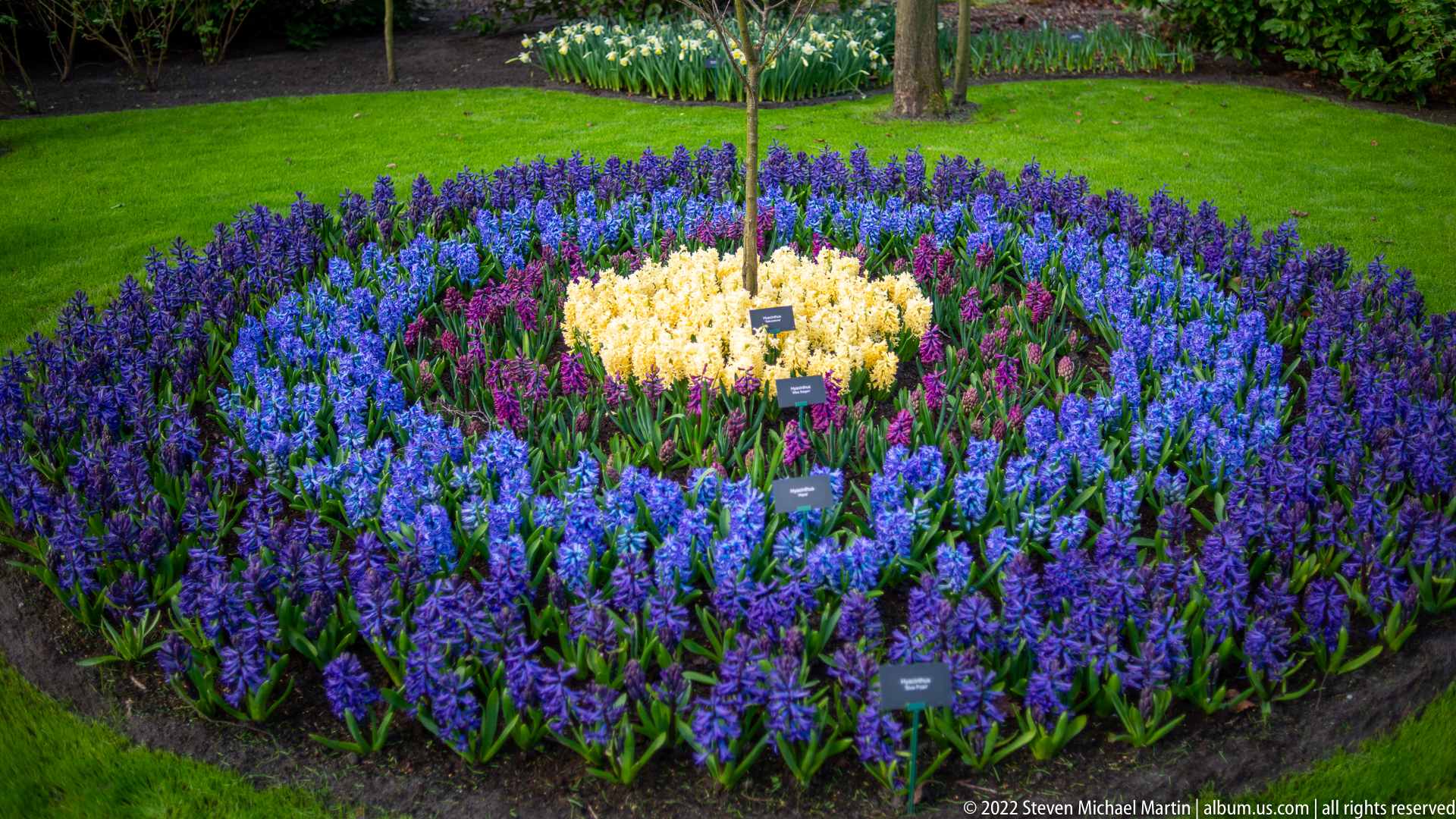
A circular bed wraps a broad ring of blue-purple hyacinths around a pale cream center, with a narrower band of darker foliage separating the colors. Several small plant labels and a young tree rise from the middle, making the display read as a cataloged horticultural arrangement as well as a decorative pattern. The near-overhead view clearly reveals the concentric layout.
Caption
A circular bed wraps a broad ring of blue-purple hyacinths around a pale cream center, with a narrower band of darker foliage separating the colors. Several small plant labels and a young tree rise from the middle, making the display read as a cataloged horticultural arrangement as well as a decorative pattern. The near-overhead view clearly reveals the concentric layout.
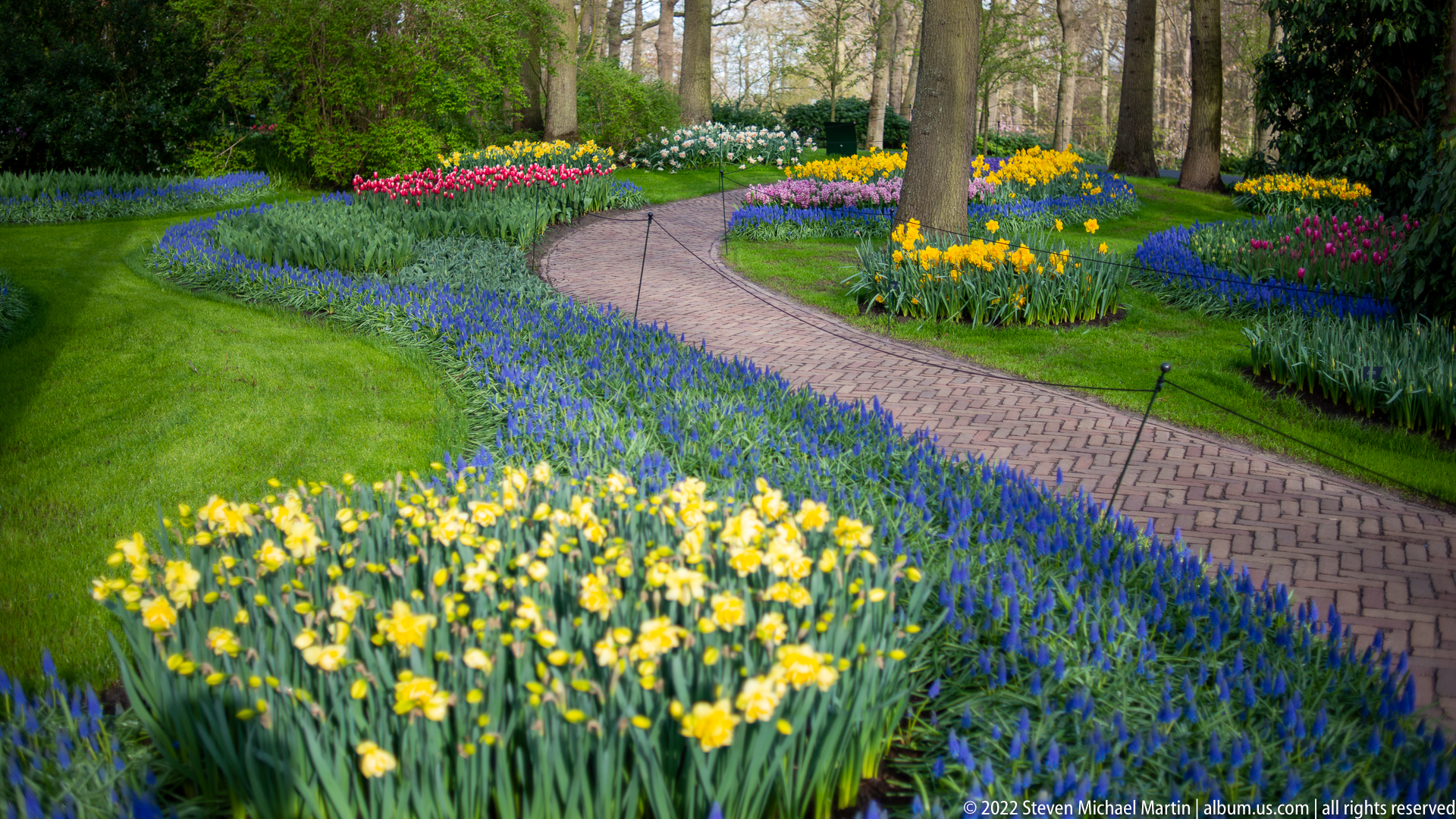
A herringbone-patterned brick path curves through a wooded garden bordered by blue spring flowers and clusters of yellow daffodils. Additional red, purple, and yellow beds appear deeper among the tree trunks, creating successive pockets of color along the route. The winding path and layered plantings produce a more informal woodland composition than Keukenhof's straight avenues and geometric beds.
Caption
A herringbone-patterned brick path curves through a wooded garden bordered by blue spring flowers and clusters of yellow daffodils. Additional red, purple, and yellow beds appear deeper among the tree trunks, creating successive pockets of color along the route. The winding path and layered plantings produce a more informal woodland composition than Keukenhof's straight avenues and geometric beds.
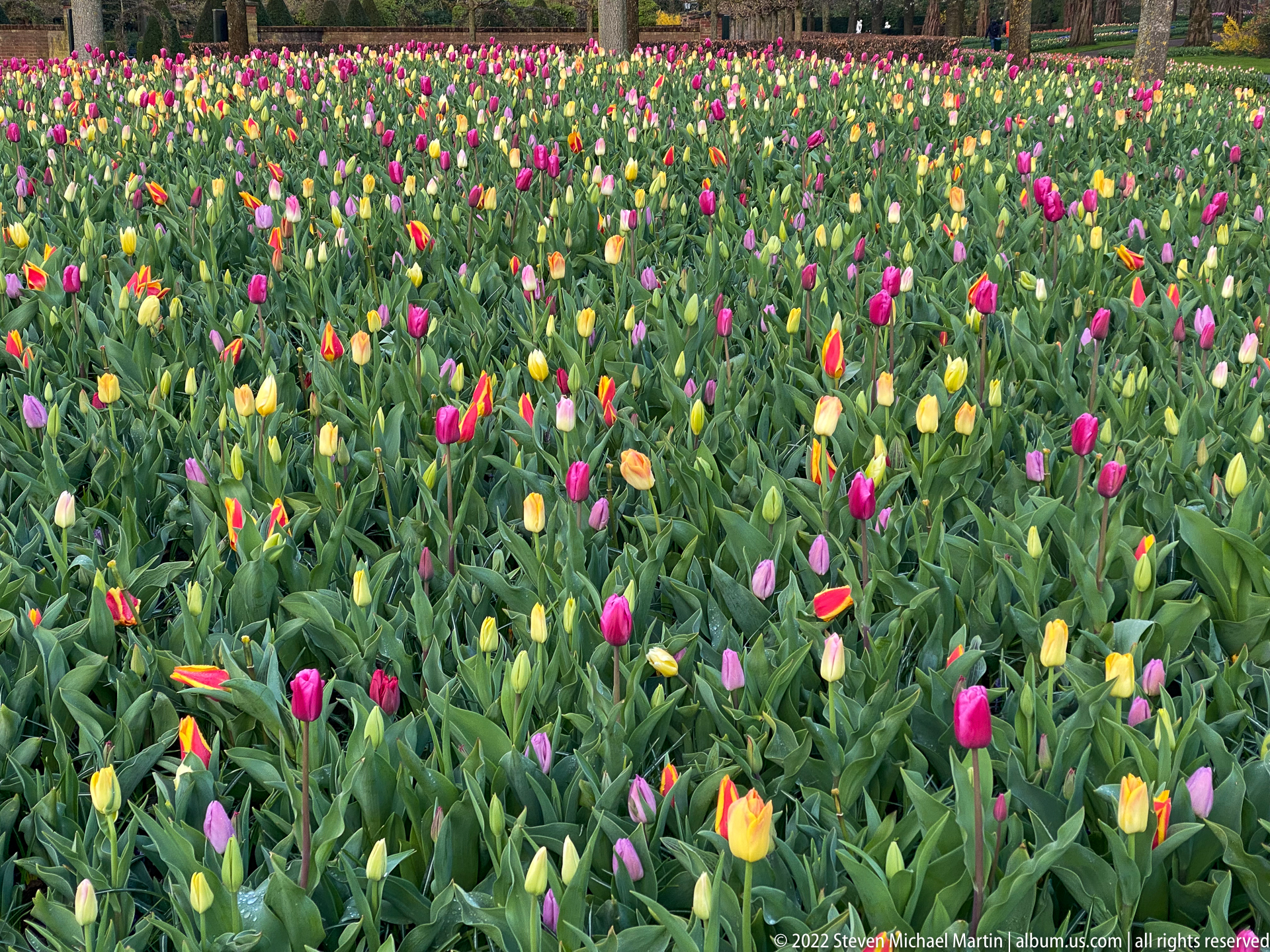
An expansive bed of tulips spreads across the frame in a loose mixture of red, pink, yellow, orange, and pale blooms. Rather than being separated into color bands, the flowers are intermingled among dense green leaves, producing a scattered confetti effect. The broad, nearly edge-to-edge view emphasizes variety and abundance without relying on a larger landscape setting.
Caption
An expansive bed of tulips spreads across the frame in a loose mixture of red, pink, yellow, orange, and pale blooms. Rather than being separated into color bands, the flowers are intermingled among dense green leaves, producing a scattered confetti effect. The broad, nearly edge-to-edge view emphasizes variety and abundance without relying on a larger landscape setting.
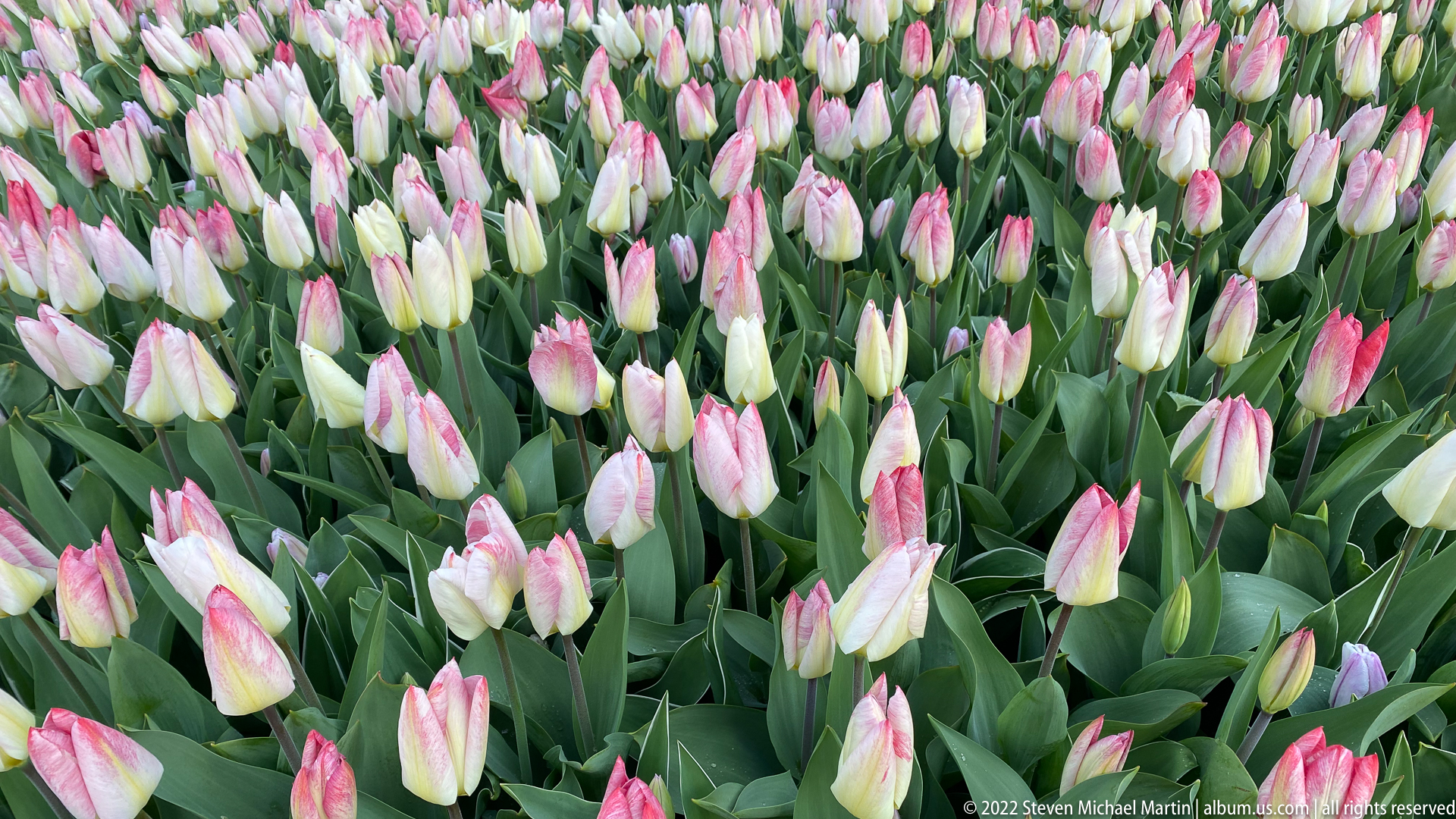
A dense planting of white tulips is edged and brushed with soft pink, each closed or partly opened bloom rising above a uniform field of green leaves. The repeated bicolor flowers fill nearly the entire composition, allowing subtle differences in pink intensity and petal shape to emerge. The close view functions as a cultivar study without relying on an unsupported cultivar name.
Caption
A dense planting of white tulips is edged and brushed with soft pink, each closed or partly opened bloom rising above a uniform field of green leaves. The repeated bicolor flowers fill nearly the entire composition, allowing subtle differences in pink intensity and petal shape to emerge. The close view functions as a cultivar study without relying on an unsupported cultivar name.
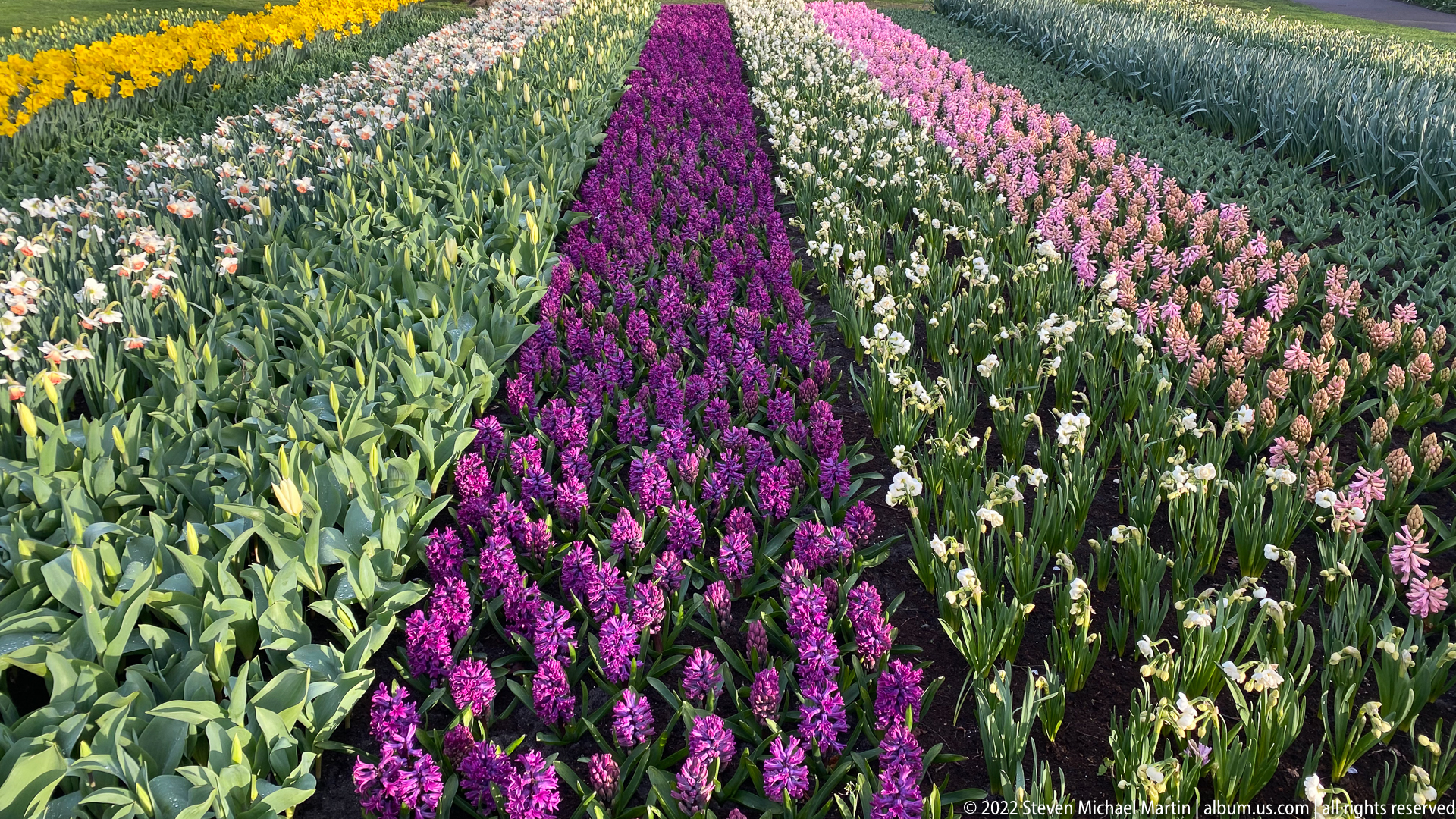
A long, narrow row of deep purple hyacinths runs away from the camera between parallel beds of pale flowering bulbs. The converging rows form a strong perspective line toward the upper edge of the garden, while unflowered green beds create additional stripes to either side. The composition turns Keukenhof's planting plan into a graphic arrangement of color and repetition.
Caption
A long, narrow row of deep purple hyacinths runs away from the camera between parallel beds of pale flowering bulbs. The converging rows form a strong perspective line toward the upper edge of the garden, while unflowered green beds create additional stripes to either side. The composition turns Keukenhof's planting plan into a graphic arrangement of color and repetition.
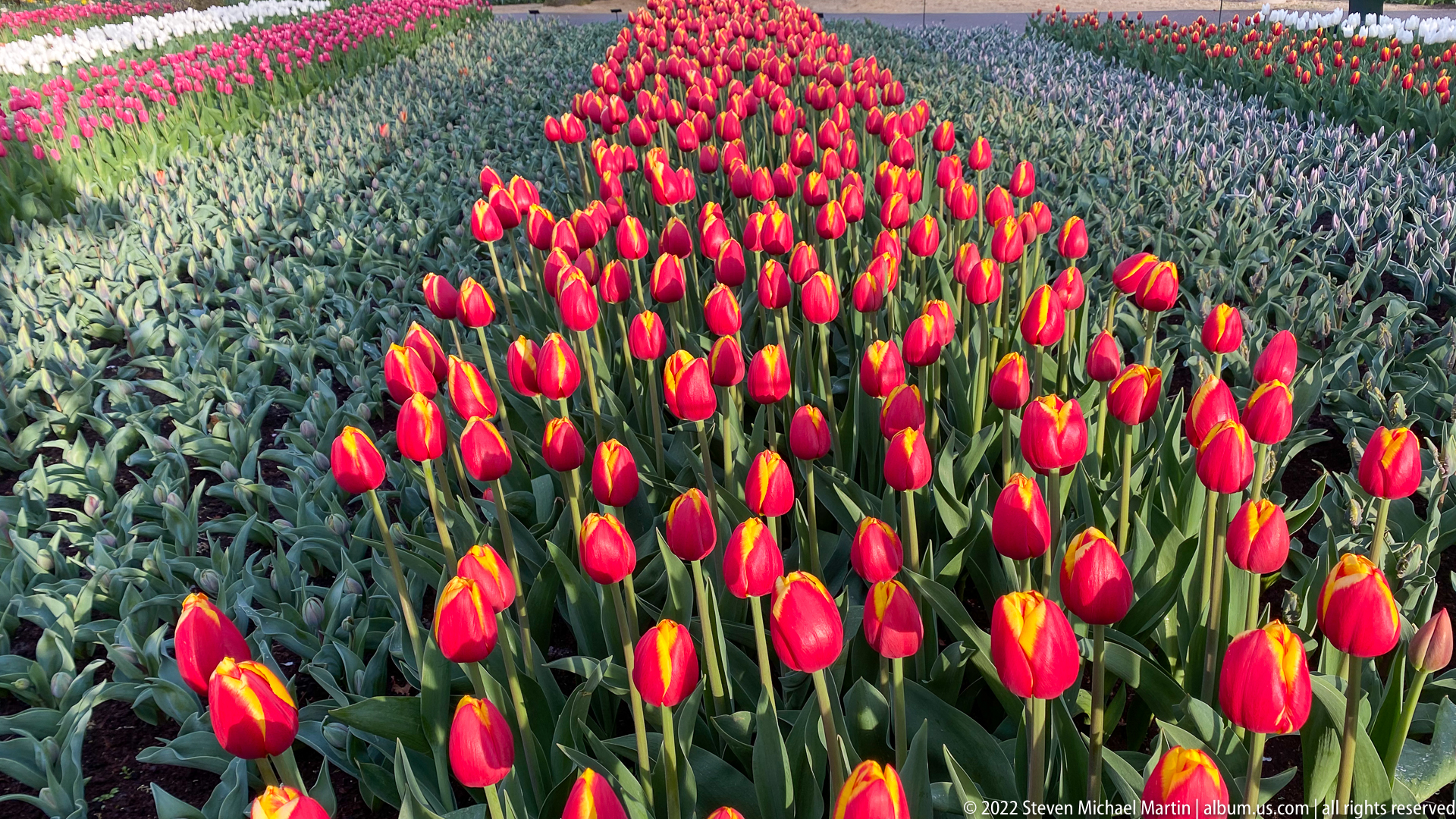
A compact bed of red tulips rises from a broader field of gray-green bulb foliage, each bloom accented by narrow yellow margins along the petal edges. The close, slightly elevated viewpoint isolates the vivid bicolor flowers from the surrounding unflowered plants. Their repeated red-and-yellow pattern produces a concentrated block of color within the larger seasonal planting.
Caption
A compact bed of red tulips rises from a broader field of gray-green bulb foliage, each bloom accented by narrow yellow margins along the petal edges. The close, slightly elevated viewpoint isolates the vivid bicolor flowers from the surrounding unflowered plants. Their repeated red-and-yellow pattern produces a concentrated block of color within the larger seasonal planting.

Long rectangular beds of white, pink, and red tulips extend through an open garden beneath mature trees, separated by darker stretches of emerging bulb foliage. The central bands draw the eye toward a landscaped focal area in the distance, while repeated rows create a disciplined formal rhythm. This broad view records the scale of Keukenhof's bed planning rather than concentrating on individual flowers.
Caption
Long rectangular beds of white, pink, and red tulips extend through an open garden beneath mature trees, separated by darker stretches of emerging bulb foliage. The central bands draw the eye toward a landscaped focal area in the distance, while repeated rows create a disciplined formal rhythm. This broad view records the scale of Keukenhof's bed planning rather than concentrating on individual flowers.
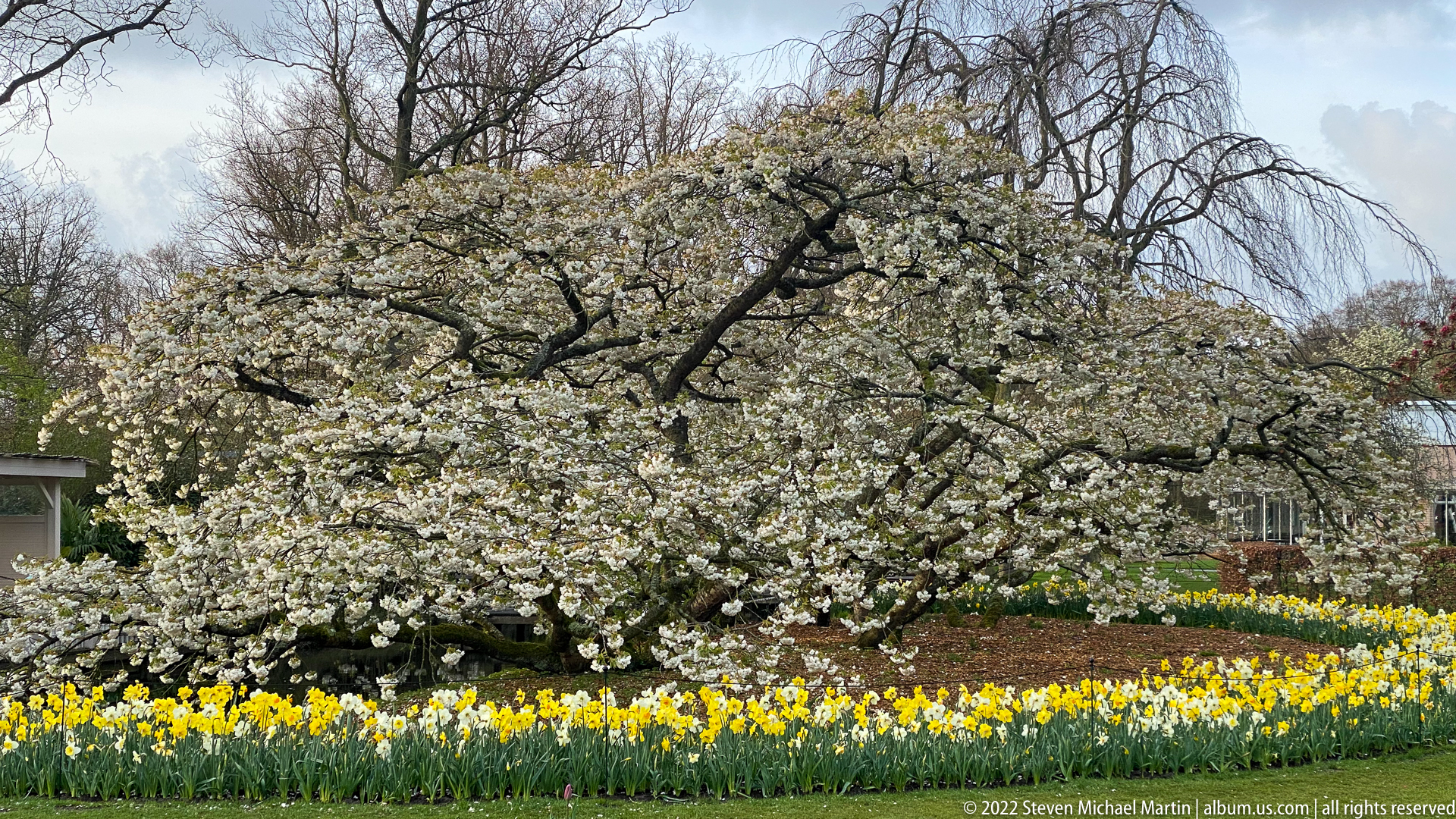
A low, spreading tree covered in white blossoms dominates the garden, its twisting dark branches forming a wide canopy above a border of yellow-and-white daffodils. A taller weeping tree rises behind it, adding a contrasting vertical silhouette. The composition shifts attention from bulb beds to spring-flowering woody plants while retaining Keukenhof's layered seasonal planting as context.
Caption
A low, spreading tree covered in white blossoms dominates the garden, its twisting dark branches forming a wide canopy above a border of yellow-and-white daffodils. A taller weeping tree rises behind it, adding a contrasting vertical silhouette. The composition shifts attention from bulb beds to spring-flowering woody plants while retaining Keukenhof's layered seasonal planting as context.
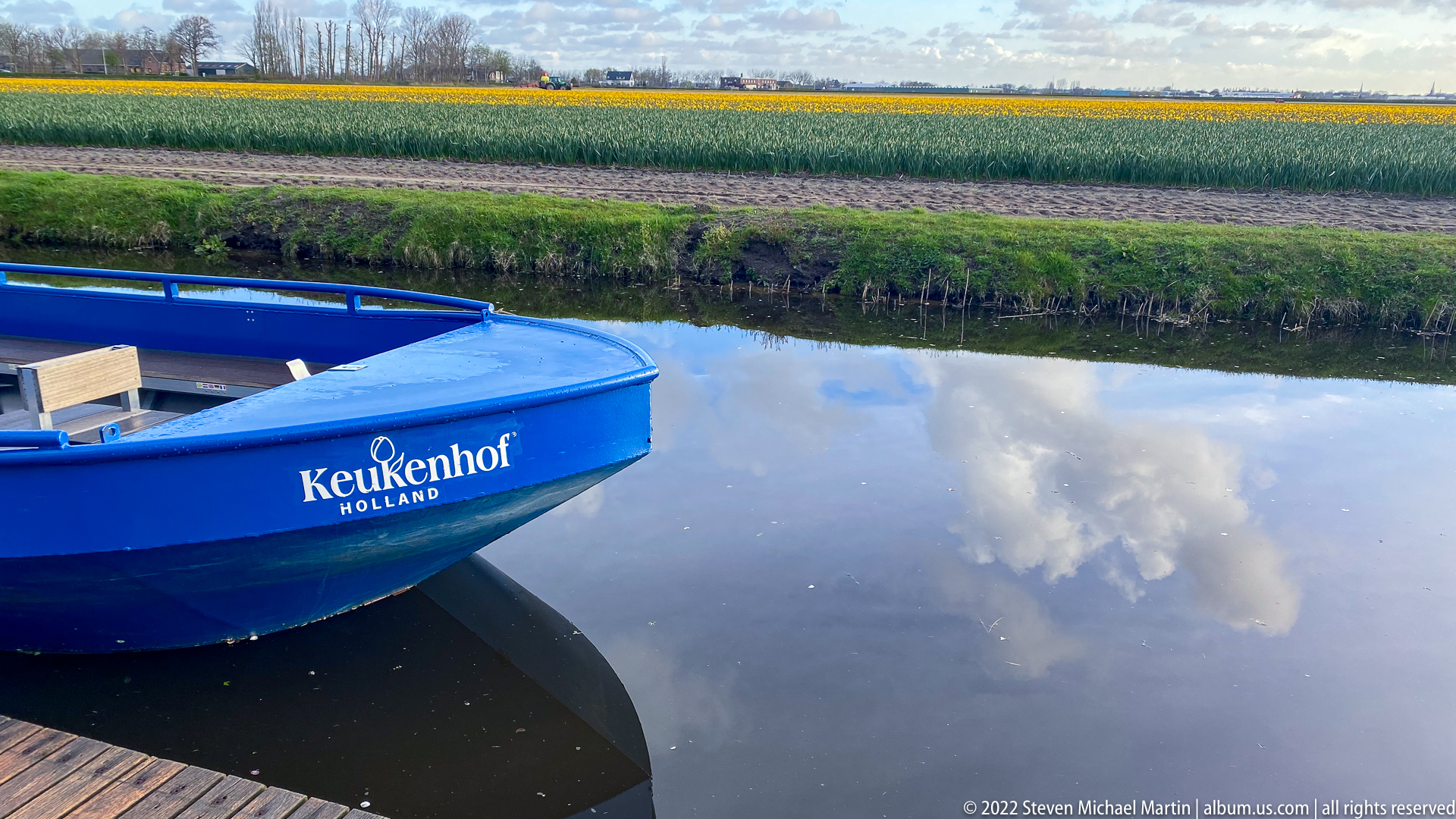
A bright blue boat marked “Keukenhof Holland” rests at the edge of a narrow canal, its bow projecting into still water that reflects clouds overhead. Across the canal, long horizontal bands of bulb fields stretch toward the horizon in yellow, purple, and green. The juxtaposition links Keukenhof's visitor landscape to the commercial-scale flower-growing countryside surrounding the gardens.
Caption
A bright blue boat marked “Keukenhof Holland” rests at the edge of a narrow canal, its bow projecting into still water that reflects clouds overhead. Across the canal, long horizontal bands of bulb fields stretch toward the horizon in yellow, purple, and green. The juxtaposition links Keukenhof's visitor landscape to the commercial-scale flower-growing countryside surrounding the gardens.
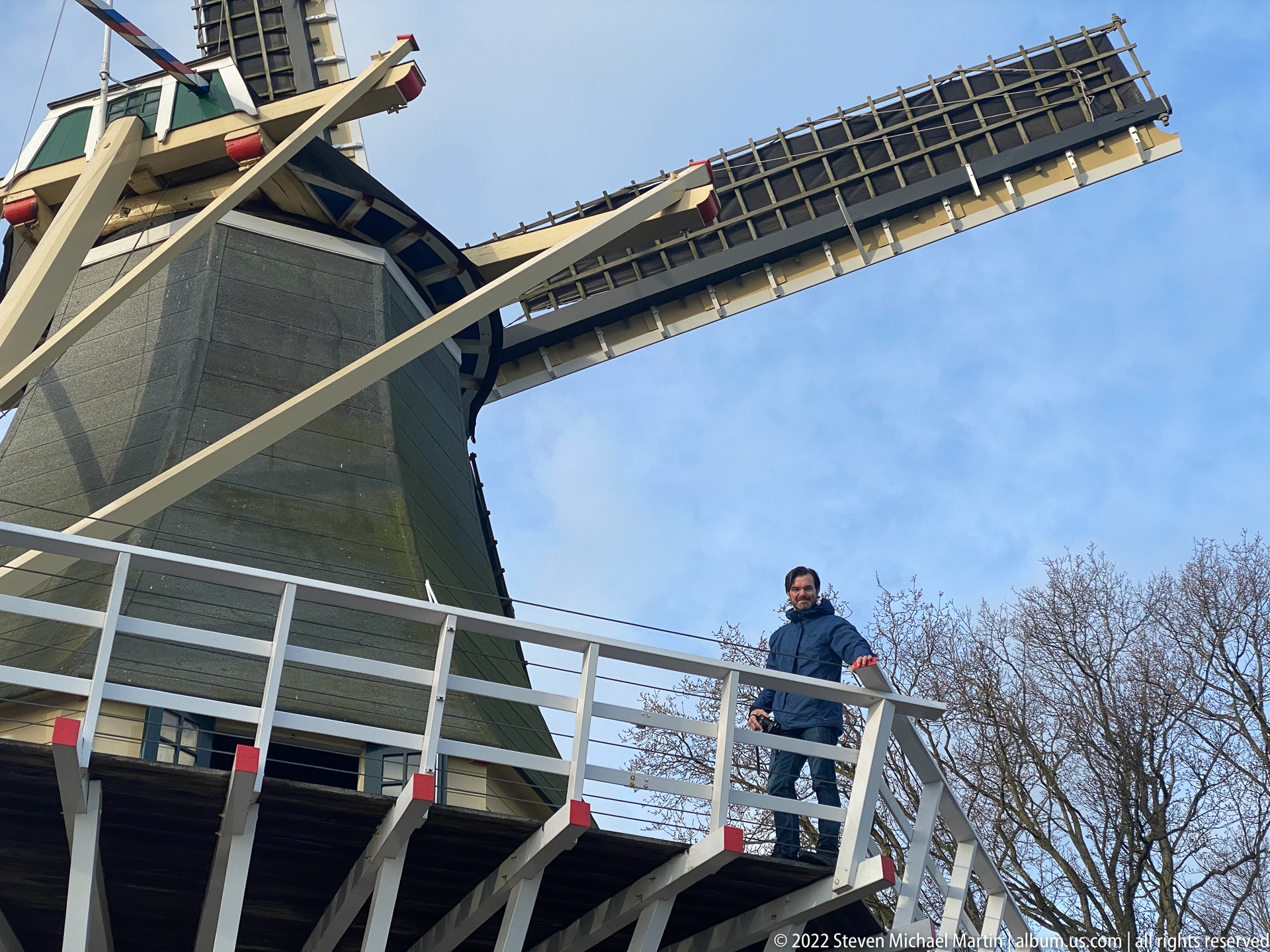
A low-angle view looks up at the Keukenhof windmill from beside its raised gallery, where a visitor stands behind the white railing. One sail stretches diagonally overhead against the blue sky, while the tapered dark mill body and pale structural braces fill most of the frame. The close perspective emphasizes the construction and scale of the mill rather than the surrounding flower gardens.
Caption
A low-angle view looks up at the Keukenhof windmill from beside its raised gallery, where a visitor stands behind the white railing. One sail stretches diagonally overhead against the blue sky, while the tapered dark mill body and pale structural braces fill most of the frame. The close perspective emphasizes the construction and scale of the mill rather than the surrounding flower gardens.
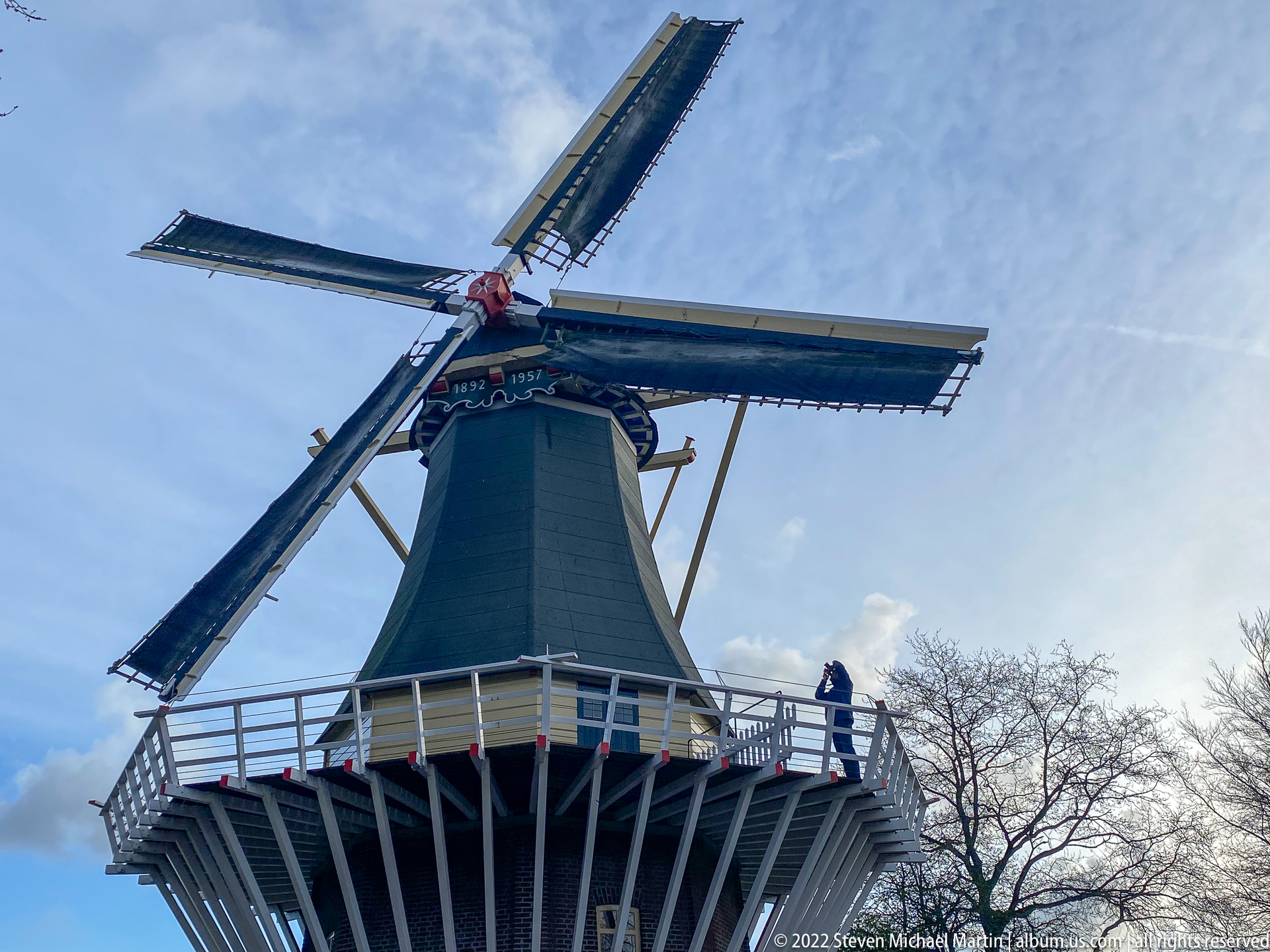
The Keukenhof windmill is viewed from below with all four sails spread dramatically across a lightly clouded sky. Its dark, tapering body rises above the broad white-railed gallery, where a visitor is visible near the edge. The centered upward composition isolates the mill's distinctive silhouette and mechanical form, offering a more symmetrical architectural portrait than the adjacent oblique detail.
Caption
The Keukenhof windmill is viewed from below with all four sails spread dramatically across a lightly clouded sky. Its dark, tapering body rises above the broad white-railed gallery, where a visitor is visible near the edge. The centered upward composition isolates the mill's distinctive silhouette and mechanical form, offering a more symmetrical architectural portrait than the adjacent oblique detail.
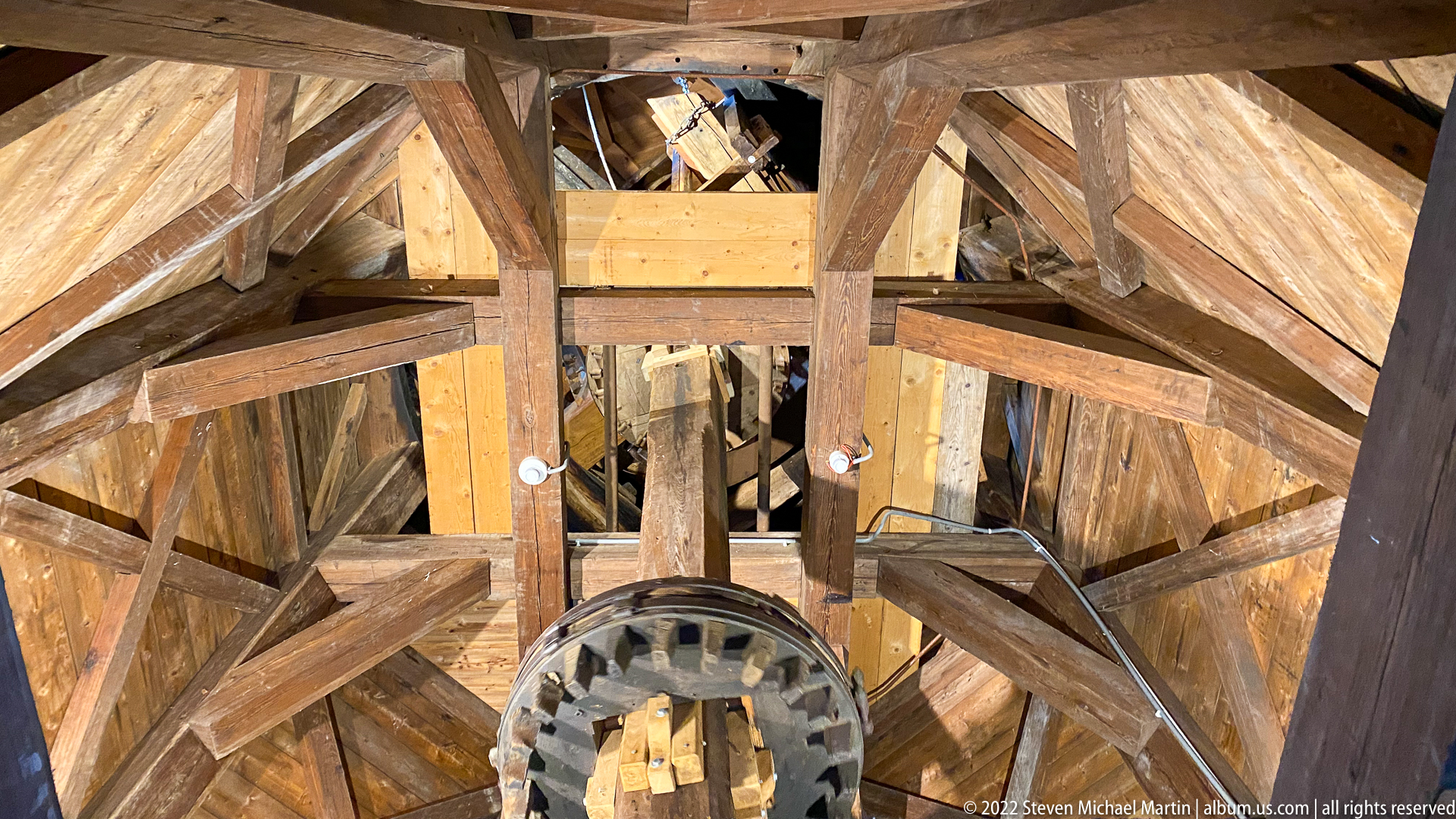
Heavy timber framing surrounds the exposed internal machinery of the Keukenhof windmill, where a large toothed wheel and adjoining wooden shafts transfer motion through the structure. Angled braces, pegged joints, and newer pale reinforcement timbers reveal both the traditional construction and later stabilization of the mechanism. The close interior view shifts attention from the windmill’s familiar exterior silhouette to the engineering that makes its sails and gearing function.
Caption
Heavy timber framing surrounds the exposed internal machinery of the Keukenhof windmill, where a large toothed wheel and adjoining wooden shafts transfer motion through the structure. Angled braces, pegged joints, and newer pale reinforcement timbers reveal both the traditional construction and later stabilization of the mechanism. The close interior view shifts attention from the windmill’s familiar exterior silhouette to the engineering that makes its sails and gearing function.

A rusted red Volkswagen Beetle has been transformed into a garden installation, with purple flowers filling the open front compartment and spring bulbs surrounding the body. The driver’s door stands open while narcissus and other white and yellow blooms rise around the wheels and fenders. Weathered paint, missing front fittings, and dense planting turn the familiar automobile into a deliberately picturesque object within the garden.
Caption
A rusted red Volkswagen Beetle has been transformed into a garden installation, with purple flowers filling the open front compartment and spring bulbs surrounding the body. The driver’s door stands open while narcissus and other white and yellow blooms rise around the wheels and fenders. Weathered paint, missing front fittings, and dense planting turn the familiar automobile into a deliberately picturesque object within the garden.

Dense spikes of blue grape hyacinths fill the foreground, threaded with taller yellow narcissus whose narrow petals and trumpet centers rise above the blue mass. The contrasting flower forms create a layered planting: compact bead-like clusters below and scattered star-shaped yellow blooms above. The close view isolates Keukenhof’s use of complementary color and height within a mixed spring bulb bed.
Caption
Dense spikes of blue grape hyacinths fill the foreground, threaded with taller yellow narcissus whose narrow petals and trumpet centers rise above the blue mass. The contrasting flower forms create a layered planting: compact bead-like clusters below and scattered star-shaped yellow blooms above. The close view isolates Keukenhof’s use of complementary color and height within a mixed spring bulb bed.
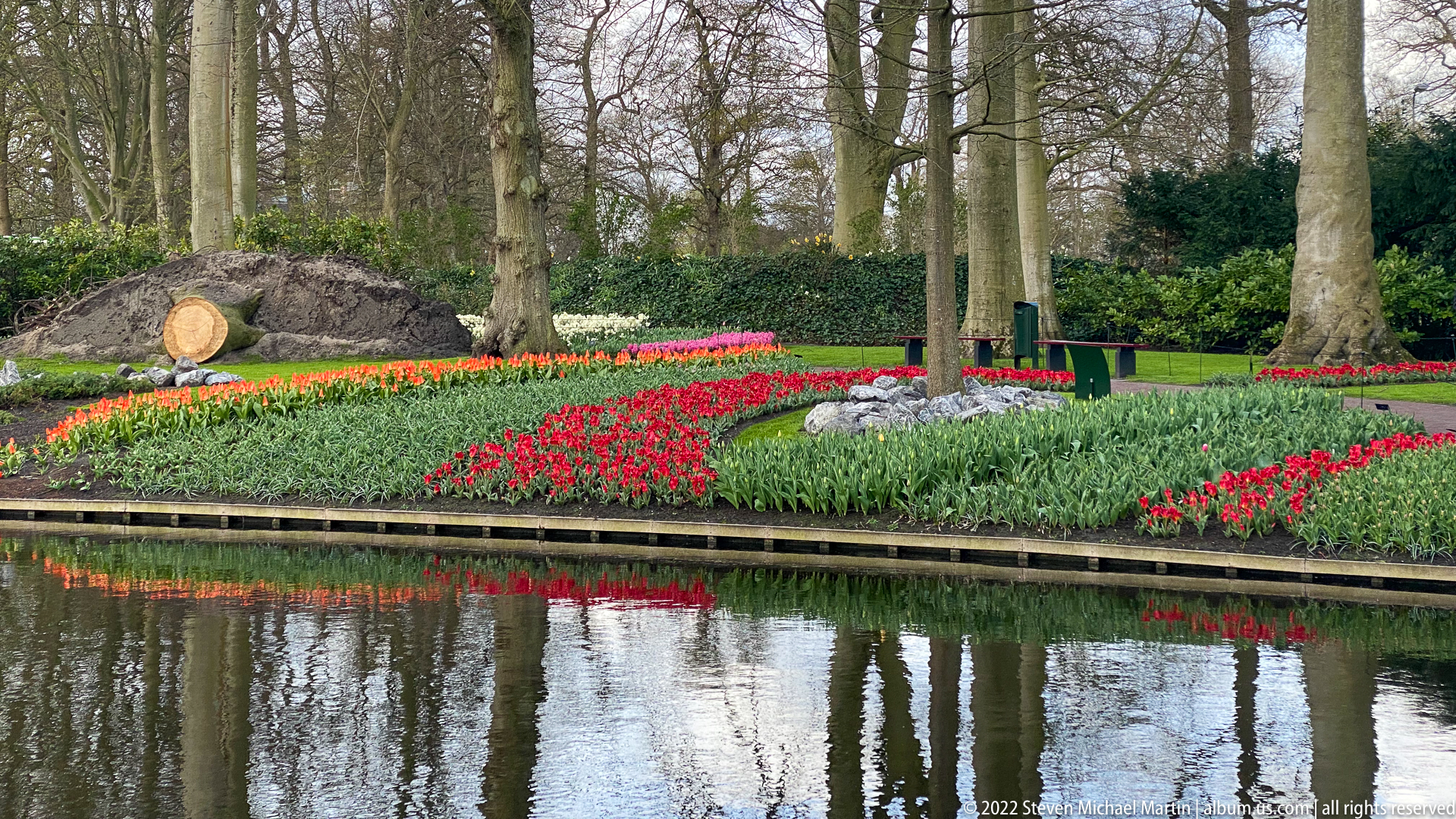
Bands of red and orange tulips follow the far bank of a narrow canal, their colors doubled in the still water below. A large freshly cut tree trunk rests behind the flower beds among mature trees and shrubbery, introducing a rough natural form against the carefully organized planting. The low viewpoint uses the reflection to extend the tulip display vertically across the composition.
Caption
Bands of red and orange tulips follow the far bank of a narrow canal, their colors doubled in the still water below. A large freshly cut tree trunk rests behind the flower beds among mature trees and shrubbery, introducing a rough natural form against the carefully organized planting. The low viewpoint uses the reflection to extend the tulip display vertically across the composition.
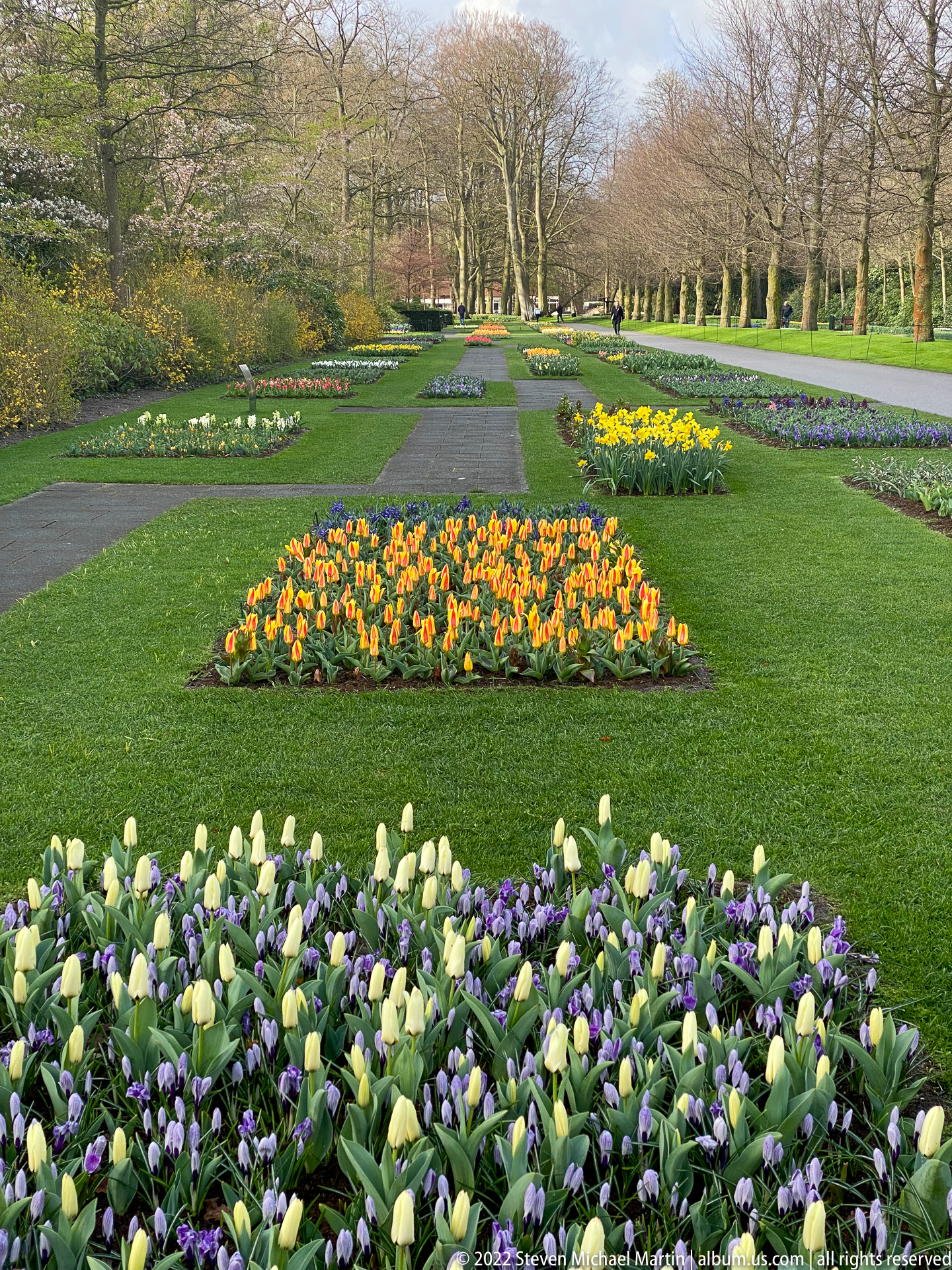
Geometric spring flower beds are arranged symmetrically around a straight central path, with orange tulips occupying the middle distance and pale yellow, purple, and white plantings layered closer to the camera. Broad clipped lawns separate the beds, while mature leafless trees create a wooded frame beyond. The formal axial composition makes the garden’s spatial planning as prominent as the flowers themselves.
Caption
Geometric spring flower beds are arranged symmetrically around a straight central path, with orange tulips occupying the middle distance and pale yellow, purple, and white plantings layered closer to the camera. Broad clipped lawns separate the beds, while mature leafless trees create a wooded frame beyond. The formal axial composition makes the garden’s spatial planning as prominent as the flowers themselves.

A visitor crouches at the edge of a flower bed to photograph a low band of pale yellow blooms, with a dense magenta row immediately behind. The brick path and additional red, white, and coral beds extend through the wooded garden beyond. Human activity becomes the principal subject here, showing the close viewing and low-angle photography encouraged by Keukenhof’s tightly arranged spring displays.
Caption
A visitor crouches at the edge of a flower bed to photograph a low band of pale yellow blooms, with a dense magenta row immediately behind. The brick path and additional red, white, and coral beds extend through the wooded garden beyond. Human activity becomes the principal subject here, showing the close viewing and low-angle photography encouraged by Keukenhof’s tightly arranged spring displays.
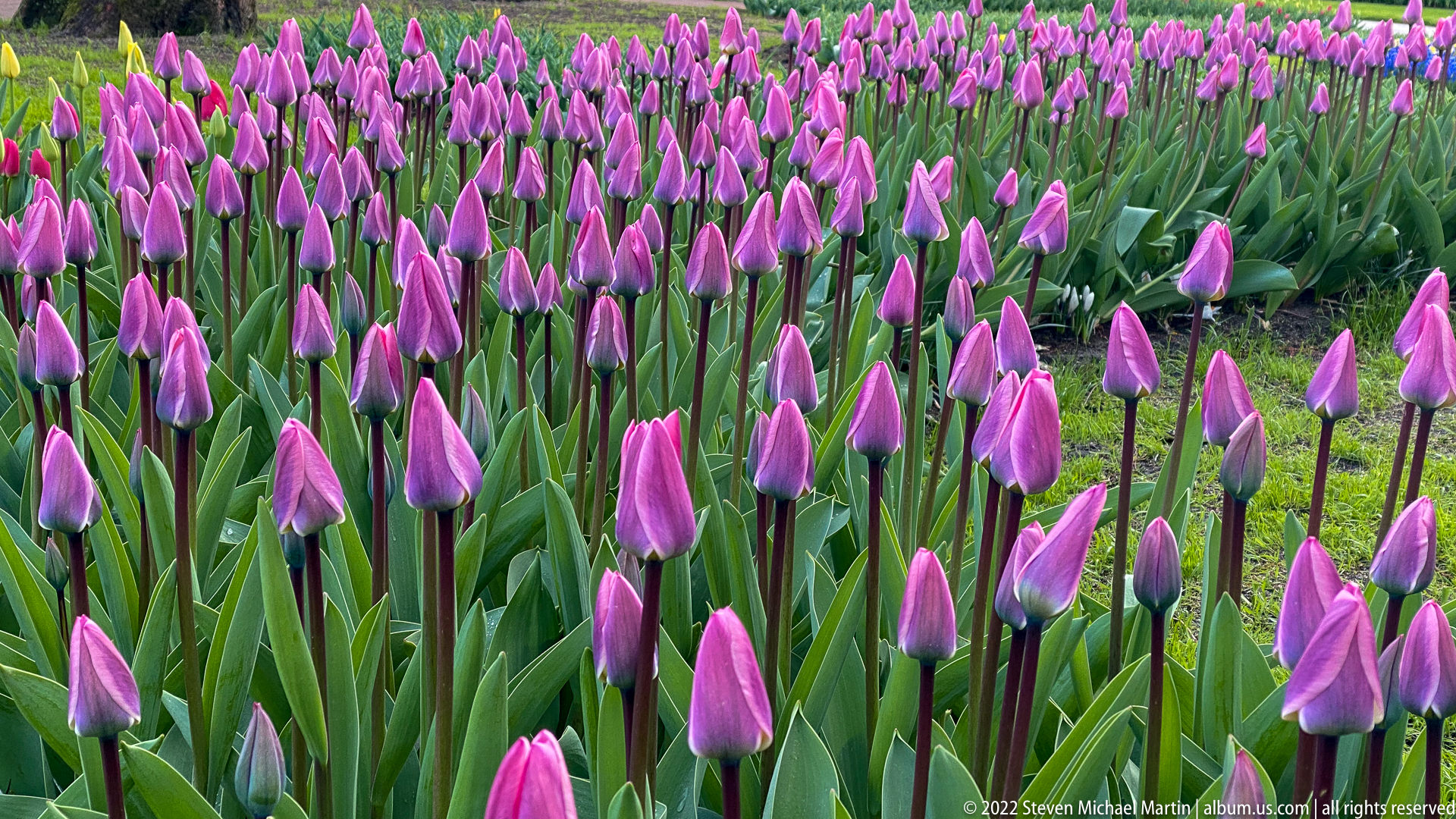
Rows of purple tulips fill the frame at close range, most still held in elongated buds while a few petals begin to loosen near the tops. Upright blue-green leaves form a dense vertical screen beneath the flowers, and a narrow path or bed edge appears between plantings. The restrained stage of bloom gives this view a different texture from Keukenhof’s fully opened, color-saturated tulip displays.
Caption
Rows of purple tulips fill the frame at close range, most still held in elongated buds while a few petals begin to loosen near the tops. Upright blue-green leaves form a dense vertical screen beneath the flowers, and a narrow path or bed edge appears between plantings. The restrained stage of bloom gives this view a different texture from Keukenhof’s fully opened, color-saturated tulip displays.