The Hague – Netherlands
The city of The Hague (Den Haag) lies along the North Sea coast in western Netherlands and serves as the seat of the Dutch government. Although Amsterdam is the official capital, The Hague functions as the country’s political center.
At the heart of the city stands the Binnenhof, a historic complex of medieval buildings surrounding a central courtyard and reflecting pond. The complex houses the Dutch parliament and has been the center of government in the Netherlands for centuries.
The Hague is also internationally known as a center for diplomacy and international law, hosting institutions such as the International Court of Justice.
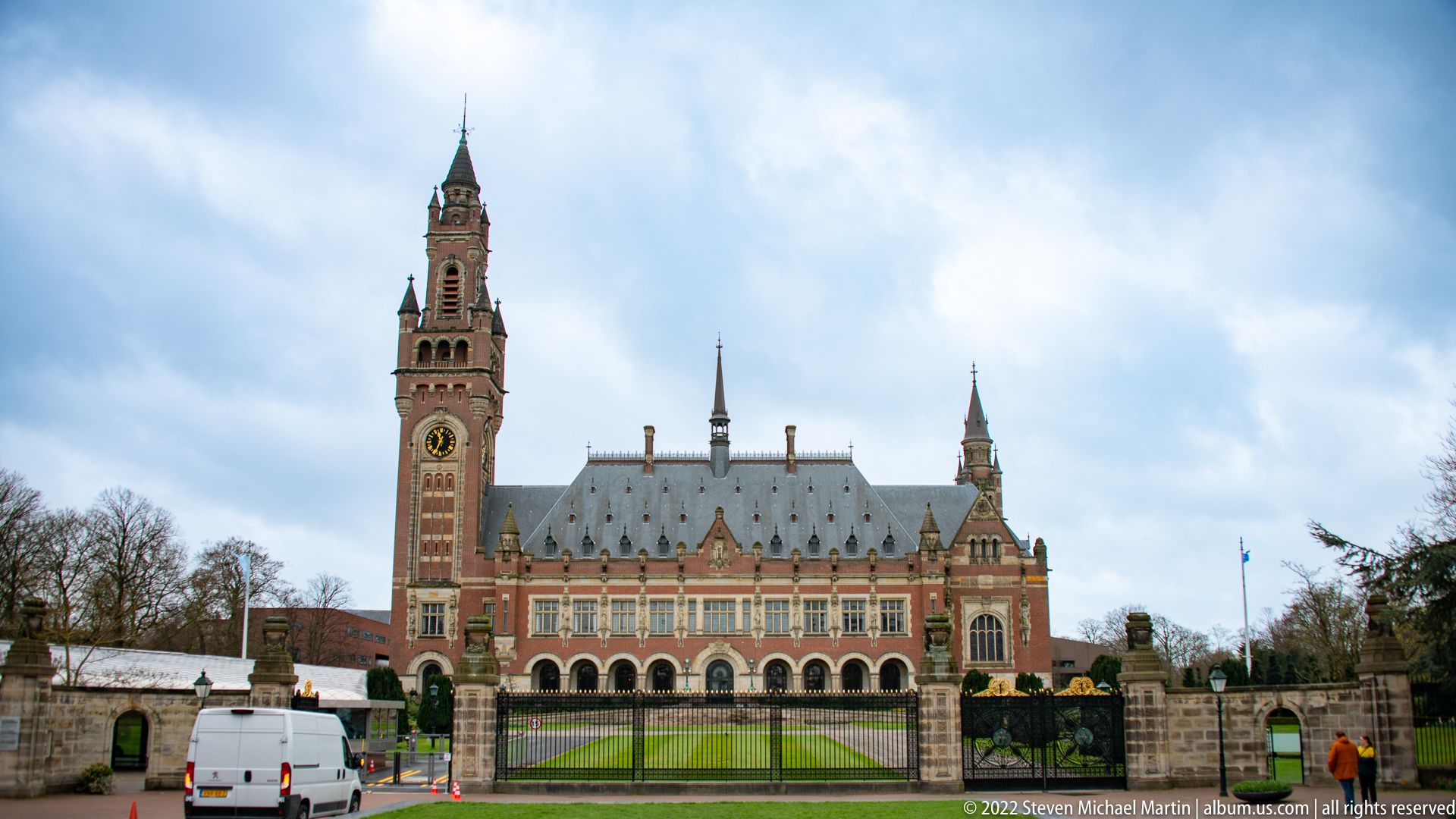
The Peace Palace rises behind its perimeter gate, with the tall clock tower anchoring the asymmetrical red-brick façade and steep slate roof. Pointed rooflines, arched openings, and stone trim give the complex a strongly historicist profile. The broad lawn and gated forecourt emphasize the building’s formal institutional setting in The Hague.
Caption
The Peace Palace rises behind its perimeter gate, with the tall clock tower anchoring the asymmetrical red-brick façade and steep slate roof. Pointed rooflines, arched openings, and stone trim give the complex a strongly historicist profile. The broad lawn and gated forecourt emphasize the building’s formal institutional setting in The Hague.
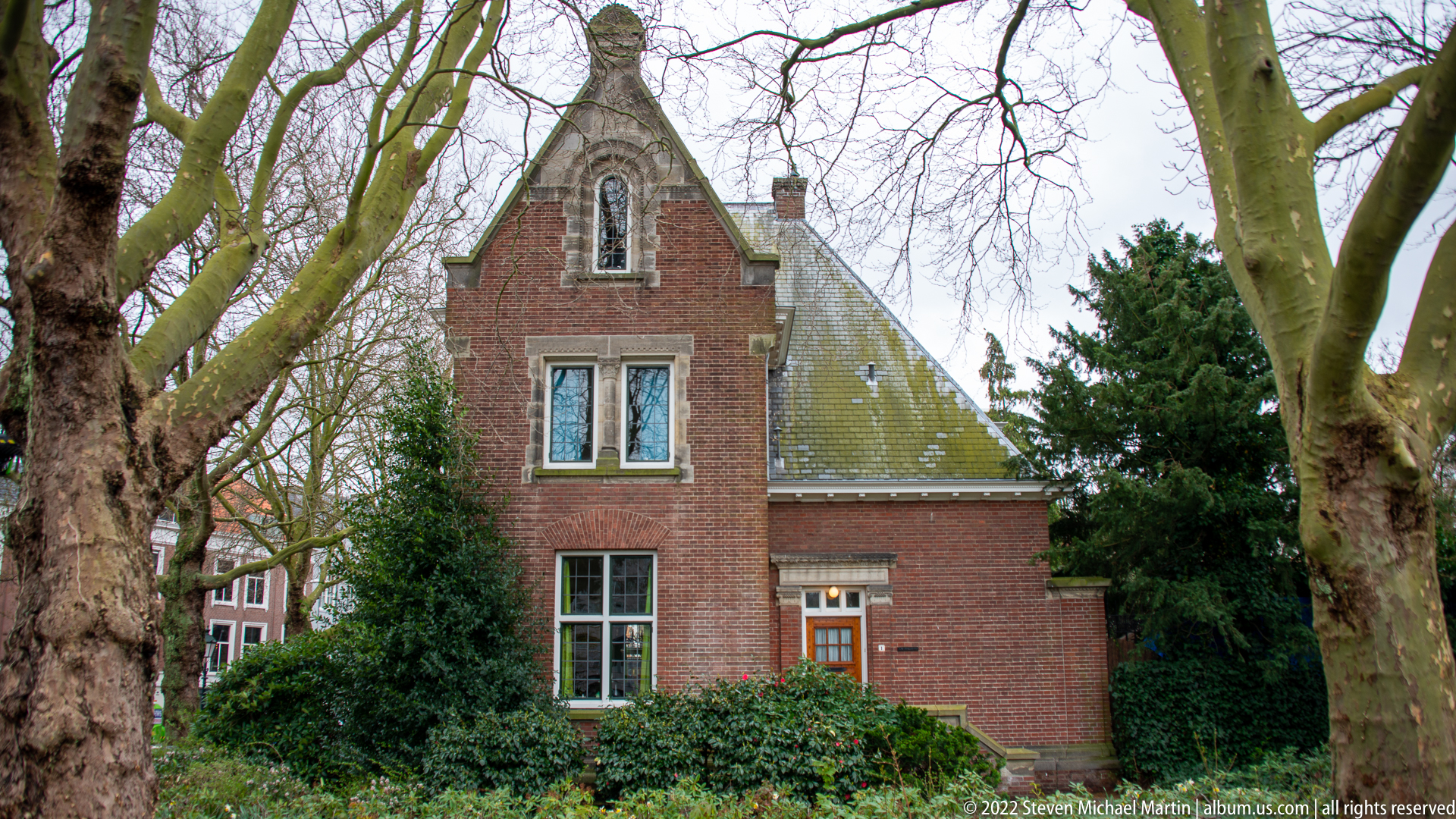
A compact brick building stands among mature trees and dense plantings within the Peace Palace grounds. Its steep roof, stepped or shaped gable, tall narrow windows, and restrained stone trim give it a domestic scale compared with the main palace. The surrounding vegetation and off-axis viewpoint emphasize its quieter, ancillary role within the larger complex.
Caption
A compact brick building stands among mature trees and dense plantings within the Peace Palace grounds. Its steep roof, stepped or shaped gable, tall narrow windows, and restrained stone trim give it a domestic scale compared with the main palace. The surrounding vegetation and off-axis viewpoint emphasize its quieter, ancillary role within the larger complex.
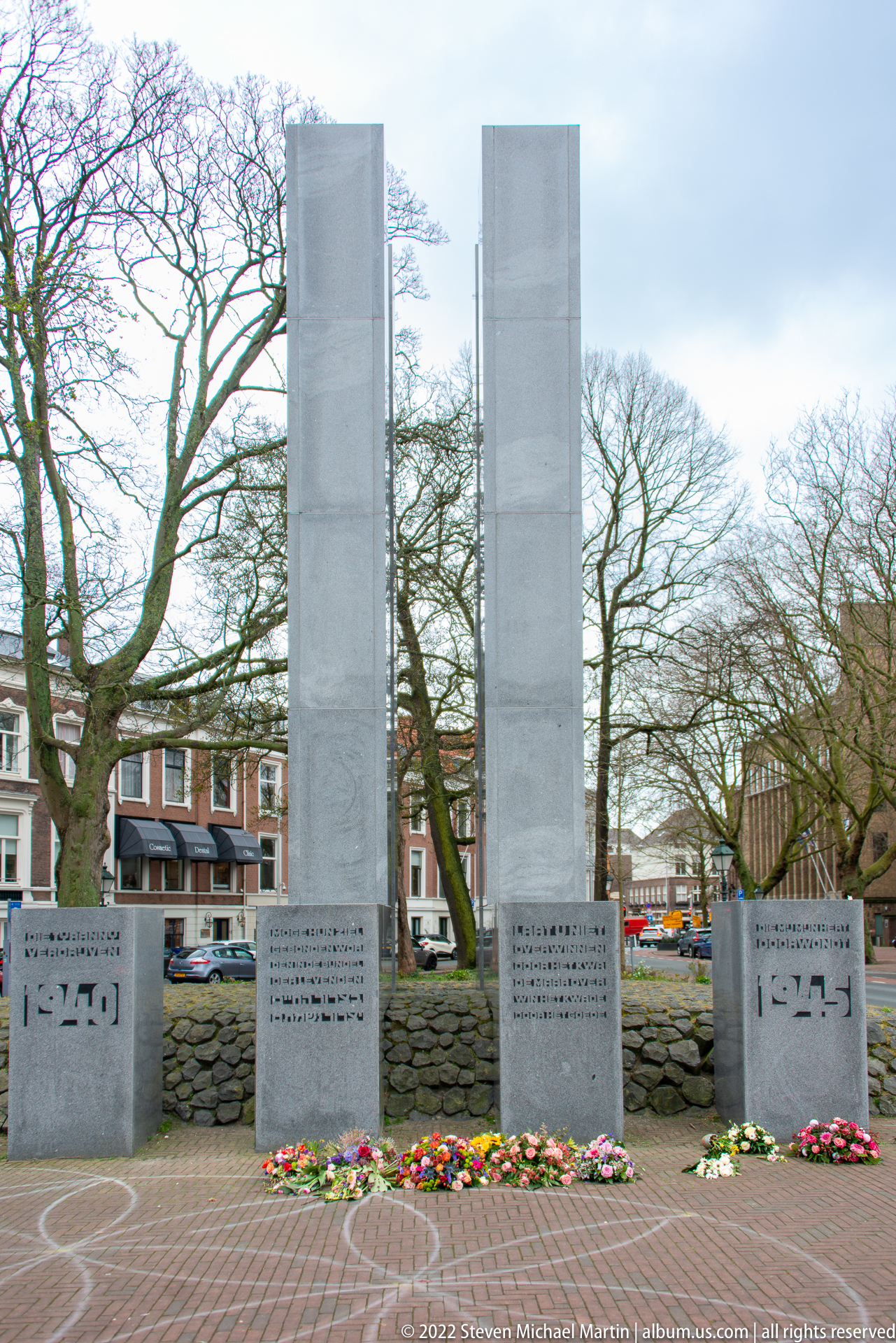
Seen squarely from the front, the memorial presents a row of lower inscribed stone blocks beneath three prominent upright slabs. Fresh flowers line the paved forecourt, and leafless trees frame the composition. The more symmetrical viewpoint clarifies the monument’s arrangement and its relationship to the surrounding residential streetscape.
Caption
Seen squarely from the front, the memorial presents a row of lower inscribed stone blocks beneath three prominent upright slabs. Fresh flowers line the paved forecourt, and leafless trees frame the composition. The more symmetrical viewpoint clarifies the monument’s arrangement and its relationship to the surrounding residential streetscape.
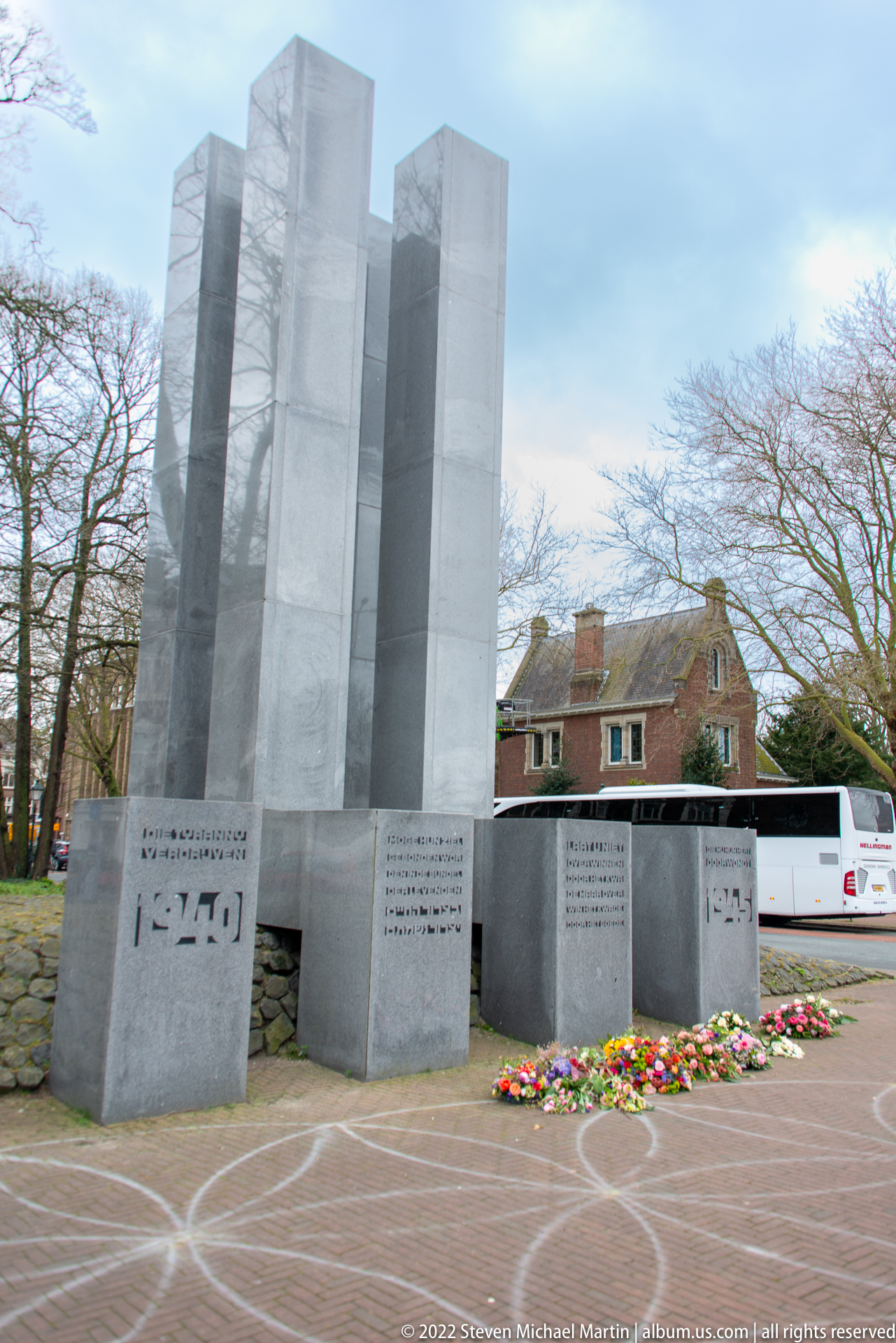
A modern memorial in The Hague is formed from several tall, pale stone slabs rising behind lower inscribed blocks. Bouquets laid along the base give the site an active commemorative character, while mature trees and nearby residences place the monument within an urban neighborhood rather than an isolated memorial precinct.
Caption
A modern memorial in The Hague is formed from several tall, pale stone slabs rising behind lower inscribed blocks. Bouquets laid along the base give the site an active commemorative character, while mature trees and nearby residences place the monument within an urban neighborhood rather than an isolated memorial precinct.
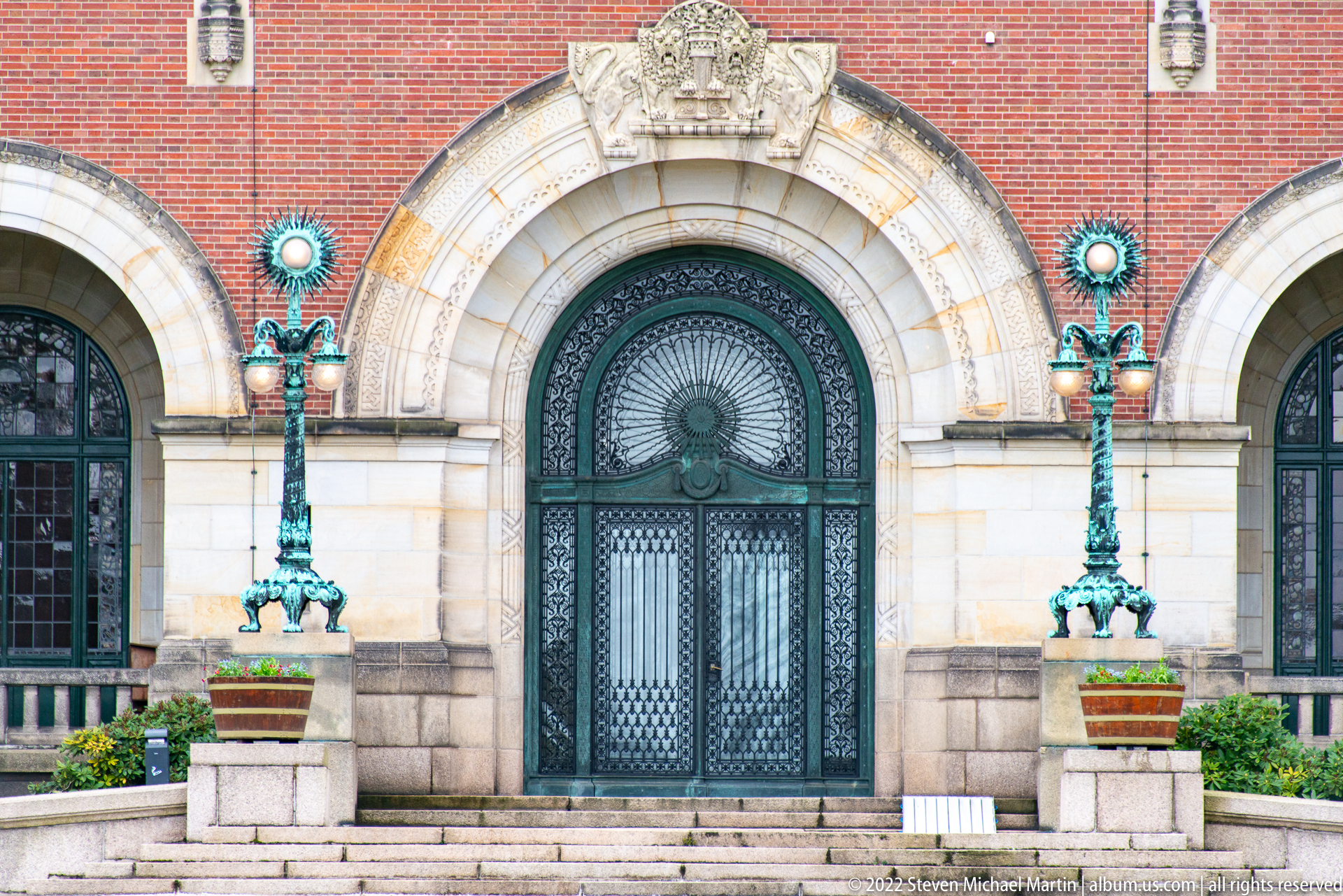
The Peace Palace entrance is shown at closer range, centering the dark metal door beneath a deep stone arch. Two ornate lamp standards with turquoise-green patina stand symmetrically on either side, while carved stone ornament crowns the arch. The tighter framing highlights the ceremonial character of the doorway and the contrast between pale masonry and red brick.
Caption
The Peace Palace entrance is shown at closer range, centering the dark metal door beneath a deep stone arch. Two ornate lamp standards with turquoise-green patina stand symmetrically on either side, while carved stone ornament crowns the arch. The tighter framing highlights the ceremonial character of the doorway and the contrast between pale masonry and red brick.
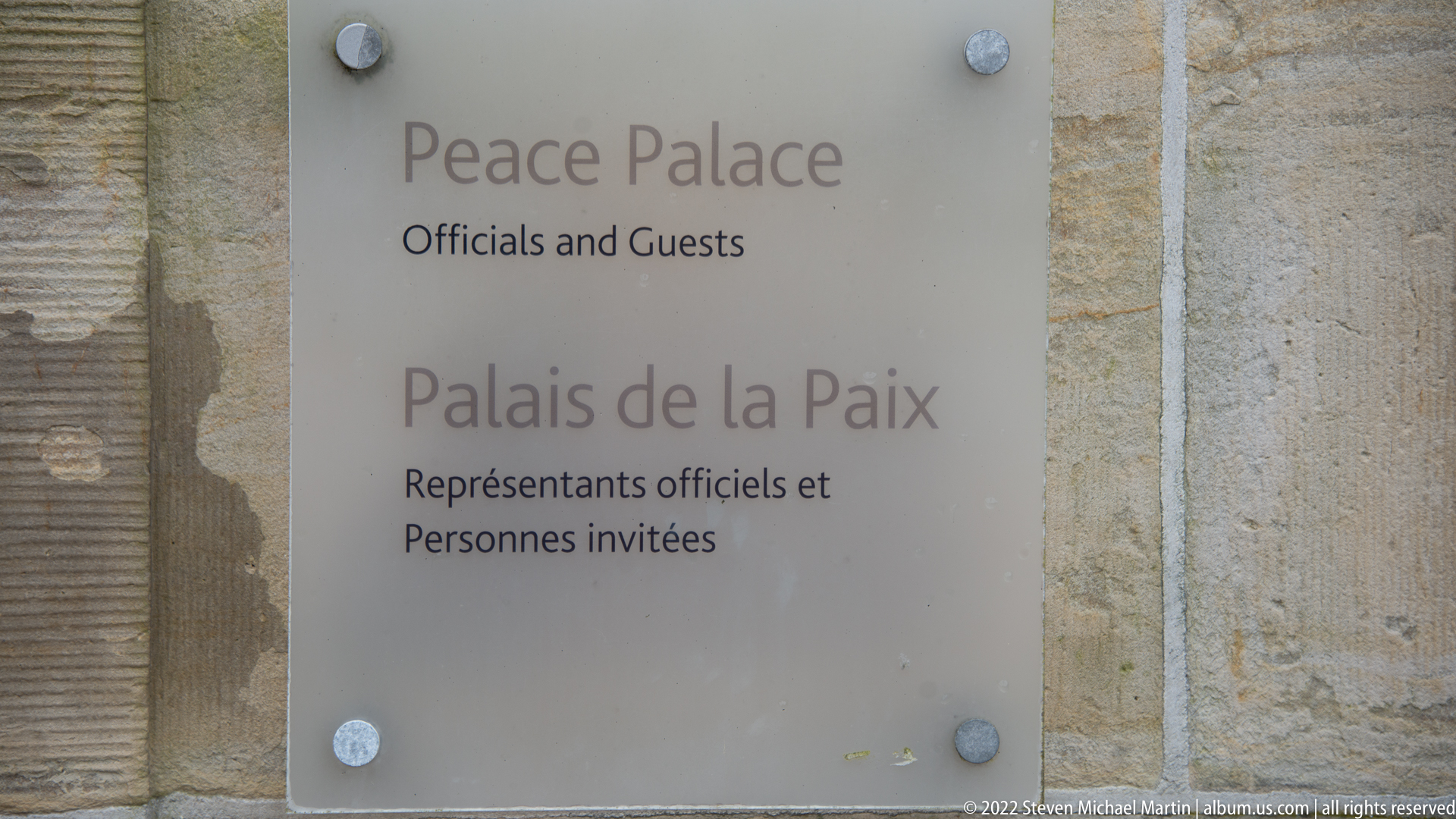
A brushed-metal sign mounted on a stone wall marks access for “Peace Palace Officials and Guests,” with the same instruction repeated in French as “Palais de la Paix.” The bilingual wording provides direct on-site confirmation of the location and reflects the international institutional character of the complex.
Caption
A brushed-metal sign mounted on a stone wall marks access for “Peace Palace Officials and Guests,” with the same instruction repeated in French as “Palais de la Paix.” The bilingual wording provides direct on-site confirmation of the location and reflects the international institutional character of the complex.
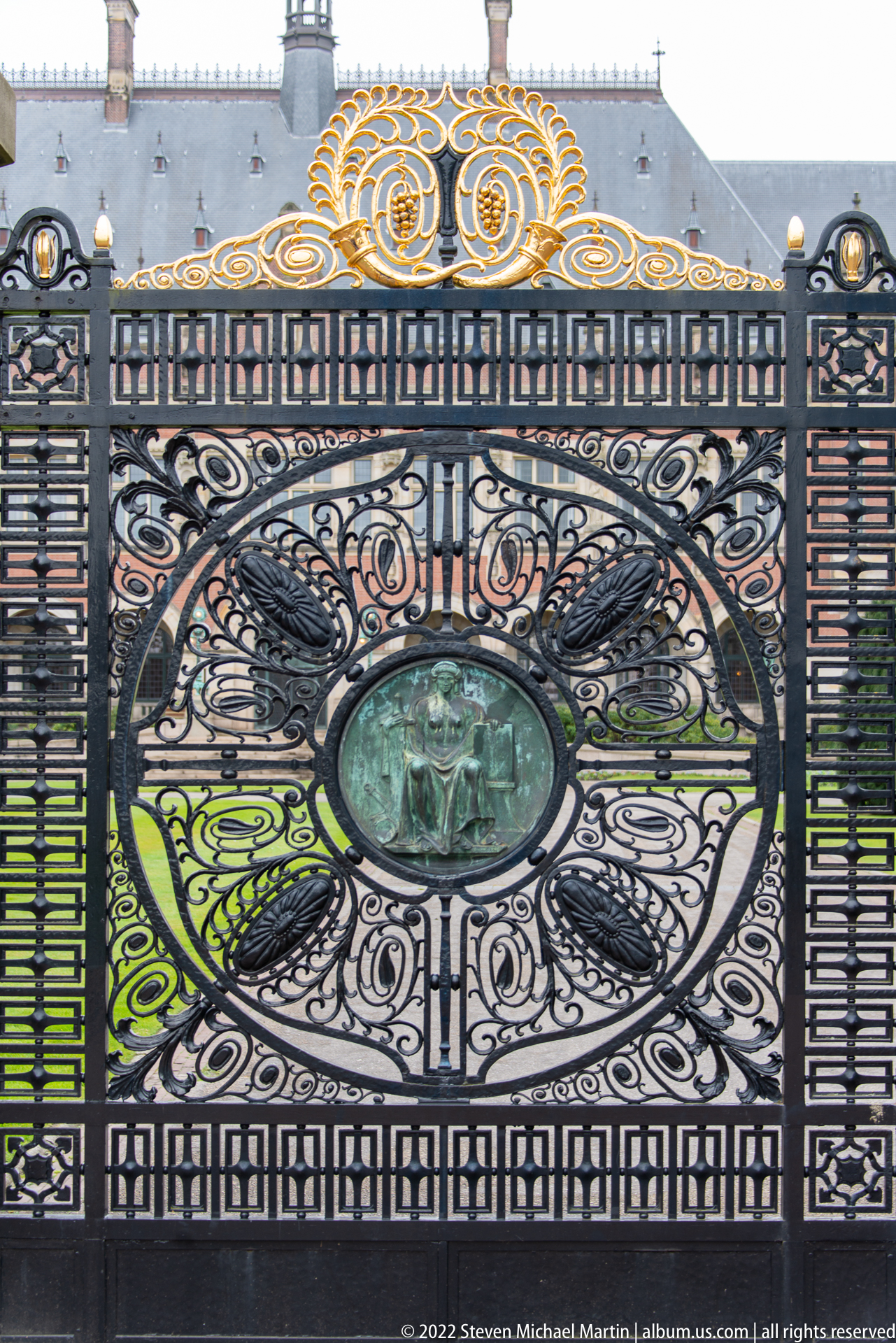
The central panel of the Peace Palace gate combines dense black iron scrollwork with a green-patinated oval medallion and a prominent gilded crest above. Repeating geometric borders organize the otherwise fluid metalwork. Framed tightly, the view documents the layered materials and decorative hierarchy of the ceremonial entrance rather than the palace architecture behind it.
Caption
The central panel of the Peace Palace gate combines dense black iron scrollwork with a green-patinated oval medallion and a prominent gilded crest above. Repeating geometric borders organize the otherwise fluid metalwork. Framed tightly, the view documents the layered materials and decorative hierarchy of the ceremonial entrance rather than the palace architecture behind it.
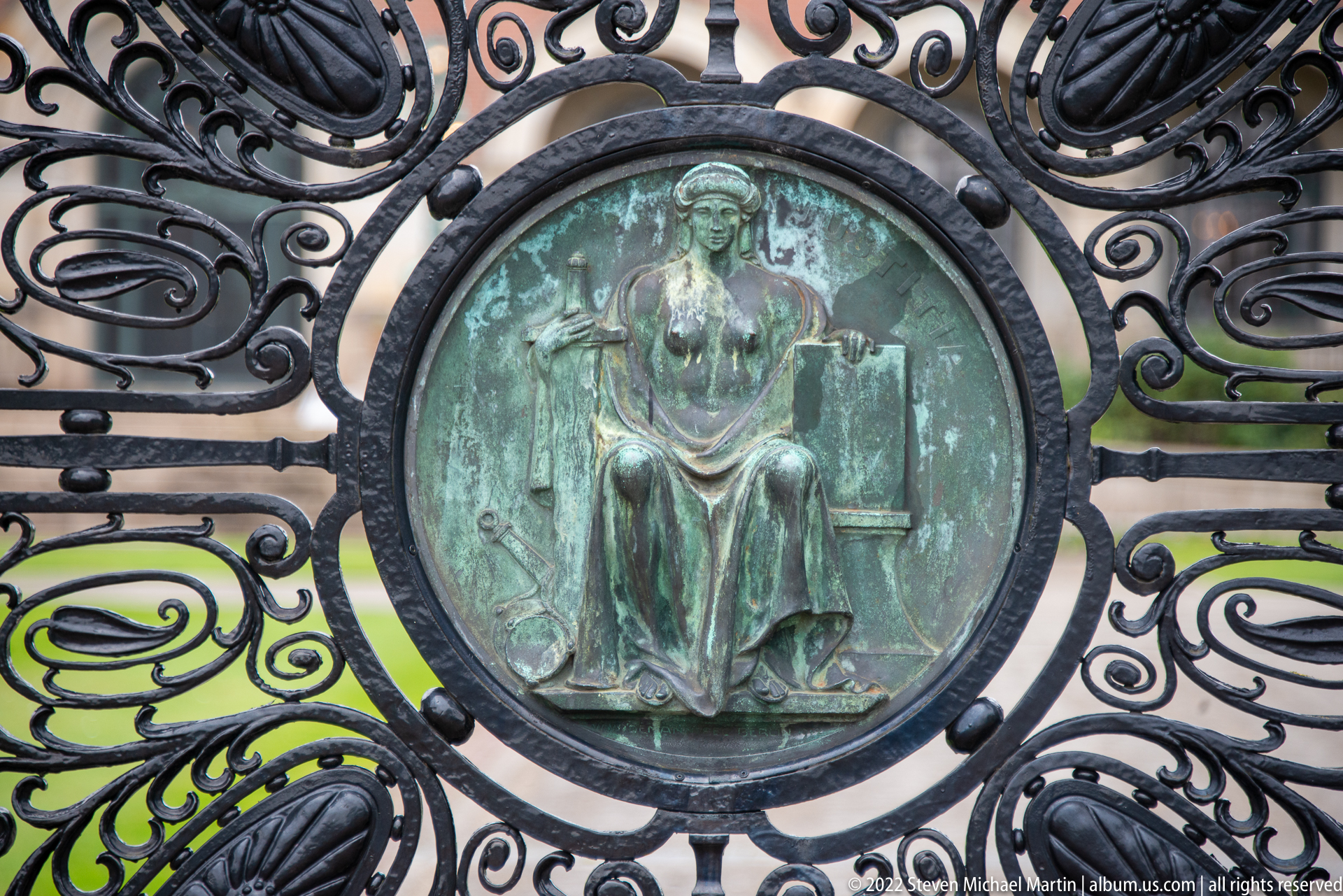
A circular bronze medallion set into the Peace Palace gate shows a seated female figure modeled in relief, surrounded by tightly curling black ironwork. Weathered green patina softens the bronze surface and brings out the raised contours of the figure. The close detail isolates one element of the entrance’s larger decorative program.
Caption
A circular bronze medallion set into the Peace Palace gate shows a seated female figure modeled in relief, surrounded by tightly curling black ironwork. Weathered green patina softens the bronze surface and brings out the raised contours of the figure. The close detail isolates one element of the entrance’s larger decorative program.
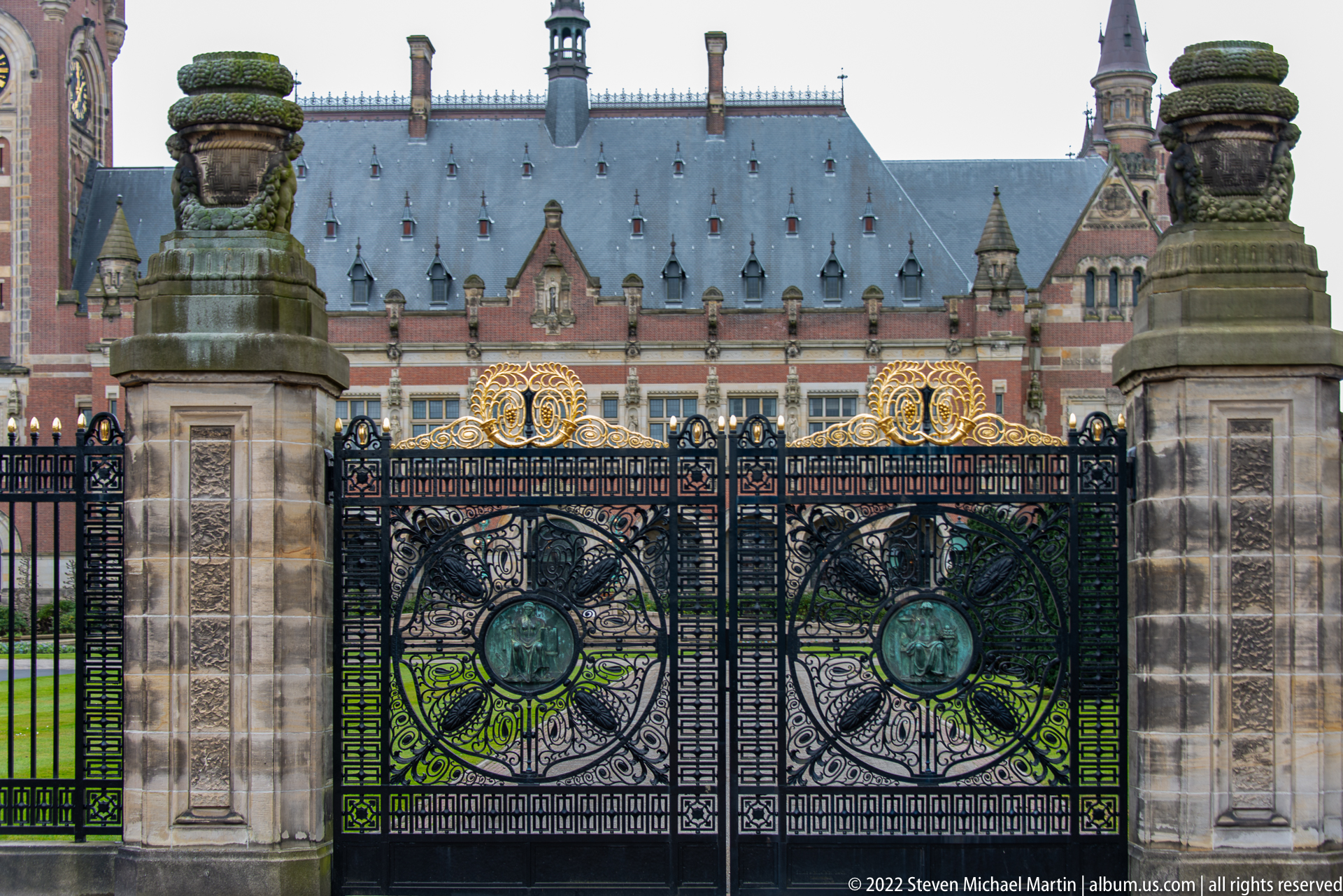
Ornamental wrought-iron gates fill the foreground of the Peace Palace entrance, their black scrollwork enriched with gilded crests and circular bronze medallions. Massive stone gate piers frame the opening, while the palace roof and upper façade appear beyond. The close view shifts attention from the building itself to the ceremonial craftsmanship of its boundary.
Caption
Ornamental wrought-iron gates fill the foreground of the Peace Palace entrance, their black scrollwork enriched with gilded crests and circular bronze medallions. Massive stone gate piers frame the opening, while the palace roof and upper façade appear beyond. The close view shifts attention from the building itself to the ceremonial craftsmanship of its boundary.

Across the manicured lawn, the Peace Palace presents its long red-brick façade beneath a steep slate roof, with the clock tower rising at the left. Repeated arched openings create a strong rhythm along the ground floor, while clipped shrubs punctuate the foreground. This more open viewpoint emphasizes the building’s scale and formal landscape setting.
Caption
Across the manicured lawn, the Peace Palace presents its long red-brick façade beneath a steep slate roof, with the clock tower rising at the left. Repeated arched openings create a strong rhythm along the ground floor, while clipped shrubs punctuate the foreground. This more open viewpoint emphasizes the building’s scale and formal landscape setting.
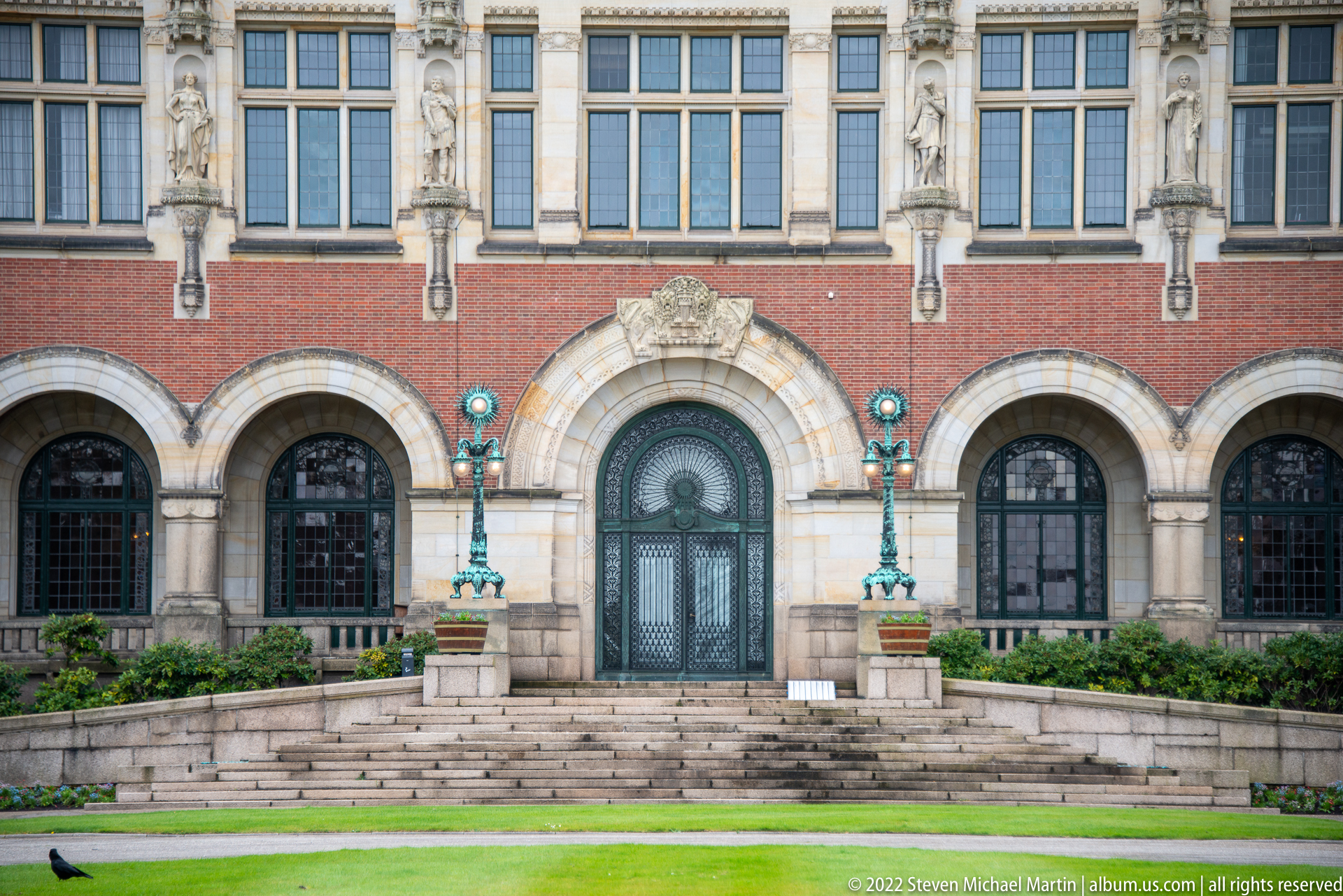
A broad stone staircase leads to an arched doorway in the Peace Palace façade, flanked by two elaborate turquoise-green lamp standards. Cream stone surrounds contrast with the red brick, and sculptural figures occupy narrow niches between the upper windows. The composition records the entrance as an integrated ensemble of masonry, metalwork, sculpture, and landscaping.
Caption
A broad stone staircase leads to an arched doorway in the Peace Palace façade, flanked by two elaborate turquoise-green lamp standards. Cream stone surrounds contrast with the red brick, and sculptural figures occupy narrow niches between the upper windows. The composition records the entrance as an integrated ensemble of masonry, metalwork, sculpture, and landscaping.
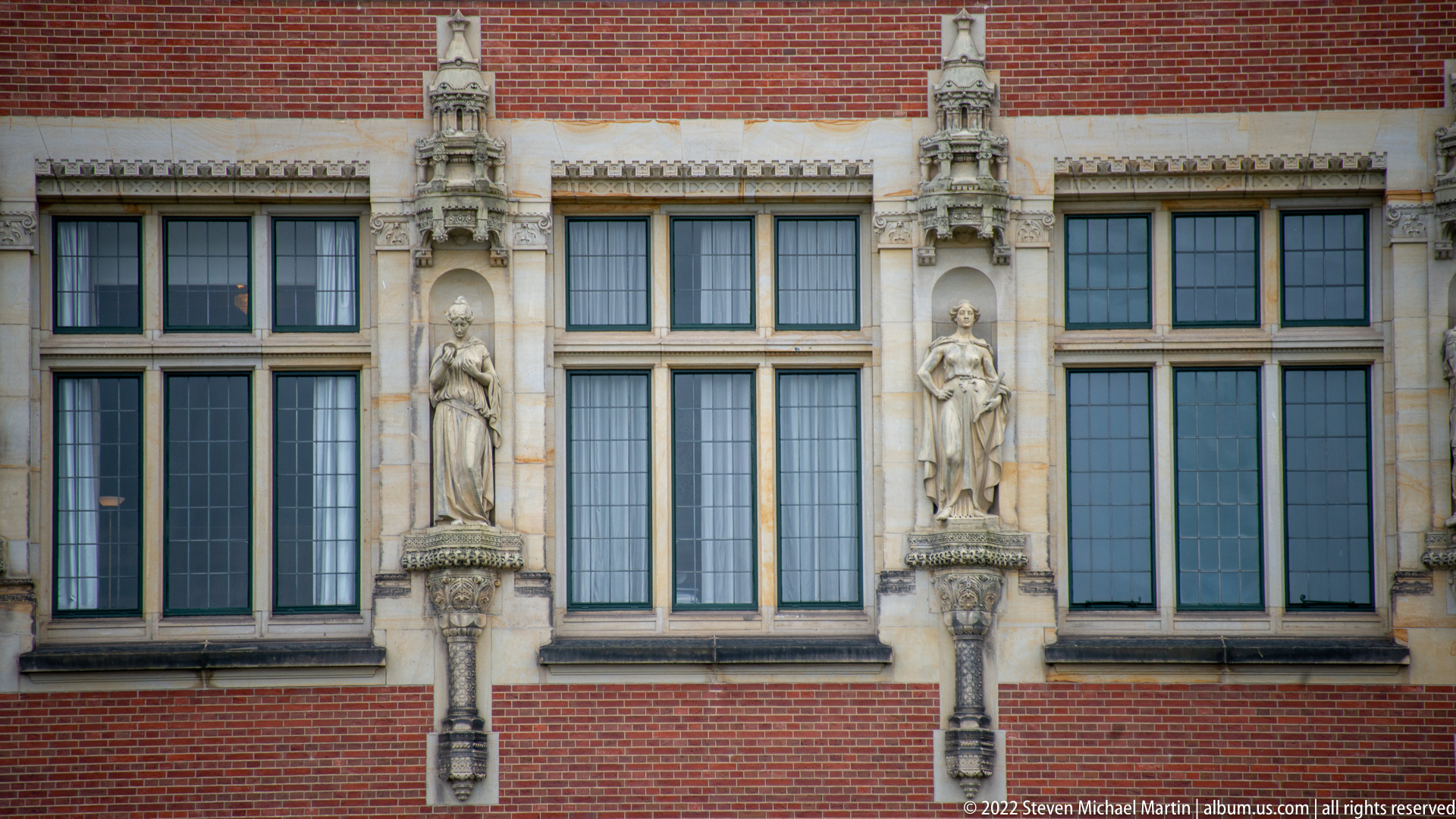
Two pale stone figures stand on projecting brackets between tall window bays of the Peace Palace façade. Slender carved canopies rise above them, integrating the sculptures into the vertical stone framework between red-brick wall panels. The detail reveals how figurative ornament is woven into the window architecture rather than applied as a separate monument.
Caption
Two pale stone figures stand on projecting brackets between tall window bays of the Peace Palace façade. Slender carved canopies rise above them, integrating the sculptures into the vertical stone framework between red-brick wall panels. The detail reveals how figurative ornament is woven into the window architecture rather than applied as a separate monument.
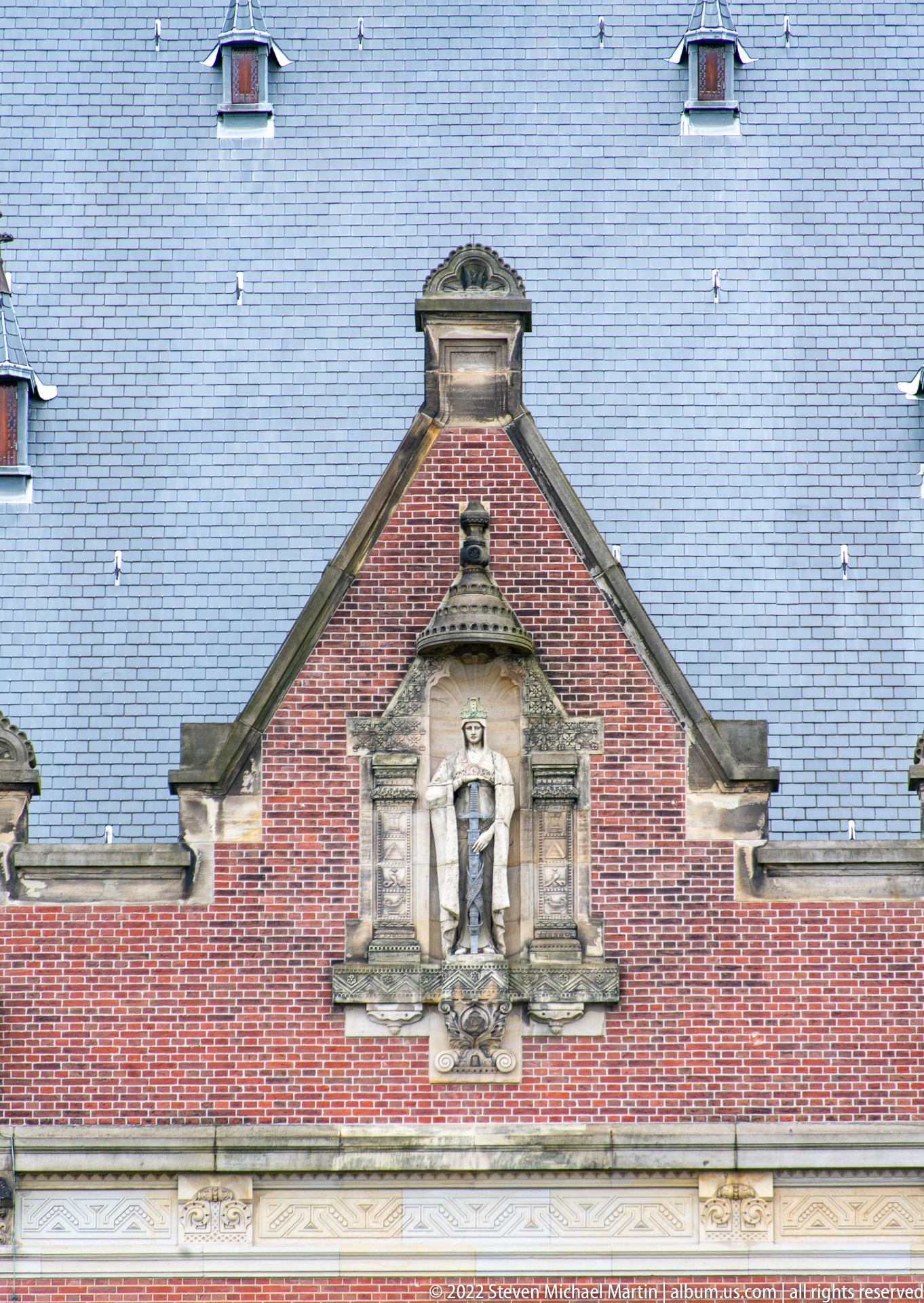
A standing sculpted figure occupies a shallow stone niche set into a shaped red-brick gable on the Peace Palace façade. The pale figure and architectural surround contrast sharply with the brick field and dark slate roof above. This detail isolates one of the building’s figurative exterior ornaments from the broader façade composition.
Caption
A standing sculpted figure occupies a shallow stone niche set into a shaped red-brick gable on the Peace Palace façade. The pale figure and architectural surround contrast sharply with the brick field and dark slate roof above. This detail isolates one of the building’s figurative exterior ornaments from the broader façade composition.
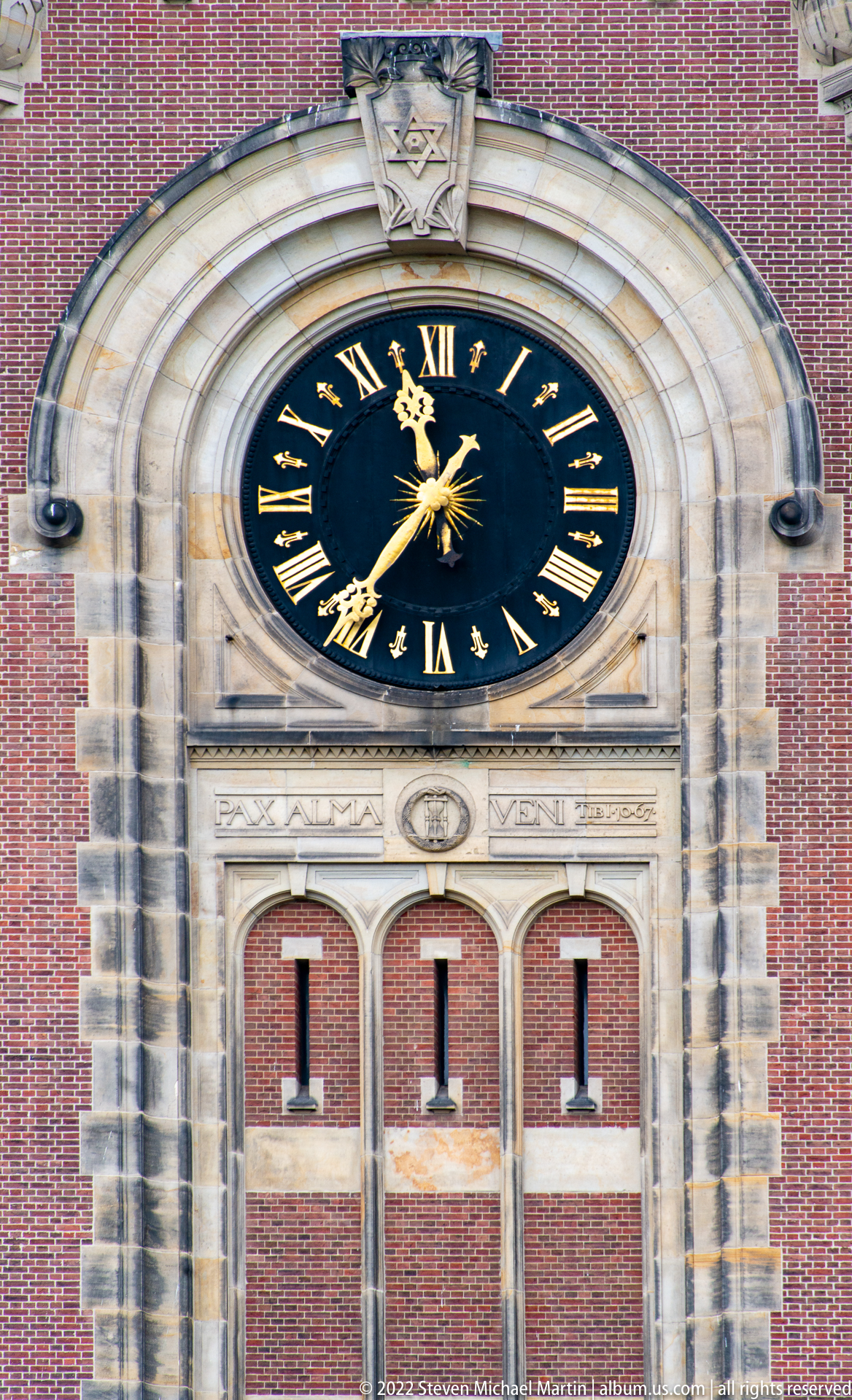
A black clock face with gilded Roman numerals and hands is set within a pale stone arch on the Peace Palace tower. Decorative masonry and narrow brick openings frame the dial, creating a strong contrast between dark face, gold markings, cream stone, and red brick. The close crop records the tower’s timekeeping feature as a distinct architectural detail.
Caption
A black clock face with gilded Roman numerals and hands is set within a pale stone arch on the Peace Palace tower. Decorative masonry and narrow brick openings frame the dial, creating a strong contrast between dark face, gold markings, cream stone, and red brick. The close crop records the tower’s timekeeping feature as a distinct architectural detail.
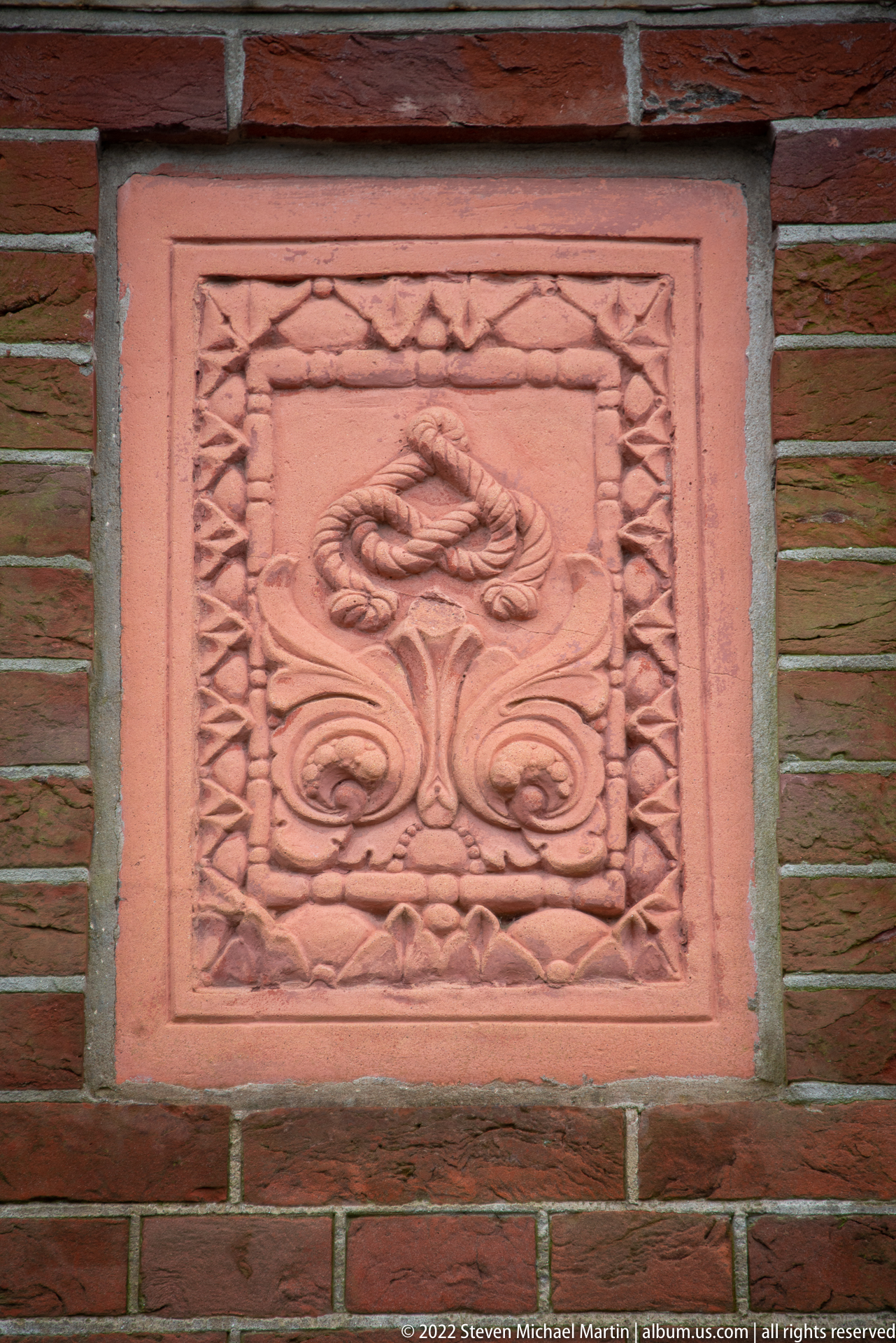
A square terracotta relief is set flush into a red-brick wall, its raised design combining a central flower with curling stems and a textured border. Subtle color differences between the molded panel, mortar, and surrounding brick make the ornament stand out without breaking the wall surface. The close study records a small decorative feature within the Peace Palace complex.
Caption
A square terracotta relief is set flush into a red-brick wall, its raised design combining a central flower with curling stems and a textured border. Subtle color differences between the molded panel, mortar, and surrounding brick make the ornament stand out without breaking the wall surface. The close study records a small decorative feature within the Peace Palace complex.