Aachen – North Rhine-Westphalia, Germany
The city of Aachen lies near the borders of Germany, Belgium, and the Netherlands and was one of the most important centers of the Carolingian Empire. During the late 8th and early 9th centuries, Charlemagne established Aachen as his imperial residence.
At the heart of the city stands the Aachen Cathedral, originally constructed as Charlemagne’s palace chapel. The structure combines Carolingian and later Gothic architectural elements and became the traditional site for the coronation of German kings for many centuries.
Today Aachen Cathedral is recognized as a UNESCO World Heritage Site and remains one of the most historically significant churches in Europe.
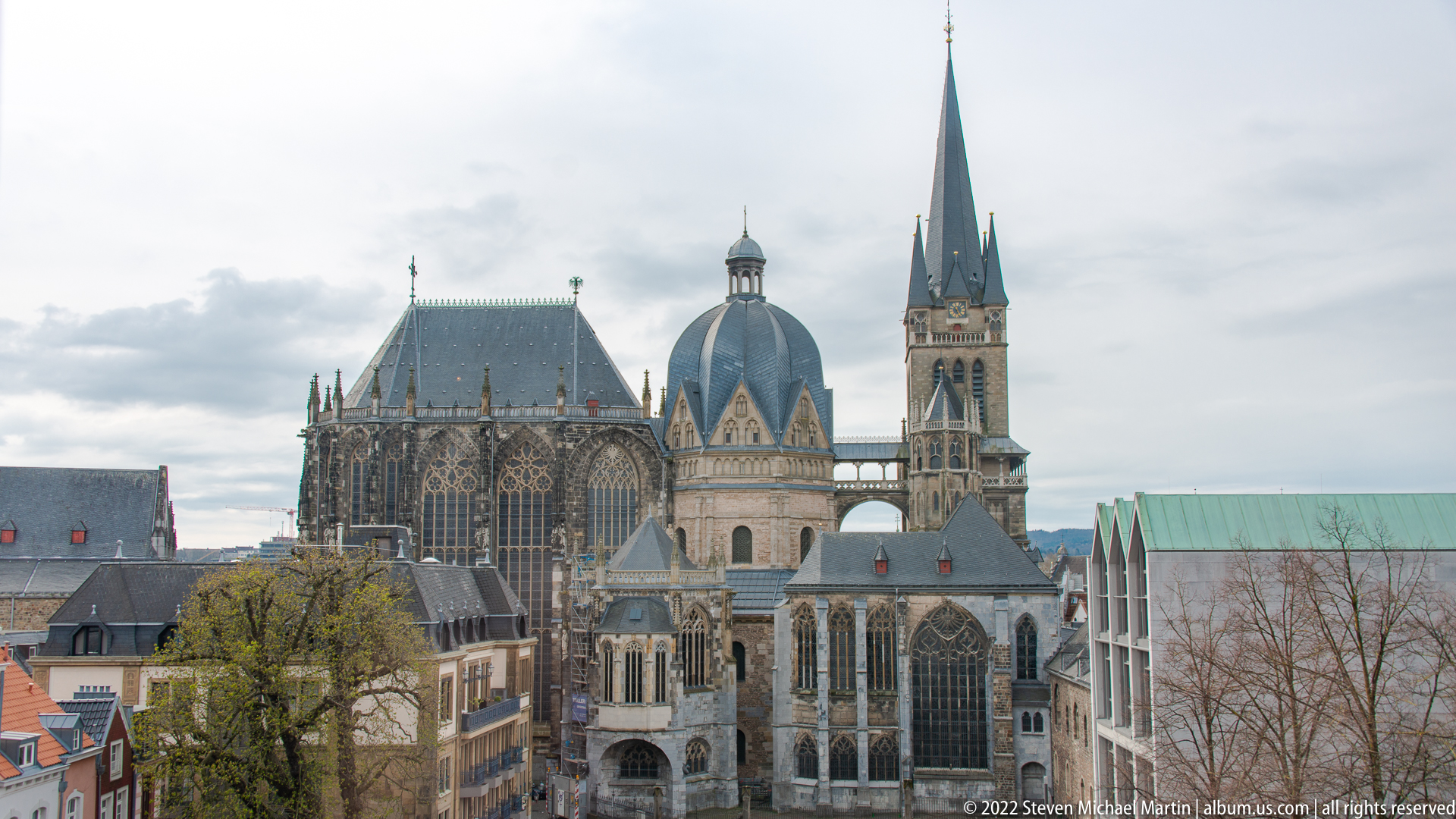
A closer elevated view compresses Aachen Cathedral's principal masses into a single composition: the buttressed Gothic choir at left, the octagonal dome at center, and the tall tower rising to the right. This tighter framing emphasizes the dramatic coexistence of different building phases within the cathedral complex.
Caption
A closer elevated view compresses Aachen Cathedral's principal masses into a single composition: the buttressed Gothic choir at left, the octagonal dome at center, and the tall tower rising to the right. This tighter framing emphasizes the dramatic coexistence of different building phases within the cathedral complex.
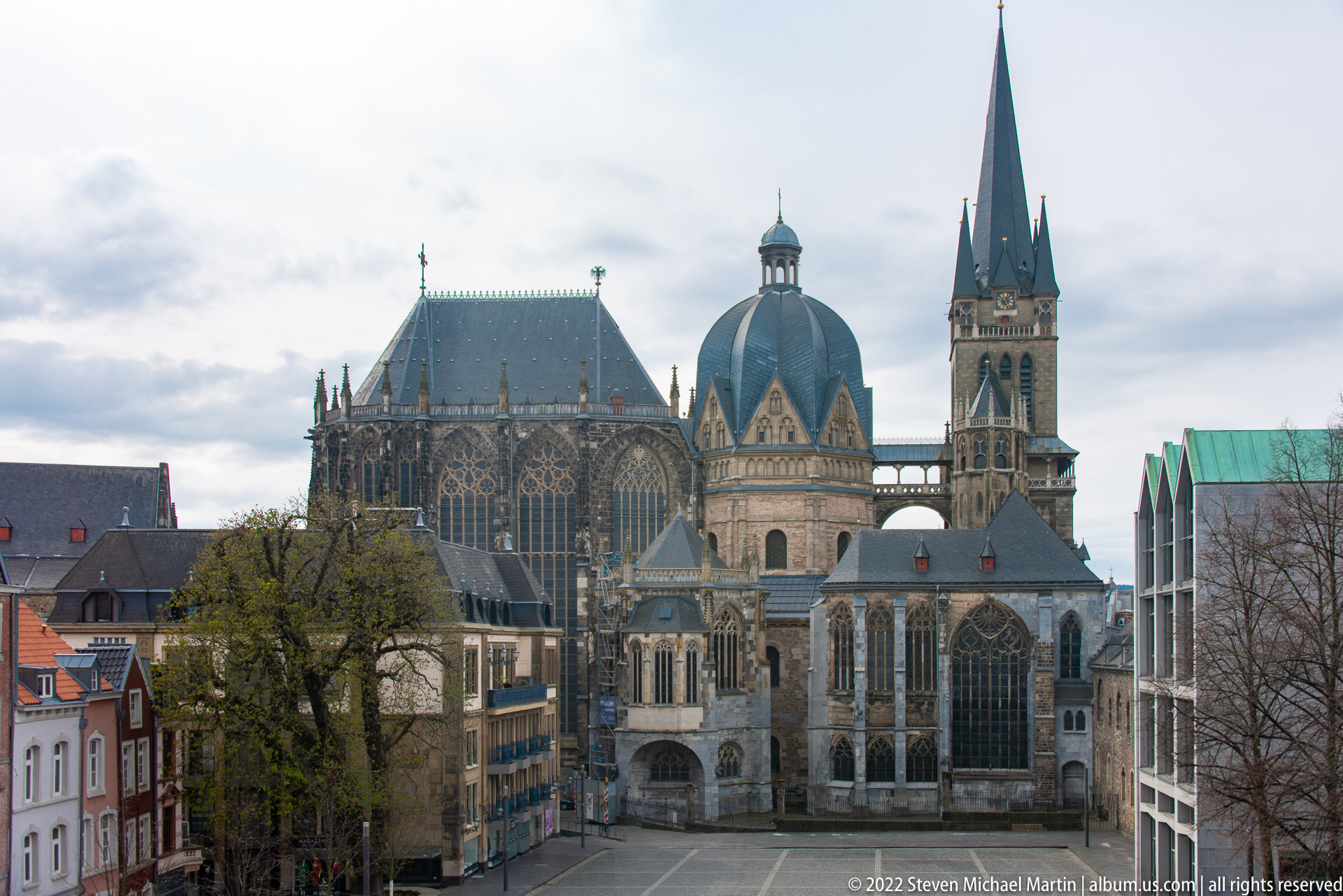
Aachen Cathedral dominates the historic center from an elevated viewpoint, bringing together the tall Gothic choir, the octagonal central dome, and the slender western tower. The layered rooflines and contrasting masonry reveal the cathedral's complex architectural development while the open square and surrounding buildings establish its urban setting.
Caption
Aachen Cathedral dominates the historic center from an elevated viewpoint, bringing together the tall Gothic choir, the octagonal central dome, and the slender western tower. The layered rooflines and contrasting masonry reveal the cathedral's complex architectural development while the open square and surrounding buildings establish its urban setting.
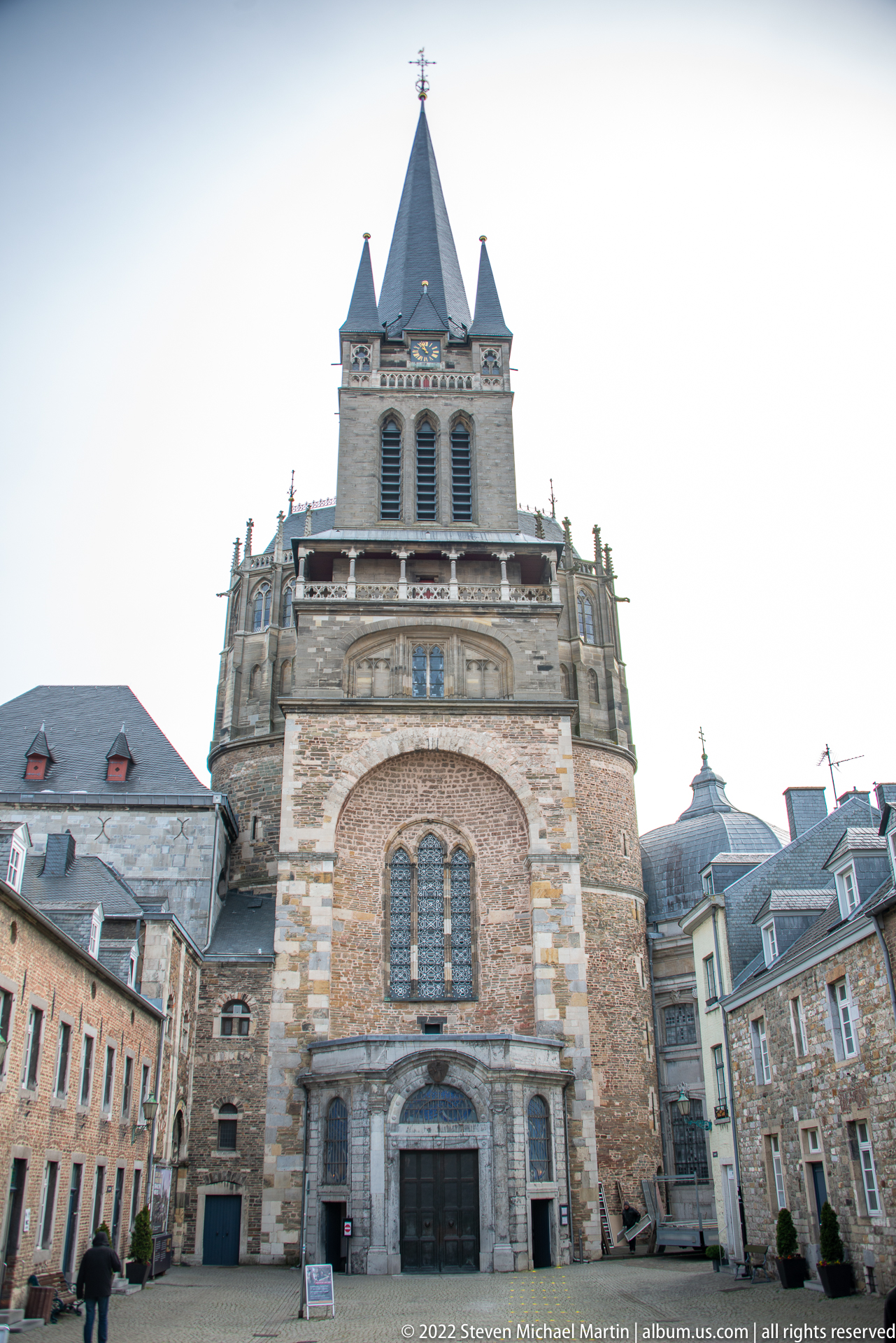
The west side of Aachen Cathedral rises from a confined courtyard, with a broad masonry tower supporting a steep central spire and smaller corner turrets. Earlier stonework and later upper elements are visibly layered across the elevation, while adjoining buildings enclose the approach. Seen almost head-on, the composition stresses the fortress-like mass of the westwork and its role as a principal entrance front.
Caption
The west side of Aachen Cathedral rises from a confined courtyard, with a broad masonry tower supporting a steep central spire and smaller corner turrets. Earlier stonework and later upper elements are visibly layered across the elevation, while adjoining buildings enclose the approach. Seen almost head-on, the composition stresses the fortress-like mass of the westwork and its role as a principal entrance front.
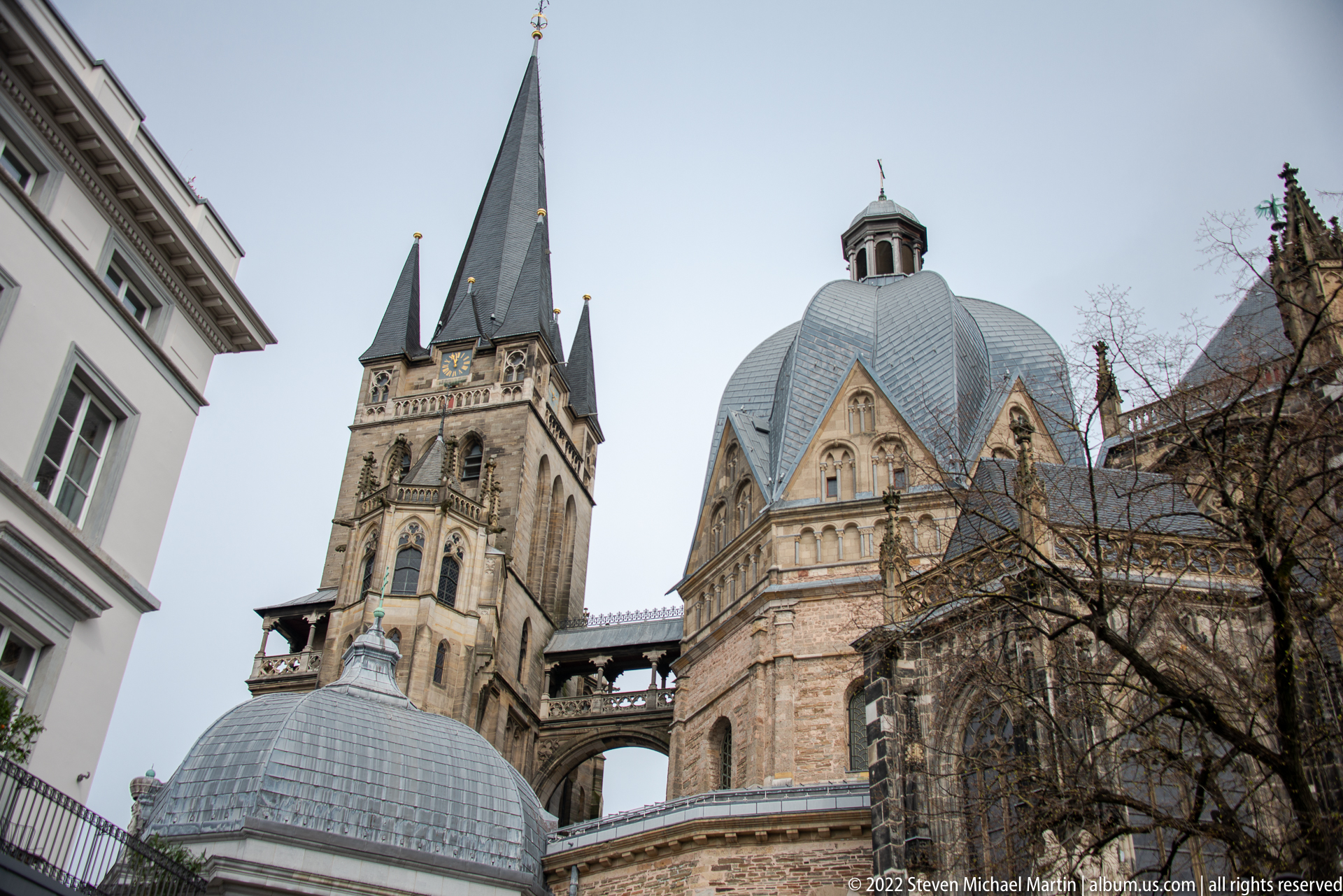
Aachen Cathedral rises above the surrounding streets in a layered exterior view that combines the tall western tower, the octagonal central dome, and lower chapels and roof masses. Seen from close range, the complex silhouette makes the building's accumulation of architectural periods especially legible.
Caption
Aachen Cathedral rises above the surrounding streets in a layered exterior view that combines the tall western tower, the octagonal central dome, and lower chapels and roof masses. Seen from close range, the complex silhouette makes the building's accumulation of architectural periods especially legible.
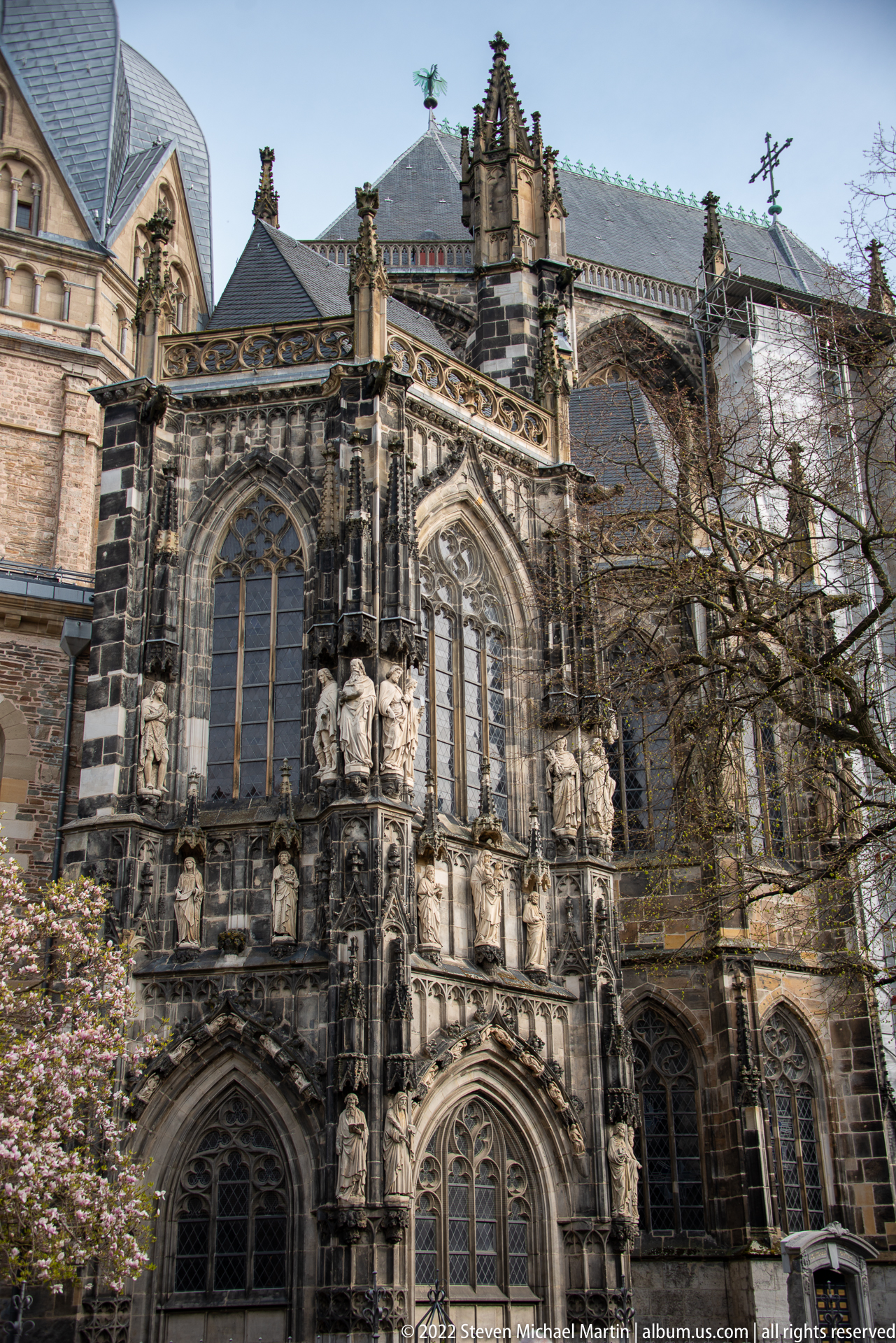
The Gothic choir of Aachen Cathedral fills the frame with tall traceried windows, buttressing, pinnacles, and ranks of sculpted figures set against darkened stone. This exterior close view stresses the verticality and dense sculptural treatment of the choir rather than the cathedral’s better-known octagonal core. Spring blossoms and bare branches soften the monumental masonry at street level.
Caption
The Gothic choir of Aachen Cathedral fills the frame with tall traceried windows, buttressing, pinnacles, and ranks of sculpted figures set against darkened stone. This exterior close view stresses the verticality and dense sculptural treatment of the choir rather than the cathedral’s better-known octagonal core. Spring blossoms and bare branches soften the monumental masonry at street level.
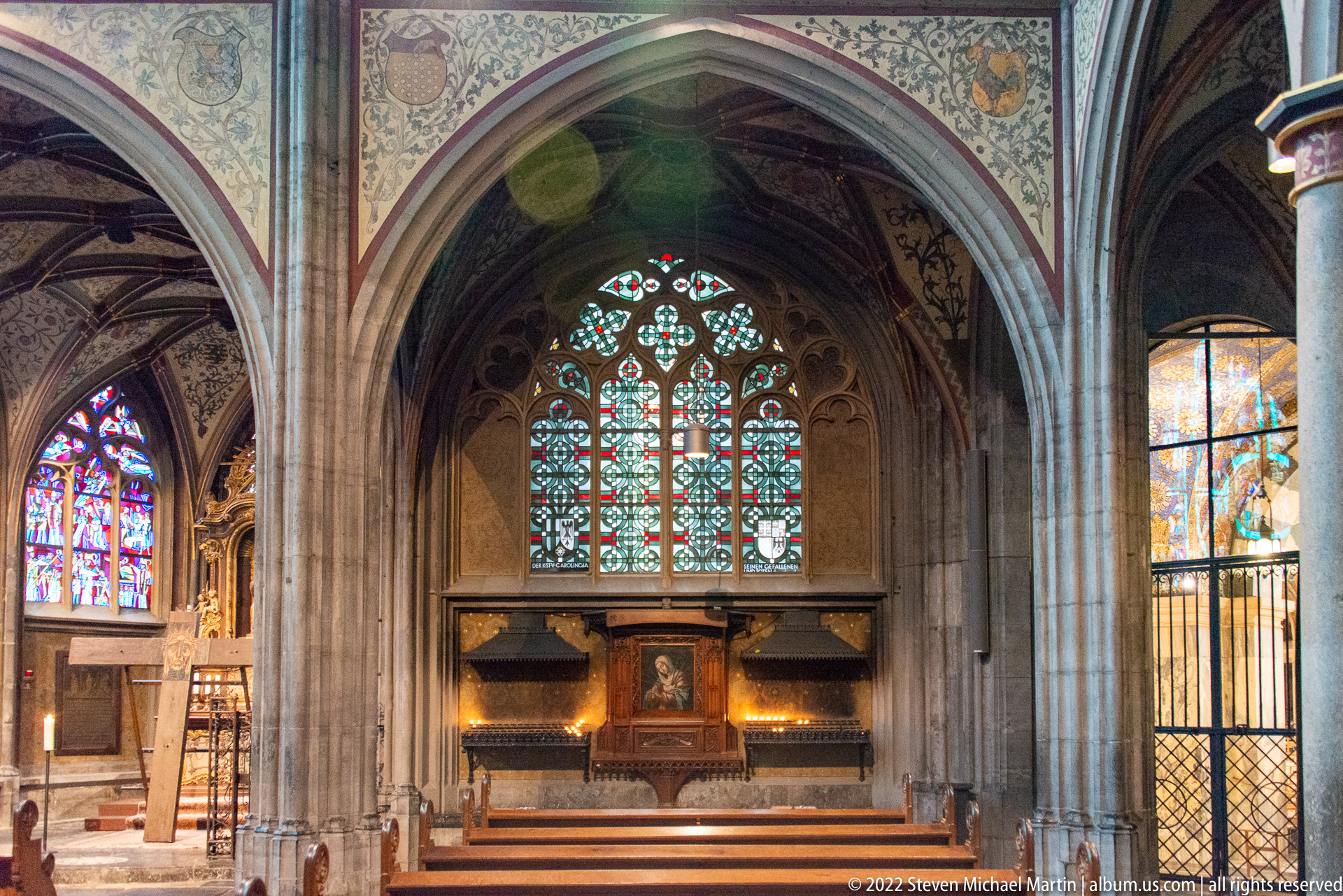
A Gothic chapel interior is framed by a tall pointed arch, with an altar positioned beneath a broad stained-glass window. Ribbed vaulting, slender supports, painted heraldic decoration, and a metal screen articulate the surrounding space. Warm altar lights contrast with the cool daylight filtering through the glass, creating a focused devotional setting within the larger cathedral complex.
Caption
A Gothic chapel interior is framed by a tall pointed arch, with an altar positioned beneath a broad stained-glass window. Ribbed vaulting, slender supports, painted heraldic decoration, and a metal screen articulate the surrounding space. Warm altar lights contrast with the cool daylight filtering through the glass, creating a focused devotional setting within the larger cathedral complex.
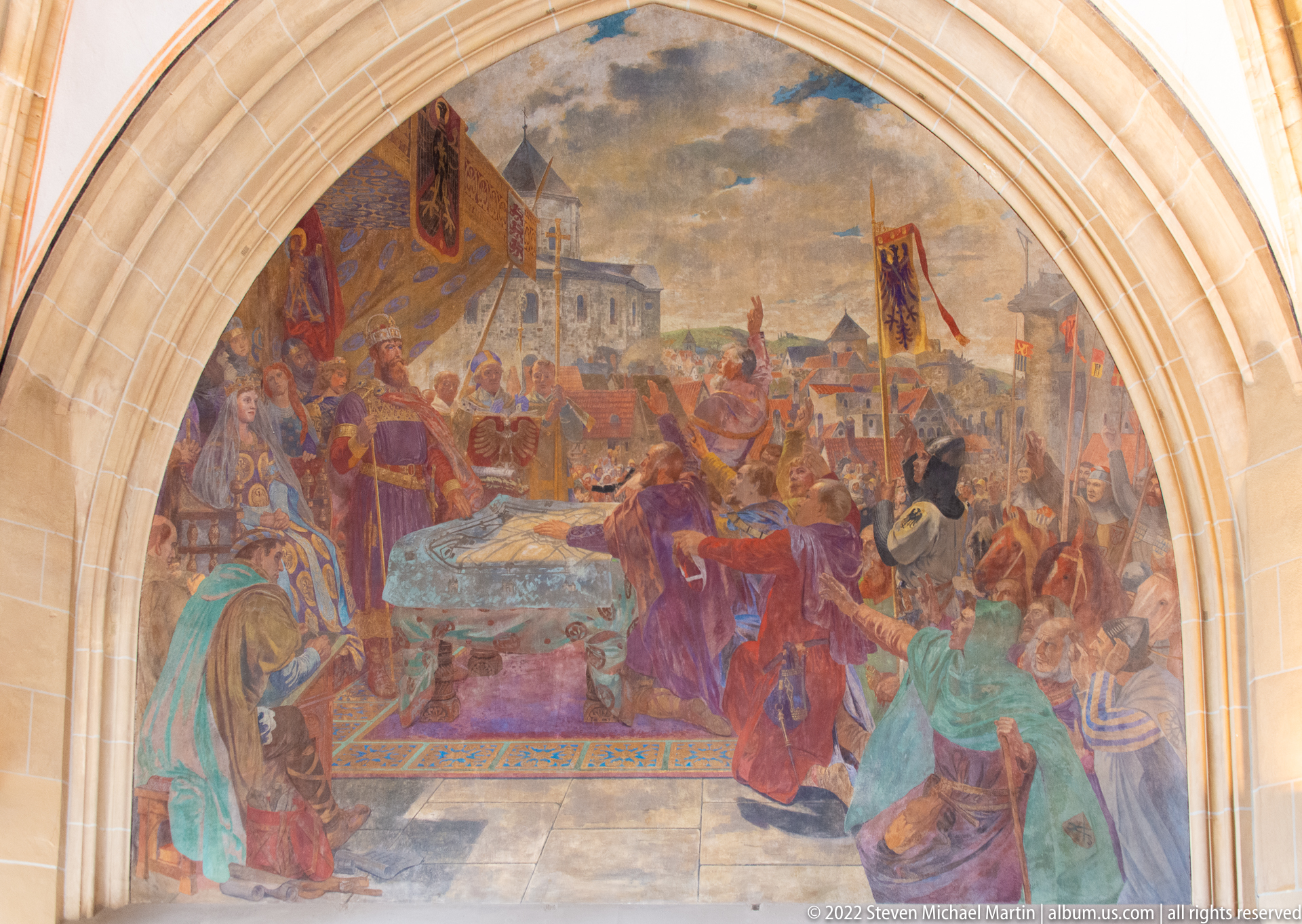
A monumental mural beneath a pointed arch depicts a crowded royal or imperial ceremony, with richly dressed figures, banners, clerics, soldiers, and a central elevated action. The broad processional arrangement and dense assembly turn the wall into a panoramic history scene suited to the ceremonial setting of Aachen Town Hall.
Caption
A monumental mural beneath a pointed arch depicts a crowded royal or imperial ceremony, with richly dressed figures, banners, clerics, soldiers, and a central elevated action. The broad processional arrangement and dense assembly turn the wall into a panoramic history scene suited to the ceremonial setting of Aachen Town Hall.
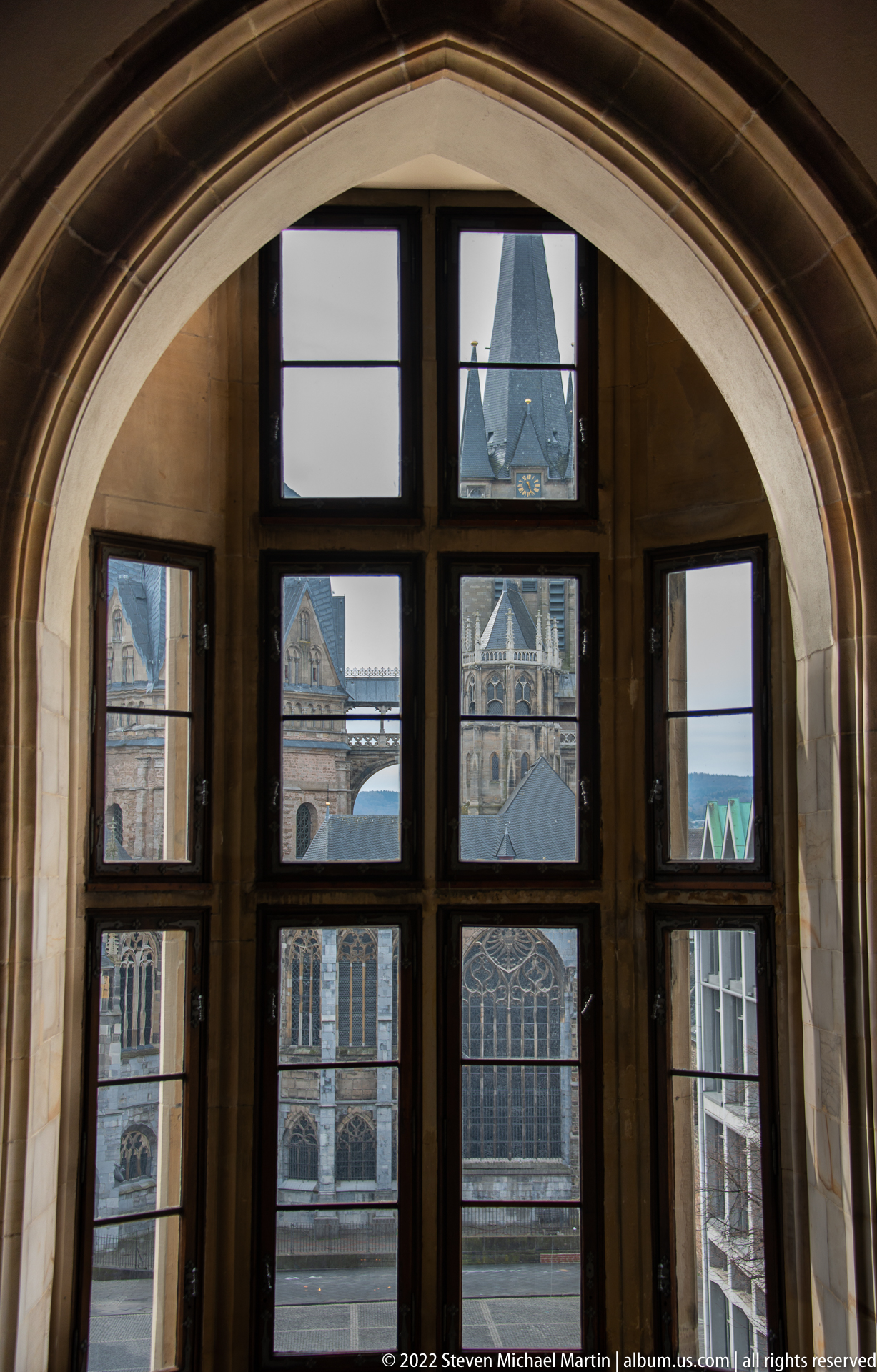
A large arched window frames a layered view of Aachen Cathedral and the surrounding historic roofs. The dark timber mullions divide the cityscape into vertical panels, creating a deliberate contrast between the interior architectural frame and the pale masonry, steep roofs, and towers outside.
Caption
A large arched window frames a layered view of Aachen Cathedral and the surrounding historic roofs. The dark timber mullions divide the cityscape into vertical panels, creating a deliberate contrast between the interior architectural frame and the pale masonry, steep roofs, and towers outside.
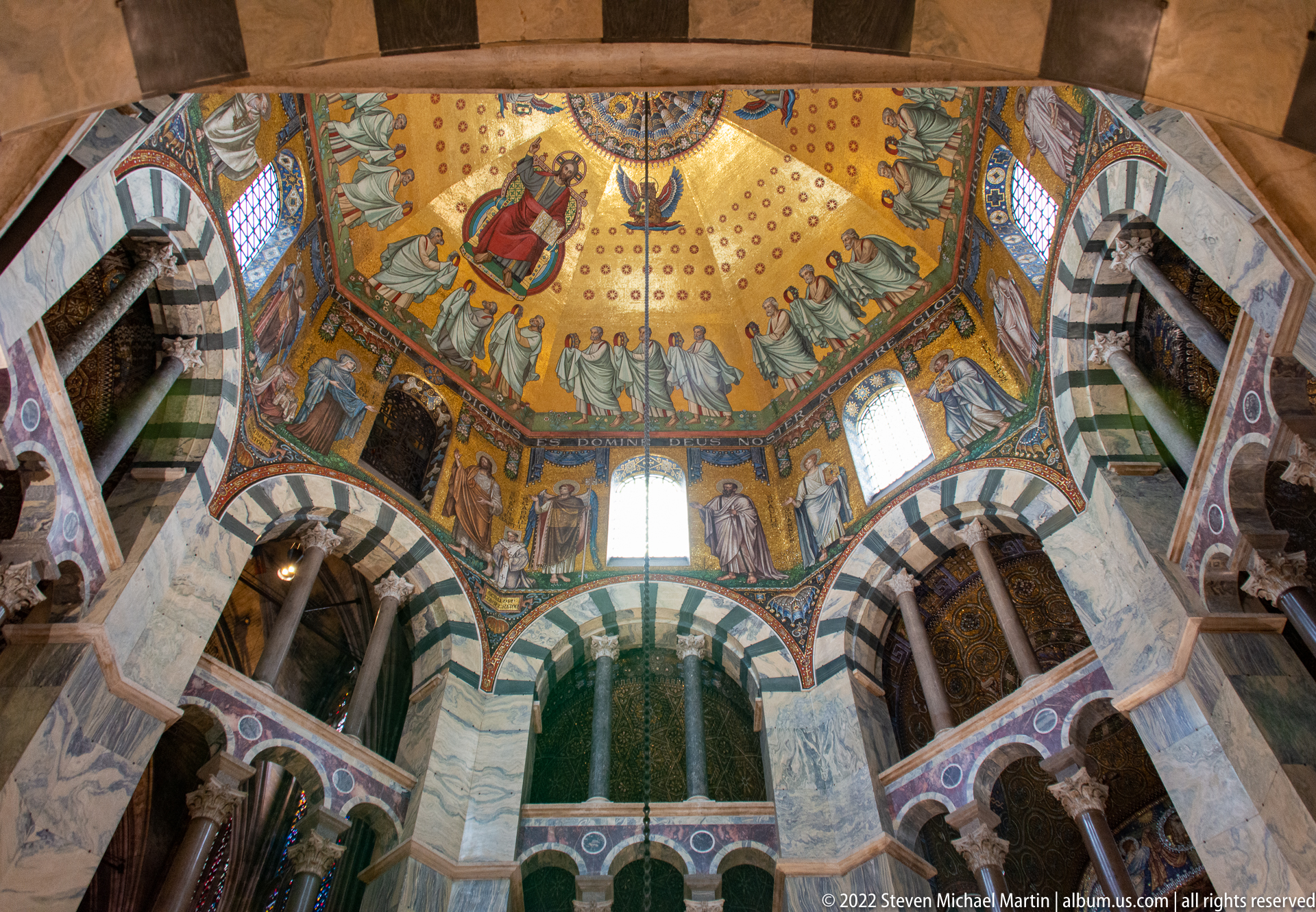
The dome of Aachen Cathedral’s Octagon glows with a monumental mosaic program centered on an enthroned Christ above a ring of heavenly figures. Gold tesserae dominate the vault, while striped arches, marble revetment, galleries, and clustered columns define the centralized space below. The upward view conveys the deliberate hierarchy of the interior, drawing the eye from the structural arcade to the radiant sacred imagery overhead.
Caption
The dome of Aachen Cathedral’s Octagon glows with a monumental mosaic program centered on an enthroned Christ above a ring of heavenly figures. Gold tesserae dominate the vault, while striped arches, marble revetment, galleries, and clustered columns define the centralized space below. The upward view conveys the deliberate hierarchy of the interior, drawing the eye from the structural arcade to the radiant sacred imagery overhead.
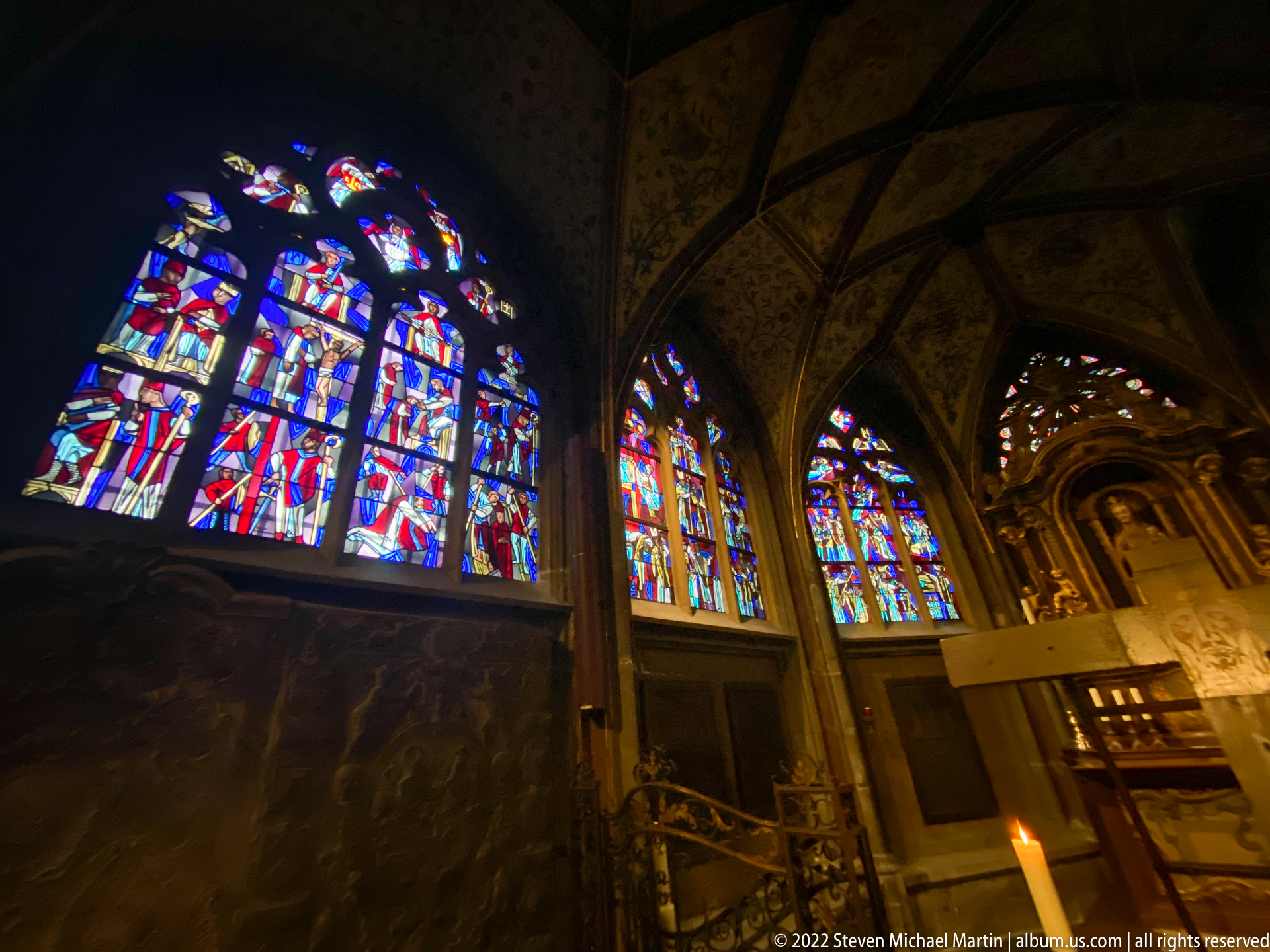
Vivid modern stained glass fills a sequence of tall pointed windows inside Aachen Cathedral, using saturated reds, blues, and whites in strongly geometric and figurative compositions. Seen from a darkened interior, the luminous glazing dominates the stone tracery and emphasizes the contrast between medieval architecture and later glass.
Caption
Vivid modern stained glass fills a sequence of tall pointed windows inside Aachen Cathedral, using saturated reds, blues, and whites in strongly geometric and figurative compositions. Seen from a darkened interior, the luminous glazing dominates the stone tracery and emphasizes the contrast between medieval architecture and later glass.
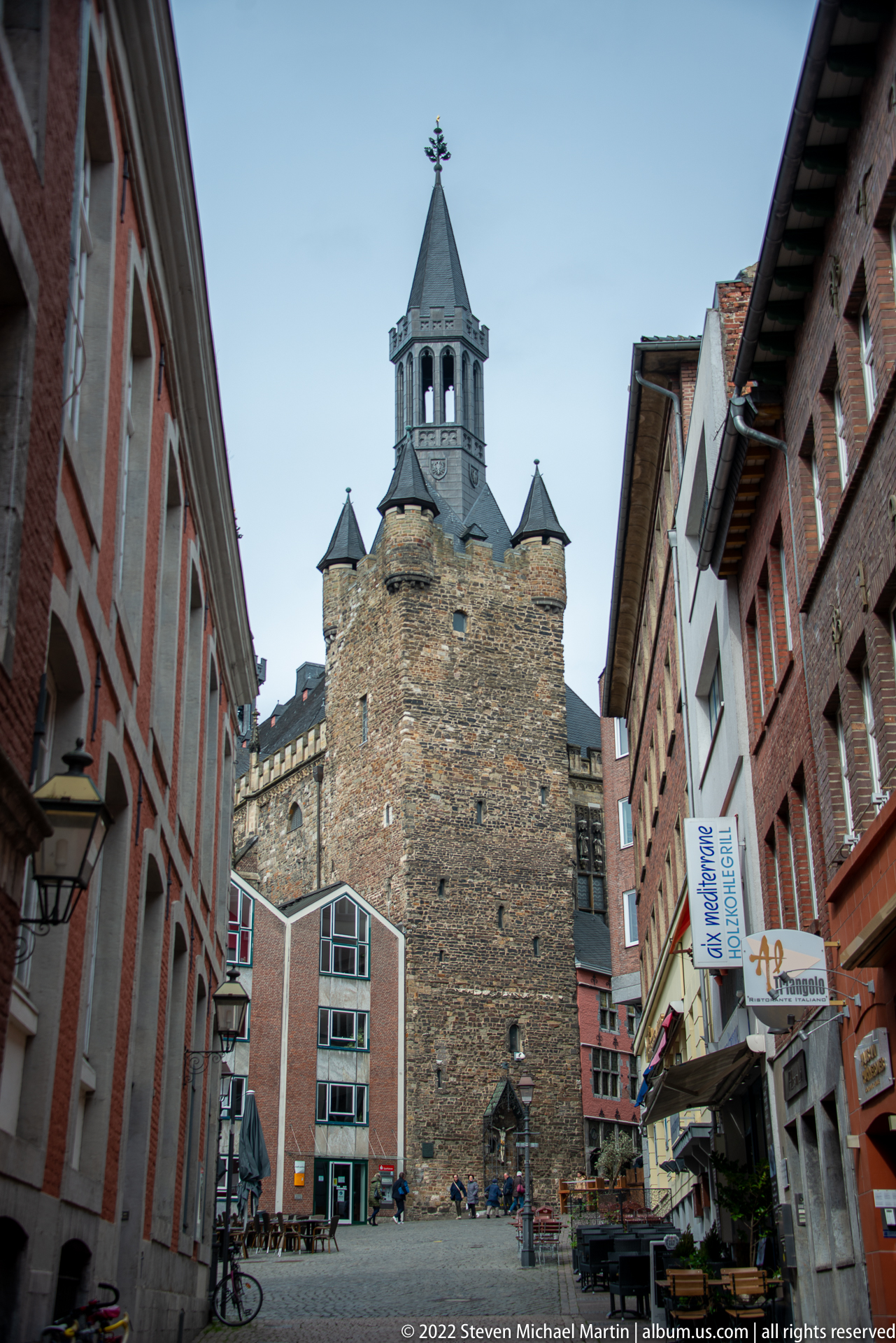
A massive medieval gate tower closes the end of a narrow street, its rough stone walls, steep roof, corner turrets, and central upper tower preserving the fortified character of Aachen's former defenses. Modern storefronts and street furniture emphasize the contrast between the surviving gate and the contemporary city around it.
Caption
A massive medieval gate tower closes the end of a narrow street, its rough stone walls, steep roof, corner turrets, and central upper tower preserving the fortified character of Aachen's former defenses. Modern storefronts and street furniture emphasize the contrast between the surviving gate and the contemporary city around it.
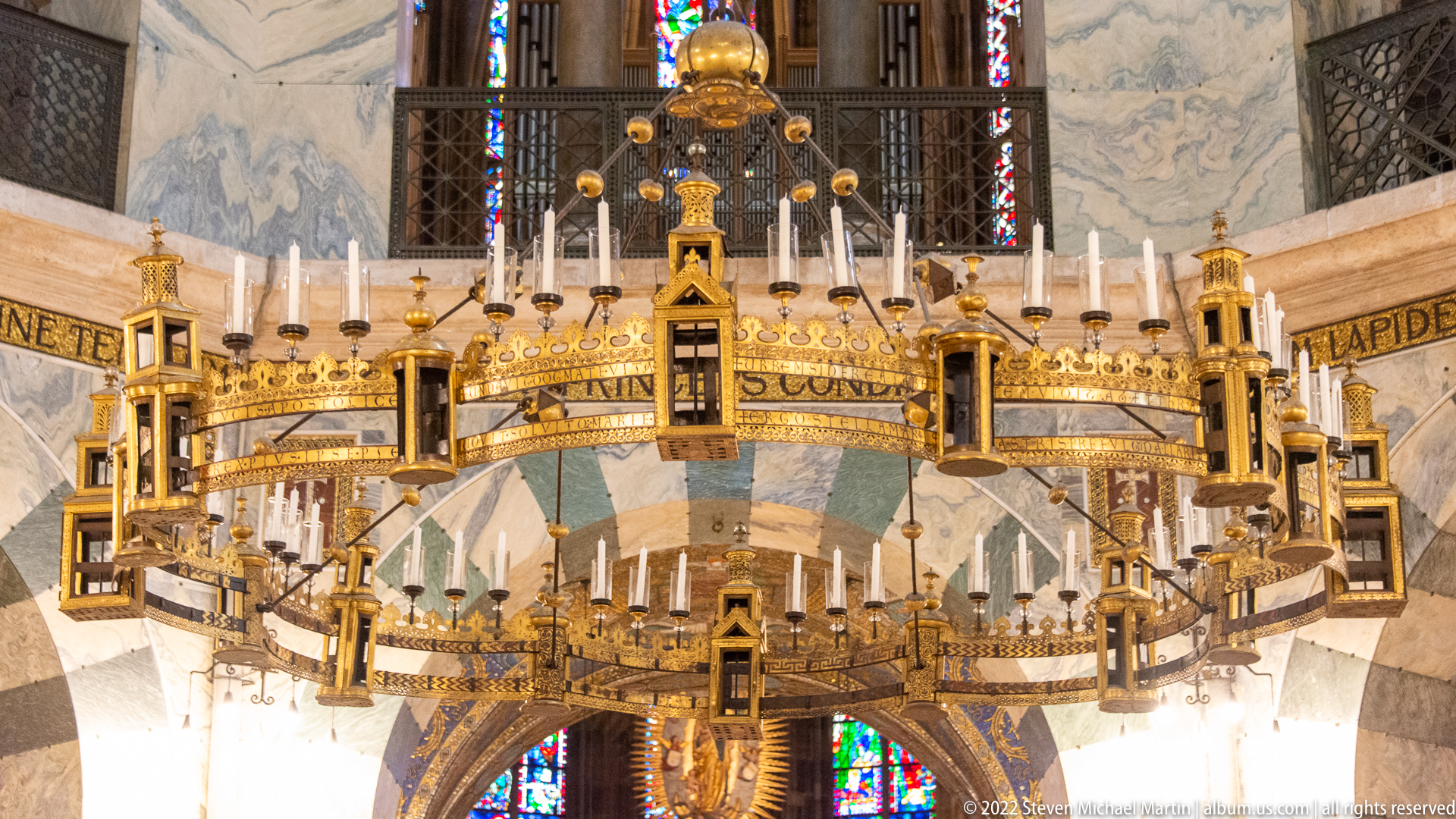
The monumental Barbarossa Chandelier hangs beneath the arches of Aachen Cathedral as a great gilded circular crown of towers, lamps, and openwork metal. Suspended chains lift the ring into the octagonal space, while stained glass and marble-clad architecture form a luminous backdrop. The closer view concentrates on the chandelier’s repeated architectural motifs and the visual analogy between the heavenly Jerusalem and an idealized walled city.
Caption
The monumental Barbarossa Chandelier hangs beneath the arches of Aachen Cathedral as a great gilded circular crown of towers, lamps, and openwork metal. Suspended chains lift the ring into the octagonal space, while stained glass and marble-clad architecture form a luminous backdrop. The closer view concentrates on the chandelier’s repeated architectural motifs and the visual analogy between the heavenly Jerusalem and an idealized walled city.
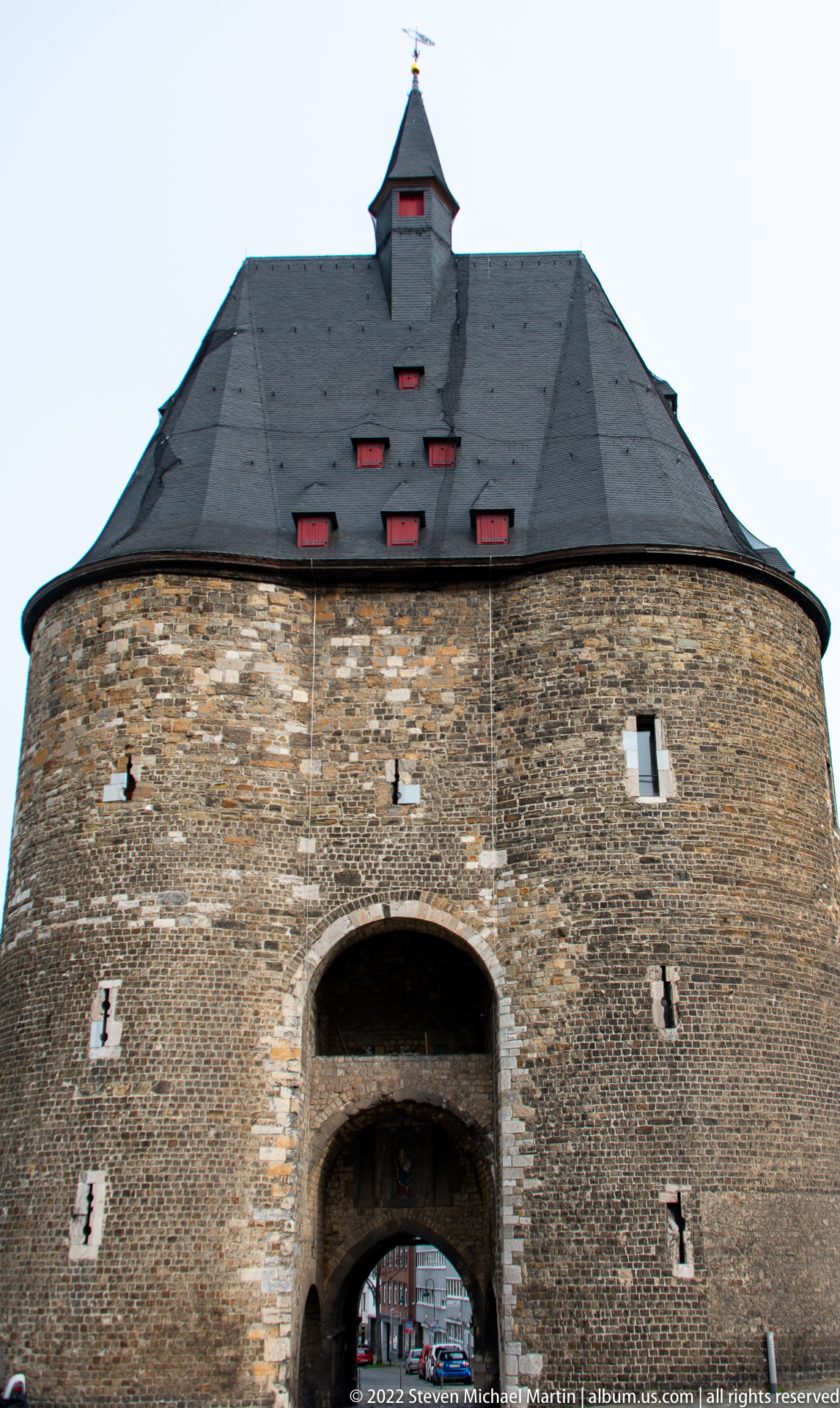
Ponttor presents its massive stone gatehouse beneath a steep slate roof, with a broad pointed passage opening through the center. Small slit-like openings and the largely unadorned masonry emphasize the defensive character of Aachen’s surviving medieval fortification. The frontal viewpoint isolates the gate’s compact, fortress-like mass while allowing a glimpse of the street continuing through the arch.
Caption
Ponttor presents its massive stone gatehouse beneath a steep slate roof, with a broad pointed passage opening through the center. Small slit-like openings and the largely unadorned masonry emphasize the defensive character of Aachen’s surviving medieval fortification. The frontal viewpoint isolates the gate’s compact, fortress-like mass while allowing a glimpse of the street continuing through the arch.

A carved Calvary monument centers on Christ on the cross, raised above an architectural base and flanked by two standing sacred figures. Scrollwork, relief panels, and layered moldings give the ensemble the character of a devotional wayside or cemetery monument. Bare tree branches frame the pale stone sculpture, making its figures and ornamental silhouette stand out against the darker urban background.
Caption
A carved Calvary monument centers on Christ on the cross, raised above an architectural base and flanked by two standing sacred figures. Scrollwork, relief panels, and layered moldings give the ensemble the character of a devotional wayside or cemetery monument. Bare tree branches frame the pale stone sculpture, making its figures and ornamental silhouette stand out against the darker urban background.
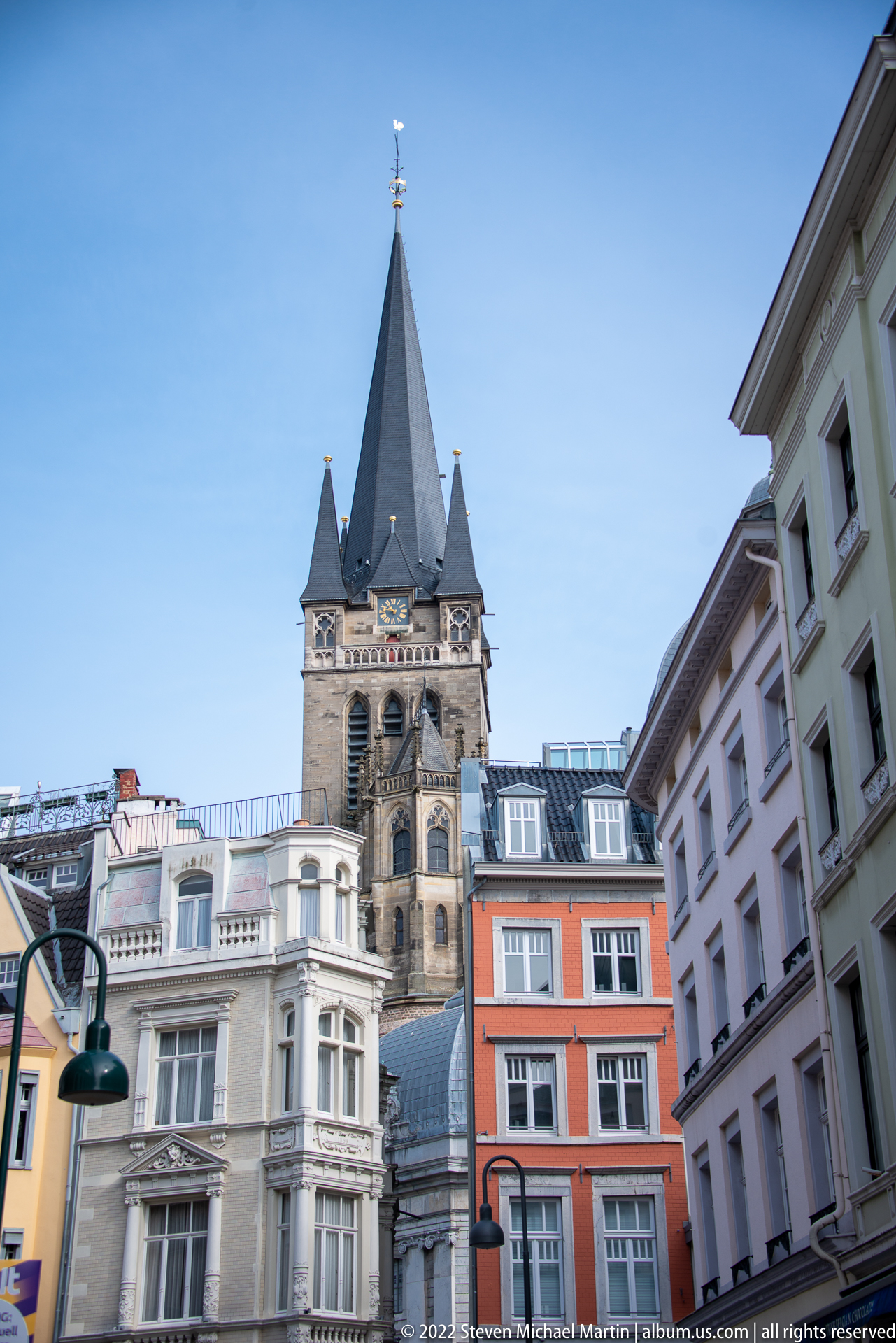
A tall Gothic church tower rises above a compact row of colorful urban façades, its steep central spire accompanied by smaller corner pinnacles. The upward-looking street view places the ecclesiastical landmark within the everyday fabric of Aachen, where narrow-fronted buildings crowd the foreground. Strong vertical lines draw attention from the shopfront roofs toward the clock and pointed spire above.
Caption
A tall Gothic church tower rises above a compact row of colorful urban façades, its steep central spire accompanied by smaller corner pinnacles. The upward-looking street view places the ecclesiastical landmark within the everyday fabric of Aachen, where narrow-fronted buildings crowd the foreground. Strong vertical lines draw attention from the shopfront roofs toward the clock and pointed spire above.
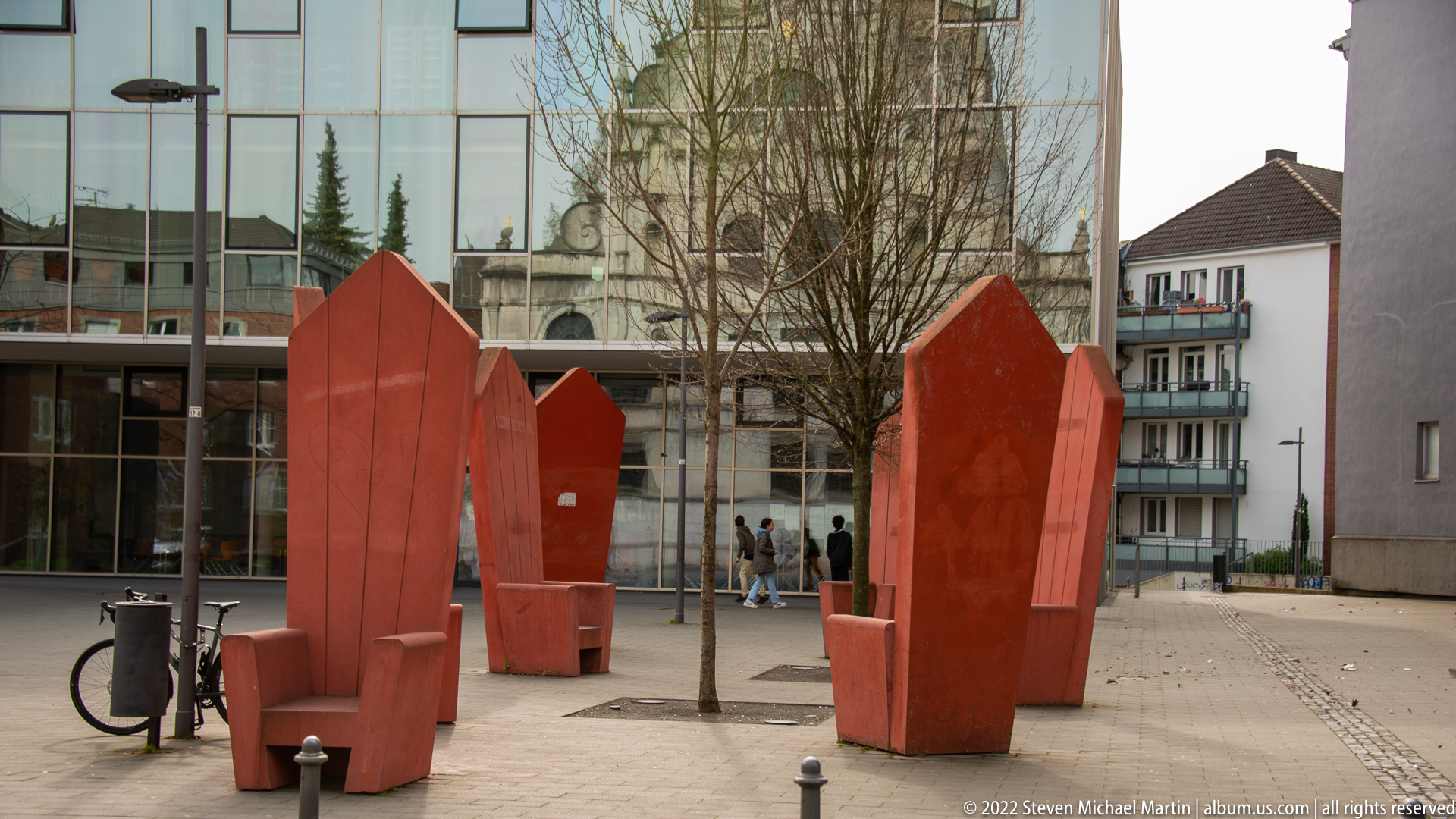
Angular red structures punctuate a paved urban plaza, functioning visually as both sculptural objects and street furniture. Their tall faceted forms contrast sharply with the glass-fronted building and leafless trees behind them. The composition emphasizes contemporary design within Aachen’s historic center, with pedestrians and bicycles providing scale and everyday urban context.
Caption
Angular red structures punctuate a paved urban plaza, functioning visually as both sculptural objects and street furniture. Their tall faceted forms contrast sharply with the glass-fronted building and leafless trees behind them. The composition emphasizes contemporary design within Aachen’s historic center, with pedestrians and bicycles providing scale and everyday urban context.
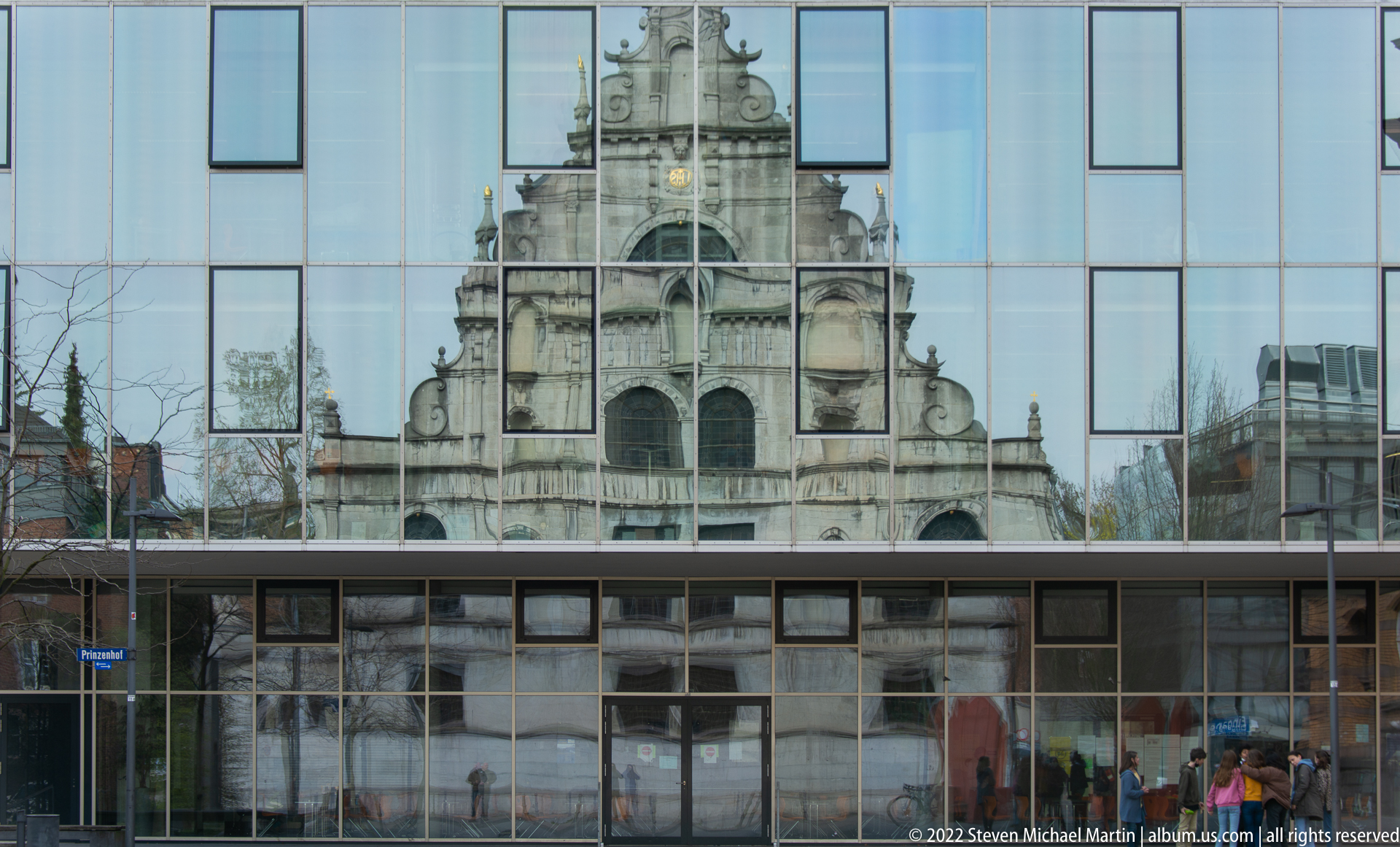
A richly articulated historic gable appears as a reflection across a grid of modern glass panels. Rectangular window modules fragment the older façade into a geometric mosaic, creating a layered view of Aachen’s architectural past and present. The photograph is less a conventional building portrait than a study in reflection, transparency, and the visual dialogue between historic masonry and contemporary curtain-wall construction.
Caption
A richly articulated historic gable appears as a reflection across a grid of modern glass panels. Rectangular window modules fragment the older façade into a geometric mosaic, creating a layered view of Aachen’s architectural past and present. The photograph is less a conventional building portrait than a study in reflection, transparency, and the visual dialogue between historic masonry and contemporary curtain-wall construction.
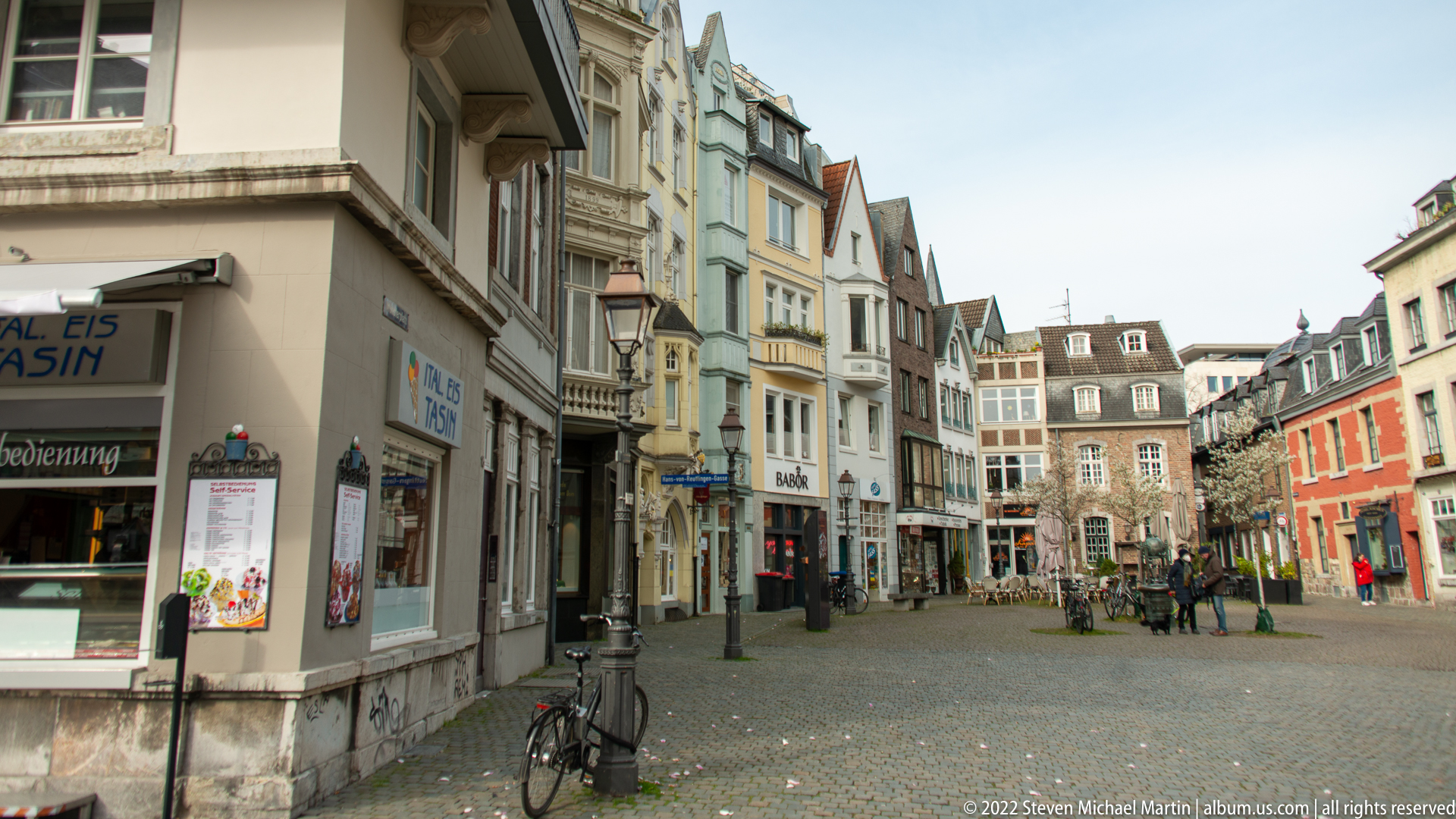
A narrow pedestrian street opens into a small square lined with closely spaced historic and later townhouses. Varied gables, bay windows, shopfronts, bicycles, and café activity create a layered urban scene typical of Aachen’s center. The gently curving street and changing rooflines lead the eye through the frame, emphasizing the compact scale and mixed architectural character of the old city.
Caption
A narrow pedestrian street opens into a small square lined with closely spaced historic and later townhouses. Varied gables, bay windows, shopfronts, bicycles, and café activity create a layered urban scene typical of Aachen’s center. The gently curving street and changing rooflines lead the eye through the frame, emphasizing the compact scale and mixed architectural character of the old city.
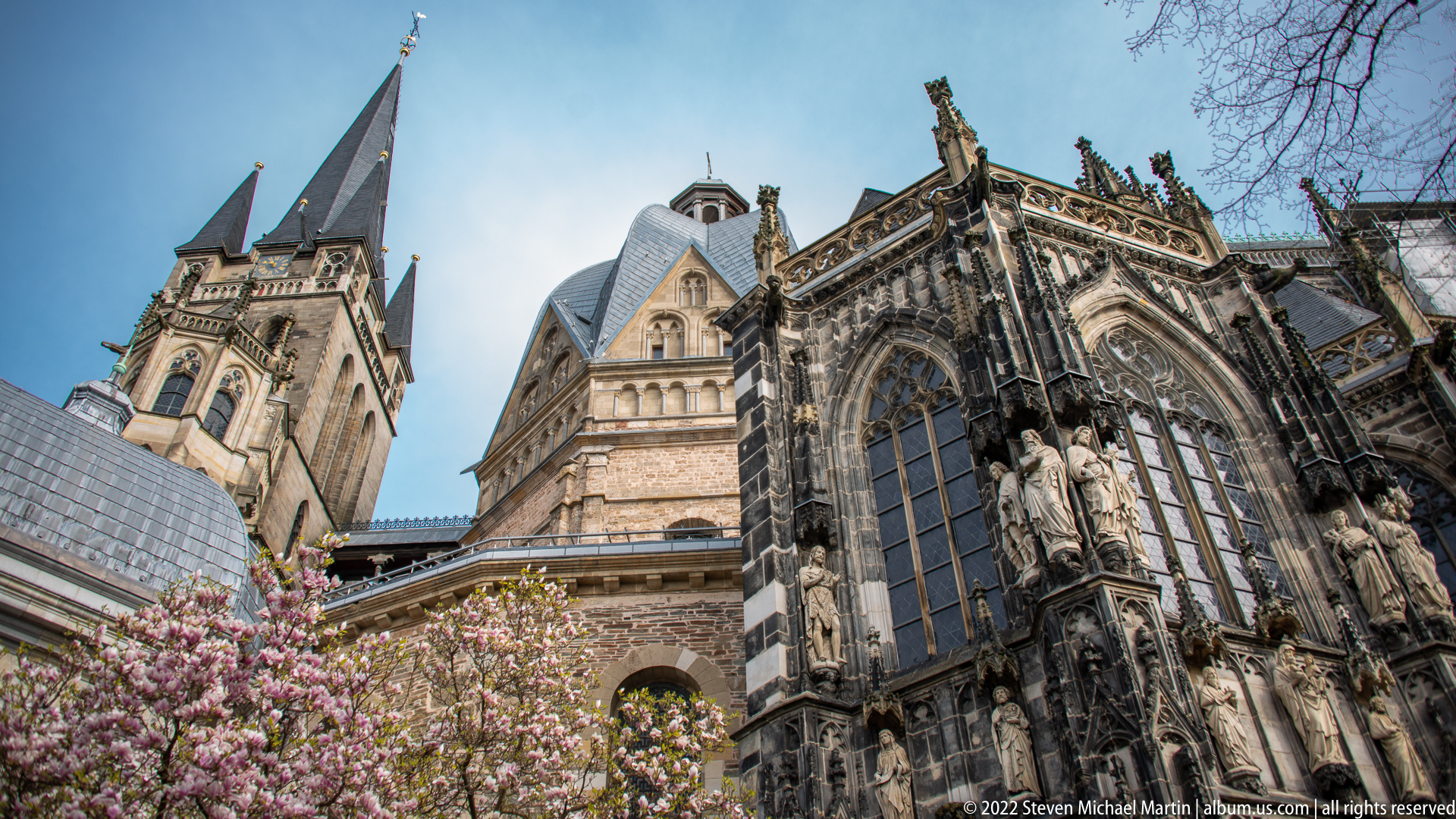
A low-angle view gathers several major architectural phases of Aachen Cathedral into one composition: the massive towered westwork at left, the central masonry volumes, and the highly articulated Gothic choir at right. Blossoming branches soften the foreground while the steep perspective accentuates the cathedral’s vertical complexity. The juxtaposition makes the building’s long history legible through contrasting forms, masonry, and window designs.
Caption
A low-angle view gathers several major architectural phases of Aachen Cathedral into one composition: the massive towered westwork at left, the central masonry volumes, and the highly articulated Gothic choir at right. Blossoming branches soften the foreground while the steep perspective accentuates the cathedral’s vertical complexity. The juxtaposition makes the building’s long history legible through contrasting forms, masonry, and window designs.
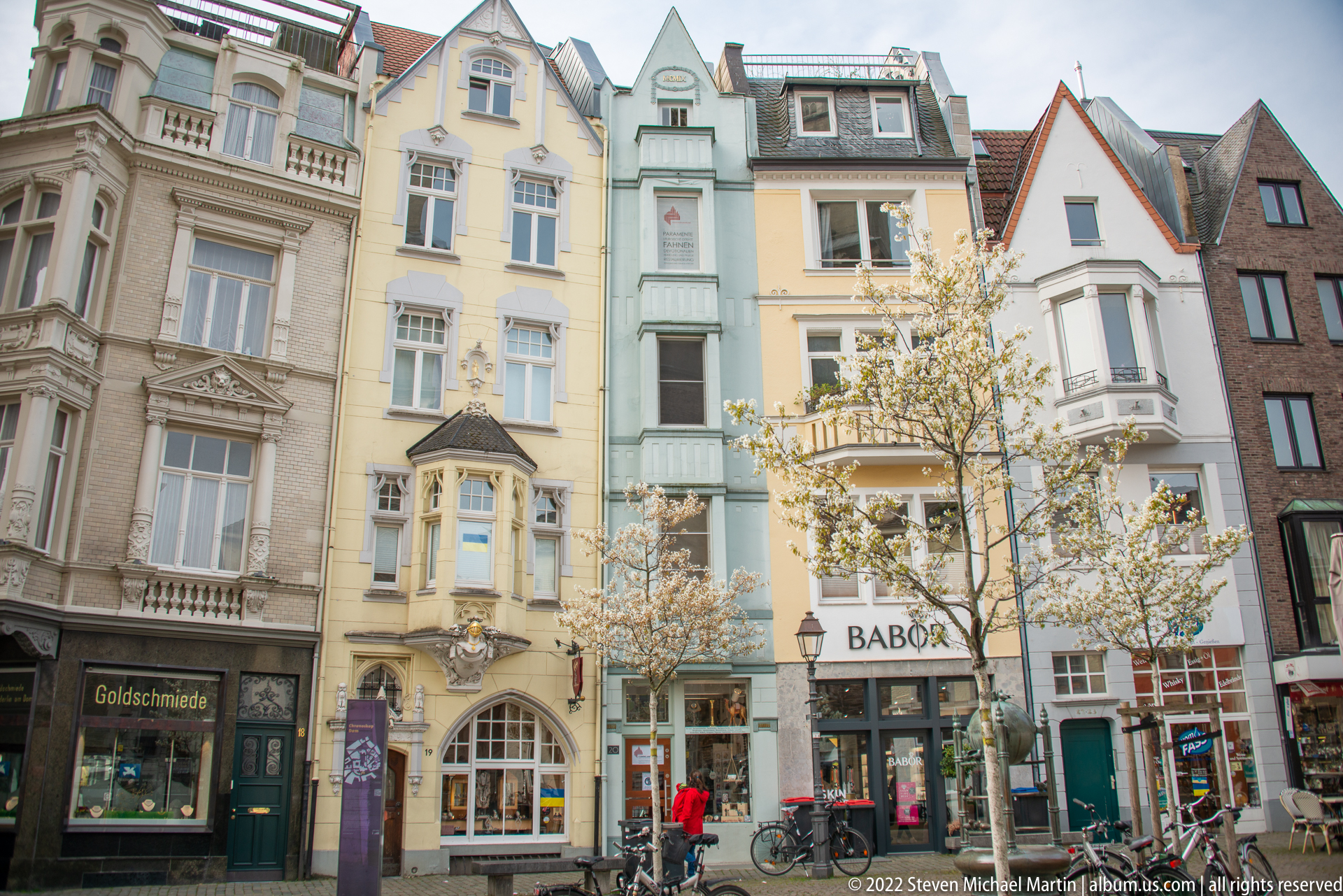
A row of narrow multistory townhouses presents an unusually varied sequence of historic façades, from pale stucco and carved window surrounds to projecting bays and steep gables. Ground-floor shops occupy the street edge while bicycles and small trees add contemporary use and scale. The close frontal view turns the streetscape into a comparative study of façade width, ornament, window rhythm, and roofline.
Caption
A row of narrow multistory townhouses presents an unusually varied sequence of historic façades, from pale stucco and carved window surrounds to projecting bays and steep gables. Ground-floor shops occupy the street edge while bicycles and small trees add contemporary use and scale. The close frontal view turns the streetscape into a comparative study of façade width, ornament, window rhythm, and roofline.
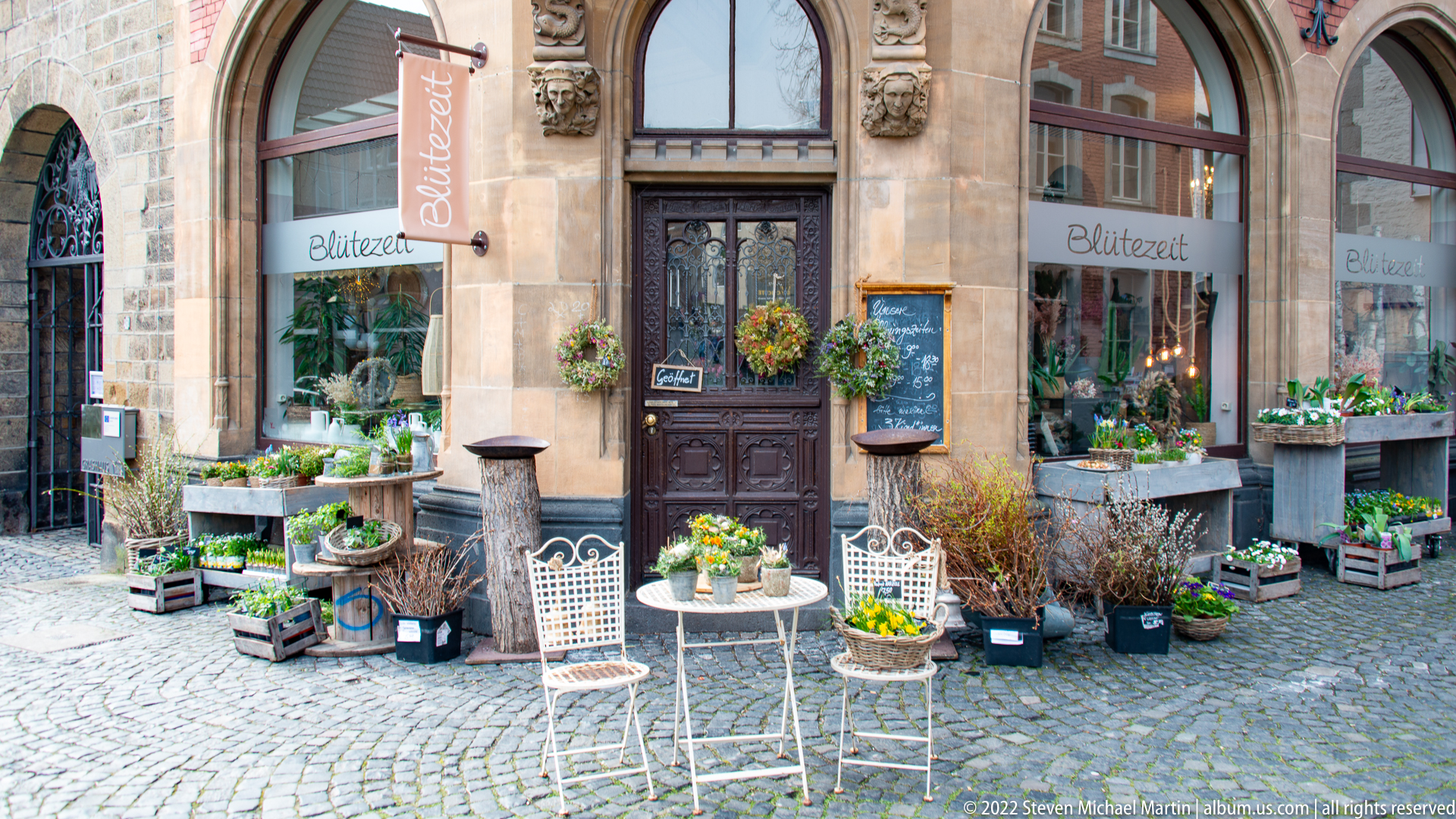
A flower shop spills onto the cobbled street with potted plants, crates, baskets, and a small white café set arranged around a dark carved doorway. Large arched windows and stone detailing give the storefront a historic architectural frame, while the dense display of greenery and blossoms creates a domestic, almost garden-like threshold. The image records everyday commercial life within Aachen’s old center.
Caption
A flower shop spills onto the cobbled street with potted plants, crates, baskets, and a small white café set arranged around a dark carved doorway. Large arched windows and stone detailing give the storefront a historic architectural frame, while the dense display of greenery and blossoms creates a domestic, almost garden-like threshold. The image records everyday commercial life within Aachen’s old center.
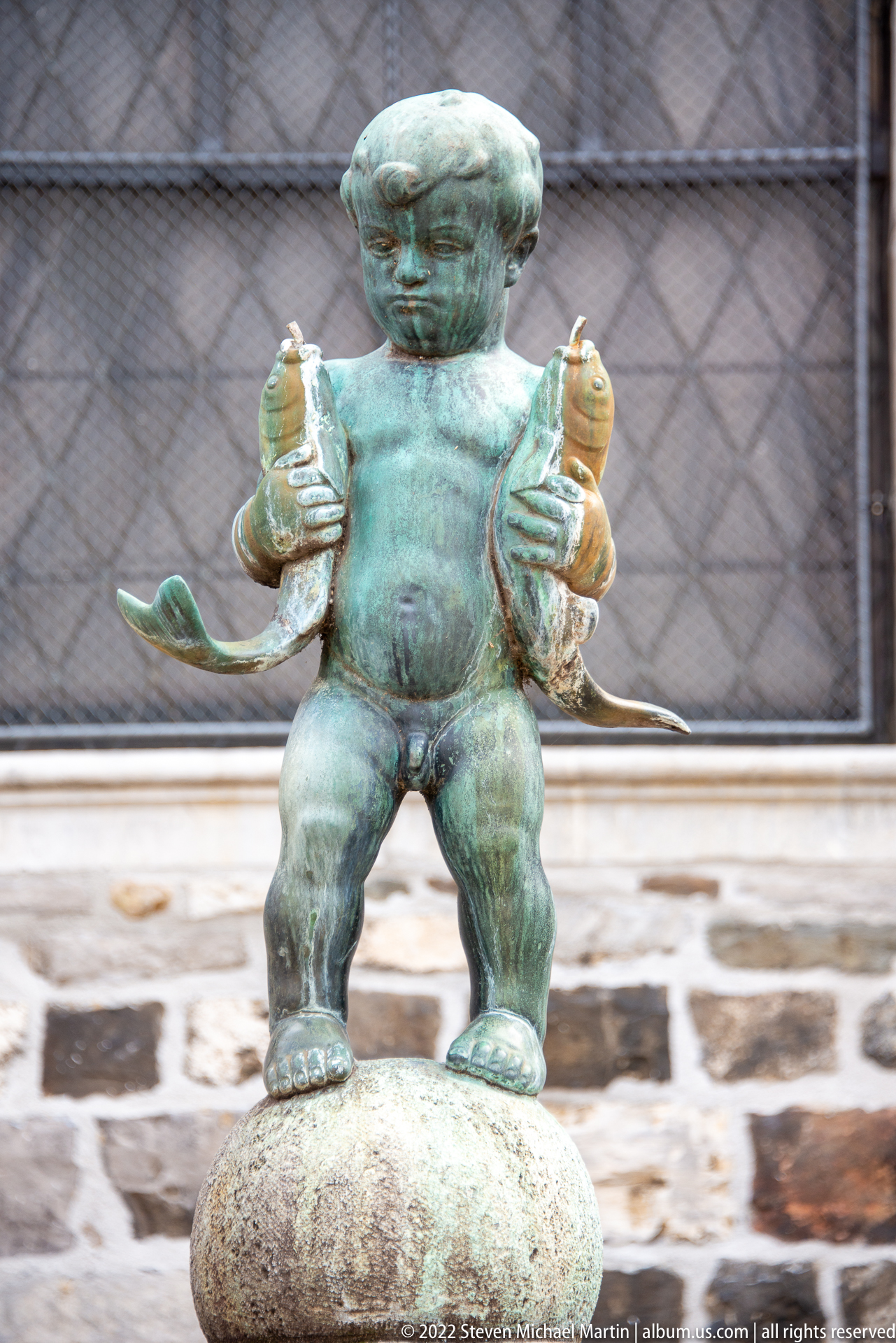
The Fischpüddelchen, a small bronze boy holding a fish in each hand, stands on a rounded stone base in Aachen’s historic center. Weathered green patina gives the compact figure a lively surface, while the paired fish create the fountain’s distinctive silhouette. The close view isolates the playful civic sculpture from its surroundings and makes the figure’s stance, expression, and water-related attributes immediately legible.
Caption
The Fischpüddelchen, a small bronze boy holding a fish in each hand, stands on a rounded stone base in Aachen’s historic center. Weathered green patina gives the compact figure a lively surface, while the paired fish create the fountain’s distinctive silhouette. The close view isolates the playful civic sculpture from its surroundings and makes the figure’s stance, expression, and water-related attributes immediately legible.
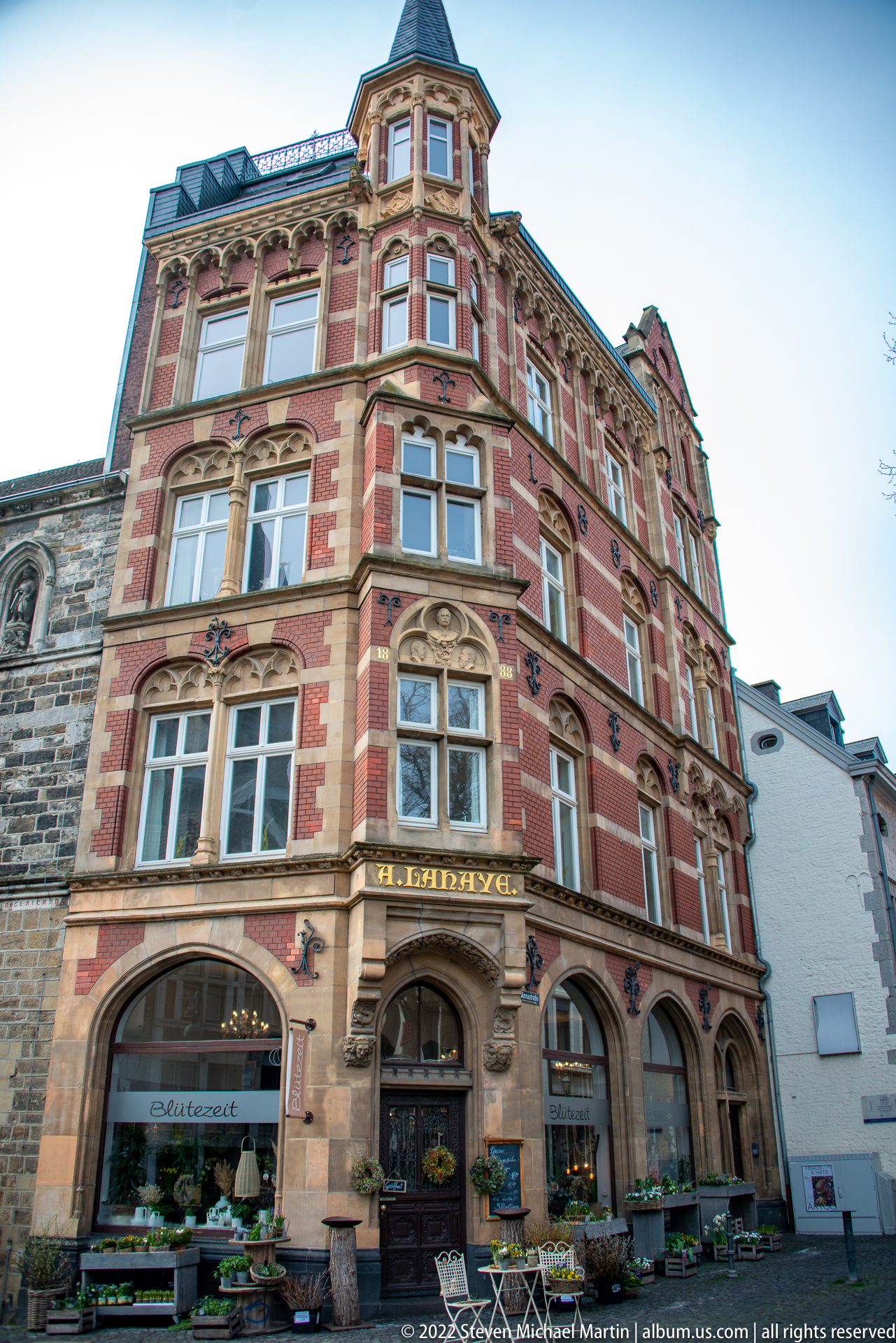
An ornate corner building combines red masonry panels with pale stone trim, arched ground-floor openings, bay windows, carved surrounds, and a projecting roofline. Café tables occupy the pavement beneath the historic façade, linking architectural display with contemporary street life. The upward angle highlights the building’s corner geometry and layered ornament, making it a strong example of the richly detailed urban fabric around central Aachen.
Caption
An ornate corner building combines red masonry panels with pale stone trim, arched ground-floor openings, bay windows, carved surrounds, and a projecting roofline. Café tables occupy the pavement beneath the historic façade, linking architectural display with contemporary street life. The upward angle highlights the building’s corner geometry and layered ornament, making it a strong example of the richly detailed urban fabric around central Aachen.
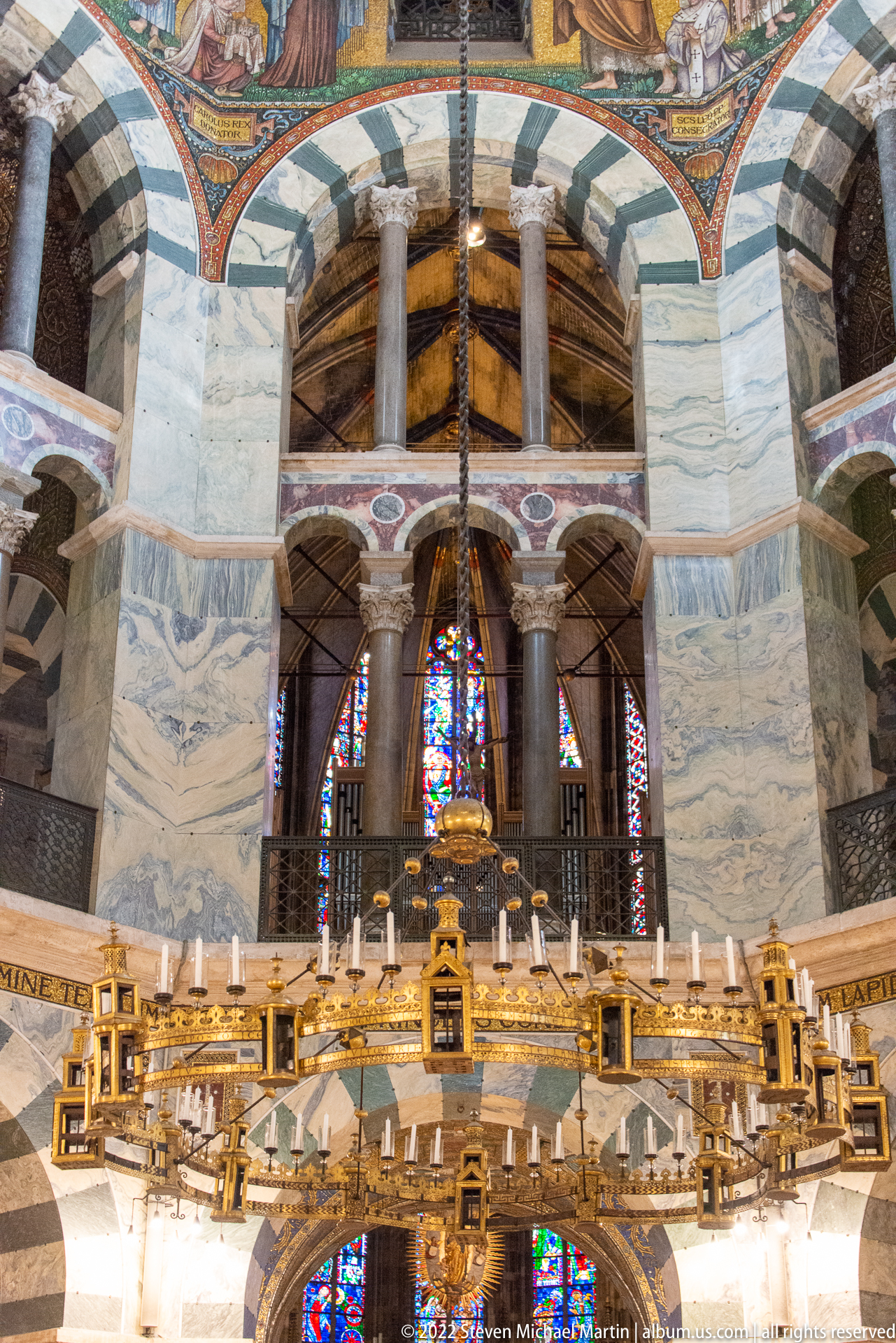
A wider interior view places the Barbarossa Chandelier within the soaring geometry of Aachen Cathedral’s Octagon. The gilded ring spans the lower foreground while striped arches, marble revetment, columns, and stained glass rise behind it. By showing the chandelier in architectural context, the photograph reveals how its circular form responds to the centralized space and how medieval metalwork, stone, glass, and later interior decoration interact.
Caption
A wider interior view places the Barbarossa Chandelier within the soaring geometry of Aachen Cathedral’s Octagon. The gilded ring spans the lower foreground while striped arches, marble revetment, columns, and stained glass rise behind it. By showing the chandelier in architectural context, the photograph reveals how its circular form responds to the centralized space and how medieval metalwork, stone, glass, and later interior decoration interact.
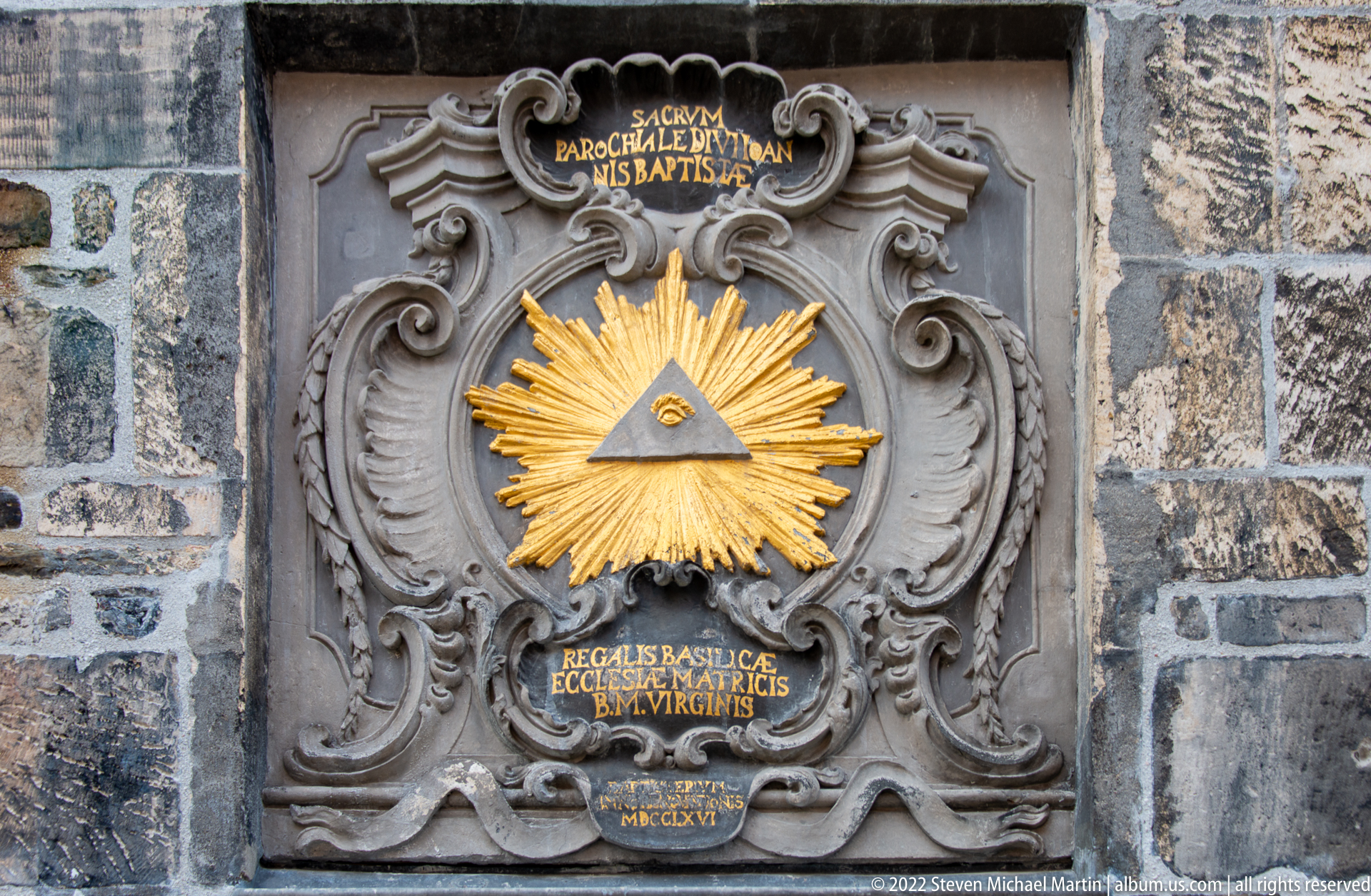
A gilded Eye of Providence within a radiant triangle dominates an elaborate stone plaque framed by curling Baroque scrollwork. Latin inscriptions in gold occupy cartouches above and below the central emblem, while the surrounding wall is built of rough dark masonry. The close framing emphasizes the contrast between polished gilding and weathered stone, turning a small devotional detail into a concentrated study of religious symbolism and ornament.
Caption
A gilded Eye of Providence within a radiant triangle dominates an elaborate stone plaque framed by curling Baroque scrollwork. Latin inscriptions in gold occupy cartouches above and below the central emblem, while the surrounding wall is built of rough dark masonry. The close framing emphasizes the contrast between polished gilding and weathered stone, turning a small devotional detail into a concentrated study of religious symbolism and ornament.
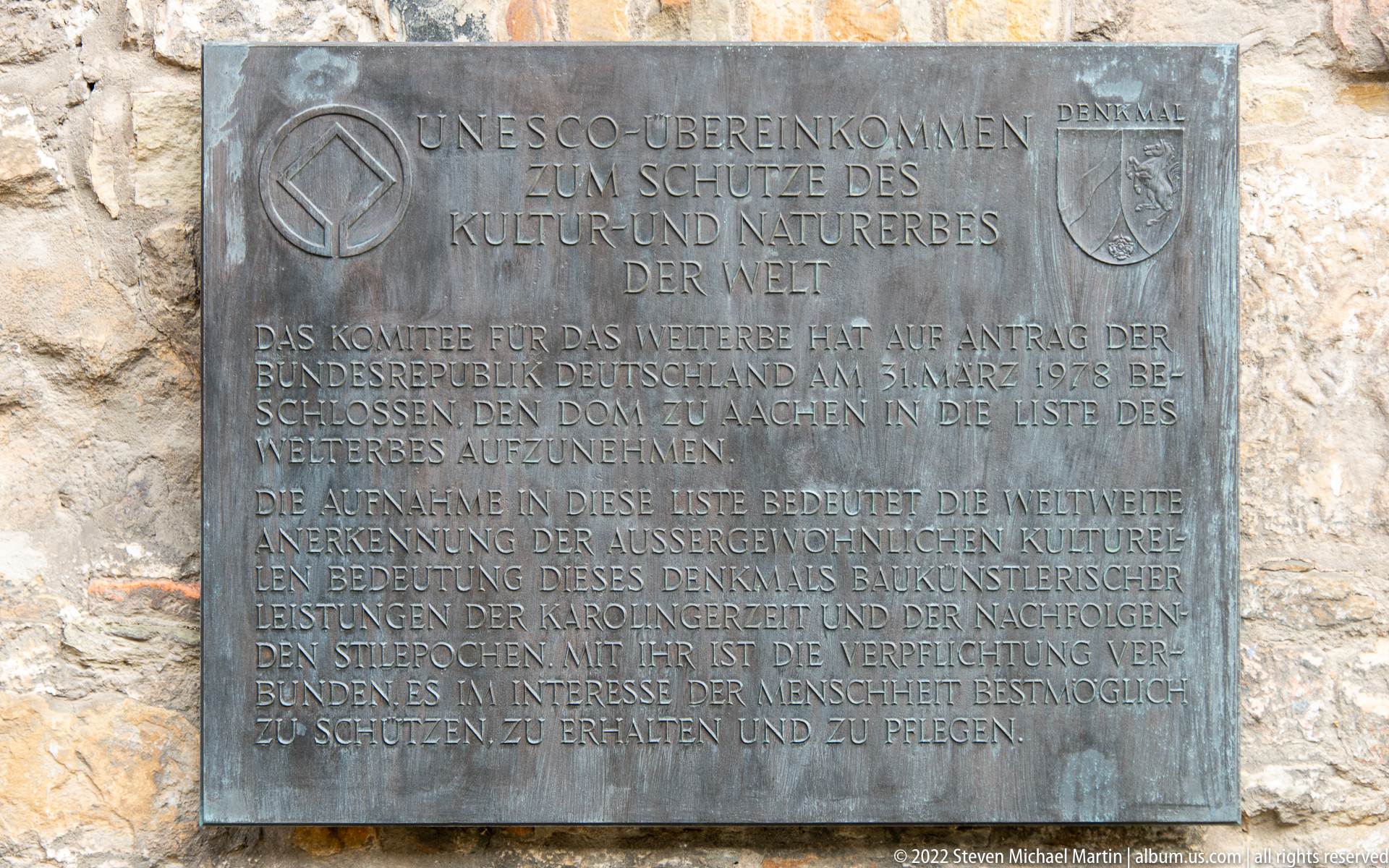
A bronze plaque mounted on rough stone commemorates Aachen Cathedral’s inclusion on the UNESCO World Heritage List. The German inscription refers to the protection of the world’s cultural and natural heritage and recognizes the cathedral’s outstanding cultural significance. Set directly against the historic masonry, the marker connects the building’s physical fabric with its modern international heritage designation and conservation status.
Caption
A bronze plaque mounted on rough stone commemorates Aachen Cathedral’s inclusion on the UNESCO World Heritage List. The German inscription refers to the protection of the world’s cultural and natural heritage and recognizes the cathedral’s outstanding cultural significance. Set directly against the historic masonry, the marker connects the building’s physical fabric with its modern international heritage designation and conservation status.
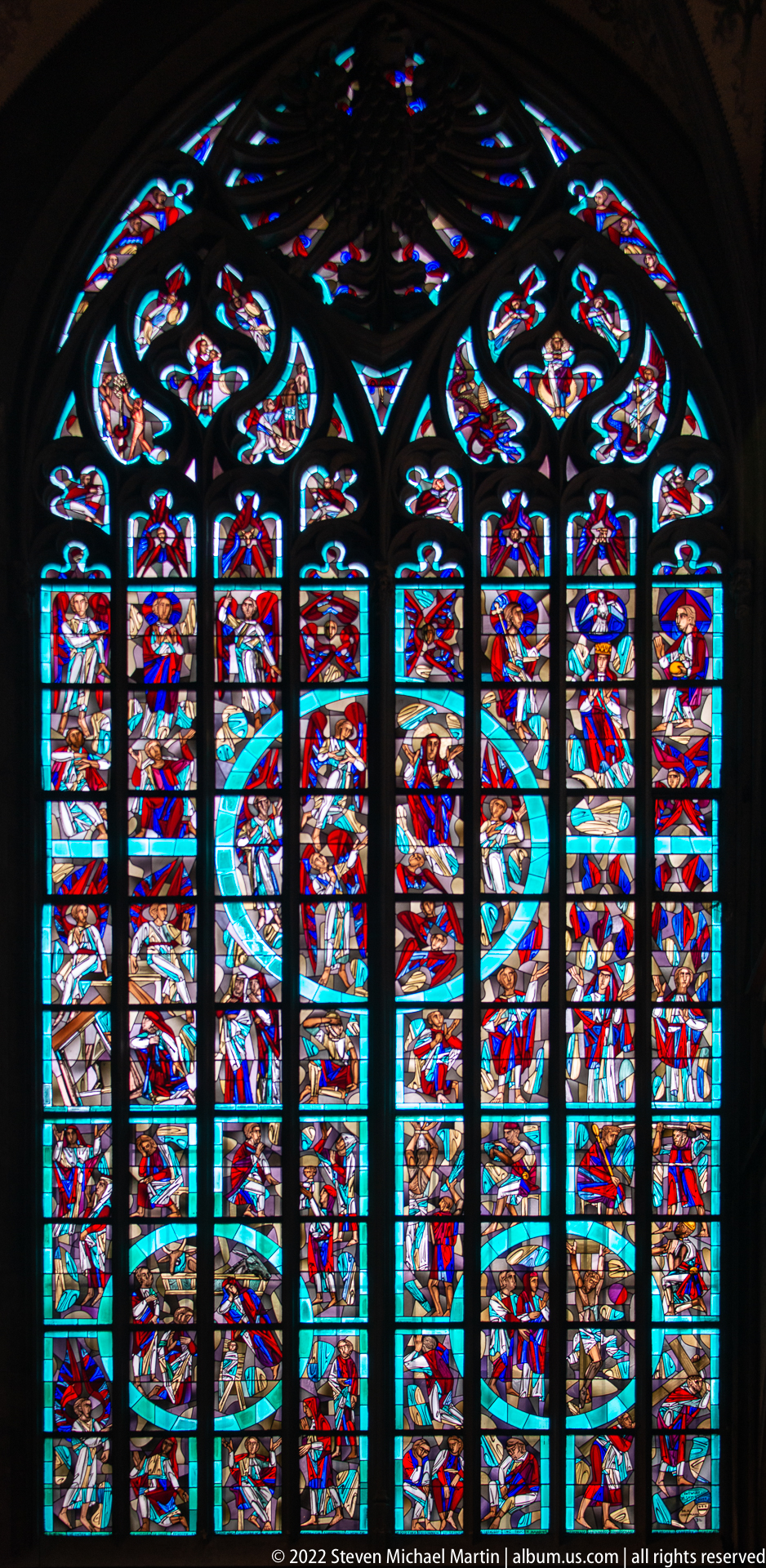
A large stained-glass window fills the dark opening with saturated reds, blues, whites, and turquoise tones arranged in dense figurative and ornamental compositions. The repeated vertical lancets are unified by tracery at the top, where smaller curved panels continue the color pattern. The photograph isolates the luminous glass against the surrounding darkness, emphasizing line, color, and the layered narrative character of the window.
Caption
A large stained-glass window fills the dark opening with saturated reds, blues, whites, and turquoise tones arranged in dense figurative and ornamental compositions. The repeated vertical lancets are unified by tracery at the top, where smaller curved panels continue the color pattern. The photograph isolates the luminous glass against the surrounding darkness, emphasizing line, color, and the layered narrative character of the window.
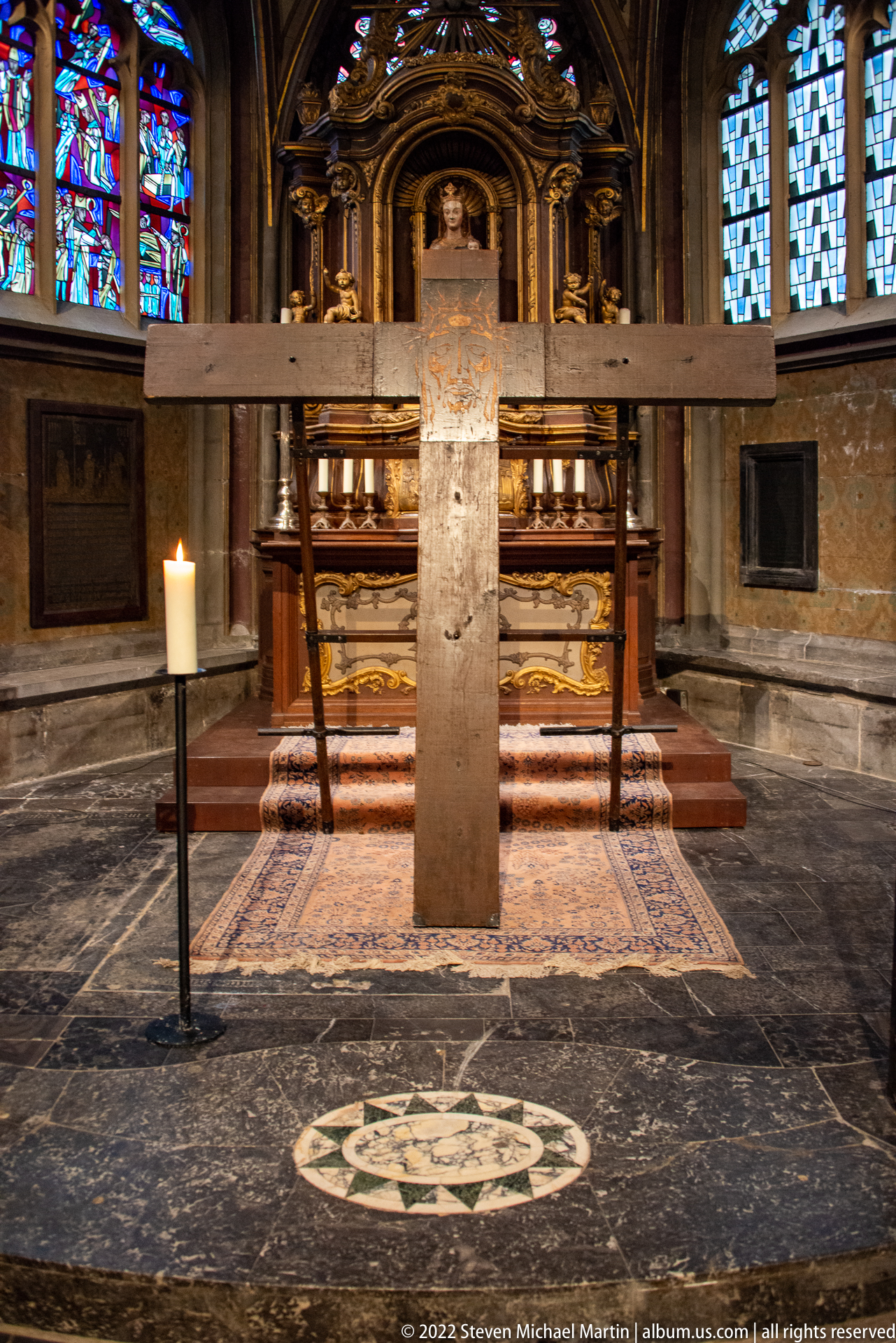
A low stone marker stands directly before an altar, separated from the foreground by a plain wooden rail. Candles, patterned floor stone, dark wall panels, and carved architectural framing establish a solemn liturgical setting. The centered composition emphasizes the relationship between the floor marker and altar rather than the wider chapel, suggesting a commemorative or burial association without relying on an uncertain identification.
Caption
A low stone marker stands directly before an altar, separated from the foreground by a plain wooden rail. Candles, patterned floor stone, dark wall panels, and carved architectural framing establish a solemn liturgical setting. The centered composition emphasizes the relationship between the floor marker and altar rather than the wider chapel, suggesting a commemorative or burial association without relying on an uncertain identification.
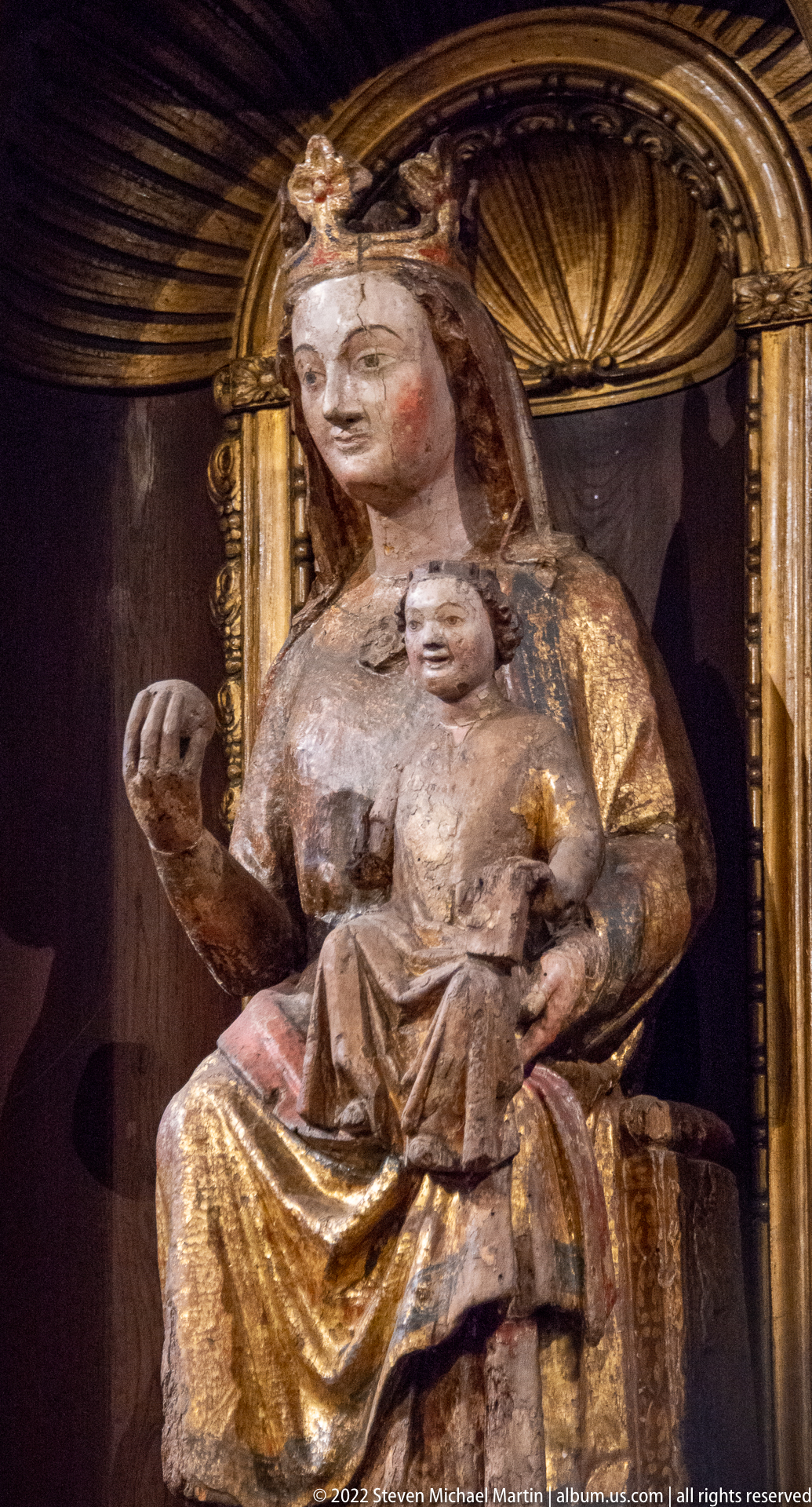
A seated Madonna supports the Christ Child on her lap in a weathered polychrome sculpture displayed within a gilded architectural niche. Traces of gold, red, and pale flesh tones survive across the garments and figures, while the carved canopy above gives the devotional image a formal shrine-like setting. The close view emphasizes the sculpture’s age, worn surface, and intimate mother-and-child composition.
Caption
A seated Madonna supports the Christ Child on her lap in a weathered polychrome sculpture displayed within a gilded architectural niche. Traces of gold, red, and pale flesh tones survive across the garments and figures, while the carved canopy above gives the devotional image a formal shrine-like setting. The close view emphasizes the sculpture’s age, worn surface, and intimate mother-and-child composition.
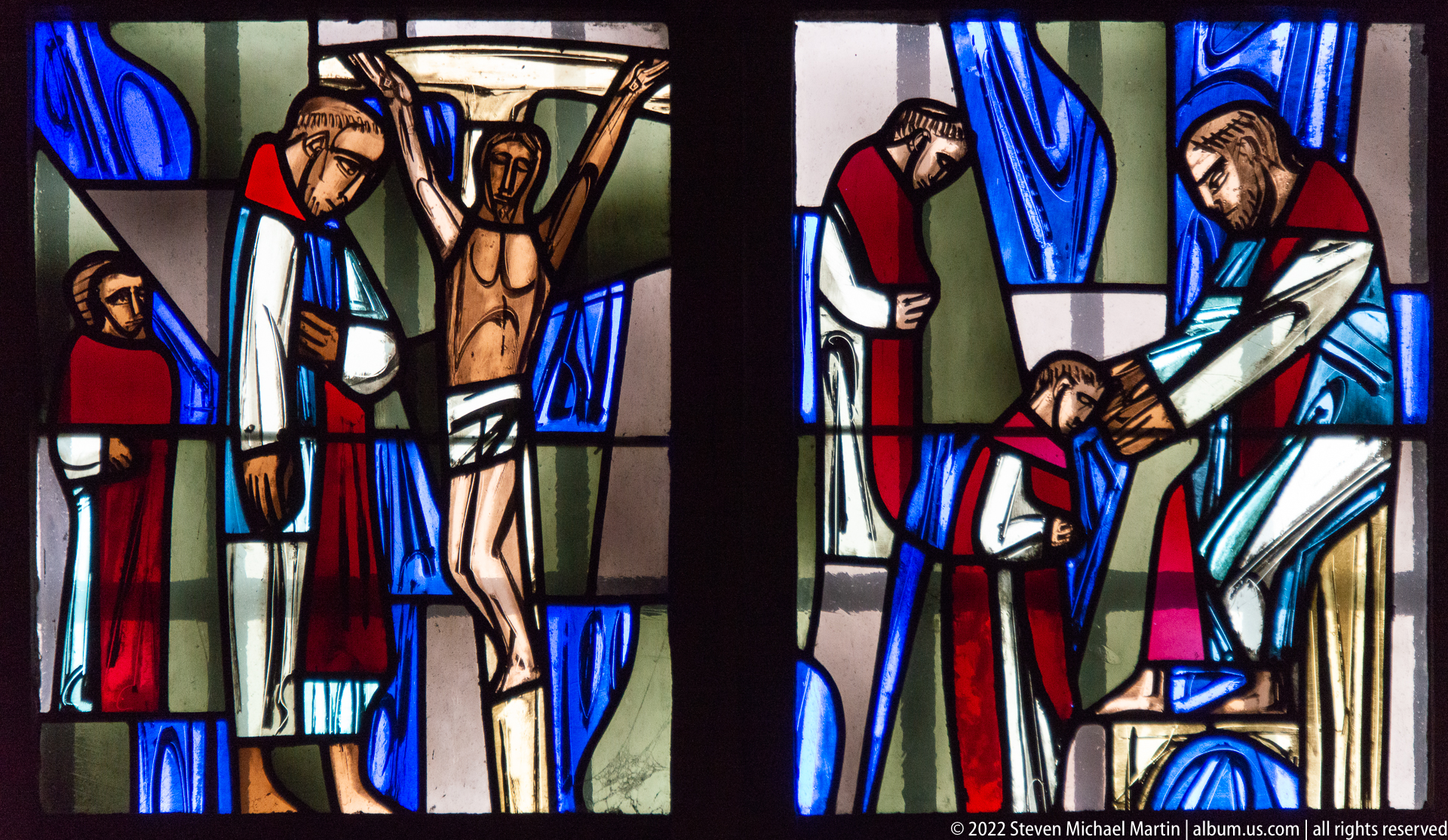
Bold modern stained glass presents episodes from the Passion in strongly simplified figures and saturated fields of red, blue, white, and green. One panel centers on the Crucifixion, while adjoining figures bend, gesture, and gather around other narrative moments. Heavy black leading gives the scenes a graphic rhythm, making the sacred story legible through posture, color blocks, and repeated vertical divisions.
Caption
Bold modern stained glass presents episodes from the Passion in strongly simplified figures and saturated fields of red, blue, white, and green. One panel centers on the Crucifixion, while adjoining figures bend, gesture, and gather around other narrative moments. Heavy black leading gives the scenes a graphic rhythm, making the sacred story legible through posture, color blocks, and repeated vertical divisions.
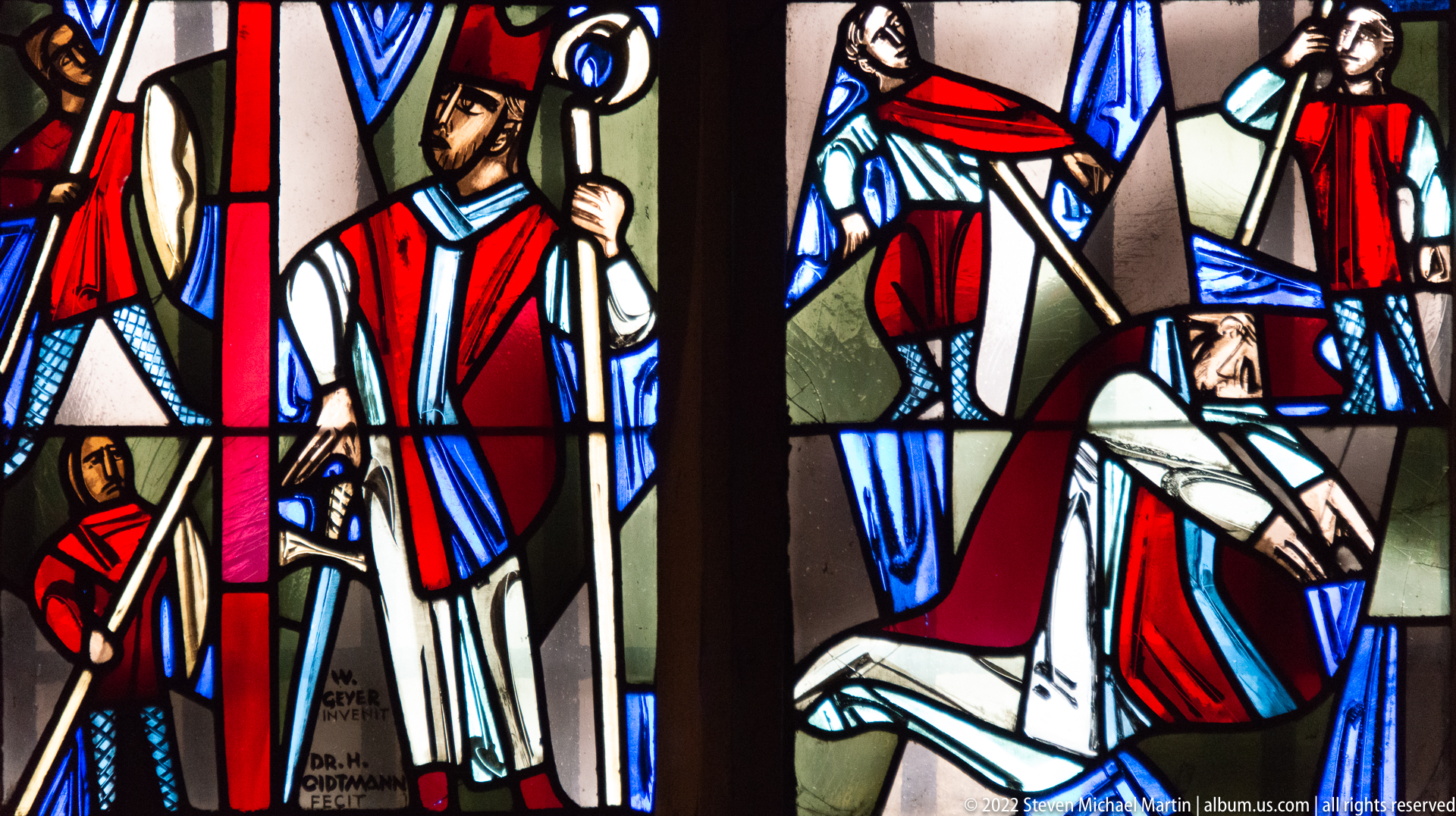
Modern stained glass portrays a sequence of ecclesiastical figures in vivid reds, blues, whites, and black outlines. A mitred bishop holding a crozier dominates the left panel, while neighboring clergy and narrative figures occupy adjoining compartments. The close crop brings attention to vestments, staffs, halos, and angular facial modeling, revealing how traditional church imagery has been translated into a distinctly modern graphic language.
Caption
Modern stained glass portrays a sequence of ecclesiastical figures in vivid reds, blues, whites, and black outlines. A mitred bishop holding a crozier dominates the left panel, while neighboring clergy and narrative figures occupy adjoining compartments. The close crop brings attention to vestments, staffs, halos, and angular facial modeling, revealing how traditional church imagery has been translated into a distinctly modern graphic language.
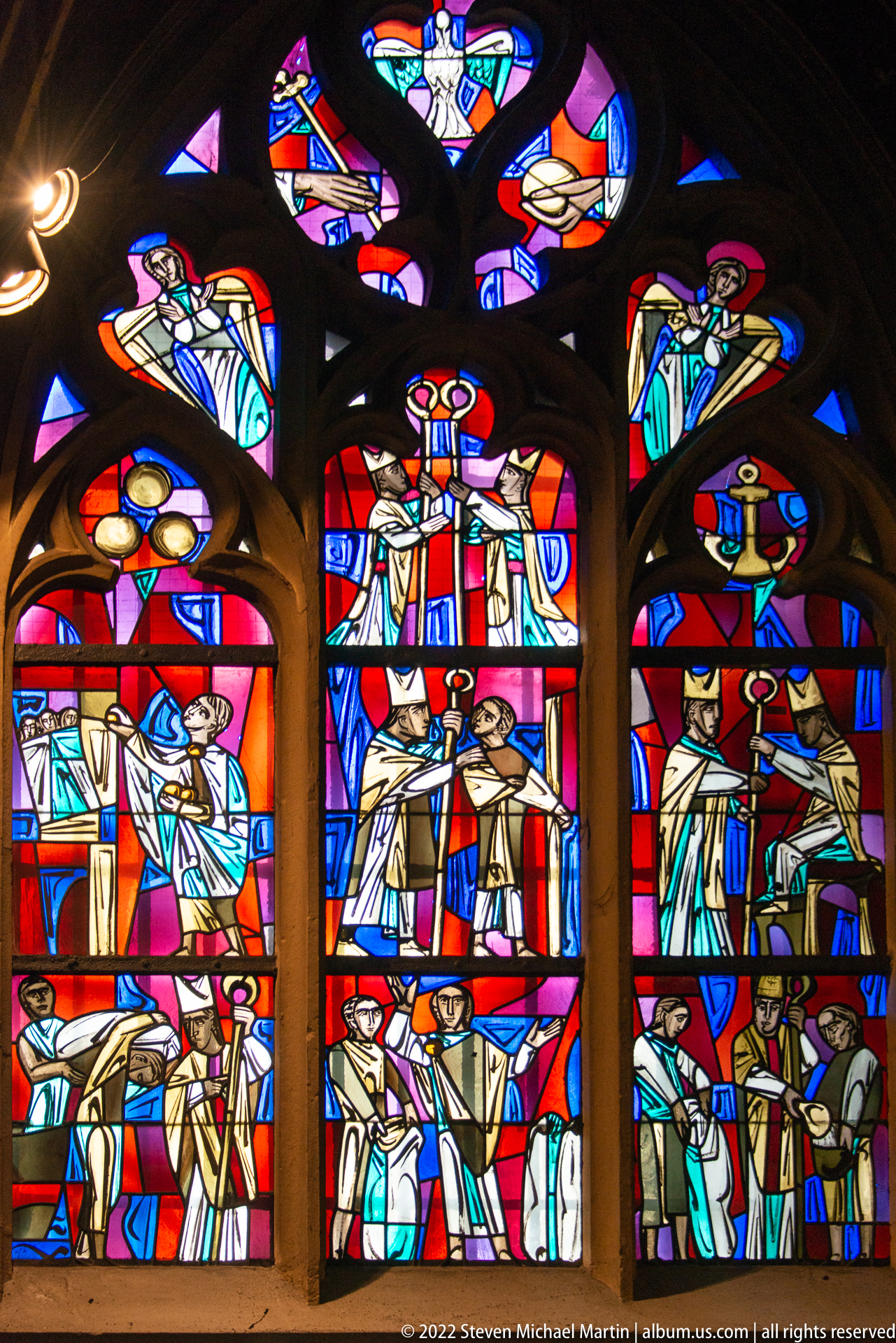
A broad stained-glass composition organizes numerous sacred scenes into three tall lights, each filled with layered groups of robed figures. Smaller tracery panels above continue the imagery, while saturated red, blue, white, and gold tones unify the whole window. Seen frontally, the design reads as a dense narrative field rather than a single episode, inviting close study of gestures, vestments, and repeated architectural divisions.
Caption
A broad stained-glass composition organizes numerous sacred scenes into three tall lights, each filled with layered groups of robed figures. Smaller tracery panels above continue the imagery, while saturated red, blue, white, and gold tones unify the whole window. Seen frontally, the design reads as a dense narrative field rather than a single episode, inviting close study of gestures, vestments, and repeated architectural divisions.
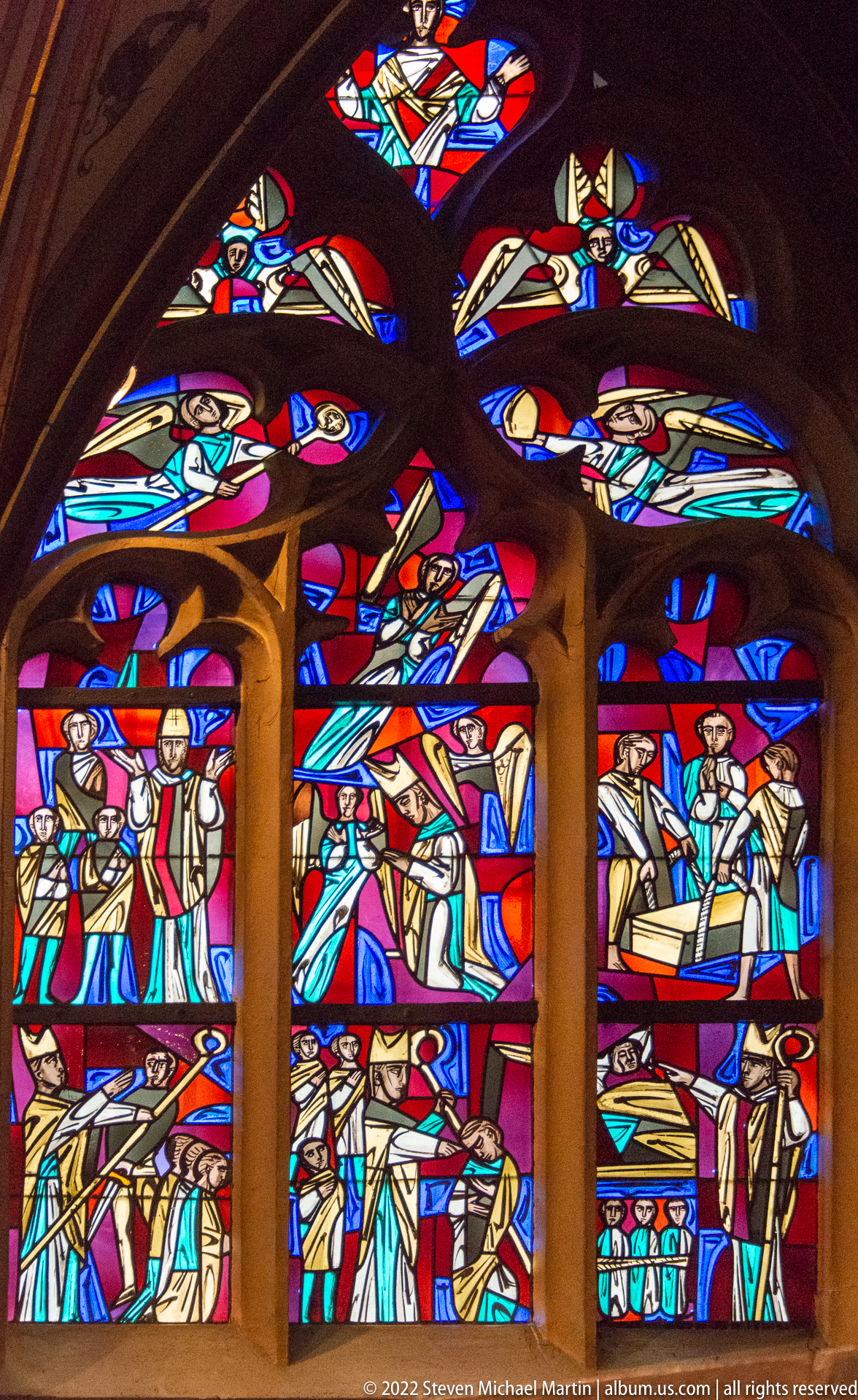
Three tall stained-glass lights are packed with grouped biblical figures rendered in strong bands of red, blue, white, and gold. The upper tracery contains additional isolated figures and symbols, creating a continuous visual program from base to arch. This closer view makes the individual gestures and crowded groupings easier to read, while the dark stone framework heightens the window’s saturated color and luminosity.
Caption
Three tall stained-glass lights are packed with grouped biblical figures rendered in strong bands of red, blue, white, and gold. The upper tracery contains additional isolated figures and symbols, creating a continuous visual program from base to arch. This closer view makes the individual gestures and crowded groupings easier to read, while the dark stone framework heightens the window’s saturated color and luminosity.
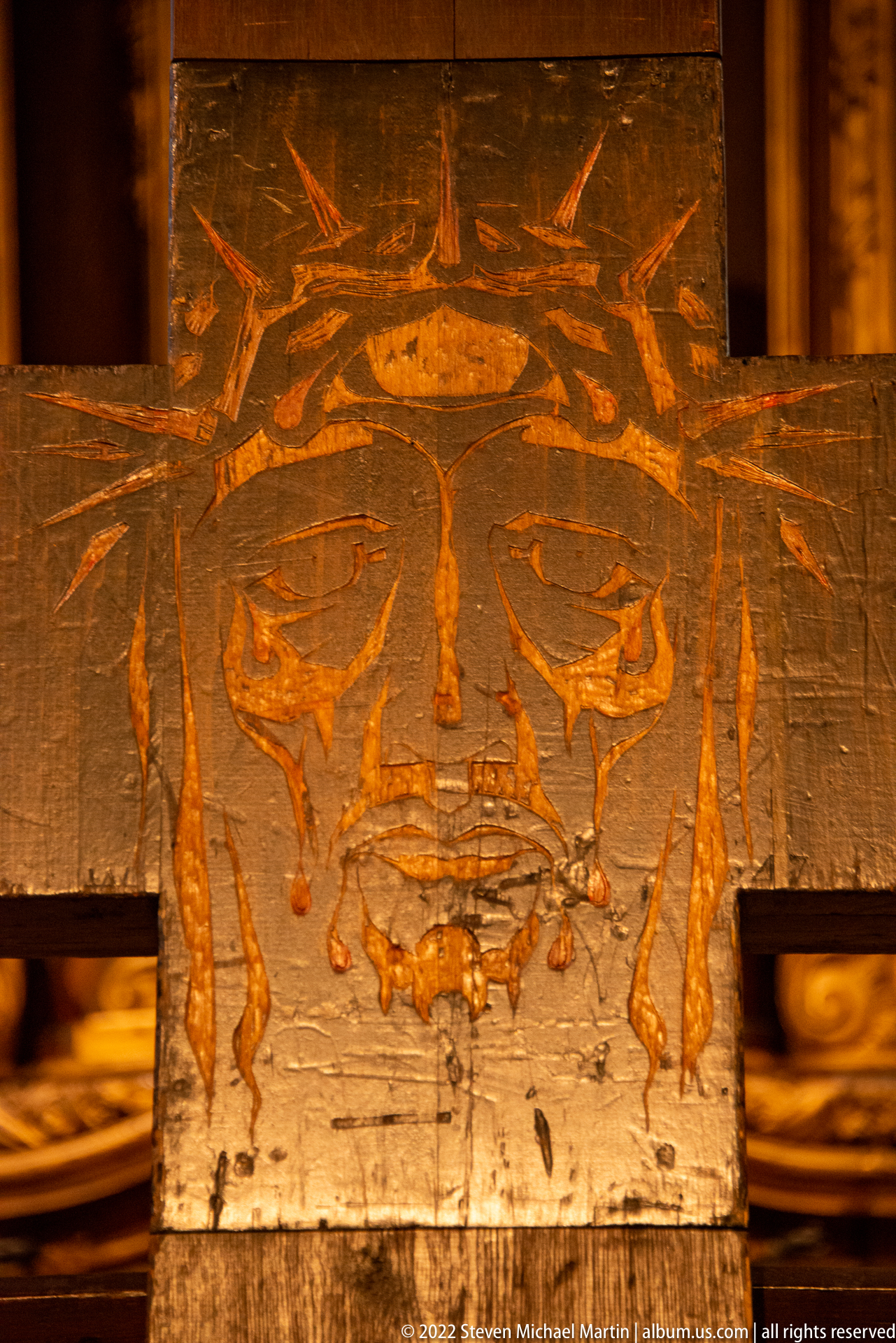
An expressive face of Christ wearing the crown of thorns is incised into the surface of a broad wooden cross member. Deeply cut lines define the downcast eyes, beard, hair, and radiating thorns, while warm directional light emphasizes the rough grain and tool marks. The stark, almost graphic treatment transforms the cross into both a devotional object and a study in carved line and texture.
Caption
An expressive face of Christ wearing the crown of thorns is incised into the surface of a broad wooden cross member. Deeply cut lines define the downcast eyes, beard, hair, and radiating thorns, while warm directional light emphasizes the rough grain and tool marks. The stark, almost graphic treatment transforms the cross into both a devotional object and a study in carved line and texture.
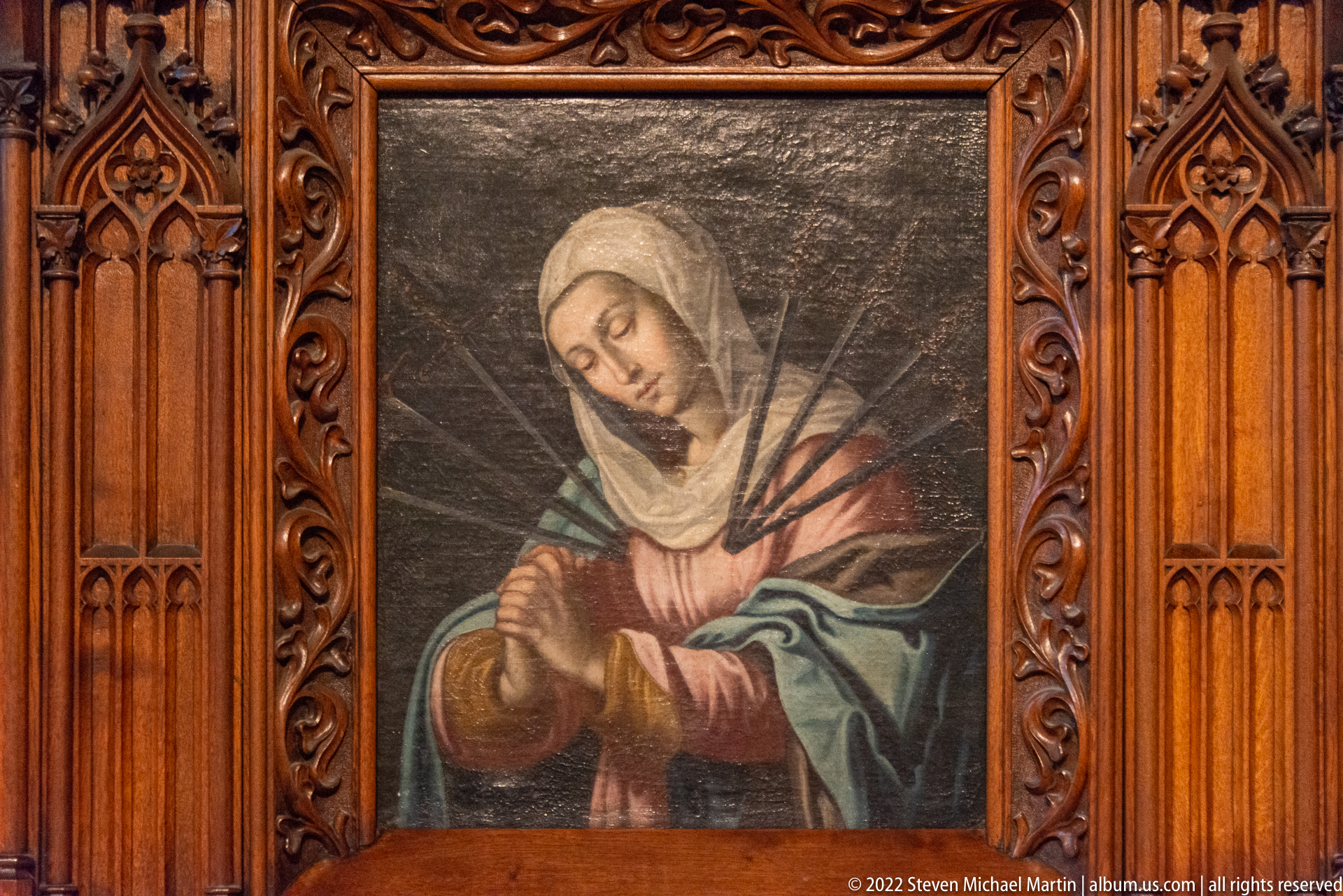
A devotional image of the Virgin presents Mary with clasped hands and downcast eyes, her head covered by a pale veil and her body wrapped in red and blue garments. A sword-like blade crosses the dark background beside her, reinforcing the iconography of sorrow. The painting is set within a richly carved Gothic-style wooden frame whose pointed arches and tracery echo an ecclesiastical architectural setting.
Caption
A devotional image of the Virgin presents Mary with clasped hands and downcast eyes, her head covered by a pale veil and her body wrapped in red and blue garments. A sword-like blade crosses the dark background beside her, reinforcing the iconography of sorrow. The painting is set within a richly carved Gothic-style wooden frame whose pointed arches and tracery echo an ecclesiastical architectural setting.
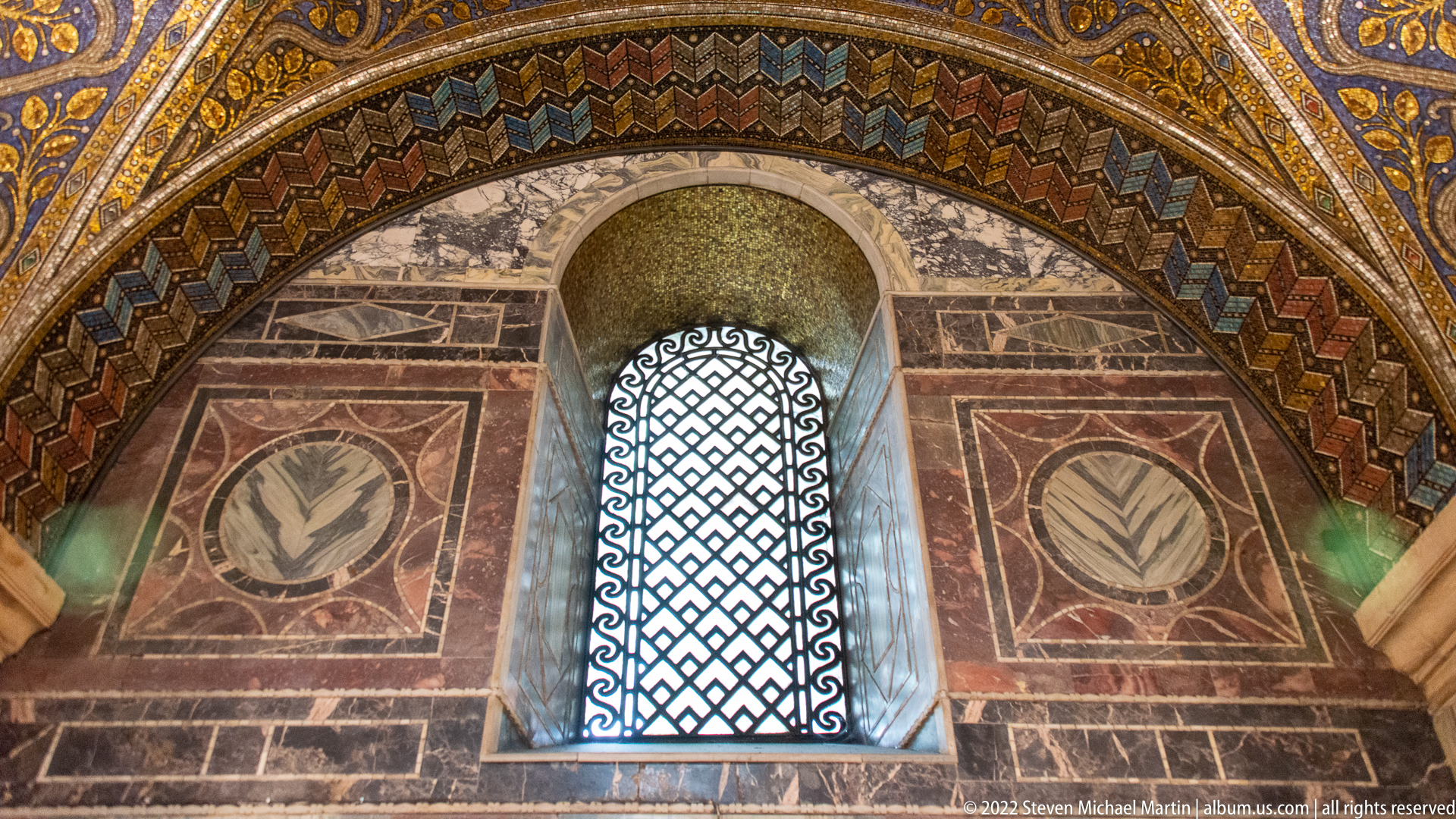
A narrow arched opening is framed by richly patterned marble revetment and a glittering mosaic band inside Aachen Cathedral’s Octagon. The dark geometric lattice contrasts with the polished stone panels and repeated ornamental motifs around the arch. This close architectural detail shifts attention away from the larger sacred space to its carefully coordinated materials, surface pattern, and the visual interplay between stone, metal, and mosaic.
Caption
A narrow arched opening is framed by richly patterned marble revetment and a glittering mosaic band inside Aachen Cathedral’s Octagon. The dark geometric lattice contrasts with the polished stone panels and repeated ornamental motifs around the arch. This close architectural detail shifts attention away from the larger sacred space to its carefully coordinated materials, surface pattern, and the visual interplay between stone, metal, and mosaic.
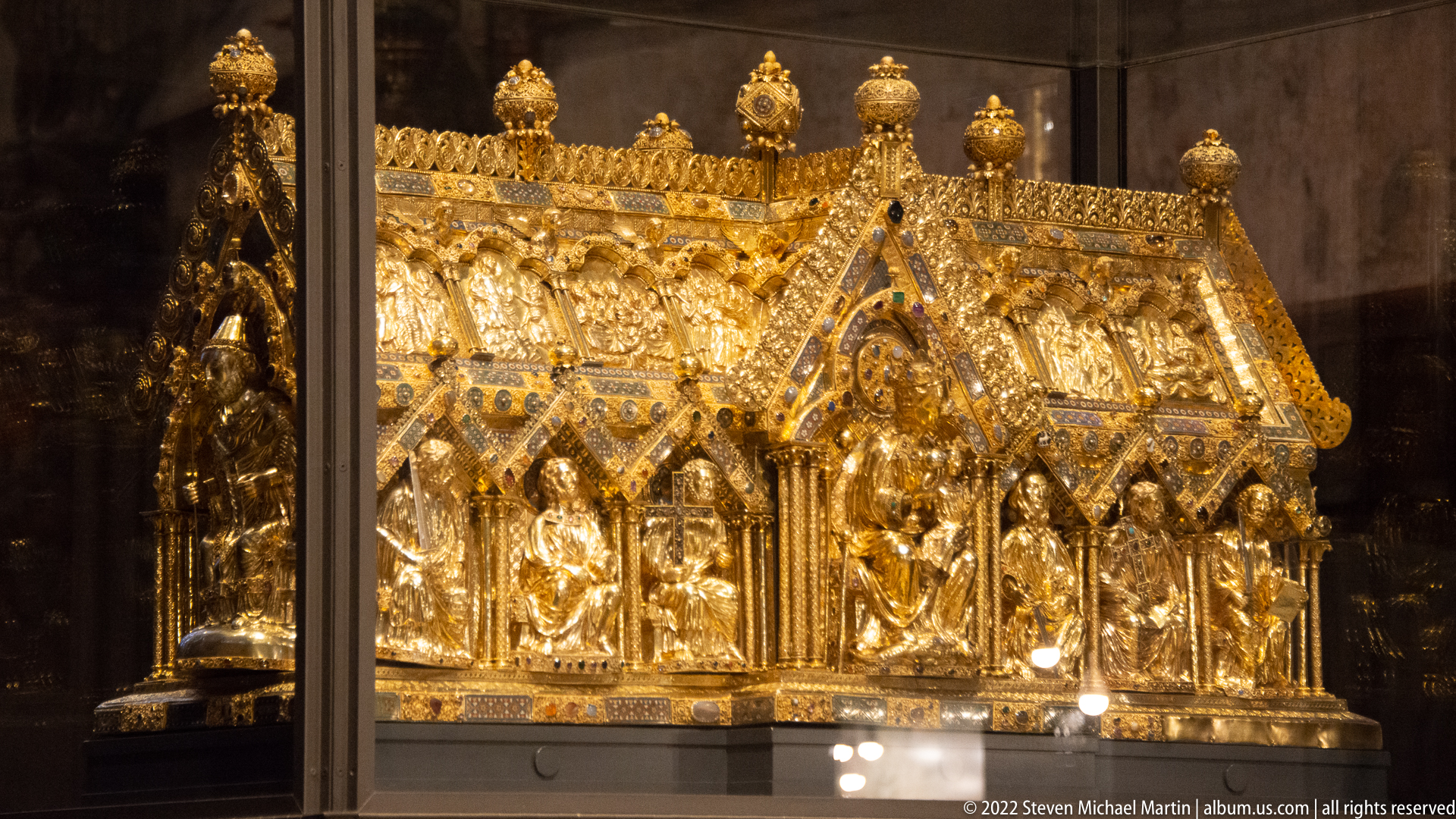
The gilded Marienschrein forms a miniature Gothic church in precious metal, with pointed arches, gables, finials, and rows of standing sacred figures distributed across its sides. Displayed behind glass, the reliquary’s dense surface catches the light and reveals a carefully ordered architectural program. The close view emphasizes its combination of sculpture and shrine architecture, central to Aachen Cathedral’s tradition of preserving and venerating major relics.
Caption
The gilded Marienschrein forms a miniature Gothic church in precious metal, with pointed arches, gables, finials, and rows of standing sacred figures distributed across its sides. Displayed behind glass, the reliquary’s dense surface catches the light and reveals a carefully ordered architectural program. The close view emphasizes its combination of sculpture and shrine architecture, central to Aachen Cathedral’s tradition of preserving and venerating major relics.
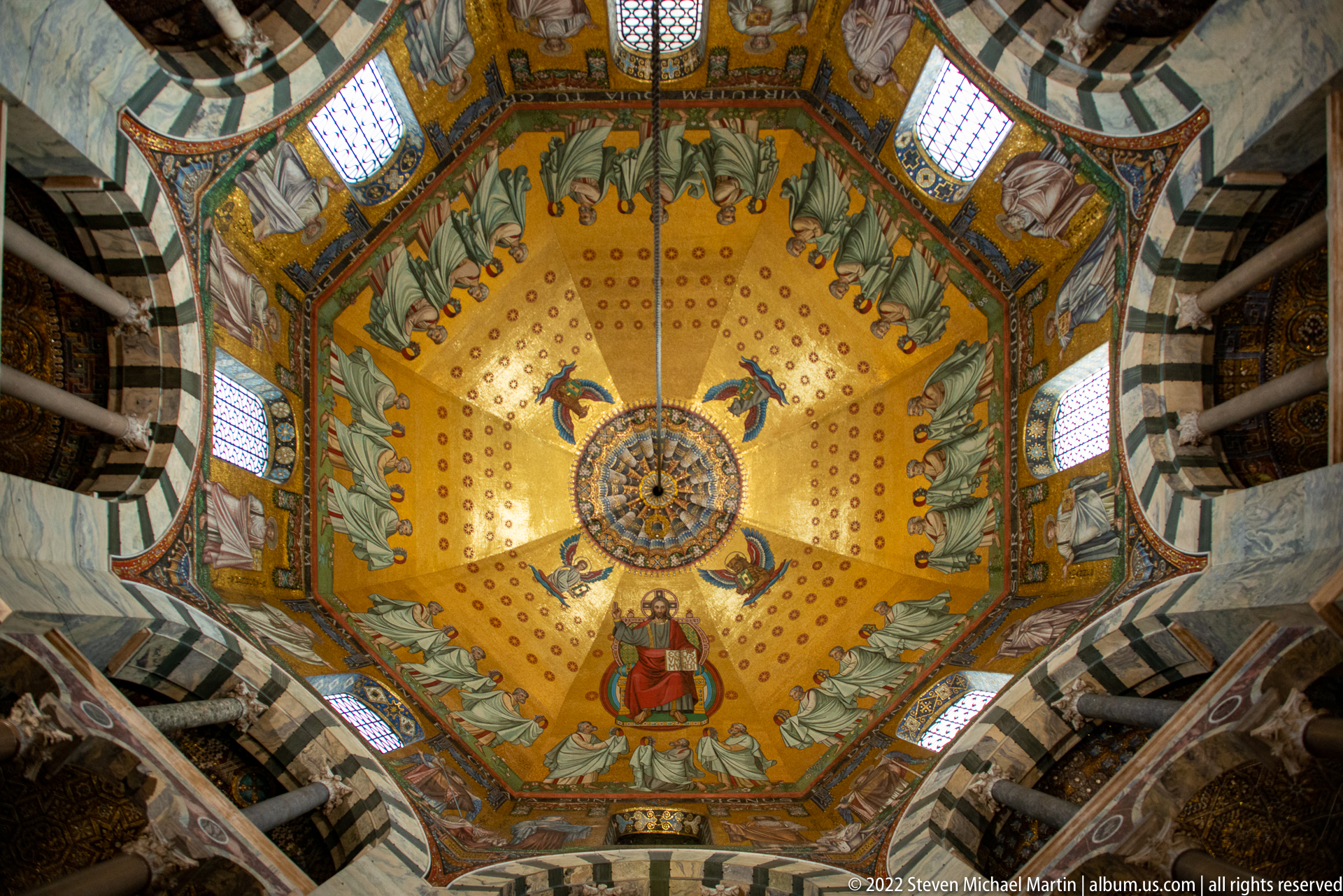
A gold-ground mosaic vault fills the upward view, organized around a central circular medallion and an enthroned figure at the lower edge of the octagonal composition. Repeated standing figures encircle the vault beneath architectural ribs, while striped masonry and clerestory openings frame the mosaic field. The photograph records the geometry and axial symmetry of the richly decorated interior from directly below.
Caption
A gold-ground mosaic vault fills the upward view, organized around a central circular medallion and an enthroned figure at the lower edge of the octagonal composition. Repeated standing figures encircle the vault beneath architectural ribs, while striped masonry and clerestory openings frame the mosaic field. The photograph records the geometry and axial symmetry of the richly decorated interior from directly below.
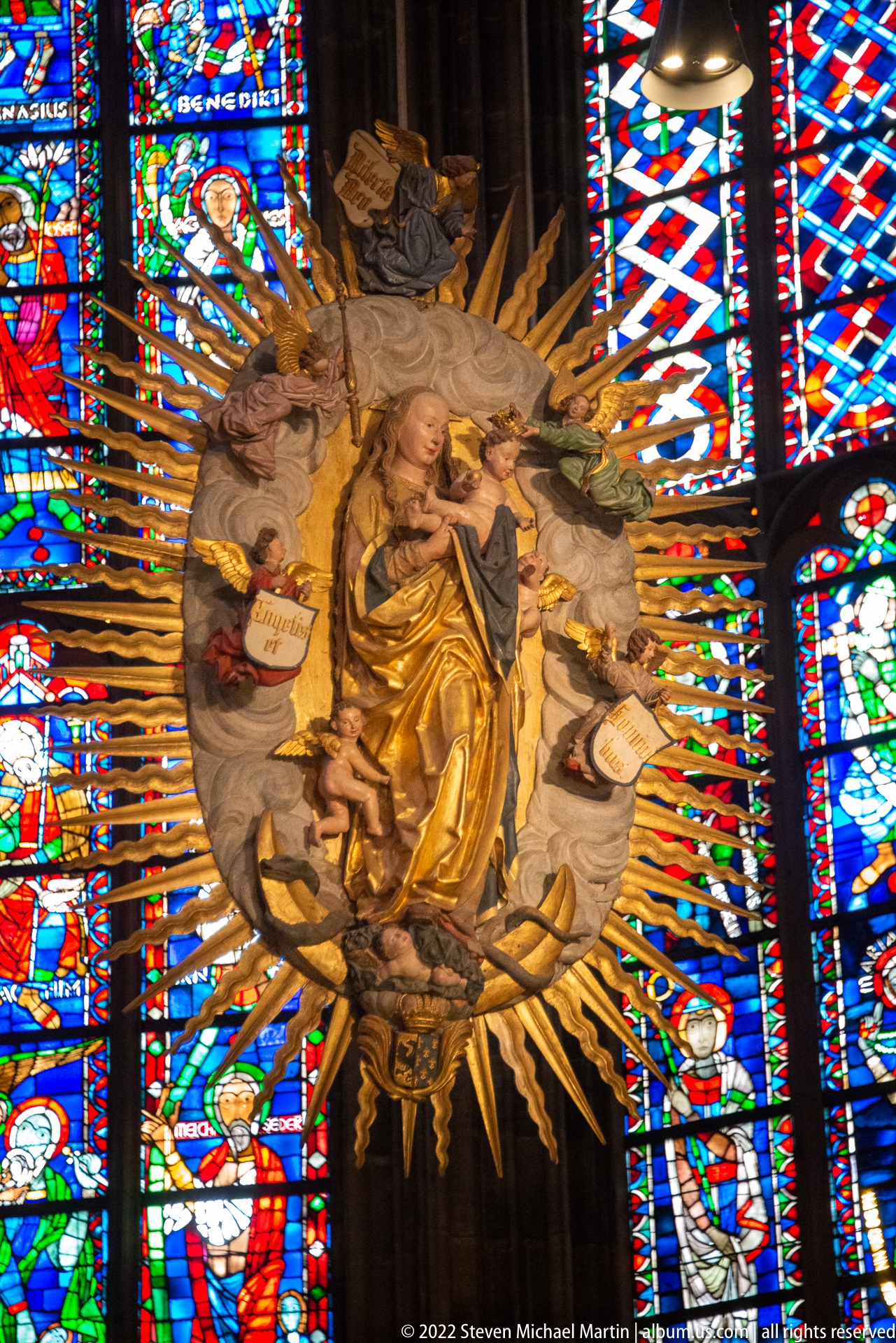
A gilded Virgin and Child stands at the center of a radiant devotional ensemble, framed by sculpted angels and a burst of metal rays. The work is set against densely colored stained glass, creating a layered interior view in which three-dimensional sculpture and luminous glazing compete for attention. The close framing emphasizes the shrine-like presentation and the contrast between gold surfaces and jewel-toned windows.
Caption
A gilded Virgin and Child stands at the center of a radiant devotional ensemble, framed by sculpted angels and a burst of metal rays. The work is set against densely colored stained glass, creating a layered interior view in which three-dimensional sculpture and luminous glazing compete for attention. The close framing emphasizes the shrine-like presentation and the contrast between gold surfaces and jewel-toned windows.
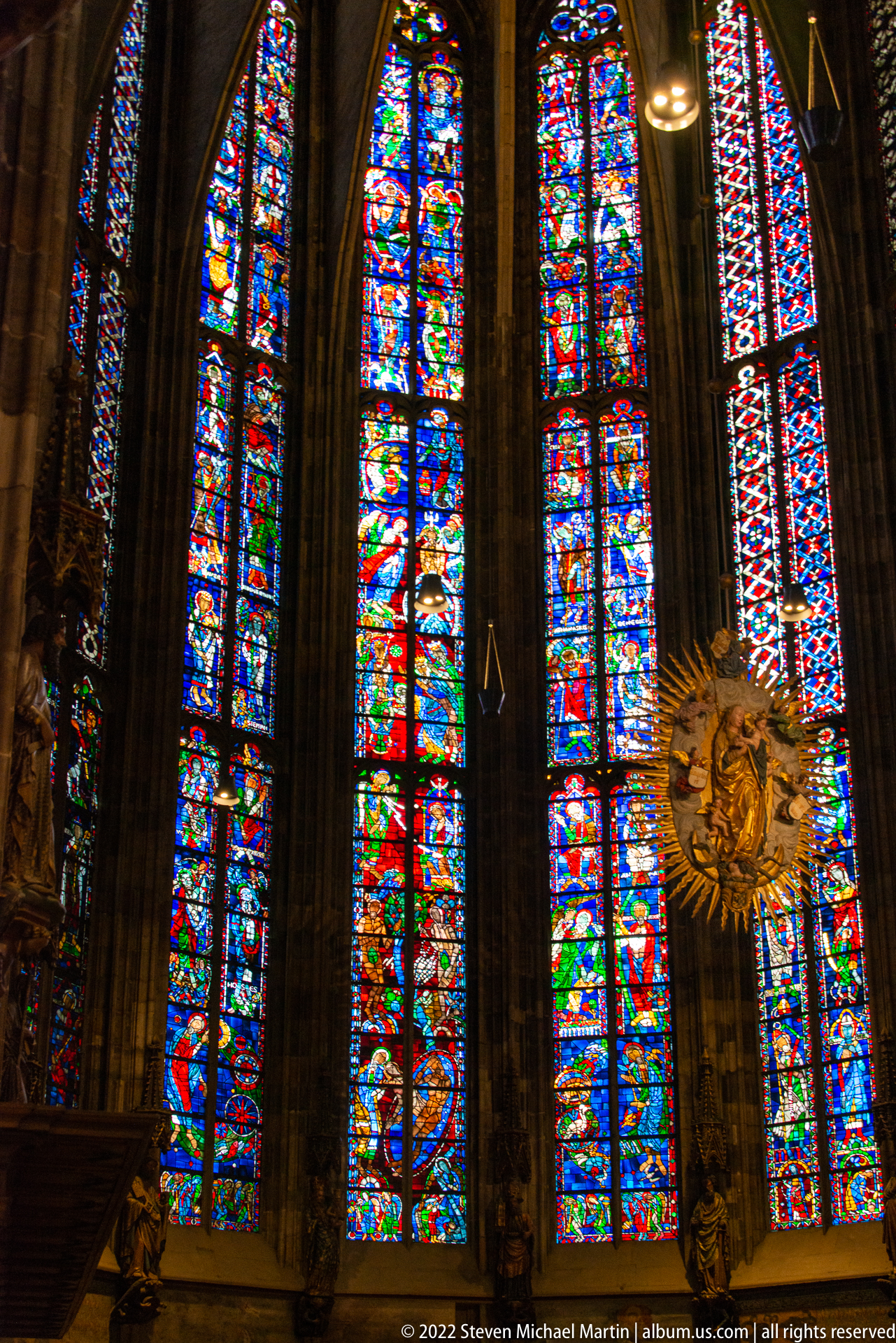
Tall stained-glass windows rise between dark stone piers, filling the upper wall with dense fields of red, blue, green, and white glass. A gilded radiant devotional object projects into the lower-right portion of the composition, providing scale and linking the glazing to the cathedral's liturgical interior. The upward viewpoint stresses the height, vertical rhythm, and colored light of the choir enclosure.
Caption
Tall stained-glass windows rise between dark stone piers, filling the upper wall with dense fields of red, blue, green, and white glass. A gilded radiant devotional object projects into the lower-right portion of the composition, providing scale and linking the glazing to the cathedral's liturgical interior. The upward viewpoint stresses the height, vertical rhythm, and colored light of the choir enclosure.
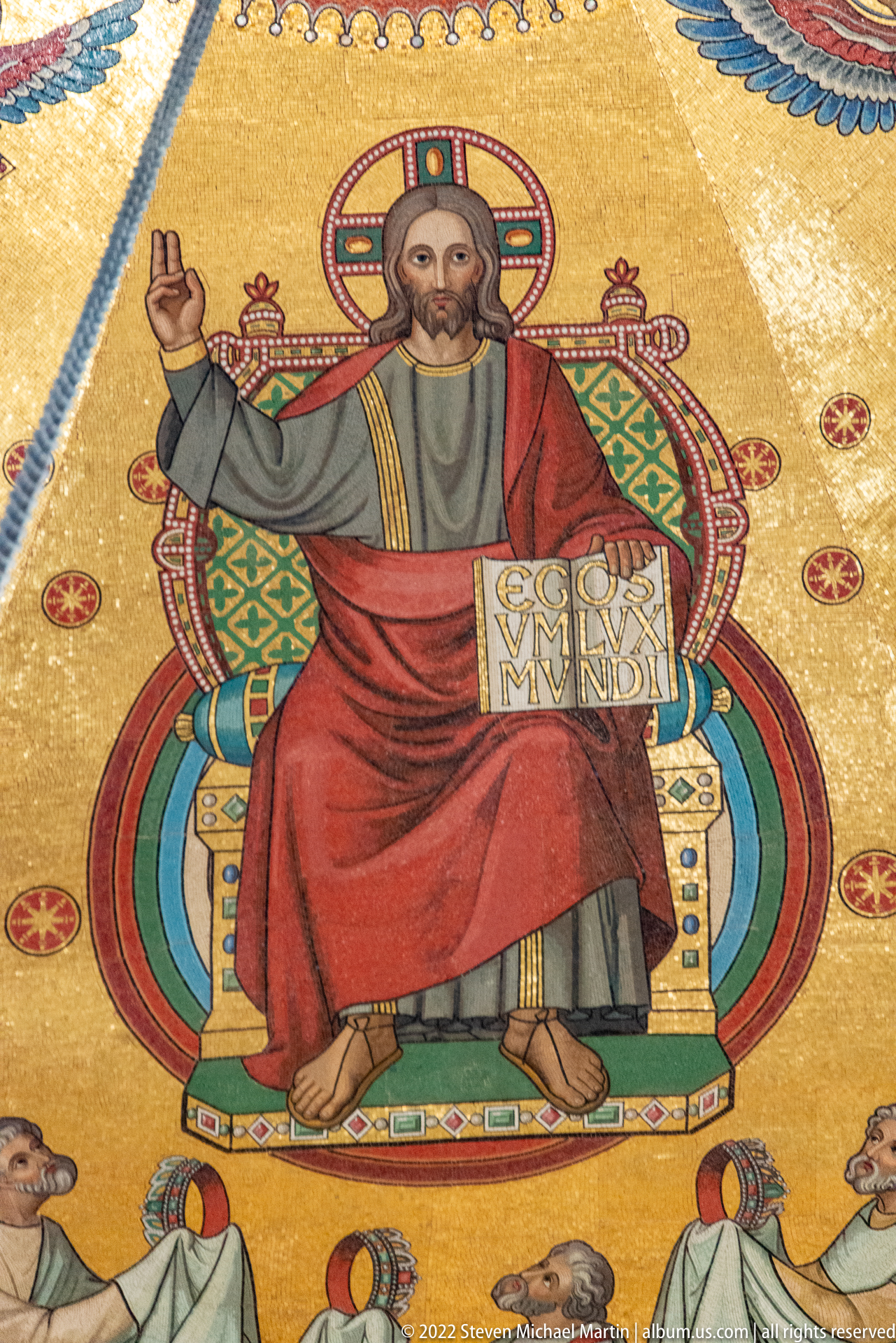
An enthroned Christ dominates this gold-ground mosaic detail, raising his right hand in blessing while holding an open book across his lap. The frontal pose, halo, symmetrical throne, and saturated red and green garments create a formal, hieratic image. Cropped attendants at the lower corners indicate that the figure belongs to a larger monumental program rather than an isolated panel.
Caption
An enthroned Christ dominates this gold-ground mosaic detail, raising his right hand in blessing while holding an open book across his lap. The frontal pose, halo, symmetrical throne, and saturated red and green garments create a formal, hieratic image. Cropped attendants at the lower corners indicate that the figure belongs to a larger monumental program rather than an isolated panel.

A winged lion, traditionally associated with Saint Mark, appears against a gold mosaic ground while holding a richly patterned book. Blue and red wings flare outward, and the compact frontal composition is surrounded by small ornamental medallions. The close view isolates the emblem from the wider decorative program, revealing the tessellated modeling of fur, feathers, halo, and manuscript cover.
Caption
A winged lion, traditionally associated with Saint Mark, appears against a gold mosaic ground while holding a richly patterned book. Blue and red wings flare outward, and the compact frontal composition is surrounded by small ornamental medallions. The close view isolates the emblem from the wider decorative program, revealing the tessellated modeling of fur, feathers, halo, and manuscript cover.
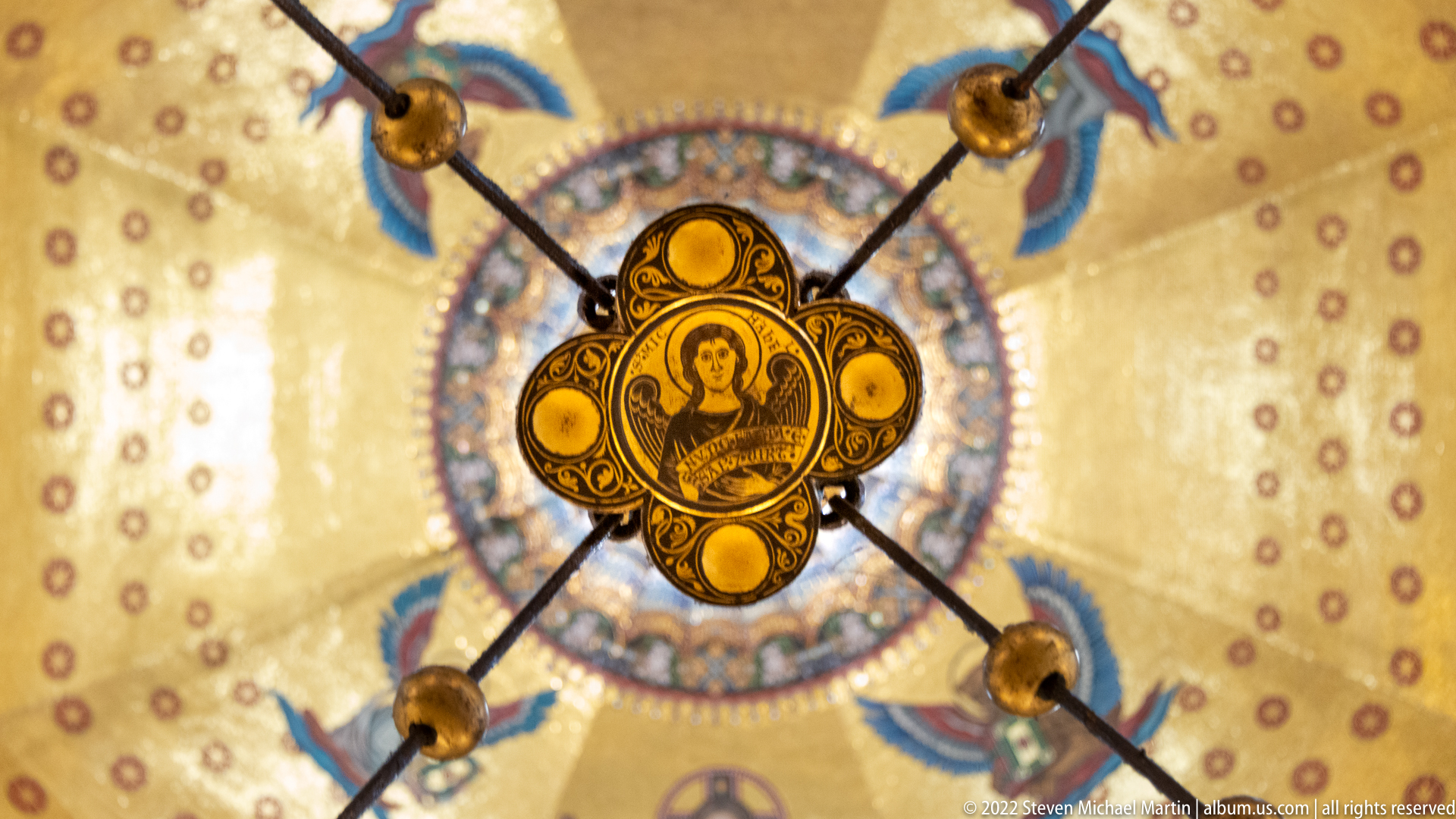
A small gilded circular medallion hangs on dark suspension rods beneath the richly patterned vault. Its central sacred figure is surrounded by rounded lobes and ornamental borders, while the gold mosaic ceiling recedes softly behind it. The shallow depth of field separates the suspended object from the architectural decoration, drawing attention to its metalwork, symmetry, and placement within the cathedral interior.
Caption
A small gilded circular medallion hangs on dark suspension rods beneath the richly patterned vault. Its central sacred figure is surrounded by rounded lobes and ornamental borders, while the gold mosaic ceiling recedes softly behind it. The shallow depth of field separates the suspended object from the architectural decoration, drawing attention to its metalwork, symmetry, and placement within the cathedral interior.
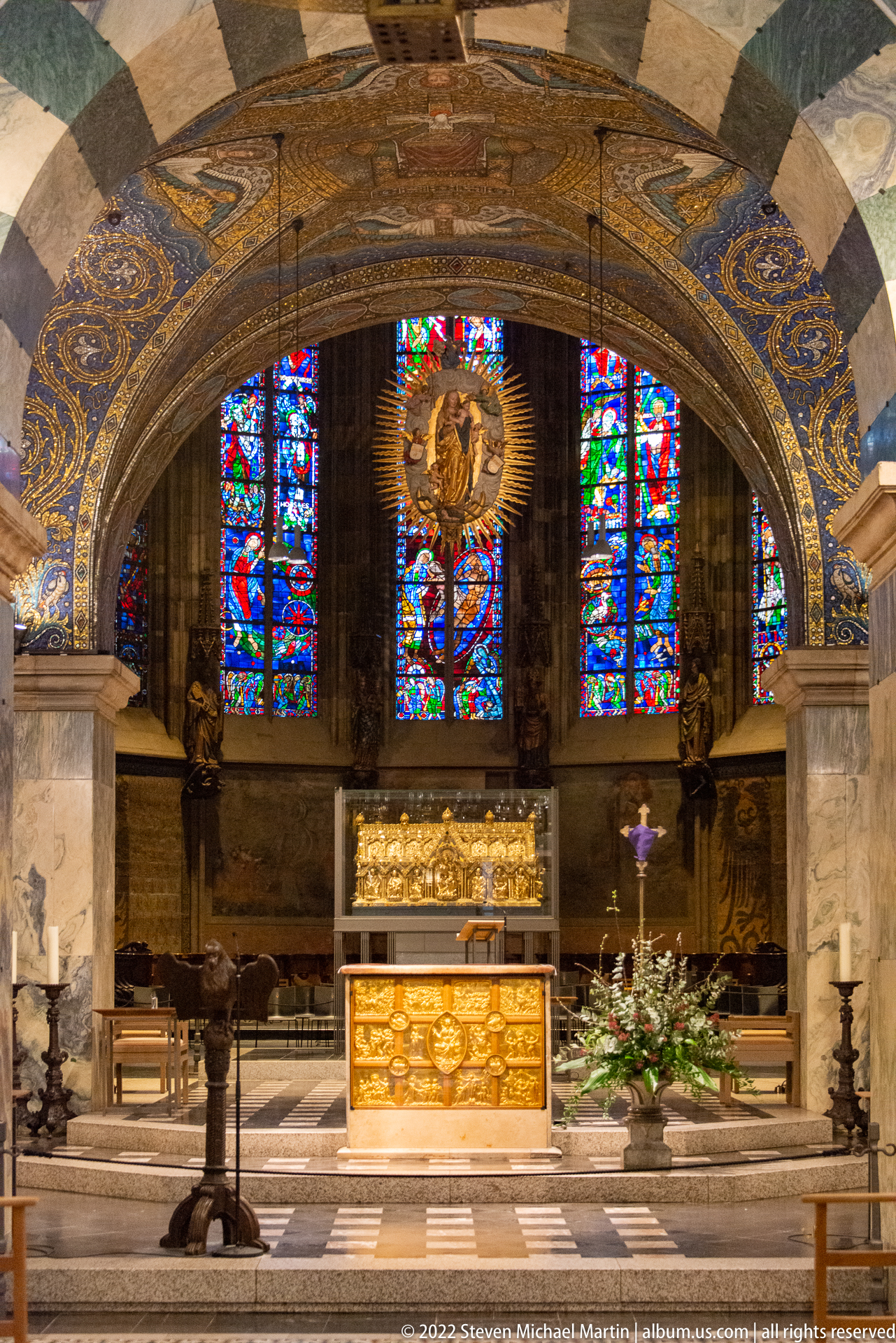
The sanctuary is framed by a broad stone arch decorated with blue-and-gold ornament, opening toward tall stained-glass windows beyond. Gilded liturgical furnishings occupy the central axis, including a prominent rectangular altar-like structure, while candles and floral arrangements flank the space. The balanced composition emphasizes the transition from the darker foreground arcade into the luminous ceremonial focal point of the cathedral interior.
Caption
The sanctuary is framed by a broad stone arch decorated with blue-and-gold ornament, opening toward tall stained-glass windows beyond. Gilded liturgical furnishings occupy the central axis, including a prominent rectangular altar-like structure, while candles and floral arrangements flank the space. The balanced composition emphasizes the transition from the darker foreground arcade into the luminous ceremonial focal point of the cathedral interior.
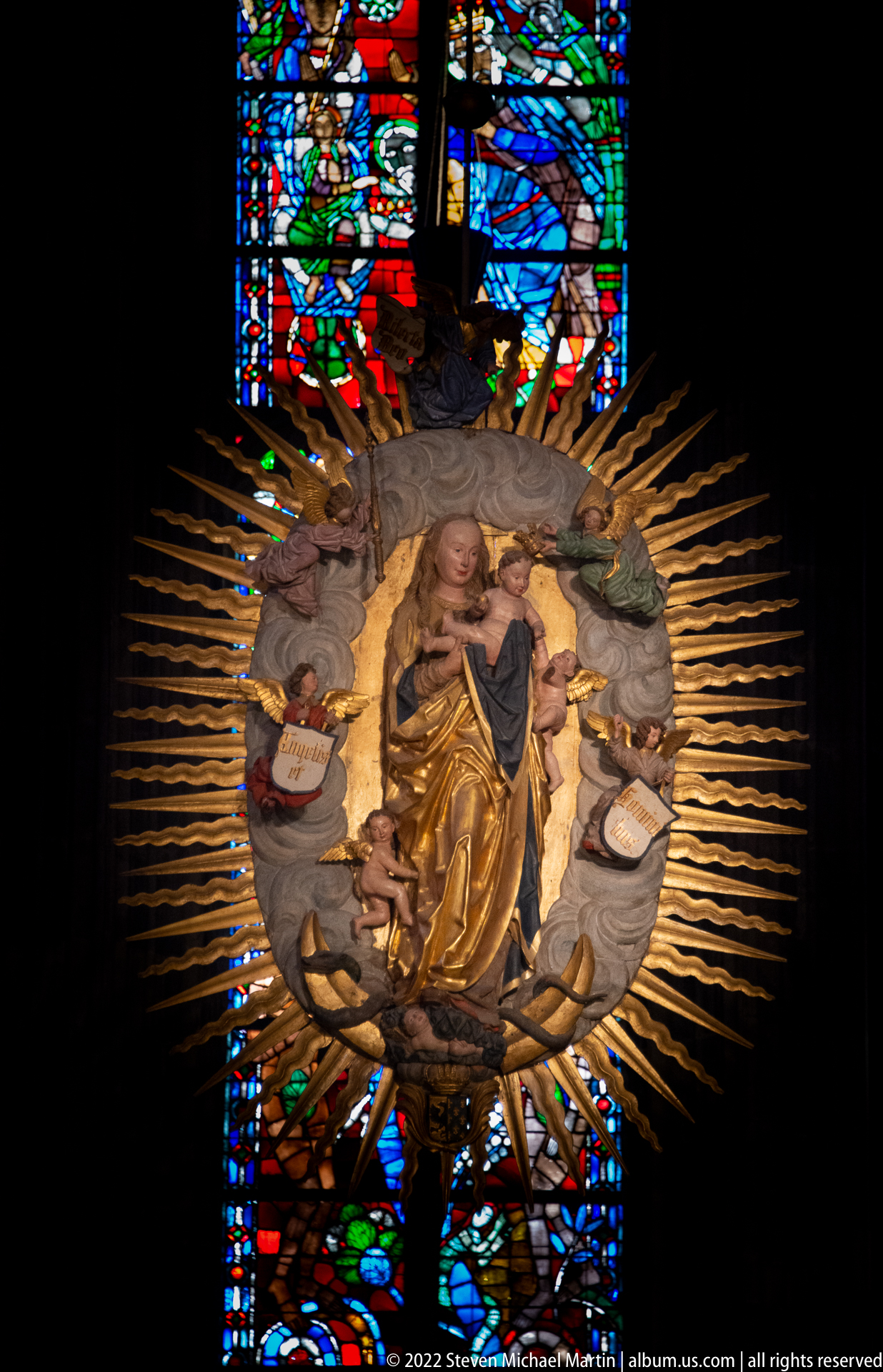
The Virgin and Child appear in a gilded radiant mandorla suspended before tall stained-glass windows, here isolated against a much darker interior than in adjacent views. Sculpted angels cluster around the central figures, and long rays project outward in a dramatic sunburst. The composition makes the devotional image read almost as a luminous silhouette against the colored glazing behind it.
Caption
The Virgin and Child appear in a gilded radiant mandorla suspended before tall stained-glass windows, here isolated against a much darker interior than in adjacent views. Sculpted angels cluster around the central figures, and long rays project outward in a dramatic sunburst. The composition makes the devotional image read almost as a luminous silhouette against the colored glazing behind it.

A curved gilded liturgical furnishing is covered with relief plaques, colored stones, beaded borders, and inscribed bands. Rectangular and circular panels create a dense visual rhythm across the metal surface, while the oblique viewpoint reveals its rounded architectural form. The photograph concentrates on craftsmanship and material richness rather than the object as a whole, making the individual plaques and settings the principal subject.
Caption
A curved gilded liturgical furnishing is covered with relief plaques, colored stones, beaded borders, and inscribed bands. Rectangular and circular panels create a dense visual rhythm across the metal surface, while the oblique viewpoint reveals its rounded architectural form. The photograph concentrates on craftsmanship and material richness rather than the object as a whole, making the individual plaques and settings the principal subject.
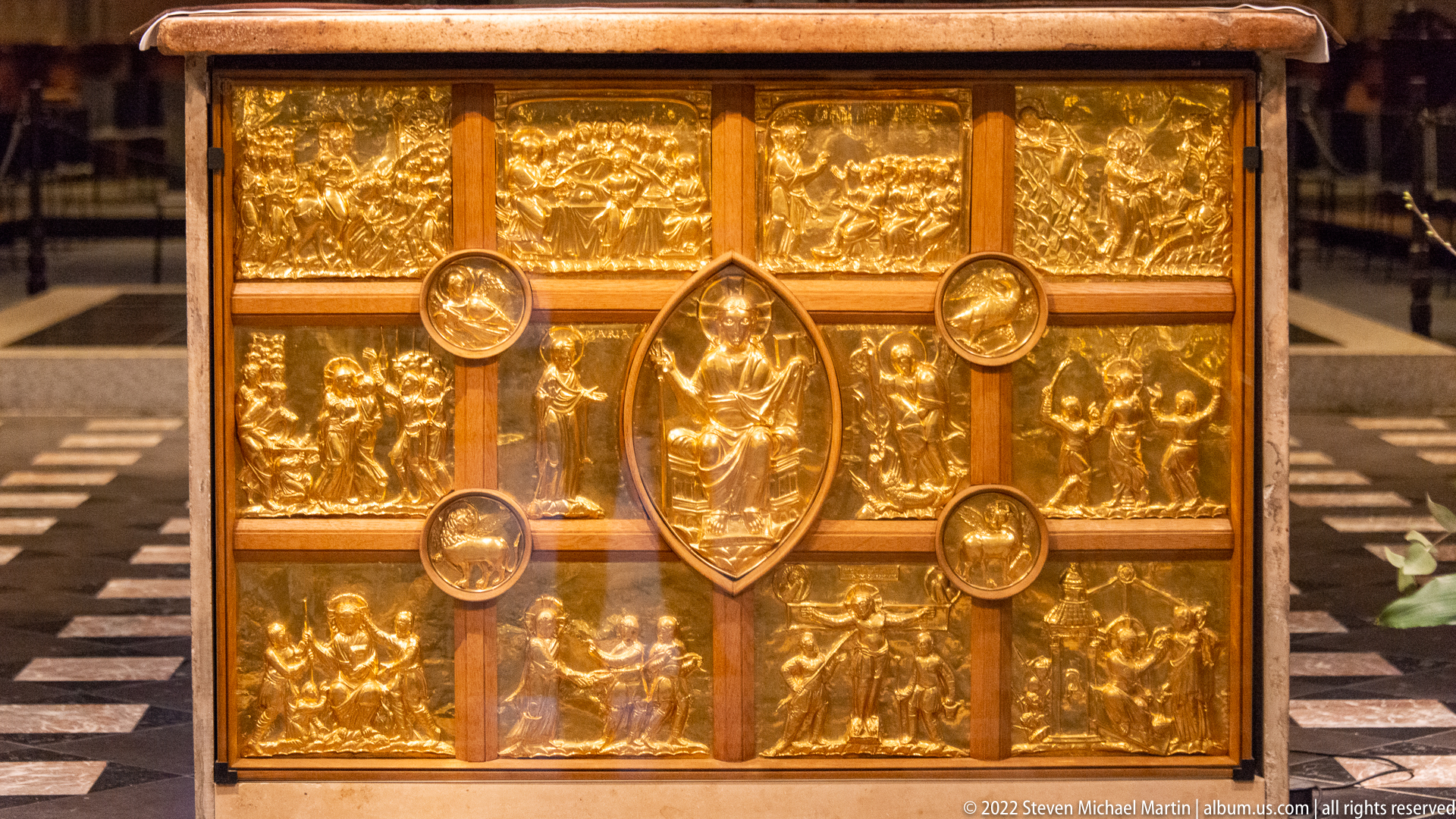
A rectangular gilded chest-like furnishing is divided into relief panels by a dark structural grid, with a pointed central medallion and smaller roundels applied across the front. Narrative figures are modeled in low relief on the gold surfaces, and the object stands on the patterned cathedral floor. The frontal viewpoint highlights its modular construction, embossed decoration, and ceremonial display.
Caption
A rectangular gilded chest-like furnishing is divided into relief panels by a dark structural grid, with a pointed central medallion and smaller roundels applied across the front. Narrative figures are modeled in low relief on the gold surfaces, and the object stands on the patterned cathedral floor. The frontal viewpoint highlights its modular construction, embossed decoration, and ceremonial display.
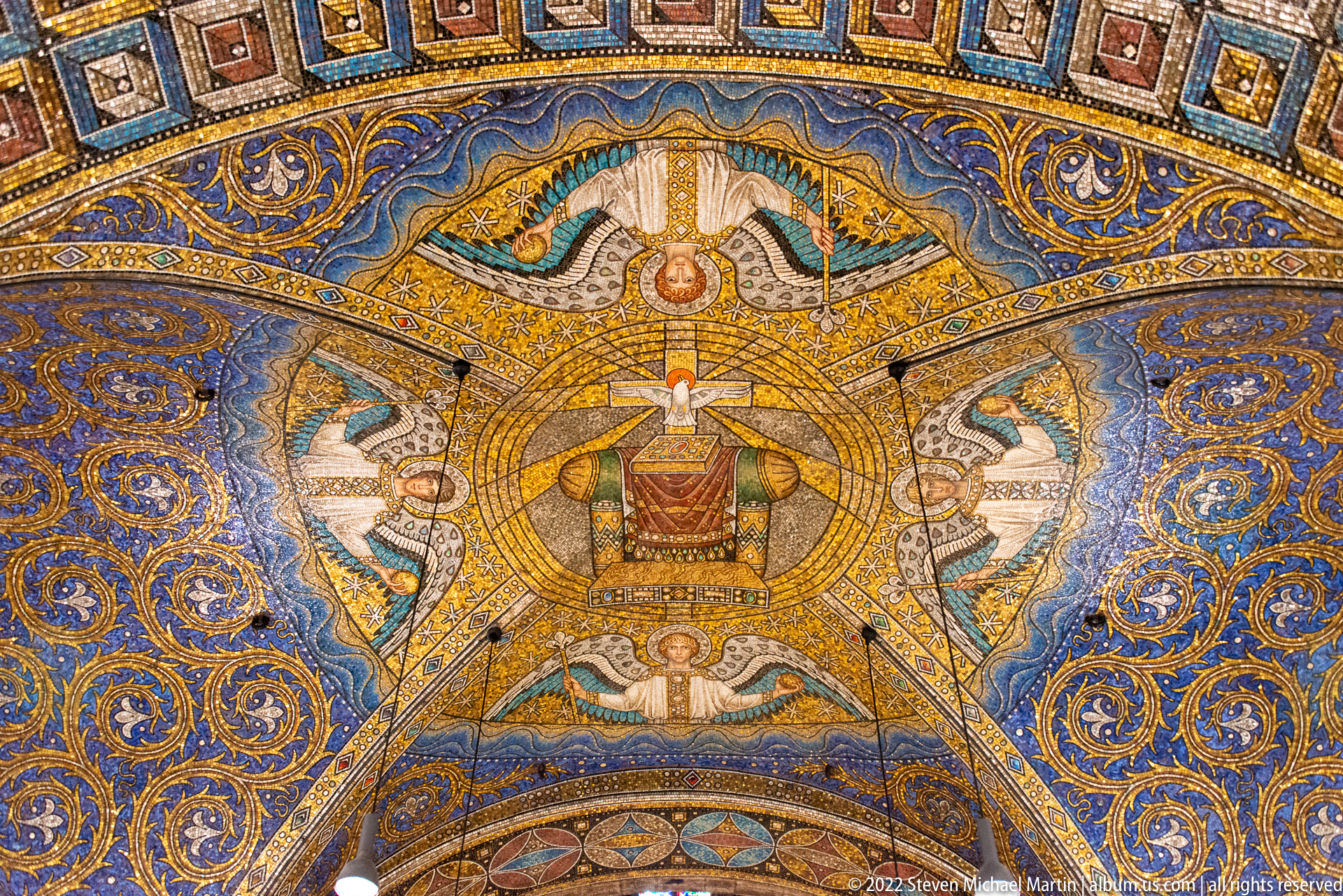
An ornate blue-and-gold mosaic vault unfolds symmetrically around a central throne-like motif, with winged figures and scrolling vegetal ornament filling the surrounding compartments. Geometric bands and jewel-like color fields divide the surface into carefully ordered zones. The upward view emphasizes the dense ornamental program and the way figural imagery is integrated into the vault's architectural geometry.
Caption
An ornate blue-and-gold mosaic vault unfolds symmetrically around a central throne-like motif, with winged figures and scrolling vegetal ornament filling the surrounding compartments. Geometric bands and jewel-like color fields divide the surface into carefully ordered zones. The upward view emphasizes the dense ornamental program and the way figural imagery is integrated into the vault's architectural geometry.
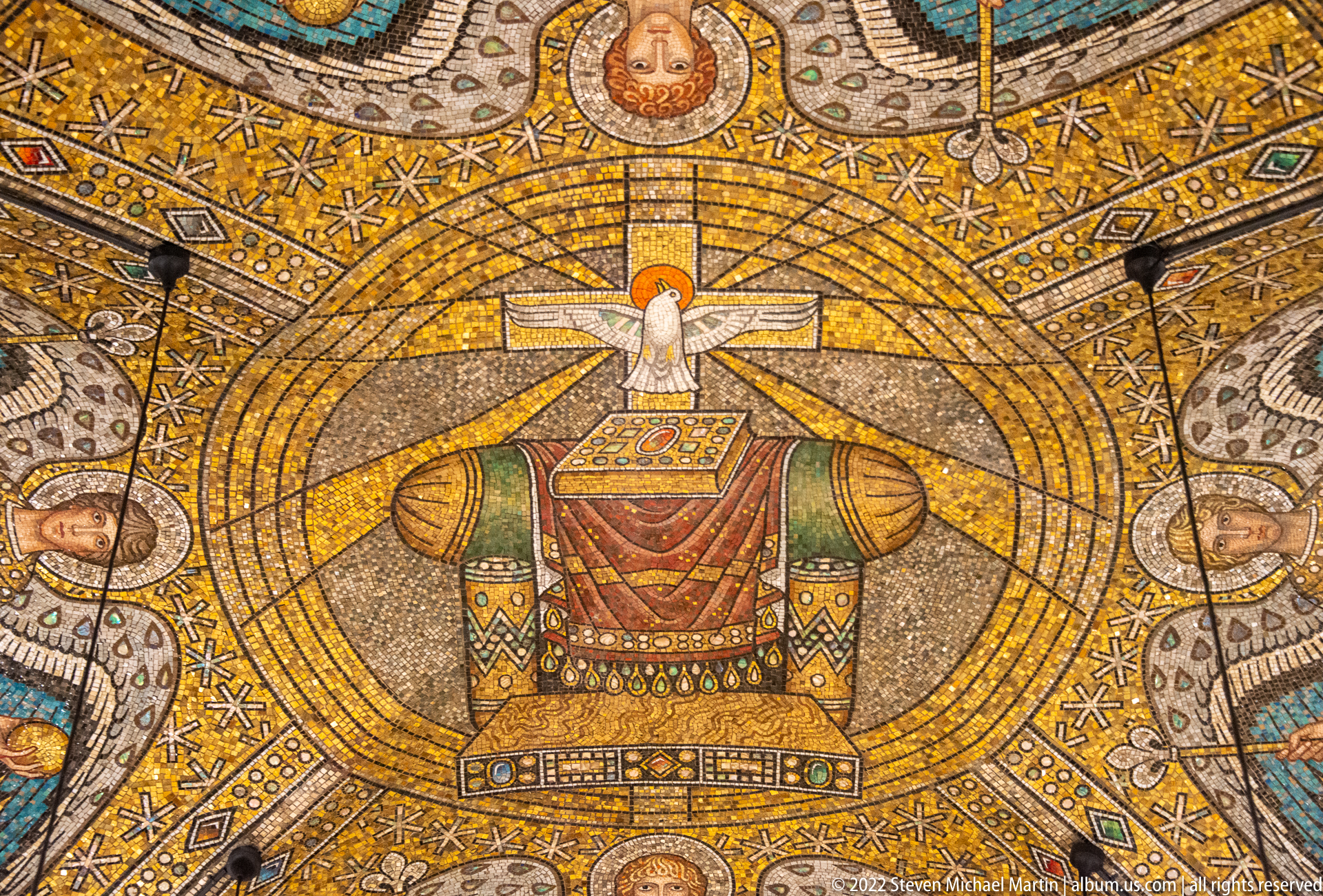
A close view isolates the central portion of the vault mosaic: a richly patterned throne-like seat beneath a white winged figure, surrounded by concentric gold bands and smaller heads at the margins. The tighter framing makes the tesserae, patterned textiles, and layered geometry more legible than in the wider ceiling view, while preserving the strong axial symmetry of the design.
Caption
A close view isolates the central portion of the vault mosaic: a richly patterned throne-like seat beneath a white winged figure, surrounded by concentric gold bands and smaller heads at the margins. The tighter framing makes the tesserae, patterned textiles, and layered geometry more legible than in the wider ceiling view, while preserving the strong axial symmetry of the design.
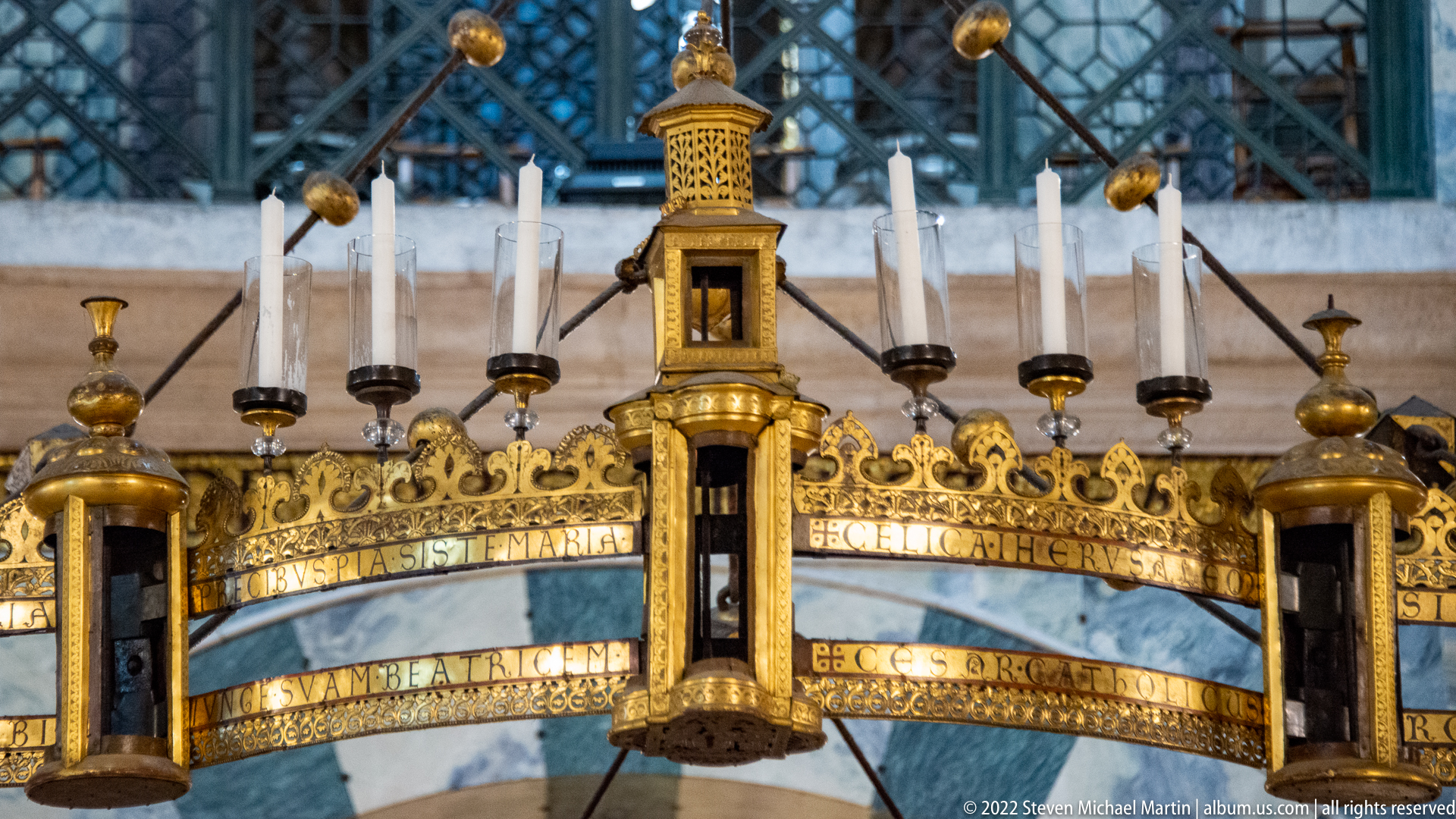
A monumental ring chandelier hangs below the cathedral vault, its gilded framework carrying upright white candles and repeating tower-like elements. Inscribed metal bands run around the circumference, and dark suspension rods rise toward the ceiling. The close view concentrates on the chandelier's architectural construction and ceremonial scale rather than the full ring, revealing the combination of metalwork, text, and candle supports.
Caption
A monumental ring chandelier hangs below the cathedral vault, its gilded framework carrying upright white candles and repeating tower-like elements. Inscribed metal bands run around the circumference, and dark suspension rods rise toward the ceiling. The close view concentrates on the chandelier's architectural construction and ceremonial scale rather than the full ring, revealing the combination of metalwork, text, and candle supports.
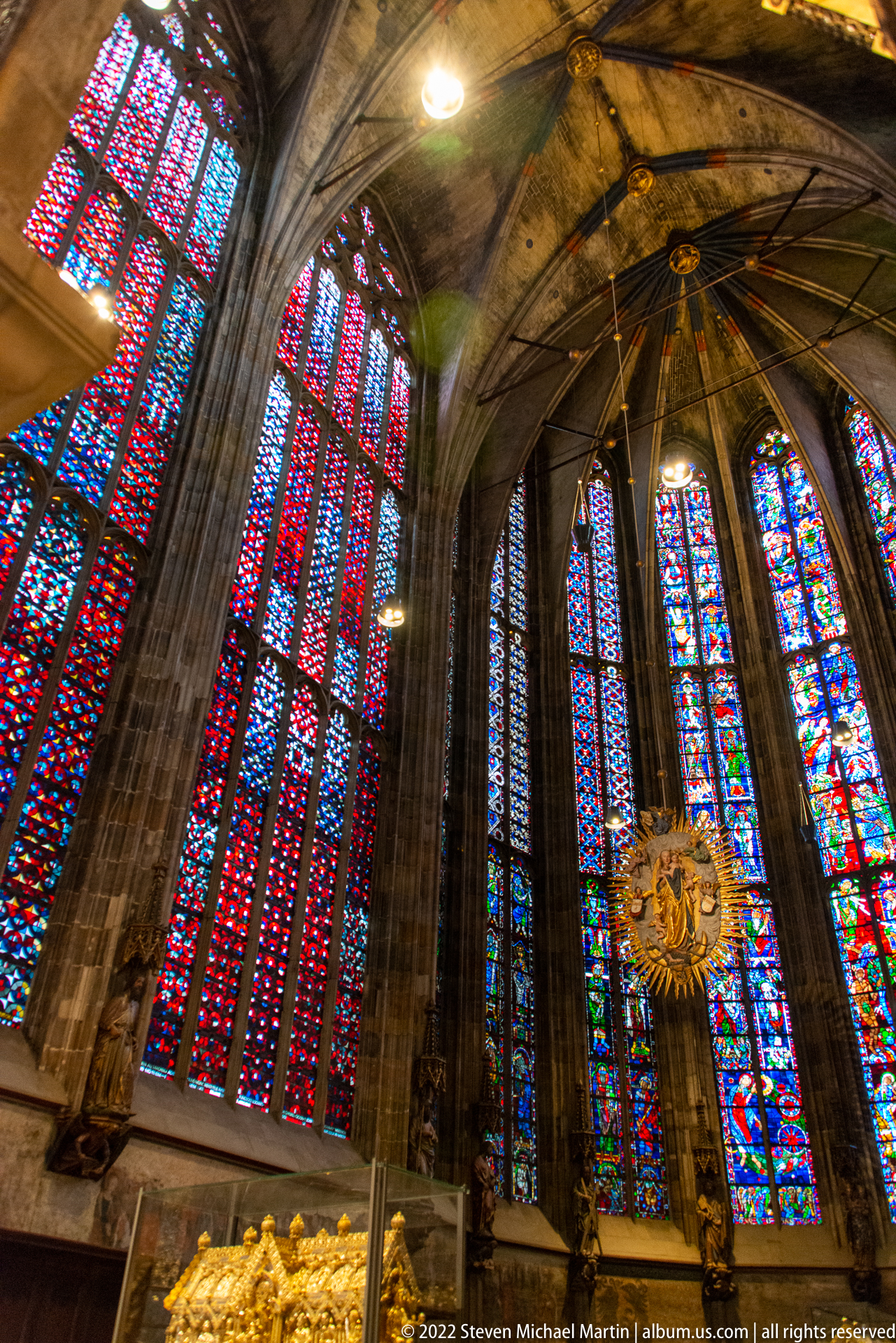
Tall stained-glass windows wrap around the choir beneath a fan-like stone vault whose ribs converge toward the ceiling. The low-angle composition stresses the contrast between the dark structural masonry and the saturated red, blue, and violet glazing. A gilded radiant devotional object appears near the lower center, providing a small but luminous counterpoint to the cathedral's soaring vertical enclosure.
Caption
Tall stained-glass windows wrap around the choir beneath a fan-like stone vault whose ribs converge toward the ceiling. The low-angle composition stresses the contrast between the dark structural masonry and the saturated red, blue, and violet glazing. A gilded radiant devotional object appears near the lower center, providing a small but luminous counterpoint to the cathedral's soaring vertical enclosure.

Two haloed standing saints flank a tall central window within a richly ornamented mosaic wall. Each figure holds a book, while patterned borders, inscriptions, foliage bands, and gold ground fill the surrounding surface. The symmetrical arrangement gives the window an almost altar-like prominence, and the photograph preserves the relationship between sacred figural imagery and the architecture of the opening.
Caption
Two haloed standing saints flank a tall central window within a richly ornamented mosaic wall. Each figure holds a book, while patterned borders, inscriptions, foliage bands, and gold ground fill the surrounding surface. The symmetrical arrangement gives the window an almost altar-like prominence, and the photograph preserves the relationship between sacred figural imagery and the architecture of the opening.
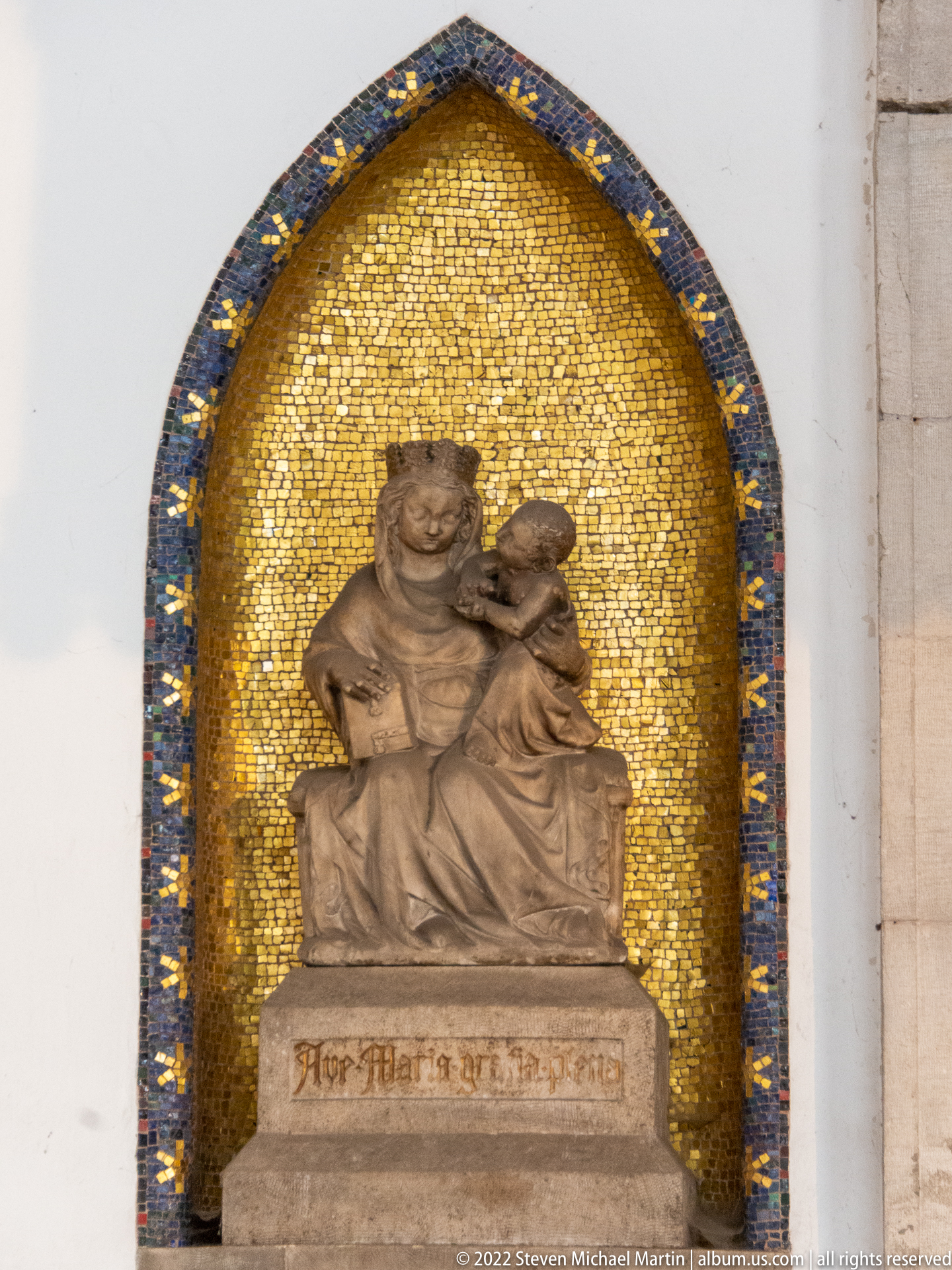
A sculptural group of an adult figure holding a small child is set within a pointed niche lined with shimmering gold mosaic. The muted brown stone or terracotta contrasts with the luminous background, and an inscription runs across the base. The simple frontal presentation and arched surround turn the niche into a focused devotional or commemorative setting within the cathedral interior.
Caption
A sculptural group of an adult figure holding a small child is set within a pointed niche lined with shimmering gold mosaic. The muted brown stone or terracotta contrasts with the luminous background, and an inscription runs across the base. The simple frontal presentation and arched surround turn the niche into a focused devotional or commemorative setting within the cathedral interior.
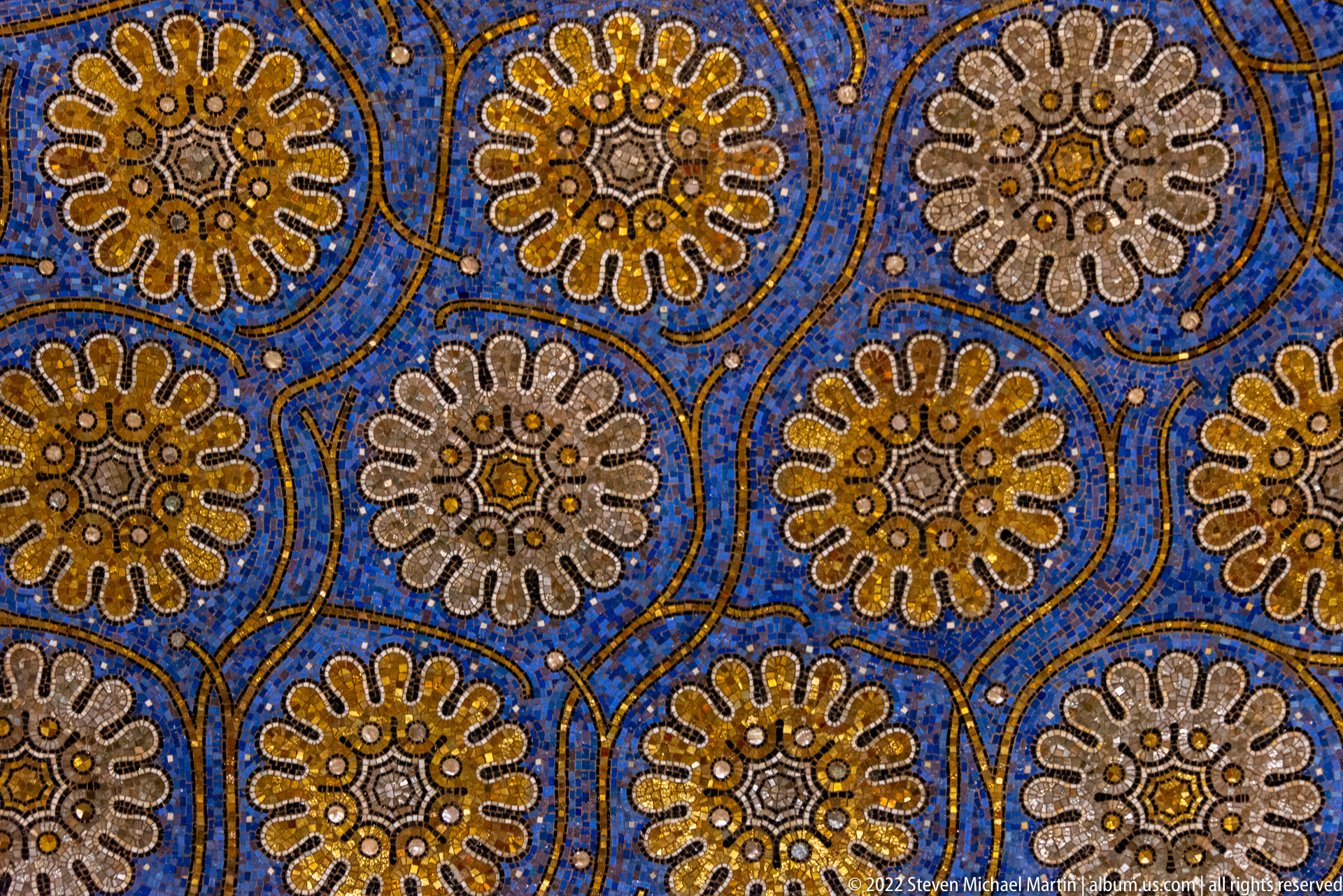
Repeating rosettes spread across a deep blue mosaic field, each flower built from concentric rings of white, gold, and brown tesserae. Curving gold outlines connect the motifs into a continuous surface pattern. The tight crop removes nearly all architectural context and turns the photograph into a study of color, repetition, and the precise geometric ordering of the cathedral's decorative mosaic work.
Caption
Repeating rosettes spread across a deep blue mosaic field, each flower built from concentric rings of white, gold, and brown tesserae. Curving gold outlines connect the motifs into a continuous surface pattern. The tight crop removes nearly all architectural context and turns the photograph into a study of color, repetition, and the precise geometric ordering of the cathedral's decorative mosaic work.
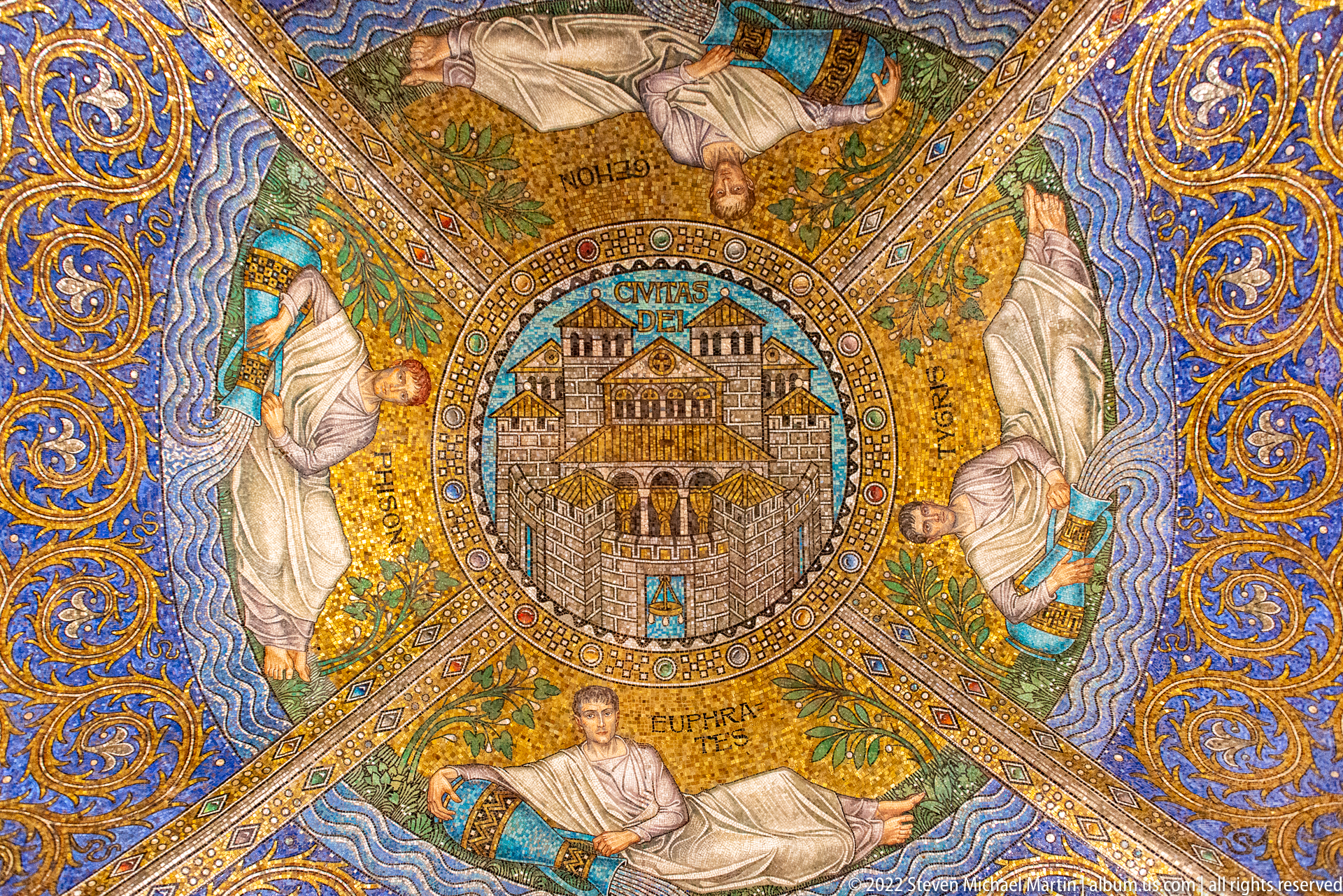
At the center of this mosaic compartment, a circular architectural emblem labeled “CIVITAS DEI” presents a fortified ideal city. Reclining or seated figures occupy the surrounding gold field, while blue scrollwork and patterned borders frame the medallion. The photograph records the city image within its larger iconographic setting, linking the readable Latin title to a carefully ordered celestial decorative program.
Caption
At the center of this mosaic compartment, a circular architectural emblem labeled “CIVITAS DEI” presents a fortified ideal city. Reclining or seated figures occupy the surrounding gold field, while blue scrollwork and patterned borders frame the medallion. The photograph records the city image within its larger iconographic setting, linking the readable Latin title to a carefully ordered celestial decorative program.
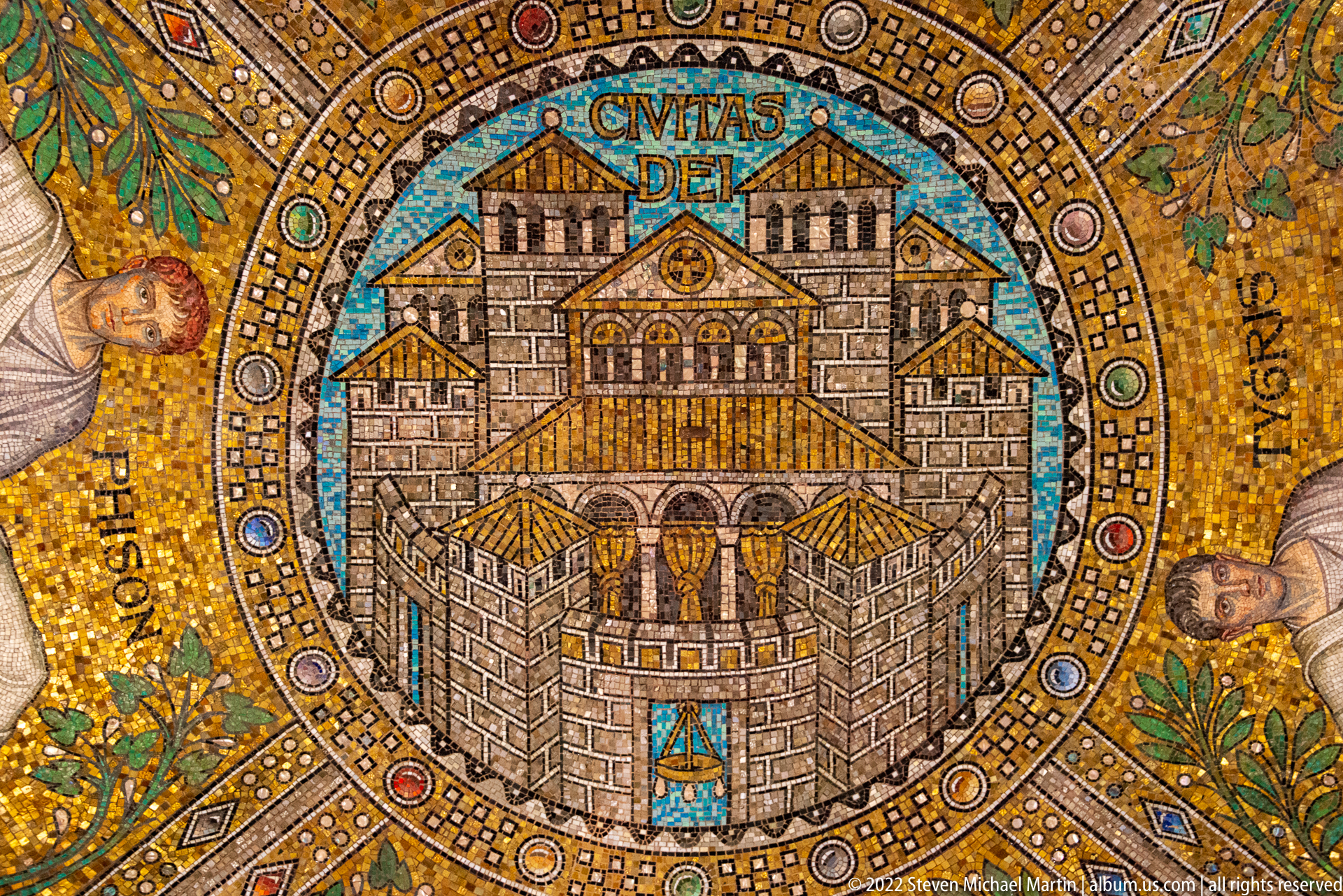
The “CIVITAS DEI” medallion is shown in close detail, isolating the stylized fortified city with its towers, arcaded walls, central building, and stepped architectural layers. Gold, gray, turquoise, and brick-red tesserae articulate the masonry, while the circular border separates the emblem from surrounding foliage and figural fragments. The tighter crop makes the inscription and imagined urban architecture fully legible.
Caption
The “CIVITAS DEI” medallion is shown in close detail, isolating the stylized fortified city with its towers, arcaded walls, central building, and stepped architectural layers. Gold, gray, turquoise, and brick-red tesserae articulate the masonry, while the circular border separates the emblem from surrounding foliage and figural fragments. The tighter crop makes the inscription and imagined urban architecture fully legible.
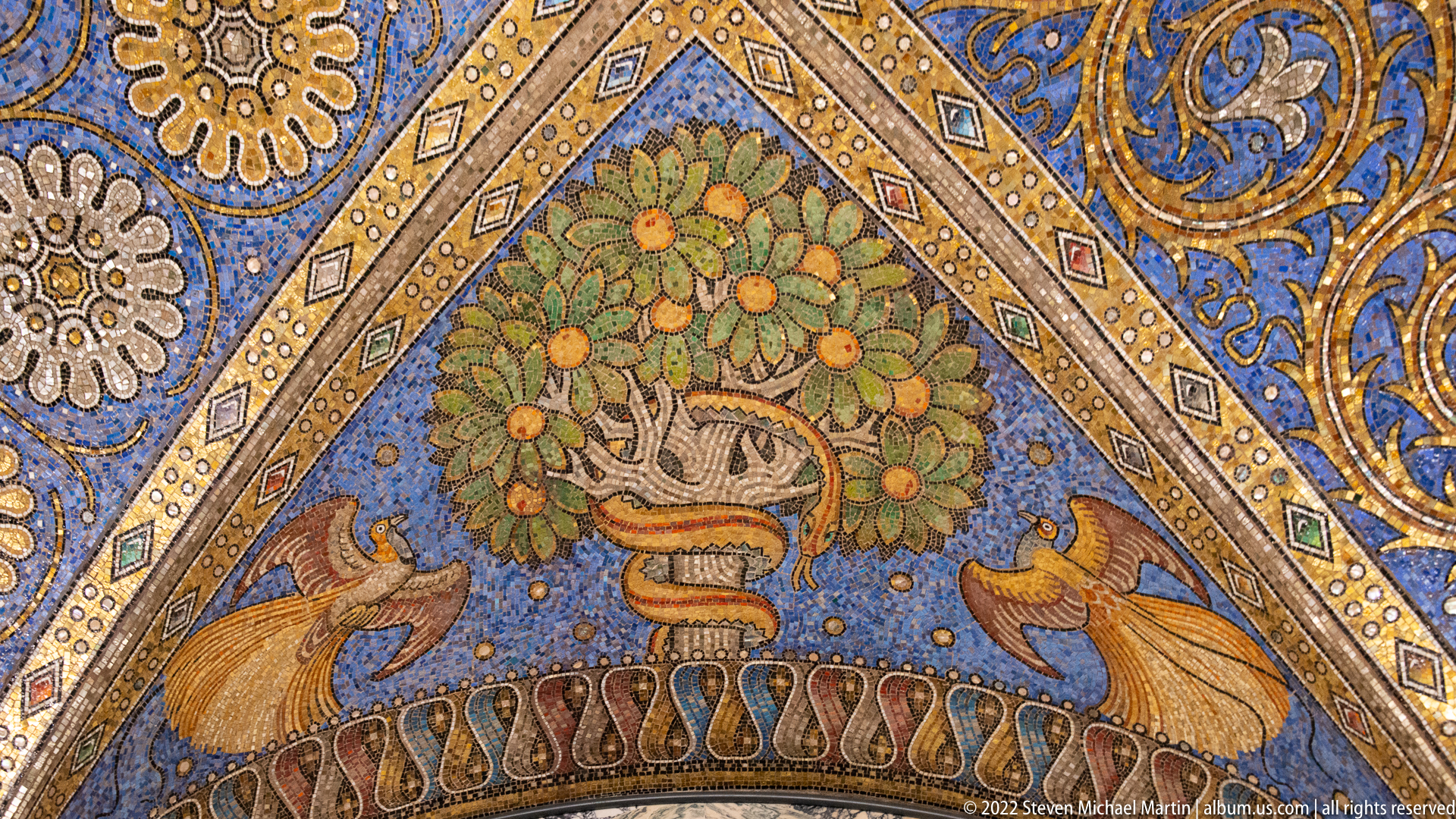
A fruit-bearing tree rises from a shallow basin-like base at the center of a triangular mosaic field, with two birds facing inward from either side. Deep blue ground, gold scrollwork, rosettes, and a jeweled geometric border frame the motif. The tight composition emphasizes the emblematic symmetry and decorative vocabulary of the mosaic rather than its broader architectural placement.
Caption
A fruit-bearing tree rises from a shallow basin-like base at the center of a triangular mosaic field, with two birds facing inward from either side. Deep blue ground, gold scrollwork, rosettes, and a jeweled geometric border frame the motif. The tight composition emphasizes the emblematic symmetry and decorative vocabulary of the mosaic rather than its broader architectural placement.
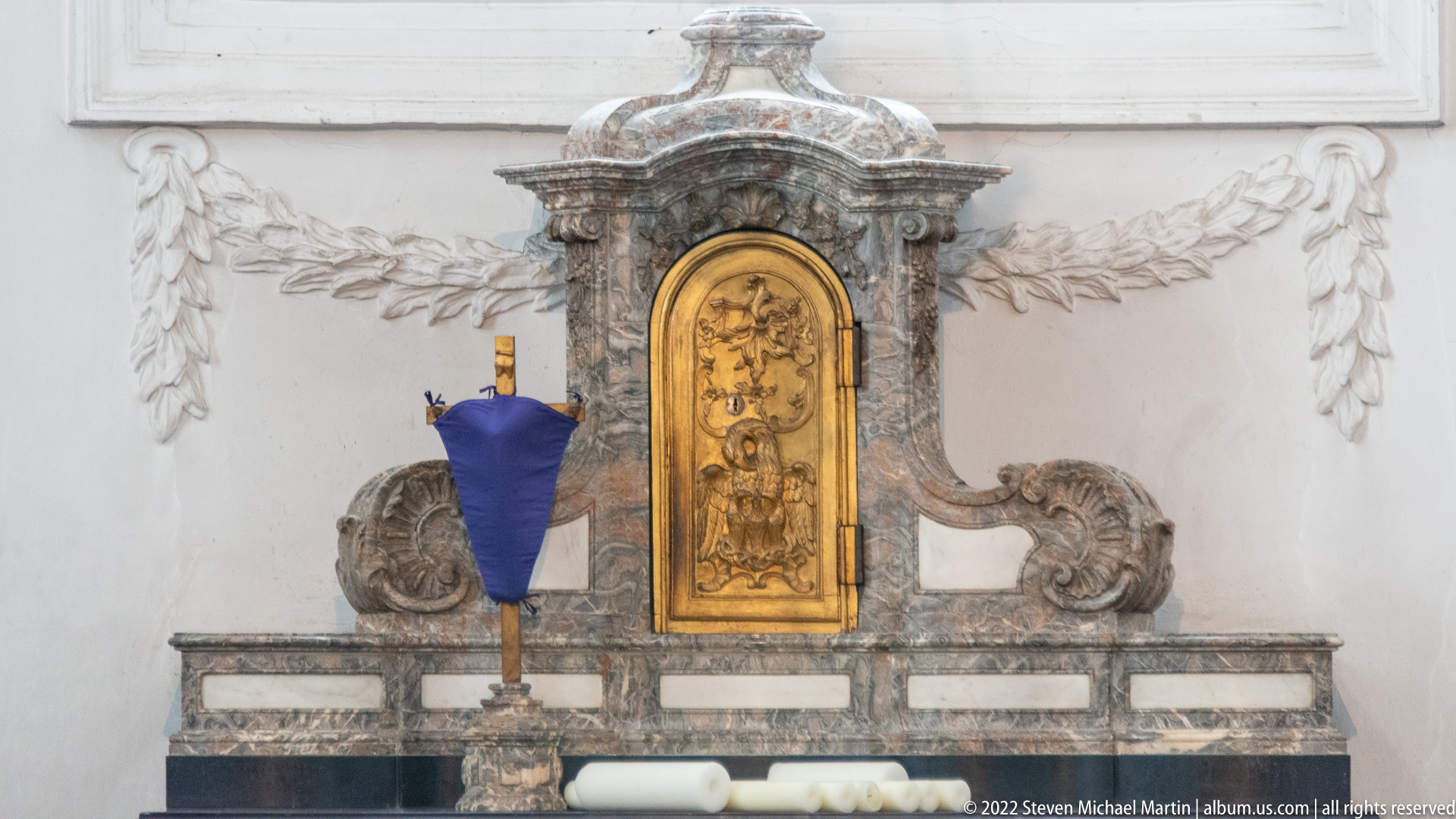
An elaborate wall-mounted furnishing combines veined gray marble, a central gilt door or plaque, sculpted side supports, and restrained classical ornament against a pale wall. A dark blue covered object stands immediately in front, partially obscuring the lower center. The frontal photograph records the symmetrical composition, material contrast, and formal architectural framing of this ecclesiastical interior feature.
Caption
An elaborate wall-mounted furnishing combines veined gray marble, a central gilt door or plaque, sculpted side supports, and restrained classical ornament against a pale wall. A dark blue covered object stands immediately in front, partially obscuring the lower center. The frontal photograph records the symmetrical composition, material contrast, and formal architectural framing of this ecclesiastical interior feature.
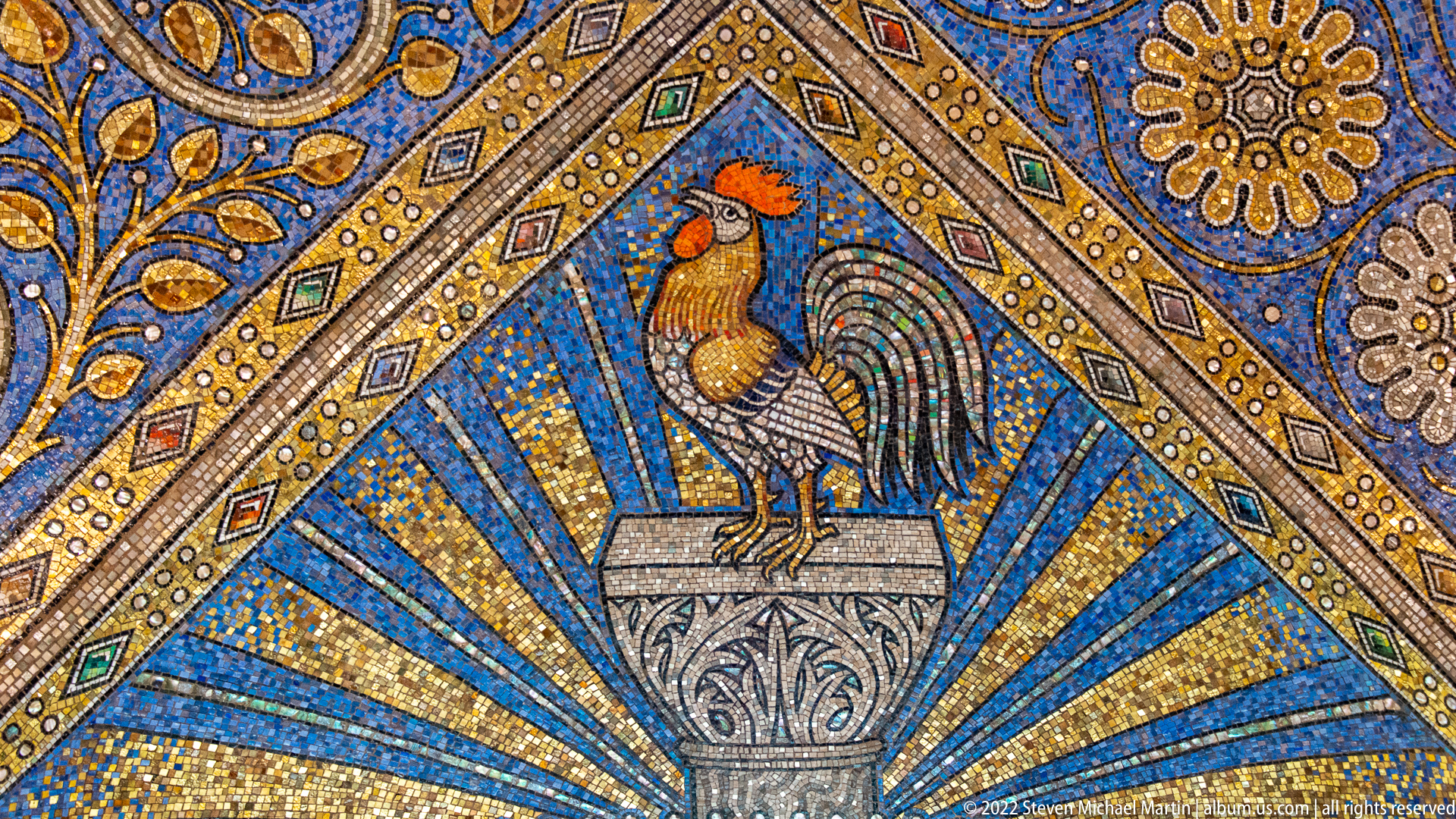
A brightly colored rooster stands on a carved-looking pedestal at the center of a triangular mosaic panel. Alternating blue-and-gold rays spread outward behind the bird, while rosettes and jeweled borders frame the composition. The isolated emblem is rendered with unusually fine patterning in the plumage, making the photograph a focused study of the mosaic's symbolic animal imagery and decorative precision.
Caption
A brightly colored rooster stands on a carved-looking pedestal at the center of a triangular mosaic panel. Alternating blue-and-gold rays spread outward behind the bird, while rosettes and jeweled borders frame the composition. The isolated emblem is rendered with unusually fine patterning in the plumage, making the photograph a focused study of the mosaic's symbolic animal imagery and decorative precision.
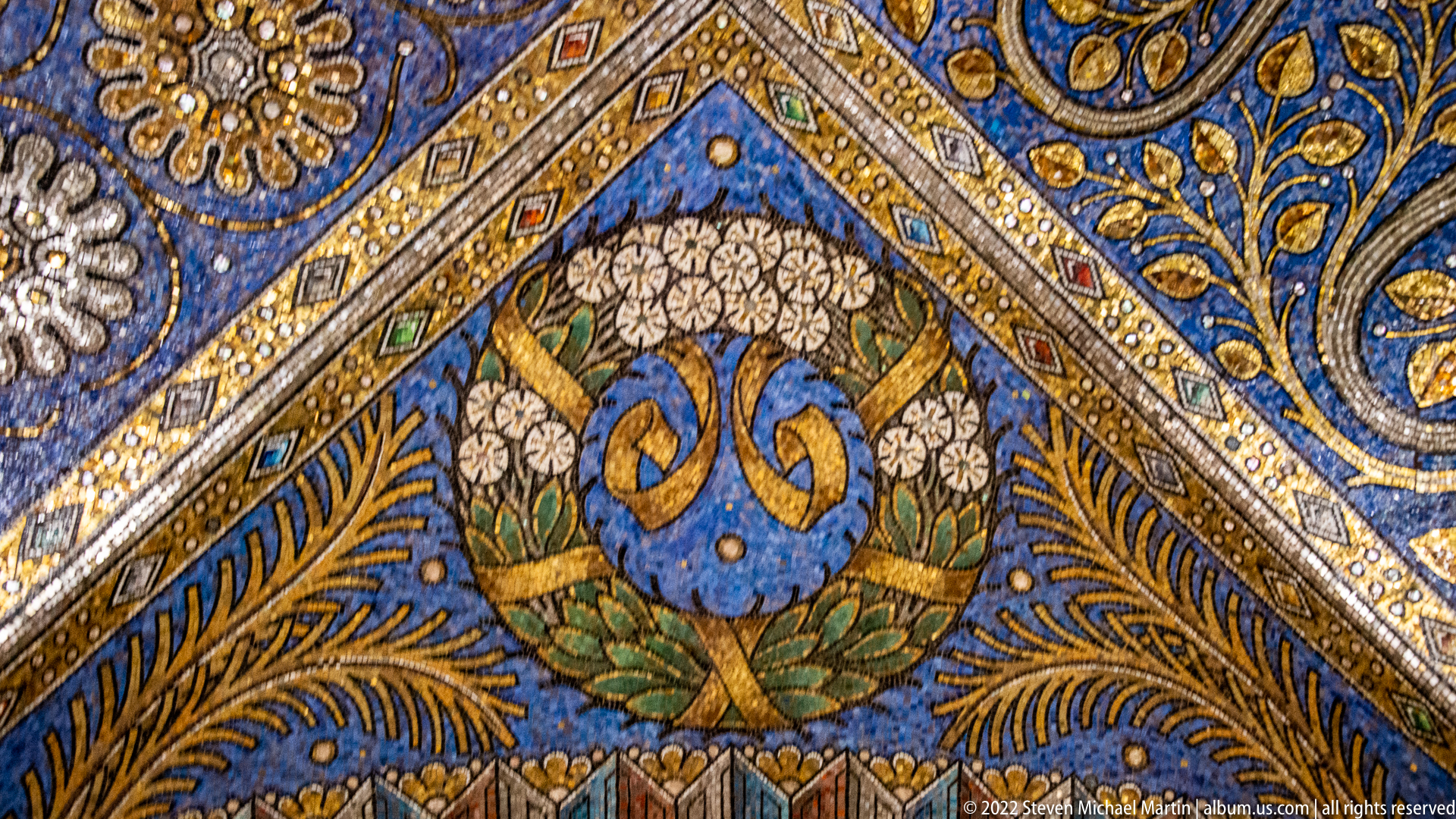
An interlaced blue monogram fills the center of a white floral wreath tied at the base, set within a triangular blue mosaic field. Gold branches, rosettes, and patterned borders surround the emblem, creating a dense ornamental frame. The close view emphasizes lettering as decoration, but the stylized characters are not expanded into a specific name without corroborating inscriptional context.
Caption
An interlaced blue monogram fills the center of a white floral wreath tied at the base, set within a triangular blue mosaic field. Gold branches, rosettes, and patterned borders surround the emblem, creating a dense ornamental frame. The close view emphasizes lettering as decoration, but the stylized characters are not expanded into a specific name without corroborating inscriptional context.
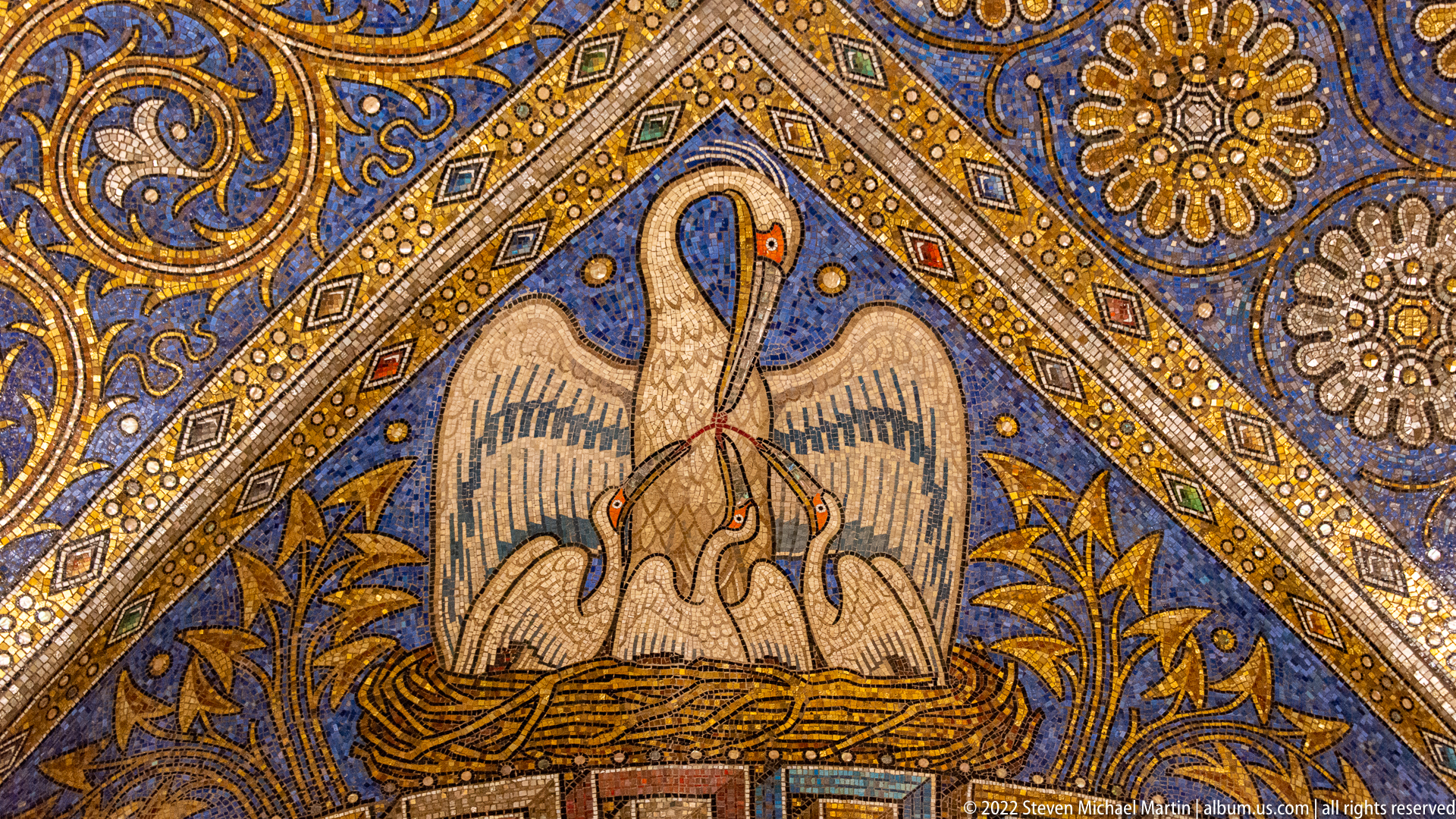
A pelican bends toward its chicks in a nest at the center of a triangular mosaic panel, a traditional Christian emblem rendered here in pale plumage against a blue ground. Gold foliage and rosettes frame the scene, while the bird's red-tipped beak and the clustered nestlings draw the eye to the central act of care. The close crop isolates the iconographic motif from the larger vault program.
Caption
A pelican bends toward its chicks in a nest at the center of a triangular mosaic panel, a traditional Christian emblem rendered here in pale plumage against a blue ground. Gold foliage and rosettes frame the scene, while the bird's red-tipped beak and the clustered nestlings draw the eye to the central act of care. The close crop isolates the iconographic motif from the larger vault program.
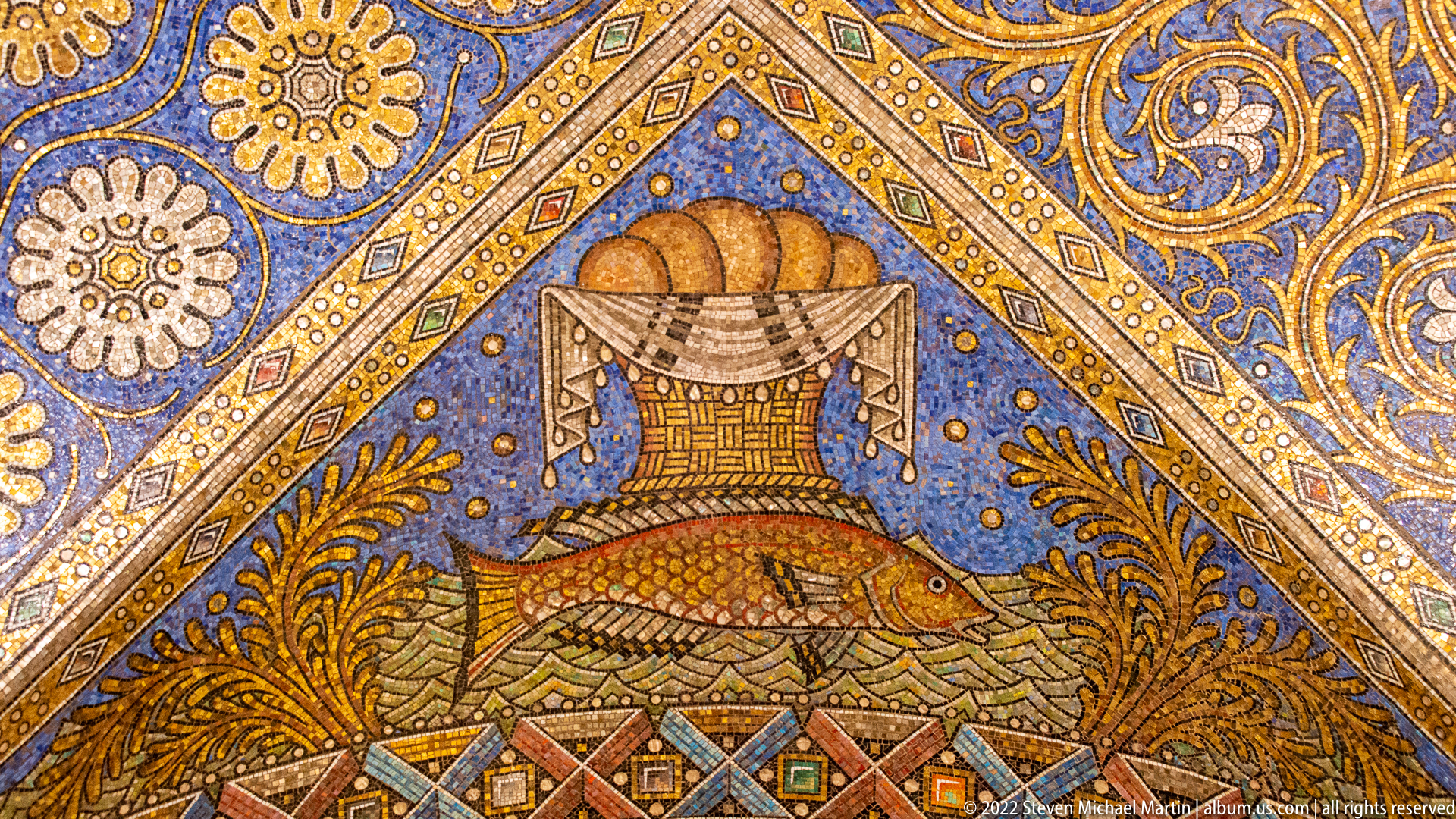
A covered vessel or basket holding several rounded loaves appears above a large fish in this triangular mosaic compartment. Gold foliage rises along the sides, while rosettes and jeweled borders animate the deep blue ground. The paired food imagery gives the panel a distinctly Eucharistic visual vocabulary, although the photograph is kept focused on what is visible rather than assigning a specific textual scene.
Caption
A covered vessel or basket holding several rounded loaves appears above a large fish in this triangular mosaic compartment. Gold foliage rises along the sides, while rosettes and jeweled borders animate the deep blue ground. The paired food imagery gives the panel a distinctly Eucharistic visual vocabulary, although the photograph is kept focused on what is visible rather than assigning a specific textual scene.
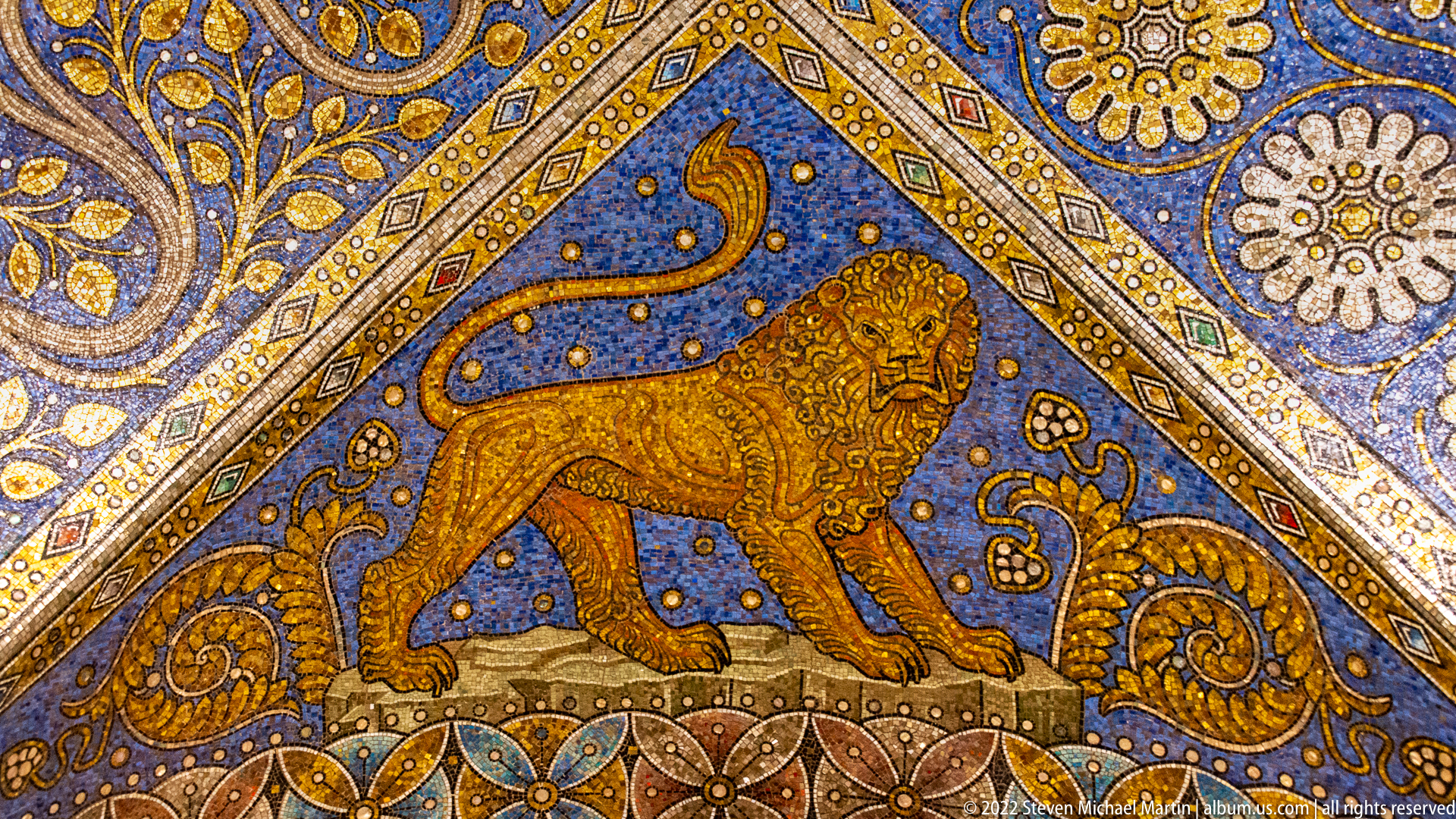
A golden lion strides in profile across a narrow ground line, its tail curling upward against a deep blue mosaic field. Rosettes, scrolling foliage, and jeweled geometric borders frame the triangular panel, while the animal's mane and paws are modeled with small tonal shifts in the tesserae. The close view isolates the lion as a heraldic or symbolic motif within the cathedral's larger decorative scheme.
Caption
A golden lion strides in profile across a narrow ground line, its tail curling upward against a deep blue mosaic field. Rosettes, scrolling foliage, and jeweled geometric borders frame the triangular panel, while the animal's mane and paws are modeled with small tonal shifts in the tesserae. The close view isolates the lion as a heraldic or symbolic motif within the cathedral's larger decorative scheme.
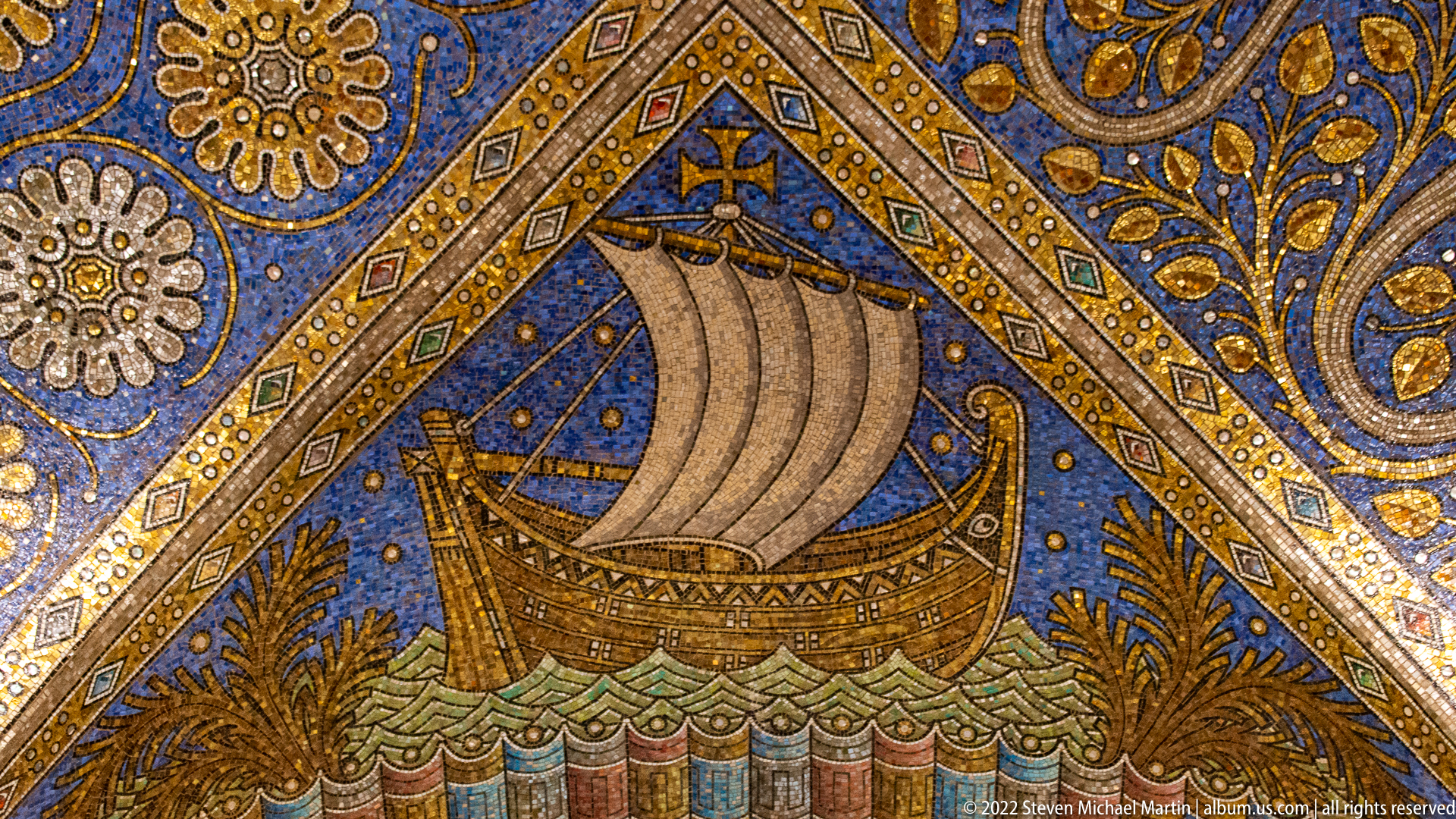
A single-masted sailing vessel moves across stylized green-and-blue waves within a triangular mosaic panel. Its pale sail, rigging, high curved hull, and small pennant are outlined against a deep blue field, with floral rosettes and gold ornament around the edges. The image reads as a compact emblem rather than a narrative marine scene, emphasizing simplified form and rhythmic pattern.
Caption
A single-masted sailing vessel moves across stylized green-and-blue waves within a triangular mosaic panel. Its pale sail, rigging, high curved hull, and small pennant are outlined against a deep blue field, with floral rosettes and gold ornament around the edges. The image reads as a compact emblem rather than a narrative marine scene, emphasizing simplified form and rhythmic pattern.
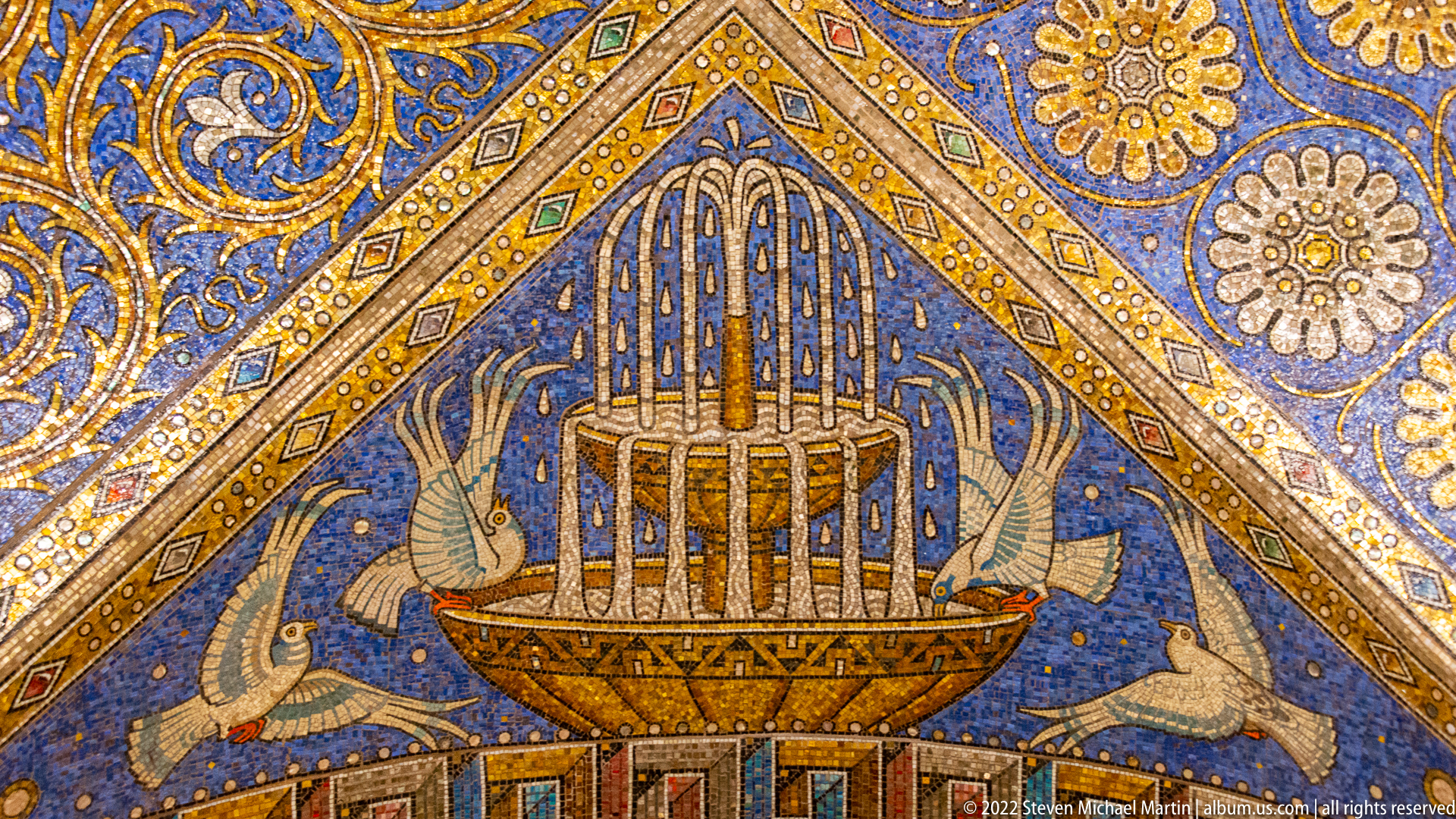
An ark-like architectural vessel occupies the center of this triangular mosaic panel, its barred upper structure rising above a boat-shaped base. Birds stand or fly on either side, while blue-and-gold rays and rosettes organize the surrounding field. The unusual combination of vessel, enclosure, and birds suggests biblical symbolism, but the caption preserves the visible details without naming a specific episode beyond what the image supports.
Caption
An ark-like architectural vessel occupies the center of this triangular mosaic panel, its barred upper structure rising above a boat-shaped base. Birds stand or fly on either side, while blue-and-gold rays and rosettes organize the surrounding field. The unusual combination of vessel, enclosure, and birds suggests biblical symbolism, but the caption preserves the visible details without naming a specific episode beyond what the image supports.
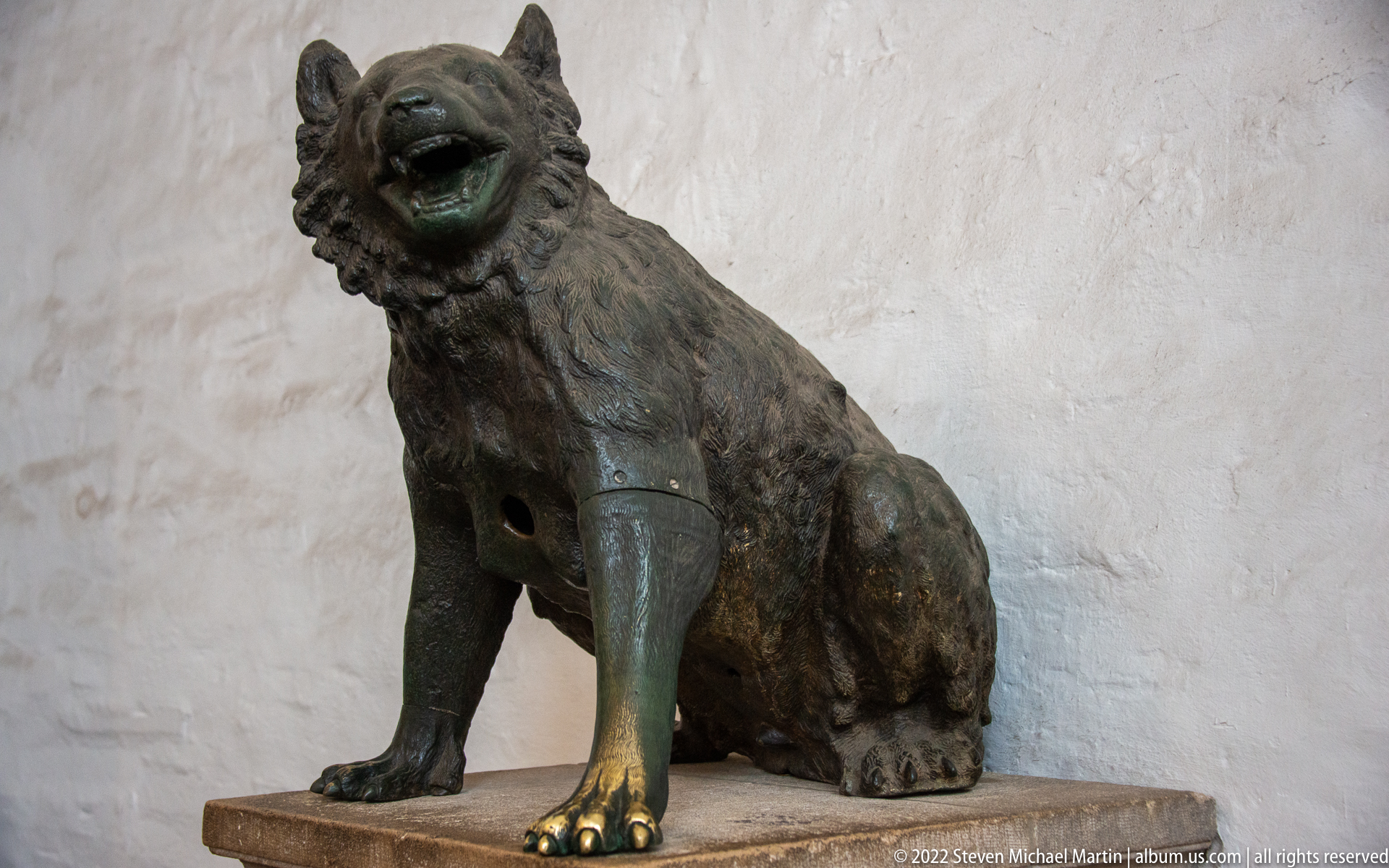
A dark bronze animal sculpture sits upright against a plain pale wall, its head raised and mouth slightly open. The front paws extend forward on a low base, and areas of greenish patina are visible on the legs and body. The uncluttered setting makes the sculptural silhouette, surface wear, and expressive head the dominant features of the photograph.
Caption
A dark bronze animal sculpture sits upright against a plain pale wall, its head raised and mouth slightly open. The front paws extend forward on a low base, and areas of greenish patina are visible on the legs and body. The uncluttered setting makes the sculptural silhouette, surface wear, and expressive head the dominant features of the photograph.
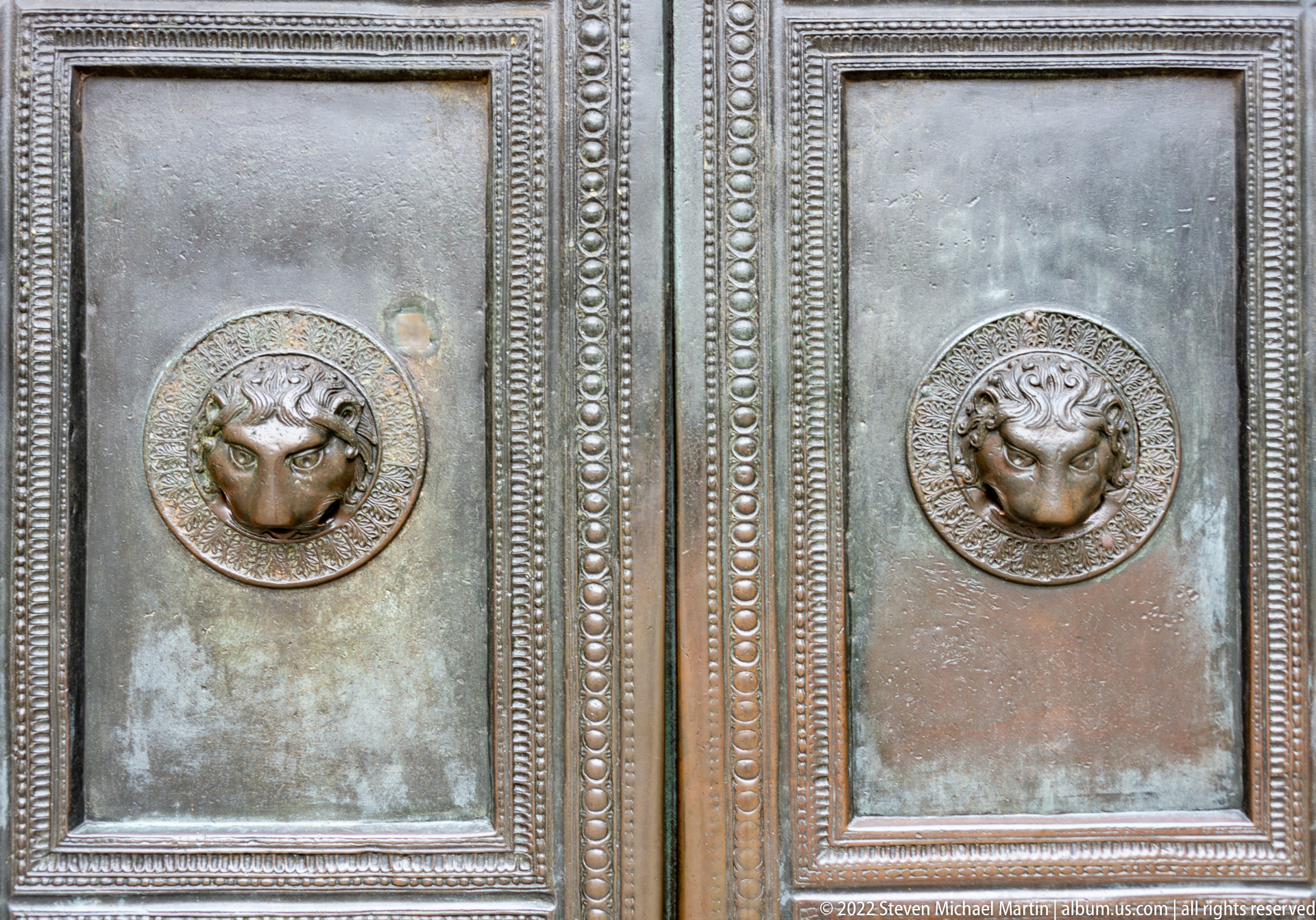
Two adjoining metal door panels are framed by beaded and geometric borders, each centered on a sculpted lion head holding a circular ring. The weathered bronze surface carries green and brown patina, while the near-symmetrical pairing gives the hardware a ceremonial architectural presence. The close crop concentrates on the tactile metalwork and repeated fittings rather than the doorway as a whole.
Caption
Two adjoining metal door panels are framed by beaded and geometric borders, each centered on a sculpted lion head holding a circular ring. The weathered bronze surface carries green and brown patina, while the near-symmetrical pairing gives the hardware a ceremonial architectural presence. The close crop concentrates on the tactile metalwork and repeated fittings rather than the doorway as a whole.
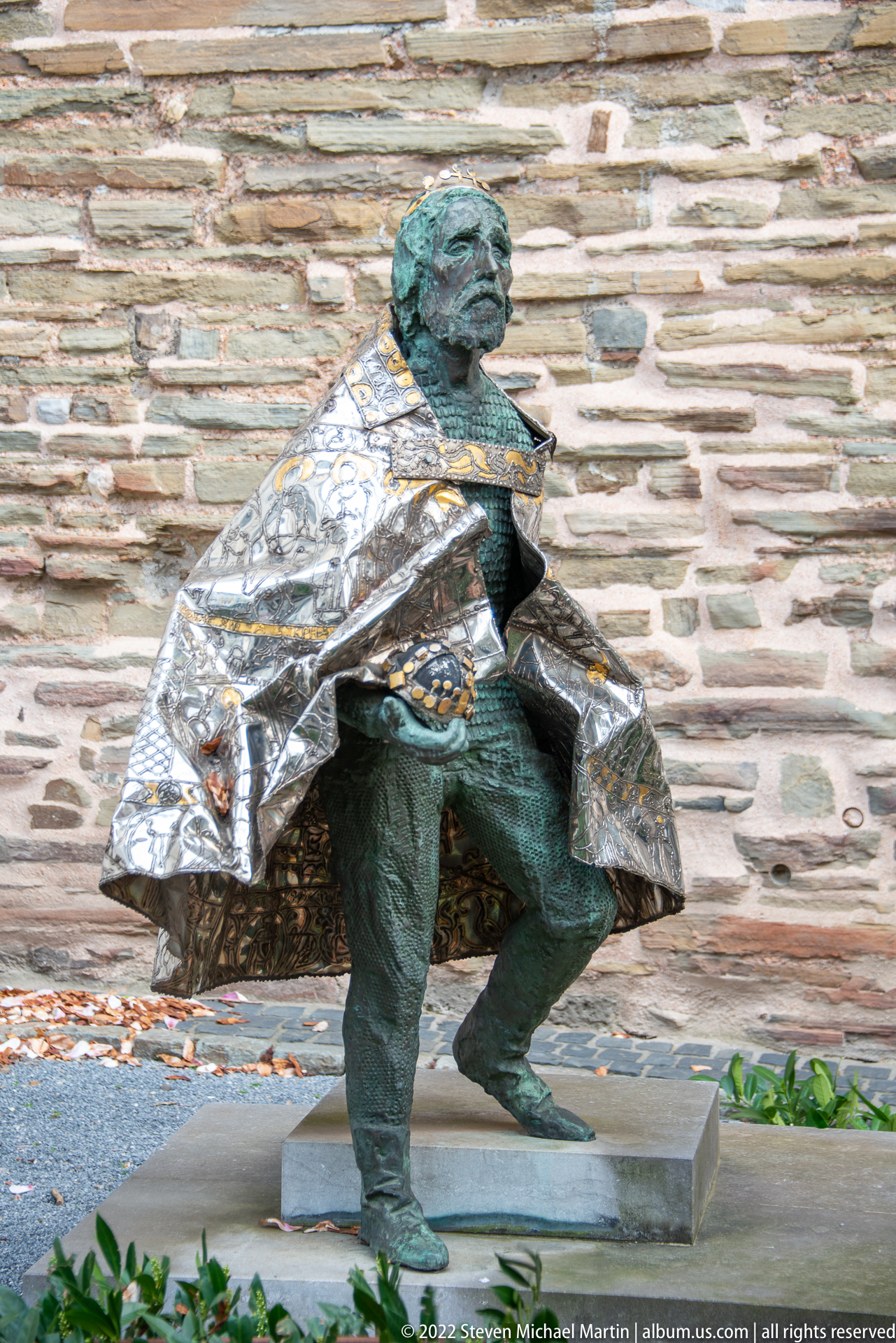
A compact bronze figure sits with one knee raised against a rough stone wall, its dark patinated head and legs contrasting with a bright, faceted cloak. The treatment mixes naturalistic anatomy with an almost geometric outer garment, creating a deliberately theatrical street-sculpture presence within Aachen's historic center.
Caption
A compact bronze figure sits with one knee raised against a rough stone wall, its dark patinated head and legs contrasting with a bright, faceted cloak. The treatment mixes naturalistic anatomy with an almost geometric outer garment, creating a deliberately theatrical street-sculpture presence within Aachen's historic center.
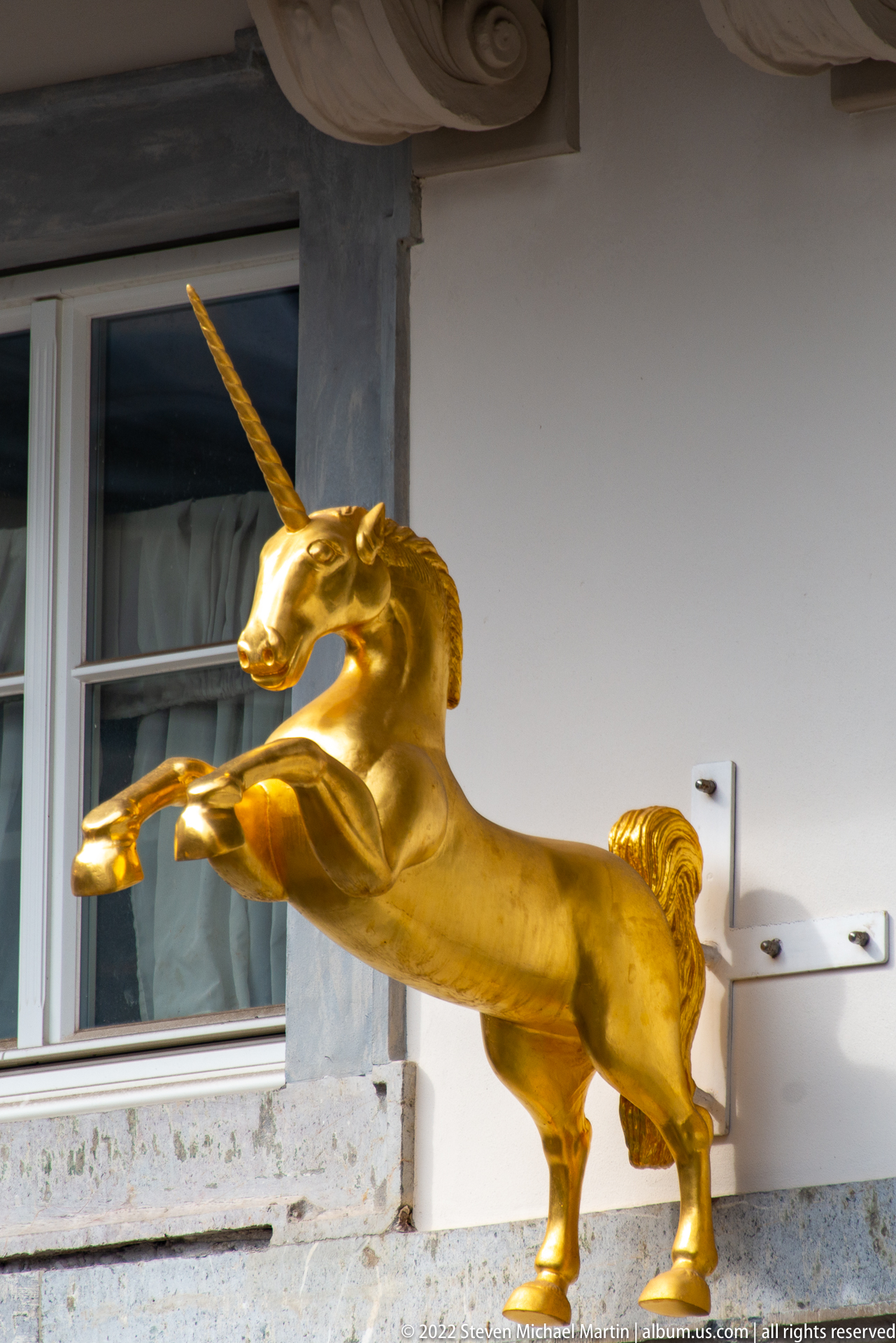
A gilded unicorn rears on its hind legs beneath a covered architectural opening, its long horn projecting diagonally upward. Smooth modeling and the brilliant gold finish make the mythical animal read like a shop, guild, or building emblem rather than monumental statuary, adding a conspicuous decorative accent to the surrounding historic streetscape.
Caption
A gilded unicorn rears on its hind legs beneath a covered architectural opening, its long horn projecting diagonally upward. Smooth modeling and the brilliant gold finish make the mythical animal read like a shop, guild, or building emblem rather than monumental statuary, adding a conspicuous decorative accent to the surrounding historic streetscape.
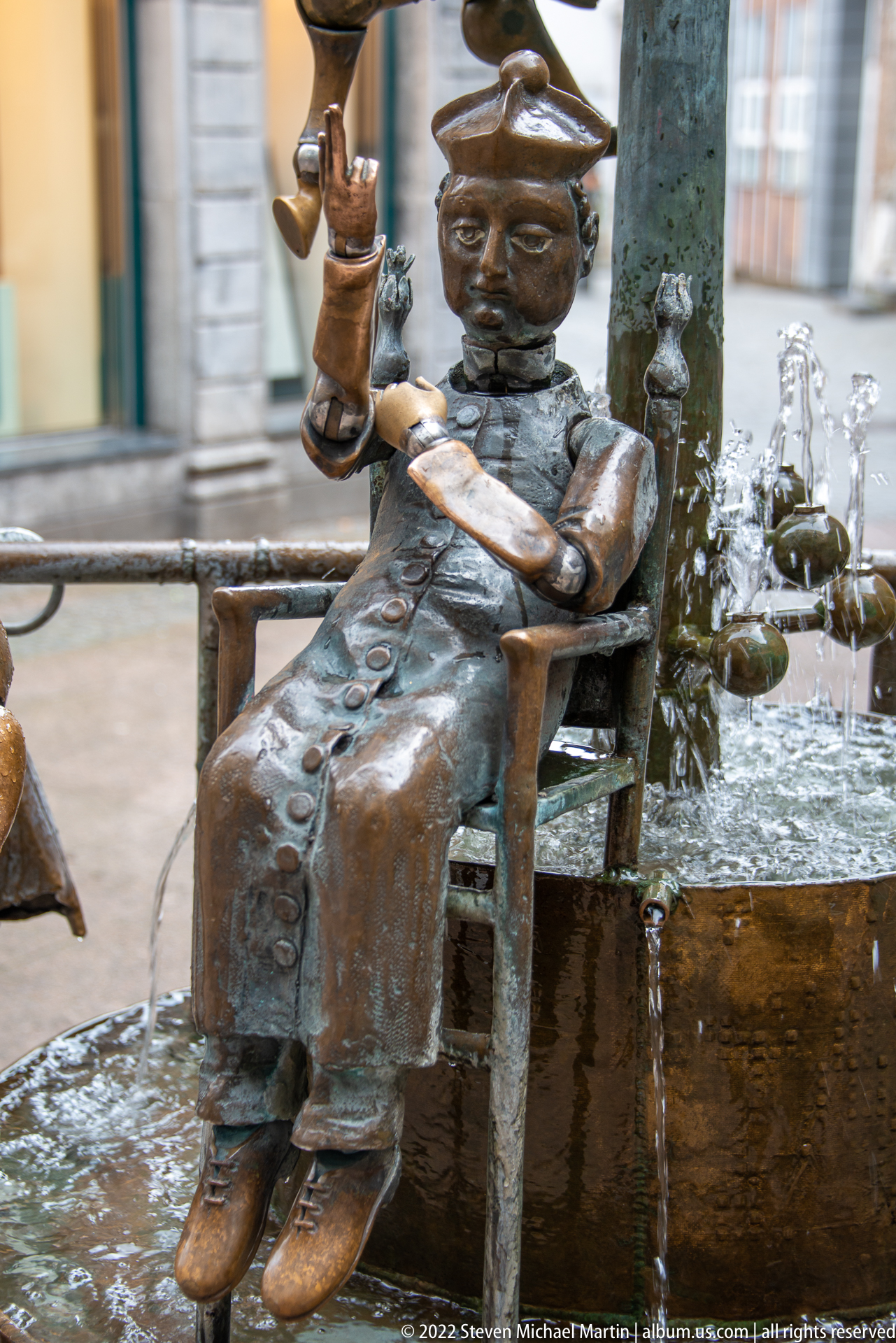
A bronze woman in a brimmed hat sits on a chair at the edge of a fountain basin, holding a small object while jets rise behind her. The deliberately everyday pose and polished high points from weathering or touch give the figure an approachable, human scale within Aachen's pedestrian public realm.
Caption
A bronze woman in a brimmed hat sits on a chair at the edge of a fountain basin, holding a small object while jets rise behind her. The deliberately everyday pose and polished high points from weathering or touch give the figure an approachable, human scale within Aachen's pedestrian public realm.
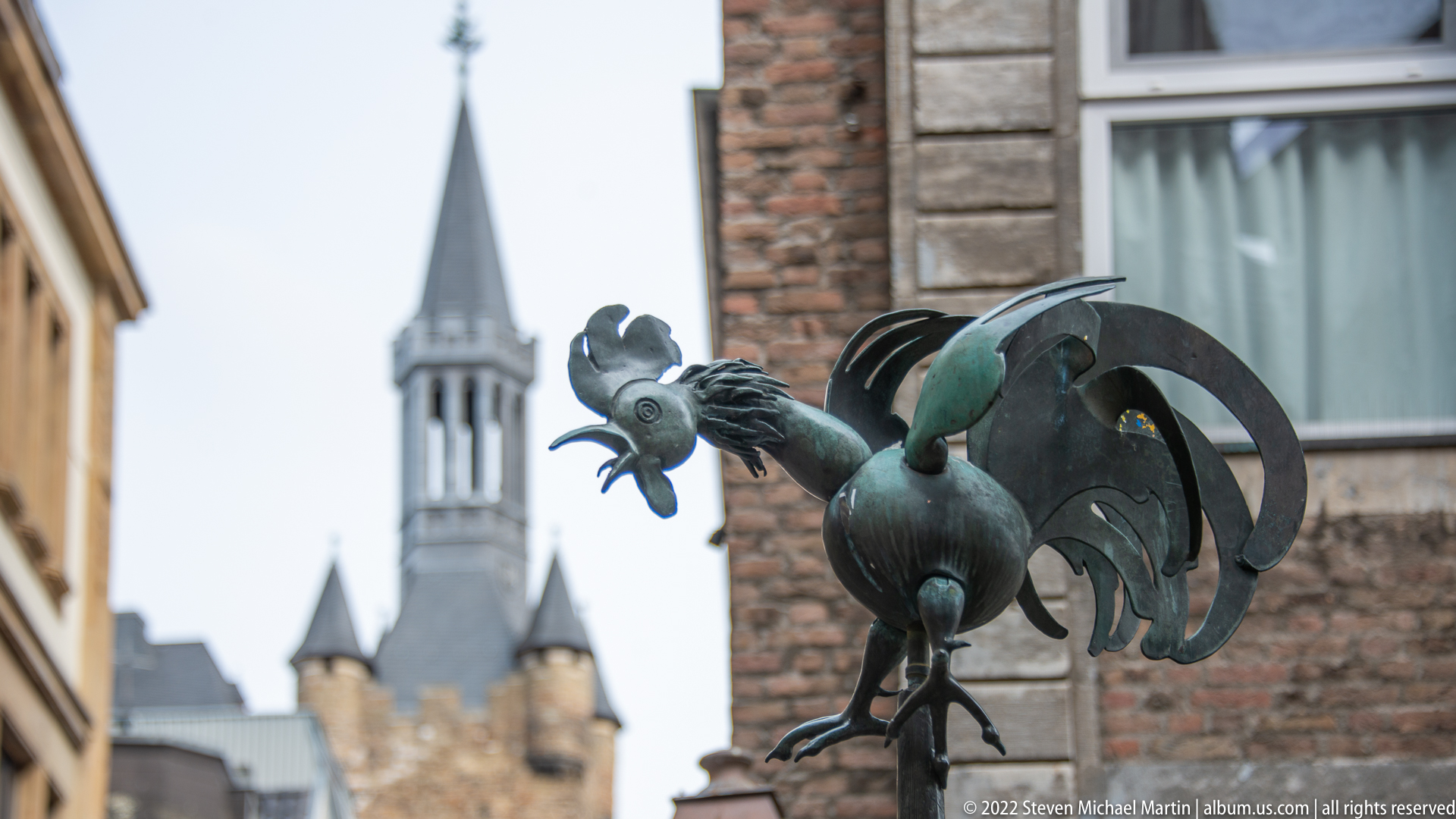
A metal rooster projects outward from a building on an ornamental bracket, silhouetted against the narrow street and a distant tower. Its cut and modeled tail feathers, open beak, and elevated perch recall the traditional use of animal emblems on European inns, shops, and civic façades while remaining a distinctive piece of Aachen street ornament.
Caption
A metal rooster projects outward from a building on an ornamental bracket, silhouetted against the narrow street and a distant tower. Its cut and modeled tail feathers, open beak, and elevated perch recall the traditional use of animal emblems on European inns, shops, and civic façades while remaining a distinctive piece of Aachen street ornament.
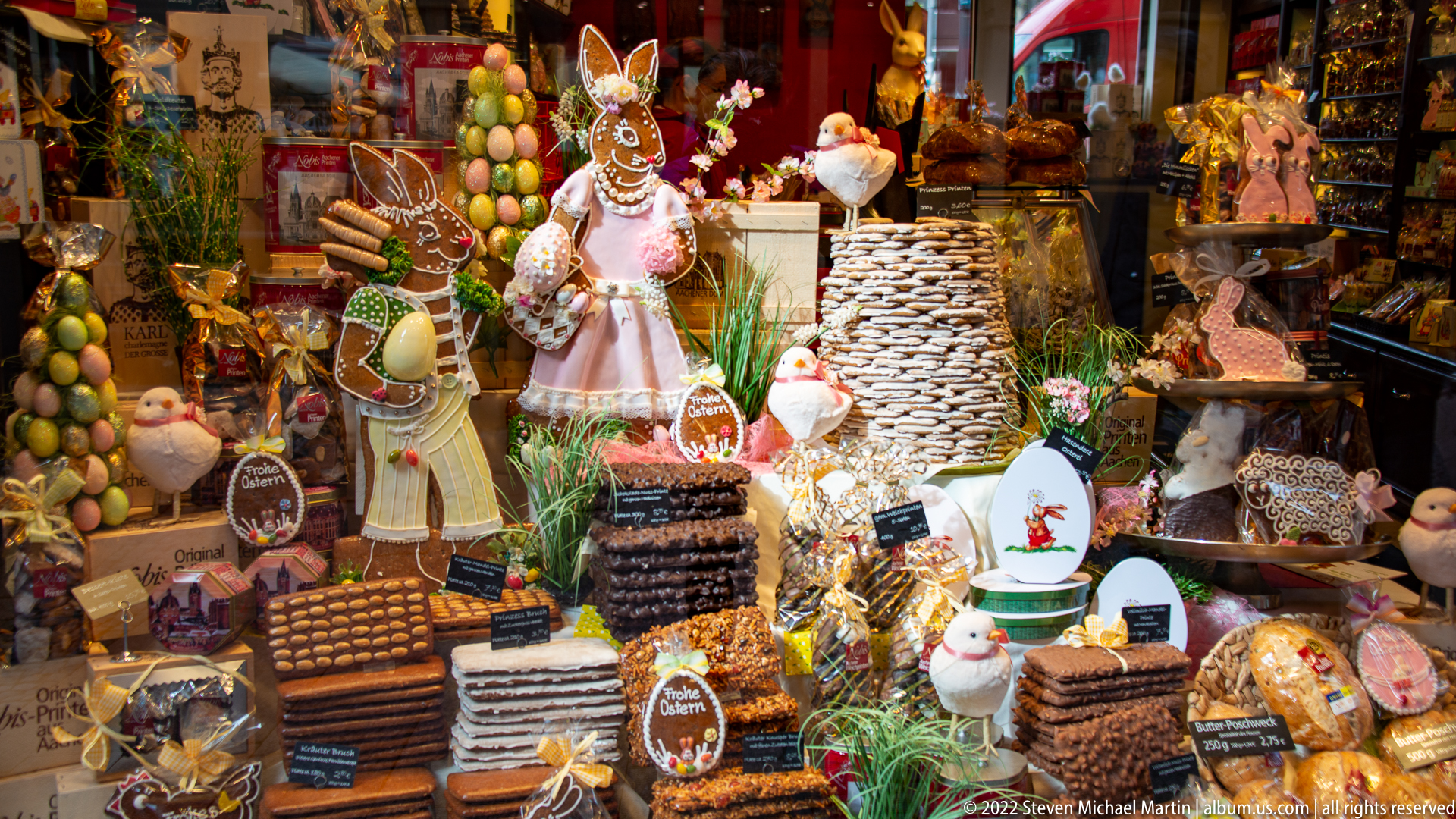
A densely arranged confectionery window combines stacked biscuits, decorated sweets, small seasonal figures, and hand-lettered product labels. The display's abundance and close packing turn everyday food merchandising into a vivid piece of street culture, documenting the visual character of Aachen's historic-center shops.
Caption
A densely arranged confectionery window combines stacked biscuits, decorated sweets, small seasonal figures, and hand-lettered product labels. The display's abundance and close packing turn everyday food merchandising into a vivid piece of street culture, documenting the visual character of Aachen's historic-center shops.
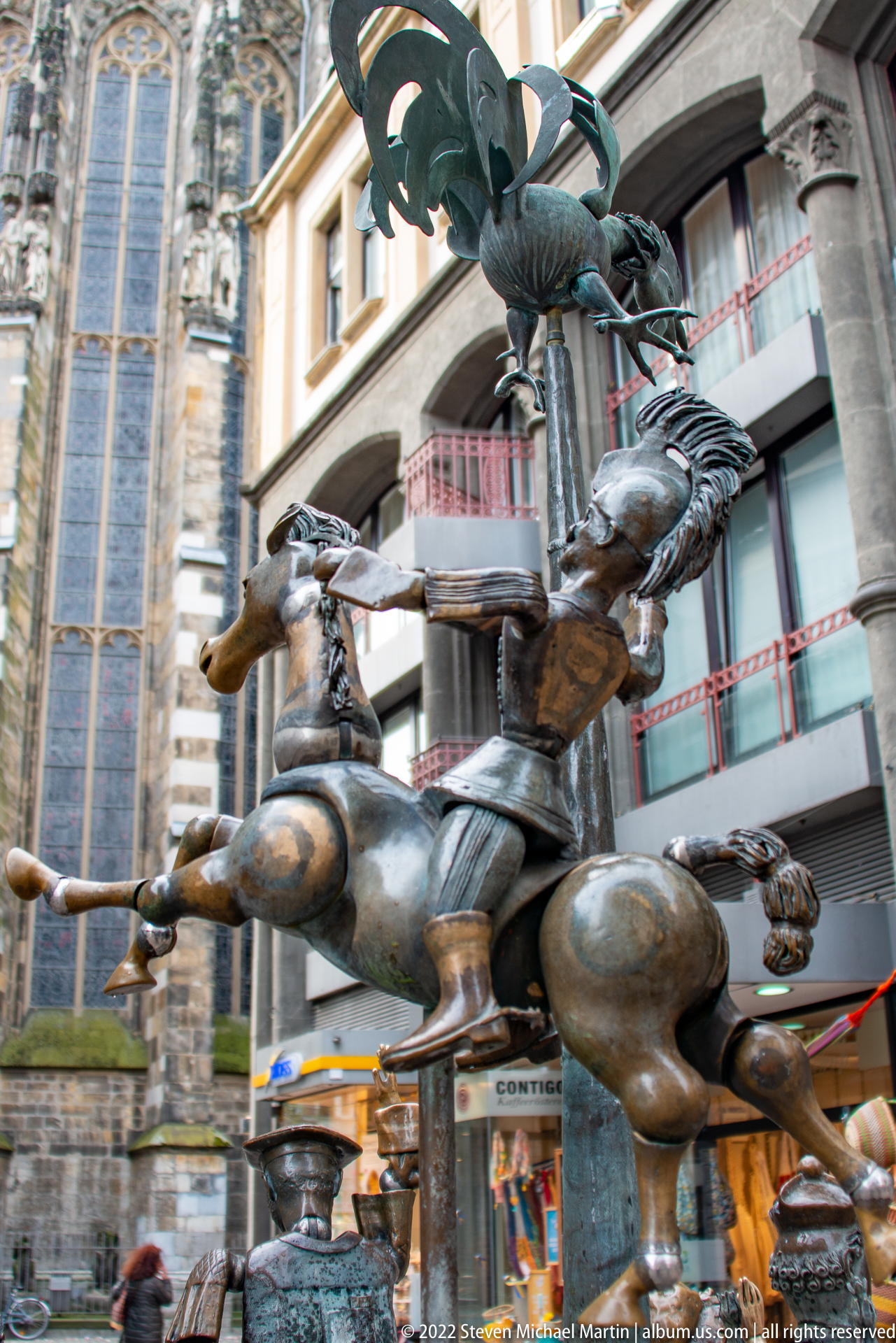
An exuberant cluster of bronze figures and animals rises above a fountain in the center of Aachen, combining human gestures, rearing forms, and layered movement. The composition is intentionally crowded and playful, designed to be viewed from multiple angles as part of the pedestrian streetscape rather than as a single frontal monument.
Caption
An exuberant cluster of bronze figures and animals rises above a fountain in the center of Aachen, combining human gestures, rearing forms, and layered movement. The composition is intentionally crowded and playful, designed to be viewed from multiple angles as part of the pedestrian streetscape rather than as a single frontal monument.
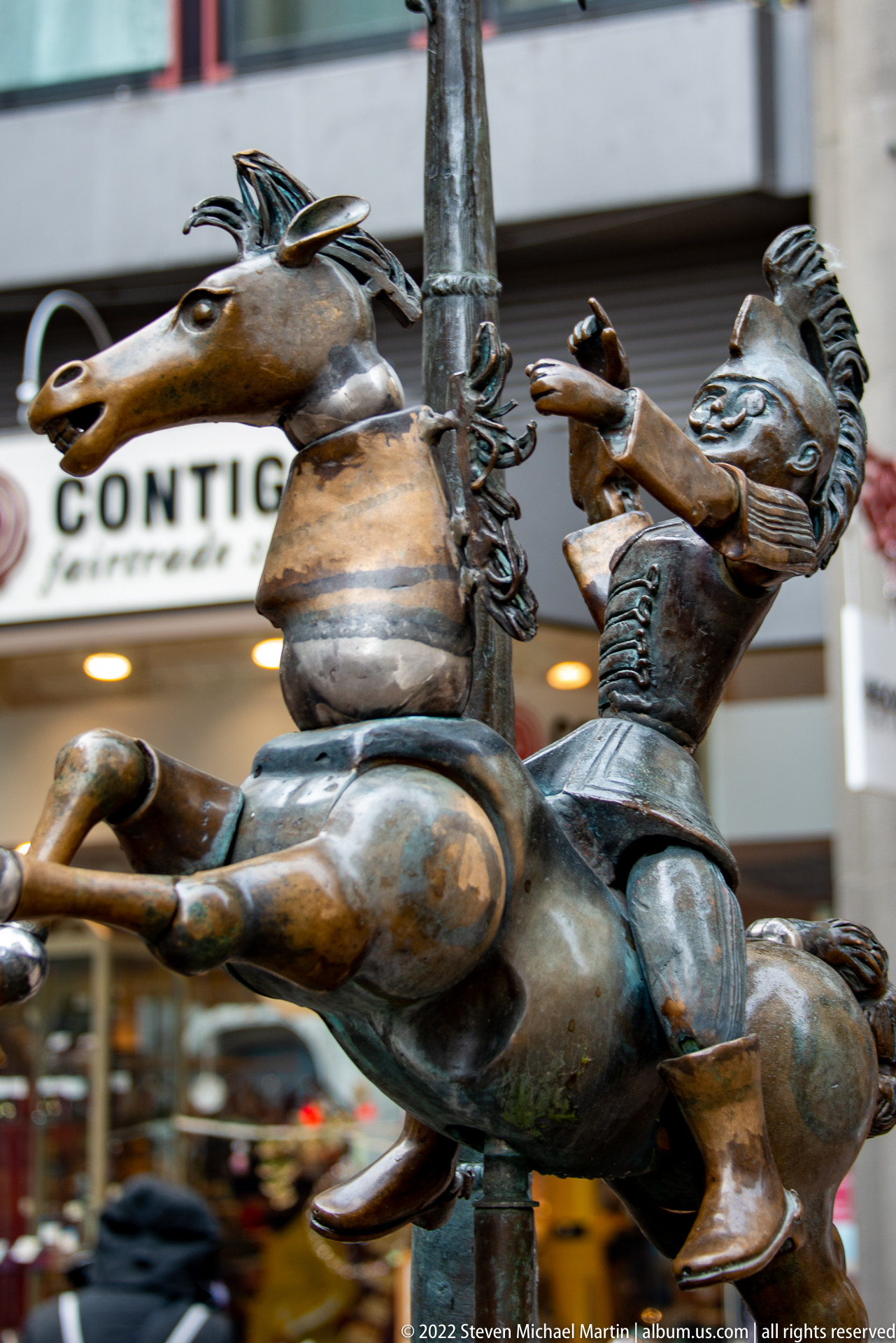
A lively pair of bronze figures forms part of a larger Aachen fountain ensemble: one figure rides or leans across an animal-like form while another twists backward with arms raised. The close viewpoint isolates the comic gestures and polished bronze surfaces, revealing the fountain's playful theatrical character more clearly than the wider street view.
Caption
A lively pair of bronze figures forms part of a larger Aachen fountain ensemble: one figure rides or leans across an animal-like form while another twists backward with arms raised. The close viewpoint isolates the comic gestures and polished bronze surfaces, revealing the fountain's playful theatrical character more clearly than the wider street view.

A crucified Christ figure is sheltered beneath an ornate wrought-metal canopy and enclosed by ironwork against a rough stone wall. Flowers at the base soften the austere masonry setting, while the protective grille and lamps indicate a maintained devotional feature embedded directly in Aachen's urban fabric.
Caption
A crucified Christ figure is sheltered beneath an ornate wrought-metal canopy and enclosed by ironwork against a rough stone wall. Flowers at the base soften the austere masonry setting, while the protective grille and lamps indicate a maintained devotional feature embedded directly in Aachen's urban fabric.
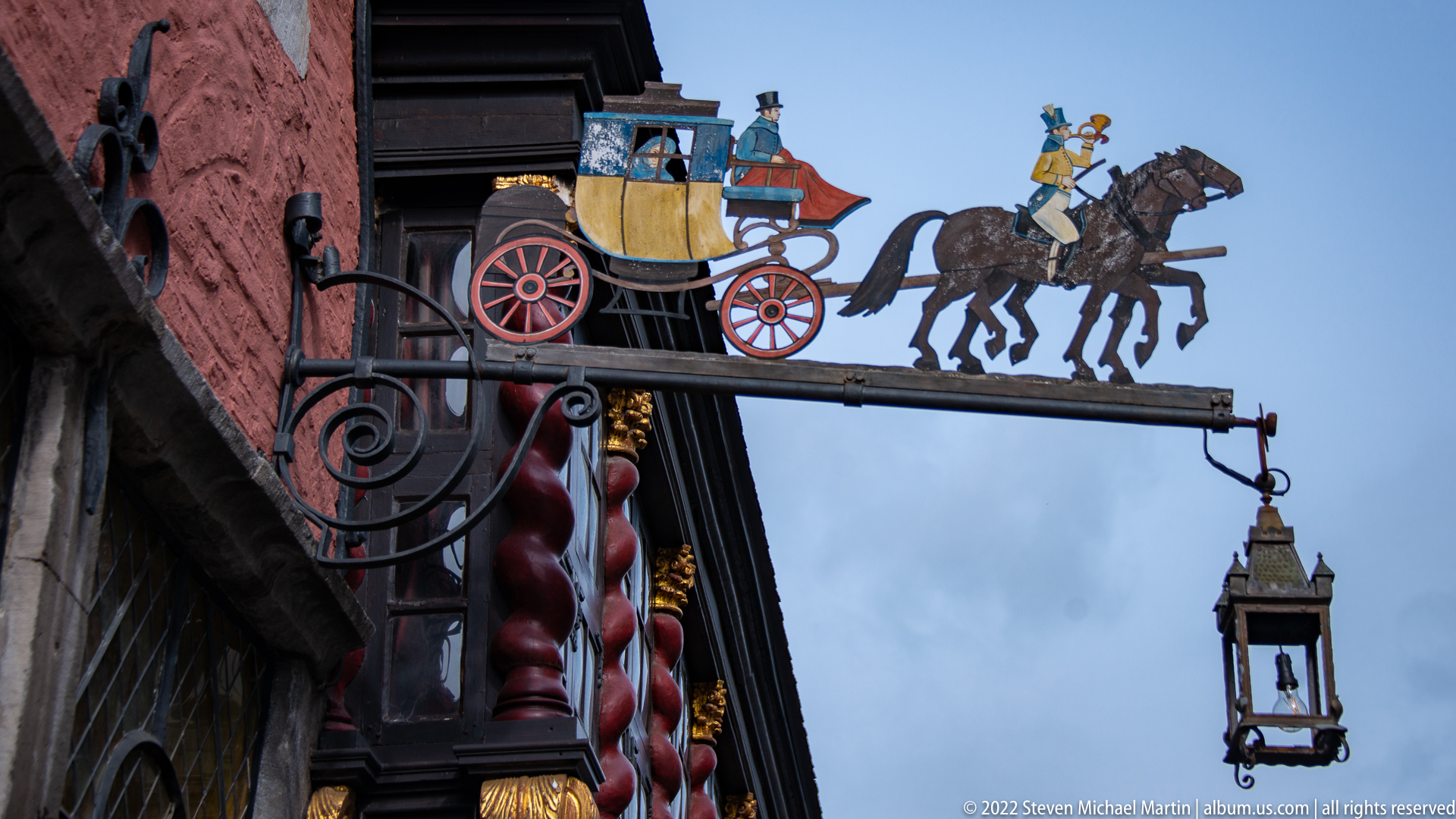
A painted metal sign projects from a dark timbered façade, showing a horse-drawn coach above a small suspended lantern. The sign's pictorial construction and wrought bracket evoke older European traditions of identifying inns, shops, or trades through recognizable symbols rather than text alone.
Caption
A painted metal sign projects from a dark timbered façade, showing a horse-drawn coach above a small suspended lantern. The sign's pictorial construction and wrought bracket evoke older European traditions of identifying inns, shops, or trades through recognizable symbols rather than text alone.
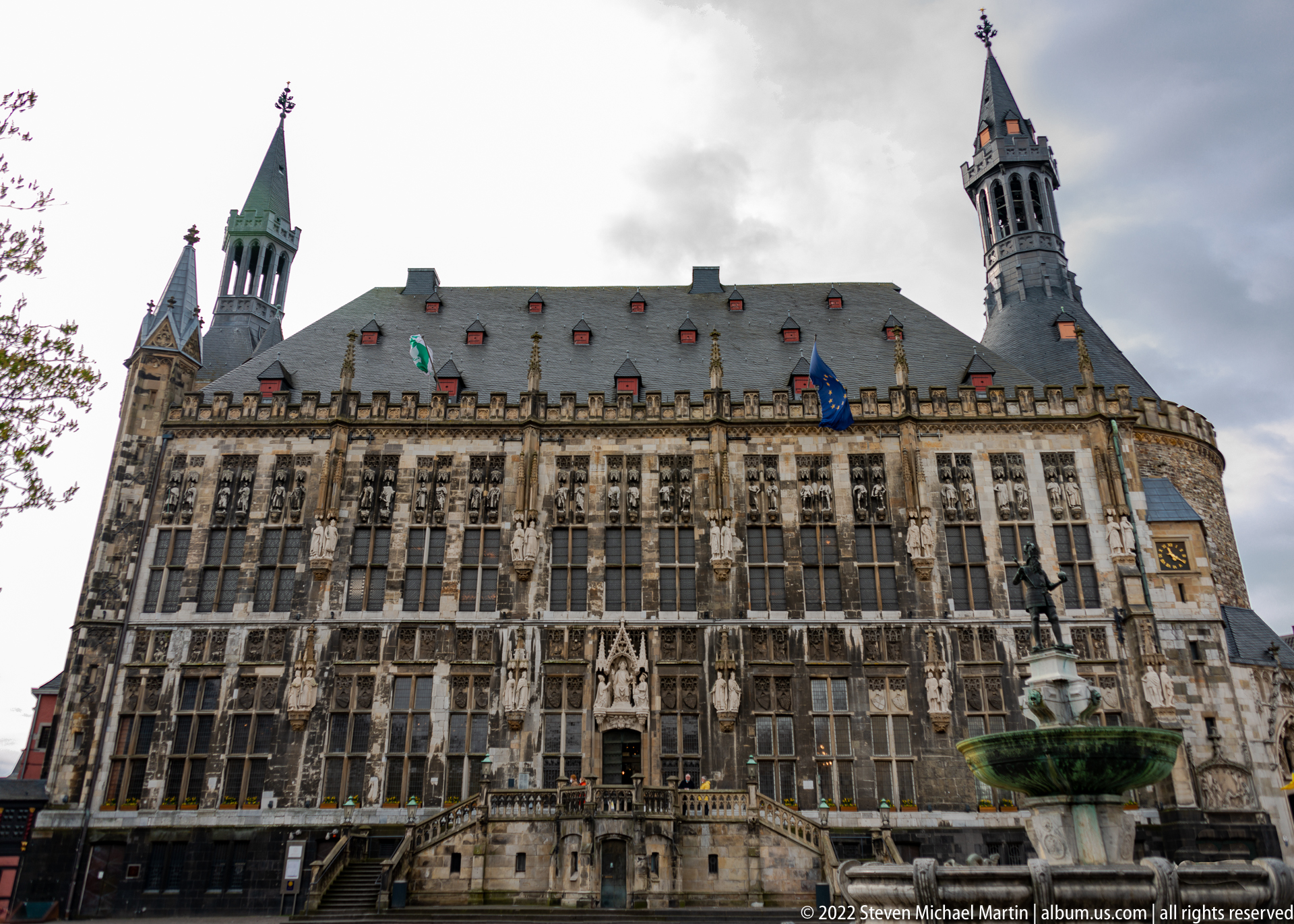
Aachen Town Hall rises across the frame as a long Gothic Revival and historicizing civic façade, articulated by repeated tall windows, sculptural niches, steep rooflines, and corner towers. The building's scale and ceremonial composition make it one of the defining architectural anchors of the city's historic center.
Caption
Aachen Town Hall rises across the frame as a long Gothic Revival and historicizing civic façade, articulated by repeated tall windows, sculptural niches, steep rooflines, and corner towers. The building's scale and ceremonial composition make it one of the defining architectural anchors of the city's historic center.
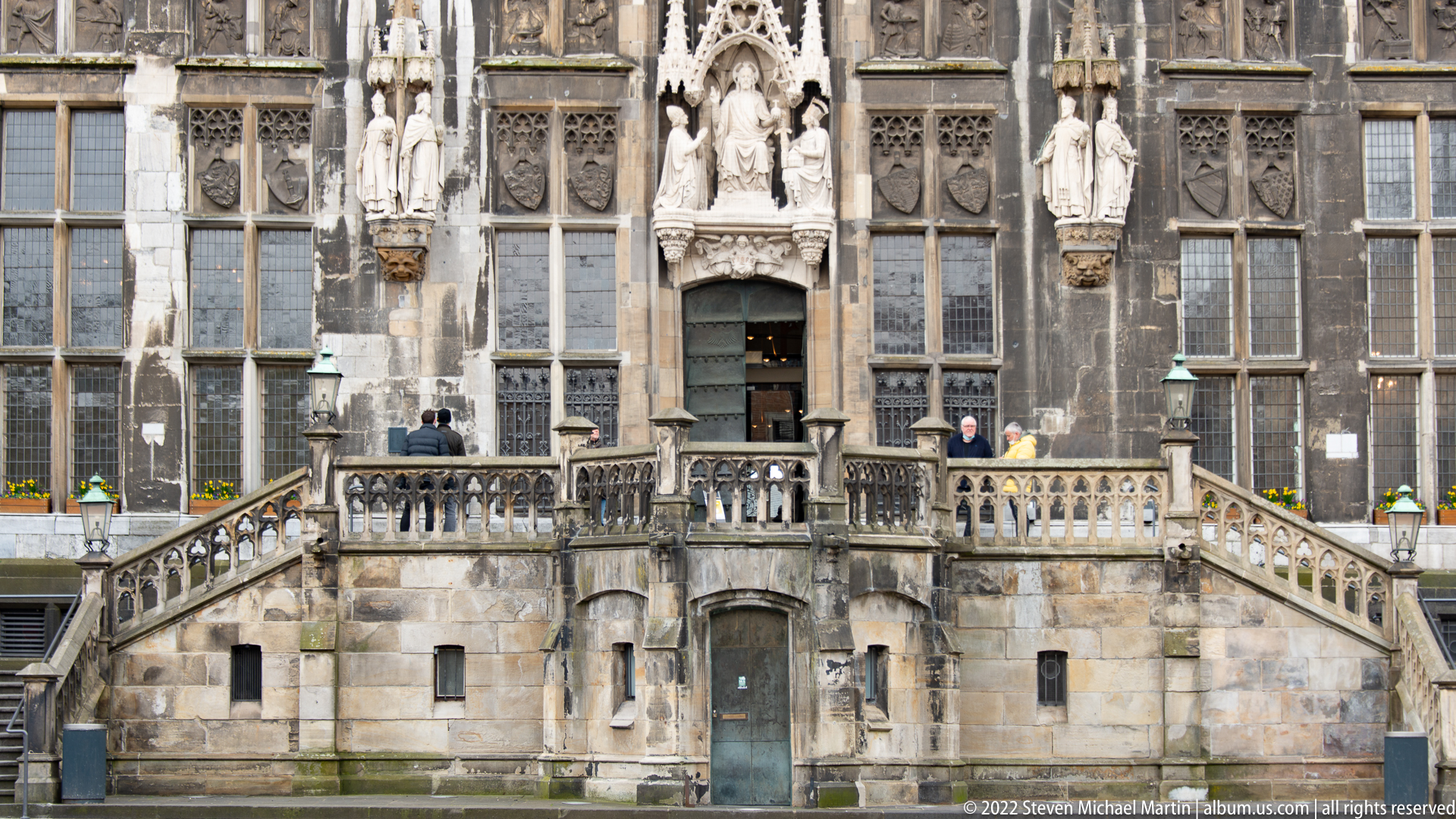
The ceremonial stair of Aachen Town Hall climbs toward a richly carved entrance framed by tall windows, tracery, statues, and dark stone. Seen at closer range, the façade's dense vertical organization becomes more legible, from the balustraded landing to the sculptural niches that animate the civic elevation.
Caption
The ceremonial stair of Aachen Town Hall climbs toward a richly carved entrance framed by tall windows, tracery, statues, and dark stone. Seen at closer range, the façade's dense vertical organization becomes more legible, from the balustraded landing to the sculptural niches that animate the civic elevation.

A centered view of Aachen Town Hall concentrates on the main stair, entrance portal, flanking windows, and rows of sculpted figures. The symmetrical composition emphasizes the building's ceremonial access and the contrast between the pale stair structure and the darker, weathered stonework of the upper façade.
Caption
A centered view of Aachen Town Hall concentrates on the main stair, entrance portal, flanking windows, and rows of sculpted figures. The symmetrical composition emphasizes the building's ceremonial access and the contrast between the pale stair structure and the darker, weathered stonework of the upper façade.
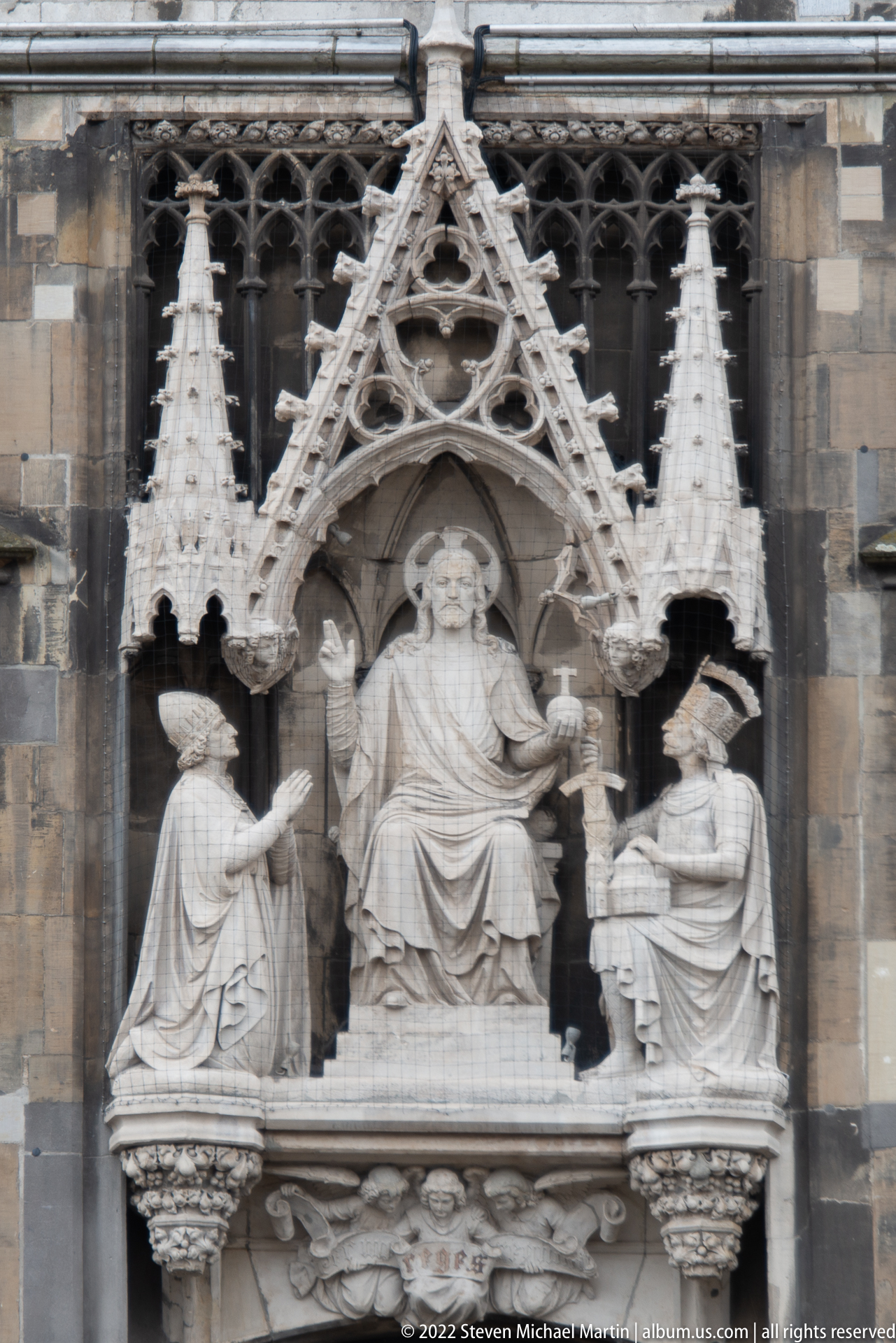
An enthroned ruler occupies the center of a carved stone group above an entrance of Aachen Town Hall, flanked by two smaller kneeling or attendant figures beneath an elaborate Gothic canopy. The composition integrates political imagery directly into the civic façade, using hierarchy, gesture, and architectural framing to mark the portal as a ceremonial focal point.
Caption
An enthroned ruler occupies the center of a carved stone group above an entrance of Aachen Town Hall, flanked by two smaller kneeling or attendant figures beneath an elaborate Gothic canopy. The composition integrates political imagery directly into the civic façade, using hierarchy, gesture, and architectural framing to mark the portal as a ceremonial focal point.
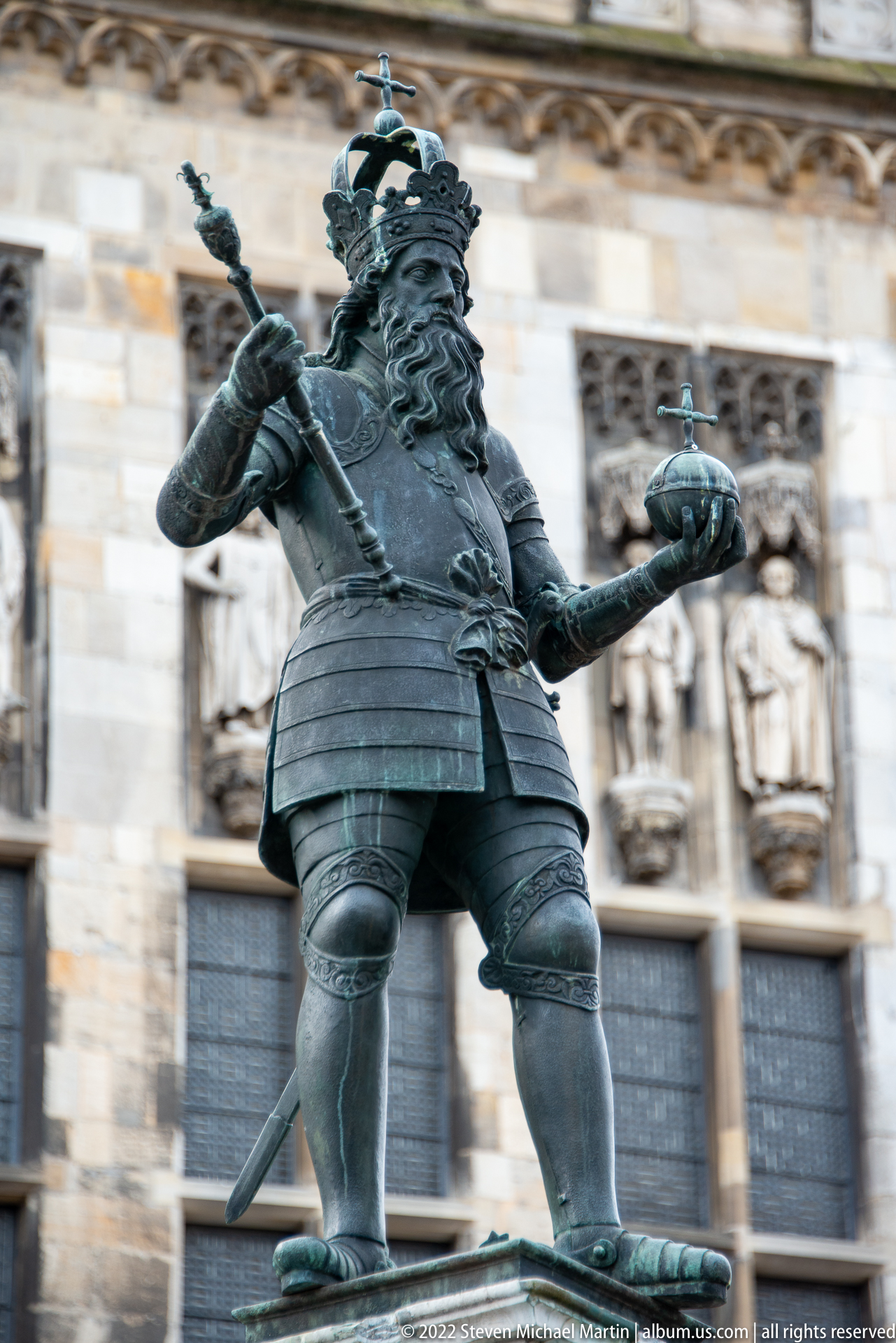
A crowned, armored ruler stands in a commanding bronze pose, holding an orb in one hand and raising the other near a staff or weapon. The regalia and martial costume identify the figure as a sovereign image, while the monumental stance links the sculpture to Aachen's long association with royal and imperial memory.
Caption
A crowned, armored ruler stands in a commanding bronze pose, holding an orb in one hand and raising the other near a staff or weapon. The regalia and martial costume identify the figure as a sovereign image, while the monumental stance links the sculpture to Aachen's long association with royal and imperial memory.
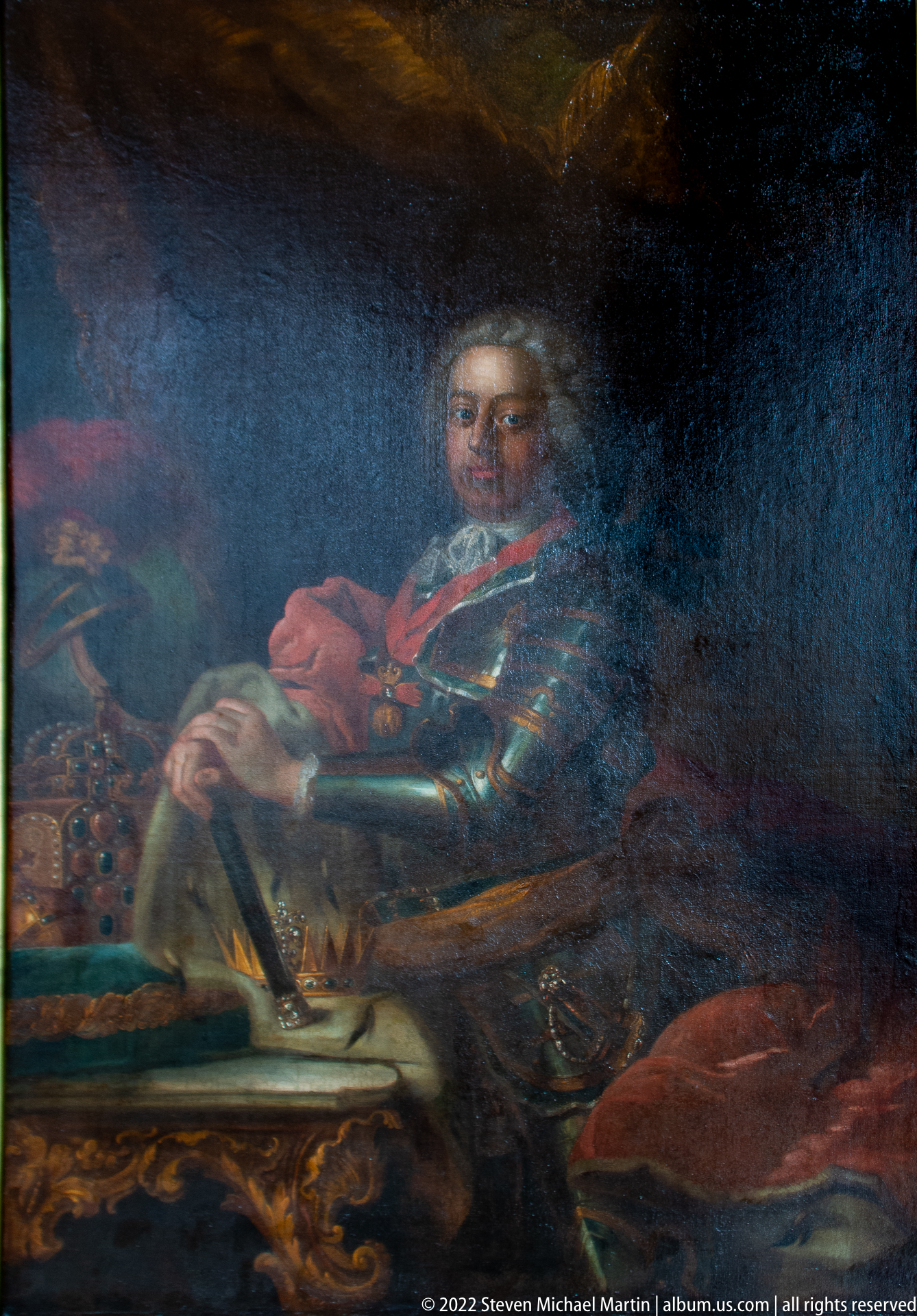
A formal oil portrait presents a seated man in armor within a dark interior, his face emerging from the surrounding shadow while one hand rests near a table or document. The subdued palette, reflective armor, and status-bearing pose mark the work as a courtly or official portrait rather than a narrative scene.
Caption
A formal oil portrait presents a seated man in armor within a dark interior, his face emerging from the surrounding shadow while one hand rests near a table or document. The subdued palette, reflective armor, and status-bearing pose mark the work as a courtly or official portrait rather than a narrative scene.
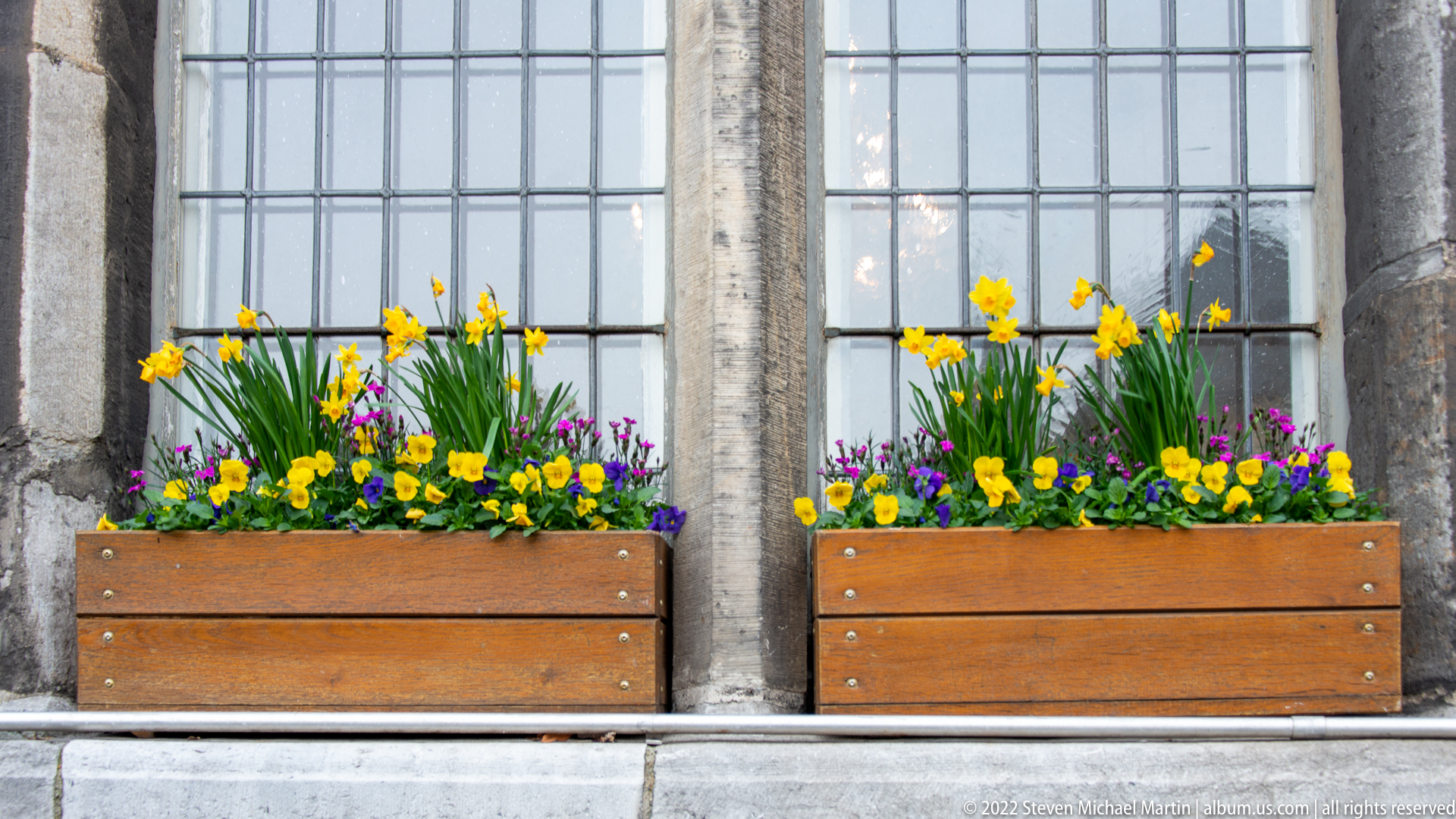
Two wooden planters filled with yellow daffodils and purple spring flowers sit beneath tall leaded windows of Aachen Town Hall. The modest seasonal planting introduces color and domestic scale against the weathered civic stonework, offering a quiet architectural detail within the otherwise monumental façade.
Caption
Two wooden planters filled with yellow daffodils and purple spring flowers sit beneath tall leaded windows of Aachen Town Hall. The modest seasonal planting introduces color and domestic scale against the weathered civic stonework, offering a quiet architectural detail within the otherwise monumental façade.
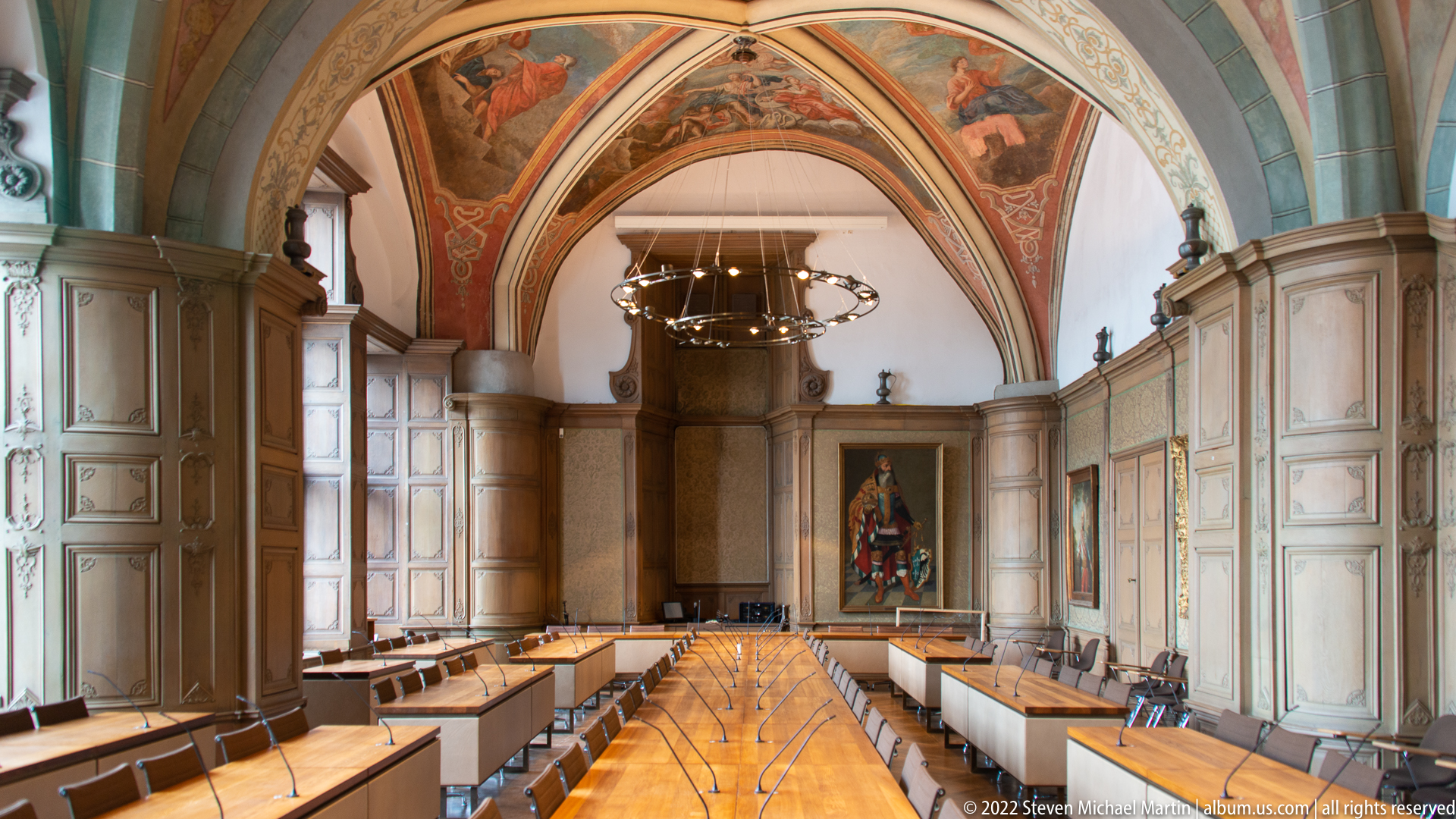
A long ceremonial hall inside Aachen Town Hall is lined with pale paneled walls and rows of benches beneath a ribbed vaulted ceiling. Painted narrative scenes occupy the curved vault surfaces, while a circular chandelier and axial arrangement of furnishings reinforce the formal, civic character of the room.
Caption
A long ceremonial hall inside Aachen Town Hall is lined with pale paneled walls and rows of benches beneath a ribbed vaulted ceiling. Painted narrative scenes occupy the curved vault surfaces, while a circular chandelier and axial arrangement of furnishings reinforce the formal, civic character of the room.
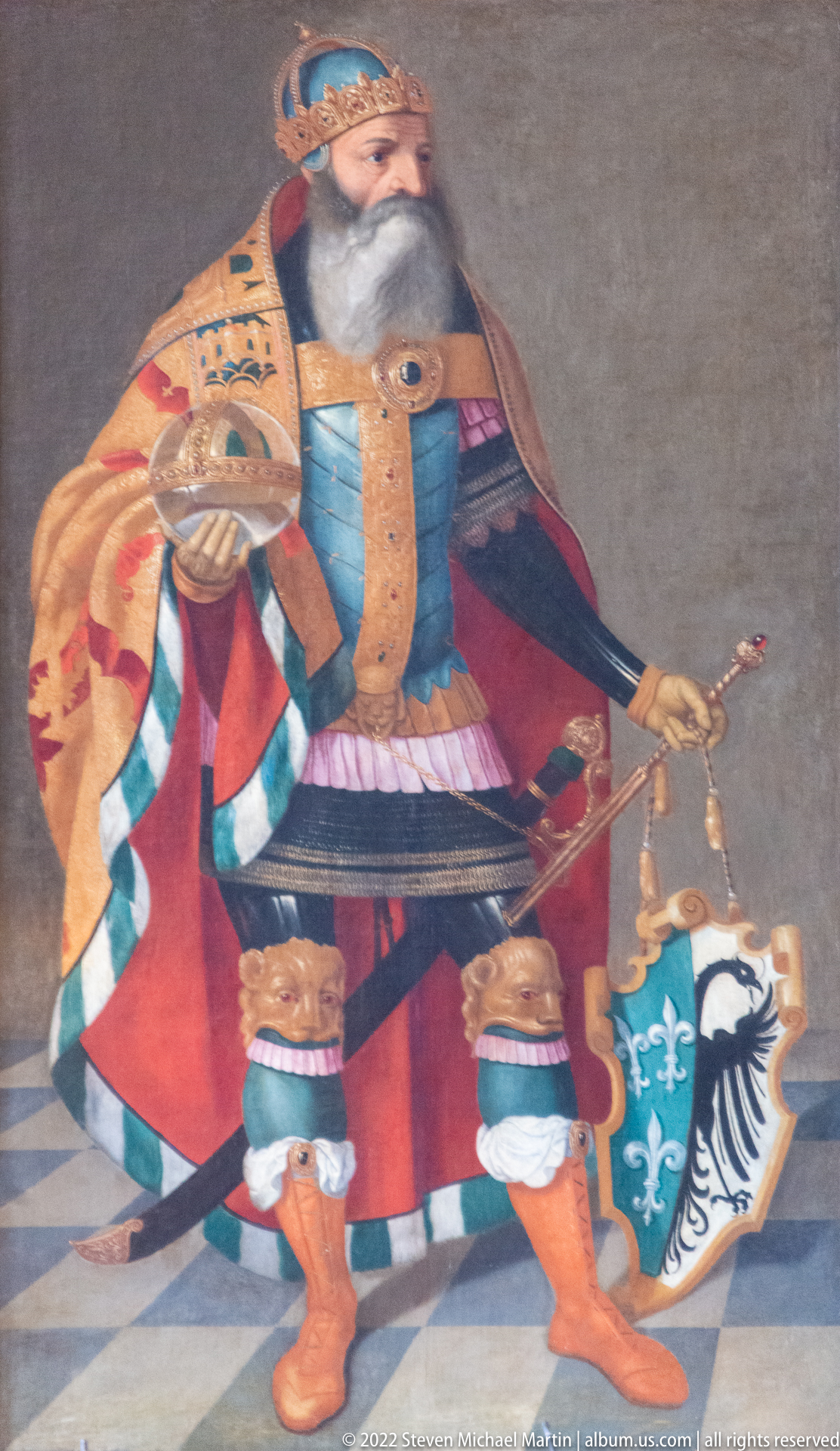
A bearded crowned ruler is shown frontally in richly patterned robes, holding a scepter beside a heraldic shield. The deliberately emblematic presentation resembles a dynastic or civic series in which regalia, costume, and coats of arms communicate rank and lineage more strongly than naturalistic portraiture.
Caption
A bearded crowned ruler is shown frontally in richly patterned robes, holding a scepter beside a heraldic shield. The deliberately emblematic presentation resembles a dynastic or civic series in which regalia, costume, and coats of arms communicate rank and lineage more strongly than naturalistic portraiture.
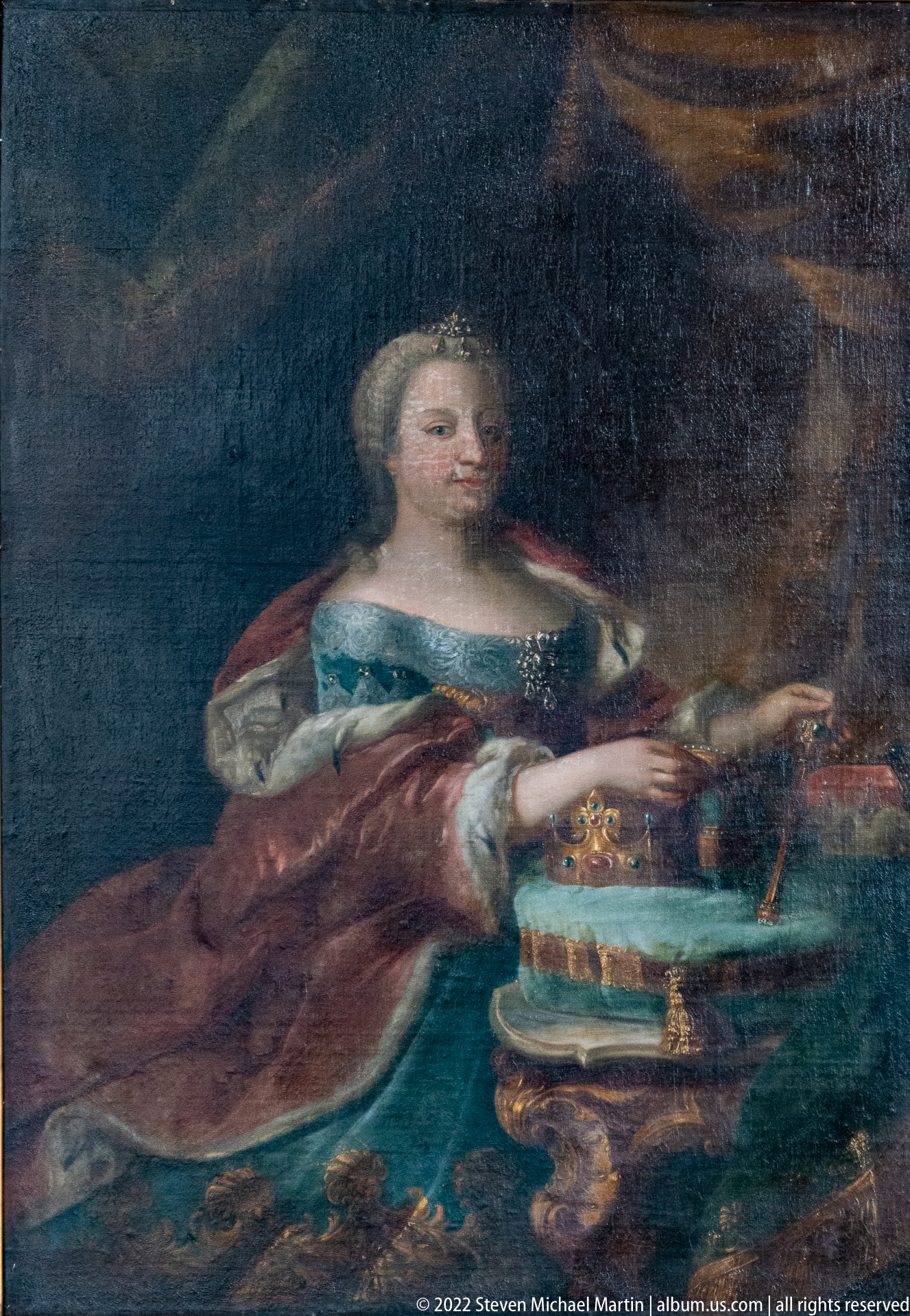
A woman in an elaborate dress and draped mantle sits beside a table displaying small objects and jewelry, her posture and costume signaling elite status. The restrained expression, rich textiles, and carefully staged accessories place the painting within the conventions of European court portraiture.
Caption
A woman in an elaborate dress and draped mantle sits beside a table displaying small objects and jewelry, her posture and costume signaling elite status. The restrained expression, rich textiles, and carefully staged accessories place the painting within the conventions of European court portraiture.
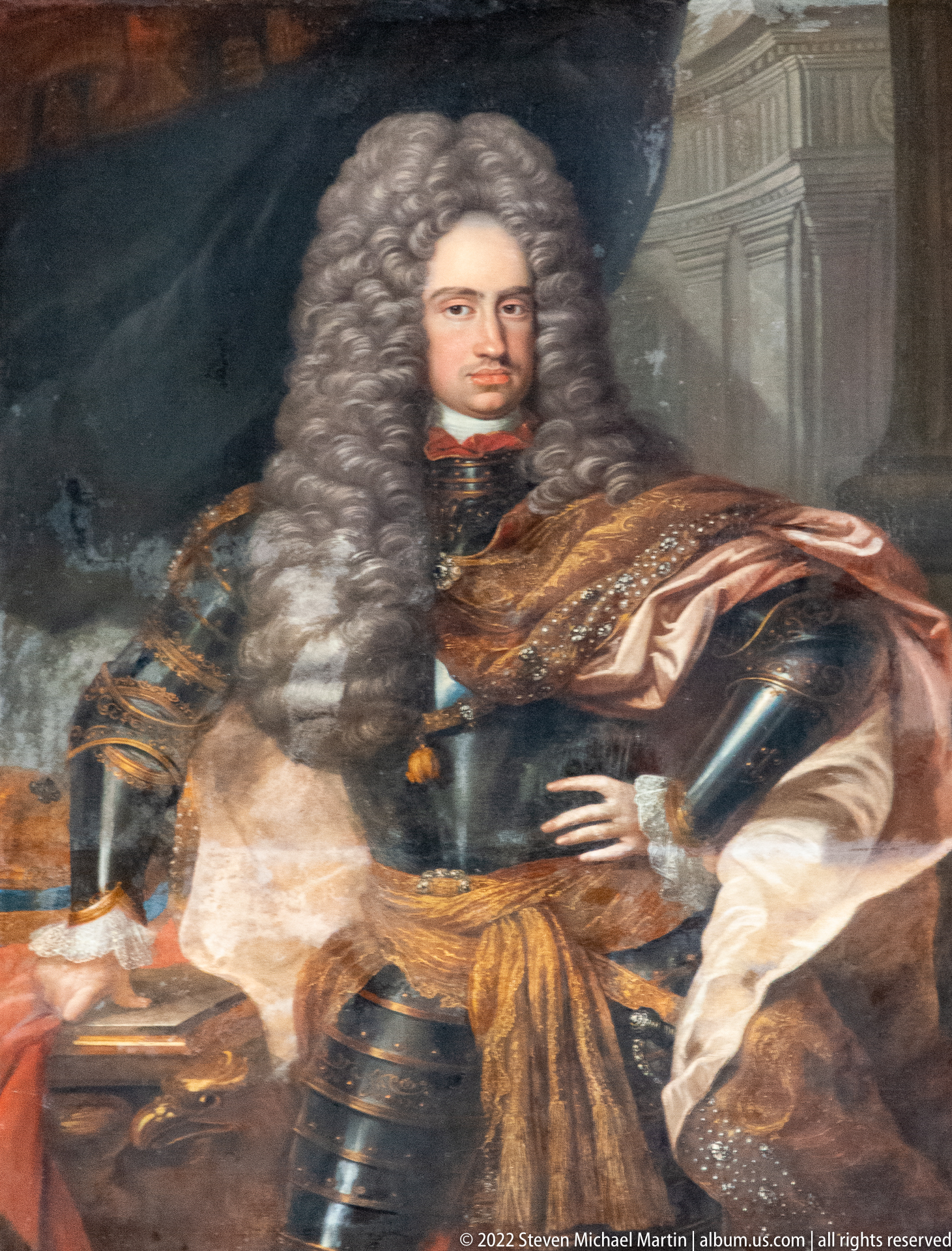
A long-haired nobleman in polished armor poses with one hand on his hip and a richly draped mantle sweeping across his body. Architectural forms and dark background elements frame the sitter, while the armor and commanding pose signal military and dynastic status within a formal court portrait tradition.
Caption
A long-haired nobleman in polished armor poses with one hand on his hip and a richly draped mantle sweeping across his body. Architectural forms and dark background elements frame the sitter, while the armor and commanding pose signal military and dynastic status within a formal court portrait tradition.
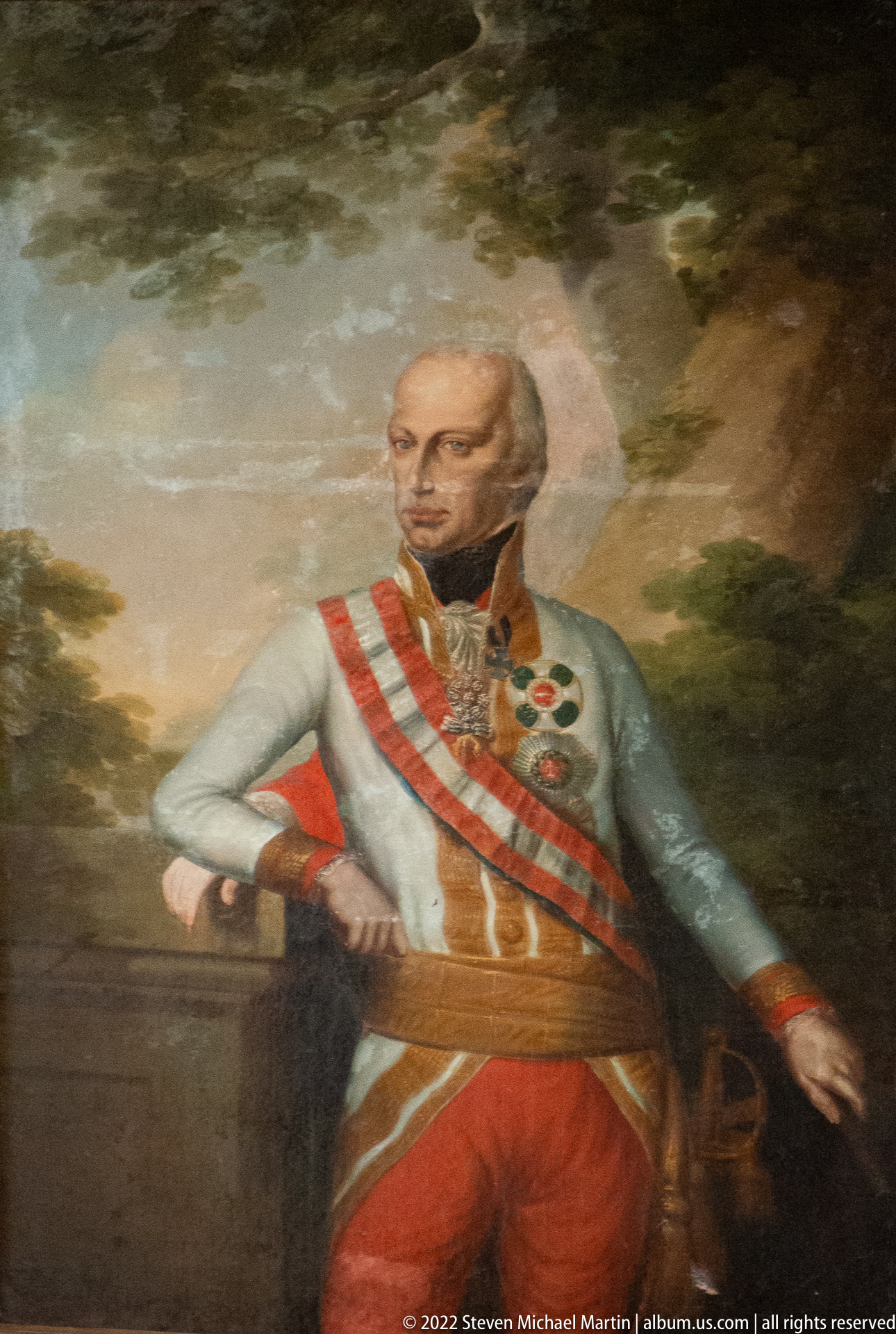
A decorated officer in a white military coat stands outdoors beside a stone balustrade, wearing a broad red sash and multiple orders across his chest. The landscape backdrop and full-length stance combine martial authority with aristocratic portrait conventions, making insignia and uniform the principal carriers of identity.
Caption
A decorated officer in a white military coat stands outdoors beside a stone balustrade, wearing a broad red sash and multiple orders across his chest. The landscape backdrop and full-length stance combine martial authority with aristocratic portrait conventions, making insignia and uniform the principal carriers of identity.
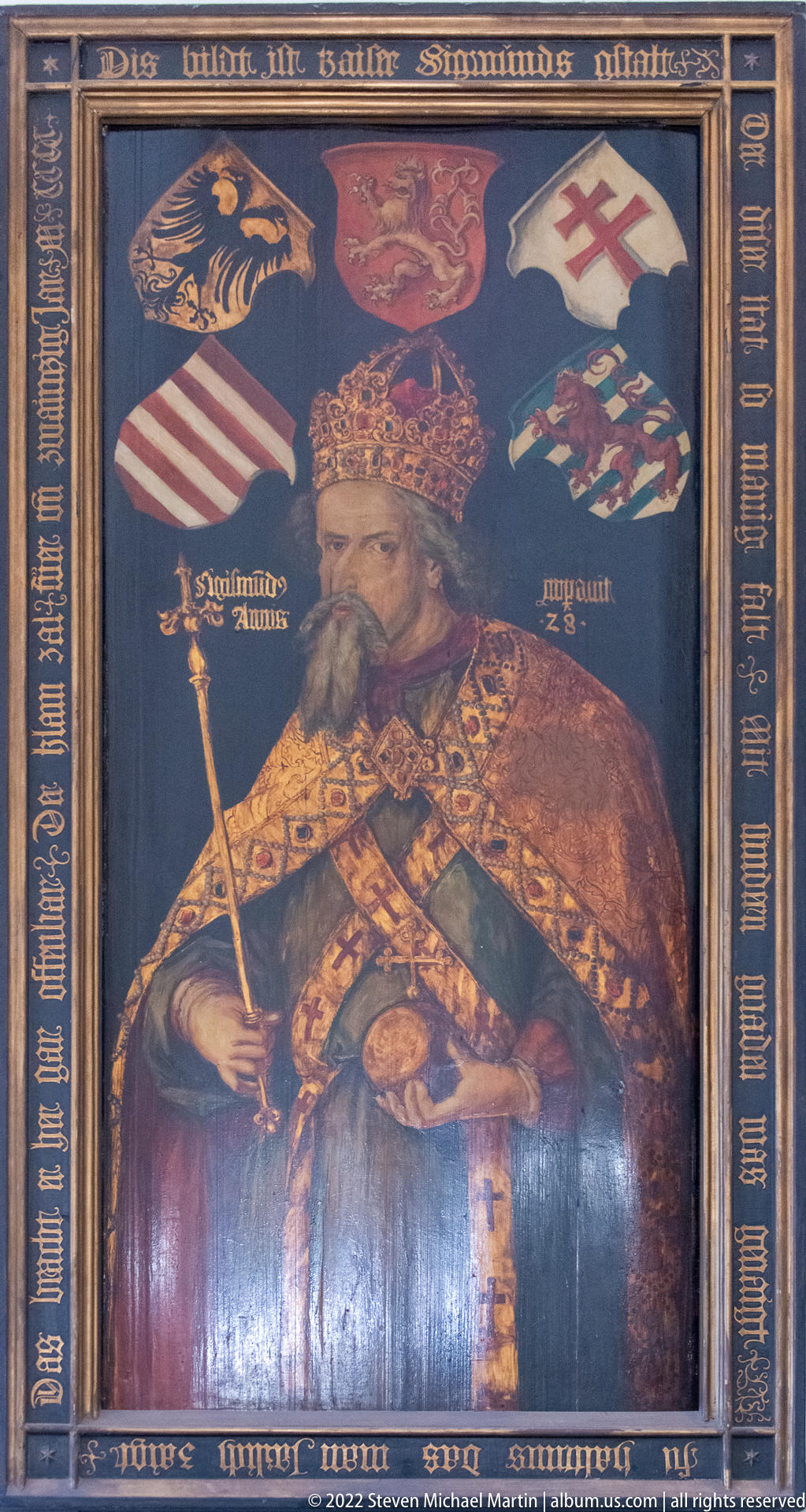
A crowned ruler appears in richly patterned ceremonial robes, surrounded by coats of arms and inscriptions in a framed historical image. The dense heraldic program and frontal presentation emphasize sovereignty and dynastic legitimacy, making the painting function as both portrait and political iconography.
Caption
A crowned ruler appears in richly patterned ceremonial robes, surrounded by coats of arms and inscriptions in a framed historical image. The dense heraldic program and frontal presentation emphasize sovereignty and dynastic legitimacy, making the painting function as both portrait and political iconography.
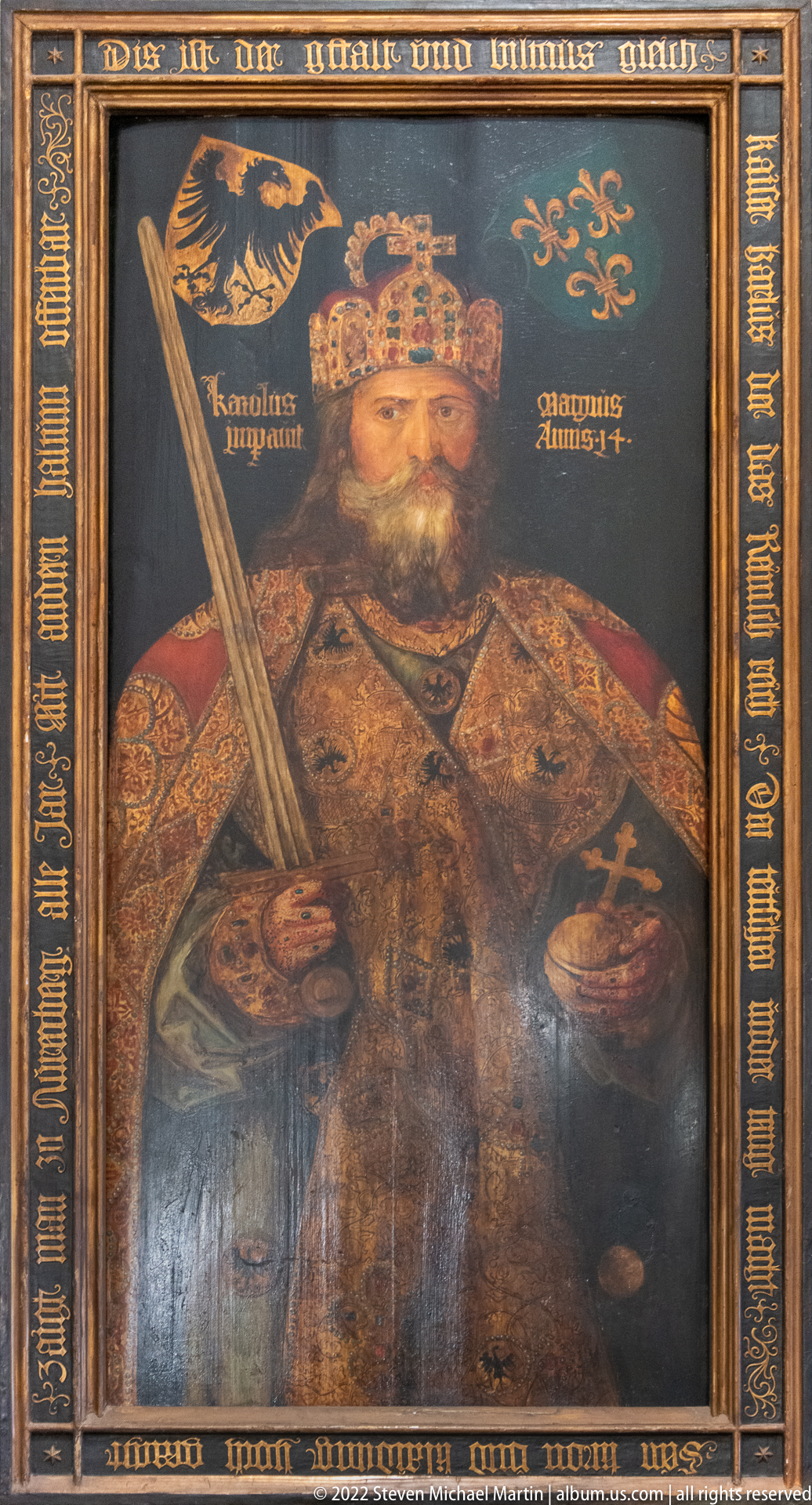
A frontal royal portrait identifies its subject in painted lettering as 'Karolus Magnus,' Charlemagne. The ruler wears a crown and richly ornamented mantle while holding a sword and orb, a conventional combination of regalia that presents him as both warrior and sovereign within Aachen's civic historical memory.
Caption
A frontal royal portrait identifies its subject in painted lettering as 'Karolus Magnus,' Charlemagne. The ruler wears a crown and richly ornamented mantle while holding a sword and orb, a conventional combination of regalia that presents him as both warrior and sovereign within Aachen's civic historical memory.
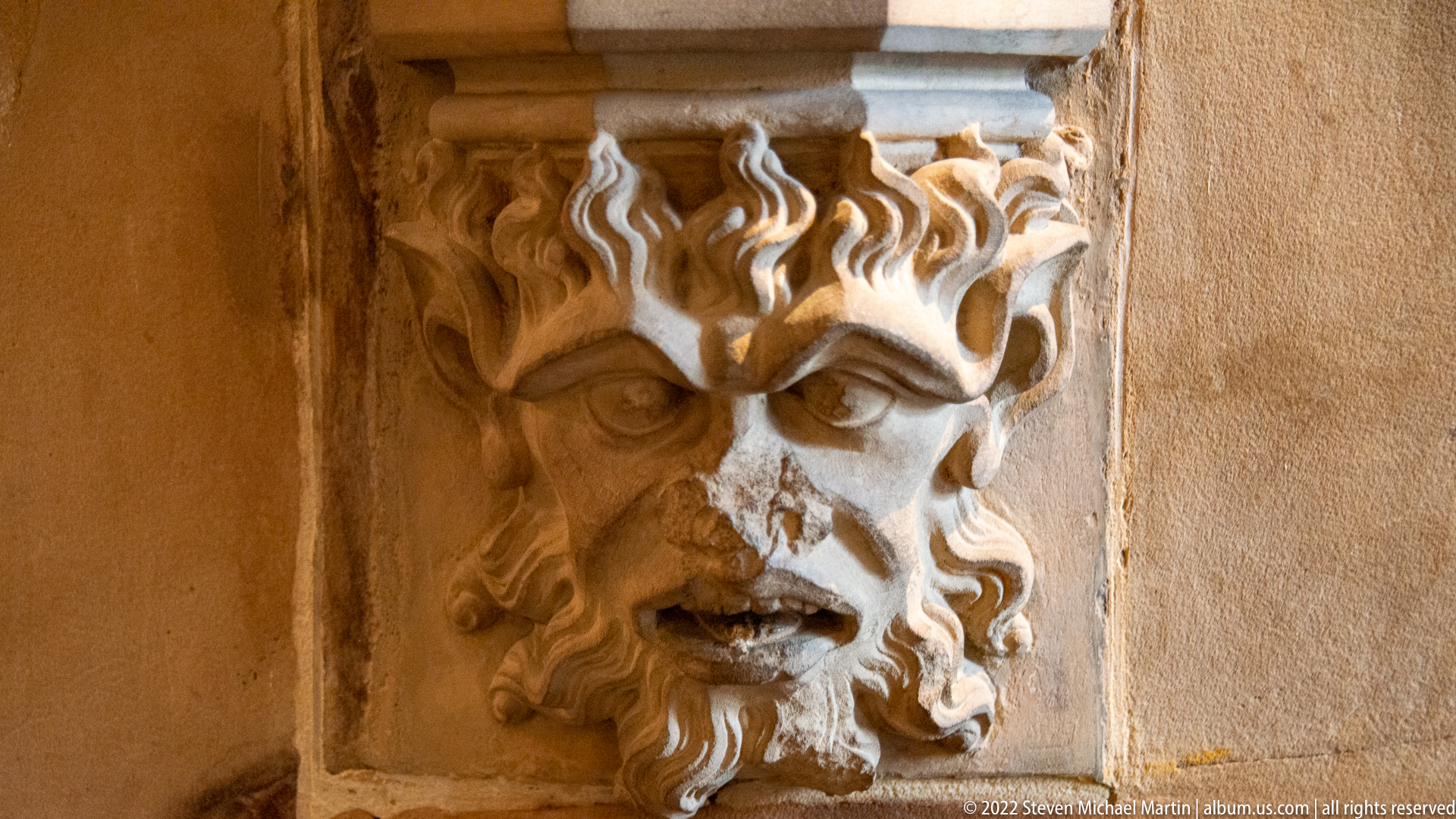
A fierce carved head projects from the corner of a stone architectural support, its deeply cut brows, curling hair or flame-like locks, and open mouth producing an expressive grotesque. The close view reveals how figurative carving animates structural transitions in the historic building fabric.
Caption
A fierce carved head projects from the corner of a stone architectural support, its deeply cut brows, curling hair or flame-like locks, and open mouth producing an expressive grotesque. The close view reveals how figurative carving animates structural transitions in the historic building fabric.
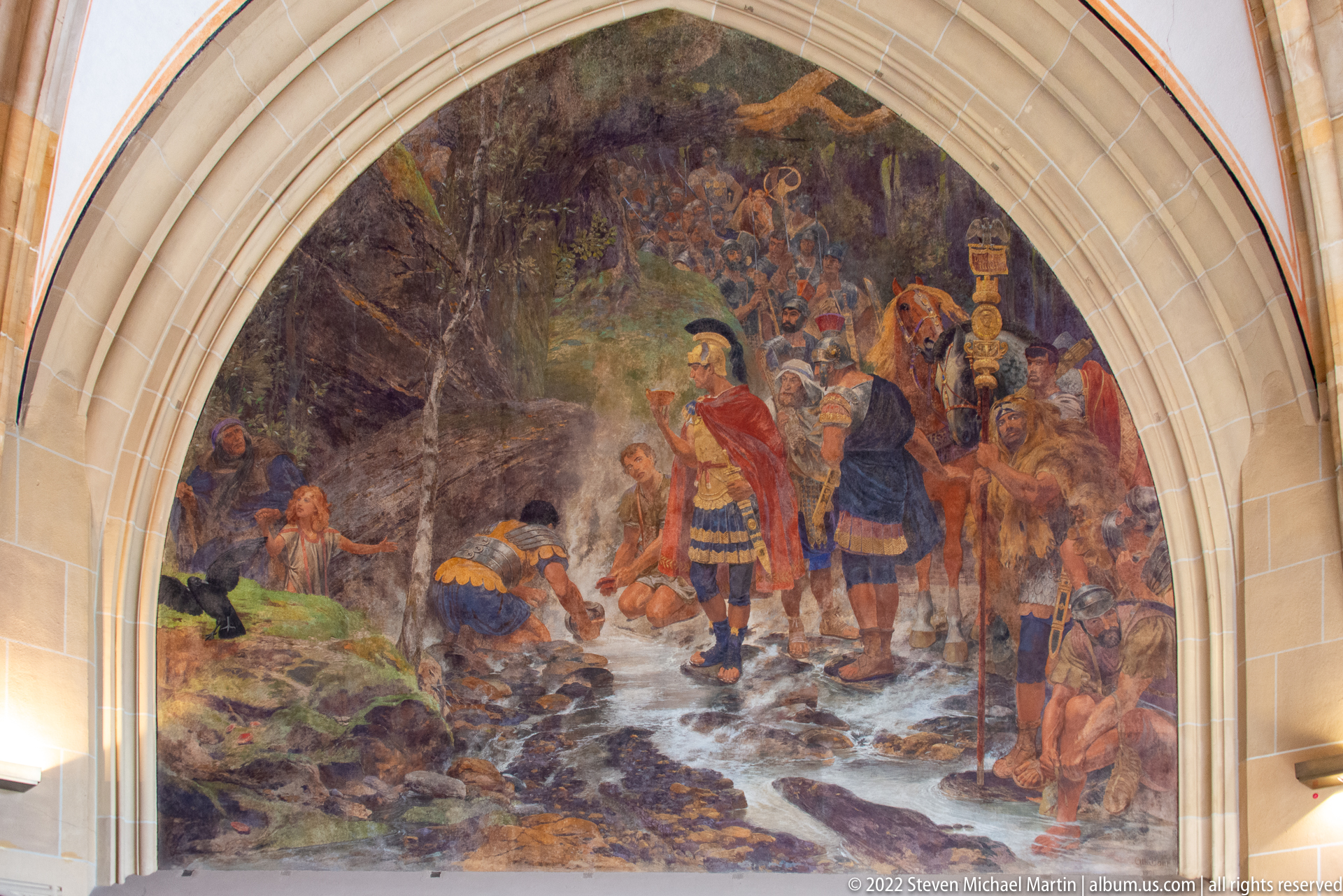
A large mural fills a pointed-arched wall bay with a dramatic historical encounter: armored and robed figures gather around a stream or rocky foreground while attendants and standards structure the scene. The painting's scale and architectural placement make it part of a monumental civic narrative cycle rather than an easel picture.
Caption
A large mural fills a pointed-arched wall bay with a dramatic historical encounter: armored and robed figures gather around a stream or rocky foreground while attendants and standards structure the scene. The painting's scale and architectural placement make it part of a monumental civic narrative cycle rather than an easel picture.
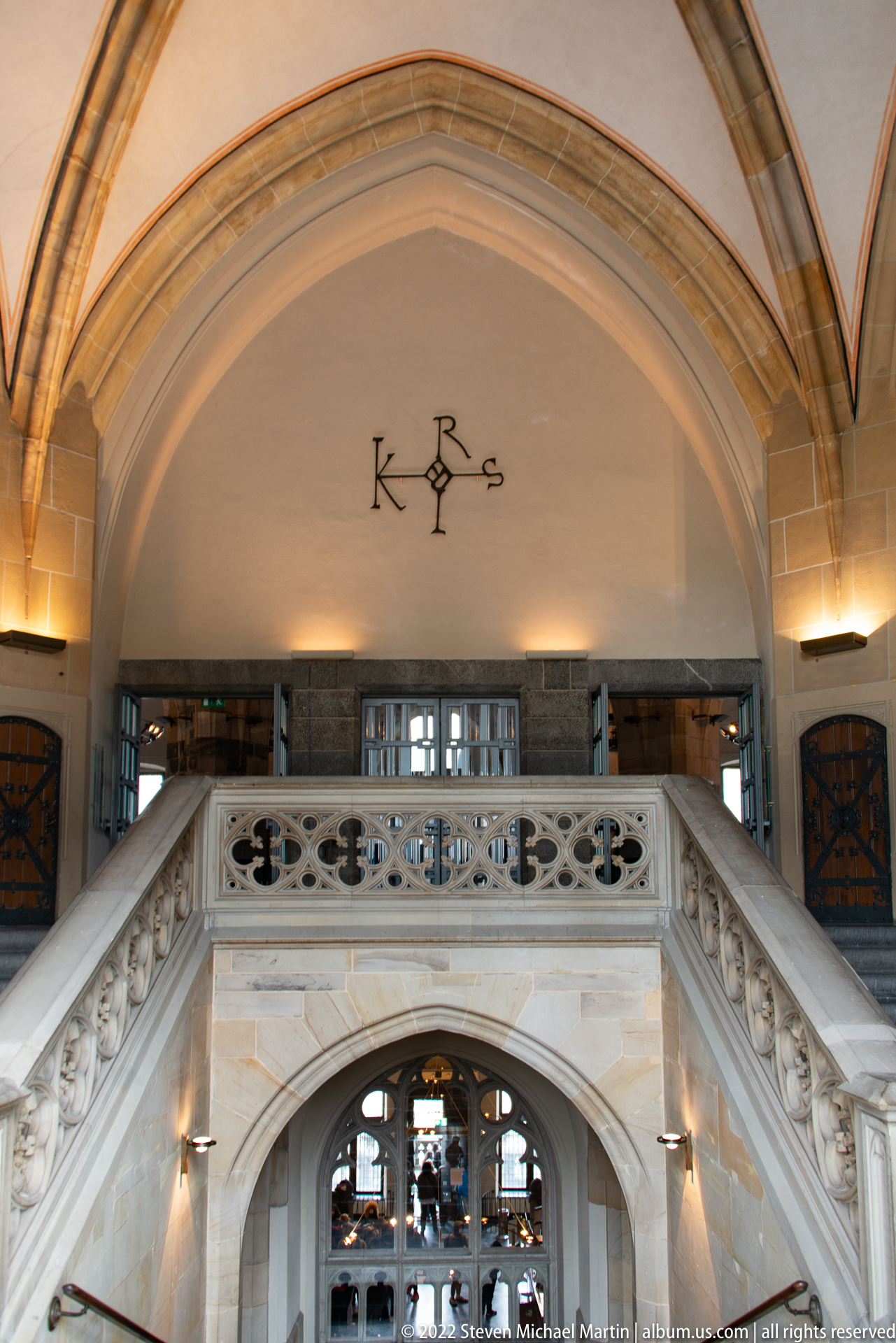
A broad pale-stone staircase descends beneath a pointed vault inside Aachen Town Hall, with a carved balustrade, heavy wall panels, and a monogram painted above the arch. The composition emphasizes circulation and ceremony, using the stair as an architectural transition between formal civic rooms.
Caption
A broad pale-stone staircase descends beneath a pointed vault inside Aachen Town Hall, with a carved balustrade, heavy wall panels, and a monogram painted above the arch. The composition emphasizes circulation and ceremony, using the stair as an architectural transition between formal civic rooms.
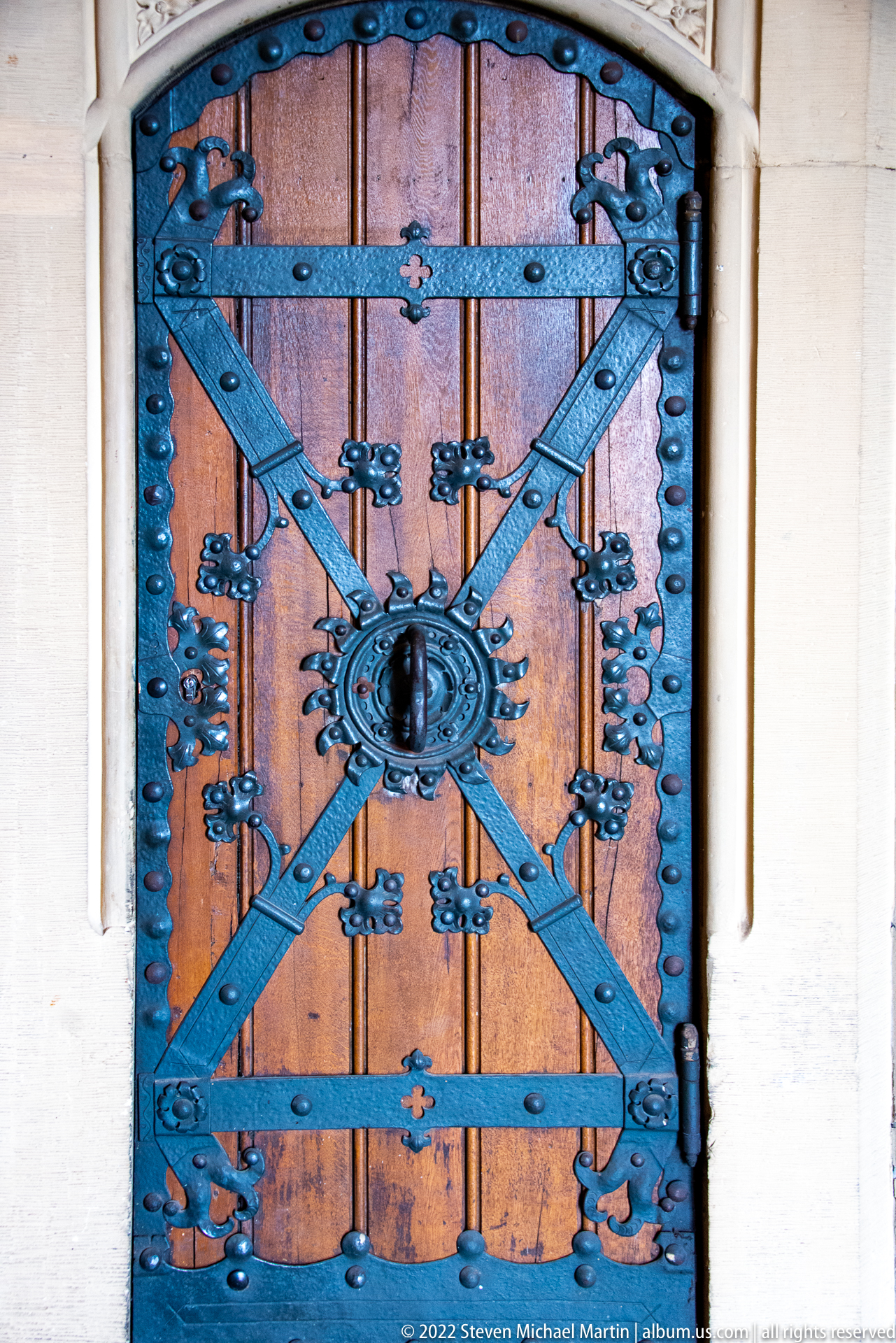
A heavy plank door is reinforced by elaborate black iron straps radiating from a central circular fitting, with rows of studs and fleur-like terminals adding both structure and ornament. The close framing isolates the craftsmanship of the door hardware, where functional bracing becomes a strong decorative pattern.
Caption
A heavy plank door is reinforced by elaborate black iron straps radiating from a central circular fitting, with rows of studs and fleur-like terminals adding both structure and ornament. The close framing isolates the craftsmanship of the door hardware, where functional bracing becomes a strong decorative pattern.
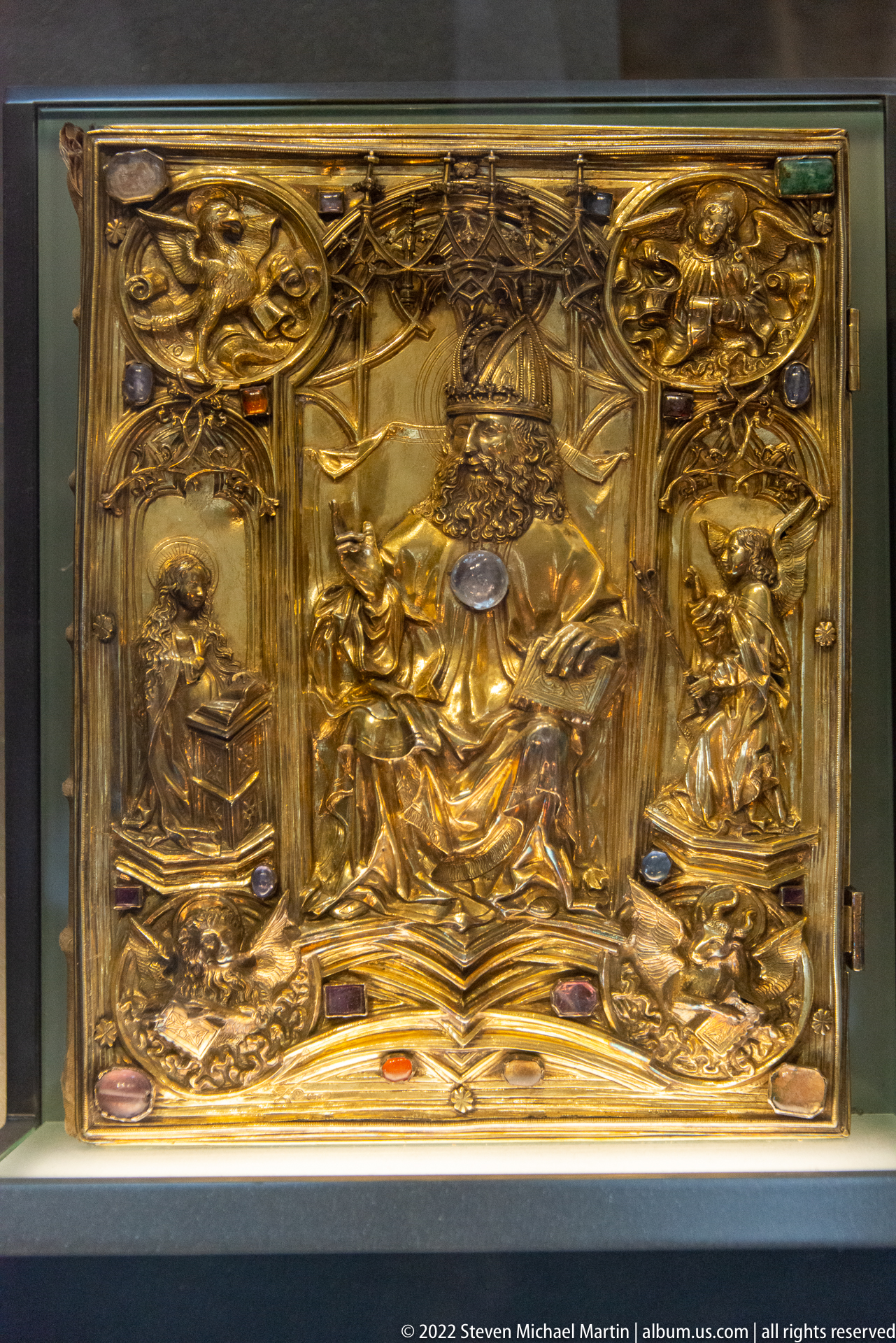
A rectangular gilded object is covered with high-relief figures, architectural frames, and small inset stones, creating a dense devotional surface. The central seated figure is flanked by smaller narrative or saintly scenes, while the raised metalwork and gemstones signal the precious materials associated with a cathedral treasury.
Caption
A rectangular gilded object is covered with high-relief figures, architectural frames, and small inset stones, creating a dense devotional surface. The central seated figure is flanked by smaller narrative or saintly scenes, while the raised metalwork and gemstones signal the precious materials associated with a cathedral treasury.
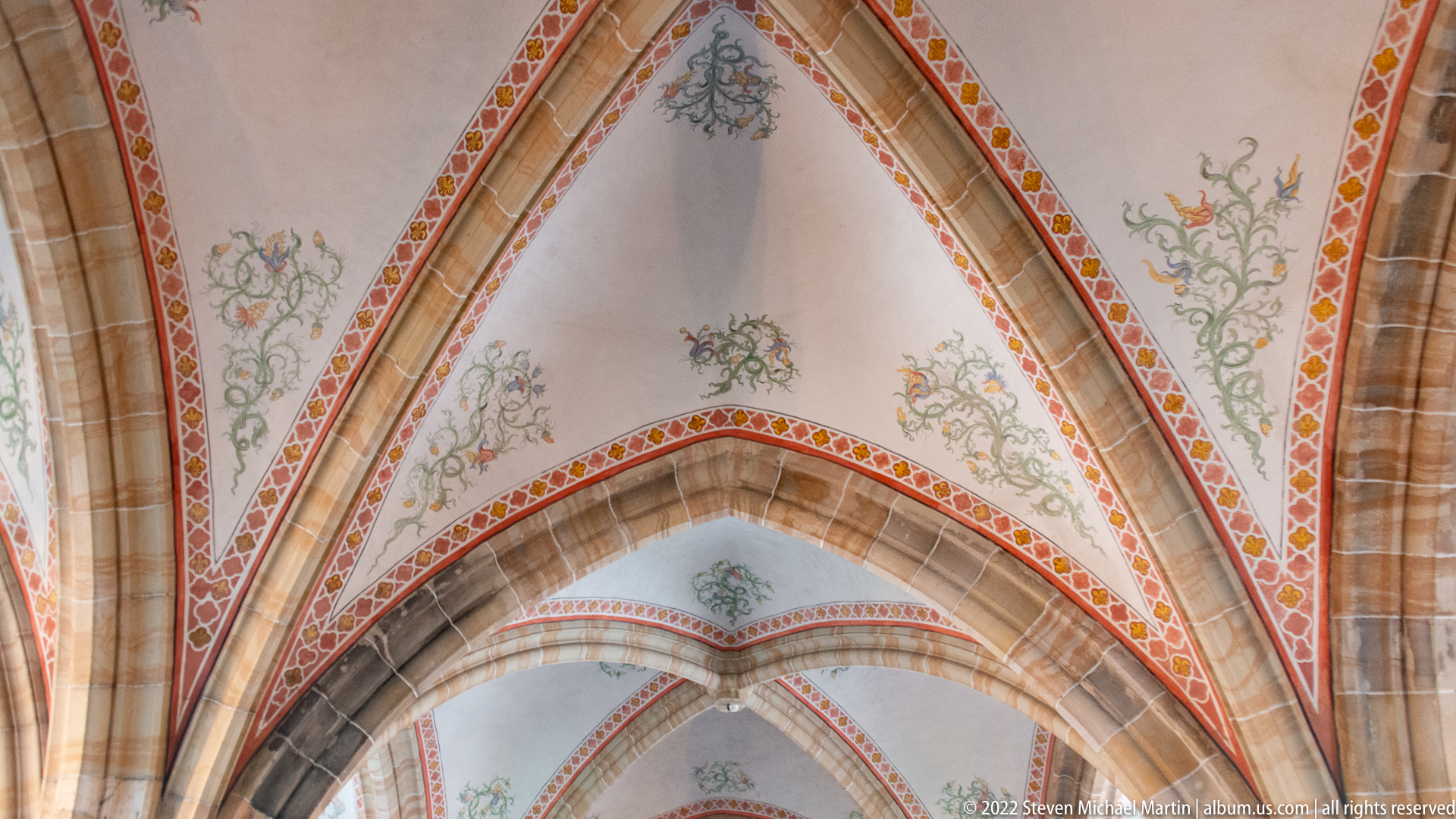
Pointed rib vaults rise overhead in a historic Aachen interior, their pale plaster surfaces enlivened by delicate floral and foliate painting. Bands of red and gold ornament trace the masonry ribs, turning the structural framework into a decorative scheme and emphasizing the repeating rhythm of the bays.
Caption
Pointed rib vaults rise overhead in a historic Aachen interior, their pale plaster surfaces enlivened by delicate floral and foliate painting. Bands of red and gold ornament trace the masonry ribs, turning the structural framework into a decorative scheme and emphasizing the repeating rhythm of the bays.
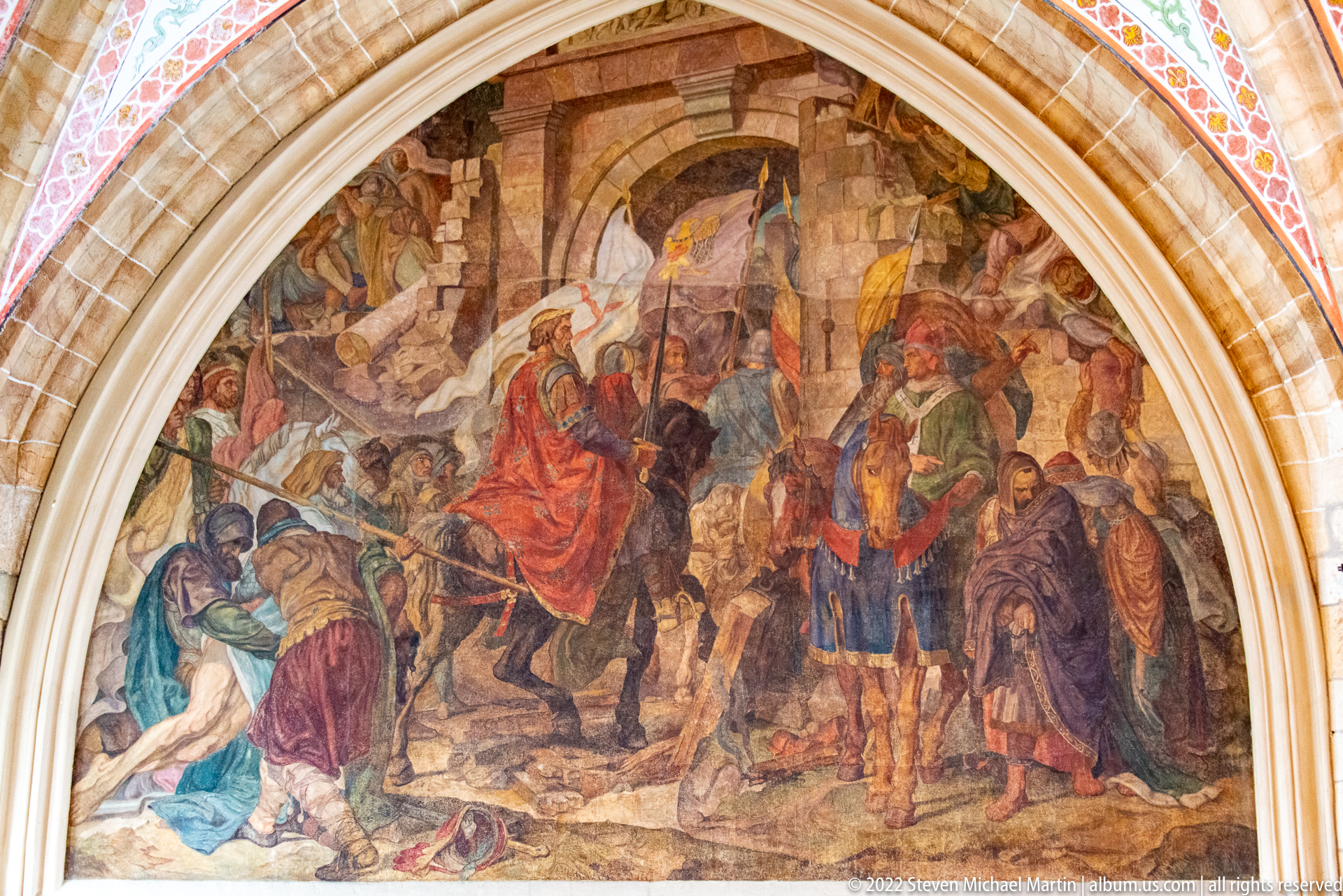
A monumental mural fills a pointed wall bay with a dense scene of armed men, fallen bodies, horses, and figures in richly colored dress. The compressed composition and dramatic gestures create a forceful historical narrative, integrated directly into the architecture rather than presented as an independent framed painting.
Caption
A monumental mural fills a pointed wall bay with a dense scene of armed men, fallen bodies, horses, and figures in richly colored dress. The compressed composition and dramatic gestures create a forceful historical narrative, integrated directly into the architecture rather than presented as an independent framed painting.
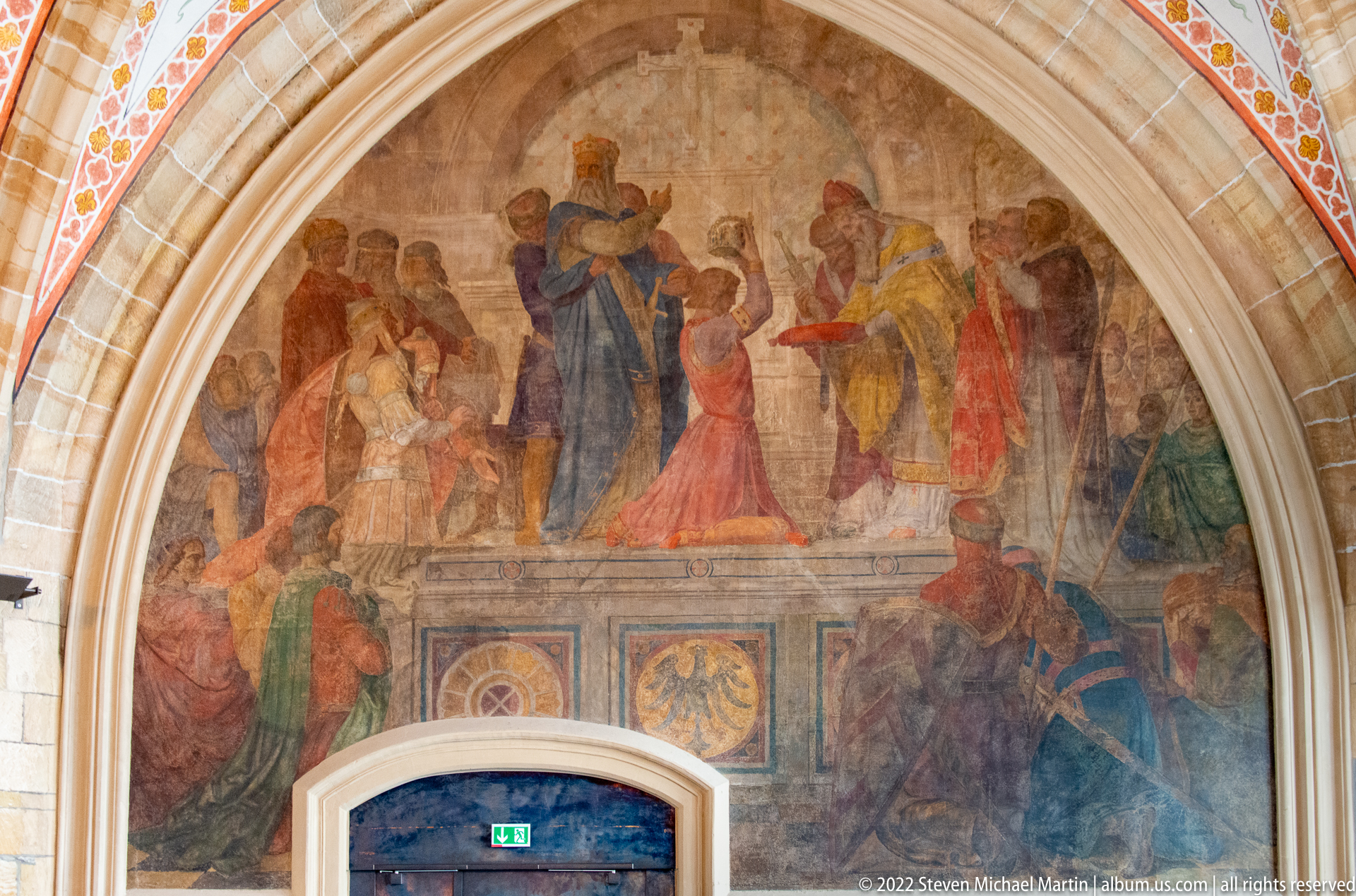
A formal historical scene unfolds above a doorway, with groups of richly dressed men facing one another across a raised platform. Long robes, staffs, and carefully arranged attendants suggest a courtly or diplomatic encounter, while the surrounding heraldic panels connect the mural to a broader civic historical program.
Caption
A formal historical scene unfolds above a doorway, with groups of richly dressed men facing one another across a raised platform. Long robes, staffs, and carefully arranged attendants suggest a courtly or diplomatic encounter, while the surrounding heraldic panels connect the mural to a broader civic historical program.
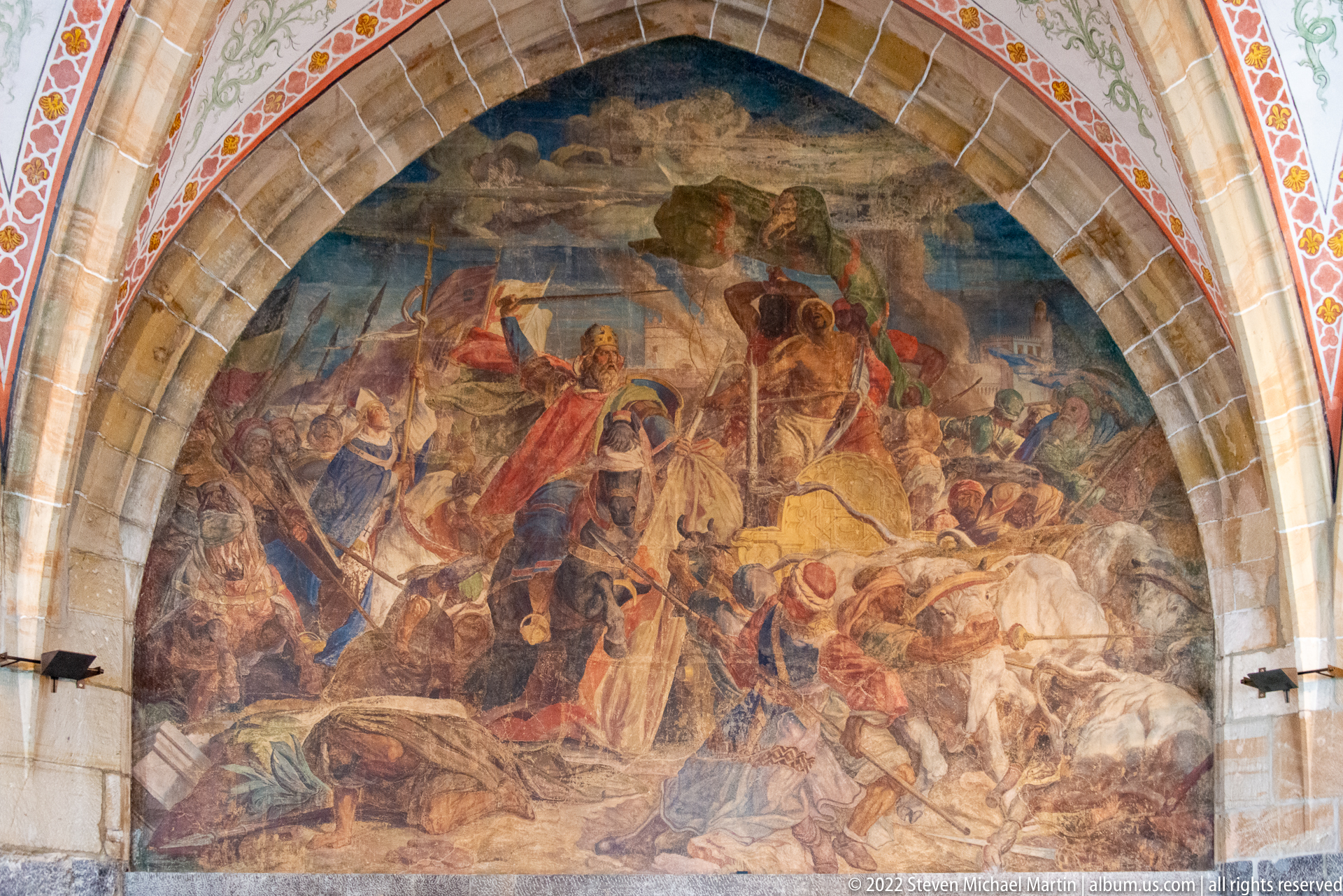
A sweeping battlefield scene occupies an arched wall surface, with collapsed horses and soldiers dominating the foreground while mounted and standing figures continue the action behind them. The broad composition emphasizes disorder and human cost, using overlapping bodies and diagonal movement to fill the architectural field.
Caption
A sweeping battlefield scene occupies an arched wall surface, with collapsed horses and soldiers dominating the foreground while mounted and standing figures continue the action behind them. The broad composition emphasizes disorder and human cost, using overlapping bodies and diagonal movement to fill the architectural field.
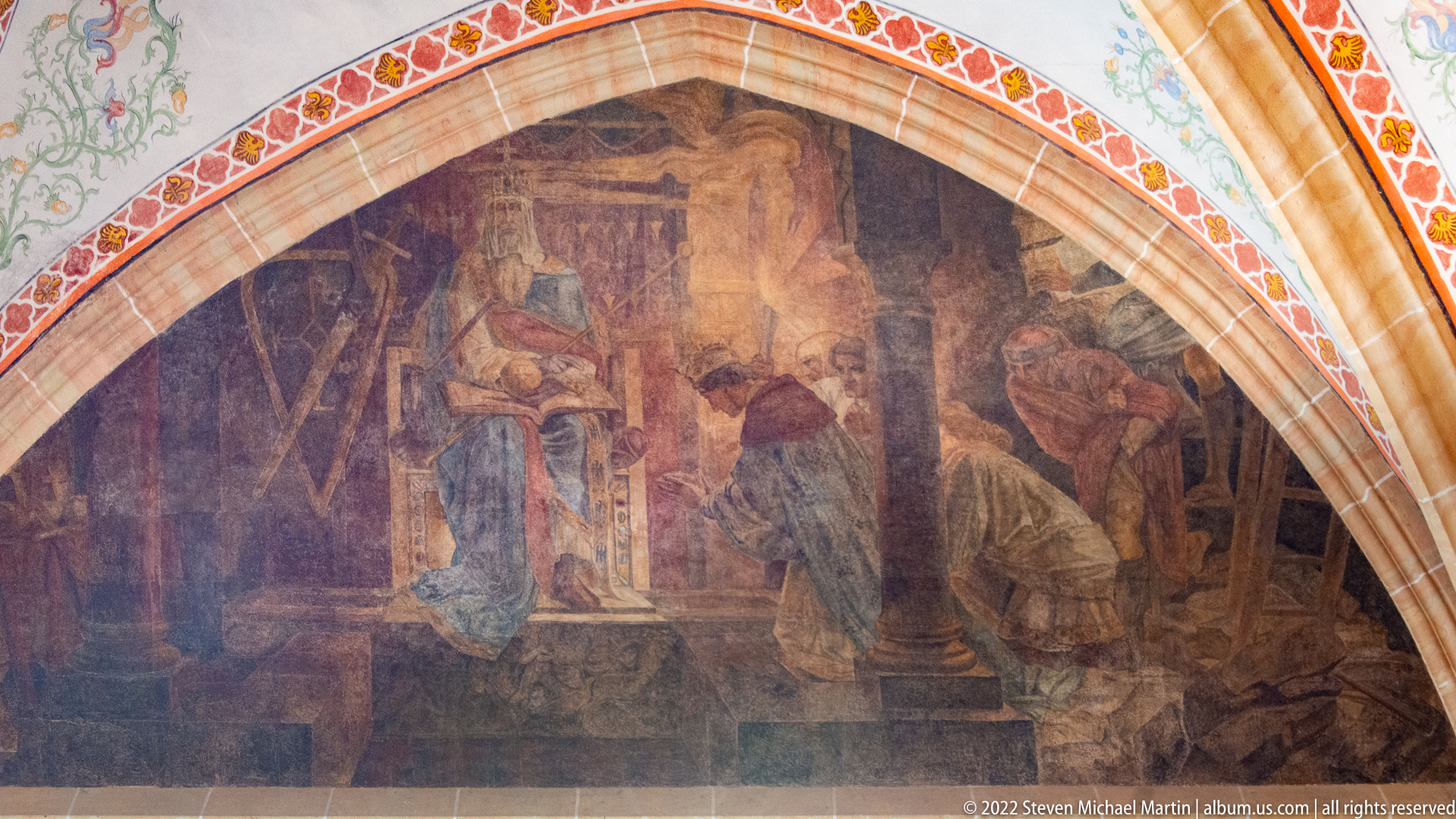
A subdued mural under a pointed arch shows robed men gathered around an interior architectural setting, with one seated figure and others standing in discussion. The quieter staging contrasts with the adjacent battle scenes, suggesting a political, judicial, or ceremonial episode within the same historical cycle.
Caption
A subdued mural under a pointed arch shows robed men gathered around an interior architectural setting, with one seated figure and others standing in discussion. The quieter staging contrasts with the adjacent battle scenes, suggesting a political, judicial, or ceremonial episode within the same historical cycle.
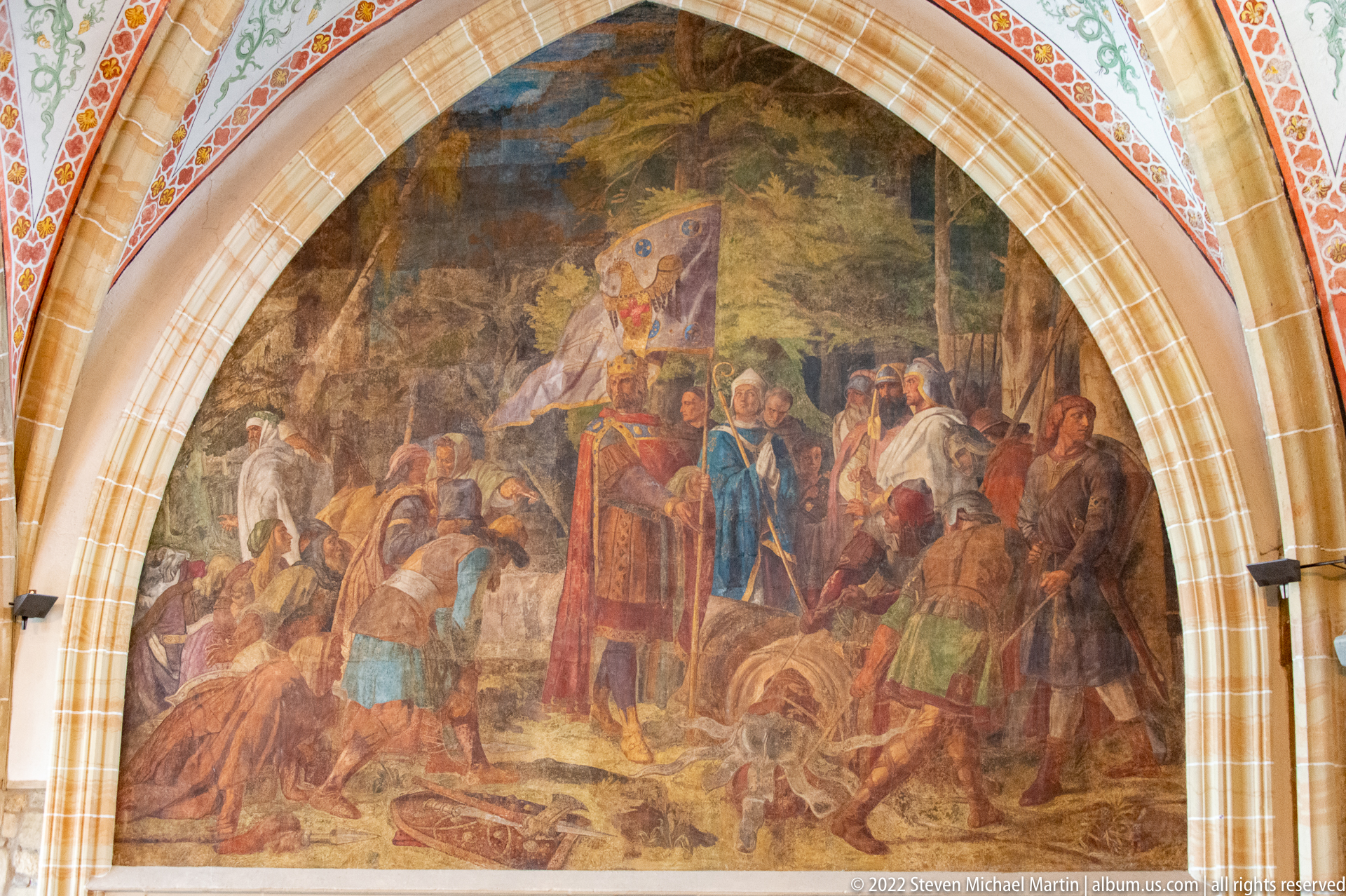
A central standing figure in a red mantle faces an assembled crowd in this arched historical mural. Soldiers, attendants, and townspeople cluster around the scene, while a raised standard and grouped onlookers give the episode the character of a public proclamation, judgment, or political gathering.
Caption
A central standing figure in a red mantle faces an assembled crowd in this arched historical mural. Soldiers, attendants, and townspeople cluster around the scene, while a raised standard and grouped onlookers give the episode the character of a public proclamation, judgment, or political gathering.
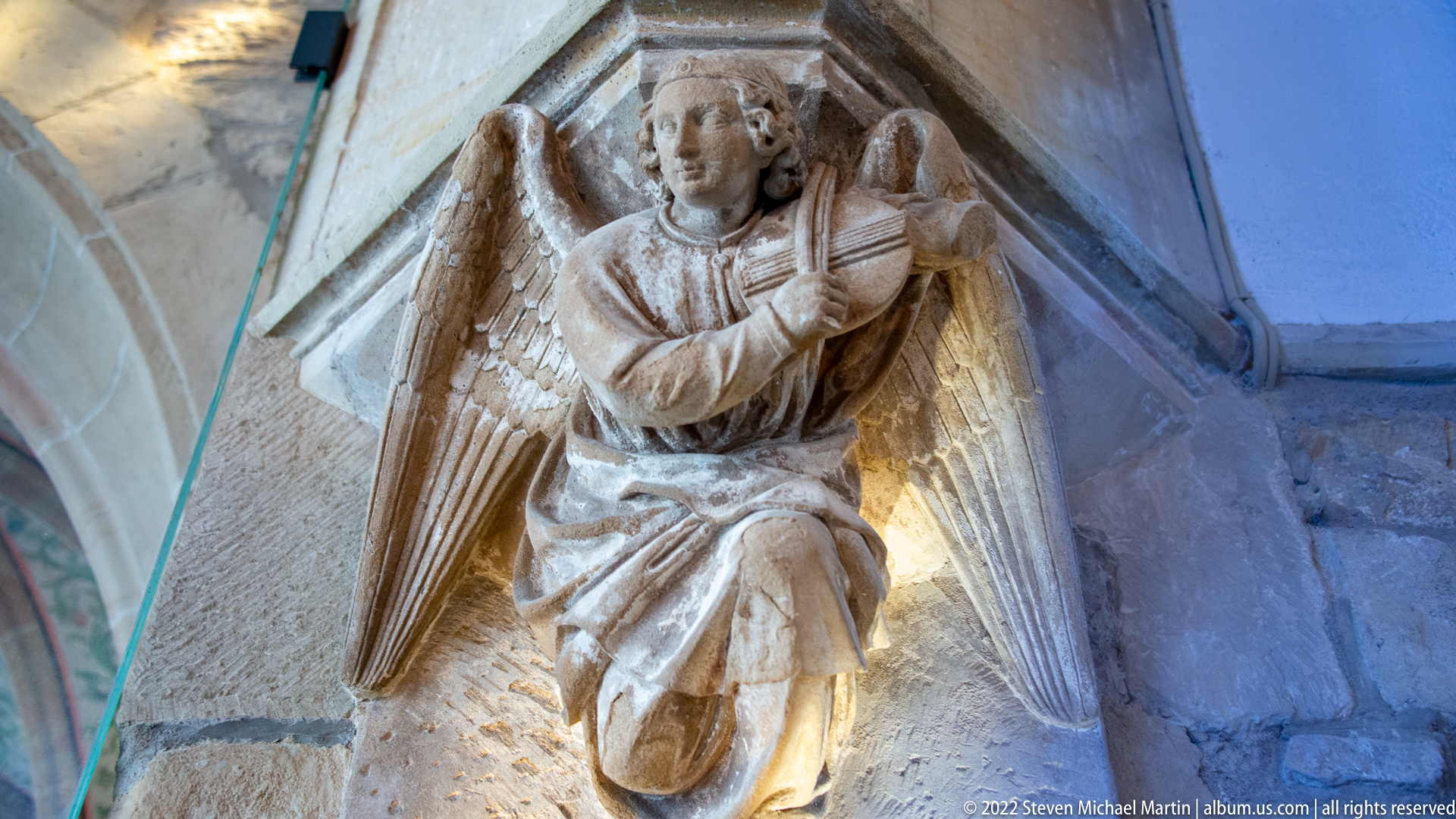
A carved angel projects from the junction of wall and vault, its wings spread behind a kneeling body and its hands held close to the chest. The pale stone figure serves both as architectural ornament and devotional imagery, softening the structural transition with a compact sculptural presence.
Caption
A carved angel projects from the junction of wall and vault, its wings spread behind a kneeling body and its hands held close to the chest. The pale stone figure serves both as architectural ornament and devotional imagery, softening the structural transition with a compact sculptural presence.
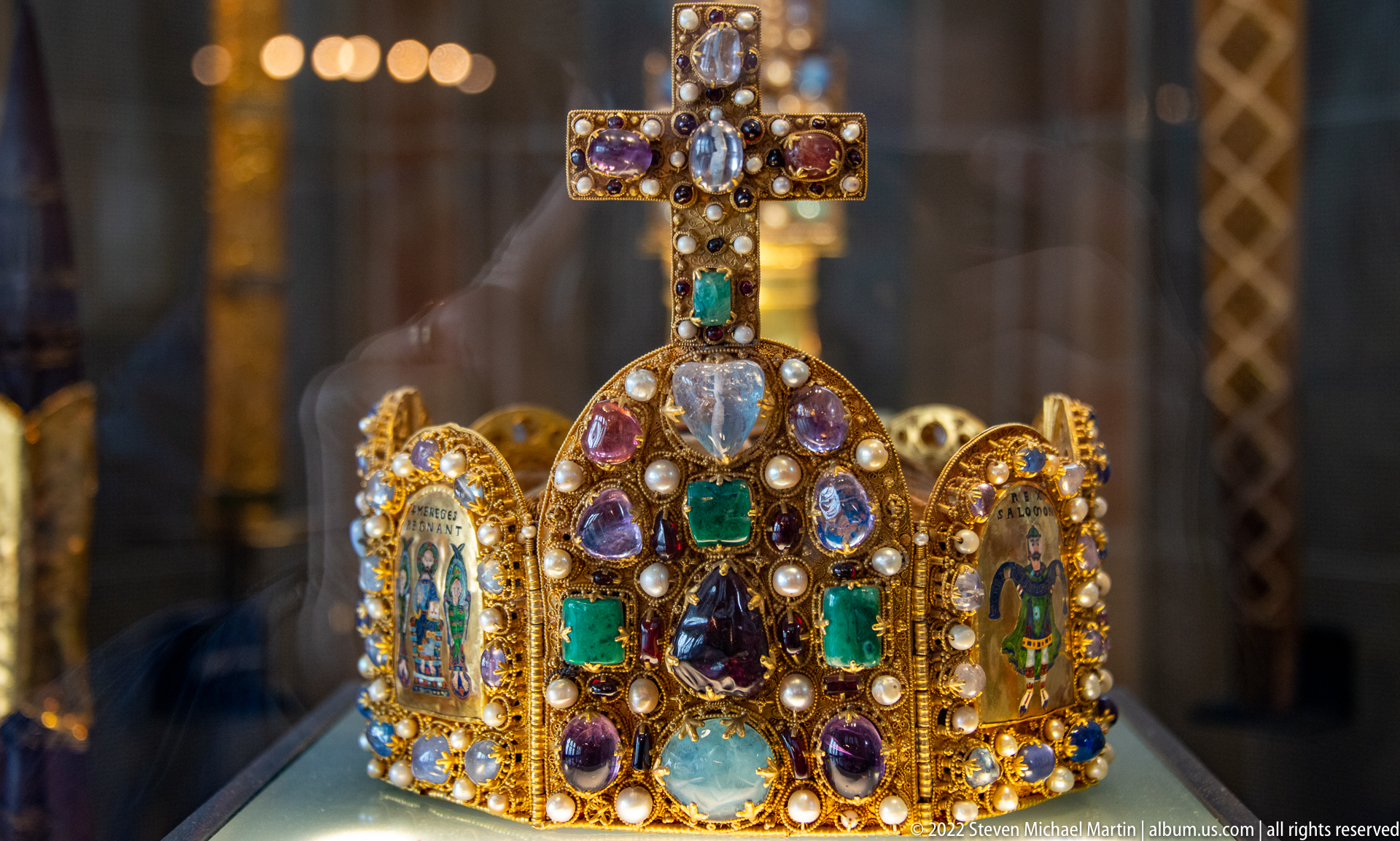
A richly jeweled crown is shown frontally, its gold framework set with large cabochon stones, pearls, and enamel plaques, with a cross rising above the central arch. The openwork construction and vivid stones create a dense display of sacred and royal symbolism characteristic of a major ecclesiastical treasury.
Caption
A richly jeweled crown is shown frontally, its gold framework set with large cabochon stones, pearls, and enamel plaques, with a cross rising above the central arch. The openwork construction and vivid stones create a dense display of sacred and royal symbolism characteristic of a major ecclesiastical treasury.

A closer view reveals the intricate repoussé or chased metalwork of a rectangular treasury object, including a central enthroned figure, smaller flanking figures, and gemstone accents set among curling architectural ornament. The tighter framing emphasizes the craftsmanship of the relief rather than the object’s overall form.
Caption
A closer view reveals the intricate repoussé or chased metalwork of a rectangular treasury object, including a central enthroned figure, smaller flanking figures, and gemstone accents set among curling architectural ornament. The tighter framing emphasizes the craftsmanship of the relief rather than the object’s overall form.
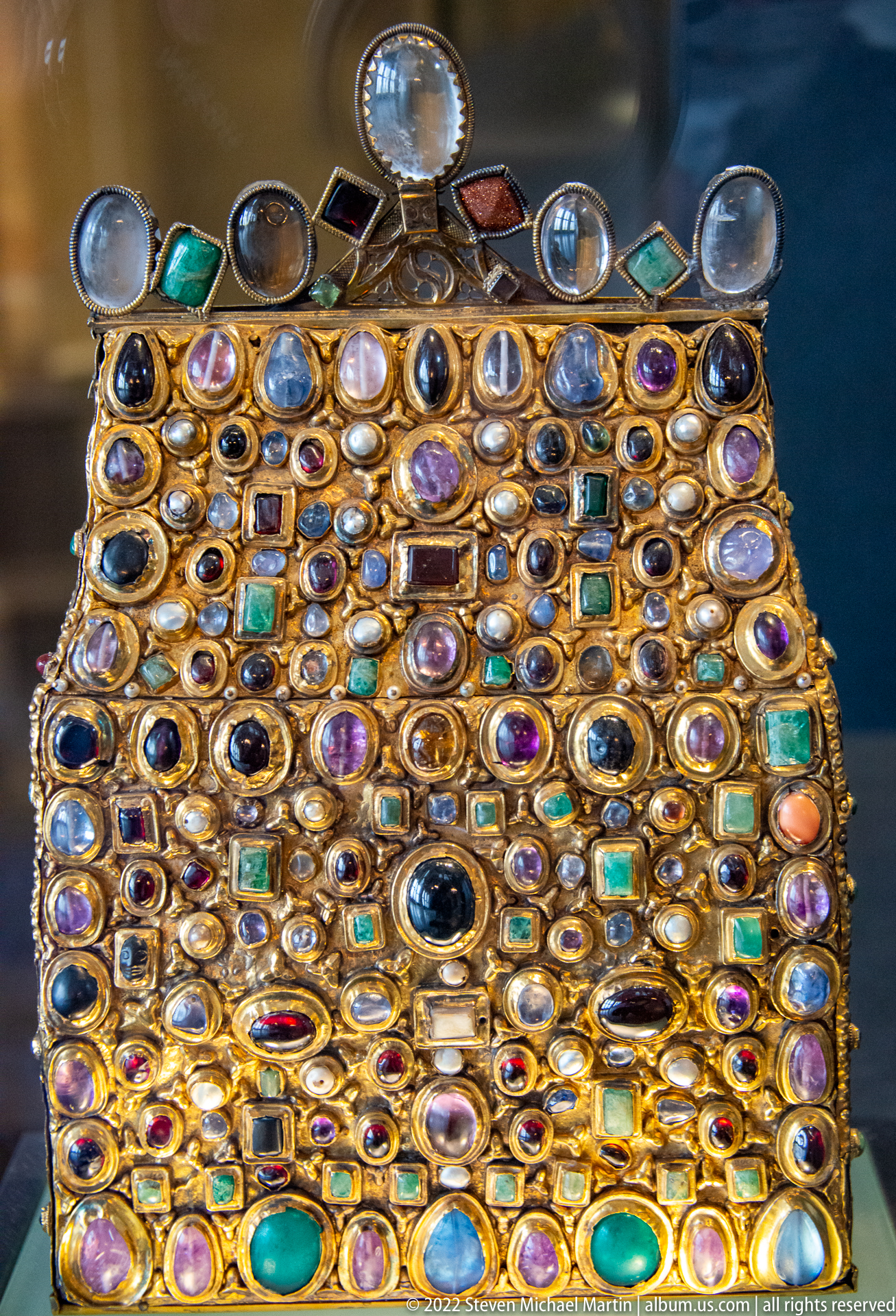
A compact rectangular treasury object is almost completely encrusted with cabochon gems and pearls set into gold. Rows of sapphires, amethysts, emerald-colored stones, and rock-crystal-like settings form a richly textured surface, while the slightly tapering sides give the object a distinctive purse-like silhouette.
Caption
A compact rectangular treasury object is almost completely encrusted with cabochon gems and pearls set into gold. Rows of sapphires, amethysts, emerald-colored stones, and rock-crystal-like settings form a richly textured surface, while the slightly tapering sides give the object a distinctive purse-like silhouette.
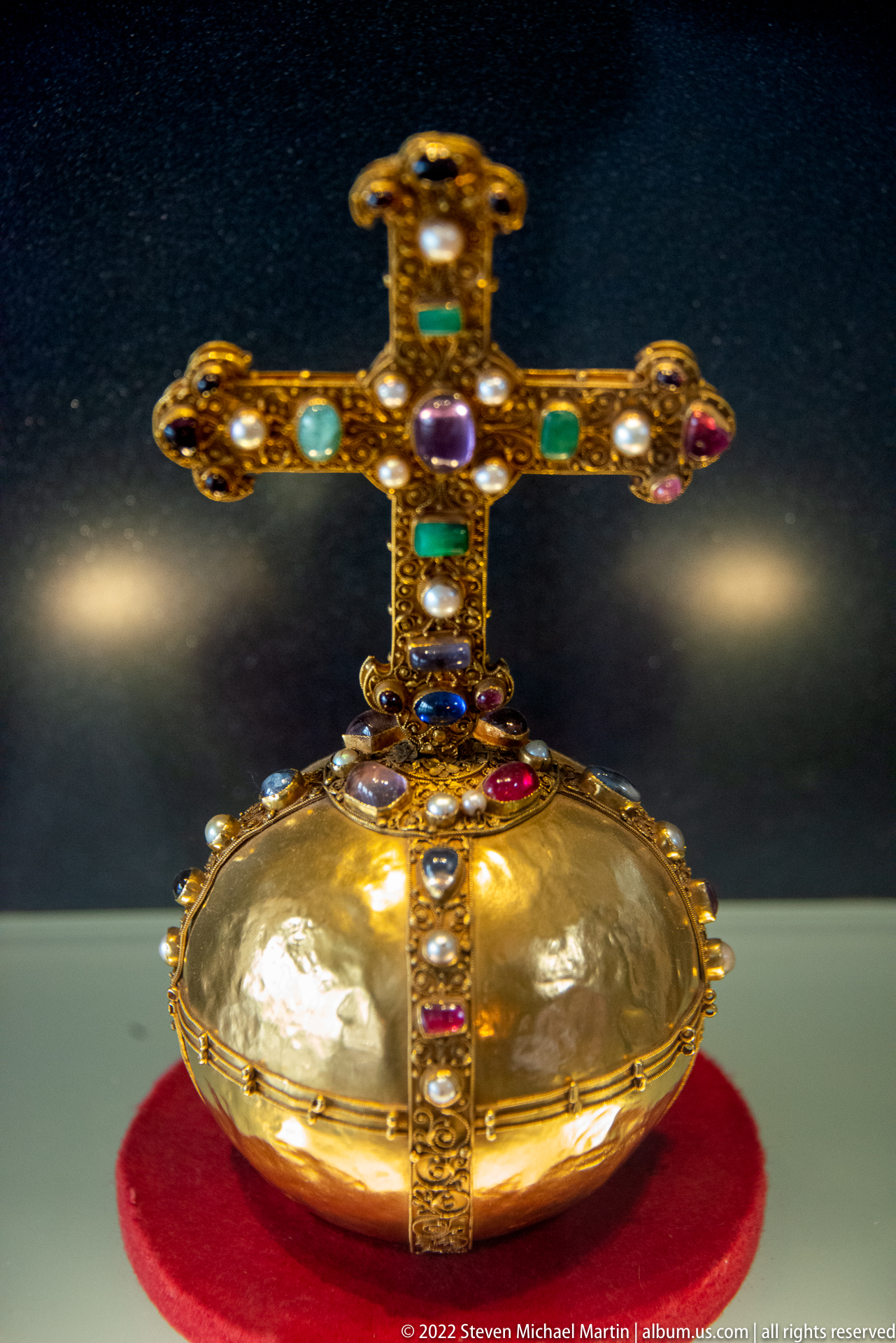
A polished gold orb rests on a red mount and is surmounted by a jeweled cross whose arms are set with colored stones and pearls. Narrow gem-set bands divide the spherical body, creating the visual language of royal or liturgical regalia while the display case presents it as a precious treasury object.
Caption
A polished gold orb rests on a red mount and is surmounted by a jeweled cross whose arms are set with colored stones and pearls. Narrow gem-set bands divide the spherical body, creating the visual language of royal or liturgical regalia while the display case presents it as a precious treasury object.

A close view of the crown isolates an enamel plaque framed by pearls and pale gemstones. The inscription 'EMERGES REGNANT' appears above a frontal sacred or royal figure flanked by two smaller attendants, allowing the iconographic panel and its jeweled setting to be examined independently from the crown’s overall form.
Caption
A close view of the crown isolates an enamel plaque framed by pearls and pale gemstones. The inscription 'EMERGES REGNANT' appears above a frontal sacred or royal figure flanked by two smaller attendants, allowing the iconographic panel and its jeweled setting to be examined independently from the crown’s overall form.
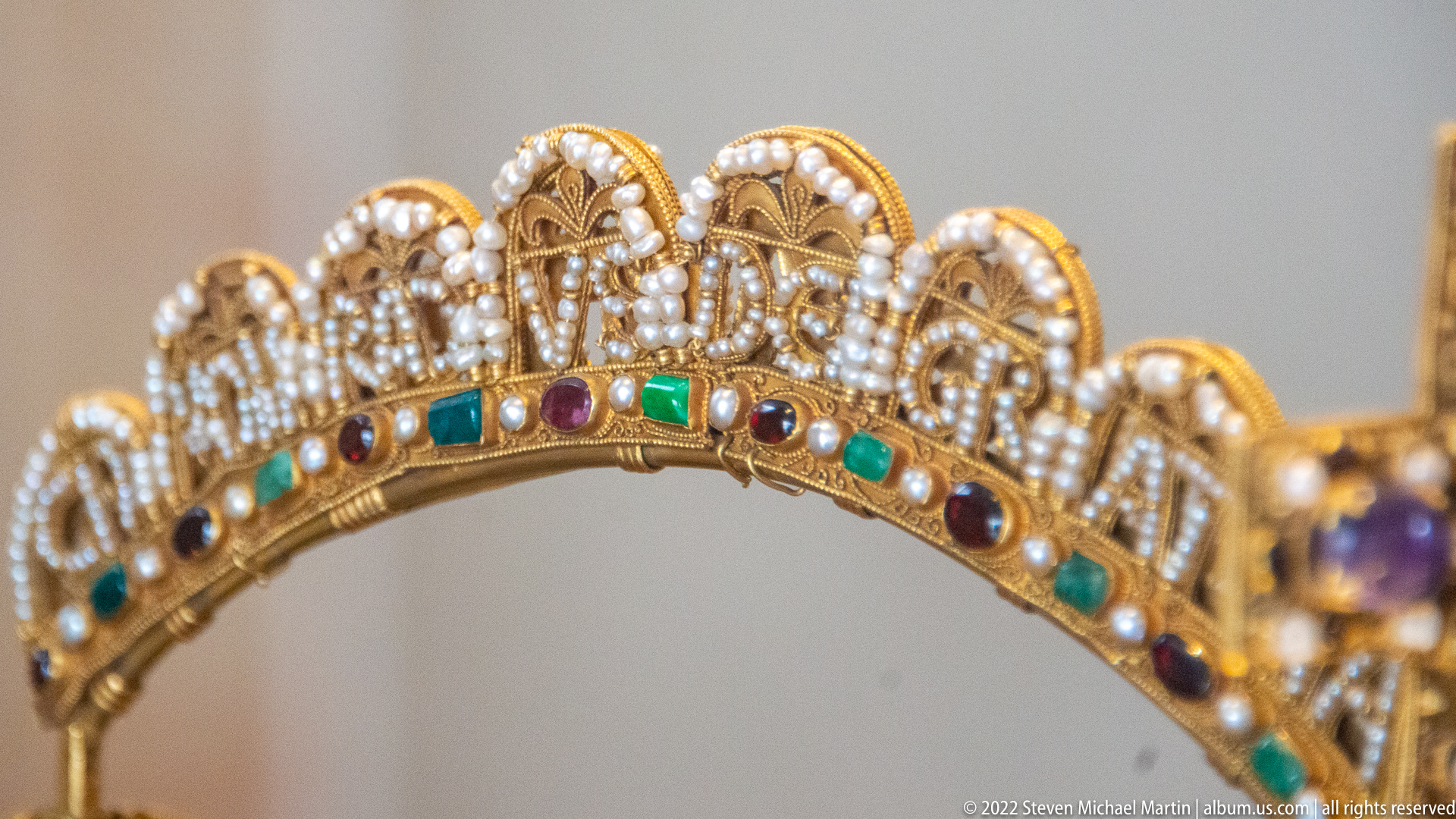
The upper band of a gold crown forms a rhythmic sequence of scalloped openwork arches threaded with rows of pearls. Below, alternating green and purple stones punctuate the narrow gold band, showing how delicate wirework and gems create a lighter counterpoint to the heavier jeweled panels elsewhere on the object.
Caption
The upper band of a gold crown forms a rhythmic sequence of scalloped openwork arches threaded with rows of pearls. Below, alternating green and purple stones punctuate the narrow gold band, showing how delicate wirework and gems create a lighter counterpoint to the heavier jeweled panels elsewhere on the object.
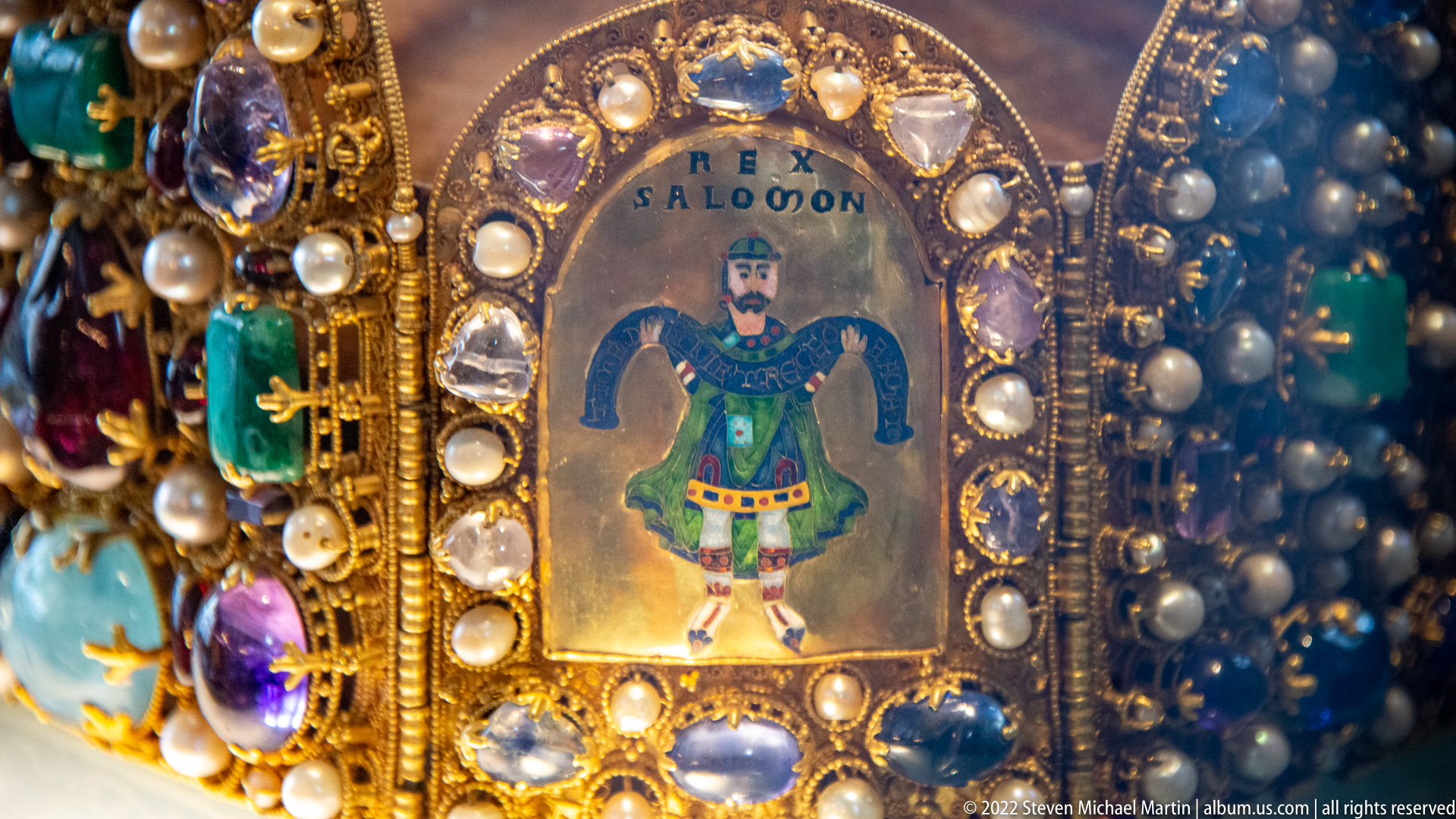
An enamel panel labeled 'REX SALOMON' identifies King Solomon on the jeweled crown. The crowned figure stands frontally in a richly colored tunic, framed by pearls, pale stones, and adjacent large emerald-colored gems, linking biblical kingship to the crown’s broader program of sacred rulership.
Caption
An enamel panel labeled 'REX SALOMON' identifies King Solomon on the jeweled crown. The crowned figure stands frontally in a richly colored tunic, framed by pearls, pale stones, and adjacent large emerald-colored gems, linking biblical kingship to the crown’s broader program of sacred rulership.
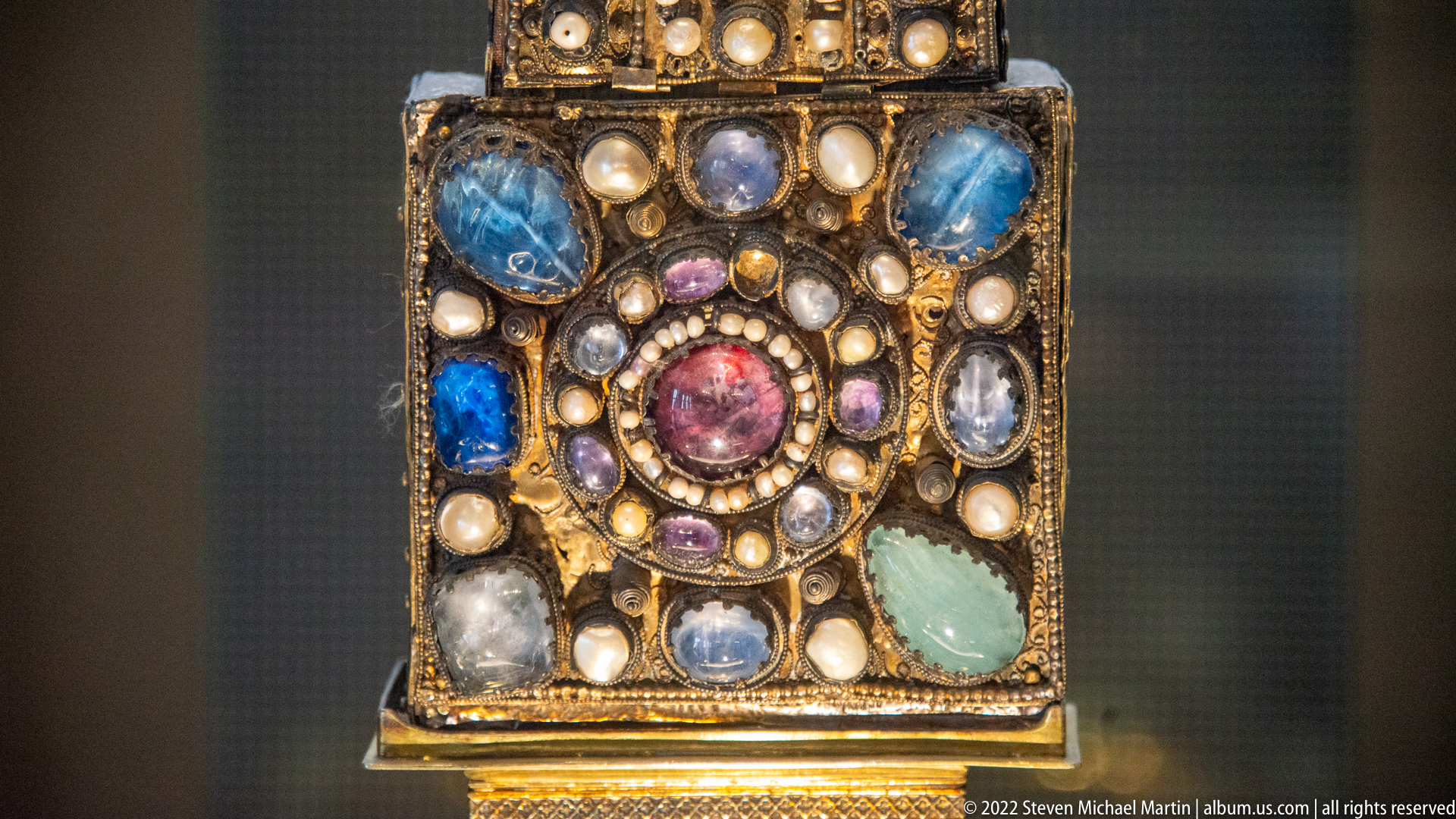
A rectangular gold surface is arranged around a large central red cabochon encircled by pearls, with oversized blue, green, and pale stones filling the surrounding field. Fine beaded borders and tightly fitted settings demonstrate the dense jeweled craftsmanship typical of high-status ecclesiastical treasury metalwork.
Caption
A rectangular gold surface is arranged around a large central red cabochon encircled by pearls, with oversized blue, green, and pale stones filling the surrounding field. Fine beaded borders and tightly fitted settings demonstrate the dense jeweled craftsmanship typical of high-status ecclesiastical treasury metalwork.
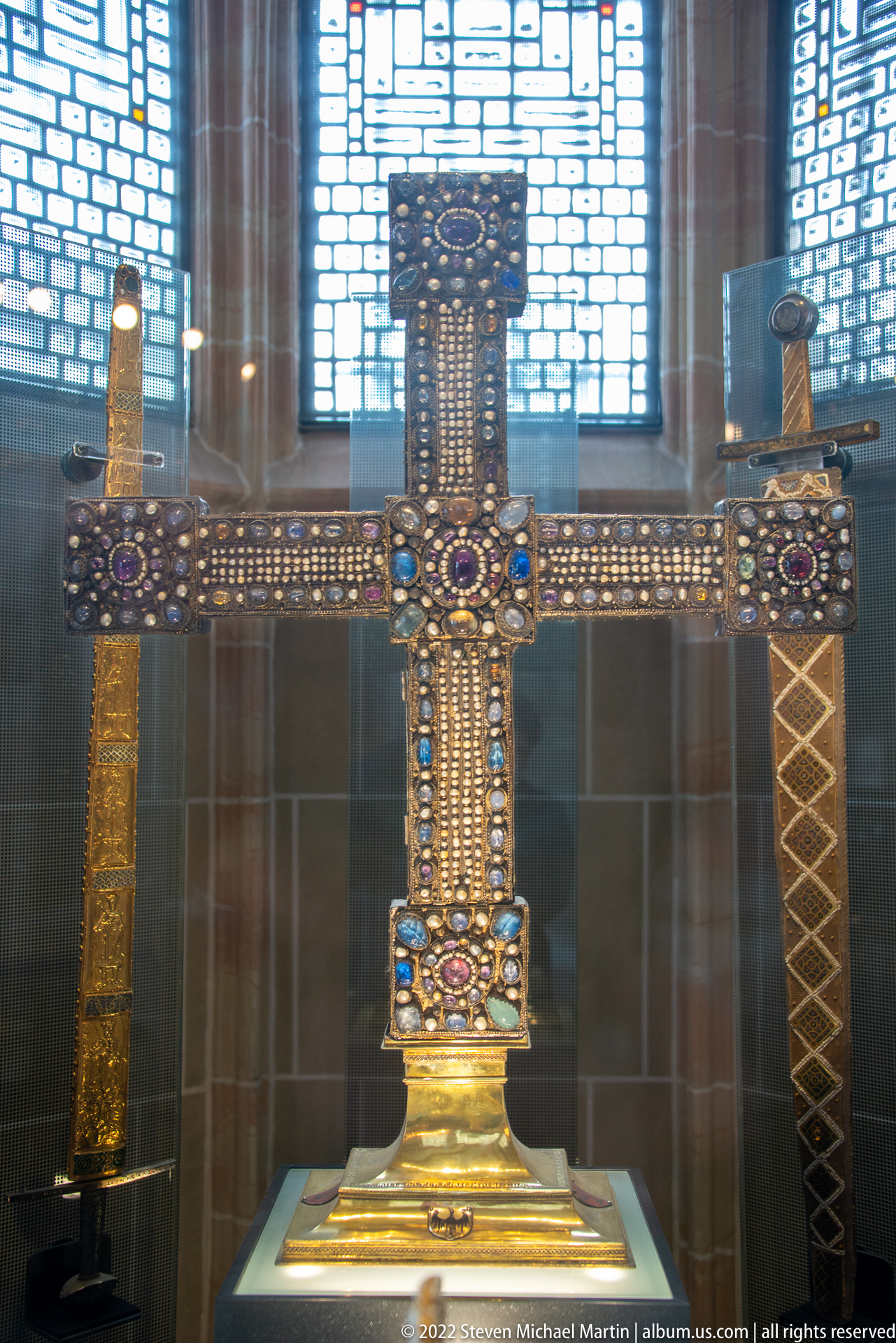
A monumental gold cross stands upright in a museum case, its broad arms and central shaft covered with rows of gemstones and pearls. The squared crossing and flared lower mount give it a ceremonial, processional presence, while the display isolates the precious metalwork against the dark cathedral-treasury setting.
Caption
A monumental gold cross stands upright in a museum case, its broad arms and central shaft covered with rows of gemstones and pearls. The squared crossing and flared lower mount give it a ceremonial, processional presence, while the display isolates the precious metalwork against the dark cathedral-treasury setting.
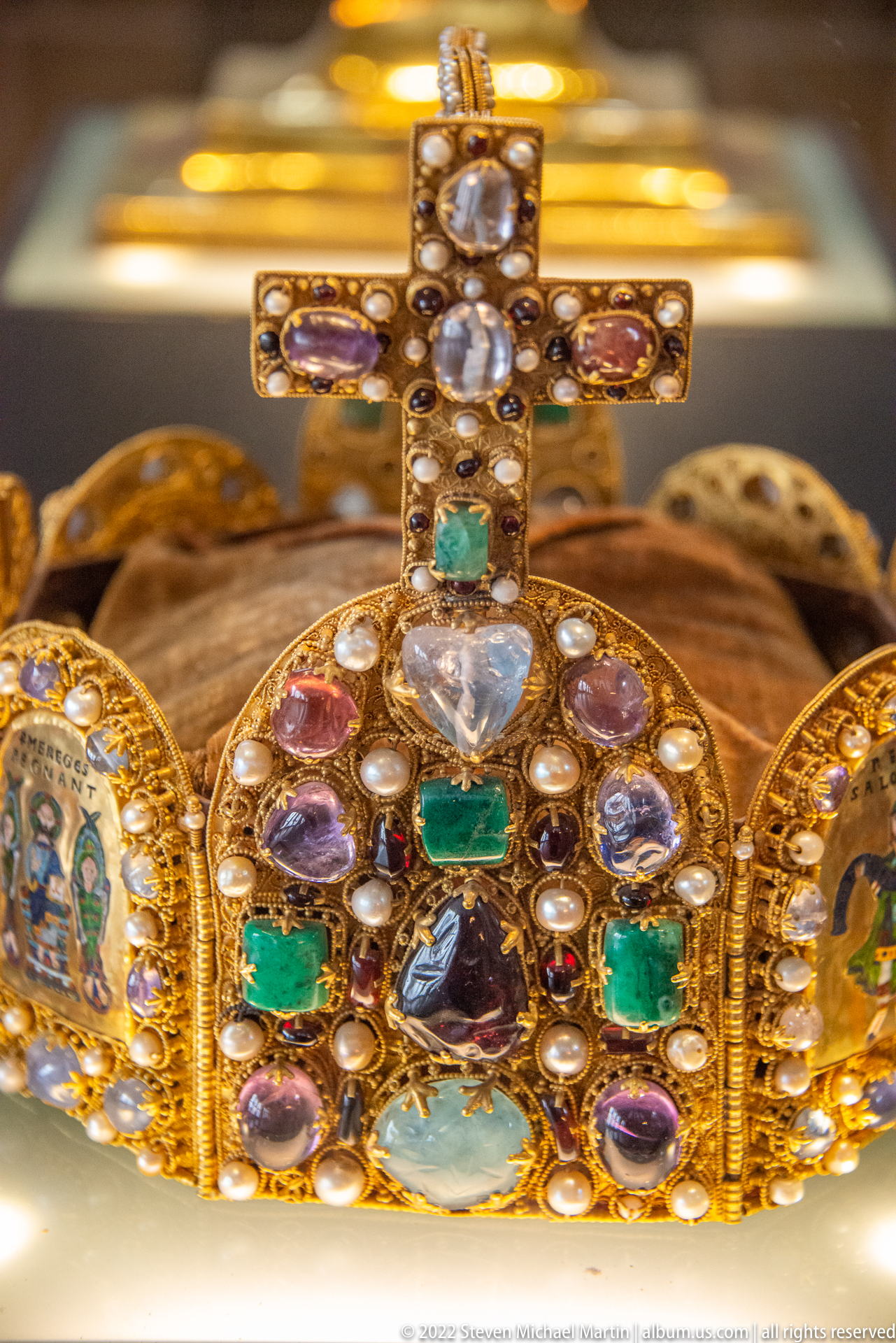
A close view of the Aachen replica of St. Stephen’s Purse concentrates on its jeweled upper register, where a cross rises above large cabochon stones and pearl borders. Enamel figures appear on the flanking panels, while the dense gold settings recreate the sumptuous appearance described by the adjacent museum interpretation.
Caption
A close view of the Aachen replica of St. Stephen’s Purse concentrates on its jeweled upper register, where a cross rises above large cabochon stones and pearl borders. Enamel figures appear on the flanking panels, while the dense gold settings recreate the sumptuous appearance described by the adjacent museum interpretation.
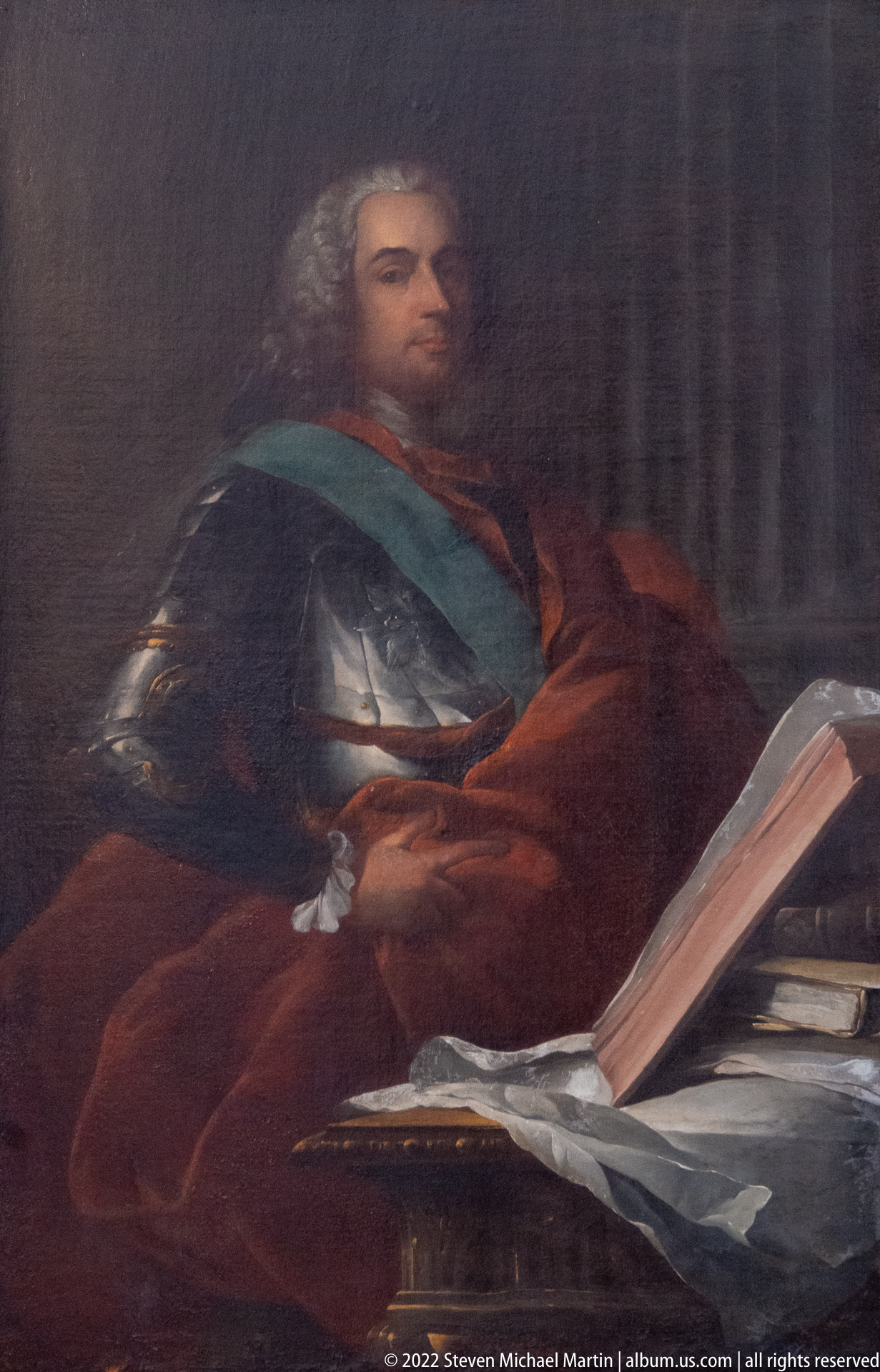
A seated man in dark armor or formal dress turns toward the viewer while a broad blue-green sash crosses his chest. Papers and a large open book occupy the table beside him, combining military or aristocratic status with the visual language of office, scholarship, or administration.
Caption
A seated man in dark armor or formal dress turns toward the viewer while a broad blue-green sash crosses his chest. Papers and a large open book occupy the table beside him, combining military or aristocratic status with the visual language of office, scholarship, or administration.
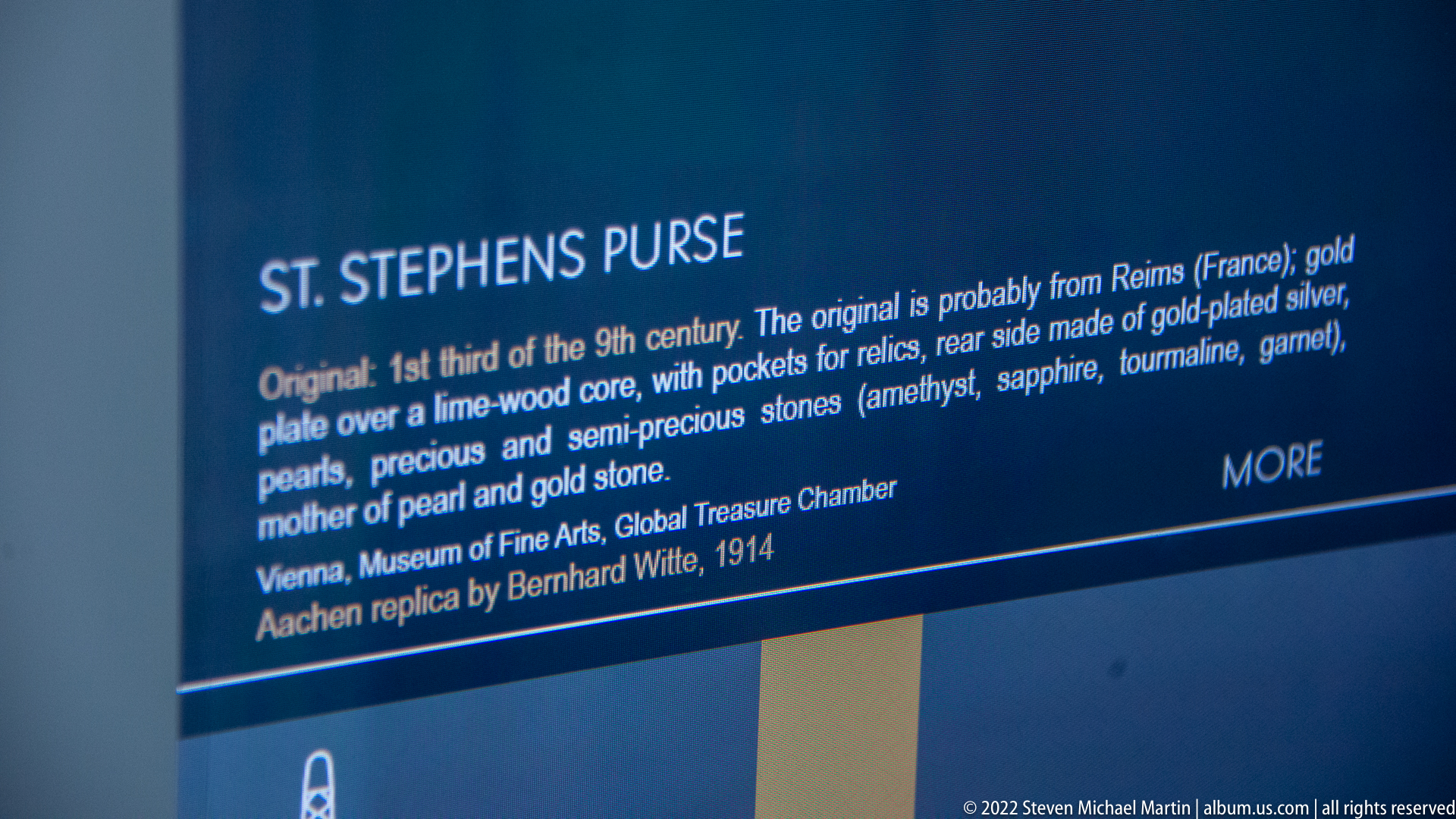
An interpretive panel identifies the object as 'St. Stephen’s Purse' and describes it as an early medieval reliquary, probably originating in Reims. The label notes a lime-wood core with gold-plated silver, pearls, precious stones, and semiprecious stones, and cites Vienna’s Museum of Fine Arts as the location of the original.
Caption
An interpretive panel identifies the object as 'St. Stephen’s Purse' and describes it as an early medieval reliquary, probably originating in Reims. The label notes a lime-wood core with gold-plated silver, pearls, precious stones, and semiprecious stones, and cites Vienna’s Museum of Fine Arts as the location of the original.
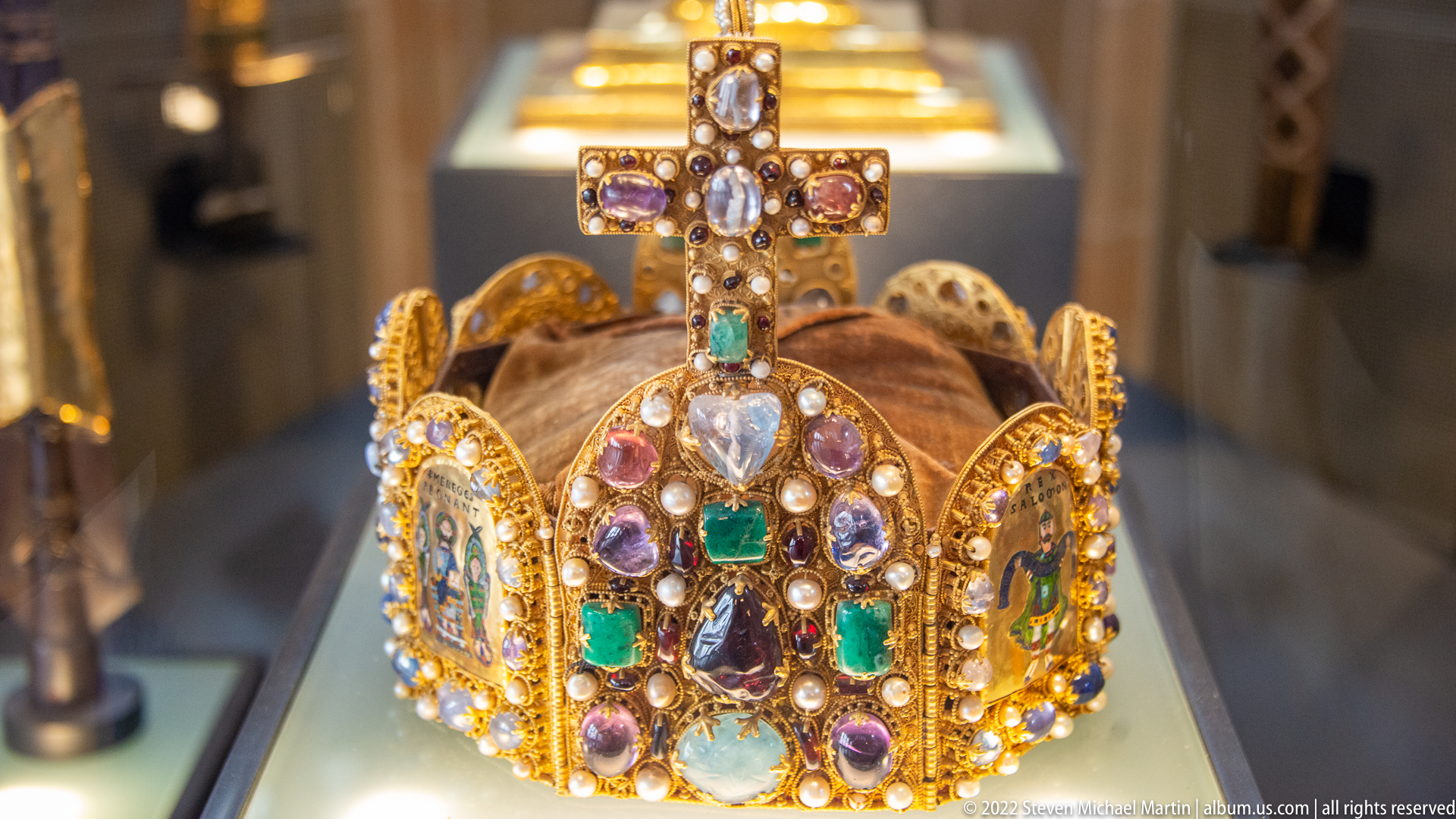
The Aachen replica of St. Stephen’s Purse is shown more fully, revealing the curved body beneath its gem-encrusted architectural front. A jeweled cross crowns the composition, with pearls, large colored stones, and enamel panels forming a carefully reconstructed evocation of the ninth-century reliquary described in the nearby display.
Caption
The Aachen replica of St. Stephen’s Purse is shown more fully, revealing the curved body beneath its gem-encrusted architectural front. A jeweled cross crowns the composition, with pearls, large colored stones, and enamel panels forming a carefully reconstructed evocation of the ninth-century reliquary described in the nearby display.
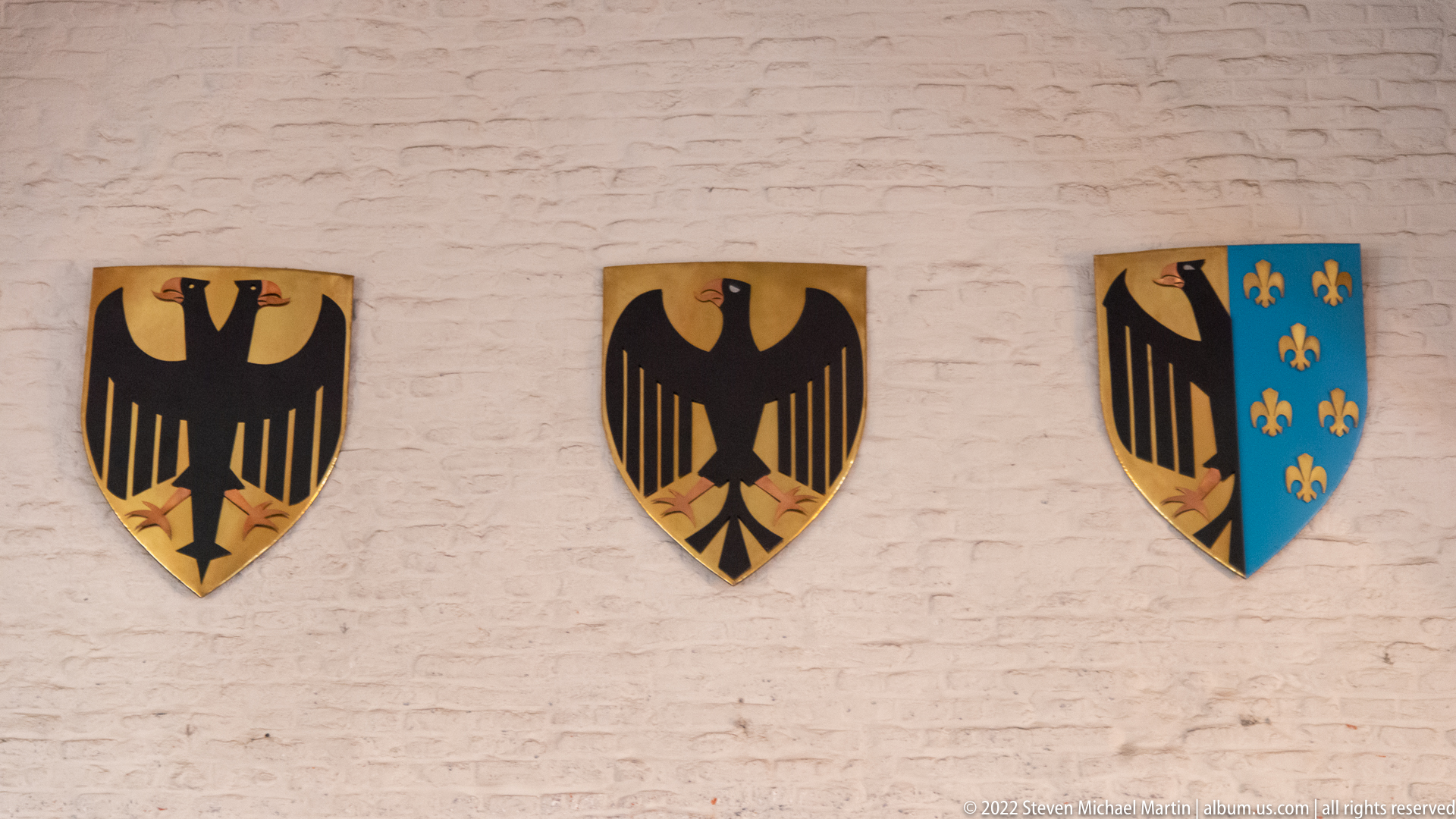
Three shields mounted on a white brick wall present variations on imperial and dynastic heraldry. Black eagles dominate the two left shields, while the right shield combines a black eagle with a blue field of gold fleurs-de-lis, creating a concise decorative sequence of political emblems.
Caption
Three shields mounted on a white brick wall present variations on imperial and dynastic heraldry. Black eagles dominate the two left shields, while the right shield combines a black eagle with a blue field of gold fleurs-de-lis, creating a concise decorative sequence of political emblems.
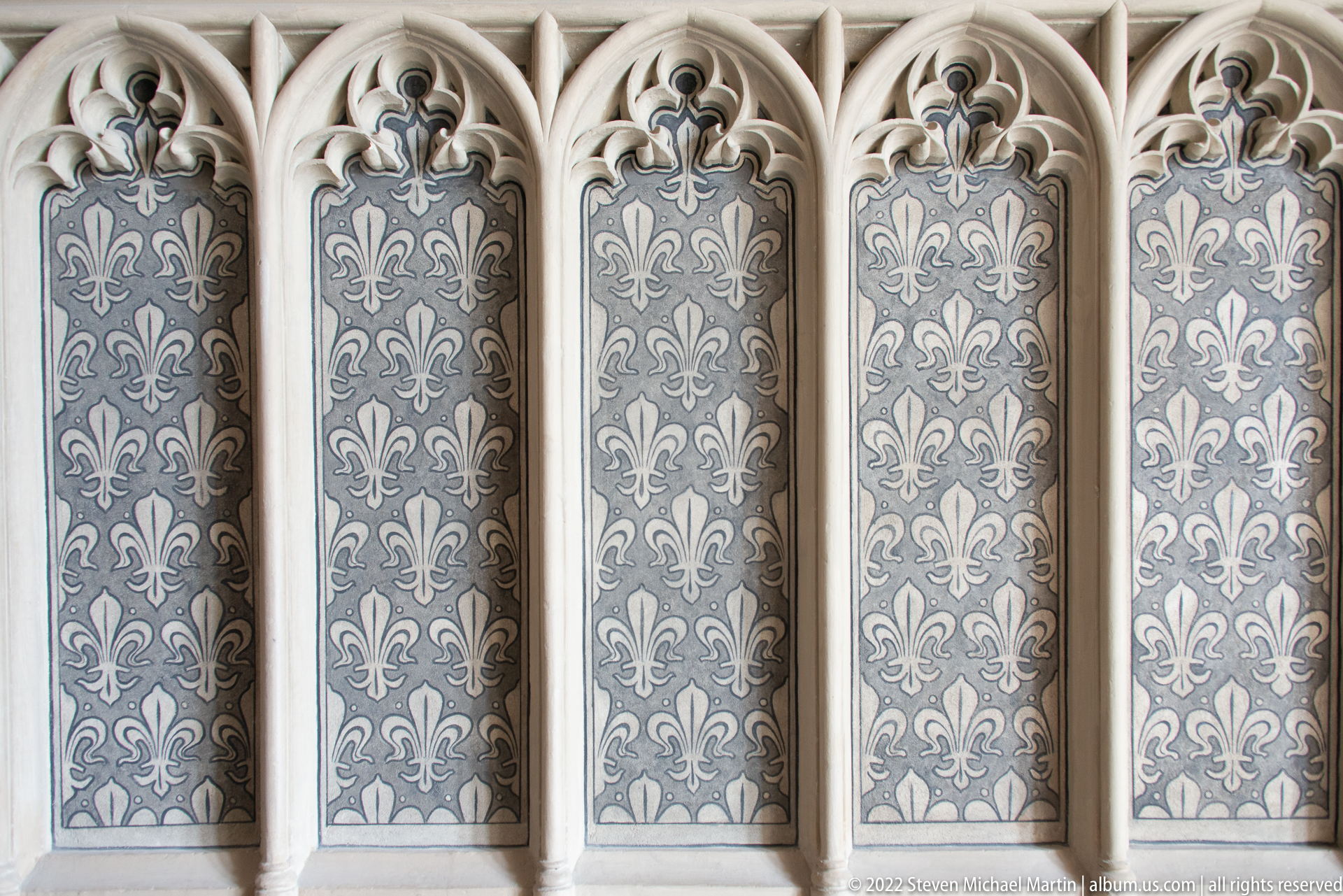
A row of narrow pointed panels combines Gothic tracery with repeated pale fleur-de-lis motifs set against a darker patterned field. The cusped arches and dense heraldic repetition create a highly ordered decorative surface, likely designed to reinforce the ceremonial character of the surrounding interior.
Caption
A row of narrow pointed panels combines Gothic tracery with repeated pale fleur-de-lis motifs set against a darker patterned field. The cusped arches and dense heraldic repetition create a highly ordered decorative surface, likely designed to reinforce the ceremonial character of the surrounding interior.
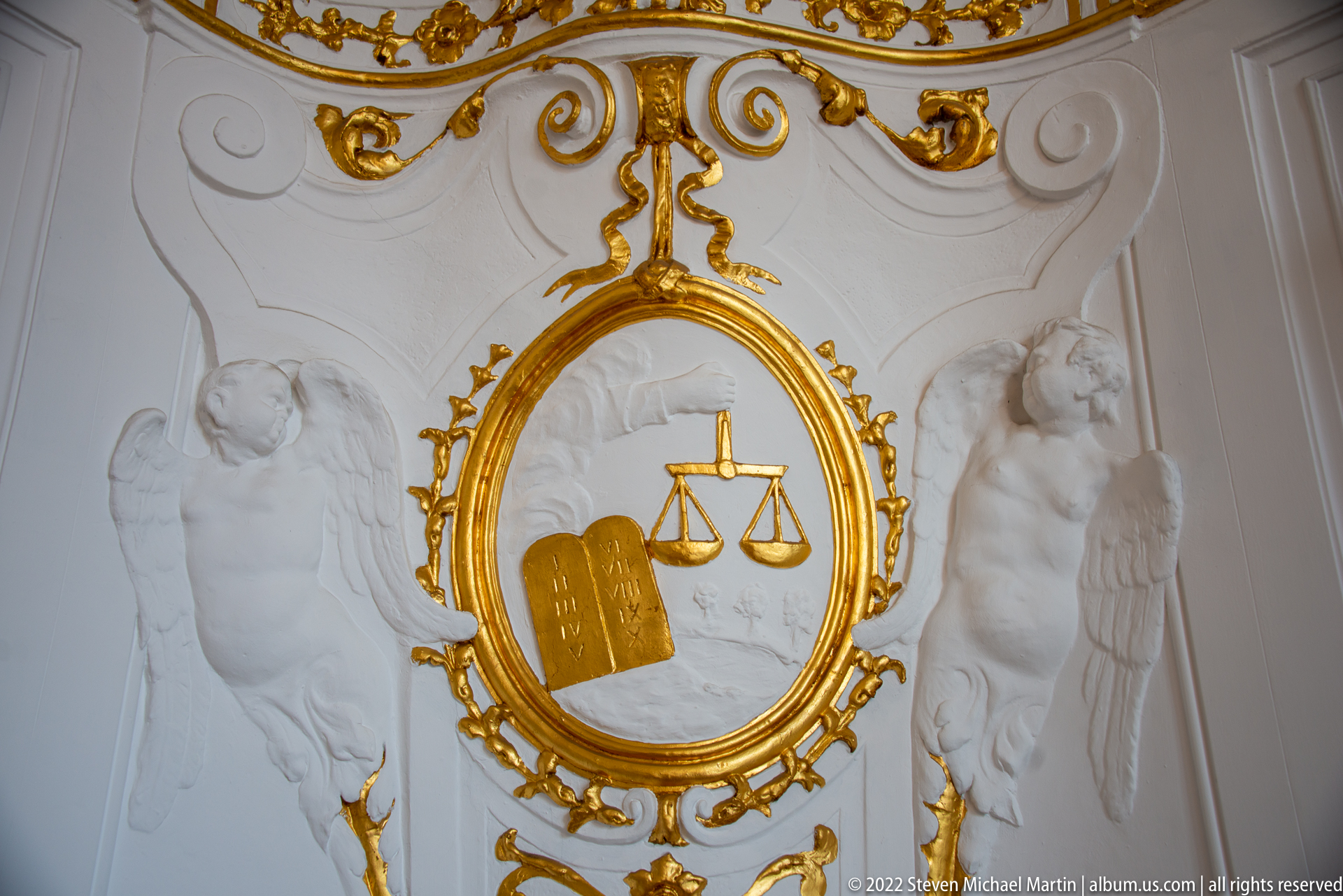
White stucco angels flank a gilded cartouche containing two tablets and a suspended balance scale. The emblem combines religious and judicial symbolism within an exuberant Rococo-style decorative scheme, where scrolling gold ornament frames the central image against a pale wall.
Caption
White stucco angels flank a gilded cartouche containing two tablets and a suspended balance scale. The emblem combines religious and judicial symbolism within an exuberant Rococo-style decorative scheme, where scrolling gold ornament frames the central image against a pale wall.
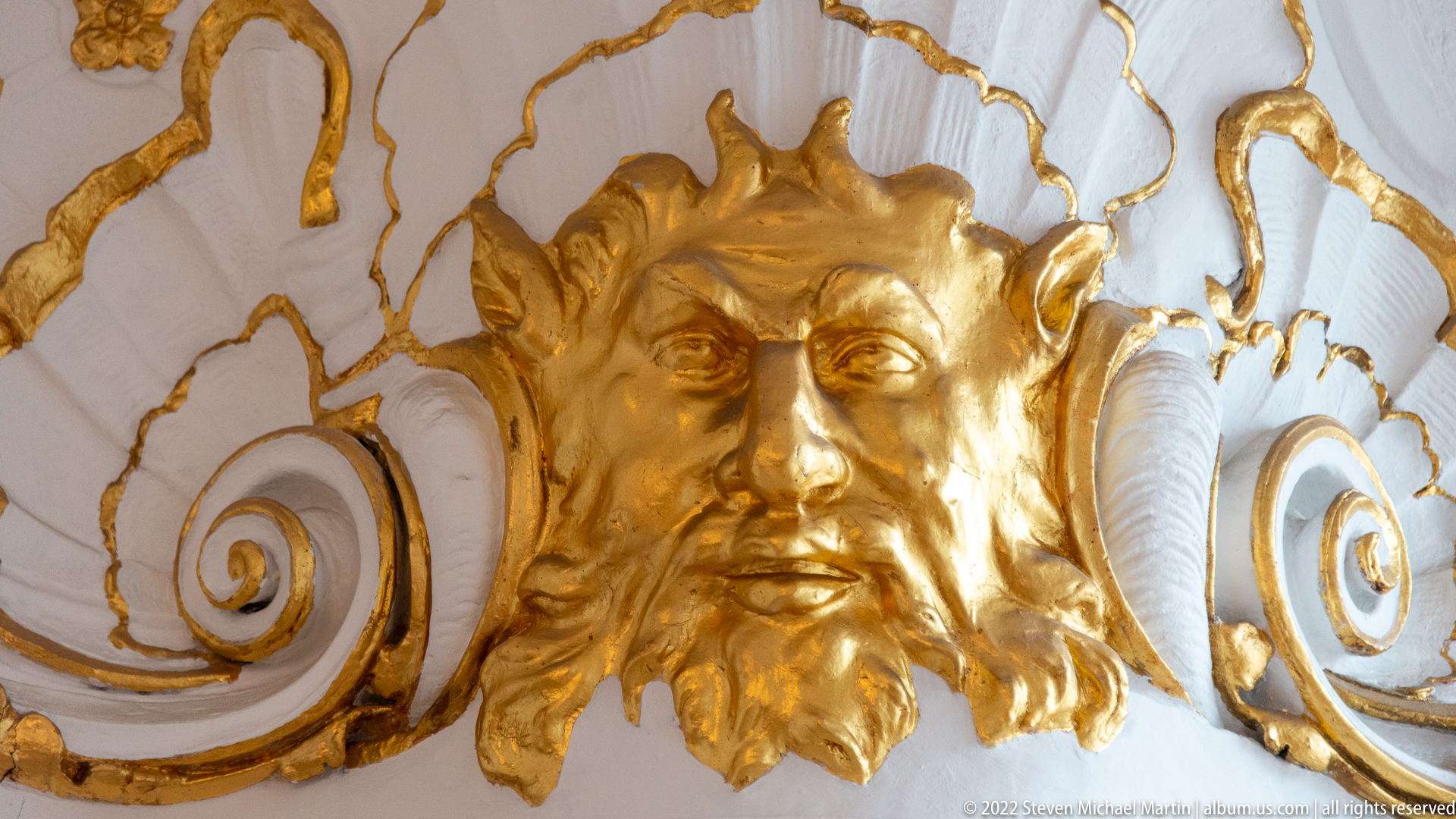
A gilded bearded face emerges from white scrolling stucco, its deeply modeled brows, mustache, and beard forming a dramatic mask within the room’s ornamental scheme. Gold-edged curves radiate around the head, turning a small decorative detail into a forceful focal point.
Caption
A gilded bearded face emerges from white scrolling stucco, its deeply modeled brows, mustache, and beard forming a dramatic mask within the room’s ornamental scheme. Gold-edged curves radiate around the head, turning a small decorative detail into a forceful focal point.
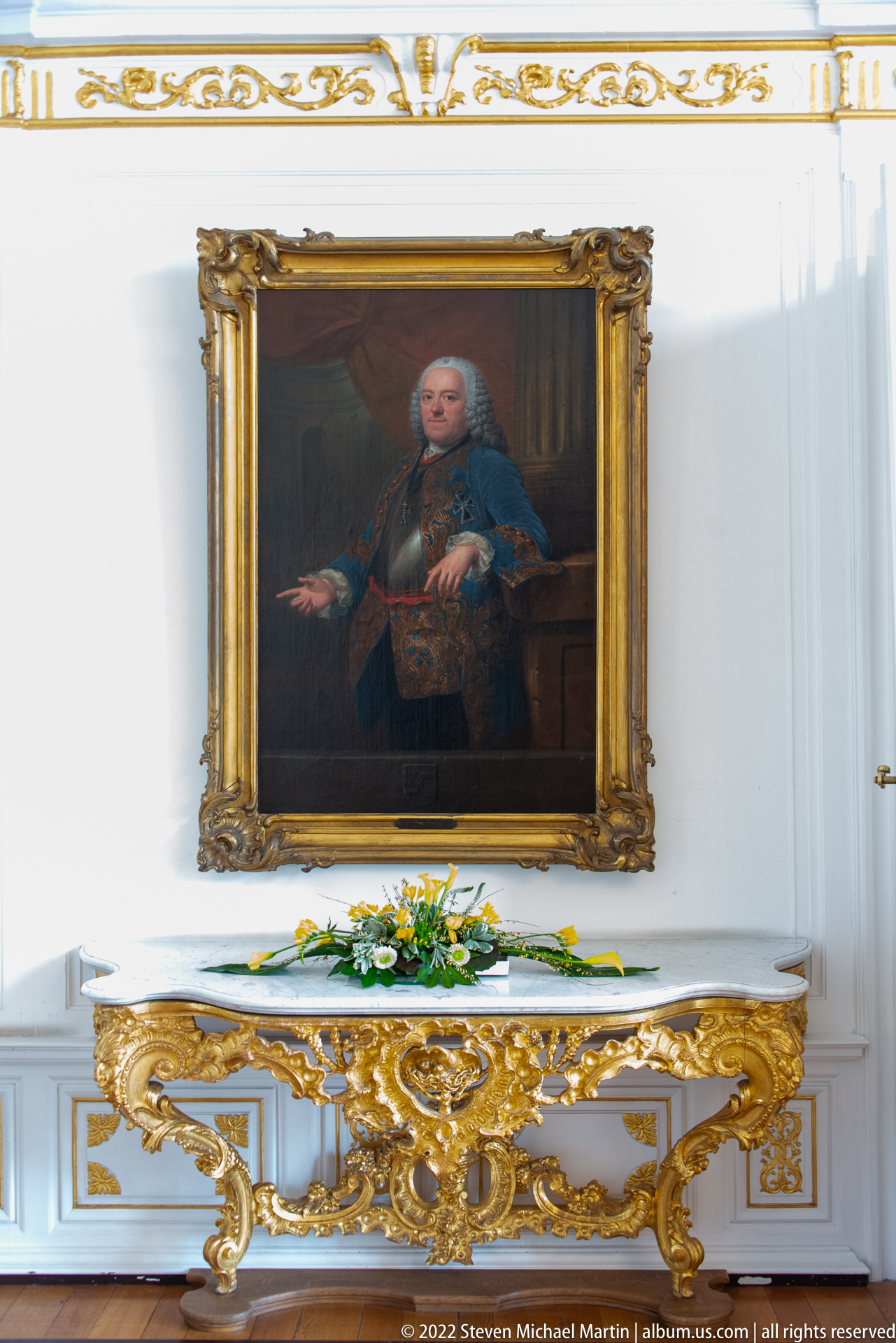
A framed portrait hangs above an elaborate gilded console table in a bright ceremonial room. The sitter, dressed in dark clothing with a blue mantle or sash, gestures outward from the canvas, while carved scrolling legs and floral gilding below continue the room’s highly ornamental decorative program.
Caption
A framed portrait hangs above an elaborate gilded console table in a bright ceremonial room. The sitter, dressed in dark clothing with a blue mantle or sash, gestures outward from the canvas, while carved scrolling legs and floral gilding below continue the room’s highly ornamental decorative program.
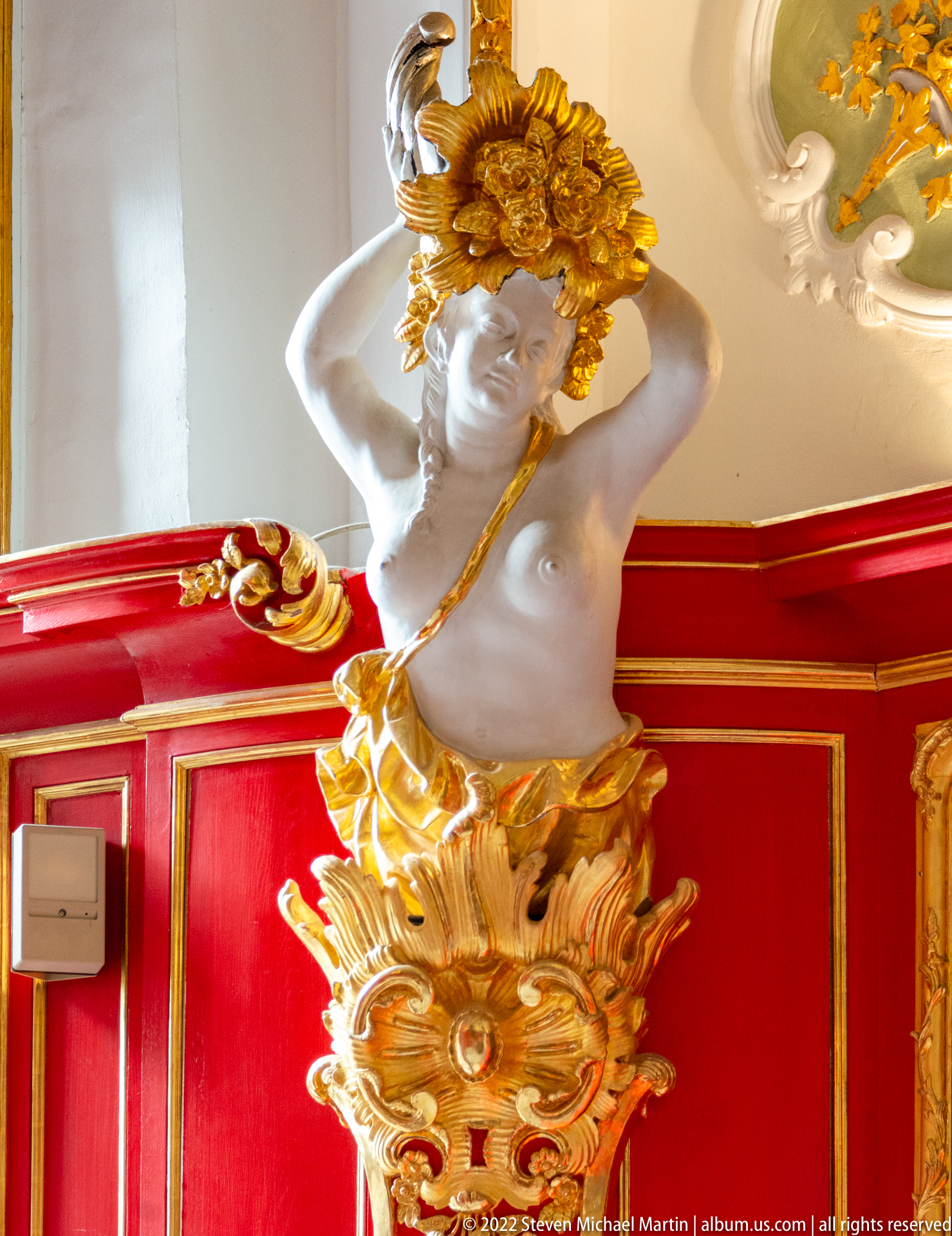
A white female half-figure emerges from a richly gilded ornamental base, raising one arm above her head while a bundle of long stalks or reeds rises behind her. The combination of pale figure and gold ornament gives the sculptural support a theatrical Rococo character within the red-paneled interior.
Caption
A white female half-figure emerges from a richly gilded ornamental base, raising one arm above her head while a bundle of long stalks or reeds rises behind her. The combination of pale figure and gold ornament gives the sculptural support a theatrical Rococo character within the red-paneled interior.
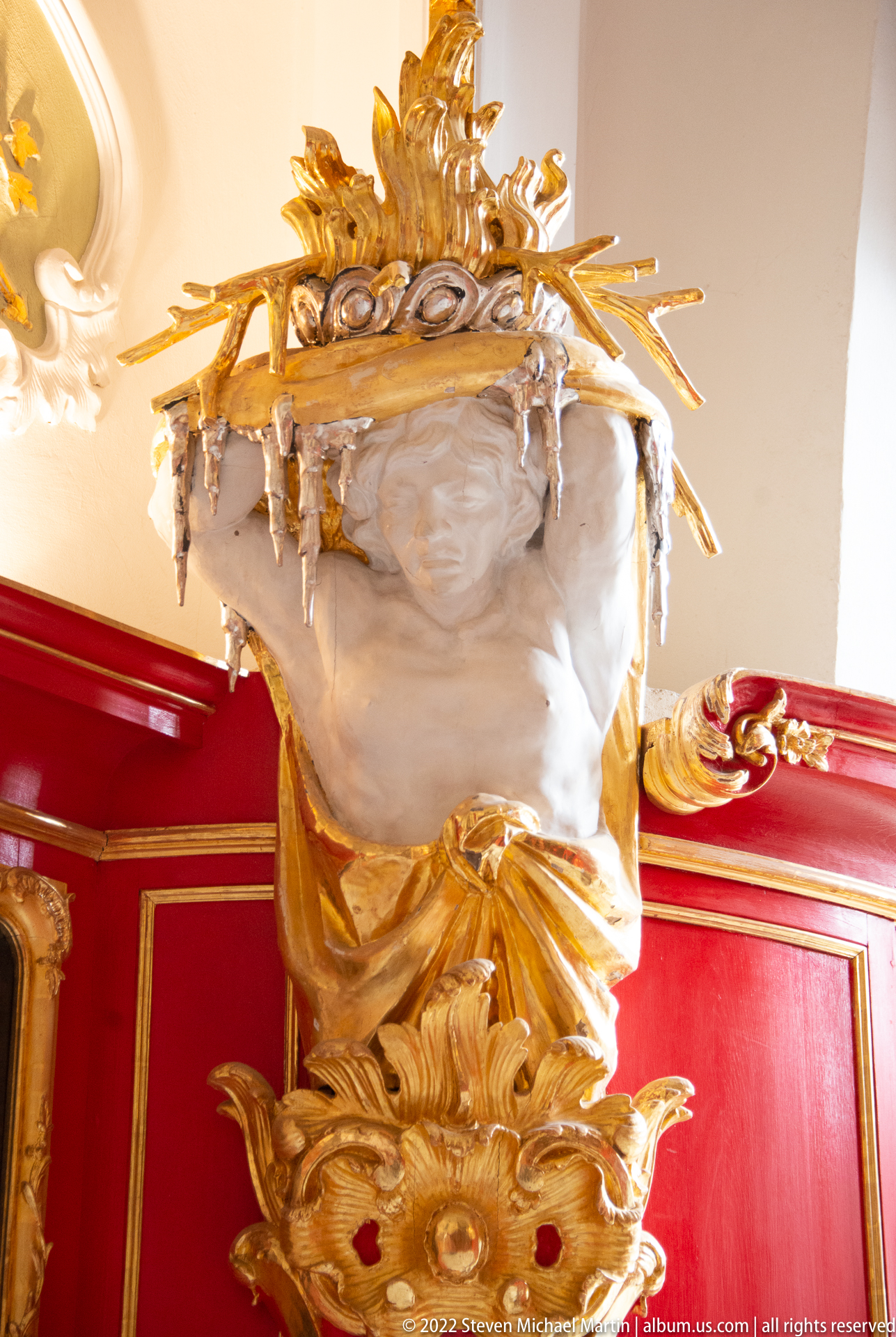
A white male half-figure bends beneath an elaborate gilded burden resembling a tray or cornice loaded with sculpted objects. His flexed arms and compressed posture turn the architectural support into a playful figural motif, contrasting sharply with the room's saturated red and gold paneling.
Caption
A white male half-figure bends beneath an elaborate gilded burden resembling a tray or cornice loaded with sculpted objects. His flexed arms and compressed posture turn the architectural support into a playful figural motif, contrasting sharply with the room's saturated red and gold paneling.
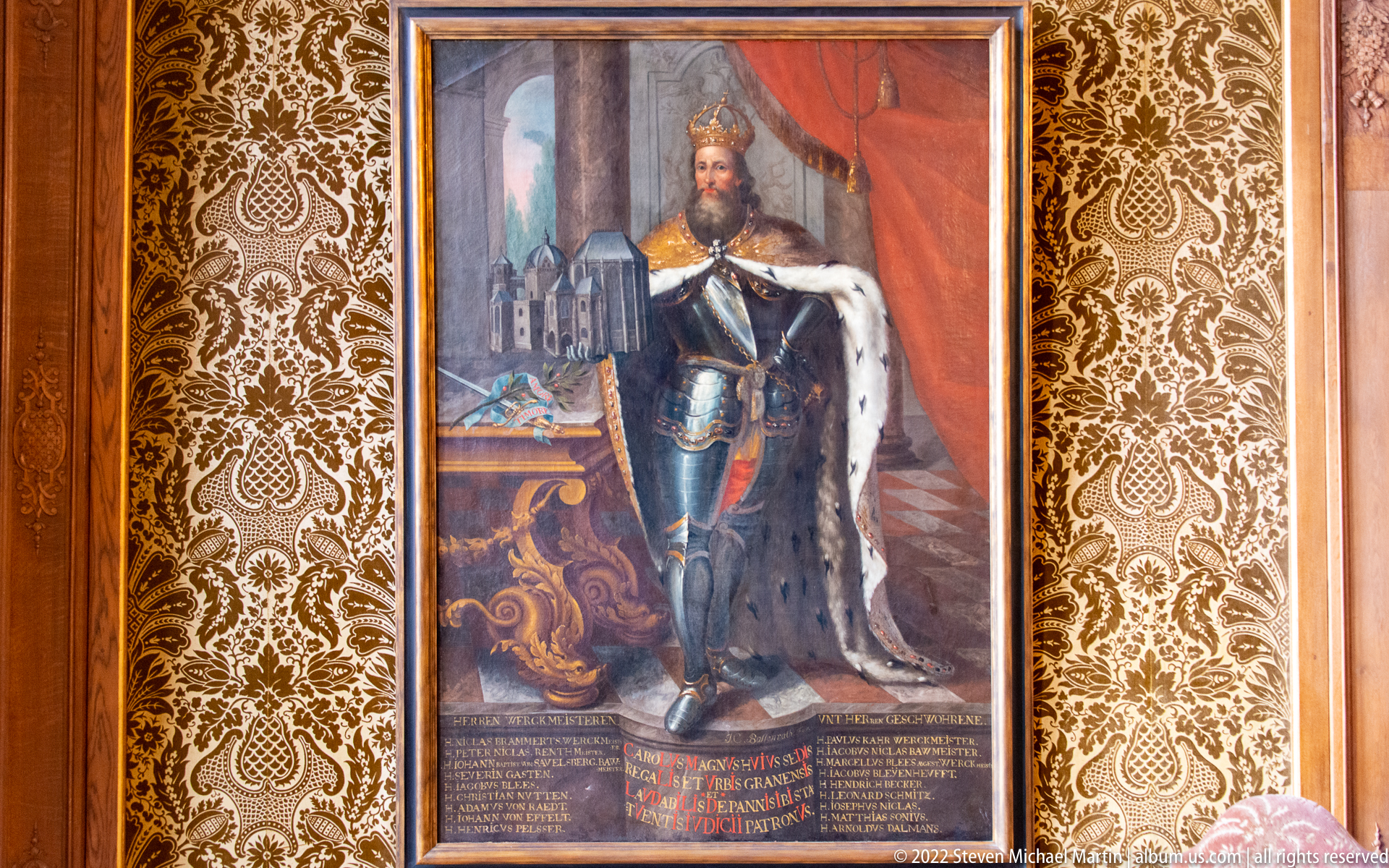
A full-length ruler stands in armor beneath a crown, an ermine-lined mantle falling from his shoulders while one hand rests near a table displaying a model of a large building complex. The formal pose, regalia, and architectural attribute present the sitter as a sovereign patron within a dynastic portrait tradition.
Caption
A full-length ruler stands in armor beneath a crown, an ermine-lined mantle falling from his shoulders while one hand rests near a table displaying a model of a large building complex. The formal pose, regalia, and architectural attribute present the sitter as a sovereign patron within a dynastic portrait tradition.
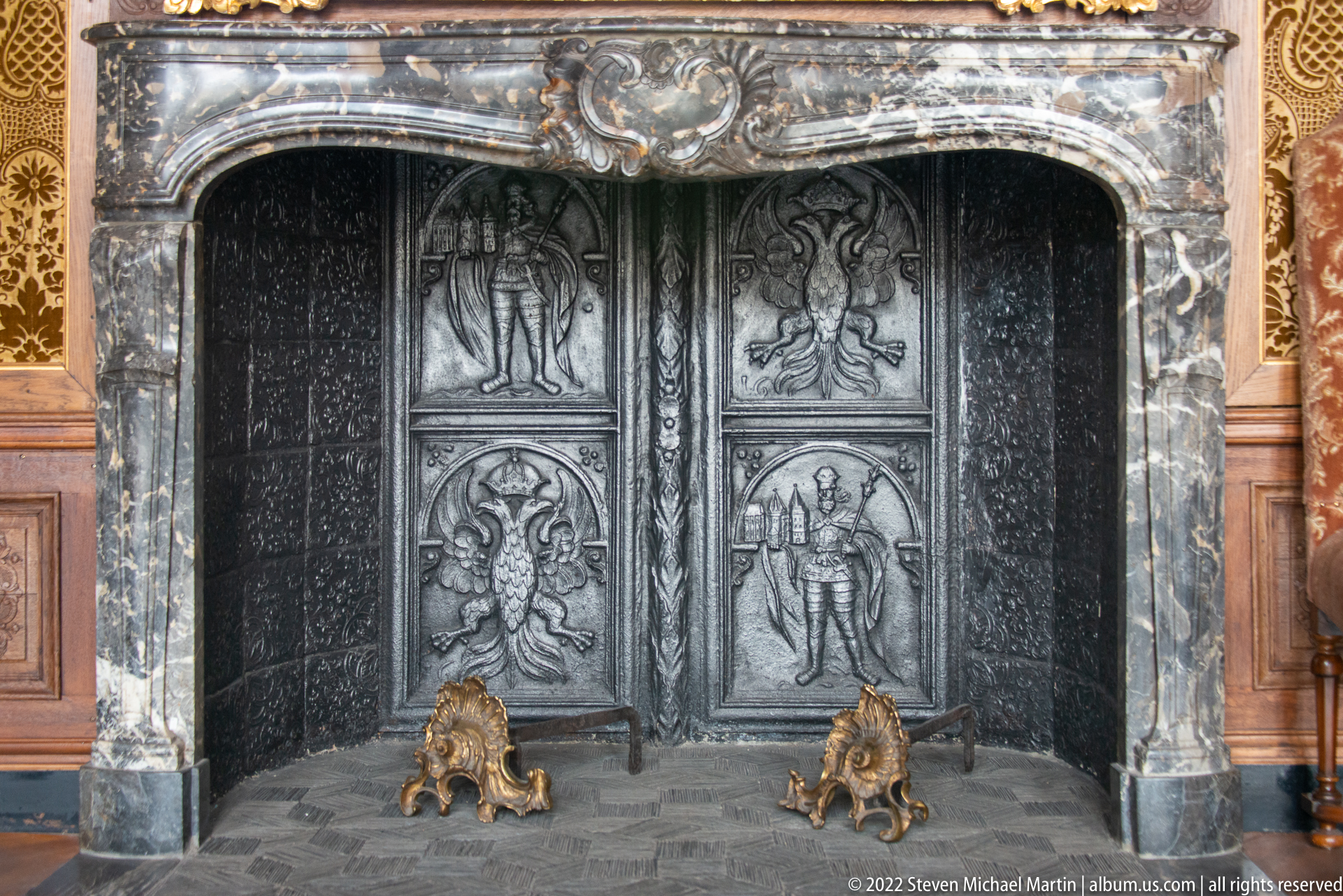
A monumental dark stone fireplace is framed by a veined marble surround and carved metal or stone relief panels. Figurative scenes, heraldic motifs, and two small gilt fire supports animate the hearth, making it a major decorative and ceremonial feature of the room rather than a purely functional element.
Caption
A monumental dark stone fireplace is framed by a veined marble surround and carved metal or stone relief panels. Figurative scenes, heraldic motifs, and two small gilt fire supports animate the hearth, making it a major decorative and ceremonial feature of the room rather than a purely functional element.
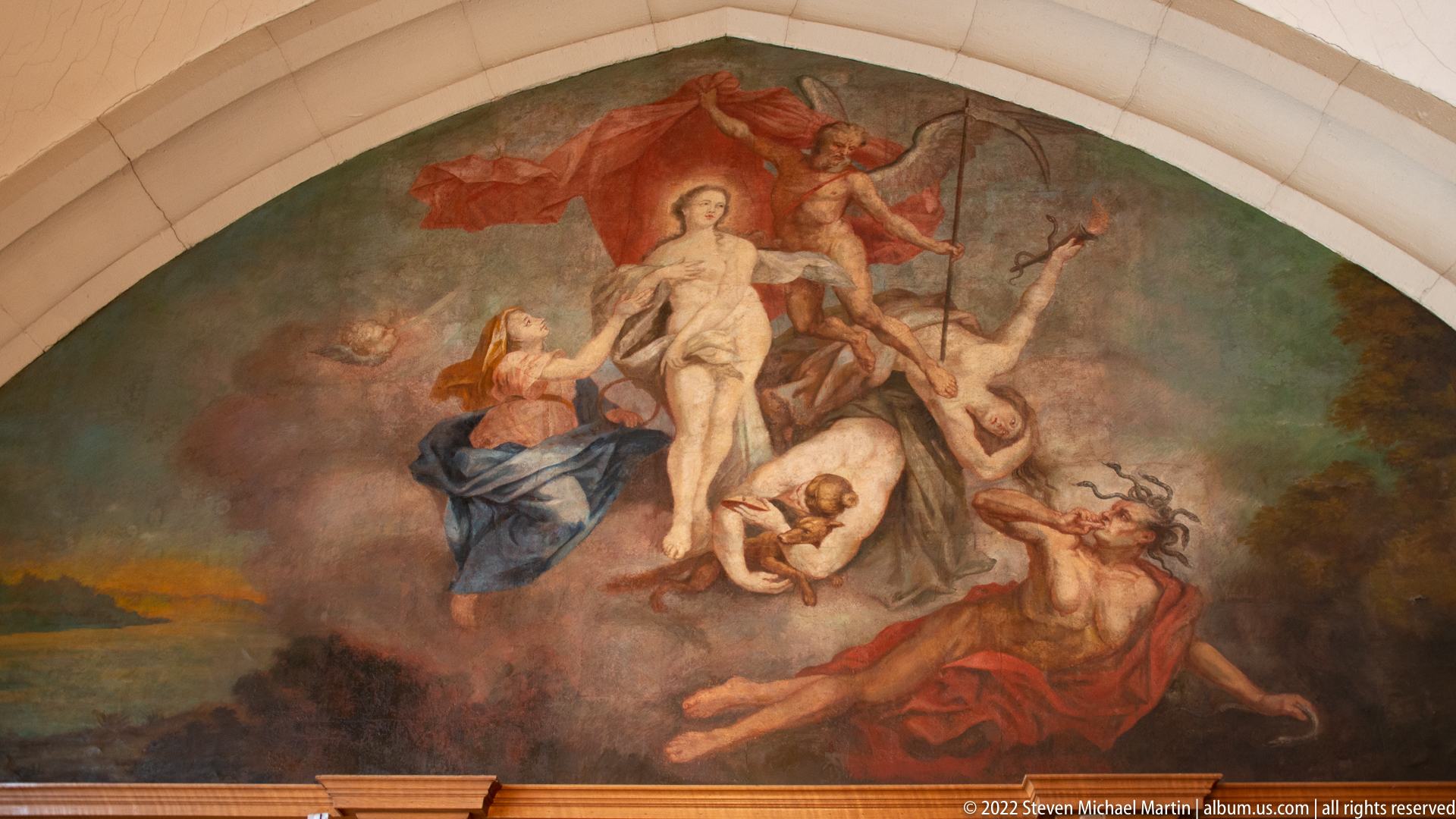
An allegorical painted scene fills a curved architectural field, centering on a pale draped woman lifted amid winged and semi-nude figures. Billowing red and blue drapery and a low horizon create a sense of upward movement, giving the image the theatrical character of Baroque or Rococo interior decoration.
Caption
An allegorical painted scene fills a curved architectural field, centering on a pale draped woman lifted amid winged and semi-nude figures. Billowing red and blue drapery and a low horizon create a sense of upward movement, giving the image the theatrical character of Baroque or Rococo interior decoration.
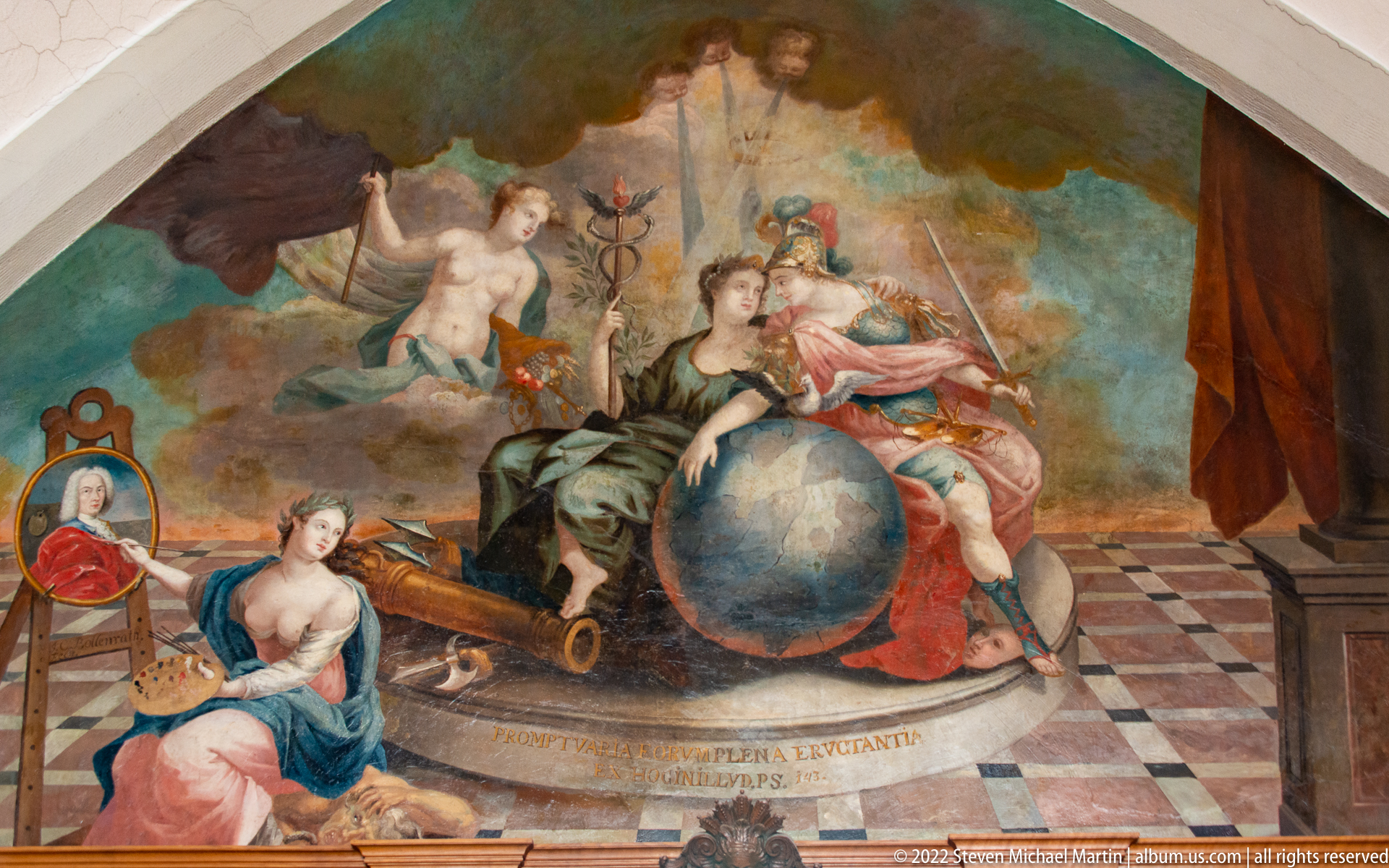
An expansive allegorical painting centers on a seated female figure beside a large globe, surrounded by attendants, putti, and objects associated with learning, power, and the arts. The composition uses sweeping gestures, theatrical drapery, and a high viewpoint to create the illusion of an opening beyond the architectural frame.
Caption
An expansive allegorical painting centers on a seated female figure beside a large globe, surrounded by attendants, putti, and objects associated with learning, power, and the arts. The composition uses sweeping gestures, theatrical drapery, and a high viewpoint to create the illusion of an opening beyond the architectural frame.
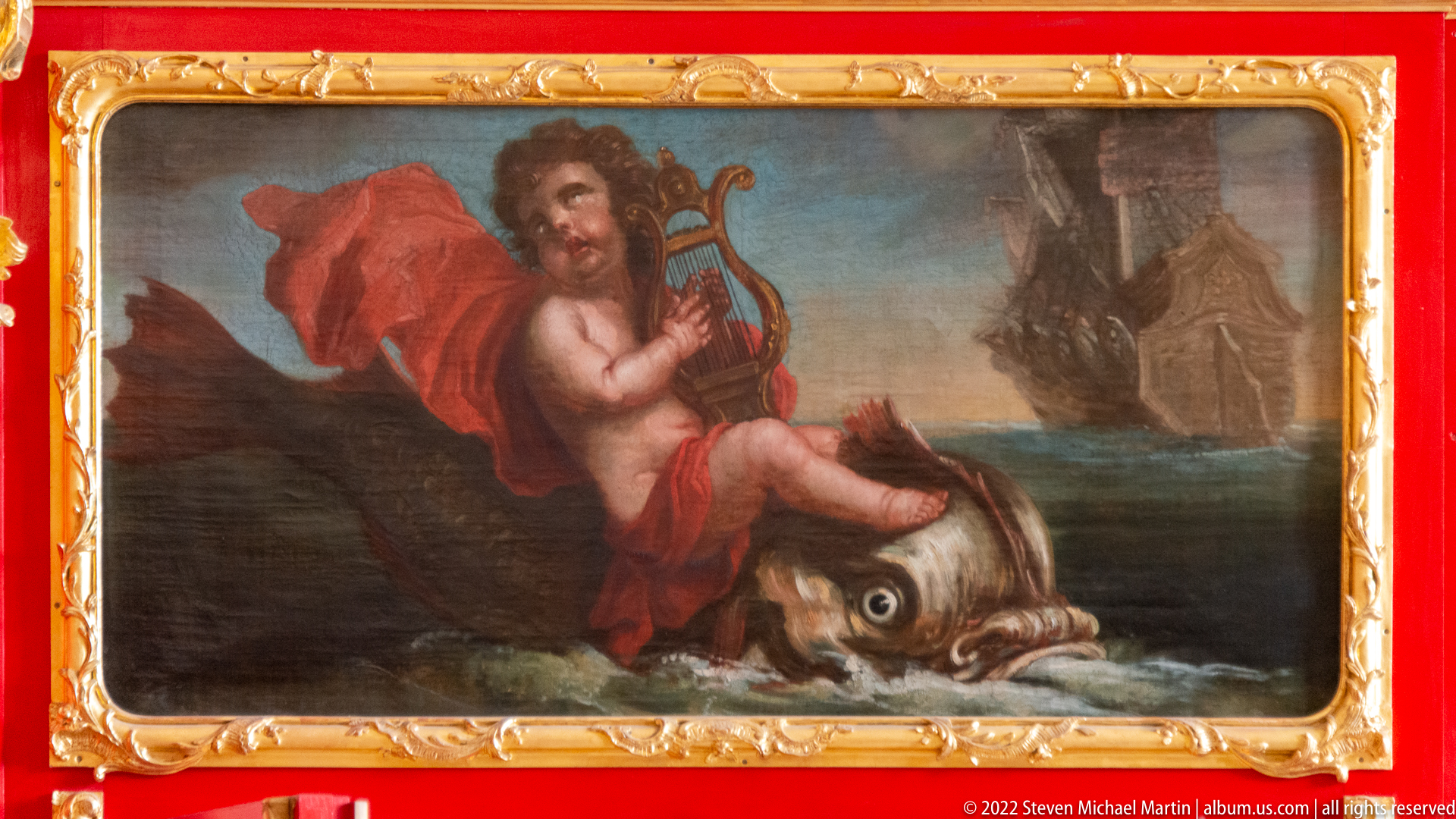
A muscular male figure draped in red plays a lyre while seated above a large fish or sea creature, with a rocky coastal landscape receding behind him. The mythological composition combines music, exotic animal imagery, and dramatic color, presenting the figure as part of a decorative narrative cycle.
Caption
A muscular male figure draped in red plays a lyre while seated above a large fish or sea creature, with a rocky coastal landscape receding behind him. The mythological composition combines music, exotic animal imagery, and dramatic color, presenting the figure as part of a decorative narrative cycle.
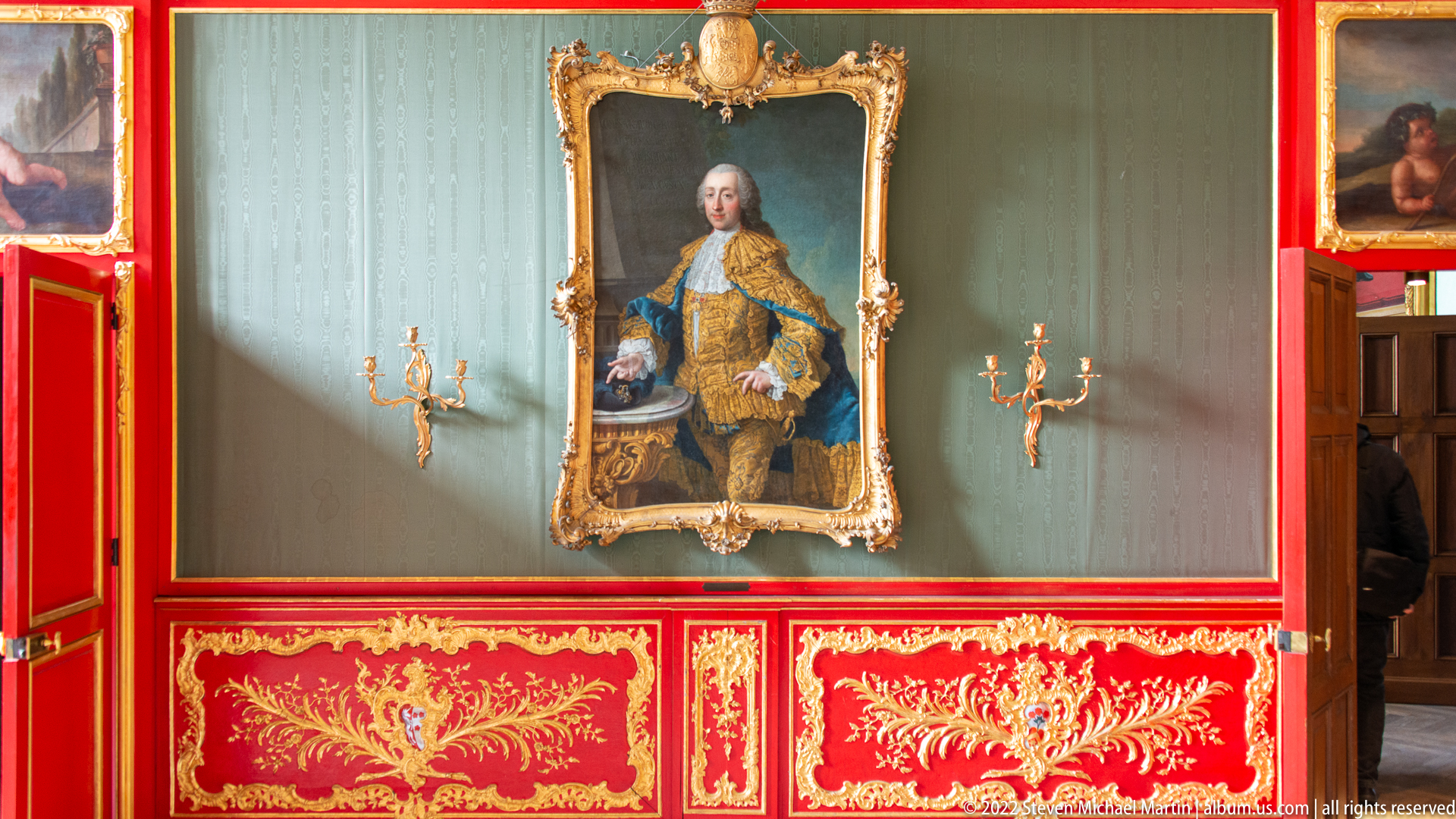
A formally dressed man in an embroidered coat stands in a gilded frame against a green wall, flanked by paired gilt wall sconces and red lacquered paneling. The portrait's placement within a coordinated decorative ensemble makes the painting part of the room's overall ceremonial design as much as an individual likeness.
Caption
A formally dressed man in an embroidered coat stands in a gilded frame against a green wall, flanked by paired gilt wall sconces and red lacquered paneling. The portrait's placement within a coordinated decorative ensemble makes the painting part of the room's overall ceremonial design as much as an individual likeness.
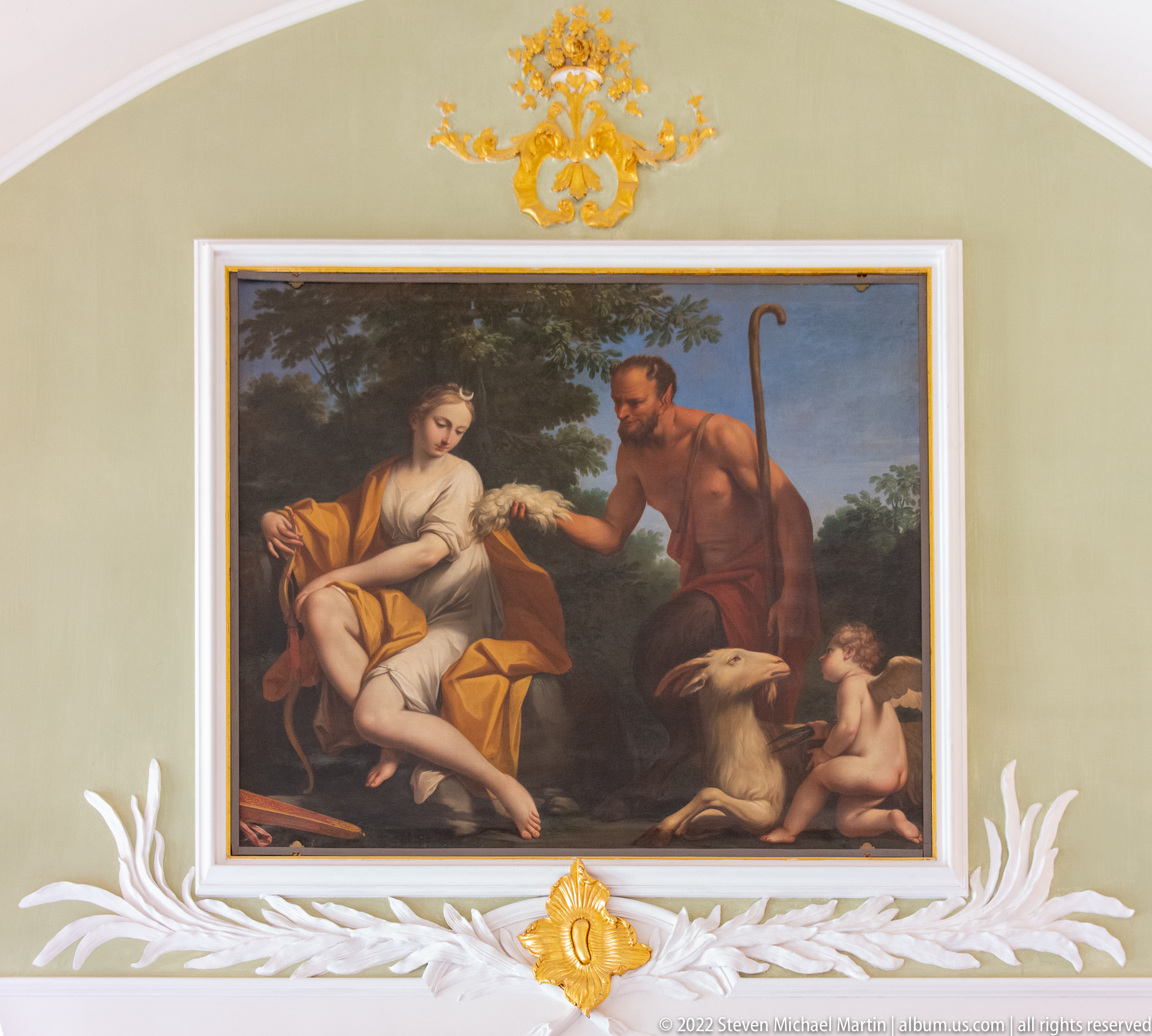
A seated woman turns toward a standing shepherd-like man holding a crook while a dog and small child occupy the foreground. Set beneath trees in a pastoral landscape, the composition draws on classical or mythological conventions, using gesture and grouped figures to suggest a narrative encounter.
Caption
A seated woman turns toward a standing shepherd-like man holding a crook while a dog and small child occupy the foreground. Set beneath trees in a pastoral landscape, the composition draws on classical or mythological conventions, using gesture and grouped figures to suggest a narrative encounter.
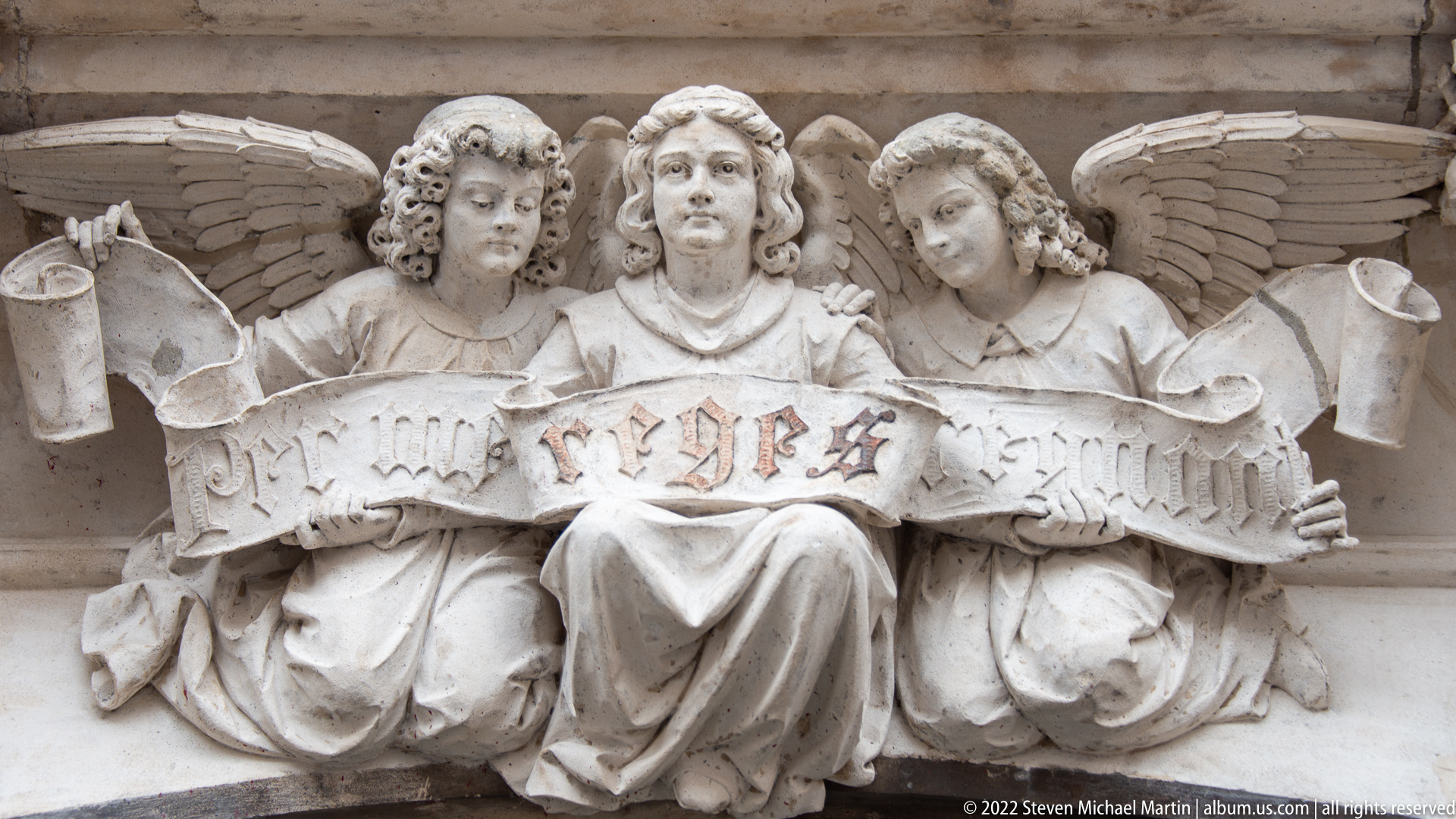
Three carved winged figures sit closely together, holding a long scroll with partially legible Gothic-style lettering. Their symmetrical grouping, flowing drapery, and feathered wings suggest an architectural or funerary decorative program in which text and angelic imagery were designed to be read together.
Caption
Three carved winged figures sit closely together, holding a long scroll with partially legible Gothic-style lettering. Their symmetrical grouping, flowing drapery, and feathered wings suggest an architectural or funerary decorative program in which text and angelic imagery were designed to be read together.
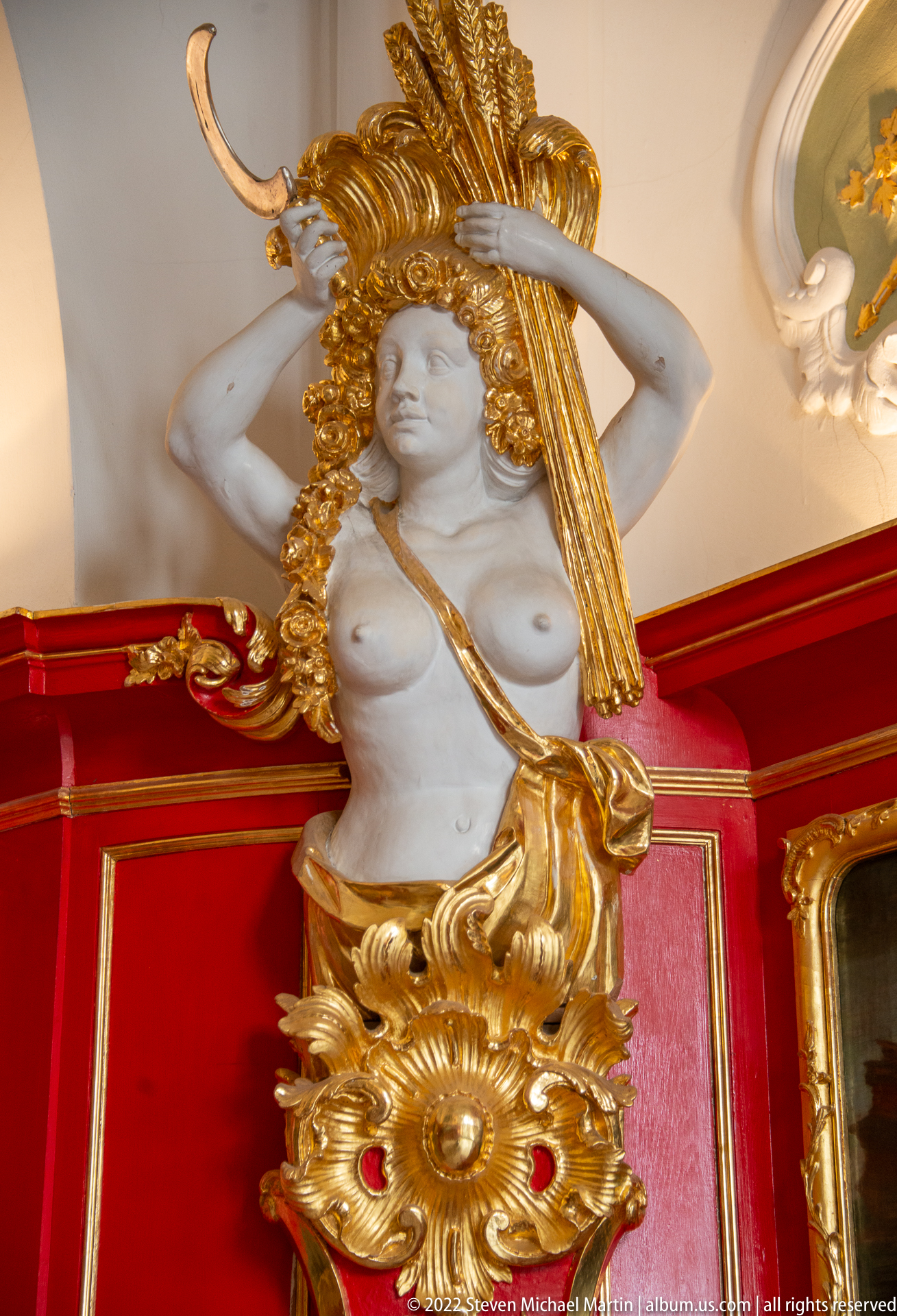
A second white female half-figure carries a tall bundled sheaf across her shoulder, her twisting torso rising from an ornate gilded base. Closely integrated with the red-and-gold room decoration, the figure functions as sculptural architecture rather than freestanding statuary.
Caption
A second white female half-figure carries a tall bundled sheaf across her shoulder, her twisting torso rising from an ornate gilded base. Closely integrated with the red-and-gold room decoration, the figure functions as sculptural architecture rather than freestanding statuary.
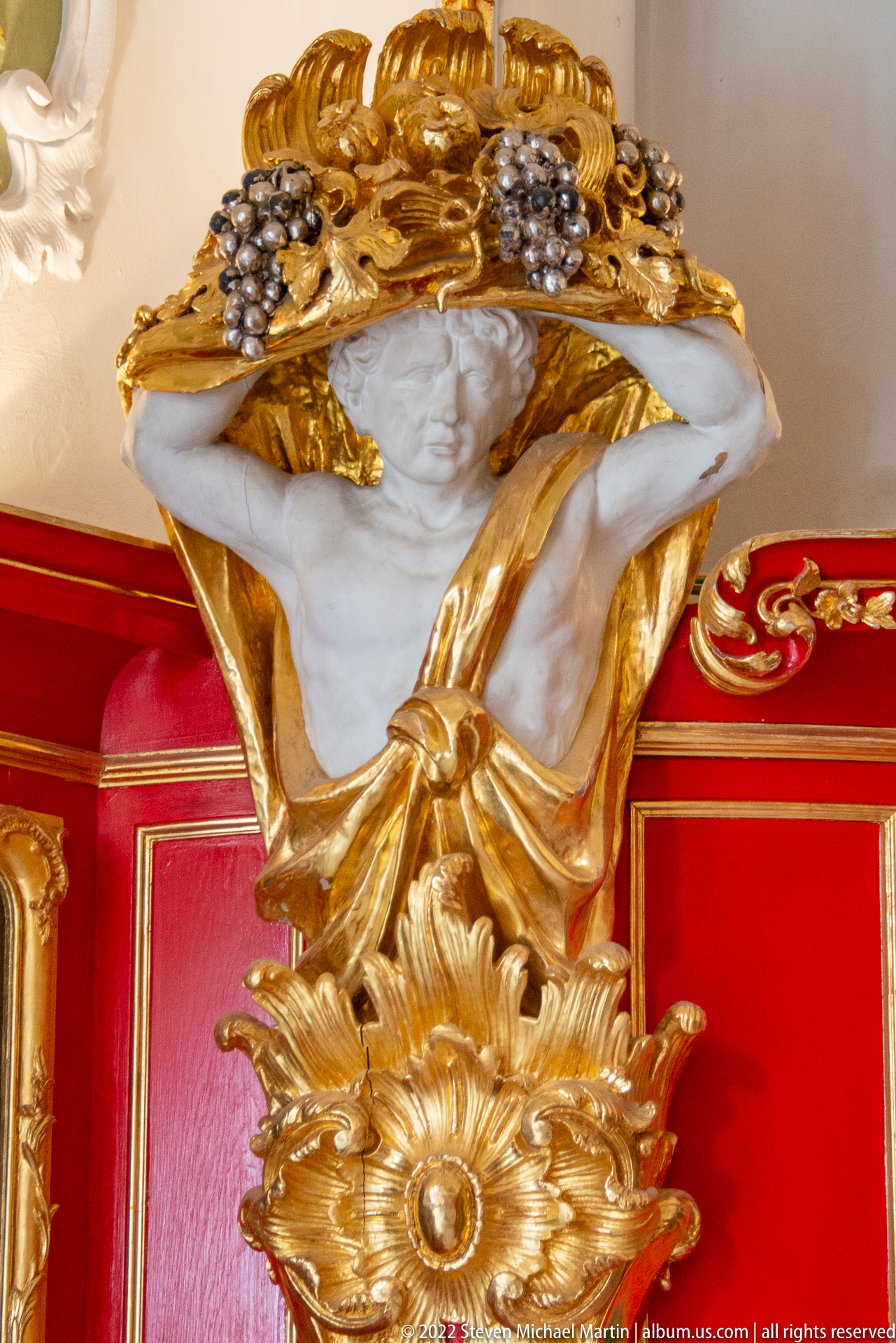
A white male half-figure braces a mass of gilded foliage and clustered grapes above his shoulders, his bent elbows and tense posture turning the ornament into a theatrical display of weight and abundance. The fruit motif distinguishes this support from the neighboring figures in the same decorative cycle.
Caption
A white male half-figure braces a mass of gilded foliage and clustered grapes above his shoulders, his bent elbows and tense posture turning the ornament into a theatrical display of weight and abundance. The fruit motif distinguishes this support from the neighboring figures in the same decorative cycle.

A dark metal plaque bears an incised interlaced monogram composed of several Roman letters arranged around a central diamond. The spare design contrasts with the surrounding masonry and suggests a maker's, donor's, or institutional mark whose meaning depends on its original architectural context.
Caption
A dark metal plaque bears an incised interlaced monogram composed of several Roman letters arranged around a central diamond. The spare design contrasts with the surrounding masonry and suggests a maker's, donor's, or institutional mark whose meaning depends on its original architectural context.

An English interpretive panel summarizes the history of Aachen Town Hall, explaining its construction on the site of Charlemagne's palace, its medieval coronation banquets, later fires and restorations, and its continuing civic role. The sign functions as on-site historical context for the building and its ceremonial associations.
Caption
An English interpretive panel summarizes the history of Aachen Town Hall, explaining its construction on the site of Charlemagne's palace, its medieval coronation banquets, later fires and restorations, and its continuing civic role. The sign functions as on-site historical context for the building and its ceremonial associations.
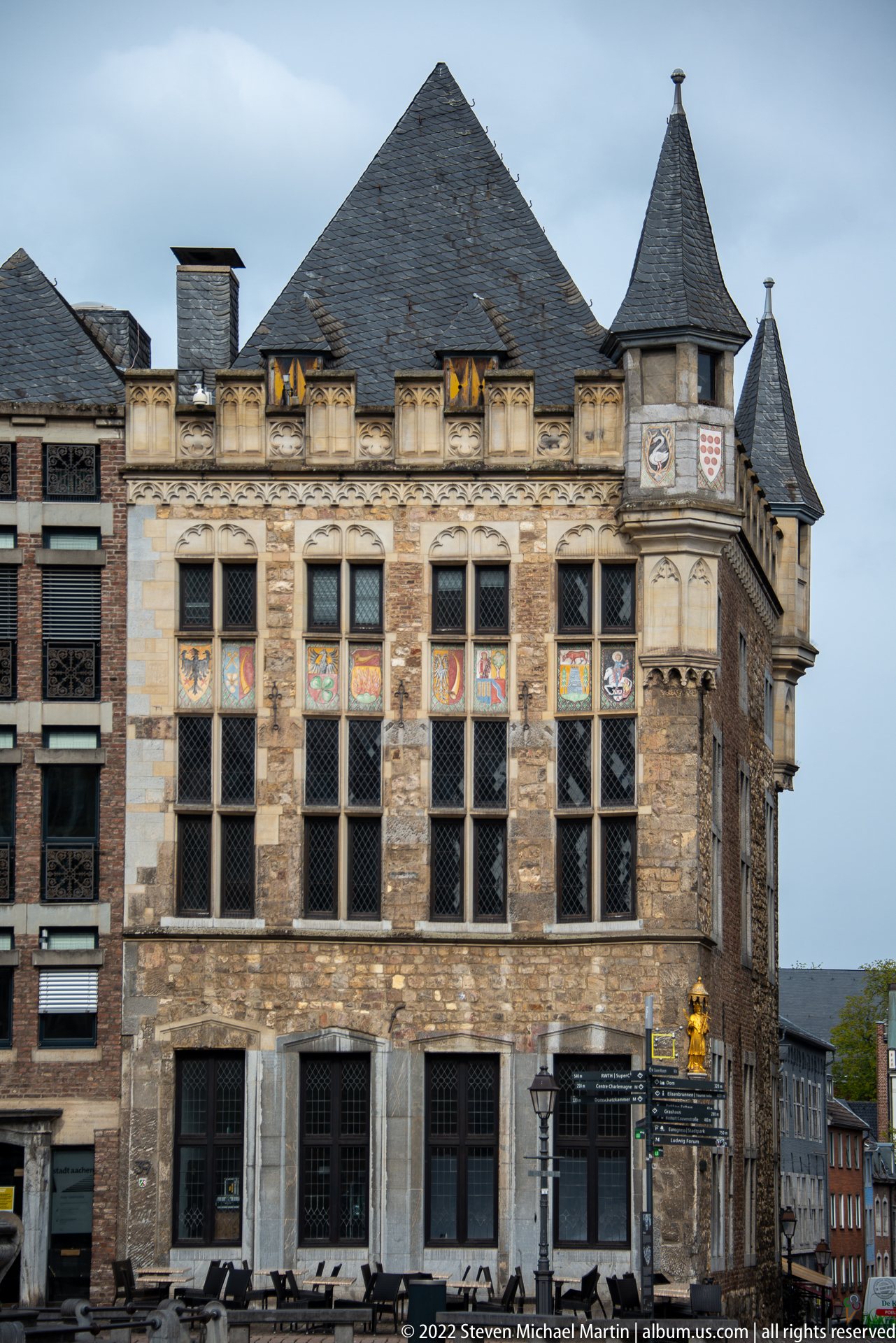
A compact stone civic building presents tall mullioned windows, steep roofs, corner turrets, and a band of colorful heraldic shields beneath the upper windows. The mix of fortified massing and decorative civic emblems gives the structure the character of a medieval municipal or institutional building in Aachen's historic center.
Caption
A compact stone civic building presents tall mullioned windows, steep roofs, corner turrets, and a band of colorful heraldic shields beneath the upper windows. The mix of fortified massing and decorative civic emblems gives the structure the character of a medieval municipal or institutional building in Aachen's historic center.
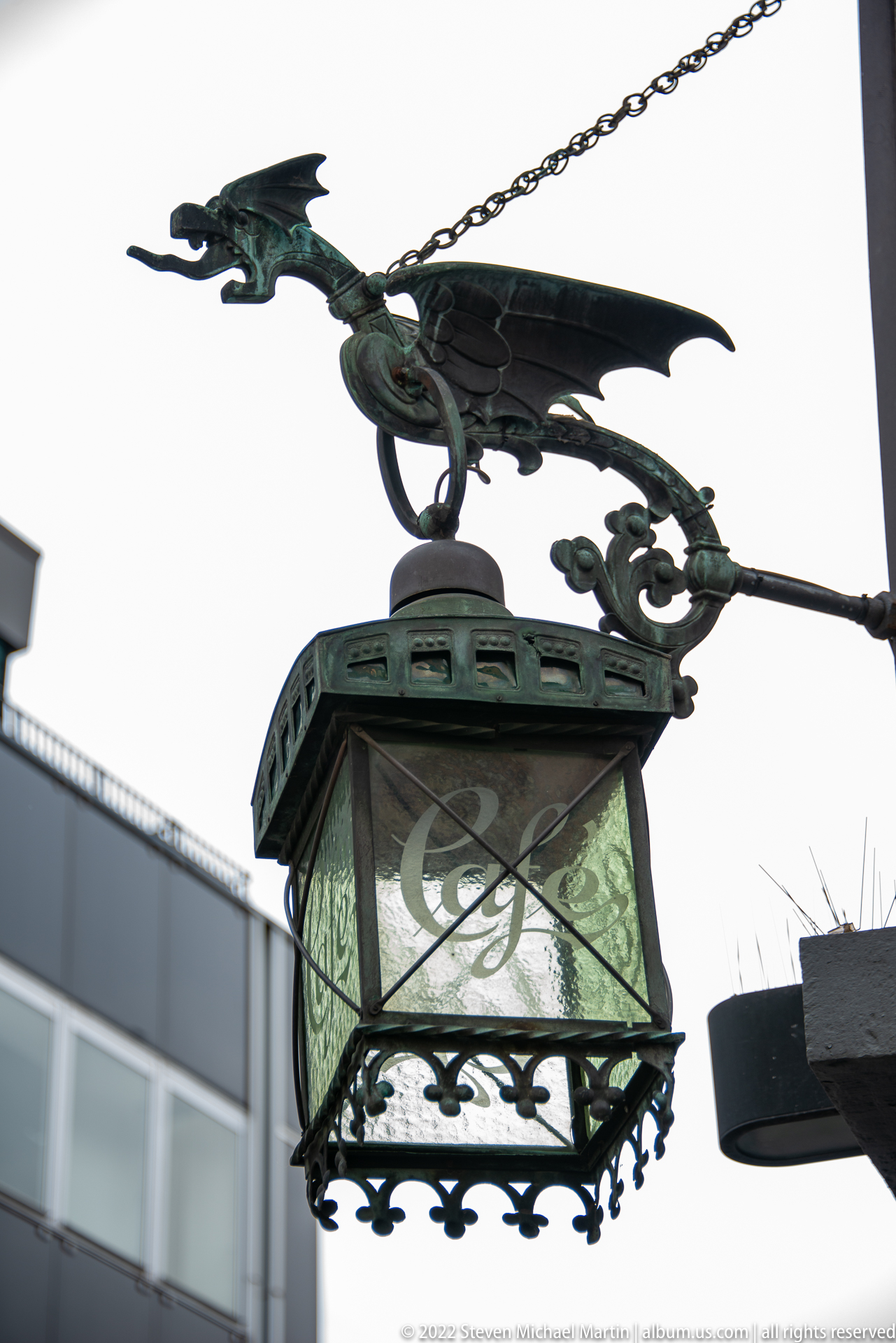
A stylized metal dragon stretches across the top of a suspended lantern, its wings and long tail silhouetted against the pale sky. Decorative iron scrollwork and patterned glass turn the light fixture into a sculptural hanging sign, adding a fanciful motif to the commercial streetscape.
Caption
A stylized metal dragon stretches across the top of a suspended lantern, its wings and long tail silhouetted against the pale sky. Decorative iron scrollwork and patterned glass turn the light fixture into a sculptural hanging sign, adding a fanciful motif to the commercial streetscape.
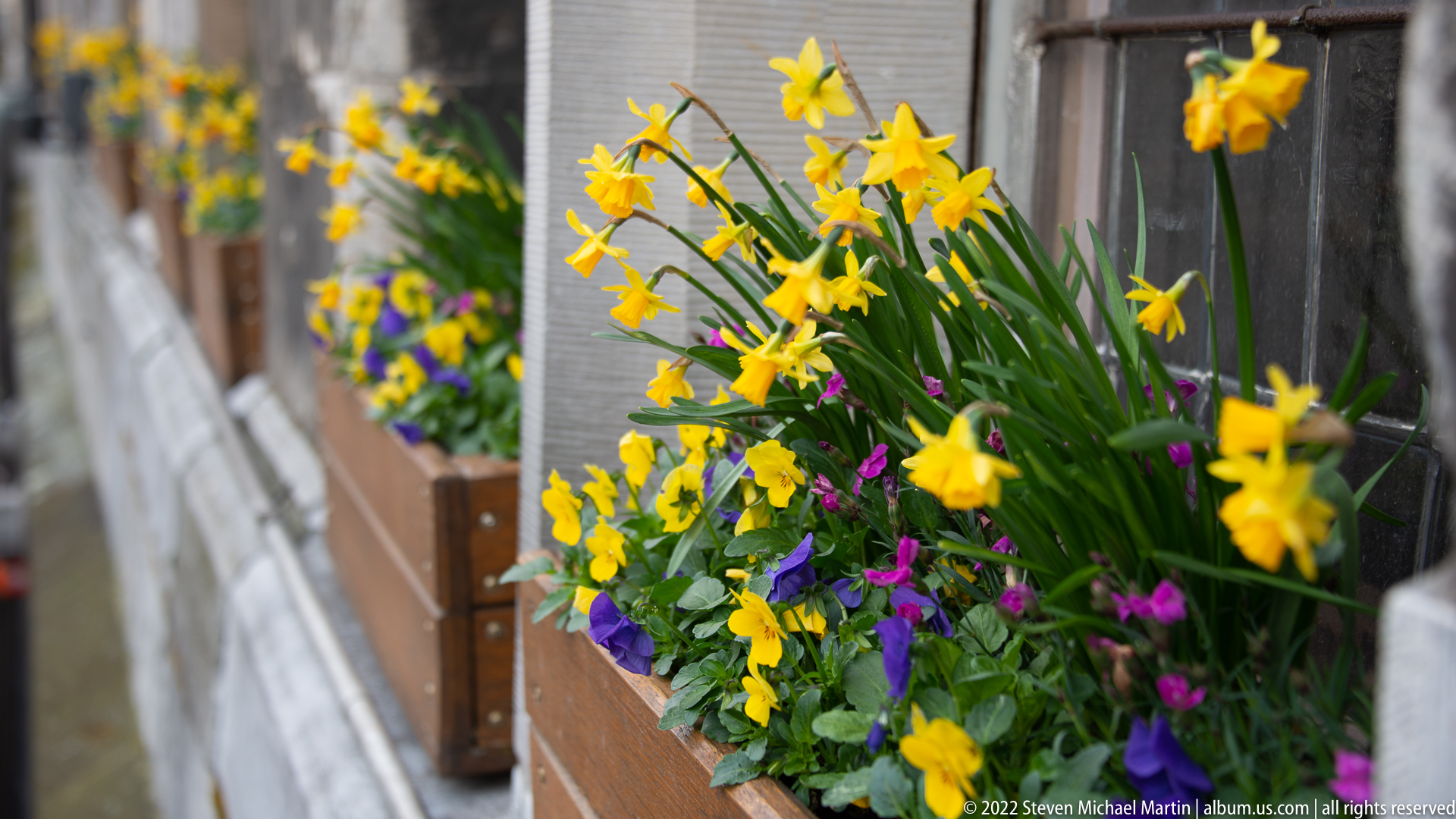
Bright yellow daffodils rise above purple and blue spring flowers in a wooden window box against an older masonry façade. The shallow depth of field isolates the planting from the surrounding street, turning a modest domestic detail into a seasonal accent within Aachen's historic center.
Caption
Bright yellow daffodils rise above purple and blue spring flowers in a wooden window box against an older masonry façade. The shallow depth of field isolates the planting from the surrounding street, turning a modest domestic detail into a seasonal accent within Aachen's historic center.
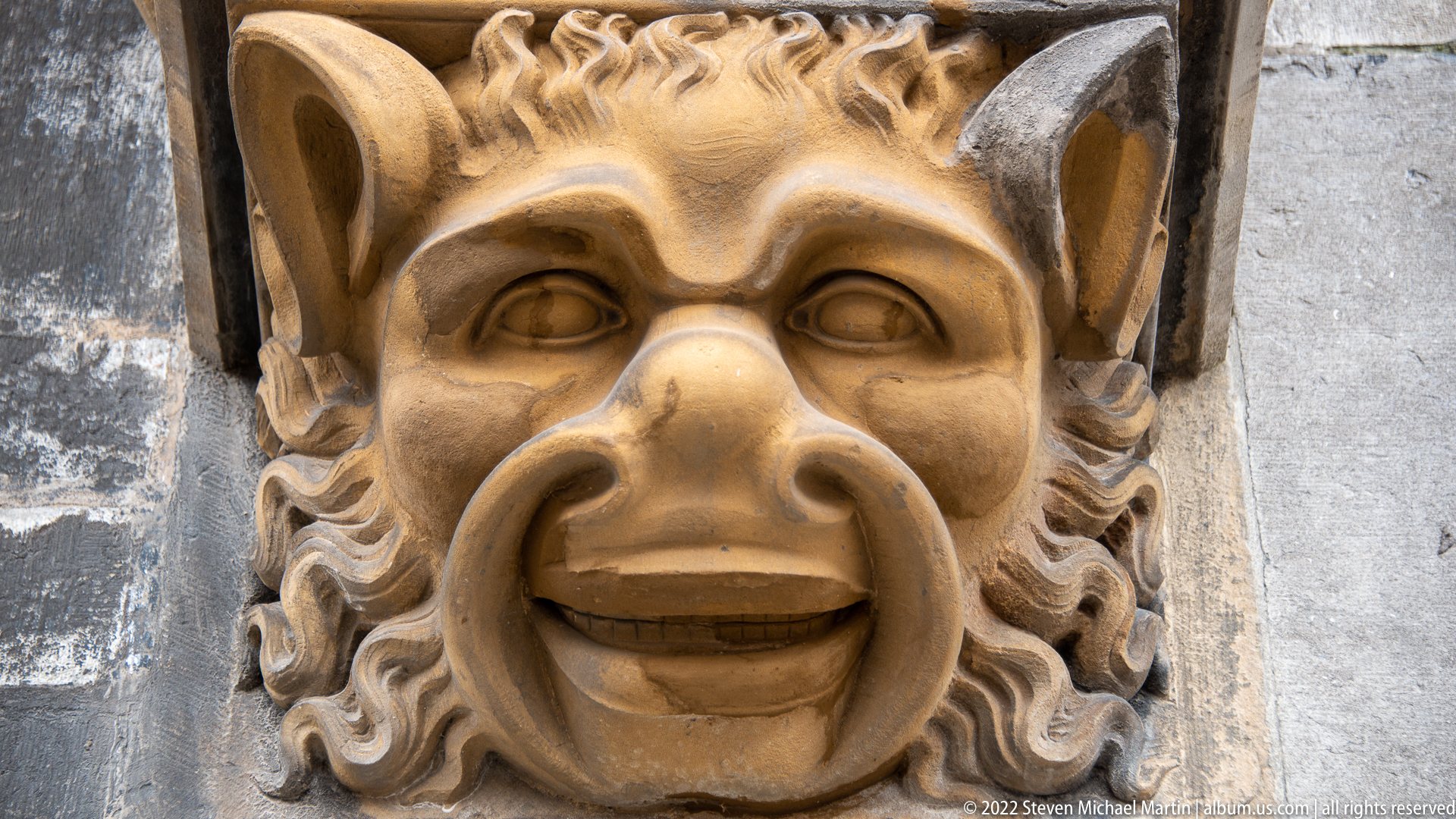
A carved grotesque projects from the masonry with pointed ears, curling hair, heavy brows, and a broad toothy grin. The exaggerated human-animal features transform a small architectural detail into a comic and slightly unsettling presence, typical of the imaginative carving used to animate historic façades.
Caption
A carved grotesque projects from the masonry with pointed ears, curling hair, heavy brows, and a broad toothy grin. The exaggerated human-animal features transform a small architectural detail into a comic and slightly unsettling presence, typical of the imaginative carving used to animate historic façades.
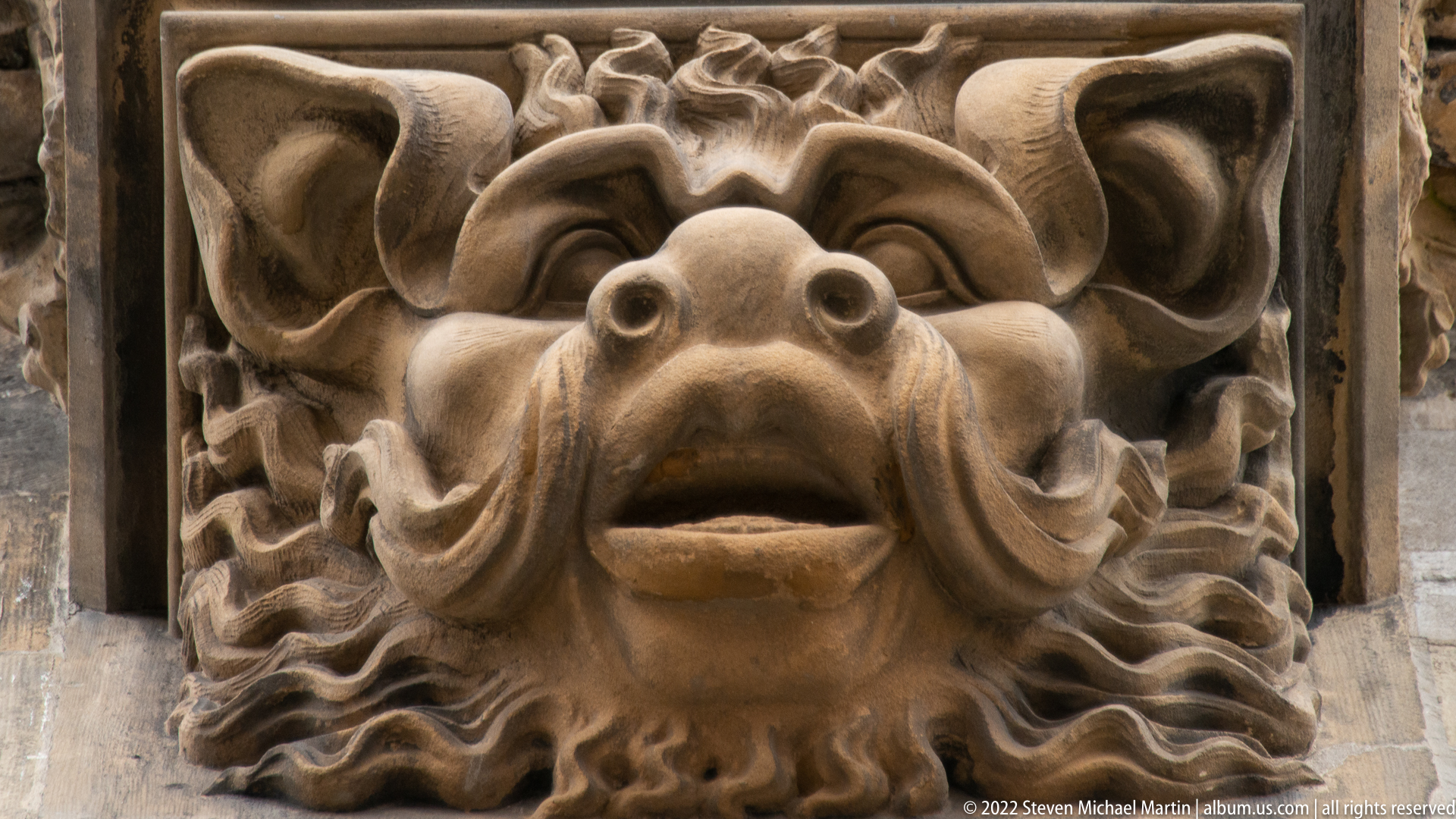
An animal-like grotesque peers outward from the stonework with round protruding eyes, a blunt muzzle, curling horn-like ears, and a mane of carved foliage or hair. The close framing emphasizes the sculptor's playful distortion of natural forms into a protective or decorative façade ornament.
Caption
An animal-like grotesque peers outward from the stonework with round protruding eyes, a blunt muzzle, curling horn-like ears, and a mane of carved foliage or hair. The close framing emphasizes the sculptor's playful distortion of natural forms into a protective or decorative façade ornament.
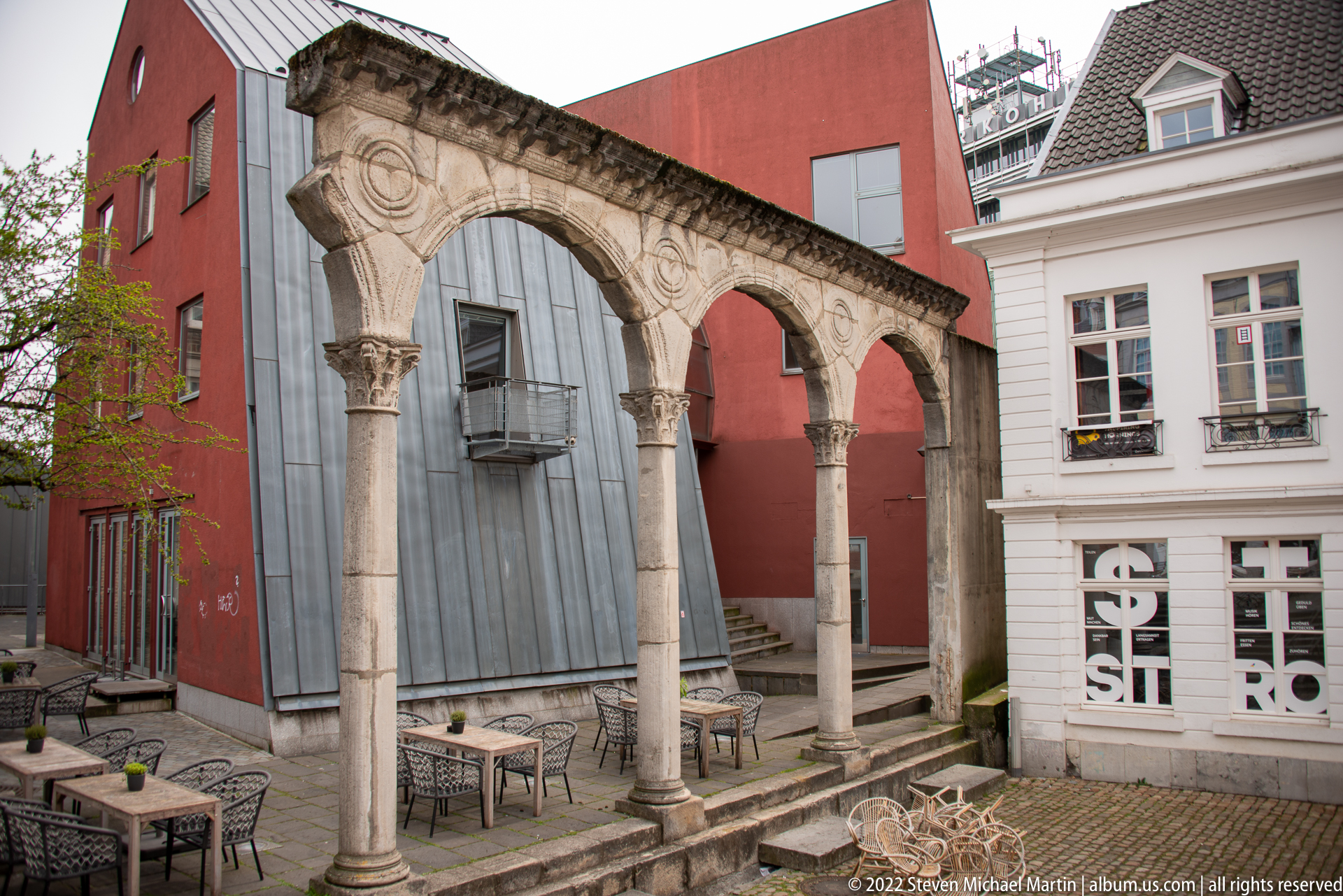
A freestanding row of slender stone columns supports pointed and rounded carved arches within a modern courtyard. Weathered capitals, sculpted spandrels, and the incomplete wall plane identify the feature as a preserved or relocated architectural fragment rather than a complete building.
Caption
A freestanding row of slender stone columns supports pointed and rounded carved arches within a modern courtyard. Weathered capitals, sculpted spandrels, and the incomplete wall plane identify the feature as a preserved or relocated architectural fragment rather than a complete building.
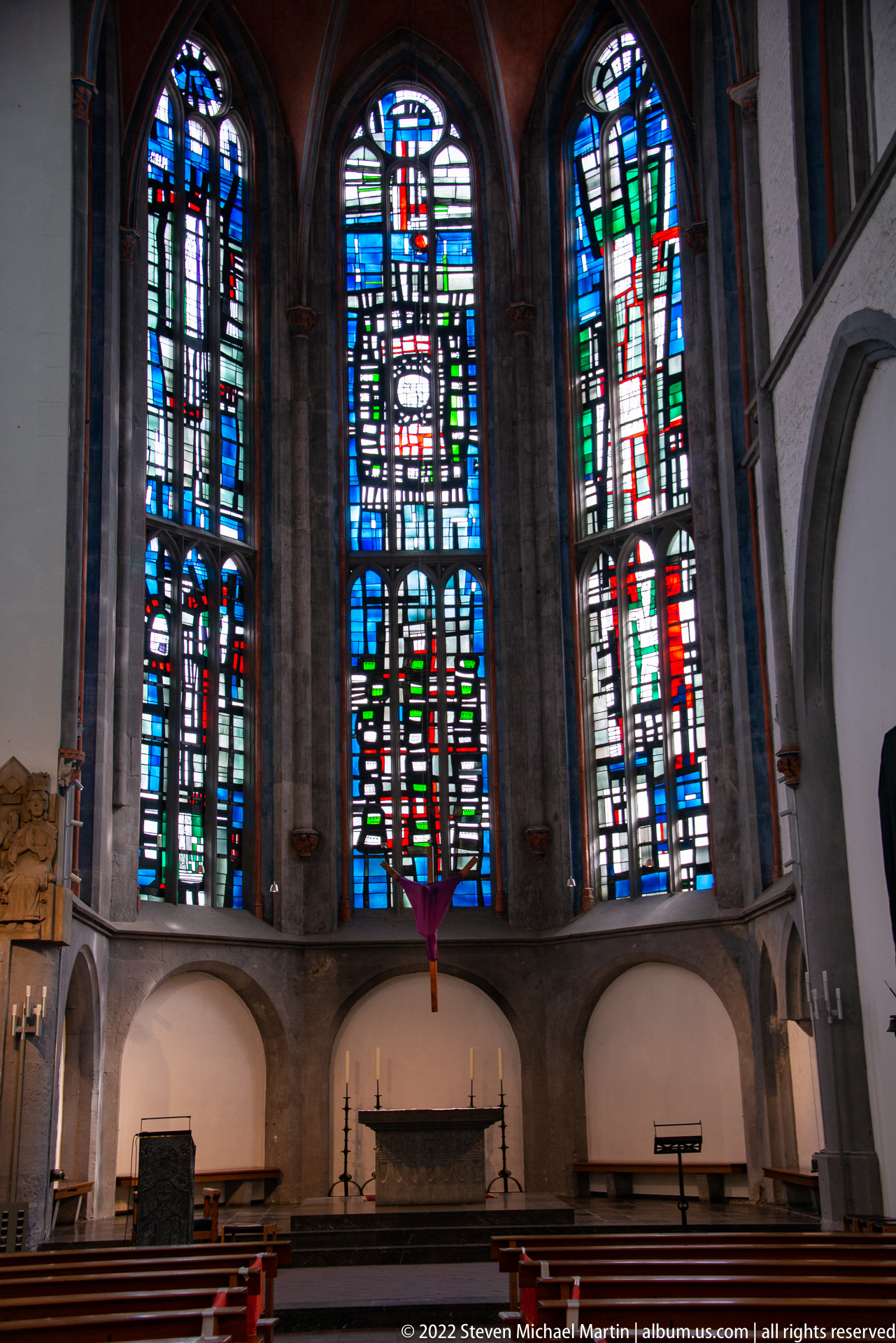
Three tall stained-glass windows fill the end wall of a church interior with saturated blue, red, green, and white light. Below them, a simple altar and side furnishings occupy shallow arched recesses, creating a restrained liturgical setting dominated by the modern glass.
Caption
Three tall stained-glass windows fill the end wall of a church interior with saturated blue, red, green, and white light. Below them, a simple altar and side furnishings occupy shallow arched recesses, creating a restrained liturgical setting dominated by the modern glass.
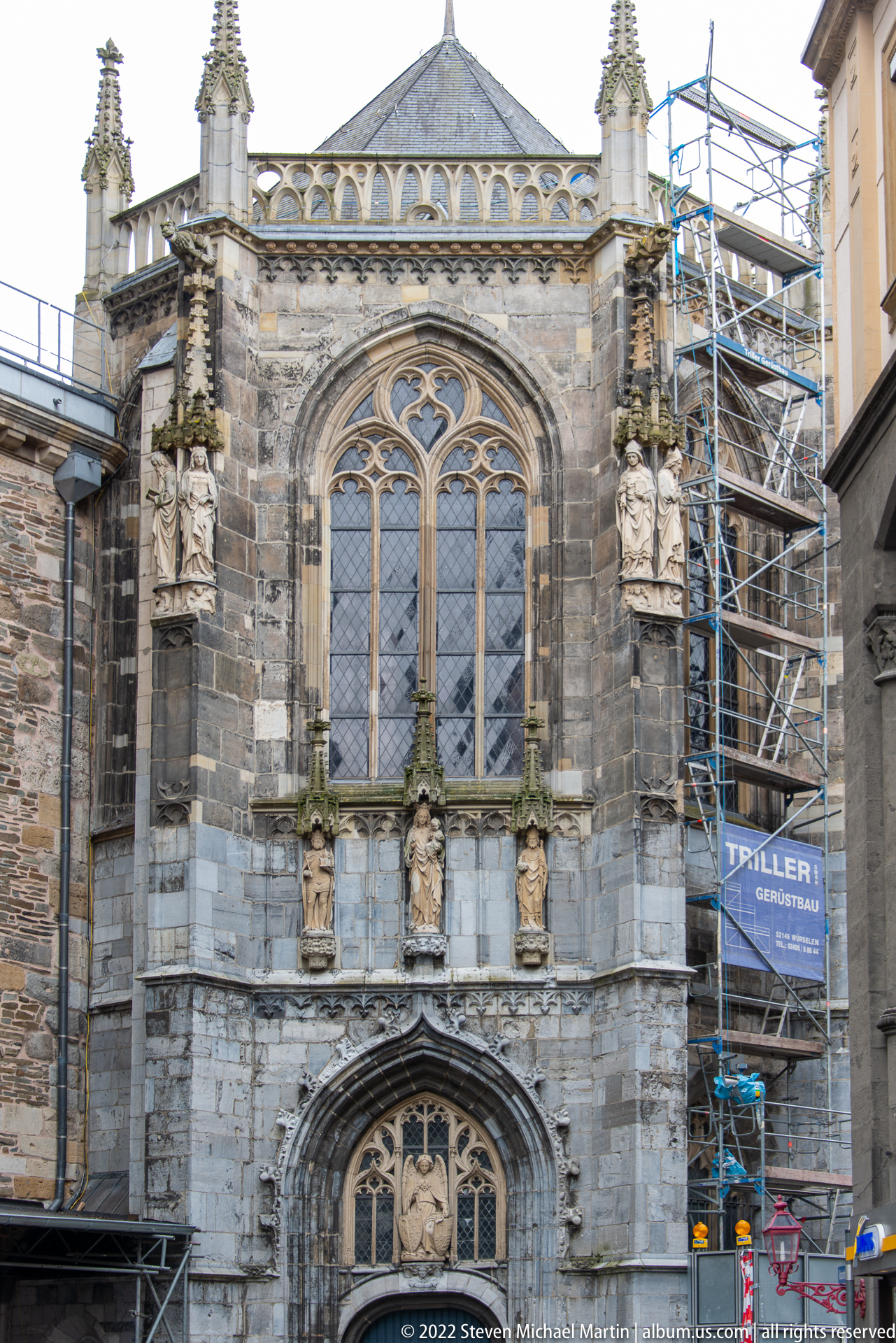
A richly carved Gothic church façade is organized around a large traceried window framed by pinnacles, niches, and standing saints. Scaffolding at one side records active conservation, while the close view reveals the dense sculptural program concentrated around the window and lower portal zone.
Caption
A richly carved Gothic church façade is organized around a large traceried window framed by pinnacles, niches, and standing saints. Scaffolding at one side records active conservation, while the close view reveals the dense sculptural program concentrated around the window and lower portal zone.
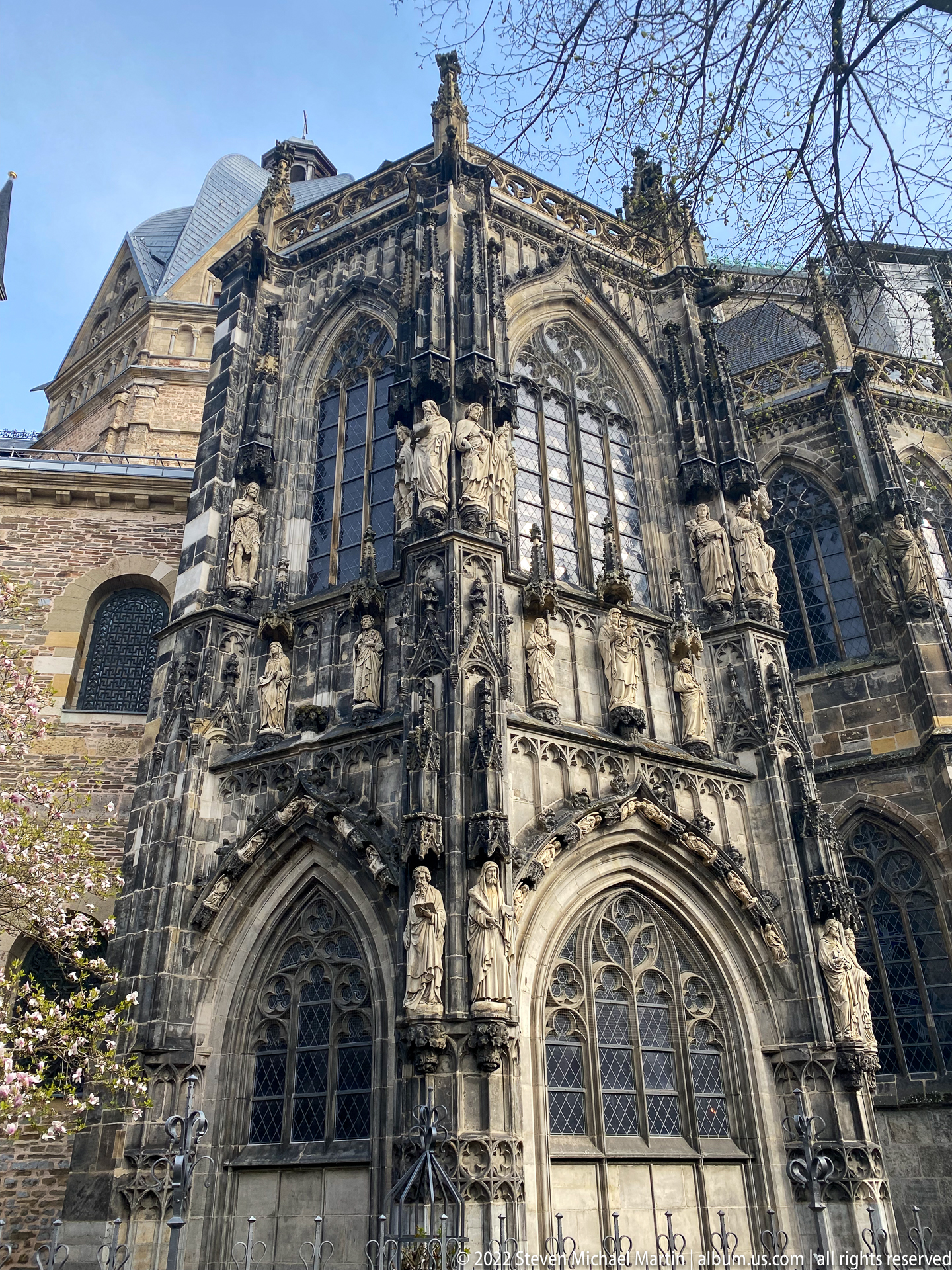
The exterior of Aachen Cathedral's Gothic choir rises in dark weathered stone, its tall pointed windows, buttresses, pinnacles, and tiers of sculpted saints creating a dense vertical façade. The low viewpoint accentuates the height of the choir and the elaborate carving concentrated around the windows and lower portals.
Caption
The exterior of Aachen Cathedral's Gothic choir rises in dark weathered stone, its tall pointed windows, buttresses, pinnacles, and tiers of sculpted saints creating a dense vertical façade. The low viewpoint accentuates the height of the choir and the elaborate carving concentrated around the windows and lower portals.
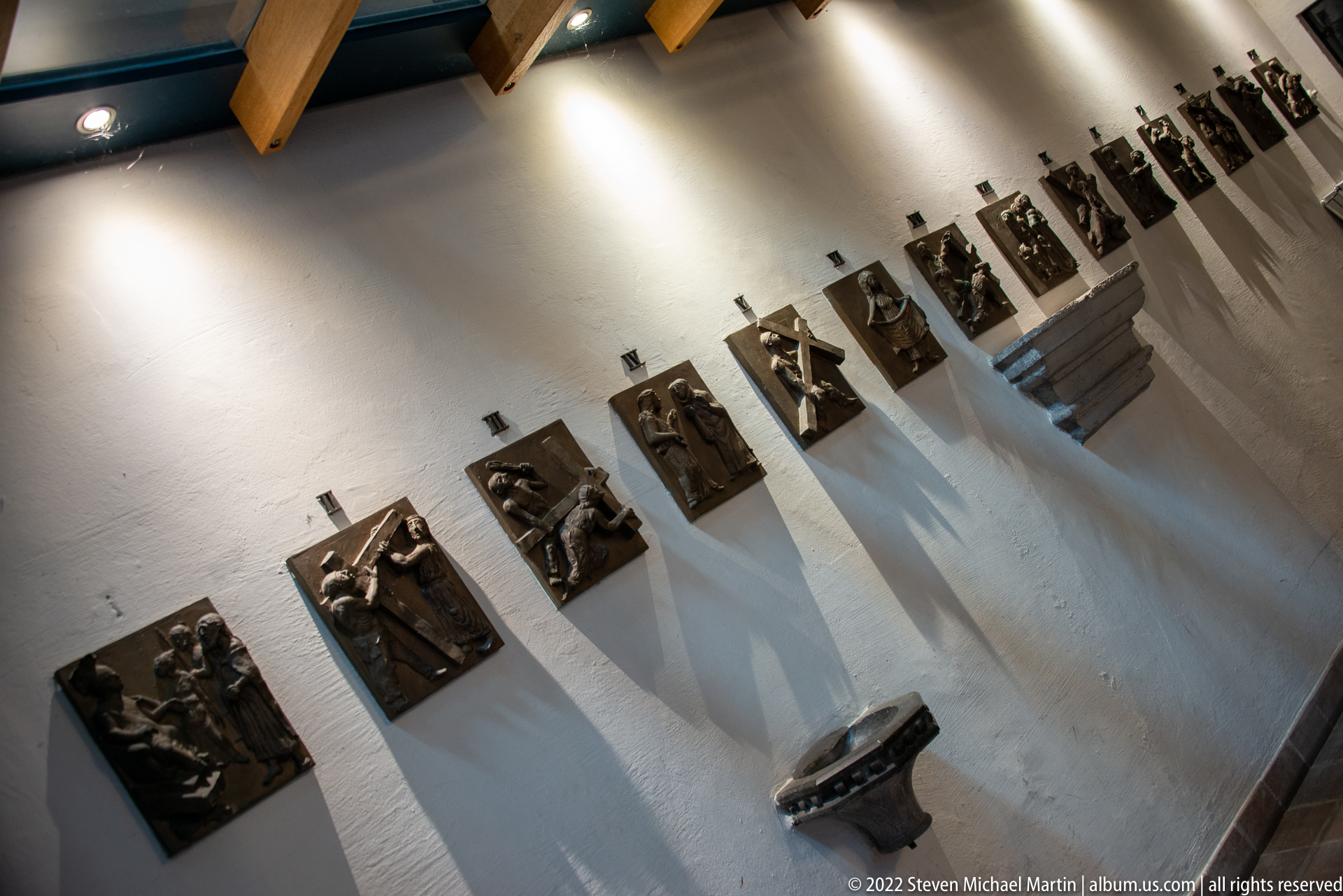
A sequence of small bronze relief panels lines a white church wall, each presenting a different episode in the Passion of Christ. The panels are evenly spaced in chronological order, forming a modern sculptural Stations of the Cross cycle integrated into the worship space.
Caption
A sequence of small bronze relief panels lines a white church wall, each presenting a different episode in the Passion of Christ. The panels are evenly spaced in chronological order, forming a modern sculptural Stations of the Cross cycle integrated into the worship space.
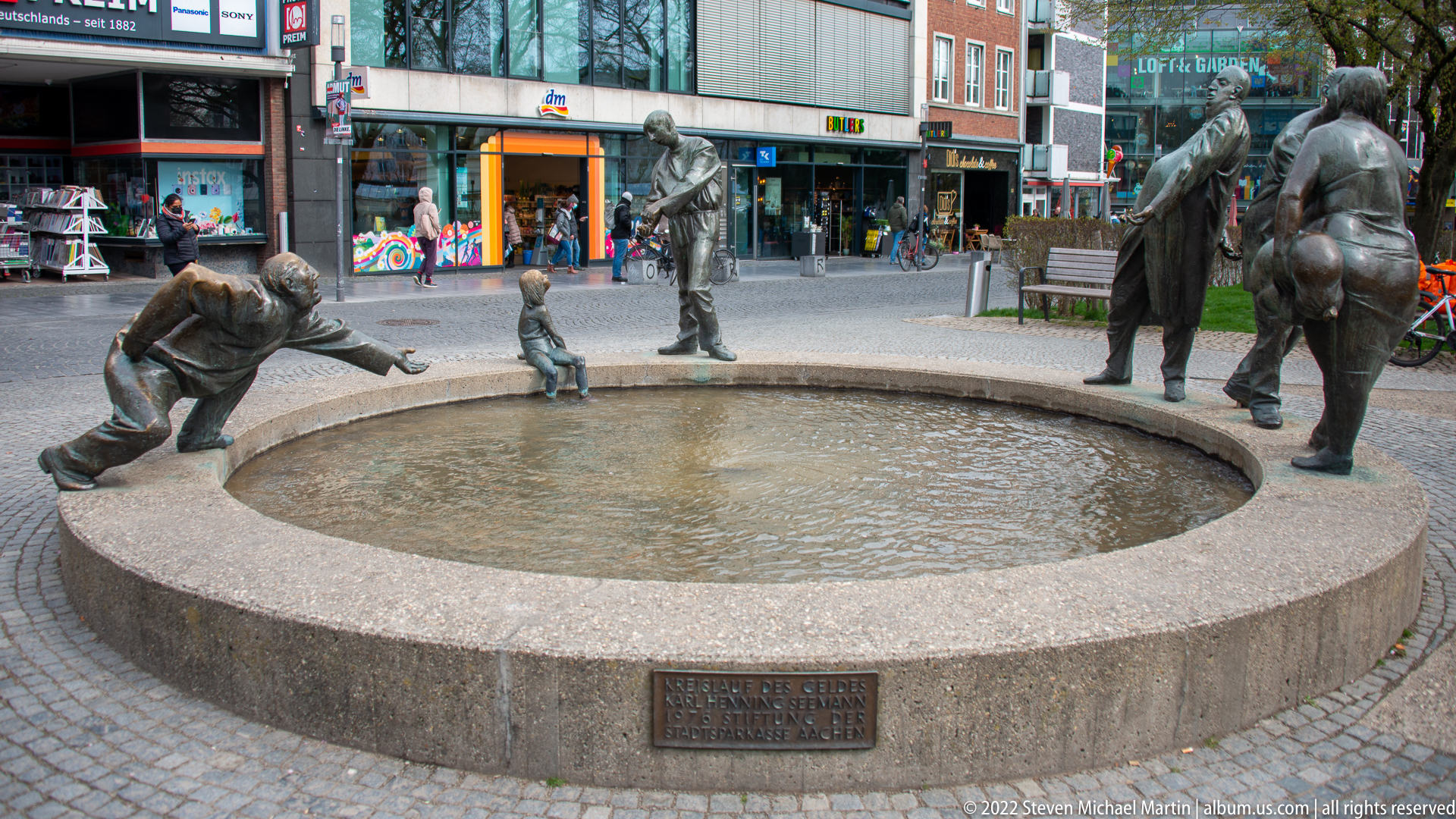
A circular stone basin anchors a lively public fountain whose bronze figures lean, stand, and sit around the rim. The deliberately informal poses and varied ages create the sense of a social scene unfolding around water, making the fountain an interactive focal point in Aachen's pedestrian center.
Caption
A circular stone basin anchors a lively public fountain whose bronze figures lean, stand, and sit around the rim. The deliberately informal poses and varied ages create the sense of a social scene unfolding around water, making the fountain an interactive focal point in Aachen's pedestrian center.
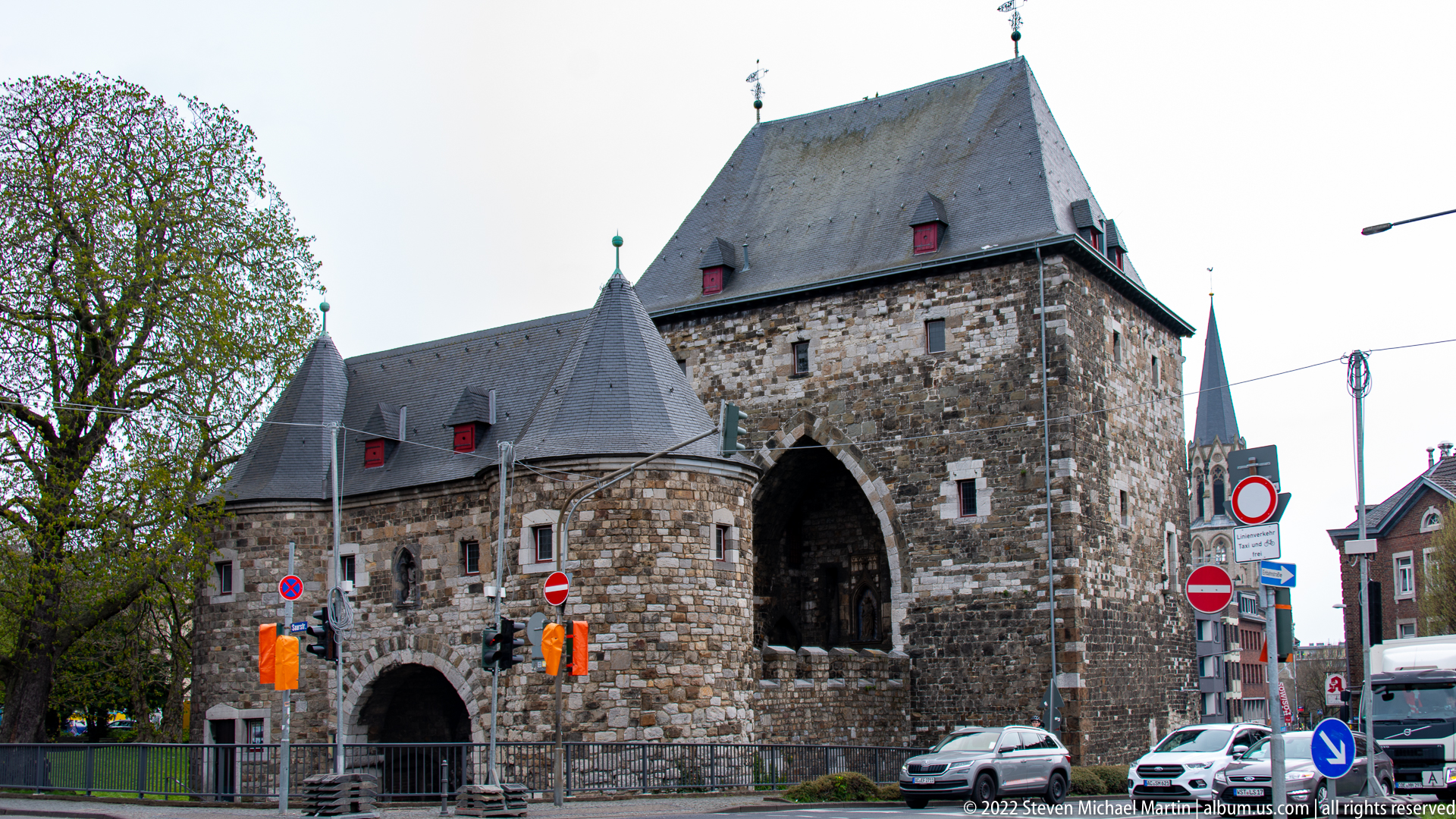
A broad medieval gatehouse stands beside modern traffic, its thick stone walls, steep slate roof, pointed central passage, and small flanking openings preserving the monumental scale of Aachen's former urban defenses. Contemporary road signs and vehicles underscore the gate's survival within the present-day street network.
Caption
A broad medieval gatehouse stands beside modern traffic, its thick stone walls, steep slate roof, pointed central passage, and small flanking openings preserving the monumental scale of Aachen's former urban defenses. Contemporary road signs and vehicles underscore the gate's survival within the present-day street network.
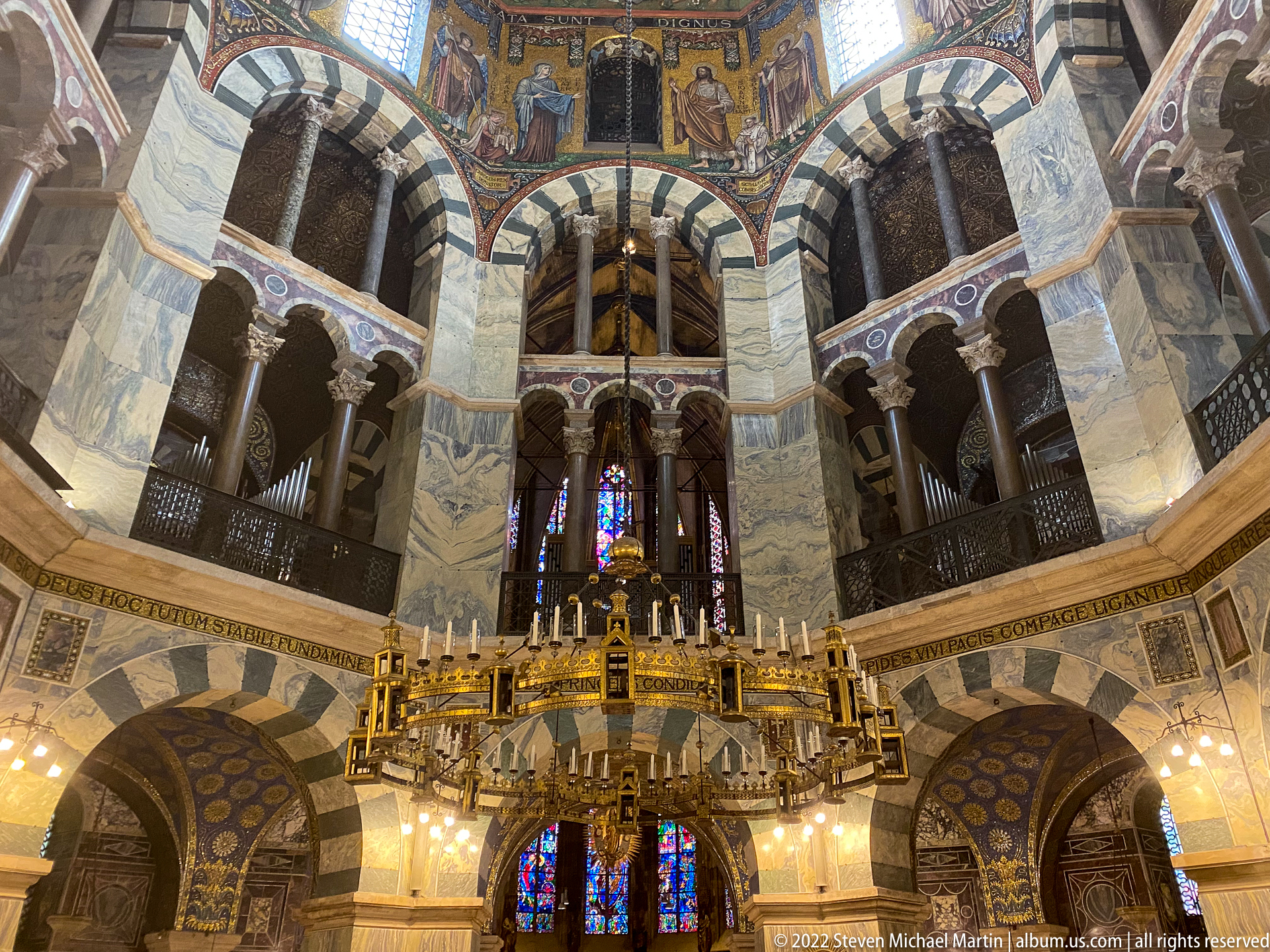
Inside Aachen Cathedral's Carolingian Octagon, alternating dark-and-light arches rise toward the mosaic-covered upper zone while the great circular Barbarossa Chandelier hangs across the central space. Galleries, marble revetment, and richly patterned vault surfaces turn the view upward through the layered geometry of the Palatine Chapel.
Caption
Inside Aachen Cathedral's Carolingian Octagon, alternating dark-and-light arches rise toward the mosaic-covered upper zone while the great circular Barbarossa Chandelier hangs across the central space. Galleries, marble revetment, and richly patterned vault surfaces turn the view upward through the layered geometry of the Palatine Chapel.
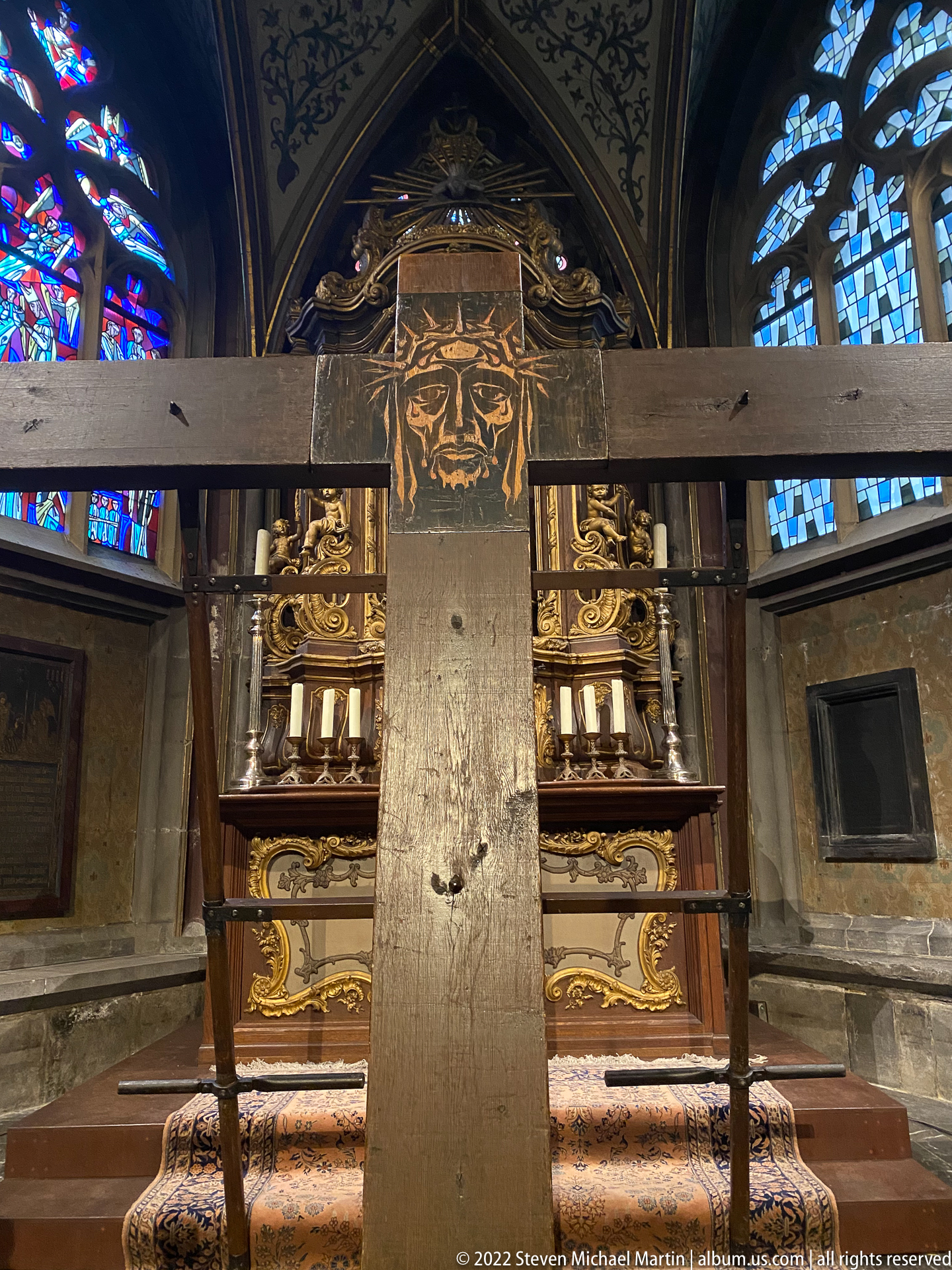
The Throne of Charlemagne stands on a raised platform behind a simple barrier, its severe slab construction contrasting with the gilded and patterned cathedral furnishings behind it. The unadorned form is striking within the richly decorated interior and reflects the ceremonial importance attached to the throne in Aachen's imperial tradition.
Caption
The Throne of Charlemagne stands on a raised platform behind a simple barrier, its severe slab construction contrasting with the gilded and patterned cathedral furnishings behind it. The unadorned form is striking within the richly decorated interior and reflects the ceremonial importance attached to the throne in Aachen's imperial tradition.
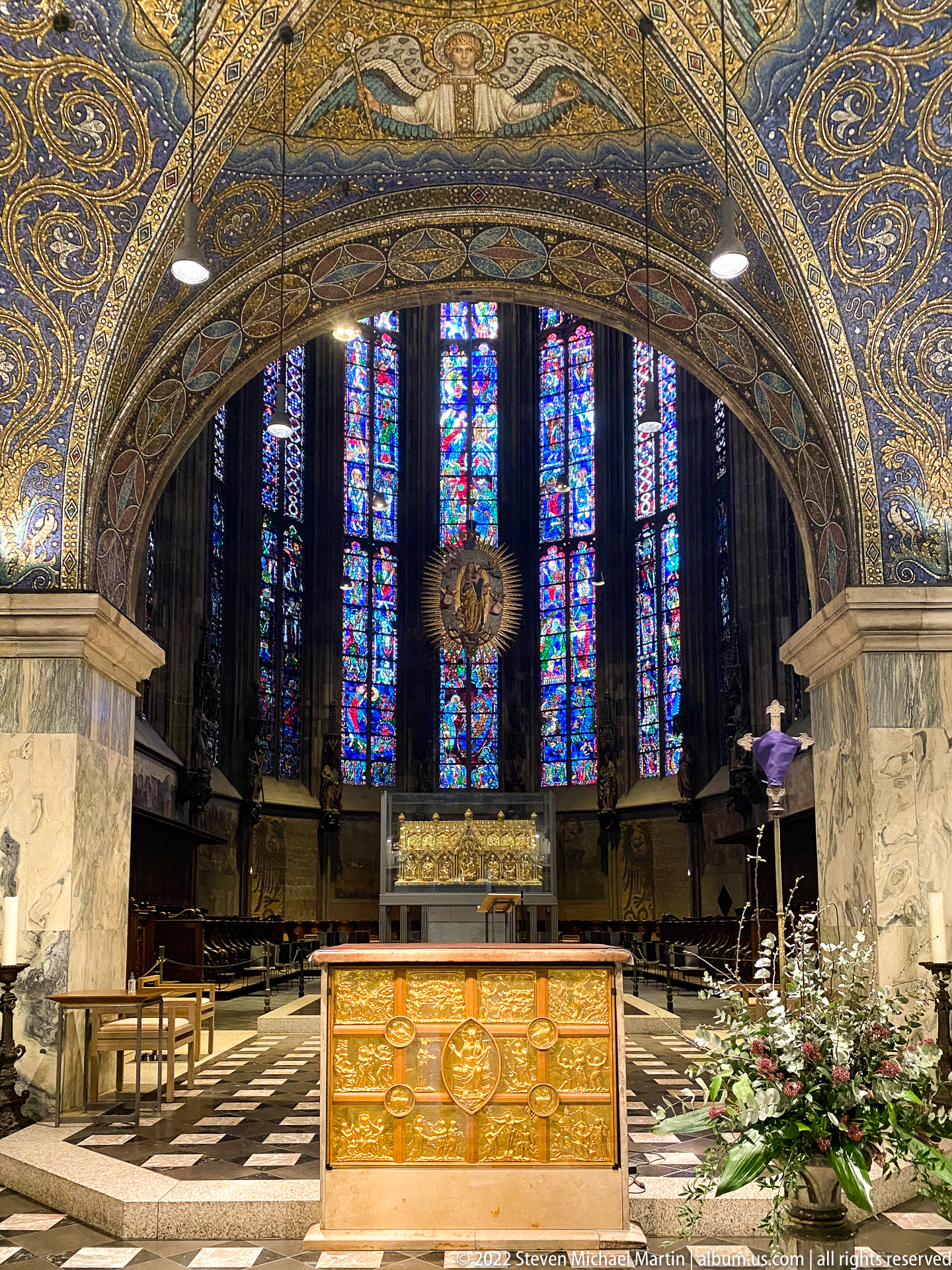
A richly decorated altar stands before a wall of tall stained-glass windows, framed by a broad arch covered with gilded mosaic ornament. Marble piers, patterned flooring, flowers, and dark choir furnishings create a layered sacred interior in which modern color and historic architectural surfaces meet.
Caption
A richly decorated altar stands before a wall of tall stained-glass windows, framed by a broad arch covered with gilded mosaic ornament. Marble piers, patterned flooring, flowers, and dark choir furnishings create a layered sacred interior in which modern color and historic architectural surfaces meet.
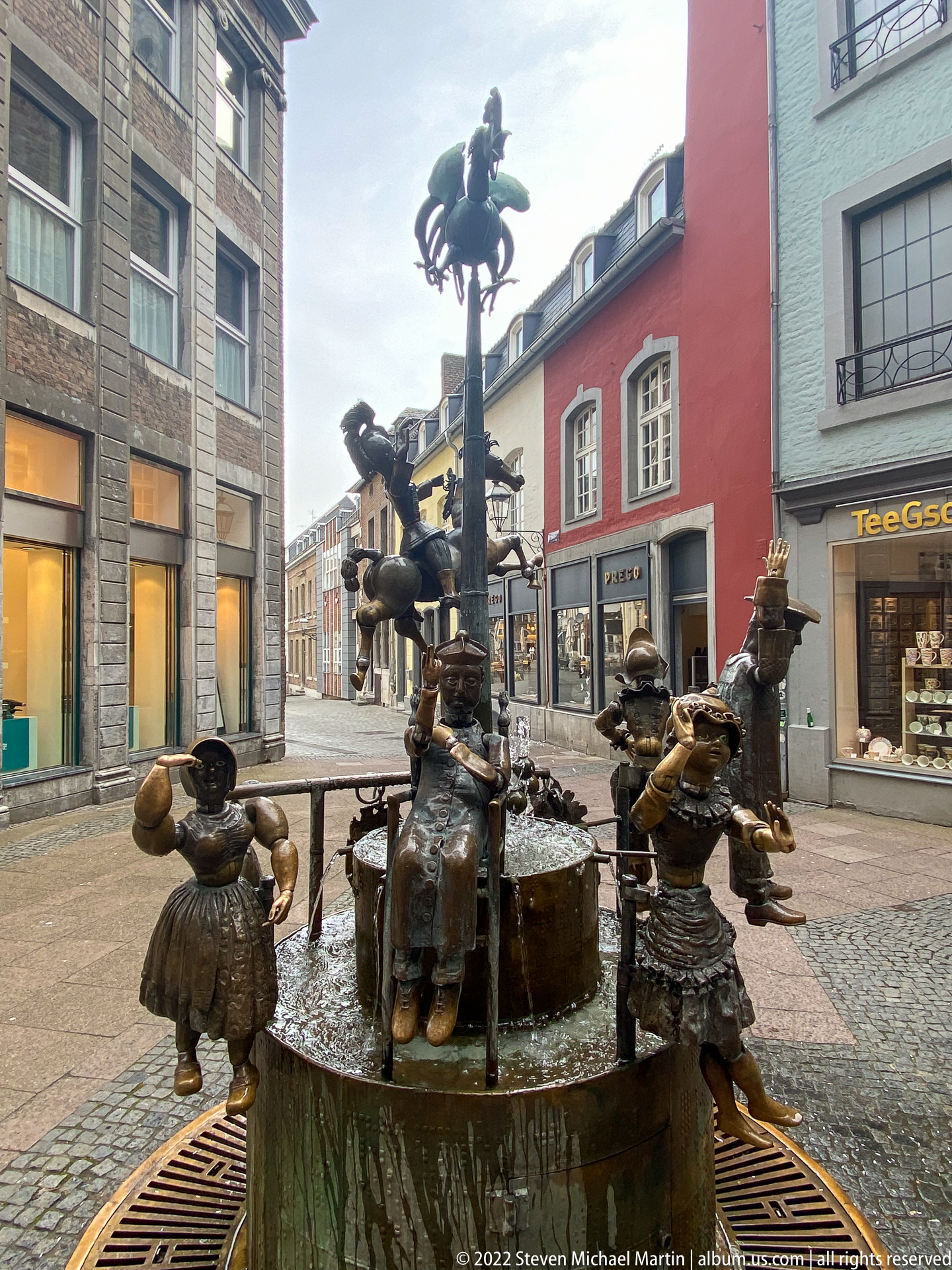
The Puppenbrunnen animates an Aachen pedestrian street with a cluster of bronze figures arranged around a circular fountain. Stylized children, adults, and costumed characters turn in different directions, giving the composition the playful, theatrical quality for which this interactive city fountain is known.
Caption
The Puppenbrunnen animates an Aachen pedestrian street with a cluster of bronze figures arranged around a circular fountain. Stylized children, adults, and costumed characters turn in different directions, giving the composition the playful, theatrical quality for which this interactive city fountain is known.
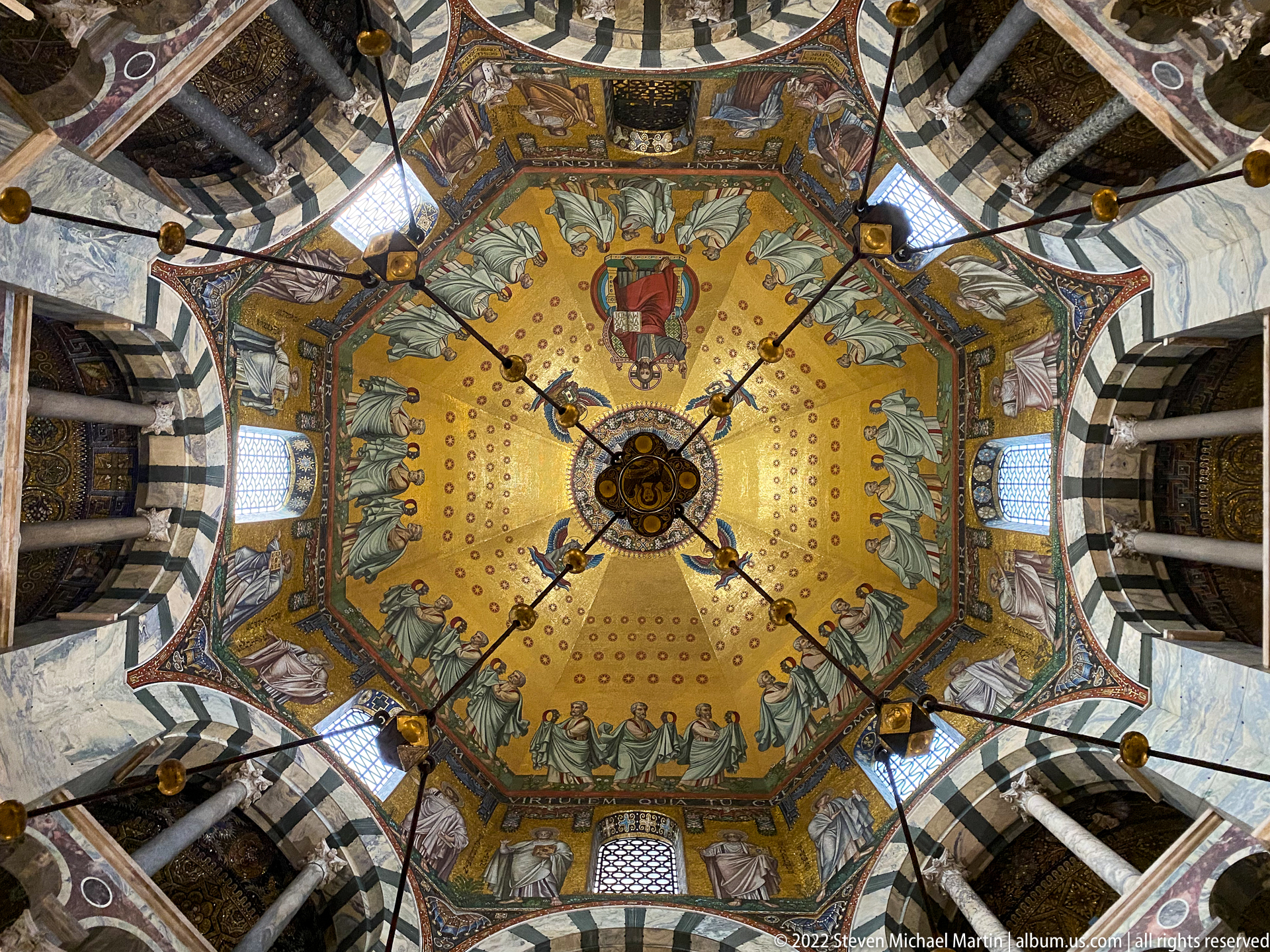
Looking straight upward into Aachen Cathedral's Octagon, a golden mosaic field radiates around the central chandelier suspension. Rows of enthroned and standing sacred figures encircle the dome, while alternating stone arches and gallery openings frame the octagonal geometry below.
Caption
Looking straight upward into Aachen Cathedral's Octagon, a golden mosaic field radiates around the central chandelier suspension. Rows of enthroned and standing sacred figures encircle the dome, while alternating stone arches and gallery openings frame the octagonal geometry below.

A wider upward perspective reveals the full spatial organization of Aachen Cathedral's Octagon: the golden mosaic cupola at center, arcaded galleries around the perimeter, striped arches, columns, and the great circular chandelier suspended below. The nearly symmetrical composition makes the Palatine Chapel's centralized geometry especially clear.
Caption
A wider upward perspective reveals the full spatial organization of Aachen Cathedral's Octagon: the golden mosaic cupola at center, arcaded galleries around the perimeter, striped arches, columns, and the great circular chandelier suspended below. The nearly symmetrical composition makes the Palatine Chapel's centralized geometry especially clear.
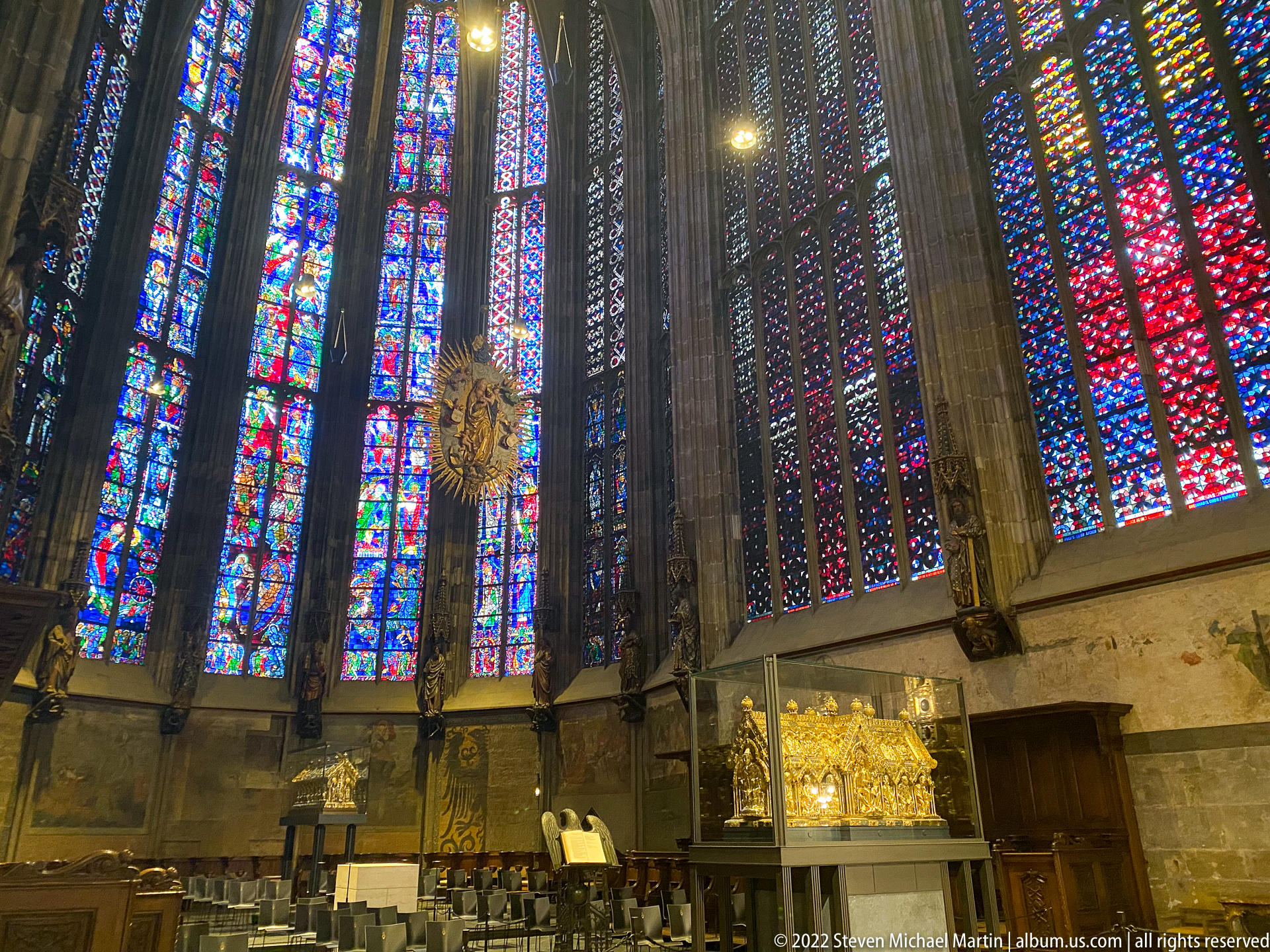
Tall stained-glass windows rise behind the choir furnishings of Aachen Cathedral, filling the vertical space with saturated color. At lower right, a gilded medieval shrine is displayed beneath the windows, while dark stone piers and tracery emphasize the Gothic height and ceremonial character of the choir.
Caption
Tall stained-glass windows rise behind the choir furnishings of Aachen Cathedral, filling the vertical space with saturated color. At lower right, a gilded medieval shrine is displayed beneath the windows, while dark stone piers and tracery emphasize the Gothic height and ceremonial character of the choir.
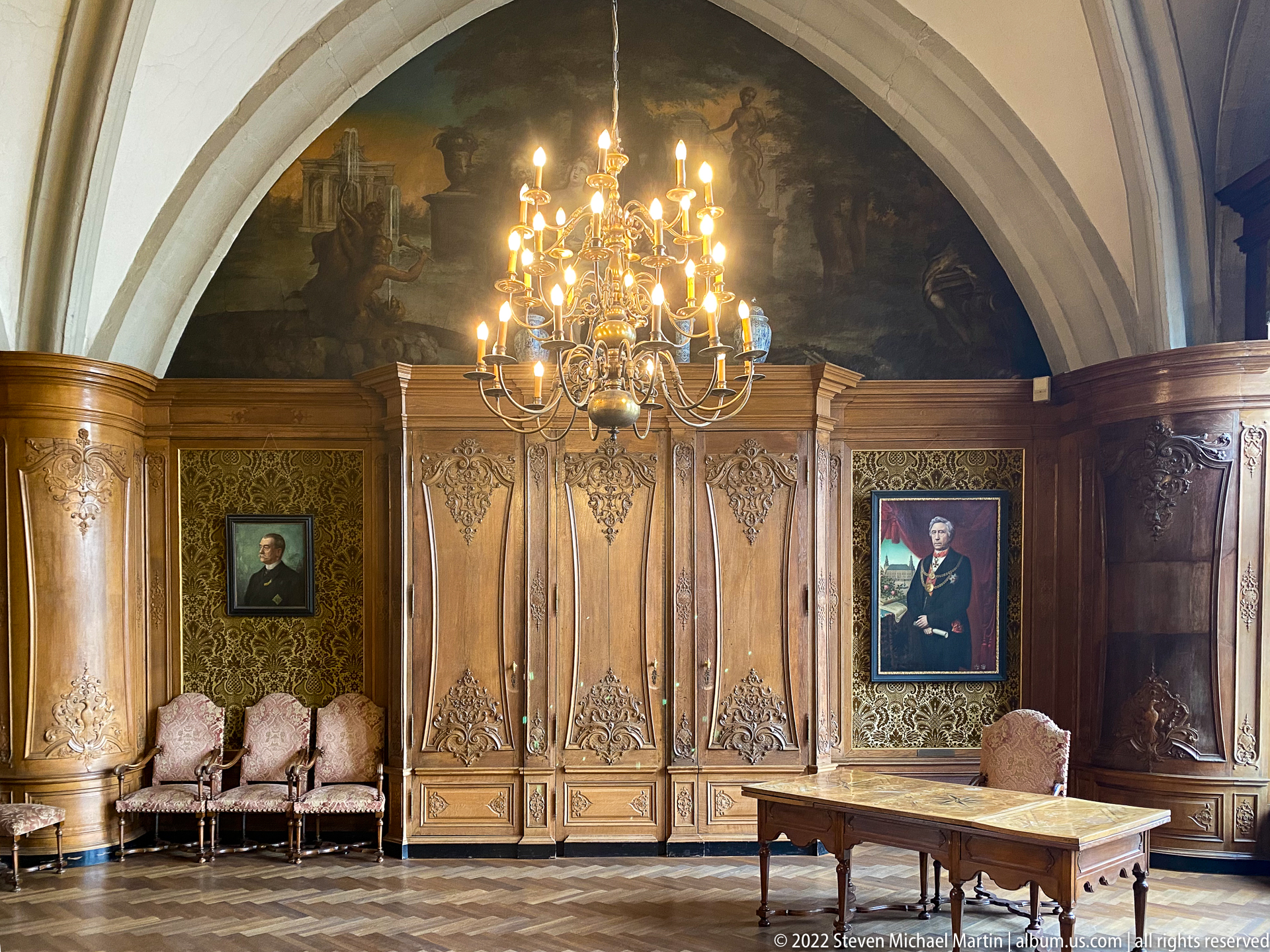
A tall crystal chandelier hangs beneath a painted vaulted ceiling in a historic paneled room, where carved wooden wall sections frame formal portraits. A writing table and upholstered chairs preserve the room's ceremonial character, while the warm woodwork contrasts with the darker mural above.
Caption
A tall crystal chandelier hangs beneath a painted vaulted ceiling in a historic paneled room, where carved wooden wall sections frame formal portraits. A writing table and upholstered chairs preserve the room's ceremonial character, while the warm woodwork contrasts with the darker mural above.
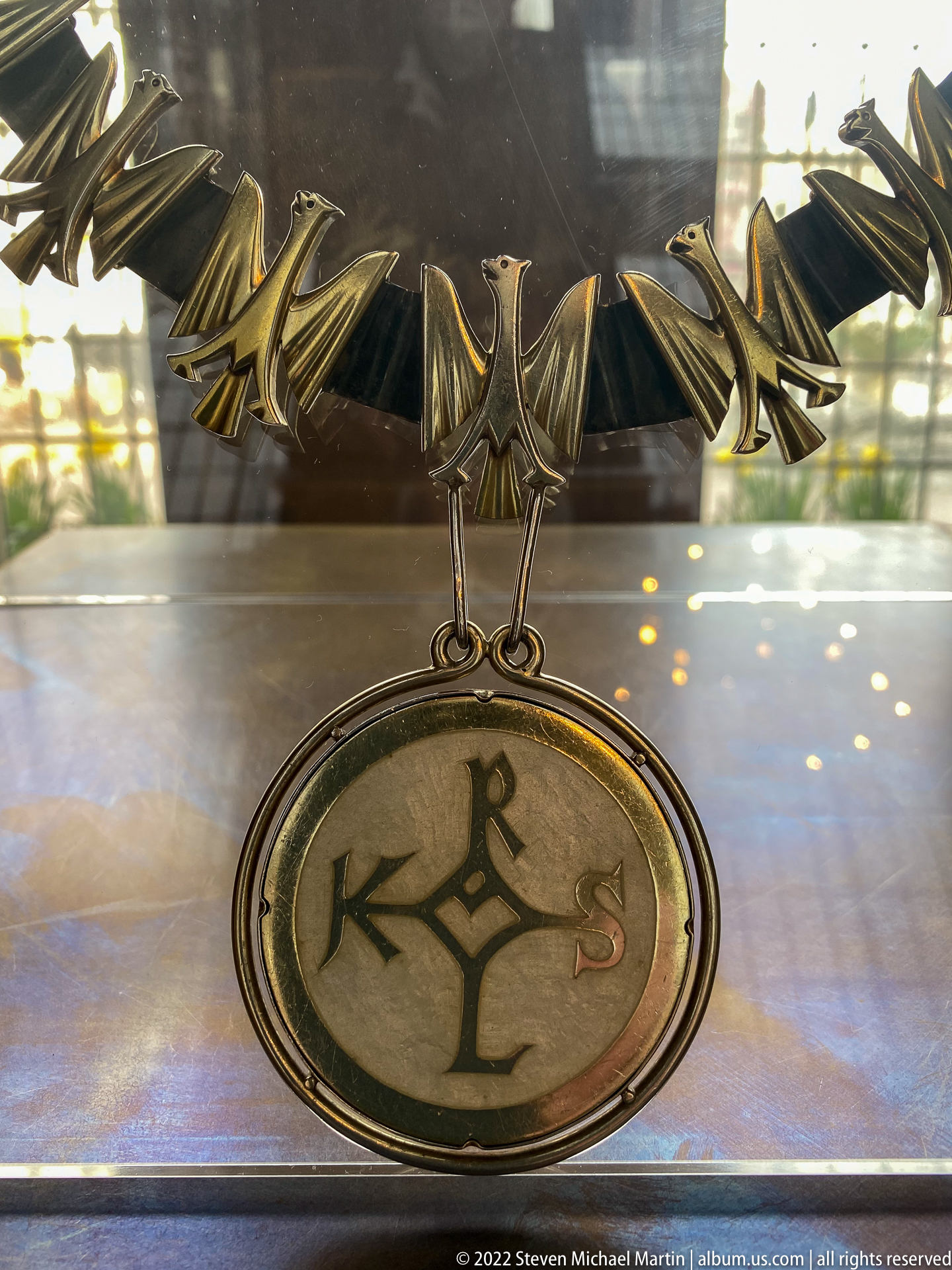
A metal emblem combines a stylized eagle with a suspended circular medallion bearing Charlemagne's distinctive monogram. The intertwined letters form the ruler's signum, a compact graphic associated with Carolingian authority and with Aachen's enduring presentation of Charlemagne as a central figure in the city's history.
Caption
A metal emblem combines a stylized eagle with a suspended circular medallion bearing Charlemagne's distinctive monogram. The intertwined letters form the ruler's signum, a compact graphic associated with Carolingian authority and with Aachen's enduring presentation of Charlemagne as a central figure in the city's history.
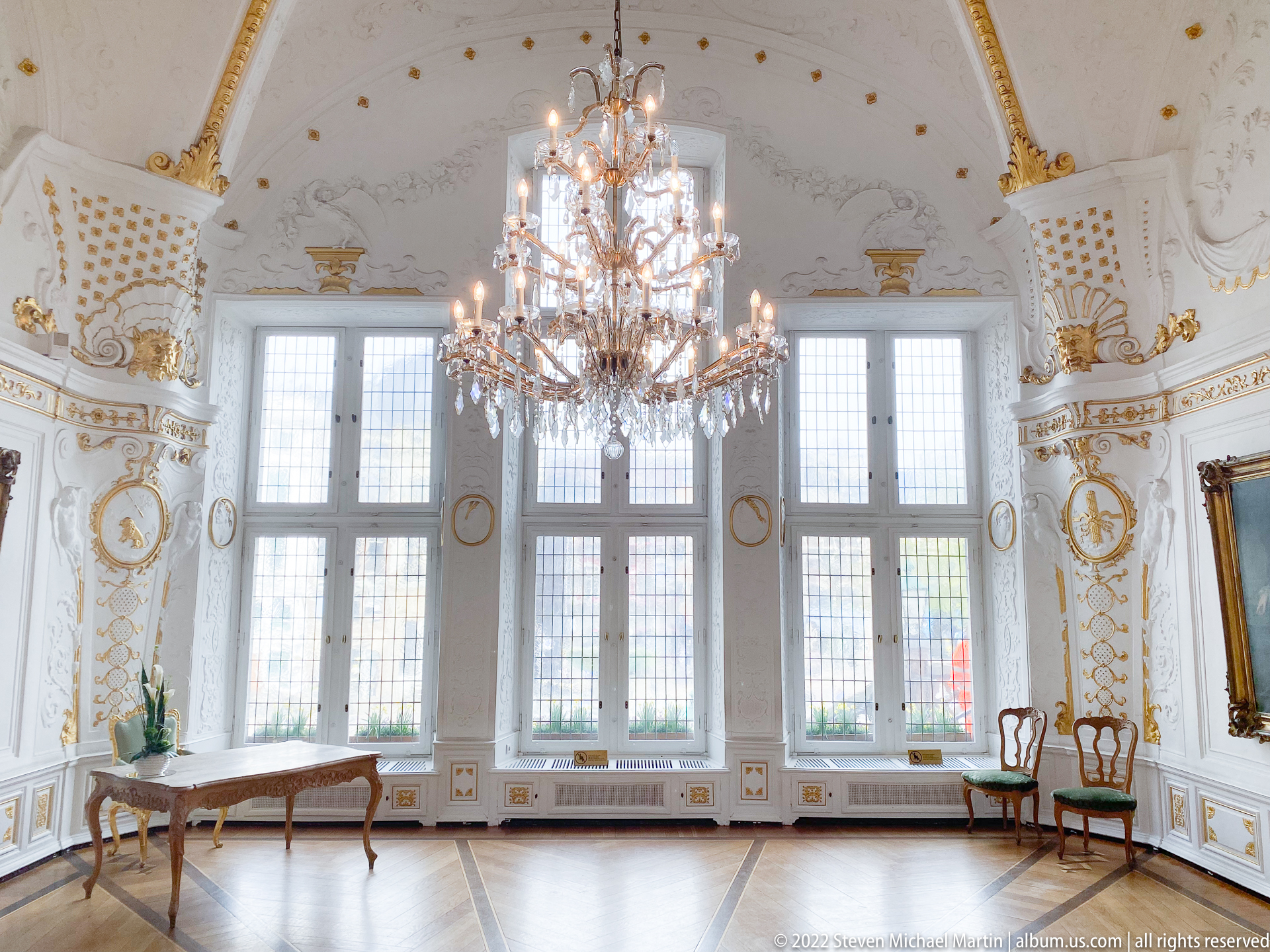
A luminous white-and-gold room is organized around a large crystal chandelier and a bank of tall windows. Gilded stucco scrollwork, delicate wall reliefs, parquet flooring, and light period furniture create an airy Rococo interior in which ornament is concentrated along the walls and ceiling rather than in heavy furnishings.
Caption
A luminous white-and-gold room is organized around a large crystal chandelier and a bank of tall windows. Gilded stucco scrollwork, delicate wall reliefs, parquet flooring, and light period furniture create an airy Rococo interior in which ornament is concentrated along the walls and ceiling rather than in heavy furnishings.
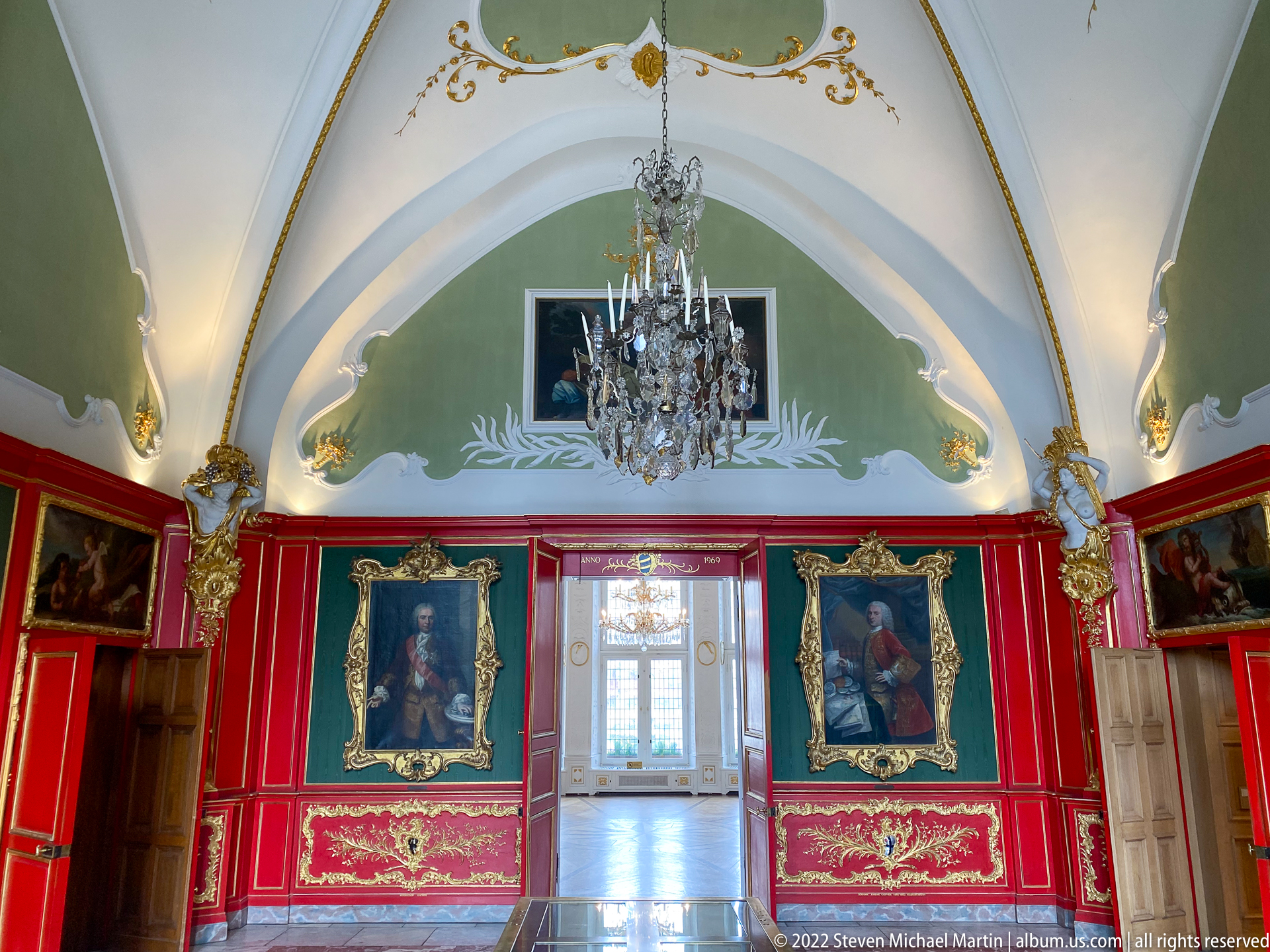
A richly colored historic room combines deep red wall paneling, green upper fields, gilded ornament, and framed portraits beneath a pale vaulted ceiling. A crystal chandelier hangs on the central axis, while an open doorway reveals a brighter adjoining room and extends the sequence of elaborately decorated interiors.
Caption
A richly colored historic room combines deep red wall paneling, green upper fields, gilded ornament, and framed portraits beneath a pale vaulted ceiling. A crystal chandelier hangs on the central axis, while an open doorway reveals a brighter adjoining room and extends the sequence of elaborately decorated interiors.