Lindos
Lindos is known for its dramatic setting between whitewashed houses and the fortified acropolis rising above the Aegean Sea. Narrow streets lead upward through the village toward ancient remains that reflect the long continuity of settlement on the island of Rhodes. The combination of traditional architecture and classical ruins creates a distinctive visual contrast between different historical periods.
The Acropolis of Lindos includes the Temple of Athena Lindia along with later defensive structures added during the medieval period. Its elevated position provided both strategic advantages and expansive views across the surrounding coastline. The site demonstrates how geography influenced the placement of religious sanctuaries and fortified communities.
Lindos illustrates the layered history of Rhodes, where ancient Greek, Byzantine, and medieval influences coexist within a compact setting. The integration of architecture and landscape contributes to the enduring appeal of the site as both a historical and visual landmark.

From a distant hillside, Lindos appears as a white cluster around the foot of its fortified acropolis, with a sheltered blue bay curving into the coast at left. Trees and a winding road occupy the foreground, while the open Aegean stretches behind the rocky headland. The elevated perspective shows how the settlement and acropolis command both landward approaches and the nearby coast.
Caption
From a distant hillside, Lindos appears as a white cluster around the foot of its fortified acropolis, with a sheltered blue bay curving into the coast at left. Trees and a winding road occupy the foreground, while the open Aegean stretches behind the rocky headland. The elevated perspective shows how the settlement and acropolis command both landward approaches and the nearby coast.

A crenellated stone wall stretches across the summit of the Lindos Acropolis, with the Aegean Sea and mountainous coastline visible beyond. Visitors crossing the rocky archaeological surface emphasize the scale of the enclosure. The composition shows how the fortified acropolis commands both the settlement below and the maritime approaches around southeastern Rhodes.
Caption
A crenellated stone wall stretches across the summit of the Lindos Acropolis, with the Aegean Sea and mountainous coastline visible beyond. Visitors crossing the rocky archaeological surface emphasize the scale of the enclosure. The composition shows how the fortified acropolis commands both the settlement below and the maritime approaches around southeastern Rhodes.

Two visitors ride donkeys up the steep stone-paved approach beneath the fortification walls of the Lindos Acropolis. Saddles, bridles and handlers’ equipment are visible at close range, documenting the traditional animal transport still used on the ascent. The ancient and medieval stonework above contrasts with the active visitor route in the foreground.
Caption
Two visitors ride donkeys up the steep stone-paved approach beneath the fortification walls of the Lindos Acropolis. Saddles, bridles and handlers’ equipment are visible at close range, documenting the traditional animal transport still used on the ascent. The ancient and medieval stonework above contrasts with the active visitor route in the foreground.

Seen from below, the upper fortifications of the Lindos Acropolis rise in a series of massive stone walls, towers and crenellated parapets above the entrance approach. The steep perspective makes the defensive layering particularly clear, while restoration scaffolding on one section records ongoing conservation of the masonry.
Caption
Seen from below, the upper fortifications of the Lindos Acropolis rise in a series of massive stone walls, towers and crenellated parapets above the entrance approach. The steep perspective makes the defensive layering particularly clear, while restoration scaffolding on one section records ongoing conservation of the masonry.

A black-and-white reconstruction model presents the Lindos Acropolis as a sequence of terraces, colonnades, stairways and fortified walls fitted tightly to the rocky summit. The elevated oblique view clarifies how the sanctuary architecture was organized within later defenses and how the monumental approach climbed through successive levels.
Caption
A black-and-white reconstruction model presents the Lindos Acropolis as a sequence of terraces, colonnades, stairways and fortified walls fitted tightly to the rocky summit. The elevated oblique view clarifies how the sanctuary architecture was organized within later defenses and how the monumental approach climbed through successive levels.

The fortified Lindos Acropolis crowns its steep rocky hill above the densely clustered whitewashed village, with the Aegean Sea extending across the horizon behind. The distant viewpoint unifies the principal elements of the landscape—fortress, archaeological summit, settlement and coast—into a final establishing view of Lindos and its dramatic topography.
Caption
The fortified Lindos Acropolis crowns its steep rocky hill above the densely clustered whitewashed village, with the Aegean Sea extending across the horizon behind. The distant viewpoint unifies the principal elements of the landscape—fortress, archaeological summit, settlement and coast—into a final establishing view of Lindos and its dramatic topography.

A broad view places the dense whitewashed village of Lindos beneath the fortified acropolis and its steep rocky summit. Red and gray roofs punctuate the tightly packed settlement, while pines climb the lower slopes of the hill. The sea forms a blue backdrop behind the acropolis, creating a clear overview of the village’s dramatic setting between coastal landscape and ancient stronghold.
Caption
A broad view places the dense whitewashed village of Lindos beneath the fortified acropolis and its steep rocky summit. Red and gray roofs punctuate the tightly packed settlement, while pines climb the lower slopes of the hill. The sea forms a blue backdrop behind the acropolis, creating a clear overview of the village’s dramatic setting between coastal landscape and ancient stronghold.

A wide hillside panorama combines Lindos’s coastal setting with the distant acropolis, which rises above the white village near the center-right. A sheltered bay lies to the left, while rocky uplands and scattered vegetation occupy the foreground. The scene gives geographic context to the acropolis by showing its position among multiple inlets, dry limestone ridges, and the surrounding Aegean coast.
Caption
A wide hillside panorama combines Lindos’s coastal setting with the distant acropolis, which rises above the white village near the center-right. A sheltered bay lies to the left, while rocky uplands and scattered vegetation occupy the foreground. The scene gives geographic context to the acropolis by showing its position among multiple inlets, dry limestone ridges, and the surrounding Aegean coast.

Massive medieval masonry dominates this interior view of the Lindos Acropolis, where a tall wall and projecting tower rise behind lower stone defenses. Crenellations and heavy squared blocks emphasize the fortress character of the later occupation, while a band of bright sky isolates the angular silhouette of the walls.
Caption
Massive medieval masonry dominates this interior view of the Lindos Acropolis, where a tall wall and projecting tower rise behind lower stone defenses. Crenellations and heavy squared blocks emphasize the fortress character of the later occupation, while a band of bright sky isolates the angular silhouette of the walls.

The interior of the Lindos Acropolis opens across uneven bedrock, cut foundations and masonry terraces, enclosed by the long crenellated wall. Standing columns and an arched passage appear to the right as visitors move through the archaeological complex. The wide view emphasizes the layered arrangement of monuments and defenses across the constrained rocky summit.
Caption
The interior of the Lindos Acropolis opens across uneven bedrock, cut foundations and masonry terraces, enclosed by the long crenellated wall. Standing columns and an arched passage appear to the right as visitors move through the archaeological complex. The wide view emphasizes the layered arrangement of monuments and defenses across the constrained rocky summit.

Whitewashed houses of Lindos descend through the foreground while the fortified acropolis crowns the steep rocky hill above. The view establishes the close relationship between the compact village, the dry limestone terrain, and the sea beyond. Defensive walls trace the summit, while paths and clustered roofs reveal how the modern settlement occupies the lower slopes around the ancient stronghold.
Caption
Whitewashed houses of Lindos descend through the foreground while the fortified acropolis crowns the steep rocky hill above. The view establishes the close relationship between the compact village, the dry limestone terrain, and the sea beyond. Defensive walls trace the summit, while paths and clustered roofs reveal how the modern settlement occupies the lower slopes around the ancient stronghold.

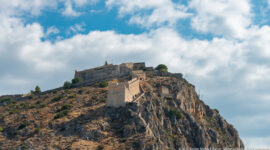
The acropolis of Lindos rises abruptly from the dry hillside, its masonry defenses following the irregular edge of the limestone summit. Sparse pines and scrub occupy the lower slope, emphasizing the height and exposed position of the fortified rock. The photograph focuses on the outer defensive enclosure rather than the monuments within, showing how strongly the site’s topography shaped its military character.
Caption
The acropolis of Lindos rises abruptly from the dry hillside, its masonry defenses following the irregular edge of the limestone summit. Sparse pines and scrub occupy the lower slope, emphasizing the height and exposed position of the fortified rock. The photograph focuses on the outer defensive enclosure rather than the monuments within, showing how strongly the site’s topography shaped its military character.

A rugged coastal slope drops from the edge of Lindos toward the deep blue Aegean, with white houses tucked into the rocky terrain at left. The acropolis itself is mostly outside the frame, shifting attention to the natural landscape surrounding the settlement. Bare limestone, sparse vegetation, and scattered buildings show the dramatic transition from village fabric to exposed coastal rock.
Caption
A rugged coastal slope drops from the edge of Lindos toward the deep blue Aegean, with white houses tucked into the rocky terrain at left. The acropolis itself is mostly outside the frame, shifting attention to the natural landscape surrounding the settlement. Bare limestone, sparse vegetation, and scattered buildings show the dramatic transition from village fabric to exposed coastal rock.

Layered limestone dominates this close view of the hillside above Lindos, where pale rock strata form a broad natural pattern across the dry slope. Whitewashed buildings at the bottom of the frame provide scale and connect the geology to the village setting. The image records the exposed, sparsely vegetated terrain that surrounds the acropolis and shapes the visual character of Lindos.
Caption
Layered limestone dominates this close view of the hillside above Lindos, where pale rock strata form a broad natural pattern across the dry slope. Whitewashed buildings at the bottom of the frame provide scale and connect the geology to the village setting. The image records the exposed, sparsely vegetated terrain that surrounds the acropolis and shapes the visual character of Lindos.

The fortified crown of Lindos Acropolis fills the upper half of the composition, rising over a foreground band of white village rooftops. Masonry walls follow the summit edge of the rocky hill, with dark pines clustered across the lower slope. By compressing village and acropolis into the same frame, the photograph emphasizes the vertical separation between the inhabited town and the ancient fortified height.
Caption
The fortified crown of Lindos Acropolis fills the upper half of the composition, rising over a foreground band of white village rooftops. Masonry walls follow the summit edge of the rocky hill, with dark pines clustered across the lower slope. By compressing village and acropolis into the same frame, the photograph emphasizes the vertical separation between the inhabited town and the ancient fortified height.

A sheltered turquoise bay near Lindos holds several anchored sailboats beneath dry, rocky headlands. Low white buildings cling to the far shore, while darker vegetation frames the foreground. The photograph centers on the protected coastal water and its enclosed natural form, contrasting the bright Aegean surface with the pale limestone terrain typical of the Lindos landscape.
Caption
A sheltered turquoise bay near Lindos holds several anchored sailboats beneath dry, rocky headlands. Low white buildings cling to the far shore, while darker vegetation frames the foreground. The photograph centers on the protected coastal water and its enclosed natural form, contrasting the bright Aegean surface with the pale limestone terrain typical of the Lindos landscape.

Dry limestone terraces and stony ground dominate the foreground, leading the eye toward Lindos in the middle distance. The white village gathers below the fortified acropolis, with blue coastal water wrapping around the settlement. This long view emphasizes the austere terrain surrounding Lindos and the acropolis’s conspicuous position above both the town and nearby inlets.
Caption
Dry limestone terraces and stony ground dominate the foreground, leading the eye toward Lindos in the middle distance. The white village gathers below the fortified acropolis, with blue coastal water wrapping around the settlement. This long view emphasizes the austere terrain surrounding Lindos and the acropolis’s conspicuous position above both the town and nearby inlets.

A dry valley outside Lindos opens toward the sea, with olive trees and scattered buildings occupying the lower ground. Pale limestone slopes rise on both sides, and hazy mountain forms line the distant coast across the water. The composition turns away from the acropolis to document the agricultural and rocky hinterland that surrounds the settlement.
Caption
A dry valley outside Lindos opens toward the sea, with olive trees and scattered buildings occupying the lower ground. Pale limestone slopes rise on both sides, and hazy mountain forms line the distant coast across the water. The composition turns away from the acropolis to document the agricultural and rocky hinterland that surrounds the settlement.

A small whitewashed house sits directly against the rocky hillside of Lindos, its low gabled roof and timber doors shaded by slender trees. Rough stone at the base contrasts with the smooth white walls, while the cliff rises immediately behind. The intimate street-side view records the compact vernacular architecture that characterizes the settlement beyond its monumental acropolis.
Caption
A small whitewashed house sits directly against the rocky hillside of Lindos, its low gabled roof and timber doors shaded by slender trees. Rough stone at the base contrasts with the smooth white walls, while the cliff rises immediately behind. The intimate street-side view records the compact vernacular architecture that characterizes the settlement beyond its monumental acropolis.

Two visitors ride saddled donkeys along a narrow lane in Lindos while pedestrians move around them. Whitewashed walls, shopfronts, and shaded pavement define the compact village street. The image documents the continued use of donkeys to carry visitors through terrain where narrow pedestrian routes and steep grades limit conventional vehicle access.
Caption
Two visitors ride saddled donkeys along a narrow lane in Lindos while pedestrians move around them. Whitewashed walls, shopfronts, and shaded pavement define the compact village street. The image documents the continued use of donkeys to carry visitors through terrain where narrow pedestrian routes and steep grades limit conventional vehicle access.

A harnessed donkey stands in close profile on a paved street in Lindos, its bridle, straps, and lead clearly visible. Donkeys are part of the pedestrian-scale transport system encountered in the steep, narrow lanes of the settlement. The tight framing focuses on the animal and its working tack rather than the surrounding town, preserving a direct record of local transport activity.
Caption
A harnessed donkey stands in close profile on a paved street in Lindos, its bridle, straps, and lead clearly visible. Donkeys are part of the pedestrian-scale transport system encountered in the steep, narrow lanes of the settlement. The tight framing focuses on the animal and its working tack rather than the surrounding town, preserving a direct record of local transport activity.

A tall stone bell tower rises sharply against the blue sky, its stacked arched openings containing bells at several levels. Molded cornices and carved stonework articulate the narrow vertical structure, which is viewed from below to emphasize its height. The tower belongs to the ecclesiastical architecture of Lindos and provides a distinctive landmark within the otherwise low-rise whitewashed village.
Caption
A tall stone bell tower rises sharply against the blue sky, its stacked arched openings containing bells at several levels. Molded cornices and carved stonework articulate the narrow vertical structure, which is viewed from below to emphasize its height. The tower belongs to the ecclesiastical architecture of Lindos and provides a distinctive landmark within the otherwise low-rise whitewashed village.

An upward-looking composition isolates the warm stone masonry of a church in Lindos against an uninterrupted blue sky. Arched architectural detailing and projecting cornices run along the façade and tower, while a small cross appears beyond the roofline below. The oblique viewpoint emphasizes texture, height, and crafted stonework rather than presenting a conventional frontal view of the building.
Caption
An upward-looking composition isolates the warm stone masonry of a church in Lindos against an uninterrupted blue sky. Arched architectural detailing and projecting cornices run along the façade and tower, while a small cross appears beyond the roofline below. The oblique viewpoint emphasizes texture, height, and crafted stonework rather than presenting a conventional frontal view of the building.

A narrow lane threads through the village of Lindos between a rough-cut stone building and whitewashed shops. Merchandise displays, signs, and pedestrians mark the route as an active commercial passage rather than a purely residential alley. Strong sunlight at the far end contrasts with the shaded foreground, emphasizing the compressed scale and irregular geometry of the historic street network.
Caption
A narrow lane threads through the village of Lindos between a rough-cut stone building and whitewashed shops. Merchandise displays, signs, and pedestrians mark the route as an active commercial passage rather than a purely residential alley. Strong sunlight at the far end contrasts with the shaded foreground, emphasizing the compressed scale and irregular geometry of the historic street network.

A compact whitewashed structure with a rounded roof rises among the tightly packed roofs of Lindos. Its simple plastered surfaces and small rectangular opening contrast with the rougher roof edges and neighboring buildings around it. The close view highlights the sculptural forms created by vernacular masonry and limewash in the village’s dense built fabric.
Caption
A compact whitewashed structure with a rounded roof rises among the tightly packed roofs of Lindos. Its simple plastered surfaces and small rectangular opening contrast with the rougher roof edges and neighboring buildings around it. The close view highlights the sculptural forms created by vernacular masonry and limewash in the village’s dense built fabric.

A dark wooden double door sits within a broad stone arch, reached by steps decorated with black-and-white pebble mosaic. Smooth whitewashed walls frame the entrance, creating a strong contrast between plaster, warm stone, and dark timber. The careful treatment of threshold and stair makes this a characteristic example of the decorative domestic entrances found along Lindos’s pedestrian lanes.
Caption
A dark wooden double door sits within a broad stone arch, reached by steps decorated with black-and-white pebble mosaic. Smooth whitewashed walls frame the entrance, creating a strong contrast between plaster, warm stone, and dark timber. The careful treatment of threshold and stair makes this a characteristic example of the decorative domestic entrances found along Lindos’s pedestrian lanes.

An elaborate pale-stone portal frames dark wooden double doors in Lindos, with carved pilasters, oval panels, a molded entablature, and a broken pediment-like crown. A flowering wreath and potted greenery soften the formal masonry. The entrance is unusually ornate compared with the village’s plain whitewashed walls, making the doorway itself the primary architectural subject.
Caption
An elaborate pale-stone portal frames dark wooden double doors in Lindos, with carved pilasters, oval panels, a molded entablature, and a broken pediment-like crown. A flowering wreath and potted greenery soften the formal masonry. The entrance is unusually ornate compared with the village’s plain whitewashed walls, making the doorway itself the primary architectural subject.

A saddled donkey stands in the foreground on the stone-paved approach to the Lindos Acropolis, with additional pack and riding animals waiting beneath shade canopies behind it. Colorful saddle blankets and harnesses provide a close view of the equipment used for visitor transport on the steep route between Lindos village and the acropolis.
Caption
A saddled donkey stands in the foreground on the stone-paved approach to the Lindos Acropolis, with additional pack and riding animals waiting beneath shade canopies behind it. Colorful saddle blankets and harnesses provide a close view of the equipment used for visitor transport on the steep route between Lindos village and the acropolis.

A compact utility truck nearly fills a narrow lane between whitewashed walls in Lindos, demonstrating the severe spatial limits of the village street network. The vehicle’s mirrors and body sit only inches from the surrounding masonry, while a pedestrian sign is visible farther along the passage. The scene contrasts modern service needs with the tight scale of an older pedestrian settlement.
Caption
A compact utility truck nearly fills a narrow lane between whitewashed walls in Lindos, demonstrating the severe spatial limits of the village street network. The vehicle’s mirrors and body sit only inches from the surrounding masonry, while a pedestrian sign is visible farther along the passage. The scene contrasts modern service needs with the tight scale of an older pedestrian settlement.

A dark red-brown double door is framed by ochre-painted pilasters and set into a whitewashed façade in Lindos. Large ceramic jars and potted plants flank the entrance, while a black-and-white pebble-mosaic threshold adds another layer of decoration. The carefully composed doorway shows how color, pottery, and patterned paving enliven otherwise restrained village façades.
Caption
A dark red-brown double door is framed by ochre-painted pilasters and set into a whitewashed façade in Lindos. Large ceramic jars and potted plants flank the entrance, while a black-and-white pebble-mosaic threshold adds another layer of decoration. The carefully composed doorway shows how color, pottery, and patterned paving enliven otherwise restrained village façades.

Whitewashed stone steps climb through a narrow Lindos passage, bordered by potted plants, rough rock, and a dark wooden door. A small cat rests on one of the lower treads, adding scale and a quiet domestic detail to the scene. The lane’s irregular stairs and planted edges illustrate how circulation adapts to the steep terrain within the village.
Caption
Whitewashed stone steps climb through a narrow Lindos passage, bordered by potted plants, rough rock, and a dark wooden door. A small cat rests on one of the lower treads, adding scale and a quiet domestic detail to the scene. The lane’s irregular stairs and planted edges illustrate how circulation adapts to the steep terrain within the village.

A small whitewashed chapel stands against the rocky Lindos landscape, its entrance block topped by a simple cross and joined to a higher rounded volume behind. The smooth plaster surfaces and restrained openings create a sculptural profile in the strong Mediterranean light. The composition shows the building in relation to the dry terrain beyond, emphasizing its compact scale and traditional ecclesiastical form.
Caption
A small whitewashed chapel stands against the rocky Lindos landscape, its entrance block topped by a simple cross and joined to a higher rounded volume behind. The smooth plaster surfaces and restrained openings create a sculptural profile in the strong Mediterranean light. The composition shows the building in relation to the dry terrain beyond, emphasizing its compact scale and traditional ecclesiastical form.

Warm late-day light strikes a compact whitewashed chapel in Lindos, revealing the rounded upper volume, sloping roof surfaces, and small arched recess on the side wall. A cross crowns the lower entrance façade, while dry hills and a glimpse of water appear beyond. The angled viewpoint gives a fuller sense of the chapel’s massing than the adjacent frontal view.
Caption
Warm late-day light strikes a compact whitewashed chapel in Lindos, revealing the rounded upper volume, sloping roof surfaces, and small arched recess on the side wall. A cross crowns the lower entrance façade, while dry hills and a glimpse of water appear beyond. The angled viewpoint gives a fuller sense of the chapel’s massing than the adjacent frontal view.

A whitewashed Lindos house presents a compact façade with an arched wooden doorway, a shuttered window, and potted plants gathered at the base. Bougainvillea spills over the roofline and wall, introducing bright foliage against the plain plaster. The gently rising stone lane at right shows how domestic architecture follows the village’s uneven terrain.
Caption
A whitewashed Lindos house presents a compact façade with an arched wooden doorway, a shuttered window, and potted plants gathered at the base. Bougainvillea spills over the roofline and wall, introducing bright foliage against the plain plaster. The gently rising stone lane at right shows how domestic architecture follows the village’s uneven terrain.

A two-story stone residence rises above the whitewashed lanes of Lindos, its warm ashlar masonry set off by carved window surrounds and decorative bands. Paired upper windows and arched lower openings give the façade a formal symmetry uncommon in the surrounding plastered buildings. The image records a substantial traditional house whose dressed stone construction marks it as a prominent element in the village streetscape.
Caption
A two-story stone residence rises above the whitewashed lanes of Lindos, its warm ashlar masonry set off by carved window surrounds and decorative bands. Paired upper windows and arched lower openings give the façade a formal symmetry uncommon in the surrounding plastered buildings. The image records a substantial traditional house whose dressed stone construction marks it as a prominent element in the village streetscape.

A cobbled pedestrian path in Lindos curves past a dense collection of potted plants, flowering bougainvillea, and small trees. Ceramic and painted containers crowd the edge of the lane, softening the rough stone walls and paving. Rather than focusing on a monument, the scene records the intensely planted domestic character that appears throughout the village’s narrow passages.
Caption
A cobbled pedestrian path in Lindos curves past a dense collection of potted plants, flowering bougainvillea, and small trees. Ceramic and painted containers crowd the edge of the lane, softening the rough stone walls and paving. Rather than focusing on a monument, the scene records the intensely planted domestic character that appears throughout the village’s narrow passages.

Deep blue Aegean water fills a rocky inlet near Lindos, bordered by low, pale limestone headlands and small offshore rock formations. The dry land is almost treeless, with sparse vegetation and a few built features punctuating the coast. The elevated viewpoint emphasizes the sculpted shoreline and clear contrast between the arid terrain and intensely colored sea.
Caption
Deep blue Aegean water fills a rocky inlet near Lindos, bordered by low, pale limestone headlands and small offshore rock formations. The dry land is almost treeless, with sparse vegetation and a few built features punctuating the coast. The elevated viewpoint emphasizes the sculpted shoreline and clear contrast between the arid terrain and intensely colored sea.

A sheltered bay curves beneath dry rocky hills near Lindos, with a narrow beach, small harbor facilities, and several boats along the water. White buildings and trees cluster near the shore, creating a modest developed strip against otherwise barren terrain. The high viewpoint shows the bay’s protected shape and its use as a local anchorage and recreation area.
Caption
A sheltered bay curves beneath dry rocky hills near Lindos, with a narrow beach, small harbor facilities, and several boats along the water. White buildings and trees cluster near the shore, creating a modest developed strip against otherwise barren terrain. The high viewpoint shows the bay’s protected shape and its use as a local anchorage and recreation area.

Massive stone fortification walls rise directly from the rocky summit of the Lindos Acropolis, their crenellated parapets and towers following the irregular edge of the cliff. The low viewpoint emphasizes how the later defensive enclosure was adapted to the natural limestone outcrop, while dry summer grass and cypress trees frame the masonry.
Caption
Massive stone fortification walls rise directly from the rocky summit of the Lindos Acropolis, their crenellated parapets and towers following the irregular edge of the cliff. The low viewpoint emphasizes how the later defensive enclosure was adapted to the natural limestone outcrop, while dry summer grass and cypress trees frame the masonry.

A broad stone-paved path descends across the dry coastal slope below the Lindos Acropolis, curving toward the blue Aegean Sea. The rough paving, terraced ground and sparse vegetation convey the exposed character of the approach, while offshore rocks and the open horizon place the archaeological hill directly within its maritime landscape.
Caption
A broad stone-paved path descends across the dry coastal slope below the Lindos Acropolis, curving toward the blue Aegean Sea. The rough paving, terraced ground and sparse vegetation convey the exposed character of the approach, while offshore rocks and the open horizon place the archaeological hill directly within its maritime landscape.

Visitors climb a narrow stone stairway between a masonry retaining wall and the natural rock of the acropolis hill. Ahead, the route passes beneath the fortified enclosure, where heavy stone walls and crenellations dominate the upper frame. The confined passage illustrates how access to the summit is funneled through the defensive fabric of the site.
Caption
Visitors climb a narrow stone stairway between a masonry retaining wall and the natural rock of the acropolis hill. Ahead, the route passes beneath the fortified enclosure, where heavy stone walls and crenellations dominate the upper frame. The confined passage illustrates how access to the summit is funneled through the defensive fabric of the site.

Carved into the living rock near the entrance of the Lindos Acropolis, the celebrated relief of a Rhodian warship presents the curving stern and hull of a trireme at monumental scale. The surviving carving is integrated into the cliff face and approached by rough stone steps, emphasizing its unusual fusion of sculpture, commemorative monument and natural rock.
Caption
Carved into the living rock near the entrance of the Lindos Acropolis, the celebrated relief of a Rhodian warship presents the curving stern and hull of a trireme at monumental scale. The surviving carving is integrated into the cliff face and approached by rough stone steps, emphasizing its unusual fusion of sculpture, commemorative monument and natural rock.

A high stone curtain wall of the Lindos Acropolis is built directly across an exposed shelf of limestone, revealing the close relationship between fortification and natural bedrock. The irregular rock surface remains visible below the more regular masonry courses, while the crenellated parapet traces the skyline above. A low barrier protects the archaeological surface in front.
Caption
A high stone curtain wall of the Lindos Acropolis is built directly across an exposed shelf of limestone, revealing the close relationship between fortification and natural bedrock. The irregular rock surface remains visible below the more regular masonry courses, while the crenellated parapet traces the skyline above. A low barrier protects the archaeological surface in front.

Restored stone columns and horizontal architraves stand against a cloudless sky at the Lindos Acropolis, creating a stark reconstruction of ancient post-and-lintel architecture. The clean profiles of the capitals and shafts contrast with the fragmentary wall behind them, while the sea is glimpsed through the openings. The view focuses on the architectural rhythm rather than the broader sanctuary.
Caption
Restored stone columns and horizontal architraves stand against a cloudless sky at the Lindos Acropolis, creating a stark reconstruction of ancient post-and-lintel architecture. The clean profiles of the capitals and shafts contrast with the fragmentary wall behind them, while the sea is glimpsed through the openings. The view focuses on the architectural rhythm rather than the broader sanctuary.

Restored columns and architraves of the Temple of Athena Lindia stand on the exposed summit terrace above the Aegean Sea. The surviving and reconstructed stone elements outline the small temple’s colonnaded form, while low foundations spread across the surrounding bedrock. The open maritime backdrop underscores the sanctuary’s commanding position at the edge of the acropolis.
Caption
Restored columns and architraves of the Temple of Athena Lindia stand on the exposed summit terrace above the Aegean Sea. The surviving and reconstructed stone elements outline the small temple’s colonnaded form, while low foundations spread across the surrounding bedrock. The open maritime backdrop underscores the sanctuary’s commanding position at the edge of the acropolis.

An oblique view of the rock-cut Rhodian trireme relief reveals the depth and curvature of the carved hull more clearly than a frontal view. The ship’s stern sweeps across the cliff face above worn stone steps and a low protective barrier. Weathering and losses in the surrounding limestone make the surviving carved contours stand out against the natural rock.
Caption
An oblique view of the rock-cut Rhodian trireme relief reveals the depth and curvature of the carved hull more clearly than a frontal view. The ship’s stern sweeps across the cliff face above worn stone steps and a low protective barrier. Weathering and losses in the surrounding limestone make the surviving carved contours stand out against the natural rock.

Ruined foundations, standing columns and a broad elevated terrace occupy the interior of the Lindos Acropolis, with the fortified wall forming a continuous backdrop. Visitors moving among the remains provide scale for the surviving architecture. The view records the dense overlap of Classical and later structures that characterizes the summit, without isolating a single monument as the sole subject.
Caption
Ruined foundations, standing columns and a broad elevated terrace occupy the interior of the Lindos Acropolis, with the fortified wall forming a continuous backdrop. Visitors moving among the remains provide scale for the surviving architecture. The view records the dense overlap of Classical and later structures that characterizes the summit, without isolating a single monument as the sole subject.

From an elevated viewpoint, the Lindos Acropolis unfolds as a sequence of exposed bedrock, foundations, terraces and standing columns against the fortified perimeter. The sea and distant mountains appear beyond the walls, linking the sanctuary complex to its dramatic coastal setting. Strong lateral shadows help distinguish the surviving architectural levels and circulation routes.
Caption
From an elevated viewpoint, the Lindos Acropolis unfolds as a sequence of exposed bedrock, foundations, terraces and standing columns against the fortified perimeter. The sea and distant mountains appear beyond the walls, linking the sanctuary complex to its dramatic coastal setting. Strong lateral shadows help distinguish the surviving architectural levels and circulation routes.

A second view of the restored colonnade shows several tall stone shafts, squared capitals and surviving wall sections aligned along the sanctuary terrace. Steps and rope barriers define the visitor route at the base, while the open blue sky accentuates the vertical proportions. This angle gives a clearer sense of the restored architectural sequence and spacing between supports.
Caption
A second view of the restored colonnade shows several tall stone shafts, squared capitals and surviving wall sections aligned along the sanctuary terrace. Steps and rope barriers define the visitor route at the base, while the open blue sky accentuates the vertical proportions. This angle gives a clearer sense of the restored architectural sequence and spacing between supports.

A visitor stands beside the restored stone columns of the Lindos Acropolis, with weathered bedrock in the foreground and the Aegean Sea filling the horizon behind him. The human figure provides scale for the tall shafts and block masonry. Farther downslope, another small reconstructed colonnade is visible near the edge of the summit.
Caption
A visitor stands beside the restored stone columns of the Lindos Acropolis, with weathered bedrock in the foreground and the Aegean Sea filling the horizon behind him. The human figure provides scale for the tall shafts and block masonry. Farther downslope, another small reconstructed colonnade is visible near the edge of the summit.

A visitor pauses beside one of the restored columns on the summit of the Lindos Acropolis, framed by block walls, exposed limestone and the bright Aegean Sea. The candid gesture contrasts with the rigid vertical geometry of the ancient architecture. A small columned structure remains visible in the distance near the cliff edge.
Caption
A visitor pauses beside one of the restored columns on the summit of the Lindos Acropolis, framed by block walls, exposed limestone and the bright Aegean Sea. The candid gesture contrasts with the rigid vertical geometry of the ancient architecture. A small columned structure remains visible in the distance near the cliff edge.

A visitor stands in full view among the restored columns and masonry of the Lindos Acropolis, with the sea stretching beyond the rocky edge of the sanctuary. The repeated shafts at left create a strong architectural frame, while the distant small colonnade and horizon extend the scene outward toward the coastal landscape.
Caption
A visitor stands in full view among the restored columns and masonry of the Lindos Acropolis, with the sea stretching beyond the rocky edge of the sanctuary. The repeated shafts at left create a strong architectural frame, while the distant small colonnade and horizon extend the scene outward toward the coastal landscape.

From the acropolis, the compact village of Lindos appears as a dense field of whitewashed, flat-roofed houses threaded by narrow lanes. Occasional stone façades, red-tiled roofs and palms break the predominantly white pattern. The elevated view records the distinctive relationship between the historic settlement and the fortified hill rising directly above it.
Caption
From the acropolis, the compact village of Lindos appears as a dense field of whitewashed, flat-roofed houses threaded by narrow lanes. Occasional stone façades, red-tiled roofs and palms break the predominantly white pattern. The elevated view records the distinctive relationship between the historic settlement and the fortified hill rising directly above it.

A crenellated fortification wall runs along the sheer rock edge of the Lindos Acropolis, its regular stone courses following the summit above a steep drop. The oblique perspective emphasizes both the defensive wall and the dramatic topography. Beyond the parapet, the dry interior landscape and a narrow glimpse of sea extend toward the horizon.
Caption
A crenellated fortification wall runs along the sheer rock edge of the Lindos Acropolis, its regular stone courses following the summit above a steep drop. The oblique perspective emphasizes both the defensive wall and the dramatic topography. Beyond the parapet, the dry interior landscape and a narrow glimpse of sea extend toward the horizon.

St Paul’s Bay forms a sheltered turquoise inlet beneath the Lindos Acropolis, almost enclosed by a rugged limestone headland. Small boats lie in the calm water while roads and sparse development trace the dry slopes around the cove. The elevated viewpoint makes the bay’s protected natural geometry especially clear against the deeper blue of the open Aegean.
Caption
St Paul’s Bay forms a sheltered turquoise inlet beneath the Lindos Acropolis, almost enclosed by a rugged limestone headland. Small boats lie in the calm water while roads and sparse development trace the dry slopes around the cove. The elevated viewpoint makes the bay’s protected natural geometry especially clear against the deeper blue of the open Aegean.

Three tall restored stone columns dominate the sanctuary terrace at Lindos, their fluted shafts and simple capitals silhouetted against the blue sky. Fragmentary walls and a framed opening stand behind them, with the sea visible through the architecture. The frontal composition highlights the measured spacing and vertical proportions of the reconstructed ancient fabric.
Caption
Three tall restored stone columns dominate the sanctuary terrace at Lindos, their fluted shafts and simple capitals silhouetted against the blue sky. Fragmentary walls and a framed opening stand behind them, with the sea visible through the architecture. The frontal composition highlights the measured spacing and vertical proportions of the reconstructed ancient fabric.

A visitor in a red shirt stands between restored columns on the Lindos Acropolis, using the vertical shafts as a monumental frame. Stone walls and an architectural opening recede behind him toward the bright Aegean horizon. The photograph combines a personal travel portrait with a clear sense of the scale of the sanctuary’s reconstructed stonework.
Caption
A visitor in a red shirt stands between restored columns on the Lindos Acropolis, using the vertical shafts as a monumental frame. Stone walls and an architectural opening recede behind him toward the bright Aegean horizon. The photograph combines a personal travel portrait with a clear sense of the scale of the sanctuary’s reconstructed stonework.

A closer portrait places a visitor beside the towering restored columns of the Lindos Acropolis, with the shafts occupying most of the frame. Behind him, block masonry and a rectangular architectural opening reveal the layered reconstruction of the sanctuary. The sea beyond provides a vivid backdrop to the pale stone and bright red clothing.
Caption
A closer portrait places a visitor beside the towering restored columns of the Lindos Acropolis, with the shafts occupying most of the frame. Behind him, block masonry and a rectangular architectural opening reveal the layered reconstruction of the sanctuary. The sea beyond provides a vivid backdrop to the pale stone and bright red clothing.

A visitor in a red shirt stands beside a massive stone pier and the edge of a restored fluted column at the Lindos Acropolis. The close framing emphasizes the scale and finely cut surfaces of the masonry, while a narrow strip of blue Aegean Sea appears beyond the wall. The image is primarily a portrait anchored in the sanctuary’s reconstructed architecture.
Caption
A visitor in a red shirt stands beside a massive stone pier and the edge of a restored fluted column at the Lindos Acropolis. The close framing emphasizes the scale and finely cut surfaces of the masonry, while a narrow strip of blue Aegean Sea appears beyond the wall. The image is primarily a portrait anchored in the sanctuary’s reconstructed architecture.

An interpretive panel at the Lindos Acropolis explains the Temple of Athena Lindia through text, reconstruction drawings, excavation photographs and conservation images. A large colored elevation reconstructs the temple’s masonry and column arrangement, while smaller illustrations document the monument’s setting and restoration. The panel provides visitors with archaeological context for remains that survive only in part on the summit.
Caption
An interpretive panel at the Lindos Acropolis explains the Temple of Athena Lindia through text, reconstruction drawings, excavation photographs and conservation images. A large colored elevation reconstructs the temple’s masonry and column arrangement, while smaller illustrations document the monument’s setting and restoration. The panel provides visitors with archaeological context for remains that survive only in part on the summit.

A detailed reconstruction drawing on the Lindos Acropolis interpretive panel presents the Temple of Athena Lindia in elevation. Colored masonry distinguishes surviving ancient stone from modern intervention, while the drawing restores the temple’s columns, walls, entablature and roofline. The diagram visualizes both the ancient architectural form and the extent of later conservation work.
Caption
A detailed reconstruction drawing on the Lindos Acropolis interpretive panel presents the Temple of Athena Lindia in elevation. Colored masonry distinguishes surviving ancient stone from modern intervention, while the drawing restores the temple’s columns, walls, entablature and roofline. The diagram visualizes both the ancient architectural form and the extent of later conservation work.

The domed stone Church of St John stands amid the archaeological remains of the Lindos Acropolis, its weathered masonry and brick-framed arches contrasting with the ancient columns in the foreground. The sea and distant coast appear beyond the fortified summit. This layered view records the continued occupation of the acropolis into the Byzantine and medieval periods.
Caption
The domed stone Church of St John stands amid the archaeological remains of the Lindos Acropolis, its weathered masonry and brick-framed arches contrasting with the ancient columns in the foreground. The sea and distant coast appear beyond the fortified summit. This layered view records the continued occupation of the acropolis into the Byzantine and medieval periods.

A visitor stands beneath a row of tall restored stone columns on the Lindos Acropolis, seen from an elevated angle through the colonnade. Strong sunlight throws narrow column shadows across the pale paving, while other visitors circulate through the open archaeological space beyond. The view uses the architecture as a frame and emphasizes the scale of the reconstructed supports.
Caption
A visitor stands beneath a row of tall restored stone columns on the Lindos Acropolis, seen from an elevated angle through the colonnade. Strong sunlight throws narrow column shadows across the pale paving, while other visitors circulate through the open archaeological space beyond. The view uses the architecture as a frame and emphasizes the scale of the reconstructed supports.

A visitor wearing a brimmed hat and sunglasses stands before restored stone columns on the summit of the Lindos Acropolis. The shallow depth of field softens the architectural remains and the blue Aegean beyond, keeping the portrait dominant while still anchoring it clearly within the sanctuary landscape.
Caption
A visitor wearing a brimmed hat and sunglasses stands before restored stone columns on the summit of the Lindos Acropolis. The shallow depth of field softens the architectural remains and the blue Aegean beyond, keeping the portrait dominant while still anchoring it clearly within the sanctuary landscape.

A visitor in a black shirt adjusts his sunglasses while standing in front of restored columns at the Lindos Acropolis. The monumental stone supports and bright sea form a softly focused backdrop, creating a candid travel portrait that also conveys the scale and exposed coastal setting of the archaeological summit.
Caption
A visitor in a black shirt adjusts his sunglasses while standing in front of restored columns at the Lindos Acropolis. The monumental stone supports and bright sea form a softly focused backdrop, creating a candid travel portrait that also conveys the scale and exposed coastal setting of the archaeological summit.

A visitor stands between restored stone columns on the Lindos Acropolis, with the Aegean Sea filling the background. The wider framing reveals more of the ancient masonry and terrace around him than the preceding portraits, using the vertical shafts to situate the figure within the reconstructed sanctuary architecture.
Caption
A visitor stands between restored stone columns on the Lindos Acropolis, with the Aegean Sea filling the background. The wider framing reveals more of the ancient masonry and terrace around him than the preceding portraits, using the vertical shafts to situate the figure within the reconstructed sanctuary architecture.

The exterior of a small medieval church within the Lindos Acropolis is articulated by narrow arched windows, brick accents and rough stone masonry. The central opening is framed by concentric arches, while the irregular wall fabric shows multiple construction phases and repairs. Architectural blocks resting at the base further emphasize the archaeological setting.
Caption
The exterior of a small medieval church within the Lindos Acropolis is articulated by narrow arched windows, brick accents and rough stone masonry. The central opening is framed by concentric arches, while the irregular wall fabric shows multiple construction phases and repairs. Architectural blocks resting at the base further emphasize the archaeological setting.

A wider view places the weathered stone church within the archaeological interior of the Lindos Acropolis. Narrow arched windows and brick detailing mark the church wall, while carved blocks, column fragments and other architectural pieces lie around its base. The sea appears beyond, reinforcing the summit’s open coastal setting.
Caption
A wider view places the weathered stone church within the archaeological interior of the Lindos Acropolis. Narrow arched windows and brick detailing mark the church wall, while carved blocks, column fragments and other architectural pieces lie around its base. The sea appears beyond, reinforcing the summit’s open coastal setting.

Two adjacent vaulted bays survive inside the medieval church at the Lindos Acropolis, their stone-and-brick arches framing rough masonry walls and a narrow window opening. Missing roof sections expose the upper structure to daylight, making the construction of the vaults and the building’s fragmentary preservation especially legible.
Caption
Two adjacent vaulted bays survive inside the medieval church at the Lindos Acropolis, their stone-and-brick arches framing rough masonry walls and a narrow window opening. Missing roof sections expose the upper structure to daylight, making the construction of the vaults and the building’s fragmentary preservation especially legible.

A visitor rests beneath the surviving vaults of the small stone church inside the Lindos Acropolis. Rough masonry, a large arched recess and traces of brick construction define the partially preserved interior, while the missing roof exposes the structure directly to the bright sky. The scene records both the scale and fragmentary condition of the medieval building.
Caption
A visitor rests beneath the surviving vaults of the small stone church inside the Lindos Acropolis. Rough masonry, a large arched recess and traces of brick construction define the partially preserved interior, while the missing roof exposes the structure directly to the bright sky. The scene records both the scale and fragmentary condition of the medieval building.

A stone arch opens into a shaded courtyard in Lindos, where black-and-white pebble paving leads toward a small dining area and closed service counter. Potted plants and irregular masonry soften the enclosed space. The patterned floor, common in traditional Rhodian architecture, becomes the principal decorative feature of the composition.
Caption
A stone arch opens into a shaded courtyard in Lindos, where black-and-white pebble paving leads toward a small dining area and closed service counter. Potted plants and irregular masonry soften the enclosed space. The patterned floor, common in traditional Rhodian architecture, becomes the principal decorative feature of the composition.

A tall stone bell tower rises dramatically against the deep blue sky in Lindos village. Multiple arched bell openings stack above an ornate lower stage, while carved moldings and balustrades articulate the façade. The steep low-angle perspective emphasizes the verticality and elaborate masonry of the ecclesiastical landmark.
Caption
A tall stone bell tower rises dramatically against the deep blue sky in Lindos village. Multiple arched bell openings stack above an ornate lower stage, while carved moldings and balustrades articulate the façade. The steep low-angle perspective emphasizes the verticality and elaborate masonry of the ecclesiastical landmark.

Three visitors pose playfully on the stone steps between restored columns at the Lindos Acropolis. The centered arrangement turns the ancient architecture into a monumental frame, while the bright Aegean horizon beyond keeps the setting unmistakably coastal. The photograph is primarily a group travel portrait within the sanctuary.
Caption
Three visitors pose playfully on the stone steps between restored columns at the Lindos Acropolis. The centered arrangement turns the ancient architecture into a monumental frame, while the bright Aegean horizon beyond keeps the setting unmistakably coastal. The photograph is primarily a group travel portrait within the sanctuary.

Broken foundations, architectural blocks and low walls spread across the summit interior of the Lindos Acropolis beneath massive crenellated fortifications. Through a gap in the defenses, the enclosed blue water of St Paul’s Bay and the distant coast appear beyond, linking the archaeological remains to the surrounding maritime landscape.
Caption
Broken foundations, architectural blocks and low walls spread across the summit interior of the Lindos Acropolis beneath massive crenellated fortifications. Through a gap in the defenses, the enclosed blue water of St Paul’s Bay and the distant coast appear beyond, linking the archaeological remains to the surrounding maritime landscape.

Low archaeological foundations and stacked architectural blocks occupy a narrow passage inside the Lindos Acropolis beneath high later fortification walls. A rounded masonry feature stands prominently in the center, surrounded by squared blocks and wall lines that reveal the dense reuse and overlap of building phases across the summit.
Caption
Low archaeological foundations and stacked architectural blocks occupy a narrow passage inside the Lindos Acropolis beneath high later fortification walls. A rounded masonry feature stands prominently in the center, surrounded by squared blocks and wall lines that reveal the dense reuse and overlap of building phases across the summit.

A shaded chamber within the Lindos Acropolis contains rough stone walls, a rectangular opening and several detached carved blocks resting on the floor. The dim interior contrasts with the bright exterior glimpsed through the opening, drawing attention to the texture of the masonry and the reuse or storage of architectural fragments.
Caption
A shaded chamber within the Lindos Acropolis contains rough stone walls, a rectangular opening and several detached carved blocks resting on the floor. The dim interior contrasts with the bright exterior glimpsed through the opening, drawing attention to the texture of the masonry and the reuse or storage of architectural fragments.

A multi-tiered stone bell tower rises above the whitewashed houses of Lindos village, beside a church with a red-tiled roof. Dense flat-roofed buildings, terraces and shaded courtyards crowd around the tower, creating a compact townscape viewed from above. The image highlights the ecclesiastical landmark within the traditional settlement fabric.
Caption
A multi-tiered stone bell tower rises above the whitewashed houses of Lindos village, beside a church with a red-tiled roof. Dense flat-roofed buildings, terraces and shaded courtyards crowd around the tower, creating a compact townscape viewed from above. The image highlights the ecclesiastical landmark within the traditional settlement fabric.

Two wooden doors occupy different levels within a narrow whitewashed passage in Lindos village. One doorway is reached by stone steps and framed with decorative painted borders, while the lower door sits beneath a simple stone arch. Pebble-pattern paving and curved walls reinforce the intimate scale and traditional character of the lane.
Caption
Two wooden doors occupy different levels within a narrow whitewashed passage in Lindos village. One doorway is reached by stone steps and framed with decorative painted borders, while the lower door sits beneath a simple stone arch. Pebble-pattern paving and curved walls reinforce the intimate scale and traditional character of the lane.

Colorful garments line both sides of a narrow whitewashed passage in Lindos, turning the lane into an open-air shopfront. Turquoise dresses form a strong band along the left wall, while patterned clothing hangs opposite. A small illuminated shop interior closes the view at the end of the stone-paved corridor.
Caption
Colorful garments line both sides of a narrow whitewashed passage in Lindos, turning the lane into an open-air shopfront. Turquoise dresses form a strong band along the left wall, while patterned clothing hangs opposite. A small illuminated shop interior closes the view at the end of the stone-paved corridor.

An interpretive panel summarizes the history of Lindos from antiquity to the present through bilingual text, maps, coins, photographs and reconstruction imagery. Historic views of the acropolis and village appear alongside explanatory sections, creating a compact visual chronology that links the archaeological monuments with the later settlement.
Caption
An interpretive panel summarizes the history of Lindos from antiquity to the present through bilingual text, maps, coins, photographs and reconstruction imagery. Historic views of the acropolis and village appear alongside explanatory sections, creating a compact visual chronology that links the archaeological monuments with the later settlement.

The same multi-tiered bell tower is seen from farther back, rising beside whitewashed church buildings and a Greek flag. Stone steps lead toward the tower, while the bright white walls and deep blue sky create a strong contrast. This wider angle situates the ornate masonry landmark within its surrounding village architecture.
Caption
The same multi-tiered bell tower is seen from farther back, rising beside whitewashed church buildings and a Greek flag. Stone steps lead toward the tower, while the bright white walls and deep blue sky create a strong contrast. This wider angle situates the ornate masonry landmark within its surrounding village architecture.

A rectangular bronze plaque bears two facing profile portraits in relief, surrounded by Greek inscriptions and dedicatory text. The dark patinated metal is mounted against warm stone, with the modeled heads and laurel-like branches providing the principal ornament. The names and full commemorative context are not reliably legible at proof-sheet scale.
Caption
A rectangular bronze plaque bears two facing profile portraits in relief, surrounded by Greek inscriptions and dedicatory text. The dark patinated metal is mounted against warm stone, with the modeled heads and laurel-like branches providing the principal ornament. The names and full commemorative context are not reliably legible at proof-sheet scale.

A pale stone plaque set within an ornate carved frame is inscribed in Greek with the words “ΠΛΑΤΕΙΑ ΕΛΕΥΘΕΡΙΑΣ,” identifying Eleftherias Square, or Freedom Square. The looping relief border contrasts with the plain recessed center, turning a functional place marker into a decorative architectural detail.
Caption
A pale stone plaque set within an ornate carved frame is inscribed in Greek with the words “ΠΛΑΤΕΙΑ ΕΛΕΥΘΕΡΙΑΣ,” identifying Eleftherias Square, or Freedom Square. The looping relief border contrasts with the plain recessed center, turning a functional place marker into a decorative architectural detail.