Byzantine and Christian Museum
The Byzantine and Christian Museum presents artifacts that illustrate the development of religious art and architecture following the classical Greek period. Icons, mosaics, manuscripts, and liturgical objects demonstrate the artistic traditions that shaped the Byzantine world. The collection reflects the transition from classical cultural forms to Christian symbolism.
Many objects emphasize the importance of religious imagery in communicating theological ideas. Decorative styles incorporate gold backgrounds, stylized figures, and symbolic composition that distinguish Byzantine artistic traditions from earlier classical representations. These works illustrate how visual culture adapted to changing religious beliefs.
The museum provides insight into the continuity of cultural expression across historical periods. Byzantine art and architecture influenced regions throughout eastern Europe and the Mediterranean, shaping religious identity for centuries.

A white, tile-roofed entrance pavilion stands before a much larger modern museum block, linking the visitor approach to the collection within. The arched doorway, shaded eaves, barred windows, sculpture by the entrance, and exhibition graphics create a clear architectural transition from courtyard to galleries.
Caption
A white, tile-roofed entrance pavilion stands before a much larger modern museum block, linking the visitor approach to the collection within. The arched doorway, shaded eaves, barred windows, sculpture by the entrance, and exhibition graphics create a clear architectural transition from courtyard to galleries.

A circular stone fountain anchors a landscaped courtyard in front of a low, pale museum building with a red-tiled roof. A central pedestal and basin rise from the fountain, aligned with an arched entrance visible beyond. Trees, clipped shrubs, and garden paths frame the approach, shifting the portfolio from interior objects to the architectural and garden setting of the Byzantine And Christian Museum.
Caption
A circular stone fountain anchors a landscaped courtyard in front of a low, pale museum building with a red-tiled roof. A central pedestal and basin rise from the fountain, aligned with an arched entrance visible beyond. Trees, clipped shrubs, and garden paths frame the approach, shifting the portfolio from interior objects to the architectural and garden setting of the Byzantine And Christian Museum.

A broad stone-trimmed arch opens through the museum building toward a sunlit courtyard beyond. Above it, paired arched windows and Greek lettering identify the museum, while Greek and European Union flags hang at the center of the façade.
Caption
A broad stone-trimmed arch opens through the museum building toward a sunlit courtyard beyond. Above it, paired arched windows and Greek lettering identify the museum, while Greek and European Union flags hang at the center of the façade.

A round-arched doorway opens into a low, tile-roofed museum wing. Carved stone architectural fragments stand on either side of the entrance, while a vertical Byzantine Museum banner and a landscape panel introduce the galleries from the courtyard.
Caption
A round-arched doorway opens into a low, tile-roofed museum wing. Carved stone architectural fragments stand on either side of the entrance, while a vertical Byzantine Museum banner and a landscape panel introduce the galleries from the courtyard.

A bird's-eye engraving surveys a large enclosed religious compound set within an expansive cultivated landscape. Long ranges of buildings define courtyards around a central church, while roads, fields, scattered structures, travelers, and animals animate the foreground and distance. Three framed scenes occupy the upper margin above the panorama. Fine line work gives the print both topographic breadth and documentary architectural detail.
Caption
A bird's-eye engraving surveys a large enclosed religious compound set within an expansive cultivated landscape. Long ranges of buildings define courtyards around a central church, while roads, fields, scattered structures, travelers, and animals animate the foreground and distance. Three framed scenes occupy the upper margin above the panorama. Fine line work gives the print both topographic breadth and documentary architectural detail.

A detailed black-and-white engraving presents a fortified monastic settlement spread across a mountainous landscape, with towers, walls, churches, houses, and distant ships rendered in fine linear detail. Small narrative scenes and decorative panels run across the top, while dense inscriptions occupy the lower margin. The print combines topographic description with explanatory text in a single panoramic composition.
Caption
A detailed black-and-white engraving presents a fortified monastic settlement spread across a mountainous landscape, with towers, walls, churches, houses, and distant ships rendered in fine linear detail. Small narrative scenes and decorative panels run across the top, while dense inscriptions occupy the lower margin. The print combines topographic description with explanatory text in a single panoramic composition.

A large fragment of wall painting preserves several haloed and robed figures arranged in registers, including two clerical figures below and a standing figure above holding an inscribed book or scroll. Broad areas of plaster loss interrupt faces, garments, and background, making the surviving pigments especially legible as fragments. The installation preserves the irregular contour of the original painted wall surface.
Caption
A large fragment of wall painting preserves several haloed and robed figures arranged in registers, including two clerical figures below and a standing figure above holding an inscribed book or scroll. Broad areas of plaster loss interrupt faces, garments, and background, making the surviving pigments especially legible as fragments. The installation preserves the irregular contour of the original painted wall surface.

A broad perforated metal ring supports multiple chains, crosses, and a complex central pendant, forming an elaborate suspended church furnishing. The radial arrangement is seen against a painted religious background, making the silhouette of each hanging element especially legible while suggesting how such metalwork operated in sacred space.
Caption
A broad perforated metal ring supports multiple chains, crosses, and a complex central pendant, forming an elaborate suspended church furnishing. The radial arrangement is seen against a painted religious background, making the silhouette of each hanging element especially legible while suggesting how such metalwork operated in sacred space.

A coordinated display of silver-colored tableware includes plates, shallow bowls, spoons, small vessels, and a long chain or necklace beneath interpretive text. The arrangement emphasizes domestic or ceremonial metalwork as an ensemble, with repeated circular forms and neatly aligned utensils creating a clear view of object types and scale.
Caption
A coordinated display of silver-colored tableware includes plates, shallow bowls, spoons, small vessels, and a long chain or necklace beneath interpretive text. The arrangement emphasizes domestic or ceremonial metalwork as an ensemble, with repeated circular forms and neatly aligned utensils creating a clear view of object types and scale.

A case of small molded flasks is arranged beside a neighboring display of metal crosses. The vessels have flattened rounded bodies, short necks, and relief medallions on their faces, features associated with portable containers intended to carry small quantities of valued liquid while also bearing devotional imagery.
Caption
A case of small molded flasks is arranged beside a neighboring display of metal crosses. The vessels have flattened rounded bodies, short necks, and relief medallions on their faces, features associated with portable containers intended to carry small quantities of valued liquid while also bearing devotional imagery.

An elaborately carved and gilded iconostasis fills the frame with multiple tiers of painted sacred images. Large icons occupy the principal openings beneath a row of smaller narrative scenes, while dense vegetal carving, columns, and ornamental panels knit the ensemble together. A cross crowns the upper center. The frontal museum display allows the architectural framework and its hierarchy of images to be read as a single liturgical furnishing.
Caption
An elaborately carved and gilded iconostasis fills the frame with multiple tiers of painted sacred images. Large icons occupy the principal openings beneath a row of smaller narrative scenes, while dense vegetal carving, columns, and ornamental panels knit the ensemble together. A cross crowns the upper center. The frontal museum display allows the architectural framework and its hierarchy of images to be read as a single liturgical furnishing.

A tall museum banner stands beside the garden entrance, reproducing a mounted figure from Byzantine art and identifying the institution. The sign functions as an exterior orientation element, placing the collection within the landscaped approach rather than presenting an original object in the galleries.
Caption
A tall museum banner stands beside the garden entrance, reproducing a mounted figure from Byzantine art and identifying the institution. The sign functions as an exterior orientation element, placing the collection within the landscaped approach rather than presenting an original object in the galleries.

A monumental mosaic scene centers on the haloed Emperor Justinian, flanked by clergy, officials, and attendants against a gold ground. The frontal procession, jeweled imperial dress, and tessellated surface reproduce the celebrated sixth-century Byzantine court image associated with San Vitale in Ravenna.
Caption
A monumental mosaic scene centers on the haloed Emperor Justinian, flanked by clergy, officials, and attendants against a gold ground. The frontal procession, jeweled imperial dress, and tessellated surface reproduce the celebrated sixth-century Byzantine court image associated with San Vitale in Ravenna.

A marble sculptural fragment preserves a deeply folded draped figure pressed against an elaborately carved architectural mass. The work is incomplete, with broken edges interrupting both body and ornament, making the surviving carving and layered relief more prominent than a complete narrative identification.
Caption
A marble sculptural fragment preserves a deeply folded draped figure pressed against an elaborately carved architectural mass. The work is incomplete, with broken edges interrupting both body and ornament, making the surviving carving and layered relief more prominent than a complete narrative identification.

A bronze-toned sign mounted in the entrance gate gives the museum name in Greek and English: “Byzantinon Mouseion / Byzantine Museum.” Framed by decorative metalwork and foliage, it marks the transition from the street-side approach into the museum grounds.
Caption
A bronze-toned sign mounted in the entrance gate gives the museum name in Greek and English: “Byzantinon Mouseion / Byzantine Museum.” Framed by decorative metalwork and foliage, it marks the transition from the street-side approach into the museum grounds.

Paired round-arched windows, divided by a slender stone colonette, form a focused detail of the museum façade. Greek lettering reading “Byzantinon Mouseion” runs above the openings, while Greek and European Union flags descend between them beneath the projecting tiled roof.
Caption
Paired round-arched windows, divided by a slender stone colonette, form a focused detail of the museum façade. Greek lettering reading “Byzantinon Mouseion” runs above the openings, while Greek and European Union flags descend between them beneath the projecting tiled roof.
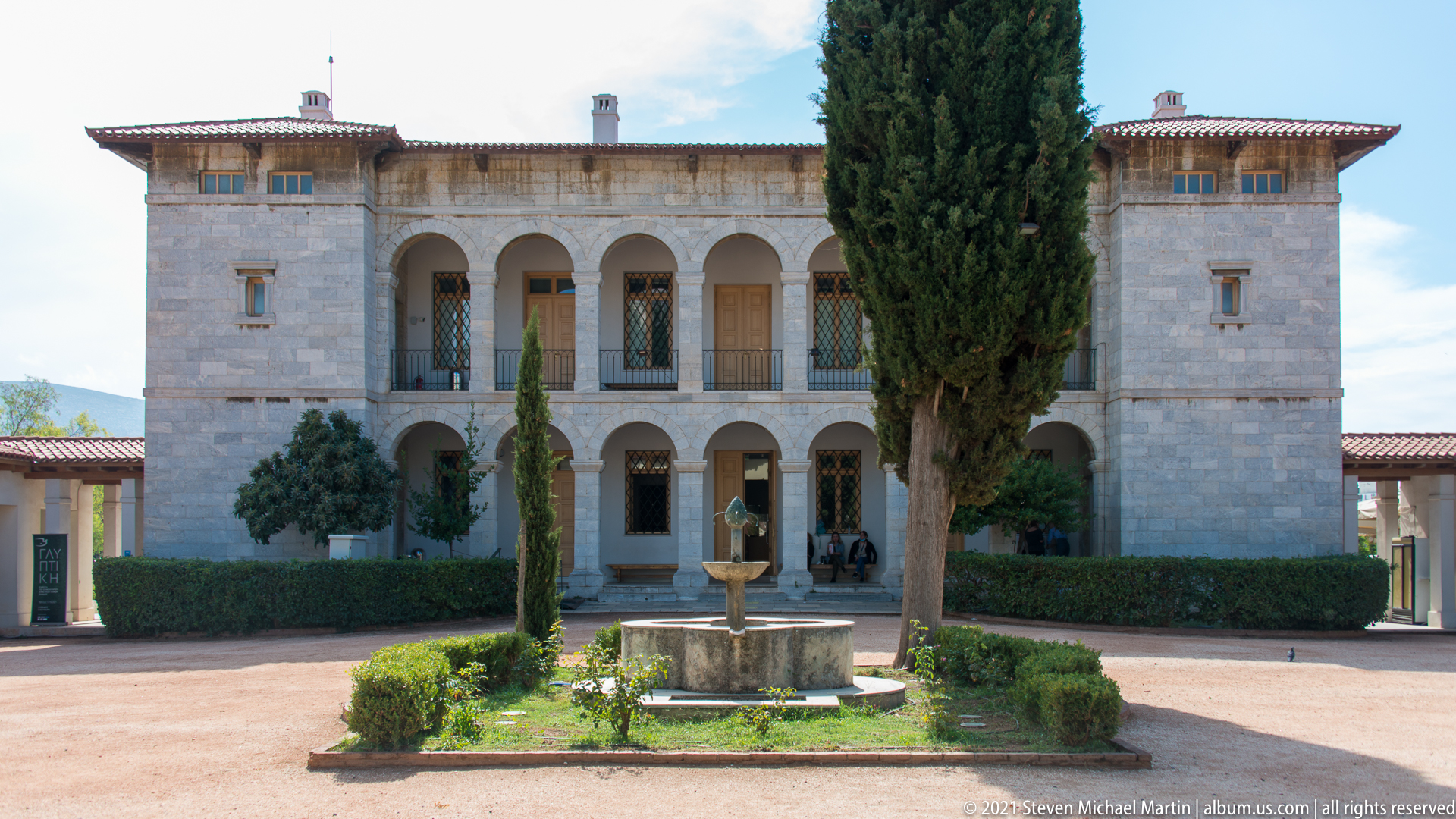
The principal historic villa rises behind a formal courtyard garden, its pale stone façade organized by two levels of arcaded openings and a central balcony. Tall cypresses and a small fountain structure establish the landscaped setting of the Byzantine and Christian Museum complex.
Caption
The principal historic villa rises behind a formal courtyard garden, its pale stone façade organized by two levels of arcaded openings and a central balcony. Tall cypresses and a small fountain structure establish the landscaped setting of the Byzantine and Christian Museum complex.

A wall map traces the Mediterranean world during the political transition from the Roman to Byzantine era. Contrasting colored territories spread across Europe, North Africa, and the eastern Mediterranean, with a legend below distinguishing chronological or political phases.
Caption
A wall map traces the Mediterranean world during the political transition from the Roman to Byzantine era. Contrasting colored territories spread across Europe, North Africa, and the eastern Mediterranean, with a legend below distinguishing chronological or political phases.

This museum map presents the Mediterranean basin with political territories highlighted across the Balkans, Italy, North Africa, and the eastern provinces. Its color coding and dense place labels situate the visitor within the changing geography of the late Roman and early Byzantine world.
Caption
This museum map presents the Mediterranean basin with political territories highlighted across the Balkans, Italy, North Africa, and the eastern provinces. Its color coding and dense place labels situate the visitor within the changing geography of the late Roman and early Byzantine world.

A third historical map concentrates attention on the eastern Mediterranean, where colored zones and numerous labels cluster around Greece, Anatolia, the Levant, and Egypt. The display illustrates shifting imperial geography as part of the museum’s introduction to Byzantine history.
Caption
A third historical map concentrates attention on the eastern Mediterranean, where colored zones and numerous labels cluster around Greece, Anatolia, the Levant, and Egypt. The display illustrates shifting imperial geography as part of the museum’s introduction to Byzantine history.

A closer view of the Justinian mosaic emphasizes the emperor’s halo, jeweled diadem, purple robe, and golden vessel. Bishop Maximianus and other attendants stand tightly beside him, their frontal faces and overlapping feet reinforcing the formal hierarchy of the imperial procession.
Caption
A closer view of the Justinian mosaic emphasizes the emperor’s halo, jeweled diadem, purple robe, and golden vessel. Bishop Maximianus and other attendants stand tightly beside him, their frontal faces and overlapping feet reinforcing the formal hierarchy of the imperial procession.

A 4th–5th-century clay hanging lamp takes the form of a fish carrying a smaller fish in its mouth. The smaller fish’s mouth served as the wick opening, while an opening on the larger fish’s back admitted oil; two perforations show that the lamp was suspended. Cross and Chi-Rho imagery reinforces the fish’s early Christian association with Christ, protection, and salvation. The museum notes that lamps of this type are considered Egyptian in origin.
Caption
A 4th–5th-century clay hanging lamp takes the form of a fish carrying a smaller fish in its mouth. The smaller fish’s mouth served as the wick opening, while an opening on the larger fish’s back admitted oil; two perforations show that the lamp was suspended. Cross and Chi-Rho imagery reinforces the fish’s early Christian association with Christ, protection, and salvation. The museum notes that lamps of this type are considered Egyptian in origin.

A standing marble figure wears a short tunic and mantle, with one arm missing and the other holding a long attribute or fold of drapery. Carved architectural ornament rises behind the head and shoulder, suggesting the figure survives as part of a larger decorative ensemble.
Caption
A standing marble figure wears a short tunic and mantle, with one arm missing and the other holding a long attribute or fold of drapery. Carved architectural ornament rises behind the head and shoulder, suggesting the figure survives as part of a larger decorative ensemble.

This 4th-century marble table support from Aegina depicts Orpheus seated with his lyre among real and mythical animals and birds. In Late Antiquity, Christians could reinterpret the familiar classical musician as an allegorical parallel for Christ, whose words were understood to tame human hearts as Orpheus’s music tamed wild creatures. The museum attributes the work to a workshop probably active in Asia Minor.
Caption
This 4th-century marble table support from Aegina depicts Orpheus seated with his lyre among real and mythical animals and birds. In Late Antiquity, Christians could reinterpret the familiar classical musician as an allegorical parallel for Christ, whose words were understood to tame human hearts as Orpheus’s music tamed wild creatures. The museum attributes the work to a workshop probably active in Asia Minor.

A chain-mail garment is displayed upright in a glass case, with dense interlinked metal rings forming short sleeves, torso, and a hood or coif around the head opening. Its silhouette makes the protective construction legible even without a visible label identifying date or provenance.
Caption
A chain-mail garment is displayed upright in a glass case, with dense interlinked metal rings forming short sleeves, torso, and a hood or coif around the head opening. Its silhouette makes the protective construction legible even without a visible label identifying date or provenance.

An introductory gallery panel explains the gradual transition from the ancient world to Byzantium, referring to Christianity’s legalization, Constantinople, the division of the Roman Empire, and the end of antiquity. It establishes the chronological framework for objects in the surrounding galleries.
Caption
An introductory gallery panel explains the gradual transition from the ancient world to Byzantium, referring to Christianity’s legalization, Constantinople, the division of the Roman Empire, and the end of antiquity. It establishes the chronological framework for objects in the surrounding galleries.

A museum gallery assembles columns, capitals, carved stone blocks, and patterned mosaic pavement within an architectural-history display. Wall diagrams and reconstruction graphics connect the fragments to built settings, while glass cases separate smaller objects from the larger stone elements.
Caption
A museum gallery assembles columns, capitals, carved stone blocks, and patterned mosaic pavement within an architectural-history display. Wall diagrams and reconstruction graphics connect the fragments to built settings, while glass cases separate smaller objects from the larger stone elements.

A pale stone relief shows a reclining or recumbent figure on a couch-like structure, framed by smaller standing figures and carved motifs. Weathering and surface loss obscure fine details, so the scene can be described securely while its exact funerary, votive, or narrative meaning remains uncertain.
Caption
A pale stone relief shows a reclining or recumbent figure on a couch-like structure, framed by smaller standing figures and carved motifs. Weathering and surface loss obscure fine details, so the scene can be described securely while its exact funerary, votive, or narrative meaning remains uncertain.

A long marble architectural block is carved in repeating panels of scrolling foliage and cross-like motifs. Displayed horizontally before a reconstructed arched setting, the fragment demonstrates how ornamental stonework articulated early Christian or Byzantine architectural interiors.
Caption
A long marble architectural block is carved in repeating panels of scrolling foliage and cross-like motifs. Displayed horizontally before a reconstructed arched setting, the fragment demonstrates how ornamental stonework articulated early Christian or Byzantine architectural interiors.

A small Greek inscription survives on a pale, weathered plaster or masonry surface. Thin reddish-brown characters cluster around a vertical mark amid stains and losses, preserving a modest textual trace whose wording and date cannot be resolved from the proof-sheet view.
Caption
A small Greek inscription survives on a pale, weathered plaster or masonry surface. Thin reddish-brown characters cluster around a vertical mark amid stains and losses, preserving a modest textual trace whose wording and date cannot be resolved from the proof-sheet view.

A close view of a manuscript leaf reveals tightly written Greek text in dark ink overlaid or supplemented by conspicuous red notes, symbols, and larger characters. The irregular page edge and contrasting inks make the object’s layered history of writing and annotation especially visible.
Caption
A close view of a manuscript leaf reveals tightly written Greek text in dark ink overlaid or supplemented by conspicuous red notes, symbols, and larger characters. The irregular page edge and contrasting inks make the object’s layered history of writing and annotation especially visible.

A long manuscript roll lies extended in a glass case, its narrow sheet carrying lines of script and red annotations beneath a painted figural headpiece. A second illuminated fragment is displayed nearby, emphasizing the relationship between written text and sacred imagery.
Caption
A long manuscript roll lies extended in a glass case, its narrow sheet carrying lines of script and red annotations beneath a painted figural headpiece. A second illuminated fragment is displayed nearby, emphasizing the relationship between written text and sacred imagery.

An illuminated manuscript page places two haloed figures against a gold ground above dense lines of Greek text. One figure wears elaborately patterned ceremonial clothing while the other holds a book, creating a compact devotional or narrative image integrated directly with the written page.
Caption
An illuminated manuscript page places two haloed figures against a gold ground above dense lines of Greek text. One figure wears elaborately patterned ceremonial clothing while the other holds a book, creating a compact devotional or narrative image integrated directly with the written page.

A weathered icon presents the Virgin holding the Christ Child against a dark, abraded ground. Their frontal faces remain legible despite extensive surface loss, while traces of red and brown garments and a narrow painted border preserve the intimate devotional format.
Caption
A weathered icon presents the Virgin holding the Christ Child against a dark, abraded ground. Their frontal faces remain legible despite extensive surface loss, while traces of red and brown garments and a narrow painted border preserve the intimate devotional format.

A rectangular marble container is decorated across its front with three prominent cross designs: circular rosette-like crosses at either side and a more angular cross at center. The deep open top and carved Christian ornament suggest a liturgical or funerary function, though the exact object type requires confirmation.
Caption
A rectangular marble container is decorated across its front with three prominent cross designs: circular rosette-like crosses at either side and a more angular cross at center. The deep open top and carved Christian ornament suggest a liturgical or funerary function, though the exact object type requires confirmation.

A freestanding section of painted masonry preserves three arched openings surrounded by layered Christian imagery. Standing saints occupy the two smaller side recesses, while a procession or row of figures runs across the upper band above the arches. Extensive losses expose the underlying wall fabric, but the surviving reds, ochres, and dark outlines still convey the original integration of painting and architecture.
Caption
A freestanding section of painted masonry preserves three arched openings surrounded by layered Christian imagery. Standing saints occupy the two smaller side recesses, while a procession or row of figures runs across the upper band above the arches. Extensive losses expose the underlying wall fabric, but the surviving reds, ochres, and dark outlines still convey the original integration of painting and architecture.

A fragmentary wall painting preserves portions of several figures against a worn plaster ground. A smaller haloed figure remains at lower left while taller forms and garment colors survive above and to the right, their interrupted outlines revealing extensive loss around the original composition.
Caption
A fragmentary wall painting preserves portions of several figures against a worn plaster ground. A smaller haloed figure remains at lower left while taller forms and garment colors survive above and to the right, their interrupted outlines revealing extensive loss around the original composition.

A painted Crucifixion centers on Christ against a patterned field, with mourning figures standing to either side of the cross. The elongated body, dark outlines, and inscriptions belong to the visual language of Byzantine devotional painting, while the worn surface records the icon’s age and handling.
Caption
A painted Crucifixion centers on Christ against a patterned field, with mourning figures standing to either side of the cross. The elongated body, dark outlines, and inscriptions belong to the visual language of Byzantine devotional painting, while the worn surface records the icon’s age and handling.

The Virgin turns gently toward the Christ Child in a gold-ground icon, her dark mantle edged by fine ornament and a luminous halo. The Child sits against her arm in a warm ochre garment, creating a concentrated devotional image of maternal closeness.
Caption
The Virgin turns gently toward the Christ Child in a gold-ground icon, her dark mantle edged by fine ornament and a luminous halo. The Child sits against her arm in a warm ochre garment, creating a concentrated devotional image of maternal closeness.

A densely painted icon is divided into multiple narrative scenes, dominated by a mounted red horse and a dramatic encounter with a dragon-like creature. Smaller episodes surround the central action, combining landscape, architecture, and figures into a continuous devotional storytelling field.
Caption
A densely painted icon is divided into multiple narrative scenes, dominated by a mounted red horse and a dramatic encounter with a dragon-like creature. Smaller episodes surround the central action, combining landscape, architecture, and figures into a continuous devotional storytelling field.

A mosaic panel presents the Virgin tenderly holding the Christ Child, their faces pressed together in an intimate devotional pose. Small tesserae build the flesh tones, deep blue mantle, gold ground, and patterned garments, while the panel's worn edges and vertical joins reveal its material history. The close view foregrounds the expressive faces and careful modulation of color.
Caption
A mosaic panel presents the Virgin tenderly holding the Christ Child, their faces pressed together in an intimate devotional pose. Small tesserae build the flesh tones, deep blue mantle, gold ground, and patterned garments, while the panel's worn edges and vertical joins reveal its material history. The close view foregrounds the expressive faces and careful modulation of color.

A long, narrow painted wooden church furnishing is displayed horizontally above other objects in the museum gallery. Its dark surface carries a continuous sequence of small sacred scenes divided into compartments, creating a narrative band across the object. The oblique viewpoint shows both its unusual elongated form and the surrounding display context, including painted panels and a cross nearby.
Caption
A long, narrow painted wooden church furnishing is displayed horizontally above other objects in the museum gallery. Its dark surface carries a continuous sequence of small sacred scenes divided into compartments, creating a narrative band across the object. The oblique viewpoint shows both its unusual elongated form and the surrounding display context, including painted panels and a cross nearby.

A frontal haloed male saint raises his right hand while holding a closed, jeweled book against his chest. The figure's dark tunic and reddish mantle stand sharply against the luminous gold background, while abrasion and small losses mark the painted surface. The tightly framed view concentrates on the saint's face, blessing gesture, and book as the principal attributes.
Caption
A frontal haloed male saint raises his right hand while holding a closed, jeweled book against his chest. The figure's dark tunic and reddish mantle stand sharply against the luminous gold background, while abrasion and small losses mark the painted surface. The tightly framed view concentrates on the saint's face, blessing gesture, and book as the principal attributes.

A rectangular carved stone slab is filled with symmetrical interlacing bands that loop around circular rosettes and pointed leaf-like forms. The shallow relief creates a dense geometric surface framed by a plain raised border, with weathering softening some carved edges. Seen straight on, the panel clearly records the disciplined repetition and bilateral balance of its architectural ornament.
Caption
A rectangular carved stone slab is filled with symmetrical interlacing bands that loop around circular rosettes and pointed leaf-like forms. The shallow relief creates a dense geometric surface framed by a plain raised border, with weathering softening some carved edges. Seen straight on, the panel clearly records the disciplined repetition and bilateral balance of its architectural ornament.

A haloed saint in a red outer garment holds a richly patterned book close to the chest while raising the other hand. Much of the face and surrounding plaster has been lost, yet the gold-toned halo, ornamental book cover, and layered clothing remain clear. The fragment's damaged surface makes the contrast between surviving painted detail and exposed substrate a central feature of the view.
Caption
A haloed saint in a red outer garment holds a richly patterned book close to the chest while raising the other hand. Much of the face and surrounding plaster has been lost, yet the gold-toned halo, ornamental book cover, and layered clothing remain clear. The fragment's damaged surface makes the contrast between surviving painted detail and exposed substrate a central feature of the view.

The surviving head of a bearded haloed saint fills this wall-painting fragment, framed by a broad ochre halo against a blue field. Greek letters remain visible beside the head, while cracks and losses cut through the face, beard, and surrounding plaster. The close crop records both the individualized facial treatment and the fragile condition of the painted surface.
Caption
The surviving head of a bearded haloed saint fills this wall-painting fragment, framed by a broad ochre halo against a blue field. Greek letters remain visible beside the head, while cracks and losses cut through the face, beard, and surrounding plaster. The close crop records both the individualized facial treatment and the fragile condition of the painted surface.

Christ appears frontally in the conventional Pantocrator type, blessing with his right hand and holding a closed red book in his left. A cruciform halo surrounds the dark-haired, bearded face, while Greek abbreviations flank the figure on the gold ground. The narrow panel format and restrained palette focus attention on the symmetrical pose, hand gesture, and book.
Caption
Christ appears frontally in the conventional Pantocrator type, blessing with his right hand and holding a closed red book in his left. A cruciform halo surrounds the dark-haired, bearded face, while Greek abbreviations flank the figure on the gold ground. The narrow panel format and restrained palette focus attention on the symmetrical pose, hand gesture, and book.

The Virgin sits frontally with the Christ Child on her left arm, both figures modeled in saturated reds, blues, and gold. The Child holds a small object or scroll-like form while the Virgin's raised hand directs attention toward him. A worn gold ground and darkened lower edge preserve the icon's age and use, while the close framing emphasizes the paired figures and their formal gestures.
Caption
The Virgin sits frontally with the Christ Child on her left arm, both figures modeled in saturated reds, blues, and gold. The Child holds a small object or scroll-like form while the Virgin's raised hand directs attention toward him. A worn gold ground and darkened lower edge preserve the icon's age and use, while the close framing emphasizes the paired figures and their formal gestures.

A winged archangel faces forward, holding a slender staff in one hand and a transparent orb in the other. The youthful figure wears layered red, ochre, and blue garments, with dark wings spreading behind the shoulders against a gold ground. Greek lettering near the halo accompanies the image, while edge losses and abrasion reveal the age of the painted panel.
Caption
A winged archangel faces forward, holding a slender staff in one hand and a transparent orb in the other. The youthful figure wears layered red, ochre, and blue garments, with dark wings spreading behind the shoulders against a gold ground. Greek lettering near the halo accompanies the image, while edge losses and abrasion reveal the age of the painted panel.

Christ hangs on the cross at the center of a Crucifixion icon, flanked by two grieving figures who turn inward toward him. A skull appears below the cross, and a small inscription is painted above the crossbeam. The broad gold field isolates the three principal figures, while the restrained landscape and dark blue and brown garments intensify the scene's formal symmetry.
Caption
Christ hangs on the cross at the center of a Crucifixion icon, flanked by two grieving figures who turn inward toward him. A skull appears below the cross, and a small inscription is painted above the crossbeam. The broad gold field isolates the three principal figures, while the restrained landscape and dark blue and brown garments intensify the scene's formal symmetry.

A standing female saint occupies the center of this heavily craquelured icon, wearing a vivid red mantle over a dark green garment and raising both hands. Small sacred figures appear in the upper corner, while dark rocky forms frame the saint near the bottom. Extensive cracking and losses expose the aged paint layer, especially around the lower body and margins.
Caption
A standing female saint occupies the center of this heavily craquelured icon, wearing a vivid red mantle over a dark green garment and raising both hands. Small sacred figures appear in the upper corner, while dark rocky forms frame the saint near the bottom. Extensive cracking and losses expose the aged paint layer, especially around the lower body and margins.

A severely worn icon preserves the dark silhouette of the Virgin bending toward the Christ Child, their halos and faces partly obscured by abrasion. A smaller standing haloed figure occupies the upper right corner, creating a secondary devotional image within the panel. Areas of exposed wood and missing paint dominate the lower half, making the object's long material history especially visible.
Caption
A severely worn icon preserves the dark silhouette of the Virgin bending toward the Christ Child, their halos and faces partly obscured by abrasion. A smaller standing haloed figure occupies the upper right corner, creating a secondary devotional image within the panel. Areas of exposed wood and missing paint dominate the lower half, making the object's long material history especially visible.

A substantial painted wall fragment combines architecture and figural decoration around two surviving arched openings. Haloed figures occupy the upper register and side fields, while ornamental bands and fragmentary scenes follow the contours of the masonry. Missing plaster exposes irregular edges and interrupts several compositions, allowing the museum installation to show how the fresco originally related to doorways or niches.
Caption
A substantial painted wall fragment combines architecture and figural decoration around two surviving arched openings. Haloed figures occupy the upper register and side fields, while ornamental bands and fragmentary scenes follow the contours of the masonry. Missing plaster exposes irregular edges and interrupts several compositions, allowing the museum installation to show how the fresco originally related to doorways or niches.

A spacious museum gallery presents Byzantine and post-Byzantine religious paintings on freestanding gray partitions and perimeter walls. Icons of different scales are spaced individually under controlled ceiling lighting, with low display platforms and interpretive elements punctuating the polished floor. The long sightline through adjoining rooms gives a clear sense of the collection's modern exhibition setting and visual sequencing.
Caption
A spacious museum gallery presents Byzantine and post-Byzantine religious paintings on freestanding gray partitions and perimeter walls. Icons of different scales are spaced individually under controlled ceiling lighting, with low display platforms and interpretive elements punctuating the polished floor. The long sightline through adjoining rooms gives a clear sense of the collection's modern exhibition setting and visual sequencing.

Six small devotional paintings are arranged in a horizontal illuminated display case, each presented separately against a dark backing with labels beneath. The works vary in format and subject, including standing saints, multi-figure scenes, and a seated sacred figure. The case view records the comparative museum presentation rather than privileging a single icon, emphasizing scale, variety, and grouping.
Caption
Six small devotional paintings are arranged in a horizontal illuminated display case, each presented separately against a dark backing with labels beneath. The works vary in format and subject, including standing saints, multi-figure scenes, and a seated sacred figure. The case view records the comparative museum presentation rather than privileging a single icon, emphasizing scale, variety, and grouping.

A monumental composite icon assembles dozens of small biblical and saintly scenes around larger images of the Virgin and Christ and a prominent central architectural vision. The dense painted program is organized in registers and compartments, with vivid reds, golds, blues, and greens guiding the eye across the surface. Its encyclopedic arrangement invites close reading of individual episodes while maintaining a strongly symmetrical whole.
Caption
A monumental composite icon assembles dozens of small biblical and saintly scenes around larger images of the Virgin and Christ and a prominent central architectural vision. The dense painted program is organized in registers and compartments, with vivid reds, golds, blues, and greens guiding the eye across the surface. Its encyclopedic arrangement invites close reading of individual episodes while maintaining a strongly symmetrical whole.

Christ Pantocrator is shown half-length, blessing with his right hand and holding an open Gospel book filled with Greek text. The cruciform halo and identifying inscriptions stand out against the gold ground, while the red tunic and dark mantle are articulated with angular highlights. The close, frontal composition concentrates attention on Christ's gaze, blessing hand, and written word.
Caption
Christ Pantocrator is shown half-length, blessing with his right hand and holding an open Gospel book filled with Greek text. The cruciform halo and identifying inscriptions stand out against the gold ground, while the red tunic and dark mantle are articulated with angular highlights. The close, frontal composition concentrates attention on Christ's gaze, blessing hand, and written word.

A densely composed religious print centers on a seated sacred figure surrounded by attendants, angels, and narrative vignettes, with a broad panorama of a fortified town extending across the lower register. Smaller scenes fill the side and upper borders, and blocks of text identify or explain portions of the composition. The sheet joins devotional imagery, narrative episodes, and topographic representation in one intricate graphic program.
Caption
A densely composed religious print centers on a seated sacred figure surrounded by attendants, angels, and narrative vignettes, with a broad panorama of a fortified town extending across the lower register. Smaller scenes fill the side and upper borders, and blocks of text identify or explain portions of the composition. The sheet joins devotional imagery, narrative episodes, and topographic representation in one intricate graphic program.

A large engraved view depicts a monumental monastic complex surrounded by clustered buildings and rugged mountains, with smaller scenes arranged in vertical strips along both sides and across the top. Greek text forms a heading and explanatory inscriptions accompany the imagery. The print's layered organization merges an expansive architectural panorama with subsidiary religious or historical episodes around its margins.
Caption
A large engraved view depicts a monumental monastic complex surrounded by clustered buildings and rugged mountains, with smaller scenes arranged in vertical strips along both sides and across the top. Greek text forms a heading and explanatory inscriptions accompany the imagery. The print's layered organization merges an expansive architectural panorama with subsidiary religious or historical episodes around its margins.

A tall document is organized into a dense rectangular grid of alternating pale and reddish cells, each filled with small lines of text or notation. Narrow headings and marginal markings run around the table, suggesting a structured reference, calendrical, or liturgical function, though the exact content is not legible at proof-sheet scale. The museum display isolates the sheet vertically behind glass for close study.
Caption
A tall document is organized into a dense rectangular grid of alternating pale and reddish cells, each filled with small lines of text or notation. Narrow headings and marginal markings run around the table, suggesting a structured reference, calendrical, or liturgical function, though the exact content is not legible at proof-sheet scale. The museum display isolates the sheet vertically behind glass for close study.

A circular diagram dominates this manuscript page, organized as concentric rings around a dark central disk and divided into radial compartments containing small figures and symbols. A tall cross-like axis rises through the circle, while handwritten Greek text surrounds the diagram on all sides. The combination of zodiacal imagery, geometry, and annotation suggests a learned calendrical or cosmological scheme rather than a conventional devotional image.
Caption
A circular diagram dominates this manuscript page, organized as concentric rings around a dark central disk and divided into radial compartments containing small figures and symbols. A tall cross-like axis rises through the circle, while handwritten Greek text surrounds the diagram on all sides. The combination of zodiacal imagery, geometry, and annotation suggests a learned calendrical or cosmological scheme rather than a conventional devotional image.

A brightly colored manuscript illustration centers on a large golden wheel set against an intense blue field, with human figures positioned around its rim and a crowned or elevated figure above. A fantastical animal occupies the lower center, and red handwritten labels identify elements throughout the composition. The image presents fortune or worldly change through a dynamic circular allegory rather than a static devotional arrangement.
Caption
A brightly colored manuscript illustration centers on a large golden wheel set against an intense blue field, with human figures positioned around its rim and a crowned or elevated figure above. A fantastical animal occupies the lower center, and red handwritten labels identify elements throughout the composition. The image presents fortune or worldly change through a dynamic circular allegory rather than a static devotional arrangement.

A richly worked gilt-metal relief constructs an elaborate architectural interior with columns, arches, clouds, and a radiant triangular emblem above the central space. Small figures and liturgical furnishings occupy the lower register, while repoussé-like modeling gives the scene pronounced depth and shimmer. The frontal close view emphasizes the reflective metal surface and the dense layering of sacred architecture and celestial imagery.
Caption
A richly worked gilt-metal relief constructs an elaborate architectural interior with columns, arches, clouds, and a radiant triangular emblem above the central space. Small figures and liturgical furnishings occupy the lower register, while repoussé-like modeling gives the scene pronounced depth and shimmer. The frontal close view emphasizes the reflective metal surface and the dense layering of sacred architecture and celestial imagery.

A rectangular gilt-metal book cover is divided into many small embossed panels containing figures, architectural forms, and ornamental motifs. Hinges and a projecting clasp remain visible along the right edge, confirming the object's function as a binding rather than an independent plaque. The dense grid of relief scenes and richly worked border turn the protective cover into an elaborate devotional surface.
Caption
A rectangular gilt-metal book cover is divided into many small embossed panels containing figures, architectural forms, and ornamental motifs. Hinges and a projecting clasp remain visible along the right edge, confirming the object's function as a binding rather than an independent plaque. The dense grid of relief scenes and richly worked border turn the protective cover into an elaborate devotional surface.

A vertical museum display assembles numerous small metal crosses in varied proportions, terminal shapes, and suspension arrangements. Some are simple linear forms while others have flared or lobed arms, allowing the group to read as a compact typology of portable Christian cross ornaments.
Caption
A vertical museum display assembles numerous small metal crosses in varied proportions, terminal shapes, and suspension arrangements. Some are simple linear forms while others have flared or lobed arms, allowing the group to read as a compact typology of portable Christian cross ornaments.

A deeply carved stone relief presents a dynamic encounter between a mounted figure and a standing companion, with the horse stepping across a fallen or crouching form below. Drapery, harness details, layered bodies, and the ornamental architectural background give the fragment unusual narrative density despite its damaged edges.
Caption
A deeply carved stone relief presents a dynamic encounter between a mounted figure and a standing companion, with the horse stepping across a fallen or crouching form below. Drapery, harness details, layered bodies, and the ornamental architectural background give the fragment unusual narrative density despite its damaged edges.

Several small metal objects explore variations on the cross form, from an openwork circular piece at left to a green-patinated cross mounted on a rounded vessel-like element and a lobed cross at right. Their contrasting silhouettes and surfaces make the display especially useful for comparing devotional or liturgical metalwork.
Caption
Several small metal objects explore variations on the cross form, from an openwork circular piece at left to a green-patinated cross mounted on a rounded vessel-like element and a lobed cross at right. Their contrasting silhouettes and surfaces make the display especially useful for comparing devotional or liturgical metalwork.

A single dark metal cross hangs in front of a painted figure, isolating the object from the larger group displays nearby. Incised circular and spiral ornament decorates the flared arms, while the suspension element above confirms its portable character and gives a close view of its workmanship and wear.
Caption
A single dark metal cross hangs in front of a painted figure, isolating the object from the larger group displays nearby. Incised circular and spiral ornament decorates the flared arms, while the suspension element above confirms its portable character and gives a close view of its workmanship and wear.

Four cast metal crosses lie flat in a case, each using a different treatment of the arms and terminals. One is compact and plain, while others flare outward or end in rounded knobs; the close grouping makes differences in casting, proportion, ornament, and patination easy to compare.
Caption
Four cast metal crosses lie flat in a case, each using a different treatment of the arms and terminals. One is compact and plain, while others flare outward or end in rounded knobs; the close grouping makes differences in casting, proportion, ornament, and patination easy to compare.

Repeated concentric arcs and circles cover a rectangular field in tightly organized horizontal bands. The pattern alternates semicircular fan-like units with complete circular motifs, creating a rhythmic geometric surface whose precision and repetition become the principal subject rather than any single figurative or architectural element.
Caption
Repeated concentric arcs and circles cover a rectangular field in tightly organized horizontal bands. The pattern alternates semicircular fan-like units with complete circular motifs, creating a rhythmic geometric surface whose precision and repetition become the principal subject rather than any single figurative or architectural element.

A roughly broken stone slab preserves a central cross-like motif surrounded by traces of letters and linear marks. Red-brown pigment or staining remains in parts of the design, while the irregular edges and worn surface emphasize the fragmentary condition of an object whose inscription is not fully legible in this view.
Caption
A roughly broken stone slab preserves a central cross-like motif surrounded by traces of letters and linear marks. Red-brown pigment or staining remains in parts of the design, while the irregular edges and worn surface emphasize the fragmentary condition of an object whose inscription is not fully legible in this view.

A large frontal face dominates this carved stone fragment, framed by deeply cut angular bands and radiating linear details. The broad eyes, compact mouth, and strongly symmetrical treatment give the relief an emblematic quality, while the broken perimeter makes clear that it survives as part of a larger architectural or decorative composition.
Caption
A large frontal face dominates this carved stone fragment, framed by deeply cut angular bands and radiating linear details. The broad eyes, compact mouth, and strongly symmetrical treatment give the relief an emblematic quality, while the broken perimeter makes clear that it survives as part of a larger architectural or decorative composition.

A low-relief animal scene is carved across a pale stone slab. A large quadruped with patterned mane or body dominates the upper field, while another animal’s head and forequarters appear below. Incised lines, drilled texture, and curling vegetal forms animate the compact composition despite the fragmentary context.
Caption
A low-relief animal scene is carved across a pale stone slab. A large quadruped with patterned mane or body dominates the upper field, while another animal’s head and forequarters appear below. Incised lines, drilled texture, and curling vegetal forms animate the compact composition despite the fragmentary context.

A broad circular metal disk, pierced with numerous openings and decorative cutouts, is suspended horizontally above a large hanging cross. The low viewpoint reveals both the perforated underside and the cast shadow on the wall, clarifying how chains and pendant elements combine into a three-dimensional liturgical furnishing.
Caption
A broad circular metal disk, pierced with numerous openings and decorative cutouts, is suspended horizontally above a large hanging cross. The low viewpoint reveals both the perforated underside and the cast shadow on the wall, clarifying how chains and pendant elements combine into a three-dimensional liturgical furnishing.

A long marble architectural fragment carries a shallow continuous band of linked loops, heart-shaped forms, and interlace-like curves. Displayed horizontally on a metal support, the piece is read primarily as ornament: a surviving section of carved stone decoration whose repeating rhythm once belonged to a larger architectural setting.
Caption
A long marble architectural fragment carries a shallow continuous band of linked loops, heart-shaped forms, and interlace-like curves. Displayed horizontally on a metal support, the piece is read primarily as ornament: a surviving section of carved stone decoration whose repeating rhythm once belonged to a larger architectural setting.

Two marble fragments are displayed together: the upper block carries paired birds amid stylized vegetation and a cross, while the lower block is filled by a geometric cross pattern with spiral terminals. Their juxtaposition demonstrates contrasting figurative and abstract approaches to carved Christian architectural decoration.
Caption
Two marble fragments are displayed together: the upper block carries paired birds amid stylized vegetation and a cross, while the lower block is filled by a geometric cross pattern with spiral terminals. Their juxtaposition demonstrates contrasting figurative and abstract approaches to carved Christian architectural decoration.

Rectangular masonry channels or foundation trenches are preserved in situ beneath the museum floor, exposing an archaeological layer within the modern gallery. Their plastered or stone-lined sides and intersecting layout are more informative here than decorative detail, recording the physical relationship between the museum and remains retained beneath it.
Caption
Rectangular masonry channels or foundation trenches are preserved in situ beneath the museum floor, exposing an archaeological layer within the modern gallery. Their plastered or stone-lined sides and intersecting layout are more informative here than decorative detail, recording the physical relationship between the museum and remains retained beneath it.

A small oval relief presents a haloed sacred figure frontally, one hand raised while the other holds an object close to the body. Dense carving fills the surrounding field and border. The pale material and intimate scale distinguish this devotional object from the larger stone reliefs elsewhere in the gallery.
Caption
A small oval relief presents a haloed sacred figure frontally, one hand raised while the other holds an object close to the body. Dense carving fills the surrounding field and border. The pale material and intimate scale distinguish this devotional object from the larger stone reliefs elsewhere in the gallery.

A gold coin fills the frame, allowing the frontal bust and surrounding inscription to be examined closely. The figure wears richly patterned dress and holds a cross at one side; crisp relief, beaded border, and luminous metal surface make the coin both a monetary object and a compact vehicle for official imagery.
Caption
A gold coin fills the frame, allowing the frontal bust and surrounding inscription to be examined closely. The figure wears richly patterned dress and holds a cross at one side; crisp relief, beaded border, and luminous metal surface make the coin both a monetary object and a compact vehicle for official imagery.

A rectangular marble chest is carved across its front with two circular cross medallions flanking a larger central cross-like composition enriched with vegetal scrolls. The deep basin and substantial stone walls identify it as a container form, while the symmetrical façade concentrates attention on explicitly Christian ornament.
Caption
A rectangular marble chest is carved across its front with two circular cross medallions flanking a larger central cross-like composition enriched with vegetal scrolls. The deep basin and substantial stone walls identify it as a container form, while the symmetrical façade concentrates attention on explicitly Christian ornament.

A monumental painted female figure faces the viewer in jeweled ceremonial dress and an elaborate crown or headdress. Gold, red, and dark textiles dominate the surviving surface, while losses and abrasion reveal the icon’s age and material history. A smaller icon visible behind it establishes the object’s gallery context and scale.
Caption
A monumental painted female figure faces the viewer in jeweled ceremonial dress and an elaborate crown or headdress. Gold, red, and dark textiles dominate the surviving surface, while losses and abrasion reveal the icon’s age and material history. A smaller icon visible behind it establishes the object’s gallery context and scale.

Two elaborately patterned animals face one another across a central stylized tree on this rectangular marble panel. Their raised forelegs, long tails, patterned bodies, and surrounding rosettes create a balanced heraldic composition, while a carved border frames the scene as a self-contained piece of architectural decoration.
Caption
Two elaborately patterned animals face one another across a central stylized tree on this rectangular marble panel. Their raised forelegs, long tails, patterned bodies, and surrounding rosettes create a balanced heraldic composition, while a carved border frames the scene as a self-contained piece of architectural decoration.

A broad relief cross fills the stone surface, its arms expanding into sharply carved foliate and scroll-like terminals. Parallel grooves define the central shafts while paired leaf forms create strong bilateral symmetry. The close framing isolates the carving’s geometry and crisp chisel work from the architectural element to which it belonged.
Caption
A broad relief cross fills the stone surface, its arms expanding into sharply carved foliate and scroll-like terminals. Parallel grooves define the central shafts while paired leaf forms create strong bilateral symmetry. The close framing isolates the carving’s geometry and crisp chisel work from the architectural element to which it belonged.

Dense repoussé ornament covers this large gilded ecclesiastical object, transforming its surface into a miniature architectural and celestial composition. A central arched feature is surrounded by modeled figures, scrolling ornament, and repeated architectural forms, while the reflective metal catches the gallery lighting and accentuates the relief. The workmanship demonstrates the importance of precious-metal decoration in the ceremonial material culture of Christian worship.
Caption
Dense repoussé ornament covers this large gilded ecclesiastical object, transforming its surface into a miniature architectural and celestial composition. A central arched feature is surrounded by modeled figures, scrolling ornament, and repeated architectural forms, while the reflective metal catches the gallery lighting and accentuates the relief. The workmanship demonstrates the importance of precious-metal decoration in the ceremonial material culture of Christian worship.

A fragmentary stone relief combines a reclining or seated human figure with projecting animal heads above and a large curved form at right. The carving is heavily worn, yet the layered figures and surviving letters remain visible. Close framing records the sculptural depth and damaged condition without forcing a specific narrative identification.
Caption
A fragmentary stone relief combines a reclining or seated human figure with projecting animal heads above and a large curved form at right. The carving is heavily worn, yet the layered figures and surviving letters remain visible. Close framing records the sculptural depth and damaged condition without forcing a specific narrative identification.

Christ hangs on the cross against a luminous gold ground while angels cluster around the upper field. The titulus appears above the crossbar and small attendant figures occupy the edges of the scene. The close view emphasizes the modeled body, patterned halo, red wounds, and energetic gestures of the surrounding angels.
Caption
Christ hangs on the cross against a luminous gold ground while angels cluster around the upper field. The titulus appears above the crossbar and small attendant figures occupy the edges of the scene. The close view emphasizes the modeled body, patterned halo, red wounds, and energetic gestures of the surrounding angels.

An open manuscript presents dense Greek script beside painted miniatures and a brightly colored ornamental headpiece. One page includes a rectangular narrative scene; the facing page combines text with a standing haloed figure. The display highlights the integration of writing, painting, and decorative framing within a hand-produced Christian book.
Caption
An open manuscript presents dense Greek script beside painted miniatures and a brightly colored ornamental headpiece. One page includes a rectangular narrative scene; the facing page combines text with a standing haloed figure. The display highlights the integration of writing, painting, and decorative framing within a hand-produced Christian book.

A compact marble relief shows a bearded male figure in profile or three-quarter view, wearing a high pointed or folded head covering and layered dress. A short vertical inscription survives beside the head. The shallow carving and cropped slab suggest a fragment whose original function is not certain from the photograph alone.
Caption
A compact marble relief shows a bearded male figure in profile or three-quarter view, wearing a high pointed or folded head covering and layered dress. A short vertical inscription survives beside the head. The shallow carving and cropped slab suggest a fragment whose original function is not certain from the photograph alone.

A pale marble architectural block is shaped with sweeping volutes or leaf-like projections that converge around a strongly modeled bearded head. The face projects prominently from the center, turning a structural ornament into a striking figural accent. The museum display preserves the object’s sculptural volume and underside profile.
Caption
A pale marble architectural block is shaped with sweeping volutes or leaf-like projections that converge around a strongly modeled bearded head. The face projects prominently from the center, turning a structural ornament into a striking figural accent. The museum display preserves the object’s sculptural volume and underside profile.

A wall-mounted group brings together numerous dark metal crosses ranging from plain blocky examples to pieces with flared arms, incised decoration, or suspension loops. The scattered arrangement encourages comparison of scale and silhouette, showing the cross as a recurring portable devotional form rather than a single standardized design.
Caption
A wall-mounted group brings together numerous dark metal crosses ranging from plain blocky examples to pieces with flared arms, incised decoration, or suspension loops. The scattered arrangement encourages comparison of scale and silhouette, showing the cross as a recurring portable devotional form rather than a single standardized design.

A large open manuscript pairs a full-page painted miniature with a facing page of carefully ruled Greek text. The miniature shows a haloed seated writer working at a book or desk within an architectural setting. Wear along the page edges and dense handwriting underscore the manuscript’s material life as well as its imagery.
Caption
A large open manuscript pairs a full-page painted miniature with a facing page of carefully ruled Greek text. The miniature shows a haloed seated writer working at a book or desk within an architectural setting. Wear along the page edges and dense handwriting underscore the manuscript’s material life as well as its imagery.

A youthful military saint confronts the viewer frontally, holding a long spear beside an ornamented shield and wearing elaborately patterned armor beneath a vivid red cloak. The close framing concentrates attention on the saint’s idealized face, tightly curled hair, and carefully articulated military costume, characteristic visual elements used to present warrior saints as both sacred intercessors and defenders of the faith.
Caption
A youthful military saint confronts the viewer frontally, holding a long spear beside an ornamented shield and wearing elaborately patterned armor beneath a vivid red cloak. The close framing concentrates attention on the saint’s idealized face, tightly curled hair, and carefully articulated military costume, characteristic visual elements used to present warrior saints as both sacred intercessors and defenders of the faith.

An open Greek religious volume combines dense two-column text with extensive figurative illustration. Full-length sacred figures, narrative scenes, ornamental borders, and smaller framed images organize the spread, while red headings punctuate the black printed text. Displayed open, the book reveals how typography, devotional imagery, and decorative framing could work together to structure reading and visual contemplation in Christian book culture.
Caption
An open Greek religious volume combines dense two-column text with extensive figurative illustration. Full-length sacred figures, narrative scenes, ornamental borders, and smaller framed images organize the spread, while red headings punctuate the black printed text. Displayed open, the book reveals how typography, devotional imagery, and decorative framing could work together to structure reading and visual contemplation in Christian book culture.

A substantial stone fragment bears a deeply recessed cross framed by stepped linear moldings. Its irregular broken perimeter contrasts with the deliberate geometry of the carved face, preserving only part of the original architectural or liturgical element. Displayed upright in the museum gallery, the fragment makes the cross itself the dominant surviving motif while its incomplete edges reveal the object's fragmentary archaeological condition.
Caption
A substantial stone fragment bears a deeply recessed cross framed by stepped linear moldings. Its irregular broken perimeter contrasts with the deliberate geometry of the carved face, preserving only part of the original architectural or liturgical element. Displayed upright in the museum gallery, the fragment makes the cross itself the dominant surviving motif while its incomplete edges reveal the object's fragmentary archaeological condition.