Dubrovnik – Croatia
Dubrovnik lies along the rocky southern coast of Croatia where steep cliffs descend into the Adriatic Sea. The historic city developed as the capital of the Republic of Ragusa, a powerful maritime republic that rivaled Venice in trade and diplomacy during the Middle Ages.
The entire old city is enclosed within massive stone defensive walls that stretch nearly two kilometers around the harbor and historic center. Inside the walls, polished limestone streets connect monasteries, palaces, and churches built during the city’s prosperous maritime era.
Overlooking the harbor from high above the sea, Dubrovnik remains one of the best-preserved fortified cities in Europe and a UNESCO World Heritage Site.

The western sector of Dubrovnik’s fortifications steps across the hillside above a dense cluster of tiled roofs. A prominent round defensive tower, high curtain walls, and an arched approach route illustrate the layered control of access on the landward side of the city. The elevated viewpoint also reveals the close fit between defensive works and surrounding urban fabric.
Caption
The western sector of Dubrovnik’s fortifications steps across the hillside above a dense cluster of tiled roofs. A prominent round defensive tower, high curtain walls, and an arched approach route illustrate the layered control of access on the landward side of the city. The elevated viewpoint also reveals the close fit between defensive works and surrounding urban fabric.

Dubrovnik’s Old Port is crowded with small boats beneath the fortified waterfront, while pale stone buildings and terracotta roofs line the basin. The hillside settlement rises steeply behind, linking the sheltered harbor to the dense urban landscape and defensive walls around the historic center.
Caption
Dubrovnik’s Old Port is crowded with small boats beneath the fortified waterfront, while pale stone buildings and terracotta roofs line the basin. The hillside settlement rises steeply behind, linking the sheltered harbor to the dense urban landscape and defensive walls around the historic center.

From the city walls, Dubrovnik unfolds between rough Adriatic water and a densely settled hillside. Massive fortifications trace the rocky coast below red-tiled roofs, while waves break against the cliffs, creating a panoramic view of the city’s defensive position between sea and mountain.
Caption
From the city walls, Dubrovnik unfolds between rough Adriatic water and a densely settled hillside. Massive fortifications trace the rocky coast below red-tiled roofs, while waves break against the cliffs, creating a panoramic view of the city’s defensive position between sea and mountain.

A grassy, wooded slope descends toward dense vegetation with the Adriatic visible beyond. Through a gap in the trees, a distant headland and built-up coastline appear across the water. Unlike the nearby panoramic city views, this frame emphasizes Dubrovnik’s surrounding green landscape and elevated coastal terrain rather than the historic center itself.
Caption
A grassy, wooded slope descends toward dense vegetation with the Adriatic visible beyond. Through a gap in the trees, a distant headland and built-up coastline appear across the water. Unlike the nearby panoramic city views, this frame emphasizes Dubrovnik’s surrounding green landscape and elevated coastal terrain rather than the historic center itself.

A tall stone bell tower rises beside a long tiled roof as the main pedestrian axis of Dubrovnik’s Old Town runs away through dense red-roofed blocks. Seen from the walls, the composition reveals the city’s compact scale and the dominance of masonry churches and monastic buildings within the urban fabric, with the mountain slope forming a continuous backdrop.
Caption
A tall stone bell tower rises beside a long tiled roof as the main pedestrian axis of Dubrovnik’s Old Town runs away through dense red-roofed blocks. Seen from the walls, the composition reveals the city’s compact scale and the dominance of masonry churches and monastic buildings within the urban fabric, with the mountain slope forming a continuous backdrop.

A rough stone embrasure acts as a natural frame around the western coastal landscape, focusing the view on Fort Lovrijenac and the blue Adriatic beyond. The shallow opening, thick masonry, and partially visible ramparts foreground the physical depth of Dubrovnik’s defenses while turning the fortress outside the walls into the distant focal point.
Caption
A rough stone embrasure acts as a natural frame around the western coastal landscape, focusing the view on Fort Lovrijenac and the blue Adriatic beyond. The shallow opening, thick masonry, and partially visible ramparts foreground the physical depth of Dubrovnik’s defenses while turning the fortress outside the walls into the distant focal point.
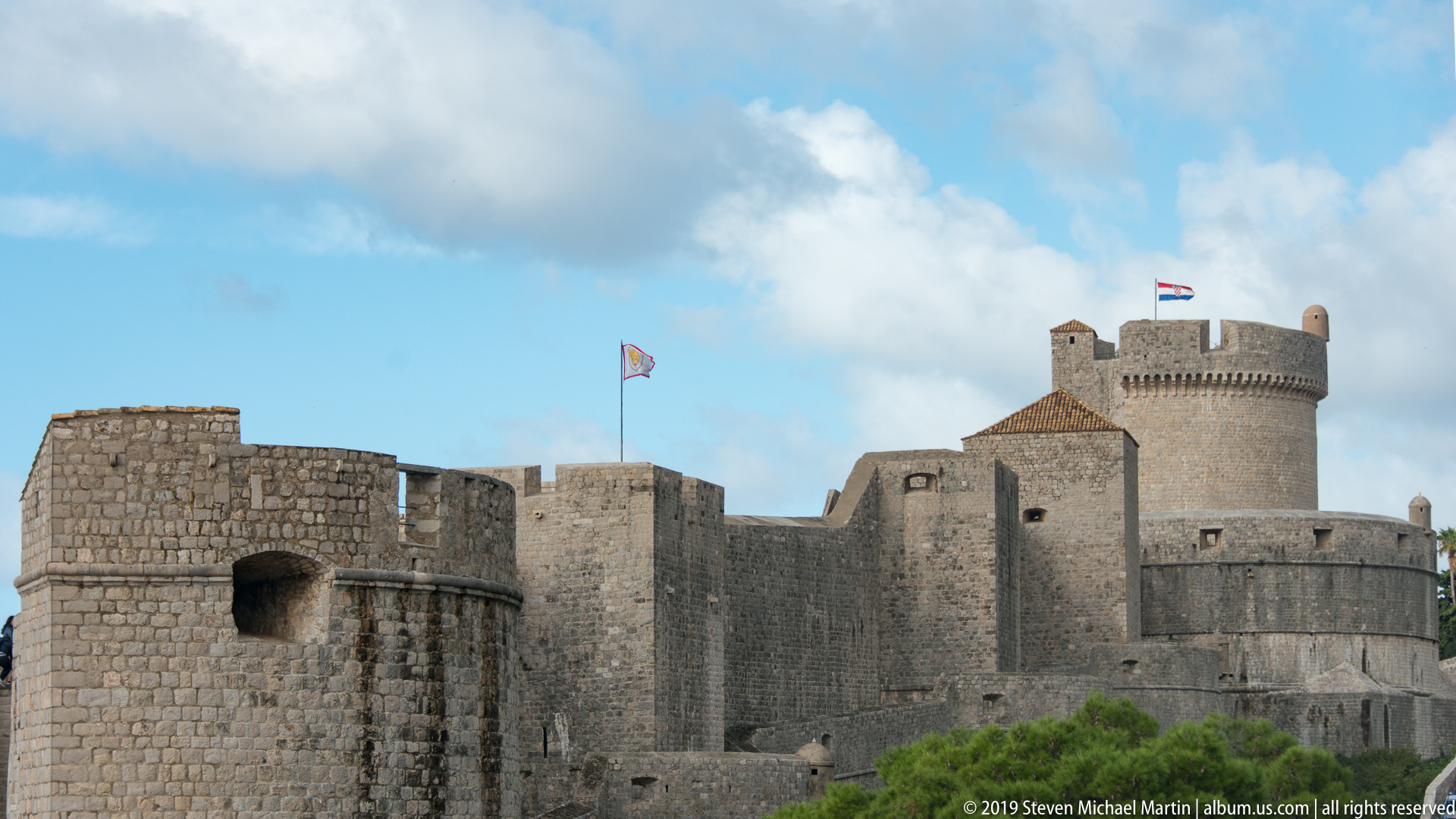
Minčeta Tower rises above a broad sequence of Dubrovnik’s northern defensive walls, its cylindrical upper stage and projecting stonework clearly visible against the sky. Lower towers and curtain walls overlap in the foreground, creating a compact study of the fortified system rather than a single isolated monument. Flags add small points of color above the pale limestone masonry.
Caption
Minčeta Tower rises above a broad sequence of Dubrovnik’s northern defensive walls, its cylindrical upper stage and projecting stonework clearly visible against the sky. Lower towers and curtain walls overlap in the foreground, creating a compact study of the fortified system rather than a single isolated monument. Flags add small points of color above the pale limestone masonry.

Church domes and bell towers rise above Dubrovnik’s dense red-tiled roofs, creating a layered skyline of ecclesiastical and domestic architecture. One tower is wrapped in scaffolding, recording active conservation or repair at the time of the visit. The elevated wall viewpoint compresses the monuments together while the Adriatic remains visible as a narrow blue band beyond the city.
Caption
Church domes and bell towers rise above Dubrovnik’s dense red-tiled roofs, creating a layered skyline of ecclesiastical and domestic architecture. One tower is wrapped in scaffolding, recording active conservation or repair at the time of the visit. The elevated wall viewpoint compresses the monuments together while the Adriatic remains visible as a narrow blue band beyond the city.

Fort Lovrijenac stands across a narrow inlet from Dubrovnik’s outer wall, with white surf curling around detached rocks between the two defensive positions. Beyond the fortress, red-tiled houses climb the slope. The composition clearly shows the strategic relationship between the isolated cliff-top fort and the fortified city it protected from the west.
Caption
Fort Lovrijenac stands across a narrow inlet from Dubrovnik’s outer wall, with white surf curling around detached rocks between the two defensive positions. Beyond the fortress, red-tiled houses climb the slope. The composition clearly shows the strategic relationship between the isolated cliff-top fort and the fortified city it protected from the west.

A visitor dressed in white pauses on the elevated fortifications while adjusting a broad-brimmed hat, with Dubrovnik’s terracotta roofscape filling the background. The low parapet and broad city panorama emphasize the height of the wall walk. Human movement here provides a contemporary counterpoint to the tightly preserved masonry city below.
Caption
A visitor dressed in white pauses on the elevated fortifications while adjusting a broad-brimmed hat, with Dubrovnik’s terracotta roofscape filling the background. The low parapet and broad city panorama emphasize the height of the wall walk. Human movement here provides a contemporary counterpoint to the tightly preserved masonry city below.

A steep flight of narrow stone steps climbs along the inside of Dubrovnik’s fortifications toward a higher parapet, where a visitor stands against the sky. Weathered masonry, red-tiled roofs, and the confined passage convey the changing levels of the wall circuit. The view emphasizes the physical experience of moving through the defensive architecture rather than a distant panorama.
Caption
A steep flight of narrow stone steps climbs along the inside of Dubrovnik’s fortifications toward a higher parapet, where a visitor stands against the sky. Weathered masonry, red-tiled roofs, and the confined passage convey the changing levels of the wall circuit. The view emphasizes the physical experience of moving through the defensive architecture rather than a distant panorama.

Minčeta Tower dominates the northern sector of Dubrovnik’s walls with its broad circular form, projecting machicolations, and high parapet. A narrow stone wall walk leads directly toward the tower, emphasizing its role as a commanding strongpoint within the landward defenses. The hillside beyond reinforces the tower’s elevated position above the historic city.
Caption
Minčeta Tower dominates the northern sector of Dubrovnik’s walls with its broad circular form, projecting machicolations, and high parapet. A narrow stone wall walk leads directly toward the tower, emphasizing its role as a commanding strongpoint within the landward defenses. The hillside beyond reinforces the tower’s elevated position above the historic city.

A refined Dubrovnik interior combines massive cylindrical stone columns with white arched openings, polished stone flooring, and contemporary lounge furnishings. The contrast between historic masonry forms and modern finishes suggests the adaptive reuse of an older structure, while the open plan creates framed views from one room into another.
Caption
A refined Dubrovnik interior combines massive cylindrical stone columns with white arched openings, polished stone flooring, and contemporary lounge furnishings. The contrast between historic masonry forms and modern finishes suggests the adaptive reuse of an older structure, while the open plan creates framed views from one room into another.

Dubrovnik’s Old Town rises directly from the Adriatic behind its massive seaward walls, with round and polygonal towers projecting from the defensive circuit. Dense red-tiled roofs fill the enclosed city, while a prominent domed church and the elevated fortifications at the upper right punctuate the skyline. The view clearly shows how the walls exploit the rocky shoreline as part of the city’s defense.
Caption
Dubrovnik’s Old Town rises directly from the Adriatic behind its massive seaward walls, with round and polygonal towers projecting from the defensive circuit. Dense red-tiled roofs fill the enclosed city, while a prominent domed church and the elevated fortifications at the upper right punctuate the skyline. The view clearly shows how the walls exploit the rocky shoreline as part of the city’s defense.

A broad elevated view places Dubrovnik’s walled Old Town in relation to its surrounding coast. The compact historic core occupies the foreground peninsula, while later neighborhoods climb the slopes beyond and the Adriatic opens to the left. The composition emphasizes the contrast between the tightly enclosed medieval urban form and the more dispersed modern city outside the walls.
Caption
A broad elevated view places Dubrovnik’s walled Old Town in relation to its surrounding coast. The compact historic core occupies the foreground peninsula, while later neighborhoods climb the slopes beyond and the Adriatic opens to the left. The composition emphasizes the contrast between the tightly enclosed medieval urban form and the more dispersed modern city outside the walls.

Seen from a wooded hillside, Dubrovnik’s Old Town forms a compact red-roofed mass at the water’s edge, enclosed by pale defensive walls. Pine branches in the foreground frame the city and the deep blue Adriatic, while layered hills recede into haze. The farther viewpoint reduces architectural detail but strongly conveys the city’s coastal setting and the walls’ continuous perimeter.
Caption
Seen from a wooded hillside, Dubrovnik’s Old Town forms a compact red-roofed mass at the water’s edge, enclosed by pale defensive walls. Pine branches in the foreground frame the city and the deep blue Adriatic, while layered hills recede into haze. The farther viewpoint reduces architectural detail but strongly conveys the city’s coastal setting and the walls’ continuous perimeter.

A small pale stone animal, probably a dog or hound, stands upright on a narrow ledge against a wall of reddish brick and pale stone. Its simplified body, long neck, pendant collar-like detail, and weathered surface give it the character of an architectural or decorative carving rather than a freestanding naturalistic sculpture.
Caption
A small pale stone animal, probably a dog or hound, stands upright on a narrow ledge against a wall of reddish brick and pale stone. Its simplified body, long neck, pendant collar-like detail, and weathered surface give it the character of an architectural or decorative carving rather than a freestanding naturalistic sculpture.

A carved stone Pietà presents the Virgin Mary seated beneath an ornate architectural canopy while supporting the lifeless body of Christ across her lap. Deeply undercut foliage, tracery-like ornament, and clustered figures create a richly textured frame around the central devotional image. The close view isolates the sculpture’s expressive treatment of grief and the elaborate late-medieval or Renaissance-style architectural surround.
Caption
A carved stone Pietà presents the Virgin Mary seated beneath an ornate architectural canopy while supporting the lifeless body of Christ across her lap. Deeply undercut foliage, tracery-like ornament, and clustered figures create a richly textured frame around the central devotional image. The close view isolates the sculpture’s expressive treatment of grief and the elaborate late-medieval or Renaissance-style architectural surround.
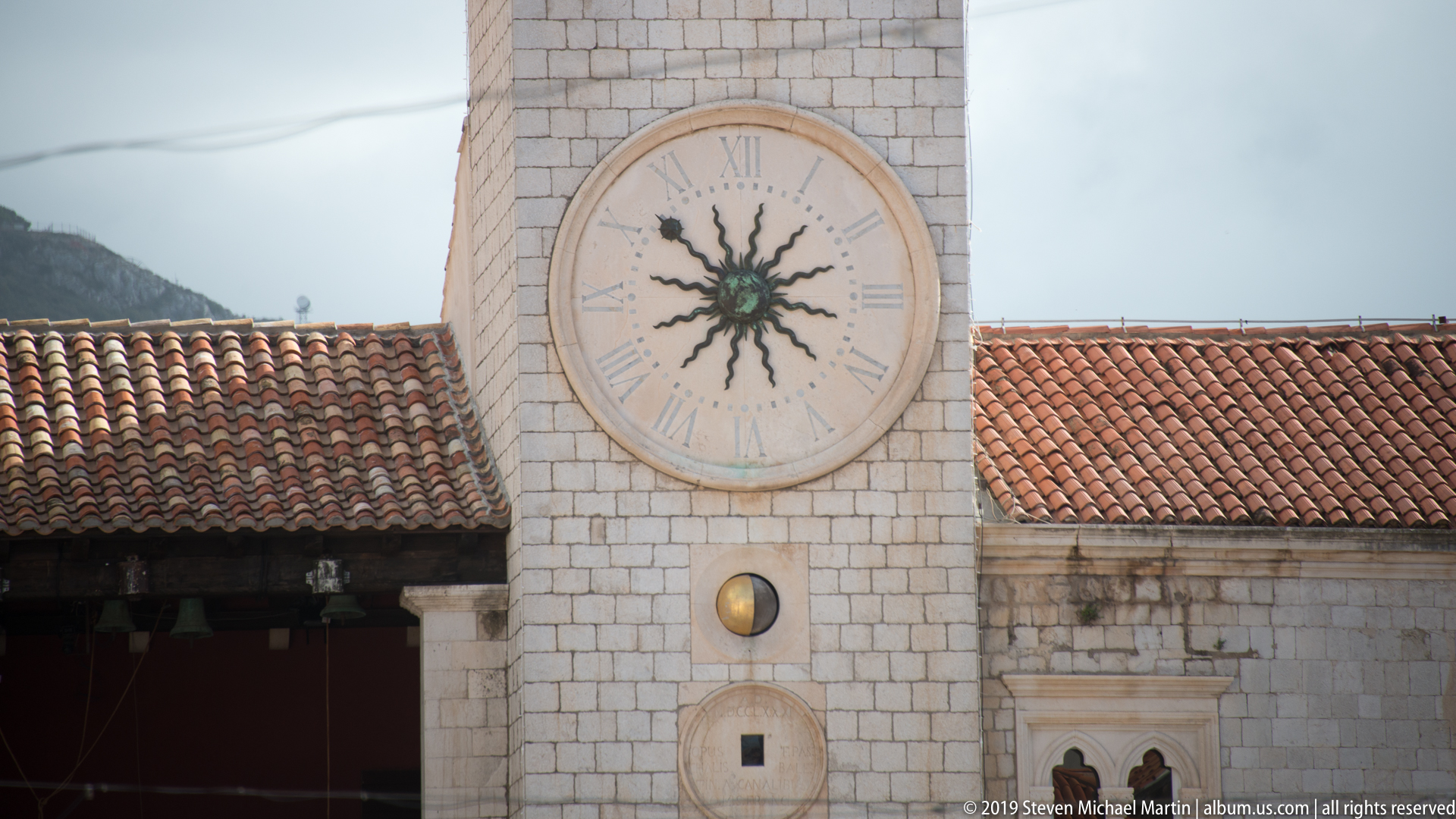
The clock face of Dubrovnik’s City Bell Tower fills the frame above a red-tiled roof. Its Roman-numeral dial carries the distinctive sun-shaped hand known locally as the “Hobotnica” (“octopus”), a form associated with the city’s historic public clock. The tower beside Luža Square was rebuilt in 1929 to the model of its predecessor, while the present clock preserves the visual language of Dubrovnik’s long civic timekeeping tradition.
Caption
The clock face of Dubrovnik’s City Bell Tower fills the frame above a red-tiled roof. Its Roman-numeral dial carries the distinctive sun-shaped hand known locally as the “Hobotnica” (“octopus”), a form associated with the city’s historic public clock. The tower beside Luža Square was rebuilt in 1929 to the model of its predecessor, while the present clock preserves the visual language of Dubrovnik’s long civic timekeeping tradition.

The Small Onofrio Fountain occupies its arched niche beside Luža Square, where an ornate basin and richly carved central shaft turn a civic water source into a sculptural monument. Onofrio della Cava created the fountain in 1438 with the sculptor Pietro di Martino as part of Dubrovnik’s new water-supply system. Its compact scale distinguishes it from the much larger Onofrio fountain near Pile Gate.
Caption
The Small Onofrio Fountain occupies its arched niche beside Luža Square, where an ornate basin and richly carved central shaft turn a civic water source into a sculptural monument. Onofrio della Cava created the fountain in 1438 with the sculptor Pietro di Martino as part of Dubrovnik’s new water-supply system. Its compact scale distinguishes it from the much larger Onofrio fountain near Pile Gate.

Dubrovnik’s City Bell Tower rises beside Luža Square, combining the large civic clock with an open bell stage and domed cap. The tower was originally built in the 15th century and reconstructed in 1929 after instability threatened the older structure. Its famous bronze bell-striking figures, the Zelenci or “Green Ones,” became enduring symbols of the passage of time in the former Republic of Ragusa.
Caption
Dubrovnik’s City Bell Tower rises beside Luža Square, combining the large civic clock with an open bell stage and domed cap. The tower was originally built in the 15th century and reconstructed in 1929 after instability threatened the older structure. Its famous bronze bell-striking figures, the Zelenci or “Green Ones,” became enduring symbols of the passage of time in the former Republic of Ragusa.

A view through heavy stone arches opens onto the elegant courtyard of Dubrovnik’s Rector’s Palace. Slender columns support a two-level arcade, while a clock and sculpted coat of arms enliven the opposite wall beneath a small bell gable. The layered arches and carved capitals emphasize the palace’s refined civic architecture and the inward-looking organization of its central court.
Caption
A view through heavy stone arches opens onto the elegant courtyard of Dubrovnik’s Rector’s Palace. Slender columns support a two-level arcade, while a clock and sculpted coat of arms enliven the opposite wall beneath a small bell gable. The layered arches and carved capitals emphasize the palace’s refined civic architecture and the inward-looking organization of its central court.

The restored mechanism of Dubrovnik’s City Bell Tower is displayed with its sun-shaped dial, the “Hobotnica,” in the Cultural History Museum at the Rector’s Palace. Franciscan clockmaker Pasko Baletin built the mechanism in 1781, reusing parts of the earlier public clock. It regulated the city’s time until 1886; preserved with the historic dial and original Zelenci, it now documents the engineering behind Dubrovnik’s celebrated civic clock.
Caption
The restored mechanism of Dubrovnik’s City Bell Tower is displayed with its sun-shaped dial, the “Hobotnica,” in the Cultural History Museum at the Rector’s Palace. Franciscan clockmaker Pasko Baletin built the mechanism in 1781, reusing parts of the earlier public clock. It regulated the city’s time until 1886; preserved with the historic dial and original Zelenci, it now documents the engineering behind Dubrovnik’s celebrated civic clock.

A richly appointed church interior centers on a gilded high altar framed by red and white architectural surfaces. A dark wooden pulpit projects from the left, while a large suspended metal chandelier hangs beneath the vaulted ceiling. Statues and painted or gilded panels crowd the sanctuary, creating a strong contrast with the pale stone columns and restrained nave architecture.
Caption
A richly appointed church interior centers on a gilded high altar framed by red and white architectural surfaces. A dark wooden pulpit projects from the left, while a large suspended metal chandelier hangs beneath the vaulted ceiling. Statues and painted or gilded panels crowd the sanctuary, creating a strong contrast with the pale stone columns and restrained nave architecture.

Dubrovnik’s fortified Old Town fills the lower foreground, its red-tiled roofs packed tightly within pale stone walls. Beyond the walls, newer neighborhoods rise over green hills and rocky headlands, while the Adriatic stretches along the left edge. This elevated perspective makes the historic city’s compact defensive footprint especially clear within the much larger modern urban landscape.
Caption
Dubrovnik’s fortified Old Town fills the lower foreground, its red-tiled roofs packed tightly within pale stone walls. Beyond the walls, newer neighborhoods rise over green hills and rocky headlands, while the Adriatic stretches along the left edge. This elevated perspective makes the historic city’s compact defensive footprint especially clear within the much larger modern urban landscape.

A temporary or commemorative museum gallery uses deep blue walls and a large “600” graphic as the visual focus. Illuminated cases and low vitrines display documents and small objects, while white interpretive text panels organize the room. The installation appears designed to present a historical anniversary within a modern exhibition environment inside a heritage building.
Caption
A temporary or commemorative museum gallery uses deep blue walls and a large “600” graphic as the visual focus. Illuminated cases and low vitrines display documents and small objects, while white interpretive text panels organize the room. The installation appears designed to present a historical anniversary within a modern exhibition environment inside a heritage building.

The Rector’s Palace courtyard is organized by two superimposed arcades: broad lower arches carry an upper gallery of narrower arches on slender columns. Carved capitals and pale limestone surfaces give the enclosure a rhythmic, almost cloister-like character. This frontal composition emphasizes the regular geometry of the courtyard rather than any single decorative feature.
Caption
The Rector’s Palace courtyard is organized by two superimposed arcades: broad lower arches carry an upper gallery of narrower arches on slender columns. Carved capitals and pale limestone surfaces give the enclosure a rhythmic, almost cloister-like character. This frontal composition emphasizes the regular geometry of the courtyard rather than any single decorative feature.

Massive foreground columns and deep arches create a dark frame around the sunlit courtyard of the Rector’s Palace. Across the opening, the upper gallery’s pale columns and rounded arches are sharply illuminated, producing a strong contrast between shaded circulation space and the bright central court. The oblique viewpoint highlights the depth and sequence of the palace arcades.
Caption
Massive foreground columns and deep arches create a dark frame around the sunlit courtyard of the Rector’s Palace. Across the opening, the upper gallery’s pale columns and rounded arches are sharply illuminated, producing a strong contrast between shaded circulation space and the bright central court. The oblique viewpoint highlights the depth and sequence of the palace arcades.

A large circular painted composition centers on a heraldic or allegorical scene surrounded by a wreath-like border and numerous figures distributed across the surrounding field. The surface shows age, abrasion, and uneven preservation, yet the richly populated imagery and ornamental framing remain legible. The close view documents both the narrative complexity and the material condition of the historic painted decoration.
Caption
A large circular painted composition centers on a heraldic or allegorical scene surrounded by a wreath-like border and numerous figures distributed across the surrounding field. The surface shows age, abrasion, and uneven preservation, yet the richly populated imagery and ornamental framing remain legible. The close view documents both the narrative complexity and the material condition of the historic painted decoration.

A devotional painting gathers the Virgin Mary, the nude Christ Child, an older bearded man likely Saint Joseph, and a richly dressed female figure within a dark landscape setting. The figures crowd close to the picture plane, with the child stretching across Mary’s lap. Warm flesh tones and saturated garments give the intimate group a soft, courtly character.
Caption
A devotional painting gathers the Virgin Mary, the nude Christ Child, an older bearded man likely Saint Joseph, and a richly dressed female figure within a dark landscape setting. The figures crowd close to the picture plane, with the child stretching across Mary’s lap. Warm flesh tones and saturated garments give the intimate group a soft, courtly character.

A corner perspective inside Dubrovnik’s Rector’s Palace shows the courtyard arcades turning at a right angle around the open central space. Slender upper columns rise above larger ground-floor arches, and a stone stair descends into the lower level at right. The view clarifies the courtyard’s circulation and the layered structural rhythm of the palace interior.
Caption
A corner perspective inside Dubrovnik’s Rector’s Palace shows the courtyard arcades turning at a right angle around the open central space. Slender upper columns rise above larger ground-floor arches, and a stone stair descends into the lower level at right. The view clarifies the courtyard’s circulation and the layered structural rhythm of the palace interior.

The upper wall of the Rector’s Palace courtyard is articulated by a central clock set between three broad arches, with a large carved coat of arms directly below and a small bell gable rising above the roofline. Seen from below, the composition concentrates several civic symbols in one axis and shows how decorative sculpture was integrated into the palace’s arcaded architecture.
Caption
The upper wall of the Rector’s Palace courtyard is articulated by a central clock set between three broad arches, with a large carved coat of arms directly below and a small bell gable rising above the roofline. Seen from below, the composition concentrates several civic symbols in one axis and shows how decorative sculpture was integrated into the palace’s arcaded architecture.

A broad stone staircase rises diagonally through the Rector’s Palace courtyard, its carved balustrade following the steep flight beneath a large supporting arch. A small wall fountain or basin occupies the recess below, while sculpted capitals and pale masonry connect the staircase to the surrounding arcade. The frame emphasizes circulation and the palace’s carefully integrated stonework.
Caption
A broad stone staircase rises diagonally through the Rector’s Palace courtyard, its carved balustrade following the steep flight beneath a large supporting arch. A small wall fountain or basin occupies the recess below, while sculpted capitals and pale masonry connect the staircase to the surrounding arcade. The frame emphasizes circulation and the palace’s carefully integrated stonework.

A gilded multi-panel altarpiece presents four standing saints in individual architectural compartments. The central grouping includes richly robed figures before a gold ground, while the flanking panels contain darker-clad saints carrying attributes. Carved cusped arches and gilded backgrounds unify the ensemble, preserving the visual language of late medieval devotional painting.
Caption
A gilded multi-panel altarpiece presents four standing saints in individual architectural compartments. The central grouping includes richly robed figures before a gold ground, while the flanking panels contain darker-clad saints carrying attributes. Carved cusped arches and gilded backgrounds unify the ensemble, preserving the visual language of late medieval devotional painting.

A dark, dramatic religious painting centers on the dead Christ supported by mourners, including a veiled woman in blue and additional figures in red and earth-toned garments. A small cherub appears near the lower right, intensifying the devotional character of the scene. Strong contrasts of light and shadow concentrate attention on Christ’s pale body amid the surrounding grief.
Caption
A dark, dramatic religious painting centers on the dead Christ supported by mourners, including a veiled woman in blue and additional figures in red and earth-toned garments. A small cherub appears near the lower right, intensifying the devotional character of the scene. Strong contrasts of light and shadow concentrate attention on Christ’s pale body amid the surrounding grief.

A freestanding or roof-mounted stone bell gable carries three dark bells in separate arched openings, with a smaller fourth opening and bell above. The weathered pale masonry stands sharply against a clear blue sky, while red terracotta roofs appear below. Its compact open-frame design is characteristic of Adriatic ecclesiastical architecture.
Caption
A freestanding or roof-mounted stone bell gable carries three dark bells in separate arched openings, with a smaller fourth opening and bell above. The weathered pale masonry stands sharply against a clear blue sky, while red terracotta roofs appear below. Its compact open-frame design is characteristic of Adriatic ecclesiastical architecture.

Dubrovnik’s pale limestone fortifications rise directly from a jagged Adriatic shoreline, where waves break against exposed rock below the walls. The close coastal viewpoint shows how the defensive circuit was adapted to uneven terrain at the water’s edge, combining massive masonry, parapets, and natural rock into a continuous barrier along the historic city.
Caption
Dubrovnik’s pale limestone fortifications rise directly from a jagged Adriatic shoreline, where waves break against exposed rock below the walls. The close coastal viewpoint shows how the defensive circuit was adapted to uneven terrain at the water’s edge, combining massive masonry, parapets, and natural rock into a continuous barrier along the historic city.

A large dark-toned painting depicts several figures gathered around a table in a richly furnished interior or architectural setting. One man gestures across the tabletop toward a seated figure in a red cap, while other bodies recline or cluster at the edges. The narrative appears religious or historical, but the proof-sheet view does not provide enough detail for a secure episode identification.
Caption
A large dark-toned painting depicts several figures gathered around a table in a richly furnished interior or architectural setting. One man gestures across the tabletop toward a seated figure in a red cap, while other bodies recline or cluster at the edges. The narrative appears religious or historical, but the proof-sheet view does not provide enough detail for a secure episode identification.

A richly carved stone capital in the Rector’s Palace arcade features paired standing human figures flanking a central shield or emblem. Rows of egg-and-dart and leaf-like ornament rise above the figural zone beneath a heavy rectangular abacus. The close crop reveals the sculptural density of the palace’s exterior arcade and the way heraldic imagery is embedded into structural decoration.
Caption
A richly carved stone capital in the Rector’s Palace arcade features paired standing human figures flanking a central shield or emblem. Rows of egg-and-dart and leaf-like ornament rise above the figural zone beneath a heavy rectangular abacus. The close crop reveals the sculptural density of the palace’s exterior arcade and the way heraldic imagery is embedded into structural decoration.

The Rector’s Palace exterior loggia is defined by broad pointed and rounded arches carried on heavy stone columns with elaborately carved capitals. Ribbed vaults span the bays overhead, while barred windows open through the masonry wall behind. This frontal architectural study emphasizes the transition between the palace façade and its sheltered public arcade.
Caption
The Rector’s Palace exterior loggia is defined by broad pointed and rounded arches carried on heavy stone columns with elaborately carved capitals. Ribbed vaults span the bays overhead, while barred windows open through the masonry wall behind. This frontal architectural study emphasizes the transition between the palace façade and its sheltered public arcade.

The Rector’s Palace presents its long stone façade to the street through an open ground-floor loggia of arches resting on sculpted columns. Pedestrians pass beneath and in front of the arcade, giving scale to the building, while a blue “600” banner marks a commemorative exhibition. Upper Gothic-style windows and the deeply shadowed loggia show the palace’s layered civic frontage.
Caption
The Rector’s Palace presents its long stone façade to the street through an open ground-floor loggia of arches resting on sculpted columns. Pedestrians pass beneath and in front of the arcade, giving scale to the building, while a blue “600” banner marks a commemorative exhibition. Upper Gothic-style windows and the deeply shadowed loggia show the palace’s layered civic frontage.

The Baroque façade of Dubrovnik’s Cathedral of the Assumption of the Virgin Mary rises above the Old Town in pale limestone, articulated by pilasters, pediments, niches and rooftop sculpture. The present cathedral replaced the Romanesque basilica destroyed in the earthquake of 1667; construction began in 1672 and was completed in 1713. Its monumental exterior announces one of the principal ecclesiastical buildings of the historic Republic.
Caption
The Baroque façade of Dubrovnik’s Cathedral of the Assumption of the Virgin Mary rises above the Old Town in pale limestone, articulated by pilasters, pediments, niches and rooftop sculpture. The present cathedral replaced the Romanesque basilica destroyed in the earthquake of 1667; construction began in 1672 and was completed in 1713. Its monumental exterior announces one of the principal ecclesiastical buildings of the historic Republic.

Fort Lovrijenac crowns a steep limestone outcrop above the Adriatic, its compact mass of pale masonry following the irregular summit of the rock. The view emphasizes the fortress’s commanding separation from Dubrovnik’s walled core and its exposure to the sea, while red-roofed buildings and wooded slopes frame the landward side of the promontory.
Caption
Fort Lovrijenac crowns a steep limestone outcrop above the Adriatic, its compact mass of pale masonry following the irregular summit of the rock. The view emphasizes the fortress’s commanding separation from Dubrovnik’s walled core and its exposure to the sea, while red-roofed buildings and wooded slopes frame the landward side of the promontory.

A broad curved bastion-like section of Dubrovnik’s seaward wall dominates the foreground, its weathered limestone face descending toward wave-washed rocks. The tight view makes the scale and thickness of the fortifications especially legible, while the foaming Adriatic below demonstrates the harsh marine setting that shaped the city’s coastal defensive architecture.
Caption
A broad curved bastion-like section of Dubrovnik’s seaward wall dominates the foreground, its weathered limestone face descending toward wave-washed rocks. The tight view makes the scale and thickness of the fortifications especially legible, while the foaming Adriatic below demonstrates the harsh marine setting that shaped the city’s coastal defensive architecture.

Fort Lovrijenac fills the frame from below, revealing the fortress as a succession of thick limestone walls and blocky upper works set directly on the cliff. The Croatian flag marks the summit while vegetation clings to the rocky slope. This closer view stresses the compact vertical massing that made the isolated stronghold a conspicuous element of Dubrovnik’s western defenses.
Caption
Fort Lovrijenac fills the frame from below, revealing the fortress as a succession of thick limestone walls and blocky upper works set directly on the cliff. The Croatian flag marks the summit while vegetation clings to the rocky slope. This closer view stresses the compact vertical massing that made the isolated stronghold a conspicuous element of Dubrovnik’s western defenses.

Fort Lovrijenac appears almost isolated against open water, its pale stone walls capping the rugged cliff above breaking surf. The broad expanse of deep blue Adriatic to the left makes the fortress’s maritime exposure especially clear, while the narrow strip of wooded land and buildings to the right reconnects the stronghold to Dubrovnik’s western edge.
Caption
Fort Lovrijenac appears almost isolated against open water, its pale stone walls capping the rugged cliff above breaking surf. The broad expanse of deep blue Adriatic to the left makes the fortress’s maritime exposure especially clear, while the narrow strip of wooded land and buildings to the right reconnects the stronghold to Dubrovnik’s western edge.

A formal hotel lobby is arranged symmetrically around a broad central staircase, with dark wood reception desks, pale wall paneling, and a sequence of large spherical metal chandeliers. The polished interior contrasts sharply with the surrounding fortification views in the portfolio, documenting the refined hospitality environment associated with a stay in Dubrovnik rather than a historic defensive structure.
Caption
A formal hotel lobby is arranged symmetrically around a broad central staircase, with dark wood reception desks, pale wall paneling, and a sequence of large spherical metal chandeliers. The polished interior contrasts sharply with the surrounding fortification views in the portfolio, documenting the refined hospitality environment associated with a stay in Dubrovnik rather than a historic defensive structure.

An elongated hotel lounge combines tall arched openings, large windows, white ornamental ceilings, modern upholstered seating, and glass pendant lighting. Built-in display shelving and a sequence of small tables create distinct conversation areas along the room. The photograph records a contemporary hospitality interior whose restrained palette and high ceilings evoke a formal grand-hotel setting.
Caption
An elongated hotel lounge combines tall arched openings, large windows, white ornamental ceilings, modern upholstered seating, and glass pendant lighting. Built-in display shelving and a sequence of small tables create distinct conversation areas along the room. The photograph records a contemporary hospitality interior whose restrained palette and high ceilings evoke a formal grand-hotel setting.

Dubrovnik’s thick western defenses occupy the foreground while Fort Lovrijenac rises beyond the surf on its rocky promontory. Between them, waves surge through the narrow inlet and red-roofed buildings cluster along the shore. The elevated wall-walk viewpoint makes the complementary relationship between the city walls and the detached fortress especially legible.
Caption
Dubrovnik’s thick western defenses occupy the foreground while Fort Lovrijenac rises beyond the surf on its rocky promontory. Between them, waves surge through the narrow inlet and red-roofed buildings cluster along the shore. The elevated wall-walk viewpoint makes the complementary relationship between the city walls and the detached fortress especially legible.

Fort Lovrijenac rises across the inlet while a dark vertical section of Dubrovnik’s city wall frames the left edge of the composition. Visitors gather along the lower coastal route at right, giving scale to the cliffs and masonry. This viewpoint highlights the fortress as a detached but visually integrated component of the western defensive landscape.
Caption
Fort Lovrijenac rises across the inlet while a dark vertical section of Dubrovnik’s city wall frames the left edge of the composition. Visitors gather along the lower coastal route at right, giving scale to the cliffs and masonry. This viewpoint highlights the fortress as a detached but visually integrated component of the western defensive landscape.

The wall walk curves through a dense complex of gates, towers, and red-roofed buildings before the view opens toward Fort Lovrijenac on its sea cliff. Visitors moving along the ramparts provide scale to the massive masonry. The composition links Dubrovnik’s western entrance defenses to the detached fortress that commands the opposite side of the inlet.
Caption
The wall walk curves through a dense complex of gates, towers, and red-roofed buildings before the view opens toward Fort Lovrijenac on its sea cliff. Visitors moving along the ramparts provide scale to the massive masonry. The composition links Dubrovnik’s western entrance defenses to the detached fortress that commands the opposite side of the inlet.

Onofrio’s Large Fountain occupies the center of the paved square just inside Dubrovnik’s western entrance, its low polygonal drum capped by a broad domed roof. Behind it, pale stone buildings and the nearby Franciscan complex rise above groups of pedestrians. From the city walls, the fountain reads as a major civic landmark embedded within the dense medieval street plan.
Caption
Onofrio’s Large Fountain occupies the center of the paved square just inside Dubrovnik’s western entrance, its low polygonal drum capped by a broad domed roof. Behind it, pale stone buildings and the nearby Franciscan complex rise above groups of pedestrians. From the city walls, the fountain reads as a major civic landmark embedded within the dense medieval street plan.

A broad stone rampart leads toward a high defensive tower and crenellated wall segment on Dubrovnik’s elevated northern side. Red-tiled roofs press close to the fortifications at left, illustrating the tight relationship between domestic buildings and the defensive circuit. Flags above the tower add a contemporary marker to the massive historic masonry.
Caption
A broad stone rampart leads toward a high defensive tower and crenellated wall segment on Dubrovnik’s elevated northern side. Red-tiled roofs press close to the fortifications at left, illustrating the tight relationship between domestic buildings and the defensive circuit. Flags above the tower add a contemporary marker to the massive historic masonry.

From an elevated position, visitors gather and move through a confined stone space beside Dubrovnik’s walls. High masonry surfaces, tiled roofs and a narrow gateway compress the scene, emphasizing the circulation routes built into the fortified city and the contrast between monumental defensive architecture and present-day pedestrian use.
Caption
From an elevated position, visitors gather and move through a confined stone space beside Dubrovnik’s walls. High masonry surfaces, tiled roofs and a narrow gateway compress the scene, emphasizing the circulation routes built into the fortified city and the contrast between monumental defensive architecture and present-day pedestrian use.

From the high northern walls, Dubrovnik’s fortifications descend toward the western waterfront while Fort Lovrijenac crowns its isolated cliff beyond. Red-roofed houses and tree-lined streets fill the space between wall and sea. The elevated perspective shows how the defensive circuit, urban neighborhoods, and detached coastal stronghold form a single layered landscape.
Caption
From the high northern walls, Dubrovnik’s fortifications descend toward the western waterfront while Fort Lovrijenac crowns its isolated cliff beyond. Red-roofed houses and tree-lined streets fill the space between wall and sea. The elevated perspective shows how the defensive circuit, urban neighborhoods, and detached coastal stronghold form a single layered landscape.

The Croatian national flag fills the frame as it billows strongly against a blue-and-clouded sky. Its horizontal red, white, and blue bands are centered on the national coat of arms, with the red-and-white checkerboard shield and crown of regional emblems clearly visible. The wind-torn edge adds a vivid sense of exposure on Dubrovnik’s elevated walls.
Caption
The Croatian national flag fills the frame as it billows strongly against a blue-and-clouded sky. Its horizontal red, white, and blue bands are centered on the national coat of arms, with the red-and-white checkerboard shield and crown of regional emblems clearly visible. The wind-torn edge adds a vivid sense of exposure on Dubrovnik’s elevated walls.

A visitor rests on a low stone ledge in front of a broad expanse of weathered limestone wall along Dubrovnik’s fortifications. The simple composition shifts attention from monumental architecture to the human scale of the wall circuit, while the hillside houses beyond the parapet place the scene within the lived landscape surrounding the historic city.
Caption
A visitor rests on a low stone ledge in front of a broad expanse of weathered limestone wall along Dubrovnik’s fortifications. The simple composition shifts attention from monumental architecture to the human scale of the wall circuit, while the hillside houses beyond the parapet place the scene within the lived landscape surrounding the historic city.

Dubrovnik’s Old Town spreads across the frame as a tightly packed field of terracotta roofs, pale stone façades, church towers, and narrow streets. The Adriatic and wooded Lokrum Island appear beyond the city edge. From the elevated wall route, the view makes the remarkable density and coherent roofscape of the historic center immediately apparent.
Caption
Dubrovnik’s Old Town spreads across the frame as a tightly packed field of terracotta roofs, pale stone façades, church towers, and narrow streets. The Adriatic and wooded Lokrum Island appear beyond the city edge. From the elevated wall route, the view makes the remarkable density and coherent roofscape of the historic center immediately apparent.

Red-tiled roofs cascade toward Dubrovnik’s western edge, where Fort Lovrijenac rises beyond the city on its rocky sea cliff. Church towers and pale limestone façades punctuate the dense urban fabric, while the deep blue Adriatic forms the horizon. The view links the historic core to the detached fortress guarding its western approach.
Caption
Red-tiled roofs cascade toward Dubrovnik’s western edge, where Fort Lovrijenac rises beyond the city on its rocky sea cliff. Church towers and pale limestone façades punctuate the dense urban fabric, while the deep blue Adriatic forms the horizon. The view links the historic core to the detached fortress guarding its western approach.

Dubrovnik’s roofscape glows in warm light, with church domes, bell towers, pale façades, and terracotta tiles layered toward the Adriatic. The elevated view from the walls compresses the historic center into a dense architectural panorama. Monumental ecclesiastical forms rise above the domestic roofs, creating the distinctive vertical accents of the Old Town skyline.
Caption
Dubrovnik’s roofscape glows in warm light, with church domes, bell towers, pale façades, and terracotta tiles layered toward the Adriatic. The elevated view from the walls compresses the historic center into a dense architectural panorama. Monumental ecclesiastical forms rise above the domestic roofs, creating the distinctive vertical accents of the Old Town skyline.

A white flag edged in red bears the circular emblem of the Society of Friends of Dubrovnik Antiquities, with the Croatian text “Društvo prijatelja dubrovačke starine” surrounding a stylized fortified gate. The organization is closely associated with the care of Dubrovnik’s historic defenses, making the banner a fitting symbol along the city-wall route.
Caption
A white flag edged in red bears the circular emblem of the Society of Friends of Dubrovnik Antiquities, with the Croatian text “Društvo prijatelja dubrovačke starine” surrounding a stylized fortified gate. The organization is closely associated with the care of Dubrovnik’s historic defenses, making the banner a fitting symbol along the city-wall route.

Dubrovnik’s northern defenses fill the frame in layered limestone masses, culminating in the great round Minčeta Tower with its projecting upper gallery. Curtain walls and angular lower works descend toward the foreground, demonstrating how successive defensive elements reinforce one another. Flags above the complex stand out against the bright sky and draw attention to the tower’s commanding height.
Caption
Dubrovnik’s northern defenses fill the frame in layered limestone masses, culminating in the great round Minčeta Tower with its projecting upper gallery. Curtain walls and angular lower works descend toward the foreground, demonstrating how successive defensive elements reinforce one another. Flags above the complex stand out against the bright sky and draw attention to the tower’s commanding height.

A dense sea of terracotta roofs spreads across Dubrovnik’s Old Town, broken by pale stone façades, chimneys, and occasional towers. The elevated viewpoint from the fortifications makes the compact street pattern and near-uniform roofing especially apparent. Sunlight intensifies the orange tiles while the distant wall line and sea edge locate the city within its fortified coastal setting.
Caption
A dense sea of terracotta roofs spreads across Dubrovnik’s Old Town, broken by pale stone façades, chimneys, and occasional towers. The elevated viewpoint from the fortifications makes the compact street pattern and near-uniform roofing especially apparent. Sunlight intensifies the orange tiles while the distant wall line and sea edge locate the city within its fortified coastal setting.

A visitor pauses above Dubrovnik’s Old Town, framed against a pale-stone bell tower and a dense field of terracotta roofs. The elevated viewpoint places the portrait within the city’s compact historic fabric, where church towers rise above closely packed masonry buildings inside the fortifications.
Caption
A visitor pauses above Dubrovnik’s Old Town, framed against a pale-stone bell tower and a dense field of terracotta roofs. The elevated viewpoint places the portrait within the city’s compact historic fabric, where church towers rise above closely packed masonry buildings inside the fortifications.

Dubrovnik’s defensive system fills the view as the wall walk curves toward a massive stone fortress of cylindrical and rectangular towers. The layered parapets, thick masonry and commanding elevation illustrate how the city’s fortifications controlled approaches while adapting to steep terrain around the historic center.
Caption
Dubrovnik’s defensive system fills the view as the wall walk curves toward a massive stone fortress of cylindrical and rectangular towers. The layered parapets, thick masonry and commanding elevation illustrate how the city’s fortifications controlled approaches while adapting to steep terrain around the historic center.

Rows of weathered terracotta roof tiles reveal the varied color, surface wear and irregularity of Dubrovnik’s traditional roofscape at close range. Cream, ocher and orange tiles overlap in tight courses, showing the handmade character and accumulated patina that distinguish the historic city’s roofs from a distant panoramic view.
Caption
Rows of weathered terracotta roof tiles reveal the varied color, surface wear and irregularity of Dubrovnik’s traditional roofscape at close range. Cream, ocher and orange tiles overlap in tight courses, showing the handmade character and accumulated patina that distinguish the historic city’s roofs from a distant panoramic view.

A broad fan-shaped stone staircase rises to a deeply framed arched doorway, transforming a confined courtyard into a ceremonial approach. The sweeping geometry of the steps contrasts with the rougher ashlar wall, while the elevated viewpoint clarifies how stairs, doorway and surrounding masonry work together as a composed architectural ensemble.
Caption
A broad fan-shaped stone staircase rises to a deeply framed arched doorway, transforming a confined courtyard into a ceremonial approach. The sweeping geometry of the steps contrasts with the rougher ashlar wall, while the elevated viewpoint clarifies how stairs, doorway and surrounding masonry work together as a composed architectural ensemble.

Dark storm clouds gather over Dubrovnik’s harbor, where small boats cluster in choppy turquoise water below the fortified city. The view links the old masonry waterfront with the steep inhabited hillside beyond, reinforcing Dubrovnik’s close physical relationship between defensive walls, port activity and the rugged Adriatic coast.
Caption
Dark storm clouds gather over Dubrovnik’s harbor, where small boats cluster in choppy turquoise water below the fortified city. The view links the old masonry waterfront with the steep inhabited hillside beyond, reinforcing Dubrovnik’s close physical relationship between defensive walls, port activity and the rugged Adriatic coast.

A visitor stands on Dubrovnik’s narrow wall walk between waist-high parapets, with red-tiled roofs crowding the historic city below. The photograph emphasizes the pedestrian scale of the fortifications and the elevated route from which successive views of the Old Town, churches and defensive works unfold.
Caption
A visitor stands on Dubrovnik’s narrow wall walk between waist-high parapets, with red-tiled roofs crowding the historic city below. The photograph emphasizes the pedestrian scale of the fortifications and the elevated route from which successive views of the Old Town, churches and defensive works unfold.

A large bronze bell hangs within a round-arched stone opening, its green patina contrasting with the pale masonry surrounding it. Timber supports and metal fittings remain visible above and beside the bell, giving a close architectural view of the mechanism rather than a distant view of the tower that houses it.
Caption
A large bronze bell hangs within a round-arched stone opening, its green patina contrasting with the pale masonry surrounding it. Timber supports and metal fittings remain visible above and beside the bell, giving a close architectural view of the mechanism rather than a distant view of the tower that houses it.

An iron cannon on a timber carriage stands beside Dubrovnik’s stone fortifications, aimed through an opening toward the harbor. The surviving display evokes the artillery role of the walls while the water and hillside settlement beyond show the strategic field of view once commanded from this defensive position.
Caption
An iron cannon on a timber carriage stands beside Dubrovnik’s stone fortifications, aimed through an opening toward the harbor. The surviving display evokes the artillery role of the walls while the water and hillside settlement beyond show the strategic field of view once commanded from this defensive position.

A domed stone bell tower rises in front of one of Dubrovnik’s massive defensive towers, juxtaposing civic or religious vertical architecture with the heavier geometry of the fortifications. Red roofs, flags and hillside buildings complete a tightly layered skyline characteristic of the walled Old Town.
Caption
A domed stone bell tower rises in front of one of Dubrovnik’s massive defensive towers, juxtaposing civic or religious vertical architecture with the heavier geometry of the fortifications. Red roofs, flags and hillside buildings complete a tightly layered skyline characteristic of the walled Old Town.

A luminous two-story stone courtyard is organized by slender columns, rounded arches and an open staircase climbing along the rear wall. The arcaded galleries create a refined interior space distinct from Dubrovnik’s military architecture, showing the city’s tradition of monumental civic and residential design within the fortified core.
Caption
A luminous two-story stone courtyard is organized by slender columns, rounded arches and an open staircase climbing along the rear wall. The arcaded galleries create a refined interior space distinct from Dubrovnik’s military architecture, showing the city’s tradition of monumental civic and residential design within the fortified core.

Dubrovnik’s Old Port spreads beneath the fortified waterfront, with pleasure boats moored in front of broad stone arches opening into the city. Above them, terracotta roofs, towers and hillside houses rise in dense layers, linking the maritime edge directly to the enclosed historic center.
Caption
Dubrovnik’s Old Port spreads beneath the fortified waterfront, with pleasure boats moored in front of broad stone arches opening into the city. Above them, terracotta roofs, towers and hillside houses rise in dense layers, linking the maritime edge directly to the enclosed historic center.

An elevated panorama looks across Dubrovnik’s Old Port to the fortified waterfront, where arched openings and heavy stone walls meet the water. Boats fill the sheltered basin while church towers, red roofs and hillside houses rise beyond, presenting the city as an integrated maritime and defensive landscape.
Caption
An elevated panorama looks across Dubrovnik’s Old Port to the fortified waterfront, where arched openings and heavy stone walls meet the water. Boats fill the sheltered basin while church towers, red roofs and hillside houses rise beyond, presenting the city as an integrated maritime and defensive landscape.

Several large iron anchors are displayed along a pale stone wall, their different shank, fluke and stock forms creating a compact survey of maritime hardware. Set within Dubrovnik’s historic waterfront environment, the group connects the fortified city visually with the seafaring activity that sustained its port.
Caption
Several large iron anchors are displayed along a pale stone wall, their different shank, fluke and stock forms creating a compact survey of maritime hardware. Set within Dubrovnik’s historic waterfront environment, the group connects the fortified city visually with the seafaring activity that sustained its port.

A bilingual wayfinding sign reading “gradske zidine / to the city walls” directs visitors toward Dubrovnik’s best-known fortifications. The simple modern sign, mounted on historic masonry, records how contemporary visitor circulation is layered onto the medieval and early modern urban fabric.
Caption
A bilingual wayfinding sign reading “gradske zidine / to the city walls” directs visitors toward Dubrovnik’s best-known fortifications. The simple modern sign, mounted on historic masonry, records how contemporary visitor circulation is layered onto the medieval and early modern urban fabric.

A line drawing on a wooden panel reduces Dubrovnik’s historic center to its defining urban forms: encircling walls, projecting towers, clustered roofs and the fortified harbor edge. The schematic image is especially useful for understanding how the defensive circuit surrounds and shapes the compact city within.
Caption
A line drawing on a wooden panel reduces Dubrovnik’s historic center to its defining urban forms: encircling walls, projecting towers, clustered roofs and the fortified harbor edge. The schematic image is especially useful for understanding how the defensive circuit surrounds and shapes the compact city within.

A narrow vaulted passage recedes through a sequence of stone arches, creating a tunnel-like route within Dubrovnik’s dense historic fabric. Repeated openings, thick masonry and worn paving emphasize the depth of the structure and the way circulation was threaded through massive built walls and enclosed complexes.
Caption
A narrow vaulted passage recedes through a sequence of stone arches, creating a tunnel-like route within Dubrovnik’s dense historic fabric. Repeated openings, thick masonry and worn paving emphasize the depth of the structure and the way circulation was threaded through massive built walls and enclosed complexes.

Slender columns and rounded arches frame the upper gallery of a refined stone courtyard, with the open sky visible above the central void. The photograph concentrates on rhythm, proportion and carved capitals, revealing a more delicate architectural vocabulary than the massive fortifications surrounding Dubrovnik’s historic center.
Caption
Slender columns and rounded arches frame the upper gallery of a refined stone courtyard, with the open sky visible above the central void. The photograph concentrates on rhythm, proportion and carved capitals, revealing a more delicate architectural vocabulary than the massive fortifications surrounding Dubrovnik’s historic center.

A visitor walks through a narrow stone lane enclosed by high masonry walls, one of the intimate pedestrian spaces that contrast with Dubrovnik’s broad walls and monumental squares. Rough stone surfaces, small openings and a glimpse of vegetation give the passage a distinctly domestic scale within the fortified city.
Caption
A visitor walks through a narrow stone lane enclosed by high masonry walls, one of the intimate pedestrian spaces that contrast with Dubrovnik’s broad walls and monumental squares. Rough stone surfaces, small openings and a glimpse of vegetation give the passage a distinctly domestic scale within the fortified city.

Dubrovnik’s seaward wall rises directly from jagged coastal rock as wind-driven waves break below. The close viewpoint shows how the fortifications exploit the natural shoreline, combining sheer masonry with the Adriatic itself as a defensive barrier while distant hills disappear beneath heavy weather.
Caption
Dubrovnik’s seaward wall rises directly from jagged coastal rock as wind-driven waves break below. The close viewpoint shows how the fortifications exploit the natural shoreline, combining sheer masonry with the Adriatic itself as a defensive barrier while distant hills disappear beneath heavy weather.

Rounded arches on two levels surround a stone courtyard, with a straight staircase linking the lower and upper galleries. The oblique view reveals the structural logic of columns, arches and landings and emphasizes the controlled geometry of a ceremonial interior court within Dubrovnik’s historic center.
Caption
Rounded arches on two levels surround a stone courtyard, with a straight staircase linking the lower and upper galleries. The oblique view reveals the structural logic of columns, arches and landings and emphasizes the controlled geometry of a ceremonial interior court within Dubrovnik’s historic center.

A near-symmetrical view across a pale stone courtyard highlights its paired arcades and carefully carved columns. Decorative relief at the upper left and the open sky above the court add detail to an architecture governed by repetition, proportion and light, offering a clear study of Dubrovnik’s refined civic building tradition.
Caption
A near-symmetrical view across a pale stone courtyard highlights its paired arcades and carefully carved columns. Decorative relief at the upper left and the open sky above the court add detail to an architecture governed by repetition, proportion and light, offering a clear study of Dubrovnik’s refined civic building tradition.

A weathered church exterior presents a restrained stone façade, tall arched doorway and adjoining tower beside a quiet paved space. The worn masonry and simple massing contrast with Dubrovnik’s more ornate ecclesiastical interiors, emphasizing the city’s layered architectural fabric rather than decorative display.
Caption
A weathered church exterior presents a restrained stone façade, tall arched doorway and adjoining tower beside a quiet paved space. The worn masonry and simple massing contrast with Dubrovnik’s more ornate ecclesiastical interiors, emphasizing the city’s layered architectural fabric rather than decorative display.

A devotional grotto encloses a statue of the Virgin Mary amid rough rockwork, greenery and fresh flowers. The intimate shrine relies on texture and enclosure rather than monumental architecture, creating a private devotional setting within Dubrovnik’s larger religious landscape.
Caption
A devotional grotto encloses a statue of the Virgin Mary amid rough rockwork, greenery and fresh flowers. The intimate shrine relies on texture and enclosure rather than monumental architecture, creating a private devotional setting within Dubrovnik’s larger religious landscape.

An exuberant Baroque side altar combines red-veined marble columns, white sculpture, gilded ornament and a framed religious painting beneath a richly painted vault. Blue and ocher surfaces intensify the theatrical setting, demonstrating how architecture, painting and sculpture are fused into a single devotional composition.
Caption
An exuberant Baroque side altar combines red-veined marble columns, white sculpture, gilded ornament and a framed religious painting beneath a richly painted vault. Blue and ocher surfaces intensify the theatrical setting, demonstrating how architecture, painting and sculpture are fused into a single devotional composition.

A marble altar stands beneath a richly ornamented barrel vault, framed by painted architectural surfaces and sculpted figures. Compared with the more colorful neighboring chapel, this composition is restrained in palette but equally theatrical in its use of layered framing, illusionistic decoration and axial focus on the altar painting.
Caption
A marble altar stands beneath a richly ornamented barrel vault, framed by painted architectural surfaces and sculpted figures. Compared with the more colorful neighboring chapel, this composition is restrained in palette but equally theatrical in its use of layered framing, illusionistic decoration and axial focus on the altar painting.

Dubrovnik’s fortifications project over bright turquoise water, their heavy masonry walls and rounded defensive forms rising directly from the rocky shoreline. The elevated viewpoint reveals how the wall system follows the coast and uses the steep seaward edge as part of the city’s defensive geography.
Caption
Dubrovnik’s fortifications project over bright turquoise water, their heavy masonry walls and rounded defensive forms rising directly from the rocky shoreline. The elevated viewpoint reveals how the wall system follows the coast and uses the steep seaward edge as part of the city’s defensive geography.

A sweeping Baroque ceiling fresco opens the church vault into an illusionistic celestial realm crowded with figures, clouds and radiant color. Painted architecture and sculpted moldings merge at the edges, while the upward viewpoint emphasizes the dramatic perspective designed to draw the eye from the physical interior toward a visionary heaven.
Caption
A sweeping Baroque ceiling fresco opens the church vault into an illusionistic celestial realm crowded with figures, clouds and radiant color. Painted architecture and sculpted moldings merge at the edges, while the upward viewpoint emphasizes the dramatic perspective designed to draw the eye from the physical interior toward a visionary heaven.

The church nave is viewed toward the entrance beneath a high, pale barrel-vaulted ceiling. Side chapels, a projecting pulpit, dark chandelier and red draperies punctuate the white architectural framework, giving a broader spatial context for the elaborate painted and marble altars shown in adjacent photographs.
Caption
The church nave is viewed toward the entrance beneath a high, pale barrel-vaulted ceiling. Side chapels, a projecting pulpit, dark chandelier and red draperies punctuate the white architectural framework, giving a broader spatial context for the elaborate painted and marble altars shown in adjacent photographs.

A monumental Baroque altar rises behind a white-clothed altar table, framed by paired red marble columns and a dense program of religious paintings and gilded ornament. The layered vertical composition concentrates attention toward the central sacred image while side canvases and architectural sculpture extend the decorative program across the sanctuary wall.
Caption
A monumental Baroque altar rises behind a white-clothed altar table, framed by paired red marble columns and a dense program of religious paintings and gilded ornament. The layered vertical composition concentrates attention toward the central sacred image while side canvases and architectural sculpture extend the decorative program across the sanctuary wall.

An upward view unites the sanctuary’s red marble columns, gilded architectural ornament and expansive ceiling fresco into a single Baroque composition. The steep perspective reveals how the altar and painted vault were designed to work together, directing attention vertically from the liturgical focus below toward the crowded celestial scene overhead.
Caption
An upward view unites the sanctuary’s red marble columns, gilded architectural ornament and expansive ceiling fresco into a single Baroque composition. The steep perspective reveals how the altar and painted vault were designed to work together, directing attention vertically from the liturgical focus below toward the crowded celestial scene overhead.

The nave of Dubrovnik’s Jesuit Church of St Ignatius leads toward a sanctuary enveloped by illusionistic Baroque painting. Andrea Pozzo designed the church, completed in 1725, while Gaetano Garcia painted the sanctuary cycle in 1735–1738 with episodes from the life and glorification of St Ignatius. The pale single-nave architecture, side chapels and painted apse create one of the Old Town’s most unified Baroque interiors.
Caption
The nave of Dubrovnik’s Jesuit Church of St Ignatius leads toward a sanctuary enveloped by illusionistic Baroque painting. Andrea Pozzo designed the church, completed in 1725, while Gaetano Garcia painted the sanctuary cycle in 1735–1738 with episodes from the life and glorification of St Ignatius. The pale single-nave architecture, side chapels and painted apse create one of the Old Town’s most unified Baroque interiors.

A monumental stone doorway is crowned by an elaborate sculptural ensemble of scrollwork, heraldic forms and a reclining figure. Corinthian columns flank the composition, while layered cornices and broken pediments create the dramatic projection and shadow associated with Baroque architectural decoration.
Caption
A monumental stone doorway is crowned by an elaborate sculptural ensemble of scrollwork, heraldic forms and a reclining figure. Corinthian columns flank the composition, while layered cornices and broken pediments create the dramatic projection and shadow associated with Baroque architectural decoration.

The monumental Baroque façade of the Jesuit Church of St Ignatius closes Ruđer Bošković Square above Dubrovnik’s famous Jesuit steps. The church was designed by Jesuit architect and painter Andrea Pozzo, with work beginning in 1699; it was completed in 1725 and opened in 1729. Its strongly modeled façade forms the architectural focus of the adjoining Collegium Ragusinum and one of Dubrovnik’s most important Baroque ensembles.
Caption
The monumental Baroque façade of the Jesuit Church of St Ignatius closes Ruđer Bošković Square above Dubrovnik’s famous Jesuit steps. The church was designed by Jesuit architect and painter Andrea Pozzo, with work beginning in 1699; it was completed in 1725 and opened in 1729. Its strongly modeled façade forms the architectural focus of the adjoining Collegium Ragusinum and one of Dubrovnik’s most important Baroque ensembles.

A quiet paved court is enclosed by thick limestone walls, small openings and stepped passages. The restrained scene emphasizes the massive masonry and compact circulation of Dubrovnik’s historic core, where modest service spaces and lanes sit immediately beside monumental religious and defensive architecture.
Caption
A quiet paved court is enclosed by thick limestone walls, small openings and stepped passages. The restrained scene emphasizes the massive masonry and compact circulation of Dubrovnik’s historic core, where modest service spaces and lanes sit immediately beside monumental religious and defensive architecture.

A small stone chapel with a steep red-tile roof occupies a tight corner within Dubrovnik’s walled city. Narrow arched windows, plain masonry and surrounding steps give the building an intimate scale, sharply different from the monumental churches and fortifications elsewhere in the Old Town.
Caption
A small stone chapel with a steep red-tile roof occupies a tight corner within Dubrovnik’s walled city. Narrow arched windows, plain masonry and surrounding steps give the building an intimate scale, sharply different from the monumental churches and fortifications elsewhere in the Old Town.

A narrow lane bends past a small chapel beneath a traditional hanging lantern. Rough-cut stone walls, terracotta roofing and a solitary pedestrian create an intimate urban scene, showing the compressed scale of circulation within Dubrovnik’s fortified historic center.
Caption
A narrow lane bends past a small chapel beneath a traditional hanging lantern. Rough-cut stone walls, terracotta roofing and a solitary pedestrian create an intimate urban scene, showing the compressed scale of circulation within Dubrovnik’s fortified historic center.

A close view of Dubrovnik masonry isolates the irregular limestone blocks, weathered faces and pale mortar joints that give the historic city its distinctive texture. Variations in stone size, color and finish record the hand-built character of walls that appear more uniform from a distance.
Caption
A close view of Dubrovnik masonry isolates the irregular limestone blocks, weathered faces and pale mortar joints that give the historic city its distinctive texture. Variations in stone size, color and finish record the hand-built character of walls that appear more uniform from a distance.

Rows of projecting anchors punctuate a tall stone façade, forming a repeated pattern across the weathered masonry. The oblique upward viewpoint emphasizes both the wall’s height and the practical structural hardware embedded in Dubrovnik’s historic architecture.
Caption
Rows of projecting anchors punctuate a tall stone façade, forming a repeated pattern across the weathered masonry. The oblique upward viewpoint emphasizes both the wall’s height and the practical structural hardware embedded in Dubrovnik’s historic architecture.

A weathered arched passage opens onto a rising stone stairway, its lintel and vault decorated with carved reliefs and worn plaster. The compressed threshold links one narrow urban level to another, revealing the layered circulation and accumulated surface history of Dubrovnik’s Old Town.
Caption
A weathered arched passage opens onto a rising stone stairway, its lintel and vault decorated with carved reliefs and worn plaster. The compressed threshold links one narrow urban level to another, revealing the layered circulation and accumulated surface history of Dubrovnik’s Old Town.

A steep stone street cuts through Dubrovnik’s dense urban fabric, confined by high masonry walls and closely packed buildings. A pedestrian climbing the slope provides scale, while the hillside beyond shows how the city’s streets adapt to sharply changing elevation.
Caption
A steep stone street cuts through Dubrovnik’s dense urban fabric, confined by high masonry walls and closely packed buildings. A pedestrian climbing the slope provides scale, while the hillside beyond shows how the city’s streets adapt to sharply changing elevation.

A layered skyline brings together Dubrovnik’s religious and defensive architecture: a slender bell tower rises above red-tiled roofs while massive crenellated walls and a square defensive tower occupy the hillside behind. The compressed telephoto view shows how sacred, domestic and military structures overlap within the Old Town.
Caption
A layered skyline brings together Dubrovnik’s religious and defensive architecture: a slender bell tower rises above red-tiled roofs while massive crenellated walls and a square defensive tower occupy the hillside behind. The compressed telephoto view shows how sacred, domestic and military structures overlap within the Old Town.

A narrow stone street leads directly toward a small church façade with a circular window and bell opening. Café seating, awnings and a pedestrian occupy the foreground, showing how everyday commercial life unfolds within the preserved masonry fabric of Dubrovnik’s Old Town.
Caption
A narrow stone street leads directly toward a small church façade with a circular window and bell opening. Café seating, awnings and a pedestrian occupy the foreground, showing how everyday commercial life unfolds within the preserved masonry fabric of Dubrovnik’s Old Town.

A projecting shop sign marked “Zlato Srebro” and “Zlatarna Rubin” hangs from a wrought bracket along a narrow Dubrovnik street. Repeated lanterns and close stone façades recede behind it, turning the commercial sign into a distinctive detail within the Old Town streetscape.
Caption
A projecting shop sign marked “Zlato Srebro” and “Zlatarna Rubin” hangs from a wrought bracket along a narrow Dubrovnik street. Repeated lanterns and close stone façades recede behind it, turning the commercial sign into a distinctive detail within the Old Town streetscape.

A carved stone face serves as a fountain spout, its mouth fitted with a metal pipe and framed by deeply cut foliage. Weathering softens the facial features and ornamental leaves, emphasizing the tactile quality of the limestone and the long use of decorative water fixtures in Dubrovnik.
Caption
A carved stone face serves as a fountain spout, its mouth fitted with a metal pipe and framed by deeply cut foliage. Weathering softens the facial features and ornamental leaves, emphasizing the tactile quality of the limestone and the long use of decorative water fixtures in Dubrovnik.

The Croatian flag fills the frame as it blows outward beside Dubrovnik’s stone fortifications. Its red, white and blue bands and central checkerboard coat of arms provide a vivid modern national symbol against the muted masonry of the historic city.
Caption
The Croatian flag fills the frame as it blows outward beside Dubrovnik’s stone fortifications. Its red, white and blue bands and central checkerboard coat of arms provide a vivid modern national symbol against the muted masonry of the historic city.

A lion’s head projects from a carved stone plaque, its mouth fitted with a metal water spout. Radiating leaves surround the mask like a stylized mane, combining practical water delivery with sculptural ornament in a close architectural detail from Dubrovnik’s historic center.
Caption
A lion’s head projects from a carved stone plaque, its mouth fitted with a metal water spout. Radiating leaves surround the mask like a stylized mane, combining practical water delivery with sculptural ornament in a close architectural detail from Dubrovnik’s historic center.

Visitors move along a broad passage enclosed by towering stone walls and a lower arcaded parapet. Exhibition banners hang against the masonry, introducing a contemporary cultural layer within Dubrovnik’s historic fortifications while the steep walls preserve the space’s defensive scale.
Caption
Visitors move along a broad passage enclosed by towering stone walls and a lower arcaded parapet. Exhibition banners hang against the masonry, introducing a contemporary cultural layer within Dubrovnik’s historic fortifications while the steep walls preserve the space’s defensive scale.

A sweeping elevated view follows Dubrovnik’s rocky seaward edge toward the hillside beyond. Red roofs cluster inside and outside the walls, while the steep green slope rises behind the city, emphasizing how closely the historic settlement is compressed between mountain and Adriatic coast.
Caption
A sweeping elevated view follows Dubrovnik’s rocky seaward edge toward the hillside beyond. Red roofs cluster inside and outside the walls, while the steep green slope rises behind the city, emphasizing how closely the historic settlement is compressed between mountain and Adriatic coast.

A massive fortress crowns a rocky promontory beyond Dubrovnik’s seaward walls, with surf breaking hard against the cliffs below. The view emphasizes the strategic isolation of the stronghold and its visual command of the coastline approaching the walled city.
Caption
A massive fortress crowns a rocky promontory beyond Dubrovnik’s seaward walls, with surf breaking hard against the cliffs below. The view emphasizes the strategic isolation of the stronghold and its visual command of the coastline approaching the walled city.

Pile Gate forms Dubrovnik’s principal western entrance, reached across a stone bridge and a former wooden drawbridge whose heavy chains remain visible beside the arch. The fortified approach combines outer and inner gates designed to control entry into the walled city. Passing through the complex brings visitors directly toward Stradun, making this defensive threshold one of the most heavily used historic passages in the Old Town.
Caption
Pile Gate forms Dubrovnik’s principal western entrance, reached across a stone bridge and a former wooden drawbridge whose heavy chains remain visible beside the arch. The fortified approach combines outer and inner gates designed to control entry into the walled city. Passing through the complex brings visitors directly toward Stradun, making this defensive threshold one of the most heavily used historic passages in the Old Town.

Fort Lovrijenac stands on its rocky outcrop as Dubrovnik’s walls and terracotta roofs fill the adjacent shoreline. White surf breaks below the cliffs while the hillside city rises behind, combining the fortress’s strategic setting with a broader view of the historic urban landscape.
Caption
Fort Lovrijenac stands on its rocky outcrop as Dubrovnik’s walls and terracotta roofs fill the adjacent shoreline. White surf breaks below the cliffs while the hillside city rises behind, combining the fortress’s strategic setting with a broader view of the historic urban landscape.

St Blaise, patron saint of Dubrovnik, stands in a stone niche above the Pile Gate entrance, holding the city he protects as his defining attribute. Images of the bishop-saint recur throughout Dubrovnik’s gates and walls, linking civic identity with religious guardianship. Here the figure is integrated directly into the western fortifications, greeting visitors as they pass through the city’s traditional principal entrance.
Caption
St Blaise, patron saint of Dubrovnik, stands in a stone niche above the Pile Gate entrance, holding the city he protects as his defining attribute. Images of the bishop-saint recur throughout Dubrovnik’s gates and walls, linking civic identity with religious guardianship. Here the figure is integrated directly into the western fortifications, greeting visitors as they pass through the city’s traditional principal entrance.

A dynamic stone sculptural group crowns an ornate pedestal beneath leafy trees. Muscular human figures and an animal are arranged in a dramatic intertwined composition, with deeply carved surfaces and projecting limbs creating strong light and shadow across the weathered stone.
Caption
A dynamic stone sculptural group crowns an ornate pedestal beneath leafy trees. Muscular human figures and an animal are arranged in a dramatic intertwined composition, with deeply carved surfaces and projecting limbs creating strong light and shadow across the weathered stone.

Fort Lovrijenac rises dramatically from a rugged rock outcrop just offshore from Dubrovnik’s walls. Heavy masonry follows the irregular summit while waves surge around detached rocks below, demonstrating how the fortress uses sheer coastal topography as part of its defensive strength.
Caption
Fort Lovrijenac rises dramatically from a rugged rock outcrop just offshore from Dubrovnik’s walls. Heavy masonry follows the irregular summit while waves surge around detached rocks below, demonstrating how the fortress uses sheer coastal topography as part of its defensive strength.

An arched interior opening frames a refined hotel lounge with a sculptural chandelier, small round table and tall windows beyond. Directional lettering for restaurant, reception and guest services anchors the elegant contemporary space within the Dubrovnik travel experience.
Caption
An arched interior opening frames a refined hotel lounge with a sculptural chandelier, small round table and tall windows beyond. Directional lettering for restaurant, reception and guest services anchors the elegant contemporary space within the Dubrovnik travel experience.

A panoramic view from the walls looks across Dubrovnik’s dense field of terracotta roofs toward the Adriatic. Church towers and pale limestone façades rise from the compact Old Town, while the encircling fortifications remain visible along the seaward edge.
Caption
A panoramic view from the walls looks across Dubrovnik’s dense field of terracotta roofs toward the Adriatic. Church towers and pale limestone façades rise from the compact Old Town, while the encircling fortifications remain visible along the seaward edge.

A tall stone bell tower dominates the foreground above Dubrovnik’s red-tiled roofs, with the Old Port and blue Adriatic spreading behind it. Lokrum appears offshore beneath bright clouds, giving the architectural landmark a broad maritime setting.
Caption
A tall stone bell tower dominates the foreground above Dubrovnik’s red-tiled roofs, with the Old Port and blue Adriatic spreading behind it. Lokrum appears offshore beneath bright clouds, giving the architectural landmark a broad maritime setting.

A tall limestone bell tower rises above Dubrovnik’s dense terracotta roofs, its stacked arched openings and dark domed cap standing clearly against the pale sky. The elevated view isolates the tower from the surrounding Old Town while distant Adriatic hills reinforce the city’s close relationship between monumental architecture, compact urban fabric and coastal landscape.
Caption
A tall limestone bell tower rises above Dubrovnik’s dense terracotta roofs, its stacked arched openings and dark domed cap standing clearly against the pale sky. The elevated view isolates the tower from the surrounding Old Town while distant Adriatic hills reinforce the city’s close relationship between monumental architecture, compact urban fabric and coastal landscape.

Weathered limestone houses and red-tiled roofs step down the hillside toward Dubrovnik’s historic center. Small dormers, shuttered windows and narrow gaps between buildings reveal the domestic scale of the city beyond its monumental walls, while a distant tower and mountain ridge place the neighborhood within the broader coastal setting.
Caption
Weathered limestone houses and red-tiled roofs step down the hillside toward Dubrovnik’s historic center. Small dormers, shuttered windows and narrow gaps between buildings reveal the domestic scale of the city beyond its monumental walls, while a distant tower and mountain ridge place the neighborhood within the broader coastal setting.

Heavy storm clouds and breaking surf frame Dubrovnik’s seaward defenses, where massive stone walls rise directly from jagged coastal rock. A detached sea stack stands between fortified structures, emphasizing the difficult shoreline terrain that strengthened the city’s maritime defenses and shaped the dramatic western approach to the Old Town.
Caption
Heavy storm clouds and breaking surf frame Dubrovnik’s seaward defenses, where massive stone walls rise directly from jagged coastal rock. A detached sea stack stands between fortified structures, emphasizing the difficult shoreline terrain that strengthened the city’s maritime defenses and shaped the dramatic western approach to the Old Town.

Dubrovnik’s terracotta-roofed Old Town fills a rocky promontory behind massive seaward walls. The elevated viewpoint reveals the compact urban form enclosed by towers and curtain walls, while open Adriatic water beyond clarifies the strategic coastal position that made the fortifications central to the city’s historic identity.
Caption
Dubrovnik’s terracotta-roofed Old Town fills a rocky promontory behind massive seaward walls. The elevated viewpoint reveals the compact urban form enclosed by towers and curtain walls, while open Adriatic water beyond clarifies the strategic coastal position that made the fortifications central to the city’s historic identity.

A long stone stairway climbs through dense greenery above Dubrovnik, its pale steps divided by darker bands and bordered by low masonry walls. Mature trees form a shaded canopy over the route, creating a quiet transition between the intensely built Old Town below and the steeper landscaped slopes rising behind the city.
Caption
A long stone stairway climbs through dense greenery above Dubrovnik, its pale steps divided by darker bands and bordered by low masonry walls. Mature trees form a shaded canopy over the route, creating a quiet transition between the intensely built Old Town below and the steeper landscaped slopes rising behind the city.

A massive rounded defensive tower anchors a high section of Dubrovnik’s city walls, its pale limestone masonry rising above vegetation on the slope. Dark storm clouds intensify the fortress-like massing, while adjoining curtain walls show how individual towers functioned as part of a continuous defensive circuit around the historic city.
Caption
A massive rounded defensive tower anchors a high section of Dubrovnik’s city walls, its pale limestone masonry rising above vegetation on the slope. Dark storm clouds intensify the fortress-like massing, while adjoining curtain walls show how individual towers functioned as part of a continuous defensive circuit around the historic city.

From the steep hillside above Dubrovnik, the walled Old Town projects into the Adriatic beneath a glowing break in heavy cloud. A winding road and rocky slope occupy the foreground, emphasizing the dramatic elevation of the viewpoint and the compact geometry of the historic city far below.
Caption
From the steep hillside above Dubrovnik, the walled Old Town projects into the Adriatic beneath a glowing break in heavy cloud. A winding road and rocky slope occupy the foreground, emphasizing the dramatic elevation of the viewpoint and the compact geometry of the historic city far below.

Lokrum sits offshore in the Adriatic while Dubrovnik’s fortified Old Town occupies the rocky coast at right. Seen from high on the hillside, the composition makes the island, open sea and city part of one maritime landscape, with sunlight filtering through heavy clouds across the water.
Caption
Lokrum sits offshore in the Adriatic while Dubrovnik’s fortified Old Town occupies the rocky coast at right. Seen from high on the hillside, the composition makes the island, open sea and city part of one maritime landscape, with sunlight filtering through heavy clouds across the water.

A high mountain-side viewpoint looks across the Adriatic toward forested Lokrum and the edge of Dubrovnik’s historic city. The road and pale rocky slope in the foreground reveal the steep terrain above the coast, while the broad sea and island dominate the middle distance beneath overcast skies.
Caption
A high mountain-side viewpoint looks across the Adriatic toward forested Lokrum and the edge of Dubrovnik’s historic city. The road and pale rocky slope in the foreground reveal the steep terrain above the coast, while the broad sea and island dominate the middle distance beneath overcast skies.

A telephoto view compresses Dubrovnik’s red-roofed Old Town against the Adriatic, with massive western fortifications projecting from the shoreline. Dense masonry buildings fill the enclosed city behind the defensive works, making the relationship between residential fabric, harbor edge and fortress architecture especially clear.
Caption
A telephoto view compresses Dubrovnik’s red-roofed Old Town against the Adriatic, with massive western fortifications projecting from the shoreline. Dense masonry buildings fill the enclosed city behind the defensive works, making the relationship between residential fabric, harbor edge and fortress architecture especially clear.

Dry grass, pale limestone and scattered scrub cover the steep karst hillside above Dubrovnik. The city is largely absent from this frame, shifting attention to the rugged terrain that constrains the coastal settlement and forms its natural backdrop beneath a low ceiling of storm clouds.
Caption
Dry grass, pale limestone and scattered scrub cover the steep karst hillside above Dubrovnik. The city is largely absent from this frame, shifting attention to the rugged terrain that constrains the coastal settlement and forms its natural backdrop beneath a low ceiling of storm clouds.

A massive stone fortress projects from Dubrovnik’s western waterfront as waves strike the rocks at its base. Closely packed Old Town buildings rise immediately behind the defenses, demonstrating how military architecture and urban fabric meet along the exposed Adriatic shoreline.
Caption
A massive stone fortress projects from Dubrovnik’s western waterfront as waves strike the rocks at its base. Closely packed Old Town buildings rise immediately behind the defenses, demonstrating how military architecture and urban fabric meet along the exposed Adriatic shoreline.

A tight telephoto view across Dubrovnik’s Old Town reveals the extraordinary density of terracotta roofs packed around larger stone churches and civic buildings. The compressed perspective minimizes streets and open space, emphasizing instead the layered masonry fabric that fills the interior of the fortified city.
Caption
A tight telephoto view across Dubrovnik’s Old Town reveals the extraordinary density of terracotta roofs packed around larger stone churches and civic buildings. The compressed perspective minimizes streets and open space, emphasizing instead the layered masonry fabric that fills the interior of the fortified city.

A massive waterfront fortress dominates the foreground while Dubrovnik’s dense Old Town rises behind it in layers of pale stone and terracotta roofs. Small boats tucked along the sheltered edge provide scale, clarifying the fortification’s commanding position where the city meets the Adriatic.
Caption
A massive waterfront fortress dominates the foreground while Dubrovnik’s dense Old Town rises behind it in layers of pale stone and terracotta roofs. Small boats tucked along the sheltered edge provide scale, clarifying the fortification’s commanding position where the city meets the Adriatic.

From above, Dubrovnik’s western defensive works form a heavy stone barrier at the edge of the sea, with a small marina tucked beside them. Red-roofed buildings crowd the slope behind, making the photograph a concise study of how fortress, harbor and historic city interlock along the rocky shoreline.
Caption
From above, Dubrovnik’s western defensive works form a heavy stone barrier at the edge of the sea, with a small marina tucked beside them. Red-roofed buildings crowd the slope behind, making the photograph a concise study of how fortress, harbor and historic city interlock along the rocky shoreline.

Dubrovnik’s walled Old Town forms a compact red-roofed peninsula at the water’s edge, while newer neighborhoods spread across the wooded slopes behind it. Seen from far above, the view places the UNESCO historic center within the broader coastal city and mountainous Adriatic landscape.
Caption
Dubrovnik’s walled Old Town forms a compact red-roofed peninsula at the water’s edge, while newer neighborhoods spread across the wooded slopes behind it. Seen from far above, the view places the UNESCO historic center within the broader coastal city and mountainous Adriatic landscape.

A high viewpoint frames Dubrovnik’s fortified Old Town in the foreground and a long, densely settled coastal peninsula beyond. Terracotta roofs, dark vegetation and gray-blue water create distinct bands across the landscape, revealing how the historic walled city occupies only one part of a much larger urban coastline.
Caption
A high viewpoint frames Dubrovnik’s fortified Old Town in the foreground and a long, densely settled coastal peninsula beyond. Terracotta roofs, dark vegetation and gray-blue water create distinct bands across the landscape, revealing how the historic walled city occupies only one part of a much larger urban coastline.

A broad karst upland of pale limestone, dry grasses and scattered shrubs stretches above Dubrovnik toward a hazy valley and distant mountain ridges. Low clouds flatten the horizon and shift the portfolio’s final view away from the fortified city toward the rugged terrain that surrounds the Adriatic settlement.
Caption
A broad karst upland of pale limestone, dry grasses and scattered shrubs stretches above Dubrovnik toward a hazy valley and distant mountain ridges. Low clouds flatten the horizon and shift the portfolio’s final view away from the fortified city toward the rugged terrain that surrounds the Adriatic settlement.
⭐ Highlights
- Old Town (Stari Grad): A UNESCO World Heritage Site with preserved medieval streets, churches, and palaces.
- City Walls: A continuous defensive system nearly 2 kilometers long surrounding the old city.
- Fort Lovrijenac: A freestanding fortress guarding the western approach to the city.
- Stradun: The main street running through the heart of the old town.
- Adriatic Setting: The city sits along the coast, surrounded by sea and rocky cliffs.
- “Pearl of the Adriatic”: A historic maritime city known for its beauty and cultural importance.
🏰 Dubrovnik Field Guide
Major features observed during this visit:
Dubrovnik is one of the best-preserved medieval cities in Europe, located along the Adriatic coast of Croatia. Enclosed within massive stone walls, the Old Town developed as a powerful maritime republic known historically as Ragusa. Its architecture reflects Gothic, Renaissance, and Baroque influences, while its coastal setting creates one of the most visually striking urban landscapes in the world.
🏛️ Signature Landmarks
- City Walls – A defensive system built between the 13th and 17th centuries, enclosing the entire city.
- Stradun – The main street of the old town, lined with historic buildings and public spaces.
- Fort Lovrijenac – A fortress positioned outside the walls, protecting the city from western attacks.
- Rector’s Palace – A historic building reflecting the governance of the Republic of Ragusa.
- Franciscan Monastery – A religious complex with one of the oldest pharmacies in Europe.
🧠 Historical Significance
- Medieval Maritime Power – Dubrovnik was an important trading and naval center in the Adriatic.
- Republic of Ragusa – An independent city-state known for diplomacy and commerce.
- 1667 Earthquake – A major event that reshaped parts of the city while preserving much of its character.
- UNESCO World Heritage Site – Recognized for its exceptional preservation and cultural importance.
🌄 Landscape & Setting
- Adriatic Coast – The city sits directly along the sea, with walls meeting the water.
- Fortified Perimeter – The walls form a complete enclosure around the historic core.
- Terracotta Roofscape – Uniform rooftops create a distinctive visual identity.
- Cliffside Position – The city is bordered by rocky cliffs and open sea.