Mostar – Bosnia and Herzegovina
Mostar lies along the emerald waters of the Neretva River in a narrow valley surrounded by the rugged hills of Herzegovina. The city developed as an important trading center during the period of Ottoman rule, and its architecture still reflects the influence of that era.
The most famous landmark is the Stari Most (Old Bridge), an elegant stone arch that spans the Neretva River. Originally built in the 16th century by the Ottomans, the bridge became a symbol of the city before being destroyed during the conflicts of the 1990s and later carefully reconstructed.
Today the historic district around the bridge is filled with stone streets, traditional houses, mosques, and market stalls, creating one of the most recognizable and atmospheric historic settings in the Balkans.

The Neretva bends between wooded banks beneath a layered skyline of stone houses, pastel façades, and mosque minarets. A domed mosque anchors the left side of the historic quarter, while café awnings follow the opposite bank under low clouds and steep mountain slopes.
Caption
The Neretva bends between wooded banks beneath a layered skyline of stone houses, pastel façades, and mosque minarets. A domed mosque anchors the left side of the historic quarter, while café awnings follow the opposite bank under low clouds and steep mountain slopes.

Historic Mostar rises above the green-blue Neretva in a rain-softened panorama of stone walls, tiled roofs, mosque minarets, and autumn foliage. At right, masonry associated with the old bridge quarter enters the frame, while a foreground tree divides the view and underscores the steep, layered construction along the riverbank.
Caption
Historic Mostar rises above the green-blue Neretva in a rain-softened panorama of stone walls, tiled roofs, mosque minarets, and autumn foliage. At right, masonry associated with the old bridge quarter enters the frame, while a foreground tree divides the view and underscores the steep, layered construction along the riverbank.

The turquoise Neretva curves below Mostar’s historic stone buildings, with a domed mosque and tall minaret anchoring the left bank and mountains fading into rain behind the town. Dense riverside vegetation softens the masonry edge, showing how the historic settlement occupies a narrow corridor between river and steep surrounding terrain.
Caption
The turquoise Neretva curves below Mostar’s historic stone buildings, with a domed mosque and tall minaret anchoring the left bank and mountains fading into rain behind the town. Dense riverside vegetation softens the masonry edge, showing how the historic settlement occupies a narrow corridor between river and steep surrounding terrain.

Smooth dark and pale river stones are set on edge in tightly packed radiating fans, creating a durable decorative pavement characteristic of Mostar’s pedestrian lanes and courtyards. The close view removes architecture and landscape entirely, concentrating on the craftsmanship, texture, and repeating geometry underfoot.
Caption
Smooth dark and pale river stones are set on edge in tightly packed radiating fans, creating a durable decorative pavement characteristic of Mostar’s pedestrian lanes and courtyards. The close view removes architecture and landscape entirely, concentrating on the craftsmanship, texture, and repeating geometry underfoot.

Three visitors stand on a rocky ledge overlooking a broad karst valley and rugged mountains under low, rain-heavy clouds. Autumn scrub and exposed limestone frame the foreground, while the open basin and layered slopes emphasize the dramatic topography surrounding Mostar rather than the city’s dense historic core.
Caption
Three visitors stand on a rocky ledge overlooking a broad karst valley and rugged mountains under low, rain-heavy clouds. Autumn scrub and exposed limestone frame the foreground, while the open basin and layered slopes emphasize the dramatic topography surrounding Mostar rather than the city’s dense historic core.

A domed stone mosque and its tall pencil-like minaret rise above thick autumn trees along the Neretva. The restrained composition isolates the religious complex from the denser old-town views on neighboring frames, setting its pale masonry and lead-colored dome against the river and low, clouded hills beyond.
Caption
A domed stone mosque and its tall pencil-like minaret rise above thick autumn trees along the Neretva. The restrained composition isolates the religious complex from the denser old-town views on neighboring frames, setting its pale masonry and lead-colored dome against the river and low, clouded hills beyond.
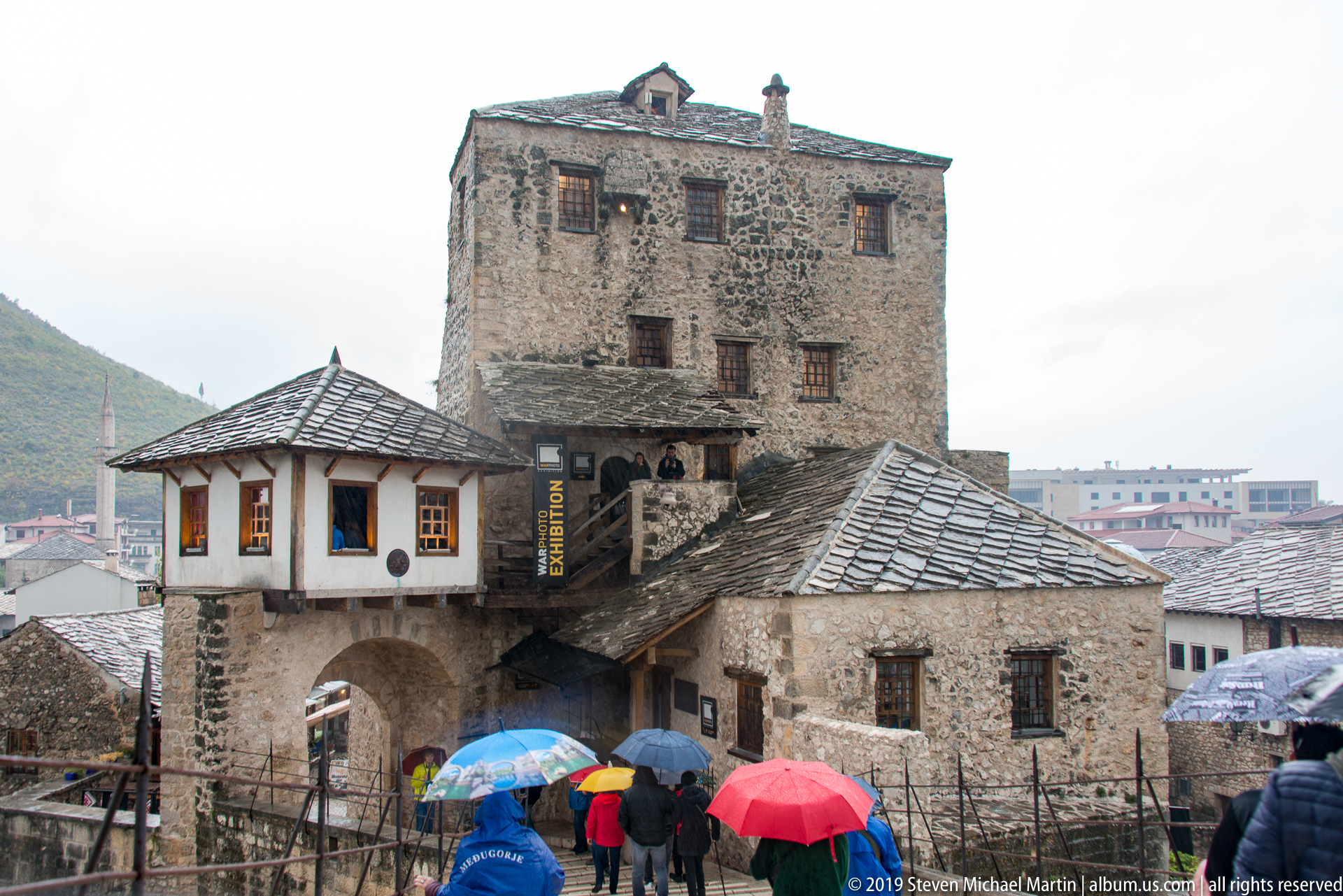
An arched passage cuts through a compact group of stone buildings beneath a tall, nearly square masonry structure. Rain umbrellas and wet paving animate the foreground, while timber-framed windows and gray stone roofs reveal the close-grained architectural character of Mostar’s old quarter.
Caption
An arched passage cuts through a compact group of stone buildings beneath a tall, nearly square masonry structure. Rain umbrellas and wet paving animate the foreground, while timber-framed windows and gray stone roofs reveal the close-grained architectural character of Mostar’s old quarter.

The Neretva flows through a deep green corridor of autumn vegetation, with Mostar’s historic buildings and mosque minarets rising above the banks. The river dominates this composition, revealing the natural channel around which the old city developed and the close relationship between water, slopes, and architecture.
Caption
The Neretva flows through a deep green corridor of autumn vegetation, with Mostar’s historic buildings and mosque minarets rising above the banks. The river dominates this composition, revealing the natural channel around which the old city developed and the close relationship between water, slopes, and architecture.

A slender stone minaret rises immediately beside a small plastered mosque at the edge of Mostar’s historic bazaar. Arched openings, a projecting eave, benches, and a leafy courtyard tree give the religious building an intimate neighborhood scale, while umbrellas and shop activity at left place it within the pedestrian fabric of the old town.
Caption
A slender stone minaret rises immediately beside a small plastered mosque at the edge of Mostar’s historic bazaar. Arched openings, a projecting eave, benches, and a leafy courtyard tree give the religious building an intimate neighborhood scale, while umbrellas and shop activity at left place it within the pedestrian fabric of the old town.

A massive rectangular stone tower rises above tightly packed masonry houses in Mostar’s historic quarter. Small openings, thick rubble-stone walls, and a projecting upper cornice give the structure a defensive character, while tiled and stone-slab roofs around its base reveal the dense scale of the surrounding old town.
Caption
A massive rectangular stone tower rises above tightly packed masonry houses in Mostar’s historic quarter. Small openings, thick rubble-stone walls, and a projecting upper cornice give the structure a defensive character, while tiled and stone-slab roofs around its base reveal the dense scale of the surrounding old town.

A whitewashed timber-framed house with a broad, stone-slab hipped roof stands against a steep green hillside, while a slender mosque minaret rises beyond the neighboring roofs. The projecting upper story, closely spaced windows, and heavy roof form preserve the intimate architectural scale of Mostar’s historic quarters; a vertical sign at right marks a War Photo Exhibition.
Caption
A whitewashed timber-framed house with a broad, stone-slab hipped roof stands against a steep green hillside, while a slender mosque minaret rises beyond the neighboring roofs. The projecting upper story, closely spaced windows, and heavy roof form preserve the intimate architectural scale of Mostar’s historic quarters; a vertical sign at right marks a War Photo Exhibition.

Emergency personnel work around a blue car lying upside down on a steep, brush-covered slope outside Mostar. Red-helmeted rescuers and other responders cluster below the vehicle amid autumn vegetation, turning the frame from architectural documentation toward an immediate record of roadside emergency activity and difficult terrain.
Caption
Emergency personnel work around a blue car lying upside down on a steep, brush-covered slope outside Mostar. Red-helmeted rescuers and other responders cluster below the vehicle amid autumn vegetation, turning the frame from architectural documentation toward an immediate record of roadside emergency activity and difficult terrain.

Rounded river stones form a patterned courtyard at the foot of rough stone steps climbing between masonry walls. Café chairs, potted plants, and a narrow water channel introduce everyday use into the historic fabric, while the irregular paving and handrail reveal how steep circulation is negotiated within Mostar’s old quarter.
Caption
Rounded river stones form a patterned courtyard at the foot of rough stone steps climbing between masonry walls. Café chairs, potted plants, and a narrow water channel introduce everyday use into the historic fabric, while the irregular paving and handrail reveal how steep circulation is negotiated within Mostar’s old quarter.

Stari Most spans the Neretva in a classic Mostar view, its single high stone arch framed by fortified bridge towers, clustered old-town buildings, and a dark mountain slope. Rain and subdued light flatten the distant landscape while the pale reconstructed bridge remains the visual center of the UNESCO-listed historic city.
Caption
Stari Most spans the Neretva in a classic Mostar view, its single high stone arch framed by fortified bridge towers, clustered old-town buildings, and a dark mountain slope. Rain and subdued light flatten the distant landscape while the pale reconstructed bridge remains the visual center of the UNESCO-listed historic city.

A rain-darkened cobblestone lane descends past colorful shopfronts toward Stari Most, visible beyond trees and stone walls. Pedestrians with umbrellas animate the steep approach, connecting the commercial lanes of the old bazaar quarter with the bridge and the Neretva corridor below.
Caption
A rain-darkened cobblestone lane descends past colorful shopfronts toward Stari Most, visible beyond trees and stone walls. Pedestrians with umbrellas animate the steep approach, connecting the commercial lanes of the old bazaar quarter with the bridge and the Neretva corridor below.

Visitors carrying red, black, and green umbrellas cross the steep stone-paved deck of Stari Most in steady rain. Raised transverse strips interrupt the smooth paving to provide footing on the bridge’s pronounced slope, while the low stone parapet and wet surfaces emphasize the bridge as a lived pedestrian route rather than a distant monument.
Caption
Visitors carrying red, black, and green umbrellas cross the steep stone-paved deck of Stari Most in steady rain. Raised transverse strips interrupt the smooth paving to provide footing on the bridge’s pronounced slope, while the low stone parapet and wet surfaces emphasize the bridge as a lived pedestrian route rather than a distant monument.

From the old bridge area, the Neretva runs between steep, densely built banks lined with stone houses, colorful façades, terraces, and autumn trees. Minarets punctuate the receding townscape beneath low clouds, revealing the narrow river corridor that organizes Mostar’s historic urban form.
Caption
From the old bridge area, the Neretva runs between steep, densely built banks lined with stone houses, colorful façades, terraces, and autumn trees. Minarets punctuate the receding townscape beneath low clouds, revealing the narrow river corridor that organizes Mostar’s historic urban form.

Stone houses and fortified-looking masonry rise directly above the wooded bank of the Neretva, interspersed with brightly painted façades and slate-like roofs. A minaret and the flat-topped mountain ridge beyond place the dense riverside fabric within Mostar’s larger landscape, while awnings at lower left mark the active commercial edge of the old quarter.
Caption
Stone houses and fortified-looking masonry rise directly above the wooded bank of the Neretva, interspersed with brightly painted façades and slate-like roofs. A minaret and the flat-topped mountain ridge beyond place the dense riverside fabric within Mostar’s larger landscape, while awnings at lower left mark the active commercial edge of the old quarter.

The high arch of Stari Most enters from the left and lands beside a massive square stone tower on the east bank. The closer viewpoint stresses the bridge’s masonry construction, steep parapet, and fortified endpoint; a pale green historic building behind the tower adds another layer to the compact old-town ensemble.
Caption
The high arch of Stari Most enters from the left and lands beside a massive square stone tower on the east bank. The closer viewpoint stresses the bridge’s masonry construction, steep parapet, and fortified endpoint; a pale green historic building behind the tower adds another layer to the compact old-town ensemble.

Stari Most sweeps across the turquoise Neretva in a side view that makes the bridge’s single semicircular arch and thin stone profile especially legible. A massive bridge tower anchors the far bank, with layered masonry buildings and the mountain ridge behind, while pedestrians along the parapet provide a clear sense of scale.
Caption
Stari Most sweeps across the turquoise Neretva in a side view that makes the bridge’s single semicircular arch and thin stone profile especially legible. A massive bridge tower anchors the far bank, with layered masonry buildings and the mountain ridge behind, while pedestrians along the parapet provide a clear sense of scale.

A visitor stands beneath a black umbrella in a cobbled courtyard while a tall cylindrical stone minaret rises immediately behind. Low stone-roofed buildings and café furnishings define the enclosed space, and the wet-weather portrait gives human scale to the minaret’s stacked masonry shaft and projecting balcony.
Caption
A visitor stands beneath a black umbrella in a cobbled courtyard while a tall cylindrical stone minaret rises immediately behind. Low stone-roofed buildings and café furnishings define the enclosed space, and the wet-weather portrait gives human scale to the minaret’s stacked masonry shaft and projecting balcony.

A broad black umbrella frames a visitor standing in the same cobbled courtyard, with the base of a stone minaret and low historic buildings behind. The close composition shifts attention from monumental architecture to the experience of moving through Mostar’s old quarter in persistent rain.
Caption
A broad black umbrella frames a visitor standing in the same cobbled courtyard, with the base of a stone minaret and low historic buildings behind. The close composition shifts attention from monumental architecture to the experience of moving through Mostar’s old quarter in persistent rain.

A tighter view of Stari Most isolates the pale stone arch, dark parapet, and the heavy masonry of Tara Tower beyond. People crossing the bridge appear as small figures along the crest, emphasizing both the span’s steep rise and the defensive scale of the tower at the historic river crossing.
Caption
A tighter view of Stari Most isolates the pale stone arch, dark parapet, and the heavy masonry of Tara Tower beyond. People crossing the bridge appear as small figures along the crest, emphasizing both the span’s steep rise and the defensive scale of the tower at the historic river crossing.

A narrow cobblestone market lane threads between low, stone-roofed shops displaying textiles, souvenirs, and metalwork. Umbrella-carrying pedestrians move toward a stout historic stone tower at the end of the view, giving the frame the compressed scale and commercial character of Mostar’s old bazaar quarter.
Caption
A narrow cobblestone market lane threads between low, stone-roofed shops displaying textiles, souvenirs, and metalwork. Umbrella-carrying pedestrians move toward a stout historic stone tower at the end of the view, giving the frame the compressed scale and commercial character of Mostar’s old bazaar quarter.

The Hamam Museum presents a low stone façade with a central triple-arched entrance and a shallow metal-clad dome rising behind the roofline. Benches line the cobbled forecourt, while the plainly visible English sign identifies the adapted Ottoman bath building and distinguishes it from the surrounding houses and shops of Mostar’s old quarter.
Caption
The Hamam Museum presents a low stone façade with a central triple-arched entrance and a shallow metal-clad dome rising behind the roofline. Benches line the cobbled forecourt, while the plainly visible English sign identifies the adapted Ottoman bath building and distinguishes it from the surrounding houses and shops of Mostar’s old quarter.

Two people stand on the narrow projecting gallery of a tall stone minaret, one partly sheltered by an umbrella. The telephoto view compresses the cylindrical shaft and carved balcony into a study of scale, showing how small the visitors appear against the substantial masonry of the tower.
Caption
Two people stand on the narrow projecting gallery of a tall stone minaret, one partly sheltered by an umbrella. The telephoto view compresses the cylindrical shaft and carved balcony into a study of scale, showing how small the visitors appear against the substantial masonry of the tower.

A telephoto detail isolates the projecting balcony of a dark stone minaret against a blank gray sky. Molded stone courses support the circular gallery, where a small loudspeaker and weather protection are visible; the close crop reveals functional additions alongside the minaret’s traditional masonry construction.
Caption
A telephoto detail isolates the projecting balcony of a dark stone minaret against a blank gray sky. Molded stone courses support the circular gallery, where a small loudspeaker and weather protection are visible; the close crop reveals functional additions alongside the minaret’s traditional masonry construction.

An austere rubble-stone house fills the frame, its small rectangular windows set irregularly across a weathered façade beneath a heavy stone-slab roof. A vine with deep red autumn leaves spreads around a lower opening, providing a vivid organic counterpoint to the pale masonry and restrained vernacular architecture.
Caption
An austere rubble-stone house fills the frame, its small rectangular windows set irregularly across a weathered façade beneath a heavy stone-slab roof. A vine with deep red autumn leaves spreads around a lower opening, providing a vivid organic counterpoint to the pale masonry and restrained vernacular architecture.

A brown bottle of Sarajevsko beer stands beside a small glass of pale golden beer topped with foam on a restaurant table. The clearly readable label grounds the still life in Bosnia and Herzegovina’s everyday food culture, complementing the portfolio’s nearby views of local meals and café life.
Caption
A brown bottle of Sarajevsko beer stands beside a small glass of pale golden beer topped with foam on a restaurant table. The clearly readable label grounds the still life in Bosnia and Herzegovina’s everyday food culture, complementing the portfolio’s nearby views of local meals and café life.

A generous restaurant platter combines grilled chicken, sausage-shaped minced meat, French fries, sliced onion, tomato, lettuce, and rounds of flatbread. The close table view documents the hearty grilled-meat tradition encountered in Bosnia and Herzegovina without assigning a specific dish name where several preparations appear together.
Caption
A generous restaurant platter combines grilled chicken, sausage-shaped minced meat, French fries, sliced onion, tomato, lettuce, and rounds of flatbread. The close table view documents the hearty grilled-meat tradition encountered in Bosnia and Herzegovina without assigning a specific dish name where several preparations appear together.

A line of visitors with brightly colored umbrellas climbs the crest of Stari Most in heavy rain. Cropped tightly around the bridge’s parapet and underside, the view emphasizes the steep pedestrian crossing and the rhythm of figures silhouetted against the pale sky rather than the full historic setting.
Caption
A line of visitors with brightly colored umbrellas climbs the crest of Stari Most in heavy rain. Cropped tightly around the bridge’s parapet and underside, the view emphasizes the steep pedestrian crossing and the rhythm of figures silhouetted against the pale sky rather than the full historic setting.

Umbrella-carrying pedestrians are spaced along the rising parapet of Stari Most, seen in a tight side crop that reduces the bridge to arch, stone facing, and human silhouettes. The sparse composition makes the steep grade especially clear and records the bridge’s continuing role as Mostar’s principal pedestrian crossing through the historic center.
Caption
Umbrella-carrying pedestrians are spaced along the rising parapet of Stari Most, seen in a tight side crop that reduces the bridge to arch, stone facing, and human silhouettes. The sparse composition makes the steep grade especially clear and records the bridge’s continuing role as Mostar’s principal pedestrian crossing through the historic center.

Three compact façades in yellow, pink, and blue stand shoulder to shoulder beneath dark stone-slab roofs. Deep arched window openings edged in exposed stone give the small buildings a strong graphic rhythm, illustrating the mixture of masonry construction and brightly painted plaster found in Mostar’s historic commercial quarter.
Caption
Three compact façades in yellow, pink, and blue stand shoulder to shoulder beneath dark stone-slab roofs. Deep arched window openings edged in exposed stone give the small buildings a strong graphic rhythm, illustrating the mixture of masonry construction and brightly painted plaster found in Mostar’s historic commercial quarter.

A slender white cat perches on the back of a wooden chair beside restaurant tables, its black forehead and moustache-like muzzle markings creating a distinctive face. The shallow depth of field separates the animal from red tablecloths and the warm-toned interior, turning an incidental street-and-café encounter into a focused portrait.
Caption
A slender white cat perches on the back of a wooden chair beside restaurant tables, its black forehead and moustache-like muzzle markings creating a distinctive face. The shallow depth of field separates the animal from red tablecloths and the warm-toned interior, turning an incidental street-and-café encounter into a focused portrait.

Historic stone buildings and pastel-painted houses rise above the Neretva River beneath low clouds and steep hills. The layered riverbank shows Mostar’s dense urban fabric, where traditional masonry, later infill, cafés, and vegetation occupy a narrow strip between the water and the mountain slopes.
Caption
Historic stone buildings and pastel-painted houses rise above the Neretva River beneath low clouds and steep hills. The layered riverbank shows Mostar’s dense urban fabric, where traditional masonry, later infill, cafés, and vegetation occupy a narrow strip between the water and the mountain slopes.

The same white cat sits upright in a close portrait, eyes nearly closed and forepaws tucked together. Black markings above the ears and across the muzzle stand out against its pale coat, while the soft background keeps attention on the animal’s relaxed posture and expressive face.
Caption
The same white cat sits upright in a close portrait, eyes nearly closed and forepaws tucked together. Black markings above the ears and across the muzzle stand out against its pale coat, while the soft background keeps attention on the animal’s relaxed posture and expressive face.

A seated diner shares a table with a white cat beside a window overlooking Mostar. The informal restaurant portrait shifts the portfolio from monumental architecture to everyday life, with menus, tableware, and the animal’s confident presence creating a quiet counterpoint to the historic city outside.
Caption
A seated diner shares a table with a white cat beside a window overlooking Mostar. The informal restaurant portrait shifts the portfolio from monumental architecture to everyday life, with menus, tableware, and the animal’s confident presence creating a quiet counterpoint to the historic city outside.

A compact domed mosque and tall pencil-like minaret occupy a green terrace above the Neretva. The lateral view makes the prayer hall’s rectangular stone walls and low dome especially legible, while dense autumn vegetation separates the religious complex from the river below.
Caption
A compact domed mosque and tall pencil-like minaret occupy a green terrace above the Neretva. The lateral view makes the prayer hall’s rectangular stone walls and low dome especially legible, while dense autumn vegetation separates the religious complex from the river below.

A domed stone mosque with a slender minaret stands prominently above the Neretva River, framed by autumn foliage and the mountains of Mostar. Its compact prayer hall, lead-colored dome, and vertical minaret form a distinctive Ottoman-era architectural silhouette within the city’s layered riverside landscape.
Caption
A domed stone mosque with a slender minaret stands prominently above the Neretva River, framed by autumn foliage and the mountains of Mostar. Its compact prayer hall, lead-colored dome, and vertical minaret form a distinctive Ottoman-era architectural silhouette within the city’s layered riverside landscape.

Across the Neretva, rough-stone houses and taller masonry buildings intermingle with small pastel façades and café terraces. The view emphasizes the compressed scale of Mostar’s historic riverbank, where varied rooflines and building heights step upward toward a mist-softened mountain backdrop.
Caption
Across the Neretva, rough-stone houses and taller masonry buildings intermingle with small pastel façades and café terraces. The view emphasizes the compressed scale of Mostar’s historic riverbank, where varied rooflines and building heights step upward toward a mist-softened mountain backdrop.

A white cat with black markings rests beside a restaurant table, its face and upright ears filling the frame. The close portrait records the companionable street-and-café animal life encountered within Mostar, contrasting with the portfolio’s broader architectural and river views.
Caption
A white cat with black markings rests beside a restaurant table, its face and upright ears filling the frame. The close portrait records the companionable street-and-café animal life encountered within Mostar, contrasting with the portfolio’s broader architectural and river views.

A man sits at a wooden restaurant table with a white cat tucked beside him, while the Neretva corridor appears softly through the window behind. Glassware, menus, and the intimate seating area place the portrait firmly in the everyday hospitality landscape of Mostar.
Caption
A man sits at a wooden restaurant table with a white cat tucked beside him, while the Neretva corridor appears softly through the window behind. Glassware, menus, and the intimate seating area place the portrait firmly in the everyday hospitality landscape of Mostar.

A diner looks down toward a white cat seated beside him at a restaurant table. The close, candid composition—framed by glasses, menus, wood furniture, and a rain-softened riverside view—records a small moment of daily life within Mostar’s visitor district.
Caption
A diner looks down toward a white cat seated beside him at a restaurant table. The close, candid composition—framed by glasses, menus, wood furniture, and a rain-softened riverside view—records a small moment of daily life within Mostar’s visitor district.

Stari Most springs in a single high stone arch across the turquoise Neretva River, linking the steeply built historic quarters of Mostar. The bridge’s elegant curve, narrow deck, and massive stone abutments define the city’s best-known architectural composition, here seen amid autumn foliage and riverside terraces.
Caption
Stari Most springs in a single high stone arch across the turquoise Neretva River, linking the steeply built historic quarters of Mostar. The bridge’s elegant curve, narrow deck, and massive stone abutments define the city’s best-known architectural composition, here seen amid autumn foliage and riverside terraces.

Stari Most crosses the Neretva in a broad stone arch while a dark tree trunk frames the right side of the view. Seen from a slightly more distant riverside position, the bridge is integrated with towers, stone houses, vegetation, and the steep urban terrain that shapes Mostar’s historic center.
Caption
Stari Most crosses the Neretva in a broad stone arch while a dark tree trunk frames the right side of the view. Seen from a slightly more distant riverside position, the bridge is integrated with towers, stone houses, vegetation, and the steep urban terrain that shapes Mostar’s historic center.

Pastel pink, yellow, and lavender façades stand beneath rough-stone houses and gray slab roofs in Mostar’s old quarter. The compressed view highlights the district’s varied masonry, small arched windows, shopfront awnings, and tightly interlocked building forms rather than a single monument.
Caption
Pastel pink, yellow, and lavender façades stand beneath rough-stone houses and gray slab roofs in Mostar’s old quarter. The compressed view highlights the district’s varied masonry, small arched windows, shopfront awnings, and tightly interlocked building forms rather than a single monument.

Pastel shopfront houses cluster beneath taller rough-stone buildings, their gray roofs and arched windows forming a compact vertical streetscape. A pale church tower rises in the distance, while autumn foliage and climbing red vines soften the dense masonry of Mostar’s historic center.
Caption
Pastel shopfront houses cluster beneath taller rough-stone buildings, their gray roofs and arched windows forming a compact vertical streetscape. A pale church tower rises in the distance, while autumn foliage and climbing red vines soften the dense masonry of Mostar’s historic center.

Across the Neretva, a dense band of trees rises to pastel houses, rough-stone buildings, and taller historic structures beneath the mountains. The broad contextual view shows how Mostar’s old urban fabric occupies the narrow river corridor, with cafés and terraces gathered along the bank.
Caption
Across the Neretva, a dense band of trees rises to pastel houses, rough-stone buildings, and taller historic structures beneath the mountains. The broad contextual view shows how Mostar’s old urban fabric occupies the narrow river corridor, with cafés and terraces gathered along the bank.

A brightly lit shop displays decorated metal plates, framed images, jewelry, small vessels, textiles, and other souvenirs beneath a stone arch. The dense merchandise and narrow entrance evoke the commercial lanes of Mostar’s old quarter, where craft-oriented shops occupy historic masonry premises.
Caption
A brightly lit shop displays decorated metal plates, framed images, jewelry, small vessels, textiles, and other souvenirs beneath a stone arch. The dense merchandise and narrow entrance evoke the commercial lanes of Mostar’s old quarter, where craft-oriented shops occupy historic masonry premises.

Striped awnings shelter small shops along a sloping cobbled lane in Mostar’s historic center. Warm interior lights, hanging goods, colorful plaster façades, and rough stone walls create a layered market streetscape, while a tower and minaret rise beyond the close-packed roofs.
Caption
Striped awnings shelter small shops along a sloping cobbled lane in Mostar’s historic center. Warm interior lights, hanging goods, colorful plaster façades, and rough stone walls create a layered market streetscape, while a tower and minaret rise beyond the close-packed roofs.

Stari Most arcs across the Neretva beneath a steep, mist-covered mountain, its pale stone profile framed by yellow-green foliage. The elevated viewpoint compresses bridge, river, towers, and historic buildings into a single landscape, emphasizing the dramatic topography that surrounds Mostar’s UNESCO-listed historic center.
Caption
Stari Most arcs across the Neretva beneath a steep, mist-covered mountain, its pale stone profile framed by yellow-green foliage. The elevated viewpoint compresses bridge, river, towers, and historic buildings into a single landscape, emphasizing the dramatic topography that surrounds Mostar’s UNESCO-listed historic center.

Massive rough-stone buildings line the steep bank above the Neretva, with small pastel houses and slender minarets extending the cityscape toward the mountain. The oblique view emphasizes the weight and texture of Mostar’s historic masonry and the narrow terraces occupied by riverside businesses.
Caption
Massive rough-stone buildings line the steep bank above the Neretva, with small pastel houses and slender minarets extending the cityscape toward the mountain. The oblique view emphasizes the weight and texture of Mostar’s historic masonry and the narrow terraces occupied by riverside businesses.

A domed stone mosque rises from a wooded terrace above the Neretva, its tall minaret forming a strong vertical against pale mountain ridges. Autumn trees partly screen the prayer hall, allowing the dome, minaret balcony, and masonry walls to stand out within the riverside landscape.
Caption
A domed stone mosque rises from a wooded terrace above the Neretva, its tall minaret forming a strong vertical against pale mountain ridges. Autumn trees partly screen the prayer hall, allowing the dome, minaret balcony, and masonry walls to stand out within the riverside landscape.

Looking along the Neretva, restaurants and traditional buildings cling to the rocky left bank while dense autumn trees rise toward a domed mosque and minaret on the right. The long river perspective reveals how Mostar’s historic center follows the narrow channel between steep banks and surrounding mountains.
Caption
Looking along the Neretva, restaurants and traditional buildings cling to the rocky left bank while dense autumn trees rise toward a domed mosque and minaret on the right. The long river perspective reveals how Mostar’s historic center follows the narrow channel between steep banks and surrounding mountains.

Seen broadside across dense riverbank vegetation, a stone mosque presents its low dome, rectangular prayer hall, and tall minaret as a compact architectural ensemble. The lateral viewpoint isolates the religious building from the busier old-town skyline and makes its proportions especially clear.
Caption
Seen broadside across dense riverbank vegetation, a stone mosque presents its low dome, rectangular prayer hall, and tall minaret as a compact architectural ensemble. The lateral viewpoint isolates the religious building from the busier old-town skyline and makes its proportions especially clear.

A close side view isolates the pale stone arch of Stari Most as it springs from a massive masonry abutment above the Neretva. Pedestrians line the narrow deck, while the tight framing reveals the bridge’s steep profile, voussoir courses, and the scale of its stone construction.
Caption
A close side view isolates the pale stone arch of Stari Most as it springs from a massive masonry abutment above the Neretva. Pedestrians line the narrow deck, while the tight framing reveals the bridge’s steep profile, voussoir courses, and the scale of its stone construction.

Rain-darkened cobbles lead through Kujundžiluk, Mostar’s historic bazaar, between low shop awnings and rough-stone buildings. Souvenir displays, textiles, postcards, and café furnishings crowd the lane, while the broad mountain ridge beyond reinforces the old quarter’s close relationship with the steep Neretva valley.
Caption
Rain-darkened cobbles lead through Kujundžiluk, Mostar’s historic bazaar, between low shop awnings and rough-stone buildings. Souvenir displays, textiles, postcards, and café furnishings crowd the lane, while the broad mountain ridge beyond reinforces the old quarter’s close relationship with the steep Neretva valley.

Restaurants and traditional buildings occupy narrow terraces above the rocky Neretva bank, their awnings and outdoor seating tucked among dense vines and trees. The close riverbank view shows how commercial spaces adapt to Mostar’s steep terrain, stepping down toward the water beneath the historic quarter.
Caption
Restaurants and traditional buildings occupy narrow terraces above the rocky Neretva bank, their awnings and outdoor seating tucked among dense vines and trees. The close riverbank view shows how commercial spaces adapt to Mostar’s steep terrain, stepping down toward the water beneath the historic quarter.

The arch of Stari Most enters the frame beside a massive historic stone tower and adjoining masonry buildings above the Neretva. This close architectural view emphasizes the bridge’s substantial abutment and its physical integration with the fortified and residential fabric of Mostar’s old center.
Caption
The arch of Stari Most enters the frame beside a massive historic stone tower and adjoining masonry buildings above the Neretva. This close architectural view emphasizes the bridge’s substantial abutment and its physical integration with the fortified and residential fabric of Mostar’s old center.

A broad bend of the Neretva opens toward a steep limestone mountain, with houses and autumn trees lining the banks. Stepped stone terraces descend toward a small gravelly shore, creating a quieter landscape view away from the dense architecture around Stari Most.
Caption
A broad bend of the Neretva opens toward a steep limestone mountain, with houses and autumn trees lining the banks. Stepped stone terraces descend toward a small gravelly shore, creating a quieter landscape view away from the dense architecture around Stari Most.

The Neretva runs between rocky, tree-covered banks toward a lower modern arch bridge in the distance. Stone terraces descend to the water on the right, while houses line both slopes beneath Mostar’s mountains, extending the river landscape beyond the concentrated historic core.
Caption
The Neretva runs between rocky, tree-covered banks toward a lower modern arch bridge in the distance. Stone terraces descend to the water on the right, while houses line both slopes beneath Mostar’s mountains, extending the river landscape beyond the concentrated historic core.

Stari Most sweeps across the foreground in a steep stone arch, with pedestrians silhouetted along its narrow deck. Behind it, a massive square stone tower and adjoining historic buildings anchor the riverbank, showing the bridge as part of a larger fortified urban ensemble rather than an isolated monument.
Caption
Stari Most sweeps across the foreground in a steep stone arch, with pedestrians silhouetted along its narrow deck. Behind it, a massive square stone tower and adjoining historic buildings anchor the riverbank, showing the bridge as part of a larger fortified urban ensemble rather than an isolated monument.

Kujundžiluk narrows into a lively corridor of covered stalls, hanging textiles, metalware, souvenirs, and small shopfronts. The wet cobblestones draw the eye toward a large rough-stone building at the end of the lane, showing the dense commercial scale and layered masonry that characterize Mostar’s historic market quarter.
Caption
Kujundžiluk narrows into a lively corridor of covered stalls, hanging textiles, metalware, souvenirs, and small shopfronts. The wet cobblestones draw the eye toward a large rough-stone building at the end of the lane, showing the dense commercial scale and layered masonry that characterize Mostar’s historic market quarter.

The fortified hill town of Počitelj rises above the road in a layered silhouette of stone walls, towers, and a mosque minaret. The upper defensive tower crowns the ridge while autumn vegetation partly conceals the lower settlement, revealing the compact relationship between fortification, religious architecture, and steep terrain in this historic Herzegovinian town.
Caption
The fortified hill town of Počitelj rises above the road in a layered silhouette of stone walls, towers, and a mosque minaret. The upper defensive tower crowns the ridge while autumn vegetation partly conceals the lower settlement, revealing the compact relationship between fortification, religious architecture, and steep terrain in this historic Herzegovinian town.

A closer view of Počitelj isolates the tall rectangular fortress tower above crenellated walls and lower stone defenses. A second narrow tower and the pointed mosque minaret descend through the frame, making the settlement’s vertical organization especially clear as architecture steps down the rocky, vegetation-covered hillside.
Caption
A closer view of Počitelj isolates the tall rectangular fortress tower above crenellated walls and lower stone defenses. A second narrow tower and the pointed mosque minaret descend through the frame, making the settlement’s vertical organization especially clear as architecture steps down the rocky, vegetation-covered hillside.

From the approach road, Počitelj’s fortress tower dominates the ridge above scattered stone structures, a mosque minaret, and the wooded lower town. Wisps of smoke drift among the autumn trees, while the rising roadway and cliff edge emphasize the dramatic slope on which the fortified settlement was built.
Caption
From the approach road, Počitelj’s fortress tower dominates the ridge above scattered stone structures, a mosque minaret, and the wooded lower town. Wisps of smoke drift among the autumn trees, while the rising roadway and cliff edge emphasize the dramatic slope on which the fortified settlement was built.
⭐ Highlights
- Stari Most: The iconic stone bridge spanning the Neretva River and symbolizing Mostar itself.
- Old Town: A dense historic quarter of stone lanes, shops, and Ottoman-era character.
- Neretva River Setting: Emerald water and steep riverbanks give the city its dramatic visual identity.
- Bridge Towers: Historic tower structures at either end of the bridge recall its defensive past.
- Ottoman Heritage: Mosques, houses, and urban form reflect Mostar’s development under Ottoman rule.
- Reconstruction and Resilience: The rebuilt bridge stands as a symbol of recovery and continuity.
🌉 Mostar Field Guide
Major features observed during this visit:
Mostar is one of the most distinctive historic cities in the Balkans, centered on the Neretva River and the celebrated stone arch of Stari Most. The historic core developed during the Ottoman period as a regional trading town, and its bridge became both a practical crossing and the city’s defining landmark. Today, Mostar combines architectural beauty, layered history, and a powerful story of destruction and reconstruction.
🏛️ Signature Landmarks
- Stari Most – The stone arch bridge that defines the city and spans the Neretva River.
- Old Bridge Towers – Historic structures flanking the bridge and recalling its defensive role.
- Old Town Streets – Narrow stone lanes preserving the scale and atmosphere of the historic center.
- Riverfront Views – Vantage points that reveal the bridge’s height, curve, and relationship to the water below.
- Ottoman-Era Buildings – Houses, shops, and religious structures shaping the city’s historic identity.
🧠 Historical Significance
- Ottoman Frontier Town – Mostar developed as an important regional center during the Ottoman period.
- Historic Bridge – Stari Most became the city’s defining structure and enduring symbol.
- War and Reconstruction – The bridge was destroyed in the 1990s and later rebuilt.
- Cultural Importance – Mostar remains one of the most recognized historic cities in the Balkans.
🌄 Landscape & Setting
- Neretva River – The river cuts through the city and gives the bridge its dramatic setting.
- Stone Arch Over Water – The bridge’s curve is inseparable from the landscape below.
- Compact Historic Core – The old town remains dense, walkable, and visually cohesive.
- Bridge as Centerpiece – Mostar’s urban identity is organized around the crossing itself.