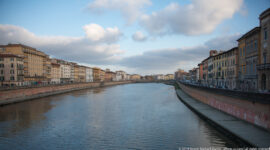
Verona at Night – Verona, Italy
After sunset the historic center of Verona takes on a different character as the city’s monuments and streets are illuminated by soft lighting. The Roman Arena, medieval squares, and historic bridges reflect warm light across the stone façades and cobbled streets.
Evening scenes along the Adige River reveal the graceful arches of Verona’s bridges mirrored in the water, while lively cafés and piazzas fill with visitors and residents enjoying the city’s nighttime atmosphere.
These nighttime views highlight the architectural beauty of Verona and the vibrant cultural life that continues long after the daylight hours.

A brick Gothic church façade rises against the blue evening sky in Verona, its pointed portal framed by alternating pale and reddish stone bands. A circular oculus and tall narrow windows organize the upper wall, while the entrance and small groups of visitors animate the base. The oblique street setting and illuminated neighboring façades place the church within the city as daylight fades.
Caption
A brick Gothic church façade rises against the blue evening sky in Verona, its pointed portal framed by alternating pale and reddish stone bands. A circular oculus and tall narrow windows organize the upper wall, while the entrance and small groups of visitors animate the base. The oblique street setting and illuminated neighboring façades place the church within the city as daylight fades.

The Adige bends toward San Giorgio in Braida, whose dome and neighboring bell tower glow beyond riverside houses and trees. The wide composition retains a rough vegetated bank in the foreground, setting the illuminated church within the working river corridor rather than isolating it as a landmark portrait.
Caption
The Adige bends toward San Giorgio in Braida, whose dome and neighboring bell tower glow beyond riverside houses and trees. The wide composition retains a rough vegetated bank in the foreground, setting the illuminated church within the working river corridor rather than isolating it as a landmark portrait.

A closer view of the Verona Arena concentrates on the heavy stone piers and barred ground-level entrances beneath the upper arcade. Warm interior lighting glows through several openings, emphasizing the thickness of the masonry and the contrast between rough ancient stone, carefully cut arch rings, and modern security gates.
Caption
A closer view of the Verona Arena concentrates on the heavy stone piers and barred ground-level entrances beneath the upper arcade. Warm interior lighting glows through several openings, emphasizing the thickness of the masonry and the contrast between rough ancient stone, carefully cut arch rings, and modern security gates.

Castelvecchio’s brick defenses rise in sharply layered silhouettes under floodlighting, with merlons stepping across foreground walls toward a tall square tower. The close night view suppresses the surrounding city and concentrates attention on the fortress’s successive defensive lines, narrow openings, and characteristic medieval crenellations.
Caption
Castelvecchio’s brick defenses rise in sharply layered silhouettes under floodlighting, with merlons stepping across foreground walls toward a tall square tower. The close night view suppresses the surrounding city and concentrates attention on the fortress’s successive defensive lines, narrow openings, and characteristic medieval crenellations.

At blue hour, San Giorgio in Braida and its campanile rise above a dark belt of trees beside the Adige. The church is less brightly illuminated than in the neighboring frame, preserving more of the dusk atmosphere, while scattered embankment lights form delicate vertical reflections on the river.
Caption
At blue hour, San Giorgio in Braida and its campanile rise above a dark belt of trees beside the Adige. The church is less brightly illuminated than in the neighboring frame, preserving more of the dusk atmosphere, while scattered embankment lights form delicate vertical reflections on the river.

Castelvecchio and the crenellated Ponte Scaligero glow amber above the Adige, their towers and fortified bridge reflected in the dark river. The night view brings out the bridge’s unequal arches, defensive walls, and brick battlements, presenting the medieval complex as a continuous fortified silhouette along Verona’s riverfront.
Caption
Castelvecchio and the crenellated Ponte Scaligero glow amber above the Adige, their towers and fortified bridge reflected in the dark river. The night view brings out the bridge’s unequal arches, defensive walls, and brick battlements, presenting the medieval complex as a continuous fortified silhouette along Verona’s riverfront.

A tighter river view centers San Giorgio in Braida, whose bright drum and dark dome dominate the right bank above a line of trees and lower buildings. The calm Adige reflects scattered lamps in elongated streaks, while the dark hillside behind isolates the church as the principal illuminated landmark.
Caption
A tighter river view centers San Giorgio in Braida, whose bright drum and dark dome dominate the right bank above a line of trees and lower buildings. The calm Adige reflects scattered lamps in elongated streaks, while the dark hillside behind isolates the church as the principal illuminated landmark.

Across the Adige, the illuminated dome of San Giorgio in Braida rises above the dark riverbank and adjoining buildings. Streetlights trace the embankment while reflections ripple across the foreground water, and the hillside lights beyond extend the nighttime city into the background.
Caption
Across the Adige, the illuminated dome of San Giorgio in Braida rises above the dark riverbank and adjoining buildings. Streetlights trace the embankment while reflections ripple across the foreground water, and the hillside lights beyond extend the nighttime city into the background.

The Ponte Scaligero stretches across the Adige in a band of warm light, linking Castelvecchio’s towers to the opposite bank. Its crenellated brick parapets and unequal arches are mirrored in broken reflections on the river, while the more distant viewpoint gives the bridge a broader relationship to the fortress than the earlier close night view.
Caption
The Ponte Scaligero stretches across the Adige in a band of warm light, linking Castelvecchio’s towers to the opposite bank. Its crenellated brick parapets and unequal arches are mirrored in broken reflections on the river, while the more distant viewpoint gives the bridge a broader relationship to the fortress than the earlier close night view.

A tightly framed field of square panels forms a vivid geometric surface, each compartment divided diagonally into muted red, blue, green, ocher, and violet triangles. The repeated grid is enlivened by subtle variations in color and wear, turning an architectural floor or pavement into an abstract study of pattern under evening light.
Caption
A tightly framed field of square panels forms a vivid geometric surface, each compartment divided diagonally into muted red, blue, green, ocher, and violet triangles. The repeated grid is enlivened by subtle variations in color and wear, turning an architectural floor or pavement into an abstract study of pattern under evening light.

Alternating bands of pale stone and brick wrap an enclosed civic courtyard, where broad ground-floor arches support paired and triple-arched windows above. Warm lamps illuminate the arcades while visitors cross the paving below, emphasizing the courtyard’s layered circulation and the strong horizontal rhythm of the masonry.
Caption
Alternating bands of pale stone and brick wrap an enclosed civic courtyard, where broad ground-floor arches support paired and triple-arched windows above. Warm lamps illuminate the arcades while visitors cross the paving below, emphasizing the courtyard’s layered circulation and the strong horizontal rhythm of the masonry.

Verona Cathedral rises against a deep blue evening sky, its pale west front organized around a deeply projecting two-story porch and a large central arched opening. Slender Gothic windows and striped masonry accents flank the entrance, while small figures at the doors establish the monumental scale of the façade.
Caption
Verona Cathedral rises against a deep blue evening sky, its pale west front organized around a deeply projecting two-story porch and a large central arched opening. Slender Gothic windows and striped masonry accents flank the entrance, while small figures at the doors establish the monumental scale of the façade.

A crenellated brick palace closes one side of a Verona square, its orderly rows of arched windows interrupted by a formal stone portal and balcony displaying Italian and European flags. Arcades continue along the lower level, while evening pedestrians and café activity animate the space beneath the severe medieval roofline.
Caption
A crenellated brick palace closes one side of a Verona square, its orderly rows of arched windows interrupted by a formal stone portal and balcony displaying Italian and European flags. Arcades continue along the lower level, while evening pedestrians and café activity animate the space beneath the severe medieval roofline.

A low-angle view compresses several parts of Verona Cathedral into one dramatic composition: striped masonry and carved stonework at left, a rounded apse below, and the pale bell tower rising into the blue evening sky. Artificial lighting picks out cornices, columns, and layered wall surfaces that are less apparent in a frontal view.
Caption
A low-angle view compresses several parts of Verona Cathedral into one dramatic composition: striped masonry and carved stonework at left, a rounded apse below, and the pale bell tower rising into the blue evening sky. Artificial lighting picks out cornices, columns, and layered wall surfaces that are less apparent in a frontal view.

Viewed through a foreground arch, a quiet cloister-like courtyard leads toward a brick church façade with a small rose window and tall lancet openings. Low arcades run along the left side, while lawn, flower beds, and sparse evening illumination create a secluded precinct distinctly removed from Verona’s busier squares.
Caption
Viewed through a foreground arch, a quiet cloister-like courtyard leads toward a brick church façade with a small rose window and tall lancet openings. Low arcades run along the left side, while lawn, flower beds, and sparse evening illumination create a secluded precinct distinctly removed from Verona’s busier squares.

An elaborate wrought-iron screen fills a broad archway, its circular center expanding outward in dense radial bars and curling ornamental lines. Backlighting silhouettes the metalwork against a brighter courtyard beyond, turning the gate into a graphic study of craftsmanship, symmetry, and layered transparency.
Caption
An elaborate wrought-iron screen fills a broad archway, its circular center expanding outward in dense radial bars and curling ornamental lines. Backlighting silhouettes the metalwork against a brighter courtyard beyond, turning the gate into a graphic study of craftsmanship, symmetry, and layered transparency.

A broad rusticated arch cuts through an ornate palace façade, creating a brightly lit passage from the square into an inner street or court. Heraldic reliefs, framed windows, a small balcony, and sculptural plaques crowd the wall around the opening, contrasting with café umbrellas along the foreground.
Caption
A broad rusticated arch cuts through an ornate palace façade, creating a brightly lit passage from the square into an inner street or court. Heraldic reliefs, framed windows, a small balcony, and sculptural plaques crowd the wall around the opening, contrasting with café umbrellas along the foreground.

Piazza dei Signori opens beneath a blue-gray evening sky, framed by Verona’s arcaded and crenellated civic buildings. A pale Renaissance loggia stands beside the brick palace at right, while groups of pedestrians occupy the broad stone-paved square, giving the view the scale and social character of the historic administrative center.
Caption
Piazza dei Signori opens beneath a blue-gray evening sky, framed by Verona’s arcaded and crenellated civic buildings. A pale Renaissance loggia stands beside the brick palace at right, while groups of pedestrians occupy the broad stone-paved square, giving the view the scale and social character of the historic administrative center.

The Scala della Ragione climbs diagonally across the striped courtyard of the Palazzo della Ragione, its pale stone balustrade and broad arch standing out against bands of brick and stone. Seen from below at dusk, the staircase becomes the dominant sculptural element linking the arcaded ground floor with the upper civic rooms.
Caption
The Scala della Ragione climbs diagonally across the striped courtyard of the Palazzo della Ragione, its pale stone balustrade and broad arch standing out against bands of brick and stone. Seen from below at dusk, the staircase becomes the dominant sculptural element linking the arcaded ground floor with the upper civic rooms.

From an elevated viewpoint, the Palazzo della Ragione courtyard is enclosed by alternating brick-and-stone bands, repeated round arches, and paired upper windows. The Scala della Ragione enters at right while warm lamps illuminate the arcades and small groups gather on the paving, revealing the courtyard as a layered civic circulation space.
Caption
From an elevated viewpoint, the Palazzo della Ragione courtyard is enclosed by alternating brick-and-stone bands, repeated round arches, and paired upper windows. The Scala della Ragione enters at right while warm lamps illuminate the arcades and small groups gather on the paving, revealing the courtyard as a layered civic circulation space.

A pale yellow civic building stands at the edge of Verona’s historic center, its symmetrical façade articulated by rusticated lower masonry, tall pointed window surrounds, a central balcony, and a small clock-and-bell feature above the roofline. Early evening light softens the formal elevation while street signs and parked vehicles keep the setting contemporary.
Caption
A pale yellow civic building stands at the edge of Verona’s historic center, its symmetrical façade articulated by rusticated lower masonry, tall pointed window surrounds, a central balcony, and a small clock-and-bell feature above the roofline. Early evening light softens the formal elevation while street signs and parked vehicles keep the setting contemporary.

A compact neoclassical church front is framed by leafy trees and a small public garden, its pediment and paired columns rising behind a monumental bronze sphere-like sculpture. The dark, split surface of the contemporary artwork contrasts sharply with the pale classical façade, creating a layered view of historic architecture and modern public art.
Caption
A compact neoclassical church front is framed by leafy trees and a small public garden, its pediment and paired columns rising behind a monumental bronze sphere-like sculpture. The dark, split surface of the contemporary artwork contrasts sharply with the pale classical façade, creating a layered view of historic architecture and modern public art.

The Verona Arena fills the frame with two stacked tiers of weathered stone arches, their massive piers and voussoirs revealing the repetitive structural logic of the Roman amphitheater. Street signs, bollards, and pedestrians at the base place the ancient monument directly within the modern city at the transition to evening.
Caption
The Verona Arena fills the frame with two stacked tiers of weathered stone arches, their massive piers and voussoirs revealing the repetitive structural logic of the Roman amphitheater. Street signs, bollards, and pedestrians at the base place the ancient monument directly within the modern city at the transition to evening.

The Arco dei Gavi stands isolated under nighttime illumination, its single tall opening framed by engaged columns, carved capitals, and a classical pediment. Reconstructed beside Castelvecchio, the pale Roman monument reads as a compact architectural object against the dark trees and street, with the open arch revealing distant city lights.
Caption
The Arco dei Gavi stands isolated under nighttime illumination, its single tall opening framed by engaged columns, carved capitals, and a classical pediment. Reconstructed beside Castelvecchio, the pale Roman monument reads as a compact architectural object against the dark trees and street, with the open arch revealing distant city lights.

A broad striped arch frames a dim passage through thick historic masonry, opening toward a lit street beyond. Rough plaster, exposed stone, a hanging lantern, and iron grilles make the transition feel distinctly defensive and utilitarian, while distant pedestrians provide depth and scale within the nighttime route.
Caption
A broad striped arch frames a dim passage through thick historic masonry, opening toward a lit street beyond. Rough plaster, exposed stone, a hanging lantern, and iron grilles make the transition feel distinctly defensive and utilitarian, while distant pedestrians provide depth and scale within the nighttime route.

Floodlights wash across Castelvecchio’s massive outer brick walls, revealing a sequence of square towers, projecting crenellations, and a pale stone base beside a narrow landscaped edge. The oblique nighttime viewpoint emphasizes the fortress as a continuous defensive envelope rather than focusing on a single tower or bridge.
Caption
Floodlights wash across Castelvecchio’s massive outer brick walls, revealing a sequence of square towers, projecting crenellations, and a pale stone base beside a narrow landscaped edge. The oblique nighttime viewpoint emphasizes the fortress as a continuous defensive envelope rather than focusing on a single tower or bridge.

Torre dei Lamberti dominates this upward view from the Palazzo della Ragione courtyard, rising above the striped brick-and-stone arcades as evening light turns blue. The tower’s massive lower shaft, clock face, upper openings, and projecting belfry are seen in direct architectural relationship with the palace complex below. Figures and passing vehicles at courtyard level emphasize the tower’s vertical scale.
Caption
Torre dei Lamberti dominates this upward view from the Palazzo della Ragione courtyard, rising above the striped brick-and-stone arcades as evening light turns blue. The tower’s massive lower shaft, clock face, upper openings, and projecting belfry are seen in direct architectural relationship with the palace complex below. Figures and passing vehicles at courtyard level emphasize the tower’s vertical scale.

A dynamic bronze group of rearing horses and elongated riders is silhouetted against the deep blue evening sky. Seen from below, the intertwined legs, raised forequarters, and outstretched human figures create a strongly vertical composition, with autumn foliage providing a warm natural backdrop to the dark metal.
Caption
A dynamic bronze group of rearing horses and elongated riders is silhouetted against the deep blue evening sky. Seen from below, the intertwined legs, raised forequarters, and outstretched human figures create a strongly vertical composition, with autumn foliage providing a warm natural backdrop to the dark metal.

A tall brick campanile with paired belfry openings and a steep pointed roof rises at the end of a narrow residential street. Warm wall lamps illuminate stucco façades and projecting balconies below, while the cool blue sky preserves the tower’s silhouette during the transition from dusk to night.
Caption
A tall brick campanile with paired belfry openings and a steep pointed roof rises at the end of a narrow residential street. Warm wall lamps illuminate stucco façades and projecting balconies below, while the cool blue sky preserves the tower’s silhouette during the transition from dusk to night.

The Adige curves below Verona’s hillside at dusk, where cypress trees and the fortified buildings of Castel San Pietro crown the slope. Streetlights and riverside façades begin to glow along the embankment, balancing the darkening blue sky with the first warm points of evening illumination.
Caption
The Adige curves below Verona’s hillside at dusk, where cypress trees and the fortified buildings of Castel San Pietro crown the slope. Streetlights and riverside façades begin to glow along the embankment, balancing the darkening blue sky with the first warm points of evening illumination.

A slender brick campanile anchors a broad bend of the Adige, rising above a row of closely packed riverside houses. The river is low enough to expose a pale gravel bar, while evenly spaced lamps along the opposite bank form a luminous line beneath the overcast evening sky.
Caption
A slender brick campanile anchors a broad bend of the Adige, rising above a row of closely packed riverside houses. The river is low enough to expose a pale gravel bar, while evenly spaced lamps along the opposite bank form a luminous line beneath the overcast evening sky.

San Giorgio in Braida becomes the focal point beyond a calm reach of the Adige, its bright dome and tall bell tower rising above trees on the opposite bank. Streetlights cast narrow reflections across the water, while the dark hillside and deepening sky create a restrained backdrop for the illuminated architecture.
Caption
San Giorgio in Braida becomes the focal point beyond a calm reach of the Adige, its bright dome and tall bell tower rising above trees on the opposite bank. Streetlights cast narrow reflections across the water, while the dark hillside and deepening sky create a restrained backdrop for the illuminated architecture.

The monumental exterior staircase of Verona’s Palazzo della Ragione climbs beneath a striped brick-and-stone façade, with an arched landing, balustrades, and a column-supported platform forming a sculptural approach to the upper level. Seen from low on the steps at dusk, the composition stresses the steep ascent and layered arcades while a few visitors provide scale.
Caption
The monumental exterior staircase of Verona’s Palazzo della Ragione climbs beneath a striped brick-and-stone façade, with an arched landing, balustrades, and a column-supported platform forming a sculptural approach to the upper level. Seen from low on the steps at dusk, the composition stresses the steep ascent and layered arcades while a few visitors provide scale.

Within the Palazzo della Ragione courtyard, the Scala della Ragione sweeps diagonally across the striped masonry walls, connecting the ground-level arcades with the upper floor. This broader view reveals the staircase’s relationship to the surrounding arches and windows rather than concentrating on the ascent itself. Pedestrians crossing the paving give the architectural ensemble a lived urban scale at dusk.
Caption
Within the Palazzo della Ragione courtyard, the Scala della Ragione sweeps diagonally across the striped masonry walls, connecting the ground-level arcades with the upper floor. This broader view reveals the staircase’s relationship to the surrounding arches and windows rather than concentrating on the ascent itself. Pedestrians crossing the paving give the architectural ensemble a lived urban scale at dusk.

A monumental civic building fills the final evening view, its pale rusticated lower story supporting a warmer upper façade articulated by pedimented windows, pilasters, and a projecting classical portico. The angled perspective follows the long elevation toward the entrance while street lamps and sparse pedestrians mark the transition from public square to surrounding streets at dusk.
Caption
A monumental civic building fills the final evening view, its pale rusticated lower story supporting a warmer upper façade articulated by pedimented windows, pilasters, and a projecting classical portico. The angled perspective follows the long elevation toward the entrance while street lamps and sparse pedestrians mark the transition from public square to surrounding streets at dusk.