Pisa – Tuscany, Italy
The historic city of Pisa stands along the Arno River in the region of Tuscany. During the medieval period Pisa grew into one of the great maritime republics of Italy, rivaling cities such as Venice and Genoa in trade and naval power.
The city’s most famous landmark is the Leaning Tower of Pisa, part of the cathedral complex located in the Piazza dei Miracoli. Built as the bell tower for the cathedral, the structure became famous for its distinctive tilt caused by unstable ground beneath its foundation.
Together the cathedral, baptistery, and tower form one of Italy’s most celebrated architectural ensembles.

The Arno runs through central Pisa between long rows of historic buildings lining the lungarni. Embankment walls define the broad channel, while pastel façades recede toward the distant bend beneath broken clouds. The view presents the river as a central organizing feature of the city rather than as a backdrop to a single monument.
Caption
The Arno runs through central Pisa between long rows of historic buildings lining the lungarni. Embankment walls define the broad channel, while pastel façades recede toward the distant bend beneath broken clouds. The view presents the river as a central organizing feature of the city rather than as a backdrop to a single monument.

The Baptistery of San Giovanni stands alone on the green lawn of Piazza dei Miracoli, its circular marble body rising to a great domed roof. The lower level is restrained and arcaded, while the upper exterior becomes increasingly elaborate with Gothic pinnacles and sculptural detail. This broad view shows the building’s complete massing and its relationship to the open monumental precinct, with the historic enclosing wall extending behind it.
Caption
The Baptistery of San Giovanni stands alone on the green lawn of Piazza dei Miracoli, its circular marble body rising to a great domed roof. The lower level is restrained and arcaded, while the upper exterior becomes increasingly elaborate with Gothic pinnacles and sculptural detail. This broad view shows the building’s complete massing and its relationship to the open monumental precinct, with the historic enclosing wall extending behind it.

Pisa’s monumental ensemble spreads across the Piazza dei Miracoli, with the Leaning Tower at left, the cathedral extending through the center, and the domed Baptistery beyond. The broad view places the famous campanile within its architectural setting and shows the coordinated marble vocabulary of the religious complex beneath a dramatic overcast sky.
Caption
Pisa’s monumental ensemble spreads across the Piazza dei Miracoli, with the Leaning Tower at left, the cathedral extending through the center, and the domed Baptistery beyond. The broad view places the famous campanile within its architectural setting and shows the coordinated marble vocabulary of the religious complex beneath a dramatic overcast sky.

The upper arcaded stages of the Leaning Tower of Pisa rise unexpectedly above trees and tiled roofs, with a dark mountain ridge behind. Seen from a distance, the familiar white marble campanile becomes part of the broader cityscape rather than the dominant monument of the Piazza dei Miracoli.
Caption
The upper arcaded stages of the Leaning Tower of Pisa rise unexpectedly above trees and tiled roofs, with a dark mountain ridge behind. Seen from a distance, the familiar white marble campanile becomes part of the broader cityscape rather than the dominant monument of the Piazza dei Miracoli.

The Leaning Tower appears above a band of umbrella pines and red-tiled roofs, its white arcaded upper stories sharply separated from the blue-gray mountain backdrop. The distant framing compresses monument, vegetation, and landscape into layers, offering a less familiar citywide perspective on Pisa’s best-known campanile.
Caption
The Leaning Tower appears above a band of umbrella pines and red-tiled roofs, its white arcaded upper stories sharply separated from the blue-gray mountain backdrop. The distant framing compresses monument, vegetation, and landscape into layers, offering a less familiar citywide perspective on Pisa’s best-known campanile.

The Arno River runs between continuous rows of multistory buildings, with a low bridge spanning the water in the middle distance. Embankment walls define both banks, while mountains and layered clouds close the horizon. The elevated viewpoint emphasizes the river’s role as a broad linear space through Pisa’s historic urban core.
Caption
The Arno River runs between continuous rows of multistory buildings, with a low bridge spanning the water in the middle distance. Embankment walls define both banks, while mountains and layered clouds close the horizon. The elevated viewpoint emphasizes the river’s role as a broad linear space through Pisa’s historic urban core.
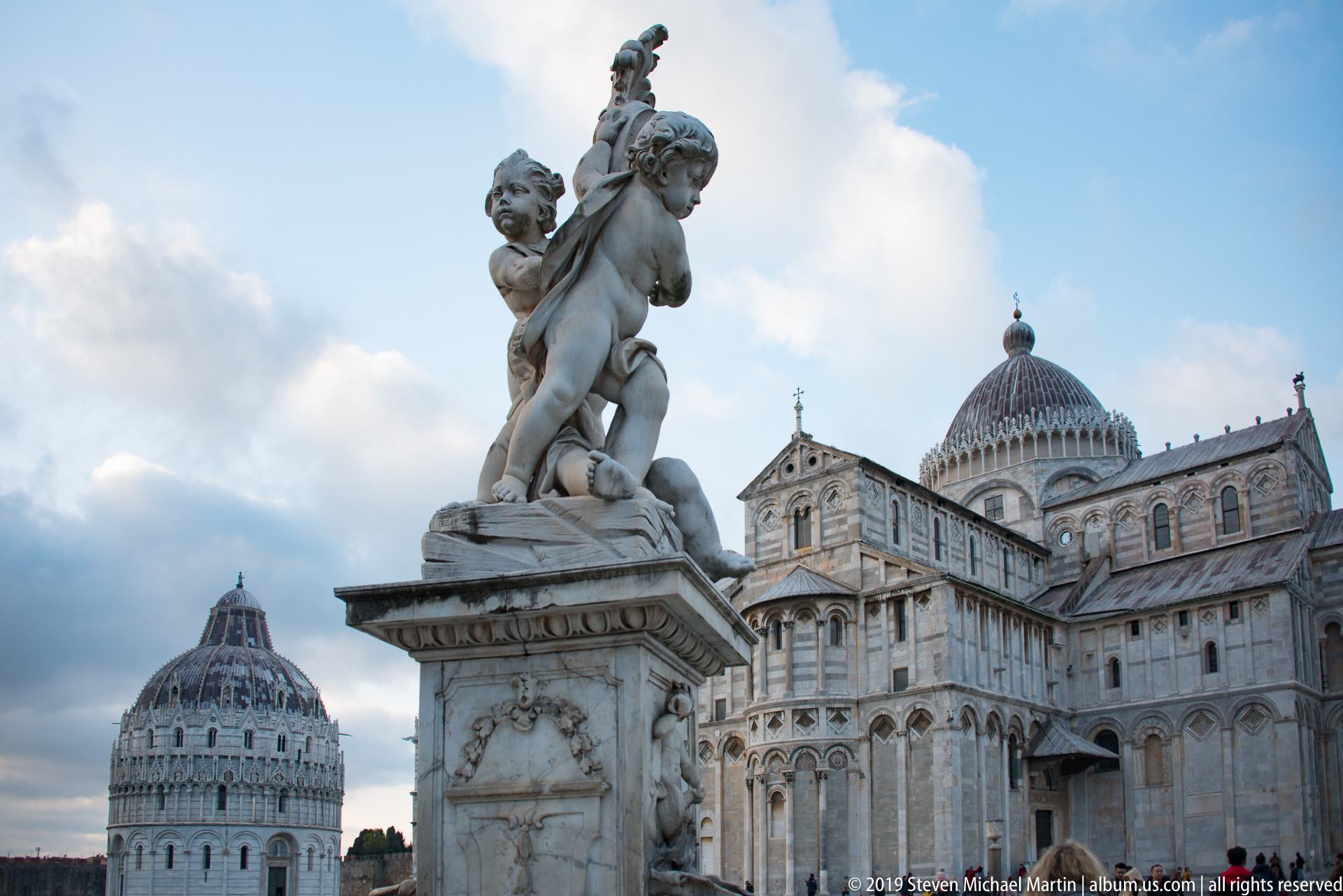
The Fontana dei Putti rises in the foreground of Piazza del Duomo, its marble putti grouped above the sculpted fountain base while Pisa Cathedral and the Baptistery fill the background. Created in the eighteenth century, the fountain combines the base associated with Giuseppe Vaccà with the crowning putti group by Giovanni Antonio Cybei, turning a functional water source into a prominent sculptural marker at the entrance to Pisa’s monumental precinct.
Caption
The Fontana dei Putti rises in the foreground of Piazza del Duomo, its marble putti grouped above the sculpted fountain base while Pisa Cathedral and the Baptistery fill the background. Created in the eighteenth century, the fountain combines the base associated with Giuseppe Vaccà with the crowning putti group by Giovanni Antonio Cybei, turning a functional water source into a prominent sculptural marker at the entrance to Pisa’s monumental precinct.

The Logge di Banchi presents its tall white upper block above a deeply arcaded ground level opening onto the busy city center. Pedestrians gather beneath and around the arches, while adjoining ochre buildings and a connecting passage frame the loggia. The frontal view highlights the structure's role as a monumental covered civic space within the commercial core.
Caption
The Logge di Banchi presents its tall white upper block above a deeply arcaded ground level opening onto the busy city center. Pedestrians gather beneath and around the arches, while adjoining ochre buildings and a connecting passage frame the loggia. The frontal view highlights the structure's role as a monumental covered civic space within the commercial core.

A visitor stands in the foreground beneath the dramatically angled Leaning Tower of Pisa, using the low camera position to exaggerate the campanile’s rise and tilt. The portrait combines a personal travel moment with the tower’s repeated marble arcades, softly illuminated against a pale evening sky.
Caption
A visitor stands in the foreground beneath the dramatically angled Leaning Tower of Pisa, using the low camera position to exaggerate the campanile’s rise and tilt. The portrait combines a personal travel moment with the tower’s repeated marble arcades, softly illuminated against a pale evening sky.

The Pisa Baptistery stands across the green lawn at left while the long marble flank of Pisa Cathedral fills the right side of the frame. Their arcades, blind galleries, striped stonework, and monumental scale define the architectural ensemble of the Piazza dei Miracoli, with visitors providing a sense of scale along the cathedral wall.
Caption
The Pisa Baptistery stands across the green lawn at left while the long marble flank of Pisa Cathedral fills the right side of the frame. Their arcades, blind galleries, striped stonework, and monumental scale define the architectural ensemble of the Piazza dei Miracoli, with visitors providing a sense of scale along the cathedral wall.

An ornate carousel panel turns Pisa's skyline into fairground decoration, pairing a painted Leaning Tower and cathedral complex with gilded scrollwork, lights, floral motifs, and a crown-like crest. The familiar monuments appear as idealized scenic imagery rather than documentary architecture, showing how the city's landmarks are reused in popular visual culture.
Caption
An ornate carousel panel turns Pisa's skyline into fairground decoration, pairing a painted Leaning Tower and cathedral complex with gilded scrollwork, lights, floral motifs, and a crown-like crest. The familiar monuments appear as idealized scenic imagery rather than documentary architecture, showing how the city's landmarks are reused in popular visual culture.

A compact lavender three-door hatchback is parked tightly along a residential street in Pisa. Its boxy profile, black bumpers, steel wheels, and unusually vivid paint stand out against the restrained masonry façade behind it, where barred windows and utility fixtures frame an everyday urban scene away from the city’s monumental core.
Caption
A compact lavender three-door hatchback is parked tightly along a residential street in Pisa. Its boxy profile, black bumpers, steel wheels, and unusually vivid paint stand out against the restrained masonry façade behind it, where barred windows and utility fixtures frame an everyday urban scene away from the city’s monumental core.

Piazza dei Cavalieri opens around the richly patterned façade of Palazzo della Carovana, fronted by its broad double staircase and statue, with the church of Santo Stefano dei Cavalieri adjoining at right. The spacious paved square and surrounding palazzi reveal Pisa beyond the Piazza dei Miracoli, centered here on the civic and institutional architecture of the historic city.
Caption
Piazza dei Cavalieri opens around the richly patterned façade of Palazzo della Carovana, fronted by its broad double staircase and statue, with the church of Santo Stefano dei Cavalieri adjoining at right. The spacious paved square and surrounding palazzi reveal Pisa beyond the Piazza dei Miracoli, centered here on the civic and institutional architecture of the historic city.

Palazzo della Carovana dominates this closer view across Piazza dei Cavalieri, its pale façade articulated by dark sgraffito decoration, regularly spaced windows, sculptural details, and the monumental staircase rising to the central entrance. The tighter framing emphasizes the palace as an architectural composition while retaining Santo Stefano dei Cavalieri at the edge of the square.
Caption
Palazzo della Carovana dominates this closer view across Piazza dei Cavalieri, its pale façade articulated by dark sgraffito decoration, regularly spaced windows, sculptural details, and the monumental staircase rising to the central entrance. The tighter framing emphasizes the palace as an architectural composition while retaining Santo Stefano dei Cavalieri at the edge of the square.

The Arno runs through central Pisa between long, continuous rows of warm-toned palazzi and embankment walls. Seen from a bridge, the river creates a strong central perspective beneath a bright, cloud-filled sky, while arcaded and stuccoed façades along the Lungarni show the dense urban fabric that developed around this historic Tuscan waterway.
Caption
The Arno runs through central Pisa between long, continuous rows of warm-toned palazzi and embankment walls. Seen from a bridge, the river creates a strong central perspective beneath a bright, cloud-filled sky, while arcaded and stuccoed façades along the Lungarni show the dense urban fabric that developed around this historic Tuscan waterway.

Two crouching humanlike figures flank a central long-eared grotesque in this close view of weathered stone carving. The figures’ compressed poses, exaggerated heads, and deeply modeled forms create a striking sculptural group against the surrounding masonry, drawing attention to the inventive figurative ornament incorporated into Pisa’s historic architecture.
Caption
Two crouching humanlike figures flank a central long-eared grotesque in this close view of weathered stone carving. The figures’ compressed poses, exaggerated heads, and deeply modeled forms create a striking sculptural group against the surrounding masonry, drawing attention to the inventive figurative ornament incorporated into Pisa’s historic architecture.

A visitor stands before the lower stages of the Leaning Tower of Pisa, where the marble blind arcades and open columned gallery fill the background. Warm, low-angle sunlight illuminates both the portrait and stonework, allowing the architectural details at the campanile’s base to share attention with the foreground figure.
Caption
A visitor stands before the lower stages of the Leaning Tower of Pisa, where the marble blind arcades and open columned gallery fill the background. Warm, low-angle sunlight illuminates both the portrait and stonework, allowing the architectural details at the campanile’s base to share attention with the foreground figure.

Warm evening light rakes across the stacked arcades of the Leaning Tower of Pisa, isolating the repeated rhythm of columns, round arches, and shadowed gallery openings. The close, upward view minimizes the tower’s famous tilt and instead emphasizes the Romanesque campanile’s layered marble construction and the sculptural depth created by its encircling loggias.
Caption
Warm evening light rakes across the stacked arcades of the Leaning Tower of Pisa, isolating the repeated rhythm of columns, round arches, and shadowed gallery openings. The close, upward view minimizes the tower’s famous tilt and instead emphasizes the Romanesque campanile’s layered marble construction and the sculptural depth created by its encircling loggias.

The Leaning Tower of Pisa rises against a blue, cloud-streaked sky, its pronounced inclination immediately visible from this low oblique viewpoint. Repeated open arcades wrap the cylindrical marble campanile above the blind-arched lower stage, while warm late-day light models the columns and emphasizes the tower’s distinctive geometry.
Caption
The Leaning Tower of Pisa rises against a blue, cloud-streaked sky, its pronounced inclination immediately visible from this low oblique viewpoint. Repeated open arcades wrap the cylindrical marble campanile above the blind-arched lower stage, while warm late-day light models the columns and emphasizes the tower’s distinctive geometry.

The Leaning Tower of Pisa fills the background behind a visitor standing near its base, with the entire sweep of stacked arcades visible above him. The wide, low viewpoint accentuates the tower’s inclination and scale, while golden light on the marble contrasts with the cool blue and white clouds of the evening sky.
Caption
The Leaning Tower of Pisa fills the background behind a visitor standing near its base, with the entire sweep of stacked arcades visible above him. The wide, low viewpoint accentuates the tower’s inclination and scale, while golden light on the marble contrasts with the cool blue and white clouds of the evening sky.

Seen from close to its base, the Leaning Tower of Pisa sweeps diagonally across the frame, making the campanile’s inclination the dominant visual element. Blind arcades and diamond-shaped marble inlays articulate the lower story, while successive rings of columns and arches rise into warm light beneath a cloud-streaked sky.
Caption
Seen from close to its base, the Leaning Tower of Pisa sweeps diagonally across the frame, making the campanile’s inclination the dominant visual element. Blind arcades and diamond-shaped marble inlays articulate the lower story, while successive rings of columns and arches rise into warm light beneath a cloud-streaked sky.

A visitor stands hands-on-hips in front of the Leaning Tower of Pisa, centered against the campanile’s full height and conspicuous tilt. The lawn, clipped hedges, and scattered visitors establish the Piazza dei Miracoli setting, while the tower’s white arcades contrast crisply with the blue-and-clouded sky.
Caption
A visitor stands hands-on-hips in front of the Leaning Tower of Pisa, centered against the campanile’s full height and conspicuous tilt. The lawn, clipped hedges, and scattered visitors establish the Piazza dei Miracoli setting, while the tower’s white arcades contrast crisply with the blue-and-clouded sky.

A visitor in a brown jacket stands before the Leaning Tower of Pisa, positioned low in the frame so the tilted campanile rises prominently behind him. The portrait preserves the tower’s stacked arcades and pale marble surface while including the active public lawn and distant visitors of the Piazza dei Miracoli.
Caption
A visitor in a brown jacket stands before the Leaning Tower of Pisa, positioned low in the frame so the tilted campanile rises prominently behind him. The portrait preserves the tower’s stacked arcades and pale marble surface while including the active public lawn and distant visitors of the Piazza dei Miracoli.

The upper stages of the Leaning Tower of Pisa rise alone against a luminous sky, isolating the campanile from the surrounding Piazza dei Miracoli. This vertical crop concentrates on the repetition of slender columns and round arches, while the tower’s lean remains legible in the shifting alignment of its stacked marble galleries.
Caption
The upper stages of the Leaning Tower of Pisa rise alone against a luminous sky, isolating the campanile from the surrounding Piazza dei Miracoli. This vertical crop concentrates on the repetition of slender columns and round arches, while the tower’s lean remains legible in the shifting alignment of its stacked marble galleries.

A small dark metal quadruped stands atop a tall pale stone column above a tiled roofline. Seen against an open sky, the silhouetted animal and its elevated perch form an unexpected architectural accent, with the narrow framing concentrating on the sculpture, capital, and adjoining rooftop rather than the surrounding city.
Caption
A small dark metal quadruped stands atop a tall pale stone column above a tiled roofline. Seen against an open sky, the silhouetted animal and its elevated perch form an unexpected architectural accent, with the narrow framing concentrating on the sculpture, capital, and adjoining rooftop rather than the surrounding city.

The Leaning Tower of Pisa rises behind a busy foreground of visitors along the Piazza dei Miracoli lawn. A man posed near the center is surrounded by other tourists photographing and viewing the monument, giving the scene a lively human scale while the tower’s characteristic tilt and stacked arcades remain the dominant landmark.
Caption
The Leaning Tower of Pisa rises behind a busy foreground of visitors along the Piazza dei Miracoli lawn. A man posed near the center is surrounded by other tourists photographing and viewing the monument, giving the scene a lively human scale while the tower’s characteristic tilt and stacked arcades remain the dominant landmark.

Seen from the side, the Fontana dei Putti brings its animated marble figures into sharp relief against the Baptistery and Pisa Cathedral. The eighteenth-century monument combines a fountain base associated with Giuseppe Vaccà and the crowning group of three putti by Giovanni Antonio Cybei. This angle emphasizes the twisting sculptural composition while preserving its setting at the edge of Pisa’s Piazza del Duomo.
Caption
Seen from the side, the Fontana dei Putti brings its animated marble figures into sharp relief against the Baptistery and Pisa Cathedral. The eighteenth-century monument combines a fountain base associated with Giuseppe Vaccà and the crowning group of three putti by Giovanni Antonio Cybei. This angle emphasizes the twisting sculptural composition while preserving its setting at the edge of Pisa’s Piazza del Duomo.

The Leaning Tower of Pisa looms overhead in a steep upward view from near its base, where geometric marble panels give way to ring after ring of open arcades. Perspective compresses the columns and arches toward the top, while the tower’s inclination bends the cylindrical form dramatically across the pale sky.
Caption
The Leaning Tower of Pisa looms overhead in a steep upward view from near its base, where geometric marble panels give way to ring after ring of open arcades. Perspective compresses the columns and arches toward the top, while the tower’s inclination bends the cylindrical form dramatically across the pale sky.

A visitor stands beside the Fontana dei Putti at the entrance to Pisa’s Piazza del Duomo, with the Baptistery and Cathedral extending across the lawn behind. The eighteenth-century marble fountain is crowned by Giovanni Antonio Cybei’s group of three putti, above a base associated with Giuseppe Vaccà. The broad view places the fountain within the larger monumental ensemble rather than treating it as an unidentified decorative sculpture.
Caption
A visitor stands beside the Fontana dei Putti at the entrance to Pisa’s Piazza del Duomo, with the Baptistery and Cathedral extending across the lawn behind. The eighteenth-century marble fountain is crowned by Giovanni Antonio Cybei’s group of three putti, above a base associated with Giuseppe Vaccà. The broad view places the fountain within the larger monumental ensemble rather than treating it as an unidentified decorative sculpture.

Two tall windows punctuate a peach-colored stucco wall, each framed by greenish stone trim and fitted with dark wooden shutters opened at irregular angles. A vertical drainpipe divides the composition, while a small sculptural fixture between the windows adds a modest decorative note to this close study of everyday Pisan architecture.
Caption
Two tall windows punctuate a peach-colored stucco wall, each framed by greenish stone trim and fitted with dark wooden shutters opened at irregular angles. A vertical drainpipe divides the composition, while a small sculptural fixture between the windows adds a modest decorative note to this close study of everyday Pisan architecture.

Rows of painted souvenir chess pieces depict armored knights, clerics, and other medieval-style figures in a shop display. Red, white, black, and metallic details distinguish opposing ranks, while the shallow depth of field keeps the front pieces crisp and turns the rear figures into a dense backdrop of miniature historical characters.
Caption
Rows of painted souvenir chess pieces depict armored knights, clerics, and other medieval-style figures in a shop display. Red, white, black, and metallic details distinguish opposing ranks, while the shallow depth of field keeps the front pieces crisp and turns the rear figures into a dense backdrop of miniature historical characters.

A whimsical souvenir chess set replaces conventional pieces with rows of small painted dogs and cats. Dog figures occupy the front ranks while cat figures line the back of the board, their repeated poses and individualized markings creating a playful contrast to the historic monuments and religious architecture associated with Pisa.
Caption
A whimsical souvenir chess set replaces conventional pieces with rows of small painted dogs and cats. Dog figures occupy the front ranks while cat figures line the back of the board, their repeated poses and individualized markings creating a playful contrast to the historic monuments and religious architecture associated with Pisa.

A neighborhood storefront occupies the ground floor of a peach stucco building, with a shuttered “SUPER MARKET” entrance beside a tall arched doorway and a bicycle leaning against the wall. Above, a small ornate balcony and green shutters introduce domestic details, combining commerce, housing, signage, and everyday street life in central Pisa.
Caption
A neighborhood storefront occupies the ground floor of a peach stucco building, with a shuttered “SUPER MARKET” entrance beside a tall arched doorway and a bicycle leaning against the wall. Above, a small ornate balcony and green shutters introduce domestic details, combining commerce, housing, signage, and everyday street life in central Pisa.

Palazzo dell’Orologio closes one side of Piazza dei Cavalieri with an asymmetrical façade joined over a broad central archway. A large clock, faded painted decoration, rows of rectangular windows, and the small rooftop bell structure animate the pale walls, while cyclists and pedestrians passing through the square provide scale and contemporary street life.
Caption
Palazzo dell’Orologio closes one side of Piazza dei Cavalieri with an asymmetrical façade joined over a broad central archway. A large clock, faded painted decoration, rows of rectangular windows, and the small rooftop bell structure animate the pale walls, while cyclists and pedestrians passing through the square provide scale and contemporary street life.

The Leaning Tower of Pisa stands alone against a soft evening sky, its tilt strongly apparent from the open paved foreground. Visitors gather near the base while dark clipped hedges and a construction crane mark the edge of the scene; warm light still catches the tower’s marble arcades and blind-arched lower story.
Caption
The Leaning Tower of Pisa stands alone against a soft evening sky, its tilt strongly apparent from the open paved foreground. Visitors gather near the base while dark clipped hedges and a construction crane mark the edge of the scene; warm light still catches the tower’s marble arcades and blind-arched lower story.

A deeply carved stone cartouche centers on an eight-pointed Maltese cross set within an oval shield. Scrolls, volutes, and clustered decorative forms surround the emblem, projecting strongly from the weathered masonry. The close oblique view emphasizes the relief’s depth and craftsmanship as a heraldic feature embedded in Pisa’s historic streetscape.
Caption
A deeply carved stone cartouche centers on an eight-pointed Maltese cross set within an oval shield. Scrolls, volutes, and clustered decorative forms surround the emblem, projecting strongly from the weathered masonry. The close oblique view emphasizes the relief’s depth and craftsmanship as a heraldic feature embedded in Pisa’s historic streetscape.

Palazzo della Carovana dominates Piazza dei Cavalieri with the elaborate sgraffito façade designed by Giorgio Vasari for the Order of Saint Stephen. Remodelled in the 1560s from earlier civic buildings, the palace is now the principal seat of the Scuola Normale Superiore. Its monumental staircase, heraldic sculpture, grand-ducal busts, and dense two-tone decoration turn the façade into the visual centerpiece of Vasari’s redesigned square.
Caption
Palazzo della Carovana dominates Piazza dei Cavalieri with the elaborate sgraffito façade designed by Giorgio Vasari for the Order of Saint Stephen. Remodelled in the 1560s from earlier civic buildings, the palace is now the principal seat of the Scuola Normale Superiore. Its monumental staircase, heraldic sculpture, grand-ducal busts, and dense two-tone decoration turn the façade into the visual centerpiece of Vasari’s redesigned square.

The Church of Santo Stefano dei Cavalieri presents a formal façade of warm brick and pale stone on Piazza dei Cavalieri. Pilasters, framed portals, sculptural panels, and a high pediment organize the front, while the adjoining brick volume and bell tower reveal the building’s depth beyond the ceremonial face toward the square.
Caption
The Church of Santo Stefano dei Cavalieri presents a formal façade of warm brick and pale stone on Piazza dei Cavalieri. Pilasters, framed portals, sculptural panels, and a high pediment organize the front, while the adjoining brick volume and bell tower reveal the building’s depth beyond the ceremonial face toward the square.

The upper arcades of the Leaning Tower of Pisa emerge unexpectedly above a layered foreground of terracotta roofs and brick walls. At right, a simple two-bell gable forms a second vertical accent, contrasting the modest historic roofscape with the ornate marble campanile and its flag-topped crown in the distance.
Caption
The upper arcades of the Leaning Tower of Pisa emerge unexpectedly above a layered foreground of terracotta roofs and brick walls. At right, a simple two-bell gable forms a second vertical accent, contrasting the modest historic roofscape with the ornate marble campanile and its flag-topped crown in the distance.

The central Medici-Stephanian coat of arms crowns the main axis of Palazzo della Carovana, flanked by allegorical figures of Religion and Justice. Executed by Stoldo Lorenzi after Giorgio Vasari’s design in the 1560s, the sculptural ensemble reinforces the palace’s ceremonial identity as the headquarters created for the Order of Saint Stephen. Dense Vasarian sgraffito extends around the stonework, integrating heraldry, allegory, and architecture across the façade.
Caption
The central Medici-Stephanian coat of arms crowns the main axis of Palazzo della Carovana, flanked by allegorical figures of Religion and Justice. Executed by Stoldo Lorenzi after Giorgio Vasari’s design in the 1560s, the sculptural ensemble reinforces the palace’s ceremonial identity as the headquarters created for the Order of Saint Stephen. Dense Vasarian sgraffito extends around the stonework, integrating heraldry, allegory, and architecture across the façade.

A souvenir chess set turns medieval military imagery into a tabletop display, with armored knights and soldiers arranged across the board. White tunics and shields carry prominent red crosses, while darker and red-painted figures stand behind them. The shallow depth of field emphasizes the front rank and the repeated heraldic motifs rather than the surrounding shop setting.
Caption
A souvenir chess set turns medieval military imagery into a tabletop display, with armored knights and soldiers arranged across the board. White tunics and shields carry prominent red crosses, while darker and red-painted figures stand behind them. The shallow depth of field emphasizes the front rank and the repeated heraldic motifs rather than the surrounding shop setting.

A crowned heraldic shield projects from an ochre façade, its central cross surrounded by scrolls, hanging drapery, fruit clusters, and ribbon-like carving. The pale stone relief stands sharply against the warm plaster wall and is positioned directly above a triangular pediment, making the emblem the architectural focus of the bay.
Caption
A crowned heraldic shield projects from an ochre façade, its central cross surrounded by scrolls, hanging drapery, fruit clusters, and ribbon-like carving. The pale stone relief stands sharply against the warm plaster wall and is positioned directly above a triangular pediment, making the emblem the architectural focus of the bay.

An ochre palazzo presents a disciplined, symmetrical façade of shuttered windows, pale stone surrounds, and a central marble entrance. A large heraldic relief occupies the upper axis, while an inscription band runs beneath the cornice. The full elevation shows how ceremonial emblems are integrated into an otherwise restrained urban façade.
Caption
An ochre palazzo presents a disciplined, symmetrical façade of shuttered windows, pale stone surrounds, and a central marble entrance. A large heraldic relief occupies the upper axis, while an inscription band runs beneath the cornice. The full elevation shows how ceremonial emblems are integrated into an otherwise restrained urban façade.

The central entrance of an ochre Pisan palazzo is framed by a substantial pale-marble portal and balcony. A carved inscription panel spans the balustrade above the dark wooden doors, with a heraldic mask or shield set higher on the façade. This tighter view concentrates on the building's formal entrance sequence and layered stone ornament.
Caption
The central entrance of an ochre Pisan palazzo is framed by a substantial pale-marble portal and balcony. A carved inscription panel spans the balustrade above the dark wooden doors, with a heraldic mask or shield set higher on the façade. This tighter view concentrates on the building's formal entrance sequence and layered stone ornament.

The fountain and monument at the foot of Palazzo della Carovana occupy the foreground of Piazza dei Cavalieri. Behind them, the palace staircase leads to the flag-lined entrance beneath a heraldic crest, while sgraffito panels cover the upper walls. The composition emphasizes the layered ceremonial approach to the Scuola Normale Superiore.
Caption
The fountain and monument at the foot of Palazzo della Carovana occupy the foreground of Piazza dei Cavalieri. Behind them, the palace staircase leads to the flag-lined entrance beneath a heraldic crest, while sgraffito panels cover the upper walls. The composition emphasizes the layered ceremonial approach to the Scuola Normale Superiore.

A marble plaque beneath a sculpted crest records a Pisan tradition associated with the birthplace of Galileo Galilei. The inscription refers to a house in the area between Vicolo dei Mercanti and Borgo, while the weathered heraldic carving above projects from the stucco wall. The image preserves the commemorative marker rather than attempting to reconstruct the lost domestic setting.
Caption
A marble plaque beneath a sculpted crest records a Pisan tradition associated with the birthplace of Galileo Galilei. The inscription refers to a house in the area between Vicolo dei Mercanti and Borgo, while the weathered heraldic carving above projects from the stucco wall. The image preserves the commemorative marker rather than attempting to reconstruct the lost domestic setting.

The Church of Santo Stefano dei Cavalieri faces Piazza dei Cavalieri with a formal marble-and-brick façade tied to the chivalric Order of Saint Stephen. Cross emblems recur in the pediment and architectural decoration, while the central portal, paired windows, and sculptural details create a strongly axial composition under a clear blue sky.
Caption
The Church of Santo Stefano dei Cavalieri faces Piazza dei Cavalieri with a formal marble-and-brick façade tied to the chivalric Order of Saint Stephen. Cross emblems recur in the pediment and architectural decoration, while the central portal, paired windows, and sculptural details create a strongly axial composition under a clear blue sky.

The upper pediment of Santo Stefano dei Cavalieri displays the eight-pointed red cross associated with the Order of Saint Stephen, encircled by a carved wreath and framed by sweeping ornamental forms. A metal cross-like finial rises at the roof peak. The close crop makes the order's emblem the dominant feature against the blue sky.
Caption
The upper pediment of Santo Stefano dei Cavalieri displays the eight-pointed red cross associated with the Order of Saint Stephen, encircled by a carved wreath and framed by sweeping ornamental forms. A metal cross-like finial rises at the roof peak. The close crop makes the order's emblem the dominant feature against the blue sky.

Pietro Francavilla’s 1596 statue of Cosimo I de’ Medici stands before Palazzo della Carovana in Piazza dei Cavalieri. Cosimo appears in the guise of a Roman emperor, with one foot pressing on a dolphin, an attribute of Neptune that refers to Medici dominion over the sea. The monument forms the sculptural focus of the square redesigned under Cosimo by Giorgio Vasari for the Order of Saint Stephen.
Caption
Pietro Francavilla’s 1596 statue of Cosimo I de’ Medici stands before Palazzo della Carovana in Piazza dei Cavalieri. Cosimo appears in the guise of a Roman emperor, with one foot pressing on a dolphin, an attribute of Neptune that refers to Medici dominion over the sea. The monument forms the sculptural focus of the square redesigned under Cosimo by Giorgio Vasari for the Order of Saint Stephen.

The upper façade of Santo Stefano dei Cavalieri combines a broad dedicatory inscription, paired windows, heraldic carving, and repeated crosses of the Order of Saint Stephen. Above, the triangular pediment carries a larger cross emblem. The upward viewpoint compresses these symbols into a concentrated statement of the church's institutional identity.
Caption
The upper façade of Santo Stefano dei Cavalieri combines a broad dedicatory inscription, paired windows, heraldic carving, and repeated crosses of the Order of Saint Stephen. Above, the triangular pediment carries a larger cross emblem. The upward viewpoint compresses these symbols into a concentrated statement of the church's institutional identity.

A monumental white-marble heraldic relief fills a dark wall panel, centered on a shield bearing a cross. A crowned winged figure rises above the shield, while drapery, cords, and radiating trophies create an elaborate symmetrical frame. The carving's ceremonial scale and crisp contrast make it one of the façade's most assertive institutional emblems.
Caption
A monumental white-marble heraldic relief fills a dark wall panel, centered on a shield bearing a cross. A crowned winged figure rises above the shield, while drapery, cords, and radiating trophies create an elaborate symmetrical frame. The carving's ceremonial scale and crisp contrast make it one of the façade's most assertive institutional emblems.

The façade of San Michele in Borgo rises above the narrow urban street in stacked tiers of arcaded loggias. Slender columns, rounded arches, and a pale stone surface create the characteristic screen-like upper elevation, while a pointed Gothic portal anchors the lower wall. The low viewpoint accentuates the vertical layering of this medieval church façade.
Caption
The façade of San Michele in Borgo rises above the narrow urban street in stacked tiers of arcaded loggias. Slender columns, rounded arches, and a pale stone surface create the characteristic screen-like upper elevation, while a pointed Gothic portal anchors the lower wall. The low viewpoint accentuates the vertical layering of this medieval church façade.

A narrow central Pisan street bends between closely spaced multistory buildings with shuttered windows and ground-floor shops. Pedestrians fill the roadway beneath projecting signs and wall-mounted lamps, showing the historic center functioning as an active commercial corridor. The converging façades and slight curve create an intimate urban perspective.
Caption
A narrow central Pisan street bends between closely spaced multistory buildings with shuttered windows and ground-floor shops. Pedestrians fill the roadway beneath projecting signs and wall-mounted lamps, showing the historic center functioning as an active commercial corridor. The converging façades and slight curve create an intimate urban perspective.

A compact chapel interior is organized around a central doorway beneath a red shield bearing a white eight-pointed cross. Paired arches, marble columns, oval reliefs, painted ornament, flags, and rows of wooden benches create a richly furnished ceremonial space. The repeated cross motif identifies the room with a chivalric religious tradition while the photograph concentrates on its visible decorative program.
Caption
A compact chapel interior is organized around a central doorway beneath a red shield bearing a white eight-pointed cross. Paired arches, marble columns, oval reliefs, painted ornament, flags, and rows of wooden benches create a richly furnished ceremonial space. The repeated cross motif identifies the room with a chivalric religious tradition while the photograph concentrates on its visible decorative program.

A red eight-pointed cross is painted prominently above the street plaque for Via Ulisse Dini, formerly Via del Monte. The simple wall-mounted pairing places a chivalric emblem directly within the urban streetscape, while exposed conduit and weathering retain the ordinary material context of the sign rather than presenting it as a freestanding monument.
Caption
A red eight-pointed cross is painted prominently above the street plaque for Via Ulisse Dini, formerly Via del Monte. The simple wall-mounted pairing places a chivalric emblem directly within the urban streetscape, while exposed conduit and weathering retain the ordinary material context of the sign rather than presenting it as a freestanding monument.

An oval monochrome relief of a seated sacred figure with attendants is set within an exuberant gilded and painted frame. Scrolls, foliage, and broken architectural curves surround the medallion, creating a layered Baroque decorative field above a dark grille. The close view isolates the chapel's sculptural ornament from the larger interior.
Caption
An oval monochrome relief of a seated sacred figure with attendants is set within an exuberant gilded and painted frame. Scrolls, foliage, and broken architectural curves surround the medallion, creating a layered Baroque decorative field above a dark grille. The close view isolates the chapel's sculptural ornament from the larger interior.

A red upholstered wooden armchair carries a large white eight-pointed cross across its back, turning a functional seat into a clear heraldic object. The chair stands on a patterned rug beside another ceremonial seat, with a black-and-white floor and framed decoration visible behind. The tight composition emphasizes institutional symbolism through furnishing rather than architecture.
Caption
A red upholstered wooden armchair carries a large white eight-pointed cross across its back, turning a functional seat into a clear heraldic object. The chair stands on a patterned rug beside another ceremonial seat, with a black-and-white floor and framed decoration visible behind. The tight composition emphasizes institutional symbolism through furnishing rather than architecture.

Viewed along the central aisle, the small chapel leads toward a bright entrance framed by paired marble columns and shallow arches. A red shield with a white eight-pointed cross crowns the doorway, while flags, relief medallions, gilded scrollwork, paintings, and wooden benches line the room. The axial composition makes the heraldic emblem the visual endpoint of the interior.
Caption
Viewed along the central aisle, the small chapel leads toward a bright entrance framed by paired marble columns and shallow arches. A red shield with a white eight-pointed cross crowns the doorway, while flags, relief medallions, gilded scrollwork, paintings, and wooden benches line the room. The axial composition makes the heraldic emblem the visual endpoint of the interior.

A richly veined marble altar is arranged with flowers, candlesticks, reliquary-like objects, and a central tabernacle marked by a pale cross emblem. The frontal composition reveals contrasting marbles across the mensa and architectural surround, while a circular cross motif decorates the altar frontal. The image concentrates on the chapel's liturgical focal point and ceremonial furnishings.
Caption
A richly veined marble altar is arranged with flowers, candlesticks, reliquary-like objects, and a central tabernacle marked by a pale cross emblem. The frontal composition reveals contrasting marbles across the mensa and architectural surround, while a circular cross motif decorates the altar frontal. The image concentrates on the chapel's liturgical focal point and ceremonial furnishings.

A statue of Giuseppe Garibaldi stands before a pale pink historic palazzo in the square that bears his name. Arcaded ground-floor openings, café activity, pedestrians, bicycles, and a police vehicle give the scene an active civic character, while the monument anchors the open space at the edge of Pisa's historic center.
Caption
A statue of Giuseppe Garibaldi stands before a pale pink historic palazzo in the square that bears his name. Arcaded ground-floor openings, café activity, pedestrians, bicycles, and a police vehicle give the scene an active civic character, while the monument anchors the open space at the edge of Pisa's historic center.

The chapel's nave opens toward a richly furnished altar beneath a crucifix, with marble columns, sculpted frames, paintings, flags, and heraldic emblems lining the walls. Wooden benches flank a patterned central floor, and a solitary visitor provides scale. The wider view reveals the full spatial organization of the small ceremonial interior.
Caption
The chapel's nave opens toward a richly furnished altar beneath a crucifix, with marble columns, sculpted frames, paintings, flags, and heraldic emblems lining the walls. Wooden benches flank a patterned central floor, and a solitary visitor provides scale. The wider view reveals the full spatial organization of the small ceremonial interior.

Two paper cups of coffee flank a small rectangular layered pastry on a café counter. The dessert is topped with chopped green nuts, while saucers, spoons, and a fork complete the compact arrangement. The close tabletop view records an everyday pause in the city, contrasting with the surrounding sequence of monuments and historic interiors.
Caption
Two paper cups of coffee flank a small rectangular layered pastry on a café counter. The dessert is topped with chopped green nuts, while saucers, spoons, and a fork complete the compact arrangement. The close tabletop view records an everyday pause in the city, contrasting with the surrounding sequence of monuments and historic interiors.

A brightly ornamented children's carousel stands in an urban square, its horses, carriage, mirrors, painted panels, red drapery, and rows of bulbs forming a compact theatrical pavilion. Surrounding buildings and parked scooters place the attraction firmly within the contemporary city, adding a layer of everyday recreation to Pisa's historic streetscape.
Caption
A brightly ornamented children's carousel stands in an urban square, its horses, carriage, mirrors, painted panels, red drapery, and rows of bulbs forming a compact theatrical pavilion. Surrounding buildings and parked scooters place the attraction firmly within the contemporary city, adding a layer of everyday recreation to Pisa's historic streetscape.

A large illustrated tourist map labeled “Città di Pisa” lays out the historic center, the Arno, major streets, and numbered points of interest. The panel bears the tourism authority's title block and a keyed legend, presenting the city as a navigable network of monuments and districts rather than through a single photographic viewpoint.
Caption
A large illustrated tourist map labeled “Città di Pisa” lays out the historic center, the Arno, major streets, and numbered points of interest. The panel bears the tourism authority's title block and a keyed legend, presenting the city as a navigable network of monuments and districts rather than through a single photographic viewpoint.

Rounded red and pink figures interlock across this section of the mural, surrounded by repeated black motion-like lines and fragments of turquoise and yellow forms. The close viewpoint emphasizes the artist’s use of thick contour, flat color, and compressed spacing, where separate bodies become parts of a continuous visual pattern.
Caption
Rounded red and pink figures interlock across this section of the mural, surrounded by repeated black motion-like lines and fragments of turquoise and yellow forms. The close viewpoint emphasizes the artist’s use of thick contour, flat color, and compressed spacing, where separate bodies become parts of a continuous visual pattern.

A pink crouching figure bends over a turquoise object in this tightly framed mural detail. Blue, cream, and black-outlined neighboring forms press into the composition, while short repeated strokes create a sense of movement around the figure. The crop demonstrates how recognizable gestures emerge from the mural’s larger network of simplified bodies and symbols.
Caption
A pink crouching figure bends over a turquoise object in this tightly framed mural detail. Blue, cream, and black-outlined neighboring forms press into the composition, while short repeated strokes create a sense of movement around the figure. The crop demonstrates how recognizable gestures emerge from the mural’s larger network of simplified bodies and symbols.

The bronze monument to Vittorio Emanuele II rises on a tall stone pedestal at the center of its namesake Pisan square. The standing figure dominates the open paved space, while late nineteenth- and twentieth-century buildings frame the background. Pedestrians and bicycles emphasize the square's continuing role as a major urban gathering and circulation point.
Caption
The bronze monument to Vittorio Emanuele II rises on a tall stone pedestal at the center of its namesake Pisan square. The standing figure dominates the open paved space, while late nineteenth- and twentieth-century buildings frame the background. Pedestrians and bicycles emphasize the square's continuing role as a major urban gathering and circulation point.

A monumental street-art mural covers the entire end wall of a traditional stucco building, setting a dense field of interlocking figures against the quieter rhythm of shuttered windows along the side elevation. The pastel palette, black outlines, and tightly fitted human and animal-like forms turn the blank party wall into a highly visible piece of urban art within Pisa.
Caption
A monumental street-art mural covers the entire end wall of a traditional stucco building, setting a dense field of interlocking figures against the quieter rhythm of shuttered windows along the side elevation. The pastel palette, black outlines, and tightly fitted human and animal-like forms turn the blank party wall into a highly visible piece of urban art within Pisa.

A metal canopy marked “Keith Art Shop Café” projects from a modern ground-floor storefront, while a fragment of the neighboring colorful mural appears at the upper left. Planters and the residential block rising behind the sign place the shop within an everyday urban setting, linking commercial activity directly to the celebrated street-art environment.
Caption
A metal canopy marked “Keith Art Shop Café” projects from a modern ground-floor storefront, while a fragment of the neighboring colorful mural appears at the upper left. Planters and the residential block rising behind the sign place the shop within an everyday urban setting, linking commercial activity directly to the celebrated street-art environment.

A close detail isolates a pale yellow winged figure moving through a field of energetic black contour lines. Cropped surrounding forms in blue, tan, and white reveal how the mural’s individual pictograms lock together, while the tight framing shifts attention from the building-scale composition to the graphic vocabulary of a single character.
Caption
A close detail isolates a pale yellow winged figure moving through a field of energetic black contour lines. Cropped surrounding forms in blue, tan, and white reveal how the mural’s individual pictograms lock together, while the tight framing shifts attention from the building-scale composition to the graphic vocabulary of a single character.

An ornate church sanctuary centers on a crucifix above a marble altar, framed by elaborate stucco ornament and two large oval relief panels. Candles, flowers, liturgical furnishings, and a black-and-white floor reinforce the ceremonial setting, while the symmetrical composition draws the eye toward the crucified figure at the center of the richly decorated wall.
Caption
An ornate church sanctuary centers on a crucifix above a marble altar, framed by elaborate stucco ornament and two large oval relief panels. Candles, flowers, liturgical furnishings, and a black-and-white floor reinforce the ceremonial setting, while the symmetrical composition draws the eye toward the crucified figure at the center of the richly decorated wall.

A large pink hand dominates this mural section beside a simplified yellow walking figure, with smaller blue, turquoise, and lavender forms filling the remaining space. Thick black outlines and rhythmic hatch-like strokes bind the disparate symbols together, giving the close view the same continuous energy as the wall-scale composition.
Caption
A large pink hand dominates this mural section beside a simplified yellow walking figure, with smaller blue, turquoise, and lavender forms filling the remaining space. Thick black outlines and rhythmic hatch-like strokes bind the disparate symbols together, giving the close view the same continuous energy as the wall-scale composition.

A red television-like rectangle and a pale yellow figure stand out among pink, blue, turquoise, and lavender bodies in this mural detail. The simplified screen motif introduces a recognizable object into the surrounding flow of humanlike forms, all unified by heavy black contours and repeated linear accents.
Caption
A red television-like rectangle and a pale yellow figure stand out among pink, blue, turquoise, and lavender bodies in this mural detail. The simplified screen motif introduces a recognizable object into the surrounding flow of humanlike forms, all unified by heavy black contours and repeated linear accents.

An orange running figure stretches across the center of this mural section, surrounded by pale yellow, blue, pink, and turquoise bodies. The cropped composition makes the figure’s long stride and bent arms especially legible, while thick black contours and repeated short strokes maintain the visual rhythm across adjacent forms.
Caption
An orange running figure stretches across the center of this mural section, surrounded by pale yellow, blue, pink, and turquoise bodies. The cropped composition makes the figure’s long stride and bent arms especially legible, while thick black contours and repeated short strokes maintain the visual rhythm across adjacent forms.

A broad view reveals the mural as a dense tapestry of simplified bodies, hands, animals, and object-like symbols fitted together across the wall. Soft pinks, blues, yellows, turquoise, and red are separated by emphatic black lines, allowing individual motifs to remain legible while contributing to a single wall-spanning composition.
Caption
A broad view reveals the mural as a dense tapestry of simplified bodies, hands, animals, and object-like symbols fitted together across the wall. Soft pinks, blues, yellows, turquoise, and red are separated by emphatic black lines, allowing individual motifs to remain legible while contributing to a single wall-spanning composition.

This wider crop shows numerous mural motifs interacting across the painted surface, from a large pink hand and blue animal-like form to walking and bending human figures. The even distribution of color and continuous black linework minimize any single focal point, emphasizing instead the mural’s interconnected, puzzle-like structure.
Caption
This wider crop shows numerous mural motifs interacting across the painted surface, from a large pink hand and blue animal-like form to walking and bending human figures. The even distribution of color and continuous black linework minimize any single focal point, emphasizing instead the mural’s interconnected, puzzle-like structure.

The painted end wall appears in its neighborhood context beside a modest residential façade with green shutters and balconies. Behind the building rises a pale historic bell tower, while fences and service structures occupy the foreground. The view shows how the monumental mural is embedded within Pisa’s layered urban fabric rather than isolated as a freestanding artwork.
Caption
The painted end wall appears in its neighborhood context beside a modest residential façade with green shutters and balconies. Behind the building rises a pale historic bell tower, while fences and service structures occupy the foreground. The view shows how the monumental mural is embedded within Pisa’s layered urban fabric rather than isolated as a freestanding artwork.

A weathered brick-and-stone gateway stands within a grassy strip of historic masonry, its arched passage framed by contrasting pale stone blocks. A roofed brick structure spans the opening, while adjoining walls and a narrow bridge-like approach reveal multiple construction phases and the defensive character of the complex.
Caption
A weathered brick-and-stone gateway stands within a grassy strip of historic masonry, its arched passage framed by contrasting pale stone blocks. A roofed brick structure spans the opening, while adjoining walls and a narrow bridge-like approach reveal multiple construction phases and the defensive character of the complex.

The mural fills the end wall of a long, shuttered building viewed obliquely from the street. Its dense pastel figures contrast with the plain cream side façade and dark green shutters, making the painted surface read as a dramatic insertion into an otherwise restrained residential streetscape.
Caption
The mural fills the end wall of a long, shuttered building viewed obliquely from the street. Its dense pastel figures contrast with the plain cream side façade and dark green shutters, making the painted surface read as a dramatic insertion into an otherwise restrained residential streetscape.

A bronze Galileo Galilei extends one arm beneath a broad brick arch at Pisa’s Cittadella, standing on a pale stone pedestal within the historic fortified complex. Sculptor Stefania Guidi created the monument, which was installed in the Cittadella area in 2009. The setting links the modern commemoration of Pisa’s celebrated scientist with the surviving and reconstructed fabric of the city’s former riverside arsenal and fortress.
Caption
A bronze Galileo Galilei extends one arm beneath a broad brick arch at Pisa’s Cittadella, standing on a pale stone pedestal within the historic fortified complex. Sculptor Stefania Guidi created the monument, which was installed in the Cittadella area in 2009. The setting links the modern commemoration of Pisa’s celebrated scientist with the surviving and reconstructed fabric of the city’s former riverside arsenal and fortress.

A symmetrical historic façade combines exposed brick, pale stone trim, and elaborate patterned decoration around its windows and central entrance. A crest-like motif crowns the upper center, while a small garden and palms soften the formal approach. The building’s richly worked surface distinguishes it from the plainer residential architecture nearby.
Caption
A symmetrical historic façade combines exposed brick, pale stone trim, and elaborate patterned decoration around its windows and central entrance. A crest-like motif crowns the upper center, while a small garden and palms soften the formal approach. The building’s richly worked surface distinguishes it from the plainer residential architecture nearby.

The Torre Guelfa rises from the Cittadella Vecchia beside the Arno, marking the fortified complex that developed from Pisa’s medieval shipyard and arsenal. The Florentines added the tower after their conquest of Pisa in 1406; the structure visible today is a postwar reconstruction following its destruction in 1944. The riverside viewpoint links the tower directly to the maritime and defensive landscape from which the citadel evolved.
Caption
The Torre Guelfa rises from the Cittadella Vecchia beside the Arno, marking the fortified complex that developed from Pisa’s medieval shipyard and arsenal. The Florentines added the tower after their conquest of Pisa in 1406; the structure visible today is a postwar reconstruction following its destruction in 1944. The riverside viewpoint links the tower directly to the maritime and defensive landscape from which the citadel evolved.

The Torre Guelfa dominates this close view of Pisa’s Cittadella Vecchia, rising above the weathered brick-and-stone fabric of the former fortified arsenal. Built under Florentine rule in the early fifteenth century, the tower was destroyed during the Second World War and reconstructed in 1956 to reproduce its earlier appearance. The low viewpoint emphasizes the tower’s commanding vertical role within the riverside citadel.
Caption
The Torre Guelfa dominates this close view of Pisa’s Cittadella Vecchia, rising above the weathered brick-and-stone fabric of the former fortified arsenal. Built under Florentine rule in the early fifteenth century, the tower was destroyed during the Second World War and reconstructed in 1956 to reproduce its earlier appearance. The low viewpoint emphasizes the tower’s commanding vertical role within the riverside citadel.

A high arched gateway and the Torre Guelfa form part of Pisa’s Cittadella Vecchia, the fortified complex that evolved from the medieval Tersana shipyard and arsenal. After the Florentine conquest of 1406, the area was strengthened as a citadel and the Torre Guelfa was added nearby. Exposed brick, patched masonry, and the broad opening preserve the layered character of a site repeatedly adapted for naval, defensive, and military use.
Caption
A high arched gateway and the Torre Guelfa form part of Pisa’s Cittadella Vecchia, the fortified complex that evolved from the medieval Tersana shipyard and arsenal. After the Florentine conquest of 1406, the area was strengthened as a citadel and the Torre Guelfa was added nearby. Exposed brick, patched masonry, and the broad opening preserve the layered character of a site repeatedly adapted for naval, defensive, and military use.

A pair of dark green shutters punctuates a wall where ochre plaster has fallen away in broad irregular patches, exposing brick and earlier masonry beneath. The close view turns ordinary building fabric into a record of repair and weathering, with successive surface layers visibly overlapping around the window opening.
Caption
A pair of dark green shutters punctuates a wall where ochre plaster has fallen away in broad irregular patches, exposing brick and earlier masonry beneath. The close view turns ordinary building fabric into a record of repair and weathering, with successive surface layers visibly overlapping around the window opening.

A cream Land Rover Defender is parked nose-forward along a narrow urban street, its boxy body, round headlights, black grille, and raised stance immediately recognizable. The utilitarian vehicle contrasts with the older masonry wall and compact European streetscape surrounding it.
Caption
A cream Land Rover Defender is parked nose-forward along a narrow urban street, its boxy body, round headlights, black grille, and raised stance immediately recognizable. The utilitarian vehicle contrasts with the older masonry wall and compact European streetscape surrounding it.

A projecting stone balcony with a balustrade spans a formal residential façade, fronting tall windows fitted with dark green shutters. Classical window surrounds, small painted decorative panels, potted plants, and hanging laundry give the elevation a layered domestic character that combines architectural refinement with everyday use.
Caption
A projecting stone balcony with a balustrade spans a formal residential façade, fronting tall windows fitted with dark green shutters. Classical window surrounds, small painted decorative panels, potted plants, and hanging laundry give the elevation a layered domestic character that combines architectural refinement with everyday use.

A heavily textured stone urn crowns a square pedestal, its bulbous body decorated with bands of rounded relief forms and weather-darkened ornament. Spiky succulent leaves emerge from the top, introducing living growth into the sculptural garden feature, while bare trees create a subdued seasonal background.
Caption
A heavily textured stone urn crowns a square pedestal, its bulbous body decorated with bands of rounded relief forms and weather-darkened ornament. Spiky succulent leaves emerge from the top, introducing living growth into the sculptural garden feature, while bare trees create a subdued seasonal background.

A brightly colored decorative artwork presents the Leaning Tower of Pisa as a simplified white stack of arcades tilting across a richly patterned field. Gold, red, green, turquoise, and blue motifs surround the tower, transforming the city’s landmark into a playful graphic emblem rather than a literal architectural view.
Caption
A brightly colored decorative artwork presents the Leaning Tower of Pisa as a simplified white stack of arcades tilting across a richly patterned field. Gold, red, green, turquoise, and blue motifs surround the tower, transforming the city’s landmark into a playful graphic emblem rather than a literal architectural view.

A dark wooden double door sits beneath a semicircular fanlight grille and broad gray stone architrave set into a warm orange stucco wall. Carved relief panels animate the lower door leaves, while the restrained stone surround gives the entrance a substantial, formal presence despite its compact scale.
Caption
A dark wooden double door sits beneath a semicircular fanlight grille and broad gray stone architrave set into a warm orange stucco wall. Carved relief panels animate the lower door leaves, while the restrained stone surround gives the entrance a substantial, formal presence despite its compact scale.

A close upward view isolates the upper arcaded tiers of the Leaning Tower of Pisa against a saturated blue sky. Repeating columns and rounded arches wrap around the cylindrical marble campanile, while the visibly tilted vertical axis and flag at the summit reinforce the monument’s instantly recognizable profile.
Caption
A close upward view isolates the upper arcaded tiers of the Leaning Tower of Pisa against a saturated blue sky. Repeating columns and rounded arches wrap around the cylindrical marble campanile, while the visibly tilted vertical axis and flag at the summit reinforce the monument’s instantly recognizable profile.

A close view isolates the sculptural crest and animated marble putti of the Fontana dei Putti at the entrance to Pisa’s Piazza del Duomo. The eighteenth-century fountain was developed in stages, with its base associated with Giuseppe Vaccà and the crowning group of three putti executed by Giovanni Antonio Cybei. Cropped tightly around the figures and heraldic element, the photograph emphasizes the monument’s lively sculptural modeling rather than its wider setting.
Caption
A close view isolates the sculptural crest and animated marble putti of the Fontana dei Putti at the entrance to Pisa’s Piazza del Duomo. The eighteenth-century fountain was developed in stages, with its base associated with Giuseppe Vaccà and the crowning group of three putti executed by Giovanni Antonio Cybei. Cropped tightly around the figures and heraldic element, the photograph emphasizes the monument’s lively sculptural modeling rather than its wider setting.

The Leaning Tower of Pisa rises dramatically against a deep blue sky, its famous inclination immediately apparent in this near-full-height view. Superimposed arcaded galleries wrap the cylindrical marble campanile above a solid lower stage articulated with blind arches and geometric panels. Seen from close range, the repeated columns and open loggias reveal the architectural rhythm that makes the tower as visually intricate as it is structurally distinctive.
Caption
The Leaning Tower of Pisa rises dramatically against a deep blue sky, its famous inclination immediately apparent in this near-full-height view. Superimposed arcaded galleries wrap the cylindrical marble campanile above a solid lower stage articulated with blind arches and geometric panels. Seen from close range, the repeated columns and open loggias reveal the architectural rhythm that makes the tower as visually intricate as it is structurally distinctive.

Viewed sharply upward, the lower stages of the Leaning Tower fill the frame with alternating bands of open arcades, columns, and carved marble. Diamond-shaped geometric panels mark the transition above the base, while the tower’s curvature makes the galleries sweep across the composition. This close architectural study shifts attention from the celebrated lean to the Romanesque vocabulary of arches, colonnettes, capitals, and patterned stonework.
Caption
Viewed sharply upward, the lower stages of the Leaning Tower fill the frame with alternating bands of open arcades, columns, and carved marble. Diamond-shaped geometric panels mark the transition above the base, while the tower’s curvature makes the galleries sweep across the composition. This close architectural study shifts attention from the celebrated lean to the Romanesque vocabulary of arches, colonnettes, capitals, and patterned stonework.

A sculpted devotional group occupies a recessed round arch on the lower exterior of the Leaning Tower, framed by columns and richly patterned marble. Above it, a diamond-shaped panel and alternating light-and-dark stone bands introduce geometric contrast to the figural carving. The close view shows how sculpture, inlay, architectural framing, and polychrome effects are layered across the campanile’s base rather than confined to its famous arcaded upper stories.
Caption
A sculpted devotional group occupies a recessed round arch on the lower exterior of the Leaning Tower, framed by columns and richly patterned marble. Above it, a diamond-shaped panel and alternating light-and-dark stone bands introduce geometric contrast to the figural carving. The close view shows how sculpture, inlay, architectural framing, and polychrome effects are layered across the campanile’s base rather than confined to its famous arcaded upper stories.

Successive arcaded galleries climb steeply through this upward view of the Leaning Tower, with the cylindrical wall narrowing toward the top against a clear blue sky. Repeated round arches and slender columns create a dense vertical pattern, while the low viewpoint exaggerates both height and curvature. The composition offers a particularly direct reading of the tower’s stacked loggias and the sculptural depth created by their projecting columns.
Caption
Successive arcaded galleries climb steeply through this upward view of the Leaning Tower, with the cylindrical wall narrowing toward the top against a clear blue sky. Repeated round arches and slender columns create a dense vertical pattern, while the low viewpoint exaggerates both height and curvature. The composition offers a particularly direct reading of the tower’s stacked loggias and the sculptural depth created by their projecting columns.

The uppermost stages of the Leaning Tower stand against an intensely blue sky, crowned by the open bell chamber and a red Pisan flag. Visitors are visible along the railed galleries, providing scale for the marble arcades and cylindrical summit. Concentrating on the top of the campanile, this view records the tower as an accessible monument as well as an architectural landmark, with its layered galleries continuing to the crown.
Caption
The uppermost stages of the Leaning Tower stand against an intensely blue sky, crowned by the open bell chamber and a red Pisan flag. Visitors are visible along the railed galleries, providing scale for the marble arcades and cylindrical summit. Concentrating on the top of the campanile, this view records the tower as an accessible monument as well as an architectural landmark, with its layered galleries continuing to the crown.

A Madonna and Child group forms the center of this sculptural ensemble set within a round-arched recess on the Leaning Tower. Two attendant figures flank the seated Virgin, while carved borders and patterned stonework frame the niche with increasing layers of ornament. The frontal close-up makes the devotional imagery legible and records a figurative component of the campanile that is easily overshadowed by its celebrated silhouette and engineering history.
Caption
A Madonna and Child group forms the center of this sculptural ensemble set within a round-arched recess on the Leaning Tower. Two attendant figures flank the seated Virgin, while carved borders and patterned stonework frame the niche with increasing layers of ornament. The frontal close-up makes the devotional imagery legible and records a figurative component of the campanile that is easily overshadowed by its celebrated silhouette and engineering history.

A small procession of carved animals runs horizontally across the pale marble wall of the Leaning Tower, including quadrupeds and a long sinuous creature. Weathering has softened the figures, but their silhouettes remain distinct against the squared masonry blocks. Isolated at close range, the reliefs reveal the playful and symbolic animal imagery embedded among the tower’s better-known architectural ornament and demonstrate the variety of carving across its lower exterior.
Caption
A small procession of carved animals runs horizontally across the pale marble wall of the Leaning Tower, including quadrupeds and a long sinuous creature. Weathering has softened the figures, but their silhouettes remain distinct against the squared masonry blocks. Isolated at close range, the reliefs reveal the playful and symbolic animal imagery embedded among the tower’s better-known architectural ornament and demonstrate the variety of carving across its lower exterior.

A carved capital on the Leaning Tower transforms its corner volutes into expressive animal heads above layered acanthus foliage. Strong sunlight picks out the deeply drilled leaves and facial features, while the surrounding marble wall and geometric inlay establish the capital’s architectural setting. The detail illustrates the inventiveness of the tower’s Romanesque stone carving, where classical foliate forms are enlivened by zoomorphic motifs at the junction of column and arcade.
Caption
A carved capital on the Leaning Tower transforms its corner volutes into expressive animal heads above layered acanthus foliage. Strong sunlight picks out the deeply drilled leaves and facial features, while the surrounding marble wall and geometric inlay establish the capital’s architectural setting. The detail illustrates the inventiveness of the tower’s Romanesque stone carving, where classical foliate forms are enlivened by zoomorphic motifs at the junction of column and arcade.

Pisa Cathedral extends across the lawn of Piazza dei Miracoli in a broad exterior view dominated by its eastern apse, transept, and dome. Arcaded galleries, blind arches, and alternating marble tones articulate the complex volumes, while visitors gathered along the base establish the building’s monumental scale. The angle emphasizes the cathedral as a three-dimensional composition rather than only its celebrated west façade, revealing the layered masses of the Romanesque church.
Caption
Pisa Cathedral extends across the lawn of Piazza dei Miracoli in a broad exterior view dominated by its eastern apse, transept, and dome. Arcaded galleries, blind arches, and alternating marble tones articulate the complex volumes, while visitors gathered along the base establish the building’s monumental scale. The angle emphasizes the cathedral as a three-dimensional composition rather than only its celebrated west façade, revealing the layered masses of the Romanesque church.

Interlocking blind arches, diamond-shaped inlays, and carved capitals form a tightly framed study of the Leaning Tower’s lower marble decoration. Dark stone outlines sharpen the geometric panels against the pale wall, while the columns divide the surface into rhythmic bays. By excluding the tower’s overall silhouette, the photograph highlights the ornamental system at close range and shows how patterned masonry and sculptural capitals enrich the campanile beneath its open arcaded galleries.
Caption
Interlocking blind arches, diamond-shaped inlays, and carved capitals form a tightly framed study of the Leaning Tower’s lower marble decoration. Dark stone outlines sharpen the geometric panels against the pale wall, while the columns divide the surface into rhythmic bays. By excluding the tower’s overall silhouette, the photograph highlights the ornamental system at close range and shows how patterned masonry and sculptural capitals enrich the campanile beneath its open arcaded galleries.
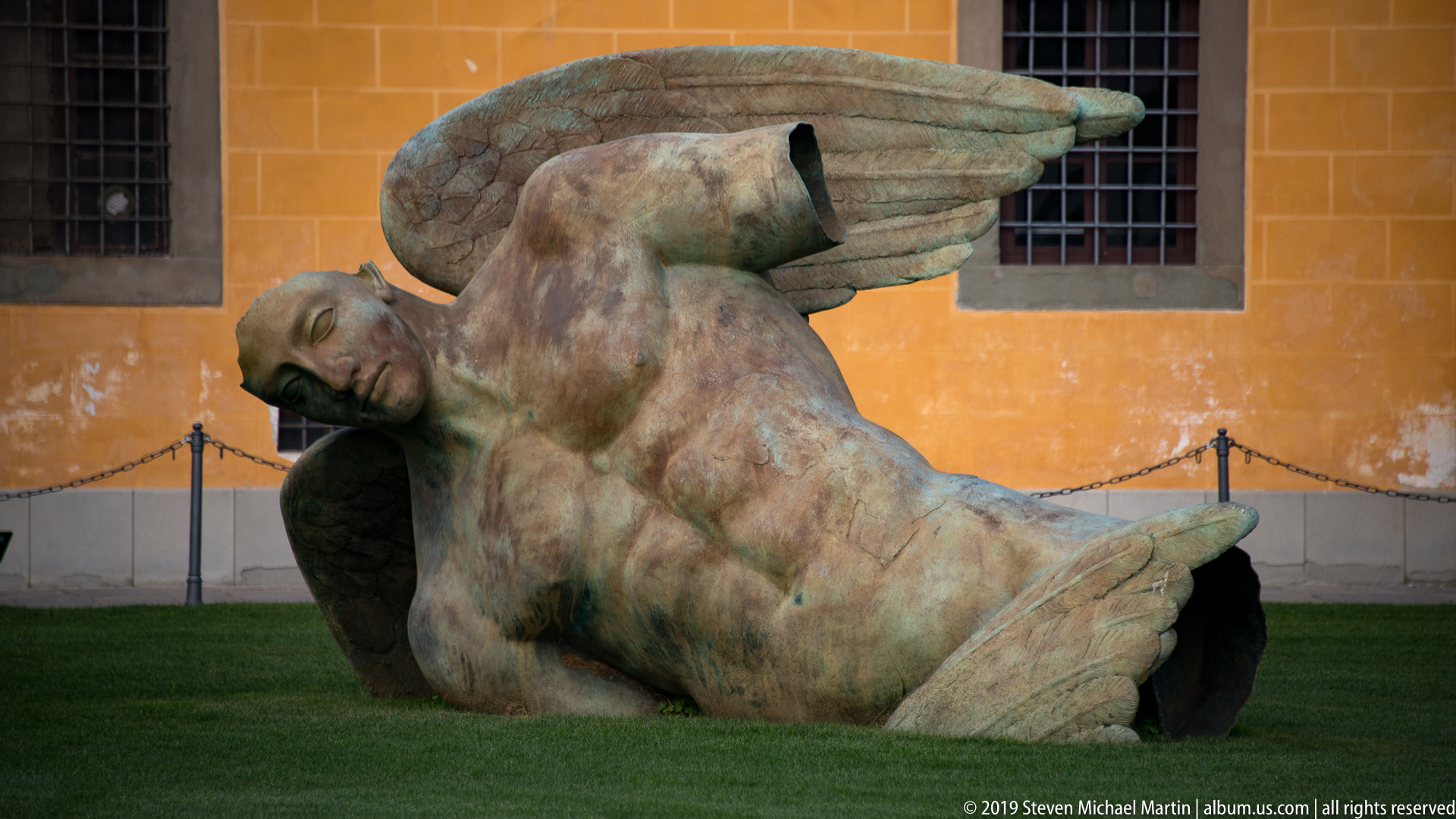
A monumental bronze winged figure lies on the grass of Piazza dei Miracoli, its truncated body and oversized wings rendered with the weathered, fragmentary character associated with Igor Mitoraj’s sculpture. The reclining form contrasts sharply with the ochre wall behind it and with the medieval monuments nearby. Seen at ground level, the contemporary work introduces a deliberately archaeological-looking human fragment into Pisa’s historic monumental landscape.
Caption
A monumental bronze winged figure lies on the grass of Piazza dei Miracoli, its truncated body and oversized wings rendered with the weathered, fragmentary character associated with Igor Mitoraj’s sculpture. The reclining form contrasts sharply with the ochre wall behind it and with the medieval monuments nearby. Seen at ground level, the contemporary work introduces a deliberately archaeological-looking human fragment into Pisa’s historic monumental landscape.

A tall stone column topped by the Capitoline Wolf rises before ochre and terracotta façades near Pisa’s monumental precinct. The bronze she-wolf, silhouetted against the sky, stands above the small figures of Romulus and Remus, turning a familiar emblem of Rome into a conspicuous vertical accent in the Pisan streetscape. The wider view places the sculpture within its urban setting rather than isolating the classical emblem from the surrounding buildings.
Caption
A tall stone column topped by the Capitoline Wolf rises before ochre and terracotta façades near Pisa’s monumental precinct. The bronze she-wolf, silhouetted against the sky, stands above the small figures of Romulus and Remus, turning a familiar emblem of Rome into a conspicuous vertical accent in the Pisan streetscape. The wider view places the sculpture within its urban setting rather than isolating the classical emblem from the surrounding buildings.

The Capitoline Wolf stands alert above the infant twins Romulus and Remus in this close view of the sculpture crowning a column in Pisa. Seen against open sky and tiled roofs, the bronze group is separated visually from the surrounding architecture, making the familiar Roman foundation motif easy to read. The ornate capital below provides a decorative pedestal, linking the figural emblem to the column that elevates it over the nearby square.
Caption
The Capitoline Wolf stands alert above the infant twins Romulus and Remus in this close view of the sculpture crowning a column in Pisa. Seen against open sky and tiled roofs, the bronze group is separated visually from the surrounding architecture, making the familiar Roman foundation motif easy to read. The ornate capital below provides a decorative pedestal, linking the figural emblem to the column that elevates it over the nearby square.

A visitor information panel maps Pisa’s Piazza del Duomo, identifying the cathedral, baptistery, campanile, Camposanto, and museum areas within the monumental precinct. A simplified green site plan organizes the principal buildings and circulation routes, while multilingual explanatory text occupies the lower portion. As the final image in the sequence, the panel provides documentary context for the architectural views by showing how the major monuments are arranged within the UNESCO-listed ensemble.
Caption
A visitor information panel maps Pisa’s Piazza del Duomo, identifying the cathedral, baptistery, campanile, Camposanto, and museum areas within the monumental precinct. A simplified green site plan organizes the principal buildings and circulation routes, while multilingual explanatory text occupies the lower portion. As the final image in the sequence, the panel provides documentary context for the architectural views by showing how the major monuments are arranged within the UNESCO-listed ensemble.