Vatican Museums – Vatican City
The Vatican Museums contain one of the most remarkable collections of art and antiquities in the world. Located within Vatican City, the museums preserve centuries of artistic treasures gathered by the popes.
The galleries include classical sculptures from ancient Rome, Renaissance paintings, tapestries, and elaborate decorative halls that lead to the world-famous Sistine Chapel. The chapel’s ceiling and altar wall were painted by Michelangelo, whose frescoes remain among the most celebrated works of Western art.
Together the Vatican Museums form one of the most important cultural institutions in the world.

The great dome of St. Peter's Basilica rises above mature trees under a clear blue sky. Its ribbed lead-covered surface, paired columns, windows, lantern, and gilded finial are visible in crisp daylight, while the treetops conceal the lower basilica and isolate the dome as the defining feature of the Vatican skyline.
Caption
The great dome of St. Peter's Basilica rises above mature trees under a clear blue sky. Its ribbed lead-covered surface, paired columns, windows, lantern, and gilded finial are visible in crisp daylight, while the treetops conceal the lower basilica and isolate the dome as the defining feature of the Vatican skyline.

The dome of St. Peter's Basilica dominates this exterior view from the Vatican Museums, rising behind lower brick and pale stone buildings. Strong ribs, paired columns, windows, and the lantern articulate the dome against a clear sky, while the foreground structures reveal the dense architectural fabric surrounding the basilica.
Caption
The dome of St. Peter's Basilica dominates this exterior view from the Vatican Museums, rising behind lower brick and pale stone buildings. Strong ribs, paired columns, windows, and the lantern articulate the dome against a clear sky, while the foreground structures reveal the dense architectural fabric surrounding the basilica.

A broad arched window opens onto an expansive panorama of Rome's closely packed roofs, pale façades, and distant hills. The dark window frame divides the view into four fields, while a strip of trees and Vatican buildings in the foreground establishes the elevated museum vantage point beneath a clear blue sky.
Caption
A broad arched window opens onto an expansive panorama of Rome's closely packed roofs, pale façades, and distant hills. The dark window frame divides the view into four fields, while a strip of trees and Vatican buildings in the foreground establishes the elevated museum vantage point beneath a clear blue sky.

An open Vatican Museums window frames the dome and upper structures of St. Peter's Basilica beyond a cluster of warm-toned Vatican buildings. The dark wooden sash and sill create a strong foreground frame, while the pale dome rises into clear blue sky, turning the architectural view outside into a composed scene within the museum interior.
Caption
An open Vatican Museums window frames the dome and upper structures of St. Peter's Basilica beyond a cluster of warm-toned Vatican buildings. The dark wooden sash and sill create a strong foreground frame, while the pale dome rises into clear blue sky, turning the architectural view outside into a composed scene within the museum interior.

St. Peter's Basilica appears beyond the Vatican Museums through a tall, multi-paned window framed by dark columns and an arched interior. The dome rises above umbrella pines and masonry walls outside, while reflections on the glass and the shadowed foreground create a layered view linking the museum interior with the monumental Vatican skyline.
Caption
St. Peter's Basilica appears beyond the Vatican Museums through a tall, multi-paned window framed by dark columns and an arched interior. The dome rises above umbrella pines and masonry walls outside, while reflections on the glass and the shadowed foreground create a layered view linking the museum interior with the monumental Vatican skyline.

Tall arched windows frame a high view across the dense roofs and streets of Rome. Dark mullions divide the bright cityscape into vertical panels, while reflections in adjacent glass and the shadowed interior create a strong contrast between the museum architecture and the sunlit urban fabric outside.
Caption
Tall arched windows frame a high view across the dense roofs and streets of Rome. Dark mullions divide the bright cityscape into vertical panels, while reflections in adjacent glass and the shadowed interior create a strong contrast between the museum architecture and the sunlit urban fabric outside.

An elevated view crosses a long Vatican courtyard toward the dome of St. Peter's Basilica rising above the surrounding museum buildings. Repetitive arched windows line the left wing, lawns and visitor paths occupy the open space below, and the clear blue sky reveals the layered relationship between the museum complex and the basilica beyond.
Caption
An elevated view crosses a long Vatican courtyard toward the dome of St. Peter's Basilica rising above the surrounding museum buildings. Repetitive arched windows line the left wing, lawns and visitor paths occupy the open space below, and the clear blue sky reveals the layered relationship between the museum complex and the basilica beyond.

From an elevated Vatican Museums window, Rome spreads across the frame in layers of ocher, cream, and terracotta buildings. A wooded hill rises at left and the city continues toward distant ridges under clear blue sky, while the dark stone edge and arched opening at right retain a visible connection to the museum viewpoint.
Caption
From an elevated Vatican Museums window, Rome spreads across the frame in layers of ocher, cream, and terracotta buildings. A wooded hill rises at left and the city continues toward distant ridges under clear blue sky, while the dark stone edge and arched opening at right retain a visible connection to the museum viewpoint.

The Vatican Museums entrance is set into a high brick wall beneath a monumental rusticated stone surround. The inscription “MVSEI VATICANI” identifies the complex above the arched doorway, while sculptural figures crown the portal and visitors pass through the modern glazed entrance below.
Caption
The Vatican Museums entrance is set into a high brick wall beneath a monumental rusticated stone surround. The inscription “MVSEI VATICANI” identifies the complex above the arched doorway, while sculptural figures crown the portal and visitors pass through the modern glazed entrance below.

Visitors walk through a long Vatican Museums corridor lined on both sides with large narrative tapestries. The pale vaulted ceiling is comparatively restrained, allowing the richly woven scenes and borders to dominate the walls; the deep perspective and continuous sequence of textiles emphasize the gallery's scale and exhibition rhythm.
Caption
Visitors walk through a long Vatican Museums corridor lined on both sides with large narrative tapestries. The pale vaulted ceiling is comparatively restrained, allowing the richly woven scenes and borders to dominate the walls; the deep perspective and continuous sequence of textiles emphasize the gallery's scale and exhibition rhythm.

A row of ancient marble portrait heads is displayed at eye level on individual dark stands. Distinct hairstyles, facial structures, and states of preservation separate the portraits, while additional heads recede into the gallery behind them, emphasizing serial comparison as part of the museum presentation.
Caption
A row of ancient marble portrait heads is displayed at eye level on individual dark stands. Distinct hairstyles, facial structures, and states of preservation separate the portraits, while additional heads recede into the gallery behind them, emphasizing serial comparison as part of the museum presentation.

A monumental stone coat of arms rises above the brickwork of the Vatican Museums complex. The central shield is framed by elaborate scrollwork and ecclesiastical emblems, with crossed keys and a papal tiara crowning the composition; the low viewpoint isolates the heraldic carving against the pale sky.
Caption
A monumental stone coat of arms rises above the brickwork of the Vatican Museums complex. The central shield is framed by elaborate scrollwork and ecclesiastical emblems, with crossed keys and a papal tiara crowning the composition; the low viewpoint isolates the heraldic carving against the pale sky.

A broad ancient ceramic vessel displays black-figure decoration across its orange-red body, with armed figures and animals arranged in a narrative frieze. The flaring neck, rounded body, projecting handles, and painted bands are clearly visible through the museum case, while the close viewpoint emphasizes the contrast between the dark silhouettes and the warm clay surface.
Caption
A broad ancient ceramic vessel displays black-figure decoration across its orange-red body, with armed figures and animals arranged in a narrative frieze. The flaring neck, rounded body, projecting handles, and painted bands are clearly visible through the museum case, while the close viewpoint emphasizes the contrast between the dark silhouettes and the warm clay surface.

An upward view fills the frame with a richly ornamented barrel vault divided into dense geometric compartments. Painted scenes, figures, foliage, and architectural motifs alternate with gilded borders, creating a layered decorative program that follows the curve of the ceiling and draws the eye toward the distant end of the gallery.
Caption
An upward view fills the frame with a richly ornamented barrel vault divided into dense geometric compartments. Painted scenes, figures, foliage, and architectural motifs alternate with gilded borders, creating a layered decorative program that follows the curve of the ceiling and draws the eye toward the distant end of the gallery.

A large decorative urn anchors the lower center of an upward view through Giuseppe Momo's 1932 Vatican Museums staircase. Behind it, the curving double-helix ramps, ornamental balustrades, and geometric skylight layer circular and polygonal forms, turning a circulation space into one of the museum's most distinctive modern architectural interiors.
Caption
A large decorative urn anchors the lower center of an upward view through Giuseppe Momo's 1932 Vatican Museums staircase. Behind it, the curving double-helix ramps, ornamental balustrades, and geometric skylight layer circular and polygonal forms, turning a circulation space into one of the museum's most distinctive modern architectural interiors.

A long Vatican Museums gallery recedes through a sequence of arches beneath an elaborately painted and gilded vault. Tall windows illuminate marble-toned walls, sculpture, and architectural details along the passage, while the low central viewpoint accentuates the gallery's strong symmetry and the succession of decorated ceiling bays.
Caption
A long Vatican Museums gallery recedes through a sequence of arches beneath an elaborately painted and gilded vault. Tall windows illuminate marble-toned walls, sculpture, and architectural details along the passage, while the low central viewpoint accentuates the gallery's strong symmetry and the succession of decorated ceiling bays.

A richly frescoed ceiling is organized around a circular central medallion, with painted narrative scenes occupying the surrounding compartments. Sculptural-looking ribs, rosettes, grotesque ornament, and framed figures separate the vivid compositions, producing a complex Renaissance decorative scheme viewed almost directly from below.
Caption
A richly frescoed ceiling is organized around a circular central medallion, with painted narrative scenes occupying the surrounding compartments. Sculptural-looking ribs, rosettes, grotesque ornament, and framed figures separate the vivid compositions, producing a complex Renaissance decorative scheme viewed almost directly from below.

The Sistine Chapel opens in a broad interior view beneath Michelangelo's celebrated fresco cycle. The painted ceiling stretches overhead while the Last Judgment dominates the distant altar wall; frescoed side walls, windows, and the chapel's long rectangular volume establish the relationship between the individual works and their architectural setting.
Caption
The Sistine Chapel opens in a broad interior view beneath Michelangelo's celebrated fresco cycle. The painted ceiling stretches overhead while the Last Judgment dominates the distant altar wall; frescoed side walls, windows, and the chapel's long rectangular volume establish the relationship between the individual works and their architectural setting.

An oblique view across the Sistine Chapel brings the ceiling frescoes into close relationship with the painted upper and lower wall zones. Michelangelo's ceiling spans the vault above windows and architectural divisions, while large narrative frescoes line the walls below, emphasizing the chapel as an integrated Renaissance pictorial environment.
Caption
An oblique view across the Sistine Chapel brings the ceiling frescoes into close relationship with the painted upper and lower wall zones. Michelangelo's ceiling spans the vault above windows and architectural divisions, while large narrative frescoes line the walls below, emphasizing the chapel as an integrated Renaissance pictorial environment.

A street-side restaurant occupies the ground floor of a pale masonry building near the Vatican Museums, its storefront labeled for breakfast, bistro, restaurant, pizzeria, and gelateria service. Small outdoor tables, menu boards, pedestrians, shuttered windows, and parked vehicles place the museum visit within the dense urban fabric immediately outside the collection.
Caption
A street-side restaurant occupies the ground floor of a pale masonry building near the Vatican Museums, its storefront labeled for breakfast, bistro, restaurant, pizzeria, and gelateria service. Small outdoor tables, menu boards, pedestrians, shuttered windows, and parked vehicles place the museum visit within the dense urban fabric immediately outside the collection.

A detail from Michelangelo's Last Judgment centers on the commanding figure of Christ amid a dense assembly of saints and other figures. Bodies twist and gesture across the blue field as the monumental fresco compresses multiple groups into a dramatic vision covering the Sistine Chapel's altar wall.
Caption
A detail from Michelangelo's Last Judgment centers on the commanding figure of Christ amid a dense assembly of saints and other figures. Bodies twist and gesture across the blue field as the monumental fresco compresses multiple groups into a dramatic vision covering the Sistine Chapel's altar wall.

The Vatican Museums' Momo Staircase, designed by Giuseppe Momo in 1932, coils upward around an open central well toward a geometric skylight. Ornamental metal balustrades trace the paired ramps, while alternating bands of cool daylight and warm interior illumination accentuate the double helix and its sculptural rhythm.
Caption
The Vatican Museums' Momo Staircase, designed by Giuseppe Momo in 1932, coils upward around an open central well toward a geometric skylight. Ornamental metal balustrades trace the paired ramps, while alternating bands of cool daylight and warm interior illumination accentuate the double helix and its sculptural rhythm.

Michelangelo's Creation of Adam occupies the center of this ceiling view, with Adam reaching toward God across the narrow gap between their hands. Surrounding painted figures and architectural framework reveal how the iconic scene sits within the larger decorative and narrative program of the Sistine Chapel vault.
Caption
Michelangelo's Creation of Adam occupies the center of this ceiling view, with Adam reaching toward God across the narrow gap between their hands. Surrounding painted figures and architectural framework reveal how the iconic scene sits within the larger decorative and narrative program of the Sistine Chapel vault.

Seen from below, Giuseppe Momo's 1932 staircase forms broad concentric arcs around the central void of the Vatican Museums. Ornamental balustrades create a continuous dark band against pale stone and warm lighting, while the polygonal skylight closes the composition above and supplies cool daylight to the double-helix ramps.
Caption
Seen from below, Giuseppe Momo's 1932 staircase forms broad concentric arcs around the central void of the Vatican Museums. Ornamental balustrades create a continuous dark band against pale stone and warm lighting, while the polygonal skylight closes the composition above and supplies cool daylight to the double-helix ramps.

From above, Giuseppe Momo's 1932 Vatican Museums staircase tightens into concentric curves around the open central well. Visitors appear at different levels along the paired ramps, providing scale and making the double-helix circulation legible, while the ornate metal balustrade forms a continuous decorative edge around the descent.
Caption
From above, Giuseppe Momo's 1932 Vatican Museums staircase tightens into concentric curves around the open central well. Visitors appear at different levels along the paired ramps, providing scale and making the double-helix circulation legible, while the ornate metal balustrade forms a continuous decorative edge around the descent.

Visitors move along the broad curved ramps of Giuseppe Momo's 1932 Vatican Museums staircase as the camera looks diagonally across several levels. The dark relief-patterned balustrades contrast with pale steps and walls, emphasizing both the ornamental design of the double helix and its continuing role as a busy route through the museum.
Caption
Visitors move along the broad curved ramps of Giuseppe Momo's 1932 Vatican Museums staircase as the camera looks diagonally across several levels. The dark relief-patterned balustrades contrast with pale steps and walls, emphasizing both the ornamental design of the double helix and its continuing role as a busy route through the museum.

A pale stone panel is densely carved into a grid of ornamental compartments, each framed by beadwork, foliage, and repeating geometric motifs. Rosettes and small masks occupy the square fields, while inscriptions and varied relief patterns give the fragment the appearance of an architectural revetment or decorative screen displayed within the museum.
Caption
A pale stone panel is densely carved into a grid of ornamental compartments, each framed by beadwork, foliage, and repeating geometric motifs. Rosettes and small masks occupy the square fields, while inscriptions and varied relief patterns give the fragment the appearance of an architectural revetment or decorative screen displayed within the museum.

A polished wooden service cabinet marked “POSTE VATICANE” stands against a marble-lined wall inside Vatican City. Twin labeled openings and the substantial built-in counter recall traditional postal service fittings, providing a small institutional detail amid the museum route.
Caption
A polished wooden service cabinet marked “POSTE VATICANE” stands against a marble-lined wall inside Vatican City. Twin labeled openings and the substantial built-in counter recall traditional postal service fittings, providing a small institutional detail amid the museum route.

A single ancient mosaic panel depicts a muscular nude male figure striding dynamically across a pale tessellated ground. His bent arms and wide stance convey vigorous movement, while darker tesserae model the body and define hair, facial features, and shadows around the limbs.
Caption
A single ancient mosaic panel depicts a muscular nude male figure striding dynamically across a pale tessellated ground. His bent arms and wide stance convey vigorous movement, while darker tesserae model the body and define hair, facial features, and shadows around the limbs.

A fragmentary marble statue shows a youthful figure wearing an animal skin and supporting a small hoofed animal across one shoulder. The missing lower arm and worn surfaces expose the sculpture's archaeological condition, while the close frontal view emphasizes the contrast between the figure's modeled anatomy and the animal's elongated body.
Caption
A fragmentary marble statue shows a youthful figure wearing an animal skin and supporting a small hoofed animal across one shoulder. The missing lower arm and worn surfaces expose the sculpture's archaeological condition, while the close frontal view emphasizes the contrast between the figure's modeled anatomy and the animal's elongated body.

A marble sarcophagus presents densely carved figural narratives in two horizontal registers. Standing groups, architectural divisions, and a central framed figure structure the upper band, while additional scenes unfold below; the compact relief carving and Christian imagery make the object a major example of late antique funerary sculpture in the museum collection.
Caption
A marble sarcophagus presents densely carved figural narratives in two horizontal registers. Standing groups, architectural divisions, and a central framed figure structure the upper band, while additional scenes unfold below; the compact relief carving and Christian imagery make the object a major example of late antique funerary sculpture in the museum collection.

A long marble relief displayed against a dark museum wall shows a procession-like row of standing figures interspersed with sheep. The shallow carving preserves differences in dress, stance, and gesture across the group, while smaller carved fragments mounted above place the panel within a broader archaeological display.
Caption
A long marble relief displayed against a dark museum wall shows a procession-like row of standing figures interspersed with sheep. The shallow carving preserves differences in dress, stance, and gesture across the group, while smaller carved fragments mounted above place the panel within a broader archaeological display.

Numerous ancient mosaic panels depicting standing figures and portrait heads are arranged across a dark floor-like display surface. The separated rectangular panels reveal different poses, garments, and body types, allowing individual figural studies to be viewed together while preserving the fragmented character of the archaeological material.
Caption
Numerous ancient mosaic panels depicting standing figures and portrait heads are arranged across a dark floor-like display surface. The separated rectangular panels reveal different poses, garments, and body types, allowing individual figural studies to be viewed together while preserving the fragmented character of the archaeological material.

A large reconstructed mosaic pavement is composed of rectangular figural panels bordered by repeating geometric patterns. Full-length athletes alternate with portrait heads and busts, creating a grid-like ensemble; the oblique viewpoint shows both the individual tessellated images and the scale of the assembled museum display.
Caption
A large reconstructed mosaic pavement is composed of rectangular figural panels bordered by repeating geometric patterns. Full-length athletes alternate with portrait heads and busts, creating a grid-like ensemble; the oblique viewpoint shows both the individual tessellated images and the scale of the assembled museum display.

A reconstructed ancient mosaic pavement spreads across the gallery floor in a geometric arrangement of framed human figures. Athletes in varied poses occupy long rectangular panels, while heads and busts fill smaller compartments; missing sections interrupt the pattern and make the archaeological reconstruction visible.
Caption
A reconstructed ancient mosaic pavement spreads across the gallery floor in a geometric arrangement of framed human figures. Athletes in varied poses occupy long rectangular panels, while heads and busts fill smaller compartments; missing sections interrupt the pattern and make the archaeological reconstruction visible.

A youthful marble shepherd stands with a lamb draped across his shoulders, gripping the animal's legs as its head rises beside his own. His short tunic and pastoral pose evoke the long-lived image of the ram- or lamb-bearer, while the surrounding inscriptions and fragments situate the sculpture within an archaeological museum display.
Caption
A youthful marble shepherd stands with a lamb draped across his shoulders, gripping the animal's legs as its head rises beside his own. His short tunic and pastoral pose evoke the long-lived image of the ram- or lamb-bearer, while the surrounding inscriptions and fragments situate the sculpture within an archaeological museum display.

Two headless draped marble figures stand before a large ornamental mosaic mounted on the wall. Deep folds animate the garments and distinguish the statues' poses, while the mosaic's scrolling vine pattern and central motif provide a richly patterned backdrop that links sculpture and decorative art within the gallery display.
Caption
Two headless draped marble figures stand before a large ornamental mosaic mounted on the wall. Deep folds animate the garments and distinguish the statues' poses, while the mosaic's scrolling vine pattern and central motif provide a richly patterned backdrop that links sculpture and decorative art within the gallery display.

A marble male figure stands in a forceful contrapposto pose wearing a high crested helmet, with drapery wrapped across one shoulder and around the hips. One arm extends outward while the other is lowered, and the combination of heroic nudity, martial headgear, and support beside the leg gives the statue a strongly classical character.
Caption
A marble male figure stands in a forceful contrapposto pose wearing a high crested helmet, with drapery wrapped across one shoulder and around the hips. One arm extends outward while the other is lowered, and the combination of heroic nudity, martial headgear, and support beside the leg gives the statue a strongly classical character.

The Laocoön group presents the Trojan priest and his sons struggling against enormous serpents in a tightly interlocked marble composition. Laocoön's twisting torso and anguished face dominate the center as the snakes coil across the three figures, creating a forceful study of physical strain, movement, and suffering within the Vatican Museums' classical collection.
Caption
The Laocoön group presents the Trojan priest and his sons struggling against enormous serpents in a tightly interlocked marble composition. Laocoön's twisting torso and anguished face dominate the center as the snakes coil across the three figures, creating a forceful study of physical strain, movement, and suffering within the Vatican Museums' classical collection.

A large marble sarcophagus is covered with deeply undercut figures arranged in dense, overlapping action across its long side and end panel. Bodies, weapons, animals, and drapery create a turbulent relief surface, while the elevated museum display allows the carving to be read around the corner as a continuous sculptural composition.
Caption
A large marble sarcophagus is covered with deeply undercut figures arranged in dense, overlapping action across its long side and end panel. Bodies, weapons, animals, and drapery create a turbulent relief surface, while the elevated museum display allows the carving to be read around the corner as a continuous sculptural composition.

Three large marble figures rise from the upper edge of an ancient sculptural monument, their heads and torsos projecting strongly against the surrounding architectural framework. The central bearded figure is flanked by two younger faces, while carved attributes and the heavy stone setting suggest a funerary or commemorative ensemble preserved in fragmentary form.
Caption
Three large marble figures rise from the upper edge of an ancient sculptural monument, their heads and torsos projecting strongly against the surrounding architectural framework. The central bearded figure is flanked by two younger faces, while carved attributes and the heavy stone setting suggest a funerary or commemorative ensemble preserved in fragmentary form.

Raphael's Madonna di Foligno places the Virgin and Child within a luminous circular glory above a gathering of saints and a kneeling donor. Saint John the Baptist gestures upward at left, while a small angel at the center holds a blank tablet; the balanced arrangement links the celestial group with the richly colored figures below.
Caption
Raphael's Madonna di Foligno places the Virgin and Child within a luminous circular glory above a gathering of saints and a kneeling donor. Saint John the Baptist gestures upward at left, while a small angel at the center holds a blank tablet; the balanced arrangement links the celestial group with the richly colored figures below.

Raphael's Transfiguration divides the composition between Christ's radiant appearance above Mount Tabor and the agitated crowd gathered below. Christ rises in white between hovering figures as the apostles recoil beneath him, while the lower scene concentrates gestures, bodies, and contrasting light around a distressed boy and his companions.
Caption
Raphael's Transfiguration divides the composition between Christ's radiant appearance above Mount Tabor and the agitated crowd gathered below. Christ rises in white between hovering figures as the apostles recoil beneath him, while the lower scene concentrates gestures, bodies, and contrasting light around a distressed boy and his companions.

A frontal image of Christ fills the panel, his face framed by a cruciform halo and his right hand raised in blessing. He holds an elaborately jeweled book against his chest, while the dark robe, solemn gaze, and aged painted surface give the work the hieratic character associated with medieval devotional imagery.
Caption
A frontal image of Christ fills the panel, his face framed by a cruciform halo and his right hand raised in blessing. He holds an elaborately jeweled book against his chest, while the dark robe, solemn gaze, and aged painted surface give the work the hieratic character associated with medieval devotional imagery.

A large Renaissance religious painting gathers numerous figures around the seated Virgin and Child at the center. Kneeling and standing participants approach from both sides, their gestures and brightly colored garments directing attention inward, while a distant landscape opens behind the tightly packed foreground group.
Caption
A large Renaissance religious painting gathers numerous figures around the seated Virgin and Child at the center. Kneeling and standing participants approach from both sides, their gestures and brightly colored garments directing attention inward, while a distant landscape opens behind the tightly packed foreground group.

A large semicircular mosaic presents a formal Christian program in stacked registers. A central sacred figure occupies the upper field beneath the curve, while rows of saints and smaller narrative scenes extend across the middle and lower zones; gold, blue, red, and white tesserae create the strongly patterned surface.
Caption
A large semicircular mosaic presents a formal Christian program in stacked registers. A central sacred figure occupies the upper field beneath the curve, while rows of saints and smaller narrative scenes extend across the middle and lower zones; gold, blue, red, and white tesserae create the strongly patterned surface.

Christ's lifeless body is carried diagonally across the foreground by several mourners in a dark, dramatic religious scene. One figure supports his shoulders while another bears his legs, and women behind them raise their arms in grief; strong contrasts of light and shadow concentrate attention on the pale body and the mourners' urgent movement.
Caption
Christ's lifeless body is carried diagonally across the foreground by several mourners in a dark, dramatic religious scene. One figure supports his shoulders while another bears his legs, and women behind them raise their arms in grief; strong contrasts of light and shadow concentrate attention on the pale body and the mourners' urgent movement.

Raphael's Transfiguration fills the frame from the radiant upper vision of Christ to the crowded earthly drama below. Christ hovers above the mountain between two figures as the apostles react beneath him; in the lower register, urgent gestures converge around a suffering boy, producing a striking contrast between calm revelation and human turmoil.
Caption
Raphael's Transfiguration fills the frame from the radiant upper vision of Christ to the crowded earthly drama below. Christ hovers above the mountain between two figures as the apostles react beneath him; in the lower register, urgent gestures converge around a suffering boy, producing a striking contrast between calm revelation and human turmoil.

A muscular man grapples at close range with a lion in a pastoral landscape, forcing the animal's jaws apart as his body twists under the strain. The violent encounter dominates the foreground, while grazing animals, trees, and distant countryside create a calm backdrop that heightens the physical intensity of the struggle.
Caption
A muscular man grapples at close range with a lion in a pastoral landscape, forcing the animal's jaws apart as his body twists under the strain. The violent encounter dominates the foreground, while grazing animals, trees, and distant countryside create a calm backdrop that heightens the physical intensity of the struggle.

The resurrected Christ sits frontally with both arms extended, his bare torso emerging above voluminous pale drapery. Small cherubs cluster around the lower edge of the composition, while the restrained background and symmetrical pose focus attention on Christ's calm expression and open gesture.
Caption
The resurrected Christ sits frontally with both arms extended, his bare torso emerging above voluminous pale drapery. Small cherubs cluster around the lower edge of the composition, while the restrained background and symmetrical pose focus attention on Christ's calm expression and open gesture.

Two monumental marble heads are displayed side by side on separate mounts, inviting close comparison of their strongly modeled beards, hair, eyes, and weathered surfaces. One fragment is heavily damaged through the nose and mouth, while the other preserves a more complete face and curling beard, making their differing states of survival immediately visible.
Caption
Two monumental marble heads are displayed side by side on separate mounts, inviting close comparison of their strongly modeled beards, hair, eyes, and weathered surfaces. One fragment is heavily damaged through the nose and mouth, while the other preserves a more complete face and curling beard, making their differing states of survival immediately visible.

A spotted big cat seizes a zebra in a dramatic animal painting, its body pressed across the striped prey as the zebra collapses beneath it. The sharply contrasting coats dominate the foreground, while a simplified wooded landscape and blue sky frame the violent encounter.
Caption
A spotted big cat seizes a zebra in a dramatic animal painting, its body pressed across the striped prey as the zebra collapses beneath it. The sharply contrasting coats dominate the foreground, while a simplified wooded landscape and blue sky frame the violent encounter.

An elderly bearded saint leans over an open book, wrapped in a vivid red mantle that sweeps across the lower half of the composition. His bare upper body and concentrated downward gaze emerge from deep shadow, while the writing surface and books identify the scene as one of scholarship and sacred study.
Caption
An elderly bearded saint leans over an open book, wrapped in a vivid red mantle that sweeps across the lower half of the composition. His bare upper body and concentrated downward gaze emerge from deep shadow, while the writing surface and books identify the scene as one of scholarship and sacred study.

A densely packed Baroque composition sweeps diagonally through a classical architectural setting, with partially draped figures turning, reaching, and bending across the foreground. Strong foreshortening and overlapping bodies create a sense of rapid movement, while columns and bright sky open the scene behind the animated group.
Caption
A densely packed Baroque composition sweeps diagonally through a classical architectural setting, with partially draped figures turning, reaching, and bending across the foreground. Strong foreshortening and overlapping bodies create a sense of rapid movement, while columns and bright sky open the scene behind the animated group.

A marble Pietà presents the Virgin supporting the dead body of Christ across her lap in a deeply folded mass of drapery. Christ's torso and arm fall heavily toward the foreground while the Virgin bends over him, producing an intimate composition whose polished white surface catches the gallery light.
Caption
A marble Pietà presents the Virgin supporting the dead body of Christ across her lap in a deeply folded mass of drapery. Christ's torso and arm fall heavily toward the foreground while the Virgin bends over him, producing an intimate composition whose polished white surface catches the gallery light.

Several life-size marble figures stand on dark pedestals within a gallery lined with framed paintings. Twisting poses, flowing drapery, and expressive gestures distinguish the sculptures, while warm directional lighting separates their pale surfaces from the darker canvases and walls behind them.
Caption
Several life-size marble figures stand on dark pedestals within a gallery lined with framed paintings. Twisting poses, flowing drapery, and expressive gestures distinguish the sculptures, while warm directional lighting separates their pale surfaces from the darker canvases and walls behind them.

A broad idealized landscape is populated by an extraordinary variety of animals gathered around water, trees, and open ground. Lions, cattle, birds, and other species share the scene with small human figures near the center, creating a densely observed vision of creation or paradise framed by distant mountains and luminous sky.
Caption
A broad idealized landscape is populated by an extraordinary variety of animals gathered around water, trees, and open ground. Lions, cattle, birds, and other species share the scene with small human figures near the center, creating a densely observed vision of creation or paradise framed by distant mountains and luminous sky.

Seen from the side, a marble Pietà concentrates on the weight of Christ's body as it extends across the seated Virgin's lap. His head and arm fall toward the left while her veiled figure bends above him, and the lateral viewpoint makes the layered folds of the garments and the sculpture's projecting depth especially clear.
Caption
Seen from the side, a marble Pietà concentrates on the weight of Christ's body as it extends across the seated Virgin's lap. His head and arm fall toward the left while her veiled figure bends above him, and the lateral viewpoint makes the layered folds of the garments and the sculpture's projecting depth especially clear.

A large eagle spreads its wings low over the ground while pinning a white bird beneath its talons. The predator's intense eye and hooked beak are emphasized against dark feathers, and the surrounding leaves, tree trunk, and distant landscape place the encounter within a naturalistic wooded setting.
Caption
A large eagle spreads its wings low over the ground while pinning a white bird beneath its talons. The predator's intense eye and hooked beak are emphasized against dark feathers, and the surrounding leaves, tree trunk, and distant landscape place the encounter within a naturalistic wooded setting.

A stained-glass image of the Virgin and Child glows within a dark pointed architectural frame set before a bright window. Rich reds, blues, greens, and golds define the enthroned figures and decorative border, while the surrounding painted and gilded room surfaces reinforce the panel's jewel-like appearance.
Caption
A stained-glass image of the Virgin and Child glows within a dark pointed architectural frame set before a bright window. Rich reds, blues, greens, and golds define the enthroned figures and decorative border, while the surrounding painted and gilded room surfaces reinforce the panel's jewel-like appearance.

A three-quarter view of the marble Pietà brings the Virgin's bowed face and Christ's slack body into a single compact composition. His legs and arm project beyond the heavy folds of her garment, while the pale stone stands out against the darker wood and marble surfaces of the gallery interior.
Caption
A three-quarter view of the marble Pietà brings the Virgin's bowed face and Christ's slack body into a single compact composition. His legs and arm project beyond the heavy folds of her garment, while the pale stone stands out against the darker wood and marble surfaces of the gallery interior.

An elaborate wooden display cabinet stands between two large globes in a richly decorated Vatican Museums room. Glass doors reveal scientific or measuring instruments inside, while painted wall panels, gilded ornament, and frescoed decoration surround the ensemble, linking the objects with the historic interior in which they are presented.
Caption
An elaborate wooden display cabinet stands between two large globes in a richly decorated Vatican Museums room. Glass doors reveal scientific or measuring instruments inside, while painted wall panels, gilded ornament, and frescoed decoration surround the ensemble, linking the objects with the historic interior in which they are presented.

A circular decorative tabletop is assembled from multicolored stone segments radiating from a central medallion. Black outlines separate teardrop-shaped and geometric fields of veined marble and other stones, while a braided border in green, pink, cream, and blue encircles the composition like an intricate inlaid mosaic.
Caption
A circular decorative tabletop is assembled from multicolored stone segments radiating from a central medallion. Black outlines separate teardrop-shaped and geometric fields of veined marble and other stones, while a braided border in green, pink, cream, and blue encircles the composition like an intricate inlaid mosaic.

The Gallery of Maps stretches into the distance beneath an intensely decorated vaulted ceiling. Large painted map panels line the walls above ornate cabinetry and architectural framing, while repeated ceiling bays filled with frescoes and gilded ornament create a strong axial rhythm along the brightly lit corridor.
Caption
The Gallery of Maps stretches into the distance beneath an intensely decorated vaulted ceiling. Large painted map panels line the walls above ornate cabinetry and architectural framing, while repeated ceiling bays filled with frescoes and gilded ornament create a strong axial rhythm along the brightly lit corridor.

A painted architectural view presents St. Peter's Basilica frontally across a broad open piazza. The immense dome dominates the skyline above the façade and flanking structures, while small figures scattered across the square establish scale; the painting records the basilica and its urban setting as a carefully ordered monumental ensemble.
Caption
A painted architectural view presents St. Peter's Basilica frontally across a broad open piazza. The immense dome dominates the skyline above the façade and flanking structures, while small figures scattered across the square establish scale; the painting records the basilica and its urban setting as a carefully ordered monumental ensemble.

A low cabinet or wall fitting is divided into richly painted rectangular panels bordered in gold. Circular medallions, heraldic emblems, crossed-key motifs, foliage, and other decorative devices alternate across red and blue grounds, creating a highly ordered sequence beneath a pale stone or marble top.
Caption
A low cabinet or wall fitting is divided into richly painted rectangular panels bordered in gold. Circular medallions, heraldic emblems, crossed-key motifs, foliage, and other decorative devices alternate across red and blue grounds, creating a highly ordered sequence beneath a pale stone or marble top.

A dark polished wood carving centers a papal heraldic emblem beneath the crossed keys and tiered tiara. Deeply modeled scrolls curl outward on both sides of the shield-like central form, and the close view reveals the carving's glossy surface, undercut edges, and symmetrical ornamental design.
Caption
A dark polished wood carving centers a papal heraldic emblem beneath the crossed keys and tiered tiara. Deeply modeled scrolls curl outward on both sides of the shield-like central form, and the close view reveals the carving's glossy surface, undercut edges, and symmetrical ornamental design.

A richly ornamented Vatican Museums ceiling unfolds symmetrically around a narrow central axis of painted and gilded compartments. Oval figurative scenes, seated figures, heraldic shields, grotesques, and dense vegetal decoration fill the vault, while brilliant blue, red, gold, and green accents distinguish the individual fields within the elaborate Renaissance decorative program.
Caption
A richly ornamented Vatican Museums ceiling unfolds symmetrically around a narrow central axis of painted and gilded compartments. Oval figurative scenes, seated figures, heraldic shields, grotesques, and dense vegetal decoration fill the vault, while brilliant blue, red, gold, and green accents distinguish the individual fields within the elaborate Renaissance decorative program.

A row of pale stone winged creatures serves as sculptural supports beneath a heavy horizontal slab. Each creature combines an animal body, upright chest, wings, and a stylized head, creating a repeated architectural rhythm; the diagonal viewpoint shows the series receding across a patterned marble floor inside the museum.
Caption
A row of pale stone winged creatures serves as sculptural supports beneath a heavy horizontal slab. Each creature combines an animal body, upright chest, wings, and a stylized head, creating a repeated architectural rhythm; the diagonal viewpoint shows the series receding across a patterned marble floor inside the museum.

A rectangular mosaic presents several animals distributed across a wooded landscape, including deer-like animals and cattle or bovids near the foreground. Trees, rocks, and a distant blue ground create a shallow natural setting, while a bold black-and-white geometric border and gilded outer frame isolate the ancient-style animal scene as a decorative panel.
Caption
A rectangular mosaic presents several animals distributed across a wooded landscape, including deer-like animals and cattle or bovids near the foreground. Trees, rocks, and a distant blue ground create a shallow natural setting, while a bold black-and-white geometric border and gilded outer frame isolate the ancient-style animal scene as a decorative panel.

A small decorative panel centers a blue-and-gold vase beneath a flowering plant, flanked by two fantastical dragon-like creatures. Red, blue, green, and gold scrolls curl outward in a balanced grotesque composition, framed by a broad red field and gilded molding that emphasizes the panel's strict symmetry.
Caption
A small decorative panel centers a blue-and-gold vase beneath a flowering plant, flanked by two fantastical dragon-like creatures. Red, blue, green, and gold scrolls curl outward in a balanced grotesque composition, framed by a broad red field and gilded molding that emphasizes the panel's strict symmetry.

An inscribed marble memorial is crowned by a sculpted papal tiara and crossed-key heraldry, then framed by a lavish blue-and-gold textile draped around the stone. Tassels and folds spill outward above carved architectural supports, creating a theatrical combination of heraldic emblem, inscription, and ceremonial fabric within the museum interior.
Caption
An inscribed marble memorial is crowned by a sculpted papal tiara and crossed-key heraldry, then framed by a lavish blue-and-gold textile draped around the stone. Tassels and folds spill outward above carved architectural supports, creating a theatrical combination of heraldic emblem, inscription, and ceremonial fabric within the museum interior.

A geometric ceiling is divided into rectangular and trapezoidal compartments edged in blue, gold, and cream. The central field contains a papal shield supported by small figures, while surrounding panels carry grotesques, foliage, birds, and heraldic motifs; repeated moldings give the flat decorative surface the visual rhythm of an elaborate coffered ceiling.
Caption
A geometric ceiling is divided into rectangular and trapezoidal compartments edged in blue, gold, and cream. The central field contains a papal shield supported by small figures, while surrounding panels carry grotesques, foliage, birds, and heraldic motifs; repeated moldings give the flat decorative surface the visual rhythm of an elaborate coffered ceiling.

Michelangelo's Last Judgment spreads across the altar wall in this steeply angled view of the Sistine Chapel, with the blue field of densely packed figures rising toward Christ at the center. Portions of the painted ceiling and architectural divisions remain visible above and to the side, emphasizing the immense scale of the fresco within the chapel.
Caption
Michelangelo's Last Judgment spreads across the altar wall in this steeply angled view of the Sistine Chapel, with the blue field of densely packed figures rising toward Christ at the center. Portions of the painted ceiling and architectural divisions remain visible above and to the side, emphasizing the immense scale of the fresco within the chapel.

A modernist Crucifixion is constructed from sharply faceted planes of blue, green, violet, orange, and red. The elongated figure of Christ hangs on a cross beneath angular beams of light, while a kneeling figure curls at the base; stylized clouds and landscape forms turn the traditional sacred subject into a strongly geometric composition.
Caption
A modernist Crucifixion is constructed from sharply faceted planes of blue, green, violet, orange, and red. The elongated figure of Christ hangs on a cross beneath angular beams of light, while a kneeling figure curls at the base; stylized clouds and landscape forms turn the traditional sacred subject into a strongly geometric composition.

A long tapestry centers on a reclining pale figure attended by smaller figures and set against a dark landscape. Elaborate side panels contain standing allegorical or mythological figures, shields, scrolls, and floral ornament, while the warm woven palette and dense border decoration distinguish the textile from the surrounding dark display wall.
Caption
A long tapestry centers on a reclining pale figure attended by smaller figures and set against a dark landscape. Elaborate side panels contain standing allegorical or mythological figures, shields, scrolls, and floral ornament, while the warm woven palette and dense border decoration distinguish the textile from the surrounding dark display wall.

An upward view inside the Sistine Chapel brings the frescoed upper walls and vault into a single architectural composition. Tall windows divide painted figures and lunettes along the wall, while Michelangelo's ceiling scenes continue overhead in densely framed compartments; a strip of the monumental wall frescoes remains visible below.
Caption
An upward view inside the Sistine Chapel brings the frescoed upper walls and vault into a single architectural composition. Tall windows divide painted figures and lunettes along the wall, while Michelangelo's ceiling scenes continue overhead in densely framed compartments; a strip of the monumental wall frescoes remains visible below.

Michelangelo's Creation of Adam appears within a wider section of the Sistine Chapel vault, placing the famous near-touching hands within its surrounding painted architecture and neighboring figures. Adam reclines at left while God moves toward him from the right, and adjacent ignudi and framing elements reveal how the scene belongs to the larger ceiling program.
Caption
Michelangelo's Creation of Adam appears within a wider section of the Sistine Chapel vault, placing the famous near-touching hands within its surrounding painted architecture and neighboring figures. Adam reclines at left while God moves toward him from the right, and adjacent ignudi and framing elements reveal how the scene belongs to the larger ceiling program.

A close detail from the Creation of Adam concentrates on God extending his right hand toward Adam's approaching fingers. The Creator is swept forward within a billowing red mantle crowded with accompanying figures, and the cropped composition heightens the tension of the narrow space separating the two hands.
Caption
A close detail from the Creation of Adam concentrates on God extending his right hand toward Adam's approaching fingers. The Creator is swept forward within a billowing red mantle crowded with accompanying figures, and the cropped composition heightens the tension of the narrow space separating the two hands.

Adam reclines across a rocky slope in this close detail from Michelangelo's Creation of Adam, extending his left arm toward the approaching hand of God at the edge of the frame. The crop isolates Adam's monumental nude form, relaxed posture, and expressive hand while preserving the famous visual gap between human and divine fingers.
Caption
Adam reclines across a rocky slope in this close detail from Michelangelo's Creation of Adam, extending his left arm toward the approaching hand of God at the edge of the frame. The crop isolates Adam's monumental nude form, relaxed posture, and expressive hand while preserving the famous visual gap between human and divine fingers.

A broad section of the Sistine Chapel ceiling reveals Michelangelo's complex arrangement of seated monumental figures, smaller narrative scenes, painted architecture, medallions, and nude attendants. The oblique view compresses several bays together, showing how individual figures and stories are organized within the vault's illusionistic architectural framework.
Caption
A broad section of the Sistine Chapel ceiling reveals Michelangelo's complex arrangement of seated monumental figures, smaller narrative scenes, painted architecture, medallions, and nude attendants. The oblique view compresses several bays together, showing how individual figures and stories are organized within the vault's illusionistic architectural framework.

Three tall windows anchor this upward view of the Sistine Chapel's side wall, surrounded by painted architectural niches, figures, lunettes, and ceiling compartments. The lower edge includes portions of larger narrative frescoes, while the high angle emphasizes the transition from wall decoration to Michelangelo's painted vault.
Caption
Three tall windows anchor this upward view of the Sistine Chapel's side wall, surrounded by painted architectural niches, figures, lunettes, and ceiling compartments. The lower edge includes portions of larger narrative frescoes, while the high angle emphasizes the transition from wall decoration to Michelangelo's painted vault.

A visitor's dark silhouette occupies the foreground while the frescoed upper walls and ceiling of the Sistine Chapel rise brightly beyond. The human profile supplies scale and conveys the act of looking, while windows, painted figures, lunettes, and ceiling scenes remain legible across the monumental decorated surface.
Caption
A visitor's dark silhouette occupies the foreground while the frescoed upper walls and ceiling of the Sistine Chapel rise brightly beyond. The human profile supplies scale and conveys the act of looking, while windows, painted figures, lunettes, and ceiling scenes remain legible across the monumental decorated surface.

A modern bronze relief cycle is arranged as twelve small rectangular narrative panels in two rows. Stylized human figures read, work, gesture, and interact within shallow architectural settings, while warm directional lighting catches the raised surfaces and makes each compact scene stand out against the darker backing.
Caption
A modern bronze relief cycle is arranged as twelve small rectangular narrative panels in two rows. Stylized human figures read, work, gesture, and interact within shallow architectural settings, while warm directional lighting catches the raised surfaces and makes each compact scene stand out against the darker backing.

A white sculptural bust portrays a pope frontally in the papal tiara, with a patterned vestment covering the chest and the arms crossing low across the body. Focused gallery lighting isolates the pale figure against a dark wall, casting a strong shadow that reinforces the bust's monumental, formal presentation.
Caption
A white sculptural bust portrays a pope frontally in the papal tiara, with a patterned vestment covering the chest and the arms crossing low across the body. Focused gallery lighting isolates the pale figure against a dark wall, casting a strong shadow that reinforces the bust's monumental, formal presentation.

Six small carved relief panels are presented in individual illuminated recesses across a dark gallery wall. Each panel contains a different multi-figure narrative scene, and the repeated vertical cases create a formal display rhythm while concentrated warm light reveals the shallow modeling and varied compositions.
Caption
Six small carved relief panels are presented in individual illuminated recesses across a dark gallery wall. Each panel contains a different multi-figure narrative scene, and the repeated vertical cases create a formal display rhythm while concentrated warm light reveals the shallow modeling and varied compositions.

A monumental arched fresco fills the wall beneath an elaborately painted and gilded vault. Dozens of figures gather around a central architectural setting, with animated gestures and brightly colored garments carrying the narrative across the broad lunette-shaped field; the surrounding stucco and painted ornament integrates the scene into the room's Renaissance decoration.
Caption
A monumental arched fresco fills the wall beneath an elaborately painted and gilded vault. Dozens of figures gather around a central architectural setting, with animated gestures and brightly colored garments carrying the narrative across the broad lunette-shaped field; the surrounding stucco and painted ornament integrates the scene into the room's Renaissance decoration.

Raphael's Disputation of the Holy Sacrament fills a semicircular wall beneath a richly decorated vault. The Eucharistic altar anchors the earthly gathering below, while Christ, the Virgin, saints, and angels occupy ordered tiers of clouds above; the surrounding painted architecture and ceiling medallions place the fresco within the integrated program of the Raphael Rooms.
Caption
Raphael's Disputation of the Holy Sacrament fills a semicircular wall beneath a richly decorated vault. The Eucharistic altar anchors the earthly gathering below, while Christ, the Virgin, saints, and angels occupy ordered tiers of clouds above; the surrounding painted architecture and ceiling medallions place the fresco within the integrated program of the Raphael Rooms.

A wider view of the Stanza della Segnatura combines its richly compartmented vault with Raphael's Disputation of the Holy Sacrament on the wall below. Circular and rectangular ceiling paintings sit within gilded geometric framing, while large frescoes continue onto the side walls, demonstrating the room's unified Renaissance decorative scheme.
Caption
A wider view of the Stanza della Segnatura combines its richly compartmented vault with Raphael's Disputation of the Holy Sacrament on the wall below. Circular and rectangular ceiling paintings sit within gilded geometric framing, while large frescoes continue onto the side walls, demonstrating the room's unified Renaissance decorative scheme.

A heavily weathered stone fragment combines dense carved vegetal and animal forms around a recessed central panel bearing faint horizontal inscription lines. Deep cavities and broken edges reveal substantial loss, while surviving leaves, curling forms, and a prominent rounded opening suggest the piece once belonged to a larger architectural or funerary monument.
Caption
A heavily weathered stone fragment combines dense carved vegetal and animal forms around a recessed central panel bearing faint horizontal inscription lines. Deep cavities and broken edges reveal substantial loss, while surviving leaves, curling forms, and a prominent rounded opening suggest the piece once belonged to a larger architectural or funerary monument.

An ornate Vatican room vault is organized around circular and polygonal painted compartments enclosed by gilded geometric ribs. Figurative medallions occupy the central ceiling fields, while monumental frescoes rise along the curved wall surfaces below; the diagonal viewpoint emphasizes the seamless transition between ceiling ornament and narrative wall painting.
Caption
An ornate Vatican room vault is organized around circular and polygonal painted compartments enclosed by gilded geometric ribs. Figurative medallions occupy the central ceiling fields, while monumental frescoes rise along the curved wall surfaces below; the diagonal viewpoint emphasizes the seamless transition between ceiling ornament and narrative wall painting.

Four large circular narrative paintings occupy the principal fields of a cross-vault, arranged around a small central medallion and separated by broad pale ribs. Grotesque ornament and smaller painted figures fill the surrounding surfaces, creating a symmetrical ceiling composition viewed almost directly from below.
Caption
Four large circular narrative paintings occupy the principal fields of a cross-vault, arranged around a small central medallion and separated by broad pale ribs. Grotesque ornament and smaller painted figures fill the surrounding surfaces, creating a symmetrical ceiling composition viewed almost directly from below.

A doorway is embedded within an intensely frescoed Renaissance interior, surrounded by large standing and seated figures painted across the walls and curved vault. Above, blue ceiling fields and gilded architectural bands converge toward a central ornament, while the dark opening below provides a strong visual anchor amid the continuous painted decoration.
Caption
A doorway is embedded within an intensely frescoed Renaissance interior, surrounded by large standing and seated figures painted across the walls and curved vault. Above, blue ceiling fields and gilded architectural bands converge toward a central ornament, while the dark opening below provides a strong visual anchor amid the continuous painted decoration.

A decorated cross-vault with circular narrative paintings crowns a large wall fresco crowded with ecclesiastical and courtly figures. The wall scene unfolds around a central interior space with red and green garments prominent in the foreground, while painted architecture and adjoining frescoes continue around the room to create an immersive Renaissance ensemble.
Caption
A decorated cross-vault with circular narrative paintings crowns a large wall fresco crowded with ecclesiastical and courtly figures. The wall scene unfolds around a central interior space with red and green garments prominent in the foreground, while painted architecture and adjoining frescoes continue around the room to create an immersive Renaissance ensemble.

A richly decorated vault rises above monumental narrative frescoes in one of the Vatican Museums' Renaissance rooms. Four circular painted scenes occupy the vault around a small central medallion, while gilded ribs, grotesques, and patterned borders divide the ceiling from the crowded wall compositions below, creating an enveloping architectural and pictorial ensemble.
Caption
A richly decorated vault rises above monumental narrative frescoes in one of the Vatican Museums' Renaissance rooms. Four circular painted scenes occupy the vault around a small central medallion, while gilded ribs, grotesques, and patterned borders divide the ceiling from the crowded wall compositions below, creating an enveloping architectural and pictorial ensemble.

A dark bronze nude male figure sits hunched forward with his head resting against one hand, the muscular body compressed into a concentrated pose. The extended opposite arm and rough, irregular base catch highlights from the gallery lighting, while the familiar posture makes contemplation itself the sculpture's dominant expressive subject.
Caption
A dark bronze nude male figure sits hunched forward with his head resting against one hand, the muscular body compressed into a concentrated pose. The extended opposite arm and rough, irregular base catch highlights from the gallery lighting, while the familiar posture makes contemplation itself the sculpture's dominant expressive subject.

A papal ceremonial fresco concentrates on the altar and clergy in the lower portion of a monumental wall painting. A pope and church officials occupy the steps amid candles, vestments, and attendants, while a kneeling dark-robed figure enters the foreground; the cropped view emphasizes ritual action and ecclesiastical hierarchy rather than the full celestial program above.
Caption
A papal ceremonial fresco concentrates on the altar and clergy in the lower portion of a monumental wall painting. A pope and church officials occupy the steps amid candles, vestments, and attendants, while a kneeling dark-robed figure enters the foreground; the cropped view emphasizes ritual action and ecclesiastical hierarchy rather than the full celestial program above.

A broad interior view combines a monumental papal ceremonial fresco with the richly decorated ceiling and adjacent wall paintings of a Vatican room. A dark devotional statue rises in the foreground, while the gilded ceiling's octagonal panels and the frescoes' crowded figures demonstrate how sculpture, architecture, and painting share the ceremonial space.
Caption
A broad interior view combines a monumental papal ceremonial fresco with the richly decorated ceiling and adjacent wall paintings of a Vatican room. A dark devotional statue rises in the foreground, while the gilded ceiling's octagonal panels and the frescoes' crowded figures demonstrate how sculpture, architecture, and painting share the ceremonial space.

A violent Renaissance battle unfolds along a waterfront, where soldiers grapple in the foreground as armed ships crowd the harbor behind them. Bodies twist through close combat beneath raised weapons and banners, while fortifications and sailing vessels extend the action into the distance, giving the fresco a broad narrative scale.
Caption
A violent Renaissance battle unfolds along a waterfront, where soldiers grapple in the foreground as armed ships crowd the harbor behind them. Bodies twist through close combat beneath raised weapons and banners, while fortifications and sailing vessels extend the action into the distance, giving the fresco a broad narrative scale.

A crowded Renaissance fresco concentrates dramatic action around a nearly nude male figure at left, whose raised arms and exposed body draw the eye amid soldiers, women, children, and architectural elements. Strong gestures, vivid garments, and sharply modeled bodies create a tense narrative scene that spreads across a monumental painted wall.
Caption
A crowded Renaissance fresco concentrates dramatic action around a nearly nude male figure at left, whose raised arms and exposed body draw the eye amid soldiers, women, children, and architectural elements. Strong gestures, vivid garments, and sharply modeled bodies create a tense narrative scene that spreads across a monumental painted wall.

An elaborate ceiling is organized as a geometric network of circular frescoes, triangular compartments, gilded moldings, and smaller decorative panels. Four large roundels contain seated or reclining figures around a blue central medallion, while white-and-gold ribs and dense ornament produce a carefully balanced Renaissance ceiling scheme.
Caption
An elaborate ceiling is organized as a geometric network of circular frescoes, triangular compartments, gilded moldings, and smaller decorative panels. Four large roundels contain seated or reclining figures around a blue central medallion, while white-and-gold ribs and dense ornament produce a carefully balanced Renaissance ceiling scheme.

A monumental ceremonial fresco fills the wall behind a dark devotional statue in the foreground. Clergy and dignitaries gather around a seated pope below, while saints and sacred figures occupy clouds across the upper register; red draperies and architectural framing separate the earthly ceremony from the luminous celestial assembly.
Caption
A monumental ceremonial fresco fills the wall behind a dark devotional statue in the foreground. Clergy and dignitaries gather around a seated pope below, while saints and sacred figures occupy clouds across the upper register; red draperies and architectural framing separate the earthly ceremony from the luminous celestial assembly.

A wider view places a monumental papal ceremonial fresco beneath a richly compartmented gold ceiling. The wall painting combines a formal gathering of clergy below with sacred figures above, while octagonal ceiling scenes, gilded coffers, and patterned borders extend the decorative program overhead and reveal the fresco's architectural setting.
Caption
A wider view places a monumental papal ceremonial fresco beneath a richly compartmented gold ceiling. The wall painting combines a formal gathering of clergy below with sacred figures above, while octagonal ceiling scenes, gilded coffers, and patterned borders extend the decorative program overhead and reveal the fresco's architectural setting.

An upward diagonal view reveals the dense integration of wall frescoes and a gilded coffered ceiling within a Vatican papal apartment. Octagonal narrative panels punctuate the ceiling, while monumental painted scenes cover the walls between tall windows; the steep perspective emphasizes the room's height and continuous Renaissance decoration.
Caption
An upward diagonal view reveals the dense integration of wall frescoes and a gilded coffered ceiling within a Vatican papal apartment. Octagonal narrative panels punctuate the ceiling, while monumental painted scenes cover the walls between tall windows; the steep perspective emphasizes the room's height and continuous Renaissance decoration.

A richly gilded ceiling of octagonal narrative panels leads toward an arched opening at the far end of a frescoed Vatican room. Monumental scenes cover both side walls, and tall windows introduce strong daylight, producing a dramatic axial view through an interior in which architecture, painting, and ornament are tightly integrated.
Caption
A richly gilded ceiling of octagonal narrative panels leads toward an arched opening at the far end of a frescoed Vatican room. Monumental scenes cover both side walls, and tall windows introduce strong daylight, producing a dramatic axial view through an interior in which architecture, painting, and ornament are tightly integrated.

Raphael's School of Athens gathers philosophers and scholars within a monumental classical interior whose barrel vaults recede toward the central pair of figures. Groups debate, write, read, and gesture across broad marble steps, while the balanced architecture and converging perspective organize the crowded fresco into one of the defining compositions of the Italian Renaissance.
Caption
Raphael's School of Athens gathers philosophers and scholars within a monumental classical interior whose barrel vaults recede toward the central pair of figures. Groups debate, write, read, and gesture across broad marble steps, while the balanced architecture and converging perspective organize the crowded fresco into one of the defining compositions of the Italian Renaissance.

A four-part painted vault radiates from a circular central medallion, with richly colored narrative scenes occupying vivid blue and architectural backgrounds between ornate ribs. Figures tumble, recline, and gesture across the curved surfaces, while gilded rosettes and patterned bands reinforce the ceiling's symmetrical cross-shaped structure.
Caption
A four-part painted vault radiates from a circular central medallion, with richly colored narrative scenes occupying vivid blue and architectural backgrounds between ornate ribs. Figures tumble, recline, and gesture across the curved surfaces, while gilded rosettes and patterned bands reinforce the ceiling's symmetrical cross-shaped structure.

Raphael's Disputation of the Holy Sacrament arranges a celestial assembly above an earthly gathering focused on the Eucharistic altar. Christ, the Virgin, and saints sit amid clouds in the upper register, while theologians and church figures debate below; the centered monstrance and strong vertical axis unite the two realms across the broad semicircular fresco.
Caption
Raphael's Disputation of the Holy Sacrament arranges a celestial assembly above an earthly gathering focused on the Eucharistic altar. Christ, the Virgin, and saints sit amid clouds in the upper register, while theologians and church figures debate below; the centered monstrance and strong vertical axis unite the two realms across the broad semicircular fresco.

A circular painted cupola opens visually around a brilliant central disk of light, with numerous figures arranged in swirling groups across the dark curved surface. A ring of windows and painted architectural bands encircles the composition below, while additional roundels occupy the pendentive-like spaces, combining real illumination with illusionistic sacred painting.
Caption
A circular painted cupola opens visually around a brilliant central disk of light, with numerous figures arranged in swirling groups across the dark curved surface. A ring of windows and painted architectural bands encircles the composition below, while additional roundels occupy the pendentive-like spaces, combining real illumination with illusionistic sacred painting.

A frescoed cupola is viewed through massive pale marble piers and an ornamental arch, turning the architecture itself into a frame for the painted dome. Figures spiral around a radiant center above a ring of windows, while smaller sacred roundels occupy the lower curved surfaces and reinforce the layered transition from structural masonry to illusionistic painting.
Caption
A frescoed cupola is viewed through massive pale marble piers and an ornamental arch, turning the architecture itself into a frame for the painted dome. Figures spiral around a radiant center above a ring of windows, while smaller sacred roundels occupy the lower curved surfaces and reinforce the layered transition from structural masonry to illusionistic painting.

A close view of a Renaissance battle fresco brings the violent foreground struggle into sharper focus. Soldiers wrestle, strike, and pull one another beside the water, while ships under sail and fortified architecture crowd the harbor behind them; the curved upper edge shows how the narrative was fitted into an arched wall field.
Caption
A close view of a Renaissance battle fresco brings the violent foreground struggle into sharper focus. Soldiers wrestle, strike, and pull one another beside the water, while ships under sail and fortified architecture crowd the harbor behind them; the curved upper edge shows how the narrative was fitted into an arched wall field.

Two monumental narrative frescoes meet beneath an ornate groin vault in this corner view of a Vatican room. The left wall contains a harbor battle, the right a crowded dramatic scene, while circular ceiling paintings and gilded ribs occupy the vault above; the composition makes the relationship among adjacent fresco cycles especially clear.
Caption
Two monumental narrative frescoes meet beneath an ornate groin vault in this corner view of a Vatican room. The left wall contains a harbor battle, the right a crowded dramatic scene, while circular ceiling paintings and gilded ribs occupy the vault above; the composition makes the relationship among adjacent fresco cycles especially clear.

The Gallery of Maps' ceiling extends in a luminous sequence of gilded frames, painted scenes, sculptural-looking ornament, and repeating compartments. Seen from a low central angle, the barrel vault narrows dramatically into the distance, while green and gold wall decoration and tall windows along the sides reinforce the gallery's long ceremonial axis.
Caption
The Gallery of Maps' ceiling extends in a luminous sequence of gilded frames, painted scenes, sculptural-looking ornament, and repeating compartments. Seen from a low central angle, the barrel vault narrows dramatically into the distance, while green and gold wall decoration and tall windows along the sides reinforce the gallery's long ceremonial axis.

A monumental fresco is seen behind a dark devotional statue and ornate metalwork in the foreground. The lower register gathers a pope, clergy, and dignitaries before red draperies, while saints and sacred figures spread across clouds above, establishing a formal vertical progression from earthly ceremony to heavenly assembly.
Caption
A monumental fresco is seen behind a dark devotional statue and ornate metalwork in the foreground. The lower register gathers a pope, clergy, and dignitaries before red draperies, while saints and sacred figures spread across clouds above, establishing a formal vertical progression from earthly ceremony to heavenly assembly.

The upper and lower registers of a papal ceremonial fresco fill the frame, bringing the contrast between heavenly assembly and earthly hierarchy into close view. Saints and sacred figures occupy clouds above, while a pope and rows of clergy gather beneath red draperies below; the crop reveals individual gestures, vestments, and the strong central axis of the composition.
Caption
The upper and lower registers of a papal ceremonial fresco fill the frame, bringing the contrast between heavenly assembly and earthly hierarchy into close view. Saints and sacred figures occupy clouds above, while a pope and rows of clergy gather beneath red draperies below; the crop reveals individual gestures, vestments, and the strong central axis of the composition.

The Gallery of Maps stretches toward a distant vanishing point beneath its brilliant gilded barrel vault. Large painted maps line both walls between elaborate pilasters and decorative panels, while tall windows admit strong daylight and visitors move through the center, giving scale to one of the Vatican Museums' most distinctive ceremonial corridors.
Caption
The Gallery of Maps stretches toward a distant vanishing point beneath its brilliant gilded barrel vault. Large painted maps line both walls between elaborate pilasters and decorative panels, while tall windows admit strong daylight and visitors move through the center, giving scale to one of the Vatican Museums' most distinctive ceremonial corridors.

A circular sacred fresco swirls around a brilliant sun-like center, with figures rising, falling, and gesturing through clouds across the curved surface. The dome is encircled by decorative moldings, windows, and smaller painted panels, while the steep upward viewpoint makes the radiant center the visual focus of the entire architectural composition.
Caption
A circular sacred fresco swirls around a brilliant sun-like center, with figures rising, falling, and gesturing through clouds across the curved surface. The dome is encircled by decorative moldings, windows, and smaller painted panels, while the steep upward viewpoint makes the radiant center the visual focus of the entire architectural composition.

A large tapestry presents an ecclesiastical gathering in which richly robed clerics sit and confer around a table and elevated seat. Above them, an apparition-like group emerges amid clouds against a gold field, while architectural details, drapery, and an elaborate woven border frame the scene in muted blues, reds, creams, and greens.
Caption
A large tapestry presents an ecclesiastical gathering in which richly robed clerics sit and confer around a table and elevated seat. Above them, an apparition-like group emerges amid clouds against a gold field, while architectural details, drapery, and an elaborate woven border frame the scene in muted blues, reds, creams, and greens.

Christ rises at the center of a large tapestry, arms lifted as angels flank him above a group of apostles who look and gesture upward. His red drapery stands out against pale clouds and blue-green ground, while the densely woven figures below convey the astonishment of the gathered witnesses within a vertically organized sacred composition.
Caption
Christ rises at the center of a large tapestry, arms lifted as angels flank him above a group of apostles who look and gesture upward. His red drapery stands out against pale clouds and blue-green ground, while the densely woven figures below convey the astonishment of the gathered witnesses within a vertically organized sacred composition.
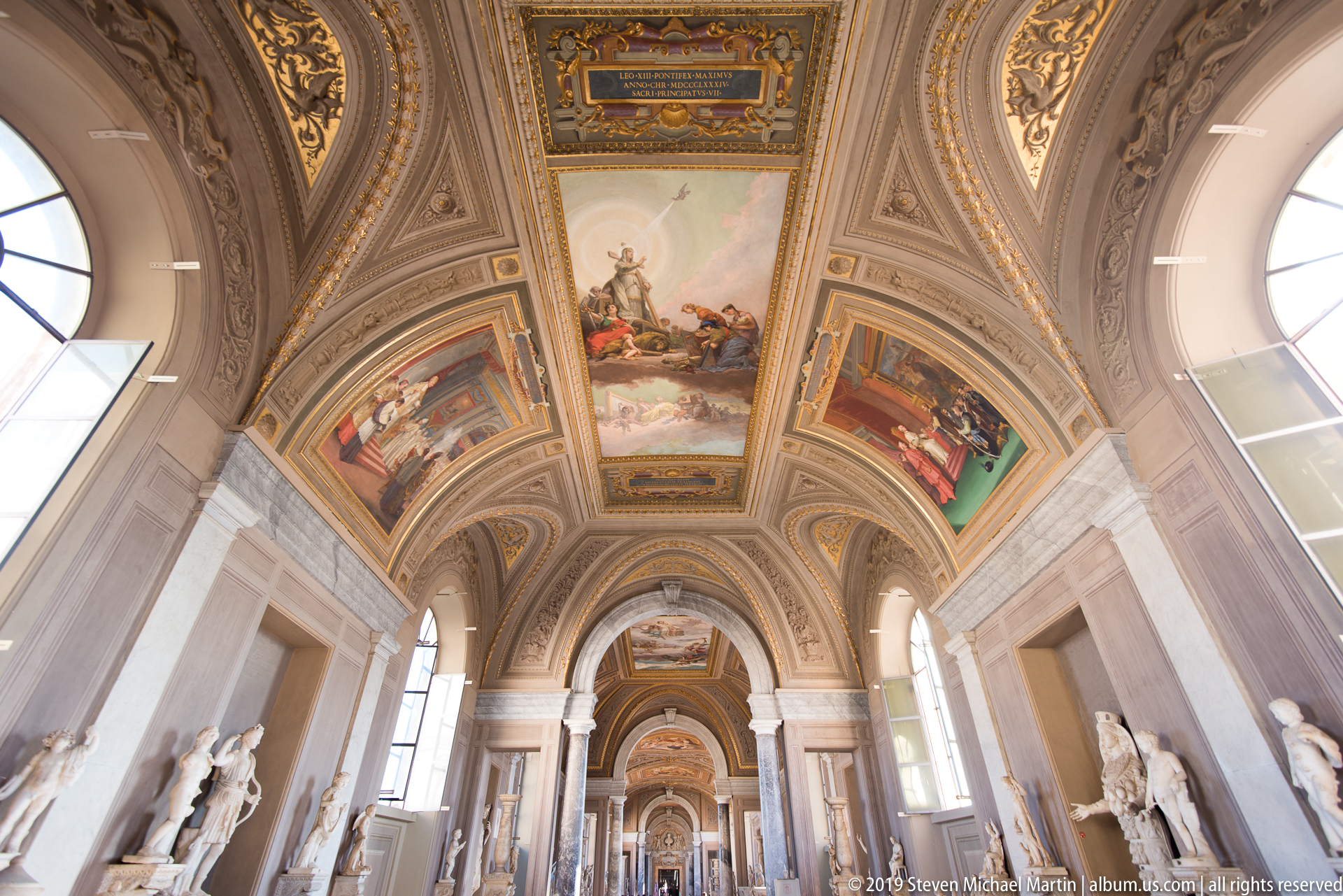
A long museum corridor recedes through repeated arches, with classical statues displayed on pedestals along both sides. Large rectangular paintings occupy the ceiling bays above richly molded architectural frames, while high windows flood the pale stone interior with daylight and accentuate the gallery's strong linear perspective.
Caption
A long museum corridor recedes through repeated arches, with classical statues displayed on pedestals along both sides. Large rectangular paintings occupy the ceiling bays above richly molded architectural frames, while high windows flood the pale stone interior with daylight and accentuate the gallery's strong linear perspective.

A rectangular narrative painting occupies the center of an ornate pale-gray and gold ceiling bay. The scene shows mounted and fallen figures in a landscape, surrounded by layered moldings, gilded borders, and smaller colored panels; the symmetrical architectural frame turns the painting into the focal point of the vaulted gallery ceiling.
Caption
A rectangular narrative painting occupies the center of an ornate pale-gray and gold ceiling bay. The scene shows mounted and fallen figures in a landscape, surrounded by layered moldings, gilded borders, and smaller colored panels; the symmetrical architectural frame turns the painting into the focal point of the vaulted gallery ceiling.

A large landscape painting fills the end wall of a small museum landing, framed by fluted pilasters and a balustrade. Above it, a pale pink, cream, and blue ceiling combines geometric panels, relief-like ornament, and a central oval field, creating a quieter decorative transition between the Vatican Museums' more densely ornamented galleries.
Caption
A large landscape painting fills the end wall of a small museum landing, framed by fluted pilasters and a balustrade. Above it, a pale pink, cream, and blue ceiling combines geometric panels, relief-like ornament, and a central oval field, creating a quieter decorative transition between the Vatican Museums' more densely ornamented galleries.

A broad painted vault centers on a many-pointed starburst surrounded by figures, animals, and celestial motifs distributed across pale blue and cream fields. Triangular corner scenes and a richly painted lunette complete the ensemble, while the steep upward view emphasizes the ceiling's radial geometry and its mixture of astronomical and figurative decoration.
Caption
A broad painted vault centers on a many-pointed starburst surrounded by figures, animals, and celestial motifs distributed across pale blue and cream fields. Triangular corner scenes and a richly painted lunette complete the ensemble, while the steep upward view emphasizes the ceiling's radial geometry and its mixture of astronomical and figurative decoration.

Visitors fill the Gallery of Maps beneath the long, intensely gilded barrel vault. Monumental painted maps occupy the walls between decorative pilasters, and sunlight enters through tall windows on the right; the central perspective carries the eye through the crowd toward the distant end of the richly ornamented corridor.
Caption
Visitors fill the Gallery of Maps beneath the long, intensely gilded barrel vault. Monumental painted maps occupy the walls between decorative pilasters, and sunlight enters through tall windows on the right; the central perspective carries the eye through the crowd toward the distant end of the richly ornamented corridor.

A weathered stone relief shows armored warriors pressed into close combat, their bodies overlapping beneath raised weapons and shields. Deep carving preserves helmets, layered armor, limbs, and a central bearded face despite losses along the fragment's edges, giving the surviving scene a compressed sense of movement and conflict.
Caption
A weathered stone relief shows armored warriors pressed into close combat, their bodies overlapping beneath raised weapons and shields. Deep carving preserves helmets, layered armor, limbs, and a central bearded face despite losses along the fragment's edges, giving the surviving scene a compressed sense of movement and conflict.

A grand sculpture gallery recedes through a sequence of arches and columns beneath an ornate coffered and painted vault. Ancient statues, busts, urns, and reliefs line both sides while visitors move through the center, allowing the long perspective to show how the collection is integrated into an architectural display of marble, fresco, and classical ornament.
Caption
A grand sculpture gallery recedes through a sequence of arches and columns beneath an ornate coffered and painted vault. Ancient statues, busts, urns, and reliefs line both sides while visitors move through the center, allowing the long perspective to show how the collection is integrated into an architectural display of marble, fresco, and classical ornament.

A close upward view centers the ceiling's radiating multicolored star, with human figures, animals, and celestial symbols dispersed across the surrounding pale field. The tighter framing removes much of the architecture seen in wider views and instead emphasizes the painted constellation-like program, decorative lines, and central geometry.
Caption
A close upward view centers the ceiling's radiating multicolored star, with human figures, animals, and celestial symbols dispersed across the surrounding pale field. The tighter framing removes much of the architecture seen in wider views and instead emphasizes the painted constellation-like program, decorative lines, and central geometry.

A dark bronze nude male strides forward under the weight of another figure carried across his shoulders and upper back. The supporting figure's legs are spread in a forceful stance, while the upper body twists beneath the load; nearby animal sculpture and the glass display case place the dramatic group within the museum's antiquities collection.
Caption
A dark bronze nude male strides forward under the weight of another figure carried across his shoulders and upper back. The supporting figure's legs are spread in a forceful stance, while the upper body twists beneath the load; nearby animal sculpture and the glass display case place the dramatic group within the museum's antiquities collection.

A large black-figure amphora dominates a glass display, its orange clay body painted with dark human and animal figures arranged in horizontal bands. Two smaller vessels flank it, echoing the same black-and-orange palette; reflections from the case reveal the museum setting while the close view preserves the amphora's handles, neck, foot, and narrative decoration.
Caption
A large black-figure amphora dominates a glass display, its orange clay body painted with dark human and animal figures arranged in horizontal bands. Two smaller vessels flank it, echoing the same black-and-orange palette; reflections from the case reveal the museum setting while the close view preserves the amphora's handles, neck, foot, and narrative decoration.

A broad ancient ceramic bowl is covered with stacked black-figure friezes across its orange surface. Mounted figures occupy the upper register while lions, birds, and other animals repeat below, creating a dense decorative sequence; a tall narrow vessel at left provides a useful comparison of scale and related painted technique within the display case.
Caption
A broad ancient ceramic bowl is covered with stacked black-figure friezes across its orange surface. Mounted figures occupy the upper register while lions, birds, and other animals repeat below, creating a dense decorative sequence; a tall narrow vessel at left provides a useful comparison of scale and related painted technique within the display case.

Two weathered stone horse heads are displayed together on dark mounts, one positioned slightly behind the other. Incised bridles, modeled nostrils, and stylized manes survive despite abrasion and broken necks, allowing the fragments to retain a strong sense of equine anatomy and sculptural mass.
Caption
Two weathered stone horse heads are displayed together on dark mounts, one positioned slightly behind the other. Incised bridles, modeled nostrils, and stylized manes survive despite abrasion and broken necks, allowing the fragments to retain a strong sense of equine anatomy and sculptural mass.

Viewed from above, a shallow black-glazed drinking cup frames an orange-red circular figural scene at its center. Two horizontal handles extend from the sides, while the interior medallion shows several overlapping human figures rendered in fine dark lines, creating a strong contrast with the glossy black bowl surrounding them.
Caption
Viewed from above, a shallow black-glazed drinking cup frames an orange-red circular figural scene at its center. Two horizontal handles extend from the sides, while the interior medallion shows several overlapping human figures rendered in fine dark lines, creating a strong contrast with the glossy black bowl surrounding them.
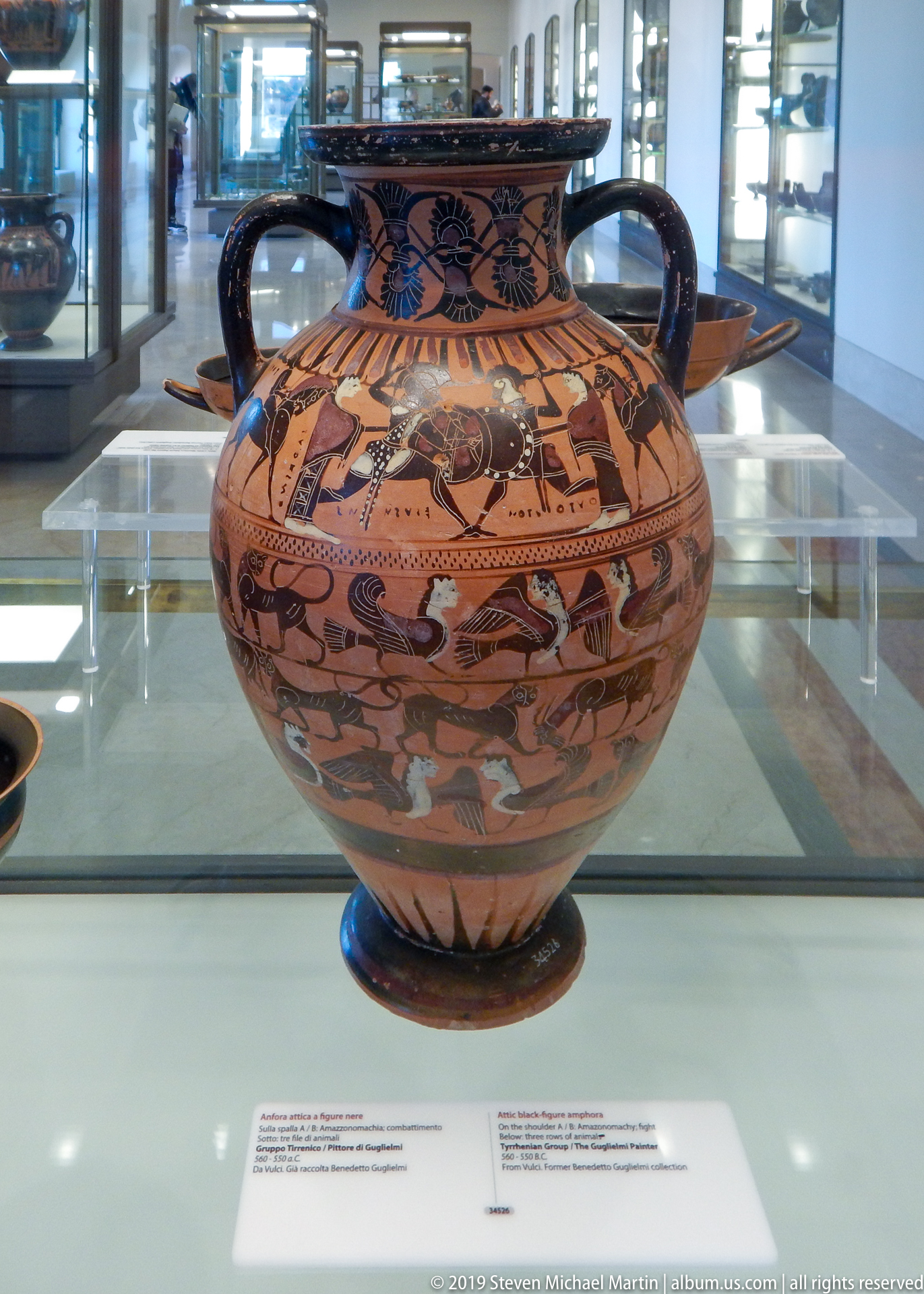
A large ancient amphora is displayed at eye level, its rounded orange body covered with black-figure decoration. A principal narrative scene occupies the upper band beneath a floral neck pattern, while animals and ornamental motifs encircle the lower body; the symmetrical handles and broad foot make the vessel's complete profile easy to read.
Caption
A large ancient amphora is displayed at eye level, its rounded orange body covered with black-figure decoration. A principal narrative scene occupies the upper band beneath a floral neck pattern, while animals and ornamental motifs encircle the lower body; the symmetrical handles and broad foot make the vessel's complete profile easy to read.

A close ceiling detail centers on a rectangular heraldic panel set within a dense grid of gilded coffers. The surrounding fields alternate red ornamental scrolls with pale and gold moldings, while the central emblem's blue, red, and white forms stand out against the warmer palette and clarify the ceiling's hierarchical decorative design.
Caption
A close ceiling detail centers on a rectangular heraldic panel set within a dense grid of gilded coffers. The surrounding fields alternate red ornamental scrolls with pale and gold moldings, while the central emblem's blue, red, and white forms stand out against the warmer palette and clarify the ceiling's hierarchical decorative design.

A monumental dark metal krater rises on a fluted pedestal foot, with large loop handles attached at either side and a broad flaring rim above the rounded body. Figural reliefs and ornamental bands cover the vessel's surface, their dark patina catching highlights from the bright gallery beyond and revealing the scale of the ancient metalwork.
Caption
A monumental dark metal krater rises on a fluted pedestal foot, with large loop handles attached at either side and a broad flaring rim above the rounded body. Figural reliefs and ornamental bands cover the vessel's surface, their dark patina catching highlights from the bright gallery beyond and revealing the scale of the ancient metalwork.

A bronze male figure is viewed from below with both arms lifted and open hands extended outward. His body is covered by a long, vertically patterned garment or armor-like dress, and the low angle places him against an ornate coffered ceiling and sculptural architectural decoration, intensifying the monumentality of the pose.
Caption
A bronze male figure is viewed from below with both arms lifted and open hands extended outward. His body is covered by a long, vertically patterned garment or armor-like dress, and the low angle places him against an ornate coffered ceiling and sculptural architectural decoration, intensifying the monumentality of the pose.

A richly decorated flat ceiling is divided into a precise grid of square and rectangular coffers framed by gilded moldings. Red, gold, cream, and blue ornament fills the compartments, with heraldic devices and small figural motifs appearing among repeated rosettes and scrollwork; the frontal view emphasizes the ceiling's strict geometry and dense craftsmanship.
Caption
A richly decorated flat ceiling is divided into a precise grid of square and rectangular coffers framed by gilded moldings. Red, gold, cream, and blue ornament fills the compartments, with heraldic devices and small figural motifs appearing among repeated rosettes and scrollwork; the frontal view emphasizes the ceiling's strict geometry and dense craftsmanship.

A tall black-figure amphora presents a large mythological scene across its orange body, with several human figures arranged around a prominent dark circular shield or emblem. A lotus-like band encircles the shoulder below the dark neck, while the curved handles and neighboring vessel remain visible through reflections in the display case.
Caption
A tall black-figure amphora presents a large mythological scene across its orange body, with several human figures arranged around a prominent dark circular shield or emblem. A lotus-like band encircles the shoulder below the dark neck, while the curved handles and neighboring vessel remain visible through reflections in the display case.

A weathered stone lion crouches on a rectangular museum plinth with its mouth opened wide in a roar. The deeply cut mane frames the head in thick locks, while the forelegs extend along the base and a second animal sculpture appears behind it, reinforcing the display's focus on monumental carved creatures.
Caption
A weathered stone lion crouches on a rectangular museum plinth with its mouth opened wide in a roar. The deeply cut mane frames the head in thick locks, while the forelegs extend along the base and a second animal sculpture appears behind it, reinforcing the display's focus on monumental carved creatures.

A dark metal pedestal vessel is encircled by projecting animal heads and rounded bosses, with several elongated animal protomes rising above the rim. Incised geometric bands decorate the bowl and tall fluted foot, while the symmetrical arrangement gives the object a ceremonial appearance within its glass museum case.
Caption
A dark metal pedestal vessel is encircled by projecting animal heads and rounded bosses, with several elongated animal protomes rising above the rim. Incised geometric bands decorate the bowl and tall fluted foot, while the symmetrical arrangement gives the object a ceremonial appearance within its glass museum case.

A dark metal vessel combines a deep circular bowl with multiple horned animal heads projecting around its rim. Incised sunburst and linear motifs decorate the exterior, while a short pedestal foot supports the object; the close side view makes the sculptural animal attachments and layered construction especially clear.
Caption
A dark metal vessel combines a deep circular bowl with multiple horned animal heads projecting around its rim. Incised sunburst and linear motifs decorate the exterior, while a short pedestal foot supports the object; the close side view makes the sculptural animal attachments and layered construction especially clear.

A dark metal vessel takes the form of a stylized crested bird, its rounded body covered with fine incised feather patterns and geometric ornament. The open beak forms a projecting spout, while a tall looping handle rises from the back and joins the head, merging practical vessel features with an expressive animal form.
Caption
A dark metal vessel takes the form of a stylized crested bird, its rounded body covered with fine incised feather patterns and geometric ornament. The open beak forms a projecting spout, while a tall looping handle rises from the back and joins the head, merging practical vessel features with an expressive animal form.

A small marble monument is organized like an architectural façade, with two deeply carved figural panels above a larger rectangular relief below. Columns divide the upper scenes, while the lower register contains a crowded procession or narrative framed by ornamental borders; the pale sculpture stands out against the veined marble wall behind it.
Caption
A small marble monument is organized like an architectural façade, with two deeply carved figural panels above a larger rectangular relief below. Columns divide the upper scenes, while the lower register contains a crowded procession or narrative framed by ornamental borders; the pale sculpture stands out against the veined marble wall behind it.

A compact seated Egyptian figure is carved from speckled pink granite, with hands resting symmetrically on the thighs and a broad nemes-style headdress framing the face. The blocky throne and frontal pose reinforce the statue's formal symmetry, while focused lighting isolates the ancient royal image against a dark display background.
Caption
A compact seated Egyptian figure is carved from speckled pink granite, with hands resting symmetrically on the thighs and a broad nemes-style headdress framing the face. The blocky throne and frontal pose reinforce the statue's formal symmetry, while focused lighting isolates the ancient royal image against a dark display background.

A luminous museum corridor extends beneath a high barrel vault patterned with shallow coffers. Tall marble columns and pilasters frame side openings, while the bright central axis leads toward a distant doorway and sculptural niches; the restrained cream and gray palette contrasts with the more densely frescoed galleries elsewhere in the Vatican Museums.
Caption
A luminous museum corridor extends beneath a high barrel vault patterned with shallow coffers. Tall marble columns and pilasters frame side openings, while the bright central axis leads toward a distant doorway and sculptural niches; the restrained cream and gray palette contrasts with the more densely frescoed galleries elsewhere in the Vatican Museums.

A pale marble relief presents two large winged creatures facing inward toward a tall central pedestal or ritual object. Their feathered wings spread across the field as their bodies mirror one another, while fruit-like forms and ornamental details fill the upper zone; the strong bilateral symmetry gives the carved panel a heraldic character.
Caption
A pale marble relief presents two large winged creatures facing inward toward a tall central pedestal or ritual object. Their feathered wings spread across the field as their bodies mirror one another, while fruit-like forms and ornamental details fill the upper zone; the strong bilateral symmetry gives the carved panel a heraldic character.

Dozens of slender dark statuettes stand in ordered rows inside a glass case, with two larger examples placed prominently in front. Each figure has a rigid frontal stance and elongated body, producing a striking repetition of scale and silhouette across the display while reflections reveal the surrounding Egyptian collection galleries.
Caption
Dozens of slender dark statuettes stand in ordered rows inside a glass case, with two larger examples placed prominently in front. Each figure has a rigid frontal stance and elongated body, producing a striking repetition of scale and silhouette across the display while reflections reveal the surrounding Egyptian collection galleries.

A monumental bearded male figure reclines across a stone base, his muscular torso upright while heavy drapery covers his legs. One arm braces the body and the other rests across a raised knee, creating the relaxed but imposing pose associated with classical river-god sculpture; the close museum view emphasizes the deeply carved beard, anatomy, and cascading folds.
Caption
A monumental bearded male figure reclines across a stone base, his muscular torso upright while heavy drapery covers his legs. One arm braces the body and the other rests across a raised knee, creating the relaxed but imposing pose associated with classical river-god sculpture; the close museum view emphasizes the deeply carved beard, anatomy, and cascading folds.

A broad flight of marble stairs rises through a monumental Vatican Museums interior beneath a long coffered barrel vault. Massive reddish granite columns line the upper landing, and a seated visitor at center provides scale for the high ceiling, balustrades, and formal axial arrangement of the architectural space.
Caption
A broad flight of marble stairs rises through a monumental Vatican Museums interior beneath a long coffered barrel vault. Massive reddish granite columns line the upper landing, and a seated visitor at center provides scale for the high ceiling, balustrades, and formal axial arrangement of the architectural space.

Glass cases filled with antiquities occupy a spacious Vatican Museums gallery beneath an exceptionally ornate coffered ceiling. Gilded and red geometric panels cover the ceiling, while a painted figural frieze runs around the upper walls between sculptural architectural divisions, creating a richly decorated setting for the Egyptian and archaeological displays below.
Caption
Glass cases filled with antiquities occupy a spacious Vatican Museums gallery beneath an exceptionally ornate coffered ceiling. Gilded and red geometric panels cover the ceiling, while a painted figural frieze runs around the upper walls between sculptural architectural divisions, creating a richly decorated setting for the Egyptian and archaeological displays below.

A life-size marble female nude stands in a relaxed contrapposto pose, one hand resting low across the abdomen while the other gathers a heavy cascade of drapery beside the body. The softly modeled figure is isolated by focused lighting against a dark wall, emphasizing the smooth stone surface and the contrast between flesh and deeply folded cloth.
Caption
A life-size marble female nude stands in a relaxed contrapposto pose, one hand resting low across the abdomen while the other gathers a heavy cascade of drapery beside the body. The softly modeled figure is isolated by focused lighting against a dark wall, emphasizing the smooth stone surface and the contrast between flesh and deeply folded cloth.

A large carved marble theatrical mask presents an exaggerated male face with bulging eyes, deeply arched brows, an open mouth, and a long curling beard. Thick locks frame the forehead and temples, while the hollow mouth opening reinforces the object's mask-like function and gives the frontal museum display a striking expressive intensity.
Caption
A large carved marble theatrical mask presents an exaggerated male face with bulging eyes, deeply arched brows, an open mouth, and a long curling beard. Thick locks frame the forehead and temples, while the hollow mouth opening reinforces the object's mask-like function and gives the frontal museum display a striking expressive intensity.

A large circular bronze shield hangs above a case of smaller vessels, its green patina emphasizing a complex repoussé design. A many-petaled rosette radiates from the center, surrounded by concentric bands of stylized animals and curling motifs; the raised decoration remains legible despite the metal's aged surface.
Caption
A large circular bronze shield hangs above a case of smaller vessels, its green patina emphasizing a complex repoussé design. A many-petaled rosette radiates from the center, surrounded by concentric bands of stylized animals and curling motifs; the raised decoration remains legible despite the metal's aged surface.

Giuseppe Momo's 1932 Vatican Museums staircase coils downward in broad concentric loops around an open central void. Dark railings trace the smooth white curves of the double-helix ramps as visitors move along the upper levels, while a narrow boat-shaped display on the floor below provides a strong linear counterpoint to the architecture.
Caption
Giuseppe Momo's 1932 Vatican Museums staircase coils downward in broad concentric loops around an open central void. Dark railings trace the smooth white curves of the double-helix ramps as visitors move along the upper levels, while a narrow boat-shaped display on the floor below provides a strong linear counterpoint to the architecture.

Visitors gather before the monumental Vatican Museums entrance, where a tall rusticated stone portal opens beneath the MUSEI VATICANI inscription and papal heraldic sculpture. The arched doorway is set into the long brick perimeter wall, and the people at street level provide scale for the formal entrance composition and its sculpted crest.
Caption
Visitors gather before the monumental Vatican Museums entrance, where a tall rusticated stone portal opens beneath the MUSEI VATICANI inscription and papal heraldic sculpture. The arched doorway is set into the long brick perimeter wall, and the people at street level provide scale for the formal entrance composition and its sculpted crest.

A modern dark-metal Vatican emblem projects from a weathered brick and stone wall, combining a papal tiara above crossed keys and a rectangular lower element marked with a large letter M. The sculptural sign casts strong shadows across the masonry, translating familiar papal heraldry into a bold contemporary architectural marker.
Caption
A modern dark-metal Vatican emblem projects from a weathered brick and stone wall, combining a papal tiara above crossed keys and a rectangular lower element marked with a large letter M. The sculptural sign casts strong shadows across the masonry, translating familiar papal heraldry into a bold contemporary architectural marker.

The Vatican Museums entrance is crowned by an elaborate stone heraldic group above the inscription MUSEI VATICANI. A papal tiara and crossed keys rise over the central shield, flanked by two reclining male figures and abundant carved foliage and fruit; the pale sculpture stands out sharply against the warm brick wall behind.
Caption
The Vatican Museums entrance is crowned by an elaborate stone heraldic group above the inscription MUSEI VATICANI. A papal tiara and crossed keys rise over the central shield, flanked by two reclining male figures and abundant carved foliage and fruit; the pale sculpture stands out sharply against the warm brick wall behind.

A close view isolates the monumental stone crest above the Vatican Museums entrance. Two muscular reclining male figures flank a large papal shield crowned by the tiara and crossed keys, while carved fruit and scrolling ornament fill the base; the bold MUSEI VATICANI inscription below anchors the sculptural group to the museum façade.
Caption
A close view isolates the monumental stone crest above the Vatican Museums entrance. Two muscular reclining male figures flank a large papal shield crowned by the tiara and crossed keys, while carved fruit and scrolling ornament fill the base; the bold MUSEI VATICANI inscription below anchors the sculptural group to the museum façade.
⭐ Highlights
- Vast Museum Complex: One of the largest and most visited museum collections in the world.
- Sistine Chapel: The final and most iconic space, featuring Michelangelo’s masterpieces.
- Raphael Rooms: Renaissance frescoes representing artistic and intellectual achievement.
- Classical Sculpture: Ancient Greek and Roman works collected over centuries.
- Gallery Sequences: A progression through multiple artistic periods and styles.
- Papal Collection: Art gathered and preserved by the Catholic Church over centuries.
🏛️ Vatican Museums Field Guide
Major features observed during this visit:
The Vatican Museums form one of the most significant collections of art in the world, developed over centuries by the papacy. Beginning in the early 16th century, the museums grew to include a vast range of works spanning classical antiquity through the Renaissance and beyond.
The experience of visiting the museums is defined by progression. Visitors move through a sequence of galleries, each representing different artistic traditions and historical periods, culminating in the Sistine Chapel—one of the most celebrated works of art in human history.
🏛️ Signature Features
- Sistine Chapel – The final gallery, featuring Michelangelo’s ceiling and “The Last Judgment.”
- Raphael Rooms – Frescoed rooms showcasing Renaissance artistic achievement.
- Classical Sculpture Galleries – Ancient works forming the foundation of Western art.
- Gallery of Maps – A long corridor decorated with detailed geographic frescoes.
- Grand Corridors – Ornate passageways connecting the museum’s collections.
🧠 Historical Significance
- Papal Patronage – Art collected and commissioned by generations of popes.
- Renaissance Peak – Houses works from one of the most important periods in art history.
- Continuity of Collection – The museums evolved over centuries rather than a single period.
- Global Influence – The collection shaped artistic standards across Europe and beyond.
🌄 Experience & Flow
- Sequential Journey – Visitors move through a structured progression of galleries.
- Increasing Intensity – The experience builds toward the Sistine Chapel.
- Architectural Variety – Each gallery has a distinct design and atmosphere.
- Climactic Ending – The Sistine Chapel serves as the culmination of the visit.