Machu Picchu – Peru
The legendary mountain citadel of Machu Picchu stands high among the cloud-covered peaks of the Andes Mountains. Built during the 15th century under the reign of the Inca emperor Pachacuti, the city was constructed atop a narrow ridge overlooking the deep valley of the Urubamba River.
Stone temples, agricultural terraces, and ceremonial plazas blend seamlessly with the surrounding mountain landscape. The site remained largely unknown to the outside world until its international rediscovery in 1911 by explorer Hiram Bingham.
Recognized today as a Historic Sanctuary of Machu Picchu, Machu Picchu stands among the most extraordinary archaeological sites in the world.

From high on Huayna Picchu, the Machu Picchu ridge appears far below between towering Andean peaks. The citadel and terraces occupy a narrow saddle surrounded by deep, forested valleys, while a sliver of river is visible at the base of the mountains. The extreme elevation gives one of the sequence’s clearest impressions of the site’s geographic isolation.
Caption
From high on Huayna Picchu, the Machu Picchu ridge appears far below between towering Andean peaks. The citadel and terraces occupy a narrow saddle surrounded by deep, forested valleys, while a sliver of river is visible at the base of the mountains. The extreme elevation gives one of the sequence’s clearest impressions of the site’s geographic isolation.

A broad, richly detailed panorama presents Machu Picchu beneath Huayna Picchu in clear morning or late-day light. Dense stone compounds occupy the left and lower foreground, while green lawns and terraces lead toward the mountain. The balanced composition offers one of the sequence’s clearest overall views of the archaeological city and its dramatic Andean setting.
Caption
A broad, richly detailed panorama presents Machu Picchu beneath Huayna Picchu in clear morning or late-day light. Dense stone compounds occupy the left and lower foreground, while green lawns and terraces lead toward the mountain. The balanced composition offers one of the sequence’s clearest overall views of the archaeological city and its dramatic Andean setting.

Dark, jagged Andean peaks rise beneath towering white clouds near Machu Picchu. Mist clings to the upper ridges and partially obscures the highest summits, creating strong contrast between the illuminated sky and shadowed mountain faces. The frame shifts attention away from the archaeological site to the high-relief landscape that encloses it.
Caption
Dark, jagged Andean peaks rise beneath towering white clouds near Machu Picchu. Mist clings to the upper ridges and partially obscures the highest summits, creating strong contrast between the illuminated sky and shadowed mountain faces. The frame shifts attention away from the archaeological site to the high-relief landscape that encloses it.

Machu Picchu spreads across the ridge beneath Huayna Picchu in a broad late-afternoon panorama. Dense masonry sectors occupy the foreground, central lawns open toward the mountain, and terraces descend along the outer slope. The angled light gives strong depth to the settlement while distant ridges fall into shadow.
Caption
Machu Picchu spreads across the ridge beneath Huayna Picchu in a broad late-afternoon panorama. Dense masonry sectors occupy the foreground, central lawns open toward the mountain, and terraces descend along the outer slope. The angled light gives strong depth to the settlement while distant ridges fall into shadow.

Machu Picchu spreads across the ridge in a broad classic panorama, with dense roofless masonry, green terraces, and central lawns leading toward Huayna Picchu. Bright sunlight reveals the geometry of the settlement while dark mountain walls enclose the valley beyond. The viewpoint gives a clear overview of the relationship between the citadel’s built core and its dramatic natural setting.
Caption
Machu Picchu spreads across the ridge in a broad classic panorama, with dense roofless masonry, green terraces, and central lawns leading toward Huayna Picchu. Bright sunlight reveals the geometry of the settlement while dark mountain walls enclose the valley beyond. The viewpoint gives a clear overview of the relationship between the citadel’s built core and its dramatic natural setting.

The stone compounds and terraces of Machu Picchu spread across the ridge below the steep summit of Huayna Picchu. Rectilinear building groups, narrow lanes, and green terraces articulate the citadel while the surrounding mountains fall sharply into shadowed valleys. The elevated viewpoint gives a broad reading of the settlement’s compact plan and dramatic topographic setting.
Caption
The stone compounds and terraces of Machu Picchu spread across the ridge below the steep summit of Huayna Picchu. Rectilinear building groups, narrow lanes, and green terraces articulate the citadel while the surrounding mountains fall sharply into shadowed valleys. The elevated viewpoint gives a broad reading of the settlement’s compact plan and dramatic topographic setting.

Sunlit stone compounds and terraces fill the lower half of this elevated Machu Picchu view, while Huayna Picchu rises sharply beyond the central lawn. The slightly tighter framing concentrates attention on the dense architectural core and stepped agricultural slopes. Darker mountain ridges in the distance give depth to the bright foreground masonry.
Caption
Sunlit stone compounds and terraces fill the lower half of this elevated Machu Picchu view, while Huayna Picchu rises sharply beyond the central lawn. The slightly tighter framing concentrates attention on the dense architectural core and stepped agricultural slopes. Darker mountain ridges in the distance give depth to the bright foreground masonry.

Machu Picchu appears far below on its narrow ridge, surrounded by steep green mountains and deeply cut valleys. Agricultural terraces and dense stone buildings remain legible despite the distance, while a rocky foreground edge marks the high Huayna Picchu viewpoint. The composition strongly conveys the citadel’s dramatic topographic setting.
Caption
Machu Picchu appears far below on its narrow ridge, surrounded by steep green mountains and deeply cut valleys. Agricultural terraces and dense stone buildings remain legible despite the distance, while a rocky foreground edge marks the high Huayna Picchu viewpoint. The composition strongly conveys the citadel’s dramatic topographic setting.

A broad elevated panorama looks across Machu Picchu’s dense roofless masonry toward Huayna Picchu. Long rows of stone rooms and narrow corridors occupy the foreground while green terraces and open lawns create visual breaks within the urban core. The viewpoint gives a particularly clear sense of the site’s layered ridge-top organization.
Caption
A broad elevated panorama looks across Machu Picchu’s dense roofless masonry toward Huayna Picchu. Long rows of stone rooms and narrow corridors occupy the foreground while green terraces and open lawns create visual breaks within the urban core. The viewpoint gives a particularly clear sense of the site’s layered ridge-top organization.

A visitor in a blue shirt stands beside a tripod-mounted camera at a high overlook above Machu Picchu. The citadel’s dense masonry, central lawns, and terraces extend across the ridge behind him, with Huayna Picchu rising prominently beyond. The final frame combines a personal travel moment with one of the site’s defining panoramic views.
Caption
A visitor in a blue shirt stands beside a tripod-mounted camera at a high overlook above Machu Picchu. The citadel’s dense masonry, central lawns, and terraces extend across the ridge behind him, with Huayna Picchu rising prominently beyond. The final frame combines a personal travel moment with one of the site’s defining panoramic views.

Tufts of high grass frame the lower edge of a broad view over Machu Picchu, where roofless masonry, central lawns, and terraces lead toward Huayna Picchu. The foreground vegetation softens the architectural geometry and gives the panorama a natural frame. Distant ridges remain in deep blue shadow.
Caption
Tufts of high grass frame the lower edge of a broad view over Machu Picchu, where roofless masonry, central lawns, and terraces lead toward Huayna Picchu. The foreground vegetation softens the architectural geometry and gives the panorama a natural frame. Distant ridges remain in deep blue shadow.

A slightly shifted panorama looks across Machu Picchu’s roofless stone sectors toward Huayna Picchu. Long terraces descend along the right side while larger masonry blocks and narrow corridors occupy the foreground. The view distinguishes the dense architectural fabric from the broad green lawns at the center of the citadel.
Caption
A slightly shifted panorama looks across Machu Picchu’s roofless stone sectors toward Huayna Picchu. Long terraces descend along the right side while larger masonry blocks and narrow corridors occupy the foreground. The view distinguishes the dense architectural fabric from the broad green lawns at the center of the citadel.

Stepped agricultural terraces climb the mountainside beside dense Inca masonry in the upper sector of Machu Picchu. Retaining walls form long horizontal bands across the slope, while roofless stone compounds occupy the higher ground. The view makes the engineered transition between cultivated terraces and the compact urban fabric especially clear against the surrounding Andean peaks.
Caption
Stepped agricultural terraces climb the mountainside beside dense Inca masonry in the upper sector of Machu Picchu. Retaining walls form long horizontal bands across the slope, while roofless stone compounds occupy the higher ground. The view makes the engineered transition between cultivated terraces and the compact urban fabric especially clear against the surrounding Andean peaks.

An oblique elevated view looks across Machu Picchu’s roofless masonry compounds and terraces toward Huayna Picchu. The settlement occupies a narrow ridge between deep mountain valleys, with long retaining walls tracing the slope below the architectural core. Strong side light separates the pale stonework from the dark Andean backdrop and emphasizes the site’s layered topography.
Caption
An oblique elevated view looks across Machu Picchu’s roofless masonry compounds and terraces toward Huayna Picchu. The settlement occupies a narrow ridge between deep mountain valleys, with long retaining walls tracing the slope below the architectural core. Strong side light separates the pale stonework from the dark Andean backdrop and emphasizes the site’s layered topography.

Massive stone retaining walls and roofless buildings step across the foreground at Machu Picchu, with Huayna Picchu rising immediately beyond. The closer viewpoint emphasizes the scale and texture of the masonry rather than the full city plan. Narrow terraces and stacked architectural levels reveal how construction was fitted tightly to the steep ridge.
Caption
Massive stone retaining walls and roofless buildings step across the foreground at Machu Picchu, with Huayna Picchu rising immediately beyond. The closer viewpoint emphasizes the scale and texture of the masonry rather than the full city plan. Narrow terraces and stacked architectural levels reveal how construction was fitted tightly to the steep ridge.

Long parallel agricultural terraces descend the steep slope at Machu Picchu, creating a rhythmic sequence of narrow green platforms held by stone retaining walls. Small roofless structures and circulation paths break the geometric pattern near the lower edge. The view concentrates on the engineering and scale of the terrace system rather than the citadel’s monumental skyline.
Caption
Long parallel agricultural terraces descend the steep slope at Machu Picchu, creating a rhythmic sequence of narrow green platforms held by stone retaining walls. Small roofless structures and circulation paths break the geometric pattern near the lower edge. The view concentrates on the engineering and scale of the terrace system rather than the citadel’s monumental skyline.

Carefully laid Inca masonry wraps around a massive natural rock outcrop, demonstrating the close adaptation of construction to bedrock at Machu Picchu. A narrow stone stair rises beside the rock, while higher courses of rectangular blocks form a projecting wall above it. The close view isolates the relationship between worked masonry, circulation, and untouched stone.
Caption
Carefully laid Inca masonry wraps around a massive natural rock outcrop, demonstrating the close adaptation of construction to bedrock at Machu Picchu. A narrow stone stair rises beside the rock, while higher courses of rectangular blocks form a projecting wall above it. The close view isolates the relationship between worked masonry, circulation, and untouched stone.

A large natural rock outcrop anchors a cluster of stone walls, terraces, and roofless buildings within Machu Picchu. The surrounding masonry follows the irregular bedrock closely, while a solitary tree rises above the architectural layers. This contextual view shows how the built environment accommodates both steep terrain and exposed stone rather than imposing a uniform ground plan.
Caption
A large natural rock outcrop anchors a cluster of stone walls, terraces, and roofless buildings within Machu Picchu. The surrounding masonry follows the irregular bedrock closely, while a solitary tree rises above the architectural layers. This contextual view shows how the built environment accommodates both steep terrain and exposed stone rather than imposing a uniform ground plan.
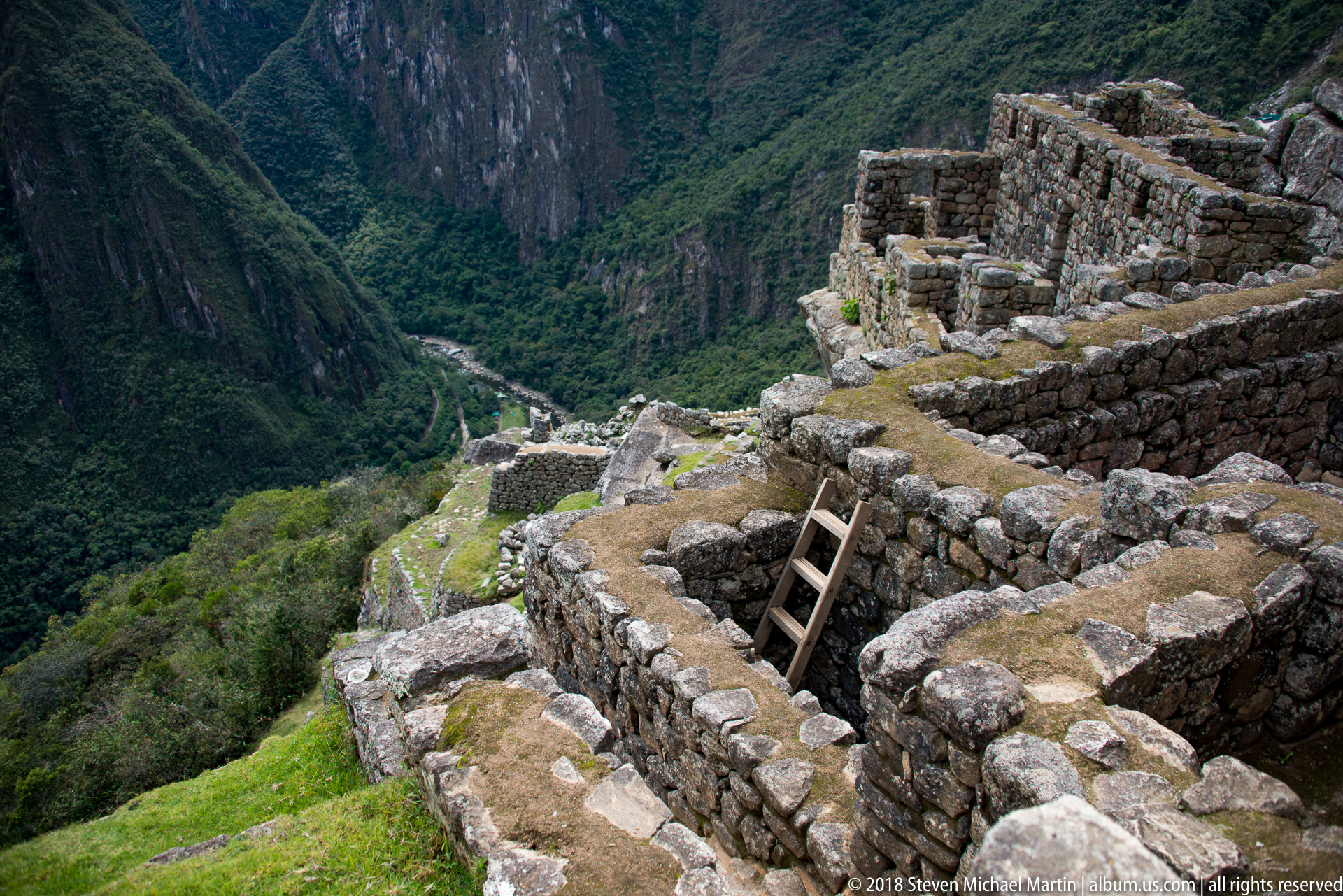
Roofless stone rooms occupy the outer edge of Machu Picchu above a precipitous green valley. Low walls define compact interior spaces, while a wooden ladder provides modern access into one enclosure. Far below, the winding river and road emphasize the extreme elevation and the settlement’s dramatic relationship to the surrounding terrain.
Caption
Roofless stone rooms occupy the outer edge of Machu Picchu above a precipitous green valley. Low walls define compact interior spaces, while a wooden ladder provides modern access into one enclosure. Far below, the winding river and road emphasize the extreme elevation and the settlement’s dramatic relationship to the surrounding terrain.

Terraced lawns and stone enclosures step down the mountainside at the edge of Machu Picchu. Higher roofless rooms occupy the right side of the frame, while lower retaining walls trace a narrow green descent toward the valley. The steep backdrop reinforces how the settlement’s architecture was distributed across limited, sharply sloping terrain.
Caption
Terraced lawns and stone enclosures step down the mountainside at the edge of Machu Picchu. Higher roofless rooms occupy the right side of the frame, while lower retaining walls trace a narrow green descent toward the valley. The steep backdrop reinforces how the settlement’s architecture was distributed across limited, sharply sloping terrain.
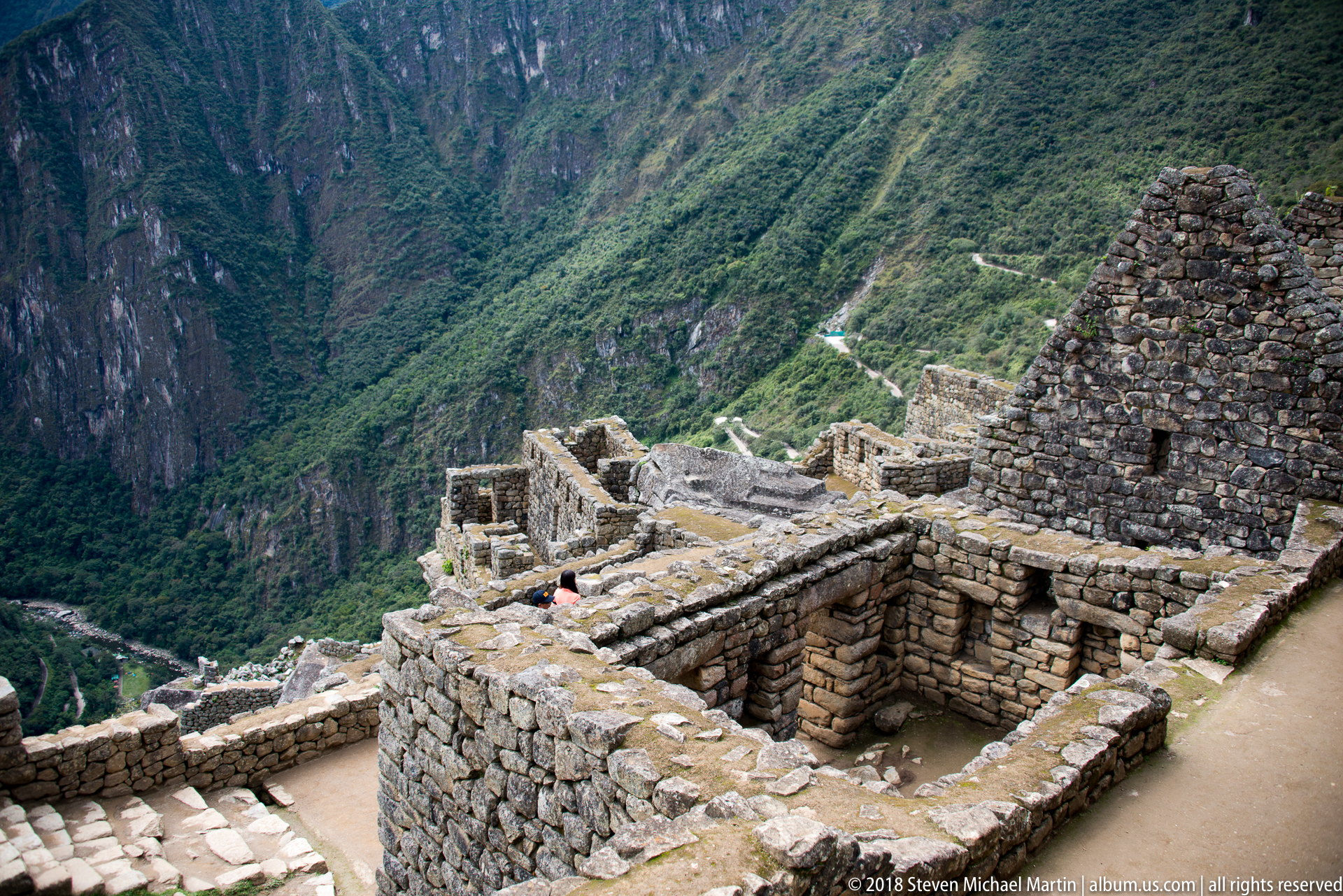
Rectangular roofless rooms and narrow passages form a compact masonry group at Machu Picchu, seen from above near the edge of the ridge. One taller gabled wall survives at right, while lower walls reveal the plan of adjacent chambers. The high viewpoint makes the spatial organization of the stone-built complex easier to read against the steep green valley.
Caption
Rectangular roofless rooms and narrow passages form a compact masonry group at Machu Picchu, seen from above near the edge of the ridge. One taller gabled wall survives at right, while lower walls reveal the plan of adjacent chambers. The high viewpoint makes the spatial organization of the stone-built complex easier to read against the steep green valley.

A steep mountain valley drops away below Machu Picchu, where a river threads through dense vegetation and a pale switchback road zigzags along the opposite slope. Sheer rock faces and rounded green ridges fill the frame. The elevated viewpoint conveys the dramatic vertical separation between the archaeological site and the transportation corridor on the valley floor.
Caption
A steep mountain valley drops away below Machu Picchu, where a river threads through dense vegetation and a pale switchback road zigzags along the opposite slope. Sheer rock faces and rounded green ridges fill the frame. The elevated viewpoint conveys the dramatic vertical separation between the archaeological site and the transportation corridor on the valley floor.

A narrow passage squeezes beneath massive overhanging rock on the route associated with Huayna Picchu. The uneven stone floor is damp and dark, and daylight enters through a small opening ahead. The confined space shows how the mountain path negotiates natural bedrock directly rather than relying only on exposed stairways and terraces.
Caption
A narrow passage squeezes beneath massive overhanging rock on the route associated with Huayna Picchu. The uneven stone floor is damp and dark, and daylight enters through a small opening ahead. The confined space shows how the mountain path negotiates natural bedrock directly rather than relying only on exposed stairways and terraces.

Stone steps pass beneath a massive low boulder, forcing the mountain route through a narrow opening between bedrock surfaces. The compressed passage illustrates the close integration of the Huayna Picchu trail with the natural rock. The photographer’s feet at the lower edge provide an immediate sense of scale and the tight clearance.
Caption
Stone steps pass beneath a massive low boulder, forcing the mountain route through a narrow opening between bedrock surfaces. The compressed passage illustrates the close integration of the Huayna Picchu trail with the natural rock. The photographer’s feet at the lower edge provide an immediate sense of scale and the tight clearance.

A narrow flight of irregular stone steps climbs steeply beside exposed bedrock and dense mountain vegetation. The stairway bends upward out of view, emphasizing the demanding gradient of the Huayna Picchu ascent. Weathered stones and encroaching plants give the path a close, tactile character distinct from the broad terraces of Machu Picchu below.
Caption
A narrow flight of irregular stone steps climbs steeply beside exposed bedrock and dense mountain vegetation. The stairway bends upward out of view, emphasizing the demanding gradient of the Huayna Picchu ascent. Weathered stones and encroaching plants give the path a close, tactile character distinct from the broad terraces of Machu Picchu below.

Stone terraces and small masonry structures cling to the upper slopes of Huayna Picchu above sheer, forested rock faces. The buildings appear as compact forms along the crest, reached by a steep route traversing the mountain. From below, the construction reads as a dramatic example of architecture adapted to extremely limited and precipitous terrain.
Caption
Stone terraces and small masonry structures cling to the upper slopes of Huayna Picchu above sheer, forested rock faces. The buildings appear as compact forms along the crest, reached by a steep route traversing the mountain. From below, the construction reads as a dramatic example of architecture adapted to extremely limited and precipitous terrain.

Stone terraces and small roofless structures occupy the upper ridge of Huayna Picchu, partly screened by dense vegetation. Their horizontal retaining walls cut across the steep mountainside, while tiny visitors provide scale along the route. The distant view stresses the precarious placement of Inca construction near the summit rather than individual architectural details.
Caption
Stone terraces and small roofless structures occupy the upper ridge of Huayna Picchu, partly screened by dense vegetation. Their horizontal retaining walls cut across the steep mountainside, while tiny visitors provide scale along the route. The distant view stresses the precarious placement of Inca construction near the summit rather than individual architectural details.

A high viewpoint on the Huayna Picchu ascent looks down into the deep valley below Machu Picchu. A river and pale switchback road are visible far beneath the steep green slopes, while walkers occupy the immediate foreground. The extreme downward angle conveys the exposure and vertical scale of the mountain route.
Caption
A high viewpoint on the Huayna Picchu ascent looks down into the deep valley below Machu Picchu. A river and pale switchback road are visible far beneath the steep green slopes, while walkers occupy the immediate foreground. The extreme downward angle conveys the exposure and vertical scale of the mountain route.

A circular metal marker is set into a small prepared patch of ground near the upper Huayna Picchu route. Its polished surface catches direct light, while faint stamped markings are visible but not legible enough to transcribe reliably. The close view records a modern reference point rather than an Inca architectural feature.
Caption
A circular metal marker is set into a small prepared patch of ground near the upper Huayna Picchu route. Its polished surface catches direct light, while faint stamped markings are visible but not legible enough to transcribe reliably. The close view records a modern reference point rather than an Inca architectural feature.

A wooden trail sign identifies “Montaña Waynapicchu” and gives an elevation of approximately 2,667.58 meters above sea level. Mounted on two reddish posts beside rocks and vegetation, the sign marks the mountain route above Machu Picchu. Its printed stair symbol reinforces the strenuous stepped ascent visible throughout this sequence.
Caption
A wooden trail sign identifies “Montaña Waynapicchu” and gives an elevation of approximately 2,667.58 meters above sea level. Mounted on two reddish posts beside rocks and vegetation, the sign marks the mountain route above Machu Picchu. Its printed stair symbol reinforces the strenuous stepped ascent visible throughout this sequence.

Large angular boulders crowd a narrow section of the Huayna Picchu route, with rough stone edging and vegetation threading between the rocks. The close viewpoint reduces the mountain to its immediate walking surface and obstacles. It contrasts with the broad summit panoramas by emphasizing the physical texture and constricted character of the climb.
Caption
Large angular boulders crowd a narrow section of the Huayna Picchu route, with rough stone edging and vegetation threading between the rocks. The close viewpoint reduces the mountain to its immediate walking surface and obstacles. It contrasts with the broad summit panoramas by emphasizing the physical texture and constricted character of the climb.

A visitor rests on a rocky ledge high on Huayna Picchu with the Machu Picchu complex visible far below across the valley. The elevated angle compresses terraces, buildings, and surrounding mountains into a broad landscape backdrop. The human figure provides scale for the steepness and exposure of the ascent while keeping the archaeological site legible in the distance.
Caption
A visitor rests on a rocky ledge high on Huayna Picchu with the Machu Picchu complex visible far below across the valley. The elevated angle compresses terraces, buildings, and surrounding mountains into a broad landscape backdrop. The human figure provides scale for the steepness and exposure of the ascent while keeping the archaeological site legible in the distance.

A distant section of Huayna Picchu’s upper ridge shows masonry terraces and visitors tracing a narrow path across the steep slope. Dense vegetation partially conceals the stonework, while exposed rock drops sharply beneath the built features. The frame emphasizes the ascent route and precarious placement of construction near the mountain crest.
Caption
A distant section of Huayna Picchu’s upper ridge shows masonry terraces and visitors tracing a narrow path across the steep slope. Dense vegetation partially conceals the stonework, while exposed rock drops sharply beneath the built features. The frame emphasizes the ascent route and precarious placement of construction near the mountain crest.

A very steep stone stair and adjacent terrace walls rise through vegetation on Huayna Picchu’s upper slope. Small climbers are visible along the route, underscoring the scale and gradient of the ascent. The telephoto view concentrates on the engineered path and retaining structures rather than the broader mountain profile.
Caption
A very steep stone stair and adjacent terrace walls rise through vegetation on Huayna Picchu’s upper slope. Small climbers are visible along the route, underscoring the scale and gradient of the ascent. The telephoto view concentrates on the engineered path and retaining structures rather than the broader mountain profile.

Another view isolates the steep masonry route across Huayna Picchu’s upper slope, where visitors climb beside high retaining walls and dense vegetation. The oblique angle reveals the route as a narrow engineered line set against the mountain face. Repetition with the preceding frame documents the ascent from a slightly shifted viewpoint and scale.
Caption
Another view isolates the steep masonry route across Huayna Picchu’s upper slope, where visitors climb beside high retaining walls and dense vegetation. The oblique angle reveals the route as a narrow engineered line set against the mountain face. Repetition with the preceding frame documents the ascent from a slightly shifted viewpoint and scale.

A narrow flight of stone steps descends sharply along the Huayna Picchu trail, bordered by wet rock and dense vegetation. A fixed safety cable runs beside the route, indicating the steep exposure of this modern visitor path through the historic mountain landscape. The close framing focuses on footing, gradient, and trail conditions.
Caption
A narrow flight of stone steps descends sharply along the Huayna Picchu trail, bordered by wet rock and dense vegetation. A fixed safety cable runs beside the route, indicating the steep exposure of this modern visitor path through the historic mountain landscape. The close framing focuses on footing, gradient, and trail conditions.

From the Huayna Picchu route, the terrain drops abruptly into the Urubamba valley, where the river appears as a pale ribbon between densely forested slopes. Angular rocks and sparse vegetation frame the foreground edge, reinforcing the exposure of the viewpoint. The composition concentrates on vertical relief and the deep valley setting surrounding Machu Picchu.
Caption
From the Huayna Picchu route, the terrain drops abruptly into the Urubamba valley, where the river appears as a pale ribbon between densely forested slopes. Angular rocks and sparse vegetation frame the foreground edge, reinforcing the exposure of the viewpoint. The composition concentrates on vertical relief and the deep valley setting surrounding Machu Picchu.

A tiny visitor stands on a narrow cliffside section of the Huayna Picchu route, nearly surrounded by dense vegetation and exposed rock. The telephoto view makes the path difficult to distinguish at first, underscoring how closely it follows the mountain face. The human figure supplies scale for the steep and rugged terrain.
Caption
A tiny visitor stands on a narrow cliffside section of the Huayna Picchu route, nearly surrounded by dense vegetation and exposed rock. The telephoto view makes the path difficult to distinguish at first, underscoring how closely it follows the mountain face. The human figure supplies scale for the steep and rugged terrain.

From high on Huayna Picchu, Machu Picchu appears as a compact stone complex enclosed by extensive green terraces. Long agricultural bands spread across the upper slope, while the urban core clusters around open lawns below. The steep downward viewpoint reveals the settlement’s overall plan and its dramatic isolation within the mountain landscape.
Caption
From high on Huayna Picchu, Machu Picchu appears as a compact stone complex enclosed by extensive green terraces. Long agricultural bands spread across the upper slope, while the urban core clusters around open lawns below. The steep downward viewpoint reveals the settlement’s overall plan and its dramatic isolation within the mountain landscape.

A second summit-area view from Huayna Picchu looks almost vertically down on Machu Picchu. Terraced fields form broad horizontal bands above the tightly clustered stone buildings, while open green spaces separate major groups within the urban core. The slightly shifted viewpoint clarifies the relationship between agricultural terraces, settlement, and the steep surrounding slopes.
Caption
A second summit-area view from Huayna Picchu looks almost vertically down on Machu Picchu. Terraced fields form broad horizontal bands above the tightly clustered stone buildings, while open green spaces separate major groups within the urban core. The slightly shifted viewpoint clarifies the relationship between agricultural terraces, settlement, and the steep surrounding slopes.

Roughly coursed stone masonry fills the foreground at Huayna Picchu while Machu Picchu lies far below in soft focus. Projecting stones and irregular joints give the nearby wall a strong sculptural presence, contrasting with the distant geometry of terraces and buildings. The composition links a close architectural detail on the mountain to the broader archaeological landscape beneath it.
Caption
Roughly coursed stone masonry fills the foreground at Huayna Picchu while Machu Picchu lies far below in soft focus. Projecting stones and irregular joints give the nearby wall a strong sculptural presence, contrasting with the distant geometry of terraces and buildings. The composition links a close architectural detail on the mountain to the broader archaeological landscape beneath it.

Rough stonework in the foreground forms a ledge high on Huayna Picchu, with the Machu Picchu complex spread far below in the valley. Terraces, open lawns, and dense masonry groups remain visible despite the strong depth separation. The close foreground architecture and distant citadel create a layered view of construction at two elevations within the archaeological landscape.
Caption
Rough stonework in the foreground forms a ledge high on Huayna Picchu, with the Machu Picchu complex spread far below in the valley. Terraces, open lawns, and dense masonry groups remain visible despite the strong depth separation. The close foreground architecture and distant citadel create a layered view of construction at two elevations within the archaeological landscape.

Layers of rough-cut stone masonry rise at the edge of the Huayna Picchu route, with the mountain landscape falling away behind them. Grass grows from joints and ledges between the stones, emphasizing the weathered character of the exposed construction. The tight framing isolates wall texture and precarious placement rather than the broader archaeological setting.
Caption
Layers of rough-cut stone masonry rise at the edge of the Huayna Picchu route, with the mountain landscape falling away behind them. Grass grows from joints and ledges between the stones, emphasizing the weathered character of the exposed construction. The tight framing isolates wall texture and precarious placement rather than the broader archaeological setting.

Small, shallow steps have been cut directly into sloping bedrock on the Huayna Picchu route. Their irregular spacing follows the natural rock surface rather than forming a conventional stair, while scattered leaves and damp patches mark the exposed trail. The close view highlights the minimal intervention used to create footholds on difficult terrain.
Caption
Small, shallow steps have been cut directly into sloping bedrock on the Huayna Picchu route. Their irregular spacing follows the natural rock surface rather than forming a conventional stair, while scattered leaves and damp patches mark the exposed trail. The close view highlights the minimal intervention used to create footholds on difficult terrain.

An elevated view from Huayna Picchu looks down across a dense sector of Machu Picchu where roofless stone rooms, narrow passages, and stepped terraces crowd the slope. Visitors provide scale within the masonry complex, while larger boulders interrupt the built fabric at right. The view reveals the settlement’s compact organization and close adaptation to uneven bedrock.
Caption
An elevated view from Huayna Picchu looks down across a dense sector of Machu Picchu where roofless stone rooms, narrow passages, and stepped terraces crowd the slope. Visitors provide scale within the masonry complex, while larger boulders interrupt the built fabric at right. The view reveals the settlement’s compact organization and close adaptation to uneven bedrock.

Roofless stone compounds occupy the lower foreground while long green terraces rise diagonally behind them at Machu Picchu. A small group of reconstructed thatched roofs stands near the upper terrace edge, backed by dense forest. The oblique view distinguishes the compact masonry enclosures from the more regular agricultural bands above.
Caption
Roofless stone compounds occupy the lower foreground while long green terraces rise diagonally behind them at Machu Picchu. A small group of reconstructed thatched roofs stands near the upper terrace edge, backed by dense forest. The oblique view distinguishes the compact masonry enclosures from the more regular agricultural bands above.

A short section of damp stone stair crosses exposed bedrock on the Huayna Picchu route. Water-darkened surfaces, patches of moss, and grasses occupy cracks beside the irregular steps, making the trail’s footing and weathering especially visible. The close downward view records a practical circulation feature rather than a monumental element of the site.
Caption
A short section of damp stone stair crosses exposed bedrock on the Huayna Picchu route. Water-darkened surfaces, patches of moss, and grasses occupy cracks beside the irregular steps, making the trail’s footing and weathering especially visible. The close downward view records a practical circulation feature rather than a monumental element of the site.

Several llamas graze across a broad green lawn within Machu Picchu, surrounded by low stone terraces and scattered boulders. Their small scale against the open grass emphasizes the spacious central landscape between architectural groups. The animals add contemporary activity to a view otherwise defined by terraces, retaining walls, and vegetation.
Caption
Several llamas graze across a broad green lawn within Machu Picchu, surrounded by low stone terraces and scattered boulders. Their small scale against the open grass emphasizes the spacious central landscape between architectural groups. The animals add contemporary activity to a view otherwise defined by terraces, retaining walls, and vegetation.

Long agricultural terraces sweep across the upper slope while Machu Picchu’s dense stone-built core occupies the center of the frame. Open lawns and broad paths separate the architectural groups, and sunlight picks out the terrace walls against darker forest. The high viewpoint provides a particularly legible reading of the relationship between cultivation, circulation, and settlement.
Caption
Long agricultural terraces sweep across the upper slope while Machu Picchu’s dense stone-built core occupies the center of the frame. Open lawns and broad paths separate the architectural groups, and sunlight picks out the terrace walls against darker forest. The high viewpoint provides a particularly legible reading of the relationship between cultivation, circulation, and settlement.

Sunlit terraces spread across the Machu Picchu slope beneath a broad, forested mountain ridge. The built core sits lower in the composition while the mountains occupy most of the background, making the archaeological site appear embedded within a much larger Andean landscape. Strong light and shadow separate the geometric terrace bands from the natural contours above.
Caption
Sunlit terraces spread across the Machu Picchu slope beneath a broad, forested mountain ridge. The built core sits lower in the composition while the mountains occupy most of the background, making the archaeological site appear embedded within a much larger Andean landscape. Strong light and shadow separate the geometric terrace bands from the natural contours above.

A broad panoramic view from Huayna Picchu looks across the Machu Picchu ridge and the surrounding Vilcabamba mountain landscape. The archaeological complex occupies a small, bright patch amid immense green and rock-faced peaks, with deep valleys cutting between the ridges. The wider framing makes terrain, rather than architecture, the dominant subject.
Caption
A broad panoramic view from Huayna Picchu looks across the Machu Picchu ridge and the surrounding Vilcabamba mountain landscape. The archaeological complex occupies a small, bright patch amid immense green and rock-faced peaks, with deep valleys cutting between the ridges. The wider framing makes terrain, rather than architecture, the dominant subject.

Uneven stone steps climb through exposed rock and dense vegetation on the Huayna Picchu route. A metal handrail follows the steepest section, providing modern support along the narrow ascent. The close viewpoint emphasizes rough footing, confined space, and the contrast between constructed steps and natural bedrock.
Caption
Uneven stone steps climb through exposed rock and dense vegetation on the Huayna Picchu route. A metal handrail follows the steepest section, providing modern support along the narrow ascent. The close viewpoint emphasizes rough footing, confined space, and the contrast between constructed steps and natural bedrock.

A visitor stands at a high Huayna Picchu overlook with Machu Picchu visible far below on its narrow ridge. Jagged mountain walls rise around the archaeological complex, while roads and the river corridor thread through the valleys beneath. The foreground figure gives scale to the extraordinary vertical distance between the viewpoint and the citadel.
Caption
A visitor stands at a high Huayna Picchu overlook with Machu Picchu visible far below on its narrow ridge. Jagged mountain walls rise around the archaeological complex, while roads and the river corridor thread through the valleys beneath. The foreground figure gives scale to the extraordinary vertical distance between the viewpoint and the citadel.

Extensive terraces dominate this elevated view of Machu Picchu, stepping across the slope in long, tightly spaced bands. Roofless buildings and plazas cluster at lower right, while additional terraces climb toward the forested edge above. The composition gives unusual emphasis to the scale and regularity of the agricultural engineering across the ridge.
Caption
Extensive terraces dominate this elevated view of Machu Picchu, stepping across the slope in long, tightly spaced bands. Roofless buildings and plazas cluster at lower right, while additional terraces climb toward the forested edge above. The composition gives unusual emphasis to the scale and regularity of the agricultural engineering across the ridge.

A circular brass-colored geodetic marker is set into concrete and inscribed “Santuario Histórico de Machu Picchu,” “Prohibido su destrucción,” the year 2005, and “Punto Geodésico.” The close view preserves the official identification and warning text, documenting a modern surveying reference associated with management of the protected archaeological landscape.
Caption
A circular brass-colored geodetic marker is set into concrete and inscribed “Santuario Histórico de Machu Picchu,” “Prohibido su destrucción,” the year 2005, and “Punto Geodésico.” The close view preserves the official identification and warning text, documenting a modern surveying reference associated with management of the protected archaeological landscape.

A thick green rope is knotted around a metal support beside steep stone steps on the Huayna Picchu route. The rope functions as a modern handline where the path climbs through rock and vegetation. The close view records contemporary visitor-safety infrastructure integrated into the mountain trail rather than an archaeological feature.
Caption
A thick green rope is knotted around a metal support beside steep stone steps on the Huayna Picchu route. The rope functions as a modern handline where the path climbs through rock and vegetation. The close view records contemporary visitor-safety infrastructure integrated into the mountain trail rather than an archaeological feature.

A steep, partly vegetated mountainside holds a small concentration of stonework and wooden trail elements above the shadowed valley. The distant view is partially blurred, making the exact function of the structures difficult to determine, but their placement shows how the route negotiates narrow ledges and broken rock on Huayna Picchu.
Caption
A steep, partly vegetated mountainside holds a small concentration of stonework and wooden trail elements above the shadowed valley. The distant view is partially blurred, making the exact function of the structures difficult to determine, but their placement shows how the route negotiates narrow ledges and broken rock on Huayna Picchu.

A broad flight of irregular stone steps climbs steadily through dense vegetation and between exposed rock faces on the Huayna Picchu route. The stair occupies almost the entire frame, allowing the uneven tread depth and weathered surfaces to be read clearly. It documents a longer, more formalized section of the ascent than the narrow footholds seen elsewhere.
Caption
A broad flight of irregular stone steps climbs steadily through dense vegetation and between exposed rock faces on the Huayna Picchu route. The stair occupies almost the entire frame, allowing the uneven tread depth and weathered surfaces to be read clearly. It documents a longer, more formalized section of the ascent than the narrow footholds seen elsewhere.

A rugged rocky outcrop rises from the Huayna Picchu ridge above a deep mountain valley. Small trail or masonry elements are visible among the rocks, while grasses and shrubs cling to the exposed crest. Strong shadow across one side of the formation emphasizes the sharp relief and narrowness of the summit terrain.
Caption
A rugged rocky outcrop rises from the Huayna Picchu ridge above a deep mountain valley. Small trail or masonry elements are visible among the rocks, while grasses and shrubs cling to the exposed crest. Strong shadow across one side of the formation emphasizes the sharp relief and narrowness of the summit terrain.

A man in a blue shirt stands on an exposed rock ledge high on Huayna Picchu, with Machu Picchu visible far below on the ridge behind him. Switchback paths, terraces, and the surrounding mountains extend across the background. The posed portrait uses the immense landscape to convey the scale and elevation of the ascent.
Caption
A man in a blue shirt stands on an exposed rock ledge high on Huayna Picchu, with Machu Picchu visible far below on the ridge behind him. Switchback paths, terraces, and the surrounding mountains extend across the background. The posed portrait uses the immense landscape to convey the scale and elevation of the ascent.

A visitor poses with arms outstretched on a broad rock at Huayna Picchu, overlooking Machu Picchu and the surrounding mountain ridges. The citadel appears below and to the right, while pale switchbacks cut across the green slope behind him. The pose and wide framing make this a human-centered record of the summit experience.
Caption
A visitor poses with arms outstretched on a broad rock at Huayna Picchu, overlooking Machu Picchu and the surrounding mountain ridges. The citadel appears below and to the right, while pale switchbacks cut across the green slope behind him. The pose and wide framing make this a human-centered record of the summit experience.

A man in a blue shirt steps across the uneven rock surface at a Huayna Picchu viewpoint, with Machu Picchu visible in the valley behind. His movement contrasts with the posed portraits in adjacent frames and emphasizes the practical footing of the exposed summit area. Mountain slopes, trails, and archaeological terraces fill the background.
Caption
A man in a blue shirt steps across the uneven rock surface at a Huayna Picchu viewpoint, with Machu Picchu visible in the valley behind. His movement contrasts with the posed portraits in adjacent frames and emphasizes the practical footing of the exposed summit area. Mountain slopes, trails, and archaeological terraces fill the background.

Stone steps climb sharply through a shaded section of the Huayna Picchu route, accompanied by a fixed metal cable and posts. Vegetation presses close to the narrow stair while exposed rock forms the outer edge. The view records the combination of historic stone circulation and modern safety measures used on the steep mountain trail.
Caption
Stone steps climb sharply through a shaded section of the Huayna Picchu route, accompanied by a fixed metal cable and posts. Vegetation presses close to the narrow stair while exposed rock forms the outer edge. The view records the combination of historic stone circulation and modern safety measures used on the steep mountain trail.

Branches and shaded foliage frame a distant view of Machu Picchu beneath the steep profile of Huayna Picchu. The citadel’s terraces and stone buildings occupy a bright opening between darker vegetation in the foreground, producing a natural frame around the site. The composition shifts attention from the summit trail back toward the archaeological landscape.
Caption
Branches and shaded foliage frame a distant view of Machu Picchu beneath the steep profile of Huayna Picchu. The citadel’s terraces and stone buildings occupy a bright opening between darker vegetation in the foreground, producing a natural frame around the site. The composition shifts attention from the summit trail back toward the archaeological landscape.

Stone steps descend steeply across exposed bedrock on Huayna Picchu, with a metal handline continuing down the right side. Sunlit spiky plants grow beside the trail while the valley beyond falls into deep shadow. The downward viewpoint conveys both the rough footing and the strong exposure of this section of the route.
Caption
Stone steps descend steeply across exposed bedrock on Huayna Picchu, with a metal handline continuing down the right side. Sunlit spiky plants grow beside the trail while the valley beyond falls into deep shadow. The downward viewpoint conveys both the rough footing and the strong exposure of this section of the route.

A sunlit rocky outcrop rises above the Huayna Picchu trail beneath a clear blue sky. Layered stone surfaces, low shrubs, and small grasses cover the steep formation, while tiny visitors or trail elements are barely visible along the slope. The frame emphasizes the rugged natural structure of the mountain rather than the archaeological site below.
Caption
A sunlit rocky outcrop rises above the Huayna Picchu trail beneath a clear blue sky. Layered stone surfaces, low shrubs, and small grasses cover the steep formation, while tiny visitors or trail elements are barely visible along the slope. The frame emphasizes the rugged natural structure of the mountain rather than the archaeological site below.

A narrow stair climbs between large rock masses on the Huayna Picchu route, with a metal handrail guiding the ascent through the confined passage. Bromeliad-like plants and other vegetation grow from crevices above the stonework. The close framing shows how the path squeezes through natural bedrock while maintaining a built circulation line.
Caption
A narrow stair climbs between large rock masses on the Huayna Picchu route, with a metal handrail guiding the ascent through the confined passage. Bromeliad-like plants and other vegetation grow from crevices above the stonework. The close framing shows how the path squeezes through natural bedrock while maintaining a built circulation line.

A long stone stair rises through dense mountain vegetation on the Huayna Picchu trail. The irregular treads are partly shaded, with roots, leaves, and low plants encroaching along both edges. Compared with the more exposed summit sections, this view shows the route enclosed by forest and rocky banks.
Caption
A long stone stair rises through dense mountain vegetation on the Huayna Picchu trail. The irregular treads are partly shaded, with roots, leaves, and low plants encroaching along both edges. Compared with the more exposed summit sections, this view shows the route enclosed by forest and rocky banks.

A small group of regular stepped stone terraces appears on a densely forested slope far below the Huayna Picchu route. Foreground stems and leaves partially frame the distant masonry, while the deep valley beyond remains in shadow. The isolated geometric pattern stands out clearly against the surrounding natural vegetation.
Caption
A small group of regular stepped stone terraces appears on a densely forested slope far below the Huayna Picchu route. Foreground stems and leaves partially frame the distant masonry, while the deep valley beyond remains in shadow. The isolated geometric pattern stands out clearly against the surrounding natural vegetation.

Broad, uneven stone steps rise through a sunlit section of the Huayna Picchu trail. Bedrock borders the left side while grasses and shrubs crowd the right, creating a narrow corridor up the slope. The view documents a more open section of the ascent where the stair is clearly built into the mountain terrain.
Caption
Broad, uneven stone steps rise through a sunlit section of the Huayna Picchu trail. Bedrock borders the left side while grasses and shrubs crowd the right, creating a narrow corridor up the slope. The view documents a more open section of the ascent where the stair is clearly built into the mountain terrain.

A wooden trail sign marks the junction for Waynapicchu Mountain and Huchuypicchu Mountain. Two separate boards use directional arrows to distinguish the routes, mounted on a single post among rocks, moss, and forest vegetation. The sign records contemporary visitor navigation within the protected Machu Picchu mountain landscape.
Caption
A wooden trail sign marks the junction for Waynapicchu Mountain and Huchuypicchu Mountain. Two separate boards use directional arrows to distinguish the routes, mounted on a single post among rocks, moss, and forest vegetation. The sign records contemporary visitor navigation within the protected Machu Picchu mountain landscape.

A steep flight of irregular stone steps climbs beside exposed bedrock on the Huayna Picchu route. A fixed metal handline follows the rock face, while dense vegetation closes in from the opposite side. The confined view emphasizes the rugged footing and direct adaptation of the mountain path to natural stone.
Caption
A steep flight of irregular stone steps climbs beside exposed bedrock on the Huayna Picchu route. A fixed metal handline follows the rock face, while dense vegetation closes in from the opposite side. The confined view emphasizes the rugged footing and direct adaptation of the mountain path to natural stone.

Steep forested ridges fold into deep valleys beneath a line of higher Andean peaks near Machu Picchu. Dense green vegetation covers the lower slopes, while clouds skim the upper skyline. With no architecture in view, the frame concentrates entirely on the dramatic mountain environment enclosing the archaeological sanctuary.
Caption
Steep forested ridges fold into deep valleys beneath a line of higher Andean peaks near Machu Picchu. Dense green vegetation covers the lower slopes, while clouds skim the upper skyline. With no architecture in view, the frame concentrates entirely on the dramatic mountain environment enclosing the archaeological sanctuary.

A large white arrow painted on a dark stone surface points toward Huayna Picchu, with the mountain name written in blue capital letters. Weathering, moss, and surrounding leaf litter place the marker directly within the trail environment. The simple wayfinding device contrasts sharply with the historic stone stairs and masonry elsewhere on the route.
Caption
A large white arrow painted on a dark stone surface points toward Huayna Picchu, with the mountain name written in blue capital letters. Weathering, moss, and surrounding leaf litter place the marker directly within the trail environment. The simple wayfinding device contrasts sharply with the historic stone stairs and masonry elsewhere on the route.

A seated visitor rests on a stone ledge high above Machu Picchu, with terraces and the archaeological complex visible far below. Massive Andean ridges rise across the valley under broken clouds, dwarfing both the figure and the site. The portrait uses the elevated viewpoint to convey the scale of the mountain setting around the citadel.
Caption
A seated visitor rests on a stone ledge high above Machu Picchu, with terraces and the archaeological complex visible far below. Massive Andean ridges rise across the valley under broken clouds, dwarfing both the figure and the site. The portrait uses the elevated viewpoint to convey the scale of the mountain setting around the citadel.

A wooden control structure stands along the Huayna Picchu route, with posted visitor information and a central entry opening. The gabled building is framed by trees and mountain rock, and several visitors gather in front. Its modern timber construction identifies it as trail-management infrastructure rather than part of the Inca archaeological fabric.
Caption
A wooden control structure stands along the Huayna Picchu route, with posted visitor information and a central entry opening. The gabled building is framed by trees and mountain rock, and several visitors gather in front. Its modern timber construction identifies it as trail-management infrastructure rather than part of the Inca archaeological fabric.

Jagged Andean peaks rise sharply from deep shadowed valleys near Machu Picchu. Sunlit rock faces alternate with dark forested slopes, while a line of bright clouds stretches across the blue sky above. The vertical composition emphasizes the extreme relief of the mountains surrounding the archaeological sanctuary.
Caption
Jagged Andean peaks rise sharply from deep shadowed valleys near Machu Picchu. Sunlit rock faces alternate with dark forested slopes, while a line of bright clouds stretches across the blue sky above. The vertical composition emphasizes the extreme relief of the mountains surrounding the archaeological sanctuary.

A high viewpoint looks across steep green ridges and dark rock walls in the mountains surrounding Machu Picchu. The terrain drops into narrow valleys between sharply sculpted peaks, with bright clouds tracing the skyline. A small stone edge in the foreground anchors the otherwise expansive mountain panorama.
Caption
A high viewpoint looks across steep green ridges and dark rock walls in the mountains surrounding Machu Picchu. The terrain drops into narrow valleys between sharply sculpted peaks, with bright clouds tracing the skyline. A small stone edge in the foreground anchors the otherwise expansive mountain panorama.

An elevated panoramic view places Machu Picchu on a sunlit ridge beneath immense, deeply eroded mountain walls. The terraced agricultural sector and urban core occupy only a small part of the frame, emphasizing the overwhelming scale of the surrounding Andes. Bright clouds skim the upper slopes while deep shadows cut through the valley.
Caption
An elevated panoramic view places Machu Picchu on a sunlit ridge beneath immense, deeply eroded mountain walls. The terraced agricultural sector and urban core occupy only a small part of the frame, emphasizing the overwhelming scale of the surrounding Andes. Bright clouds skim the upper slopes while deep shadows cut through the valley.

A man in a blue shirt stands at a high viewpoint with Machu Picchu spread across the ridge below him. Terraced fields, stone buildings, and steep mountain slopes form a broad backdrop. The portrait emphasizes the dramatic elevation of the viewpoint while keeping the archaeological complex clearly legible behind the figure.
Caption
A man in a blue shirt stands at a high viewpoint with Machu Picchu spread across the ridge below him. Terraced fields, stone buildings, and steep mountain slopes form a broad backdrop. The portrait emphasizes the dramatic elevation of the viewpoint while keeping the archaeological complex clearly legible behind the figure.

A triangular stone gable at Machu Picchu supports a reconstructed thatched roof against a clear blue sky. Irregular masonry courses define the wall surface, and projecting stone elements punctuate the upper gable beneath the dark roof edge. The close architectural view emphasizes wall construction and traditional roof form rather than the broader site.
Caption
A triangular stone gable at Machu Picchu supports a reconstructed thatched roof against a clear blue sky. Irregular masonry courses define the wall surface, and projecting stone elements punctuate the upper gable beneath the dark roof edge. The close architectural view emphasizes wall construction and traditional roof form rather than the broader site.

A rectangular stone building at Machu Picchu is capped by a reconstructed thatched gable roof. A small trapezoidal opening punctures the front wall, while the irregular masonry contrasts with the smooth earthen ground in front. The frontal view gives a clear sense of the building’s simple massing and traditional roof profile.
Caption
A rectangular stone building at Machu Picchu is capped by a reconstructed thatched gable roof. A small trapezoidal opening punctures the front wall, while the irregular masonry contrasts with the smooth earthen ground in front. The frontal view gives a clear sense of the building’s simple massing and traditional roof profile.

A visitor in a blue shirt climbs a rocky mountain path with Machu Picchu visible across the valley behind him. The citadel’s terraces occupy the mid-distance beneath high ridges and clouds, while vegetation borders the trail. The candid movement distinguishes this frame from the posed overlook portraits in the surrounding sequence.
Caption
A visitor in a blue shirt climbs a rocky mountain path with Machu Picchu visible across the valley behind him. The citadel’s terraces occupy the mid-distance beneath high ridges and clouds, while vegetation borders the trail. The candid movement distinguishes this frame from the posed overlook portraits in the surrounding sequence.

A monumental shaped stone stands at the center of an open space at Machu Picchu, framed by thatched stone structures and a dramatic line of Andean peaks. Its broad, angular profile echoes the mountain silhouettes beyond. The composition is consistent with the Sacred Rock area, where a prominent natural-form stone is presented within the archaeological complex.
Caption
A monumental shaped stone stands at the center of an open space at Machu Picchu, framed by thatched stone structures and a dramatic line of Andean peaks. Its broad, angular profile echoes the mountain silhouettes beyond. The composition is consistent with the Sacred Rock area, where a prominent natural-form stone is presented within the archaeological complex.

Two visitors pose on a green lawn within Machu Picchu, backed by massive stepped terraces, stone walls, and mountain slopes. The broad terrace faces rise prominently behind the pair and dominate the architectural setting. The portrait combines human scale with a clear view of the site’s terraced construction and surrounding urban fabric.
Caption
Two visitors pose on a green lawn within Machu Picchu, backed by massive stepped terraces, stone walls, and mountain slopes. The broad terrace faces rise prominently behind the pair and dominate the architectural setting. The portrait combines human scale with a clear view of the site’s terraced construction and surrounding urban fabric.

A white llama walks along a narrow grassy terrace at Machu Picchu, bordered by low stone retaining walls and large natural boulders. Dense vegetation climbs the slope behind it. The animal provides a lively scale reference within the archaeological landscape and contrasts with the dark masonry and rock surfaces.
Caption
A white llama walks along a narrow grassy terrace at Machu Picchu, bordered by low stone retaining walls and large natural boulders. Dense vegetation climbs the slope behind it. The animal provides a lively scale reference within the archaeological landscape and contrasts with the dark masonry and rock surfaces.

A rufous-collared sparrow stands in side profile on a pale stone, its layered brown wing feathers, gray underparts, chestnut neck patch, and boldly striped head sharply rendered. The shallow depth of field turns the background into soft color, concentrating attention on plumage and body form rather than the surrounding site.
Caption
A rufous-collared sparrow stands in side profile on a pale stone, its layered brown wing feathers, gray underparts, chestnut neck patch, and boldly striped head sharply rendered. The shallow depth of field turns the background into soft color, concentrating attention on plumage and body form rather than the surrounding site.

An adult llama and a smaller young camelid walk across an open area within Machu Picchu, backed by finely fitted stone walls. Their movement brings contemporary life into a setting otherwise defined by carefully worked Inca masonry. The pair also provides an immediate scale reference for the surrounding architectural blocks.
Caption
An adult llama and a smaller young camelid walk across an open area within Machu Picchu, backed by finely fitted stone walls. Their movement brings contemporary life into a setting otherwise defined by carefully worked Inca masonry. The pair also provides an immediate scale reference for the surrounding architectural blocks.

Two visitors pose at the edge of a green lawn with Machu Picchu’s stepped stone terraces rising behind them. Roofless masonry groups extend across the left side while high terrace walls dominate the right. The frame presents the visitors as foreground scale against the dense geometry of the archaeological site.
Caption
Two visitors pose at the edge of a green lawn with Machu Picchu’s stepped stone terraces rising behind them. Roofless masonry groups extend across the left side while high terrace walls dominate the right. The frame presents the visitors as foreground scale against the dense geometry of the archaeological site.

Massive stepped terraces rise across the right side of Machu Picchu while lower architectural groups and additional terrace bands extend toward the left. Bright afternoon light sharpens the horizontal retaining walls against the green grass, with steep mountains forming the backdrop. The unobstructed view gives the terrace complex a monumental, almost pyramidal profile.
Caption
Massive stepped terraces rise across the right side of Machu Picchu while lower architectural groups and additional terrace bands extend toward the left. Bright afternoon light sharpens the horizontal retaining walls against the green grass, with steep mountains forming the backdrop. The unobstructed view gives the terrace complex a monumental, almost pyramidal profile.

A rufous-collared sparrow perches upright on a rounded stone at Machu Picchu. Its gray breast, chestnut collar, striped black-and-gray head, and compact conical bill are clearly visible against a soft green background. The close portrait isolates the bird from the archaeological setting and records a common Andean species at unusually fine detail.
Caption
A rufous-collared sparrow perches upright on a rounded stone at Machu Picchu. Its gray breast, chestnut collar, striped black-and-gray head, and compact conical bill are clearly visible against a soft green background. The close portrait isolates the bird from the archaeological setting and records a common Andean species at unusually fine detail.

Huayna Picchu rises steeply against a clear blue sky, its rocky upper slopes carrying narrow terraces and small masonry structures. Vegetation clings to ledges across the mountain face while late sunlight catches the crest. The telephoto view isolates the extraordinary concentration of construction near the summit.
Caption
Huayna Picchu rises steeply against a clear blue sky, its rocky upper slopes carrying narrow terraces and small masonry structures. Vegetation clings to ledges across the mountain face while late sunlight catches the crest. The telephoto view isolates the extraordinary concentration of construction near the summit.

A circular metal survey marker set into concrete is inscribed “Santuario Histórico de Machu Picchu,” “Prohibido su destrucción,” “2005,” “Punto Geodésico,” “Orden C,” and the number 186. The close documentary view records an official modern geodetic reference used within the protected historic sanctuary.
Caption
A circular metal survey marker set into concrete is inscribed “Santuario Histórico de Machu Picchu,” “Prohibido su destrucción,” “2005,” “Punto Geodésico,” “Orden C,” and the number 186. The close documentary view records an official modern geodetic reference used within the protected historic sanctuary.

Broad stepped terraces occupy the foreground and right side of Machu Picchu, while dense roofless stone compounds fill the lower slope to the left. Large natural boulders emerge between retaining walls, showing how the built landscape incorporates uneven bedrock. Sunlit grass and deep shade create strong relief across the architectural levels.
Caption
Broad stepped terraces occupy the foreground and right side of Machu Picchu, while dense roofless stone compounds fill the lower slope to the left. Large natural boulders emerge between retaining walls, showing how the built landscape incorporates uneven bedrock. Sunlit grass and deep shade create strong relief across the architectural levels.

Monumental terrace walls rise in a compact stepped mass above a broad green lawn at Machu Picchu. Horizontal stone retaining courses create a strong geometric rhythm, interrupted by natural rock outcrops and a few visitors for scale. The relatively open foreground gives the terrace construction exceptional visual prominence.
Caption
Monumental terrace walls rise in a compact stepped mass above a broad green lawn at Machu Picchu. Horizontal stone retaining courses create a strong geometric rhythm, interrupted by natural rock outcrops and a few visitors for scale. The relatively open foreground gives the terrace construction exceptional visual prominence.

A line of roofless stone buildings casts long shadows across a broad path at Machu Picchu, with Huayna Picchu rising dramatically beyond. Repeated gabled wall profiles and narrow openings define the architectural rhythm, while the dark mountain silhouette anchors the background. The low-angle light gives unusual emphasis to wall geometry and shadow.
Caption
A line of roofless stone buildings casts long shadows across a broad path at Machu Picchu, with Huayna Picchu rising dramatically beyond. Repeated gabled wall profiles and narrow openings define the architectural rhythm, while the dark mountain silhouette anchors the background. The low-angle light gives unusual emphasis to wall geometry and shadow.

Roofless masonry structures line a narrow passage at Machu Picchu, their tall triangular gables rising against a vivid blue sky. Rectangular and slightly tapered openings punctuate the walls, while a mountain ridge appears beyond the complex. The close architectural view emphasizes building form, wall thickness, and repeated doorway rhythm.
Caption
Roofless masonry structures line a narrow passage at Machu Picchu, their tall triangular gables rising against a vivid blue sky. Rectangular and slightly tapered openings punctuate the walls, while a mountain ridge appears beyond the complex. The close architectural view emphasizes building form, wall thickness, and repeated doorway rhythm.

Sunlit terraces and low stone structures descend a steep slope at Machu Picchu toward a deeply shadowed valley. Narrow green platforms alternate with retaining walls and small enclosures, while foreground masonry provides a high vantage over the lower sector. The contrast between brilliant grass and dark mountain shadow accentuates the site’s vertical setting.
Caption
Sunlit terraces and low stone structures descend a steep slope at Machu Picchu toward a deeply shadowed valley. Narrow green platforms alternate with retaining walls and small enclosures, while foreground masonry provides a high vantage over the lower sector. The contrast between brilliant grass and dark mountain shadow accentuates the site’s vertical setting.

Massive stone walls and a narrow doorway occupy the foreground at Machu Picchu, while the steep profile of Huayna Picchu rises beyond under a deep blue sky. A visitor stands within the architectural space, providing scale for the masonry. The composition uses the surviving walls to frame one of the site’s most recognizable mountain backdrops.
Caption
Massive stone walls and a narrow doorway occupy the foreground at Machu Picchu, while the steep profile of Huayna Picchu rises beyond under a deep blue sky. A visitor stands within the architectural space, providing scale for the masonry. The composition uses the surviving walls to frame one of the site’s most recognizable mountain backdrops.

Long agricultural terraces climb the slope toward a dense cluster of roofless Inca masonry at Machu Picchu. A tall tree punctuates the central ridge, while exposed boulders and retaining walls break the otherwise regular terrace pattern. The elevated view shows how cultivated platforms and architectural compounds were interlocked across steep terrain.
Caption
Long agricultural terraces climb the slope toward a dense cluster of roofless Inca masonry at Machu Picchu. A tall tree punctuates the central ridge, while exposed boulders and retaining walls break the otherwise regular terrace pattern. The elevated view shows how cultivated platforms and architectural compounds were interlocked across steep terrain.

Broad, evenly spaced terraces sweep up the Machu Picchu slope toward upper masonry compounds and a small reconstructed roof. Strong side light sharpens the horizontal retaining walls, while steep mountains form a dark backdrop. The composition gives exceptional prominence to the agricultural engineering that shaped the ridge.
Caption
Broad, evenly spaced terraces sweep up the Machu Picchu slope toward upper masonry compounds and a small reconstructed roof. Strong side light sharpens the horizontal retaining walls, while steep mountains form a dark backdrop. The composition gives exceptional prominence to the agricultural engineering that shaped the ridge.

A tall tree stands against sunlit agricultural terraces at Machu Picchu, with massive stone walls and roofless buildings rising along the right side. The scene balances natural vegetation with the strong geometry of retaining walls and masonry. Small visitors on the terraces provide scale for the monumental construction.
Caption
A tall tree stands against sunlit agricultural terraces at Machu Picchu, with massive stone walls and roofless buildings rising along the right side. The scene balances natural vegetation with the strong geometry of retaining walls and masonry. Small visitors on the terraces provide scale for the monumental construction.

Jagged Andean peaks dominate the horizon beyond a row of roofless stone gables at Machu Picchu. Deep shadow fills the valleys between the mountains, while the foreground masonry forms a dark architectural silhouette. The frame shifts attention from the citadel itself to the dramatic mountain enclosure that defines its setting.
Caption
Jagged Andean peaks dominate the horizon beyond a row of roofless stone gables at Machu Picchu. Deep shadow fills the valleys between the mountains, while the foreground masonry forms a dark architectural silhouette. The frame shifts attention from the citadel itself to the dramatic mountain enclosure that defines its setting.

A llama stands in profile on a broad path at Machu Picchu, framed by roofless stone walls and the steep bulk of Huayna Picchu. Another camelid appears farther left. The animal’s upright posture and the iconic mountain background create a strongly contextual wildlife portrait within the archaeological site.
Caption
A llama stands in profile on a broad path at Machu Picchu, framed by roofless stone walls and the steep bulk of Huayna Picchu. Another camelid appears farther left. The animal’s upright posture and the iconic mountain background create a strongly contextual wildlife portrait within the archaeological site.

A llama fills the foreground in a close profile view, its long ears and woolly coat sharply outlined against a rounded green mountain. Low stone walls and terraces remain visible below the peak, preserving the Machu Picchu setting while the animal becomes the dominant subject. The shallow depth separates the portrait from the broader landscape.
Caption
A llama fills the foreground in a close profile view, its long ears and woolly coat sharply outlined against a rounded green mountain. Low stone walls and terraces remain visible below the peak, preserving the Machu Picchu setting while the animal becomes the dominant subject. The shallow depth separates the portrait from the broader landscape.

A llama’s face fills the frame in a close frontal portrait, with both upright ears and a yellow identification tag clearly visible. Fine hair around the muzzle and forehead is sharply rendered against a softly blurred stone-and-grass background. The intimate scale turns a familiar Machu Picchu animal into the primary subject.
Caption
A llama’s face fills the frame in a close frontal portrait, with both upright ears and a yellow identification tag clearly visible. Fine hair around the muzzle and forehead is sharply rendered against a softly blurred stone-and-grass background. The intimate scale turns a familiar Machu Picchu animal into the primary subject.

A young llama trots across an open path at Machu Picchu, one foreleg lifted mid-stride. Stone walls line the route while a rounded mountain rises behind, giving the moving animal a clear sense of place. The frame records spontaneous activity rather than a posed wildlife portrait.
Caption
A young llama trots across an open path at Machu Picchu, one foreleg lifted mid-stride. Stone walls line the route while a rounded mountain rises behind, giving the moving animal a clear sense of place. The frame records spontaneous activity rather than a posed wildlife portrait.

A young llama stands in side profile with a yellow ear tag visible against a blurred line of roofless stone gables. Its bright white neck and reddish head are sharply separated from the darker masonry behind. The compressed perspective makes the animal portrait dominant while still retaining a clear archaeological context.
Caption
A young llama stands in side profile with a yellow ear tag visible against a blurred line of roofless stone gables. Its bright white neck and reddish head are sharply separated from the darker masonry behind. The compressed perspective makes the animal portrait dominant while still retaining a clear archaeological context.

Several llamas stand beside substantial fitted-stone structures at Machu Picchu, with Huayna Picchu and jagged mountain ridges beyond. The animals occupy the foreground edge while large rectangular doorways and massive masonry blocks dominate the architectural setting. The view combines living animals with some of the site’s most carefully finished stonework.
Caption
Several llamas stand beside substantial fitted-stone structures at Machu Picchu, with Huayna Picchu and jagged mountain ridges beyond. The animals occupy the foreground edge while large rectangular doorways and massive masonry blocks dominate the architectural setting. The view combines living animals with some of the site’s most carefully finished stonework.

A second frame follows the young llama moving briskly across the Machu Picchu path. Its stretched stride and slightly blurred body convey motion, while the mountain and low stone walls anchor the scene. The image is distinct from the preceding view through its more extended gait and tighter tracking.
Caption
A second frame follows the young llama moving briskly across the Machu Picchu path. Its stretched stride and slightly blurred body convey motion, while the mountain and low stone walls anchor the scene. The image is distinct from the preceding view through its more extended gait and tighter tracking.

A young llama walks past a massive wall of large fitted blocks at Machu Picchu. Its pale coat contrasts with the gray stone, while the close side view gives a clear sense of scale between the animal and the masonry courses. The composition isolates the relationship between contemporary site fauna and monumental Inca construction.
Caption
A young llama walks past a massive wall of large fitted blocks at Machu Picchu. Its pale coat contrasts with the gray stone, while the close side view gives a clear sense of scale between the animal and the masonry courses. The composition isolates the relationship between contemporary site fauna and monumental Inca construction.

A finely built rectangular stone doorway frames a sunlit path and rounded mountain beyond at Machu Picchu. Large, carefully dressed blocks form the jambs and lintel, contrasting with rougher masonry visible outside. The image isolates the precision of Inca stone construction while using the opening itself to frame the surrounding landscape.
Caption
A finely built rectangular stone doorway frames a sunlit path and rounded mountain beyond at Machu Picchu. Large, carefully dressed blocks form the jambs and lintel, contrasting with rougher masonry visible outside. The image isolates the precision of Inca stone construction while using the opening itself to frame the surrounding landscape.

Sunlit agricultural terraces rise steeply beyond a narrow corridor of dark stone walls at Machu Picchu. A small gabled structure sits near the lower center, while repeated terrace bands climb toward the mountain slope. The constricted viewpoint creates a layered architectural frame around the agricultural sector.
Caption
Sunlit agricultural terraces rise steeply beyond a narrow corridor of dark stone walls at Machu Picchu. A small gabled structure sits near the lower center, while repeated terrace bands climb toward the mountain slope. The constricted viewpoint creates a layered architectural frame around the agricultural sector.

Huayna Picchu rises sharply above green lawns, terraces, and roofless stone buildings in one of Machu Picchu’s most recognizable compositions. The mountain’s steep profile dominates the center while low masonry groups spread across the foreground. Clear light gives strong definition to both the architectural forms and the surrounding Andean ridges.
Caption
Huayna Picchu rises sharply above green lawns, terraces, and roofless stone buildings in one of Machu Picchu’s most recognizable compositions. The mountain’s steep profile dominates the center while low masonry groups spread across the foreground. Clear light gives strong definition to both the architectural forms and the surrounding Andean ridges.

Layered stone compounds and green terraces fill the foreground at Machu Picchu, leading the eye toward the steep face of Huayna Picchu. Roofless walls trace irregular room plans across the ridge, while a lone tree marks the right side of the composition. The elevated view provides a richly textured reading of the urban core.
Caption
Layered stone compounds and green terraces fill the foreground at Machu Picchu, leading the eye toward the steep face of Huayna Picchu. Roofless walls trace irregular room plans across the ridge, while a lone tree marks the right side of the composition. The elevated view provides a richly textured reading of the urban core.

A high panoramic view crosses multiple roofless masonry sectors, grassy terraces, and open spaces toward Huayna Picchu. Large natural boulders and stepped retaining walls break the geometric settlement plan. The viewpoint reveals how the citadel’s architecture was fitted around bedrock while preserving dramatic views toward the mountain.
Caption
A high panoramic view crosses multiple roofless masonry sectors, grassy terraces, and open spaces toward Huayna Picchu. Large natural boulders and stepped retaining walls break the geometric settlement plan. The viewpoint reveals how the citadel’s architecture was fitted around bedrock while preserving dramatic views toward the mountain.

Roofless stone rooms descend across the Machu Picchu ridge in front of the towering profile of Huayna Picchu. Doorways, wall tops, and narrow passages create a dense architectural texture, while the surrounding mountains fall into deep shadow. The elevated view emphasizes the compactness of this built sector.
Caption
Roofless stone rooms descend across the Machu Picchu ridge in front of the towering profile of Huayna Picchu. Doorways, wall tops, and narrow passages create a dense architectural texture, while the surrounding mountains fall into deep shadow. The elevated view emphasizes the compactness of this built sector.

A compact complex of gabled and roofless stone structures rises above lower green terraces at Machu Picchu. Repeated triangular wall ends and small openings create a dense façade pattern, set against a steep vegetated cliff. The oblique viewpoint makes the massing of the architectural group especially legible.
Caption
A compact complex of gabled and roofless stone structures rises above lower green terraces at Machu Picchu. Repeated triangular wall ends and small openings create a dense façade pattern, set against a steep vegetated cliff. The oblique viewpoint makes the massing of the architectural group especially legible.

Stone compounds and green lawns extend along the Machu Picchu ridge beneath a rounded mountain rising immediately beyond. The view is less iconic than the classic Huayna Picchu composition, emphasizing instead the dense room plans and stepped terrain at the edge of the urban sector. Sunlight highlights wall tops against darker slopes.
Caption
Stone compounds and green lawns extend along the Machu Picchu ridge beneath a rounded mountain rising immediately beyond. The view is less iconic than the classic Huayna Picchu composition, emphasizing instead the dense room plans and stepped terrain at the edge of the urban sector. Sunlight highlights wall tops against darker slopes.

A steep high-angle view looks directly into a cluster of roofless stone rooms at Machu Picchu. Narrow passages divide irregular chambers, and wall tops reveal variations in construction and thickness. The compressed composition reads almost like an archaeological plan, with little surrounding landscape to distract from the internal spatial organization.
Caption
A steep high-angle view looks directly into a cluster of roofless stone rooms at Machu Picchu. Narrow passages divide irregular chambers, and wall tops reveal variations in construction and thickness. The compressed composition reads almost like an archaeological plan, with little surrounding landscape to distract from the internal spatial organization.

Parallel rows of roofless stone chambers form a strong linear pattern in this high-angle Machu Picchu view. Long walls define narrow circulation corridors, while repeated openings connect adjoining spaces. The tight crop emphasizes architectural order and rhythm rather than monumental landscape.
Caption
Parallel rows of roofless stone chambers form a strong linear pattern in this high-angle Machu Picchu view. Long walls define narrow circulation corridors, while repeated openings connect adjoining spaces. The tight crop emphasizes architectural order and rhythm rather than monumental landscape.

A wide late-day view places the Machu Picchu citadel against Huayna Picchu and a long chain of shadowed mountains. Roofless masonry and green terraces form the foreground, while the deep valley beyond falls almost entirely into shade. The broader framing emphasizes the site’s dramatic isolation within the Andean landscape.
Caption
A wide late-day view places the Machu Picchu citadel against Huayna Picchu and a long chain of shadowed mountains. Roofless masonry and green terraces form the foreground, while the deep valley beyond falls almost entirely into shade. The broader framing emphasizes the site’s dramatic isolation within the Andean landscape.

Late-afternoon light illuminates Machu Picchu’s roofless masonry and green terraces while Huayna Picchu rises in darker relief beyond. Foreground grasses edge the viewpoint, and the surrounding mountain chain forms a deep blue backdrop. The frame balances the citadel’s architectural detail with its broad high-Andean setting.
Caption
Late-afternoon light illuminates Machu Picchu’s roofless masonry and green terraces while Huayna Picchu rises in darker relief beyond. Foreground grasses edge the viewpoint, and the surrounding mountain chain forms a deep blue backdrop. The frame balances the citadel’s architectural detail with its broad high-Andean setting.

A visitor information panel maps the Waynapicchu mountain route above Machu Picchu and presents trail times, regulations, elevations, and route diagrams. The dark sign uses colored lines and inset photographs to organize the ascent options. As a modern management object, it documents how access to the mountain landscape is interpreted for visitors.
Caption
A visitor information panel maps the Waynapicchu mountain route above Machu Picchu and presents trail times, regulations, elevations, and route diagrams. The dark sign uses colored lines and inset photographs to organize the ascent options. As a modern management object, it documents how access to the mountain landscape is interpreted for visitors.

Low sunlight streams across Machu Picchu from the right, throwing much of the surrounding valley into deep shadow while the citadel remains partly illuminated. Huayna Picchu rises prominently above the ridge, and lens flare marks the intense backlight. The dramatic contrast gives the archaeological landscape a strongly atmospheric late-day character.
Caption
Low sunlight streams across Machu Picchu from the right, throwing much of the surrounding valley into deep shadow while the citadel remains partly illuminated. Huayna Picchu rises prominently above the ridge, and lens flare marks the intense backlight. The dramatic contrast gives the archaeological landscape a strongly atmospheric late-day character.

An oblique elevated view looks across the stone-built sectors and terraces of Machu Picchu toward steep, shadowed Andean ridges. The archaeological complex occupies the lower left of the frame, while the surrounding mountains dominate the composition. Strong late-day contrast emphasizes the site’s precarious ridge-top setting and the depth of the valleys around it.
Caption
An oblique elevated view looks across the stone-built sectors and terraces of Machu Picchu toward steep, shadowed Andean ridges. The archaeological complex occupies the lower left of the frame, while the surrounding mountains dominate the composition. Strong late-day contrast emphasizes the site’s precarious ridge-top setting and the depth of the valleys around it.

A reconstructed thatched stone building occupies an upper terrace at Machu Picchu with Huayna Picchu rising dramatically behind it. Long terrace walls lead toward the structure, and lower masonry sectors descend into the valley at right. The image contrasts the intact roof profile with the surrounding roofless remains and steep mountain backdrop.
Caption
A reconstructed thatched stone building occupies an upper terrace at Machu Picchu with Huayna Picchu rising dramatically behind it. Long terrace walls lead toward the structure, and lower masonry sectors descend into the valley at right. The image contrasts the intact roof profile with the surrounding roofless remains and steep mountain backdrop.

A stone building with a steep reconstructed thatched roof stands prominently on the upper terraces of Machu Picchu. Agave-like plants and narrow paths frame the foreground, while Huayna Picchu and lower archaeological sectors remain visible behind. The closer viewpoint emphasizes the building’s gabled form, masonry walls, and relationship to the ridge-edge landscape.
Caption
A stone building with a steep reconstructed thatched roof stands prominently on the upper terraces of Machu Picchu. Agave-like plants and narrow paths frame the foreground, while Huayna Picchu and lower archaeological sectors remain visible behind. The closer viewpoint emphasizes the building’s gabled form, masonry walls, and relationship to the ridge-edge landscape.

A reconstructed thatched stone building stands above a sequence of retaining walls and terraces at Machu Picchu. Its pale masonry and dark roof are strongly lit against the shadowed mountain valley, while another roofed structure appears lower on the slope. The composition emphasizes the building’s prominent terrace-edge position and the steep topography beyond.
Caption
A reconstructed thatched stone building stands above a sequence of retaining walls and terraces at Machu Picchu. Its pale masonry and dark roof are strongly lit against the shadowed mountain valley, while another roofed structure appears lower on the slope. The composition emphasizes the building’s prominent terrace-edge position and the steep topography beyond.

A broad stone gable fills the frame beneath a reconstructed thatched roof at Machu Picchu. Small rectangular openings puncture the masonry, while a massive sloping retaining wall extends across the foreground. The low-angle view isolates construction details and the contrast between rough stone courses, timber roof supports, and dark thatch.
Caption
A broad stone gable fills the frame beneath a reconstructed thatched roof at Machu Picchu. Small rectangular openings puncture the masonry, while a massive sloping retaining wall extends across the foreground. The low-angle view isolates construction details and the contrast between rough stone courses, timber roof supports, and dark thatch.

An adult llama and a smaller young camelid cross a sunlit open area at Machu Picchu in front of finely dressed stone walls and stepped architectural platforms. Their long shadows stretch across the ground, emphasizing the low angle of the light. The animals provide scale for the substantial masonry and create a lively contrast with the monumental stonework.
Caption
An adult llama and a smaller young camelid cross a sunlit open area at Machu Picchu in front of finely dressed stone walls and stepped architectural platforms. Their long shadows stretch across the ground, emphasizing the low angle of the light. The animals provide scale for the substantial masonry and create a lively contrast with the monumental stonework.

A llama walks across an open sunlit area within Machu Picchu, silhouetted against low stone walls and a rounded mountain ridge. Repeated triangular gables appear along the far edge of the archaeological sector. The simple composition isolates the animal’s movement while retaining the broader mountain and masonry context.
Caption
A llama walks across an open sunlit area within Machu Picchu, silhouetted against low stone walls and a rounded mountain ridge. Repeated triangular gables appear along the far edge of the archaeological sector. The simple composition isolates the animal’s movement while retaining the broader mountain and masonry context.

Massive stone retaining walls step across the foreground at Machu Picchu, partially concealing a reconstructed thatched building below. Huayna Picchu rises beyond the architectural layers, while a narrow rectangular opening punctures the upper wall. The view focuses on the depth and overlapping geometry of the terrace-edge construction.
Caption
Massive stone retaining walls step across the foreground at Machu Picchu, partially concealing a reconstructed thatched building below. Huayna Picchu rises beyond the architectural layers, while a narrow rectangular opening punctures the upper wall. The view focuses on the depth and overlapping geometry of the terrace-edge construction.

Two adjoining stone structures rise from an upper terrace at Machu Picchu: one retains a reconstructed thatched gable roof while the other stands roofless with rectangular openings. Strong sunlight picks out the irregular stonework against a deep blue sky, with a distant mountain peak appearing at lower right.
Caption
Two adjoining stone structures rise from an upper terrace at Machu Picchu: one retains a reconstructed thatched gable roof while the other stands roofless with rectangular openings. Strong sunlight picks out the irregular stonework against a deep blue sky, with a distant mountain peak appearing at lower right.

A dense crowd of visitors waits at a roofed access point associated with the Machu Picchu visitor route. Backpacks, jackets, and queue lines fill the foreground, while signs and staff infrastructure frame the entrance. The image documents the contemporary management and high visitor volume surrounding access to the archaeological sanctuary.
Caption
A dense crowd of visitors waits at a roofed access point associated with the Machu Picchu visitor route. Backpacks, jackets, and queue lines fill the foreground, while signs and staff infrastructure frame the entrance. The image documents the contemporary management and high visitor volume surrounding access to the archaeological sanctuary.

Several llamas stand and walk along a broad path at Machu Picchu, with Huayna Picchu rising steeply in the background. Low stone walls, green terraces, and a line of triangular gables extend across the middle distance. The animals animate a classic site view while preserving a clear sense of the surrounding architectural landscape.
Caption
Several llamas stand and walk along a broad path at Machu Picchu, with Huayna Picchu rising steeply in the background. Low stone walls, green terraces, and a line of triangular gables extend across the middle distance. The animals animate a classic site view while preserving a clear sense of the surrounding architectural landscape.

A long line of visitors waits along a narrow street in Machu Picchu Pueblo, with hotels, shops, and steep green mountains rising around the town. Backpacks and outdoor clothing dominate the foreground, while buses and additional travelers extend down the road. The scene documents the contemporary gateway experience associated with visiting the archaeological sanctuary.
Caption
A long line of visitors waits along a narrow street in Machu Picchu Pueblo, with hotels, shops, and steep green mountains rising around the town. Backpacks and outdoor clothing dominate the foreground, while buses and additional travelers extend down the road. The scene documents the contemporary gateway experience associated with visiting the archaeological sanctuary.

Roofless stone rooms and retaining walls fill the foreground in a broad view across Machu Picchu. A rounded green mountain rises immediately beyond the archaeological sector, while distant Andean ridges extend across the horizon. The view emphasizes the density of the masonry and the way the settlement occupies successive levels of the ridge.
Caption
Roofless stone rooms and retaining walls fill the foreground in a broad view across Machu Picchu. A rounded green mountain rises immediately beyond the archaeological sector, while distant Andean ridges extend across the horizon. The view emphasizes the density of the masonry and the way the settlement occupies successive levels of the ridge.

A visitor in a blue shirt stands beside a camera mounted on a tripod at an elevated Machu Picchu viewpoint. The archaeological complex and Huayna Picchu spread across the background in clear light. The frame documents the act of photographing the celebrated panorama while preserving the citadel as a prominent secondary subject.
Caption
A visitor in a blue shirt stands beside a camera mounted on a tripod at an elevated Machu Picchu viewpoint. The archaeological complex and Huayna Picchu spread across the background in clear light. The frame documents the act of photographing the celebrated panorama while preserving the citadel as a prominent secondary subject.