Malbork Castle – Poland
Malbork Castle stands along the Nogat River, a branch of the Vistula River, in northern Poland near the Baltic coast. Built during the 13th century by the Teutonic Knights, the fortress became the headquarters of the powerful military order that controlled much of the southern Baltic region during the Middle Ages.
Constructed almost entirely of red brick, the complex is considered the largest brick castle in the world and one of the most impressive examples of medieval military architecture in Europe. The fortress is composed of several defensive sections, including the High Castle, Middle Castle, and Outer Bailey, connected by massive walls, gates, and towers.
Today Malbork is preserved as a UNESCO World Heritage Site, offering a remarkable glimpse into the power and organization of the Teutonic Order.

The Castle of the Teutonic Order in Malbork forms a long brick silhouette across the Nogat River beneath an expansive, cloud-filled sky. Grasses and riverside vegetation occupy the near bank, while the fortress stretches horizontally along the distant shore. The unusually wide composition gives the river landscape and weather equal prominence with the architecture, emphasizing the castle’s setting rather than individual towers or façades.
Caption
The Castle of the Teutonic Order in Malbork forms a long brick silhouette across the Nogat River beneath an expansive, cloud-filled sky. Grasses and riverside vegetation occupy the near bank, while the fortress stretches horizontally along the distant shore. The unusually wide composition gives the river landscape and weather equal prominence with the architecture, emphasizing the castle’s setting rather than individual towers or façades.

A wide view follows the castle’s outer defenses from a grassy ditch toward a bridge and round gate tower at the right edge. Long brick walls curve around the enclosure, punctuated by narrow towers and crenellated sections, while higher castle roofs rise behind the perimeter. The panoramic perspective emphasizes the scale and continuity of the defensive system rather than any single building.
Caption
A wide view follows the castle’s outer defenses from a grassy ditch toward a bridge and round gate tower at the right edge. Long brick walls curve around the enclosure, punctuated by narrow towers and crenellated sections, while higher castle roofs rise behind the perimeter. The panoramic perspective emphasizes the scale and continuity of the defensive system rather than any single building.

A visitor stands on the wooden bridge with Malbork’s brick gate complex rising directly behind him. Towers, patterned brickwork, pointed openings, steep tiled roofs, and the taller castle block create a dense architectural backdrop. Including the person provides an immediate sense of scale and turns the otherwise formal approach view into a record of movement through the monumental fortified ensemble.
Caption
A visitor stands on the wooden bridge with Malbork’s brick gate complex rising directly behind him. Towers, patterned brickwork, pointed openings, steep tiled roofs, and the taller castle block create a dense architectural backdrop. Including the person provides an immediate sense of scale and turns the otherwise formal approach view into a record of movement through the monumental fortified ensemble.

Malbork Castle stretches along the far bank of the Nogat River beneath a broad summer sky, its red-brick walls, towers, and steep roofs rising above trees and riverside vegetation. Reeds and a path occupy the near bank. The distant viewpoint reveals the fortress as a long defensive ensemble tied directly to the river landscape rather than as a collection of isolated buildings.
Caption
Malbork Castle stretches along the far bank of the Nogat River beneath a broad summer sky, its red-brick walls, towers, and steep roofs rising above trees and riverside vegetation. Reeds and a path occupy the near bank. The distant viewpoint reveals the fortress as a long defensive ensemble tied directly to the river landscape rather than as a collection of isolated buildings.

Malbork Castle appears as a long, low brick silhouette across the Nogat River beneath a vast sky of billowing clouds. Trees and reeds frame the foreground and edges, increasing the sense of distance from the fortress. The broad environmental composition gives equal weight to water, vegetation, and sky, presenting the castle as part of a larger river landscape.
Caption
Malbork Castle appears as a long, low brick silhouette across the Nogat River beneath a vast sky of billowing clouds. Trees and reeds frame the foreground and edges, increasing the sense of distance from the fortress. The broad environmental composition gives equal weight to water, vegetation, and sky, presenting the castle as part of a larger river landscape.

Round brick towers and adjoining walls occupy the foreground, while the taller castle core rises behind them in a dense sequence of roofs, towers, and masonry masses. A dry grassy ditch separates the viewer from the outer defenses, making the depth of the fortified perimeter especially clear. The layered composition demonstrates how multiple walls and towers protected the elevated central complex.
Caption
Round brick towers and adjoining walls occupy the foreground, while the taller castle core rises behind them in a dense sequence of roofs, towers, and masonry masses. A dry grassy ditch separates the viewer from the outer defenses, making the depth of the fortified perimeter especially clear. The layered composition demonstrates how multiple walls and towers protected the elevated central complex.

A squat cylindrical brick tower projects from the outer wall in the foreground, its small openings and solid masonry emphasizing defensive function. Behind it, the castle’s taller blocks, steep roofs, and central tower rise above trees and secondary walls. The open grass of the ditch creates separation between defensive lines and gives the foreground tower a strong three-dimensional presence.
Caption
A squat cylindrical brick tower projects from the outer wall in the foreground, its small openings and solid masonry emphasizing defensive function. Behind it, the castle’s taller blocks, steep roofs, and central tower rise above trees and secondary walls. The open grass of the ditch creates separation between defensive lines and gives the foreground tower a strong three-dimensional presence.

Across the Nogat River, the castle’s long brick curtain wall, towers, and upper ranges form a continuous fortified skyline. The broad water surface and expansive cloud-filled sky give the architecture room to read as a complete ensemble. This slightly wider composition emphasizes the length of the defensive riverfront and the balanced spacing of towers along the wall.
Caption
Across the Nogat River, the castle’s long brick curtain wall, towers, and upper ranges form a continuous fortified skyline. The broad water surface and expansive cloud-filled sky give the architecture room to read as a complete ensemble. This slightly wider composition emphasizes the length of the defensive riverfront and the balanced spacing of towers along the wall.

A low, broad brick tower anchors the foreground wall while the monumental central castle buildings rise behind it, including steep tiled roofs and the tall square tower of the upper complex. The scene compresses several defensive and residential layers into one view, making the contrast between the squat perimeter works and the vertical core especially evident. Trees partially screen the transition between outer and inner structures.
Caption
A low, broad brick tower anchors the foreground wall while the monumental central castle buildings rise behind it, including steep tiled roofs and the tall square tower of the upper complex. The scene compresses several defensive and residential layers into one view, making the contrast between the squat perimeter works and the vertical core especially evident. Trees partially screen the transition between outer and inner structures.

The castle rises in layered brick masses beyond an outer defensive wall, with steep tiled roofs, towers, and the taller central church complex visible above mature trees. The composition shows how the monumental core sits behind successive defensive lines rather than as an isolated building. A visitor at the lower right provides scale against the broad wall and elevated architecture.
Caption
The castle rises in layered brick masses beyond an outer defensive wall, with steep tiled roofs, towers, and the taller central church complex visible above mature trees. The composition shows how the monumental core sits behind successive defensive lines rather than as an isolated building. A visitor at the lower right provides scale against the broad wall and elevated architecture.

Across the Nogat River, Malbork Castle’s red-brick fortifications rise in a layered sequence of curtain walls, towers, steep roofs, and higher residential or ceremonial ranges. Aquatic plants spread across the foreground water and leafy trees frame both sides, creating a natural border around the fortress. Compared with the preceding distant view, this closer perspective makes the individual towers and architectural masses of the riverfront ensemble more legible.
Caption
Across the Nogat River, Malbork Castle’s red-brick fortifications rise in a layered sequence of curtain walls, towers, steep roofs, and higher residential or ceremonial ranges. Aquatic plants spread across the foreground water and leafy trees frame both sides, creating a natural border around the fortress. Compared with the preceding distant view, this closer perspective makes the individual towers and architectural masses of the riverfront ensemble more legible.

Across the water, the red-brick castle forms a broad, layered silhouette of walls, towers, steep roofs, and the dominant central church complex. Reeds and grass line the near bank, while the river opens a clear foreground between viewer and fortification. This distant viewpoint reveals the strategic relationship between the castle and the Nogat River more clearly than close architectural views.
Caption
Across the water, the red-brick castle forms a broad, layered silhouette of walls, towers, steep roofs, and the dominant central church complex. Reeds and grass line the near bank, while the river opens a clear foreground between viewer and fortification. This distant viewpoint reveals the strategic relationship between the castle and the Nogat River more clearly than close architectural views.

A painted relief panel presents a compact medieval narrative in shallow carving, with mounted and standing figures arranged beneath a row of trees. Muted blues, ochres, and reds distinguish garments, horses, and foliage, while the framed rectangular format suggests an architectural or museum display element within the castle complex. The photograph isolates the object frontally, emphasizing its carved figures and surviving painted surface.
Caption
A painted relief panel presents a compact medieval narrative in shallow carving, with mounted and standing figures arranged beneath a row of trees. Muted blues, ochres, and reds distinguish garments, horses, and foliage, while the framed rectangular format suggests an architectural or museum display element within the castle complex. The photograph isolates the object frontally, emphasizing its carved figures and surviving painted surface.

A wooden bridge leads directly toward an arched gateway set in a crenellated red-brick wall, while a massive cylindrical tower dominates the right side of the approach. Narrow slit openings and the tower’s broad masonry mass reinforce the defensive character of this entrance zone. The low viewpoint follows the bridge axis, making the gate, wall, and round tower read as a coordinated system of access control.
Caption
A wooden bridge leads directly toward an arched gateway set in a crenellated red-brick wall, while a massive cylindrical tower dominates the right side of the approach. Narrow slit openings and the tower’s broad masonry mass reinforce the defensive character of this entrance zone. The low viewpoint follows the bridge axis, making the gate, wall, and round tower read as a coordinated system of access control.

A long red-brick wall runs diagonally across the frame below a steep-roofed castle range, its surface broken by a projecting buttress and patterned brickwork. Ivy climbs portions of the masonry, contrasting with the regular geometry of roof dormers and defensive walling. The broad grassy strip in front creates a clear profile of the castle’s layered enclosure and the relationship between outer wall and upper buildings.
Caption
A long red-brick wall runs diagonally across the frame below a steep-roofed castle range, its surface broken by a projecting buttress and patterned brickwork. Ivy climbs portions of the masonry, contrasting with the regular geometry of roof dormers and defensive walling. The broad grassy strip in front creates a clear profile of the castle’s layered enclosure and the relationship between outer wall and upper buildings.

An ornate brick gable with multiple pointed openings rises above the castle wall, its vertical pinnacles and pale stone details contrasting with the long horizontal roofline below. At right, a smaller polygonal tower combines brick lower walls with a timber-framed upper stage and pyramidal roof. Decorative diaper patterns in the wall surface add another layer of craftsmanship to this defensive edge of the complex.
Caption
An ornate brick gable with multiple pointed openings rises above the castle wall, its vertical pinnacles and pale stone details contrasting with the long horizontal roofline below. At right, a smaller polygonal tower combines brick lower walls with a timber-framed upper stage and pyramidal roof. Decorative diaper patterns in the wall surface add another layer of craftsmanship to this defensive edge of the complex.

A heavy timber lattice gate hangs within a brick passage framed by a broad pointed arch, with daylight visible beyond the opening. Timber galleries or wall-walk structures line both sides of the narrow approach, intensifying the sense of controlled movement through the fortification. The low interior viewpoint emphasizes the gate as a functional barrier rather than a ceremonial façade.
Caption
A heavy timber lattice gate hangs within a brick passage framed by a broad pointed arch, with daylight visible beyond the opening. Timber galleries or wall-walk structures line both sides of the narrow approach, intensifying the sense of controlled movement through the fortification. The low interior viewpoint emphasizes the gate as a functional barrier rather than a ceremonial façade.

Seen from a low angle, the tiled roof and timber framework of the courtyard well fill the foreground while the surrounding brick façades rise steeply behind it. Rows of pointed windows, arcades, and patterned brick ornament wrap the enclosed space, and a tower projects above the roofline. The dramatic upward perspective stresses the vertical enclosure of the courtyard and the well’s central position within it.
Caption
Seen from a low angle, the tiled roof and timber framework of the courtyard well fill the foreground while the surrounding brick façades rise steeply behind it. Rows of pointed windows, arcades, and patterned brick ornament wrap the enclosed space, and a tower projects above the roofline. The dramatic upward perspective stresses the vertical enclosure of the courtyard and the well’s central position within it.

A narrow bridge approaches a pointed-arch brick gateway set beneath a square tower, with successive arches visible deeper in the passage. Patterned brickwork and a small devotional or heraldic relief above the entrance add ornament to the otherwise defensive composition. The layered openings make the gate read as a sequence of controlled thresholds rather than a single doorway.
Caption
A narrow bridge approaches a pointed-arch brick gateway set beneath a square tower, with successive arches visible deeper in the passage. Patterned brickwork and a small devotional or heraldic relief above the entrance add ornament to the otherwise defensive composition. The layered openings make the gate read as a sequence of controlled thresholds rather than a single doorway.

A roofed well stands at the center of a cobbled courtyard enclosed by two levels of red-brick arcades and pointed Gothic windows. The timber supports and tiled pyramidal roof of the well contrast with the highly ordered masonry elevations surrounding it. This centered view emphasizes the courtyard as an interior communal space, with circulation moving around the well beneath arcaded galleries.
Caption
A roofed well stands at the center of a cobbled courtyard enclosed by two levels of red-brick arcades and pointed Gothic windows. The timber supports and tiled pyramidal roof of the well contrast with the highly ordered masonry elevations surrounding it. This centered view emphasizes the courtyard as an interior communal space, with circulation moving around the well beneath arcaded galleries.

A visitor stands beside the covered well in the castle courtyard, providing scale for the timber structure and the surrounding two-story brick elevations. Pointed windows with tracery-like divisions alternate with open arches at ground level, while the steep tiled roof of the well anchors the center of the composition. The image balances human scale with the repetitive Gothic rhythm of the enclosure.
Caption
A visitor stands beside the covered well in the castle courtyard, providing scale for the timber structure and the surrounding two-story brick elevations. Pointed windows with tracery-like divisions alternate with open arches at ground level, while the steep tiled roof of the well anchors the center of the composition. The image balances human scale with the repetitive Gothic rhythm of the enclosure.

Three narrow pointed arches form an elegant wall arcade, each supported by slender columns and topped by carved architectural ornament. Small sculpted figures occupy niches above the arches, while alternating brick and pale stone ribs frame the ensemble. The tight crop focuses attention on the refined Gothic detailing rather than the larger room, showing how figural carving was integrated into the castle’s interior architecture.
Caption
Three narrow pointed arches form an elegant wall arcade, each supported by slender columns and topped by carved architectural ornament. Small sculpted figures occupy niches above the arches, while alternating brick and pale stone ribs frame the ensemble. The tight crop focuses attention on the refined Gothic detailing rather than the larger room, showing how figural carving was integrated into the castle’s interior architecture.

A dark stone or brick arcade frames a bright view into the courtyard, where the roofed well sits against red-brick façades pierced by pointed Gothic windows. The contrast between shaded foreground and open court creates a strong threshold effect, revealing how enclosed passages connect to the central communal space. The well remains the visual anchor, but the archway makes circulation and spatial sequencing the dominant subject.
Caption
A dark stone or brick arcade frames a bright view into the courtyard, where the roofed well sits against red-brick façades pierced by pointed Gothic windows. The contrast between shaded foreground and open court creates a strong threshold effect, revealing how enclosed passages connect to the central communal space. The well remains the visual anchor, but the archway makes circulation and spatial sequencing the dominant subject.

A vast brick interior opens beneath pale rib vaults, with a large circular iron chandelier suspended prominently in the foreground. Along the far wall, a raised gallery or balcony runs above decorative brick and painted surfaces, while tall arched bays organize the hall vertically. Areas of worn plaster and exposed masonry reveal the layered condition of the interior, making structure and restoration history visible at once.
Caption
A vast brick interior opens beneath pale rib vaults, with a large circular iron chandelier suspended prominently in the foreground. Along the far wall, a raised gallery or balcony runs above decorative brick and painted surfaces, while tall arched bays organize the hall vertically. Areas of worn plaster and exposed masonry reveal the layered condition of the interior, making structure and restoration history visible at once.

A tall pointed window fills the vertical frame, its leaded glazing divided into dense ornamental patterns behind dark horizontal and vertical protective bars. Red brick outlines the deep reveal against pale plaster, highlighting the contrast between structural masonry and translucent glazing. The upward view emphasizes the window’s height and narrow proportions while documenting both decorative glass and later protective intervention.
Caption
A tall pointed window fills the vertical frame, its leaded glazing divided into dense ornamental patterns behind dark horizontal and vertical protective bars. Red brick outlines the deep reveal against pale plaster, highlighting the contrast between structural masonry and translucent glazing. The upward view emphasizes the window’s height and narrow proportions while documenting both decorative glass and later protective intervention.
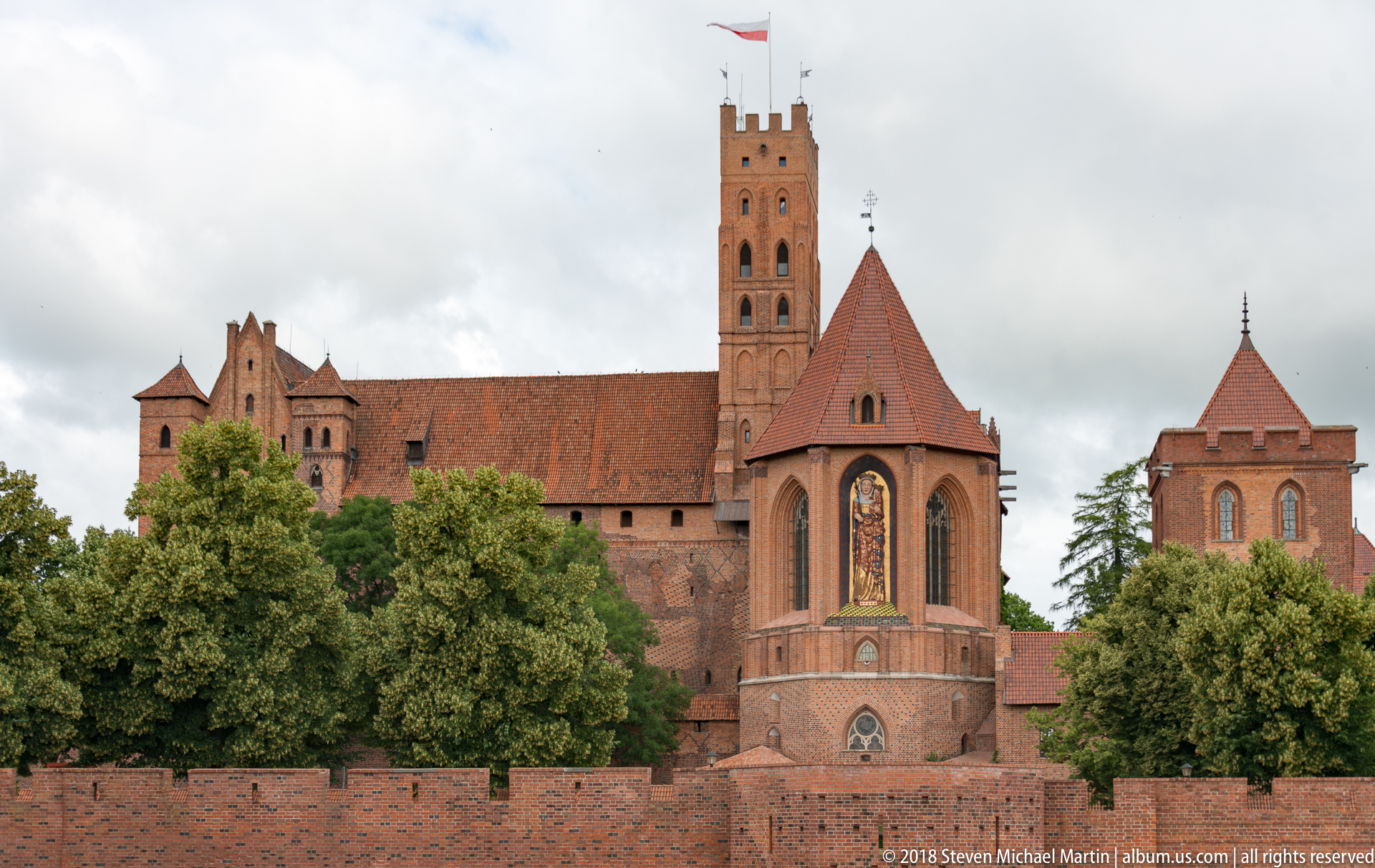
A tall polygonal Gothic projection with large pointed windows rises above the outer wall, framed by mature trees and backed by the castle’s massive square tower and steep roofs. The pale window tracery contrasts sharply with the red brick, drawing attention to the ecclesiastical character of this portion of the complex. The view isolates the vertical relationship between sacred architecture and surrounding defenses.
Caption
A tall polygonal Gothic projection with large pointed windows rises above the outer wall, framed by mature trees and backed by the castle’s massive square tower and steep roofs. The pale window tracery contrasts sharply with the red brick, drawing attention to the ecclesiastical character of this portion of the complex. The view isolates the vertical relationship between sacred architecture and surrounding defenses.

A dark metal relief map presents the castle and surrounding landscape as a tactile site plan, with small raised building forms distributed across engraved terrain. The Polish label “MALBORK” is visible near the lower center, while river and route lines organize the broader setting. The photograph records interpretation infrastructure rather than the historic masonry itself, showing how visitors are oriented to the complex.
Caption
A dark metal relief map presents the castle and surrounding landscape as a tactile site plan, with small raised building forms distributed across engraved terrain. The Polish label “MALBORK” is visible near the lower center, while river and route lines organize the broader setting. The photograph records interpretation infrastructure rather than the historic masonry itself, showing how visitors are oriented to the complex.

A wooden bridge leads toward an arched gateway beside a massive cylindrical brick tower, repeating the castle’s characteristic combination of masonry barrier and controlled approach. Crenellations cap the adjoining wall, while narrow slit openings punctuate the tower’s otherwise solid surface. The closer, centered composition makes the defensive geometry of bridge, arch, wall, and tower especially legible.
Caption
A wooden bridge leads toward an arched gateway beside a massive cylindrical brick tower, repeating the castle’s characteristic combination of masonry barrier and controlled approach. Crenellations cap the adjoining wall, while narrow slit openings punctuate the tower’s otherwise solid surface. The closer, centered composition makes the defensive geometry of bridge, arch, wall, and tower especially legible.

A tall rectangular brick tower dominates the composition, rising above lower defensive buildings and a timber bridge or connector at its base. Regular rows of small windows contrast with the broad unbroken wall surfaces, while steep tiled roofs tie the tower visually to adjoining ranges. The open sky and low viewpoint stress its height and the vertical hierarchy within the fortified complex.
Caption
A tall rectangular brick tower dominates the composition, rising above lower defensive buildings and a timber bridge or connector at its base. Regular rows of small windows contrast with the broad unbroken wall surfaces, while steep tiled roofs tie the tower visually to adjoining ranges. The open sky and low viewpoint stress its height and the vertical hierarchy within the fortified complex.

A broad brick arch frames an interior court beyond a heavy timber door, turning the gateway itself into the dominant compositional device. Across the open space, substantial brick ranges with hipped tile roofs form the opposite side of the enclosure. The shaded foreground and sunlit courtyard beyond clarify the transition from defensive passage to more open interior space within the castle complex.
Caption
A broad brick arch frames an interior court beyond a heavy timber door, turning the gateway itself into the dominant compositional device. Across the open space, substantial brick ranges with hipped tile roofs form the opposite side of the enclosure. The shaded foreground and sunlit courtyard beyond clarify the transition from defensive passage to more open interior space within the castle complex.

A broad multi-sided brick tower rises directly from the outer fortification line, capped by a steep hipped tile roof. Small irregular openings puncture the heavy masonry, while lower adjoining walls extend across the foreground and connect the tower to the wider enclosure. The close view emphasizes mass, thickness, and defensive solidity, with the central castle tower visible more distantly behind.
Caption
A broad multi-sided brick tower rises directly from the outer fortification line, capped by a steep hipped tile roof. Small irregular openings puncture the heavy masonry, while lower adjoining walls extend across the foreground and connect the tower to the wider enclosure. The close view emphasizes mass, thickness, and defensive solidity, with the central castle tower visible more distantly behind.

A long grassy moat or defensive corridor stretches between high red-brick walls, drawing the eye toward a gateway and tower at the far end. On the right, a roofed wall-walk or enclosed passage runs along the upper wall, punctuated by small openings. The image makes the depth of the perimeter system tangible, showing how open ground, walls, and towers work together to control approach.
Caption
A long grassy moat or defensive corridor stretches between high red-brick walls, drawing the eye toward a gateway and tower at the far end. On the right, a roofed wall-walk or enclosed passage runs along the upper wall, punctuated by small openings. The image makes the depth of the perimeter system tangible, showing how open ground, walls, and towers work together to control approach.

The castle’s long outer wall recedes diagonally beneath a continuous tiled roofline, reinforced by a prominent angled buttress in the foreground. Ivy spreads across portions of the brick surface, while higher roofs and the central tower rise behind the wall. The shaded grassy perimeter at left gives the view depth and accentuates the wall’s length, texture, and defensive continuity.
Caption
The castle’s long outer wall recedes diagonally beneath a continuous tiled roofline, reinforced by a prominent angled buttress in the foreground. Ivy spreads across portions of the brick surface, while higher roofs and the central tower rise behind the wall. The shaded grassy perimeter at left gives the view depth and accentuates the wall’s length, texture, and defensive continuity.

A massive angled buttress projects from the outer brick wall below a steep-roofed castle range lined with small dormers. Decorative diamond-pattern brickwork appears on the buttress face, while ivy blankets adjoining wall sections and climbs toward the eaves. This closer view shifts attention from the fortification’s overall length to masonry pattern, vegetation, and the transition from defensive base to occupied upper range.
Caption
A massive angled buttress projects from the outer brick wall below a steep-roofed castle range lined with small dormers. Decorative diamond-pattern brickwork appears on the buttress face, while ivy blankets adjoining wall sections and climbs toward the eaves. This closer view shifts attention from the fortification’s overall length to masonry pattern, vegetation, and the transition from defensive base to occupied upper range.

A metal plaque records Malbork Castle’s inscription on the UNESCO World Heritage List, with English text on the left, Polish text on the right, and UNESCO and World Heritage emblems between them. The visible date, December 1997, anchors the commemorative inscription. Unlike the architectural views in this sequence, this image documents the site’s international heritage designation through official visitor-facing signage.
Caption
A metal plaque records Malbork Castle’s inscription on the UNESCO World Heritage List, with English text on the left, Polish text on the right, and UNESCO and World Heritage emblems between them. The visible date, December 1997, anchors the commemorative inscription. Unlike the architectural views in this sequence, this image documents the site’s international heritage designation through official visitor-facing signage.

A richly articulated Gothic brick gable rises above the long defensive wall, its vertical openings, pinnacles, and pale accents forming a decorative counterpoint to the massive masonry below. At right, a small tower combines brick walls, timber framing, and a pyramidal roof. Patterned brickwork and ivy animate the lower wall, giving this view a strong contrast between ornamented upper architecture and fortified base.
Caption
A richly articulated Gothic brick gable rises above the long defensive wall, its vertical openings, pinnacles, and pale accents forming a decorative counterpoint to the massive masonry below. At right, a small tower combines brick walls, timber framing, and a pyramidal roof. Patterned brickwork and ivy animate the lower wall, giving this view a strong contrast between ornamented upper architecture and fortified base.

A carved stone relief is set high in a red-brick wall above a pointed arch, framed by dense ivy on both sides. The sculptural panel shows a standing sacred figure with smaller figures and heraldic or architectural motifs below. Its pale stone contrasts sharply with the masonry, making the devotional image a focal point within the castle’s otherwise defensive architectural fabric.
Caption
A carved stone relief is set high in a red-brick wall above a pointed arch, framed by dense ivy on both sides. The sculptural panel shows a standing sacred figure with smaller figures and heraldic or architectural motifs below. Its pale stone contrasts sharply with the masonry, making the devotional image a focal point within the castle’s otherwise defensive architectural fabric.

A timber-roofed passage frames the approach to a brick gateway, drawing the eye along the wooden floor toward the pointed entrance beyond. Dark trusses and railings create a tunnel-like foreground, while ivy softens the red masonry outside. A visitor standing near the gate provides scale and emphasizes the controlled, sequential movement through the castle’s layered access system.
Caption
A timber-roofed passage frames the approach to a brick gateway, drawing the eye along the wooden floor toward the pointed entrance beyond. Dark trusses and railings create a tunnel-like foreground, while ivy softens the red masonry outside. A visitor standing near the gate provides scale and emphasizes the controlled, sequential movement through the castle’s layered access system.

Inside a narrow brick gateway, a large timber grille rises above the arched passage while small pointed openings and wall recesses line the flanking masonry. The confined space, heavy doors, and successive arches reveal how entry could be controlled in stages. Worn paving and the bright opening beyond accentuate the contrast between the enclosed defensive threshold and the courtyard outside.
Caption
Inside a narrow brick gateway, a large timber grille rises above the arched passage while small pointed openings and wall recesses line the flanking masonry. The confined space, heavy doors, and successive arches reveal how entry could be controlled in stages. Worn paving and the bright opening beyond accentuate the contrast between the enclosed defensive threshold and the courtyard outside.

A broad cobbled courtyard opens between long red-brick ranges with steep tiled roofs, projecting towers, and regularly spaced Gothic openings. Trees and patches of grass break up the hard surfaces, while benches and paths emphasize the courtyard’s scale. The view presents the castle as an interconnected complex of residential, ceremonial, and defensive buildings rather than a single fortified block.
Caption
A broad cobbled courtyard opens between long red-brick ranges with steep tiled roofs, projecting towers, and regularly spaced Gothic openings. Trees and patches of grass break up the hard surfaces, while benches and paths emphasize the courtyard’s scale. The view presents the castle as an interconnected complex of residential, ceremonial, and defensive buildings rather than a single fortified block.

A long brick range stretches across the courtyard beneath a steep red-tiled roof, punctuated by small windows, buttresses, and projecting roofed structures. At the left, a taller polygonal tower anchors the composition, while ivy climbs portions of the lower wall. The image highlights the varied massing and rooflines that give Malbork’s extensive brick complex its layered medieval character.
Caption
A long brick range stretches across the courtyard beneath a steep red-tiled roof, punctuated by small windows, buttresses, and projecting roofed structures. At the left, a taller polygonal tower anchors the composition, while ivy climbs portions of the lower wall. The image highlights the varied massing and rooflines that give Malbork’s extensive brick complex its layered medieval character.

A long courtyard-facing brick façade is lined with tall pointed windows and smaller ground-level openings beneath a steep tiled roof. Climbing ivy marks the central section, while additional towers and a larger elevated structure rise in the distance. Grass, benches, and the bordering path give this view a more settled, cloister-like character within the fortified complex.
Caption
A long courtyard-facing brick façade is lined with tall pointed windows and smaller ground-level openings beneath a steep tiled roof. Climbing ivy marks the central section, while additional towers and a larger elevated structure rise in the distance. Grass, benches, and the bordering path give this view a more settled, cloister-like character within the fortified complex.

A pointed Gothic doorway opens in a red-brick courtyard wall beside a small timber balcony or gallery sheltered by a tiled roof. Stone blocks are stacked at the foot of the wooden structure, suggesting conservation or restoration activity. Barred windows, ironwork, and the heavy door reinforce the fortified character, while the intimate scale reveals the castle’s more domestic architectural details.
Caption
A pointed Gothic doorway opens in a red-brick courtyard wall beside a small timber balcony or gallery sheltered by a tiled roof. Stone blocks are stacked at the foot of the wooden structure, suggesting conservation or restoration activity. Barred windows, ironwork, and the heavy door reinforce the fortified character, while the intimate scale reveals the castle’s more domestic architectural details.

A compact brick structure topped with dark half-timbering and a tiled roof stands against the larger castle ranges. Ivy spreads over the adjacent walls, while a wooden gate and open arch occupy the lower level. The contrast in scale, construction, and texture makes this modest service or access structure distinct from the monumental brick architecture surrounding it.
Caption
A compact brick structure topped with dark half-timbering and a tiled roof stands against the larger castle ranges. Ivy spreads over the adjacent walls, while a wooden gate and open arch occupy the lower level. The contrast in scale, construction, and texture makes this modest service or access structure distinct from the monumental brick architecture surrounding it.

Four life-size bronze figures stand together in a landscaped corner of the castle grounds, each dressed in historical costume and modeled with distinctive robes, armor, or attributes. Their dark patinated surfaces contrast with the red-brick wall behind them. Presented as a group, the sculptures evoke prominent historical personalities associated with the site without the proof sheet providing enough evidence for secure individual identification.
Caption
Four life-size bronze figures stand together in a landscaped corner of the castle grounds, each dressed in historical costume and modeled with distinctive robes, armor, or attributes. Their dark patinated surfaces contrast with the red-brick wall behind them. Presented as a group, the sculptures evoke prominent historical personalities associated with the site without the proof sheet providing enough evidence for secure individual identification.

Viewed from below, a richly articulated red-brick façade rises through several registers of stone-framed windows and recessed arches. Pale stone mullions and lintels stand out against the masonry, while a band of blind arcading runs beneath the eaves. The upward perspective emphasizes the vertical rhythm and refined decorative treatment of this more prestigious section of the castle complex.
Caption
Viewed from below, a richly articulated red-brick façade rises through several registers of stone-framed windows and recessed arches. Pale stone mullions and lintels stand out against the masonry, while a band of blind arcading runs beneath the eaves. The upward perspective emphasizes the vertical rhythm and refined decorative treatment of this more prestigious section of the castle complex.

A spacious lawn-filled courtyard is enclosed by massive brick ranges with steep tiled roofs, narrow openings, and a central tower-like block pierced by an arched entrance. Mature trees rise above the grass and soften the defensive masonry. The composition conveys the scale of Malbork’s internal courts and the way residential and service buildings were organized around protected open space.
Caption
A spacious lawn-filled courtyard is enclosed by massive brick ranges with steep tiled roofs, narrow openings, and a central tower-like block pierced by an arched entrance. Mature trees rise above the grass and soften the defensive masonry. The composition conveys the scale of Malbork’s internal courts and the way residential and service buildings were organized around protected open space.

Three mannequins stand in a deep window recess wearing layered historical costumes that include long gowns, cloaks, fur-trimmed garments, and period-style headwear. Backlighting from the Gothic window silhouettes portions of the display while revealing the fabrics and varied silhouettes. The presentation interprets elite medieval dress within the castle setting without allowing the exact period or represented individuals to be confirmed from the image alone.
Caption
Three mannequins stand in a deep window recess wearing layered historical costumes that include long gowns, cloaks, fur-trimmed garments, and period-style headwear. Backlighting from the Gothic window silhouettes portions of the display while revealing the fabrics and varied silhouettes. The presentation interprets elite medieval dress within the castle setting without allowing the exact period or represented individuals to be confirmed from the image alone.

A long interior corridor recedes beneath a sequence of pointed ribbed vaults carried on wall responds and slender supports. Pale plastered surfaces brighten the passage, while the dark tiled floor creates a strong linear perspective. Repeated bays and evenly spaced openings give the corridor a disciplined architectural rhythm, revealing the ordered circulation spaces within the castle’s monumental ranges.
Caption
A long interior corridor recedes beneath a sequence of pointed ribbed vaults carried on wall responds and slender supports. Pale plastered surfaces brighten the passage, while the dark tiled floor creates a strong linear perspective. Repeated bays and evenly spaced openings give the corridor a disciplined architectural rhythm, revealing the ordered circulation spaces within the castle’s monumental ranges.

A long Gothic gallery extends beneath pointed rib vaults whose plastered surfaces retain painted figurative and ornamental decoration. Red-brick ribs and wall arches frame the lighter vault fields, while a row of openings along one side admits warm daylight. The combination of circulation space and surviving painted decoration gives the corridor a notably ceremonial character within the castle interior.
Caption
A long Gothic gallery extends beneath pointed rib vaults whose plastered surfaces retain painted figurative and ornamental decoration. Red-brick ribs and wall arches frame the lighter vault fields, while a row of openings along one side admits warm daylight. The combination of circulation space and surviving painted decoration gives the corridor a notably ceremonial character within the castle interior.

A weathered metal bird with outstretched wings crowns a pedestal or roof-mounted feature, seen close against the castle’s red-brick Gothic façade. Layered feathers, raised head, and broad wings give the sculpture a heraldic presence, while pointed and traceried windows behind it establish the architectural setting. The tight framing isolates a decorative emblem that is only a small element in wider courtyard views.
Caption
A weathered metal bird with outstretched wings crowns a pedestal or roof-mounted feature, seen close against the castle’s red-brick Gothic façade. Layered feathers, raised head, and broad wings give the sculpture a heraldic presence, while pointed and traceried windows behind it establish the architectural setting. The tight framing isolates a decorative emblem that is only a small element in wider courtyard views.

Three mannequins are arranged before a tall window in military and ceremonial dress, including pale cloaks marked with dark crosses. One figure wears a fur-covered outer garment, another a patterned tunic, and a third a red hood and white mantle. The heraldic crosses strongly evoke the visual language associated with the Teutonic Order while remaining a modern interpretive costume display.
Caption
Three mannequins are arranged before a tall window in military and ceremonial dress, including pale cloaks marked with dark crosses. One figure wears a fur-covered outer garment, another a patterned tunic, and a third a red hood and white mantle. The heraldic crosses strongly evoke the visual language associated with the Teutonic Order while remaining a modern interpretive costume display.

A cluster of bronze historical figures occupies a small landscaped area beneath mature trees, with an ornate brick-and-stone castle façade rising behind them. Arched windows, decorative masonry, and ivy-covered walls frame the sculptures. This broader view places the commemorative group within its architectural setting and shows how later memorial elements are integrated into the medieval complex.
Caption
A cluster of bronze historical figures occupies a small landscaped area beneath mature trees, with an ornate brick-and-stone castle façade rising behind them. Arched windows, decorative masonry, and ivy-covered walls frame the sculptures. This broader view places the commemorative group within its architectural setting and shows how later memorial elements are integrated into the medieval complex.

A wooden bridge leads directly toward a richly patterned brick gateway flanked by towers and gabled ranges. Decorative brickwork, pointed arches, tiled roofs, and the taller castle mass beyond create a layered approach sequence. The converging railings emphasize the controlled route into the fortified complex, while the open sky and surrounding trees keep the composition legible as an exterior threshold.
Caption
A wooden bridge leads directly toward a richly patterned brick gateway flanked by towers and gabled ranges. Decorative brickwork, pointed arches, tiled roofs, and the taller castle mass beyond create a layered approach sequence. The converging railings emphasize the controlled route into the fortified complex, while the open sky and surrounding trees keep the composition legible as an exterior threshold.

A compact cobbled court is enclosed by intensely patterned red-and-dark brick masonry, with a tall recessed pointed arch dominating the central wall. Smaller arches, blind openings, and heavy timber doors articulate the sides. The strong vertical scale and layered brick detailing create a ceremonial quality even as the passageways and doors retain the practical language of controlled castle circulation.
Caption
A compact cobbled court is enclosed by intensely patterned red-and-dark brick masonry, with a tall recessed pointed arch dominating the central wall. Smaller arches, blind openings, and heavy timber doors articulate the sides. The strong vertical scale and layered brick detailing create a ceremonial quality even as the passageways and doors retain the practical language of controlled castle circulation.

A narrow passage recedes through a sequence of low arches, alternating exposed red brick with pale plastered vaulting. Small side openings puncture the walls, and the uneven stone floor leads toward a bright doorway in the distance. The repeated bays and confined proportions reveal the practical circulation spaces embedded within Malbork’s thick masonry ranges.
Caption
A narrow passage recedes through a sequence of low arches, alternating exposed red brick with pale plastered vaulting. Small side openings puncture the walls, and the uneven stone floor leads toward a bright doorway in the distance. The repeated bays and confined proportions reveal the practical circulation spaces embedded within Malbork’s thick masonry ranges.

A roofed timber structure occupies the center of a brick Gothic courtyard, its tiled pyramidal roof topped by a metal bird finial. Large wheels and mechanical elements are visible beneath the shelter, suggesting a well or lifting mechanism. Surrounding arcades and traceried windows place the utilitarian structure within one of the castle’s more architecturally refined internal courts.
Caption
A roofed timber structure occupies the center of a brick Gothic courtyard, its tiled pyramidal roof topped by a metal bird finial. Large wheels and mechanical elements are visible beneath the shelter, suggesting a well or lifting mechanism. Surrounding arcades and traceried windows place the utilitarian structure within one of the castle’s more architecturally refined internal courts.

A short vaulted passage opens through thick masonry walls, combining brick arches with massive stone supports and pale plastered surfaces. A cylindrical stone column anchors the foreground, while a heavy iron gate lines one side. The succession of arches and changing materials illustrates the castle’s complex construction history and the heavily controlled routes connecting its internal courts.
Caption
A short vaulted passage opens through thick masonry walls, combining brick arches with massive stone supports and pale plastered surfaces. A cylindrical stone column anchors the foreground, while a heavy iron gate lines one side. The succession of arches and changing materials illustrates the castle’s complex construction history and the heavily controlled routes connecting its internal courts.

From an elevated gallery, the camera looks across a square brick courtyard ringed by two levels of pointed arcades and Gothic windows. The roofed timber well or hoisting structure stands prominently near the center, emphasizing the court’s communal function. Repetition of arches, tracery, and tiled rooflines creates a tightly ordered enclosure characteristic of Malbork’s monumental brick architecture.
Caption
From an elevated gallery, the camera looks across a square brick courtyard ringed by two levels of pointed arcades and Gothic windows. The roofed timber well or hoisting structure stands prominently near the center, emphasizing the court’s communal function. Repetition of arches, tracery, and tiled rooflines creates a tightly ordered enclosure characteristic of Malbork’s monumental brick architecture.

A monumental rectangular hall extends beneath an intricate pale ribbed vault, its geometric pattern spanning between tall windows and exposed brick walls. Large circular chandeliers hang along the central axis, while a low dais or altar-like platform occupies the far end. The stripped-back surfaces reveal successive phases of masonry and restoration while preserving the dramatic scale of the medieval interior.
Caption
A monumental rectangular hall extends beneath an intricate pale ribbed vault, its geometric pattern spanning between tall windows and exposed brick walls. Large circular chandeliers hang along the central axis, while a low dais or altar-like platform occupies the far end. The stripped-back surfaces reveal successive phases of masonry and restoration while preserving the dramatic scale of the medieval interior.

A large ring chandelier dominates the foreground, its evenly spaced candle-like lights suspended beneath the ribbed vault. Beyond it, a pale stone gallery or screen stretches across the brick wall, surrounded by surviving areas of plaster and painted decoration. The closer viewpoint isolates the modern lighting and architectural screen while retaining the medieval hall as context.
Caption
A large ring chandelier dominates the foreground, its evenly spaced candle-like lights suspended beneath the ribbed vault. Beyond it, a pale stone gallery or screen stretches across the brick wall, surrounded by surviving areas of plaster and painted decoration. The closer viewpoint isolates the modern lighting and architectural screen while retaining the medieval hall as context.

A circular ring chandelier hangs prominently before tall multi-light Gothic windows at the end of a vaulted room. Pale plastered walls and carved or modeled architectural fragments surround small doorways below, creating a brighter and more finished appearance than the exposed brick sections seen elsewhere. The composition emphasizes the interplay of restored surfaces, daylight, and modern lighting within the medieval interior.
Caption
A circular ring chandelier hangs prominently before tall multi-light Gothic windows at the end of a vaulted room. Pale plastered walls and carved or modeled architectural fragments surround small doorways below, creating a brighter and more finished appearance than the exposed brick sections seen elsewhere. The composition emphasizes the interplay of restored surfaces, daylight, and modern lighting within the medieval interior.

An axial view along the same monumental hall emphasizes the high ribbed vault and the strong horizontal band of niches or shallow arches running along both brick walls. Circular chandeliers diminish in size toward the bright end of the room, reinforcing the hall’s extraordinary length. Areas of exposed and repaired masonry make the building’s fabric itself part of the visual experience.
Caption
An axial view along the same monumental hall emphasizes the high ribbed vault and the strong horizontal band of niches or shallow arches running along both brick walls. Circular chandeliers diminish in size toward the bright end of the room, reinforcing the hall’s extraordinary length. Areas of exposed and repaired masonry make the building’s fabric itself part of the visual experience.

Looking toward the opposite end of the hall, a raised stone gallery or screen spans the brick wall beneath the ribbed vault. Circular chandeliers hang above the open floor, while blind arches and remnants of painted or plastered surfaces line the side walls. The view draws attention to the hall’s ceremonial spatial hierarchy and the survival of decorative fabric amid exposed masonry.
Caption
Looking toward the opposite end of the hall, a raised stone gallery or screen spans the brick wall beneath the ribbed vault. Circular chandeliers hang above the open floor, while blind arches and remnants of painted or plastered surfaces line the side walls. The view draws attention to the hall’s ceremonial spatial hierarchy and the survival of decorative fabric amid exposed masonry.
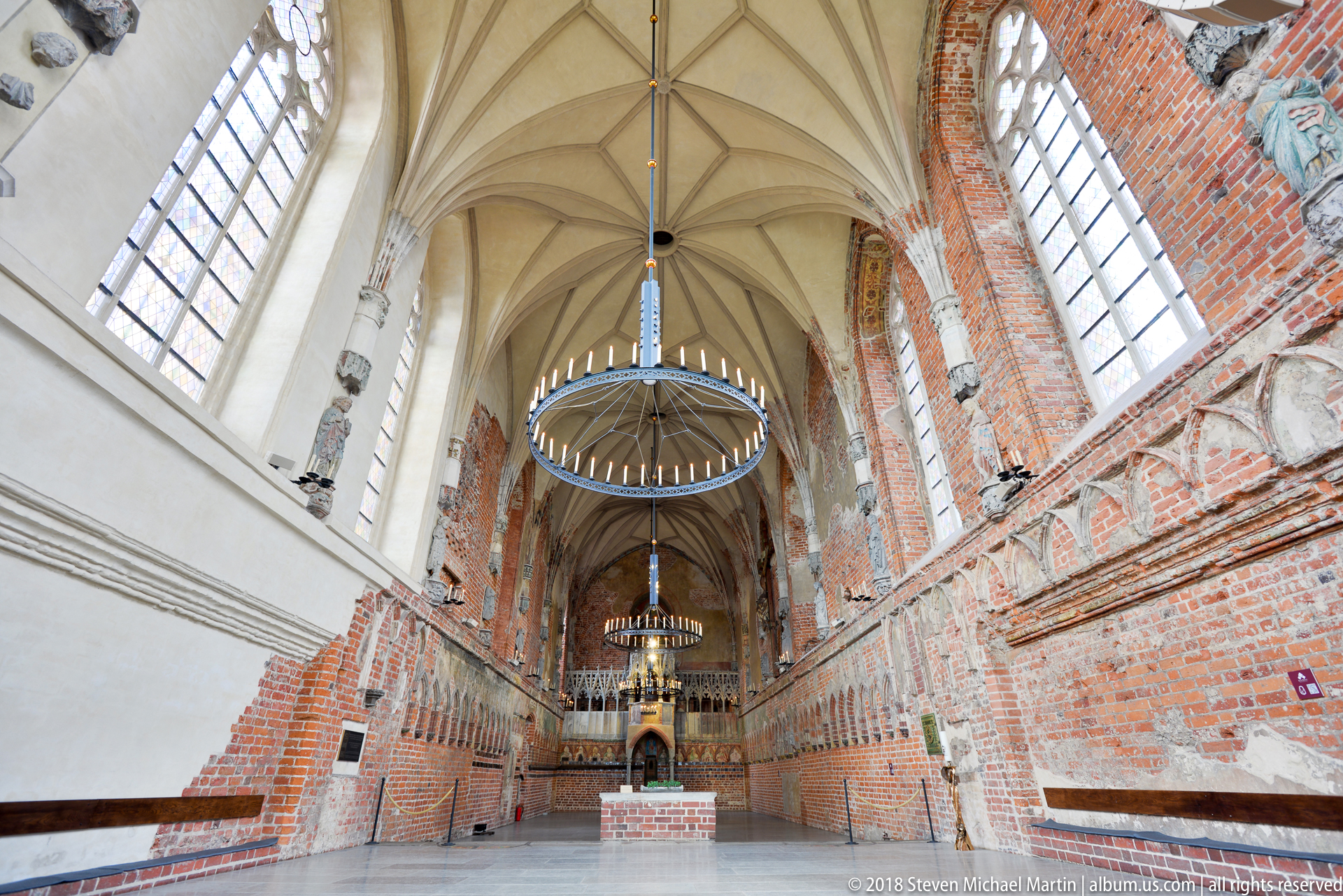
Broad windows and pale restored wall surfaces frame one side of a high vaulted hall, while exposed red brick and decorative arcading remain visible opposite. Two large circular chandeliers hang on the central axis, drawing the eye toward a raised gallery at the far end. The contrast between reconstructed and historic finishes makes the building’s conservation history visually apparent.
Caption
Broad windows and pale restored wall surfaces frame one side of a high vaulted hall, while exposed red brick and decorative arcading remain visible opposite. Two large circular chandeliers hang on the central axis, drawing the eye toward a raised gallery at the far end. The contrast between reconstructed and historic finishes makes the building’s conservation history visually apparent.

A monumental painted crucifix rises against an exposed brick wall beneath the church vaults, with the figure of Christ on the cross and additional carved saints or holy figures arranged nearby. The surviving polychromy and weathered surfaces stand out against the rough masonry. Architectural fragments and rib supports frame the ensemble, placing the devotional sculpture within the restored sacred interior of the castle.
Caption
A monumental painted crucifix rises against an exposed brick wall beneath the church vaults, with the figure of Christ on the cross and additional carved saints or holy figures arranged nearby. The surviving polychromy and weathered surfaces stand out against the rough masonry. Architectural fragments and rib supports frame the ensemble, placing the devotional sculpture within the restored sacred interior of the castle.

A broad ring chandelier hangs beneath a pale Gothic rib vault, its radial metal supports echoing the geometry of the ceiling above. Exposed red-brick wall sections and traceried windows appear around the edges of the frame, emphasizing the contrast between restored plaster surfaces and the castle’s medieval masonry. The upward viewpoint turns the chandelier and vault into a study of intersecting circles, ribs, and structural lines.
Caption
A broad ring chandelier hangs beneath a pale Gothic rib vault, its radial metal supports echoing the geometry of the ceiling above. Exposed red-brick wall sections and traceried windows appear around the edges of the frame, emphasizing the contrast between restored plaster surfaces and the castle’s medieval masonry. The upward viewpoint turns the chandelier and vault into a study of intersecting circles, ribs, and structural lines.

A museum gallery within the castle displays framed paintings along pale walls under a restrained track-lighting system. Portraits and landscapes of different formats are arranged in small groups, while an exposed brick wall closes the far end of the room. The presentation contrasts portable artworks with the historic masonry shell, revealing one of the castle’s modern exhibition spaces.
Caption
A museum gallery within the castle displays framed paintings along pale walls under a restrained track-lighting system. Portraits and landscapes of different formats are arranged in small groups, while an exposed brick wall closes the far end of the room. The presentation contrasts portable artworks with the historic masonry shell, revealing one of the castle’s modern exhibition spaces.

A corner of the gallery is hung with numerous small framed works, dominated by portraits in gilded and dark wooden frames. Paintings continue around the adjoining wall, creating a salon-like cluster rather than a single linear row. Individual labels are visible beneath several works, but the proof sheet does not permit reliable identification of specific sitters or artists.
Caption
A corner of the gallery is hung with numerous small framed works, dominated by portraits in gilded and dark wooden frames. Paintings continue around the adjoining wall, creating a salon-like cluster rather than a single linear row. Individual labels are visible beneath several works, but the proof sheet does not permit reliable identification of specific sitters or artists.

A large religious painting presents a reclining figure in red beneath a dark suspended veil or shroud, with a luminous face or sacred image emerging above. The theatrical arrangement is set against a landscape-like background and dark architectural framing. Strong contrasts of red, black, and pale flesh tones intensify the devotional drama, though the precise subject cannot be established from the proof sheet alone.
Caption
A large religious painting presents a reclining figure in red beneath a dark suspended veil or shroud, with a luminous face or sacred image emerging above. The theatrical arrangement is set against a landscape-like background and dark architectural framing. Strong contrasts of red, black, and pale flesh tones intensify the devotional drama, though the precise subject cannot be established from the proof sheet alone.

Three cusped stone recesses form an ornate wall niche above a broad wooden chest whose front is covered with repeated metal fittings. Slender colonnettes and carved foliage frame the recesses, while the dark timber furniture anchors the composition below. The close view pairs refined Gothic stonework with a substantial functional furnishing, highlighting the variety of materials used in the castle interior.
Caption
Three cusped stone recesses form an ornate wall niche above a broad wooden chest whose front is covered with repeated metal fittings. Slender colonnettes and carved foliage frame the recesses, while the dark timber furniture anchors the composition below. The close view pairs refined Gothic stonework with a substantial functional furnishing, highlighting the variety of materials used in the castle interior.

Two tall wooden doors stand side by side in elaborate pointed stone surrounds, each crowned by a steep gable with crocketed edges and carved finials. Heavy iron straps and decorative hardware cover the door leaves, while red vault ribs descend between the portals. Their near-symmetrical arrangement gives the wall a ceremonial architectural rhythm rather than the appearance of ordinary service entrances.
Caption
Two tall wooden doors stand side by side in elaborate pointed stone surrounds, each crowned by a steep gable with crocketed edges and carved finials. Heavy iron straps and decorative hardware cover the door leaves, while red vault ribs descend between the portals. Their near-symmetrical arrangement gives the wall a ceremonial architectural rhythm rather than the appearance of ordinary service entrances.

A long hall stretches beneath repeated red-painted rib vaults supported by slender dark columns with carved capitals. Wooden tables and benches run through the space, while tall windows on the right flood the patterned tile floor with daylight. A monumental carved wooden furnishing occupies the left foreground, adding to the room’s institutional and ceremonial character.
Caption
A long hall stretches beneath repeated red-painted rib vaults supported by slender dark columns with carved capitals. Wooden tables and benches run through the space, while tall windows on the right flood the patterned tile floor with daylight. A monumental carved wooden furnishing occupies the left foreground, adding to the room’s institutional and ceremonial character.

Faded medieval-style wall paintings extend across the upper wall beneath pointed vaults, showing a row of haloed or seated figures gathered behind a long table. Below, differently shaped doorways and a heavy iron-bound chest punctuate the white plaster surface. The surviving mural fragments introduce a narrative sacred layer into the otherwise austere architectural interior.
Caption
Faded medieval-style wall paintings extend across the upper wall beneath pointed vaults, showing a row of haloed or seated figures gathered behind a long table. Below, differently shaped doorways and a heavy iron-bound chest punctuate the white plaster surface. The surviving mural fragments introduce a narrative sacred layer into the otherwise austere architectural interior.

Red-painted ribs fan across pale vault surfaces from a tall dark column capped by a carved and painted capital. Bosses mark the intersections overhead, while fragments of wall painting continue along the right-hand wall. The upward angle isolates the structural logic of the hall, showing how clustered ribs divide the ceiling into a rhythmic sequence of pointed bays.
Caption
Red-painted ribs fan across pale vault surfaces from a tall dark column capped by a carved and painted capital. Bosses mark the intersections overhead, while fragments of wall painting continue along the right-hand wall. The upward angle isolates the structural logic of the hall, showing how clustered ribs divide the ceiling into a rhythmic sequence of pointed bays.

A tall central column supports a complex network of brick-red ribs in this luminous Gothic chamber. Pointed windows at the far end admit cool daylight, while carved wall niches and large wooden furnishings line the perimeter. The room’s balanced geometry—single support, radiating vaults, and evenly spaced openings—creates a strong sense of ordered medieval design.
Caption
A tall central column supports a complex network of brick-red ribs in this luminous Gothic chamber. Pointed windows at the far end admit cool daylight, while carved wall niches and large wooden furnishings line the perimeter. The room’s balanced geometry—single support, radiating vaults, and evenly spaced openings—creates a strong sense of ordered medieval design.

Multicolored square floor tiles surround the octagonal stone base of a dark column, with a pale inset border carrying repeated heraldic or vegetal motifs. Green, yellow, red, and brown tiles form an irregular checker pattern around the central support. The close framing makes the floor itself the subject, revealing decorative treatment that can be overlooked in wider views of the vaulted hall.
Caption
Multicolored square floor tiles surround the octagonal stone base of a dark column, with a pale inset border carrying repeated heraldic or vegetal motifs. Green, yellow, red, and brown tiles form an irregular checker pattern around the central support. The close framing makes the floor itself the subject, revealing decorative treatment that can be overlooked in wider views of the vaulted hall.

An axial view runs the full length of a vaulted Gothic hall, where a line of central columns supports red-painted ribs above a patterned tile floor. Long wooden benches flank both sides, and arched doorways punctuate the right wall. The repeated structural bays draw the eye toward the far end, emphasizing the room’s scale and disciplined medieval geometry.
Caption
An axial view runs the full length of a vaulted Gothic hall, where a line of central columns supports red-painted ribs above a patterned tile floor. Long wooden benches flank both sides, and arched doorways punctuate the right wall. The repeated structural bays draw the eye toward the far end, emphasizing the room’s scale and disciplined medieval geometry.

A large pointed window filled with elaborate stone tracery frames a view across the castle courtyard. Trefoil and quatrefoil openings fill the upper portion, while dark stone colonnettes divide the lower lights. Through the tracery, tiled roofs, brick arcades, and another Gothic façade appear beyond, turning the window into both an architectural detail and a carefully framed view of the surrounding complex.
Caption
A large pointed window filled with elaborate stone tracery frames a view across the castle courtyard. Trefoil and quatrefoil openings fill the upper portion, while dark stone colonnettes divide the lower lights. Through the tracery, tiled roofs, brick arcades, and another Gothic façade appear beyond, turning the window into both an architectural detail and a carefully framed view of the surrounding complex.

A pale stone sculpture shows a bearded man kneeling with clasped hands, his heavy robe falling in deeply carved folds around the body. The tilted head and prayerful gesture give the figure a devotional character, while the dark museum background isolates the carving from its original architectural setting. Surface wear and softened details suggest the object’s age and history of handling or exposure.
Caption
A pale stone sculpture shows a bearded man kneeling with clasped hands, his heavy robe falling in deeply carved folds around the body. The tilted head and prayerful gesture give the figure a devotional character, while the dark museum background isolates the carving from its original architectural setting. Surface wear and softened details suggest the object’s age and history of handling or exposure.

A polychrome carved figure of Christ stands nearly nude, wearing a crown of thorns and a short loincloth while raising one hand. Painted blood marks the torso and limbs, emphasizing the wounds of the Passion. The compact pose and devotional focus are consistent with a Man of Sorrows representation, presented here as an isolated museum sculpture against a neutral wall.
Caption
A polychrome carved figure of Christ stands nearly nude, wearing a crown of thorns and a short loincloth while raising one hand. Painted blood marks the torso and limbs, emphasizing the wounds of the Passion. The compact pose and devotional focus are consistent with a Man of Sorrows representation, presented here as an isolated museum sculpture against a neutral wall.

A polychrome Pietà presents the Virgin Mary seated with the dead Christ laid across her lap. Christ’s emaciated body and lowered head contrast with Mary’s upright, enveloping form and richly colored garment. Losses and worn paint reveal the sculpture’s age, while the intimate scale and direct emotional composition reflect the devotional purpose of late medieval Passion imagery.
Caption
A polychrome Pietà presents the Virgin Mary seated with the dead Christ laid across her lap. Christ’s emaciated body and lowered head contrast with Mary’s upright, enveloping form and richly colored garment. Losses and worn paint reveal the sculpture’s age, while the intimate scale and direct emotional composition reflect the devotional purpose of late medieval Passion imagery.

A vividly painted relief shows an armored knight on a white horse driving his weapon toward a dragon beneath the animal’s hooves. Additional figures and rocky forms crowd the background, while the dragon’s coiled body and open jaws animate the lower register. The familiar iconography identifies the mounted warrior as Saint George in combat with the dragon.
Caption
A vividly painted relief shows an armored knight on a white horse driving his weapon toward a dragon beneath the animal’s hooves. Additional figures and rocky forms crowd the background, while the dragon’s coiled body and open jaws animate the lower register. The familiar iconography identifies the mounted warrior as Saint George in combat with the dragon.

A pale carved female figure stands in layered robes and veil, holding a broad shallow dish or platter in both hands. Her face and the object are partly worn, while deep folds in the lower garment preserve the sculpture’s strong vertical silhouette. Displayed before a pointed window, the figure reads as a devotional museum object removed from its original architectural or liturgical context.
Caption
A pale carved female figure stands in layered robes and veil, holding a broad shallow dish or platter in both hands. Her face and the object are partly worn, while deep folds in the lower garment preserve the sculpture’s strong vertical silhouette. Displayed before a pointed window, the figure reads as a devotional museum object removed from its original architectural or liturgical context.

A weathered polychrome crucifix presents Christ with arms extended on a dark wooden cross beneath an INRI tablet. The torso is modeled with pronounced ribs and wounds, and remnants of painted flesh tones and drapery survive across the surface. Mounted against a plain museum wall, the object is isolated for close viewing as a devotional sculpture rather than shown in a liturgical setting.
Caption
A weathered polychrome crucifix presents Christ with arms extended on a dark wooden cross beneath an INRI tablet. The torso is modeled with pronounced ribs and wounds, and remnants of painted flesh tones and drapery survive across the surface. Mounted against a plain museum wall, the object is isolated for close viewing as a devotional sculpture rather than shown in a liturgical setting.

A dark wooden staircase sweeps upward through a brick-vaulted passage, its solid balustrade carved with long narrative relief panels. Heavy newel supports, molded rails, and dense figural carving give the stair a monumental sculptural presence. Decorative painted bands on the adjoining vaults and exposed red brick create a richly layered setting for this unusual interior architectural feature.
Caption
A dark wooden staircase sweeps upward through a brick-vaulted passage, its solid balustrade carved with long narrative relief panels. Heavy newel supports, molded rails, and dense figural carving give the stair a monumental sculptural presence. Decorative painted bands on the adjoining vaults and exposed red brick create a richly layered setting for this unusual interior architectural feature.

A richly gilded and polychrome Gothic altarpiece opens across multiple carved compartments. The central section contains enthroned sacred figures around a smaller standing or seated figure, while flanking panels hold additional saints beneath intricate tracery. Bright blue, red, green, and gold surfaces preserve the theatrical color of the ensemble and distinguish the individual devotional figures.
Caption
A richly gilded and polychrome Gothic altarpiece opens across multiple carved compartments. The central section contains enthroned sacred figures around a smaller standing or seated figure, while flanking panels hold additional saints beneath intricate tracery. Bright blue, red, green, and gold surfaces preserve the theatrical color of the ensemble and distinguish the individual devotional figures.

A broad carved retable fills the wall beneath pointed vaults, its many compartments packed with polychrome saints and narrative scenes. A larger seated Virgin and Child appears in the central field, surrounded by smaller figures arranged in symmetrical panels. Although much of the surface is darkened or worn, the scale and dense sculptural program convey the visual impact of a major late-medieval altar ensemble.
Caption
A broad carved retable fills the wall beneath pointed vaults, its many compartments packed with polychrome saints and narrative scenes. A larger seated Virgin and Child appears in the central field, surrounded by smaller figures arranged in symmetrical panels. Although much of the surface is darkened or worn, the scale and dense sculptural program convey the visual impact of a major late-medieval altar ensemble.

A long vaulted gallery displays medieval religious sculpture on white plinths and wall brackets beneath repeated pointed arches. Polychrome figures line both sides, while an illuminated altarpiece forms a visual anchor at the far end. The open floor and even museum lighting allow individual objects to be read separately while preserving the Gothic architectural setting around them.
Caption
A long vaulted gallery displays medieval religious sculpture on white plinths and wall brackets beneath repeated pointed arches. Polychrome figures line both sides, while an illuminated altarpiece forms a visual anchor at the far end. The open floor and even museum lighting allow individual objects to be read separately while preserving the Gothic architectural setting around them.

A small polychrome carved figure is set into the intersection of painted vault ribs, surrounded by green vegetal decoration on pale plaster. The seated or half-length female figure wears a red garment and pale head covering and holds a narrow object at one side. The close view shows how figurative sculpture and painted ornament were integrated directly into the castle’s vaulted architecture.
Caption
A small polychrome carved figure is set into the intersection of painted vault ribs, surrounded by green vegetal decoration on pale plaster. The seated or half-length female figure wears a red garment and pale head covering and holds a narrow object at one side. The close view shows how figurative sculpture and painted ornament were integrated directly into the castle’s vaulted architecture.

A patinated metal dragon perches with wings raised, long tail extended, and open jaws turned sharply to one side. Overlapping scale-like feathers or armor plates articulate the body, while a woven-looking circular base supports the creature. Red brick and carved Gothic stonework behind it place the fantastic sculpture within the castle courtyard setting.
Caption
A patinated metal dragon perches with wings raised, long tail extended, and open jaws turned sharply to one side. Overlapping scale-like feathers or armor plates articulate the body, while a woven-looking circular base supports the creature. Red brick and carved Gothic stonework behind it place the fantastic sculpture within the castle courtyard setting.

A large patinated metal bird spreads its wings from a nest-like base at the peak of a sloping metal roof. Behind it, pointed Gothic windows with stone tracery punctuate the red-brick façade. The frontal view makes the bird’s heraldic posture especially prominent and connects this decorative metalwork to the monumental architecture of the surrounding courtyard.
Caption
A large patinated metal bird spreads its wings from a nest-like base at the peak of a sloping metal roof. Behind it, pointed Gothic windows with stone tracery punctuate the red-brick façade. The frontal view makes the bird’s heraldic posture especially prominent and connects this decorative metalwork to the monumental architecture of the surrounding courtyard.

A broad polygonal tiled roof shelters a timber well structure in the castle courtyard, with a large winding wheel and vertical mechanism visible beneath the eaves. A metal dragon finial crowns the roof ridge. Surrounded by Gothic brick façades and traceried windows, the utilitarian installation becomes a focal point within the enclosed courtyard and illustrates the infrastructure required for life inside the fortress.
Caption
A broad polygonal tiled roof shelters a timber well structure in the castle courtyard, with a large winding wheel and vertical mechanism visible beneath the eaves. A metal dragon finial crowns the roof ridge. Surrounded by Gothic brick façades and traceried windows, the utilitarian installation becomes a focal point within the enclosed courtyard and illustrates the infrastructure required for life inside the fortress.

A reconstructed historic kitchen centers on a broad brick cooking range fitted with metal grates and surrounded by copper pots, kettles, and hanging vessels. Arched brick recesses, shelves, and work surfaces fill the background, creating a dense utilitarian workspace. The display interprets large-scale food preparation within the castle through the equipment, hearth architecture, and arrangement of cooking tools.
Caption
A reconstructed historic kitchen centers on a broad brick cooking range fitted with metal grates and surrounded by copper pots, kettles, and hanging vessels. Arched brick recesses, shelves, and work surfaces fill the background, creating a dense utilitarian workspace. The display interprets large-scale food preparation within the castle through the equipment, hearth architecture, and arrangement of cooking tools.

A wider view of the castle kitchen places the cooking range beneath a broad brick arch supported by massive stone columns. Copper vessels and pots cluster around the hearth, while shelves of metalware line the wall above. Patterned floor tiles and the heavy masonry supports emphasize the scale of the room and distinguish this view from the closer equipment-focused kitchen image.
Caption
A wider view of the castle kitchen places the cooking range beneath a broad brick arch supported by massive stone columns. Copper vessels and pots cluster around the hearth, while shelves of metalware line the wall above. Patterned floor tiles and the heavy masonry supports emphasize the scale of the room and distinguish this view from the closer equipment-focused kitchen image.

A long wooden worktable is crowded with bowls, ceramic vessels, baskets, utensils, and arranged food, with shelves of additional wares lining the rear wall. Sausages and other provisions hang overhead beneath white vaults and brick arches. The reconstructed display shifts attention from the hearth to storage and preparation, presenting the material culture of a busy castle kitchen.
Caption
A long wooden worktable is crowded with bowls, ceramic vessels, baskets, utensils, and arranged food, with shelves of additional wares lining the rear wall. Sausages and other provisions hang overhead beneath white vaults and brick arches. The reconstructed display shifts attention from the hearth to storage and preparation, presenting the material culture of a busy castle kitchen.

A brick-vaulted kitchen interior centers on a raised masonry cooking hearth fitted with pots, kettles, and utensils. Heavy brick arches spring from stone supports, while tiled flooring and shelves of vessels reinforce the room’s working character. The reconstructed furnishings help interpret the scale of food preparation required within the fortified complex without obscuring the medieval masonry that defines the space.
Caption
A brick-vaulted kitchen interior centers on a raised masonry cooking hearth fitted with pots, kettles, and utensils. Heavy brick arches spring from stone supports, while tiled flooring and shelves of vessels reinforce the room’s working character. The reconstructed furnishings help interpret the scale of food preparation required within the fortified complex without obscuring the medieval masonry that defines the space.

A massive iron-studded wooden gate fills one side of a vaulted passage formed by alternating brick and stone arches. The cobbled floor leads through a sequence of smaller openings beyond, emphasizing the depth of the masonry and the controlled movement through the castle. Repeated metal fittings on the door leaves reinforce the defensive character of this internal threshold.
Caption
A massive iron-studded wooden gate fills one side of a vaulted passage formed by alternating brick and stone arches. The cobbled floor leads through a sequence of smaller openings beyond, emphasizing the depth of the masonry and the controlled movement through the castle. Repeated metal fittings on the door leaves reinforce the defensive character of this internal threshold.

A richly carved Gothic portal fills the frame, with multiple sculpted archivolts rising above a double wooden door and a narrative relief occupying the tympanum. Tall figures stand in niches along the jambs, while painted and carved decoration continues across the surrounding wall. The close upward view emphasizes the density of figural sculpture concentrated around this ceremonial entrance.
Caption
A richly carved Gothic portal fills the frame, with multiple sculpted archivolts rising above a double wooden door and a narrative relief occupying the tympanum. Tall figures stand in niches along the jambs, while painted and carved decoration continues across the surrounding wall. The close upward view emphasizes the density of figural sculpture concentrated around this ceremonial entrance.

A rectangular stone relief set into a rough masonry wall portrays a standing man in period dress with hands crossed at the waist. Emblems flank him, including a crowned device at right and smaller symbolic forms around the border. Weathering and surface loss soften the carving, while the inscription band remains too small to read reliably from the proof sheet.
Caption
A rectangular stone relief set into a rough masonry wall portrays a standing man in period dress with hands crossed at the waist. Emblems flank him, including a crowned device at right and smaller symbolic forms around the border. Weathering and surface loss soften the carving, while the inscription band remains too small to read reliably from the proof sheet.

A vivid stained-glass composition shows an armored mounted saint driving a lance toward a green dragon in the large circular upper panel. Below, smaller roundels contain heraldic shields and decorative inscriptions. The familiar iconography identifies the central figure as Saint George, while the intense blue, red, green, and gold glass stands out dramatically against the dark interior.
Caption
A vivid stained-glass composition shows an armored mounted saint driving a lance toward a green dragon in the large circular upper panel. Below, smaller roundels contain heraldic shields and decorative inscriptions. The familiar iconography identifies the central figure as Saint George, while the intense blue, red, green, and gold glass stands out dramatically against the dark interior.

A black-and-white historical illustration depicts an armored or partially armored fighter staggering as multiple weapons strike his body. Red marks have been added at wound points, turning the print into an interpretive diagram of injury in combat. Swords, arrows, and other projectiles surround the figure, conveying the hazards of close and ranged warfare in a deliberately graphic visual lesson.
Caption
A black-and-white historical illustration depicts an armored or partially armored fighter staggering as multiple weapons strike his body. Red marks have been added at wound points, turning the print into an interpretive diagram of injury in combat. Swords, arrows, and other projectiles surround the figure, conveying the hazards of close and ranged warfare in a deliberately graphic visual lesson.

A frontal view of the same monumental portal centers the double wooden doors beneath a pointed tympanum crowded with carved figures. Rows of sculpted archivolts trace the arch, and tall saint-like figures occupy niches on both jambs. Remaining color on the surrounding architecture hints at the portal’s once more vivid appearance and helps separate its sculptural zones.
Caption
A frontal view of the same monumental portal centers the double wooden doors beneath a pointed tympanum crowded with carved figures. Rows of sculpted archivolts trace the arch, and tall saint-like figures occupy niches on both jambs. Remaining color on the surrounding architecture hints at the portal’s once more vivid appearance and helps separate its sculptural zones.

A broad, faded wall painting spans the upper portion of a masonry wall beneath striped Gothic ribs. Numerous figures are arranged in a continuous narrative scene, while candle sconces and a hanging lamp animate the otherwise austere interior. Losses in the plaster and paint leave portions of the composition fragmentary, making the mural’s subject difficult to identify securely from this view.
Caption
A broad, faded wall painting spans the upper portion of a masonry wall beneath striped Gothic ribs. Numerous figures are arranged in a continuous narrative scene, while candle sconces and a hanging lamp animate the otherwise austere interior. Losses in the plaster and paint leave portions of the composition fragmentary, making the mural’s subject difficult to identify securely from this view.

An upward view follows painted Gothic ribs as they radiate from a central carved boss across pale vault cells. Alternating red, green, and dark bands accent the structural lines, while a pointed opening and stained-glass window appear at the base of the composition. The image isolates the decorative treatment of the ceiling and the geometry of the vaulting rather than the room as a whole.
Caption
An upward view follows painted Gothic ribs as they radiate from a central carved boss across pale vault cells. Alternating red, green, and dark bands accent the structural lines, while a pointed opening and stained-glass window appear at the base of the composition. The image isolates the decorative treatment of the ceiling and the geometry of the vaulting rather than the room as a whole.

Painted ribs sweep across a series of pointed vaults toward a tall Gothic window at the far end of the room. Small carved bosses mark intersections in the ceiling, while wall sconces and deep side openings define the lower perimeter. The broad view reveals the repeated bay structure and subdued surviving color of this sacred or ceremonial interior.
Caption
Painted ribs sweep across a series of pointed vaults toward a tall Gothic window at the far end of the room. Small carved bosses mark intersections in the ceiling, while wall sconces and deep side openings define the lower perimeter. The broad view reveals the repeated bay structure and subdued surviving color of this sacred or ceremonial interior.

A timber-railed gallery passes through an exhibition space hung with large heraldic banners in black, white, red, and gold. Beneath the walkway, illuminated glass floor cases display additional objects, while heavy ceiling beams reinforce the historic interior. The varied crosses, eagles, and other devices turn the room into a survey of heraldic symbols associated with military and political history.
Caption
A timber-railed gallery passes through an exhibition space hung with large heraldic banners in black, white, red, and gold. Beneath the walkway, illuminated glass floor cases display additional objects, while heavy ceiling beams reinforce the historic interior. The varied crosses, eagles, and other devices turn the room into a survey of heraldic symbols associated with military and political history.

A closer view of the banner display brings individual heraldic devices into focus: bold black-and-white crosses, a gold eagle on red, and additional geometric and civic-looking emblems extend along the brick-walled gallery. The timber railing cuts diagonally through the foreground, emphasizing the viewer’s elevated position above the illuminated cases below.
Caption
A closer view of the banner display brings individual heraldic devices into focus: bold black-and-white crosses, a gold eagle on red, and additional geometric and civic-looking emblems extend along the brick-walled gallery. The timber railing cuts diagonally through the foreground, emphasizing the viewer’s elevated position above the illuminated cases below.

A long illuminated museum case presents rows of historic edged weapons arranged vertically and diagonally against a dark background. Polearms, axes, swords, and other bladed forms create a dense silhouette, with individual labels placed throughout the display. The broad view emphasizes the collection’s range and the controlled museum presentation rather than any single weapon.
Caption
A long illuminated museum case presents rows of historic edged weapons arranged vertically and diagonally against a dark background. Polearms, axes, swords, and other bladed forms create a dense silhouette, with individual labels placed throughout the display. The broad view emphasizes the collection’s range and the controlled museum presentation rather than any single weapon.

Rows of plate armor stand on transparent mounts in a dark exhibition gallery, accompanied by helmets, breastplates, gauntlets, and round shields. Reflections in the surrounding glass multiply the silhouettes and make the installation appear densely packed. The display presents armor as both protective technology and crafted metalwork, with varied forms visible across several centuries of European martial equipment.
Caption
Rows of plate armor stand on transparent mounts in a dark exhibition gallery, accompanied by helmets, breastplates, gauntlets, and round shields. Reflections in the surrounding glass multiply the silhouettes and make the installation appear densely packed. The display presents armor as both protective technology and crafted metalwork, with varied forms visible across several centuries of European martial equipment.

A group of armored figures fills the exhibition space, their polished and darkened plate surfaces catching spotlights from above. Round shields, long polearms, and helmets create overlapping diagonals across the display. The varied equipment allows comparison of defensive forms while the reflective glass and dark ceiling give the gallery a dramatic, almost processional appearance.
Caption
A group of armored figures fills the exhibition space, their polished and darkened plate surfaces catching spotlights from above. Round shields, long polearms, and helmets create overlapping diagonals across the display. The varied equipment allows comparison of defensive forms while the reflective glass and dark ceiling give the gallery a dramatic, almost processional appearance.

Three groups of curved swords are arranged in carefully spaced horizontal rows across a brightly lit display case. Dark scabbards and blades contrast with ornate hilts, while a patterned window-like panel creates a decorative central backdrop. The installation highlights differences in curvature, grip, and mounting without isolating a single weapon as the primary object.
Caption
Three groups of curved swords are arranged in carefully spaced horizontal rows across a brightly lit display case. Dark scabbards and blades contrast with ornate hilts, while a patterned window-like panel creates a decorative central backdrop. The installation highlights differences in curvature, grip, and mounting without isolating a single weapon as the primary object.

An elaborate suit of dark plate armor is fitted with towering feathered wings rising behind the shoulders. Gilded medallions and ornamental motifs decorate the breastplate, pauldrons, and other surfaces, while the helmet and articulated arm defenses complete the dramatic ensemble. Presented frontally in the museum gallery, the armor is designed for visual impact as much as practical protection.
Caption
An elaborate suit of dark plate armor is fitted with towering feathered wings rising behind the shoulders. Gilded medallions and ornamental motifs decorate the breastplate, pauldrons, and other surfaces, while the helmet and articulated arm defenses complete the dramatic ensemble. Presented frontally in the museum gallery, the armor is designed for visual impact as much as practical protection.

A three-quarter view of the winged armor reveals the depth of the feather framework and the layered construction of the cuirass, shoulder plates, and arm defenses. Gilded ornament stands out against blackened steel, while neighboring armor recedes into the dim gallery. The changed angle emphasizes how the spectacular rear wings were physically mounted to the armored body.
Caption
A three-quarter view of the winged armor reveals the depth of the feather framework and the layered construction of the cuirass, shoulder plates, and arm defenses. Gilded ornament stands out against blackened steel, while neighboring armor recedes into the dim gallery. The changed angle emphasizes how the spectacular rear wings were physically mounted to the armored body.

A close view of blackened plate armor centers on a gilded devotional medallion showing the Virgin and Child on the breastplate. Smaller gilt floral and emblematic ornaments are distributed across the cuirass and shoulder defenses. The contrast between dark steel and gold decoration demonstrates how protective equipment could also serve as a highly visible surface for religious and status imagery.
Caption
A close view of blackened plate armor centers on a gilded devotional medallion showing the Virgin and Child on the breastplate. Smaller gilt floral and emblematic ornaments are distributed across the cuirass and shoulder defenses. The contrast between dark steel and gold decoration demonstrates how protective equipment could also serve as a highly visible surface for religious and status imagery.

An open presentation case contains an abundant collection of amber jewelry and ornaments arranged across a dark textile base. Necklaces, pendants, beads, and sculptural forms range from honey-yellow to deep reddish brown, showing the material’s natural variation in color and translucency. The dense arrangement emphasizes craftsmanship and the Baltic region’s longstanding association with amber.
Caption
An open presentation case contains an abundant collection of amber jewelry and ornaments arranged across a dark textile base. Necklaces, pendants, beads, and sculptural forms range from honey-yellow to deep reddish brown, showing the material’s natural variation in color and translucency. The dense arrangement emphasizes craftsmanship and the Baltic region’s longstanding association with amber.

A large tapestry depicts mounted soldiers moving across a wooded landscape with long spears or lances held upright. Horses overlap across the central field while additional figures and foliage fill the background. The subdued brown, blue, and cream palette and dense woven border give the violent subject a formal decorative treatment characteristic of historic narrative textiles.
Caption
A large tapestry depicts mounted soldiers moving across a wooded landscape with long spears or lances held upright. Horses overlap across the central field while additional figures and foliage fill the background. The subdued brown, blue, and cream palette and dense woven border give the violent subject a formal decorative treatment characteristic of historic narrative textiles.

A close upward view isolates a sequence of pale Gothic ribs converging at small circular bosses beneath deeply molded structural arches. Subtle traces of red paint survive along several edges, indicating earlier decorative treatment. The composition concentrates on the technical geometry of the vault and the way multiple rib systems overlap above the room.
Caption
A close upward view isolates a sequence of pale Gothic ribs converging at small circular bosses beneath deeply molded structural arches. Subtle traces of red paint survive along several edges, indicating earlier decorative treatment. The composition concentrates on the technical geometry of the vault and the way multiple rib systems overlap above the room.

A small rounded container or box is covered with a checkerboard mosaic of amber pieces in honey, orange, and deep red tones, punctuated by pale decorative fittings. Two loose oval amber pieces rest beside it on the dark display surface. The close isolation of the object emphasizes the use of amber not only for jewelry but also as a decorative veneer for luxury objects.
Caption
A small rounded container or box is covered with a checkerboard mosaic of amber pieces in honey, orange, and deep red tones, punctuated by pale decorative fittings. Two loose oval amber pieces rest beside it on the dark display surface. The close isolation of the object emphasizes the use of amber not only for jewelry but also as a decorative veneer for luxury objects.

From a high tower or roofline, the view looks across red-tiled castle ranges and enclosed courtyards toward the Nogat River and the green landscape beyond. Gabled brick façades, towers, walls, and narrow internal passages reveal the density of the fortified complex from above. The river’s proximity is especially clear from this vantage point, underscoring the castle’s strategic relationship with the surrounding landscape.
Caption
From a high tower or roofline, the view looks across red-tiled castle ranges and enclosed courtyards toward the Nogat River and the green landscape beyond. Gabled brick façades, towers, walls, and narrow internal passages reveal the density of the fortified complex from above. The river’s proximity is especially clear from this vantage point, underscoring the castle’s strategic relationship with the surrounding landscape.

An elevated panorama centers on a broad inner courtyard surrounded by red-brick ranges with steep tiled roofs. The Nogat River and wooded opposite bank form a horizontal backdrop beyond the castle walls. Seen from above, the enclosure’s geometry, connected wings, and layered towers become legible as a coordinated architectural system rather than isolated façades.
Caption
An elevated panorama centers on a broad inner courtyard surrounded by red-brick ranges with steep tiled roofs. The Nogat River and wooded opposite bank form a horizontal backdrop beyond the castle walls. Seen from above, the enclosure’s geometry, connected wings, and layered towers become legible as a coordinated architectural system rather than isolated façades.

A high viewpoint looks beyond the castle’s red-tiled roofs toward outer brick walls, towers, landscaped grounds, and the modern town of Malbork. Roads and pedestrian areas trace the edge of the fortifications, while apartment blocks and civic buildings extend across the horizon. The view places the medieval stronghold within its contemporary urban setting and reveals the depth of its defensive perimeter.
Caption
A high viewpoint looks beyond the castle’s red-tiled roofs toward outer brick walls, towers, landscaped grounds, and the modern town of Malbork. Roads and pedestrian areas trace the edge of the fortifications, while apartment blocks and civic buildings extend across the horizon. The view places the medieval stronghold within its contemporary urban setting and reveals the depth of its defensive perimeter.

Steep red-tiled roofs dominate this elevated view, enclosing a compact cobbled courtyard while the Nogat River runs immediately beyond the castle. Brick façades, gabled details, and narrow internal passages crowd the right edge of the frame. The composition emphasizes the enormous roof surfaces required by the complex and the close physical connection between its upper ranges and the river.
Caption
Steep red-tiled roofs dominate this elevated view, enclosing a compact cobbled courtyard while the Nogat River runs immediately beyond the castle. Brick façades, gabled details, and narrow internal passages crowd the right edge of the frame. The composition emphasizes the enormous roof surfaces required by the complex and the close physical connection between its upper ranges and the river.

A tightly wound metal staircase descends through a narrow masonry shaft, its dark railings creating repeated geometric arcs around the central opening. Stone walls and brick vaulting appear between the flights, while a visitor is visible far below. The steep downward viewpoint conveys the vertical circulation required to move through the castle’s towers and upper levels.
Caption
A tightly wound metal staircase descends through a narrow masonry shaft, its dark railings creating repeated geometric arcs around the central opening. Stone walls and brick vaulting appear between the flights, while a visitor is visible far below. The steep downward viewpoint conveys the vertical circulation required to move through the castle’s towers and upper levels.

Massive red-brick ranges rise in layers beneath steep tiled roofs, their façades articulated by tall recessed arches, rows of windows, and projecting gables. A conical roof with a metal finial occupies the foreground, while additional wings close the space behind. The elevated angle compresses multiple parts of the complex into a dense study of Malbork’s characteristic brick Gothic massing.
Caption
Massive red-brick ranges rise in layers beneath steep tiled roofs, their façades articulated by tall recessed arches, rows of windows, and projecting gables. A conical roof with a metal finial occupies the foreground, while additional wings close the space behind. The elevated angle compresses multiple parts of the complex into a dense study of Malbork’s characteristic brick Gothic massing.

A long hall extends beneath fan-like Gothic rib vaults supported by a central line of slender columns. Faded wall paintings occupy several upper bays, while dark wooden paneling and built-in seating run continuously along the walls. Visitors near the far doorway provide scale, and the unobstructed floor emphasizes the room’s impressive length and repeated structural rhythm.
Caption
A long hall extends beneath fan-like Gothic rib vaults supported by a central line of slender columns. Faded wall paintings occupy several upper bays, while dark wooden paneling and built-in seating run continuously along the walls. Visitors near the far doorway provide scale, and the unobstructed floor emphasizes the room’s impressive length and repeated structural rhythm.

A painted religious figure occupies the wall above a pointed brick doorway, framed by slender Gothic ribs that rise into the vaulted ceiling. Additional faded figures and decorative bands survive across the surrounding plaster, while narrow stained-glass windows introduce warm color at the sides. The view concentrates on the integration of mural painting, doorway, and vault architecture within the hall.
Caption
A painted religious figure occupies the wall above a pointed brick doorway, framed by slender Gothic ribs that rise into the vaulted ceiling. Additional faded figures and decorative bands survive across the surrounding plaster, while narrow stained-glass windows introduce warm color at the sides. The view concentrates on the integration of mural painting, doorway, and vault architecture within the hall.

A seated visitor occupies the central high-backed stall of an elaborately carved wooden ensemble, framed by pointed Gothic tracery, foliage, and small sculpted figures. The surrounding seats form a continuous architectural screen of dark polished timber. The human figure provides scale and draws attention to the unusually tall central canopy and the craftsmanship of the carved ecclesiastical-style furnishing.
Caption
A seated visitor occupies the central high-backed stall of an elaborately carved wooden ensemble, framed by pointed Gothic tracery, foliage, and small sculpted figures. The surrounding seats form a continuous architectural screen of dark polished timber. The human figure provides scale and draws attention to the unusually tall central canopy and the craftsmanship of the carved ecclesiastical-style furnishing.

A visitor sits relaxed in the monumental central seat of a carved wooden stall ensemble, arms resting along the projecting sides. Pointed arches, floral tracery, and small sculpted figures rise above the adjoining seats, while the oversized central back emphasizes hierarchy within the furnishing. This second view uses the seated figure to demonstrate the generous proportions and enveloping design of the carved stall.
Caption
A visitor sits relaxed in the monumental central seat of a carved wooden stall ensemble, arms resting along the projecting sides. Pointed arches, floral tracery, and small sculpted figures rise above the adjoining seats, while the oversized central back emphasizes hierarchy within the furnishing. This second view uses the seated figure to demonstrate the generous proportions and enveloping design of the carved stall.

Slender painted ribs spread outward in broad fan-like patterns across the pale ceiling, springing from clustered supports between tall pointed windows. Each bay forms a dense geometric web above the clerestory-like wall. The upward composition isolates the structural rhythm of the vaulting and shows how the ribs visually bind the wall openings and ceiling into a continuous Gothic interior.
Caption
Slender painted ribs spread outward in broad fan-like patterns across the pale ceiling, springing from clustered supports between tall pointed windows. Each bay forms a dense geometric web above the clerestory-like wall. The upward composition isolates the structural rhythm of the vaulting and shows how the ribs visually bind the wall openings and ceiling into a continuous Gothic interior.

Large narrative wall paintings fill pointed lunettes beneath a dramatic network of radiating ribs. Crowded scenes of mounted and standing figures unfold across several bays, with heraldic colors and architectural backgrounds still visible despite surface wear. The central column and vault ribs divide the mural cycle into distinct scenes while visually integrating painting and architecture.
Caption
Large narrative wall paintings fill pointed lunettes beneath a dramatic network of radiating ribs. Crowded scenes of mounted and standing figures unfold across several bays, with heraldic colors and architectural backgrounds still visible despite surface wear. The central column and vault ribs divide the mural cycle into distinct scenes while visually integrating painting and architecture.

Three mural fields stretch across the wall beneath pointed vaults, each packed with figures, horses, banners, and architectural settings. A dark central support and radiating ribs create strong vertical divisions between the scenes. Faded pigments in ochre, blue, red, and green preserve enough detail to convey the narrative density of the painted cycle without requiring a specific subject attribution.
Caption
Three mural fields stretch across the wall beneath pointed vaults, each packed with figures, horses, banners, and architectural settings. A dark central support and radiating ribs create strong vertical divisions between the scenes. Faded pigments in ochre, blue, red, and green preserve enough detail to convey the narrative density of the painted cycle without requiring a specific subject attribution.

A tall dark wooden Gothic furnishing rises in front of a painted wall cycle, its narrow pinnacles cutting into the lower edge of the murals. Behind it, broad narrative scenes fill the pointed wall bays beneath radiating ribs. The juxtaposition of carved woodwork and monumental painting highlights the layered decorative program of the room and the different media used to shape its ceremonial character.
Caption
A tall dark wooden Gothic furnishing rises in front of a painted wall cycle, its narrow pinnacles cutting into the lower edge of the murals. Behind it, broad narrative scenes fill the pointed wall bays beneath radiating ribs. The juxtaposition of carved woodwork and monumental painting highlights the layered decorative program of the room and the different media used to shape its ceremonial character.

A narrow, tower-like wooden furnishing stands alone against a broad white wall beneath two large mural fields. Its pointed pinnacles, traceried openings, and dark timber silhouette contrast with the softly colored narrative paintings above. The frontal composition isolates the carved object and makes its vertical Gothic design especially prominent within the painted ceremonial interior.
Caption
A narrow, tower-like wooden furnishing stands alone against a broad white wall beneath two large mural fields. Its pointed pinnacles, traceried openings, and dark timber silhouette contrast with the softly colored narrative paintings above. The frontal composition isolates the carved object and makes its vertical Gothic design especially prominent within the painted ceremonial interior.

A compact chapel is arranged around a simple brick altar beneath a hanging crucifix, with tall narrow pointed windows bringing daylight into the white-plastered apse. A low wooden balustrade separates the sanctuary from the foreground. Exposed brick at the upper walls and ceiling reveals the castle’s masonry construction while the restrained furnishings keep attention on the devotional focus of the space.
Caption
A compact chapel is arranged around a simple brick altar beneath a hanging crucifix, with tall narrow pointed windows bringing daylight into the white-plastered apse. A low wooden balustrade separates the sanctuary from the foreground. Exposed brick at the upper walls and ceiling reveals the castle’s masonry construction while the restrained furnishings keep attention on the devotional focus of the space.

A restored chamber combines green-painted walls with simple historic furnishings: a long wooden bench, two carved chairs with red upholstery, framed portraits, and a tall cabinet at the edge of the room. The pale vaulted ceiling carries restrained decorative molding. Rather than a monumental hall, the space presents a more intimate domestic or administrative interior within the castle.
Caption
A restored chamber combines green-painted walls with simple historic furnishings: a long wooden bench, two carved chairs with red upholstery, framed portraits, and a tall cabinet at the edge of the room. The pale vaulted ceiling carries restrained decorative molding. Rather than a monumental hall, the space presents a more intimate domestic or administrative interior within the castle.

A large tapestry presents a dense wooded landscape animated by a winding stream and small animals. Thick trunks, layered foliage, and receding clearings create depth across the woven surface, while an ornate floral border frames the scene. Variations of blue, green, ochre, and cream reveal the pictorial ambition of the textile and its use as a monumental wall decoration.
Caption
A large tapestry presents a dense wooded landscape animated by a winding stream and small animals. Thick trunks, layered foliage, and receding clearings create depth across the woven surface, while an ornate floral border frames the scene. Variations of blue, green, ochre, and cream reveal the pictorial ambition of the textile and its use as a monumental wall decoration.

A richly patterned tapestry depicts a gathering of elaborately dressed men and women amid foliage, flowers, and decorative ground motifs. The figures wear varied courtly garments in pale golds, blues, and reds, while a dense ornamental border encloses the scene. The textile combines costume, gesture, and garden imagery into a large-scale decorative narrative.
Caption
A richly patterned tapestry depicts a gathering of elaborately dressed men and women amid foliage, flowers, and decorative ground motifs. The figures wear varied courtly garments in pale golds, blues, and reds, while a dense ornamental border encloses the scene. The textile combines costume, gesture, and garden imagery into a large-scale decorative narrative.

A pale vaulted chamber displays two large tapestries on freestanding wall mounts, one a figural scene and the other a wooded landscape. A central column supports intersecting ribs above the open floor, while traces of faded wall decoration remain on the plaster. The installation places the textiles within a restrained Gothic interior that allows their scale and color to dominate.
Caption
A pale vaulted chamber displays two large tapestries on freestanding wall mounts, one a figural scene and the other a wooded landscape. A central column supports intersecting ribs above the open floor, while traces of faded wall decoration remain on the plaster. The installation places the textiles within a restrained Gothic interior that allows their scale and color to dominate.

An elaborate pale vault spreads outward from clustered supports into a web of curving ribs punctuated by small carved bosses. Below, traceried windows and narrow painted niches ring the room, while surviving red accents mark portions of the architecture. The upward viewpoint emphasizes the sculptural complexity of the ceiling and the refined transition between vault, wall, and window.
Caption
An elaborate pale vault spreads outward from clustered supports into a web of curving ribs punctuated by small carved bosses. Below, traceried windows and narrow painted niches ring the room, while surviving red accents mark portions of the architecture. The upward viewpoint emphasizes the sculptural complexity of the ceiling and the refined transition between vault, wall, and window.

A dense geometric pavement of pale and dark rectangular tiles fills the frame, arranged in interlocking crosses, stepped forms, and angular bands. Wear, staining, and small chips give the surface a visibly historic character. The close view removes surrounding architecture entirely, turning the repeating floor pattern and material variation into the sole subject.
Caption
A dense geometric pavement of pale and dark rectangular tiles fills the frame, arranged in interlocking crosses, stepped forms, and angular bands. Wear, staining, and small chips give the surface a visibly historic character. The close view removes surrounding architecture entirely, turning the repeating floor pattern and material variation into the sole subject.

A bank of tall Gothic windows rises beneath the vault, divided by pale mullions and filled with intricate quatrefoil and floral tracery. Slender ribs descend between the openings and continue upward into the ceiling. The luminous glass and pale stonework create a restrained, almost lace-like wall composition that contrasts with the heavier brick architecture elsewhere in the castle.
Caption
A bank of tall Gothic windows rises beneath the vault, divided by pale mullions and filled with intricate quatrefoil and floral tracery. Slender ribs descend between the openings and continue upward into the ceiling. The luminous glass and pale stonework create a restrained, almost lace-like wall composition that contrasts with the heavier brick architecture elsewhere in the castle.

A small chapel opens beyond a broad checkered stone floor, with a simple brick altar supporting a large crucifix at the far end. Tall pointed windows illuminate the sanctuary, while exposed brick and white plaster alternate across the walls. A substantial dark wooden screen or door at right emphasizes the contrast between the intimate devotional space and the heavy architecture enclosing it.
Caption
A small chapel opens beyond a broad checkered stone floor, with a simple brick altar supporting a large crucifix at the far end. Tall pointed windows illuminate the sanctuary, while exposed brick and white plaster alternate across the walls. A substantial dark wooden screen or door at right emphasizes the contrast between the intimate devotional space and the heavy architecture enclosing it.

A large parchment document is displayed open beneath the heading “IN NOMINE DOMINI AMEN,” followed by dense lines of handwritten text. A folded lower flap carries cords attached to a round red wax seal. The arrangement highlights the physical construction of a formal legal or administrative charter, including the seal used to authenticate the document.
Caption
A large parchment document is displayed open beneath the heading “IN NOMINE DOMINI AMEN,” followed by dense lines of handwritten text. A folded lower flap carries cords attached to a round red wax seal. The arrangement highlights the physical construction of a formal legal or administrative charter, including the seal used to authenticate the document.

An elaborately carved wooden cabinet stands against a pale wall beneath a suspended model sailing ship. Decorative panels, columns, and inlaid or carved motifs cover the cabinet front, while blue-and-white ceramics sit along its top. A checkered floor, bench, and chair complete the historic-room setting, creating a carefully staged display of domestic furnishings and maritime-themed decoration.
Caption
An elaborately carved wooden cabinet stands against a pale wall beneath a suspended model sailing ship. Decorative panels, columns, and inlaid or carved motifs cover the cabinet front, while blue-and-white ceramics sit along its top. A checkered floor, bench, and chair complete the historic-room setting, creating a carefully staged display of domestic furnishings and maritime-themed decoration.

A monumental mosaic of the crowned Virgin and Child fills a tall arched recess in the red-brick exterior wall. Gold stars scatter across the deep blue background, while the Virgin’s patterned robes and crown create a vivid contrast with the surrounding masonry. The close view emphasizes the bright, iconic surface treatment of the sacred image and its integration into the castle’s Gothic architecture.
Caption
A monumental mosaic of the crowned Virgin and Child fills a tall arched recess in the red-brick exterior wall. Gold stars scatter across the deep blue background, while the Virgin’s patterned robes and crown create a vivid contrast with the surrounding masonry. The close view emphasizes the bright, iconic surface treatment of the sacred image and its integration into the castle’s Gothic architecture.

The exterior of the castle church rises in red brick beneath a steep tiled roof, with tall pointed windows flanking a large arched niche containing the monumental Virgin and Child mosaic. A square tower rises behind the roofline. Seen in context, the sacred image becomes part of the architecture itself, functioning as a prominent focal point on the church’s outer wall.
Caption
The exterior of the castle church rises in red brick beneath a steep tiled roof, with tall pointed windows flanking a large arched niche containing the monumental Virgin and Child mosaic. A square tower rises behind the roofline. Seen in context, the sacred image becomes part of the architecture itself, functioning as a prominent focal point on the church’s outer wall.

A row of bottled beers is arranged on a counter, each carrying a distinct label with names and imagery evoking Polish or medieval themes. Dark and amber glass bottles stand side by side, with labels featuring portraits, heraldic motifs, and bold typography. The display records contemporary commercial interpretation of castle and regional history rather than a historic artifact.
Caption
A row of bottled beers is arranged on a counter, each carrying a distinct label with names and imagery evoking Polish or medieval themes. Dark and amber glass bottles stand side by side, with labels featuring portraits, heraldic motifs, and bold typography. The display records contemporary commercial interpretation of castle and regional history rather than a historic artifact.

A broad grassy courtyard opens beside a substantial brick castle range whose façade combines rows of windows, recessed bays, and a projecting corner tower under steep tiled roofs. A mature tree dominates the right side of the lawn, while a simple timber structure stands in the foreground. The view emphasizes the relationship between monumental architecture and open green space within the fortified complex.
Caption
A broad grassy courtyard opens beside a substantial brick castle range whose façade combines rows of windows, recessed bays, and a projecting corner tower under steep tiled roofs. A mature tree dominates the right side of the lawn, while a simple timber structure stands in the foreground. The view emphasizes the relationship between monumental architecture and open green space within the fortified complex.

The full mosaic composition shows the crowned Virgin standing with the Christ Child in her left arm, both richly robed against a dark blue field of gold stars. The figure occupies a tall arched recess framed by red brick, while a patterned tiled ledge runs below. The vertical composition emphasizes the monumentality of the devotional image and its role as an exterior architectural icon.
Caption
The full mosaic composition shows the crowned Virgin standing with the Christ Child in her left arm, both richly robed against a dark blue field of gold stars. The figure occupies a tall arched recess framed by red brick, while a patterned tiled ledge runs below. The vertical composition emphasizes the monumentality of the devotional image and its role as an exterior architectural icon.

A closer view concentrates on the crowned Virgin’s face and upper body as she supports the crowned Christ Child. Their richly patterned garments, pale faces, and gold crowns stand out against a dark blue starry mosaic field. The tighter framing makes the stylized facial features and small tesserae more apparent, shifting attention from architectural setting to devotional image and surface craftsmanship.
Caption
A closer view concentrates on the crowned Virgin’s face and upper body as she supports the crowned Christ Child. Their richly patterned garments, pale faces, and gold crowns stand out against a dark blue starry mosaic field. The tighter framing makes the stylized facial features and small tesserae more apparent, shifting attention from architectural setting to devotional image and surface craftsmanship.

A more centered river view presents Malbork’s fortified wall and gate towers as a continuous horizontal barrier above the Nogat. Higher castle ranges rise behind the curtain wall, culminating in steep roofs and prominent brick masses. Reflections ripple across the water in the foreground, reinforcing the fortress’s strong visual and strategic relationship with the river.
Caption
A more centered river view presents Malbork’s fortified wall and gate towers as a continuous horizontal barrier above the Nogat. Higher castle ranges rise behind the curtain wall, culminating in steep roofs and prominent brick masses. Reflections ripple across the water in the foreground, reinforcing the fortress’s strong visual and strategic relationship with the river.
⭐ Highlights
- Largest Castle Complex: The largest castle in the world by land area and the largest brick-built fortress in Europe.
- Teutonic Order Fortress: Built by the Teutonic Knights as a powerful military and religious stronghold.
- Three-Part Structure: Composed of the High Castle, Middle Castle, and Lower Castle.
- Brick Gothic Architecture: A defining example of the unique brick-built Gothic style of northern Europe.
- UNESCO World Heritage Site: Recognized for its exceptional historical and architectural significance.
- River Setting: Located along the Nogat River, enhancing both defense and visual impact.
🏰 Malbork Castle Field Guide
Major features observed during this visit:
Malbork Castle is one of the most impressive medieval fortress complexes in Europe, built by the Teutonic Order in the 13th century. Originally known as Marienburg, it served as the headquarters of the Order and the center of a powerful state in the Baltic region. Expanded over time into a vast fortified complex, the castle reflects both military strength and administrative control, while its brick construction gives it a distinctive architectural identity.
🏛️ Signature Features
- High Castle – The oldest section, serving as the monastic and defensive core.
- Middle Castle – The administrative and residential center of the complex.
- Lower Castle – Areas for economic activity, storage, and support functions.
- Defensive Walls – Multiple layers of walls, gates, and towers forming a formidable system.
- Great Refectory – A grand hall used for official gatherings and ceremonies.
🧠 Historical Significance
- Teutonic Order Capital – Served as the headquarters of the Order from the early 14th century.
- Medieval Power Center – A key political, military, and religious hub in northern Europe.
- Polish Royal Residence – Later became a residence of Polish kings after the 15th century.
- War and Reconstruction – Damaged during World War II and extensively restored in the modern era.
🌄 Landscape & Setting
- Nogat River – The river provided natural defense and strategic access.
- Expansive Layout – The castle spreads across a large area, emphasizing scale and complexity.
- Fortified Silhouette – Towers, walls, and red brick structures create a striking profile.
- Isolated Stronghold – The castle stands apart from the town, reinforcing its defensive purpose.