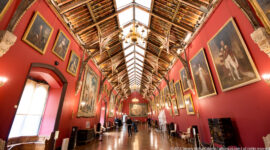
The stained glass found within Malbork Castle reflects the artistic traditions of the Teutonic Order, which constructed the fortress during the 13th century. Located along the Nogat River near the Baltic coast, Malbork became the headquarters of the powerful military order that controlled large territories along the southern Baltic.
The castle itself is the largest brick castle in the world, and its chapels and ceremonial halls contain decorative elements including stained glass that once illuminated the interiors with colored light. These windows often depict religious imagery and heraldic symbols associated with the knights and their Christian mission in the Baltic region.
Together with the castle’s massive walls and towers, the stained glass contributes to the remarkable medieval atmosphere preserved within this historic fortress complex.

A winged angel approaches two men in a stylized landscape dominated by a broad green tree. This panel belongs to the Malbork Castle church glazing associated with Johann Baptist Haselberger’s 1891–1893 Leipzig series, made as Gothic-style imitations/completions based on medieval Chełmno stained glass; the museum distinguishes these nineteenth-century panels from the surviving medieval originals now largely held in Toruń.
Caption
A winged angel approaches two men in a stylized landscape dominated by a broad green tree. This panel belongs to the Malbork Castle church glazing associated with Johann Baptist Haselberger’s 1891–1893 Leipzig series, made as Gothic-style imitations/completions based on medieval Chełmno stained glass; the museum distinguishes these nineteenth-century panels from the surviving medieval originals now largely held in Toruń.

A row of specialized hand tools represents the practical stages of shaping and assembling stained glass. Traditional manufacture required glass to be cut to the cartoon’s outlines and its edges refined so the pieces would fit while leaving room for the lead cames. Knives, pointed implements, shaping tools, and a small hammer in this display emphasize that a stained-glass window is both a painted image and a precisely constructed lead-and-glass object.
Caption
A row of specialized hand tools represents the practical stages of shaping and assembling stained glass. Traditional manufacture required glass to be cut to the cartoon’s outlines and its edges refined so the pieces would fit while leaving room for the lead cames. Knives, pointed implements, shaping tools, and a small hammer in this display emphasize that a stained-glass window is both a painted image and a precisely constructed lead-and-glass object.

Brushes, small vessels, pigment residues, a palette, and specialized hand tools illustrate the painting stage of stained-glass manufacture. Traditional glass paint is applied to individual pieces to add facial features, folds, outlines, shading, and other details that cannot be created by colored glass alone; the painted glass is then fired so the decoration becomes durable. The display makes visible the workshop materials behind details seen throughout the Malbork panels.
Caption
Brushes, small vessels, pigment residues, a palette, and specialized hand tools illustrate the painting stage of stained-glass manufacture. Traditional glass paint is applied to individual pieces to add facial features, folds, outlines, shading, and other details that cannot be created by colored glass alone; the painted glass is then fired so the decoration becomes durable. The display makes visible the workshop materials behind details seen throughout the Malbork panels.

Six small medieval stained-glass panels are presented together against a black background, each framed by looping ornamental bands and filled with compact sacred figures. The grouping emphasizes the cycle's consistent format, saturated palette, and narrative density while allowing comparison among different episodes. It serves as a concise visual overview of the surviving Malbork Castle stained-glass ensemble.
Caption
Six small medieval stained-glass panels are presented together against a black background, each framed by looping ornamental bands and filled with compact sacred figures. The grouping emphasizes the cycle's consistent format, saturated palette, and narrative density while allowing comparison among different episodes. It serves as a concise visual overview of the surviving Malbork Castle stained-glass ensemble.

Saint Jude Thaddeus is identified by the scroll, which visibly begins with the Latin form 'Iudas,' and by the heavy club-like implement laid diagonally across his body. The haloed apostle sits before crenellated architectural forms. These textual and iconographic clues allow the earlier generic city-associated saint caption to be replaced with a specific identification.
Caption
Saint Jude Thaddeus is identified by the scroll, which visibly begins with the Latin form 'Iudas,' and by the heavy club-like implement laid diagonally across his body. The haloed apostle sits before crenellated architectural forms. These textual and iconographic clues allow the earlier generic city-associated saint caption to be replaced with a specific identification.

Christ reaches down to Saint Peter amid stylized waves, identifying the Gospel episode in which Peter begins to sink while walking on the water. This panel belongs to the Malbork Castle church glazing associated with Johann Baptist Haselberger’s 1891–1893 Leipzig series, made as Gothic-style imitations/completions based on medieval Chełmno stained glass; the museum distinguishes these nineteenth-century panels from the surviving medieval originals now largely held in Toruń.
Caption
Christ reaches down to Saint Peter amid stylized waves, identifying the Gospel episode in which Peter begins to sink while walking on the water. This panel belongs to the Malbork Castle church glazing associated with Johann Baptist Haselberger’s 1891–1893 Leipzig series, made as Gothic-style imitations/completions based on medieval Chełmno stained glass; the museum distinguishes these nineteenth-century panels from the surviving medieval originals now largely held in Toruń.

The Transfiguration presents Christ in radiant pale robes between Moses and Elijah, with the apostles reacting below. This panel belongs to the Malbork Castle church glazing associated with Johann Baptist Haselberger’s 1891–1893 Leipzig series, made as Gothic-style imitations/completions based on medieval Chełmno stained glass; the museum distinguishes these nineteenth-century panels from the surviving medieval originals now largely held in Toruń.
Caption
The Transfiguration presents Christ in radiant pale robes between Moses and Elijah, with the apostles reacting below. This panel belongs to the Malbork Castle church glazing associated with Johann Baptist Haselberger’s 1891–1893 Leipzig series, made as Gothic-style imitations/completions based on medieval Chełmno stained glass; the museum distinguishes these nineteenth-century panels from the surviving medieval originals now largely held in Toruń.

Christ enters Jerusalem on a donkey as figures greet him with palm branches. This panel belongs to the Malbork Castle church glazing associated with Johann Baptist Haselberger’s 1891–1893 Leipzig series, made as Gothic-style imitations/completions based on medieval Chełmno stained glass; the museum distinguishes these nineteenth-century panels from the surviving medieval originals now largely held in Toruń.
Caption
Christ enters Jerusalem on a donkey as figures greet him with palm branches. This panel belongs to the Malbork Castle church glazing associated with Johann Baptist Haselberger’s 1891–1893 Leipzig series, made as Gothic-style imitations/completions based on medieval Chełmno stained glass; the museum distinguishes these nineteenth-century panels from the surviving medieval originals now largely held in Toruń.

A medieval stained-glass scene shows Christ extending his hand toward a kneeling, nearly unclothed man while several bearded companions look on. This panel belongs to the Malbork Castle church glazing associated with Johann Baptist Haselberger’s 1891–1893 Leipzig series, made as Gothic-style imitations/completions based on medieval Chełmno stained glass; the museum distinguishes these nineteenth-century panels from the surviving medieval originals now largely held in Toruń.
Caption
A medieval stained-glass scene shows Christ extending his hand toward a kneeling, nearly unclothed man while several bearded companions look on. This panel belongs to the Malbork Castle church glazing associated with Johann Baptist Haselberger’s 1891–1893 Leipzig series, made as Gothic-style imitations/completions based on medieval Chełmno stained glass; the museum distinguishes these nineteenth-century panels from the surviving medieval originals now largely held in Toruń.

King David, crowned and haloed, plays a harp in this figural panel. This panel belongs to the Malbork Castle church glazing associated with Johann Baptist Haselberger’s 1891–1893 Leipzig series, made as Gothic-style imitations/completions based on medieval Chełmno stained glass; the museum distinguishes these nineteenth-century panels from the surviving medieval originals now largely held in Toruń.
Caption
King David, crowned and haloed, plays a harp in this figural panel. This panel belongs to the Malbork Castle church glazing associated with Johann Baptist Haselberger’s 1891–1893 Leipzig series, made as Gothic-style imitations/completions based on medieval Chełmno stained glass; the museum distinguishes these nineteenth-century panels from the surviving medieval originals now largely held in Toruń.

Saint Gregory the Great is identified by the inscription carried across this compact figural panel. The haloed ecclesiastic stands frontally against deep blue glass, dressed in pale and green robes with a dark cap and red collar. The Malbork Castle Museum identifies this displayed group as Johann Baptist Haselberger's 1891–1893 Gothic-style imitations of Chełmno stained glass, and the documented saint program includes Gregory.
Caption
Saint Gregory the Great is identified by the inscription carried across this compact figural panel. The haloed ecclesiastic stands frontally against deep blue glass, dressed in pale and green robes with a dark cap and red collar. The Malbork Castle Museum identifies this displayed group as Johann Baptist Haselberger's 1891–1893 Gothic-style imitations of Chełmno stained glass, and the documented saint program includes Gregory.

Saint Lawrence sits on an architectural throne holding the large gridiron associated with his martyrdom. The surrounding inscription helps confirm the identification, while red patterned drapery, pale architecture, and the looping quatrefoil border organize the composition. This panel belongs to Johann Baptist Haselberger's 1891–1893 Malbork series of Gothic-style imitations based on medieval Chełmno glazing.
Caption
Saint Lawrence sits on an architectural throne holding the large gridiron associated with his martyrdom. The surrounding inscription helps confirm the identification, while red patterned drapery, pale architecture, and the looping quatrefoil border organize the composition. This panel belongs to Johann Baptist Haselberger's 1891–1893 Malbork series of Gothic-style imitations based on medieval Chełmno glazing.

Saint Athanasius of Alexandria is represented as a mitred bishop seated with a crozier and a small church-like architectural attribute. The inscribed scroll appears to name Athanasius, resolving the earlier generic bishop-saint identification. His episcopal dress, pastoral staff, and inclusion in the documented Malbork saint program support the identification.
Caption
Saint Athanasius of Alexandria is represented as a mitred bishop seated with a crozier and a small church-like architectural attribute. The inscribed scroll appears to name Athanasius, resolving the earlier generic bishop-saint identification. His episcopal dress, pastoral staff, and inclusion in the documented Malbork saint program support the identification.

Saint Peter the Apostle is shown enthroned with a monumental key-like attribute and an inscribed band beginning with the opening article of the Apostles' Creed. His halo, rich red and green garments, and architectural throne fill the quatrefoil. The combination of the key and Creed text makes Peter a much more secure identification than the earlier generic 'royal saint' reading.
Caption
Saint Peter the Apostle is shown enthroned with a monumental key-like attribute and an inscribed band beginning with the opening article of the Apostles' Creed. His halo, rich red and green garments, and architectural throne fill the quatrefoil. The combination of the key and Creed text makes Peter a much more secure identification than the earlier generic 'royal saint' reading.

Saint Ambrose of Milan sits in episcopal vestments holding a crozier while an inscribed scroll arcs across the composition. The inscription appears to read Ambrosius, the Latin form of Ambrose, resolving the earlier generic bishop-saint caption. His mitre, pastoral staff, and presence in the documented Malbork saint program reinforce the identification.
Caption
Saint Ambrose of Milan sits in episcopal vestments holding a crozier while an inscribed scroll arcs across the composition. The inscription appears to read Ambrosius, the Latin form of Ambrose, resolving the earlier generic bishop-saint caption. His mitre, pastoral staff, and presence in the documented Malbork saint program reinforce the identification.

A winged angel stands between two kneeling figures in a compact narrative scene framed by looping lead cames. This panel belongs to the Malbork Castle church glazing associated with Johann Baptist Haselberger’s 1891–1893 Leipzig series, made as Gothic-style imitations/completions based on medieval Chełmno stained glass; the museum distinguishes these nineteenth-century panels from the surviving medieval originals now largely held in Toruń.
Caption
A winged angel stands between two kneeling figures in a compact narrative scene framed by looping lead cames. This panel belongs to the Malbork Castle church glazing associated with Johann Baptist Haselberger’s 1891–1893 Leipzig series, made as Gothic-style imitations/completions based on medieval Chełmno stained glass; the museum distinguishes these nineteenth-century panels from the surviving medieval originals now largely held in Toruń.

Several figures gather in an architectural interior: an elderly seated man appears to read or write at left, a woman supports a haloed child near the center, and another figure reclines or sits in a curtained bed at right. This panel belongs to the Malbork Castle church glazing associated with Johann Baptist Haselberger’s 1891–1893 Leipzig series, made as Gothic-style imitations/completions based on medieval Chełmno stained glass; the museum distinguishes these nineteenth-century panels from the surviving medieval originals now largely held in Toruń.
Caption
Several figures gather in an architectural interior: an elderly seated man appears to read or write at left, a woman supports a haloed child near the center, and another figure reclines or sits in a curtained bed at right. This panel belongs to the Malbork Castle church glazing associated with Johann Baptist Haselberger’s 1891–1893 Leipzig series, made as Gothic-style imitations/completions based on medieval Chełmno stained glass; the museum distinguishes these nineteenth-century panels from the surviving medieval originals now largely held in Toruń.

A winged angel raises a small lamp- or vessel-shaped object over a reclining haloed figure lying on a bed. This panel belongs to the Malbork Castle church glazing associated with Johann Baptist Haselberger’s 1891–1893 Leipzig series, made as Gothic-style imitations/completions based on medieval Chełmno stained glass; the museum distinguishes these nineteenth-century panels from the surviving medieval originals now largely held in Toruń.
Caption
A winged angel raises a small lamp- or vessel-shaped object over a reclining haloed figure lying on a bed. This panel belongs to the Malbork Castle church glazing associated with Johann Baptist Haselberger’s 1891–1893 Leipzig series, made as Gothic-style imitations/completions based on medieval Chełmno stained glass; the museum distinguishes these nineteenth-century panels from the surviving medieval originals now largely held in Toruń.

Saint Jerome sits with a book and a lion, the animal traditionally associated with the scholar-saint. The lion replaces the earlier identification as Saint Mark: the Malbork saint program documented for these Haselberger panels specifically includes Jerome, while Mark is not among the listed figures. The inscription, architectural throne, red patterned robe, and green mantle complete the panel.
Caption
Saint Jerome sits with a book and a lion, the animal traditionally associated with the scholar-saint. The lion replaces the earlier identification as Saint Mark: the Malbork saint program documented for these Haselberger panels specifically includes Jerome, while Mark is not among the listed figures. The inscription, architectural throne, red patterned robe, and green mantle complete the panel.

Saint Augustine of Hippo is shown as a mitred bishop seated with a crozier and raised hand, his red patterned vestments and green upper garment set against the blue field. The inscription appears to read Augustinus, identifying the figure more precisely than the earlier generic bishop-saint description. Augustine is also included in the documented Malbork saint program.
Caption
Saint Augustine of Hippo is shown as a mitred bishop seated with a crozier and raised hand, his red patterned vestments and green upper garment set against the blue field. The inscription appears to read Augustinus, identifying the figure more precisely than the earlier generic bishop-saint description. Augustine is also included in the documented Malbork saint program.

The Nativity shows the Christ Child in the manger between the Virgin Mary and Saint Joseph, with the ox and ass behind. This panel belongs to the Malbork Castle church glazing associated with Johann Baptist Haselberger’s 1891–1893 Leipzig series, made as Gothic-style imitations/completions based on medieval Chełmno stained glass; the museum distinguishes these nineteenth-century panels from the surviving medieval originals now largely held in Toruń.
Caption
The Nativity shows the Christ Child in the manger between the Virgin Mary and Saint Joseph, with the ox and ass behind. This panel belongs to the Malbork Castle church glazing associated with Johann Baptist Haselberger’s 1891–1893 Leipzig series, made as Gothic-style imitations/completions based on medieval Chełmno stained glass; the museum distinguishes these nineteenth-century panels from the surviving medieval originals now largely held in Toruń.

The Adoration of the Magi centers on a crowned Magus kneeling before the Virgin Mary and Christ Child while two companions wait behind. This panel belongs to the Malbork Castle church glazing associated with Johann Baptist Haselberger’s 1891–1893 Leipzig series, made as Gothic-style imitations/completions based on medieval Chełmno stained glass; the museum distinguishes these nineteenth-century panels from the surviving medieval originals now largely held in Toruń.
Caption
The Adoration of the Magi centers on a crowned Magus kneeling before the Virgin Mary and Christ Child while two companions wait behind. This panel belongs to the Malbork Castle church glazing associated with Johann Baptist Haselberger’s 1891–1893 Leipzig series, made as Gothic-style imitations/completions based on medieval Chełmno stained glass; the museum distinguishes these nineteenth-century panels from the surviving medieval originals now largely held in Toruń.

Saint James the Lesser is identified by the inscription around this seated apostolic figure. He appears haloed on an architectural throne, raising one hand while a long staff or club crosses the composition. The named reading accords with the documented saint cycle represented in Johann Baptist Haselberger's 1891–1893 Gothic-style imitations of Chełmno stained glass.
Caption
Saint James the Lesser is identified by the inscription around this seated apostolic figure. He appears haloed on an architectural throne, raising one hand while a long staff or club crosses the composition. The named reading accords with the documented saint cycle represented in Johann Baptist Haselberger's 1891–1893 Gothic-style imitations of Chełmno stained glass.

Saint Adalbert of Prague (Wojciech), bishop and martyr, sits before stylized church architecture wearing a mitre and holding a pastoral staff. The lower-left portion of the inscribed band appears to begin with Adalbert, while the figure’s episcopal attributes and Adalbert’s documented presence in the Malbork saint cycle support the identification.
Caption
Saint Adalbert of Prague (Wojciech), bishop and martyr, sits before stylized church architecture wearing a mitre and holding a pastoral staff. The lower-left portion of the inscribed band appears to begin with Adalbert, while the figure’s episcopal attributes and Adalbert’s documented presence in the Malbork saint cycle support the identification.

Saint Matthew the Evangelist is identified by the inscribed scroll, whose opening appears to read Matthaeus. The haloed evangelist sits holding an extended text while another haloed figure gestures beside him. The inscription resolves the earlier mistaken visual reading of the seated figure as female and places the panel securely within the documented Malbork saint program.
Caption
Saint Matthew the Evangelist is identified by the inscribed scroll, whose opening appears to read Matthaeus. The haloed evangelist sits holding an extended text while another haloed figure gestures beside him. The inscription resolves the earlier mistaken visual reading of the seated figure as female and places the panel securely within the documented Malbork saint program.

Saint Luke the Evangelist writes at an open book while his ox appears at lower left, providing the clearest iconographic identification. The inscription and the documented Malbork saint roster reinforce the reading. Architectural forms and the looping band surround the seated figure, whose blue robe and red cap stand out against the quatrefoil field.
Caption
Saint Luke the Evangelist writes at an open book while his ox appears at lower left, providing the clearest iconographic identification. The inscription and the documented Malbork saint roster reinforce the reading. Architectural forms and the looping band surround the seated figure, whose blue robe and red cap stand out against the quatrefoil field.

Saint John the Baptist is identified by both text and image: the scroll carries the phrase 'Ecce Agnus...' while a lamb rests beside the seated saint, invoking 'Behold the Lamb of God.' He holds the inscribed band across his lap against a backdrop of stylized architecture. These combined clues make the identification secure rather than merely describing an anonymous saint with an animal.
Caption
Saint John the Baptist is identified by both text and image: the scroll carries the phrase 'Ecce Agnus...' while a lamb rests beside the seated saint, invoking 'Behold the Lamb of God.' He holds the inscribed band across his lap against a backdrop of stylized architecture. These combined clues make the identification secure rather than merely describing an anonymous saint with an animal.

Saint John the Evangelist sits among stylized architectural forms holding a chalice from which a serpent rises, one of his best-known medieval attributes. The surrounding inscription supports the named identification. The youthful, haloed saint wears a red patterned robe beneath a pale green mantle, distinguishing this panel from the neighboring apostolic figures.
Caption
Saint John the Evangelist sits among stylized architectural forms holding a chalice from which a serpent rises, one of his best-known medieval attributes. The surrounding inscription supports the named identification. The youthful, haloed saint wears a red patterned robe beneath a pale green mantle, distinguishing this panel from the neighboring apostolic figures.

Saint Simon the Zealot is identified by the large saw held upright at the left, his characteristic martyrdom attribute, together with the surrounding inscription. He sits haloed on an architectural throne in green and red garments. The identification fits the documented roster of saints in Johann Baptist Haselberger's 1891–1893 Malbork cycle.
Caption
Saint Simon the Zealot is identified by the large saw held upright at the left, his characteristic martyrdom attribute, together with the surrounding inscription. He sits haloed on an architectural throne in green and red garments. The identification fits the documented roster of saints in Johann Baptist Haselberger's 1891–1893 Malbork cycle.

Saint Bartholomew the Apostle sits with an elongated knife-like martyrdom attribute across his lap while the surrounding inscription identifies the figure. His bearded face, halo, green mantle, red sleeves, and architectural throne distinguish the panel from adjacent apostles. Bartholomew is specifically included in the documented saint program for these Malbork stained-glass imitations.
Caption
Saint Bartholomew the Apostle sits with an elongated knife-like martyrdom attribute across his lap while the surrounding inscription identifies the figure. His bearded face, halo, green mantle, red sleeves, and architectural throne distinguish the panel from adjacent apostles. Bartholomew is specifically included in the documented saint program for these Malbork stained-glass imitations.

Saint Matthias the Apostle is explicitly named on the scroll at lower left. He holds a long axe- or halberd-like martyrdom attribute across his body while seated on an architectural throne. The inscription makes the identification especially secure, and Matthias is included in the documented list of saints represented in the Haselberger glazing program.
Caption
Saint Matthias the Apostle is explicitly named on the scroll at lower left. He holds a long axe- or halberd-like martyrdom attribute across his body while seated on an architectural throne. The inscription makes the identification especially secure, and Matthias is included in the documented list of saints represented in the Haselberger glazing program.

A seated haloed woman supports the nude Christ Child while a bearded haloed man stands beside them holding a lamb or sheep. This panel belongs to the Malbork Castle church glazing associated with Johann Baptist Haselberger’s 1891–1893 Leipzig series, made as Gothic-style imitations/completions based on medieval Chełmno stained glass; the museum distinguishes these nineteenth-century panels from the surviving medieval originals now largely held in Toruń.
Caption
A seated haloed woman supports the nude Christ Child while a bearded haloed man stands beside them holding a lamb or sheep. This panel belongs to the Malbork Castle church glazing associated with Johann Baptist Haselberger’s 1891–1893 Leipzig series, made as Gothic-style imitations/completions based on medieval Chełmno stained glass; the museum distinguishes these nineteenth-century panels from the surviving medieval originals now largely held in Toruń.

A haloed child stands or sits elevated at the center of an interior while a kneeling figure reaches upward and a mitred bishop gestures from the right. This panel belongs to the Malbork Castle church glazing associated with Johann Baptist Haselberger’s 1891–1893 Leipzig series, made as Gothic-style imitations/completions based on medieval Chełmno stained glass; the museum distinguishes these nineteenth-century panels from the surviving medieval originals now largely held in Toruń.
Caption
A haloed child stands or sits elevated at the center of an interior while a kneeling figure reaches upward and a mitred bishop gestures from the right. This panel belongs to the Malbork Castle church glazing associated with Johann Baptist Haselberger’s 1891–1893 Leipzig series, made as Gothic-style imitations/completions based on medieval Chełmno stained glass; the museum distinguishes these nineteenth-century panels from the surviving medieval originals now largely held in Toruń.

Three haloed figures move through a stylized landscape with branching green trees: a bearded older man at left, a child at center, and a woman in red patterned dress at right. This panel belongs to the Malbork Castle church glazing associated with Johann Baptist Haselberger’s 1891–1893 Leipzig series, made as Gothic-style imitations/completions based on medieval Chełmno stained glass; the museum distinguishes these nineteenth-century panels from the surviving medieval originals now largely held in Toruń.
Caption
Three haloed figures move through a stylized landscape with branching green trees: a bearded older man at left, a child at center, and a woman in red patterned dress at right. This panel belongs to the Malbork Castle church glazing associated with Johann Baptist Haselberger’s 1891–1893 Leipzig series, made as Gothic-style imitations/completions based on medieval Chełmno stained glass; the museum distinguishes these nineteenth-century panels from the surviving medieval originals now largely held in Toruń.

The Baptism of Christ shows Christ standing in the Jordan as Saint John the Baptist reaches toward him, with angels attending. This panel belongs to the Malbork Castle church glazing associated with Johann Baptist Haselberger’s 1891–1893 Leipzig series, made as Gothic-style imitations/completions based on medieval Chełmno stained glass; the museum distinguishes these nineteenth-century panels from the surviving medieval originals now largely held in Toruń.
Caption
The Baptism of Christ shows Christ standing in the Jordan as Saint John the Baptist reaches toward him, with angels attending. This panel belongs to the Malbork Castle church glazing associated with Johann Baptist Haselberger’s 1891–1893 Leipzig series, made as Gothic-style imitations/completions based on medieval Chełmno stained glass; the museum distinguishes these nineteenth-century panels from the surviving medieval originals now largely held in Toruń.

A haloed Christ-like figure in red patterned robes stands at the center of a crowded interior beside a large rounded vessel. This panel belongs to the Malbork Castle church glazing associated with Johann Baptist Haselberger’s 1891–1893 Leipzig series, made as Gothic-style imitations/completions based on medieval Chełmno stained glass; the museum distinguishes these nineteenth-century panels from the surviving medieval originals now largely held in Toruń.
Caption
A haloed Christ-like figure in red patterned robes stands at the center of a crowded interior beside a large rounded vessel. This panel belongs to the Malbork Castle church glazing associated with Johann Baptist Haselberger’s 1891–1893 Leipzig series, made as Gothic-style imitations/completions based on medieval Chełmno stained glass; the museum distinguishes these nineteenth-century panels from the surviving medieval originals now largely held in Toruń.

A haloed Christ figure in red patterned robes stands or sits elevated at center, extending one hand toward a tightly gathered group of men and women. This panel belongs to the Malbork Castle church glazing associated with Johann Baptist Haselberger’s 1891–1893 Leipzig series, made as Gothic-style imitations/completions based on medieval Chełmno stained glass; the museum distinguishes these nineteenth-century panels from the surviving medieval originals now largely held in Toruń.
Caption
A haloed Christ figure in red patterned robes stands or sits elevated at center, extending one hand toward a tightly gathered group of men and women. This panel belongs to the Malbork Castle church glazing associated with Johann Baptist Haselberger’s 1891–1893 Leipzig series, made as Gothic-style imitations/completions based on medieval Chełmno stained glass; the museum distinguishes these nineteenth-century panels from the surviving medieval originals now largely held in Toruń.

Christ, identifiable by his halo and patterned red robe, confronts or addresses a clustered group in this medieval stained-glass panel. This panel belongs to the Malbork Castle church glazing associated with Johann Baptist Haselberger’s 1891–1893 Leipzig series, made as Gothic-style imitations/completions based on medieval Chełmno stained glass; the museum distinguishes these nineteenth-century panels from the surviving medieval originals now largely held in Toruń.
Caption
Christ, identifiable by his halo and patterned red robe, confronts or addresses a clustered group in this medieval stained-glass panel. This panel belongs to the Malbork Castle church glazing associated with Johann Baptist Haselberger’s 1891–1893 Leipzig series, made as Gothic-style imitations/completions based on medieval Chełmno stained glass; the museum distinguishes these nineteenth-century panels from the surviving medieval originals now largely held in Toruń.

A haloed Christ stands beside two small sheep and faces a kneeling, haloed disciple who holds a long crozier- or staff-like object. This panel belongs to the Malbork Castle church glazing associated with Johann Baptist Haselberger’s 1891–1893 Leipzig series, made as Gothic-style imitations/completions based on medieval Chełmno stained glass; the museum distinguishes these nineteenth-century panels from the surviving medieval originals now largely held in Toruń.
Caption
A haloed Christ stands beside two small sheep and faces a kneeling, haloed disciple who holds a long crozier- or staff-like object. This panel belongs to the Malbork Castle church glazing associated with Johann Baptist Haselberger’s 1891–1893 Leipzig series, made as Gothic-style imitations/completions based on medieval Chełmno stained glass; the museum distinguishes these nineteenth-century panels from the surviving medieval originals now largely held in Toruń.

A technical display brings together drawn and painted studies, numbered color references, glass fragments, and a reconstructed figural section to explain how a stained-glass image moves from design to finished glazing. The studies separate composition, color choice, and painted detail into working stages. This interpretive material complements Malbork’s displayed Haselberger panels by making the craft behind their colored and painted glass more legible.
Caption
A technical display brings together drawn and painted studies, numbered color references, glass fragments, and a reconstructed figural section to explain how a stained-glass image moves from design to finished glazing. The studies separate composition, color choice, and painted detail into working stages. This interpretive material complements Malbork’s displayed Haselberger panels by making the craft behind their colored and painted glass more legible.

Individually cut pieces of colored glass are fitted edge to edge to build part of a figure, demonstrating a fundamental principle of traditional stained-glass construction: a change of color generally requires a separate piece of glass. The irregular green, violet, turquoise, yellow, and burgundy shapes reveal how the pictorial design is translated into a mosaic-like assembly before the pieces are secured within a lead network.
Caption
Individually cut pieces of colored glass are fitted edge to edge to build part of a figure, demonstrating a fundamental principle of traditional stained-glass construction: a change of color generally requires a separate piece of glass. The irregular green, violet, turquoise, yellow, and burgundy shapes reveal how the pictorial design is translated into a mosaic-like assembly before the pieces are secured within a lead network.

A full-size working cartoon breaks the composition into numbered shapes corresponding to individual pieces of glass. In traditional stained-glass practice, the cartoon establishes the principal design lines, which also guide where separate colored pieces will be cut and ultimately joined. Placing the numbered drawing beside the partly assembled figure makes the translation from two-dimensional design to cut, painted, and leaded glass especially clear.
Caption
A full-size working cartoon breaks the composition into numbered shapes corresponding to individual pieces of glass. In traditional stained-glass practice, the cartoon establishes the principal design lines, which also guide where separate colored pieces will be cut and ultimately joined. Placing the numbered drawing beside the partly assembled figure makes the translation from two-dimensional design to cut, painted, and leaded glass especially clear.

Cut and painted pieces are aligned directly over the numbered full-size cartoon, allowing their shapes, painted details, and positions to be checked against the design before final assembly. The photograph shows how the cartoon functions as a working template rather than simply as an artist’s sketch. Individual pieces collectively build the figure while the planned boundaries anticipate the lead network that will hold the finished panel together.
Caption
Cut and painted pieces are aligned directly over the numbered full-size cartoon, allowing their shapes, painted details, and positions to be checked against the design before final assembly. The photograph shows how the cartoon functions as a working template rather than simply as an artist’s sketch. Individual pieces collectively build the figure while the planned boundaries anticipate the lead network that will hold the finished panel together.

A close view of the assembled figural glazing reveals the final structural relationship between image and leadwork. Individually colored and painted pieces form faces, garments, architecture, and background while the lead cames both secure the glass and reinforce the composition’s principal lines. Seen after the cartoon, cutting, painting, and fitting displays, this panel effectively completes the exhibition’s explanation of how a stained-glass design becomes a finished leaded window.
Caption
A close view of the assembled figural glazing reveals the final structural relationship between image and leadwork. Individually colored and painted pieces form faces, garments, architecture, and background while the lead cames both secure the glass and reinforce the composition’s principal lines. Seen after the cartoon, cutting, painting, and fitting displays, this panel effectively completes the exhibition’s explanation of how a stained-glass design becomes a finished leaded window.