Fisherman’s Bastion – Budapest, Hungary
Fisherman’s Bastion stands on Castle Hill overlooking the Danube River and the historic center of Budapest. Built in the late 19th century as part of a major restoration of the Buda Castle district, the structure was designed in a romantic Neo-Romanesque style with decorative towers, arcades, and terraces.
From its elevated balconies visitors can look across the Danube toward the Hungarian Parliament building and the wide boulevards of Pest. The white stone towers frame one of the most famous panoramic views of the city.
Despite its medieval appearance, Fisherman’s Bastion was built primarily as a scenic viewpoint celebrating the historic fishing guilds that once defended this section of the city walls.

The Hungarian Parliament Building appears across the Danube through a shaded stone arch at Fisherman’s Bastion. The soft foreground masonry creates a natural frame around the distant riverfront landmark, whose central dome and long neo-Gothic façade remain recognizable despite the shallow focus. Small circular openings in the terrace wall add a second layer of architectural framing, linking the Bastion’s lookout architecture with the panoramic city view beyond.
Caption
The Hungarian Parliament Building appears across the Danube through a shaded stone arch at Fisherman’s Bastion. The soft foreground masonry creates a natural frame around the distant riverfront landmark, whose central dome and long neo-Gothic façade remain recognizable despite the shallow focus. Small circular openings in the terrace wall add a second layer of architectural framing, linking the Bastion’s lookout architecture with the panoramic city view beyond.

A distant daylight view sets Matthias Church within the Fisherman’s Bastion complex, with its slender spire and multicolored tile roof rising above pale arcades and towers. Lower Buda rooftops fill the foreground while a large modern building borders the right side, making the photograph especially useful for reading the historic ensemble within its broader urban setting.
Caption
A distant daylight view sets Matthias Church within the Fisherman’s Bastion complex, with its slender spire and multicolored tile roof rising above pale arcades and towers. Lower Buda rooftops fill the foreground while a large modern building borders the right side, making the photograph especially useful for reading the historic ensemble within its broader urban setting.

Saint Stephen I’s equestrian monument is seen in full within the open court of Fisherman’s Bastion, with its bronze rider, relief-covered stone base, gilded medallion, and flanking lions all visible. Conical towers and arcaded galleries encircle the monument, giving the photograph a stronger sense of the sculpture’s placement and ceremonial setting than the tighter details on the preceding images.
Caption
Saint Stephen I’s equestrian monument is seen in full within the open court of Fisherman’s Bastion, with its bronze rider, relief-covered stone base, gilded medallion, and flanking lions all visible. Conical towers and arcaded galleries encircle the monument, giving the photograph a stronger sense of the sculpture’s placement and ceremonial setting than the tighter details on the preceding images.

A smiling adult man is photographed close to the camera with a Fisherman’s Bastion tower and arcaded terrace blurred in the background. The bright, high-key setting reduces the architecture to pale shapes, leaving the sitter’s expression as the dominant visual element while the pointed conical roof still anchors the location. This final frame functions as a personal travel portrait within the Budapest Castle Hill setting.
Caption
A smiling adult man is photographed close to the camera with a Fisherman’s Bastion tower and arcaded terrace blurred in the background. The bright, high-key setting reduces the architecture to pale shapes, leaving the sitter’s expression as the dominant visual element while the pointed conical roof still anchors the location. This final frame functions as a personal travel portrait within the Budapest Castle Hill setting.

The sanctuary of Matthias Church is viewed head-on beneath a high ribbed vault, with a richly ornamented altar ensemble centered against the apse and tall stained-glass windows rising behind it. Painted wall surfaces and patterned architectural bands cover nearly every visible surface. The symmetrical composition records the church’s highly decorative historicist interior, where colored glass, mural ornament, stonework, and liturgical furnishings are integrated into a single visual program.
Caption
The sanctuary of Matthias Church is viewed head-on beneath a high ribbed vault, with a richly ornamented altar ensemble centered against the apse and tall stained-glass windows rising behind it. Painted wall surfaces and patterned architectural bands cover nearly every visible surface. The symmetrical composition records the church’s highly decorative historicist interior, where colored glass, mural ornament, stonework, and liturgical furnishings are integrated into a single visual program.

Night illumination picks out the tall Gothic Revival spire and patterned roof of Matthias Church above the arcaded walls and turrets of Fisherman’s Bastion on Castle Hill. The dark foreground isolates the floodlit ensemble, emphasizing the church’s vertical silhouette against the low, pale masonry of the bastion and the surrounding Buda skyline.
Caption
Night illumination picks out the tall Gothic Revival spire and patterned roof of Matthias Church above the arcaded walls and turrets of Fisherman’s Bastion on Castle Hill. The dark foreground isolates the floodlit ensemble, emphasizing the church’s vertical silhouette against the low, pale masonry of the bastion and the surrounding Buda skyline.

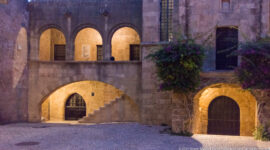
A sweeping stone stairway of Fisherman’s Bastion rises around a deep round-arched passage, its carved archivolts, circular openings, balustrades, and flanking towers rendered in pale masonry. Matthias Church appears above and behind, linking this monumental circulation feature to the larger Castle Hill ensemble while the low viewpoint stresses the stair’s sculptural mass and layered geometry.
Caption
A sweeping stone stairway of Fisherman’s Bastion rises around a deep round-arched passage, its carved archivolts, circular openings, balustrades, and flanking towers rendered in pale masonry. Matthias Church appears above and behind, linking this monumental circulation feature to the larger Castle Hill ensemble while the low viewpoint stresses the stair’s sculptural mass and layered geometry.

The Saint Stephen I equestrian monument occupies the center of a broad Castle Hill composition, with the patterned roof and pale apse of Matthias Church rising at left and a conical Fisherman’s Bastion turret at right. The photograph brings together sculpture, church, and fortification in one view, clearly showing how the monuments share the same ceremonial urban space.
Caption
The Saint Stephen I equestrian monument occupies the center of a broad Castle Hill composition, with the patterned roof and pale apse of Matthias Church rising at left and a conical Fisherman’s Bastion turret at right. The photograph brings together sculpture, church, and fortification in one view, clearly showing how the monuments share the same ceremonial urban space.

Twin stone arches at Fisherman’s Bastion frame a broad view across the Danube to the Hungarian Parliament Building. The central dome and symmetrical neo-Gothic mass rise above the riverfront, while rooftops and river traffic occupy the lower distance. By using the Bastion’s columns and arches as a foreground screen, the photograph connects two of Budapest’s defining architectural landmarks within a single layered composition.
Caption
Twin stone arches at Fisherman’s Bastion frame a broad view across the Danube to the Hungarian Parliament Building. The central dome and symmetrical neo-Gothic mass rise above the riverfront, while rooftops and river traffic occupy the lower distance. By using the Bastion’s columns and arches as a foreground screen, the photograph connects two of Budapest’s defining architectural landmarks within a single layered composition.

Paired conical towers rise above the curved lower gallery of Fisherman’s Bastion in a closer frontal study than the preceding view. The central stair, arched openings, and patterned stone balustrade create strong horizontal and vertical rhythms beneath the towers. This composition concentrates on the Bastion’s layered circulation system and sculptural skyline, showing how stairs, terraces, galleries, and lookout towers are integrated into a single ensemble.
Caption
Paired conical towers rise above the curved lower gallery of Fisherman’s Bastion in a closer frontal study than the preceding view. The central stair, arched openings, and patterned stone balustrade create strong horizontal and vertical rhythms beneath the towers. This composition concentrates on the Bastion’s layered circulation system and sculptural skyline, showing how stairs, terraces, galleries, and lookout towers are integrated into a single ensemble.

Matthias Church anchors this broad view of Castle Hill, its high spire and colored roof rising above the crenellated and arcaded forms of Fisherman’s Bastion. Rows of older city buildings occupy the lower slope, while larger institutional structures extend across the ridge, showing the church and bastion as part of a dense historic urban landscape rather than isolated monuments.
Caption
Matthias Church anchors this broad view of Castle Hill, its high spire and colored roof rising above the crenellated and arcaded forms of Fisherman’s Bastion. Rows of older city buildings occupy the lower slope, while larger institutional structures extend across the ridge, showing the church and bastion as part of a dense historic urban landscape rather than isolated monuments.

Stone stairways and ramped terraces climb through Fisherman’s Bastion toward the polygonal east end of Matthias Church, whose tall windows and vividly tiled roof dominate the center. Conical turrets, arcades, and pale limestone walls frame the approach, creating a layered architectural study of the bastion’s circulation routes and their close relationship to the church.
Caption
Stone stairways and ramped terraces climb through Fisherman’s Bastion toward the polygonal east end of Matthias Church, whose tall windows and vividly tiled roof dominate the center. Conical turrets, arcades, and pale limestone walls frame the approach, creating a layered architectural study of the bastion’s circulation routes and their close relationship to the church.

The east end of Matthias Church rises above Fisherman’s Bastion, combining tall lancet windows, pale stone buttressing, a steep patterned tile roof, and the richly articulated Gothic Revival spire. Smaller pinnacles and gables create a dense silhouette across the right side, while the bastion’s arcaded parapet forms a horizontal base beneath the church.
Caption
The east end of Matthias Church rises above Fisherman’s Bastion, combining tall lancet windows, pale stone buttressing, a steep patterned tile roof, and the richly articulated Gothic Revival spire. Smaller pinnacles and gables create a dense silhouette across the right side, while the bastion’s arcaded parapet forms a horizontal base beneath the church.

A tight architectural view pairs the richly patterned roof over Matthias Church’s east end with the soaring tracery and pinnacles of its main spire. The pale stone walls and pointed windows contrast with the geometric bands of colored roof tile, focusing attention on the church’s highly decorative late nineteenth-century exterior rather than the surrounding bastion.
Caption
A tight architectural view pairs the richly patterned roof over Matthias Church’s east end with the soaring tracery and pinnacles of its main spire. The pale stone walls and pointed windows contrast with the geometric bands of colored roof tile, focusing attention on the church’s highly decorative late nineteenth-century exterior rather than the surrounding bastion.

Colored ceramic roof tiles form bold geometric patterns behind an ornate pale-stone balustrade on Matthias Church. Crocketed pinnacles, carved tracery, sculptural brackets, and a small gable cross crowd the foreground, presenting the church as a dense assemblage of Gothic Revival ornament and highlighting the contrast between patterned roof surface and carved masonry.
Caption
Colored ceramic roof tiles form bold geometric patterns behind an ornate pale-stone balustrade on Matthias Church. Crocketed pinnacles, carved tracery, sculptural brackets, and a small gable cross crowd the foreground, presenting the church as a dense assemblage of Gothic Revival ornament and highlighting the contrast between patterned roof surface and carved masonry.

A deep round-arched alcove in Fisherman’s Bastion is framed by multiple bands of carved stone, including a prominent zigzag molding. Inside, the partly exposed brick vault and a small triple-arched stone feature contrast with the pale exterior masonry. The close frontal view records material changes, depth, and Romanesque Revival ornament within the bastion’s passage system.
Caption
A deep round-arched alcove in Fisherman’s Bastion is framed by multiple bands of carved stone, including a prominent zigzag molding. Inside, the partly exposed brick vault and a small triple-arched stone feature contrast with the pale exterior masonry. The close frontal view records material changes, depth, and Romanesque Revival ornament within the bastion’s passage system.

A carved Hungarian coat of arms crowns a stone arch at Fisherman’s Bastion, flanked by circular relief motifs and an incised inscription that is only partly legible in the photograph. The close crop emphasizes heraldry and letterforms rather than the larger architecture, preserving a decorative detail associated with the bastion’s historicizing national imagery.
Caption
A carved Hungarian coat of arms crowns a stone arch at Fisherman’s Bastion, flanked by circular relief motifs and an incised inscription that is only partly legible in the photograph. The close crop emphasizes heraldry and letterforms rather than the larger architecture, preserving a decorative detail associated with the bastion’s historicizing national imagery.

Three life-size stone figures in shallow niches wear historicizing military dress and carry weapons or regalia, forming a sculptural group integrated into Fisherman’s Bastion. The frontal crop isolates their varied costume, facial hair, belts, cloaks, and weapons, emphasizing the bastion’s program of medievalizing national imagery without relying on uncertain individual identifications.
Caption
Three life-size stone figures in shallow niches wear historicizing military dress and carry weapons or regalia, forming a sculptural group integrated into Fisherman’s Bastion. The frontal crop isolates their varied costume, facial hair, belts, cloaks, and weapons, emphasizing the bastion’s program of medievalizing national imagery without relying on uncertain individual identifications.

A conical-roofed turret rises above an open arcade at Fisherman’s Bastion, its circular upper gallery carried by slender columns and rounded arches. The low, close viewpoint reveals layered parapets, carved corbeling, and the alternating openness and mass that give the bastion its distinctive Romanesque Revival silhouette, with tree foliage entering at the right edge.
Caption
A conical-roofed turret rises above an open arcade at Fisherman’s Bastion, its circular upper gallery carried by slender columns and rounded arches. The low, close viewpoint reveals layered parapets, carved corbeling, and the alternating openness and mass that give the bastion its distinctive Romanesque Revival silhouette, with tree foliage entering at the right edge.

Heavy stone columns and broad round arches frame a view across Fisherman’s Bastion toward its stairways and conical towers. The shaded foreground acts as an architectural screen around the sunlit terraces beyond, creating a strong study of depth, circulation, and repeated arches within the complex rather than a conventional exterior panorama.
Caption
Heavy stone columns and broad round arches frame a view across Fisherman’s Bastion toward its stairways and conical towers. The shaded foreground acts as an architectural screen around the sunlit terraces beyond, creating a strong study of depth, circulation, and repeated arches within the complex rather than a conventional exterior panorama.

A close side view isolates the bronze figure of Saint Stephen I on horseback above his monument near Fisherman’s Bastion. The crowned king wears a long cloak and holds the reins while the richly modeled horse displays decorative harness elements and hanging ornaments. A gilded halo-like ring behind the king’s head adds a luminous accent against the pale sky.
Caption
A close side view isolates the bronze figure of Saint Stephen I on horseback above his monument near Fisherman’s Bastion. The crowned king wears a long cloak and holds the reins while the richly modeled horse displays decorative harness elements and hanging ornaments. A gilded halo-like ring behind the king’s head adds a luminous accent against the pale sky.

A broad stairway climbs through a round-arched gateway between the pale stone walls and conical turrets of Fisherman’s Bastion. Repeated arcades run along the right side while a modern building presses close on the left, making the photograph a useful record of the bastion’s layered circulation system and its integration into the contemporary Castle Hill streetscape.
Caption
A broad stairway climbs through a round-arched gateway between the pale stone walls and conical turrets of Fisherman’s Bastion. Repeated arcades run along the right side while a modern building presses close on the left, making the photograph a useful record of the bastion’s layered circulation system and its integration into the contemporary Castle Hill streetscape.

The bronze equestrian monument to Saint Stephen I stands in front of Fisherman’s Bastion, the king mounted above a tall white-stone pedestal decorated with relief sculpture and flanked by carved lions. A gilded circular medallion is set into the pedestal’s upper face, while the bastion’s conical turrets and arcades provide a strongly symmetrical architectural backdrop.
Caption
The bronze equestrian monument to Saint Stephen I stands in front of Fisherman’s Bastion, the king mounted above a tall white-stone pedestal decorated with relief sculpture and flanked by carved lions. A gilded circular medallion is set into the pedestal’s upper face, while the bastion’s conical turrets and arcades provide a strongly symmetrical architectural backdrop.

The pedestal of the Saint Stephen I equestrian monument fills the frame, revealing a large historical relief panel below a gilded circular medallion and the sculpted lions that guard the upper corners. Chevron and arcaded moldings enrich the pale stone architecture of the base, while only the underside of the bronze horse is visible at the top edge.
Caption
The pedestal of the Saint Stephen I equestrian monument fills the frame, revealing a large historical relief panel below a gilded circular medallion and the sculpted lions that guard the upper corners. Chevron and arcaded moldings enrich the pale stone architecture of the base, while only the underside of the bronze horse is visible at the top edge.
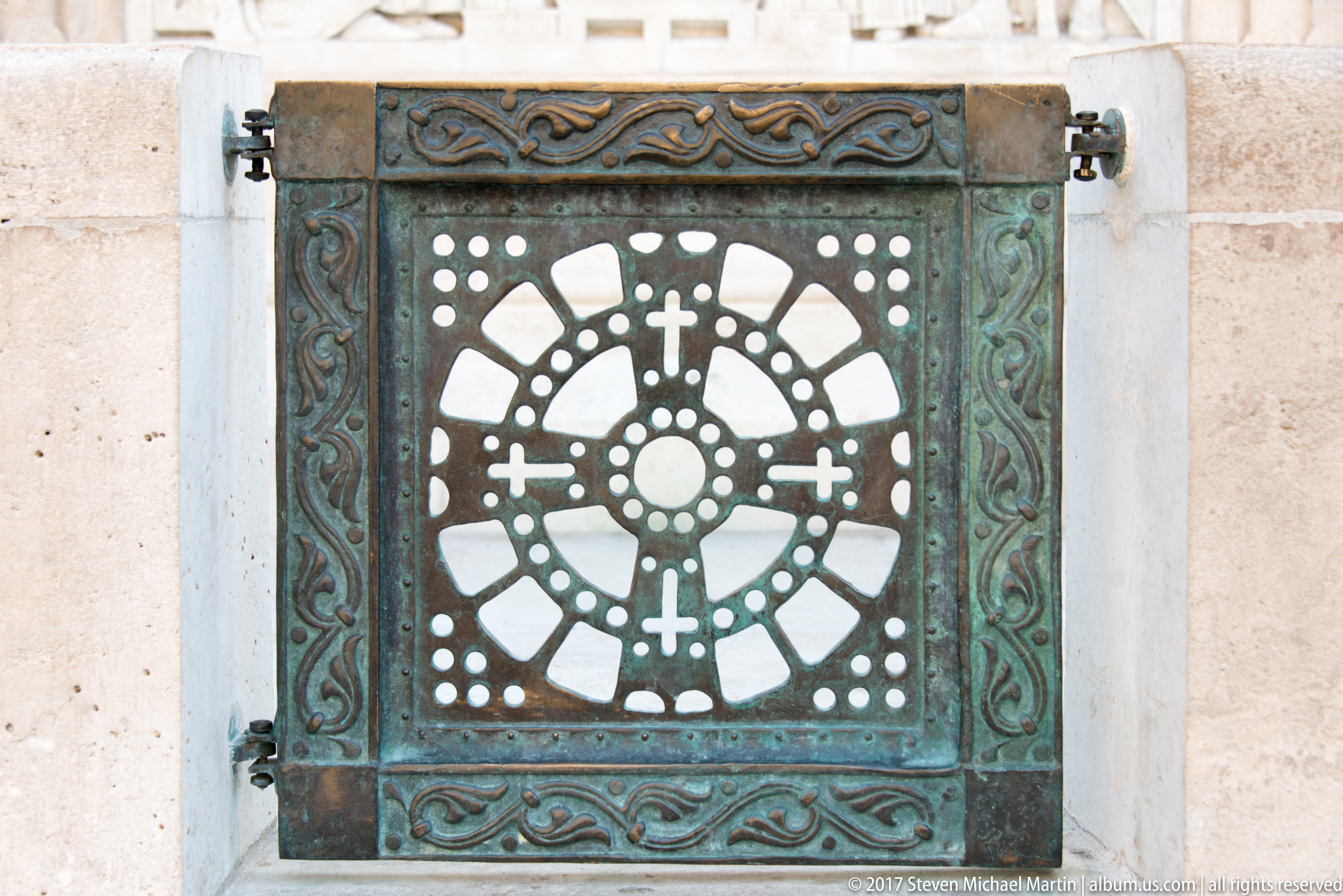
A square bronze grille with green patina is set into pale stonework at Fisherman’s Bastion. Its pierced design centers on a circular rosette-like pattern crossed by repeated small crosses, while a raised border carries scrolling ornament. The tight crop records a functional architectural fitting transformed into a decorative motif through metalwork and geometric repetition.
Caption
A square bronze grille with green patina is set into pale stonework at Fisherman’s Bastion. Its pierced design centers on a circular rosette-like pattern crossed by repeated small crosses, while a raised border carries scrolling ornament. The tight crop records a functional architectural fitting transformed into a decorative motif through metalwork and geometric repetition.

The south entrance of Matthias Church is framed by a steep pointed arch filled with carved tracery and layered sculptural moldings. Slender pinnacles rise beside the portal, while the church’s multicolored geometric roof appears above. The frontal composition concentrates on the ceremonial doorway and its richly carved stonework, with modern signs and barriers providing scale at ground level.
Caption
The south entrance of Matthias Church is framed by a steep pointed arch filled with carved tracery and layered sculptural moldings. Slender pinnacles rise beside the portal, while the church’s multicolored geometric roof appears above. The frontal composition concentrates on the ceremonial doorway and its richly carved stonework, with modern signs and barriers providing scale at ground level.

The Holy Trinity Column rises in front of the Castle Hill buildings near Matthias Church, its tall sculpted shaft culminating in a dense cloud-like group of figures beneath gilded rays. The broad view shows the full monument from stepped base to radiant crown, placing the ornate Baroque devotional column against a comparatively restrained historic façade.
Caption
The Holy Trinity Column rises in front of the Castle Hill buildings near Matthias Church, its tall sculpted shaft culminating in a dense cloud-like group of figures beneath gilded rays. The broad view shows the full monument from stepped base to radiant crown, placing the ornate Baroque devotional column against a comparatively restrained historic façade.

The upper group of the Holy Trinity Column is shown in close view, with billowing stone clouds and clustered sacred figures surrounding a large gilded sunburst. A prominent cross leans diagonally across the composition, while the monument’s elaborate Baroque modeling stands sharply against the blue sky and the dark red roofline below.
Caption
The upper group of the Holy Trinity Column is shown in close view, with billowing stone clouds and clustered sacred figures surrounding a large gilded sunburst. A prominent cross leans diagonally across the composition, while the monument’s elaborate Baroque modeling stands sharply against the blue sky and the dark red roofline below.

Matthias Church dominates Holy Trinity Square with its tall openwork spire, steep gables, patterned roof, and pale stone façade. The Holy Trinity Column stands to the left, creating a layered view of two major monuments in the Castle District. The oblique angle also shows the church’s long side elevation and adjacent civic buildings stretching away along the square.
Caption
Matthias Church dominates Holy Trinity Square with its tall openwork spire, steep gables, patterned roof, and pale stone façade. The Holy Trinity Column stands to the left, creating a layered view of two major monuments in the Castle District. The oblique angle also shows the church’s long side elevation and adjacent civic buildings stretching away along the square.

A small bear-like carved animal projects from the pale stone architecture near Fisherman’s Bastion, crouching above a compact support while opening its mouth toward the viewer. Surrounding reliefs combine leaf forms, bead-like circles, and tightly patterned carving beneath a richly decorated cornice, making this close view a study of playful historicizing ornament rather than monumental scale.
Caption
A small bear-like carved animal projects from the pale stone architecture near Fisherman’s Bastion, crouching above a compact support while opening its mouth toward the viewer. Surrounding reliefs combine leaf forms, bead-like circles, and tightly patterned carving beneath a richly decorated cornice, making this close view a study of playful historicizing ornament rather than monumental scale.

A broad frontal view of Matthias Church emphasizes the massive lower tower, pointed central entrance, rose window, steep gables, and the soaring openwork spire above. The multicolored roof is visible along the side elevation, while a few pedestrians and street fixtures provide scale in the open square. The composition reads the church as a complete architectural mass rather than a collection of details.
Caption
A broad frontal view of Matthias Church emphasizes the massive lower tower, pointed central entrance, rose window, steep gables, and the soaring openwork spire above. The multicolored roof is visible along the side elevation, while a few pedestrians and street fixtures provide scale in the open square. The composition reads the church as a complete architectural mass rather than a collection of details.

A dark sculpted bird, likely a raven, perches on a gilded decorative finial against a clear blue sky. Its hooked posture and prominent beak form a stark silhouette above the gold-toned support. The close crop offers little surrounding architecture, so the photograph is best read as an isolated heraldic or decorative bird motif associated with the Castle Hill ensemble.
Caption
A dark sculpted bird, likely a raven, perches on a gilded decorative finial against a clear blue sky. Its hooked posture and prominent beak form a stark silhouette above the gold-toned support. The close crop offers little surrounding architecture, so the photograph is best read as an isolated heraldic or decorative bird motif associated with the Castle Hill ensemble.

A broad stair rises toward Fisherman’s Bastion’s clustered conical towers, whose cylindrical drums, arched openings, and layered parapets form a compact neo-Romanesque silhouette. The frontal viewpoint emphasizes symmetry and mass, while lampposts and the sweeping balustrade establish the scale of the terrace. Soft side light picks out the pale stone and the rhythm of openings across the lower gallery.
Caption
A broad stair rises toward Fisherman’s Bastion’s clustered conical towers, whose cylindrical drums, arched openings, and layered parapets form a compact neo-Romanesque silhouette. The frontal viewpoint emphasizes symmetry and mass, while lampposts and the sweeping balustrade establish the scale of the terrace. Soft side light picks out the pale stone and the rhythm of openings across the lower gallery.

A steep pale-stone turret and adjacent gable rise against a deep blue sky on Matthias Church, their pointed openings, carved crockets, and cross-shaped finials creating a sharply vertical silhouette. Small animal-like water spouts project from the turret corners, while the tightly cropped composition removes the larger church to focus on roofline ornament and sculptural detailing.
Caption
A steep pale-stone turret and adjacent gable rise against a deep blue sky on Matthias Church, their pointed openings, carved crockets, and cross-shaped finials creating a sharply vertical silhouette. Small animal-like water spouts project from the turret corners, while the tightly cropped composition removes the larger church to focus on roofline ornament and sculptural detailing.

A close view of Matthias Church’s tower concentrates on layered pointed arches, tracery, pinnacles, balconies, and dense carved ornament. Projecting stone figures or spouts extend from both sides, while repeated vertical moldings pull the eye upward. The crop excludes the roof and square, allowing the tower’s sculptural masonry and Gothic Revival vocabulary to dominate the frame.
Caption
A close view of Matthias Church’s tower concentrates on layered pointed arches, tracery, pinnacles, balconies, and dense carved ornament. Projecting stone figures or spouts extend from both sides, while repeated vertical moldings pull the eye upward. The crop excludes the roof and square, allowing the tower’s sculptural masonry and Gothic Revival vocabulary to dominate the frame.

The steep roof of Matthias Church fills the frame with interlocking diamonds, zigzags, crosses, and multicolored glazed tiles in orange, green, cream, and dark tones. A small triangular opening interrupts the patterned surface, while a dark metal finial crowns the ridge. The tight crop turns one of the church’s most recognizable exterior features into an abstract geometric composition.
Caption
The steep roof of Matthias Church fills the frame with interlocking diamonds, zigzags, crosses, and multicolored glazed tiles in orange, green, cream, and dark tones. A small triangular opening interrupts the patterned surface, while a dark metal finial crowns the ridge. The tight crop turns one of the church’s most recognizable exterior features into an abstract geometric composition.

Stone balustrades, sculptural ornament, and a bronze equestrian monument frame a low-angle view toward Matthias Church. The church’s slender Gothic tower and richly patterned tile roof rise beyond the pale masonry, linking the sacred architecture of Castle Hill with the ceremonial spaces beside Fisherman’s Bastion. The steep viewpoint emphasizes the vertical contrast between carved stonework, bronze sculpture, and the church’s ornate roofline.
Caption
Stone balustrades, sculptural ornament, and a bronze equestrian monument frame a low-angle view toward Matthias Church. The church’s slender Gothic tower and richly patterned tile roof rise beyond the pale masonry, linking the sacred architecture of Castle Hill with the ceremonial spaces beside Fisherman’s Bastion. The steep viewpoint emphasizes the vertical contrast between carved stonework, bronze sculpture, and the church’s ornate roofline.

A stone archway opens onto one of Fisherman’s Bastion’s conical-roofed towers, while rows of sculpted historical figures line the shaded passage at left and right. The composition uses the arcade as a frame, drawing attention from the carved interior surfaces to the sunlit stair and tower beyond. This view highlights the Bastion’s theatrical, neo-Romanesque vocabulary rather than its function as a true medieval defensive work.
Caption
A stone archway opens onto one of Fisherman’s Bastion’s conical-roofed towers, while rows of sculpted historical figures line the shaded passage at left and right. The composition uses the arcade as a frame, drawing attention from the carved interior surfaces to the sunlit stair and tower beyond. This view highlights the Bastion’s theatrical, neo-Romanesque vocabulary rather than its function as a true medieval defensive work.

Matthias Church fills the frame in a close exterior study of its polygonal apse, buttresses, tall traceried windows, and steep patterned roof. The low viewpoint makes the vertical stonework and roof geometry especially prominent, while the brightly colored ceramic tiles distinguish the roof from the pale masonry below. This angle records the church as a richly articulated Gothic Revival landmark within Budapest’s Castle District.
Caption
Matthias Church fills the frame in a close exterior study of its polygonal apse, buttresses, tall traceried windows, and steep patterned roof. The low viewpoint makes the vertical stonework and roof geometry especially prominent, while the brightly colored ceramic tiles distinguish the roof from the pale masonry below. This angle records the church as a richly articulated Gothic Revival landmark within Budapest’s Castle District.

Conical towers, circular turrets, arcades, and sweeping stairways define this open view of Fisherman’s Bastion. The pale limestone surfaces are seen in even daylight, with an autumn tree and empty benches giving scale to the stepped terrace. Rather than isolating a single tower, the photograph records how the Bastion’s neo-Romanesque elements interlock across multiple levels to create a ceremonial overlook on Castle Hill.
Caption
Conical towers, circular turrets, arcades, and sweeping stairways define this open view of Fisherman’s Bastion. The pale limestone surfaces are seen in even daylight, with an autumn tree and empty benches giving scale to the stepped terrace. Rather than isolating a single tower, the photograph records how the Bastion’s neo-Romanesque elements interlock across multiple levels to create a ceremonial overlook on Castle Hill.

The eastern end of Matthias Church is seen through autumn foliage, with tall Gothic windows, buttressed walls, pinnacles, and the church’s multicolored tile roof rising in successive planes. The viewpoint is slightly more distant than the previous exterior study, allowing the roof patterns and clustered spires to read as part of a unified silhouette. The image emphasizes the church’s elaborate vertical profile within Budapest’s Castle District.
Caption
The eastern end of Matthias Church is seen through autumn foliage, with tall Gothic windows, buttressed walls, pinnacles, and the church’s multicolored tile roof rising in successive planes. The viewpoint is slightly more distant than the previous exterior study, allowing the roof patterns and clustered spires to read as part of a unified silhouette. The image emphasizes the church’s elaborate vertical profile within Budapest’s Castle District.

A steep stone stair ascends beneath an arched opening in Fisherman’s Bastion, with a conical tower rising at left and an equestrian monument visible beyond the arch. Rendered in monochrome, the scene concentrates attention on the geometry of stairs, parapets, arcades, and tower masses rather than color. The upward viewpoint turns the Bastion’s circulation route into a formal frame for the sculpture beyond.
Caption
A steep stone stair ascends beneath an arched opening in Fisherman’s Bastion, with a conical tower rising at left and an equestrian monument visible beyond the arch. Rendered in monochrome, the scene concentrates attention on the geometry of stairs, parapets, arcades, and tower masses rather than color. The upward viewpoint turns the Bastion’s circulation route into a formal frame for the sculpture beyond.

A richly painted pointed arch frames the organ loft inside Matthias Church. Geometric and foliate patterns spread across the vault and arch surfaces, while the wooden gallery front carries repeated Gothic tracery motifs. Pipes and structural elements of the organ rise behind the gallery rail. The upward-looking composition isolates the relationship between painted masonry, carved wood, and the church’s music gallery rather than showing the nave as a whole.
Caption
A richly painted pointed arch frames the organ loft inside Matthias Church. Geometric and foliate patterns spread across the vault and arch surfaces, while the wooden gallery front carries repeated Gothic tracery motifs. Pipes and structural elements of the organ rise behind the gallery rail. The upward-looking composition isolates the relationship between painted masonry, carved wood, and the church’s music gallery rather than showing the nave as a whole.

Three closely spaced columns reveal the dense polychrome decoration of Matthias Church at near-textural scale. Bands of red, cream, gray, and muted blue form stylized vegetal and geometric motifs that wrap each shaft, while the shallow focus separates the foreground ornament from the interior beyond. The photograph functions as a decorative study, showing how the church’s historicist interior relies on painted pattern as strongly as on carved stone architecture.
Caption
Three closely spaced columns reveal the dense polychrome decoration of Matthias Church at near-textural scale. Bands of red, cream, gray, and muted blue form stylized vegetal and geometric motifs that wrap each shaft, while the shallow focus separates the foreground ornament from the interior beyond. The photograph functions as a decorative study, showing how the church’s historicist interior relies on painted pattern as strongly as on carved stone architecture.

Looking down the nave of Matthias Church, the photograph aligns painted columns, pointed arches, ribbed vaulting, stained-glass windows, and the illuminated sanctuary into a deep axial composition. A large sculpted pulpit occupies the right foreground, adding another layer of carved detail to the richly painted interior. The view demonstrates how architecture, mural ornament, stained glass, and liturgical furnishings work together along the church’s central axis.
Caption
Looking down the nave of Matthias Church, the photograph aligns painted columns, pointed arches, ribbed vaulting, stained-glass windows, and the illuminated sanctuary into a deep axial composition. A large sculpted pulpit occupies the right foreground, adding another layer of carved detail to the richly painted interior. The view demonstrates how architecture, mural ornament, stained glass, and liturgical furnishings work together along the church’s central axis.

A wide view from the nave looks directly toward the sanctuary of Matthias Church, with rows of pews and visitors in the foreground, a large carved pulpit at right, and stained-glass windows rising behind the altar. Painted ribs and columns lead the eye toward the apse. The human presence gives scale to the richly decorated interior and clarifies the relationship between worship space, pulpit, sanctuary, and vaulted architecture.
Caption
A wide view from the nave looks directly toward the sanctuary of Matthias Church, with rows of pews and visitors in the foreground, a large carved pulpit at right, and stained-glass windows rising behind the altar. Painted ribs and columns lead the eye toward the apse. The human presence gives scale to the richly decorated interior and clarifies the relationship between worship space, pulpit, sanctuary, and vaulted architecture.

Intersecting ribs create a repeating sequence of pointed vault bays across the ceiling of Matthias Church. Delicate orange and gold foliate patterns spread over pale fields, while darker geometric bands articulate the ribs and their junctions. By excluding walls and furnishings, the upward view turns the ceiling into an abstract study of rhythm and surface, emphasizing the church’s polychrome decorative program and the structure of its ribbed vaulting.
Caption
Intersecting ribs create a repeating sequence of pointed vault bays across the ceiling of Matthias Church. Delicate orange and gold foliate patterns spread over pale fields, while darker geometric bands articulate the ribs and their junctions. By excluding walls and furnishings, the upward view turns the ceiling into an abstract study of rhythm and surface, emphasizing the church’s polychrome decorative program and the structure of its ribbed vaulting.

A cluster of slender painted columns rises into multiple ribbed arches inside Matthias Church, creating a dense junction of structure and ornament. Each shaft carries a different banded or foliate pattern, while the vault surfaces above are covered with similarly controlled color and design. The angled view focuses on the point where vertical supports transition into the ceiling, making the constructional logic of the interior unusually clear.
Caption
A cluster of slender painted columns rises into multiple ribbed arches inside Matthias Church, creating a dense junction of structure and ornament. Each shaft carries a different banded or foliate pattern, while the vault surfaces above are covered with similarly controlled color and design. The angled view focuses on the point where vertical supports transition into the ceiling, making the constructional logic of the interior unusually clear.

A side chapel inside Matthias Church is framed by a heavily painted arch and a dark wooden gallery, with a circular window above and a mural-filled sanctuary below. The composition layers architecture, painted narrative decoration, and liturgical furnishings within a compact vertical space. Warm patterned surfaces dominate the view, showing the church’s characteristic integration of mural painting and structural ornament beyond the principal nave and high altar.
Caption
A side chapel inside Matthias Church is framed by a heavily painted arch and a dark wooden gallery, with a circular window above and a mural-filled sanctuary below. The composition layers architecture, painted narrative decoration, and liturgical furnishings within a compact vertical space. Warm patterned surfaces dominate the view, showing the church’s characteristic integration of mural painting and structural ornament beyond the principal nave and high altar.

Bold blue-and-gold chevrons alternate with cream fields of scrolling ornament in this tightly cropped decorative study from Matthias Church. The repeated zigzag bands create a textile-like rhythm across the architectural surface, while fine painted motifs fill the spaces between them. With no structural context included, the photograph concentrates entirely on color, repetition, and craftsmanship within the church’s extensive polychrome interior scheme.
Caption
Bold blue-and-gold chevrons alternate with cream fields of scrolling ornament in this tightly cropped decorative study from Matthias Church. The repeated zigzag bands create a textile-like rhythm across the architectural surface, while fine painted motifs fill the spaces between them. With no structural context included, the photograph concentrates entirely on color, repetition, and craftsmanship within the church’s extensive polychrome interior scheme.

Heraldic shields punctuate a richly decorated gallery inside Matthias Church, set above a row of small arches and beneath interlaced geometric ornament. Painted bands of red, green, gold, and cream continue across the curved surface below, making the heraldry part of a larger ornamental system rather than an isolated display. The close framing emphasizes the church’s use of historic emblems alongside patterned architectural decoration.
Caption
Heraldic shields punctuate a richly decorated gallery inside Matthias Church, set above a row of small arches and beneath interlaced geometric ornament. Painted bands of red, green, gold, and cream continue across the curved surface below, making the heraldry part of a larger ornamental system rather than an isolated display. The close framing emphasizes the church’s use of historic emblems alongside patterned architectural decoration.

A polychrome devotional shrine presents three standing sacred figures beneath carved tracery, surrounded by painted narrative panels. Flowers and candles at the base indicate an active devotional setting, while a small image of Christ appears below the central group. The photograph records the ensemble as a complete object—sculpture, painting, carving, and devotional offerings—without relying on uncertain identification of the individual saints.
Caption
A polychrome devotional shrine presents three standing sacred figures beneath carved tracery, surrounded by painted narrative panels. Flowers and candles at the base indicate an active devotional setting, while a small image of Christ appears below the central group. The photograph records the ensemble as a complete object—sculpture, painting, carving, and devotional offerings—without relying on uncertain identification of the individual saints.

Vertical ribs and crossing arches meet in a richly painted structural junction inside Matthias Church. Stripes, triangles, foliage, and scrolling motifs are applied in blue, red, gold, green, and cream, turning the masonry into a layered ornamental surface. The tight crop shows how decoration follows the architecture: each rib, reveal, and arch receives its own patterned treatment, reinforcing rather than obscuring the underlying structure.
Caption
Vertical ribs and crossing arches meet in a richly painted structural junction inside Matthias Church. Stripes, triangles, foliage, and scrolling motifs are applied in blue, red, gold, green, and cream, turning the masonry into a layered ornamental surface. The tight crop shows how decoration follows the architecture: each rib, reveal, and arch receives its own patterned treatment, reinforcing rather than obscuring the underlying structure.

The pulpit inside Matthias Church projects into the nave as a rounded stone structure ringed by shallow niches containing standing saintly figures. Small columns and arches separate the figures, while carved brackets support the projecting body from below. Warm painted walls and stained glass in the background situate the pulpit within the church’s richly decorated interior. The close view emphasizes its sculptural program and architectural form.
Caption
The pulpit inside Matthias Church projects into the nave as a rounded stone structure ringed by shallow niches containing standing saintly figures. Small columns and arches separate the figures, while carved brackets support the projecting body from below. Warm painted walls and stained glass in the background situate the pulpit within the church’s richly decorated interior. The close view emphasizes its sculptural program and architectural form.

A single vault bay is viewed squarely from below, its four ribs crossing at a central boss and dividing the pale ceiling into triangular fields. Orange foliate ornament grows outward along the edges while patterned bands emphasize the ribs. The nearly symmetrical composition makes the vault’s geometry especially legible and shows how Matthias Church’s painted decoration is organized around, and responsive to, the underlying rib structure.
Caption
A single vault bay is viewed squarely from below, its four ribs crossing at a central boss and dividing the pale ceiling into triangular fields. Orange foliate ornament grows outward along the edges while patterned bands emphasize the ribs. The nearly symmetrical composition makes the vault’s geometry especially legible and shows how Matthias Church’s painted decoration is organized around, and responsive to, the underlying rib structure.

A row of white candles stands on a dark wooden altar beneath a richly patterned pointed arch inside Matthias Church. A stained-glass window glows at left, while interlaced, striped, and geometric motifs cover the surrounding wall and vault surfaces. The composition is intimate and frontal, focusing on a smaller devotional setting where liturgical furnishings are enclosed by the same dense polychrome decoration found throughout the church.
Caption
A row of white candles stands on a dark wooden altar beneath a richly patterned pointed arch inside Matthias Church. A stained-glass window glows at left, while interlaced, striped, and geometric motifs cover the surrounding wall and vault surfaces. The composition is intimate and frontal, focusing on a smaller devotional setting where liturgical furnishings are enclosed by the same dense polychrome decoration found throughout the church.

A sculpted young woman in historical dress stands before a brilliant stained-glass window inside Matthias Church. Her layered necklace, fitted bodice, puffed sleeves, and carefully modeled hair are rendered in warm-toned material that contrasts with the saturated reds, greens, and blues of the glass behind her. The frontal portrait-like composition isolates the figure from the surrounding architecture, but the proof sheet does not provide enough evidence to assign a specific historical identity.
Caption
A sculpted young woman in historical dress stands before a brilliant stained-glass window inside Matthias Church. Her layered necklace, fitted bodice, puffed sleeves, and carefully modeled hair are rendered in warm-toned material that contrasts with the saturated reds, greens, and blues of the glass behind her. The frontal portrait-like composition isolates the figure from the surrounding architecture, but the proof sheet does not provide enough evidence to assign a specific historical identity.
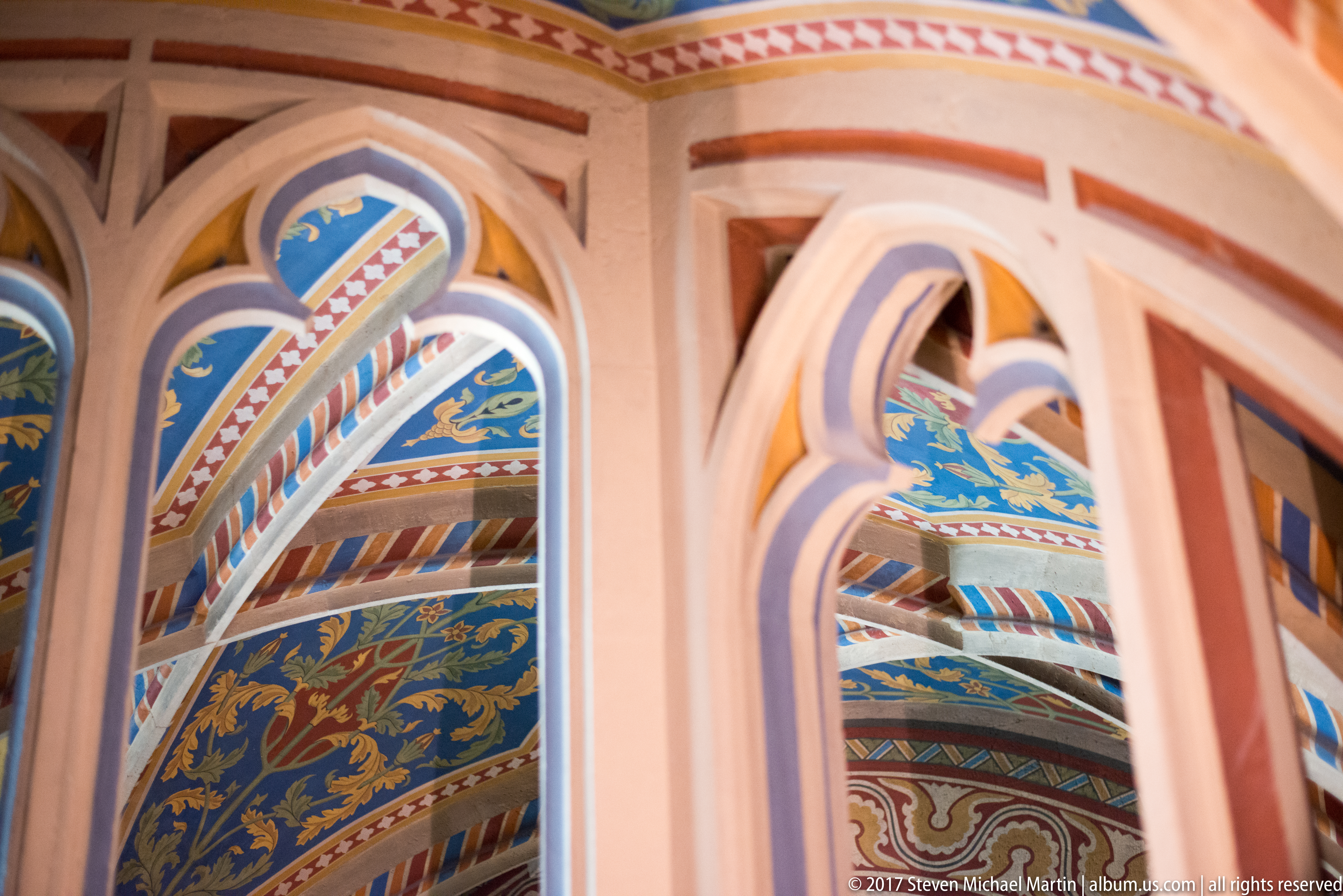
Painted Gothic tracery fills the foreground with pointed openings and layered cusps, offering glimpses of richly patterned surfaces beyond. Blue fields carry heraldic animals, while red, cream, and striped bands follow the curves of the architectural forms. The shallow depth of field turns the tracery into a screen, emphasizing the interaction of carved geometry and painted heraldic ornament in Matthias Church’s interior.
Caption
Painted Gothic tracery fills the foreground with pointed openings and layered cusps, offering glimpses of richly patterned surfaces beyond. Blue fields carry heraldic animals, while red, cream, and striped bands follow the curves of the architectural forms. The shallow depth of field turns the tracery into a screen, emphasizing the interaction of carved geometry and painted heraldic ornament in Matthias Church’s interior.

An oval heraldic portrait medallion shows a bearded nobleman in profile beneath a jeweled crown, surrounded by heraldic devices and a Latin inscription reading “COMES STEPHANUS CSAKY DE KÖRÖSSZEGH ET ADORJÁN.” Set against a painted geometric wall, the object combines portraiture, heraldry, and commemorative inscription. The visible text provides unusually strong evidence for the sitter’s family name and noble title.
Caption
An oval heraldic portrait medallion shows a bearded nobleman in profile beneath a jeweled crown, surrounded by heraldic devices and a Latin inscription reading “COMES STEPHANUS CSAKY DE KÖRÖSSZEGH ET ADORJÁN.” Set against a painted geometric wall, the object combines portraiture, heraldry, and commemorative inscription. The visible text provides unusually strong evidence for the sitter’s family name and noble title.

Layered curved moldings are covered with alternating bands of yellow, gray, cream, red, and black ornament in this close architectural detail from Matthias Church. Leaf-like motifs, stripes, and stylized geometric forms follow the contours of the arch, making each molding visually distinct. The tight crop reveals the precision of the church’s decorative painting and the way color is used to articulate depth across otherwise continuous masonry.
Caption
Layered curved moldings are covered with alternating bands of yellow, gray, cream, red, and black ornament in this close architectural detail from Matthias Church. Leaf-like motifs, stripes, and stylized geometric forms follow the contours of the arch, making each molding visually distinct. The tight crop reveals the precision of the church’s decorative painting and the way color is used to articulate depth across otherwise continuous masonry.

Clusters of narrow ribs branch upward into pointed arches beneath the richly painted vaults of Matthias Church. Orange, red, blue, cream, and black patterns run continuously along the ribs, while pale vault fields carry delicate foliate motifs. The upward composition concentrates on the branching geometry where vertical supports divide into multiple arches, demonstrating how the church’s structural framework becomes a carrier for an exceptionally dense painted ornamental program.
Caption
Clusters of narrow ribs branch upward into pointed arches beneath the richly painted vaults of Matthias Church. Orange, red, blue, cream, and black patterns run continuously along the ribs, while pale vault fields carry delicate foliate motifs. The upward composition concentrates on the branching geometry where vertical supports divide into multiple arches, demonstrating how the church’s structural framework becomes a carrier for an exceptionally dense painted ornamental program.

Broad vertical bands of red, deep blue, cream, and ochre meet a zigzag border punctuated by blue dots in this extremely close study of Matthias Church’s painted surfaces. Slight irregularities in texture remain visible beneath the color, giving the decoration a tactile, hand-applied character. With the architectural context almost entirely removed, the photograph functions as a study of palette, edge, repetition, and painted craftsmanship.
Caption
Broad vertical bands of red, deep blue, cream, and ochre meet a zigzag border punctuated by blue dots in this extremely close study of Matthias Church’s painted surfaces. Slight irregularities in texture remain visible beneath the color, giving the decoration a tactile, hand-applied character. With the architectural context almost entirely removed, the photograph functions as a study of palette, edge, repetition, and painted craftsmanship.

An out-of-focus patterned architectural element fills the foreground while sharply detailed painted ribs and vault surfaces rise behind it inside Matthias Church. The selective focus creates a layered view of two ornamental systems at once: a repeating wavy motif close to the camera and striped, foliate rib decoration deeper in the space. The composition is less documentary than the surrounding studies, using depth of field to emphasize pattern and visual repetition.
Caption
An out-of-focus patterned architectural element fills the foreground while sharply detailed painted ribs and vault surfaces rise behind it inside Matthias Church. The selective focus creates a layered view of two ornamental systems at once: a repeating wavy motif close to the camera and striped, foliate rib decoration deeper in the space. The composition is less documentary than the surrounding studies, using depth of field to emphasize pattern and visual repetition.

The crowned coat of arms of Hungary occupies the center of a richly painted wall panel inside Matthias Church, flanked by two armed historical figures. Red-and-white stripes and the double cross are clearly visible on the shield beneath the Holy Crown, while patterned bands and an inscription panel complete the composition. The ensemble combines national heraldry, figural painting, and dense historicist ornament within the church’s decorative program.
Caption
The crowned coat of arms of Hungary occupies the center of a richly painted wall panel inside Matthias Church, flanked by two armed historical figures. Red-and-white stripes and the double cross are clearly visible on the shield beneath the Holy Crown, while patterned bands and an inscription panel complete the composition. The ensemble combines national heraldry, figural painting, and dense historicist ornament within the church’s decorative program.

An adult man stands in the foreground with one of Fisherman’s Bastion’s conical stone towers softly blurred behind him. The shallow depth of field isolates the sitter while preserving enough of the pale arcades and pointed tower roof to establish the Castle Hill setting. His neutral expression and direct gaze give the frame the character of a travel portrait rather than an architectural study.
Caption
An adult man stands in the foreground with one of Fisherman’s Bastion’s conical stone towers softly blurred behind him. The shallow depth of field isolates the sitter while preserving enough of the pale arcades and pointed tower roof to establish the Castle Hill setting. His neutral expression and direct gaze give the frame the character of a travel portrait rather than an architectural study.