Kraków – Poland
Kraków lies along the upper Vistula River near the northern foothills of the Carpathian Mountains and is one of the most historically important cities in Poland. For centuries it served as the royal capital of the Polish kingdom, leaving behind an extraordinary concentration of medieval and Renaissance architecture.
The city’s historic core centers around Rynek Główny (Main Market Square), one of the largest medieval town squares in Europe. The square is surrounded by historic townhouses, churches, and the long arcaded Cloth Hall, which once functioned as a major trading center linking Central and Eastern Europe.
Because Kraków escaped much of the destruction of the Second World War, its historic streets, towers, and churches remain remarkably well preserved, making the city one of the most complete medieval urban landscapes in Europe.

The Adam Mickiewicz Monument stands prominently in Kraków’s Main Market Square, with the long arcaded façade of the Cloth Hall behind it. The bronze poet rises above allegorical figures at the base, while pedestrians and ornate street lamps animate the foreground. The pairing brings together one of the square’s major commemorative monuments and its defining Renaissance commercial landmark.
Caption
The Adam Mickiewicz Monument stands prominently in Kraków’s Main Market Square, with the long arcaded façade of the Cloth Hall behind it. The bronze poet rises above allegorical figures at the base, while pedestrians and ornate street lamps animate the foreground. The pairing brings together one of the square’s major commemorative monuments and its defining Renaissance commercial landmark.

The Grunwald Monument rises over Matejko Square, crowned by the mounted figure of King Władysław II Jagiełło and surrounded by additional sculptural groups at the base. The twin-towered Church of St. Florian stands beyond the monument, creating a layered view of national commemoration and sacred architecture at the northern approach to Kraków’s Old Town.
Caption
The Grunwald Monument rises over Matejko Square, crowned by the mounted figure of King Władysław II Jagiełło and surrounded by additional sculptural groups at the base. The twin-towered Church of St. Florian stands beyond the monument, creating a layered view of national commemoration and sacred architecture at the northern approach to Kraków’s Old Town.

Two gray horses in red-and-white decorative harness pull a white sightseeing carriage across a cobbled space in Krakow’s Old Town. The driver sits upright above the enclosed carriage body while pedestrians, café umbrellas, and trees fill the background. Compared with the night carriage views, daylight reveals more clearly the harness ornament, wheel construction, and everyday street setting around the vehicle.
Caption
Two gray horses in red-and-white decorative harness pull a white sightseeing carriage across a cobbled space in Krakow’s Old Town. The driver sits upright above the enclosed carriage body while pedestrians, café umbrellas, and trees fill the background. Compared with the night carriage views, daylight reveals more clearly the harness ornament, wheel construction, and everyday street setting around the vehicle.

A modern blue tram pauses at a stop in central Krakow after dark, its illuminated destination displays and interior lights standing out against the older streetscape. Passengers board beside the open front door while overhead electric wires trace the route above. The view places everyday public transportation within the historic urban fabric of Krakow’s center.
Caption
A modern blue tram pauses at a stop in central Krakow after dark, its illuminated destination displays and interior lights standing out against the older streetscape. Passengers board beside the open front door while overhead electric wires trace the route above. The view places everyday public transportation within the historic urban fabric of Krakow’s center.

Kraków’s Town Hall Tower rises from the Main Market Square, its massive brick shaft interrupted by pale stone dressings, tall windows, clock faces, and a dark Baroque cupola. Pedestrians cross the open square at its base, emphasizing the tower’s scale. The surviving medieval tower is presented as an isolated civic landmark within the broad urban space of Rynek Główny.
Caption
Kraków’s Town Hall Tower rises from the Main Market Square, its massive brick shaft interrupted by pale stone dressings, tall windows, clock faces, and a dark Baroque cupola. Pedestrians cross the open square at its base, emphasizing the tower’s scale. The surviving medieval tower is presented as an isolated civic landmark within the broad urban space of Rynek Główny.

Igor Mitoraj’s monumental bronze head Eros Bendato lies on its side beside Krakow’s Town Hall Tower, its hollow eye openings and bound, masklike features forming a dramatic backdrop to two seated street musicians. One performer plays guitar while the other handles a smaller string instrument. The juxtaposition turns the large contemporary sculpture into an active part of everyday life on the Main Market Square.
Caption
Igor Mitoraj’s monumental bronze head Eros Bendato lies on its side beside Krakow’s Town Hall Tower, its hollow eye openings and bound, masklike features forming a dramatic backdrop to two seated street musicians. One performer plays guitar while the other handles a smaller string instrument. The juxtaposition turns the large contemporary sculpture into an active part of everyday life on the Main Market Square.

Eros Bendato, Igor Mitoraj’s monumental bronze head, rests on a stone plinth beside Krakow’s Town Hall Tower. The close night view emphasizes its weathered surface, hollow eye openings, and banded facial treatment, with the illuminated Cloth Hall and market-square architecture receding behind. Isolated from nearby pedestrians, the sculpture reads as a powerful contemporary intervention within the medieval civic core.
Caption
Eros Bendato, Igor Mitoraj’s monumental bronze head, rests on a stone plinth beside Krakow’s Town Hall Tower. The close night view emphasizes its weathered surface, hollow eye openings, and banded facial treatment, with the illuminated Cloth Hall and market-square architecture receding behind. Isolated from nearby pedestrians, the sculpture reads as a powerful contemporary intervention within the medieval civic core.

A corner of Krakow’s Cloth Hall fills the foreground with pointed arcades, projecting bays, and a bright Renaissance parapet, while the twin towers of St. Mary’s Basilica rise behind at left. The layered night view compresses two defining monuments of the Main Market Square into one composition, contrasting the horizontal market hall with the strongly vertical Gothic church towers beyond.
Caption
A corner of Krakow’s Cloth Hall fills the foreground with pointed arcades, projecting bays, and a bright Renaissance parapet, while the twin towers of St. Mary’s Basilica rise behind at left. The layered night view compresses two defining monuments of the Main Market Square into one composition, contrasting the horizontal market hall with the strongly vertical Gothic church towers beyond.

Krakow’s Main Market Square opens across the foreground at night, with the illuminated arcades and ornate roofline of the Cloth Hall at left and the taller asymmetrical towers of St. Mary’s Basilica at right. Rows of cafés and historic townhouses frame the distant edge of the square. The broad cobbled expanse emphasizes the monumental scale of the medieval market center.
Caption
Krakow’s Main Market Square opens across the foreground at night, with the illuminated arcades and ornate roofline of the Cloth Hall at left and the taller asymmetrical towers of St. Mary’s Basilica at right. Rows of cafés and historic townhouses frame the distant edge of the square. The broad cobbled expanse emphasizes the monumental scale of the medieval market center.

Kraków’s Main Market Square glows after rain, with the Town Hall Tower rising at left and the illuminated arcades of the Cloth Hall stretching across the center. Reflections shimmer across the wet paving as pedestrians cross Rynek Główny. The nighttime view brings together two of the square’s defining civic and commercial landmarks within the historic center.
Caption
Kraków’s Main Market Square glows after rain, with the Town Hall Tower rising at left and the illuminated arcades of the Cloth Hall stretching across the center. Reflections shimmer across the wet paving as pedestrians cross Rynek Główny. The nighttime view brings together two of the square’s defining civic and commercial landmarks within the historic center.

Kraków’s coat of arms is displayed against a plain wall, crowned above a blue shield containing red fortified walls, three towers, and an open central gate. Within the gateway appears the white Polish eagle. The heraldic composition condenses the city’s civic identity into defensive architecture and national symbolism, with the name “KRAKÓW” printed beneath.
Caption
Kraków’s coat of arms is displayed against a plain wall, crowned above a blue shield containing red fortified walls, three towers, and an open central gate. Within the gateway appears the white Polish eagle. The heraldic composition condenses the city’s civic identity into defensive architecture and national symbolism, with the name “KRAKÓW” printed beneath.

A white horse-drawn carriage waits on a cobbled square in Krakow’s historic center, its pair of gray horses dressed with red-and-white plumes and harness ornaments. Café umbrellas, pedestrians, and a pale historic façade form the background. The scene records the traditional sightseeing carriages that circulate through the pedestrian spaces of the Old Town.
Caption
A white horse-drawn carriage waits on a cobbled square in Krakow’s historic center, its pair of gray horses dressed with red-and-white plumes and harness ornaments. Café umbrellas, pedestrians, and a pale historic façade form the background. The scene records the traditional sightseeing carriages that circulate through the pedestrian spaces of the Old Town.

The illuminated Cloth Hall stretches across Krakow’s Main Market Square, its pointed ground-floor arcades forming a bright horizontal band beneath an ornate parapet. At left, the massive brick Town Hall Tower rises above the roofline with its clock and baroque crown. The oblique night view emphasizes the contrast between the long Renaissance market hall and the surviving civic tower.
Caption
The illuminated Cloth Hall stretches across Krakow’s Main Market Square, its pointed ground-floor arcades forming a bright horizontal band beneath an ornate parapet. At left, the massive brick Town Hall Tower rises above the roofline with its clock and baroque crown. The oblique night view emphasizes the contrast between the long Renaissance market hall and the surviving civic tower.

A long interior passage in Krakow is organized by a sequence of shallow barrel vaults, pale pilasters, and a patterned tile runner leading toward a reception-like counter. Simple black benches line both walls under contemporary lights. The combination of restored architectural detailing and modern furnishings suggests an adapted historic building, but the proof sheet does not establish its exact identity.
Caption
A long interior passage in Krakow is organized by a sequence of shallow barrel vaults, pale pilasters, and a patterned tile runner leading toward a reception-like counter. Simple black benches line both walls under contemporary lights. The combination of restored architectural detailing and modern furnishings suggests an adapted historic building, but the proof sheet does not establish its exact identity.

St. Mary’s Basilica dominates the Main Market Square in a broad frontal night view. Its two unequal brick towers rise above the Gothic façade, the taller northern tower capped by an elaborate spired crown and the lower southern tower by a simpler roof. Floodlighting reveals the pointed central window and layered masonry while temporary barriers line the foreground.
Caption
St. Mary’s Basilica dominates the Main Market Square in a broad frontal night view. Its two unequal brick towers rise above the Gothic façade, the taller northern tower capped by an elaborate spired crown and the lower southern tower by a simpler roof. Floodlighting reveals the pointed central window and layered masonry while temporary barriers line the foreground.

A closer, slightly upward night view concentrates on the twin towers and central façade of St. Mary’s Basilica. The taller tower’s ornate crown rises sharply at left, while the shorter tower and the large traceried window balance the composition. Warm floodlighting brings out the irregular brickwork and pale stone trim, emphasizing the vertical massing of Krakow’s landmark Gothic church.
Caption
A closer, slightly upward night view concentrates on the twin towers and central façade of St. Mary’s Basilica. The taller tower’s ornate crown rises sharply at left, while the shorter tower and the large traceried window balance the composition. Warm floodlighting brings out the irregular brickwork and pale stone trim, emphasizing the vertical massing of Krakow’s landmark Gothic church.
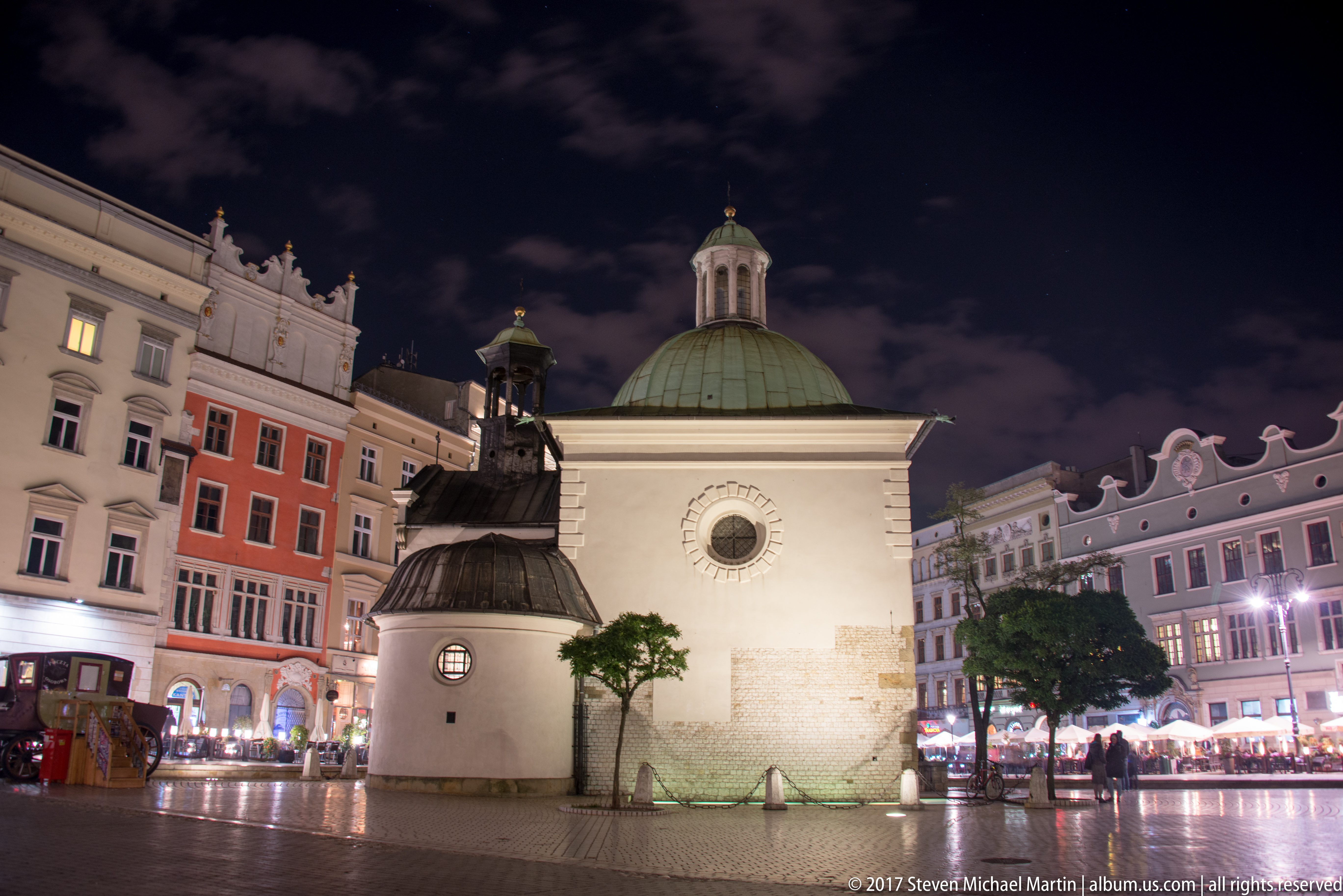
The compact Church of St. Adalbert stands on Krakow’s Main Market Square, its pale masonry walls, round window, and green copper dome illuminated against the night sky. A dark bronze monument rises immediately behind it, while colorful historic façades edge the square beyond. The low, almost freestanding church contrasts sharply with the larger commercial and civic architecture surrounding Rynek Główny.
Caption
The compact Church of St. Adalbert stands on Krakow’s Main Market Square, its pale masonry walls, round window, and green copper dome illuminated against the night sky. A dark bronze monument rises immediately behind it, while colorful historic façades edge the square beyond. The low, almost freestanding church contrasts sharply with the larger commercial and civic architecture surrounding Rynek Główny.

A frontal night view isolates the central entrance of Krakow’s Cloth Hall, where a tall rectangular pavilion rises above pointed arcades and a richly crenellated Renaissance roofline. Sculptural details and red-brick wall panels are picked out by floodlighting, while the open archway leads into the market passage. The composition focuses on the building’s ceremonial façade rather than the full length of the hall.
Caption
A frontal night view isolates the central entrance of Krakow’s Cloth Hall, where a tall rectangular pavilion rises above pointed arcades and a richly crenellated Renaissance roofline. Sculptural details and red-brick wall panels are picked out by floodlighting, while the open archway leads into the market passage. The composition focuses on the building’s ceremonial façade rather than the full length of the hall.

A contemporary fountain glows in a Krakow square at night, its low geometric central form edged by evenly spaced vertical water jets and cool interior lighting. Historic multistory façades and groups of pedestrians surround the installation, creating a deliberate contrast between modern public-space design and the older urban fabric. No legible landmark on the proof sheet securely establishes the exact square.
Caption
A contemporary fountain glows in a Krakow square at night, its low geometric central form edged by evenly spaced vertical water jets and cool interior lighting. Historic multistory façades and groups of pedestrians surround the installation, creating a deliberate contrast between modern public-space design and the older urban fabric. No legible landmark on the proof sheet securely establishes the exact square.

A white horse-drawn carriage stands brightly lit in Krakow’s Old Town at night, creating a vivid pool of light against the surrounding cafés and warm historic façades. Two harnessed horses with red-and-white decorations face left while the driver sits high above the carriage body. The closer night treatment emphasizes the polished vehicle, tack, and theatrical visibility of the traditional sightseeing carriage.
Caption
A white horse-drawn carriage stands brightly lit in Krakow’s Old Town at night, creating a vivid pool of light against the surrounding cafés and warm historic façades. Two harnessed horses with red-and-white decorations face left while the driver sits high above the carriage body. The closer night treatment emphasizes the polished vehicle, tack, and theatrical visibility of the traditional sightseeing carriage.

A floodlit historic passage in Krakow is framed by two broad stone arches beneath a balustraded stair landing. Brick vaulting, hanging lanterns, and wrought-metal gates deepen the view into the interior courtyard, while pale plaster walls meet exposed brick above the arches. The architectural elements are clear, but the proof sheet does not provide enough evidence to assign the passage to a specific monument.
Caption
A floodlit historic passage in Krakow is framed by two broad stone arches beneath a balustraded stair landing. Brick vaulting, hanging lanterns, and wrought-metal gates deepen the view into the interior courtyard, while pale plaster walls meet exposed brick above the arches. The architectural elements are clear, but the proof sheet does not provide enough evidence to assign the passage to a specific monument.

The long shopping passage inside Krakow’s Cloth Hall recedes beneath a pale vaulted ceiling, lined on both sides by repeated arched shopfronts with dark green shutters. Ornamental hanging lamps and painted heraldic shields rhythmically mark the central aisle. With most stalls closed, the symmetrical interior architecture becomes the dominant subject, revealing the Sukiennice as both historic monument and functioning market hall.
Caption
The long shopping passage inside Krakow’s Cloth Hall recedes beneath a pale vaulted ceiling, lined on both sides by repeated arched shopfronts with dark green shutters. Ornamental hanging lamps and painted heraldic shields rhythmically mark the central aisle. With most stalls closed, the symmetrical interior architecture becomes the dominant subject, revealing the Sukiennice as both historic monument and functioning market hall.

Painted heraldic cartouches decorate the wall above two pointed arches of Krakow’s Cloth Hall, illuminated by a central lantern. The large central shield bears a crowned gateway motif surrounded by a ribboned inscription, with smaller emblems flanking it. Through the arches, night views of the surrounding market-square façades remain visible, linking the decorative program directly to the public arcade below the Sukiennice.
Caption
Painted heraldic cartouches decorate the wall above two pointed arches of Krakow’s Cloth Hall, illuminated by a central lantern. The large central shield bears a crowned gateway motif surrounded by a ribboned inscription, with smaller emblems flanking it. Through the arches, night views of the surrounding market-square façades remain visible, linking the decorative program directly to the public arcade below the Sukiennice.

A row of tall portrait banners stands along the edge of a Krakow square at night, their red-and-white lower sections echoing Poland’s national colors. Each narrow flag carries a large human figure or face, while cafés, trees, and historic façades remain visible behind. The proof sheet does not allow the banner text or commemorative campaign to be read reliably, so the event is left unidentified.
Caption
A row of tall portrait banners stands along the edge of a Krakow square at night, their red-and-white lower sections echoing Poland’s national colors. Each narrow flag carries a large human figure or face, while cafés, trees, and historic façades remain visible behind. The proof sheet does not allow the banner text or commemorative campaign to be read reliably, so the event is left unidentified.

Krakow’s Town Hall Tower rises alone against the night sky, its massive brick shaft punctuated by small openings and topped by a clock and baroque crown. Pale façades along the edge of the Main Market Square form a low horizontal band behind it. The frontal composition stresses the surviving tower’s isolated civic presence after the demolition of the larger medieval town-hall complex.
Caption
Krakow’s Town Hall Tower rises alone against the night sky, its massive brick shaft punctuated by small openings and topped by a clock and baroque crown. Pale façades along the edge of the Main Market Square form a low horizontal band behind it. The frontal composition stresses the surviving tower’s isolated civic presence after the demolition of the larger medieval town-hall complex.

An elegant restaurant interior is seen through a dark-framed street window at night. A large spherical glass pendant hangs above closely arranged dining tables, with pale curtains, candles, upholstered seating, and a vase of pink lilies visible inside. Reflections on the glazing merge the dining room with the street, making the window itself an important part of the composition; no restaurant name is legible.
Caption
An elegant restaurant interior is seen through a dark-framed street window at night. A large spherical glass pendant hangs above closely arranged dining tables, with pale curtains, candles, upholstered seating, and a vase of pink lilies visible inside. Reflections on the glazing merge the dining room with the street, making the window itself an important part of the composition; no restaurant name is legible.

The twin towers of Krakow’s Church of St. Andrew rise above a compact Romanesque west façade, their pale stone-and-brick walls punctuated by small paired openings and topped by later baroque cupolas. The low-angle night view emphasizes the church’s defensive mass and narrow windows. Its robust masonry stands in strong contrast to the more ornate Baroque Church of Saints Peter and Paul nearby on Grodzka Street.
Caption
The twin towers of Krakow’s Church of St. Andrew rise above a compact Romanesque west façade, their pale stone-and-brick walls punctuated by small paired openings and topped by later baroque cupolas. The low-angle night view emphasizes the church’s defensive mass and narrow windows. Its robust masonry stands in strong contrast to the more ornate Baroque Church of Saints Peter and Paul nearby on Grodzka Street.

Diners fill the outdoor terrace of Restaurant Europejska in Krakow, sheltered beneath white umbrellas marked with the restaurant name. Dense red flower boxes and black iron railings create a planted foreground, while warm interior light and a row of pavement heaters reinforce the evening café atmosphere. The view documents the active restaurant frontage rather than a monument or formal architectural detail.
Caption
Diners fill the outdoor terrace of Restaurant Europejska in Krakow, sheltered beneath white umbrellas marked with the restaurant name. Dense red flower boxes and black iron railings create a planted foreground, while warm interior light and a row of pavement heaters reinforce the evening café atmosphere. The view documents the active restaurant frontage rather than a monument or formal architectural detail.

An illuminated fountain occupies the foreground of Szczepański Square, with the ornate façade of Krakow’s Palace of Art rising behind. Colored jets glow violet and blue against the pale building, where decorative friezes and a central portrait panel are emphasized by architectural lighting. The composition sets a modern nighttime fountain display against the historic Secession-era cultural building bordering the square.
Caption
An illuminated fountain occupies the foreground of Szczepański Square, with the ornate façade of Krakow’s Palace of Art rising behind. Colored jets glow violet and blue against the pale building, where decorative friezes and a central portrait panel are emphasized by architectural lighting. The composition sets a modern nighttime fountain display against the historic Secession-era cultural building bordering the square.

Blue-lit fountain jets rise from a circular basin in Szczepański Square, reflected on the wet paving in the foreground. Behind them, the Palace of Art provides a symmetrical architectural backdrop with relief decoration and a central portrait panel. The tighter composition shifts attention from the wider square to the luminous water display and its relationship to the historic cultural façade.
Caption
Blue-lit fountain jets rise from a circular basin in Szczepański Square, reflected on the wet paving in the foreground. Behind them, the Palace of Art provides a symmetrical architectural backdrop with relief decoration and a central portrait panel. The tighter composition shifts attention from the wider square to the luminous water display and its relationship to the historic cultural façade.

A temporary outdoor exhibition presents illuminated yellow-and-black interpretive panels beneath trees in Krakow. One prominent panel is headed “ALFONS DŁUGOSZ” beside a portrait, while adjacent displays combine archival photographs and explanatory text. Fallen leaves and portable metal supports make the installation read as a public historical exhibition rather than a permanent museum gallery; the broader exhibition title is not fully legible.
Caption
A temporary outdoor exhibition presents illuminated yellow-and-black interpretive panels beneath trees in Krakow. One prominent panel is headed “ALFONS DŁUGOSZ” beside a portrait, while adjacent displays combine archival photographs and explanatory text. Fallen leaves and portable metal supports make the installation read as a public historical exhibition rather than a permanent museum gallery; the broader exhibition title is not fully legible.

A multi-directional tourist signpost in Krakow’s historic center points toward major Old Town destinations. Readable panels include Barbican, Town Hall Tower, the Historical Museum of the City of Krakow, and Tourist Information Office Sukiennice, with bilingual Polish-English labeling and small monument pictograms. The night view records the wayfinding system used to orient visitors among the city’s tightly clustered heritage sites.
Caption
A multi-directional tourist signpost in Krakow’s historic center points toward major Old Town destinations. Readable panels include Barbican, Town Hall Tower, the Historical Museum of the City of Krakow, and Tourist Information Office Sukiennice, with bilingual Polish-English labeling and small monument pictograms. The night view records the wayfinding system used to orient visitors among the city’s tightly clustered heritage sites.

The Wyspiański Pavilion 2000 presents a restrained modern brick façade punctuated by three tall vertical windows filled with intensely colored stained glass. Trees and low plaza lighting soften the building’s edges at night, while the narrow window openings concentrate attention on the luminous figural designs. The contemporary pavilion is visually distinguished from Krakow’s older masonry churches and civic monuments by its planar cladding and simplified geometry.
Caption
The Wyspiański Pavilion 2000 presents a restrained modern brick façade punctuated by three tall vertical windows filled with intensely colored stained glass. Trees and low plaza lighting soften the building’s edges at night, while the narrow window openings concentrate attention on the luminous figural designs. The contemporary pavilion is visually distinguished from Krakow’s older masonry churches and civic monuments by its planar cladding and simplified geometry.

The Church of Saints Peter and Paul is floodlit against the night sky, its monumental Baroque façade rising behind the famous row of stone apostle statues along the forecourt balustrade. Paired columns, sculpted niches, a triangular pediment, and a central sunburst emblem create a strongly theatrical composition. The frontal view emphasizes the Roman-inspired church as one of Krakow’s major Counter-Reformation landmarks.
Caption
The Church of Saints Peter and Paul is floodlit against the night sky, its monumental Baroque façade rising behind the famous row of stone apostle statues along the forecourt balustrade. Paired columns, sculpted niches, a triangular pediment, and a central sunburst emblem create a strongly theatrical composition. The frontal view emphasizes the Roman-inspired church as one of Krakow’s major Counter-Reformation landmarks.

The Wawel Royal Castle rises above layered brick and stone fortifications in a dramatic night view from below. Pale plastered walls, projecting enclosed balconies, steep rooflines, and towered corners are picked out by floodlighting, while the defensive wall creates a darker base across the foreground. The composition stresses the castle’s elevated position on Wawel Hill and the contrast between residential palace architecture and fortified enclosure.
Caption
The Wawel Royal Castle rises above layered brick and stone fortifications in a dramatic night view from below. Pale plastered walls, projecting enclosed balconies, steep rooflines, and towered corners are picked out by floodlighting, while the defensive wall creates a darker base across the foreground. The composition stresses the castle’s elevated position on Wawel Hill and the contrast between residential palace architecture and fortified enclosure.

An illuminated round brick tower rises against the night sky, its battered masonry punctuated by small openings and capped by a broad projecting cornice and low roof. A Polish flag flies above the structure, while adjacent walls and buildings place it within Kraków’s historic urban fabric. The view emphasizes the tower’s defensive massing and the texture of its brickwork after dark.
Caption
An illuminated round brick tower rises against the night sky, its battered masonry punctuated by small openings and capped by a broad projecting cornice and low roof. A Polish flag flies above the structure, while adjacent walls and buildings place it within Kraków’s historic urban fabric. The view emphasizes the tower’s defensive massing and the texture of its brickwork after dark.

A small café or restaurant frontage glows at night behind empty outdoor tables and folding chairs. Colored panes brighten the transom above the doorway, while potted greenery and warm interior light soften the stone-and-stucco street façade. The quiet seating area provides a human-scale contrast to Kraków’s monumental historic architecture and records the city’s evening street life.
Caption
A small café or restaurant frontage glows at night behind empty outdoor tables and folding chairs. Colored panes brighten the transom above the doorway, while potted greenery and warm interior light soften the stone-and-stucco street façade. The quiet seating area provides a human-scale contrast to Kraków’s monumental historic architecture and records the city’s evening street life.

A stemmed cocktail glass holds a deep red drink topped with berries and a sprig of fresh green herbs. The shallow focus isolates the glass against a softly blurred restaurant table, while a second drink appears in the background. The close-up shifts from Kraków’s architecture to its dining culture, emphasizing presentation, color, and the carefully arranged garnish.
Caption
A stemmed cocktail glass holds a deep red drink topped with berries and a sprig of fresh green herbs. The shallow focus isolates the glass against a softly blurred restaurant table, while a second drink appears in the background. The close-up shifts from Kraków’s architecture to its dining culture, emphasizing presentation, color, and the carefully arranged garnish.

A multi-story nightlife venue is photographed after dark, with illuminated signage for “taboo” and a billiards club above a row of awnings. Large street-level windows reveal a brightly lit interior, while parked vehicles and the dark upper façade anchor the building in an active urban setting. The image documents Kraków’s contemporary entertainment scene within the historic city.
Caption
A multi-story nightlife venue is photographed after dark, with illuminated signage for “taboo” and a billiards club above a row of awnings. Large street-level windows reveal a brightly lit interior, while parked vehicles and the dark upper façade anchor the building in an active urban setting. The image documents Kraków’s contemporary entertainment scene within the historic city.

A long covered dining terrace extends beneath a fabric canopy, lit by oversized pendant lamps and smaller warm fixtures. Diners occupy several tables along the left side while empty upholstered chairs and tables recede toward the far end. Transparent side panels enclose the space from the street, creating a sheltered restaurant setting characteristic of Kraków’s active evening hospitality districts.
Caption
A long covered dining terrace extends beneath a fabric canopy, lit by oversized pendant lamps and smaller warm fixtures. Diners occupy several tables along the left side while empty upholstered chairs and tables recede toward the far end. Transparent side panels enclose the space from the street, creating a sheltered restaurant setting characteristic of Kraków’s active evening hospitality districts.

A warmly lit restaurant and lounge interior combines a long bar, upholstered seating, table service, and decorative wall art. Rows of bottles line illuminated shelves behind the counter, while printed graphics cover parts of the ceiling. Diners and staff animate the room, giving the photograph a layered view of contemporary hospitality design and social life in central Kraków.
Caption
A warmly lit restaurant and lounge interior combines a long bar, upholstered seating, table service, and decorative wall art. Rows of bottles line illuminated shelves behind the counter, while printed graphics cover parts of the ceiling. Diners and staff animate the room, giving the photograph a layered view of contemporary hospitality design and social life in central Kraków.

From a position closer to the chancel, the church’s stone piers and hanging chandeliers frame a richly carved high altar at the end of the nave. Dark wooden choir furnishings line the foreground, while the blue rib vault continues overhead. This tighter axial view shifts attention from the scale of the nave to the liturgical focus and carved furnishings around the sanctuary.
Caption
From a position closer to the chancel, the church’s stone piers and hanging chandeliers frame a richly carved high altar at the end of the nave. Dark wooden choir furnishings line the foreground, while the blue rib vault continues overhead. This tighter axial view shifts attention from the scale of the nave to the liturgical focus and carved furnishings around the sanctuary.

An ornate enclosed wooden bay projects from the façade of a historic townhouse, supported above a small entrance porch. Slender columns, carved brackets, multi-pane windows, and decorative woodwork give the feature a finely crafted appearance. Neighboring pastel façades and projecting balconies continue down the street, creating a compact view of Kraków’s varied historic residential architecture.
Caption
An ornate enclosed wooden bay projects from the façade of a historic townhouse, supported above a small entrance porch. Slender columns, carved brackets, multi-pane windows, and decorative woodwork give the feature a finely crafted appearance. Neighboring pastel façades and projecting balconies continue down the street, creating a compact view of Kraków’s varied historic residential architecture.

A mature street tree partially screens a weathered stone residential façade, where a warm-toned wooden window and lace curtains stand out against gray masonry. A bicycle rests beside a low decorative fence, adding everyday urban detail to the scene. The photograph records the lived-in texture of Kraków’s historic streets rather than a monumental landmark.
Caption
A mature street tree partially screens a weathered stone residential façade, where a warm-toned wooden window and lace curtains stand out against gray masonry. A bicycle rests beside a low decorative fence, adding everyday urban detail to the scene. The photograph records the lived-in texture of Kraków’s historic streets rather than a monumental landmark.

A broad Gothic nave stretches toward an illuminated high altar beneath a deep blue rib-vaulted ceiling. Tall stone piers divide the central space from side aisles, while large chandeliers hang between the arcades. The symmetry of the view emphasizes the church’s vertical proportions, long axial plan, and the contrast between pale masonry and the richly colored vault.
Caption
A broad Gothic nave stretches toward an illuminated high altar beneath a deep blue rib-vaulted ceiling. Tall stone piers divide the central space from side aisles, while large chandeliers hang between the arcades. The symmetry of the view emphasizes the church’s vertical proportions, long axial plan, and the contrast between pale masonry and the richly colored vault.

A carved wooden stair curves around a massive stone pier beside the church’s choir area. Repeating circular openings and sculpted details decorate the balustrade, while an elaborate hanging fixture and additional woodwork appear beyond. The close architectural view highlights the craftsmanship of the church’s fitted furnishings and their integration with the heavy masonry structure.
Caption
A carved wooden stair curves around a massive stone pier beside the church’s choir area. Repeating circular openings and sculpted details decorate the balustrade, while an elaborate hanging fixture and additional woodwork appear beyond. The close architectural view highlights the craftsmanship of the church’s fitted furnishings and their integration with the heavy masonry structure.

An open arched doorway leads from a plain passage into a brighter church or monastic interior. Decorative colored-glass panels fill the upper sections of the wooden door, while a checker-patterned floor continues through the threshold toward an ornate wall monument beyond. The composition uses the doorway as a frame, linking a simple transitional space with the richly furnished interior beyond.
Caption
An open arched doorway leads from a plain passage into a brighter church or monastic interior. Decorative colored-glass panels fill the upper sections of the wooden door, while a checker-patterned floor continues through the threshold toward an ornate wall monument beyond. The composition uses the doorway as a frame, linking a simple transitional space with the richly furnished interior beyond.

A sequence of painted vault compartments fills the ceiling with large-scale religious figures and narrative scenes framed by pale architectural ribs and decorative borders. Gold rosettes punctuate the intersections, while a hanging fixture descends through the center of the composition. The photograph concentrates on the painted surface and rhythmic geometry of the vault rather than the church furnishings below.
Caption
A sequence of painted vault compartments fills the ceiling with large-scale religious figures and narrative scenes framed by pale architectural ribs and decorative borders. Gold rosettes punctuate the intersections, while a hanging fixture descends through the center of the composition. The photograph concentrates on the painted surface and rhythmic geometry of the vault rather than the church furnishings below.

A frontal sanctuary view centers a richly carved high altar beneath the blue-vaulted chancel. Red-carpeted steps rise from a patterned stone floor, while white floral arrangements flank the altar and carved screens and devotional furnishings line the side walls. The balanced composition presents the liturgical center of the Gothic interior with particular emphasis on color, symmetry, and ceremonial space.
Caption
A frontal sanctuary view centers a richly carved high altar beneath the blue-vaulted chancel. Red-carpeted steps rise from a patterned stone floor, while white floral arrangements flank the altar and carved screens and devotional furnishings line the side walls. The balanced composition presents the liturgical center of the Gothic interior with particular emphasis on color, symmetry, and ceremonial space.

Rows of dark, intricately carved choir stalls form a narrow corridor leading toward the illuminated high altar. Repeated pinnacles and sculptural details create a dense Gothic screen along both sides, while the blue vaulted ceiling and polished floor reinforce the strong central axis. The low viewpoint gives particular prominence to the craftsmanship and ceremonial arrangement of the choir.
Caption
Rows of dark, intricately carved choir stalls form a narrow corridor leading toward the illuminated high altar. Repeated pinnacles and sculptural details create a dense Gothic screen along both sides, while the blue vaulted ceiling and polished floor reinforce the strong central axis. The low viewpoint gives particular prominence to the craftsmanship and ceremonial arrangement of the choir.

A close side view reveals the elaborate upper structure of the choir stalls, where carved canopies, crockets, pinnacles, and standing saint figures rise above the seating. The dense vertical ornament contrasts with the painted wall surfaces and windows behind. The photograph isolates the sculptural program and fine woodworking that define this section of the church’s choir.
Caption
A close side view reveals the elaborate upper structure of the choir stalls, where carved canopies, crockets, pinnacles, and standing saint figures rise above the seating. The dense vertical ornament contrasts with the painted wall surfaces and windows behind. The photograph isolates the sculptural program and fine woodworking that define this section of the church’s choir.
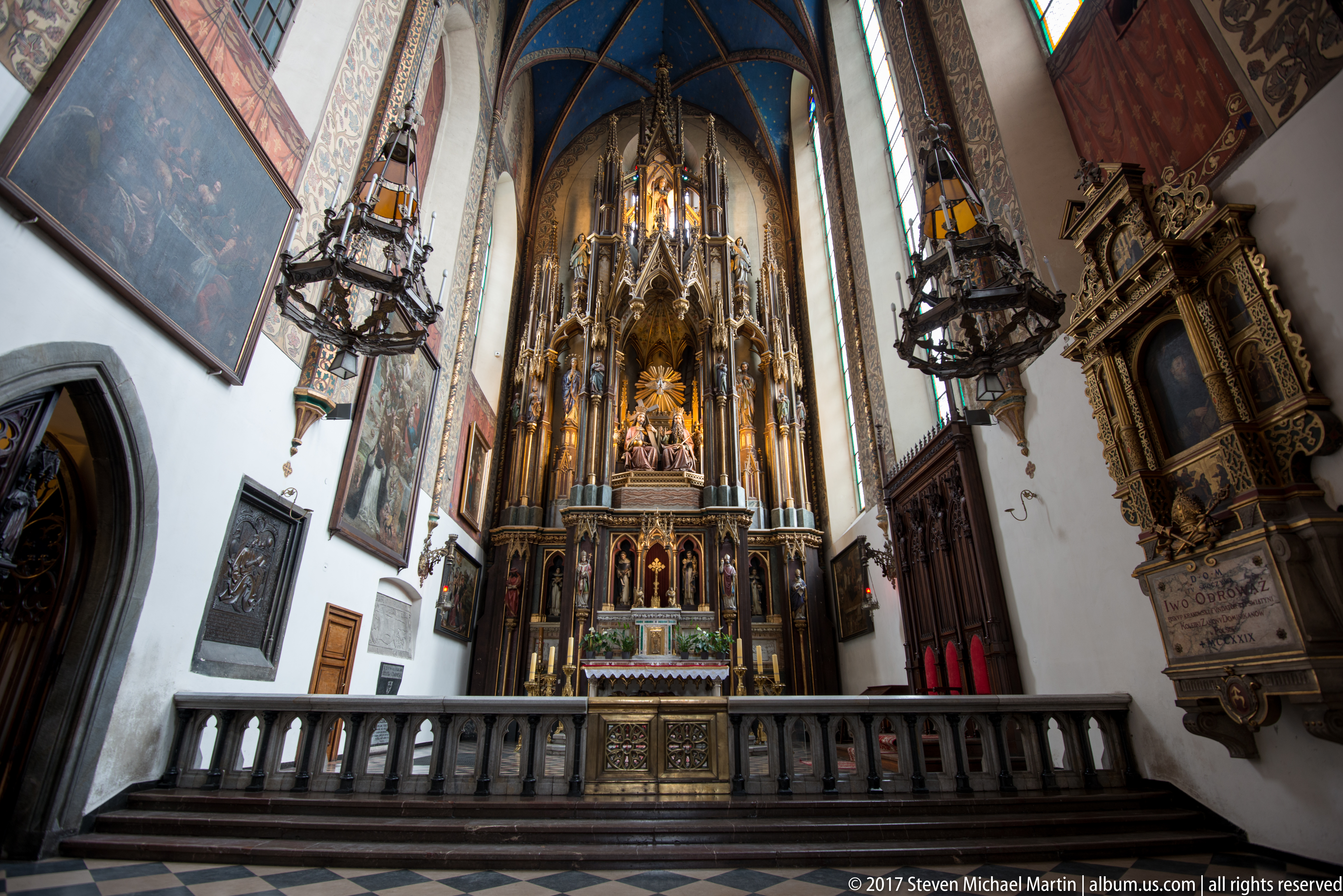
The tall high altar rises beneath the blue chancel vault, its gilded and carved framework filled with painted and sculpted religious imagery. Monumental wall furnishings and framed paintings flank the sanctuary, while a stone balustrade crosses the foreground. This angled view emphasizes the altar’s vertical complexity and its relationship to the surrounding memorial and devotional decoration.
Caption
The tall high altar rises beneath the blue chancel vault, its gilded and carved framework filled with painted and sculpted religious imagery. Monumental wall furnishings and framed paintings flank the sanctuary, while a stone balustrade crosses the foreground. This angled view emphasizes the altar’s vertical complexity and its relationship to the surrounding memorial and devotional decoration.

A sculptural representation of the Holy Trinity shows Christ and God the Father enthroned side by side beneath a radiant dove symbolizing the Holy Spirit. Dark architectural framing and gilded rays heighten the group’s dramatic focus. The close view makes the theological imagery legible through the paired seated figures, Christ’s cross, and the descending dove above them.
Caption
A sculptural representation of the Holy Trinity shows Christ and God the Father enthroned side by side beneath a radiant dove symbolizing the Holy Spirit. Dark architectural framing and gilded rays heighten the group’s dramatic focus. The close view makes the theological imagery legible through the paired seated figures, Christ’s cross, and the descending dove above them.

A richly worked ecclesiastical emblem centers on an ornate bishop’s mitre set above crossed ceremonial implements and draped fabric. Metalwork scrolls, floral motifs, and heraldic forms surround the arrangement, while a painted religious scene fills the background. The close-up records the symbolic and decorative vocabulary used in church furnishings rather than the larger architecture.
Caption
A richly worked ecclesiastical emblem centers on an ornate bishop’s mitre set above crossed ceremonial implements and draped fabric. Metalwork scrolls, floral motifs, and heraldic forms surround the arrangement, while a painted religious scene fills the background. The close-up records the symbolic and decorative vocabulary used in church furnishings rather than the larger architecture.

A quiet vaulted passage runs toward a stained-glass doorway, with pointed arches, exposed brick accents, memorial plaques, and framed paintings lining the walls. The patterned floor and ribbed ceiling reinforce the corridor’s long perspective. The space appears ecclesiastical or monastic in character, documenting a transitional interior where architecture, memorials, and devotional art meet.
Caption
A quiet vaulted passage runs toward a stained-glass doorway, with pointed arches, exposed brick accents, memorial plaques, and framed paintings lining the walls. The patterned floor and ribbed ceiling reinforce the corridor’s long perspective. The space appears ecclesiastical or monastic in character, documenting a transitional interior where architecture, memorials, and devotional art meet.

Viewed from below, a monumental Gothic carved structure rises in a dense arrangement of pointed arches, tracery, pinnacles, and standing saint figures. The upward perspective compresses the sculpture against painted vaulting and stone ribs, emphasizing the vertical drama of the woodwork. The exact function is not fully visible, but the piece reads as an elaborate church canopy or screen.
Caption
Viewed from below, a monumental Gothic carved structure rises in a dense arrangement of pointed arches, tracery, pinnacles, and standing saint figures. The upward perspective compresses the sculpture against painted vaulting and stone ribs, emphasizing the vertical drama of the woodwork. The exact function is not fully visible, but the piece reads as an elaborate church canopy or screen.

A richly decorated Baroque sanctuary combines a central devotional image, gilded architectural framing, white sculpted figures, and a painted vault crowded with religious scenes. Dark side altars contrast with pale columns and abundant gilding, while worshippers at the lower edge provide scale. The layered interior exemplifies the theatrical spatial and sculptural effects of Kraków’s historic sacred architecture.
Caption
A richly decorated Baroque sanctuary combines a central devotional image, gilded architectural framing, white sculpted figures, and a painted vault crowded with religious scenes. Dark side altars contrast with pale columns and abundant gilding, while worshippers at the lower edge provide scale. The layered interior exemplifies the theatrical spatial and sculptural effects of Kraków’s historic sacred architecture.

The long interior arcade of Kraków’s Cloth Hall is lined with brightly stocked souvenir stalls beneath repeating arches and globe chandeliers. Shoppers move along the central stone aisle between displays of crafts, gifts, and local merchandise. The photograph records the building’s continuing commercial role, connecting the historic Sukiennice with the modern visitor economy of the Main Market Square.
Caption
The long interior arcade of Kraków’s Cloth Hall is lined with brightly stocked souvenir stalls beneath repeating arches and globe chandeliers. Shoppers move along the central stone aisle between displays of crafts, gifts, and local merchandise. The photograph records the building’s continuing commercial role, connecting the historic Sukiennice with the modern visitor economy of the Main Market Square.

A close-up isolates an ornamental two-globe light fixture suspended from the market interior. Dark metal arms curve outward into pointed, birdlike tips, while decorative scrollwork and a central ring enrich the historicizing design. Seen against the pale vaulted ceiling, the fixture becomes an architectural detail in its own right rather than part of the larger shopping arcade.
Caption
A close-up isolates an ornamental two-globe light fixture suspended from the market interior. Dark metal arms curve outward into pointed, birdlike tips, while decorative scrollwork and a central ring enrich the historicizing design. Seen against the pale vaulted ceiling, the fixture becomes an architectural detail in its own right rather than part of the larger shopping arcade.

Colorful souvenir glassware fills a brightly lit shop display, including red and clear vessels decorated with the Polish white eagle and the word “POLSKA.” Cut and painted patterns in blue, green, amber, and red create a dense arrangement of national and decorative motifs. The close-up documents the kinds of craft and souvenir objects sold in Kraków’s historic market center.
Caption
Colorful souvenir glassware fills a brightly lit shop display, including red and clear vessels decorated with the Polish white eagle and the word “POLSKA.” Cut and painted patterns in blue, green, amber, and red create a dense arrangement of national and decorative motifs. The close-up documents the kinds of craft and souvenir objects sold in Kraków’s historic market center.

Pink chrysanthemums and deep magenta heather form a bright floral arrangement beside an outdoor café table covered in a black-and-white checked cloth. Metal chairs, a small potted herb, and service items sit just beyond the flowers. The close composition brings seasonal color and everyday hospitality detail into the visual record of Kraków’s streets.
Caption
Pink chrysanthemums and deep magenta heather form a bright floral arrangement beside an outdoor café table covered in a black-and-white checked cloth. Metal chairs, a small potted herb, and service items sit just beyond the flowers. The close composition brings seasonal color and everyday hospitality detail into the visual record of Kraków’s streets.

A wet pedestrian street runs through Kraków’s historic center between closely spaced multi-story façades. Shop signs and café umbrellas line the ground floors, while residents and visitors move along the rain-darkened paving. The perspective draws the eye down the narrow urban corridor and records the dense mixture of commerce, historic architecture, and street life characteristic of central Kraków.
Caption
A wet pedestrian street runs through Kraków’s historic center between closely spaced multi-story façades. Shop signs and café umbrellas line the ground floors, while residents and visitors move along the rain-darkened paving. The perspective draws the eye down the narrow urban corridor and records the dense mixture of commerce, historic architecture, and street life characteristic of central Kraków.

A rectangular window is set within an unusually elaborate historic façade composition, flanked by two sculpted male figures on pedestal-like supports. Above, scrollwork and a small heraldic crest form a decorative crown, while flower boxes add living color below the sill. The close view highlights the integration of sculpture, heraldry, and architecture on a Kraków townhouse or civic building.
Caption
A rectangular window is set within an unusually elaborate historic façade composition, flanked by two sculpted male figures on pedestal-like supports. Above, scrollwork and a small heraldic crest form a decorative crown, while flower boxes add living color below the sill. The close view highlights the integration of sculpture, heraldry, and architecture on a Kraków townhouse or civic building.

St. Mary’s Basilica dominates the edge of Kraków’s Main Market Square with its unequal brick towers, Gothic massing, and large traceried window. The taller north tower rises to an elaborate crown-like spire, while the lower south tower carries a darker cap. People and market activity at street level give scale to the monumental parish church.
Caption
St. Mary’s Basilica dominates the edge of Kraków’s Main Market Square with its unequal brick towers, Gothic massing, and large traceried window. The taller north tower rises to an elaborate crown-like spire, while the lower south tower carries a darker cap. People and market activity at street level give scale to the monumental parish church.

St. Florian’s Gate forms a broad arched passage through Kraków’s surviving medieval fortifications. Rough stone masonry, a crenellated upper edge, and a painted religious image above the pointed opening give the gate its distinctive appearance. Visitors pass beneath the arch as the tower reconnects the modern pedestrian route with one of the principal historic entrances to the Old Town.
Caption
St. Florian’s Gate forms a broad arched passage through Kraków’s surviving medieval fortifications. Rough stone masonry, a crenellated upper edge, and a painted religious image above the pointed opening give the gate its distinctive appearance. Visitors pass beneath the arch as the tower reconnects the modern pedestrian route with one of the principal historic entrances to the Old Town.

The Baroque façade of the Church of Saints Peter and Paul rises behind the stone figures that line its forecourt on Grodzka Street. Sculpted apostles stand along the balustrade while the pale church front is articulated with pilasters, niches, pediments, and a cross at the roofline. The steep upward viewpoint emphasizes the theatrical relationship between architecture and sculpture at one of Kraków’s best-known sacred landmarks.
Caption
The Baroque façade of the Church of Saints Peter and Paul rises behind the stone figures that line its forecourt on Grodzka Street. Sculpted apostles stand along the balustrade while the pale church front is articulated with pilasters, niches, pediments, and a cross at the roofline. The steep upward viewpoint emphasizes the theatrical relationship between architecture and sculpture at one of Kraków’s best-known sacred landmarks.

A regimented row of clipped shrubs forms an outdoor sculptural composition beside a tall historic brick wall. Rounded crowns, cylinders, cones, and rectangular masses alternate along the path, while a low hedge and lawn complete the formal planting. The garden’s precise geometry contrasts with the rough masonry behind it and records a carefully maintained green space within Kraków’s historic fabric.
Caption
A regimented row of clipped shrubs forms an outdoor sculptural composition beside a tall historic brick wall. Rounded crowns, cylinders, cones, and rectangular masses alternate along the path, while a low hedge and lawn complete the formal planting. The garden’s precise geometry contrasts with the rough masonry behind it and records a carefully maintained green space within Kraków’s historic fabric.

A bright church nave extends toward a monumental organ loft supported above the entrance, its dark wood and gilded carving set against white walls and pale stone piers. Chandeliers hang from the high ceiling, while enclosed pews line the patterned central aisle. The symmetrical composition emphasizes the contrast between the restrained architectural shell and the richly ornamented liturgical furnishings.
Caption
A bright church nave extends toward a monumental organ loft supported above the entrance, its dark wood and gilded carving set against white walls and pale stone piers. Chandeliers hang from the high ceiling, while enclosed pews line the patterned central aisle. The symmetrical composition emphasizes the contrast between the restrained architectural shell and the richly ornamented liturgical furnishings.

A circular dome opens overhead through a high drum ringed by molded architectural ornament and tall windows. Pale coffering divides the cupola into geometric compartments, while sculptural and relief details frame the transition from the supporting arches to the dome. The steep upward viewpoint isolates the church’s vertical structure and controlled Baroque geometry.
Caption
A circular dome opens overhead through a high drum ringed by molded architectural ornament and tall windows. Pale coffering divides the cupola into geometric compartments, while sculptural and relief details frame the transition from the supporting arches to the dome. The steep upward viewpoint isolates the church’s vertical structure and controlled Baroque geometry.

A straight pedestrian path runs beneath mature trees in Kraków’s Planty, the green belt that encircles much of the Old Town. Benches, low railings, and evenly spaced lamps accompany the walkway, while fallen leaves mark the changing season. The long perspective conveys the park’s role as a shaded promenade woven directly into the historic city center.
Caption
A straight pedestrian path runs beneath mature trees in Kraków’s Planty, the green belt that encircles much of the Old Town. Benches, low railings, and evenly spaced lamps accompany the walkway, while fallen leaves mark the changing season. The long perspective conveys the park’s role as a shaded promenade woven directly into the historic city center.

A white horse-drawn carriage crosses Kraków’s Main Market Square behind two black horses dressed with red tassels, bells, and patterned harness ornaments. The driver and attendant sit high on the carriage as historic façades and the base of the Town Hall Tower frame the background. The scene records a prominent element of contemporary visitor transport in the Old Town.
Caption
A white horse-drawn carriage crosses Kraków’s Main Market Square behind two black horses dressed with red tassels, bells, and patterned harness ornaments. The driver and attendant sit high on the carriage as historic façades and the base of the Town Hall Tower frame the background. The scene records a prominent element of contemporary visitor transport in the Old Town.

Igor Mitoraj’s monumental bronze head Eros Bendato rests horizontally on Kraków’s Main Market Square. The classically modeled face is fragmented and bound by broad bands, with openings cut through the sculpture’s surface. Set against the historic square and stone base of the Town Hall Tower, the work creates a striking dialogue between contemporary public art and Kraków’s medieval urban setting.
Caption
Igor Mitoraj’s monumental bronze head Eros Bendato rests horizontally on Kraków’s Main Market Square. The classically modeled face is fragmented and bound by broad bands, with openings cut through the sculpture’s surface. Set against the historic square and stone base of the Town Hall Tower, the work creates a striking dialogue between contemporary public art and Kraków’s medieval urban setting.

A carved grotesque head crowns a small architectural projection between two large scrolls on a pale historic façade. The expressive face, with pointed ears and exaggerated features, rises above the softly curving roofline as a whimsical ornamental accent. The close framing isolates a decorative detail that might be overlooked in a broader street view.
Caption
A carved grotesque head crowns a small architectural projection between two large scrolls on a pale historic façade. The expressive face, with pointed ears and exaggerated features, rises above the softly curving roofline as a whimsical ornamental accent. The close framing isolates a decorative detail that might be overlooked in a broader street view.

A pastel historic façade is organized by tall rectangular windows set within elaborate molded surrounds. Red and cream decorative panels, scrolls, shell-like motifs, and projecting cornices enrich the otherwise flat wall surface. The upward view concentrates on the rhythm and color of Kraków’s townhouse architecture rather than the building’s street-level use.
Caption
A pastel historic façade is organized by tall rectangular windows set within elaborate molded surrounds. Red and cream decorative panels, scrolls, shell-like motifs, and projecting cornices enrich the otherwise flat wall surface. The upward view concentrates on the rhythm and color of Kraków’s townhouse architecture rather than the building’s street-level use.

A bronze monument depicts a bearded man seated in a chair with an open book resting across his lap. The figure is set within a leafy park, and the dark sculpture contrasts with the green and yellow foliage beyond. The close side view emphasizes the sitter’s contemplative pose and the naturalistic treatment of clothing, face, and hands.
Caption
A bronze monument depicts a bearded man seated in a chair with an open book resting across his lap. The figure is set within a leafy park, and the dark sculpture contrasts with the green and yellow foliage beyond. The close side view emphasizes the sitter’s contemplative pose and the naturalistic treatment of clothing, face, and hands.

A colorful relief of St. Florian is mounted high on a rough stone wall, showing the armored saint carrying a banner and pouring water from a vessel. Ornate molded framing surrounds the panel, visually distinguishing the devotional image from the fortification masonry. The iconographic detail identifies the patron saint associated with Kraków’s historic Florian Gate.
Caption
A colorful relief of St. Florian is mounted high on a rough stone wall, showing the armored saint carrying a banner and pouring water from a vessel. Ornate molded framing surrounds the panel, visually distinguishing the devotional image from the fortification masonry. The iconographic detail identifies the patron saint associated with Kraków’s historic Florian Gate.

A large round clock with Roman numerals is embedded in an elaborate sculpted surround above a tiled roofline. Carved foliage and scrollwork frame the dial, while a gilded heraldic ornament crowns the composition. The tight view treats the clock as an architectural centerpiece, combining timekeeping with decorative civic display.
Caption
A large round clock with Roman numerals is embedded in an elaborate sculpted surround above a tiled roofline. Carved foliage and scrollwork frame the dial, while a gilded heraldic ornament crowns the composition. The tight view treats the clock as an architectural centerpiece, combining timekeeping with decorative civic display.

A monumental banner on the National Museum in Kraków announces Leonardo da Vinci with mirrored details from Lady with an Ermine. The bilingual slogan “LEONARDO is here – jest tu” spans the lower portion, while the museum name runs vertically along the façade. The display documents the painting’s high-profile presentation in Kraków and its central place in the museum’s visitor experience.
Caption
A monumental banner on the National Museum in Kraków announces Leonardo da Vinci with mirrored details from Lady with an Ermine. The bilingual slogan “LEONARDO is here – jest tu” spans the lower portion, while the museum name runs vertically along the façade. The display documents the painting’s high-profile presentation in Kraków and its central place in the museum’s visitor experience.

A pale historic gateway is organized around two broad ground-level arches beneath a balcony and a highly decorative stepped attic. Small finials, pilasters, and a central cartouche animate the roofline, while pedestrians move through the openings below. The façade combines Renaissance-derived ornament with a functional passage connecting adjoining urban spaces.
Caption
A pale historic gateway is organized around two broad ground-level arches beneath a balcony and a highly decorative stepped attic. Small finials, pilasters, and a central cartouche animate the roofline, while pedestrians move through the openings below. The façade combines Renaissance-derived ornament with a functional passage connecting adjoining urban spaces.

A cluster of brightly colored carved coats of arms decorates a historic façade. Several shields carry crowned white eagles, while other heraldic emblems include crossed staffs, a horse, and additional animal figures. Gold crowns and sculpted supporters create a dense civic or institutional display, preserving heraldry as an integral part of Kraków’s architectural ornament.
Caption
A cluster of brightly colored carved coats of arms decorates a historic façade. Several shields carry crowned white eagles, while other heraldic emblems include crossed staffs, a horse, and additional animal figures. Gold crowns and sculpted supporters create a dense civic or institutional display, preserving heraldry as an integral part of Kraków’s architectural ornament.

The main entrance to the National Museum in Kraków is framed by a heavy stone portal inscribed “MUZEUM NARODOWE W KRAKOWIE.” Geometric metal grilles and colored panels decorate the double doors, while the restrained monumental façade emphasizes the building’s institutional character. The frontal composition records the museum threshold during the Leonardo exhibition period.
Caption
The main entrance to the National Museum in Kraków is framed by a heavy stone portal inscribed “MUZEUM NARODOWE W KRAKOWIE.” Geometric metal grilles and colored panels decorate the double doors, while the restrained monumental façade emphasizes the building’s institutional character. The frontal composition records the museum threshold during the Leonardo exhibition period.

Leonardo da Vinci’s Lady with an Ermine portrays Cecilia Gallerani turning in three-quarter view while cradling the alert white animal against her torso. Her dark dress, blue sleeve, fine headband, and black necklace emerge from a deep dark background. The sitter’s poised gesture and the ermine’s twisting body create a subtle sense of movement within one of Kraków’s most celebrated paintings.
Caption
Leonardo da Vinci’s Lady with an Ermine portrays Cecilia Gallerani turning in three-quarter view while cradling the alert white animal against her torso. Her dark dress, blue sleeve, fine headband, and black necklace emerge from a deep dark background. The sitter’s poised gesture and the ermine’s twisting body create a subtle sense of movement within one of Kraków’s most celebrated paintings.

A dense cluster of signs fills a narrow Kraków storefront at night, advertising a café and wine bar alongside bicycle rental, Segway tours, tattooing, piercing, city tours, and hot chocolate. Chalkboards and painted wall panels compete for attention under colored light, documenting the layered commercial signage of a tourist-oriented Old Town street.
Caption
A dense cluster of signs fills a narrow Kraków storefront at night, advertising a café and wine bar alongside bicycle rental, Segway tours, tattooing, piercing, city tours, and hot chocolate. Chalkboards and painted wall panels compete for attention under colored light, documenting the layered commercial signage of a tourist-oriented Old Town street.

An orange museum interpretation panel presents conservation and technical information about Leonardo da Vinci’s Lady with an Ermine. Enlarged details of the sitter’s face, the ermine, and the painted surface accompany explanatory text and a historic title panel. The display shifts attention from the painting as an icon to the material evidence used in its study and preservation.
Caption
An orange museum interpretation panel presents conservation and technical information about Leonardo da Vinci’s Lady with an Ermine. Enlarged details of the sitter’s face, the ermine, and the painted surface accompany explanatory text and a historic title panel. The display shifts attention from the painting as an icon to the material evidence used in its study and preservation.

The word “Leonardo” appears in large gold serif letters across a dark exhibition graphic, with a softly enlarged fragment of Lady with an Ermine visible behind it. The restrained design uses the artist’s name as the dominant visual element, creating a transitional branding panel within the museum presentation devoted to the celebrated portrait.
Caption
The word “Leonardo” appears in large gold serif letters across a dark exhibition graphic, with a softly enlarged fragment of Lady with an Ermine visible behind it. The restrained design uses the artist’s name as the dominant visual element, creating a transitional branding panel within the museum presentation devoted to the celebrated portrait.

A double-headed street lamp fills the frame against a richly detailed historic façade. Curving black metal arms suspend broad circular shades on either side of a central post, while decorative scrolls and finials give the fixture an ornate silhouette. The close-up records one of the small-scale design elements that contribute to Kraków’s historic streetscape.
Caption
A double-headed street lamp fills the frame against a richly detailed historic façade. Curving black metal arms suspend broad circular shades on either side of a central post, while decorative scrolls and finials give the fixture an ornate silhouette. The close-up records one of the small-scale design elements that contribute to Kraków’s historic streetscape.
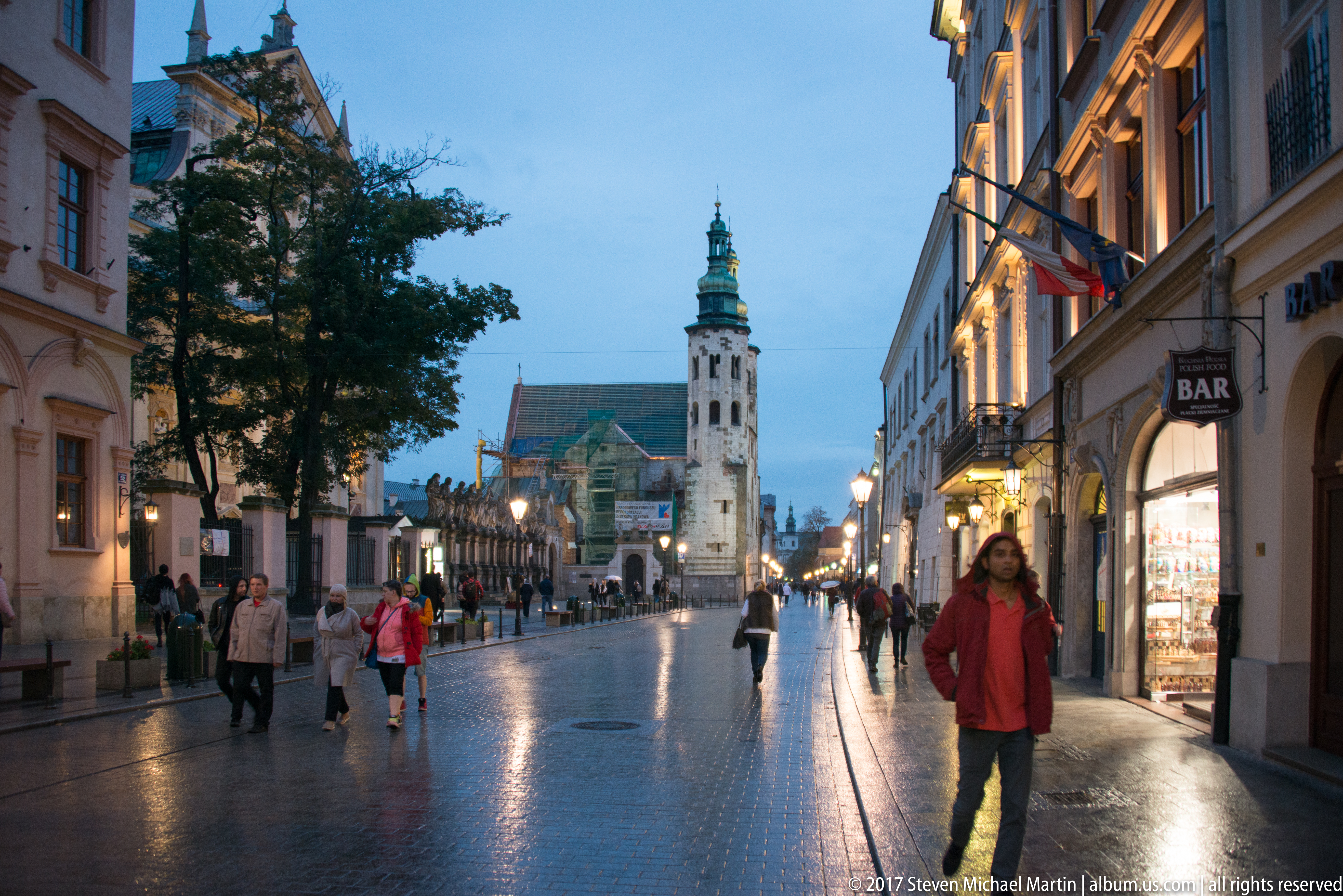
A rain-darkened pedestrian street stretches through Kraków’s Old Town at dusk, reflecting shop lights and the cool blue evening sky. Historic façades line both sides, while a slender green-capped church tower rises at the far end of the view. Pedestrians move along the broad paving, giving the scene a lively but subdued post-rain atmosphere.
Caption
A rain-darkened pedestrian street stretches through Kraków’s Old Town at dusk, reflecting shop lights and the cool blue evening sky. Historic façades line both sides, while a slender green-capped church tower rises at the far end of the view. Pedestrians move along the broad paving, giving the scene a lively but subdued post-rain atmosphere.

A horse-drawn carriage approaches along a wet Kraków street at dusk, pulled by two white horses decorated with red plumes and patterned harnesses. Street lamps and shop signs reflect in the rain-darkened paving while pedestrians gather along the sidewalks. The scene combines contemporary tourist transport with the atmospheric evening streetscape of the historic center.
Caption
A horse-drawn carriage approaches along a wet Kraków street at dusk, pulled by two white horses decorated with red plumes and patterned harnesses. Street lamps and shop signs reflect in the rain-darkened paving while pedestrians gather along the sidewalks. The scene combines contemporary tourist transport with the atmospheric evening streetscape of the historic center.

A small ensemble performs on an outdoor stage, combining trumpet, saxophone, clarinet-like woodwind, and accordion. Tall patterned textile panels create a folk-inspired backdrop, while the musicians wear practical cold-weather clothing rather than formal costume. The photograph documents a public music performance woven into Kraków’s cultural street life.
Caption
A small ensemble performs on an outdoor stage, combining trumpet, saxophone, clarinet-like woodwind, and accordion. Tall patterned textile panels create a folk-inspired backdrop, while the musicians wear practical cold-weather clothing rather than formal costume. The photograph documents a public music performance woven into Kraków’s cultural street life.

A confectioner’s display transforms tools and mechanical objects into convincing chocolate replicas. Wrenches, pliers, locks, saws, gears, bolts, and hand tools are arranged on pegboard and a counter beneath the large word “CHOCOLATE.” The playful presentation depends on realistic brown coloring and molded surface detail that mimic aged metal while remaining clearly identified as confectionery.
Caption
A confectioner’s display transforms tools and mechanical objects into convincing chocolate replicas. Wrenches, pliers, locks, saws, gears, bolts, and hand tools are arranged on pegboard and a counter beneath the large word “CHOCOLATE.” The playful presentation depends on realistic brown coloring and molded surface detail that mimic aged metal while remaining clearly identified as confectionery.

Rows of cloth-capped jars fill a rustic market counter, offering preserves and condiments in a wide range of colors from pale cream to deep berry red. Small decorative squash and a head of cauliflower-like produce sit among the jars, reinforcing the seasonal harvest presentation. The tightly packed display documents artisanal food retail in Kraków’s market environment.
Caption
Rows of cloth-capped jars fill a rustic market counter, offering preserves and condiments in a wide range of colors from pale cream to deep berry red. Small decorative squash and a head of cauliflower-like produce sit among the jars, reinforcing the seasonal harvest presentation. The tightly packed display documents artisanal food retail in Kraków’s market environment.

A broad Kraków street glistens after rain, reflecting restaurant lights, storefronts, and illuminated upper windows under a dark night sky. Historic multi-story façades frame the view, while café umbrellas and scattered pedestrians animate the sidewalks. The long perspective captures the Old Town after dark, when wet paving amplifies the contrast between shadow and warm architectural lighting.
Caption
A broad Kraków street glistens after rain, reflecting restaurant lights, storefronts, and illuminated upper windows under a dark night sky. Historic multi-story façades frame the view, while café umbrellas and scattered pedestrians animate the sidewalks. The long perspective captures the Old Town after dark, when wet paving amplifies the contrast between shadow and warm architectural lighting.

Rows of glossy molded chocolates fill a confectioner’s display, each piece finished with a small looped decoration. Most are coated in milk or dark chocolate, while several green pieces punctuate the repeated pattern. The shallow angle turns the retail display into an abstract field of color, sheen, and repetition while preserving the meticulous presentation of individual pralines.
Caption
Rows of glossy molded chocolates fill a confectioner’s display, each piece finished with a small looped decoration. Most are coated in milk or dark chocolate, while several green pieces punctuate the repeated pattern. The shallow angle turns the retail display into an abstract field of color, sheen, and repetition while preserving the meticulous presentation of individual pralines.

A pastry seller works behind the glass counter of a Krakowskie Pączki shop, where rows of filled Polish doughnuts are arranged beneath warm copper pendant lamps. Handwritten labels identify individual flavors across the display while a customer waits at the counter. The close street-level view records a popular form of Polish confectionery retail in central Kraków.
Caption
A pastry seller works behind the glass counter of a Krakowskie Pączki shop, where rows of filled Polish doughnuts are arranged beneath warm copper pendant lamps. Handwritten labels identify individual flavors across the display while a customer waits at the counter. The close street-level view records a popular form of Polish confectionery retail in central Kraków.

The Karmello handmade chocolate shop occupies the ground floor of a pale corner building on a rain-wet Kraków street. A brightly illuminated display window and small outdoor sales counter contrast with the subdued residential windows above. The Polish word “czekolada” spans the façade, clearly announcing the shop’s specialty and linking the street scene to Kraków’s contemporary confectionery culture.
Caption
The Karmello handmade chocolate shop occupies the ground floor of a pale corner building on a rain-wet Kraków street. A brightly illuminated display window and small outdoor sales counter contrast with the subdued residential windows above. The Polish word “czekolada” spans the façade, clearly announcing the shop’s specialty and linking the street scene to Kraków’s contemporary confectionery culture.

The brick Gothic façade of Kraków’s Dominican Basilica of the Holy Trinity rises dramatically above two pointed stone portals. A large traceried window dominates the upper wall, while the steep gable is articulated with vertical brick panels and small pinnacles. Evening illumination picks out the pale portal sculpture against the darker masonry, emphasizing the church’s layered Gothic exterior.
Caption
The brick Gothic façade of Kraków’s Dominican Basilica of the Holy Trinity rises dramatically above two pointed stone portals. A large traceried window dominates the upper wall, while the steep gable is articulated with vertical brick panels and small pinnacles. Evening illumination picks out the pale portal sculpture against the darker masonry, emphasizing the church’s layered Gothic exterior.

Passengers sit and stand inside a blue Kraków tram, seen directly through its large street-level windows. Interior handrails, ticket equipment, and overhead fixtures frame the riders, whose faces and postures form a cross-section of everyday public transport. The exterior view turns the tram into a moving urban tableau and shifts the portfolio from monuments toward contemporary city life.
Caption
Passengers sit and stand inside a blue Kraków tram, seen directly through its large street-level windows. Interior handrails, ticket equipment, and overhead fixtures frame the riders, whose faces and postures form a cross-section of everyday public transport. The exterior view turns the tram into a moving urban tableau and shifts the portfolio from monuments toward contemporary city life.

Rows of black-and-white portrait photographs fill the ground-floor windows of Oskar Schindler’s former enamel factory in Kraków. Individual faces are arranged pane by pane, transforming the industrial façade into a memorial surface. The installation ties the surviving building to the people whose wartime experiences are interpreted by the museum now occupying the historic factory complex.
Caption
Rows of black-and-white portrait photographs fill the ground-floor windows of Oskar Schindler’s former enamel factory in Kraków. Individual faces are arranged pane by pane, transforming the industrial façade into a memorial surface. The installation ties the surviving building to the people whose wartime experiences are interpreted by the museum now occupying the historic factory complex.

A modern restaurant interior is viewed through a brightly outlined street window. Diners sit at simple wooden tables beneath a row of large rectangular pendant shades, while a counter and dark ceiling recede behind them. The framing turns the illuminated dining room into a self-contained nighttime scene, contrasting intimate contemporary hospitality with Kraków’s surrounding historic streets.
Caption
A modern restaurant interior is viewed through a brightly outlined street window. Diners sit at simple wooden tables beneath a row of large rectangular pendant shades, while a counter and dark ceiling recede behind them. The framing turns the illuminated dining room into a self-contained nighttime scene, contrasting intimate contemporary hospitality with Kraków’s surrounding historic streets.

A memorial plaque at Schindler’s Factory identifies the site in Polish, English, and Hebrew and dates its wartime operation to 1939–1944. Beneath the title, the inscription quotes the Talmud: “Whoever saves one life, saves the whole entire,” followed by Oskar Schindler’s name and dates, 1908–1974. The plaque directly anchors the factory complex to Schindler’s rescue of Jewish workers.
Caption
A memorial plaque at Schindler’s Factory identifies the site in Polish, English, and Hebrew and dates its wartime operation to 1939–1944. Beneath the title, the inscription quotes the Talmud: “Whoever saves one life, saves the whole entire,” followed by Oskar Schindler’s name and dates, 1908–1974. The plaque directly anchors the factory complex to Schindler’s rescue of Jewish workers.

The long white façade of Oskar Schindler’s former enamel factory presents a restrained industrial exterior of repetitive rectangular windows, a recessed entrance, and ground-floor openings associated with the museum complex. A cylindrical advertising column stands on the pavement in front. The unadorned building is historically charged by its connection to Schindler’s wartime factory and the museum interpretation housed there today.
Caption
The long white façade of Oskar Schindler’s former enamel factory presents a restrained industrial exterior of repetitive rectangular windows, a recessed entrance, and ground-floor openings associated with the museum complex. A cylindrical advertising column stands on the pavement in front. The unadorned building is historically charged by its connection to Schindler’s wartime factory and the museum interpretation housed there today.

A low industrial building with repeated sawtooth roof sections and tall glazed doors stands near the Schindler Factory complex. Large red circular graphics mark the doors, while roof glazing and exposed utility lines preserve the utilitarian character of the former industrial district. The final image broadens the site from the museum façade to the surrounding fabric of Kraków’s Zabłocie industrial landscape.
Caption
A low industrial building with repeated sawtooth roof sections and tall glazed doors stands near the Schindler Factory complex. Large red circular graphics mark the doors, while roof glazing and exposed utility lines preserve the utilitarian character of the former industrial district. The final image broadens the site from the museum façade to the surrounding fabric of Kraków’s Zabłocie industrial landscape.
⭐ Highlights
- Old Town (Stare Miasto): A UNESCO-listed historic center with one of the largest medieval market squares in Europe.
- Wawel Castle: A royal residence and one of the most important historic sites in Poland.
- Main Market Square (Rynek Główny): The heart of the city since the 13th century.
- St. Mary’s Basilica: A Gothic church known for its twin towers and hourly trumpet call.
- Kazimierz District: The historic Jewish quarter with synagogues and cultural landmarks.
- Former Capital: Kraków served as the political and cultural center of Poland for centuries.
🏰 Kraków Field Guide
Major features observed during this visit:
Kraków is one of Europe’s most important historic cities, located along the Vistula River in southern Poland. Once the capital of Poland, it developed as a major political, economic, and cultural center during the Middle Ages. The historic core—centered on the Old Town, Wawel Hill, and Kazimierz—has been preserved with remarkable integrity and reflects centuries of architectural and cultural development.
🏛️ Signature Landmarks
- Wawel Castle – A royal complex overlooking the city and the Vistula River.
- Main Market Square – A vast medieval square surrounded by historic buildings.
- St. Mary’s Basilica – A Gothic church defining the skyline of the Old Town.
- Cloth Hall – A historic market building at the center of the square.
- Kazimierz – A historic district reflecting the city’s Jewish heritage.
🧠 Historical Significance
- Medieval Capital – Kraków served as the capital of Poland until the late 16th century.
- Royal Ceremonial Center – Polish kings were crowned and buried at Wawel Cathedral.
- UNESCO World Heritage Site – The historic center was among the first sites listed in 1978.
- Cultural Crossroads – The city has long been a meeting point of Eastern and Western European traditions.
🌄 Urban Landscape & Setting
- Vistula River – The river runs alongside the historic center and Wawel Hill.
- Medieval Layout – The city retains its original 13th-century urban plan.
- Dense Historic Core – Churches, palaces, and townhouses create a highly concentrated historic environment.
- Layered Architecture – Romanesque, Gothic, Renaissance, and later styles coexist throughout the city.