Córdoba
Córdoba served as one of the most important cities of Islamic Spain during the Umayyad Caliphate, becoming a center of scholarship, trade, and artistic development. The city’s urban fabric reflects the influence of Islamic governance that contributed to advancements in science, philosophy, and architecture. Its historic streets and monuments illustrate the cultural achievements of Al-Andalus.
Following the Reconquista, Christian rulers adapted many existing structures, resulting in a distinctive combination of Islamic and European architectural traditions. Narrow streets, courtyards, and religious buildings illustrate continuity of settlement shaped by multiple cultural influences. Córdoba’s historic district preserves evidence of intellectual and artistic exchange across centuries.
Córdoba demonstrates the significance of Islamic Spain in shaping European cultural history. The preserved architecture reflects the interaction between religious traditions that influenced the development of the Iberian Peninsula.

A closer telephoto view compresses Córdoba’s Mosque-Cathedral and its bell tower against the surrounding historic center. The cathedral crossing and tiled roofs of the former mosque fill the left half of the skyline, while the tall tower stands detached to the right above white façades. The tighter composition makes the monument’s Christian additions especially legible within the larger medieval urban fabric.
Caption
A closer telephoto view compresses Córdoba’s Mosque-Cathedral and its bell tower against the surrounding historic center. The cathedral crossing and tiled roofs of the former mosque fill the left half of the skyline, while the tall tower stands detached to the right above white façades. The tighter composition makes the monument’s Christian additions especially legible within the larger medieval urban fabric.

Two heraldic devices are displayed against deep red fabric: a crowned shield dominated by a rampant lion and a second emblem showing a walled city or fortified complex above blue water. Their paired presentation links royal and civic heraldic traditions within the Alcázar setting. The close crop records the emblems as symbolic objects rather than as part of a larger architectural interior.
Caption
Two heraldic devices are displayed against deep red fabric: a crowned shield dominated by a rampant lion and a second emblem showing a walled city or fortified complex above blue water. Their paired presentation links royal and civic heraldic traditions within the Alcázar setting. The close crop records the emblems as symbolic objects rather than as part of a larger architectural interior.

Viewed almost vertically from below, the Corinthian columns of Córdoba’s Roman Temple converge against streaked blue sky. The extreme perspective isolates the fluted shafts and acanthus-carved capitals from the surrounding city, transforming the restored colonnade into a study of classical proportion and verticality. Brick podium walls remain visible along the lower edge of the frame.
Caption
Viewed almost vertically from below, the Corinthian columns of Córdoba’s Roman Temple converge against streaked blue sky. The extreme perspective isolates the fluted shafts and acanthus-carved capitals from the surrounding city, transforming the restored colonnade into a study of classical proportion and verticality. Brick podium walls remain visible along the lower edge of the frame.

The Mosque-Cathedral dominates Córdoba’s historic skyline across the Guadalquivir, its cathedral nave, dome, and former minaret-turned-bell tower rising above whitewashed houses and tiled roofs. Bare winter trees line the riverbank in the foreground. The broad daylight view places the monument within the dense urban fabric of the UNESCO-listed historic center rather than isolating it as a single building.
Caption
The Mosque-Cathedral dominates Córdoba’s historic skyline across the Guadalquivir, its cathedral nave, dome, and former minaret-turned-bell tower rising above whitewashed houses and tiled roofs. Bare winter trees line the riverbank in the foreground. The broad daylight view places the monument within the dense urban fabric of the UNESCO-listed historic center rather than isolating it as a single building.

Calleja de las Flores narrows between whitewashed walls hung with flowerpots, wrought-iron grilles, balconies, and trailing greenery in Córdoba’s historic center. One of the city’s best-known lanes, the passage forms part of the Judería near the Mosque-Cathedral. The oblique view emphasizes its intimate scale and the contrast between bright white walls and dense plantings.
Caption
Calleja de las Flores narrows between whitewashed walls hung with flowerpots, wrought-iron grilles, balconies, and trailing greenery in Córdoba’s historic center. One of the city’s best-known lanes, the passage forms part of the Judería near the Mosque-Cathedral. The oblique view emphasizes its intimate scale and the contrast between bright white walls and dense plantings.

The Mosque-Cathedral of Córdoba glows above the north bank of the Guadalquivir, its cathedral roofline, dome, and bell tower rising over the historic riverfront. Reflections shimmer below while part of the Roman Bridge and its lighting lead into the scene. The distant nighttime viewpoint presents the monument as the dominant silhouette of Córdoba’s UNESCO-listed historic center.
Caption
The Mosque-Cathedral of Córdoba glows above the north bank of the Guadalquivir, its cathedral roofline, dome, and bell tower rising over the historic riverfront. Reflections shimmer below while part of the Roman Bridge and its lighting lead into the scene. The distant nighttime viewpoint presents the monument as the dominant silhouette of Córdoba’s UNESCO-listed historic center.

The Puerta del Puente stands floodlit at the northern end of Córdoba’s Roman Bridge, presenting its monumental Renaissance front of paired columns, heavy entablature, and central passage. Seen squarely from the plaza, the gate reads as an urban triumphal portal between the historic center and the Guadalquivir crossing. Small figures at its base provide scale for the massive stone composition.
Caption
The Puerta del Puente stands floodlit at the northern end of Córdoba’s Roman Bridge, presenting its monumental Renaissance front of paired columns, heavy entablature, and central passage. Seen squarely from the plaza, the gate reads as an urban triumphal portal between the historic center and the Guadalquivir crossing. Small figures at its base provide scale for the massive stone composition.

The illuminated Roman Bridge crosses the Guadalquivir toward the fortified Calahorra Tower, its massive gate-tower rising above the southern end of the span. Warm floodlighting picks out the bridge’s repeated stone arches and cutwaters while their reflections stretch across the dark river, turning Córdoba’s historic river crossing into a strongly defined nighttime cityscape.
Caption
The illuminated Roman Bridge crosses the Guadalquivir toward the fortified Calahorra Tower, its massive gate-tower rising above the southern end of the span. Warm floodlighting picks out the bridge’s repeated stone arches and cutwaters while their reflections stretch across the dark river, turning Córdoba’s historic river crossing into a strongly defined nighttime cityscape.

A monumental horseshoe-arched passage opens through richly ornamented masonry in Córdoba, framed by carved geometric panels, slender colonnettes, and a second decorated arch beyond. The deep passage leads toward a sunlit courtyard planted with citrus. The layered arches and surface ornament evoke the city’s Islamic and Mudéjar architectural traditions, while the tight framing does not securely establish the exact gate.
Caption
A monumental horseshoe-arched passage opens through richly ornamented masonry in Córdoba, framed by carved geometric panels, slender colonnettes, and a second decorated arch beyond. The deep passage leads toward a sunlit courtyard planted with citrus. The layered arches and surface ornament evoke the city’s Islamic and Mudéjar architectural traditions, while the tight framing does not securely establish the exact gate.

An architectural model reconstructs the excavated Caliphal Baths near Córdoba’s former Umayyad palace precinct, showing a sequence of roofed halls, courtyards, service areas, and surrounding walls. Viewed from above behind glass, the model helps translate the fragmentary archaeological remains into a legible complex of interconnected spaces associated with elite bathing culture in caliphal Córdoba.
Caption
An architectural model reconstructs the excavated Caliphal Baths near Córdoba’s former Umayyad palace precinct, showing a sequence of roofed halls, courtyards, service areas, and surrounding walls. Viewed from above behind glass, the model helps translate the fragmentary archaeological remains into a legible complex of interconnected spaces associated with elite bathing culture in caliphal Córdoba.

At Plaza de las Tendillas, the equestrian monument to Gonzalo Fernández de Córdoba, the Gran Capitán, rises from the center of the illuminated fountain. The sculpture by Mateo Inurria anchors Córdoba’s principal modern square, surrounded here by palms, pedestrians, ornate streetlamps, and early twentieth-century façades under the deep blue-black of evening.
Caption
At Plaza de las Tendillas, the equestrian monument to Gonzalo Fernández de Córdoba, the Gran Capitán, rises from the center of the illuminated fountain. The sculpture by Mateo Inurria anchors Córdoba’s principal modern square, surrounded here by palms, pedestrians, ornate streetlamps, and early twentieth-century façades under the deep blue-black of evening.

An ornate white corner building rises above orange trees and streetlamps near Córdoba’s central commercial district. Its rounded turret, stacked balconies, sculpted roofline, and winged rooftop figure create a vertical counterpoint to the lower neighboring façades. The upward nighttime viewpoint emphasizes the building’s Beaux-Arts-influenced urban ornament rather than the surrounding square.
Caption
An ornate white corner building rises above orange trees and streetlamps near Córdoba’s central commercial district. Its rounded turret, stacked balconies, sculpted roofline, and winged rooftop figure create a vertical counterpoint to the lower neighboring façades. The upward nighttime viewpoint emphasizes the building’s Beaux-Arts-influenced urban ornament rather than the surrounding square.

Festive street illuminations span a narrow Córdoba avenue during carnival season, with repeated scrolling motifs framing a central stylized mask. Purple, blue, white, and amber lamps form a suspended canopy above the dark street, while a banner below reads “Carnaval de Córdoba.” The photograph isolates the temporary decorative lighting as a piece of urban festival design.
Caption
Festive street illuminations span a narrow Córdoba avenue during carnival season, with repeated scrolling motifs framing a central stylized mask. Purple, blue, white, and amber lamps form a suspended canopy above the dark street, while a banner below reads “Carnaval de Córdoba.” The photograph isolates the temporary decorative lighting as a piece of urban festival design.

A whitewashed corner house in Córdoba’s historic center is enlivened by dense greenery spilling from wrought-iron balconies and window grilles. The compact façade turns around a narrow pedestrian lane, combining plain stucco walls, timber doors, ironwork, and hanging plants. Night lighting brings out the intimate scale and domestic character associated with the city’s older quarters.
Caption
A whitewashed corner house in Córdoba’s historic center is enlivened by dense greenery spilling from wrought-iron balconies and window grilles. The compact façade turns around a narrow pedestrian lane, combining plain stucco walls, timber doors, ironwork, and hanging plants. Night lighting brings out the intimate scale and domestic character associated with the city’s older quarters.

Floodlights rake across the crenellated stone walls of the Alcázar de los Reyes Cristianos, revealing a square defensive tower and the rough texture of the masonry. A tall cypress casts a dark vertical silhouette against the fortification. The oblique nighttime view stresses the palace-fortress’s defensive perimeter rather than its better-known gardens and interior courts.
Caption
Floodlights rake across the crenellated stone walls of the Alcázar de los Reyes Cristianos, revealing a square defensive tower and the rough texture of the masonry. A tall cypress casts a dark vertical silhouette against the fortification. The oblique nighttime view stresses the palace-fortress’s defensive perimeter rather than its better-known gardens and interior courts.

A narrow reflecting pool runs beside the floodlit perimeter of the Alcázar de los Reyes Cristianos, drawing the eye toward a square tower framed by a tall cypress. Crenellations step rhythmically along the wall while low hedges and paving define the garden edge. The view joins the fortress architecture with the formal water features of its landscaped precinct.
Caption
A narrow reflecting pool runs beside the floodlit perimeter of the Alcázar de los Reyes Cristianos, drawing the eye toward a square tower framed by a tall cypress. Crenellations step rhythmically along the wall while low hedges and paving define the garden edge. The view joins the fortress architecture with the formal water features of its landscaped precinct.

An angled nighttime view follows the Alcázar de los Reyes Cristianos along a narrow water channel, emphasizing the length of its crenellated wall and the projecting square tower beyond. Reflections of lamps and masonry shimmer in the water while a cypress breaks the horizontal line. The tilted composition gives the defensive enclosure a dynamic, almost processional perspective.
Caption
An angled nighttime view follows the Alcázar de los Reyes Cristianos along a narrow water channel, emphasizing the length of its crenellated wall and the projecting square tower beyond. Reflections of lamps and masonry shimmer in the water while a cypress breaks the horizontal line. The tilted composition gives the defensive enclosure a dynamic, almost processional perspective.

A crenellated stone gateway opens through the fortified wall of Córdoba’s Alcázar precinct, its large horseshoe-like passage glowing under nighttime floodlights. A dark bronze figure on a pedestal stands in the foreground, introducing a human-scale counterpoint to the defensive masonry. Moonlight and artificial illumination sharpen the wall’s battlements, rough stonework, and deep entrance.
Caption
A crenellated stone gateway opens through the fortified wall of Córdoba’s Alcázar precinct, its large horseshoe-like passage glowing under nighttime floodlights. A dark bronze figure on a pedestal stands in the foreground, introducing a human-scale counterpoint to the defensive masonry. Moonlight and artificial illumination sharpen the wall’s battlements, rough stonework, and deep entrance.

Floodlighting turns a crenellated gateway and adjoining wall of the Alcázar precinct into a luminous backdrop for a rectangular reflecting pool. The gate’s dark opening and battlements mirror in the still water, while a standing monument at right breaks the long horizontal silhouette. The photograph concentrates on symmetry, reflection, and the fortress’s nighttime presentation.
Caption
Floodlighting turns a crenellated gateway and adjoining wall of the Alcázar precinct into a luminous backdrop for a rectangular reflecting pool. The gate’s dark opening and battlements mirror in the still water, while a standing monument at right breaks the long horizontal silhouette. The photograph concentrates on symmetry, reflection, and the fortress’s nighttime presentation.

A narrow street in Córdoba’s historic center opens toward the illuminated bell tower of the Mosque-Cathedral, which rises above low whitewashed buildings in the distance. Restaurant signs, café seating, scooters, pedestrians, balconies, and utility lines create a layered neighborhood scene. The long perspective shows how the monumental tower remains visually present within the intimate street fabric around the old mosque-cathedral.
Caption
A narrow street in Córdoba’s historic center opens toward the illuminated bell tower of the Mosque-Cathedral, which rises above low whitewashed buildings in the distance. Restaurant signs, café seating, scooters, pedestrians, balconies, and utility lines create a layered neighborhood scene. The long perspective shows how the monumental tower remains visually present within the intimate street fabric around the old mosque-cathedral.

A small restaurant occupies the ground floor of a whitewashed Córdoba building, its entrance framed by barred windows, compact balconies, flower boxes, and wall-mounted lights. The sign identifies a “restaurante mediterráneo,” while the open doorway reveals a narrow dining interior. Seen straight on at night, the façade combines domestic scale with the commercial life of the historic center.
Caption
A small restaurant occupies the ground floor of a whitewashed Córdoba building, its entrance framed by barred windows, compact balconies, flower boxes, and wall-mounted lights. The sign identifies a “restaurante mediterráneo,” while the open doorway reveals a narrow dining interior. Seen straight on at night, the façade combines domestic scale with the commercial life of the historic center.

A compact Córdoba restaurant patio is arranged with white metal chairs and round tables among abundant potted greenery. Blue-and-white patterned tilework lines benches and lower walls, while terracotta floor tiles and a glazed enclosure add texture to the intimate dining space. The close view emphasizes how courtyard traditions are adapted for contemporary hospitality in the historic center.
Caption
A compact Córdoba restaurant patio is arranged with white metal chairs and round tables among abundant potted greenery. Blue-and-white patterned tilework lines benches and lower walls, while terracotta floor tiles and a glazed enclosure add texture to the intimate dining space. The close view emphasizes how courtyard traditions are adapted for contemporary hospitality in the historic center.

The illuminated bell tower of Córdoba’s Mosque-Cathedral rises dramatically between close-set white façades, with the moon suspended above the narrow street canyon. Iron balconies, barred windows, painted trim, and projecting eaves frame the distant landmark. The compressed upward view highlights the tower’s role as a visual orientation point within the dense lanes surrounding the monumental complex.
Caption
The illuminated bell tower of Córdoba’s Mosque-Cathedral rises dramatically between close-set white façades, with the moon suspended above the narrow street canyon. Iron balconies, barred windows, painted trim, and projecting eaves frame the distant landmark. The compressed upward view highlights the tower’s role as a visual orientation point within the dense lanes surrounding the monumental complex.

A two-story arcaded façade glows under warm nighttime lighting, its broad semicircular openings stacked above and below a continuous line of balconies. Faded painted medallions survive within several bays, contrasting with exposed stone and dark iron railings. The oblique view emphasizes repetition, depth, and the weathered surfaces of this historic Córdoba building while avoiding an uncertain specific attribution.
Caption
A two-story arcaded façade glows under warm nighttime lighting, its broad semicircular openings stacked above and below a continuous line of balconies. Faded painted medallions survive within several bays, contrasting with exposed stone and dark iron railings. The oblique view emphasizes repetition, depth, and the weathered surfaces of this historic Córdoba building while avoiding an uncertain specific attribution.

Viewed at a steep angle, a historic Córdoba façade presents stacked arcades, wrought-iron balconies, and traces of painted medallions on aged plaster and stone. Deep arches recede across the lower level while upper openings create a repeating rhythm. The tilted nighttime composition focuses on accumulated surface wear and architectural layering rather than providing enough context for a secure building identification.
Caption
Viewed at a steep angle, a historic Córdoba façade presents stacked arcades, wrought-iron balconies, and traces of painted medallions on aged plaster and stone. Deep arches recede across the lower level while upper openings create a repeating rhythm. The tilted nighttime composition focuses on accumulated surface wear and architectural layering rather than providing enough context for a secure building identification.

A monumental triumph of Saint Raphael is illuminated against the night sky, with the archangel’s figure crowning a tall column above an elaborate sculptural base. The white stone monument stands within a low iron enclosure and is flanked by historic buildings. The symmetrical frontal view emphasizes the soaring vertical column and the layered Baroque arrangement of figures below.
Caption
A monumental triumph of Saint Raphael is illuminated against the night sky, with the archangel’s figure crowning a tall column above an elaborate sculptural base. The white stone monument stands within a low iron enclosure and is flanked by historic buildings. The symmetrical frontal view emphasizes the soaring vertical column and the layered Baroque arrangement of figures below.

A ceramic-and-stone commemorative panel reproduces Luis de Góngora’s sonnet “A Córdoba,” beginning with the invocation to the city’s walls, towers, river, and fertile plain. The heading marks Góngora and the dates 1627–1927, reflecting a later civic commemoration of the Córdoba-born poet. The close view is centered on the inscribed text rather than its architectural setting.
Caption
A ceramic-and-stone commemorative panel reproduces Luis de Góngora’s sonnet “A Córdoba,” beginning with the invocation to the city’s walls, towers, river, and fertile plain. The heading marks Góngora and the dates 1627–1927, reflecting a later civic commemoration of the Córdoba-born poet. The close view is centered on the inscribed text rather than its architectural setting.

An elaborate Córdoba triumph dedicated to Saint Raphael rises from a grotto-like mass of sculpted stone, populated by carved figures and framed by an iron fence. A commemorative inscription occupies the center of the rocky base. Strong floodlighting exaggerates the monument’s theatrical Baroque character, but the tight crop does not reveal enough surrounding context to assign this view to a specific one of the city’s several San Rafael monuments.
Caption
An elaborate Córdoba triumph dedicated to Saint Raphael rises from a grotto-like mass of sculpted stone, populated by carved figures and framed by an iron fence. A commemorative inscription occupies the center of the rocky base. Strong floodlighting exaggerates the monument’s theatrical Baroque character, but the tight crop does not reveal enough surrounding context to assign this view to a specific one of the city’s several San Rafael monuments.

A richly articulated doorway on the exterior of Córdoba’s Mosque-Cathedral is framed by alternating stone-and-brick voussoirs, interlaced blind arches, carved panels, and latticed openings. Crenellations silhouette the roofline above. Warm nighttime illumination clarifies the dense ornamental program and the layered masonry of the historic enclosure, while the absence of a wider wall context makes the exact portal name uncertain.
Caption
A richly articulated doorway on the exterior of Córdoba’s Mosque-Cathedral is framed by alternating stone-and-brick voussoirs, interlaced blind arches, carved panels, and latticed openings. Crenellations silhouette the roofline above. Warm nighttime illumination clarifies the dense ornamental program and the layered masonry of the historic enclosure, while the absence of a wider wall context makes the exact portal name uncertain.

The Roman Bridge stretches diagonally across the Guadalquivir, its floodlit arches and heavy cutwaters mirrored in the dark water. At the far end, the illuminated Calahorra Tower marks the fortified southern approach. The canted composition lengthens the crossing and makes the repeating pools of light beneath the arches the dominant visual rhythm of the nighttime riverfront.
Caption
The Roman Bridge stretches diagonally across the Guadalquivir, its floodlit arches and heavy cutwaters mirrored in the dark water. At the far end, the illuminated Calahorra Tower marks the fortified southern approach. The canted composition lengthens the crossing and makes the repeating pools of light beneath the arches the dominant visual rhythm of the nighttime riverfront.

A circular urban fountain erupts in dense vertical jets, its water lit from below so that individual streams appear almost white against the dark surroundings. Streetlamps and distant signs are partially visible through the curtain of water. The photograph concentrates on the graphic pattern of the jets and their illumination rather than providing enough surrounding context for a secure plaza identification.
Caption
A circular urban fountain erupts in dense vertical jets, its water lit from below so that individual streams appear almost white against the dark surroundings. Streetlamps and distant signs are partially visible through the curtain of water. The photograph concentrates on the graphic pattern of the jets and their illumination rather than providing enough surrounding context for a secure plaza identification.

A statue of Córdoba’s guardian archangel Saint Raphael stands on a stone pedestal along the Roman Bridge, a small halo visible above the figure’s head. Rows of red votive candles and flowers cluster at the base, recording the monument’s continuing devotional use. The dark river valley beyond isolates the pale sculpture and the intimate offerings against the nighttime landscape.
Caption
A statue of Córdoba’s guardian archangel Saint Raphael stands on a stone pedestal along the Roman Bridge, a small halo visible above the figure’s head. Rows of red votive candles and flowers cluster at the base, recording the monument’s continuing devotional use. The dark river valley beyond isolates the pale sculpture and the intimate offerings against the nighttime landscape.

The bell tower of Córdoba’s Mosque-Cathedral rises above the white cityscape in a clear daytime view from the Alcázar area. Its Renaissance and Baroque upper stages are stacked above the former minaret core, with open bell chambers and a crowning figure sharply outlined against the blue sky. The distant framing isolates the tower as the dominant vertical landmark of the historic center.
Caption
The bell tower of Córdoba’s Mosque-Cathedral rises above the white cityscape in a clear daytime view from the Alcázar area. Its Renaissance and Baroque upper stages are stacked above the former minaret core, with open bell chambers and a crowning figure sharply outlined against the blue sky. The distant framing isolates the tower as the dominant vertical landmark of the historic center.

A Roman floor mosaic displayed at the Alcázar de los Reyes Cristianos centers on a large circular figurative scene framed by braided guilloche borders and smaller portrait medallions. Earth-toned tesserae form the figures and surrounding geometric bands. The angled museum display preserves the mosaic as an archaeological object distinct from the medieval and early modern architecture around it.
Caption
A Roman floor mosaic displayed at the Alcázar de los Reyes Cristianos centers on a large circular figurative scene framed by braided guilloche borders and smaller portrait medallions. Earth-toned tesserae form the figures and surrounding geometric bands. The angled museum display preserves the mosaic as an archaeological object distinct from the medieval and early modern architecture around it.

Inside a Córdoba craft-beer bar, a large retro-style poster advertises Califa as “La cerveza cordobesa” beside a long counter, tap area, and chalkboard menu. Corrugated metal surfaces, exposed hanging bulbs, and patrons at the bar give the room an industrial contemporary character. The local beer branding makes Córdoba identity part of the interior design as well as the product being served.
Caption
Inside a Córdoba craft-beer bar, a large retro-style poster advertises Califa as “La cerveza cordobesa” beside a long counter, tap area, and chalkboard menu. Corrugated metal surfaces, exposed hanging bulbs, and patrons at the bar give the room an industrial contemporary character. The local beer branding makes Córdoba identity part of the interior design as well as the product being served.

A person bends and reaches through a curtain of illuminated fountain jets, turning a public water feature into a spontaneous nighttime interaction. The figure is rendered mostly in silhouette against the bright vertical streams, while the surrounding plaza recedes into darkness. The close framing emphasizes motion, spray, and the playful relationship between the visitor and the fountain.
Caption
A person bends and reaches through a curtain of illuminated fountain jets, turning a public water feature into a spontaneous nighttime interaction. The figure is rendered mostly in silhouette against the bright vertical streams, while the surrounding plaza recedes into darkness. The close framing emphasizes motion, spray, and the playful relationship between the visitor and the fountain.

Rows of carnival illuminations recede down a Córdoba street, repeating ornate scrolling frames around stylized mask-like emblems. The layered installations create a luminous tunnel of blue, purple, white, amber, and green above the roadway. Unlike the closer carnival view earlier in the sequence, this composition stresses depth and repetition as the temporary festival decorations diminish toward the distance.
Caption
Rows of carnival illuminations recede down a Córdoba street, repeating ornate scrolling frames around stylized mask-like emblems. The layered installations create a luminous tunnel of blue, purple, white, amber, and green above the roadway. Unlike the closer carnival view earlier in the sequence, this composition stresses depth and repetition as the temporary festival decorations diminish toward the distance.

Two members of religious communities stand beside a red car on a stone-paved Córdoba street: a man in black clerical dress and a veiled woman in a dark habit. A scooter is parked nearby and monumental stone steps and walls rise behind them. The candid scene places contemporary religious life within the everyday circulation of the historic center rather than within a ceremonial setting.
Caption
Two members of religious communities stand beside a red car on a stone-paved Córdoba street: a man in black clerical dress and a veiled woman in a dark habit. A scooter is parked nearby and monumental stone steps and walls rise behind them. The candid scene places contemporary religious life within the everyday circulation of the historic center rather than within a ceremonial setting.

A richly carved stone façade centers on a rectangular balcony framed by pilasters, a triangular pediment, and paired heraldic shields. Heavy corbels support the projecting balcony, while scrollwork and classical moldings animate the surrounding masonry. The close crop isolates the building’s aristocratic architectural language and heraldry, but excludes enough context that a precise palace or institutional identification cannot be made confidently.
Caption
A richly carved stone façade centers on a rectangular balcony framed by pilasters, a triangular pediment, and paired heraldic shields. Heavy corbels support the projecting balcony, while scrollwork and classical moldings animate the surrounding masonry. The close crop isolates the building’s aristocratic architectural language and heraldry, but excludes enough context that a precise palace or institutional identification cannot be made confidently.

A wall-mounted plaque identifies the Alcázar de los Reyes Cristianos beside a wrought-metal lantern bracket shaped as a heraldic lion. Set against rough golden stone at the entrance, the pairing of official signage and decorative ironwork introduces the palace-fortress through two concise visual markers: its modern heritage identity and the martial symbolism associated with the historic complex.
Caption
A wall-mounted plaque identifies the Alcázar de los Reyes Cristianos beside a wrought-metal lantern bracket shaped as a heraldic lion. Set against rough golden stone at the entrance, the pairing of official signage and decorative ironwork introduces the palace-fortress through two concise visual markers: its modern heritage identity and the martial symbolism associated with the historic complex.

From an elevated viewpoint inside the Alcázar de los Reyes Cristianos, long rectangular pools step through a formal garden of clipped hedges, rounded topiary, palms, and paved terraces. The axial arrangement of water and vegetation gives the gardens their strong geometry, while the high perspective reveals how successive basins organize the landscape into controlled, symmetrical compartments.
Caption
From an elevated viewpoint inside the Alcázar de los Reyes Cristianos, long rectangular pools step through a formal garden of clipped hedges, rounded topiary, palms, and paved terraces. The axial arrangement of water and vegetation gives the gardens their strong geometry, while the high perspective reveals how successive basins organize the landscape into controlled, symmetrical compartments.

The crenellated towers and rooflines of the Alcázar de los Reyes Cristianos fill the foreground of an elevated view toward the Guadalquivir and Córdoba’s Roman Bridge. Beyond the palace-fortress, the bridge’s long sequence of arches crosses the river through atmospheric haze. The composition links the Alcázar’s defensive architecture directly to the city’s historic river corridor.
Caption
The crenellated towers and rooflines of the Alcázar de los Reyes Cristianos fill the foreground of an elevated view toward the Guadalquivir and Córdoba’s Roman Bridge. Beyond the palace-fortress, the bridge’s long sequence of arches crosses the river through atmospheric haze. The composition links the Alcázar’s defensive architecture directly to the city’s historic river corridor.

A low-angle view runs along the stone battlements of the Alcázar de los Reyes Cristianos, bringing the pointed merlons of the crenellated parapet into sharp relief. Behind the wall, a small tower with an open bell-like upper stage rises against the blue sky. The close perspective concentrates on defensive form, masonry mass, and the rhythm of the fortification.
Caption
A low-angle view runs along the stone battlements of the Alcázar de los Reyes Cristianos, bringing the pointed merlons of the crenellated parapet into sharp relief. Behind the wall, a small tower with an open bell-like upper stage rises against the blue sky. The close perspective concentrates on defensive form, masonry mass, and the rhythm of the fortification.

A finely patterned Roman mosaic surrounds a small central face with concentric rings of black-and-white geometric ornament. Interlaced knots, angular frames, wave motifs, and nested borders create a highly ordered square design around the portrait medallion. The limited palette emphasizes line and symmetry, making the small human face the single figurative focus within an otherwise abstract composition.
Caption
A finely patterned Roman mosaic surrounds a small central face with concentric rings of black-and-white geometric ornament. Interlaced knots, angular frames, wave motifs, and nested borders create a highly ordered square design around the portrait medallion. The limited palette emphasizes line and symmetry, making the small human face the single figurative focus within an otherwise abstract composition.

A rectangular Roman floor mosaic is organized as a dense field of interlocking circles outlined in dark tesserae against a warm ochre ground. A narrow border contains the repeating pattern and gives the panel a restrained, almost textile-like rhythm. The absence of figures makes geometry itself the subject, demonstrating the decorative range of Roman mosaic work preserved in Córdoba.
Caption
A rectangular Roman floor mosaic is organized as a dense field of interlocking circles outlined in dark tesserae against a warm ochre ground. A narrow border contains the repeating pattern and gives the panel a restrained, almost textile-like rhythm. The absence of figures makes geometry itself the subject, demonstrating the decorative range of Roman mosaic work preserved in Córdoba.
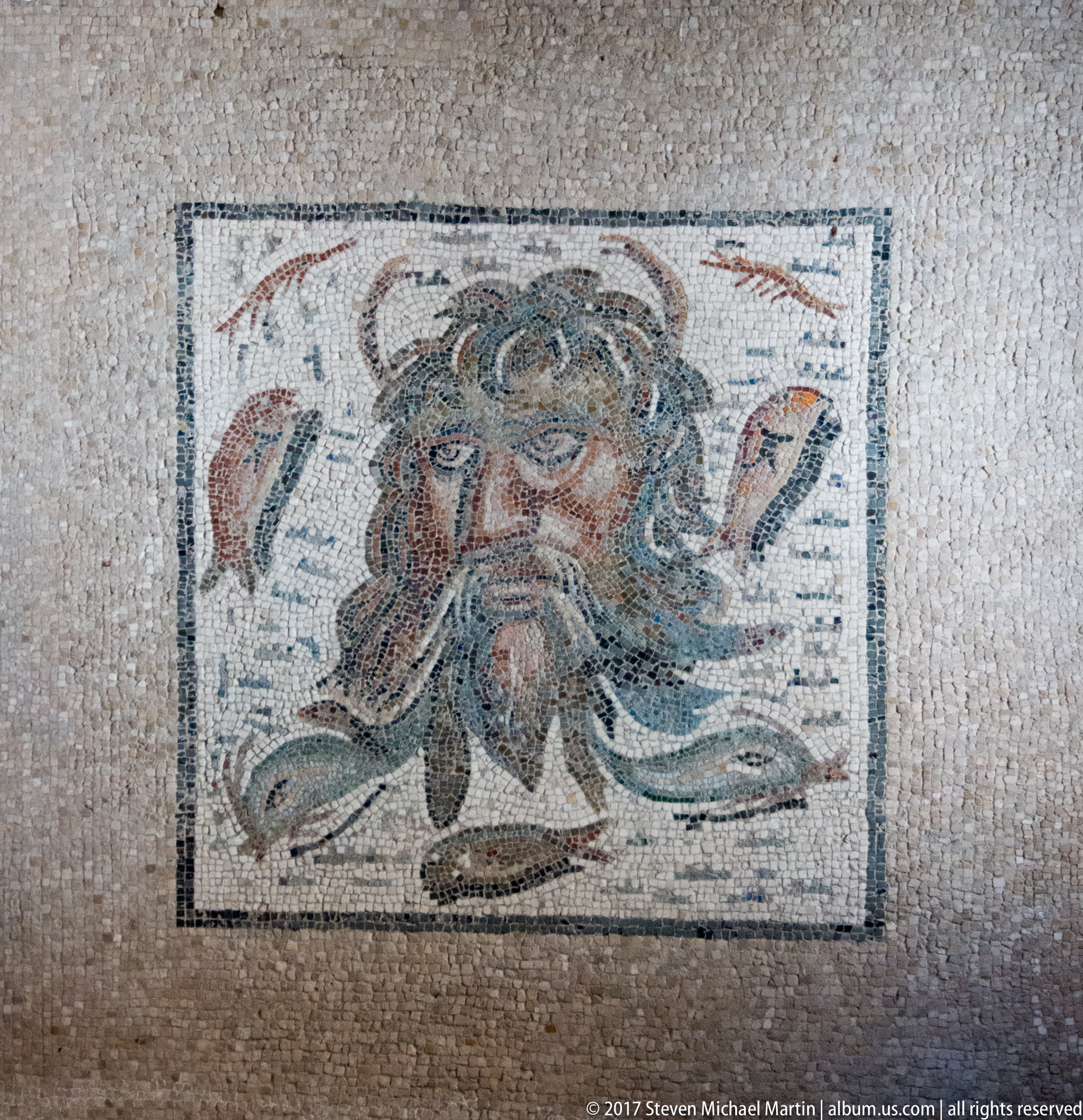
A small Roman mosaic panel presents a dramatically modeled male face with curling hair and a long, flowing beard, framed within a rectangular border. Dark, cream, blue-gray, and reddish tesserae build the features through strong contour lines. The mask-like head may represent a mythological or theatrical personification, but the proof sheet does not support a more exact identification.
Caption
A small Roman mosaic panel presents a dramatically modeled male face with curling hair and a long, flowing beard, framed within a rectangular border. Dark, cream, blue-gray, and reddish tesserae build the features through strong contour lines. The mask-like head may represent a mythological or theatrical personification, but the proof sheet does not support a more exact identification.

A steep low-angle view looks up at one of the stone figures in the Alcázar garden monument to Christopher Columbus and the Catholic Monarchs, framed tightly between tall clipped cypress forms. The dramatic perspective suppresses the broader group and turns the weathered robe, hands, and profile into sculptural abstractions against the sky.
Caption
A steep low-angle view looks up at one of the stone figures in the Alcázar garden monument to Christopher Columbus and the Catholic Monarchs, framed tightly between tall clipped cypress forms. The dramatic perspective suppresses the broader group and turns the weathered robe, hands, and profile into sculptural abstractions against the sky.

Long blue pools extend through the formal gardens of the Alcázar de los Reyes Cristianos, bordered by clipped hedges, dense orange trees, and rows of sculpted greenery. Seen from a raised terrace, the water features create a strong central axis leading toward the far end of the garden. The composition emphasizes depth, symmetry, and the cultivated abundance of the palace landscape.
Caption
Long blue pools extend through the formal gardens of the Alcázar de los Reyes Cristianos, bordered by clipped hedges, dense orange trees, and rows of sculpted greenery. Seen from a raised terrace, the water features create a strong central axis leading toward the far end of the garden. The composition emphasizes depth, symmetry, and the cultivated abundance of the palace landscape.

A square crenellated tower rises above the fortified wall of the Alcázar de los Reyes Cristianos beside a narrow garden watercourse. Palms, cypress, orange trees, and clipped shrubs soften the heavy stone defenses, while a small arched opening punctuates the wall at right. The view brings the palace-fortress’s military architecture and formal garden design into the same frame.
Caption
A square crenellated tower rises above the fortified wall of the Alcázar de los Reyes Cristianos beside a narrow garden watercourse. Palms, cypress, orange trees, and clipped shrubs soften the heavy stone defenses, while a small arched opening punctuates the wall at right. The view brings the palace-fortress’s military architecture and formal garden design into the same frame.

A narrow rectangular water channel runs between towering walls of clipped cypress in the gardens of the Alcázar de los Reyes Cristianos. Potted shrubs and traditional lanterns mark the entrance to the allée, while the water draws the eye toward a distant fountain. The severe green geometry creates one of the garden’s most formal and enclosed perspectives.
Caption
A narrow rectangular water channel runs between towering walls of clipped cypress in the gardens of the Alcázar de los Reyes Cristianos. Potted shrubs and traditional lanterns mark the entrance to the allée, while the water draws the eye toward a distant fountain. The severe green geometry creates one of the garden’s most formal and enclosed perspectives.

From within the Alcázar gardens, a crenellated square tower and long battlemented wall rise above citrus trees, palms, and clipped shrubs. A small elevated pavilion-like structure appears beyond the wall, while deep foreground shade contrasts with the sunlit masonry. The wider view shows how the fortress perimeter forms a monumental backdrop to the cultivated garden.
Caption
From within the Alcázar gardens, a crenellated square tower and long battlemented wall rise above citrus trees, palms, and clipped shrubs. A small elevated pavilion-like structure appears beyond the wall, while deep foreground shade contrasts with the sunlit masonry. The wider view shows how the fortress perimeter forms a monumental backdrop to the cultivated garden.

In the Alcázar gardens, Christopher Columbus stands between the crowned figures of Isabella I of Castile and Ferdinand II of Aragon, recalling his audience with the Catholic Monarchs in Córdoba. The three stone statues occupy a raised base at the end of a cypress-lined axis. Seen from the rear of Columbus, the monarchs face the viewer with the garden opening beyond them.
Caption
In the Alcázar gardens, Christopher Columbus stands between the crowned figures of Isabella I of Castile and Ferdinand II of Aragon, recalling his audience with the Catholic Monarchs in Córdoba. The three stone statues occupy a raised base at the end of a cypress-lined axis. Seen from the rear of Columbus, the monarchs face the viewer with the garden opening beyond them.

The stone group of Christopher Columbus with Isabella I and Ferdinand II stands tightly framed by tall clipped cypress in the Alcázar gardens. Columbus occupies the center with his back to the viewer, while the crowned monarchs flank him and face outward. The centered composition reinforces the staged character of the monument and its placement along the formal garden axis.
Caption
The stone group of Christopher Columbus with Isabella I and Ferdinand II stands tightly framed by tall clipped cypress in the Alcázar gardens. Columbus occupies the center with his back to the viewer, while the crowned monarchs flank him and face outward. The centered composition reinforces the staged character of the monument and its placement along the formal garden axis.

A side view of the Alcázar garden monument separates the three participants into distinct profiles: a crowned queen in the foreground, the second crowned monarch behind, and Christopher Columbus facing them from the right. Against an uninterrupted blue sky, the weathered stone surfaces and costume silhouettes become more legible than in the frontal compositions.
Caption
A side view of the Alcázar garden monument separates the three participants into distinct profiles: a crowned queen in the foreground, the second crowned monarch behind, and Christopher Columbus facing them from the right. Against an uninterrupted blue sky, the weathered stone surfaces and costume silhouettes become more legible than in the frontal compositions.

A close, low view of the Alcázar garden monument places the backs of the two crowned monarchs in the foreground while Christopher Columbus faces the camera between them. This reversal of the more familiar frontal arrangement reveals the heavy carved mantles and crowns from behind and makes Columbus’s face the visual center of the historical audience group.
Caption
A close, low view of the Alcázar garden monument places the backs of the two crowned monarchs in the foreground while Christopher Columbus faces the camera between them. This reversal of the more familiar frontal arrangement reveals the heavy carved mantles and crowns from behind and makes Columbus’s face the visual center of the historical audience group.

A broad rectangular pool fills the foreground of the Alcázar gardens, its turquoise surface animated by rows of low fountain jets. Geometric flower beds, clipped trees, and long colonnades of greenery lead toward the palace walls and a square tower in the distance. The expansive view emphasizes water as the organizing element of the formal garden plan.
Caption
A broad rectangular pool fills the foreground of the Alcázar gardens, its turquoise surface animated by rows of low fountain jets. Geometric flower beds, clipped trees, and long colonnades of greenery lead toward the palace walls and a square tower in the distance. The expansive view emphasizes water as the organizing element of the formal garden plan.

A low stone chamber within the Caliphal Baths preserves rough masonry walls and a shallow vaulted roof above an excavated floor covered with loose stone. Modern walkways and discreet lighting allow visitors to enter the archaeological remains without disguising their fragmentary condition. The space contrasts sharply with the museum’s reconstructed columned halls, emphasizing the surviving fabric beneath the interpretive presentation.
Caption
A low stone chamber within the Caliphal Baths preserves rough masonry walls and a shallow vaulted roof above an excavated floor covered with loose stone. Modern walkways and discreet lighting allow visitors to enter the archaeological remains without disguising their fragmentary condition. The space contrasts sharply with the museum’s reconstructed columned halls, emphasizing the surviving fabric beneath the interpretive presentation.

The monumental Triunfo de San Rafael rises near Córdoba’s Roman Bridge, with the archangel standing atop a tall column above an exuberant Baroque base of sculpted figures and rock-like forms. Seen in daylight from outside its iron enclosure, the monument is framed against open sky and the low riverfront. Its vertical silhouette marks one of the city’s most prominent devotional monuments to its guardian archangel.
Caption
The monumental Triunfo de San Rafael rises near Córdoba’s Roman Bridge, with the archangel standing atop a tall column above an exuberant Baroque base of sculpted figures and rock-like forms. Seen in daylight from outside its iron enclosure, the monument is framed against open sky and the low riverfront. Its vertical silhouette marks one of the city’s most prominent devotional monuments to its guardian archangel.

Ripe oranges lie beneath a flowering snapdragon in a sunlit garden bed at the Alcázar de los Reyes Cristianos. The saturated magenta blossoms and vivid orange fruit create an intimate botanical detail amid the larger formal landscape. Rather than showing the garden’s geometry, the close view records the seasonal color and cultivated plant life that animate its beds.
Caption
Ripe oranges lie beneath a flowering snapdragon in a sunlit garden bed at the Alcázar de los Reyes Cristianos. The saturated magenta blossoms and vivid orange fruit create an intimate botanical detail amid the larger formal landscape. Rather than showing the garden’s geometry, the close view records the seasonal color and cultivated plant life that animate its beds.

A carved stone basin in the Alcázar gardens is planted with deep red cyclamen. An incised inscription runs around the upper rim above a scalloped, shell-like body supported on a short pedestal. Sunlight catches the worn lettering and carved relief, turning a functional garden container into a close study of stonework, inscription, and seasonal planting.
Caption
A carved stone basin in the Alcázar gardens is planted with deep red cyclamen. An incised inscription runs around the upper rim above a scalloped, shell-like body supported on a short pedestal. Sunlight catches the worn lettering and carved relief, turning a functional garden container into a close study of stonework, inscription, and seasonal planting.

Inside the archaeological presentation of Córdoba’s Caliphal Baths, a reconstructed hall uses alternating dark and reddish marble columns to support pale horseshoe arches beneath rounded vaulting pierced by small star-shaped openings. Interpretive panels stand among the columns. The reconstruction evokes the spatial rhythm and controlled lighting of an elite Umayyad-period bath complex while preserving visible archaeological fabric at wall level.
Caption
Inside the archaeological presentation of Córdoba’s Caliphal Baths, a reconstructed hall uses alternating dark and reddish marble columns to support pale horseshoe arches beneath rounded vaulting pierced by small star-shaped openings. Interpretive panels stand among the columns. The reconstruction evokes the spatial rhythm and controlled lighting of an elite Umayyad-period bath complex while preserving visible archaeological fabric at wall level.

A broader view of the Caliphal Baths reconstruction reveals rows of horseshoe arches carried on red and dark marble columns, with bulbous vaults rising above the bays. Low interpretive displays occupy the foreground, while exposed historic wall fabric remains visible beneath the reconstructed surfaces. The axial composition clarifies the hall’s repeated structural rhythm and museum presentation.
Caption
A broader view of the Caliphal Baths reconstruction reveals rows of horseshoe arches carried on red and dark marble columns, with bulbous vaults rising above the bays. Low interpretive displays occupy the foreground, while exposed historic wall fabric remains visible beneath the reconstructed surfaces. The axial composition clarifies the hall’s repeated structural rhythm and museum presentation.

A ceramic storage vessel stands at the edge of an excavated room in Córdoba’s Caliphal Baths, where rough stone walls, exposed brickwork, and an illuminated recess reveal successive layers of construction. The close interior view focuses on archaeological texture rather than reconstruction, with the jar providing a human-scale object amid the surviving masonry and rubble floor.
Caption
A ceramic storage vessel stands at the edge of an excavated room in Córdoba’s Caliphal Baths, where rough stone walls, exposed brickwork, and an illuminated recess reveal successive layers of construction. The close interior view focuses on archaeological texture rather than reconstruction, with the jar providing a human-scale object amid the surviving masonry and rubble floor.

A dark wooden door is covered with dense interlaced star geometry and repeated small inscription panels, creating a richly textured Mudéjar-style surface. Faceted polygons, braided bands, and calligraphic-looking cartouches form a continuous pattern across the wood. The tight crop emphasizes craftsmanship and geometric construction while leaving the door’s exact architectural location uncertain.
Caption
A dark wooden door is covered with dense interlaced star geometry and repeated small inscription panels, creating a richly textured Mudéjar-style surface. Faceted polygons, braided bands, and calligraphic-looking cartouches form a continuous pattern across the wood. The tight crop emphasizes craftsmanship and geometric construction while leaving the door’s exact architectural location uncertain.

An ornate interior ceiling combines pale plasterwork, gilded garlands, painted roundels, and a central rosette-like medallion within a shallow vaulted bay. Floral swags and framed figurative scenes form a delicate decorative network between the surrounding arches. The close upward view records the ornamental scheme in detail but provides too little architectural context for a secure building attribution.
Caption
An ornate interior ceiling combines pale plasterwork, gilded garlands, painted roundels, and a central rosette-like medallion within a shallow vaulted bay. Floral swags and framed figurative scenes form a delicate decorative network between the surrounding arches. The close upward view records the ornamental scheme in detail but provides too little architectural context for a secure building attribution.

A historic Córdoba church presents a restrained stone gable façade centered on an elaborate Baroque portal with paired columns, sculpted niches, and a broken ornamental crown. Orange trees and a mature palm soften the forecourt, while the view is framed from beneath a nearby archway. The façade is visually distinctive, but the proof sheet does not provide enough evidence for a secure church name.
Caption
A historic Córdoba church presents a restrained stone gable façade centered on an elaborate Baroque portal with paired columns, sculpted niches, and a broken ornamental crown. Orange trees and a mature palm soften the forecourt, while the view is framed from beneath a nearby archway. The façade is visually distinctive, but the proof sheet does not provide enough evidence for a secure church name.

The surviving Corinthian columns of Córdoba’s Roman Temple rise dramatically above the surrounding modern city. Fluted shafts stand on reconstructed brick-and-stone podia, their ornate capitals sharply silhouetted against a deep blue sky. The low-angle viewpoint stresses the monumental scale of the first-century sanctuary and the vertical rhythm of its restored colonnade.
Caption
The surviving Corinthian columns of Córdoba’s Roman Temple rise dramatically above the surrounding modern city. Fluted shafts stand on reconstructed brick-and-stone podia, their ornate capitals sharply silhouetted against a deep blue sky. The low-angle viewpoint stresses the monumental scale of the first-century sanctuary and the vertical rhythm of its restored colonnade.

An exhibition panel at the Madinat al-Zahra visitor center explains the caliphal city’s relationship with its surrounding territory, including communications and water supply. Maps, archaeological photographs, and bilingual Spanish-English text present infrastructure as part of the planned tenth-century city. The museum display shifts the portfolio from Córdoba’s historic center to the archaeological landscape of the Umayyad palatine city west of town.
Caption
An exhibition panel at the Madinat al-Zahra visitor center explains the caliphal city’s relationship with its surrounding territory, including communications and water supply. Maps, archaeological photographs, and bilingual Spanish-English text present infrastructure as part of the planned tenth-century city. The museum display shifts the portfolio from Córdoba’s historic center to the archaeological landscape of the Umayyad palatine city west of town.

A bilingual exhibition titled “La Medina / The Medina” introduces the urban organization of Madinat al-Zahra, with a wall-mounted plan above a large tactile or relief model of the site. The text explains the medina as the lower sector of the palatine city, complementing displays on the nearby alcázar and infrastructure. The layered plans help visitors read archaeological remains as an intentional urban composition.
Caption
A bilingual exhibition titled “La Medina / The Medina” introduces the urban organization of Madinat al-Zahra, with a wall-mounted plan above a large tactile or relief model of the site. The text explains the medina as the lower sector of the palatine city, complementing displays on the nearby alcázar and infrastructure. The layered plans help visitors read archaeological remains as an intentional urban composition.

The Monastery of San Jerónimo de Valparaíso stretches across a wooded Sierra Morena hillside above the archaeological zone of Madinat al-Zahra. Its long pale façade, repeated arches, central church front, and small bell tower stand out against dense Mediterranean vegetation. The distant telephoto view emphasizes the monastery’s secluded setting in the uplands immediately west of Córdoba.
Caption
The Monastery of San Jerónimo de Valparaíso stretches across a wooded Sierra Morena hillside above the archaeological zone of Madinat al-Zahra. Its long pale façade, repeated arches, central church front, and small bell tower stand out against dense Mediterranean vegetation. The distant telephoto view emphasizes the monastery’s secluded setting in the uplands immediately west of Córdoba.