Palacio de Bellas Artes
Beside Alameda Central in the heart of Mexico City, the Palacio de Bellas Artes is one of the city’s most recognizable cultural landmarks. Its white marble exterior, sculptural details, and domed roof make it a striking presence at the edge of the historic center.
Designed by Italian architect Adamo Boari as the New National Theatre, the building was begun in 1904. Construction slowed amid technical and financial difficulties and the Mexican Revolution; architect Federico Mariscal later completed the project, shaping its Art Deco interior. The palace opened in 1934, three decades after work began.
Today, Bellas Artes brings together performance, visual art, and architecture. Its vast interior features murals by leading Mexican artists, while the grand halls and theater give the building a scale that is impressive even when exhibition spaces feel comparatively spare. The photographs explore this landmark as both a work of art and a living center of Mexico’s cultural life.
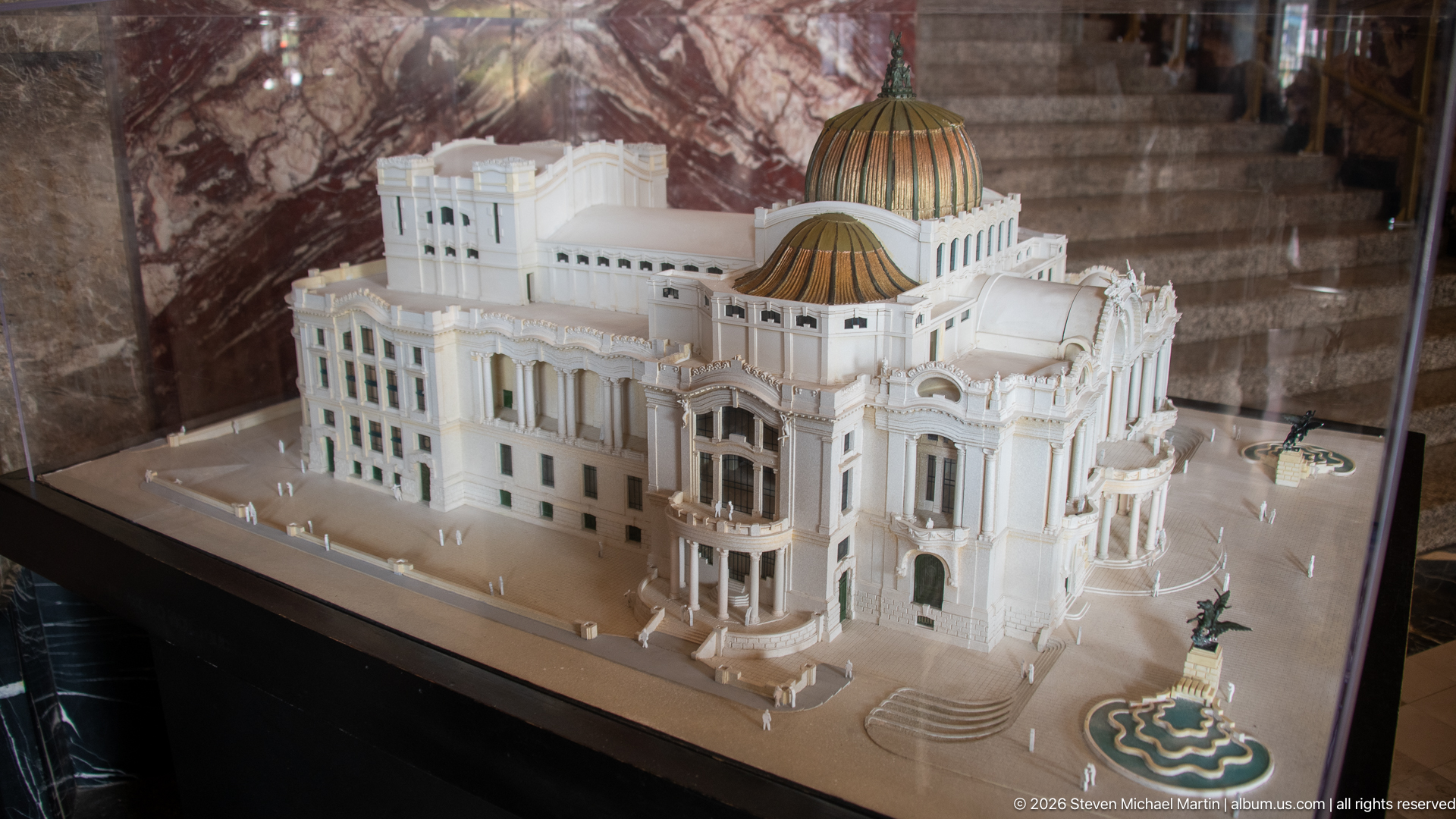
From the opposite side, the model emphasizes the palace’s long side wing, rounded corner bays, and stepped approach. Small bronze-colored figures and ornamental pools punctuate the miniature plaza, while the real building’s marble stair hall surrounds the display case. Compared with the previous oblique view, this angle clarifies the relationship between the main entrance and the extended galleries.
Caption
From the opposite side, the model emphasizes the palace’s long side wing, rounded corner bays, and stepped approach. Small bronze-colored figures and ornamental pools punctuate the miniature plaza, while the real building’s marble stair hall surrounds the display case. Compared with the previous oblique view, this angle clarifies the relationship between the main entrance and the extended galleries.
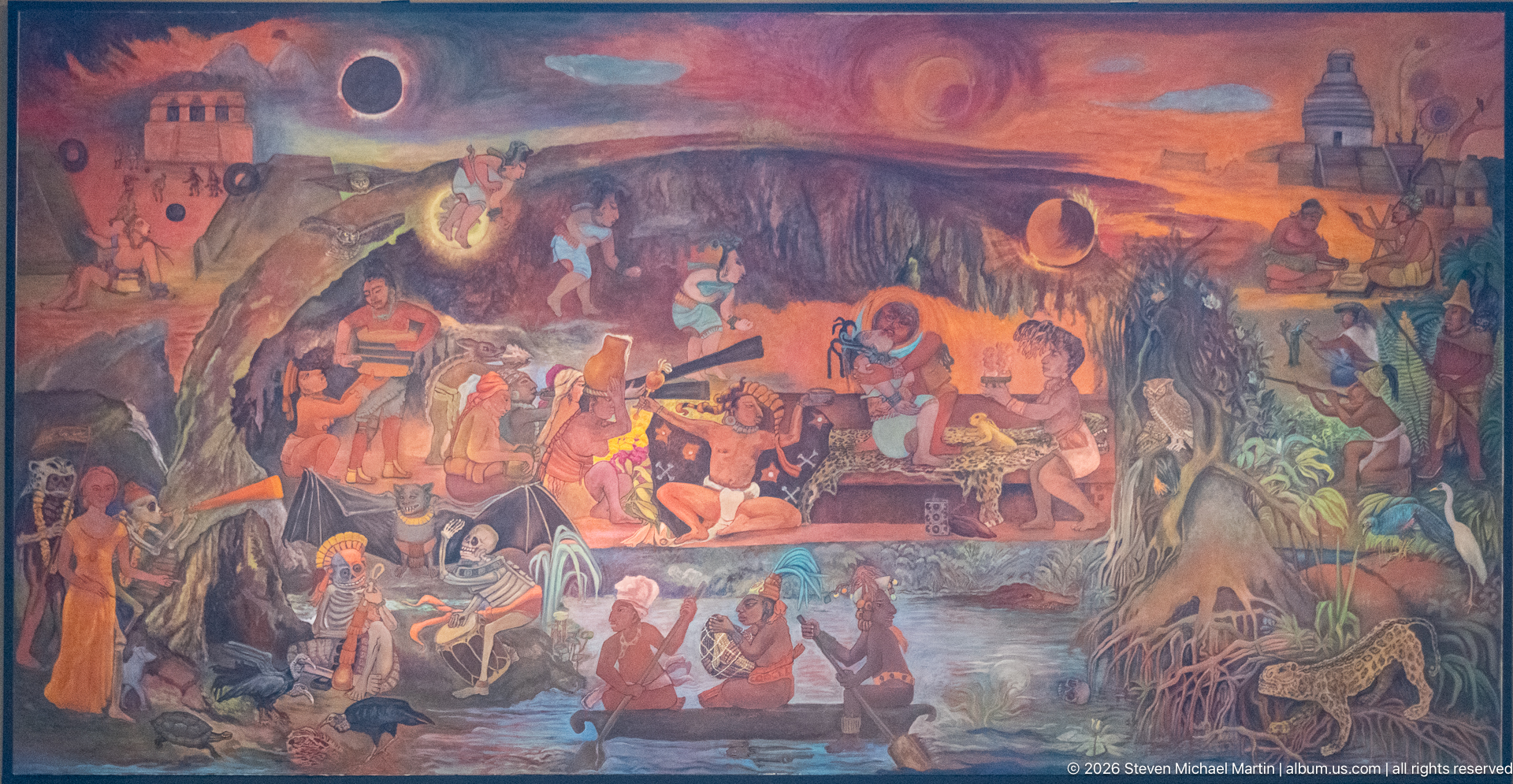
A broad mural unfolds as a panoramic landscape of people working, gathering, and traveling through a wooded setting. Figures occupy the foreground and middle distance, with water, animals, huts, and a warm red-orange sky extending the scene across the wall. Its breadth invites the eye to move from one activity to another, making the painting’s communal world the subject.
Caption
A broad mural unfolds as a panoramic landscape of people working, gathering, and traveling through a wooded setting. Figures occupy the foreground and middle distance, with water, animals, huts, and a warm red-orange sky extending the scene across the wall. Its breadth invites the eye to move from one activity to another, making the painting’s communal world the subject.
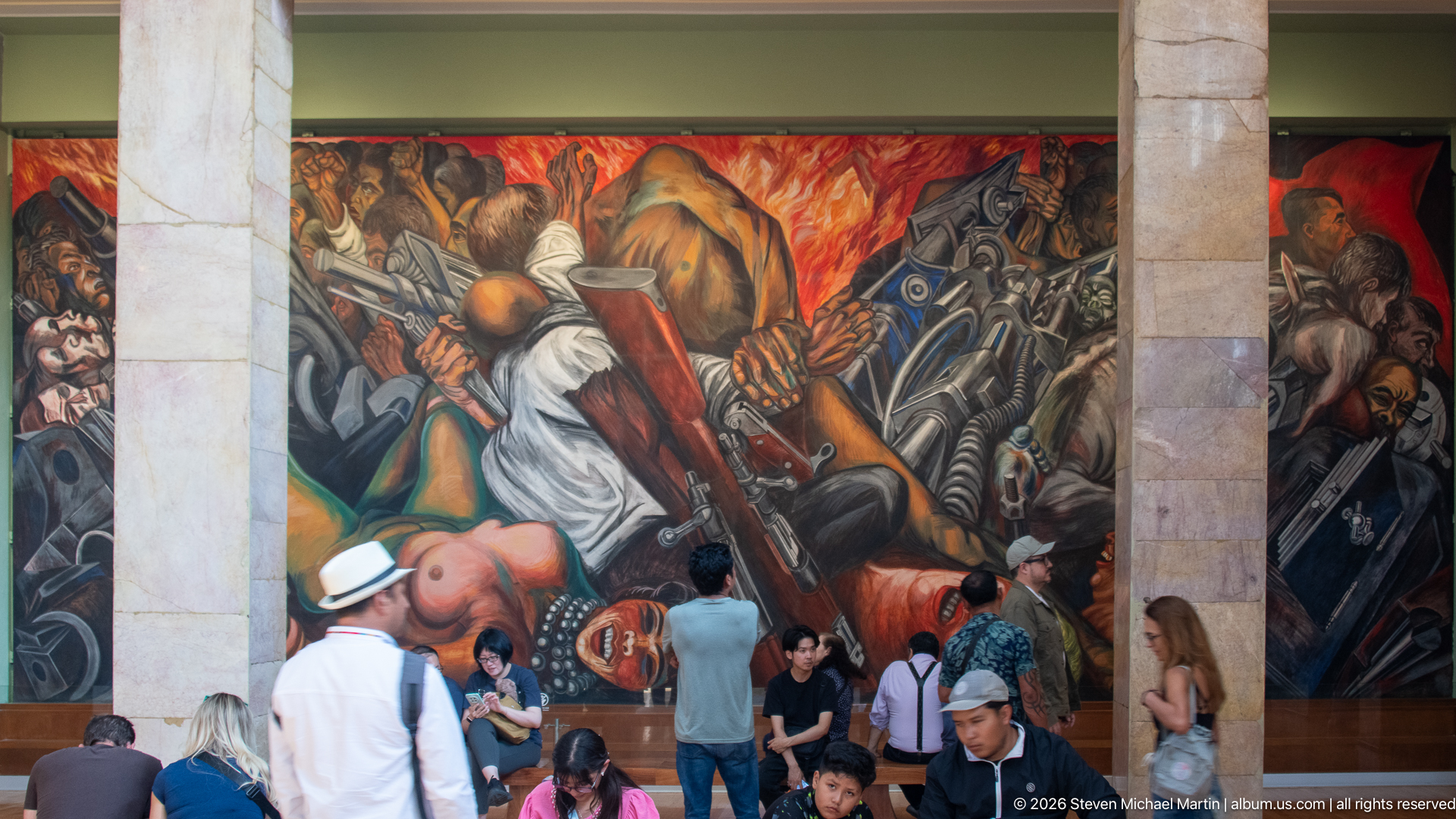
A crowd gathers in front of a wide mural filled with figures, machinery, and a vivid red-orange background. Marble columns divide the painted scene into sections, while visitors look upward, take photographs, and move through the gallery. The image gives the artwork a social dimension: the mural is not isolated but experienced as a focal point within a busy public interior.
Caption
A crowd gathers in front of a wide mural filled with figures, machinery, and a vivid red-orange background. Marble columns divide the painted scene into sections, while visitors look upward, take photographs, and move through the gallery. The image gives the artwork a social dimension: the mural is not isolated but experienced as a focal point within a busy public interior.
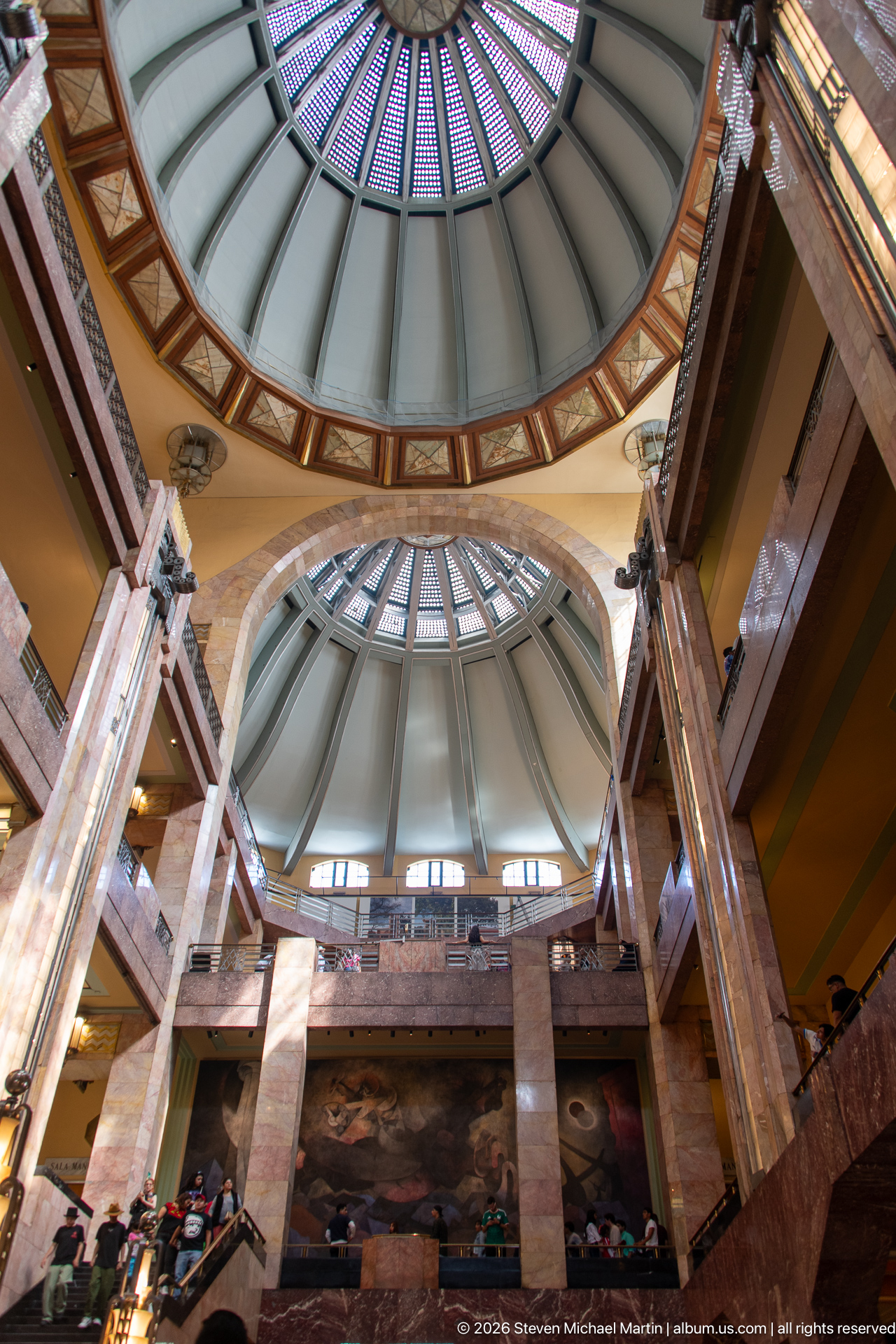
The large skylight occupies the upper frame while the mural wall spans the far end of the atrium below it. Marble piers divide the space into tall bays, and visitors gather along the lower gallery. The perspective links the palace’s roof structure with its major interior artwork, capturing the vertical organization that makes the hall feel both monumental and navigable.
Caption
The large skylight occupies the upper frame while the mural wall spans the far end of the atrium below it. Marble piers divide the space into tall bays, and visitors gather along the lower gallery. The perspective links the palace’s roof structure with its major interior artwork, capturing the vertical organization that makes the hall feel both monumental and navigable.
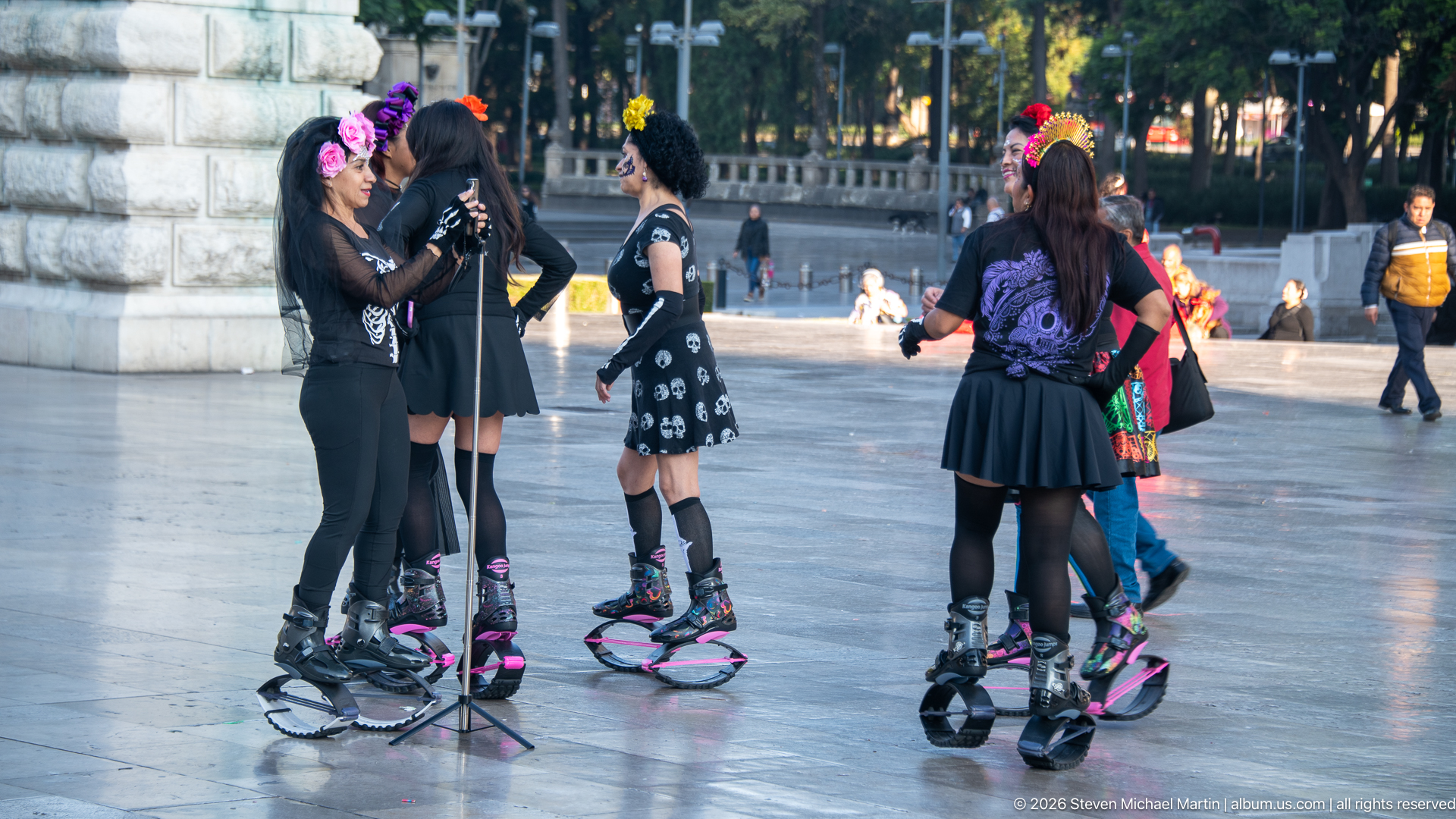
In the plaza, performers wearing black clothing patterned with skulls gather on spring-loaded jumping stilts. One stands apart while others talk in small groups; bright flowers and headpieces add color to the dark costumes. The palace’s stone wall and tree-lined public space frame the scene, connecting a contemporary street performance with the city’s visible Día de Muertos imagery.
Caption
In the plaza, performers wearing black clothing patterned with skulls gather on spring-loaded jumping stilts. One stands apart while others talk in small groups; bright flowers and headpieces add color to the dark costumes. The palace’s stone wall and tree-lined public space frame the scene, connecting a contemporary street performance with the city’s visible Día de Muertos imagery.
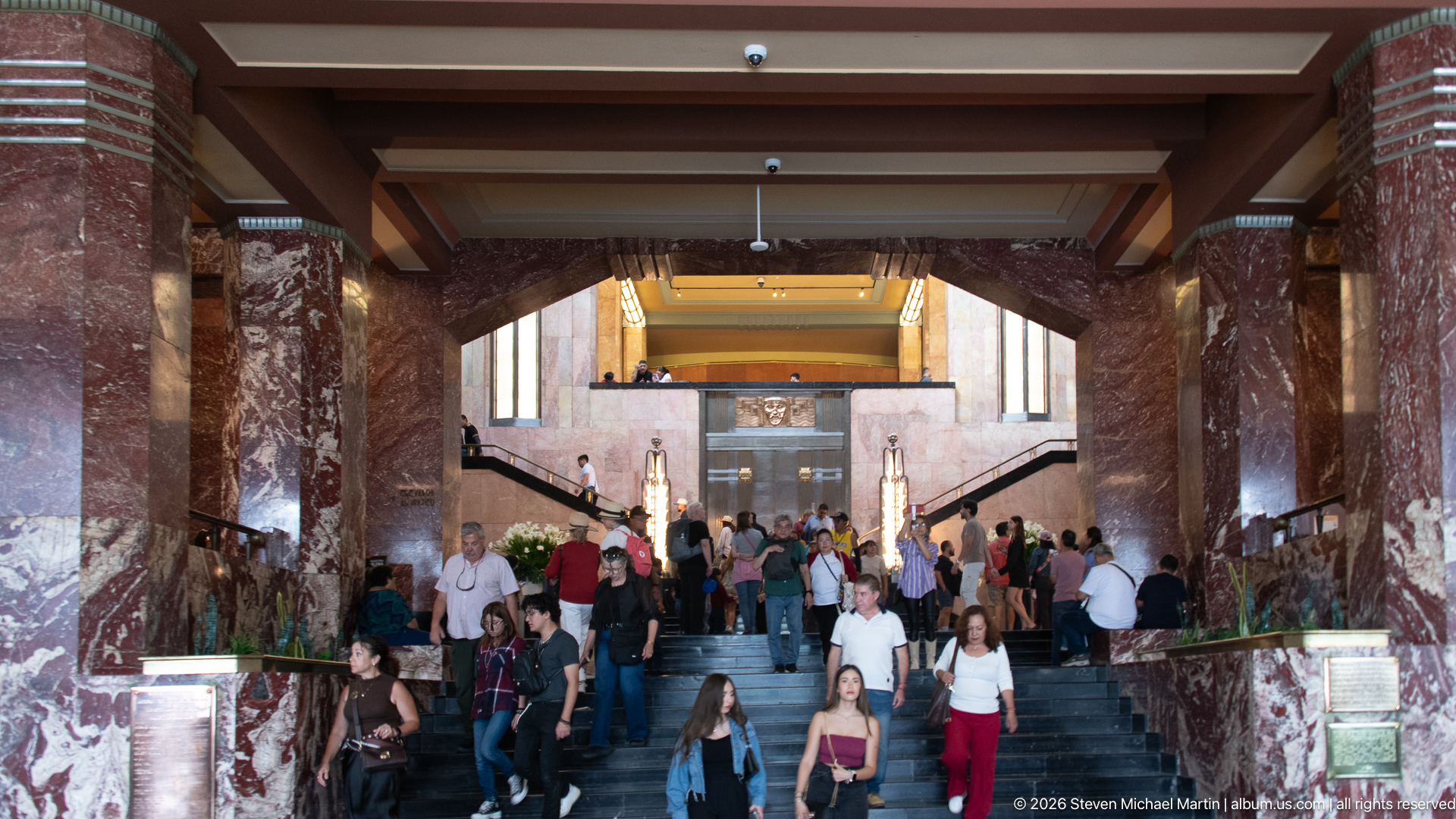
Visitors climb and descend the broad central stair beneath an upper landing framed by red marble piers and warm ceiling lights. The elevator doors and decorative fixtures sit at the far end, while the crowd animates the lower steps. This ground-level perspective emphasizes the hall as a passage through the building, distinct from the upward atrium views on the previous page.
Caption
Visitors climb and descend the broad central stair beneath an upper landing framed by red marble piers and warm ceiling lights. The elevator doors and decorative fixtures sit at the far end, while the crowd animates the lower steps. This ground-level perspective emphasizes the hall as a passage through the building, distinct from the upward atrium views on the previous page.
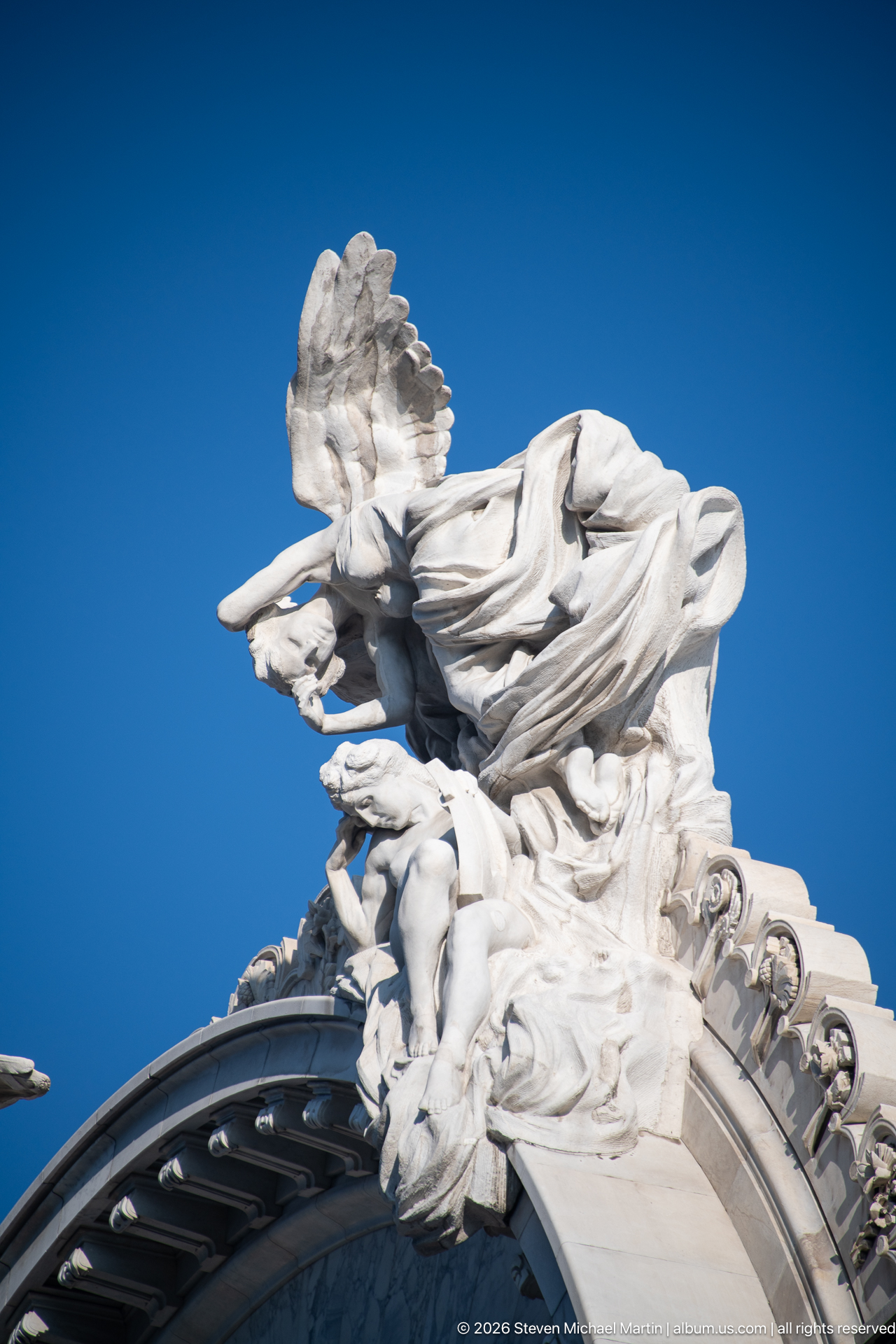
A close, low-angle view isolates a pale marble group above the principal arch. Draped allegorical figures overlap in a compact composition, with a winged figure extending beyond the cluster and the dark underside of the arch curving below. Against the deep blue sky, the light stone appears almost luminous; the crop draws attention to sculptural volume and the palace’s elaborate roof ornament.
Caption
A close, low-angle view isolates a pale marble group above the principal arch. Draped allegorical figures overlap in a compact composition, with a winged figure extending beyond the cluster and the dark underside of the arch curving below. Against the deep blue sky, the light stone appears almost luminous; the crop draws attention to sculptural volume and the palace’s elaborate roof ornament.
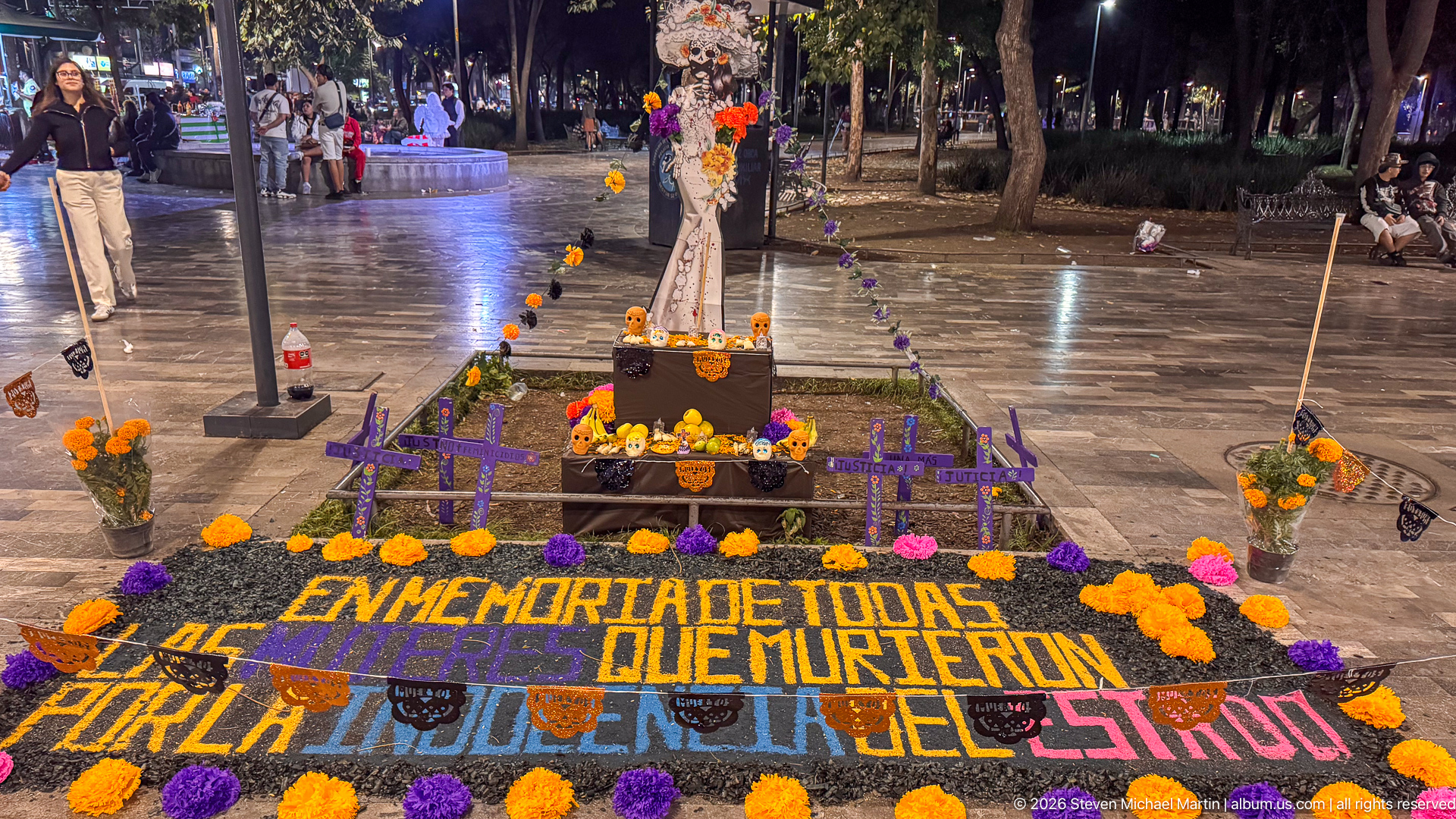
A Día de Muertos memorial installation occupies the plaza, with a stepped altar, a central skeletal figure, small skull decorations, purple crosses, and orange marigolds arranged around a ground inscription honoring the dead. The display is set directly on the paving, where flower petals form a bright border and a long trail leads toward the altar. Visitors and trees remain visible behind the installation.
Caption
A Día de Muertos memorial installation occupies the plaza, with a stepped altar, a central skeletal figure, small skull decorations, purple crosses, and orange marigolds arranged around a ground inscription honoring the dead. The display is set directly on the paving, where flower petals form a bright border and a long trail leads toward the altar. Visitors and trees remain visible behind the installation.
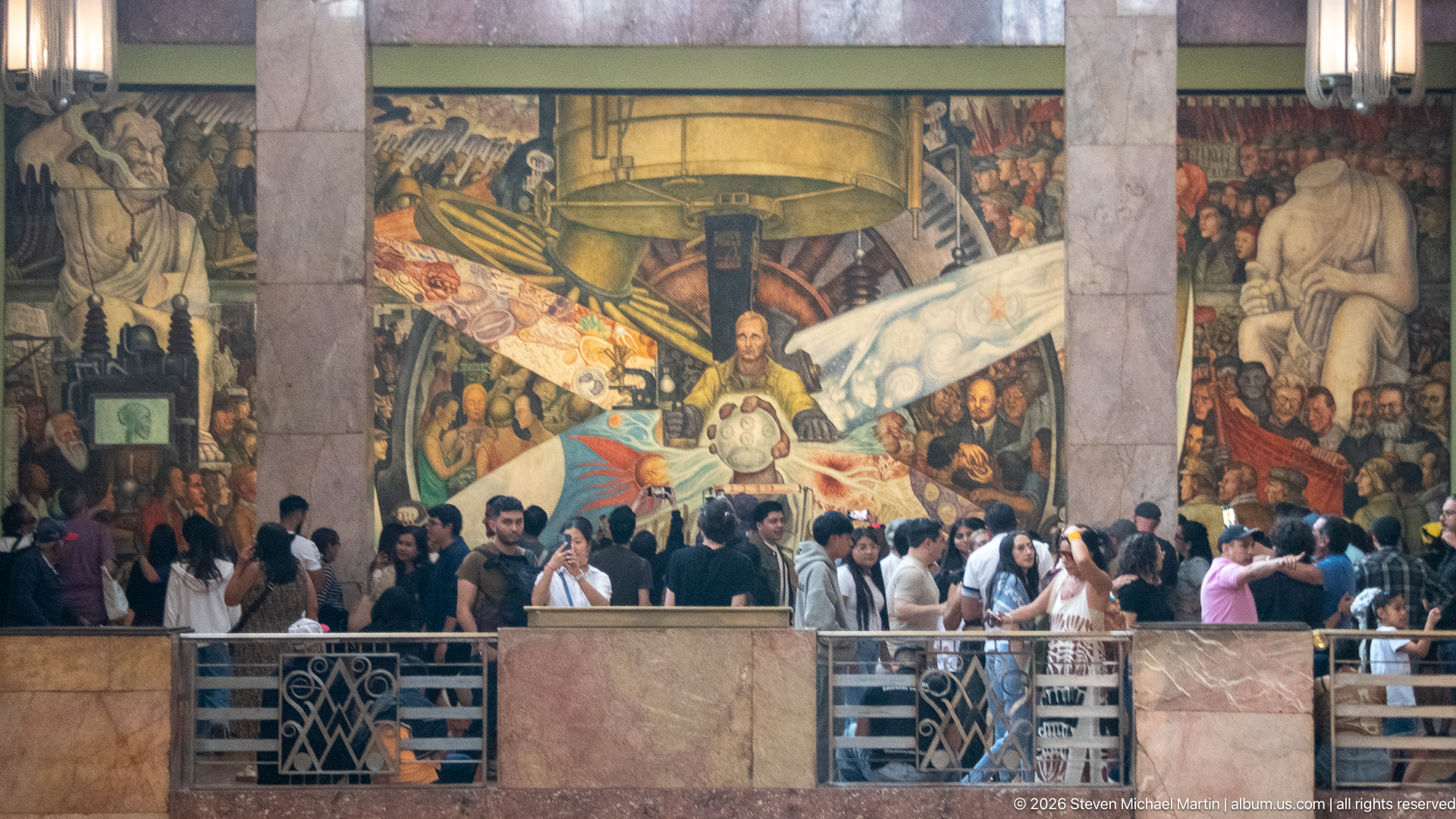
The expansive hall opens around a large mural, its red, ochre, and dark painted sections visible above a steady flow of visitors. Marble columns and a decorative railing divide the scene into architectural bays, while people gather at the lower level and balcony. The wider view records the painting as part of a working cultural venue, with the crowd shaping the scale and atmosphere.
Caption
The expansive hall opens around a large mural, its red, ochre, and dark painted sections visible above a steady flow of visitors. Marble columns and a decorative railing divide the scene into architectural bays, while people gather at the lower level and balcony. The wider view records the painting as part of a working cultural venue, with the crowd shaping the scale and atmosphere.
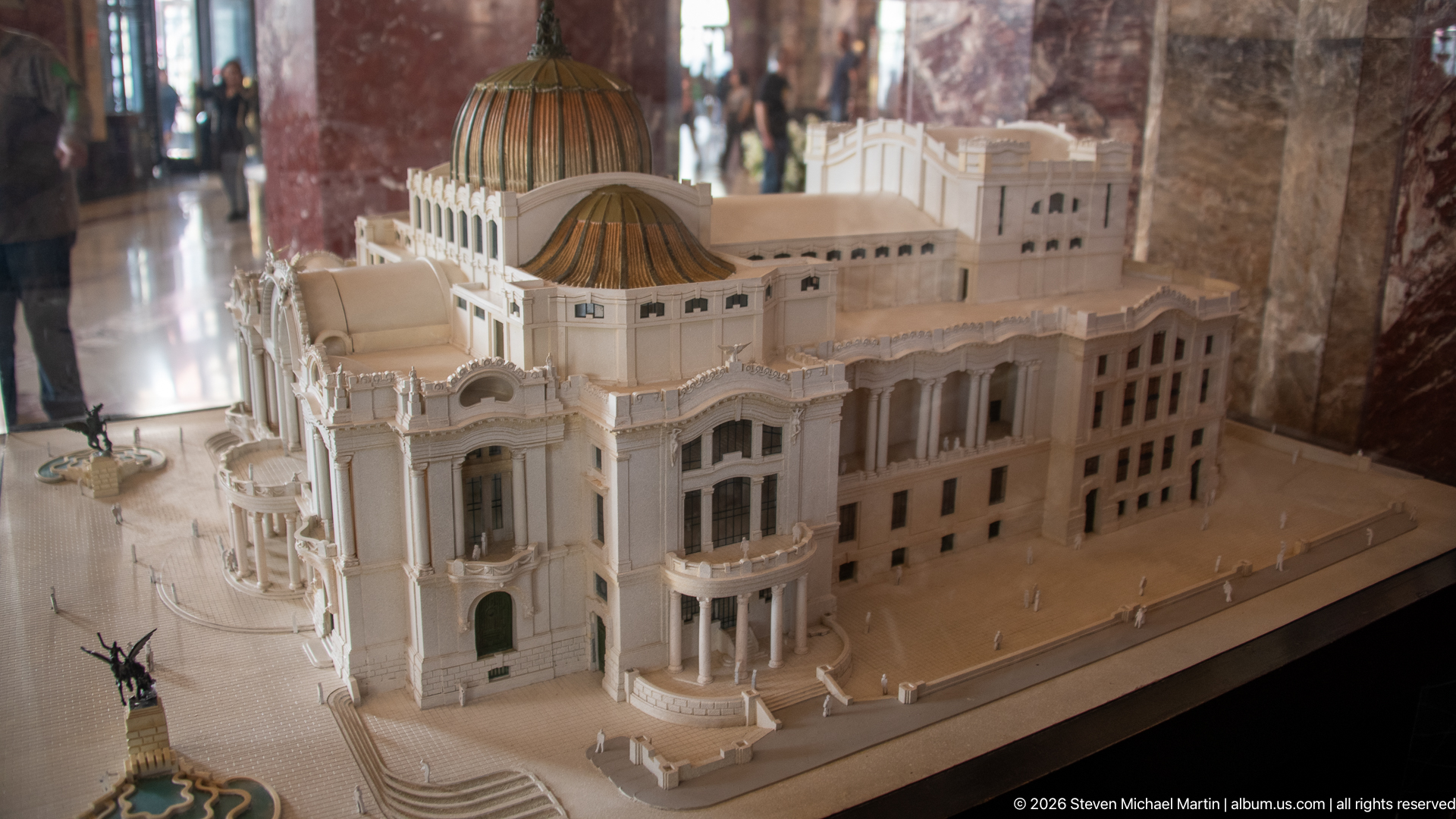
A scale model presents Palacio de Bellas Artes from an elevated angle, making its broad footprint, curved façades, and copper-toned domes easy to read. Tiny figures and landscaped forecourts establish the building’s monumental scale. This oblique view reveals the palace as a connected architectural ensemble rather than a single frontal façade.
Caption
A scale model presents Palacio de Bellas Artes from an elevated angle, making its broad footprint, curved façades, and copper-toned domes easy to read. Tiny figures and landscaped forecourts establish the building’s monumental scale. This oblique view reveals the palace as a connected architectural ensemble rather than a single frontal façade.
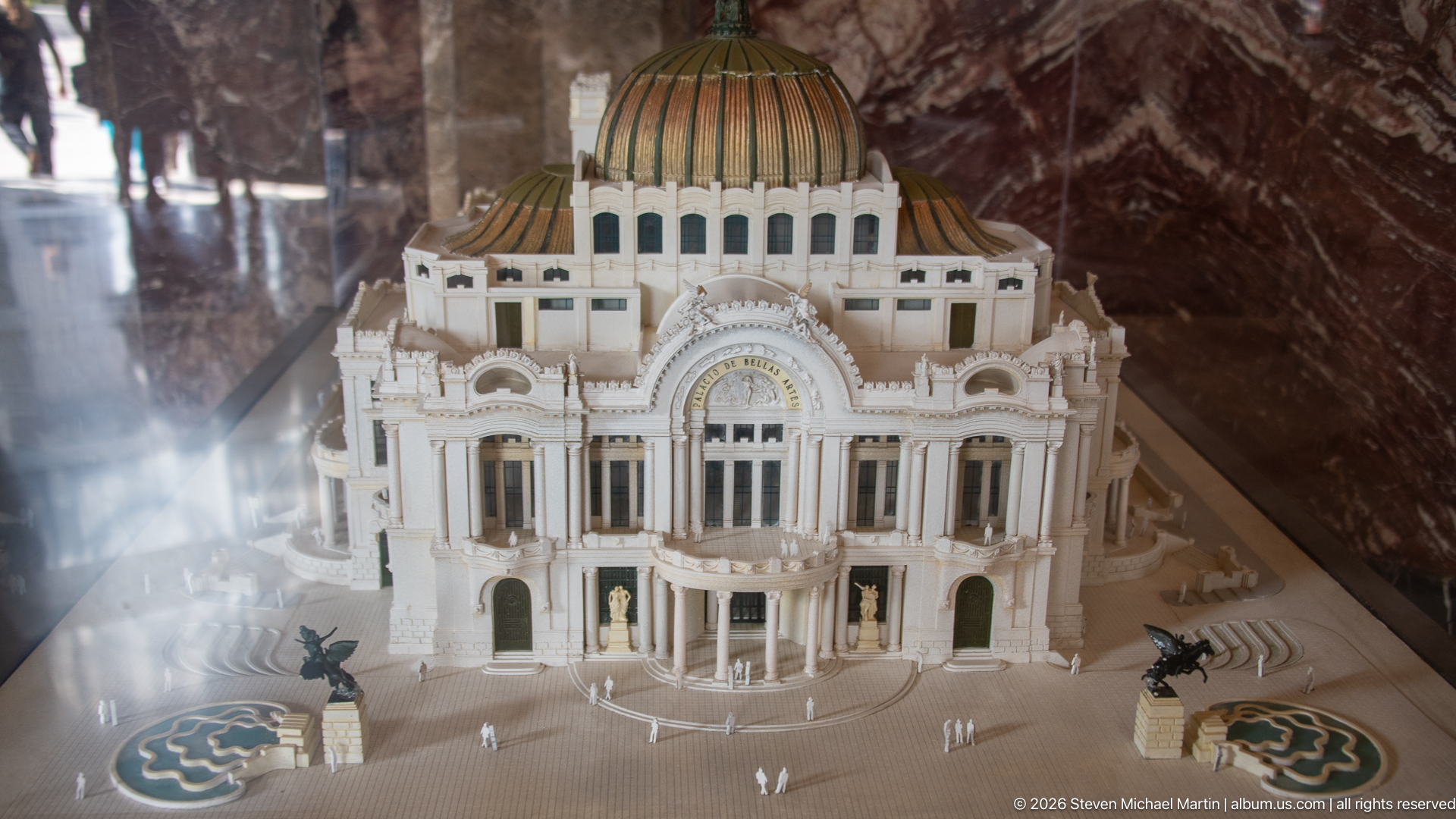
The model’s central entrance and upper dome occupy this tighter composition, with rows of arched windows and small sculptural figures visible across the façade. The close crop brings out the building’s symmetry and layered roofline, while reflections on the display case signal that this is a miniature rather than the exterior itself.
Caption
The model’s central entrance and upper dome occupy this tighter composition, with rows of arched windows and small sculptural figures visible across the façade. The close crop brings out the building’s symmetry and layered roofline, while reflections on the display case signal that this is a miniature rather than the exterior itself.
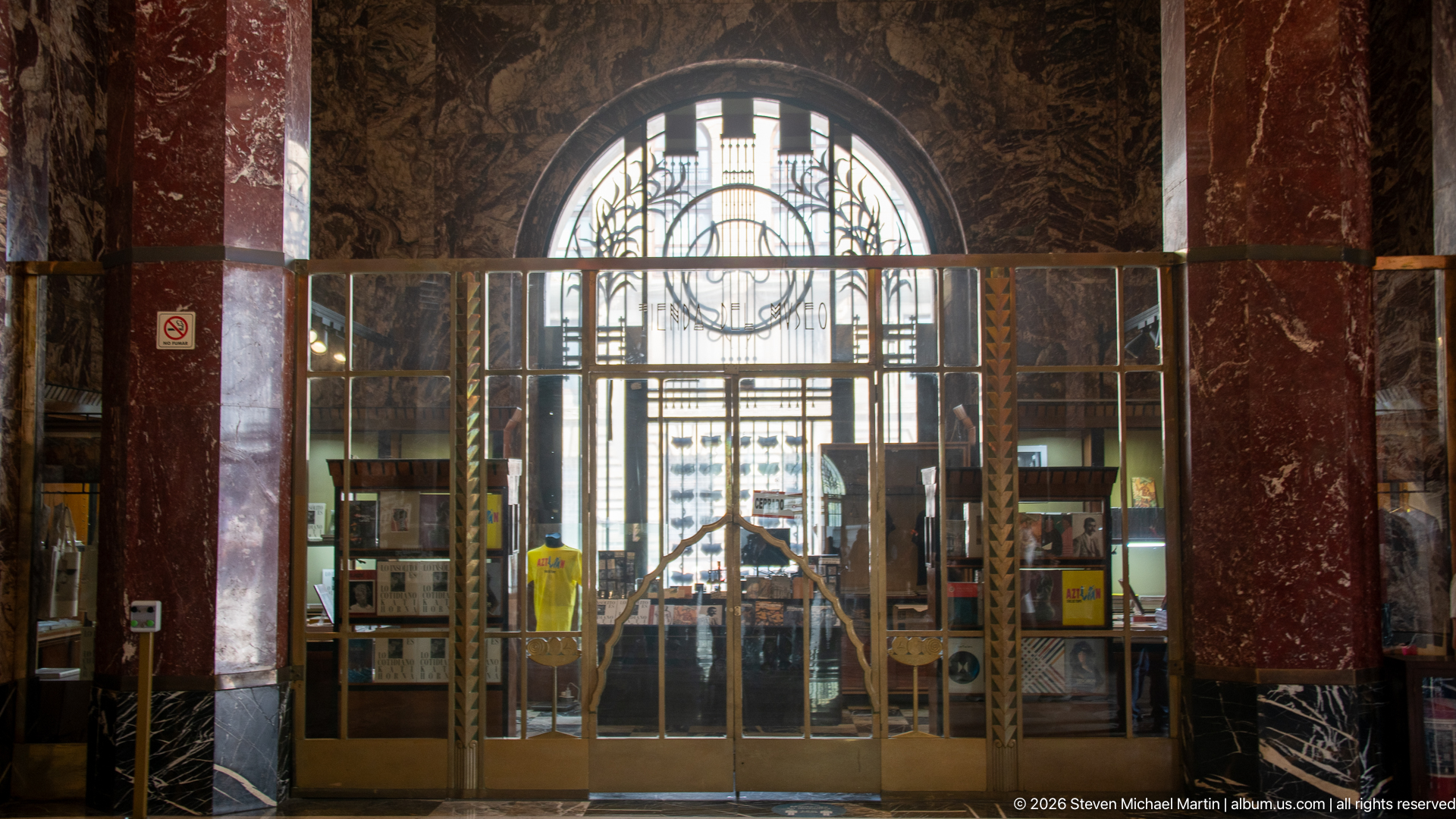
A pair of dark metal entrance doors sits below a large arched window filled with intricate radial ironwork. Red and cream marble panels frame the opening, and tall lanterns flank the threshold. Seen straight on, the doorway makes the palace’s material richness and carefully coordinated metalwork, stone, and light part of the architectural experience.
Caption
A pair of dark metal entrance doors sits below a large arched window filled with intricate radial ironwork. Red and cream marble panels frame the opening, and tall lanterns flank the threshold. Seen straight on, the doorway makes the palace’s material richness and carefully coordinated metalwork, stone, and light part of the architectural experience.
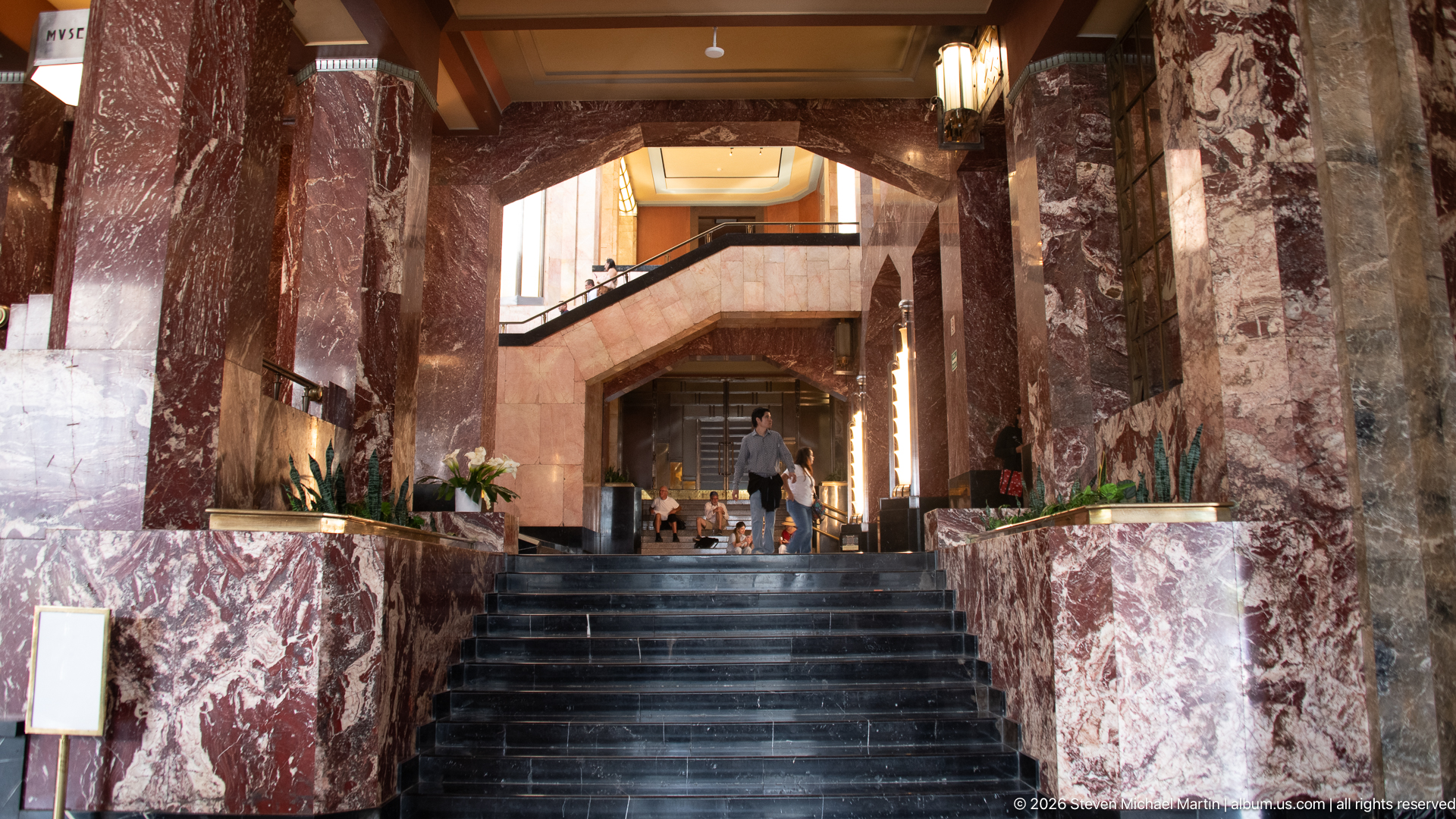
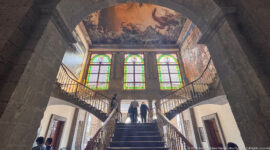
A broad dark stair rises through a hall lined with red-and-white veined marble, then divides toward a bright upper landing. Heavy columns and angular balcony openings create a strong vertical frame, while a few visitors provide scale. This view shifts from the entry detail to the palace’s circulation space, where the stairs connect the monumental foyer to upper galleries.
Caption
A broad dark stair rises through a hall lined with red-and-white veined marble, then divides toward a bright upper landing. Heavy columns and angular balcony openings create a strong vertical frame, while a few visitors provide scale. This view shifts from the entry detail to the palace’s circulation space, where the stairs connect the monumental foyer to upper galleries.
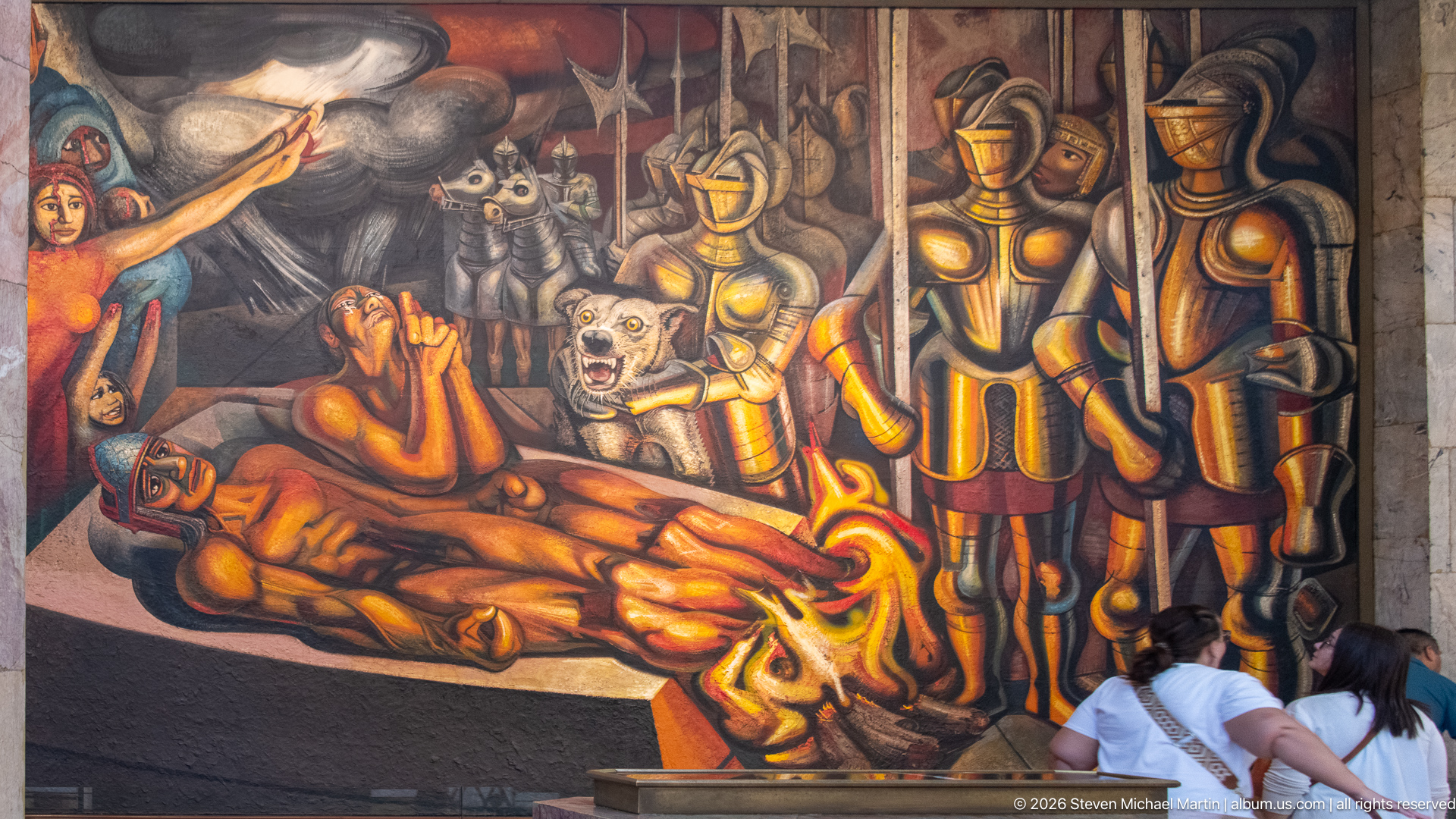
A mural panel fills the frame with a reclining figure, a snarling animal, clustered faces, and a row of metallic, armor-like forms. Warm ochres and deep reds contrast with the cooler stone around the painting. Visitors at the lower edge show its scale, while the close crop draws attention to the mural’s dense, unsettling imagery without assigning a title or artist beyond the visible evidence.
Caption
A mural panel fills the frame with a reclining figure, a snarling animal, clustered faces, and a row of metallic, armor-like forms. Warm ochres and deep reds contrast with the cooler stone around the painting. Visitors at the lower edge show its scale, while the close crop draws attention to the mural’s dense, unsettling imagery without assigning a title or artist beyond the visible evidence.
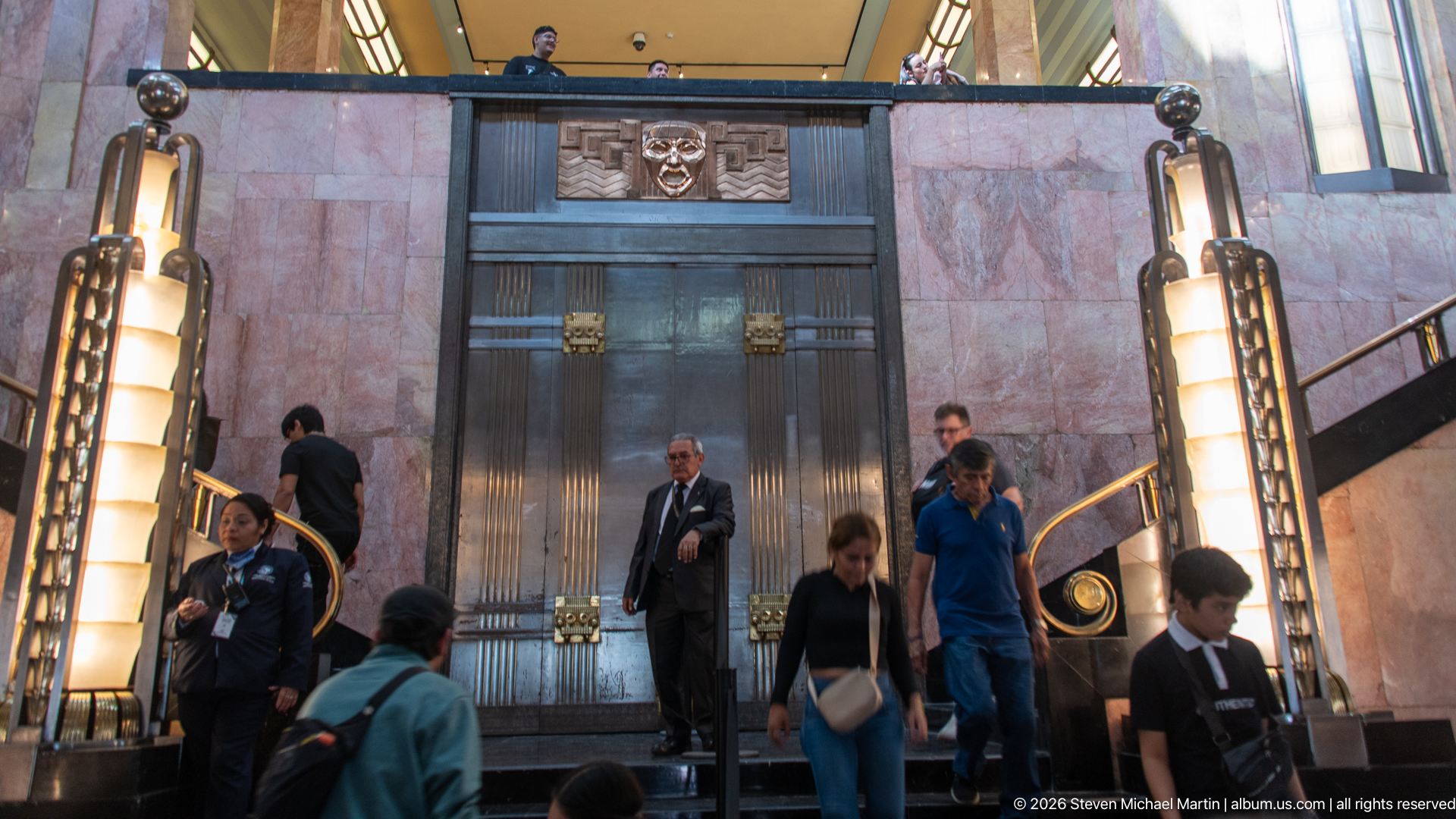
A tall elevator enclosure anchors the marble stair hall, its dark metal panels arranged in vertical bands beneath a sculpted face motif. Matching lanterns and sweeping stair rails flank the doorway as visitors move through the foreground. The composition records both the palace’s decorative elevator design and its active public interior, where original-looking ornament remains part of everyday circulation.
Caption
A tall elevator enclosure anchors the marble stair hall, its dark metal panels arranged in vertical bands beneath a sculpted face motif. Matching lanterns and sweeping stair rails flank the doorway as visitors move through the foreground. The composition records both the palace’s decorative elevator design and its active public interior, where original-looking ornament remains part of everyday circulation.
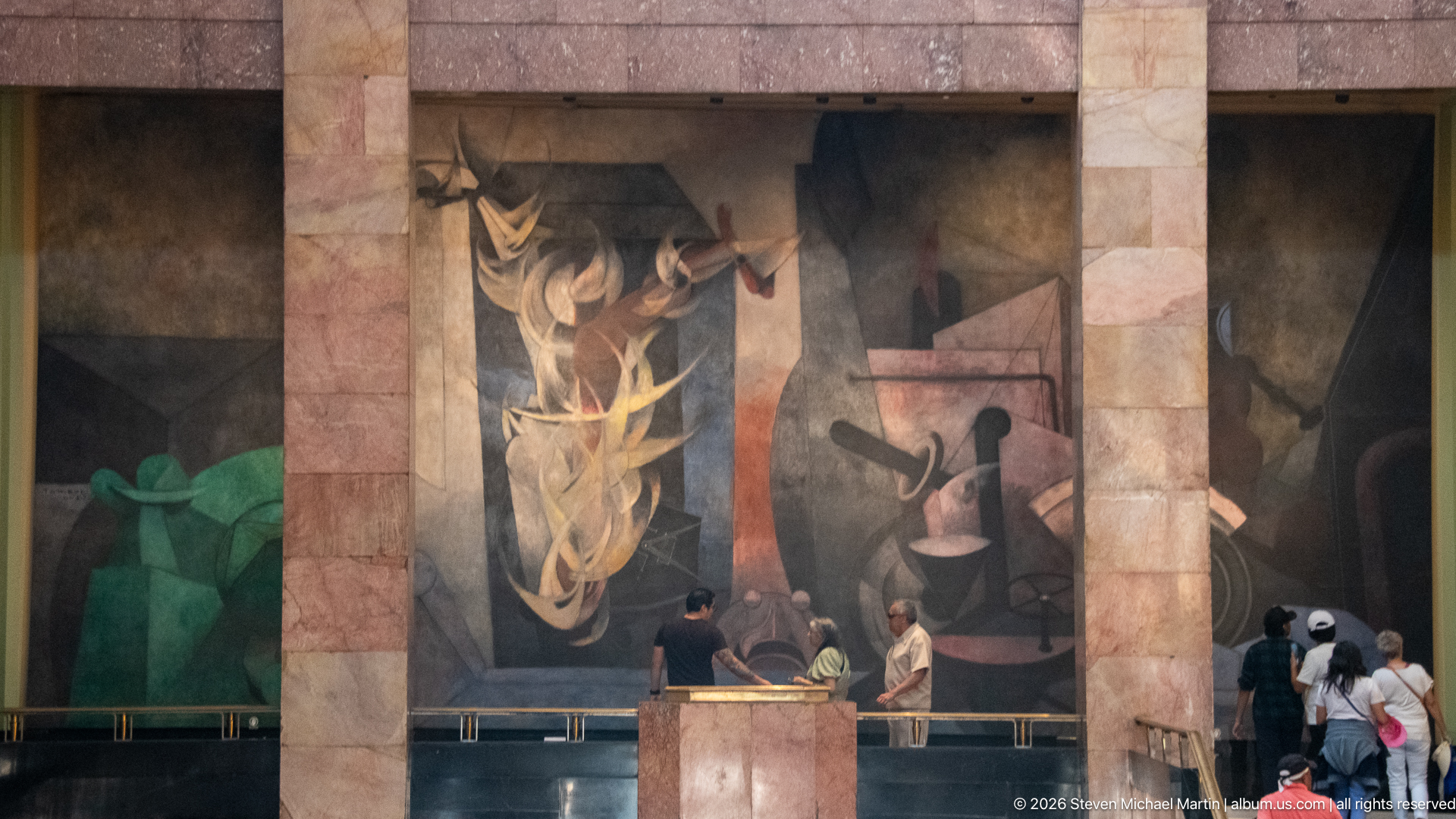
A monumental mural occupies the tall wall between marble piers, where a pale central figure emerges among sweeping, angular forms and darker scenes. Visitors pause at the railing below, emphasizing the work’s height and its place within the stair hall. This view foregrounds the mural’s vertical scale and relationship to the architecture rather than the detail of any single figure.
Caption
A monumental mural occupies the tall wall between marble piers, where a pale central figure emerges among sweeping, angular forms and darker scenes. Visitors pause at the railing below, emphasizing the work’s height and its place within the stair hall. This view foregrounds the mural’s vertical scale and relationship to the architecture rather than the detail of any single figure.
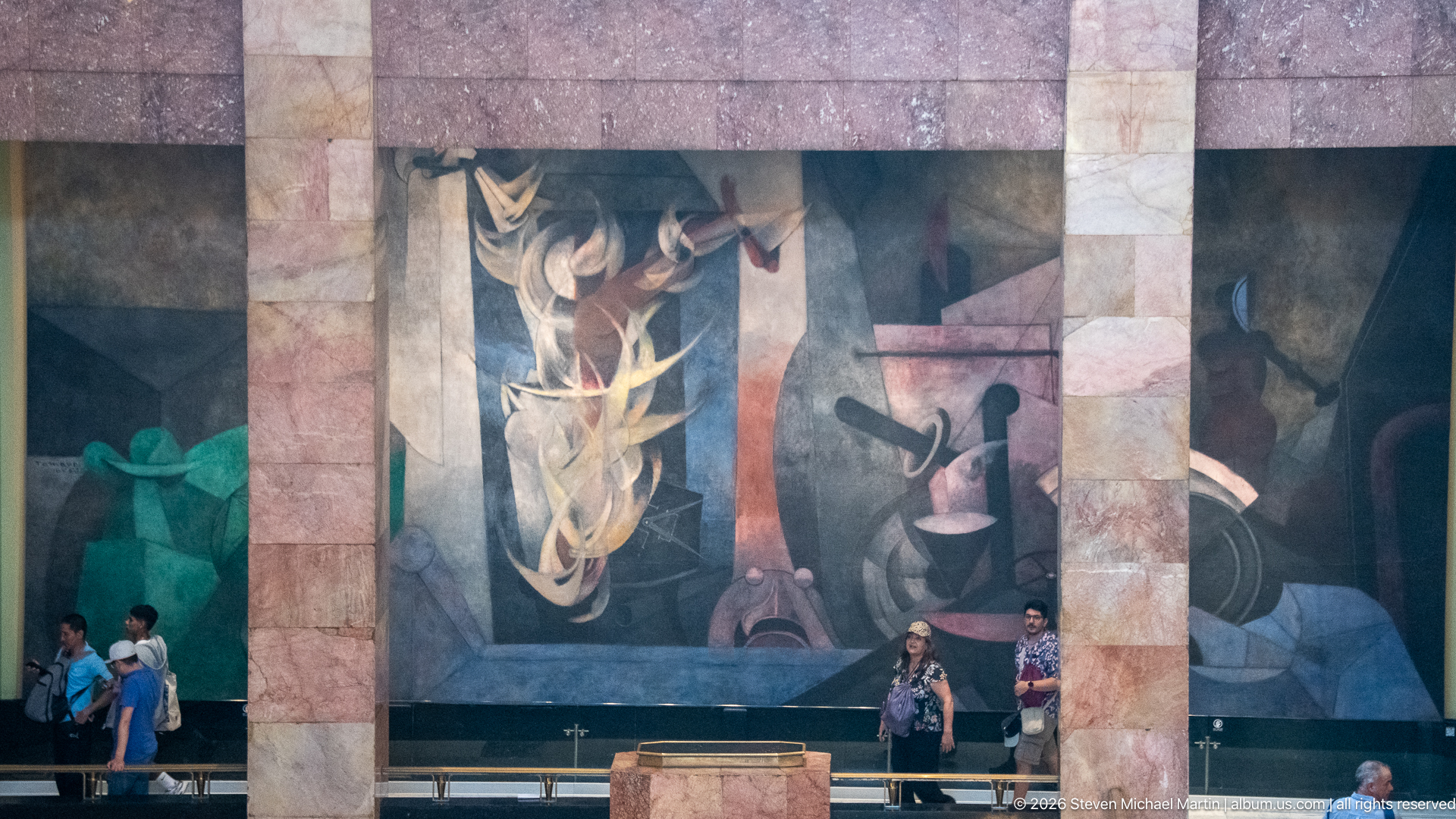
The central section of a towering mural rises between pale marble piers, with elongated forms curling down toward smaller figures near the base. A few visitors stand along the barrier, their scale reinforcing the painting’s height. The lower viewpoint makes the mural feel integrated into the hall’s architecture and distinguishes this image from the wider crowd view on the same page.
Caption
The central section of a towering mural rises between pale marble piers, with elongated forms curling down toward smaller figures near the base. A few visitors stand along the barrier, their scale reinforcing the painting’s height. The lower viewpoint makes the mural feel integrated into the hall’s architecture and distinguishes this image from the wider crowd view on the same page.
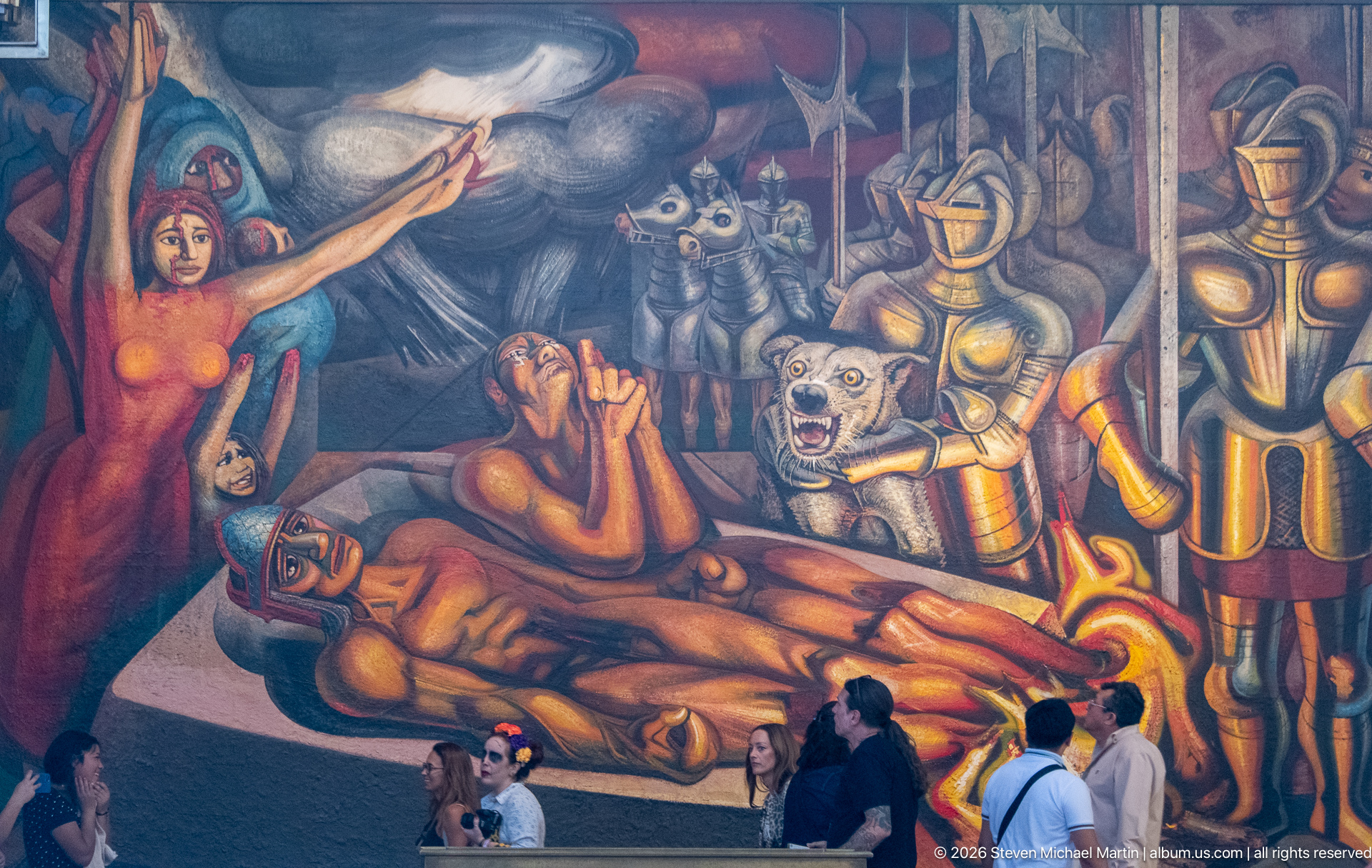
At closer range, the mural’s tightly layered figures become more legible: a reclining body occupies the lower portion, faces cluster at left, and a row of helmet-like forms fills the right. The intense composition mixes human vulnerability with rigid mechanical imagery. Visitors at the bottom edge connect this detail to the public gallery, while the crop keeps attention on the painting’s visual contrasts.
Caption
At closer range, the mural’s tightly layered figures become more legible: a reclining body occupies the lower portion, faces cluster at left, and a row of helmet-like forms fills the right. The intense composition mixes human vulnerability with rigid mechanical imagery. Visitors at the bottom edge connect this detail to the public gallery, while the crop keeps attention on the painting’s visual contrasts.
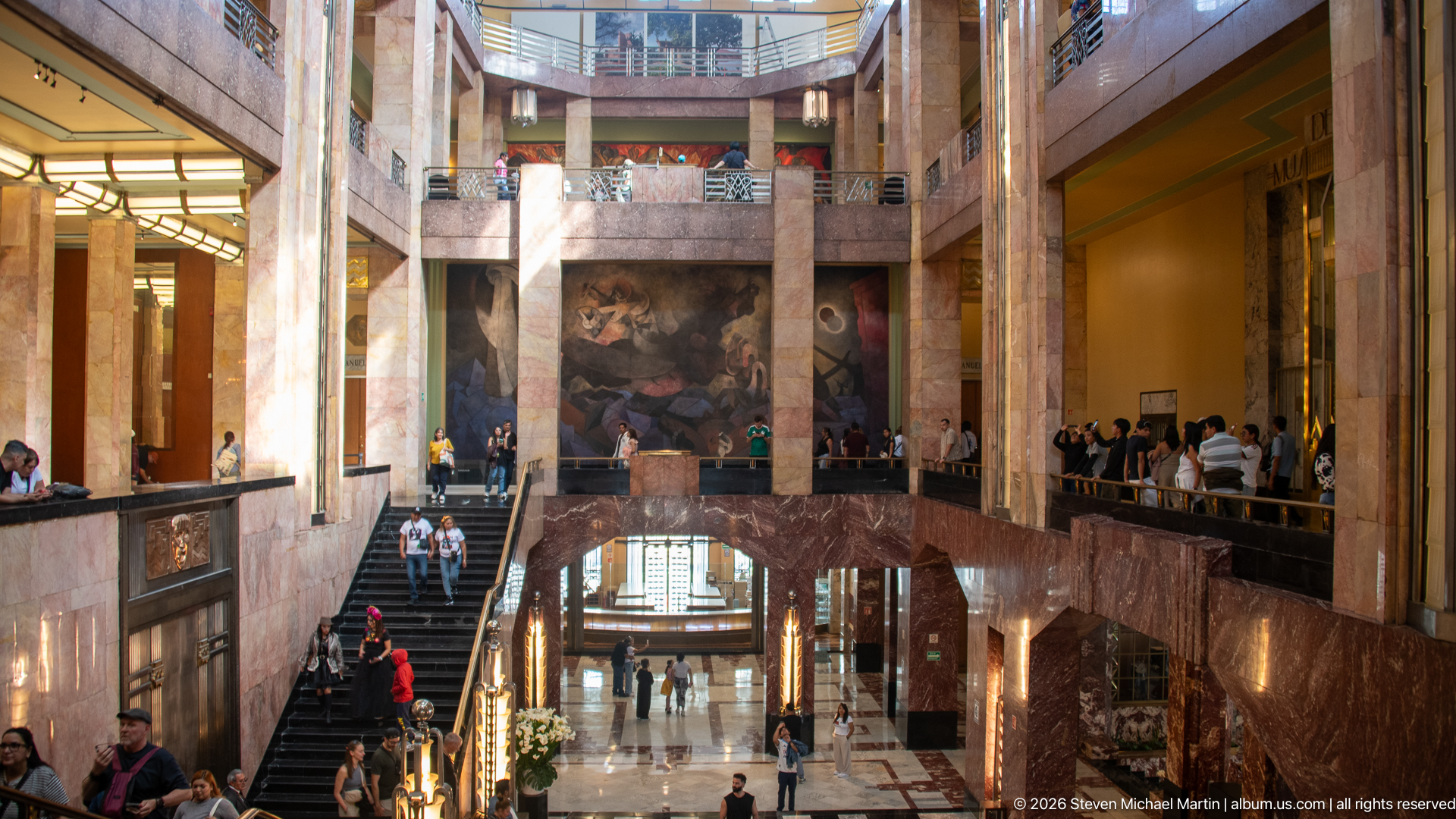
A deep atrium rises through several levels, with paired staircases, balconies, and red-veined marble framing a central mural wall. Visitors occupy the stairs and galleries, giving the open interior a sense of movement and scale. The viewpoint from above reveals how the palace organizes its public rooms vertically, linking the lower entrance with exhibition floors and upper walkways.
Caption
A deep atrium rises through several levels, with paired staircases, balconies, and red-veined marble framing a central mural wall. Visitors occupy the stairs and galleries, giving the open interior a sense of movement and scale. The viewpoint from above reveals how the palace organizes its public rooms vertically, linking the lower entrance with exhibition floors and upper walkways.
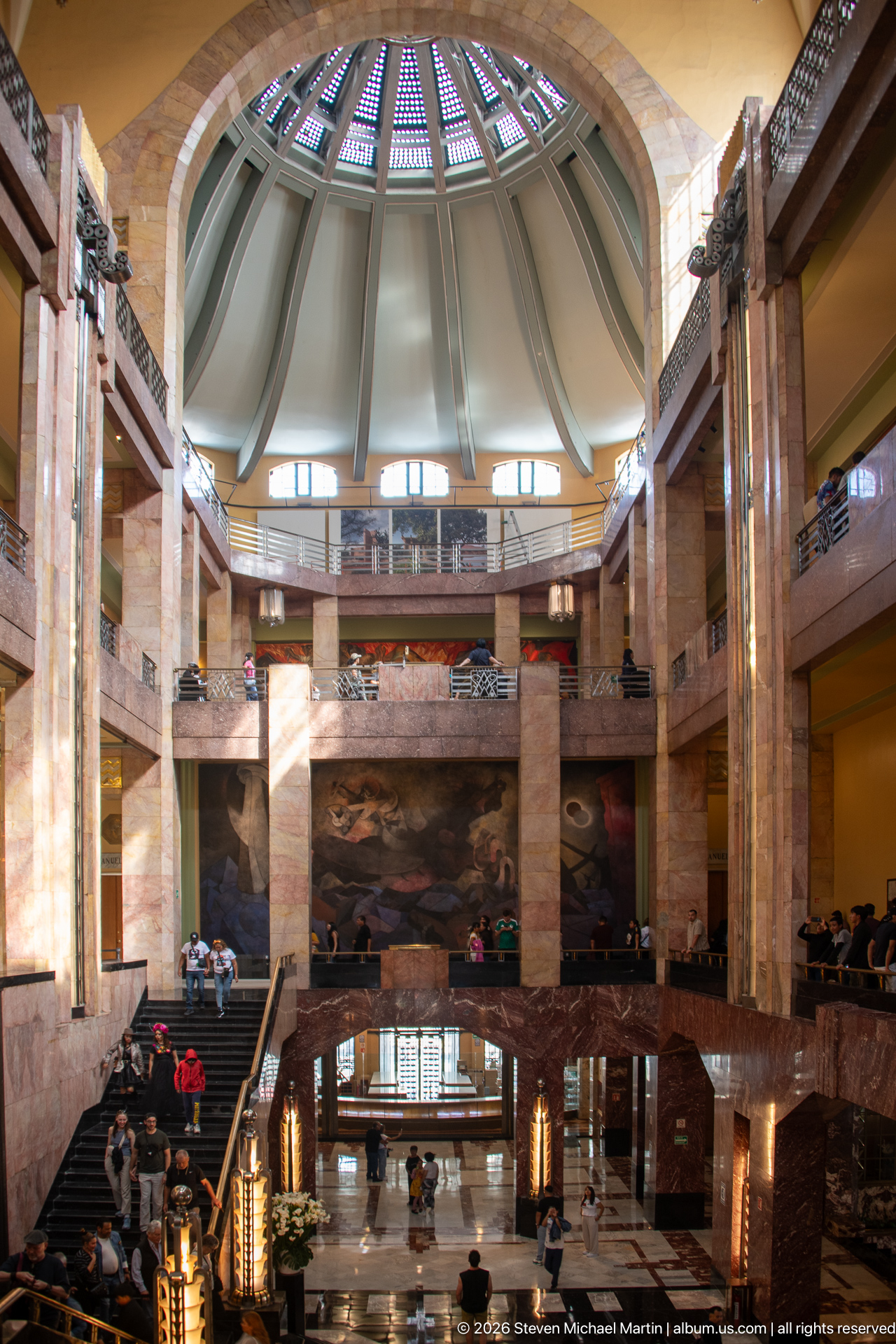
A circular skylight spans the upper atrium, its radial metal ribs converging at a central ring. Marble walkways and balcony rails frame the dome from below, while the mural wall anchors the lower edge of the composition. The upward view emphasizes the engineering and natural light of the hall, separating the roof structure from the broader interior scenes around it.
Caption
A circular skylight spans the upper atrium, its radial metal ribs converging at a central ring. Marble walkways and balcony rails frame the dome from below, while the mural wall anchors the lower edge of the composition. The upward view emphasizes the engineering and natural light of the hall, separating the roof structure from the broader interior scenes around it.
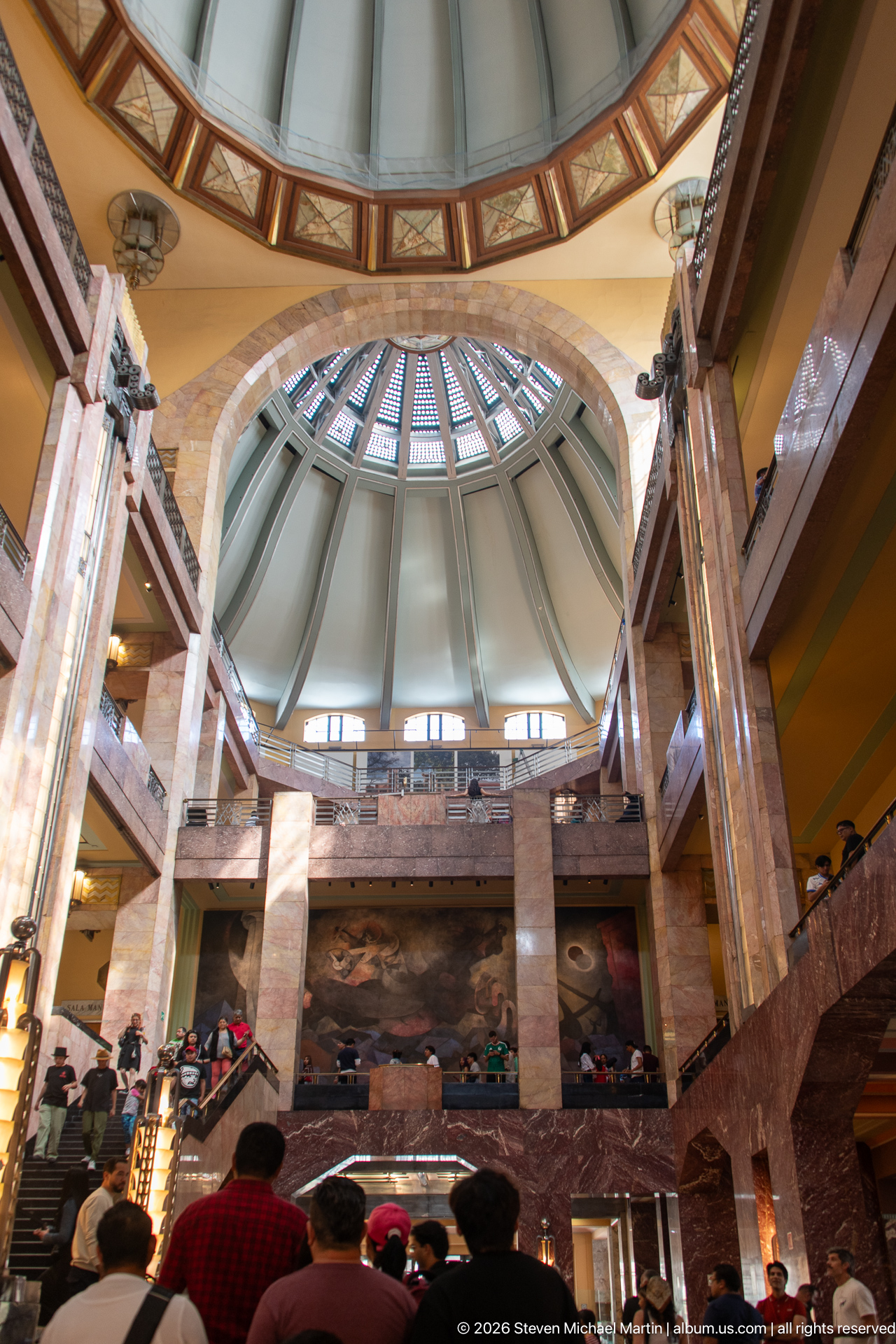
The atrium’s dome and mural wall align in a single view: the glazed roof arches above stacked balconies, while a wide painting occupies the far wall below. Visitors lean along the upper rail and gather near the stairs, adding movement to the geometric arrangement. This composition holds architecture and art in balance, showing how the palace’s galleries are integrated into one vertical space.
Caption
The atrium’s dome and mural wall align in a single view: the glazed roof arches above stacked balconies, while a wide painting occupies the far wall below. Visitors lean along the upper rail and gather near the stairs, adding movement to the geometric arrangement. This composition holds architecture and art in balance, showing how the palace’s galleries are integrated into one vertical space.
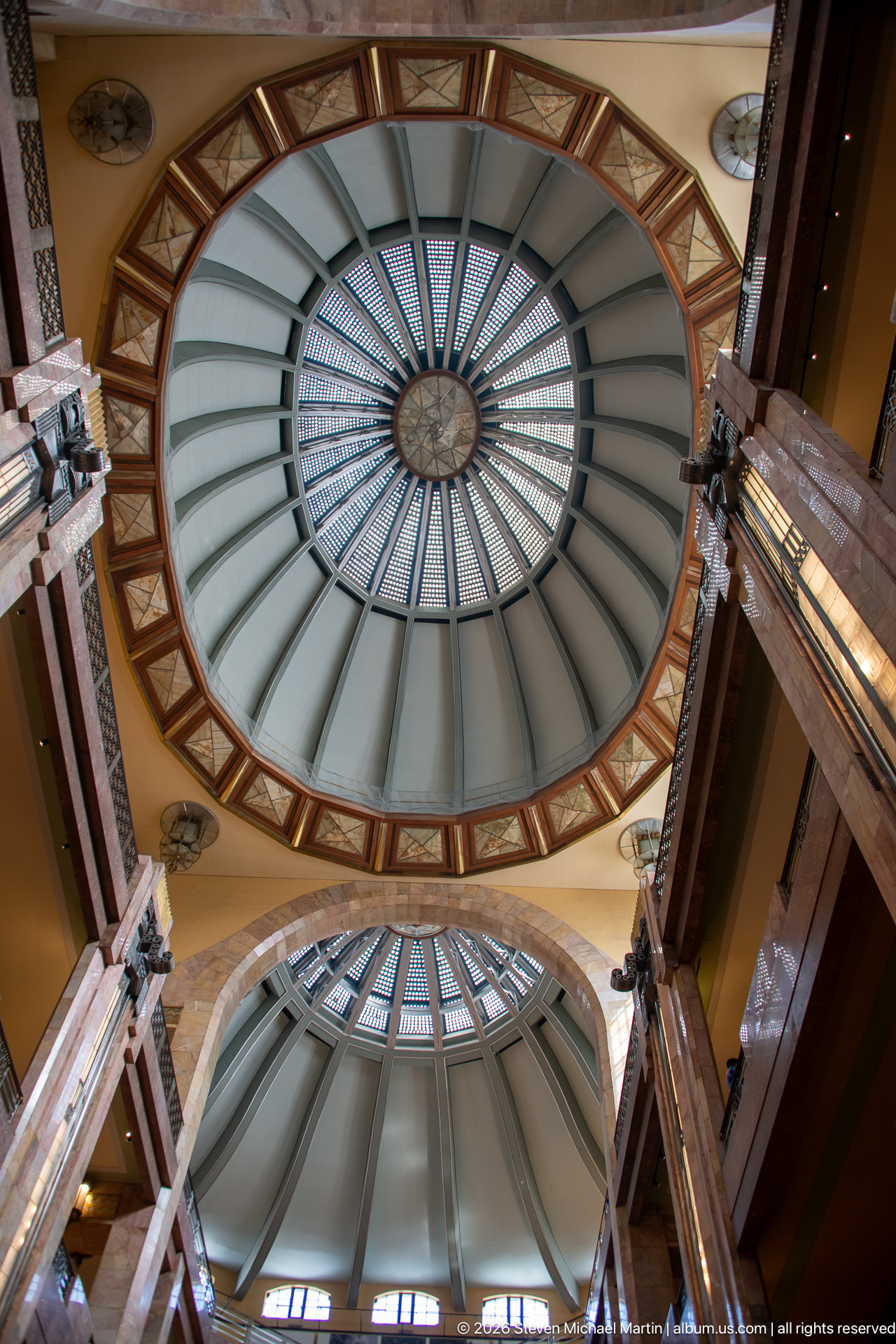
Viewed almost straight upward, the circular skylight forms a precise radial pattern of glass panes and metal ribs. A surrounding band of framed panels and the atrium’s converging balconies create concentric layers around the center. This architectural detail removes most of the gallery activity, focusing instead on the dome’s geometry and the way daylight enters the building.
Caption
Viewed almost straight upward, the circular skylight forms a precise radial pattern of glass panes and metal ribs. A surrounding band of framed panels and the atrium’s converging balconies create concentric layers around the center. This architectural detail removes most of the gallery activity, focusing instead on the dome’s geometry and the way daylight enters the building.
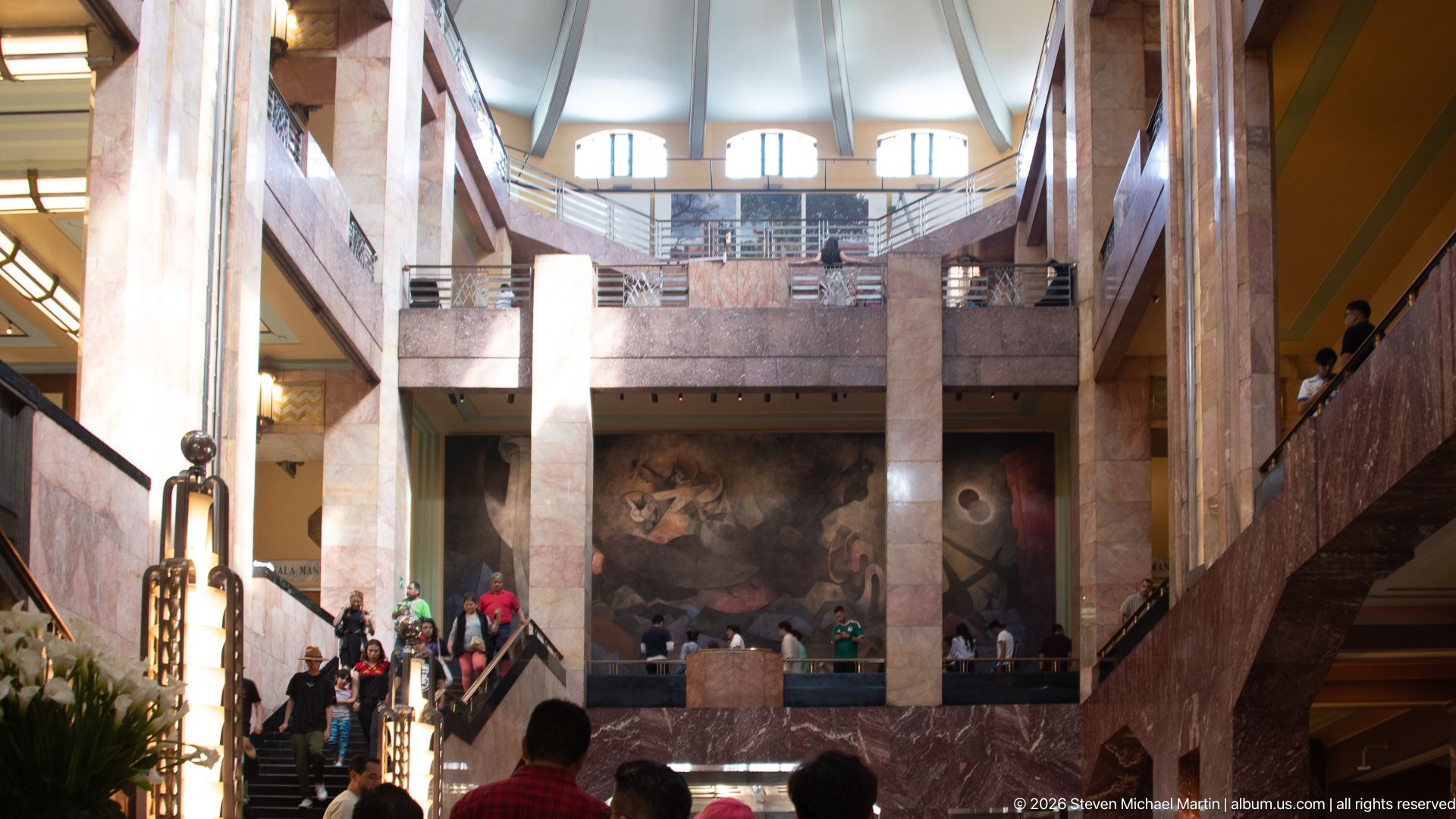
From a lower position, the mural sits between broad marble piers, with people crossing the floor and climbing the side stairs. The camera angle centers the painting while retaining the hall’s layered balconies and polished stone. Rather than isolate the artwork, this view shows how visitors encounter it along the palace’s main circulation route.
Caption
From a lower position, the mural sits between broad marble piers, with people crossing the floor and climbing the side stairs. The camera angle centers the painting while retaining the hall’s layered balconies and polished stone. Rather than isolate the artwork, this view shows how visitors encounter it along the palace’s main circulation route.
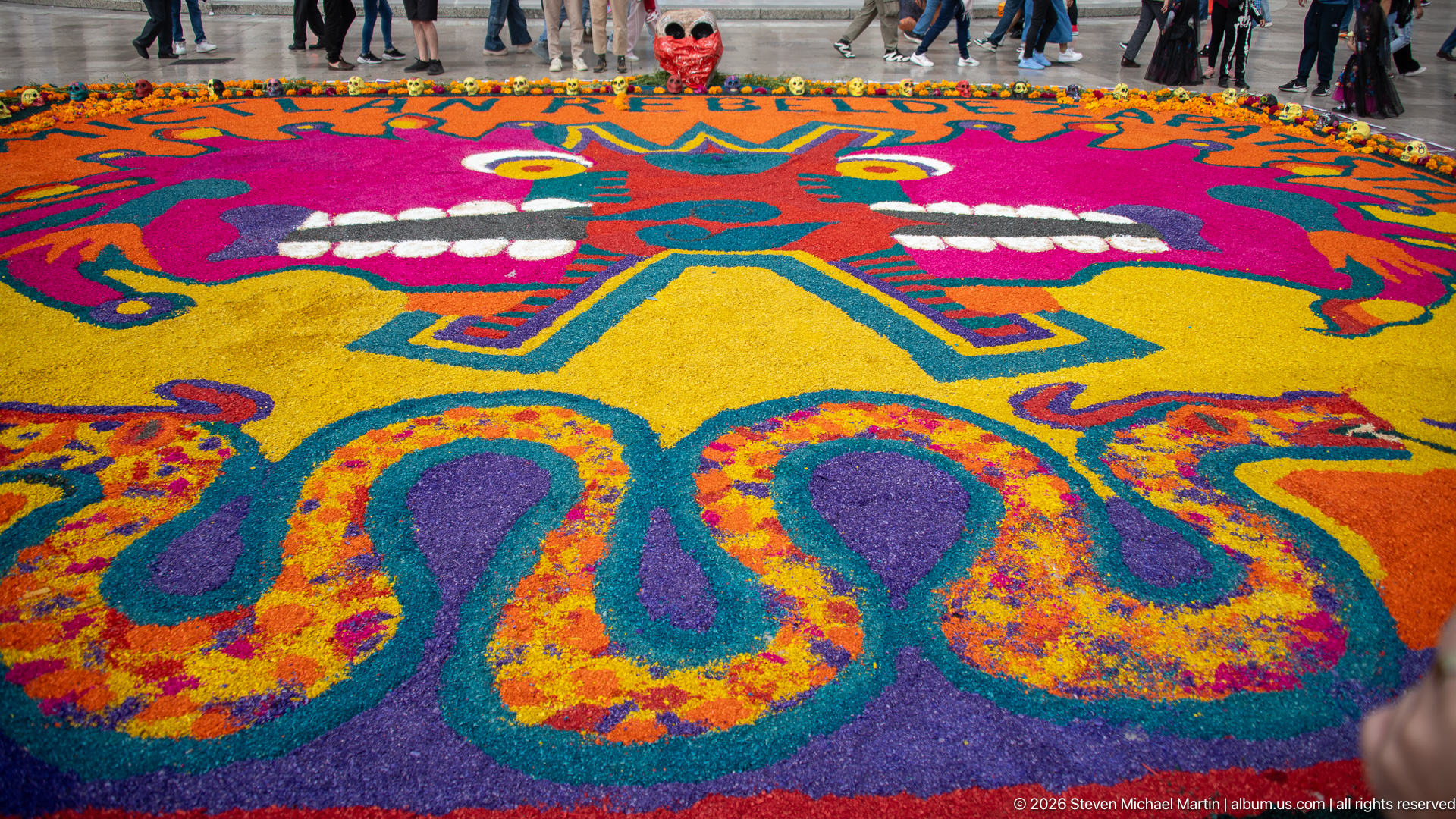
A monumental calavera motif spreads across the floor in vivid pink, yellow, orange, turquoise, purple, and green. The textured surface appears to be composed of colored granular material, bordered with marigolds and small skull decorations. Visitors’ shoes and legs line the far edge, showing the work’s scale and temporary, walk-up setting during Día de Muertos.
Caption
A monumental calavera motif spreads across the floor in vivid pink, yellow, orange, turquoise, purple, and green. The textured surface appears to be composed of colored granular material, bordered with marigolds and small skull decorations. Visitors’ shoes and legs line the far edge, showing the work’s scale and temporary, walk-up setting during Día de Muertos.
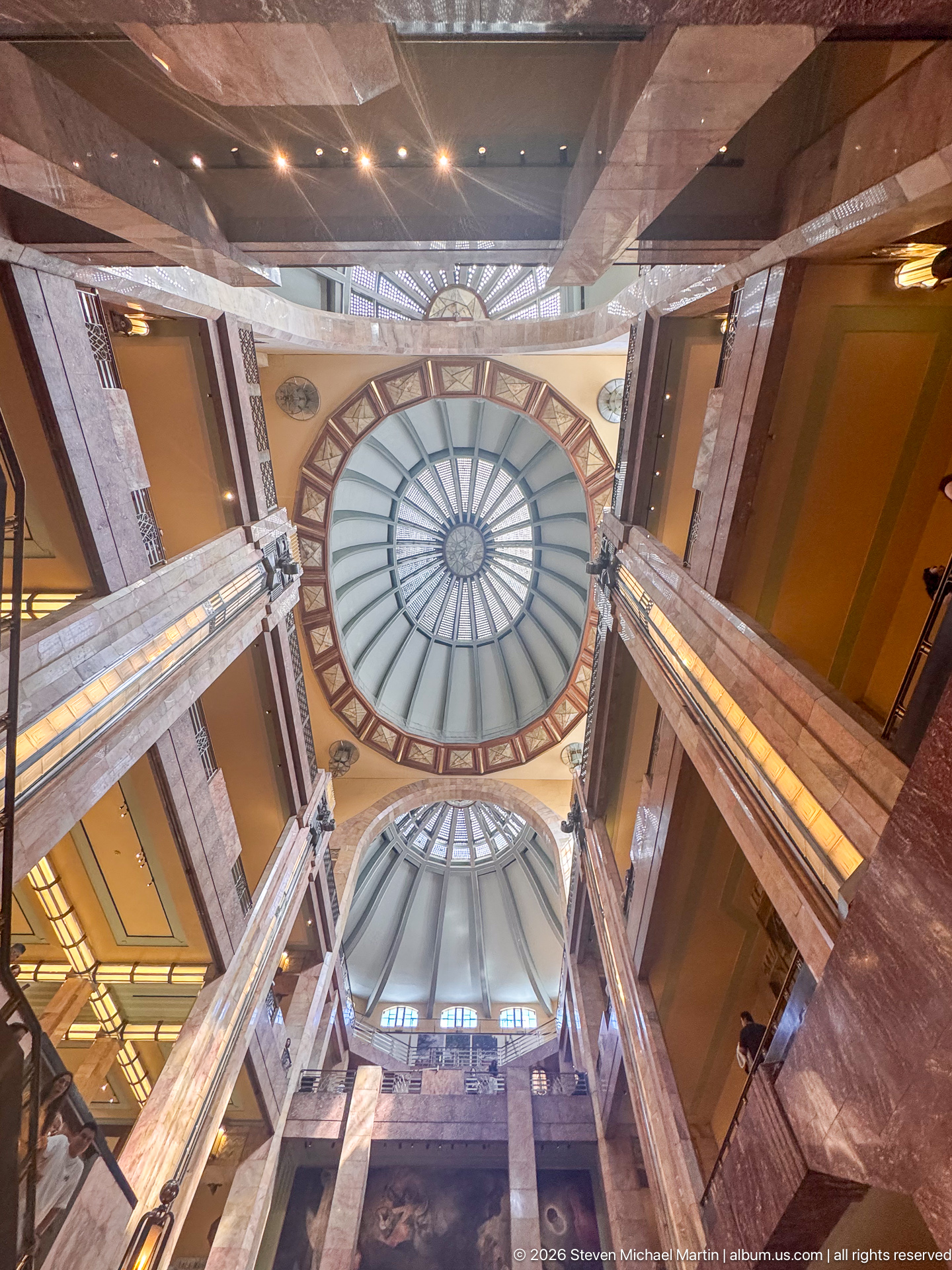
Two circular skylights repeat along the atrium’s central axis, surrounded by marble walkways, angular balcony edges, and warm ceiling panels. The elevated viewpoint turns the interior into a sequence of geometric layers, with the roof openings acting as visual anchors. Unlike the closer dome studies, this view shows how the two roof structures relate across the hall.
Caption
Two circular skylights repeat along the atrium’s central axis, surrounded by marble walkways, angular balcony edges, and warm ceiling panels. The elevated viewpoint turns the interior into a sequence of geometric layers, with the roof openings acting as visual anchors. Unlike the closer dome studies, this view shows how the two roof structures relate across the hall.
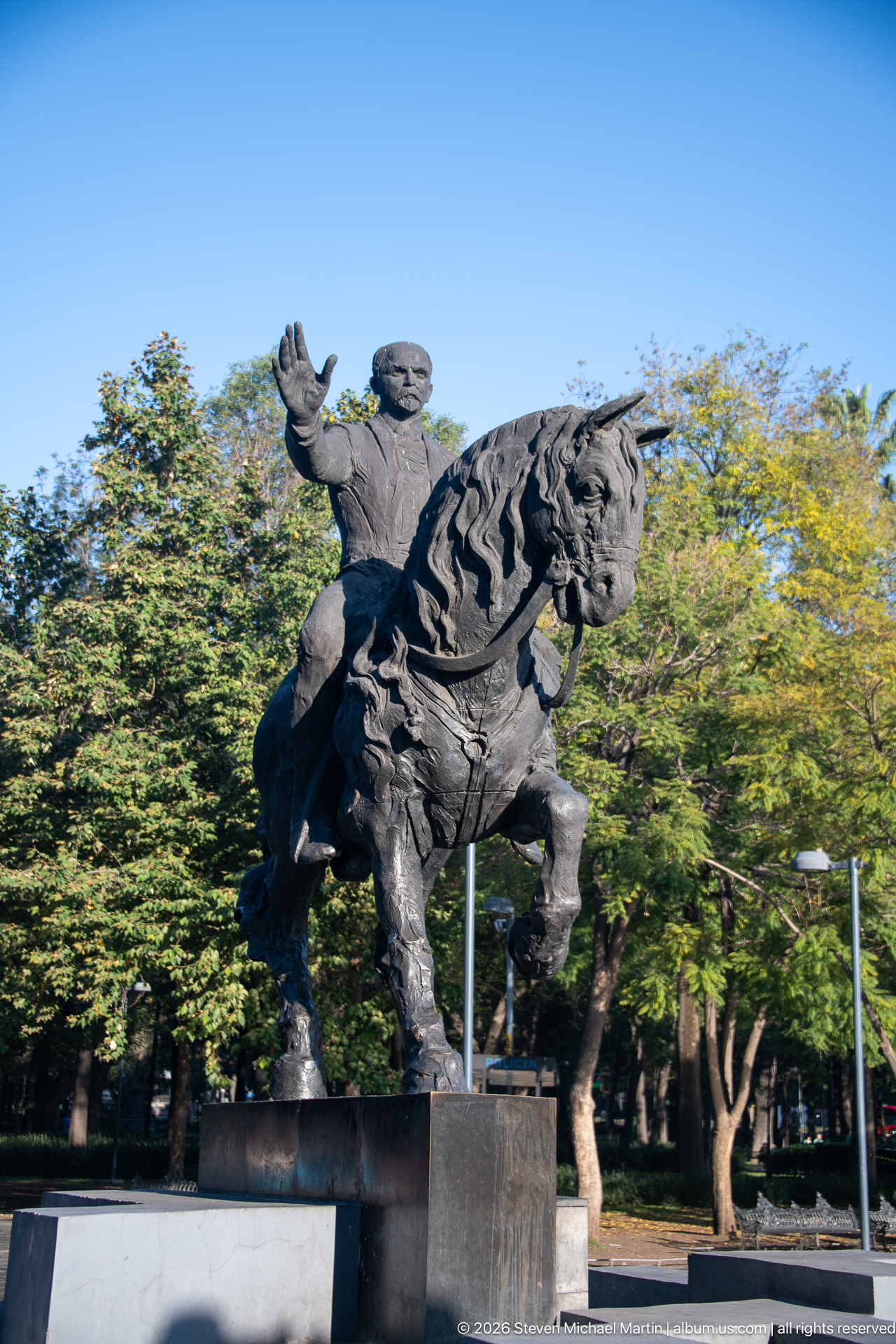
A dark bronze equestrian monument rises above a low stone base, the rider lifting one hand as the horse rears forward. Trees fill the background and a clear blue sky isolates the sculptural silhouette. The close view emphasizes the dynamic pose and textured casting, but no inscription is legible here to identify the rider or confirm the monument’s title.
Caption
A dark bronze equestrian monument rises above a low stone base, the rider lifting one hand as the horse rears forward. Trees fill the background and a clear blue sky isolates the sculptural silhouette. The close view emphasizes the dynamic pose and textured casting, but no inscription is legible here to identify the rider or confirm the monument’s title.
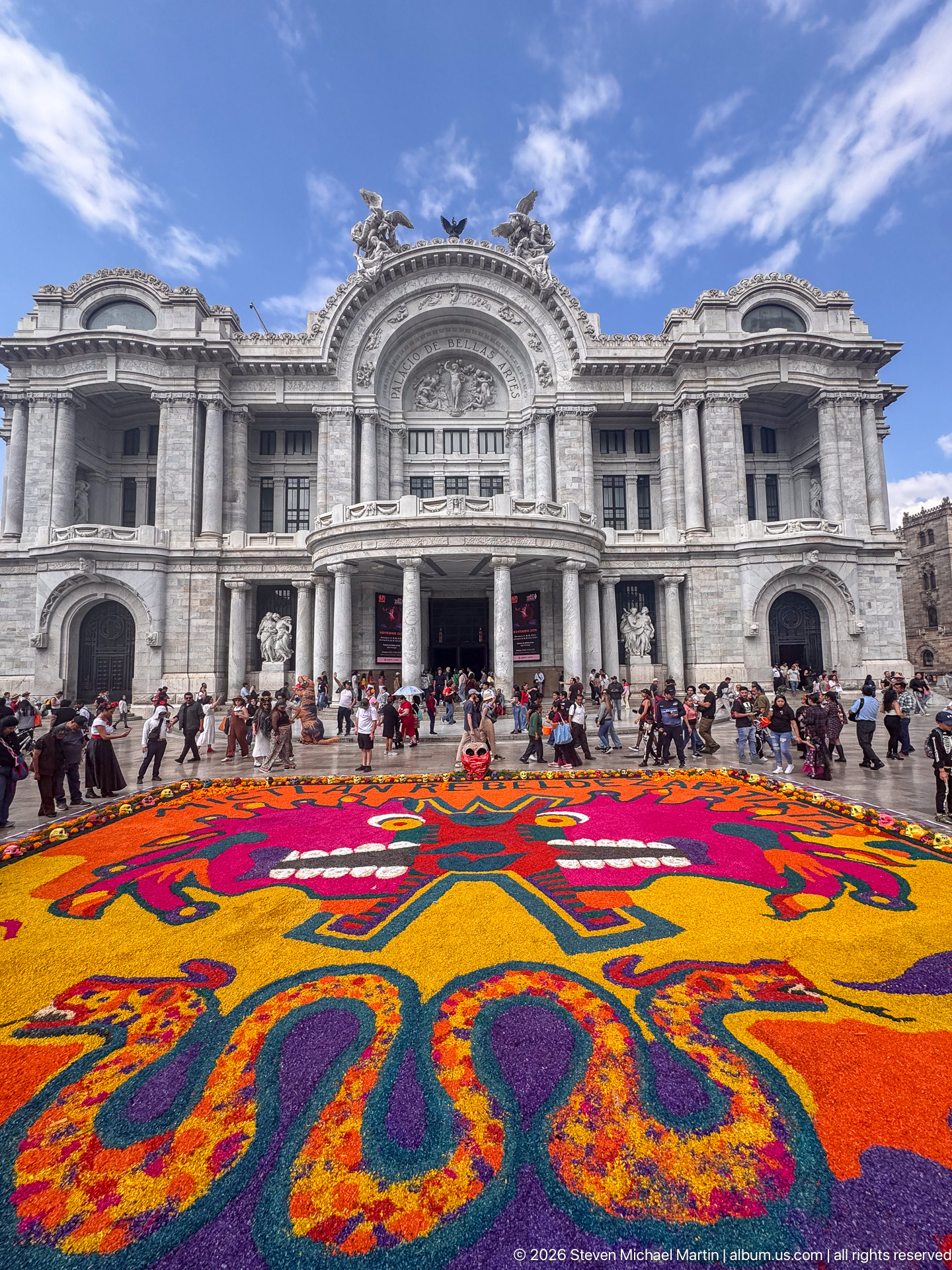
The palace’s symmetrical marble façade stands behind a large, brightly colored skull carpet that spreads across the forecourt. Visitors gather along the carpet’s far edge, and a small skull decoration marks its centerline. In daylight, the carpet’s layered colors and the building’s sculptural roofline are both legible, making the relationship between the temporary display and historic setting the focus.
Caption
The palace’s symmetrical marble façade stands behind a large, brightly colored skull carpet that spreads across the forecourt. Visitors gather along the carpet’s far edge, and a small skull decoration marks its centerline. In daylight, the carpet’s layered colors and the building’s sculptural roofline are both legible, making the relationship between the temporary display and historic setting the focus.
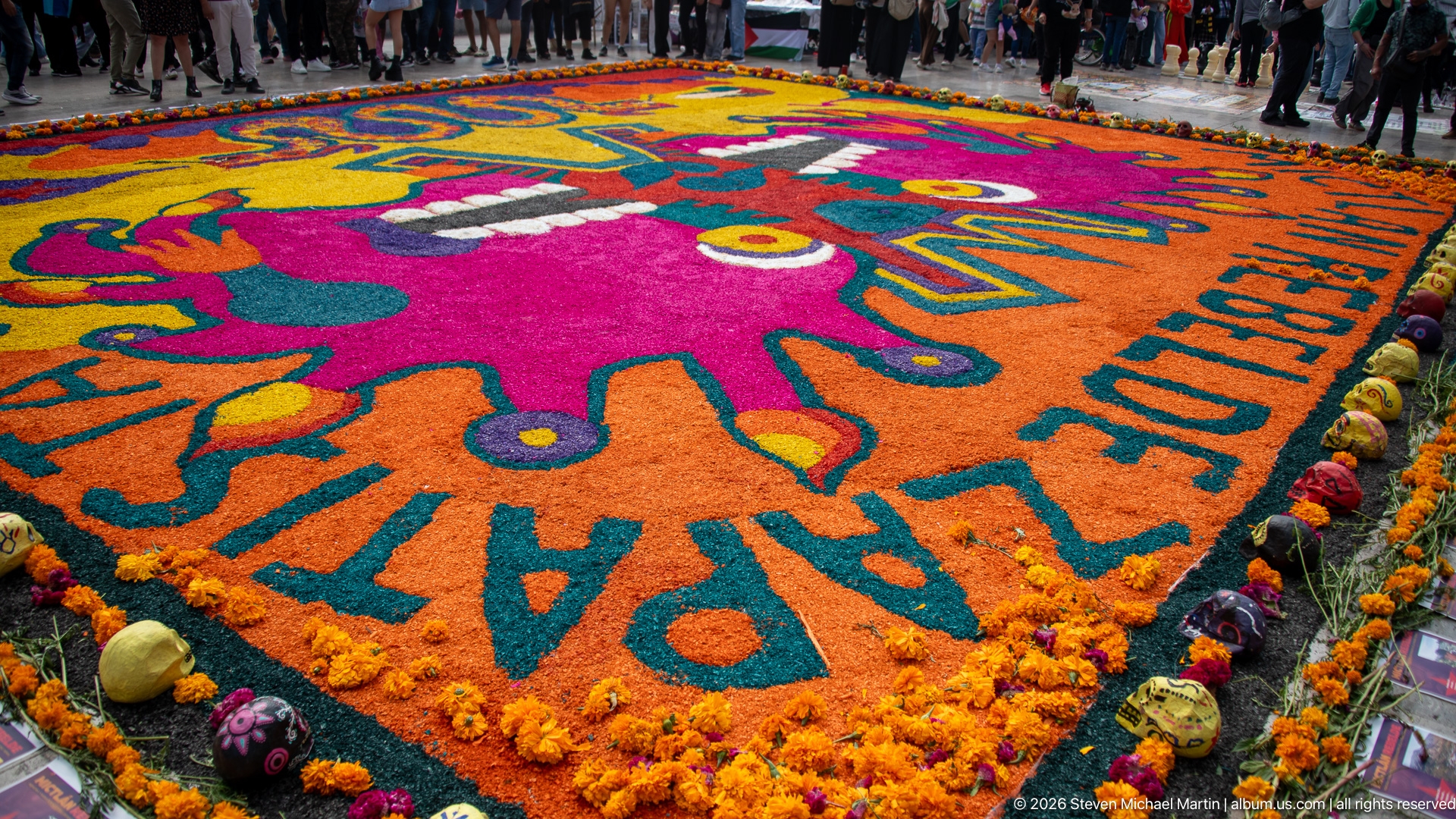
Seen from above, the colorful floor carpet reveals a symmetrical skull face with broad teeth, patterned eye sockets, and a dense orange-and-yellow border. Marigolds and small skull ornaments trace its perimeter, while visitors stand just outside the display. The close crop focuses on the carpet’s graphic design and surface texture rather than the surrounding palace façade.
Caption
Seen from above, the colorful floor carpet reveals a symmetrical skull face with broad teeth, patterned eye sockets, and a dense orange-and-yellow border. Marigolds and small skull ornaments trace its perimeter, while visitors stand just outside the display. The close crop focuses on the carpet’s graphic design and surface texture rather than the surrounding palace façade.

The palace’s white marble façade rises above visitors and a broad skull-shaped carpet that fills the foreground. Its vivid colors contrast with the building’s pale stone, while groups circulate around the installation and pause for photographs. The wide view places the temporary Día de Muertos artwork directly against the permanent landmark, showing how the forecourt becomes an exhibition space.
Caption
The palace’s white marble façade rises above visitors and a broad skull-shaped carpet that fills the foreground. Its vivid colors contrast with the building’s pale stone, while groups circulate around the installation and pause for photographs. The wide view places the temporary Día de Muertos artwork directly against the permanent landmark, showing how the forecourt becomes an exhibition space.
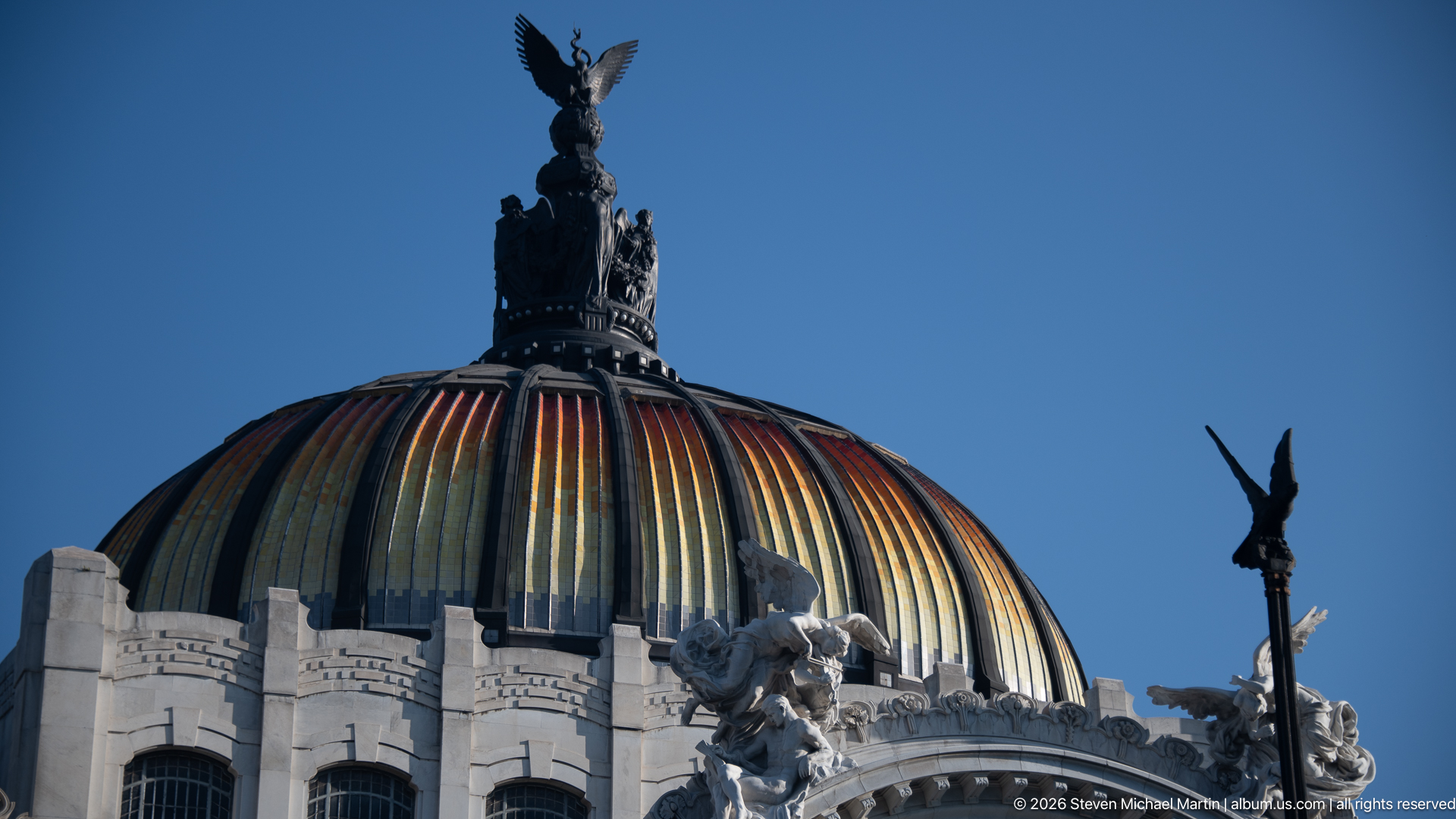
A dark sculptural figure stands high above the palace’s ribbed copper dome, with additional winged forms visible along the roofline. The low angle isolates the crowning silhouette against a clean blue sky and reveals the transition from curved roof to stone parapet. This detail focuses on the building’s sculptural skyline rather than its full façade.
Caption
A dark sculptural figure stands high above the palace’s ribbed copper dome, with additional winged forms visible along the roofline. The low angle isolates the crowning silhouette against a clean blue sky and reveals the transition from curved roof to stone parapet. This detail focuses on the building’s sculptural skyline rather than its full façade.
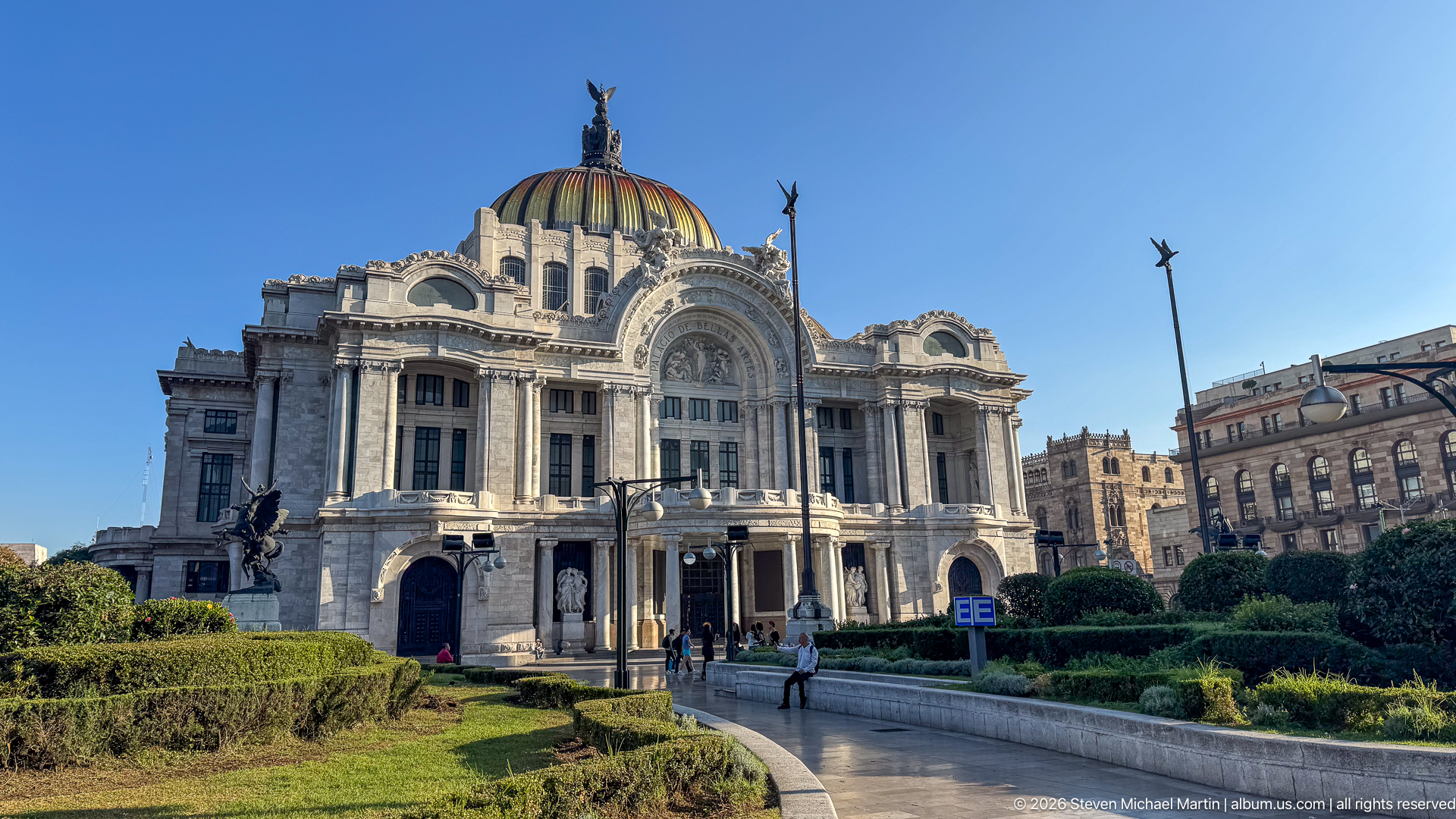
Palacio de Bellas Artes stands beyond trimmed hedges and a curving walkway, its white marble exterior and copper dome bright against the blue sky. The front façade’s central arch and sculptural roofline are framed by neighboring city buildings at right. This wider ground-level view restores the monument’s setting after the preceding close detail of the dome sculpture.
Caption
Palacio de Bellas Artes stands beyond trimmed hedges and a curving walkway, its white marble exterior and copper dome bright against the blue sky. The front façade’s central arch and sculptural roofline are framed by neighboring city buildings at right. This wider ground-level view restores the monument’s setting after the preceding close detail of the dome sculpture.
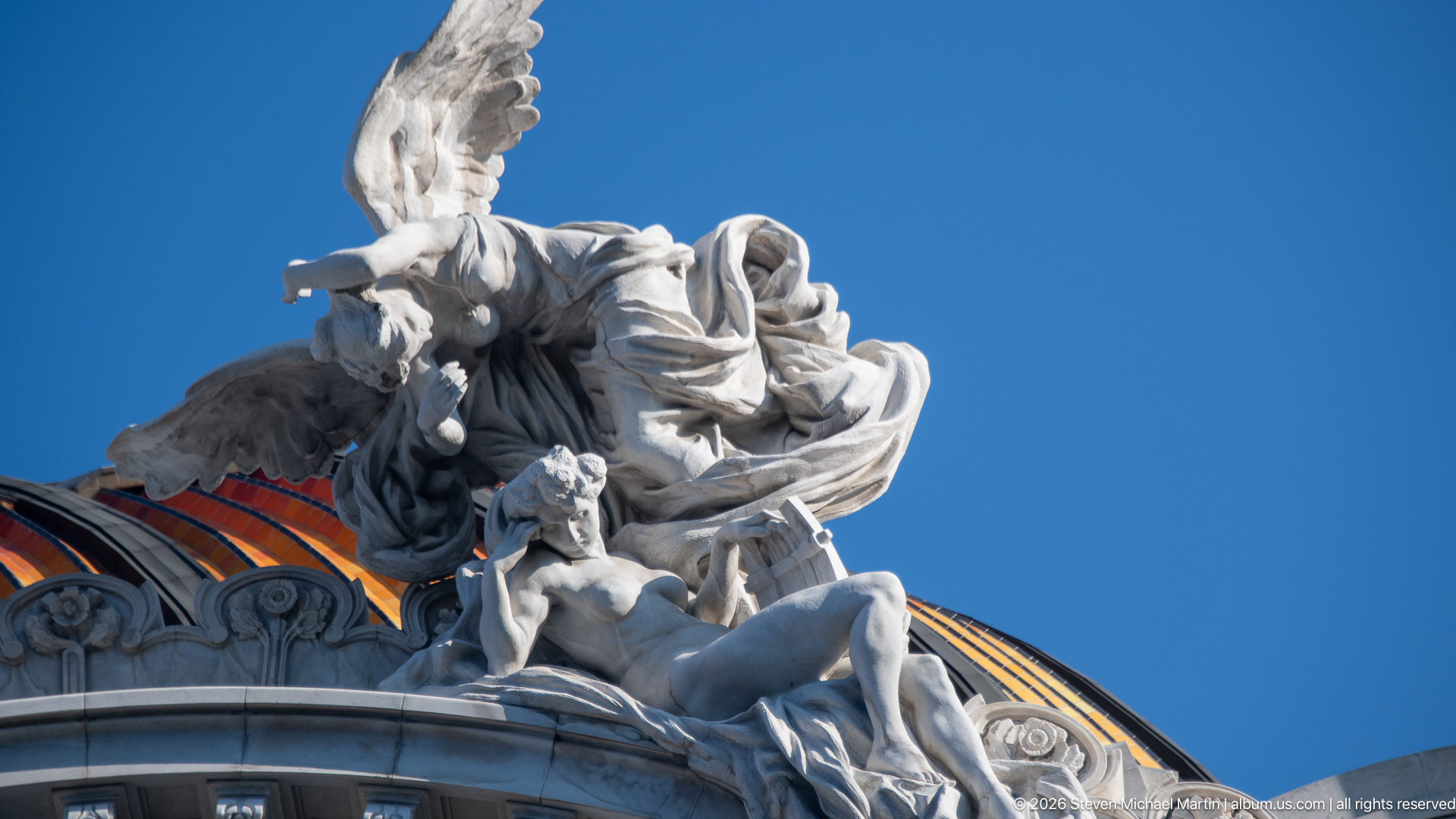
Pale figures crowd the upper roofline above a band of copper-colored tiles, their draped bodies and wings set against the blue sky. The close crop reveals the sculptural group’s layered composition and weathered stone surface, while a small portion of the dome anchors it to the building below. This detail distinguishes individual figures from the palace’s broader exterior view.
Caption
Pale figures crowd the upper roofline above a band of copper-colored tiles, their draped bodies and wings set against the blue sky. The close crop reveals the sculptural group’s layered composition and weathered stone surface, while a small portion of the dome anchors it to the building below. This detail distinguishes individual figures from the palace’s broader exterior view.
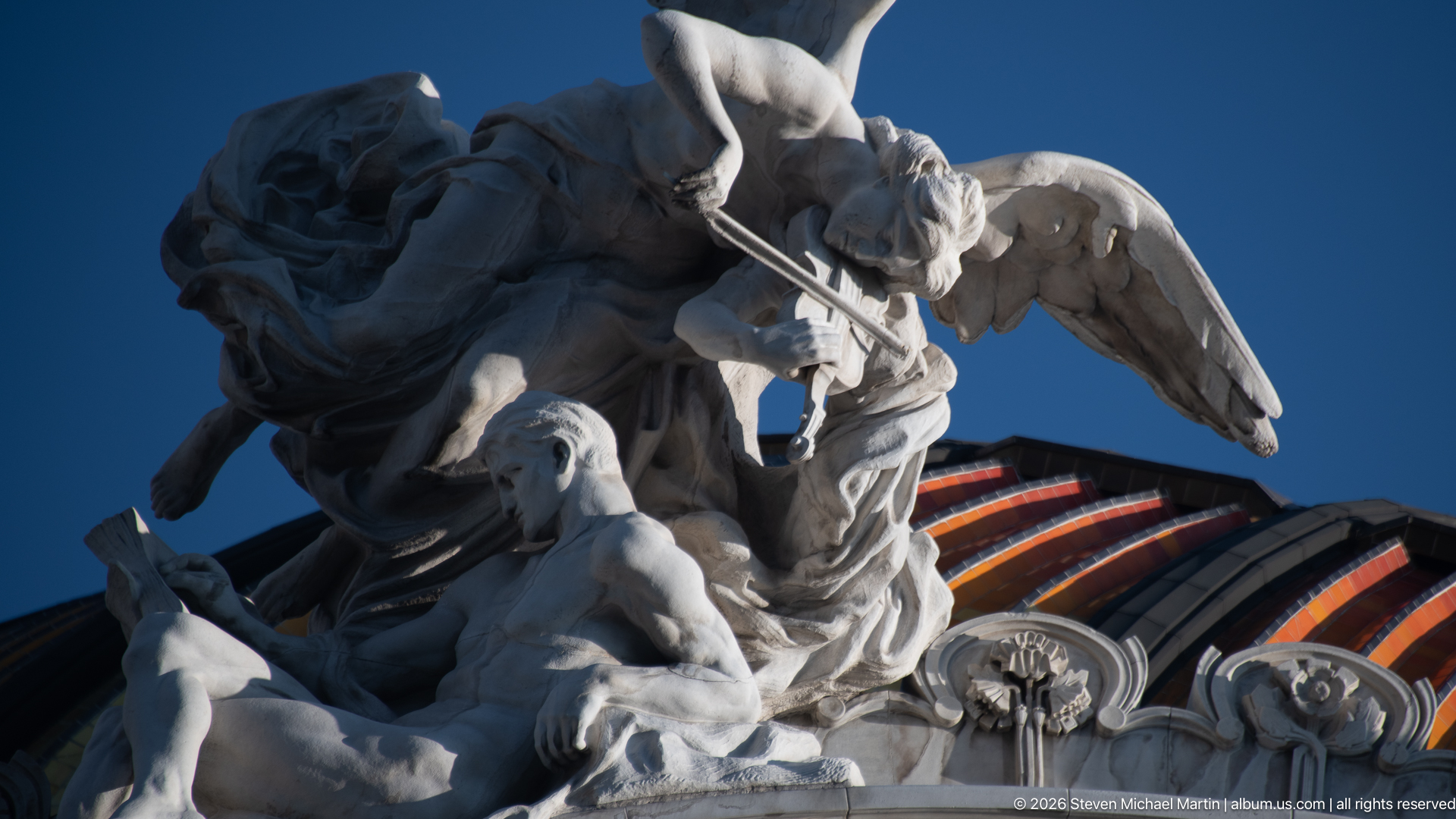
A winged horse stretches across the frame, its stone body and feathered wing set among neighboring figures and drapery. The sculptural group crowns the palace roof, with copper-colored tiles visible below. The tight crop emphasizes the animal’s movement and the sculptors’ treatment of musculature and feathers; it avoids assigning an individual name to the figure without a visible label.
Caption
A winged horse stretches across the frame, its stone body and feathered wing set among neighboring figures and drapery. The sculptural group crowns the palace roof, with copper-colored tiles visible below. The tight crop emphasizes the animal’s movement and the sculptors’ treatment of musculature and feathers; it avoids assigning an individual name to the figure without a visible label.
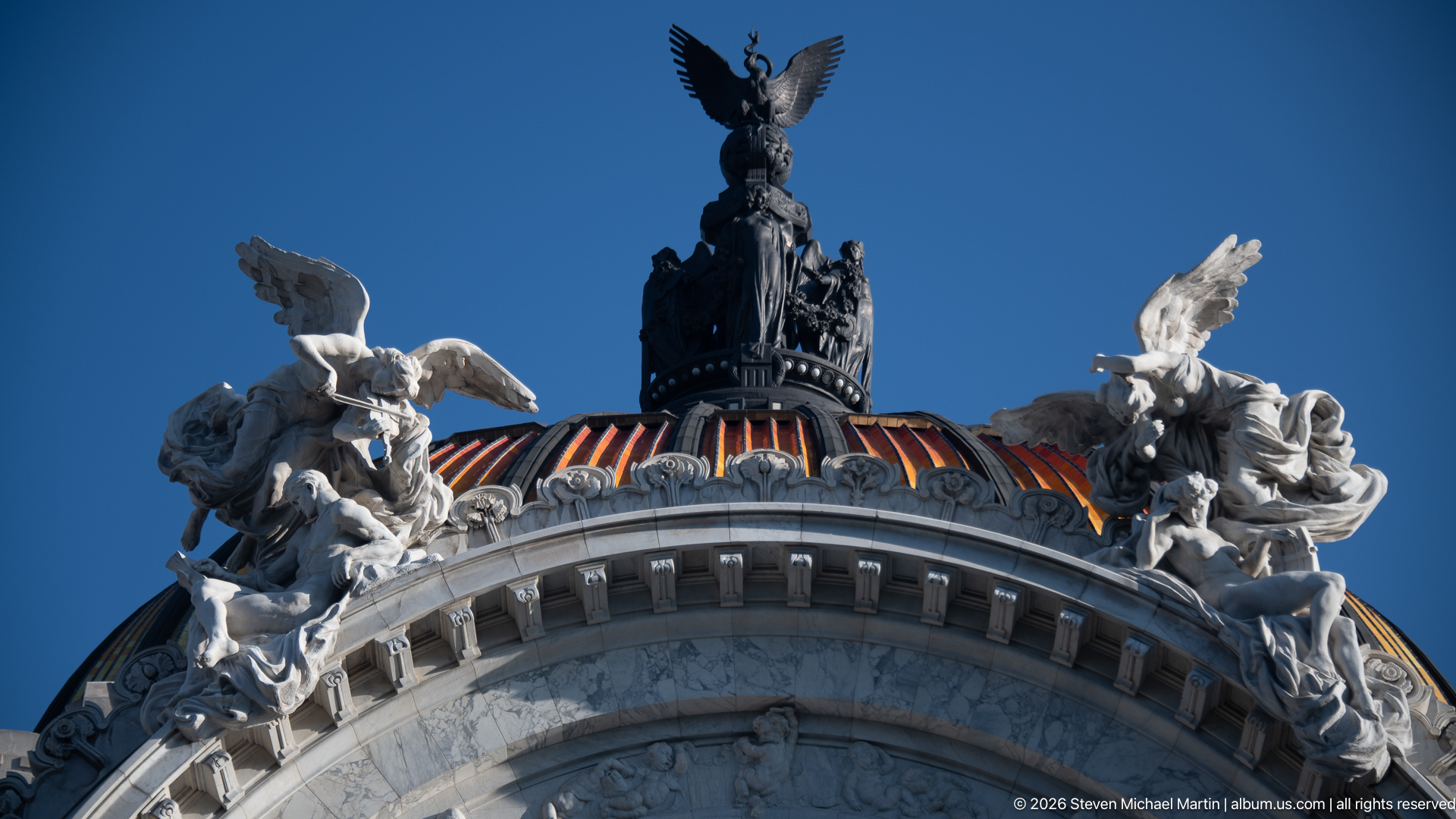
A tight upward view isolates the dark bronze eagle and the surrounding allegorical figures above the Palacio de Bellas Artes. Their silhouettes rise from the ribbed orange roof against a clear blue sky, while the pale marble arch enters along the lower edge. This crop makes the sculptural crown and its contrast of materials the subject, rather than the building’s full façade.
Caption
A tight upward view isolates the dark bronze eagle and the surrounding allegorical figures above the Palacio de Bellas Artes. Their silhouettes rise from the ribbed orange roof against a clear blue sky, while the pale marble arch enters along the lower edge. This crop makes the sculptural crown and its contrast of materials the subject, rather than the building’s full façade.
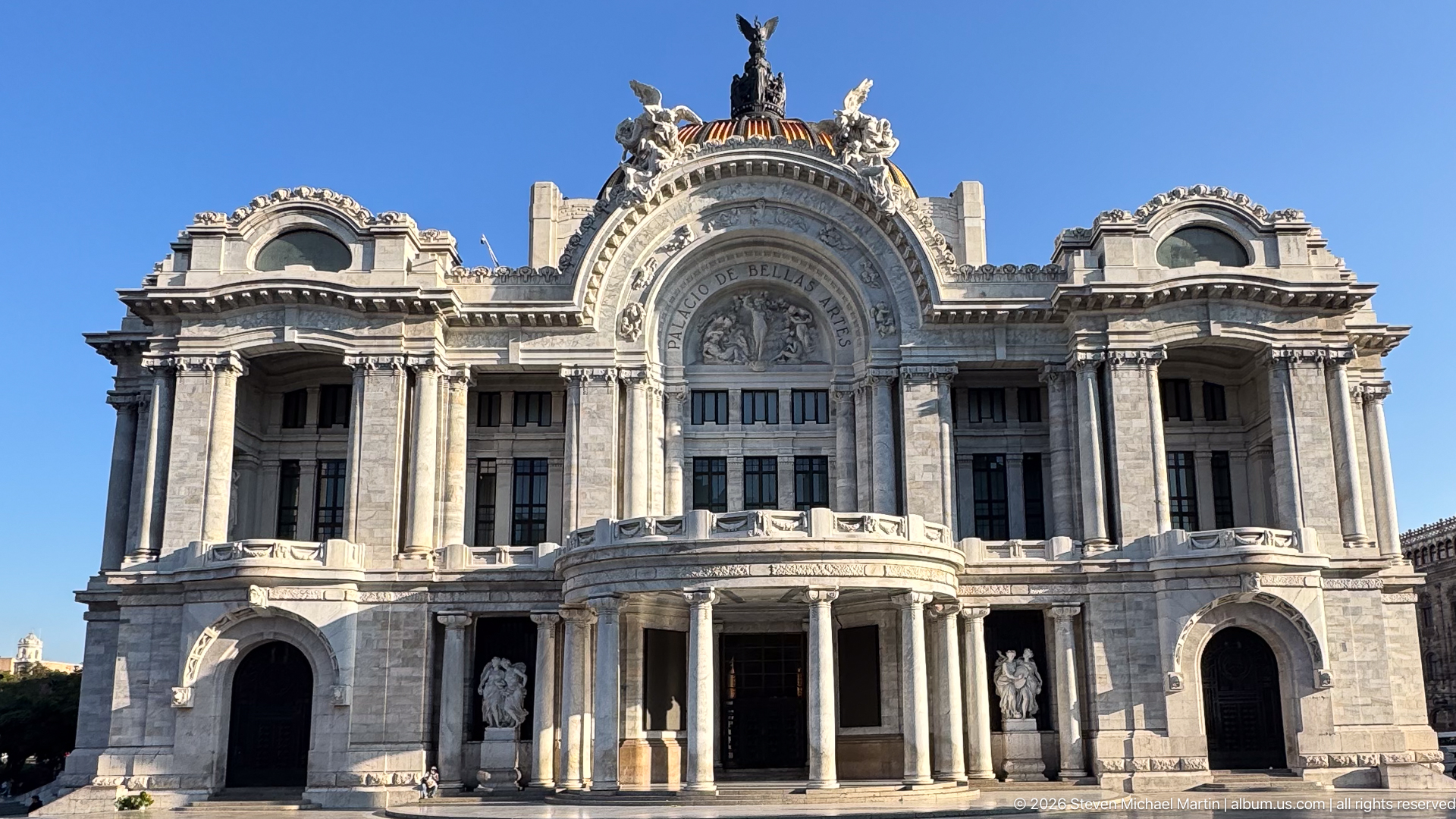
Seen straight on, the palace’s principal façade is organized around a high semicircular portal, a sculpted tympanum, and a projecting entrance balcony. Repeated windows and paired columns extend symmetrically across the pale stone frontage, while statues occupy the lower niches. The inscription above the arch identifies the building, making this a clear architectural overview in bright daylight.
Caption
Seen straight on, the palace’s principal façade is organized around a high semicircular portal, a sculpted tympanum, and a projecting entrance balcony. Repeated windows and paired columns extend symmetrically across the pale stone frontage, while statues occupy the lower niches. The inscription above the arch identifies the building, making this a clear architectural overview in bright daylight.
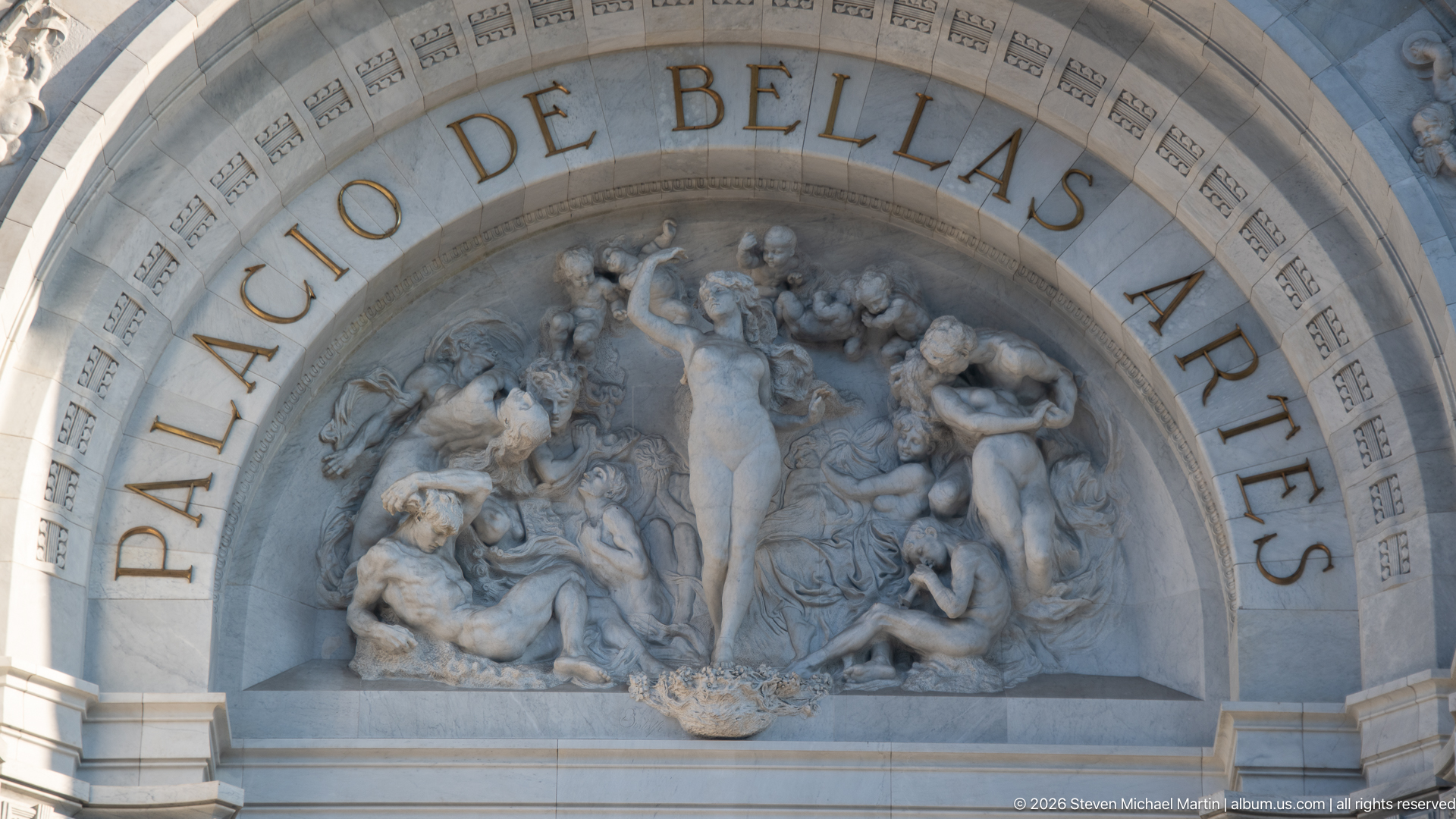
The principal arch’s tympanum fills the frame, bringing its pale marble relief into close view. A central upright figure is surrounded by seated and reclining bodies, with the building’s name set in large letters along the curved band above. INBAL identifies this sculptural composition as La Armonía by Leonardo Bistolfi; the tight framing emphasizes the relief’s crowded figures and carved stone surface.
Caption
The principal arch’s tympanum fills the frame, bringing its pale marble relief into close view. A central upright figure is surrounded by seated and reclining bodies, with the building’s name set in large letters along the curved band above. INBAL identifies this sculptural composition as La Armonía by Leonardo Bistolfi; the tight framing emphasizes the relief’s crowded figures and carved stone surface.
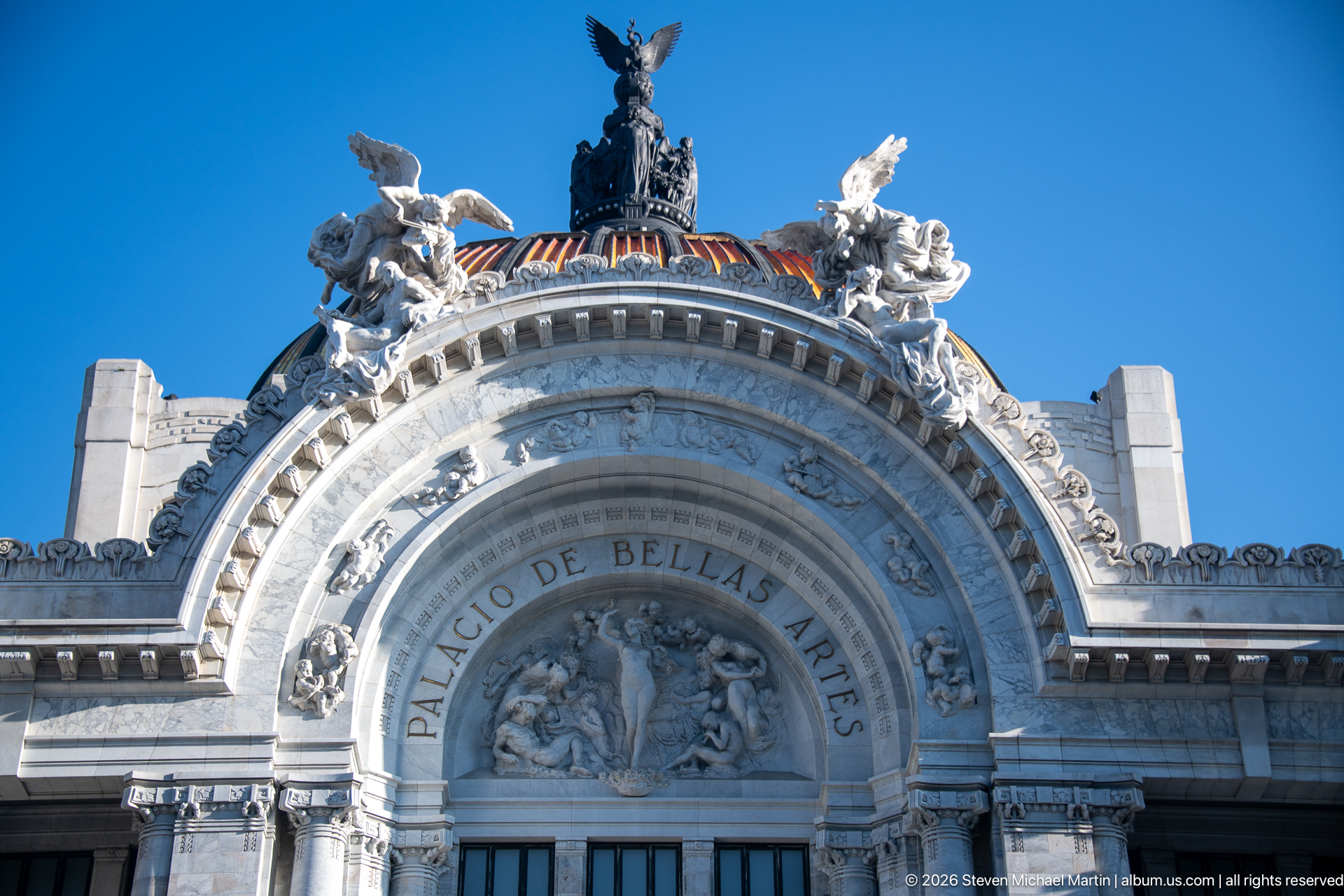
From below, the central entrance arch rises in front of the copper-toned dome, with pale marble figures perched along its crest and smaller reliefs nested in the curved tympanum. The building name follows the inner arch. This upward, nearly symmetrical view links the sculpted portal to the larger roofline and makes the layered composition legible against the saturated blue sky.
Caption
From below, the central entrance arch rises in front of the copper-toned dome, with pale marble figures perched along its crest and smaller reliefs nested in the curved tympanum. The building name follows the inner arch. This upward, nearly symmetrical view links the sculpted portal to the larger roofline and makes the layered composition legible against the saturated blue sky.
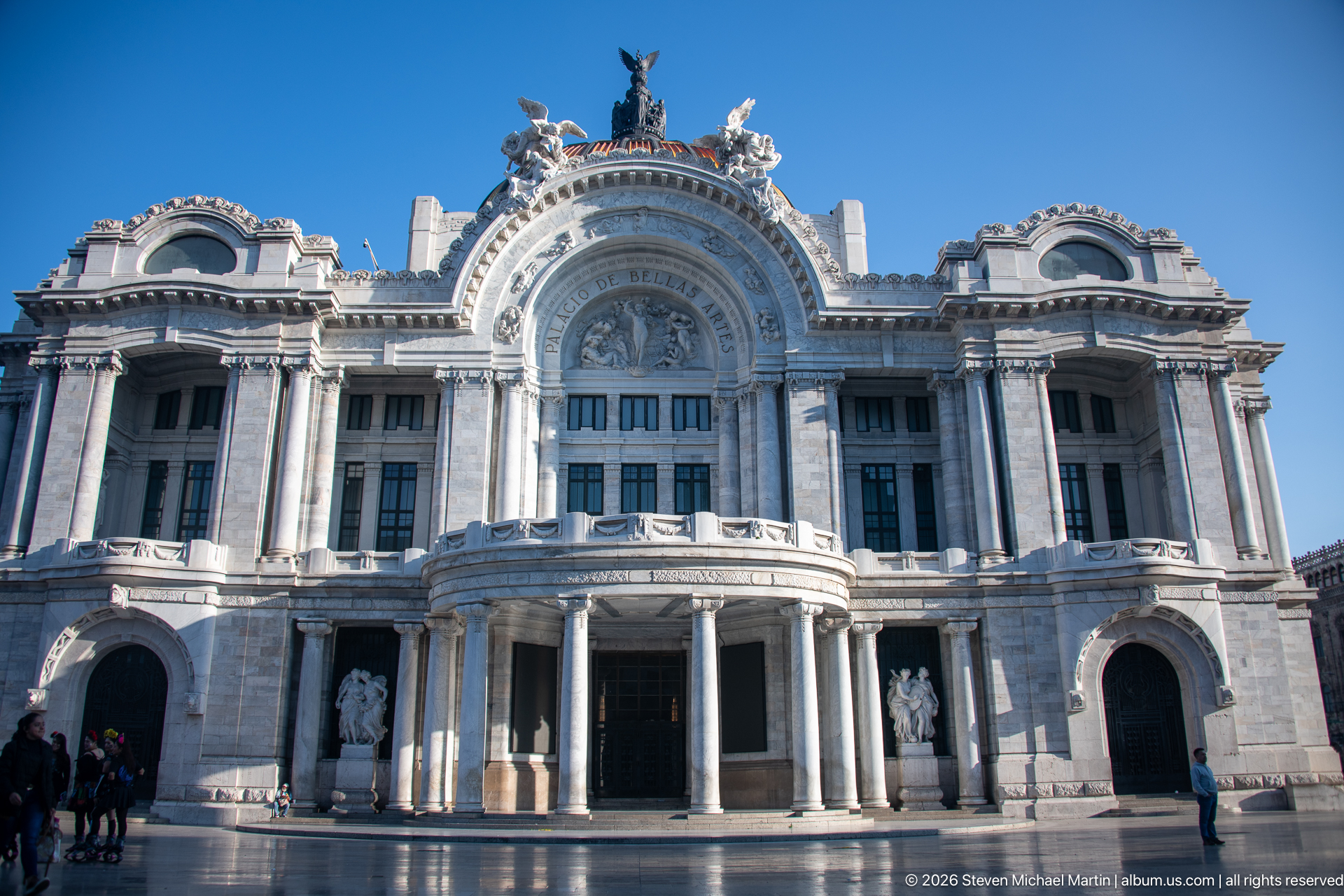
A broader frontal view places the full entrance block and central arch in context, with the curved balcony, flanking bays, and dark doorways visible across the pale façade. A few visitors stand at the edges of the broad paved forecourt, helping convey the scale of the building. Clear light picks out the sculptural crest while leaving the recessed entrances in shadow.
Caption
A broader frontal view places the full entrance block and central arch in context, with the curved balcony, flanking bays, and dark doorways visible across the pale façade. A few visitors stand at the edges of the broad paved forecourt, helping convey the scale of the building. Clear light picks out the sculptural crest while leaving the recessed entrances in shadow.
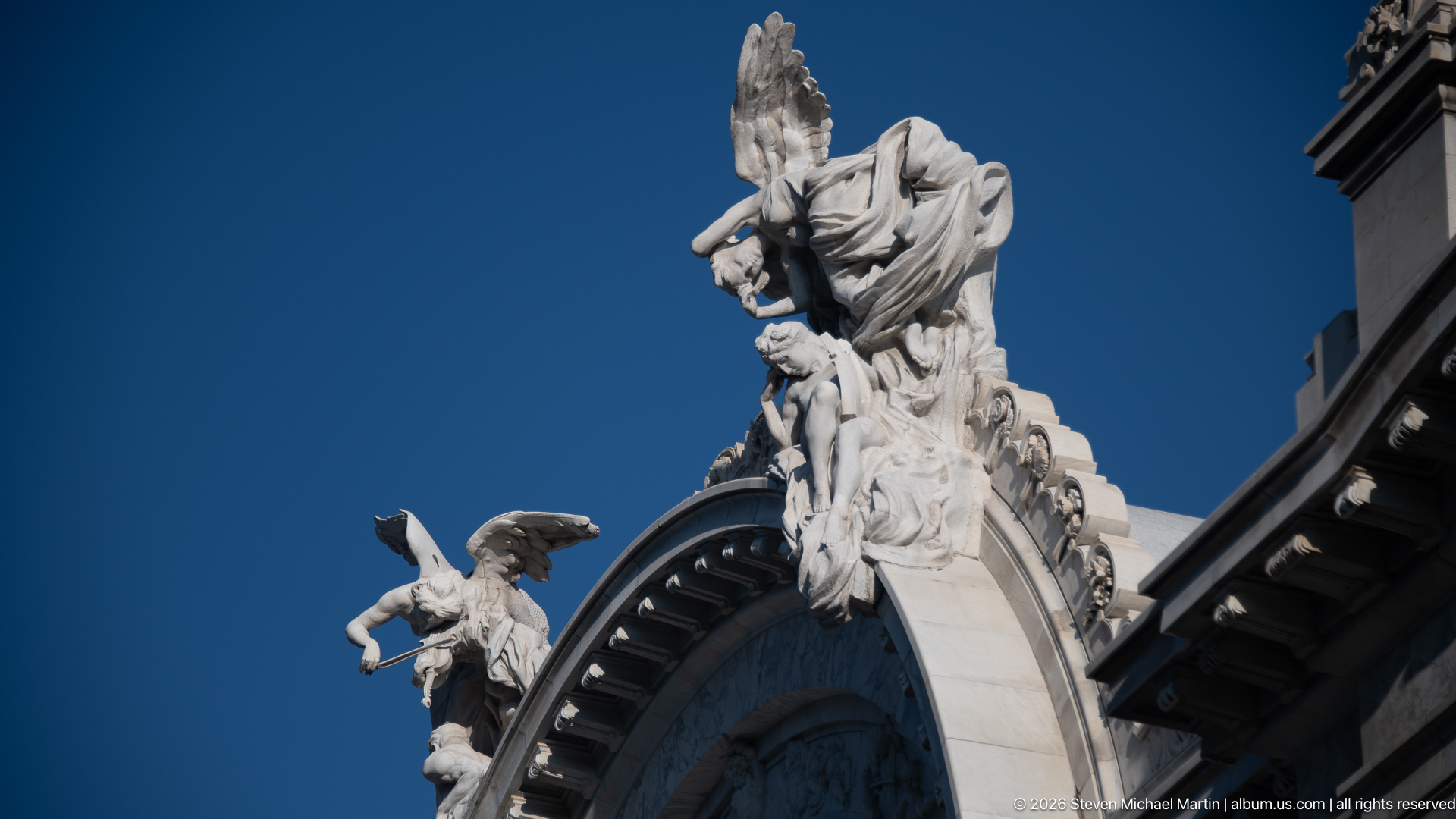
The camera looks upward along the arch from an oblique angle, compressing several pale marble figures into a vertical stack against the blue sky. A winged figure enters from the lower left while the main draped group crowns the curve; the building’s stone edge frames the right side. The slanted perspective makes the depth and placement of the ornament more apparent than a frontal view.
Caption
The camera looks upward along the arch from an oblique angle, compressing several pale marble figures into a vertical stack against the blue sky. A winged figure enters from the lower left while the main draped group crowns the curve; the building’s stone edge frames the right side. The slanted perspective makes the depth and placement of the ornament more apparent than a frontal view.
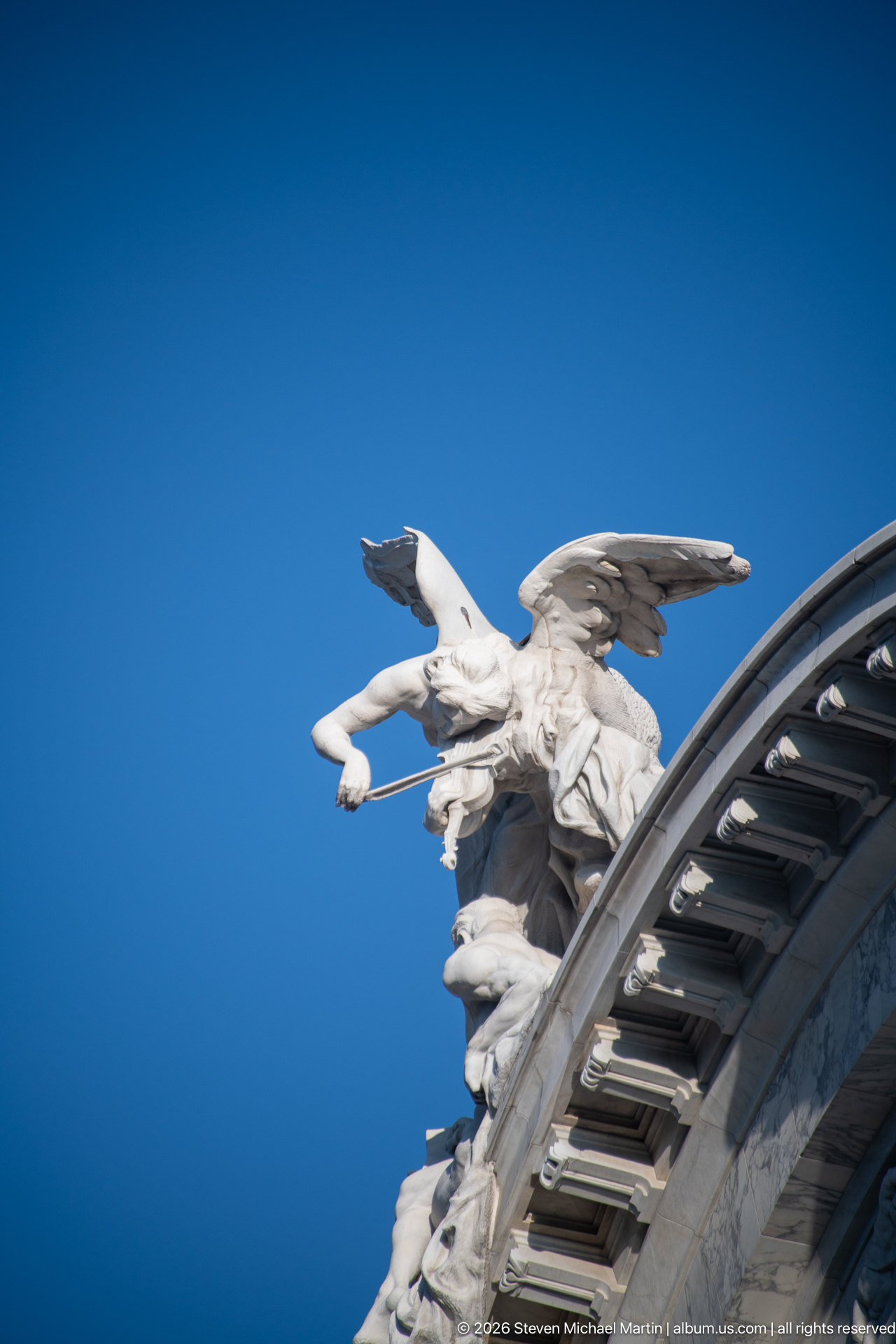
One winged marble figure projects from the edge of the roofline, its body angled outward above the curved arch. The low viewpoint leaves broad blue sky around the sculpture and reveals the dark, coffered underside of the cornice at right. This isolated detail gives the figure a striking silhouette and clarifies how the sculptural program sits on the palace’s upper façade.
Caption
One winged marble figure projects from the edge of the roofline, its body angled outward above the curved arch. The low viewpoint leaves broad blue sky around the sculpture and reveals the dark, coffered underside of the cornice at right. This isolated detail gives the figure a striking silhouette and clarifies how the sculptural program sits on the palace’s upper façade.
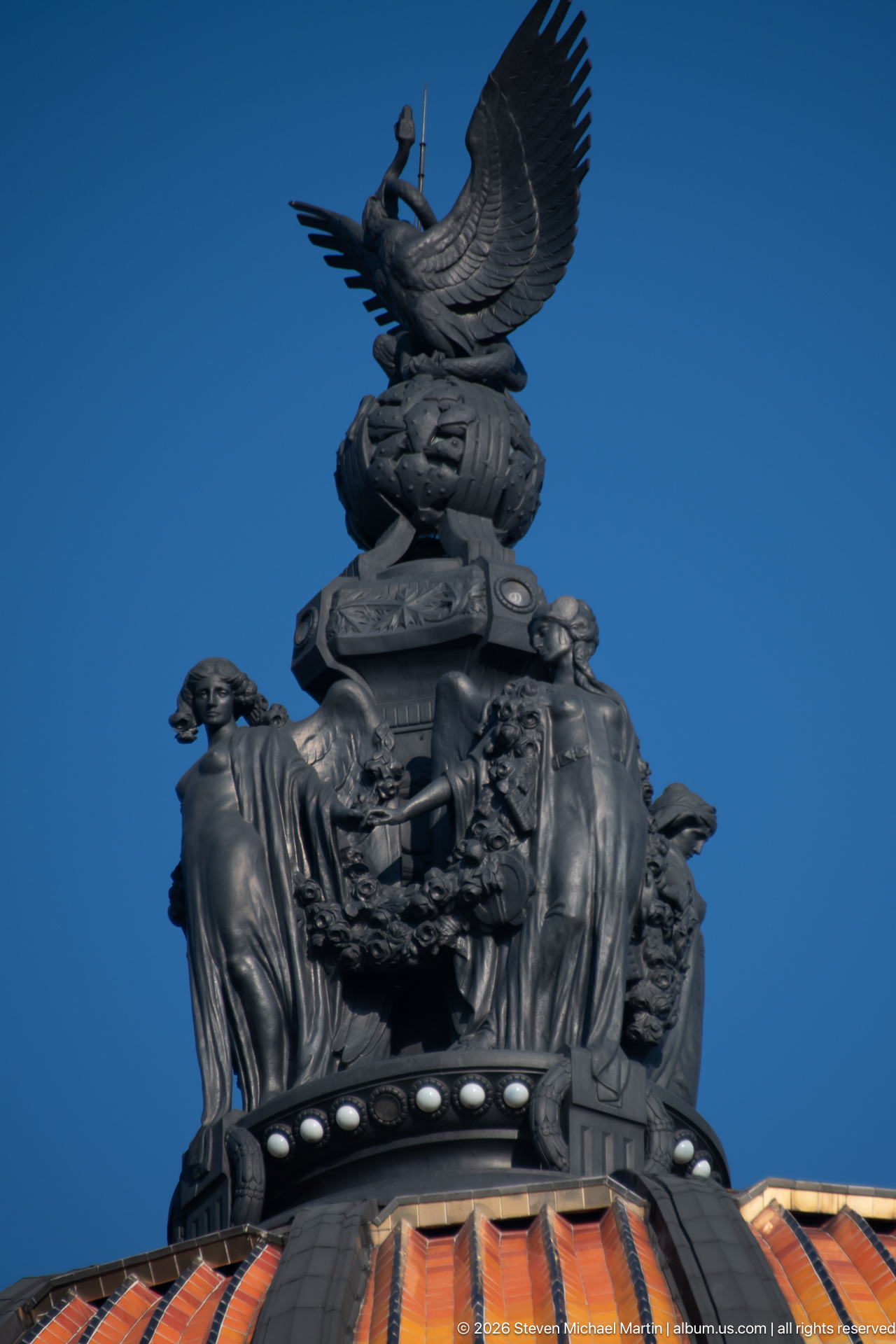
At the apex of the central dome, a dark bronze eagle spreads its wings above a compact group of human figures, set against the orange ribs of the roof. The close framing separates the finial from the rest of the façade and makes its layered silhouette easy to read. INBAL identifies the bronze crown as a Géza Maróti ensemble, with the eagle representing Mexico’s national emblem.
Caption
At the apex of the central dome, a dark bronze eagle spreads its wings above a compact group of human figures, set against the orange ribs of the roof. The close framing separates the finial from the rest of the façade and makes its layered silhouette easy to read. INBAL identifies the bronze crown as a Géza Maróti ensemble, with the eagle representing Mexico’s national emblem.
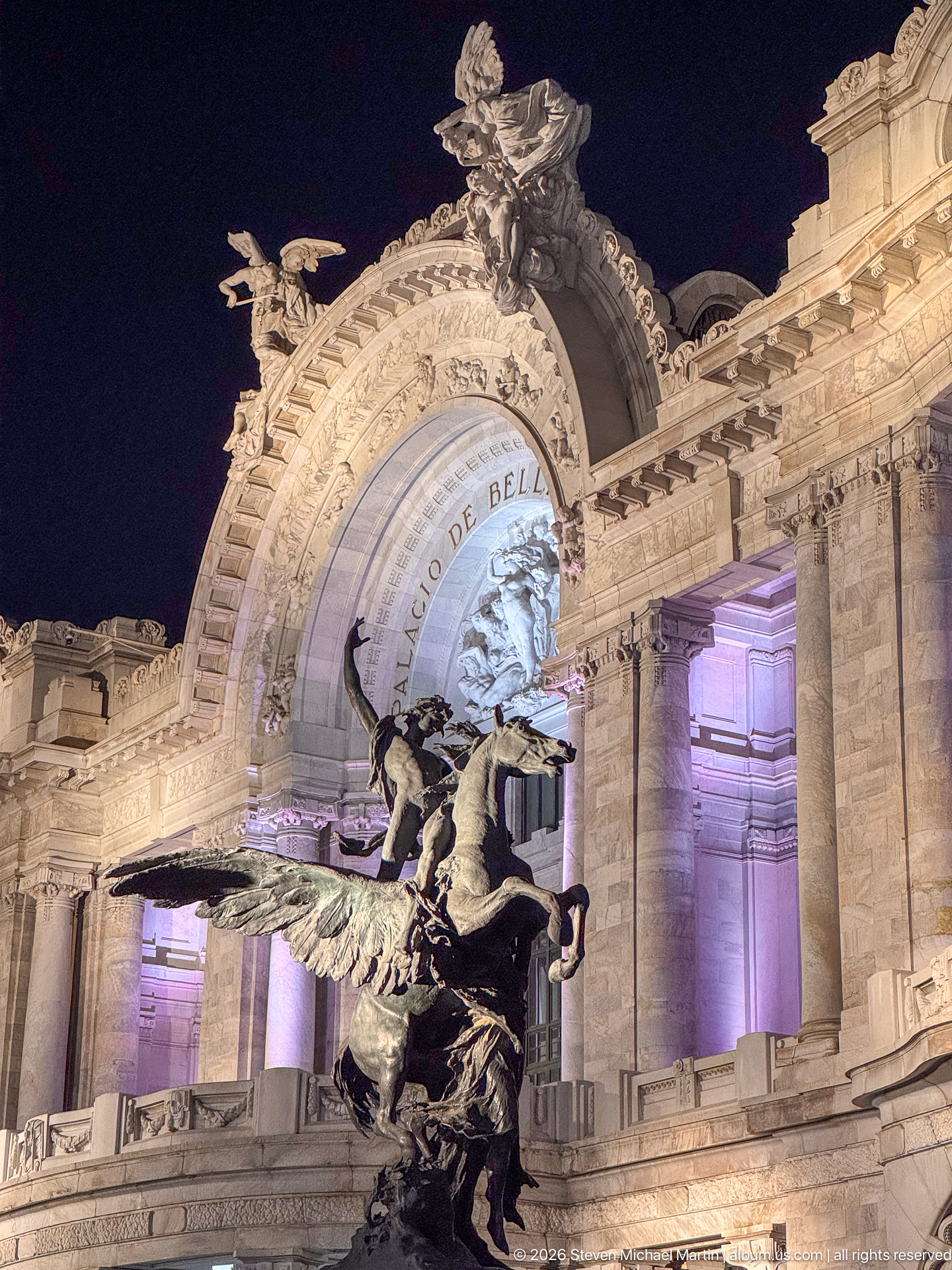
The bronze Pegaso occupies the center of this low-angle nighttime composition, with its wings spread across the foreground and the palace’s inscribed arch rising behind it. Violet light colors the vertical bays while warm illumination reveals the carved stone and sculpted crest. The alignment places the freestanding bronze directly against the building’s entrance axis, joining plaza sculpture and façade in one view.
Caption
The bronze Pegaso occupies the center of this low-angle nighttime composition, with its wings spread across the foreground and the palace’s inscribed arch rising behind it. Violet light colors the vertical bays while warm illumination reveals the carved stone and sculpted crest. The alignment places the freestanding bronze directly against the building’s entrance axis, joining plaza sculpture and façade in one view.
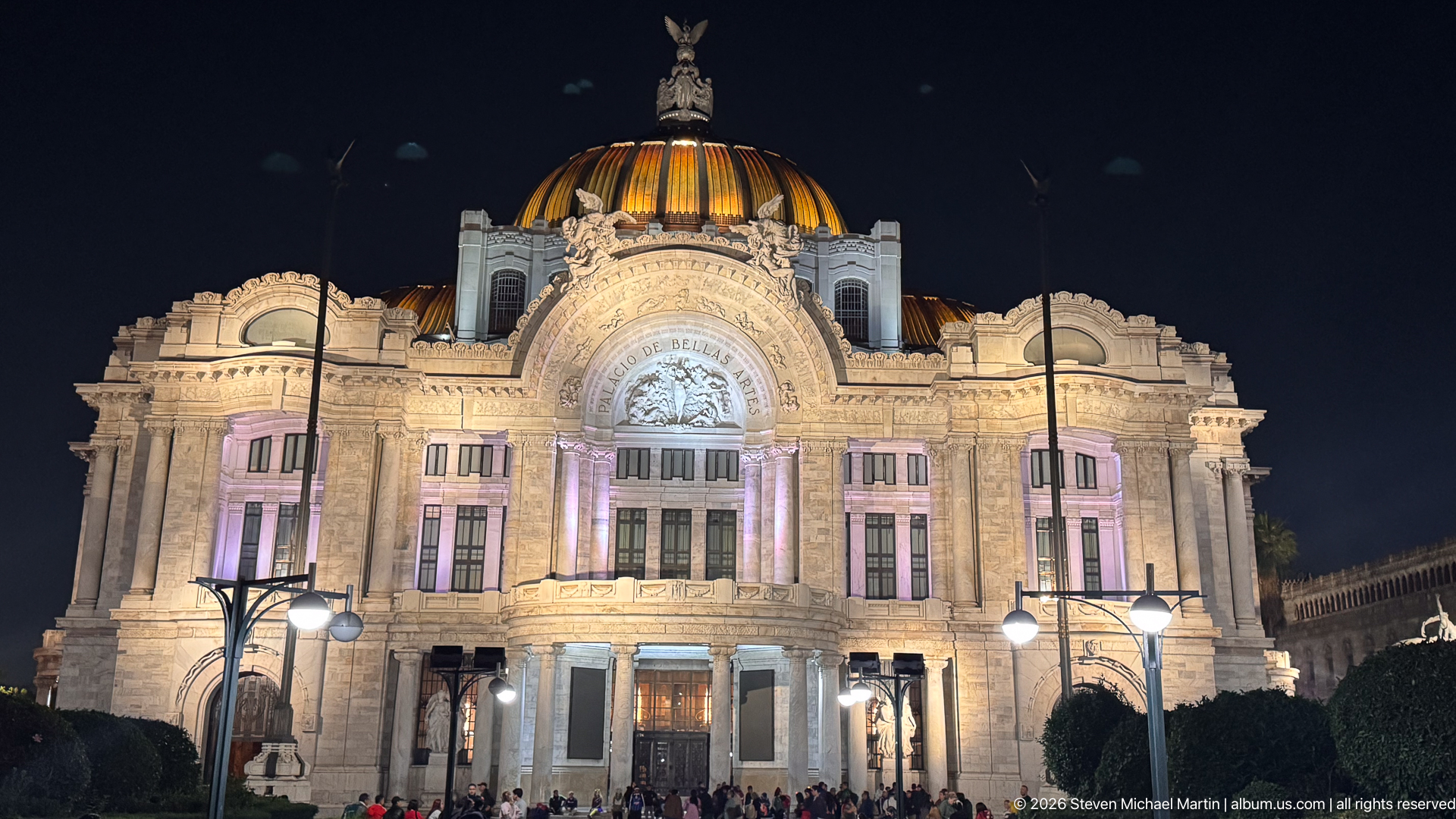
After dark, the full front elevation glows under warm architectural lighting, with violet accents illuminating the upper bays and the ribbed dome shining amber above. Visitors gather along the entrance steps and forecourt, supplying scale without obscuring the symmetrical composition. The nighttime view brings out the contrast between the pale stone, dark windows, and colored illumination across the palace façade.
Caption
After dark, the full front elevation glows under warm architectural lighting, with violet accents illuminating the upper bays and the ribbed dome shining amber above. Visitors gather along the entrance steps and forecourt, supplying scale without obscuring the symmetrical composition. The nighttime view brings out the contrast between the pale stone, dark windows, and colored illumination across the palace façade.
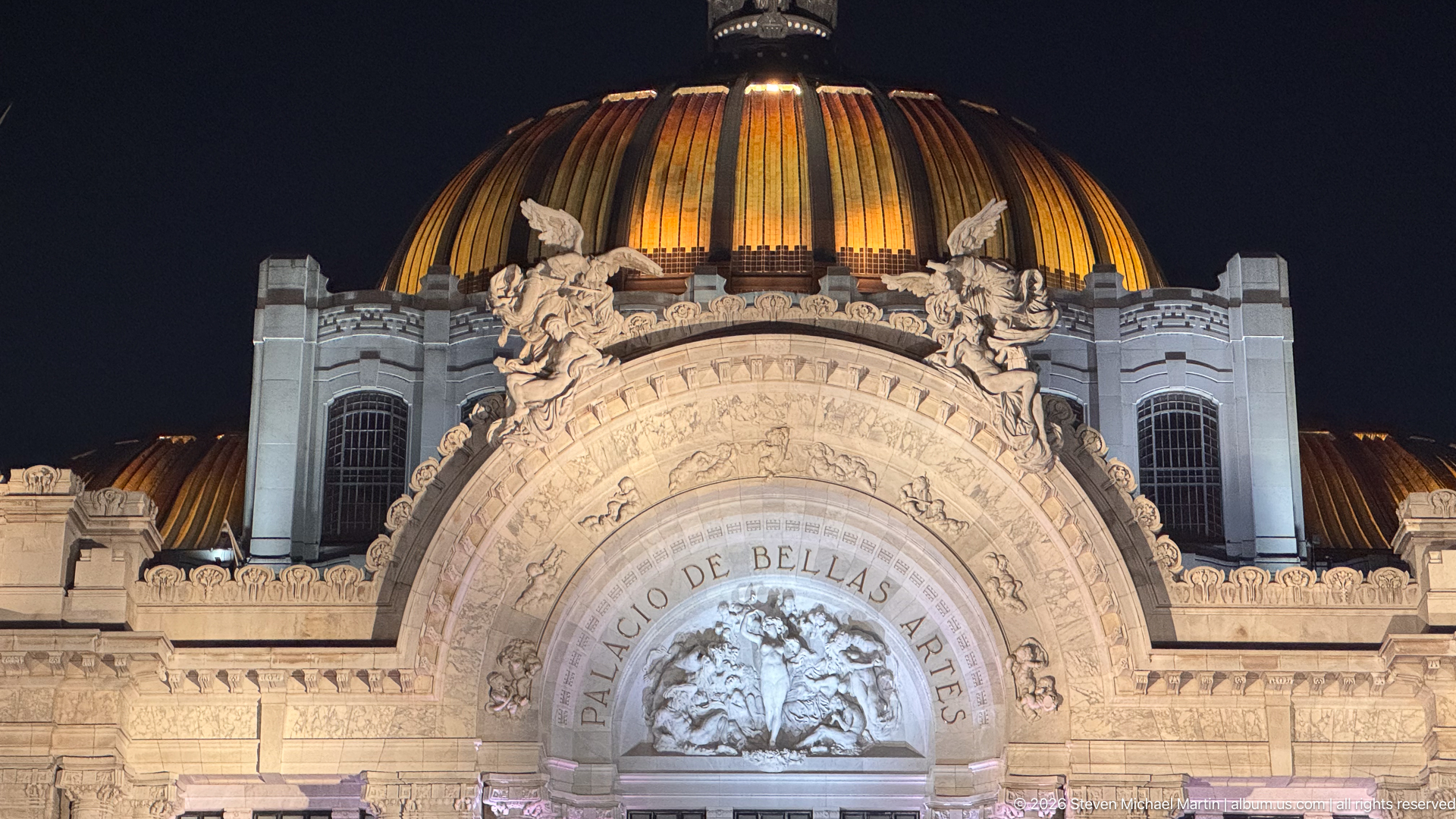
The composition tightens around the upper façade, where the amber-lit dome rises behind the central arch and sculpted crest. Warm light catches the carved stone while purple illumination colors the flanking bays; the black sky removes surrounding city detail. Compared with a full-building view, this crop concentrates on the layered roofline and the changing materials and light across the palace at night.
Caption
The composition tightens around the upper façade, where the amber-lit dome rises behind the central arch and sculpted crest. Warm light catches the carved stone while purple illumination colors the flanking bays; the black sky removes surrounding city detail. Compared with a full-building view, this crop concentrates on the layered roofline and the changing materials and light across the palace at night.
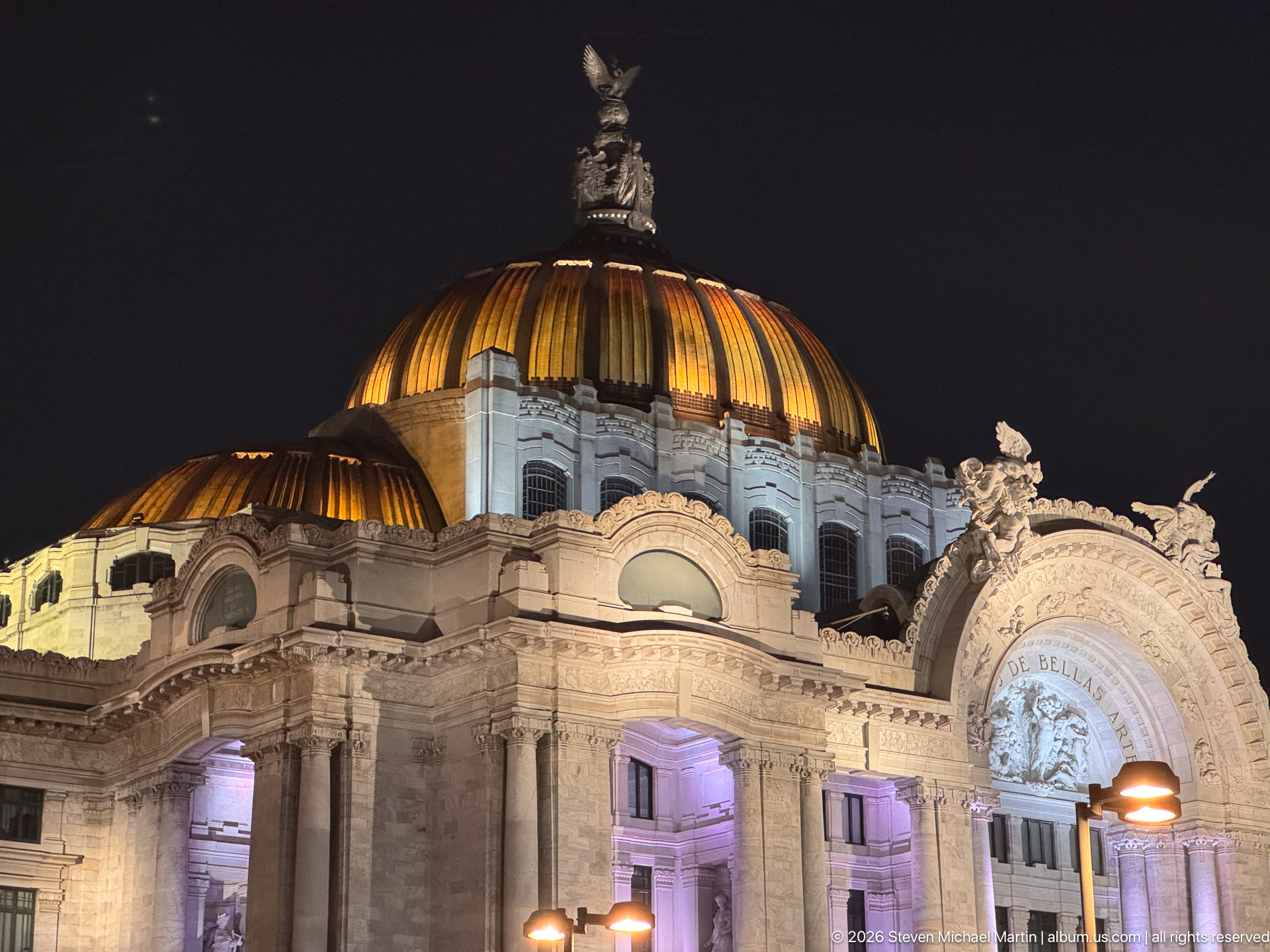
At night, the palace is seen from an oblique position that brings its amber-lit central dome forward while the lower façade recedes toward the right edge. The roof’s ribbed copper-toned surfaces and the smaller side domes stand out against the black sky, while warm spotlights pick out the carved arch and upper windows. The crop emphasizes the building’s vertical silhouette and illuminated roof.
Caption
At night, the palace is seen from an oblique position that brings its amber-lit central dome forward while the lower façade recedes toward the right edge. The roof’s ribbed copper-toned surfaces and the smaller side domes stand out against the black sky, while warm spotlights pick out the carved arch and upper windows. The crop emphasizes the building’s vertical silhouette and illuminated roof.
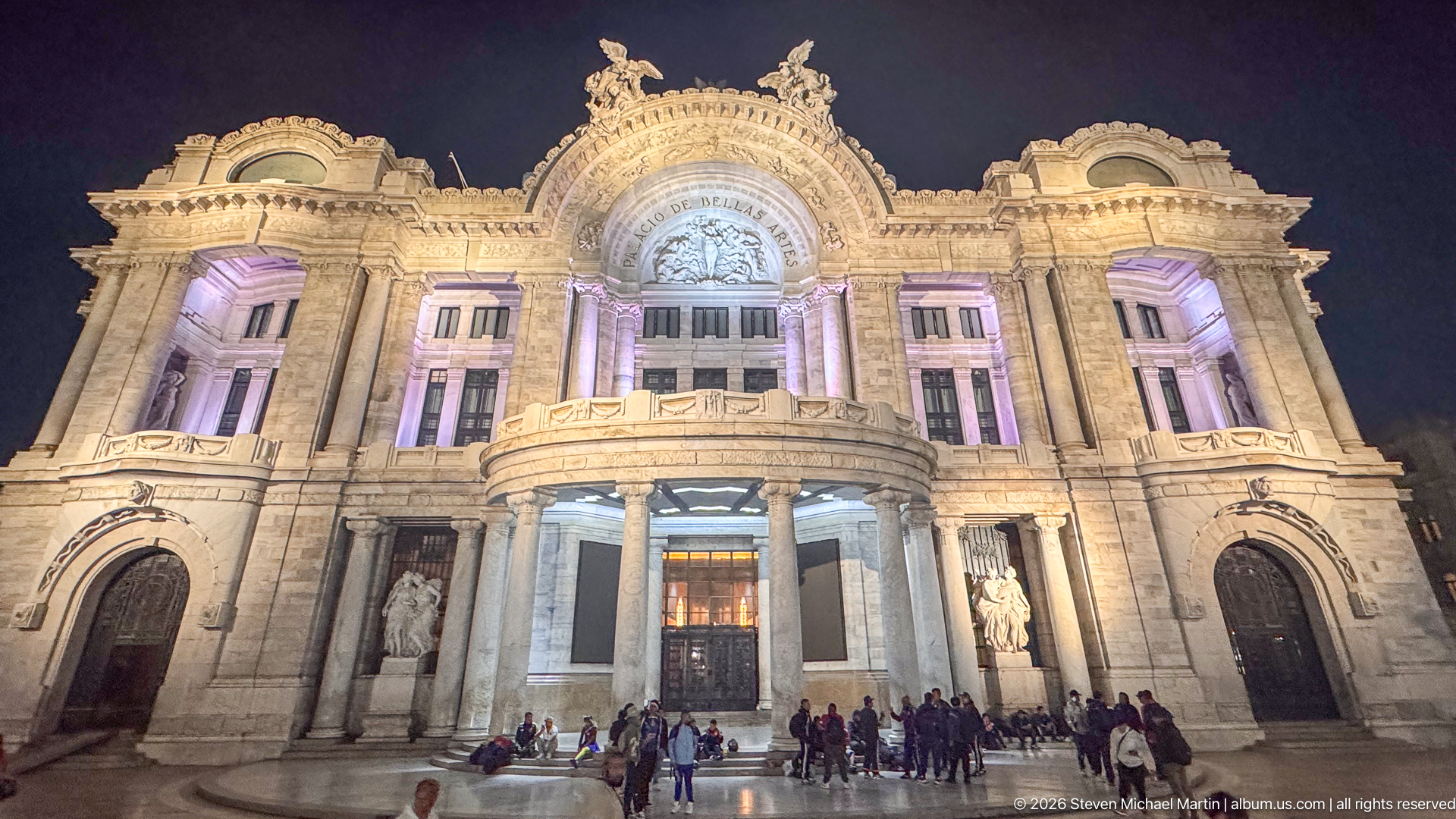
A centered nighttime view returns to the palace’s full principal façade. Purple light washes the upper bays, warm illumination defines the pale stone and central arch, and small groups of visitors gather beneath the entrance. The symmetrical elevation reads clearly from the forecourt, while the dark sky isolates the building and heightens the contrast between the lit dome and surrounding architecture.
Caption
A centered nighttime view returns to the palace’s full principal façade. Purple light washes the upper bays, warm illumination defines the pale stone and central arch, and small groups of visitors gather beneath the entrance. The symmetrical elevation reads clearly from the forecourt, while the dark sky isolates the building and heightens the contrast between the lit dome and surrounding architecture.
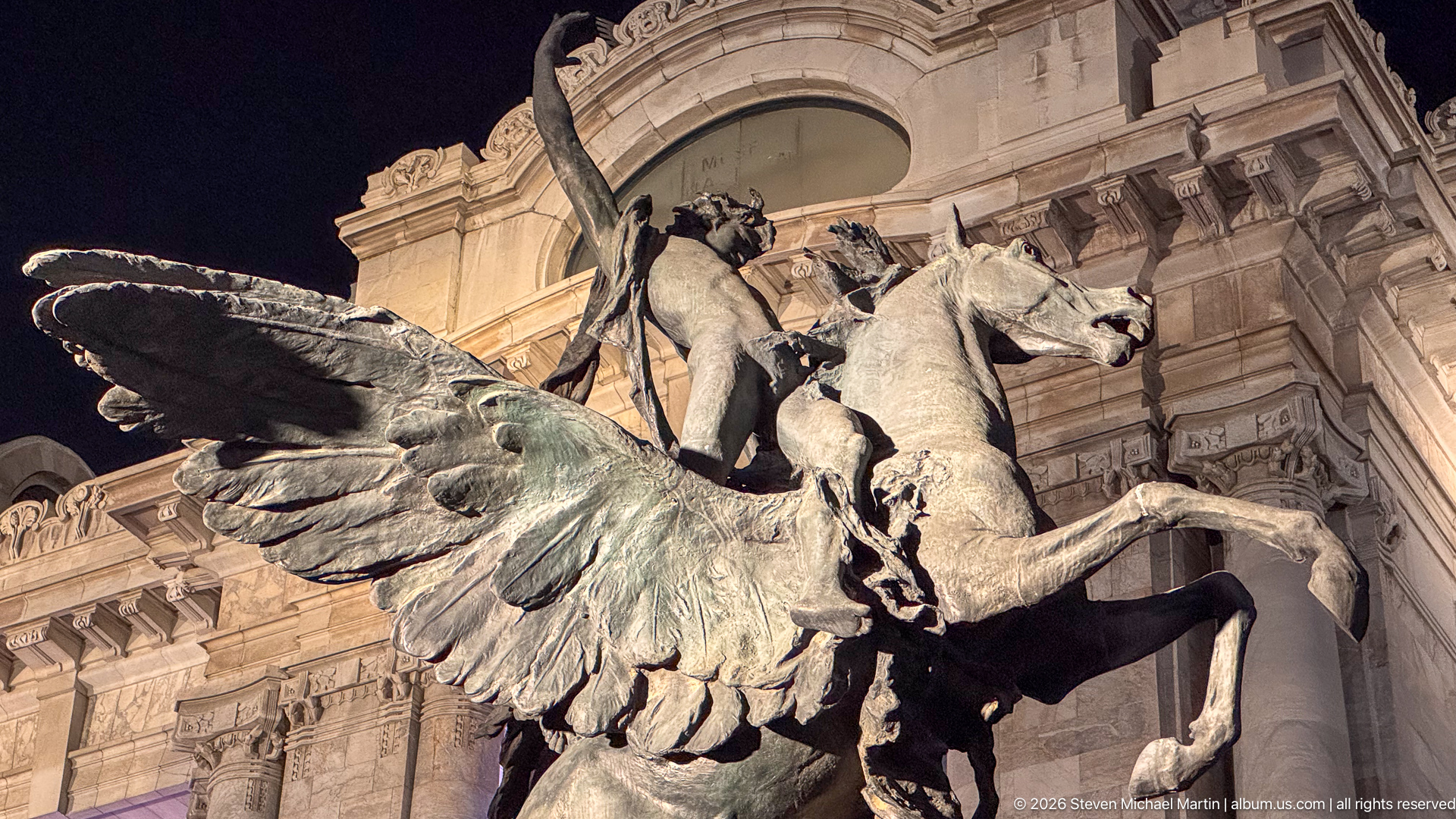
A bronze winged horse rears across the foreground, its spread wings and muscular body silhouetted against the illuminated stone façade. A rider-like figure rises above the animal, while carved architectural bands and a high window fill the background. This close angle identifies one of the Pegasos that adorn the palace esplanade; INBAL credits the bronze group to Agustín Querol.
Caption
A bronze winged horse rears across the foreground, its spread wings and muscular body silhouetted against the illuminated stone façade. A rider-like figure rises above the animal, while carved architectural bands and a high window fill the background. This close angle identifies one of the Pegasos that adorn the palace esplanade; INBAL credits the bronze group to Agustín Querol.
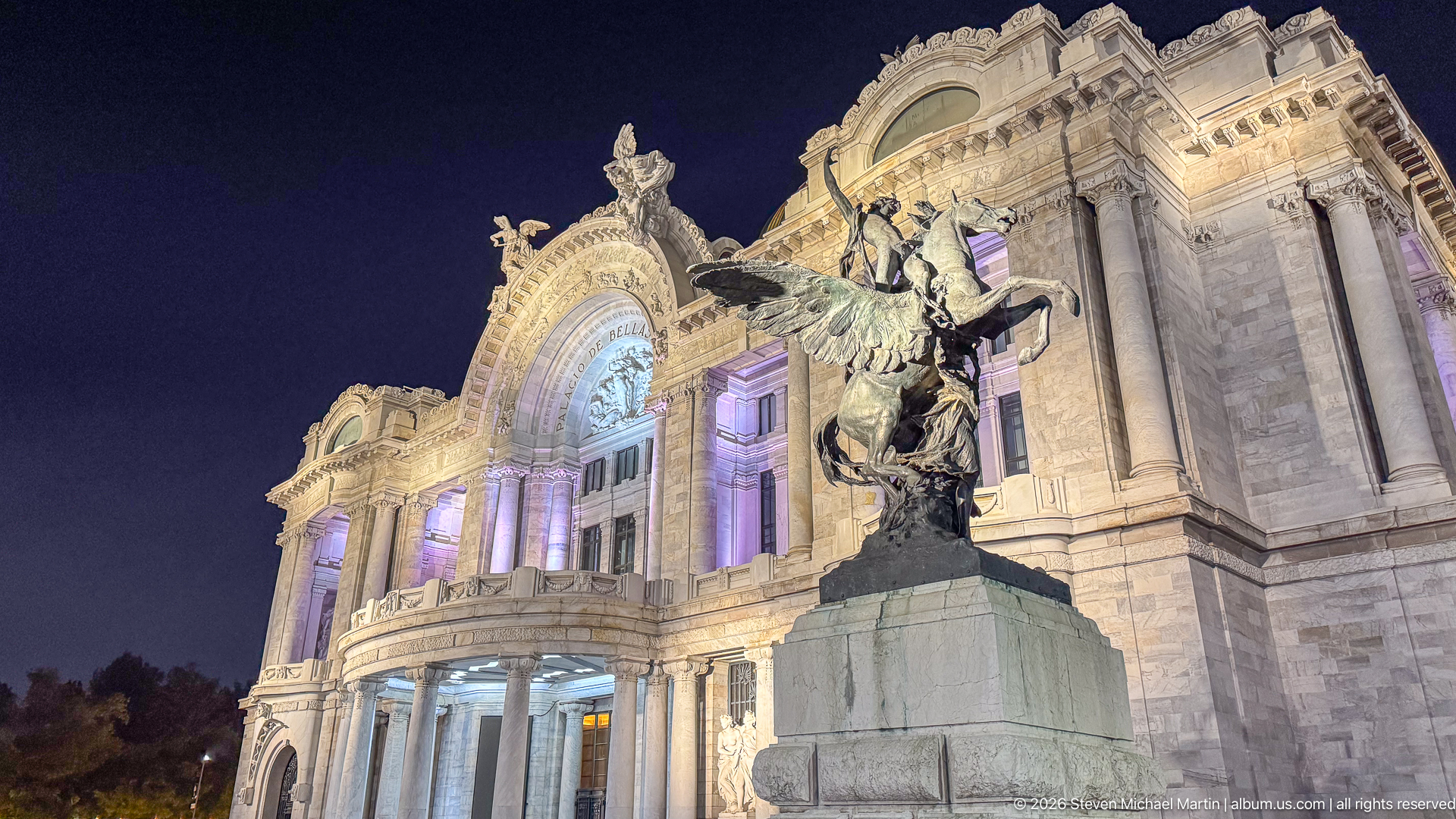
From a low side angle, the bronze Pegaso group stands on a tall stone plinth before the palace’s illuminated entrance. Its raised wings and twisting figures overlap the building’s columns and arch, while the façade recedes diagonally into the night. This view makes the relationship between the freestanding sculpture and the monumental architecture especially clear, rather than presenting either as an isolated subject.
Caption
From a low side angle, the bronze Pegaso group stands on a tall stone plinth before the palace’s illuminated entrance. Its raised wings and twisting figures overlap the building’s columns and arch, while the façade recedes diagonally into the night. This view makes the relationship between the freestanding sculpture and the monumental architecture especially clear, rather than presenting either as an isolated subject.
🏛️ Museum Field Guide
📍 Overview
Palacio de Bellas Artes brings its architecture and collections together in one expansive visit. Photographs move from the marble stair hall and circular atrium dome to monumental murals, roofline sculptures, and the palace’s copper dome. Inside, large painted works share the visitor’s attention with marble, metalwork, and the building’s sculptural details.
◆ Institutional History
The palace’s identity as a home for art is visible in the way its galleries and public spaces frame the works on display. A scale model introduces the building as a complete composition, while photographs of the stair hall show murals integrated into the visitor’s route. Here, the institution’s story is encountered through the relationship between the palace, its collections, and the people who come to see them.
◆ Collections
Monumental murals are a defining presence in the photographed interiors. Their scenes include human figures, animals, machinery, and community life, with views ranging from broad compositions to close details. The collection also includes sculptural works and architectural reliefs, while the palace’s model, metal doors, and decorative elements provide further ways to consider how art and built space meet.
◆ Signature Objects
The murals command attention through their scale and placement across stair halls and gallery walls. Look closely at the relief identified as “La Armonía” and the winged horse sculpture identified as Pegaso by Agustín Querol. The palace’s sculptural crown, dome finial, and roofline figures offer additional focal points, especially when seen against the sky.
◆ Interpretation & Display
The displays invite visitors to read artworks in relation to their setting. Murals appear between marble piers, above landings, and beneath balconies, so a close view of a painted detail can be followed by a wider look at the hall around it. The scale model offers another perspective, bringing the building’s dome, façades, and grounds into a single view.
🥾 Visitor Experience
The interior unfolds through tall marble spaces, staircases, balconies, and a circular glass-and-metal dome. Visitors move between close encounters with murals and views across the atrium, where architecture remains part of the experience at every level. The photographs also show the palace’s public setting through daytime forecourt scenes, evening views, and Día de Muertos displays outside.
📷 Photography Notes
Photograph murals both in context and in detail: include the stair hall or marble piers to show their scale, then move closer to record figures, machinery, and other painted forms. Look upward for the atrium dome and roof sculptures, and use the model to frame the palace as a whole. Outside, compare daylight and nighttime views; the Día de Muertos carpet and visitors can add a sense of scale to the façade.