Catedral Metropolitana de la Ciudad de México
Facing the Zócalo in the heart of the Centro Histórico, the Metropolitan Cathedral occupies a place at the center of Mexico City’s civic and religious life. The site was part of the sacred precinct of Tenochtitlan, and the cathedral’s long history reflects the transformation of the capital across successive eras. Its construction began in the sixteenth century and continued for generations.
Completed in 1813, the cathedral brings together architectural features shaped by changing tastes and successive builders. Renaissance, Baroque, and Neoclassical forms appear across its façade, towers, and dome, while the adjacent Sagrario Metropolitano forms part of the larger cathedral complex. The result is a landmark whose details reward attention from the broad plaza as well as from nearby streets.
Inside, five naves, side chapels, the choir, organs, and monumental altars create an interior of remarkable scale. The photographs follow the experience from the open space of the Zócalo into the cathedral’s layered rooms and devotional art. Together, they show how this historic church remains woven into the daily life of the city around it.
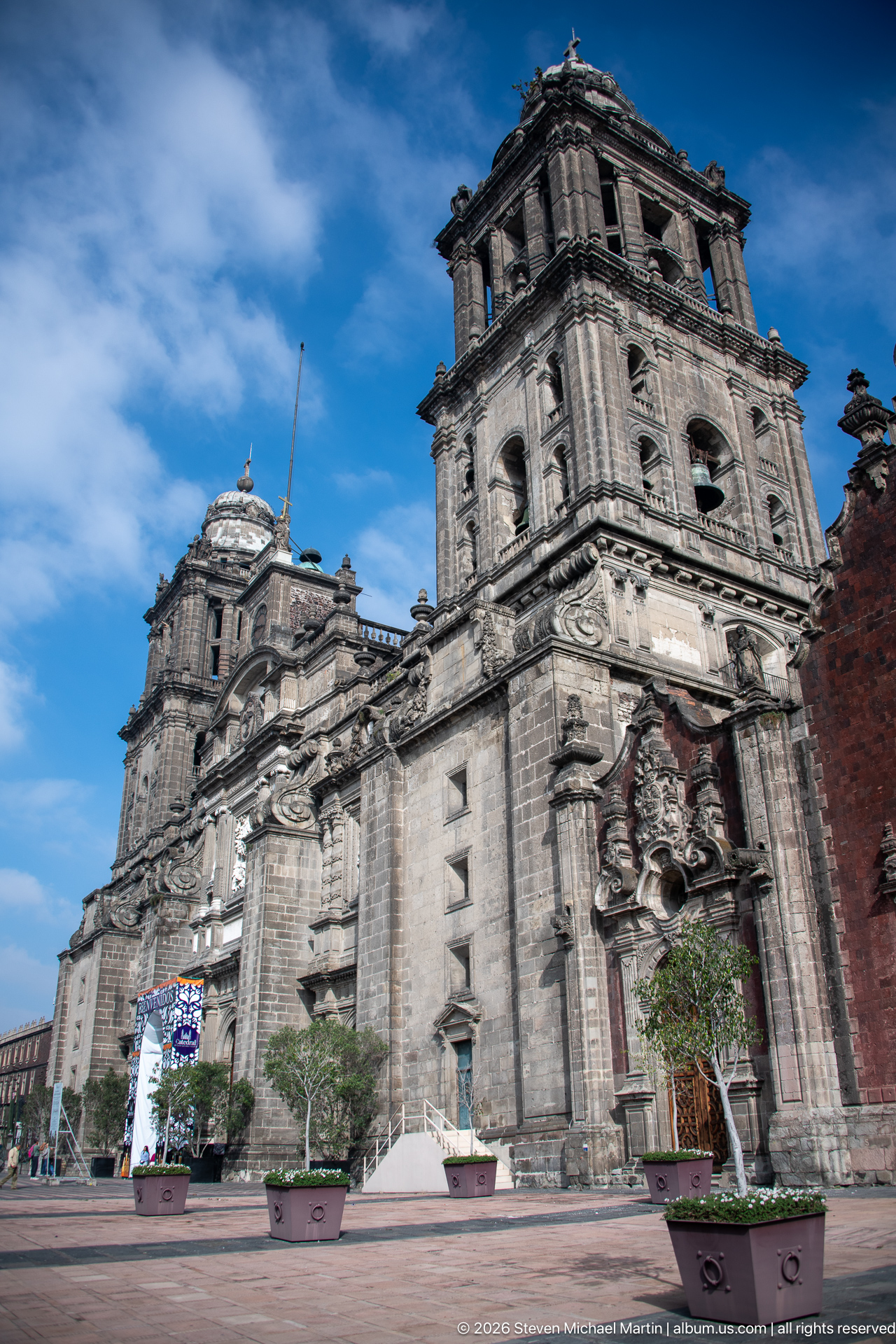
A low viewpoint sets the Metropolitan Cathedral’s south tower above the open paving, while the second tower and sculpted side façade recede to the left. Visitors crossing the foreground give scale to the weathered stonework beneath a bright, clouded sky.
Caption
A low viewpoint sets the Metropolitan Cathedral’s south tower above the open paving, while the second tower and sculpted side façade recede to the left. Visitors crossing the foreground give scale to the weathered stonework beneath a bright, clouded sky.
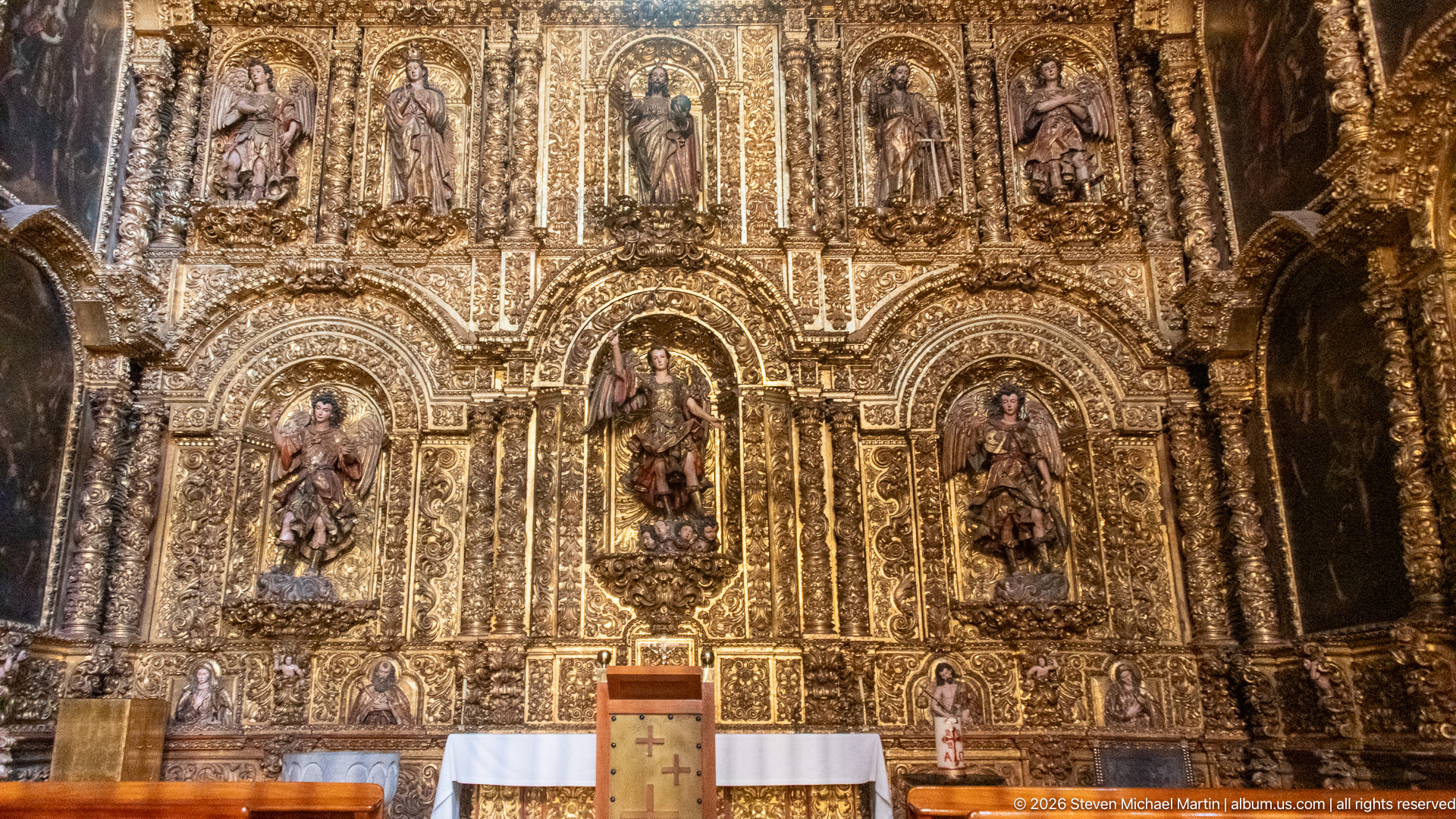
Standing figures fill the carved niches of a symmetrical gilded retablo behind a white altar table and lectern. The frontal view shows the arrangement from the lower register to the upper arches, with the working altar in the foreground.
Caption
Standing figures fill the carved niches of a symmetrical gilded retablo behind a white altar table and lectern. The frontal view shows the arrangement from the lower register to the upper arches, with the working altar in the foreground.
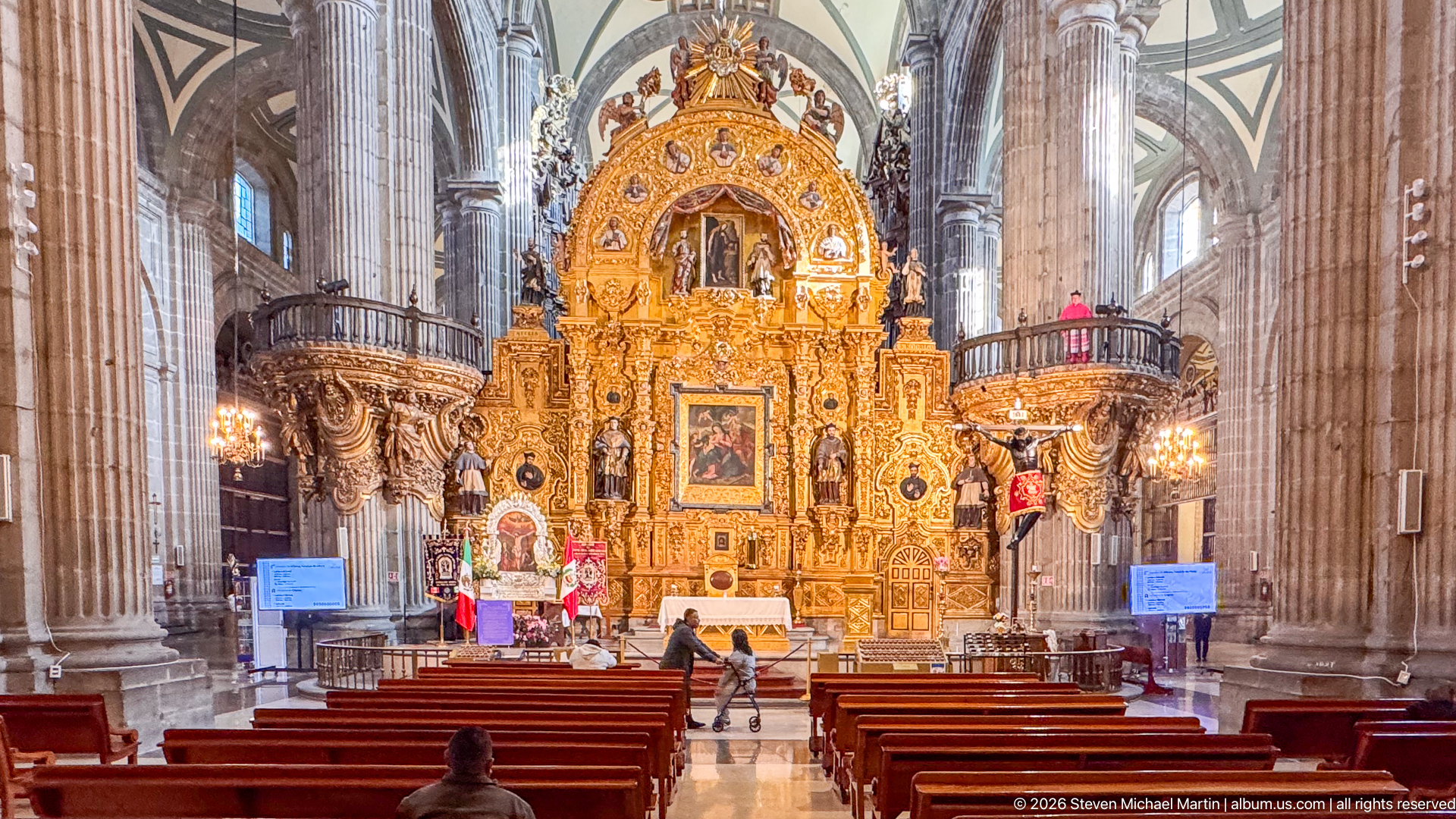
The cathedral’s monumental Retablo de los Reyes rises beyond the nave, its gilded tiers filled with carved figures and painted panels. Jerónimo de Balbás designed the Baroque retablo; its central canvases by Juan Rodríguez Juárez depict The Adoration of the Kings and The Assumption of the Virgin. Pews, stone piers, and visitors establish the scale of the ensemble.
Caption
The cathedral’s monumental Retablo de los Reyes rises beyond the nave, its gilded tiers filled with carved figures and painted panels. Jerónimo de Balbás designed the Baroque retablo; its central canvases by Juan Rodríguez Juárez depict The Adoration of the Kings and The Assumption of the Virgin. Pews, stone piers, and visitors establish the scale of the ensemble.
Two dark bronze figures stand on either side of the cathedral’s pale marble sanctuary structure. High arches, round windows, and chandeliers rise behind the sculptural group, giving the low, wide view a clear sense of scale.
Caption
Two dark bronze figures stand on either side of the cathedral’s pale marble sanctuary structure. High arches, round windows, and chandeliers rise behind the sculptural group, giving the low, wide view a clear sense of scale.
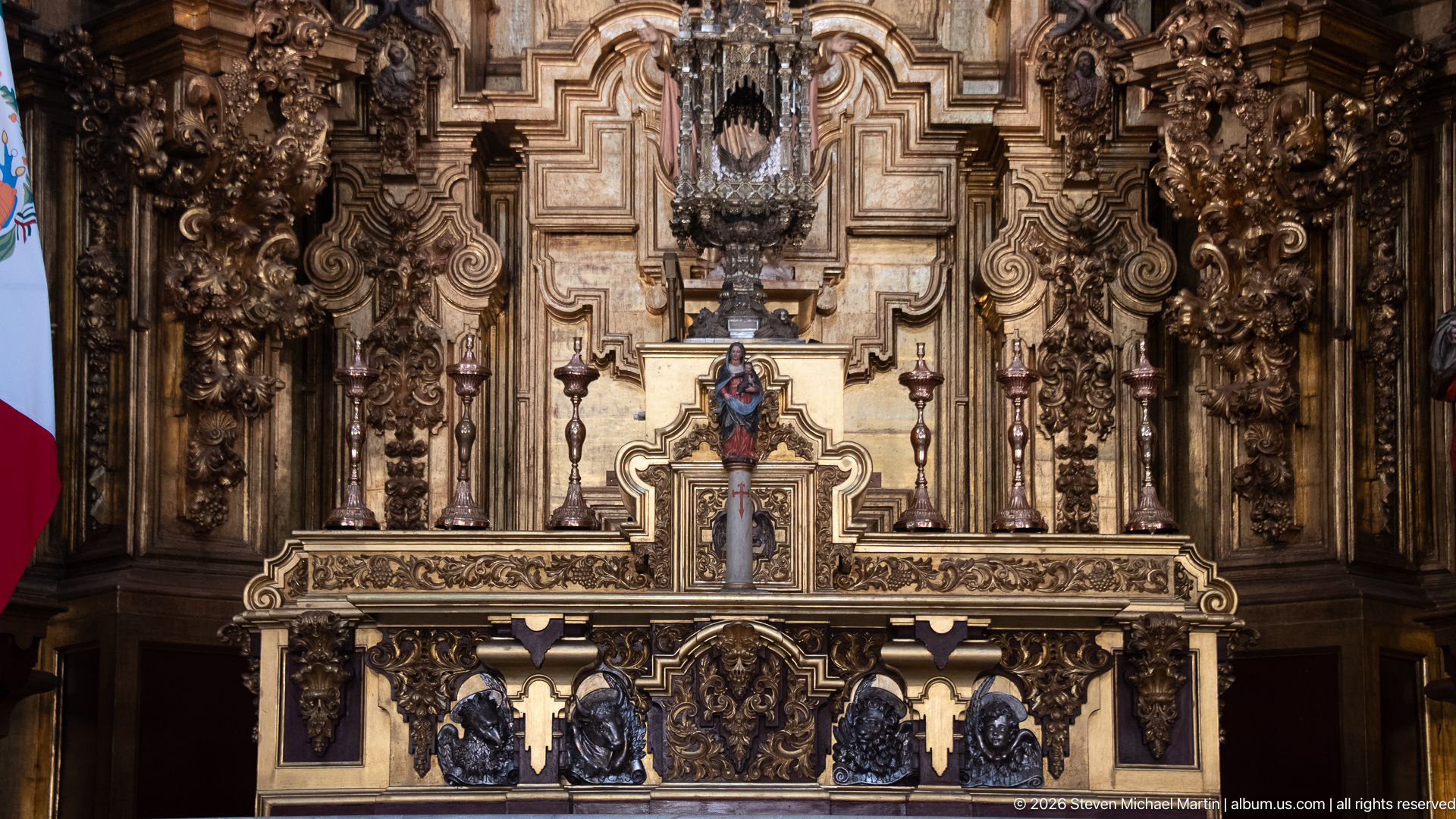
A small blue-and-red-robed Marian statue stands at the center of this gilded altar, above a narrow white column marked with a red cross. Four silver-toned candlesticks line the shelf, while carved panels, dark sculptural faces, and dense gold ornament fill the lower register. The close view shows this as a sculpted devotional altar rather than a painting.
Caption
A small blue-and-red-robed Marian statue stands at the center of this gilded altar, above a narrow white column marked with a red cross. Four silver-toned candlesticks line the shelf, while carved panels, dark sculptural faces, and dense gold ornament fill the lower register. The close view shows this as a sculpted devotional altar rather than a painting.
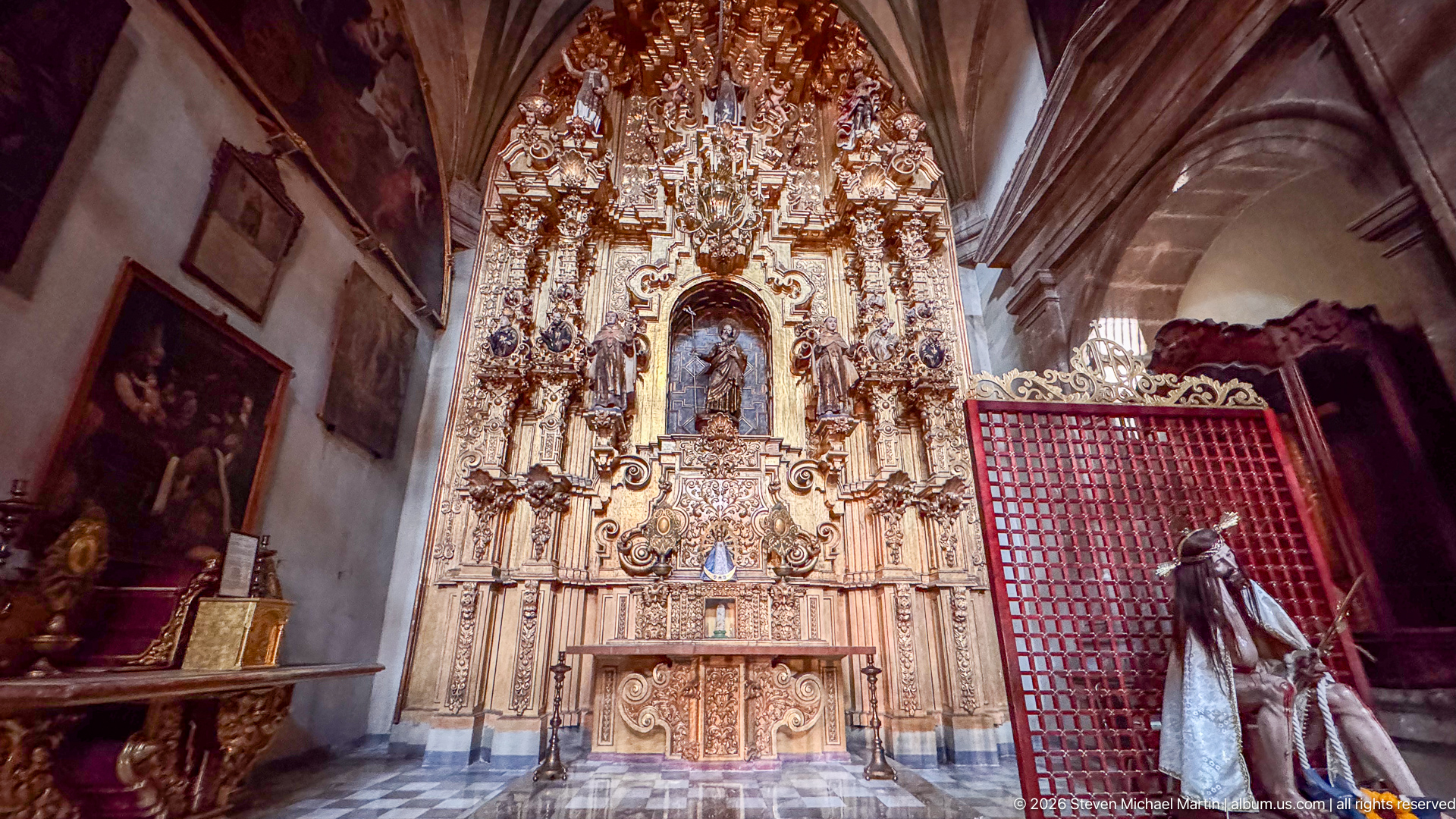
A gilded side altar stands beneath a pointed ribbed vault, with rows of pews leading toward its central image. A red grille closes the chapel opening at right, distinguishing this broad view from the closer retablo details.
Caption
A gilded side altar stands beneath a pointed ribbed vault, with rows of pews leading toward its central image. A red grille closes the chapel opening at right, distinguishing this broad view from the closer retablo details.
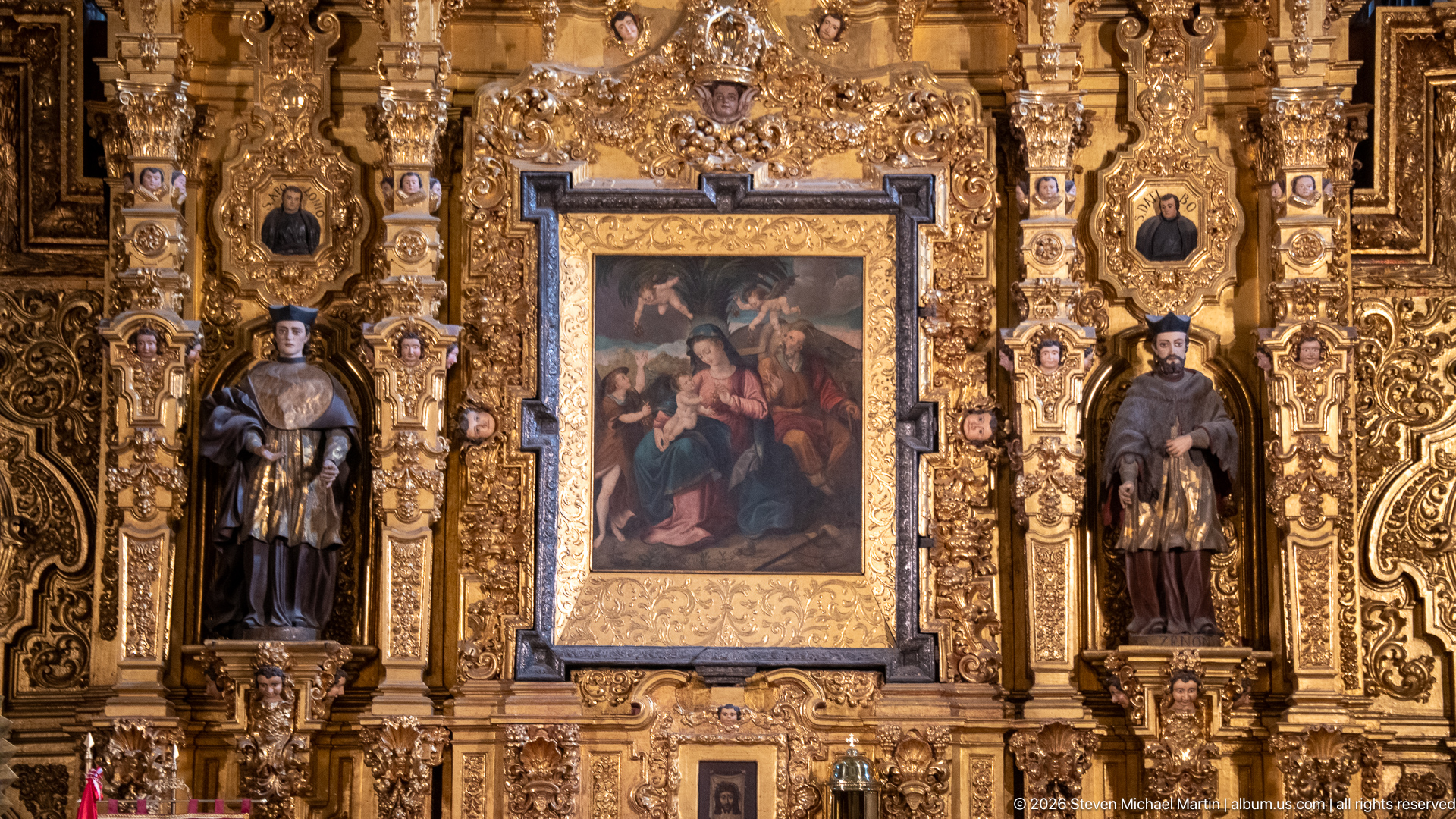
Mary, Joseph, and the infant Jesus appear together in the central Holy Family painting of this gilded retablo. Smaller portrait medallions and carved figures flank the canvas, while repeated gold columns and scrollwork turn the painting into the focal point of a larger altar ensemble.
Caption
Mary, Joseph, and the infant Jesus appear together in the central Holy Family painting of this gilded retablo. Smaller portrait medallions and carved figures flank the canvas, while repeated gold columns and scrollwork turn the painting into the focal point of a larger altar ensemble.
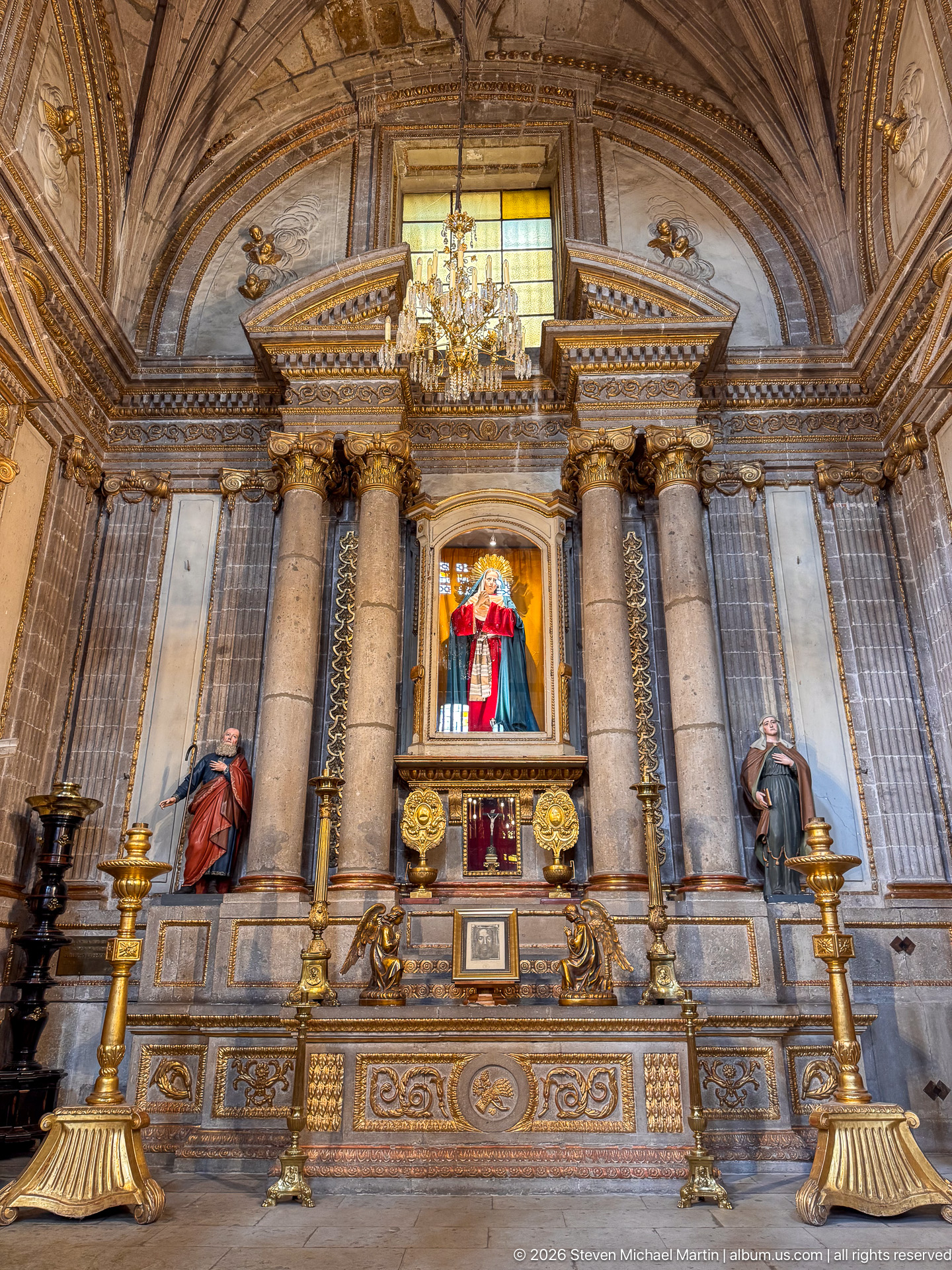
A columned Marian altar fills the chapel bay beneath a painted vault. The central image is framed by smaller statues, gilded lamps, and an ornamented lower tier, while the wider composition shows how the altar fits within the surrounding architecture.
Caption
A columned Marian altar fills the chapel bay beneath a painted vault. The central image is framed by smaller statues, gilded lamps, and an ornamented lower tier, while the wider composition shows how the altar fits within the surrounding architecture.
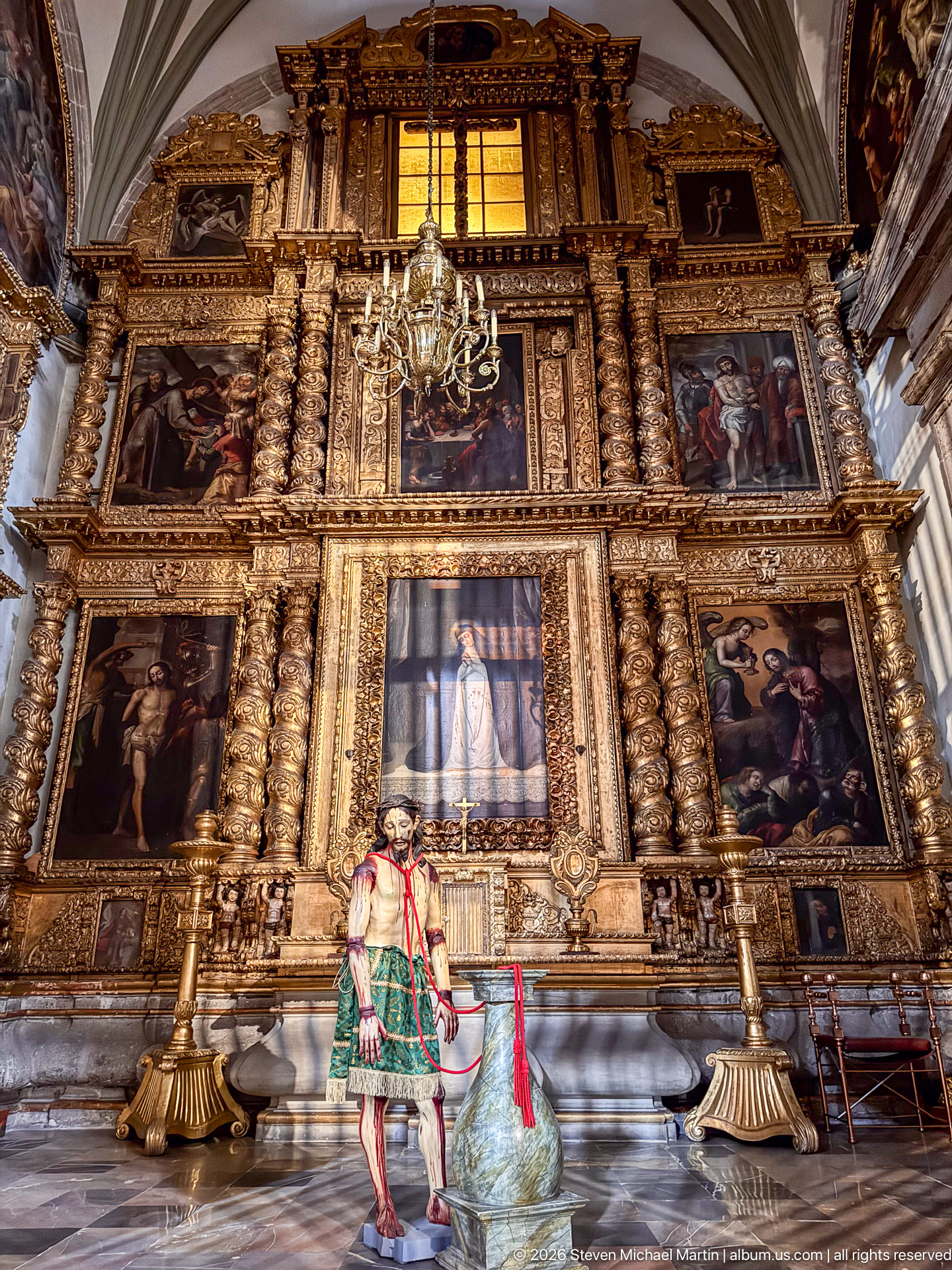
A standing Christ figure in a green garment anchors the lower center of this wide, frontal retablo view. Painted panels, carved figures, a chandelier, and the reflective floor show the altar’s full height and its separation from visitors.
Caption
A standing Christ figure in a green garment anchors the lower center of this wide, frontal retablo view. Painted panels, carved figures, a chandelier, and the reflective floor show the altar’s full height and its separation from visitors.
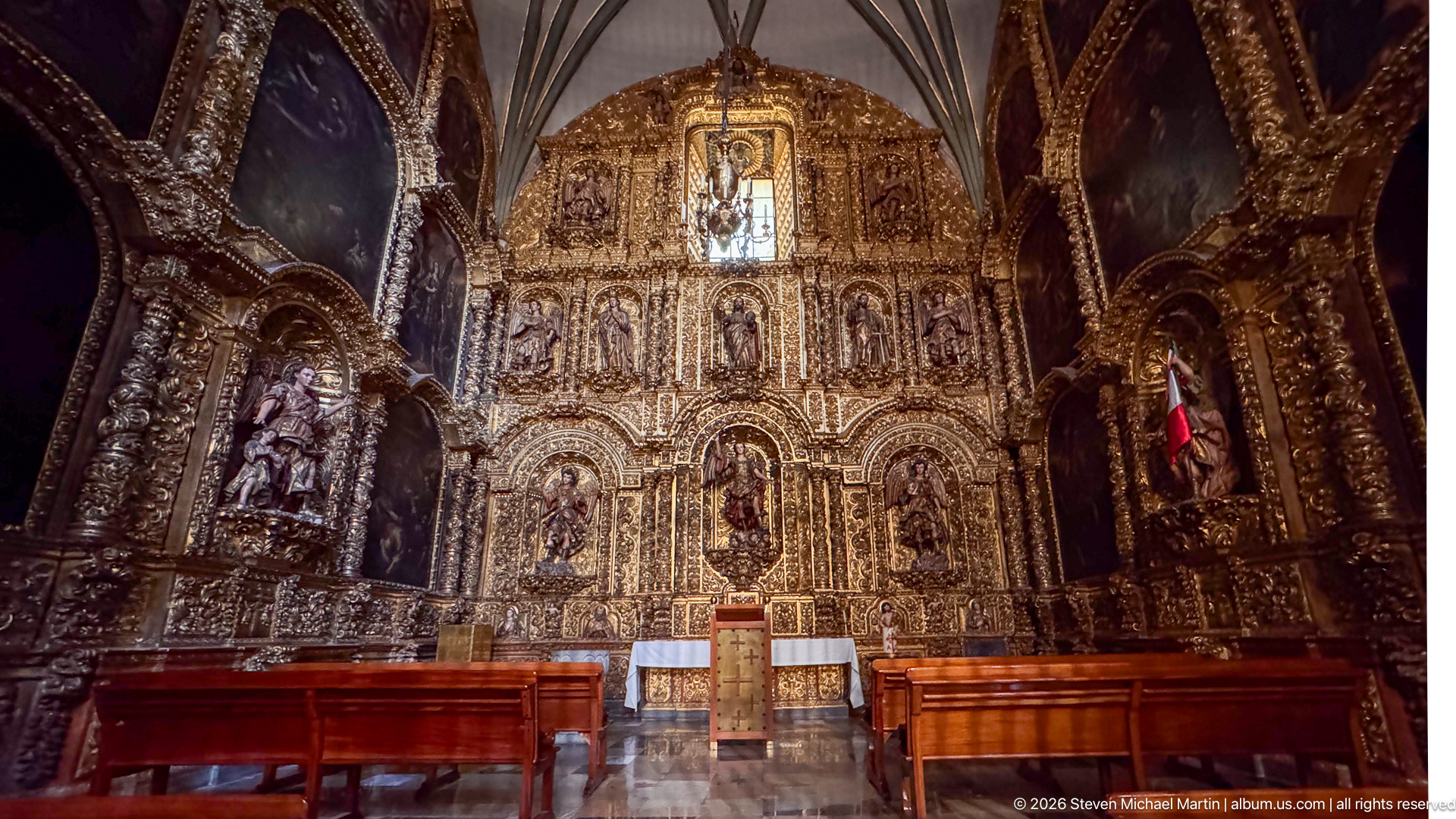
A tall gilded retablo fills the far end of a dim side chapel beneath dark ribbed stone vaulting. Pews lead toward its stacked paintings and carved saints, while a red grille marks the chapel’s right edge.
Caption
A tall gilded retablo fills the far end of a dim side chapel beneath dark ribbed stone vaulting. Pews lead toward its stacked paintings and carved saints, while a red grille marks the chapel’s right edge.
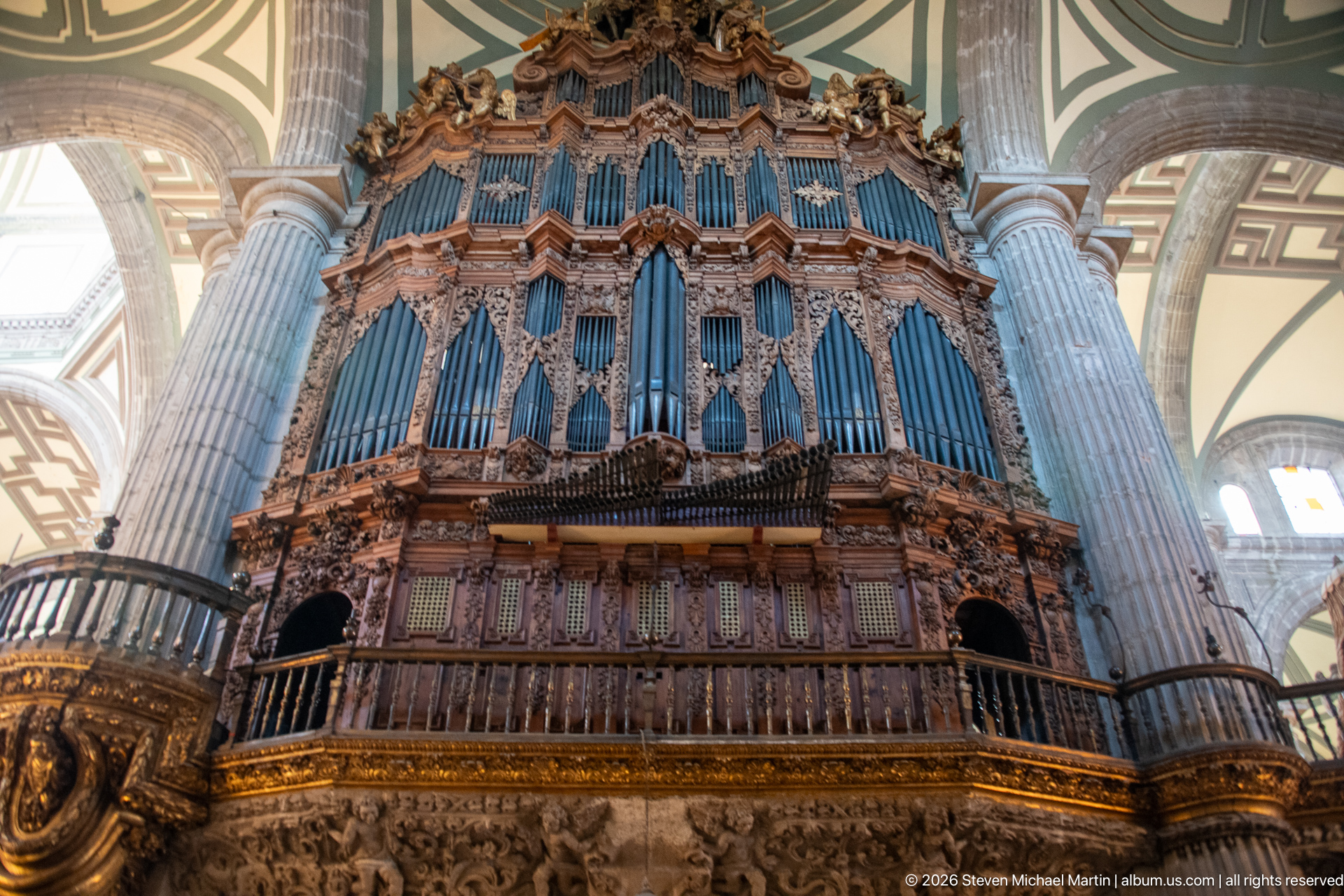
Blue-gray pipes rise in stepped groups within a deeply carved wooden organ case between fluted stone columns. The low angle shows how the instrument and its gallery are integrated into the cathedral’s architecture.
Caption
Blue-gray pipes rise in stepped groups within a deeply carved wooden organ case between fluted stone columns. The low angle shows how the instrument and its gallery are integrated into the cathedral’s architecture.
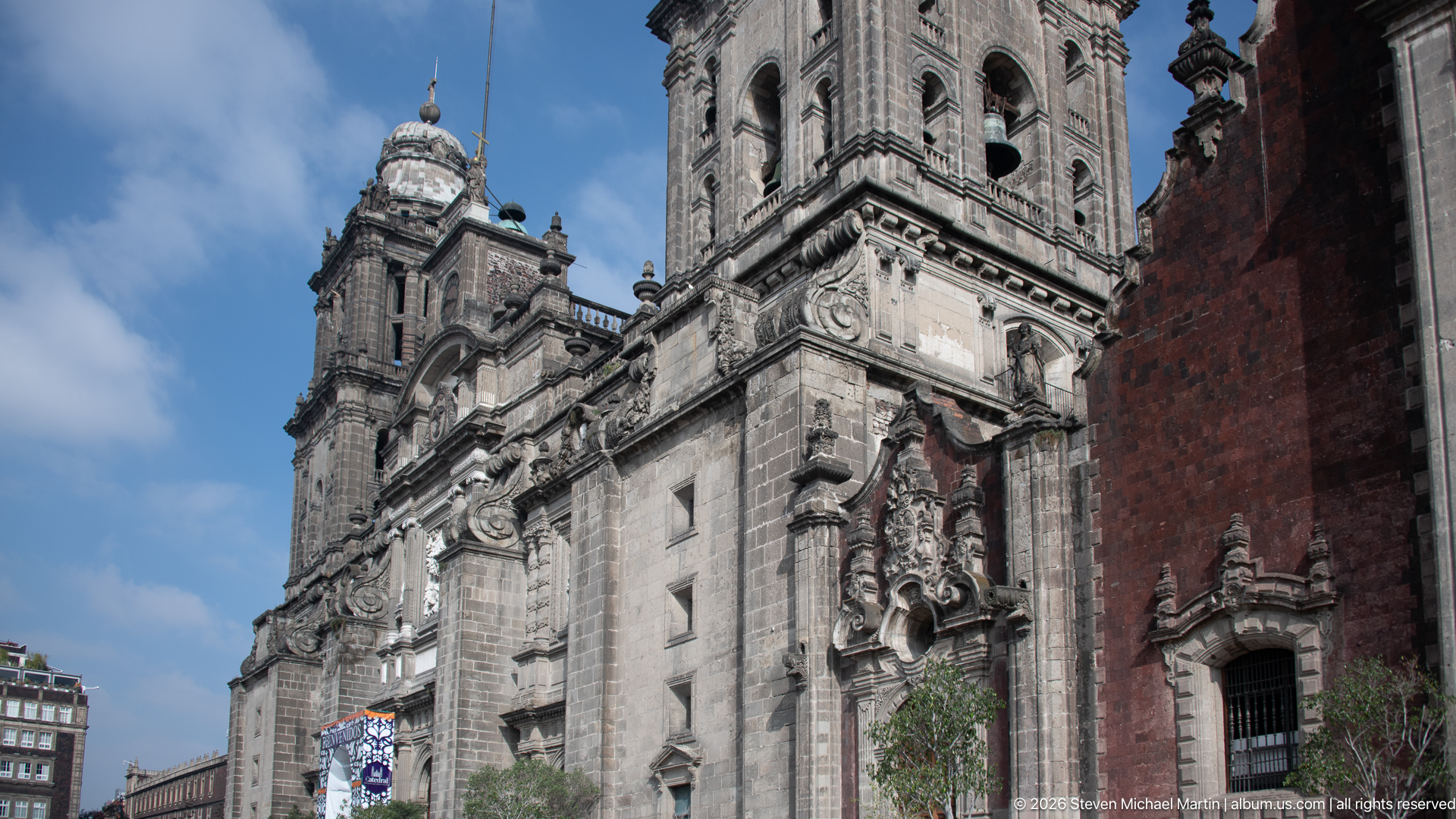
Viewed from close below, the cathedral’s corner bell tower reveals stacked arched openings, paired columns, and carved cornices. The adjoining red-brick wall and the dome behind it show how the tower meets neighboring parts of the complex.
Caption
Viewed from close below, the cathedral’s corner bell tower reveals stacked arched openings, paired columns, and carved cornices. The adjoining red-brick wall and the dome behind it show how the tower meets neighboring parts of the complex.
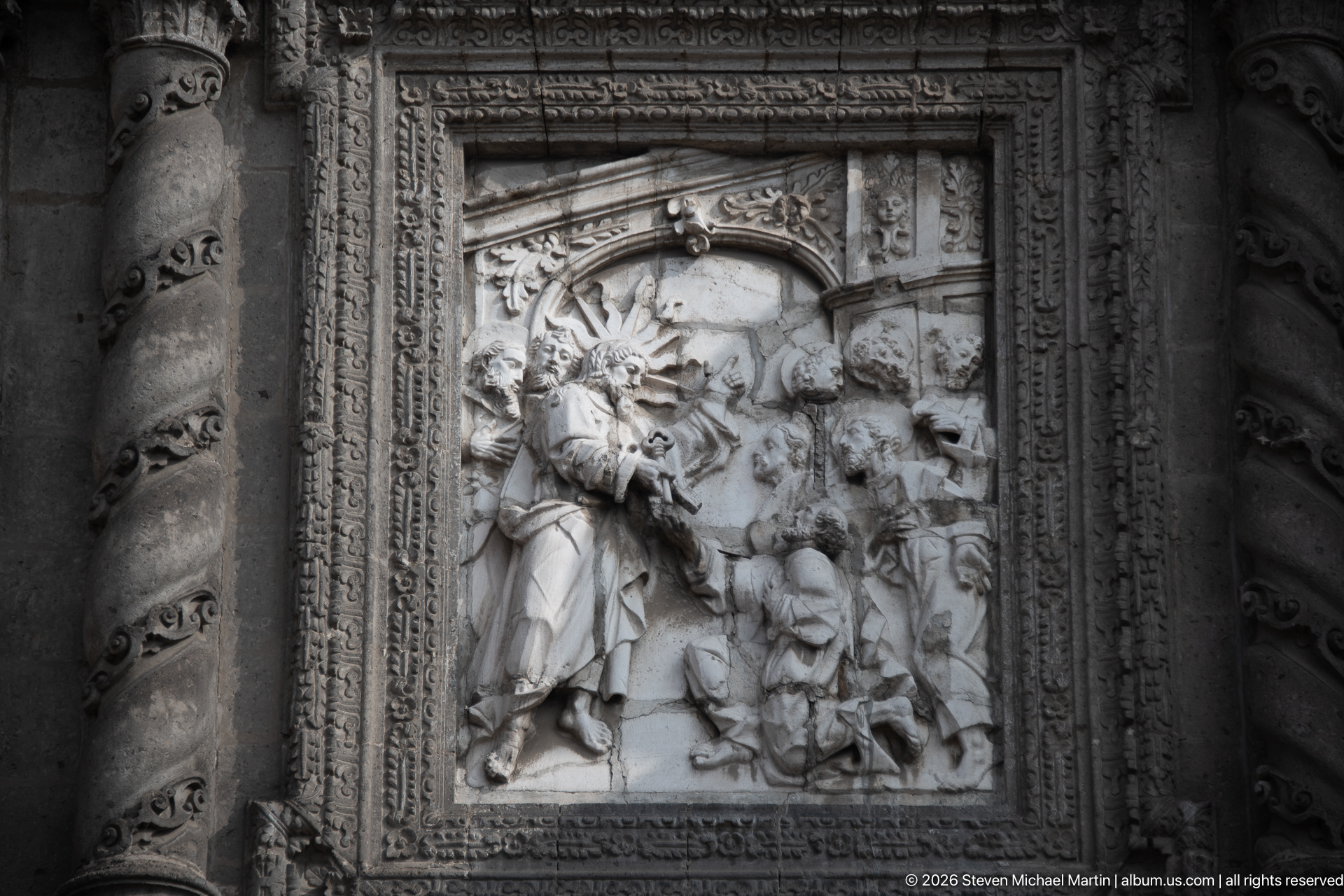
A framed stone relief on the cathedral façade gathers several robed figures around a larger central figure. Foliate carving and projecting bands deepen the frame, turning this close section of the exterior into a sculptural tableau.
Caption
A framed stone relief on the cathedral façade gathers several robed figures around a larger central figure. Foliate carving and projecting bands deepen the frame, turning this close section of the exterior into a sculptural tableau.
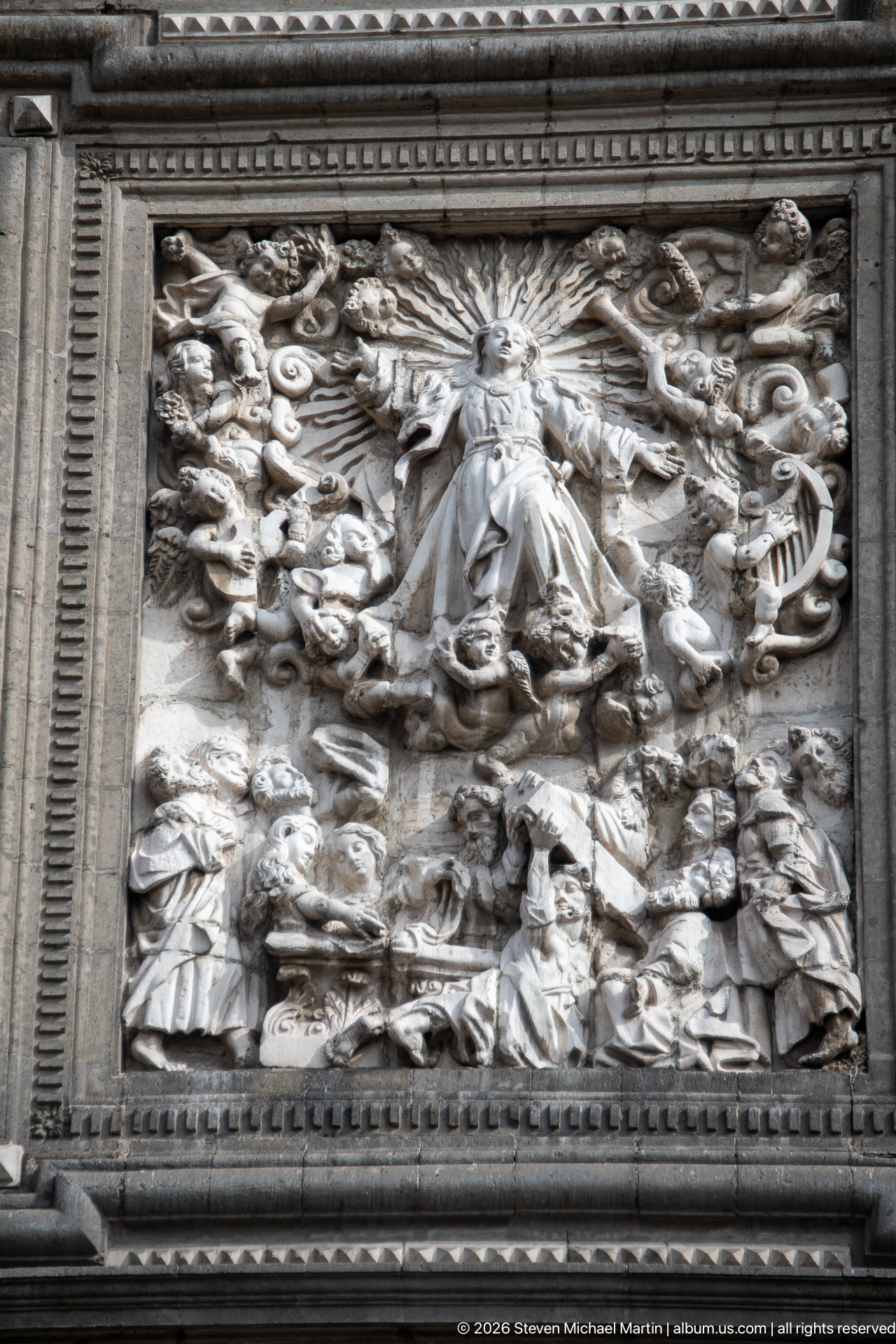
Above the cathedral entrance, a broad horizontal relief arranges a central figure among smaller figures and curling forms. The pale carving stands out beneath a heavy cornice against the darker façade masonry.
Caption
Above the cathedral entrance, a broad horizontal relief arranges a central figure among smaller figures and curling forms. The pale carving stands out beneath a heavy cornice against the darker façade masonry.
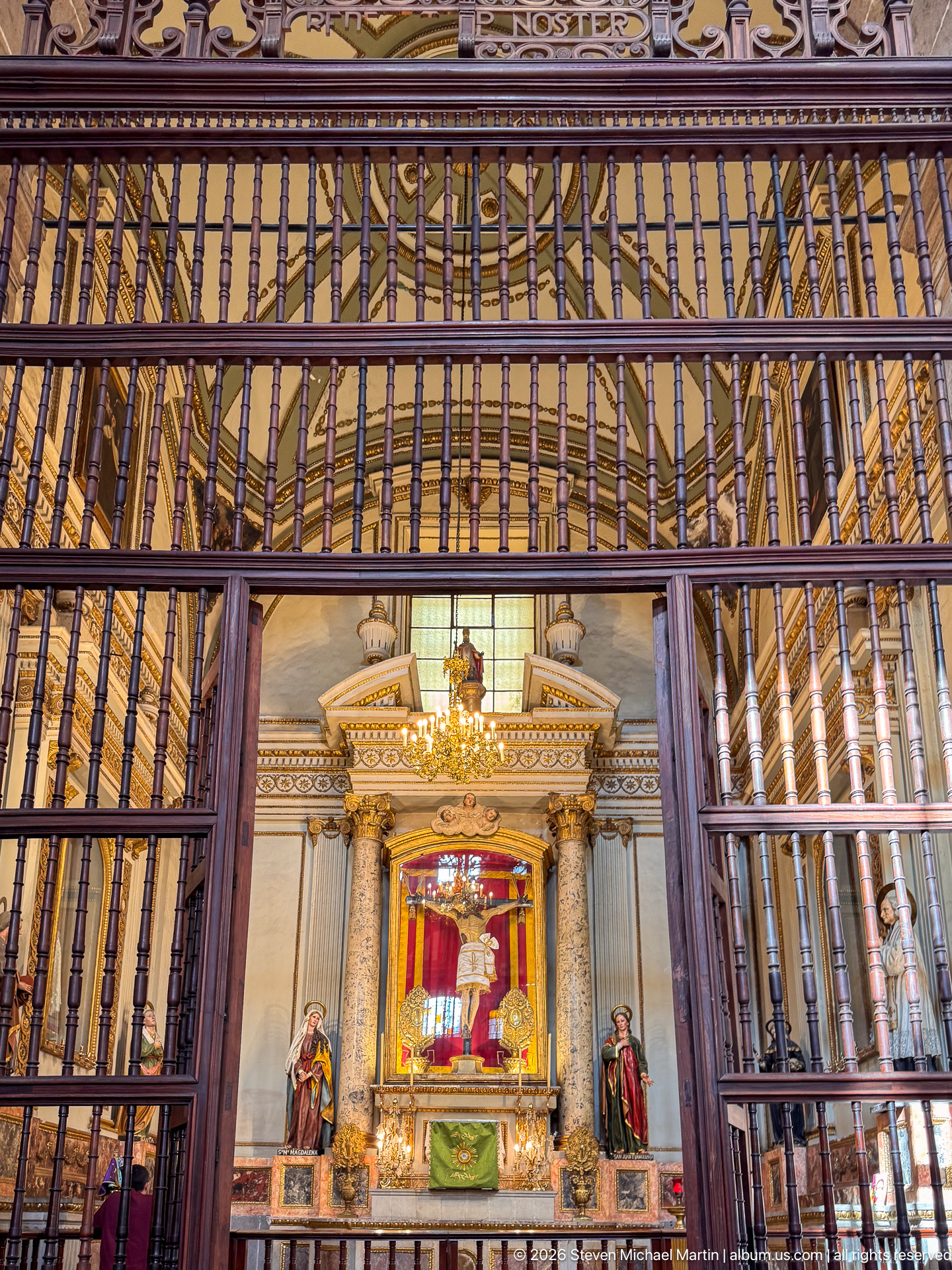
Close-set bars of a dark metal grille screen a side chapel, where paired columns frame a small altar and central devotional image. A chandelier and gold-toned ornament catch the light beyond the barrier.
Caption
Close-set bars of a dark metal grille screen a side chapel, where paired columns frame a small altar and central devotional image. A chandelier and gold-toned ornament catch the light beyond the barrier.
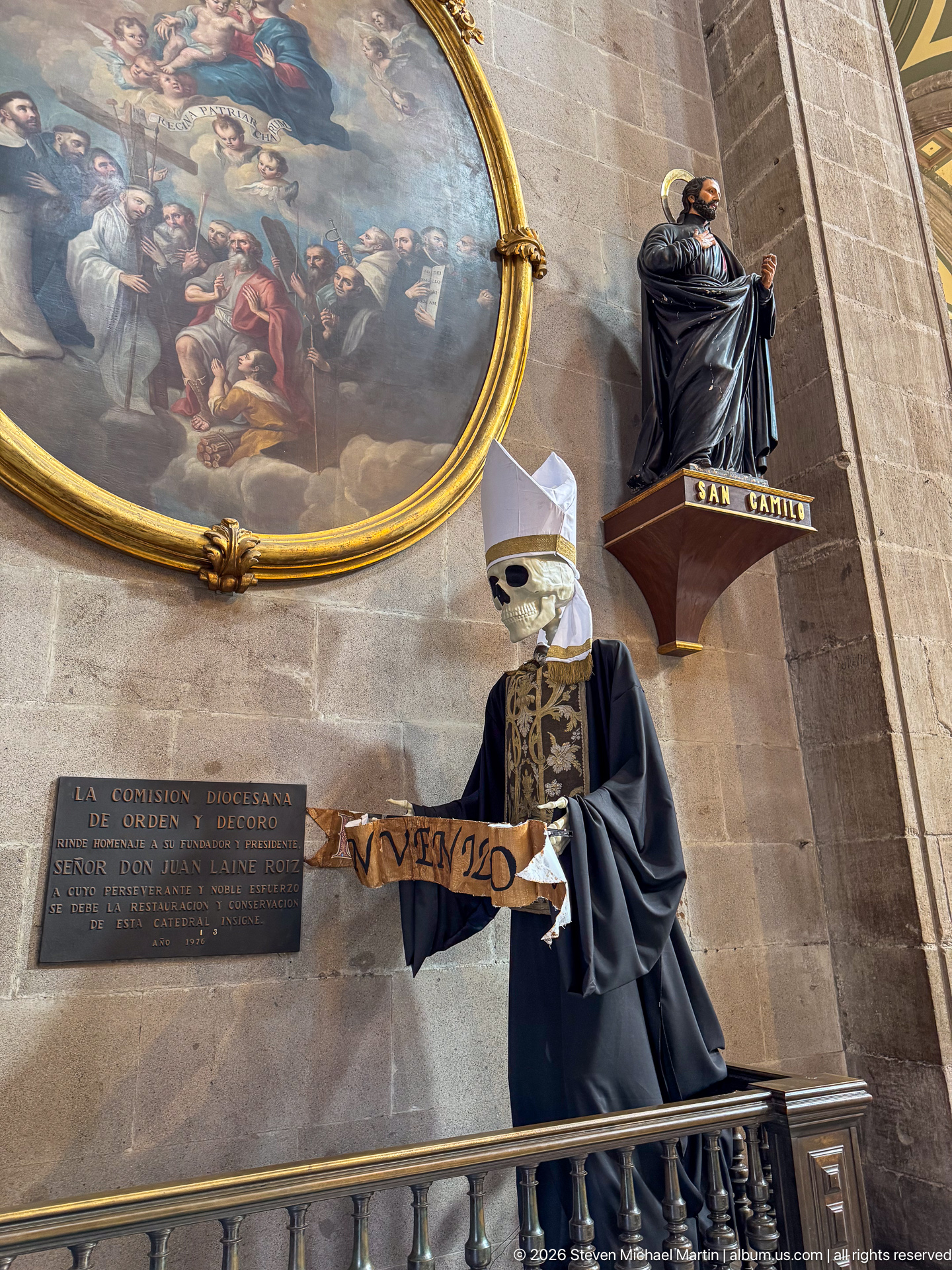
A mitred, dark-robed figure stands beside a religious painting and memorial plaque dedicated to San Camilo. The dedication ribbon and wall inscription identify the subject, allowing this display to be named rather than treated as an unidentified saint memorial.
Caption
A mitred, dark-robed figure stands beside a religious painting and memorial plaque dedicated to San Camilo. The dedication ribbon and wall inscription identify the subject, allowing this display to be named rather than treated as an unidentified saint memorial.
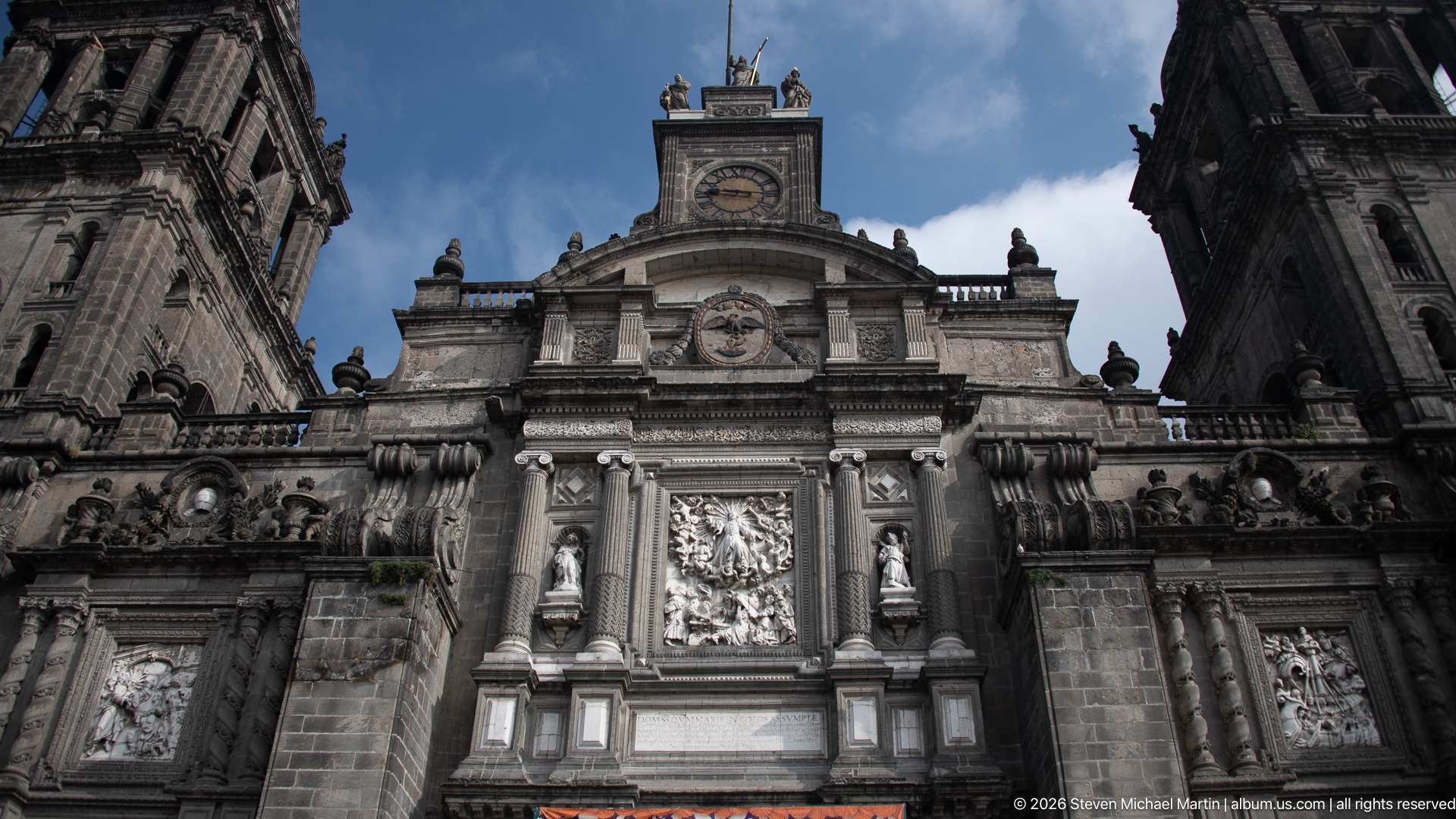
Looking upward between the cathedral’s towers, the central portal rises in stacked tiers of columns, sculpted niches, and relief panels. A clock crowns the curved upper section and marks the façade’s central axis.
Caption
Looking upward between the cathedral’s towers, the central portal rises in stacked tiers of columns, sculpted niches, and relief panels. A clock crowns the curved upper section and marks the façade’s central axis.
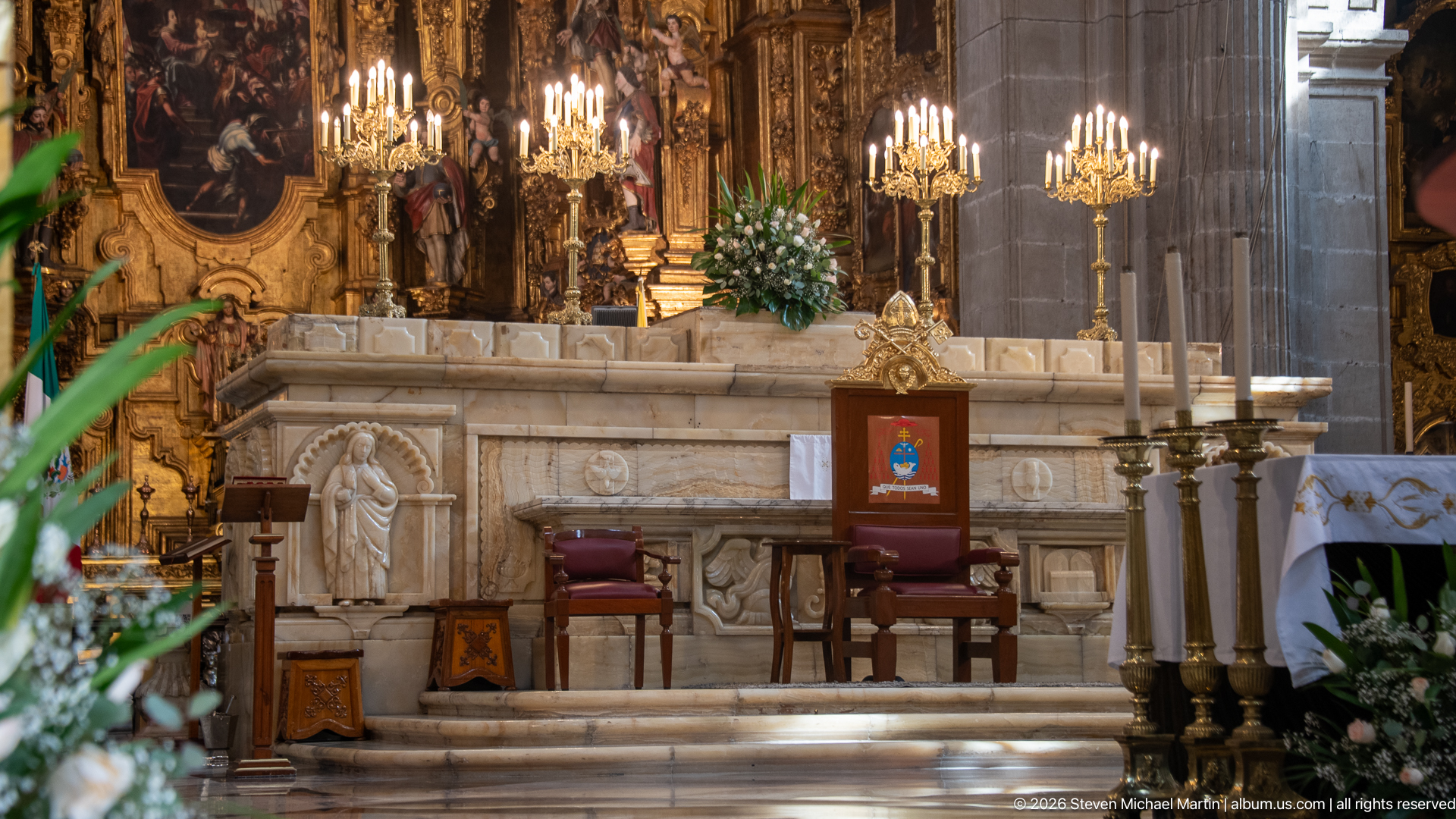
The sanctuary’s pale marble platform is arranged with ceremonial chairs, a central lectern, tall candlesticks, and flowers. Gilded furnishings and illuminated devotional images fill the background, showing the altar prepared for worship.
Caption
The sanctuary’s pale marble platform is arranged with ceremonial chairs, a central lectern, tall candlesticks, and flowers. Gilded furnishings and illuminated devotional images fill the background, showing the altar prepared for worship.
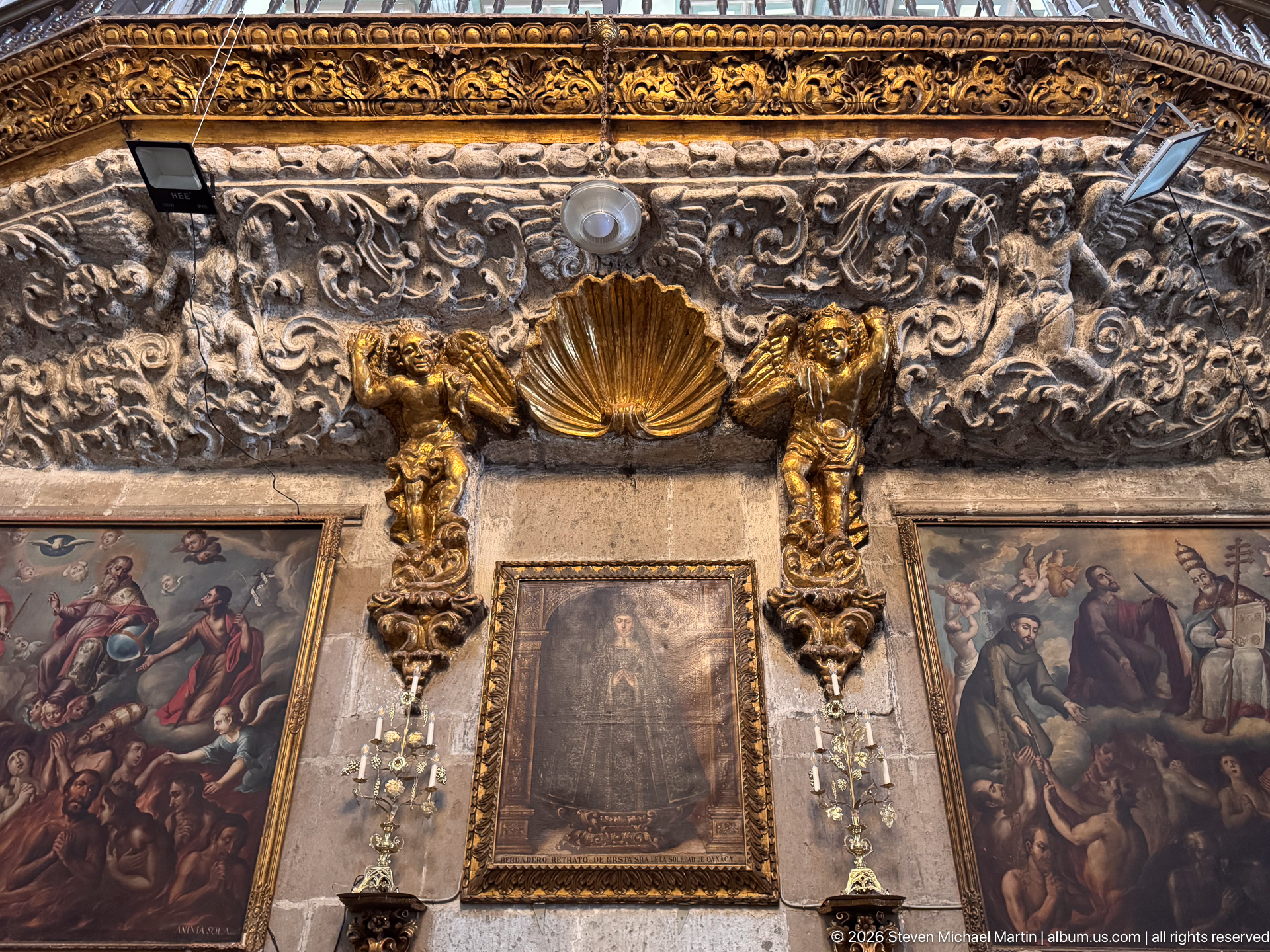
A dark central devotional image hangs within a gilded frame beneath a shell-shaped canopy supported by sculpted figures. Larger painted scenes flank it on the stone wall, creating a compact ensemble of image, carving, and architectural ornament. The upward composition connects the paintings to the carved frieze overhead.
Caption
A dark central devotional image hangs within a gilded frame beneath a shell-shaped canopy supported by sculpted figures. Larger painted scenes flank it on the stone wall, creating a compact ensemble of image, carving, and architectural ornament. The upward composition connects the paintings to the carved frieze overhead.
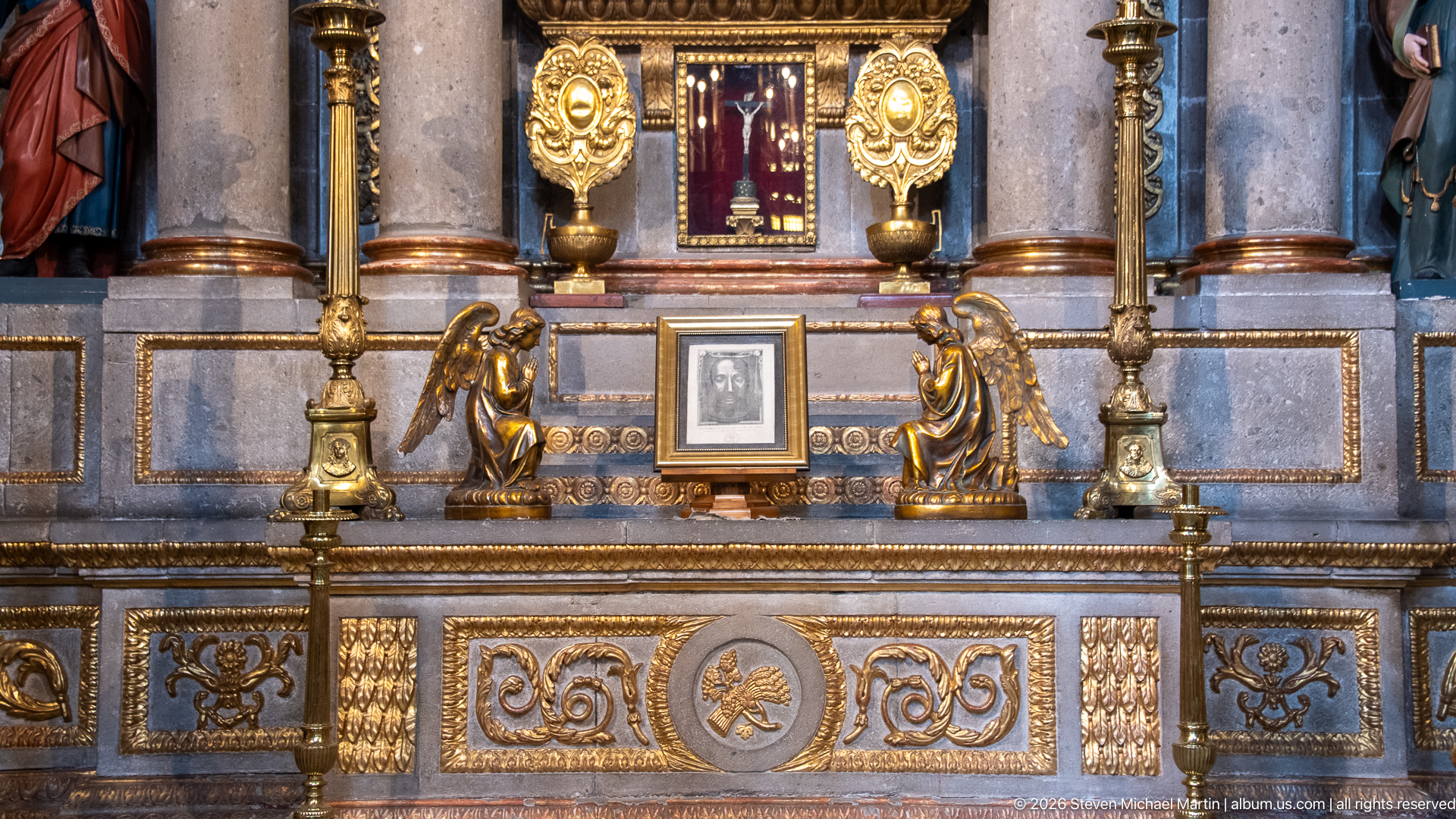
Two gilded angel figures kneel toward a small framed portrait at the center of a blue-gray altar tier. Gold lamps and oval ornaments rise between stone columns, while carved floral and scroll motifs continue across the lower panels. The symmetrical close view emphasizes the careful alignment of devotional objects and decorative sculpture.
Caption
Two gilded angel figures kneel toward a small framed portrait at the center of a blue-gray altar tier. Gold lamps and oval ornaments rise between stone columns, while carved floral and scroll motifs continue across the lower panels. The symmetrical close view emphasizes the careful alignment of devotional objects and decorative sculpture.
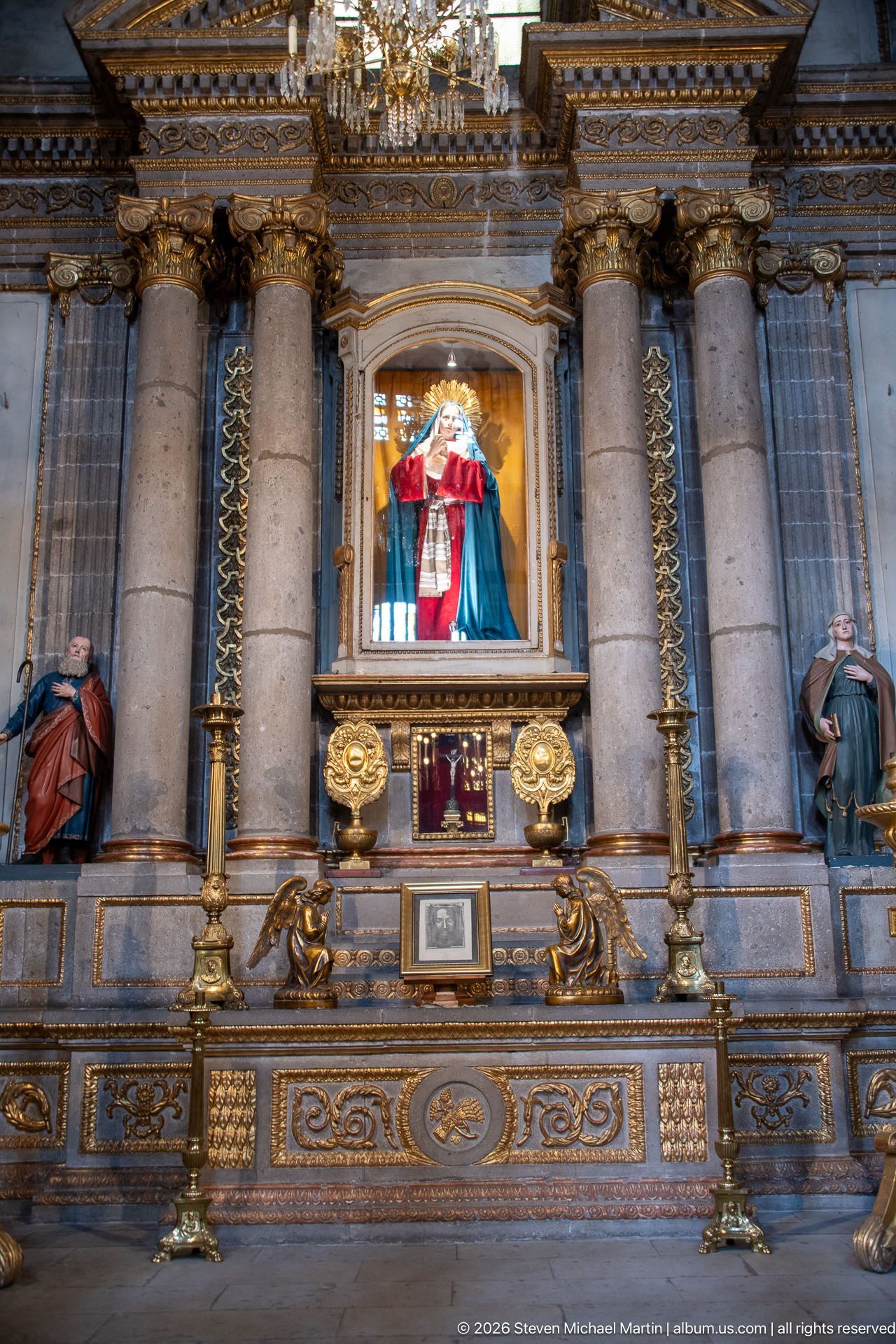
A blue-and-red-robed Marian statue occupies a central niche framed by tall stone columns and gilded ornament. Smaller saint figures stand at either side, while kneeling angels and a framed image fill the lower tier. The medium view shows how the sculpture anchors a layered altar rather than appearing as an isolated devotional object.
Caption
A blue-and-red-robed Marian statue occupies a central niche framed by tall stone columns and gilded ornament. Smaller saint figures stand at either side, while kneeling angels and a framed image fill the lower tier. The medium view shows how the sculpture anchors a layered altar rather than appearing as an isolated devotional object.
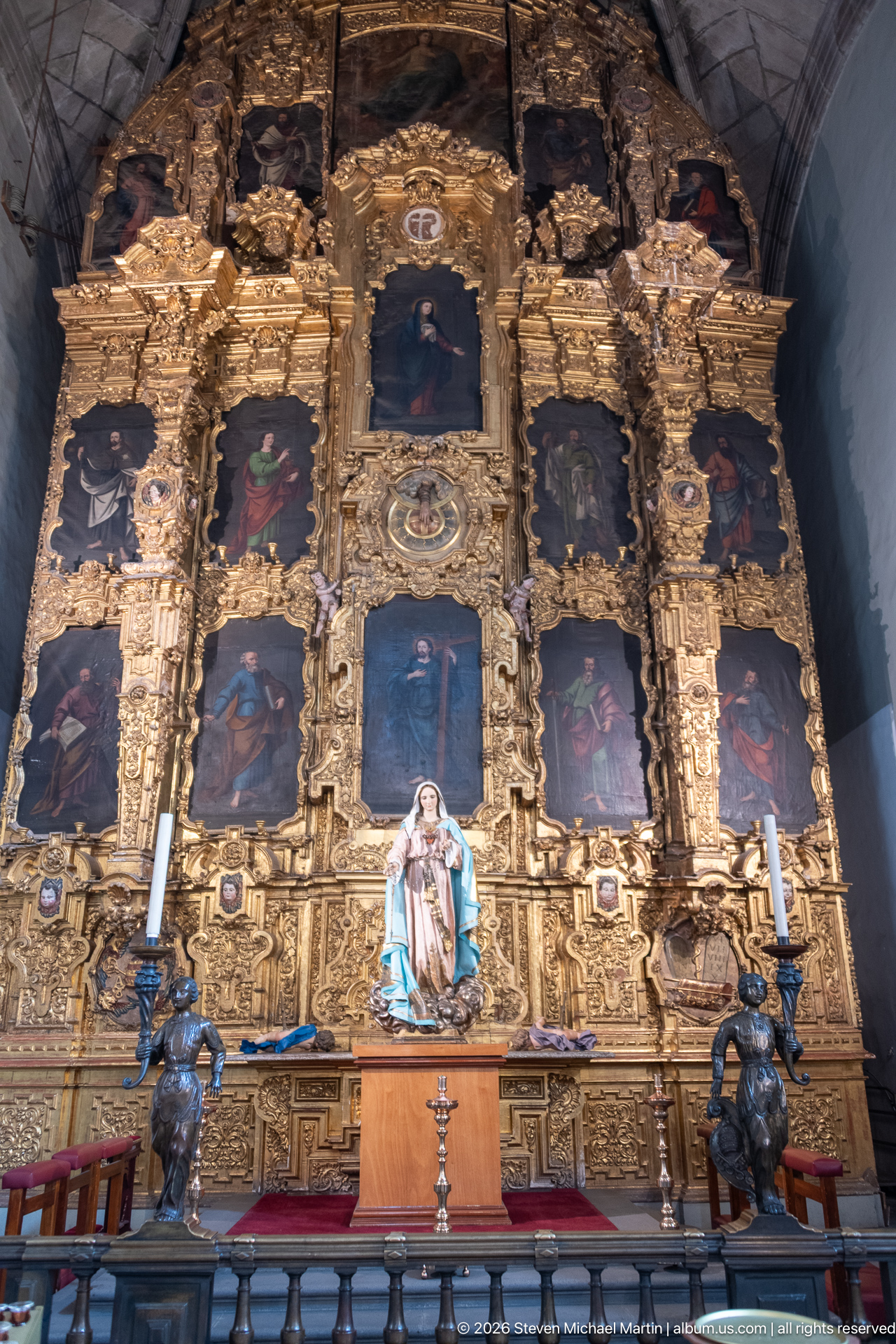
A towering gilded retablo fills the chapel wall with stacked painted panels, carved columns, and ornamental frames. A small statue of Mary stands at the center above a wooden altar table, with dark sculptural figures flanking the lower section. The frontal view conveys the retablo’s dense vertical organization and richly layered surface.
Caption
A towering gilded retablo fills the chapel wall with stacked painted panels, carved columns, and ornamental frames. A small statue of Mary stands at the center above a wooden altar table, with dark sculptural figures flanking the lower section. The frontal view conveys the retablo’s dense vertical organization and richly layered surface.
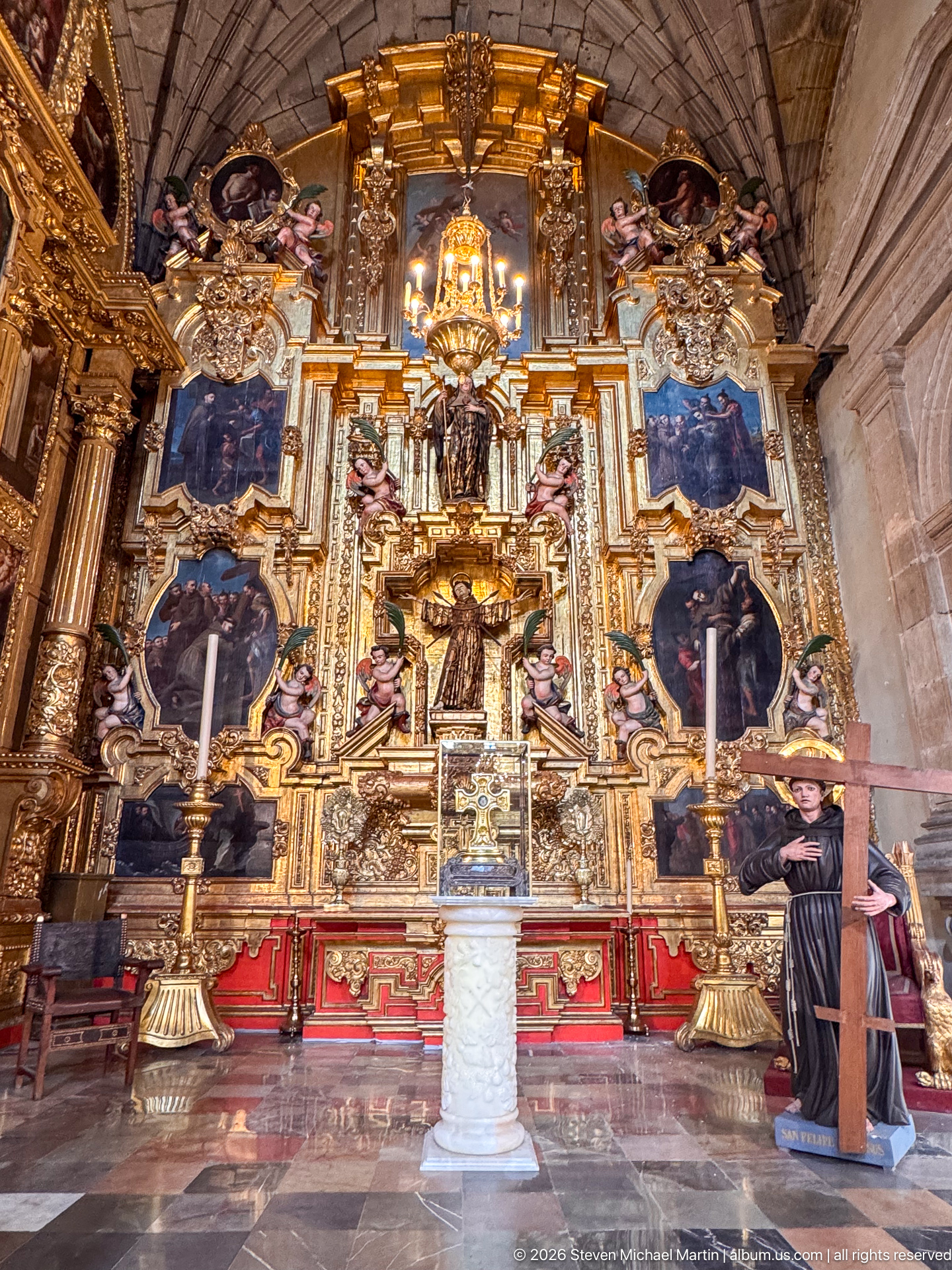
A richly carved side altar is seen obliquely, its central saint and surrounding religious paintings framed by dense gold ornament. A robed figure stands near the lower right edge beside the altar, while a stone arch marks the transition back to the nave. The diagonal view conveys the retablo’s depth and crowded decorative surface.
Caption
A richly carved side altar is seen obliquely, its central saint and surrounding religious paintings framed by dense gold ornament. A robed figure stands near the lower right edge beside the altar, while a stone arch marks the transition back to the nave. The diagonal view conveys the retablo’s depth and crowded decorative surface.
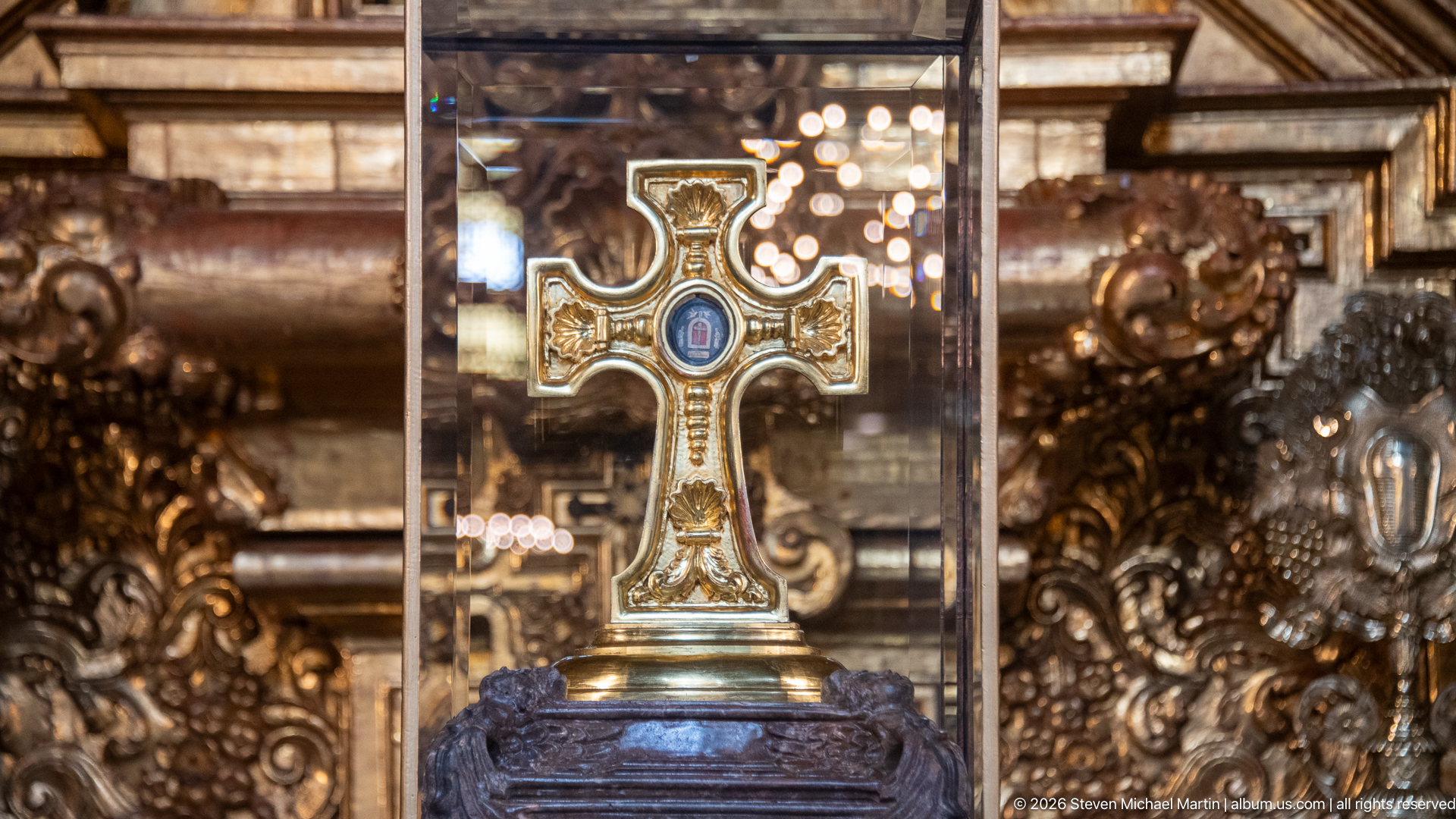
An ornamented gold-toned cross stands upright inside a clear protective case, with a small blue medallion at its center. Reflections in the glass pick up warm light from the cathedral interior.
Caption
An ornamented gold-toned cross stands upright inside a clear protective case, with a small blue medallion at its center. Reflections in the glass pick up warm light from the cathedral interior.
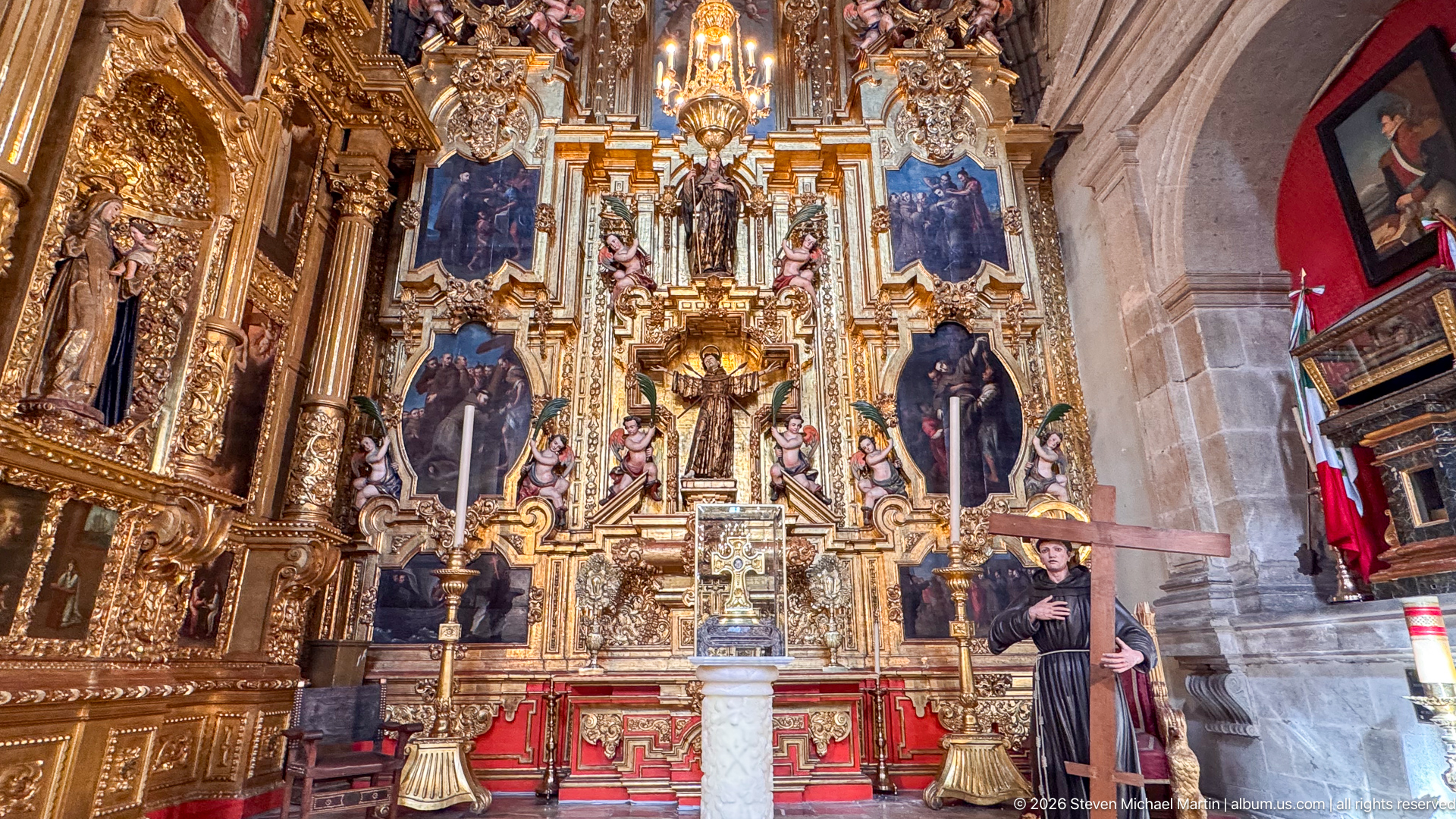
An elaborate gold altar occupies the left side of a stone chapel bay, its central saint surrounded by paintings and sculpted figures. At the right edge, a robed figure stands near the entrance, adding a human-scale reference to the towering retablo. The oblique viewpoint reveals both the altar’s depth and its relationship to the aisle.
Caption
An elaborate gold altar occupies the left side of a stone chapel bay, its central saint surrounded by paintings and sculpted figures. At the right edge, a robed figure stands near the entrance, adding a human-scale reference to the towering retablo. The oblique viewpoint reveals both the altar’s depth and its relationship to the aisle.
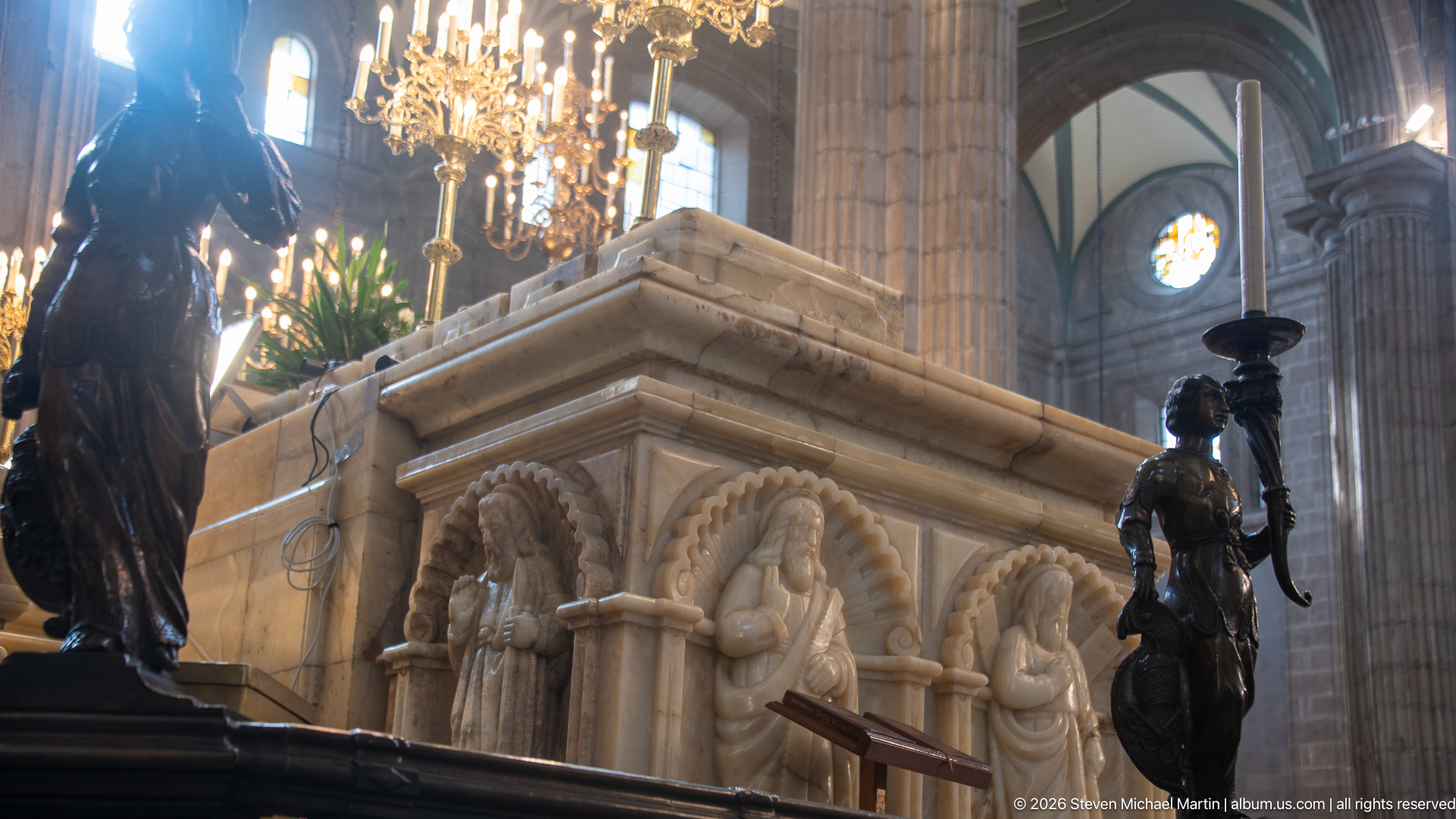
From beneath the sanctuary rail, the camera looks upward at a pale marble structure with sculpted figures set into arched niches. Dark bronze figures stand at the edges, while chandeliers and the high stone arches recede behind. The low angle stresses the contrast between light carved stone, dark metal, and the cathedral’s soaring interior.
Caption
From beneath the sanctuary rail, the camera looks upward at a pale marble structure with sculpted figures set into arched niches. Dark bronze figures stand at the edges, while chandeliers and the high stone arches recede behind. The low angle stresses the contrast between light carved stone, dark metal, and the cathedral’s soaring interior.
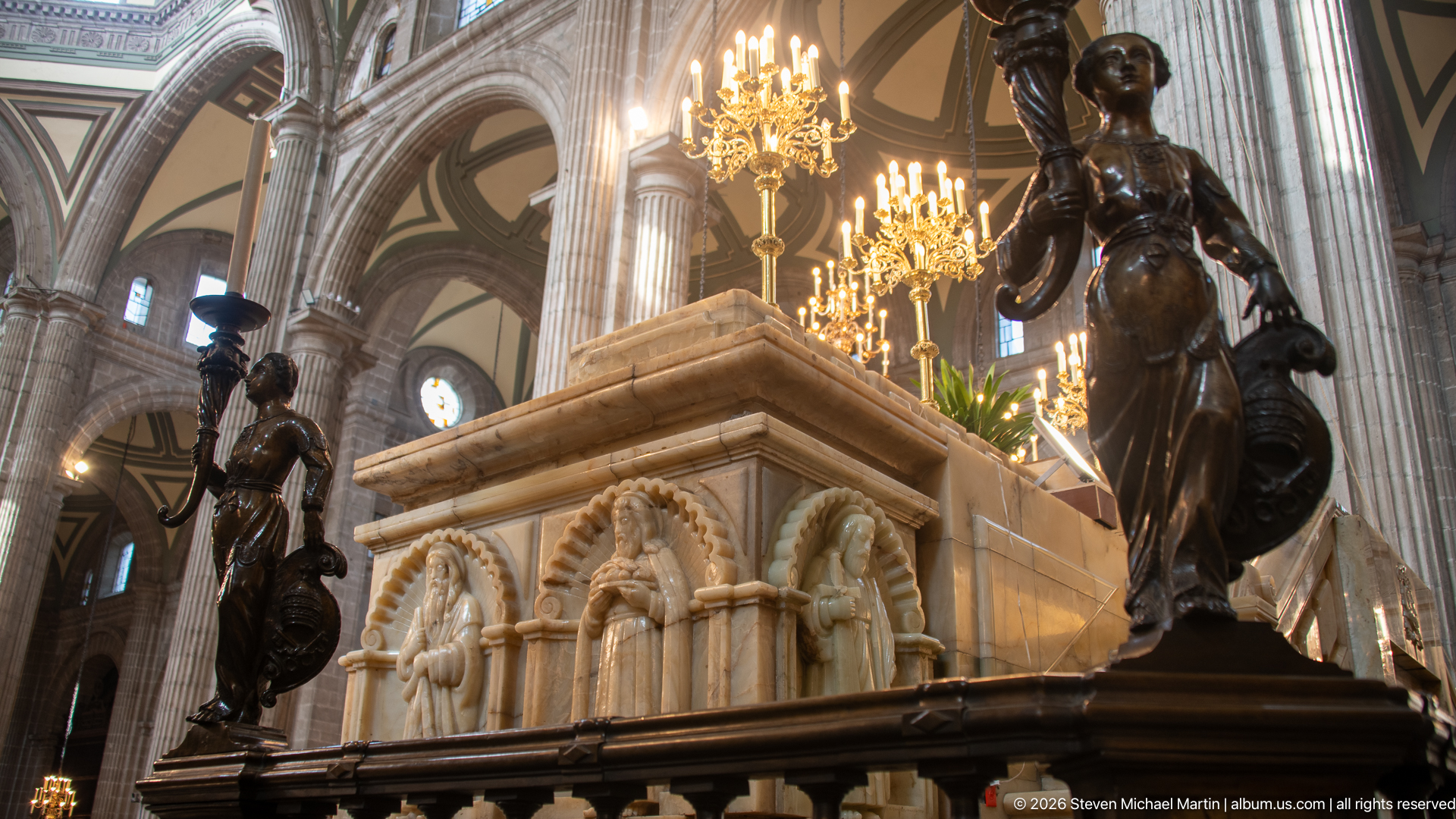
A closer upward crop isolates the pale marble structure’s pointed canopy and three arched niches containing carved figures. Dark bronze figures enter from both sides, partially silhouetted against the bright chandeliers and stone columns. The tight framing shifts attention from the overall sanctuary to the sculptural program and the meeting of contrasting materials.
Caption
A closer upward crop isolates the pale marble structure’s pointed canopy and three arched niches containing carved figures. Dark bronze figures enter from both sides, partially silhouetted against the bright chandeliers and stone columns. The tight framing shifts attention from the overall sanctuary to the sculptural program and the meeting of contrasting materials.
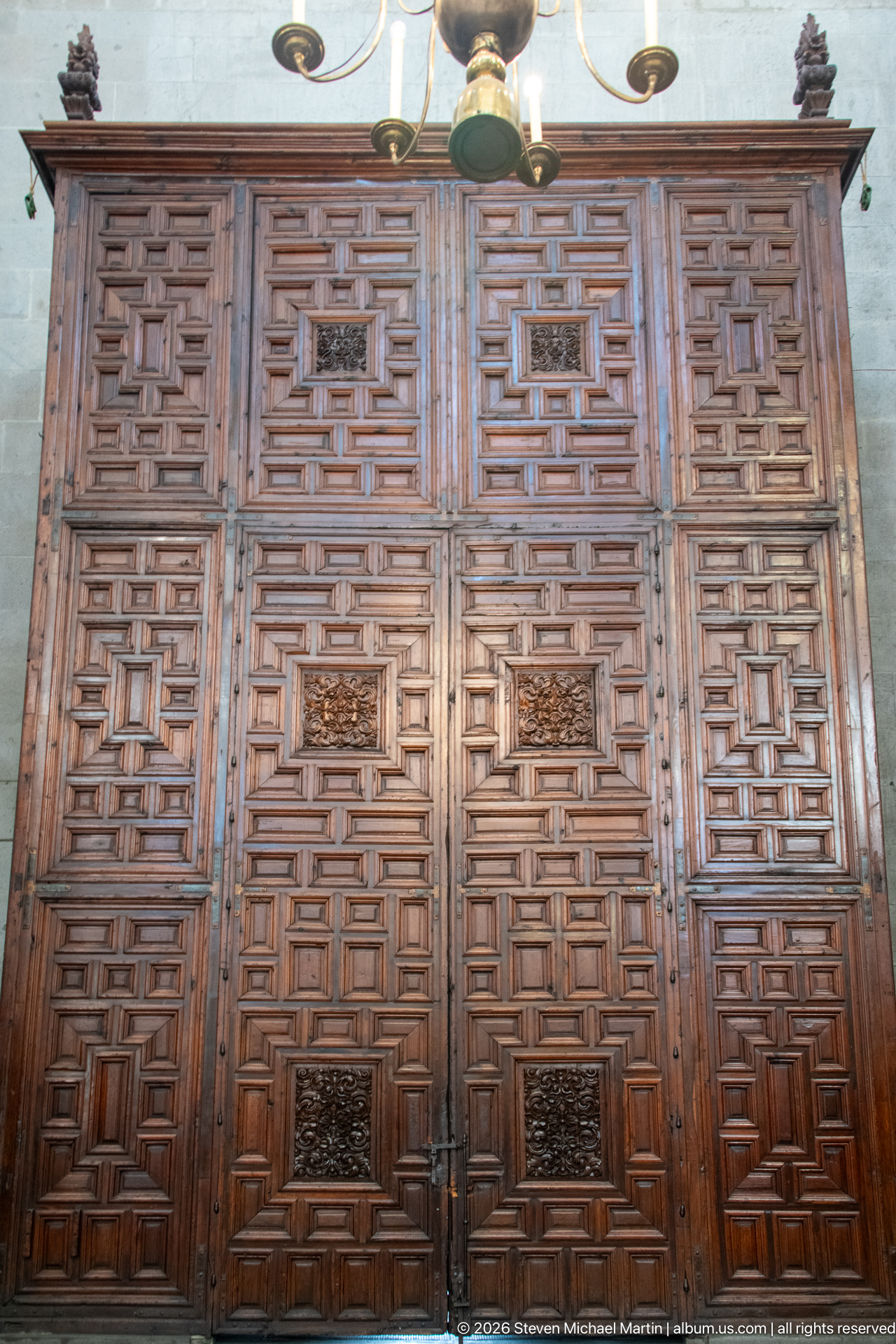
Monumental wooden double doors fill a tall stone portal, their dark panels arranged in repeated geometric patterns with carved inserts. A hanging chandelier overlaps the upper edge, while the frontal view emphasizes the doors’ scale and dense craftsmanship.
Caption
Monumental wooden double doors fill a tall stone portal, their dark panels arranged in repeated geometric patterns with carved inserts. A hanging chandelier overlaps the upper edge, while the frontal view emphasizes the doors’ scale and dense craftsmanship.
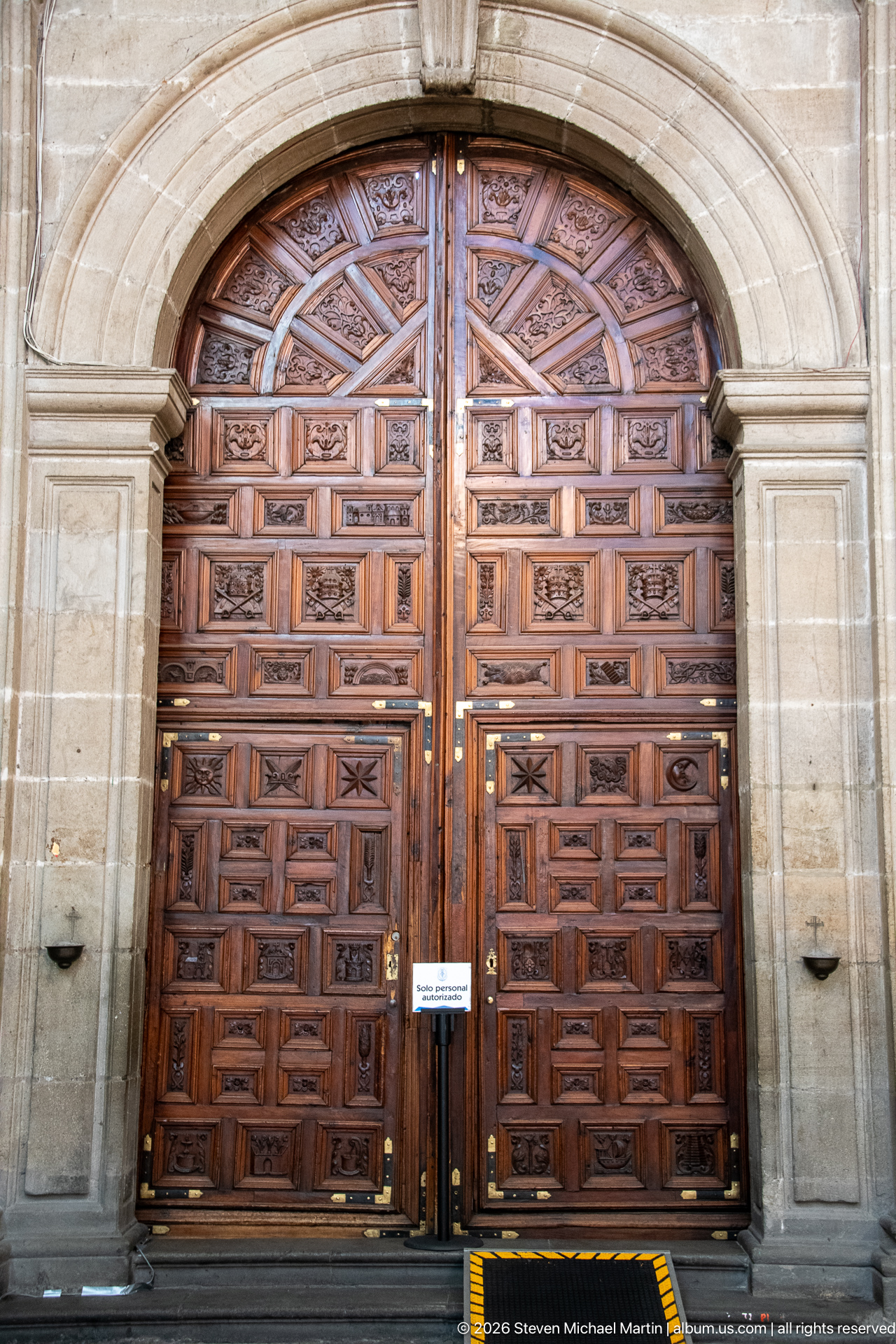
Carved wooden double doors sit within a rounded stone arch, with a richly worked fanlight above the panels. A notice and floor marking at the threshold show the entrance in everyday use.
Caption
Carved wooden double doors sit within a rounded stone arch, with a richly worked fanlight above the panels. A notice and floor marking at the threshold show the entrance in everyday use.
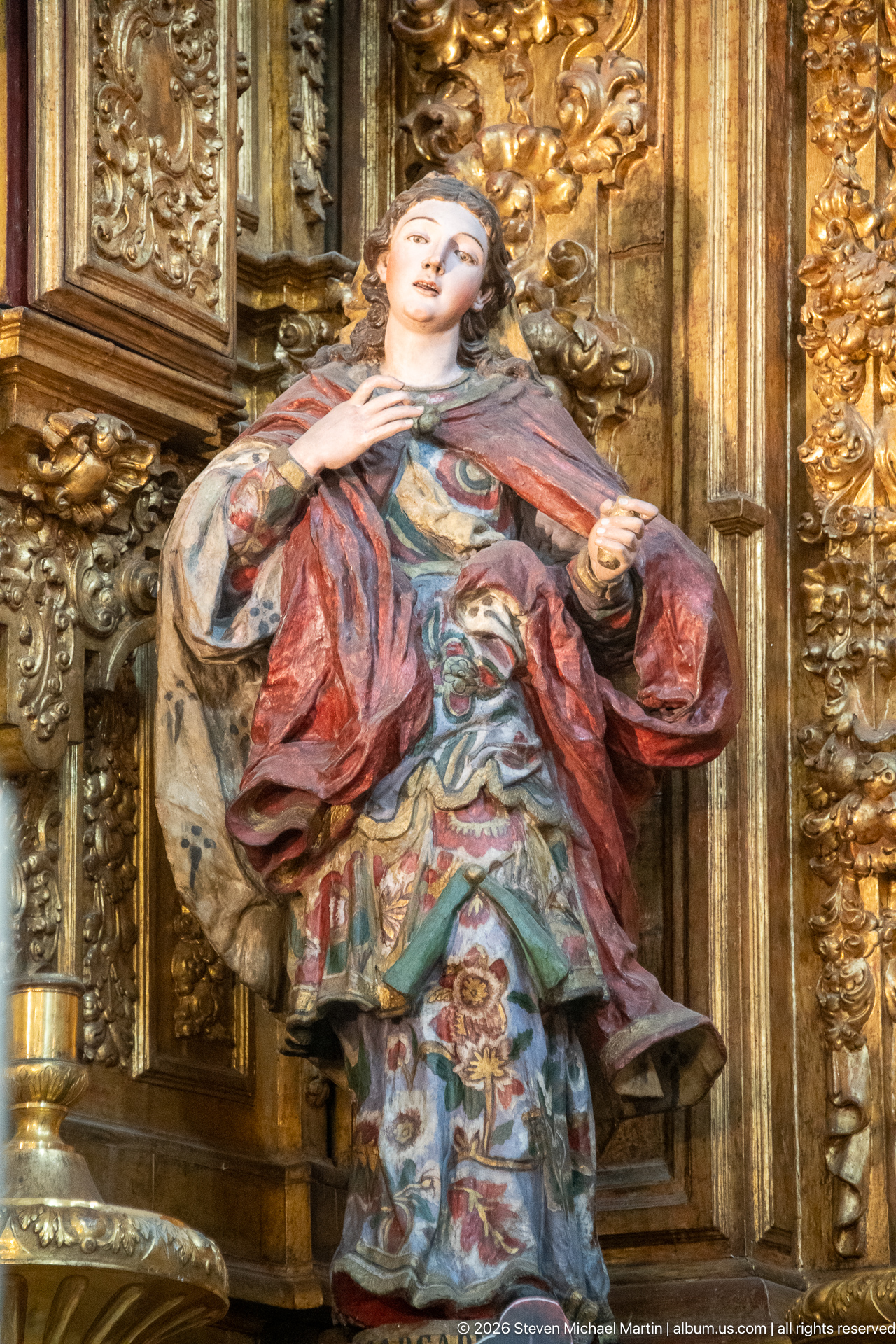
A richly dressed Marian statue stands at the center of a gilded altar, framed by tall stone columns and smaller devotional figures. The statue’s blue and red garments and the surrounding gold ornament draw the eye to the central niche.
Caption
A richly dressed Marian statue stands at the center of a gilded altar, framed by tall stone columns and smaller devotional figures. The statue’s blue and red garments and the surrounding gold ornament draw the eye to the central niche.
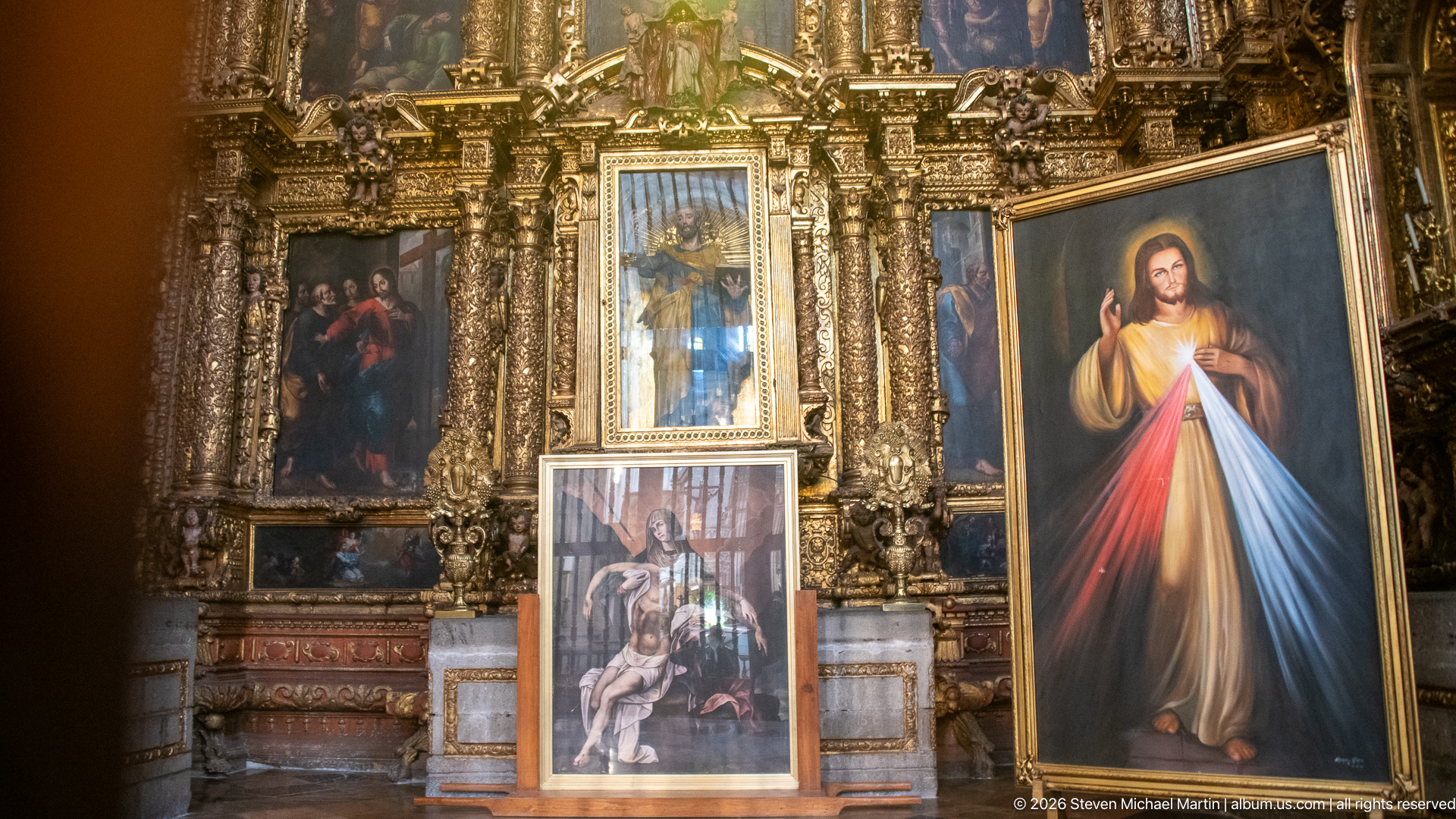
Several framed devotional paintings stand before a deeply carved gilded altar. The largest image shows Christ with red and pale rays extending from his chest; smaller scenes rest below it. Their portable placement in front of the fixed retablo makes the devotional display distinct from the permanent altar behind.
Caption
Several framed devotional paintings stand before a deeply carved gilded altar. The largest image shows Christ with red and pale rays extending from his chest; smaller scenes rest below it. Their portable placement in front of the fixed retablo makes the devotional display distinct from the permanent altar behind.
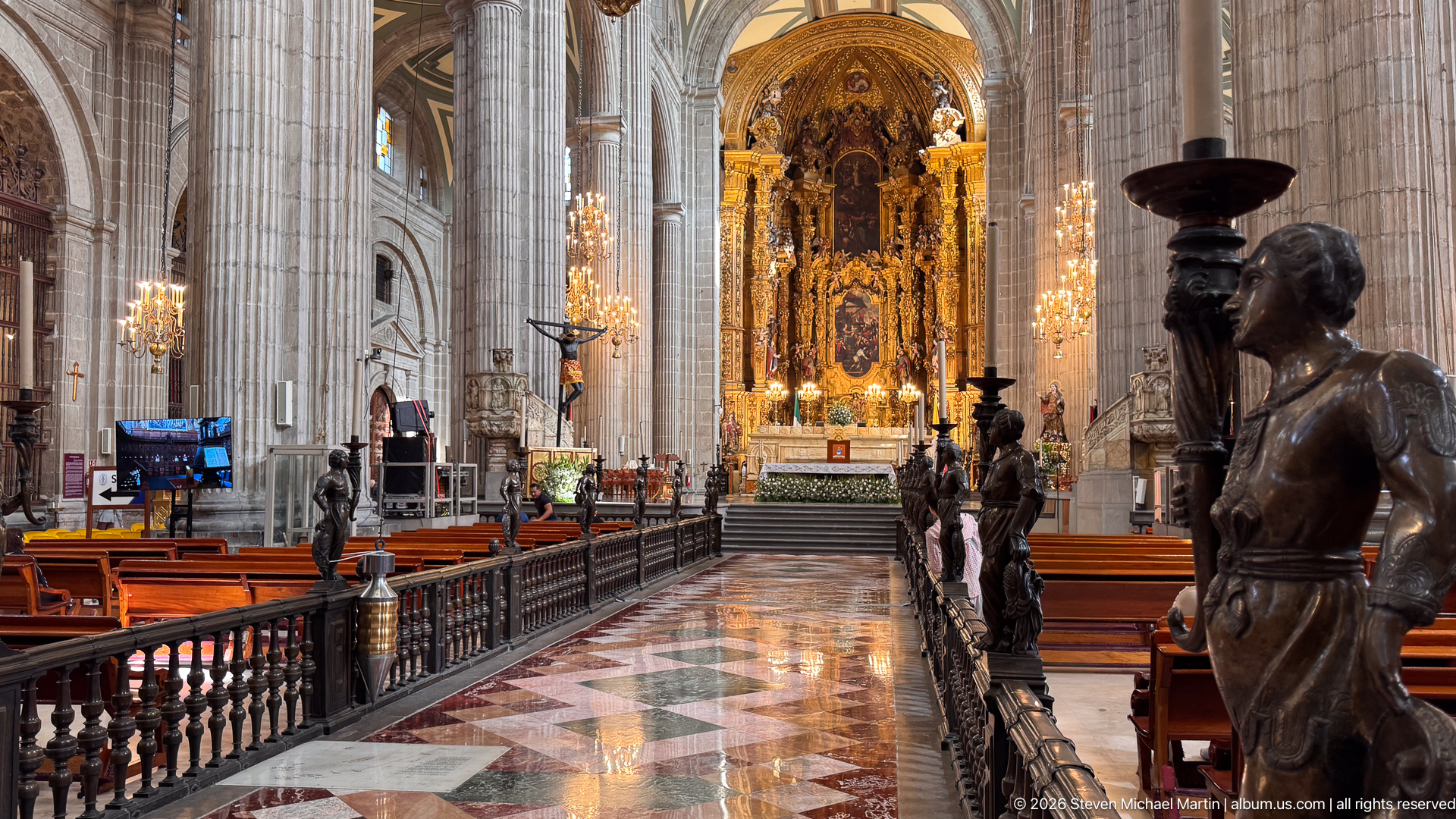
A view down the cathedral’s central aisle leads toward the gilded sanctuary, with the dark bronze figures along the choir rail prominent in the foreground. Rows of pews, the patterned marble floor, tall stone piers, and chandeliers show the scale of the nave. No separate Divine Mercy image is visible in this photograph.
Caption
A view down the cathedral’s central aisle leads toward the gilded sanctuary, with the dark bronze figures along the choir rail prominent in the foreground. Rows of pews, the patterned marble floor, tall stone piers, and chandeliers show the scale of the nave. No separate Divine Mercy image is visible in this photograph.
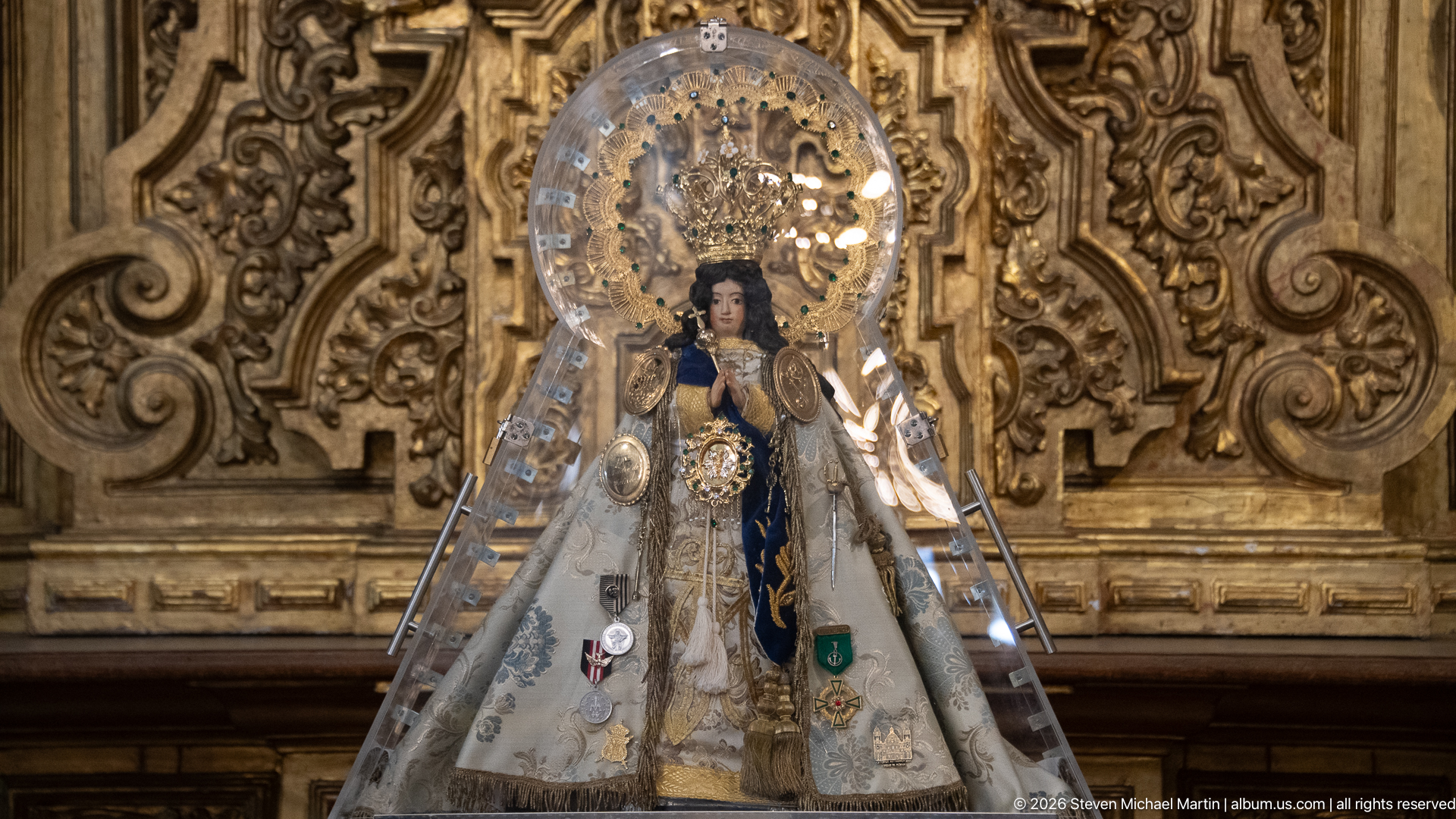
A crowned Marian statue stands in a glass enclosure before a richly ornamented gilded altar. The figure wears layered pale and blue garments and carries small devotional objects; reflections in the protective cover cross the close view.
Caption
A crowned Marian statue stands in a glass enclosure before a richly ornamented gilded altar. The figure wears layered pale and blue garments and carries small devotional objects; reflections in the protective cover cross the close view.
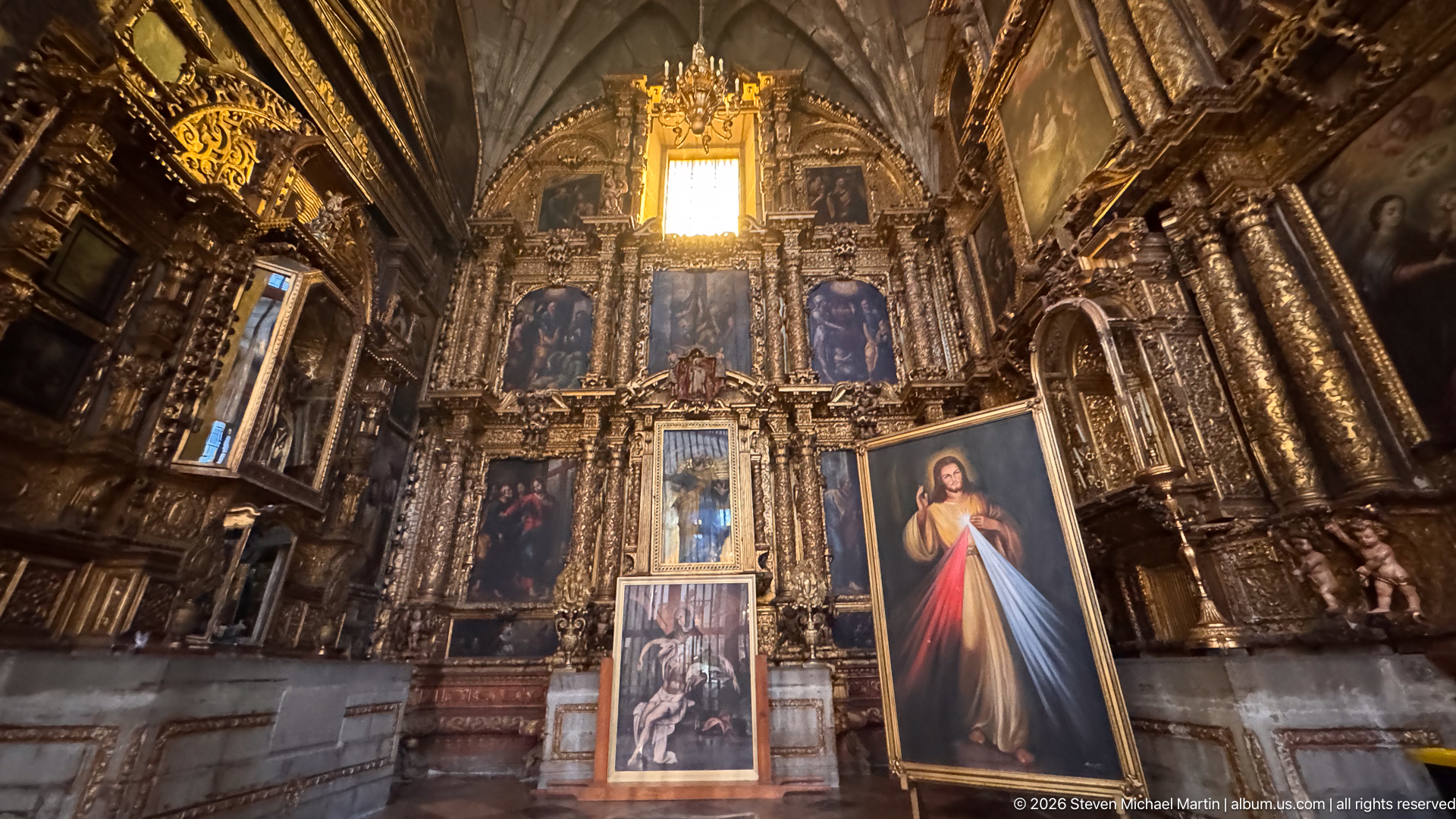
A richly carved gilded retablo fills a chapel bay beneath a stone arch. Stacked paintings and sculpted figures rise above the altar, while the frontal view shows the dense ornament arranged across the chapel wall.
Caption
A richly carved gilded retablo fills a chapel bay beneath a stone arch. Stacked paintings and sculpted figures rise above the altar, while the frontal view shows the dense ornament arranged across the chapel wall.
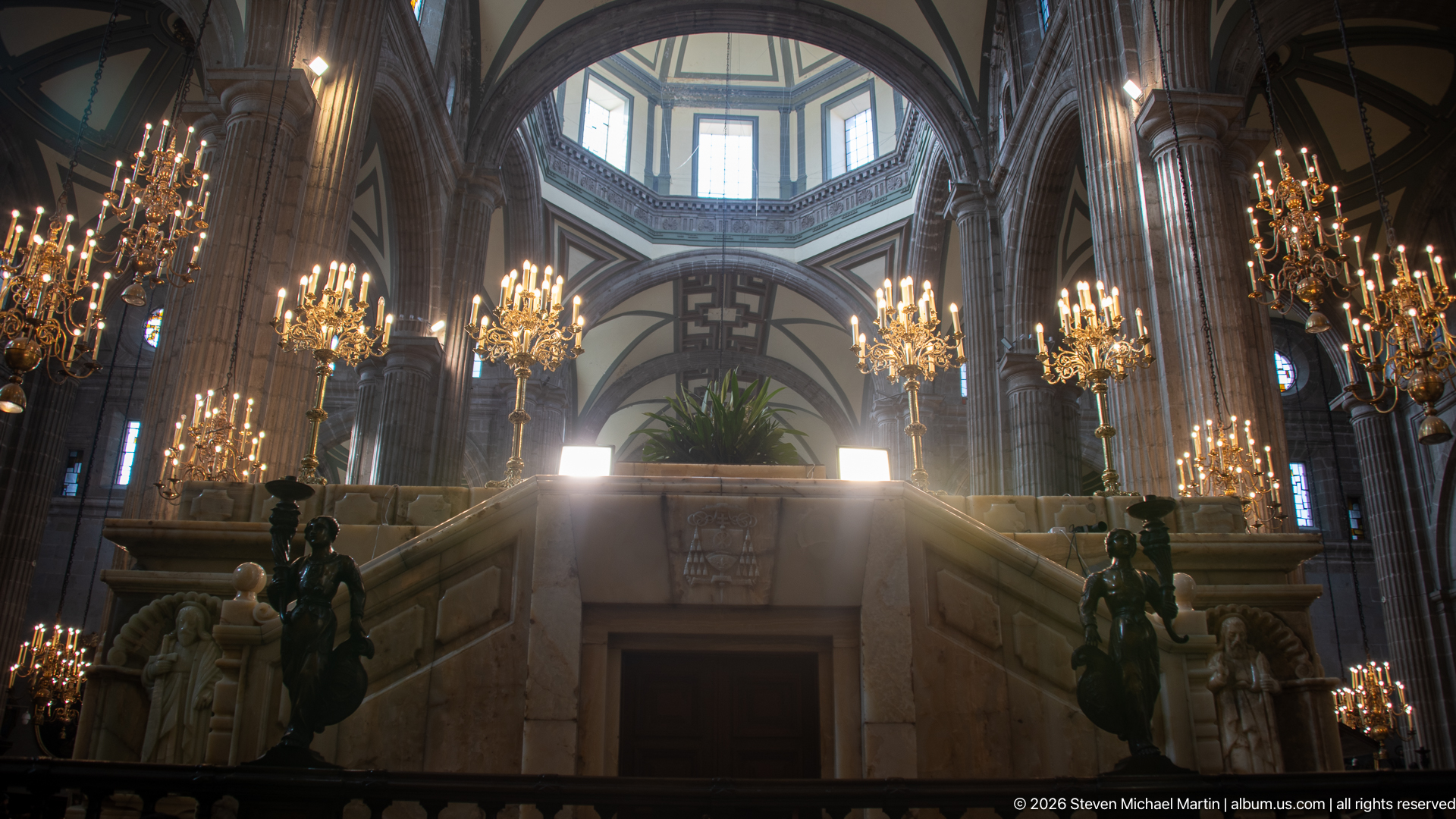
Seen from behind, the main altar’s broad pale marble structure rises beneath the octagonal lantern and its tall windows. Chandeliers and stone arches frame the rear elevation, while dark bronze figures stand at either side. This photograph shows the altar’s architectural backside, not a Divine Mercy painting.
Caption
Seen from behind, the main altar’s broad pale marble structure rises beneath the octagonal lantern and its tall windows. Chandeliers and stone arches frame the rear elevation, while dark bronze figures stand at either side. This photograph shows the altar’s architectural backside, not a Divine Mercy painting.
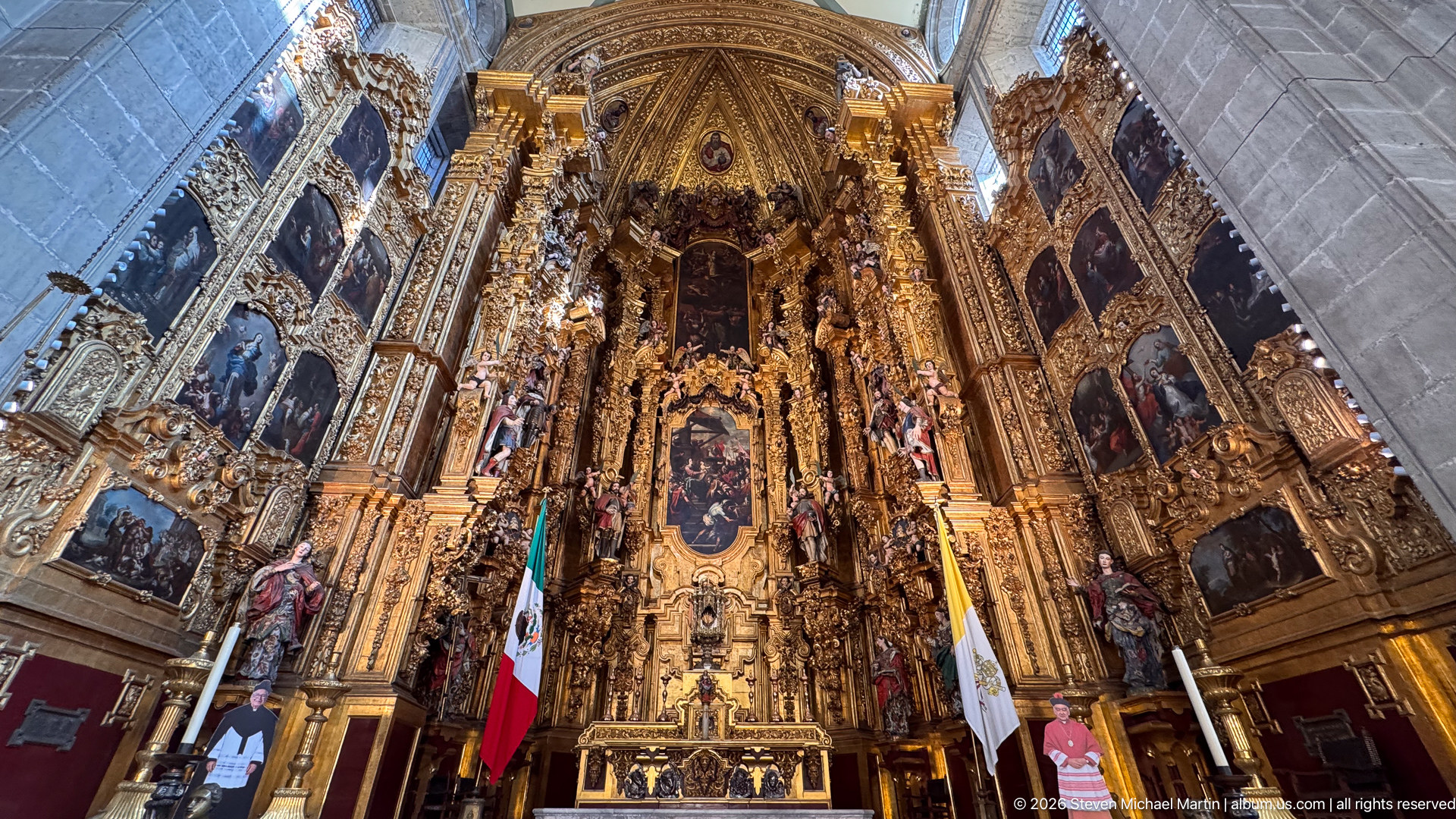
An upward view gathers the cathedral’s monumental gilded retablo, its stacked niches, painted panels, sculpted saints, and central devotional image into a dense vertical composition. The Mexican and Vatican flags flank the altar, while the surrounding stone walls frame the richly carved ensemble. The broad perspective conveys the retablo’s scale and its place within the cathedral sanctuary.
Caption
An upward view gathers the cathedral’s monumental gilded retablo, its stacked niches, painted panels, sculpted saints, and central devotional image into a dense vertical composition. The Mexican and Vatican flags flank the altar, while the surrounding stone walls frame the richly carved ensemble. The broad perspective conveys the retablo’s scale and its place within the cathedral sanctuary.
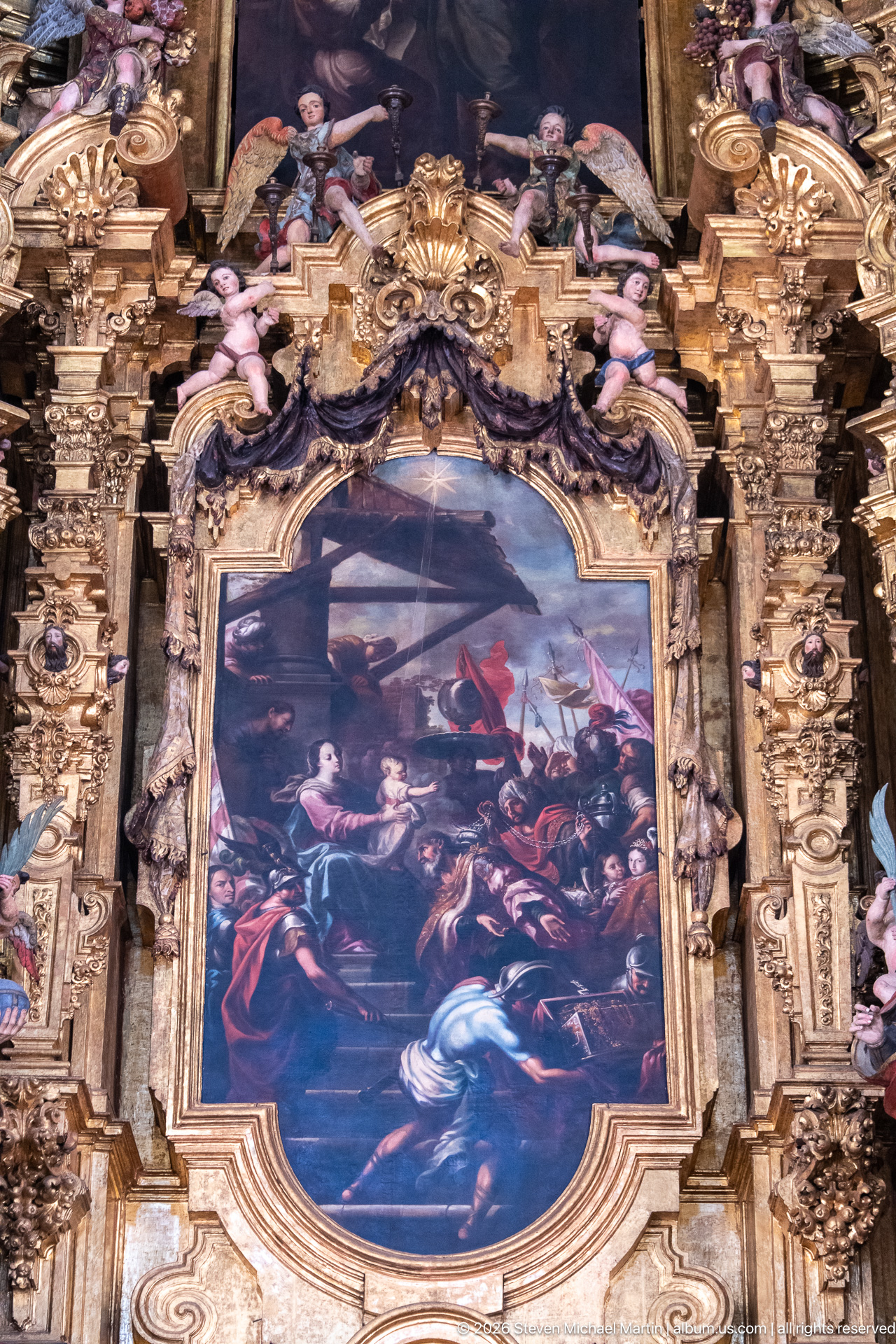
A polychrome female devotional statue sits or leans within a densely carved gilded niche, wearing layered green, red, and blue robes. The figure’s identity is not legible, so the caption describes the visible sculpture without assigning a specific saint or Marian title.
Caption
A polychrome female devotional statue sits or leans within a densely carved gilded niche, wearing layered green, red, and blue robes. The figure’s identity is not legible, so the caption describes the visible sculpture without assigning a specific saint or Marian title.
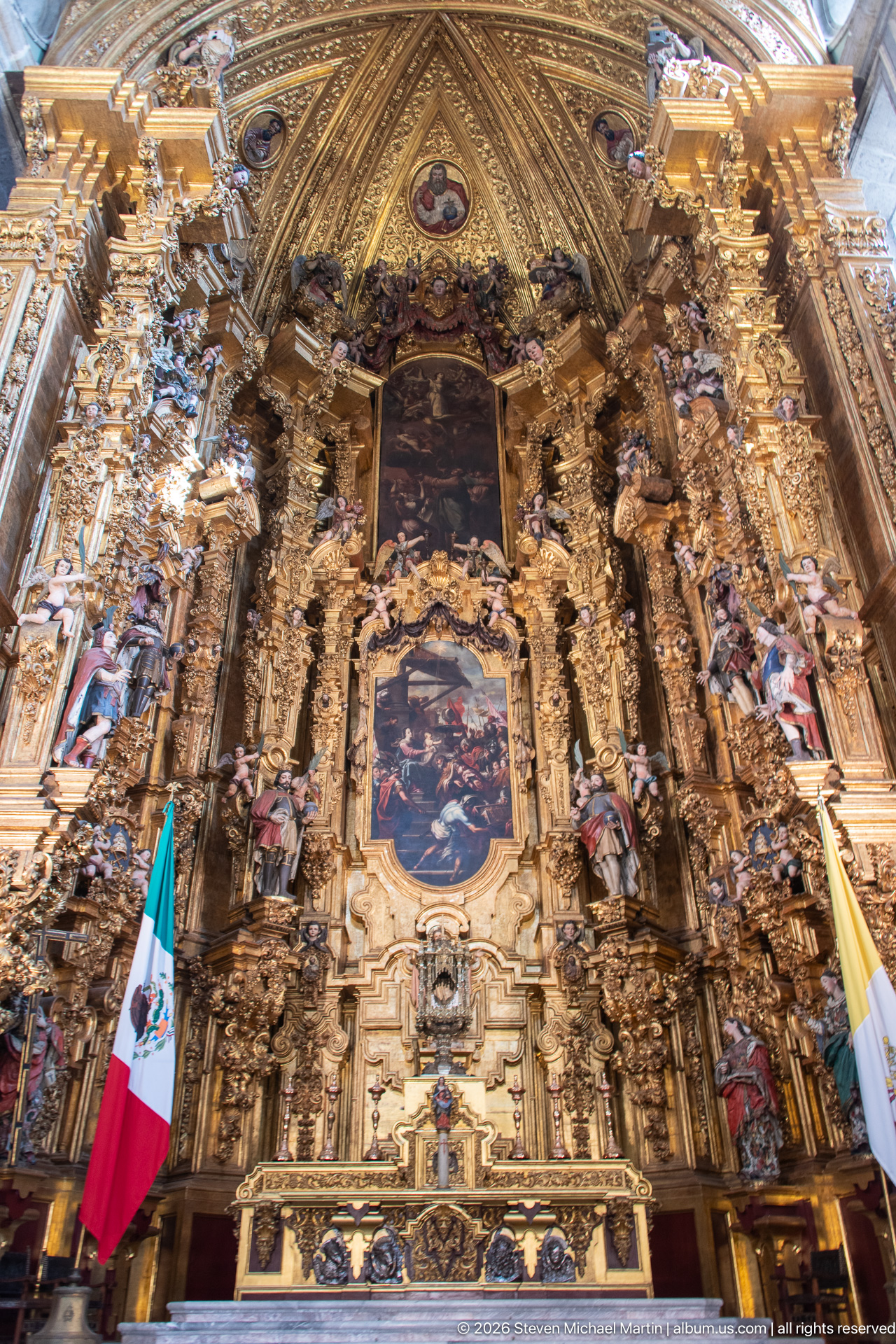
A dark crucifix rises at the center of a pale, geometrically paneled altar, surrounded by dense gilded carving. Smaller devotional figures and candlesticks occupy the lower level, while a narrow strip of the Mexican flag appears at the left edge. The frontal view centers the cross within the chapel’s layered ornamental framework.
Caption
A dark crucifix rises at the center of a pale, geometrically paneled altar, surrounded by dense gilded carving. Smaller devotional figures and candlesticks occupy the lower level, while a narrow strip of the Mexican flag appears at the left edge. The frontal view centers the cross within the chapel’s layered ornamental framework.
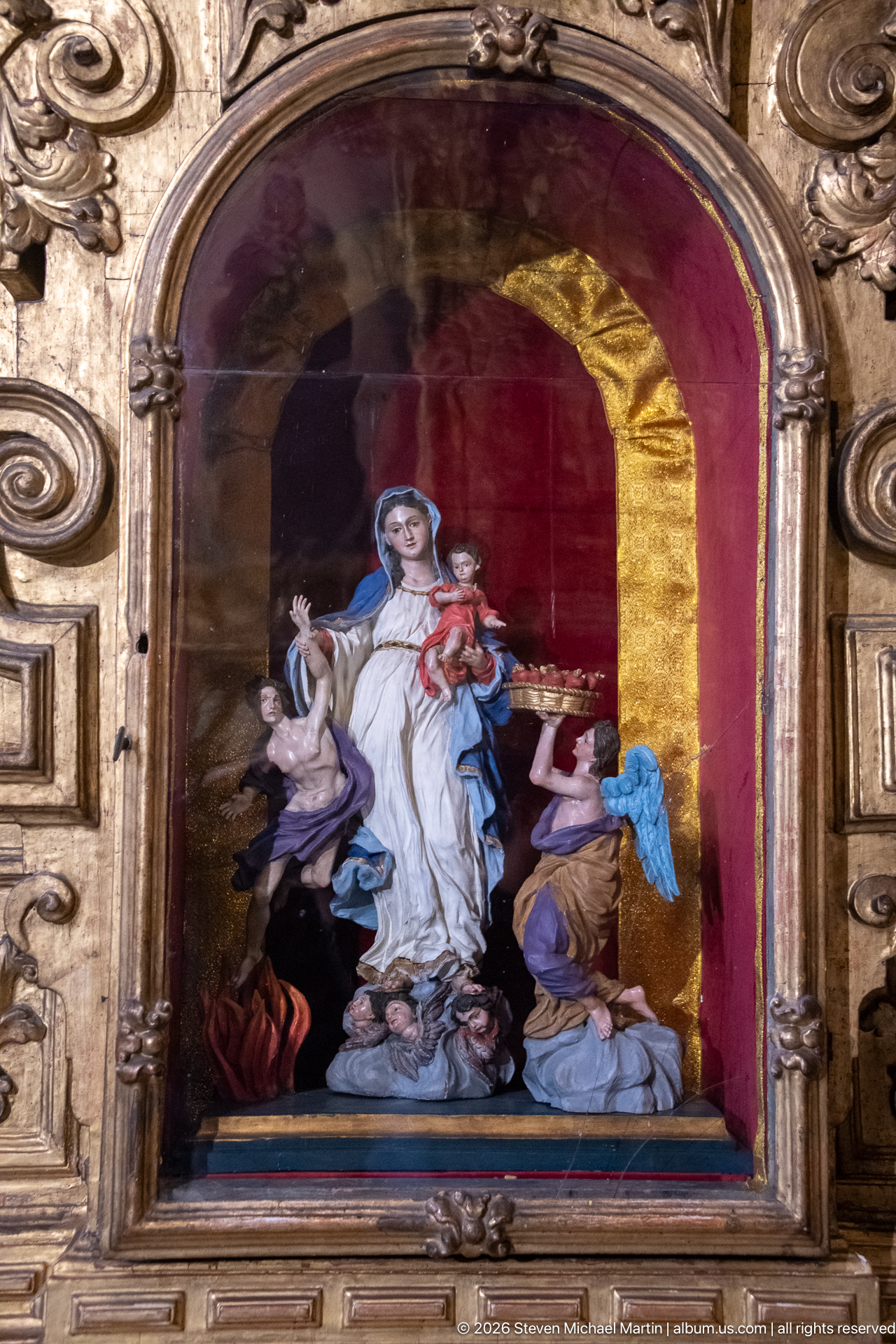
A religious painting fills a red-backed arched niche framed in carved wood. The Virgin, dressed in white and blue, holds the Christ Child above a group of smaller figures gathered at her feet. The tight view makes the composition and gilded surround legible while excluding most of the chapel, presenting the painting as an independent devotional focus.
Caption
A religious painting fills a red-backed arched niche framed in carved wood. The Virgin, dressed in white and blue, holds the Christ Child above a group of smaller figures gathered at her feet. The tight view makes the composition and gilded surround legible while excluding most of the chapel, presenting the painting as an independent devotional focus.
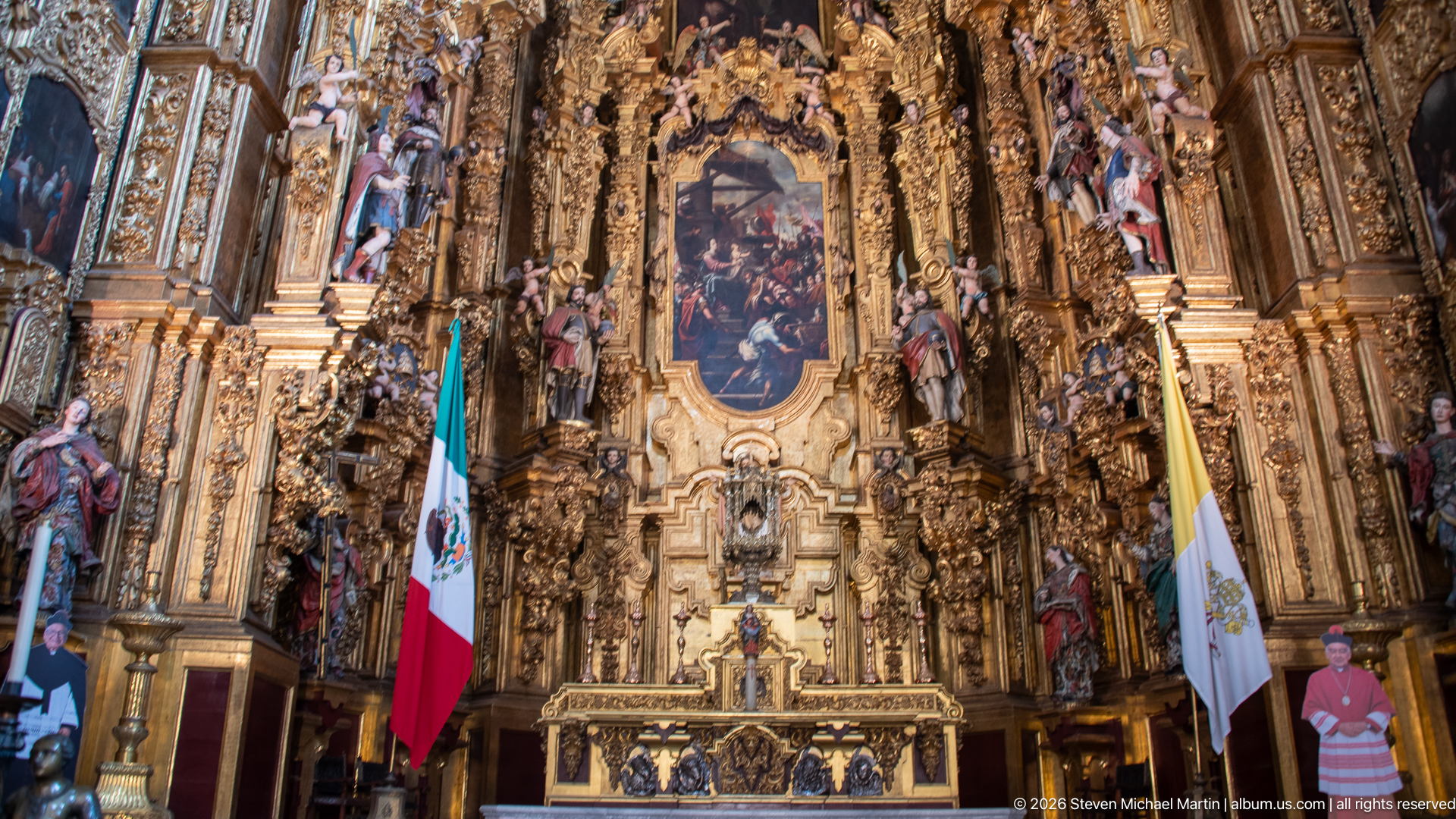
Closer framing isolates the retablo’s central axis: a large religious painting sits above a small altar, surrounded by gilded scrollwork, carved figures, and flanking devotional panels. The Mexican tricolor and a white Vatican flag stand in front of the lower register. The compressed view reveals the layered ornament and figures more clearly than the preceding, wider sanctuary view.
Caption
Closer framing isolates the retablo’s central axis: a large religious painting sits above a small altar, surrounded by gilded scrollwork, carved figures, and flanking devotional panels. The Mexican tricolor and a white Vatican flag stand in front of the lower register. The compressed view reveals the layered ornament and figures more clearly than the preceding, wider sanctuary view.
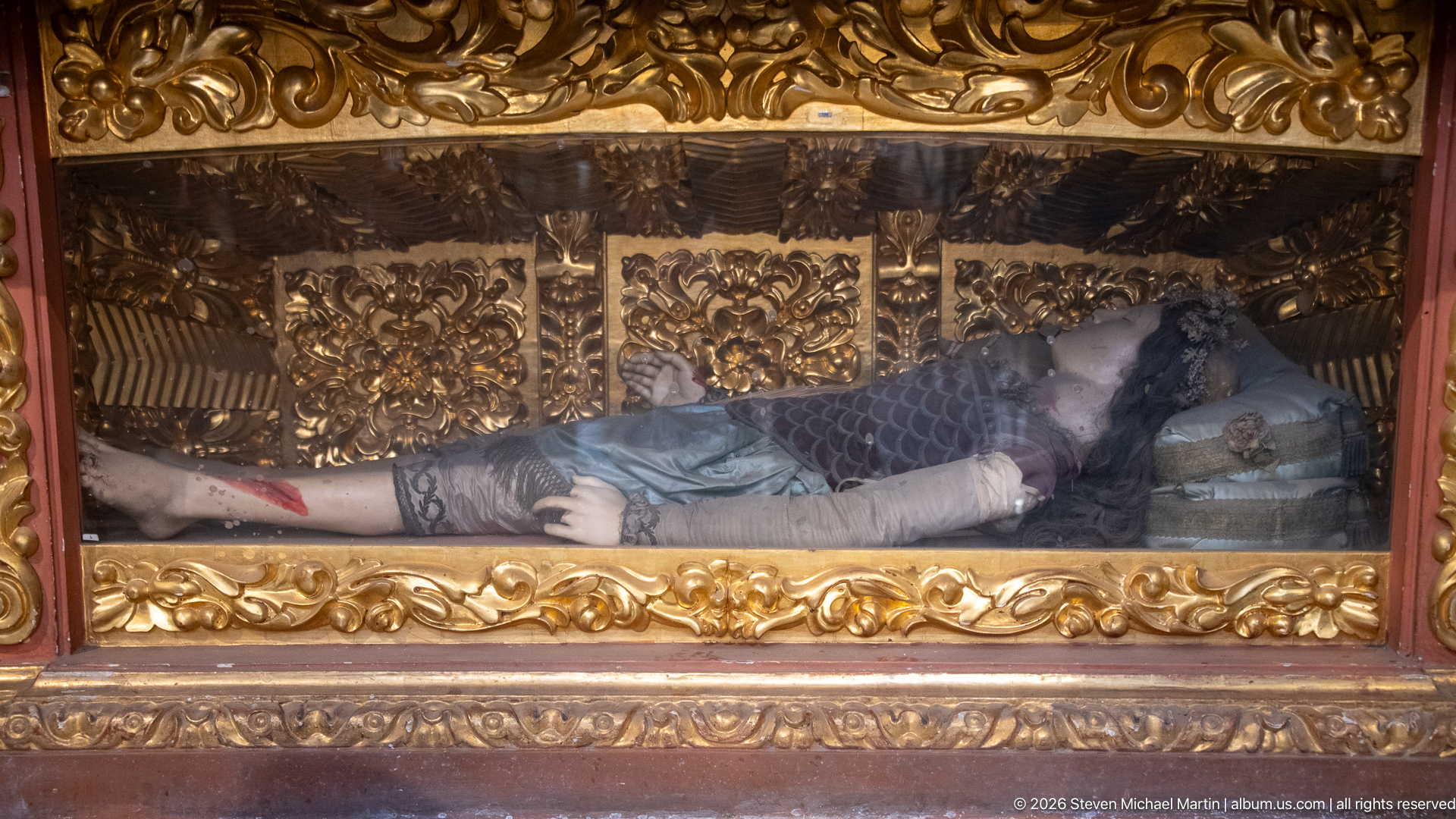
A life-size recumbent devotional figure lies beneath a carved gilded canopy behind reflective glass. The long hair, folded hands, and marked body suggest Christ after the Passion, while the photograph does not reveal the shrine’s specific dedication.
Caption
A life-size recumbent devotional figure lies beneath a carved gilded canopy behind reflective glass. The long hair, folded hands, and marked body suggest Christ after the Passion, while the photograph does not reveal the shrine’s specific dedication.
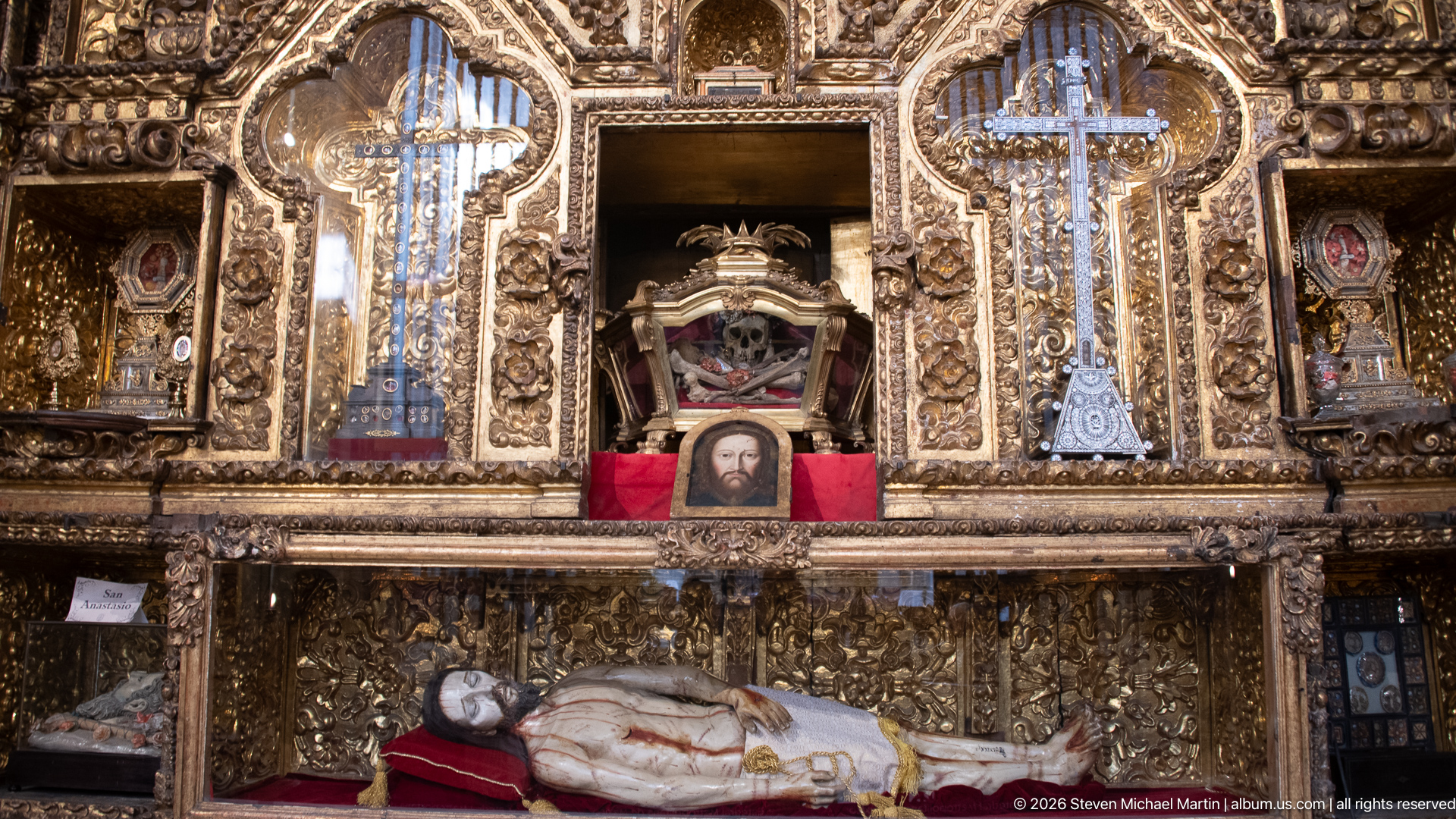
The altar combines a recumbent figure of Christ with a skull-and-bones display in a small upper compartment, set within deeply carved gilded wood. A framed portrait and red cloth accent the center; additional devotional objects and figures occupy the side niches. The arrangement juxtaposes the Passion with reminders of mortality, a visual pairing grounded in the objects visible in the sanctuary.
Caption
The altar combines a recumbent figure of Christ with a skull-and-bones display in a small upper compartment, set within deeply carved gilded wood. A framed portrait and red cloth accent the center; additional devotional objects and figures occupy the side niches. The arrangement juxtaposes the Passion with reminders of mortality, a visual pairing grounded in the objects visible in the sanctuary.
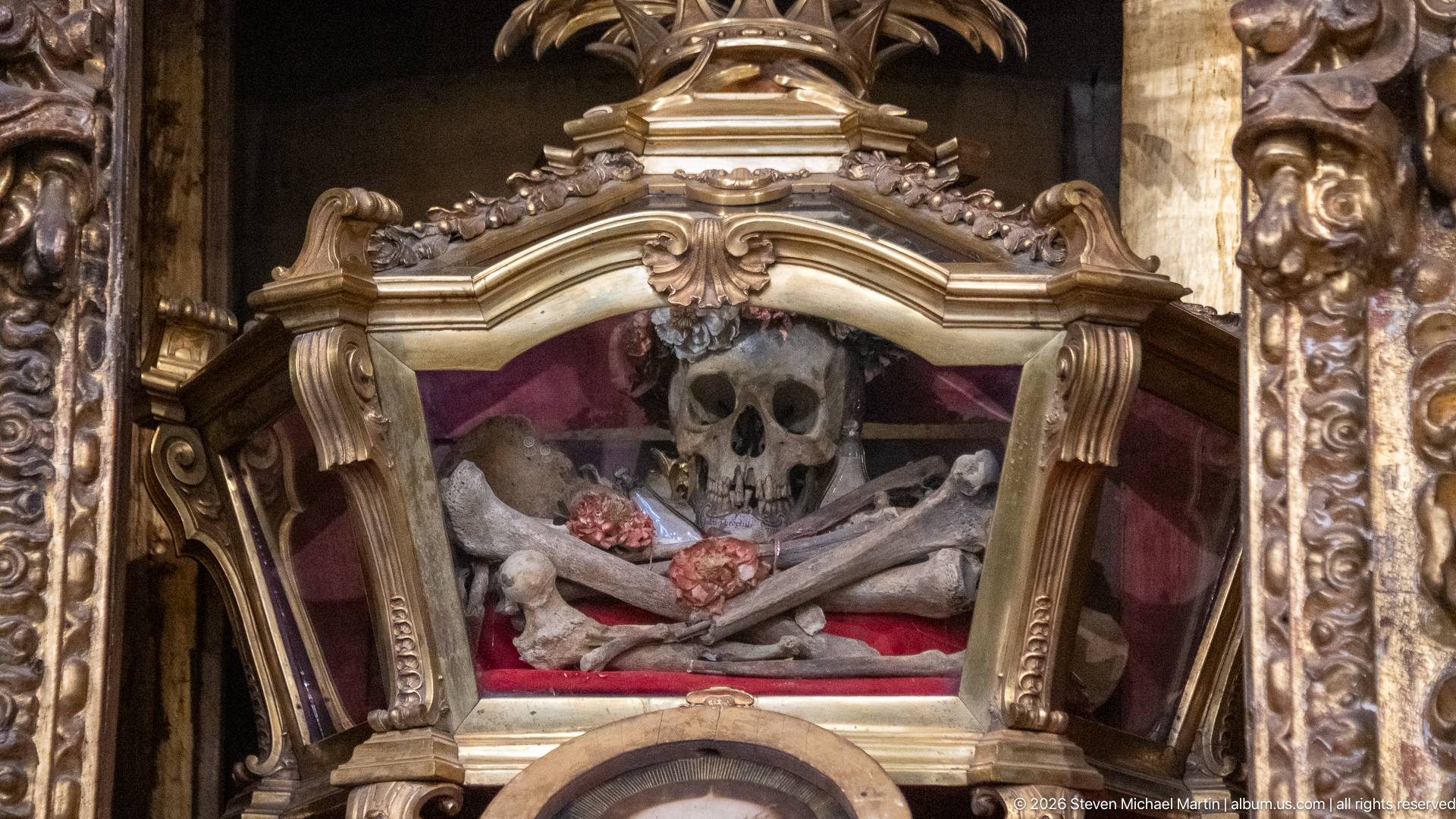
A human skull and crossed bones rest on red cloth inside a small gilded niche within a larger altar. The close view shows the carved surround and arranged bone fragments; it does not identify whose remains they are.
Caption
A human skull and crossed bones rest on red cloth inside a small gilded niche within a larger altar. The close view shows the carved surround and arranged bone fragments; it does not identify whose remains they are.
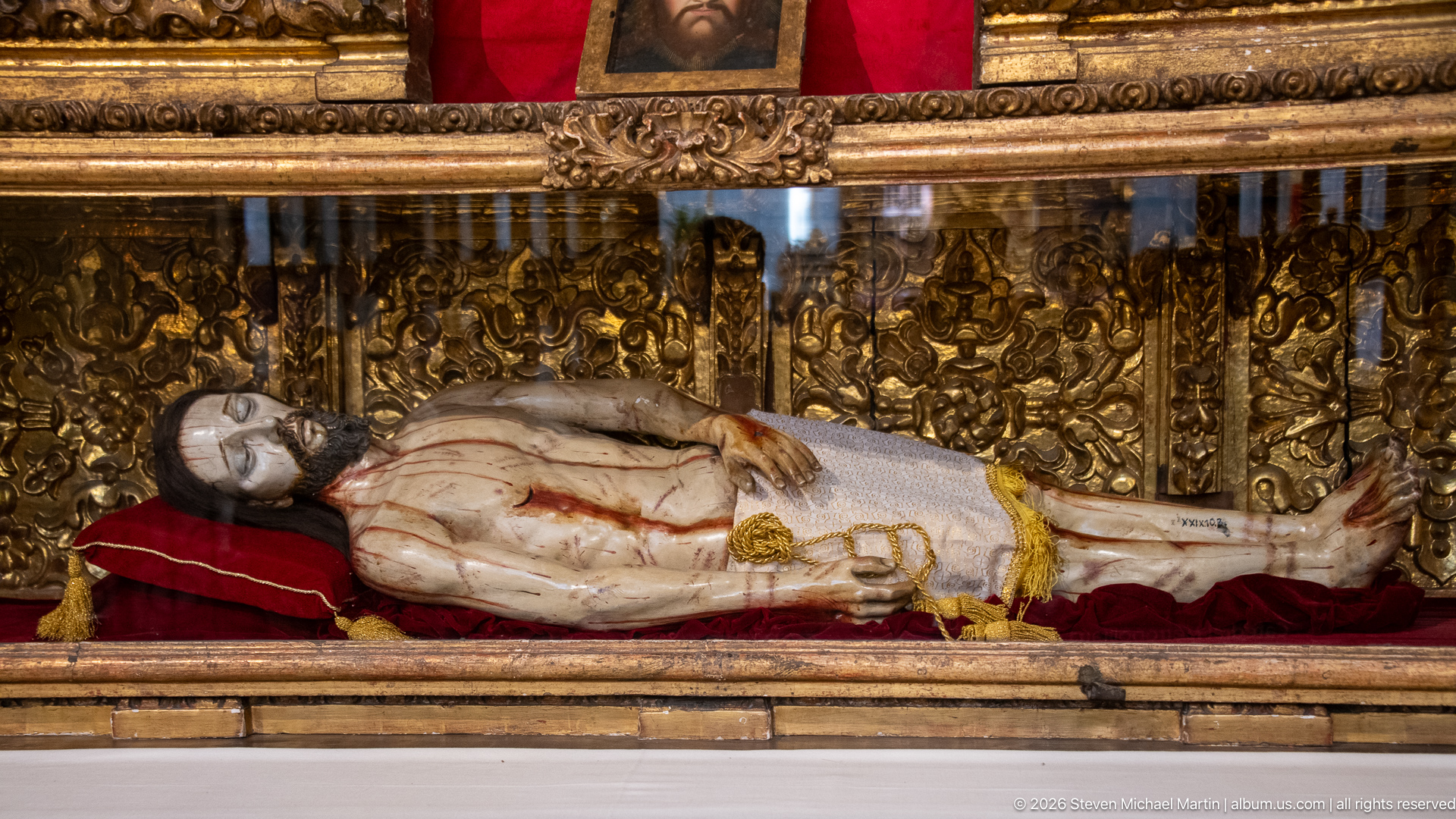
Seen at close range, the sculpted Christ lies on a red cushion with a pale, marked body, long dark hair, and a braided gold cord at the waist. A dark, intricately carved gold background encloses the figure, while a portrait and red cloth appear above. The framing emphasizes the sculpture’s horizontal form and painted wounds, details that are less apparent in the preceding view.
Caption
Seen at close range, the sculpted Christ lies on a red cushion with a pale, marked body, long dark hair, and a braided gold cord at the waist. A dark, intricately carved gold background encloses the figure, while a portrait and red cloth appear above. The framing emphasizes the sculpture’s horizontal form and painted wounds, details that are less apparent in the preceding view.
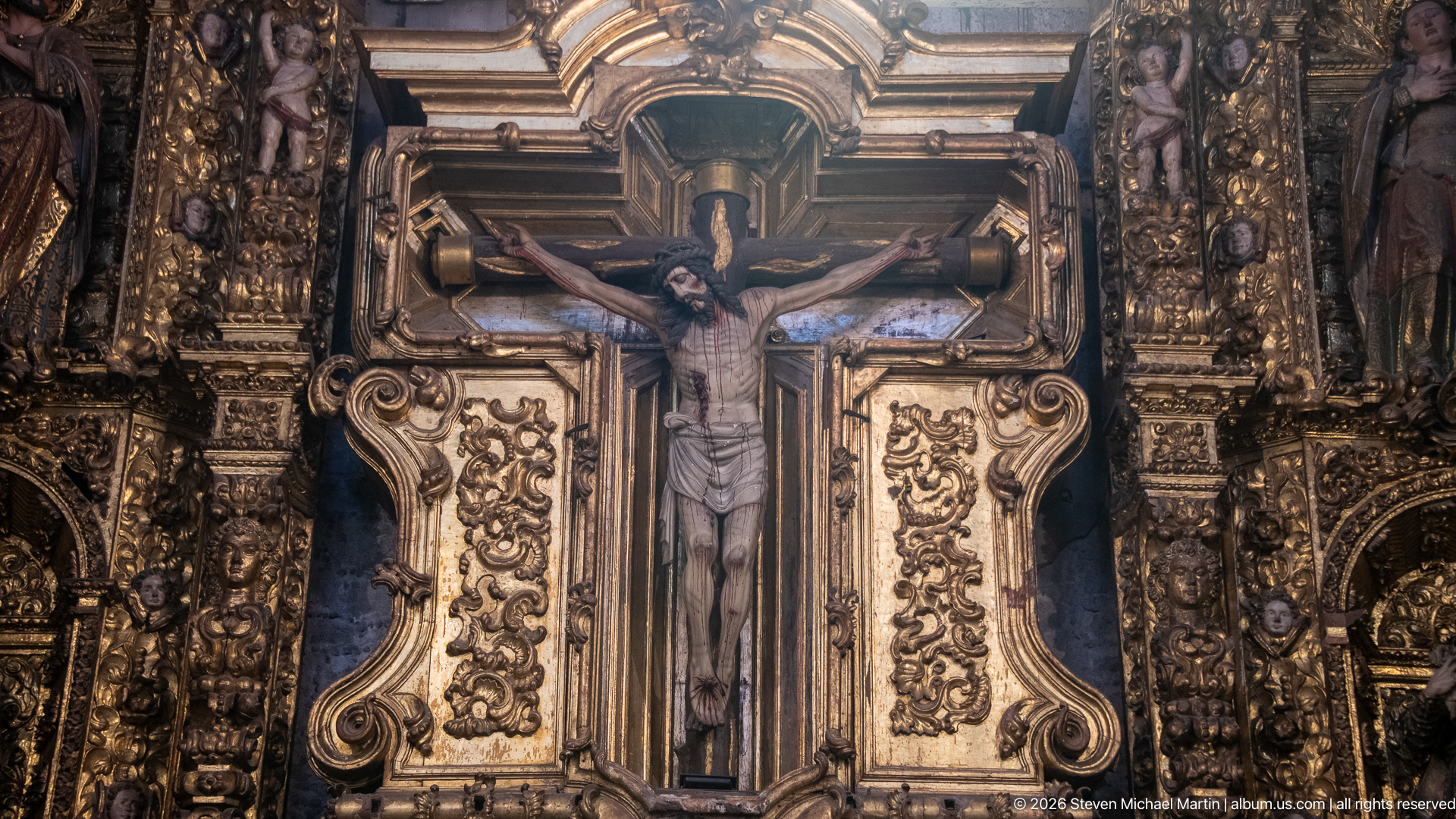
A sculpted Christ hangs from a cross at the center of a deeply carved gilded retablo. The nearly frontal composition isolates the crucifix and its flanking sculptural panels, allowing the curling foliage and layered architectural moldings to read as a frame around the central figure. The contrast between the dark body and luminous gold carving gives this altar detail a solemn focus.
Caption
A sculpted Christ hangs from a cross at the center of a deeply carved gilded retablo. The nearly frontal composition isolates the crucifix and its flanking sculptural panels, allowing the curling foliage and layered architectural moldings to read as a frame around the central figure. The contrast between the dark body and luminous gold carving gives this altar detail a solemn focus.
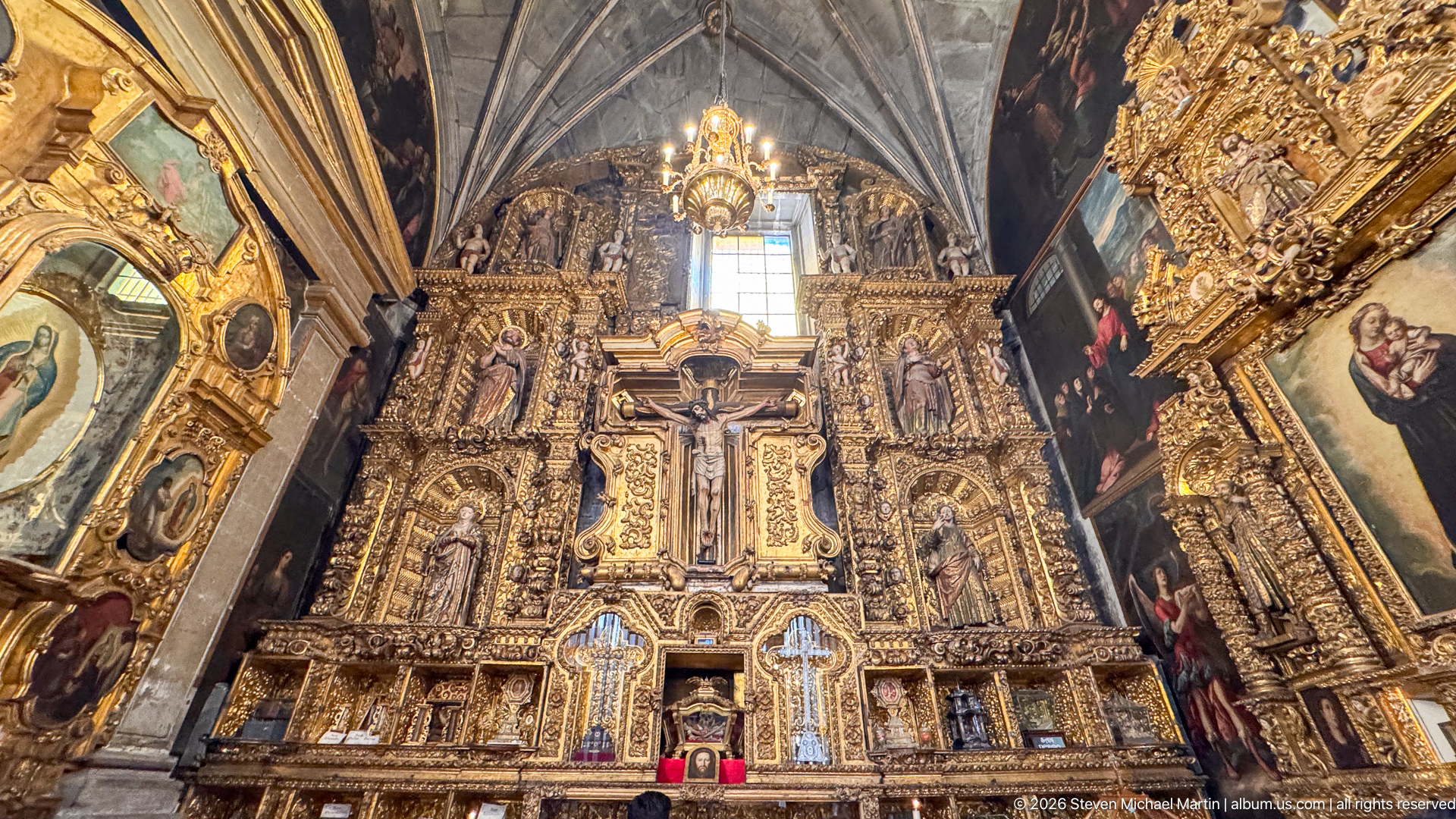
From farther back, the entire gilded retablo rises between massive stone piers beneath the cathedral’s high ribbed vault. Framed paintings, carved saints, and a central crucifix fill the altar wall, while a chandelier hangs above and a visitor’s head enters at the bottom edge. The view records how the ornate sanctuary sits within the larger scale of the cathedral interior.
Caption
From farther back, the entire gilded retablo rises between massive stone piers beneath the cathedral’s high ribbed vault. Framed paintings, carved saints, and a central crucifix fill the altar wall, while a chandelier hangs above and a visitor’s head enters at the bottom edge. The view records how the ornate sanctuary sits within the larger scale of the cathedral interior.
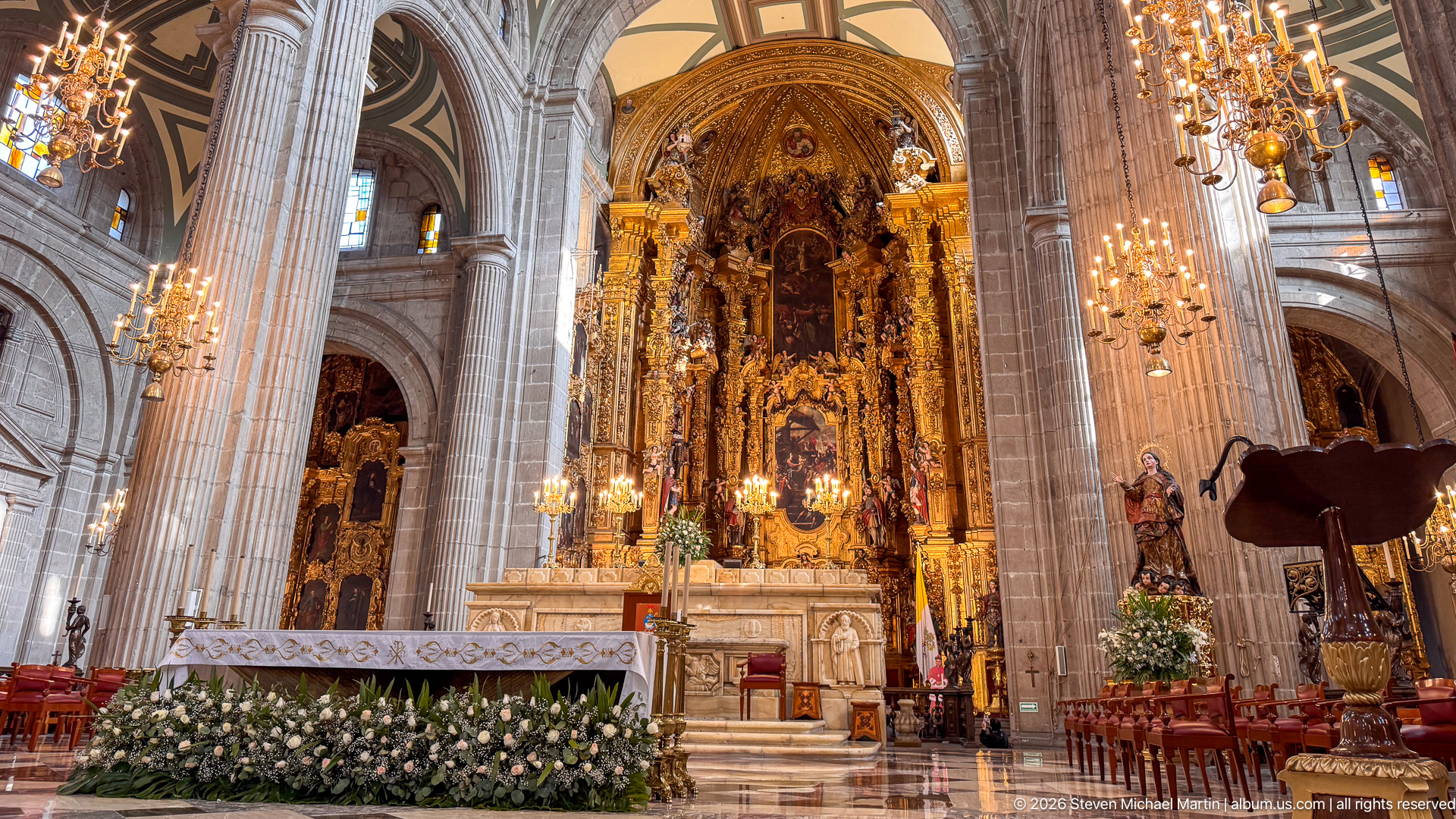
The principal sanctuary appears at the end of the nave, framed by immense stone columns and a high vaulted ceiling. A white altar table and a broad arrangement of white flowers occupy the foreground, while chandeliers, flags, and gilded carving lead the eye toward the central retablo. The symmetrical view connects the ceremonial altar with the cathedral’s monumental interior.
Caption
The principal sanctuary appears at the end of the nave, framed by immense stone columns and a high vaulted ceiling. A white altar table and a broad arrangement of white flowers occupy the foreground, while chandeliers, flags, and gilded carving lead the eye toward the central retablo. The symmetrical view connects the ceremonial altar with the cathedral’s monumental interior.
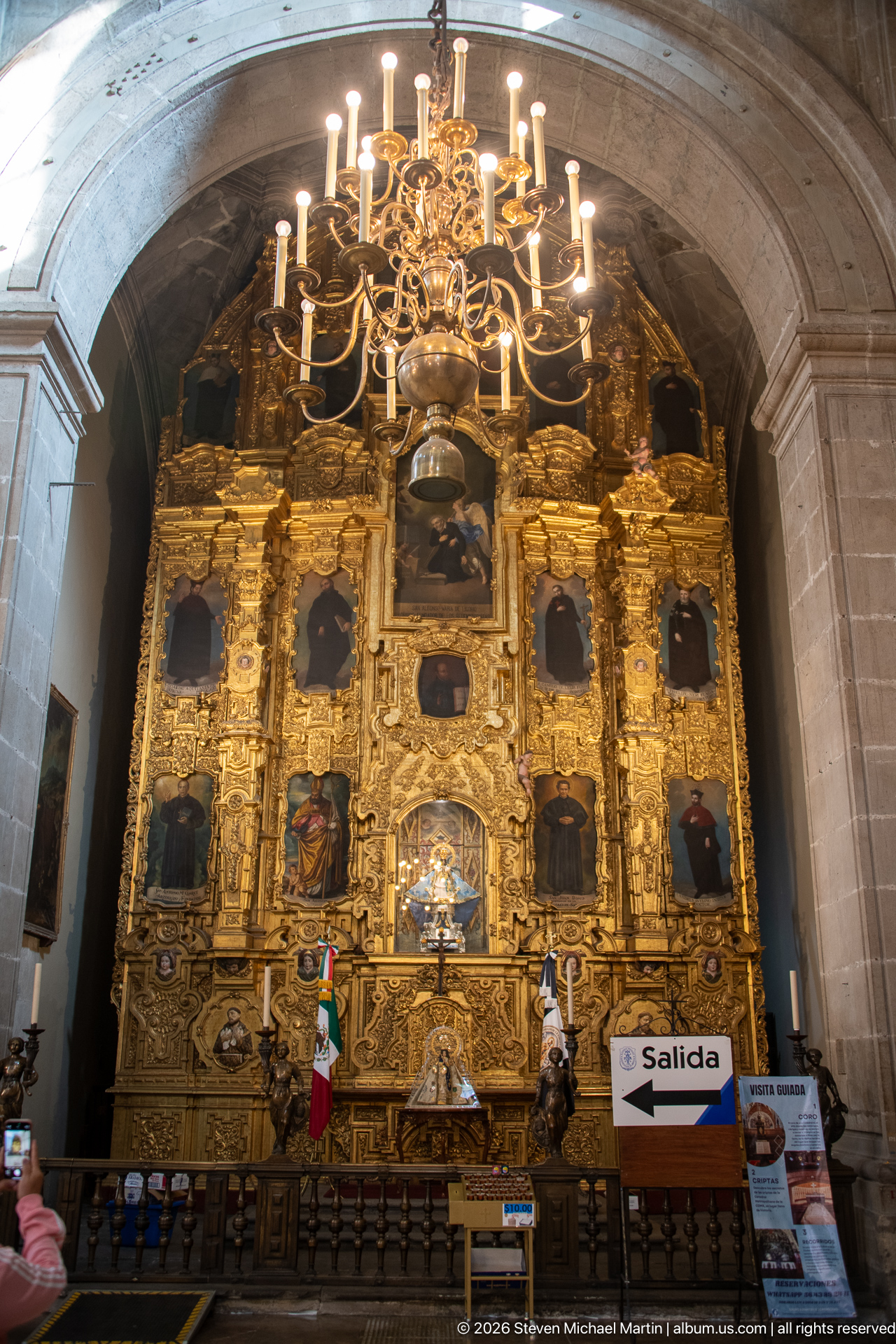
A broad, low viewpoint places a multi-tiered gilded retablo beneath a large chandelier. Small flags and devotional furnishings line the altar, while a prominent “Salida” sign points left across the lower-right foreground. This practical marker makes the photograph distinct from the sanctuary views: worship space and visitor circulation are visible together, without obscuring the elaborate painted and carved altar.
Caption
A broad, low viewpoint places a multi-tiered gilded retablo beneath a large chandelier. Small flags and devotional furnishings line the altar, while a prominent “Salida” sign points left across the lower-right foreground. This practical marker makes the photograph distinct from the sanctuary views: worship space and visitor circulation are visible together, without obscuring the elaborate painted and carved altar.
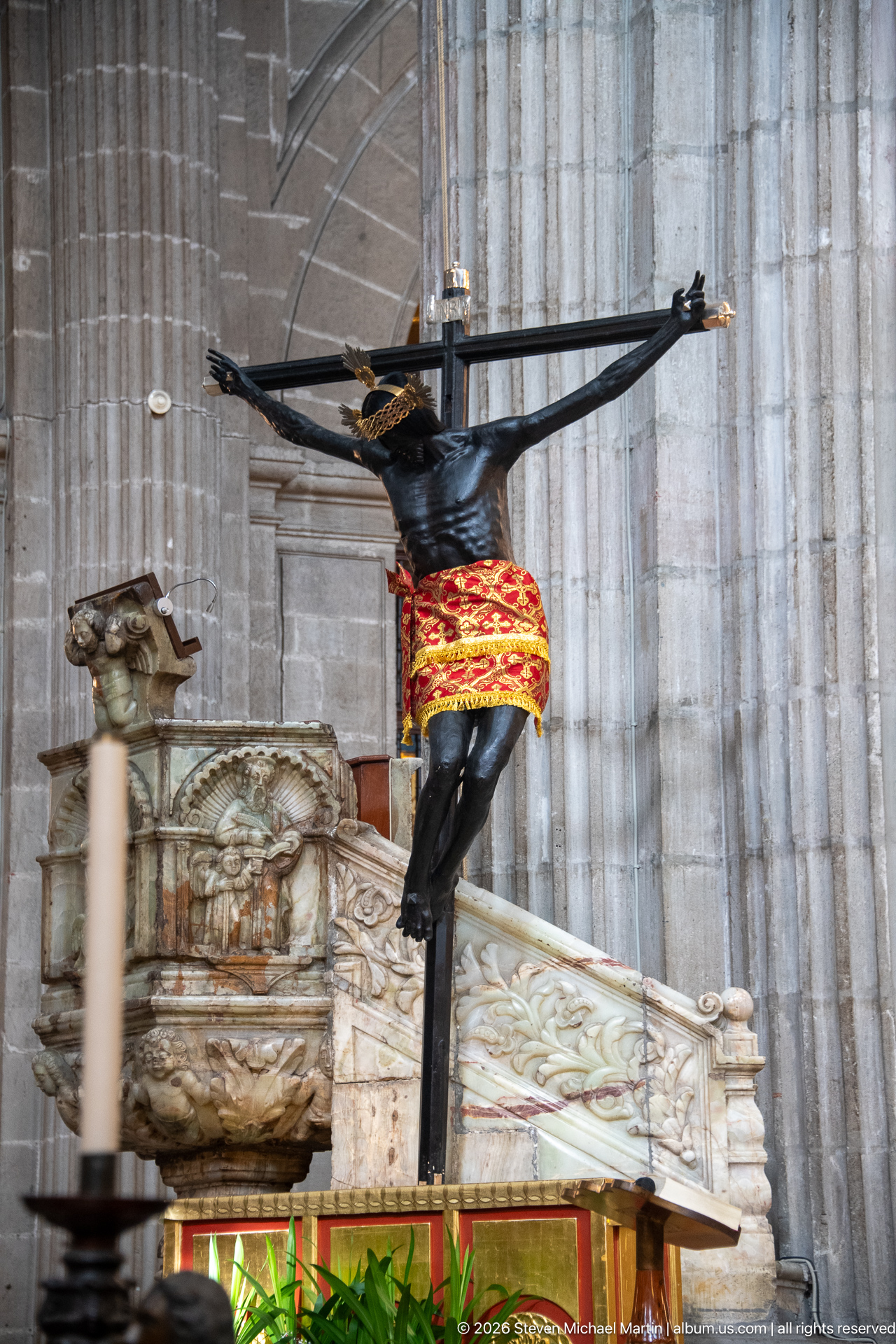
A dark crucifix rises directly above a carved stone baptismal font, with red and gold cloth wrapped around the lower support. Green plants sit at the base, bringing the two liturgical objects into the same foreground view.
Caption
A dark crucifix rises directly above a carved stone baptismal font, with red and gold cloth wrapped around the lower support. Green plants sit at the base, bringing the two liturgical objects into the same foreground view.
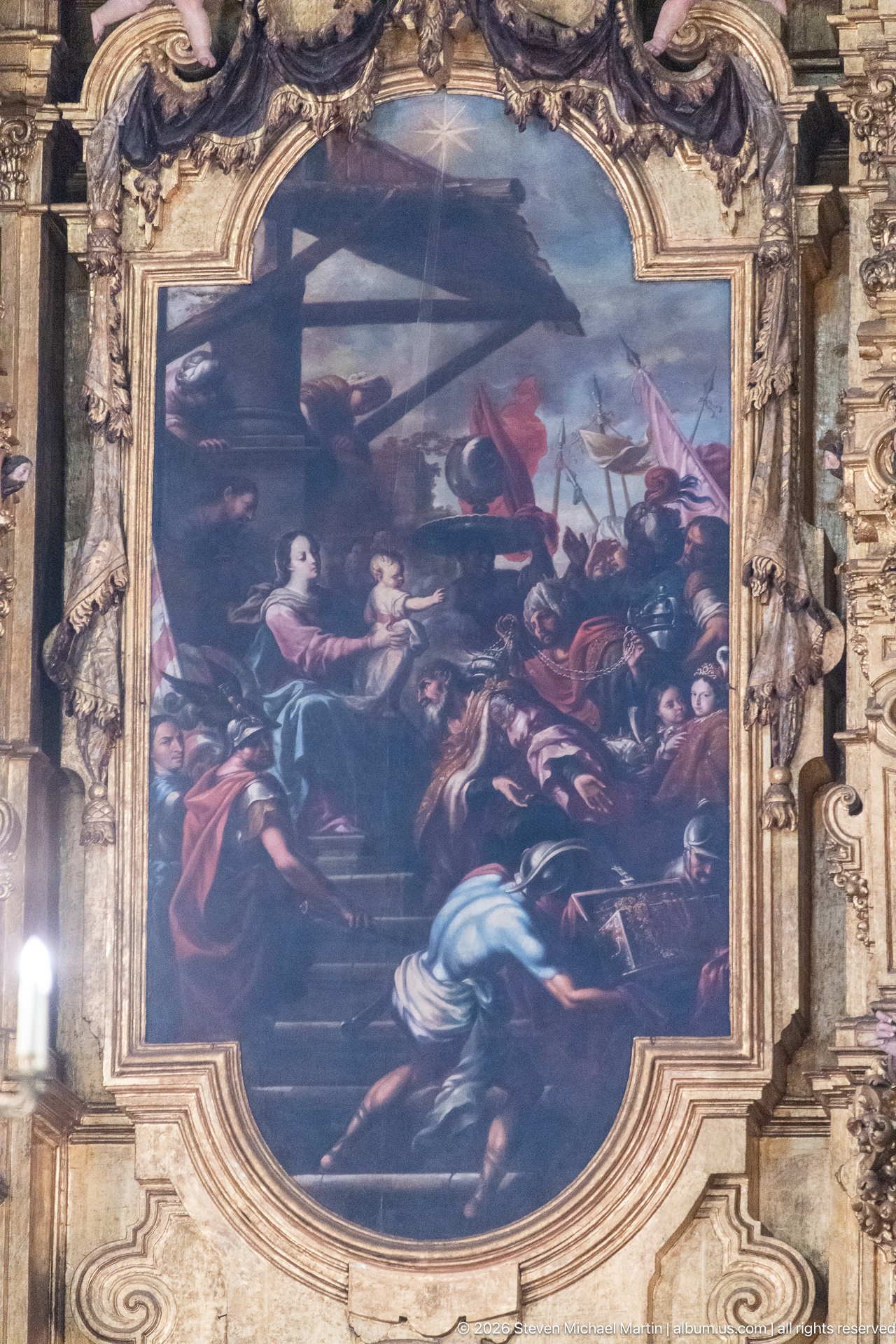
A crowded religious scene fills a large framed canvas, with robed figures gathered around a central group and an open expanse of sky above. The gold frame’s sculpted scrolls and projecting ornament are visible along all sides. Reflections across the glass partly veil the painted surface, so the exact episode and artist cannot be established from this view alone.
Caption
A crowded religious scene fills a large framed canvas, with robed figures gathered around a central group and an open expanse of sky above. The gold frame’s sculpted scrolls and projecting ornament are visible along all sides. Reflections across the glass partly veil the painted surface, so the exact episode and artist cannot be established from this view alone.
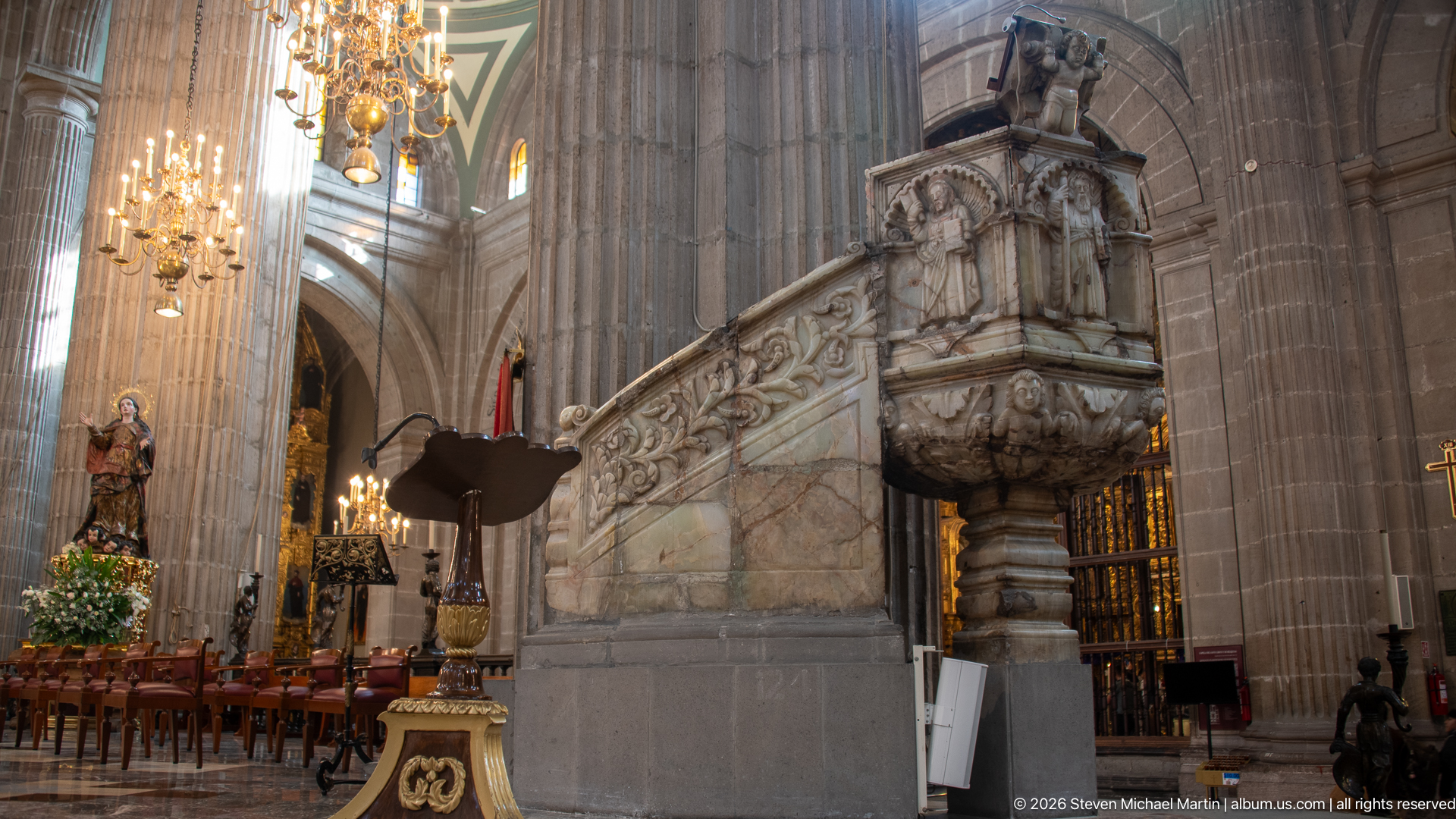
A pale stone pulpit projects from a massive nave pier, its carved stair and balustrade rising toward a sculpted canopy. Rows of chairs and high stone arches behind it locate the pulpit within the cathedral’s main interior.
Caption
A pale stone pulpit projects from a massive nave pier, its carved stair and balustrade rising toward a sculpted canopy. Rows of chairs and high stone arches behind it locate the pulpit within the cathedral’s main interior.
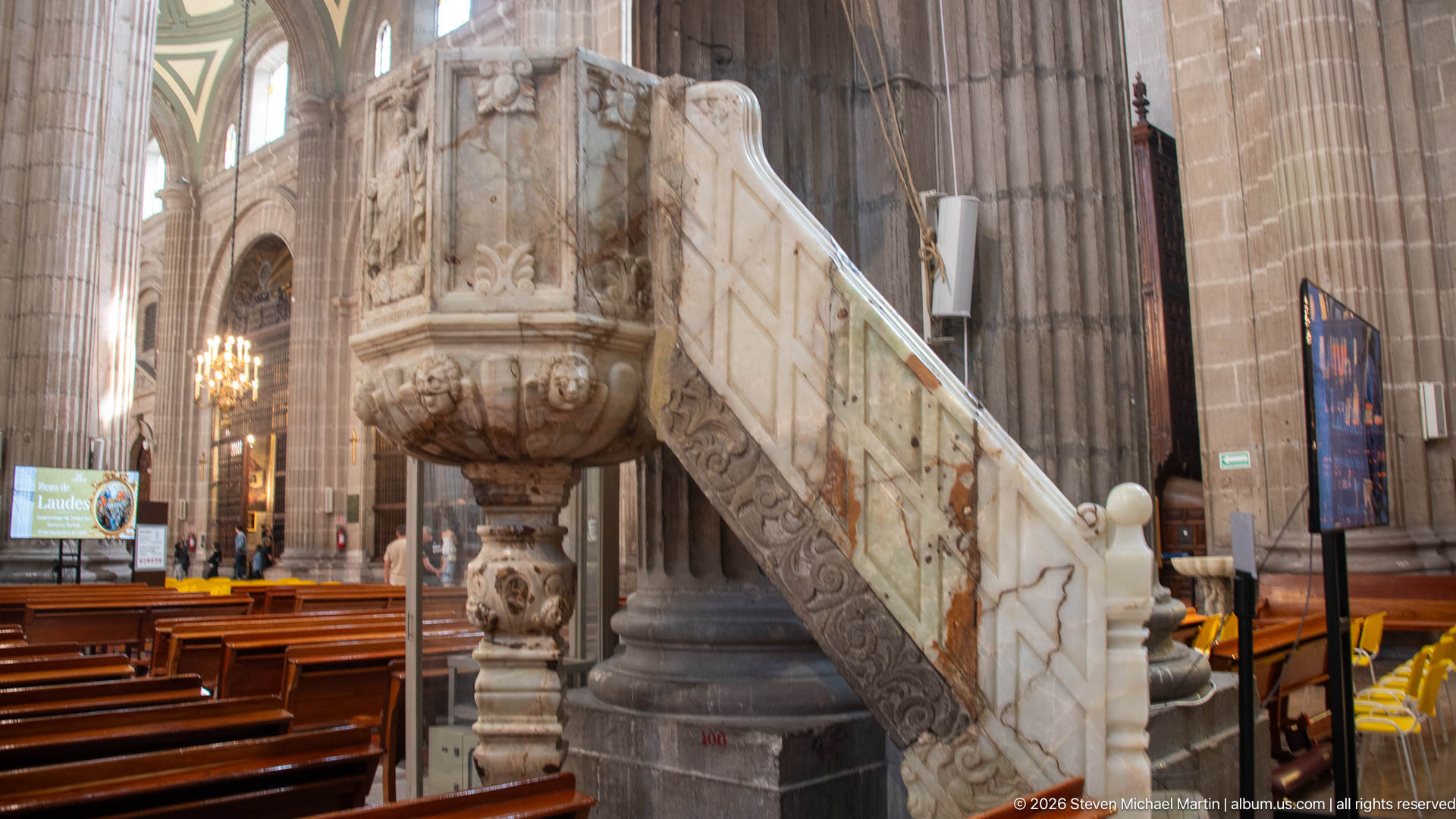
The pulpit’s sculpted stone bowl and sloping stair dominate this side view, revealing reliefs of faces, foliage, and architectural ornament along the balustrade. Dark wooden pews recede to the left, while a tall pier and a hanging banner define the right side of the frame. The close perspective emphasizes the pulpit’s carved surfaces within the larger nave.
Caption
The pulpit’s sculpted stone bowl and sloping stair dominate this side view, revealing reliefs of faces, foliage, and architectural ornament along the balustrade. Dark wooden pews recede to the left, while a tall pier and a hanging banner define the right side of the frame. The close perspective emphasizes the pulpit’s carved surfaces within the larger nave.
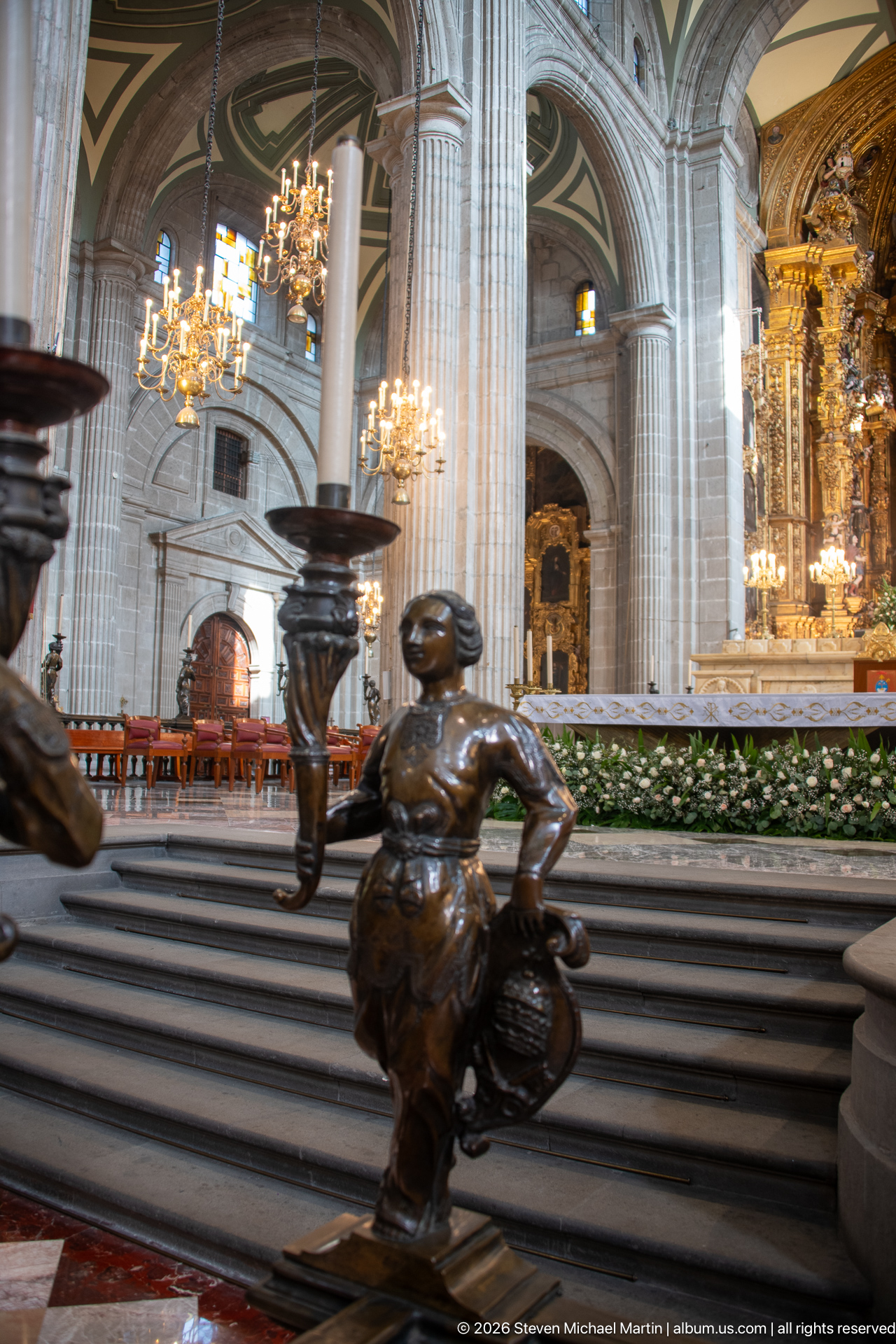
Several dark bronze figures occupy the foreground, their varied poses forming a compact sculptural group against the brighter stone nave and gilded sanctuary. The low composition also includes the altar, chandeliers, and rows of chairs, placing the sculpture within the working church interior. The figures’ precise subject is not identified here because no inscription or explanatory label is readable.
Caption
Several dark bronze figures occupy the foreground, their varied poses forming a compact sculptural group against the brighter stone nave and gilded sanctuary. The low composition also includes the altar, chandeliers, and rows of chairs, placing the sculpture within the working church interior. The figures’ precise subject is not identified here because no inscription or explanatory label is readable.
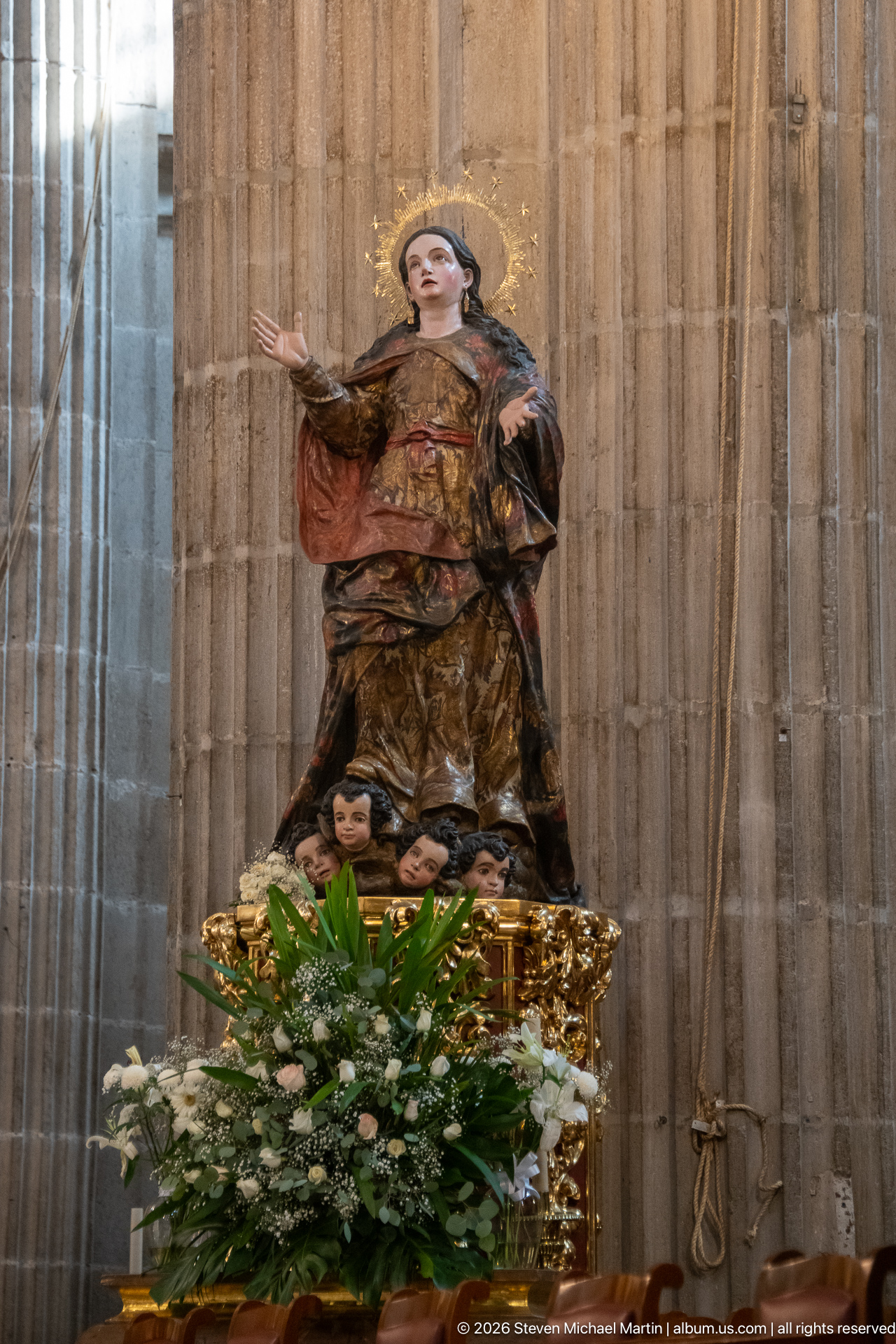
A haloed Marian figure raises both hands above a group of small childlike heads, with white flowers arranged at the pedestal. The unusual grouping and painted garments are visible, but the photograph offers no readable title that would support a more specific Marian dedication.
Caption
A haloed Marian figure raises both hands above a group of small childlike heads, with white flowers arranged at the pedestal. The unusual grouping and painted garments are visible, but the photograph offers no readable title that would support a more specific Marian dedication.
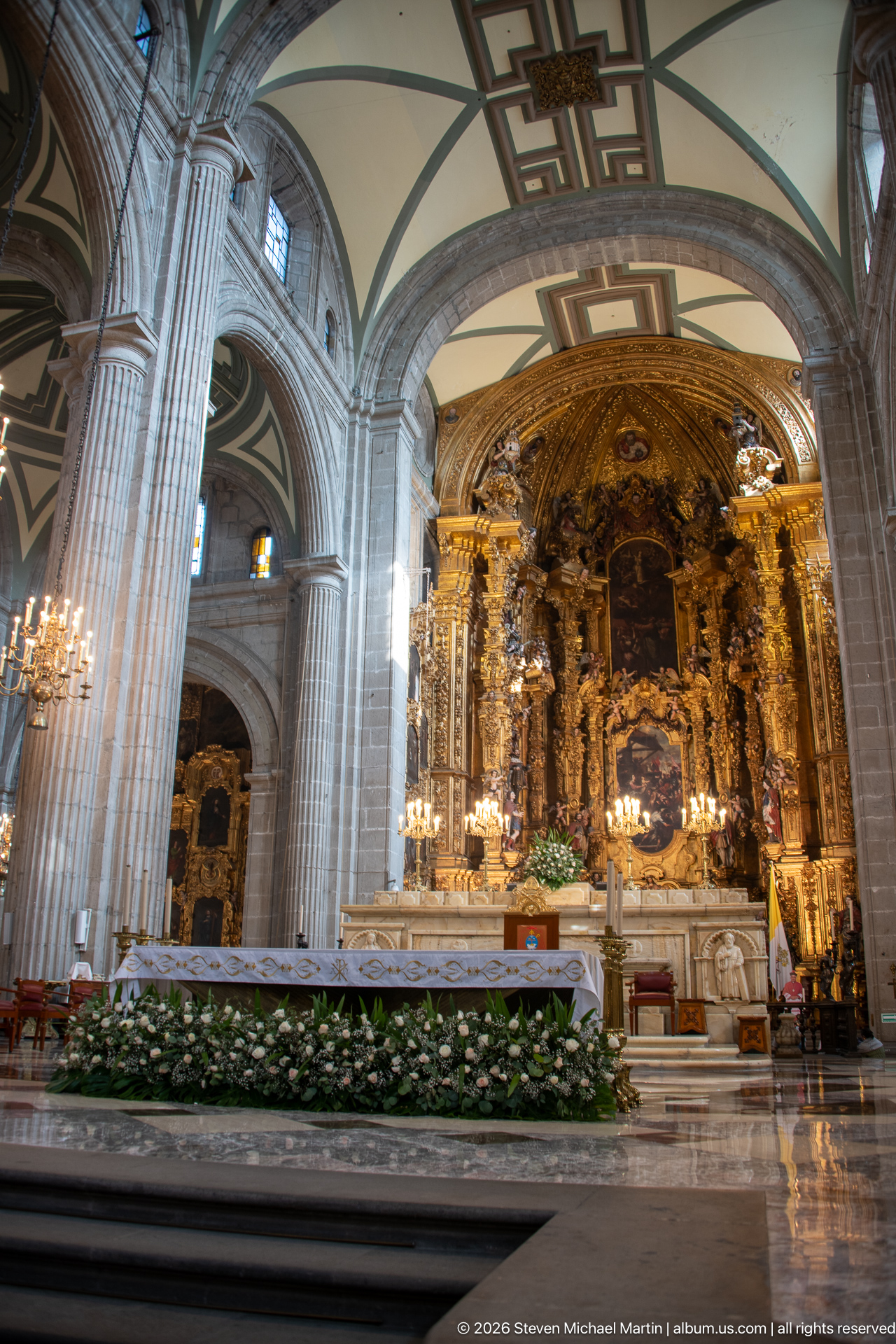
The main retablo is seen across a white altar table topped with a long band of white flowers. Pale columns and rounded arches enclose the sanctuary, while chandeliers and the high patterned ceiling remain visible at the sides and above. The straightforward elevation gives the altar a strong central position and records the formal alignment of nave, table, and retablo.
Caption
The main retablo is seen across a white altar table topped with a long band of white flowers. Pale columns and rounded arches enclose the sanctuary, while chandeliers and the high patterned ceiling remain visible at the sides and above. The straightforward elevation gives the altar a strong central position and records the formal alignment of nave, table, and retablo.
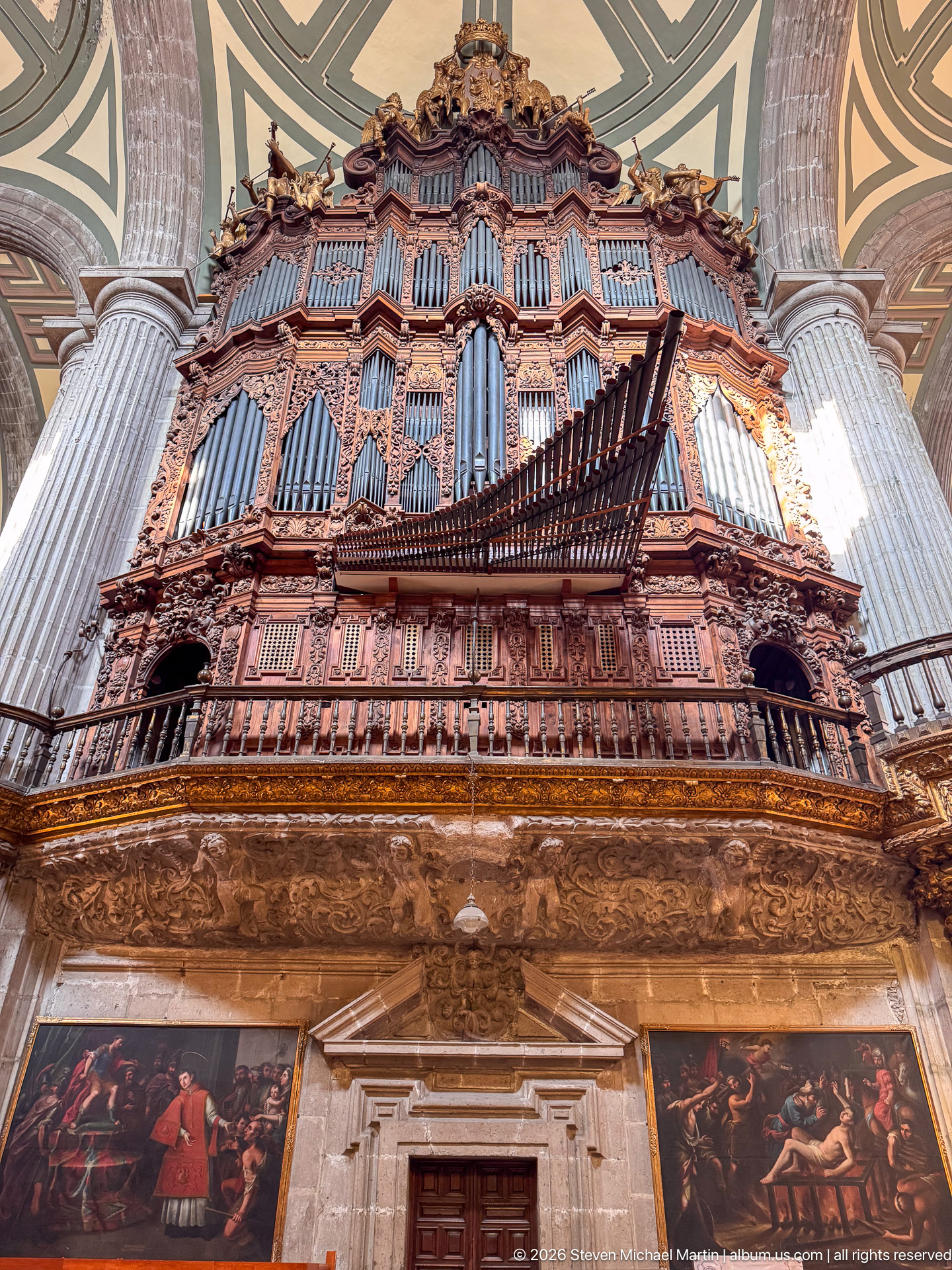
The cathedral’s carved pipe-organ case and silver-gray pipes fill the upper wall above a stone doorway. Large religious paintings flank the entrance below, showing the instrument as part of the architecture rather than an isolated object.
Caption
The cathedral’s carved pipe-organ case and silver-gray pipes fill the upper wall above a stone doorway. Large religious paintings flank the entrance below, showing the instrument as part of the architecture rather than an isolated object.
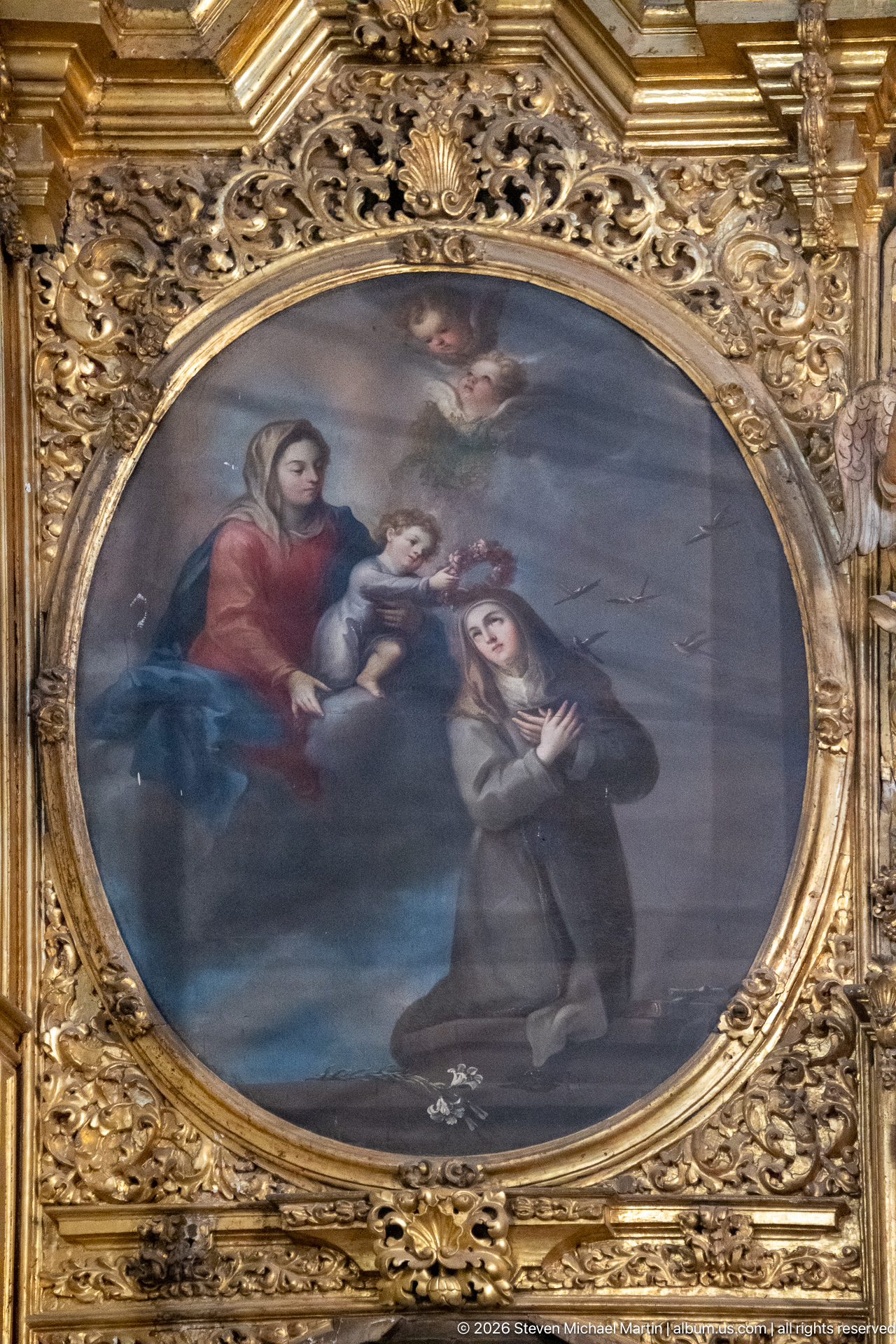
An oval religious painting shows the Virgin seated with the Christ Child, accompanied by another robed woman kneeling in prayer. A small heavenly figure appears above them, and a gold carved frame encloses the scene. The centered close view highlights the painting’s devotional composition and ornate surround; no visible inscription identifies the additional figures or the work’s maker.
Caption
An oval religious painting shows the Virgin seated with the Christ Child, accompanied by another robed woman kneeling in prayer. A small heavenly figure appears above them, and a gold carved frame encloses the scene. The centered close view highlights the painting’s devotional composition and ornate surround; no visible inscription identifies the additional figures or the work’s maker.
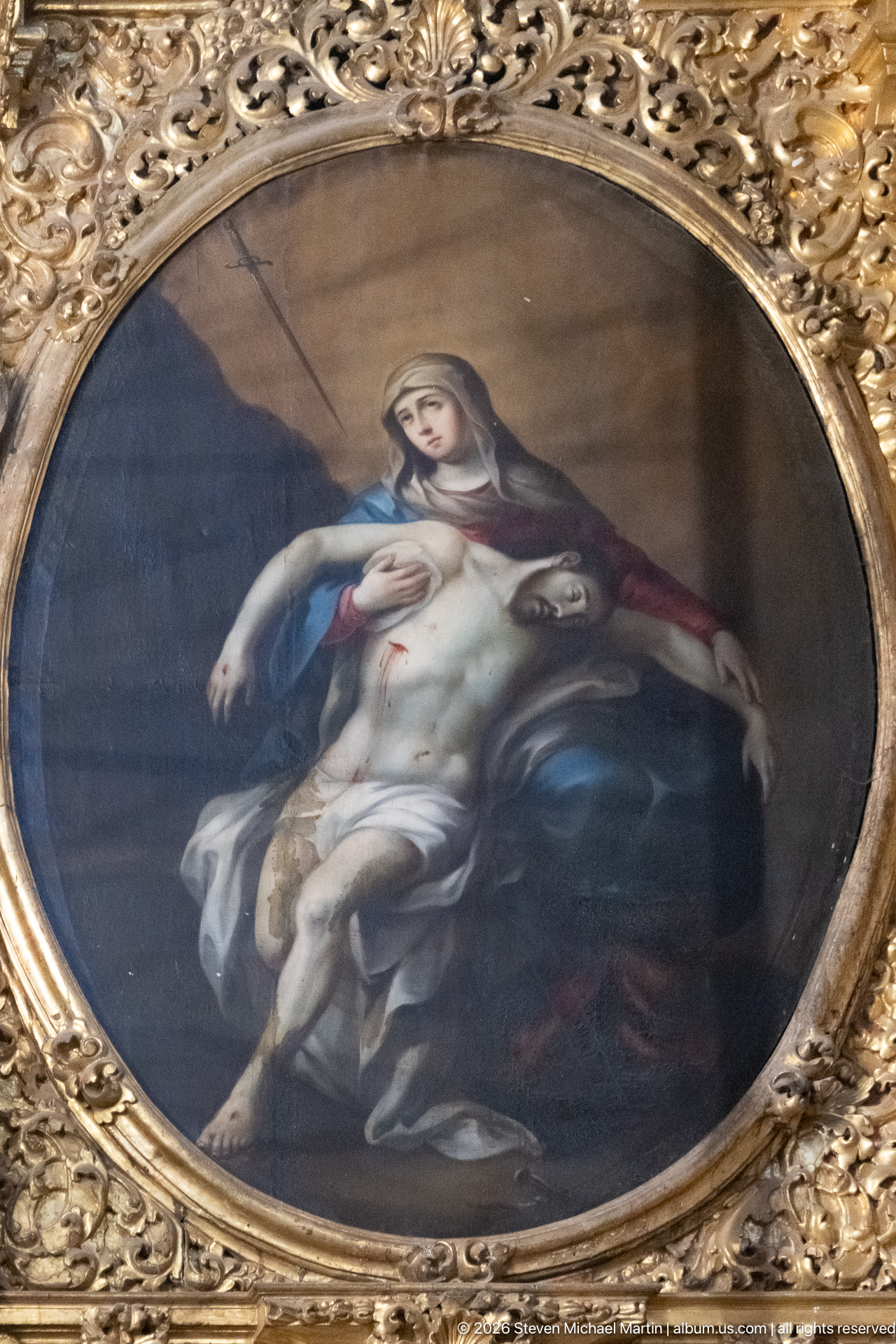
This oval painting depicts the Lamentation: Mary supports the dead Christ after the Crucifixion, her face turned upward as she cradles his pale body. Its carved gilded frame surrounds the intimate devotional scene.
Caption
This oval painting depicts the Lamentation: Mary supports the dead Christ after the Crucifixion, her face turned upward as she cradles his pale body. Its carved gilded frame surrounds the intimate devotional scene.
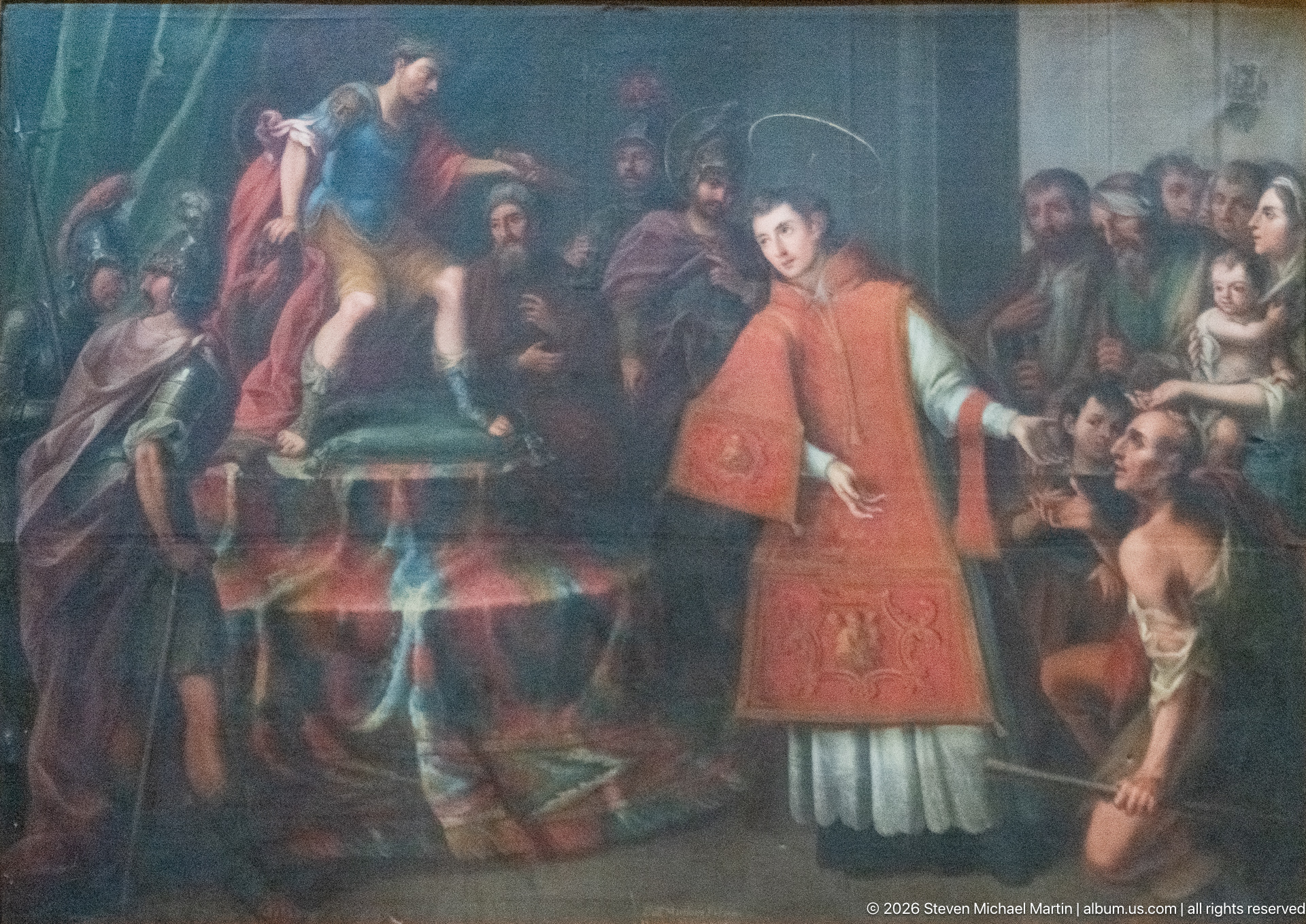
A red-robed cleric stands at the center of a crowded religious narrative, extending one hand toward a kneeling figure as onlookers gather on both sides. The muted palette and dark background contrast with the vivid red vestment. Reflections on the painting’s surface soften some details, and no visible label identifies the subject or artist.
Caption
A red-robed cleric stands at the center of a crowded religious narrative, extending one hand toward a kneeling figure as onlookers gather on both sides. The muted palette and dark background contrast with the vivid red vestment. Reflections on the painting’s surface soften some details, and no visible label identifies the subject or artist.
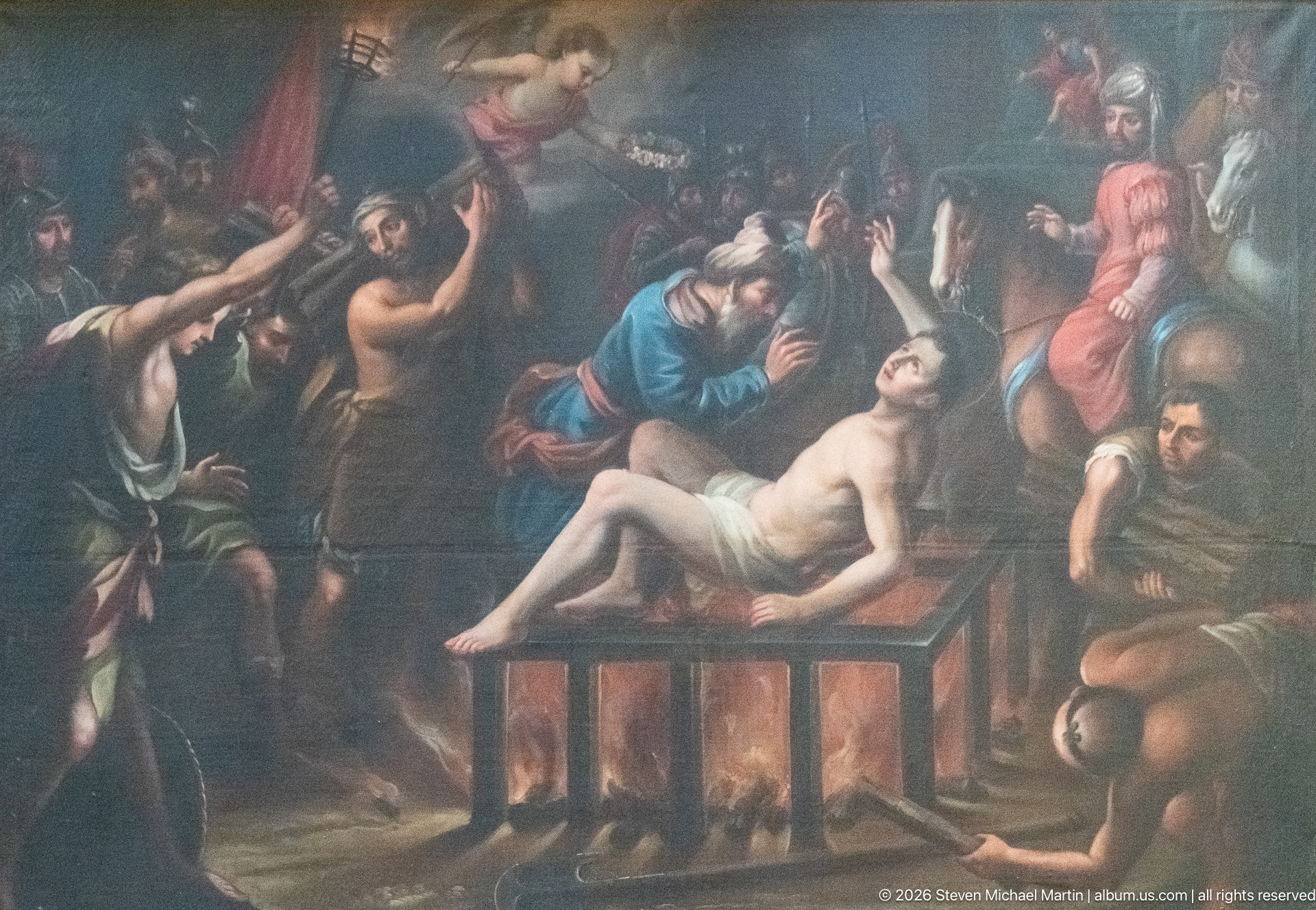
A reclining pale figure rests on a table or bier while robed attendants lean in from both sides; an angelic figure appears above. The clustered gestures draw attention to the central body, with darker figures and a green-blue sky enclosing the scene. The close view records a dramatic religious narrative, but the exact biblical episode is not established by visible text.
Caption
A reclining pale figure rests on a table or bier while robed attendants lean in from both sides; an angelic figure appears above. The clustered gestures draw attention to the central body, with darker figures and a green-blue sky enclosing the scene. The close view records a dramatic religious narrative, but the exact biblical episode is not established by visible text.
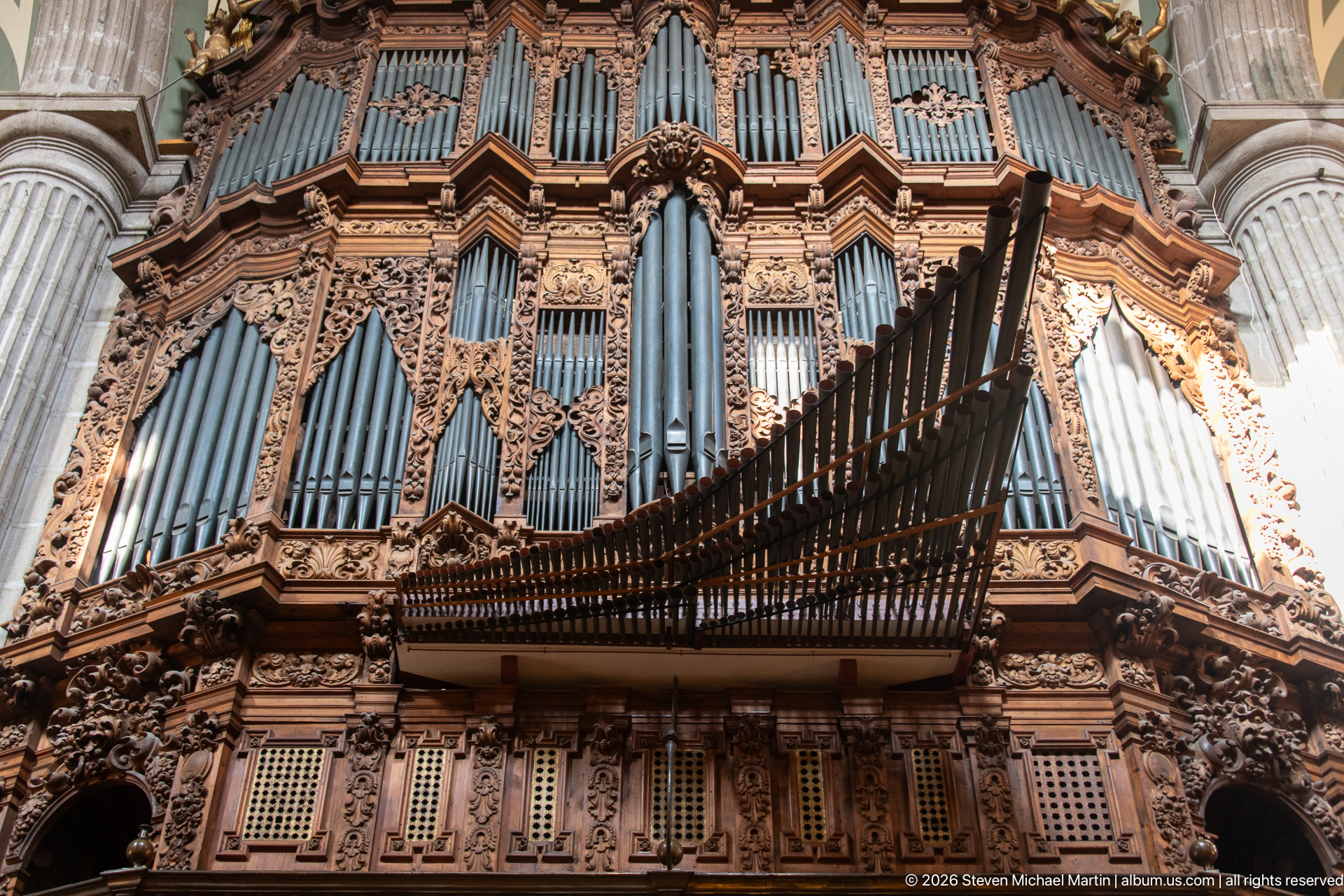
The camera moves closer to the organ, isolating its tiers of vertical pipes, carved floral panels, and a projecting dark wooden music gallery. Stone columns appear at the edges, giving scale to the instrument’s broad façade. This detail complements the previous overall view by revealing the repeated pipe ranks and dense wood carving rather than the doorway below.
Caption
The camera moves closer to the organ, isolating its tiers of vertical pipes, carved floral panels, and a projecting dark wooden music gallery. Stone columns appear at the edges, giving scale to the instrument’s broad façade. This detail complements the previous overall view by revealing the repeated pipe ranks and dense wood carving rather than the doorway below.
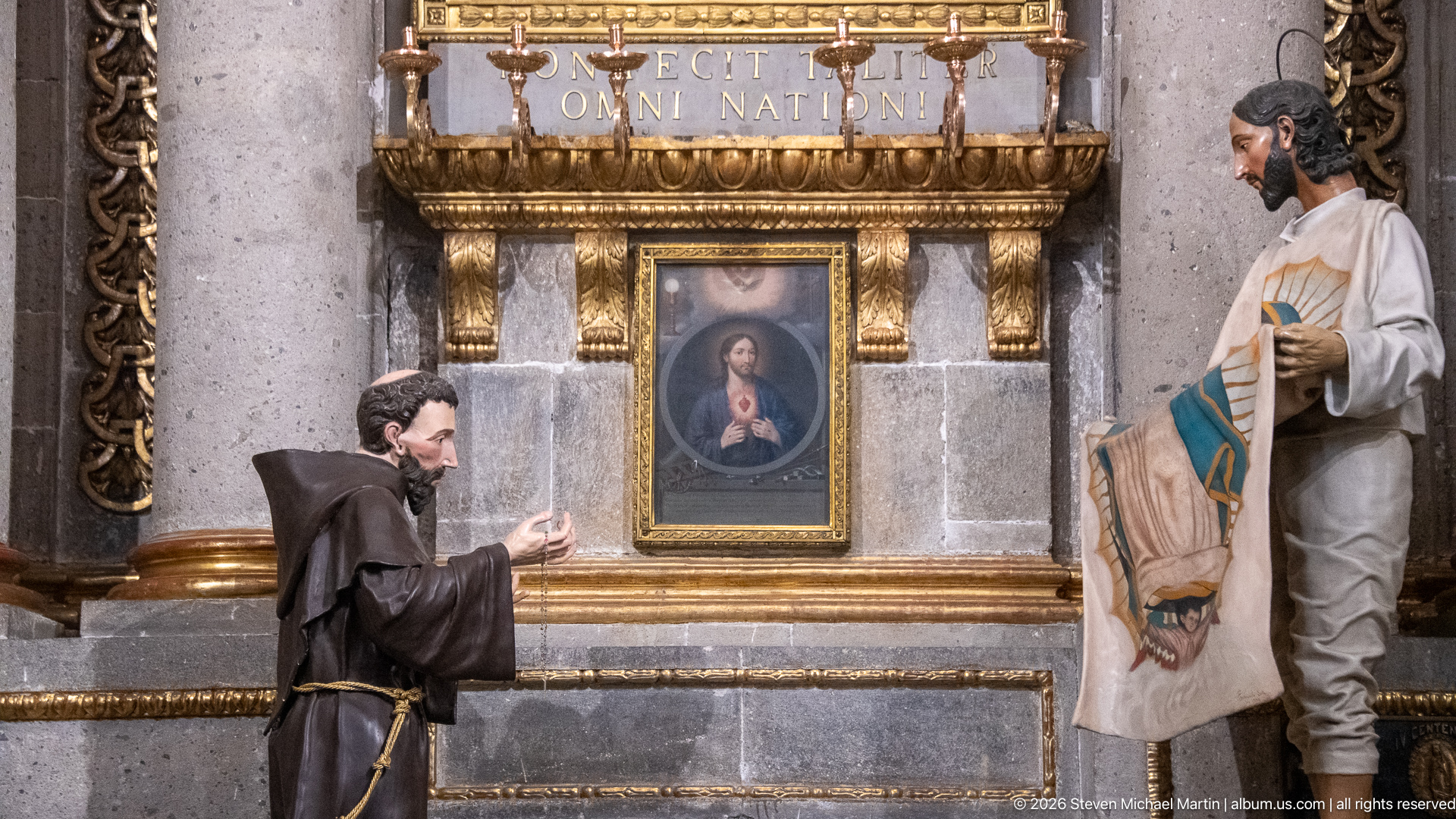
A framed image of Christ displaying the Sacred Heart hangs between two robed statues beneath a gilded canopy. The Latin inscription above and candles below mark this as a dedicated Sacred Heart altar.
Caption
A framed image of Christ displaying the Sacred Heart hangs between two robed statues beneath a gilded canopy. The Latin inscription above and candles below mark this as a dedicated Sacred Heart altar.
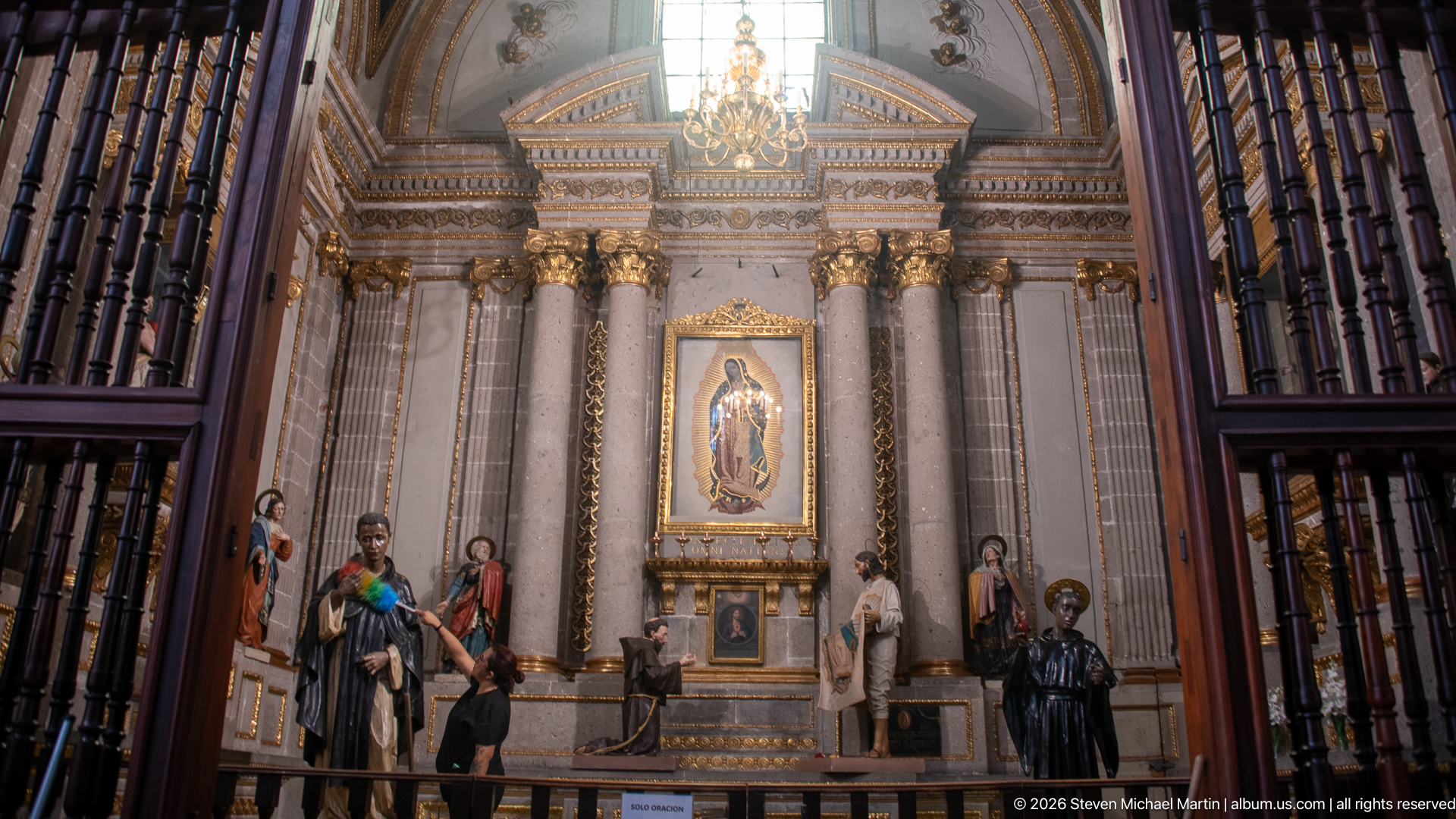
A chapel altar centers a framed image of the Virgin of Guadalupe beneath a pale stone canopy. Figures and smaller devotional images fill the lower register, while tall dark organ pipes and wooden screens rise on both sides. A visitor stands behind the railing, providing scale and showing the chapel as an active place of devotion within the cathedral.
Caption
A chapel altar centers a framed image of the Virgin of Guadalupe beneath a pale stone canopy. Figures and smaller devotional images fill the lower register, while tall dark organ pipes and wooden screens rise on both sides. A visitor stands behind the railing, providing scale and showing the chapel as an active place of devotion within the cathedral.
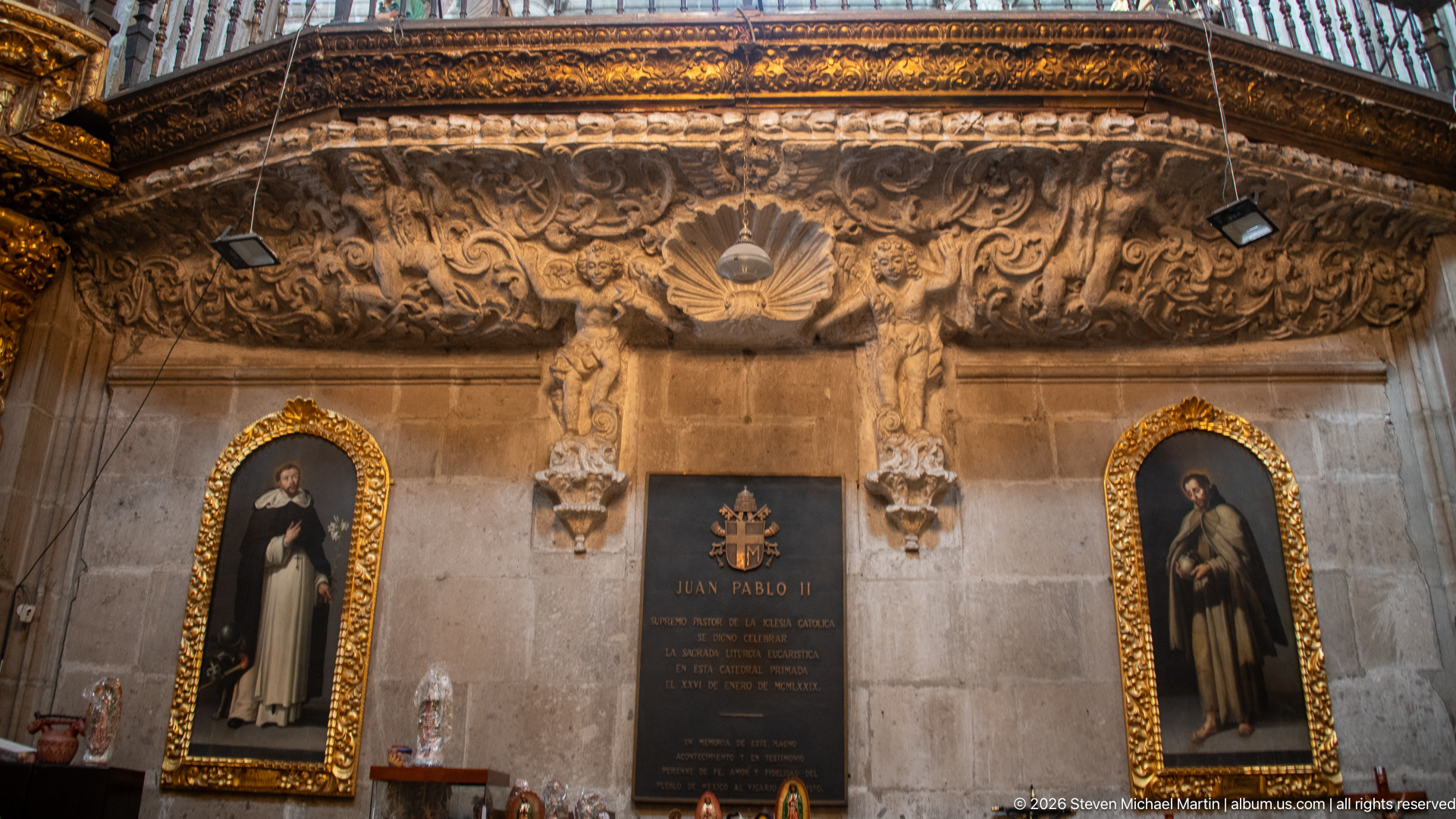
A dark wall plaque bearing the name Juan Pablo II is set beneath a gilded canopy and between framed religious portraits. Small devotional objects line the ledge below the memorial.
Caption
A dark wall plaque bearing the name Juan Pablo II is set beneath a gilded canopy and between framed religious portraits. Small devotional objects line the ledge below the memorial.
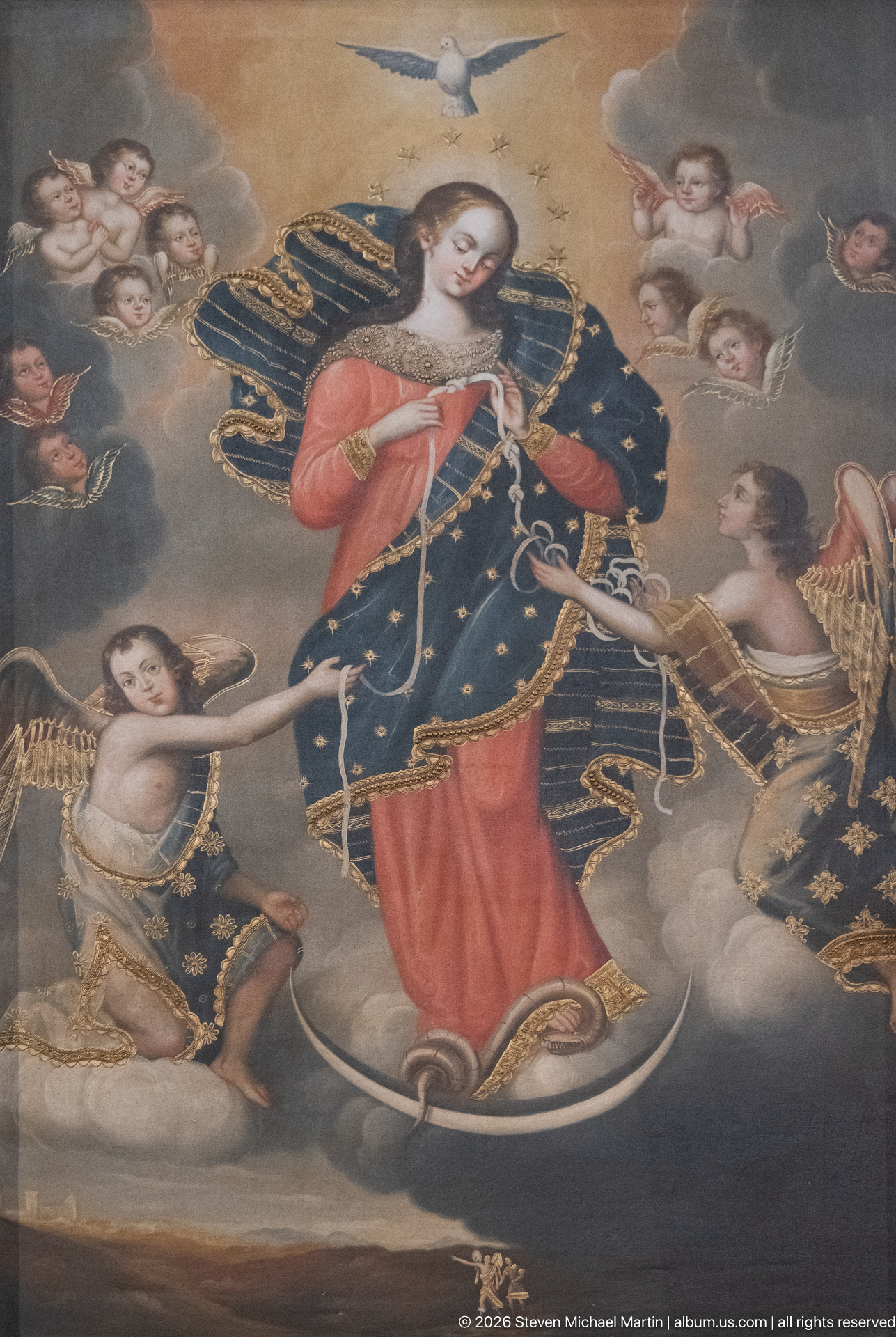
The Virgin of Guadalupe appears in her familiar iconography: a star-patterned blue mantle over a rose-colored dress, a crescent beneath her, angels gathered around her, and a dove above. The gold rays and border complete the devotional image.
Caption
The Virgin of Guadalupe appears in her familiar iconography: a star-patterned blue mantle over a rose-colored dress, a crescent beneath her, angels gathered around her, and a dove above. The gold rays and border complete the devotional image.
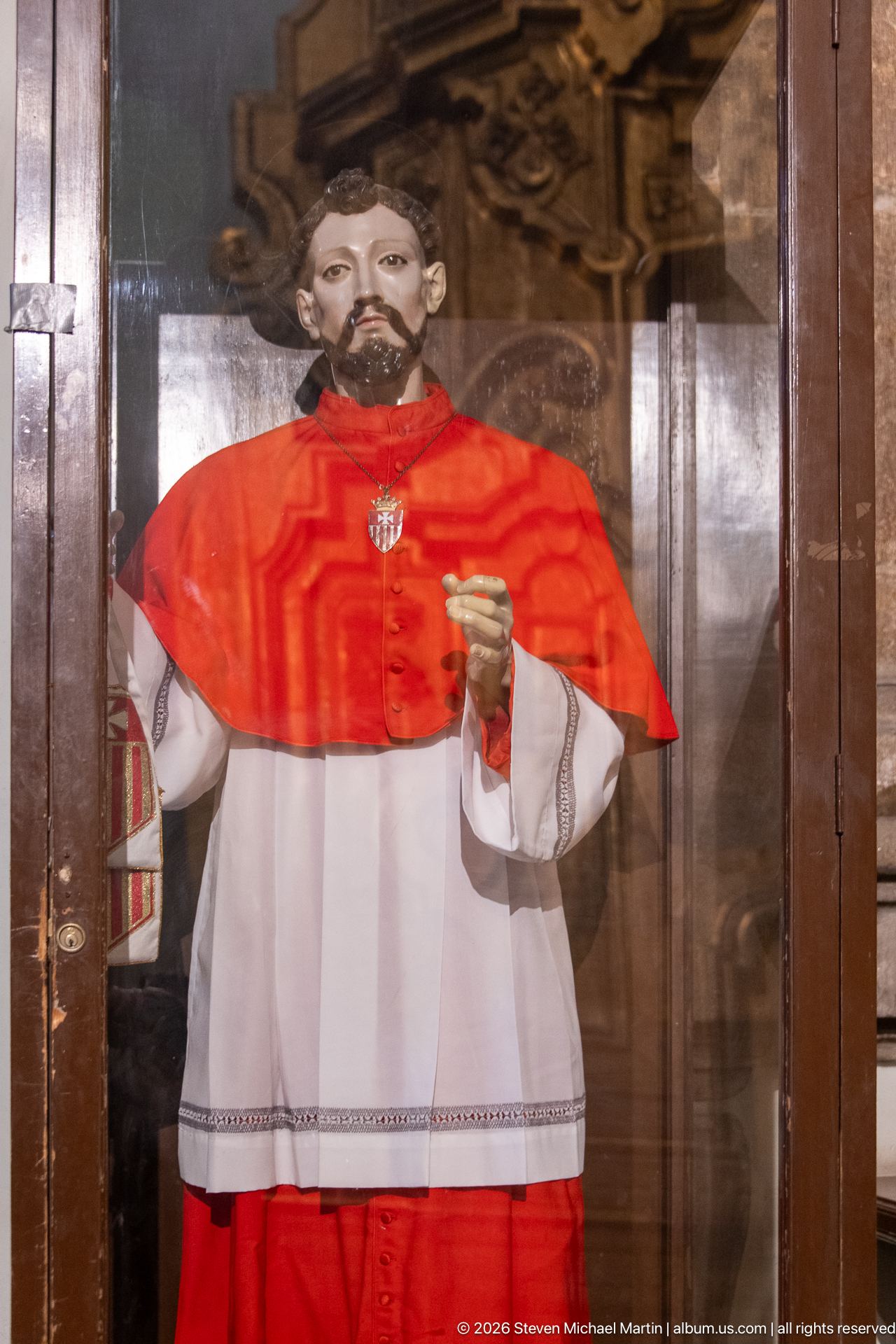
A full-length clerical effigy stands behind reflective glass in a tall cabinet, wearing a white cassock, red cape, and red skullcap. A pectoral cross and raised hand are visible, but no identifying name appears in the view.
Caption
A full-length clerical effigy stands behind reflective glass in a tall cabinet, wearing a white cassock, red cape, and red skullcap. A pectoral cross and raised hand are visible, but no identifying name appears in the view.
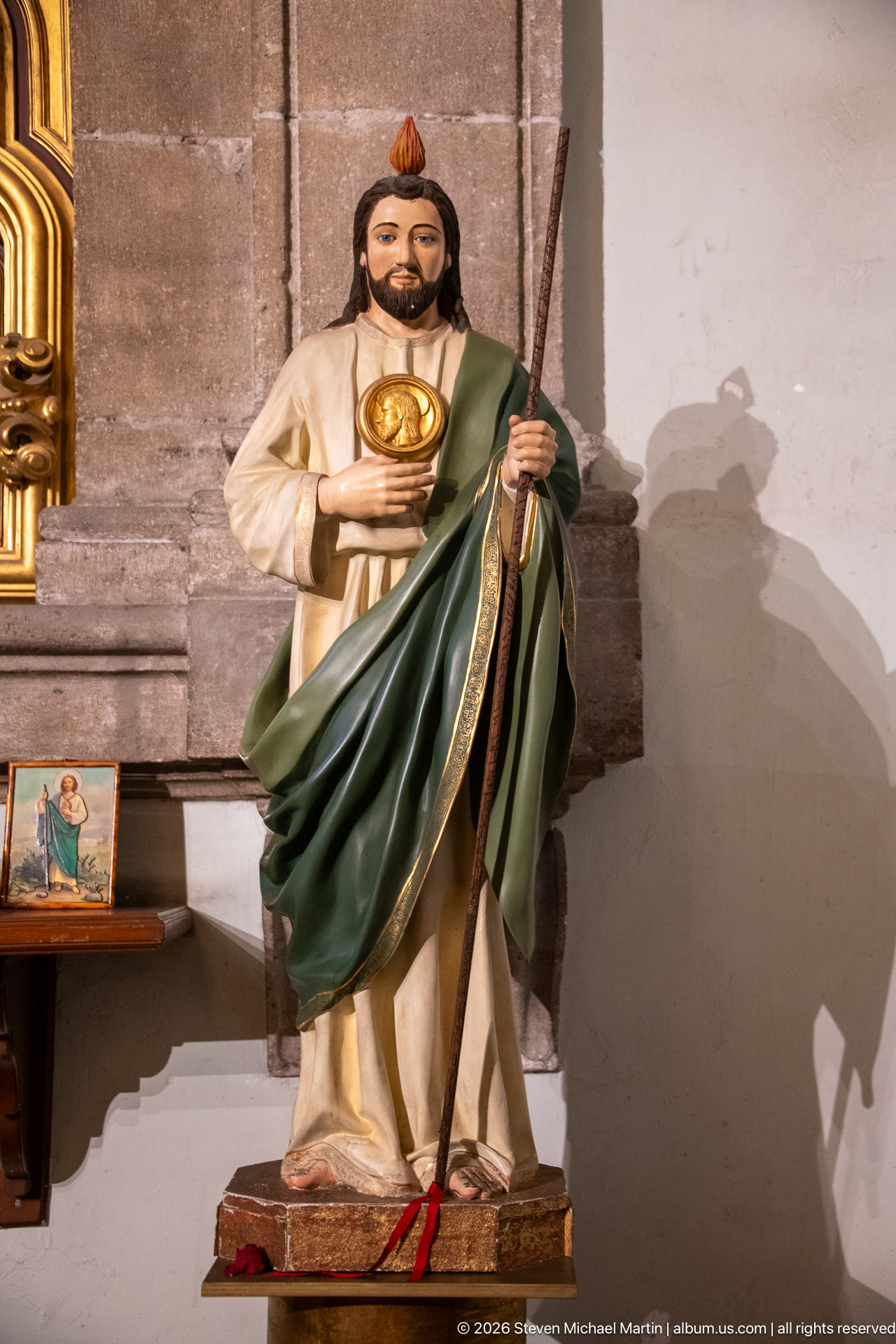
A bearded saint statue wears cream robes beneath a deep green, gold-edged mantle and holds a long staff and round emblem. The small devotional image on the adjacent shelf adds context, but no visible label confirms the saint’s identity.
Caption
A bearded saint statue wears cream robes beneath a deep green, gold-edged mantle and holds a long staff and round emblem. The small devotional image on the adjacent shelf adds context, but no visible label confirms the saint’s identity.
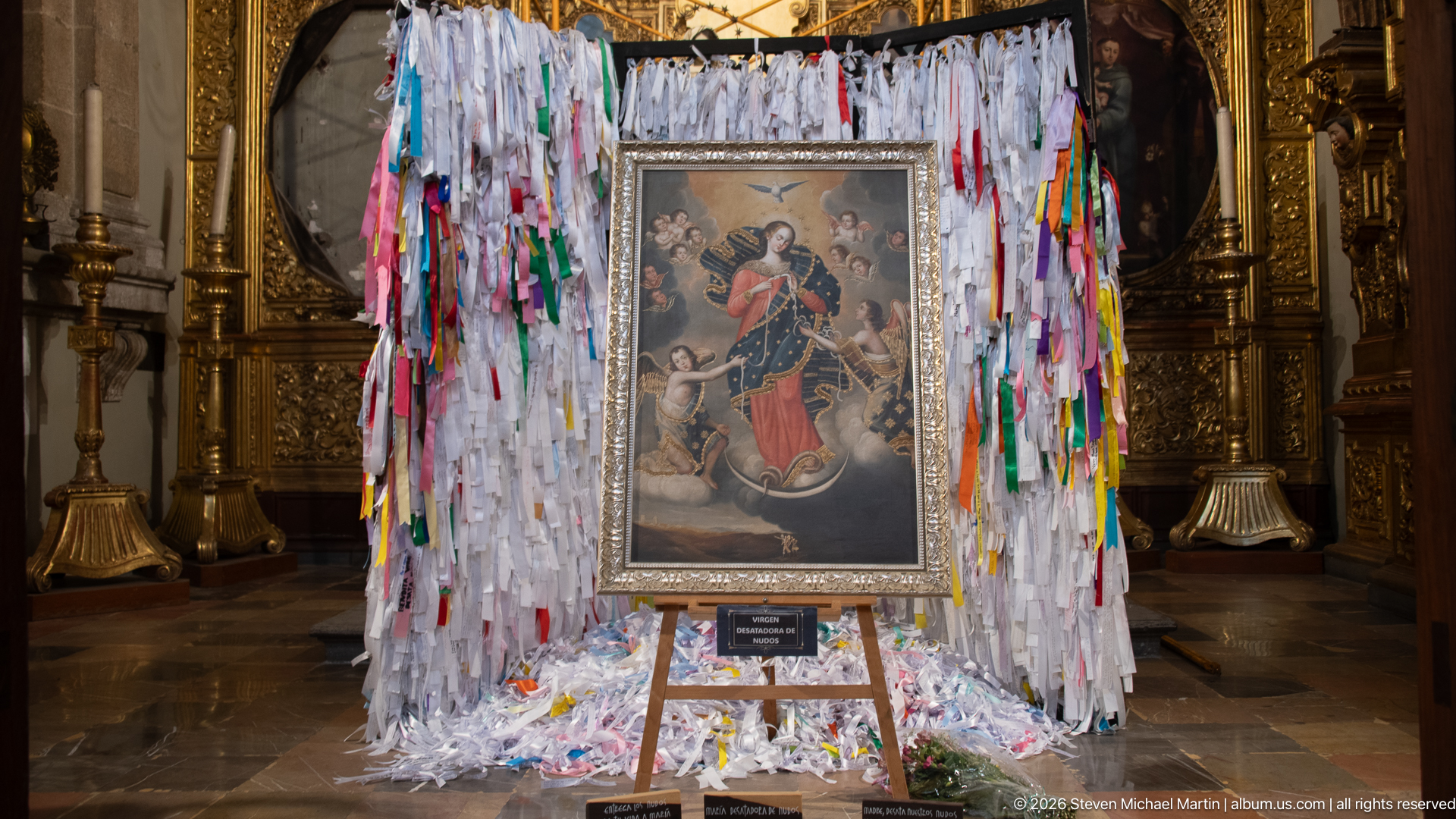
A framed image of the Virgin of Guadalupe stands at the center of a devotional display, surrounded by dense strips of colorful ribbon or paper tied above and cascading toward the floor. The labels on the objects are too small to read, so their precise purpose is not certain; together they create a vivid offering-like frame around the painting. The altar and gilded furnishings remain visible behind it.
Caption
A framed image of the Virgin of Guadalupe stands at the center of a devotional display, surrounded by dense strips of colorful ribbon or paper tied above and cascading toward the floor. The labels on the objects are too small to read, so their precise purpose is not certain; together they create a vivid offering-like frame around the painting. The altar and gilded furnishings remain visible behind it.
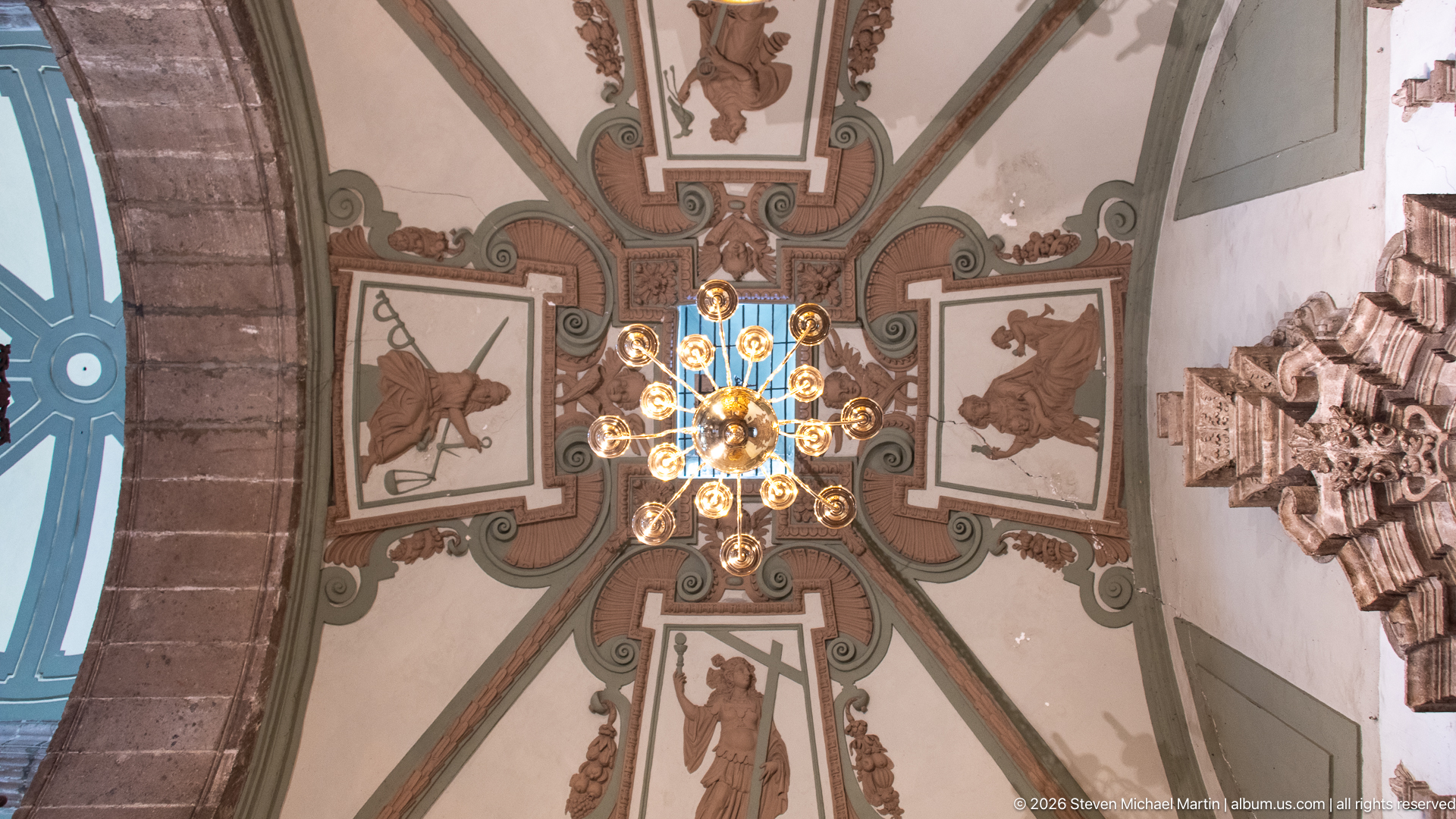
Looking straight upward, the painted vault forms a symmetrical framework of scrolling ornament and small figural panels around a suspended chandelier. The composition makes the ceiling itself the subject, with pale plaster, muted green details, and stone ribs defining the architectural grid. Warm bulbs punctuate the center and contrast with cool daylight entering from the side.
Caption
Looking straight upward, the painted vault forms a symmetrical framework of scrolling ornament and small figural panels around a suspended chandelier. The composition makes the ceiling itself the subject, with pale plaster, muted green details, and stone ribs defining the architectural grid. Warm bulbs punctuate the center and contrast with cool daylight entering from the side.
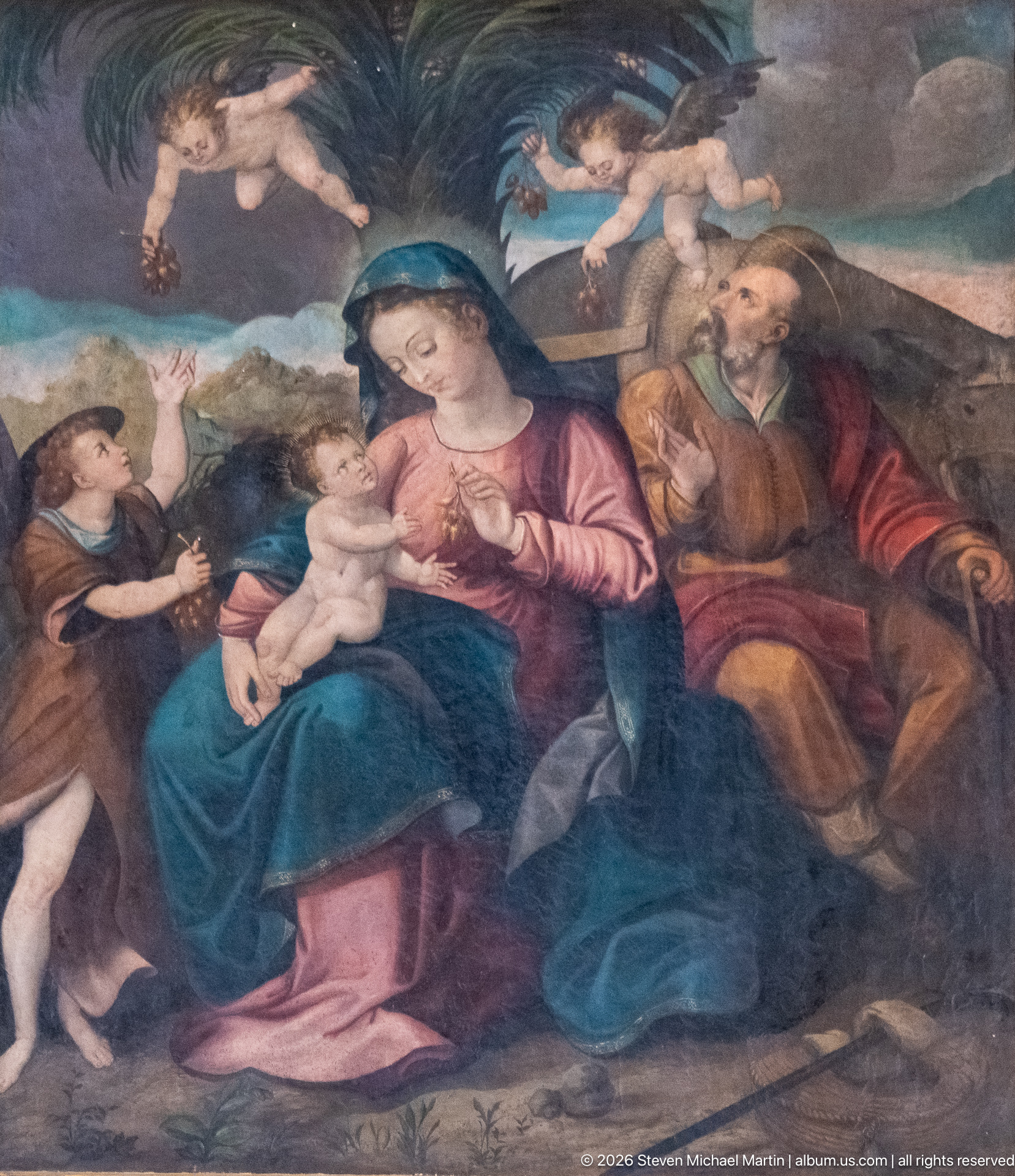
The large painted scene centers the Virgin Mary and infant Jesus among several adults and cherubs, with dark drapery and deep blue-green garments anchoring the lower half. A closer view reveals the interaction of hands and gazes around the child, making the devotional narrative more immediate than in the wider altar views. The painting is presented without an unsupported artist or date.
Caption
The large painted scene centers the Virgin Mary and infant Jesus among several adults and cherubs, with dark drapery and deep blue-green garments anchoring the lower half. A closer view reveals the interaction of hands and gazes around the child, making the devotional narrative more immediate than in the wider altar views. The painting is presented without an unsupported artist or date.
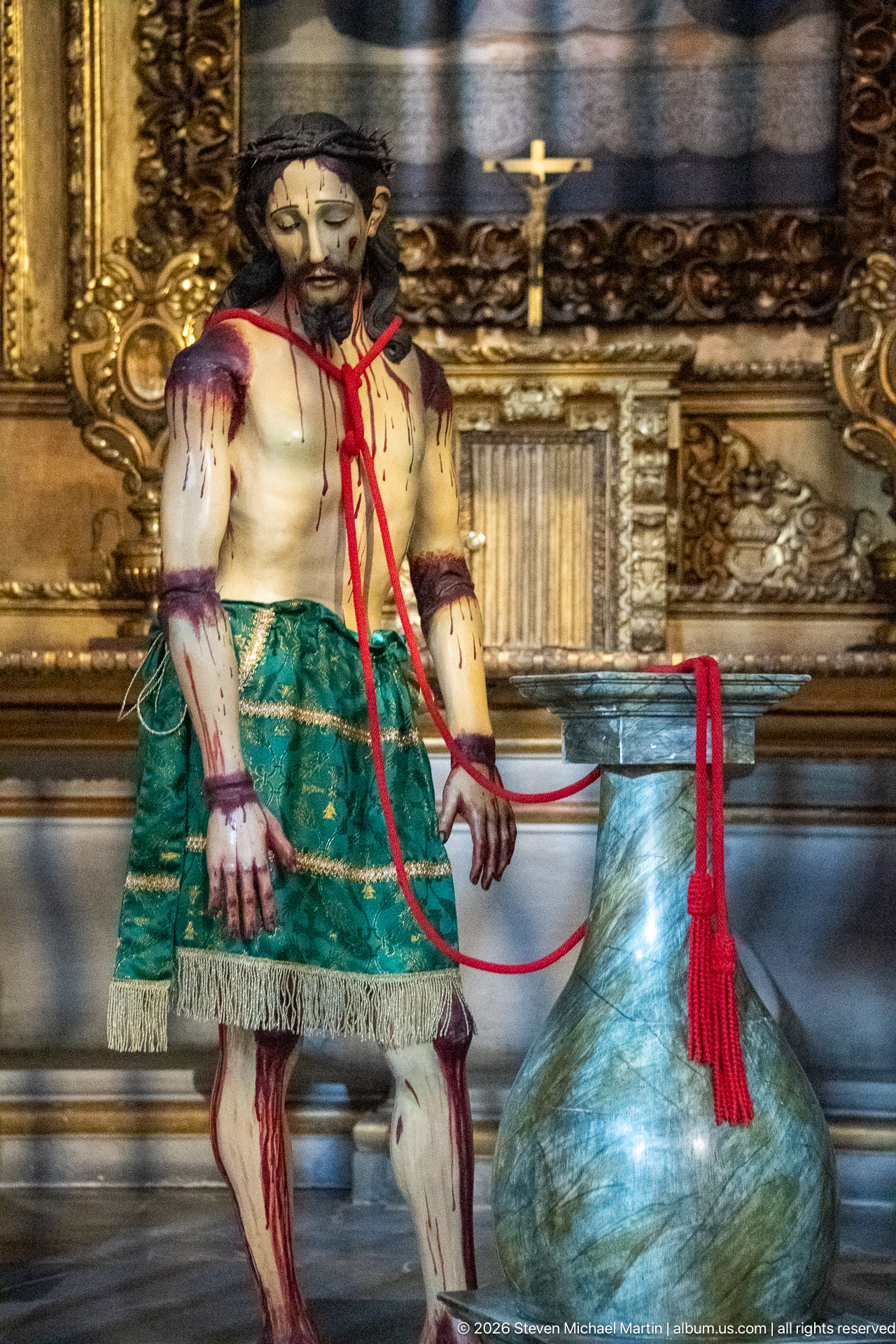
A life-sized figure of Christ stands before a gilded retablo wearing a green patterned garment, with red cords crossing the torso and marks painted on the exposed skin. The sculpted body and restrained forward pose are emphasized against the crowded gold background. The image offers a close view of a devotional figure and its material treatment; no specific title for the sculpture is established.
Caption
A life-sized figure of Christ stands before a gilded retablo wearing a green patterned garment, with red cords crossing the torso and marks painted on the exposed skin. The sculpted body and restrained forward pose are emphasized against the crowded gold background. The image offers a close view of a devotional figure and its material treatment; no specific title for the sculpture is established.
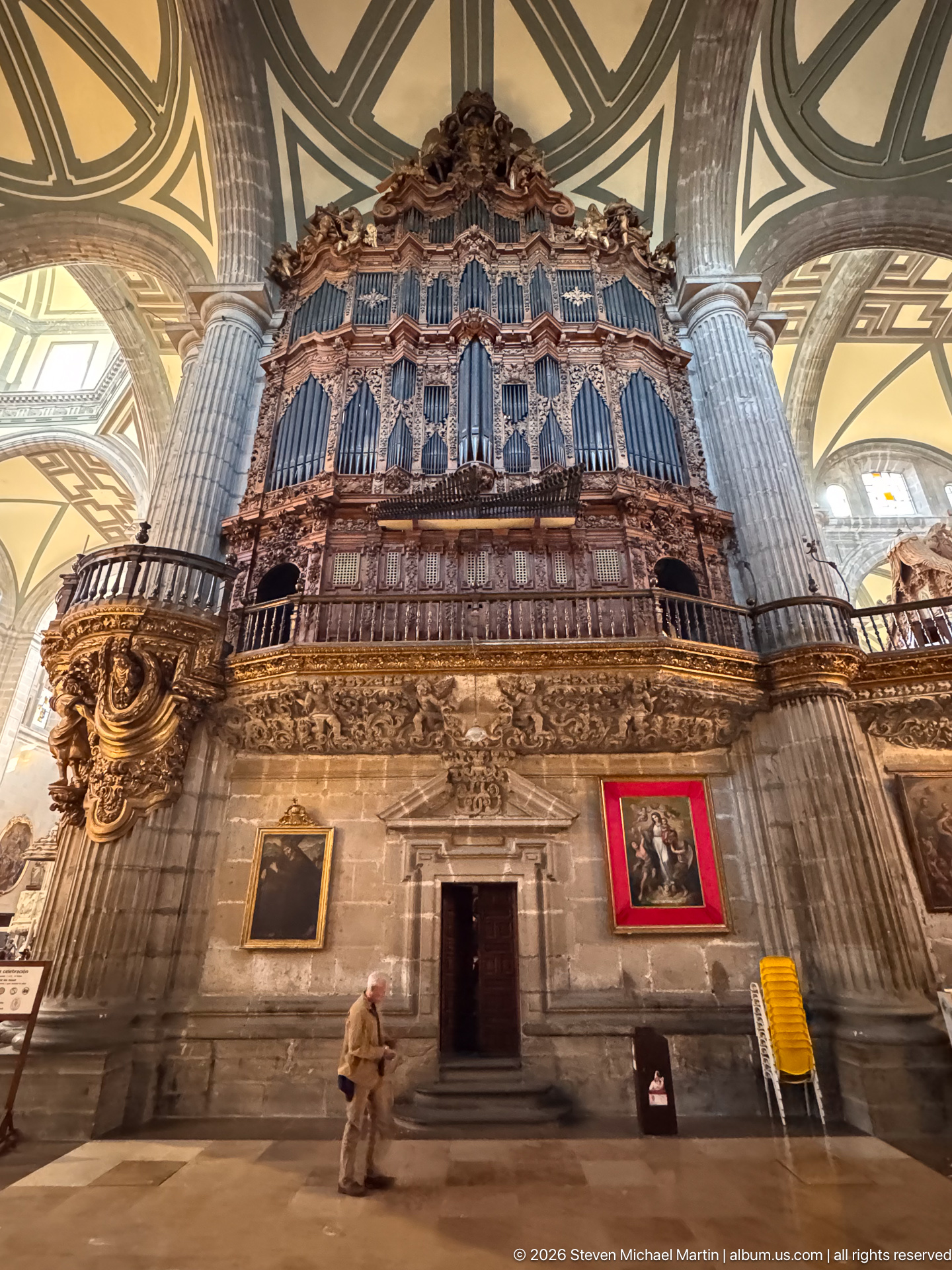
The organ’s broad carved gallery fills the upper wall, while a visitor crossing the foreground provides a clear measure of its scale. From this low angle, the layered woodwork and pipes rise between massive columns beneath the patterned vault. The framing joins instrument and interior architecture in one view rather than treating the organ as an isolated object.
Caption
The organ’s broad carved gallery fills the upper wall, while a visitor crossing the foreground provides a clear measure of its scale. From this low angle, the layered woodwork and pipes rise between massive columns beneath the patterned vault. The framing joins instrument and interior architecture in one view rather than treating the organ as an isolated object.
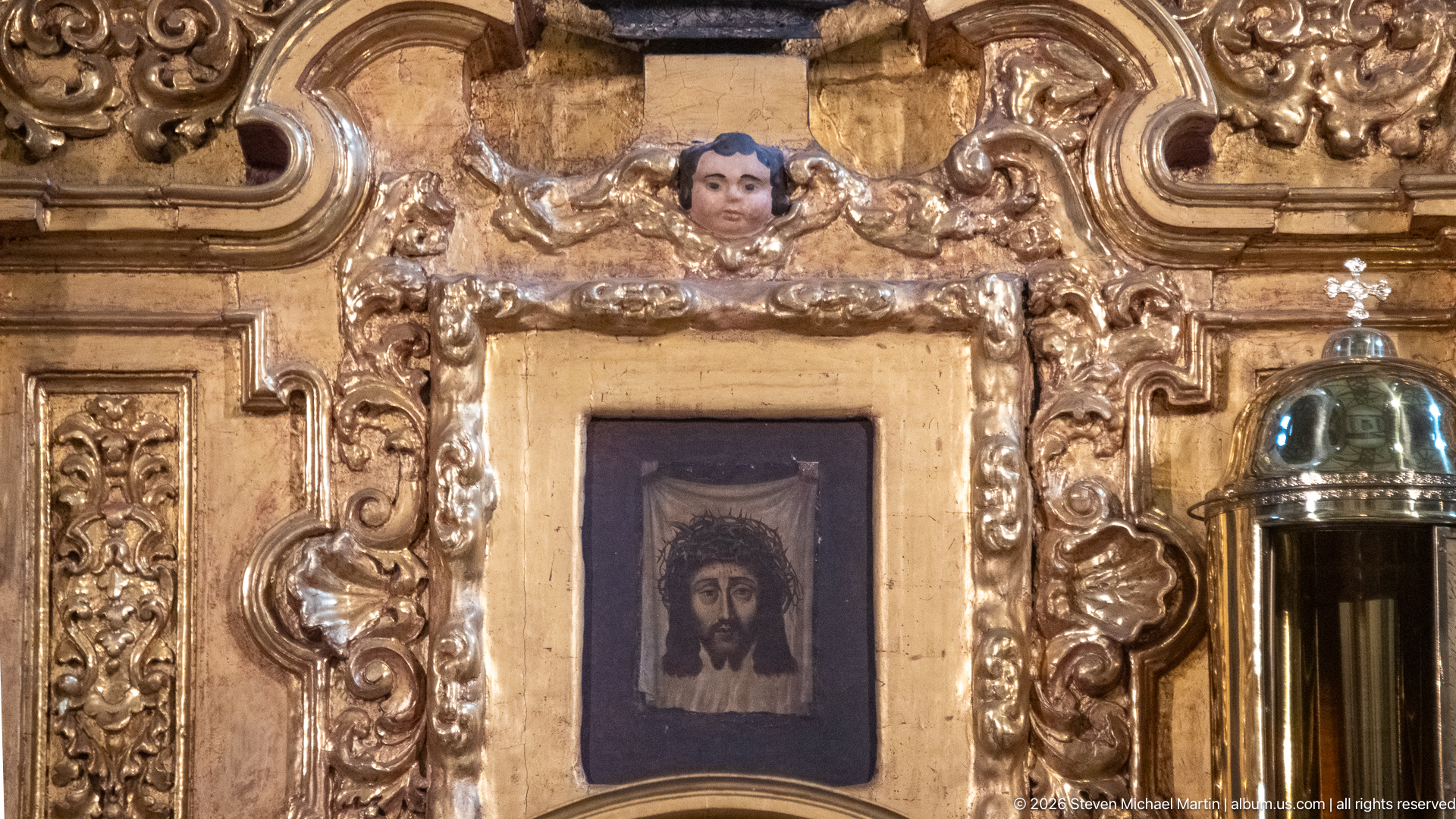
A small dark devotional image of Christ is set within a rectangular opening in a richly gilded architectural surround. Carved foliage, scrolls, and a sculpted cherub head crown the niche; a glass vessel stands at the right edge. This detail draws attention to the contrast between the modest scale of the central image and the dense gold ornament framing it.
Caption
A small dark devotional image of Christ is set within a rectangular opening in a richly gilded architectural surround. Carved foliage, scrolls, and a sculpted cherub head crown the niche; a glass vessel stands at the right edge. This detail draws attention to the contrast between the modest scale of the central image and the dense gold ornament framing it.
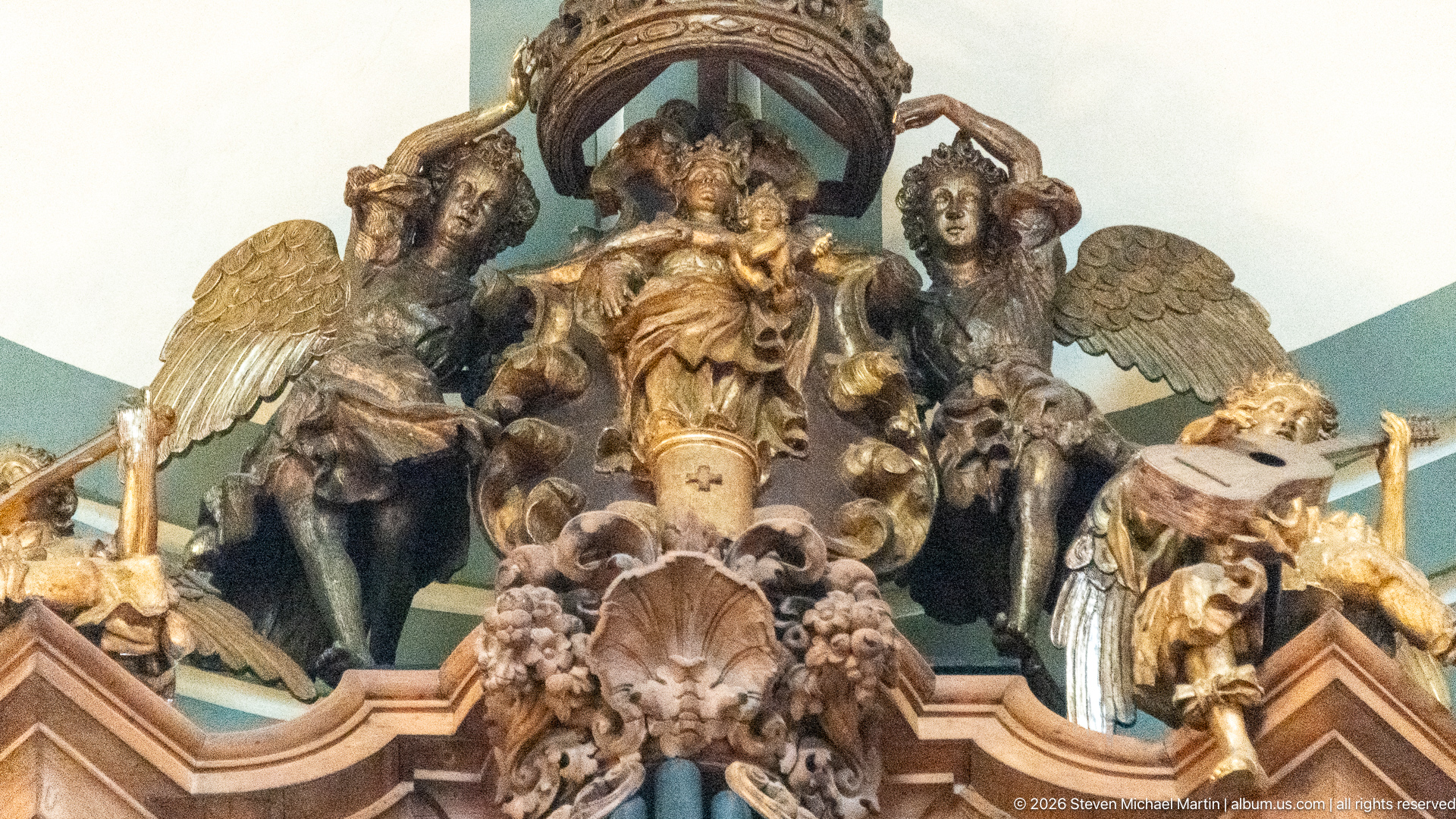
A dense carved group places a seated central figure above layered heads and small figures, flanked by large angels with outstretched wings. The close upward framing emphasizes the sculptural mass and gold-toned surfaces of the ensemble. Its crowded arrangement rises toward a circular canopy, creating a vertical devotional display within the cathedral; the central figure’s exact identity remains unconfirmed.
Caption
A dense carved group places a seated central figure above layered heads and small figures, flanked by large angels with outstretched wings. The close upward framing emphasizes the sculptural mass and gold-toned surfaces of the ensemble. Its crowded arrangement rises toward a circular canopy, creating a vertical devotional display within the cathedral; the central figure’s exact identity remains unconfirmed.
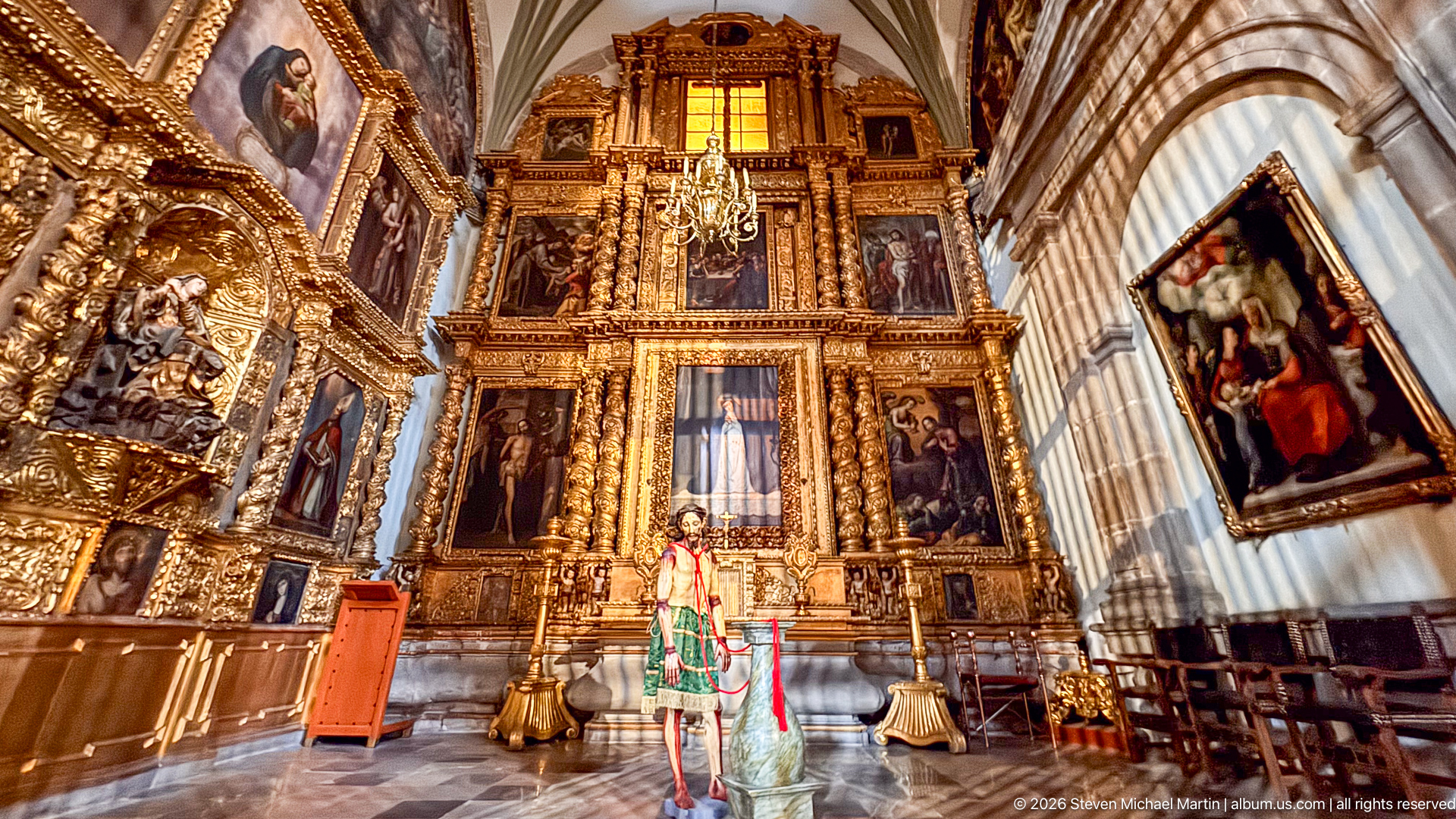
A standing Christ figure occupies the foreground of a towering gilded retablo filled with framed religious paintings, carved columns, and a chandelier suspended before the upper tier. The composition links the sculpture to the layered altar behind it, while a roped barrier and polished stone floor indicate the controlled devotional space. Sunlight falls across the gold surfaces and brightens the central axis.
Caption
A standing Christ figure occupies the foreground of a towering gilded retablo filled with framed religious paintings, carved columns, and a chandelier suspended before the upper tier. The composition links the sculpture to the layered altar behind it, while a roped barrier and polished stone floor indicate the controlled devotional space. Sunlight falls across the gold surfaces and brightens the central axis.
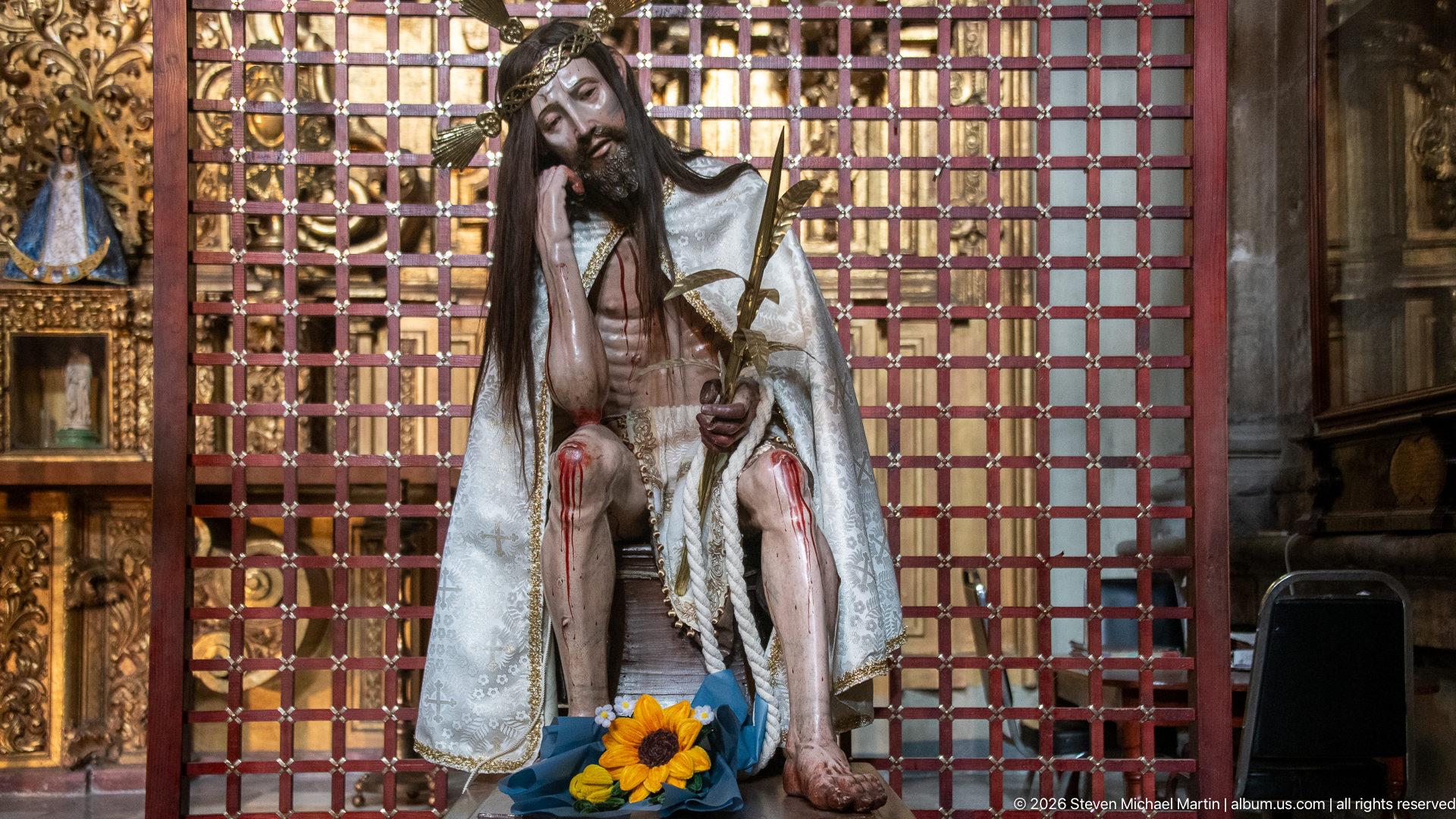
A pale, emaciated Christ figure bends forward before a red-and-gold lattice screen, with painted wounds and a blue cloth gathered at the base. A sunflower rests near the feet, adding a small bright accent to the otherwise solemn display. The close view centers the sculpture’s bodily detail and devotional setting without assigning a particular local title.
Caption
A pale, emaciated Christ figure bends forward before a red-and-gold lattice screen, with painted wounds and a blue cloth gathered at the base. A sunflower rests near the feet, adding a small bright accent to the otherwise solemn display. The close view centers the sculpture’s bodily detail and devotional setting without assigning a particular local title.
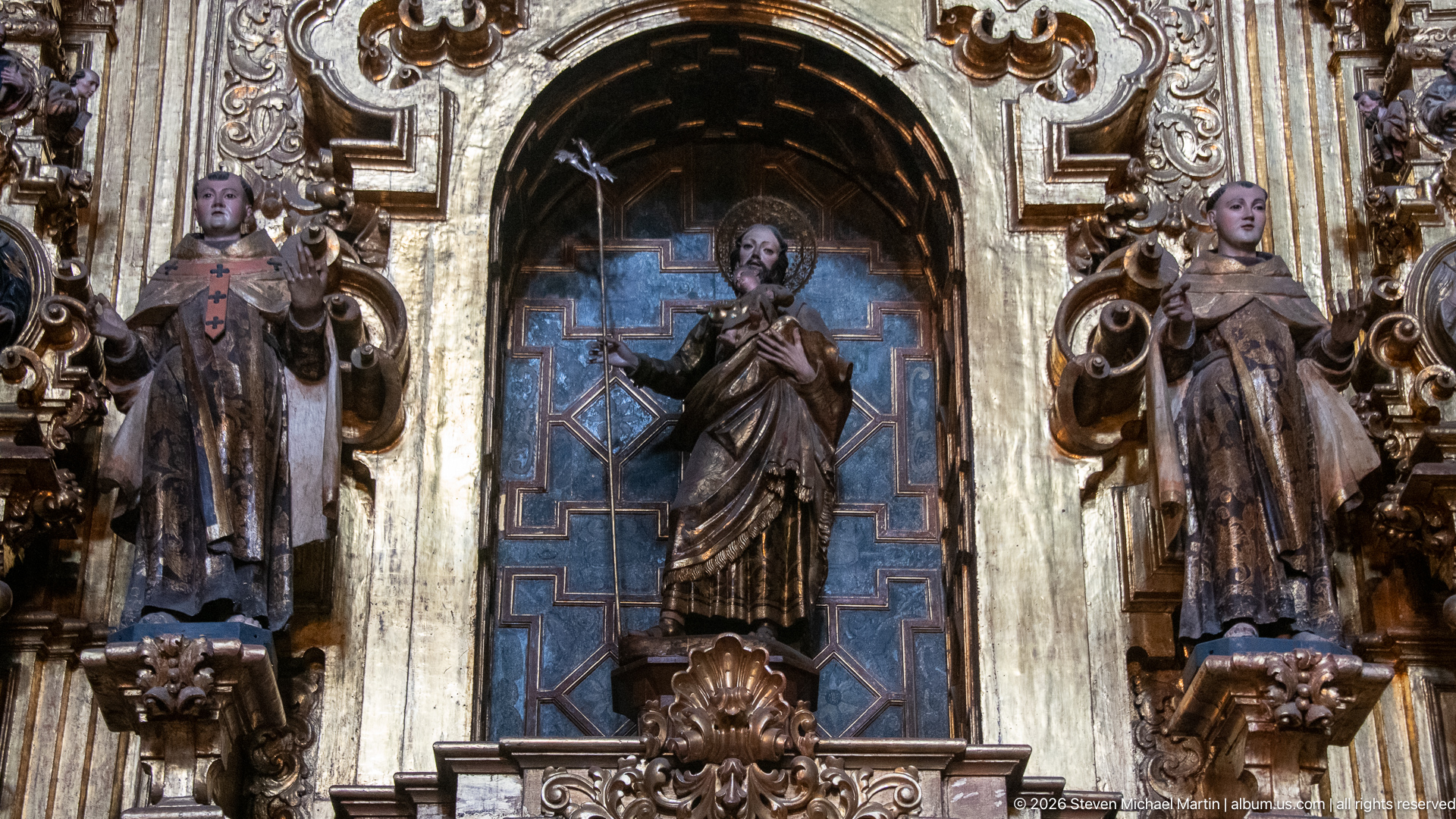
A dark central image of Christ stands within a blue geometric recess, framed by two standing saint figures and a heavily carved gilded arch. The symmetrical arrangement uses contrasting blue and gold surfaces to separate the figures from the surrounding ornament. A close, frontal crop makes the niche’s layered framing and the figures’ distinct poses the defining features.
Caption
A dark central image of Christ stands within a blue geometric recess, framed by two standing saint figures and a heavily carved gilded arch. The symmetrical arrangement uses contrasting blue and gold surfaces to separate the figures from the surrounding ornament. A close, frontal crop makes the niche’s layered framing and the figures’ distinct poses the defining features.
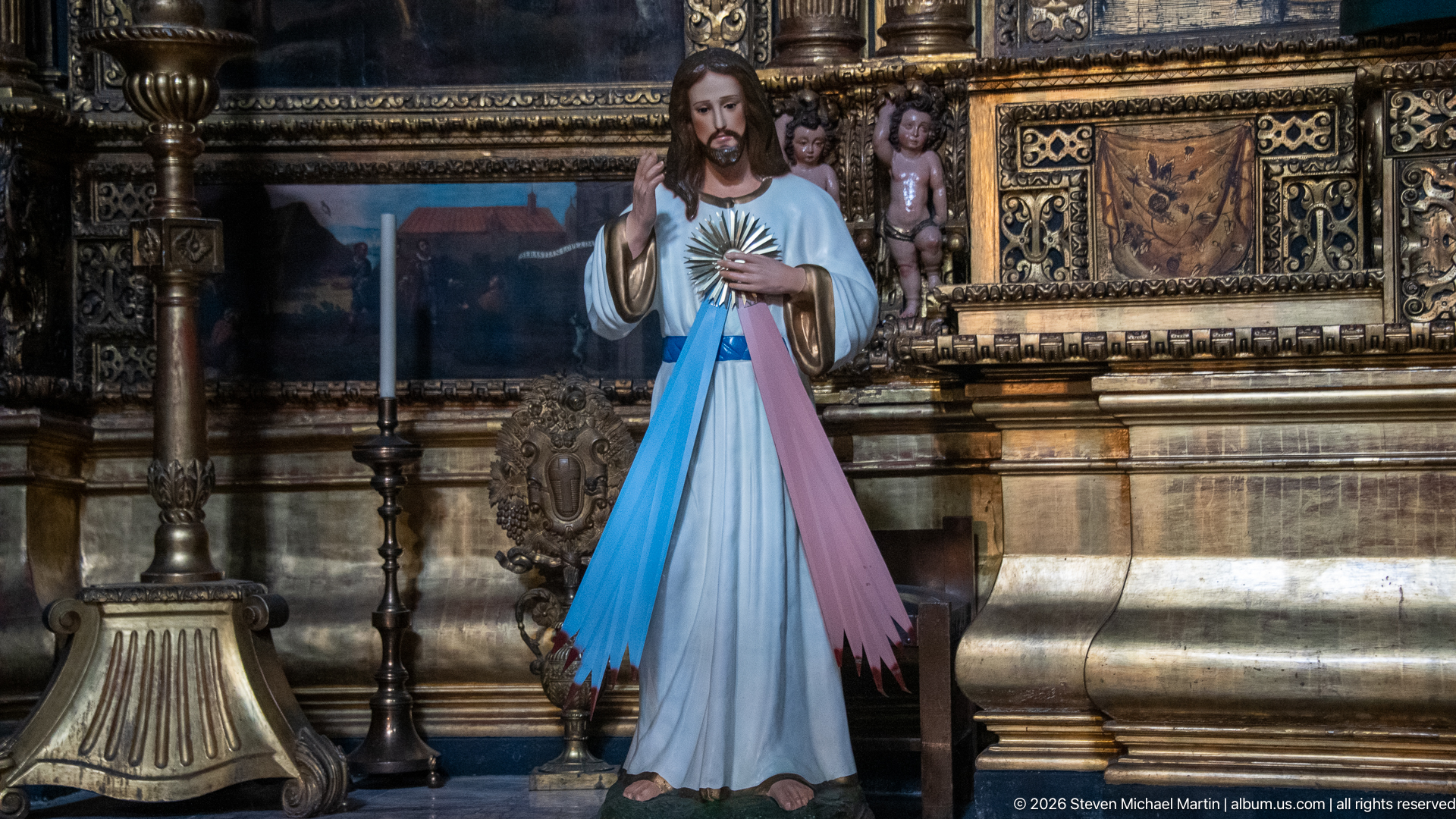
A white-robed statue of the Virgin Mary holds a radiant heart-shaped emblem at chest level, with blue and rose-colored ribbons draped from her hands. Smaller figures and gilded panels fill the niche behind her. The close view focuses on the statue’s devotional attributes and contrasting colors, while leaving its particular title or local dedication unspecified.
Caption
A white-robed statue of the Virgin Mary holds a radiant heart-shaped emblem at chest level, with blue and rose-colored ribbons draped from her hands. Smaller figures and gilded panels fill the niche behind her. The close view focuses on the statue’s devotional attributes and contrasting colors, while leaving its particular title or local dedication unspecified.
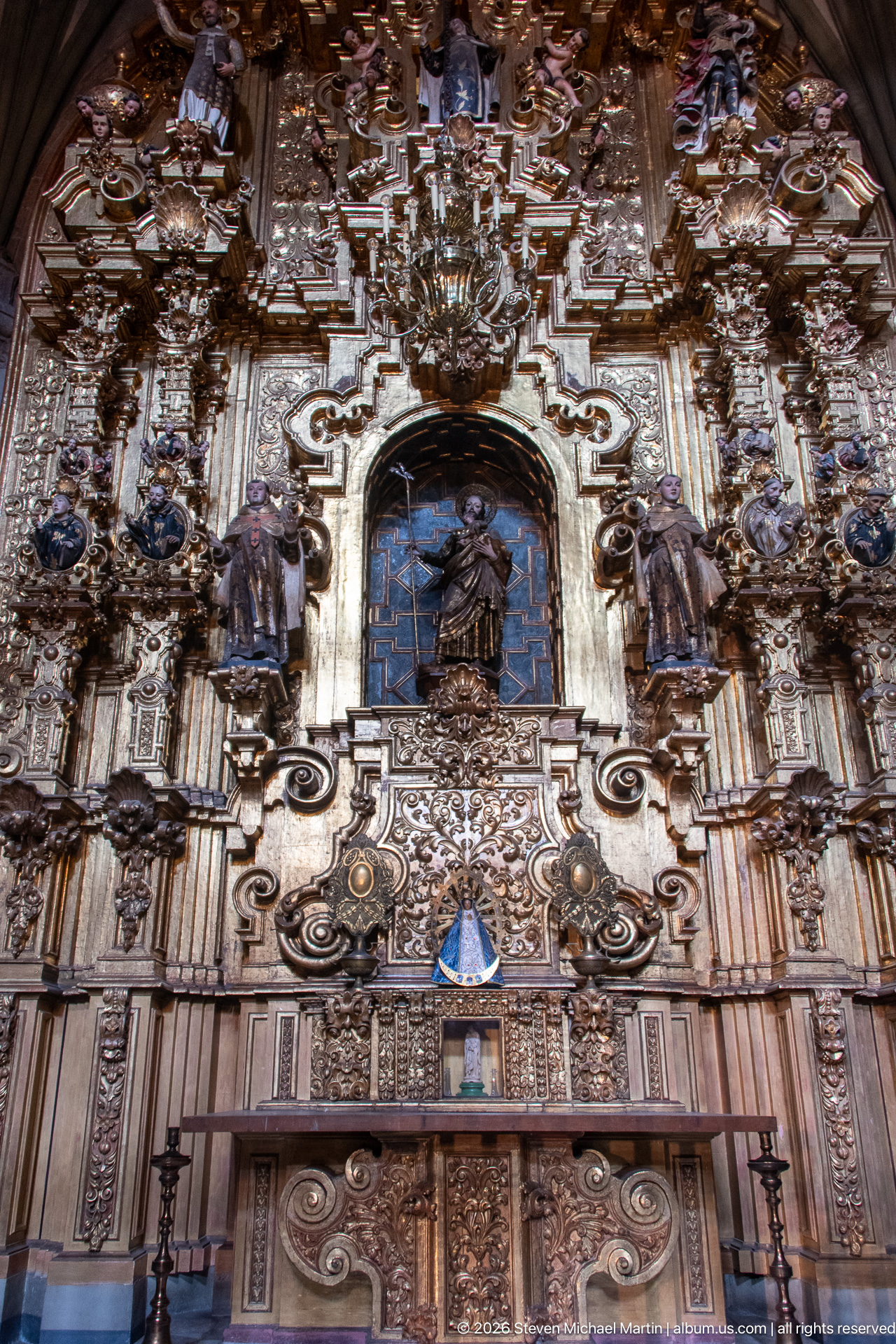
The retablo’s central bay contains a dark Christ figure in a blue-backed niche, surrounded by tightly packed gilded scrolls, floral carving, and smaller sculpted figures. A chandelier hangs just above the upper register, and a narrow blue-and-white devotional image marks the lower center. The close, nearly frontal view reveals the altar’s dense surface and axial organization.
Caption
The retablo’s central bay contains a dark Christ figure in a blue-backed niche, surrounded by tightly packed gilded scrolls, floral carving, and smaller sculpted figures. A chandelier hangs just above the upper register, and a narrow blue-and-white devotional image marks the lower center. The close, nearly frontal view reveals the altar’s dense surface and axial organization.
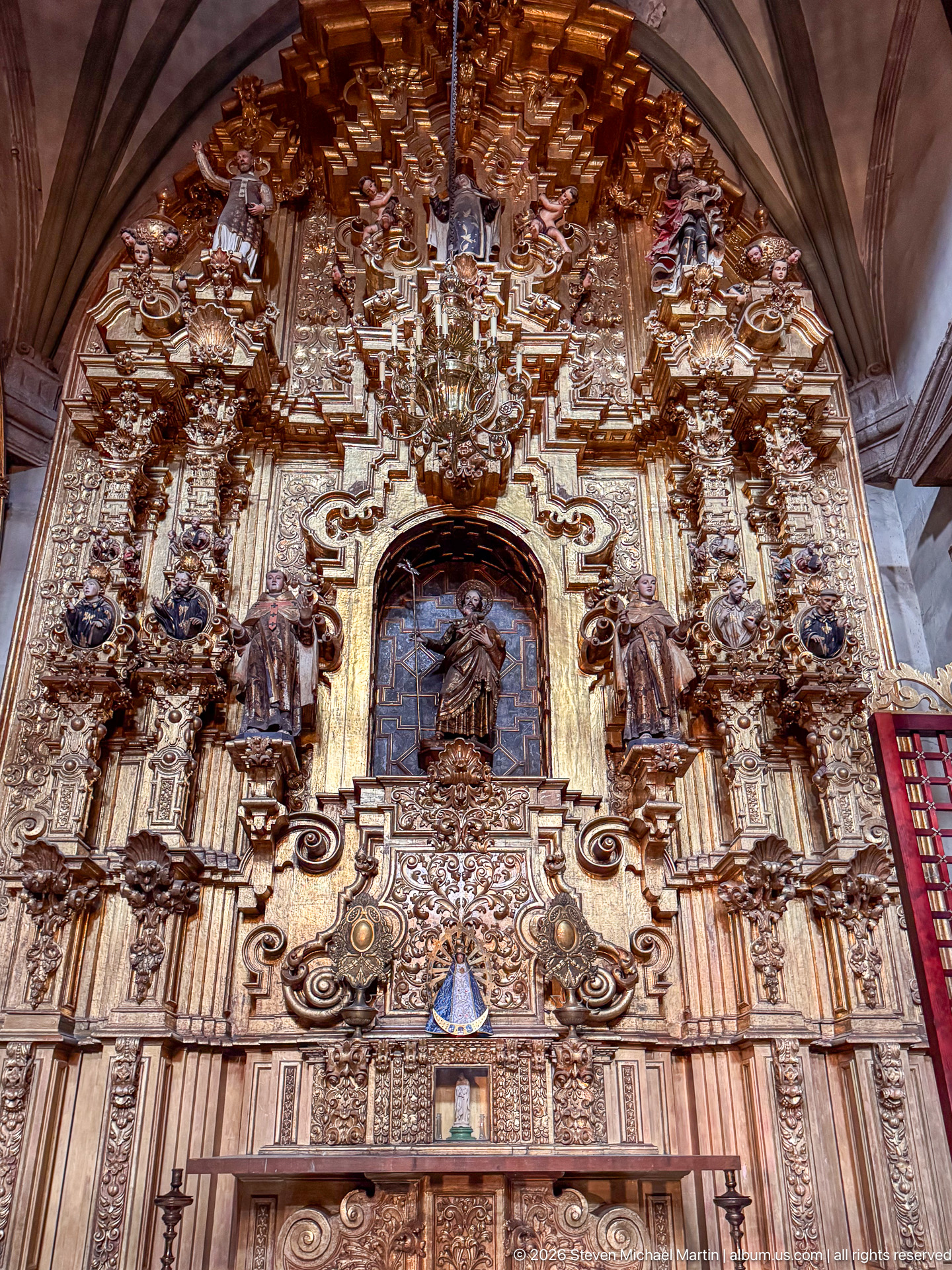
A tall gilded retablo rises within a stone arch, its central figure framed by paired statues, carved scrolls, and a chandelier. A red lattice grille occupies the right edge, revealing the altar’s relationship to an enclosed side space. This view retains the full vertical structure while making the contrast between gold carving, pale masonry, and red-painted metal especially visible.
Caption
A tall gilded retablo rises within a stone arch, its central figure framed by paired statues, carved scrolls, and a chandelier. A red lattice grille occupies the right edge, revealing the altar’s relationship to an enclosed side space. This view retains the full vertical structure while making the contrast between gold carving, pale masonry, and red-painted metal especially visible.
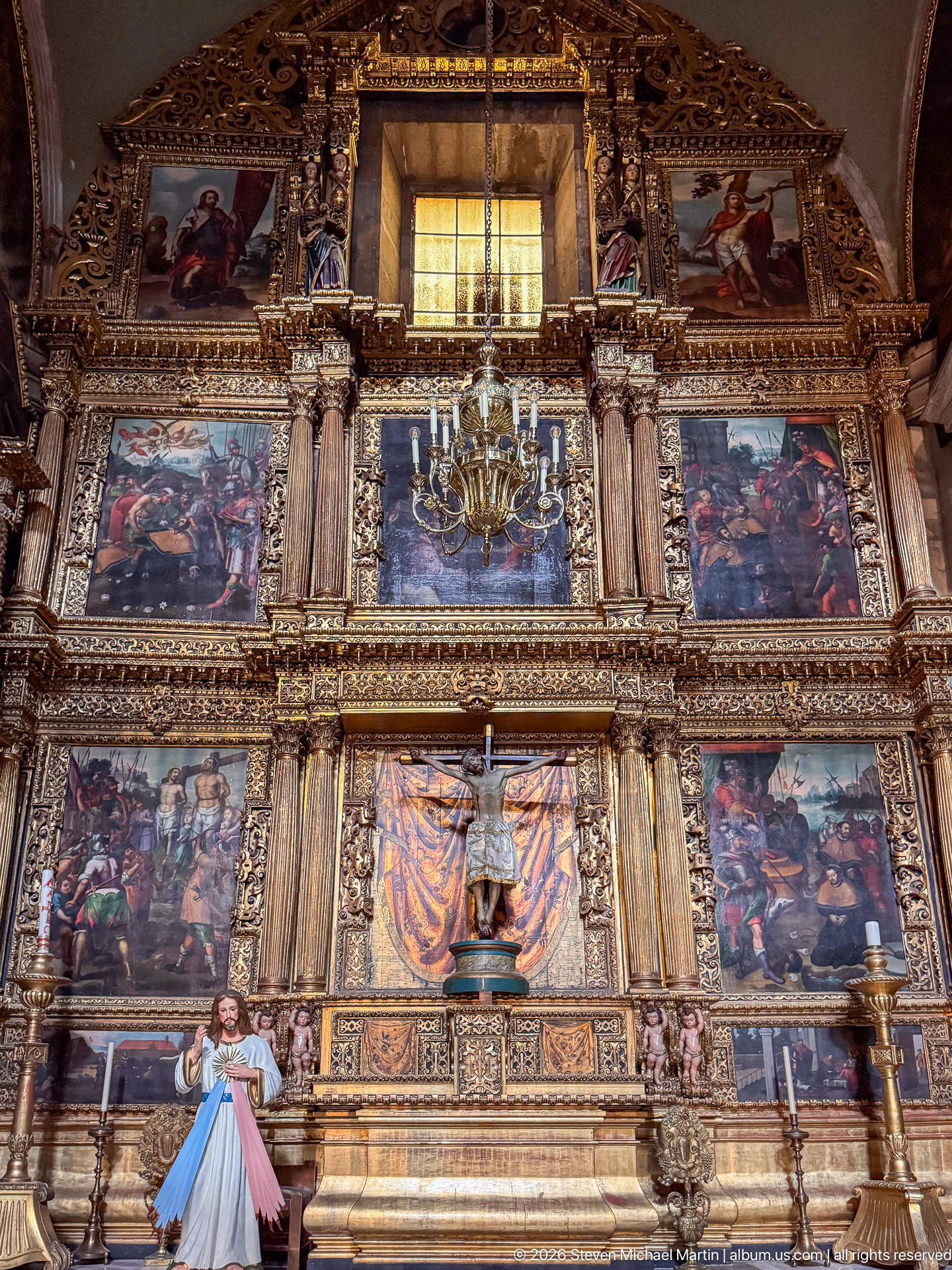
Three framed religious paintings sit within a richly carved upper tier, with a chandelier suspended in front of the central panel. Gilded columns, floral motifs, and sculpted figures crowd the surrounding surface, creating a layered frame for the paintings. This close crop shifts attention above the altar’s central niche to the painted register and its elaborate architectural setting.
Caption
Three framed religious paintings sit within a richly carved upper tier, with a chandelier suspended in front of the central panel. Gilded columns, floral motifs, and sculpted figures crowd the surrounding surface, creating a layered frame for the paintings. This close crop shifts attention above the altar’s central niche to the painted register and its elaborate architectural setting.
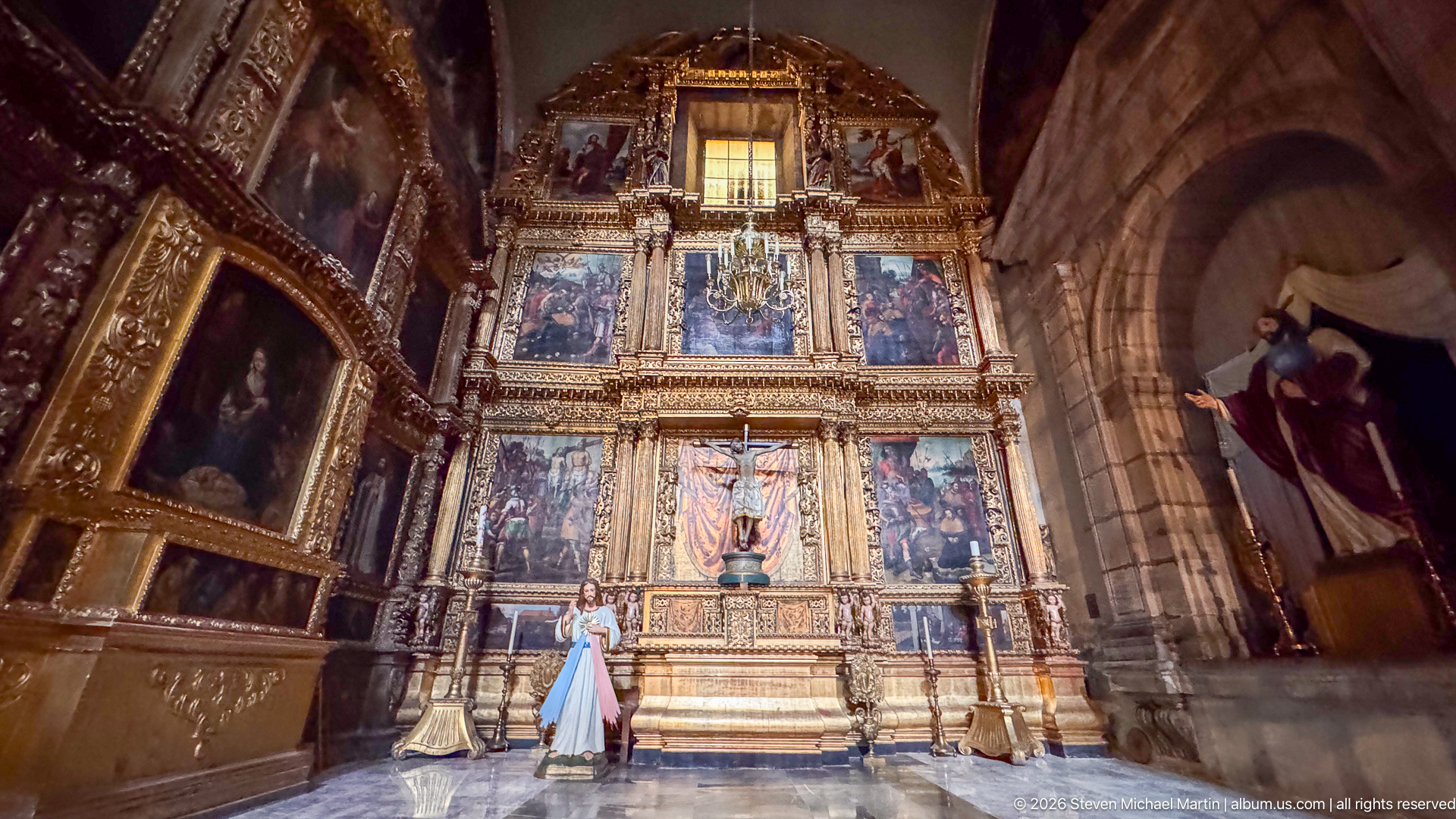
The altar occupies the far wall of a side chapel, while a white-robed Marian statue stands to its right beneath a red lattice screen. Pews form parallel rows toward the sanctuary, and framed pictures line the side wall. This view sets the devotional figures within the chapel’s full spatial arrangement, making the distance between the foreground seating and altar legible.
Caption
The altar occupies the far wall of a side chapel, while a white-robed Marian statue stands to its right beneath a red lattice screen. Pews form parallel rows toward the sanctuary, and framed pictures line the side wall. This view sets the devotional figures within the chapel’s full spatial arrangement, making the distance between the foreground seating and altar legible.
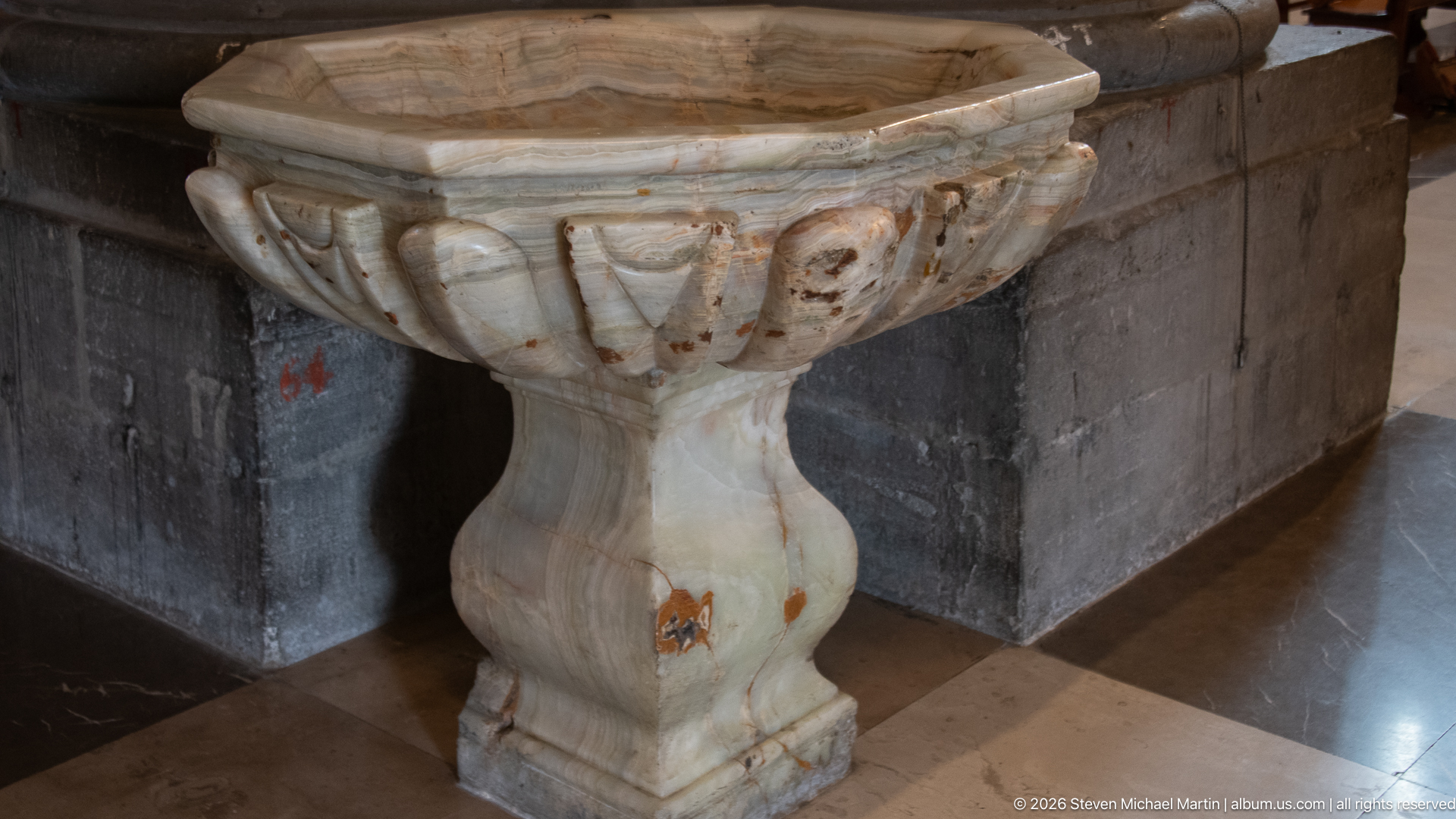
A pale marble basin with a scalloped, shell-like bowl rests on a carved pedestal against a stone wall. Brown veining and small surface marks are visible across the stone, while the basin’s rim curves around a shallow interior. The close side view records a functional church furnishing and its shaped support without assuming its original maker or date.
Caption
A pale marble basin with a scalloped, shell-like bowl rests on a carved pedestal against a stone wall. Brown veining and small surface marks are visible across the stone, while the basin’s rim curves around a shallow interior. The close side view records a functional church furnishing and its shaped support without assuming its original maker or date.
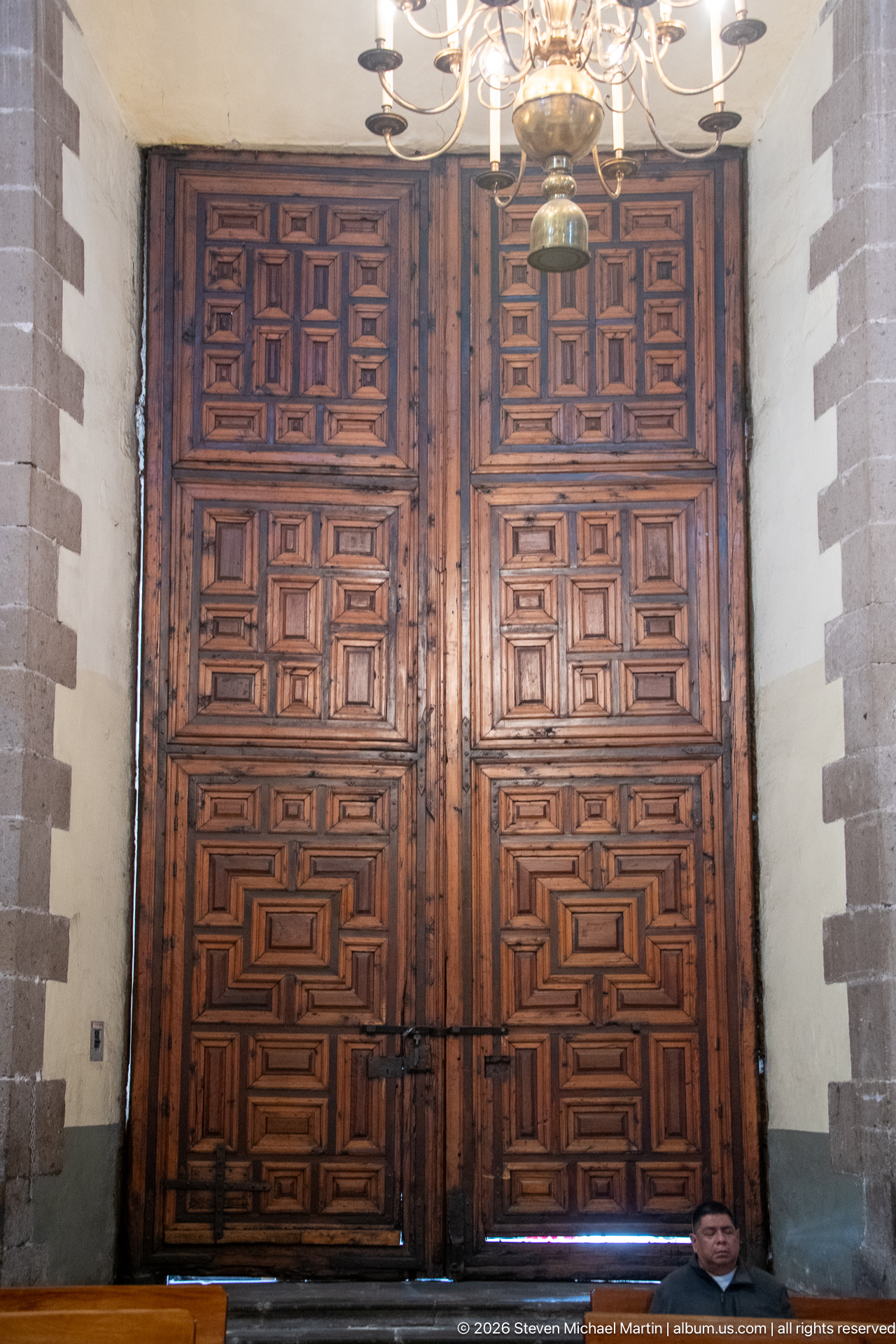
A pair of tall wooden doors fills the stone opening, their surfaces divided into orderly rectangular panels with nested geometric moldings. A large metal chandelier hangs in the foreground and a seated man appears at the lower right, giving scale to the entrance. The warm wood contrasts with pale masonry and the cool light entering from the cathedral.
Caption
A pair of tall wooden doors fills the stone opening, their surfaces divided into orderly rectangular panels with nested geometric moldings. A large metal chandelier hangs in the foreground and a seated man appears at the lower right, giving scale to the entrance. The warm wood contrasts with pale masonry and the cool light entering from the cathedral.
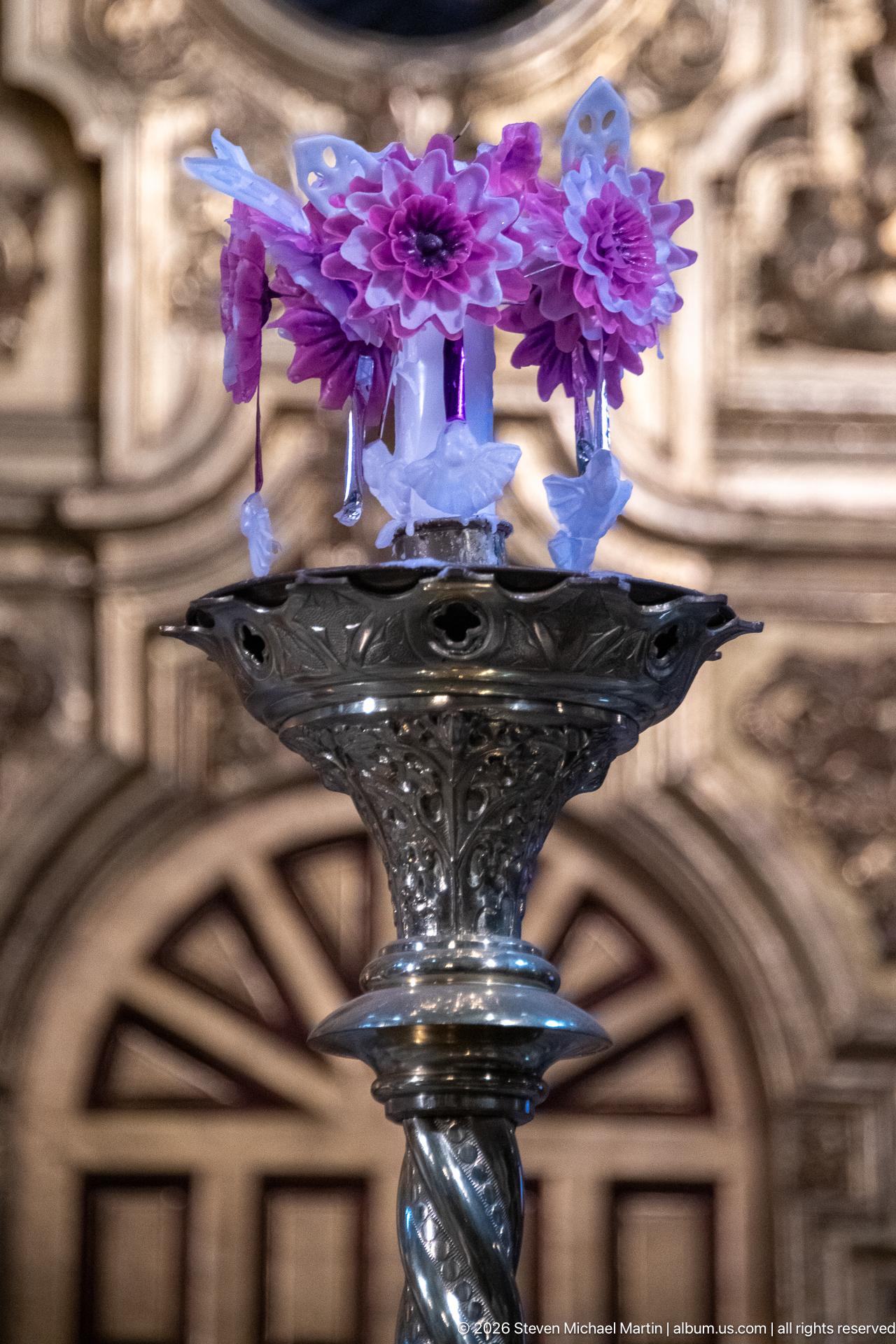
Purple paper flowers and small blue skull ornaments decorate a dark metal stand against a softly blurred stone interior. The flowers’ layered petals and the skull motifs provide visible seasonal references associated with Día de Muertos, though the full display is outside the frame. The shallow focus isolates the decoration from the cathedral architecture behind it.
Caption
Purple paper flowers and small blue skull ornaments decorate a dark metal stand against a softly blurred stone interior. The flowers’ layered petals and the skull motifs provide visible seasonal references associated with Día de Muertos, though the full display is outside the frame. The shallow focus isolates the decoration from the cathedral architecture behind it.
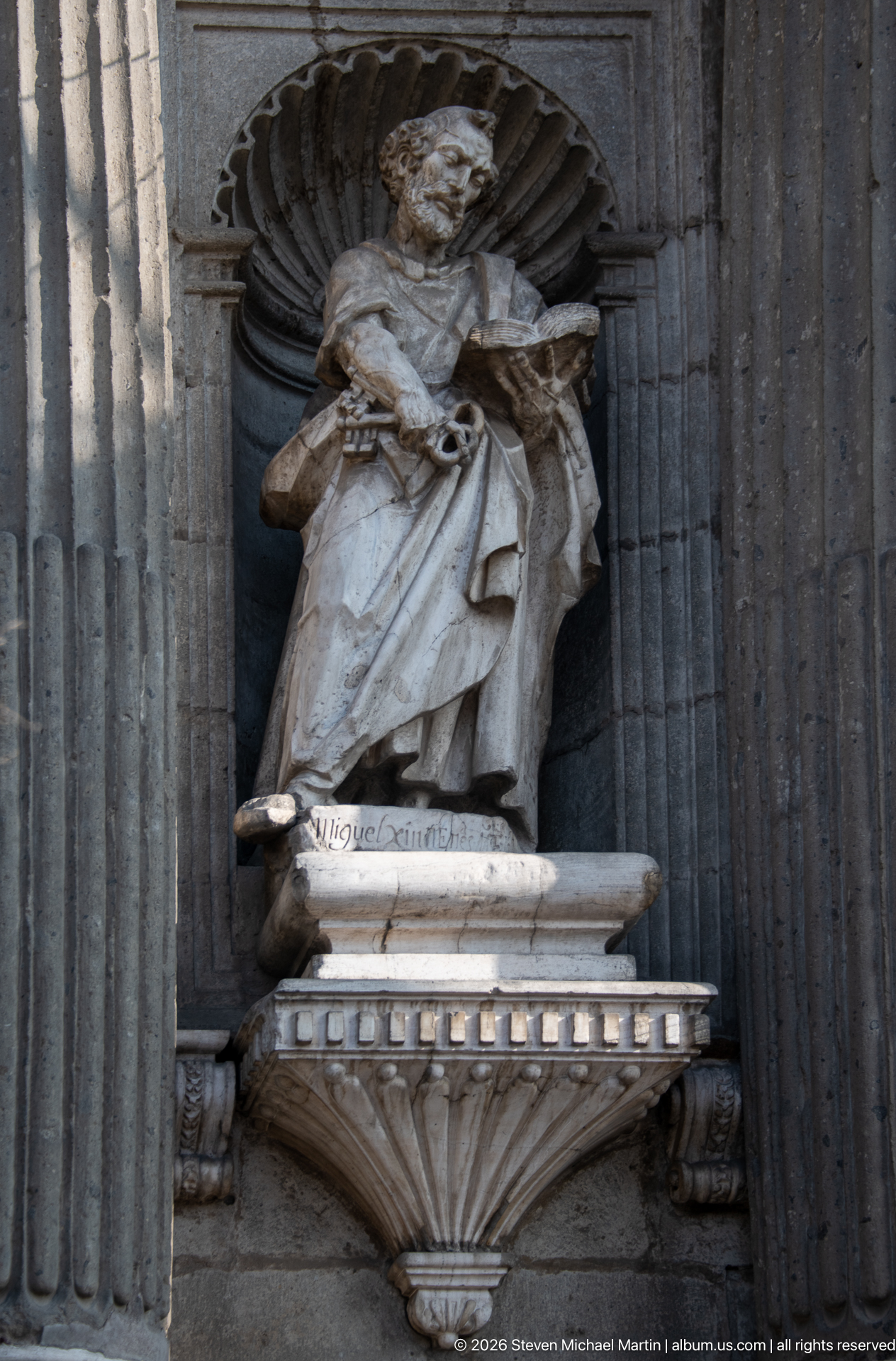
A weathered seated stone figure occupies a niche framed by fluted pilasters and a shell-shaped canopy. The pedestal inscription appears to read “Miguel Ximénez”; the image alone does not establish the figure’s identity.
Caption
A weathered seated stone figure occupies a niche framed by fluted pilasters and a shell-shaped canopy. The pedestal inscription appears to read “Miguel Ximénez”; the image alone does not establish the figure’s identity.
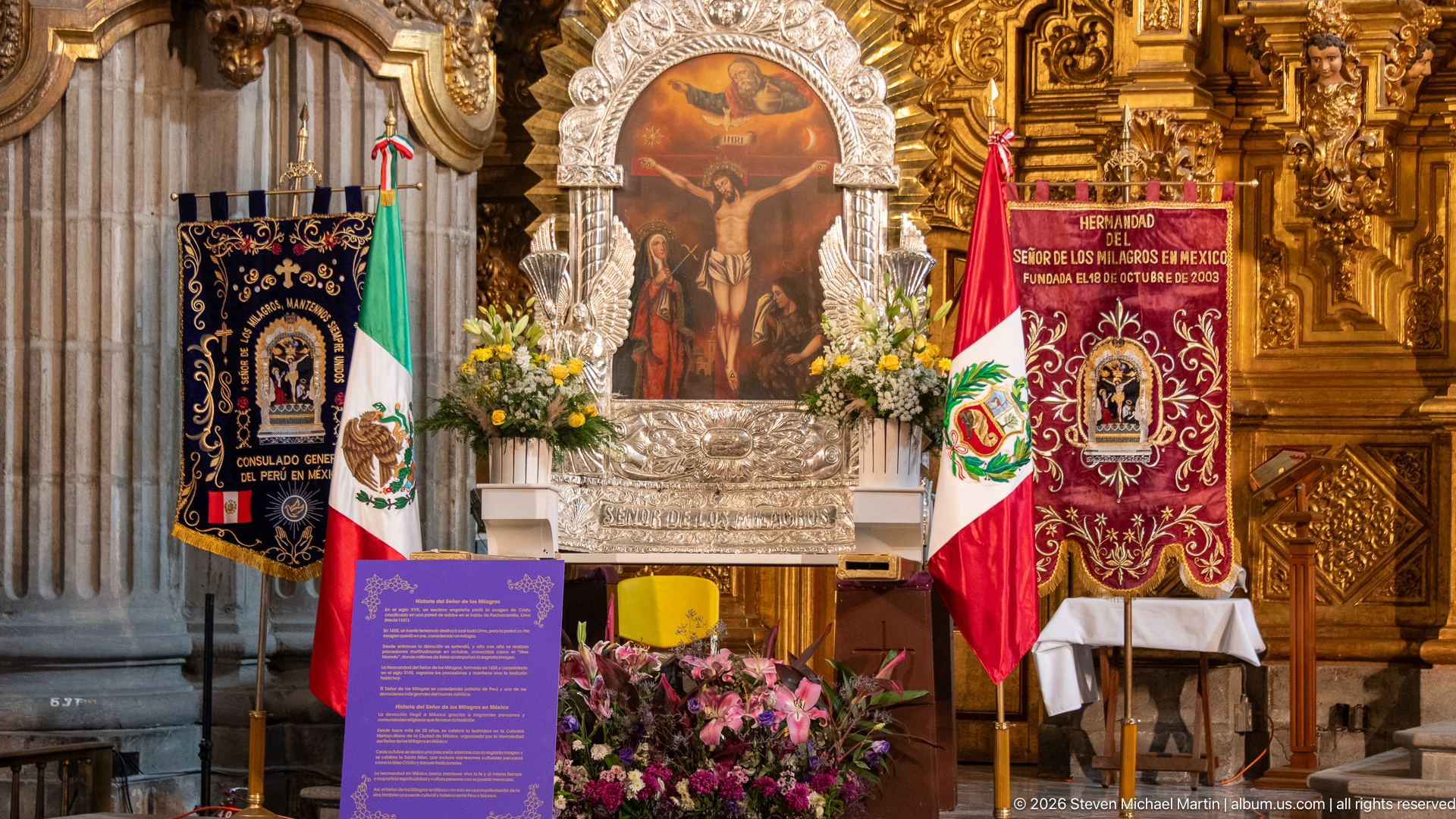
A crucified Christ image is displayed with flowers between the Peruvian flag and banners of the Hermandad del Señor de los Milagros en México. The visible banners identify this as a Señor de los Milagros devotional display maintained by a Peruvian community in Mexico City.
Caption
A crucified Christ image is displayed with flowers between the Peruvian flag and banners of the Hermandad del Señor de los Milagros en México. The visible banners identify this as a Señor de los Milagros devotional display maintained by a Peruvian community in Mexico City.
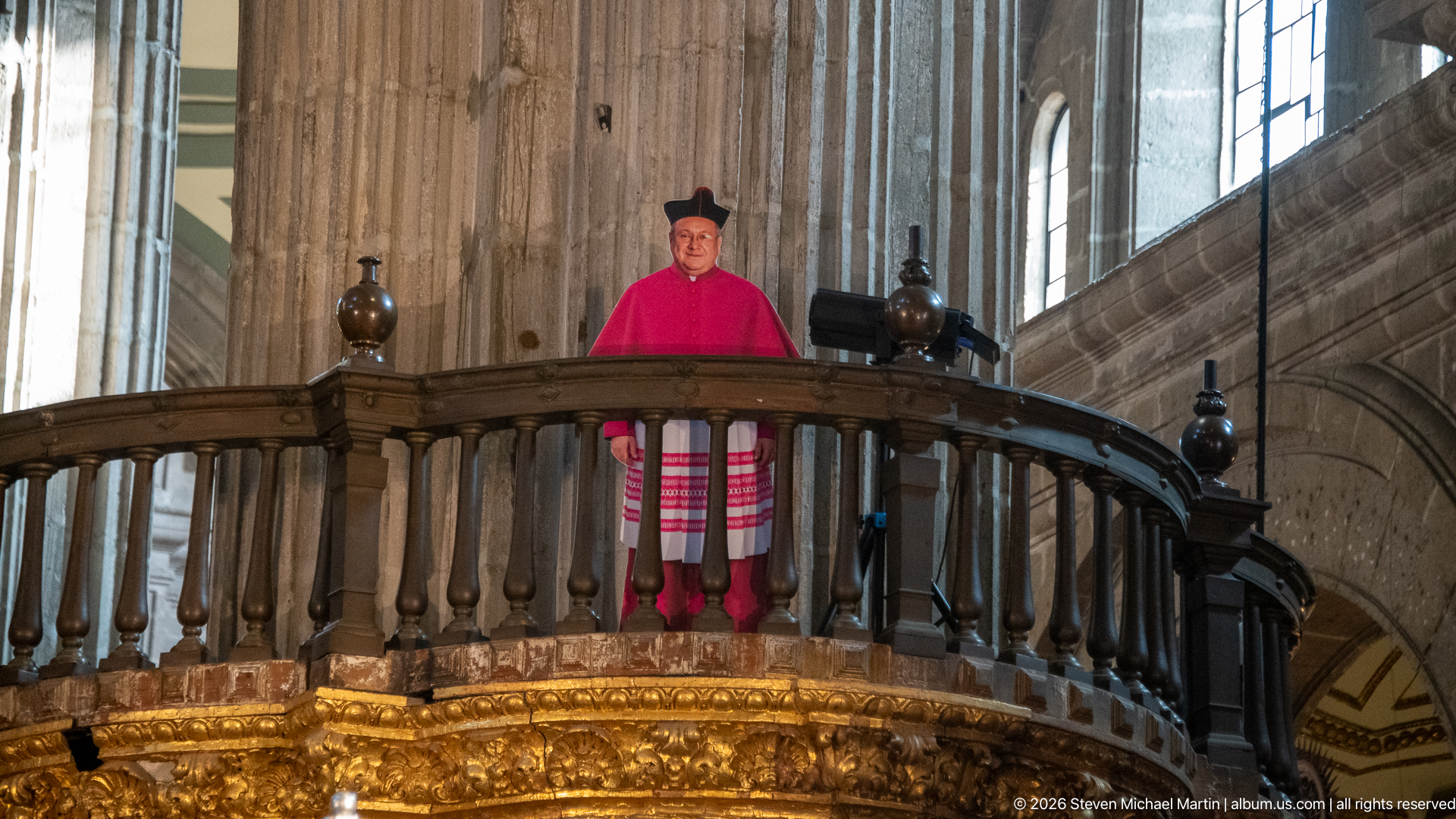
A clergyman in a magenta cassock and black biretta stands behind a curved carved balustrade in the elevated choir area. The gilded railing and tall windows establish the height and restricted setting; the person is not identified.
Caption
A clergyman in a magenta cassock and black biretta stands behind a curved carved balustrade in the elevated choir area. The gilded railing and tall windows establish the height and restricted setting; the person is not identified.
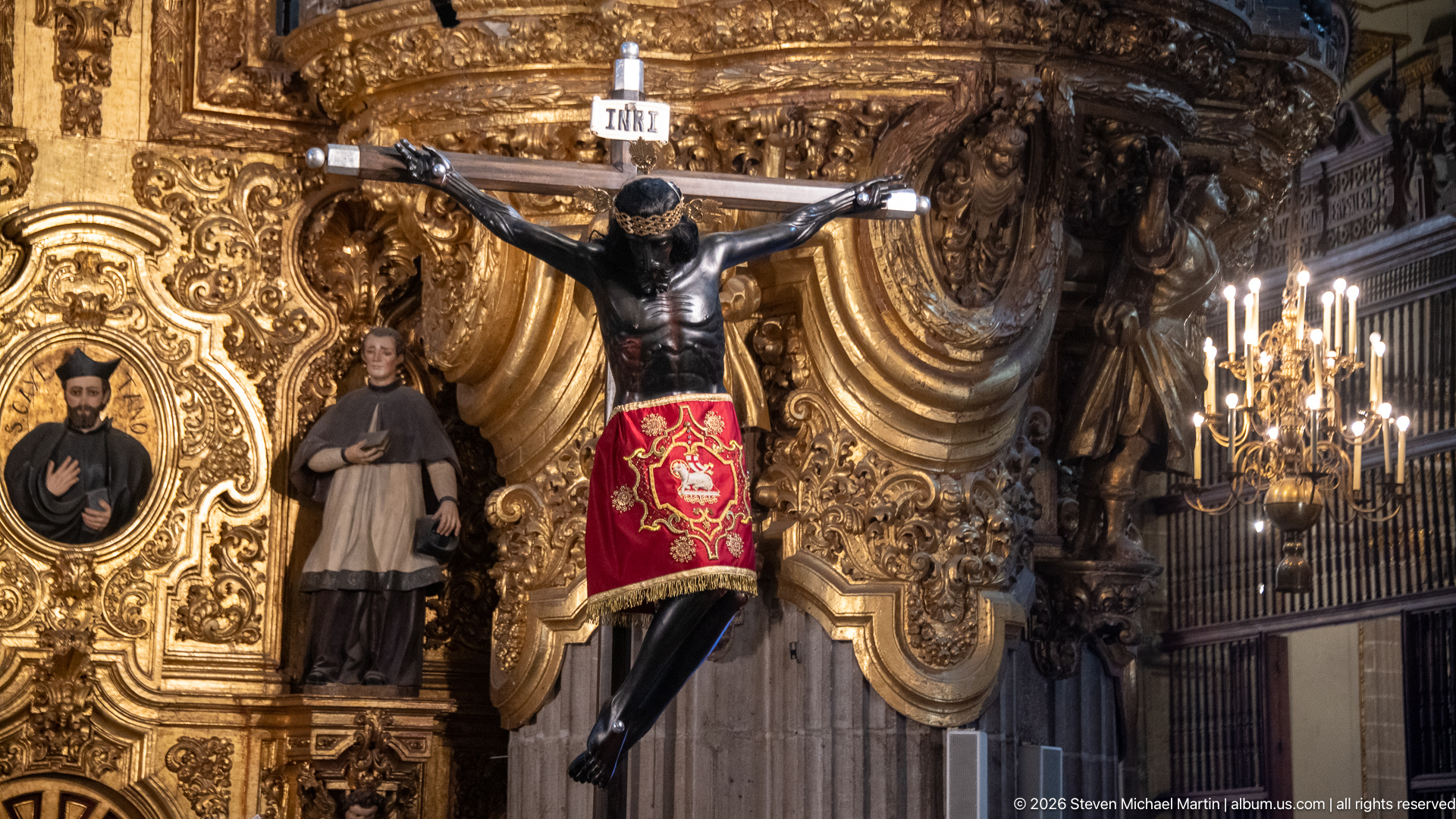
The dark crucifix identified with the Señor del Veneno, also called Cristo Negro, hangs against the cathedral’s gilded Altar del Perdón. The red embroidered loincloth and flanking saint figures stand out against the gold carving; cathedral records identify this as one of the church’s most venerated devotional images.
Caption
The dark crucifix identified with the Señor del Veneno, also called Cristo Negro, hangs against the cathedral’s gilded Altar del Perdón. The red embroidered loincloth and flanking saint figures stand out against the gold carving; cathedral records identify this as one of the church’s most venerated devotional images.
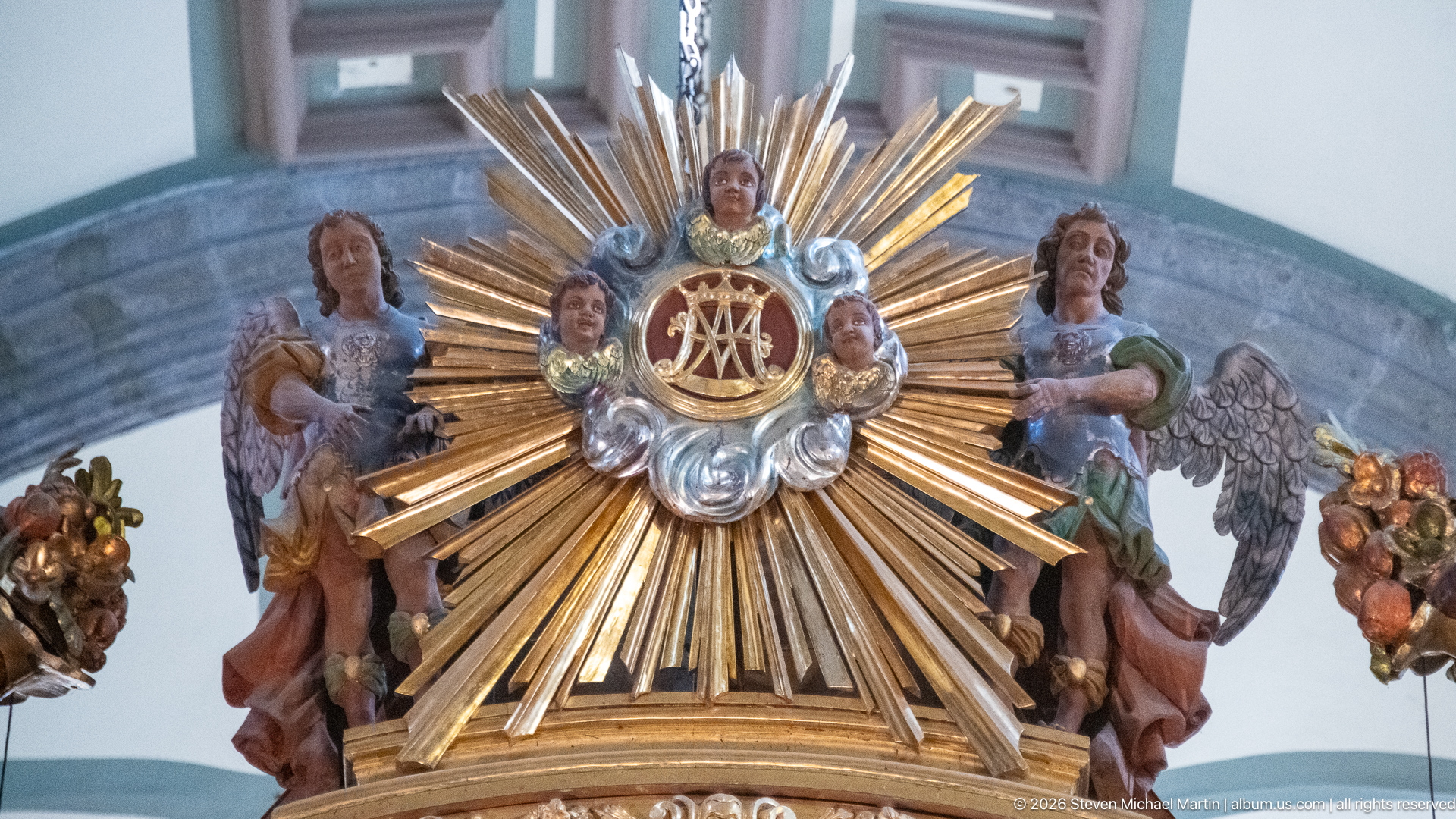
A gold sunburst surrounds a Marian monogram, with silver-toned ornament and painted angels supporting the emblem. The upward close view isolates this devotional symbol against the cathedral’s pale stonework.
Caption
A gold sunburst surrounds a Marian monogram, with silver-toned ornament and painted angels supporting the emblem. The upward close view isolates this devotional symbol against the cathedral’s pale stonework.
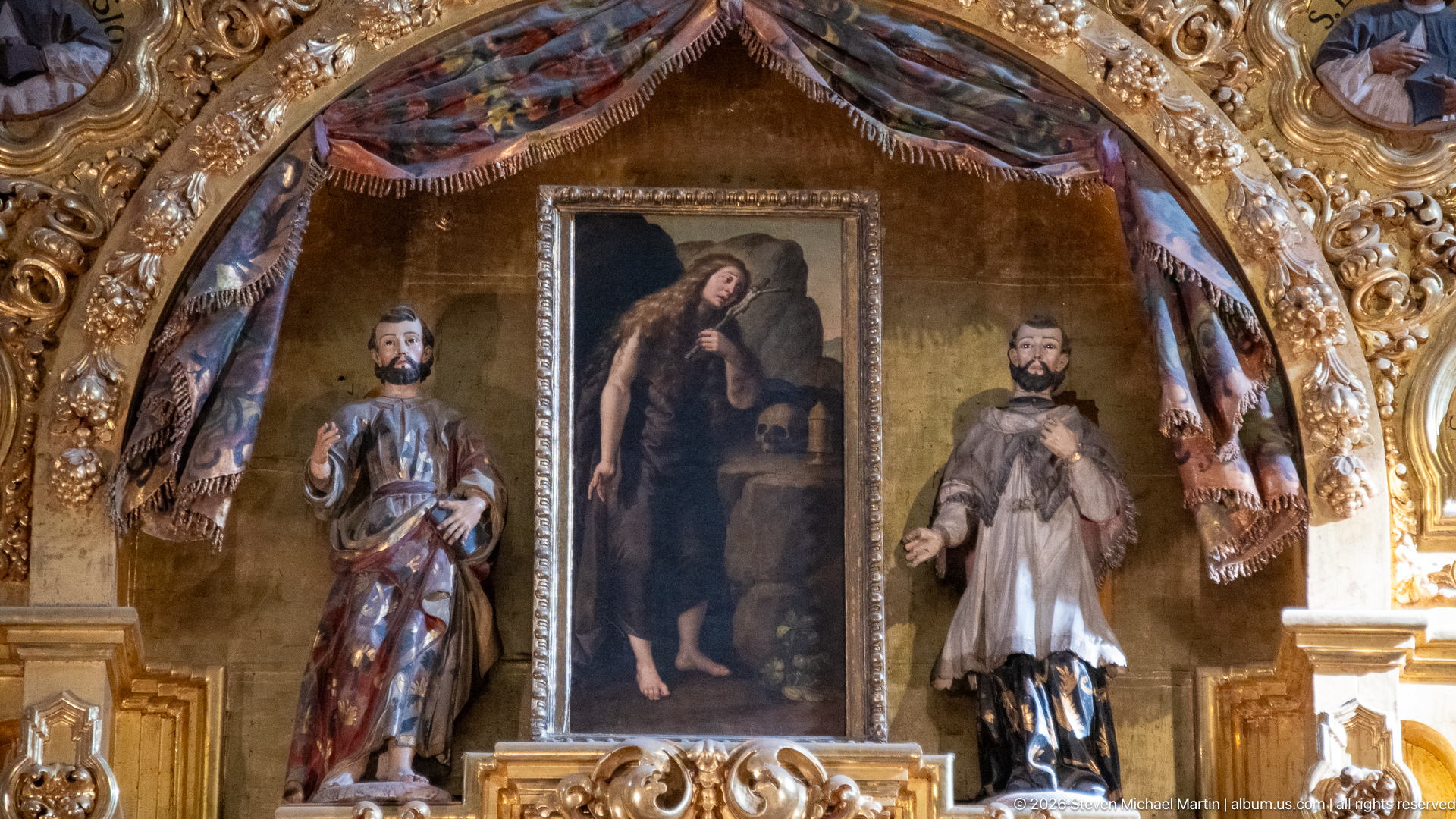
A framed painting of a haloed figure is centered between two standing saint sculptures within a gilded niche. The left figure wears a darker robe and carries an object; the right is dressed in pale garments. Above them, an embroidered canopy and dense gold carving create a compact devotional tableau. The identities of the painted and sculpted figures are not established by the view.
Caption
A framed painting of a haloed figure is centered between two standing saint sculptures within a gilded niche. The left figure wears a darker robe and carries an object; the right is dressed in pale garments. Above them, an embroidered canopy and dense gold carving create a compact devotional tableau. The identities of the painted and sculpted figures are not established by the view.
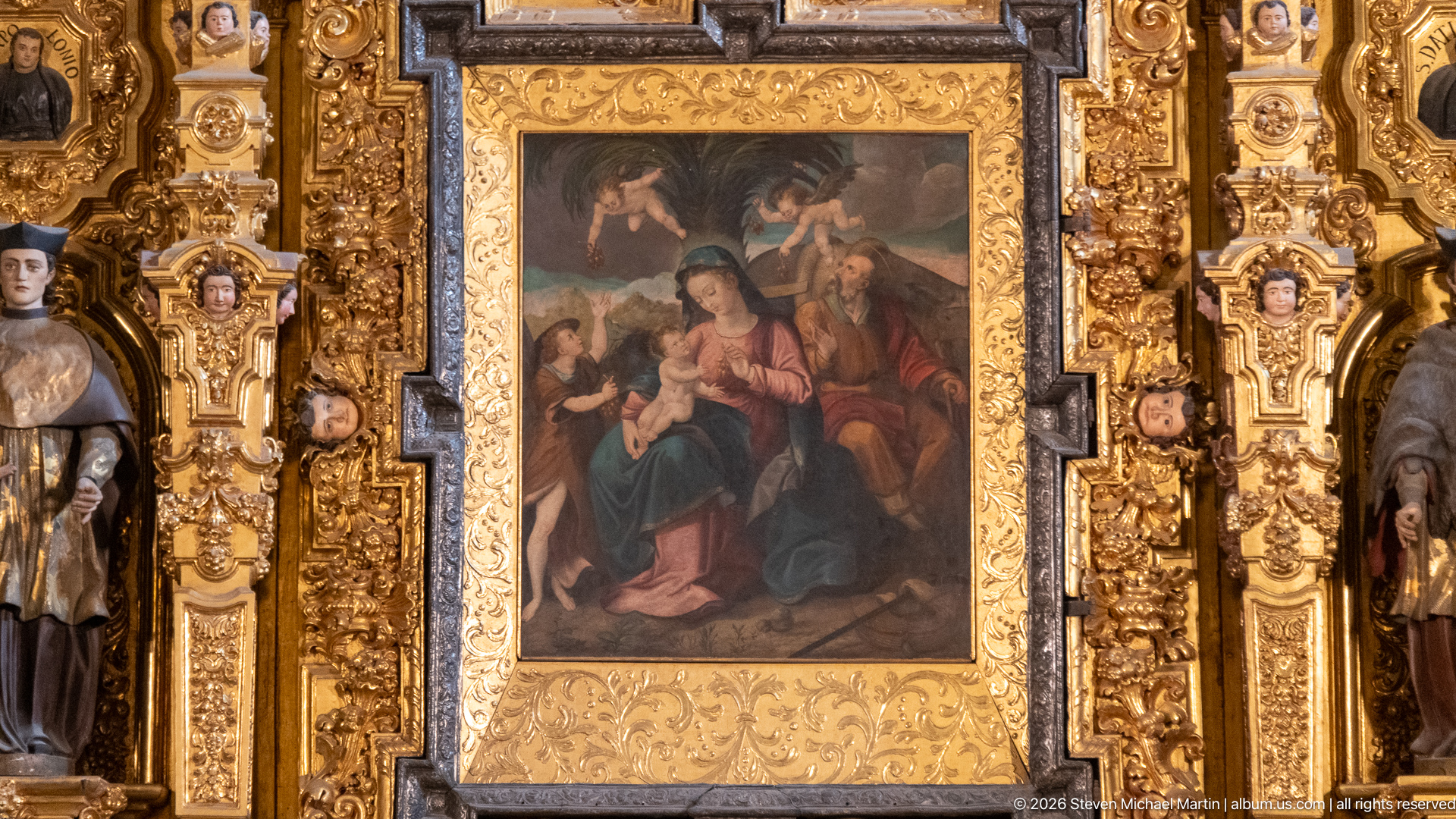
The close crop centers Mary and the infant Jesus, with Joseph and other figures gathered around them beneath a group of cherubs. A broad gilded frame with scrolling floral relief encloses the canvas; fragments of neighboring statues remain at the edges. This tighter view clarifies the painting’s family grouping while preserving its placement within the cathedral’s ornate retablo.
Caption
The close crop centers Mary and the infant Jesus, with Joseph and other figures gathered around them beneath a group of cherubs. A broad gilded frame with scrolling floral relief encloses the canvas; fragments of neighboring statues remain at the edges. This tighter view clarifies the painting’s family grouping while preserving its placement within the cathedral’s ornate retablo.
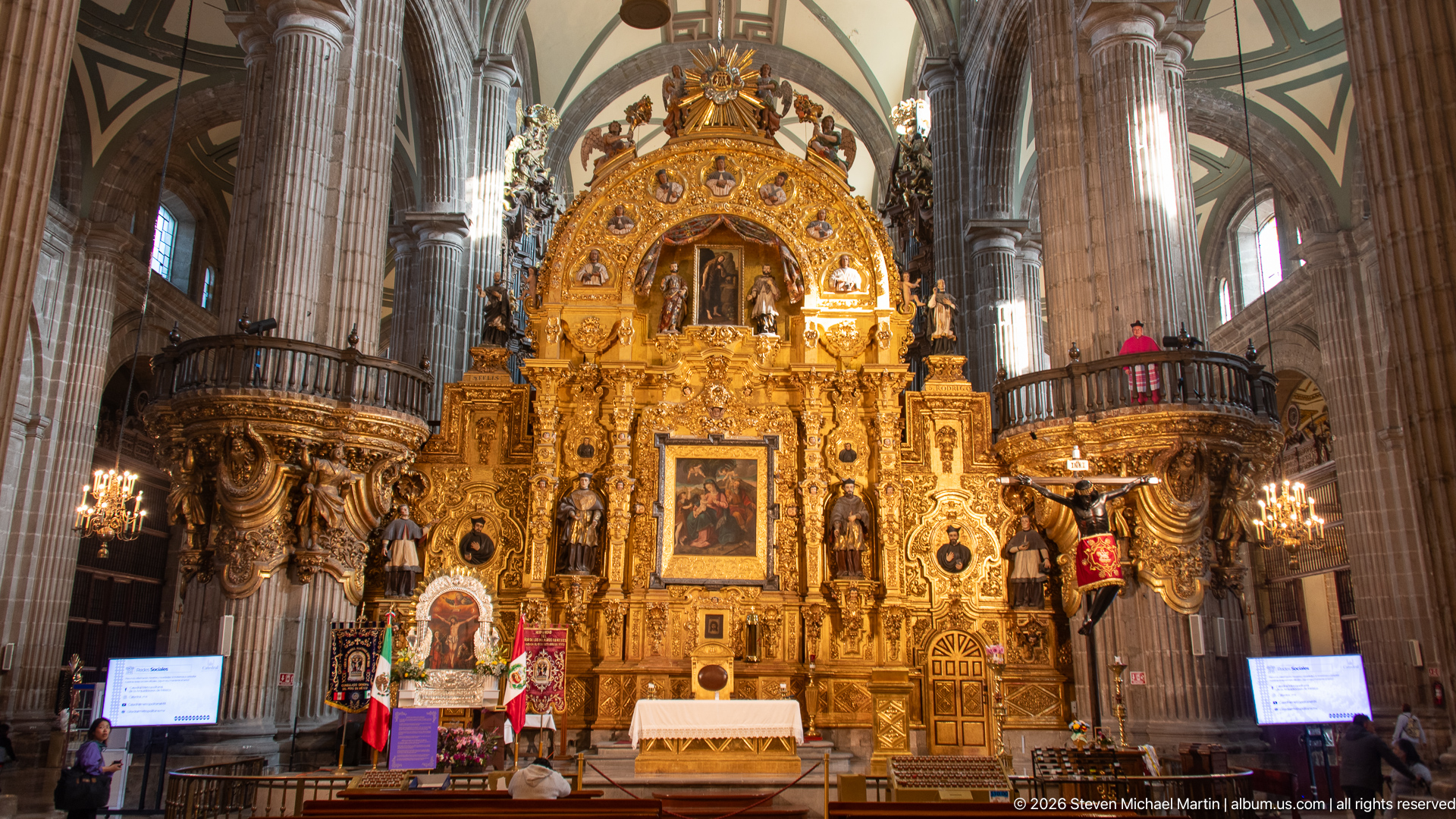
Closer framing reveals the retablo’s central painting, surrounding carved figures, small circular portraits, and repeated gold ornament. Dark side galleries and chandeliers remain at the edges, but the luminous carving dominates. This view isolates the altar’s dense surface and layered devotional imagery without losing its architectural setting in the cathedral nave.
Caption
Closer framing reveals the retablo’s central painting, surrounding carved figures, small circular portraits, and repeated gold ornament. Dark side galleries and chandeliers remain at the edges, but the luminous carving dominates. This view isolates the altar’s dense surface and layered devotional imagery without losing its architectural setting in the cathedral nave.
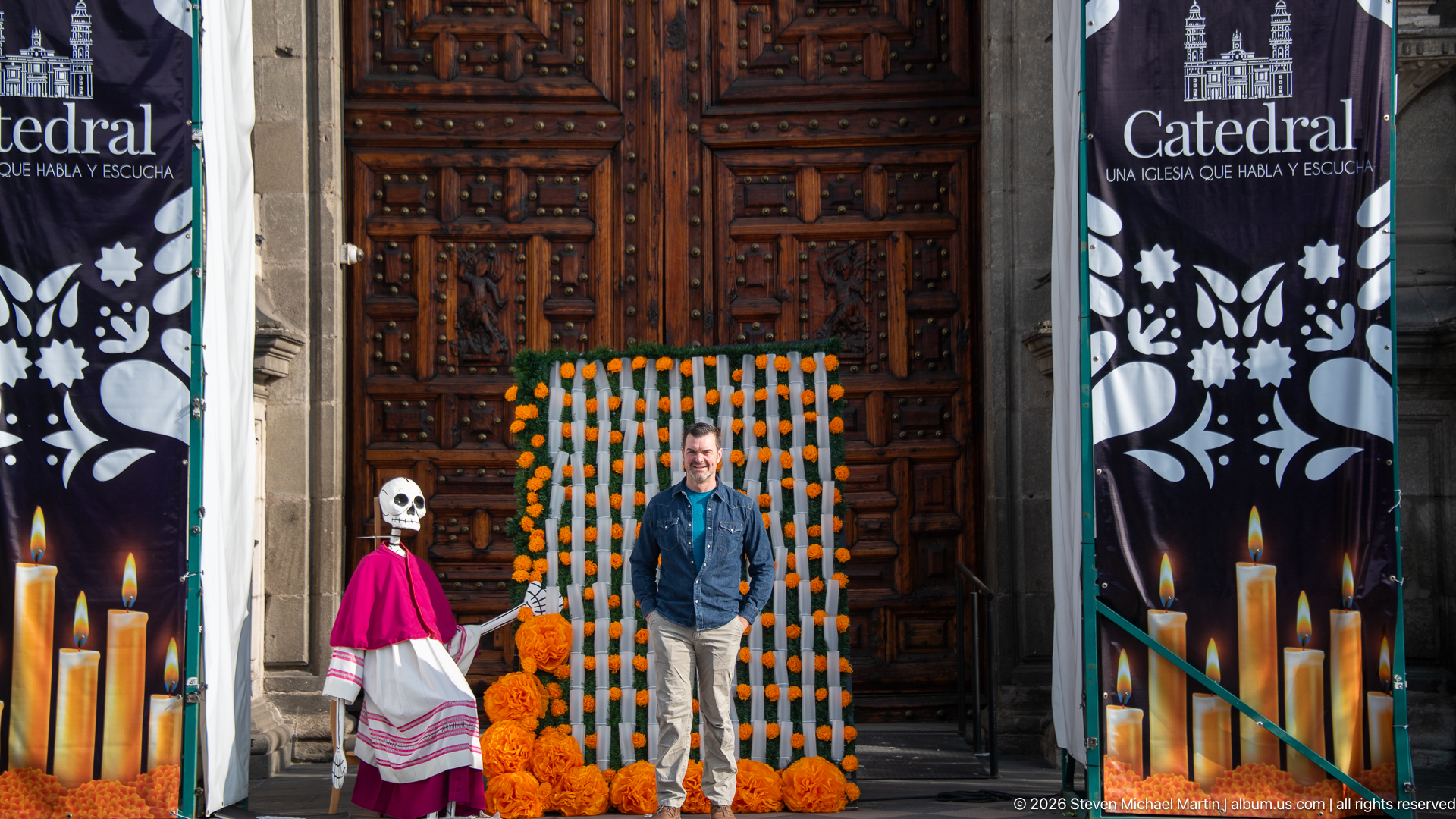
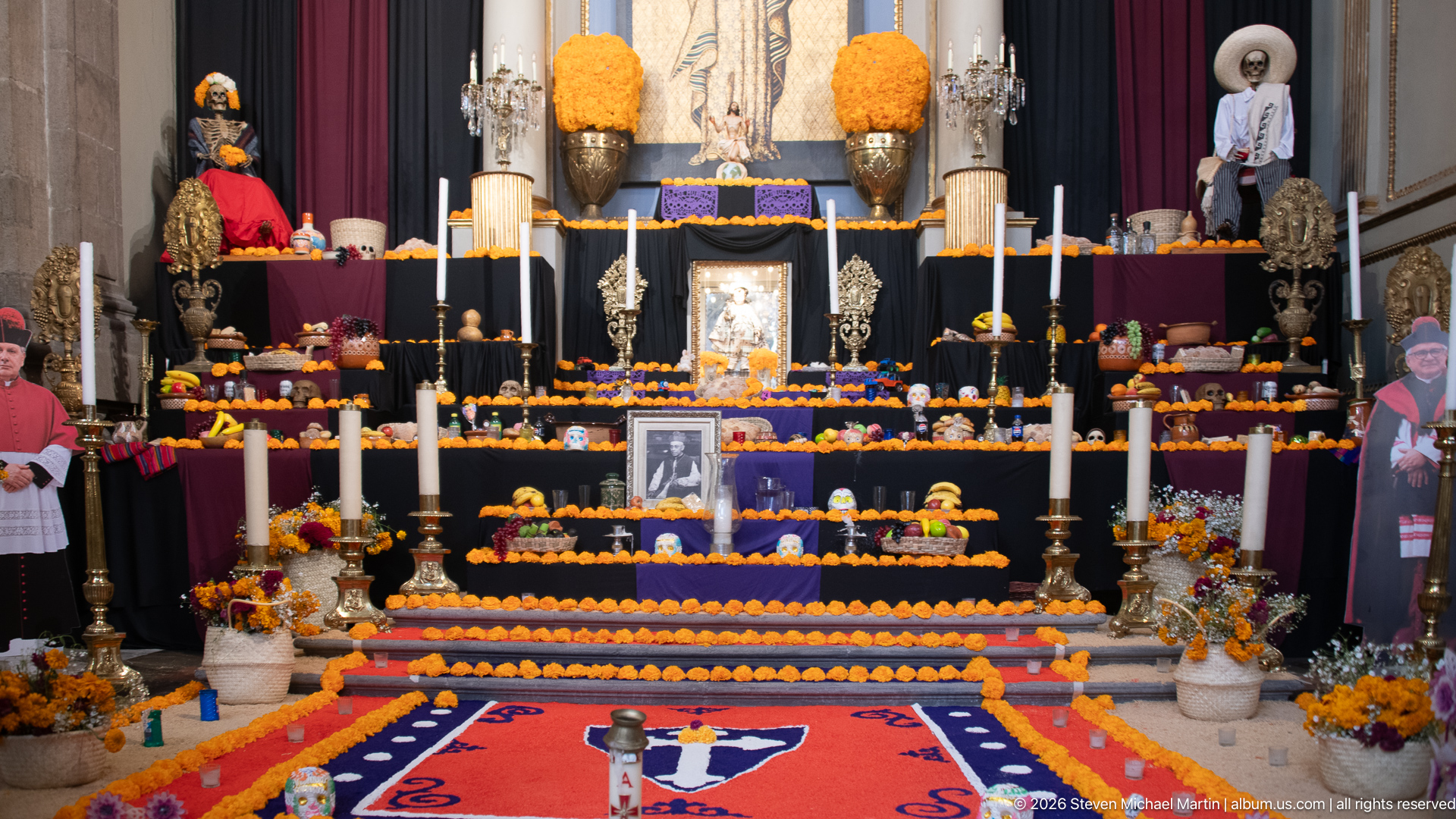
A visitor stands at the cathedral’s carved wooden entrance beside a skeletal figure dressed in a magenta-and-white garment. Orange marigolds form a tall backdrop and line the base, while Día de Muertos banners flank the doorway. The scene combines an architectural threshold with a posed portrait and the seasonal display’s unmistakable symbols.
Caption
A visitor stands at the cathedral’s carved wooden entrance beside a skeletal figure dressed in a magenta-and-white garment. Orange marigolds form a tall backdrop and line the base, while Día de Muertos banners flank the doorway. The scene combines an architectural threshold with a posed portrait and the seasonal display’s unmistakable symbols.
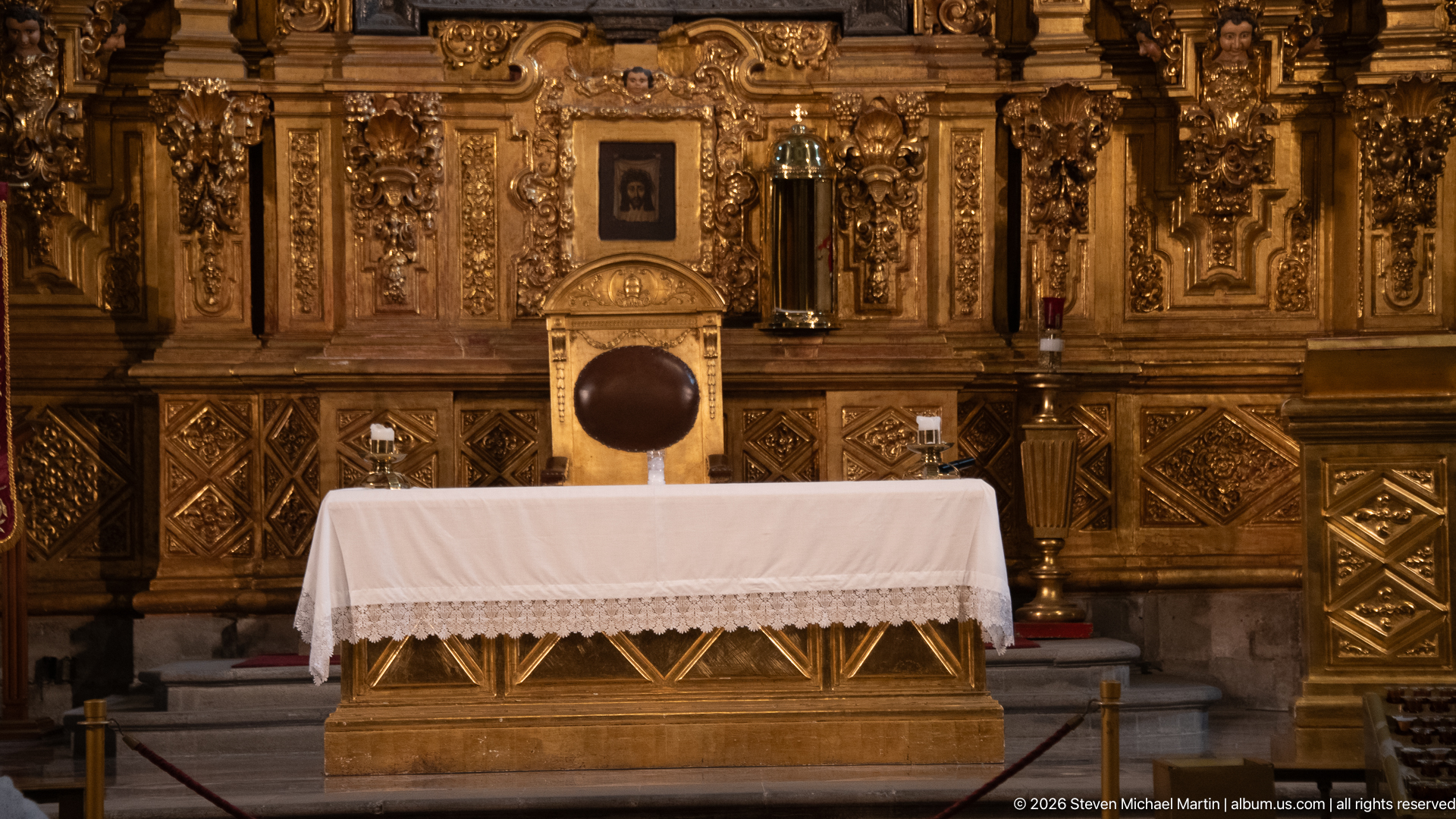
A white cloth covers the central altar table, set before a dark, elaborately carved retablo. Directly above it, a gold-toned support holds a large dark sphere; a small framed portrait is positioned higher on the wall. The uncluttered frontal composition focuses attention on these objects and their placement within the ornate sanctuary.
Caption
A white cloth covers the central altar table, set before a dark, elaborately carved retablo. Directly above it, a gold-toned support holds a large dark sphere; a small framed portrait is positioned higher on the wall. The uncluttered frontal composition focuses attention on these objects and their placement within the ornate sanctuary.
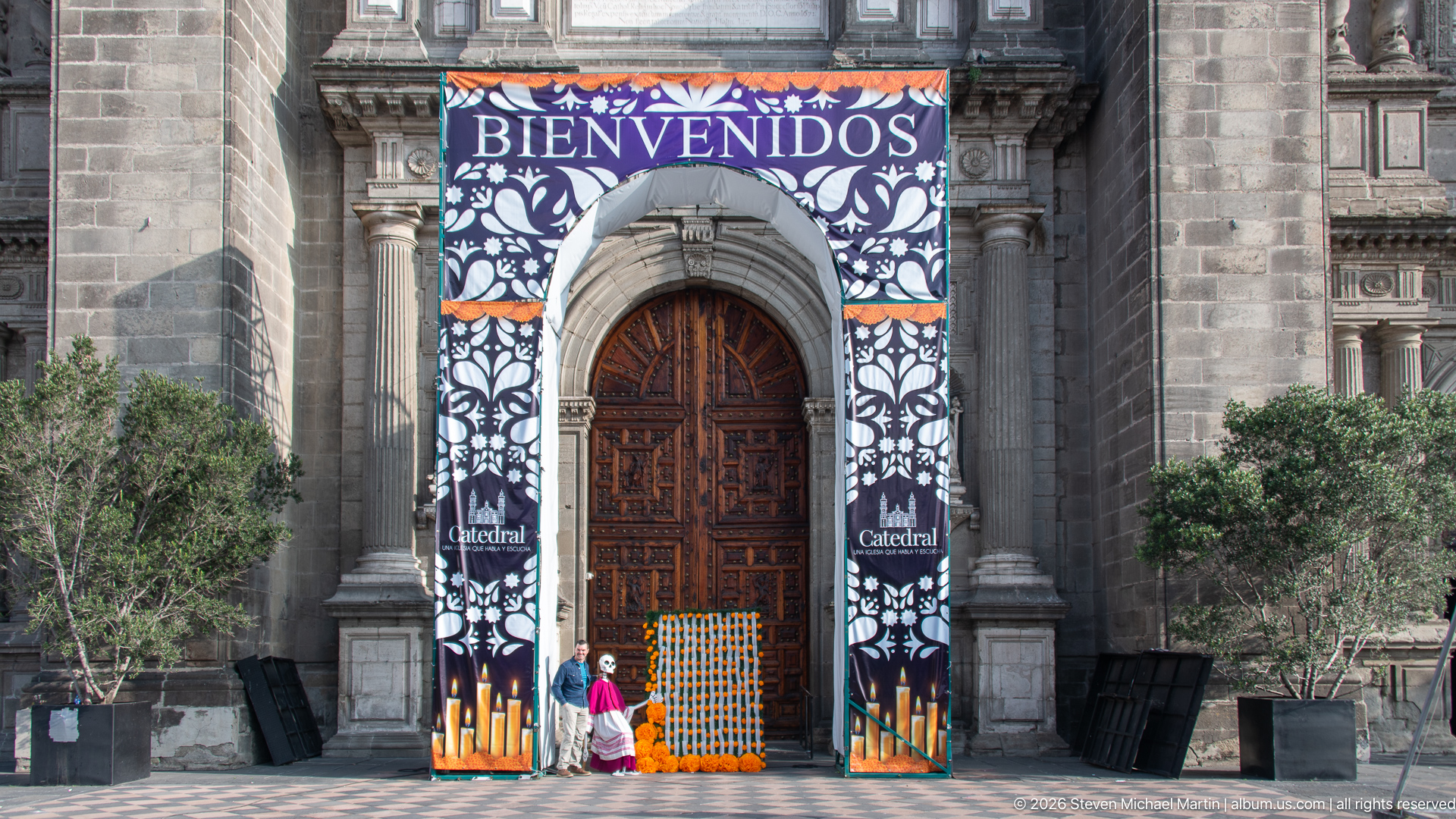
The cathedral’s monumental stone portal is dressed with tall Día de Muertos banners bearing candle and floral motifs. Beneath the central “Bienvenidos” banner, a small marigold display and two people mark the carved wooden doors. The distant view captures the seasonal installation in relation to the full height and symmetry of the entrance façade.
Caption
The cathedral’s monumental stone portal is dressed with tall Día de Muertos banners bearing candle and floral motifs. Beneath the central “Bienvenidos” banner, a small marigold display and two people mark the carved wooden doors. The distant view captures the seasonal installation in relation to the full height and symmetry of the entrance façade.
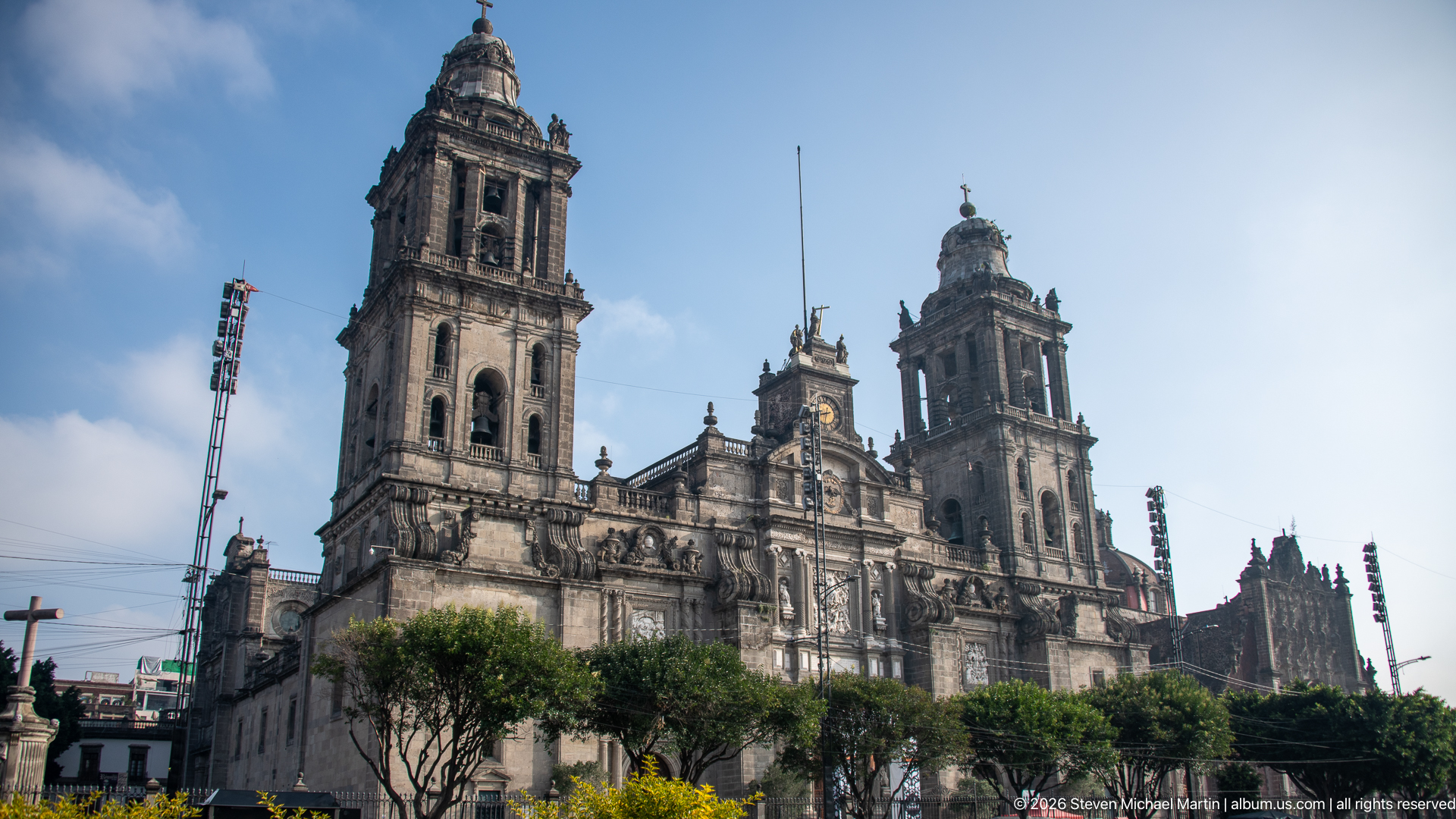
The cathedral rises above a tree-lined plaza, its paired bell towers and central dome forming a layered skyline against a clear blue sky. The oblique viewpoint reveals the long stone façade and adjacent buildings while keeping the towers as the dominant forms. Sunlight picks out the masonry relief and the varied heights of the central complex.
Caption
The cathedral rises above a tree-lined plaza, its paired bell towers and central dome forming a layered skyline against a clear blue sky. The oblique viewpoint reveals the long stone façade and adjacent buildings while keeping the towers as the dominant forms. Sunlight picks out the masonry relief and the varied heights of the central complex.
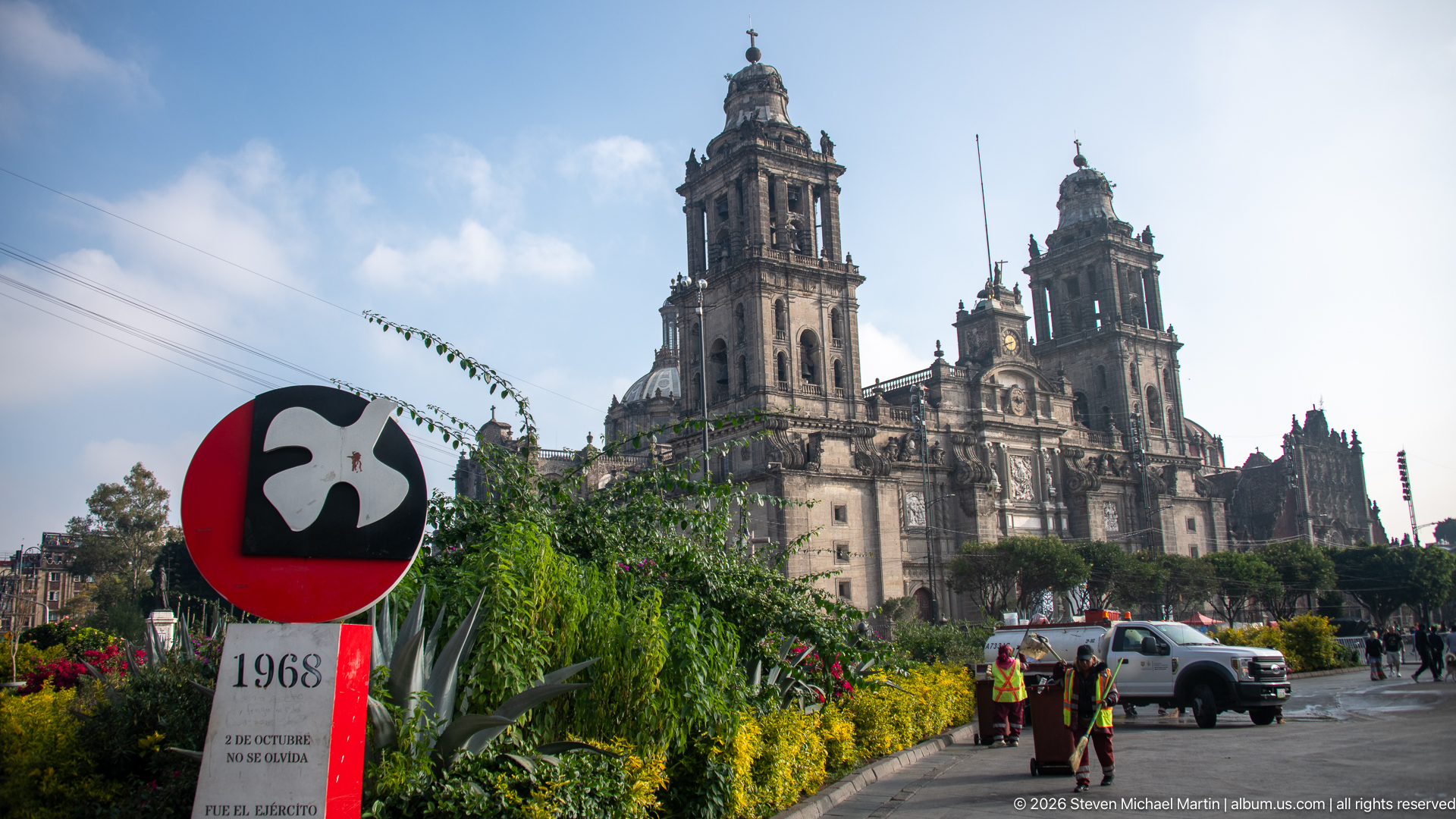
A red, black, and white memorial marker stands in the garden before the cathedral towers. Its inscription reads “2 de Octubre No Se Olvida” and “Fue el Ejército,” connecting this site to public remembrance of October 2, 1968.
Caption
A red, black, and white memorial marker stands in the garden before the cathedral towers. Its inscription reads “2 de Octubre No Se Olvida” and “Fue el Ejército,” connecting this site to public remembrance of October 2, 1968.
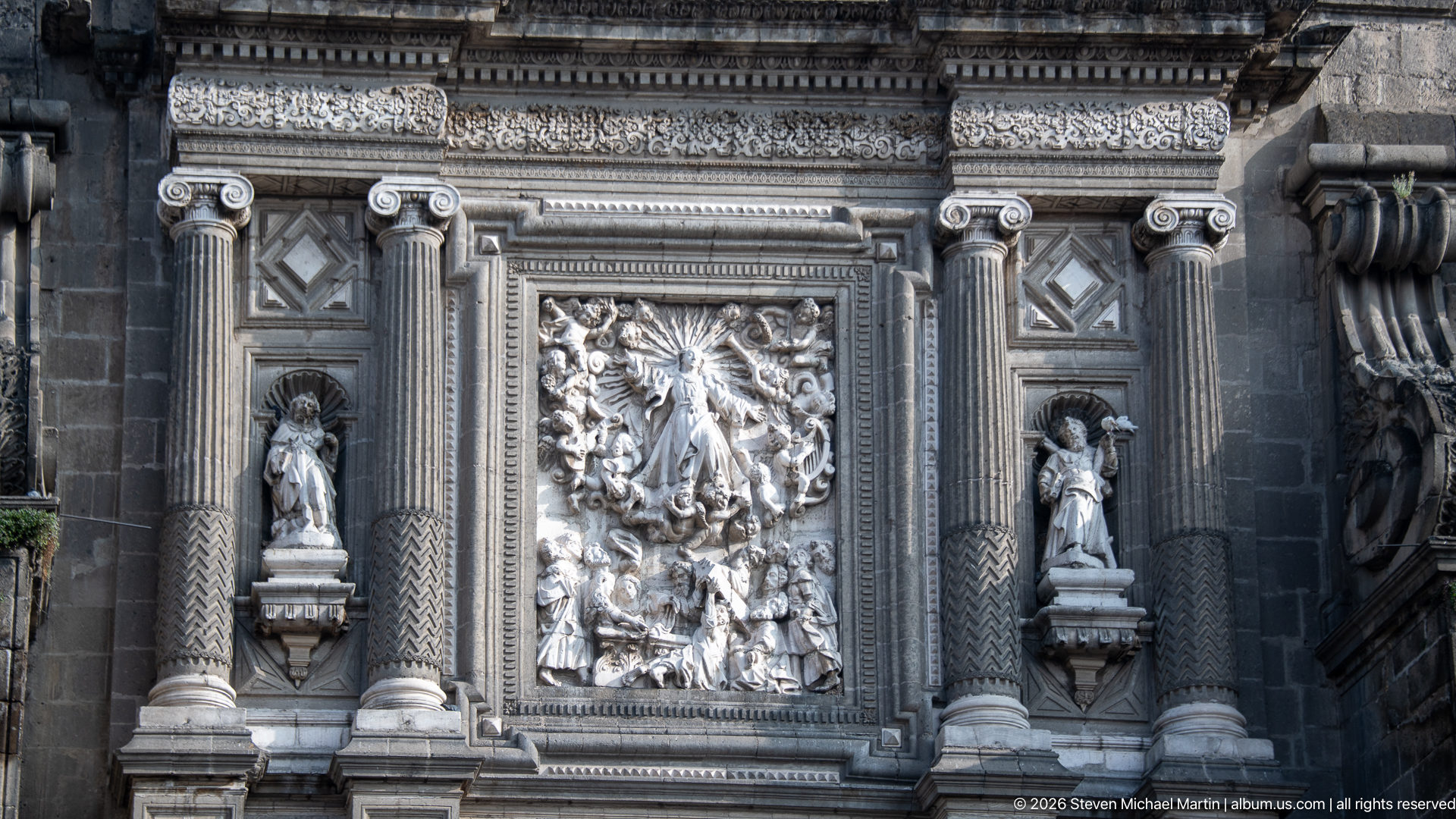
A pale rectangular relief occupies the center of this façade bay, flanked by standing figures in narrow niches and strongly modeled columns. The central composition shows a robed figure with radiating forms and a crowd of smaller figures below. Ornamental bands and geometric panels frame the scene, making the sculptural program legible as part of the stone architecture.
Caption
A pale rectangular relief occupies the center of this façade bay, flanked by standing figures in narrow niches and strongly modeled columns. The central composition shows a robed figure with radiating forms and a crowd of smaller figures below. Ornamental bands and geometric panels frame the scene, making the sculptural program legible as part of the stone architecture.
Spiritual Heritage Field Guide
📍 Overview
The Metropolitan Cathedral of Mexico City is experienced through its monumental stone exterior, expansive nave, side chapels, and richly furnished altars. The photographs move from bell towers and carved portals into spaces filled with gilded retablos, paintings, sculptures, stained glass, and devotional objects. They also show the cathedral as a living religious and civic place, where worship, seasonal displays, and public remembrance meet.
◆ Religious & Historical Context
The cathedral’s imagery centers on Christian devotion: the Virgin and Child, the Virgin of Guadalupe, saints, angels, and scenes from the Passion appear in paintings, sculpture, and altarpieces. Daily devotional life is suggested by altars arranged with candles, flowers, lecterns, and ceremonial chairs, as well as by visitors gathered in the nave and chapels. A display for the Señor de los Milagros, identified by banners from a Peruvian devotional brotherhood in Mexico, shows how faith communities carry their traditions across national borders.
◆ Sacred Architecture
The cathedral’s exterior is marked by massive stone towers, a central dome, a clock, carved portals, and sculpted relief panels. Inside, long aisles lead between heavy piers and high arches toward gilded sanctuary altars. Side chapels bring visitors closer to layered retablos and devotional images, while the pipe organ, painted vaults, chandeliers, stained-glass windows, and monumental wooden doors make the building itself part of the sacred experience.
◆ Symbolism & Iconography
The cathedral’s visual language brings together images of Mary, Christ, saints, angels, and the Passion. A Virgin of Guadalupe painting is surrounded by angels and a dove; other altars pair the Madonna and Child with gilded frames, carved figures, and painted scenes. A skull-and-bones reliquary appears within a devotional altar, while Día de Muertos displays add marigolds, portraits, and skeletal figures to the church’s interior and entrance. Mexican and Vatican flags beside the sanctuary provide another visible layer of institutional identity.
◆ Ritual & Community
The photographs show spaces arranged for communal worship: pews face the sanctuary, candles and flowers line the altars, and ceremonial chairs and lecterns stand ready on the platform. Visitors gather in the nave and side chapels, while a clergyman appears in the elevated choir area. Seasonal Día de Muertos installations and the Señor de los Milagros display show how different communities make their presence visible within the cathedral, through flowers, banners, images, and offerings.
◆ Preservation
The cathedral’s carved stone, painted surfaces, gilded retablos, wooden doors, and devotional objects reveal a wide range of materials and levels of detail. Protective glass surrounds some figures and objects; grilles and ropes mark boundaries around chapels and altars. A memorial marker in the garden bears the words “2 de Octubre No Se Olvida,” placing public remembrance beside the cathedral’s historic façade. These visible details make care, access, and memory part of the visitor’s encounter with the site.
📷 Photography Notes
Begin outside with the paired towers, central dome, and carved façade, then move inward along the nave toward the sanctuary. Include enough surrounding architecture when photographing retablos, paintings, and statues to show how they fit into their chapel bays. Look upward for the painted vaults, chandeliers, organ, and stained glass; use closer views for inscriptions, carved panels, and devotional objects. Frames that include visitors, barriers, or seasonal displays help convey how the cathedral is used today.