Jasper Pyramid Lake Introduction
Pyramid Lake lies just north of the town of Jasper in **Jasper National Park**, set beneath the distinctive slopes of **Pyramid Mountain**. The lake occupies a broad glacially shaped landscape in the Athabasca Valley, where moving ice carved a series of long, narrow lakes that also includes nearby Patricia Lake. Easily reached from Jasper by Pyramid Lake Road, the lake offers a quieter mountain setting of forested shoreline, open water, and expansive views toward the surrounding peaks.
One of the lake’s best-known features is **Pyramid Island**, a small wooded island connected to the mainland by a rustic footbridge. At its center stands the **Pyramid Lake Island Picnic Shelter**, a log pavilion constructed in 1933 by workers employed through Depression-era federal relief programs. Built as automobile tourism was expanding in Jasper National Park, the shelter reflects the rustic architectural tradition used throughout Canada’s early national parks and is now recognized as a **Federal Heritage Building**.
Today, Pyramid Lake remains both a scenic destination and an important recreational area close to Jasper. Trails connect the lake with the townsite and surrounding forest, while the shoreline provides opportunities for walking, picnicking, paddling, and photography. The bridge to Pyramid Island and the historic log shelter create one of the lake’s characteristic views, particularly when the calm water reflects Pyramid Mountain and the surrounding Canadian Rockies. Despite its proximity to Jasper, the lake retains a peaceful character that makes it an appealing contrast to the park’s larger and more heavily visited mountain landscapes.
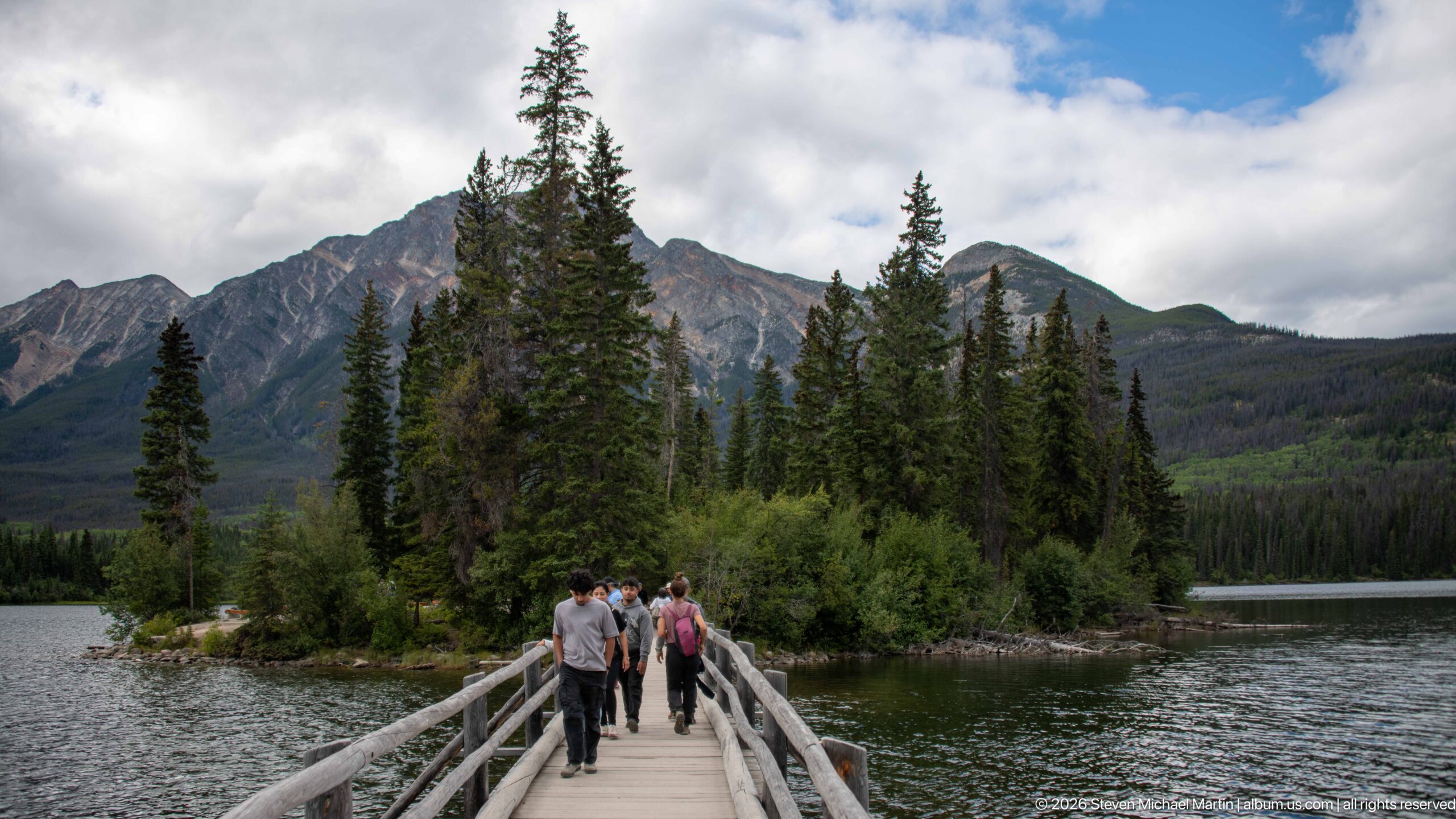
Visitors move away from the camera along the wooden bridge to Pyramid Island, where tall conifers partially screen the shoreline. The closer viewpoint emphasizes the bridge as a physical connection across the water, while the exposed rock and forested lower slopes of the mountains remain prominent beyond the island.
Caption
Visitors move away from the camera along the wooden bridge to Pyramid Island, where tall conifers partially screen the shoreline. The closer viewpoint emphasizes the bridge as a physical connection across the water, while the exposed rock and forested lower slopes of the mountains remain prominent beyond the island.
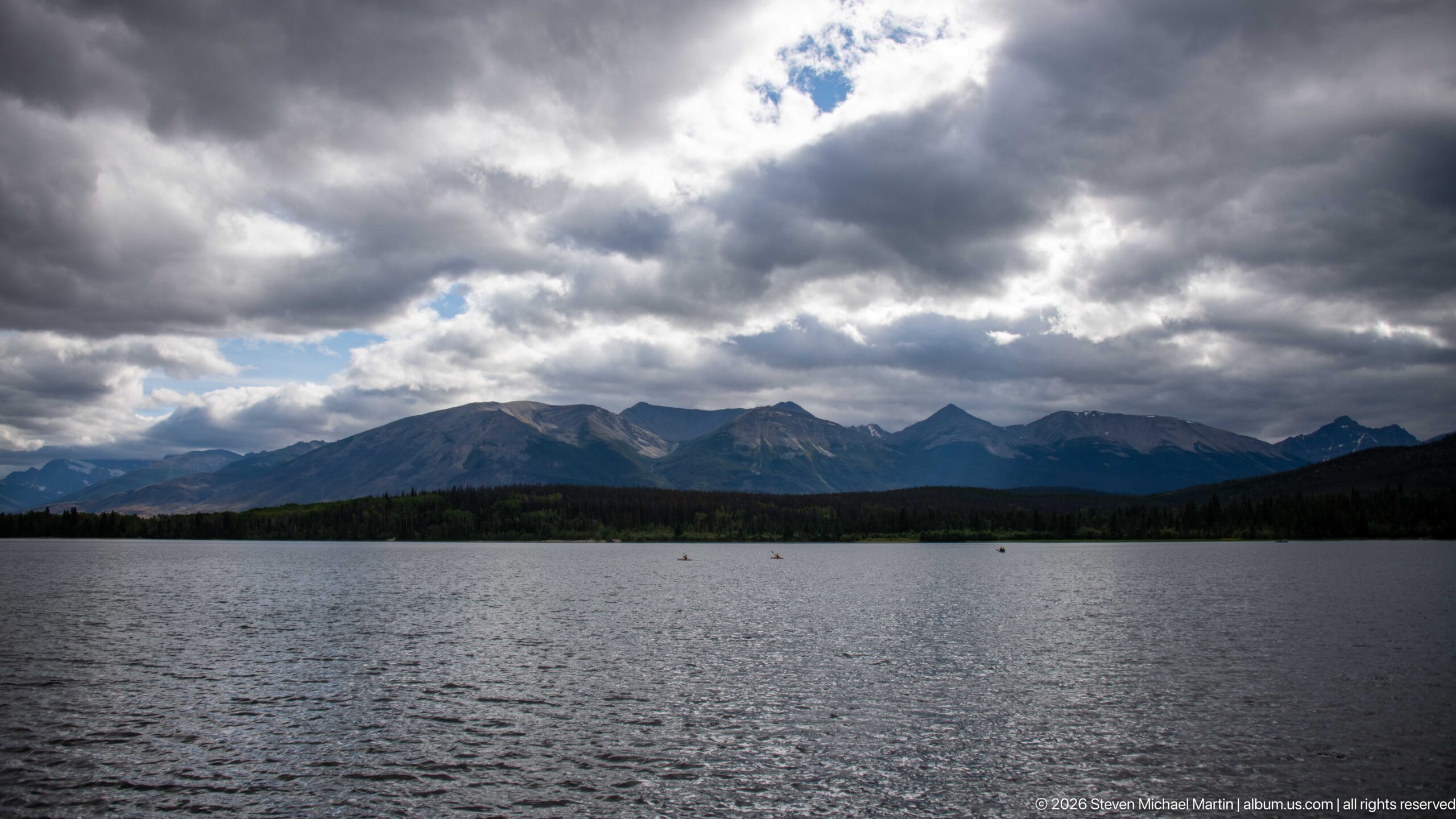
Dark storm clouds hang over Pyramid Lake while a broken band of light picks out the layered mountain skyline beyond the forested shore. The broad expanse of rippled water and small distant boats establish the lake’s scale, while the subdued light gives this overview a distinctly weather-driven character.
Caption
Dark storm clouds hang over Pyramid Lake while a broken band of light picks out the layered mountain skyline beyond the forested shore. The broad expanse of rippled water and small distant boats establish the lake’s scale, while the subdued light gives this overview a distinctly weather-driven character.
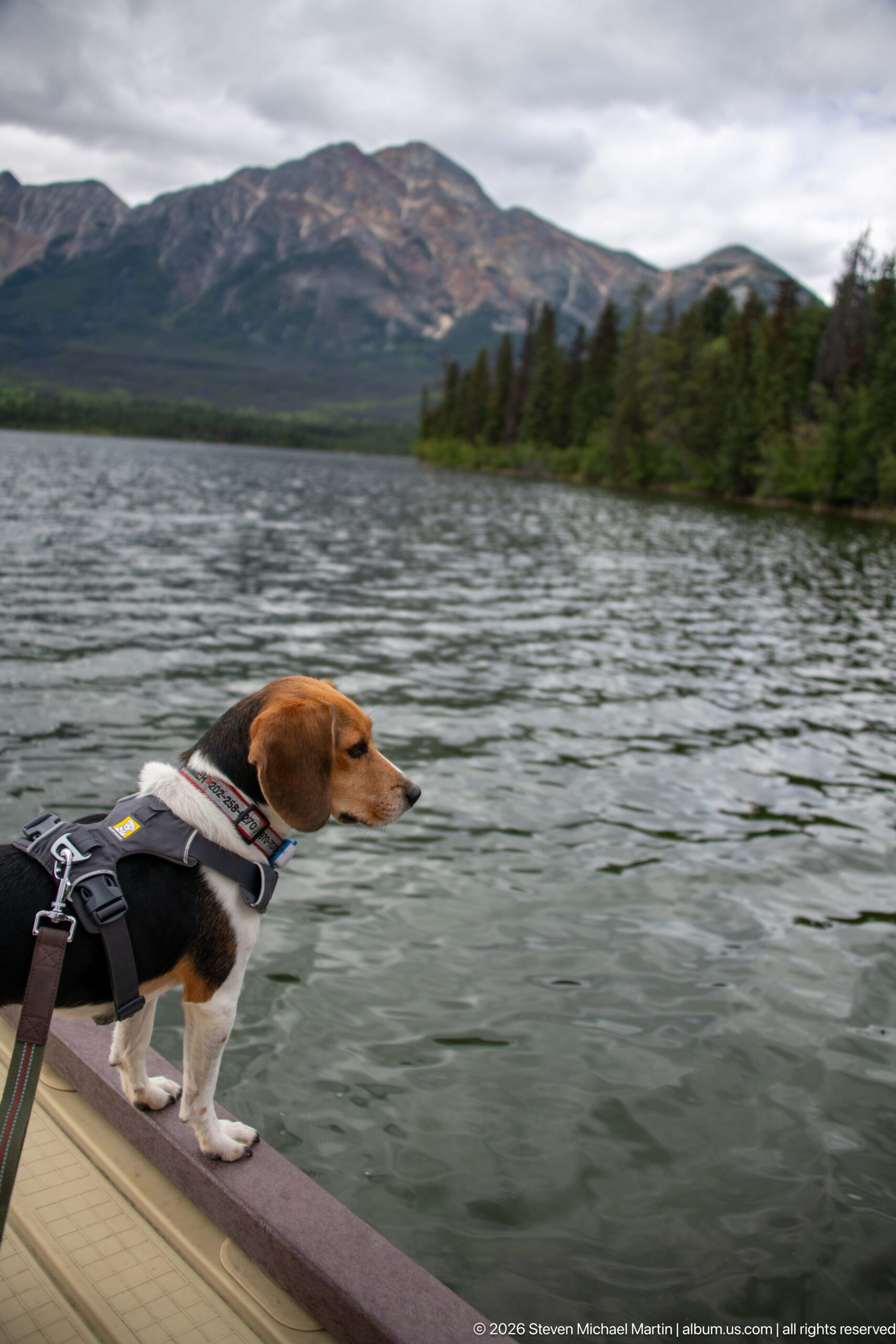
A beagle stands squarely at the outer edge of the dock and looks across Pyramid Lake toward the forested shoreline. Seen in profile, the dog’s attentive stance aligns with the open water, while the broad mountain beyond gives the small foreground figure a strong sense of scale.
Caption
A beagle stands squarely at the outer edge of the dock and looks across Pyramid Lake toward the forested shoreline. Seen in profile, the dog’s attentive stance aligns with the open water, while the broad mountain beyond gives the small foreground figure a strong sense of scale.
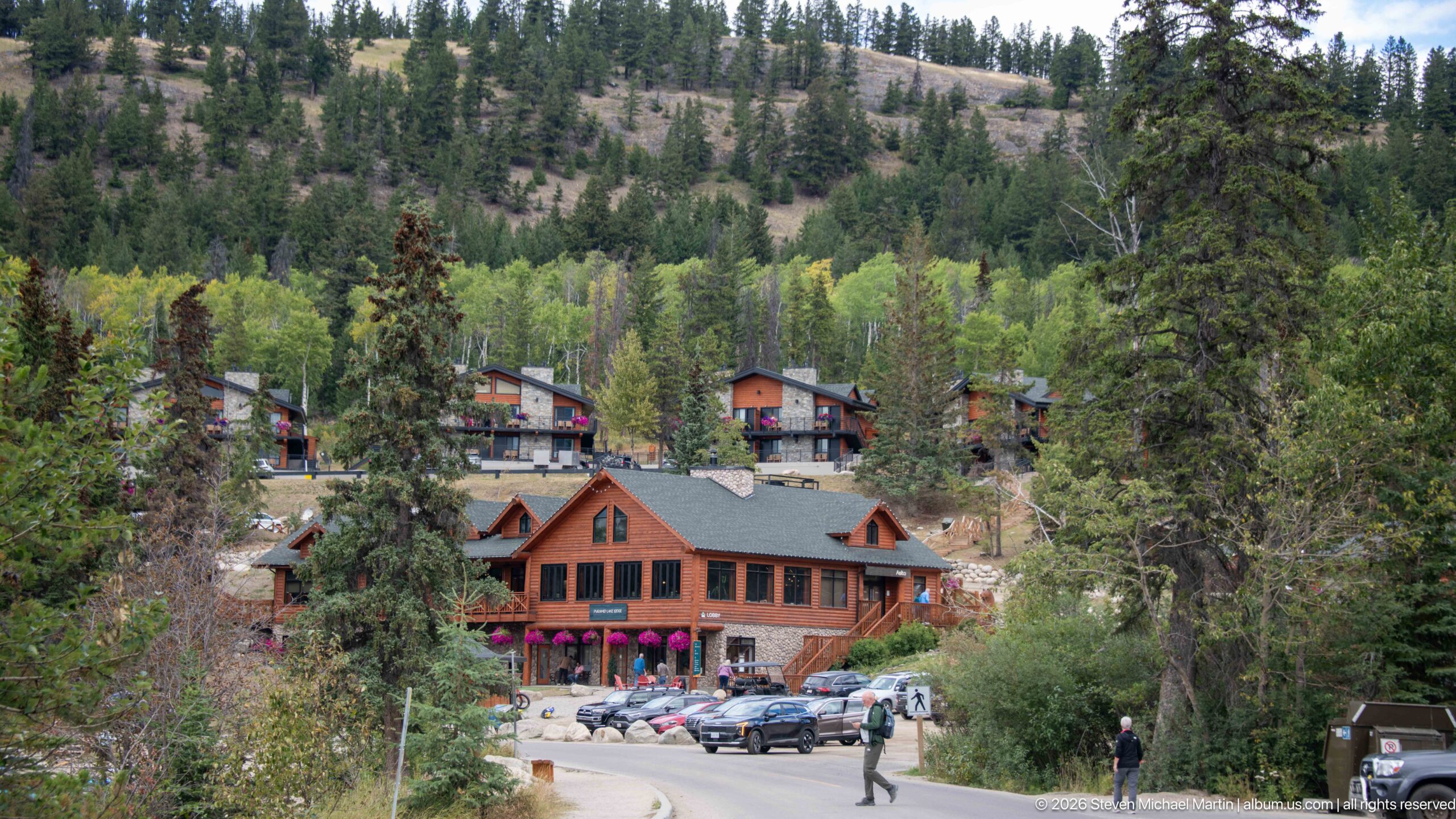
Rustic lodge buildings cluster among dense trees on the slope above the Pyramid Lake waterfront, with parked vehicles and pedestrians marking the developed resort area. Warm wood siding and steep gabled roofs visually distinguish the complex from the surrounding conifer forest and mountain terrain.
Caption
Rustic lodge buildings cluster among dense trees on the slope above the Pyramid Lake waterfront, with parked vehicles and pedestrians marking the developed resort area. Warm wood siding and steep gabled roofs visually distinguish the complex from the surrounding conifer forest and mountain terrain.
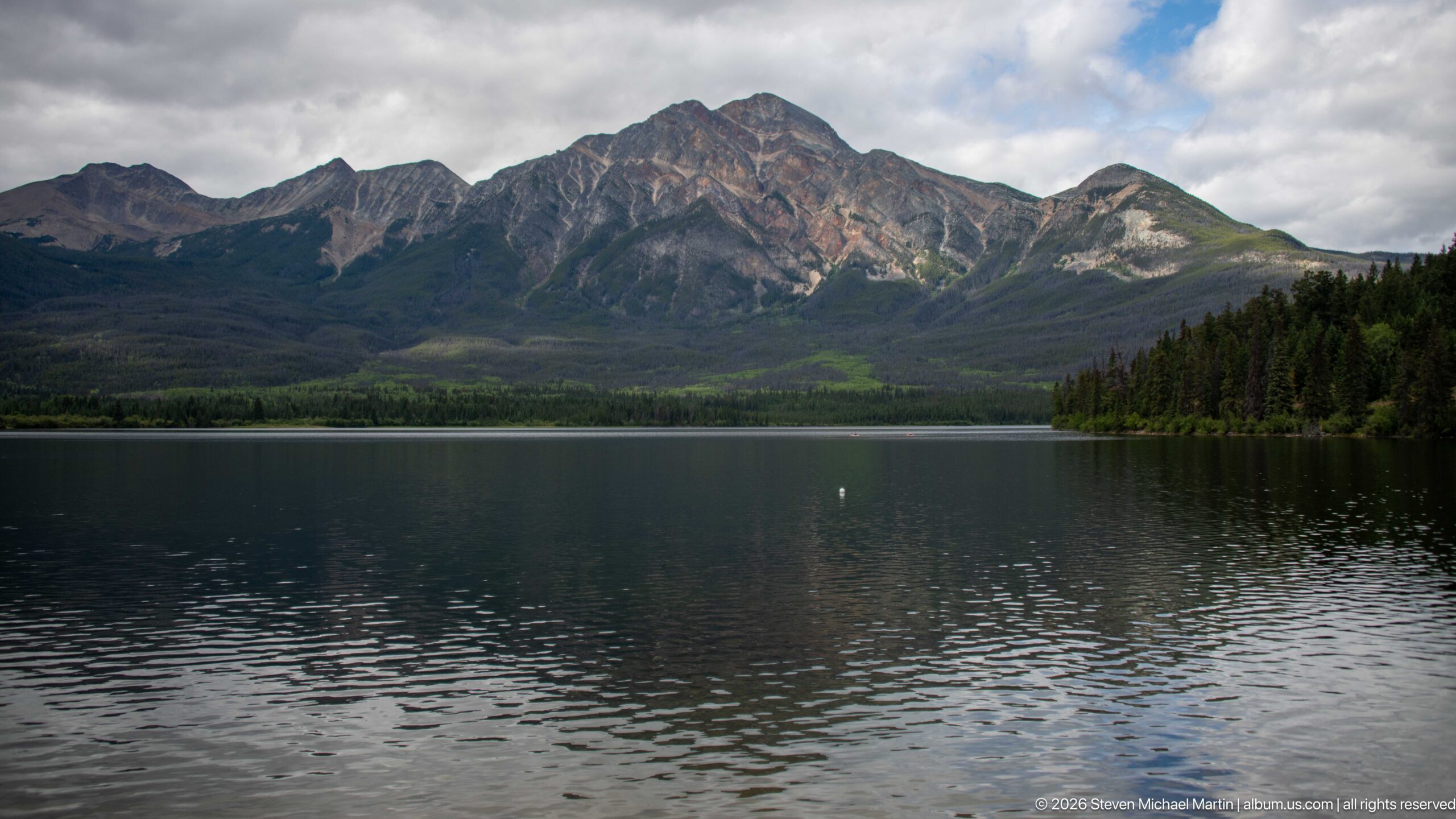
Open water fills the foreground beneath a broad, craggy mountain whose exposed rock faces are broken by darker forested lower slopes. A wooded peninsula enters from the right and a tiny buoy punctuates the lake, giving this uncluttered view a strong sense of distance and scale.
Caption
Open water fills the foreground beneath a broad, craggy mountain whose exposed rock faces are broken by darker forested lower slopes. A wooded peninsula enters from the right and a tiny buoy punctuates the lake, giving this uncluttered view a strong sense of distance and scale.
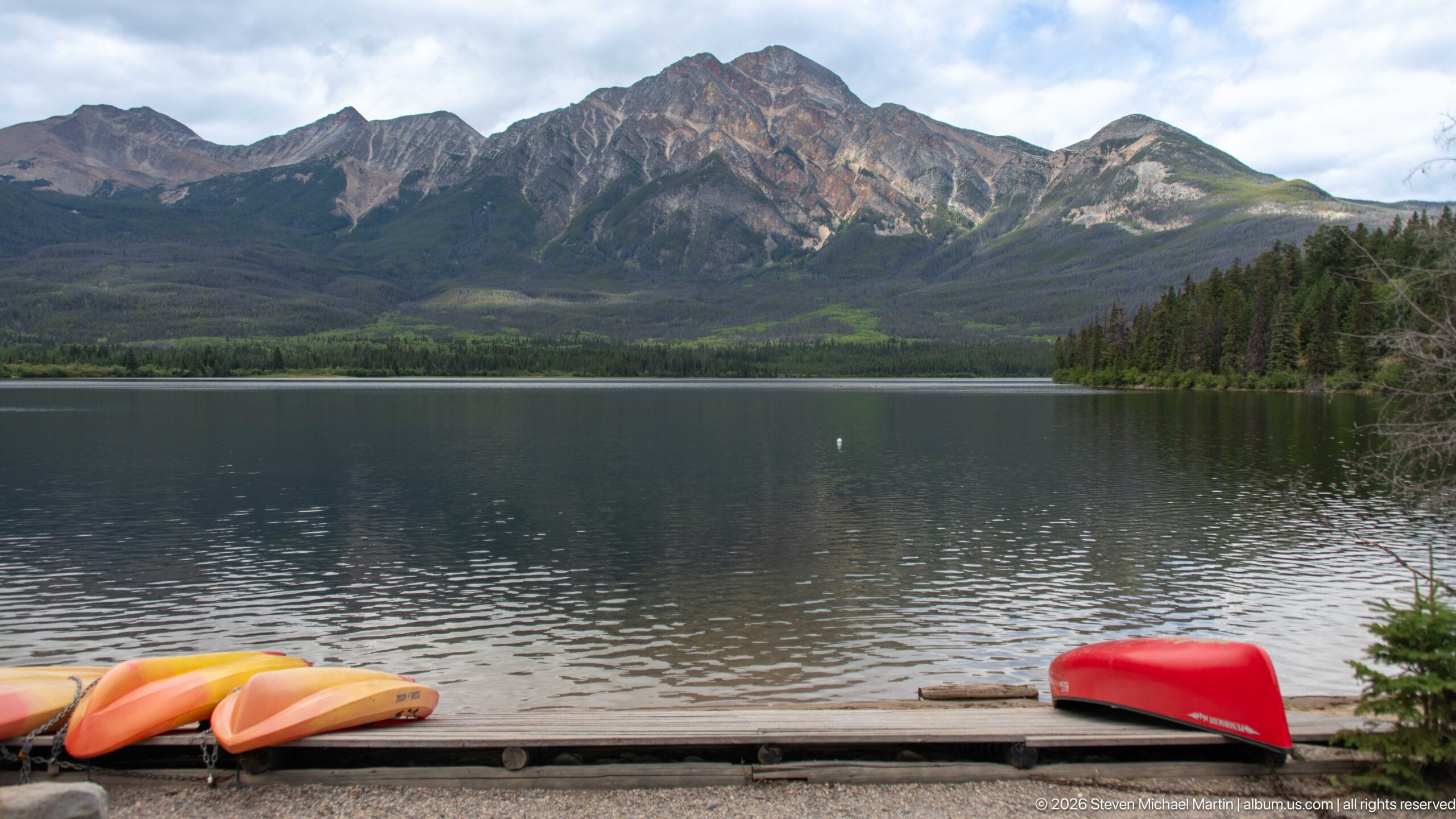
Orange and red paddlecraft rest along the near shore of Pyramid Lake, adding a bright foreground accent to the subdued water and massive mountain beyond. The boats establish the lake’s recreational use while the broad, rocky face across the water remains the dominant natural feature.
Caption
Orange and red paddlecraft rest along the near shore of Pyramid Lake, adding a bright foreground accent to the subdued water and massive mountain beyond. The boats establish the lake’s recreational use while the broad, rocky face across the water remains the dominant natural feature.
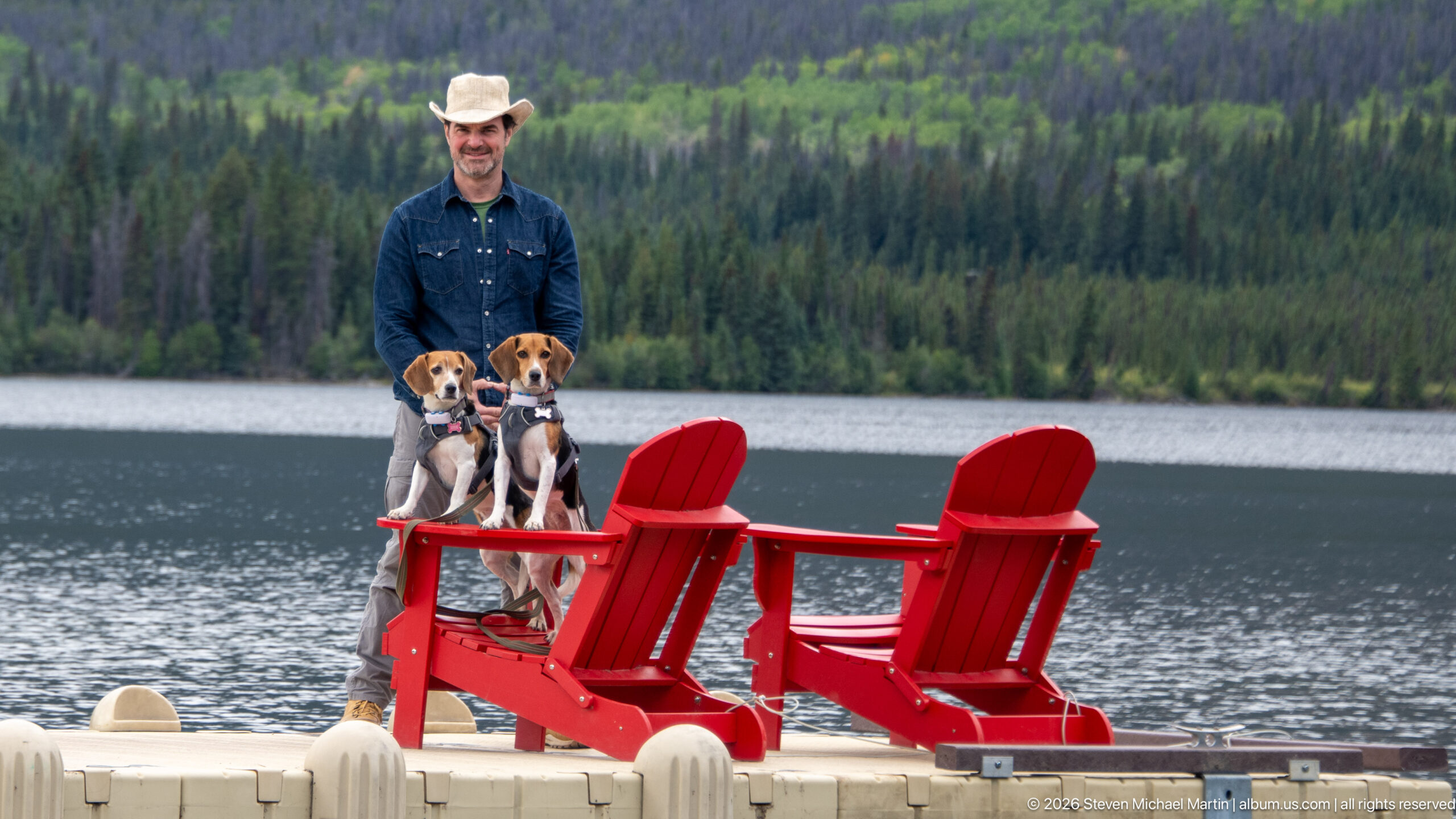
A visitor stands behind two beagles perched on a pair of vivid red Adirondack chairs at the end of a floating dock. Pyramid Lake and a densely forested mountainside form a layered backdrop, turning the familiar park seating into a playful foreground element within the larger lakeside setting.
Caption
A visitor stands behind two beagles perched on a pair of vivid red Adirondack chairs at the end of a floating dock. Pyramid Lake and a densely forested mountainside form a layered backdrop, turning the familiar park seating into a playful foreground element within the larger lakeside setting.
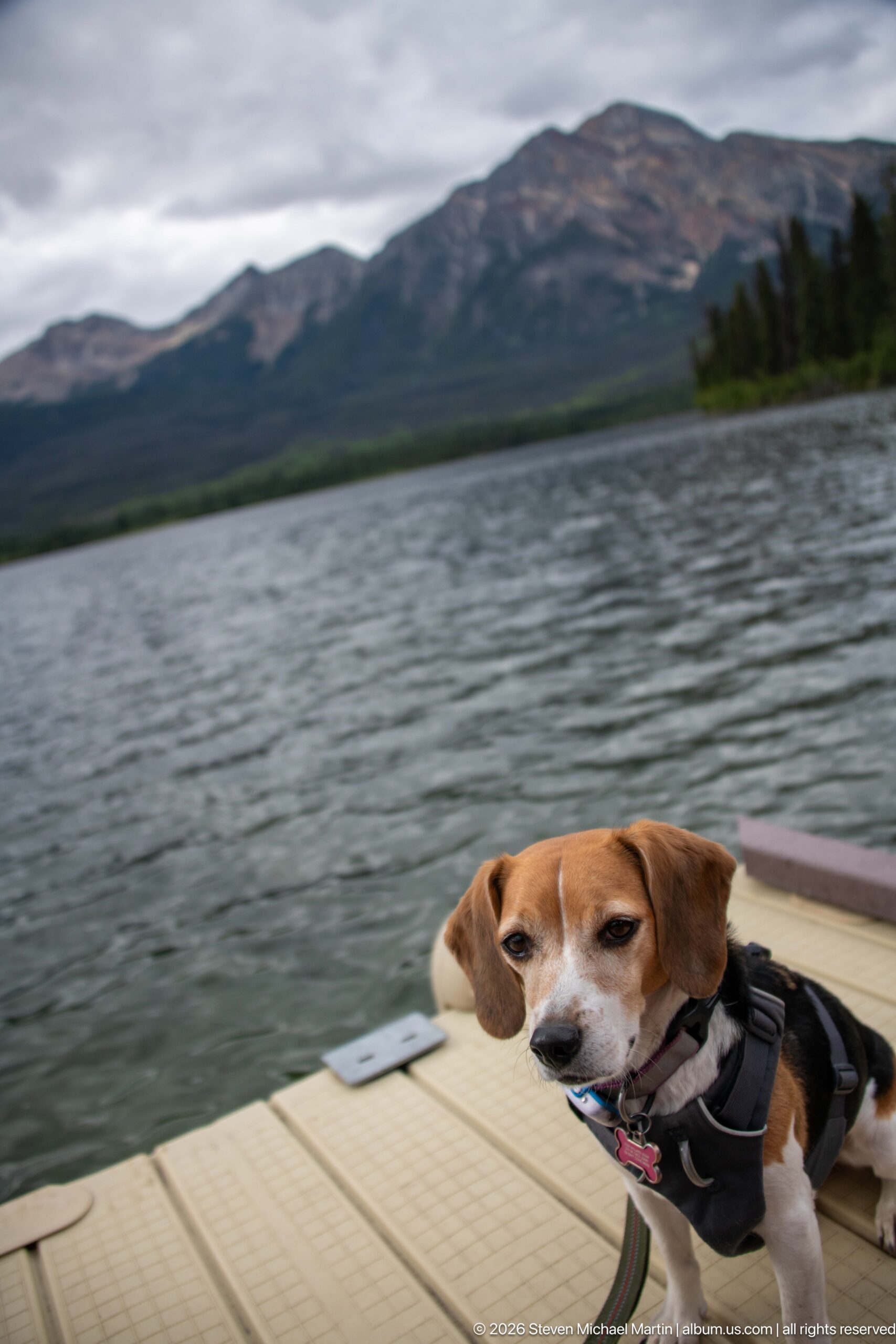
Standing near the dock edge, a harnessed beagle looks directly toward the camera while wind-textured water extends to the mountain slope beyond. The centered expression gives this image the character of a pet portrait, with Pyramid Lake serving as an environmental backdrop rather than the principal subject.
Caption
Standing near the dock edge, a harnessed beagle looks directly toward the camera while wind-textured water extends to the mountain slope beyond. The centered expression gives this image the character of a pet portrait, with Pyramid Lake serving as an environmental backdrop rather than the principal subject.
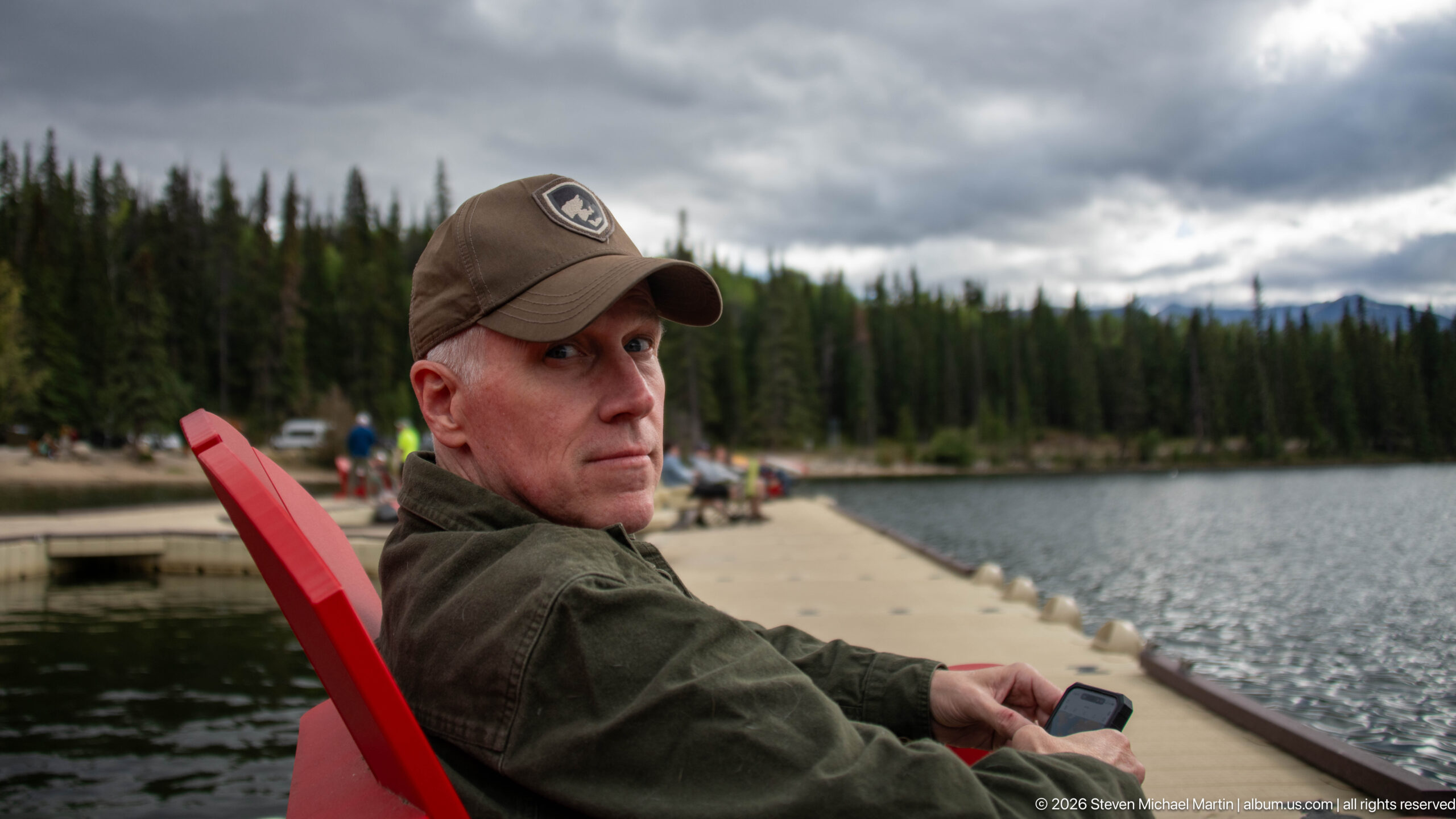
A visitor sits in a bright red Adirondack chair on a dock at Pyramid Lake, glancing back toward the camera while holding a phone. The shallow composition keeps the seated figure prominent against the water and forested opposite shore, documenting the relaxed recreational use of the lakefront.
Caption
A visitor sits in a bright red Adirondack chair on a dock at Pyramid Lake, glancing back toward the camera while holding a phone. The shallow composition keeps the seated figure prominent against the water and forested opposite shore, documenting the relaxed recreational use of the lakefront.
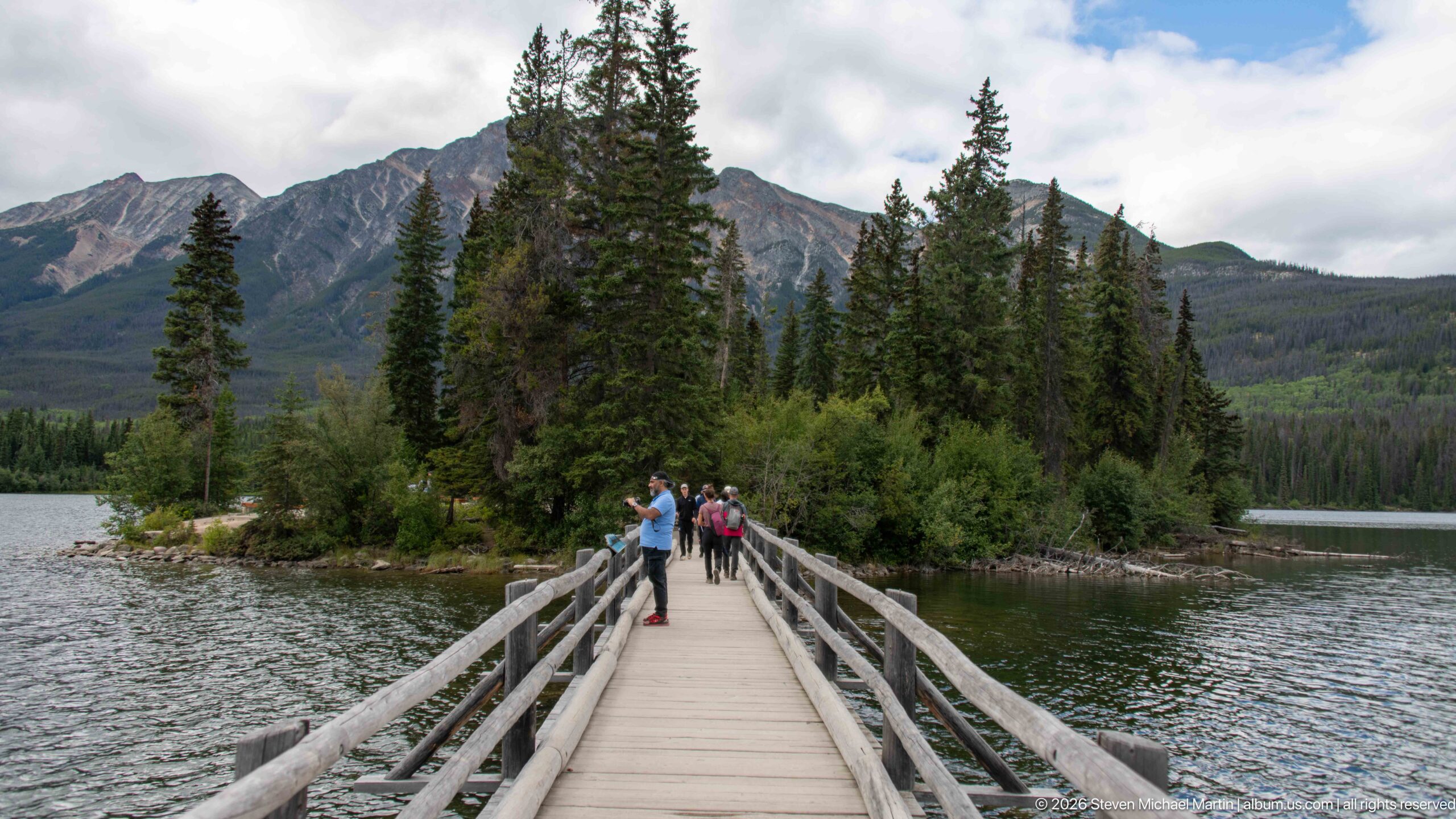
A timber pedestrian bridge leads directly toward the wooded shore of Pyramid Island, with visitors walking between rustic railings above the lake. Evergreen trees frame the island while the steep mountain backdrop rises behind it, combining the human-scale approach to the island with the larger setting of Pyramid Lake.
Caption
A timber pedestrian bridge leads directly toward the wooded shore of Pyramid Island, with visitors walking between rustic railings above the lake. Evergreen trees frame the island while the steep mountain backdrop rises behind it, combining the human-scale approach to the island with the larger setting of Pyramid Lake.
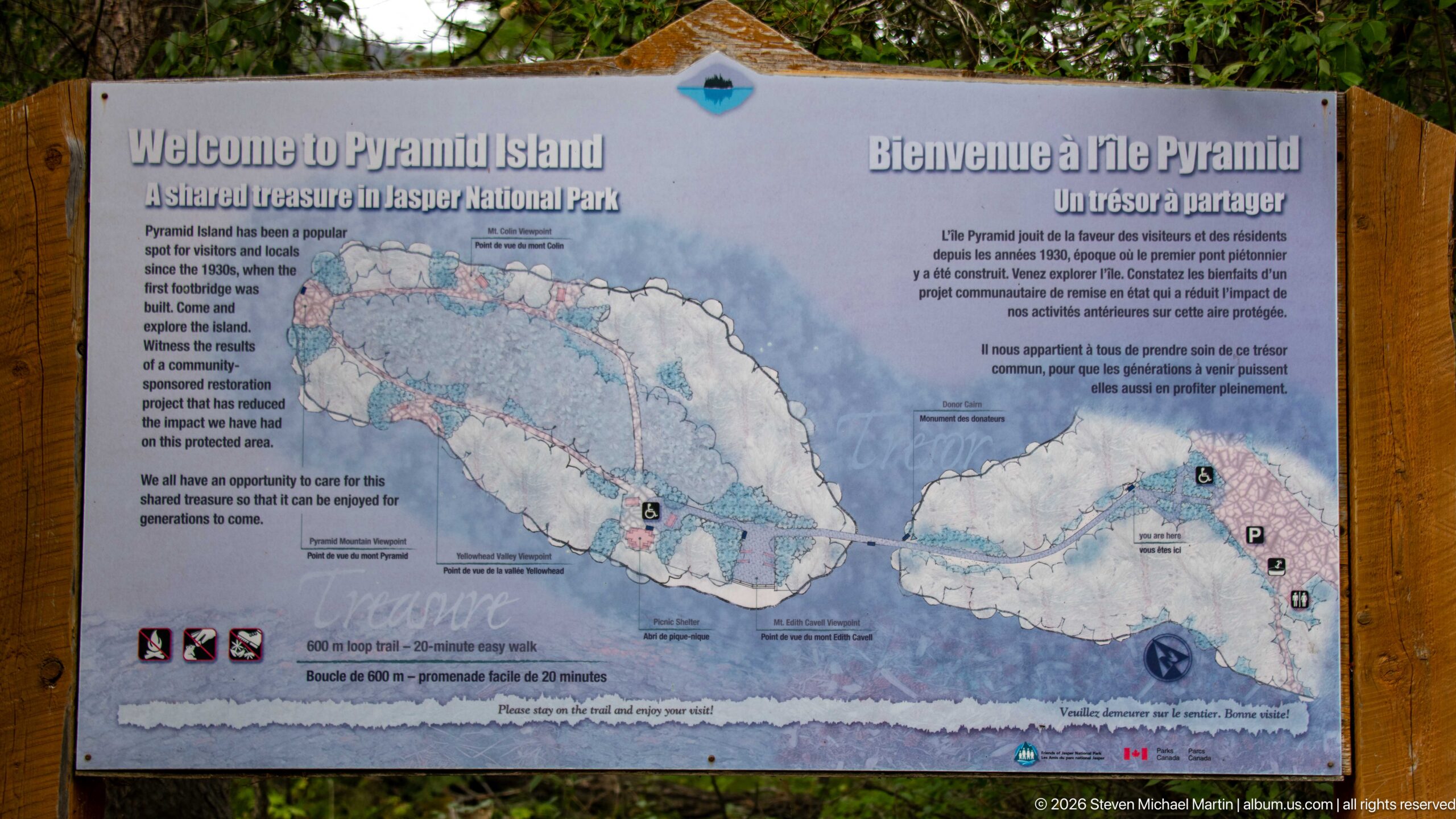
A bilingual Parks Canada orientation panel welcomes visitors to Pyramid Island and maps the island’s trails, shoreline, and visitor facilities. Mounted in a wooden frame, the sign also presents guidance for protecting the site, making it both a wayfinding feature and a visible expression of national-park stewardship at Pyramid Lake.
Caption
A bilingual Parks Canada orientation panel welcomes visitors to Pyramid Island and maps the island’s trails, shoreline, and visitor facilities. Mounted in a wooden frame, the sign also presents guidance for protecting the site, making it both a wayfinding feature and a visible expression of national-park stewardship at Pyramid Lake.
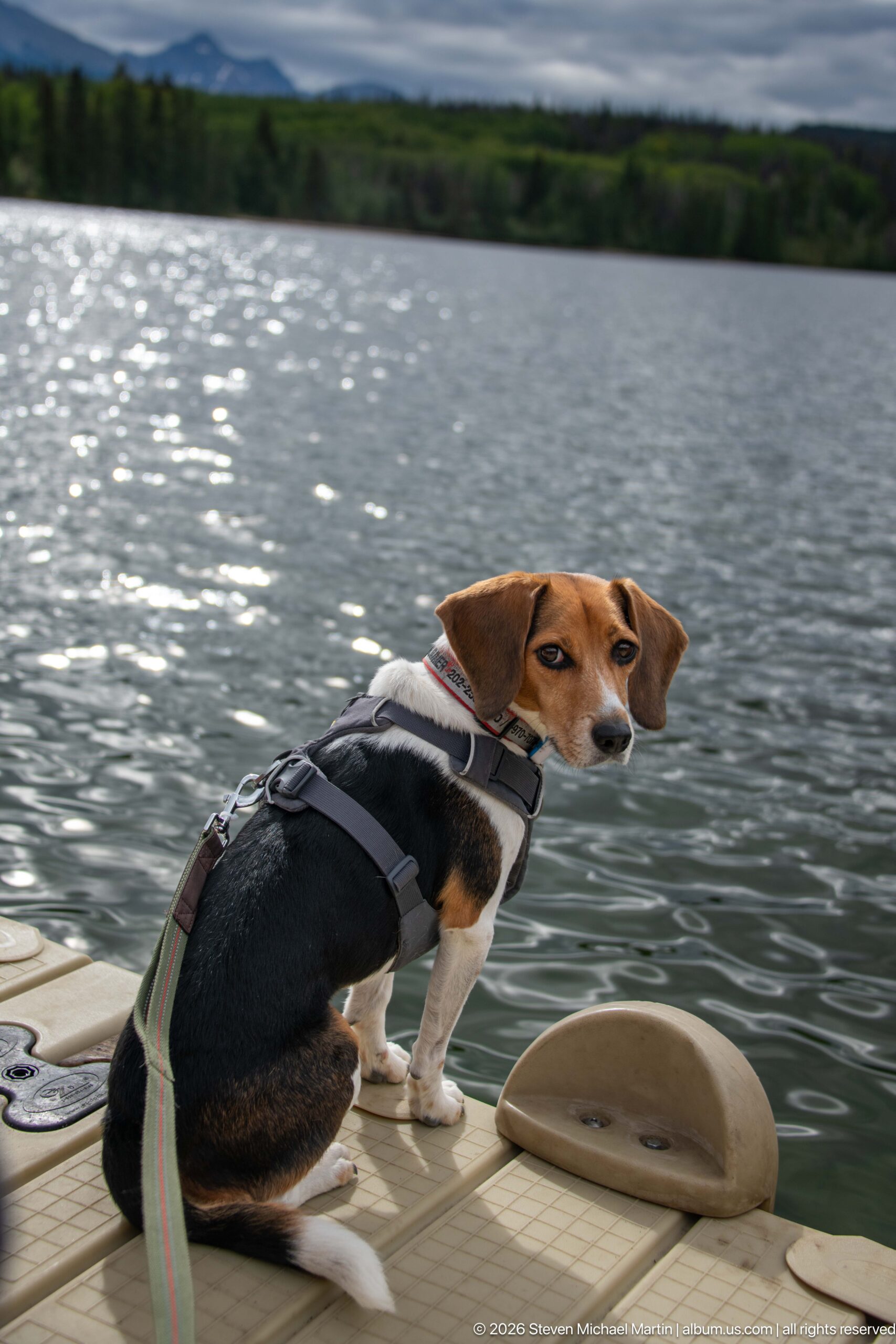
A harnessed beagle stands alert at the edge of a floating dock, turning toward the camera with sunlit Pyramid Lake filling the background. The close, low viewpoint isolates the dog against shimmering water and shifts the portfolio from broad landscape views to a small recreational moment along the lakeshore.
Caption
A harnessed beagle stands alert at the edge of a floating dock, turning toward the camera with sunlit Pyramid Lake filling the background. The close, low viewpoint isolates the dog against shimmering water and shifts the portfolio from broad landscape views to a small recreational moment along the lakeshore.
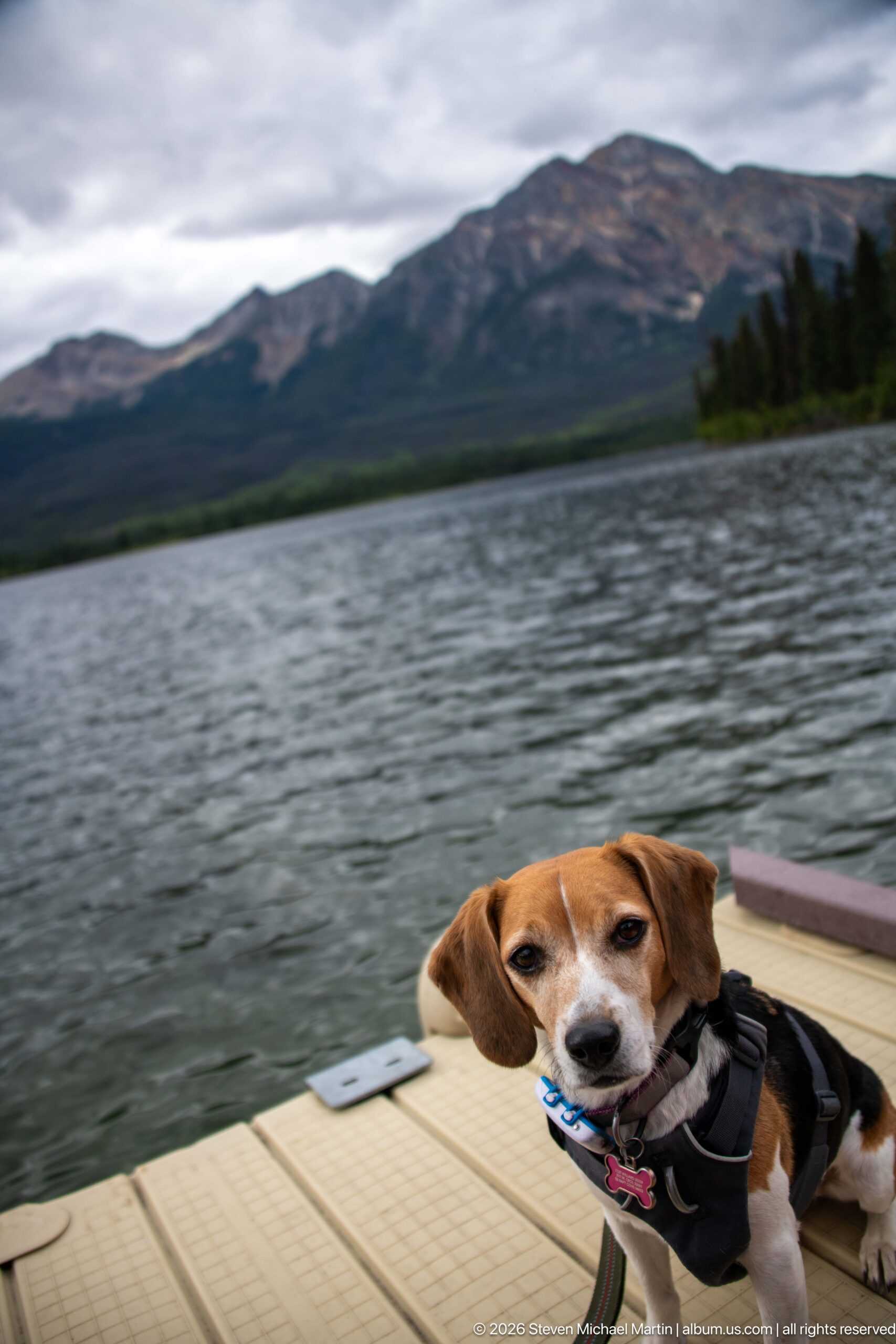
A tri-color beagle faces the camera from a floating dock with Pyramid Lake and a long mountain slope stretching behind. The close portrait keeps the dog sharply dominant while the water and subdued mountain backdrop provide unmistakable outdoor context without competing for attention.
Caption
A tri-color beagle faces the camera from a floating dock with Pyramid Lake and a long mountain slope stretching behind. The close portrait keeps the dog sharply dominant while the water and subdued mountain backdrop provide unmistakable outdoor context without competing for attention.
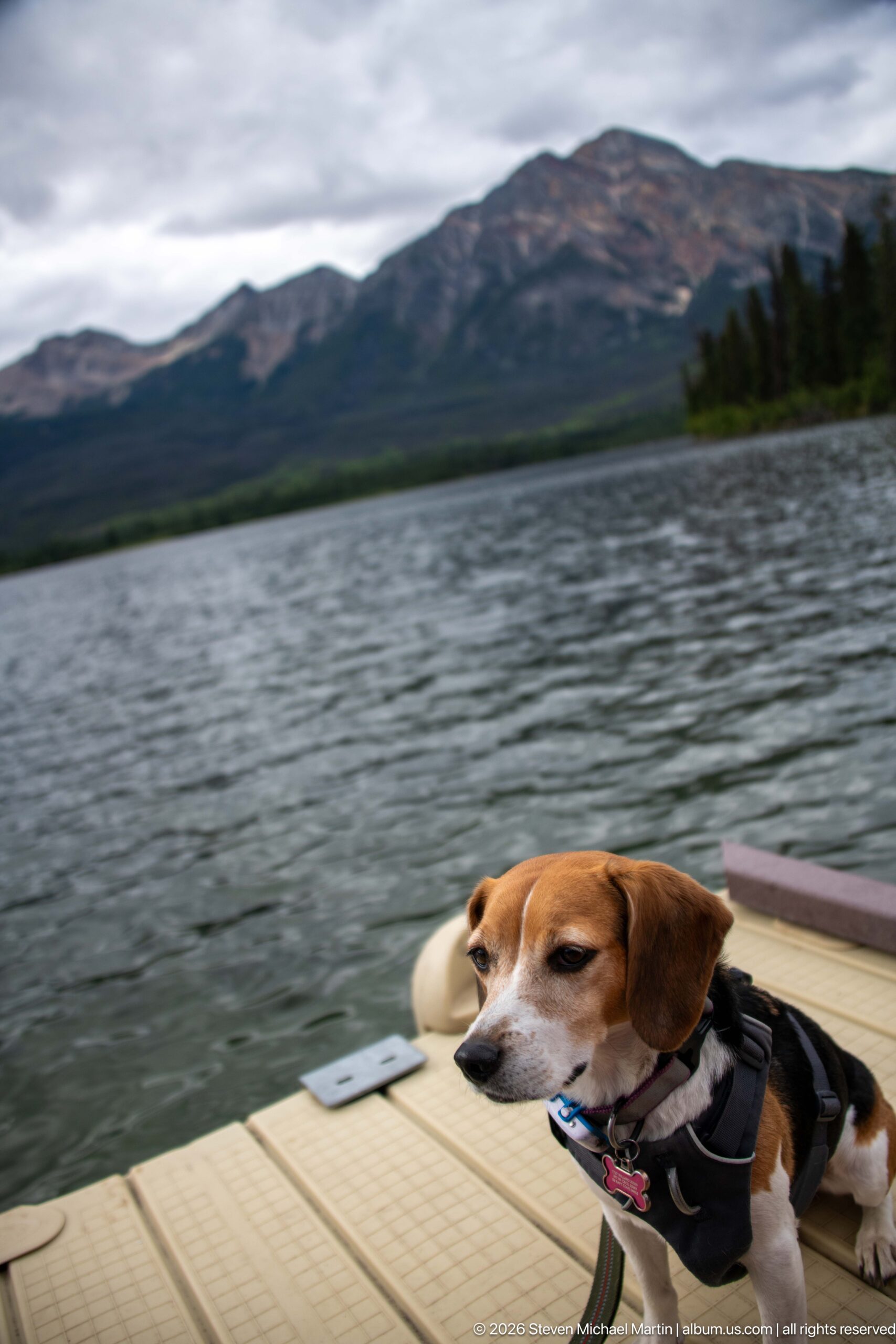
A beagle lowers its head beside the edge of the floating dock as Pyramid Lake ripples behind it. The horizontal mountain ridge across the water forms a subdued backdrop, while the dog’s turned profile and relaxed posture distinguish this frame from the adjacent, more direct portraits.
Caption
A beagle lowers its head beside the edge of the floating dock as Pyramid Lake ripples behind it. The horizontal mountain ridge across the water forms a subdued backdrop, while the dog’s turned profile and relaxed posture distinguish this frame from the adjacent, more direct portraits.
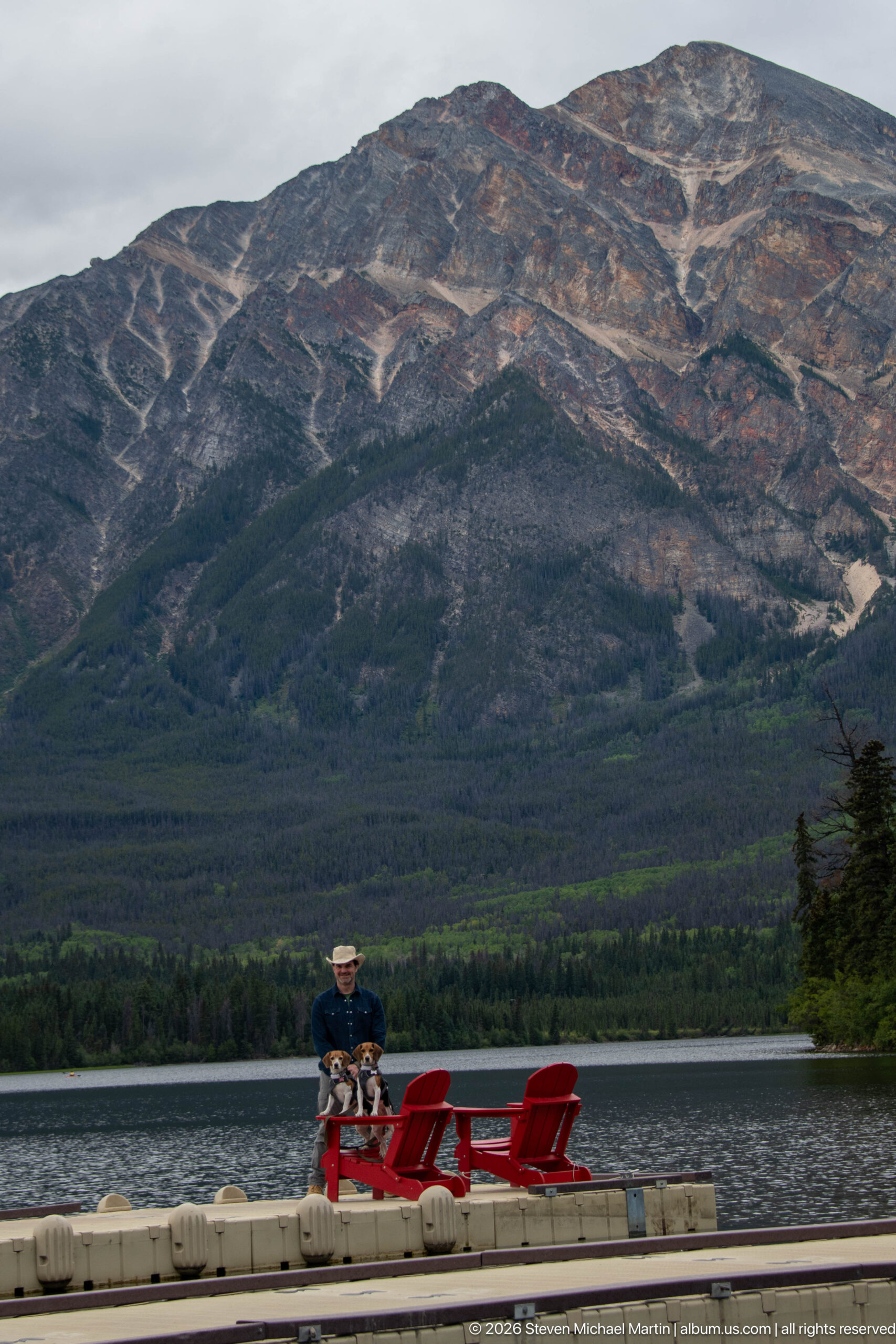
A distant visitor and two beagles occupy red Adirondack chairs on a floating dock, dwarfed by the broad mountain rising across Pyramid Lake. The long view shifts emphasis from the people and pets to the scale of the surrounding landscape, with exposed rock, forest, and water stacked in distinct horizontal bands.
Caption
A distant visitor and two beagles occupy red Adirondack chairs on a floating dock, dwarfed by the broad mountain rising across Pyramid Lake. The long view shifts emphasis from the people and pets to the scale of the surrounding landscape, with exposed rock, forest, and water stacked in distinct horizontal bands.
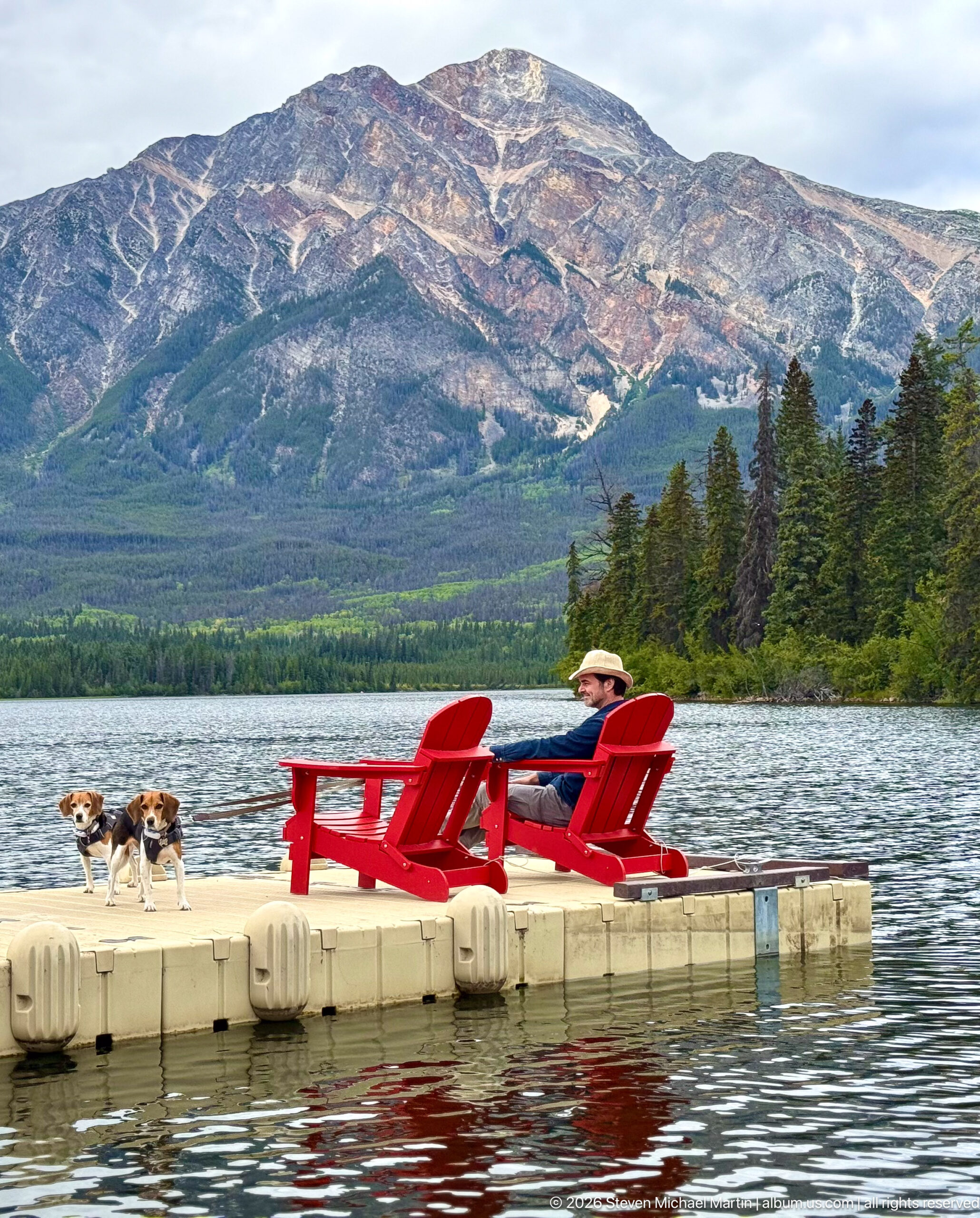
Two beagles stand at one end of a floating dock while a visitor reclines in a red Adirondack chair nearby. Across Pyramid Lake, the broad mountain slope shows a mosaic of exposed rock and forest, creating a deliberately layered portrait of companionship, recreation, and mountain scenery.
Caption
Two beagles stand at one end of a floating dock while a visitor reclines in a red Adirondack chair nearby. Across Pyramid Lake, the broad mountain slope shows a mosaic of exposed rock and forest, creating a deliberately layered portrait of companionship, recreation, and mountain scenery.
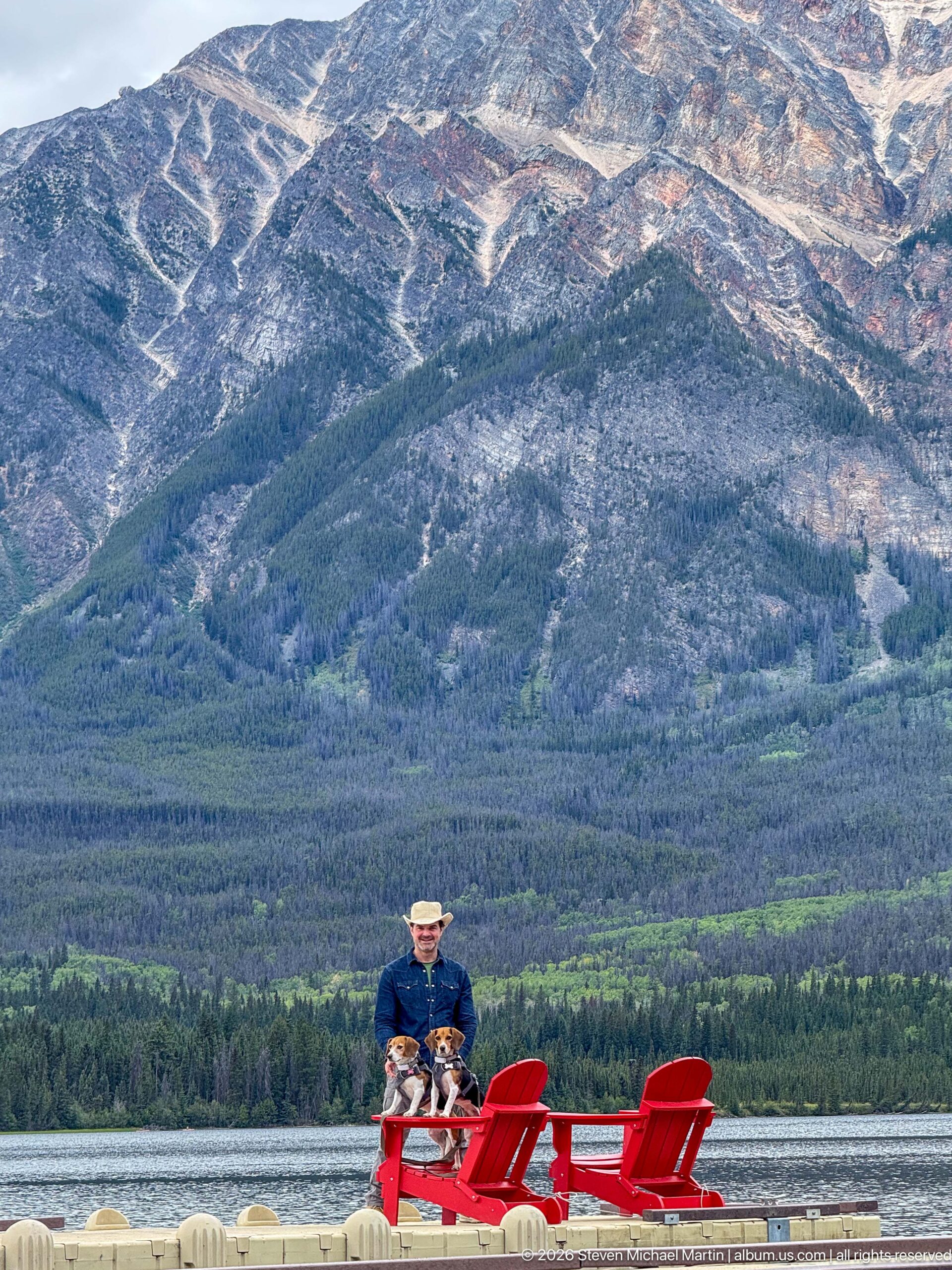
A visitor gathers two beagles close at the end of the floating dock beside a pair of red Adirondack chairs. The compressed view brings the mountain’s exposed rock and forested lower slopes forward behind the small group, making the human-and-pet portrait feel embedded in the Pyramid Lake landscape.
Caption
A visitor gathers two beagles close at the end of the floating dock beside a pair of red Adirondack chairs. The compressed view brings the mountain’s exposed rock and forested lower slopes forward behind the small group, making the human-and-pet portrait feel embedded in the Pyramid Lake landscape.
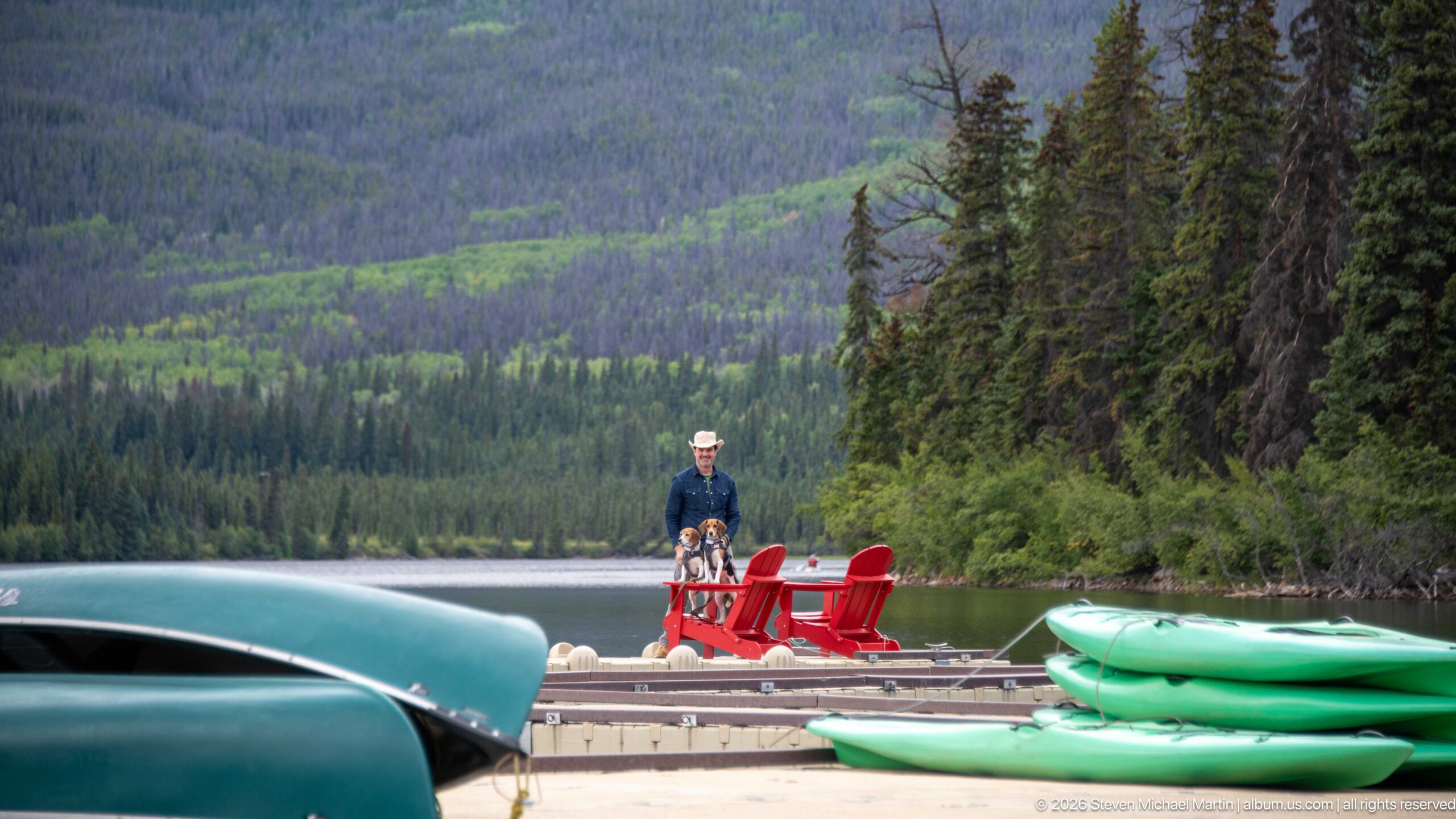
Stacked green kayaks and the curved hulls of canoes frame a view toward the floating dock, where red Adirondack chairs and a visitor sit against the far shore. The layered equipment in the foreground makes this a strong record of recreational infrastructure at Pyramid Lake rather than a conventional landscape view.
Caption
Stacked green kayaks and the curved hulls of canoes frame a view toward the floating dock, where red Adirondack chairs and a visitor sit against the far shore. The layered equipment in the foreground makes this a strong record of recreational infrastructure at Pyramid Lake rather than a conventional landscape view.
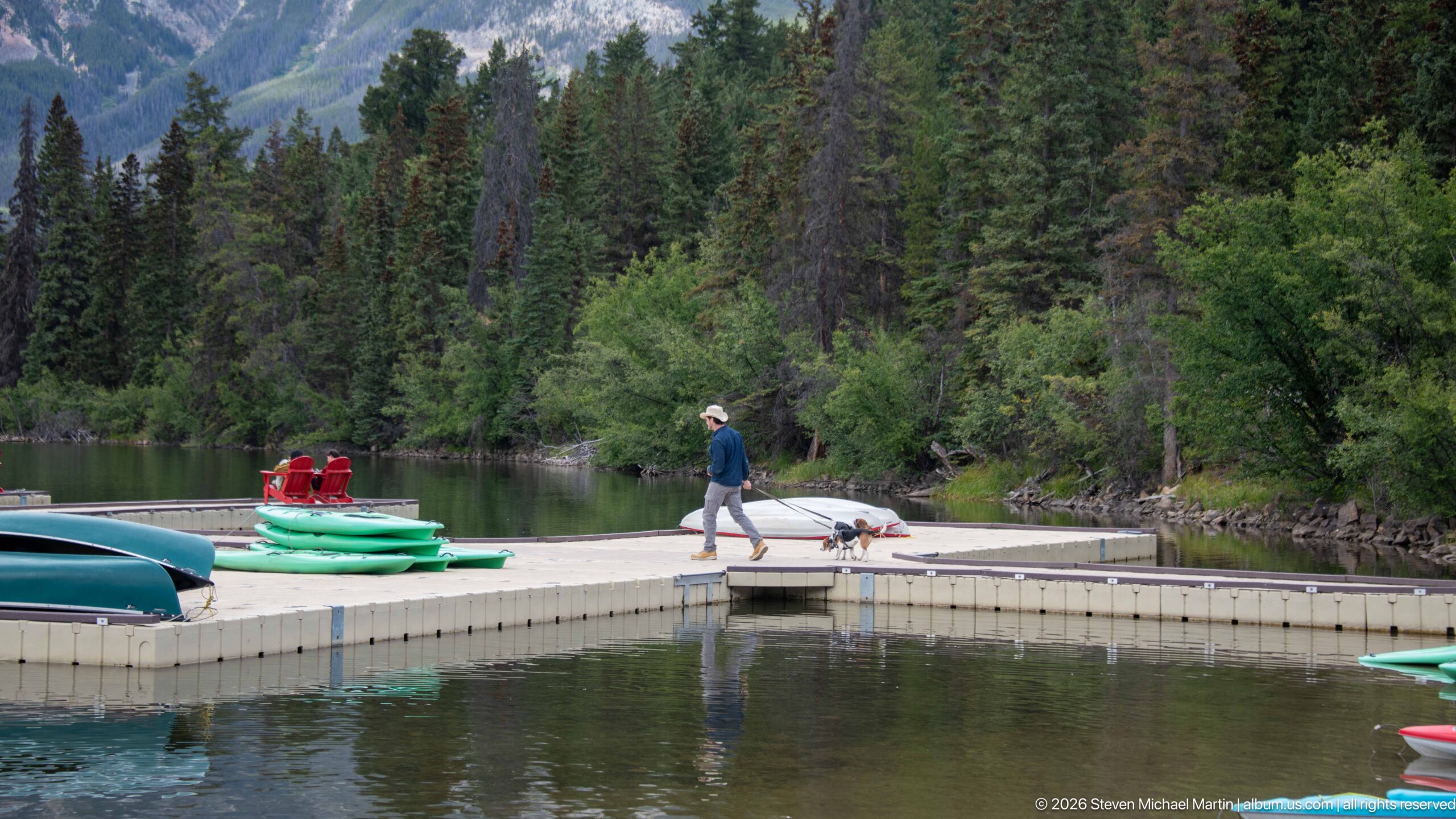
A visitor walks two leashed beagles along the floating dock beside stacked kayaks and canoes at Pyramid Lake. Calm, dark water reflects the wooded shoreline, while the dock’s branching geometry and stored watercraft identify this as an active launch and rental area rather than an undeveloped shore.
Caption
A visitor walks two leashed beagles along the floating dock beside stacked kayaks and canoes at Pyramid Lake. Calm, dark water reflects the wooded shoreline, while the dock’s branching geometry and stored watercraft identify this as an active launch and rental area rather than an undeveloped shore.
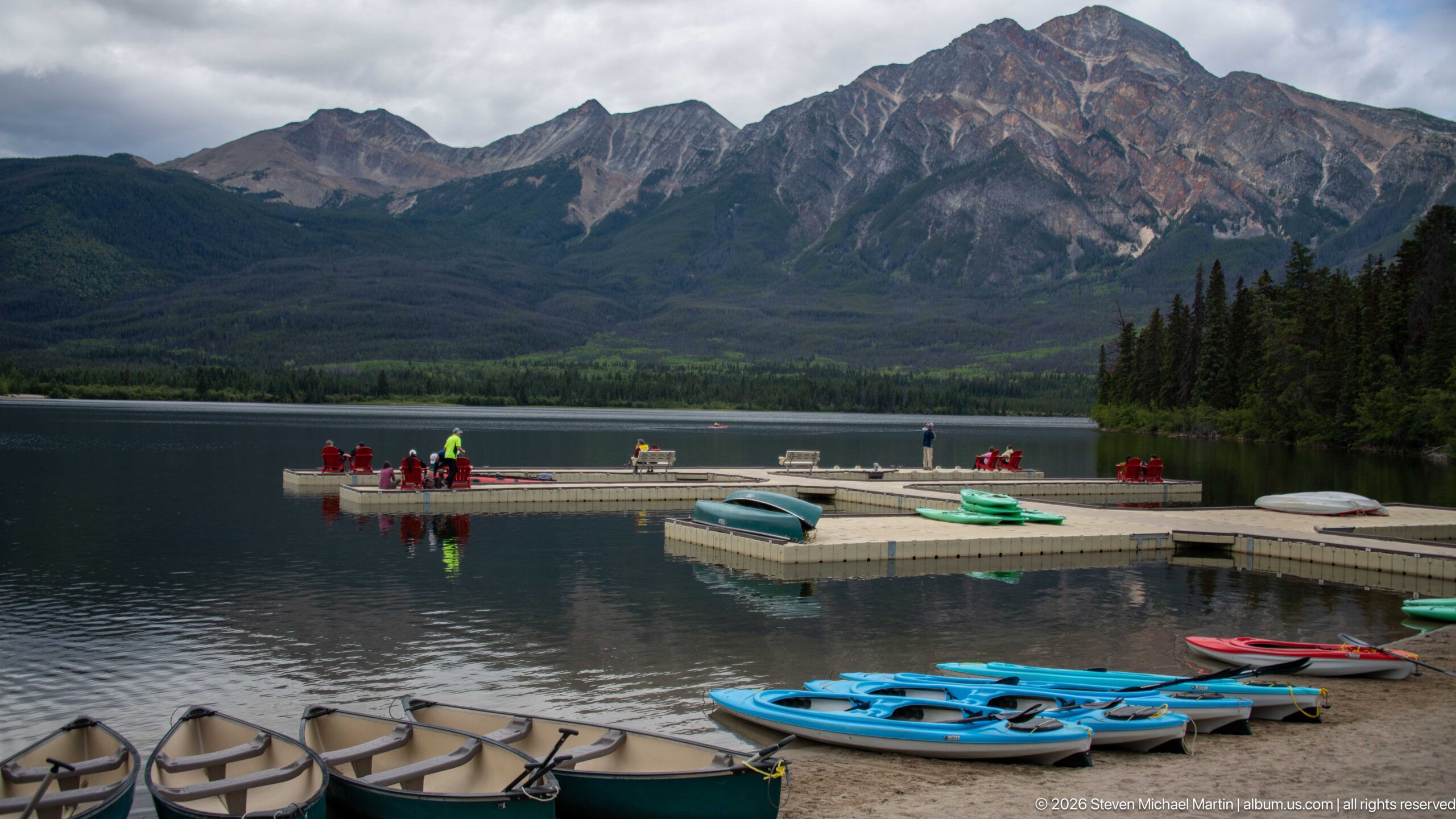
Canoes and blue kayaks line the foreground while a network of floating docks reaches into Pyramid Lake beneath a steep, exposed mountain face. Red chairs and small visitors provide scale, but the principal subject is the relationship between the recreational waterfront and the dramatic mountain setting beyond.
Caption
Canoes and blue kayaks line the foreground while a network of floating docks reaches into Pyramid Lake beneath a steep, exposed mountain face. Red chairs and small visitors provide scale, but the principal subject is the relationship between the recreational waterfront and the dramatic mountain setting beyond.
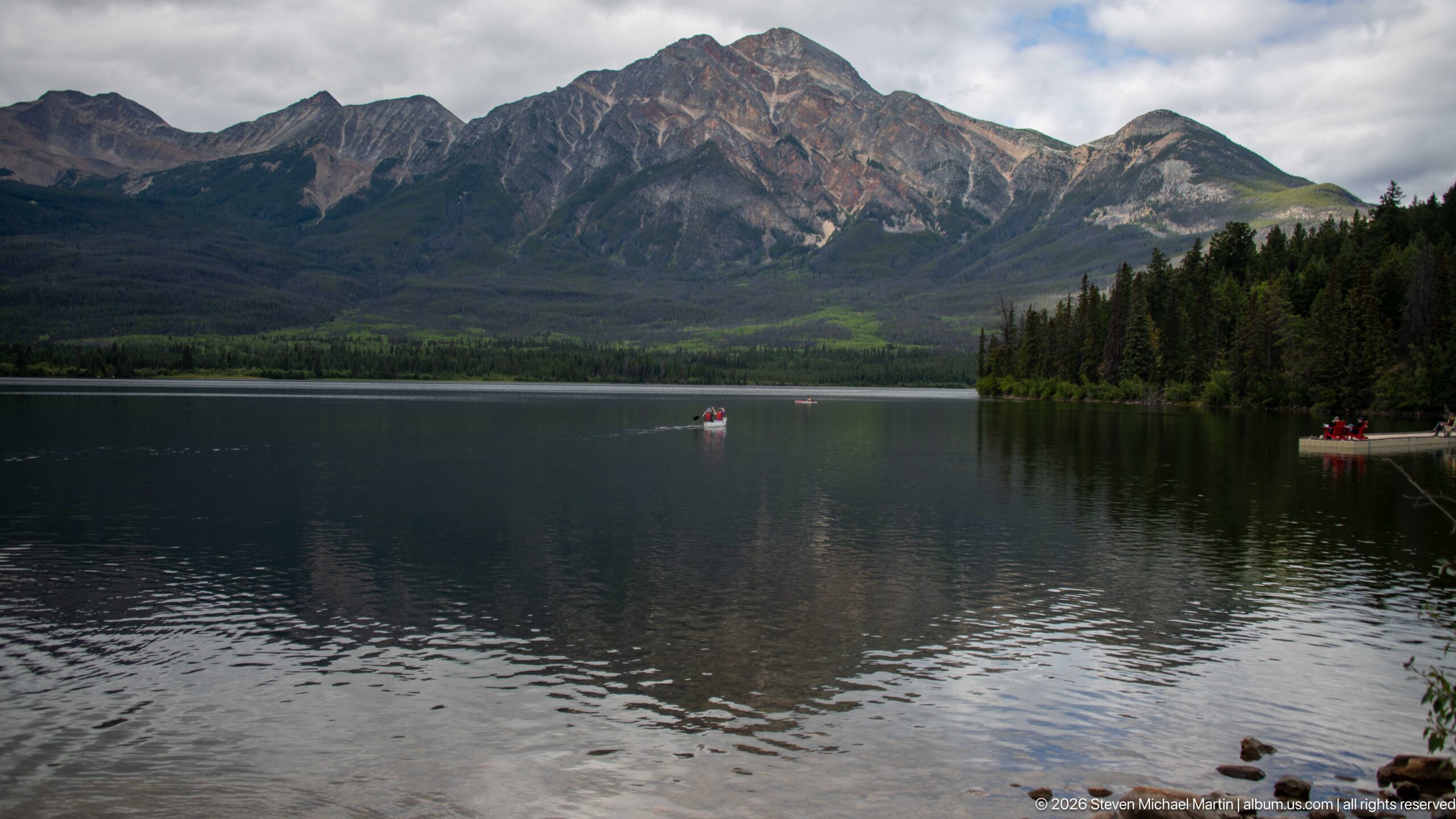
A rugged mountain rises directly beyond Pyramid Lake, its dark forested lower slopes meeting calm water that carries a muted reflection of the peak. A few small boats and a narrow wooded point interrupt the otherwise open composition, emphasizing the lake’s breadth and the mountain’s dominant scale.
Caption
A rugged mountain rises directly beyond Pyramid Lake, its dark forested lower slopes meeting calm water that carries a muted reflection of the peak. A few small boats and a narrow wooded point interrupt the otherwise open composition, emphasizing the lake’s breadth and the mountain’s dominant scale.
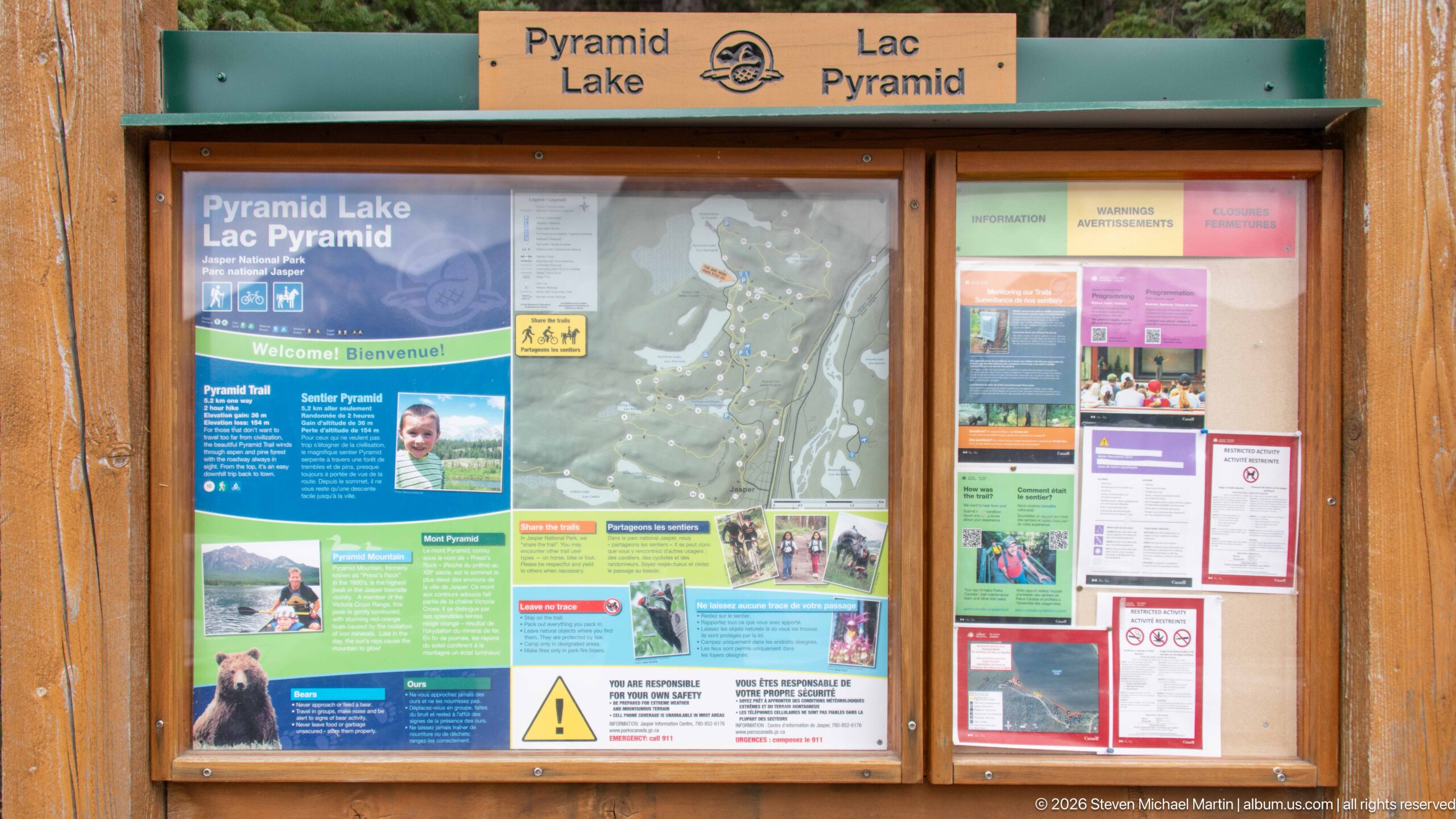
A wooden visitor-information case headed “Pyramid Lake / Lac Pyramid” presents a map, trail guidance, wildlife information, notices, and safety material. The dense arrangement of bilingual panels documents the practical interpretive infrastructure provided for visitors before they enter the surrounding lake and trail system.
Caption
A wooden visitor-information case headed “Pyramid Lake / Lac Pyramid” presents a map, trail guidance, wildlife information, notices, and safety material. The dense arrangement of bilingual panels documents the practical interpretive infrastructure provided for visitors before they enter the surrounding lake and trail system.
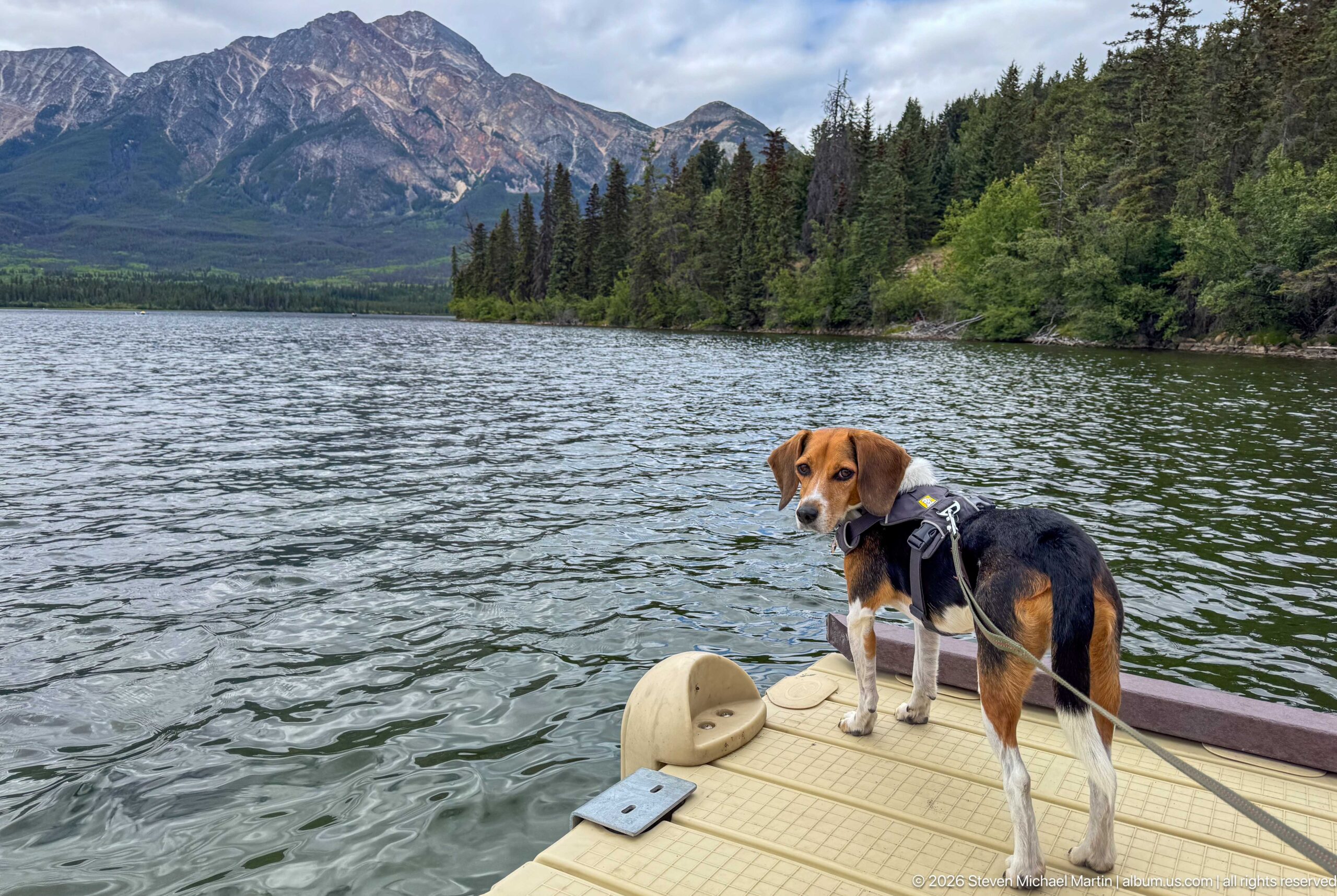
A harnessed beagle pauses at the corner of a floating dock with Pyramid Lake stretching toward a densely wooded point and rocky mountain beyond. The dog looks back toward the camera, creating a foreground focal point while the diagonal shoreline draws the eye deeper into the Canadian Rockies setting.
Caption
A harnessed beagle pauses at the corner of a floating dock with Pyramid Lake stretching toward a densely wooded point and rocky mountain beyond. The dog looks back toward the camera, creating a foreground focal point while the diagonal shoreline draws the eye deeper into the Canadian Rockies setting.
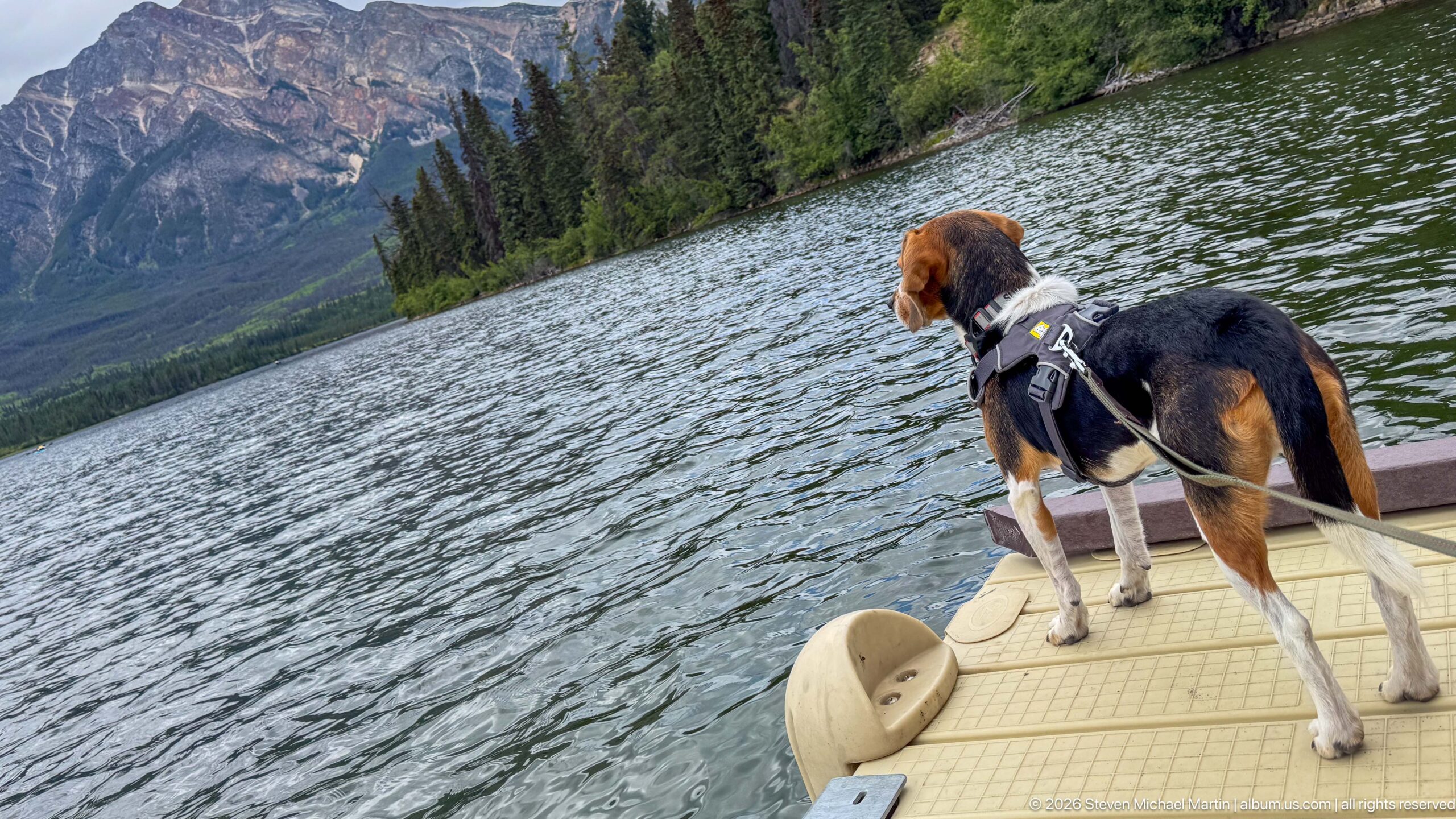
Viewed from behind and in profile, a beagle stands at the dock edge and watches the open water of Pyramid Lake. The tilted composition heightens the diagonal sweep of the shoreline and mountain, while the dog’s upright stance gives the frame a sense of attentive observation.
Caption
Viewed from behind and in profile, a beagle stands at the dock edge and watches the open water of Pyramid Lake. The tilted composition heightens the diagonal sweep of the shoreline and mountain, while the dog’s upright stance gives the frame a sense of attentive observation.
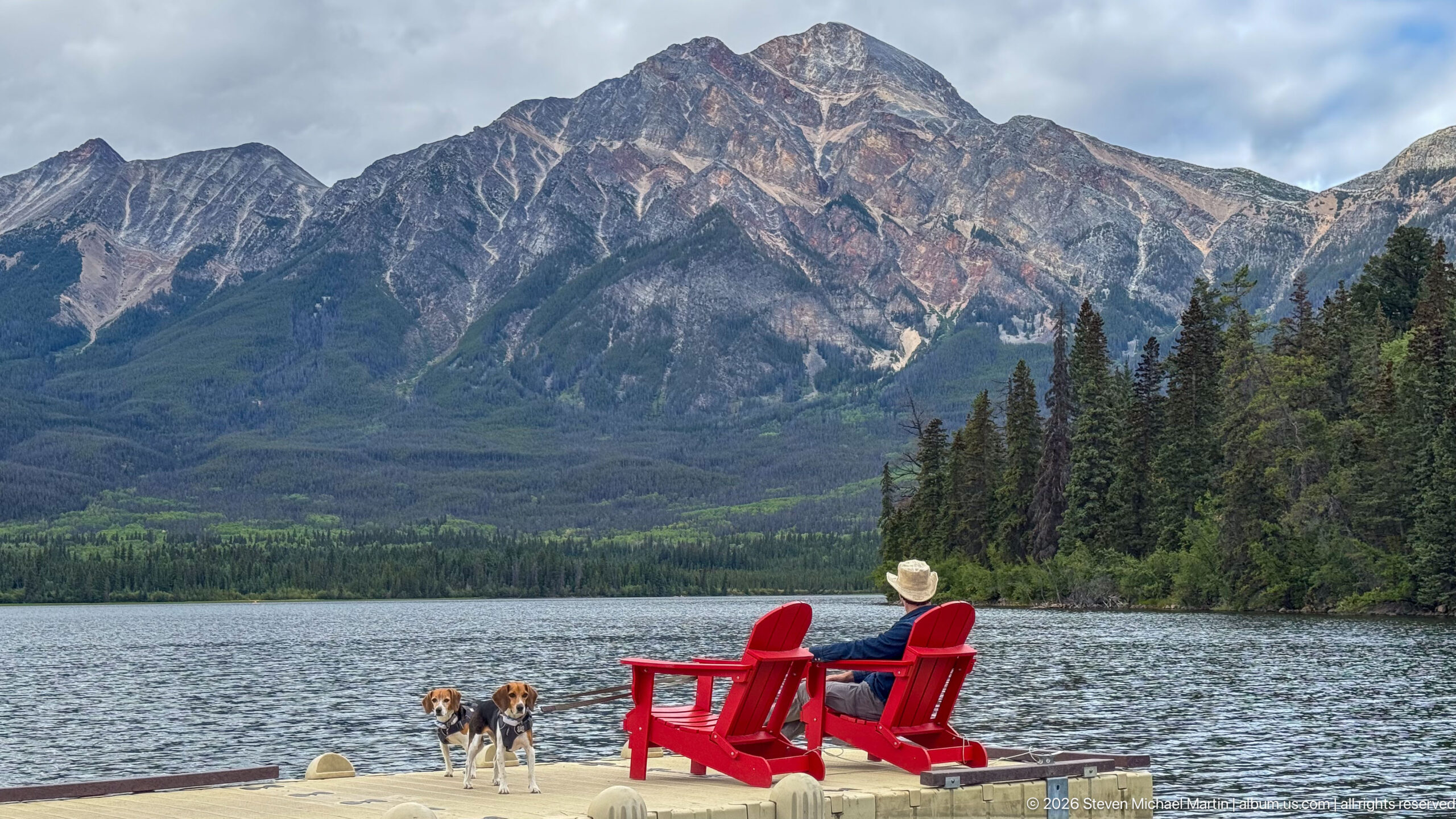
A visitor in a red Adirondack chair and two beagles face the mountain across Pyramid Lake from a floating dock. The rear viewpoint turns all three figures toward the scenery, using them as scale markers beneath the immense rock face and the dark conifer-covered point that frames the right side.
Caption
A visitor in a red Adirondack chair and two beagles face the mountain across Pyramid Lake from a floating dock. The rear viewpoint turns all three figures toward the scenery, using them as scale markers beneath the immense rock face and the dark conifer-covered point that frames the right side.
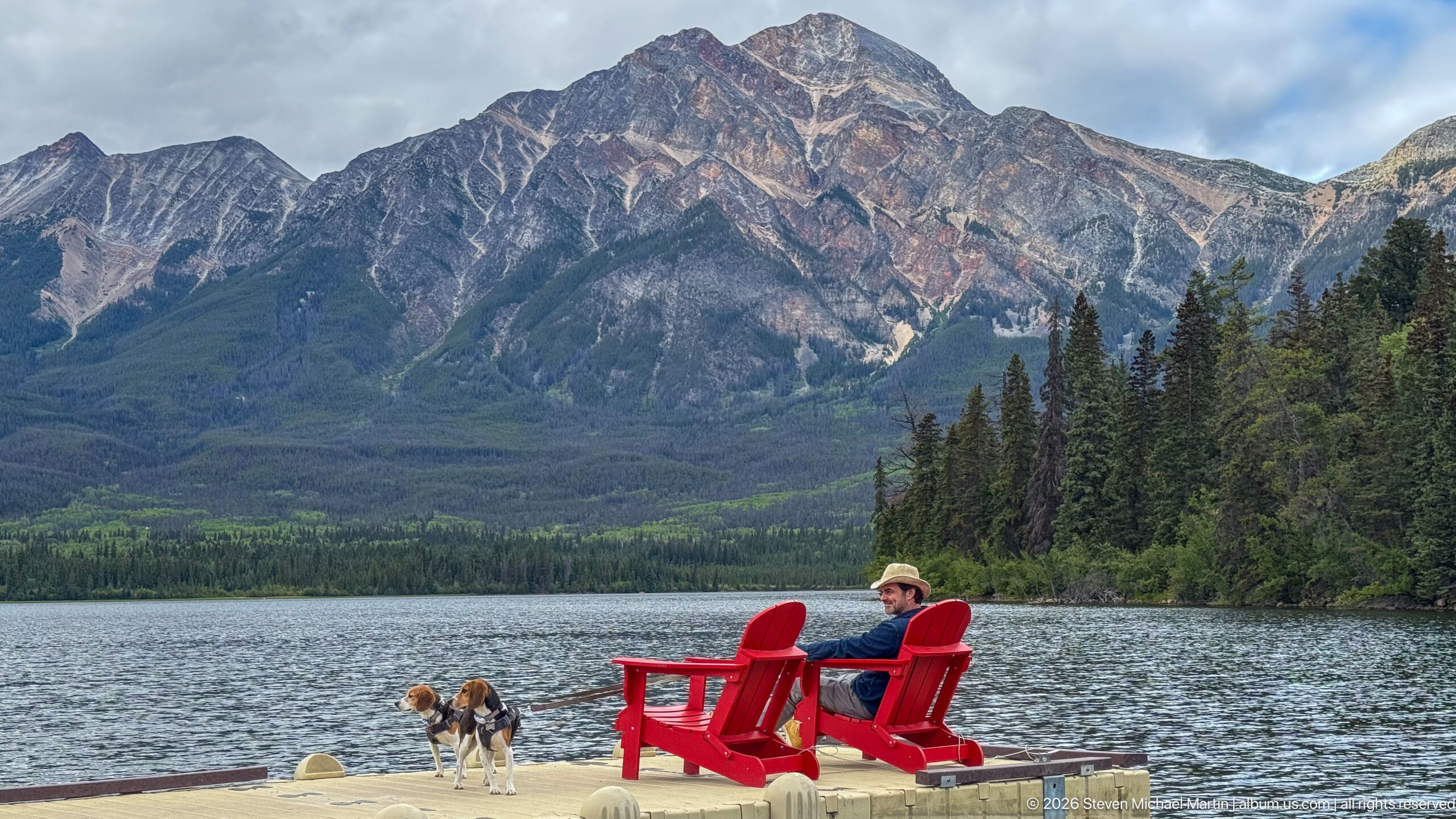
A visitor relaxes in a red Adirondack chair while a beagle stands nearby on the floating dock, both set against Pyramid Lake and the towering mountain beyond. The composition balances the intimate lakeside scene with the much larger rocky landscape, emphasizing the scale of the Canadian Rockies setting.
Caption
A visitor relaxes in a red Adirondack chair while a beagle stands nearby on the floating dock, both set against Pyramid Lake and the towering mountain beyond. The composition balances the intimate lakeside scene with the much larger rocky landscape, emphasizing the scale of the Canadian Rockies setting.
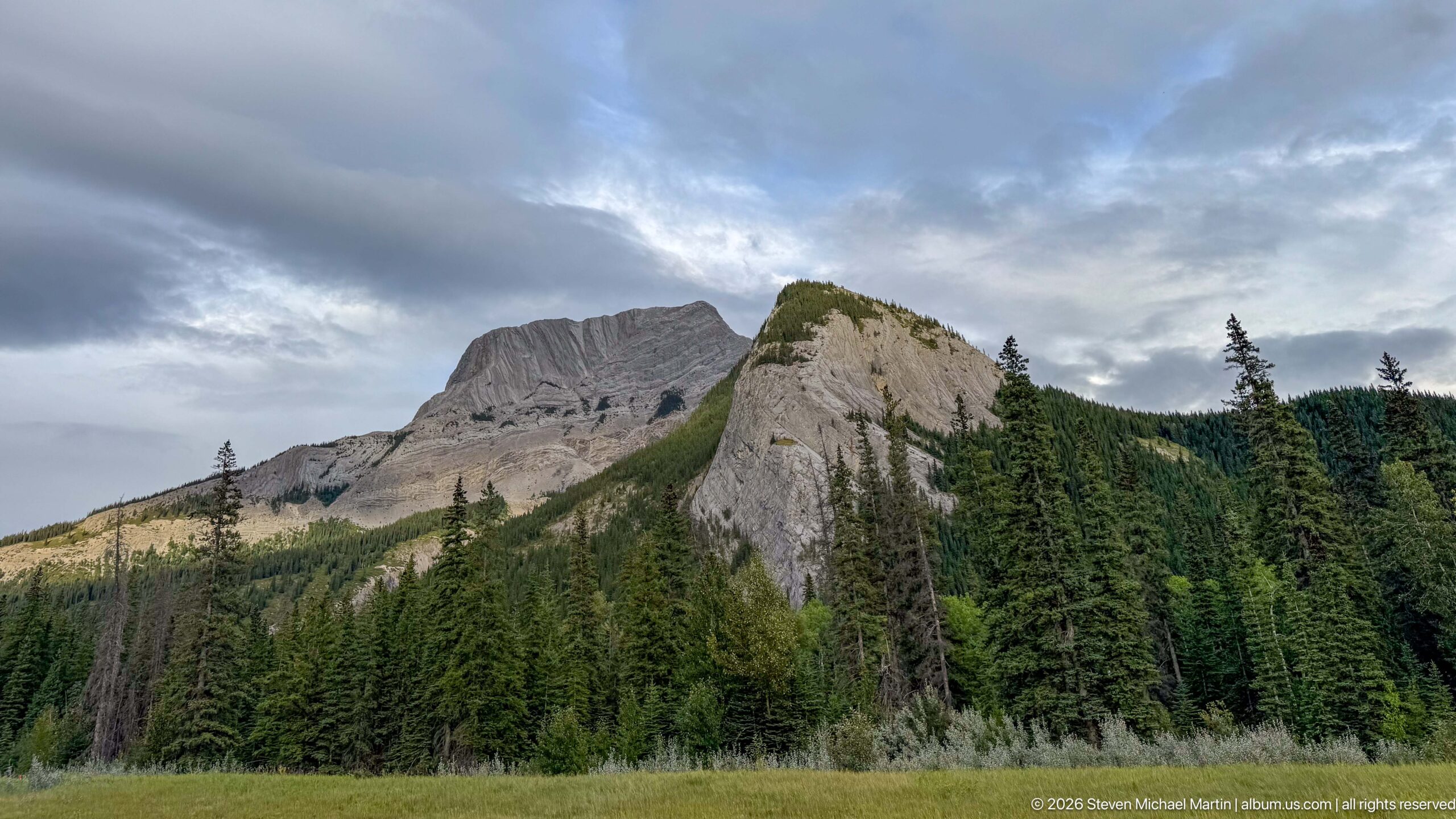
A pale, sharply eroded rock buttress rises above dense conifer forest, backed by a longer gray ridge beneath a heavily clouded sky. Distinct bands and tilted layers are visible across the exposed rock, making geology and landform—not the lake itself—the central subject of this landscape study.
Caption
A pale, sharply eroded rock buttress rises above dense conifer forest, backed by a longer gray ridge beneath a heavily clouded sky. Distinct bands and tilted layers are visible across the exposed rock, making geology and landform—not the lake itself—the central subject of this landscape study.
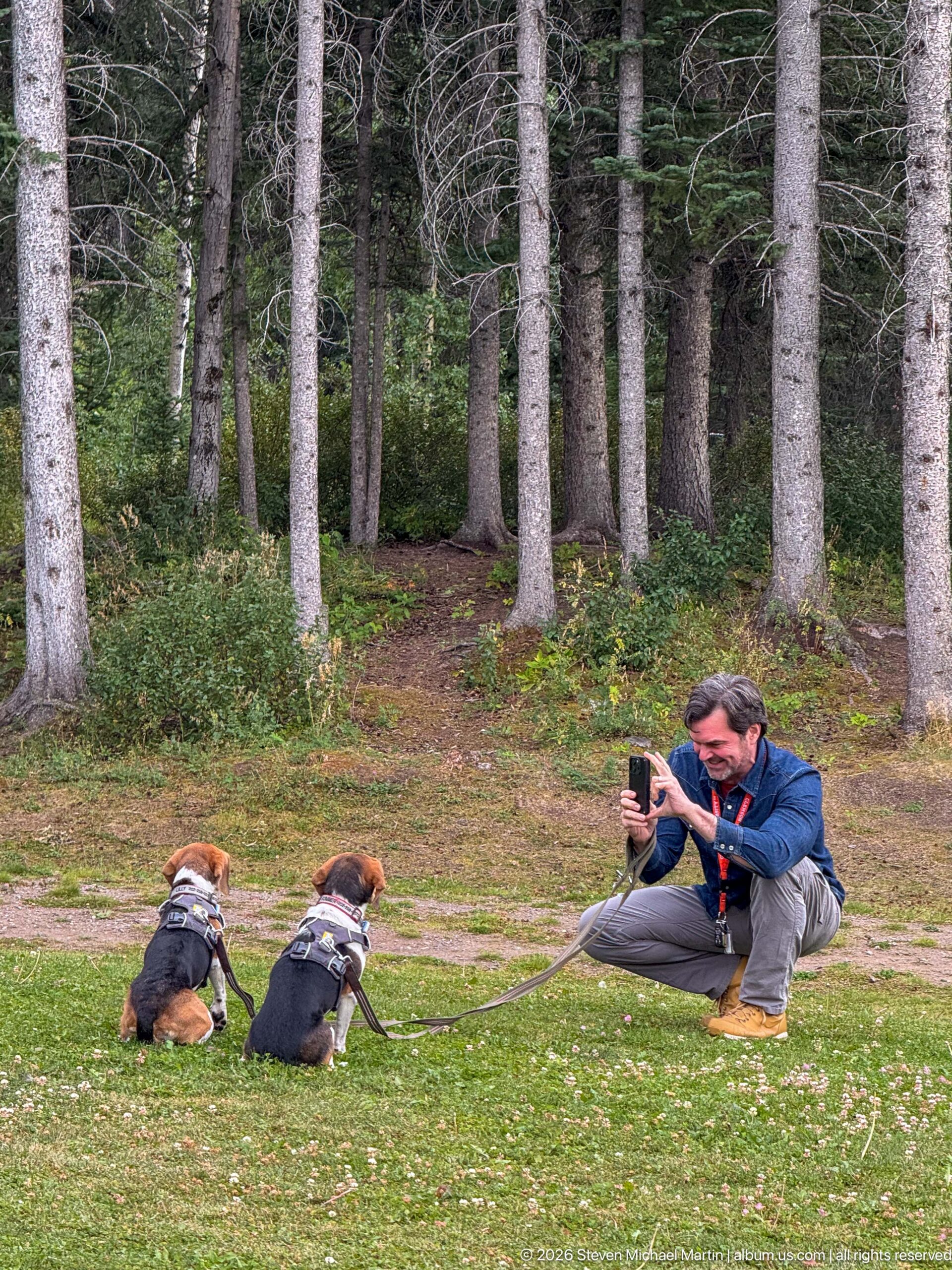
Two harnessed beagles sit side by side on grass while a crouching visitor holds up a phone to photograph them. Straight conifer trunks form a dense vertical backdrop, shifting the portfolio away from open lake views to a quiet, human-scale moment along the wooded recreation area.
Caption
Two harnessed beagles sit side by side on grass while a crouching visitor holds up a phone to photograph them. Straight conifer trunks form a dense vertical backdrop, shifting the portfolio away from open lake views to a quiet, human-scale moment along the wooded recreation area.
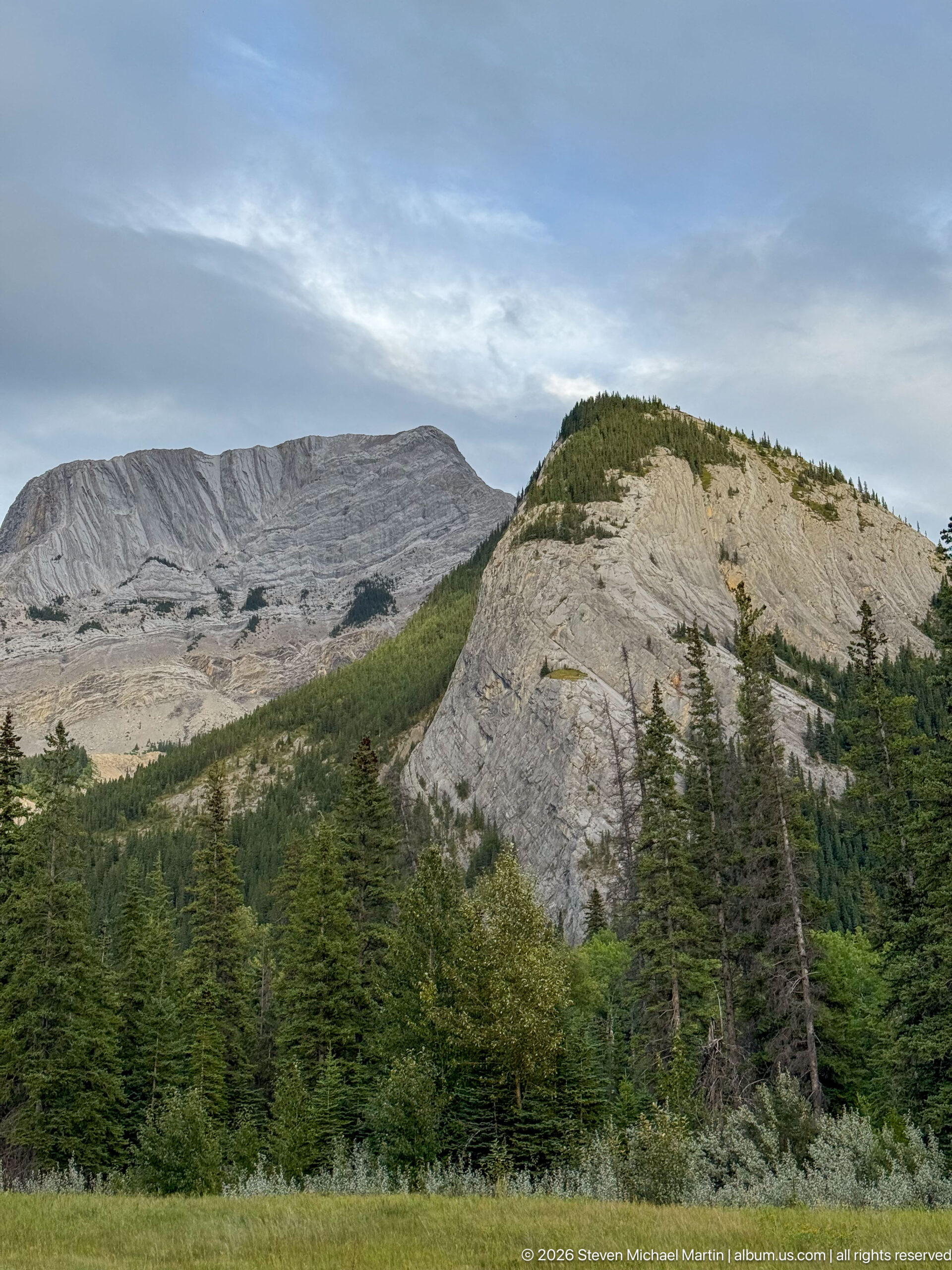
A broad gray ridge and a nearer rounded buttress display strongly visible sedimentary layering above a belt of mixed shrubs and conifer forest. The relatively treeless rock surfaces reveal the structure of the mountain particularly clearly, while the subdued sky keeps attention on texture, strata, and erosion.
Caption
A broad gray ridge and a nearer rounded buttress display strongly visible sedimentary layering above a belt of mixed shrubs and conifer forest. The relatively treeless rock surfaces reveal the structure of the mountain particularly clearly, while the subdued sky keeps attention on texture, strata, and erosion.
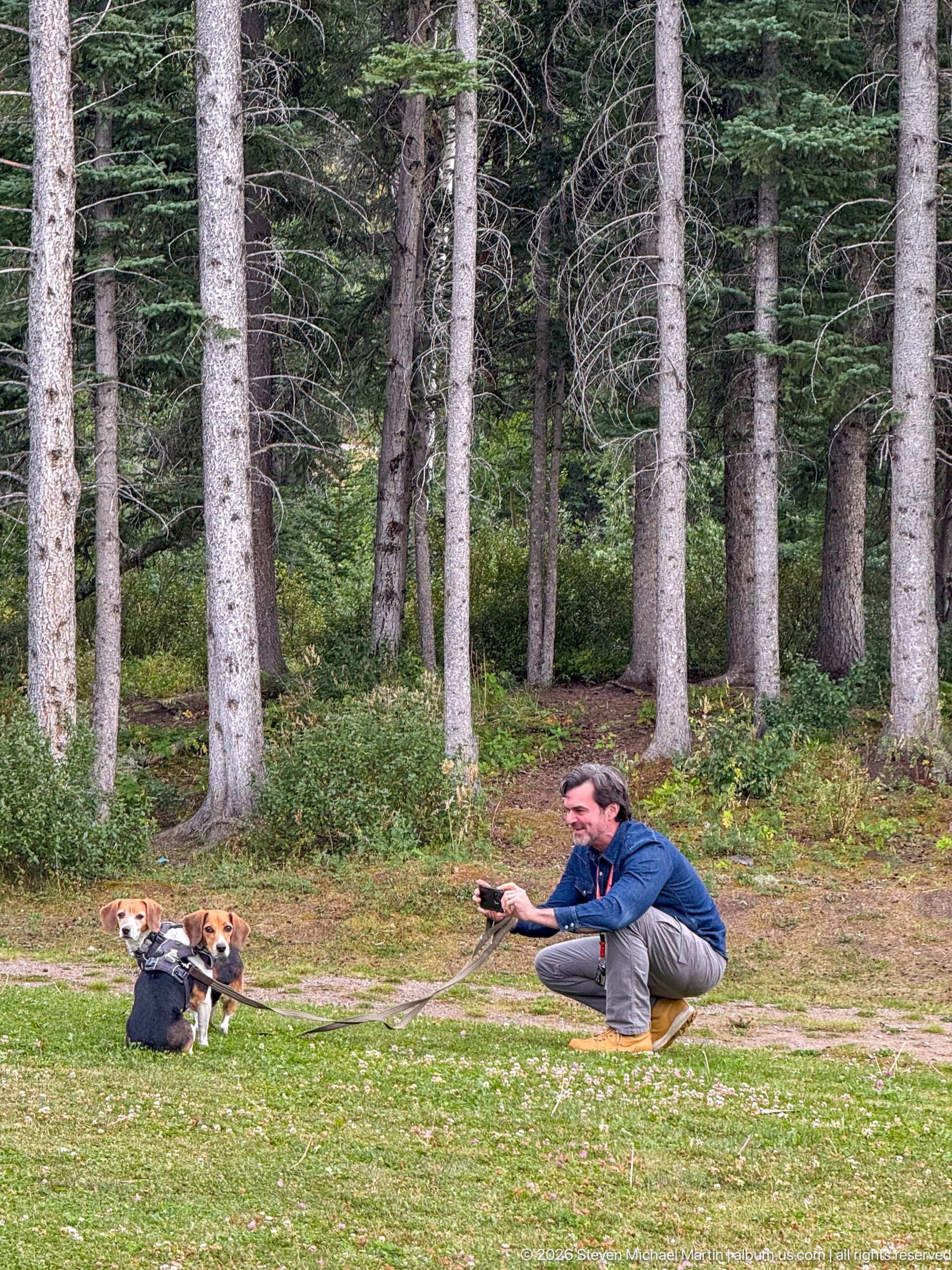
A crouching visitor holds the leashes of two beagles standing together on a grassy clearing at the forest edge. Tall straight conifers create a textured backdrop, and the dogs’ alert stance contrasts with the visitor’s low pose, producing an informal closing portrait from the Pyramid Lake outing.
Caption
A crouching visitor holds the leashes of two beagles standing together on a grassy clearing at the forest edge. Tall straight conifers create a textured backdrop, and the dogs’ alert stance contrasts with the visitor’s low pose, producing an informal closing portrait from the Pyramid Lake outing.
🏞️ National Park Field Guide
📍 Overview
Pyramid Lake presents Jasper National Park at an intimate scale: open mountain water, forested shoreline, rugged peaks, and a developed waterfront where visitors can move easily between landscape and recreation. The portfolio follows these relationships from broad views across the lake to Pyramid Island, its footbridge, docks, paddlecraft, visitor facilities, and the wooded setting around Pyramid Lake Resort. Rather than separating natural scenery from visitor use, the photographs show how both occupy the same protected landscape.
🏔️ Landscape
Water is the organizing element of the Pyramid Lake landscape. Across the portfolio, the lake repeatedly opens toward broad rocky mountains whose lower slopes descend through conifer forest to the shoreline. Forested points and Pyramid Island interrupt the open water and create smaller, enclosed views within the larger mountain setting. Changing weather also alters the character of the landscape: dark storm clouds, subdued overcast light, brighter reflections, and calm water each reveal different relationships among lake, forest, and exposed rock. The footbridge to Pyramid Island provides a particularly effective transition from the developed shore into this wooded lakescape.
🪨 Geology
The mountains surrounding Pyramid Lake expose the strongly layered rock that gives this part of the Canadian Rockies much of its visual structure. Several photographs concentrate on pale and gray ridges where bands of sedimentary rock remain visible across steep slopes and eroded buttresses. Elsewhere, these rocky faces rise directly behind the lake, allowing the contrast between resistant mountain rock, forested lower slopes, and the water-filled basin to be read in a single view. The photographs support interpretation of visible strata, erosion, and landform, while stopping short of assigning individual formations or named peaks where the photographic evidence does not establish them securely.
🌿 Ecology
Conifer forest forms the principal ecological setting documented around Pyramid Lake. Dense evergreens cover shorelines, Pyramid Island, and the lower mountain slopes, creating a continuous transition between terrestrial habitat and the lake edge. The portfolio also shows how this natural setting intersects with concentrated human use at docks, trails, the island footbridge, and the resort area. No photographed animal in this portfolio provides evidence of a wildlife encounter: the beagles appearing repeatedly at the lake are companion animals. The ecological story therefore rests on the visible relationship among water, forest, shoreline, and mountain terrain rather than on undocumented wildlife sightings.
🦌 Wildlife
The portfolio does not document a wild-animal encounter at Pyramid Lake. Animal references associated with interpretive material do not constitute sightings, and the dogs photographed on the docks, shoreline, and wooded recreation areas are domestic beagles accompanying visitors. For this portfolio, wildlife is best understood within the broader protected-landscape context rather than presented as something actually observed during the visit. The photographs instead establish the habitats in which Jasper’s ecological relationships operate: lake water, forested shoreline, conifer woodland, and mountain slopes.
🧭 Human History
Human presence at Pyramid Lake is expressed most clearly through the infrastructure that organizes access to the protected landscape. The wooden footbridge provides pedestrian access to Pyramid Island, while Parks Canada orientation and information panels supply mapping, trail guidance, conservation messages, safety information, and bilingual interpretation. Around the developed waterfront, floating docks, canoes, kayaks, seating, roads, and the wood-clad buildings of Pyramid Lake Resort show a landscape adapted for recreation without visually displacing its mountain and forest setting. Together these features document the contemporary relationship between national-park stewardship, visitor access, and recreation.
🥾 Visitor Experience
Pyramid Lake can be experienced at several scales within a compact area. Visitors can look across open water toward immense rocky slopes, walk the timber footbridge onto forested Pyramid Island, explore the shoreline, or use the developed waterfront for paddling and quiet lakeside recreation. Floating docks and red Adirondack chairs place visitors directly at water level, where mountains that seem distant in broad landscape views become imposing backdrops. The portfolio also shows how quickly atmosphere can change here: calm reflections, rippled water, bright intervals, and threatening clouds transform essentially the same view into markedly different experiences.
📷 Photography Notes
Pyramid Lake rewards compositions that deliberately connect foreground activity with the larger landscape. The portfolio uses docks, canoes, kayaks, chairs, visitors, and dogs as scale markers against open water and massive mountain faces, while the Pyramid Island footbridge creates a strong leading line from shore into forest. Wider frames establish the lake’s relationship to mountains and wooded points; tighter views isolate layered rock, visitor infrastructure, and recreational details. Reflections become important when the water is calm, while overcast and storm light reveal texture in exposed rock and create separation among water, forest, and mountain ridges. Repeated viewpoints are most useful when changing distance, foreground, weather, or human presence produces a genuinely different reading of the landscape.