Jasper Maligne Valley
The Maligne Valley extends southeast from the town of Jasper through one of the most distinctive landscapes in Jasper National Park. Following the Maligne River toward Medicine Lake and Maligne Lake, the valley passes between forested slopes and rugged ranges of the Canadian Rockies. Its combination of mountain scenery, lakes, river corridors, and wildlife habitat makes the Maligne Valley one of the park’s major natural areas. Parks Canada identifies Maligne Canyon, Medicine Lake, and Maligne Lake as the valley’s three principal visitor destinations.
Much of the valley’s character is shaped by an extraordinary underground drainage system. At Medicine Lake, water from the Maligne River disappears through sinkholes in the lakebed and travels through a network of passages dissolved into limestone before reappearing farther downstream near Maligne Canyon. Parks Canada describes this as one of the largest known sinking-river systems in the Western Hemisphere. Farther south, the road reaches Maligne Lake, a 22-kilometer-long glacial lake surrounded by snow- and ice-capped mountains and extending toward the meltwater channels of Coronet Glacier.
The Maligne Valley is also an important wildlife corridor and habitat within Jasper National Park. Black bears, bighorn sheep, elk, moose, grizzly bears, harlequin ducks, and other wildlife may be encountered within the broader valley, while its forests, lakes, and mountain slopes support several sensitive species. The journey along Maligne Lake Road is therefore as much a part of the experience as its famous destinations, moving through a changing landscape of forest, river, open mountain views, and wildlife habitat before reaching the shores of Maligne Lake.
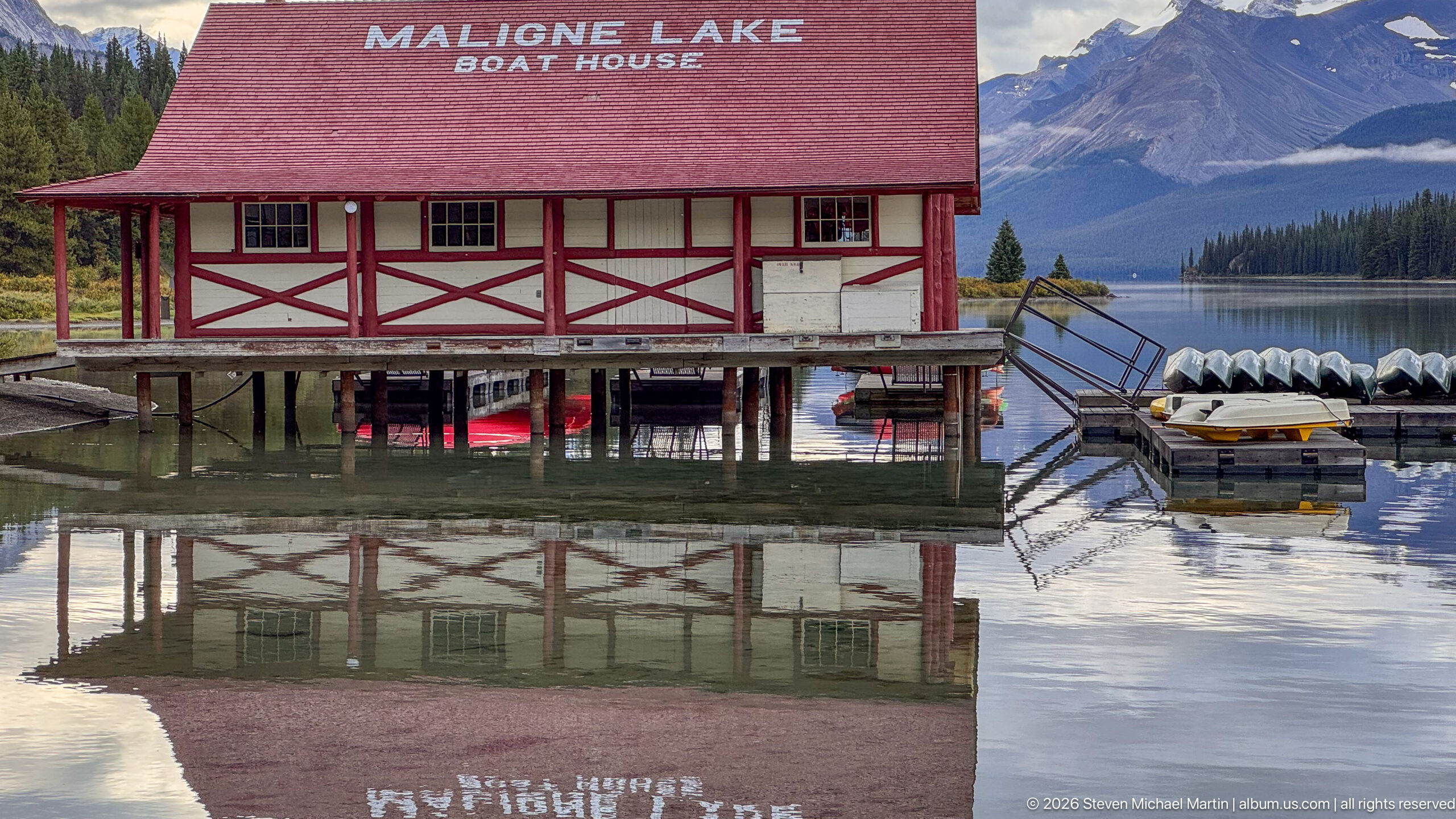
The timber-framed Maligne Lake Boat House fills the frame above its reflection, with dock structures and stacked canoes beside it. Timber framing, over-water construction, docks, and canoe storage make the building's recreational function visually legible.
Caption
The timber-framed Maligne Lake Boat House fills the frame above its reflection, with dock structures and stacked canoes beside it. Timber framing, over-water construction, docks, and canoe storage make the building's recreational function visually legible.
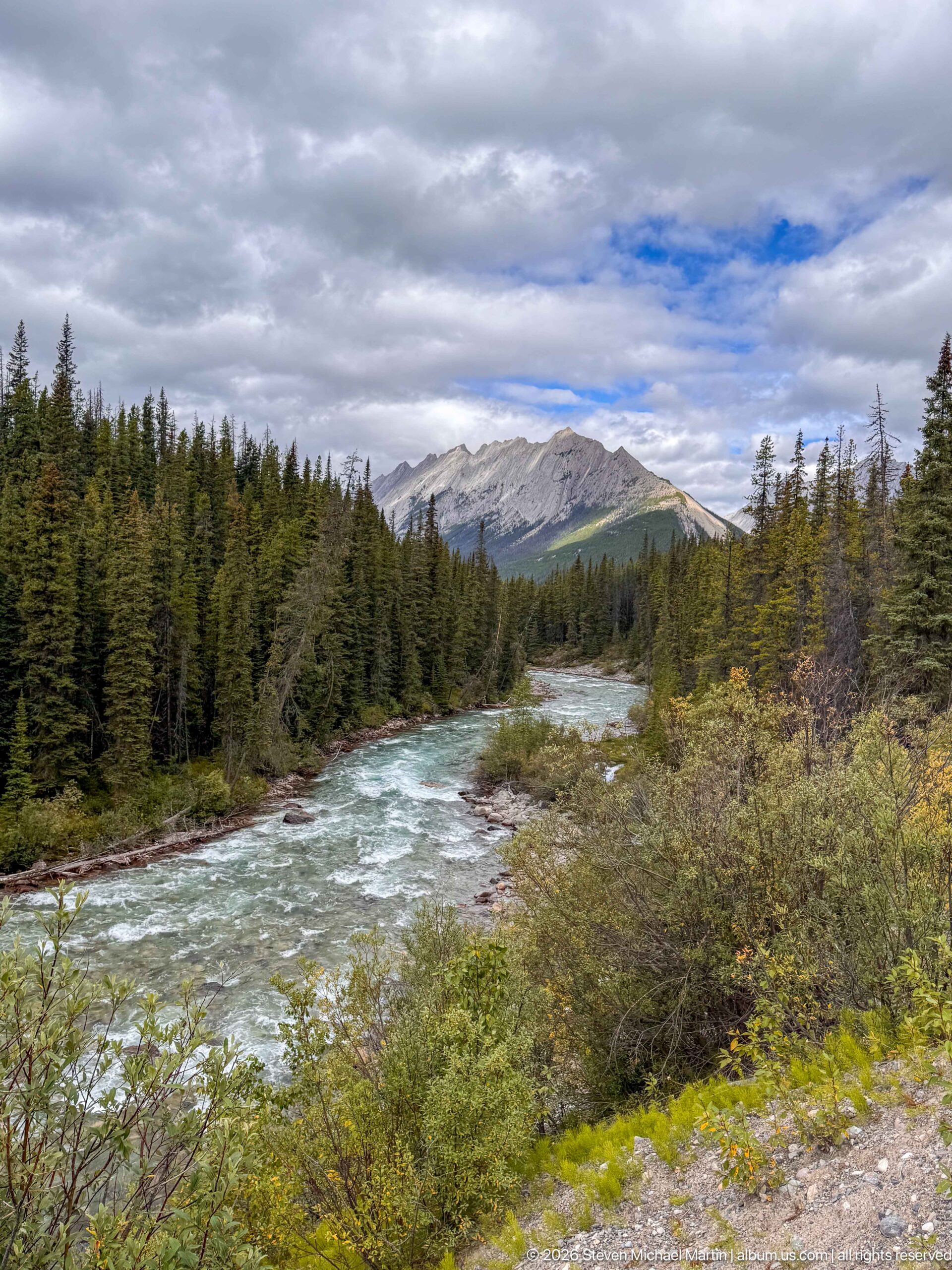
A pale turquoise river runs through conifers and willow-like shrubs toward a distant gray ridge under broken clouds. The flowing water, forested banks, and enclosing relief place the river within the strongly glaciated mountain landscape of Jasper National Park.
Caption
A pale turquoise river runs through conifers and willow-like shrubs toward a distant gray ridge under broken clouds. The flowing water, forested banks, and enclosing relief place the river within the strongly glaciated mountain landscape of Jasper National Park.
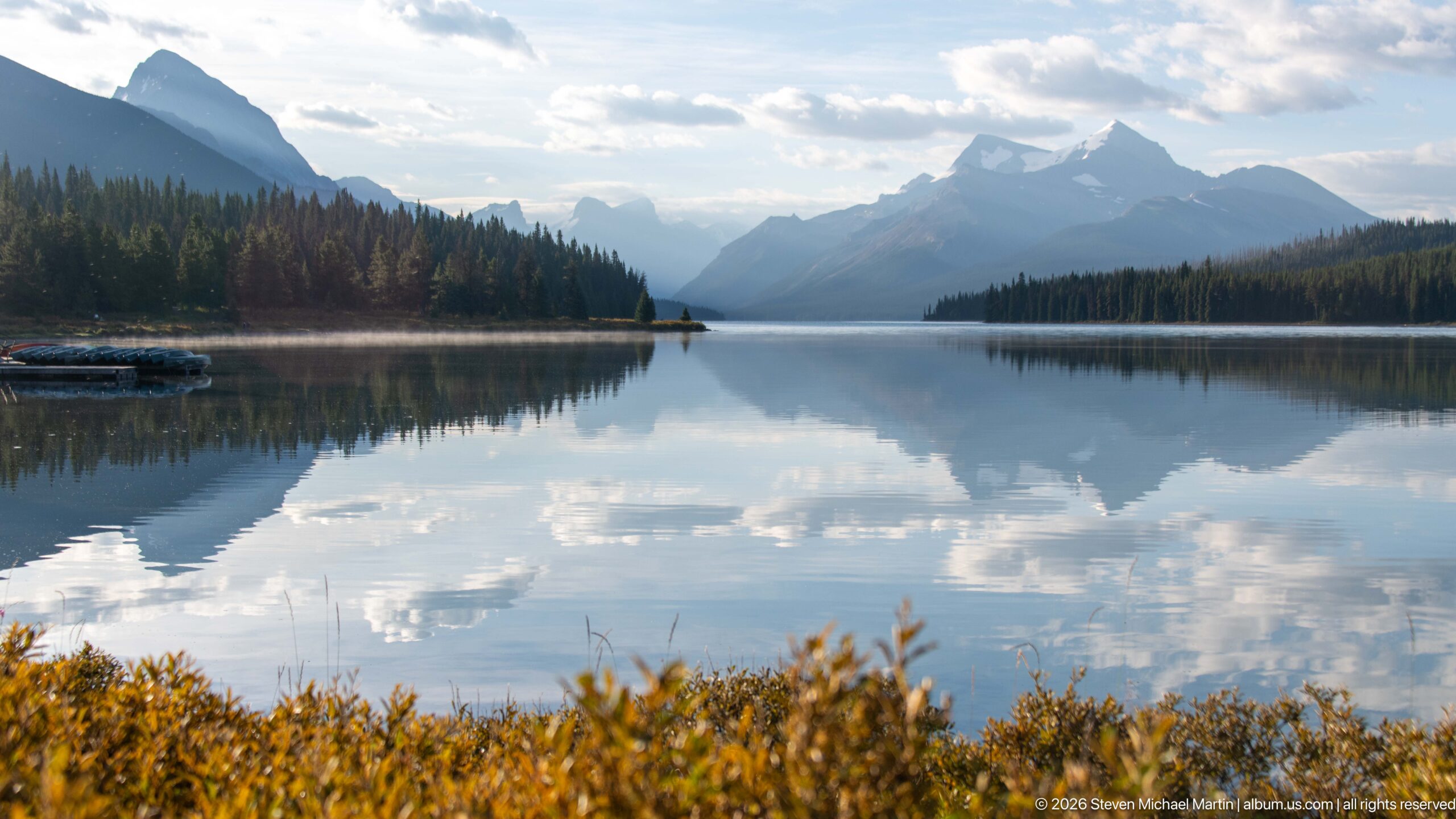
Still water on Maligne Lake mirrors clouds, forested shorelines, and the serrated mountain skyline beyond. Low shrubs occupy the foreground while the long lake axis draws the view into the enclosed valley, using reflection and layered relief to convey the scale of the mountain basin.
Caption
Still water on Maligne Lake mirrors clouds, forested shorelines, and the serrated mountain skyline beyond. Low shrubs occupy the foreground while the long lake axis draws the view into the enclosed valley, using reflection and layered relief to convey the scale of the mountain basin.
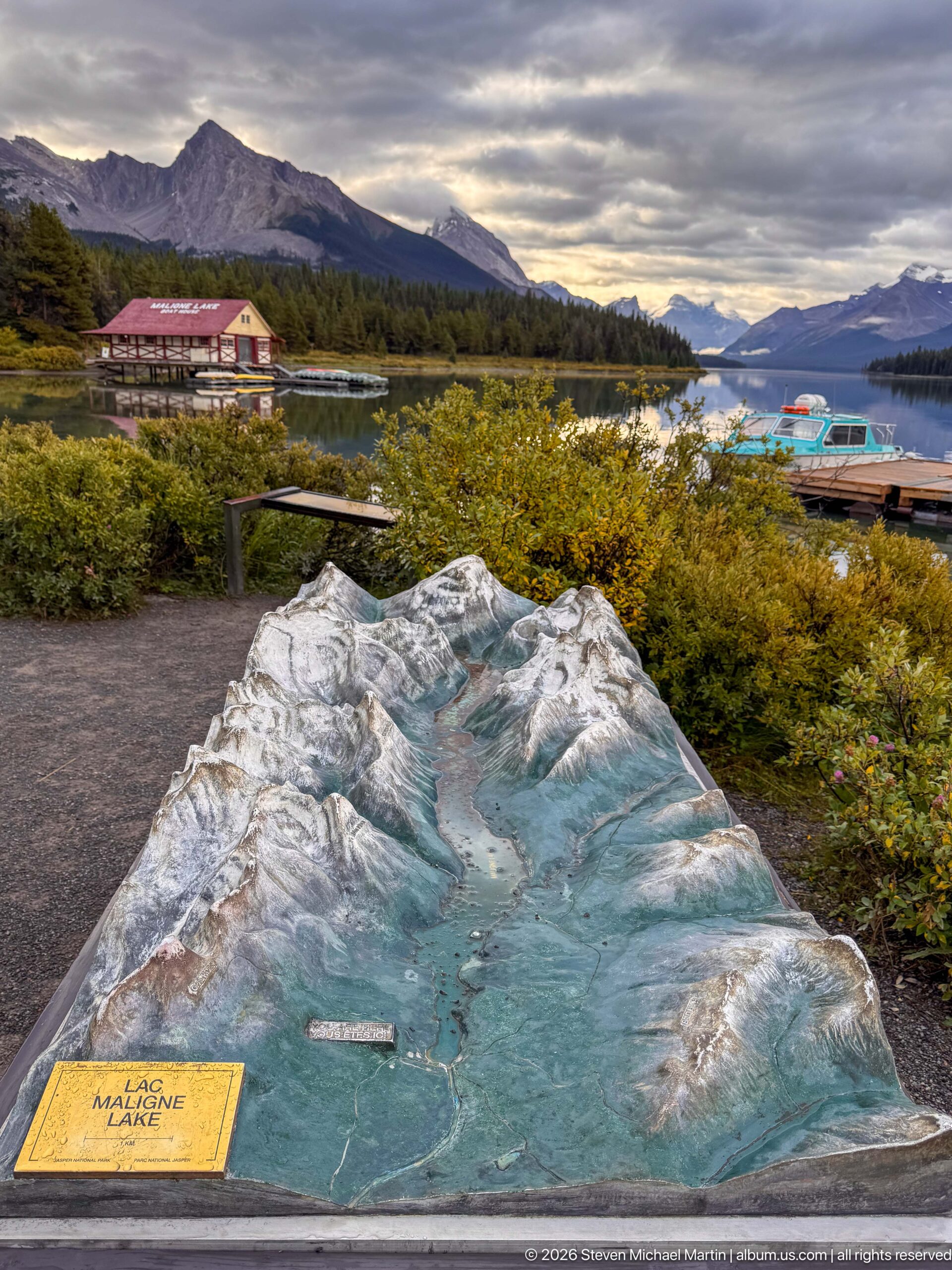
A painted three-dimensional relief model labeled Maligne Lake fills the foreground, with visitor buildings, docks, lake, and mountains behind. The model translates the surrounding mountain-and-lake topography into a compact three-dimensional visitor-orientation display.
Caption
A painted three-dimensional relief model labeled Maligne Lake fills the foreground, with visitor buildings, docks, lake, and mountains behind. The model translates the surrounding mountain-and-lake topography into a compact three-dimensional visitor-orientation display.
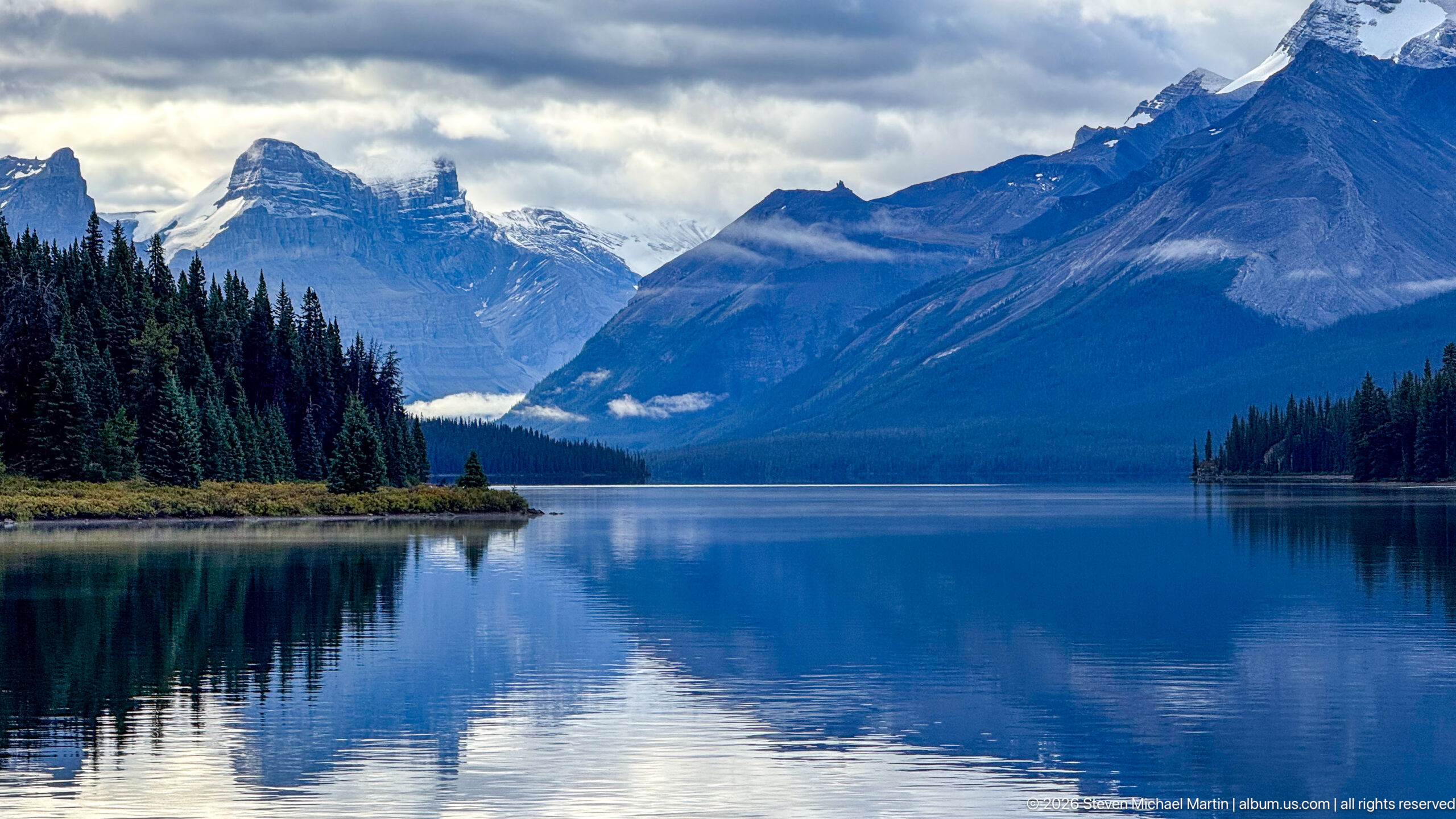
Deep blue Maligne Lake stretches between forested shores toward steep glaciated and snow-streaked mountains beneath low clouds. The long lake axis, conifer shores, and high mountain relief establish the scale of the southern Maligne Valley landscape.
Caption
Deep blue Maligne Lake stretches between forested shores toward steep glaciated and snow-streaked mountains beneath low clouds. The long lake axis, conifer shores, and high mountain relief establish the scale of the southern Maligne Valley landscape.
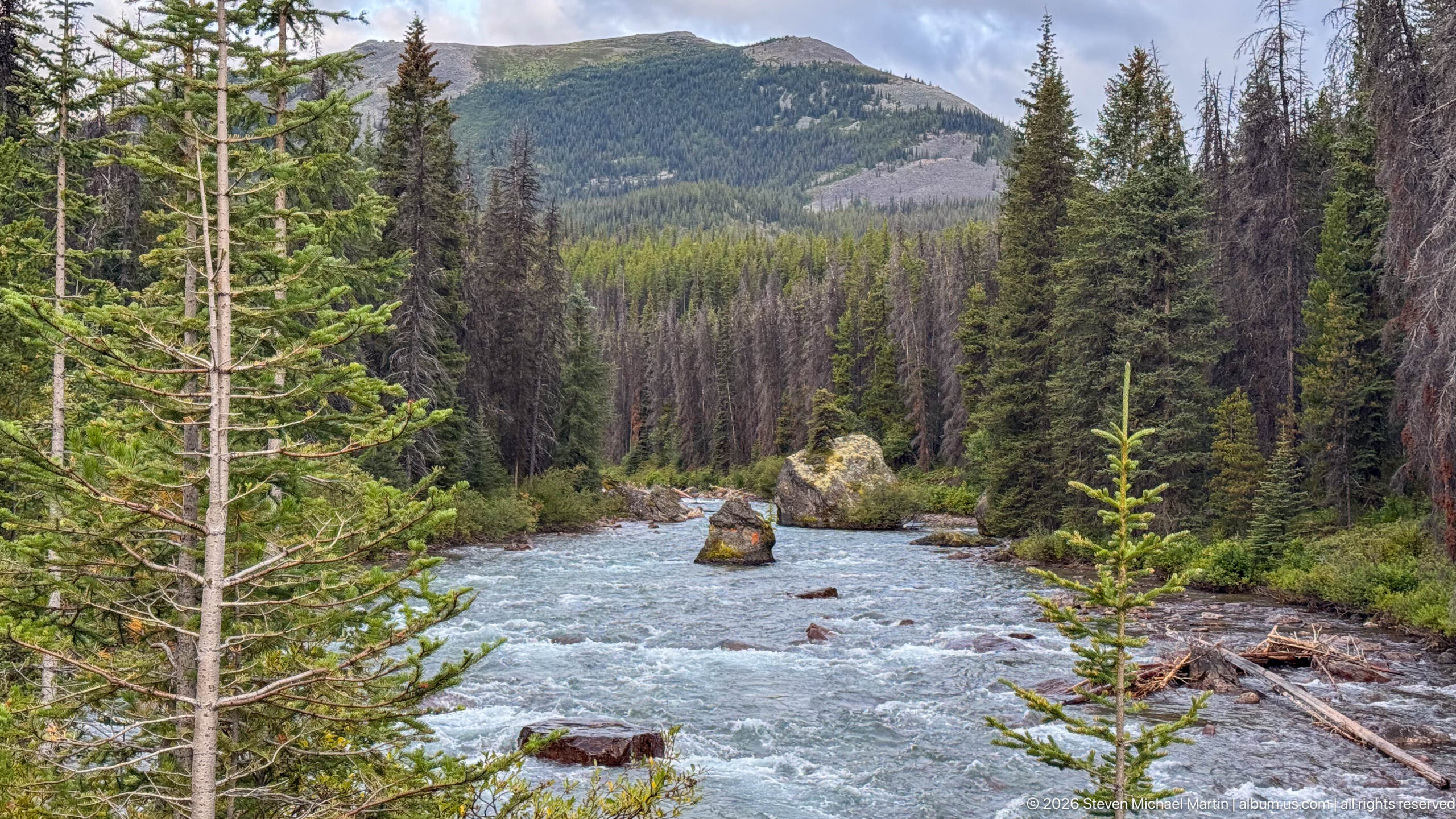
A swift mountain river threads between dense conifers and fire-affected forest, splitting around a prominent boulder near the center of the channel. Fallen trunks collect along the banks and in the water, while a forested ridge and gray rock slope rise beyond. The elevated viewpoint shows both the energetic current and the river corridor's recovering woodland.
Caption
A swift mountain river threads between dense conifers and fire-affected forest, splitting around a prominent boulder near the center of the channel. Fallen trunks collect along the banks and in the water, while a forested ridge and gray rock slope rise beyond. The elevated viewpoint shows both the energetic current and the river corridor's recovering woodland.
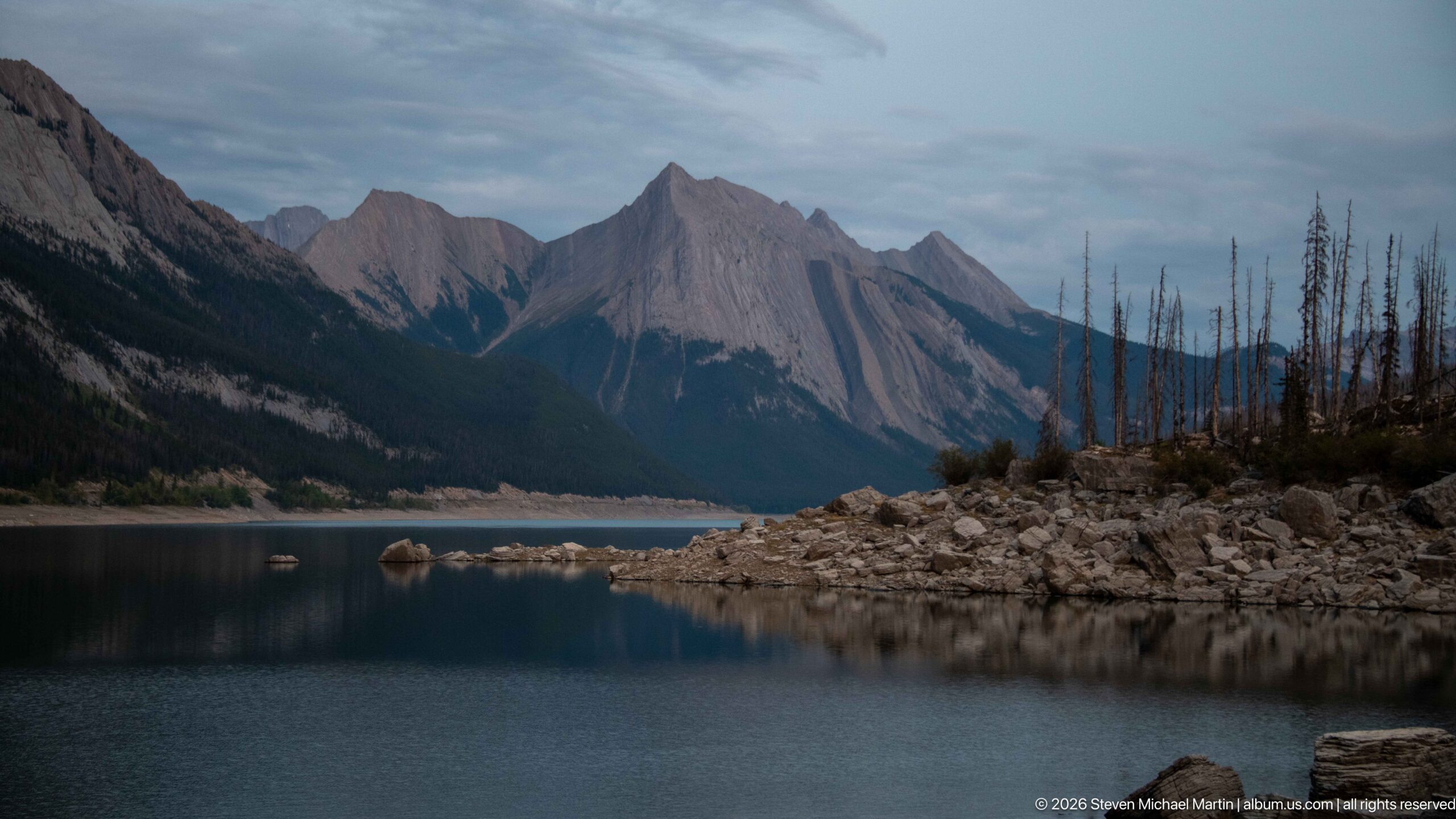
A mountain lake fills part of a steep-sided Maligne Valley basin, with a broad rocky margin exposed beneath gray limestone peaks. Sparse standing trunks and young vegetation along the shore reinforce the transitional character of the waterline, while the still surface reflects the subdued evening light. The composition emphasizes the relationship between remaining water, exposed shoreline, forest, and enclosing relief characteristic of Medicine Lake.
Caption
A mountain lake fills part of a steep-sided Maligne Valley basin, with a broad rocky margin exposed beneath gray limestone peaks. Sparse standing trunks and young vegetation along the shore reinforce the transitional character of the waterline, while the still surface reflects the subdued evening light. The composition emphasizes the relationship between remaining water, exposed shoreline, forest, and enclosing relief characteristic of Medicine Lake.
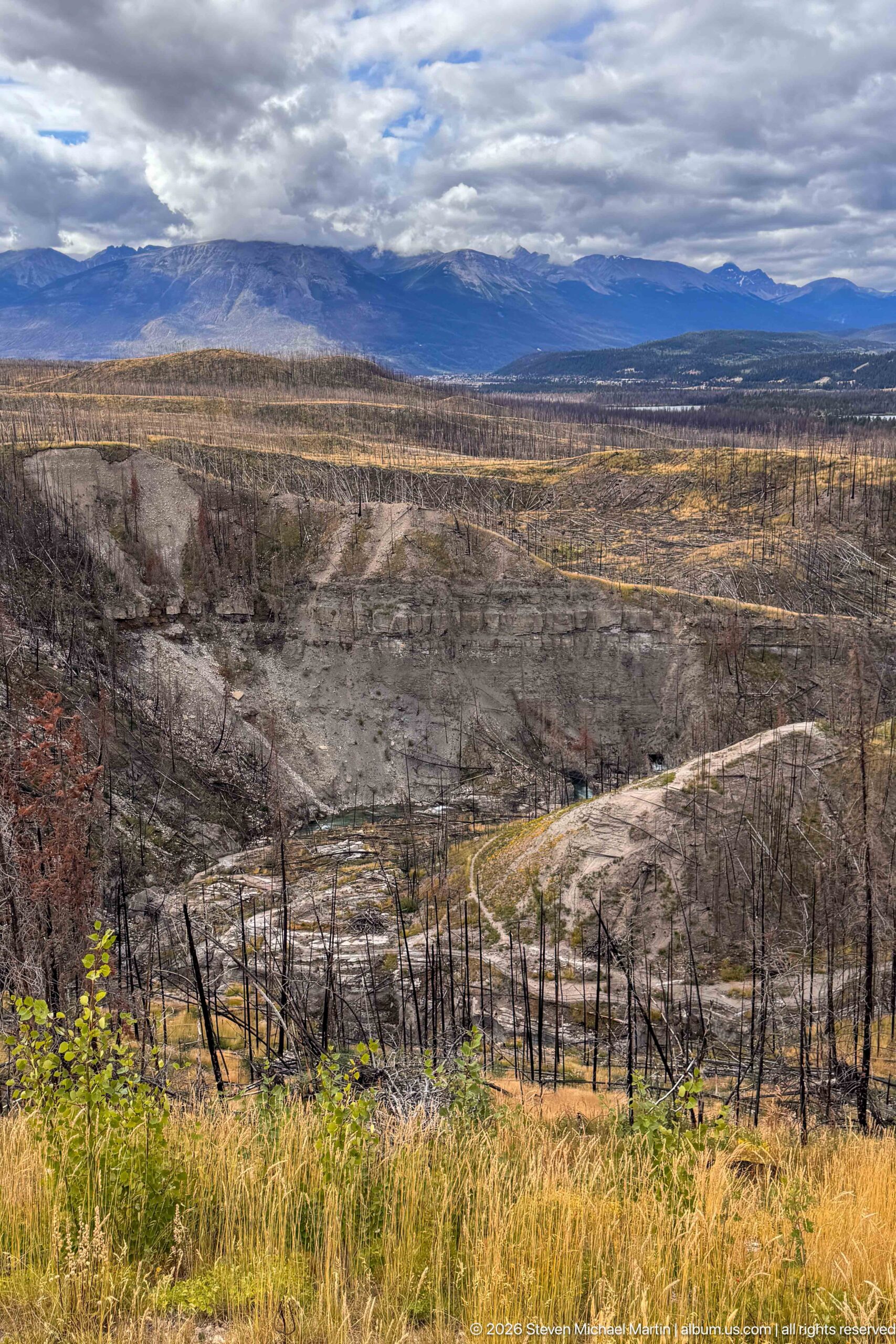
Wide view across a burned valley shows standing dead trees, regenerating vegetation, exposed earth, and layered mountain ridges. Standing dead trees and patchy new vegetation record a landscape in visible transition following wildfire disturbance.
Caption
Wide view across a burned valley shows standing dead trees, regenerating vegetation, exposed earth, and layered mountain ridges. Standing dead trees and patchy new vegetation record a landscape in visible transition following wildfire disturbance.
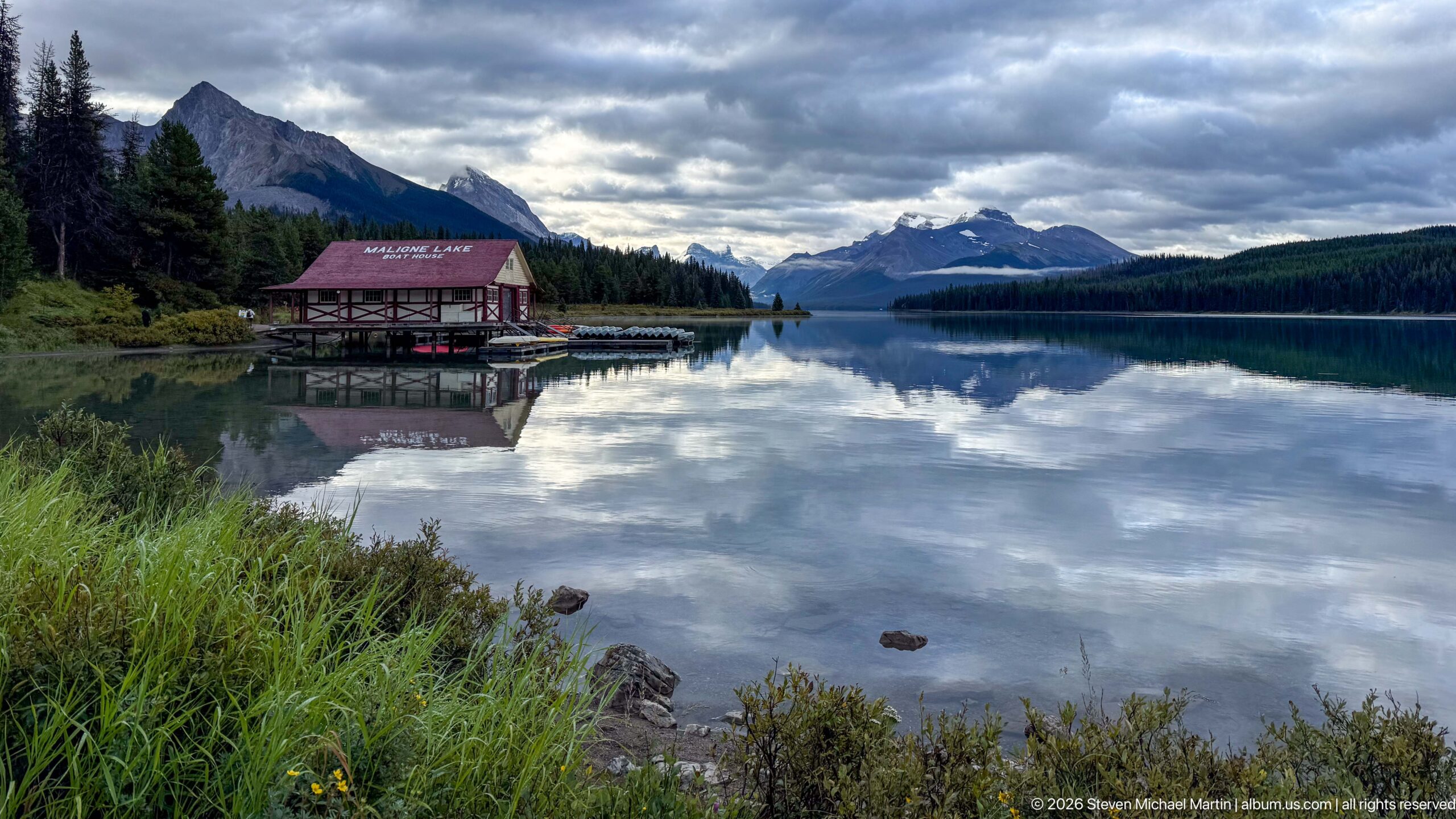
The Maligne Lake Boat House sits small at the left edge of a calm reflective lake beneath dramatic cloud and mountain scenery. The wide composition integrates the historic lakeside structure with the scale and reflective character of the surrounding mountain basin.
Caption
The Maligne Lake Boat House sits small at the left edge of a calm reflective lake beneath dramatic cloud and mountain scenery. The wide composition integrates the historic lakeside structure with the scale and reflective character of the surrounding mountain basin.
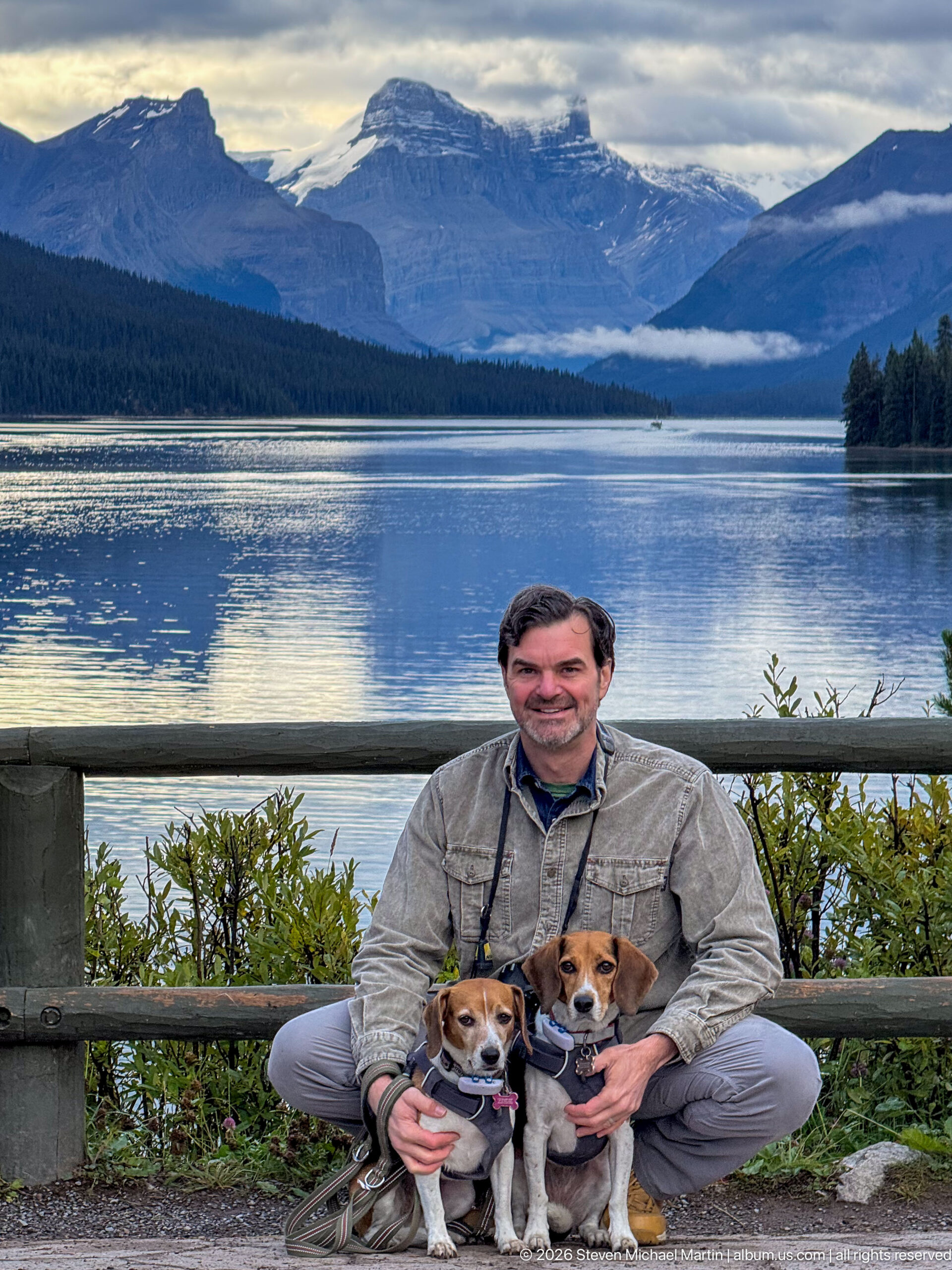
A seated visitor holds two harnessed beagles beside a wooden railing, with a broad mountain lake and layered peaks behind. The portrait combines a human-and-pet travel record with the mountain and lake setting of the Maligne Valley.
Caption
A seated visitor holds two harnessed beagles beside a wooden railing, with a broad mountain lake and layered peaks behind. The portrait combines a human-and-pet travel record with the mountain and lake setting of the Maligne Valley.
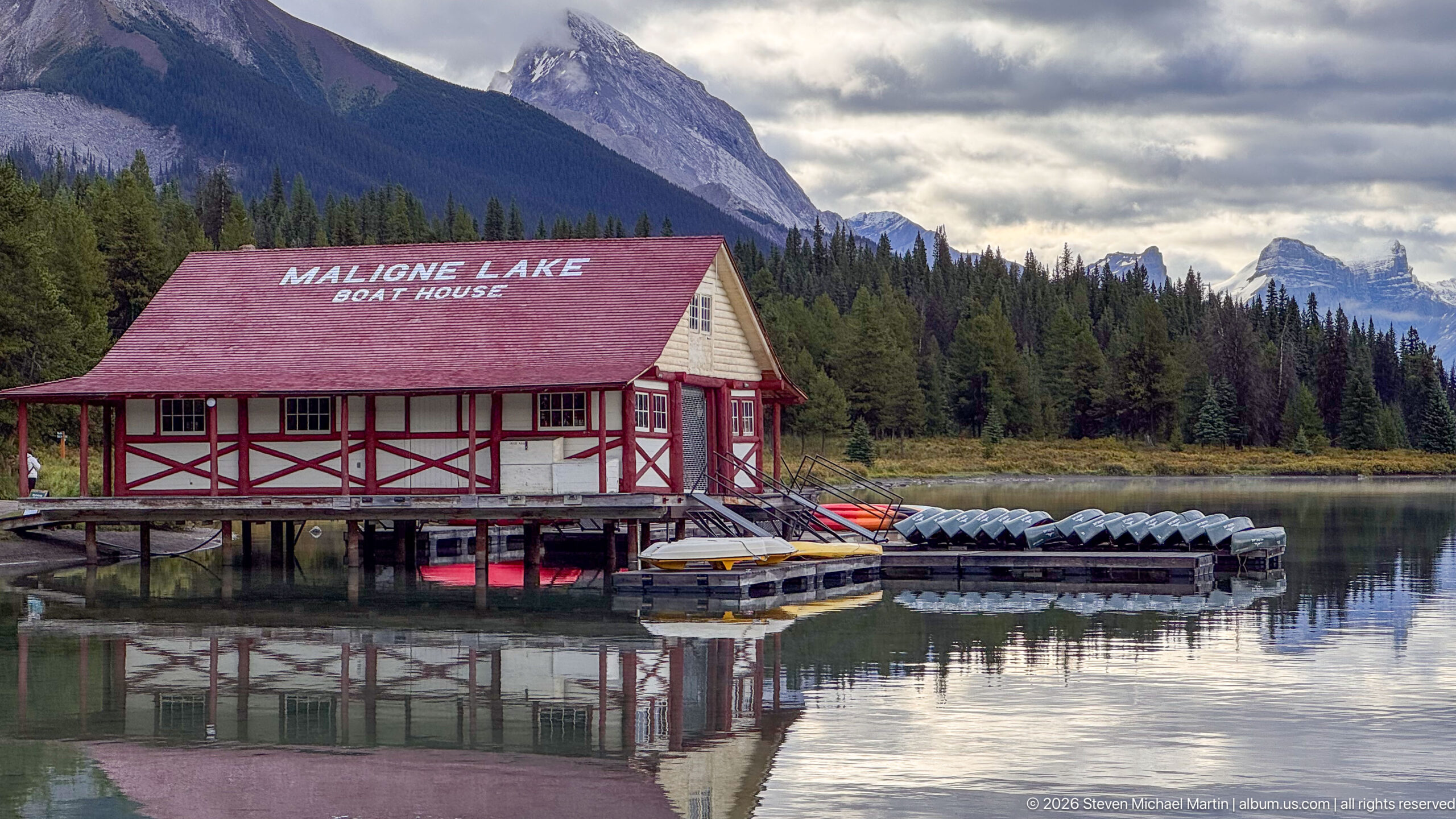
A closer view shows the red-and-cream Maligne Lake Boat House over water, adjacent canoe racks, forest, and mountain slopes. The red-and-cream timber structure provides a strong human-made counterpoint to the lake, forest, and Canadian Rockies setting.
Caption
A closer view shows the red-and-cream Maligne Lake Boat House over water, adjacent canoe racks, forest, and mountain slopes. The red-and-cream timber structure provides a strong human-made counterpoint to the lake, forest, and Canadian Rockies setting.
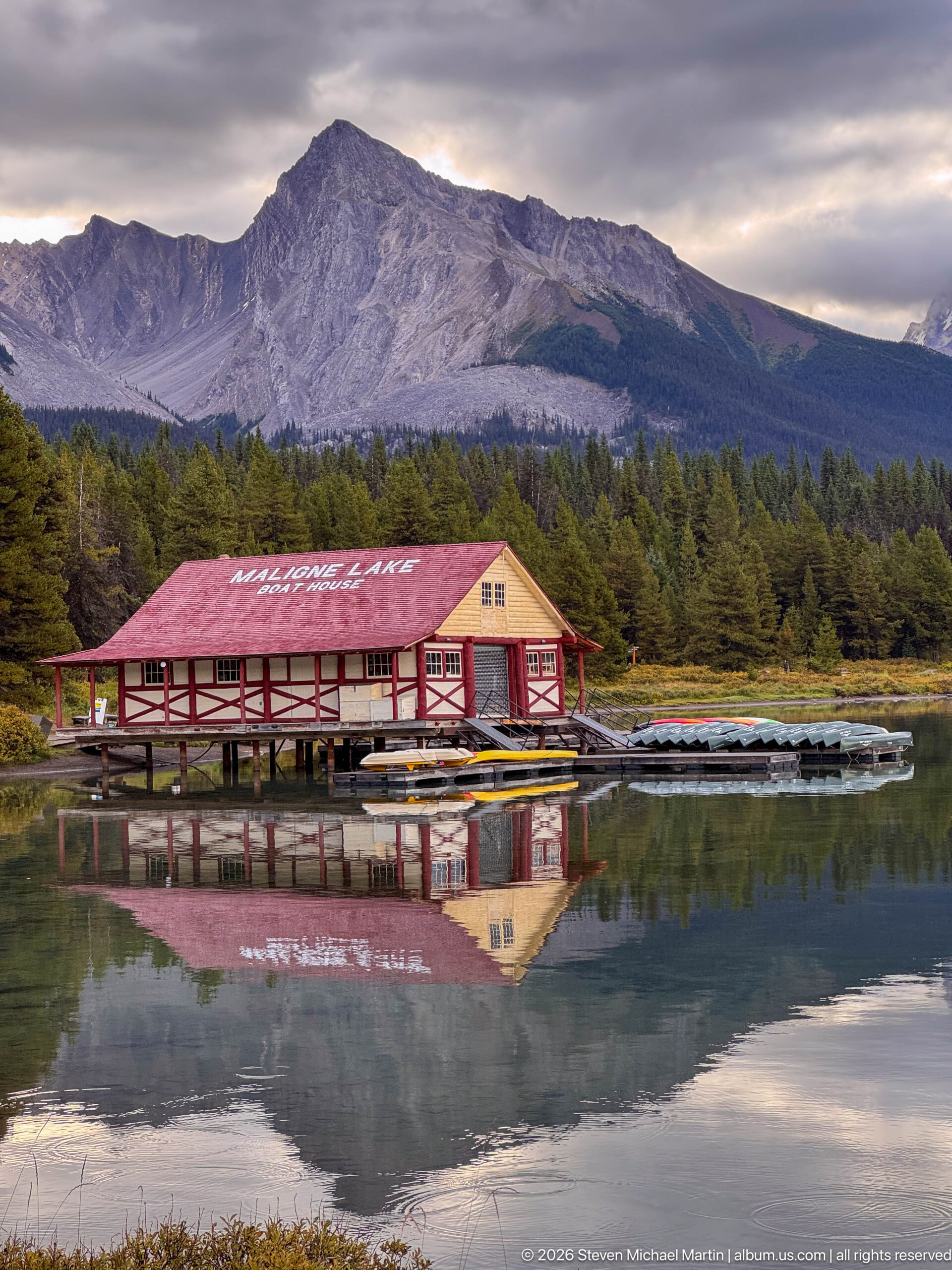
Red-and-cream timber Maligne Lake Boat House stands over calm water with canoe racks, forest, mountain ridge, and a near-complete reflection. The red-and-cream timber structure provides a strong human-made counterpoint to the lake, forest, and Canadian Rockies setting.
Caption
Red-and-cream timber Maligne Lake Boat House stands over calm water with canoe racks, forest, mountain ridge, and a near-complete reflection. The red-and-cream timber structure provides a strong human-made counterpoint to the lake, forest, and Canadian Rockies setting.
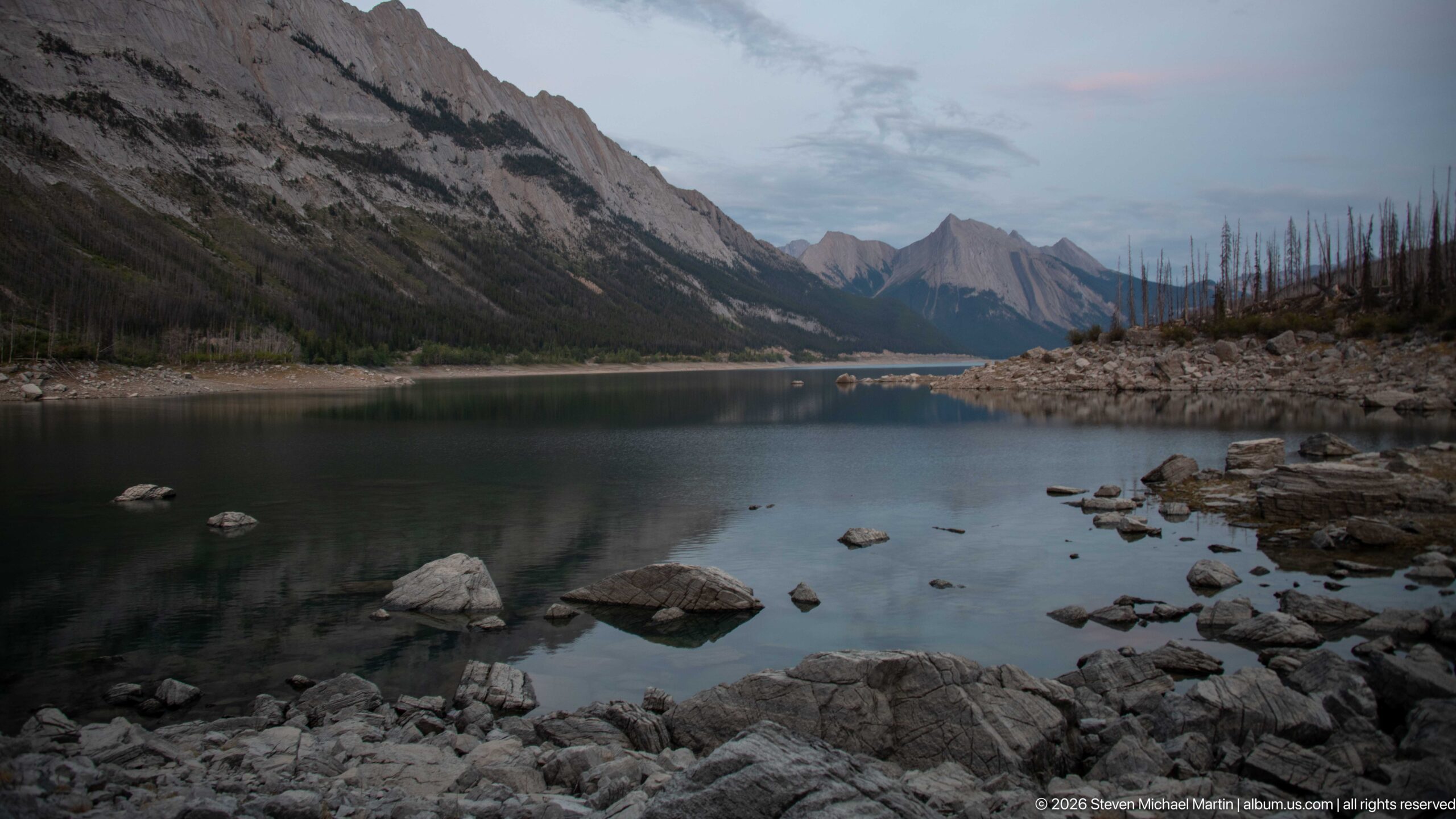
Low evening light settles across Medicine Lake, where scattered boulders punctuate shallow foreground water and an exposed stony shore curves beneath the valley walls. The long view draws the eye toward layered peaks at the head of the basin. Calm water and extensive shoreline exposure make the lake's changing relationship between water level and surrounding terrain especially legible in this frame.
Caption
Low evening light settles across Medicine Lake, where scattered boulders punctuate shallow foreground water and an exposed stony shore curves beneath the valley walls. The long view draws the eye toward layered peaks at the head of the basin. Calm water and extensive shoreline exposure make the lake's changing relationship between water level and surrounding terrain especially legible in this frame.
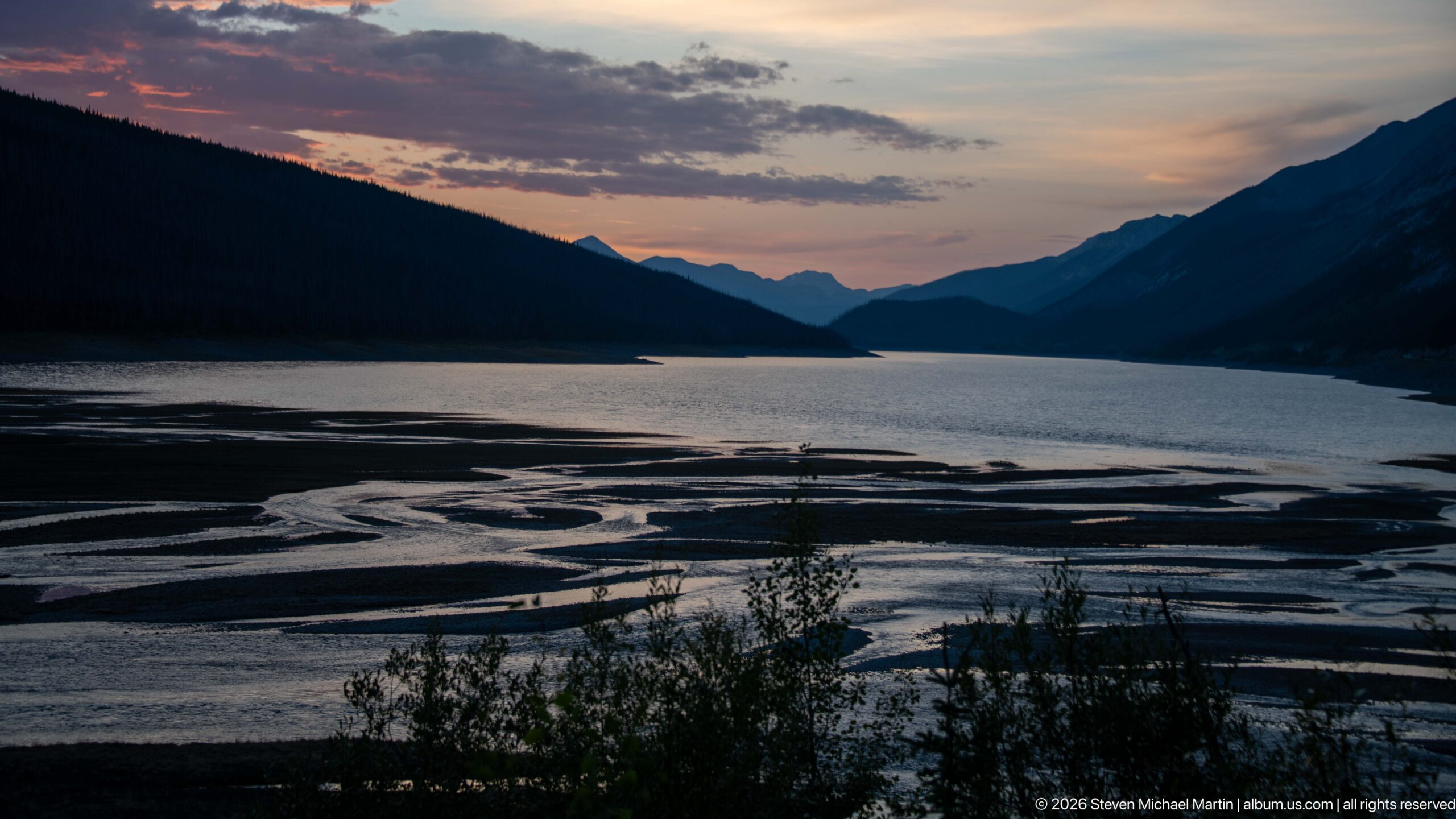
Braided ribbons of water cross a wide exposed lakebed at Medicine Lake as dusk gathers over the Maligne Valley. The remaining lake narrows toward distant mountain silhouettes, while dark forested slopes frame the basin on both sides. This elevated view makes the seasonal contrast between open water and exposed sediment especially prominent without requiring the underground drainage system itself to be visible.
Caption
Braided ribbons of water cross a wide exposed lakebed at Medicine Lake as dusk gathers over the Maligne Valley. The remaining lake narrows toward distant mountain silhouettes, while dark forested slopes frame the basin on both sides. This elevated view makes the seasonal contrast between open water and exposed sediment especially prominent without requiring the underground drainage system itself to be visible.
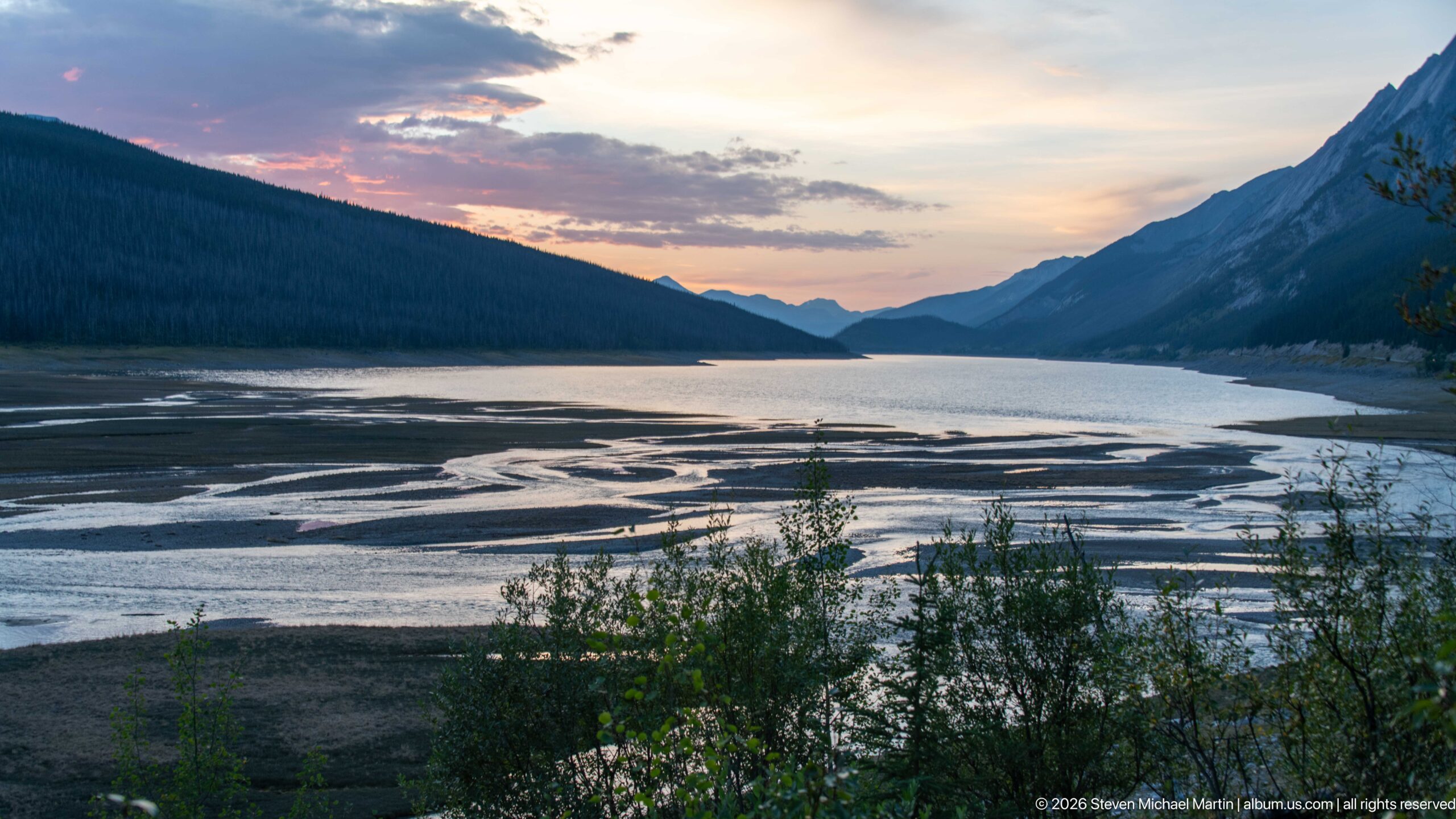
The exposed floor of Medicine Lake forms branching pale channels around the remaining water, creating a graphic foreground beneath a softly colored evening sky. Forested valley walls converge toward distant peaks while shrubs at the overlook add depth. The broad perspective clearly records the basin during a low-water phase, when shoreline and lakebed occupy much of the visible valley floor.
Caption
The exposed floor of Medicine Lake forms branching pale channels around the remaining water, creating a graphic foreground beneath a softly colored evening sky. Forested valley walls converge toward distant peaks while shrubs at the overlook add depth. The broad perspective clearly records the basin during a low-water phase, when shoreline and lakebed occupy much of the visible valley floor.
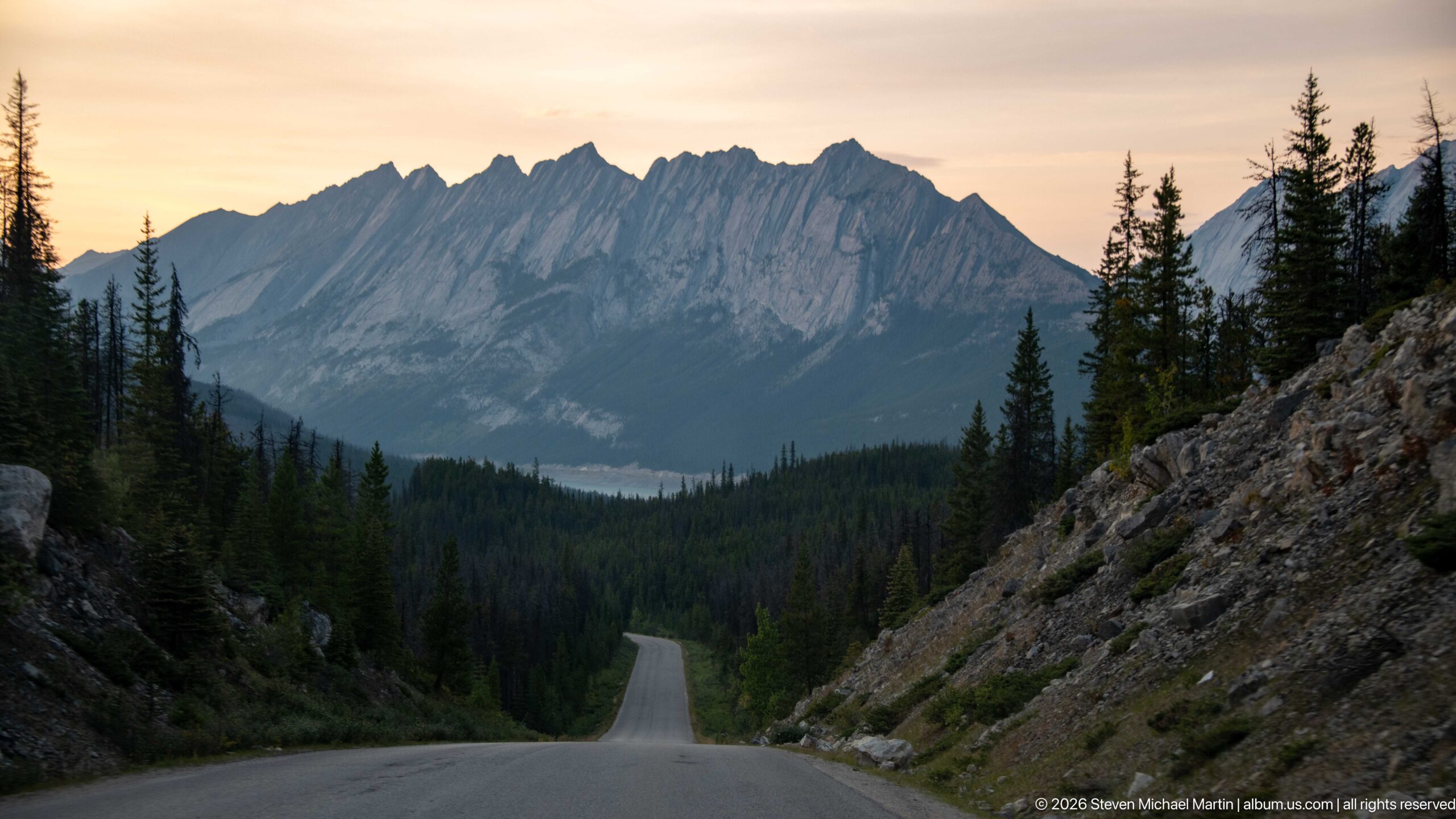
Maligne Lake Road drops through a rocky cut toward a forested valley backed by a serrated gray mountain ridge. The empty pavement provides a strong central axis and shows how the visitor corridor threads between steep slopes and dense conifer forest. A sliver of water is visible beyond the trees, but the road-and-mountain relationship is the defining subject of the composition.
Caption
Maligne Lake Road drops through a rocky cut toward a forested valley backed by a serrated gray mountain ridge. The empty pavement provides a strong central axis and shows how the visitor corridor threads between steep slopes and dense conifer forest. A sliver of water is visible beyond the trees, but the road-and-mountain relationship is the defining subject of the composition.
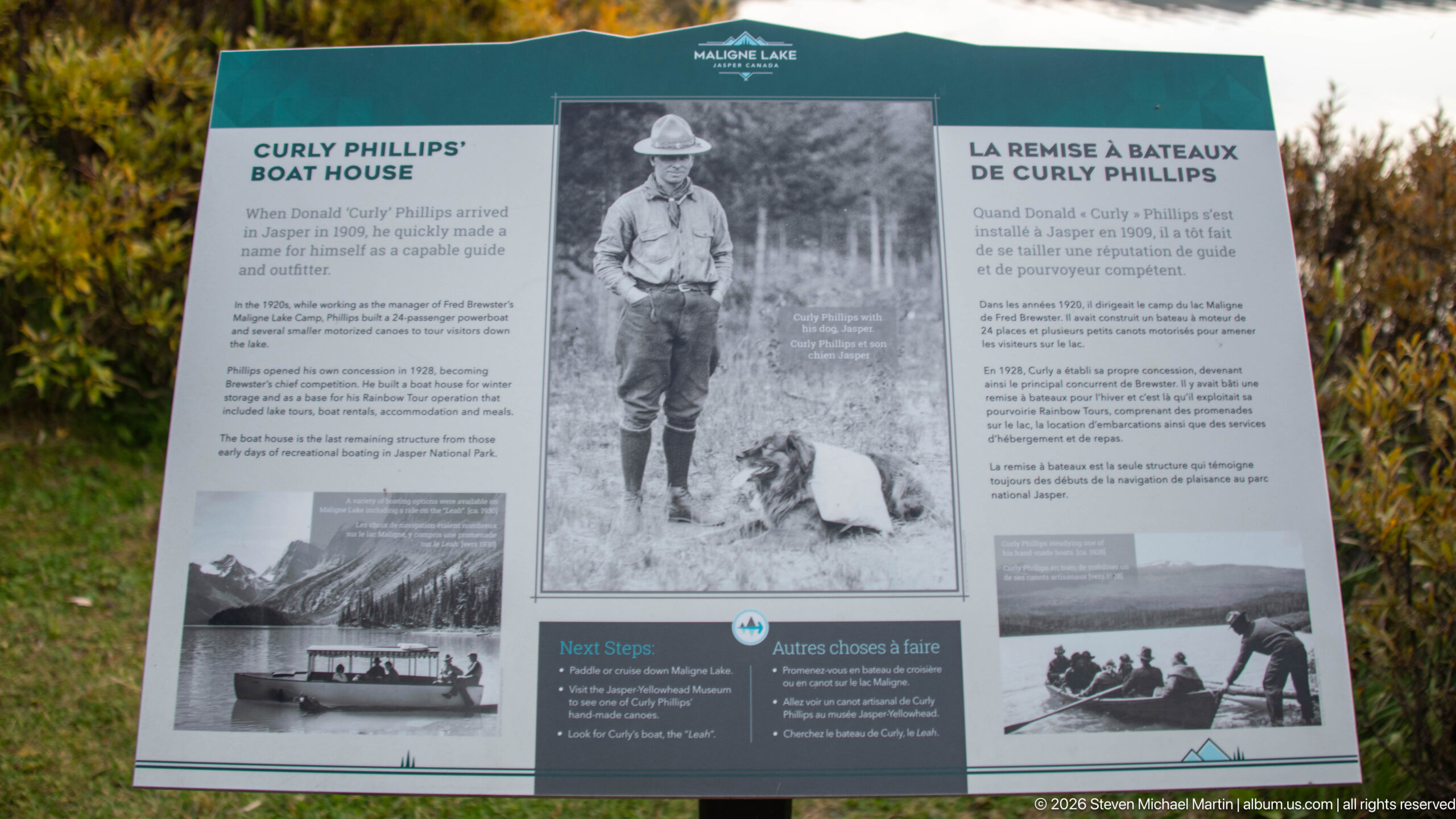
An outdoor interpretive panel at Maligne Lake presents the story of Donald “Curly” Phillips and early boating on the lake. Historic photographs include Phillips with a dog, an early boat on mountain water, and people handling a small craft. The bilingual English-French display connects the developed lakeshore with the human history of exploration and visitor access in the Maligne Valley.
Caption
An outdoor interpretive panel at Maligne Lake presents the story of Donald “Curly” Phillips and early boating on the lake. Historic photographs include Phillips with a dog, an early boat on mountain water, and people handling a small craft. The bilingual English-French display connects the developed lakeshore with the human history of exploration and visitor access in the Maligne Valley.
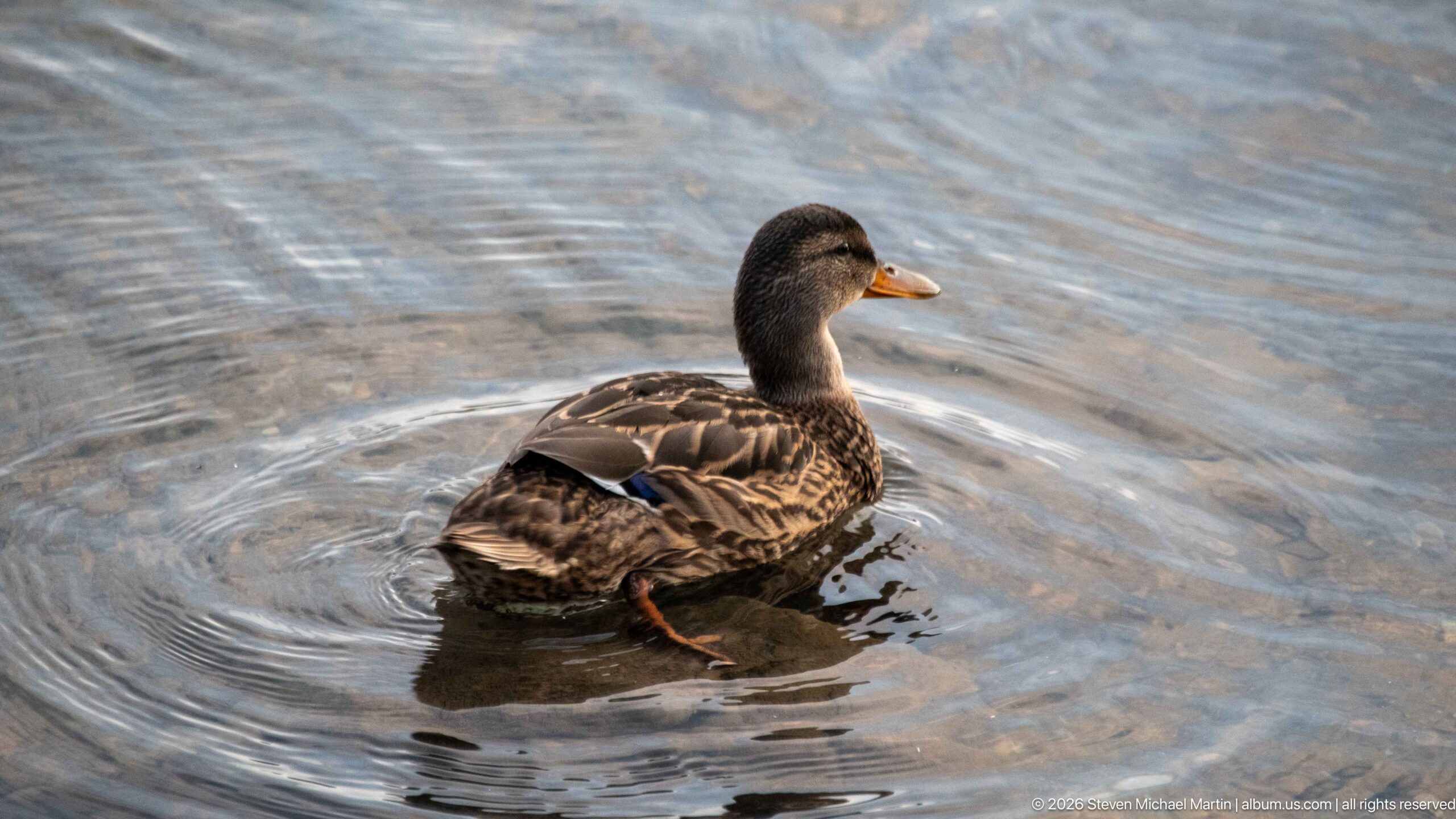
A female mallard floats in softly rippled water, shown in three-quarter profile with the mottled brown plumage, orange-and-dark bill, and compact dabbling-duck form visible. Concentric ripples spread from the bird and isolate it against the reflective surface. The close view preserves diagnostic features while keeping enough water around the duck to establish its aquatic setting.
Caption
A female mallard floats in softly rippled water, shown in three-quarter profile with the mottled brown plumage, orange-and-dark bill, and compact dabbling-duck form visible. Concentric ripples spread from the bird and isolate it against the reflective surface. The close view preserves diagnostic features while keeping enough water around the duck to establish its aquatic setting.
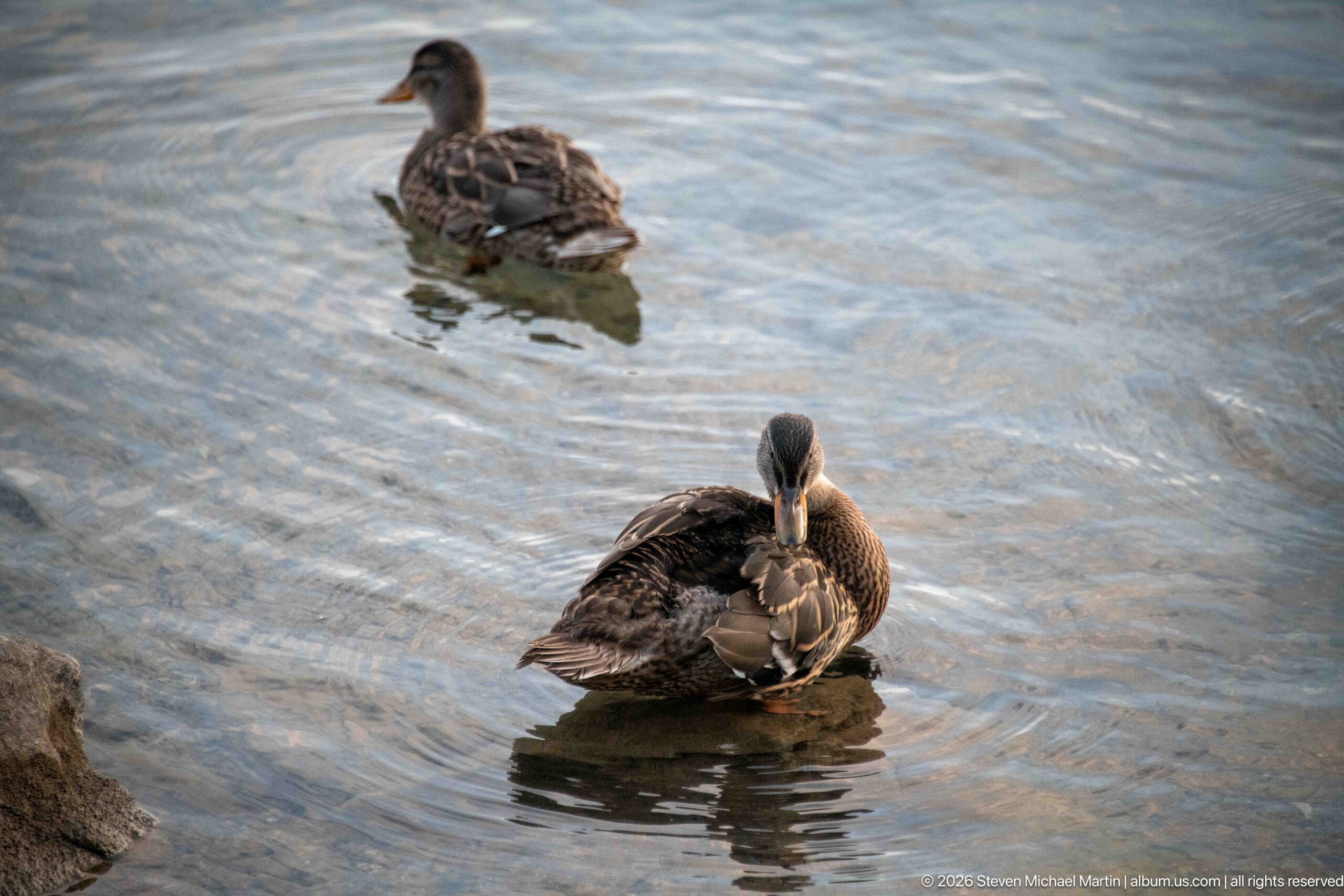
Two female mallards occupy the same patch of rippled water, one resting in the background while the nearer bird bends into its plumage to preen. Their mottled brown bodies and orange-toned bills remain visible despite the different poses. The frame records ordinary maintenance behavior while retaining a simple aquatic context rather than implying a broader social interaction.
Caption
Two female mallards occupy the same patch of rippled water, one resting in the background while the nearer bird bends into its plumage to preen. Their mottled brown bodies and orange-toned bills remain visible despite the different poses. The frame records ordinary maintenance behavior while retaining a simple aquatic context rather than implying a broader social interaction.
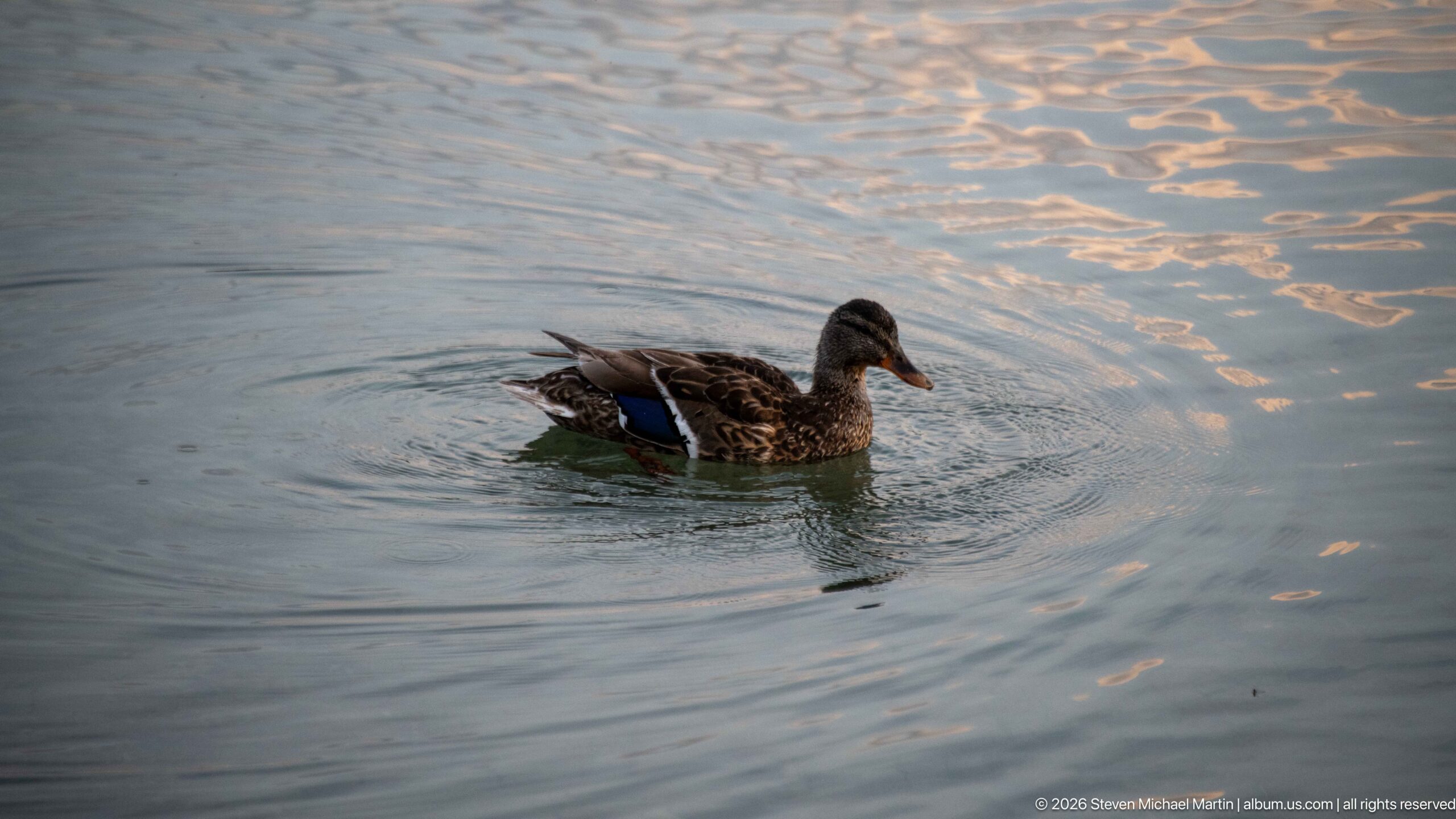
A female mallard moves across calm water as warm reflections break across the surface. The side view reveals mottled brown plumage and a vivid blue wing speculum bordered by pale bars, a useful field mark for the species. A narrow wake follows the bird, giving this otherwise quiet portrait a clear sense of motion.
Caption
A female mallard moves across calm water as warm reflections break across the surface. The side view reveals mottled brown plumage and a vivid blue wing speculum bordered by pale bars, a useful field mark for the species. A narrow wake follows the bird, giving this otherwise quiet portrait a clear sense of motion.
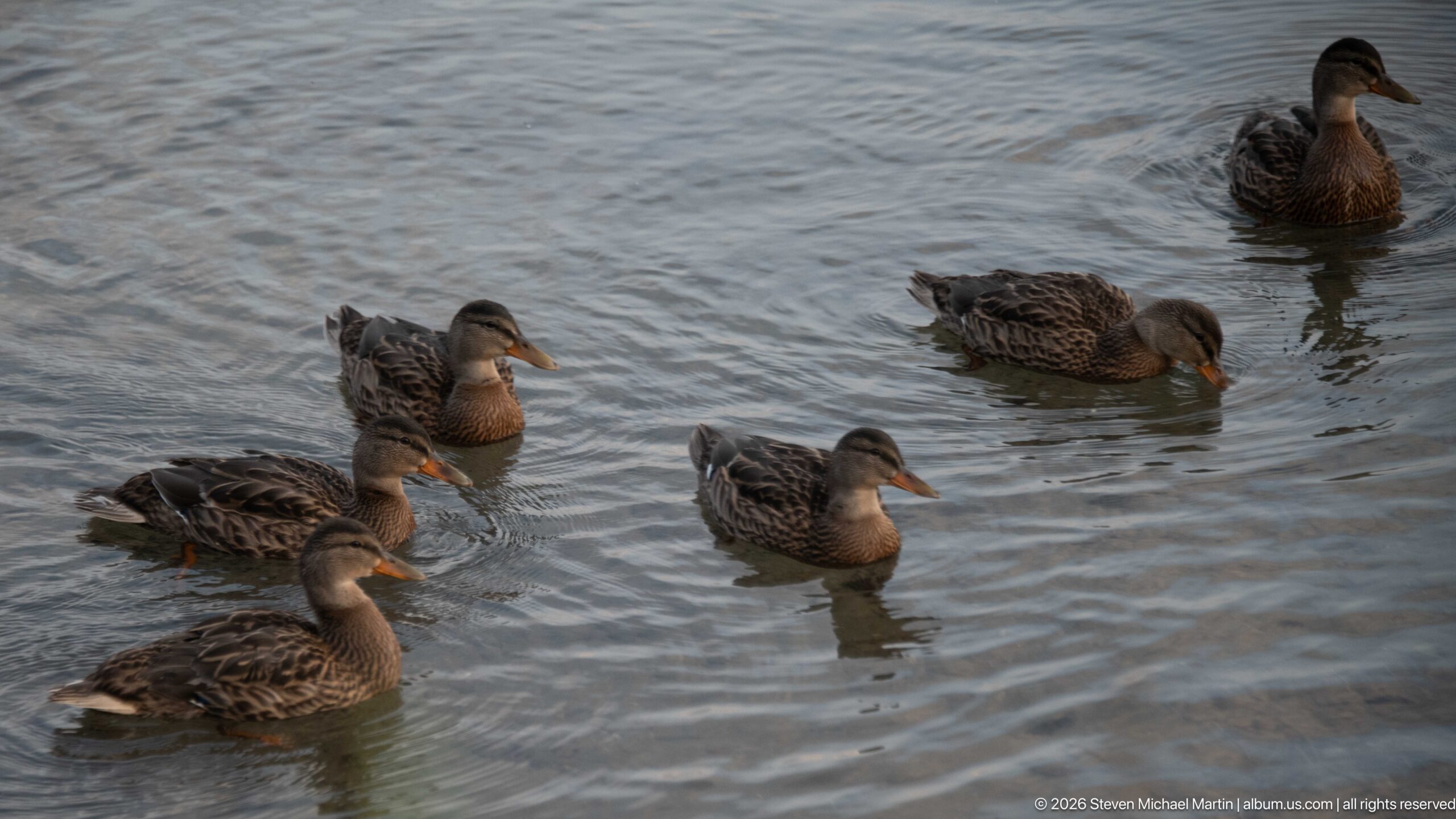
Five female mallards gather loosely on gray-blue water, their mottled brown plumage creating subtle variation against overlapping ripples. Several birds face different directions while one dips its bill toward the surface, producing a natural group study rather than a single-animal portrait. The elevated viewpoint makes spacing, body shape, and the repeated plumage pattern easy to compare.
Caption
Five female mallards gather loosely on gray-blue water, their mottled brown plumage creating subtle variation against overlapping ripples. Several birds face different directions while one dips its bill toward the surface, producing a natural group study rather than a single-animal portrait. The elevated viewpoint makes spacing, body shape, and the repeated plumage pattern easy to compare.
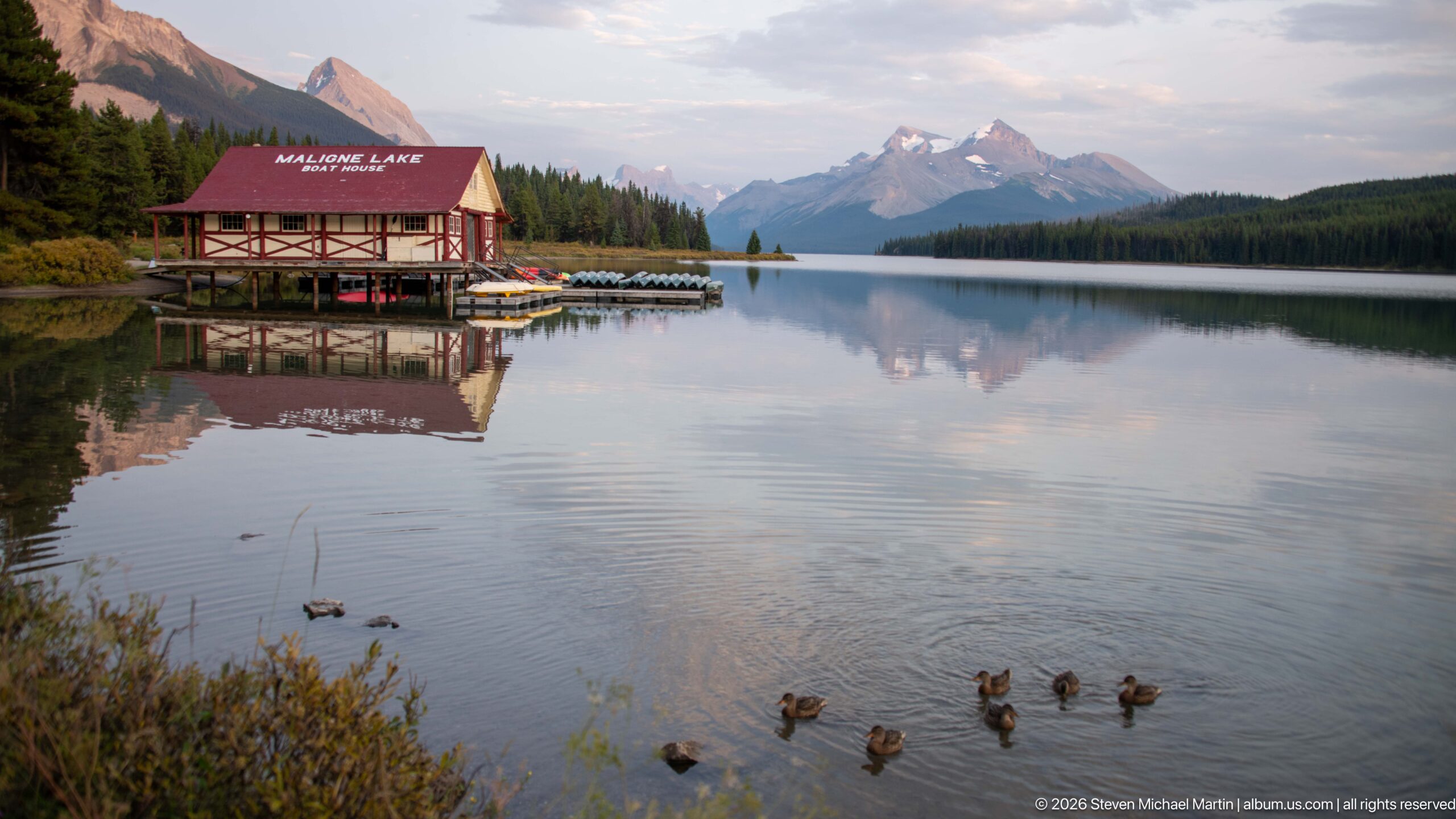
The red-roofed Maligne Lake Boathouse stands over the water on pilings, its timber-trimmed walls and roof reflected almost completely in the calm lake. Docks extend beside the structure while mountain peaks rise beyond the forested opposite shore. A small group of ducks in the foreground adds scale to a composition linking the developed lakeshore with the broad mountain setting.
Caption
The red-roofed Maligne Lake Boathouse stands over the water on pilings, its timber-trimmed walls and roof reflected almost completely in the calm lake. Docks extend beside the structure while mountain peaks rise beyond the forested opposite shore. A small group of ducks in the foreground adds scale to a composition linking the developed lakeshore with the broad mountain setting.
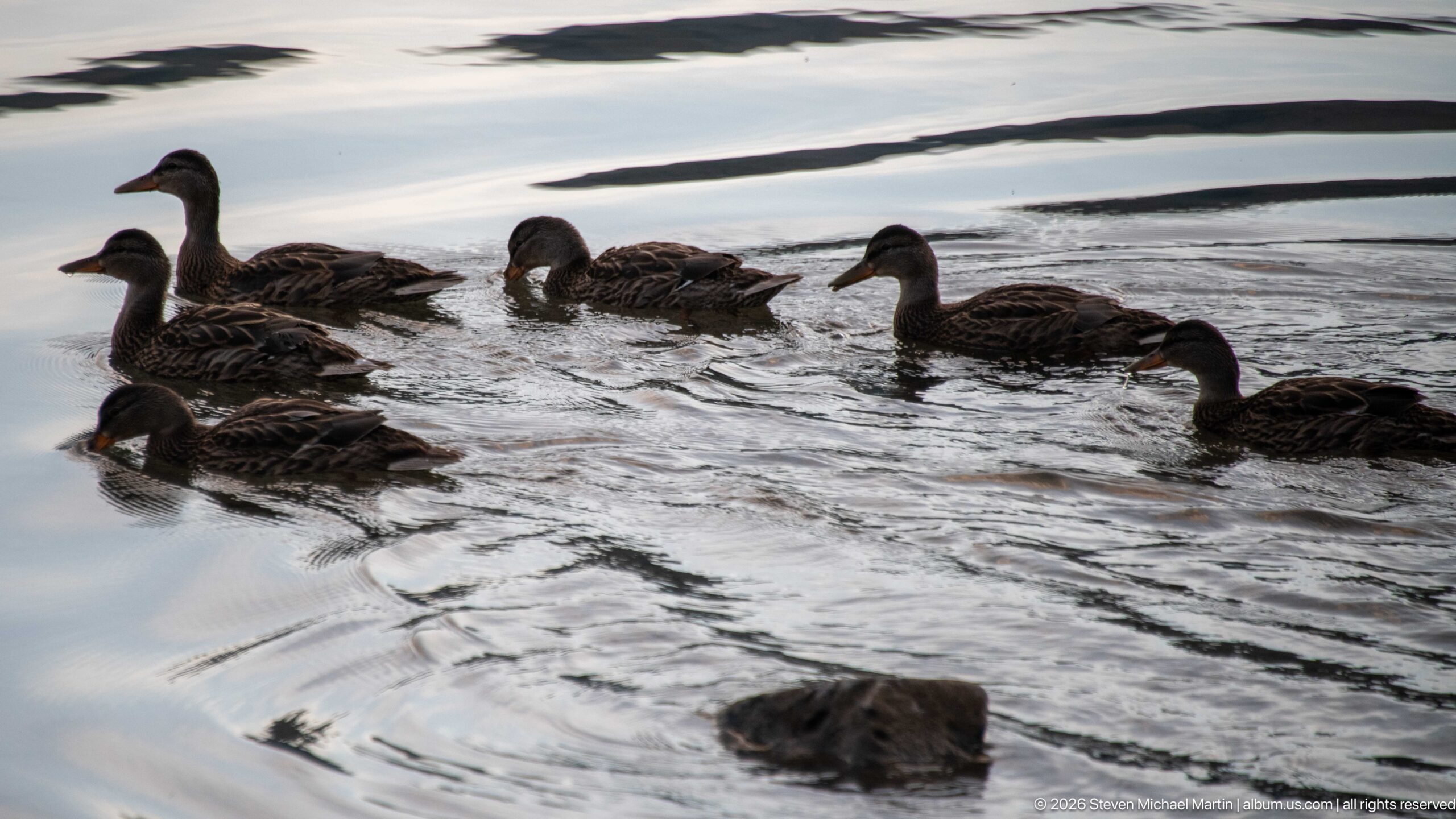
A small group of female mallards swims together across darkening water, their wakes overlapping into a textured pattern of bright and shadowed ripples. The birds are seen mostly in profile and from behind, emphasizing movement and group spacing more than individual detail. Mottled plumage and dabbling-duck proportions remain visible across the group.
Caption
A small group of female mallards swims together across darkening water, their wakes overlapping into a textured pattern of bright and shadowed ripples. The birds are seen mostly in profile and from behind, emphasizing movement and group spacing more than individual detail. Mottled plumage and dabbling-duck proportions remain visible across the group.
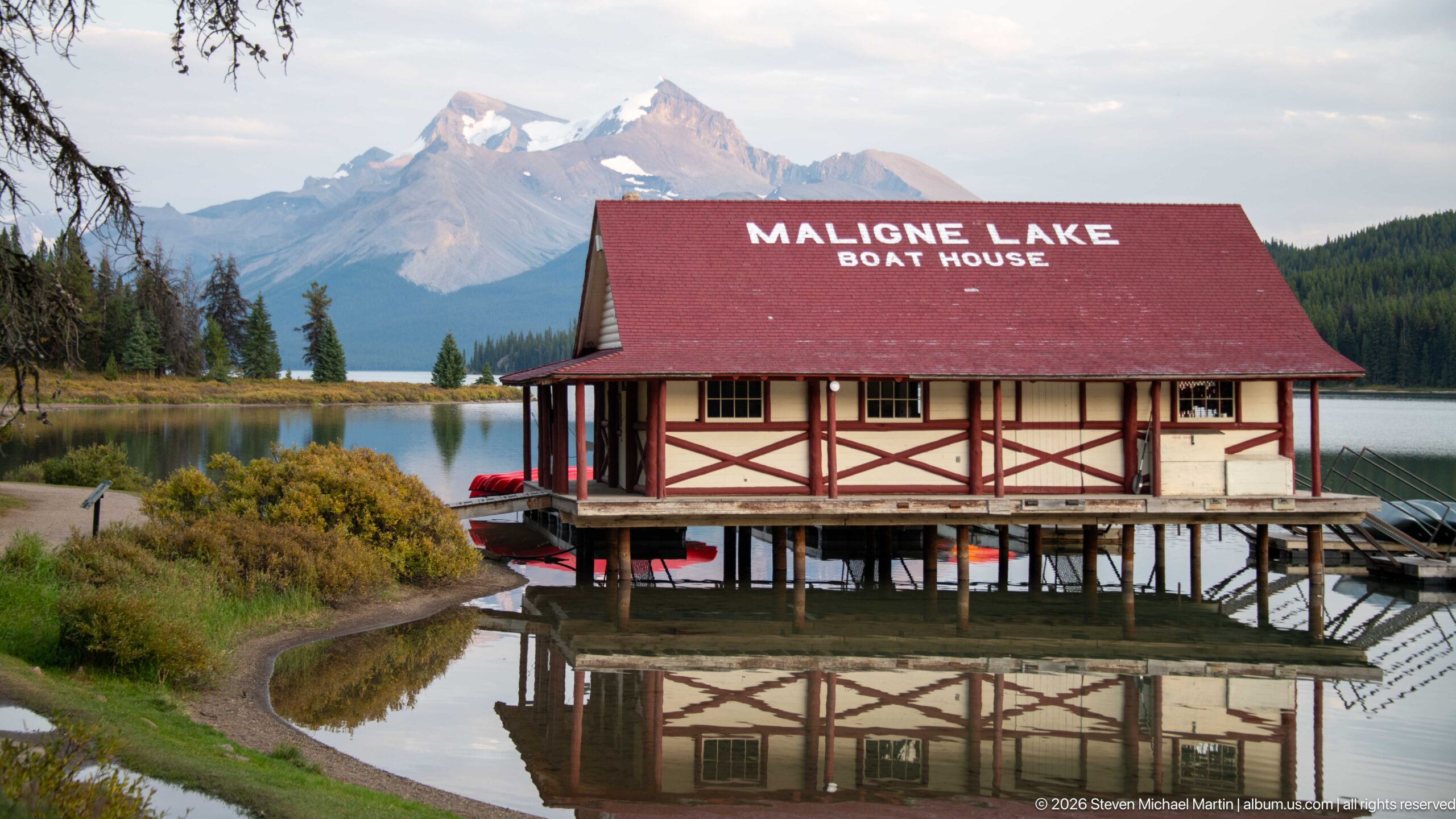
The Maligne Lake Boathouse fills the frame from across a narrow inlet, with its name painted prominently across the steep red roof. Cream walls, dark red timber trim, waterside pilings, and adjacent docks are mirrored in the still surface. The close architectural view establishes the identity of the lakeshore building while mountains and forest remain visible behind it.
Caption
The Maligne Lake Boathouse fills the frame from across a narrow inlet, with its name painted prominently across the steep red roof. Cream walls, dark red timber trim, waterside pilings, and adjacent docks are mirrored in the still surface. The close architectural view establishes the identity of the lakeshore building while mountains and forest remain visible behind it.
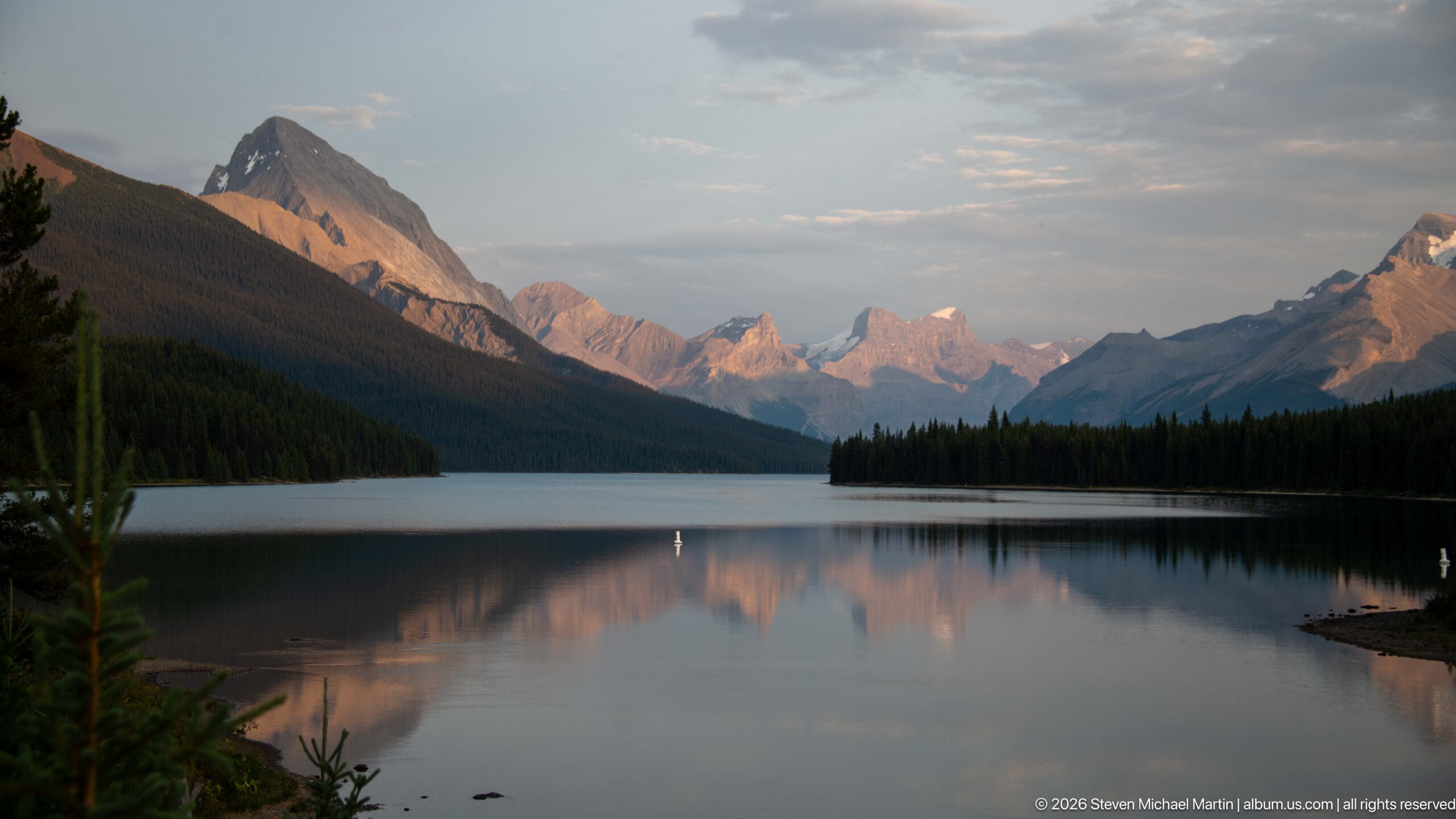
Warm late-day light touches the upper faces of the mountains beyond Maligne Lake while the lower valley settles into shadow. A dark conifer peninsula projects into the calm water and the mountain forms repeat in a broad reflection. The long lake axis and enclosing relief create a spacious view of the north-end landscape without requiring identification of individual peaks.
Caption
Warm late-day light touches the upper faces of the mountains beyond Maligne Lake while the lower valley settles into shadow. A dark conifer peninsula projects into the calm water and the mountain forms repeat in a broad reflection. The long lake axis and enclosing relief create a spacious view of the north-end landscape without requiring identification of individual peaks.
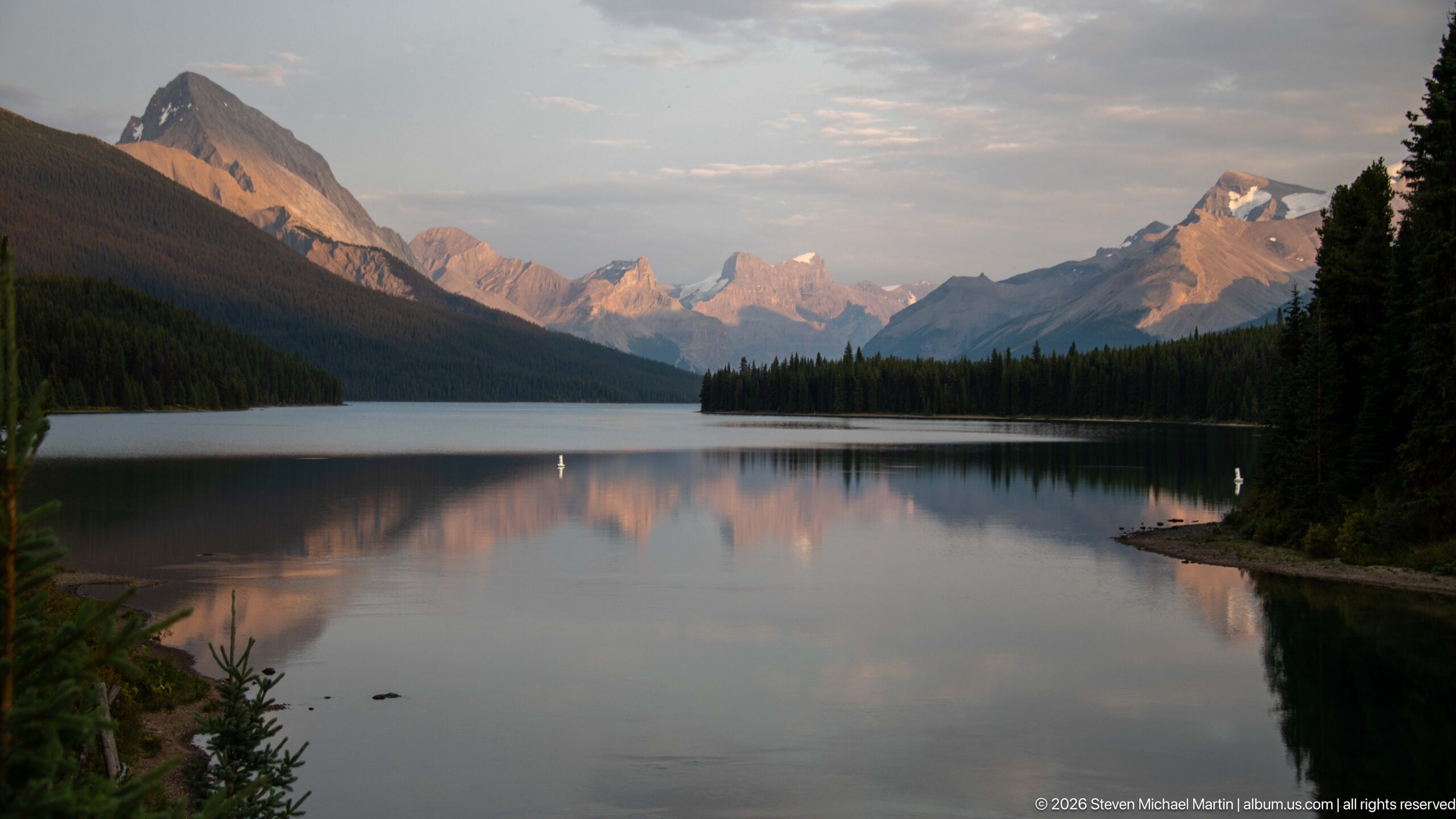
A forested peninsula divides the still surface of Maligne Lake beneath layered peaks catching the last warm light of the day. Reflections soften the boundary between water and mountains, while dark trees at the right edge frame the view. Compared with the preceding wider composition, this frame centers the peninsula and the distant mountain corridor more tightly.
Caption
A forested peninsula divides the still surface of Maligne Lake beneath layered peaks catching the last warm light of the day. Reflections soften the boundary between water and mountains, while dark trees at the right edge frame the view. Compared with the preceding wider composition, this frame centers the peninsula and the distant mountain corridor more tightly.
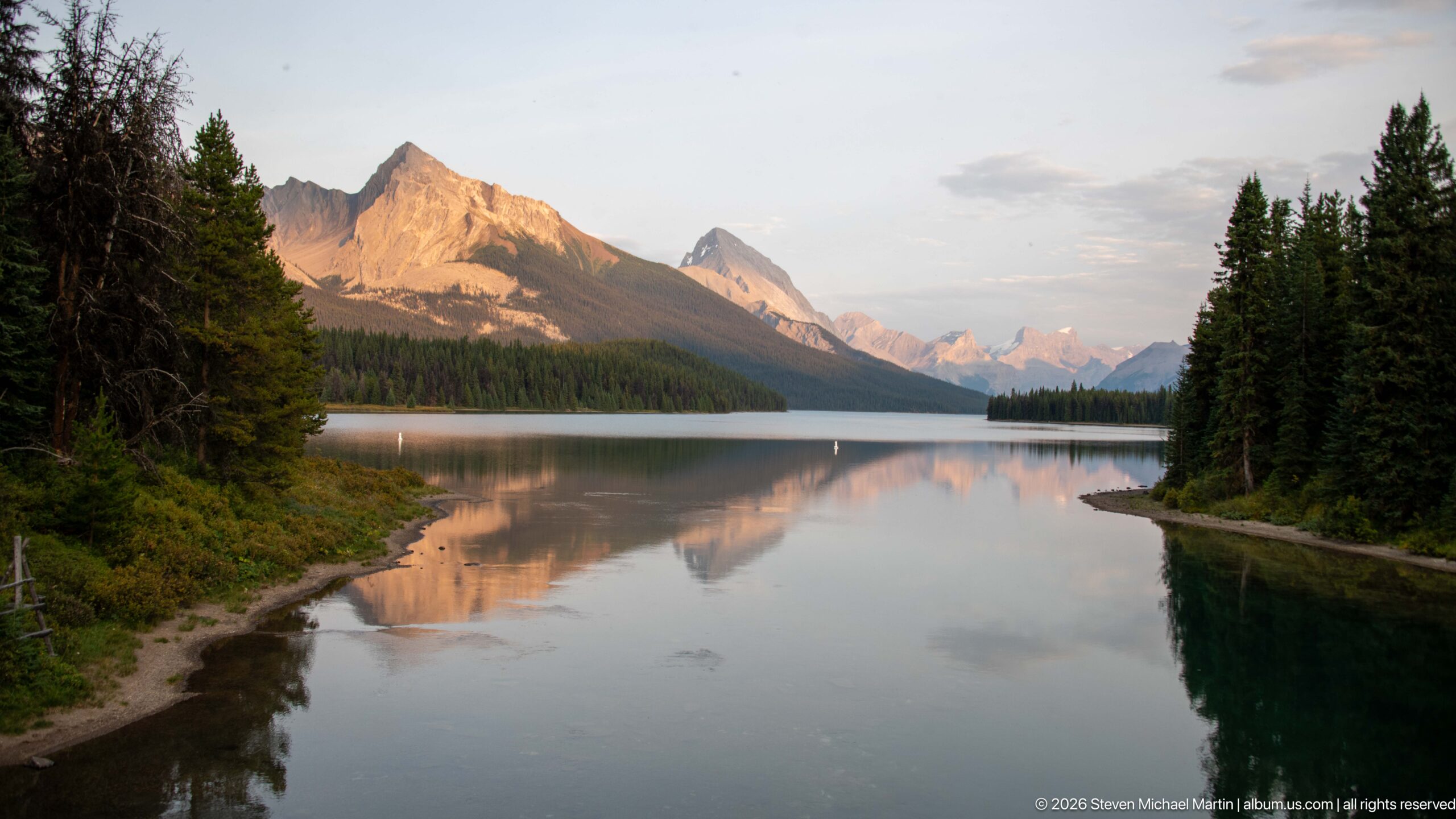
A sheltered curve of shoreline leads into Maligne Lake, where a sunlit mountain face and its reflection dominate the center of the composition. Conifer forest encloses both sides of the water, and a narrow pale shore traces the right edge. The elevated viewpoint uses the inlet as a foreground frame for the larger lake and mountain landscape beyond.
Caption
A sheltered curve of shoreline leads into Maligne Lake, where a sunlit mountain face and its reflection dominate the center of the composition. Conifer forest encloses both sides of the water, and a narrow pale shore traces the right edge. The elevated viewpoint uses the inlet as a foreground frame for the larger lake and mountain landscape beyond.
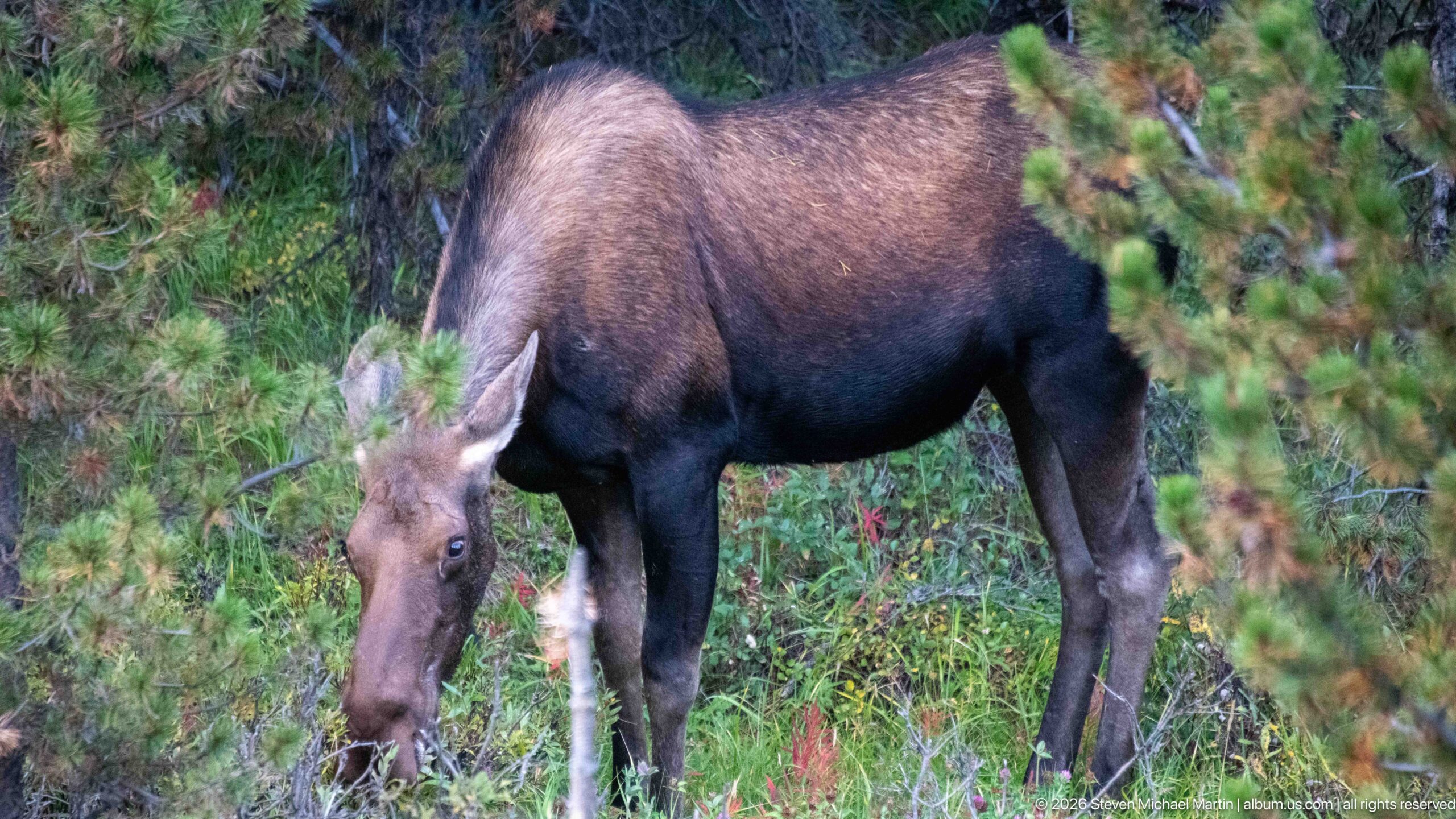
A moose lowers its long muzzle into low vegetation at the edge of a conifer forest in the Maligne Valley. The large body, long legs, oversized ears, dark brown coat, and elongated head are clearly visible through the surrounding shrubs. The feeding posture places the animal within dense roadside or forest-edge habitat rather than isolating it as a studio-like wildlife portrait.
Caption
A moose lowers its long muzzle into low vegetation at the edge of a conifer forest in the Maligne Valley. The large body, long legs, oversized ears, dark brown coat, and elongated head are clearly visible through the surrounding shrubs. The feeding posture places the animal within dense roadside or forest-edge habitat rather than isolating it as a studio-like wildlife portrait.
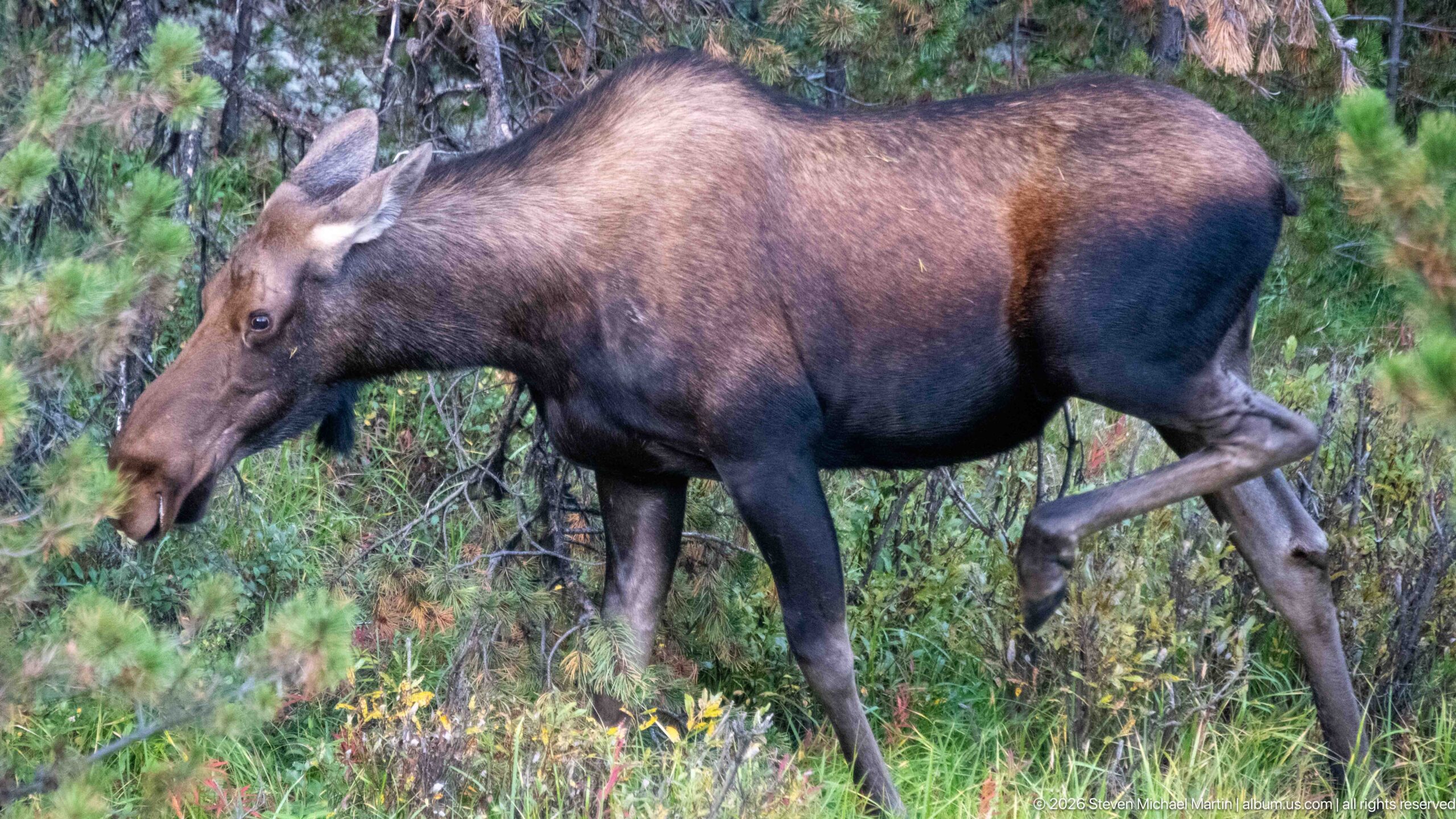
A moose strides through low forest vegetation in side profile, its elongated muzzle, high shoulders, and long legs sharply outlined against the green understory. One foreleg is extended in mid-step, shifting the emphasis from feeding to movement. Young conifers and shrubs partly surround the animal, retaining the wooded habitat context of the encounter.
Caption
A moose strides through low forest vegetation in side profile, its elongated muzzle, high shoulders, and long legs sharply outlined against the green understory. One foreleg is extended in mid-step, shifting the emphasis from feeding to movement. Young conifers and shrubs partly surround the animal, retaining the wooded habitat context of the encounter.
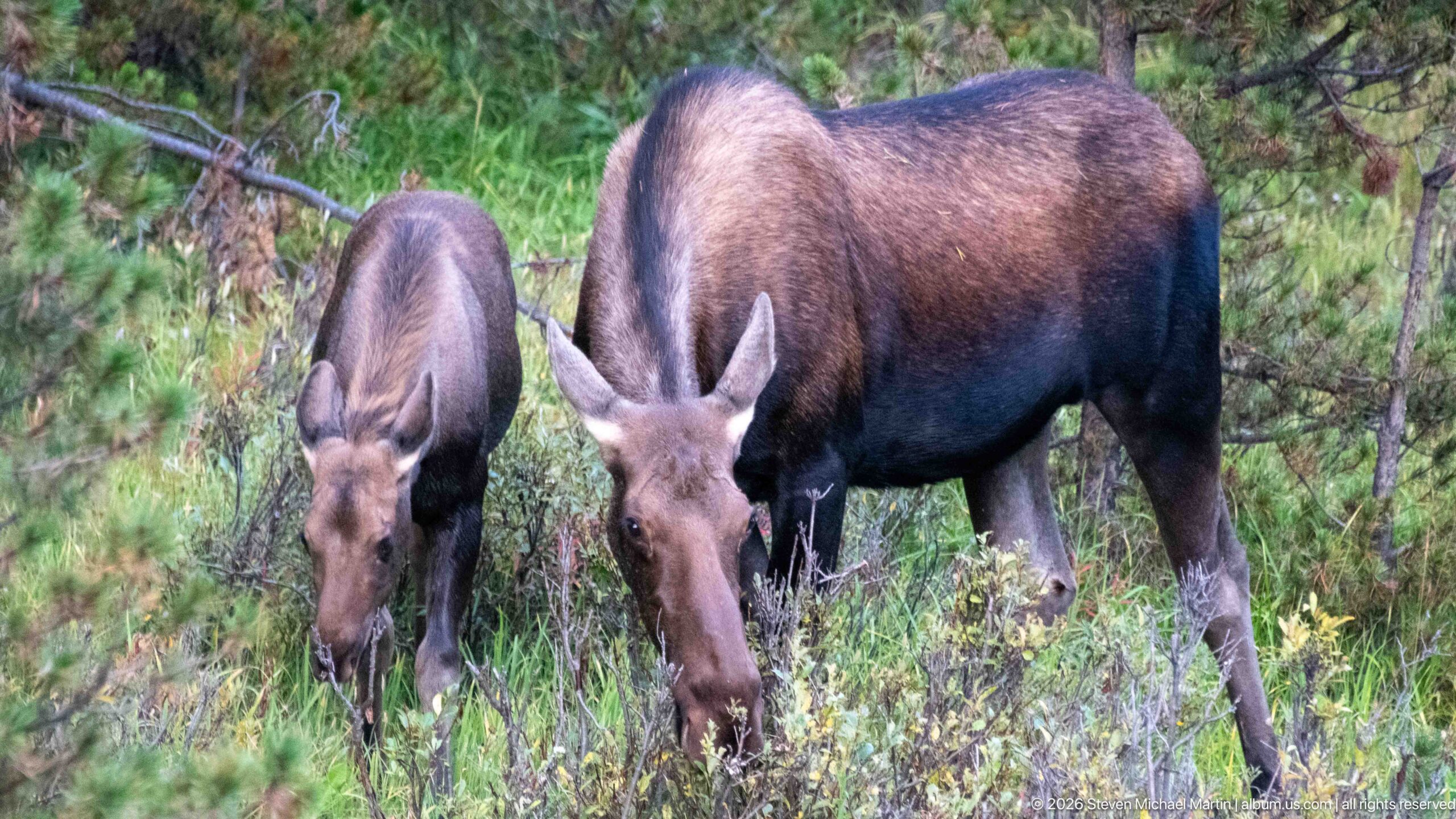
Two moose feed side by side among shrubs and young conifers, with the larger animal occupying the foreground and a smaller individual just behind. Both lower their heads toward the vegetation, allowing direct comparison of body size and proportions. The paired composition documents shared use of the same forest-edge feeding area without asserting a specific family relationship.
Caption
Two moose feed side by side among shrubs and young conifers, with the larger animal occupying the foreground and a smaller individual just behind. Both lower their heads toward the vegetation, allowing direct comparison of body size and proportions. The paired composition documents shared use of the same forest-edge feeding area without asserting a specific family relationship.
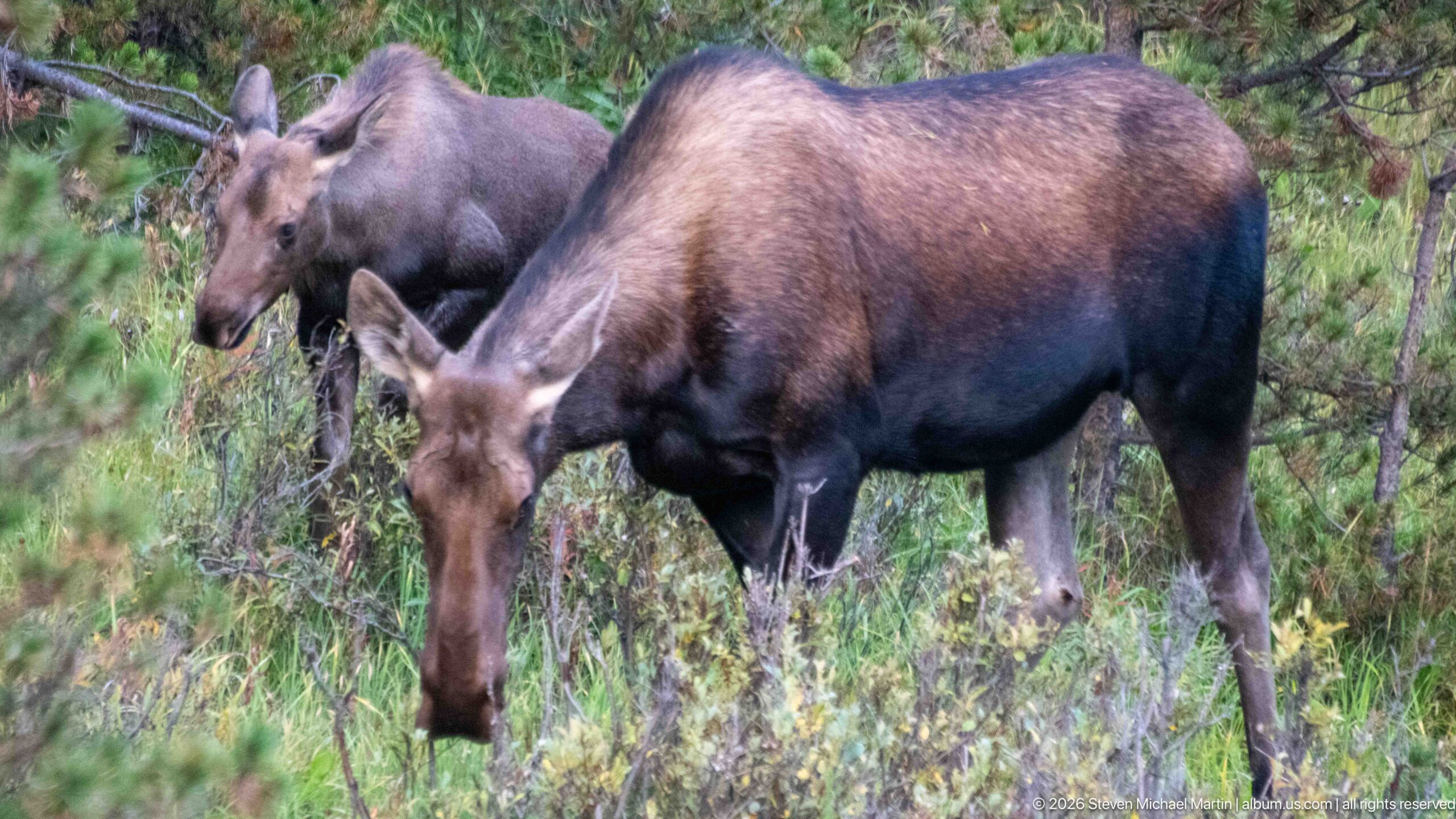
A large moose stands broadside among grasses and shrubs while a second moose is partly visible behind its shoulders. The foreground animal's long face, large ears, dark coat, and heavy torso are clearly rendered against a mixed conifer backdrop. This tighter frame shifts attention from the pair to the physical proportions of the nearer animal.
Caption
A large moose stands broadside among grasses and shrubs while a second moose is partly visible behind its shoulders. The foreground animal's long face, large ears, dark coat, and heavy torso are clearly rendered against a mixed conifer backdrop. This tighter frame shifts attention from the pair to the physical proportions of the nearer animal.
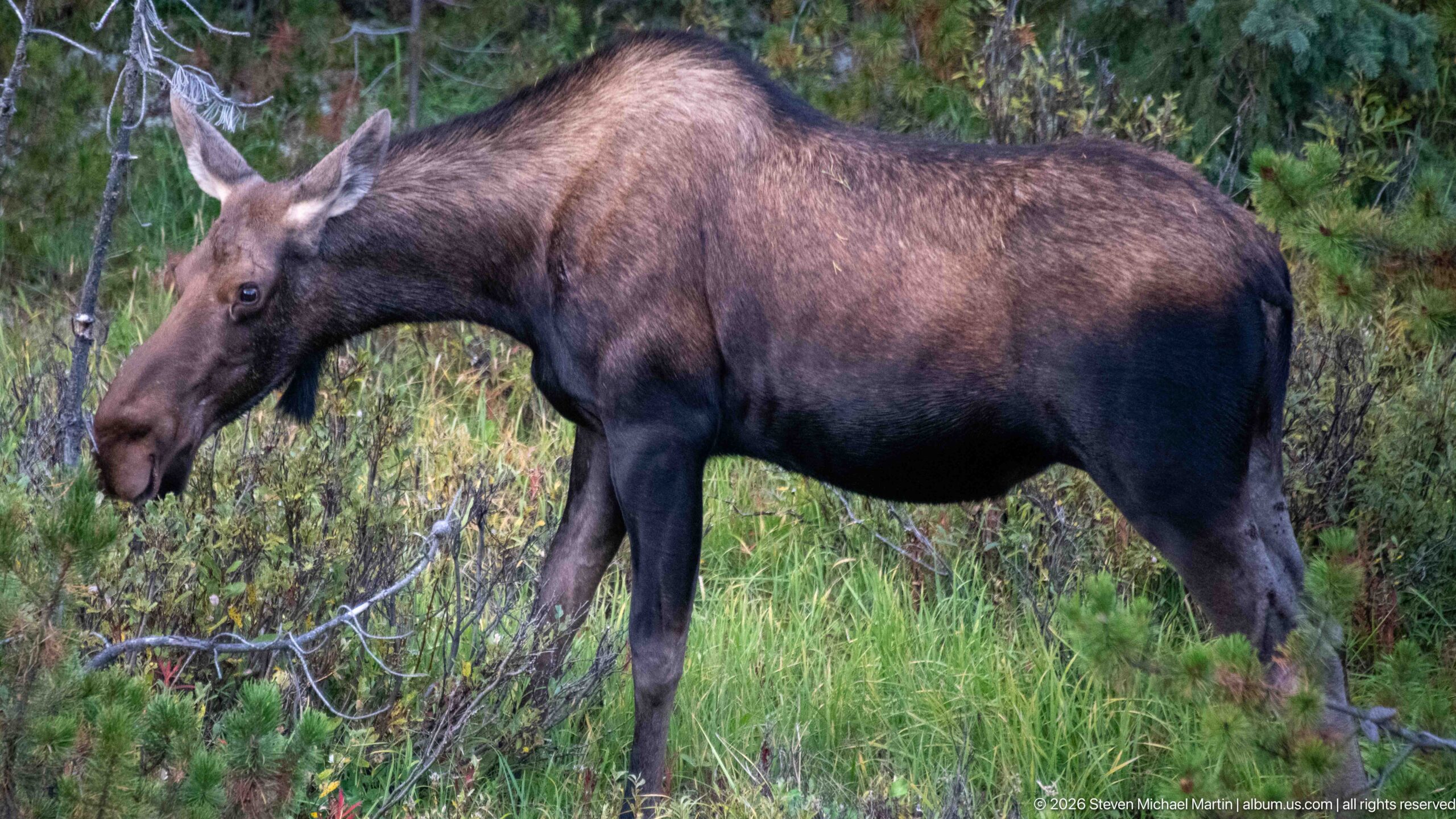
A moose reaches its muzzle toward leafy shrubs at the edge of a conifer stand, presented in a clean side profile. The animal's dark torso, long legs, prominent ears, and elongated face contrast with the bright grasses below. Its head position and contact with the vegetation make browsing the central visible action in this frame.
Caption
A moose reaches its muzzle toward leafy shrubs at the edge of a conifer stand, presented in a clean side profile. The animal's dark torso, long legs, prominent ears, and elongated face contrast with the bright grasses below. Its head position and contact with the vegetation make browsing the central visible action in this frame.
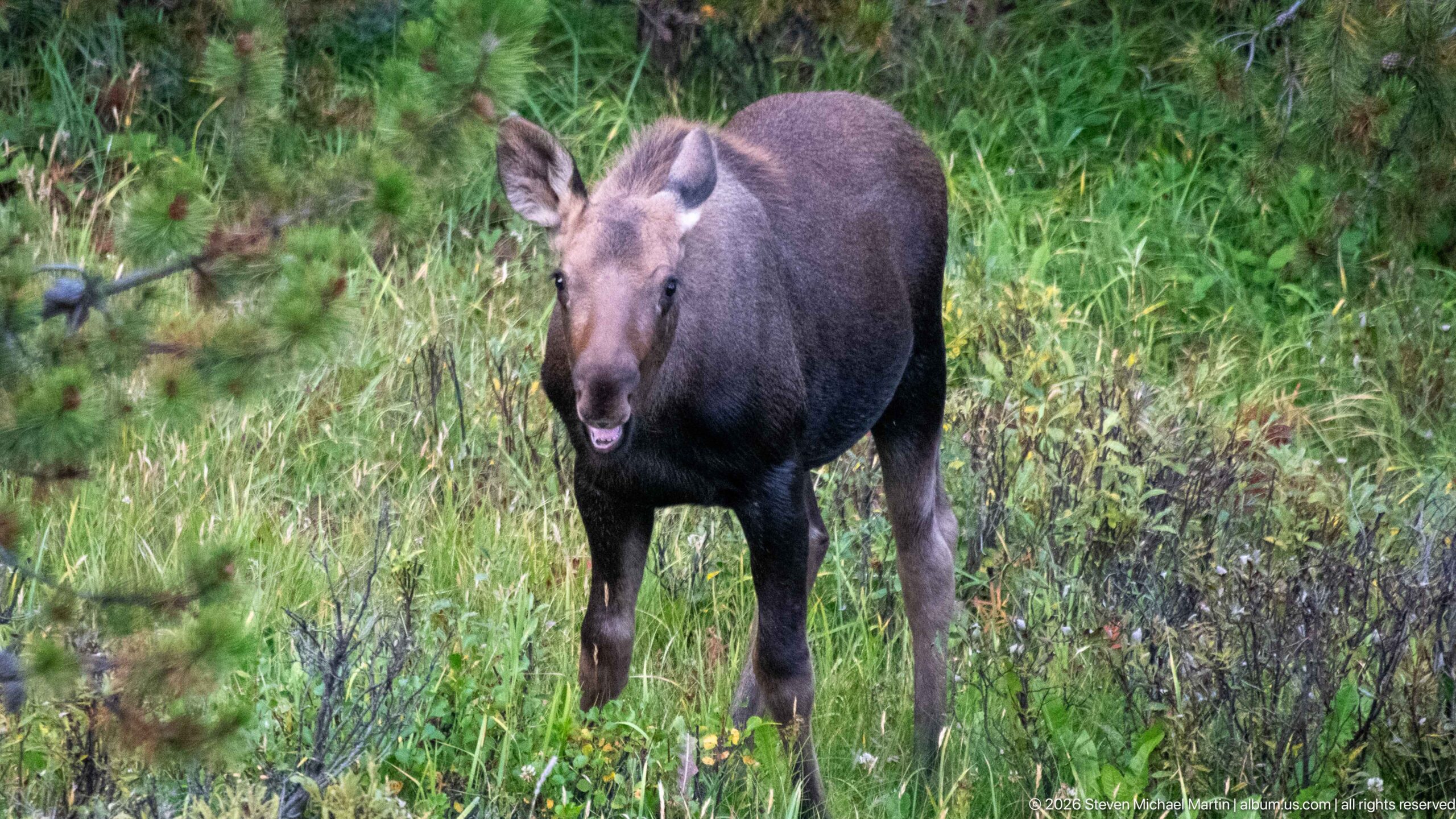
A moose faces nearly toward the camera while stepping through tall grass and low shrubs, giving an uncommon frontal view of its long muzzle and widely set ears. The dark chest and long forelegs emerge clearly from the green understory. Its open mouth adds a momentary expression without establishing a specific vocalization or behavior beyond movement through the vegetation.
Caption
A moose faces nearly toward the camera while stepping through tall grass and low shrubs, giving an uncommon frontal view of its long muzzle and widely set ears. The dark chest and long forelegs emerge clearly from the green understory. Its open mouth adds a momentary expression without establishing a specific vocalization or behavior beyond movement through the vegetation.
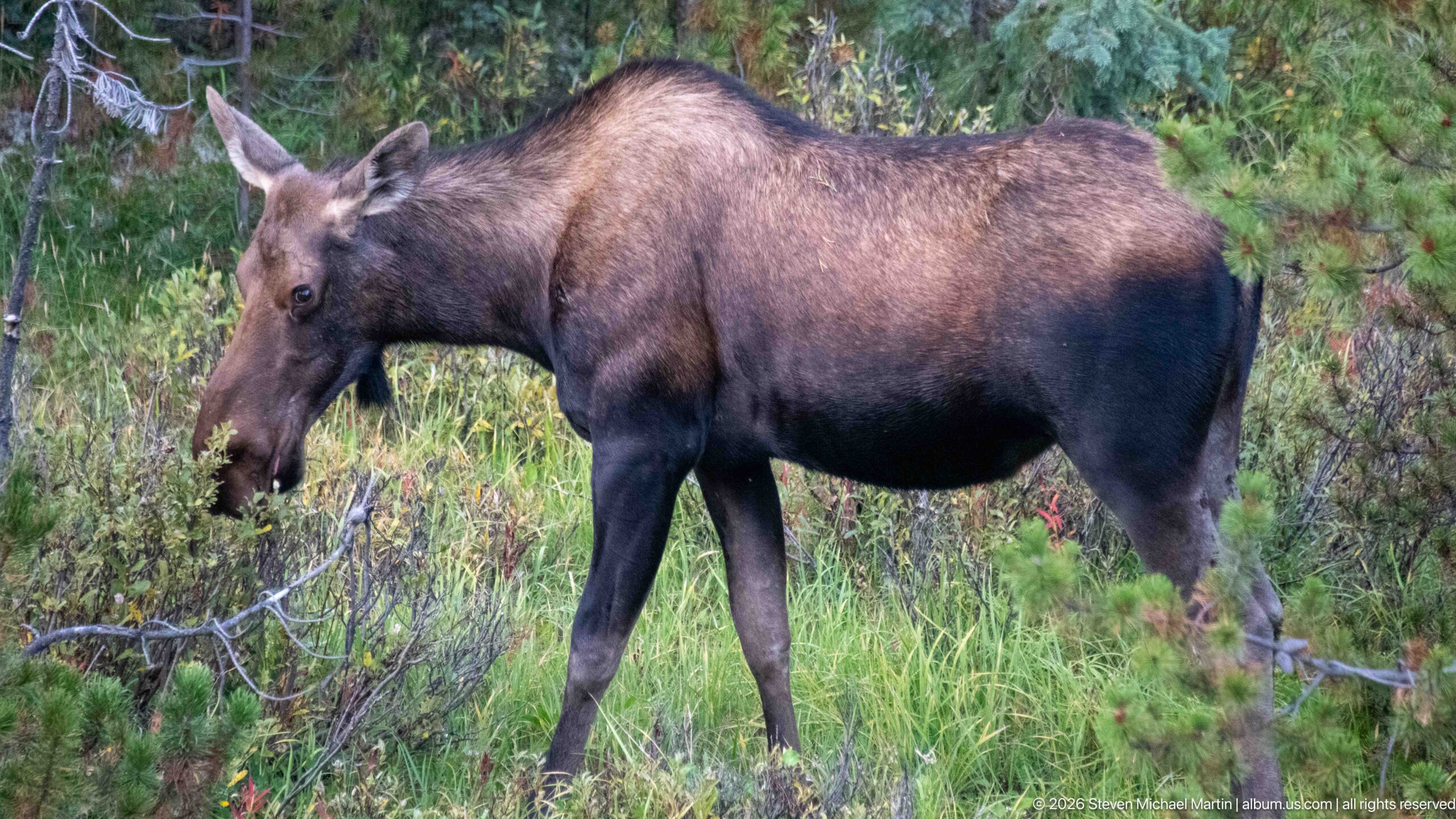
A moose pauses in side profile with its muzzle buried in low shrubs, surrounded by grasses and young conifers. The broad torso and long legs fill most of the frame, while the animal's head remains low in a feeding position. This view emphasizes the scale of the moose relative to the dense understory around it.
Caption
A moose pauses in side profile with its muzzle buried in low shrubs, surrounded by grasses and young conifers. The broad torso and long legs fill most of the frame, while the animal's head remains low in a feeding position. This view emphasizes the scale of the moose relative to the dense understory around it.
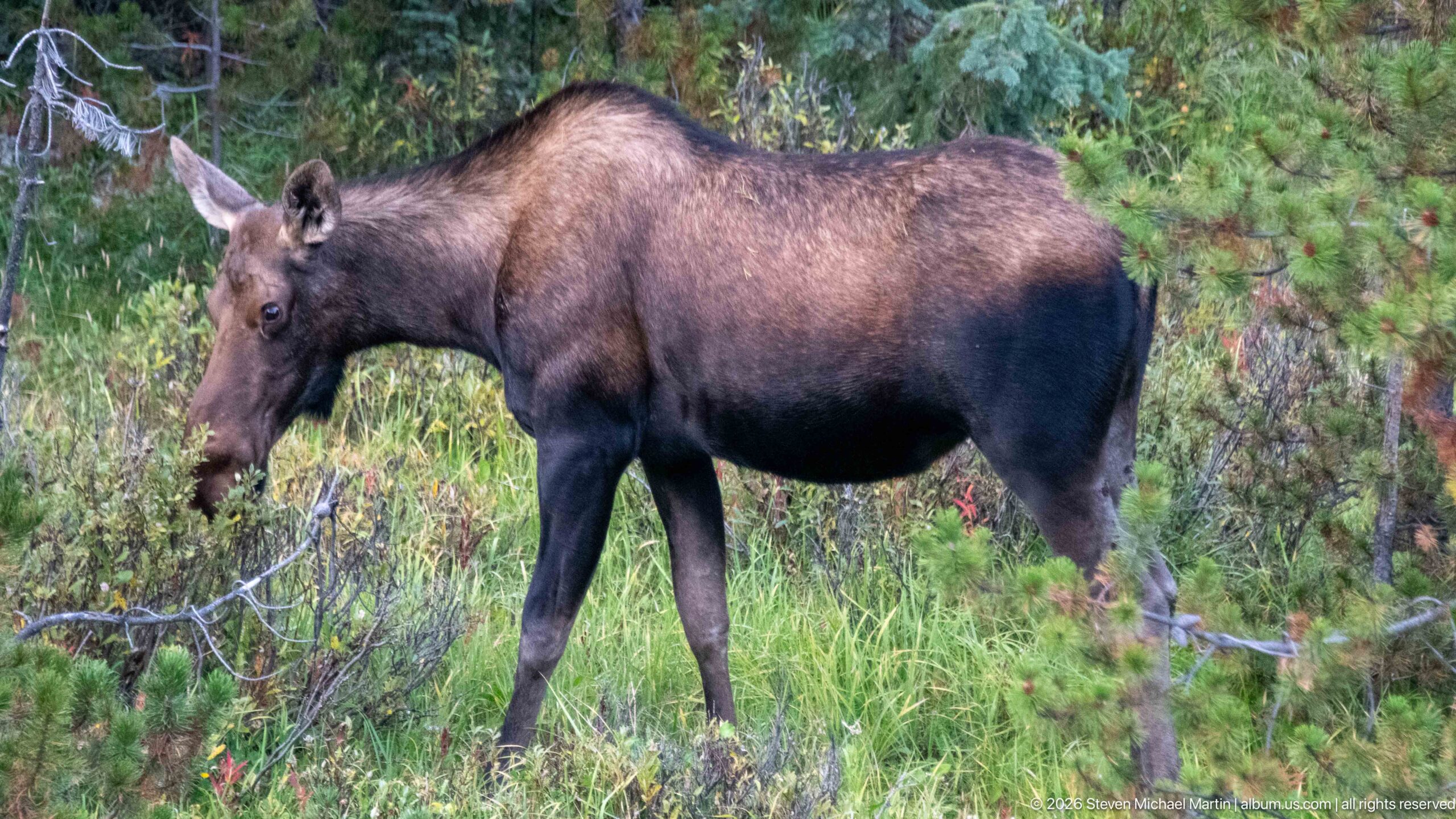
A broadside moose feeds among shrubs at the forest edge, its long muzzle angled down and one large ear turned outward. Brown highlights across the shoulder and back stand out against the darker lower body. The close framing preserves enough spruce and pine vegetation to connect the animal to its wooded Maligne Valley habitat.
Caption
A broadside moose feeds among shrubs at the forest edge, its long muzzle angled down and one large ear turned outward. Brown highlights across the shoulder and back stand out against the darker lower body. The close framing preserves enough spruce and pine vegetation to connect the animal to its wooded Maligne Valley habitat.
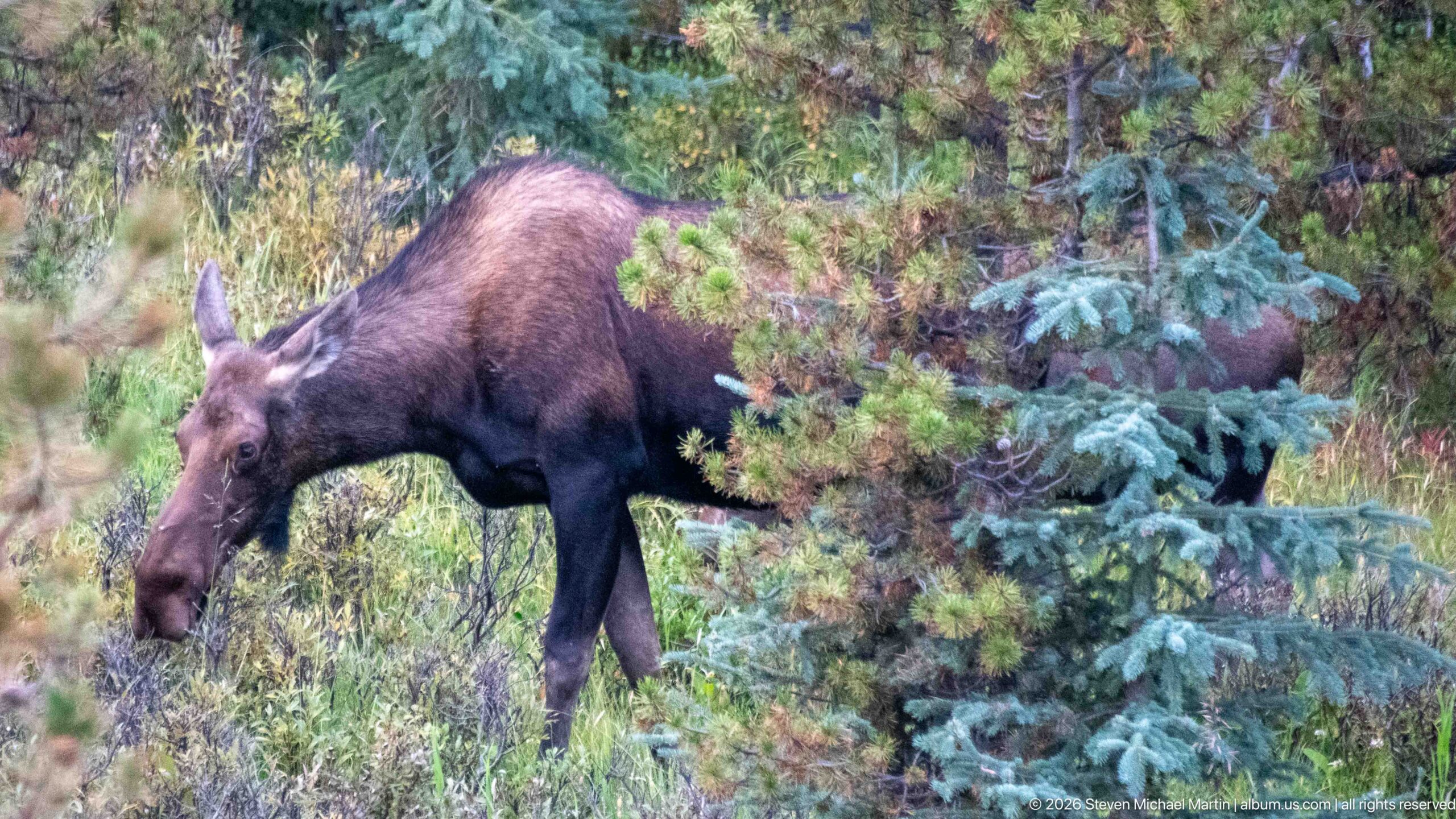
A moose browses along the forest edge while young conifer branches partly screen its torso. Its head and long muzzle remain unobstructed at left, and the dark body continues behind blue-green spruce foliage. The layered vegetation makes this frame especially useful for showing how a large animal can remain partly concealed within dense roadside woodland.
Caption
A moose browses along the forest edge while young conifer branches partly screen its torso. Its head and long muzzle remain unobstructed at left, and the dark body continues behind blue-green spruce foliage. The layered vegetation makes this frame especially useful for showing how a large animal can remain partly concealed within dense roadside woodland.
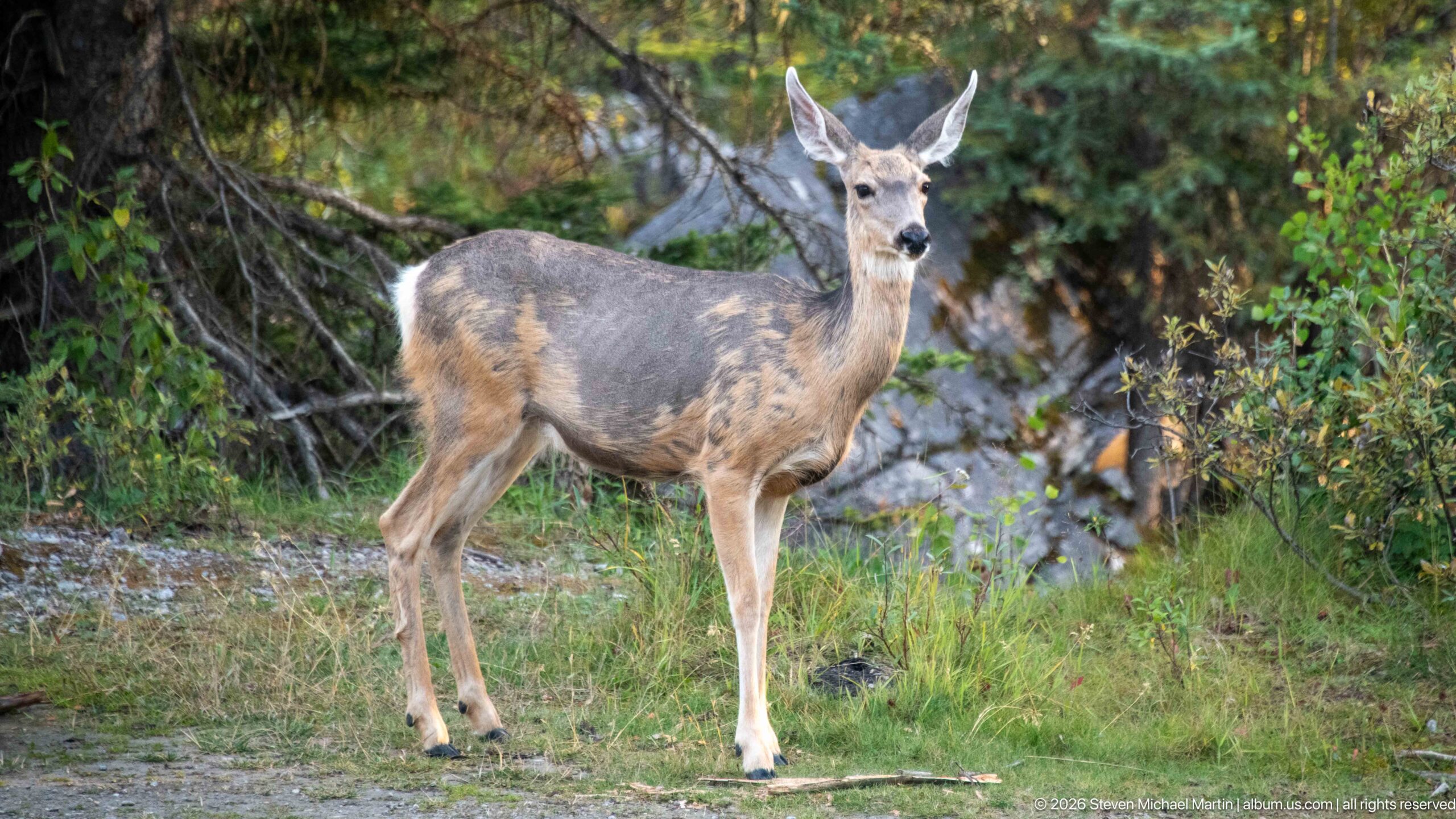
A mule deer stands alert at the edge of mixed forest and grass, facing the camera with its oversized ears held upright. The gray-brown coat is mottled by seasonal shedding, while the pale muzzle, slender legs, and large ears distinguish the deer from the moose in the preceding sequence. The full-body stance provides a clear study of form and coat condition.
Caption
A mule deer stands alert at the edge of mixed forest and grass, facing the camera with its oversized ears held upright. The gray-brown coat is mottled by seasonal shedding, while the pale muzzle, slender legs, and large ears distinguish the deer from the moose in the preceding sequence. The full-body stance provides a clear study of form and coat condition.
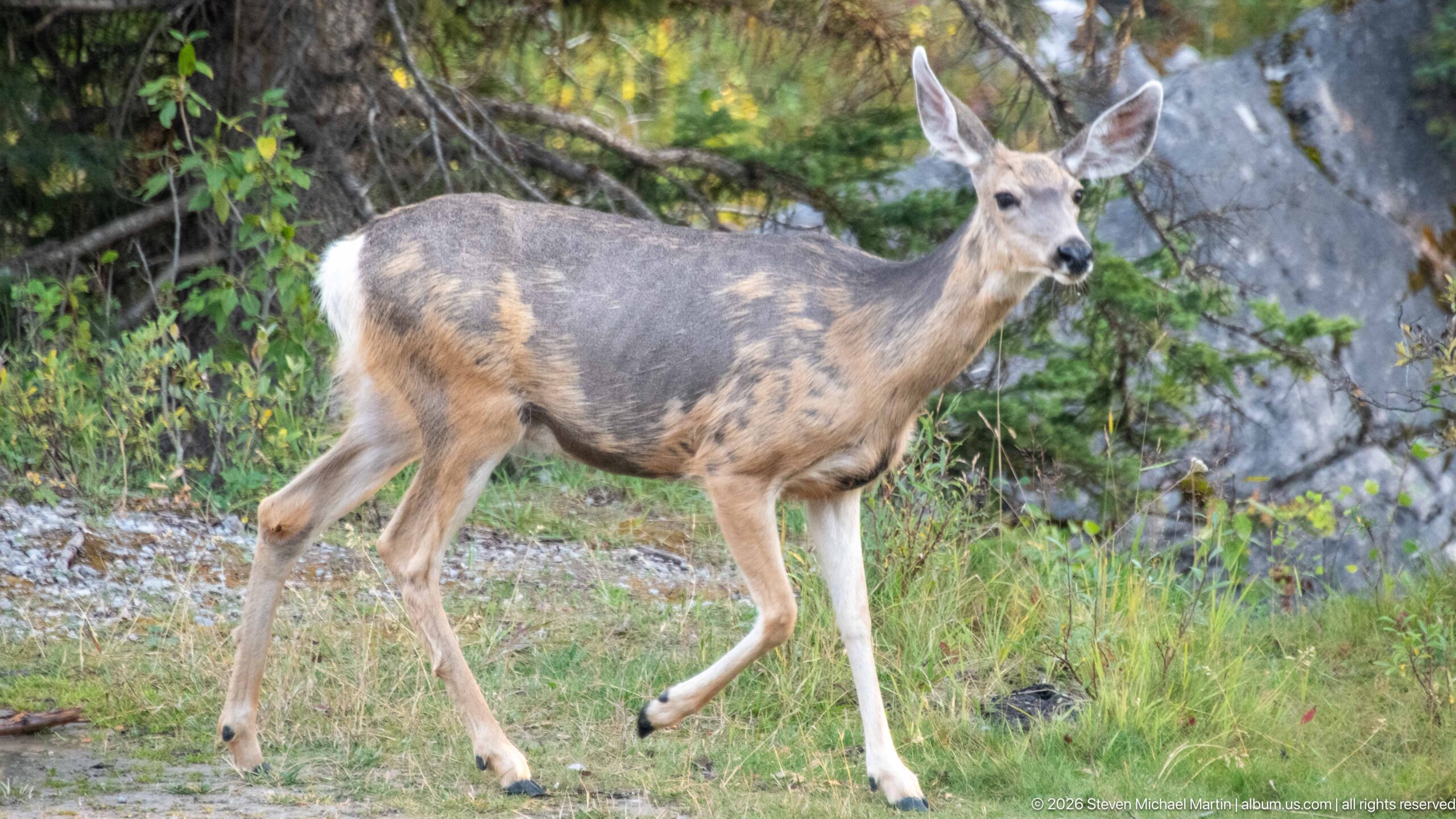
A mule deer crosses the forest-edge clearing in mid-step, its large ears upright and patchy gray-brown coat revealing active seasonal shedding. The side view shows the animal's slender legs, narrow face, and compact deer proportions clearly. Compared with the preceding standing portrait, this frame emphasizes movement and the uneven texture of the changing coat.
Caption
A mule deer crosses the forest-edge clearing in mid-step, its large ears upright and patchy gray-brown coat revealing active seasonal shedding. The side view shows the animal's slender legs, narrow face, and compact deer proportions clearly. Compared with the preceding standing portrait, this frame emphasizes movement and the uneven texture of the changing coat.
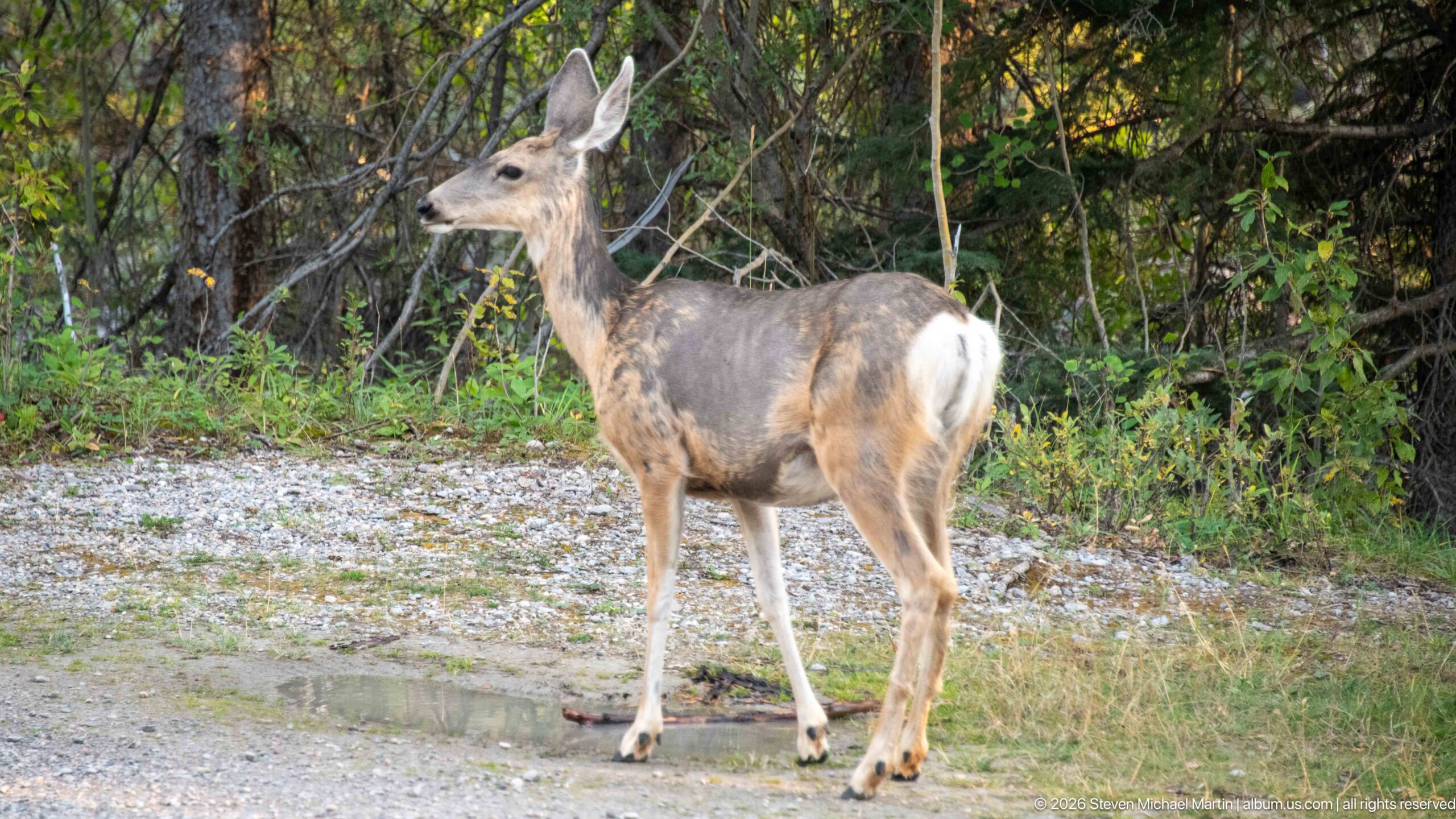
A mule deer pauses in a rear three-quarter stance at the forest edge, turning its head left while exposing a conspicuous pale rump. Large ears, slender legs, and the gray-brown shedding coat remain visible from this angle. The change in viewpoint highlights field marks that are less apparent in the frontal and side-profile frames nearby.
Caption
A mule deer pauses in a rear three-quarter stance at the forest edge, turning its head left while exposing a conspicuous pale rump. Large ears, slender legs, and the gray-brown shedding coat remain visible from this angle. The change in viewpoint highlights field marks that are less apparent in the frontal and side-profile frames nearby.
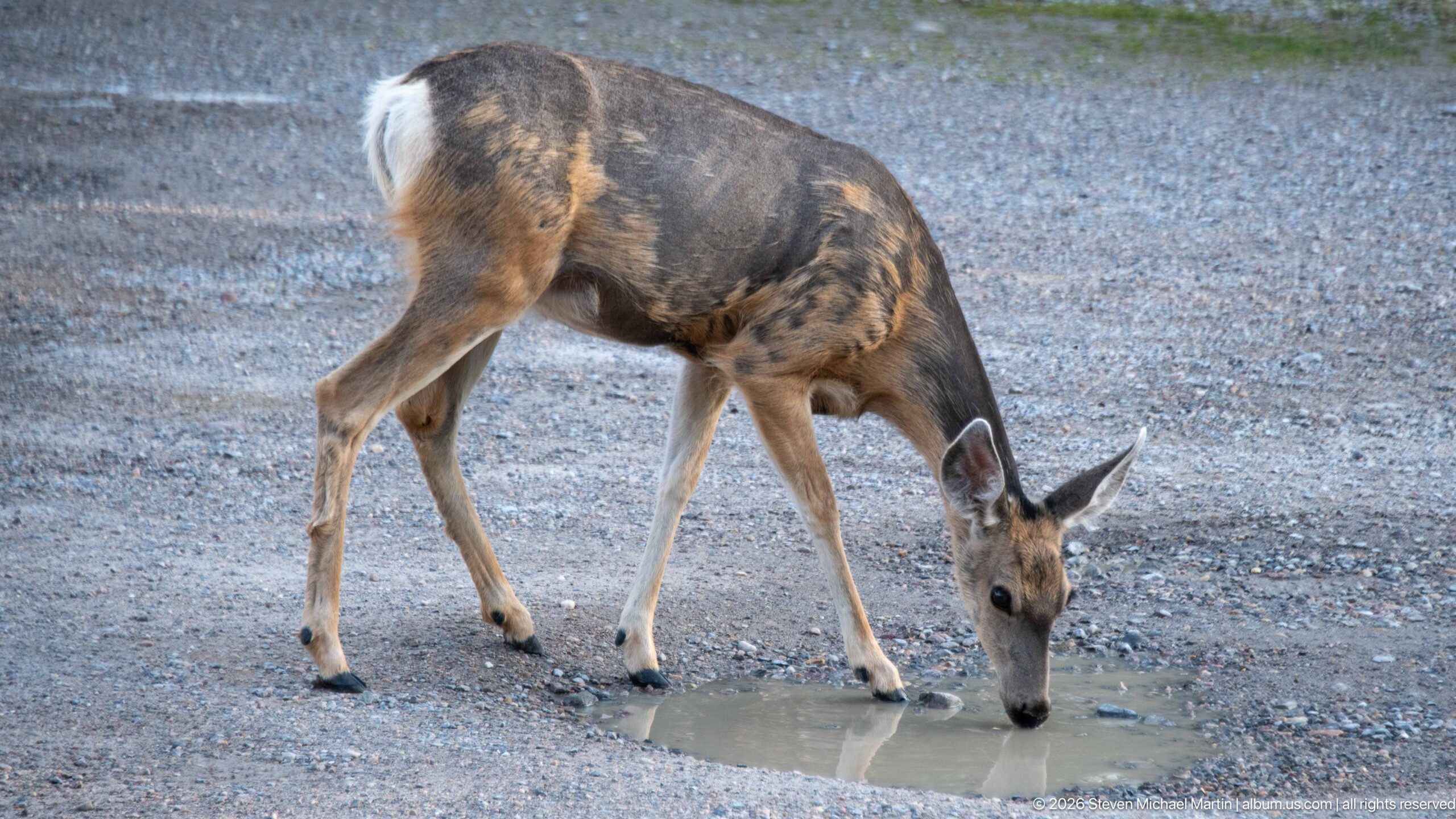
A mule deer lowers its head to drink from a shallow puddle on a gravel surface, its muzzle touching the water and producing a small reflection. The patchy shedding coat, large ears, and slender legs remain visible despite the downward posture. The sparse setting shifts the wildlife context from forest edge to a disturbed roadside or parking surface.
Caption
A mule deer lowers its head to drink from a shallow puddle on a gravel surface, its muzzle touching the water and producing a small reflection. The patchy shedding coat, large ears, and slender legs remain visible despite the downward posture. The sparse setting shifts the wildlife context from forest edge to a disturbed roadside or parking surface.
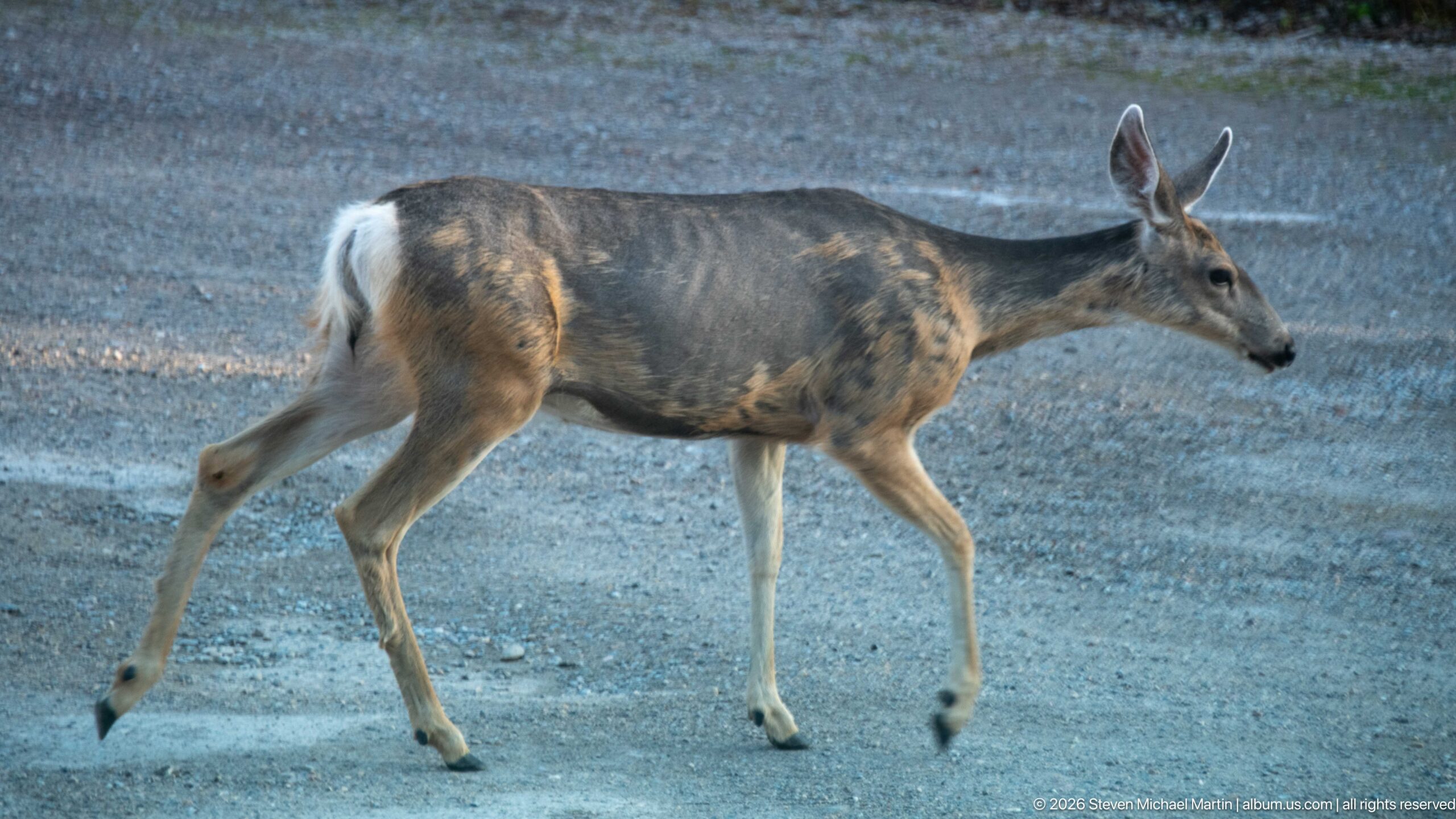
A mule deer walks across an open gravel surface in side profile, one hind leg extended as it moves toward the right edge of the frame. Its oversized ears, pale rump, slender legs, and patchy gray-brown coat remain prominent. The uncluttered background isolates the animal's gait and body proportions more strongly than the neighboring forest-edge views.
Caption
A mule deer walks across an open gravel surface in side profile, one hind leg extended as it moves toward the right edge of the frame. Its oversized ears, pale rump, slender legs, and patchy gray-brown coat remain prominent. The uncluttered background isolates the animal's gait and body proportions more strongly than the neighboring forest-edge views.
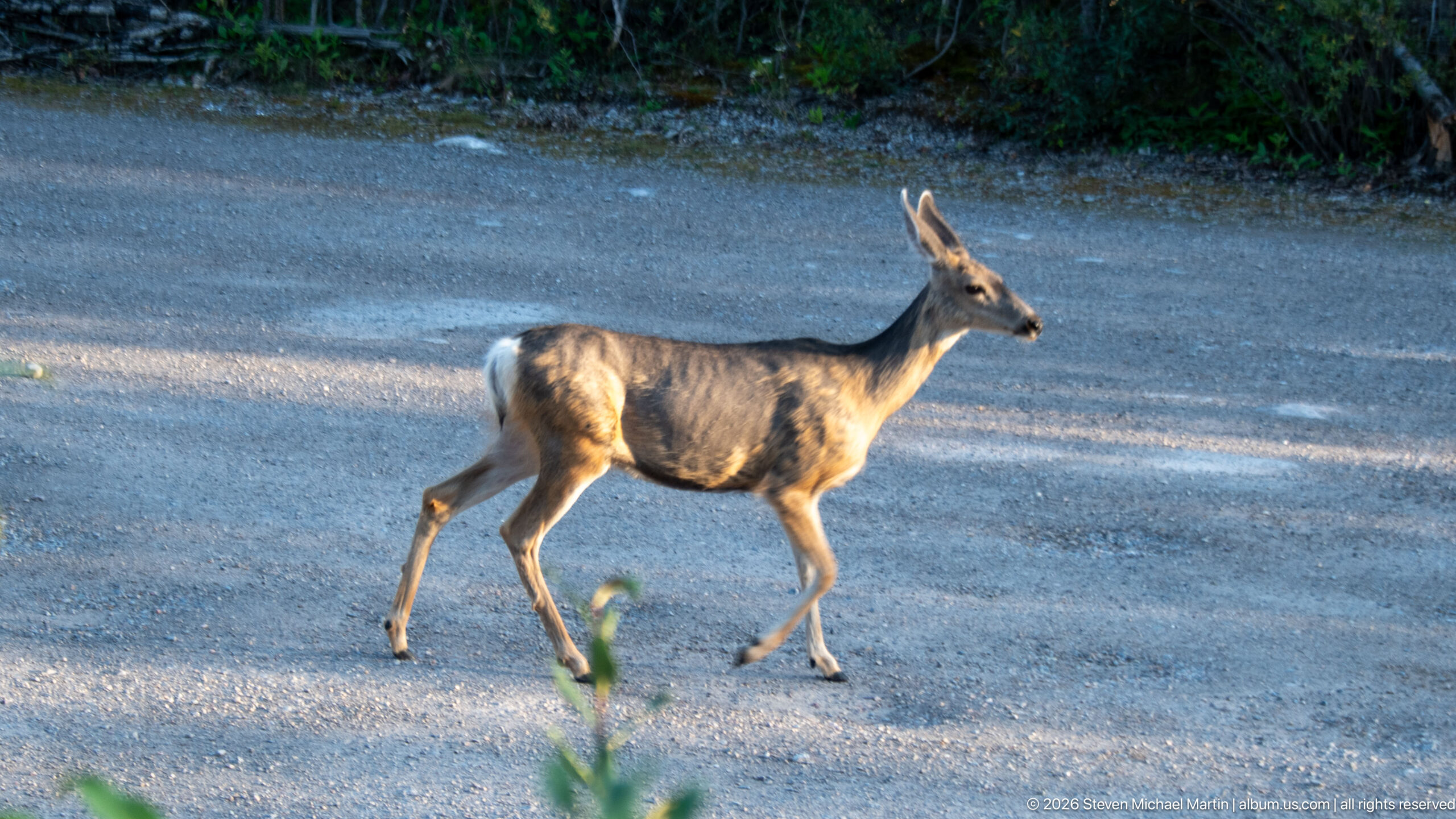
A mule deer crosses a gravel roadside corridor in the Maligne Valley, its large ears, slender build, and pale rump visible in profile. The open roadway contrasts with the dark forest edge, placing the animal within the developed travel corridor while retaining a clear view of its form and movement.
Caption
A mule deer crosses a gravel roadside corridor in the Maligne Valley, its large ears, slender build, and pale rump visible in profile. The open roadway contrasts with the dark forest edge, placing the animal within the developed travel corridor while retaining a clear view of its form and movement.
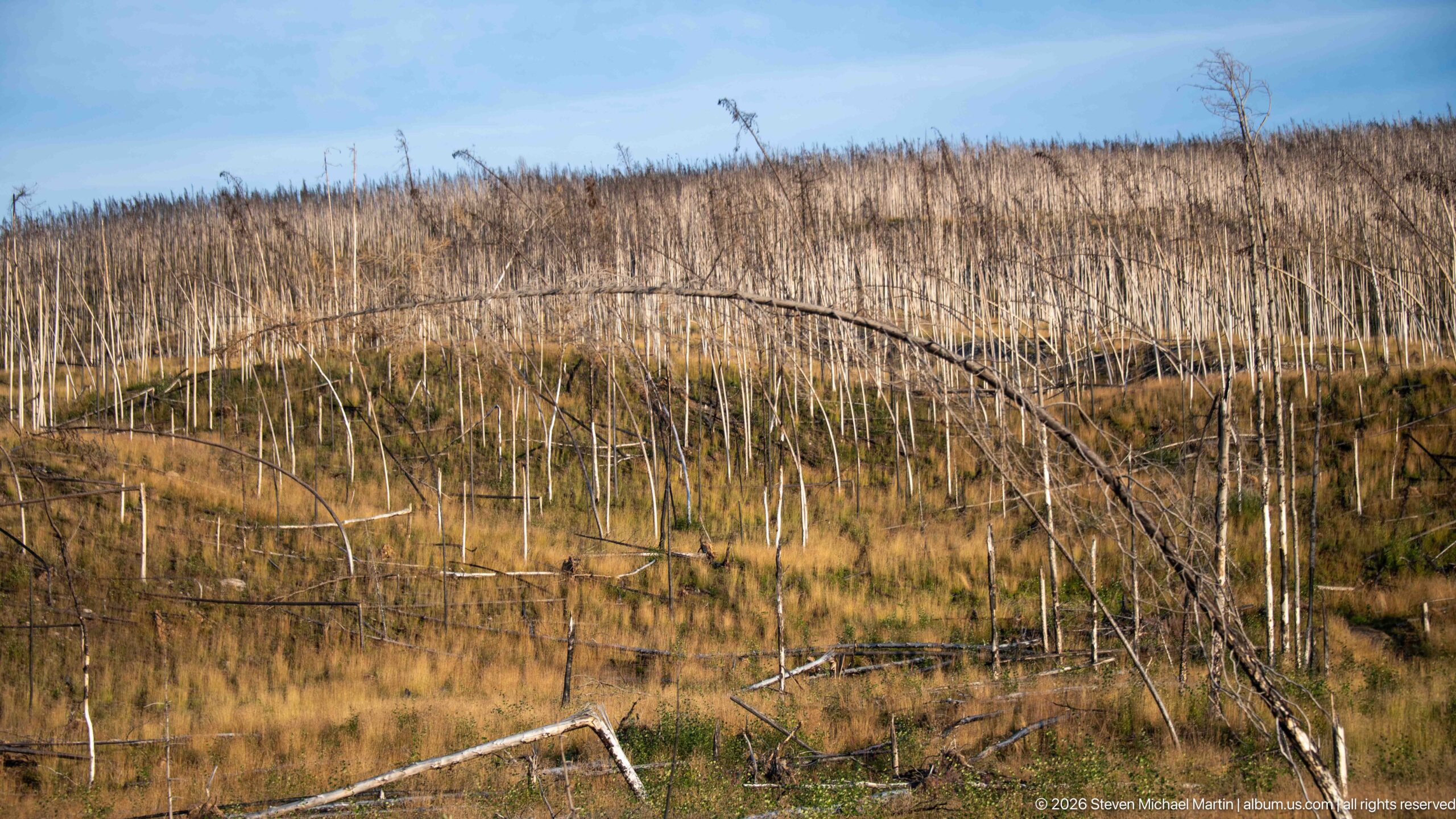
A broad slope of standing fire-killed trunks and fallen snags shows the lasting structure of a burned forest in the Maligne Valley. Grasses and low vegetation have recolonized the open ground, while scattered surviving or regenerating greenery introduces contrast across the sunlit hillside beneath a clear blue sky.
Caption
A broad slope of standing fire-killed trunks and fallen snags shows the lasting structure of a burned forest in the Maligne Valley. Grasses and low vegetation have recolonized the open ground, while scattered surviving or regenerating greenery introduces contrast across the sunlit hillside beneath a clear blue sky.
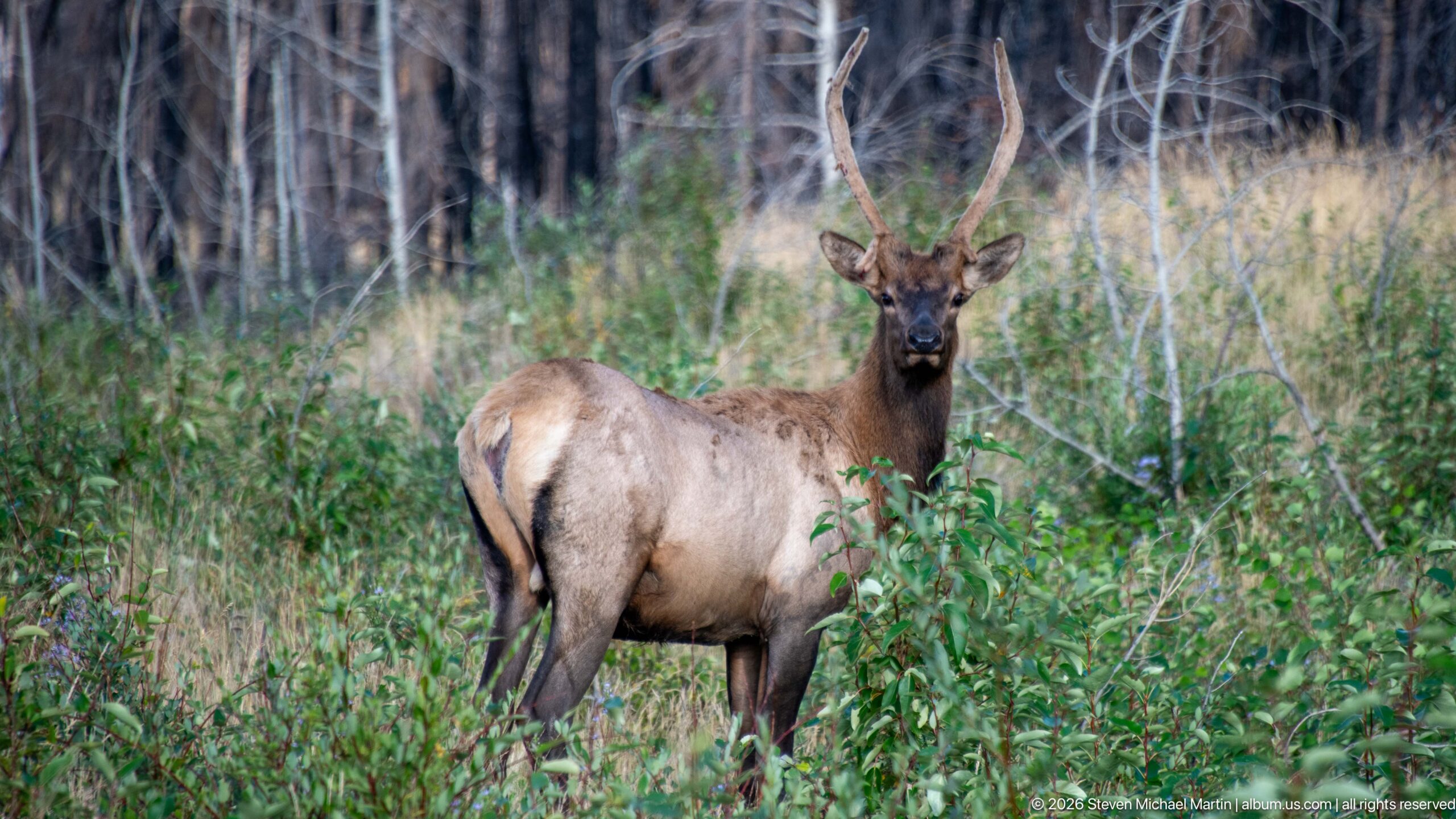
A young bull elk stands alert among shrubs and grasses at the edge of a fire-affected forest, facing the camera with developing antlers clearly visible. The mix of living understory and gray standing trunks provides habitat context while keeping the animal isolated as the principal subject.
Caption
A young bull elk stands alert among shrubs and grasses at the edge of a fire-affected forest, facing the camera with developing antlers clearly visible. The mix of living understory and gray standing trunks provides habitat context while keeping the animal isolated as the principal subject.
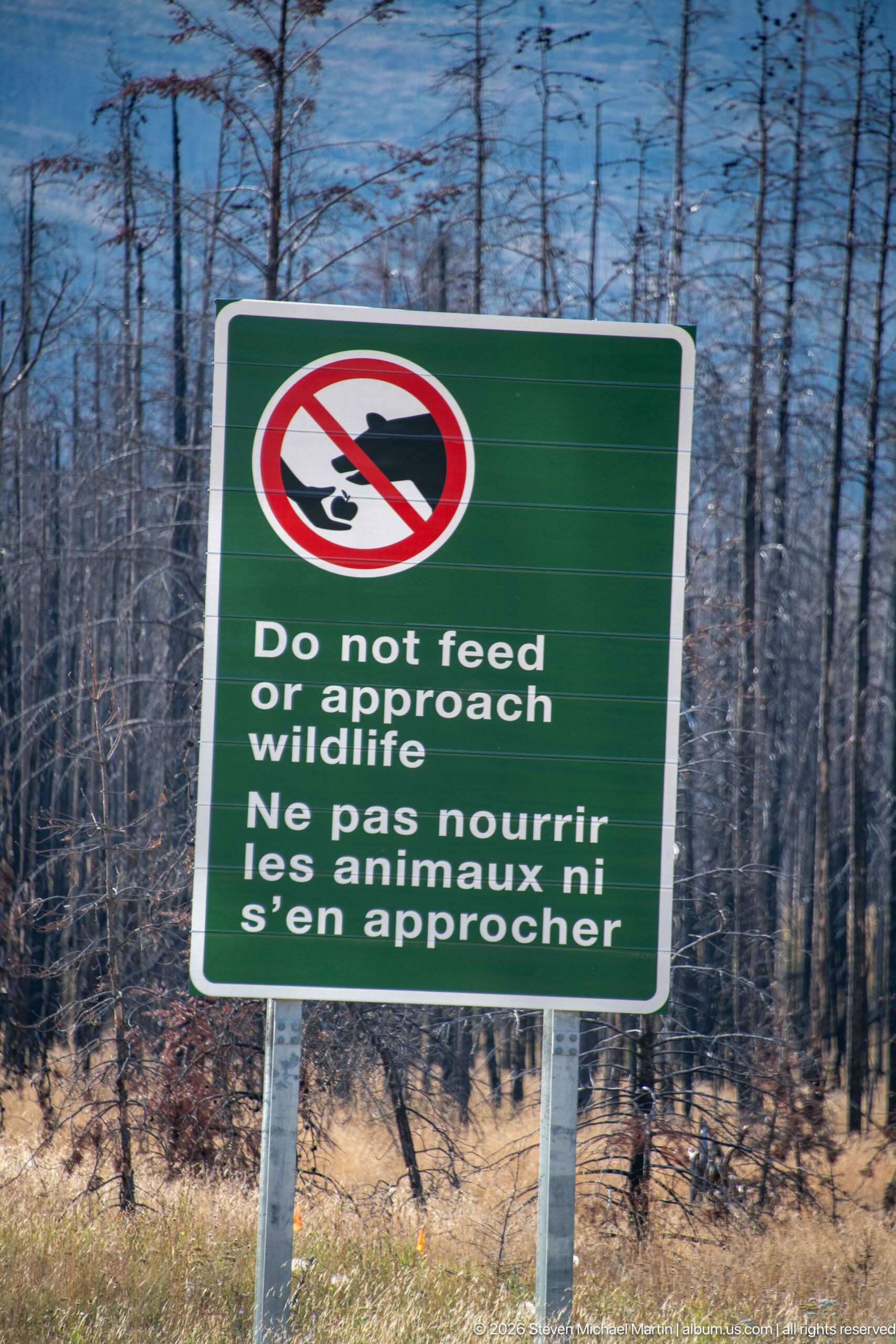
A bilingual Parks Canada roadside sign warns visitors not to feed or approach wildlife, using a crossed-out hand-and-animal pictogram above English and French text. The sign stands against a fire-affected forest, linking visitor behavior guidance directly to the wildlife corridor along the Maligne Valley road system.
Caption
A bilingual Parks Canada roadside sign warns visitors not to feed or approach wildlife, using a crossed-out hand-and-animal pictogram above English and French text. The sign stands against a fire-affected forest, linking visitor behavior guidance directly to the wildlife corridor along the Maligne Valley road system.
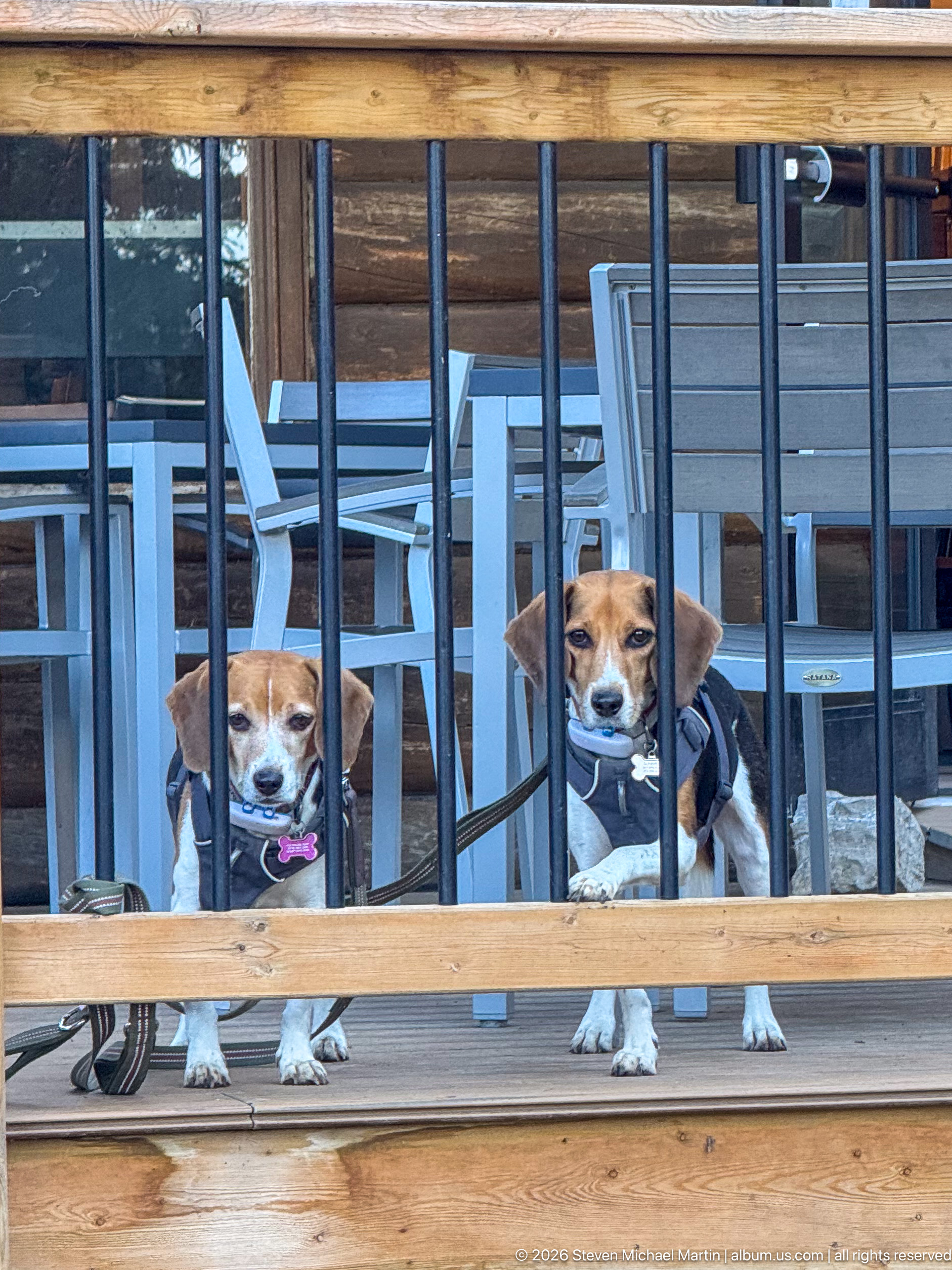
Two beagles stand side by side behind a black metal deck railing, both wearing harnesses and looking outward from the wooden terrace. Patio chairs and a log-wall building establish the developed visitor setting, while the dogs’ matching posture and close placement create an informal travel moment within the Maligne Valley sequence.
Caption
Two beagles stand side by side behind a black metal deck railing, both wearing harnesses and looking outward from the wooden terrace. Patio chairs and a log-wall building establish the developed visitor setting, while the dogs’ matching posture and close placement create an informal travel moment within the Maligne Valley sequence.
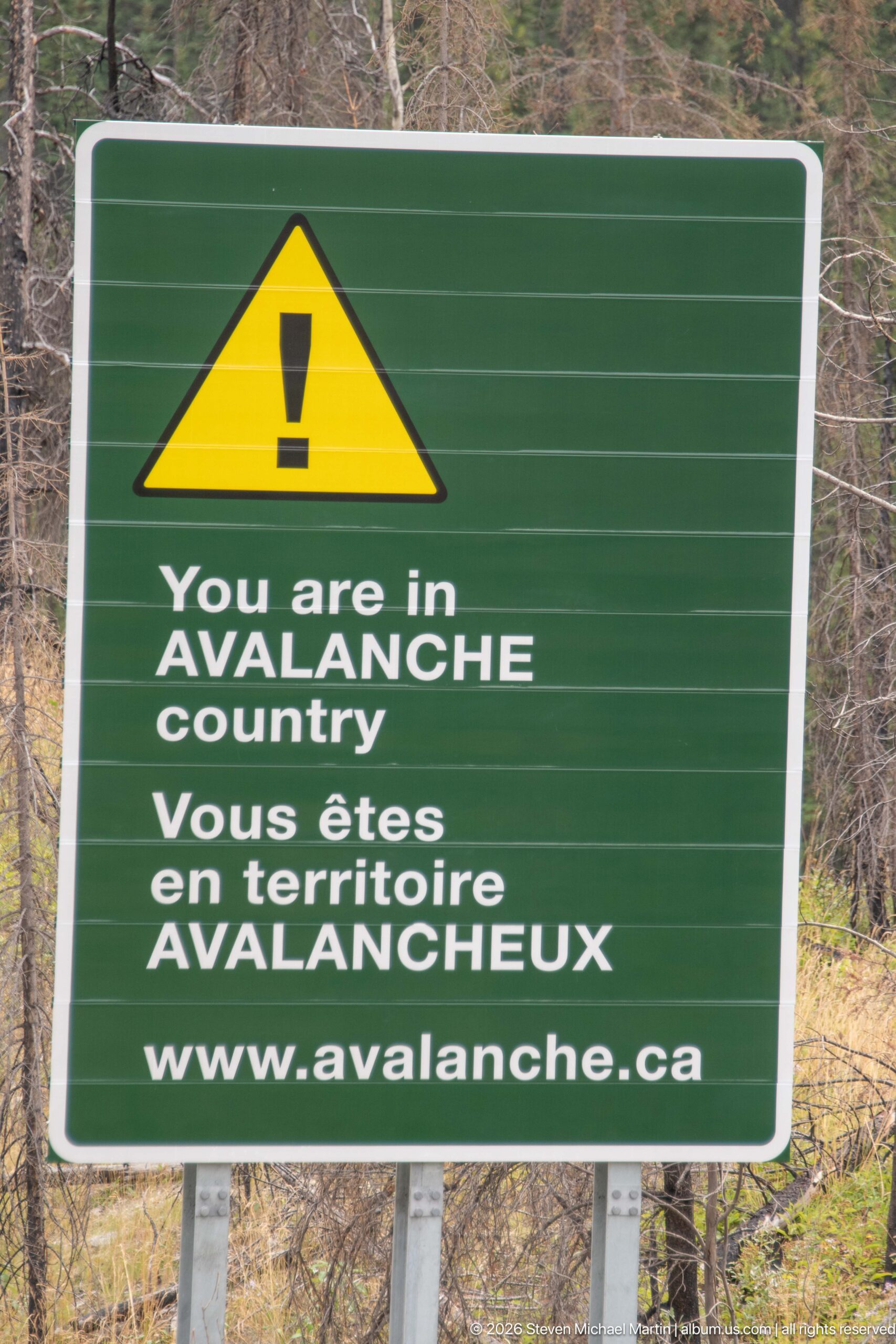
A green roadside warning sign states “You are in AVALANCHE country” with matching French text beneath a yellow caution symbol. The direct safety message identifies the surrounding terrain as avalanche-prone and records a specific visitor hazard communicated along the Maligne Valley travel corridor.
Caption
A green roadside warning sign states “You are in AVALANCHE country” with matching French text beneath a yellow caution symbol. The direct safety message identifies the surrounding terrain as avalanche-prone and records a specific visitor hazard communicated along the Maligne Valley travel corridor.
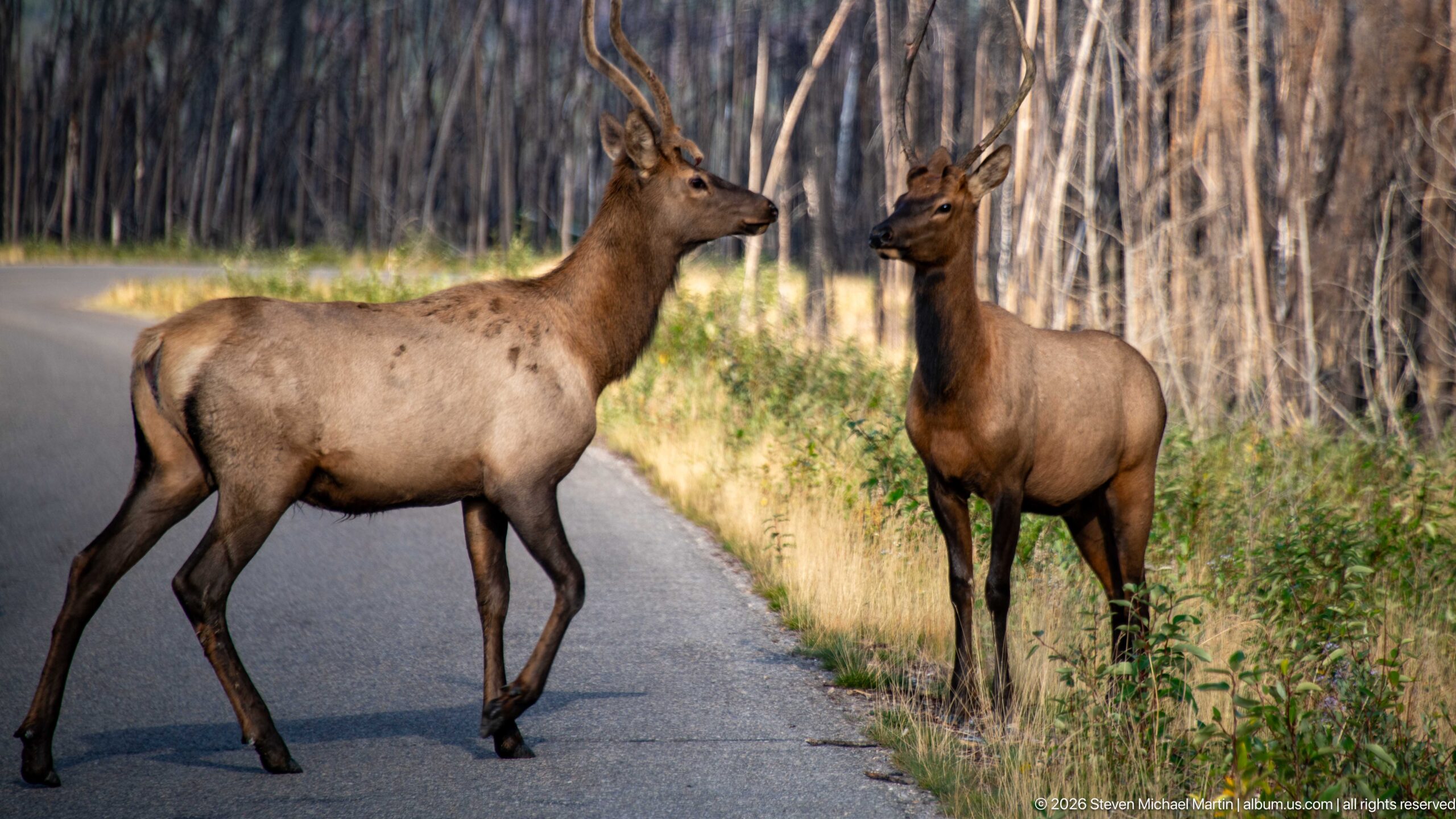
Two bull elk occupy the roadway and shoulder, one striding across the pavement while the other stands in roadside vegetation. Their developing antlers and contrasting positions show how wildlife can intersect directly with vehicle corridors in the Maligne Valley, with fire-killed forest forming the background.
Caption
Two bull elk occupy the roadway and shoulder, one striding across the pavement while the other stands in roadside vegetation. Their developing antlers and contrasting positions show how wildlife can intersect directly with vehicle corridors in the Maligne Valley, with fire-killed forest forming the background.
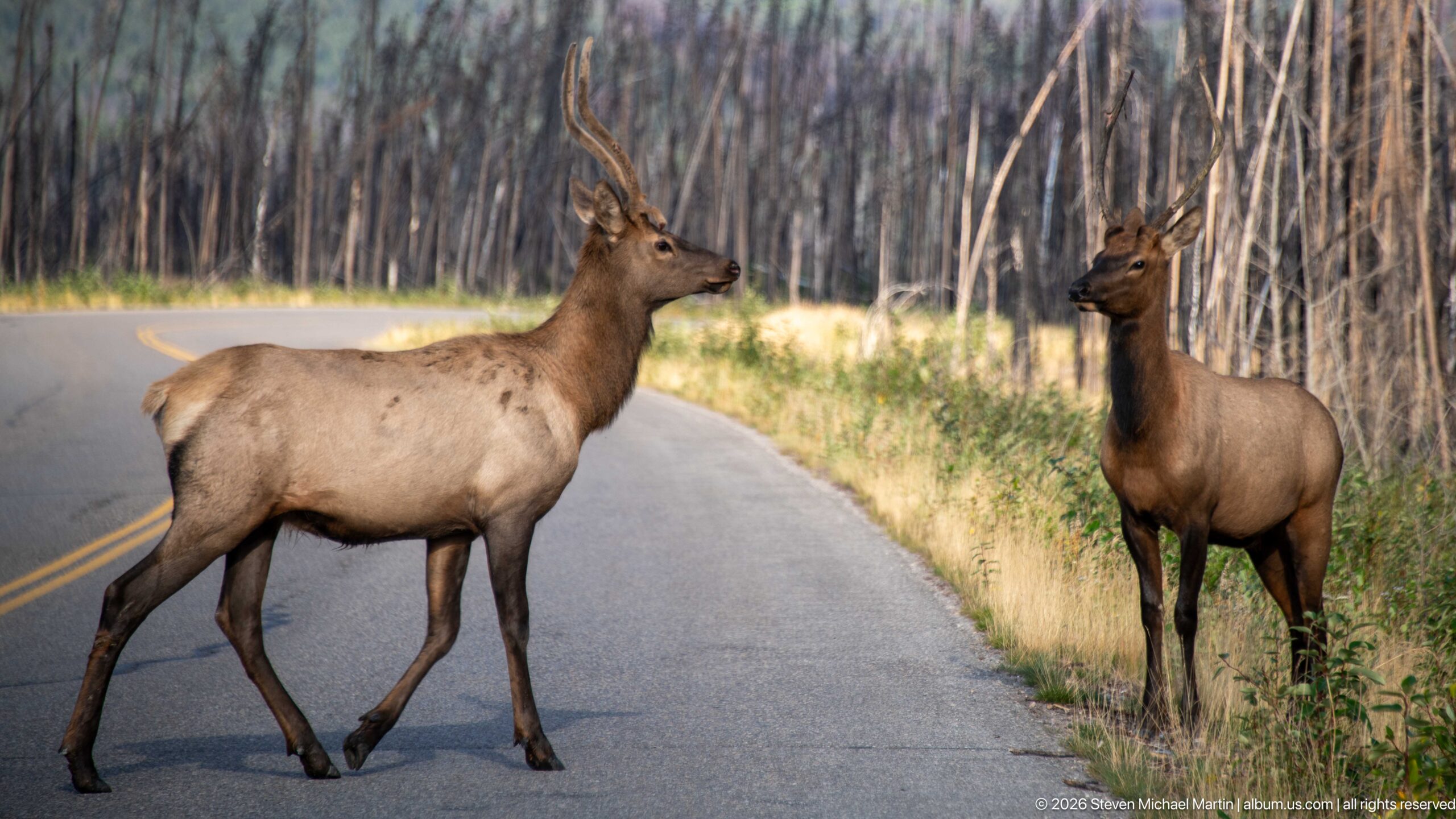
A bull elk steps across the center of a paved road while a second antlered elk watches from the grassy shoulder. The composition emphasizes the spatial relationship between animals and traffic infrastructure, framed by dense ranks of fire-killed trunks and a narrow strip of recovering roadside vegetation.
Caption
A bull elk steps across the center of a paved road while a second antlered elk watches from the grassy shoulder. The composition emphasizes the spatial relationship between animals and traffic infrastructure, framed by dense ranks of fire-killed trunks and a narrow strip of recovering roadside vegetation.
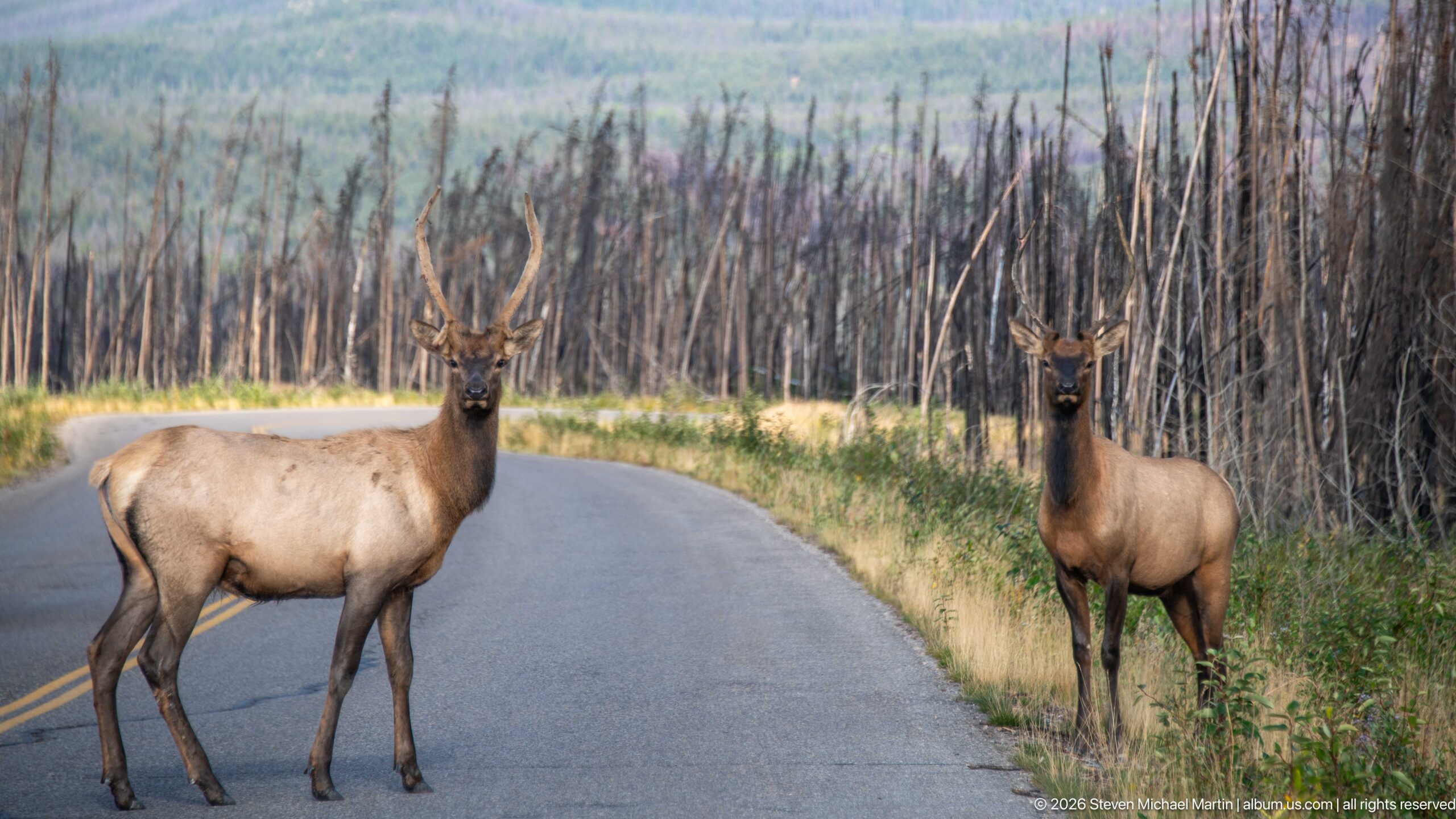
Two bull elk pause on a curving paved road through a fire-affected section of the Maligne Valley. One stands across the travel lane while the other remains on the shoulder, their developing antlers silhouetted against the vertical pattern of dead trunks and distant green slopes.
Caption
Two bull elk pause on a curving paved road through a fire-affected section of the Maligne Valley. One stands across the travel lane while the other remains on the shoulder, their developing antlers silhouetted against the vertical pattern of dead trunks and distant green slopes.
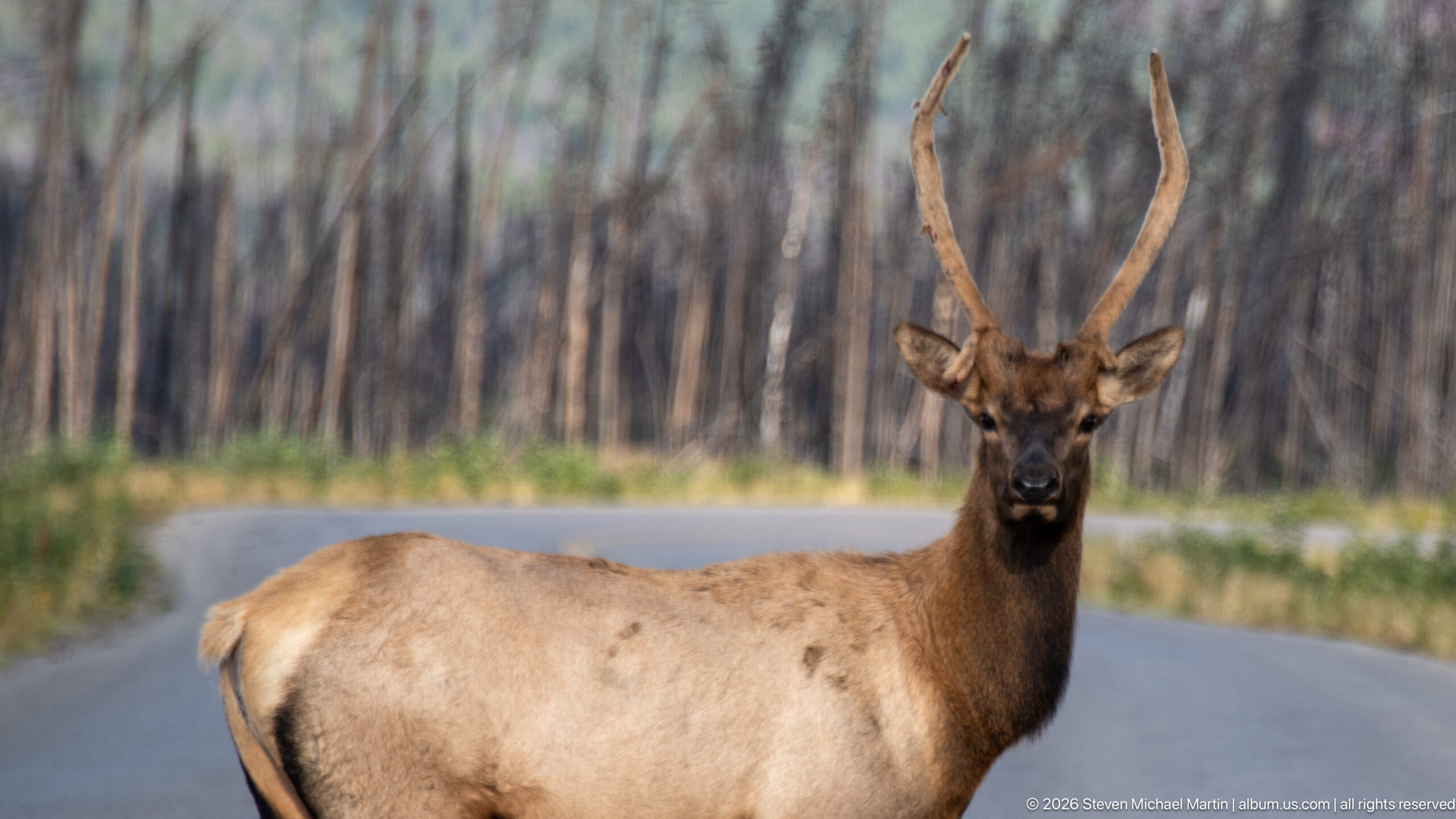
A young bull elk fills the foreground beside the Maligne Valley road, turning its head toward the camera so the developing antlers, large ears, dark neck, and pale body are prominent. The shallow depth of field separates the animal from the burned woodland and roadway behind it.
Caption
A young bull elk fills the foreground beside the Maligne Valley road, turning its head toward the camera so the developing antlers, large ears, dark neck, and pale body are prominent. The shallow depth of field separates the animal from the burned woodland and roadway behind it.
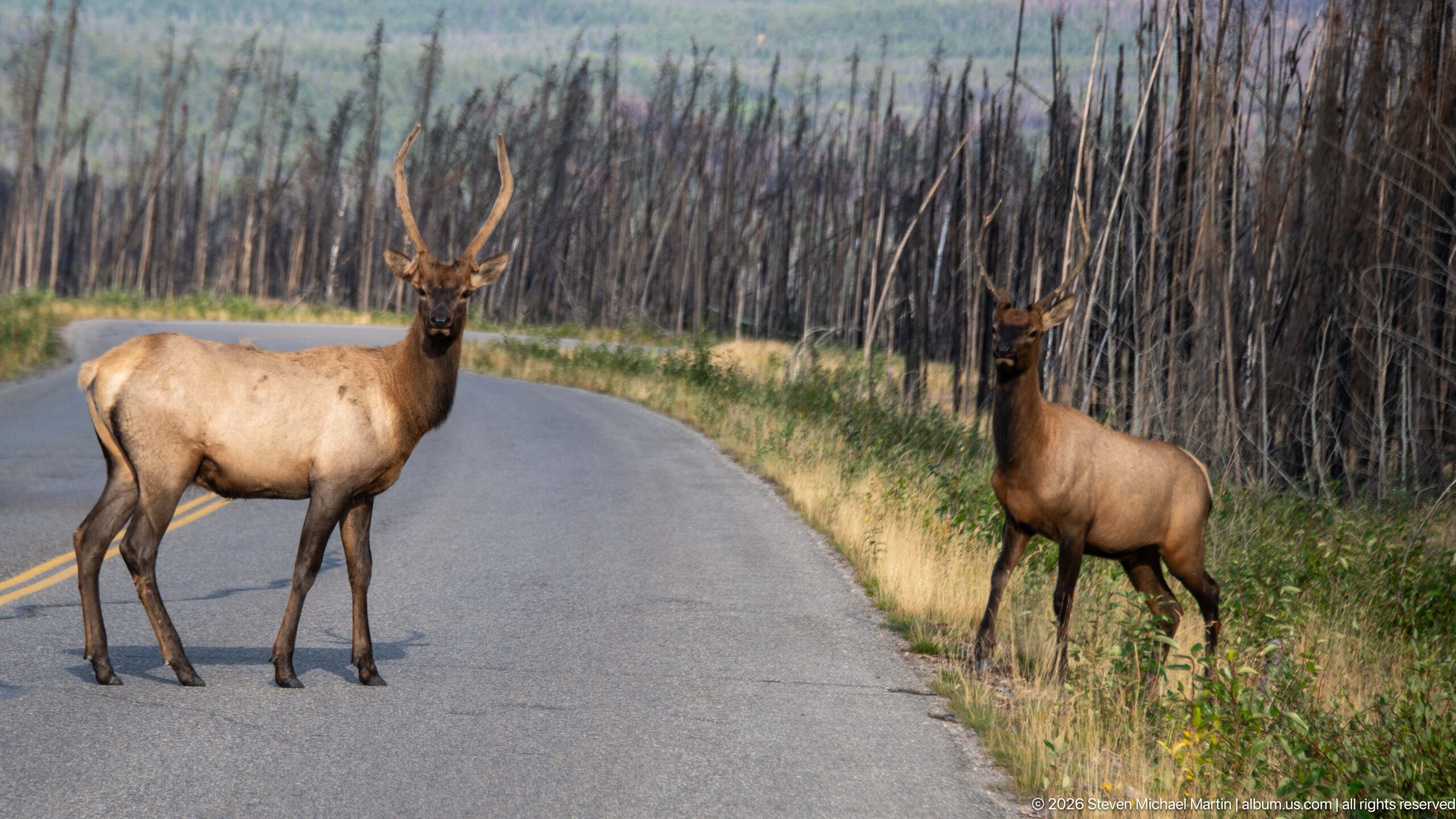
Two bull elk stand apart at a bend in the road, one occupying the pavement and the other the grassy verge. Their alert postures and developing antlers are set against an extensive stand of fire-killed trees, making the roadside encounter and the altered forest landscape equally legible.
Caption
Two bull elk stand apart at a bend in the road, one occupying the pavement and the other the grassy verge. Their alert postures and developing antlers are set against an extensive stand of fire-killed trees, making the roadside encounter and the altered forest landscape equally legible.
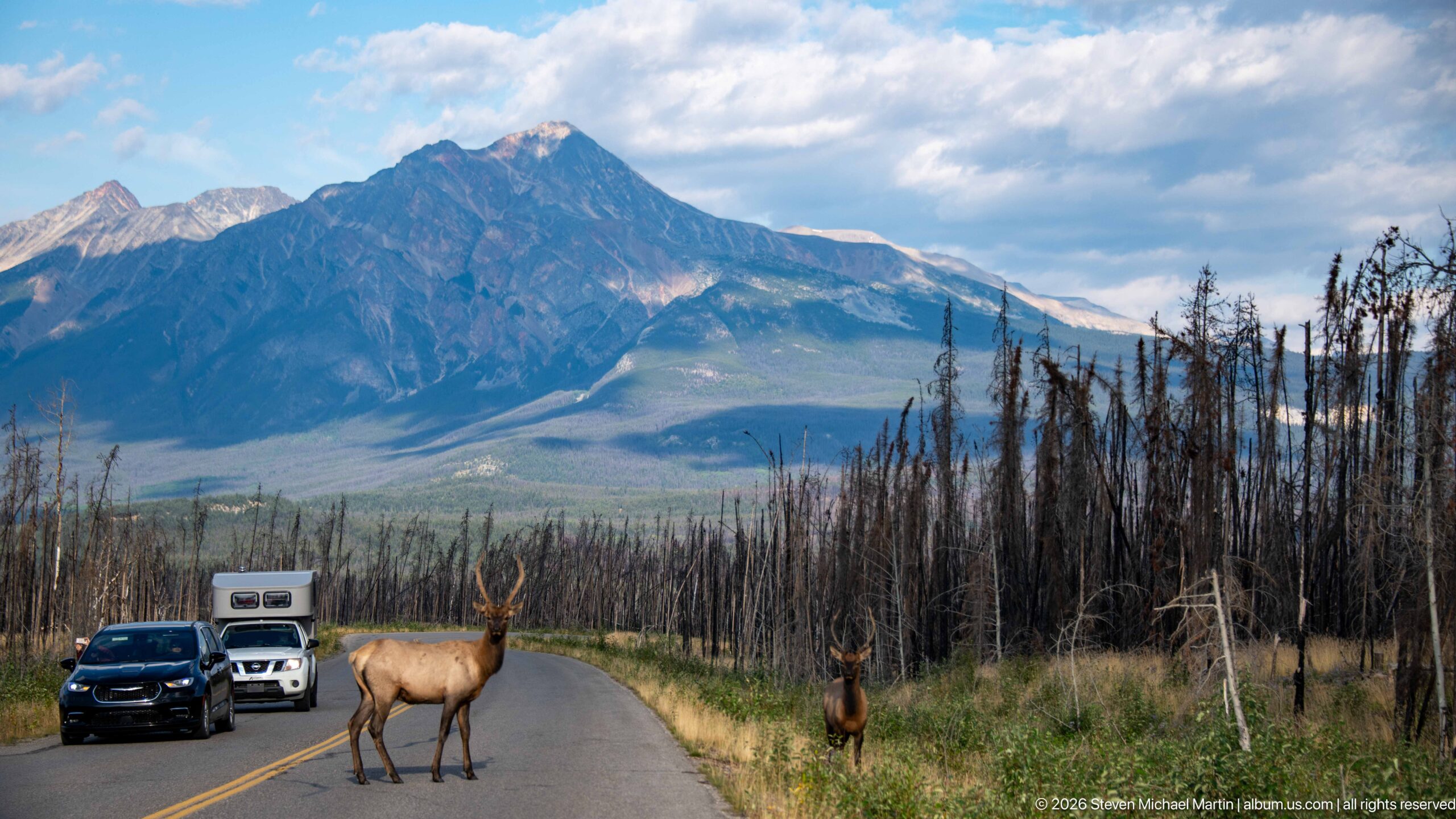
A bull elk stands in the traffic lane as approaching vehicles slow along a mountain road, while a second elk remains at the shoulder. The wide view places the wildlife encounter within the larger Maligne Valley landscape, including fire-affected forest and a steep mountain backdrop.
Caption
A bull elk stands in the traffic lane as approaching vehicles slow along a mountain road, while a second elk remains at the shoulder. The wide view places the wildlife encounter within the larger Maligne Valley landscape, including fire-affected forest and a steep mountain backdrop.
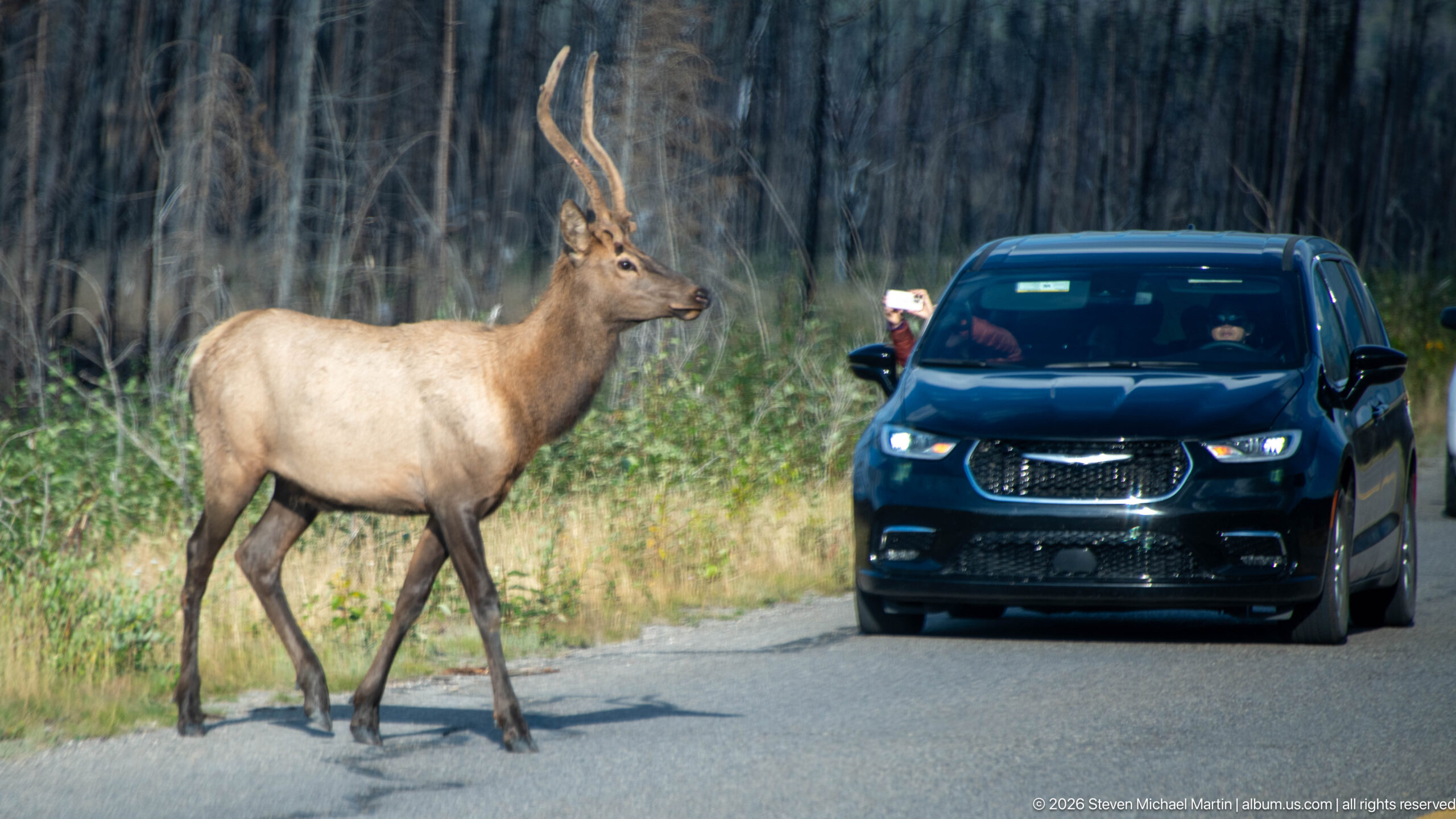
A bull elk walks across the roadway immediately ahead of a dark passenger vehicle, creating a close visual comparison of animal and automobile scale. The elk’s developing antlers and long-legged profile remain clear, while roadside grasses and fire-affected woodland identify the encounter as part of the valley travel corridor.
Caption
A bull elk walks across the roadway immediately ahead of a dark passenger vehicle, creating a close visual comparison of animal and automobile scale. The elk’s developing antlers and long-legged profile remain clear, while roadside grasses and fire-affected woodland identify the encounter as part of the valley travel corridor.
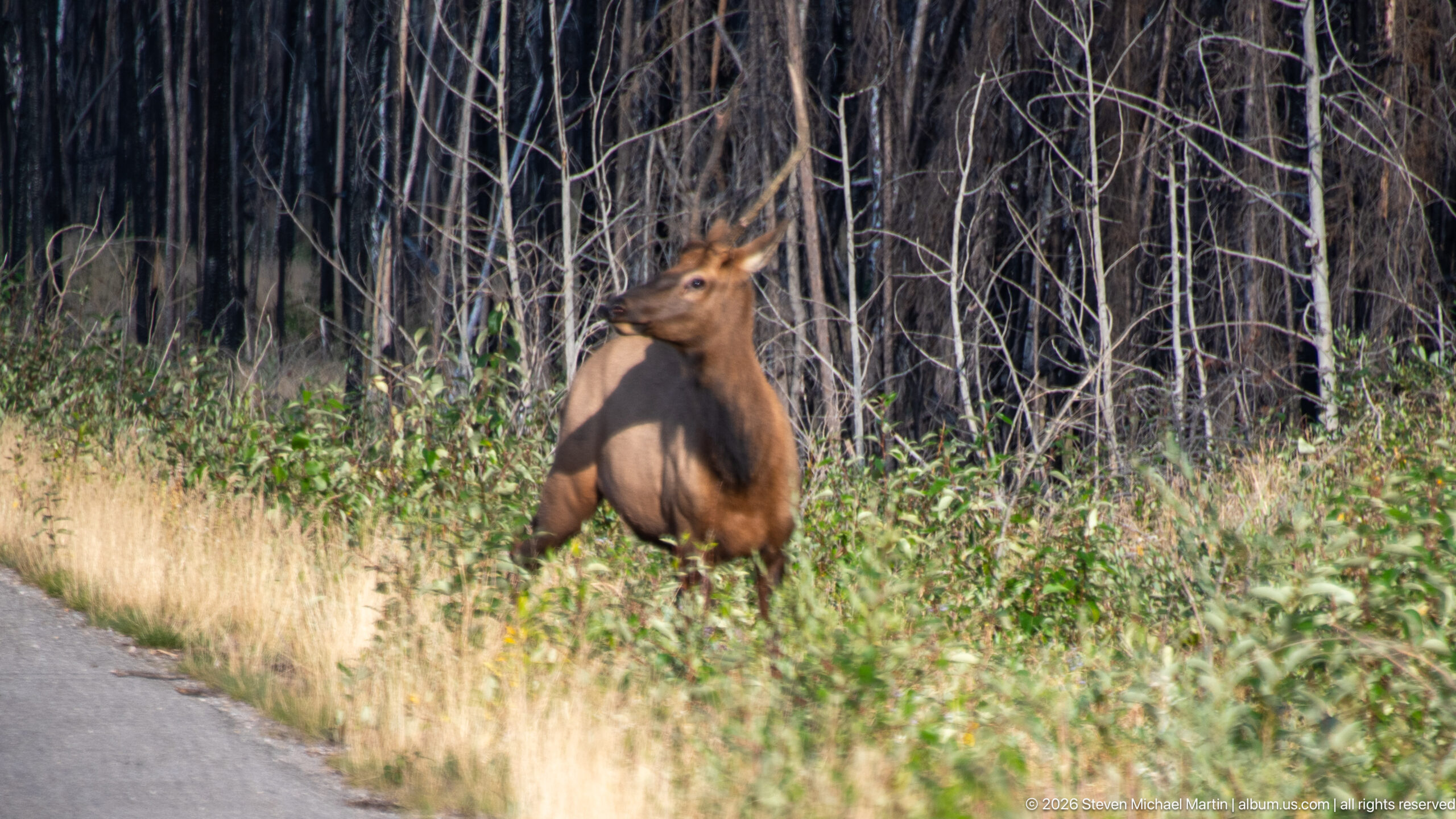
A bull elk moves away from the pavement into tall roadside vegetation, seen from behind as it enters a stand of thin fire-killed trunks. The raised head and antlers remain visible above the darker neck, while the partial rear view distinguishes this frame from the preceding roadway portraits.
Caption
A bull elk moves away from the pavement into tall roadside vegetation, seen from behind as it enters a stand of thin fire-killed trunks. The raised head and antlers remain visible above the darker neck, while the partial rear view distinguishes this frame from the preceding roadway portraits.
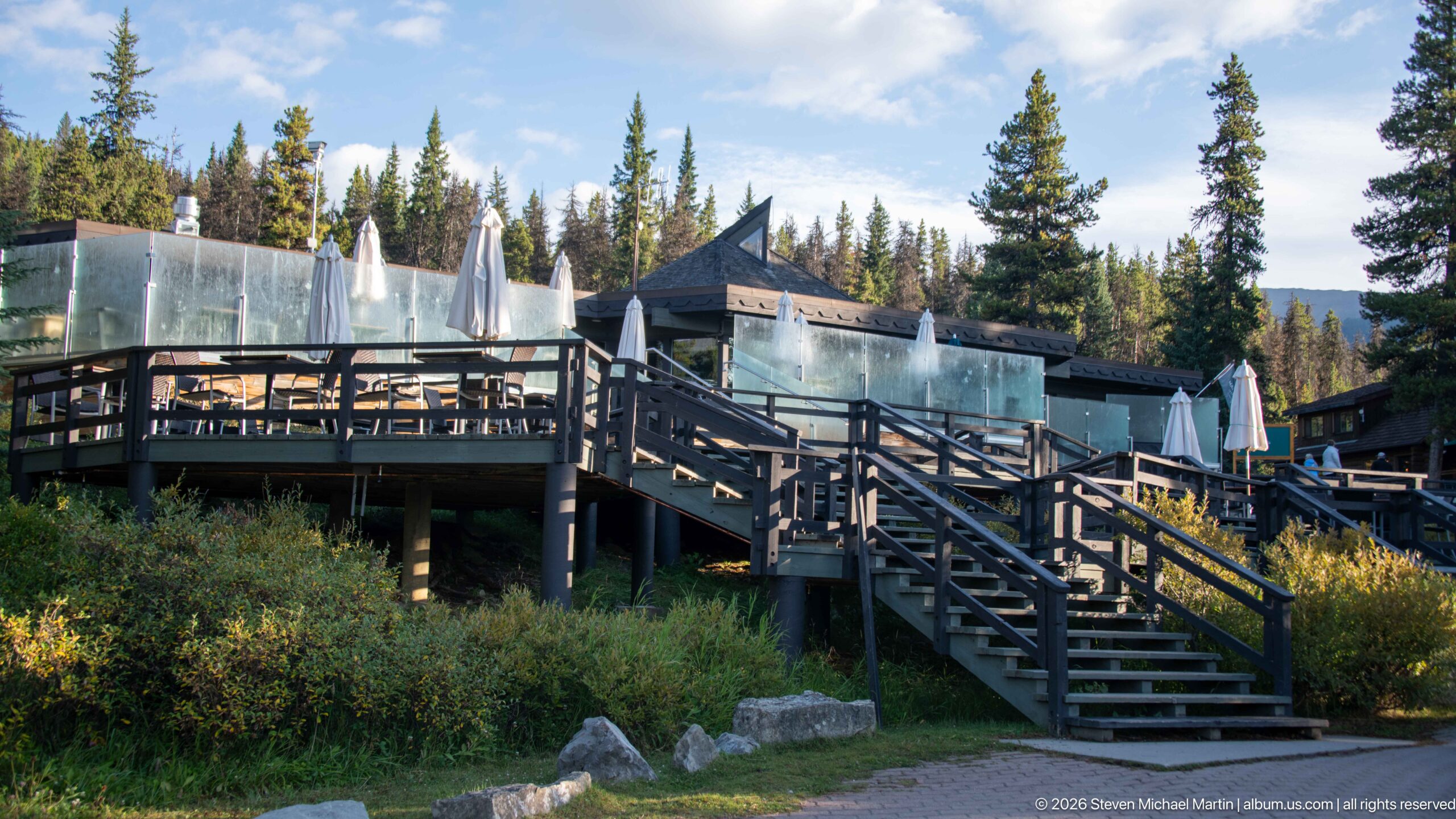
A timber terrace and stair system rises through shrubs and conifers at the developed visitor area near Maligne Lake. Glass wind screens, outdoor umbrellas, railings, and multiple deck levels show how visitor services are fitted into the wooded lakeshore setting without obscuring the surrounding forest.
Caption
A timber terrace and stair system rises through shrubs and conifers at the developed visitor area near Maligne Lake. Glass wind screens, outdoor umbrellas, railings, and multiple deck levels show how visitor services are fitted into the wooded lakeshore setting without obscuring the surrounding forest.
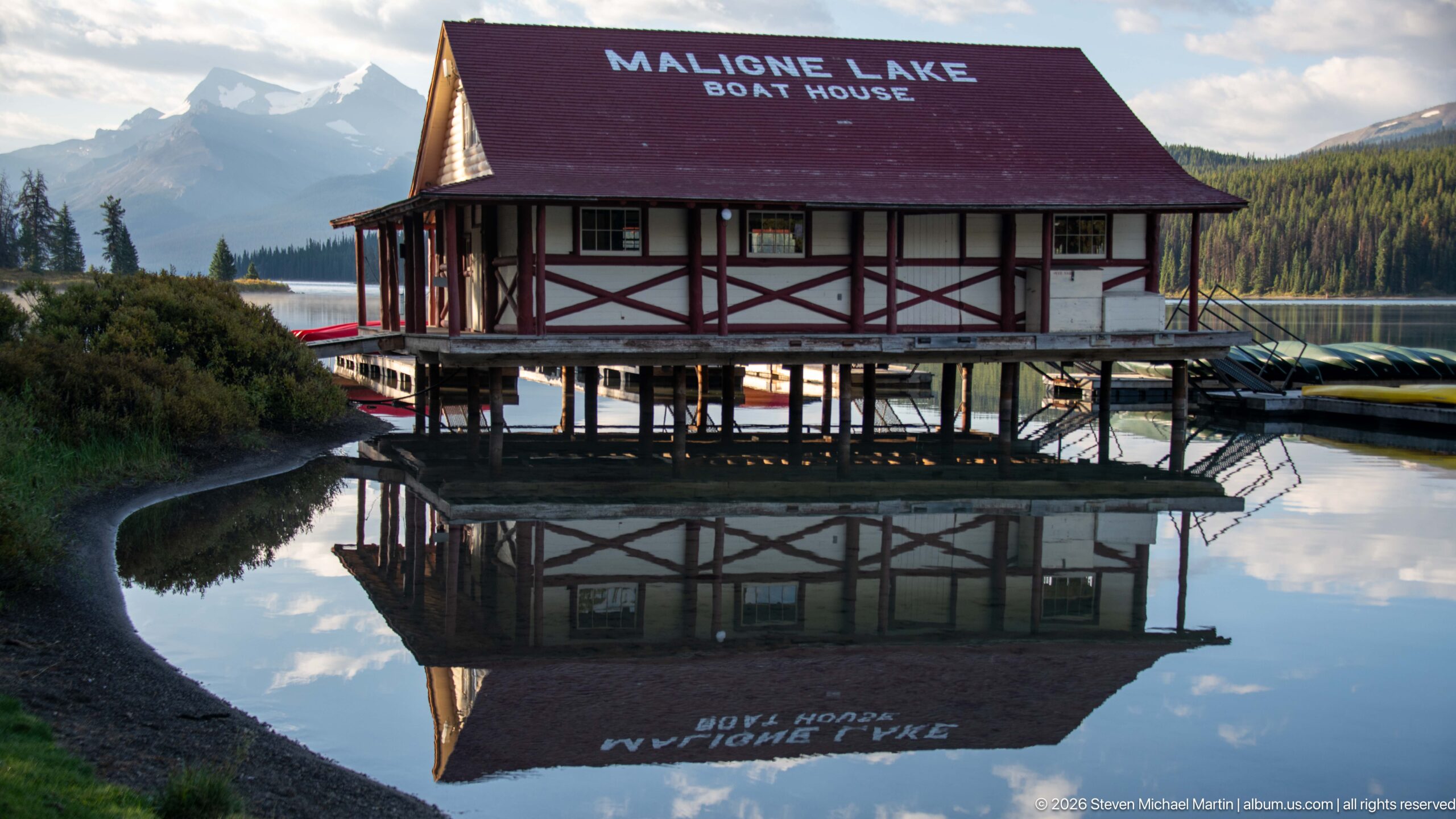
The Maligne Lake Boat House stands on pilings at the water’s edge, its red roof and half-timbered exterior reflected almost completely in the calm lake. Canoes stored alongside the structure reinforce its waterside function, while the readable roof lettering provides direct identification of the building.
Caption
The Maligne Lake Boat House stands on pilings at the water’s edge, its red roof and half-timbered exterior reflected almost completely in the calm lake. Canoes stored alongside the structure reinforce its waterside function, while the readable roof lettering provides direct identification of the building.
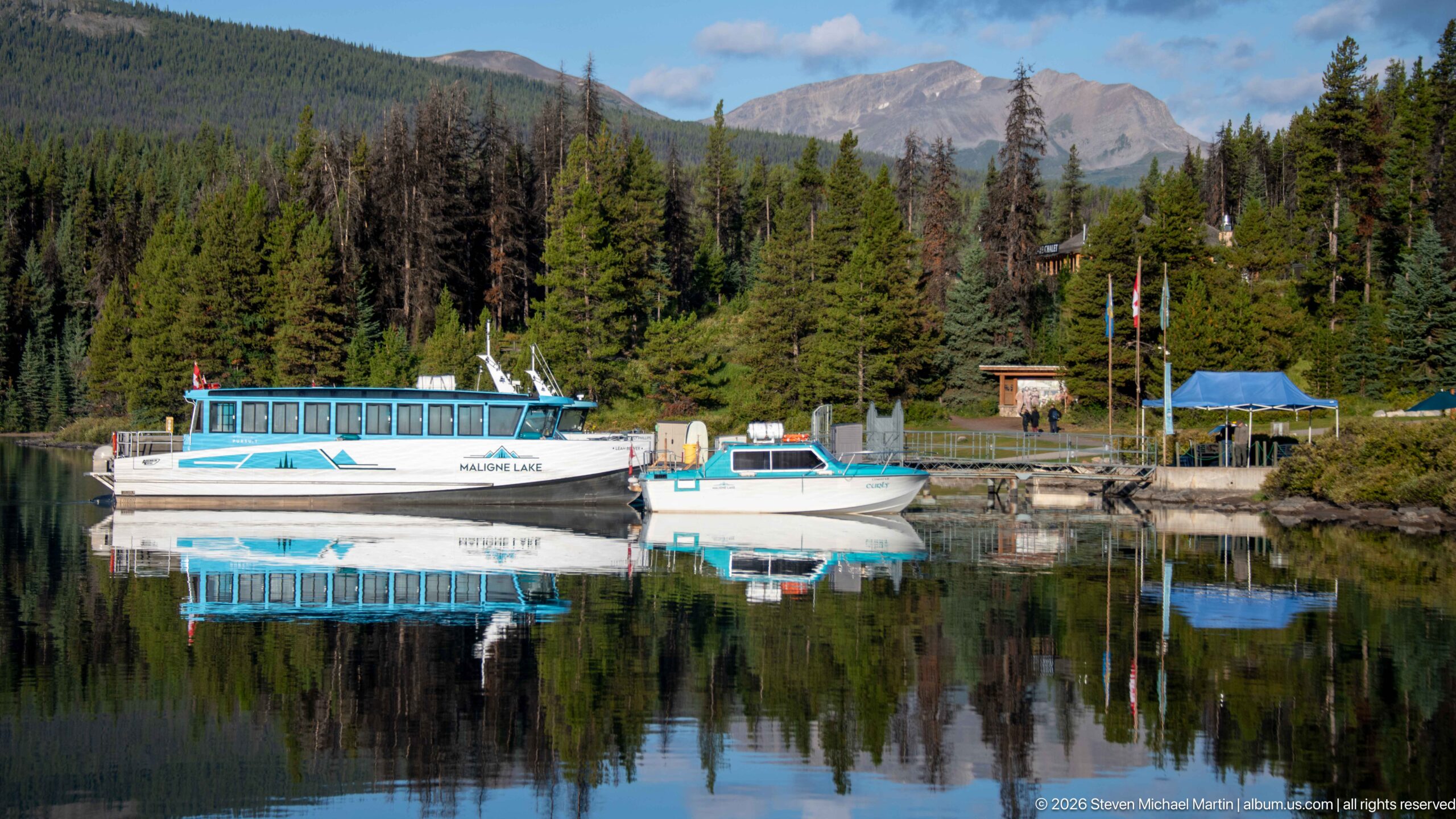
Passenger vessels lie moored at the Maligne Lake dock, their white and blue hulls reflected in sheltered water. Flags, dock structures, conifer forest, and a broad mountain slope frame the small harbor, documenting the developed north-end departure area used for travel on the lake.
Caption
Passenger vessels lie moored at the Maligne Lake dock, their white and blue hulls reflected in sheltered water. Flags, dock structures, conifer forest, and a broad mountain slope frame the small harbor, documenting the developed north-end departure area used for travel on the lake.
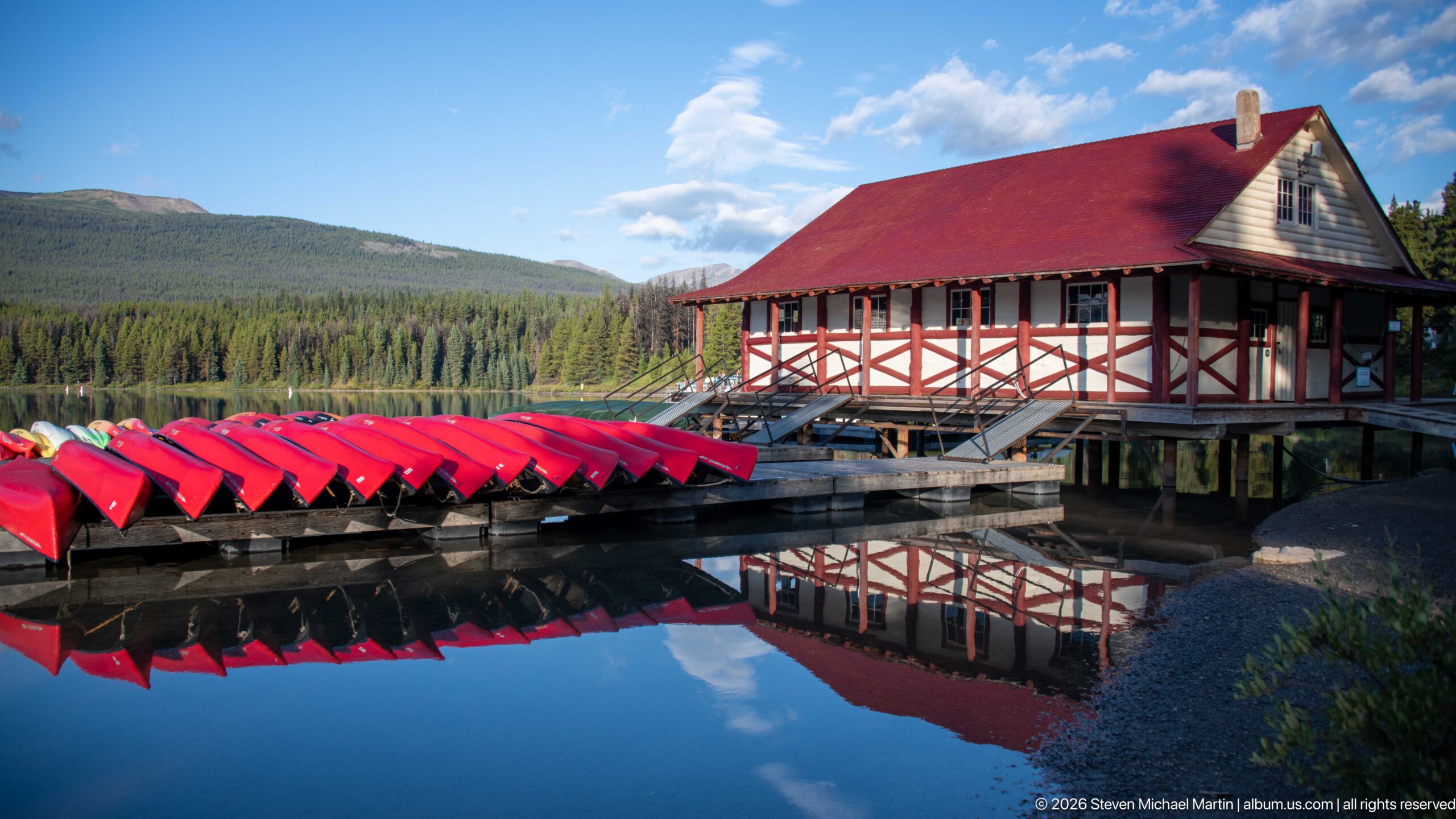
Rows of bright red canoes lead toward the Maligne Lake Boat House, whose red roof, white walls, and dark timber framing repeat in the still water below. The diagonal canoe racks make recreational boating the foreground subject while retaining the historic-looking lakeside building as its architectural context.
Caption
Rows of bright red canoes lead toward the Maligne Lake Boat House, whose red roof, white walls, and dark timber framing repeat in the still water below. The diagonal canoe racks make recreational boating the foreground subject while retaining the historic-looking lakeside building as its architectural context.
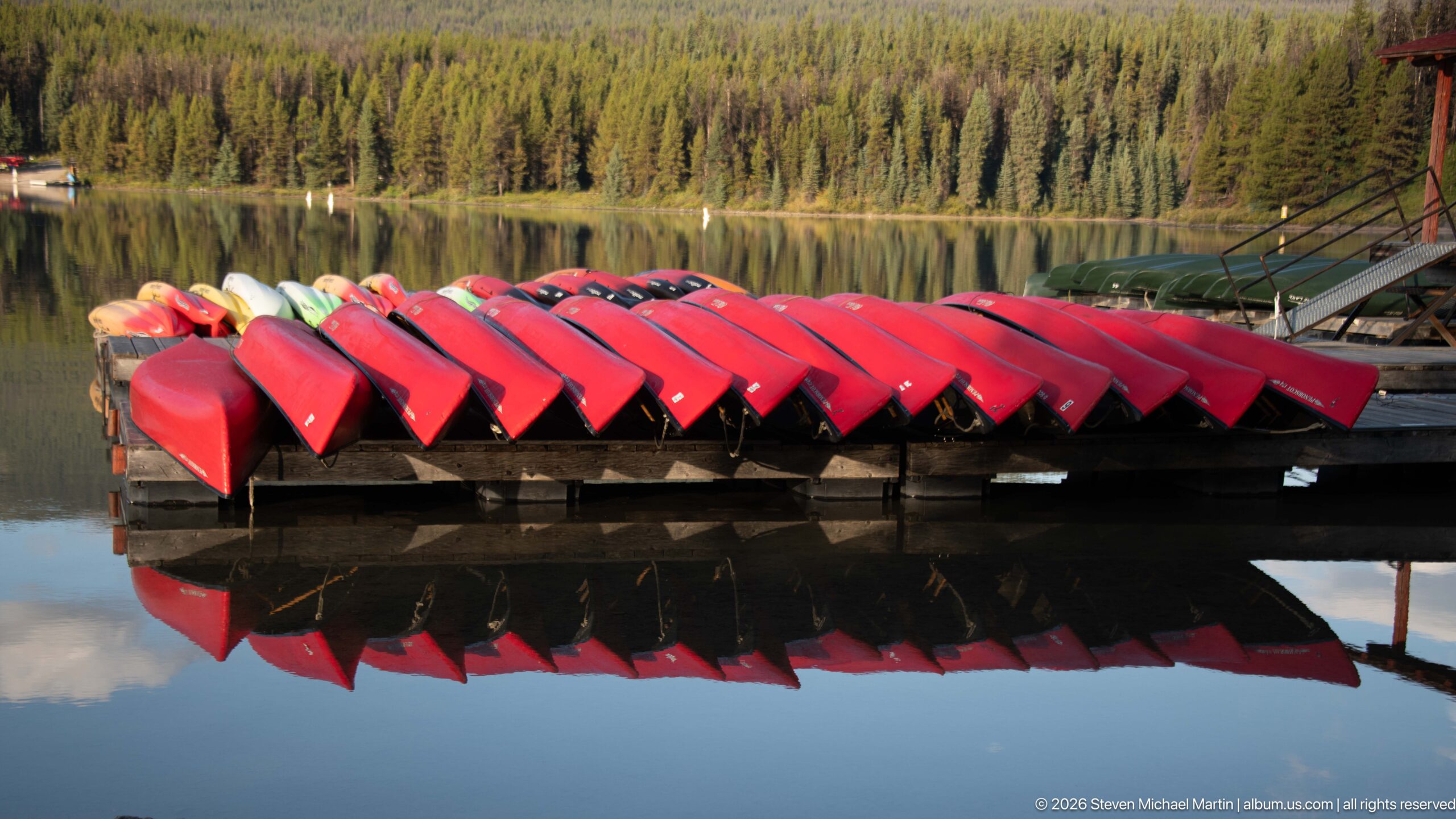
A tightly packed row of red canoes rests upside down on a waterside rack at Maligne Lake, with a few differently colored boats at the far end. Their repeated hull shapes form a strong horizontal pattern mirrored in the calm water, while the forested opposite shore supplies a natural backdrop.
Caption
A tightly packed row of red canoes rests upside down on a waterside rack at Maligne Lake, with a few differently colored boats at the far end. Their repeated hull shapes form a strong horizontal pattern mirrored in the calm water, while the forested opposite shore supplies a natural backdrop.
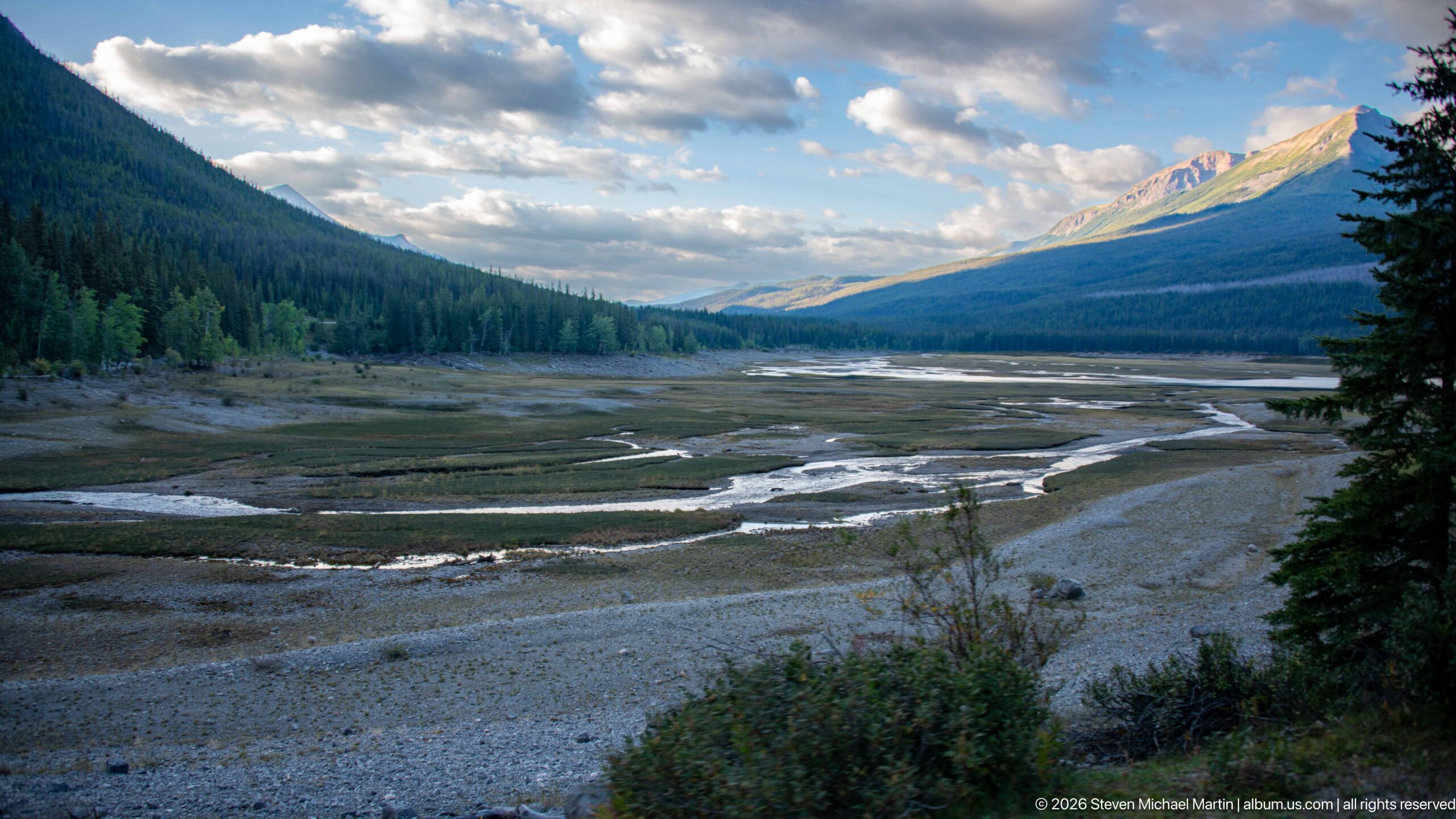
Broad exposed flats and shallow braided channels spread across the Medicine Lake basin beneath forested mountain slopes. The low-water shoreline reveals gravel bars and wet channels across much of the foreground, a visible condition that illustrates the lake’s strongly variable seasonal water level without requiring the underground drainage itself to be seen.
Caption
Broad exposed flats and shallow braided channels spread across the Medicine Lake basin beneath forested mountain slopes. The low-water shoreline reveals gravel bars and wet channels across much of the foreground, a visible condition that illustrates the lake’s strongly variable seasonal water level without requiring the underground drainage itself to be seen.
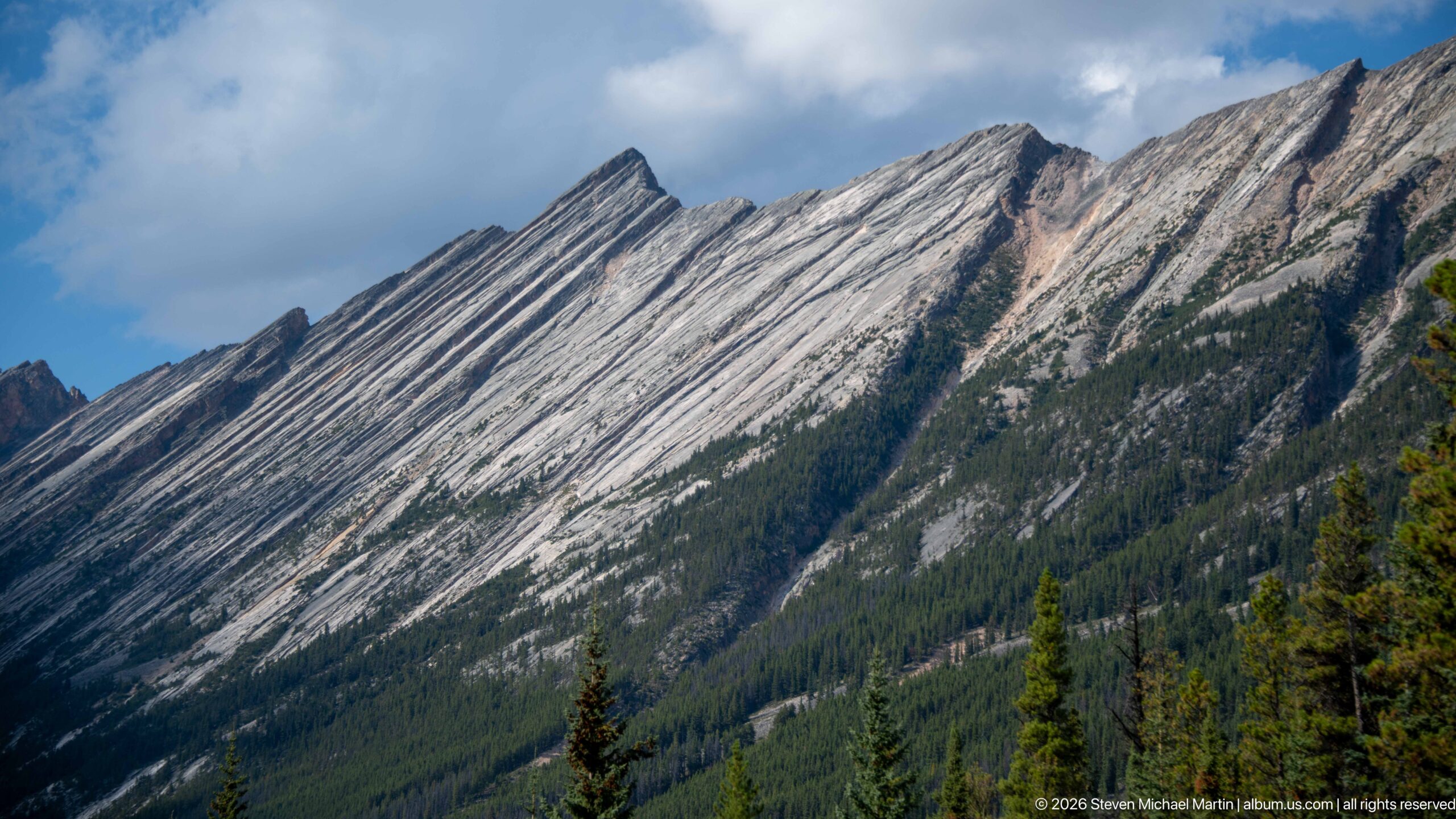
Steeply tilted sedimentary rock layers form a sharp, ribbed mountain ridge above the Maligne Valley. Parallel bands run diagonally across the exposed face, making the structure of the bedrock more prominent than vegetation or summit form and providing a clear geological study of folded Rocky Mountain strata.
Caption
Steeply tilted sedimentary rock layers form a sharp, ribbed mountain ridge above the Maligne Valley. Parallel bands run diagonally across the exposed face, making the structure of the bedrock more prominent than vegetation or summit form and providing a clear geological study of folded Rocky Mountain strata.
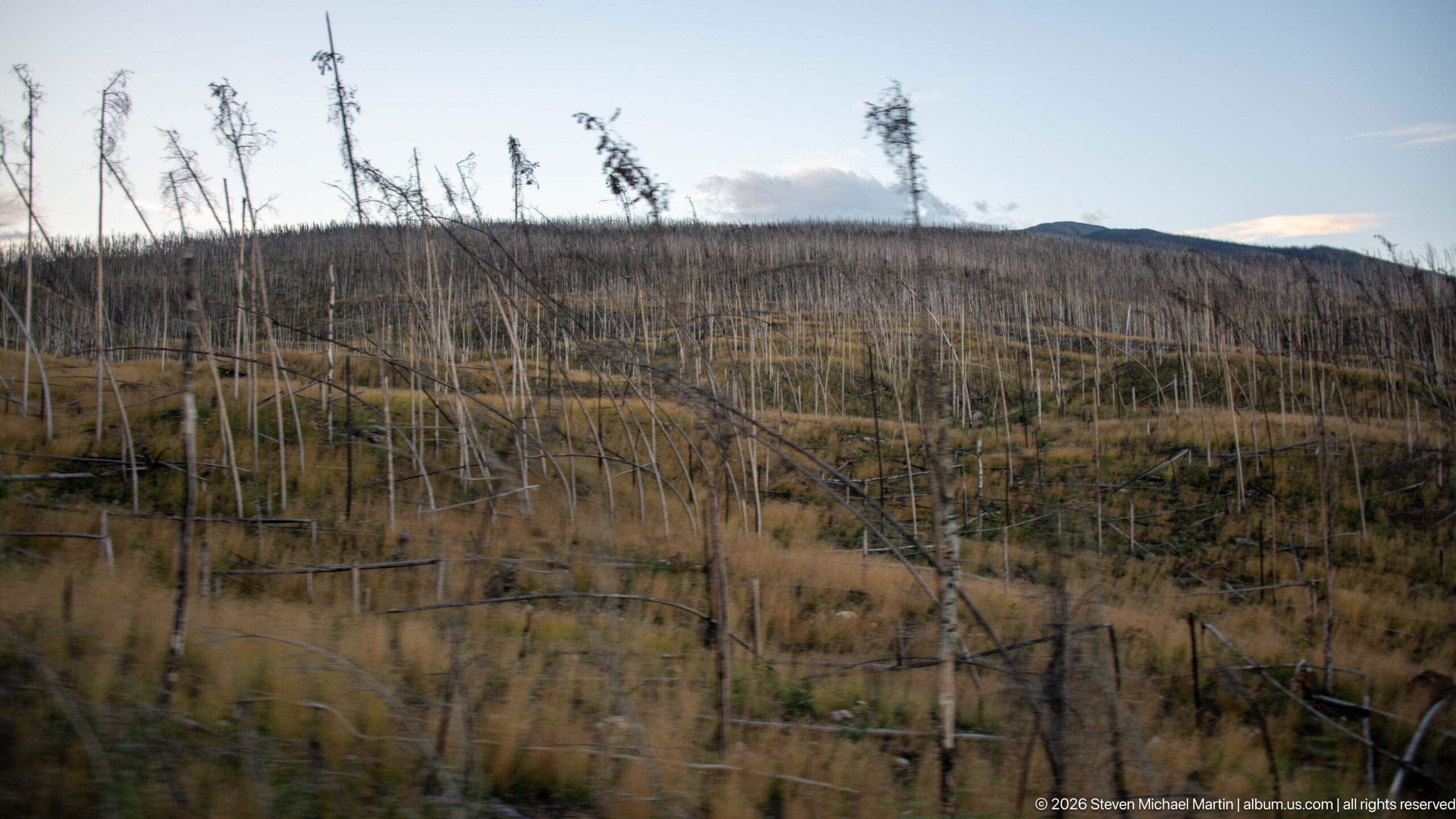
A fire-affected hillside is covered with thin standing snags, scattered fallen trunks, and a low patchwork of grasses and young vegetation. The open slope reveals the extent of canopy loss while small areas of green growth show early regeneration across the disturbed Maligne Valley landscape.
Caption
A fire-affected hillside is covered with thin standing snags, scattered fallen trunks, and a low patchwork of grasses and young vegetation. The open slope reveals the extent of canopy loss while small areas of green growth show early regeneration across the disturbed Maligne Valley landscape.
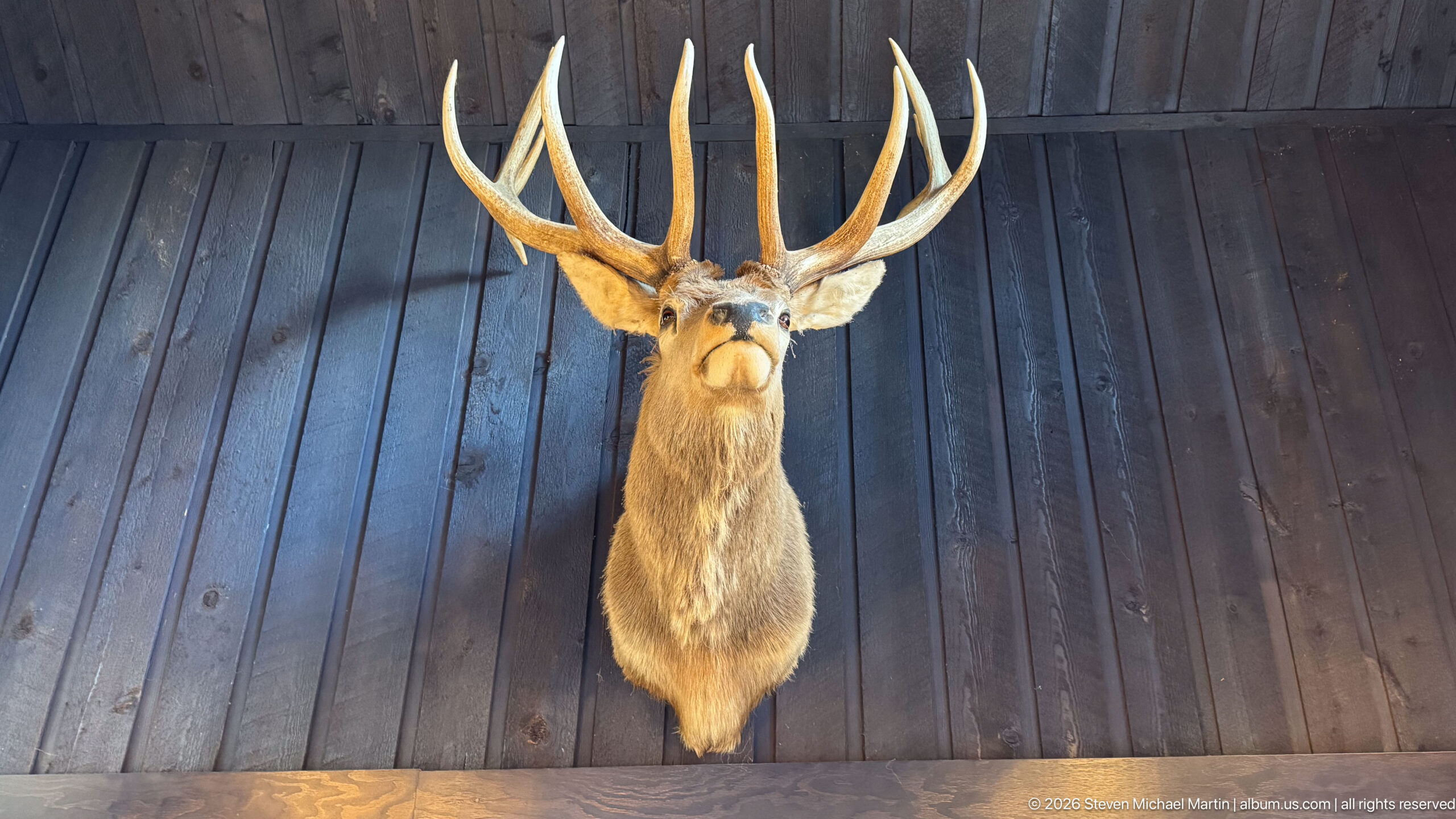
An antlered deer head is mounted high against dark vertical wood paneling, illuminated from below so the face and branching rack stand out from the wall. The symmetrical presentation and taxidermy mount make this an interior decorative specimen rather than a wildlife encounter in the landscape.
Caption
An antlered deer head is mounted high against dark vertical wood paneling, illuminated from below so the face and branching rack stand out from the wall. The symmetrical presentation and taxidermy mount make this an interior decorative specimen rather than a wildlife encounter in the landscape.
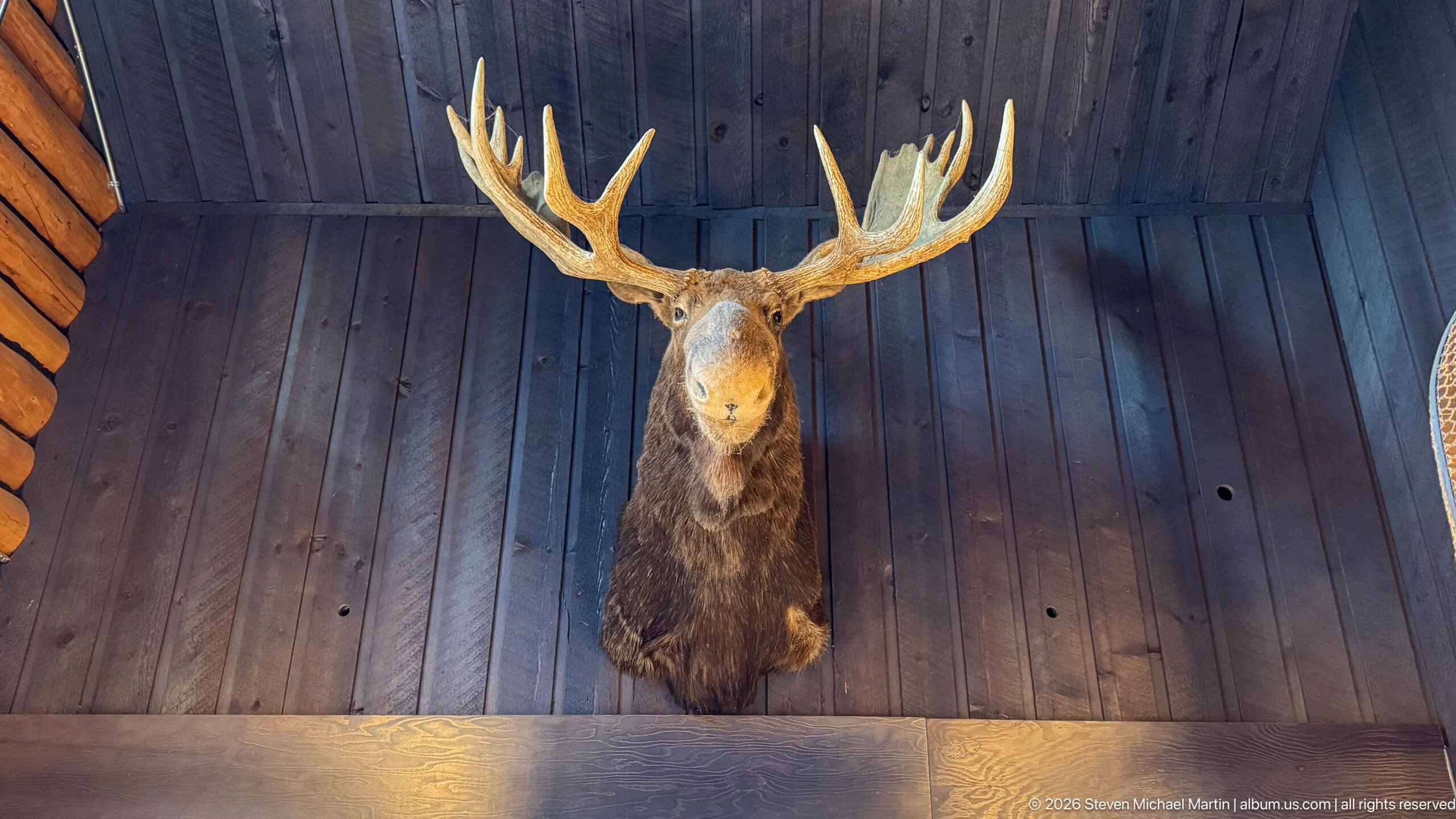
A second large cervid taxidermy mount projects from the dark wood wall, its broad branching antlers extending nearly across the frame. Warm uplighting emphasizes the face, textured hide, and antler structure, distinguishing the specimen from the lighter-colored deer mount shown in the preceding interior view.
Caption
A second large cervid taxidermy mount projects from the dark wood wall, its broad branching antlers extending nearly across the frame. Warm uplighting emphasizes the face, textured hide, and antler structure, distinguishing the specimen from the lighter-colored deer mount shown in the preceding interior view.
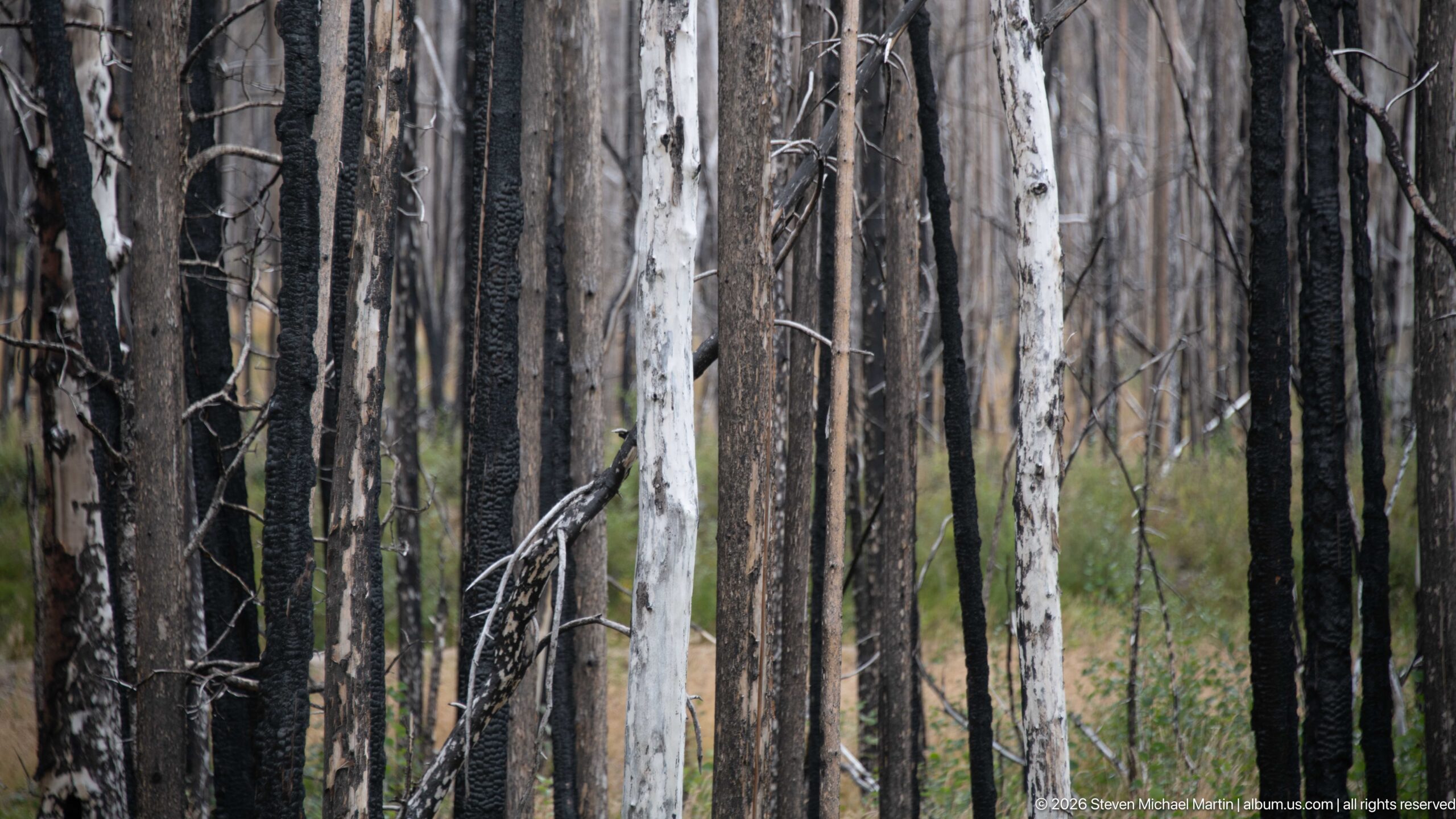
Closely spaced fire-killed trunks fill the frame, ranging from blackened bark to pale weathered wood where outer layers have been lost. Sparse green understory appears between the vertical stems, creating a detailed study of post-fire forest structure rather than a broad landscape view.
Caption
Closely spaced fire-killed trunks fill the frame, ranging from blackened bark to pale weathered wood where outer layers have been lost. Sparse green understory appears between the vertical stems, creating a detailed study of post-fire forest structure rather than a broad landscape view.
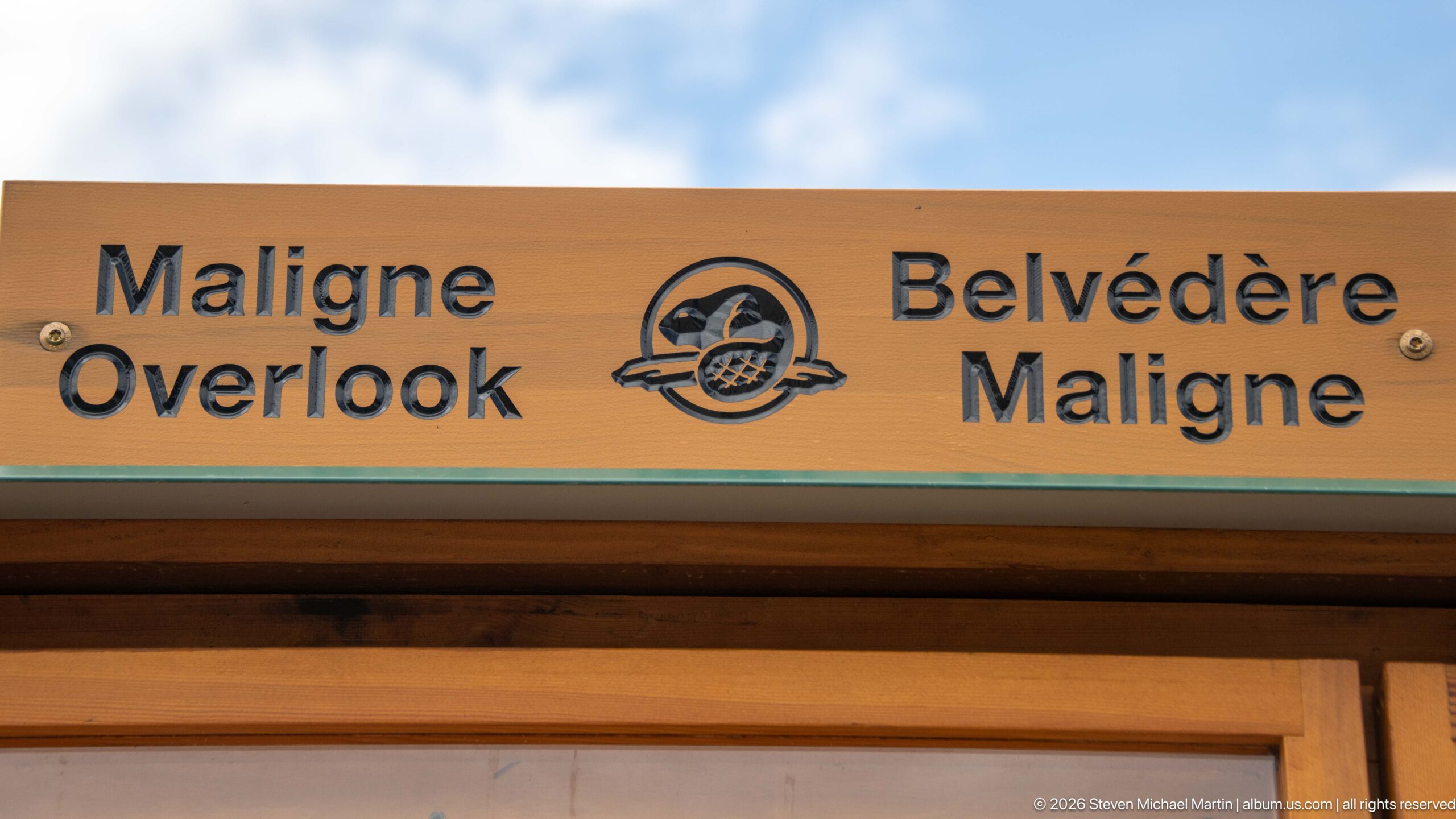
A wooden sign identifies “Maligne Overlook” and “Belvédère Maligne” in English and French, with the Parks Canada emblem centered between the names. Tight framing isolates the lettering and official symbol, providing direct documentary evidence for the named overlook within Jasper National Park.
Caption
A wooden sign identifies “Maligne Overlook” and “Belvédère Maligne” in English and French, with the Parks Canada emblem centered between the names. Tight framing isolates the lettering and official symbol, providing direct documentary evidence for the named overlook within Jasper National Park.
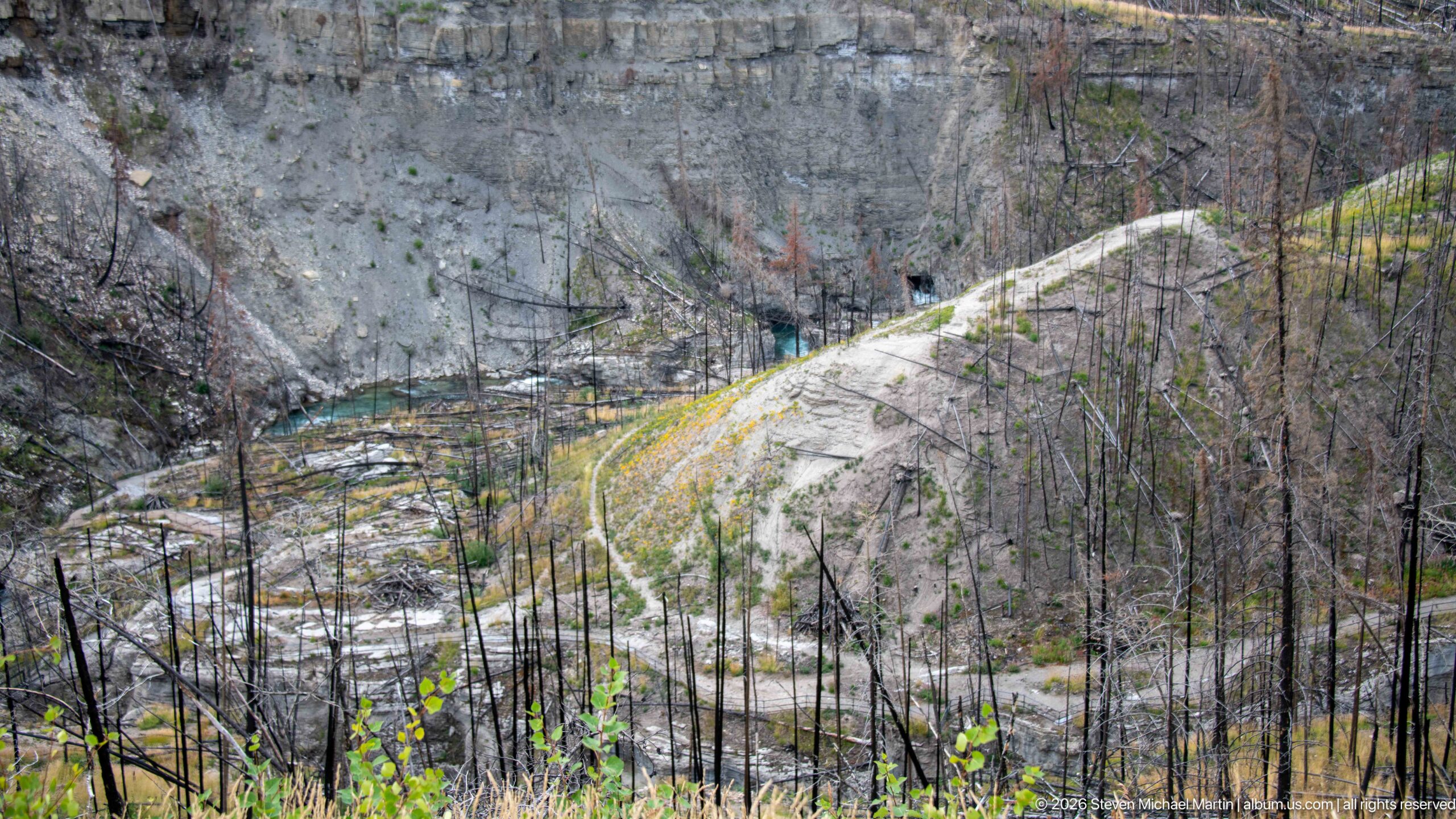
A pale, fast-moving stream winds through a rocky channel beneath steep gray slopes and a forest of slender fire-killed trunks. The elevated viewpoint reveals both the watercourse and the extensive burn footprint, with scattered green vegetation beginning to reoccupy the valley floor and lower banks.
Caption
A pale, fast-moving stream winds through a rocky channel beneath steep gray slopes and a forest of slender fire-killed trunks. The elevated viewpoint reveals both the watercourse and the extensive burn footprint, with scattered green vegetation beginning to reoccupy the valley floor and lower banks.
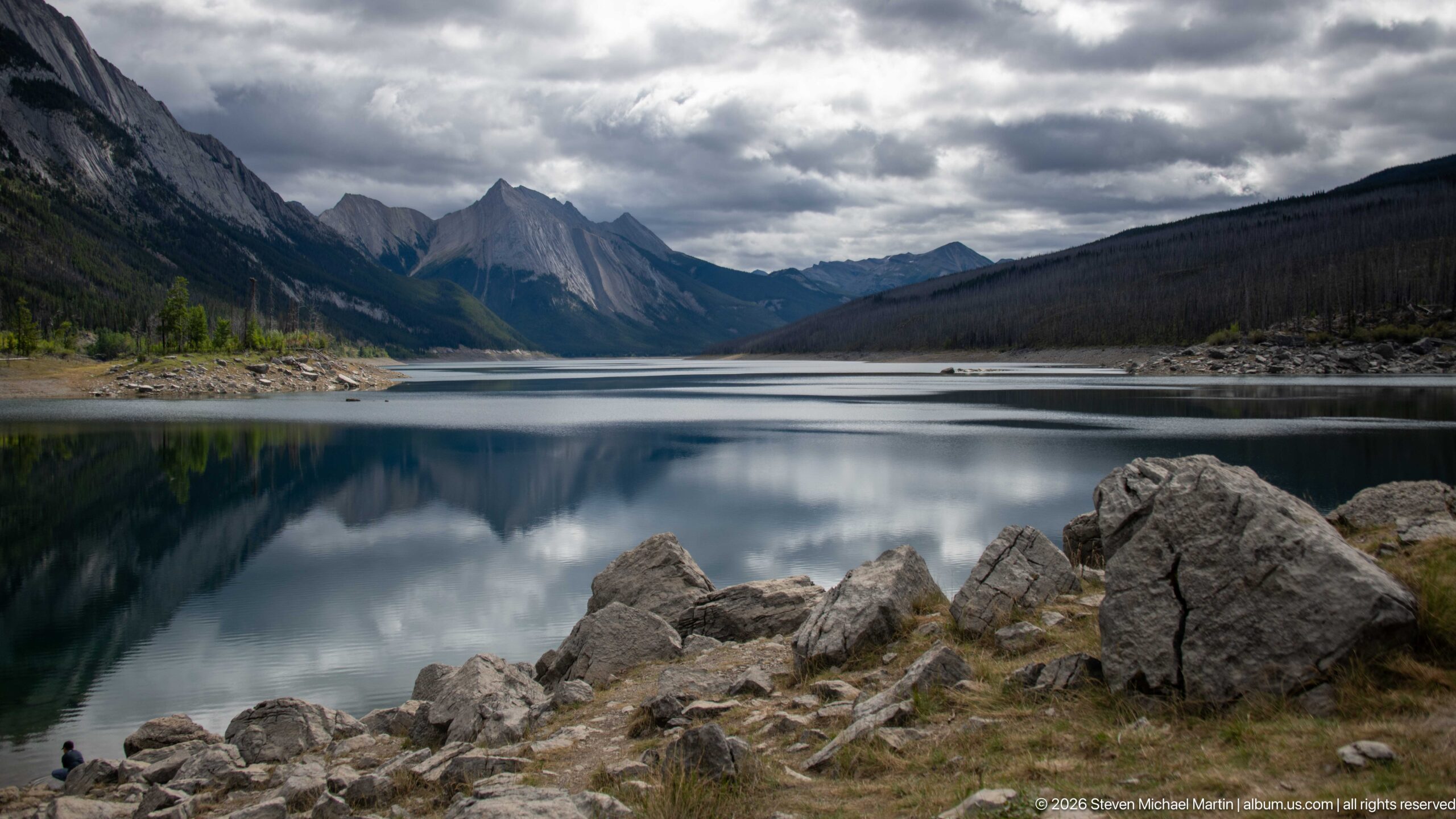
Medicine Lake stretches between steep mountain walls beneath heavy, layered storm clouds, its dark surface reflecting breaks in the sky. Angular boulders occupy the immediate shore while fire-affected forest is visible along the valley sides, giving the scene a more austere character than the earlier low-water basin view.
Caption
Medicine Lake stretches between steep mountain walls beneath heavy, layered storm clouds, its dark surface reflecting breaks in the sky. Angular boulders occupy the immediate shore while fire-affected forest is visible along the valley sides, giving the scene a more austere character than the earlier low-water basin view.
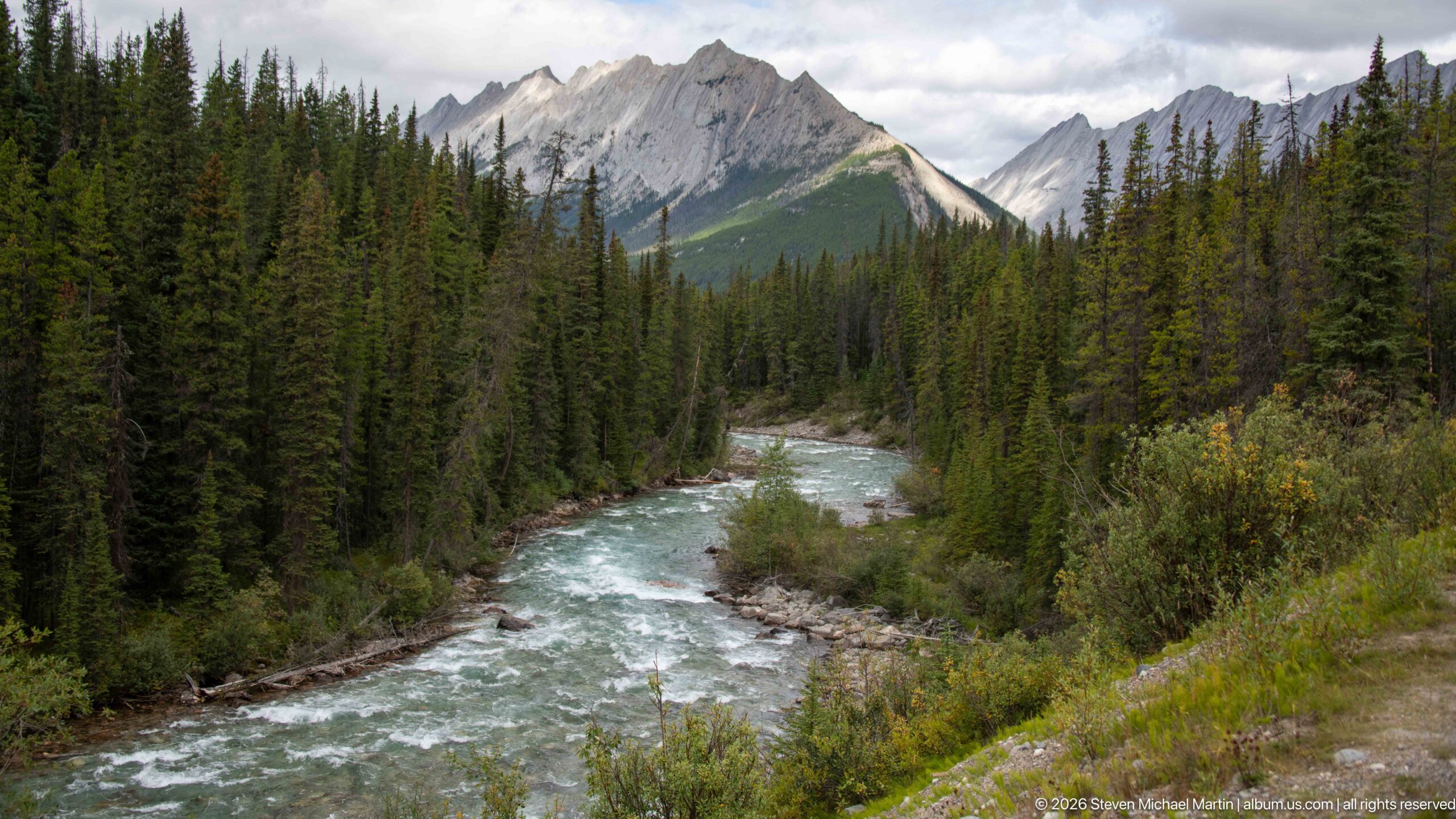
The Maligne River runs swiftly through a forested mountain corridor, its pale blue-green water broken by rocks and shallow rapids. Dense conifers line both banks while sharply layered peaks rise beyond, linking the river to the larger valley system between Maligne Lake and Medicine Lake.
Caption
The Maligne River runs swiftly through a forested mountain corridor, its pale blue-green water broken by rocks and shallow rapids. Dense conifers line both banks while sharply layered peaks rise beyond, linking the river to the larger valley system between Maligne Lake and Medicine Lake.
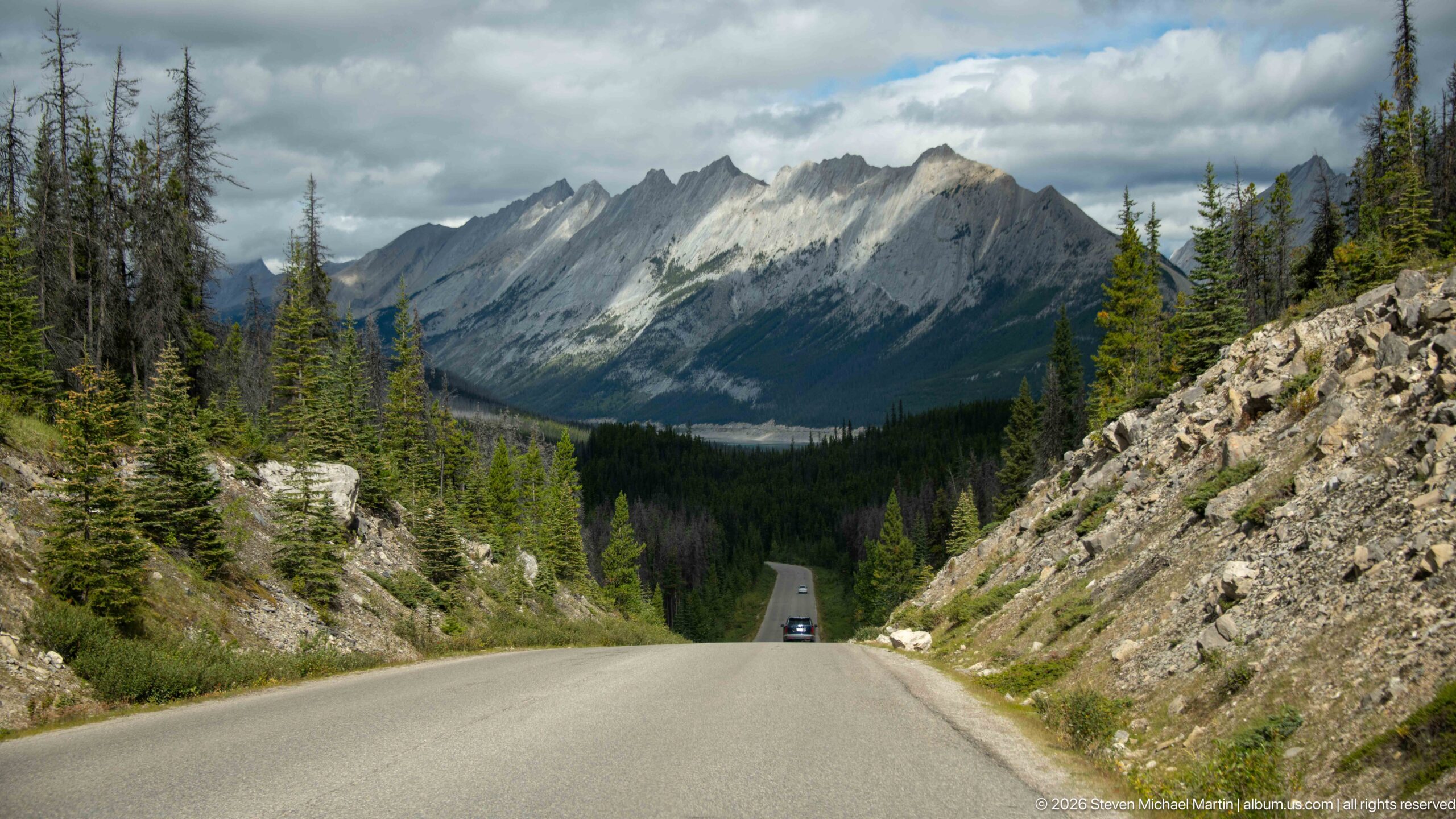
A paved road descends through dense conifer forest toward sharply layered gray mountain ridges in the Maligne Valley. The open roadway and cut slopes reveal how the visitor route threads through steep Rocky Mountain terrain, while broken cloud and patches of sunlight accent the angular relief beyond.
Caption
A paved road descends through dense conifer forest toward sharply layered gray mountain ridges in the Maligne Valley. The open roadway and cut slopes reveal how the visitor route threads through steep Rocky Mountain terrain, while broken cloud and patches of sunlight accent the angular relief beyond.
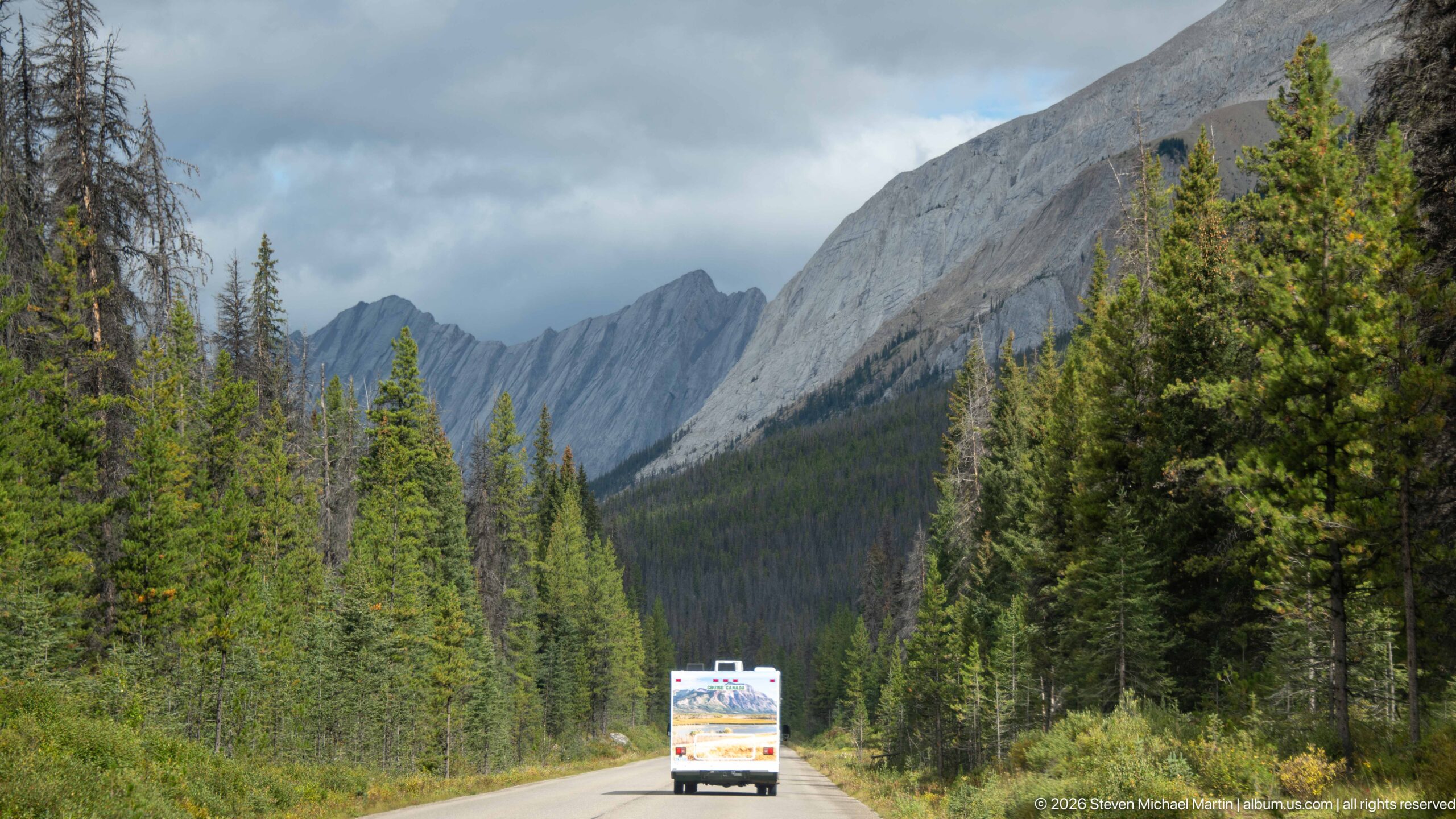
A vehicle travels along a straight section of the Maligne Valley road beneath imposing gray mountain walls. Conifers frame both sides of the pavement, narrowing the view toward a serrated ridge and emphasizing the scale of the valley corridor used to reach Medicine Lake and Maligne Lake.
Caption
A vehicle travels along a straight section of the Maligne Valley road beneath imposing gray mountain walls. Conifers frame both sides of the pavement, narrowing the view toward a serrated ridge and emphasizing the scale of the valley corridor used to reach Medicine Lake and Maligne Lake.
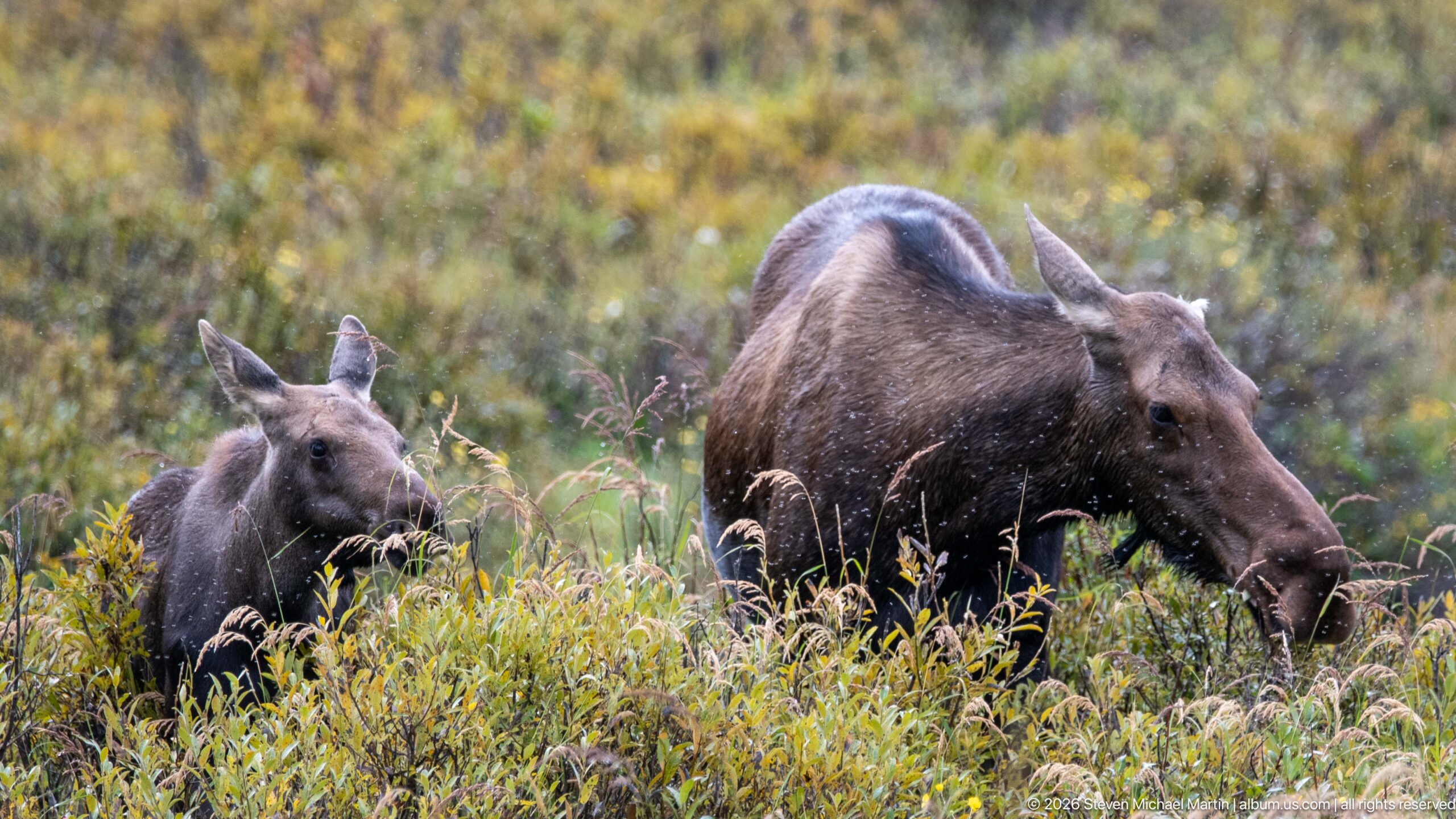
An adult cow moose and calf move through dense willow-like shrubs in the Maligne Valley. The cow browses with her head lowered while the smaller calf follows close behind, placing the animals within the low, food-rich vegetation characteristic of wet valley-bottom habitat.
Caption
An adult cow moose and calf move through dense willow-like shrubs in the Maligne Valley. The cow browses with her head lowered while the smaller calf follows close behind, placing the animals within the low, food-rich vegetation characteristic of wet valley-bottom habitat.
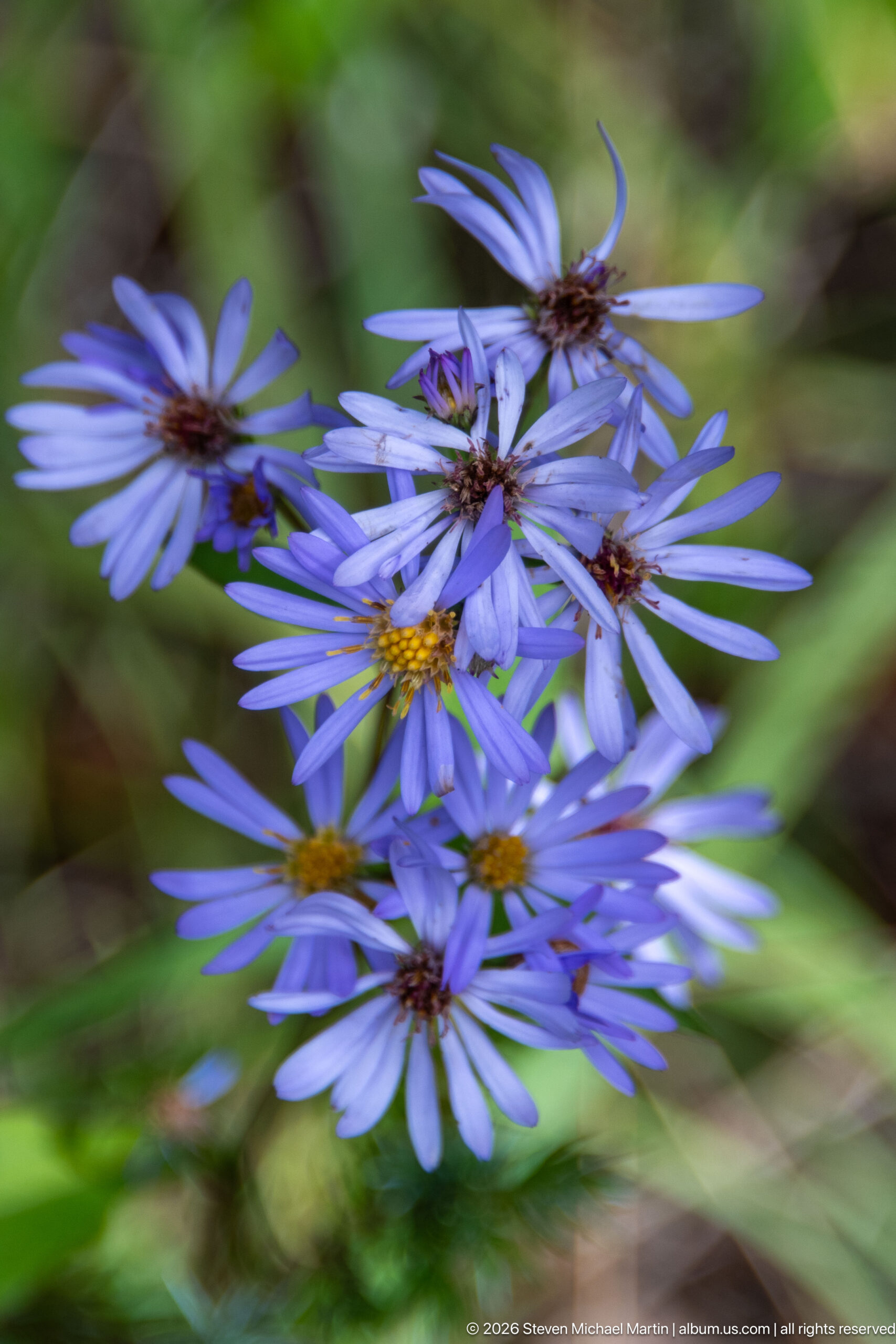
Clusters of purple, daisy-like wildflowers fill the frame, their narrow ray florets surrounding yellow-brown centers against a softly blurred green background. The close viewpoint isolates the blooms from the broader Maligne Valley landscape and records a small-scale element of the subalpine vegetation.
Caption
Clusters of purple, daisy-like wildflowers fill the frame, their narrow ray florets surrounding yellow-brown centers against a softly blurred green background. The close viewpoint isolates the blooms from the broader Maligne Valley landscape and records a small-scale element of the subalpine vegetation.
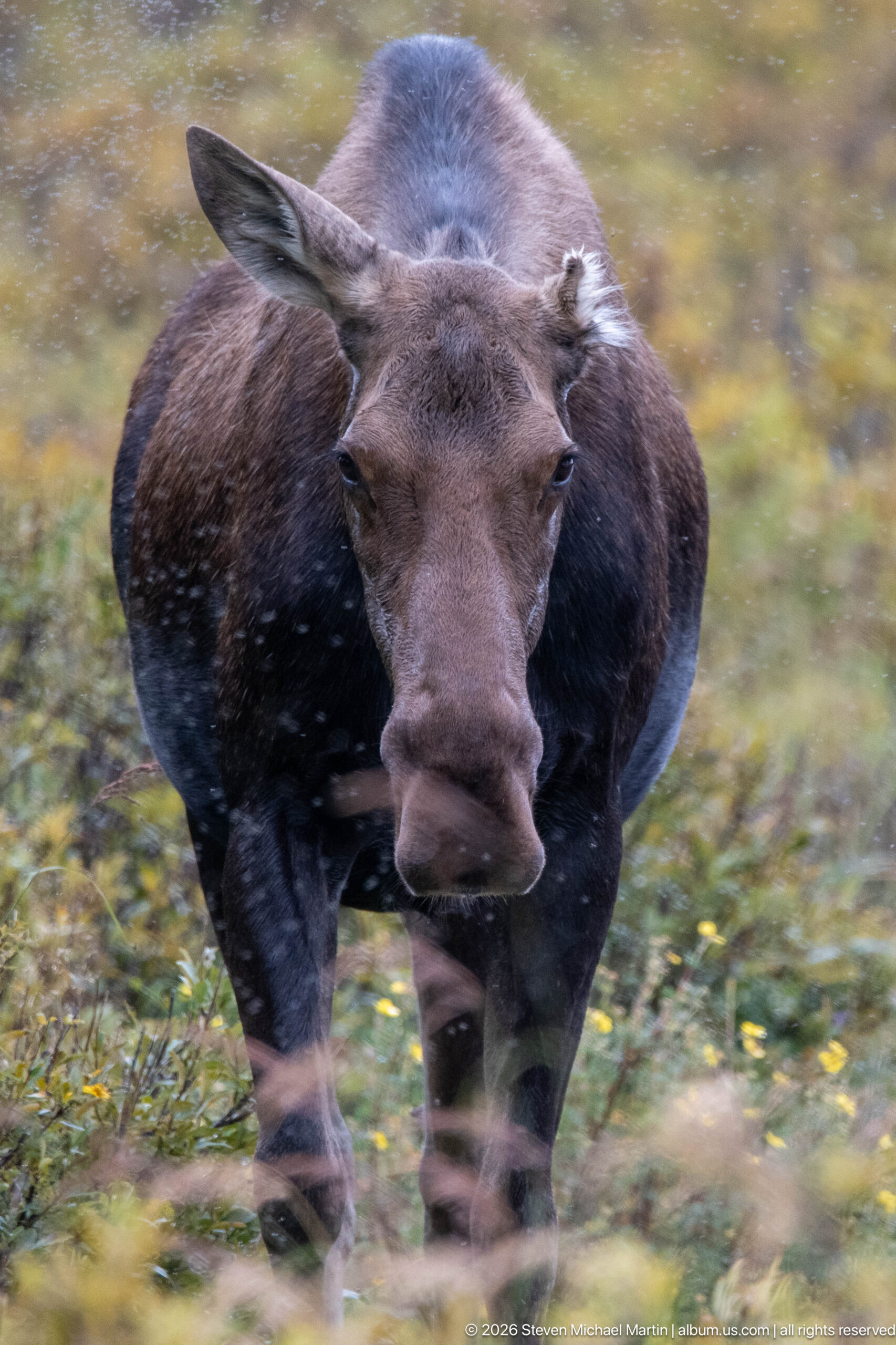
A cow moose faces the camera through low vegetation, her broad muzzle, large ears, and heavy shoulders dominating the composition. Moisture or light-colored flecks dot the dark coat, while the shallow depth of field separates the animal from the muted valley vegetation behind.
Caption
A cow moose faces the camera through low vegetation, her broad muzzle, large ears, and heavy shoulders dominating the composition. Moisture or light-colored flecks dot the dark coat, while the shallow depth of field separates the animal from the muted valley vegetation behind.
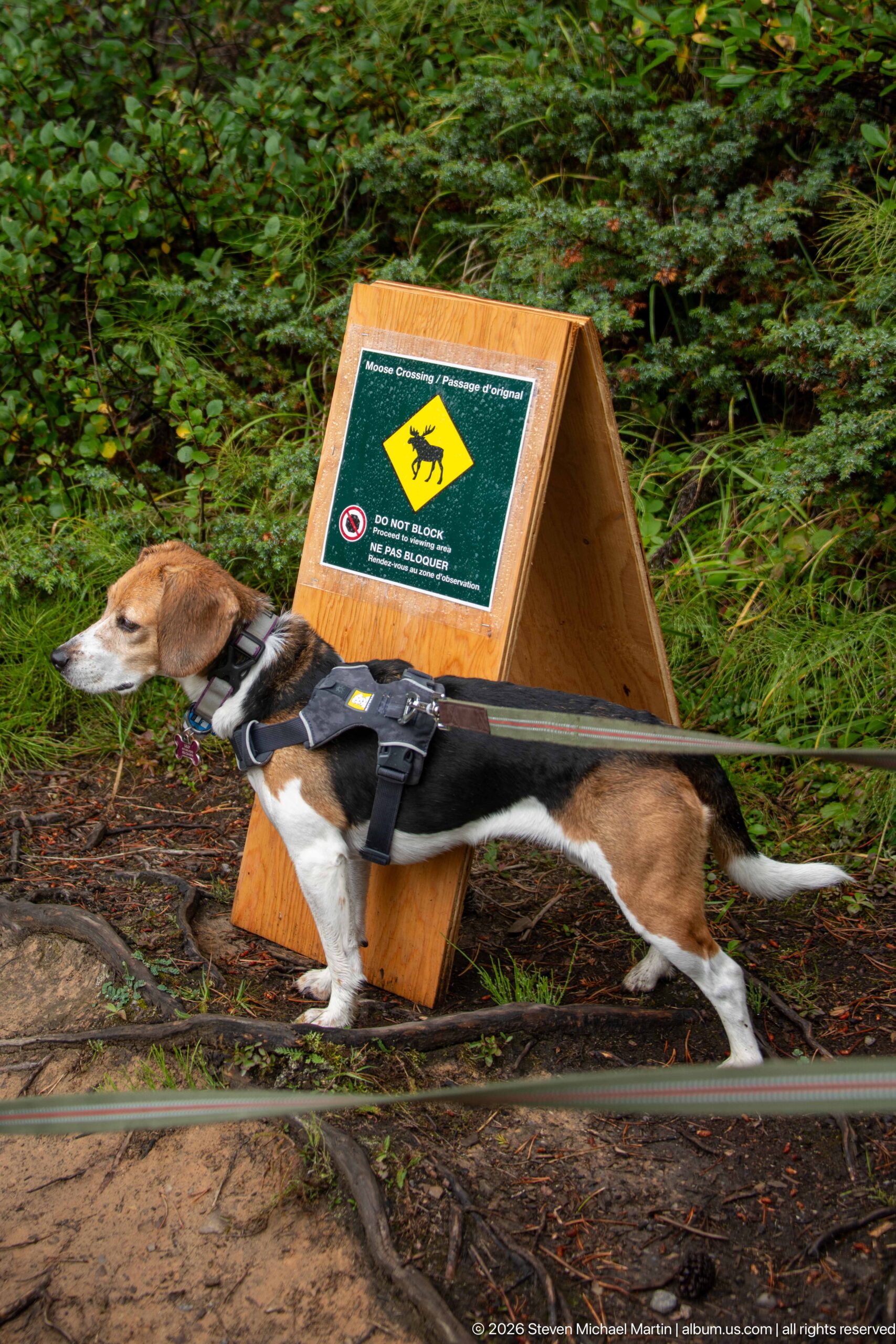
A harnessed beagle passes a wooden A-frame wildlife warning sign on a forest trail. This viewpoint emphasizes the relationship between the subject and its immediate surroundings rather than relying on broader portfolio context.
Caption
A harnessed beagle passes a wooden A-frame wildlife warning sign on a forest trail. This viewpoint emphasizes the relationship between the subject and its immediate surroundings rather than relying on broader portfolio context.
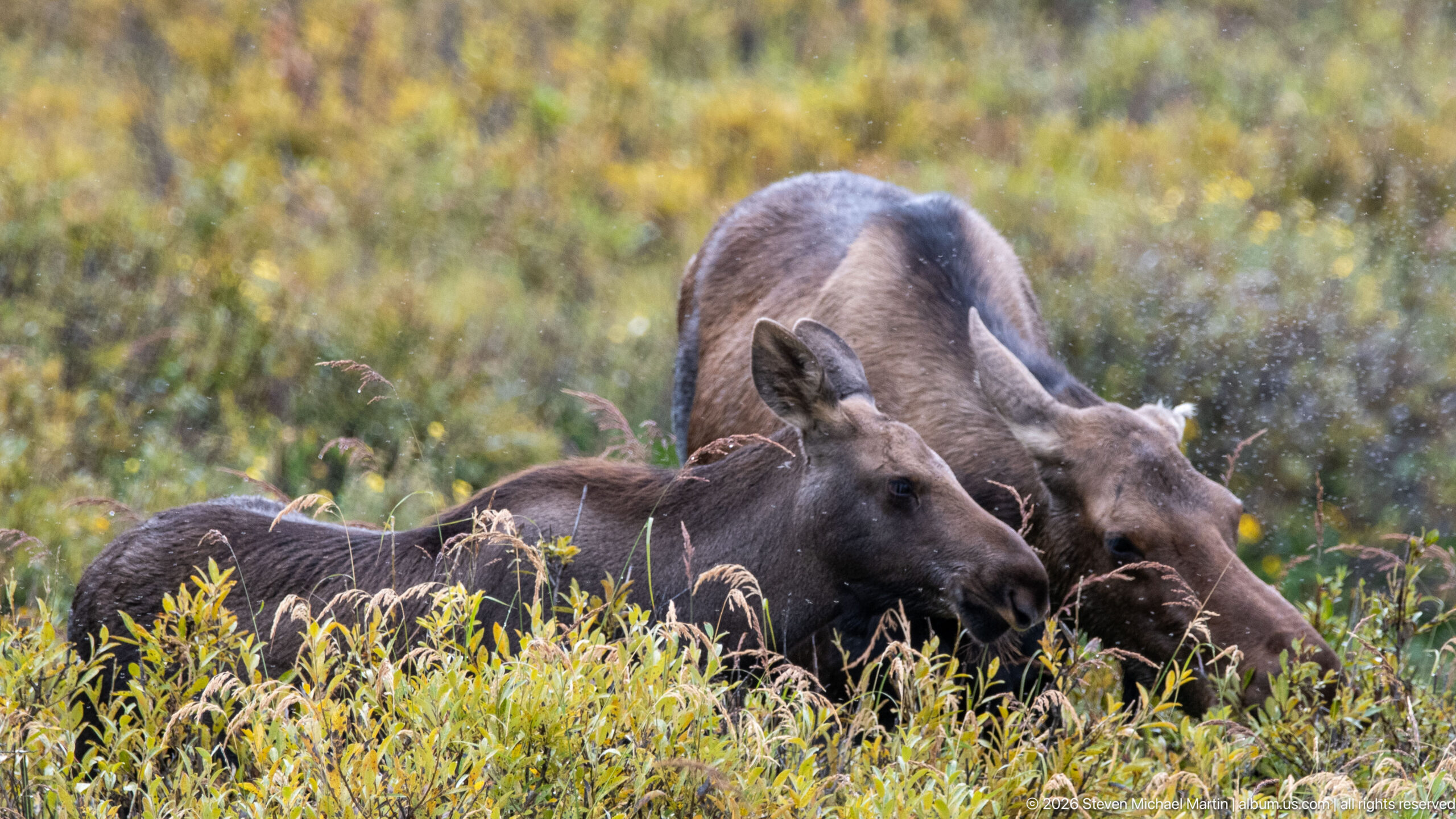
A cow moose lowers her head beside a calf lying partly concealed in autumn-colored shrubs. Their close physical proximity and contrasting postures create an intimate wildlife study while retaining enough surrounding vegetation to show the pair within their Maligne Valley habitat.
Caption
A cow moose lowers her head beside a calf lying partly concealed in autumn-colored shrubs. Their close physical proximity and contrasting postures create an intimate wildlife study while retaining enough surrounding vegetation to show the pair within their Maligne Valley habitat.
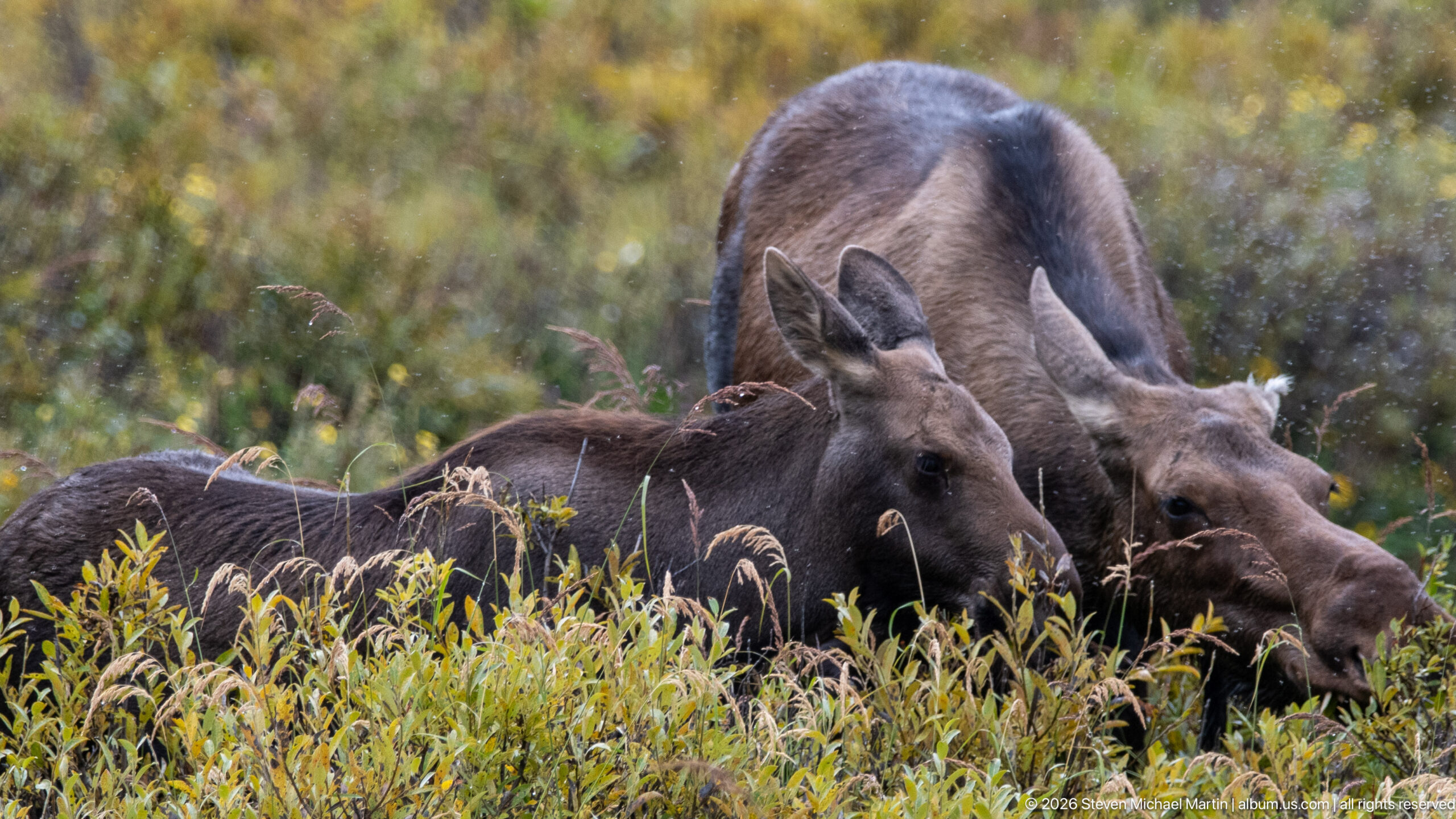
The dark head and long ears of a moose calf rise above foreground shrubs as an adult cow stands immediately behind it. Layered vegetation partly conceals both animals, producing a habitat-rich portrait that shows how easily large wildlife can blend into the Maligne Valley's dense brush.
Caption
The dark head and long ears of a moose calf rise above foreground shrubs as an adult cow stands immediately behind it. Layered vegetation partly conceals both animals, producing a habitat-rich portrait that shows how easily large wildlife can blend into the Maligne Valley's dense brush.
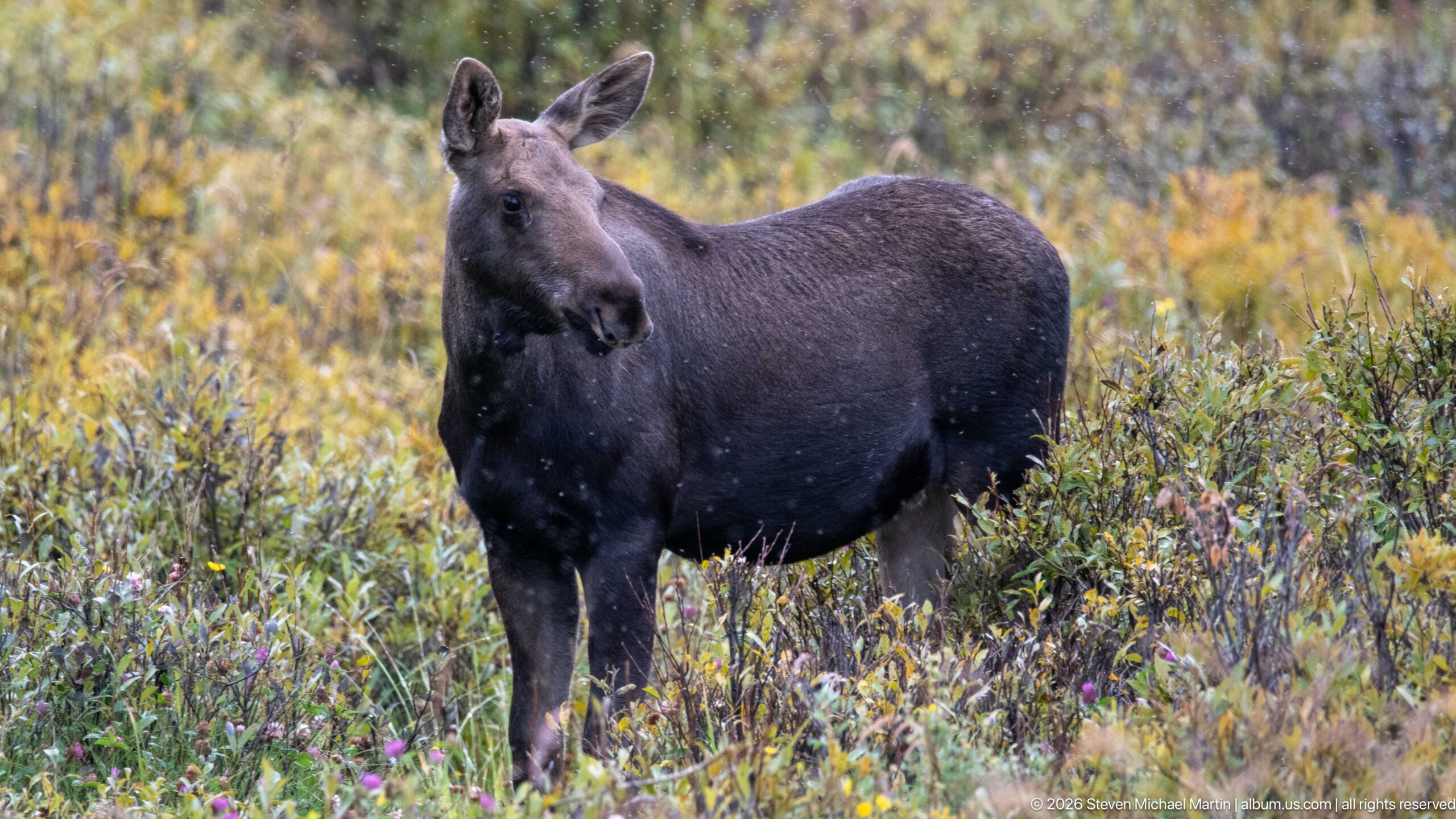
A moose calf stands alert among low yellow-green shrubs, its oversized ears raised and dark body fully visible in profile. The uncluttered view records the young animal's proportions—long legs, compact torso, and elongated muzzle—against autumn-toned Maligne Valley vegetation.
Caption
A moose calf stands alert among low yellow-green shrubs, its oversized ears raised and dark body fully visible in profile. The uncluttered view records the young animal's proportions—long legs, compact torso, and elongated muzzle—against autumn-toned Maligne Valley vegetation.
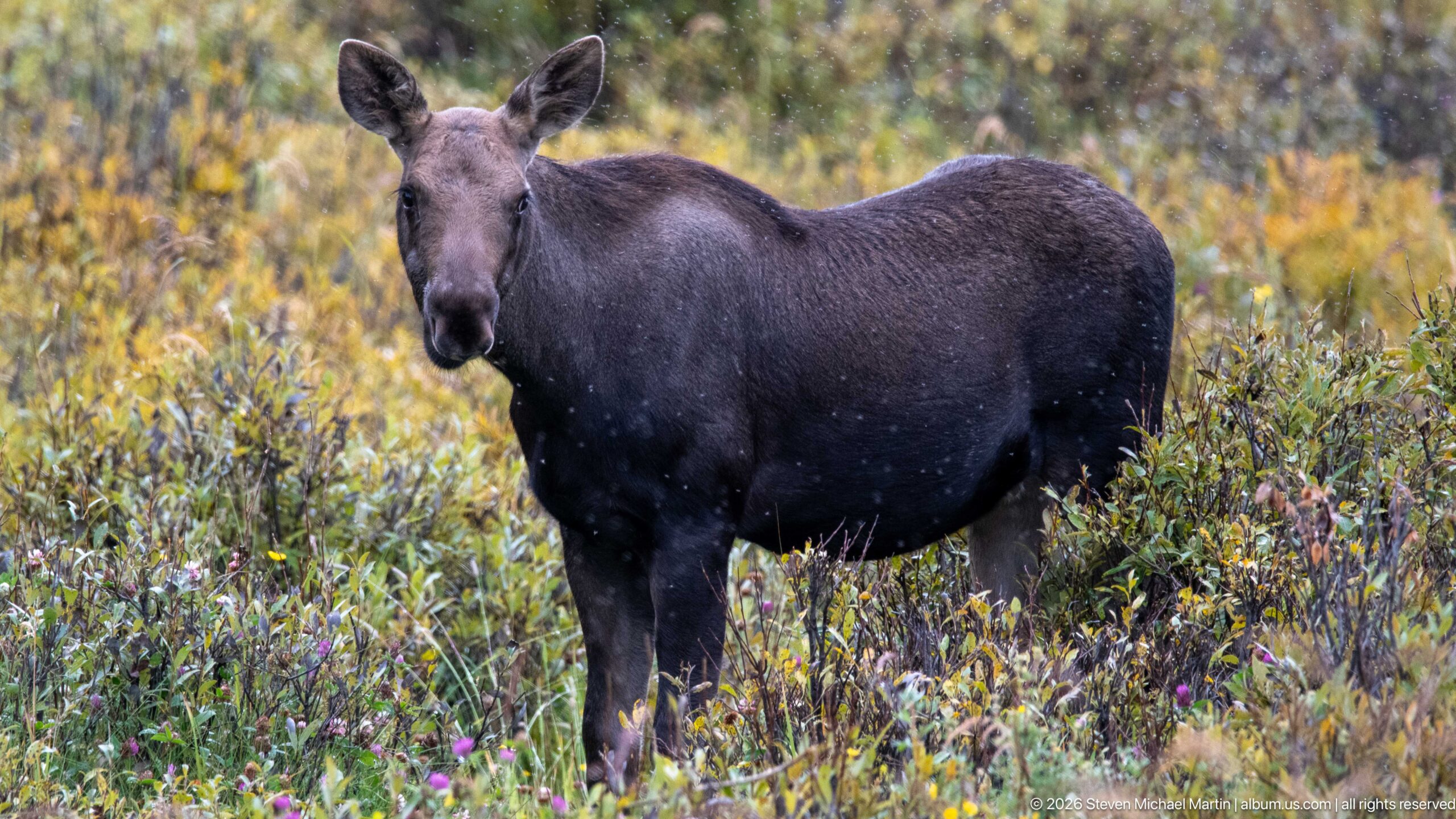
Standing nearly square to the camera, a moose calf pauses among colorful valley shrubs. Its tall ears, narrow juvenile face, long legs, and compact body are especially clear in this angle, while scattered pink flowers and yellow foliage provide a detailed view of the surrounding ground cover.
Caption
Standing nearly square to the camera, a moose calf pauses among colorful valley shrubs. Its tall ears, narrow juvenile face, long legs, and compact body are especially clear in this angle, while scattered pink flowers and yellow foliage provide a detailed view of the surrounding ground cover.
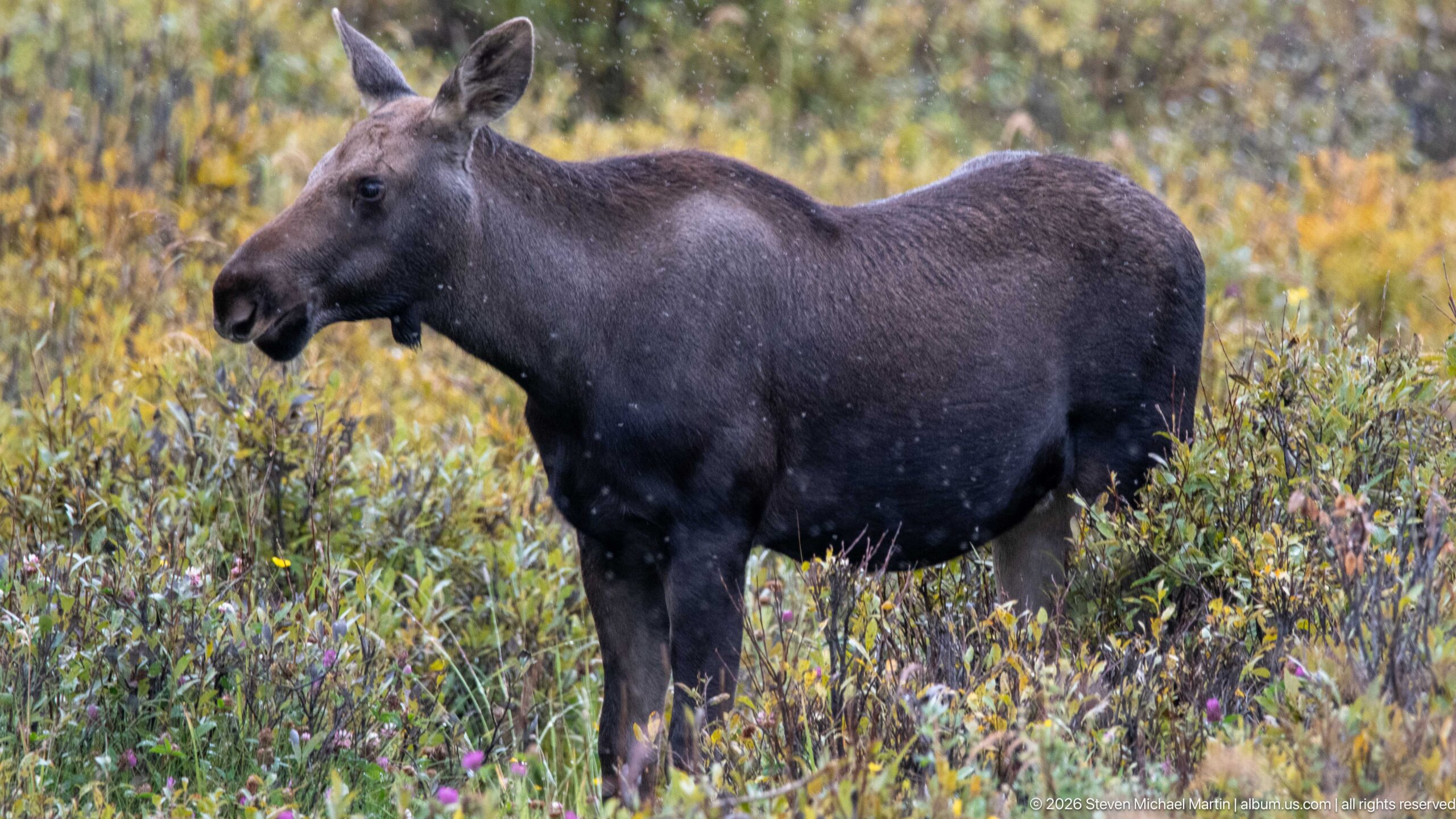
A young moose turns into a clean side profile amid dense low shrubs. The profile highlights its elongated muzzle, large upright ears, slight throat bell, and long-legged build, with the subdued brown coat standing out against mottled yellow and green vegetation.
Caption
A young moose turns into a clean side profile amid dense low shrubs. The profile highlights its elongated muzzle, large upright ears, slight throat bell, and long-legged build, with the subdued brown coat standing out against mottled yellow and green vegetation.
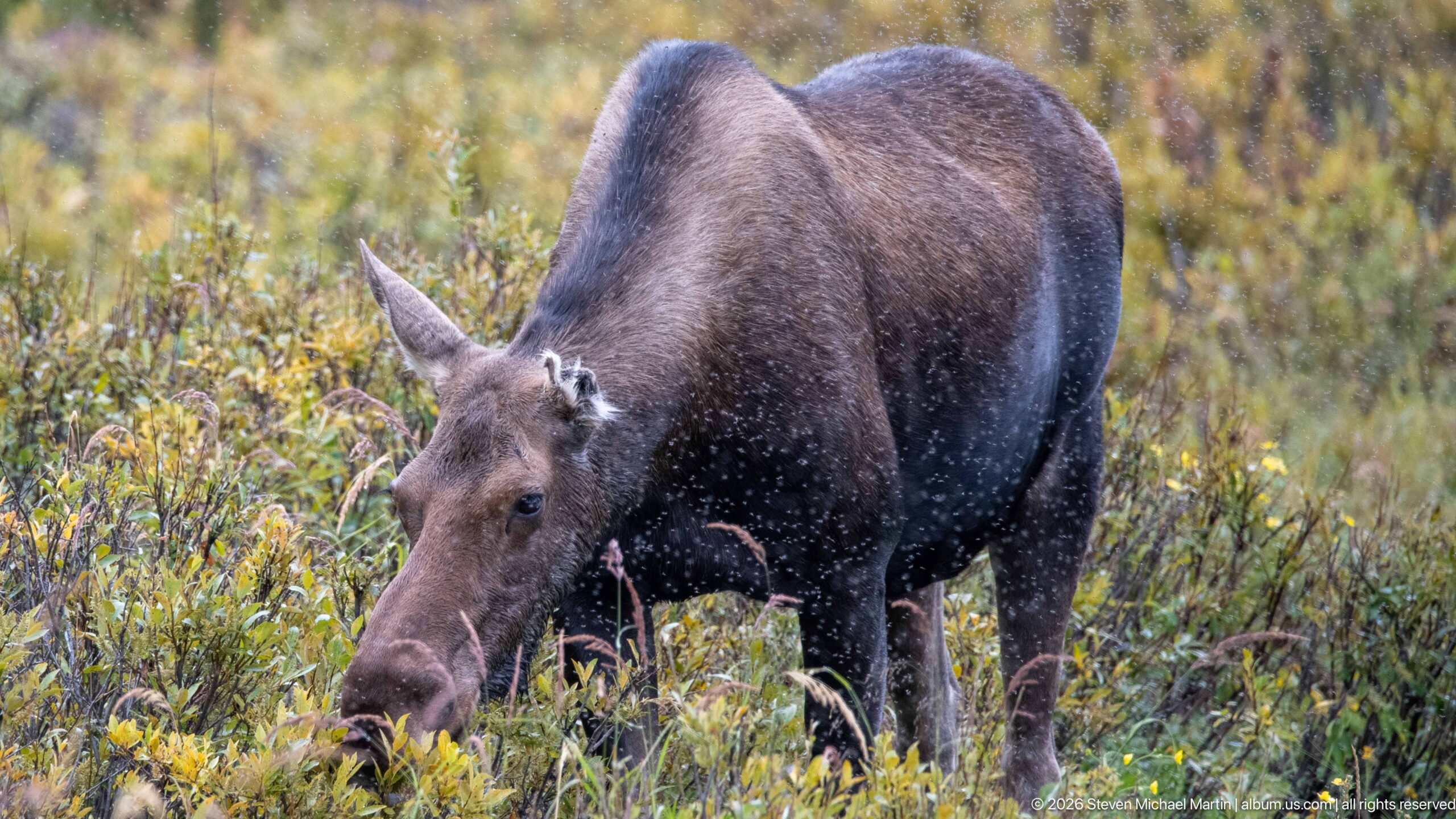
A cow moose browses with her muzzle deep in low vegetation, presenting a close three-quarter view of the high shoulders and dark brown coat. Pale flecks across the body and the dense autumn ground cover add texture while the feeding posture places the animal directly within its forage habitat.
Caption
A cow moose browses with her muzzle deep in low vegetation, presenting a close three-quarter view of the high shoulders and dark brown coat. Pale flecks across the body and the dense autumn ground cover add texture while the feeding posture places the animal directly within its forage habitat.
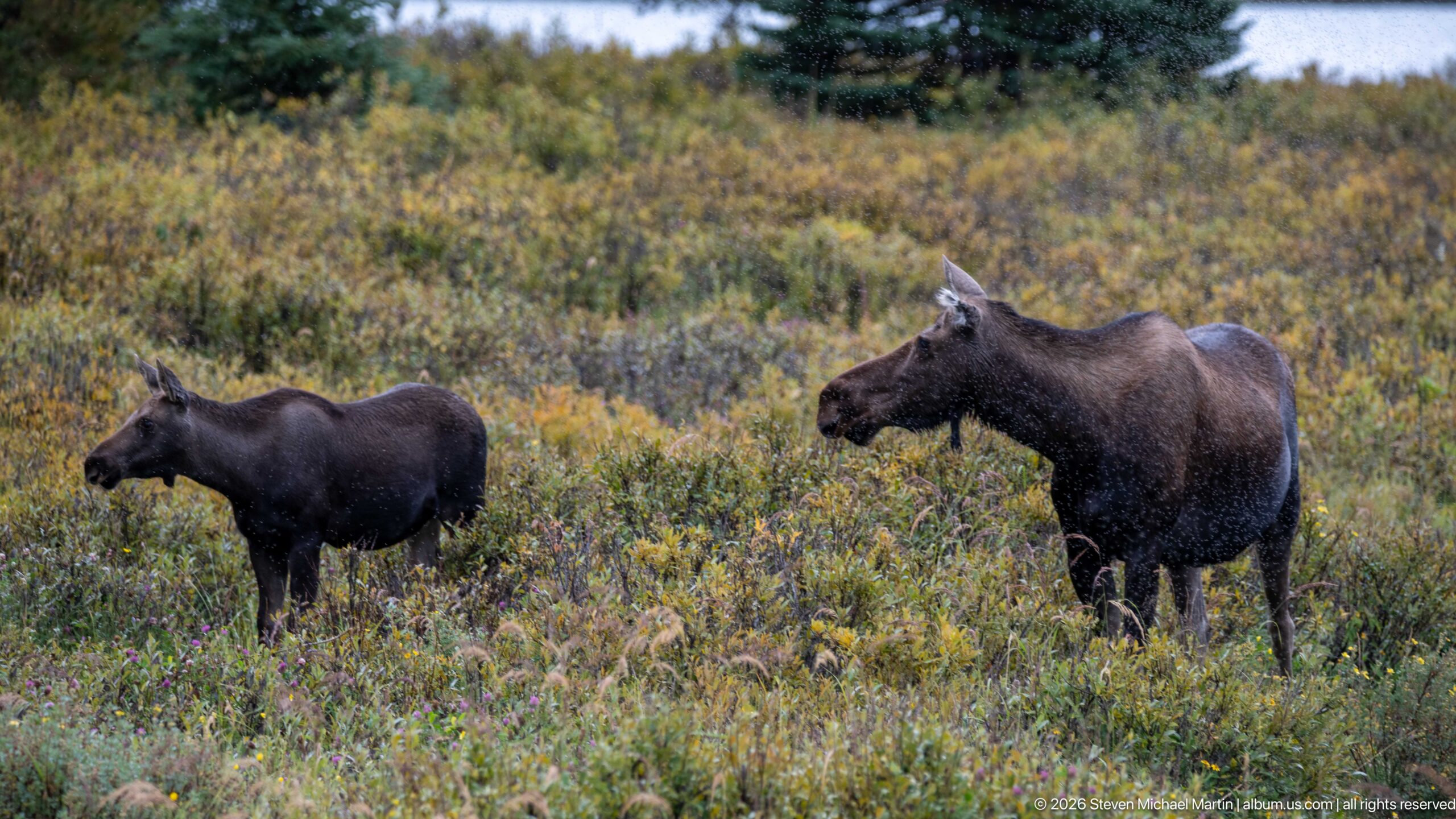
A cow moose and calf stand several body lengths apart across an open patch of low shrubs. The wider composition shifts attention from portrait detail to habitat, showing both animals surrounded by extensive yellow-green vegetation at the edge of conifer forest.
Caption
A cow moose and calf stand several body lengths apart across an open patch of low shrubs. The wider composition shifts attention from portrait detail to habitat, showing both animals surrounded by extensive yellow-green vegetation at the edge of conifer forest.
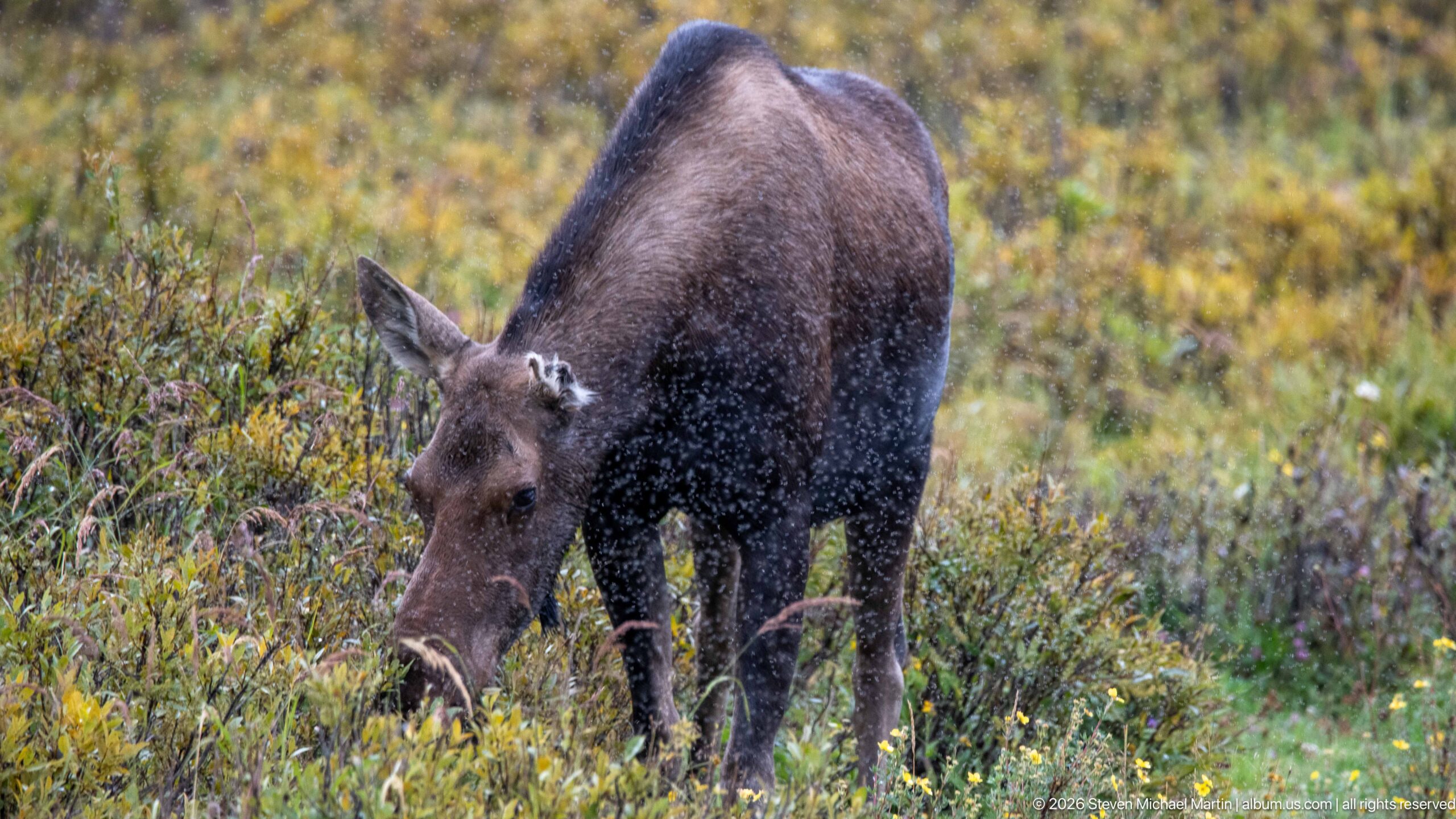
A cow moose feeds among dense low shrubs, her head lowered and long muzzle buried in the vegetation. The full-body view shows the species' characteristic high shoulders and long legs while autumn colors surround the dark-coated animal.
Caption
A cow moose feeds among dense low shrubs, her head lowered and long muzzle buried in the vegetation. The full-body view shows the species' characteristic high shoulders and long legs while autumn colors surround the dark-coated animal.
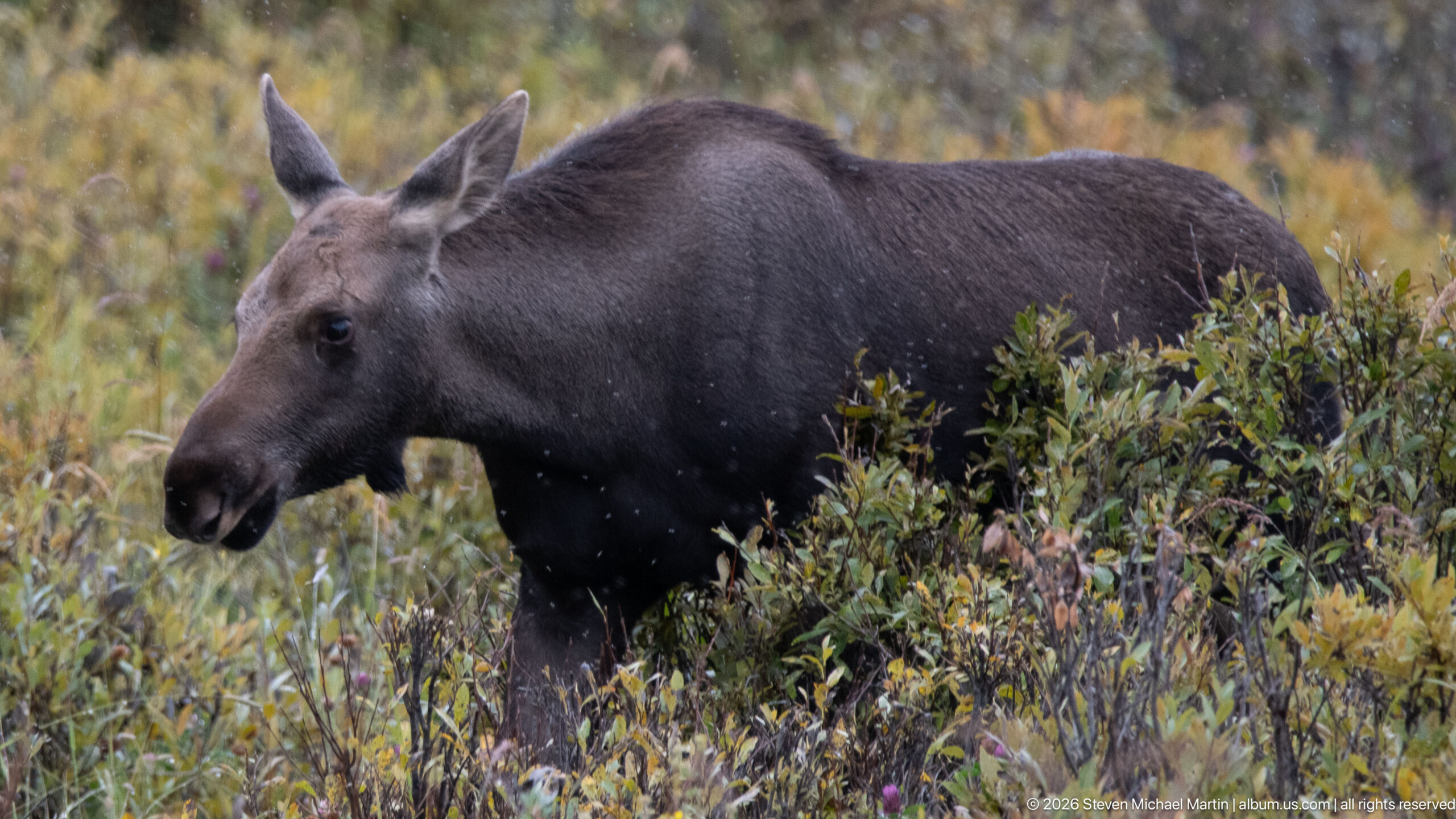
A moose calf moves through shoulder-high brush, its dark torso rising above the autumn vegetation. The close lateral view emphasizes the young animal's large ears, elongated muzzle, and compact build as it navigates the dense valley-bottom cover.
Caption
A moose calf moves through shoulder-high brush, its dark torso rising above the autumn vegetation. The close lateral view emphasizes the young animal's large ears, elongated muzzle, and compact build as it navigates the dense valley-bottom cover.
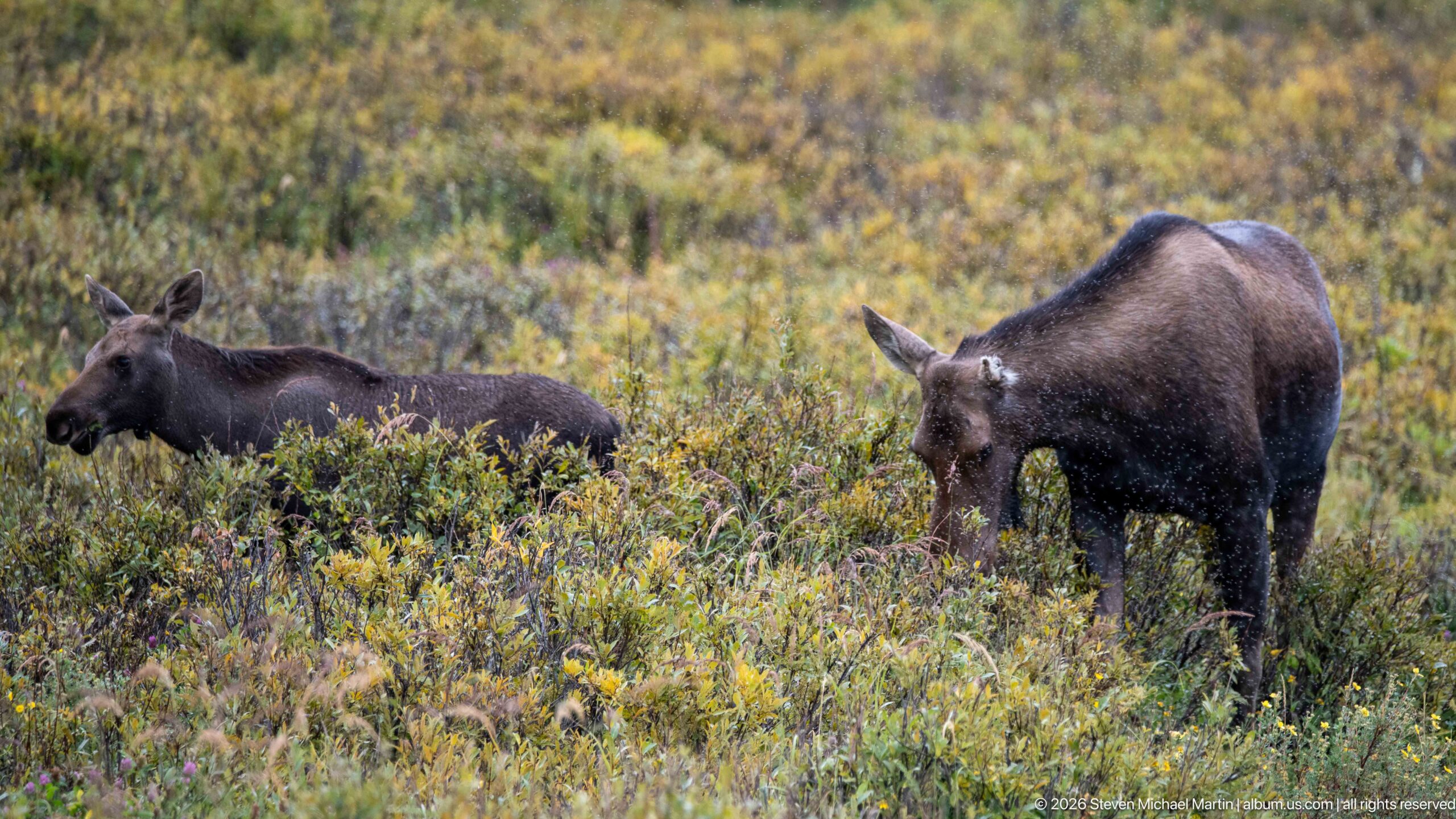
A cow moose and calf occupy separate pockets of dense vegetation, the calf partly immersed in brush while the larger adult stands farther right. The wider framing preserves their spatial relationship and shows the pair embedded in a broad expanse of low Maligne Valley shrubs.
Caption
A cow moose and calf occupy separate pockets of dense vegetation, the calf partly immersed in brush while the larger adult stands farther right. The wider framing preserves their spatial relationship and shows the pair embedded in a broad expanse of low Maligne Valley shrubs.
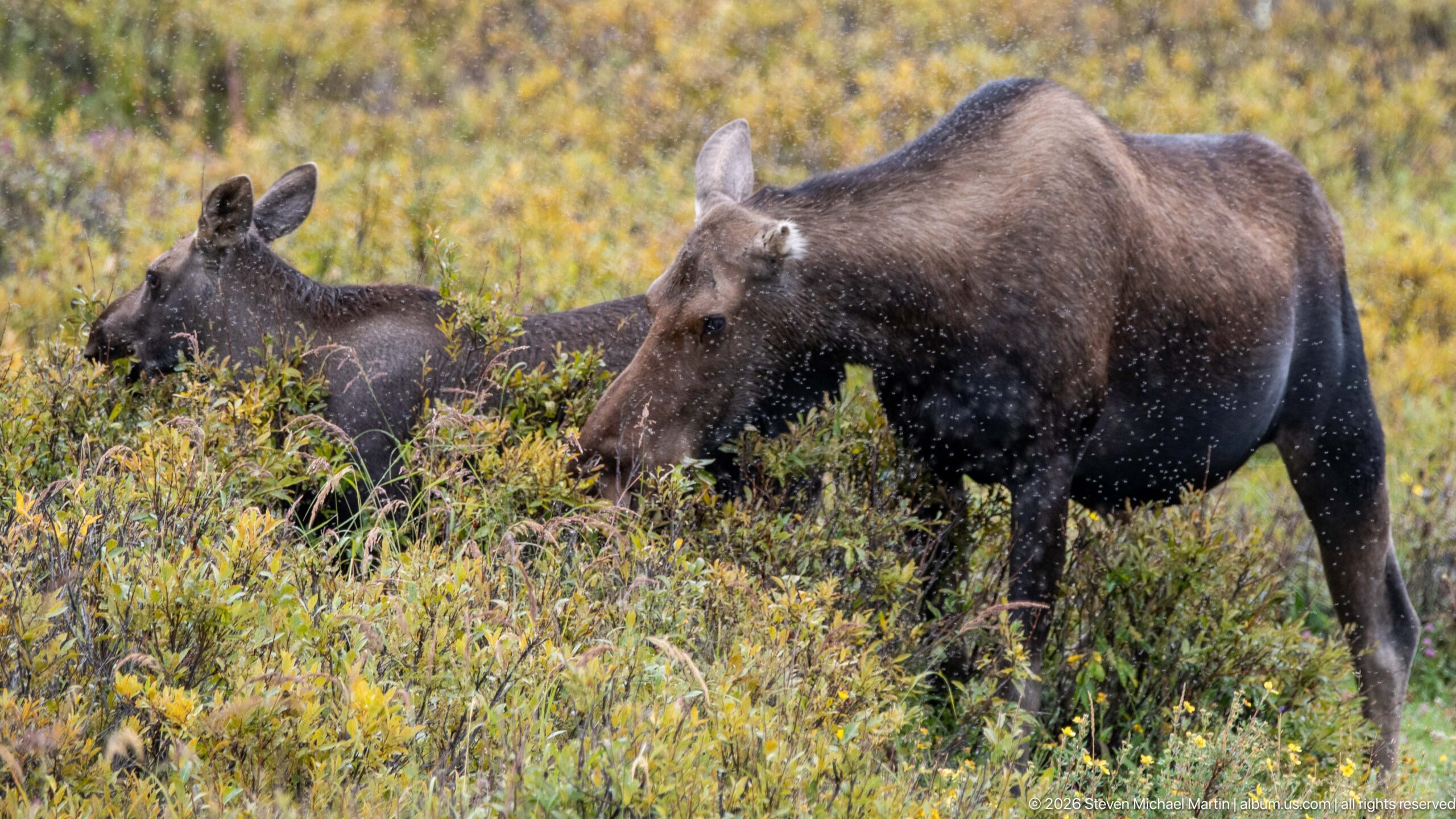
A cow moose stands in the foreground while her calf is partly screened by shrubs behind her. Their overlapping positions emphasize the adult's greater height and mass, and the surrounding yellow-green vegetation situates the pair within dense valley forage.
Caption
A cow moose stands in the foreground while her calf is partly screened by shrubs behind her. Their overlapping positions emphasize the adult's greater height and mass, and the surrounding yellow-green vegetation situates the pair within dense valley forage.
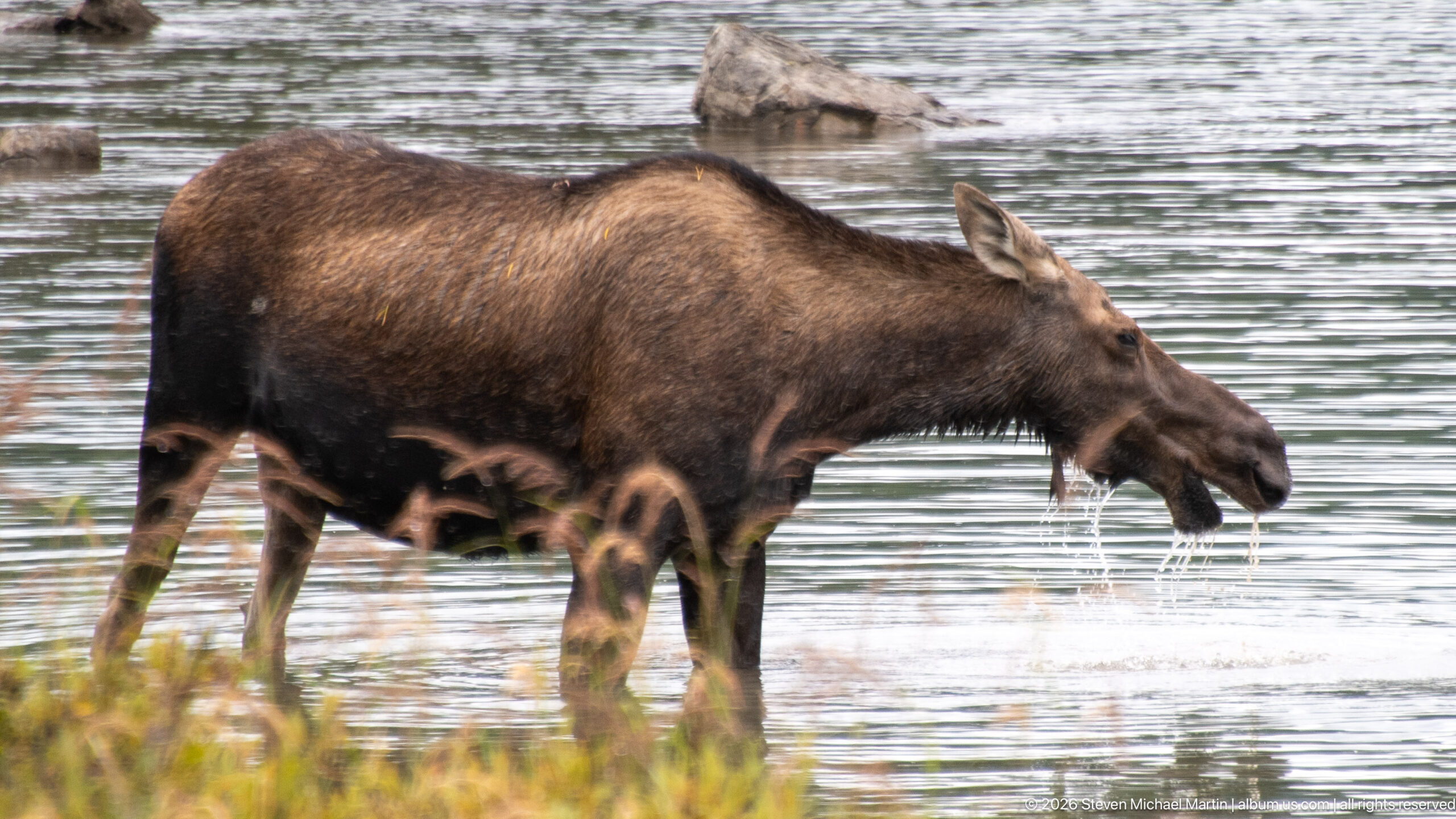
A cow moose wades through shallow water along a rocky, vegetated shoreline, water dripping from her muzzle as she moves. The lateral view links the animal directly to an aquatic edge habitat, with rippled water and submerged legs distinguishing this frame from the preceding shrubland sequence.
Caption
A cow moose wades through shallow water along a rocky, vegetated shoreline, water dripping from her muzzle as she moves. The lateral view links the animal directly to an aquatic edge habitat, with rippled water and submerged legs distinguishing this frame from the preceding shrubland sequence.
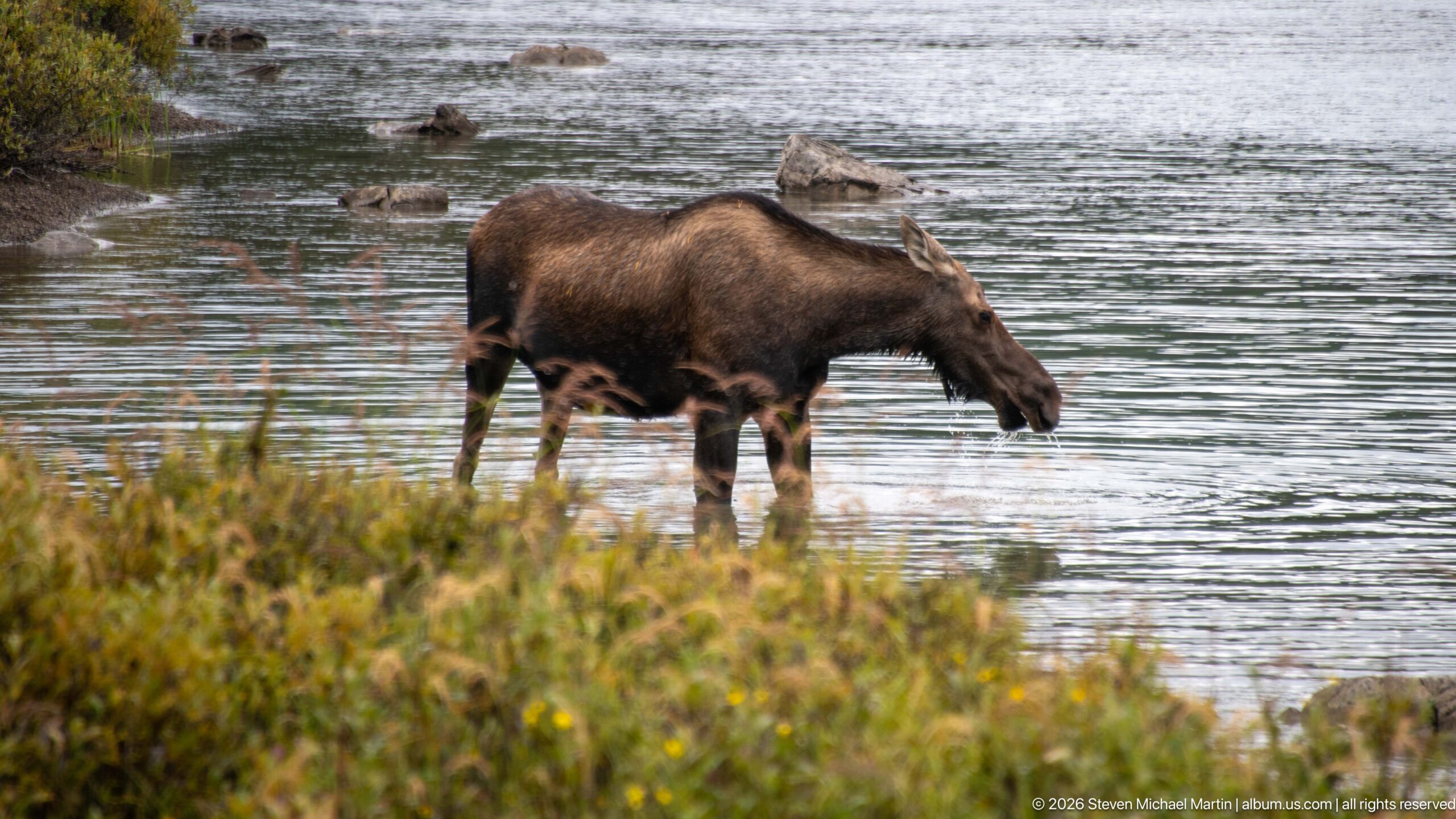
A cow moose stands knee-deep near the shoreline with her head lowered toward the water. The wider composition includes scattered rocks, rippled open water, and foreground vegetation, giving greater environmental context to the animal's use of the lake margin.
Caption
A cow moose stands knee-deep near the shoreline with her head lowered toward the water. The wider composition includes scattered rocks, rippled open water, and foreground vegetation, giving greater environmental context to the animal's use of the lake margin.
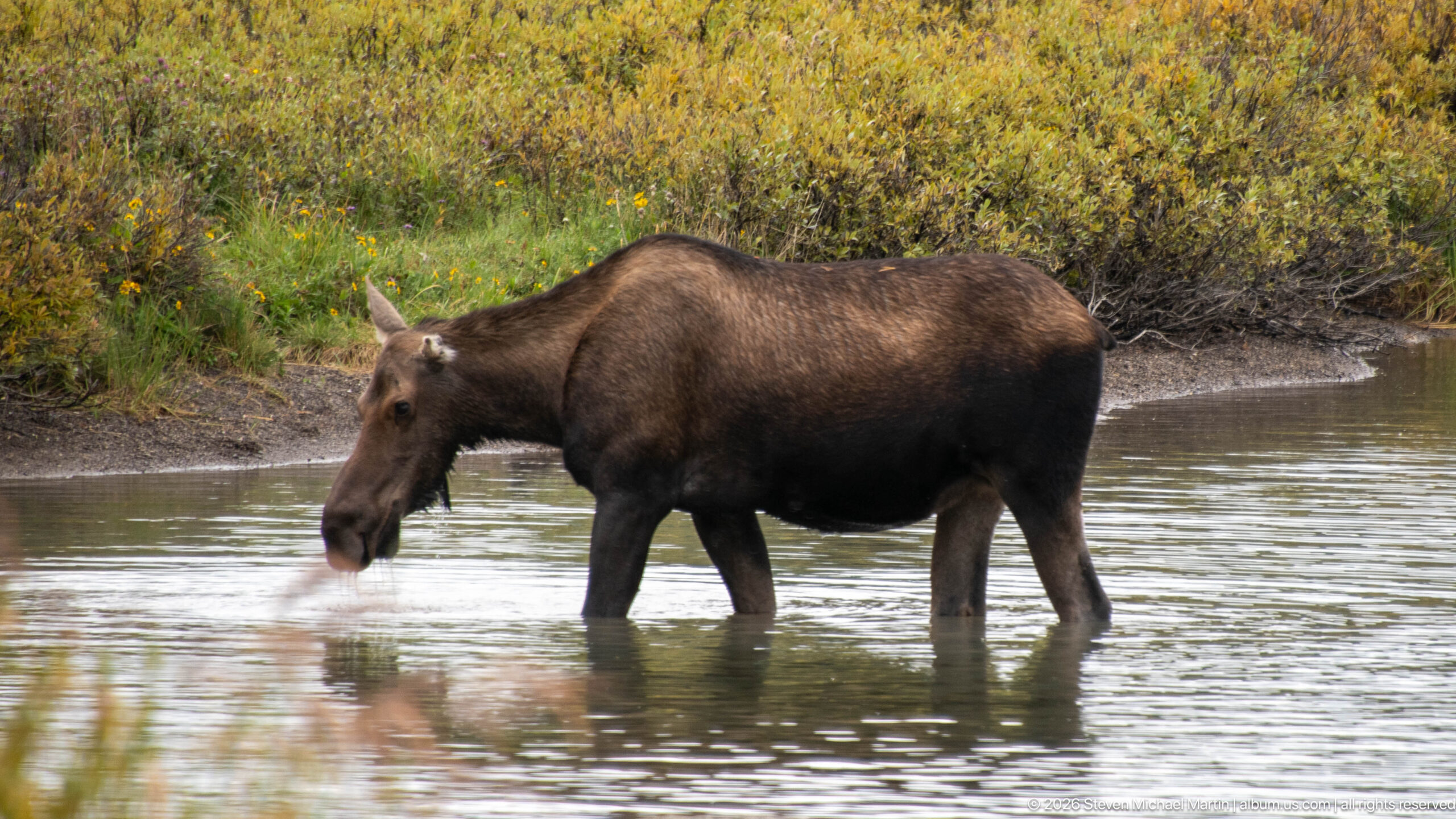
A cow moose pauses in shallow water beside a low, shrub-lined shore. Her reflection breaks across the rippled surface while the full side view clearly shows the long legs, heavy shoulders, and elongated muzzle characteristic of the species.
Caption
A cow moose pauses in shallow water beside a low, shrub-lined shore. Her reflection breaks across the rippled surface while the full side view clearly shows the long legs, heavy shoulders, and elongated muzzle characteristic of the species.
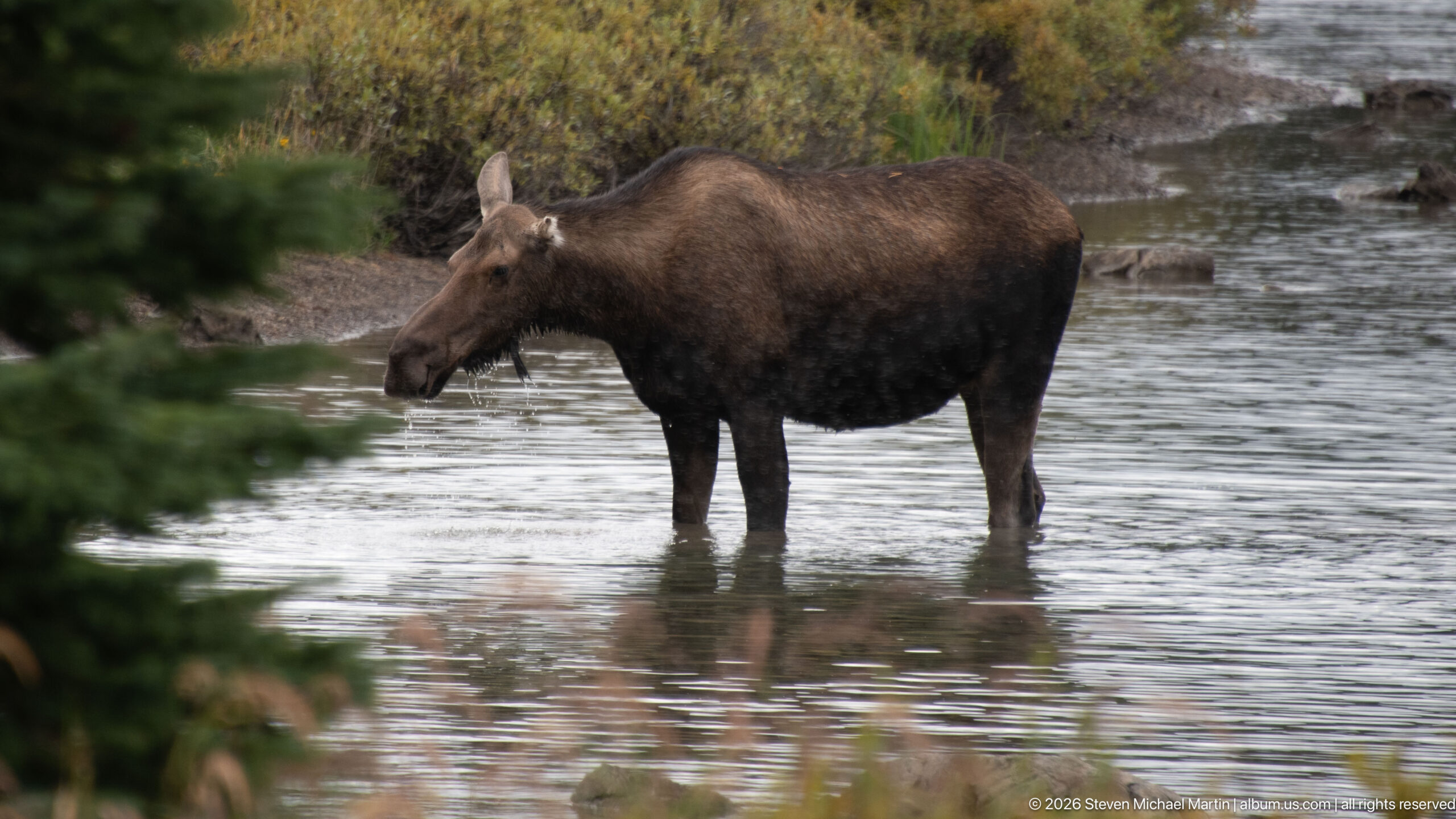
A cow moose stands nearly motionless in shallow water, framed at left by a dark conifer branch and backed by a stony shoreline. The subdued composition isolates the animal against reflective water and records a quieter moment along the Maligne Valley's aquatic edge.
Caption
A cow moose stands nearly motionless in shallow water, framed at left by a dark conifer branch and backed by a stony shoreline. The subdued composition isolates the animal against reflective water and records a quieter moment along the Maligne Valley's aquatic edge.
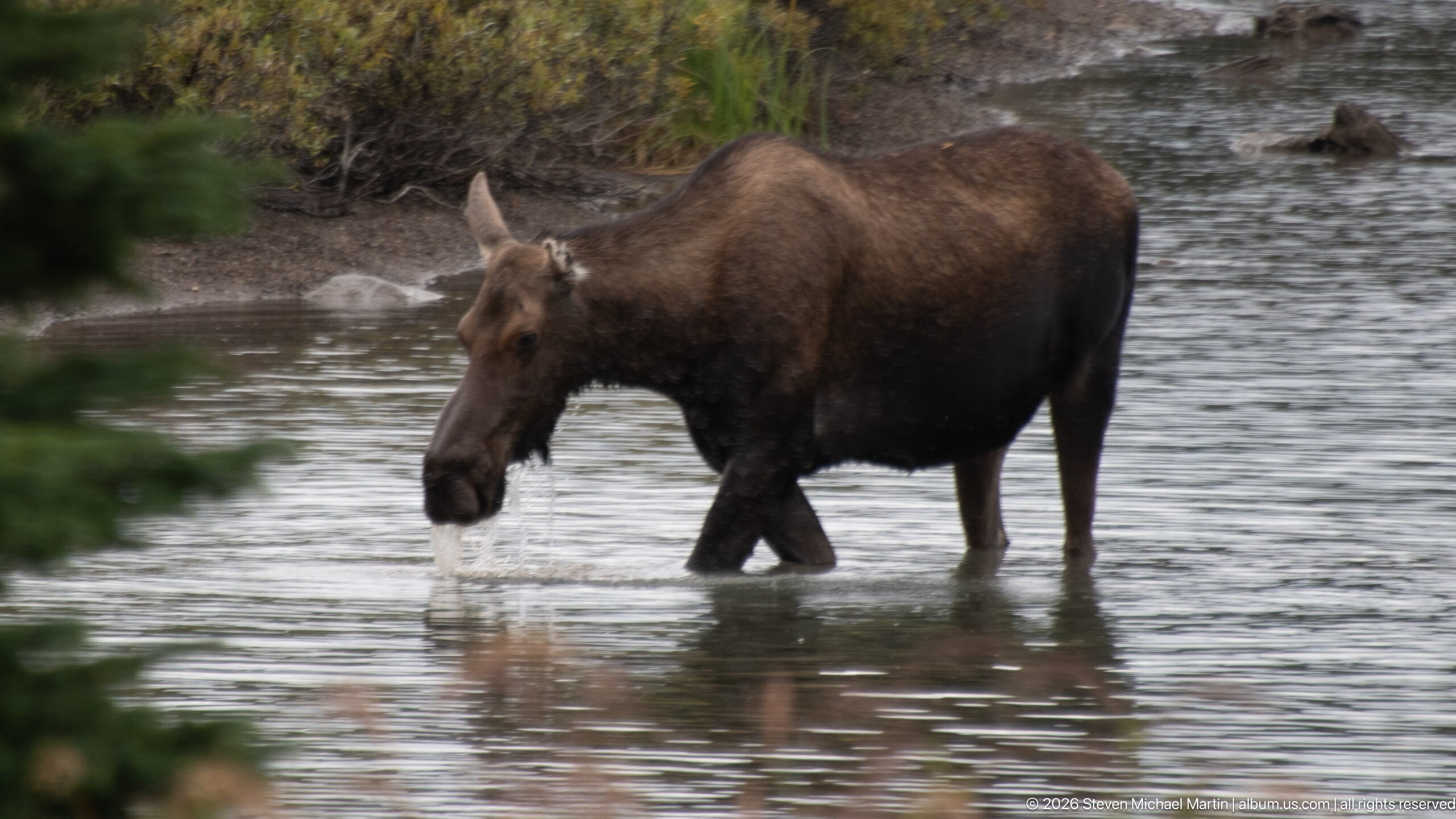
A cow moose steps through shallow water, one foreleg lifted as ripples spread around her legs. The forward movement and reflected silhouette distinguish this view from nearby stationary portraits, while the rocky bank and vegetation retain the waterside context.
Caption
A cow moose steps through shallow water, one foreleg lifted as ripples spread around her legs. The forward movement and reflected silhouette distinguish this view from nearby stationary portraits, while the rocky bank and vegetation retain the waterside context.
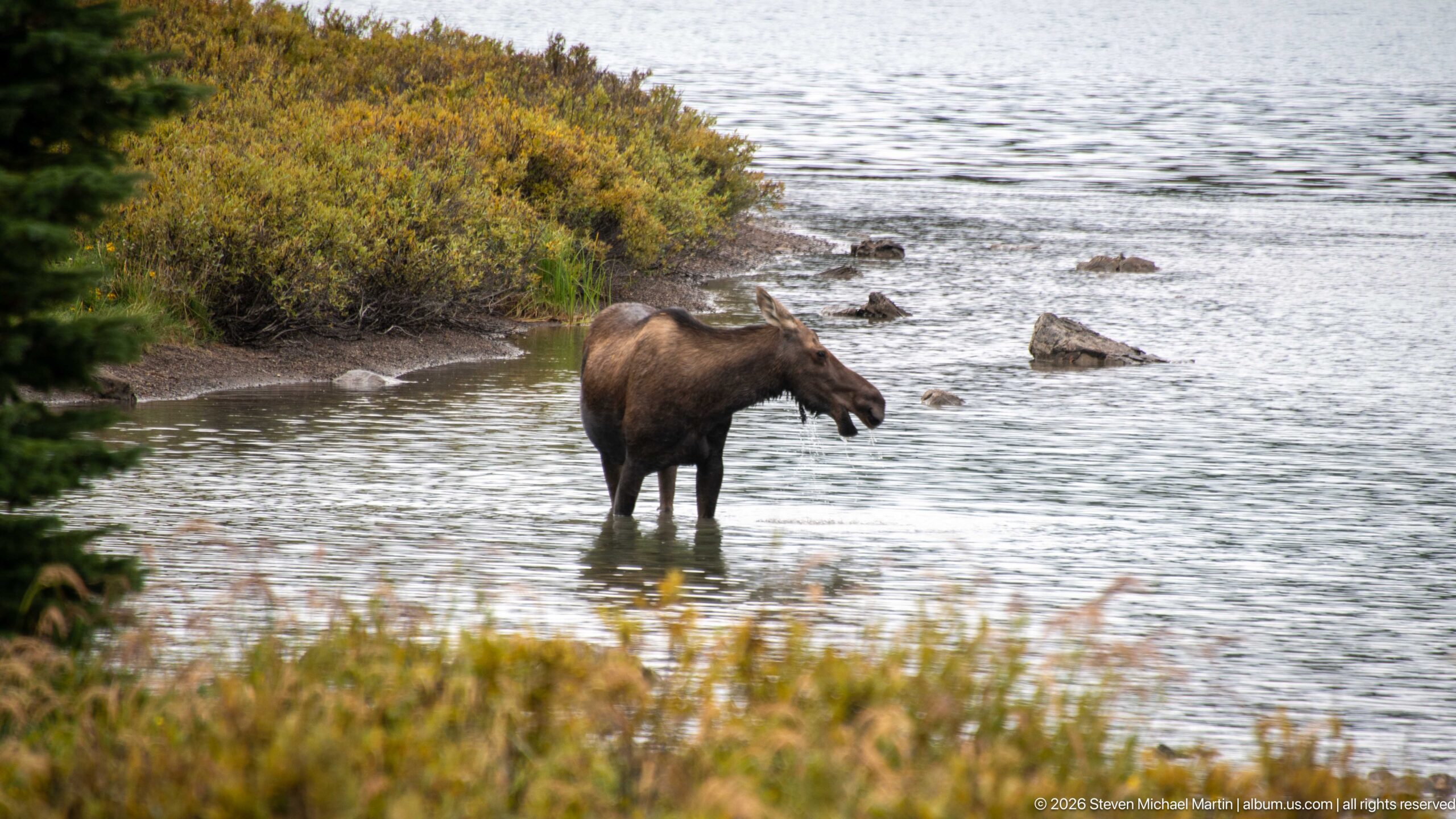
Seen from farther back, a cow moose stands in shallow water where a curving vegetated shore meets a broad rippled surface. Scattered rocks lead outward from the bank, and the wider framing emphasizes the animal's scale within the lakeshore environment.
Caption
Seen from farther back, a cow moose stands in shallow water where a curving vegetated shore meets a broad rippled surface. Scattered rocks lead outward from the bank, and the wider framing emphasizes the animal's scale within the lakeshore environment.
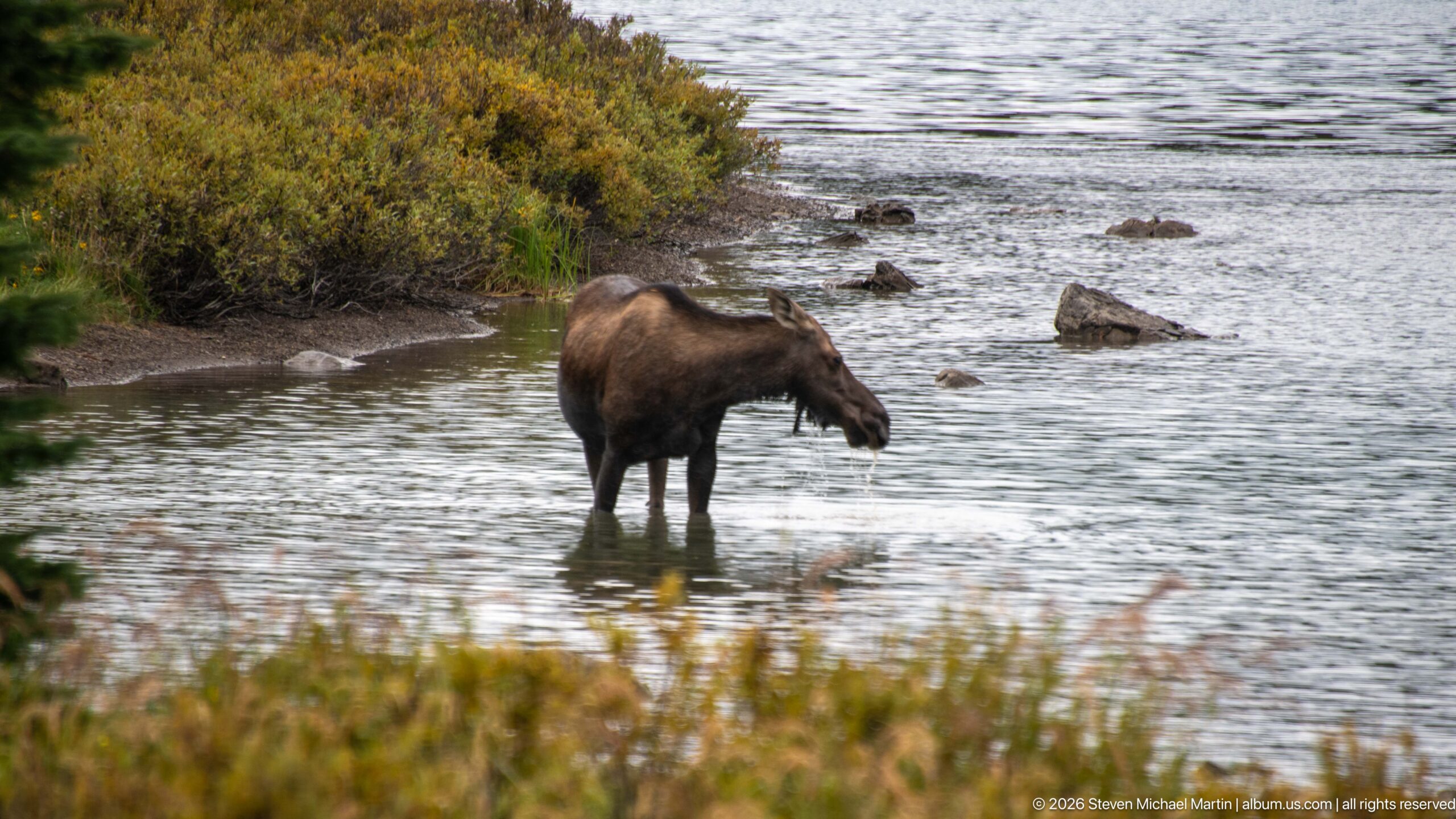
A cow moose lowers her head toward the water near a shrub-covered bank, surrounded by scattered shoreline rocks. The broad view balances wildlife and setting, showing the animal almost fully within the reflective shallows rather than isolated as a portrait.
Caption
A cow moose lowers her head toward the water near a shrub-covered bank, surrounded by scattered shoreline rocks. The broad view balances wildlife and setting, showing the animal almost fully within the reflective shallows rather than isolated as a portrait.
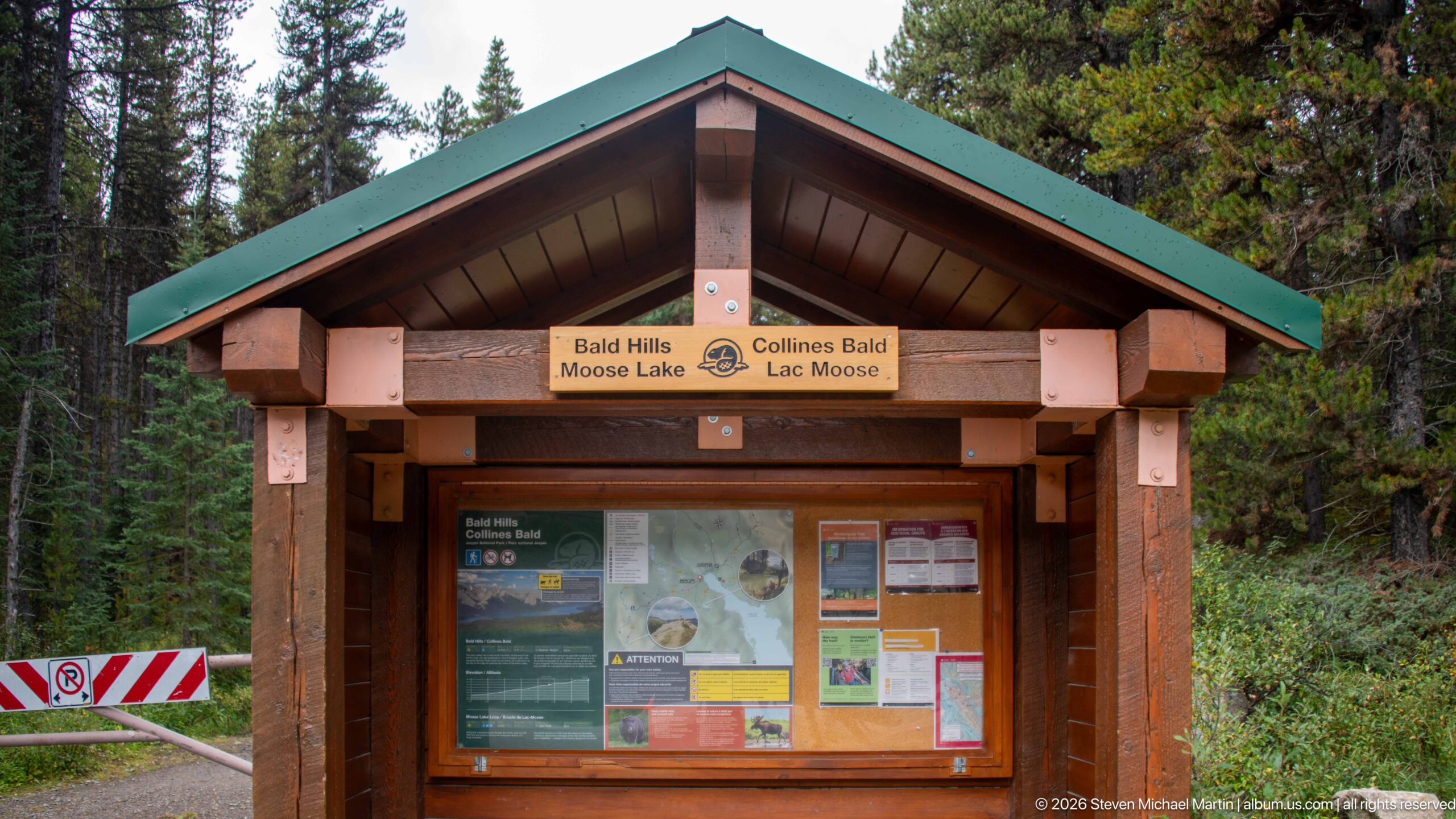
A timber information kiosk marks the Bald Hills and Moose Lake trail area, with bilingual English-French destination signage mounted beneath its green gabled roof. Maps and notices fill the display board, providing a human wayfinding element within the otherwise natural Maligne Valley sequence.
Caption
A timber information kiosk marks the Bald Hills and Moose Lake trail area, with bilingual English-French destination signage mounted beneath its green gabled roof. Maps and notices fill the display board, providing a human wayfinding element within the otherwise natural Maligne Valley sequence.
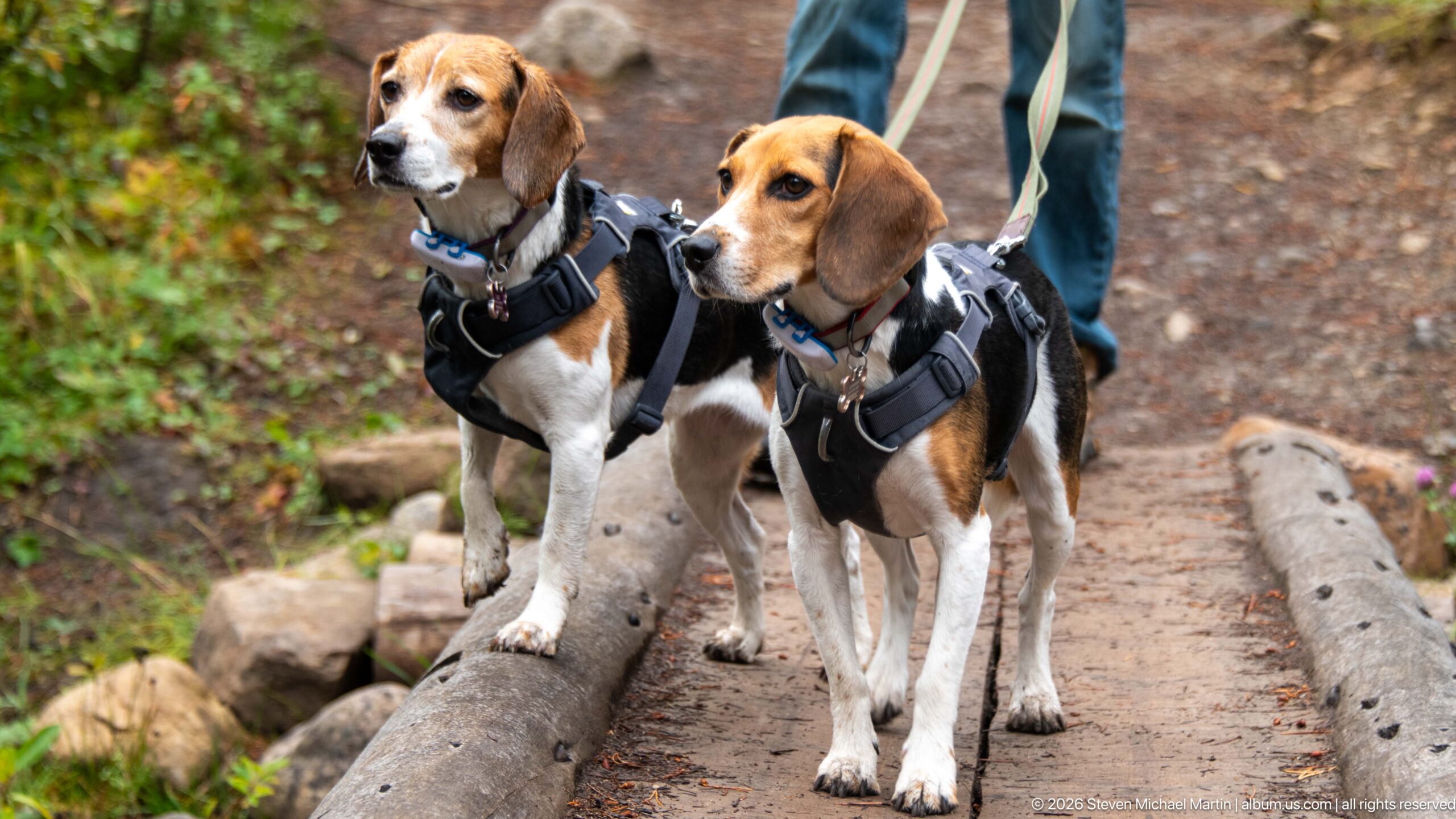
Two leashed beagles stand side by side on a narrow forest trail, both wearing harnesses and looking ahead. Logs and stones edge the path beneath conifer cover, shifting the portfolio briefly from wildlife observation to the human-and-pet experience of traveling through the Maligne Valley.
Caption
Two leashed beagles stand side by side on a narrow forest trail, both wearing harnesses and looking ahead. Logs and stones edge the path beneath conifer cover, shifting the portfolio briefly from wildlife observation to the human-and-pet experience of traveling through the Maligne Valley.
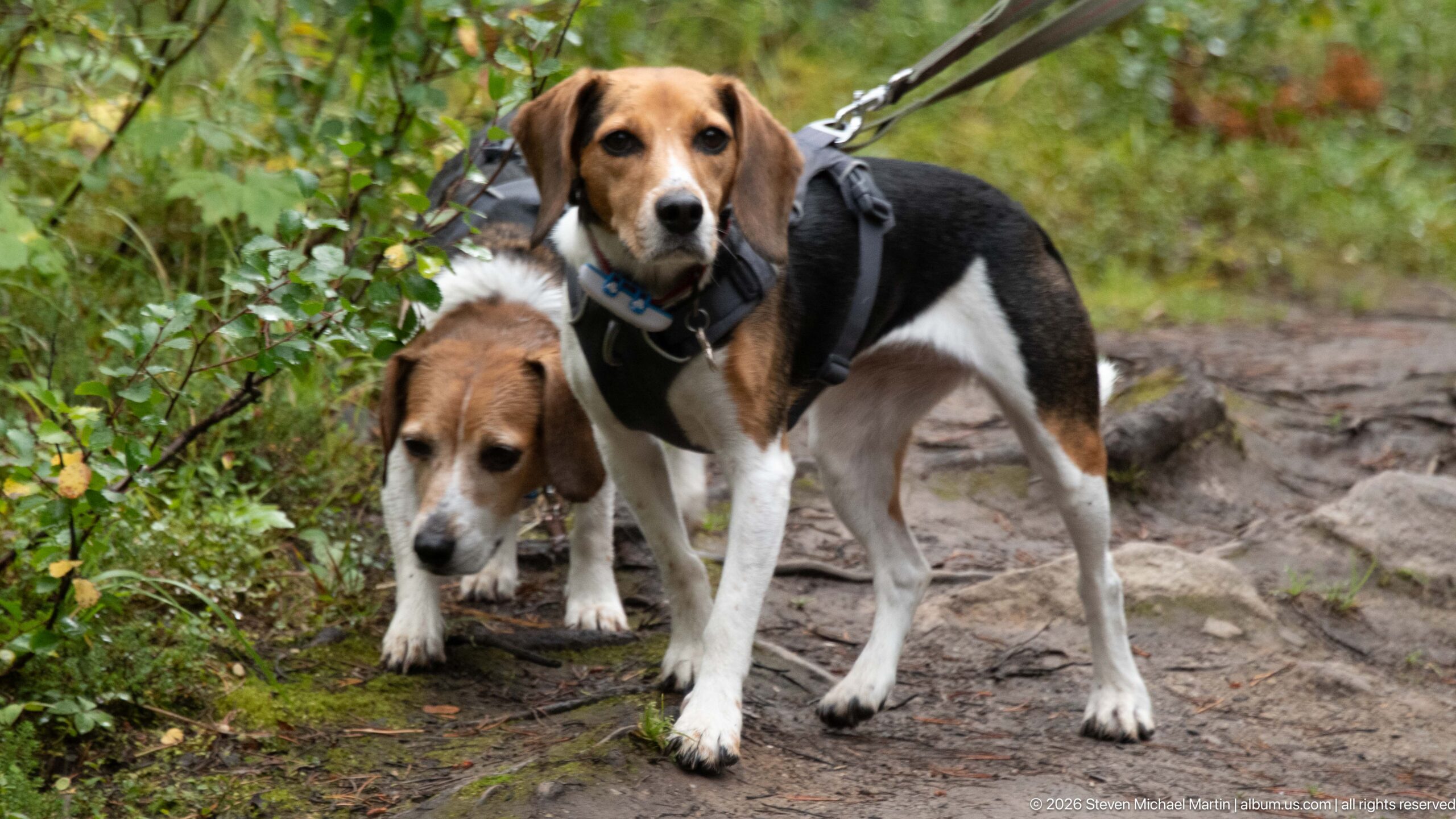
Two leashed beagles pause on an uneven forest path, one facing the camera while the second lowers its head near the trail edge. Their harnesses and taut leads are prominent against dense green understory and exposed roots.
Caption
Two leashed beagles pause on an uneven forest path, one facing the camera while the second lowers its head near the trail edge. Their harnesses and taut leads are prominent against dense green understory and exposed roots.
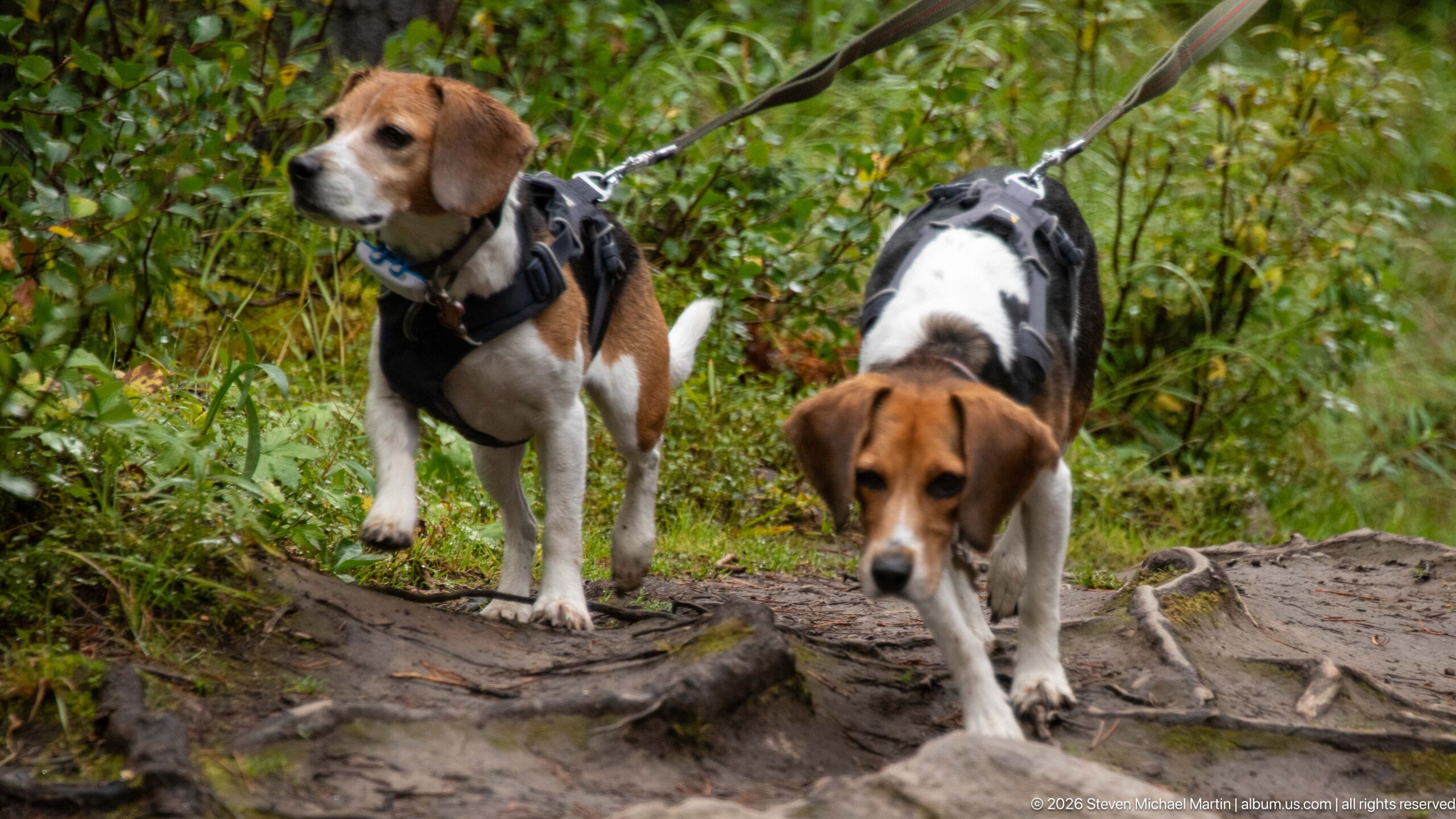
A pair of leashed beagles negotiate a root-crossed section of forest trail, the nearer dog stepping down toward the camera while its companion remains higher on the path. The staggered positions convey movement through the uneven terrain and dense vegetation.
Caption
A pair of leashed beagles negotiate a root-crossed section of forest trail, the nearer dog stepping down toward the camera while its companion remains higher on the path. The staggered positions convey movement through the uneven terrain and dense vegetation.
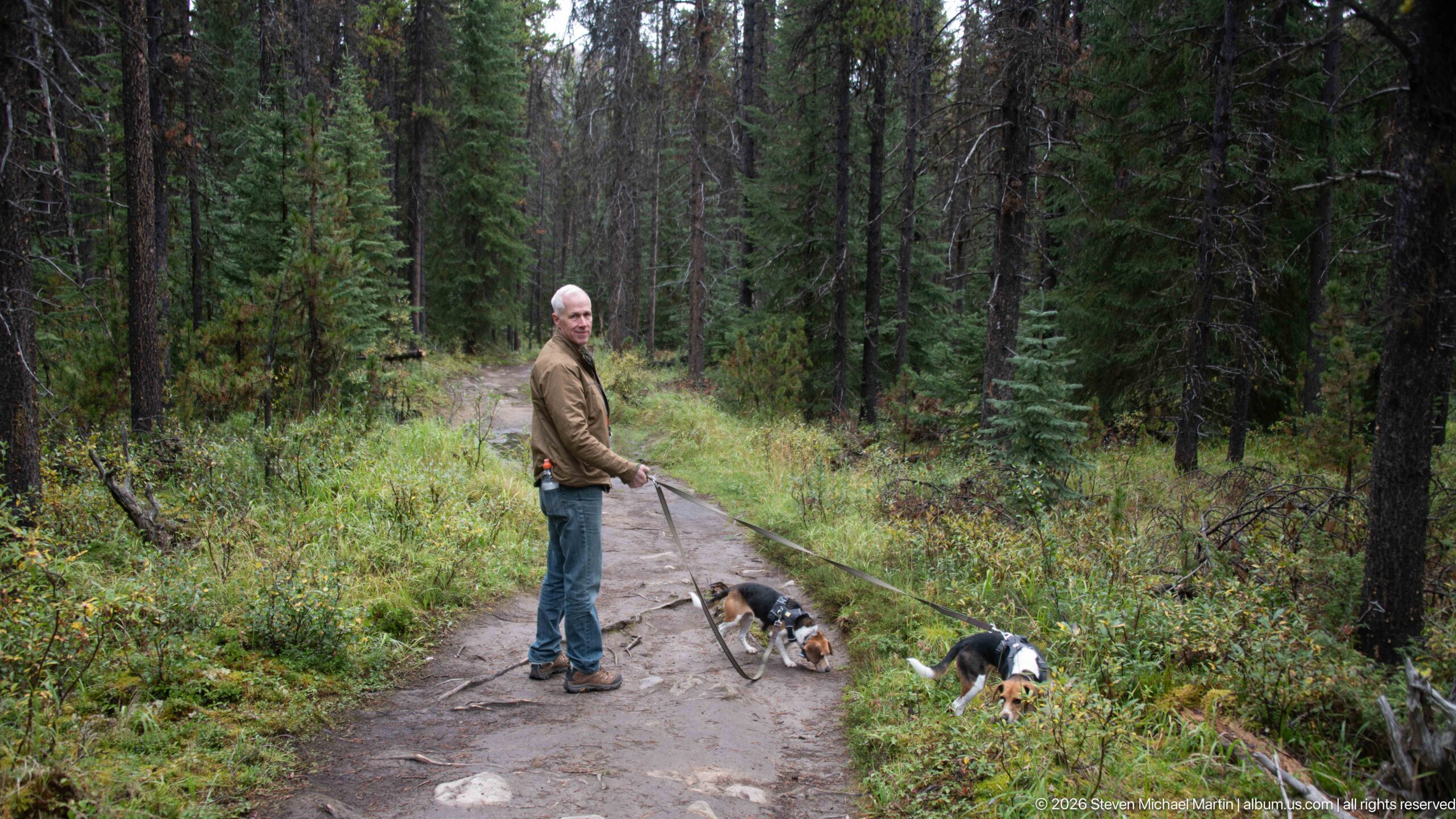
A hiker pauses with two leashed beagles on a narrow path winding through dense conifer forest. The wider view places the people-and-pets element within the trail environment, with low shrubs, fallen wood, and dark spruce or fir trunks enclosing the route.
Caption
A hiker pauses with two leashed beagles on a narrow path winding through dense conifer forest. The wider view places the people-and-pets element within the trail environment, with low shrubs, fallen wood, and dark spruce or fir trunks enclosing the route.
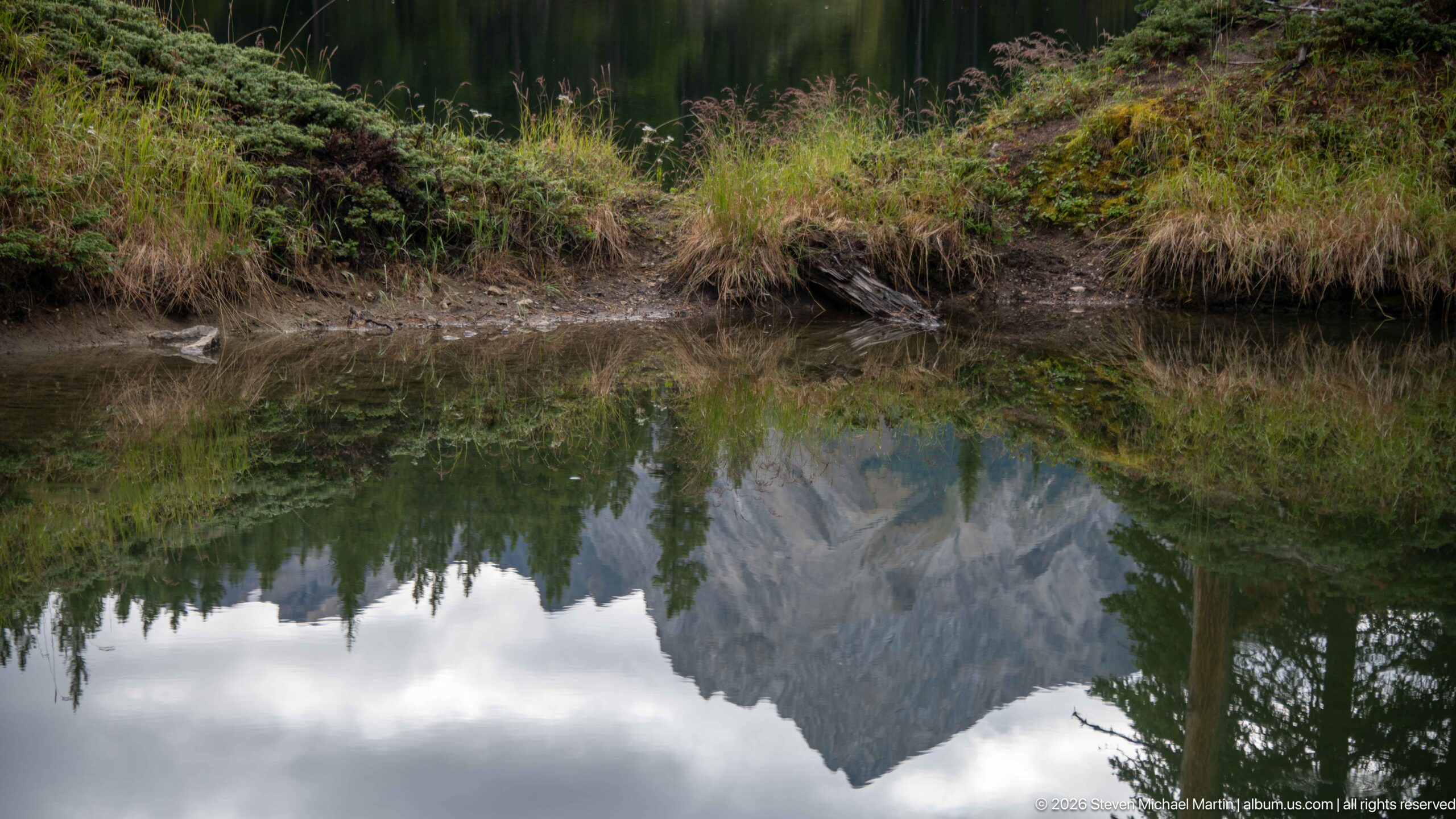
Still water mirrors a steep gray mountain peak and surrounding conifers, creating an inverted landscape across a small forest pond. Grassy banks and low vegetation frame the reflection, while the calm surface compresses distant mountain relief and near forest into a quiet, symmetrical composition.
Caption
Still water mirrors a steep gray mountain peak and surrounding conifers, creating an inverted landscape across a small forest pond. Grassy banks and low vegetation frame the reflection, while the calm surface compresses distant mountain relief and near forest into a quiet, symmetrical composition.
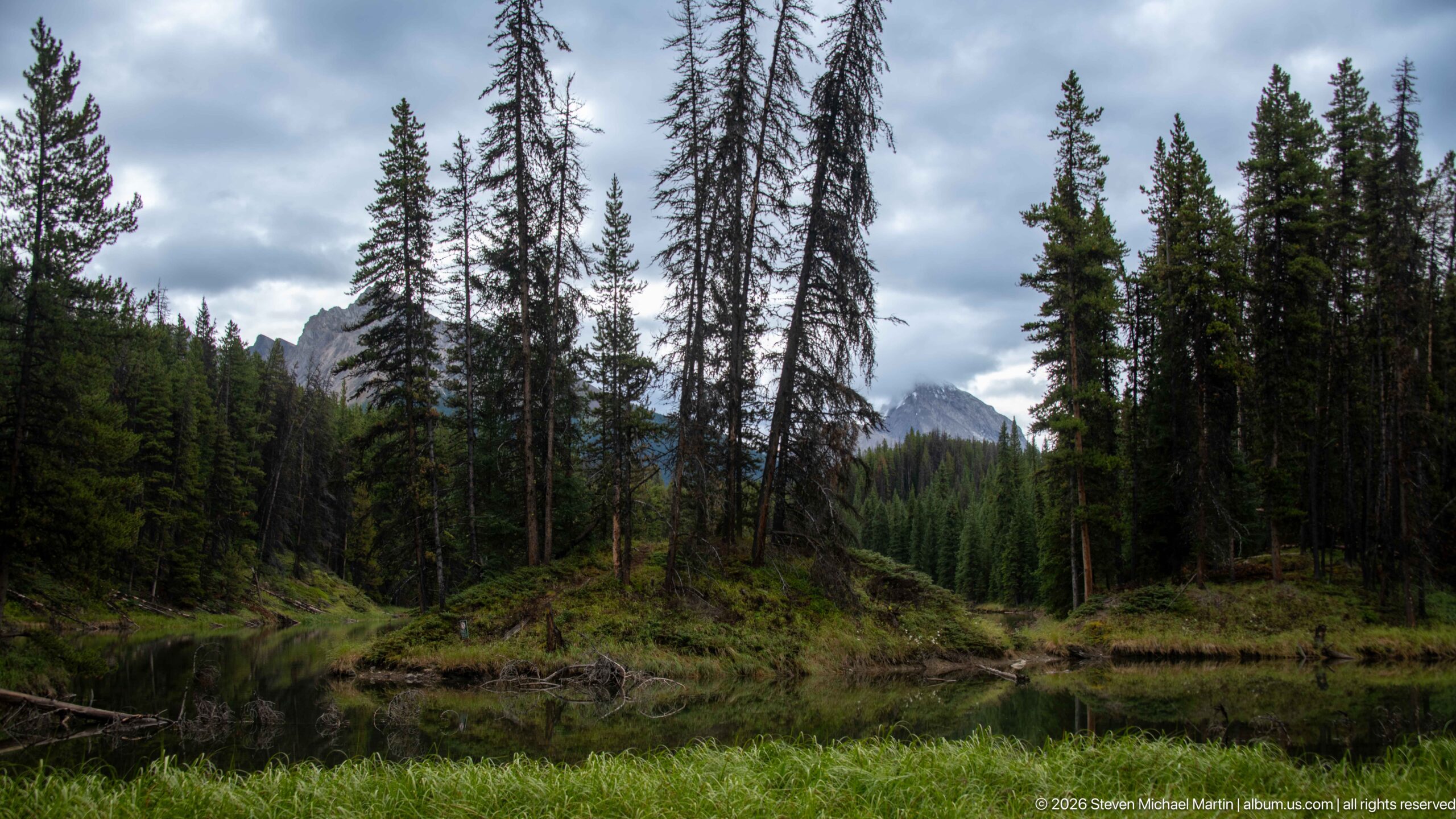
A small pond occupies a forest opening beneath a cloudy sky, bordered by grasses, low shrubs, and mixed living and dead conifers. A distant mountain shoulder appears through the trees, but the composition centers on the enclosed wetland habitat and layered forest structure.
Caption
A small pond occupies a forest opening beneath a cloudy sky, bordered by grasses, low shrubs, and mixed living and dead conifers. A distant mountain shoulder appears through the trees, but the composition centers on the enclosed wetland habitat and layered forest structure.
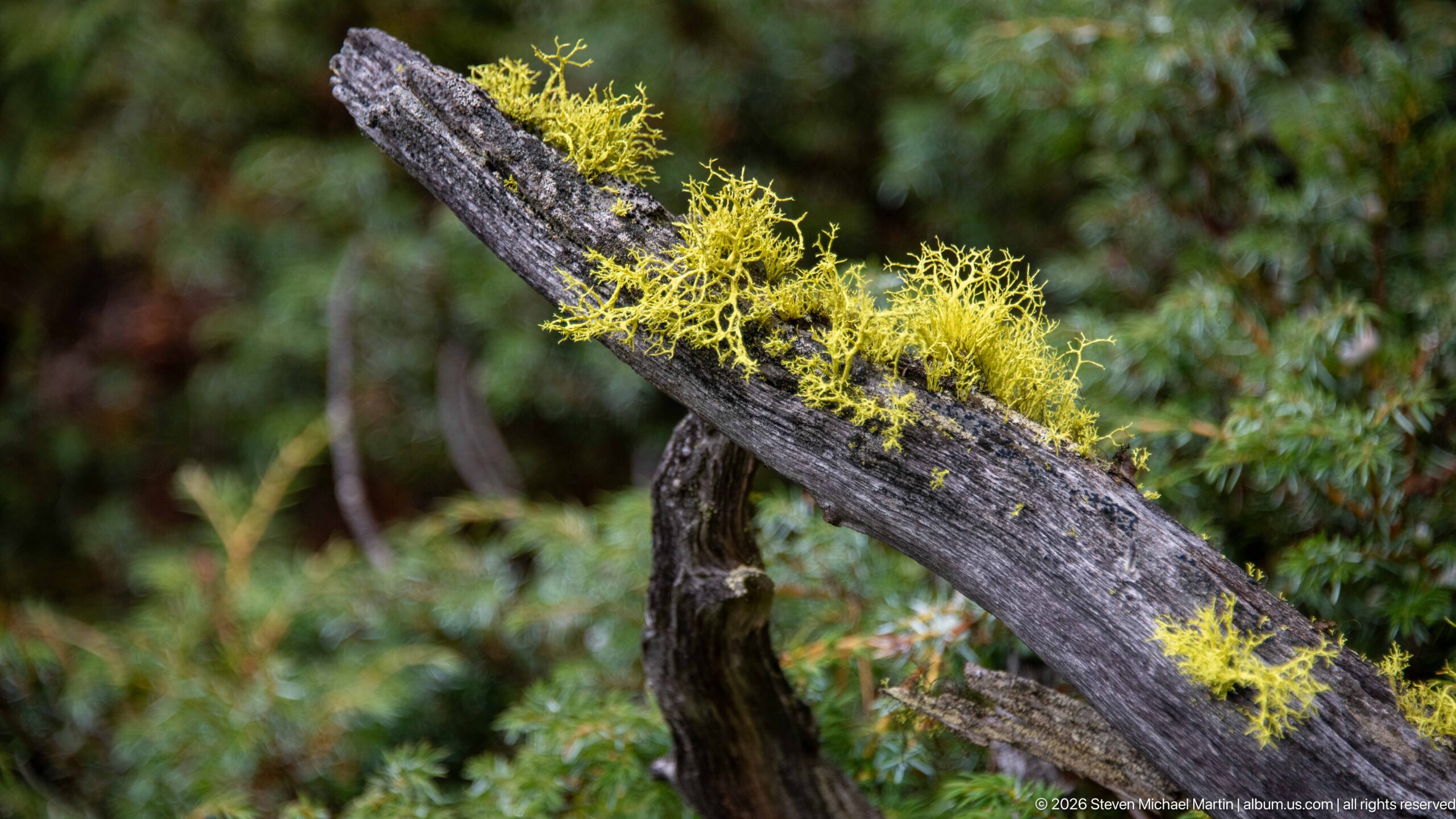
Yellow-green branching lichen grows densely along a weathered diagonal trunk. The composition preserves enough surrounding context to connect the subject with the forested mountain environment of Jasper National Park.
Caption
Yellow-green branching lichen grows densely along a weathered diagonal trunk. The composition preserves enough surrounding context to connect the subject with the forested mountain environment of Jasper National Park.
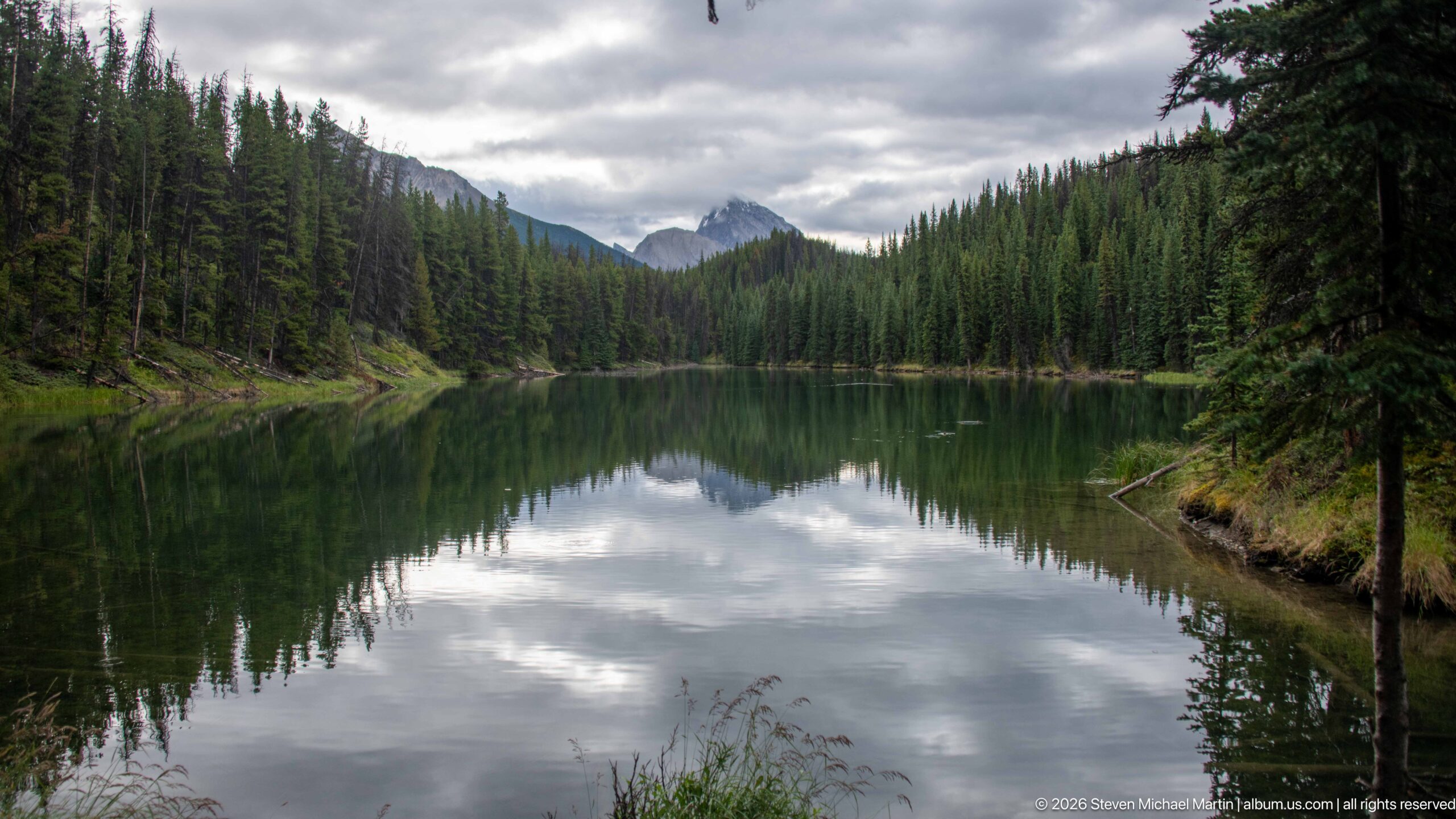
Still water reflects conifer forest and cloudy sky in a small enclosed mountain lake. Its placement within the Maligne Valley visitor corridor adds useful geographic and environmental context without obscuring the visible subject.
Caption
Still water reflects conifer forest and cloudy sky in a small enclosed mountain lake. Its placement within the Maligne Valley visitor corridor adds useful geographic and environmental context without obscuring the visible subject.
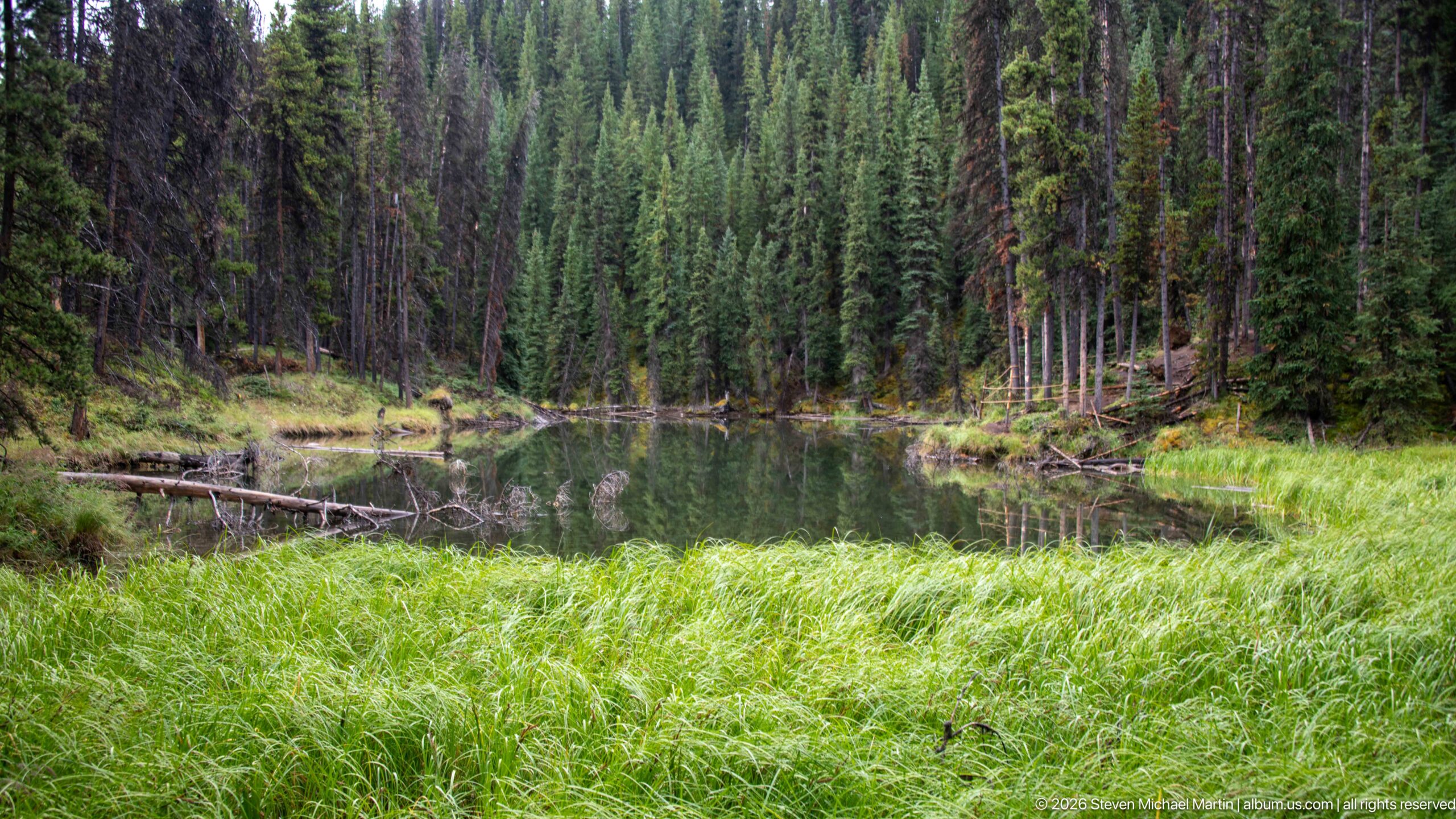
A small pond is bordered by bright sedges, fallen wood, and dense conifers. The frame balances the principal subject with its immediate setting, recording both detail and the character of the Canadian Rockies landscape.
Caption
A small pond is bordered by bright sedges, fallen wood, and dense conifers. The frame balances the principal subject with its immediate setting, recording both detail and the character of the Canadian Rockies landscape.
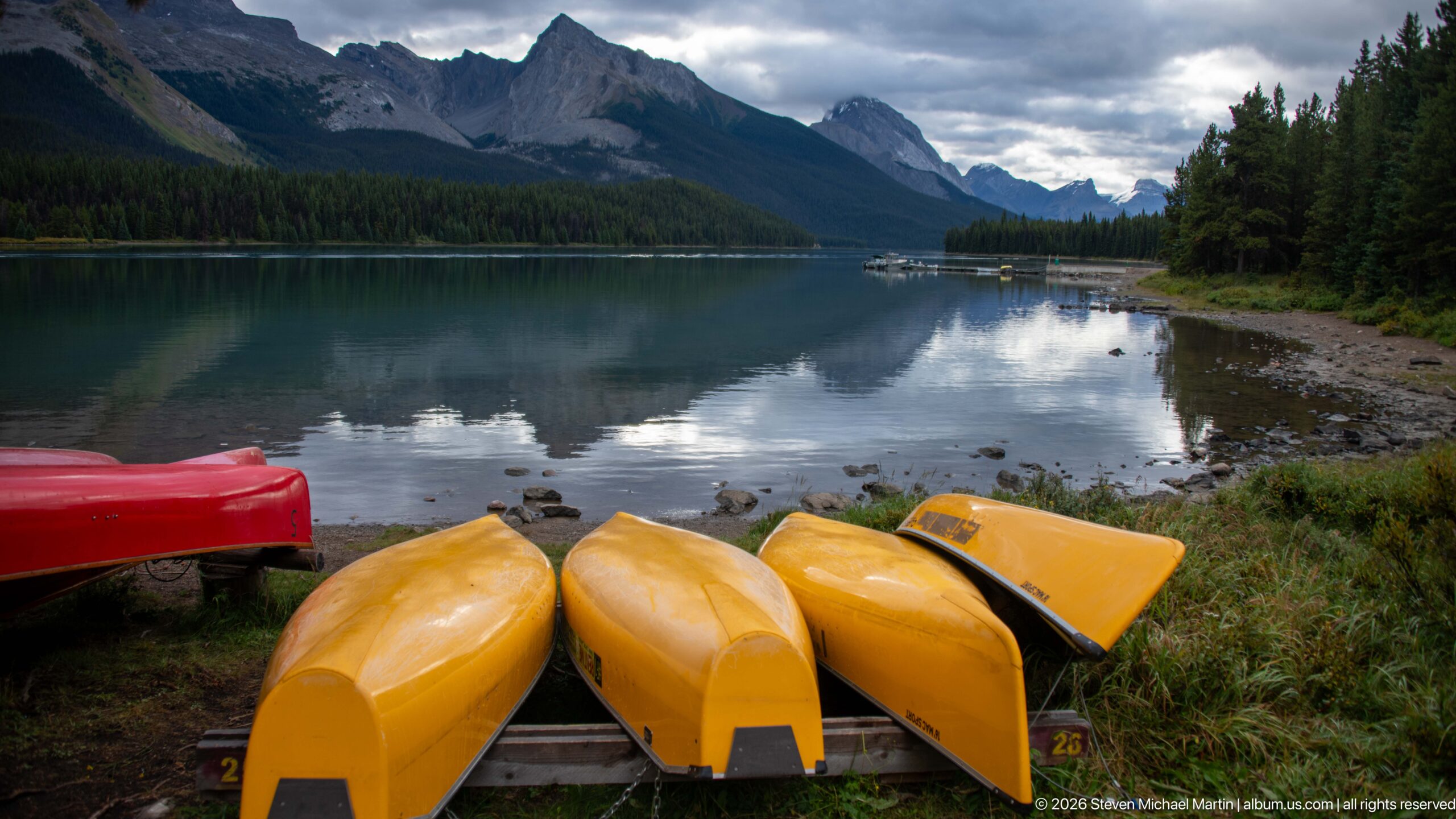
Yellow canoes rest at the shoreline with Maligne Lake and steep mountain ridges beyond. Visible materials, vegetation, water, or terrain distinguish this view from adjacent photographs and give the scene a clear sense of place.
Caption
Yellow canoes rest at the shoreline with Maligne Lake and steep mountain ridges beyond. Visible materials, vegetation, water, or terrain distinguish this view from adjacent photographs and give the scene a clear sense of place.
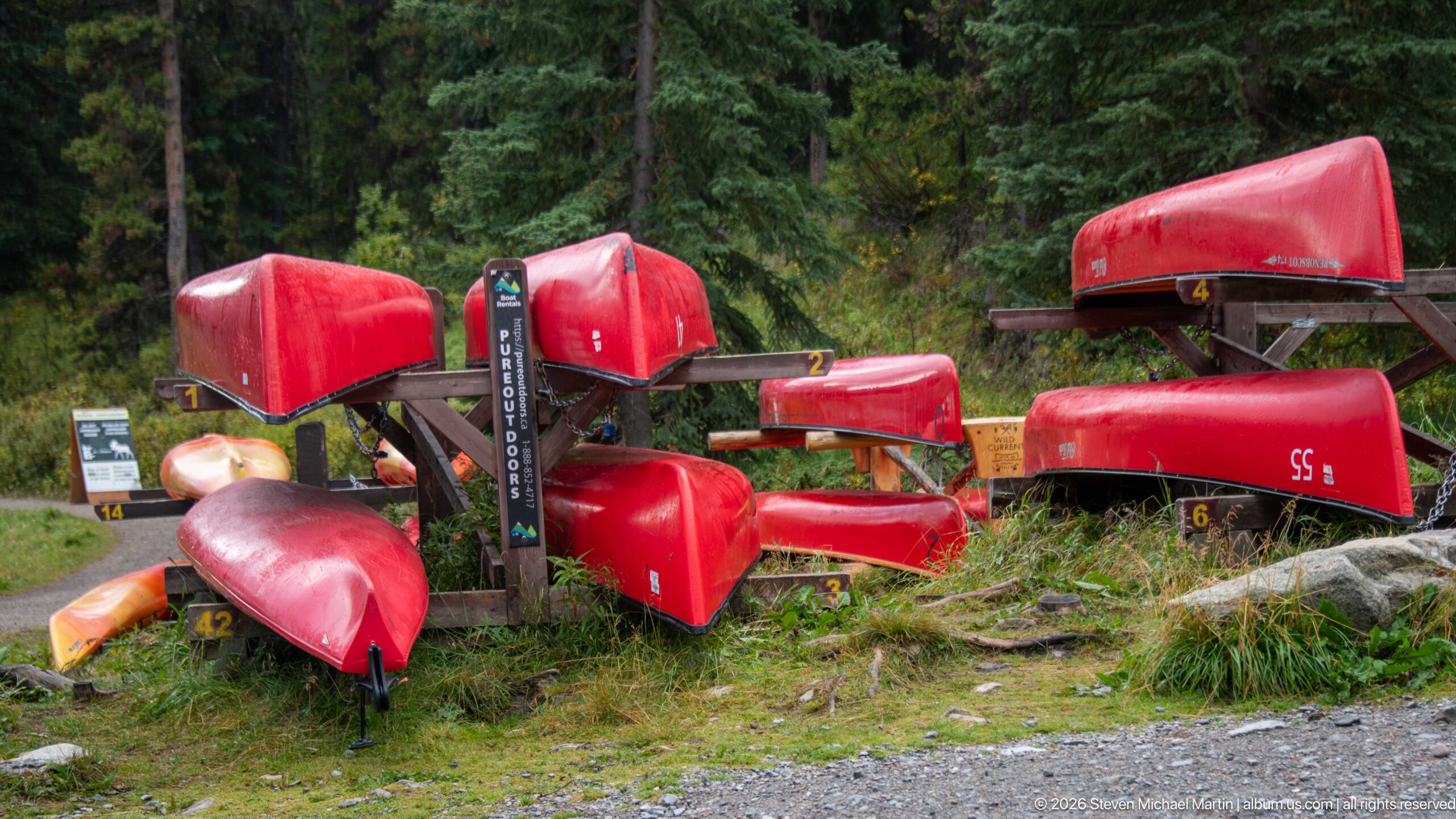
Red canoes are stored upside down on numbered wooden racks beside the forest. The surrounding forest and mountain setting provide context for the natural and visitor landscapes encountered along the Maligne Valley corridor.
Caption
Red canoes are stored upside down on numbered wooden racks beside the forest. The surrounding forest and mountain setting provide context for the natural and visitor landscapes encountered along the Maligne Valley corridor.
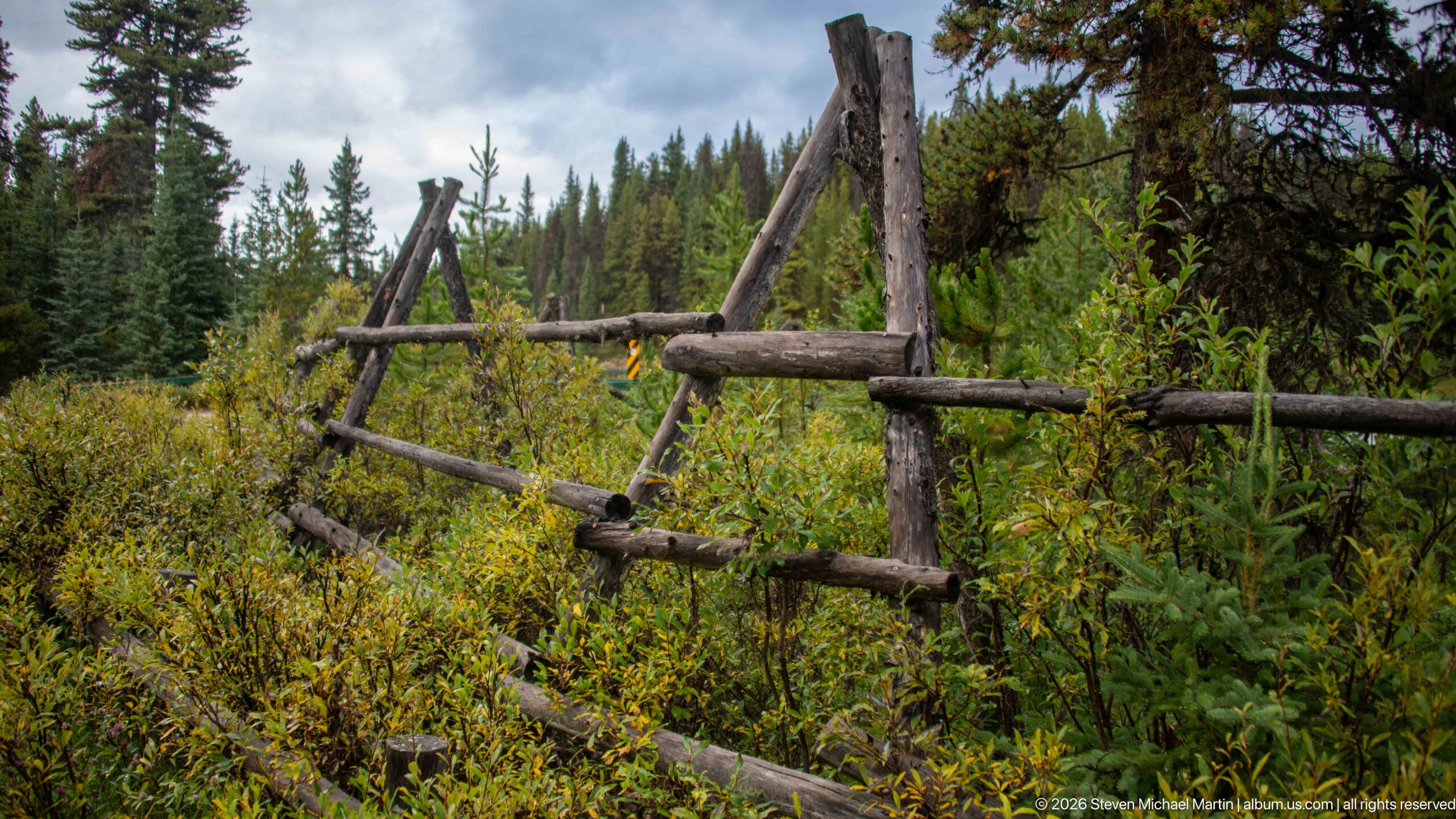
A weathered log-and-pole fence runs through dense shrubs and conifers. The composition preserves enough surrounding context to connect the subject with the forested mountain environment of Jasper National Park.
Caption
A weathered log-and-pole fence runs through dense shrubs and conifers. The composition preserves enough surrounding context to connect the subject with the forested mountain environment of Jasper National Park.
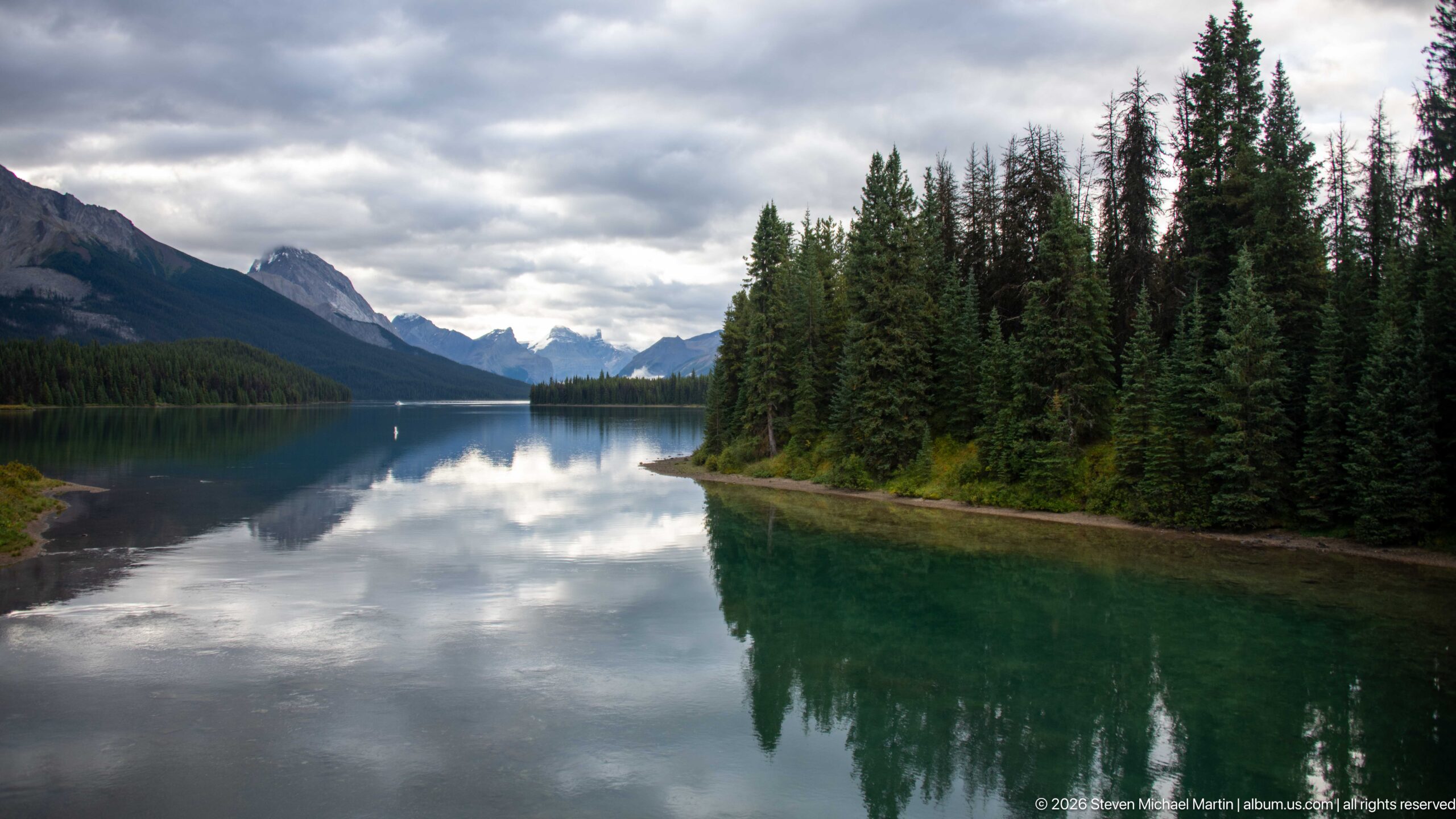
A conifer-covered peninsula projects into calm mountain water with strong reflections. The frame balances the principal subject with its immediate setting, recording both detail and the character of the Canadian Rockies landscape.
Caption
A conifer-covered peninsula projects into calm mountain water with strong reflections. The frame balances the principal subject with its immediate setting, recording both detail and the character of the Canadian Rockies landscape.
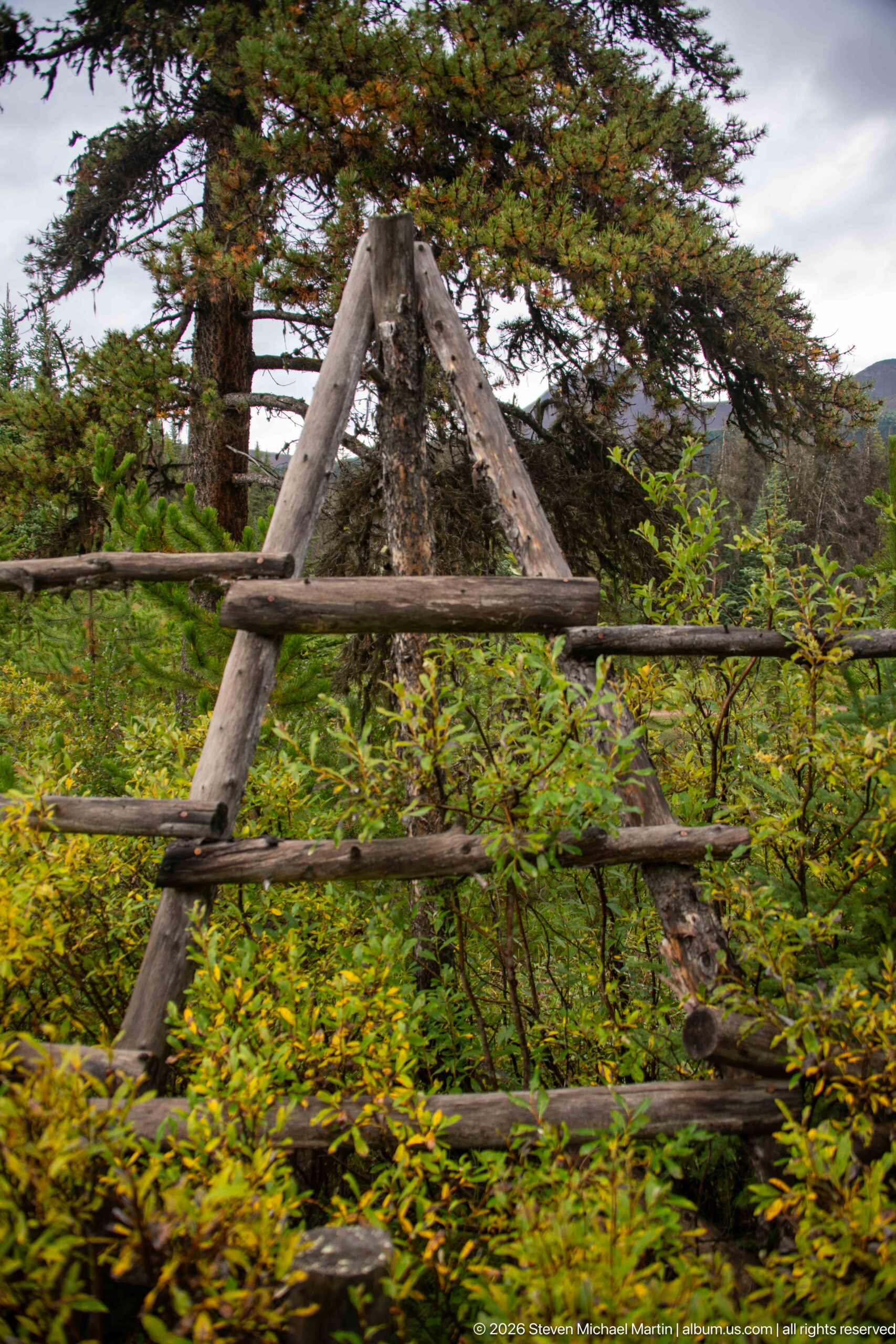
Heavy weathered poles form a triangular fence brace amid dense vegetation. Its placement within the Maligne Valley visitor corridor adds useful geographic and environmental context without obscuring the visible subject.
Caption
Heavy weathered poles form a triangular fence brace amid dense vegetation. Its placement within the Maligne Valley visitor corridor adds useful geographic and environmental context without obscuring the visible subject.
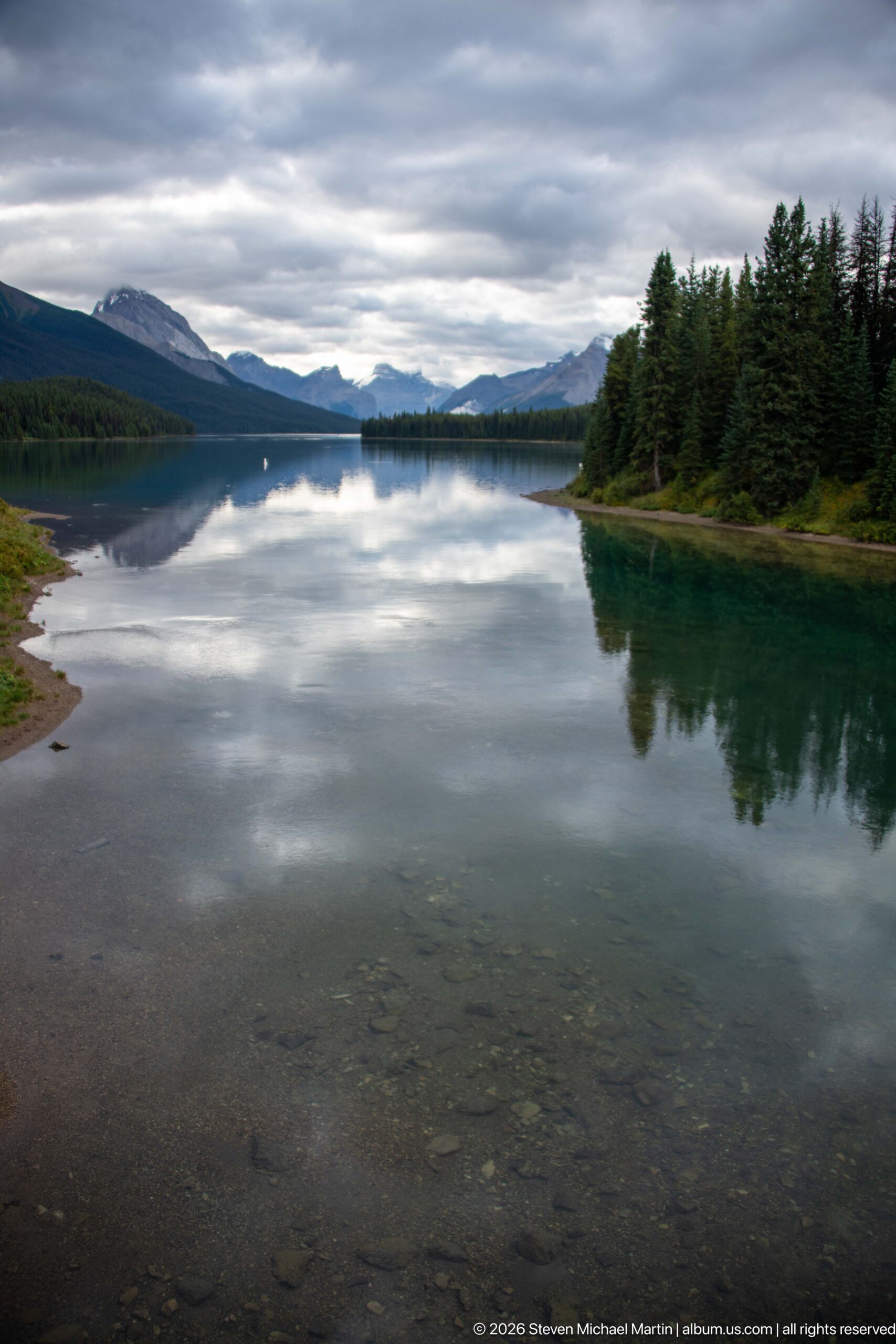
Clear shallow water and a forested shoreline lead toward distant mountain ridges. Visible materials, vegetation, water, or terrain distinguish this view from adjacent photographs and give the scene a clear sense of place.
Caption
Clear shallow water and a forested shoreline lead toward distant mountain ridges. Visible materials, vegetation, water, or terrain distinguish this view from adjacent photographs and give the scene a clear sense of place.
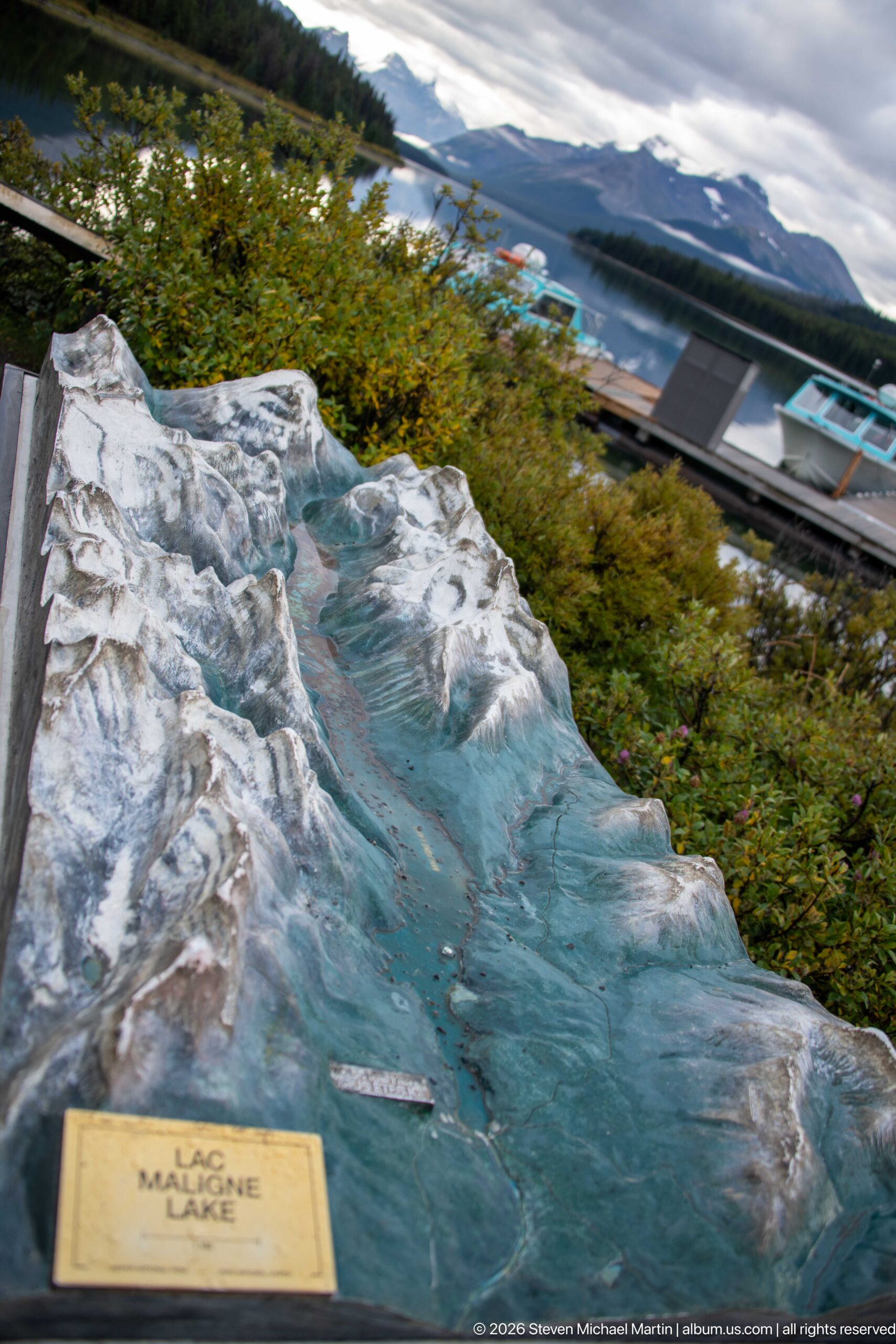
A three-dimensional Maligne Lake terrain model is viewed obliquely with the actual lake visible beyond. Visible materials, vegetation, water, or terrain distinguish this view from adjacent photographs and give the scene a clear sense of place.
Caption
A three-dimensional Maligne Lake terrain model is viewed obliquely with the actual lake visible beyond. Visible materials, vegetation, water, or terrain distinguish this view from adjacent photographs and give the scene a clear sense of place.
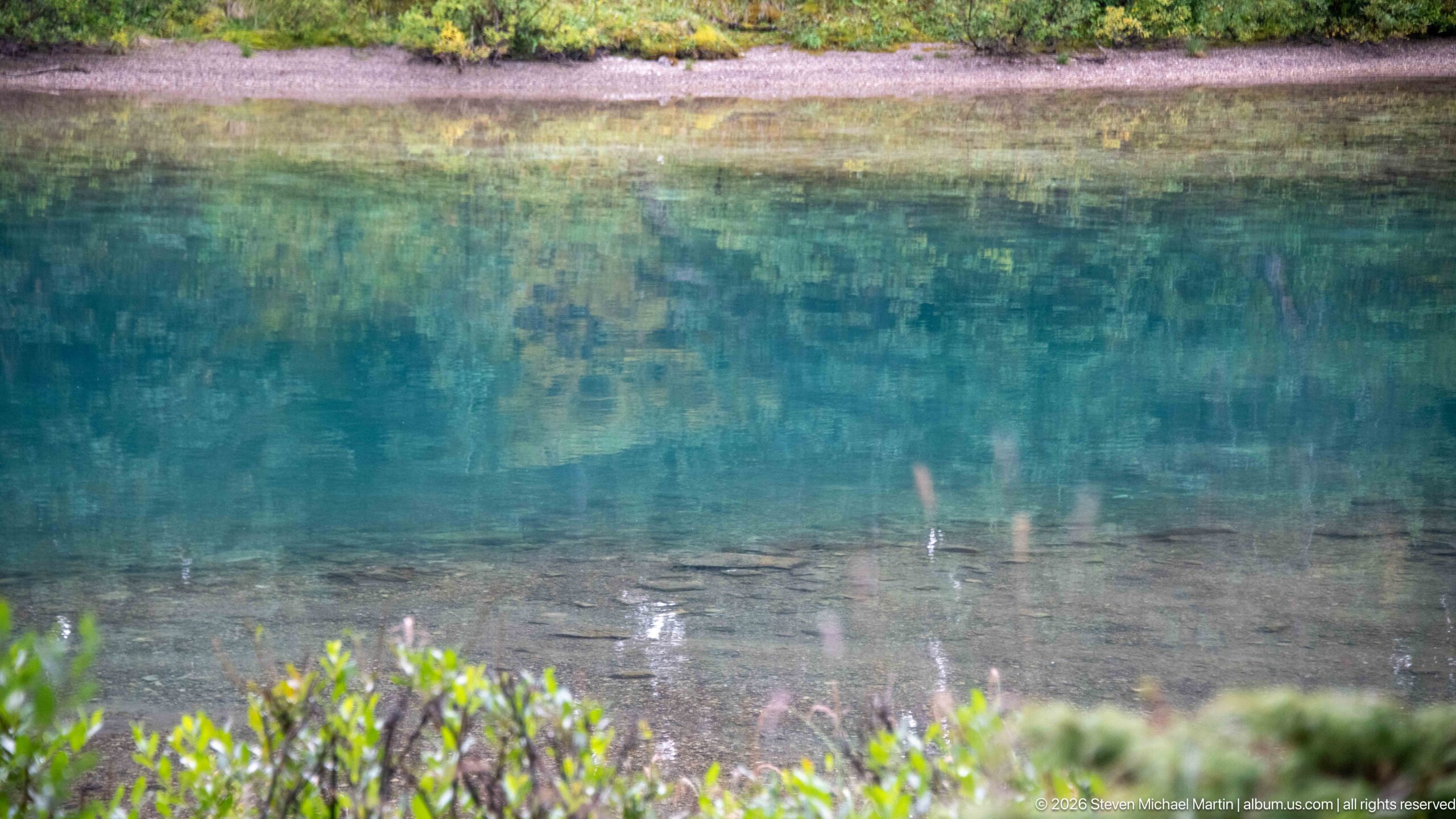
Transparent turquoise water reveals the lake bottom and submerged stones near shore. The surrounding forest and mountain setting provide context for the natural and visitor landscapes encountered along the Maligne Valley corridor.
Caption
Transparent turquoise water reveals the lake bottom and submerged stones near shore. The surrounding forest and mountain setting provide context for the natural and visitor landscapes encountered along the Maligne Valley corridor.
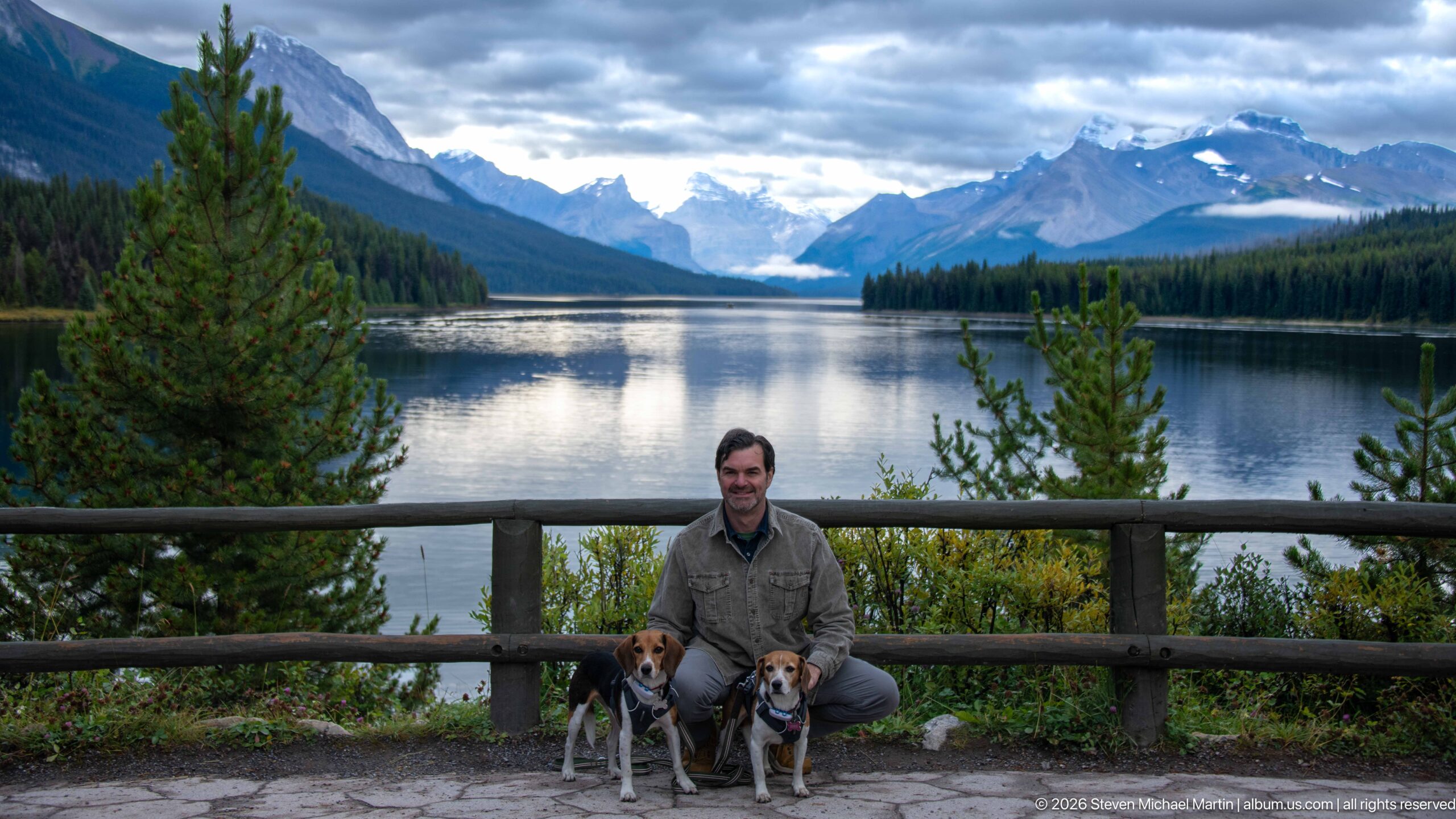
A seated visitor poses with two beagles before a railing overlooking Maligne Lake and mountains. This viewpoint emphasizes the relationship between the subject and its immediate surroundings rather than relying on broader portfolio context.
Caption
A seated visitor poses with two beagles before a railing overlooking Maligne Lake and mountains. This viewpoint emphasizes the relationship between the subject and its immediate surroundings rather than relying on broader portfolio context.
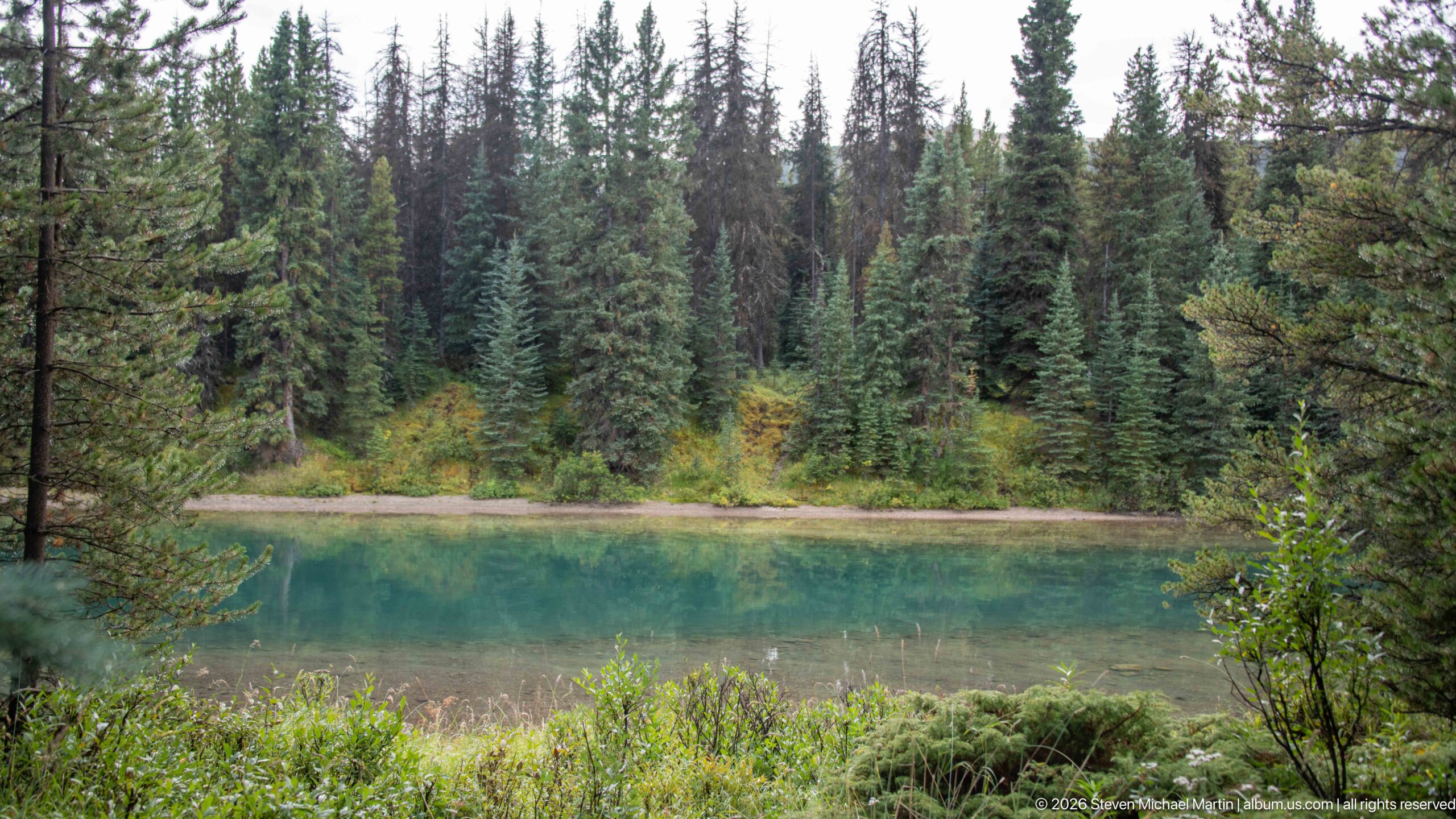
Turquoise water fills a small forest-edged basin surrounded by conifers and shrubs. Its placement within the Maligne Valley visitor corridor adds useful geographic and environmental context without obscuring the visible subject.
Caption
Turquoise water fills a small forest-edged basin surrounded by conifers and shrubs. Its placement within the Maligne Valley visitor corridor adds useful geographic and environmental context without obscuring the visible subject.
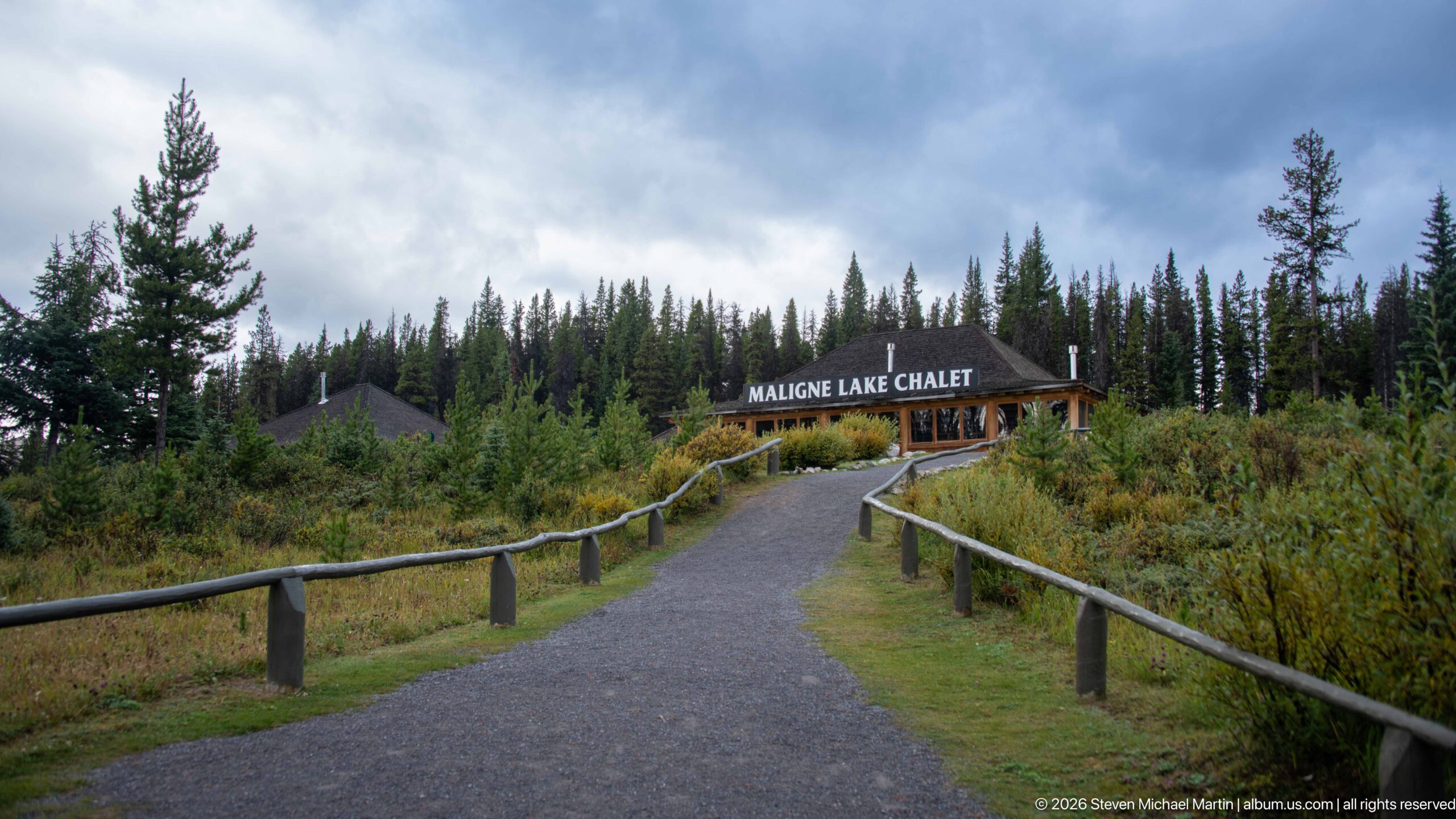
A paved path with rustic railings rises toward the clearly signed Maligne Lake Chalet. The frame balances the principal subject with its immediate setting, recording both detail and the character of the Canadian Rockies landscape.
Caption
A paved path with rustic railings rises toward the clearly signed Maligne Lake Chalet. The frame balances the principal subject with its immediate setting, recording both detail and the character of the Canadian Rockies landscape.
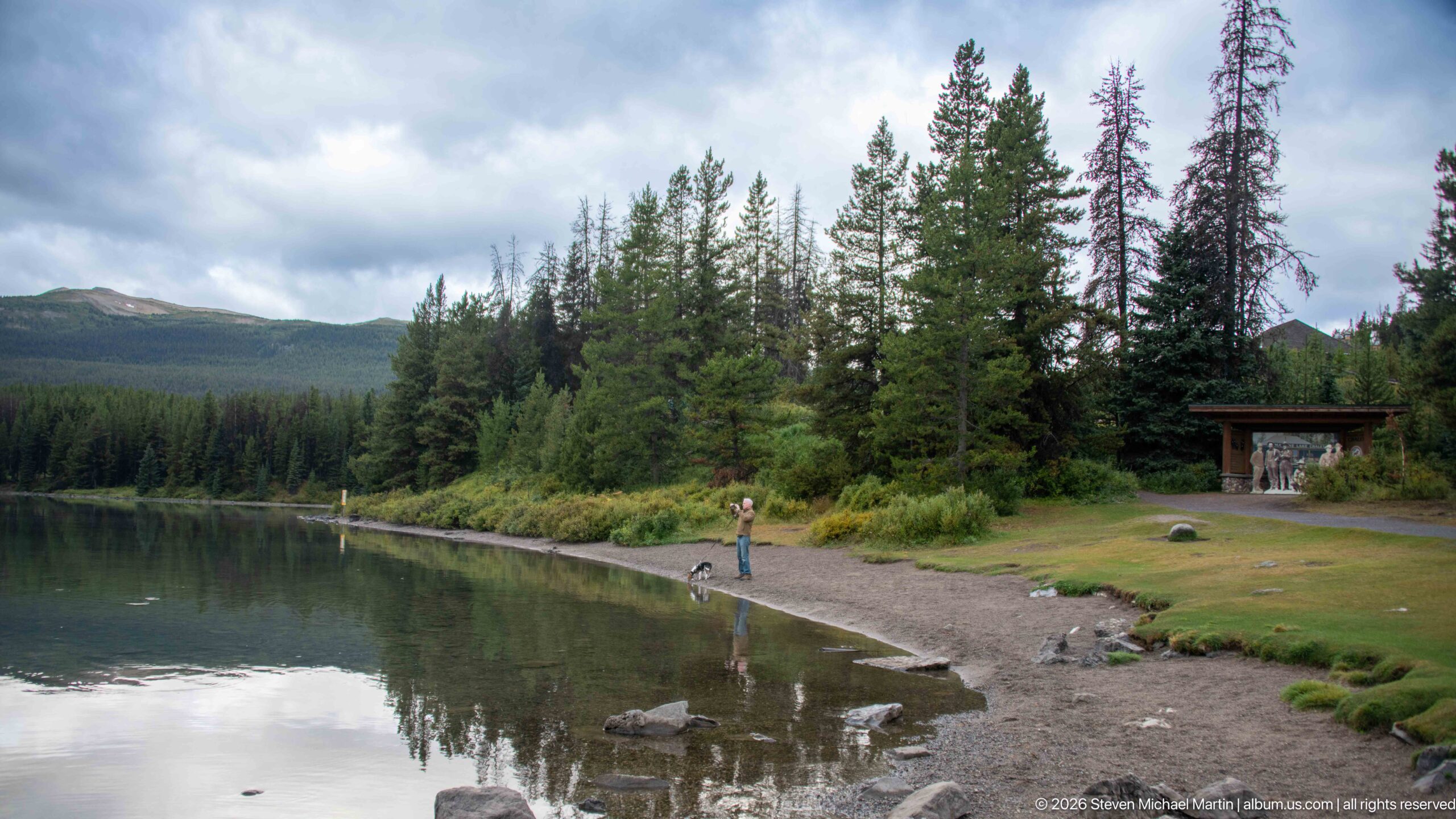
A visitor with two dogs stands at a quiet shoreline backed by conifer forest and mountains. Visible materials, vegetation, water, or terrain distinguish this view from adjacent photographs and give the scene a clear sense of place.
Caption
A visitor with two dogs stands at a quiet shoreline backed by conifer forest and mountains. Visible materials, vegetation, water, or terrain distinguish this view from adjacent photographs and give the scene a clear sense of place.
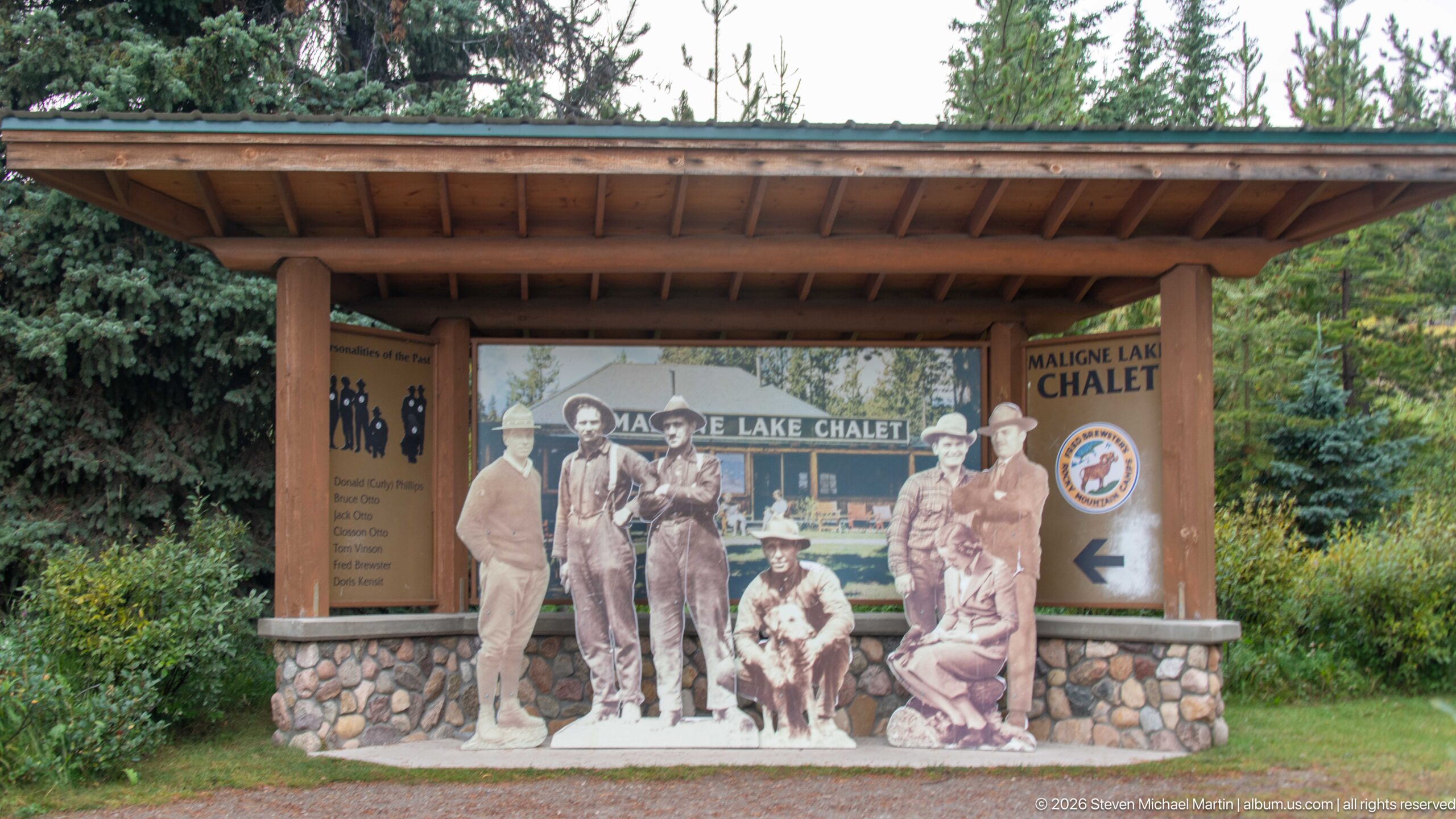
A roofed interpretive panel uses historic figures and photographs to present Maligne Lake Chalet history. The surrounding forest and mountain setting provide context for the natural and visitor landscapes encountered along the Maligne Valley corridor.
Caption
A roofed interpretive panel uses historic figures and photographs to present Maligne Lake Chalet history. The surrounding forest and mountain setting provide context for the natural and visitor landscapes encountered along the Maligne Valley corridor.
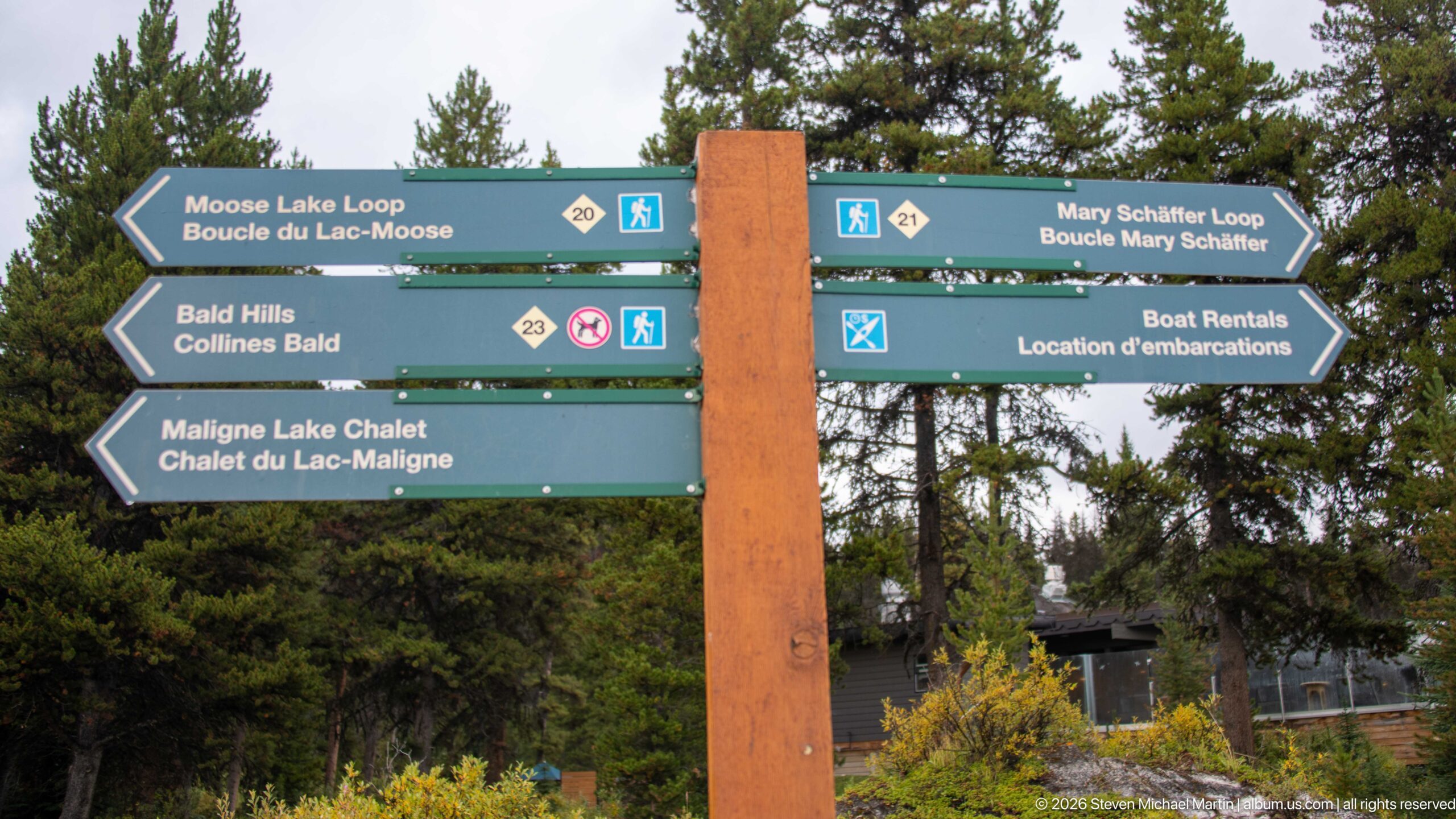
Directional signs point toward Moose Lake Loop, Bald Hills, Mary Schäffer Loop, boat rentals, and Maligne Lake Chalet. This viewpoint emphasizes the relationship between the subject and its immediate surroundings rather than relying on broader portfolio context.
Caption
Directional signs point toward Moose Lake Loop, Bald Hills, Mary Schäffer Loop, boat rentals, and Maligne Lake Chalet. This viewpoint emphasizes the relationship between the subject and its immediate surroundings rather than relying on broader portfolio context.
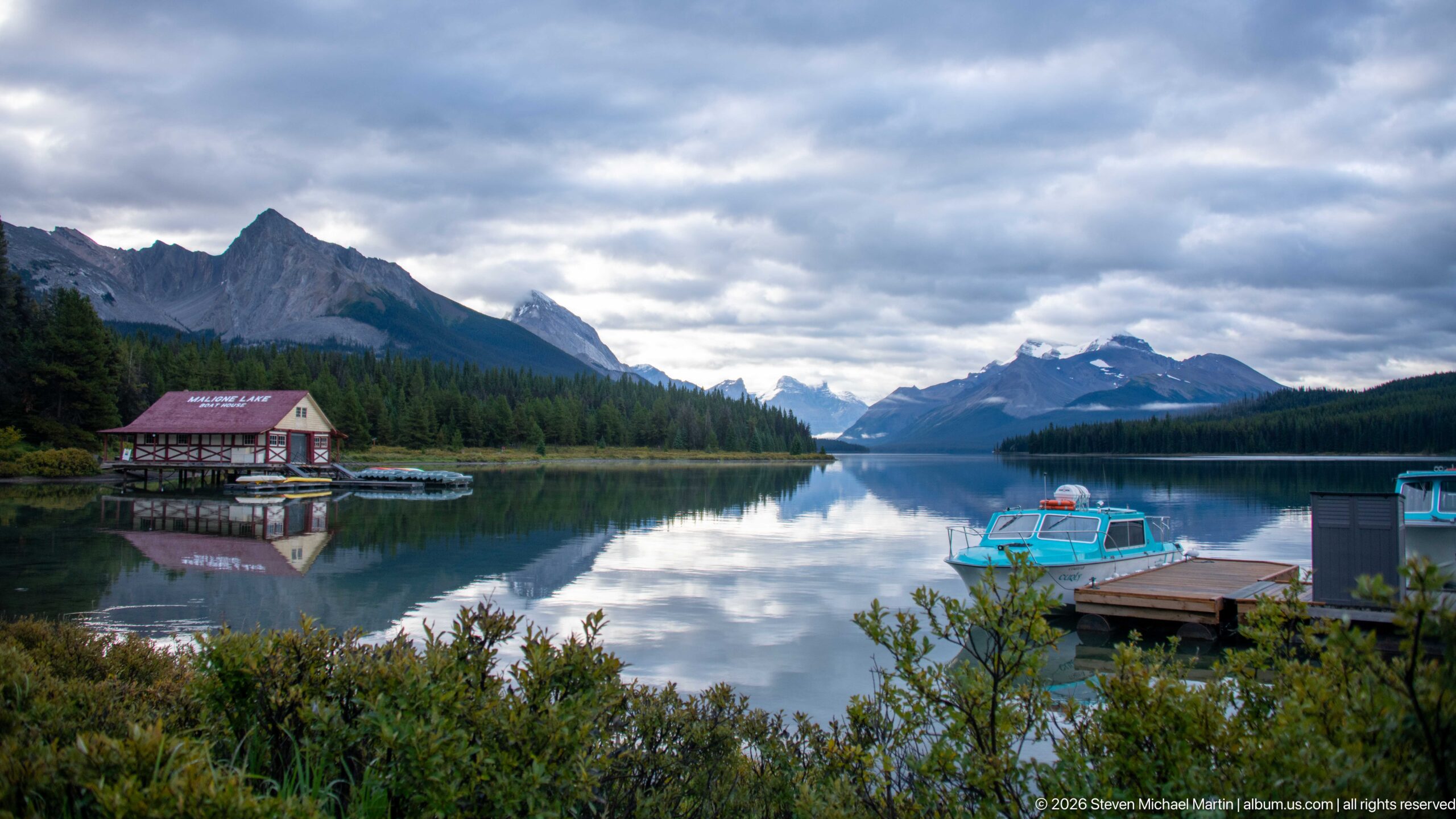
The red-roofed Maligne Lake Boathouse, docks, and boats sit on reflective water beneath mountain ridges. The composition preserves enough surrounding context to connect the subject with the forested mountain environment of Jasper National Park.
Caption
The red-roofed Maligne Lake Boathouse, docks, and boats sit on reflective water beneath mountain ridges. The composition preserves enough surrounding context to connect the subject with the forested mountain environment of Jasper National Park.
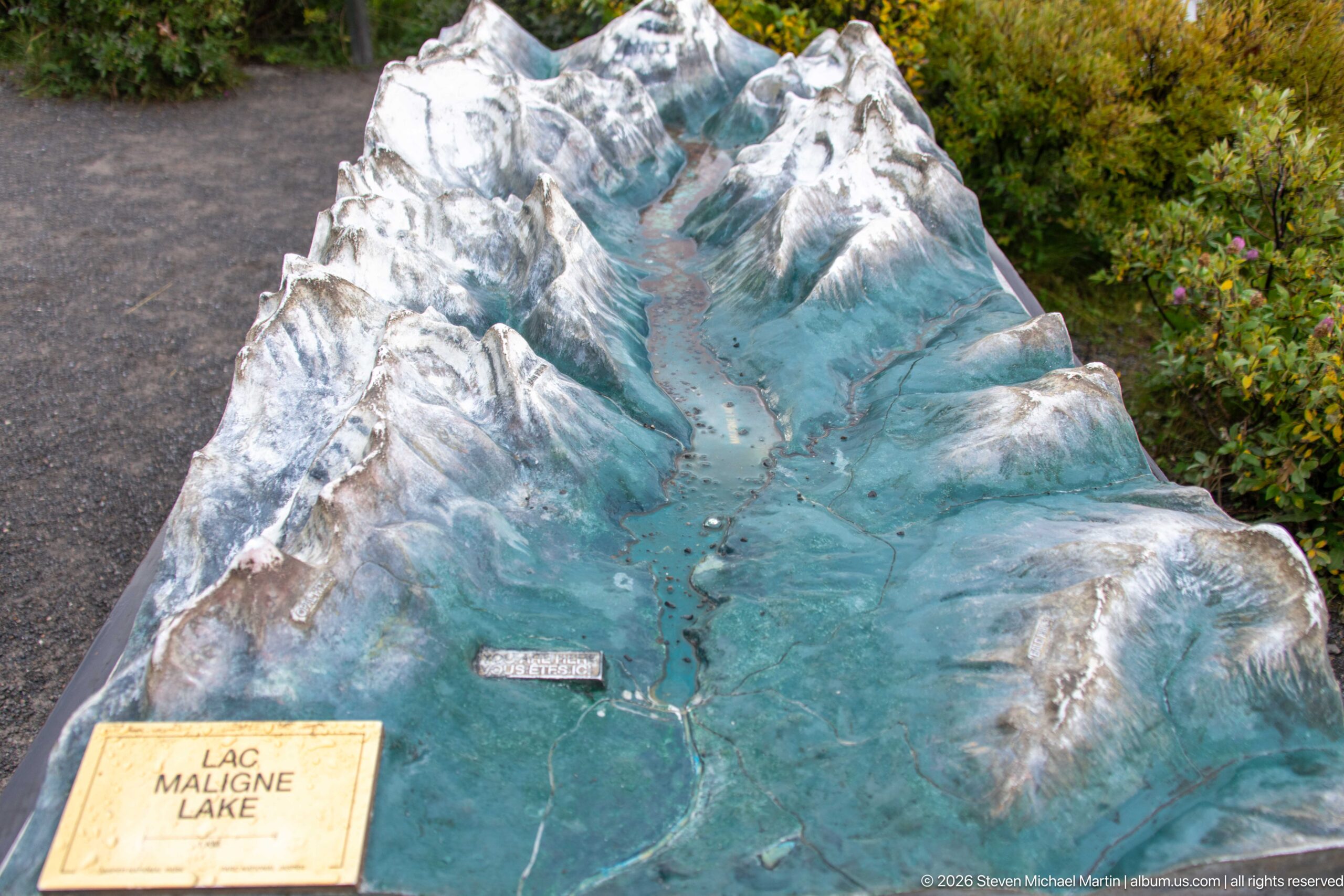
A painted three-dimensional relief model labeled Lac Maligne Lake represents the lake and surrounding mountain terrain. The frame balances the principal subject with its immediate setting, recording both detail and the character of the Canadian Rockies landscape.
Caption
A painted three-dimensional relief model labeled Lac Maligne Lake represents the lake and surrounding mountain terrain. The frame balances the principal subject with its immediate setting, recording both detail and the character of the Canadian Rockies landscape.
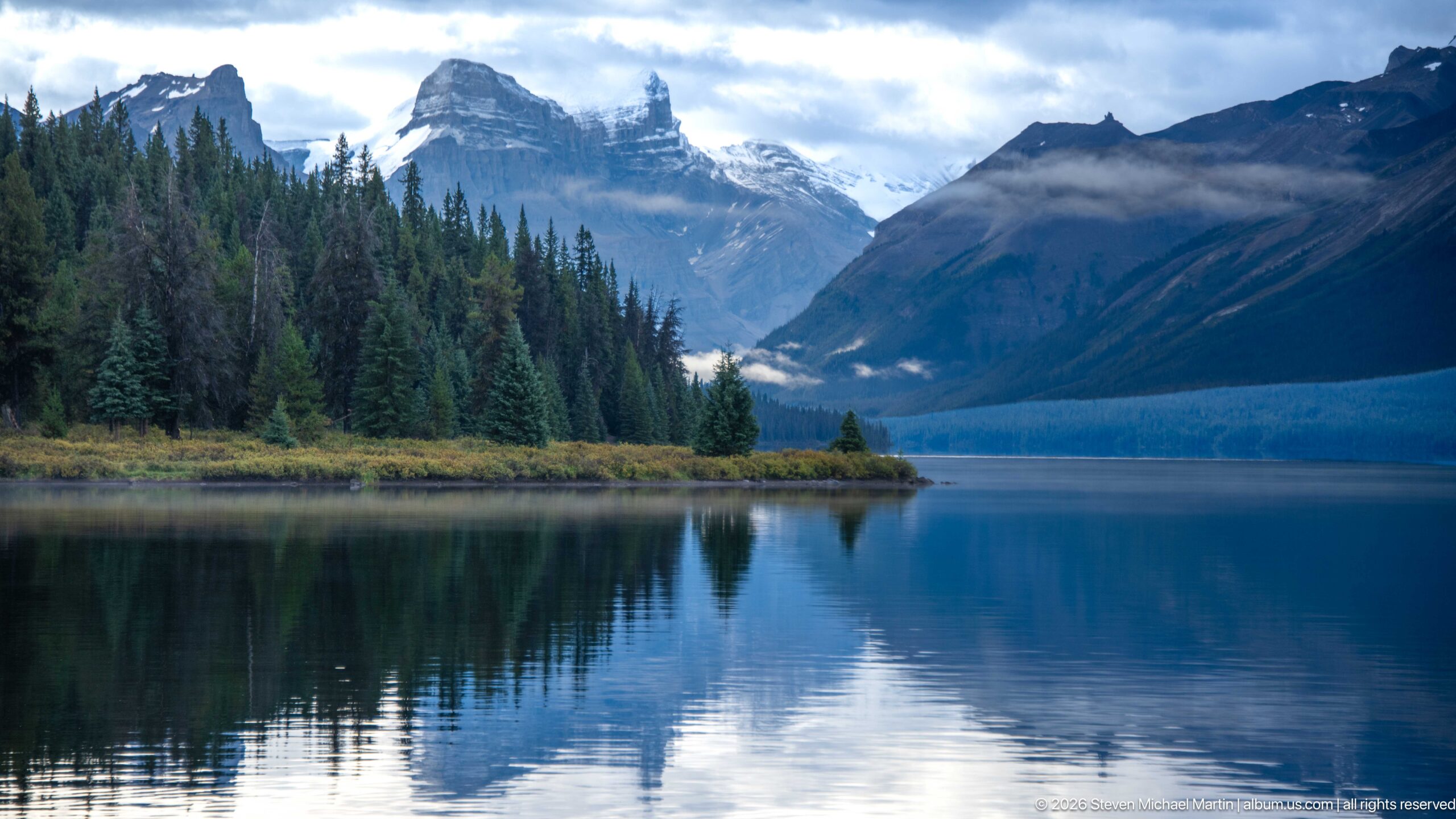
A forested peninsula extends into Maligne Lake beneath steep, partly snow-dusted mountain walls. The surrounding forest and mountain setting provide context for the natural and visitor landscapes encountered along the Maligne Valley corridor.
Caption
A forested peninsula extends into Maligne Lake beneath steep, partly snow-dusted mountain walls. The surrounding forest and mountain setting provide context for the natural and visitor landscapes encountered along the Maligne Valley corridor.
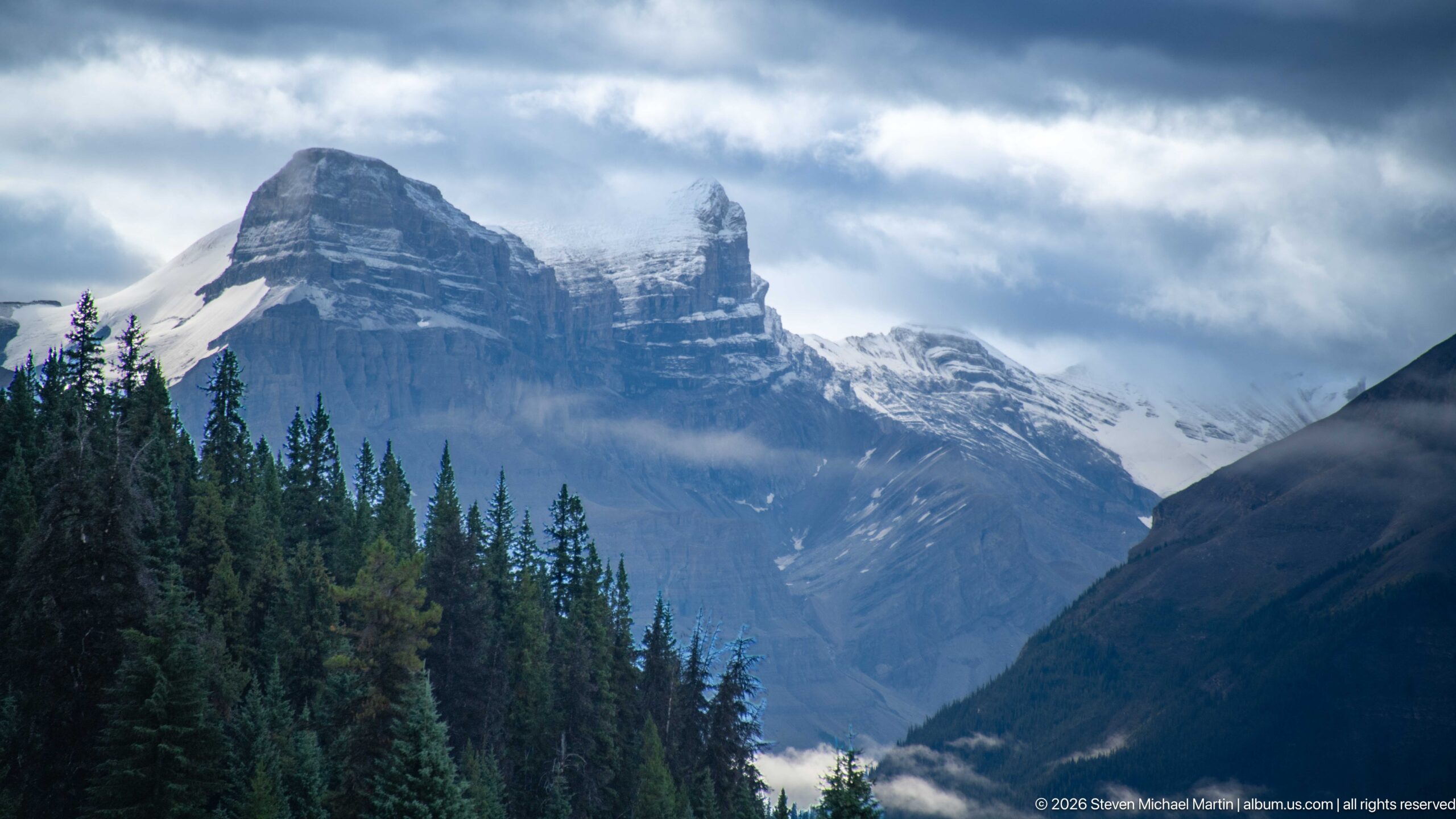
A steep layered mountain rises above conifers with snow and low cloud clinging to its upper slopes. This viewpoint emphasizes the relationship between the subject and its immediate surroundings rather than relying on broader portfolio context.
Caption
A steep layered mountain rises above conifers with snow and low cloud clinging to its upper slopes. This viewpoint emphasizes the relationship between the subject and its immediate surroundings rather than relying on broader portfolio context.
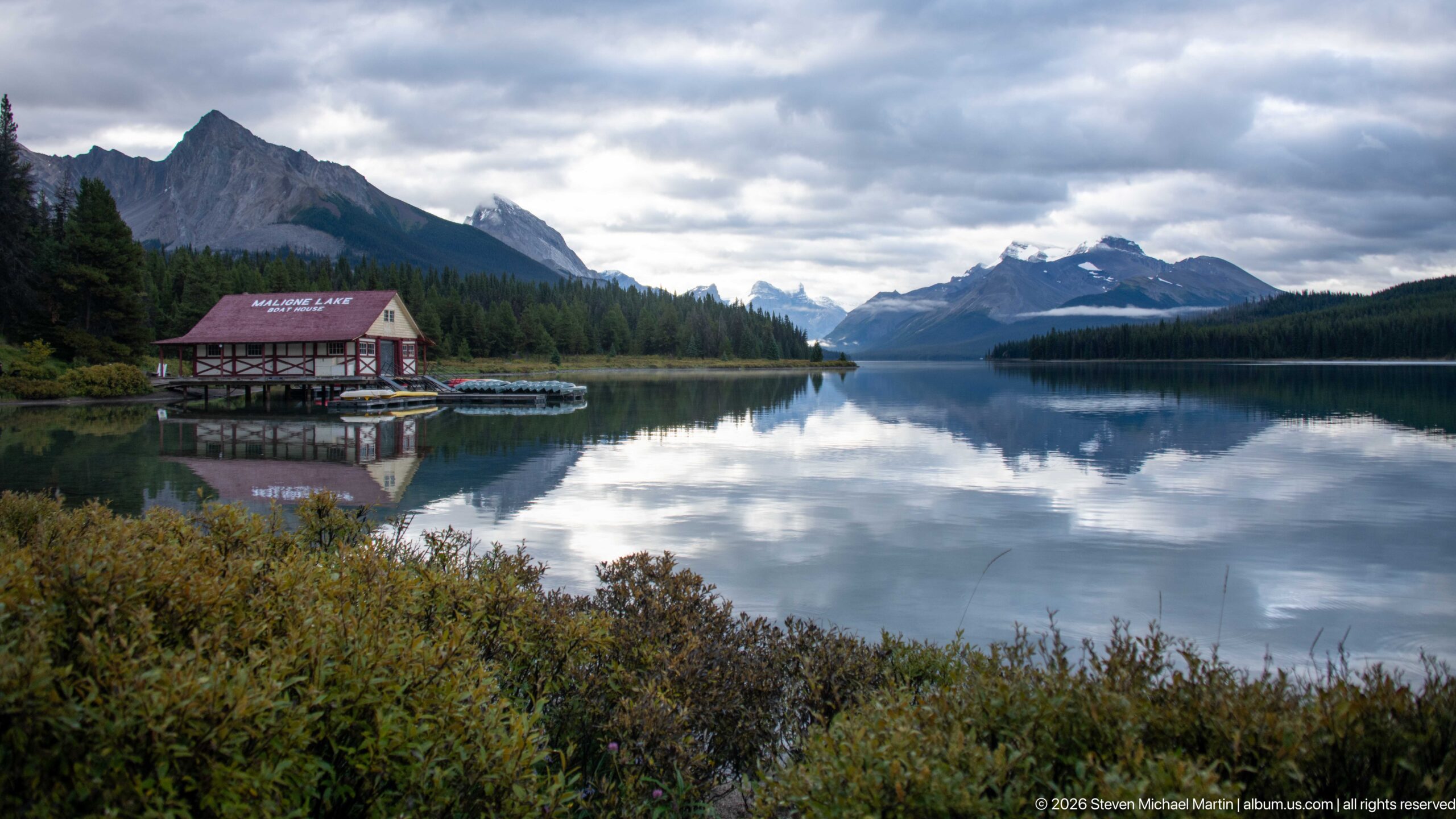
The Maligne Lake Boathouse sits at left across calm reflective water with mountains lining the lake axis. The composition preserves enough surrounding context to connect the subject with the forested mountain environment of Jasper National Park.
Caption
The Maligne Lake Boathouse sits at left across calm reflective water with mountains lining the lake axis. The composition preserves enough surrounding context to connect the subject with the forested mountain environment of Jasper National Park.
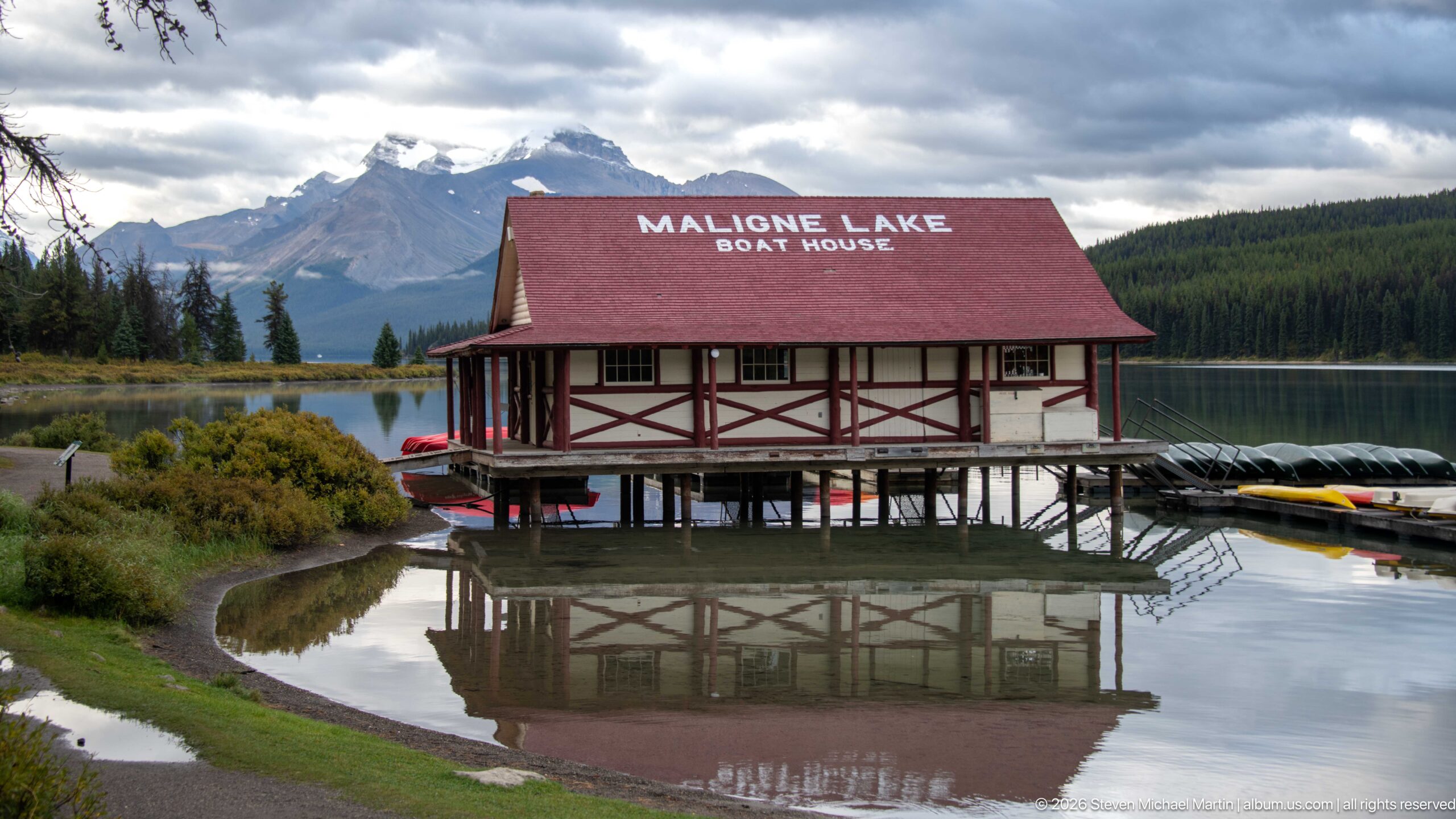
The red-roofed Maligne Lake Boathouse stands over the water, its timber-framed walls reflected below. Its placement within the Maligne Valley visitor corridor adds useful geographic and environmental context without obscuring the visible subject.
Caption
The red-roofed Maligne Lake Boathouse stands over the water, its timber-framed walls reflected below. Its placement within the Maligne Valley visitor corridor adds useful geographic and environmental context without obscuring the visible subject.
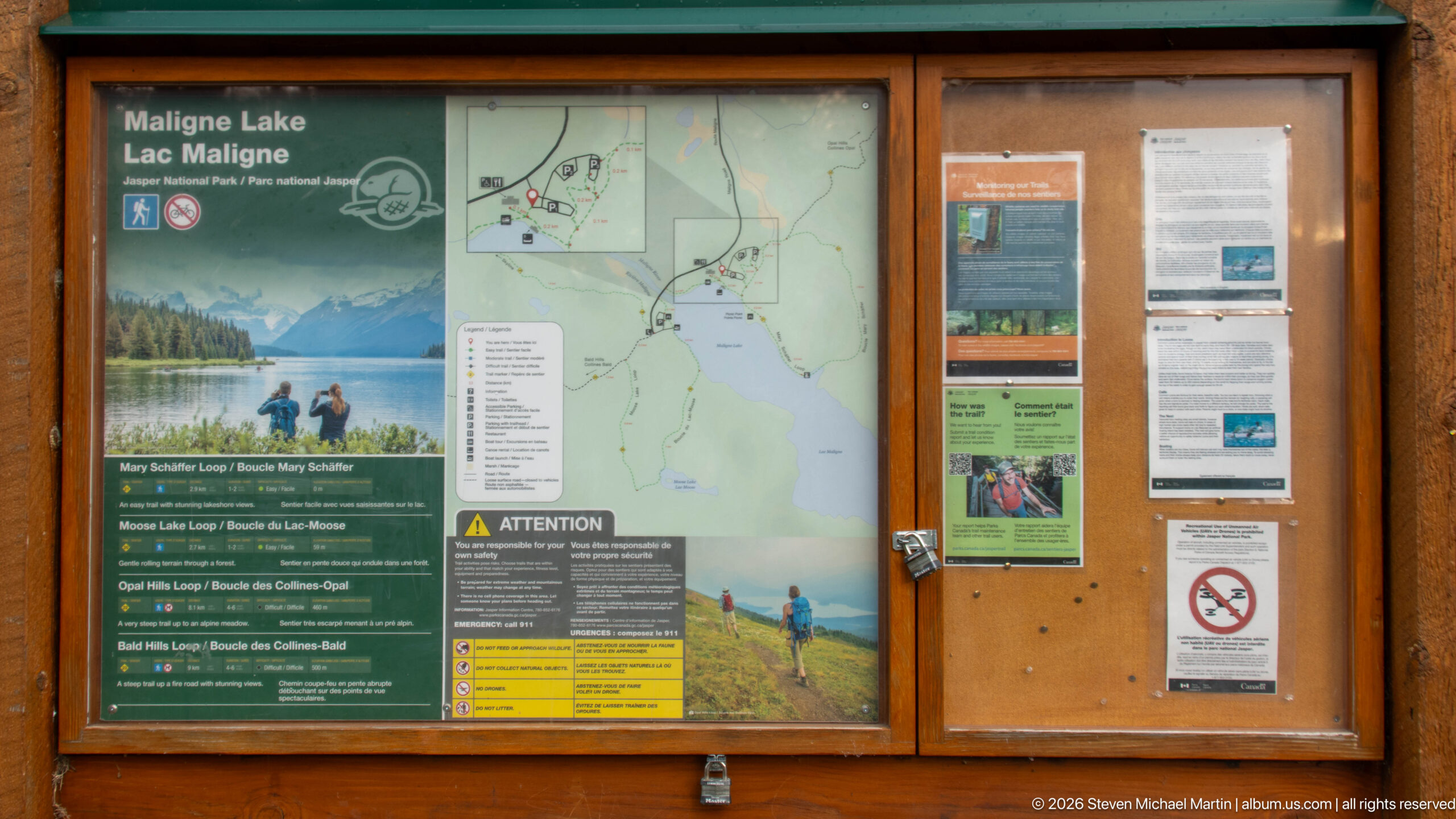
A wooden information case displays a Maligne Lake trail map, route information, notices, and visitor guidance. Visible materials, vegetation, water, or terrain distinguish this view from adjacent photographs and give the scene a clear sense of place.
Caption
A wooden information case displays a Maligne Lake trail map, route information, notices, and visitor guidance. Visible materials, vegetation, water, or terrain distinguish this view from adjacent photographs and give the scene a clear sense of place.
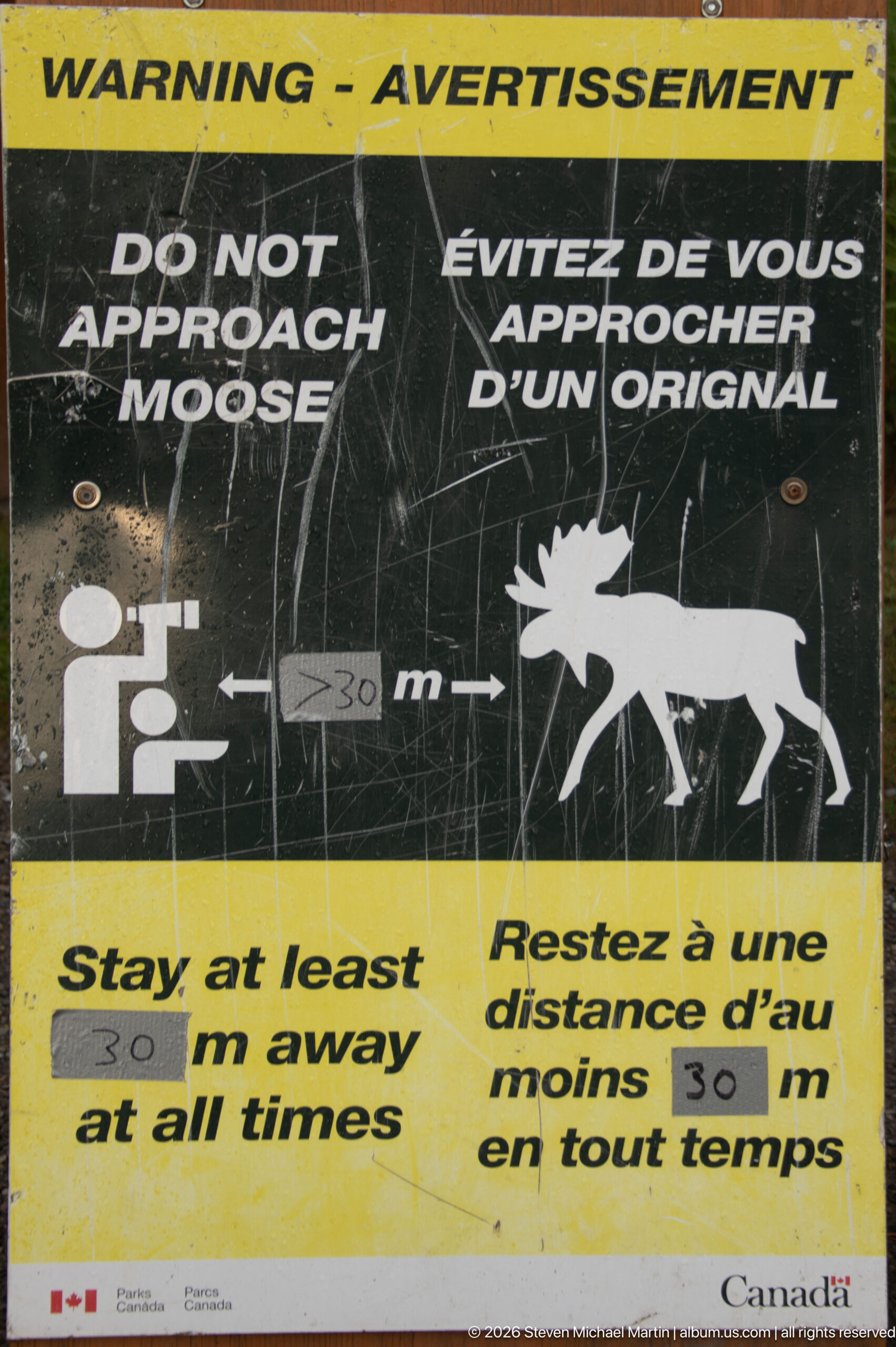
A bilingual Parks Canada warning sign instructs visitors to remain at least 30 metres from moose. The surrounding forest and mountain setting provide context for the natural and visitor landscapes encountered along the Maligne Valley corridor.
Caption
A bilingual Parks Canada warning sign instructs visitors to remain at least 30 metres from moose. The surrounding forest and mountain setting provide context for the natural and visitor landscapes encountered along the Maligne Valley corridor.
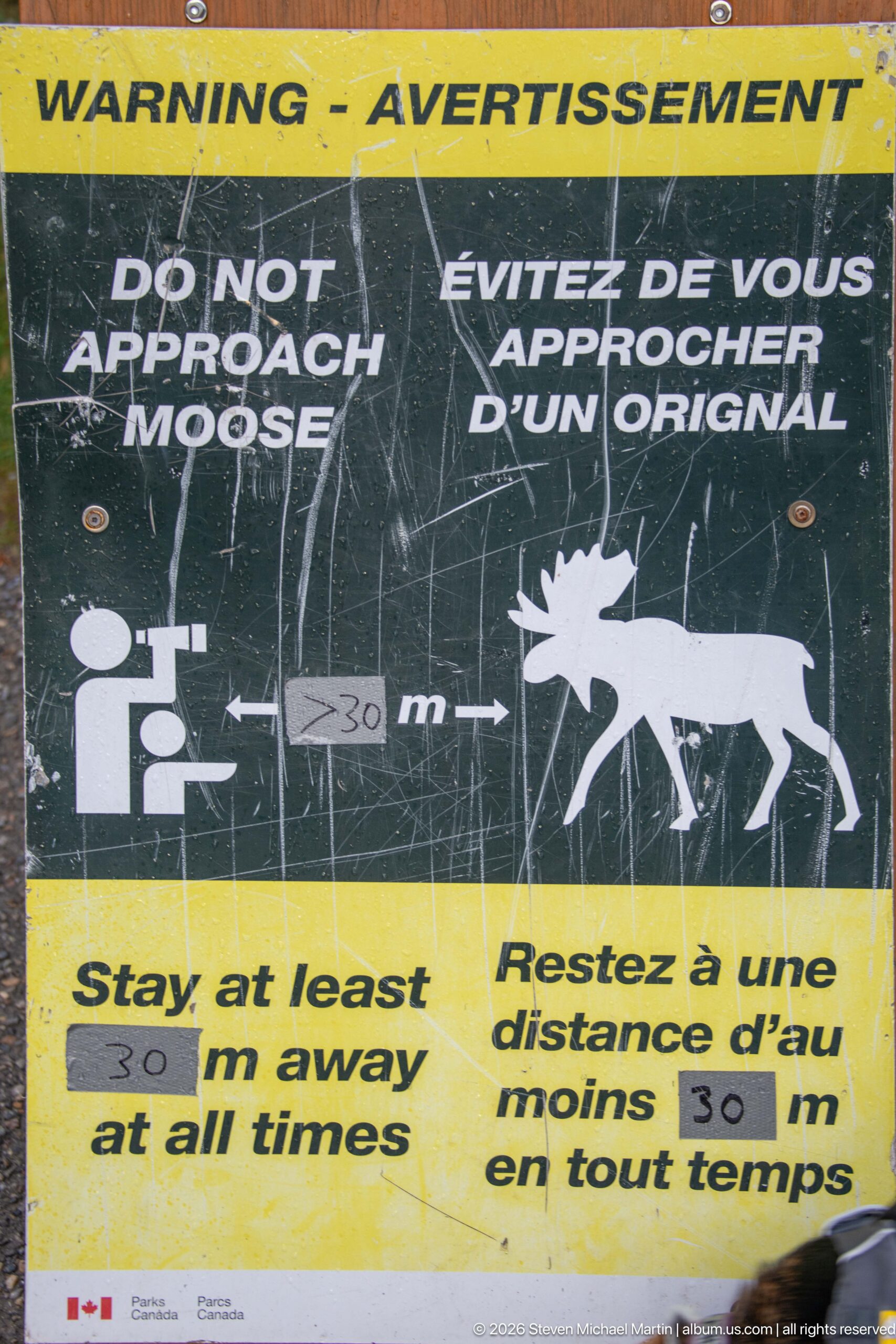
A weathered bilingual warning sign uses human and moose silhouettes to illustrate a minimum 30-metre separation. The composition preserves enough surrounding context to connect the subject with the forested mountain environment of Jasper National Park.
Caption
A weathered bilingual warning sign uses human and moose silhouettes to illustrate a minimum 30-metre separation. The composition preserves enough surrounding context to connect the subject with the forested mountain environment of Jasper National Park.
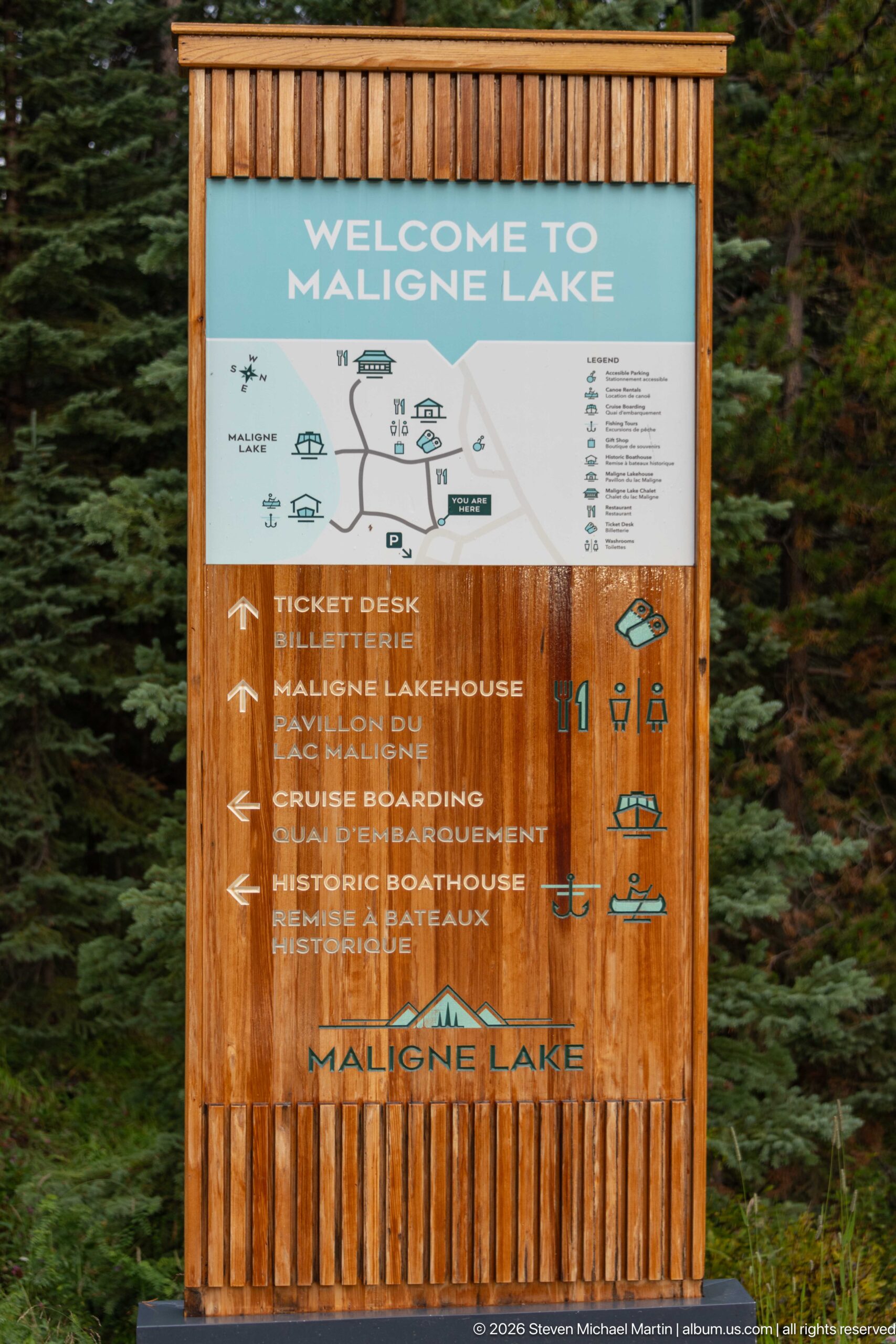
A large wooden Welcome to Maligne Lake board maps visitor services and points toward ticketing, the boathouse, cruise boarding, and other facilities. Its placement within the Maligne Valley visitor corridor adds useful geographic and environmental context without obscuring the visible subject.
Caption
A large wooden Welcome to Maligne Lake board maps visitor services and points toward ticketing, the boathouse, cruise boarding, and other facilities. Its placement within the Maligne Valley visitor corridor adds useful geographic and environmental context without obscuring the visible subject.
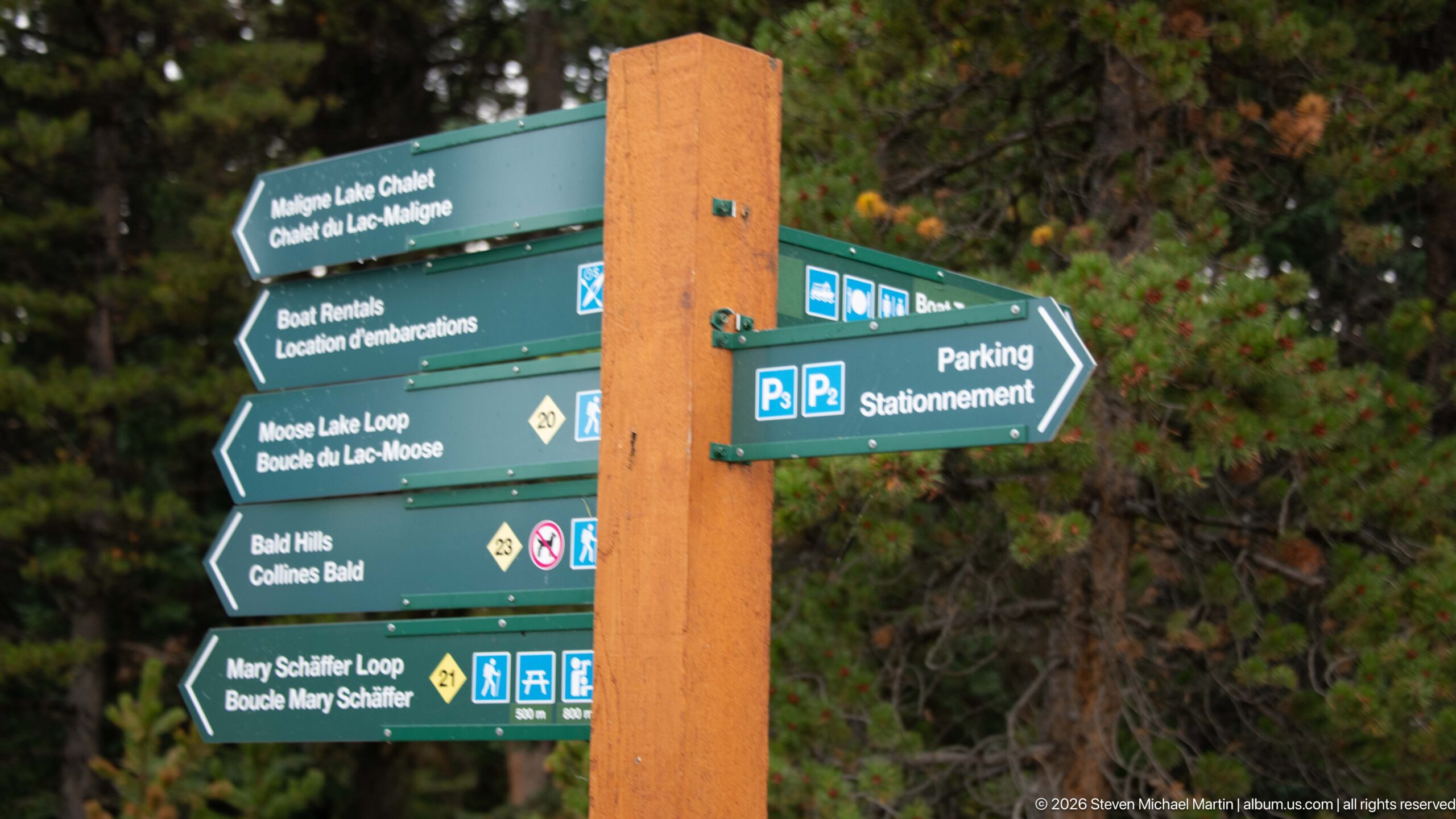
A multi-arm signpost directs visitors to Maligne Lake Chalet, boat rentals, parking, Moose Lake Loop, Bald Hills, and Mary Schäffer Loop. This viewpoint emphasizes the relationship between the subject and its immediate surroundings rather than relying on broader portfolio context.
Caption
A multi-arm signpost directs visitors to Maligne Lake Chalet, boat rentals, parking, Moose Lake Loop, Bald Hills, and Mary Schäffer Loop. This viewpoint emphasizes the relationship between the subject and its immediate surroundings rather than relying on broader portfolio context.
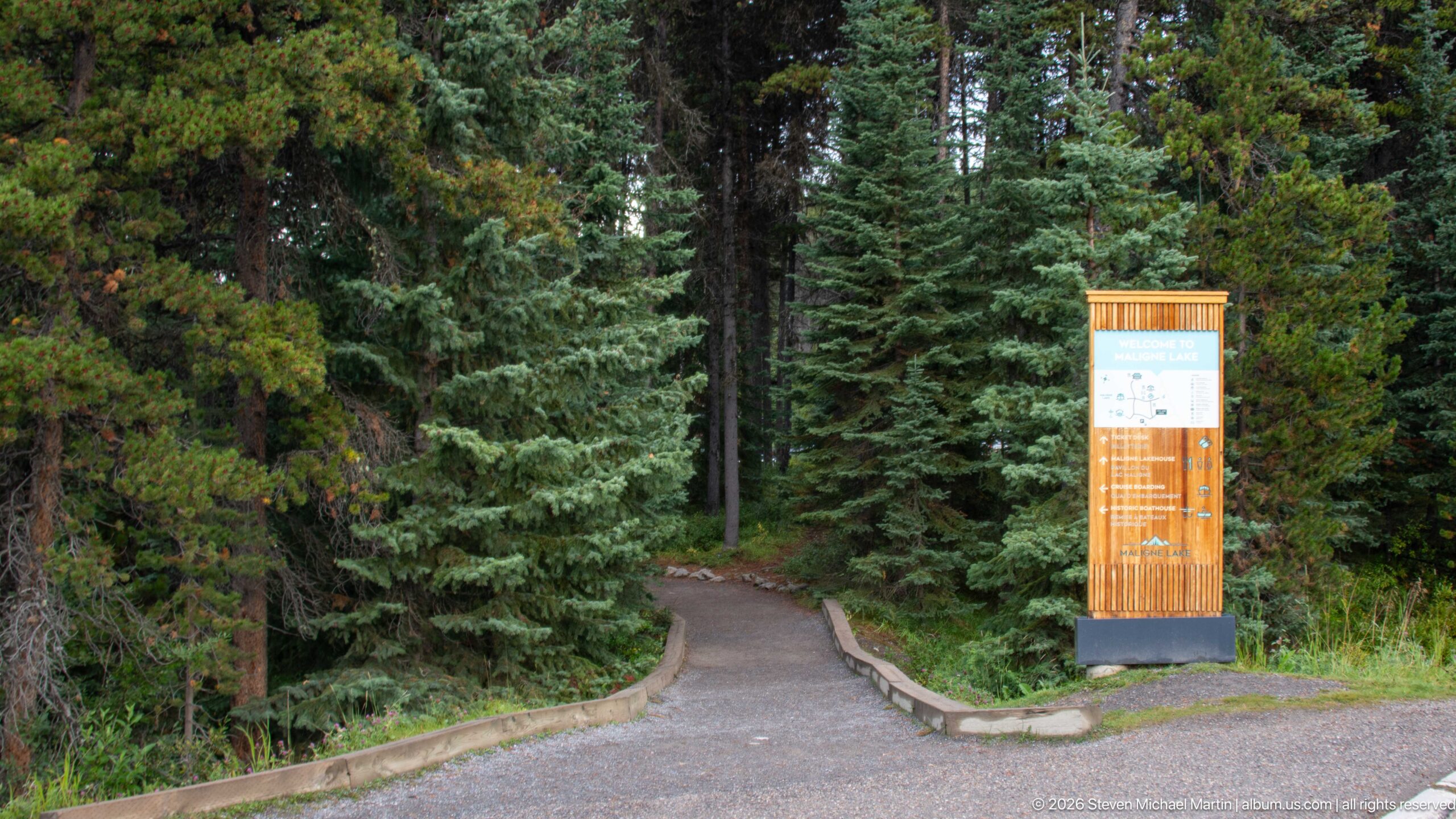
A narrow paved path enters dense conifer forest beside a tall wooden visitor-orientation marker. The frame balances the principal subject with its immediate setting, recording both detail and the character of the Canadian Rockies landscape.
Caption
A narrow paved path enters dense conifer forest beside a tall wooden visitor-orientation marker. The frame balances the principal subject with its immediate setting, recording both detail and the character of the Canadian Rockies landscape.

Large green-and-gray Jasper wordmark mounted above a rounded-stone masonry base. The monument marks the Jasper setting through a contemporary wordmark set on a base of rounded stone masonry.
Caption
Large green-and-gray Jasper wordmark mounted above a rounded-stone masonry base. The monument marks the Jasper setting through a contemporary wordmark set on a base of rounded stone masonry.

Jasper monument appears beside a temporary bilingual Attention wildlife warning sign with an elk graphic. The temporary wildlife notice beside the monument adds a practical reminder that large animals can occur along developed park corridors.
Caption
Jasper monument appears beside a temporary bilingual Attention wildlife warning sign with an elk graphic. The temporary wildlife notice beside the monument adds a practical reminder that large animals can occur along developed park corridors.
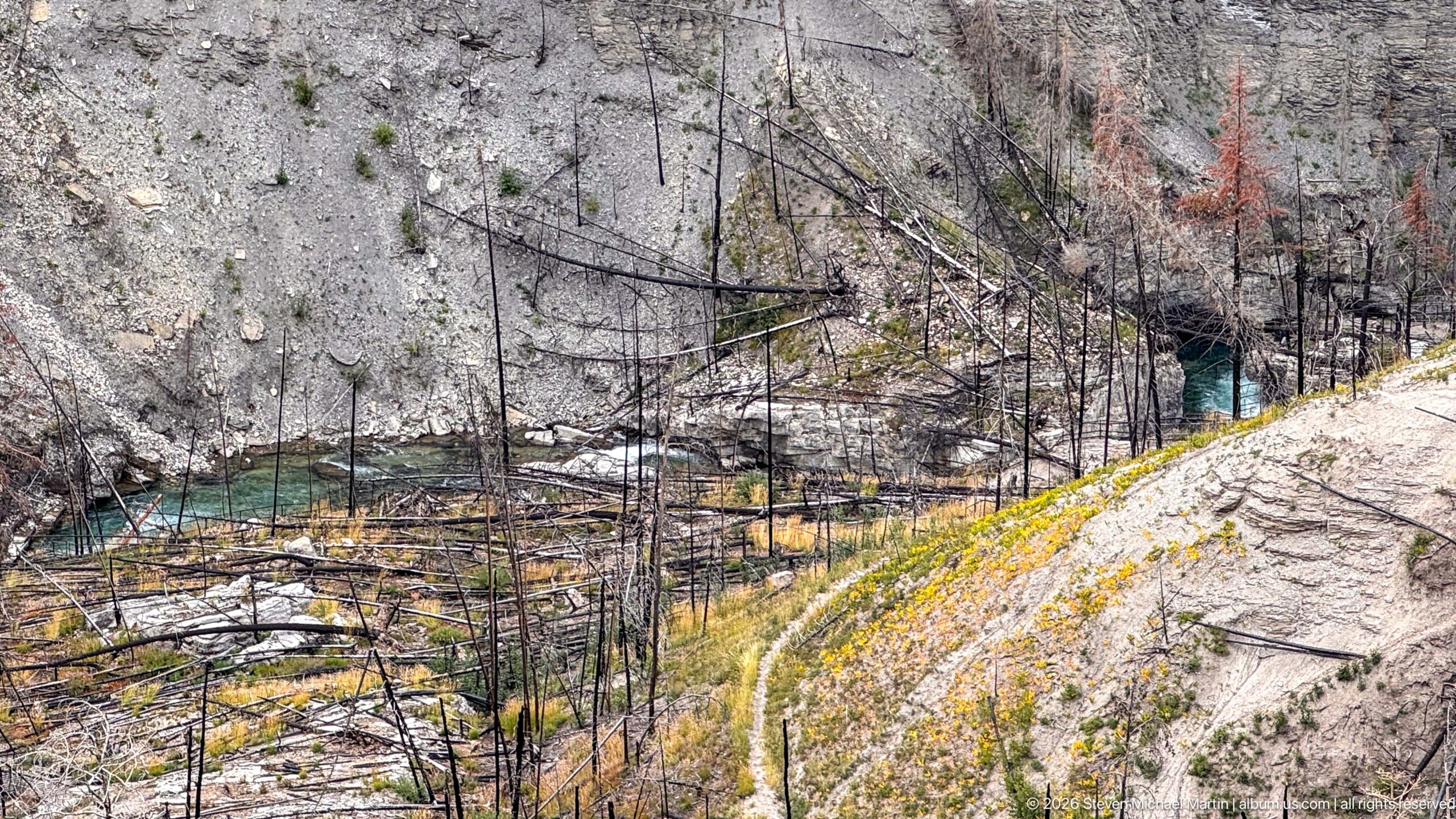
Turquoise water winds below pale rocky slopes through a forest of fire-killed trunks and sparse regrowth. Standing dead trees and patchy new vegetation record a landscape in visible transition following wildfire disturbance.
Caption
Turquoise water winds below pale rocky slopes through a forest of fire-killed trunks and sparse regrowth. Standing dead trees and patchy new vegetation record a landscape in visible transition following wildfire disturbance.
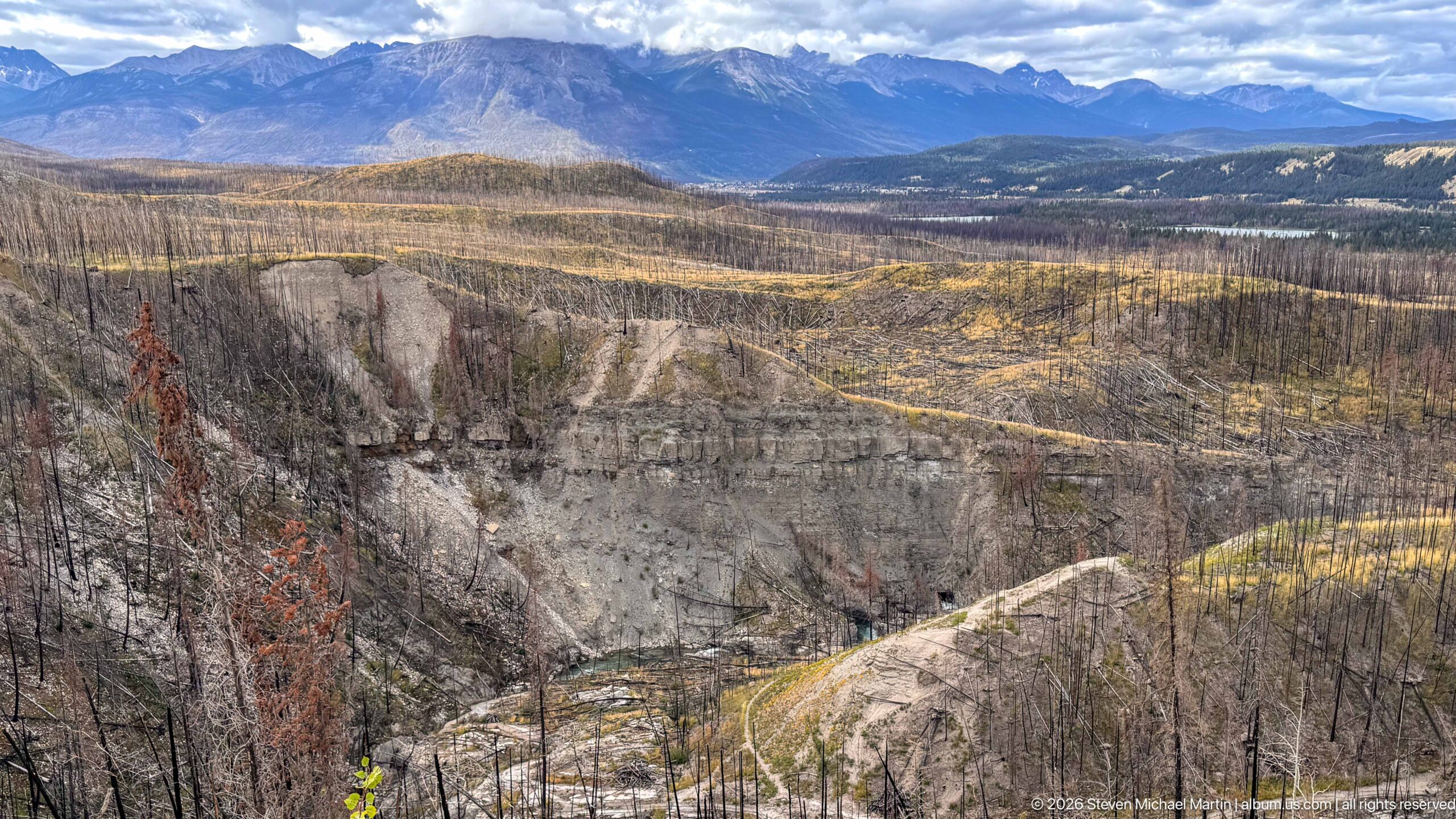
A broad eroded ravine cuts through fire-affected terrain with blackened trees, yellow regrowth, roads, and distant mountains. Standing dead trees and patchy new vegetation record a landscape in visible transition following wildfire disturbance.
Caption
A broad eroded ravine cuts through fire-affected terrain with blackened trees, yellow regrowth, roads, and distant mountains. Standing dead trees and patchy new vegetation record a landscape in visible transition following wildfire disturbance.
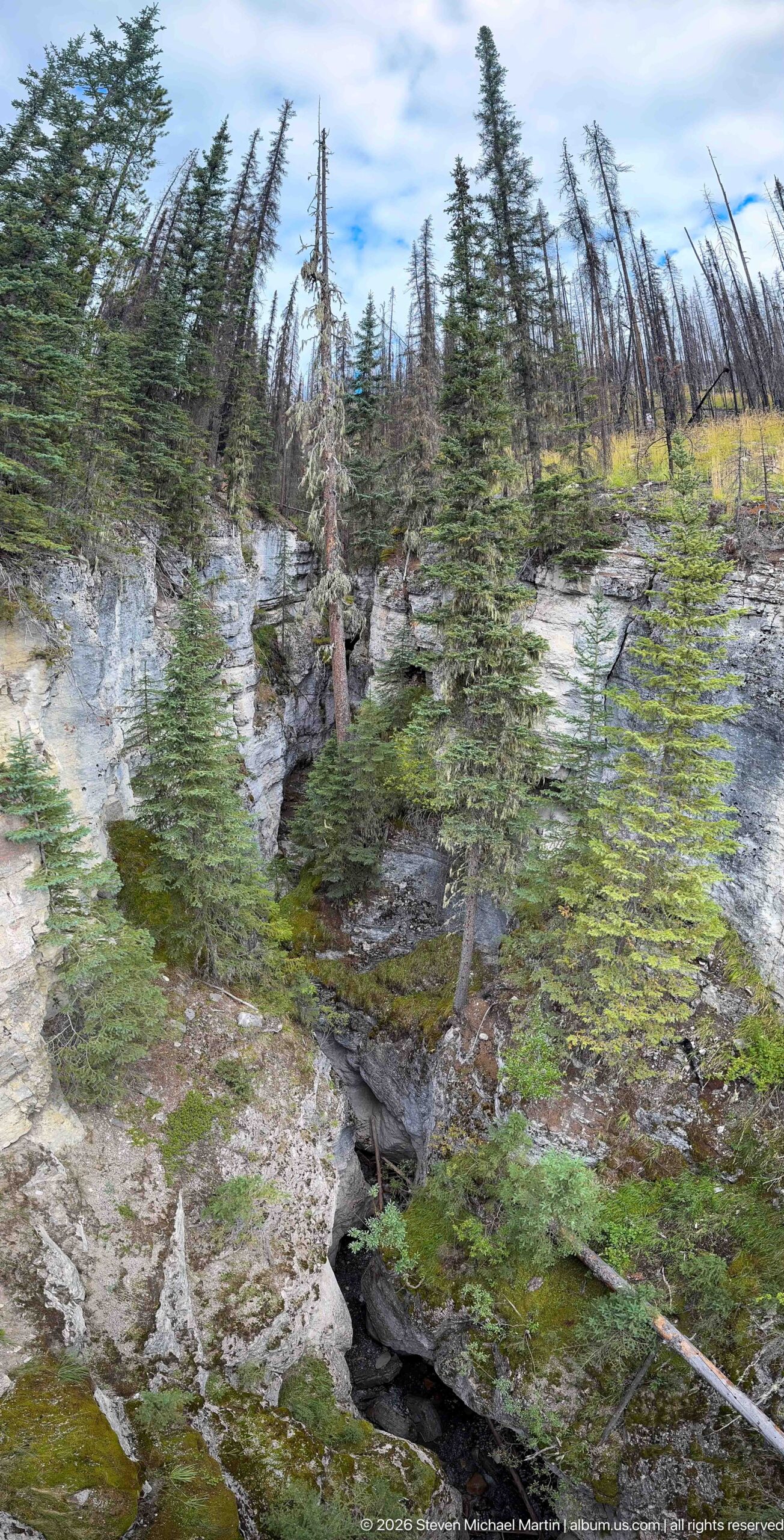
A narrow dark cleft cuts through pale bedrock amid moss, low vegetation, young conifers, and standing dead trees. Exposed bedrock, moisture-loving vegetation, and young conifers emphasize the close relationship between geology and forest recovery.
Caption
A narrow dark cleft cuts through pale bedrock amid moss, low vegetation, young conifers, and standing dead trees. Exposed bedrock, moisture-loving vegetation, and young conifers emphasize the close relationship between geology and forest recovery.
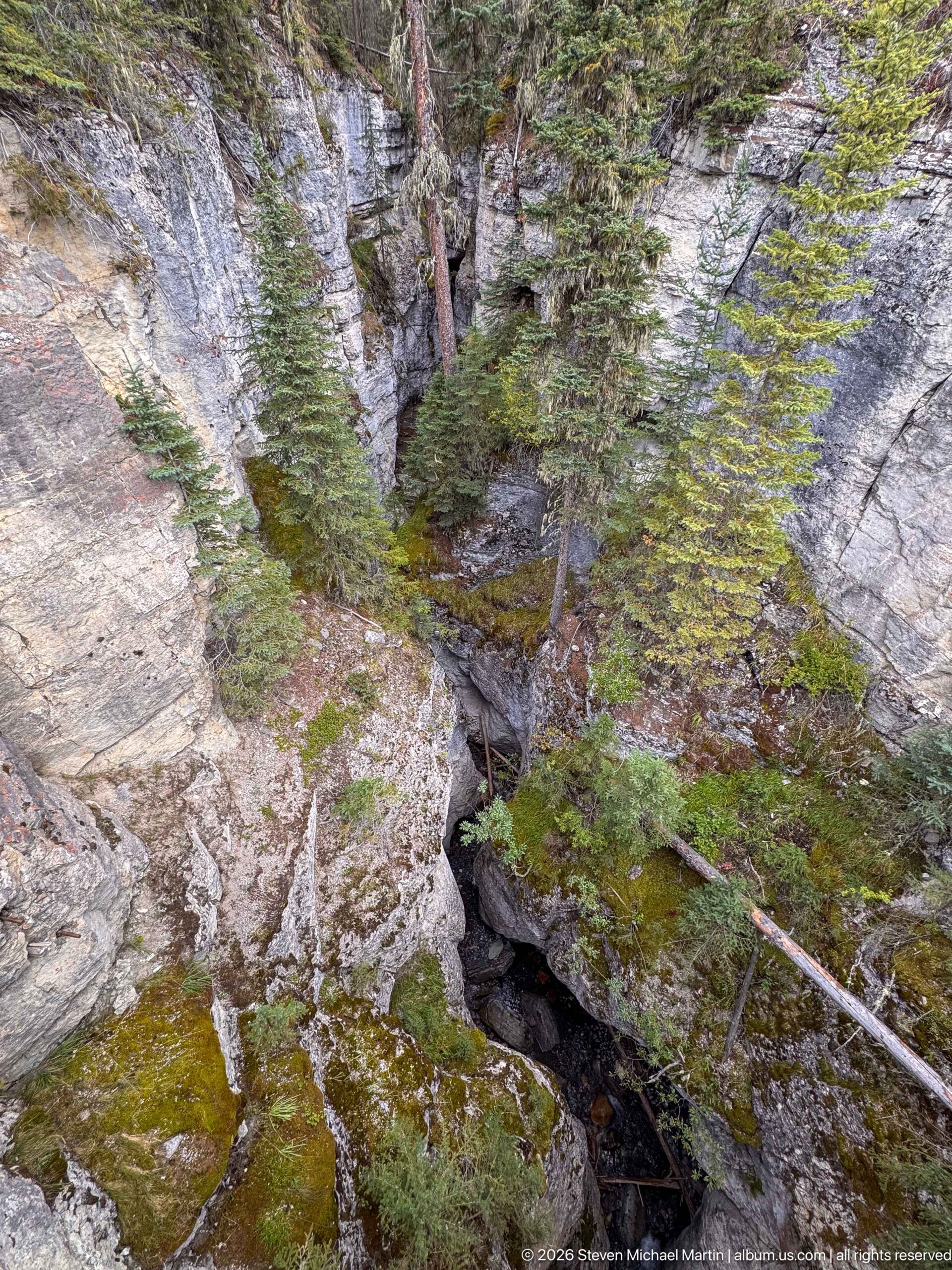
A deep narrow opening divides pale rock slabs beneath conifers, moss, shrubs, and fallen trunks. The tight rock opening and vegetation rooted in fractures emphasize small-scale geological structure within the forest.
Caption
A deep narrow opening divides pale rock slabs beneath conifers, moss, shrubs, and fallen trunks. The tight rock opening and vegetation rooted in fractures emphasize small-scale geological structure within the forest.
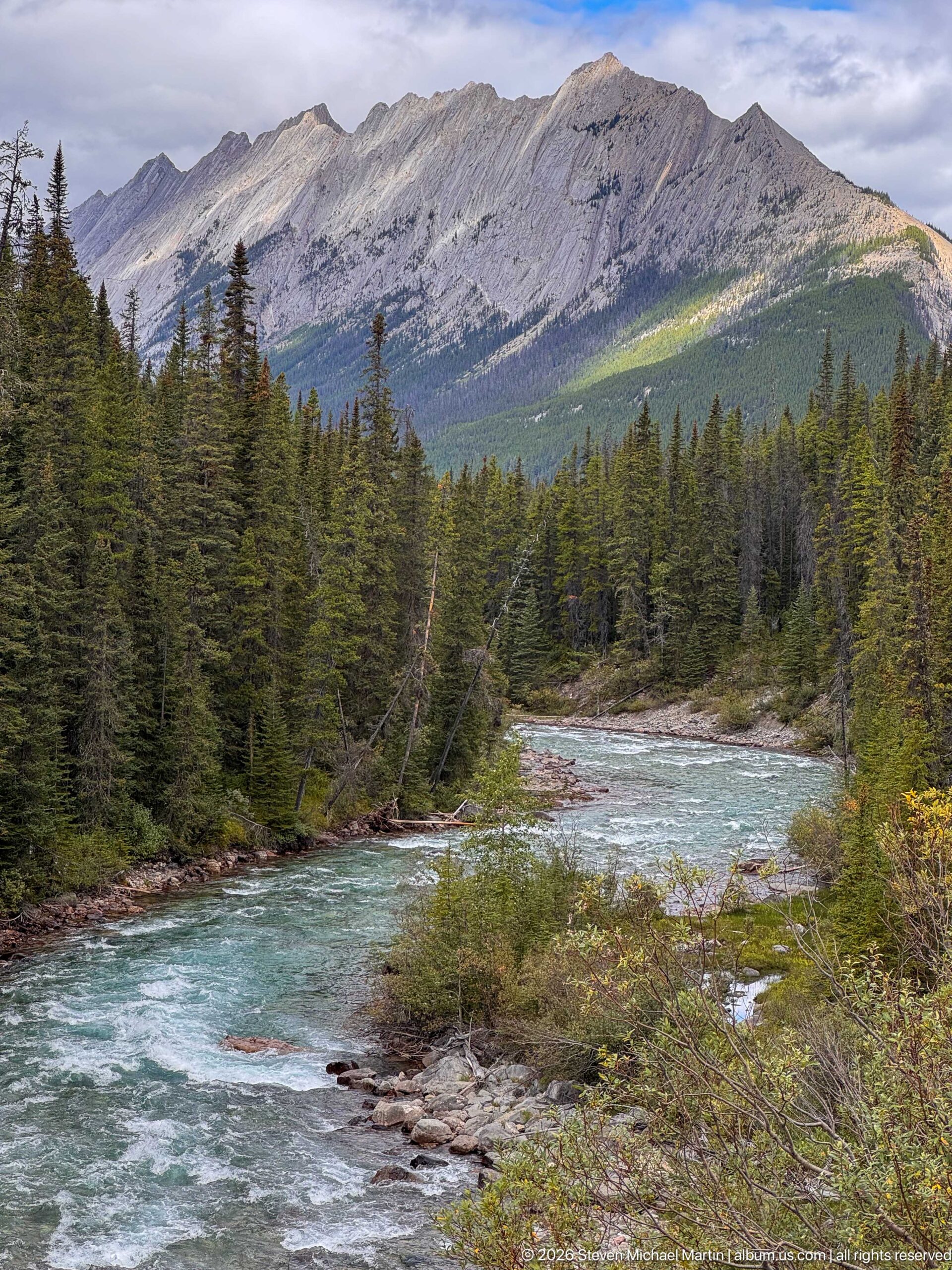
Fast turquoise water bends through dense conifer forest below a broad gray mountain ridge. The flowing water, forested banks, and enclosing relief place the river within the strongly glaciated mountain landscape of Jasper National Park.
Caption
Fast turquoise water bends through dense conifer forest below a broad gray mountain ridge. The flowing water, forested banks, and enclosing relief place the river within the strongly glaciated mountain landscape of Jasper National Park.
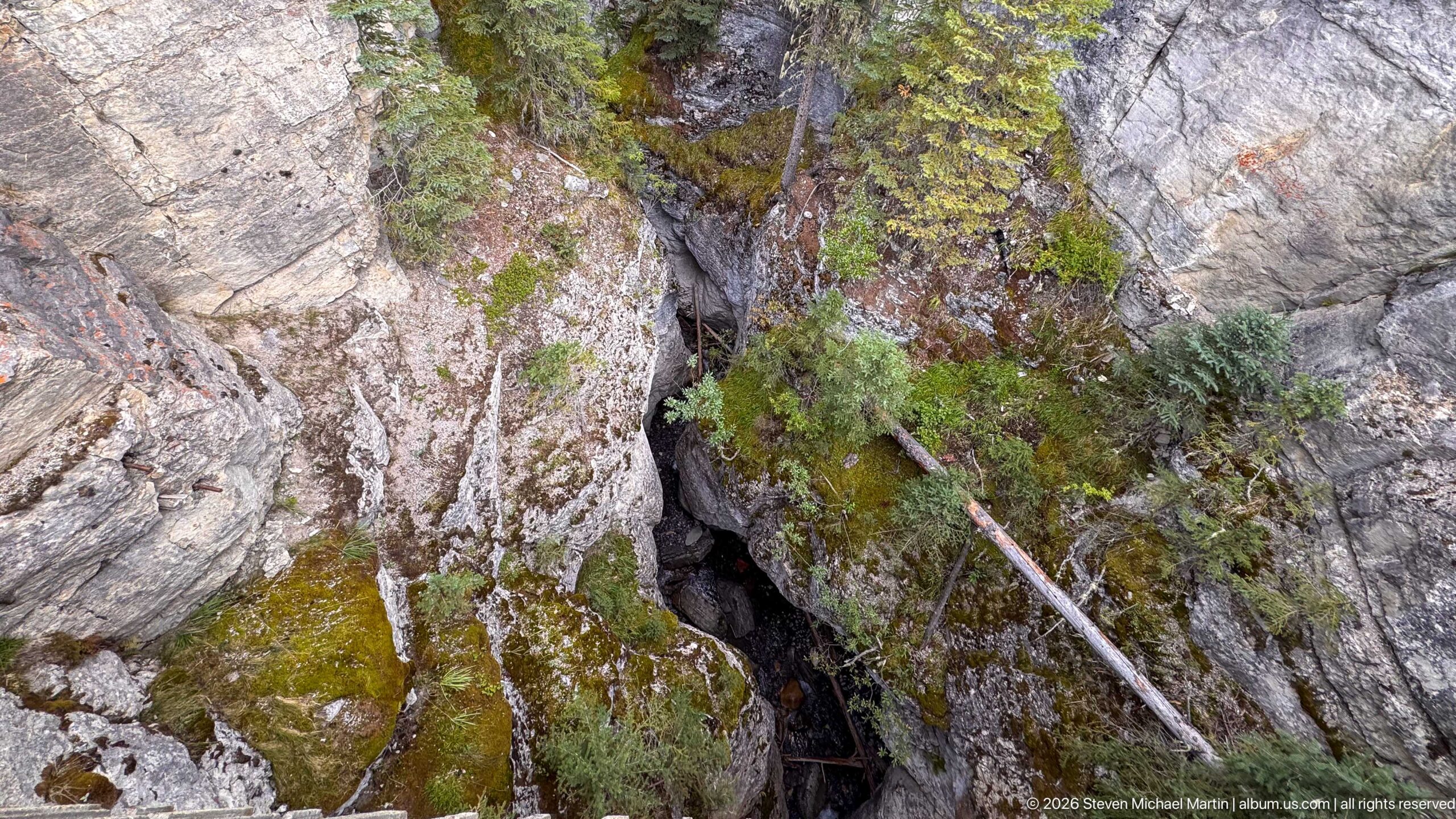
Steep fractured gray rock encloses a narrow shadowed fissure with moss, shrubs, conifers, and fallen wood. The tight rock opening and vegetation rooted in fractures emphasize small-scale geological structure within the forest.
Caption
Steep fractured gray rock encloses a narrow shadowed fissure with moss, shrubs, conifers, and fallen wood. The tight rock opening and vegetation rooted in fractures emphasize small-scale geological structure within the forest.
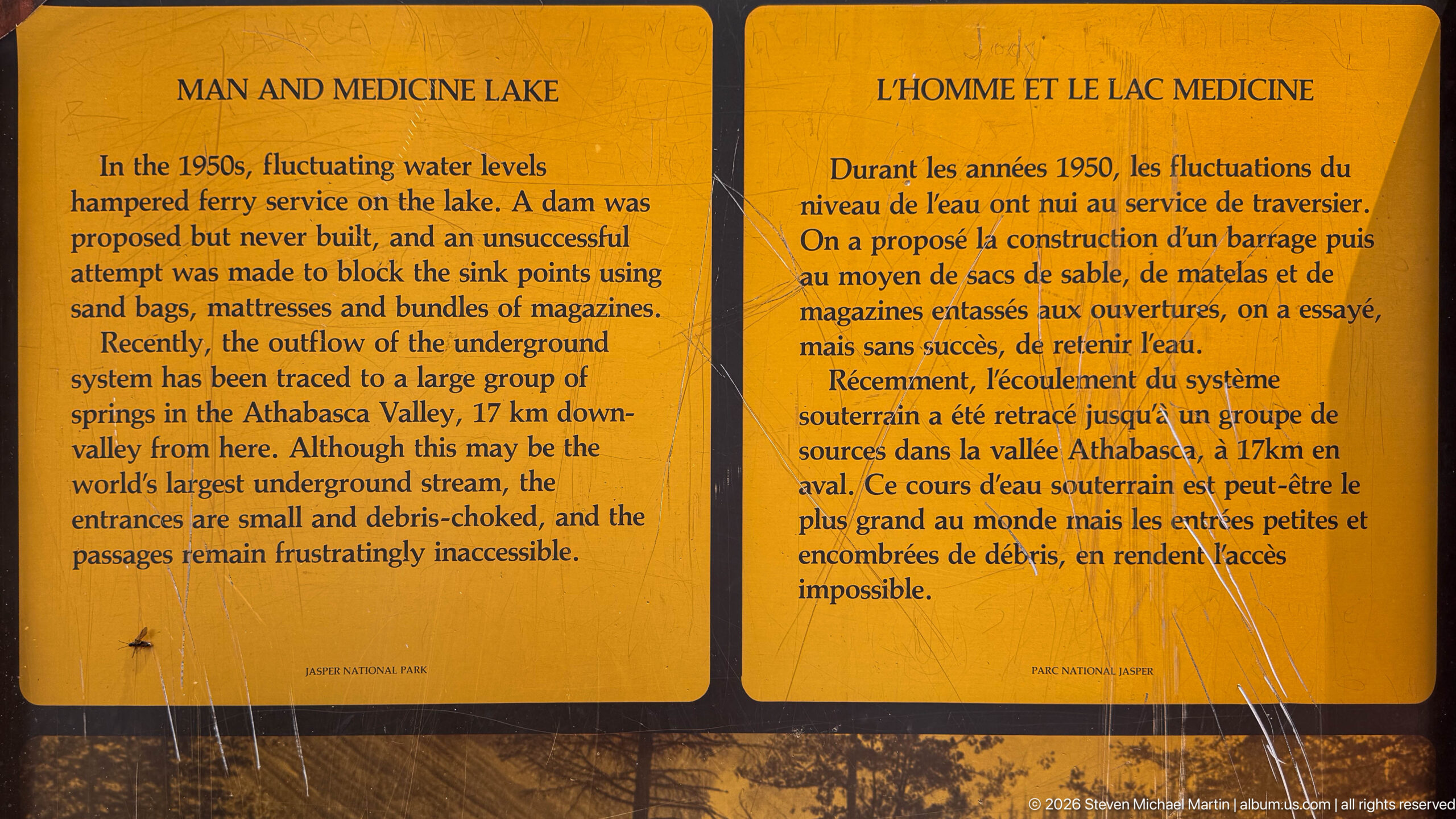
Bilingual yellow interpretive panel headed Medicine Lake explains fluctuating water levels, sink points, and underground drainage toward the Athabasca Valley. The panel directly links the visible visitor landscape to Medicine Lake's seasonal hydrology and subsurface drainage system.
Caption
Bilingual yellow interpretive panel headed Medicine Lake explains fluctuating water levels, sink points, and underground drainage toward the Athabasca Valley. The panel directly links the visible visitor landscape to Medicine Lake's seasonal hydrology and subsurface drainage system.
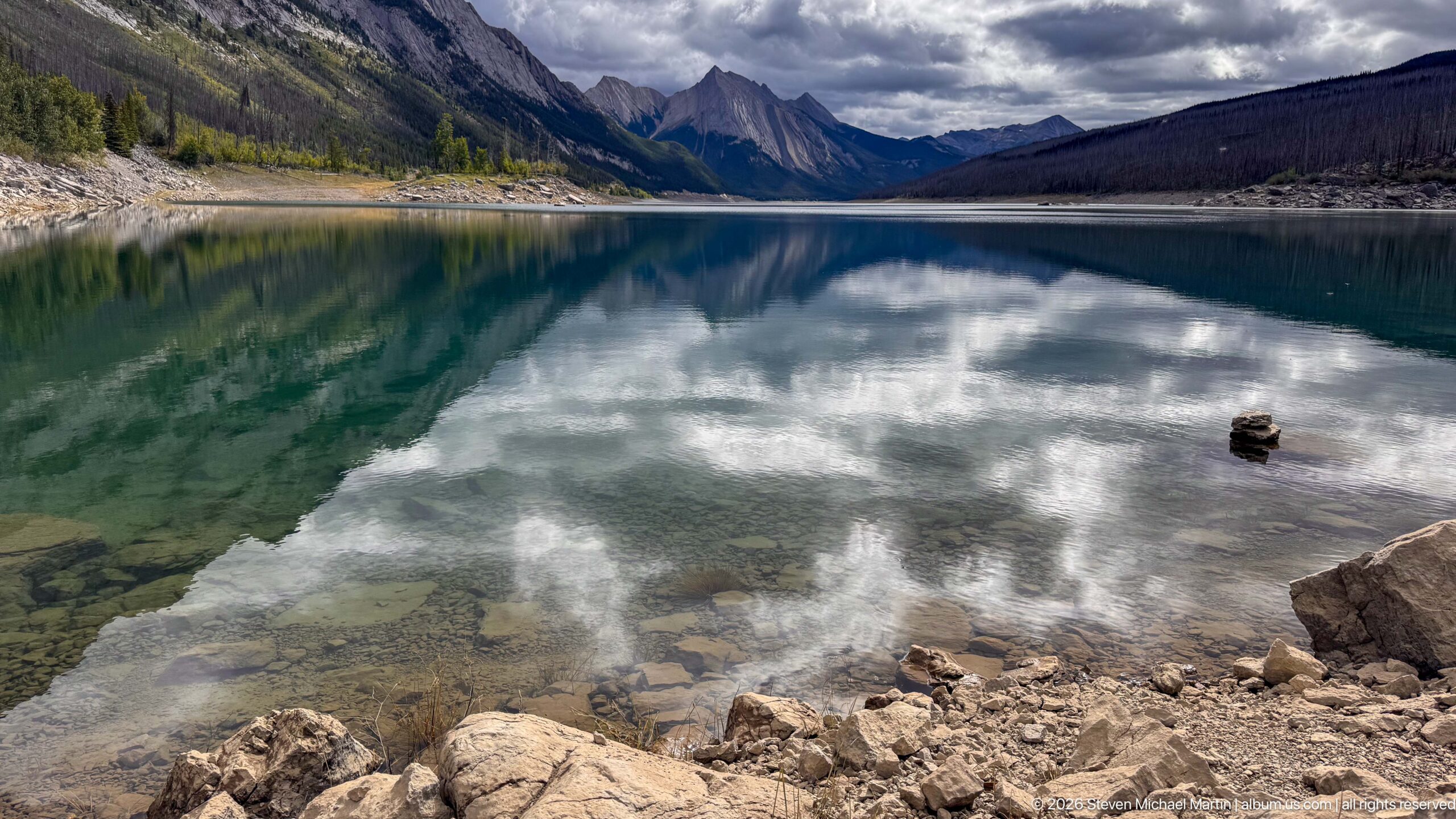
Clear water mirrors dramatic clouds and mountain walls above a rocky foreground shoreline, with low water exposing broad margins around the basin. Medicine Lake's changing water level can leave extensive shoreline exposed, a visible expression of the basin's unusual hydrology within the Maligne Valley.
Caption
Clear water mirrors dramatic clouds and mountain walls above a rocky foreground shoreline, with low water exposing broad margins around the basin. Medicine Lake's changing water level can leave extensive shoreline exposed, a visible expression of the basin's unusual hydrology within the Maligne Valley.
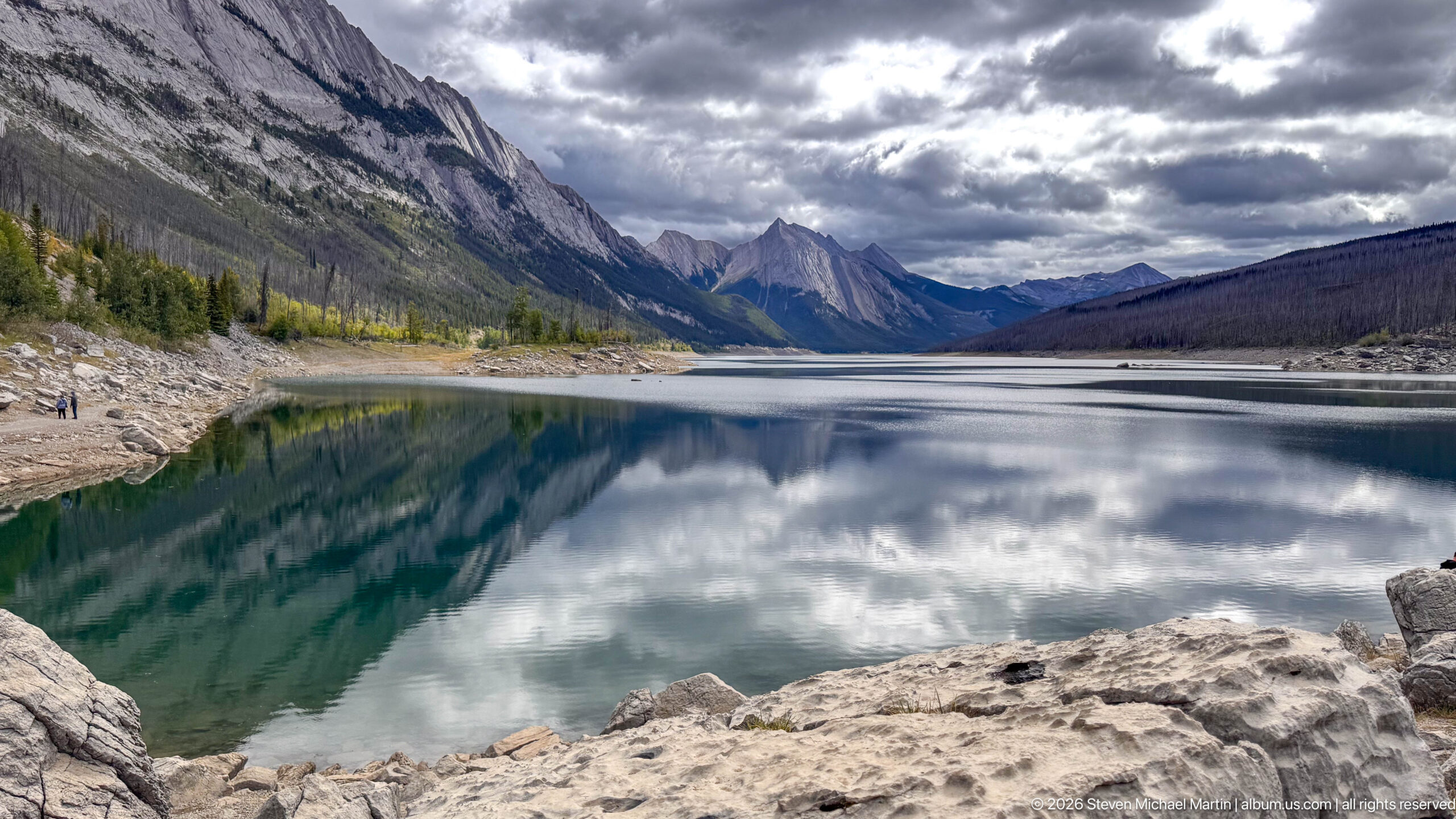
Medicine Lake extends between steep mountain walls beneath heavy clouds, with broad pale exposed shoreline and strong reflections. Medicine Lake's changing water level can leave extensive shoreline exposed, a visible expression of the basin's unusual hydrology within the Maligne Valley.
Caption
Medicine Lake extends between steep mountain walls beneath heavy clouds, with broad pale exposed shoreline and strong reflections. Medicine Lake's changing water level can leave extensive shoreline exposed, a visible expression of the basin's unusual hydrology within the Maligne Valley.
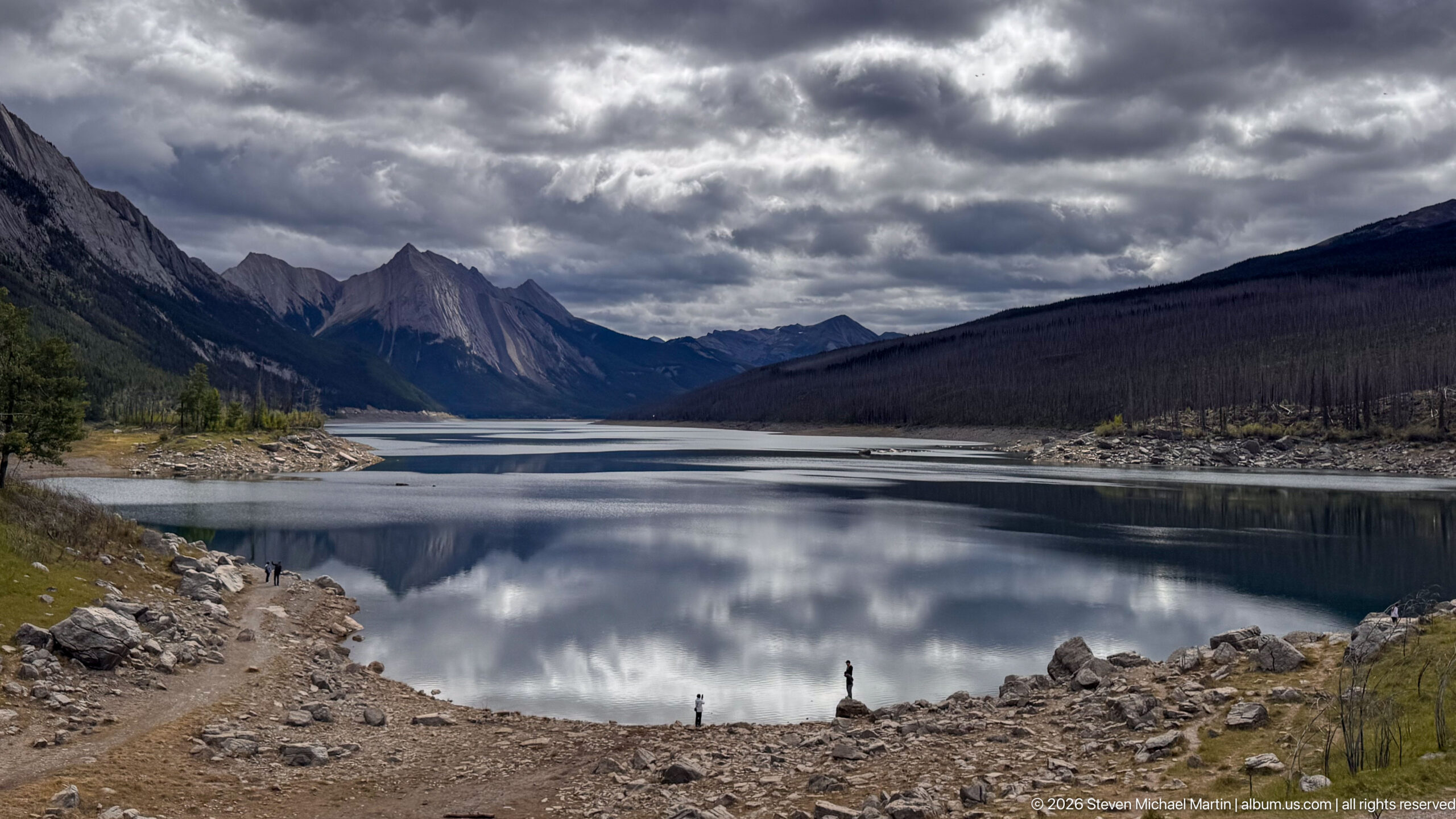
A broad view looks down Medicine Lake toward angular peaks beneath dark clouds, with extensive rocky shoreline exposed around calm reflective water. Medicine Lake's changing water level can leave extensive shoreline exposed, a visible expression of the basin's unusual hydrology within the Maligne Valley.
Caption
A broad view looks down Medicine Lake toward angular peaks beneath dark clouds, with extensive rocky shoreline exposed around calm reflective water. Medicine Lake's changing water level can leave extensive shoreline exposed, a visible expression of the basin's unusual hydrology within the Maligne Valley.
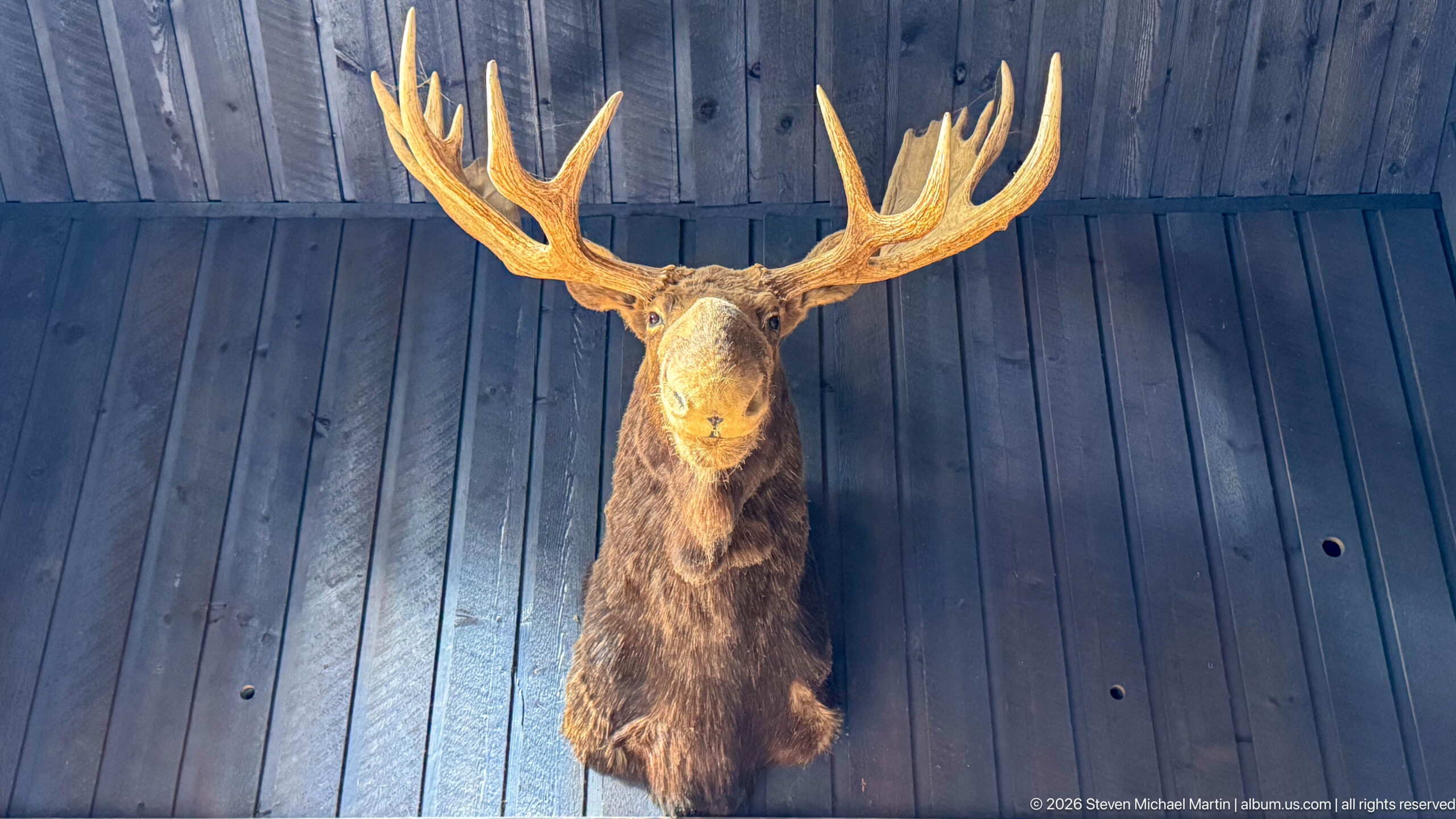
A taxidermy bull moose head with broad palmate antlers is mounted against vertical dark wooden boards. The frontal presentation emphasizes the moose's broad palmate antlers and elongated head against the rustic interior wall.
Caption
A taxidermy bull moose head with broad palmate antlers is mounted against vertical dark wooden boards. The frontal presentation emphasizes the moose's broad palmate antlers and elongated head against the rustic interior wall.
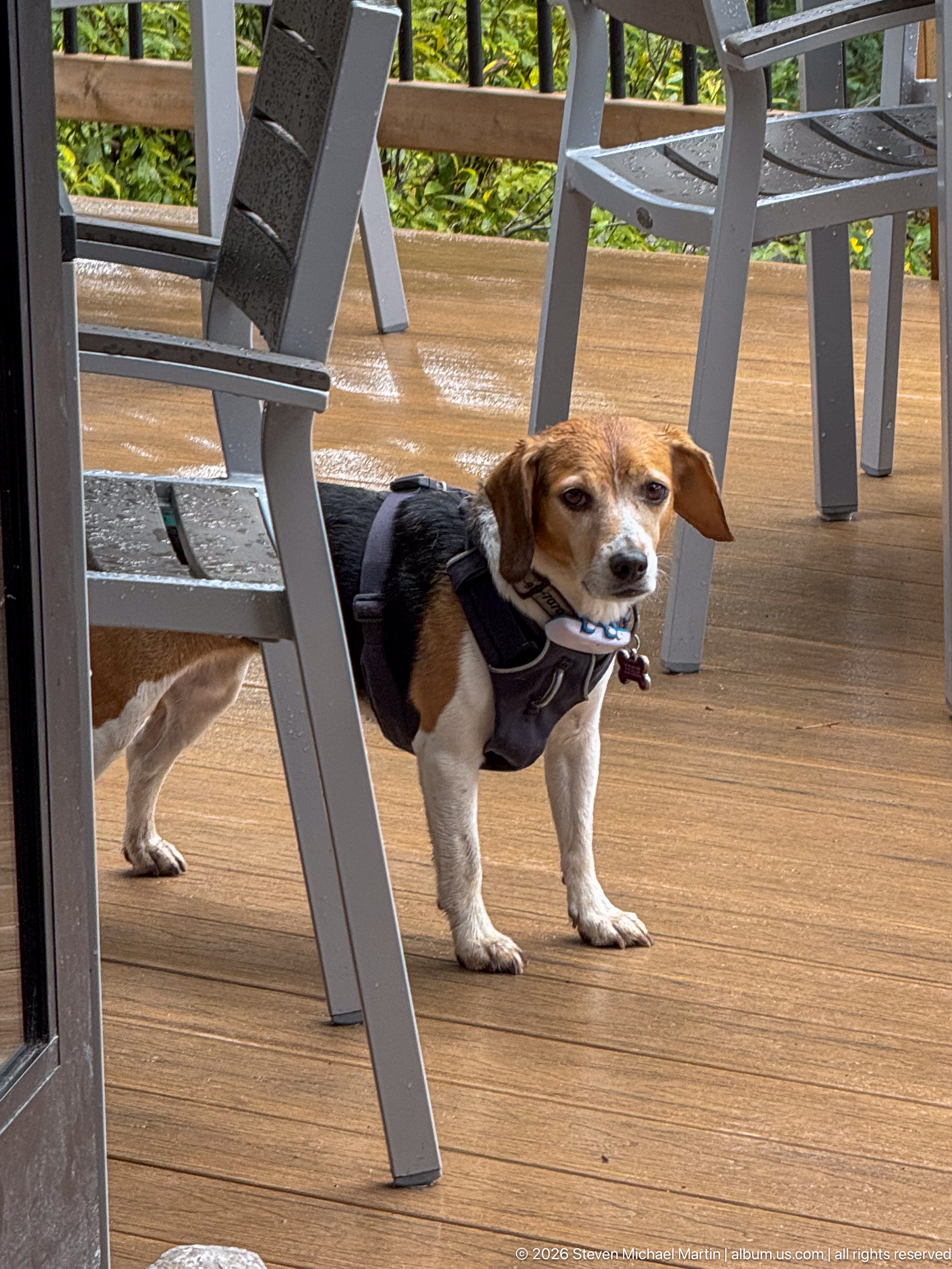
A harnessed tri-color beagle stands beneath patio furniture on a wet wooden deck. The close view records a companion animal within the developed visitor setting rather than wildlife habitat.
Caption
A harnessed tri-color beagle stands beneath patio furniture on a wet wooden deck. The close view records a companion animal within the developed visitor setting rather than wildlife habitat.
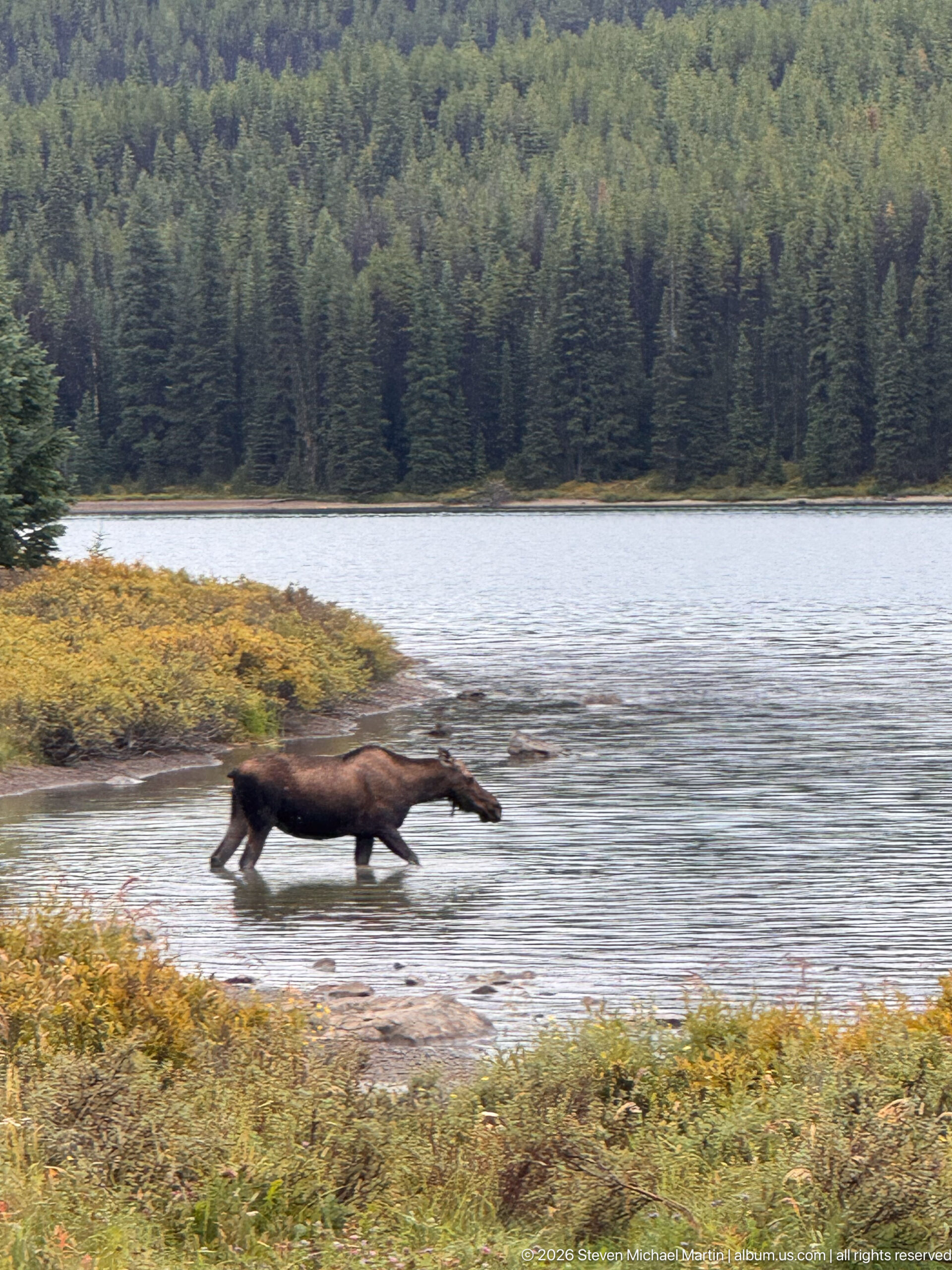
A dark adult moose runs through shallow lake water with legs extended, backed by a forested shore. The surrounding water and shoreline vegetation retain habitat context while the animal remains the dominant subject of the frame.
Caption
A dark adult moose runs through shallow lake water with legs extended, backed by a forested shore. The surrounding water and shoreline vegetation retain habitat context while the animal remains the dominant subject of the frame.
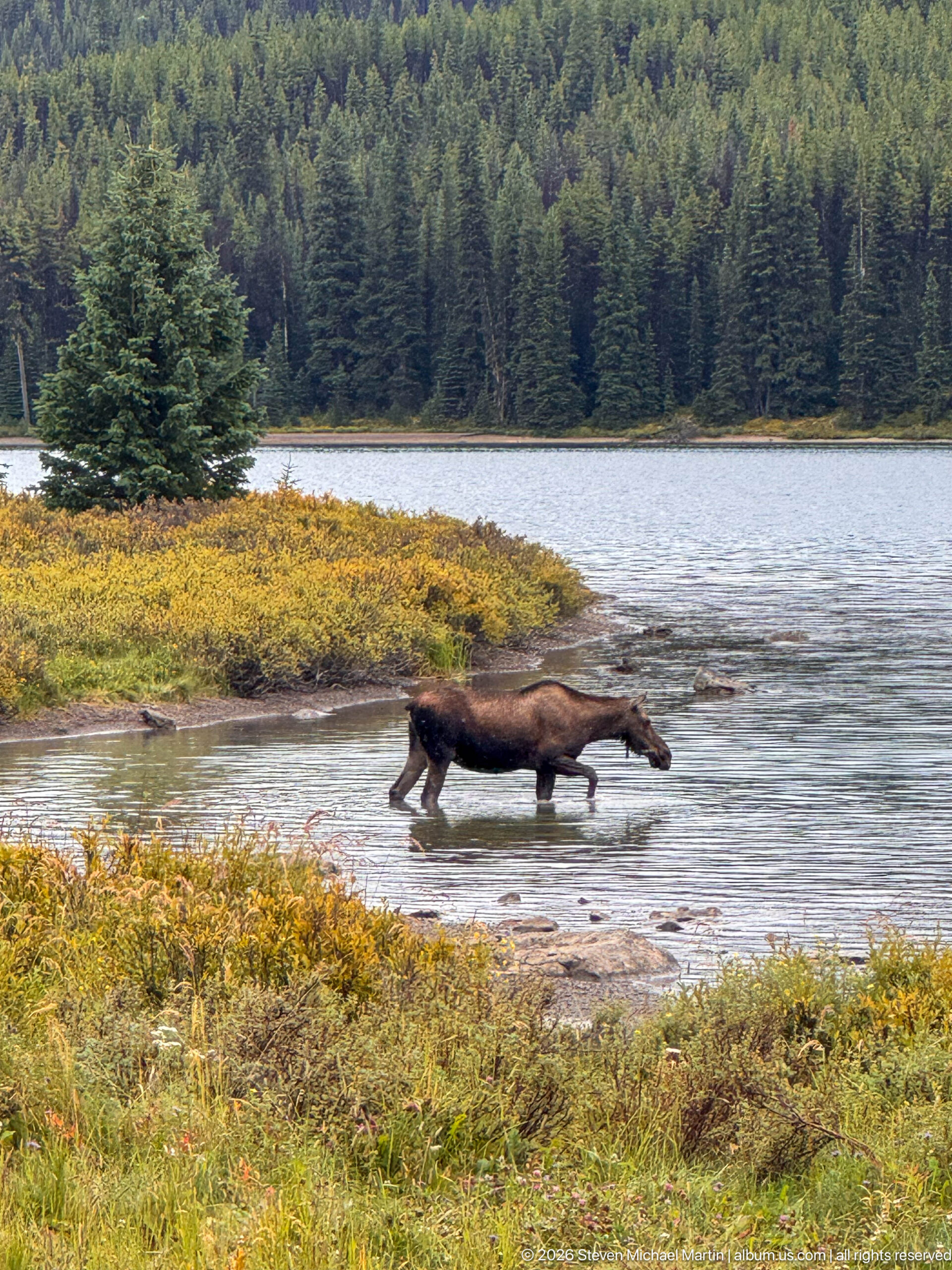
A dark moose strides rapidly through shallow water beside yellow-green shoreline vegetation and dense conifer forest. The surrounding water and shoreline vegetation retain habitat context while the animal remains the dominant subject of the frame.
Caption
A dark moose strides rapidly through shallow water beside yellow-green shoreline vegetation and dense conifer forest. The surrounding water and shoreline vegetation retain habitat context while the animal remains the dominant subject of the frame.
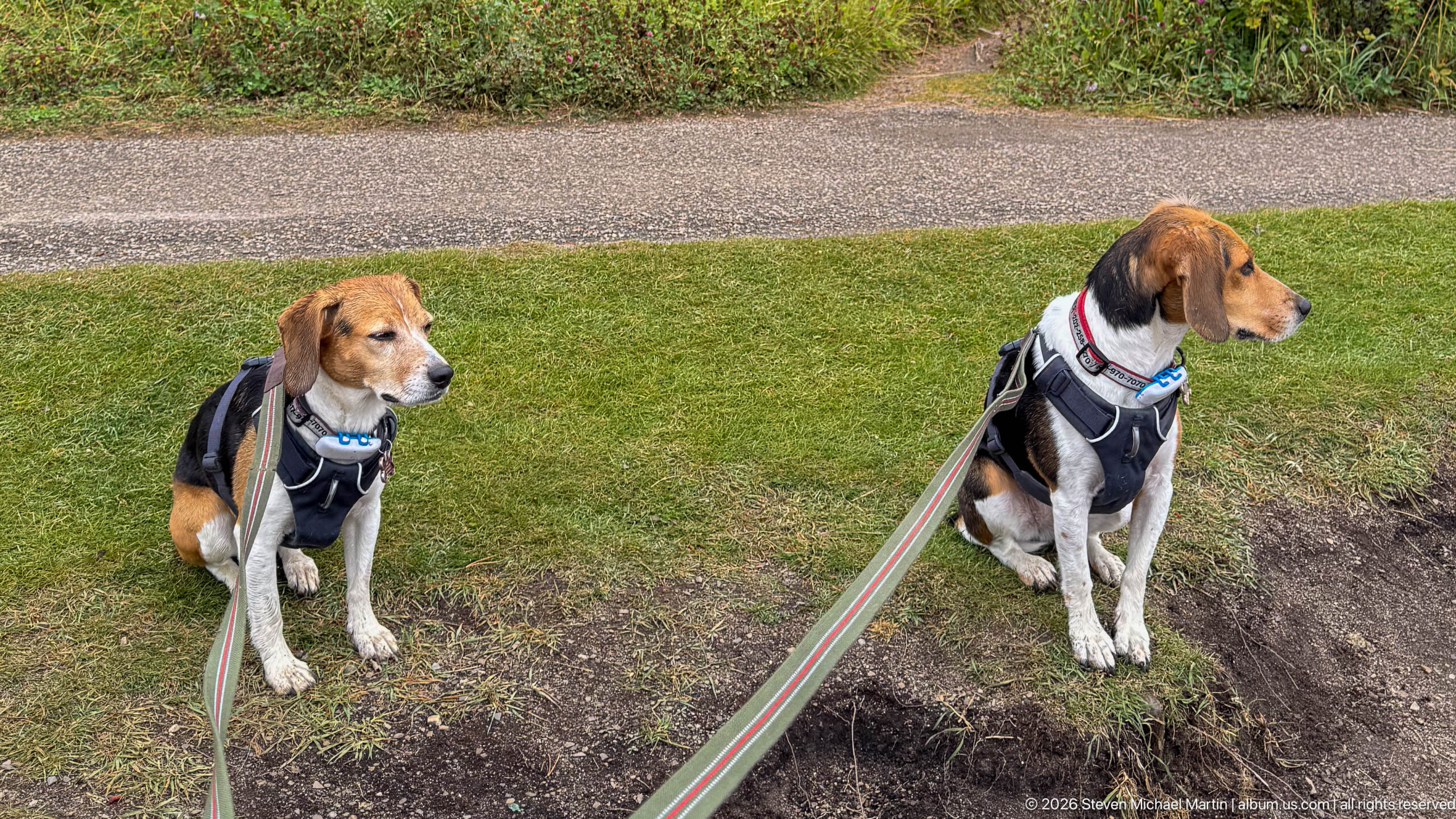
Two harnessed tri-color beagles sit side by side on grass beside a paved path, their leashes extending toward the camera. The paired portrait documents two leashed companion animals in a maintained visitor area.
Caption
Two harnessed tri-color beagles sit side by side on grass beside a paved path, their leashes extending toward the camera. The paired portrait documents two leashed companion animals in a maintained visitor area.
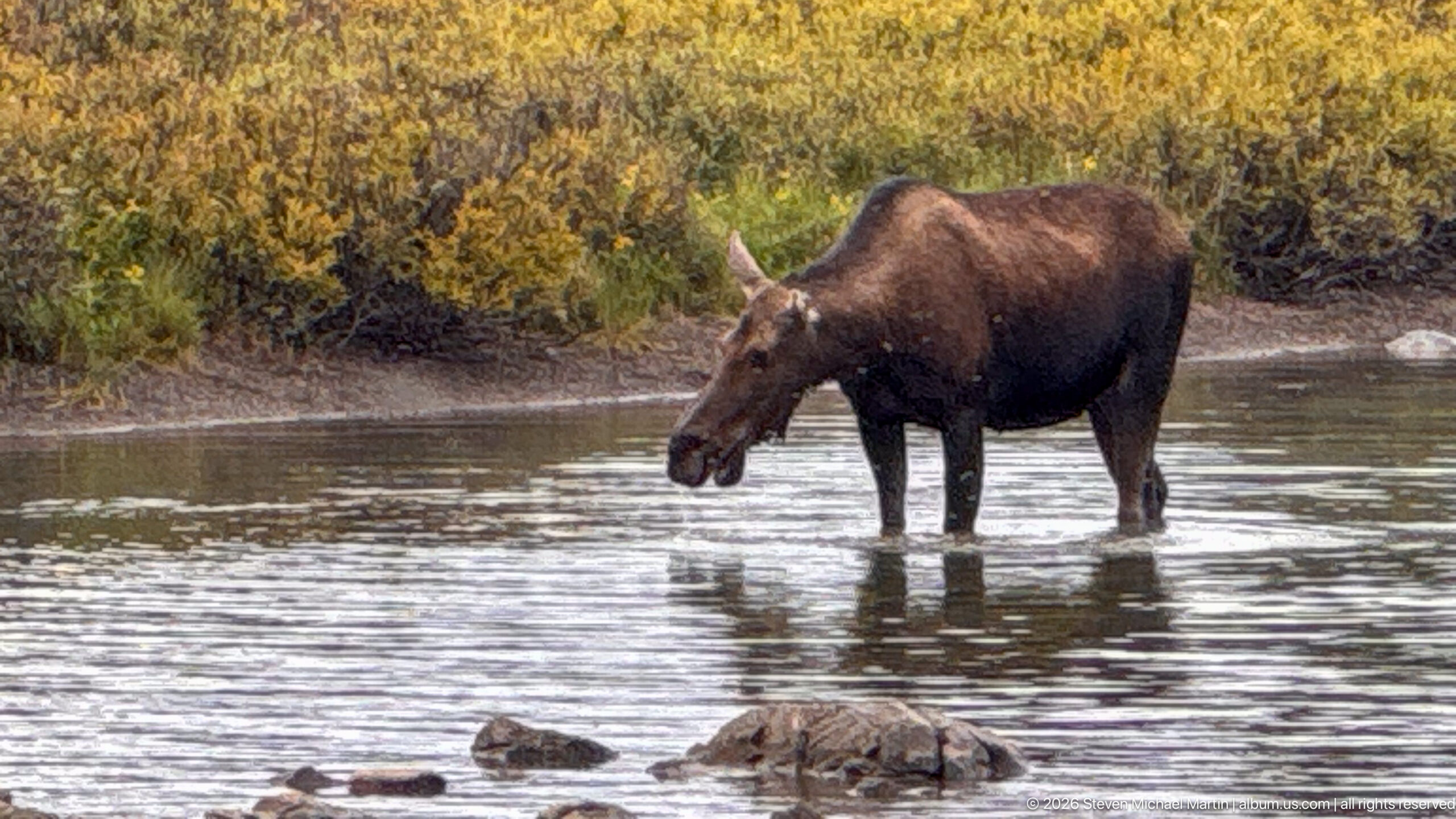
An antlerless adult moose stands knee-deep in calm shallow water near rocks and autumn-colored shrubs. The surrounding water and shoreline vegetation retain habitat context while the animal remains the dominant subject of the frame.
Caption
An antlerless adult moose stands knee-deep in calm shallow water near rocks and autumn-colored shrubs. The surrounding water and shoreline vegetation retain habitat context while the animal remains the dominant subject of the frame.
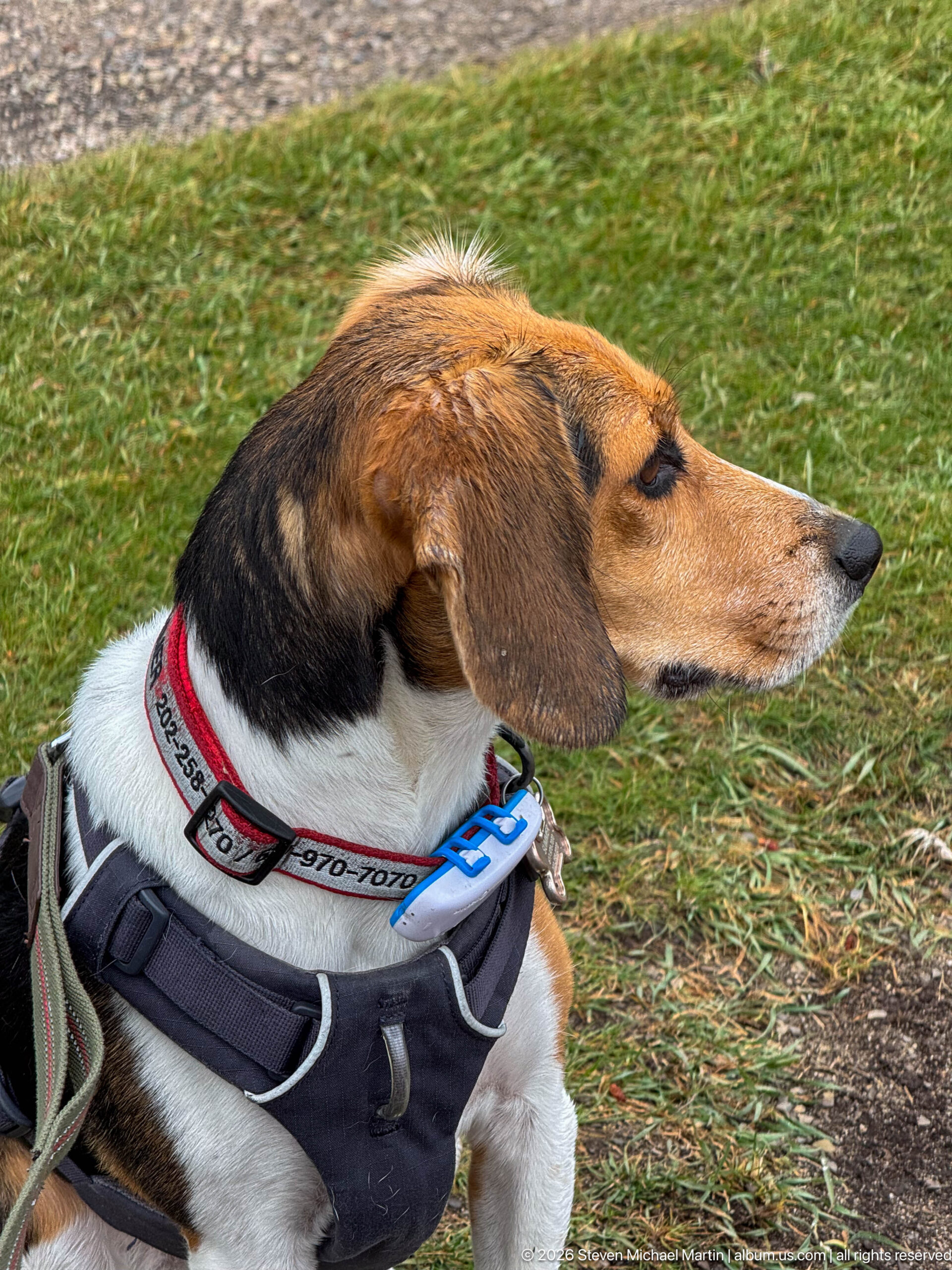
Close side portrait shows a tri-color beagle wearing a dark harness and red-and-white collar while seated on grass. The close view records a companion animal within the developed visitor setting rather than wildlife habitat.
Caption
Close side portrait shows a tri-color beagle wearing a dark harness and red-and-white collar while seated on grass. The close view records a companion animal within the developed visitor setting rather than wildlife habitat.
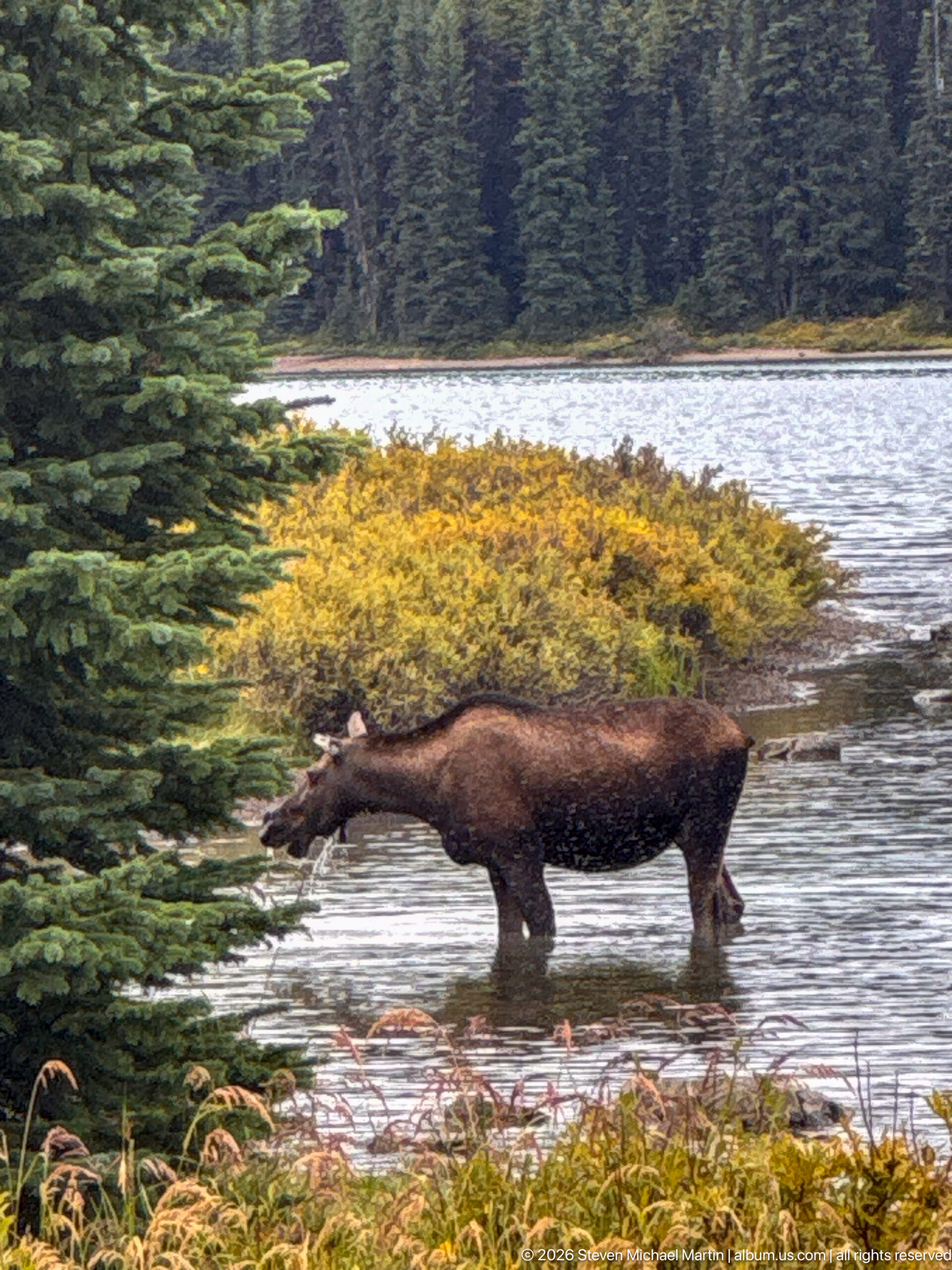
An antlerless moose wades laterally through shallow water beside a conifer and yellow shoreline shrubs. The surrounding water and shoreline vegetation retain habitat context while the animal remains the dominant subject of the frame.
Caption
An antlerless moose wades laterally through shallow water beside a conifer and yellow shoreline shrubs. The surrounding water and shoreline vegetation retain habitat context while the animal remains the dominant subject of the frame.
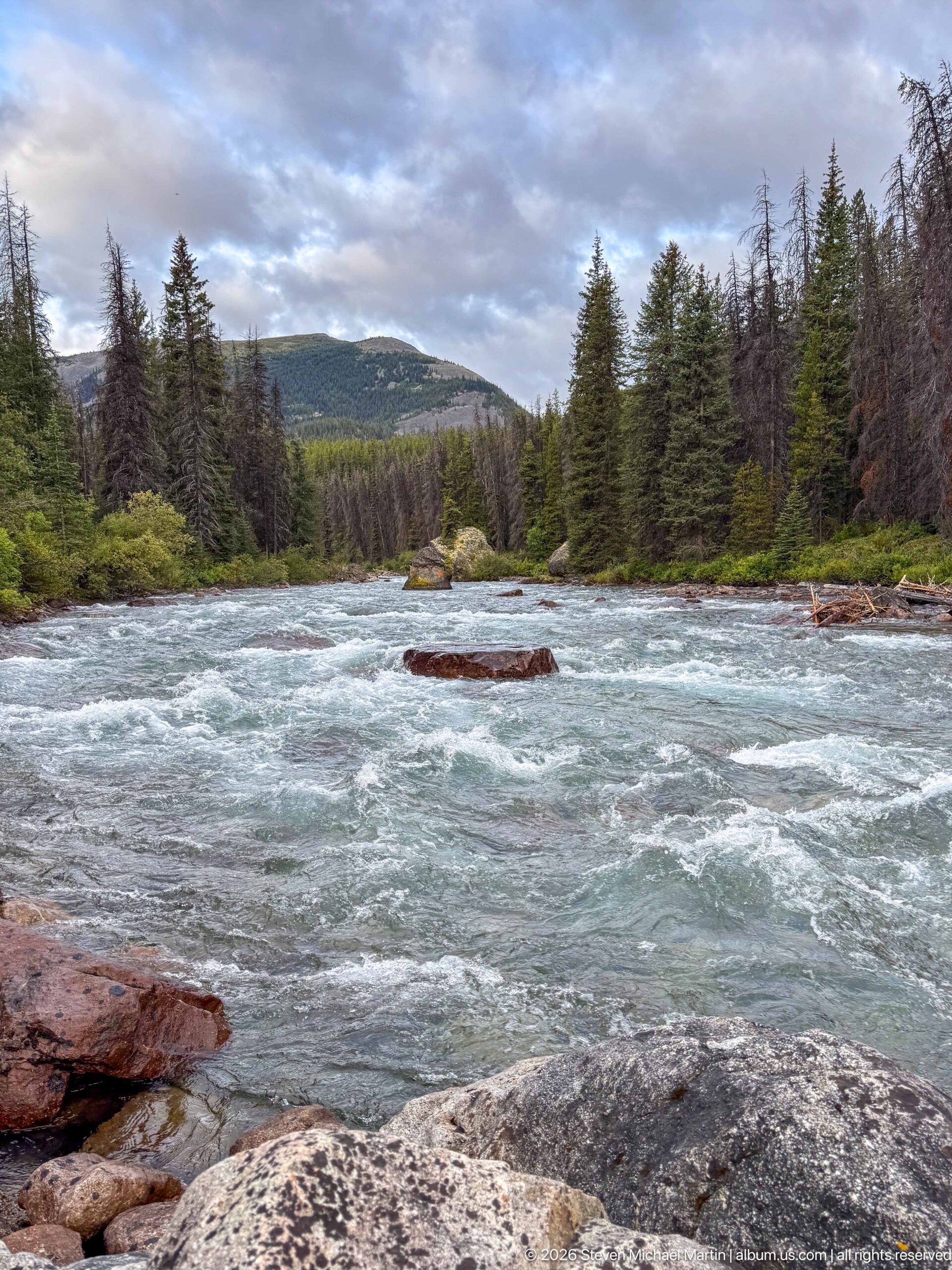
Fast blue-green water surges around exposed rocks and fallen timber as the river crosses a forested section of the Maligne Valley. Conifers line both banks, including scattered dead and damaged trees, while a rounded mountain ridge rises beyond. The low viewpoint emphasizes the force and texture of the current rather than the broader valley landscape.
Caption
Fast blue-green water surges around exposed rocks and fallen timber as the river crosses a forested section of the Maligne Valley. Conifers line both banks, including scattered dead and damaged trees, while a rounded mountain ridge rises beyond. The low viewpoint emphasizes the force and texture of the current rather than the broader valley landscape.
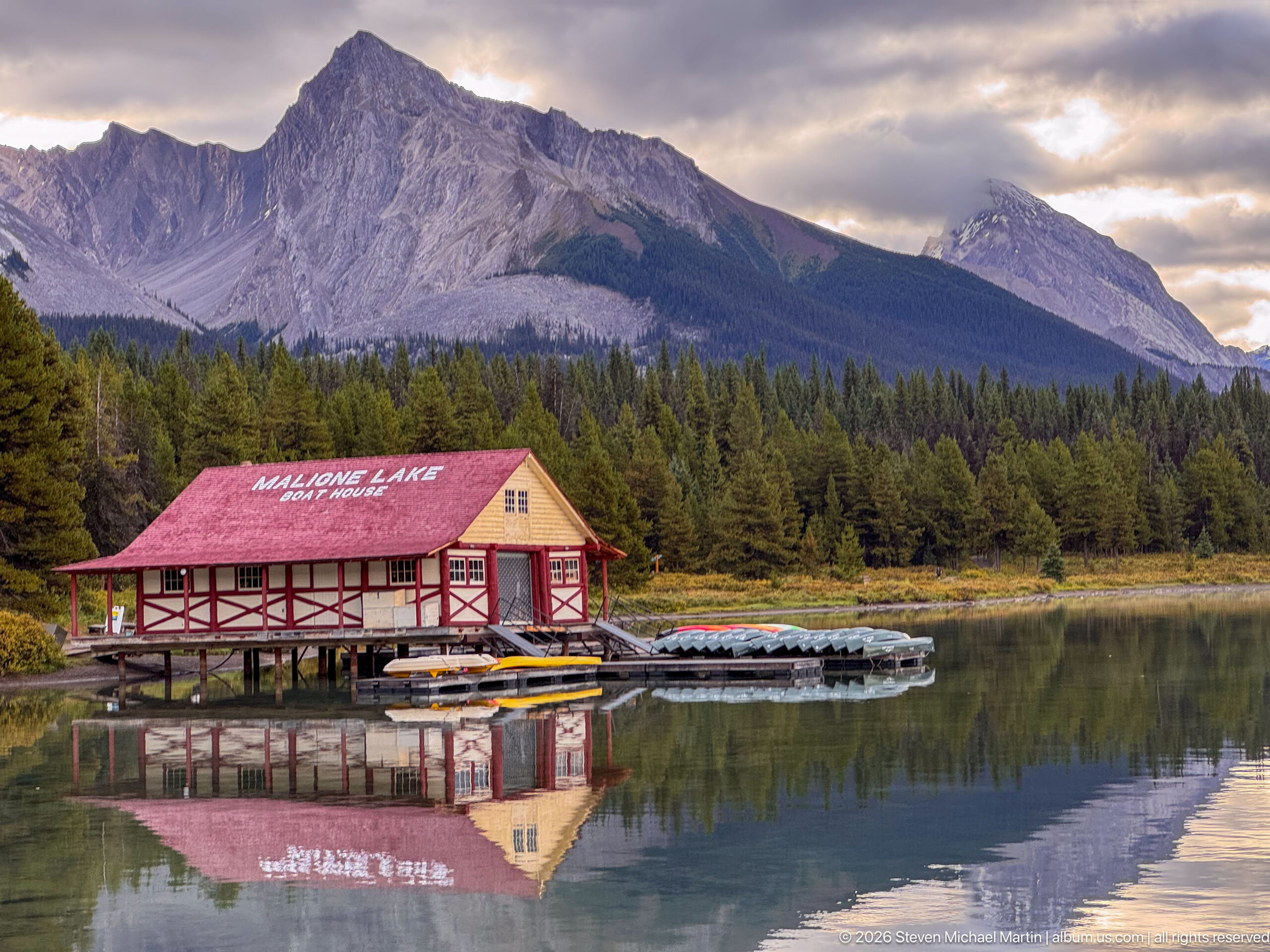
The red-roofed Maligne Lake Boat House and canoe racks reflect in still water beneath a massive gray mountain ridge. The red-and-cream timber structure provides a strong human-made counterpoint to the lake, forest, and Canadian Rockies setting.
Caption
The red-roofed Maligne Lake Boat House and canoe racks reflect in still water beneath a massive gray mountain ridge. The red-and-cream timber structure provides a strong human-made counterpoint to the lake, forest, and Canadian Rockies setting.
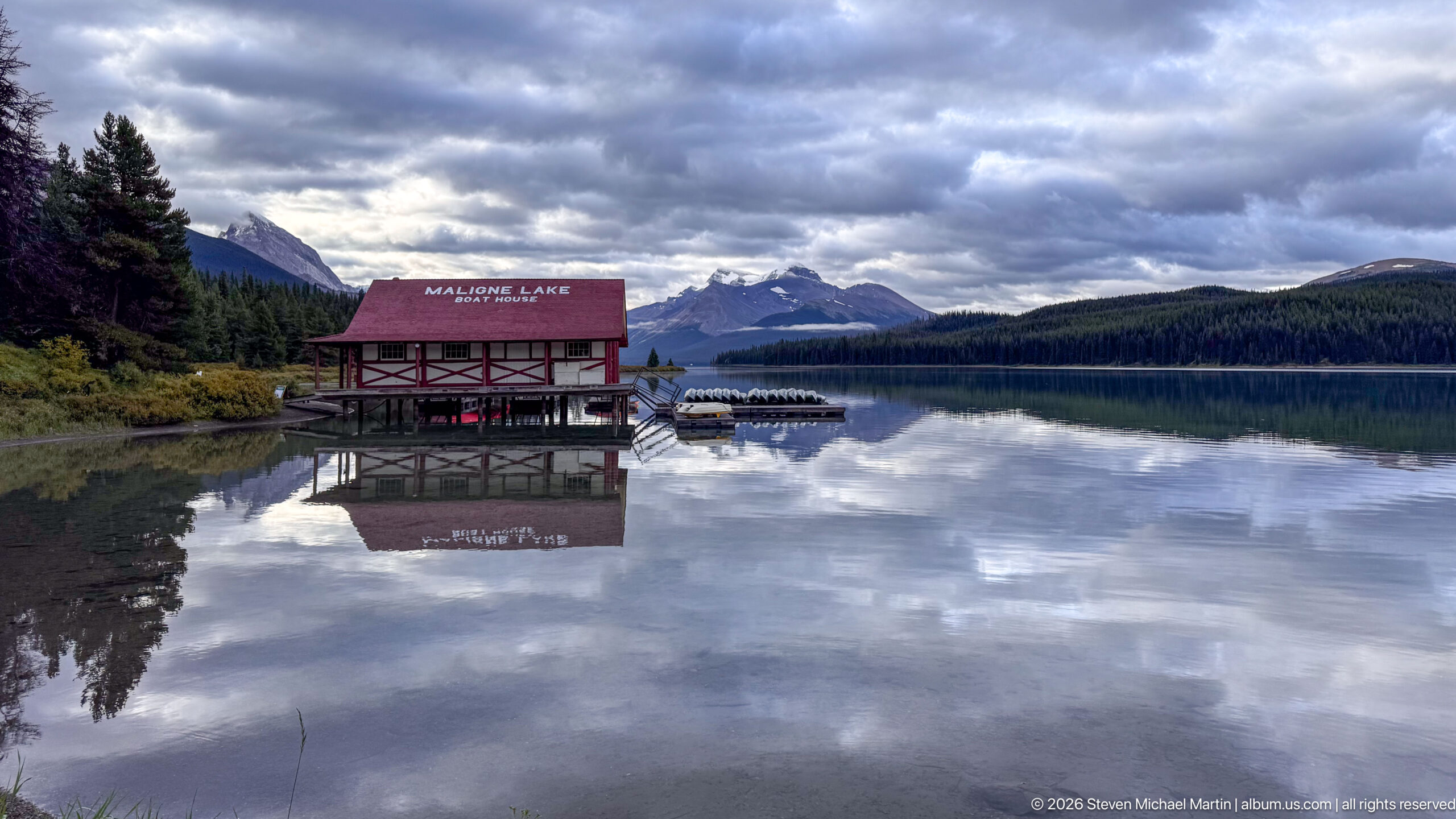
The red-roofed Maligne Lake Boat House stands above exceptionally calm water, its timber structure and roof lettering mirrored almost completely below. Canoes and dock equipment sit beside the building while forested shores and layered mountain ridges recede beneath a dramatic cloud ceiling, combining the historic visitor facility with the broad natural setting of Maligne Lake.
Caption
The red-roofed Maligne Lake Boat House stands above exceptionally calm water, its timber structure and roof lettering mirrored almost completely below. Canoes and dock equipment sit beside the building while forested shores and layered mountain ridges recede beneath a dramatic cloud ceiling, combining the historic visitor facility with the broad natural setting of Maligne Lake.
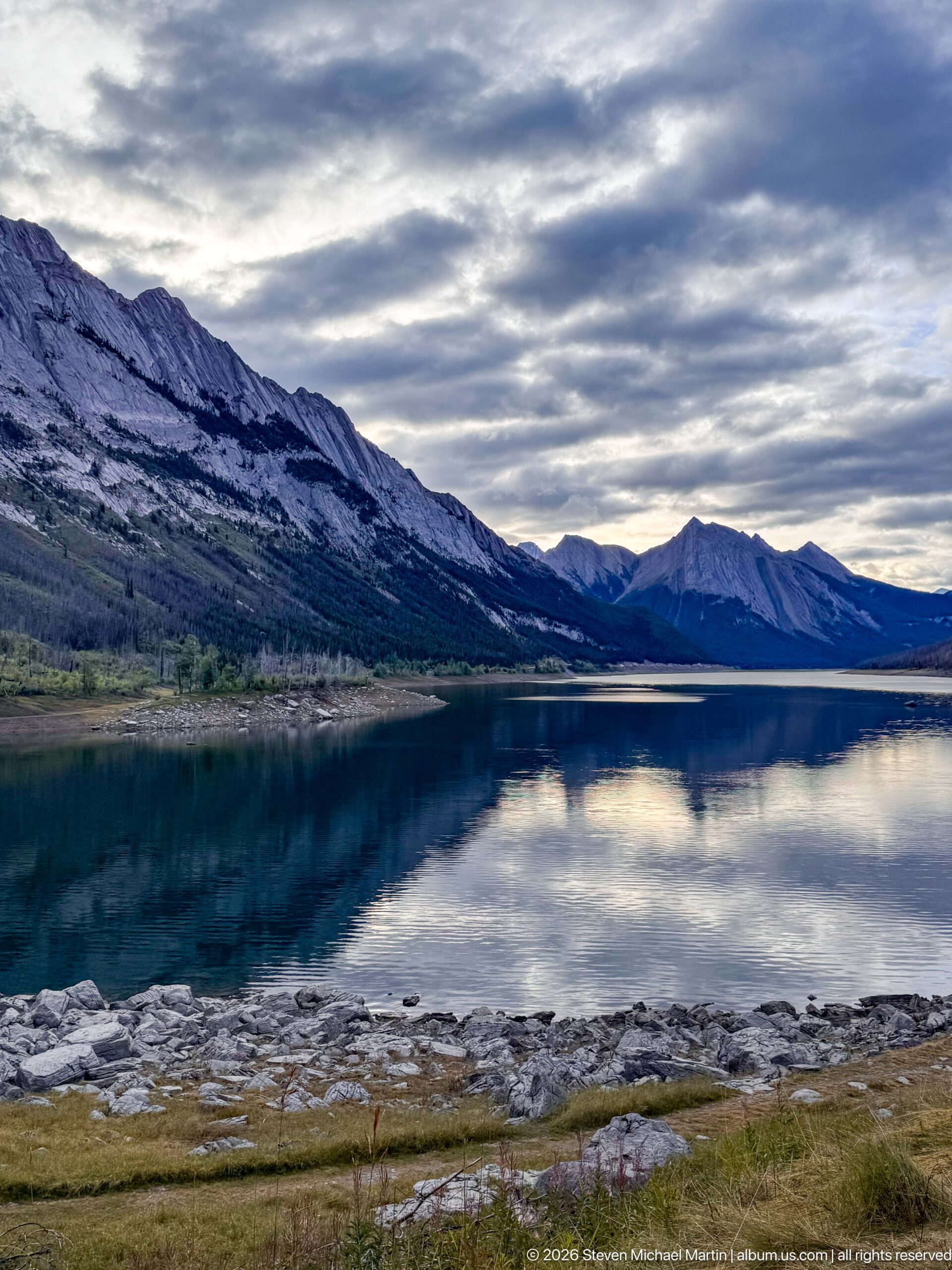
Medicine Lake lies beneath a heavy layered sky, its dark blue-green water bordered by broad pale shoreline exposures and steep mountain walls. The low water level reveals a wide rocky margin around the basin, while subdued reflections carry the cloud pattern across the surface. The composition makes the lake's changing shoreline one of the dominant visible features.
Caption
Medicine Lake lies beneath a heavy layered sky, its dark blue-green water bordered by broad pale shoreline exposures and steep mountain walls. The low water level reveals a wide rocky margin around the basin, while subdued reflections carry the cloud pattern across the surface. The composition makes the lake's changing shoreline one of the dominant visible features.
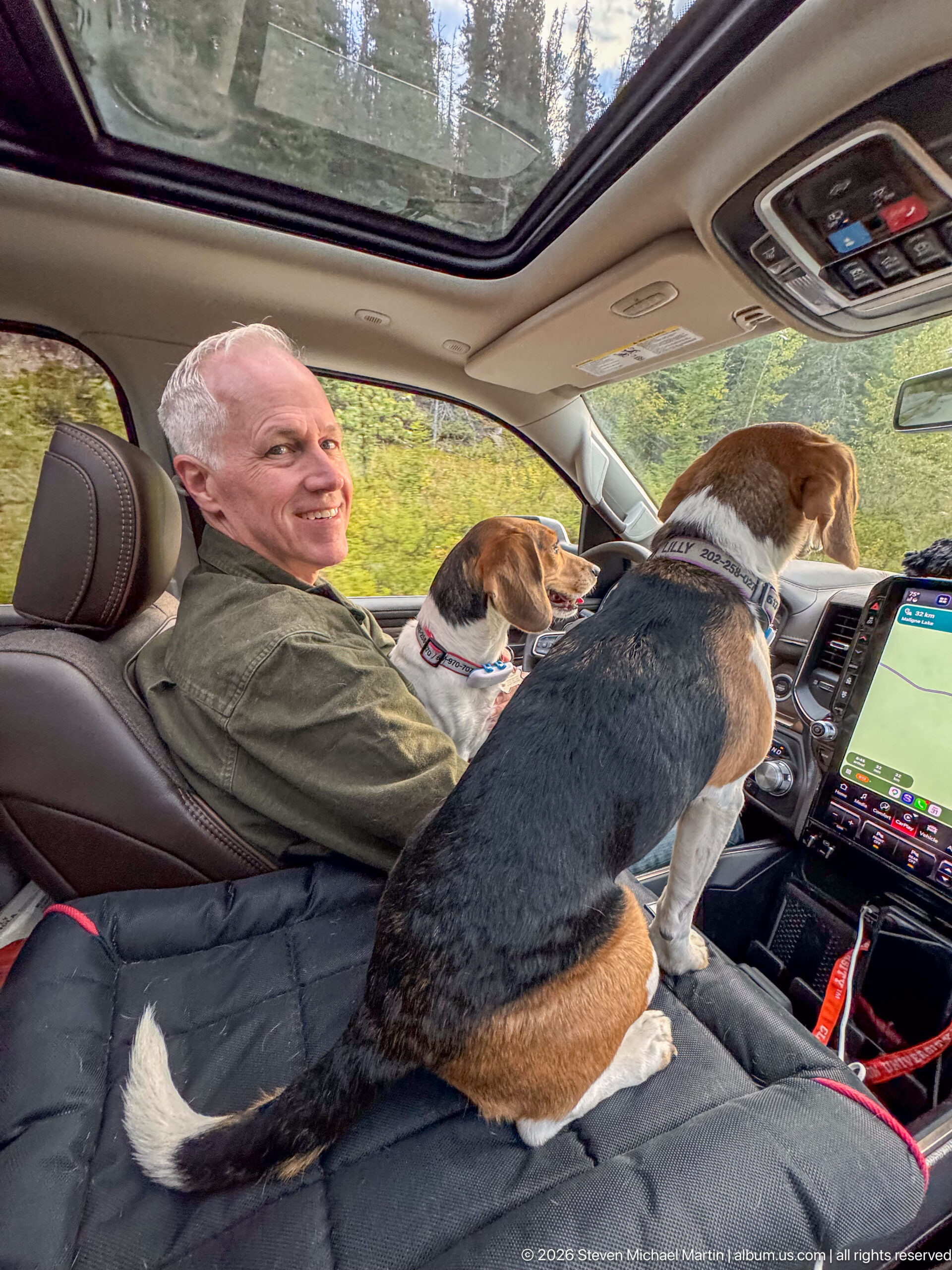
Two beagles crowd the front of a parked vehicle beside the driver, one standing prominently on the center area while the second looks forward from near the steering wheel. Harnesses and collars identify them as traveling companion animals, and the navigation display and surrounding cabin place the scene firmly within the road-trip experience through the Maligne Valley.
Caption
Two beagles crowd the front of a parked vehicle beside the driver, one standing prominently on the center area while the second looks forward from near the steering wheel. Harnesses and collars identify them as traveling companion animals, and the navigation display and surrounding cabin place the scene firmly within the road-trip experience through the Maligne Valley.
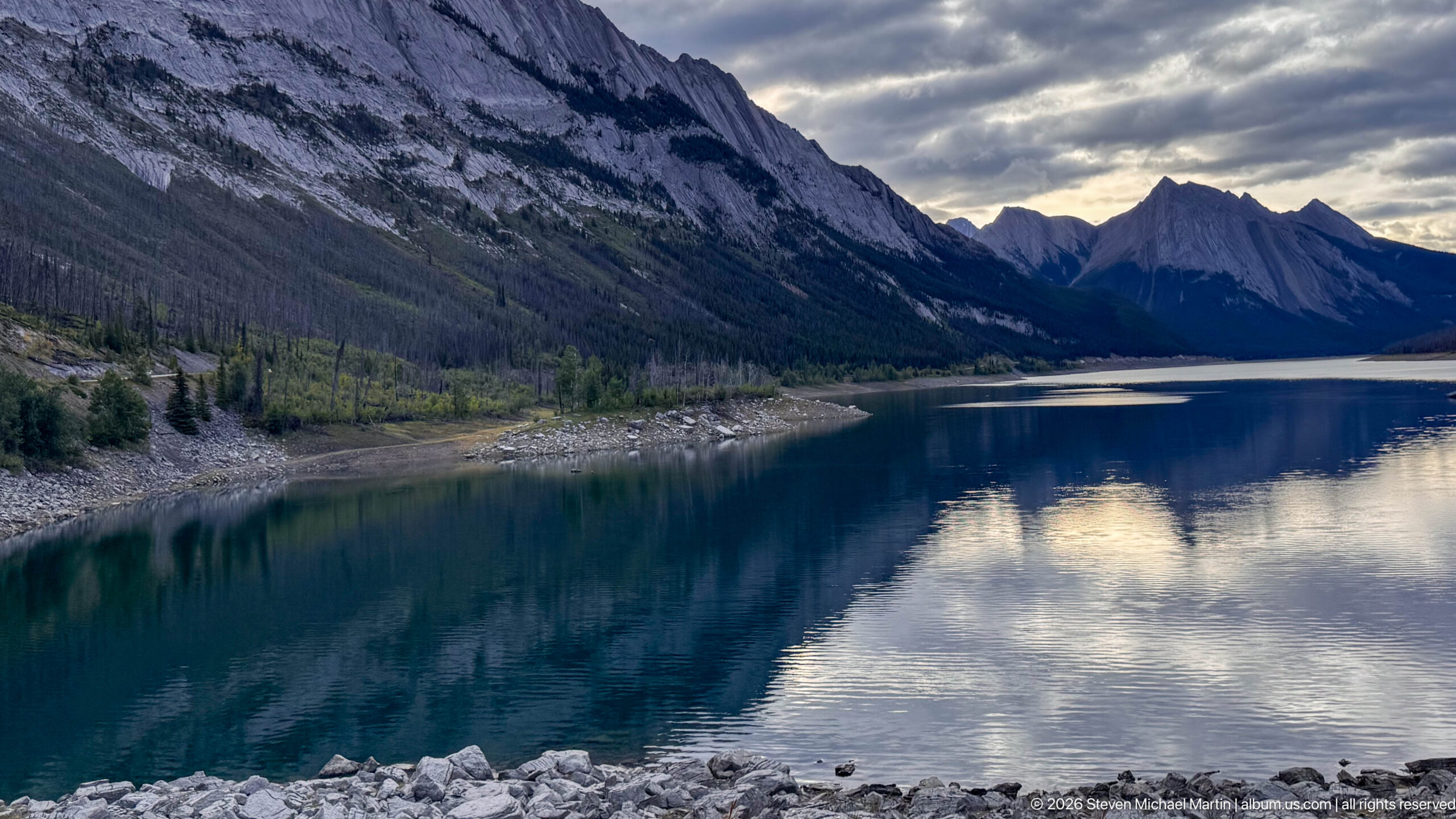
Medicine Lake narrows beneath steep gray mountain walls as dark, still water reflects a break in the cloud cover. Broad gravelly shoreline exposures trace the basin edge, and fire-affected forest climbs the lower slopes below sharply layered rock. The elevated viewpoint emphasizes the long relationship between water, exposed shore, forest, and enclosing relief.
Caption
Medicine Lake narrows beneath steep gray mountain walls as dark, still water reflects a break in the cloud cover. Broad gravelly shoreline exposures trace the basin edge, and fire-affected forest climbs the lower slopes below sharply layered rock. The elevated viewpoint emphasizes the long relationship between water, exposed shore, forest, and enclosing relief.
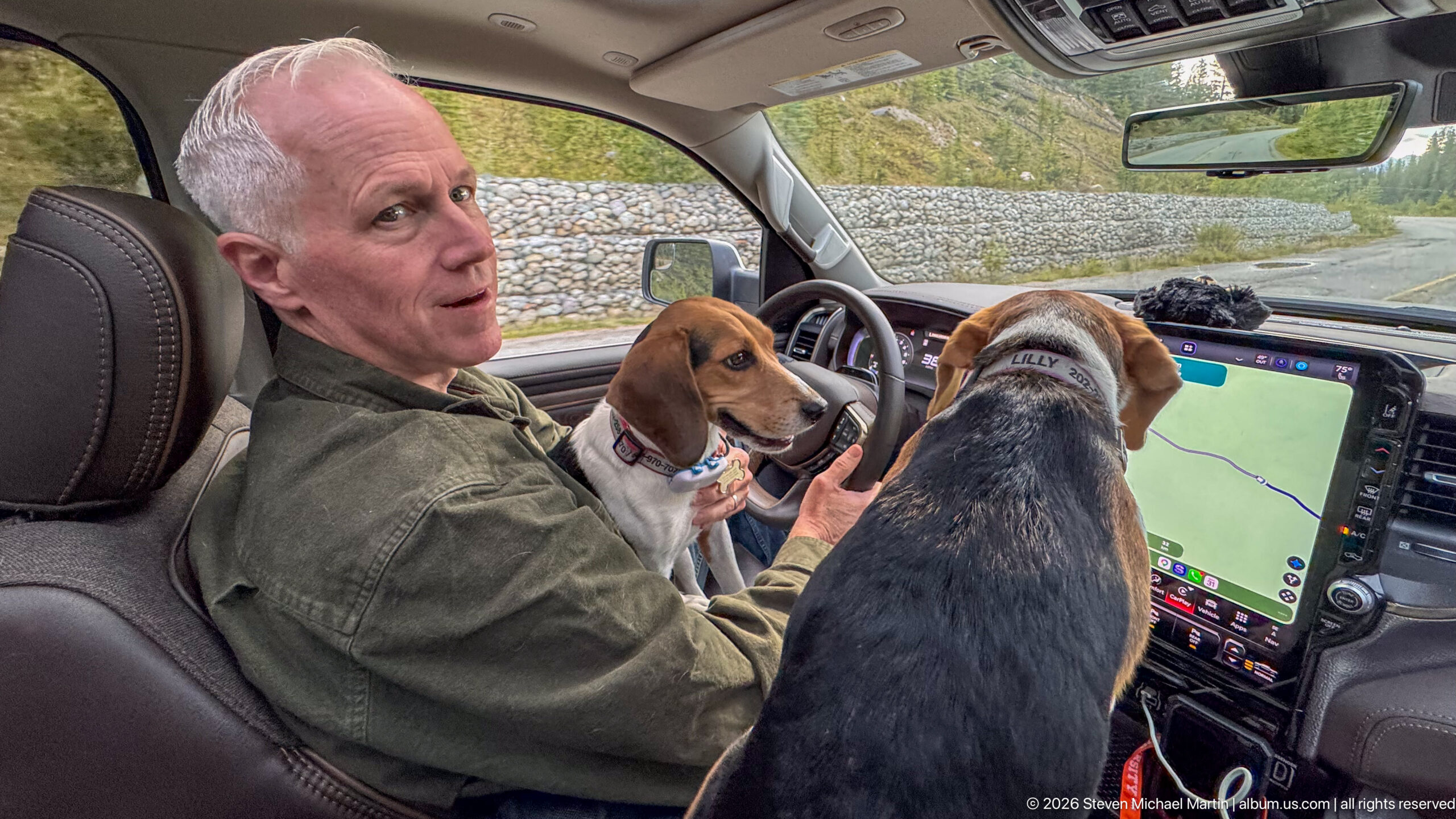
A driver sits behind the wheel with two beagles gathered around the front console, one facing the camera and the other looking toward the large navigation display. The dogs' close proximity to the route map turns the vehicle interior into a compact road-trip portrait, closing the Maligne Valley sequence with the practical reality of traveling through the park with companion animals.
Caption
A driver sits behind the wheel with two beagles gathered around the front console, one facing the camera and the other looking toward the large navigation display. The dogs' close proximity to the route map turns the vehicle interior into a compact road-trip portrait, closing the Maligne Valley sequence with the practical reality of traveling through the park with companion animals.
Wildlife & Safari Field Guide
📍 Overview
The Maligne Valley extends southeast from Jasper through a linked landscape of river, forest, mountain slopes, Medicine Lake, and Maligne Lake. Wildlife is inseparable from this geography: forests, wetlands, lake margins, river corridors, and roadside openings create a succession of habitats used by large mammals and birds. The valley also lies within Jasper National Park and the larger Canadian Rocky Mountain Parks World Heritage property. Its ecological story is therefore broader than individual wildlife encounters, joining habitat, water, elevation, disturbance, and human travel through one of the Canadian Rockies’ most distinctive natural corridors.
🌿 Habitat
Habitat changes repeatedly along the Maligne Valley corridor. Lodgepole pine and spruce forests around the north end of Maligne Lake provide cover and forage for moose and other wildlife, while shrub-rich forest edges create productive browsing areas. Lake margins and shallow water add another habitat type, and the Maligne River connects aquatic and riparian environments through the valley. The Maligne Lake outlet and middle Maligne River are particularly important to harlequin ducks as pre-nesting habitat and as a brood-movement corridor between Maligne and Medicine lakes. Medicine Lake adds an unusual hydrologic dimension: seasonal inflow and underground drainage can produce dramatic changes in water level and exposed shoreline, continually reshaping the boundary between aquatic and terrestrial habitat.
🦌 Wildlife Encounters
Photographs in this portfolio document wildlife encounters with Two moose feeding together, Moose browsing shrubs, Moose approaching through vegetation, Moose feeding at forest edge, Moose partly screened by conifers, and Mule deer standing at forest edge in the Jasper landscape. The photographs place these animals in settings that include Adult and smaller moose browsing in forest vegetation, Moose (Alces alces), Moose (Alces alces), frontal view, and Moose (Alces alces) browsing behind young spruce. These encounters provide direct, visit-specific evidence of how wildlife uses the habitats interpreted in this field guide.
🦌 Key Species
The Maligne Valley supports a varied community of large mammals and birds. Moose are closely associated with the lodgepole pine and spruce forests around the north end of Maligne Lake and with wet or shrub-rich habitats. Black bears, grizzly bears, bighorn sheep, and elk also occur within the broader valley, including along the road corridor where forest and open roadside habitat meet. Harlequin ducks depend on the Maligne Lake outlet and middle Maligne River during sensitive stages of their breeding cycle, while black swifts are among the other sensitive species identified with the valley. Woodland caribou were historically part of the Maligne ecosystem, but the herd declined severely; Parks Canada reports that its remaining three animals were last observed in 2017.
🐾 Behavior & Adaptation
Wildlife behavior in the Maligne Valley is closely tied to habitat and movement through a long, narrow mountain corridor. Large mammals use forest edges, shrub communities, wet ground, lake margins, and openings along Maligne Lake Road, while aquatic birds depend on particular stretches of river and lake habitat. Roadside encounters can reveal how wildlife moves through a landscape also occupied by vehicles and visitors, but an animal’s presence beside a road does not by itself establish habituation, feeding, migration, or aggression. Harlequin ducks provide a clearer example of a documented ecological relationship: the Maligne Lake outlet and middle Maligne River function as pre-nesting habitat and a brood-movement corridor. Interpreting behavior is therefore strongest when it remains tied to observable action and well-established habitat relationships.
🌱 Conservation
Conservation in the Maligne Valley depends on protecting connected habitat as well as individual species. Maligne Lake Road passes directly through wildlife habitat, creating places where animals and vehicles can unexpectedly share the same corridor; Parks Canada guidance emphasizes giving wildlife space and observing from a distance. Aquatic conservation is equally important. Watercraft restrictions on the Maligne River between Maligne Lake and Medicine Lake are used to reduce disturbance to harlequin ducks during sensitive periods. The valley’s woodland caribou history illustrates a longer-term conservation challenge: the Maligne herd declined severely, and its last three animals were reported seen in 2017. Together, these examples show how visitor behavior, habitat connectivity, species sensitivity, and long-term ecological change intersect in the valley.
🍂 Seasonal Patterns
Seasonal change reshapes the Maligne Valley’s habitats and the conditions under which wildlife is seen. Snowmelt and glacier-fed runoff increase water moving through the system, while later reductions in inflow allow Medicine Lake to drain through sinkholes faster than it is replenished, exposing broad areas of shoreline. Vegetation, temperature, daylight, and weather also change through the season, altering forage, cover, and the appearance of forest and wetland habitats. Cloud, reflection, water level, and changing light can transform the same landscape from one visit to the next. These seasonal shifts are part of the valley’s ecology, but they should not be used by themselves to infer a particular animal’s motivation or movement.
◆ Safari Experience
Wildlife watching in the Maligne Valley is best approached as a journey through connected habitats rather than a search for a single viewing site. Maligne Lake Road follows the valley from the Jasper area toward Medicine Lake and Maligne Lake, passing forest, river, open slopes, wetlands, shoreline, and roadside clearings along the way. Wildlife may appear unexpectedly anywhere along this corridor, so slow observation and attention to habitat are more useful than concentrating only on famous destinations. A partially concealed animal at a forest edge can be as informative as an unobstructed roadside view because it reveals how wildlife occupies the landscape. Visitors should maintain distance, avoid crowding animals, and allow wildlife to move freely across roads and other developed areas.
📷 Photography Notes
Photography can explain the Maligne Valley most effectively by combining establishing landscapes with tighter studies of wildlife, vegetation, water, geology, and human infrastructure. Broad views of Medicine Lake, the Maligne River, and Maligne Lake establish the scale and physical structure of the valley; closer wildlife frames can then retain enough surrounding habitat to show where an animal was encountered. Road pavement, guardrails, vehicles, signs, and visitor facilities can be valuable rather than distracting when they clarify the relationship between wildlife and the traveled corridor. Changing cloud, reflection, exposed shoreline, forest condition, and light distinguish otherwise similar landscape views. Specific peak names, animal behavior, or geological processes should be added only when the photograph or reliable supporting evidence justifies that level of identification.