Amman – Jordan
Amman, the capital of Jordan, lies among a series of hills in the northwestern part of the country. The city has been inhabited for thousands of years and was known in ancient times as Philadelphia, one of the cities of the Roman Decapolis.
The historic center of Amman contains several remarkable archaeological sites, including the Roman Theater, carved into the hillside during the 2nd century AD, and the Citadel Hill, where the remains of Roman, Byzantine, and early Islamic structures overlook the modern city.
Today Amman blends ancient ruins with a rapidly growing modern city, serving as the cultural and political heart of Jordan.
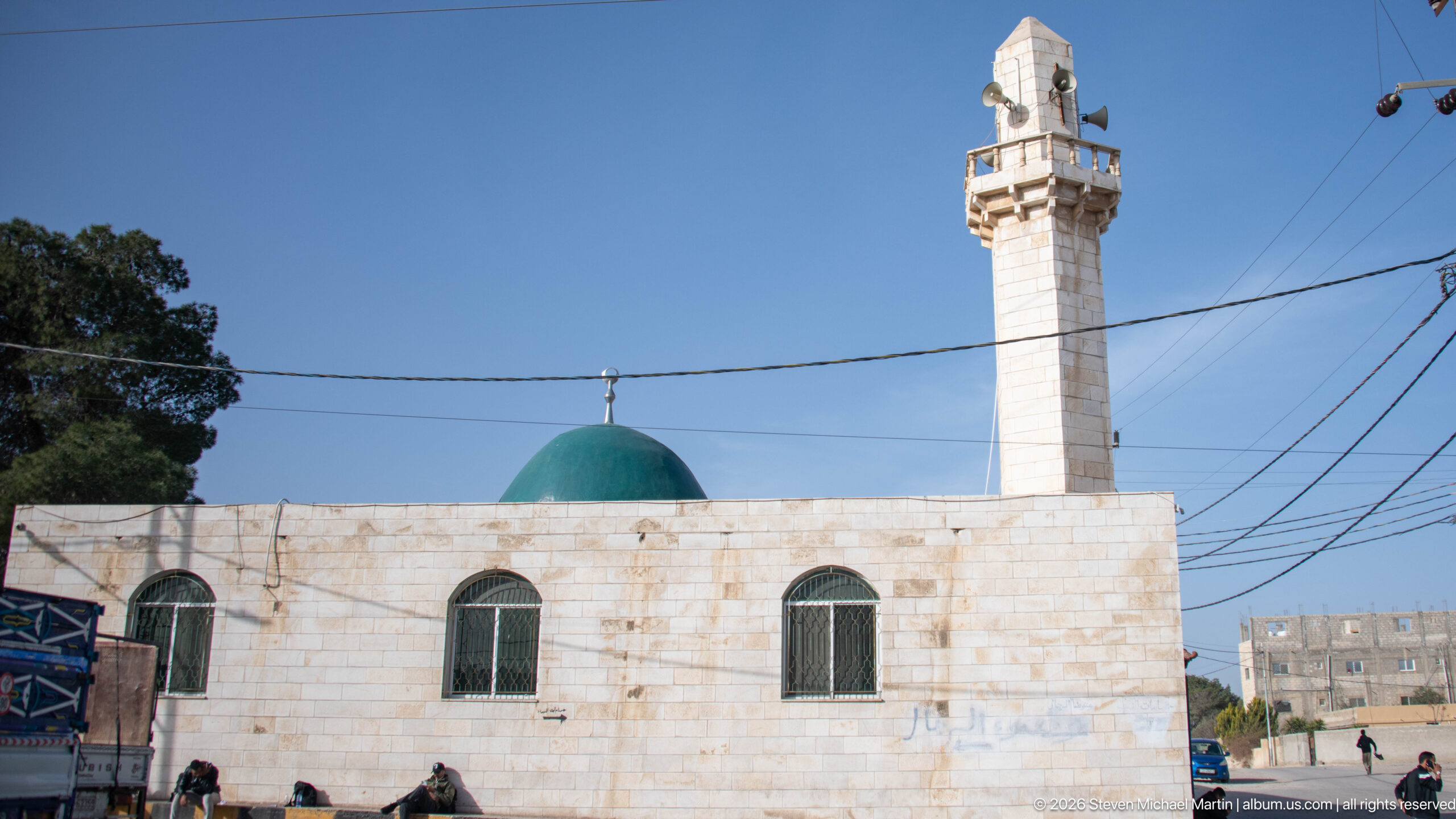
A modest neighborhood mosque combines a low pale-stone prayer hall with a green dome and a tall white minaret. Arched windows line the façade, while utility wires and nearby street activity emphasize the mosque’s place within an ordinary urban district rather than a monumental religious complex.
Caption
A modest neighborhood mosque combines a low pale-stone prayer hall with a green dome and a tall white minaret. Arched windows line the façade, while utility wires and nearby street activity emphasize the mosque’s place within an ordinary urban district rather than a monumental religious complex.
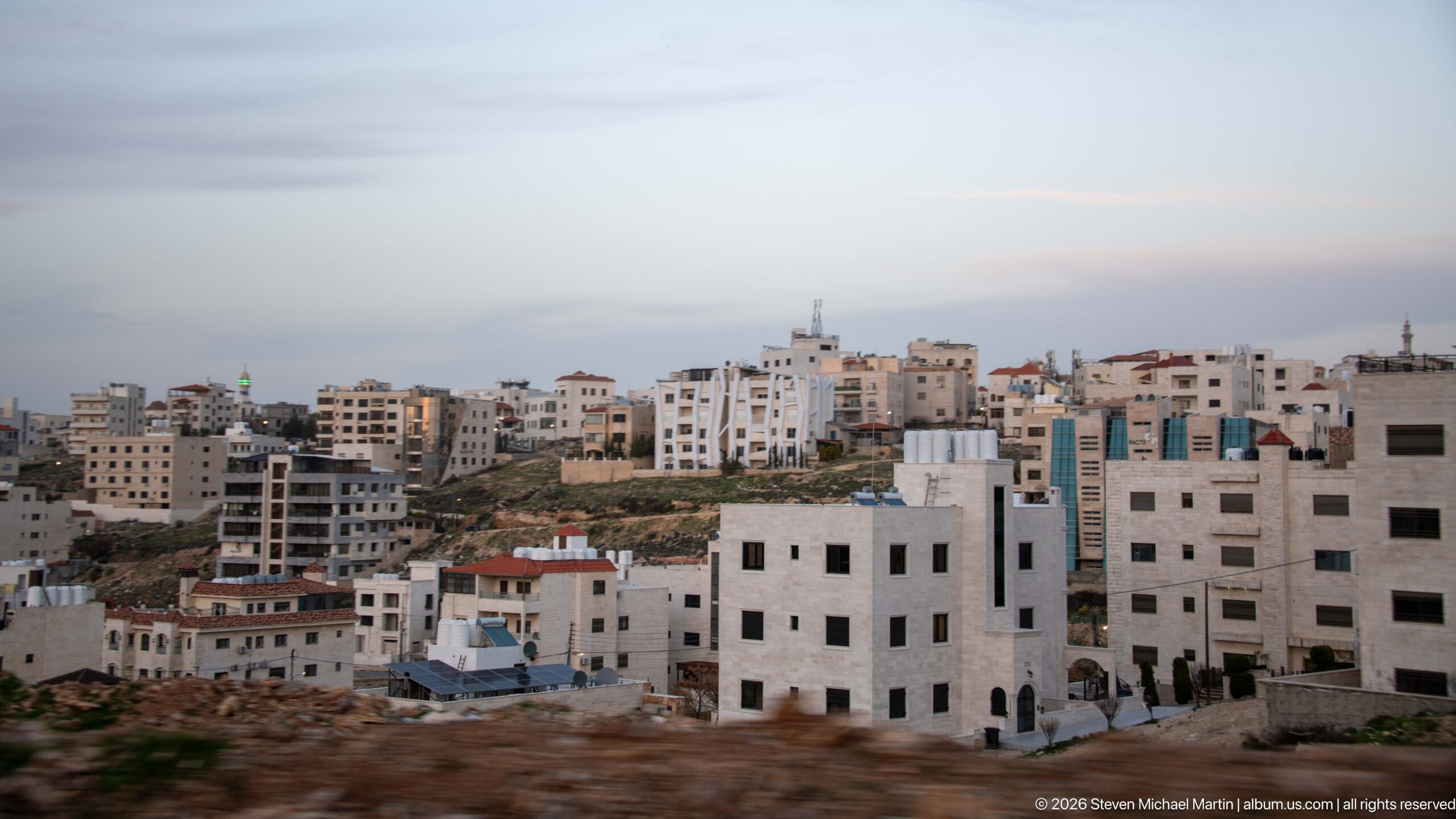
White and pale-stone apartment blocks spread across a low hillside in Amman, with unfinished masonry, flat roofs, and scattered trees revealing the city’s layered residential fabric. The view emphasizes the dense but irregular pattern of construction characteristic of neighborhoods built across the capital’s undulating terrain, while the open foreground and exposed rock show how development meets the dry Jordanian landscape.
Caption
White and pale-stone apartment blocks spread across a low hillside in Amman, with unfinished masonry, flat roofs, and scattered trees revealing the city’s layered residential fabric. The view emphasizes the dense but irregular pattern of construction characteristic of neighborhoods built across the capital’s undulating terrain, while the open foreground and exposed rock show how development meets the dry Jordanian landscape.
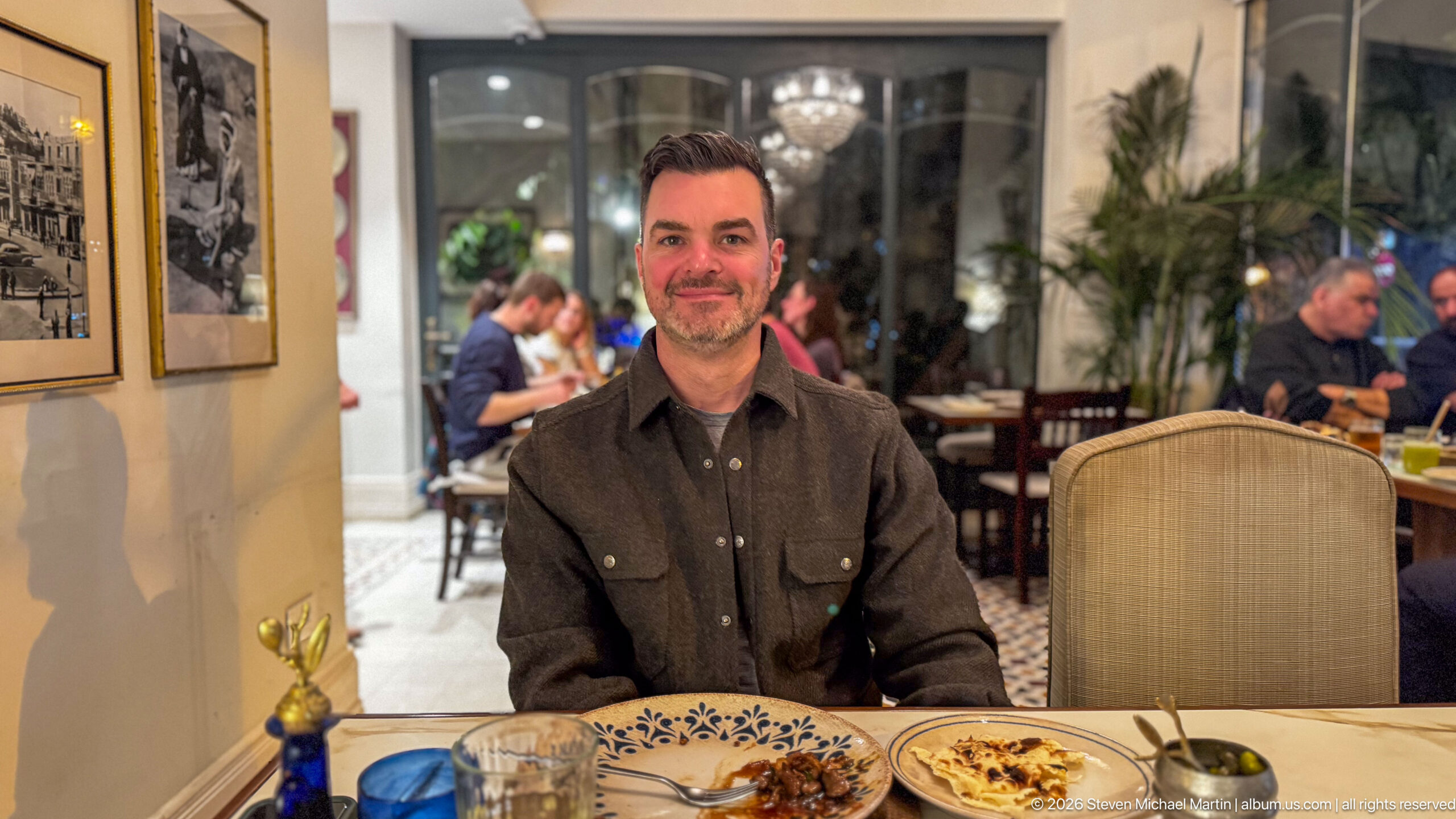
A diner sits at a restaurant table in Amman with patterned plates and shared dishes arranged in the foreground. Other guests and indoor greenery soften into the background, making the portrait both personal and contextual while retaining the setting of a relaxed evening meal.
Caption
A diner sits at a restaurant table in Amman with patterned plates and shared dishes arranged in the foreground. Other guests and indoor greenery soften into the background, making the portrait both personal and contextual while retaining the setting of a relaxed evening meal.
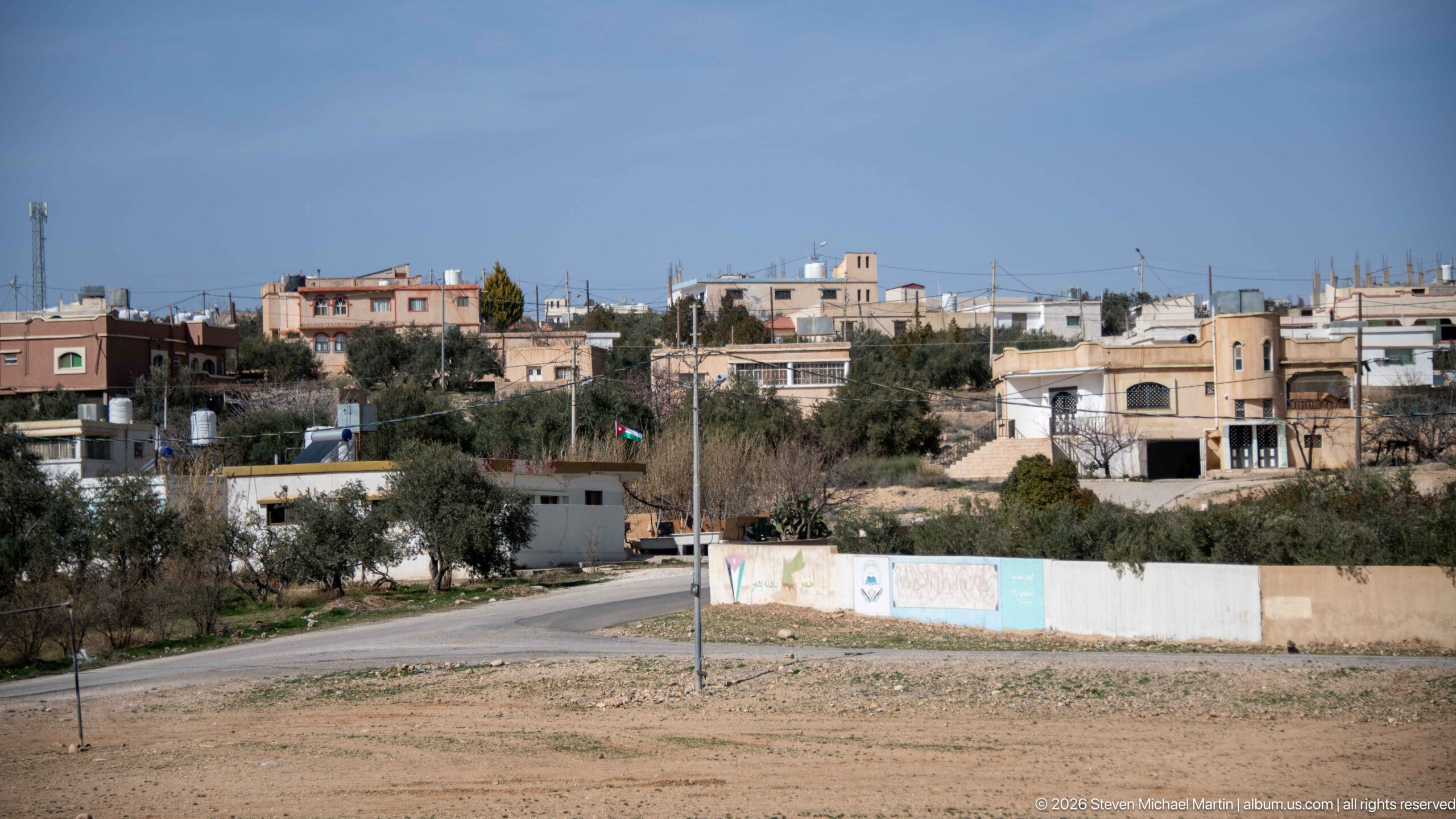
Detached and semi-detached homes spread across gently rising ground on the outskirts of Amman, separated by open plots, olive trees, and unfinished roadside edges. The low-density settlement pattern differs from the tightly packed apartment districts closer to the city center, illustrating the capital’s gradual transition into agricultural and peri-urban landscapes.
Caption
Detached and semi-detached homes spread across gently rising ground on the outskirts of Amman, separated by open plots, olive trees, and unfinished roadside edges. The low-density settlement pattern differs from the tightly packed apartment districts closer to the city center, illustrating the capital’s gradual transition into agricultural and peri-urban landscapes.
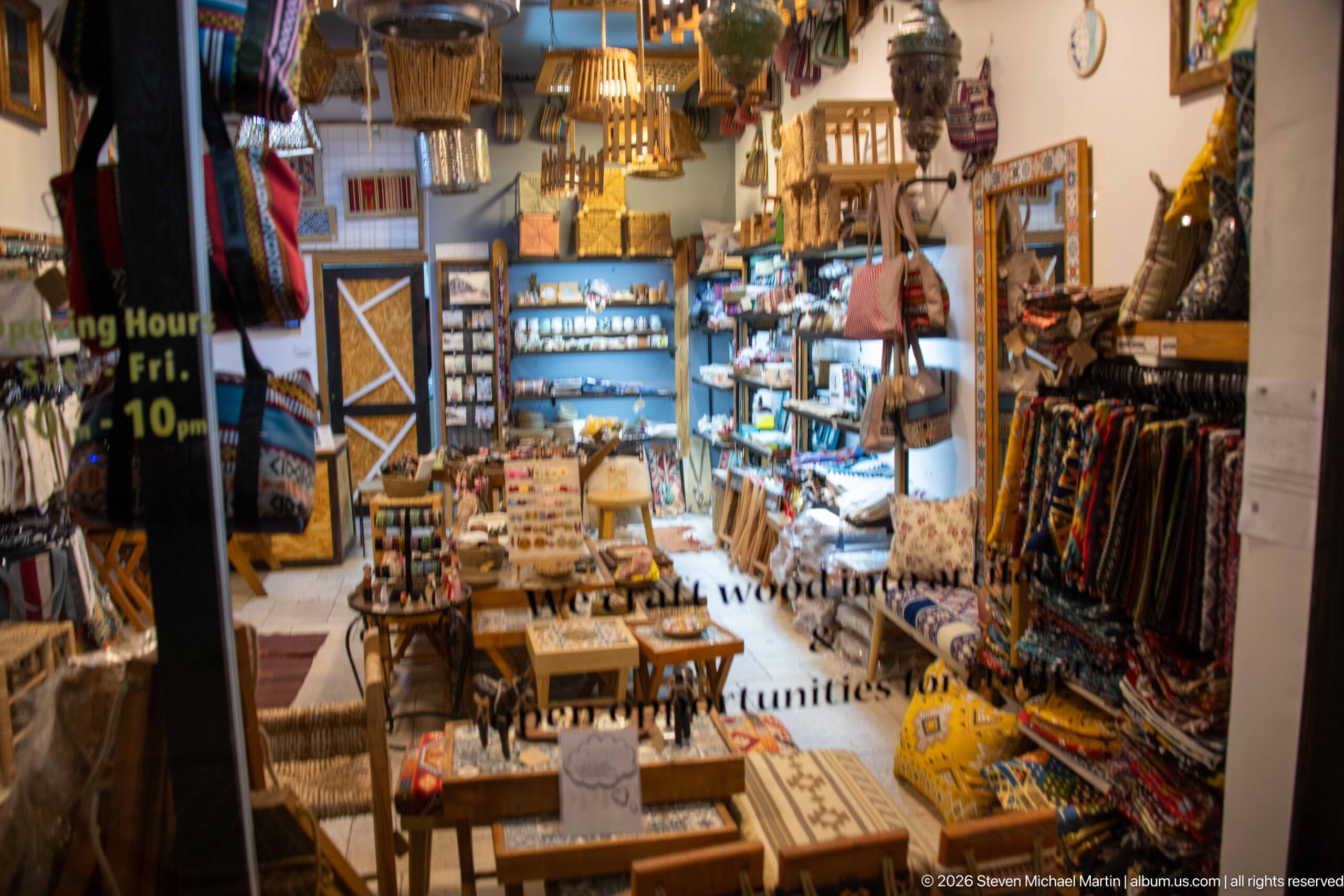
Wooden crafts, textiles, jewelry, and small souvenirs fill a compact shop in Amman, with display tables and wall racks arranged around a narrow central path. The mix of handmade-looking goods and dense presentation gives the interior the feel of a neighborhood craft and gift shop rather than a large commercial store.
Caption
Wooden crafts, textiles, jewelry, and small souvenirs fill a compact shop in Amman, with display tables and wall racks arranged around a narrow central path. The mix of handmade-looking goods and dense presentation gives the interior the feel of a neighborhood craft and gift shop rather than a large commercial store.
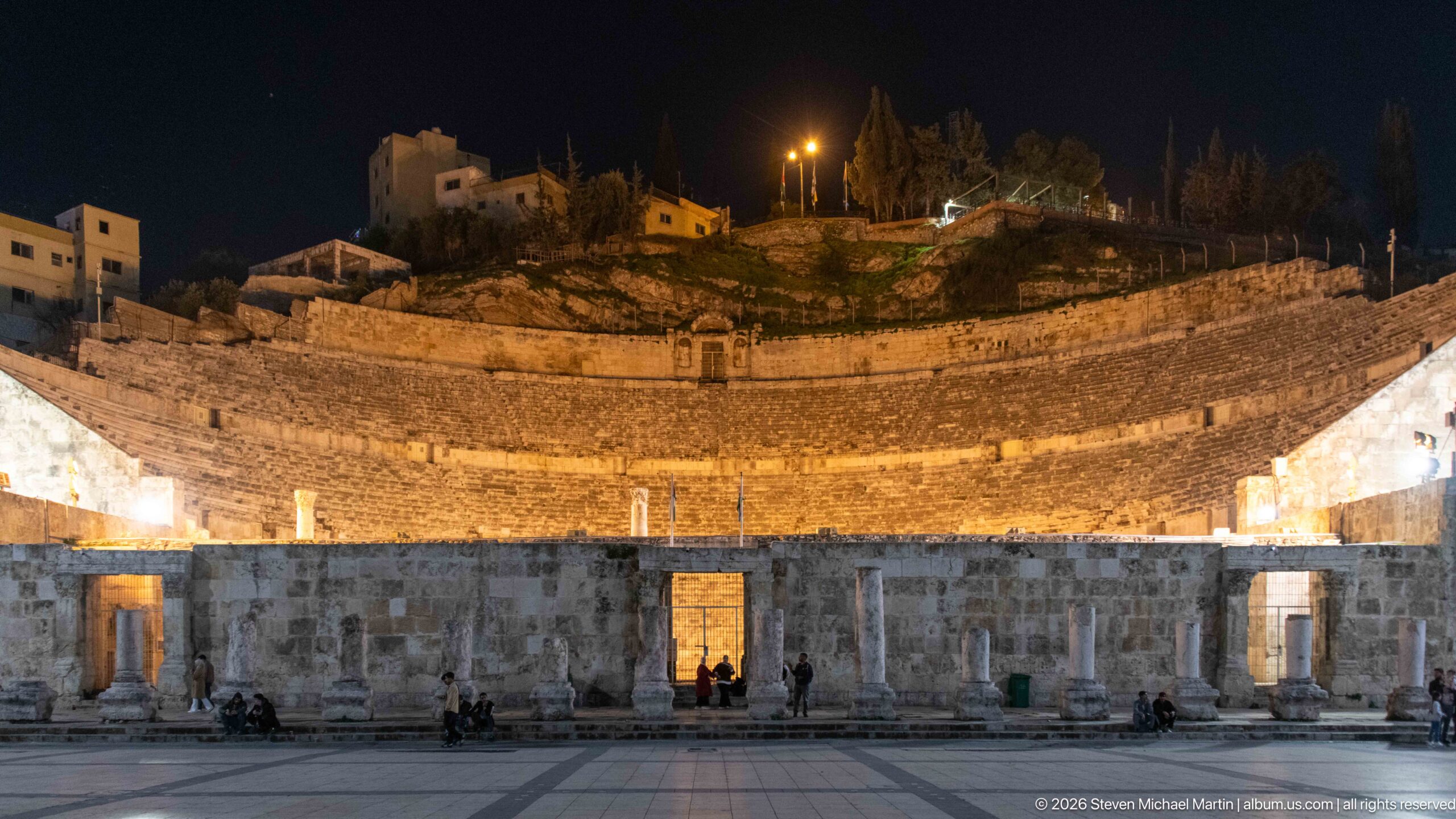
The Roman Theater in Amman glows under night lighting, with its steep semicircular seating rising dramatically above the rectangular stage building and open forecourt. The broad sweep of the cavea remains legible even in darkness, while small figures along the lower level provide a clear sense of scale for one of the city’s most prominent surviving Roman monuments.
Caption
The Roman Theater in Amman glows under night lighting, with its steep semicircular seating rising dramatically above the rectangular stage building and open forecourt. The broad sweep of the cavea remains legible even in darkness, while small figures along the lower level provide a clear sense of scale for one of the city’s most prominent surviving Roman monuments.
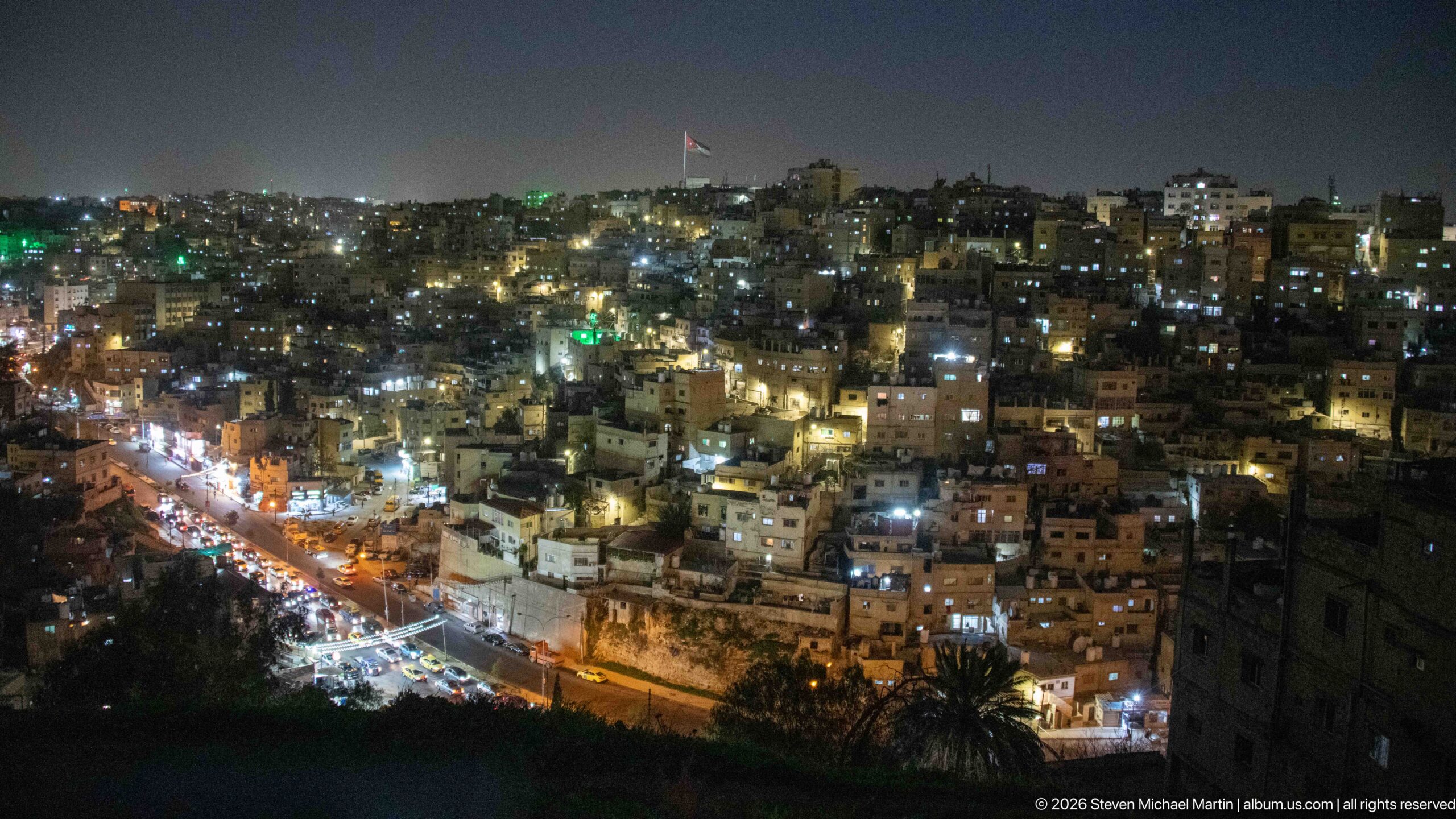
A broad nighttime panorama shows Amman’s low-rise residential fabric spreading across a steep hillside, with countless windows and streetlights creating a dense mosaic of light. A busy illuminated roadway cuts along the lower left of the slope, while darker vegetation marks the near foreground. The elevated viewpoint reveals how the city’s neighborhoods conform to the contours of the terrain.
Caption
A broad nighttime panorama shows Amman’s low-rise residential fabric spreading across a steep hillside, with countless windows and streetlights creating a dense mosaic of light. A busy illuminated roadway cuts along the lower left of the slope, while darker vegetation marks the near foreground. The elevated viewpoint reveals how the city’s neighborhoods conform to the contours of the terrain.
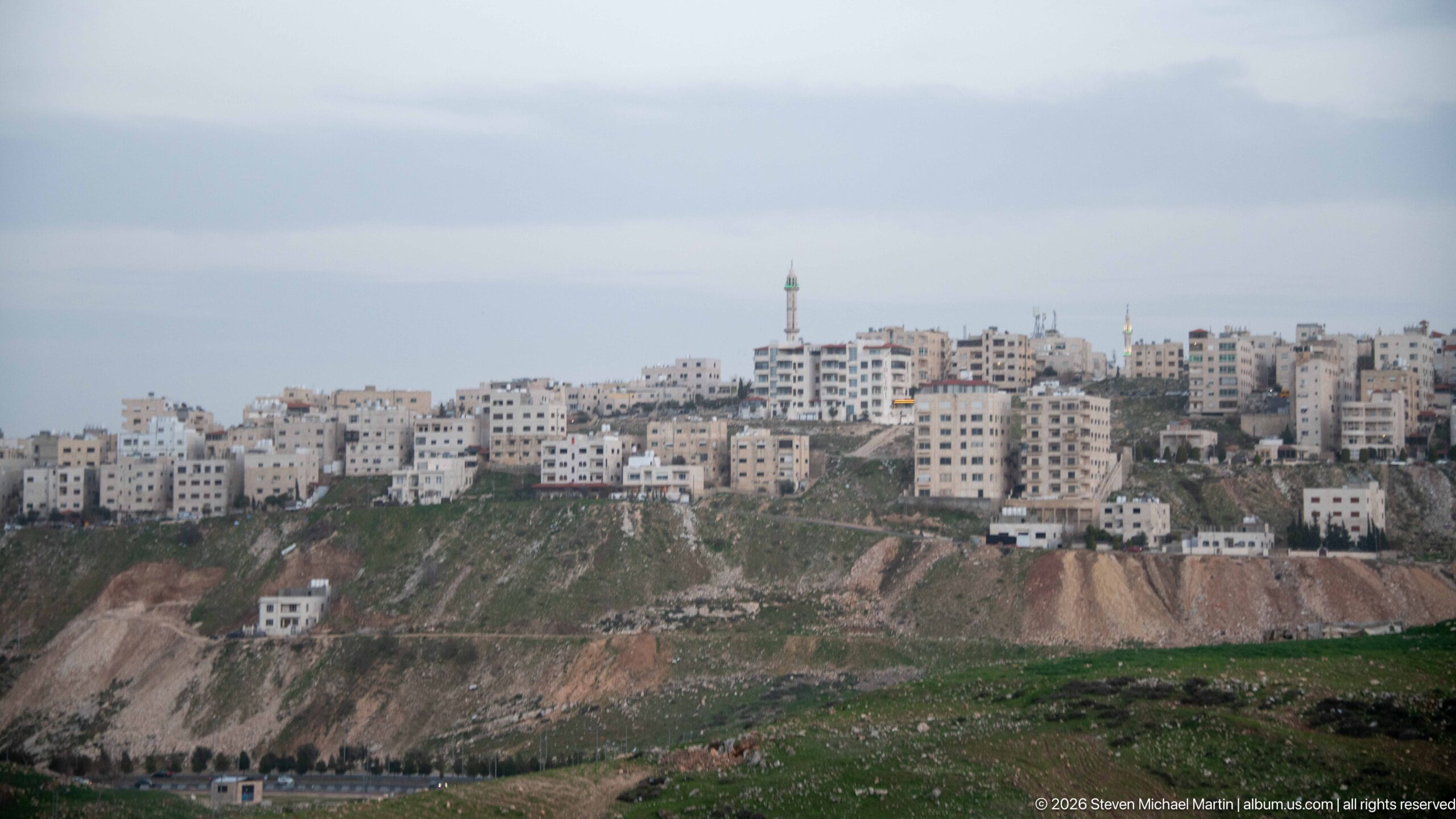
Pale apartment blocks and houses spread across a rugged Amman hillside above a broad exposed rock cut. A slender mosque minaret rises among the buildings near the skyline, providing a vertical counterpoint to the dense horizontal layers of housing. The distant view shows how modern development occupies the capital’s steep, limestone-dominated terrain and valley edges.
Caption
Pale apartment blocks and houses spread across a rugged Amman hillside above a broad exposed rock cut. A slender mosque minaret rises among the buildings near the skyline, providing a vertical counterpoint to the dense horizontal layers of housing. The distant view shows how modern development occupies the capital’s steep, limestone-dominated terrain and valley edges.
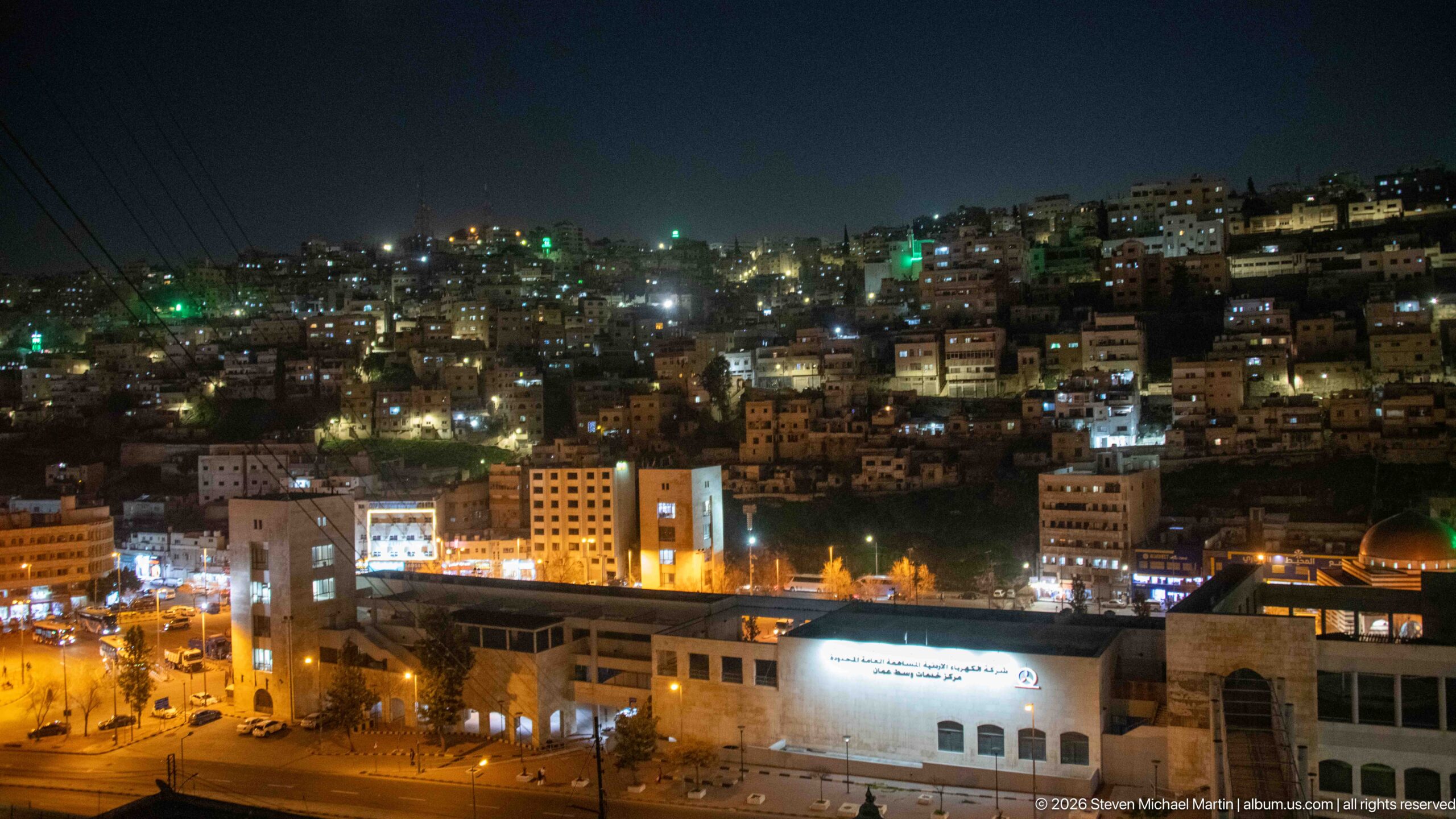
Dense residential buildings blanket a steep Amman hillside at night, their windows and streetlights forming an irregular field of illumination across the slope. In the foreground, larger institutional and commercial structures anchor the lower city while closely packed housing climbs behind them. The view highlights the layered, topographic urban form for which the Jordanian capital is visually distinctive.
Caption
Dense residential buildings blanket a steep Amman hillside at night, their windows and streetlights forming an irregular field of illumination across the slope. In the foreground, larger institutional and commercial structures anchor the lower city while closely packed housing climbs behind them. The view highlights the layered, topographic urban form for which the Jordanian capital is visually distinctive.
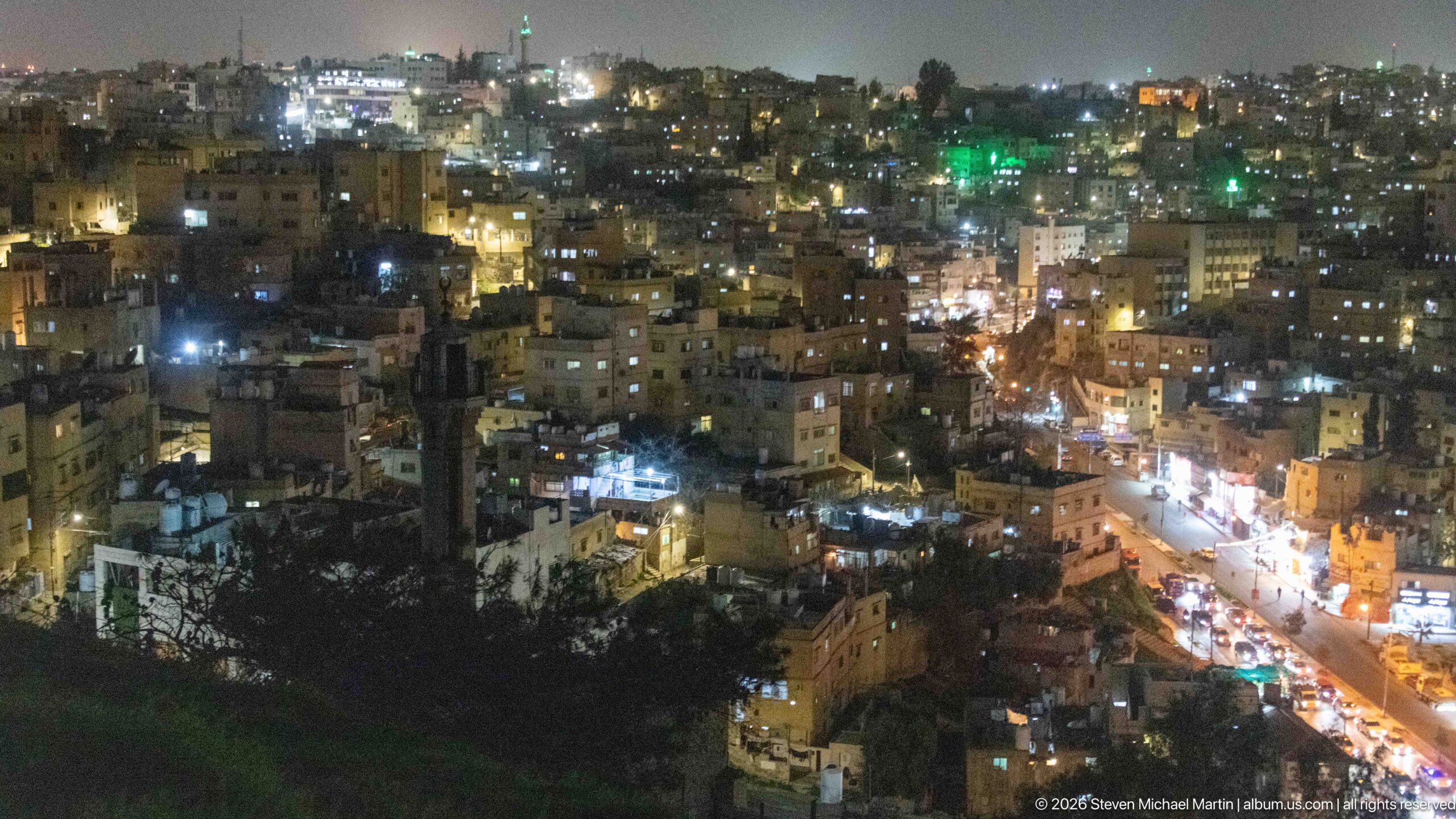
A high nighttime viewpoint looks across Amman’s tightly packed hillside neighborhoods toward a brightly illuminated arterial road that threads through the valley. Apartment blocks stack across the slopes in irregular tiers, punctuated by green and white lights, while traffic creates a continuous luminous corridor below. The composition stresses the capital’s dramatic relief and dense urban fabric.
Caption
A high nighttime viewpoint looks across Amman’s tightly packed hillside neighborhoods toward a brightly illuminated arterial road that threads through the valley. Apartment blocks stack across the slopes in irregular tiers, punctuated by green and white lights, while traffic creates a continuous luminous corridor below. The composition stresses the capital’s dramatic relief and dense urban fabric.
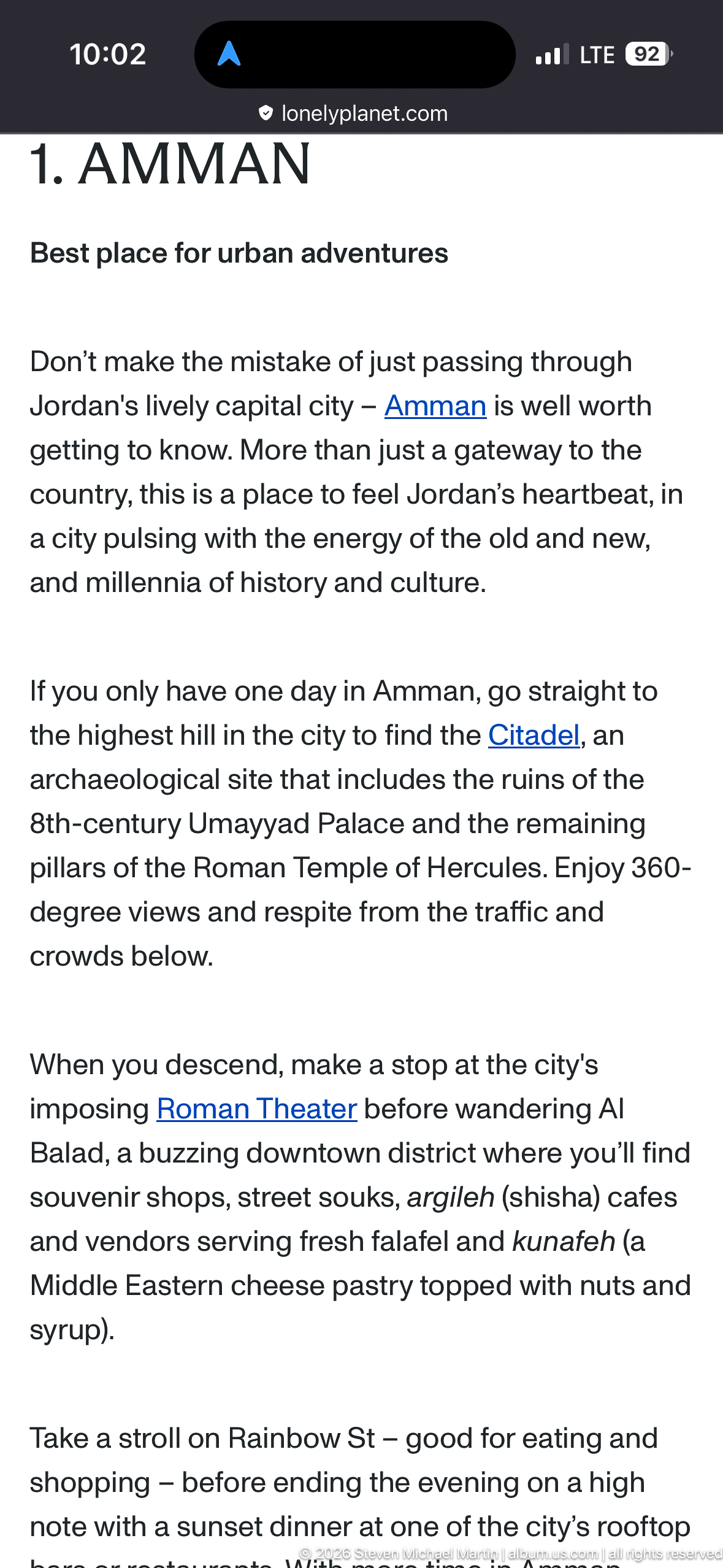
Portfolio introduction for Amman sets the journey in Jordan’s capital, pairing practical arrival advice with references to the Citadel, Roman Theater, Rainbow Street, and the city’s layered urban history. Presented as the first image in the sequence, the page functions as an editorial gateway rather than a documentary view of a specific monument or neighborhood.
Caption
Portfolio introduction for Amman sets the journey in Jordan’s capital, pairing practical arrival advice with references to the Citadel, Roman Theater, Rainbow Street, and the city’s layered urban history. Presented as the first image in the sequence, the page functions as an editorial gateway rather than a documentary view of a specific monument or neighborhood.
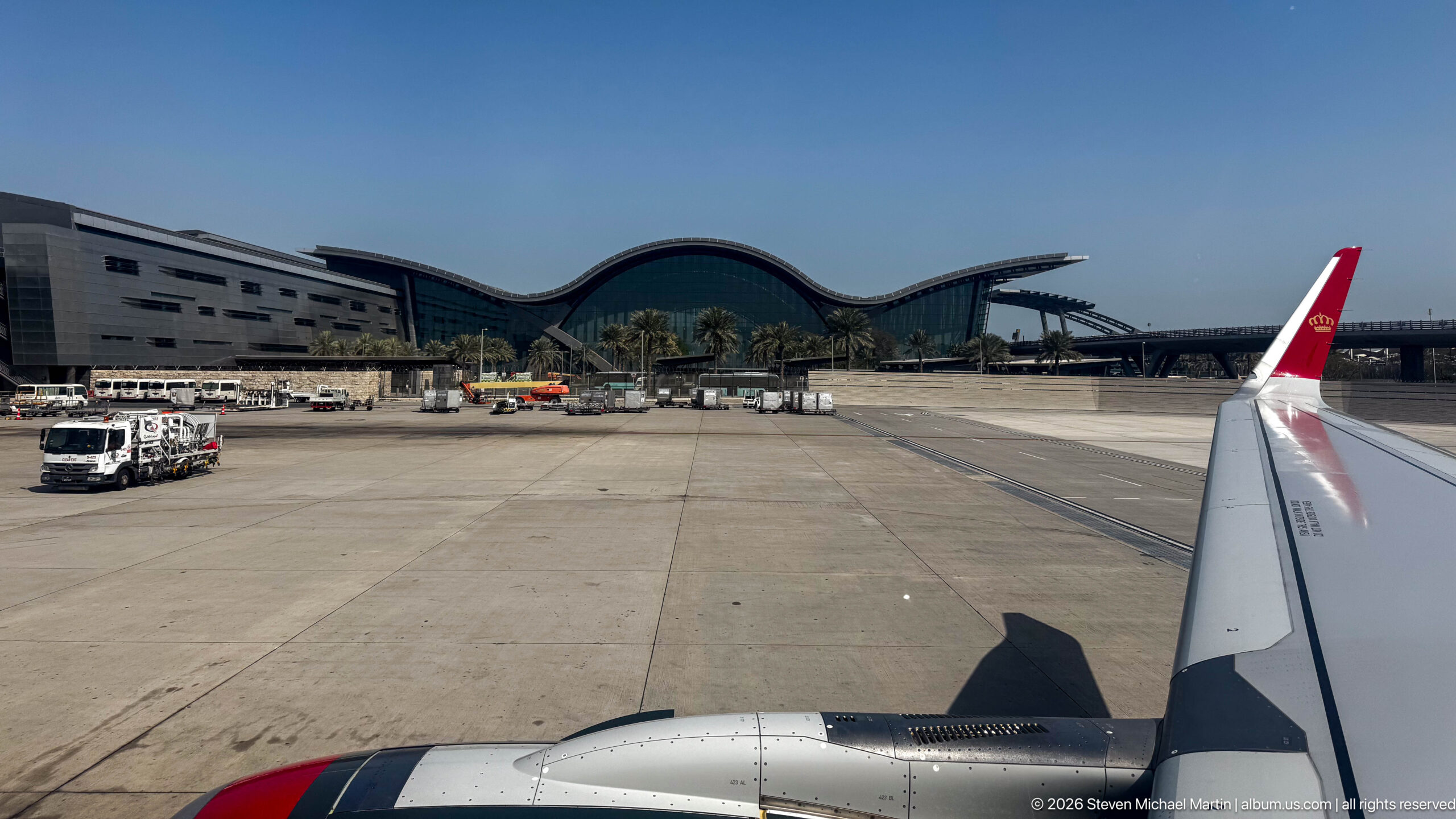
An aircraft wing frames the terminal complex at Queen Alia International Airport outside Amman. The terminal’s broad glass frontage and distinctive undulating roofline rise beyond service vehicles on the apron, while the red-and-white wingtip places the viewer at the threshold between arrival and the city beyond.
Caption
An aircraft wing frames the terminal complex at Queen Alia International Airport outside Amman. The terminal’s broad glass frontage and distinctive undulating roofline rise beyond service vehicles on the apron, while the red-and-white wingtip places the viewer at the threshold between arrival and the city beyond.
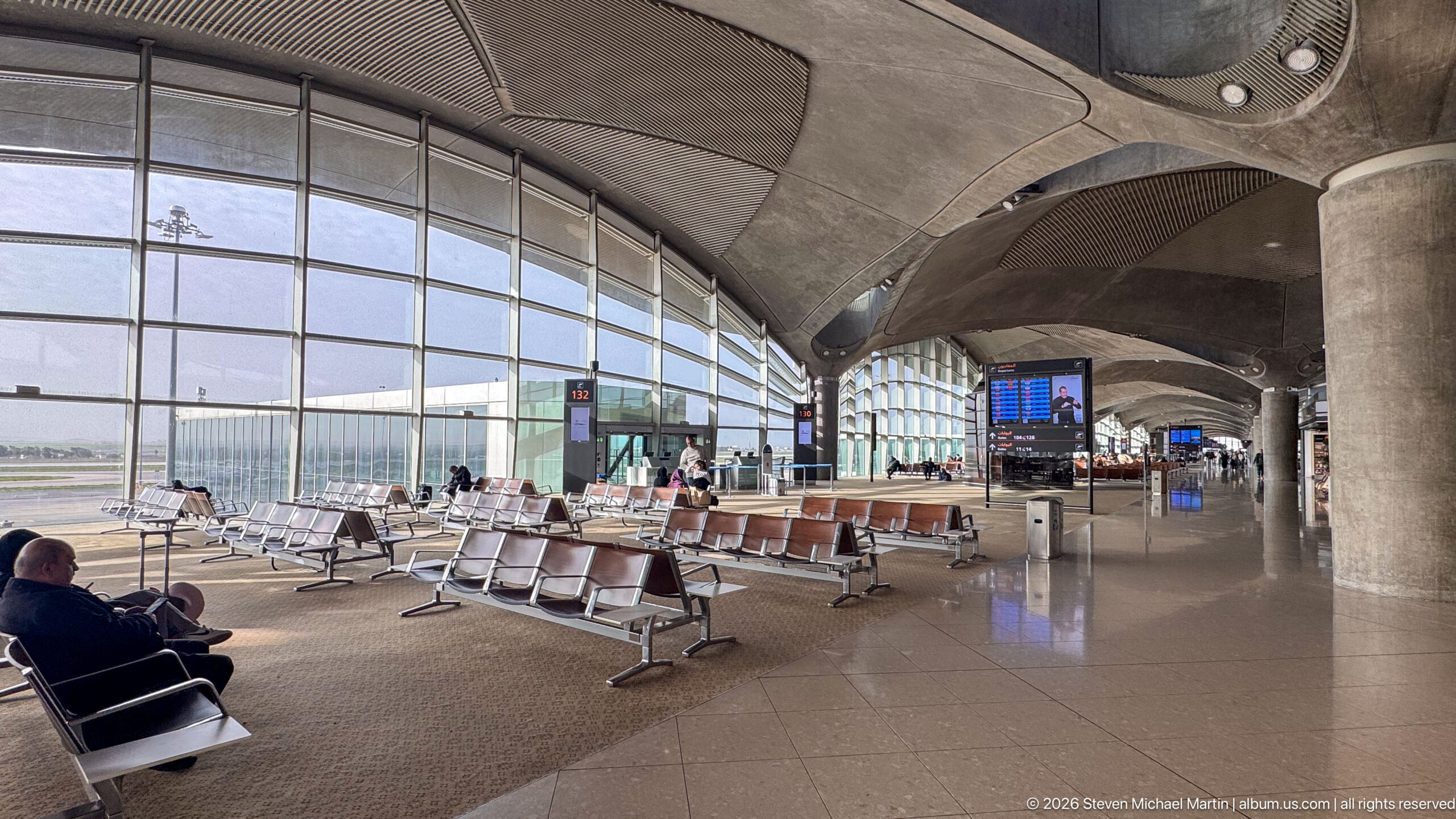
Inside Queen Alia International Airport, rows of passenger seating extend beneath a sculptural concrete ceiling formed by repeated, flared roof modules. Floor-to-ceiling glazing brings daylight into the departure hall, while exposed structural columns and polished floors emphasize the terminal’s broad, open interior.
Caption
Inside Queen Alia International Airport, rows of passenger seating extend beneath a sculptural concrete ceiling formed by repeated, flared roof modules. Floor-to-ceiling glazing brings daylight into the departure hall, while exposed structural columns and polished floors emphasize the terminal’s broad, open interior.
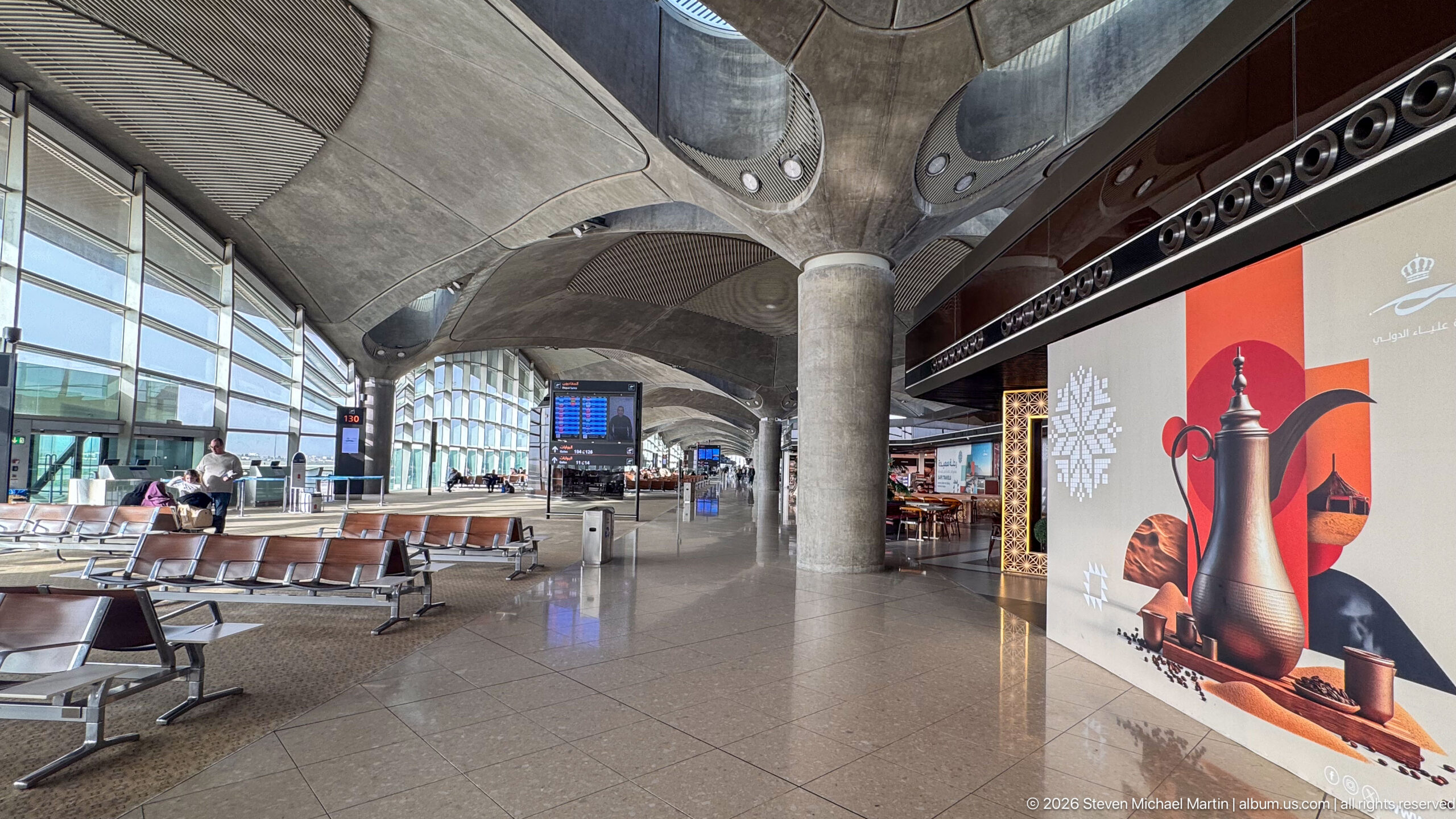
A Jordan-themed wall graphic adds color to the passenger concourse at Queen Alia International Airport, where a traditional coffee pot motif appears beside seating and the terminal’s exposed concrete structure. The juxtaposition of cultural imagery, glass walls, and the building’s repeated roof modules gives this view a stronger sense of place than the adjacent architectural studies.
Caption
A Jordan-themed wall graphic adds color to the passenger concourse at Queen Alia International Airport, where a traditional coffee pot motif appears beside seating and the terminal’s exposed concrete structure. The juxtaposition of cultural imagery, glass walls, and the building’s repeated roof modules gives this view a stronger sense of place than the adjacent architectural studies.
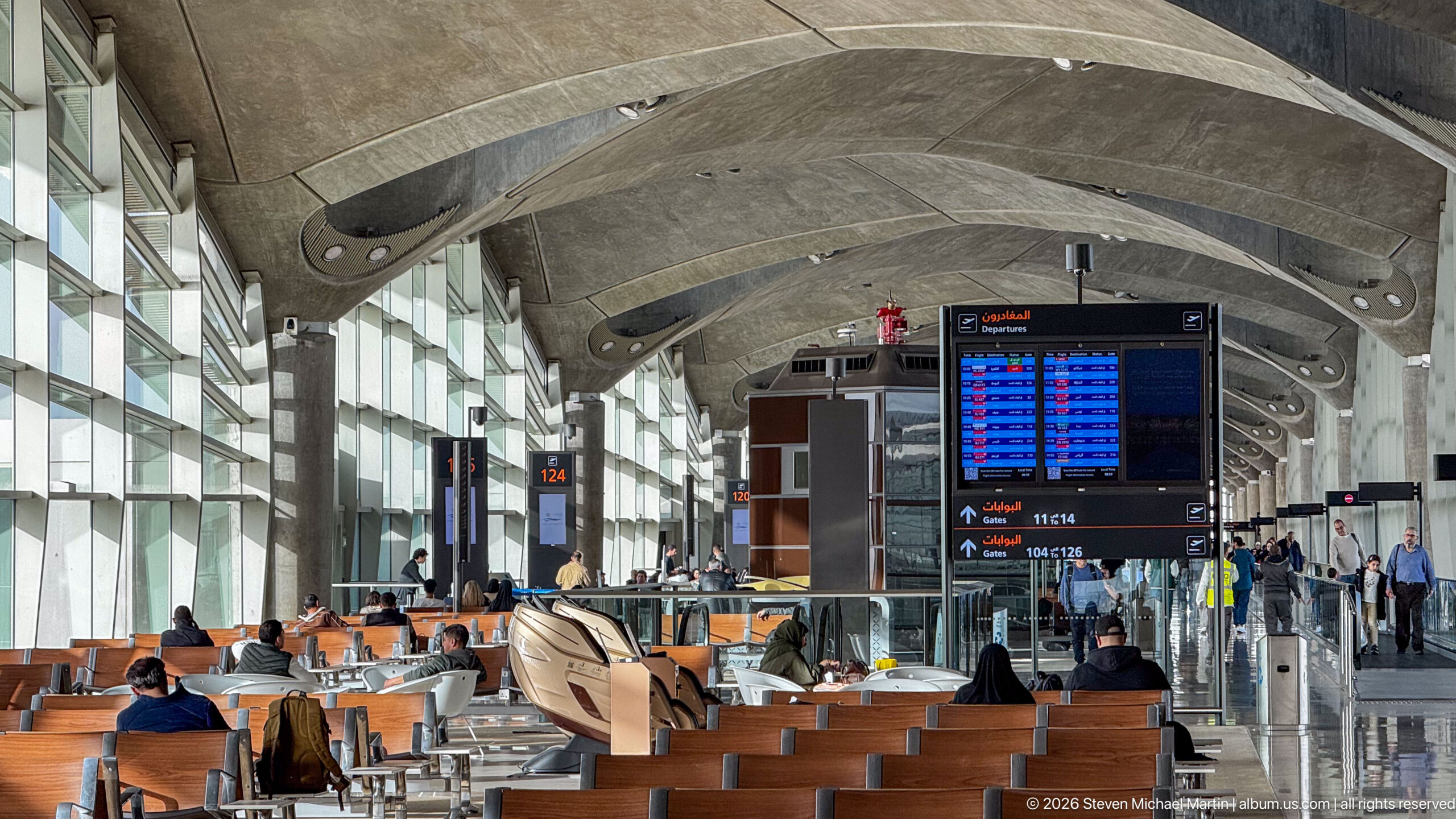
A central flight-information display anchors the departure hall at Queen Alia International Airport. Travelers sit among rows of seats while gate signage, retail fixtures, glass walls, and the terminal’s branching concrete ceiling modules recede into the distance, conveying the scale and circulation of the passenger concourse.
Caption
A central flight-information display anchors the departure hall at Queen Alia International Airport. Travelers sit among rows of seats while gate signage, retail fixtures, glass walls, and the terminal’s branching concrete ceiling modules recede into the distance, conveying the scale and circulation of the passenger concourse.
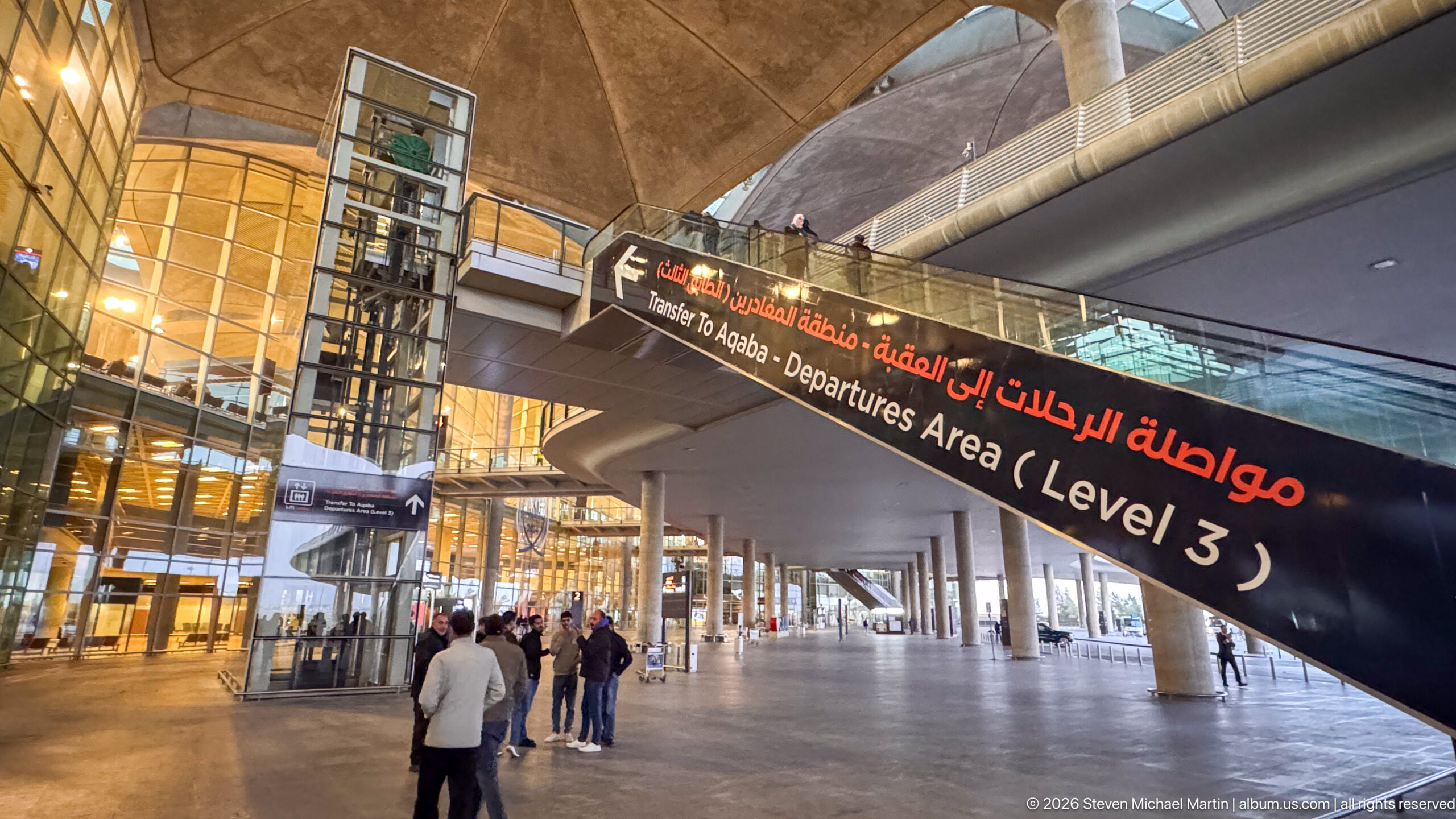
Arabic-and-English wayfinding directs passengers to the Departures Area on Level 3 at Queen Alia International Airport. The elevated sign cuts diagonally across a high, glass-and-concrete interior, with travelers moving through the terminal below and warm evening light glowing through the façade.
Caption
Arabic-and-English wayfinding directs passengers to the Departures Area on Level 3 at Queen Alia International Airport. The elevated sign cuts diagonally across a high, glass-and-concrete interior, with travelers moving through the terminal below and warm evening light glowing through the façade.
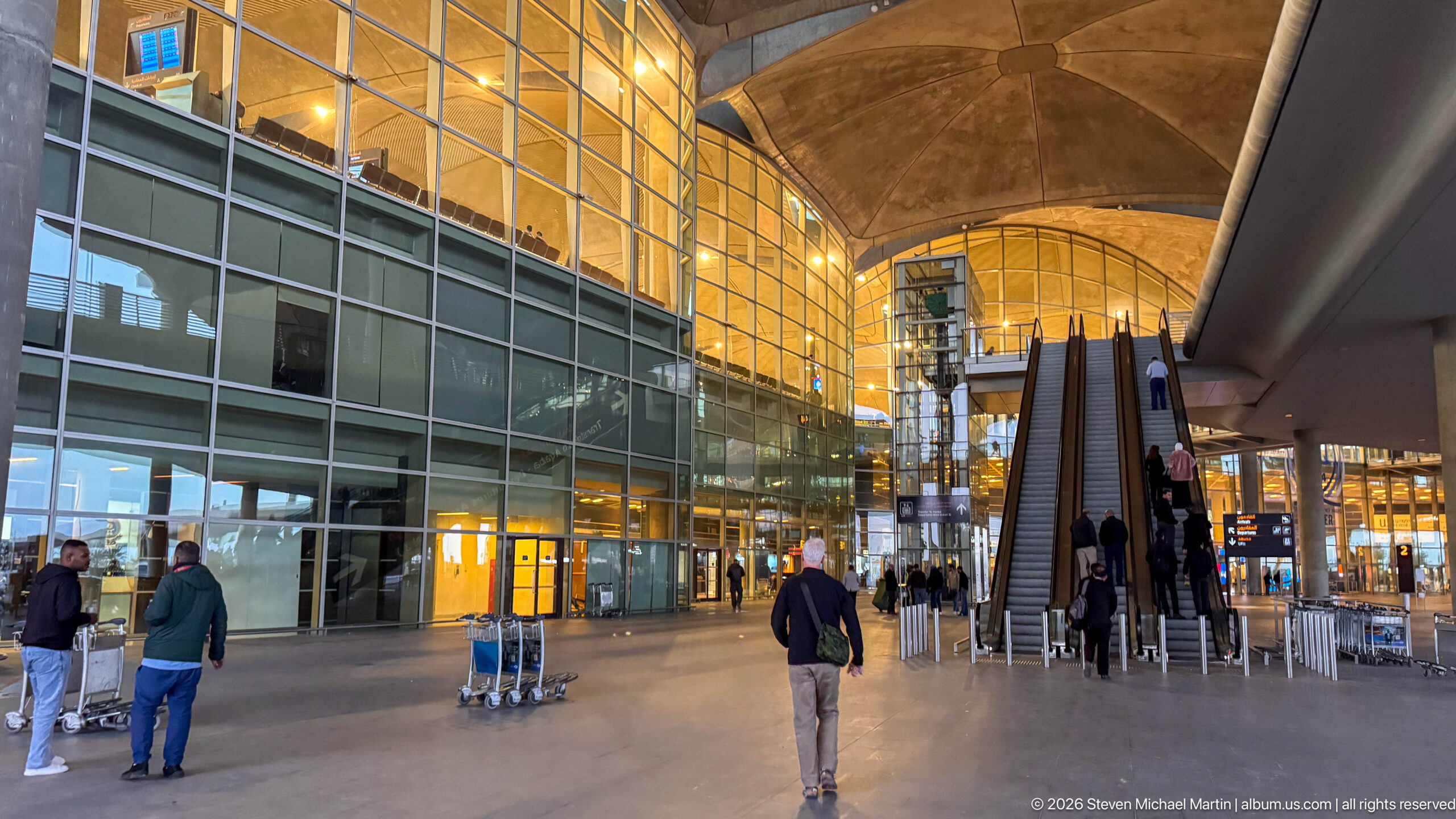
A closer view of the main escalators at Queen Alia International Airport emphasizes the terminal’s layered circulation. Passengers approach the moving stairs between transparent glass walls and concrete roof bays, while the warm interior lighting contrasts with the cooler glazing and polished floor.
Caption
A closer view of the main escalators at Queen Alia International Airport emphasizes the terminal’s layered circulation. Passengers approach the moving stairs between transparent glass walls and concrete roof bays, while the warm interior lighting contrasts with the cooler glazing and polished floor.
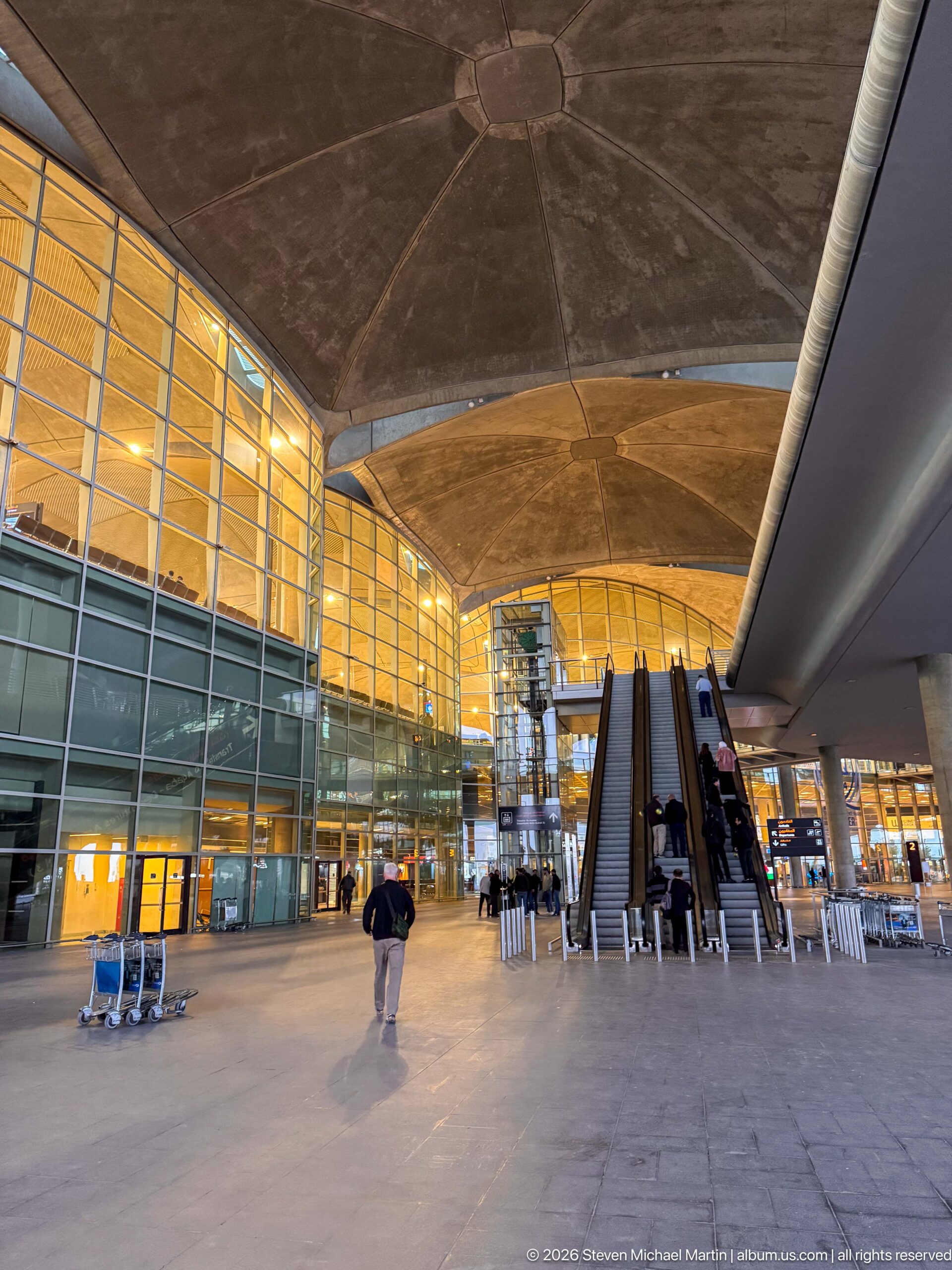
Escalators rise through a spacious concourse at Queen Alia International Airport, framed by warm-lit glass walls and broad concrete roof modules overhead. The largely open floor and sparse foot traffic draw attention to the terminal’s structural geometry and the vertical movement between levels.
Caption
Escalators rise through a spacious concourse at Queen Alia International Airport, framed by warm-lit glass walls and broad concrete roof modules overhead. The largely open floor and sparse foot traffic draw attention to the terminal’s structural geometry and the vertical movement between levels.
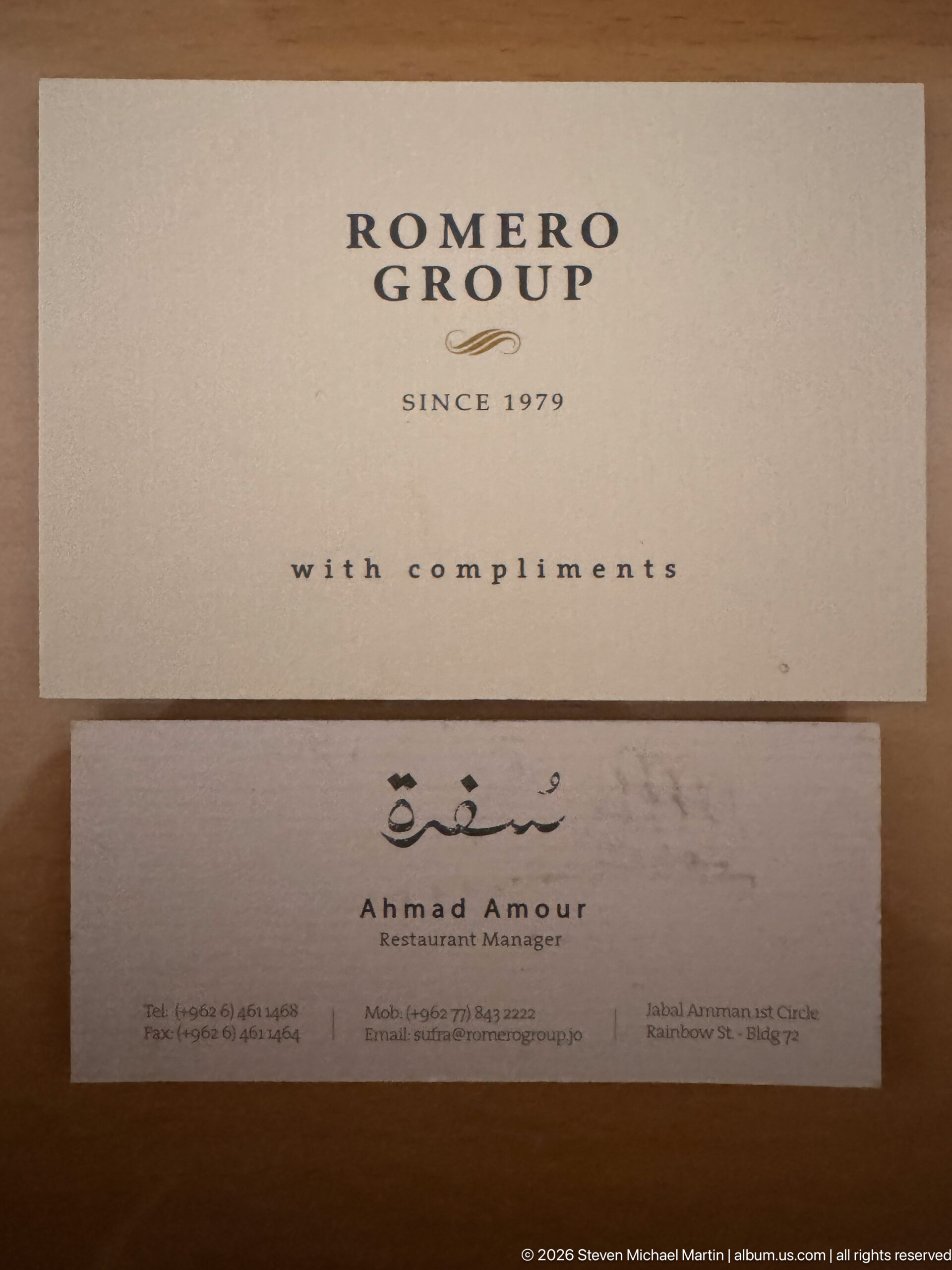
A tabletop card identifies the Romero Group and restaurant manager Ahmad Amour, providing a small documentary detail from Amman’s dining scene. The restrained typography and bilingual presentation contrast with the architectural and street views surrounding it in the sequence, preserving a specific name and hospitality connection from the visit.
Caption
A tabletop card identifies the Romero Group and restaurant manager Ahmad Amour, providing a small documentary detail from Amman’s dining scene. The restrained typography and bilingual presentation contrast with the architectural and street views surrounding it in the sequence, preserving a specific name and hospitality connection from the visit.
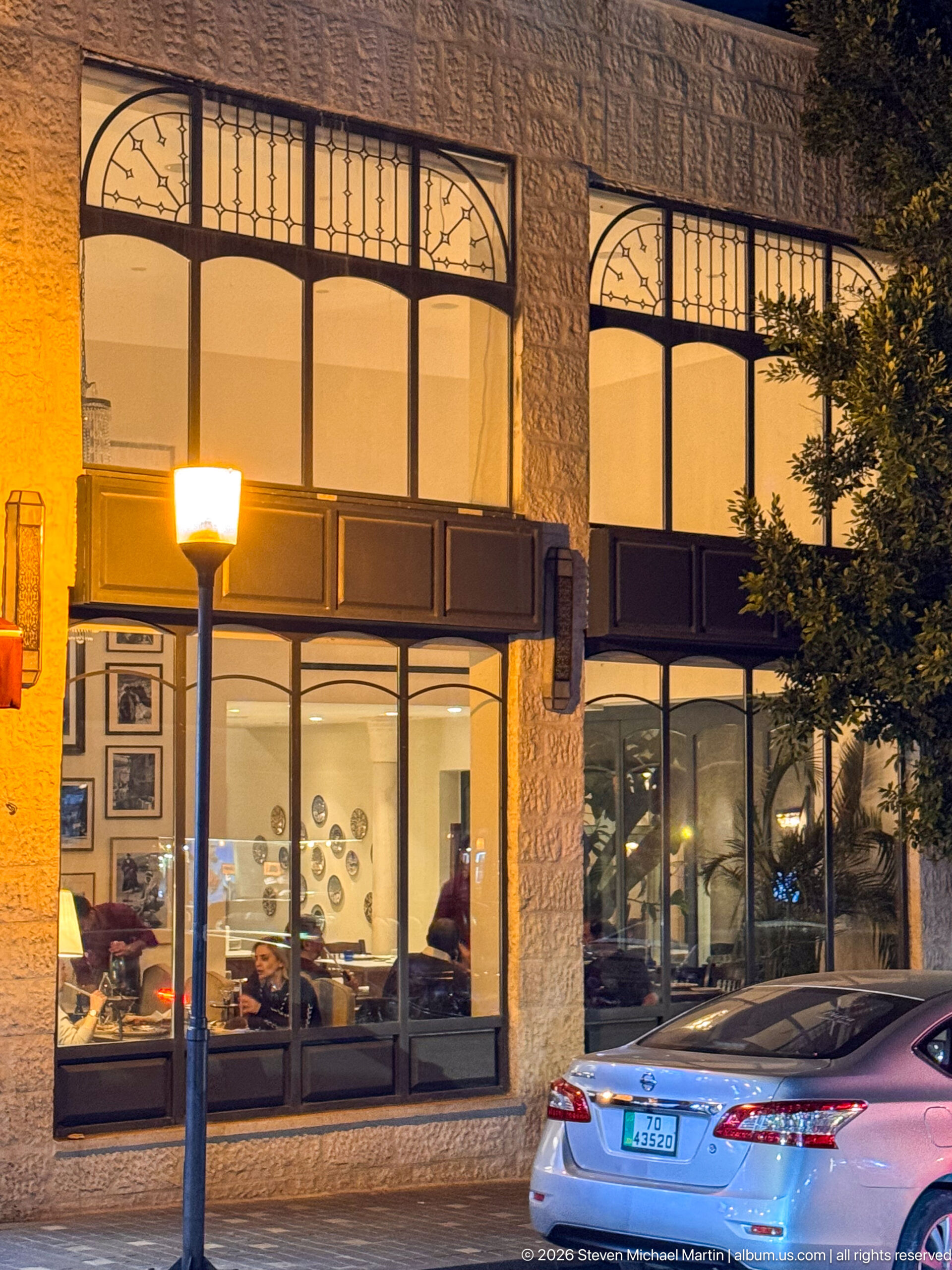
Large arched window bays reveal diners inside a stone-fronted Amman restaurant at night. Warm interior light spills onto the sidewalk, where a streetlamp and parked car reinforce the neighborhood setting; the façade balances traditional stonework with broad modern glazing.
Caption
Large arched window bays reveal diners inside a stone-fronted Amman restaurant at night. Warm interior light spills onto the sidewalk, where a streetlamp and parked car reinforce the neighborhood setting; the façade balances traditional stonework with broad modern glazing.
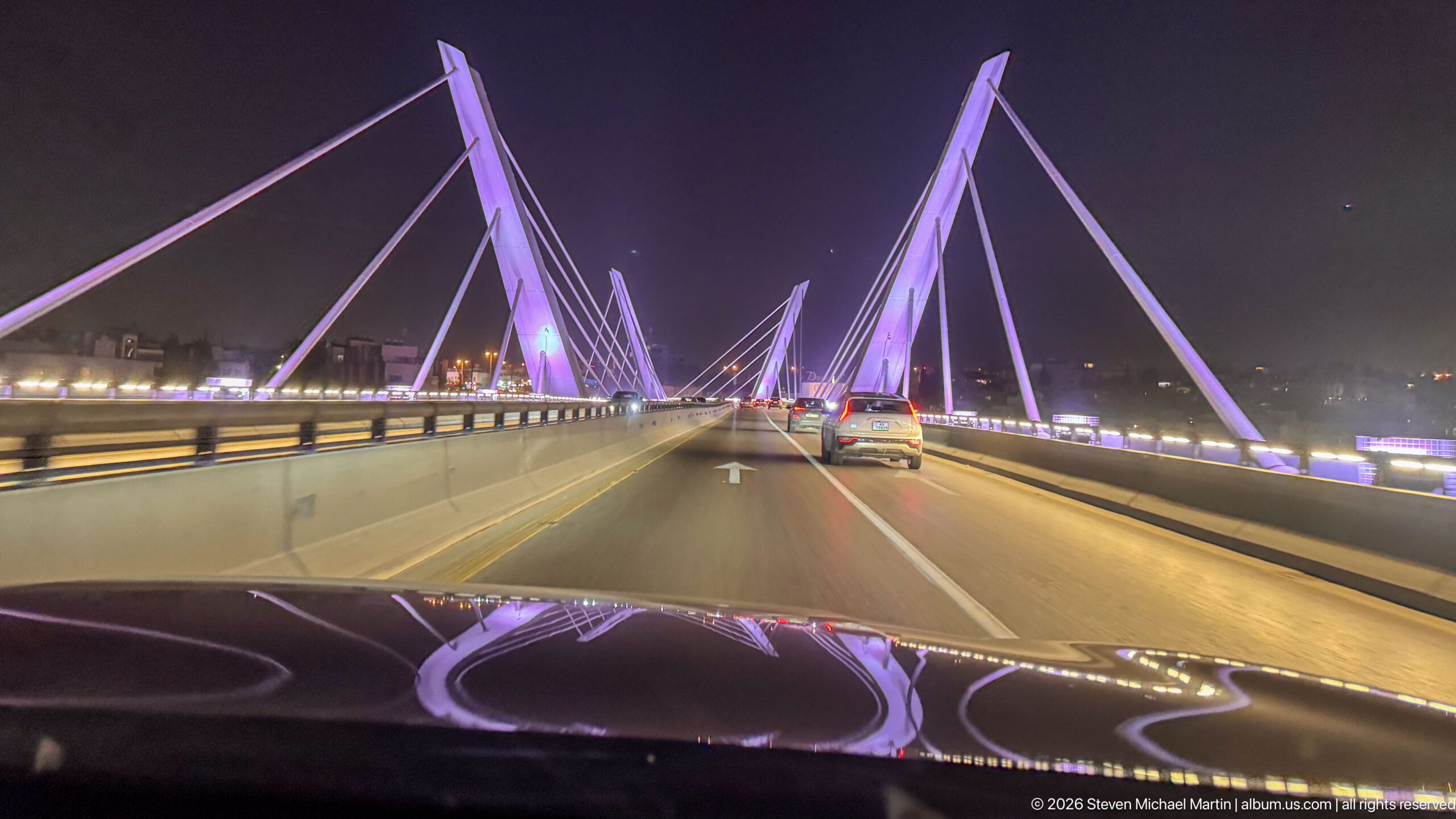
Illuminated cable-stayed pylons frame a nighttime drive across a major Amman roadway. Purple lighting traces the angled cables and tall supports, while traffic moves through the center span and city lights stretch along the horizon, turning transportation infrastructure into a dramatic urban night scene.
Caption
Illuminated cable-stayed pylons frame a nighttime drive across a major Amman roadway. Purple lighting traces the angled cables and tall supports, while traffic moves through the center span and city lights stretch along the horizon, turning transportation infrastructure into a dramatic urban night scene.
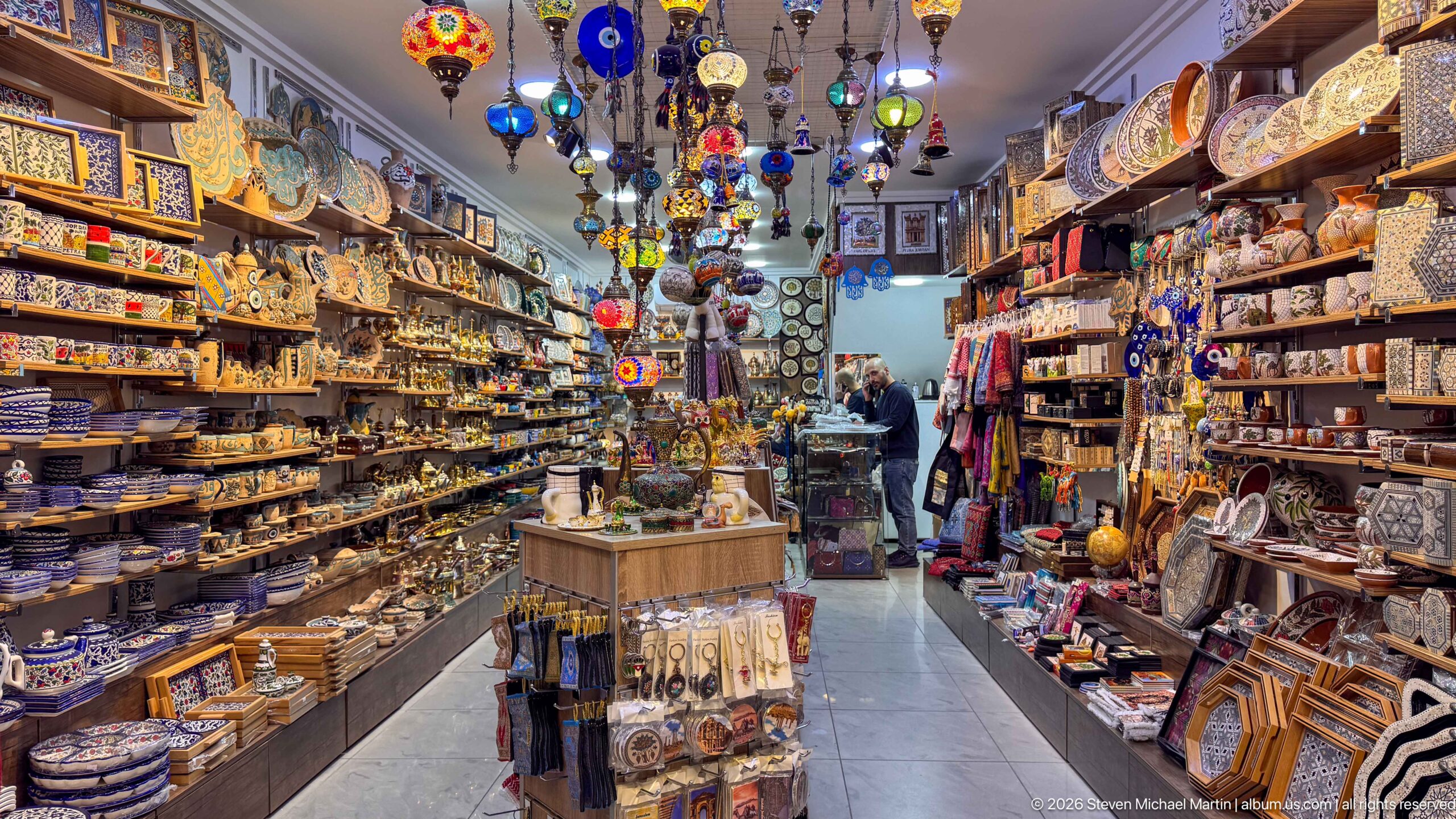
A compact Amman souvenir shop is packed from floor to ceiling with ceramics, mosaic-patterned objects, hanging glass lamps, carved boxes, textiles, and small gifts. The narrow aisle and layered merchandise create an intimate view of the city’s retail culture, where decorative objects and keepsakes crowd every available shelf and wall surface.
Caption
A compact Amman souvenir shop is packed from floor to ceiling with ceramics, mosaic-patterned objects, hanging glass lamps, carved boxes, textiles, and small gifts. The narrow aisle and layered merchandise create an intimate view of the city’s retail culture, where decorative objects and keepsakes crowd every available shelf and wall surface.
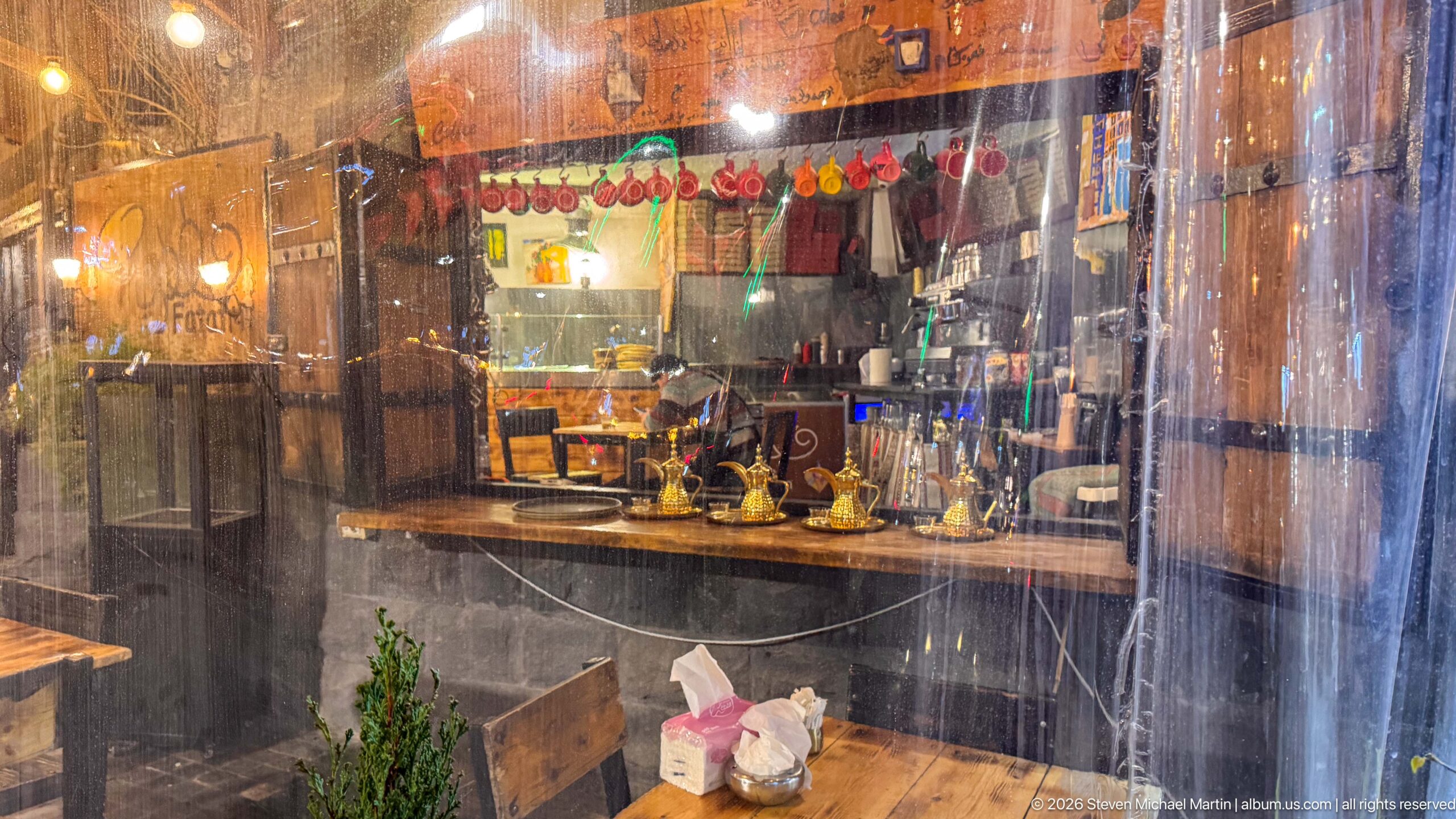
Rain-streaked transparent sheeting softens the view into a small Amman café or restaurant at night. Warm pendant lights, wooden tables, and a service counter sit behind the wet enclosure, while reflections and droplets transform the storefront into a layered study of weather, light, and street-side dining.
Caption
Rain-streaked transparent sheeting softens the view into a small Amman café or restaurant at night. Warm pendant lights, wooden tables, and a service counter sit behind the wet enclosure, while reflections and droplets transform the storefront into a layered study of weather, light, and street-side dining.
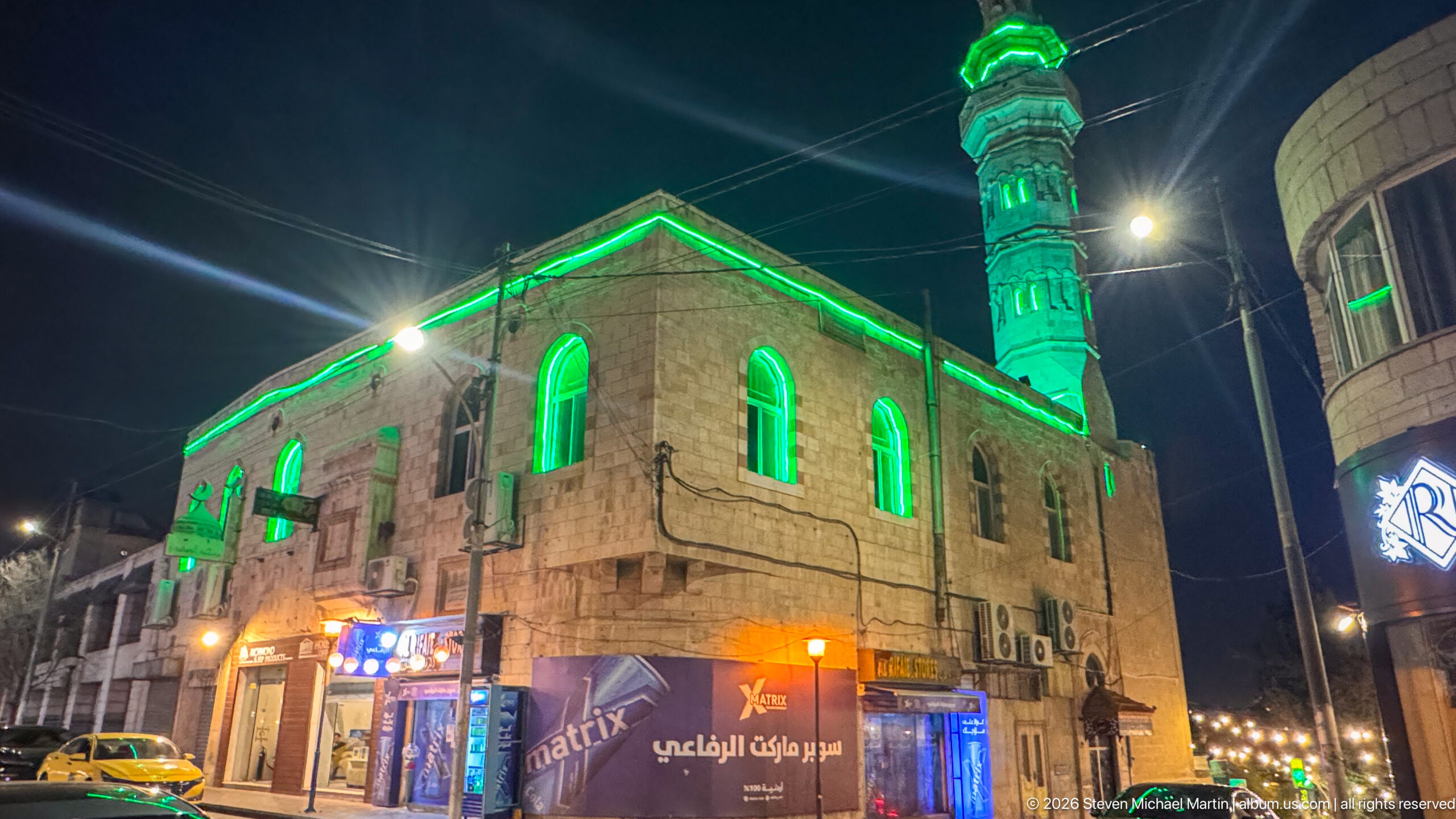
Green lighting outlines a stone mosque and its slender minaret on an Amman street at night. Arched windows glow in the same color, while shops, signage, parked cars, and overhead wires place the religious building within the dense fabric of the surrounding neighborhood rather than isolating it as a monumental landmark.
Caption
Green lighting outlines a stone mosque and its slender minaret on an Amman street at night. Arched windows glow in the same color, while shops, signage, parked cars, and overhead wires place the religious building within the dense fabric of the surrounding neighborhood rather than isolating it as a monumental landmark.
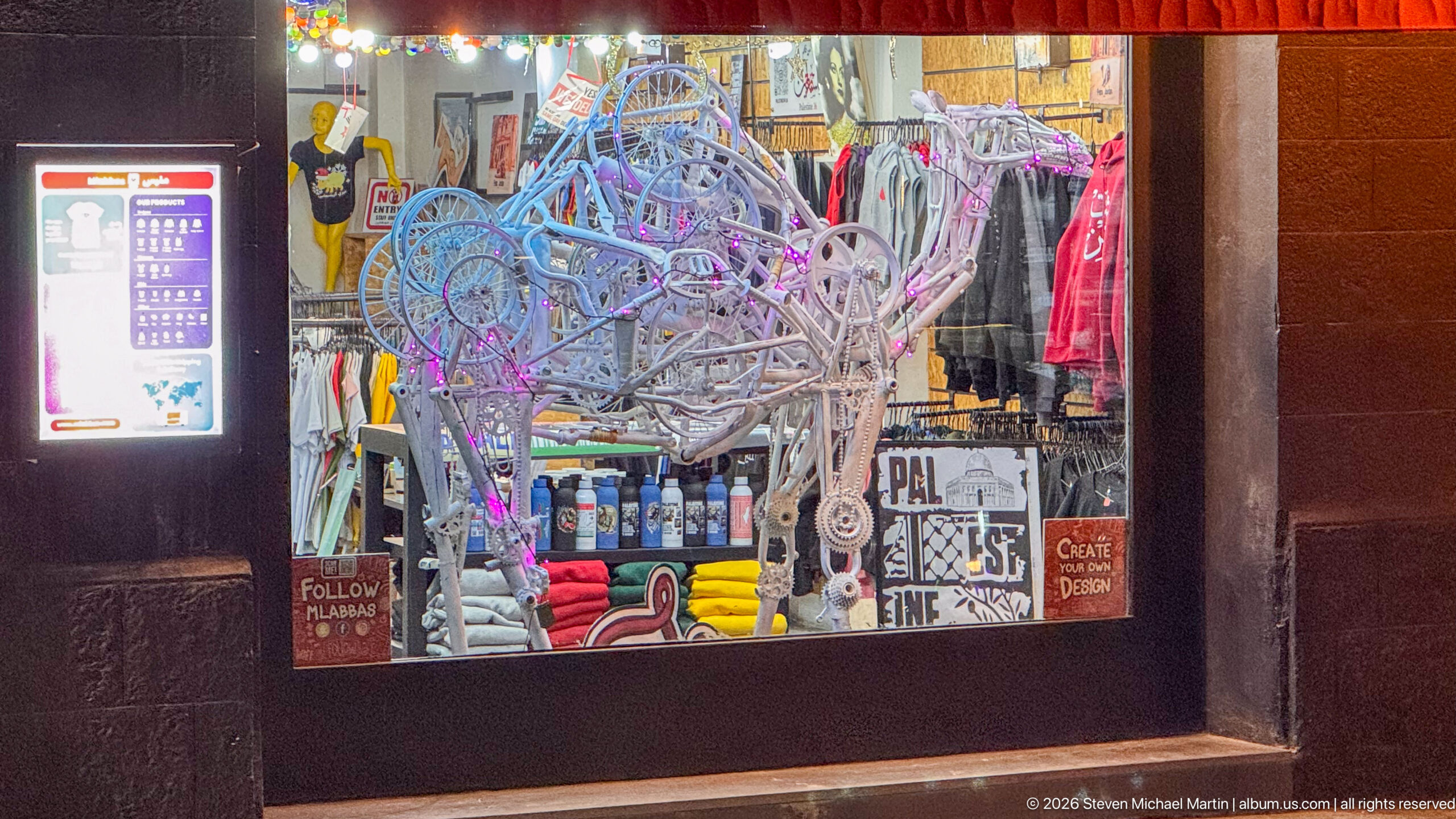
A large openwork wire animal sculpture fills the window of an Amman shop, surrounded by colorful clothing, souvenirs, and small display signs. Its looping metal contours stand out against the densely stocked interior, creating a playful focal point between the street and the merchandise beyond.
Caption
A large openwork wire animal sculpture fills the window of an Amman shop, surrounded by colorful clothing, souvenirs, and small display signs. Its looping metal contours stand out against the densely stocked interior, creating a playful focal point between the street and the merchandise beyond.
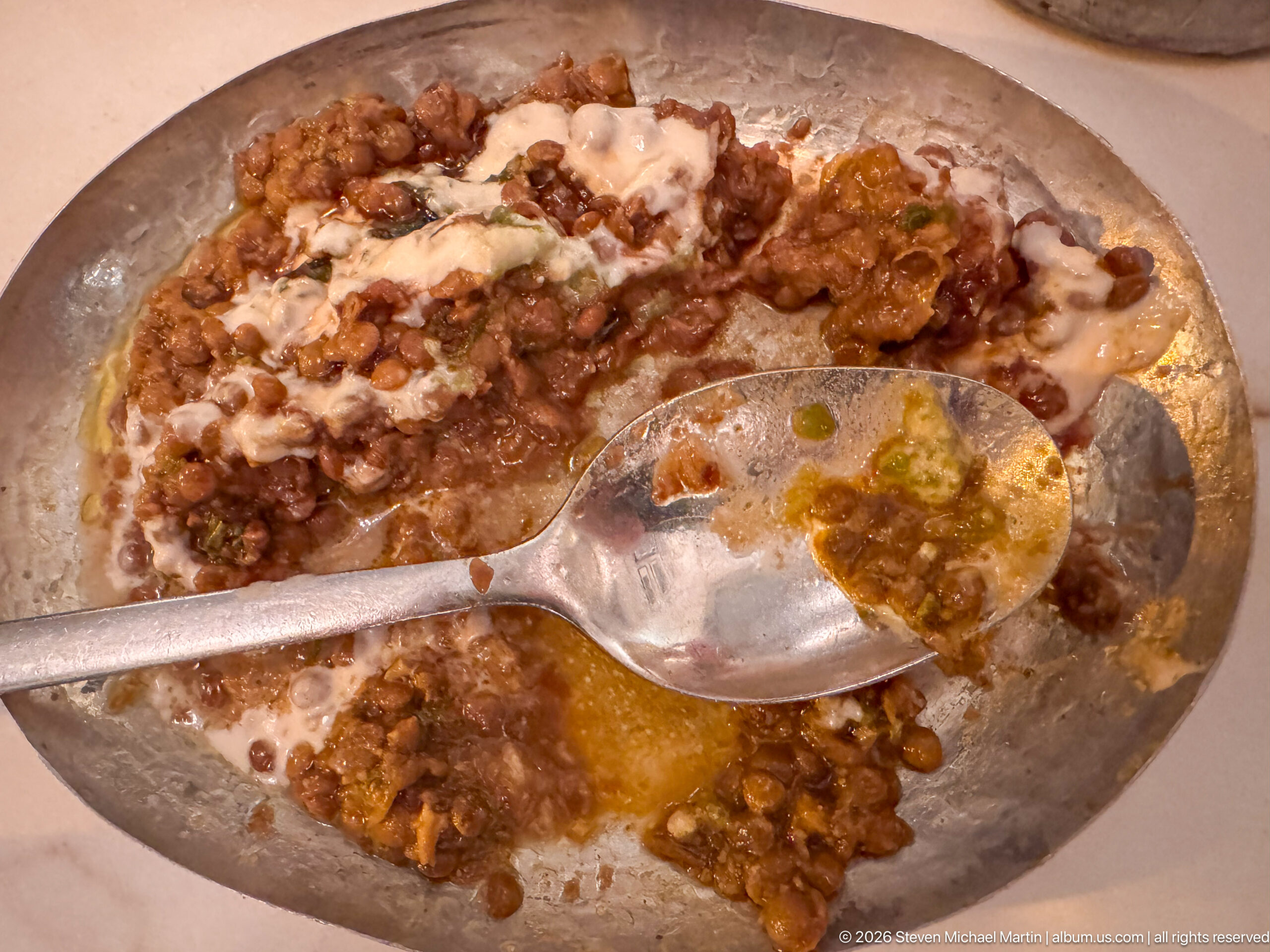
A partially eaten mezze dish combines soft beans or legumes with a creamy yogurt-like base and a generous pool of olive oil. A serving spoon rests across the plate, emphasizing the shared, informal character of the meal rather than presenting the food as a styled restaurant still life.
Caption
A partially eaten mezze dish combines soft beans or legumes with a creamy yogurt-like base and a generous pool of olive oil. A serving spoon rests across the plate, emphasizing the shared, informal character of the meal rather than presenting the food as a styled restaurant still life.
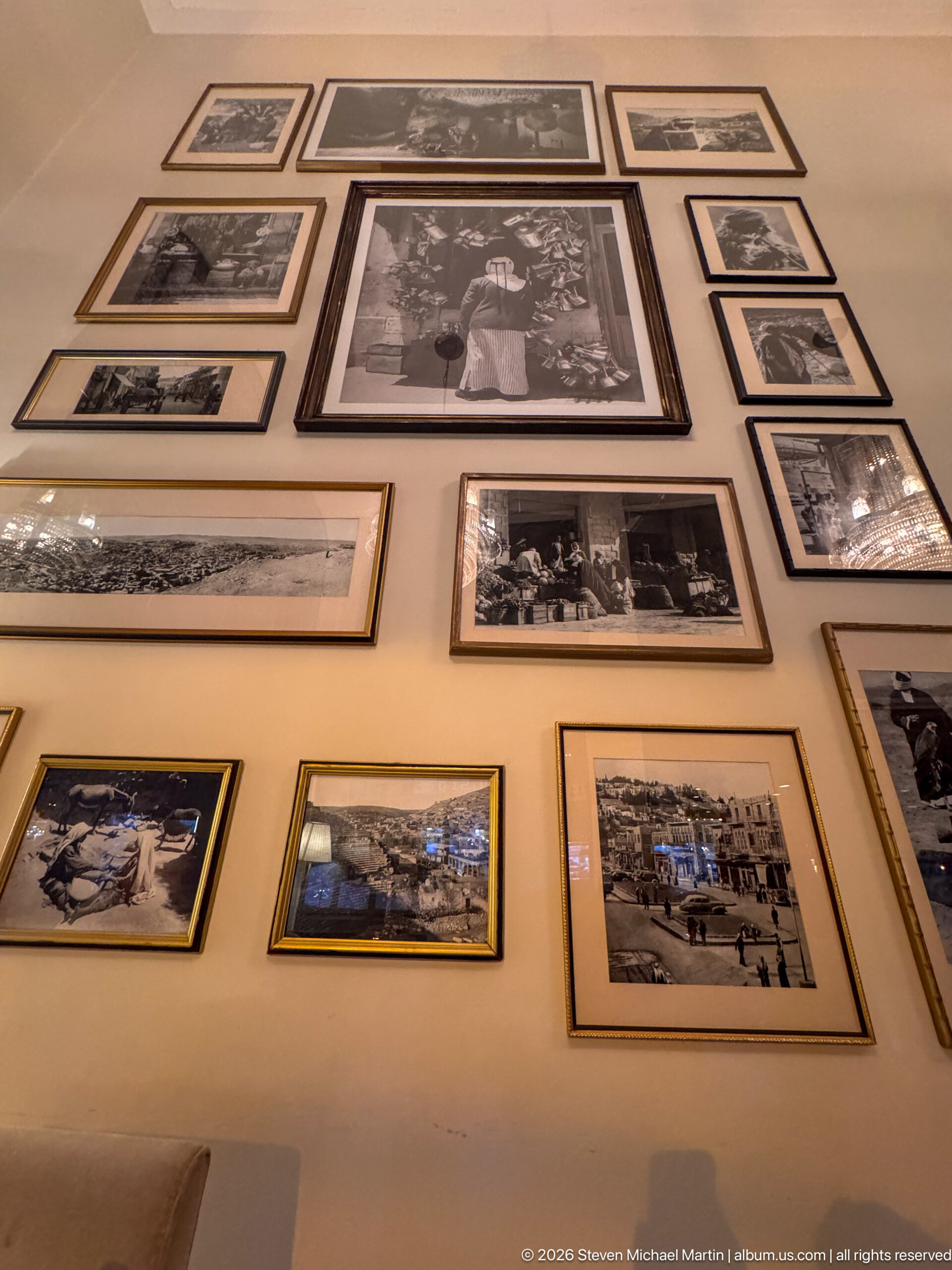
A salon-style arrangement of framed black-and-white photographs covers an interior wall in Amman. The mix of portraits, street scenes, and documentary images creates a visual archive above the dining space, linking the contemporary setting to older urban and social memories without requiring each individual photograph to be identified.
Caption
A salon-style arrangement of framed black-and-white photographs covers an interior wall in Amman. The mix of portraits, street scenes, and documentary images creates a visual archive above the dining space, linking the contemporary setting to older urban and social memories without requiring each individual photograph to be identified.
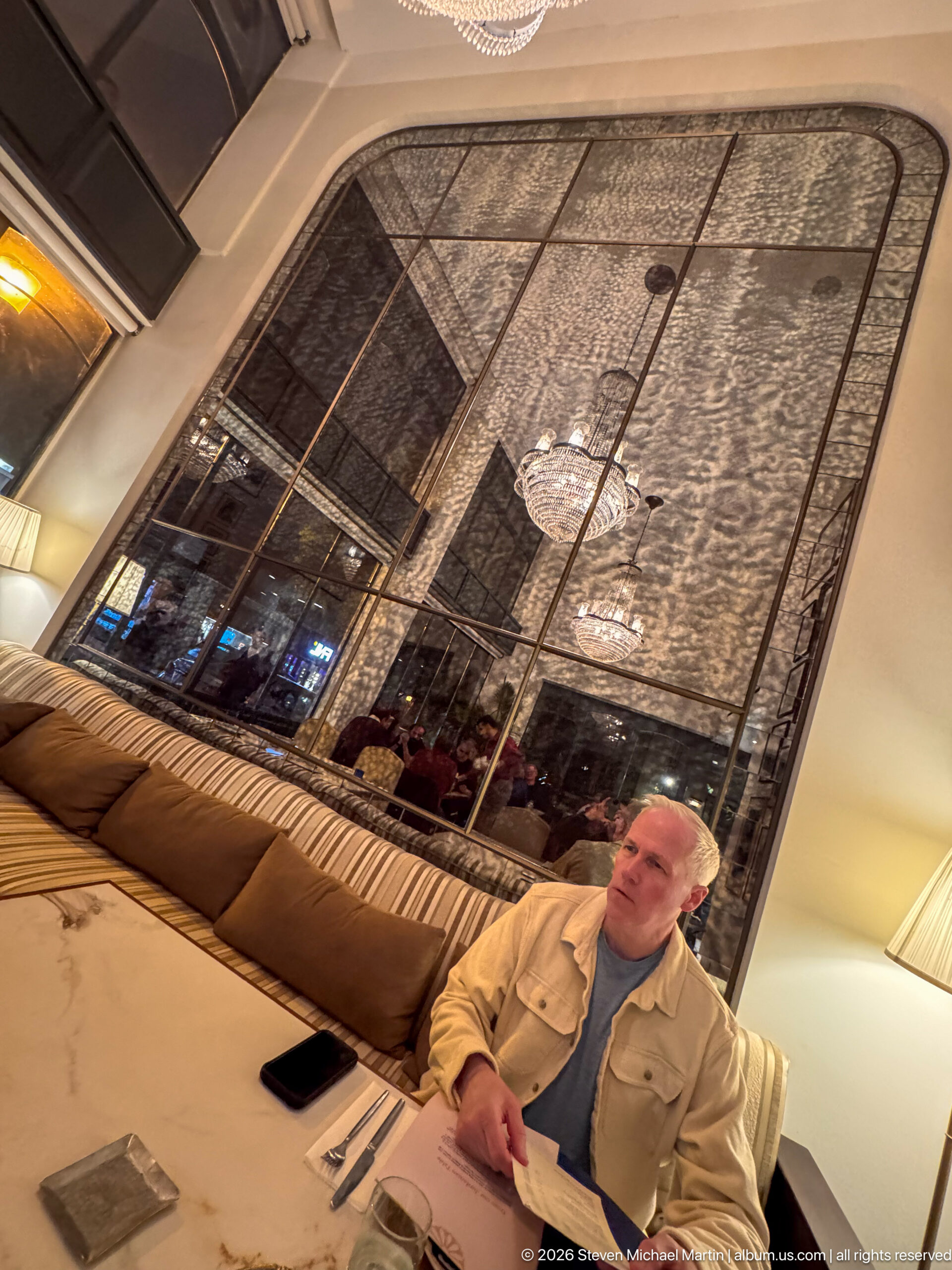
A diner sits beneath a tall decorative mirror in an elegant Amman restaurant, where patterned metalwork, upholstered banquettes, and chandelier reflections enrich the interior. The oblique camera angle emphasizes the room’s layered surfaces and intimate scale more than the meal itself.
Caption
A diner sits beneath a tall decorative mirror in an elegant Amman restaurant, where patterned metalwork, upholstered banquettes, and chandelier reflections enrich the interior. The oblique camera angle emphasizes the room’s layered surfaces and intimate scale more than the meal itself.
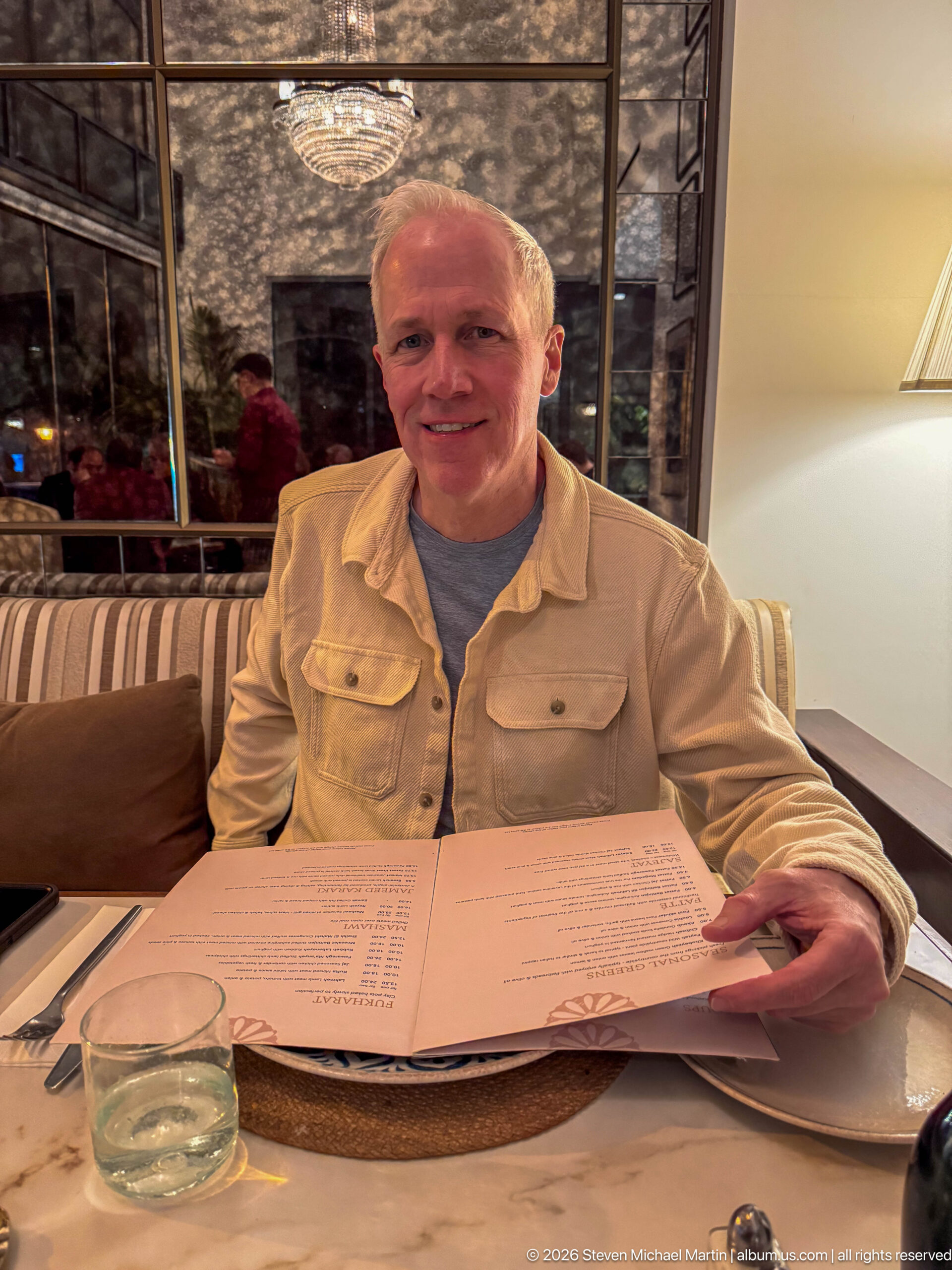
A diner holds open a large menu at an Amman restaurant, smiling across a table set with a water glass and woven placemat. Mirrored wall panels and soft upholstered seating frame the portrait, preserving a candid moment from the evening meal.
Caption
A diner holds open a large menu at an Amman restaurant, smiling across a table set with a water glass and woven placemat. Mirrored wall panels and soft upholstered seating frame the portrait, preserving a candid moment from the evening meal.
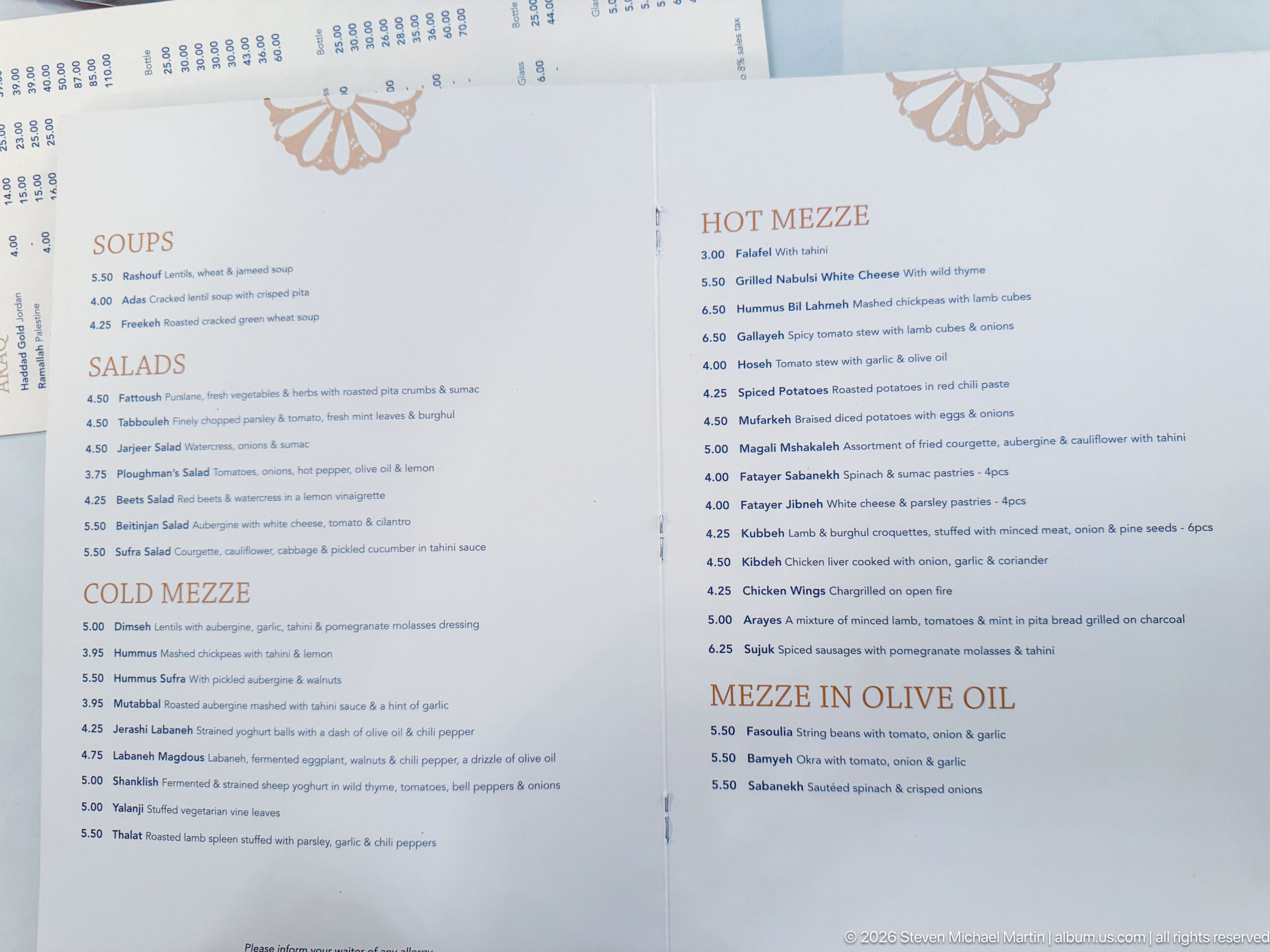
A restaurant menu documents the structure of a Jordanian meal through sections for soups, salads, hot mezze, cold mezze, and dishes served in olive oil. Individual listings include familiar regional staples and provide a useful textual record of the dining experience alongside the surrounding photographs of the restaurant and table.
Caption
A restaurant menu documents the structure of a Jordanian meal through sections for soups, salads, hot mezze, cold mezze, and dishes served in olive oil. Individual listings include familiar regional staples and provide a useful textual record of the dining experience alongside the surrounding photographs of the restaurant and table.
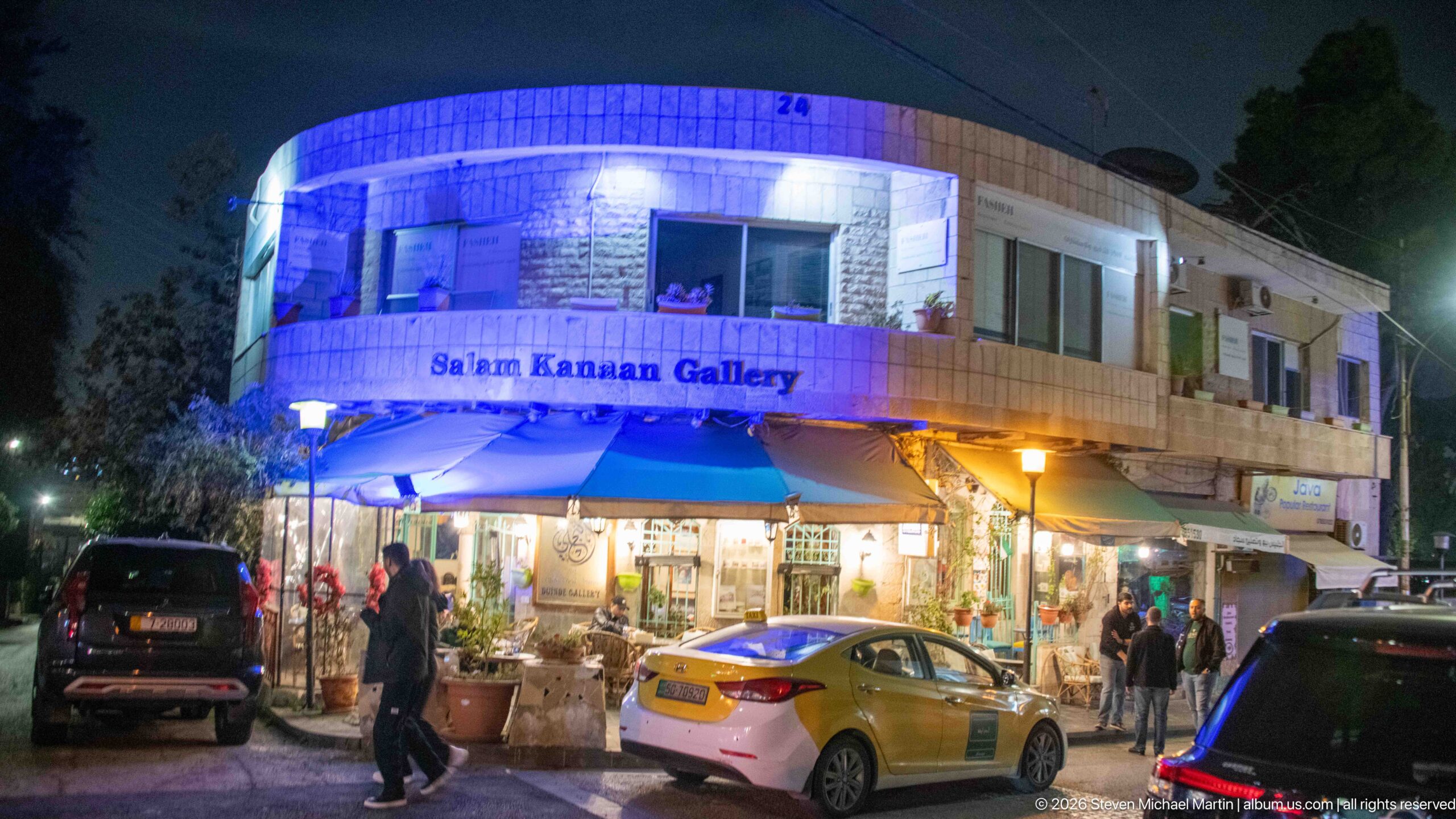
Salem Kanaan Gallery glows at a street corner in Amman after dark, its name visible above a brightly lit storefront filled with merchandise. Pedestrians, parked vehicles, awnings, and adjacent stone buildings situate the shop within a lively neighborhood commercial strip rather than as an isolated retail façade.
Caption
Salem Kanaan Gallery glows at a street corner in Amman after dark, its name visible above a brightly lit storefront filled with merchandise. Pedestrians, parked vehicles, awnings, and adjacent stone buildings situate the shop within a lively neighborhood commercial strip rather than as an isolated retail façade.
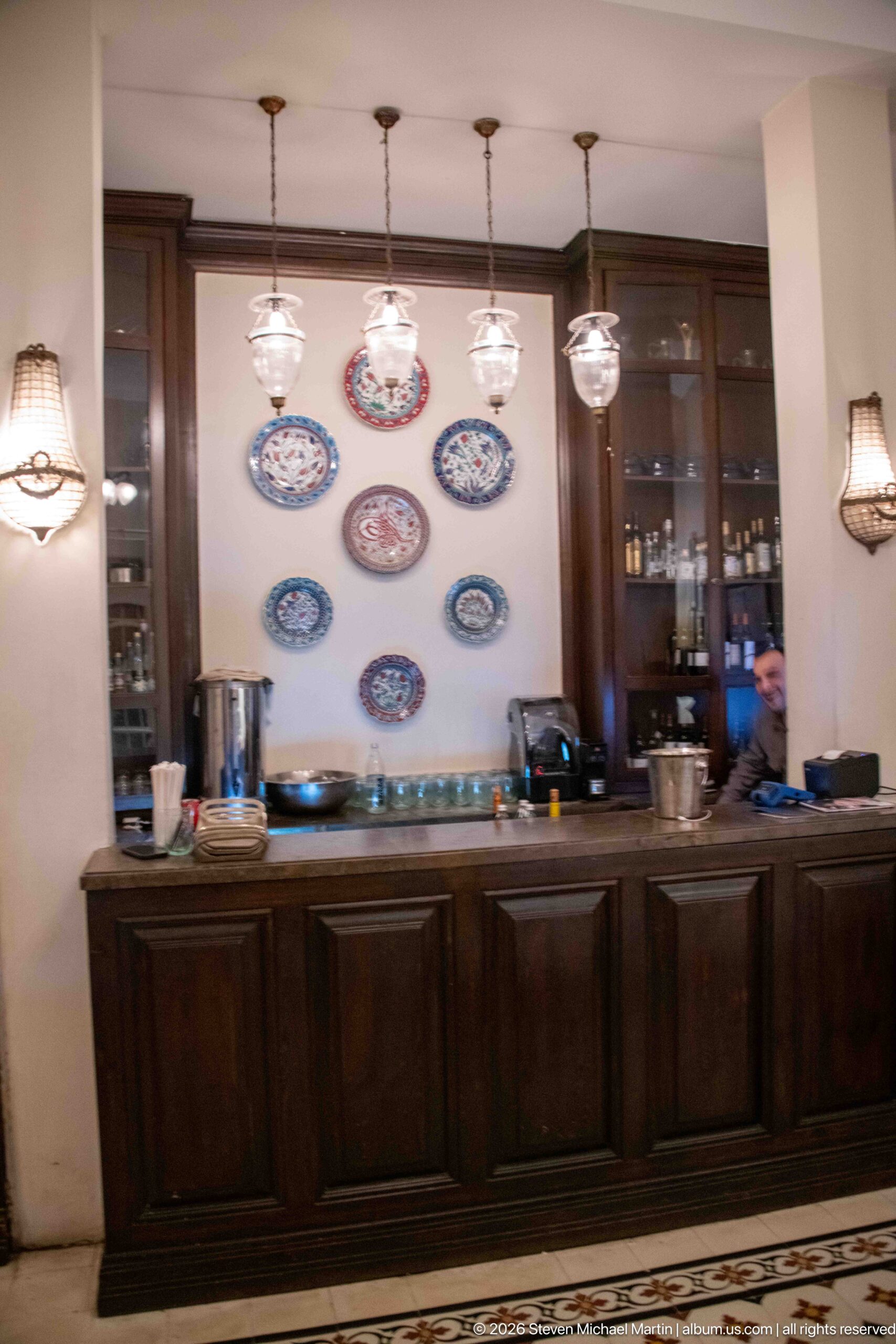
A dark wooden service counter anchors a restaurant interior in Amman, backed by a symmetrical display of colorful ceramic plates. Pendant lights hang overhead while shelves and service equipment occupy the cabinetry, giving this view the character of a refined but functional hospitality space.
Caption
A dark wooden service counter anchors a restaurant interior in Amman, backed by a symmetrical display of colorful ceramic plates. Pendant lights hang overhead while shelves and service equipment occupy the cabinetry, giving this view the character of a refined but functional hospitality space.
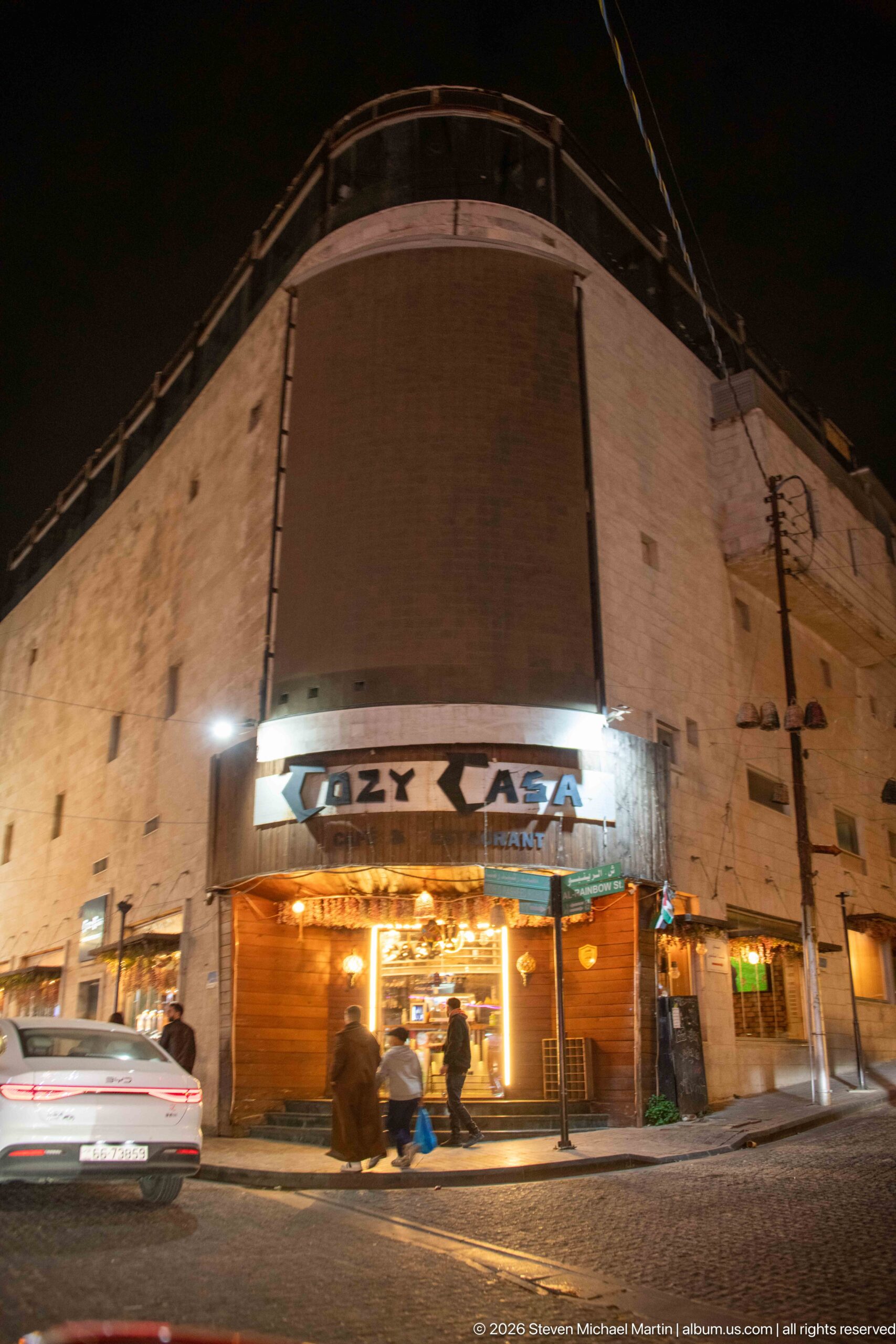
The Cozy Casa storefront occupies the ground floor of a rounded stone building in Amman, its illuminated sign and display windows standing out against the dark upper façade. Passing cars and pedestrians introduce motion at street level, giving the photograph the feel of a lived-in commercial neighborhood at night.
Caption
The Cozy Casa storefront occupies the ground floor of a rounded stone building in Amman, its illuminated sign and display windows standing out against the dark upper façade. Passing cars and pedestrians introduce motion at street level, giving the photograph the feel of a lived-in commercial neighborhood at night.
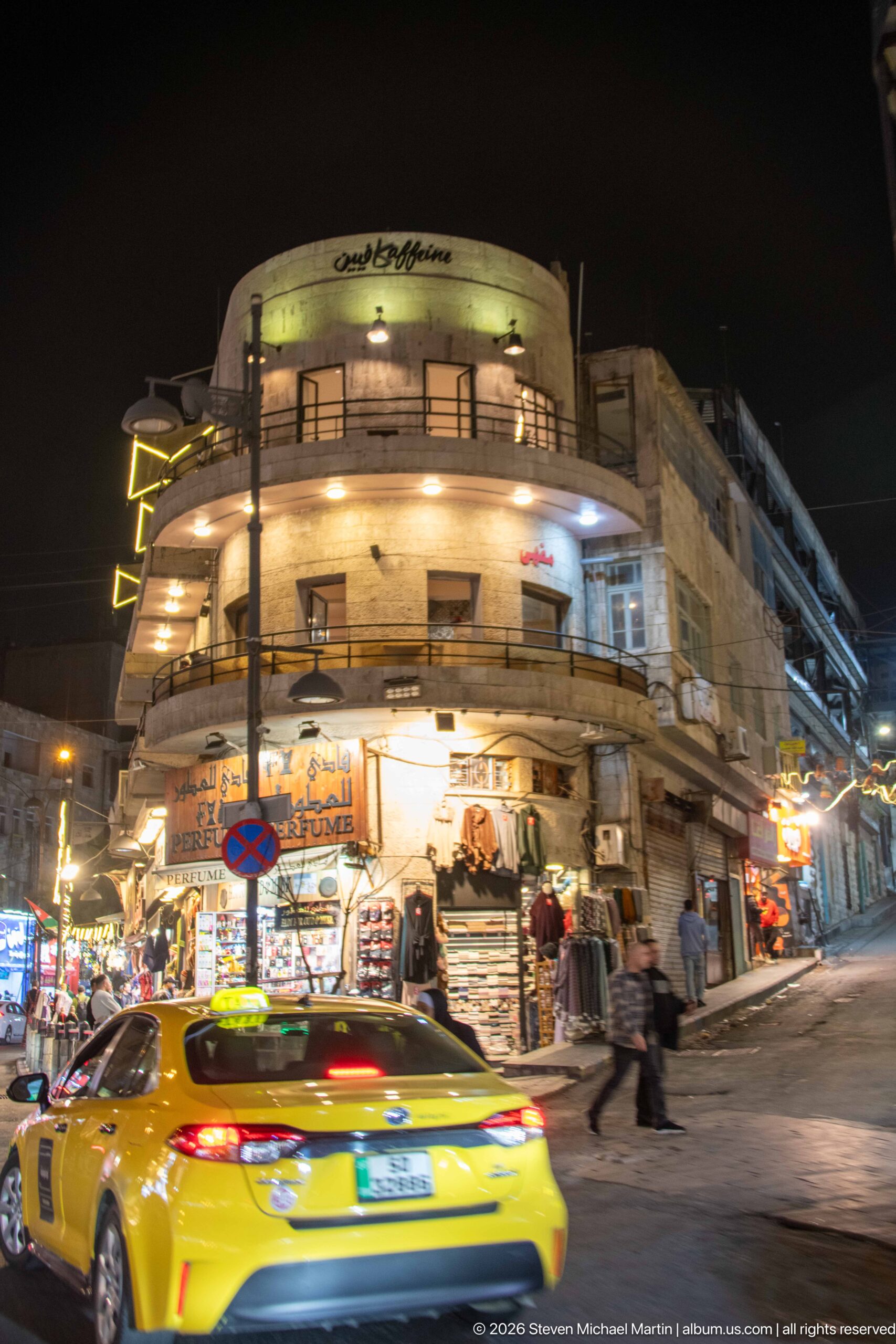
A yellow taxi sweeps through a night street in Amman, passing a rounded corner building lined with small shops and illuminated signs. Motion blur from the car contrasts with pedestrians and storefronts at the curb, turning the intersection into a lively study of evening movement in the Rainbow Street area.
Caption
A yellow taxi sweeps through a night street in Amman, passing a rounded corner building lined with small shops and illuminated signs. Motion blur from the car contrasts with pedestrians and storefronts at the curb, turning the intersection into a lively study of evening movement in the Rainbow Street area.
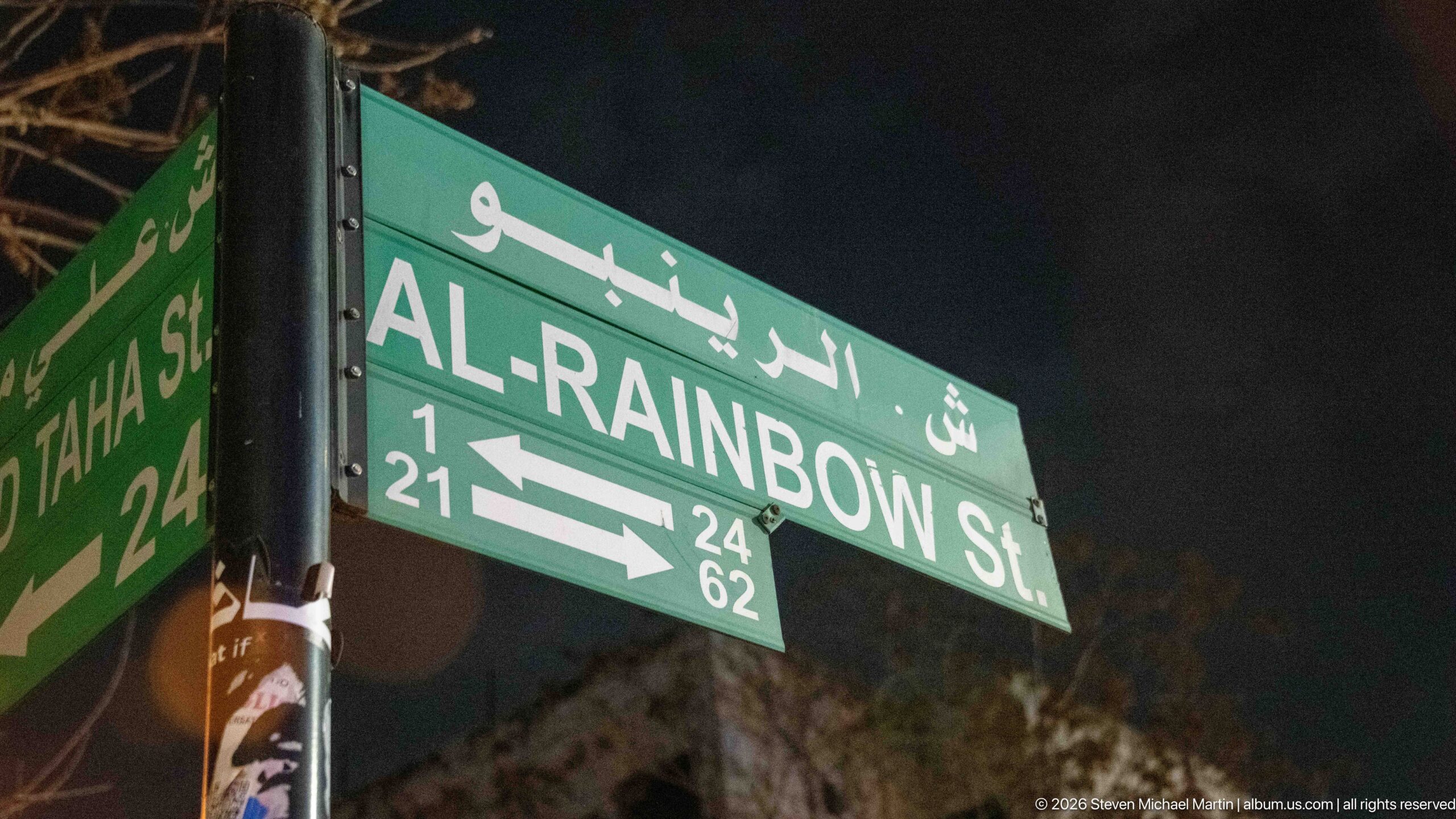
A bilingual road sign marks Al-Rainbow Street in Amman, with Arabic and English lettering and directional arrows visible under streetlights. Photographed at night, the sign serves as a concise geographic marker for one of the city’s best-known pedestrian and dining districts.
Caption
A bilingual road sign marks Al-Rainbow Street in Amman, with Arabic and English lettering and directional arrows visible under streetlights. Photographed at night, the sign serves as a concise geographic marker for one of the city’s best-known pedestrian and dining districts.
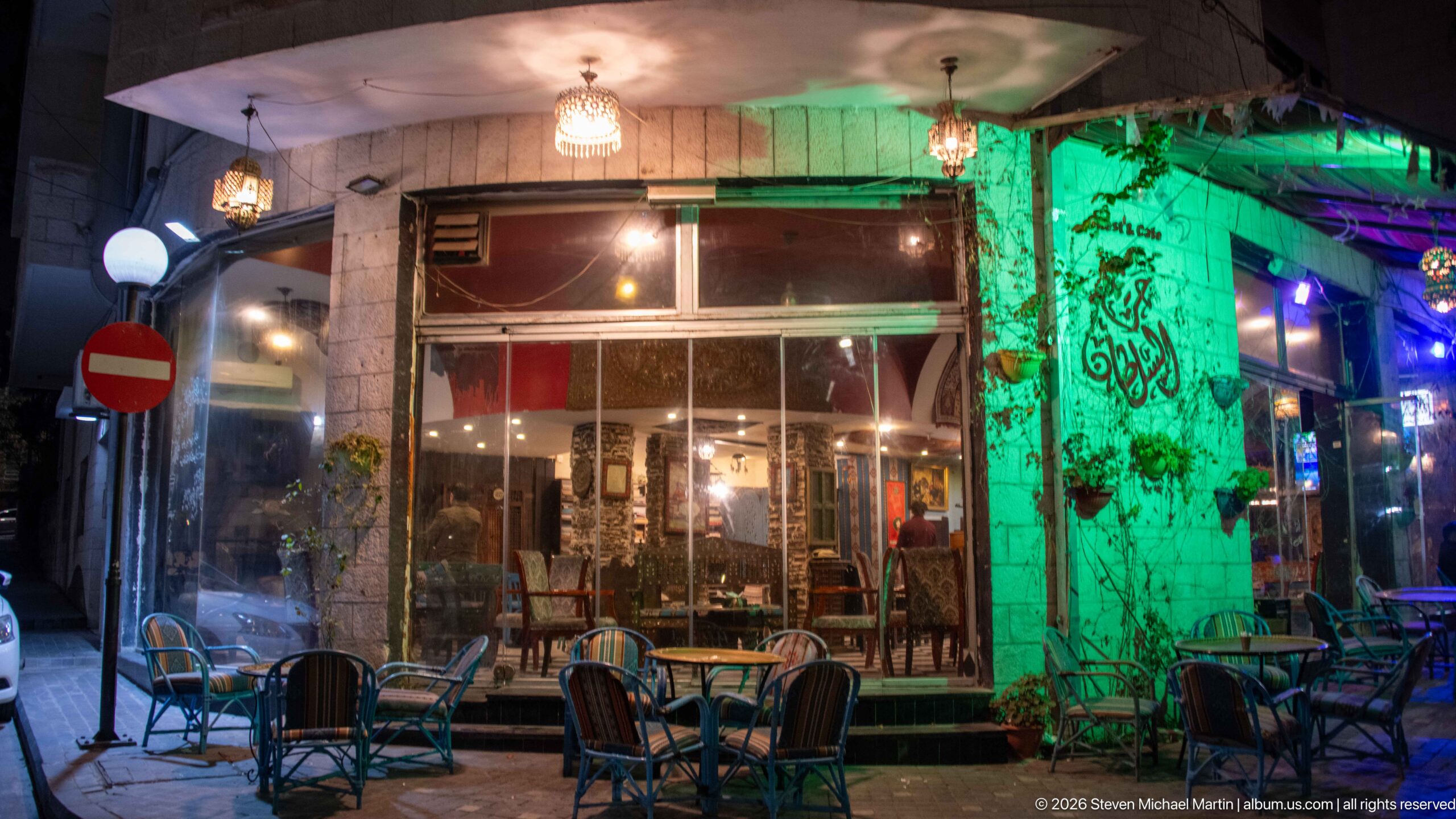
Empty café tables and woven chairs line an Amman sidewalk after dark, beside a stone wall washed in green light. Warm lamps under the awning and the colorful illumination around the entrance create a quiet late-evening street scene, with the dining area open directly to the neighborhood around it.
Caption
Empty café tables and woven chairs line an Amman sidewalk after dark, beside a stone wall washed in green light. Warm lamps under the awning and the colorful illumination around the entrance create a quiet late-evening street scene, with the dining area open directly to the neighborhood around it.
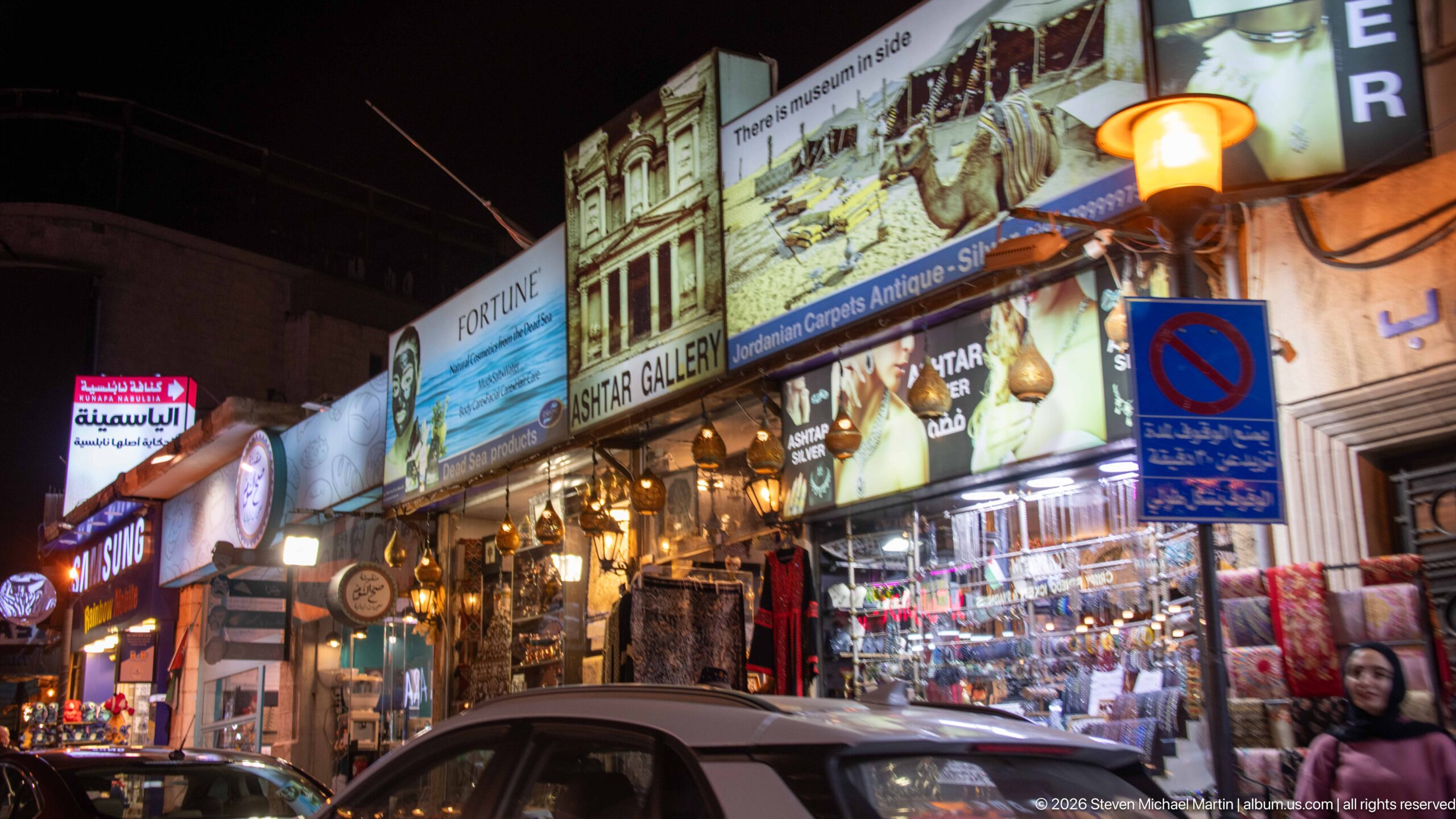
A row of brightly lit antique, gallery, and souvenir storefronts lines an Amman street at night. Layered signs, hanging lamps, shop windows, parked cars, and pedestrians create a dense commercial scene in which individual businesses merge into the broader visual rhythm of the neighborhood.
Caption
A row of brightly lit antique, gallery, and souvenir storefronts lines an Amman street at night. Layered signs, hanging lamps, shop windows, parked cars, and pedestrians create a dense commercial scene in which individual businesses merge into the broader visual rhythm of the neighborhood.
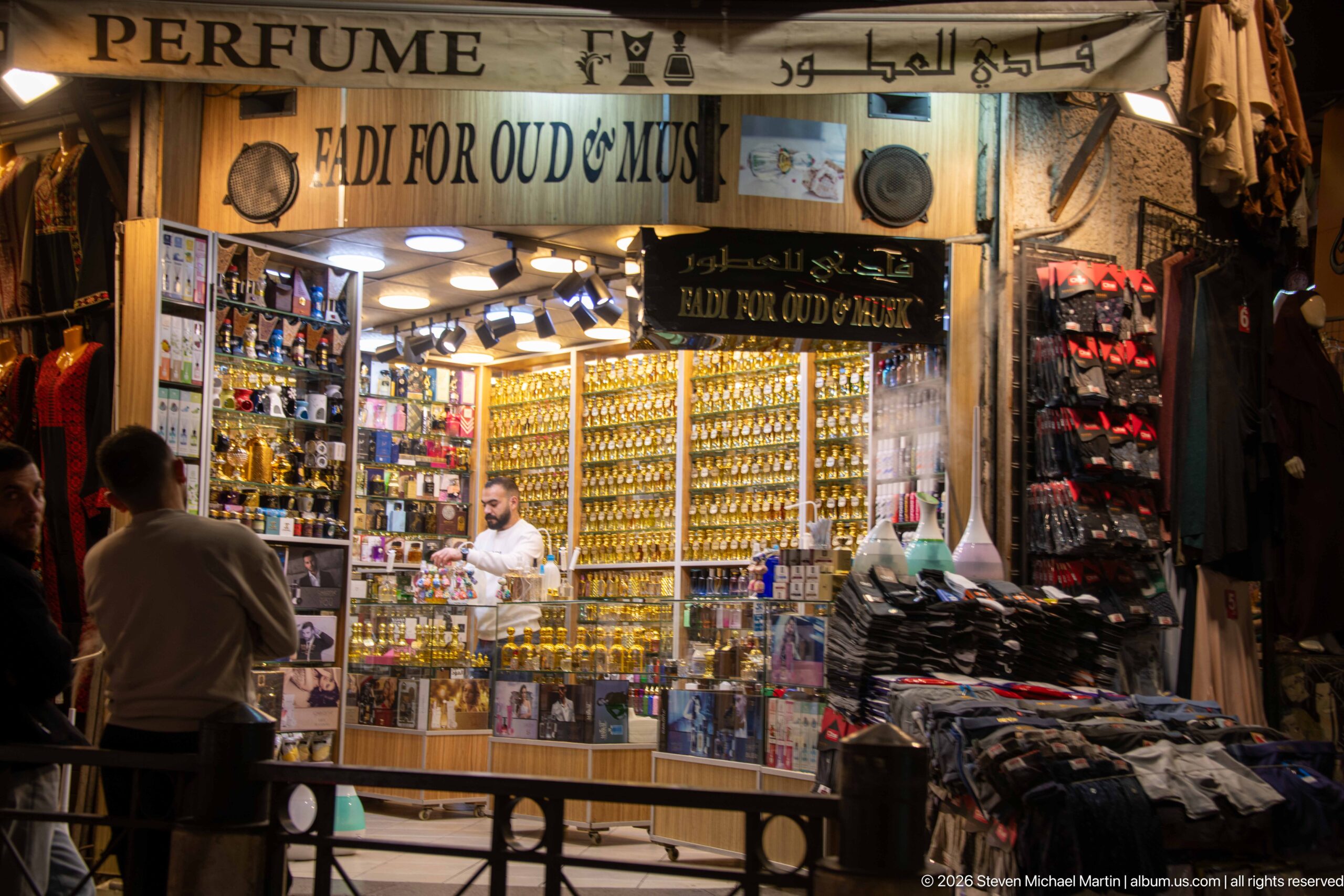
An Amman music shop displays rows of ouds and related instruments beneath signage advertising oud and music. Bright interior lighting reveals the dense wall display behind the counter, while customers and neighboring merchandise crowd the narrow street frontage, giving the scene a strong sense of local specialty retail.
Caption
An Amman music shop displays rows of ouds and related instruments beneath signage advertising oud and music. Bright interior lighting reveals the dense wall display behind the counter, while customers and neighboring merchandise crowd the narrow street frontage, giving the scene a strong sense of local specialty retail.
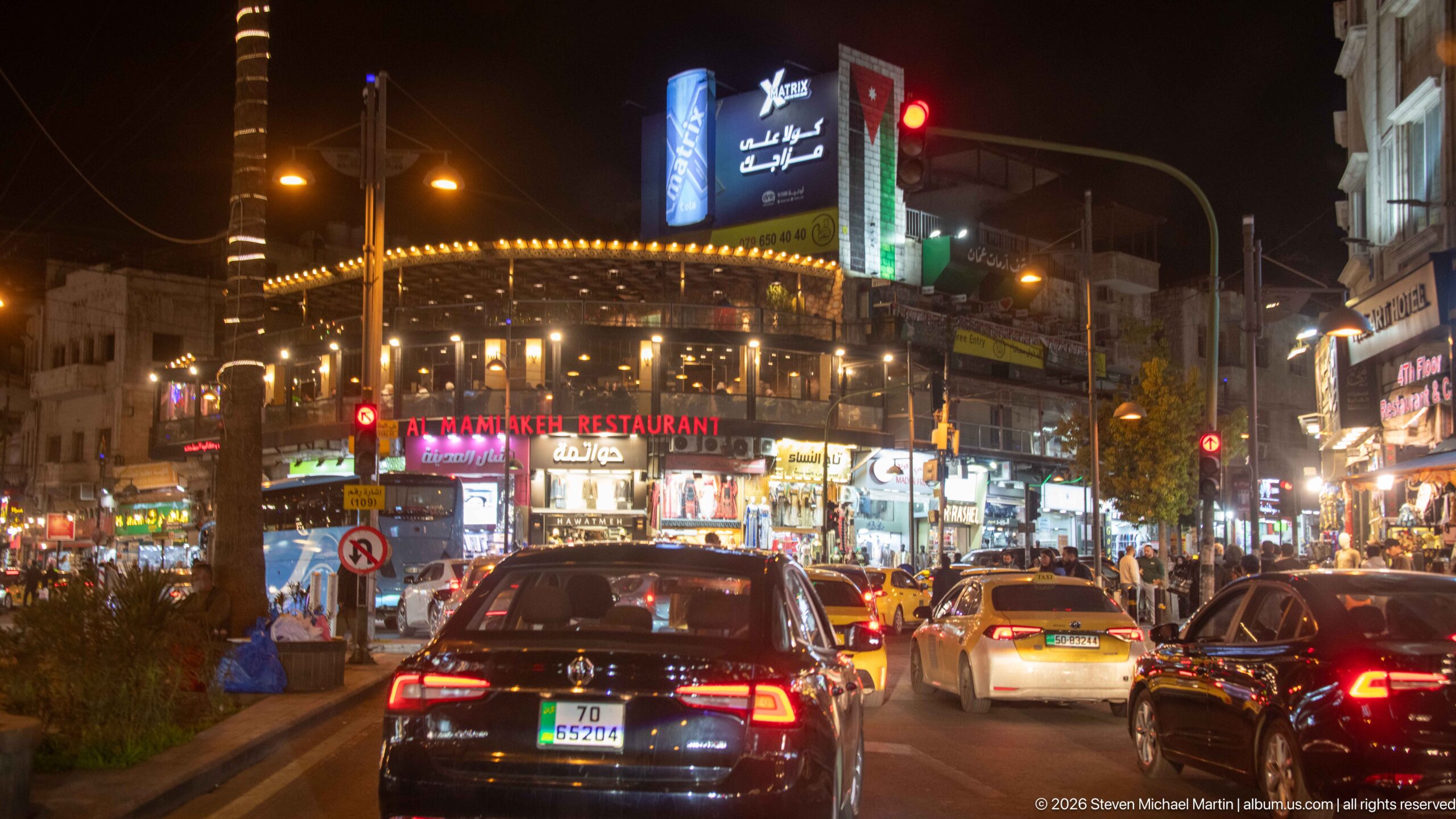
Night traffic fills a lively commercial intersection in Amman, where restaurant signs, storefront lighting, and a large illuminated Arabic billboard compete with red traffic signals and streams of cars. The dense mix of vehicles, pedestrians, signage, and multi-story buildings conveys the intensity of the capital after dark rather than isolating a single landmark.
Caption
Night traffic fills a lively commercial intersection in Amman, where restaurant signs, storefront lighting, and a large illuminated Arabic billboard compete with red traffic signals and streams of cars. The dense mix of vehicles, pedestrians, signage, and multi-story buildings conveys the intensity of the capital after dark rather than isolating a single landmark.
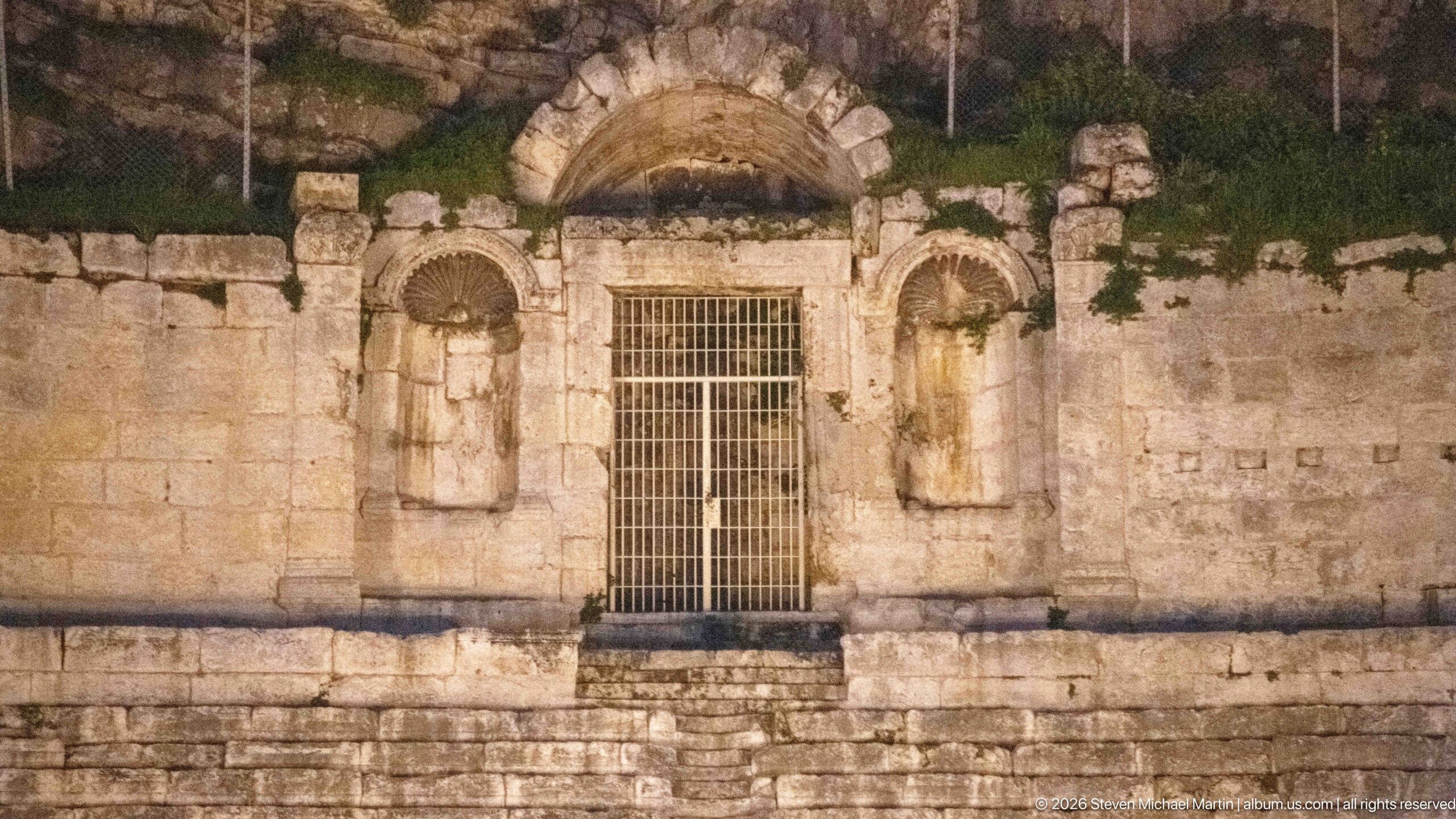
An illuminated ancient stone façade in Amman presents a tall central arched opening secured by a metal gate, flanked by smaller recessed arches and framed with dressed masonry. Weathered blocks, carved moldings, and vegetation along the upper edge emphasize the structure’s archaeological character while night lighting reveals the layered depth of the niches and wall surface.
Caption
An illuminated ancient stone façade in Amman presents a tall central arched opening secured by a metal gate, flanked by smaller recessed arches and framed with dressed masonry. Weathered blocks, carved moldings, and vegetation along the upper edge emphasize the structure’s archaeological character while night lighting reveals the layered depth of the niches and wall surface.
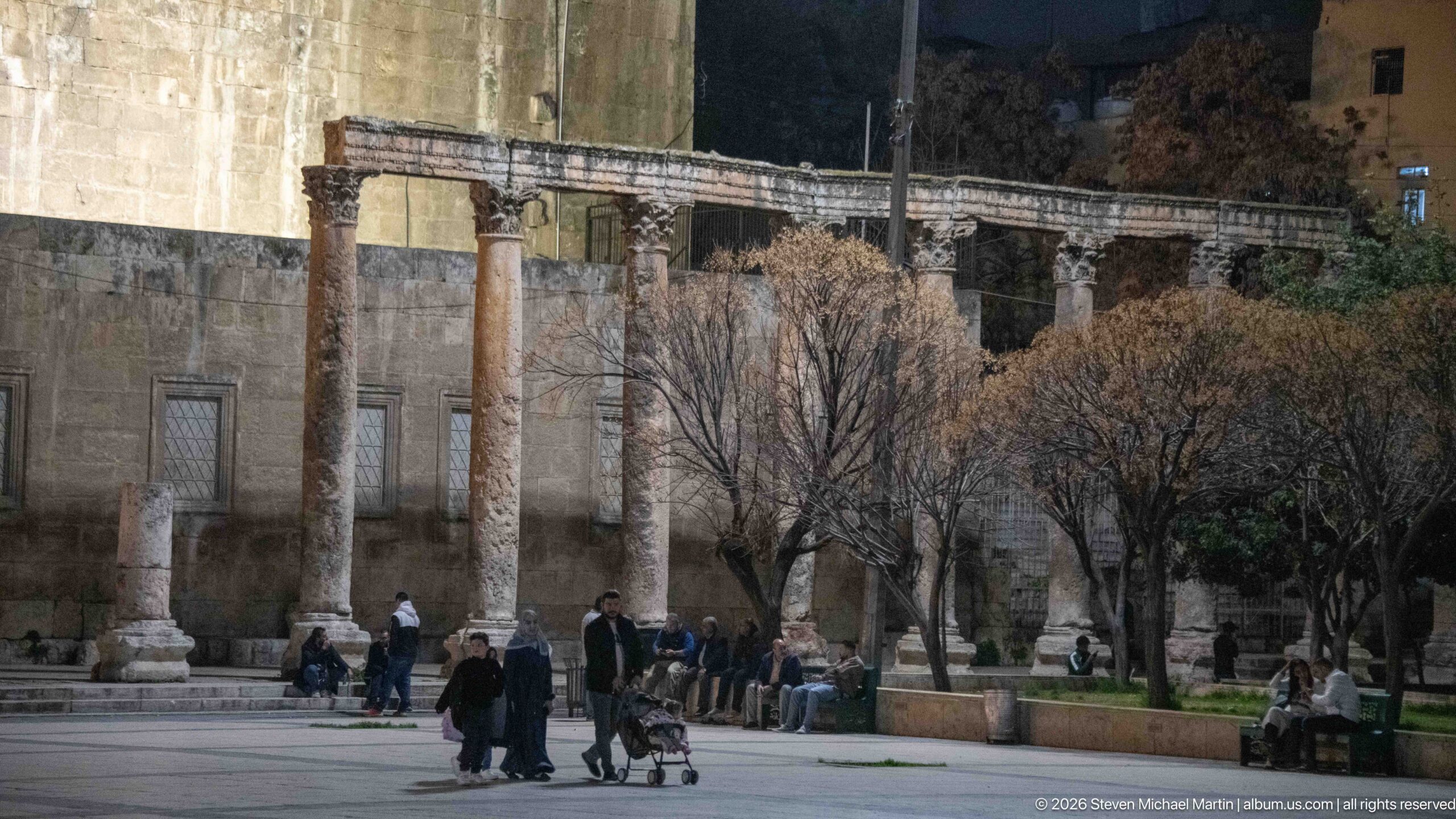
A line of tall stone columns rises beside a paved public space in Amman, with fragments of column bases and other architectural remains distributed across the foreground. Mature trees and people using the plaza bring the archaeological fabric into direct contact with contemporary city life, while the nighttime illumination separates the surviving columns from the darker masonry behind them.
Caption
A line of tall stone columns rises beside a paved public space in Amman, with fragments of column bases and other architectural remains distributed across the foreground. Mature trees and people using the plaza bring the archaeological fabric into direct contact with contemporary city life, while the nighttime illumination separates the surviving columns from the darker masonry behind them.
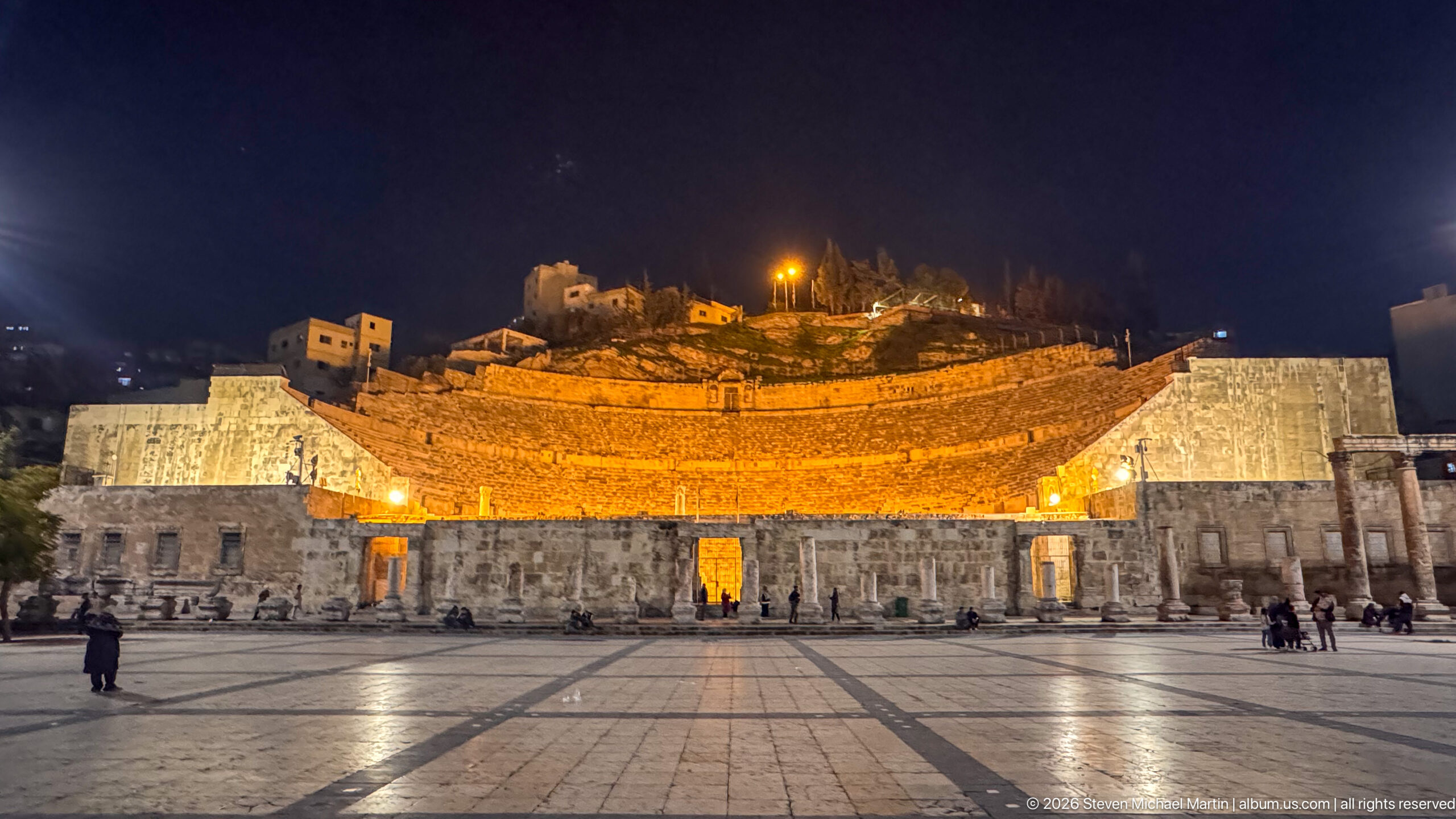
Amman’s Roman Theater is seen almost frontally at night, its illuminated cavea centered above the long stone stage building and monumental lower openings. The paved foreground directs the eye toward the central doorway, while the surrounding urban hillside remains subdued. This composition emphasizes symmetry, the layered stage façade, and the steep rise of the ancient seating.
Caption
Amman’s Roman Theater is seen almost frontally at night, its illuminated cavea centered above the long stone stage building and monumental lower openings. The paved foreground directs the eye toward the central doorway, while the surrounding urban hillside remains subdued. This composition emphasizes symmetry, the layered stage façade, and the steep rise of the ancient seating.
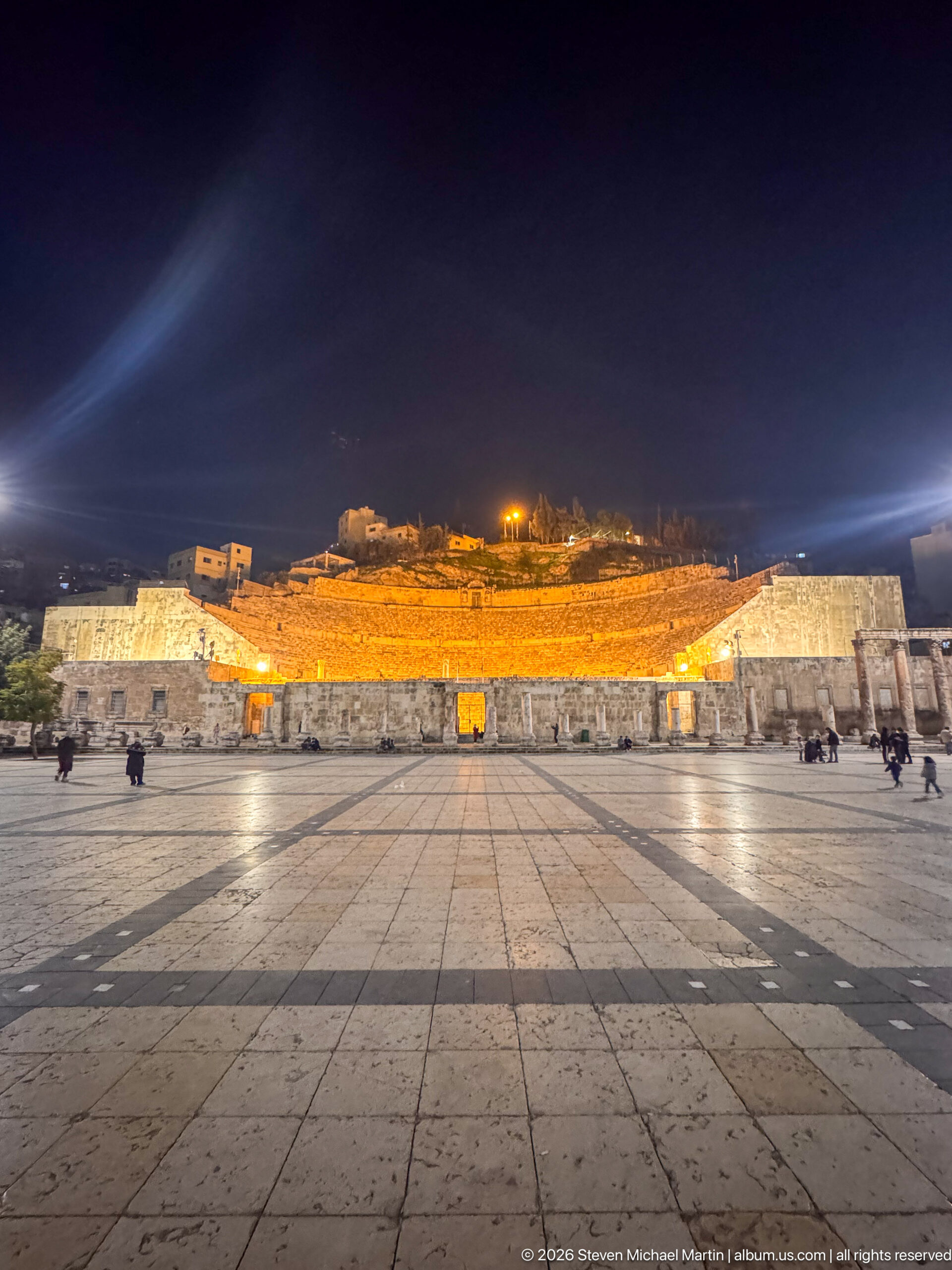
A wide nighttime view places Amman’s Roman Theater at the far side of an expansive stone-paved forecourt. The illuminated seating forms a shallow golden arc against the dark hillside, while the empty foreground exaggerates the monument’s scale and urban openness. Light beams and scattered visitors add atmosphere without obscuring the theater’s strong geometric relationship to the plaza.
Caption
A wide nighttime view places Amman’s Roman Theater at the far side of an expansive stone-paved forecourt. The illuminated seating forms a shallow golden arc against the dark hillside, while the empty foreground exaggerates the monument’s scale and urban openness. Light beams and scattered visitors add atmosphere without obscuring the theater’s strong geometric relationship to the plaza.
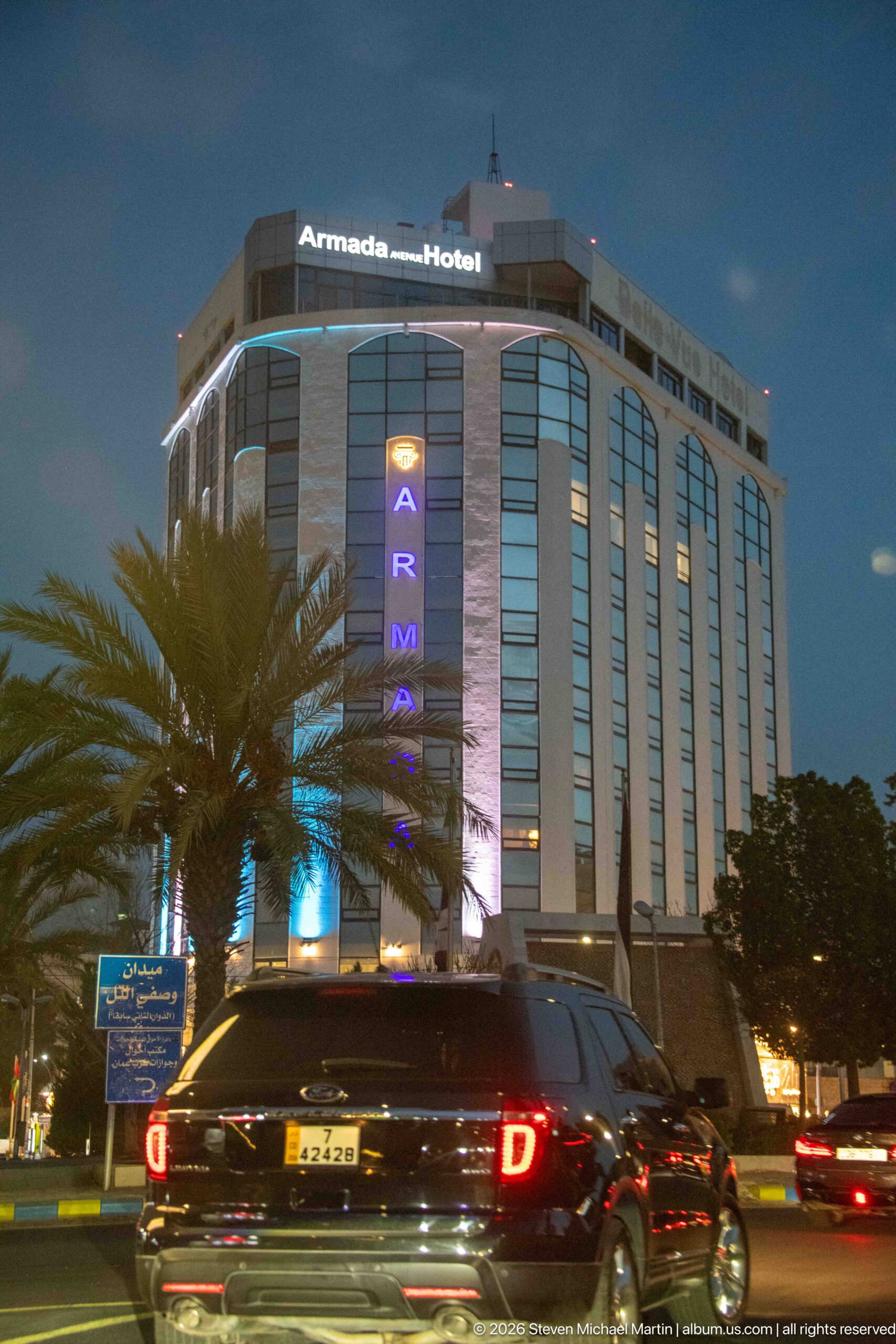
The Armada Hotel rises beside a palm-lined Amman roadway, its name visible along the roofline and again in vertical illuminated letters on the façade. Curved glass and pale stone surfaces catch blue and purple accent lighting while cars move through the foreground. The image records the hotel as part of the capital’s contemporary hospitality and commercial landscape.
Caption
The Armada Hotel rises beside a palm-lined Amman roadway, its name visible along the roofline and again in vertical illuminated letters on the façade. Curved glass and pale stone surfaces catch blue and purple accent lighting while cars move through the foreground. The image records the hotel as part of the capital’s contemporary hospitality and commercial landscape.
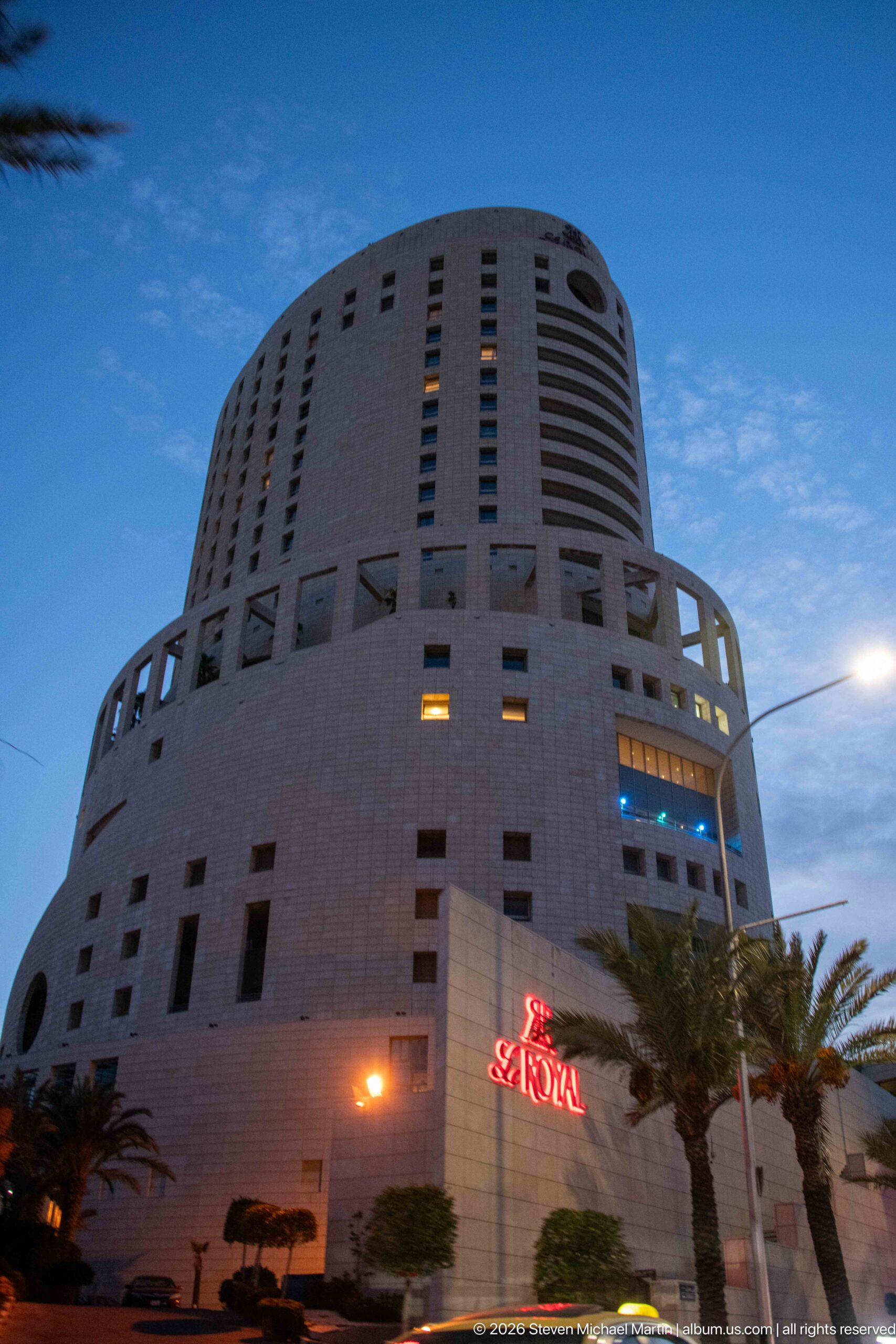
Le Royal Amman is seen from street level at dusk, its massive rounded tower rising above a broad stone-clad base with bands of horizontal openings. The building’s illuminated red Royal signage is visible near the lower façade, while palm trees and the upward-looking perspective emphasize the hotel’s scale and sculptural form within the modern city skyline.
Caption
Le Royal Amman is seen from street level at dusk, its massive rounded tower rising above a broad stone-clad base with bands of horizontal openings. The building’s illuminated red Royal signage is visible near the lower façade, while palm trees and the upward-looking perspective emphasize the hotel’s scale and sculptural form within the modern city skyline.
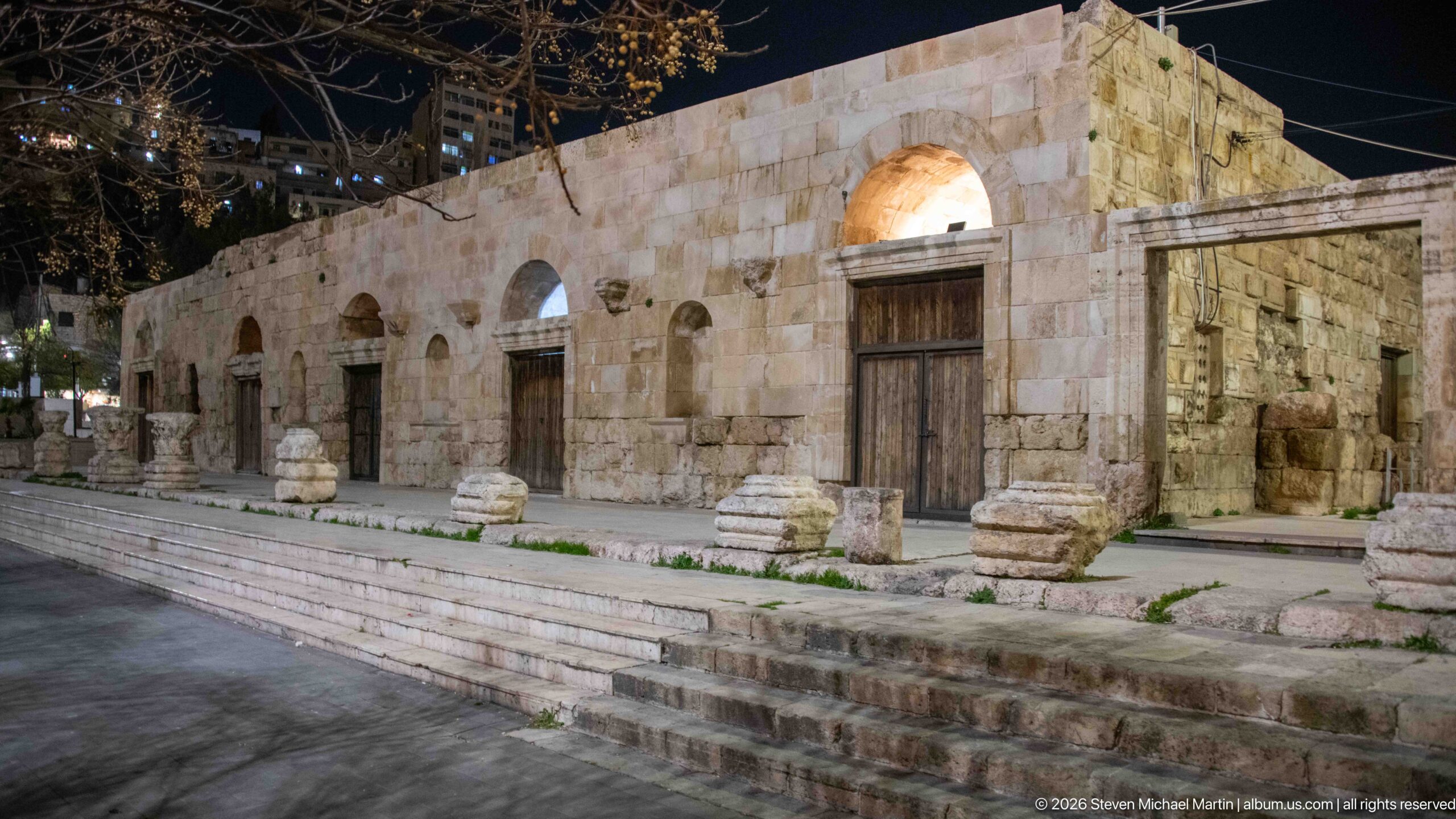
A long ancient stone building in Amman is articulated by repeated arched openings and heavy wooden doors, with loose column drums and carved fragments arranged along the raised platform in front. Night lighting accentuates differences between smooth ashlar blocks, rougher repairs, and the rhythm of the façade, giving the scene the character of an archaeological structure adapted within a modern public setting.
Caption
A long ancient stone building in Amman is articulated by repeated arched openings and heavy wooden doors, with loose column drums and carved fragments arranged along the raised platform in front. Night lighting accentuates differences between smooth ashlar blocks, rougher repairs, and the rhythm of the façade, giving the scene the character of an archaeological structure adapted within a modern public setting.
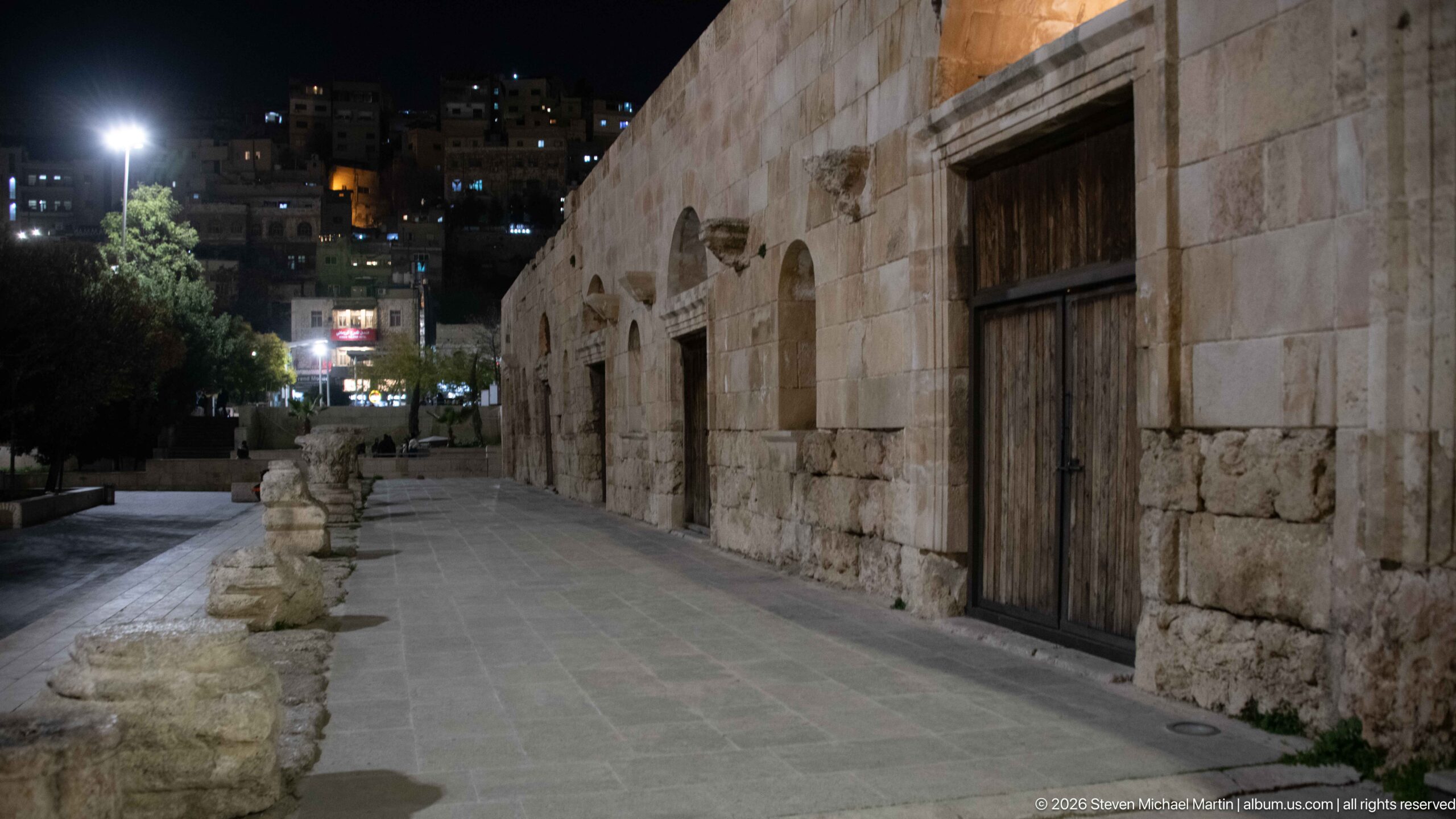
An oblique nighttime view follows the length of an ancient limestone façade in Amman, where deep arched openings, massive wooden doors, and irregular lower masonry reveal successive construction and repair. A row of stone fragments lines the adjacent walkway, while densely built hills rise in the background, placing the archaeological remains directly within the contemporary city.
Caption
An oblique nighttime view follows the length of an ancient limestone façade in Amman, where deep arched openings, massive wooden doors, and irregular lower masonry reveal successive construction and repair. A row of stone fragments lines the adjacent walkway, while densely built hills rise in the background, placing the archaeological remains directly within the contemporary city.
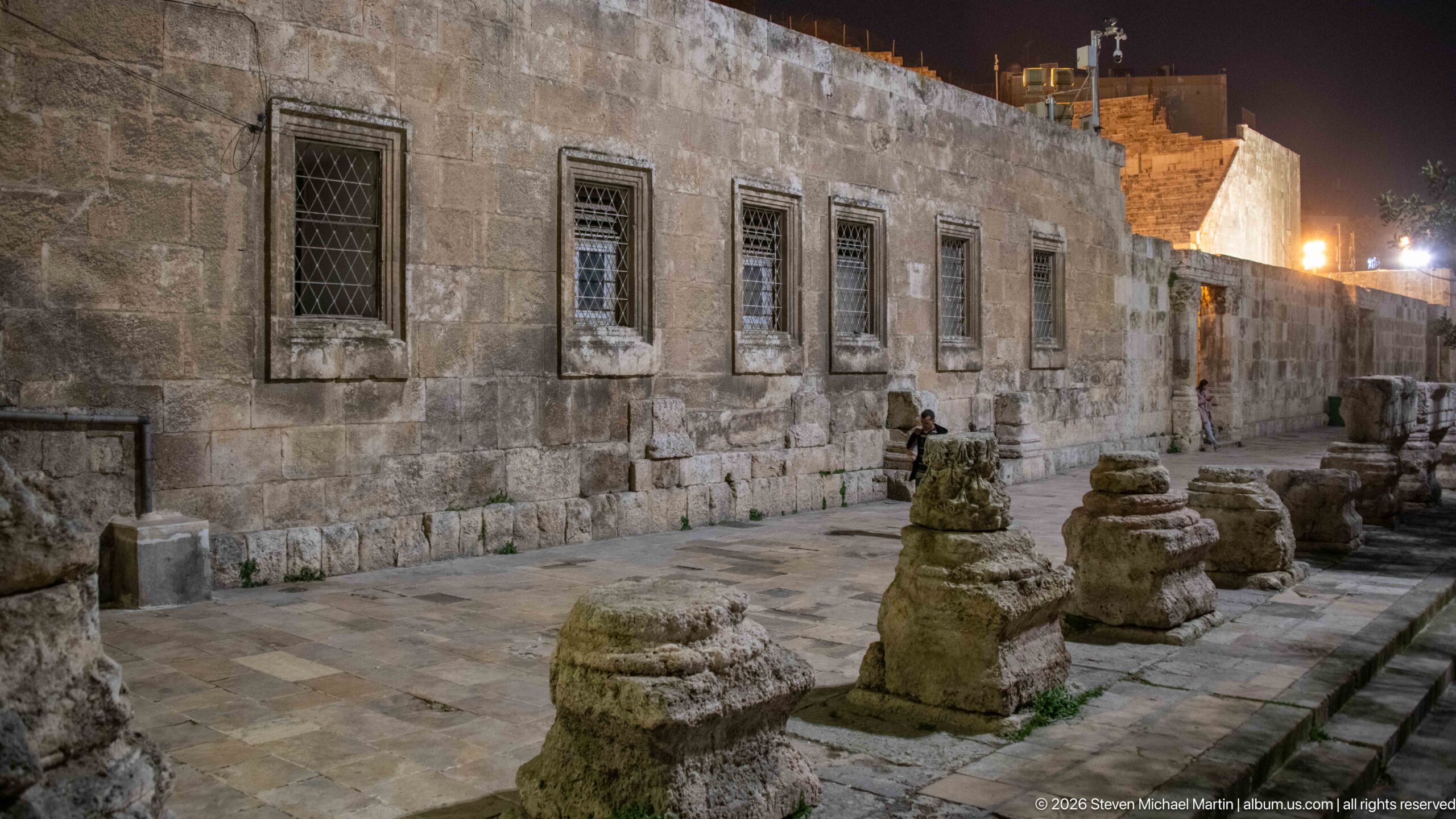
A weathered stone wall with a row of small barred windows borders an archaeological space in Amman, where carved column bases and other fragments stand on the paving in the foreground. The close viewpoint emphasizes reused stonework, surface wear, and the contrast between intact wall openings and displaced architectural pieces, offering a more detailed study of the site than the neighboring wide views.
Caption
A weathered stone wall with a row of small barred windows borders an archaeological space in Amman, where carved column bases and other fragments stand on the paving in the foreground. The close viewpoint emphasizes reused stonework, surface wear, and the contrast between intact wall openings and displaced architectural pieces, offering a more detailed study of the site than the neighboring wide views.
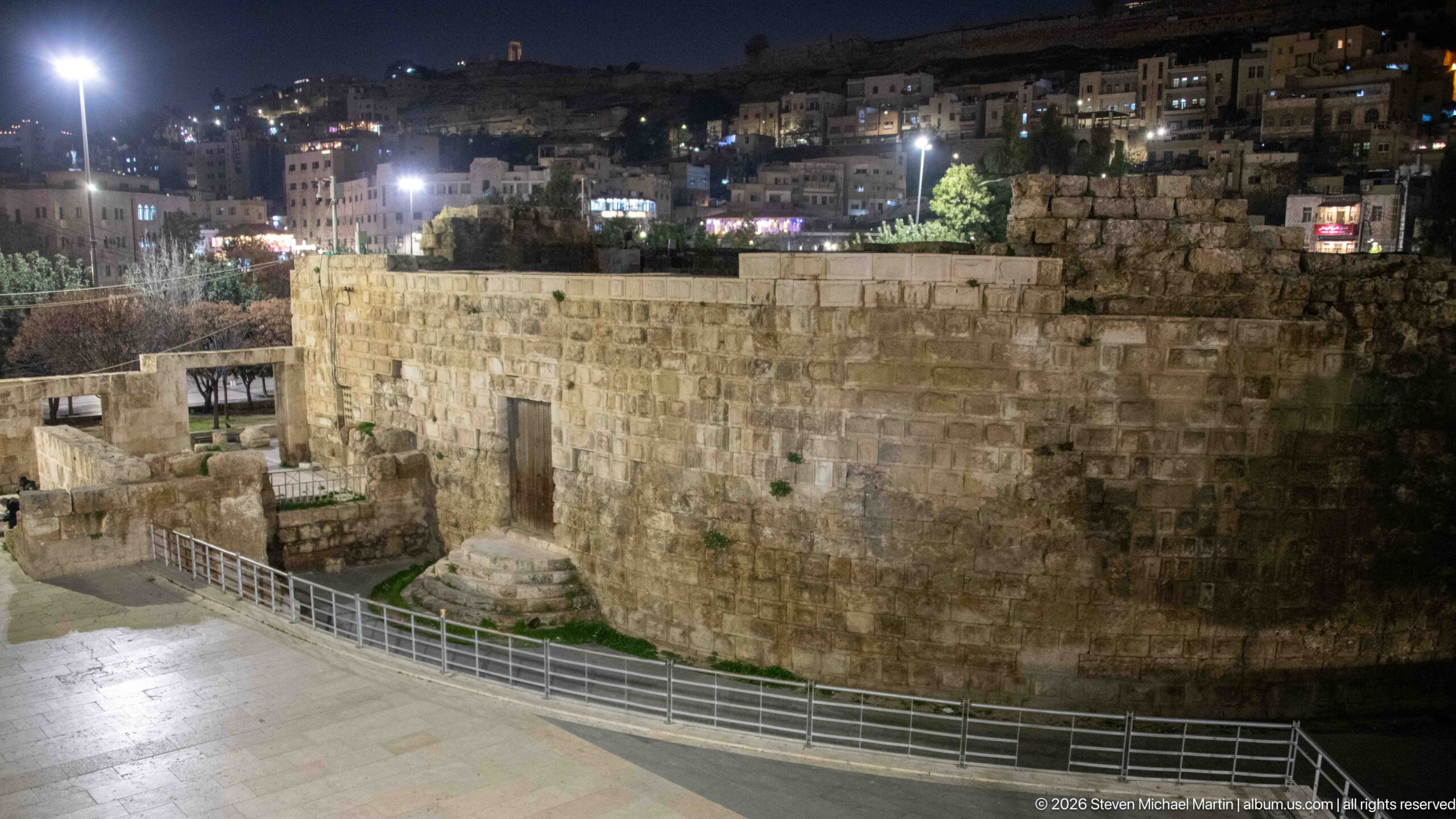
A massive block-built wall dominates this nighttime archaeological view in Amman, standing above a lower excavated or sunken area reached by a modern-railed walkway. The rough, layered masonry contrasts with the bright apartment-covered hillside beyond, emphasizing how substantial ancient remains survive amid the dense modern city and its steep topography.
Caption
A massive block-built wall dominates this nighttime archaeological view in Amman, standing above a lower excavated or sunken area reached by a modern-railed walkway. The rough, layered masonry contrasts with the bright apartment-covered hillside beyond, emphasizing how substantial ancient remains survive amid the dense modern city and its steep topography.
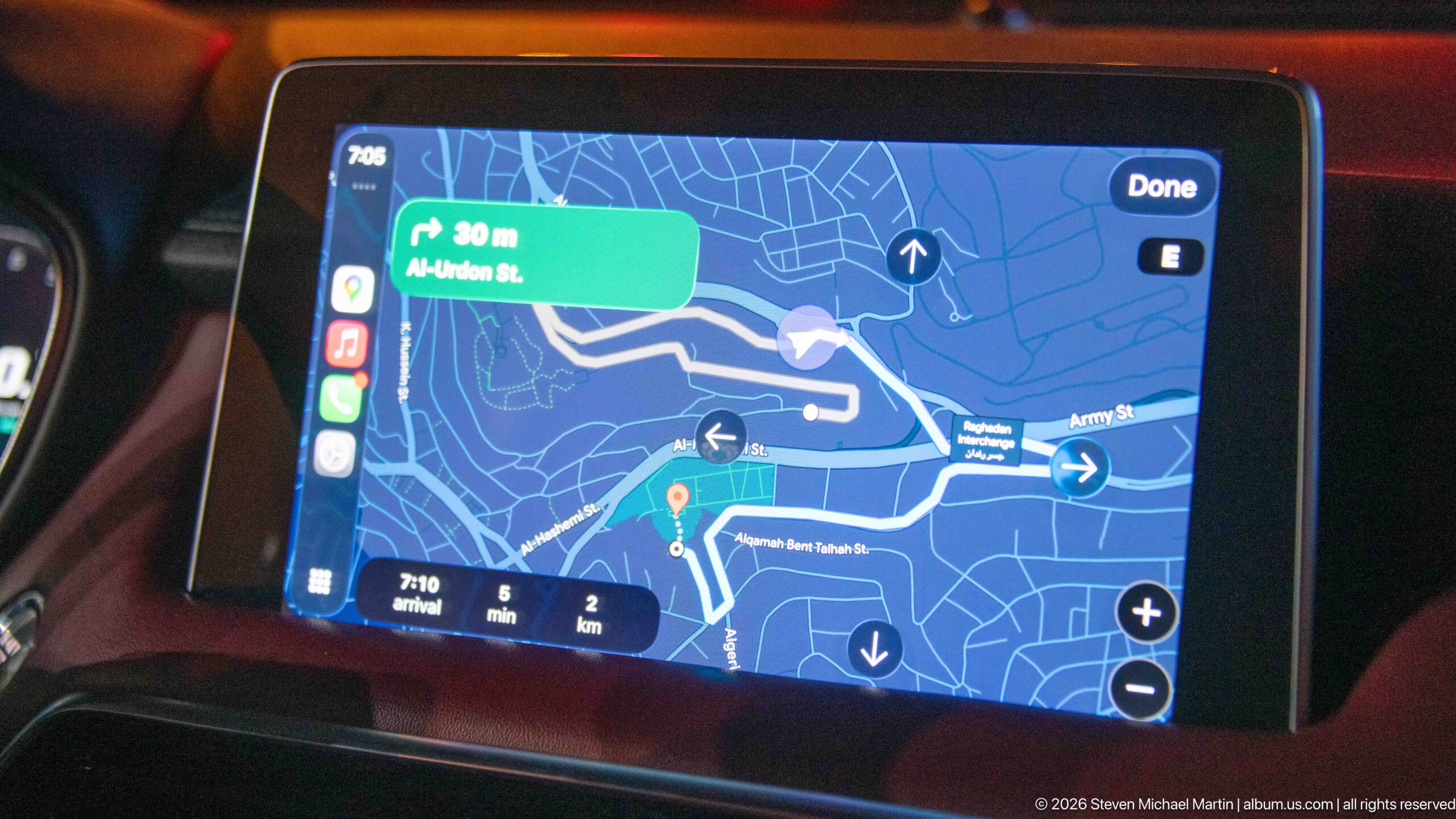
An in-car navigation display maps a short route through Amman, with the screen showing street geometry, directional arrows, and a turn instruction for Al-Urdon Street. Reflections and the red dashboard surround the digital map, making this a distinctly contemporary counterpoint to the archaeological scenes elsewhere in the portfolio and documenting movement through the city rather than a fixed landmark.
Caption
An in-car navigation display maps a short route through Amman, with the screen showing street geometry, directional arrows, and a turn instruction for Al-Urdon Street. Reflections and the red dashboard surround the digital map, making this a distinctly contemporary counterpoint to the archaeological scenes elsewhere in the portfolio and documenting movement through the city rather than a fixed landmark.
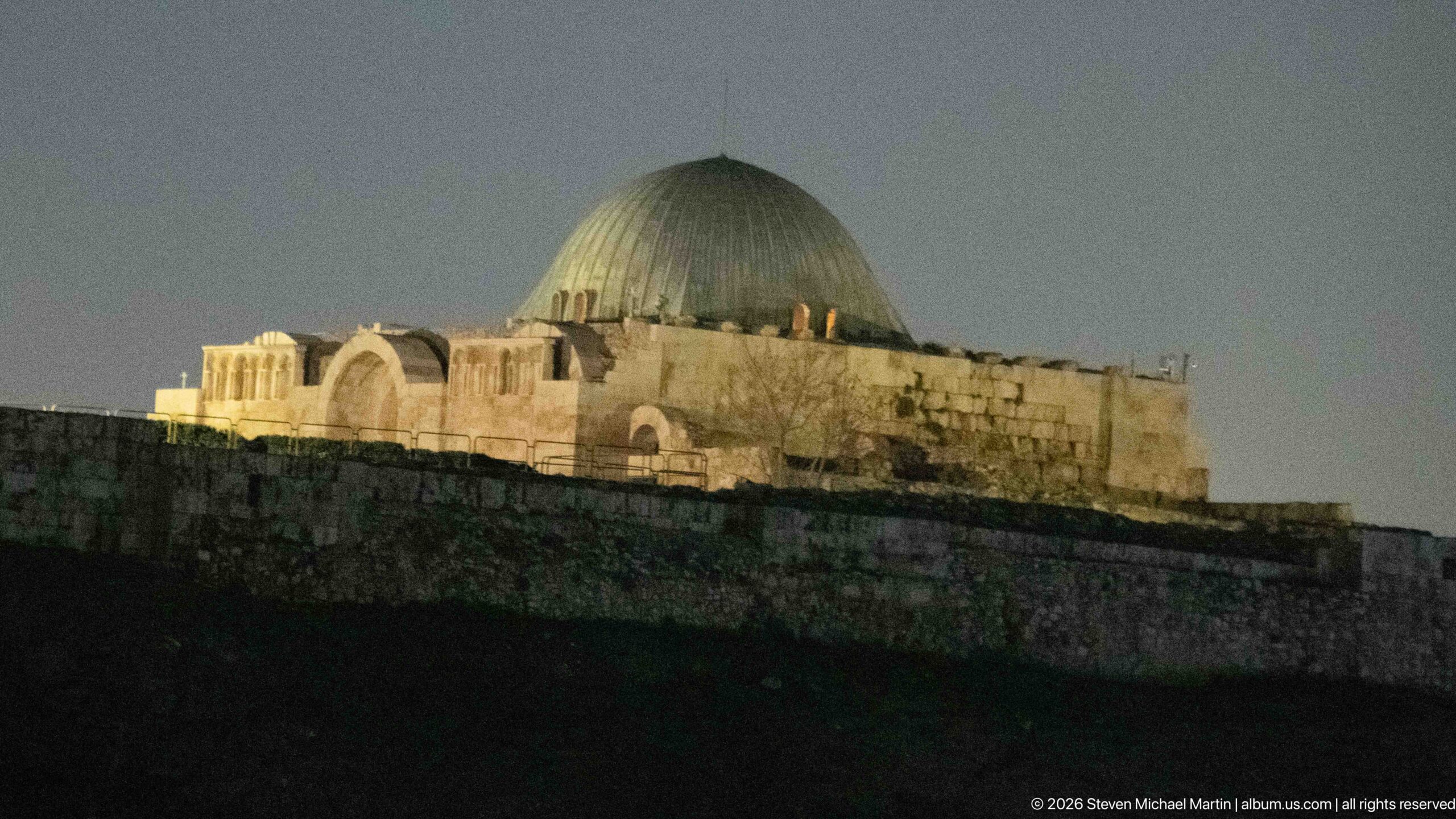
A large ribbed dome crowns a historic stone building on an elevated site in Amman, its softly lit walls and arched forms silhouetted against the evening sky. The low viewpoint leaves much of the foreground in shadow, concentrating attention on the dome’s profile, masonry massing, and prominent hilltop position while avoiding a more specific identification that the proof sheet alone cannot securely establish.
Caption
A large ribbed dome crowns a historic stone building on an elevated site in Amman, its softly lit walls and arched forms silhouetted against the evening sky. The low viewpoint leaves much of the foreground in shadow, concentrating attention on the dome’s profile, masonry massing, and prominent hilltop position while avoiding a more specific identification that the proof sheet alone cannot securely establish.
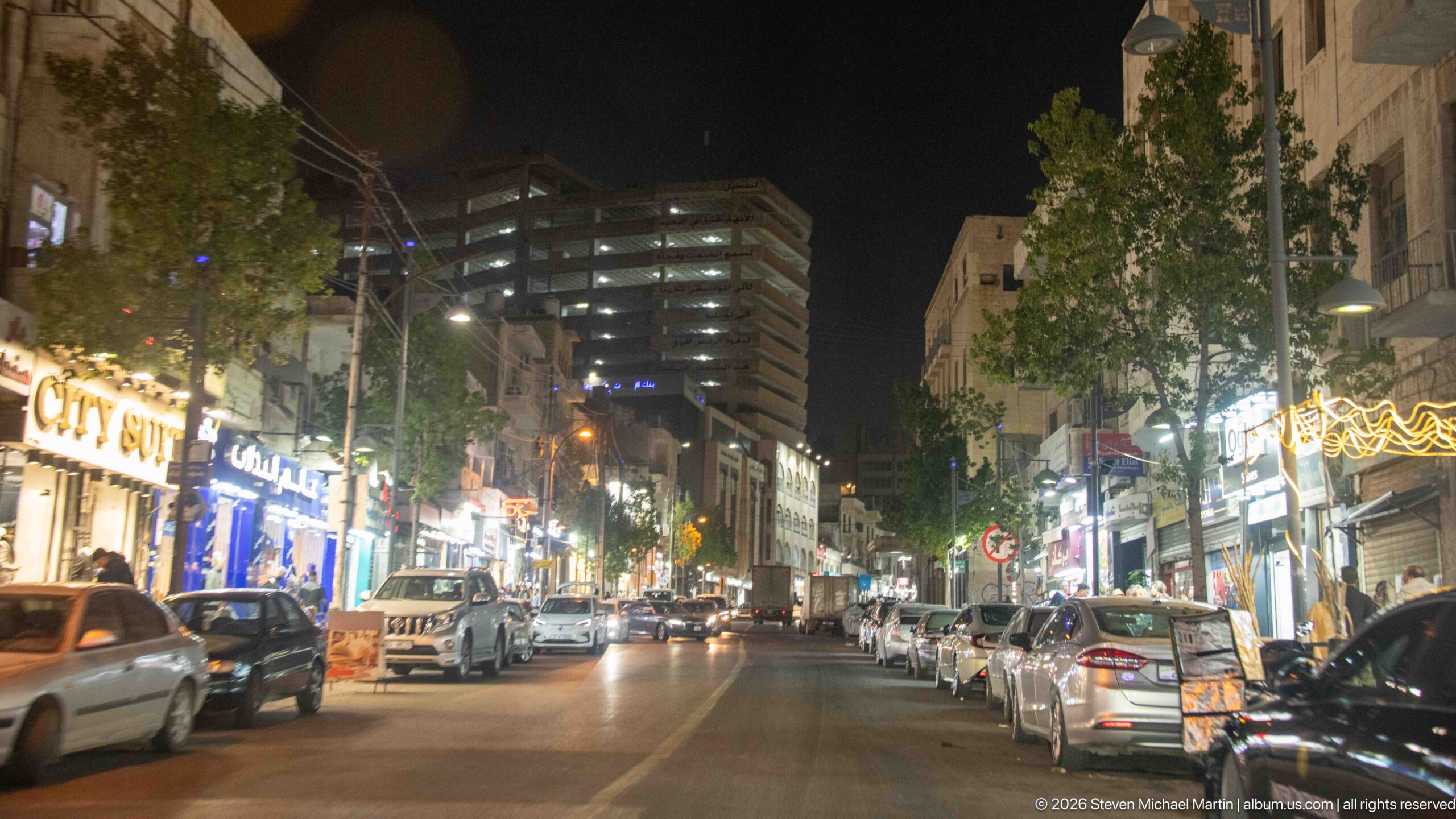
Cars line both sides of a commercial avenue in Amman as traffic moves beneath bright shop signs and decorative lighting. Mid-rise buildings frame the street, and restaurants and retail fronts remain active after dark. The centered roadway perspective gives a strong sense of everyday movement through a modern neighborhood rather than focusing on a single architectural landmark.
Caption
Cars line both sides of a commercial avenue in Amman as traffic moves beneath bright shop signs and decorative lighting. Mid-rise buildings frame the street, and restaurants and retail fronts remain active after dark. The centered roadway perspective gives a strong sense of everyday movement through a modern neighborhood rather than focusing on a single architectural landmark.
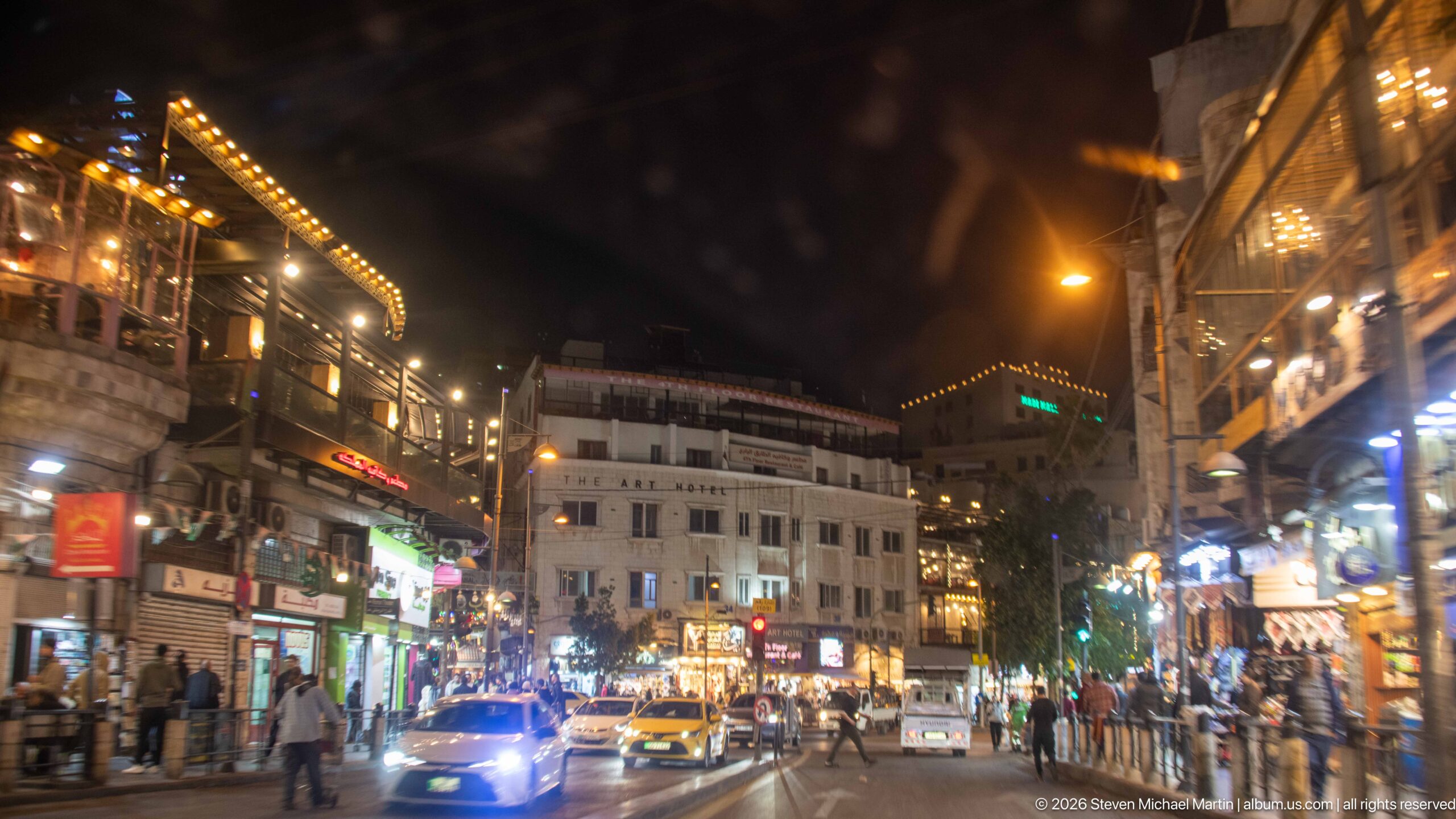
Bright shopfronts, pedestrians, and dense vehicle traffic animate a central Amman street after dark. Headlights and signs reflect across the roadway, while older low- and mid-rise buildings create a tightly enclosed urban corridor. The scene records the capital’s active evening street life, with motion blur and mixed lighting reinforcing the sense of movement and commercial intensity.
Caption
Bright shopfronts, pedestrians, and dense vehicle traffic animate a central Amman street after dark. Headlights and signs reflect across the roadway, while older low- and mid-rise buildings create a tightly enclosed urban corridor. The scene records the capital’s active evening street life, with motion blur and mixed lighting reinforcing the sense of movement and commercial intensity.
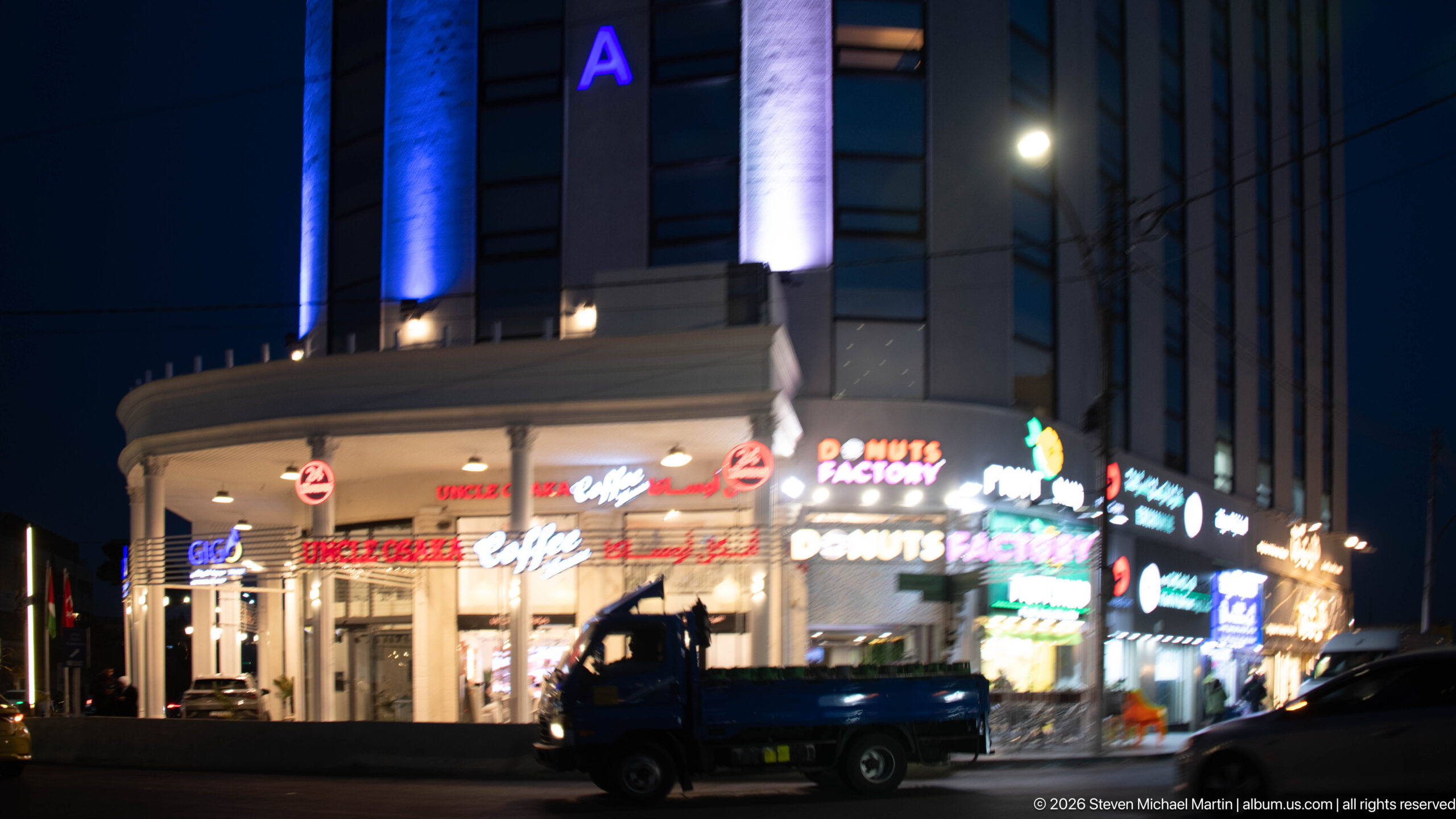
A brightly illuminated corner building in Amman presents a dense cluster of restaurant and café signs at street level beneath a modern multi-story façade. Vertical architectural lighting rises above the storefronts while a dark pickup truck passes across the foreground. The image concentrates on contemporary commercial architecture and the layered visual language of nighttime signage.
Caption
A brightly illuminated corner building in Amman presents a dense cluster of restaurant and café signs at street level beneath a modern multi-story façade. Vertical architectural lighting rises above the storefronts while a dark pickup truck passes across the foreground. The image concentrates on contemporary commercial architecture and the layered visual language of nighttime signage.
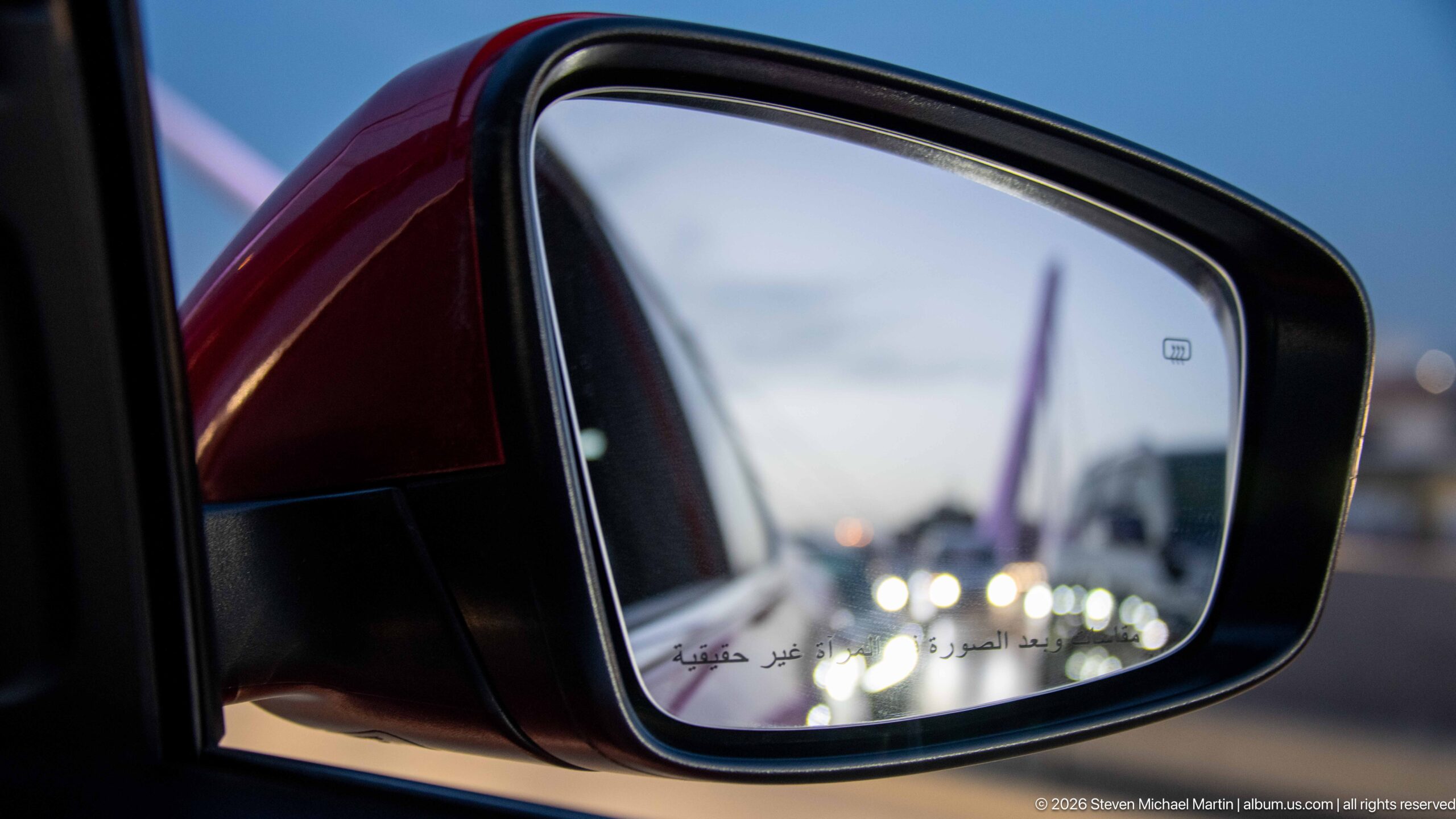
A car’s side mirror frames evening traffic behind the vehicle, with headlights dissolving into bright points and a bridge structure rising softly in the reflection. Arabic safety text is printed along the lower edge of the mirror. The shallow depth of field transforms a routine driving moment into a compact study of movement, reflection, and urban infrastructure in Amman.
Caption
A car’s side mirror frames evening traffic behind the vehicle, with headlights dissolving into bright points and a bridge structure rising softly in the reflection. Arabic safety text is printed along the lower edge of the mirror. The shallow depth of field transforms a routine driving moment into a compact study of movement, reflection, and urban infrastructure in Amman.
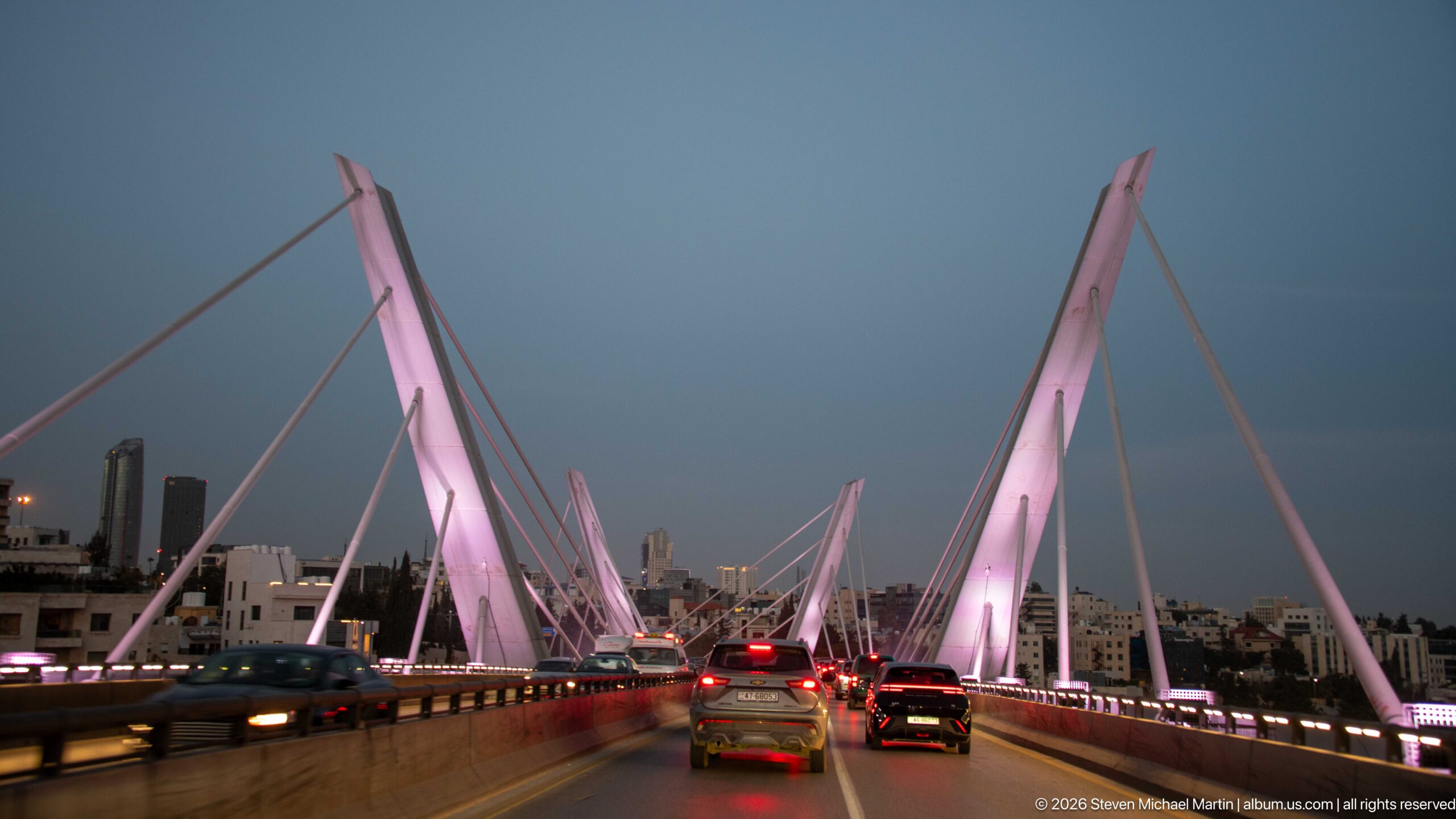
Traffic crosses Amman’s Wadi Abdoun Bridge at dusk beneath tall angled pylons illuminated in pink. Cables descend from the paired supports toward the roadway, creating a repeating geometric rhythm as vehicles stream toward the city beyond. The road-level viewpoint emphasizes the bridge’s distinctive cable-stayed engineering and its role as a dramatic piece of contemporary urban infrastructure.
Caption
Traffic crosses Amman’s Wadi Abdoun Bridge at dusk beneath tall angled pylons illuminated in pink. Cables descend from the paired supports toward the roadway, creating a repeating geometric rhythm as vehicles stream toward the city beyond. The road-level viewpoint emphasizes the bridge’s distinctive cable-stayed engineering and its role as a dramatic piece of contemporary urban infrastructure.
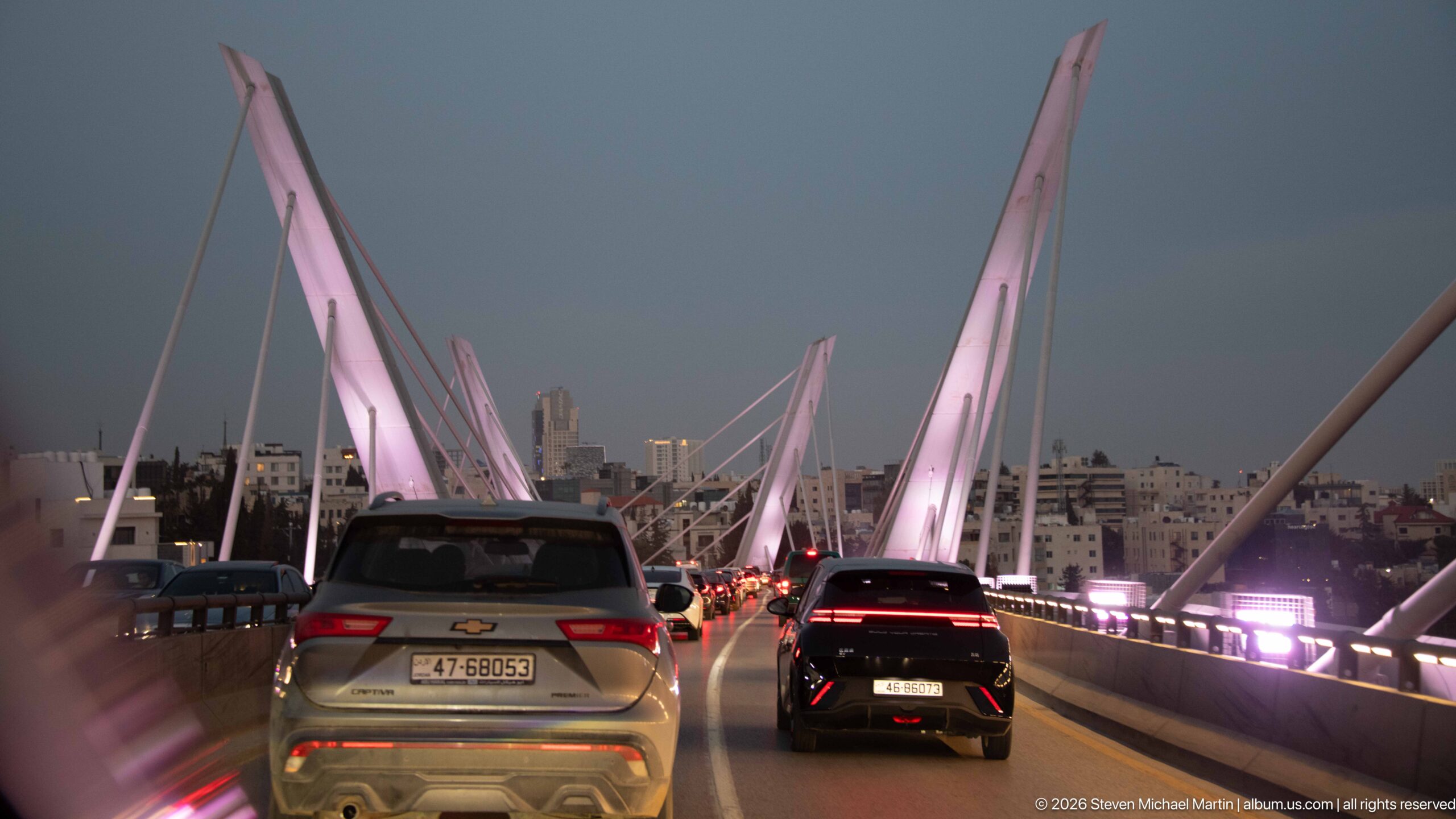
A closer road-level view of the Wadi Abdoun Bridge places evening traffic directly beneath its pink-lit pylons and diagonal stay cables. Cars fill the lanes in the foreground while the repeating supports recede toward central Amman. The compressed perspective highlights how the bridge’s sculptural engineering is experienced from within the flow of daily traffic rather than from a distant overlook.
Caption
A closer road-level view of the Wadi Abdoun Bridge places evening traffic directly beneath its pink-lit pylons and diagonal stay cables. Cars fill the lanes in the foreground while the repeating supports recede toward central Amman. The compressed perspective highlights how the bridge’s sculptural engineering is experienced from within the flow of daily traffic rather than from a distant overlook.
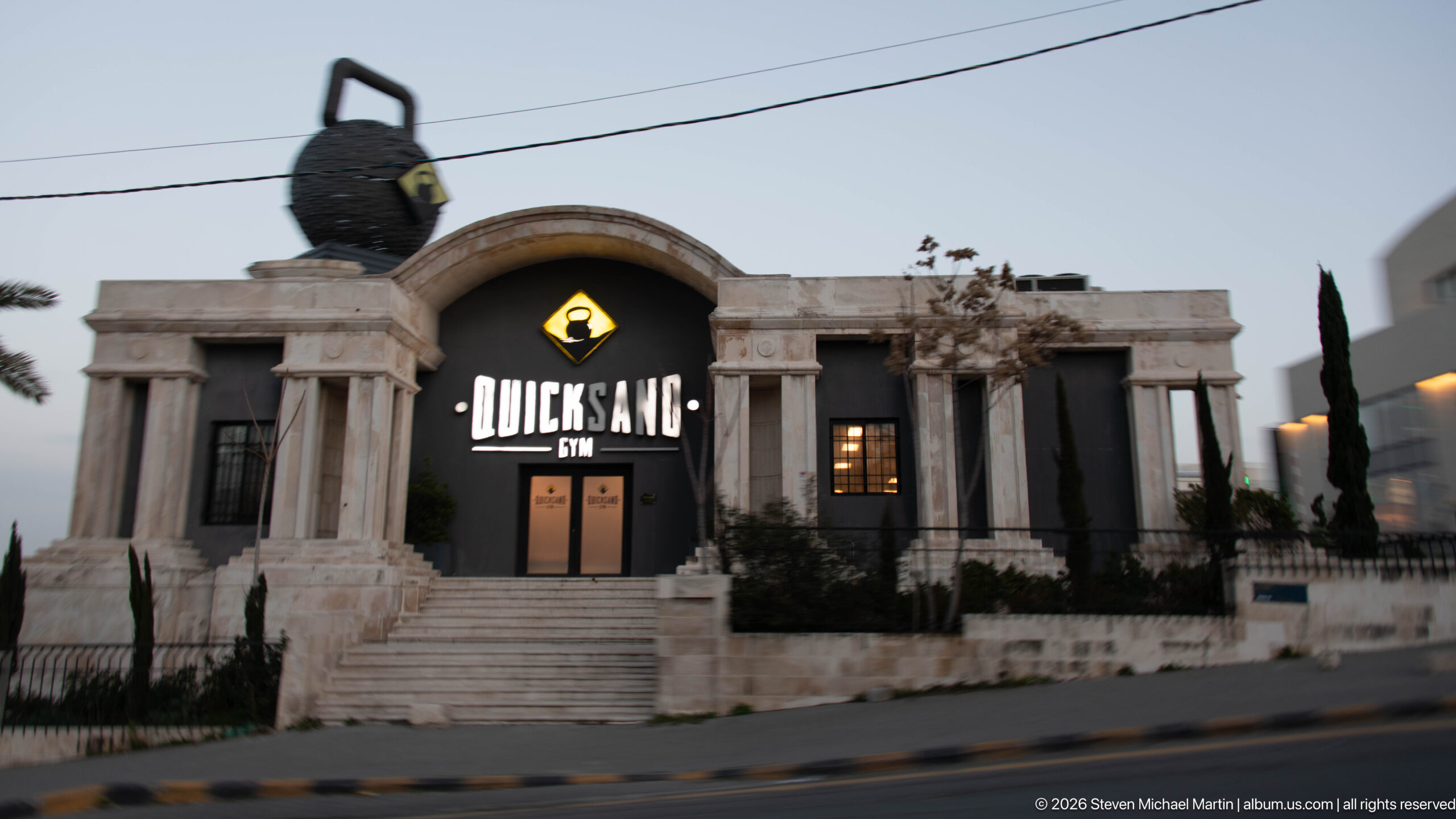
A gym in Amman occupies a symmetrical, classically styled façade with a broad central arch, paired columns, and a monumental stair. The dark central panel carries a prominent illuminated “Quick Sand Gym” sign, contrasting with the pale stone exterior. The building combines contemporary commercial use with an architectural vocabulary of arches, columns, and formal symmetry.
Caption
A gym in Amman occupies a symmetrical, classically styled façade with a broad central arch, paired columns, and a monumental stair. The dark central panel carries a prominent illuminated “Quick Sand Gym” sign, contrasting with the pale stone exterior. The building combines contemporary commercial use with an architectural vocabulary of arches, columns, and formal symmetry.
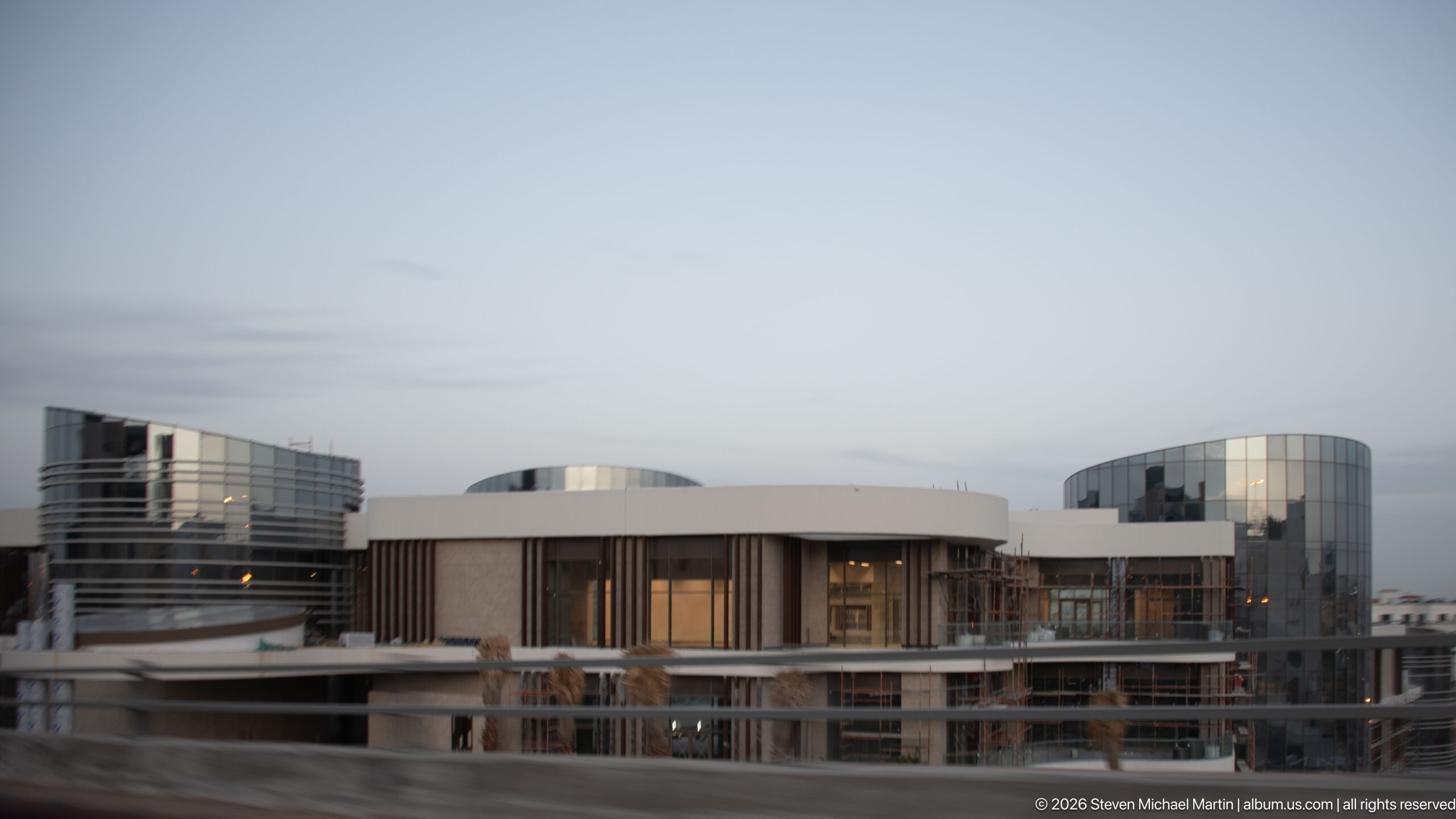
A contemporary architectural complex in Amman combines low rounded volumes with cylindrical glass towers and rectilinear blocks. Seen from across a roadside barrier in the soft light of early evening, the composition emphasizes reflective glazing, horizontal rooflines, and contrasting curved forms. The proof sheet does not provide enough evidence to assign a specific building name, so the caption remains architectural rather than institutional.
Caption
A contemporary architectural complex in Amman combines low rounded volumes with cylindrical glass towers and rectilinear blocks. Seen from across a roadside barrier in the soft light of early evening, the composition emphasizes reflective glazing, horizontal rooflines, and contrasting curved forms. The proof sheet does not provide enough evidence to assign a specific building name, so the caption remains architectural rather than institutional.
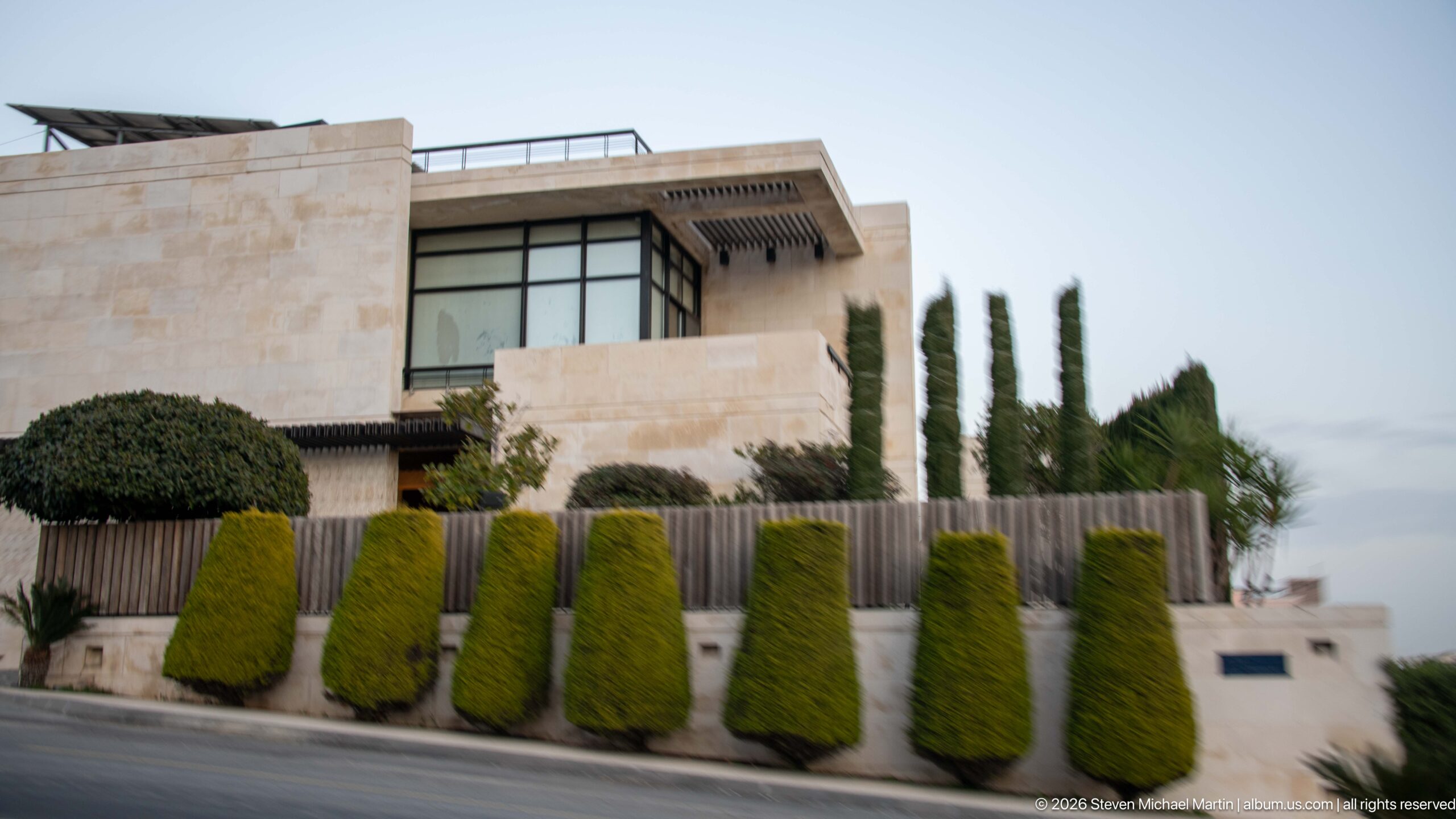
A large contemporary limestone residence in Amman rises above a roadside garden of precisely clipped conical shrubs and slender cypress trees. Broad windows, projecting roof slabs, and rectilinear volumes give the villa a modern profile while the pale stone cladding reflects a local architectural preference for limestone. The landscaped frontage creates a formal transition between the private house and the street.
Caption
A large contemporary limestone residence in Amman rises above a roadside garden of precisely clipped conical shrubs and slender cypress trees. Broad windows, projecting roof slabs, and rectilinear volumes give the villa a modern profile while the pale stone cladding reflects a local architectural preference for limestone. The landscaped frontage creates a formal transition between the private house and the street.
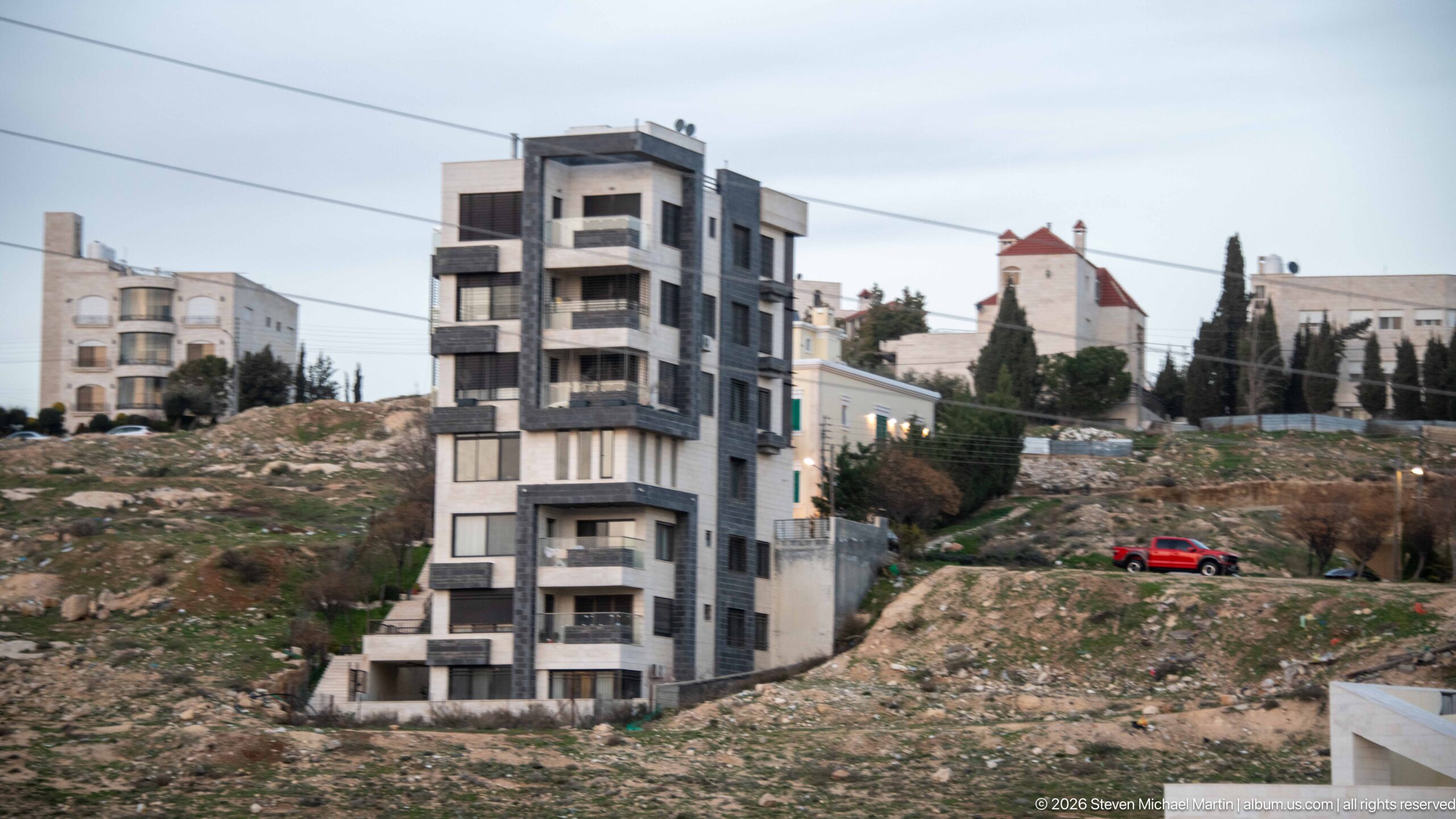
A narrow modern apartment building stands almost alone on a rocky, partly undeveloped slope in Amman, surrounded by older housing and open ground. Its stacked balconies and dark vertical cladding contrast sharply with the pale stone buildings nearby. The scene illustrates the capital’s piecemeal urban infill, where new construction adapts to steep terrain and irregular parcels.
Caption
A narrow modern apartment building stands almost alone on a rocky, partly undeveloped slope in Amman, surrounded by older housing and open ground. Its stacked balconies and dark vertical cladding contrast sharply with the pale stone buildings nearby. The scene illustrates the capital’s piecemeal urban infill, where new construction adapts to steep terrain and irregular parcels.
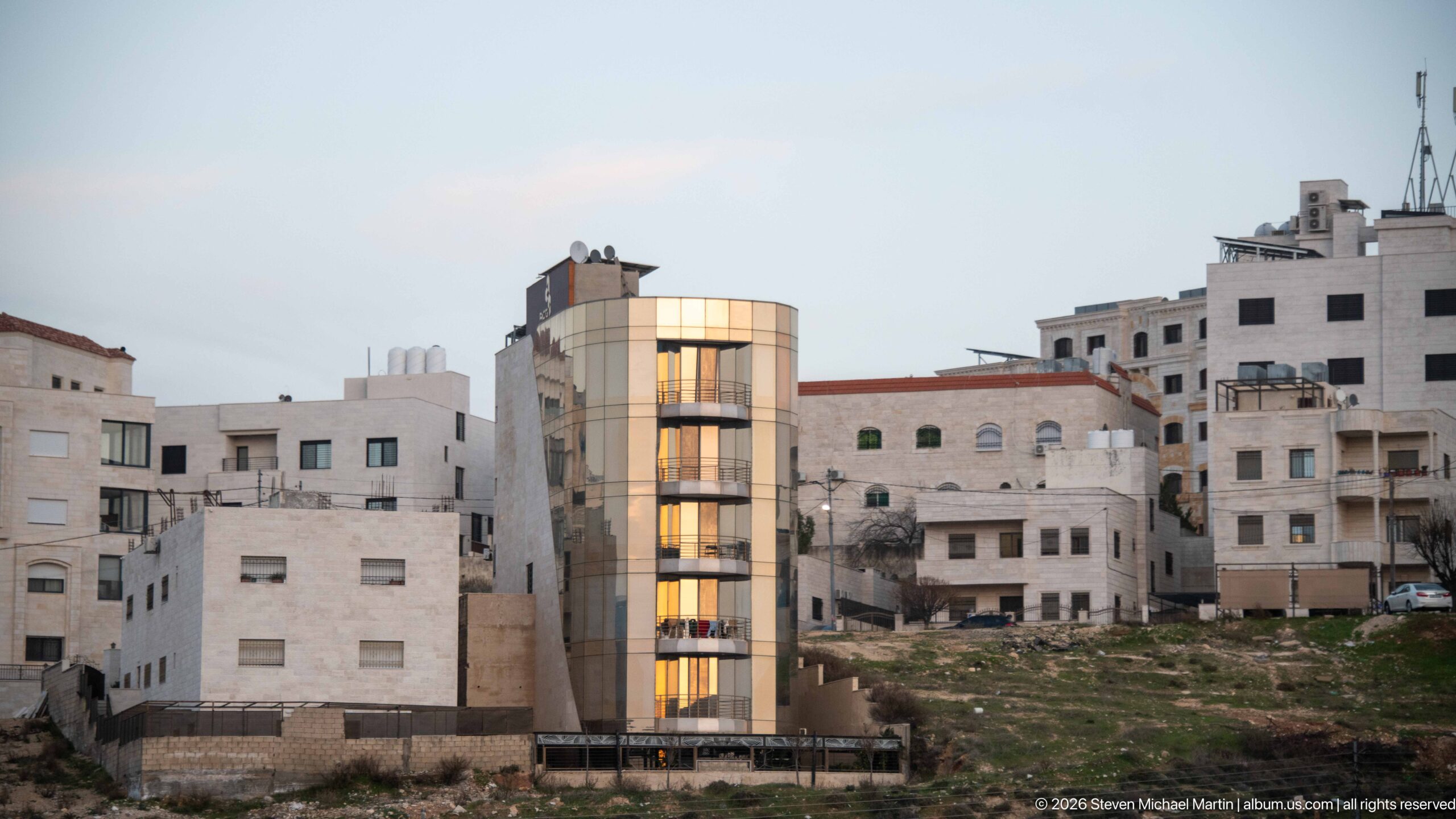
A slender apartment building in Amman is distinguished by a rounded glass vertical bay glowing warmly at dusk, set against a cluster of pale stone residences. The curved transparent element creates a strong contemporary accent within the otherwise rectilinear neighborhood. Uneven ground and unfinished plots in the foreground reveal the city’s layered, ongoing process of residential development.
Caption
A slender apartment building in Amman is distinguished by a rounded glass vertical bay glowing warmly at dusk, set against a cluster of pale stone residences. The curved transparent element creates a strong contemporary accent within the otherwise rectilinear neighborhood. Uneven ground and unfinished plots in the foreground reveal the city’s layered, ongoing process of residential development.
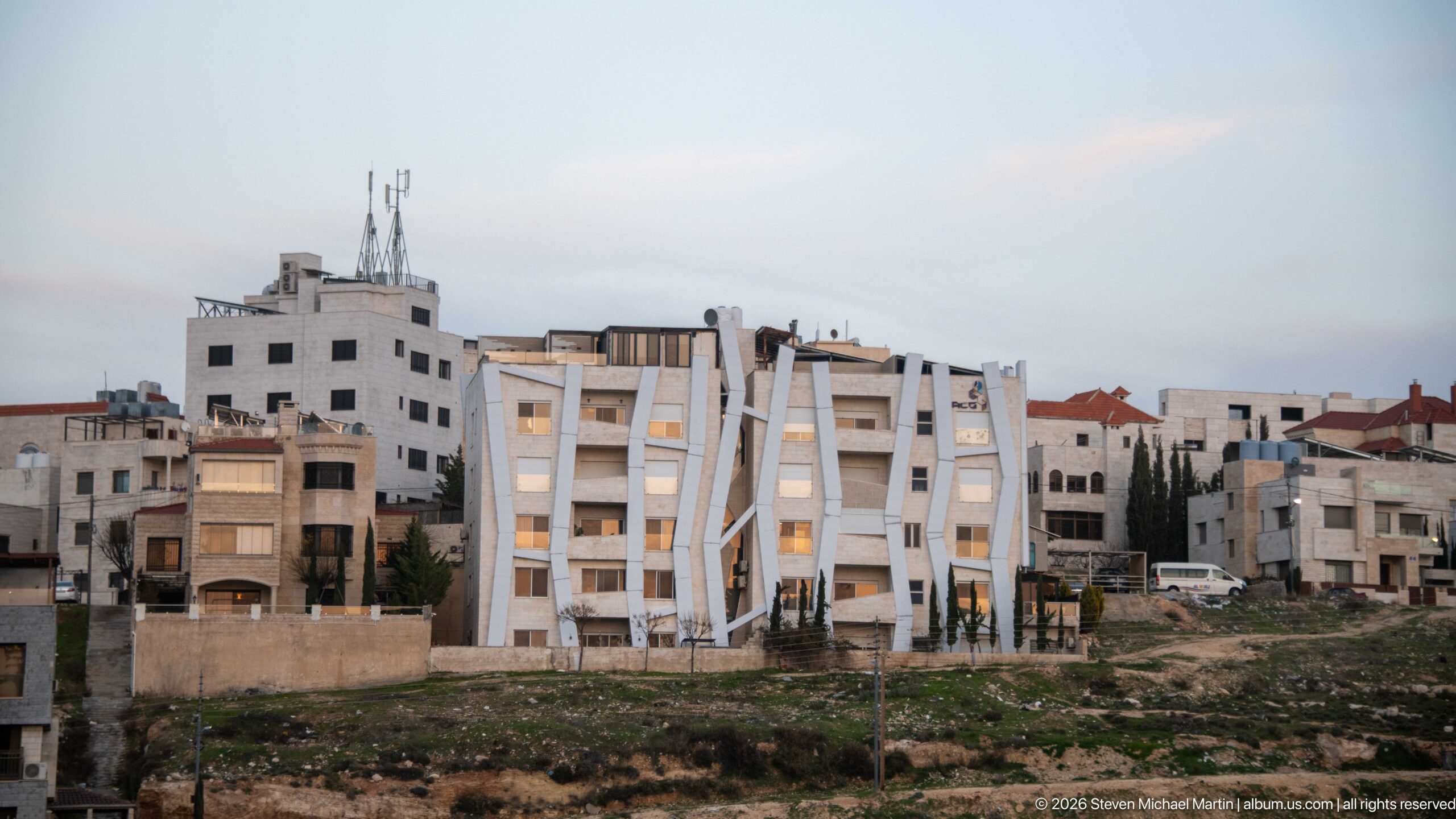
A white apartment building in Amman stands out through an angular façade of projecting frames and diagonal structural accents, surrounded by more conventional pale stone residential blocks. Sparse undeveloped ground occupies the foreground, while rooftop antennas and neighboring buildings define the urban background. The contrast in façade treatment makes this a focused study of contemporary residential design within the city’s expanding neighborhoods.
Caption
A white apartment building in Amman stands out through an angular façade of projecting frames and diagonal structural accents, surrounded by more conventional pale stone residential blocks. Sparse undeveloped ground occupies the foreground, while rooftop antennas and neighboring buildings define the urban background. The contrast in façade treatment makes this a focused study of contemporary residential design within the city’s expanding neighborhoods.
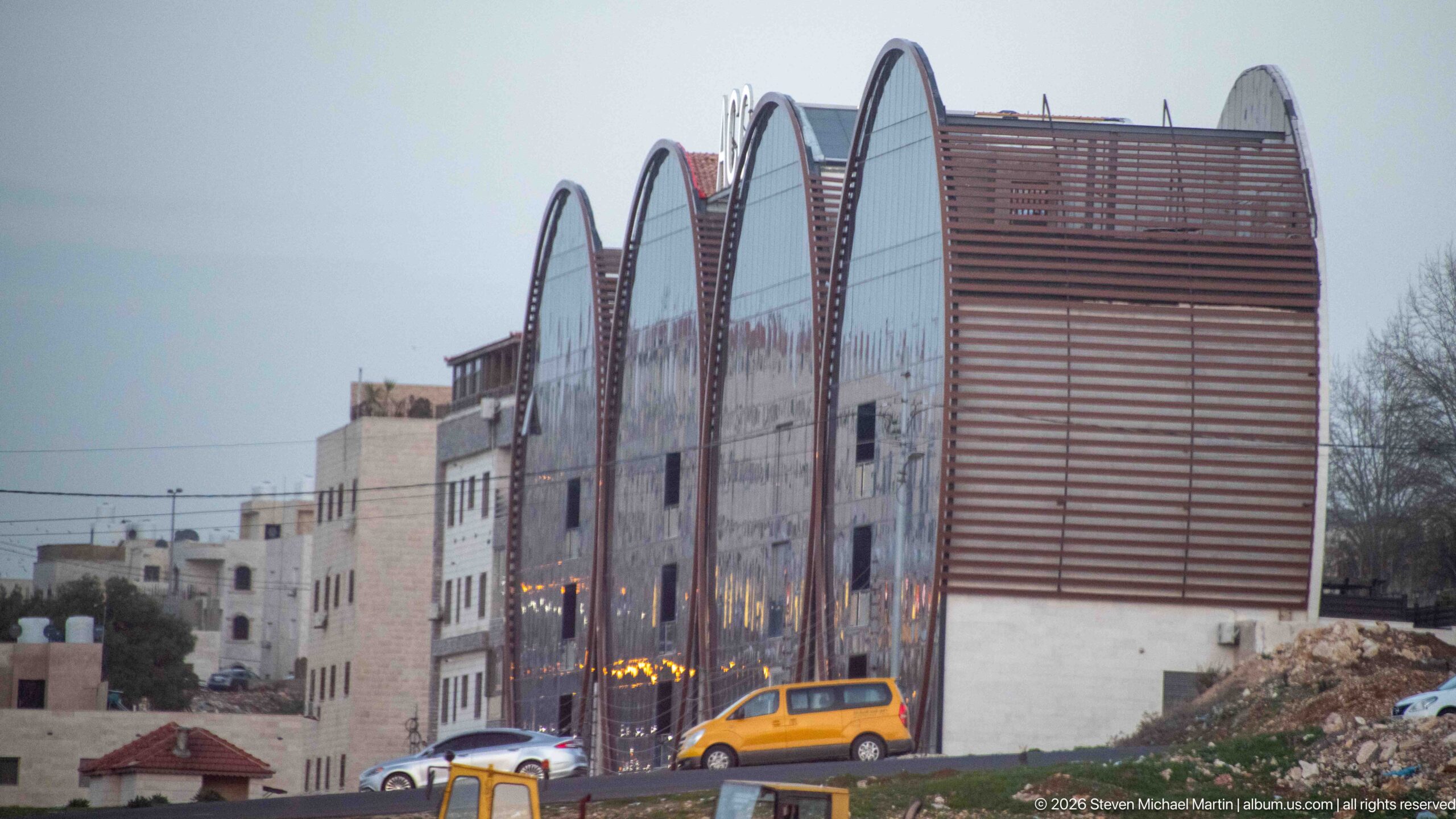
A contemporary roadside building in Amman uses a sequence of tall curved roof profiles, reflective glazing, and horizontal slatted screens to create a distinctive modern façade. Vehicles at street level give the structure scale, while surrounding stone buildings and exposed ground place the design firmly within the city’s evolving urban edge, where newer commercial architecture contrasts with more traditional masonry construction.
Caption
A contemporary roadside building in Amman uses a sequence of tall curved roof profiles, reflective glazing, and horizontal slatted screens to create a distinctive modern façade. Vehicles at street level give the structure scale, while surrounding stone buildings and exposed ground place the design firmly within the city’s evolving urban edge, where newer commercial architecture contrasts with more traditional masonry construction.
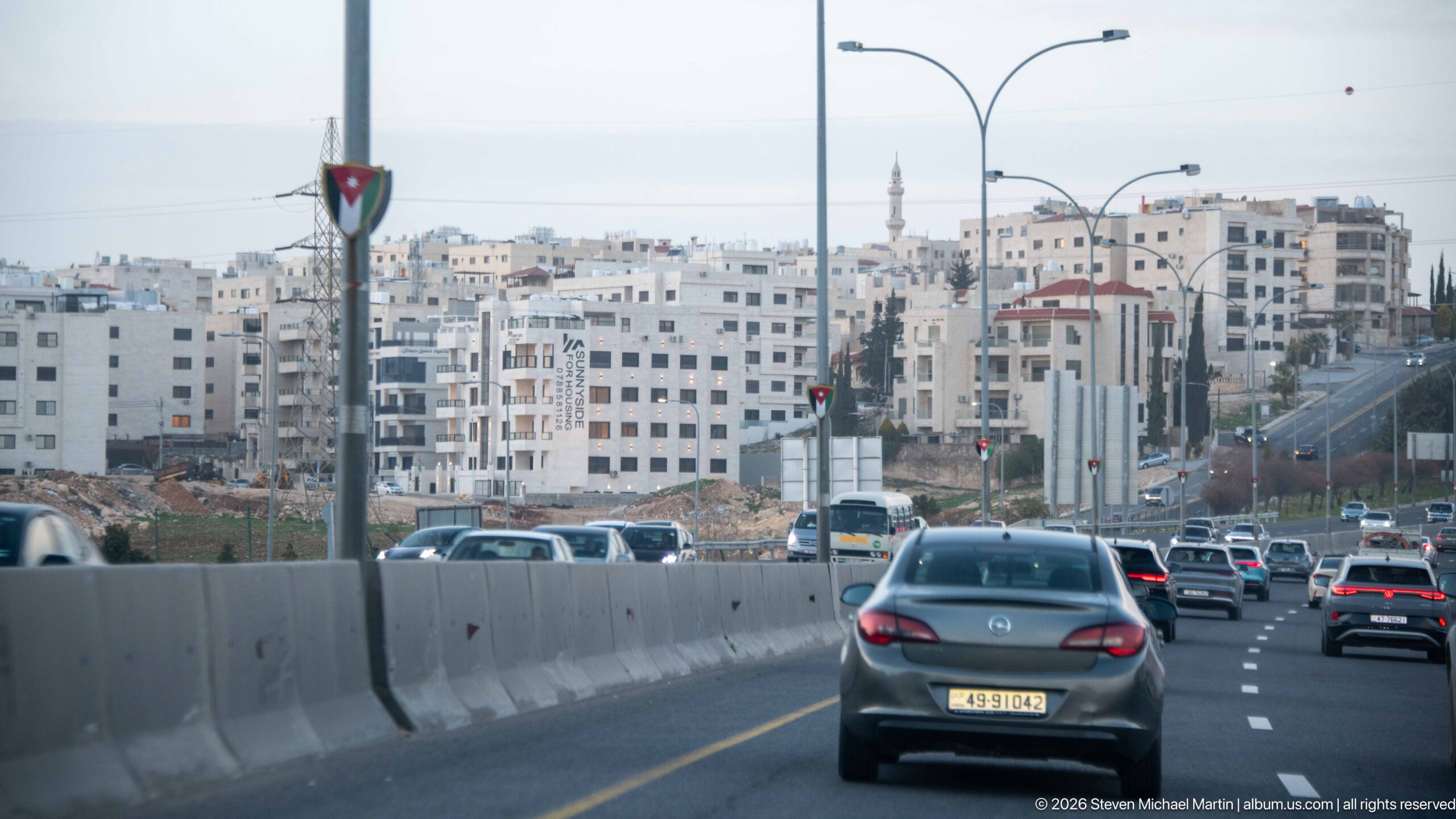
Traffic moves along a broad divided roadway through Amman, framed by dense mid-rise housing climbing the surrounding hills. Streetlights, concrete barriers, traffic signals, and a distant minaret combine infrastructure and urban context, showing how the capital’s major roads thread between tightly built residential districts rather than crossing a flat metropolitan grid.
Caption
Traffic moves along a broad divided roadway through Amman, framed by dense mid-rise housing climbing the surrounding hills. Streetlights, concrete barriers, traffic signals, and a distant minaret combine infrastructure and urban context, showing how the capital’s major roads thread between tightly built residential districts rather than crossing a flat metropolitan grid.
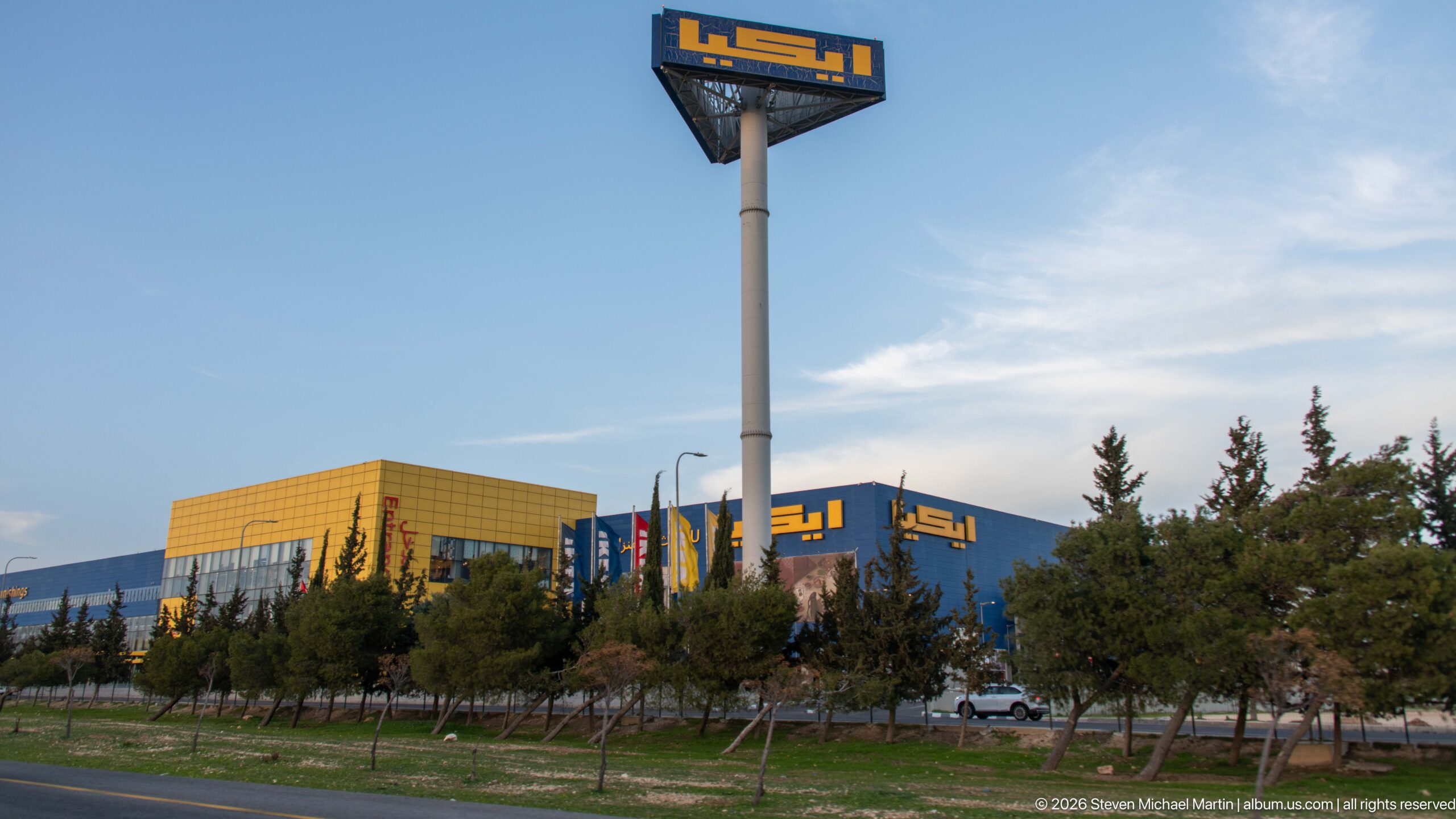
The IKEA complex in Amman presents the retailer’s familiar blue-and-yellow palette at monumental scale, with a tall pole sign rising above a low commercial building and landscaped roadside plantings. The view records a distinctly contemporary layer of the Jordanian capital, where international retail architecture occupies broad parcels along major transportation corridors beyond the older urban core.
Caption
The IKEA complex in Amman presents the retailer’s familiar blue-and-yellow palette at monumental scale, with a tall pole sign rising above a low commercial building and landscaped roadside plantings. The view records a distinctly contemporary layer of the Jordanian capital, where international retail architecture occupies broad parcels along major transportation corridors beyond the older urban core.
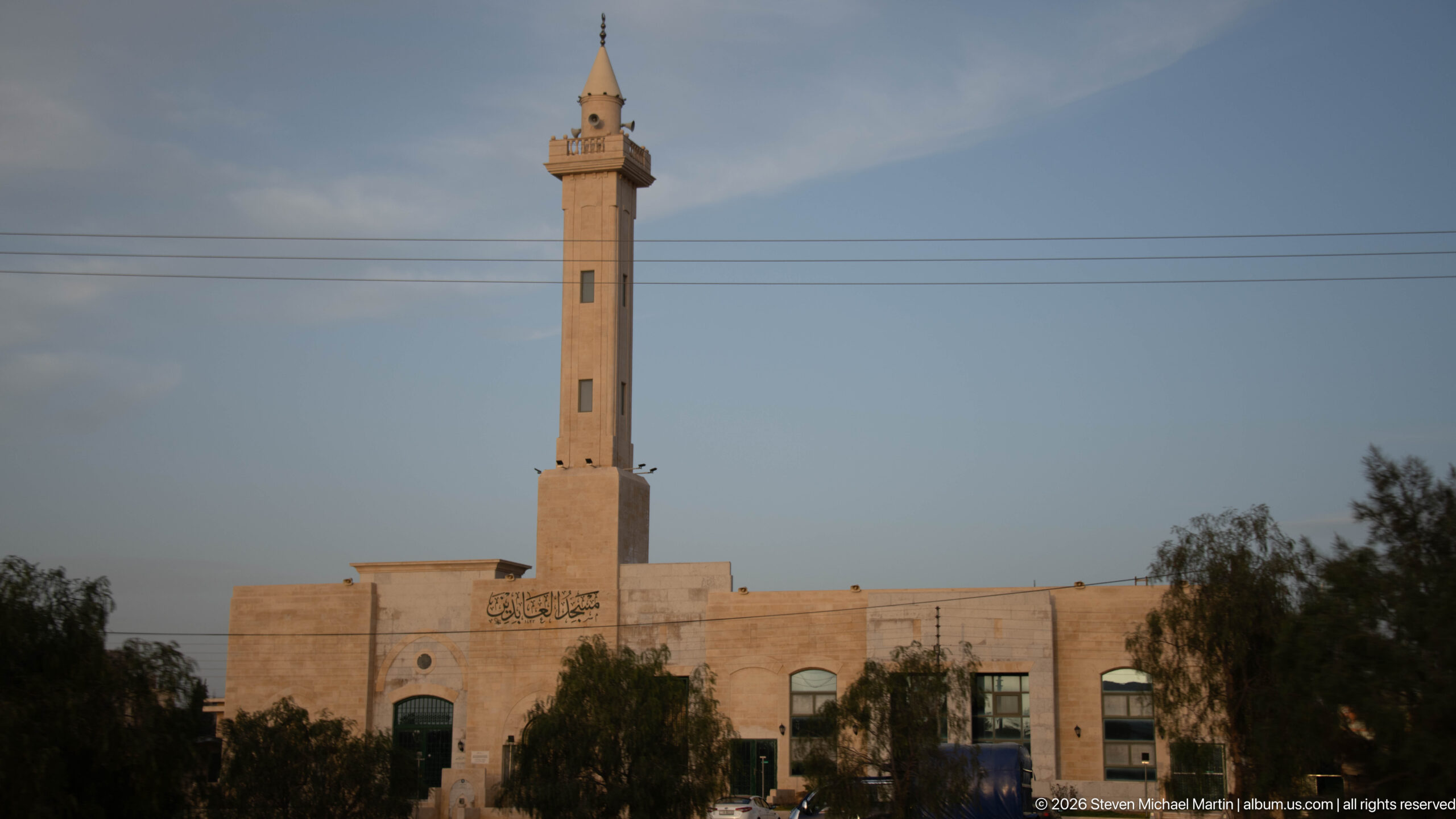
A neighborhood mosque in Amman is marked by a tall, narrow minaret rising from a low pale-stone prayer hall. The tower’s pointed cap and projecting balcony form a strong vertical accent against the evening sky, while Arabic inscription across the façade and mature trees around the building identify the site as an active local religious landmark within the modern city.
Caption
A neighborhood mosque in Amman is marked by a tall, narrow minaret rising from a low pale-stone prayer hall. The tower’s pointed cap and projecting balcony form a strong vertical accent against the evening sky, while Arabic inscription across the façade and mature trees around the building identify the site as an active local religious landmark within the modern city.
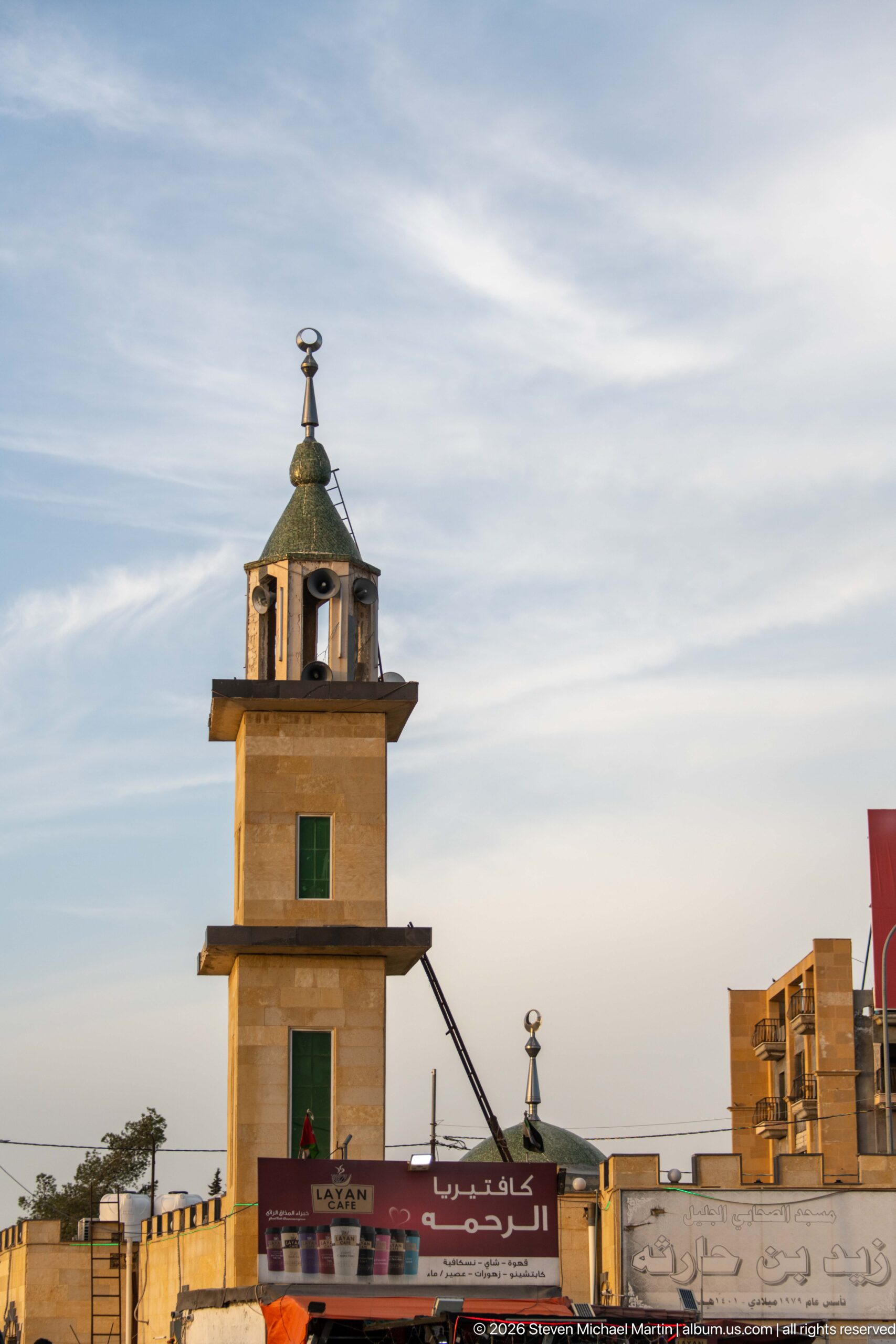
A small mosque tower rises above roadside shops in Amman, its square shaft topped by an open lantern-like pavilion and finial. Commercial signs and vehicles crowd the lower edge of the scene, creating a distinctly urban juxtaposition between everyday business activity and religious architecture. The tower’s layered cornices and green openings give the otherwise modest structure a recognizable civic presence.
Caption
A small mosque tower rises above roadside shops in Amman, its square shaft topped by an open lantern-like pavilion and finial. Commercial signs and vehicles crowd the lower edge of the scene, creating a distinctly urban juxtaposition between everyday business activity and religious architecture. The tower’s layered cornices and green openings give the otherwise modest structure a recognizable civic presence.
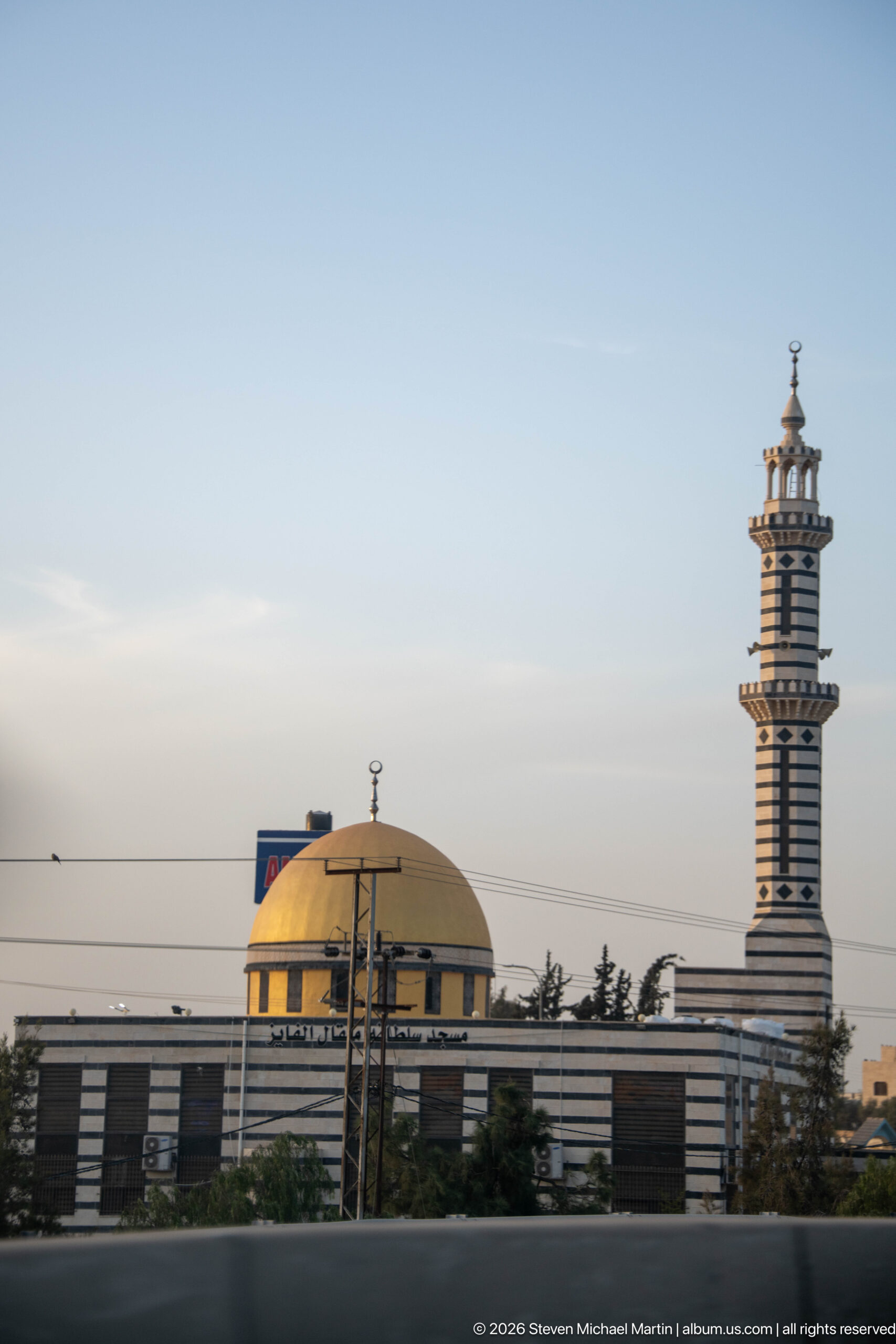
A modern mosque in Amman combines a broad gold-colored dome with a tall minaret articulated by dark horizontal bands and open balcony levels. Seen across roadside barriers and utility lines, the building stands out against the low urban horizon through its contrasting geometry and color. The composition emphasizes how contemporary religious landmarks punctuate the city’s expanding transportation corridors.
Caption
A modern mosque in Amman combines a broad gold-colored dome with a tall minaret articulated by dark horizontal bands and open balcony levels. Seen across roadside barriers and utility lines, the building stands out against the low urban horizon through its contrasting geometry and color. The composition emphasizes how contemporary religious landmarks punctuate the city’s expanding transportation corridors.
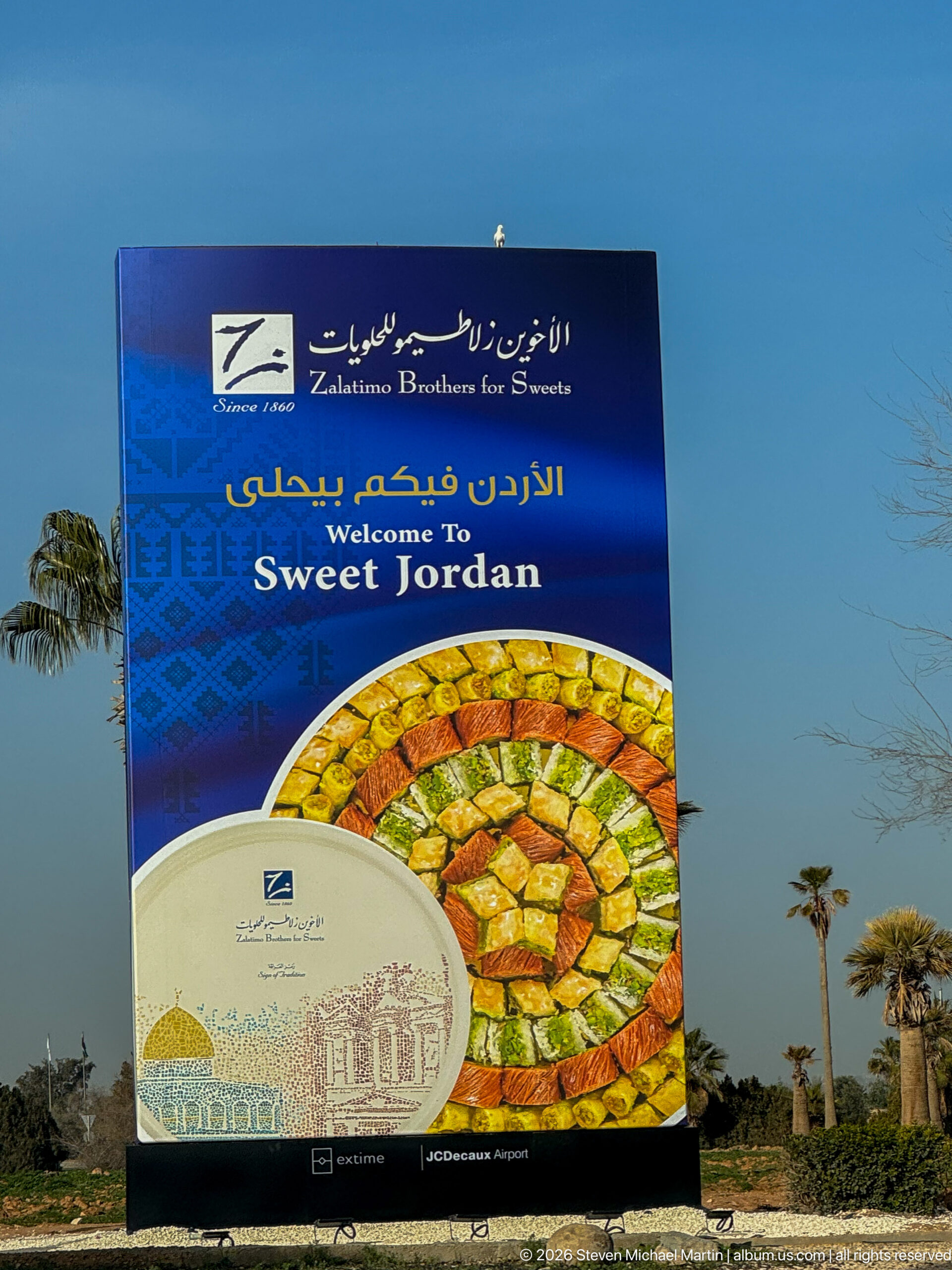
A large roadside billboard near Amman welcomes arriving visitors to Jordan with bilingual Arabic and English text for Zalatimo Brothers for Sweets. A colorful circular arrangement of pastries dominates the sign, linking airport arrival imagery with one of the region’s familiar confectionery traditions. Palm trees and landscaped grounds reinforce the transitional setting between the airport and the capital.
Caption
A large roadside billboard near Amman welcomes arriving visitors to Jordan with bilingual Arabic and English text for Zalatimo Brothers for Sweets. A colorful circular arrangement of pastries dominates the sign, linking airport arrival imagery with one of the region’s familiar confectionery traditions. Palm trees and landscaped grounds reinforce the transitional setting between the airport and the capital.
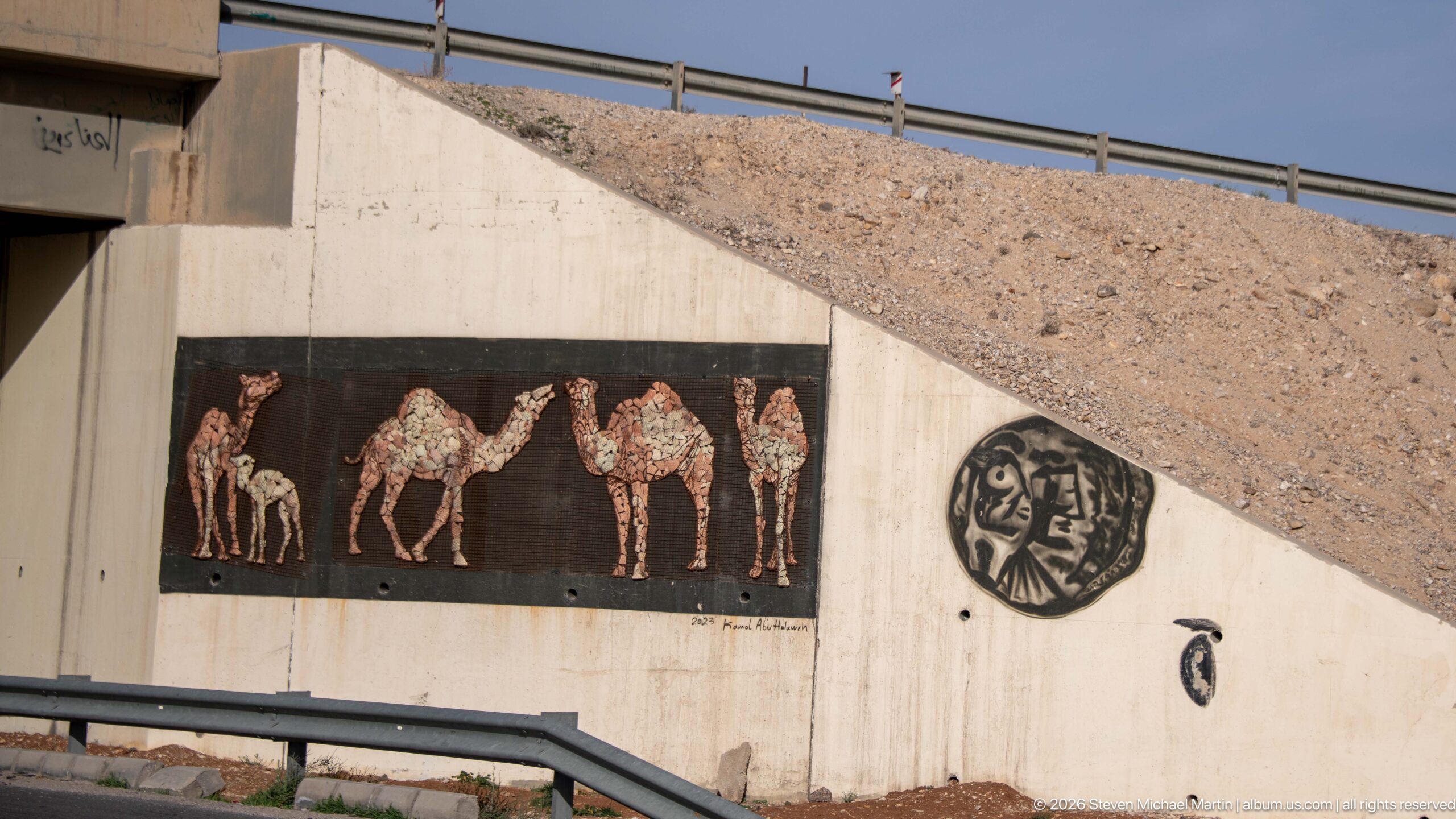
A highway retaining wall near Amman is decorated with a large mosaic-like panel of camels, including an adult and calf, alongside a circular emblem and smaller painted symbols. The animal imagery introduces a visual reference to Jordan’s desert heritage into an otherwise functional concrete infrastructure setting, turning the roadway edge into a brief piece of public art.
Caption
A highway retaining wall near Amman is decorated with a large mosaic-like panel of camels, including an adult and calf, alongside a circular emblem and smaller painted symbols. The animal imagery introduces a visual reference to Jordan’s desert heritage into an otherwise functional concrete infrastructure setting, turning the roadway edge into a brief piece of public art.

Two travelers sit in the front seats of a car during a road journey in Jordan, both wearing seat belts as the driver keeps one hand on the wheel. The informal interior portrait shifts the portfolio from city architecture to the lived experience of transit, capturing a candid moment between destinations rather than a formal landmark or archaeological subject.
Caption
Two travelers sit in the front seats of a car during a road journey in Jordan, both wearing seat belts as the driver keeps one hand on the wheel. The informal interior portrait shifts the portfolio from city architecture to the lived experience of transit, capturing a candid moment between destinations rather than a formal landmark or archaeological subject.

A second in-car portrait records the same road journey through Jordan from a slightly different moment, with the passenger facing the camera while the driver looks toward the road. Strong sunlight enters from the side window, giving the casual scene a sense of movement and travel between sites while preserving the personal dimension of the Amman portfolio.
Caption
A second in-car portrait records the same road journey through Jordan from a slightly different moment, with the passenger facing the camera while the driver looks toward the road. Strong sunlight enters from the side window, giving the casual scene a sense of movement and travel between sites while preserving the personal dimension of the Amman portfolio.
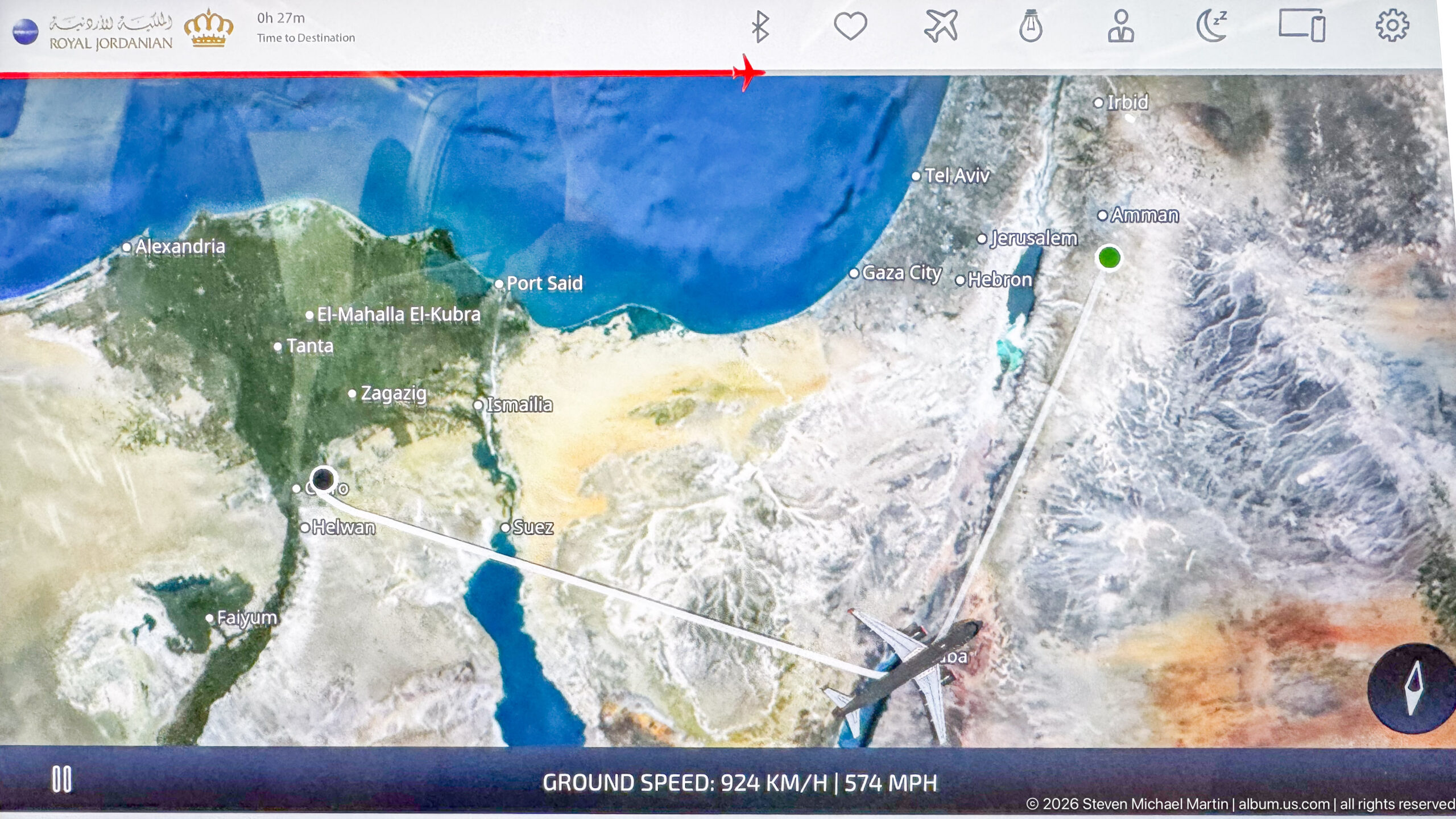
An aircraft moving-map display shows the route across northeastern Africa and the eastern Mediterranean, with labels including Cairo, Alexandria, Port Said, and surrounding regional geography. The airplane icon and ground-speed readout establish the image as an in-flight navigation screen, documenting the aerial approach to the Jordan portion of the journey rather than a ground-level Amman scene.
Caption
An aircraft moving-map display shows the route across northeastern Africa and the eastern Mediterranean, with labels including Cairo, Alexandria, Port Said, and surrounding regional geography. The airplane icon and ground-speed readout establish the image as an in-flight navigation screen, documenting the aerial approach to the Jordan portion of the journey rather than a ground-level Amman scene.
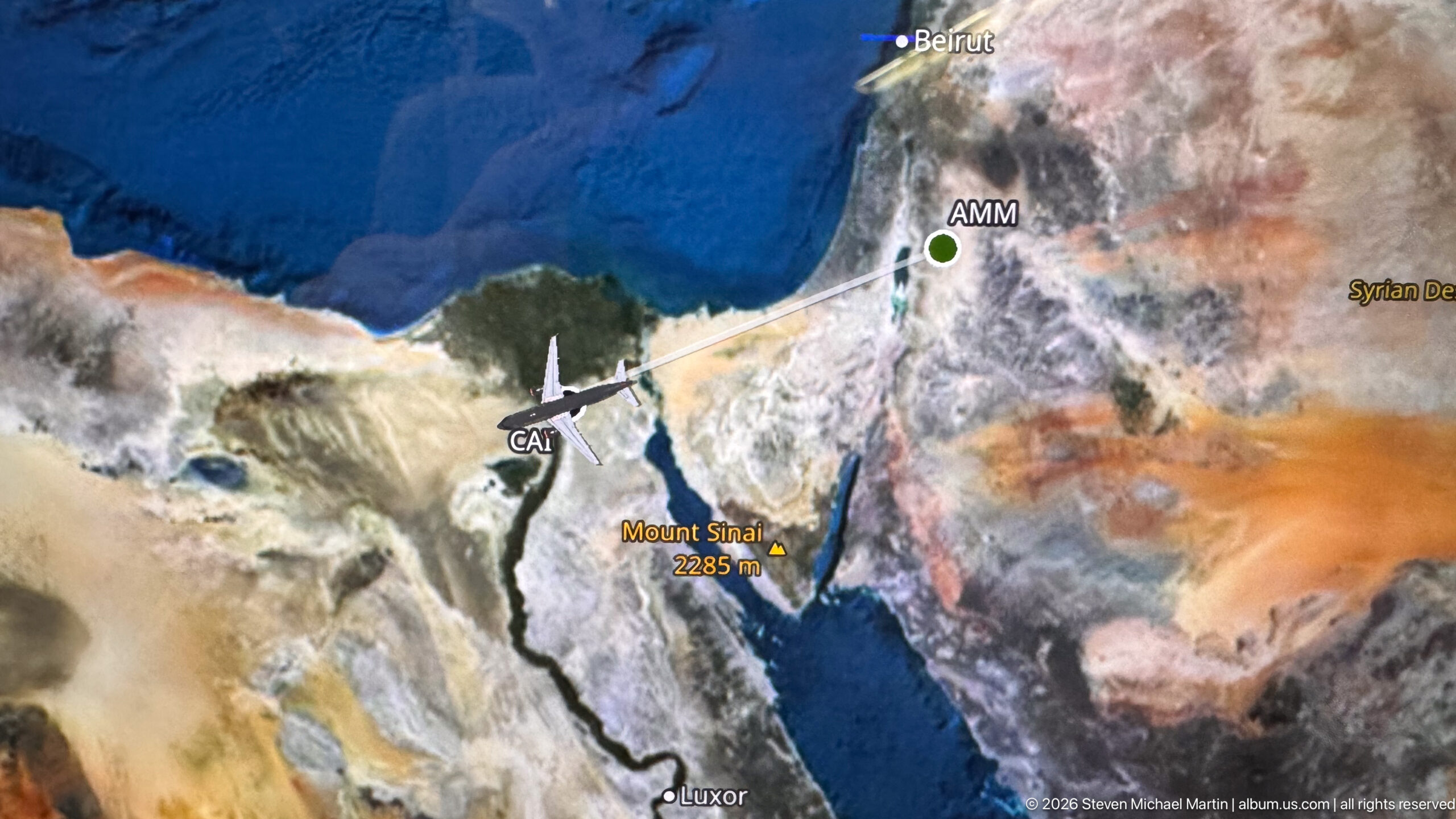
An in-flight navigation screen traces the aircraft’s path from Cairo toward Amman, marked by the airport code AMM on the Jordanian plateau. The map frames the Sinai Peninsula, Gulf of Suez, Red Sea, and eastern Mediterranean, visually linking Egypt and Jordan across the regional geography traversed during the flight.
Caption
An in-flight navigation screen traces the aircraft’s path from Cairo toward Amman, marked by the airport code AMM on the Jordanian plateau. The map frames the Sinai Peninsula, Gulf of Suez, Red Sea, and eastern Mediterranean, visually linking Egypt and Jordan across the regional geography traversed during the flight.
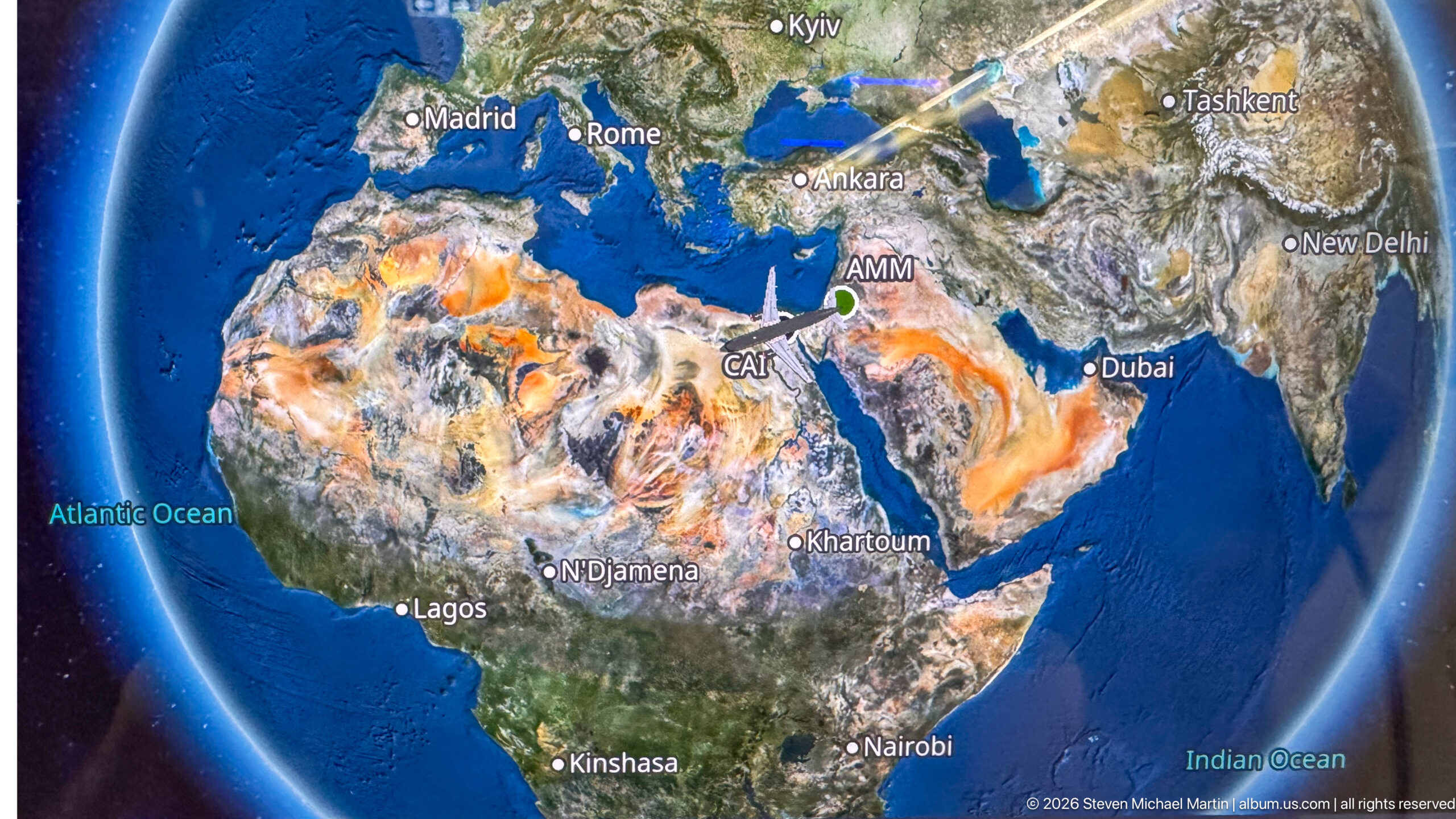
A wide in-flight map places Amman within a much larger geographic frame extending across Africa, southern Europe, the Mediterranean, Arabia, and western Asia. The aircraft’s route line converges near Jordan, giving the portfolio a broad regional context and emphasizing Amman’s position at a crossroads between the Levant, North Africa, and neighboring Middle Eastern routes.
Caption
A wide in-flight map places Amman within a much larger geographic frame extending across Africa, southern Europe, the Mediterranean, Arabia, and western Asia. The aircraft’s route line converges near Jordan, giving the portfolio a broad regional context and emphasizing Amman’s position at a crossroads between the Levant, North Africa, and neighboring Middle Eastern routes.
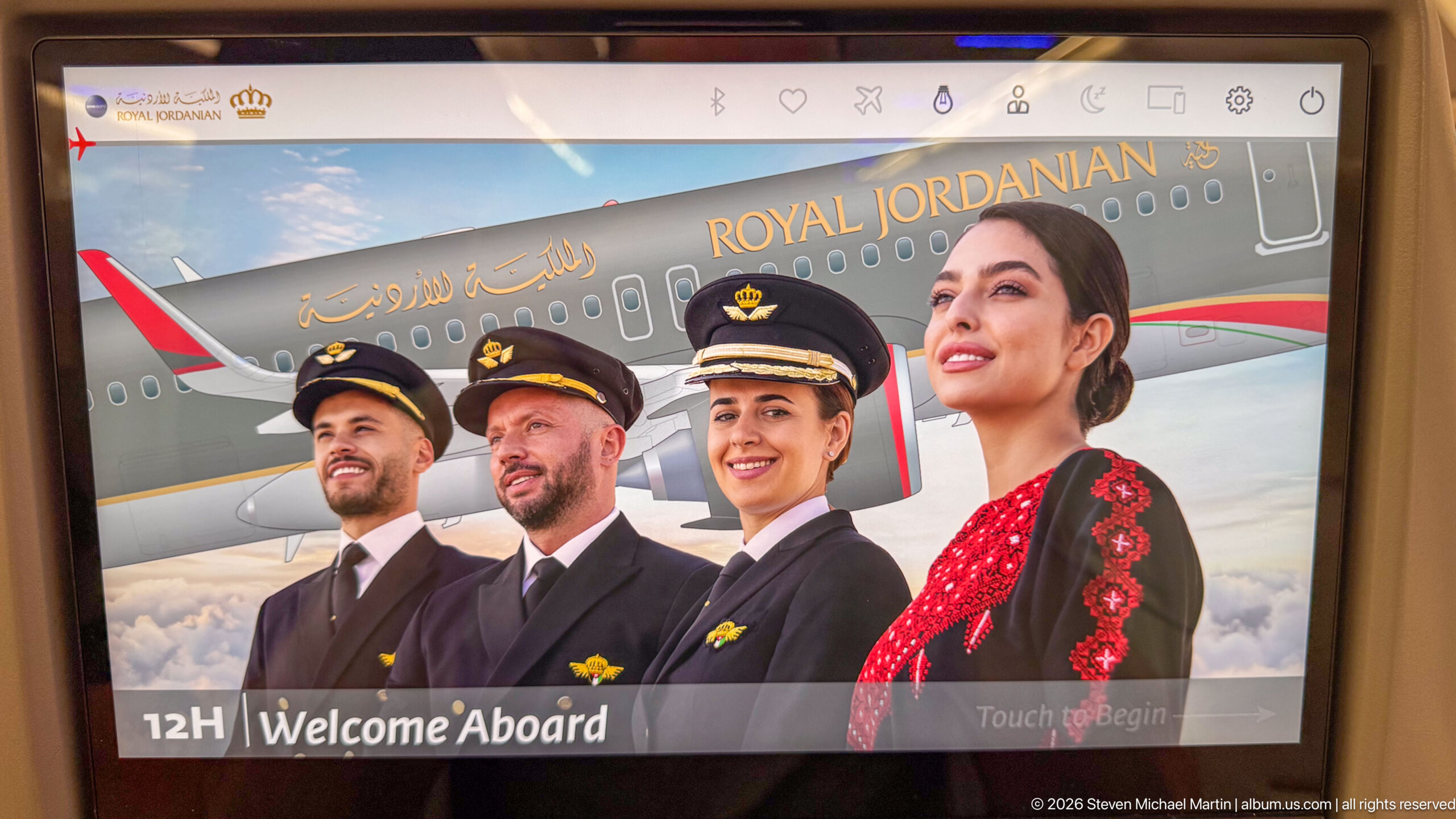
A Royal Jordanian welcome screen at the airport presents uniformed cabin crew in front of an airliner, combining Arabic and English branding with the message “Welcome Aboard.” The polished promotional image marks the transition into Jordan and identifies the national carrier through its name, uniforms, and aircraft livery, making it a clear travel-context record within the Amman sequence.
Caption
A Royal Jordanian welcome screen at the airport presents uniformed cabin crew in front of an airliner, combining Arabic and English branding with the message “Welcome Aboard.” The polished promotional image marks the transition into Jordan and identifies the national carrier through its name, uniforms, and aircraft livery, making it a clear travel-context record within the Amman sequence.
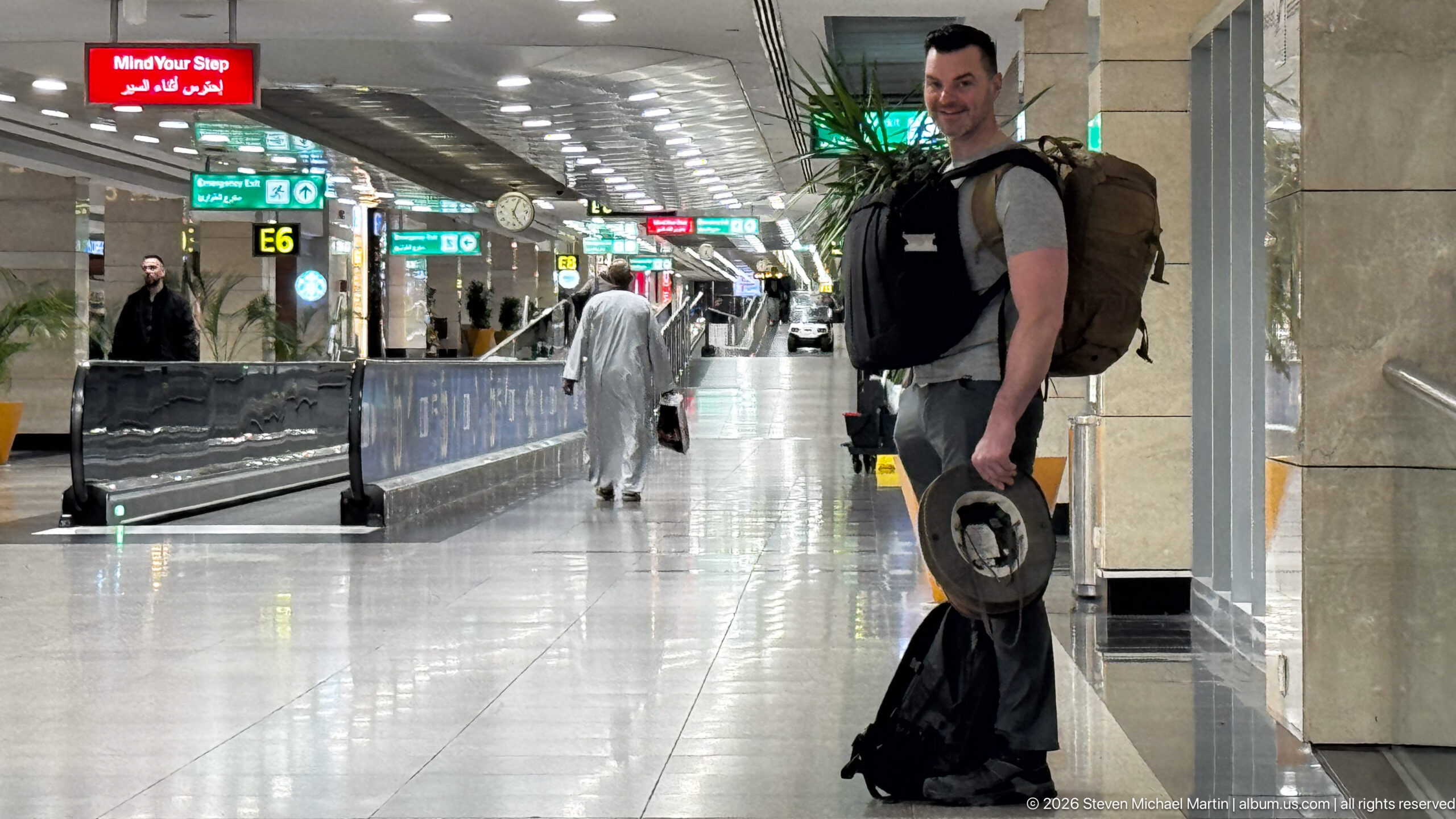
A traveler stands in an airport concourse near gate E6 carrying a large backpack and additional hand luggage. The long polished corridor, moving walkways, overhead wayfinding signs, and other passengers establish the setting as a modern international terminal. The portrait records the practical transition from air travel to ground travel at the start of the Jordan visit.
Caption
A traveler stands in an airport concourse near gate E6 carrying a large backpack and additional hand luggage. The long polished corridor, moving walkways, overhead wayfinding signs, and other passengers establish the setting as a modern international terminal. The portrait records the practical transition from air travel to ground travel at the start of the Jordan visit.
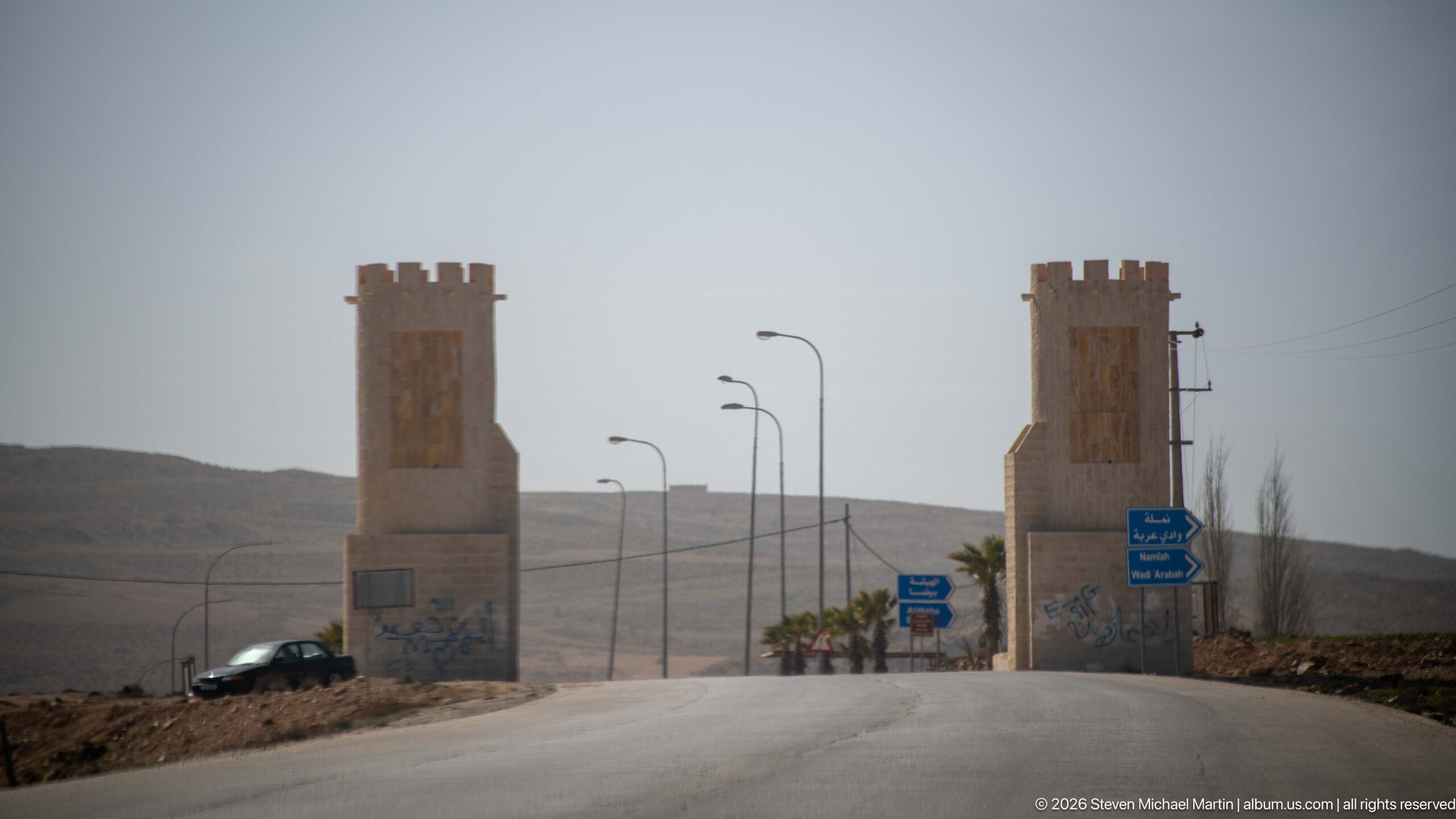
A roadway passes between two tall stone-clad towers capped with crenellated parapets, creating a formal gateway at the edge of a developed area near Amman. Directional signs, streetlights, and barren hills beyond the towers suggest a transitional landscape between urban settlement and the drier plateau, while the fortified visual language recalls traditional regional architecture without implying an ancient date.
Caption
A roadway passes between two tall stone-clad towers capped with crenellated parapets, creating a formal gateway at the edge of a developed area near Amman. Directional signs, streetlights, and barren hills beyond the towers suggest a transitional landscape between urban settlement and the drier plateau, while the fortified visual language recalls traditional regional architecture without implying an ancient date.
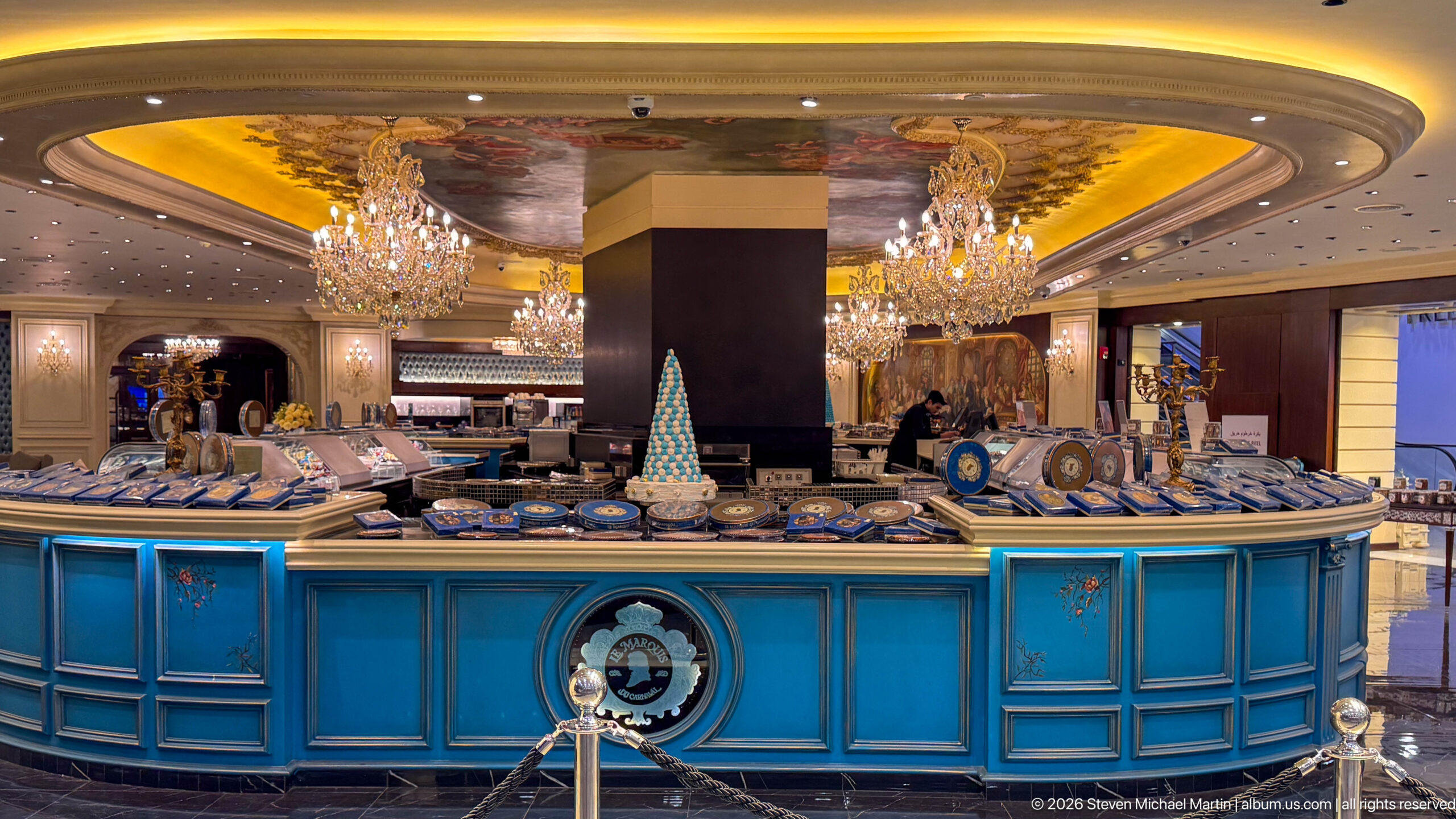
An ornate retail counter displays neatly arranged boxed sweets and gift items beneath chandeliers and warm cove lighting. Deep blue cabinetry, polished surfaces, decorative clocks, and formal presentation create a luxury confectionery atmosphere that contrasts sharply with the airport and roadside scenes around it, suggesting a curated commercial stop during the journey through Amman.
Caption
An ornate retail counter displays neatly arranged boxed sweets and gift items beneath chandeliers and warm cove lighting. Deep blue cabinetry, polished surfaces, decorative clocks, and formal presentation create a luxury confectionery atmosphere that contrasts sharply with the airport and roadside scenes around it, suggesting a curated commercial stop during the journey through Amman.
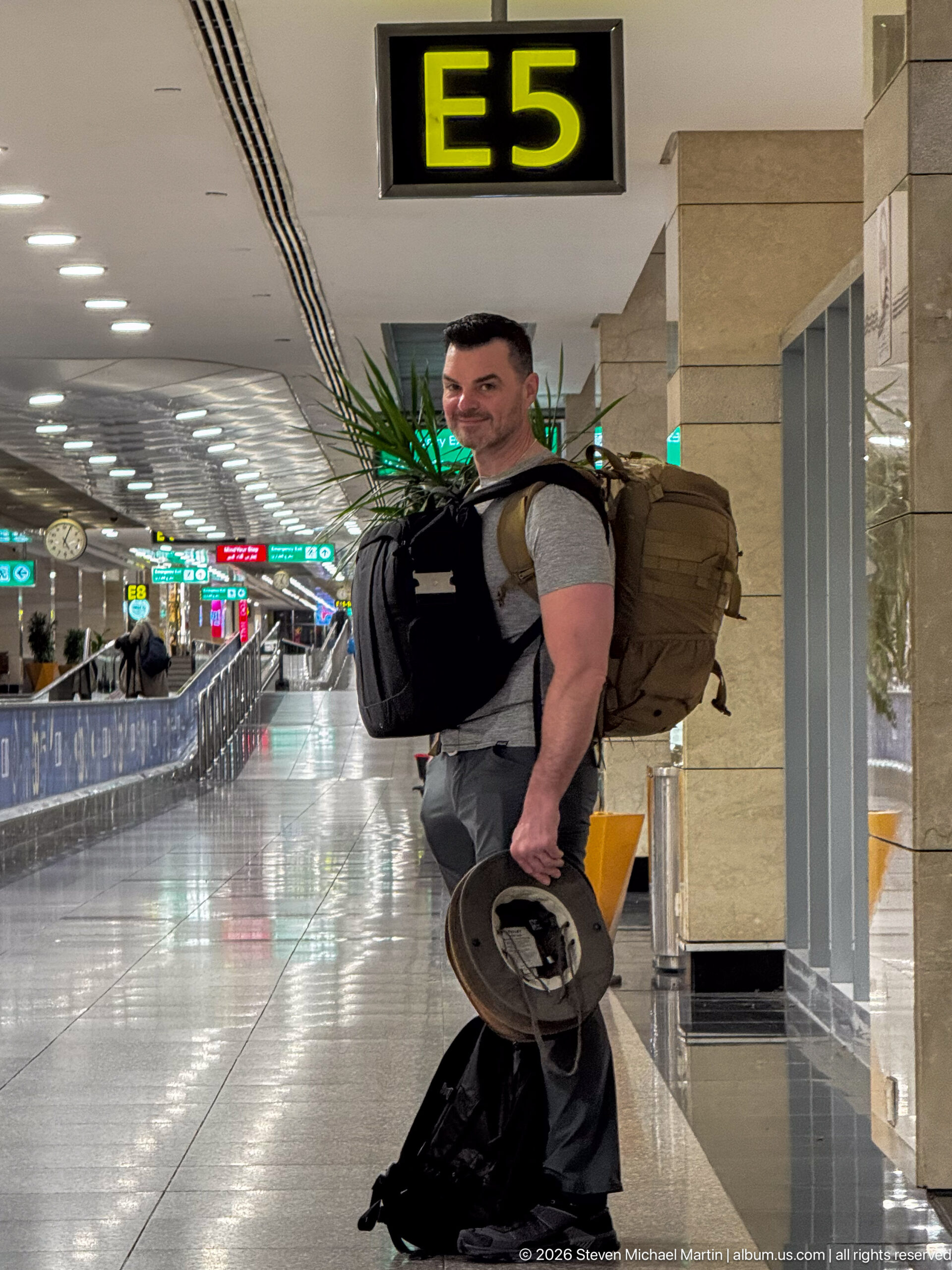
A traveler pauses beneath the illuminated E5 gate marker in a bright airport terminal, carrying a large expedition-style backpack and hand luggage. The compressed perspective of the concourse, polished floor, and repeated overhead signs emphasizes the logistical environment of international travel, while the portrait provides a personal counterpoint to the surrounding maps and airline imagery.
Caption
A traveler pauses beneath the illuminated E5 gate marker in a bright airport terminal, carrying a large expedition-style backpack and hand luggage. The compressed perspective of the concourse, polished floor, and repeated overhead signs emphasizes the logistical environment of international travel, while the portrait provides a personal counterpoint to the surrounding maps and airline imagery.
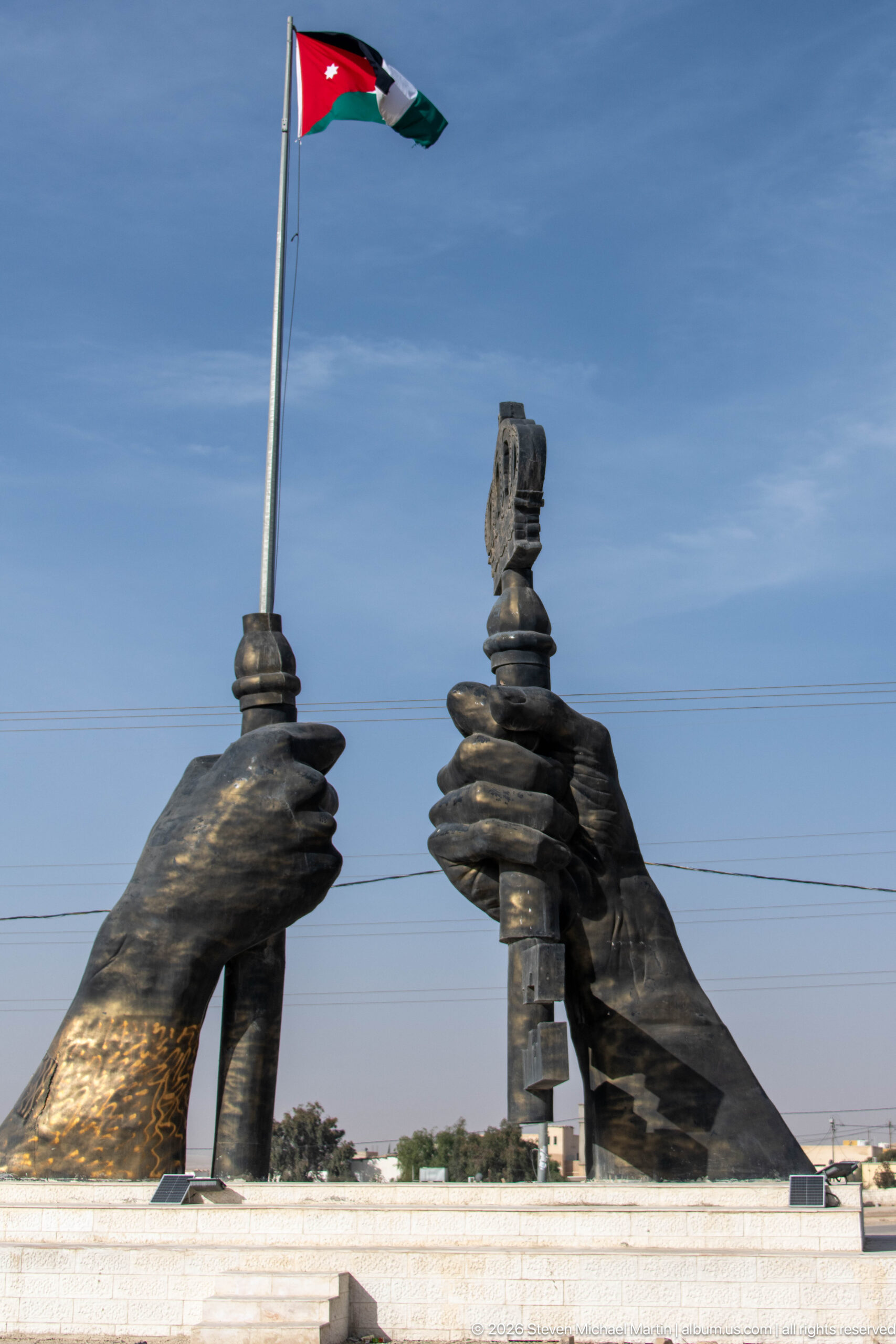
A monumental roadside sculpture pairs two oversized bronze-colored hands with a central pedestal, while the Jordanian flag rises above on a tall pole. One hand appears to support the flagstaff and the other forms a framing gesture around the central element, creating a highly symbolic civic composition focused on national identity and public space.
Caption
A monumental roadside sculpture pairs two oversized bronze-colored hands with a central pedestal, while the Jordanian flag rises above on a tall pole. One hand appears to support the flagstaff and the other forms a framing gesture around the central element, creating a highly symbolic civic composition focused on national identity and public space.
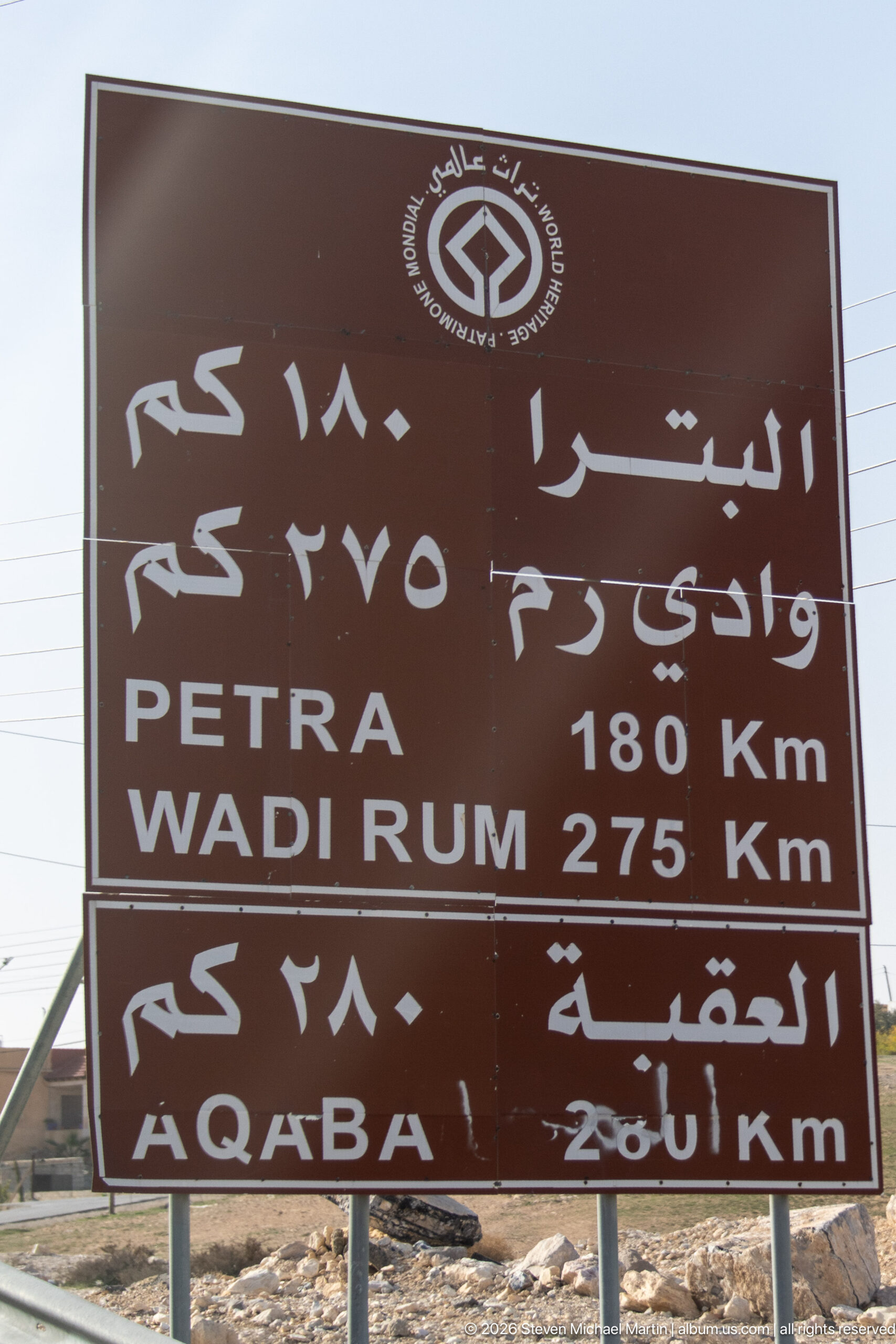
A large bilingual highway sign gives distances southward to Petra, Wadi Rum, and Aqaba, listing Petra at 180 km, Wadi Rum at 275 km, and Aqaba at roughly 280 km. The brown tourist-direction format identifies major heritage and travel destinations and situates the route within Jordan’s long north–south corridor.
Caption
A large bilingual highway sign gives distances southward to Petra, Wadi Rum, and Aqaba, listing Petra at 180 km, Wadi Rum at 275 km, and Aqaba at roughly 280 km. The brown tourist-direction format identifies major heritage and travel destinations and situates the route within Jordan’s long north–south corridor.
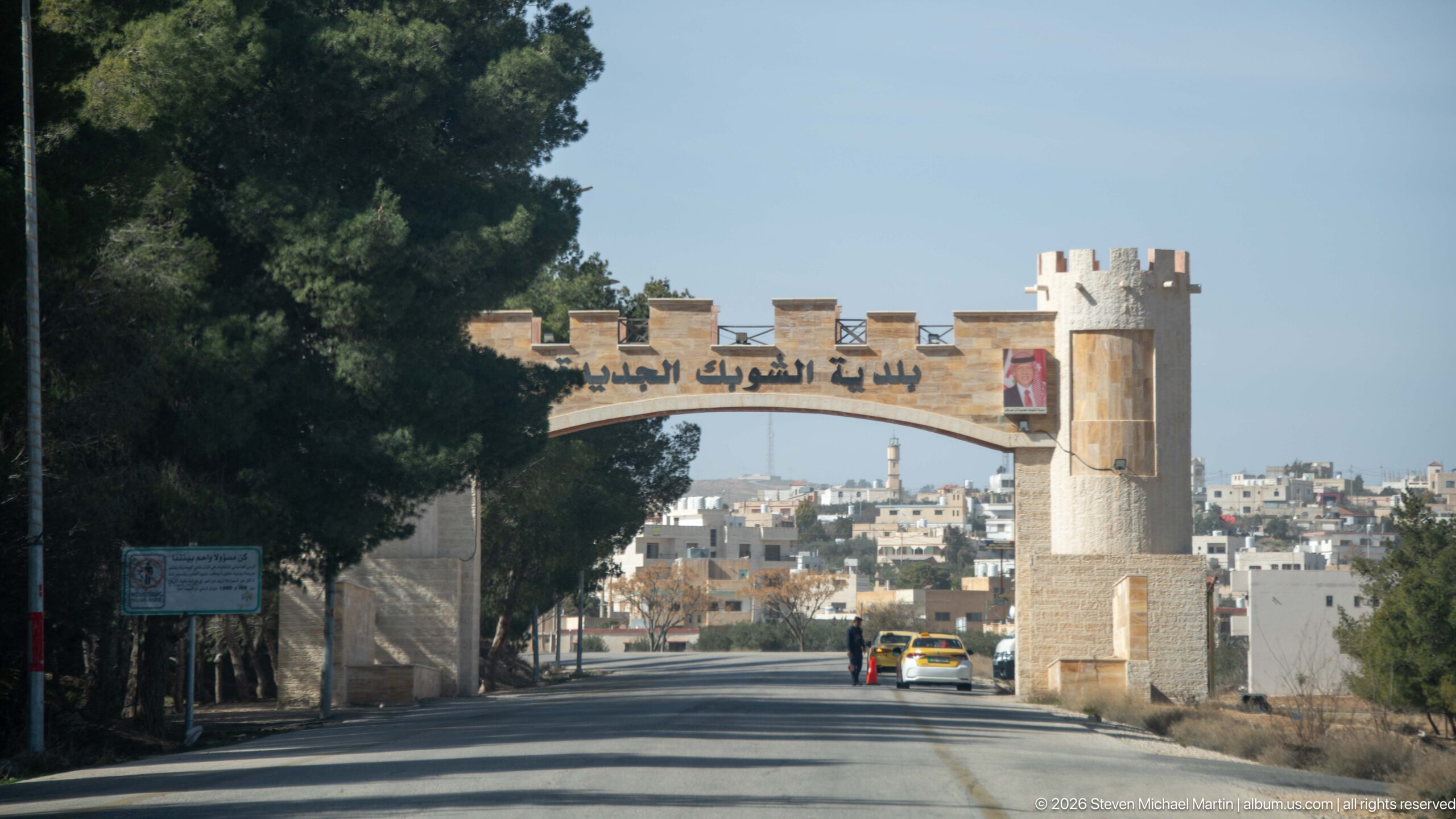
A broad roadside arch with crenellated detailing spans an entrance road near Amman, supported by a cylindrical tower-like pier and bearing a prominent Arabic inscription. The architectural language evokes fortified and civic gateways while serving a modern vehicular route, with dense pale housing visible beyond and trees framing the approach.
Caption
A broad roadside arch with crenellated detailing spans an entrance road near Amman, supported by a cylindrical tower-like pier and bearing a prominent Arabic inscription. The architectural language evokes fortified and civic gateways while serving a modern vehicular route, with dense pale housing visible beyond and trees framing the approach.
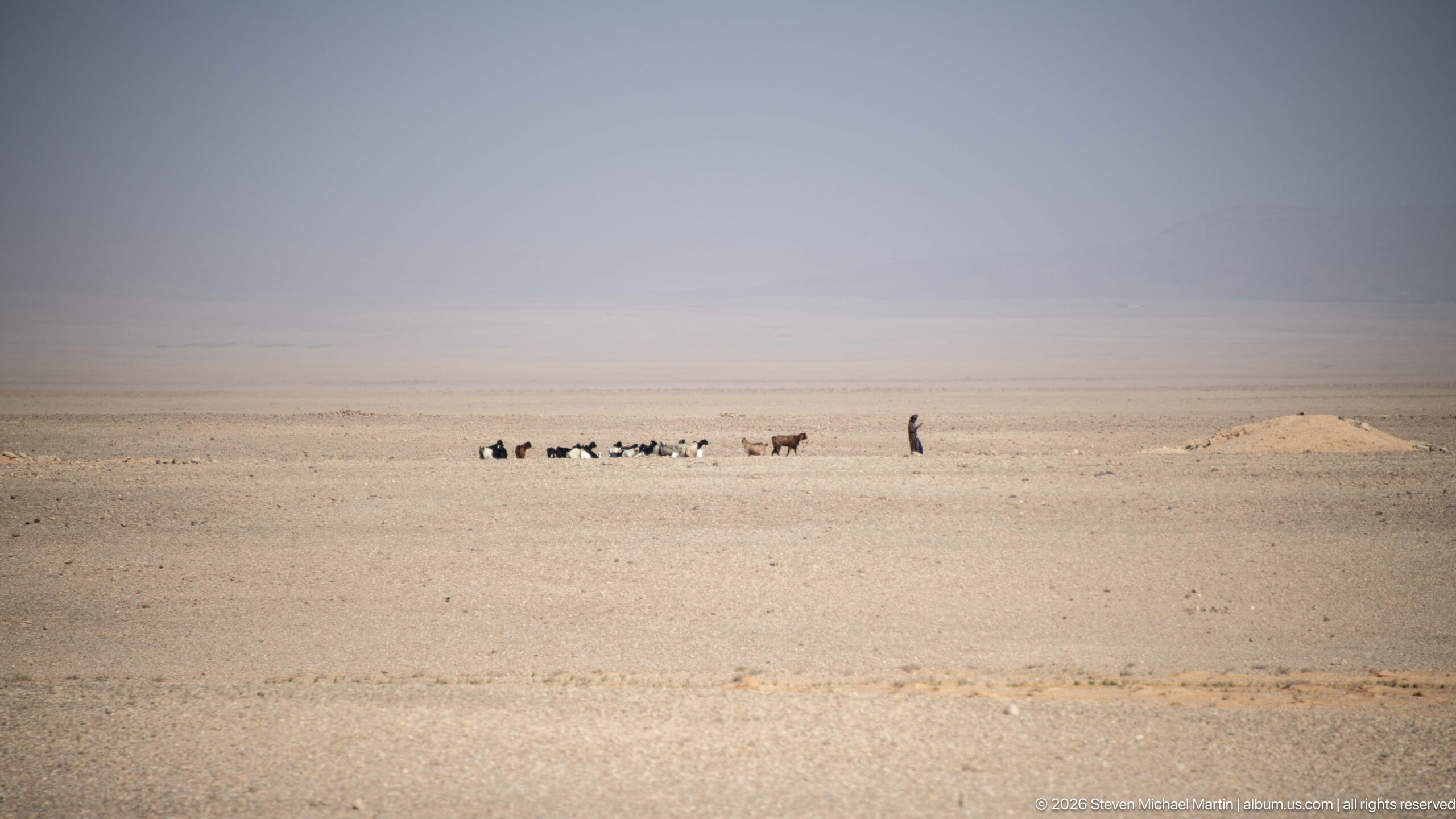
A small herd moves across a vast, pale desert plateau under a hazy sky, accompanied by a lone herder standing beside the animals. The animals occupy only a narrow band of the frame, emphasizing the scale and openness of Jordan’s arid interior landscape. The scene records pastoral use of terrain that at first glance appears almost empty.
Caption
A small herd moves across a vast, pale desert plateau under a hazy sky, accompanied by a lone herder standing beside the animals. The animals occupy only a narrow band of the frame, emphasizing the scale and openness of Jordan’s arid interior landscape. The scene records pastoral use of terrain that at first glance appears almost empty.
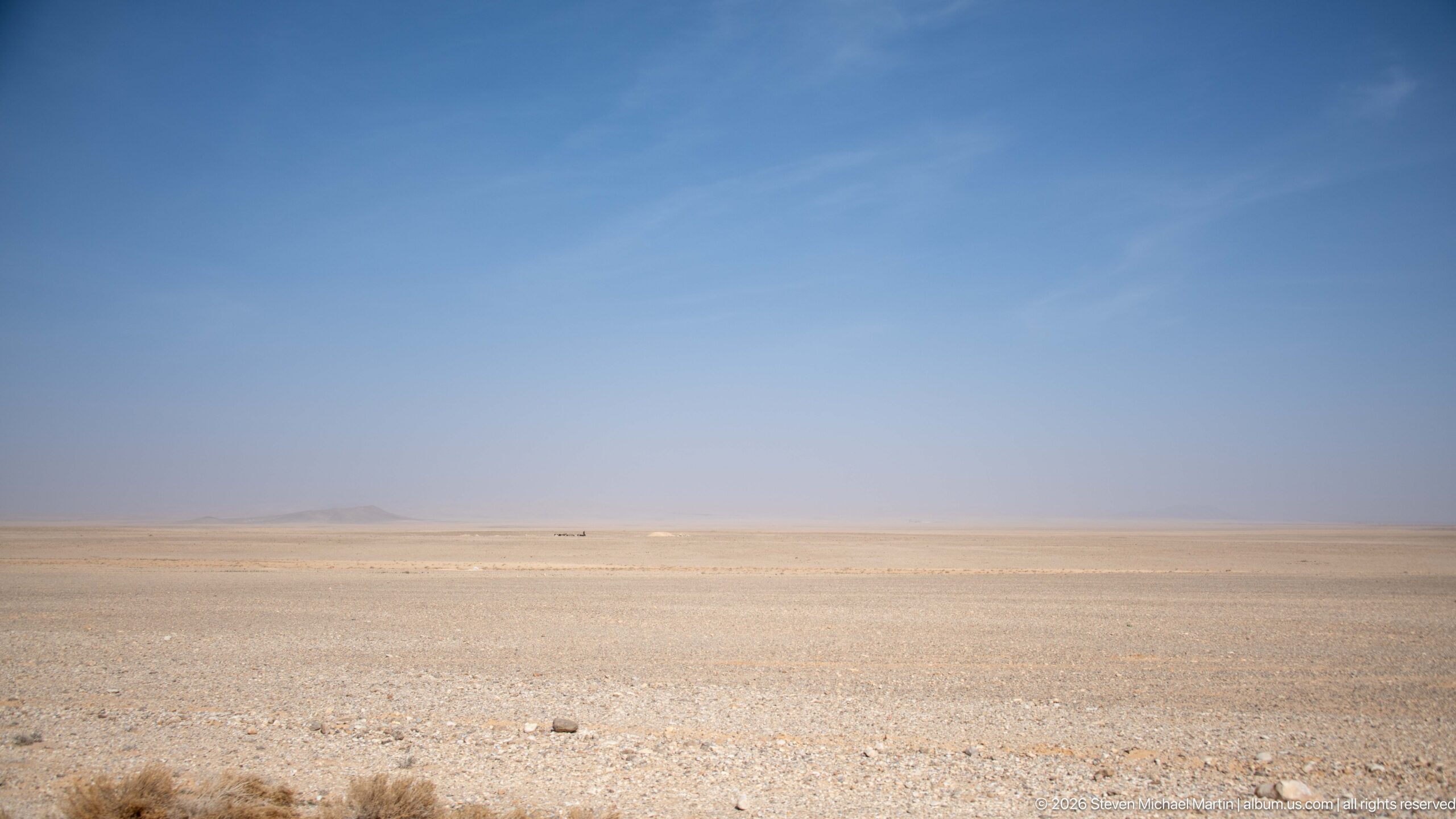
A nearly featureless stony plateau stretches to a hazy horizon beneath a clear blue sky, with only faint low rises interrupting the expanse. The restrained composition emphasizes the openness, pale gravel surface, and atmospheric distance of Jordan’s dry interior, providing a landscape counterpoint to the dense urban imagery of Amman.
Caption
A nearly featureless stony plateau stretches to a hazy horizon beneath a clear blue sky, with only faint low rises interrupting the expanse. The restrained composition emphasizes the openness, pale gravel surface, and atmospheric distance of Jordan’s dry interior, providing a landscape counterpoint to the dense urban imagery of Amman.
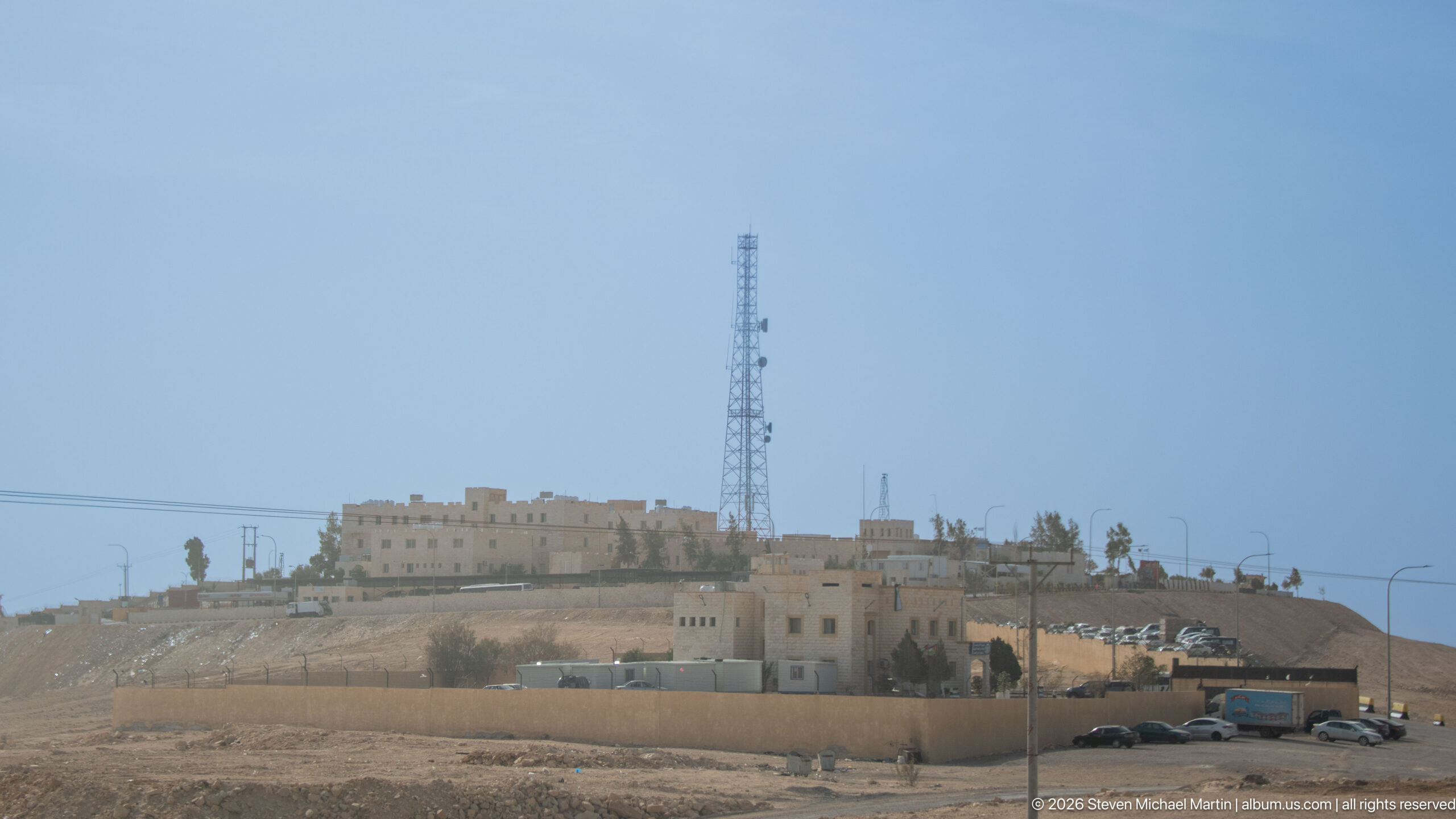
A low complex of pale buildings occupies a flattened hilltop beside a tall communications mast and roadside infrastructure. The surrounding terrain is dry, graded, and sparsely vegetated, giving the site the appearance of an isolated institutional or service compound on the edge of the Amman region. The photograph records development extending into the arid plateau beyond the dense city.
Caption
A low complex of pale buildings occupies a flattened hilltop beside a tall communications mast and roadside infrastructure. The surrounding terrain is dry, graded, and sparsely vegetated, giving the site the appearance of an isolated institutional or service compound on the edge of the Amman region. The photograph records development extending into the arid plateau beyond the dense city.
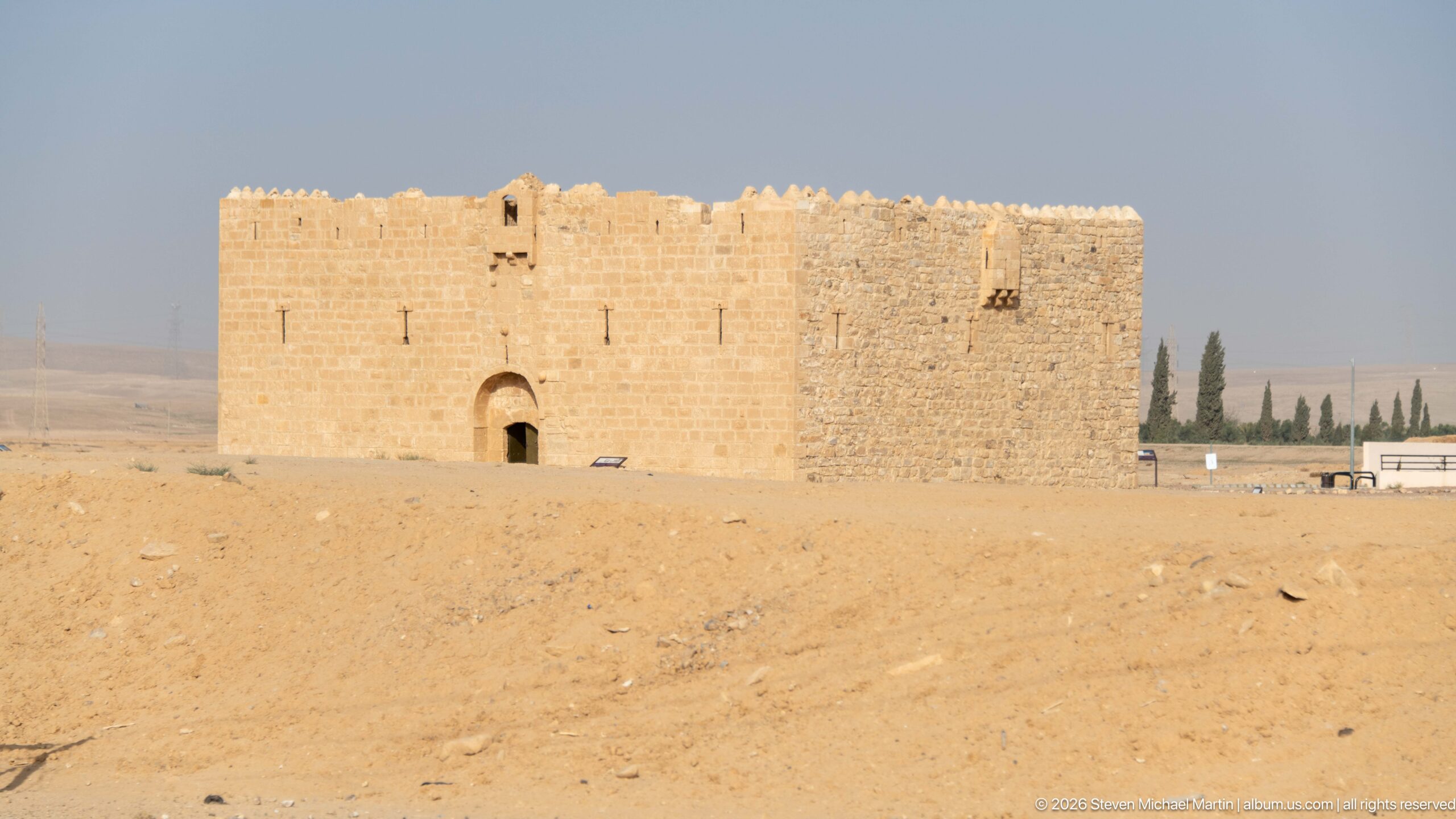
A compact rectangular stone fort stands alone in the dry Jordanian landscape, its thick walls broken by narrow openings and a single arched entrance. Crenellated parapets and the severe, nearly windowless elevations give the structure a defensive appearance, while the isolated setting underscores the strategic relationship between fortified architecture and the open plateau.
Caption
A compact rectangular stone fort stands alone in the dry Jordanian landscape, its thick walls broken by narrow openings and a single arched entrance. Crenellated parapets and the severe, nearly windowless elevations give the structure a defensive appearance, while the isolated setting underscores the strategic relationship between fortified architecture and the open plateau.
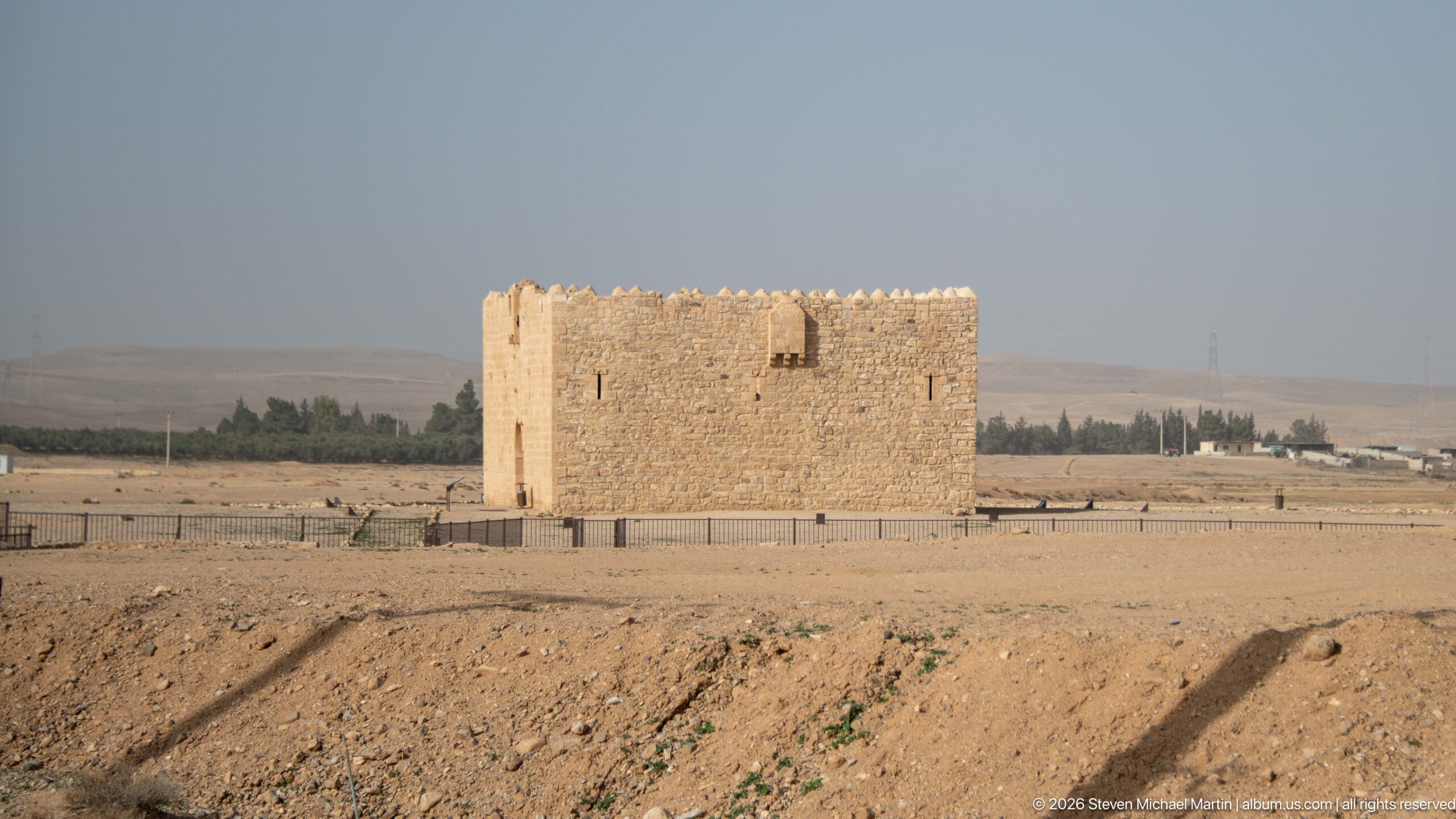
Seen from farther away, the compact stone fort appears as an isolated block set against broad agricultural and arid terrain. The side elevation reveals slit-like openings, projecting stone details, and a continuous crenellated roofline. This more distant view clarifies the building’s simple rectangular massing and its exposed position within the open Jordanian landscape.
Caption
Seen from farther away, the compact stone fort appears as an isolated block set against broad agricultural and arid terrain. The side elevation reveals slit-like openings, projecting stone details, and a continuous crenellated roofline. This more distant view clarifies the building’s simple rectangular massing and its exposed position within the open Jordanian landscape.
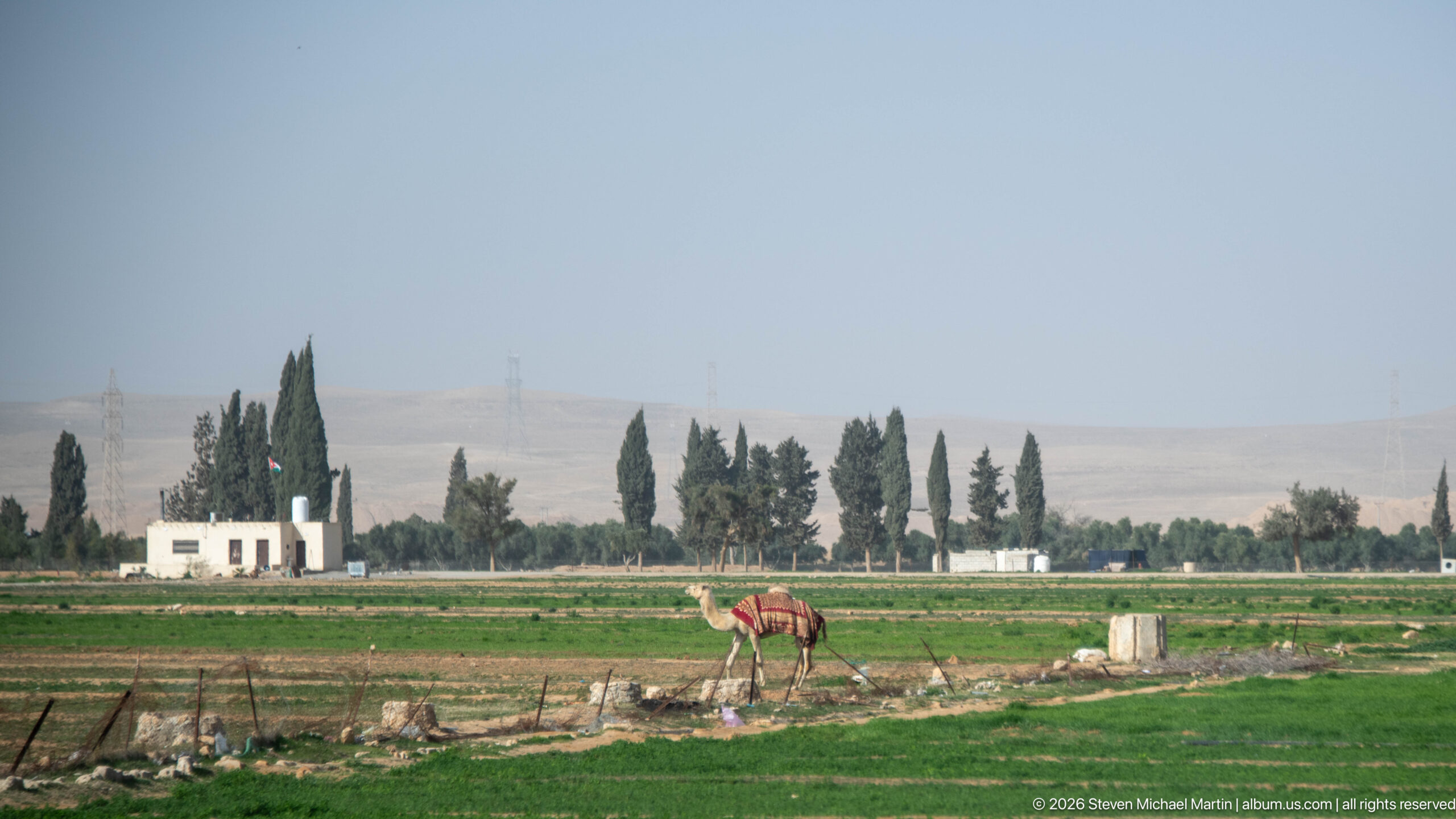
A camel grazes beside green cultivated fields in a broad agricultural landscape, with tall slender trees and low buildings breaking the horizon. The contrast between irrigated vegetation and pale dry hills beyond shows the sharp environmental transition created by managed water, while the animal adds a familiar element of regional pastoral life.
Caption
A camel grazes beside green cultivated fields in a broad agricultural landscape, with tall slender trees and low buildings breaking the horizon. The contrast between irrigated vegetation and pale dry hills beyond shows the sharp environmental transition created by managed water, while the animal adds a familiar element of regional pastoral life.
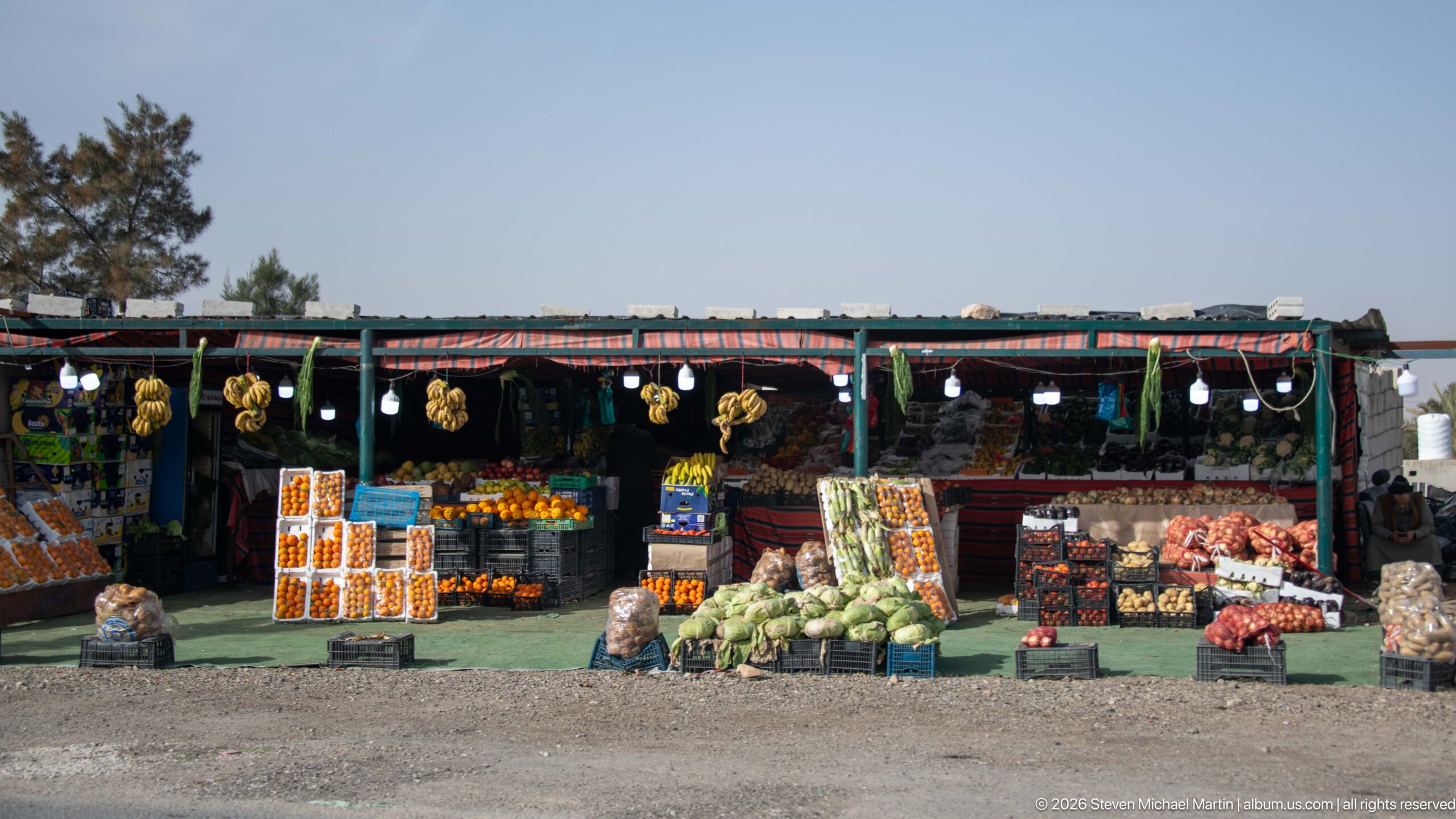
A roadside produce stand displays watermelons, melons, oranges, and other fruits and vegetables in stacked crates beneath a shaded canopy. Hanging goods and colorful arrangements fill the open storefront, creating a vivid record of everyday commerce along the Jordanian road network. The stand’s informal frontage contrasts with the monumental and archaeological subjects elsewhere in the sequence.
Caption
A roadside produce stand displays watermelons, melons, oranges, and other fruits and vegetables in stacked crates beneath a shaded canopy. Hanging goods and colorful arrangements fill the open storefront, creating a vivid record of everyday commerce along the Jordanian road network. The stand’s informal frontage contrasts with the monumental and archaeological subjects elsewhere in the sequence.
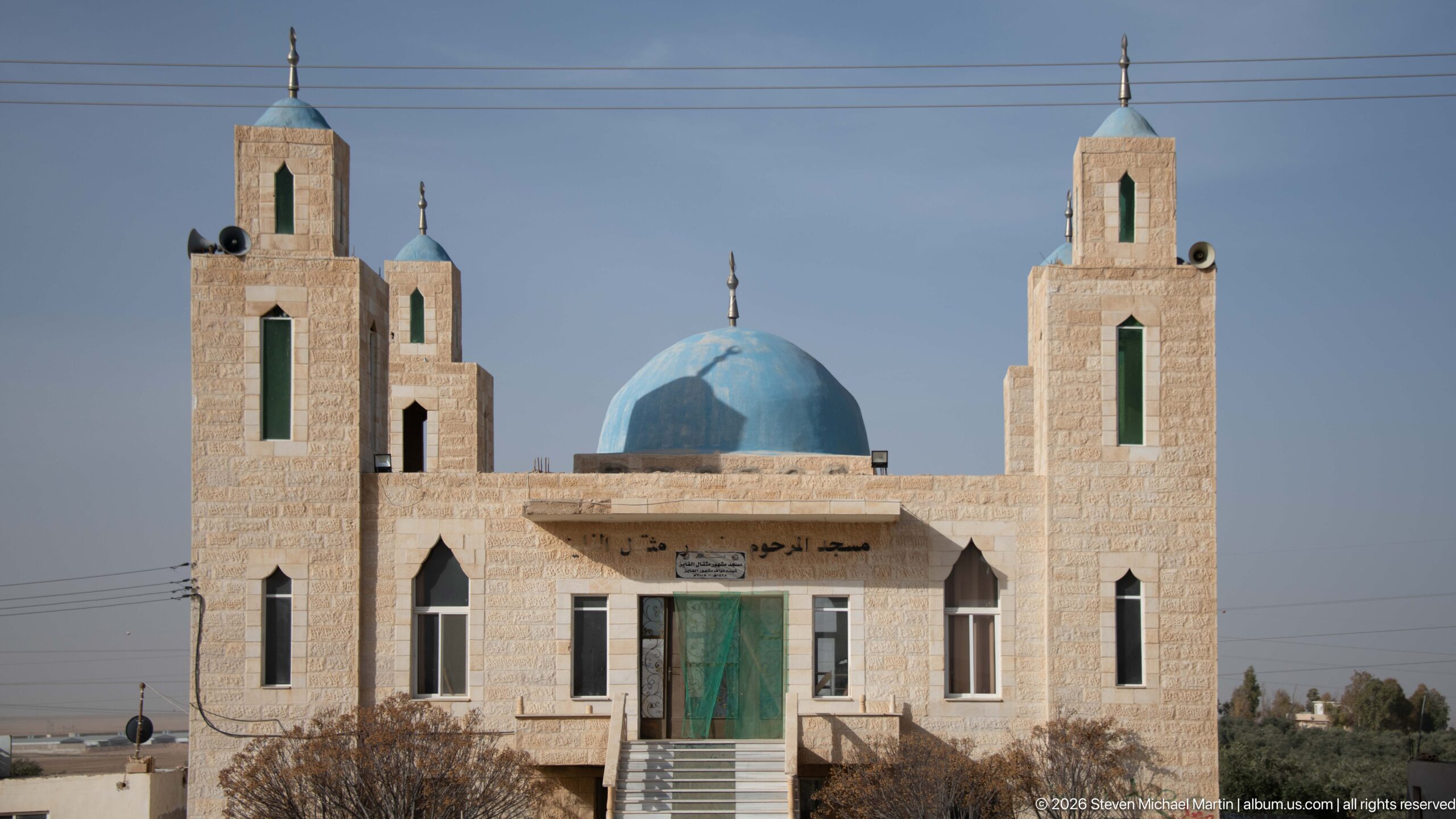
A small pale-stone mosque is organized around a bright blue central dome and four narrow corner towers, each capped with a pointed finial. Green doors and window openings add color to the symmetrical façade, while loudspeakers mounted high on the towers identify the building’s active religious function. The compact design stands clearly against the open sky and dry roadside surroundings.
Caption
A small pale-stone mosque is organized around a bright blue central dome and four narrow corner towers, each capped with a pointed finial. Green doors and window openings add color to the symmetrical façade, while loudspeakers mounted high on the towers identify the building’s active religious function. The compact design stands clearly against the open sky and dry roadside surroundings.
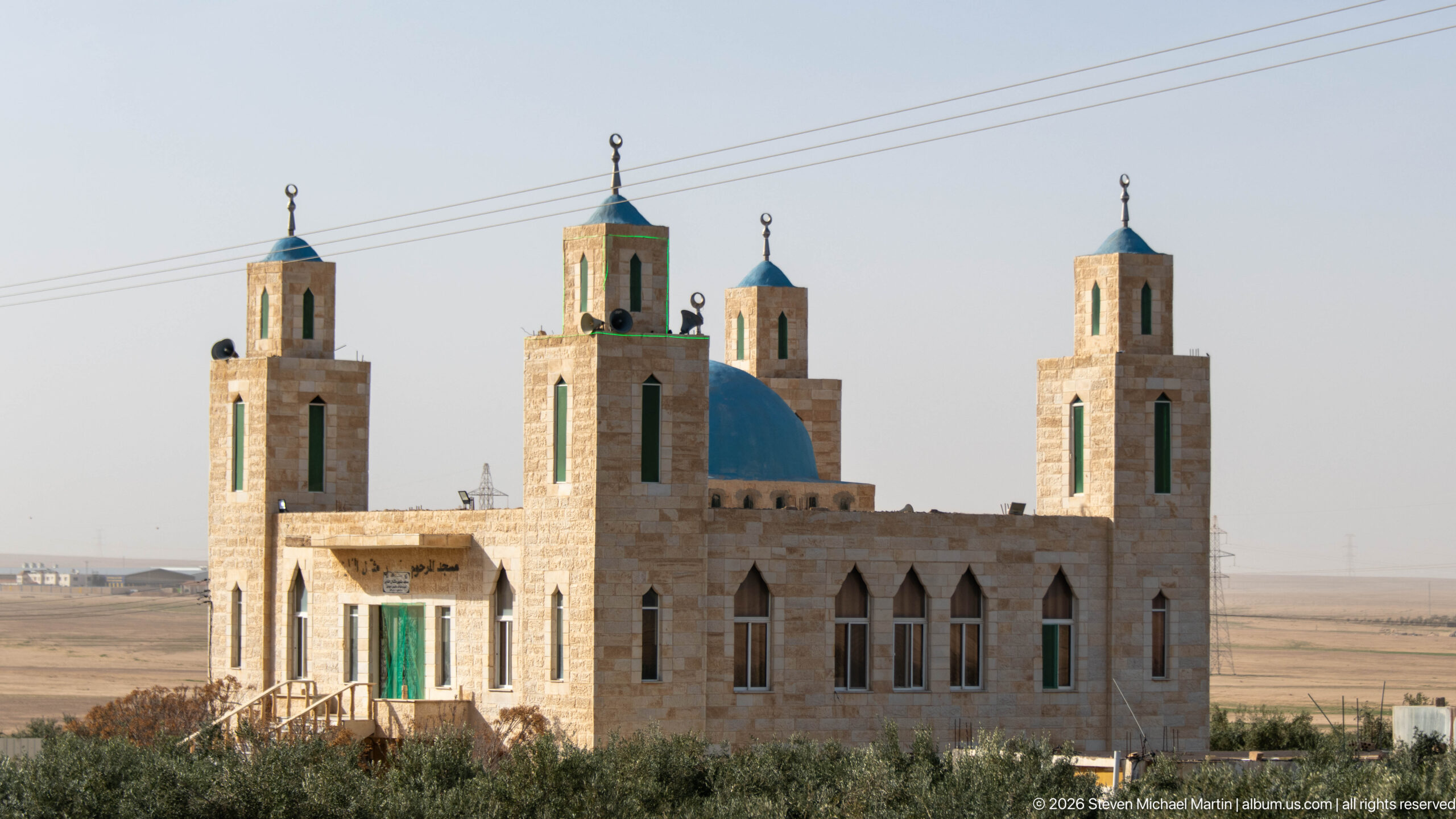
A compact stone mosque rises from the dry Jordanian landscape with a bright blue central dome and four square corner towers capped by small pyramidal roofs and finials. Tall narrow windows, green doors, and exterior loudspeakers emphasize its active religious use, while the isolated setting allows the building’s symmetrical massing and contrasting colors to stand out clearly.
Caption
A compact stone mosque rises from the dry Jordanian landscape with a bright blue central dome and four square corner towers capped by small pyramidal roofs and finials. Tall narrow windows, green doors, and exterior loudspeakers emphasize its active religious use, while the isolated setting allows the building’s symmetrical massing and contrasting colors to stand out clearly.
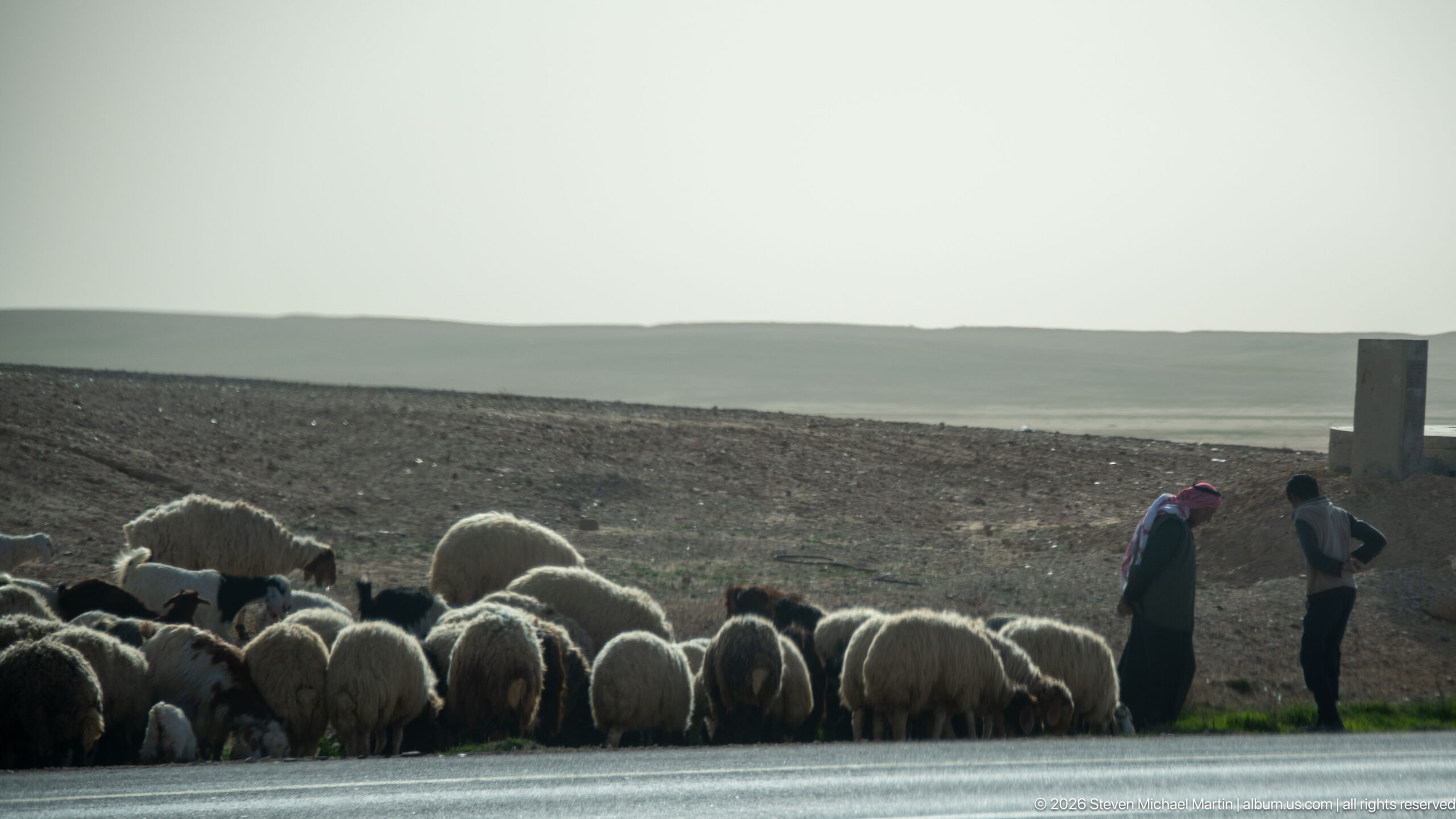
A flock of sheep crowds the edge of a paved road while two herders stand nearby against a broad, dark-plowed agricultural landscape. Backlighting catches the animals’ wool and separates the group from the muted fields beyond. The scene records active pastoral life in Jordan’s countryside and the close overlap between livestock movement, agriculture, and modern road travel.
Caption
A flock of sheep crowds the edge of a paved road while two herders stand nearby against a broad, dark-plowed agricultural landscape. Backlighting catches the animals’ wool and separates the group from the muted fields beyond. The scene records active pastoral life in Jordan’s countryside and the close overlap between livestock movement, agriculture, and modern road travel.
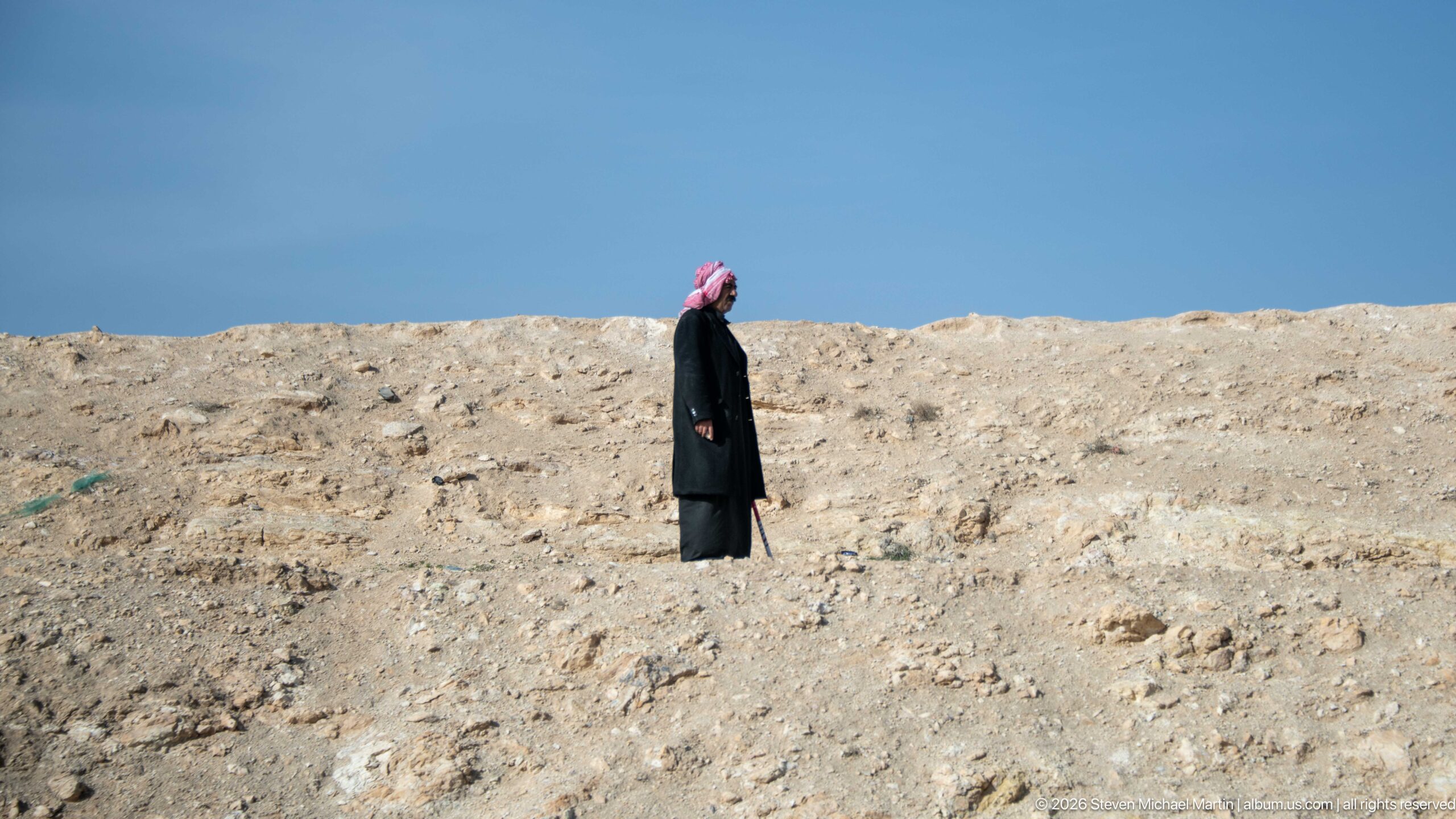
A man wearing a red-and-white keffiyeh and long dark coat stands alone on pale, rocky ground beneath a clear blue sky. The spare composition isolates the figure against the barren terrain, emphasizing clothing, posture, and the scale of the surrounding landscape rather than a specific monument or settlement.
Caption
A man wearing a red-and-white keffiyeh and long dark coat stands alone on pale, rocky ground beneath a clear blue sky. The spare composition isolates the figure against the barren terrain, emphasizing clothing, posture, and the scale of the surrounding landscape rather than a specific monument or settlement.
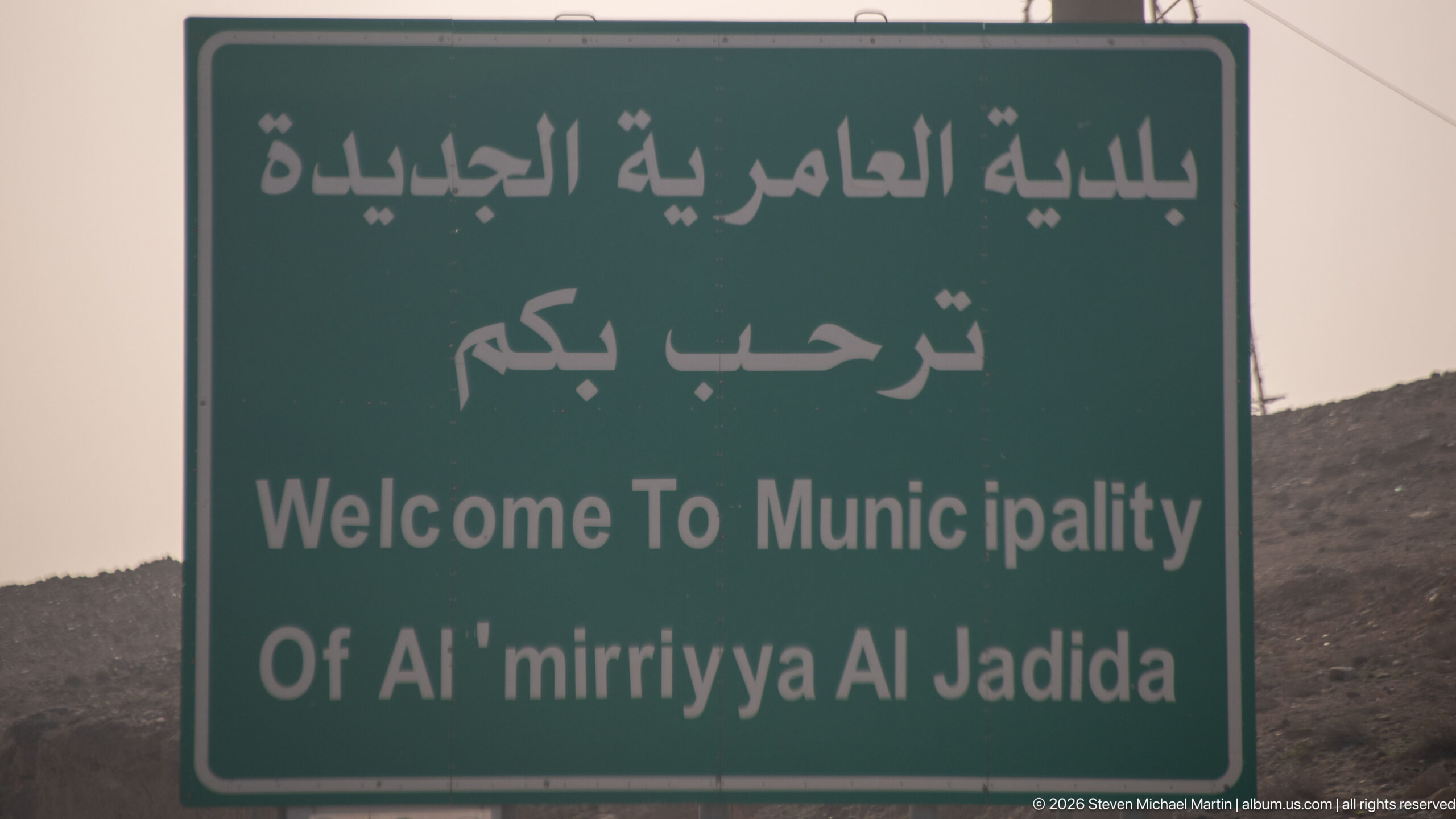
A green bilingual municipal sign welcomes travelers to Al 'mirriyya Al Jadida, pairing Arabic text with the English wording “Welcome To Municipality Of Al 'mirriyya Al Jadida.” Set against dry hills, the sign marks a local administrative boundary or settlement entrance along the route through Jordan.
Caption
A green bilingual municipal sign welcomes travelers to Al 'mirriyya Al Jadida, pairing Arabic text with the English wording “Welcome To Municipality Of Al 'mirriyya Al Jadida.” Set against dry hills, the sign marks a local administrative boundary or settlement entrance along the route through Jordan.
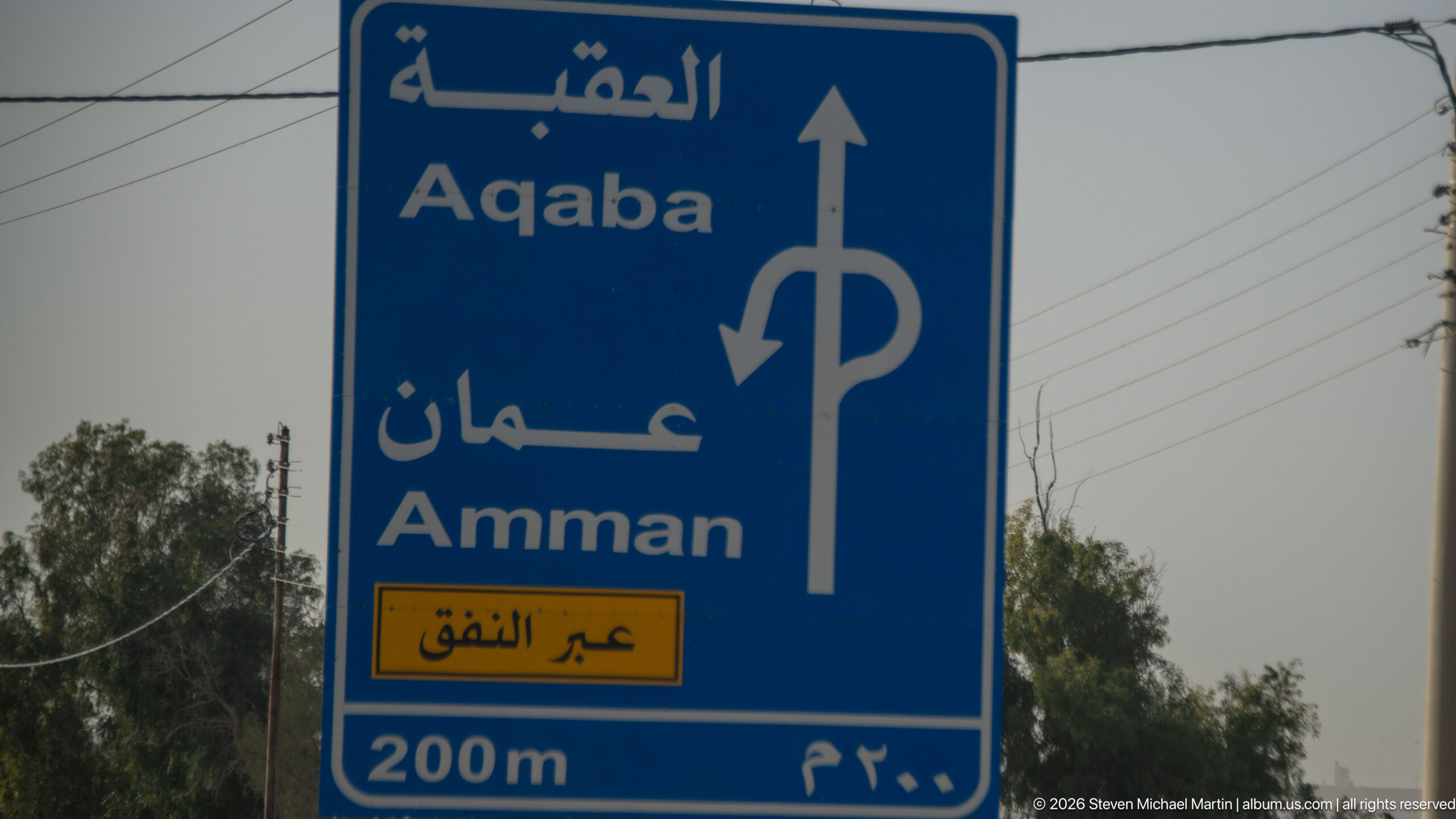
A blue bilingual traffic sign separates routes toward Aqaba and Amman, with arrows indicating different movements at a junction 200 meters ahead. The yellow panel references an underpass, and overhead utility lines and roadside trees place the sign within a developed transportation corridor rather than an isolated desert highway.
Caption
A blue bilingual traffic sign separates routes toward Aqaba and Amman, with arrows indicating different movements at a junction 200 meters ahead. The yellow panel references an underpass, and overhead utility lines and roadside trees place the sign within a developed transportation corridor rather than an isolated desert highway.
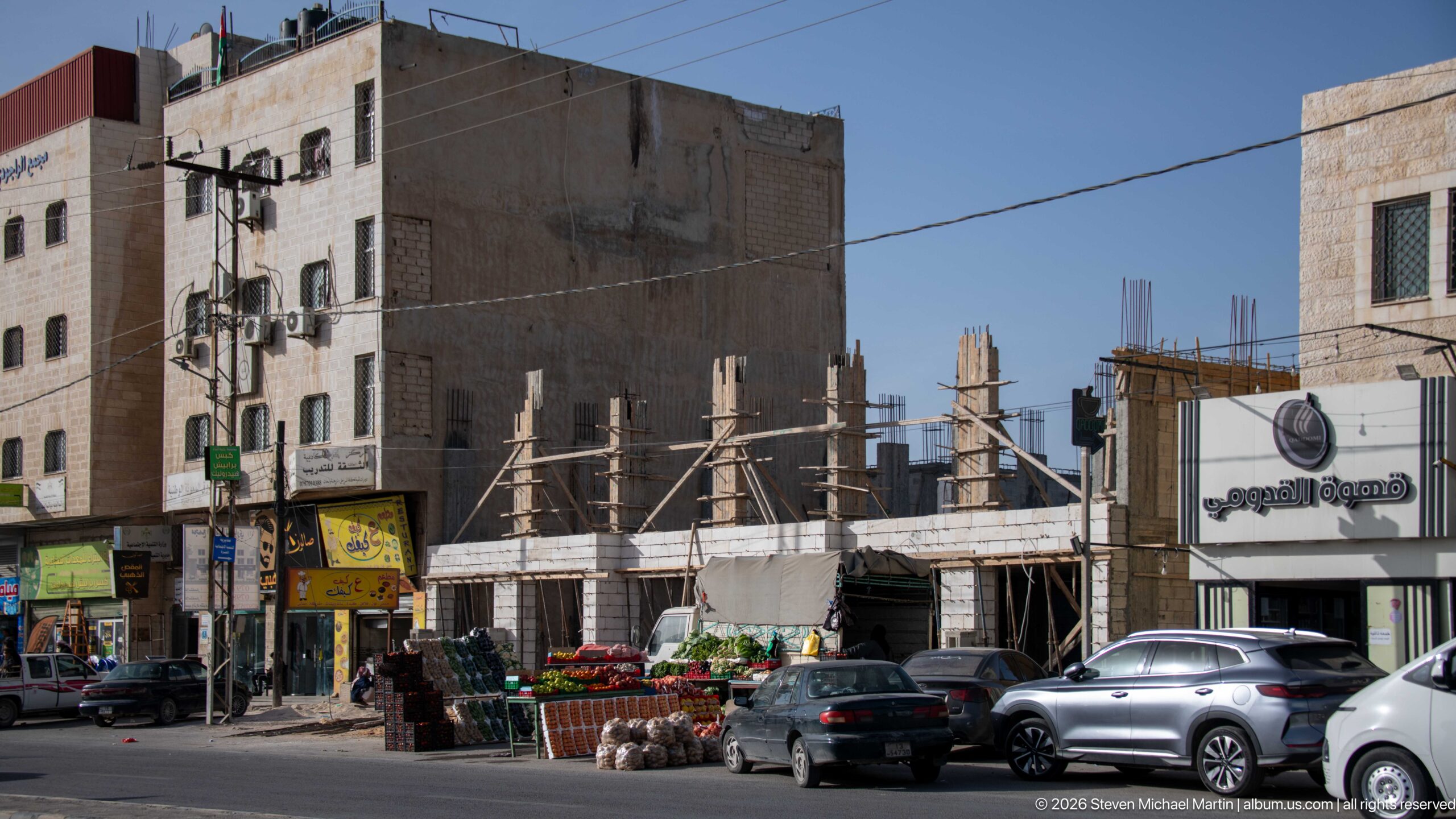
Streetfront produce stalls display watermelons and other goods beneath mixed-use concrete buildings, some still under construction with exposed columns and reinforcing bars. Parked cars, shop signs, utility poles, and unfinished upper floors create a dense everyday streetscape that contrasts with Amman’s formal monuments and archaeological sites.
Caption
Streetfront produce stalls display watermelons and other goods beneath mixed-use concrete buildings, some still under construction with exposed columns and reinforcing bars. Parked cars, shop signs, utility poles, and unfinished upper floors create a dense everyday streetscape that contrasts with Amman’s formal monuments and archaeological sites.
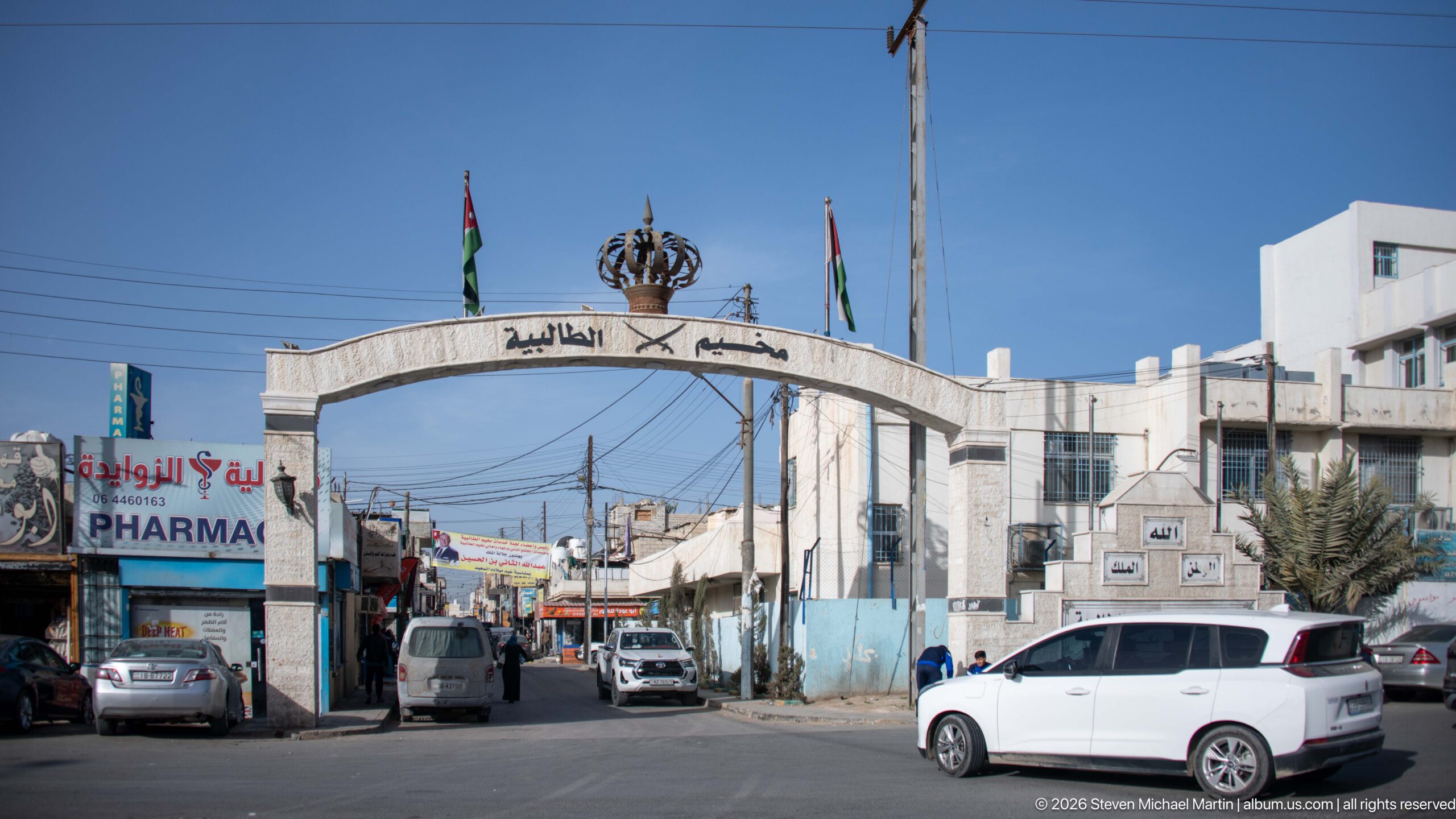
A broad white gateway arch spans a local street and is topped by a crown emblem and Jordanian flags. Arabic lettering across the arch identifies the entrance, while pharmacies, small shops, vehicles, and utility lines continue beyond it. The composition presents the gateway as part of a functioning neighborhood rather than a freestanding monument.
Caption
A broad white gateway arch spans a local street and is topped by a crown emblem and Jordanian flags. Arabic lettering across the arch identifies the entrance, while pharmacies, small shops, vehicles, and utility lines continue beyond it. The composition presents the gateway as part of a functioning neighborhood rather than a freestanding monument.
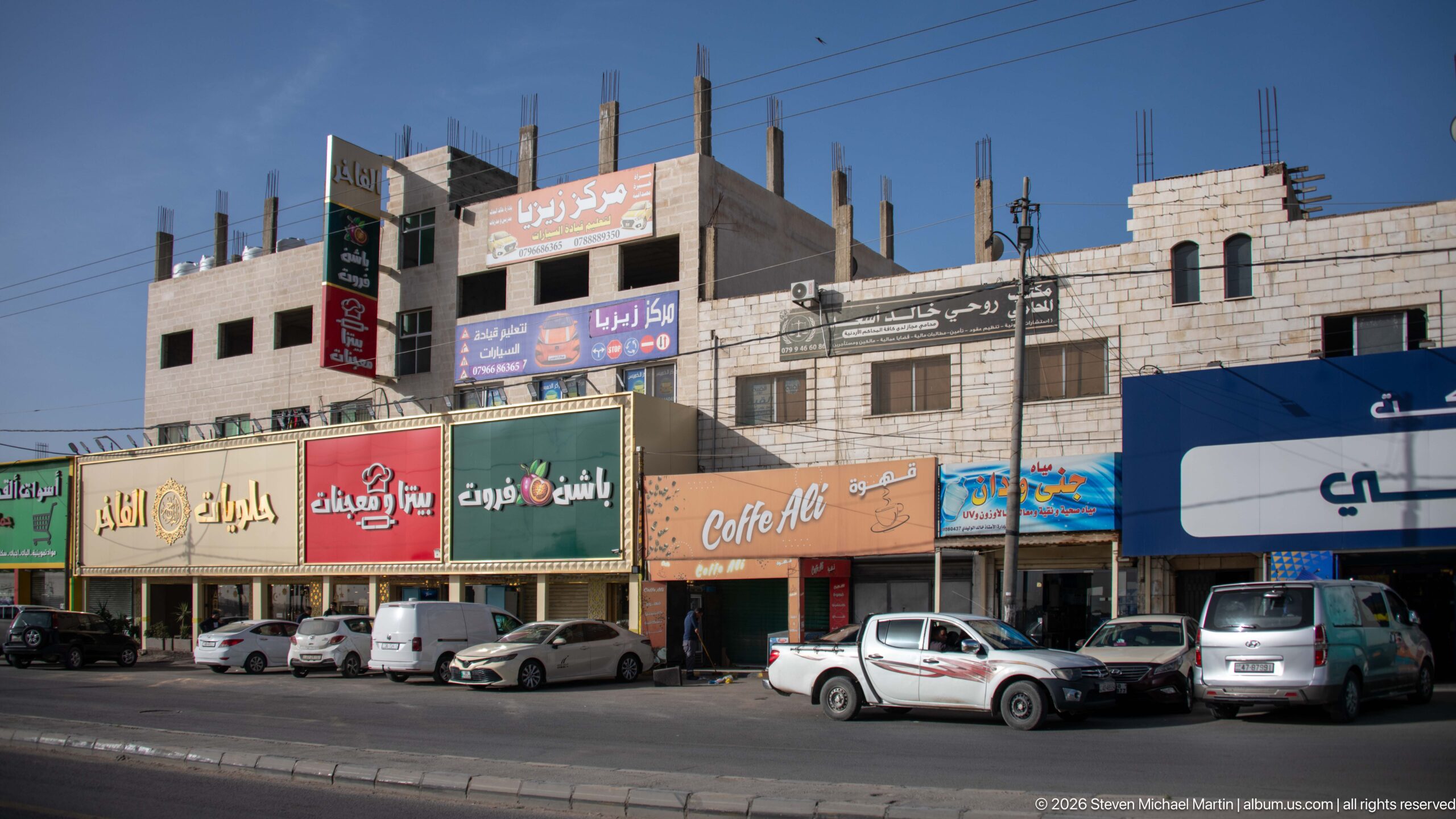
A row of brightly signed storefronts occupies the ground floor of unfinished and partially clad buildings along a busy Amman road. Arabic shop signs, delivery vehicles, parked cars, exposed reinforcing bars, and upper-floor masonry record the layered, incremental character of urban commercial development in the city’s outer districts.
Caption
A row of brightly signed storefronts occupies the ground floor of unfinished and partially clad buildings along a busy Amman road. Arabic shop signs, delivery vehicles, parked cars, exposed reinforcing bars, and upper-floor masonry record the layered, incremental character of urban commercial development in the city’s outer districts.
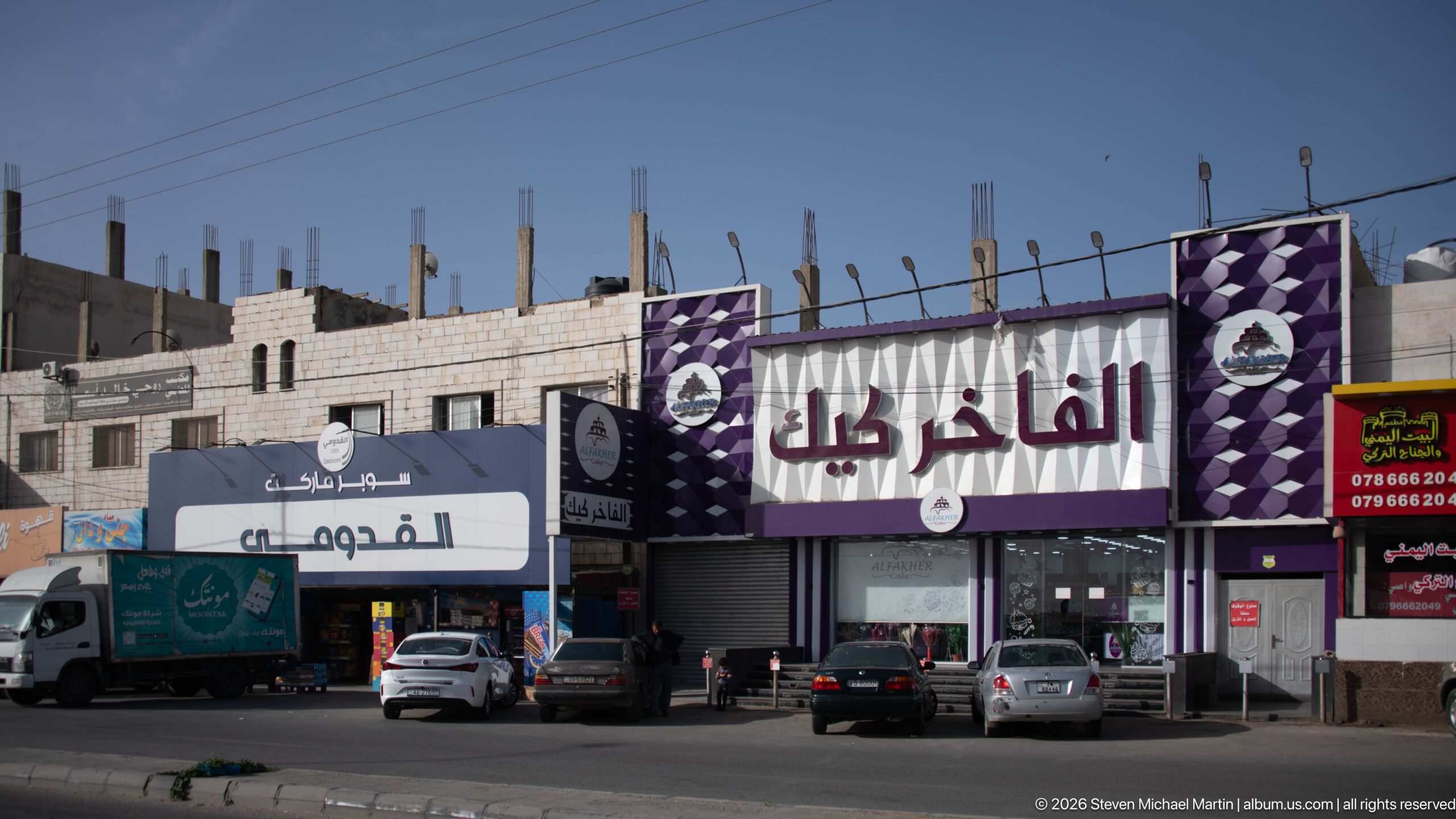
A large purple-and-white Arabic storefront dominates this roadside commercial strip, flanked by neighboring businesses and parked vehicles. Bold geometric branding, illuminated signs, and an unfinished upper building frame create a sharp contrast between polished retail frontage and the still-developing structure behind it, a recurring feature of Amman’s mixed commercial corridors.
Caption
A large purple-and-white Arabic storefront dominates this roadside commercial strip, flanked by neighboring businesses and parked vehicles. Bold geometric branding, illuminated signs, and an unfinished upper building frame create a sharp contrast between polished retail frontage and the still-developing structure behind it, a recurring feature of Amman’s mixed commercial corridors.
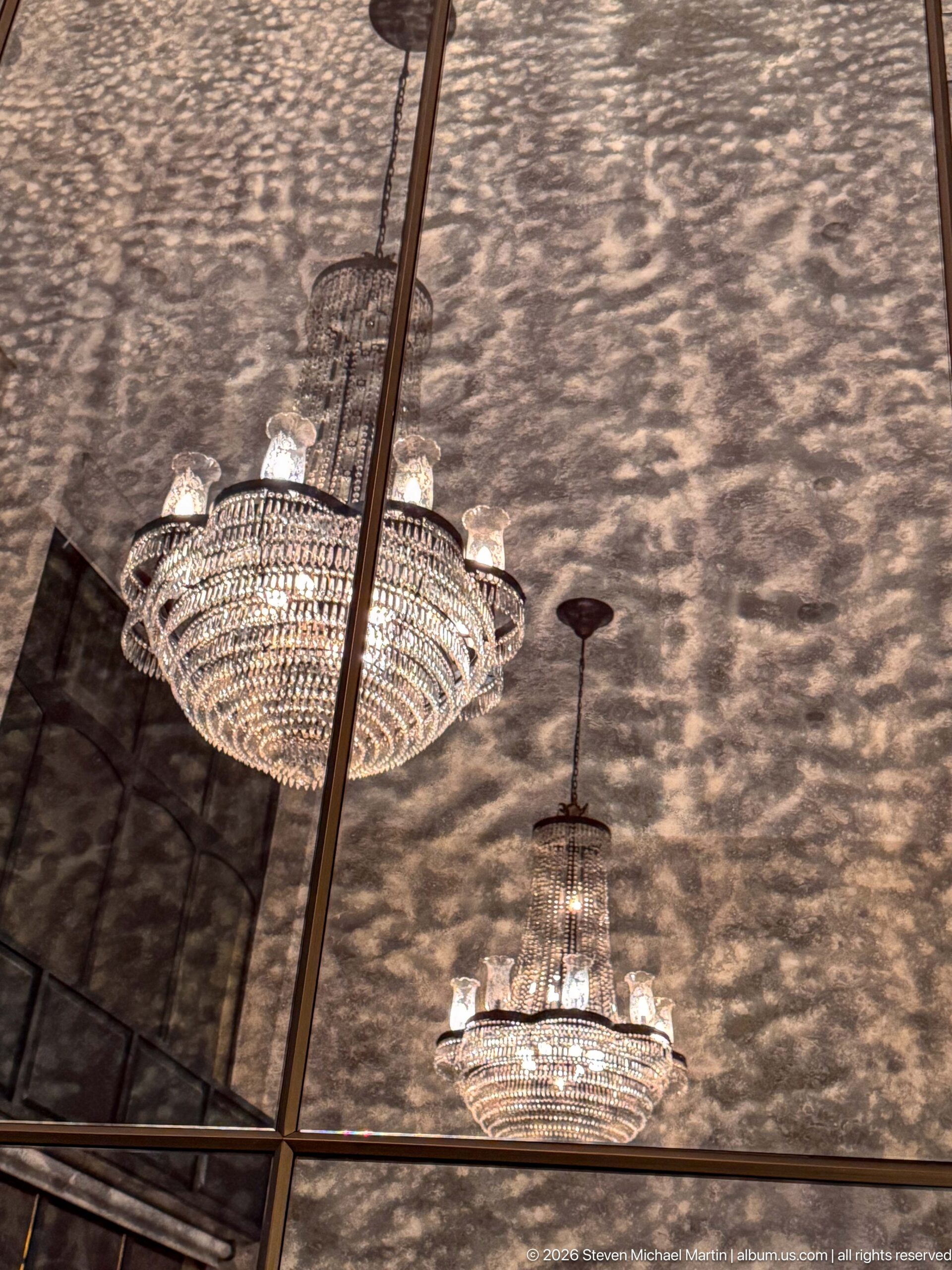
Two ornate crystal chandeliers hang beneath a mirrored or highly reflective ceiling, multiplying their light and decorative forms across the surface above. The warm, patterned reflections transform the ceiling into a dense field of texture and sparkle, emphasizing interior ornament and atmosphere rather than the architecture of the room itself.
Caption
Two ornate crystal chandeliers hang beneath a mirrored or highly reflective ceiling, multiplying their light and decorative forms across the surface above. The warm, patterned reflections transform the ceiling into a dense field of texture and sparkle, emphasizing interior ornament and atmosphere rather than the architecture of the room itself.