North Africa American Cemetery – Carthage, Tunisia
The North Africa American Cemetery and Memorial lies near the ancient city of Carthage, overlooking the Mediterranean Sea. The cemetery honors American soldiers who lost their lives during the North African campaigns of World War II.
More than 2,800 graves are arranged across the peaceful landscaped grounds, while the memorial walls record the names of thousands of additional service members whose remains were never recovered. The site commemorates the Allied operations that helped secure North Africa during the war.
Today the cemetery serves as a place of remembrance and reflection overlooking the historic coastline of Tunisia.

A low rectangular limestone building marked “Visitors” stands beside the cemetery approach. Its restrained façade, flat roofline, and centered doorway use the same pale masonry vocabulary seen throughout the memorial complex, creating a quiet administrative threshold between the entrance and the commemorative grounds.
Caption
A low rectangular limestone building marked “Visitors” stands beside the cemetery approach. Its restrained façade, flat roofline, and centered doorway use the same pale masonry vocabulary seen throughout the memorial complex, creating a quiet administrative threshold between the entrance and the commemorative grounds.

Two cats rest on the paved approach near the cemetery entrance, one orange-and-white animal sitting alert while a tabby lies in the foreground. The informal scene contrasts with the highly ordered memorial landscape and records the everyday life encountered within the grounds rather than a commemorative feature.
Caption
Two cats rest on the paved approach near the cemetery entrance, one orange-and-white animal sitting alert while a tabby lies in the foreground. The informal scene contrasts with the highly ordered memorial landscape and records the everyday life encountered within the grounds rather than a commemorative feature.

The formal entrance to the North Africa American Cemetery and Memorial is framed by pale stone gateposts bearing the cemetery name and a dark geometric metal gate. Clipped hedges and mature evergreens establish the carefully ordered landscape beyond, while the axial opening gives an immediate view into the memorial grounds.
Caption
The formal entrance to the North Africa American Cemetery and Memorial is framed by pale stone gateposts bearing the cemetery name and a dark geometric metal gate. Clipped hedges and mature evergreens establish the carefully ordered landscape beyond, while the axial opening gives an immediate view into the memorial grounds.

The chapel interior centers on a simple altar beneath a large cross set against warm reddish-brown wall panels. American and ceremonial flags stand nearby, while military service banners hang along the side wall. The restrained furnishings and axial carpeted approach create an intimate worship space within the larger memorial complex.
Caption
The chapel interior centers on a simple altar beneath a large cross set against warm reddish-brown wall panels. American and ceremonial flags stand nearby, while military service banners hang along the side wall. The restrained furnishings and axial carpeted approach create an intimate worship space within the larger memorial complex.

An open portico of pale stone columns frames a straight view into the cemetery grounds, where a path and clipped trees continue the memorial’s formal axis. Dark floor slabs contrast with the light masonry, sharpening the geometry of the transition from covered architectural space to the landscaped exterior.
Caption
An open portico of pale stone columns frames a straight view into the cemetery grounds, where a path and clipped trees continue the memorial’s formal axis. Dark floor slabs contrast with the light masonry, sharpening the geometry of the transition from covered architectural space to the landscaped exterior.

A broad gravel walk leads through clipped shrubs and trees toward a tall American flagpole, with low stone walls framing the approach. The composition shows the cemetery’s ceremonial landscape planning beyond the burial rows, using a strong central axis and carefully maintained plantings to guide movement through the grounds.
Caption
A broad gravel walk leads through clipped shrubs and trees toward a tall American flagpole, with low stone walls framing the approach. The composition shows the cemetery’s ceremonial landscape planning beyond the burial rows, using a strong central axis and carefully maintained plantings to guide movement through the grounds.

A United States flag flies above a tall white pole centered between clipped hedges and low stone gate walls. Bright blue sky and flowering groundcover give this concluding exterior view a vivid sense of openness, while the formal framing directs attention to the national symbol at the heart of the memorial landscape.
Caption
A United States flag flies above a tall white pole centered between clipped hedges and low stone gate walls. Bright blue sky and flowering groundcover give this concluding exterior view a vivid sense of openness, while the formal framing directs attention to the national symbol at the heart of the memorial landscape.

A tiered fountain forms the focal point of a narrow garden axis framed by dense, carefully clipped trees and shrubs. Stone benches on either side reinforce the symmetry, creating a quiet contemplative setting in which water, masonry, and vegetation provide a contrasting interlude to the adjacent burial fields.
Caption
A tiered fountain forms the focal point of a narrow garden axis framed by dense, carefully clipped trees and shrubs. Stone benches on either side reinforce the symmetry, creating a quiet contemplative setting in which water, masonry, and vegetation provide a contrasting interlude to the adjacent burial fields.

Broad lawns, clipped hedges, and carefully pruned trees define the formal landscape of the North Africa American Cemetery. The low, sculpted canopies and open grass create a restrained garden setting typical of a memorial cemetery, directing attention toward order, serenity, and the sequence of paths and commemorative spaces beyond.
Caption
Broad lawns, clipped hedges, and carefully pruned trees define the formal landscape of the North Africa American Cemetery. The low, sculpted canopies and open grass create a restrained garden setting typical of a memorial cemetery, directing attention toward order, serenity, and the sequence of paths and commemorative spaces beyond.

Rows of white grave markers stretch across the burial lawn beyond a low stone wall and bright red flowering shrubs. The layered view combines the cemetery’s disciplined commemorative geometry with the softer planting of its garden edges, showing how formal horticulture frames and partially screens the extensive field of graves.
Caption
Rows of white grave markers stretch across the burial lawn beyond a low stone wall and bright red flowering shrubs. The layered view combines the cemetery’s disciplined commemorative geometry with the softer planting of its garden edges, showing how formal horticulture frames and partially screens the extensive field of graves.

A framed interpretive plaque introduces the American Battle Monuments Commission and the North Africa American Cemetery and Memorial. Dense English, Arabic, and French text presents the site within the commission’s overseas commemorative program, while tabular information at the bottom summarizes American war dead and memorials associated with the two world wars.
Caption
A framed interpretive plaque introduces the American Battle Monuments Commission and the North Africa American Cemetery and Memorial. Dense English, Arabic, and French text presents the site within the commission’s overseas commemorative program, while tabular information at the bottom summarizes American war dead and memorials associated with the two world wars.

The American Battle Monuments Commission seal appears as a circular mosaic-like emblem mounted on an interior wall. A classical colonnaded memorial motif occupies the center, surrounded by the commission’s name and “United States of America,” visually linking the cemetery to the federal agency responsible for America’s overseas military cemeteries and memorials.
Caption
The American Battle Monuments Commission seal appears as a circular mosaic-like emblem mounted on an interior wall. A classical colonnaded memorial motif occupies the center, surrounded by the commission’s name and “United States of America,” visually linking the cemetery to the federal agency responsible for America’s overseas military cemeteries and memorials.

A framed mosaic depicts a bearded sea god, likely Neptune, standing in a chariot drawn by marine horses and holding a trident. The classical subject recalls the Roman and Mediterranean artistic heritage of Tunisia, introducing a regional historical motif within the cemetery’s visitor spaces without altering the memorial’s primary twentieth-century purpose.
Caption
A framed mosaic depicts a bearded sea god, likely Neptune, standing in a chariot drawn by marine horses and holding a trident. The classical subject recalls the Roman and Mediterranean artistic heritage of Tunisia, introducing a regional historical motif within the cemetery’s visitor spaces without altering the memorial’s primary twentieth-century purpose.

A group of framed black-and-white photographs forms a small documentary display inside the visitor area. The images show soldiers, vehicles, flags, and wartime scenes, connecting the memorial setting to the campaigns and military service commemorated by the cemetery while preserving a human-scale historical record within the otherwise spare interior.
Caption
A group of framed black-and-white photographs forms a small documentary display inside the visitor area. The images show soldiers, vehicles, flags, and wartime scenes, connecting the memorial setting to the campaigns and military service commemorated by the cemetery while preserving a human-scale historical record within the otherwise spare interior.

A worn volume titled “American Overseas Memorials and Cemeteries” rests on a wooden surface in the visitor area. The book’s utilitarian presentation reflects the documentary and educational role of the American Battle Monuments Commission, providing historical context for the network of overseas cemeteries and memorials to which the North Africa site belongs.
Caption
A worn volume titled “American Overseas Memorials and Cemeteries” rests on a wooden surface in the visitor area. The book’s utilitarian presentation reflects the documentary and educational role of the American Battle Monuments Commission, providing historical context for the network of overseas cemeteries and memorials to which the North Africa site belongs.

A small visitor room pairs the flags of the United States and Tunisia beside a writing desk, guest book, and historic photographs. The intimate interior emphasizes the bilateral setting of the cemetery: an American military memorial maintained in Tunisia, with furnishings arranged for visitors to pause, read, and record their presence.
Caption
A small visitor room pairs the flags of the United States and Tunisia beside a writing desk, guest book, and historic photographs. The intimate interior emphasizes the bilateral setting of the cemetery: an American military memorial maintained in Tunisia, with furnishings arranged for visitors to pause, read, and record their presence.

A dark marble fireplace anchors the visitor room beneath the American Battle Monuments Commission seal. A United States flag and a red ceremonial flag flank the hearth, combining domestic-scale furnishings with official symbols of remembrance and federal stewardship in a restrained interior intended for orientation and reflection.
Caption
A dark marble fireplace anchors the visitor room beneath the American Battle Monuments Commission seal. A United States flag and a red ceremonial flag flank the hearth, combining domestic-scale furnishings with official symbols of remembrance and federal stewardship in a restrained interior intended for orientation and reflection.

Seen from behind, the memorial’s standing female figure reveals the broad folds of its draped garment and the restrained modeling of the stone surface. The reverse view shifts attention from facial expression to silhouette and posture, while the low inscription wall and water basin remain visible as part of the sculpture’s integrated memorial setting.
Caption
Seen from behind, the memorial’s standing female figure reveals the broad folds of its draped garment and the restrained modeling of the stone surface. The reverse view shifts attention from facial expression to silhouette and posture, while the low inscription wall and water basin remain visible as part of the sculpture’s integrated memorial setting.

A white Star of David grave marker stands prominently in the foreground, its form distinct from the Latin crosses aligned behind it. The close view makes the cemetery’s accommodation of different religious identities especially clear while preserving the shared material, scale, and spacing that visually unify the burial field.
Caption
A white Star of David grave marker stands prominently in the foreground, its form distinct from the Latin crosses aligned behind it. The close view makes the cemetery’s accommodation of different religious identities especially clear while preserving the shared material, scale, and spacing that visually unify the burial field.

A standing female figure in pale stone rises at the edge of a shallow reflecting pool, backed by a high clipped hedge and masonry wall. The simplified drapery and upright pose create a quiet focal point within the landscaped memorial grounds, where sculpture, water, and formal planting are composed as a unified space of remembrance.
Caption
A standing female figure in pale stone rises at the edge of a shallow reflecting pool, backed by a high clipped hedge and masonry wall. The simplified drapery and upright pose create a quiet focal point within the landscaped memorial grounds, where sculpture, water, and formal planting are composed as a unified space of remembrance.

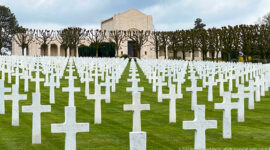
Long, regular rows of white Latin crosses extend across the green burial lawn beneath mature trees. Their repeated geometry creates the defining visual rhythm of the cemetery, marking individual American war dead while the low markers and open landscape maintain a deliberately unified, egalitarian memorial field.
Caption
Long, regular rows of white Latin crosses extend across the green burial lawn beneath mature trees. Their repeated geometry creates the defining visual rhythm of the cemetery, marking individual American war dead while the low markers and open landscape maintain a deliberately unified, egalitarian memorial field.

A Star of David marker appears among rows of white Latin crosses, illustrating the cemetery’s use of different religious emblems on individual headstones. The shallow depth of field isolates the Jewish marker while retaining the repeated crosses behind it, making the diversity of faith traditions visible within the otherwise uniform burial layout.
Caption
A Star of David marker appears among rows of white Latin crosses, illustrating the cemetery’s use of different religious emblems on individual headstones. The shallow depth of field isolates the Jewish marker while retaining the repeated crosses behind it, making the diversity of faith traditions visible within the otherwise uniform burial layout.

An engraved dedication on the memorial building states that those who live in freedom remain indebted to the men commemorated here, whose sacrifice is linked to the cause for which they died. Set directly into the pale stone wall beneath dark window openings, the inscription functions as a concise statement of the cemetery’s commemorative purpose.
Caption
An engraved dedication on the memorial building states that those who live in freedom remain indebted to the men commemorated here, whose sacrifice is linked to the cause for which they died. Set directly into the pale stone wall beneath dark window openings, the inscription functions as a concise statement of the cemetery’s commemorative purpose.

A pale gravel path curves between the cemetery’s burial lawn and a stone boundary wall softened by flowering shrubs. Carefully clipped trees and layered plantings give the route a garden-like character, providing a quieter transitional space beside the more formal rows of grave markers visible at the edge of the frame.
Caption
A pale gravel path curves between the cemetery’s burial lawn and a stone boundary wall softened by flowering shrubs. Carefully clipped trees and layered plantings give the route a garden-like character, providing a quieter transitional space beside the more formal rows of grave markers visible at the edge of the frame.

An axial view looks down a narrow strip of lawn between parallel rows of white grave markers. The low viewpoint intensifies the repetition of the markers and their spacing, transforming the burial field into a strong perspective study while still conveying the scale and disciplined order of the cemetery plan.
Caption
An axial view looks down a narrow strip of lawn between parallel rows of white grave markers. The low viewpoint intensifies the repetition of the markers and their spacing, transforming the burial field into a strong perspective study while still conveying the scale and disciplined order of the cemetery plan.

An orange-and-white cat walks along the paved edge of the cemetery grounds beside a flowering shrub and tan masonry wall. The candid scene introduces a moment of ordinary life within the meticulously maintained memorial landscape and provides a close counterpoint to the formal architecture and regimented burial rows nearby.
Caption
An orange-and-white cat walks along the paved edge of the cemetery grounds beside a flowering shrub and tan masonry wall. The candid scene introduces a moment of ordinary life within the meticulously maintained memorial landscape and provides a close counterpoint to the formal architecture and regimented burial rows nearby.

A visitor stands at the edge of densely spaced white grave markers, providing a human scale for the cemetery’s expansive burial field. The repeated Latin crosses spread across the lawn beneath mature trees, emphasizing both the number of graves and the carefully maintained spatial order of the memorial landscape.
Caption
A visitor stands at the edge of densely spaced white grave markers, providing a human scale for the cemetery’s expansive burial field. The repeated Latin crosses spread across the lawn beneath mature trees, emphasizing both the number of graves and the carefully maintained spatial order of the memorial landscape.

A broad view across the cemetery shows long, converging rows of white grave markers set in vivid green lawns beneath a heavy gray sky. The sweeping composition reveals the scale of the burial ground and the disciplined geometry of the site plan, with clipped trees and peripheral plantings containing the memorial field.
Caption
A broad view across the cemetery shows long, converging rows of white grave markers set in vivid green lawns beneath a heavy gray sky. The sweeping composition reveals the scale of the burial ground and the disciplined geometry of the site plan, with clipped trees and peripheral plantings containing the memorial field.

White Latin-cross headstones rise from the closely cut lawn in a shallow-focus view that brings the nearest marker into prominence while repeating others across the background. Faint inscriptions on the cross arms identify the stones as individual graves, and the uniform material and proportions reinforce the cemetery’s restrained visual language.
Caption
White Latin-cross headstones rise from the closely cut lawn in a shallow-focus view that brings the nearest marker into prominence while repeating others across the background. Faint inscriptions on the cross arms identify the stones as individual graves, and the uniform material and proportions reinforce the cemetery’s restrained visual language.

An inscription at the Tablets of the Missing records Americans who gave their lives in service and “sleep in unknown graves” during 1941–1945. Adjacent name panels identify United States Army and Army Air Forces personnel, combining the memorial’s dedicatory text with the individualized roll of those whose remains were not recovered or identified.
Caption
An inscription at the Tablets of the Missing records Americans who gave their lives in service and “sleep in unknown graves” during 1941–1945. Adjacent name panels identify United States Army and Army Air Forces personnel, combining the memorial’s dedicatory text with the individualized roll of those whose remains were not recovered or identified.

A carved stone wreath and ribbon relief occupies a central masonry bay between tall panels of inscribed names. The ornamental motif provides a visual pause within the Tablets of the Missing, linking the dense documentary record of individuals to a traditional symbol of honor and remembrance.
Caption
A carved stone wreath and ribbon relief occupies a central masonry bay between tall panels of inscribed names. The ornamental motif provides a visual pause within the Tablets of the Missing, linking the dense documentary record of individuals to a traditional symbol of honor and remembrance.

A straight central walkway divides symmetrical fields of white grave markers and leads toward a distant memorial feature. The strong axial perspective reveals the cemetery’s formal planning, balancing the individuality of each burial with an overall composition of repetition, open lawn, and carefully controlled sightlines.
Caption
A straight central walkway divides symmetrical fields of white grave markers and leads toward a distant memorial feature. The strong axial perspective reveals the cemetery’s formal planning, balancing the individuality of each burial with an overall composition of repetition, open lawn, and carefully controlled sightlines.

A carved memorial wreath bears the place names “Oran,” “Casablanca,” and “Algiers,” three North African cities associated with the Allied campaign. Set against a masonry wall, the relief condenses regional geography into a commemorative emblem and connects the cemetery’s memorial program to the broader North African theater of World War II.
Caption
A carved memorial wreath bears the place names “Oran,” “Casablanca,” and “Algiers,” three North African cities associated with the Allied campaign. Set against a masonry wall, the relief condenses regional geography into a commemorative emblem and connects the cemetery’s memorial program to the broader North African theater of World War II.

A close view of the Tablets of the Missing reveals the densely engraved names, ranks, units, and home states of United States Army and Army Air Forces personnel. The tight framing shifts attention from the wall as architecture to its documentary function, preserving each missing service member as an individually named participant in the war.
Caption
A close view of the Tablets of the Missing reveals the densely engraved names, ranks, units, and home states of United States Army and Army Air Forces personnel. The tight framing shifts attention from the wall as architecture to its documentary function, preserving each missing service member as an individually named participant in the war.

A draped female figure stands in a recessed central bay framed by trees and the broad Tablets of the Missing. Seen at garden scale, the sculpture acts as a visual anchor between the long inscribed panels, combining figurative memorial art with the documentary record of service members whose names fill the surrounding stone walls.
Caption
A draped female figure stands in a recessed central bay framed by trees and the broad Tablets of the Missing. Seen at garden scale, the sculpture acts as a visual anchor between the long inscribed panels, combining figurative memorial art with the documentary record of service members whose names fill the surrounding stone walls.

Dense columns of engraved names fill the pale stone Tablets of the Missing beneath the heading for the United States Army and Army Air Forces. The panel functions as a documentary roll of remembrance, preserving individual names in a tightly ordered field of text that contrasts with the open lawns and grave rows elsewhere in the cemetery.
Caption
Dense columns of engraved names fill the pale stone Tablets of the Missing beneath the heading for the United States Army and Army Air Forces. The panel functions as a documentary roll of remembrance, preserving individual names in a tightly ordered field of text that contrasts with the open lawns and grave rows elsewhere in the cemetery.

Long rows of white grave markers spread across the green burial field beneath a dramatic bank of dark clouds. The wide view emphasizes the scale and geometric order of the cemetery, with each row converging toward the horizon while clipped trees and distant plantings frame the memorial landscape.
Caption
Long rows of white grave markers spread across the green burial field beneath a dramatic bank of dark clouds. The wide view emphasizes the scale and geometric order of the cemetery, with each row converging toward the horizon while clipped trees and distant plantings frame the memorial landscape.

A centered aisle of white Latin crosses recedes through the burial lawn, while a Star of David marker appears among the rows at right. The compressed perspective accentuates both the strict regularity of the cemetery plan and the presence of different religious emblems within a shared commemorative landscape.
Caption
A centered aisle of white Latin crosses recedes through the burial lawn, while a Star of David marker appears among the rows at right. The compressed perspective accentuates both the strict regularity of the cemetery plan and the presence of different religious emblems within a shared commemorative landscape.

Pale limestone walls and square columns define a sheltered court within the memorial complex. Narrow windows, a mature tree, and deep shaded openings give the architecture a restrained modern character, while the open colonnade creates a transition between enclosed commemorative spaces and the landscaped cemetery beyond.
Caption
Pale limestone walls and square columns define a sheltered court within the memorial complex. Narrow windows, a mature tree, and deep shaded openings give the architecture a restrained modern character, while the open colonnade creates a transition between enclosed commemorative spaces and the landscaped cemetery beyond.

A geometric pavement of dark and pale stone surrounds a compact dark pedestal in a quiet memorial courtyard. Square columns, clipped hedges, and an olive-like tree frame the space, creating a deliberately spare composition in which hard surfaces and controlled planting reinforce the formal character of the cemetery architecture.
Caption
A geometric pavement of dark and pale stone surrounds a compact dark pedestal in a quiet memorial courtyard. Square columns, clipped hedges, and an olive-like tree frame the space, creating a deliberately spare composition in which hard surfaces and controlled planting reinforce the formal character of the cemetery architecture.

Red Arabic lettering is carved or inlaid across a pale stone wall beneath the dates 1940 and 1941. The multilingual memorial program uses this Arabic text alongside corresponding inscriptions in other languages, situating the cemetery’s commemorative message within its Tunisian setting and making the dedication accessible beyond an English-speaking audience.
Caption
Red Arabic lettering is carved or inlaid across a pale stone wall beneath the dates 1940 and 1941. The multilingual memorial program uses this Arabic text alongside corresponding inscriptions in other languages, situating the cemetery’s commemorative message within its Tunisian setting and making the dedication accessible beyond an English-speaking audience.

A dark metal screen composed of interlocking rectangular forms fills a tall opening in the pale stone memorial building. Through the grille, clipped greenery and the cemetery landscape remain visible, turning the screen into both an architectural detail and a framed transition between shaded interior space and the garden outside.
Caption
A dark metal screen composed of interlocking rectangular forms fills a tall opening in the pale stone memorial building. Through the grille, clipped greenery and the cemetery landscape remain visible, turning the screen into both an architectural detail and a framed transition between shaded interior space and the garden outside.

An English inscription dated 1941–1945 states that the memorial was erected by the United States of America in proud remembrance of the achievements of its sons and in humble tribute to their sacrifices. The red lettering, set directly into pale stone, presents the cemetery’s central commemorative message with deliberate simplicity.
Caption
An English inscription dated 1941–1945 states that the memorial was erected by the United States of America in proud remembrance of the achievements of its sons and in humble tribute to their sacrifices. The red lettering, set directly into pale stone, presents the cemetery’s central commemorative message with deliberate simplicity.

The French version of the memorial dedication repeats the 1941–1945 dates and commemorates the achievements and sacrifices of American servicemen. Set in red capital letters on pale stone, the inscription forms part of the site’s multilingual interpretive program and reflects the linguistic context of Tunisia and North Africa.
Caption
The French version of the memorial dedication repeats the 1941–1945 dates and commemorates the achievements and sacrifices of American servicemen. Set in red capital letters on pale stone, the inscription forms part of the site’s multilingual interpretive program and reflects the linguistic context of Tunisia and North Africa.

A mosaic campaign map centers on Tunisia and the surrounding Mediterranean, using colored arrows, aircraft symbols, place names, and unit markings to trace wartime movements. The dense visual narrative translates military geography into a permanent decorative surface, linking the memorial directly to the North African operations commemorated by the cemetery.
Caption
A mosaic campaign map centers on Tunisia and the surrounding Mediterranean, using colored arrows, aircraft symbols, place names, and unit markings to trace wartime movements. The dense visual narrative translates military geography into a permanent decorative surface, linking the memorial directly to the North African operations commemorated by the cemetery.

A large mosaic map traces Allied air ferry routes and supply lines across the Atlantic, North Africa, Europe, the Middle East, and toward Asia. Colored paths, aircraft symbols, and bilingual labels turn wartime logistics into a broad geographic narrative, showing the global network that supported operations far beyond the cemetery’s immediate Tunisian setting.
Caption
A large mosaic map traces Allied air ferry routes and supply lines across the Atlantic, North Africa, Europe, the Middle East, and toward Asia. Colored paths, aircraft symbols, and bilingual labels turn wartime logistics into a broad geographic narrative, showing the global network that supported operations far beyond the cemetery’s immediate Tunisian setting.

A wall map titled “The War Against Japan” highlights East Asia and the western Pacific, with China prominently colored and a dated circular legend marking the opening phase of the Pacific War. Its inclusion broadens the memorial’s narrative beyond North Africa, placing American wartime service within the larger global conflict.
Caption
A wall map titled “The War Against Japan” highlights East Asia and the western Pacific, with China prominently colored and a dated circular legend marking the opening phase of the Pacific War. Its inclusion broadens the memorial’s narrative beyond North Africa, placing American wartime service within the larger global conflict.

Broad stone panels list missing personnel under branch headings for the United States Army, Army Air Forces, and United States Navy. The tightly packed names transform the wall into a formal documentary record, emphasizing the scale of loss while preserving individual identities within the memorial’s larger architectural composition.
Caption
Broad stone panels list missing personnel under branch headings for the United States Army, Army Air Forces, and United States Navy. The tightly packed names transform the wall into a formal documentary record, emphasizing the scale of loss while preserving individual identities within the memorial’s larger architectural composition.

A large mosaic-like text panel presents a detailed French-language account of wartime operations in North Africa and the Mediterranean. The densely packed paragraphs read as a historical narrative rather than a list of names, embedding campaign chronology and strategic context directly into the memorial architecture.
Caption
A large mosaic-like text panel presents a detailed French-language account of wartime operations in North Africa and the Mediterranean. The densely packed paragraphs read as a historical narrative rather than a list of names, embedding campaign chronology and strategic context directly into the memorial architecture.

A broad mosaic map labeled “American and Allied Forces in North Africa 1942–1943” spans Morocco, Algeria, Tunisia, and the Mediterranean. Colored arrows and symbols trace the movement of forces across the region, turning the Allied campaign into a visual sequence that connects the cemetery’s dead to the theater in which they served.
Caption
A broad mosaic map labeled “American and Allied Forces in North Africa 1942–1943” spans Morocco, Algeria, Tunisia, and the Mediterranean. Colored arrows and symbols trace the movement of forces across the region, turning the Allied campaign into a visual sequence that connects the cemetery’s dead to the theater in which they served.

A gilded-toned stone inscription explains that the wall records the names of Americans who gave their lives in the service of their country and “sleep in unknown graves” between 1941 and 1945. The final biblical line, “Into thy hands, O Lord,” frames the roll of the missing in explicitly commemorative and devotional language.
Caption
A gilded-toned stone inscription explains that the wall records the names of Americans who gave their lives in the service of their country and “sleep in unknown graves” between 1941 and 1945. The final biblical line, “Into thy hands, O Lord,” frames the roll of the missing in explicitly commemorative and devotional language.

A pair of monumental dark double doors closes the end of a pale stone vestibule. Rectangular inset panels and simple metal handles give the entrance a severe, modern appearance, while the surrounding limestone walls and dark floor continue the restrained material palette used throughout the memorial complex.
Caption
A pair of monumental dark double doors closes the end of a pale stone vestibule. Rectangular inset panels and simple metal handles give the entrance a severe, modern appearance, while the surrounding limestone walls and dark floor continue the restrained material palette used throughout the memorial complex.

Stone name panels headed “United States Navy” and “United States Coast Guard” record missing personnel from the maritime services. The relatively open spacing around the engraved names distinguishes this section from the denser Army panels while preserving the same sober stone vocabulary used throughout the Tablets of the Missing.
Caption
Stone name panels headed “United States Navy” and “United States Coast Guard” record missing personnel from the maritime services. The relatively open spacing around the engraved names distinguishes this section from the denser Army panels while preserving the same sober stone vocabulary used throughout the Tablets of the Missing.

The English 1941–1945 dedication appears within a recessed architectural bay framed by pale stone columns. By showing the inscription in its full setting rather than as a close detail, this view emphasizes how commemorative text is integrated into the memorial’s restrained geometry and formal circulation spaces.
Caption
The English 1941–1945 dedication appears within a recessed architectural bay framed by pale stone columns. By showing the inscription in its full setting rather than as a close detail, this view emphasizes how commemorative text is integrated into the memorial’s restrained geometry and formal circulation spaces.

A close detail of the North African campaign mosaic concentrates on Tunisia, where colored arrows converge around Tunis and coastal routes. Aircraft symbols, place names, and directional lines make the sequence of movements legible at a finer scale, revealing the map’s layered combination of geography, chronology, and military operations.
Caption
A close detail of the North African campaign mosaic concentrates on Tunisia, where colored arrows converge around Tunis and coastal routes. Aircraft symbols, place names, and directional lines make the sequence of movements legible at a finer scale, revealing the map’s layered combination of geography, chronology, and military operations.

A view through pale stone columns opens onto a long, straight path bordered by clipped trees and hedges. The framing turns the colonnade into an architectural threshold, directing the eye from the shaded memorial building toward the ordered landscape and reinforcing the cemetery’s strong axial planning.
Caption
A view through pale stone columns opens onto a long, straight path bordered by clipped trees and hedges. The framing turns the colonnade into an architectural threshold, directing the eye from the shaded memorial building toward the ordered landscape and reinforcing the cemetery’s strong axial planning.

A dark rectangular pedestal stands above an inlaid floor inscription reading, “Some there be which have no sepulchre, their name liveth for evermore.” Small colored mosaic motifs border the text, creating a compact commemorative ensemble that joins scripture-like language, decorative pavement, and a central memorial object.
Caption
A dark rectangular pedestal stands above an inlaid floor inscription reading, “Some there be which have no sepulchre, their name liveth for evermore.” Small colored mosaic motifs border the text, creating a compact commemorative ensemble that joins scripture-like language, decorative pavement, and a central memorial object.

A vertically organized memorial panel combines Arabic text at center with French narrative columns on either side. The surrounding prose refers to wartime transport, supplies, ports, and military movement, presenting North African campaign history in a bilingual format suited to the cemetery’s Tunisian setting.
Caption
A vertically organized memorial panel combines Arabic text at center with French narrative columns on either side. The surrounding prose refers to wartime transport, supplies, ports, and military movement, presenting North African campaign history in a bilingual format suited to the cemetery’s Tunisian setting.

A closer, lower view centers the dark stone pedestal above the inlaid line, “Some there be which have no sepulchre, their name liveth for evermore.” Decorative colored insets along the pavement become more prominent here, showing how text and ornament are woven into the memorial floor rather than confined to wall panels.
Caption
A closer, lower view centers the dark stone pedestal above the inlaid line, “Some there be which have no sepulchre, their name liveth for evermore.” Decorative colored insets along the pavement become more prominent here, showing how text and ornament are woven into the memorial floor rather than confined to wall panels.

The North Africa campaign mosaic is seen broadly across the Mediterranean coast from Morocco through Algeria to Tunisia. Large directional arrows and the title “American and Allied Forces in North Africa 1942–1943” organize the map as both historical explanation and monumental decoration within the memorial complex.
Caption
The North Africa campaign mosaic is seen broadly across the Mediterranean coast from Morocco through Algeria to Tunisia. Large directional arrows and the title “American and Allied Forces in North Africa 1942–1943” organize the map as both historical explanation and monumental decoration within the memorial complex.

Three small maps arranged beneath a dense historical text panel summarize stages of the war against Japan. The sequence is presented as a compact triptych within a larger mosaic field, pairing geographic diagrams with narrative text to extend the memorial’s account of World War II beyond the North African theater.
Caption
Three small maps arranged beneath a dense historical text panel summarize stages of the war against Japan. The sequence is presented as a compact triptych within a larger mosaic field, pairing geographic diagrams with narrative text to extend the memorial’s account of World War II beyond the North African theater.

A square memorial panel places a central column of Arabic script between French historical text on both sides, all embedded in a mosaic-like field. The bilingual composition visually integrates local language with a European colonial language while presenting a detailed narrative of wartime movement, supply, and operations.
Caption
A square memorial panel places a central column of Arabic script between French historical text on both sides, all embedded in a mosaic-like field. The bilingual composition visually integrates local language with a European colonial language while presenting a detailed narrative of wartime movement, supply, and operations.

Three framed maps beneath a dense historical text panel are labeled “The War Against Germany.” The sequence condenses the European conflict into successive geographic stages, complementing the memorial’s North African campaign maps and placing the cemetery within the wider Allied war against Nazi Germany.
Caption
Three framed maps beneath a dense historical text panel are labeled “The War Against Germany.” The sequence condenses the European conflict into successive geographic stages, complementing the memorial’s North African campaign maps and placing the cemetery within the wider Allied war against Nazi Germany.

A broad gravel path runs between tightly clipped rows of trees and hedges, creating one of the cemetery’s most controlled garden passages. The repeated trunks and flat-cut foliage form a living colonnade, extending the geometric order of the memorial architecture into the landscape itself.
Caption
A broad gravel path runs between tightly clipped rows of trees and hedges, creating one of the cemetery’s most controlled garden passages. The repeated trunks and flat-cut foliage form a living colonnade, extending the geometric order of the memorial architecture into the landscape itself.

Military service banners hang above the chapel’s stone side wall, where a carved inscription reads, “Almighty God receive these thy heroic servants into thy kingdom.” Wooden pews occupy the foreground, joining institutional military symbols with explicitly devotional language in a space dedicated to remembrance and prayer.
Caption
Military service banners hang above the chapel’s stone side wall, where a carved inscription reads, “Almighty God receive these thy heroic servants into thy kingdom.” Wooden pews occupy the foreground, joining institutional military symbols with explicitly devotional language in a space dedicated to remembrance and prayer.

Wooden pews line the chapel beneath a row of military service banners and the carved appeal, “Almighty God receive these thy heroic servants into thy kingdom.” The frontal composition emphasizes the relationship between worship, branch-of-service identity, and collective remembrance rather than the altar itself.
Caption
Wooden pews line the chapel beneath a row of military service banners and the carved appeal, “Almighty God receive these thy heroic servants into thy kingdom.” The frontal composition emphasizes the relationship between worship, branch-of-service identity, and collective remembrance rather than the altar itself.

A row of colorful military service banners hangs from the chapel wall beneath the deeply coffered wooden ceiling. Distinct emblems and strong fields of blue, green, red, and dark navy identify the display as a ceremonial representation of American armed-service branches, adding vivid color to the otherwise subdued memorial interior.
Caption
A row of colorful military service banners hangs from the chapel wall beneath the deeply coffered wooden ceiling. Distinct emblems and strong fields of blue, green, red, and dark navy identify the display as a ceremonial representation of American armed-service branches, adding vivid color to the otherwise subdued memorial interior.

An elaborate wooden ceiling of nested rectangular coffers spans the memorial chapel. Repeated projecting frames create a deep geometric pattern, bringing warmth and visual complexity to an otherwise restrained interior. The craftsmanship is especially prominent in this upward-looking detail, where the ceiling becomes the entire subject.
Caption
An elaborate wooden ceiling of nested rectangular coffers spans the memorial chapel. Repeated projecting frames create a deep geometric pattern, bringing warmth and visual complexity to an otherwise restrained interior. The craftsmanship is especially prominent in this upward-looking detail, where the ceiling becomes the entire subject.

A luminous grid of square translucent windows fills one wall of the chapel, set beside dark wood paneling and beneath the coffered ceiling. Alternating clear and greenish panes modulate the daylight, producing a modern geometric counterpoint to the chapel’s heavier stone and timber surfaces.
Caption
A luminous grid of square translucent windows fills one wall of the chapel, set beside dark wood paneling and beneath the coffered ceiling. Alternating clear and greenish panes modulate the daylight, producing a modern geometric counterpoint to the chapel’s heavier stone and timber surfaces.

The chapel altar stands beneath a large cross backed by a radiant metal motif. Candles and a small religious plaque flank the altar top, while gold lettering across the front reads, “I give unto them eternal life and they shall never perish.” The composition concentrates the chapel’s Christian symbolism into a single devotional focus.
Caption
The chapel altar stands beneath a large cross backed by a radiant metal motif. Candles and a small religious plaque flank the altar top, while gold lettering across the front reads, “I give unto them eternal life and they shall never perish.” The composition concentrates the chapel’s Christian symbolism into a single devotional focus.

A full wall of square translucent glazing forms a luminous geometric screen inside the chapel. Pale upper panes and green-tinted lower panes admit filtered daylight through deep rectangular recesses, while adjoining stone and wood surfaces reveal the deliberate contrast of materials in the memorial interior.
Caption
A full wall of square translucent glazing forms a luminous geometric screen inside the chapel. Pale upper panes and green-tinted lower panes admit filtered daylight through deep rectangular recesses, while adjoining stone and wood surfaces reveal the deliberate contrast of materials in the memorial interior.

A small dark mosaic motif is set into the light-colored chapel floor, combining a vertical cross-like form with compact geometric and vessel-like elements. Its scale and placement make it a decorative symbolic detail rather than a principal memorial feature, best understood as part of the chapel’s integrated floor ornament.
Caption
A small dark mosaic motif is set into the light-colored chapel floor, combining a vertical cross-like form with compact geometric and vessel-like elements. Its scale and placement make it a decorative symbolic detail rather than a principal memorial feature, best understood as part of the chapel’s integrated floor ornament.

A pale draped figure in shallow relief is mounted high on the chapel wall beneath a blue service banner. At the base, a carved inscription reads, “He has outsoared the shadow of our night,” adding a poetic note of transcendence to the chapel’s broader language of sacrifice, remembrance, and eternal life.
Caption
A pale draped figure in shallow relief is mounted high on the chapel wall beneath a blue service banner. At the base, a carved inscription reads, “He has outsoared the shadow of our night,” adding a poetic note of transcendence to the chapel’s broader language of sacrifice, remembrance, and eternal life.

A white Star of David headstone stands prominently among long rows of Latin-cross grave markers on the intensely green burial lawn. The close composition makes the Jewish marker immediately legible while retaining the repeated Christian crosses behind it, documenting different faith traditions within the cemetery’s unified memorial design.
Caption
A white Star of David headstone stands prominently among long rows of Latin-cross grave markers on the intensely green burial lawn. The close composition makes the Jewish marker immediately legible while retaining the repeated Christian crosses behind it, documenting different faith traditions within the cemetery’s unified memorial design.

A white Latin-cross marker bears the inscription, “Here rests in honored glory a comrade in arms known but to God.” Set against rows of named graves, the marker commemorates an unidentified American service member and gives visible form to the cemetery’s remembrance of those whose individual identity could not be established.
Caption
A white Latin-cross marker bears the inscription, “Here rests in honored glory a comrade in arms known but to God.” Set against rows of named graves, the marker commemorates an unidentified American service member and gives visible form to the cemetery’s remembrance of those whose individual identity could not be established.

A closer view isolates an unidentified-service-member headstone carrying the formula, “Here rests in honored glory a comrade in arms known but to God.” Another matching marker appears behind it, underscoring that the cemetery includes multiple graves for Americans whose names were unknown at burial.
Caption
A closer view isolates an unidentified-service-member headstone carrying the formula, “Here rests in honored glory a comrade in arms known but to God.” Another matching marker appears behind it, underscoring that the cemetery includes multiple graves for Americans whose names were unknown at burial.

The grave of Nicholas Minue is marked by a white cross bearing a gold Medal of Honor emblem and the words “Medal of Honor” down the shaft. A Star of David marker stands nearby among dense rows of crosses, making this view notable for both an individually decorated serviceman and the variety of religious markers within the burial field.
Caption
The grave of Nicholas Minue is marked by a white cross bearing a gold Medal of Honor emblem and the words “Medal of Honor” down the shaft. A Star of David marker stands nearby among dense rows of crosses, making this view notable for both an individually decorated serviceman and the variety of religious markers within the burial field.

A white Latin-cross headstone identifies Norman H. Puff of New York, with his rank and unit engraved above the date of death. The close, centered framing turns the grave from part of the cemetery’s larger geometry into an individual memorial, emphasizing the named person rather than the collective field.
Caption
A white Latin-cross headstone identifies Norman H. Puff of New York, with his rank and unit engraved above the date of death. The close, centered framing turns the grave from part of the cemetery’s larger geometry into an individual memorial, emphasizing the named person rather than the collective field.

A close portrait of Nicholas Minue’s white cross highlights the gold Medal of Honor emblem, his name, unit, home state of New Jersey, and April 1943 death date. With the background softened, the photograph isolates the decorated grave as a personal memorial rather than one element in the cemetery’s repeated rows.
Caption
A close portrait of Nicholas Minue’s white cross highlights the gold Medal of Honor emblem, his name, unit, home state of New Jersey, and April 1943 death date. With the background softened, the photograph isolates the decorated grave as a personal memorial rather than one element in the cemetery’s repeated rows.

A white Latin-cross grave marker identifies Tom Draper, a captain in the U.S. Army Air Forces, with his home state and death date engraved across the cross arm. The solitary framing emphasizes the individual record carried by each headstone within the cemetery’s much larger field of uniform markers.
Caption
A white Latin-cross grave marker identifies Tom Draper, a captain in the U.S. Army Air Forces, with his home state and death date engraved across the cross arm. The solitary framing emphasizes the individual record carried by each headstone within the cemetery’s much larger field of uniform markers.

Nicholas Minue’s grave marker identifies him as a private in the 6th Infantry and records his death on April 28, 1943. The gold Medal of Honor emblem above his name and the vertical inscription on the cross shaft distinguish the grave from surrounding markers, making his decoration immediately visible within the broader burial field.
Caption
Nicholas Minue’s grave marker identifies him as a private in the 6th Infantry and records his death on April 28, 1943. The gold Medal of Honor emblem above his name and the vertical inscription on the cross shaft distinguish the grave from surrounding markers, making his decoration immediately visible within the broader burial field.

A rectangular bronze plaque set flush within the grass bears several lines of commemorative text, positioned among white grave markers. Its horizontal form and dark metal surface distinguish it from the upright marble headstones, indicating a different type of memorial element within the burial landscape.
Caption
A rectangular bronze plaque set flush within the grass bears several lines of commemorative text, positioned among white grave markers. Its horizontal form and dark metal surface distinguish it from the upright marble headstones, indicating a different type of memorial element within the burial landscape.

Tom Draper’s grave marker stands in the foreground while long rows of matching white crosses recede across the lawn behind it. The wider context shifts attention from the individual inscription to the relationship between one named serviceman and the disciplined collective order of the cemetery’s burial plan.
Caption
Tom Draper’s grave marker stands in the foreground while long rows of matching white crosses recede across the lawn behind it. The wider context shifts attention from the individual inscription to the relationship between one named serviceman and the disciplined collective order of the cemetery’s burial plan.

A white cross inscribed “Here rest in honored glory two comrades in arms” marks a shared grave for two unidentified service members. The unusual plural wording distinguishes it from the cemetery’s individual “Known but to God” markers and documents a case in which two Americans were buried together without separate identities.
Caption
A white cross inscribed “Here rest in honored glory two comrades in arms” marks a shared grave for two unidentified service members. The unusual plural wording distinguishes it from the cemetery’s individual “Known but to God” markers and documents a case in which two Americans were buried together without separate identities.

Red roses, pale blue flowers, and dense green shrubs fill a carefully tended garden bed beside the memorial building. Sculpted hedges and a mature umbrella-shaped tree rise behind the planting, demonstrating how horticulture softens the cemetery’s pale masonry while maintaining the same disciplined formal order found throughout the grounds.
Caption
Red roses, pale blue flowers, and dense green shrubs fill a carefully tended garden bed beside the memorial building. Sculpted hedges and a mature umbrella-shaped tree rise behind the planting, demonstrating how horticulture softens the cemetery’s pale masonry while maintaining the same disciplined formal order found throughout the grounds.

A close view of the chapel altar brings the gold inscription, “I give unto them eternal life and they shall never perish,” into sharp focus. Two tall candles flank a small tablet bearing a Star of David above paired columns of Roman numerals, while white flowers rest on the altar, combining Christian and Jewish symbols within the memorial setting.
Caption
A close view of the chapel altar brings the gold inscription, “I give unto them eternal life and they shall never perish,” into sharp focus. Two tall candles flank a small tablet bearing a Star of David above paired columns of Roman numerals, while white flowers rest on the altar, combining Christian and Jewish symbols within the memorial setting.