Timgad – Algeria
The ancient city of Timgad was founded around 100 AD by the Roman emperor Trajan as a military colony on the northern edge of the Sahara Desert. Known in antiquity as Thamugadi, the city was built according to the classic Roman grid plan, with straight streets intersecting at right angles.
Today the ruins of Timgad remain remarkably well preserved. Visitors can still see the triumphal arch of Trajan, the Roman theater, temples, public baths, and the paved streets that once formed the orderly layout of the city.
Because of its outstanding preservation and importance to Roman history in North Africa, Timgad is recognized as a UNESCO World Heritage Site.
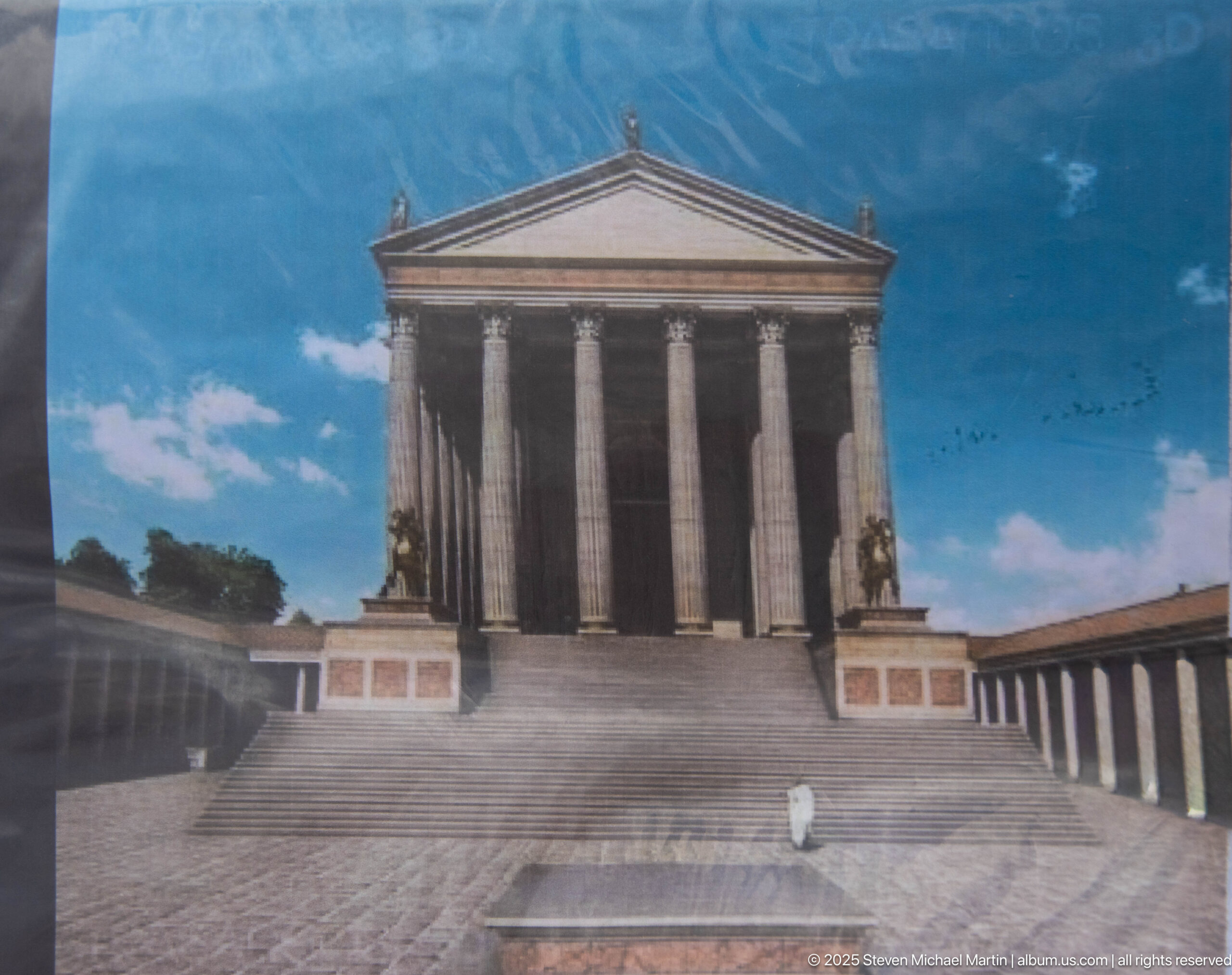
An interpretive reconstruction depicts a monumental classical temple approached by a broad stair and fronted by a deep colonnaded portico beneath a triangular pediment. The modern display helps visitors visualize the architectural mass and formal approach of one of Timgad’s major sacred buildings beyond the fragmentary remains seen on site.
Caption
An interpretive reconstruction depicts a monumental classical temple approached by a broad stair and fronted by a deep colonnaded portico beneath a triangular pediment. The modern display helps visitors visualize the architectural mass and formal approach of one of Timgad’s major sacred buildings beyond the fragmentary remains seen on site.
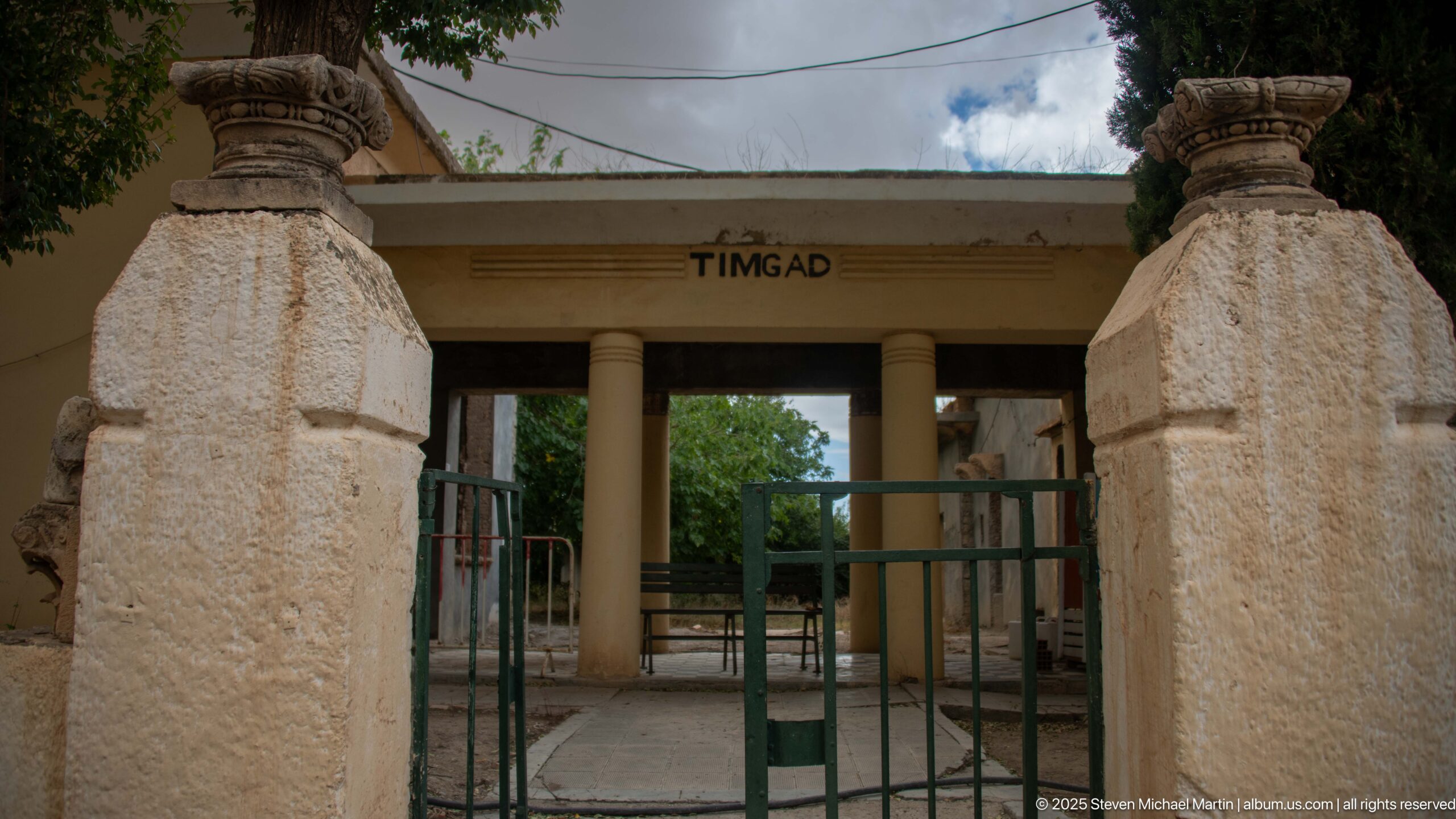
The entrance to the Timgad archaeological site is framed by modern masonry piers, a metal gate, and a low portico labeled “TIMGAD.” Reused or displayed ancient stonework stands near the approach, marking the transition from the modern visitor area into the excavated Roman city beyond.
Caption
The entrance to the Timgad archaeological site is framed by modern masonry piers, a metal gate, and a low portico labeled “TIMGAD.” Reused or displayed ancient stonework stands near the approach, marking the transition from the modern visitor area into the excavated Roman city beyond.
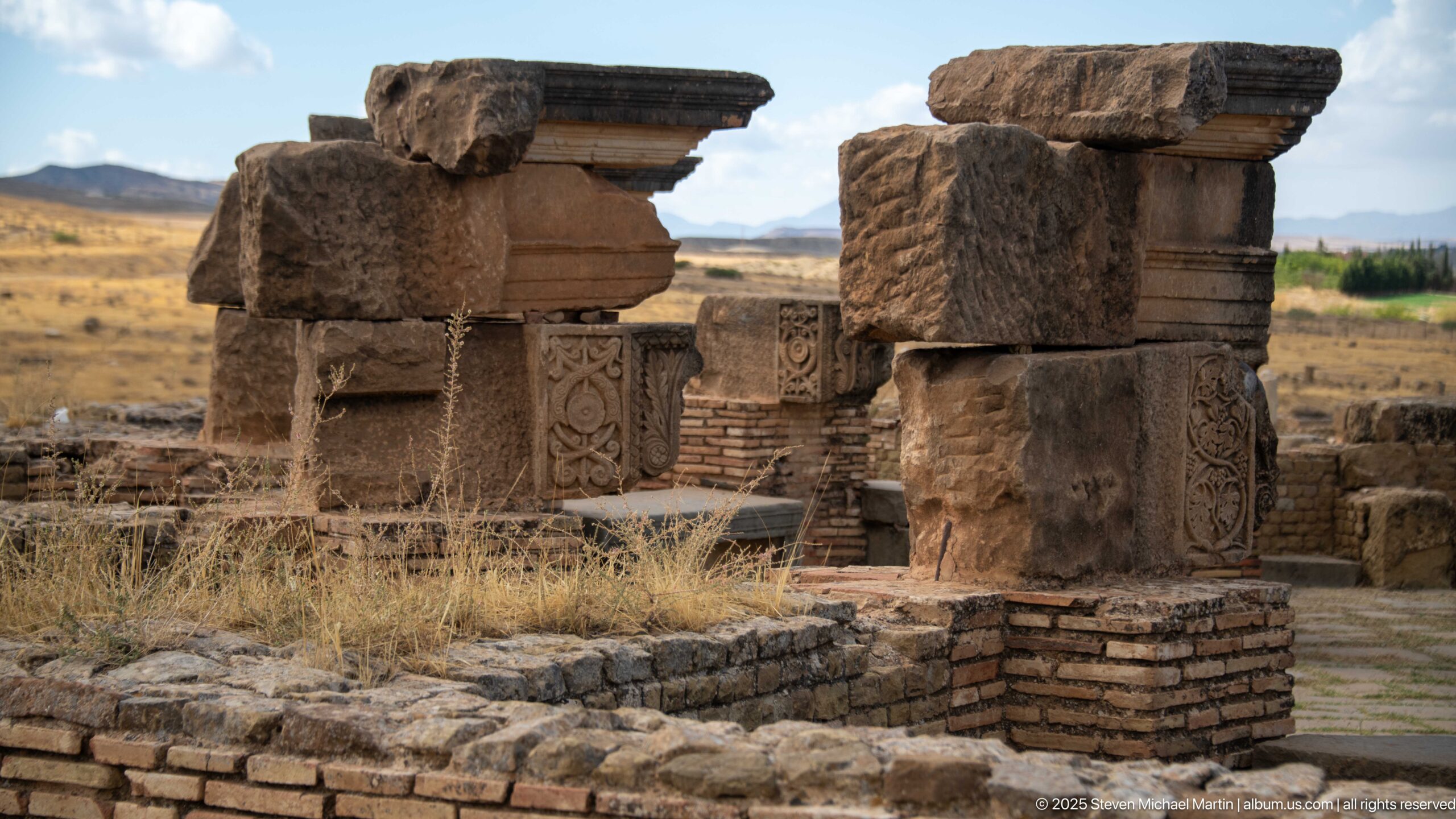
Heavy squared stone piers frame smaller carved panels and layered brickwork within a ruined architectural complex at Timgad. The close view emphasizes construction details—large ashlar blocks, decorative relief carving, and mixed masonry—rather than the overall building, preserving evidence of a once more elaborate interior or façade.
Caption
Heavy squared stone piers frame smaller carved panels and layered brickwork within a ruined architectural complex at Timgad. The close view emphasizes construction details—large ashlar blocks, decorative relief carving, and mixed masonry—rather than the overall building, preserving evidence of a once more elaborate interior or façade.
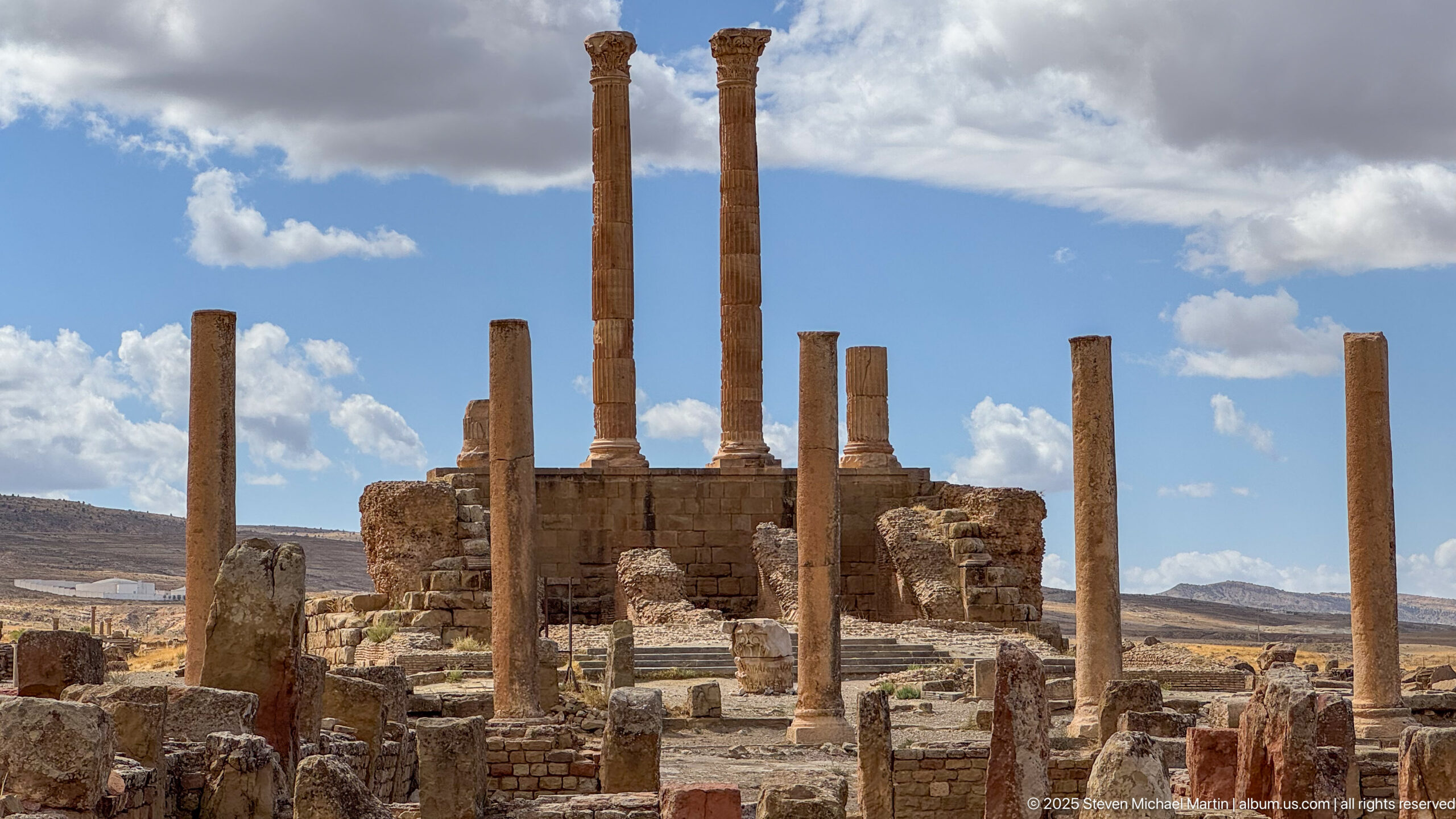
Tall freestanding columns rise above a substantial elevated masonry platform amid Timgad’s ruins. Shorter shafts in the foreground create successive architectural planes leading toward the monumental core, while the open sky and sparse plateau landscape emphasize the vertical survival of this temple-like complex.
Caption
Tall freestanding columns rise above a substantial elevated masonry platform amid Timgad’s ruins. Shorter shafts in the foreground create successive architectural planes leading toward the monumental core, while the open sky and sparse plateau landscape emphasize the vertical survival of this temple-like complex.
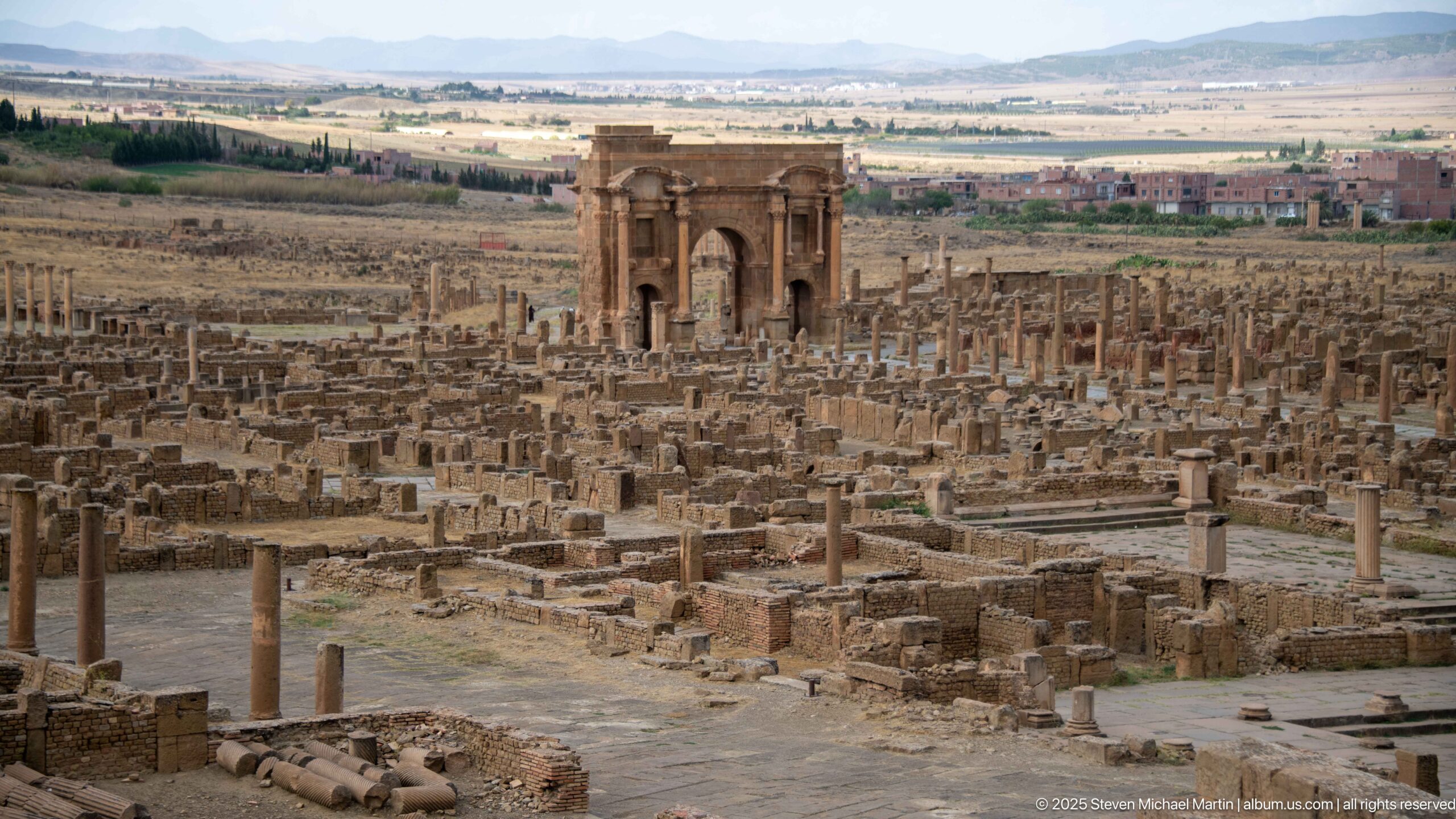
The three-bayed Arch of Trajan rises prominently above Timgad’s dense field of walls, columns, and street remains. Seen from an elevated viewpoint, the arch acts as a visual anchor within the ruined Roman city, with the modern settlement and Aurès-region landscape extending across the horizon.
Caption
The three-bayed Arch of Trajan rises prominently above Timgad’s dense field of walls, columns, and street remains. Seen from an elevated viewpoint, the arch acts as a visual anchor within the ruined Roman city, with the modern settlement and Aurès-region landscape extending across the horizon.
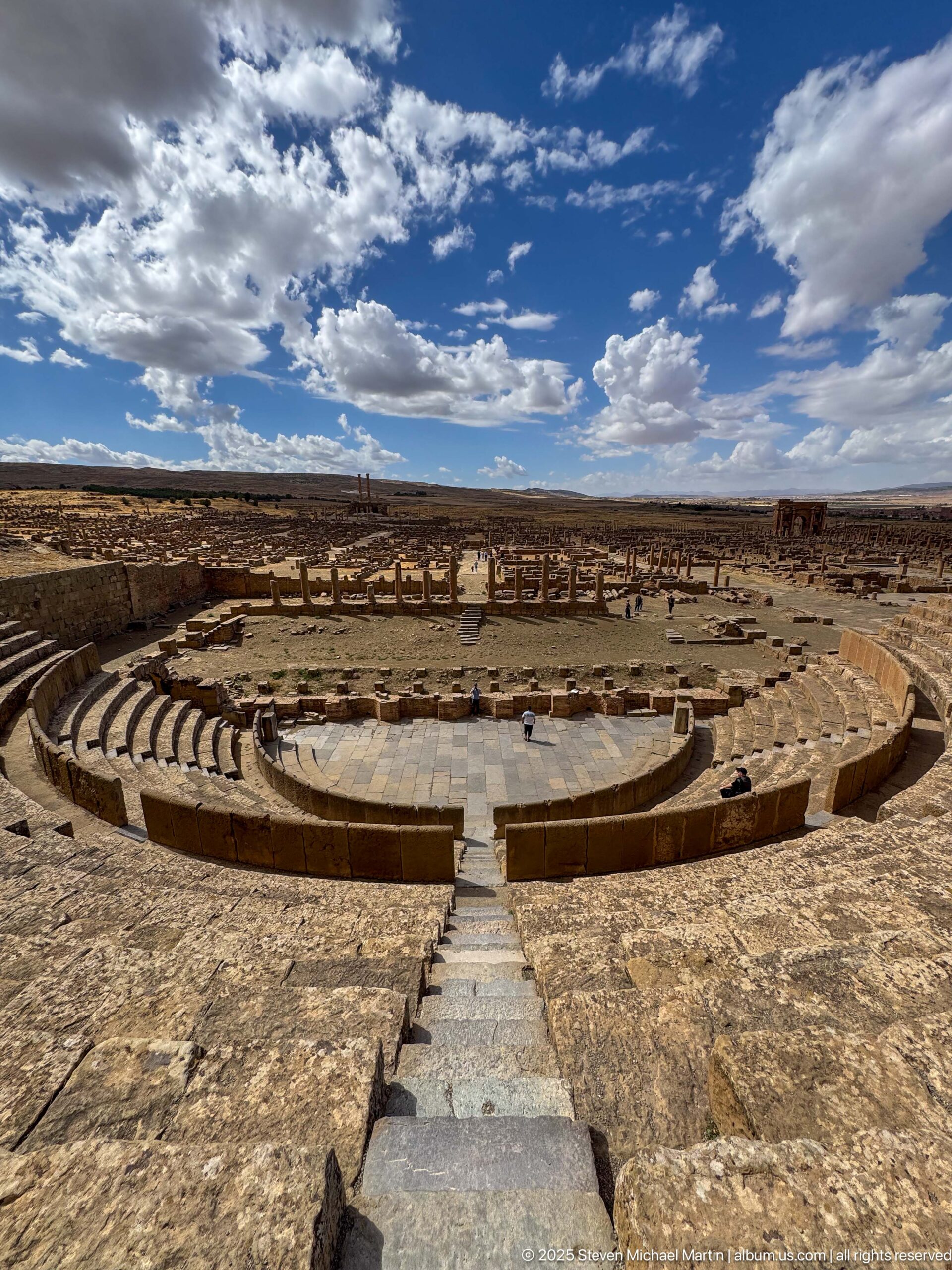
A high, symmetrical view looks down the theater’s central axis toward the orchestra and stage remains, with Timgad’s extensive ruins spreading across the plateau beyond. The image connects the enclosed semicircle of the performance space to the larger orthogonal cityscape and surrounding highland landscape.
Caption
A high, symmetrical view looks down the theater’s central axis toward the orchestra and stage remains, with Timgad’s extensive ruins spreading across the plateau beyond. The image connects the enclosed semicircle of the performance space to the larger orthogonal cityscape and surrounding highland landscape.
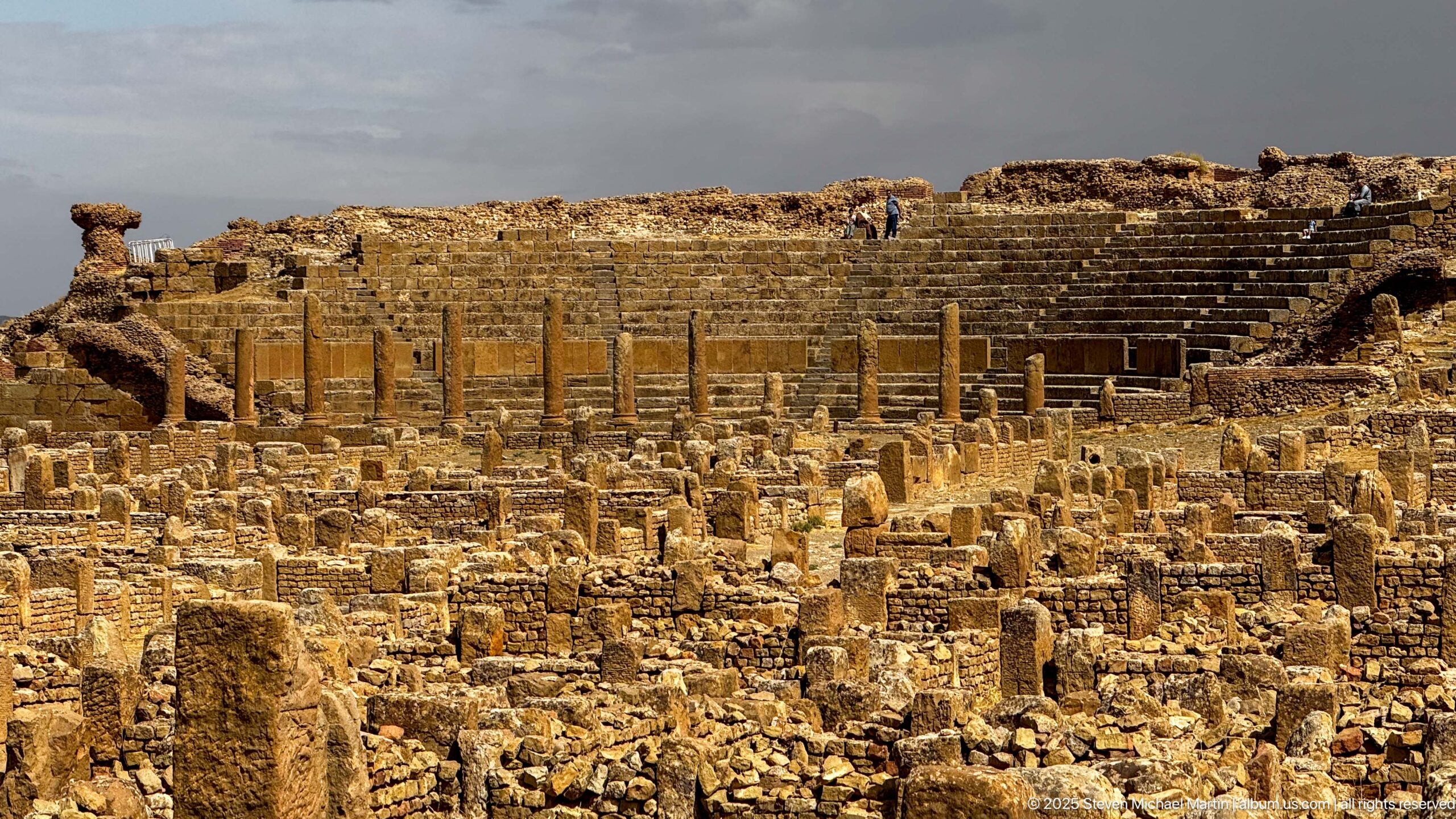
Weathered foundations, wall lines, and standing columns fill the foreground beneath the high stone seating of Timgad’s theater. The compressed telephoto-like view emphasizes the density of excavated structures and the abrupt meeting of urban ruins with the monumental cavea rising behind them.
Caption
Weathered foundations, wall lines, and standing columns fill the foreground beneath the high stone seating of Timgad’s theater. The compressed telephoto-like view emphasizes the density of excavated structures and the abrupt meeting of urban ruins with the monumental cavea rising behind them.
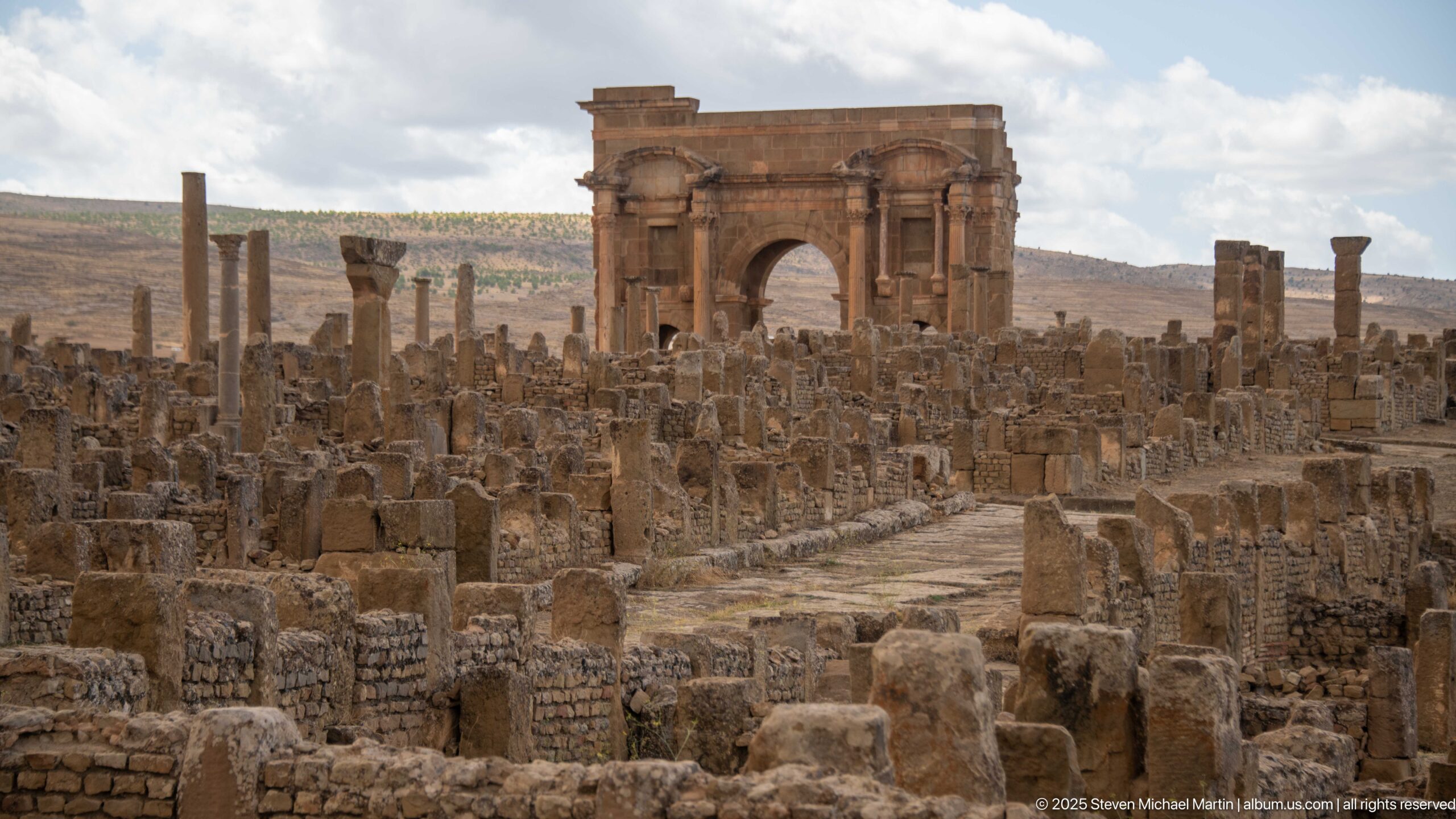
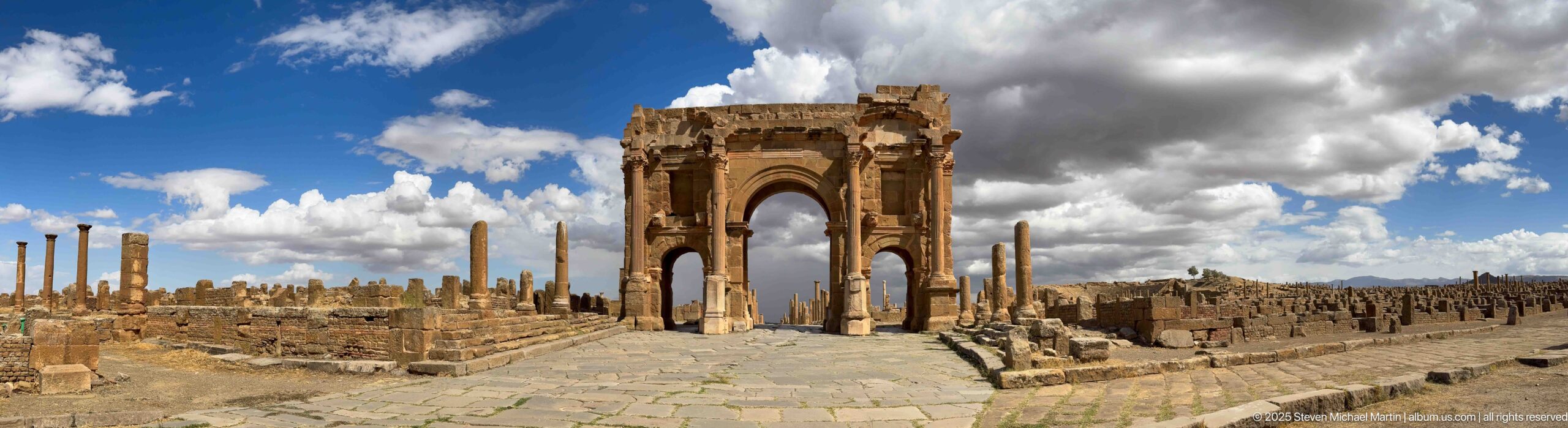
The Arch of Trajan dominates the far end of a long corridor through Timgad’s excavated blocks. Framed by dense wall foundations and scattered columns, the monumental triple-bayed gateway provides a powerful orientation point within the Roman city and demonstrates how surviving landmarks still articulate the ancient street plan.
Caption
The Arch of Trajan dominates the far end of a long corridor through Timgad’s excavated blocks. Framed by dense wall foundations and scattered columns, the monumental triple-bayed gateway provides a powerful orientation point within the Roman city and demonstrates how surviving landmarks still articulate the ancient street plan.
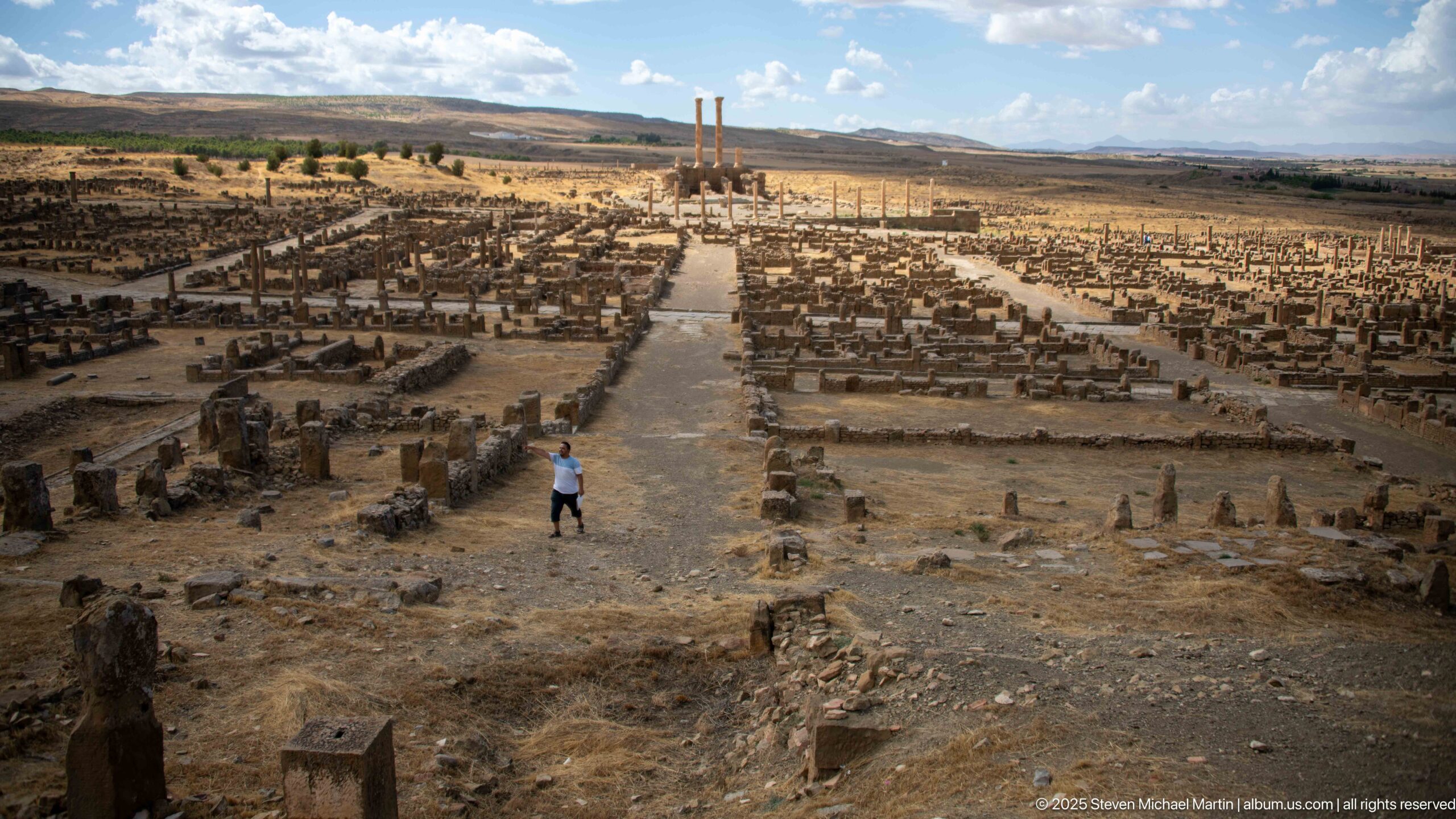
An elevated view follows a broad ancient street through the excavated city, flanked by foundations, column bases, and standing shafts. The long linear perspective makes Timgad’s planned Roman street network especially legible, with taller columns marking a monumental zone farther along the route.
Caption
An elevated view follows a broad ancient street through the excavated city, flanked by foundations, column bases, and standing shafts. The long linear perspective makes Timgad’s planned Roman street network especially legible, with taller columns marking a monumental zone farther along the route.
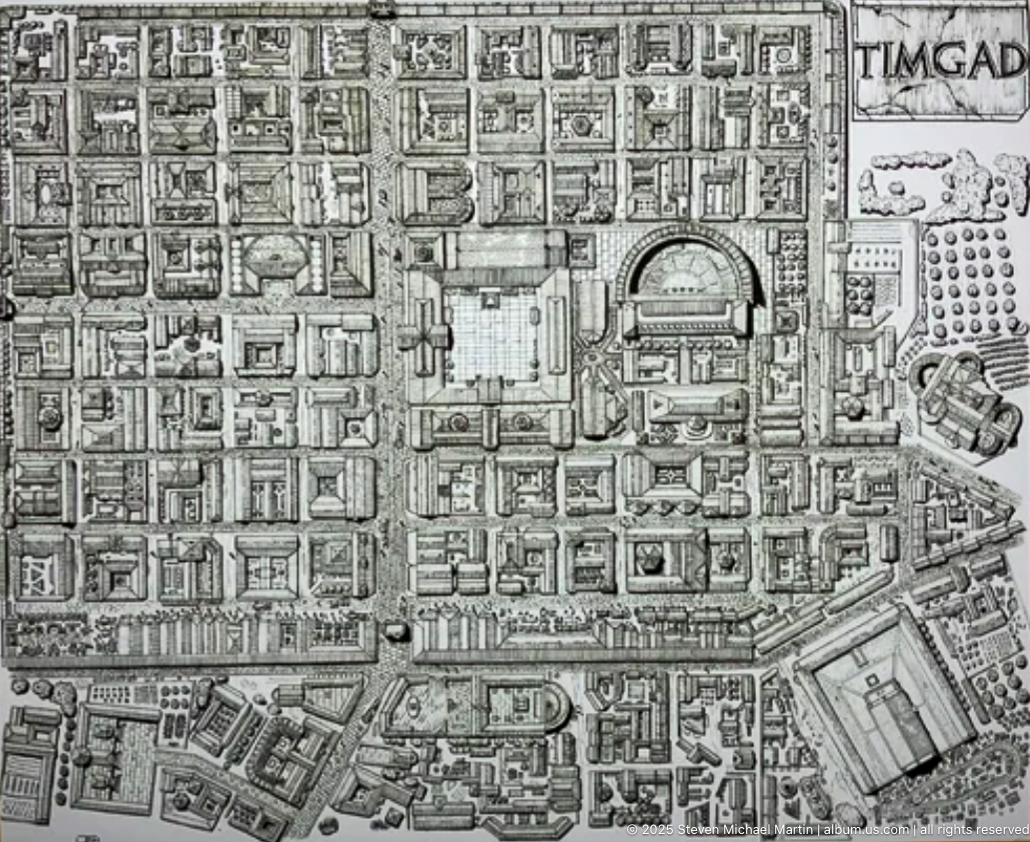
A bird’s-eye reconstruction imagines Timgad as a fully built Roman city, restoring streets, houses, civic buildings, monuments, and peripheral complexes around the gridded center. The drawing translates archaeological foundations into a legible urban panorama, showing how closely packed architecture once occupied the terrain now seen largely as ruins.
Caption
A bird’s-eye reconstruction imagines Timgad as a fully built Roman city, restoring streets, houses, civic buildings, monuments, and peripheral complexes around the gridded center. The drawing translates archaeological foundations into a legible urban panorama, showing how closely packed architecture once occupied the terrain now seen largely as ruins.
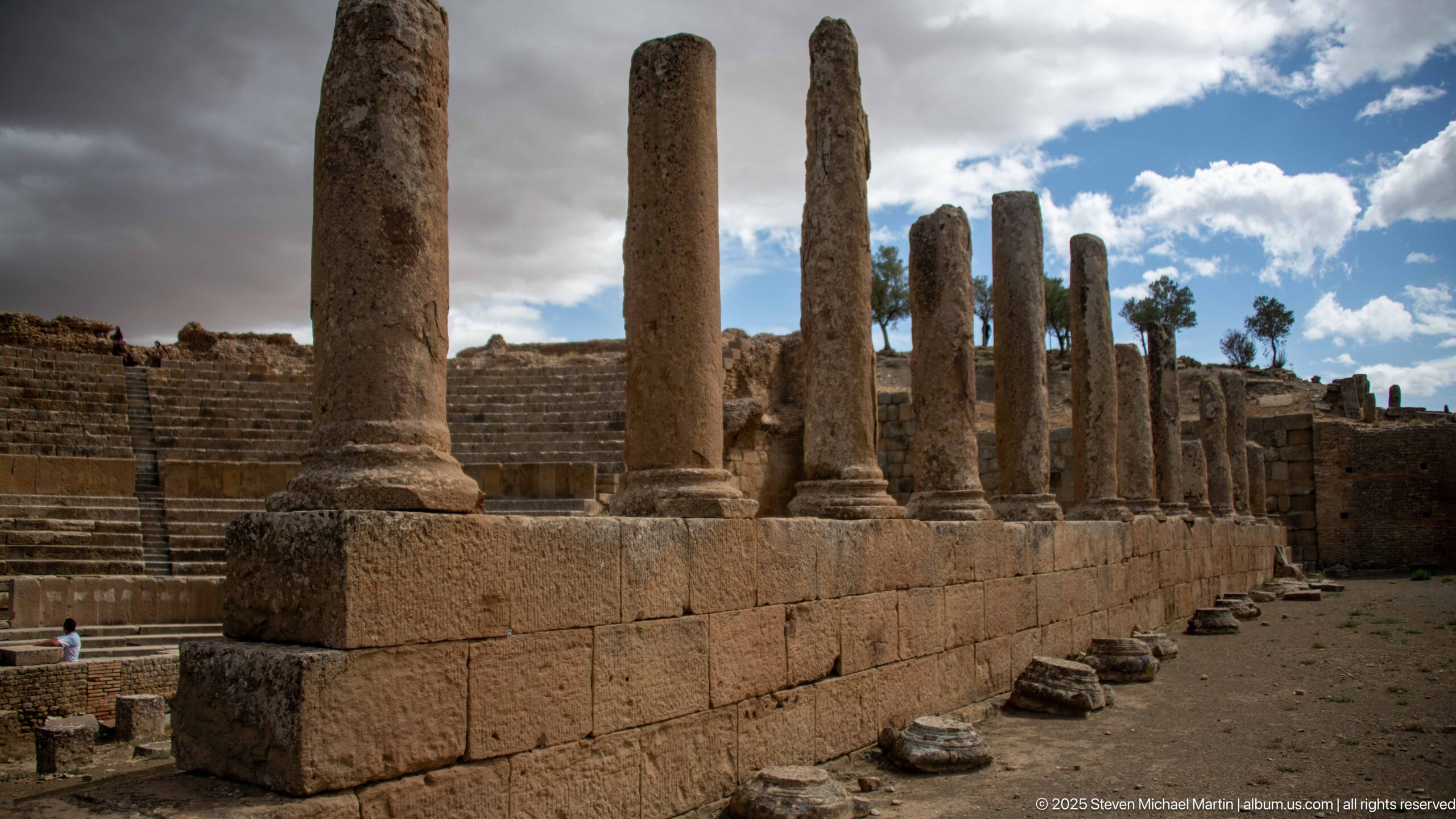
A row of tall stone columns stands along the surviving stage-front architecture of Timgad’s theater. Seen obliquely, the columns create a strong rhythm against the cavea and sky, while fallen drums and blocks at ground level reveal the fragmentary condition of the ancient architectural ensemble.
Caption
A row of tall stone columns stands along the surviving stage-front architecture of Timgad’s theater. Seen obliquely, the columns create a strong rhythm against the cavea and sky, while fallen drums and blocks at ground level reveal the fragmentary condition of the ancient architectural ensemble.
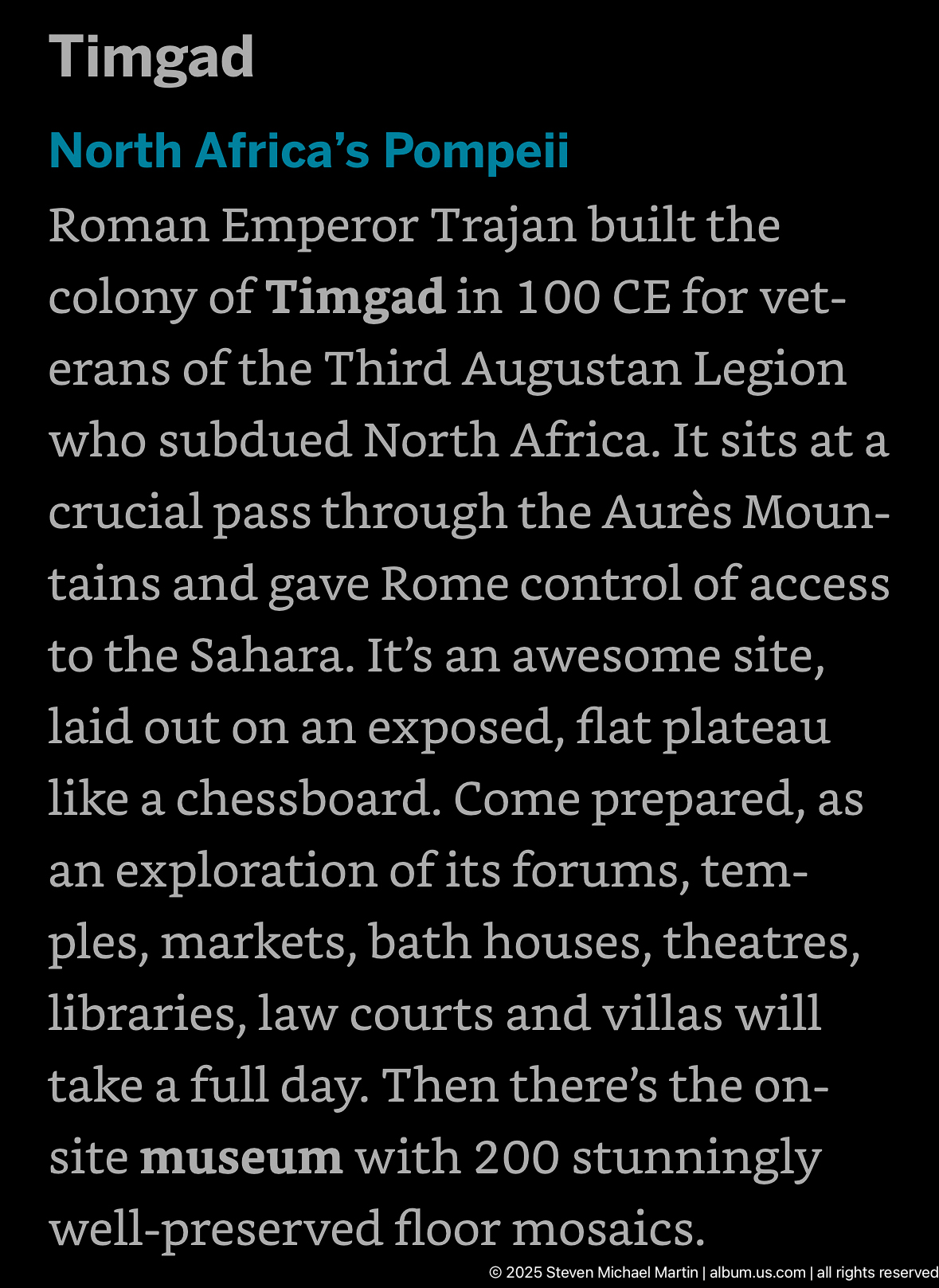
An introductory interpretation panel presents Timgad as a Roman colony founded under Trajan and outlines the city’s planned streets, public buildings, and archaeological remains. The photographed text functions as visitor orientation rather than an ancient artifact, establishing the historical framework for the ruins explored in the portfolio.
Caption
An introductory interpretation panel presents Timgad as a Roman colony founded under Trajan and outlines the city’s planned streets, public buildings, and archaeological remains. The photographed text functions as visitor orientation rather than an ancient artifact, establishing the historical framework for the ruins explored in the portfolio.
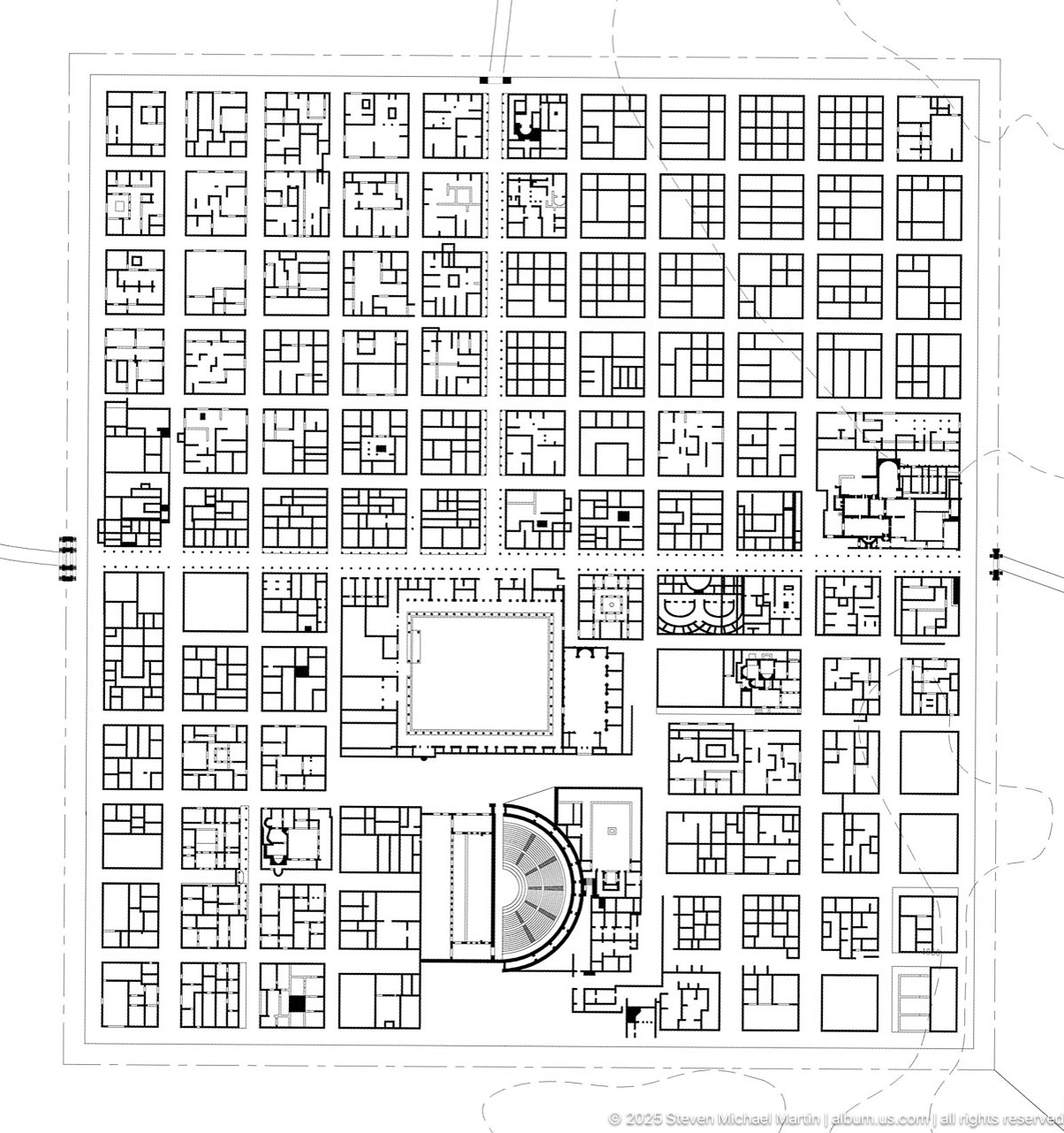
A detailed archaeological plan maps Timgad’s orthogonal street grid and major public buildings, emphasizing the regular urban layout of the Roman colony. Individual blocks, streets, and monumental complexes are drawn in plan view, allowing the visitor to understand the relationship between the forum, theater, baths, residential quarters, and other excavated structures.
Caption
A detailed archaeological plan maps Timgad’s orthogonal street grid and major public buildings, emphasizing the regular urban layout of the Roman colony. Individual blocks, streets, and monumental complexes are drawn in plan view, allowing the visitor to understand the relationship between the forum, theater, baths, residential quarters, and other excavated structures.
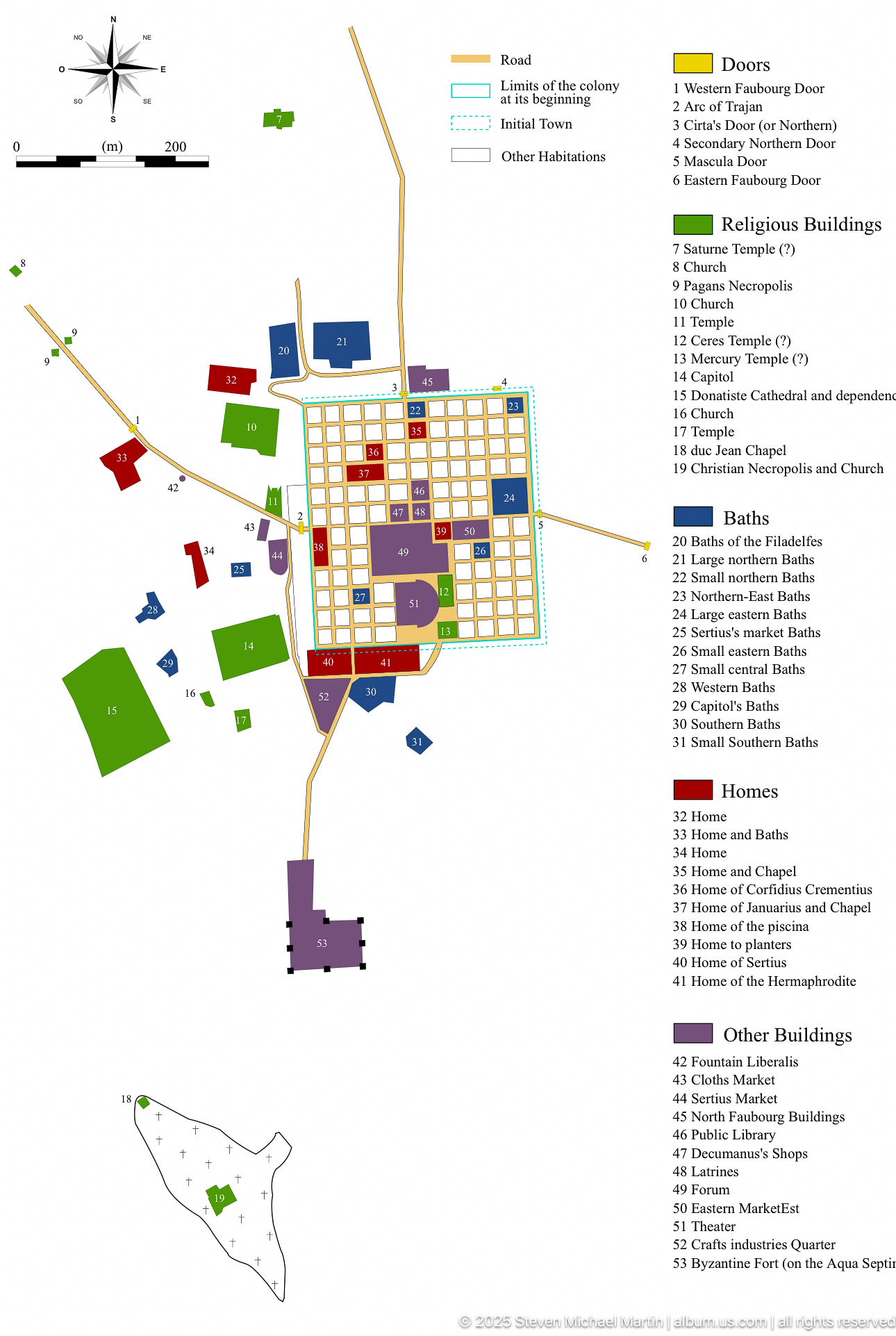
A color-coded visitor map identifies the principal zones and monuments of Timgad, combining the city’s rectilinear street plan with numbered locations and a legend. The diagram is designed for on-site orientation, helping visitors connect excavated structures with the broader layout of the Roman settlement and its outlying monuments.
Caption
A color-coded visitor map identifies the principal zones and monuments of Timgad, combining the city’s rectilinear street plan with numbered locations and a legend. The diagram is designed for on-site orientation, helping visitors connect excavated structures with the broader layout of the Roman settlement and its outlying monuments.
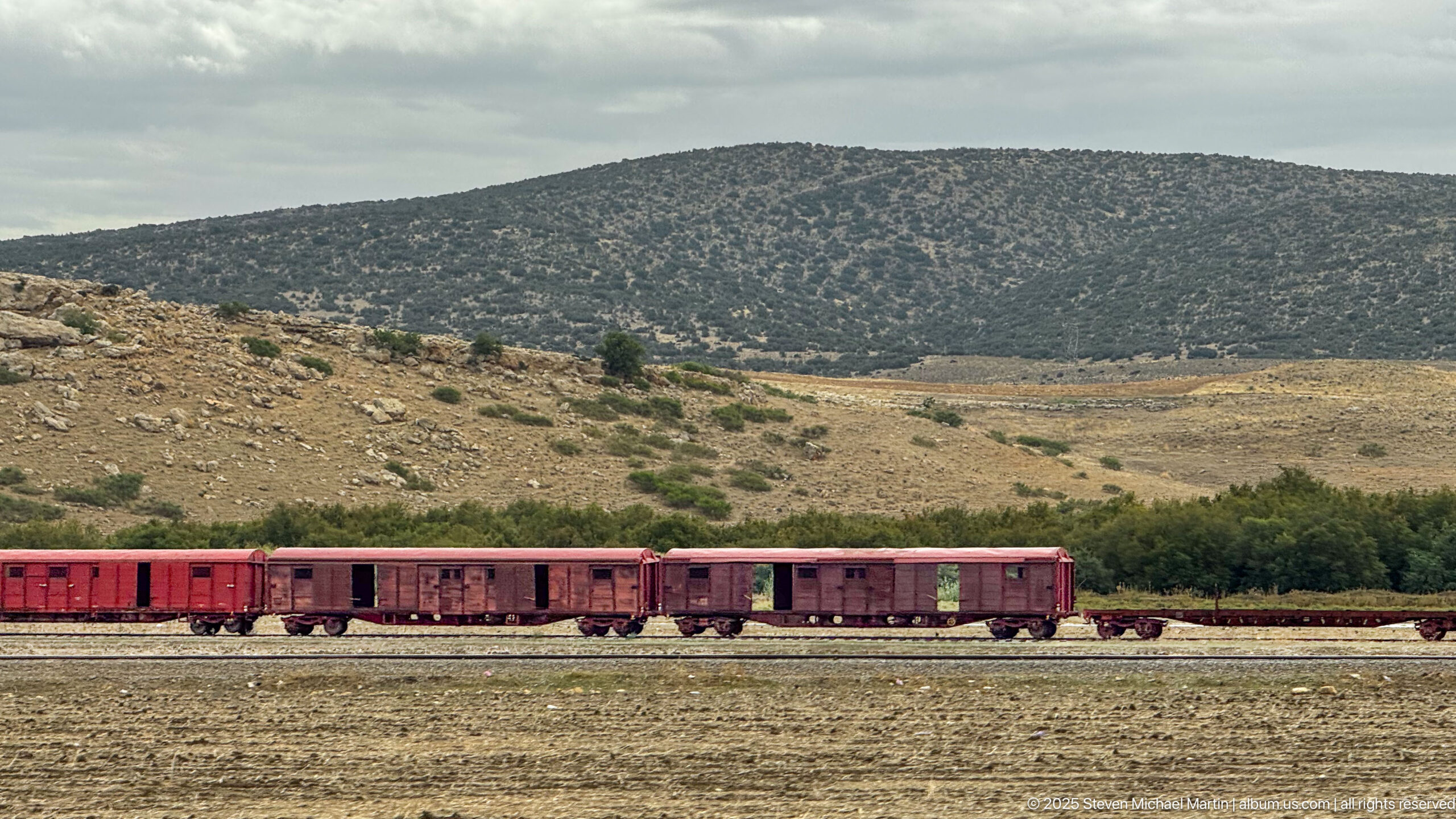
A freight train passes across the dry upland landscape near Timgad, with a broad, scrub-covered hill rising behind the tracks. The view places the archaeological site within the high plains of northeastern Algeria and contrasts modern transport infrastructure with the austere terrain that surrounds the ancient city.
Caption
A freight train passes across the dry upland landscape near Timgad, with a broad, scrub-covered hill rising behind the tracks. The view places the archaeological site within the high plains of northeastern Algeria and contrasts modern transport infrastructure with the austere terrain that surrounds the ancient city.
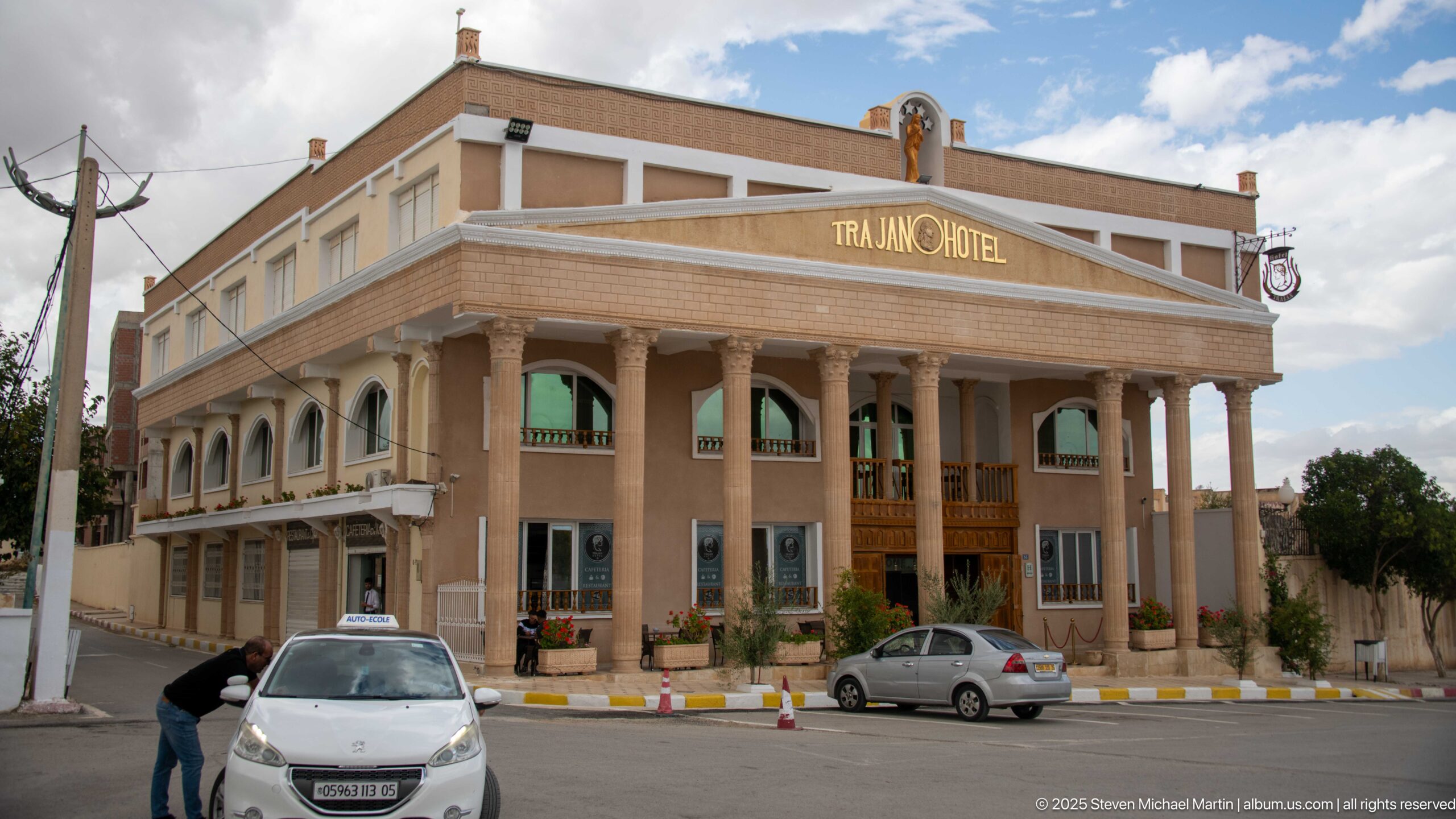
The Trajan Hotel presents a columned street façade in modern Timgad, its name displayed prominently above the entrance. Classical architectural references in the portico and upper ornament visually echo the Roman heritage that defines the nearby archaeological site, while parked cars and the urban street establish the contemporary setting.
Caption
The Trajan Hotel presents a columned street façade in modern Timgad, its name displayed prominently above the entrance. Classical architectural references in the portico and upper ornament visually echo the Roman heritage that defines the nearby archaeological site, while parked cars and the urban street establish the contemporary setting.
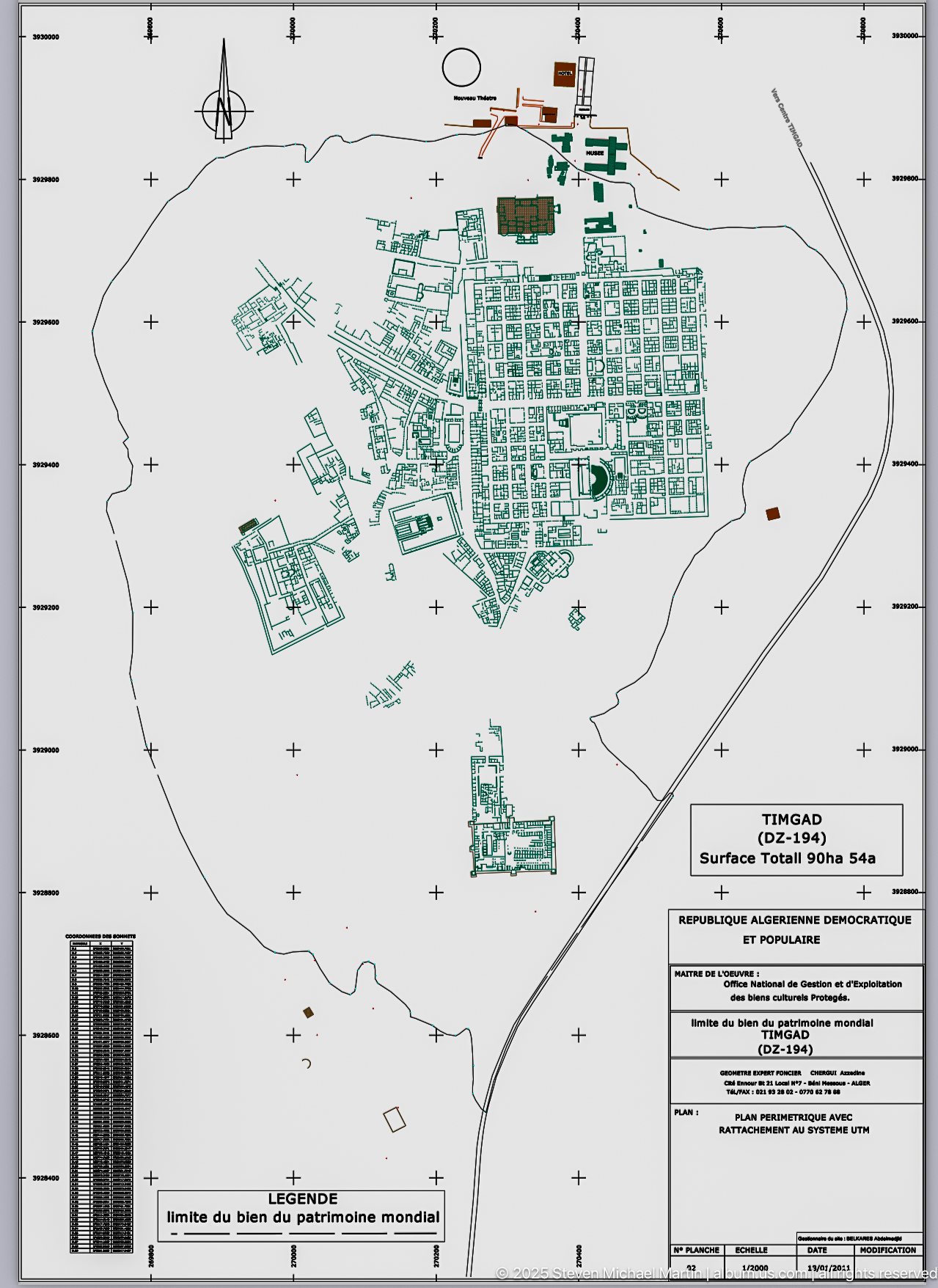
A technical survey drawing records the Timgad archaeological zone within its surrounding topography. The ancient urban grid appears as a dense green plan, while roads, outlying structures, control points, and the broader site boundary provide a modern spatial framework for documenting the excavated city and its setting.
Caption
A technical survey drawing records the Timgad archaeological zone within its surrounding topography. The ancient urban grid appears as a dense green plan, while roads, outlying structures, control points, and the broader site boundary provide a modern spatial framework for documenting the excavated city and its setting.
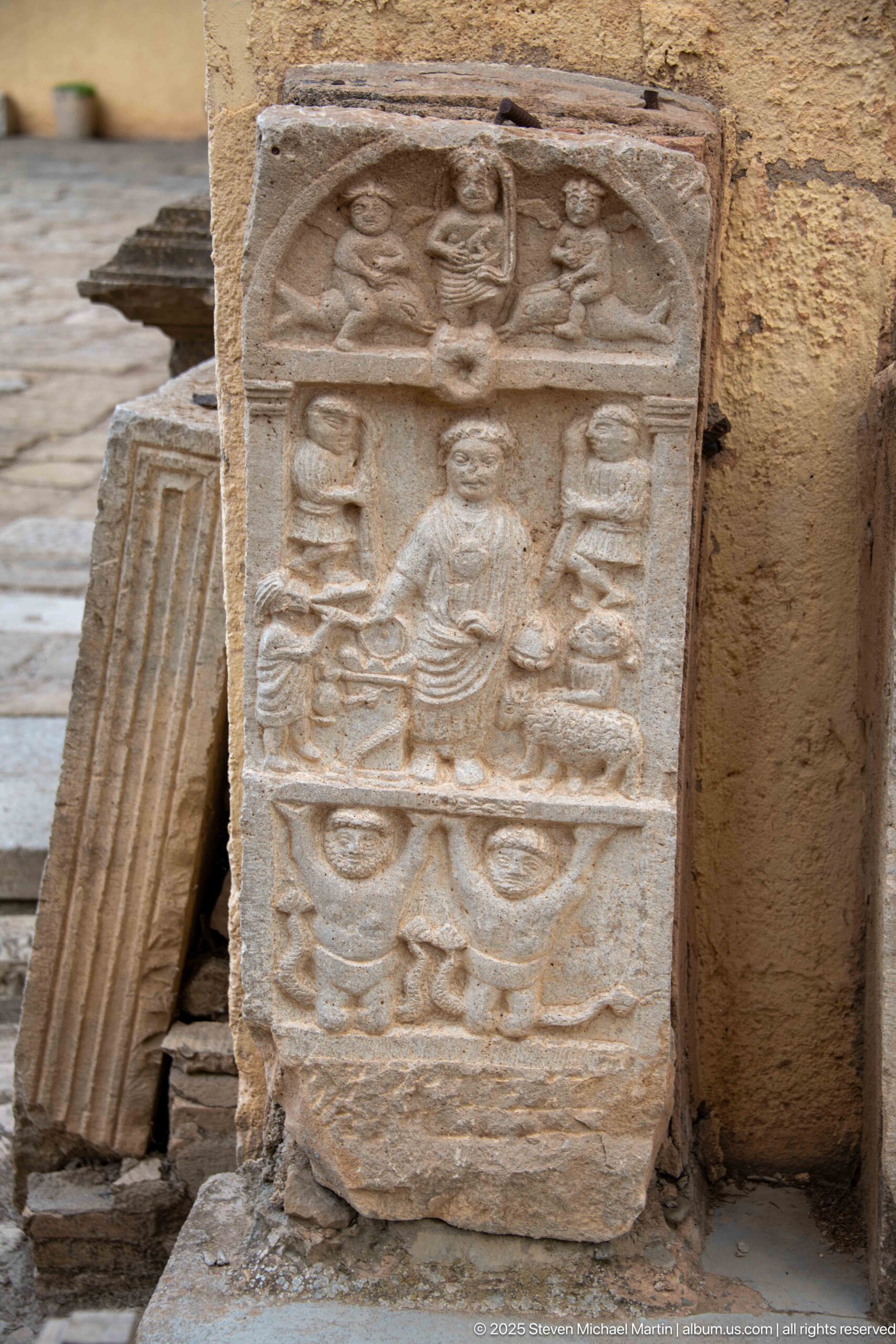
A carved stele centers on a seated figure framed by stacked symbolic motifs and shallow architectural borders. Worn surfaces soften the details, but the composition remains legible as a carefully organized relief monument whose imagery was intended to communicate religious or commemorative meaning.
Caption
A carved stele centers on a seated figure framed by stacked symbolic motifs and shallow architectural borders. Worn surfaces soften the details, but the composition remains legible as a carefully organized relief monument whose imagery was intended to communicate religious or commemorative meaning.
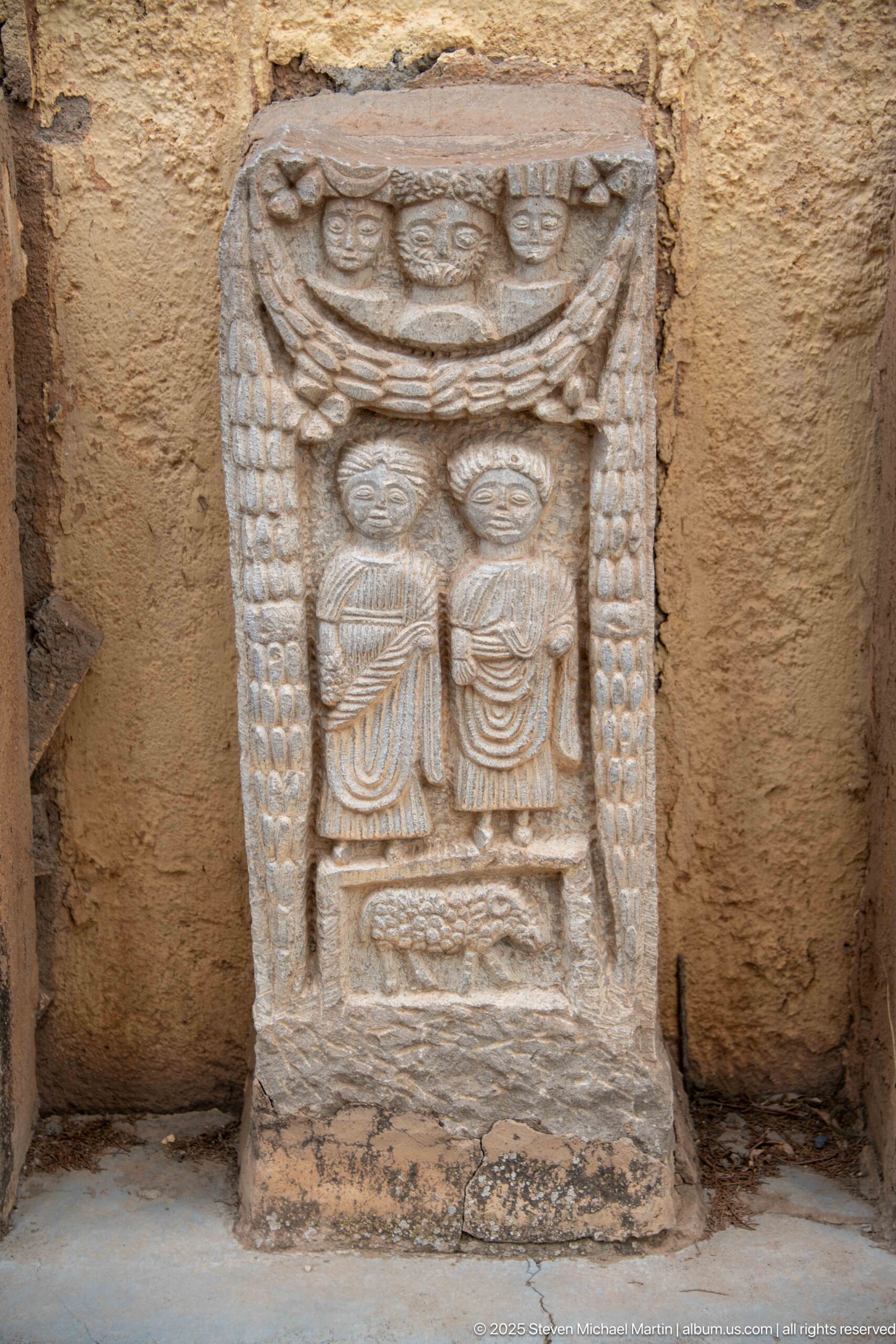
This carved stele is organized around two large vessel- or shrine-like forms beneath a band of circular and crescent-shaped symbols. Beaded side borders and a shallow base register frame the composition, producing a highly structured piece of symbolic stone carving whose precise iconography is not fully legible at proof-sheet scale.
Caption
This carved stele is organized around two large vessel- or shrine-like forms beneath a band of circular and crescent-shaped symbols. Beaded side borders and a shallow base register frame the composition, producing a highly structured piece of symbolic stone carving whose precise iconography is not fully legible at proof-sheet scale.
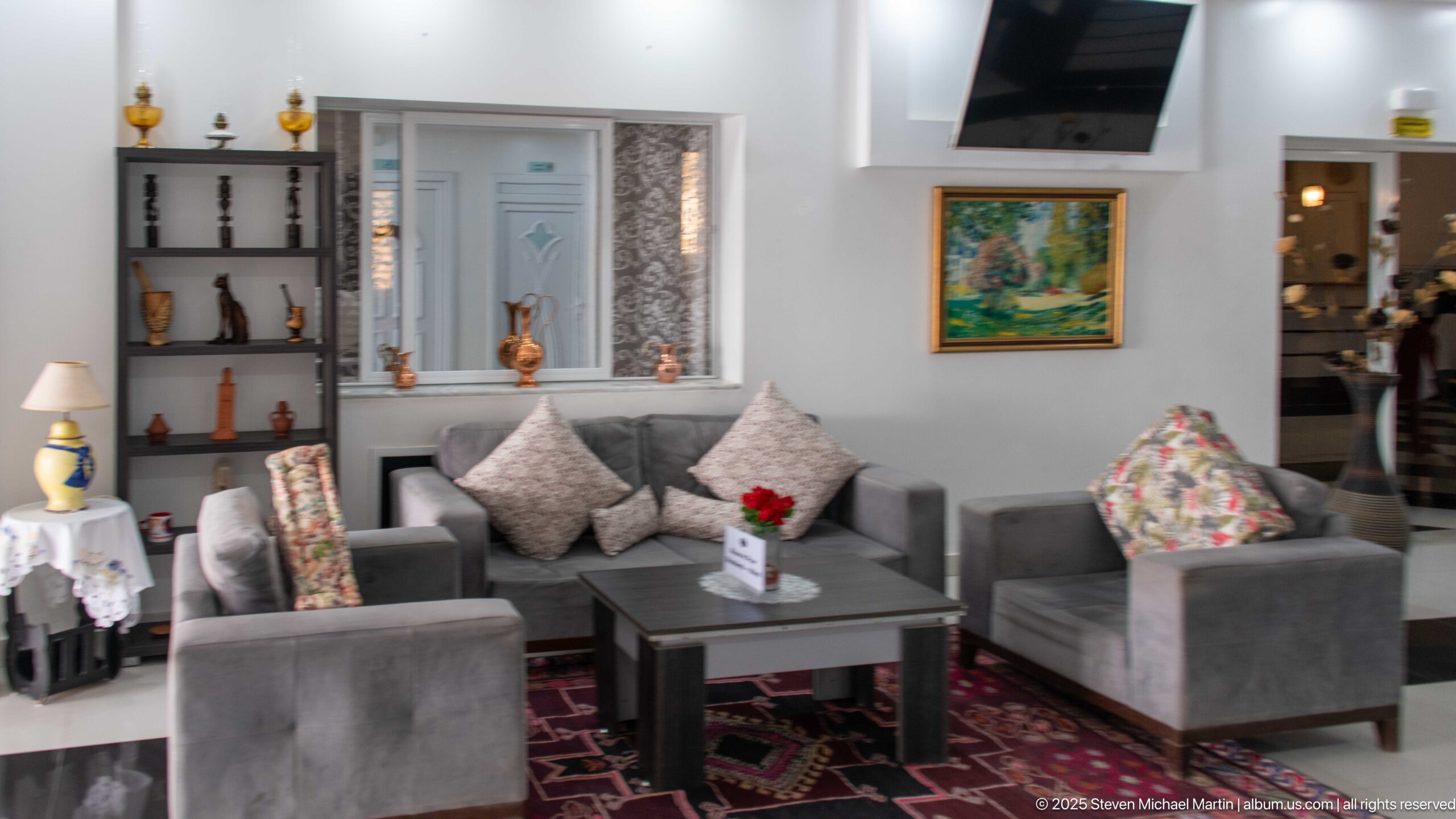
A lounge inside the Trajan Hotel combines contemporary gray seating with patterned textiles, small display niches, decorative vessels, and framed artwork. The carefully arranged interior provides a modern hospitality counterpoint to the nearby archaeological site, using decorative objects and textiles rather than monumental architecture to create its visual character.
Caption
A lounge inside the Trajan Hotel combines contemporary gray seating with patterned textiles, small display niches, decorative vessels, and framed artwork. The carefully arranged interior provides a modern hospitality counterpoint to the nearby archaeological site, using decorative objects and textiles rather than monumental architecture to create its visual character.
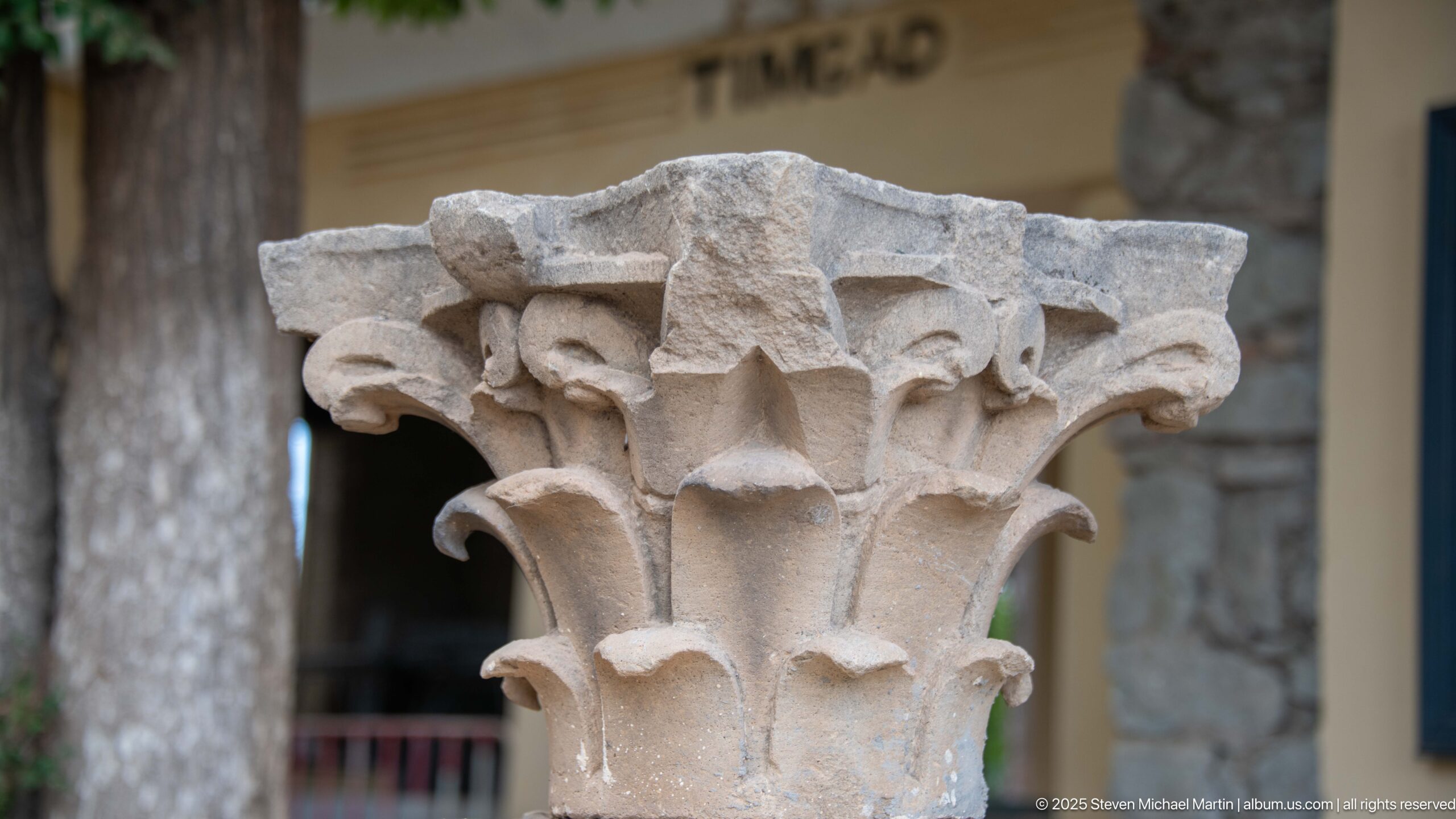
A carved stone capital displays the layered acanthus leaves and corner volutes associated with the Corinthian order. Its weathered surface and broken upper edges reveal the effects of age and reuse, while the close viewpoint isolates the craftsmanship of a single architectural fragment from the larger archaeological setting.
Caption
A carved stone capital displays the layered acanthus leaves and corner volutes associated with the Corinthian order. Its weathered surface and broken upper edges reveal the effects of age and reuse, while the close viewpoint isolates the craftsmanship of a single architectural fragment from the larger archaeological setting.
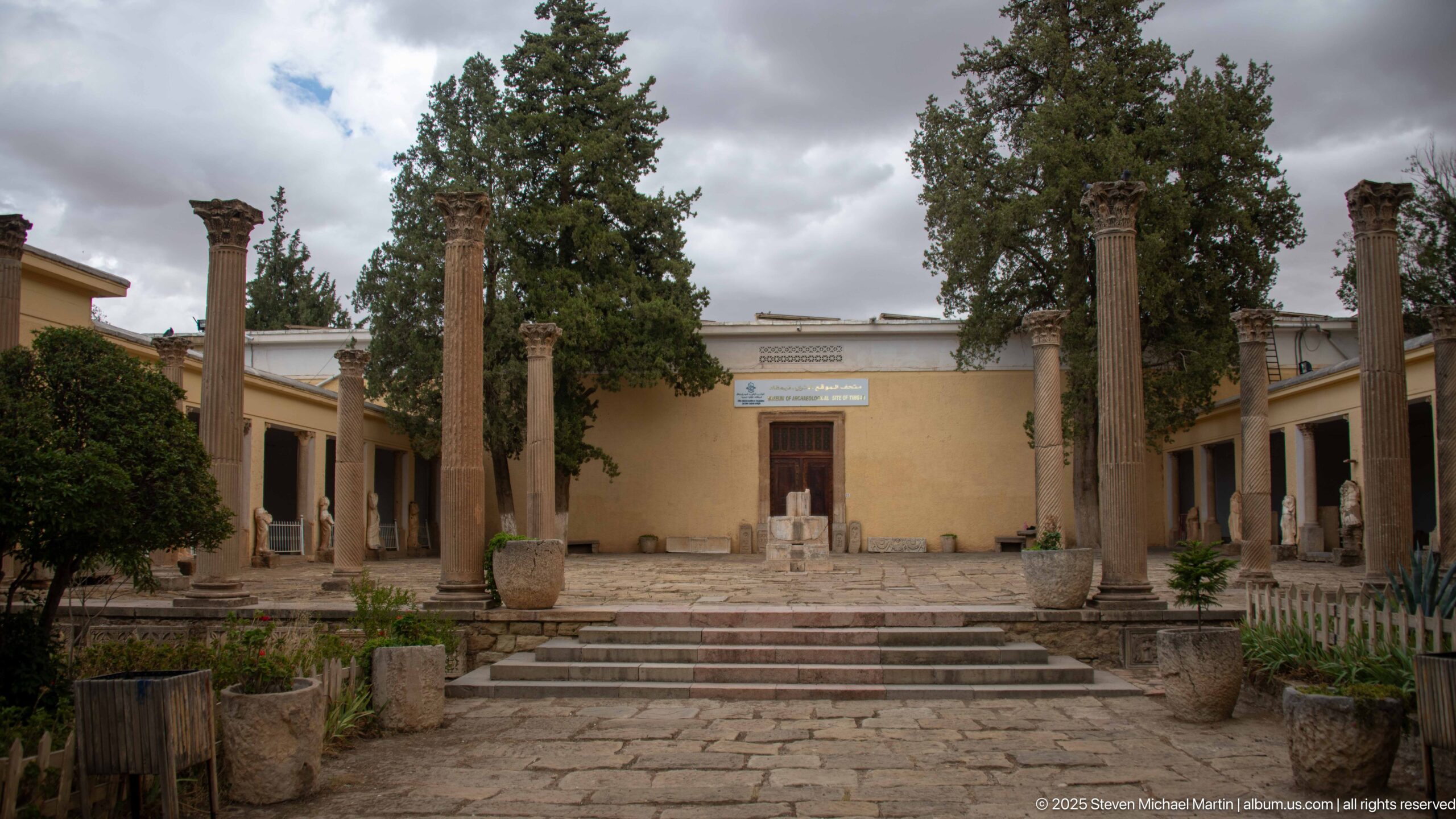
A formal courtyard at the Timgad museum is lined with ancient columns and stone fragments arranged around a central path. Steps rise toward a doorway in the ochre building at the far end, while trees and planted areas soften the display setting and create a transitional space between museum architecture and archaeological material.
Caption
A formal courtyard at the Timgad museum is lined with ancient columns and stone fragments arranged around a central path. Steps rise toward a doorway in the ochre building at the far end, while trees and planted areas soften the display setting and create a transitional space between museum architecture and archaeological material.
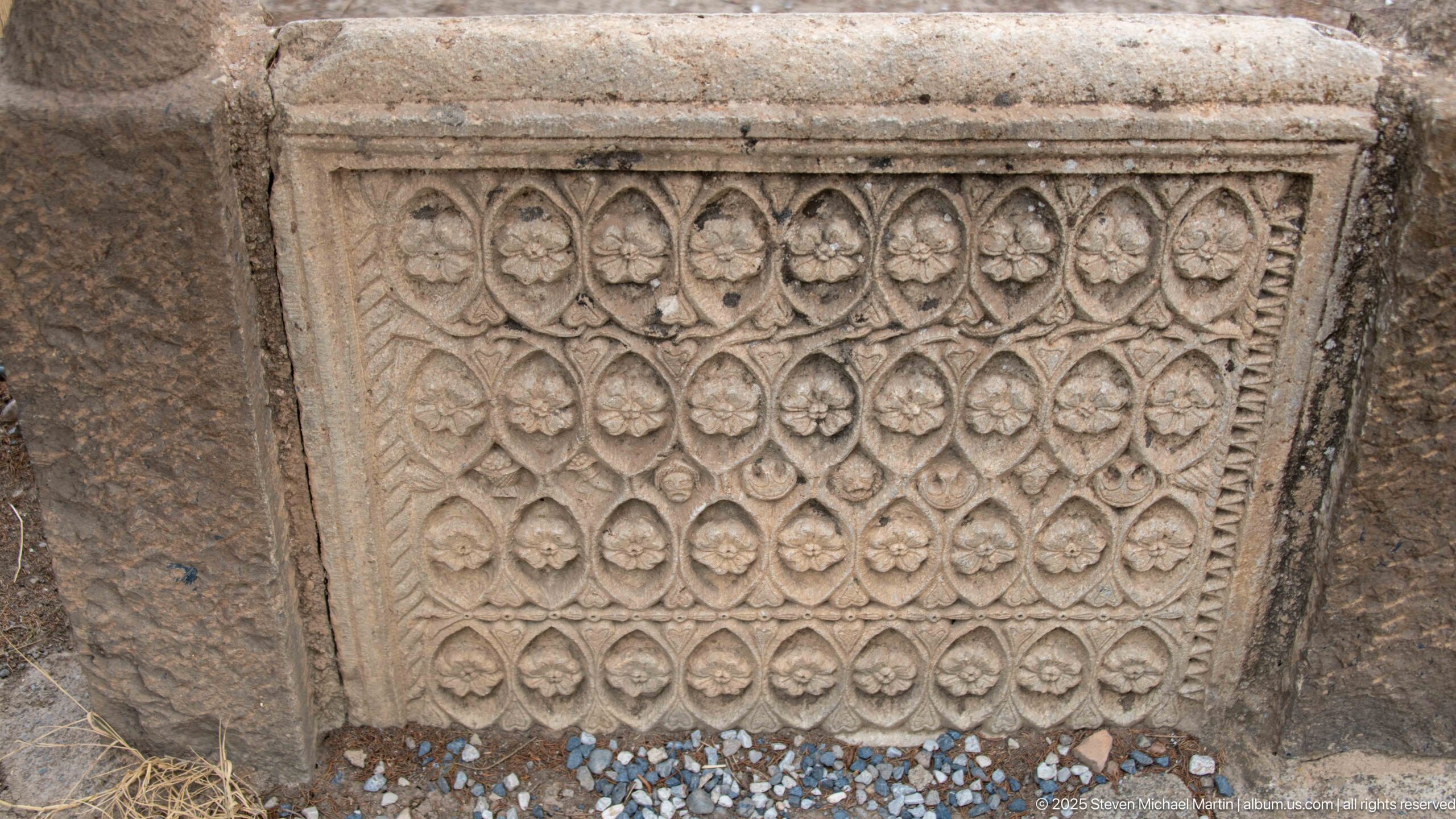
A rectangular stone panel is densely carved with repeated almond-shaped compartments enclosing stylized floral motifs. The shallow relief forms a regular lattice bordered by narrow bands, demonstrating the decorative vocabulary used on architectural or funerary stonework preserved at Timgad.
Caption
A rectangular stone panel is densely carved with repeated almond-shaped compartments enclosing stylized floral motifs. The shallow relief forms a regular lattice bordered by narrow bands, demonstrating the decorative vocabulary used on architectural or funerary stonework preserved at Timgad.
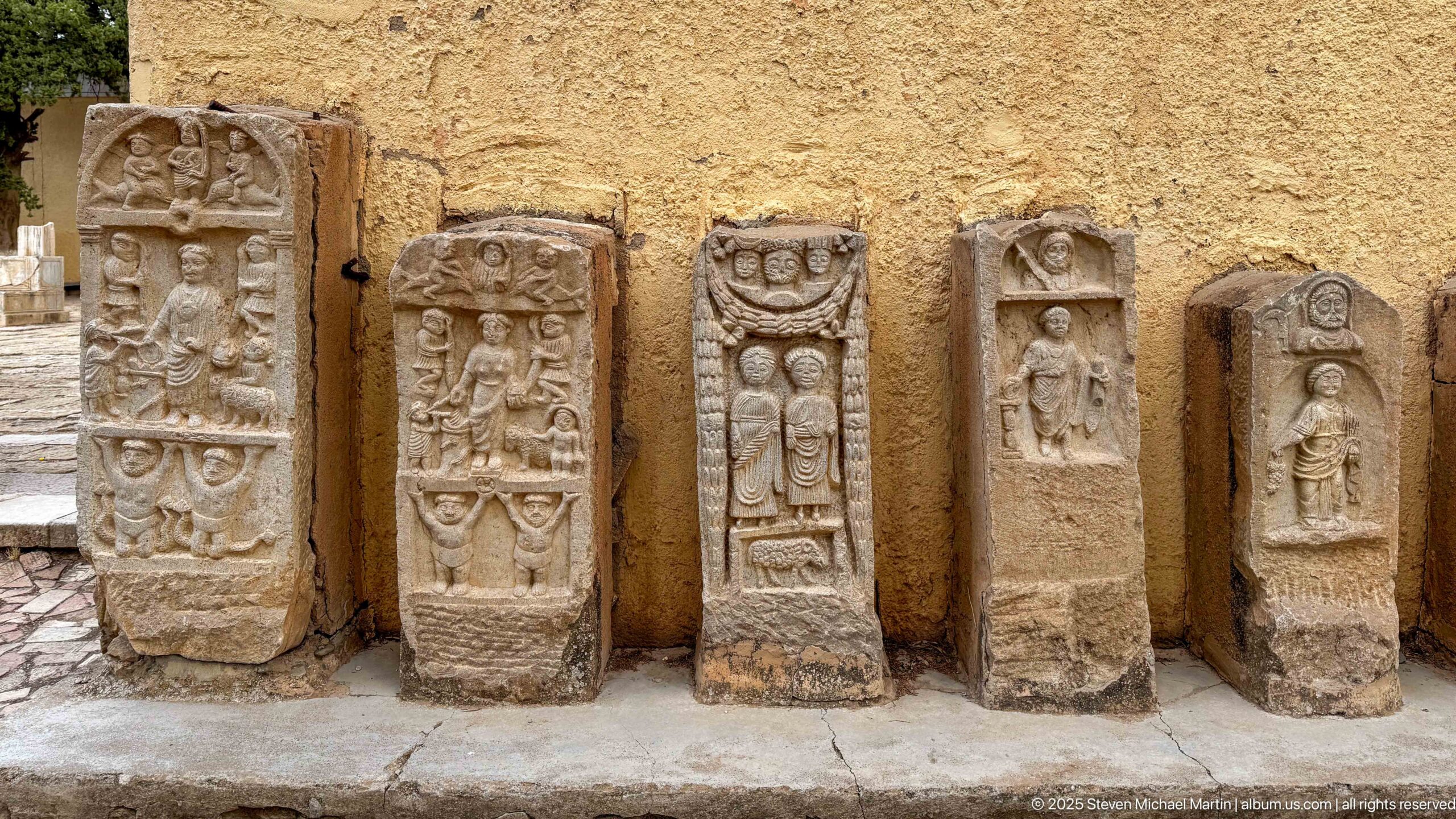
A group of carved stone stelae stands against an ochre wall, each decorated with human figures, busts, symbols, or ornamental bands in shallow relief. Displayed together, the monuments reveal the variety of commemorative and religious imagery preserved from Roman Timgad and its surrounding region.
Caption
A group of carved stone stelae stands against an ochre wall, each decorated with human figures, busts, symbols, or ornamental bands in shallow relief. Displayed together, the monuments reveal the variety of commemorative and religious imagery preserved from Roman Timgad and its surrounding region.
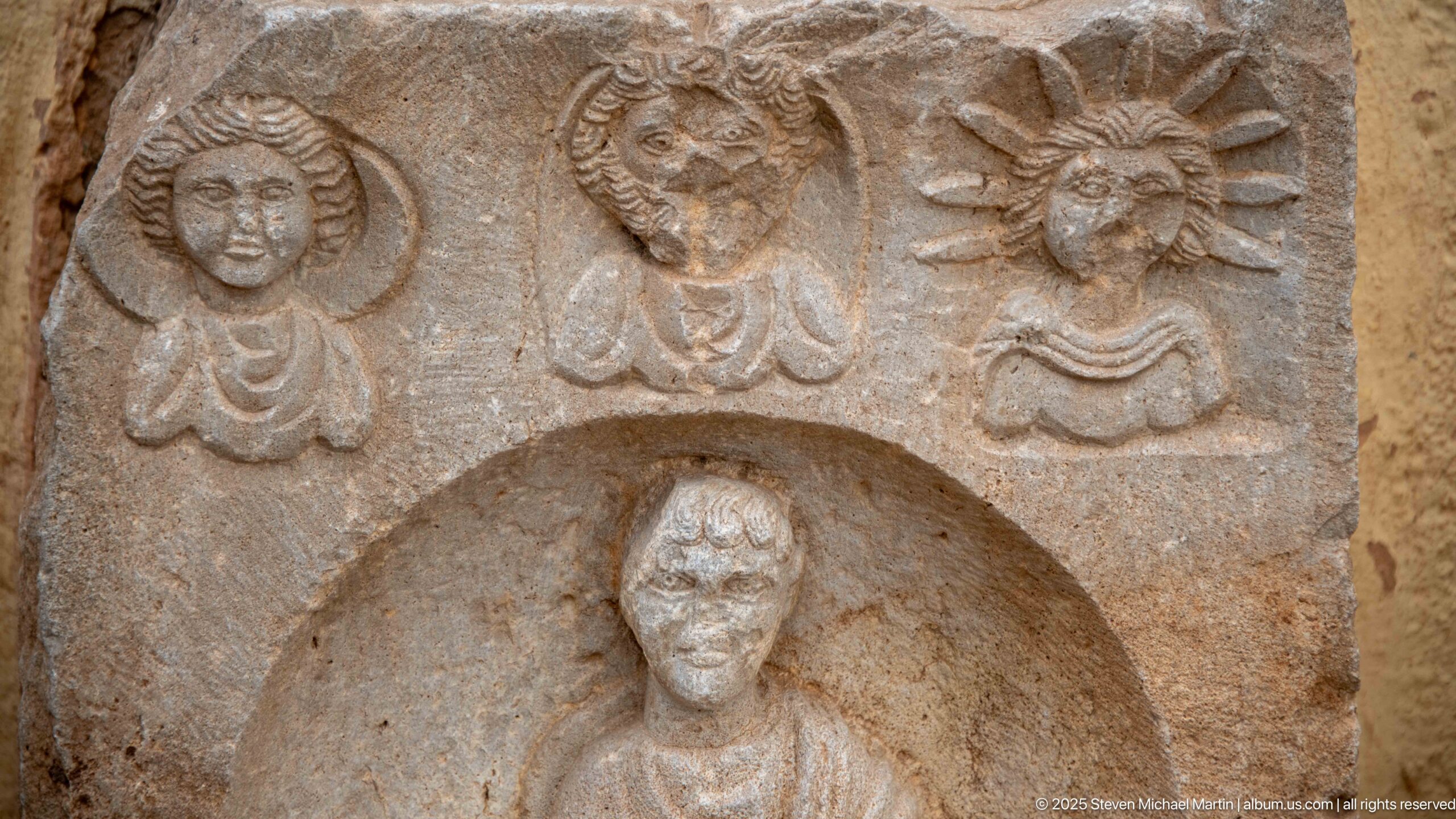
A close view isolates the upper section of a carved stele, where three human busts or heads appear above a larger niche containing the top of another figure. The tighter framing emphasizes facial carving, halos or radiating motifs, and the layered arrangement of figures more clearly than the full-length stelae nearby.
Caption
A close view isolates the upper section of a carved stele, where three human busts or heads appear above a larger niche containing the top of another figure. The tighter framing emphasizes facial carving, halos or radiating motifs, and the layered arrangement of figures more clearly than the full-length stelae nearby.
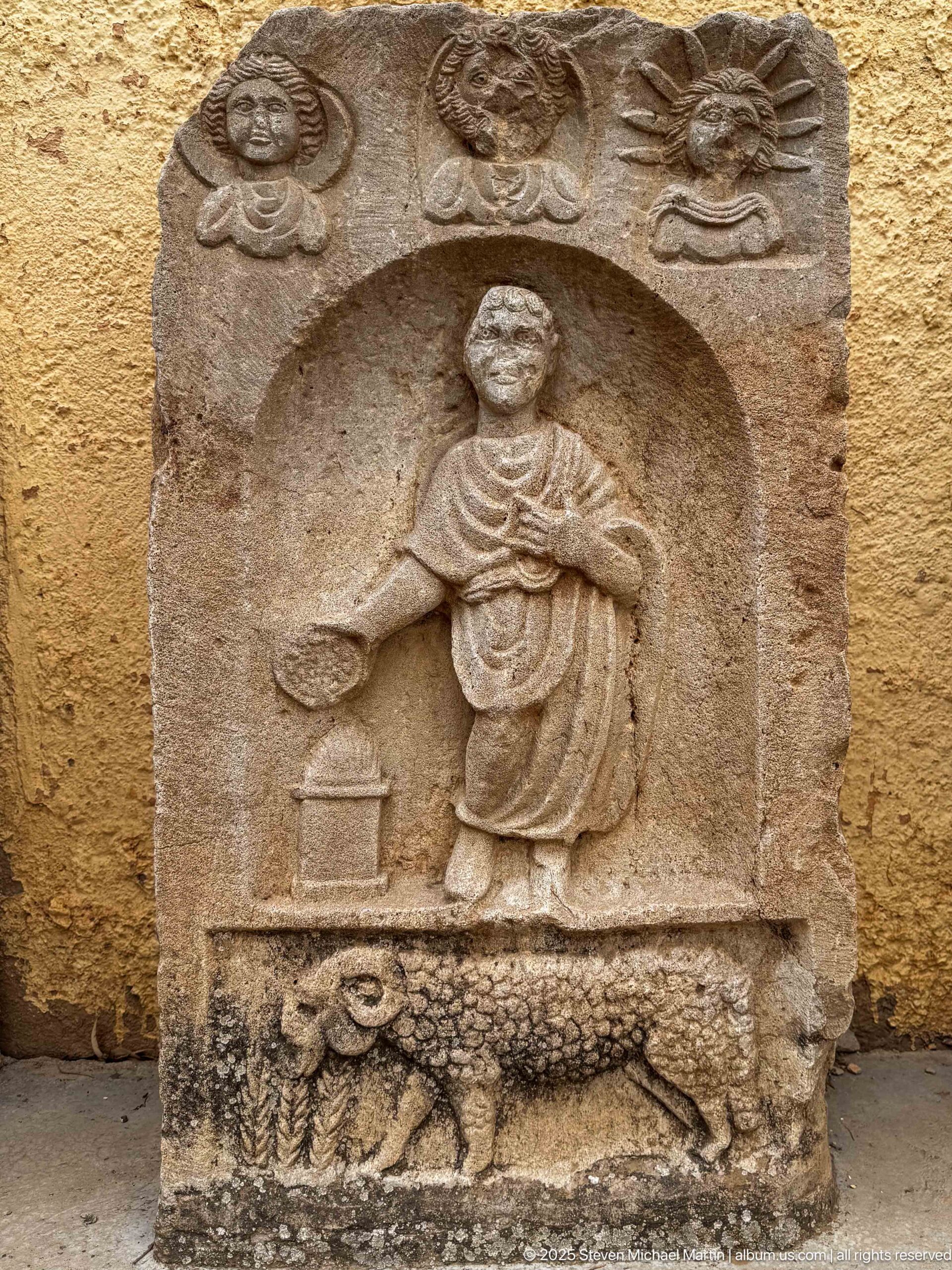
A standing robed figure occupies a rounded niche on this carved stele, one arm extended beside a small pedestal-like object. Above, additional motifs fill the upper band, while an animal relief and vegetal ornament run across the base, creating a layered iconographic program characteristic of commemorative or religious stone monuments.
Caption
A standing robed figure occupies a rounded niche on this carved stele, one arm extended beside a small pedestal-like object. Above, additional motifs fill the upper band, while an animal relief and vegetal ornament run across the base, creating a layered iconographic program characteristic of commemorative or religious stone monuments.
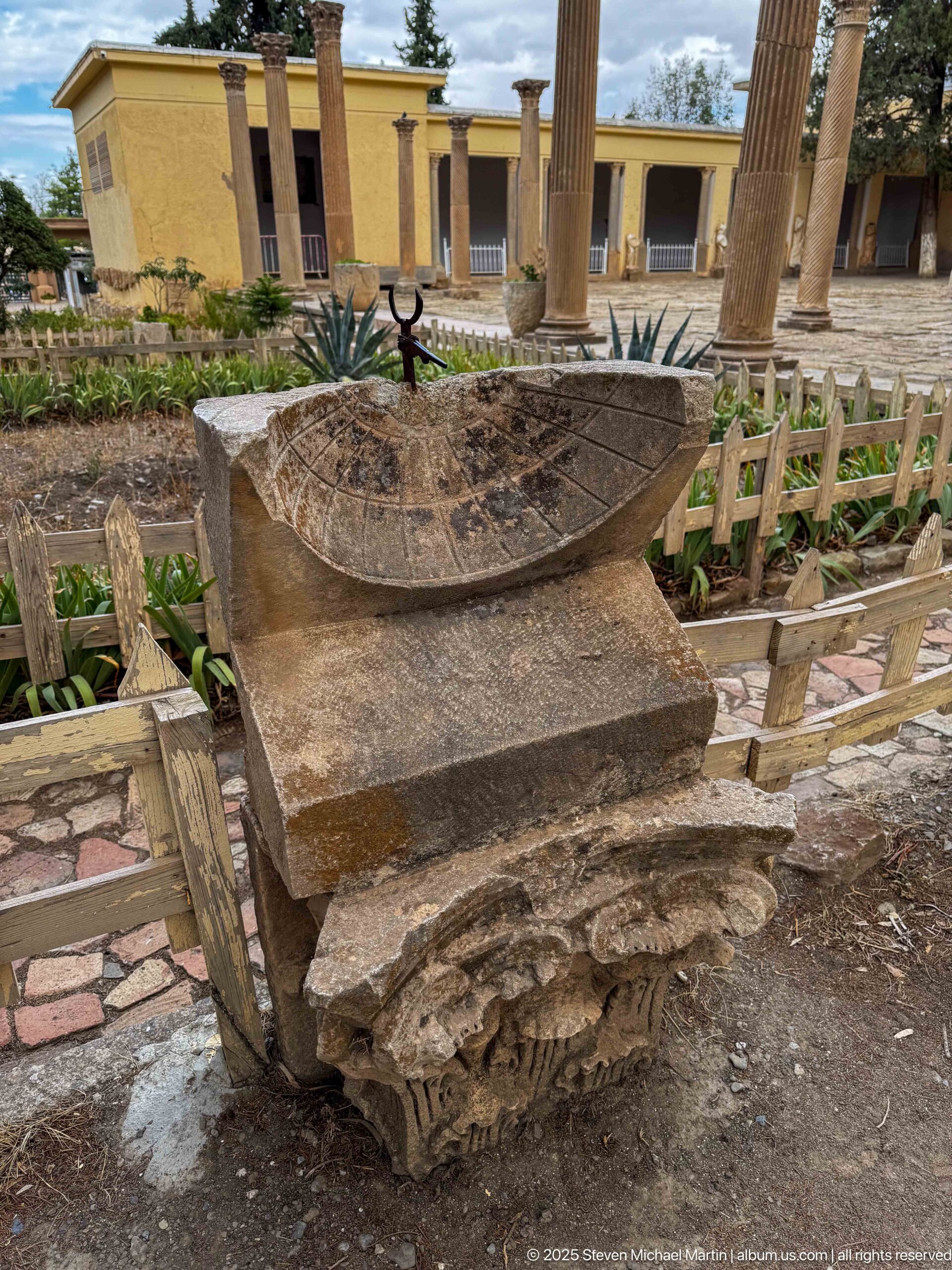
A carved stone sundial rests on a reused architectural block in the museum courtyard. Incised hour lines radiate across the shallow concave dial, while surrounding columns and fragments establish its archaeological display context and show how scientific instruments formed part of daily life in the Roman city.
Caption
A carved stone sundial rests on a reused architectural block in the museum courtyard. Incised hour lines radiate across the shallow concave dial, while surrounding columns and fragments establish its archaeological display context and show how scientific instruments formed part of daily life in the Roman city.
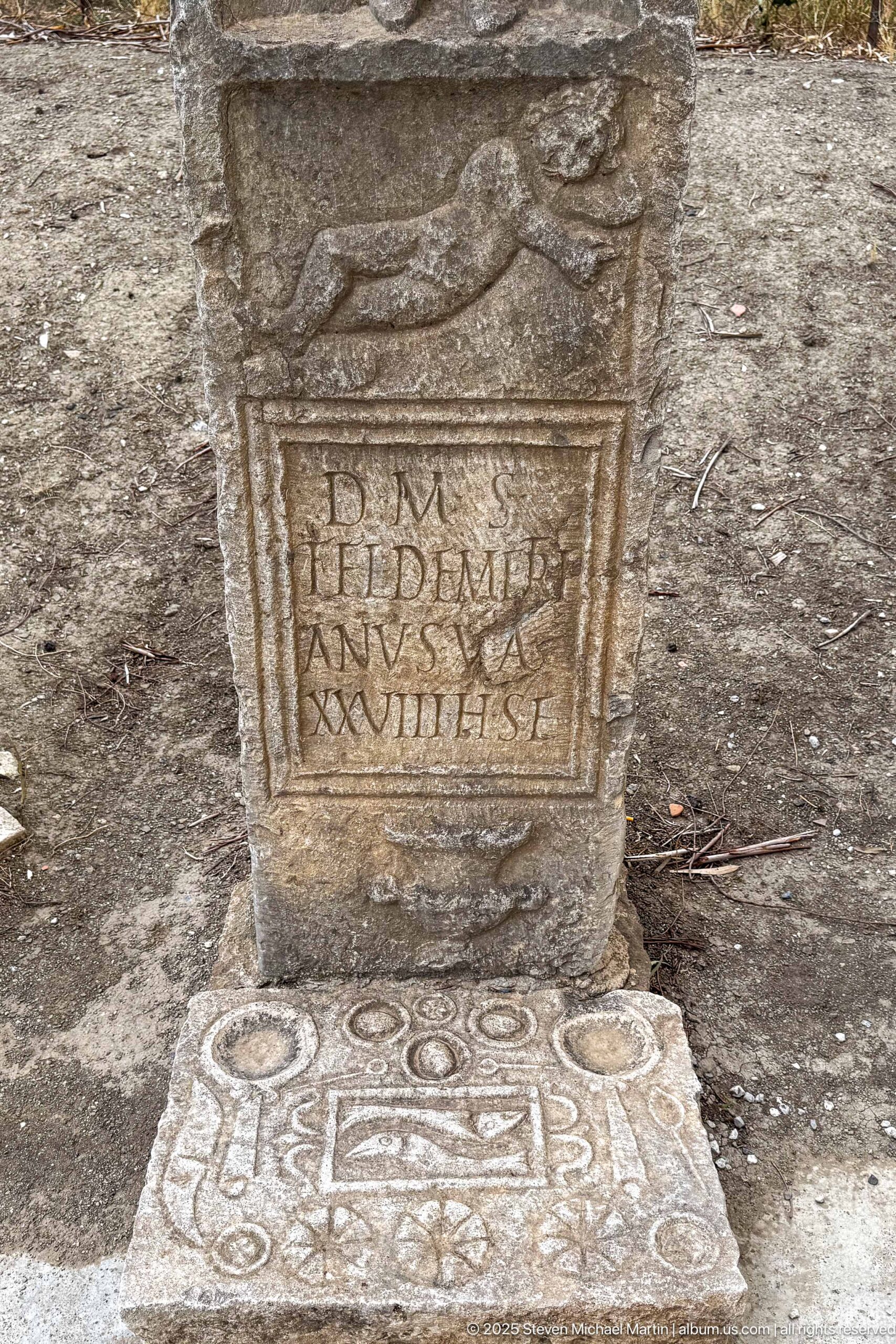
A weathered stone monument combines a short Latin inscription with a reclining animal carved in low relief above the text. Geometric and circular motifs decorate the lower slab, suggesting that the surviving pieces once formed a more elaborate commemorative or religious object now displayed outdoors.
Caption
A weathered stone monument combines a short Latin inscription with a reclining animal carved in low relief above the text. Geometric and circular motifs decorate the lower slab, suggesting that the surviving pieces once formed a more elaborate commemorative or religious object now displayed outdoors.
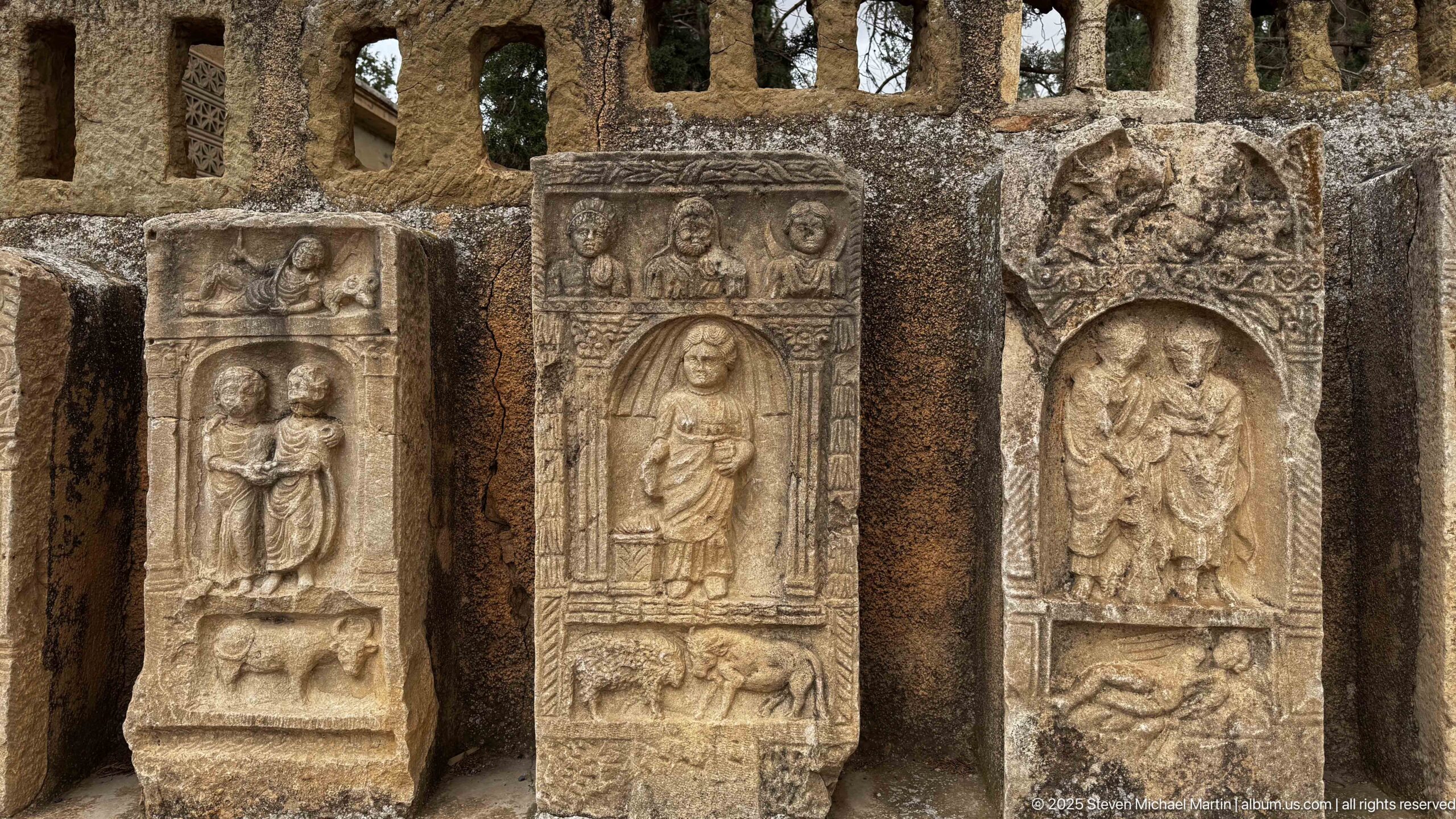
Three upright stone stelae present different combinations of human figures, busts, architectural frames, and animals in relief. The grouping makes the variation in scale and composition especially clear, from paired standing figures to a larger solitary figure framed by a niche and decorative borders.
Caption
Three upright stone stelae present different combinations of human figures, busts, architectural frames, and animals in relief. The grouping makes the variation in scale and composition especially clear, from paired standing figures to a larger solitary figure framed by a niche and decorative borders.
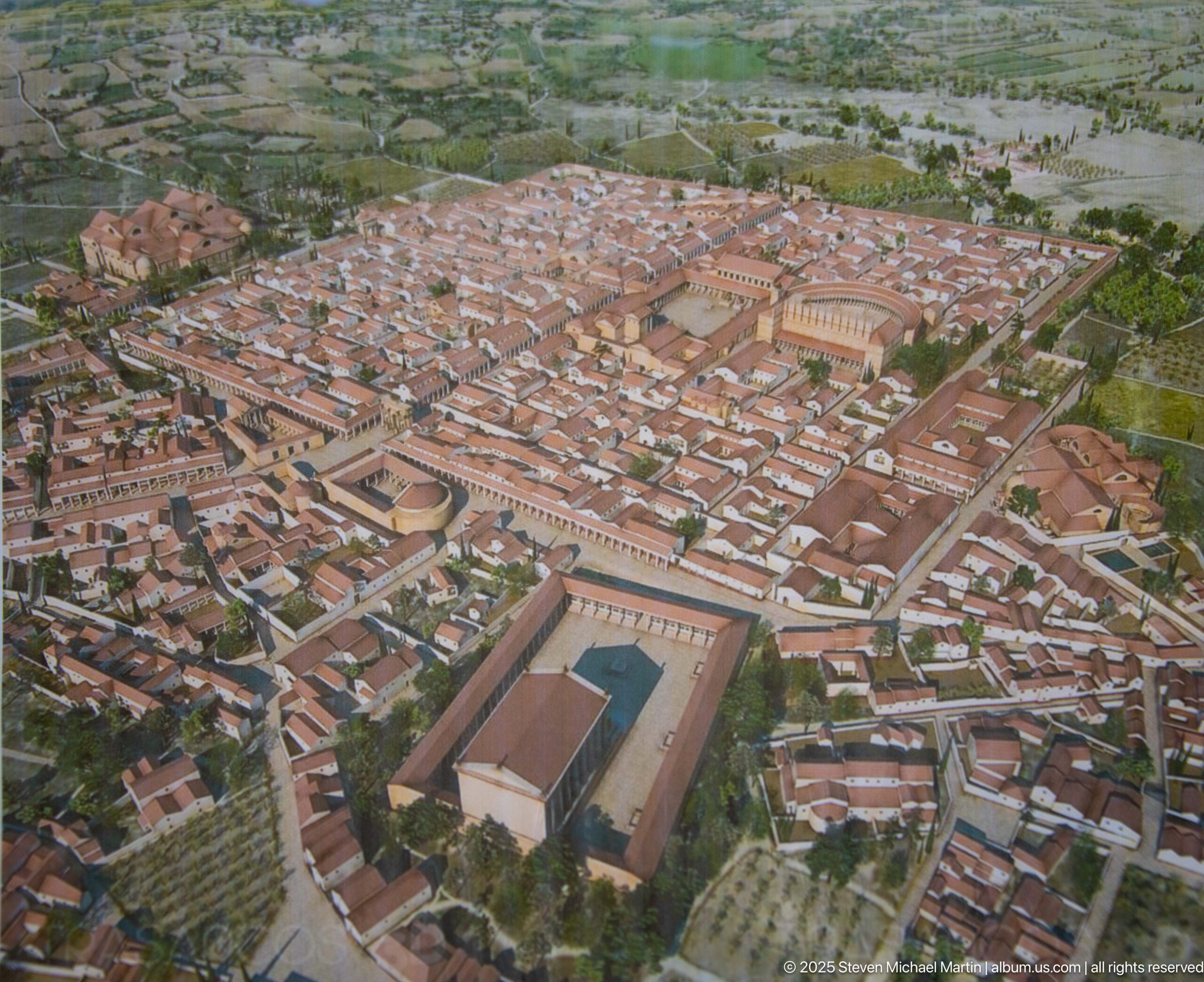
An aerial reconstruction model presents Timgad as a dense walled or bounded Roman city with straight streets, red-tiled roofs, civic complexes, and landscaped surroundings. The oblique viewpoint makes the orthogonal urban plan immediately legible and helps translate the excavated foundations into an impression of the settlement’s original built density.
Caption
An aerial reconstruction model presents Timgad as a dense walled or bounded Roman city with straight streets, red-tiled roofs, civic complexes, and landscaped surroundings. The oblique viewpoint makes the orthogonal urban plan immediately legible and helps translate the excavated foundations into an impression of the settlement’s original built density.
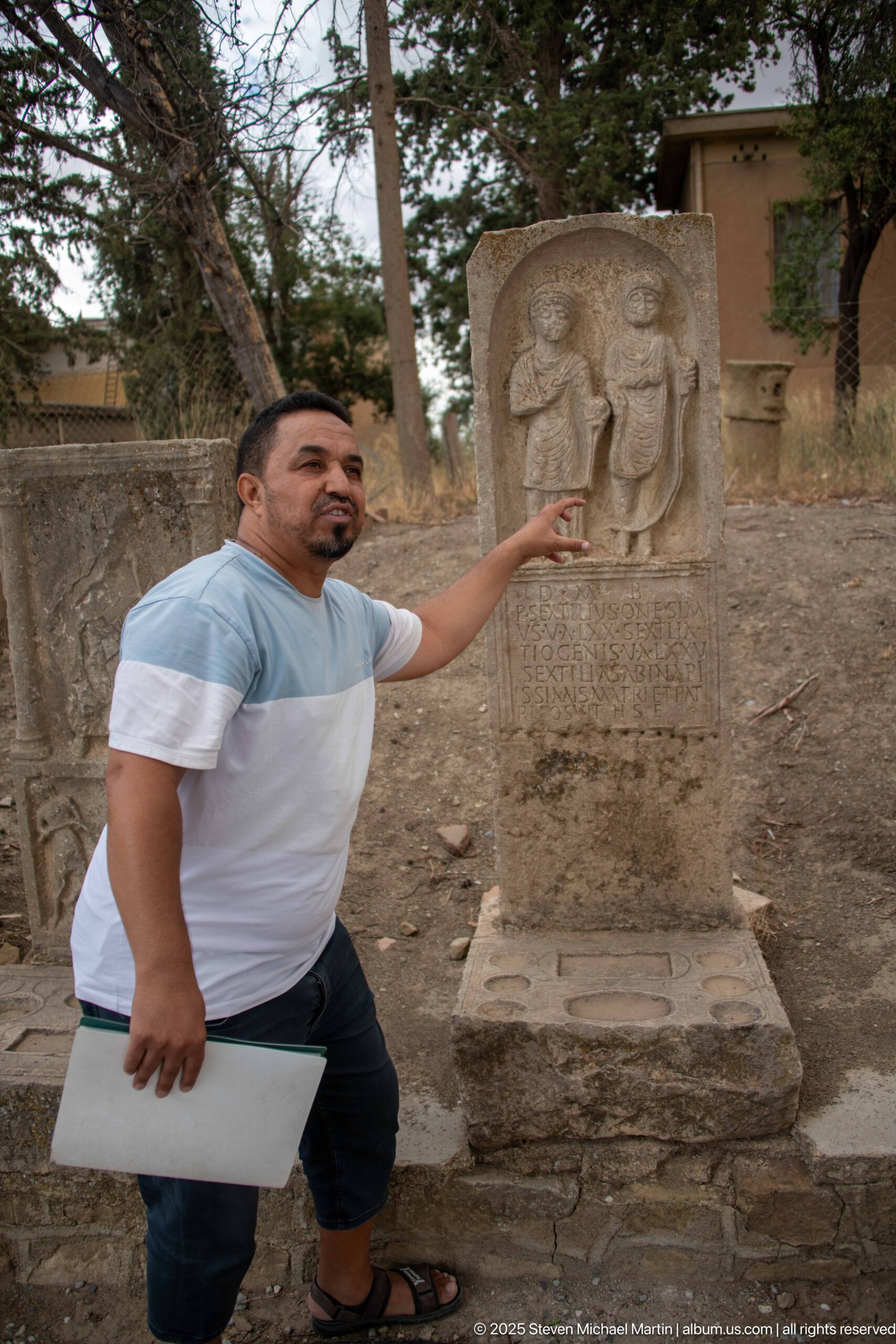
A guide points out features on a carved stone monument during an on-site explanation at Timgad. The slab behind him carries a large relief motif and an inscribed lower panel, while the gesture makes the photograph as much about archaeological interpretation and visitor engagement as the artifact itself.
Caption
A guide points out features on a carved stone monument during an on-site explanation at Timgad. The slab behind him carries a large relief motif and an inscribed lower panel, while the gesture makes the photograph as much about archaeological interpretation and visitor engagement as the artifact itself.
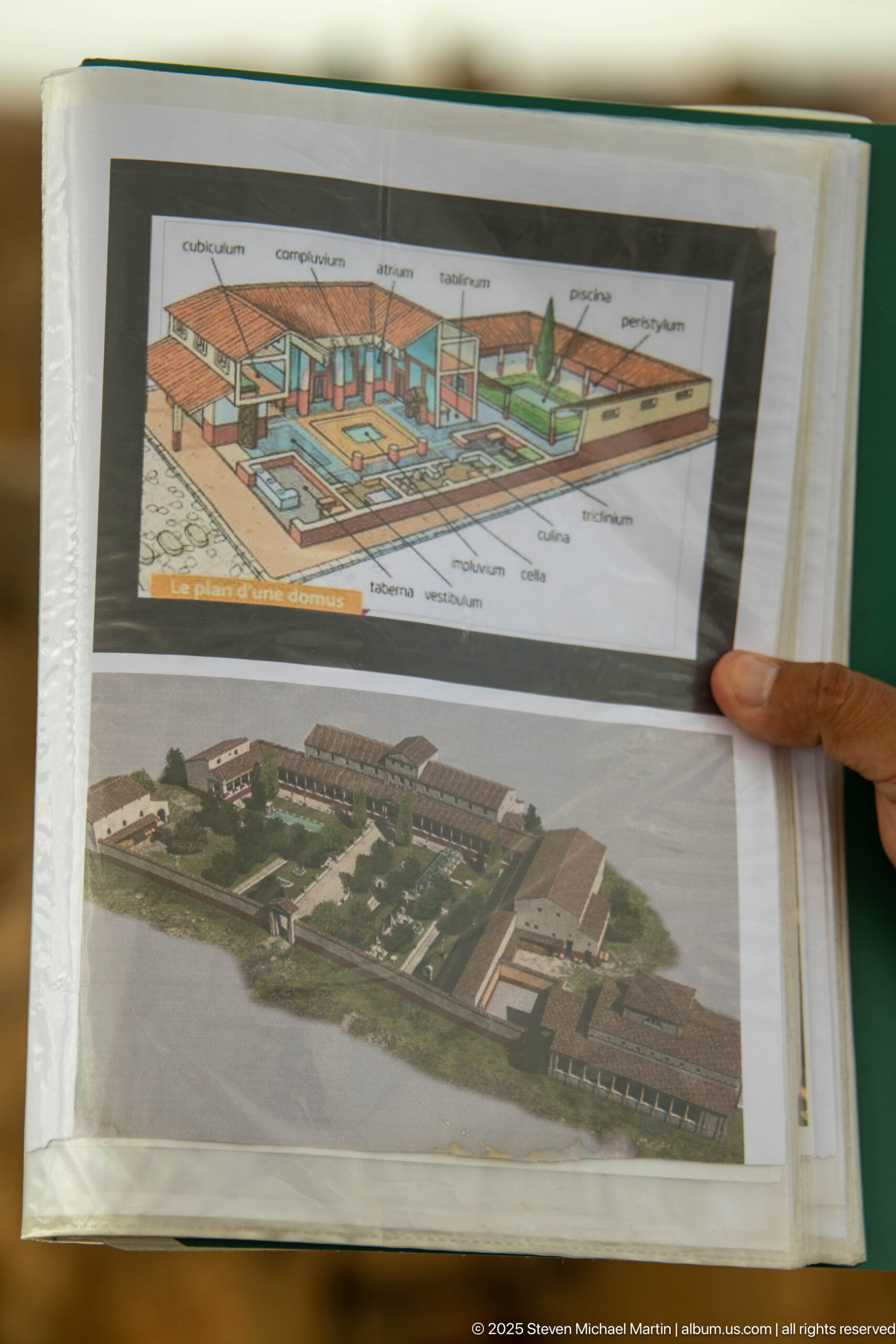
A guidebook page presents two architectural reconstructions of a Roman complex: a cutaway plan with labeled spaces above and a broader three-dimensional exterior view below. The diagrams provide an interpretive bridge between excavated foundations and the original arrangement of rooms, roofs, circulation, and open courts.
Caption
A guidebook page presents two architectural reconstructions of a Roman complex: a cutaway plan with labeled spaces above and a broader three-dimensional exterior view below. The diagrams provide an interpretive bridge between excavated foundations and the original arrangement of rooms, roofs, circulation, and open courts.
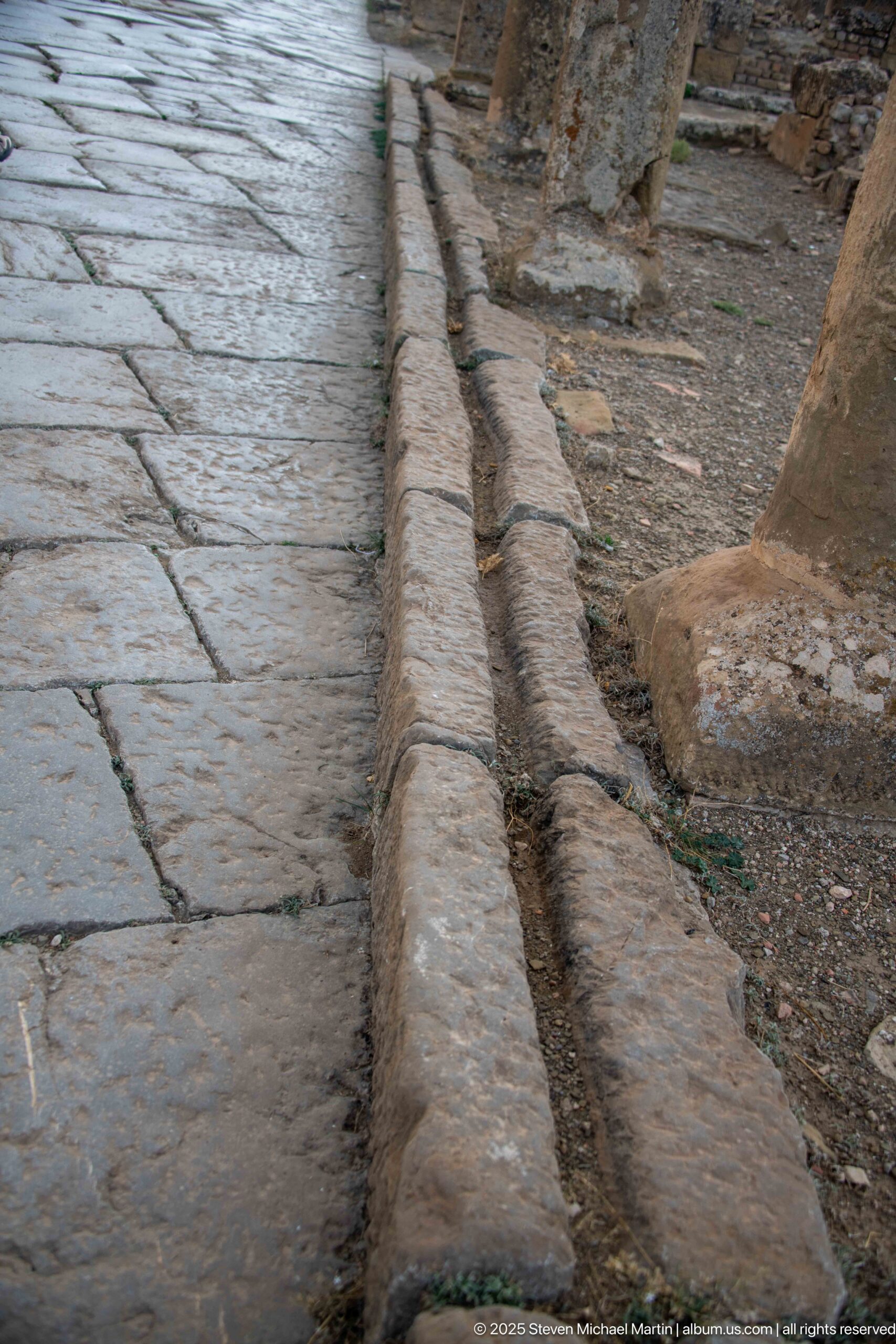
A close view of Timgad’s paving shows the engineered edge of a Roman street, where large fitted slabs meet a raised stone curb and narrow channel. The photograph isolates practical urban infrastructure rather than a monument, preserving evidence of how circulation and drainage were managed along the ancient roadway.
Caption
A close view of Timgad’s paving shows the engineered edge of a Roman street, where large fitted slabs meet a raised stone curb and narrow channel. The photograph isolates practical urban infrastructure rather than a monument, preserving evidence of how circulation and drainage were managed along the ancient roadway.
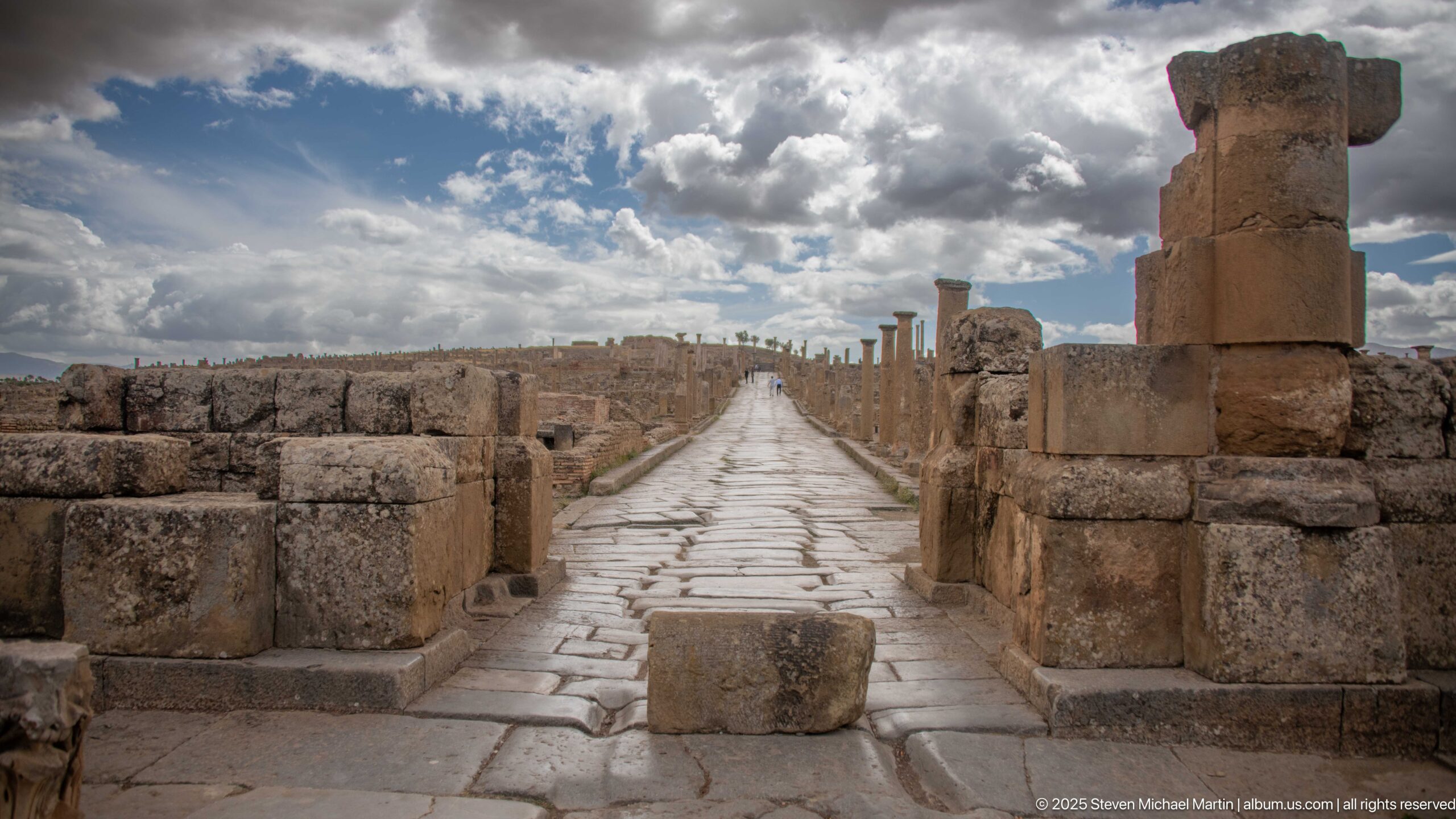
A long stone-paved Roman street runs straight through the ruins of Timgad, its worn slabs flanked by column bases, surviving columns, and low masonry walls. The strong central perspective emphasizes the disciplined geometry of the ancient city plan and the durable engineering of its principal thoroughfares.
Caption
A long stone-paved Roman street runs straight through the ruins of Timgad, its worn slabs flanked by column bases, surviving columns, and low masonry walls. The strong central perspective emphasizes the disciplined geometry of the ancient city plan and the durable engineering of its principal thoroughfares.
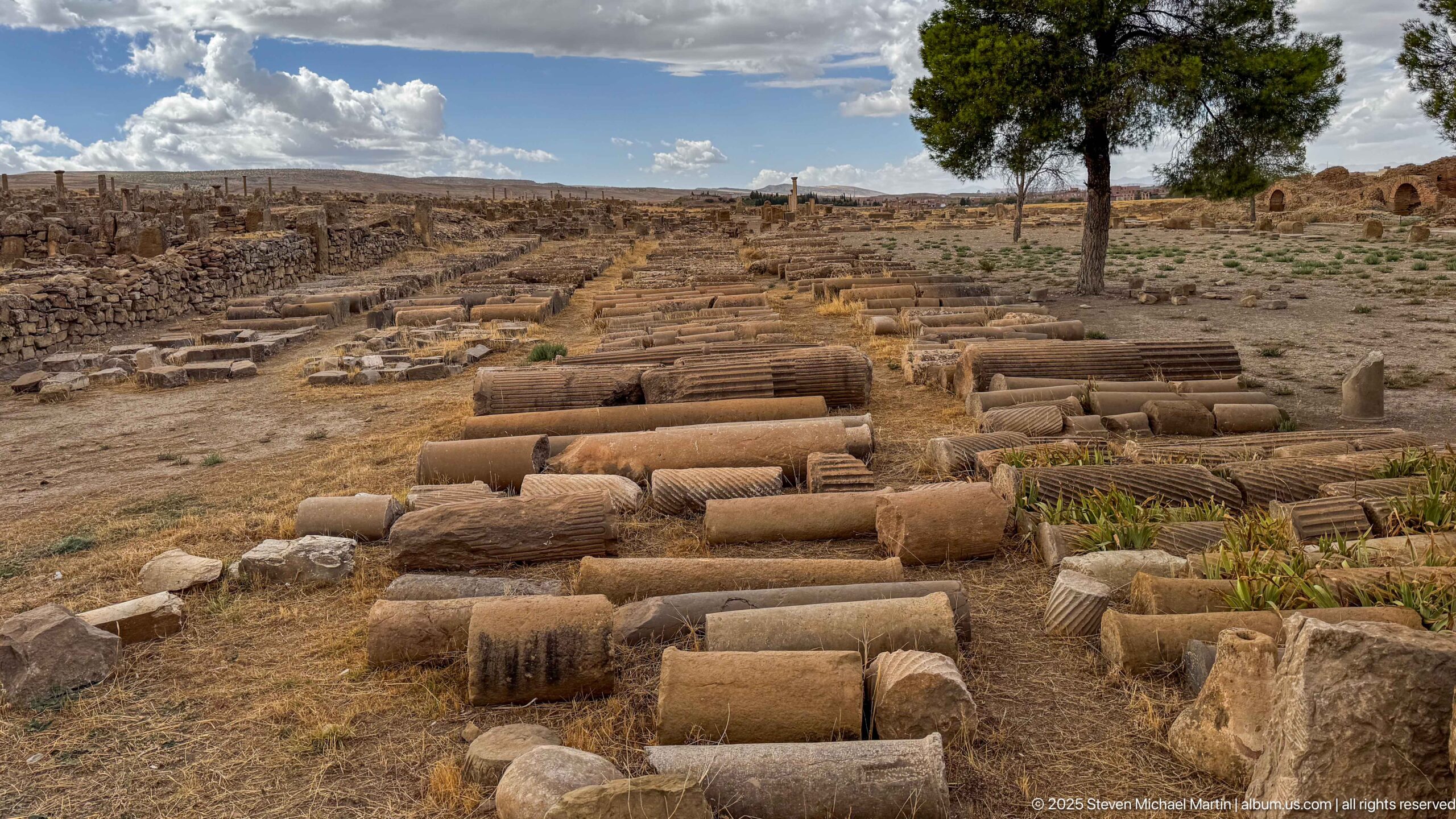
Rows of fallen column drums, capitals, and other architectural fragments lie sorted across an open area of the ruins. Their repeated cylindrical forms and carved surfaces create a dense archaeological inventory, while a solitary tree and distant masonry establish the exposed landscape of the site.
Caption
Rows of fallen column drums, capitals, and other architectural fragments lie sorted across an open area of the ruins. Their repeated cylindrical forms and carved surfaces create a dense archaeological inventory, while a solitary tree and distant masonry establish the exposed landscape of the site.
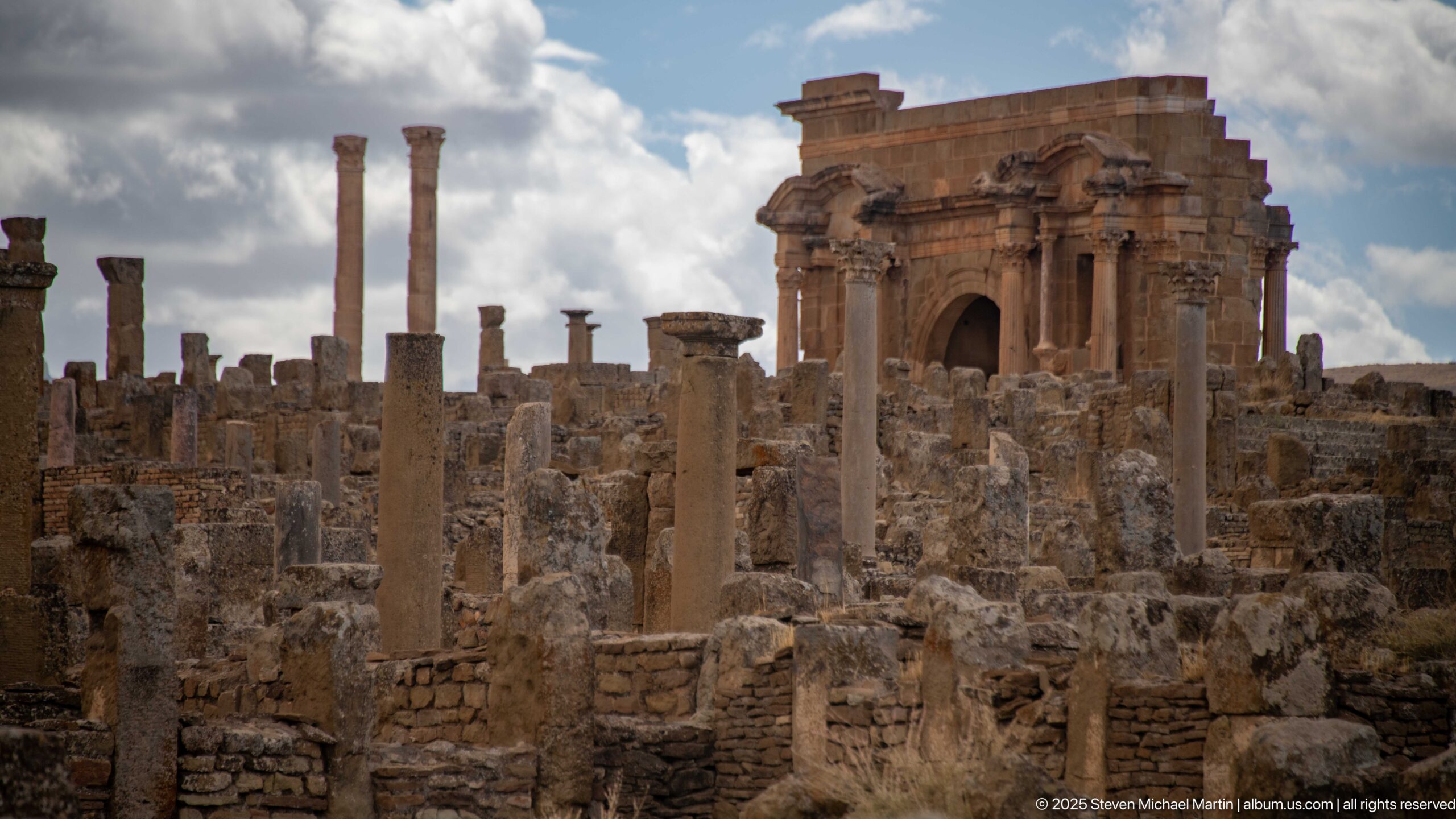
A monumental arched structure rises above the surrounding ruins at Timgad, framed by scattered columns and low masonry. Its elevated mass, engaged columns, and deep central opening make it one of the most visually commanding surviving monuments in the city, anchoring the broader archaeological landscape.
Caption
A monumental arched structure rises above the surrounding ruins at Timgad, framed by scattered columns and low masonry. Its elevated mass, engaged columns, and deep central opening make it one of the most visually commanding surviving monuments in the city, anchoring the broader archaeological landscape.
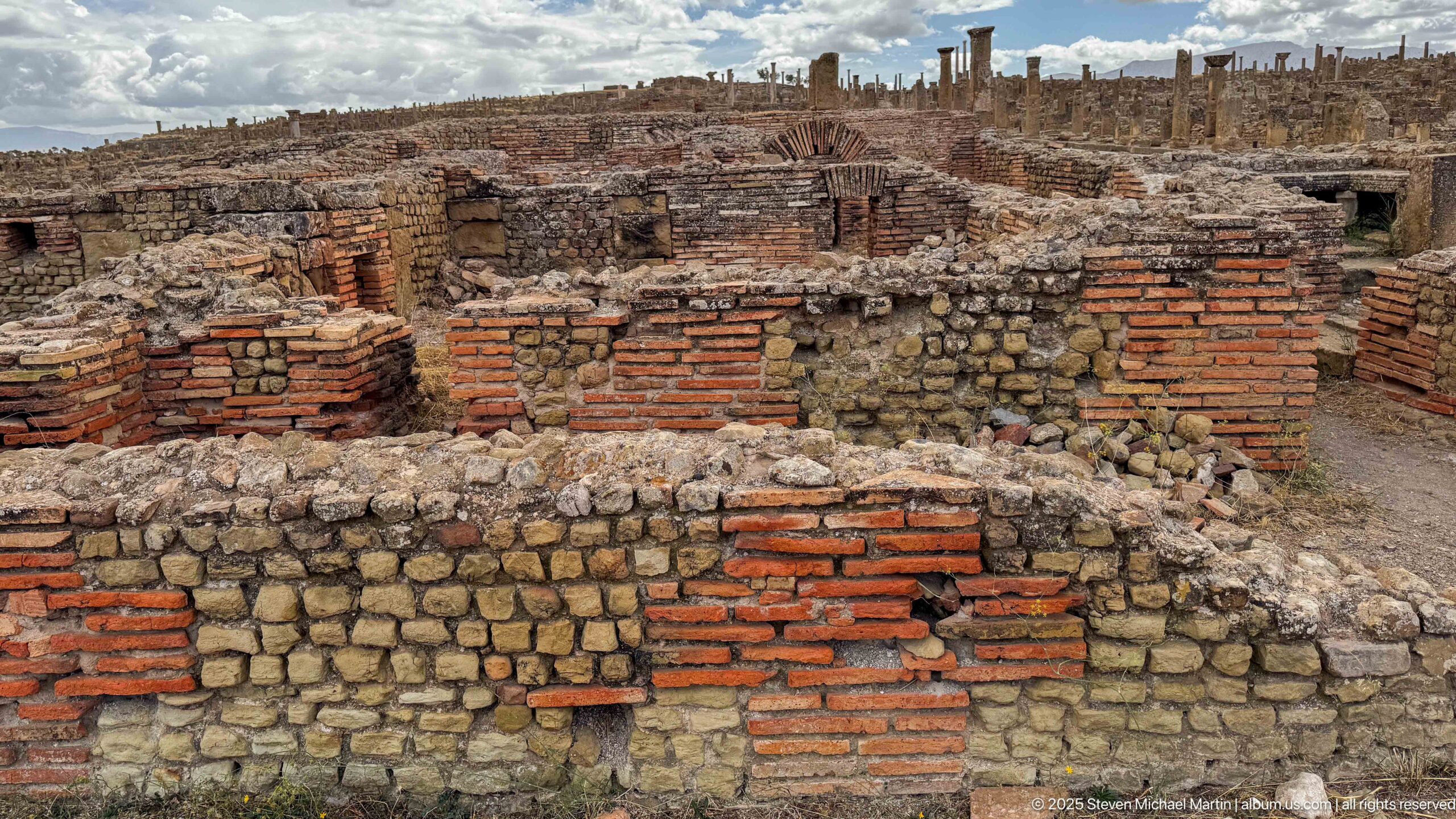
Layered walls of stone rubble and red brick reveal the construction fabric of a substantial Roman complex at Timgad. Alternating bands, patched corners, and exposed wall cores make the building sequence legible, while surviving rooms and passages suggest a service-intensive structure such as baths or another large public facility.
Caption
Layered walls of stone rubble and red brick reveal the construction fabric of a substantial Roman complex at Timgad. Alternating bands, patched corners, and exposed wall cores make the building sequence legible, while surviving rooms and passages suggest a service-intensive structure such as baths or another large public facility.
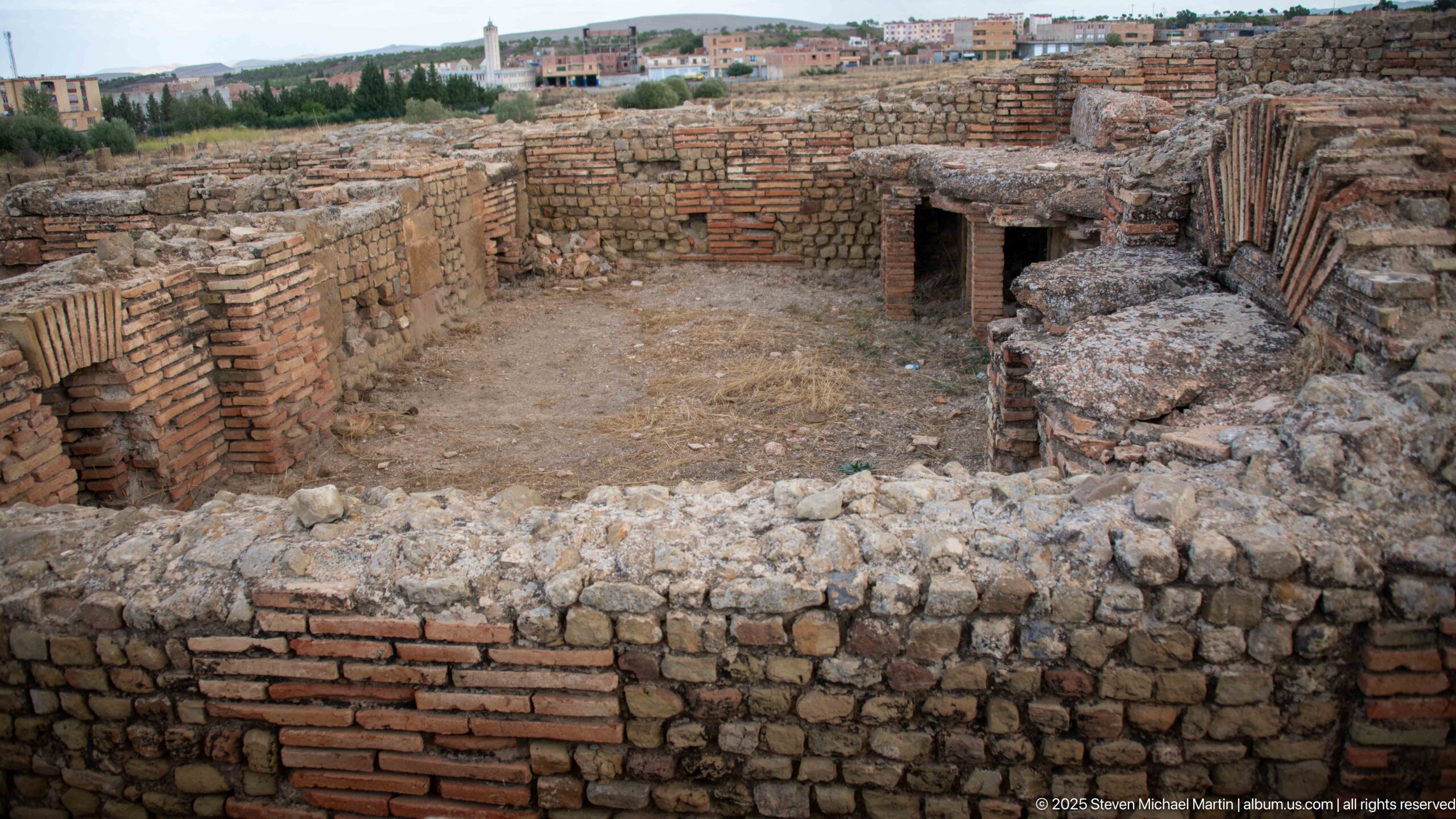
A sunken room within Timgad’s ruins is enclosed by thick masonry walls faced in alternating stone and brick. Arched brickwork and a low opening penetrate the far wall, revealing the complex construction and service spaces hidden beneath or behind the more monumental parts of the ancient city.
Caption
A sunken room within Timgad’s ruins is enclosed by thick masonry walls faced in alternating stone and brick. Arched brickwork and a low opening penetrate the far wall, revealing the complex construction and service spaces hidden beneath or behind the more monumental parts of the ancient city.
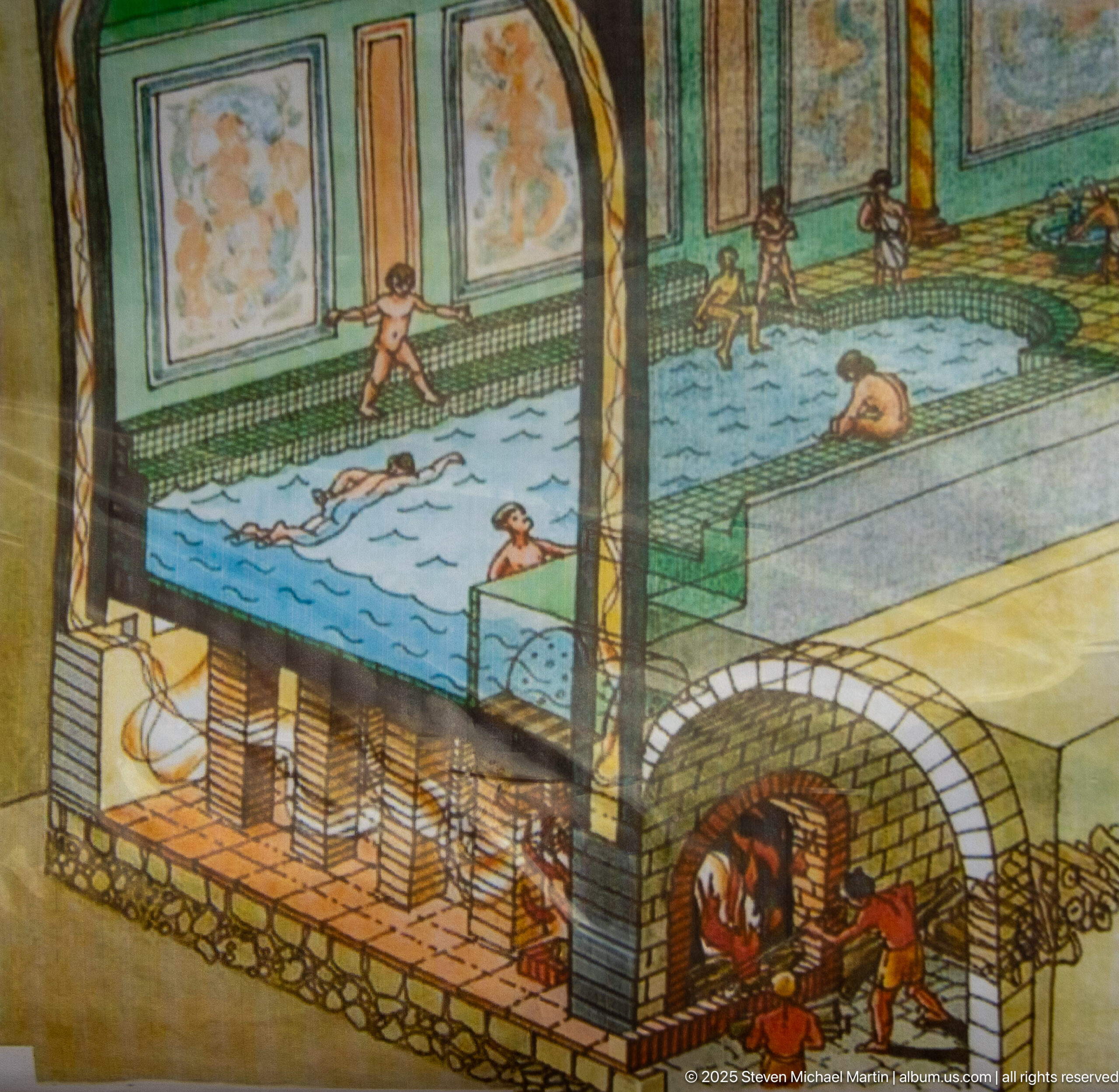
A cutaway reconstruction illustrates the operation of a Roman bath complex, showing pools, vaulted rooms, raised floors, and a furnace supplying heat beneath the bathing spaces. The diagram makes visible the infrastructure that archaeology often preserves only in fragmentary form, especially the relationship between bathing chambers and the underfloor heating system.
Caption
A cutaway reconstruction illustrates the operation of a Roman bath complex, showing pools, vaulted rooms, raised floors, and a furnace supplying heat beneath the bathing spaces. The diagram makes visible the infrastructure that archaeology often preserves only in fragmentary form, especially the relationship between bathing chambers and the underfloor heating system.
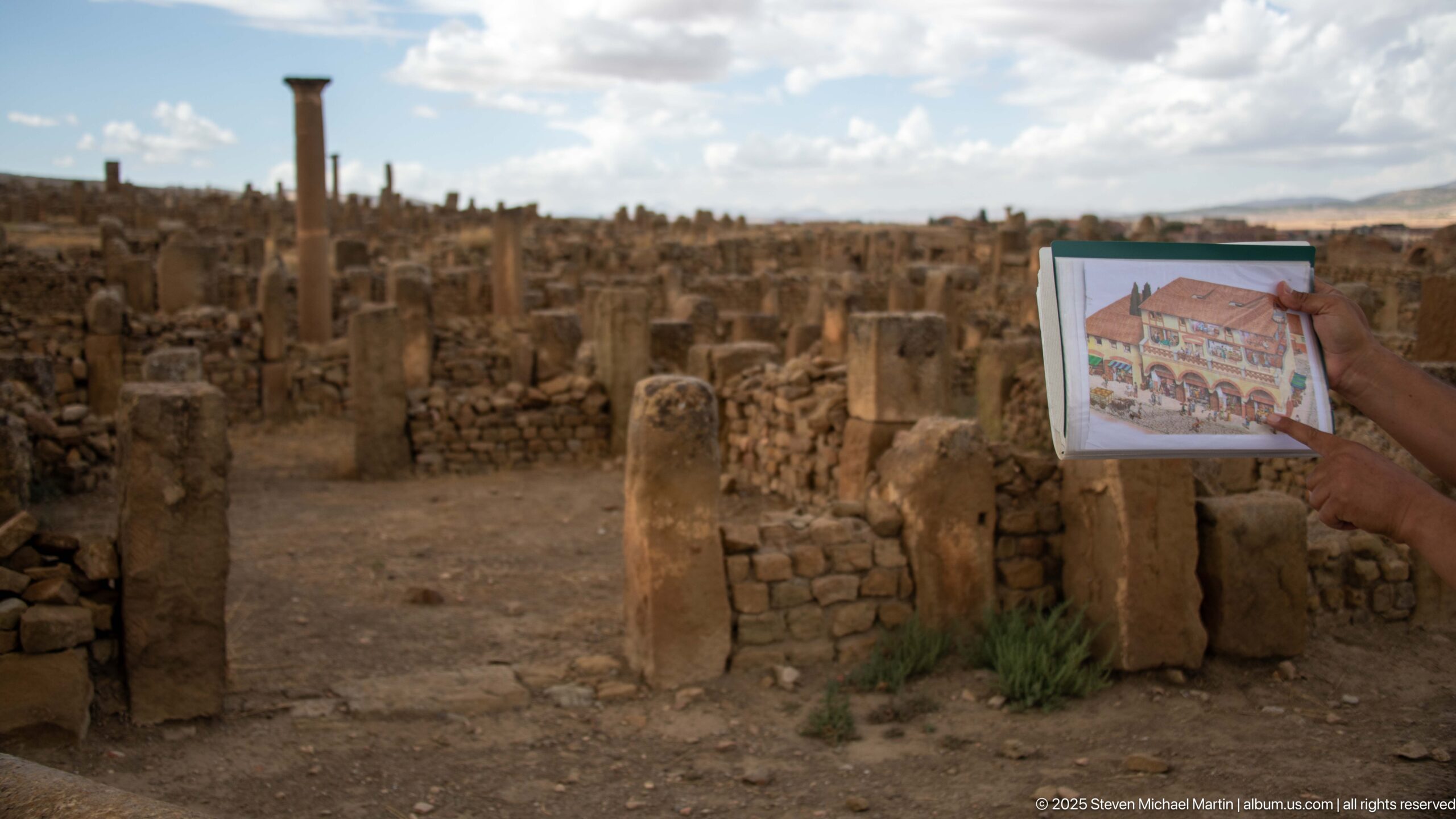
A hand holds a reconstruction image against the surviving ruins of Timgad, visually linking an ancient building’s proposed appearance with its archaeological remains. The juxtaposition turns the photograph into an interpretive comparison, helping the viewer imagine walls, roofs, and façades now lost from the excavated plan.
Caption
A hand holds a reconstruction image against the surviving ruins of Timgad, visually linking an ancient building’s proposed appearance with its archaeological remains. The juxtaposition turns the photograph into an interpretive comparison, helping the viewer imagine walls, roofs, and façades now lost from the excavated plan.
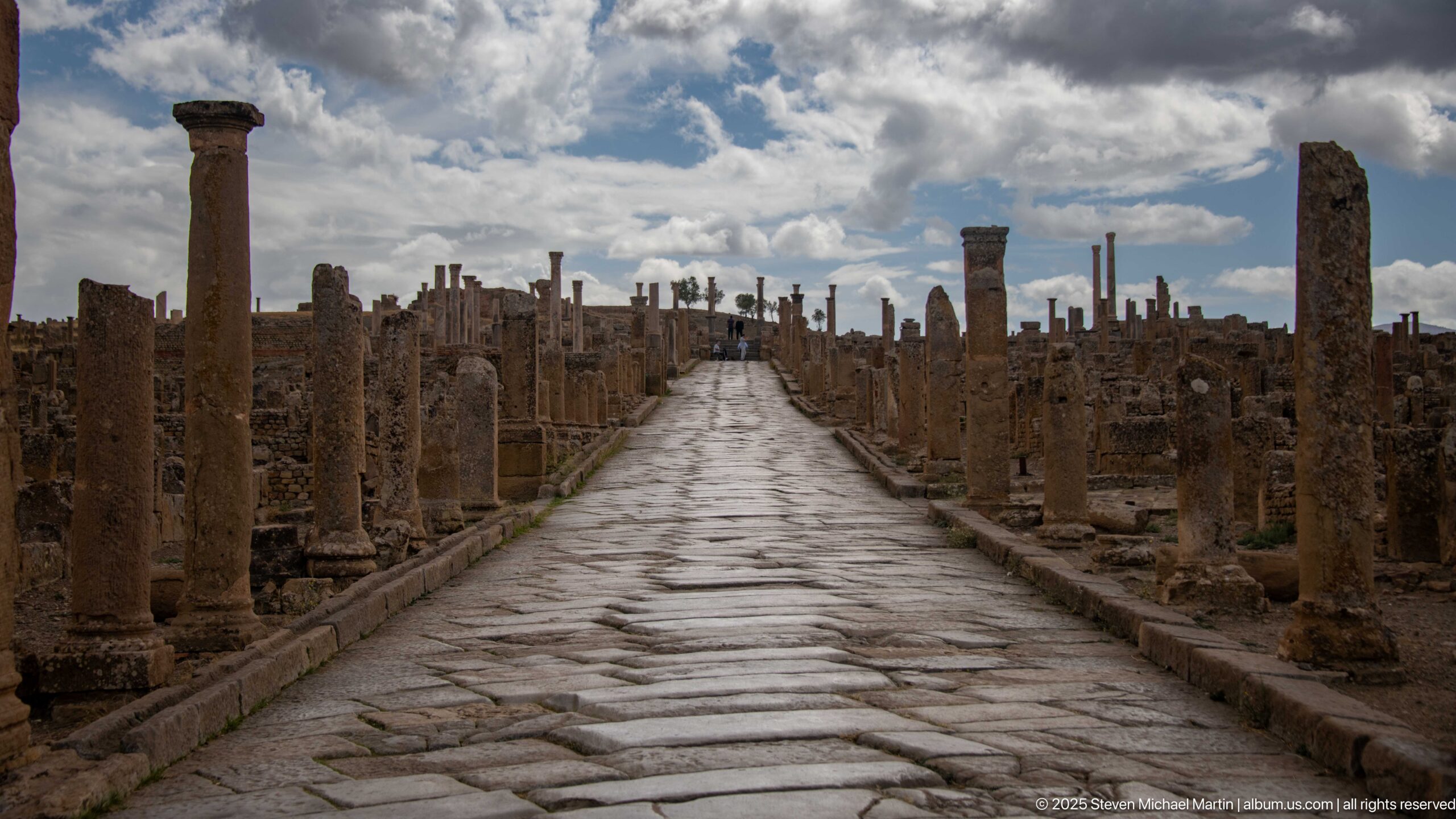
A broad stone-paved street runs through the excavated city between rows of surviving columns and building foundations. Deep wheel-worn paving, raised curbs, and the long axial perspective preserve the disciplined geometry of Roman Timgad, where major streets organized movement through an orthogonal urban plan.
Caption
A broad stone-paved street runs through the excavated city between rows of surviving columns and building foundations. Deep wheel-worn paving, raised curbs, and the long axial perspective preserve the disciplined geometry of Roman Timgad, where major streets organized movement through an orthogonal urban plan.
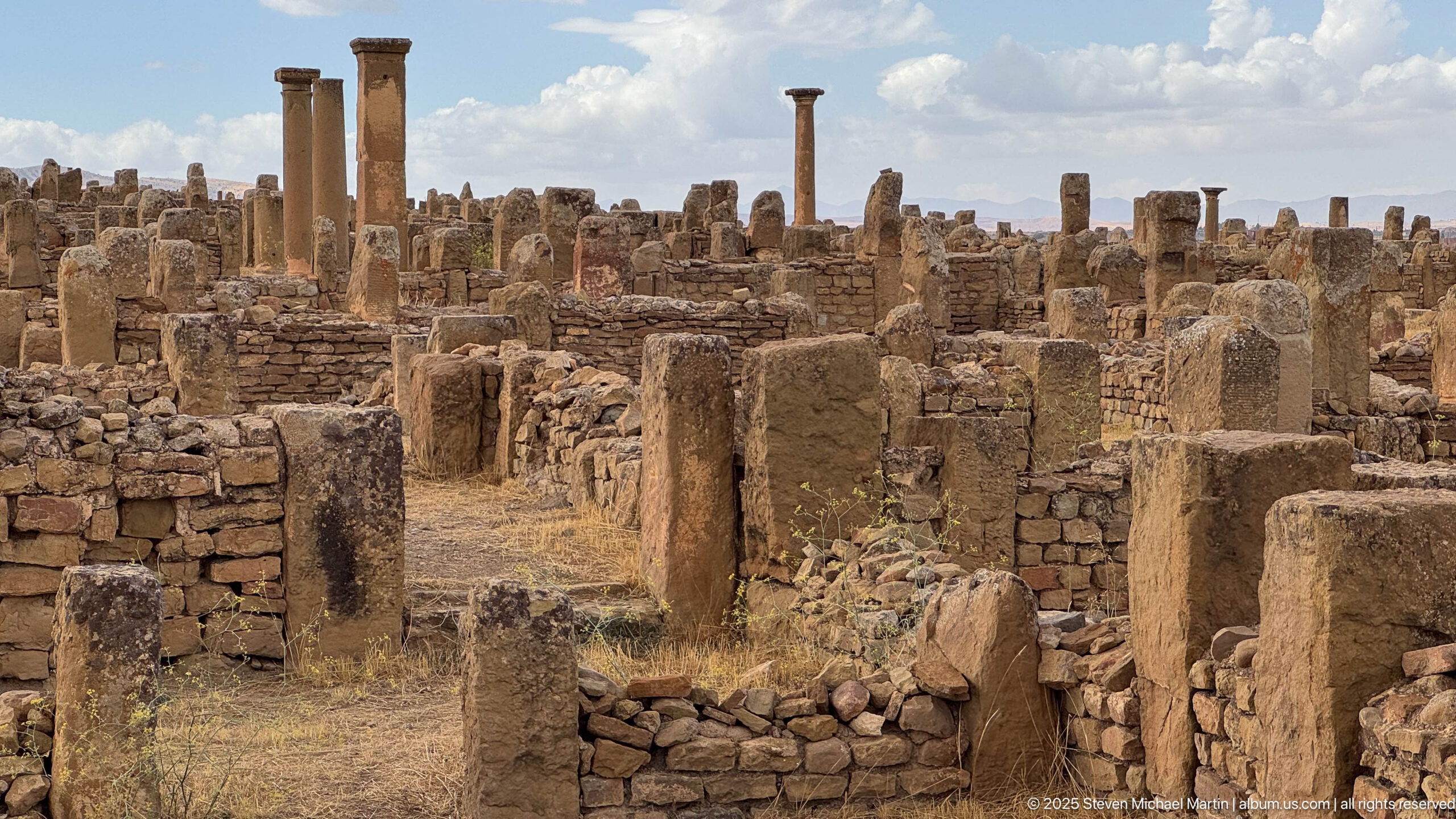
Dense masonry foundations, wall stubs, columns, and reused stone blocks reveal the tightly built fabric beyond Timgad’s principal streets. The varied wall construction and surviving room divisions make this contextual view especially useful for understanding how monumental colonnades were embedded within a much larger Roman urban landscape.
Caption
Dense masonry foundations, wall stubs, columns, and reused stone blocks reveal the tightly built fabric beyond Timgad’s principal streets. The varied wall construction and surviving room divisions make this contextual view especially useful for understanding how monumental colonnades were embedded within a much larger Roman urban landscape.
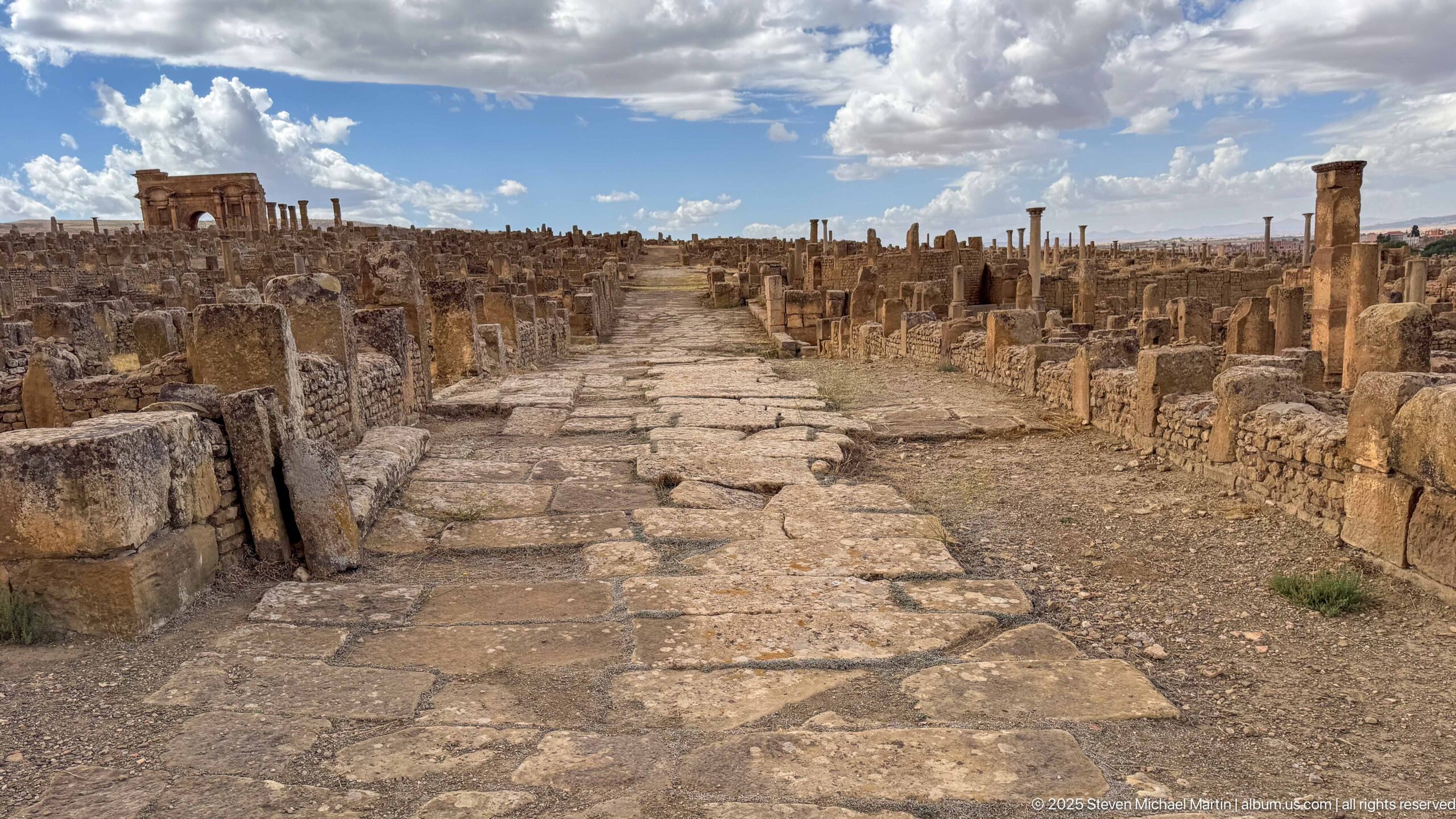
An uneven paved street extends between low building remains, column bases, and scattered architectural blocks toward the heart of the archaeological site. Unlike the more formal colonnaded avenue, this view emphasizes the surviving road surface and the dense pattern of structures that once defined Timgad’s street grid.
Caption
An uneven paved street extends between low building remains, column bases, and scattered architectural blocks toward the heart of the archaeological site. Unlike the more formal colonnaded avenue, this view emphasizes the surviving road surface and the dense pattern of structures that once defined Timgad’s street grid.
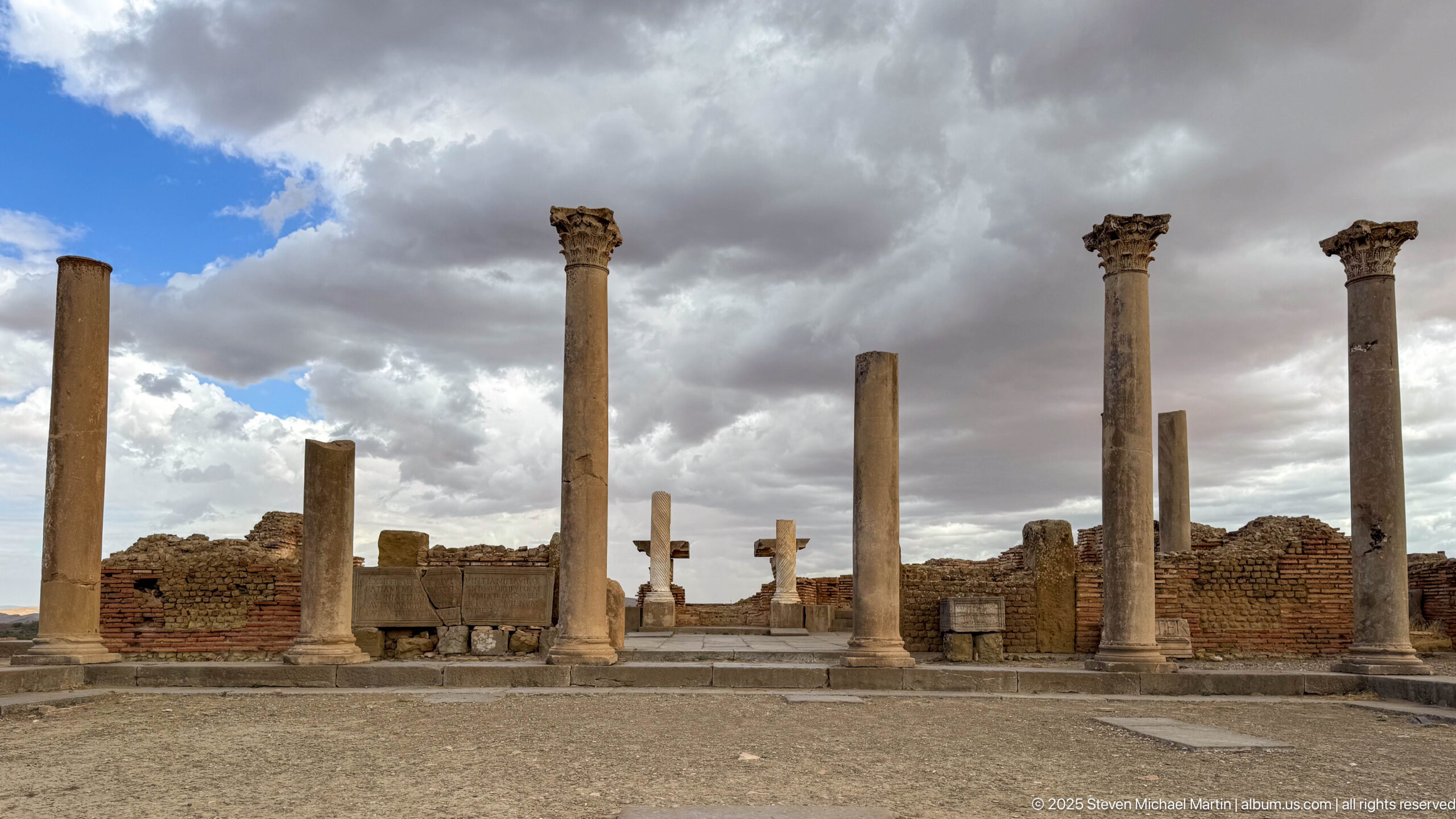
A row of tall columns rises beside broad stone steps and low masonry remains, preserving part of a formal architectural ensemble at Timgad. Capitals survive on several shafts while others are truncated, allowing the photograph to show both the original vertical rhythm of the colonnade and the fragmentary condition of the excavated structure.
Caption
A row of tall columns rises beside broad stone steps and low masonry remains, preserving part of a formal architectural ensemble at Timgad. Capitals survive on several shafts while others are truncated, allowing the photograph to show both the original vertical rhythm of the colonnade and the fragmentary condition of the excavated structure.
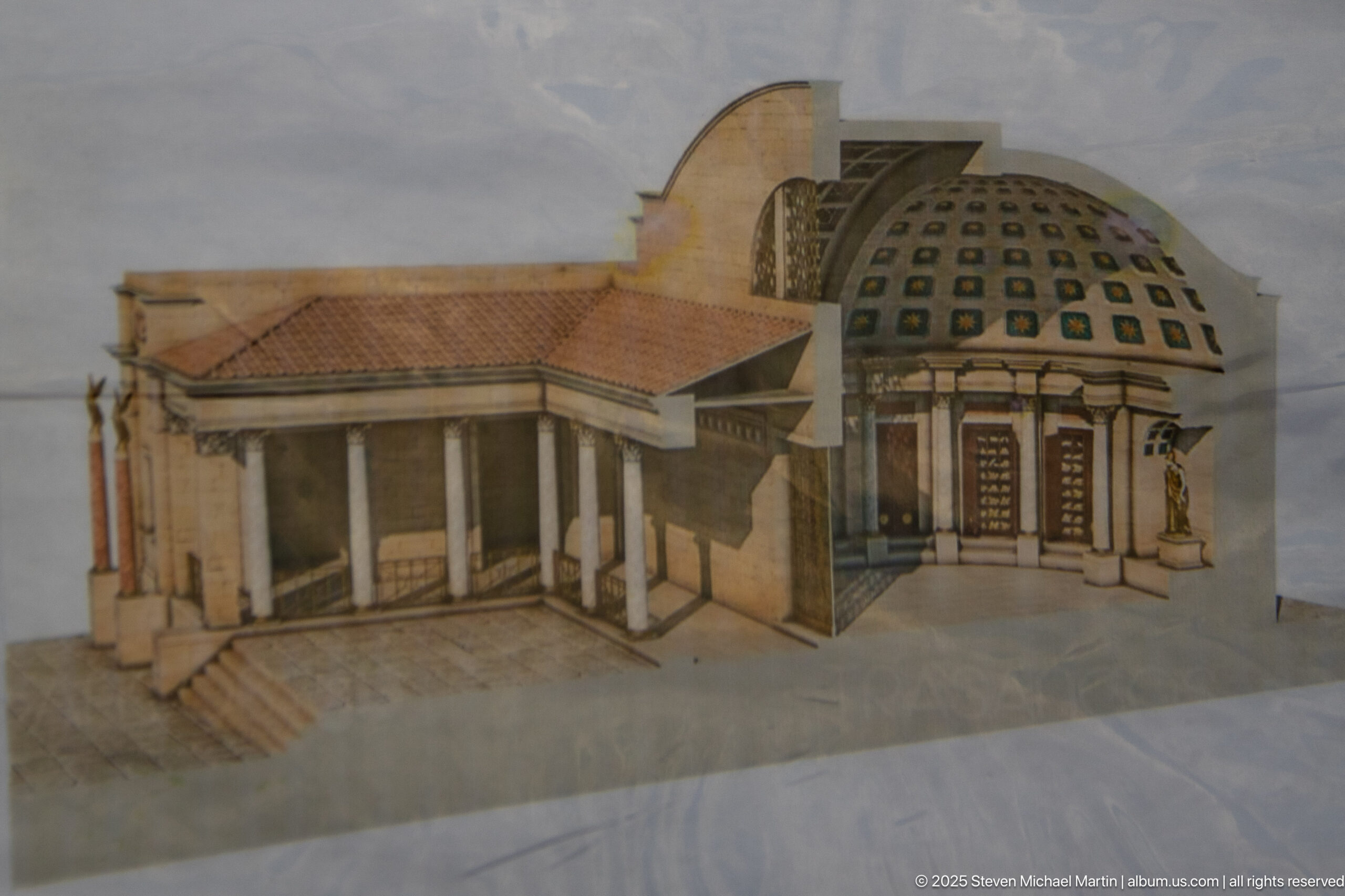
A museum-style reconstruction model presents a Roman public building as a roofed complex with a columned entrance and a large vaulted or domed interior. The model helps translate Timgad’s fragmentary foundations into three-dimensional architectural space, while its cutaway presentation exposes the relationship between exterior porticoes and the principal interior hall.
Caption
A museum-style reconstruction model presents a Roman public building as a roofed complex with a columned entrance and a large vaulted or domed interior. The model helps translate Timgad’s fragmentary foundations into three-dimensional architectural space, while its cutaway presentation exposes the relationship between exterior porticoes and the principal interior hall.
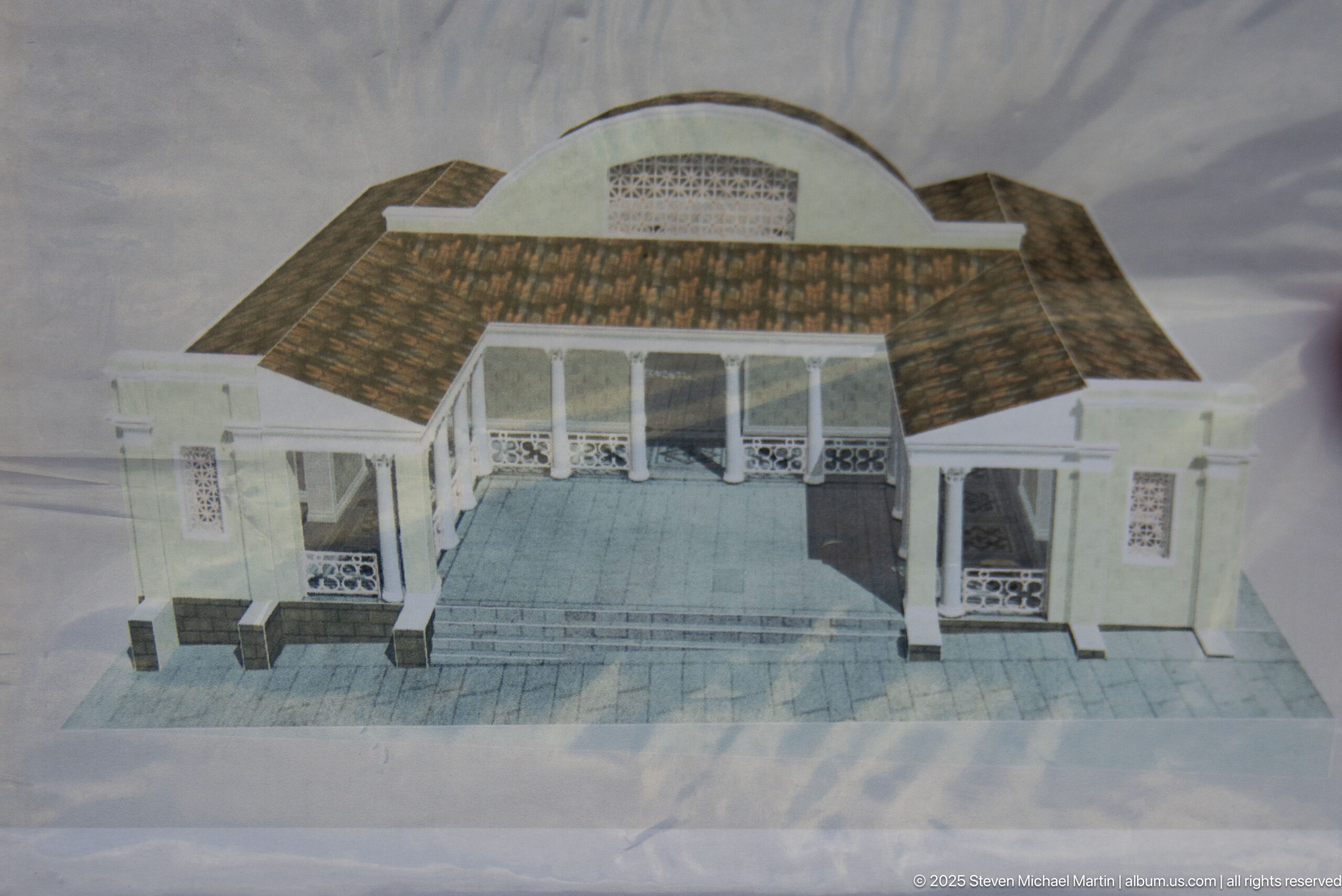
Viewed from the opposite side, this reconstruction model emphasizes a broad interior court or hall approached through a columned façade. Roof sections, decorated wall panels, and the open presentation clarify the organization of spaces that survive archaeologically only as foundations and architectural fragments at Timgad.
Caption
Viewed from the opposite side, this reconstruction model emphasizes a broad interior court or hall approached through a columned façade. Roof sections, decorated wall panels, and the open presentation clarify the organization of spaces that survive archaeologically only as foundations and architectural fragments at Timgad.
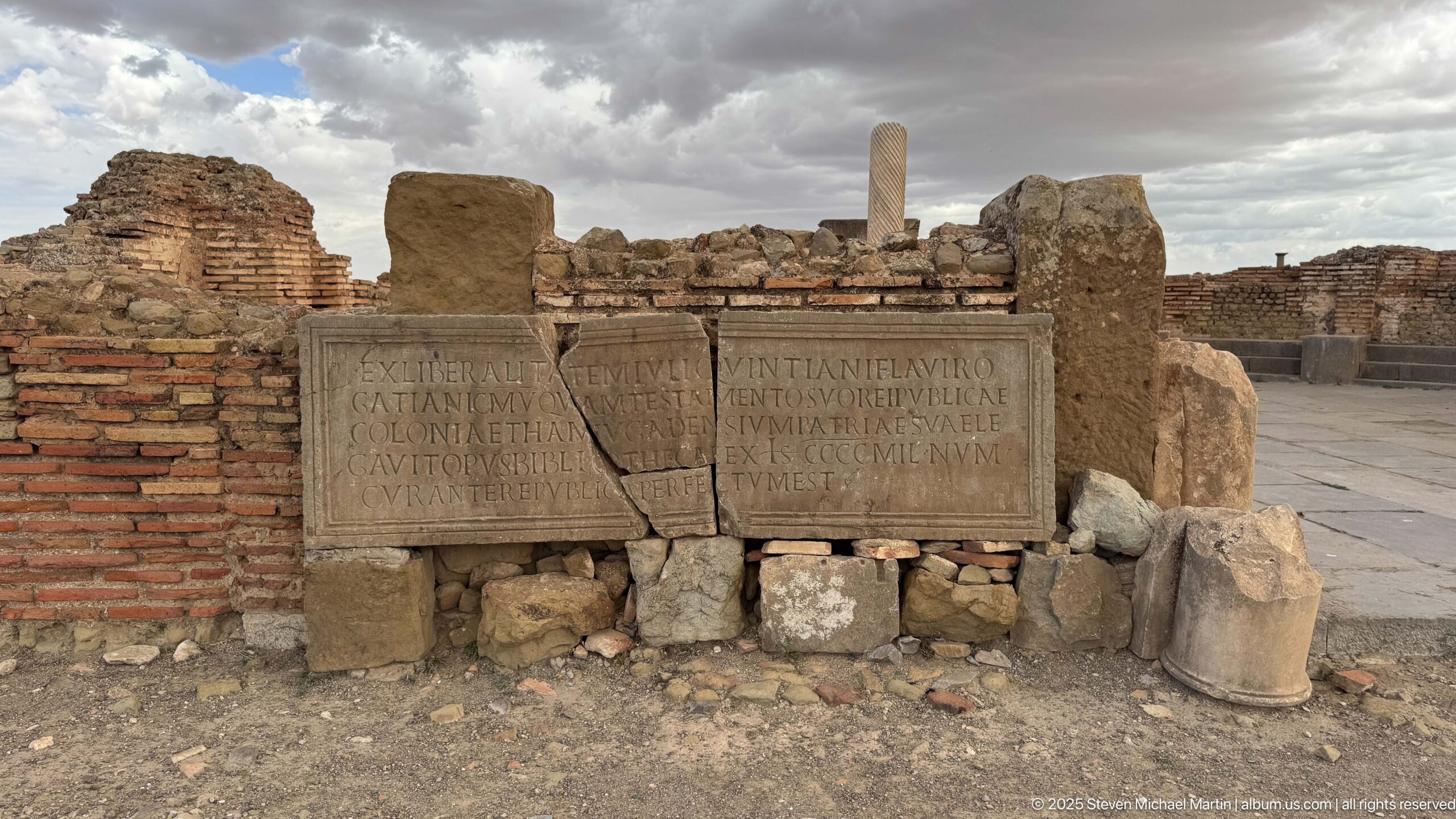
Several carved stone fragments bearing Latin inscriptions have been arranged against brick-and-stone masonry within the site. Their surviving letterforms preserve epigraphic evidence from Roman Timgad, while the surrounding architectural fragments show the modern archaeological display context in which displaced inscriptions are presented near the excavated structures.
Caption
Several carved stone fragments bearing Latin inscriptions have been arranged against brick-and-stone masonry within the site. Their surviving letterforms preserve epigraphic evidence from Roman Timgad, while the surrounding architectural fragments show the modern archaeological display context in which displaced inscriptions are presented near the excavated structures.
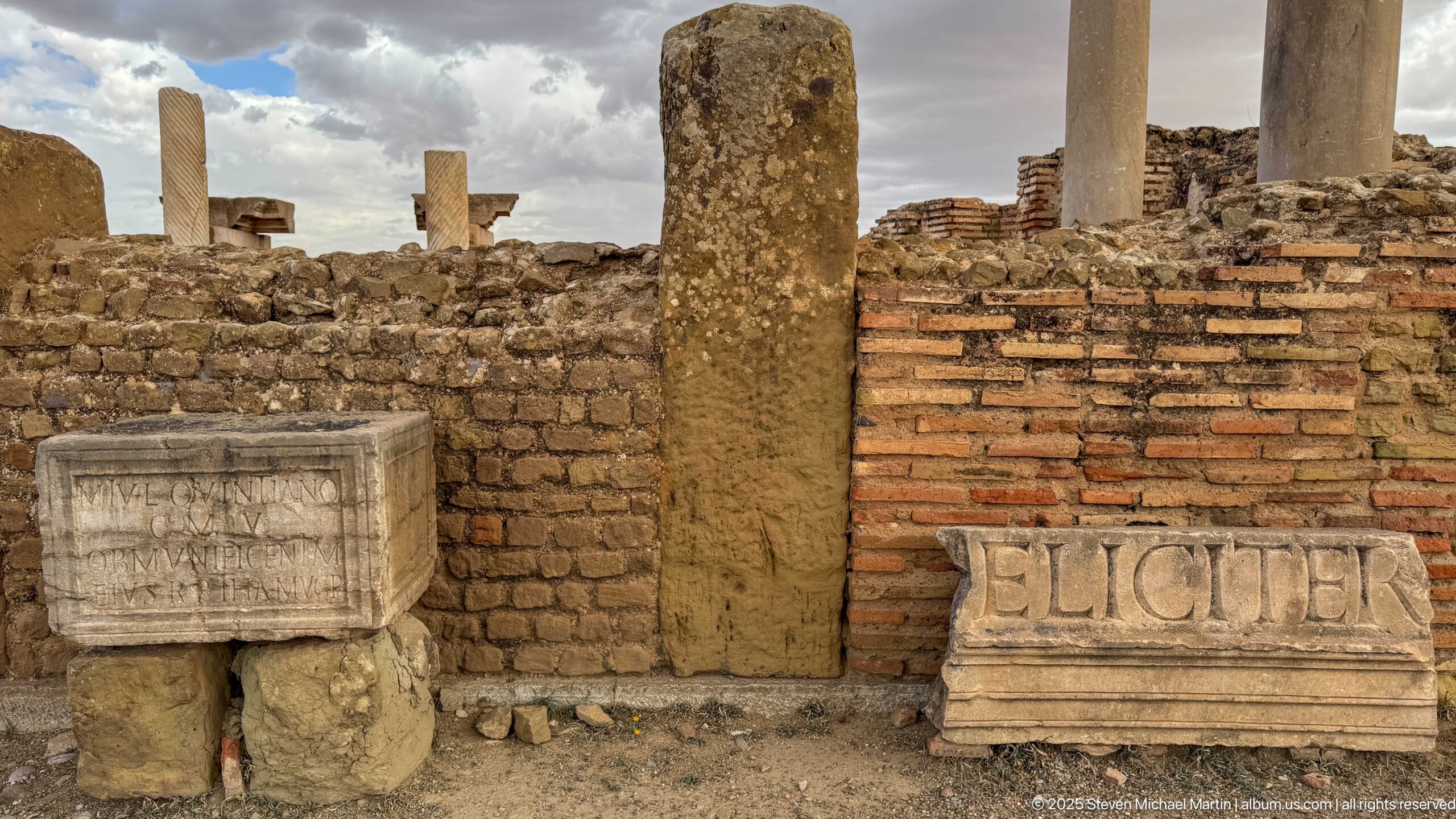
Carved architectural fragments stand against a layered brick wall, including a rectangular block with shallow relief decoration and another bearing large Latin letters. Their juxtaposition records the varied stonework recovered from Timgad and highlights the reuse or collection of displaced elements within the excavated urban fabric.
Caption
Carved architectural fragments stand against a layered brick wall, including a rectangular block with shallow relief decoration and another bearing large Latin letters. Their juxtaposition records the varied stonework recovered from Timgad and highlights the reuse or collection of displaced elements within the excavated urban fabric.
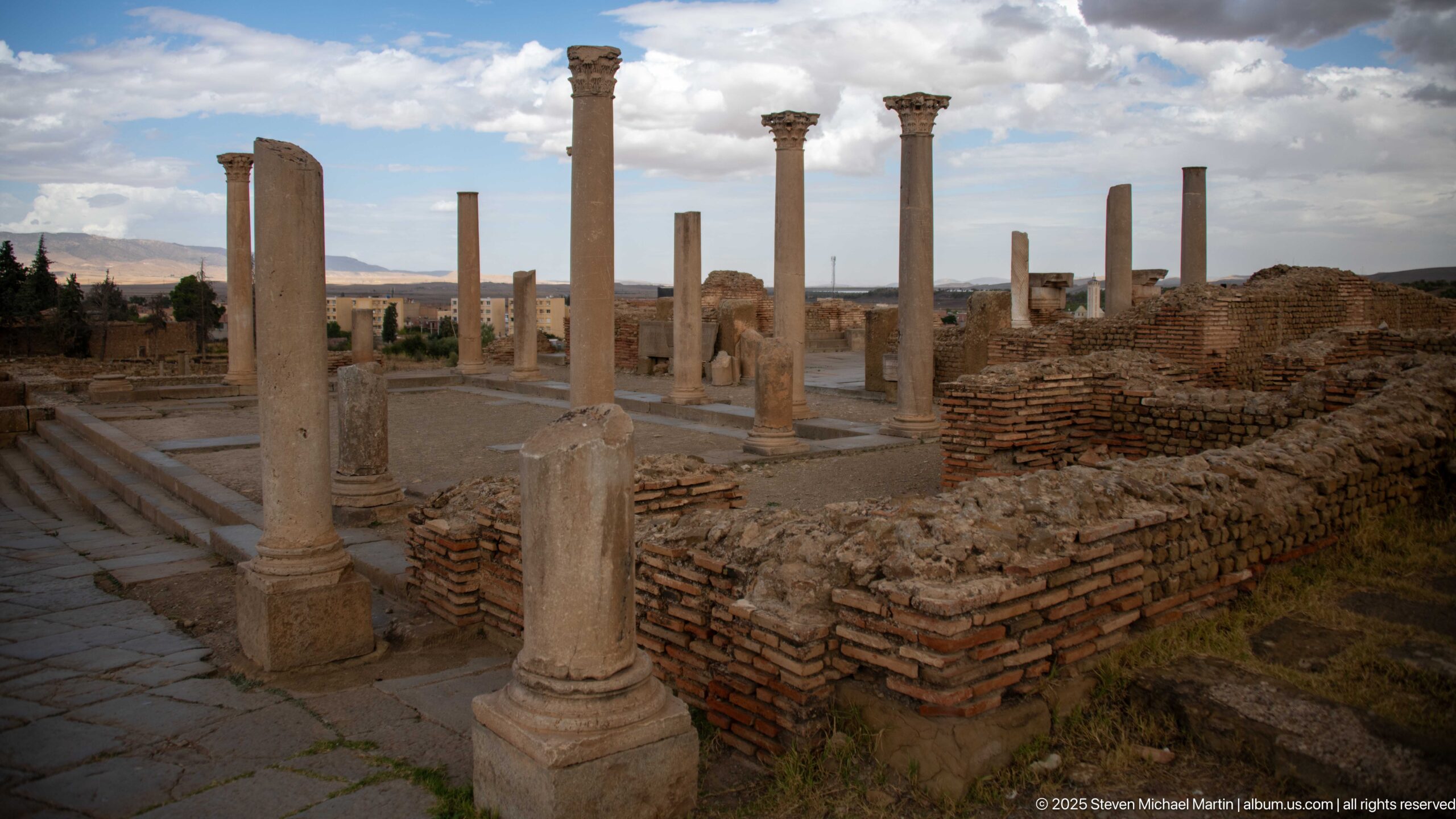
Tall columns and shorter surviving shafts rise from a paved and stepped architectural complex bordered by brick masonry. The elevated viewpoint reveals the spacing of the colonnade and the rectangular organization of the surrounding rooms, illustrating the formal planning of one of Timgad’s substantial public structures.
Caption
Tall columns and shorter surviving shafts rise from a paved and stepped architectural complex bordered by brick masonry. The elevated viewpoint reveals the spacing of the colonnade and the rectangular organization of the surrounding rooms, illustrating the formal planning of one of Timgad’s substantial public structures.
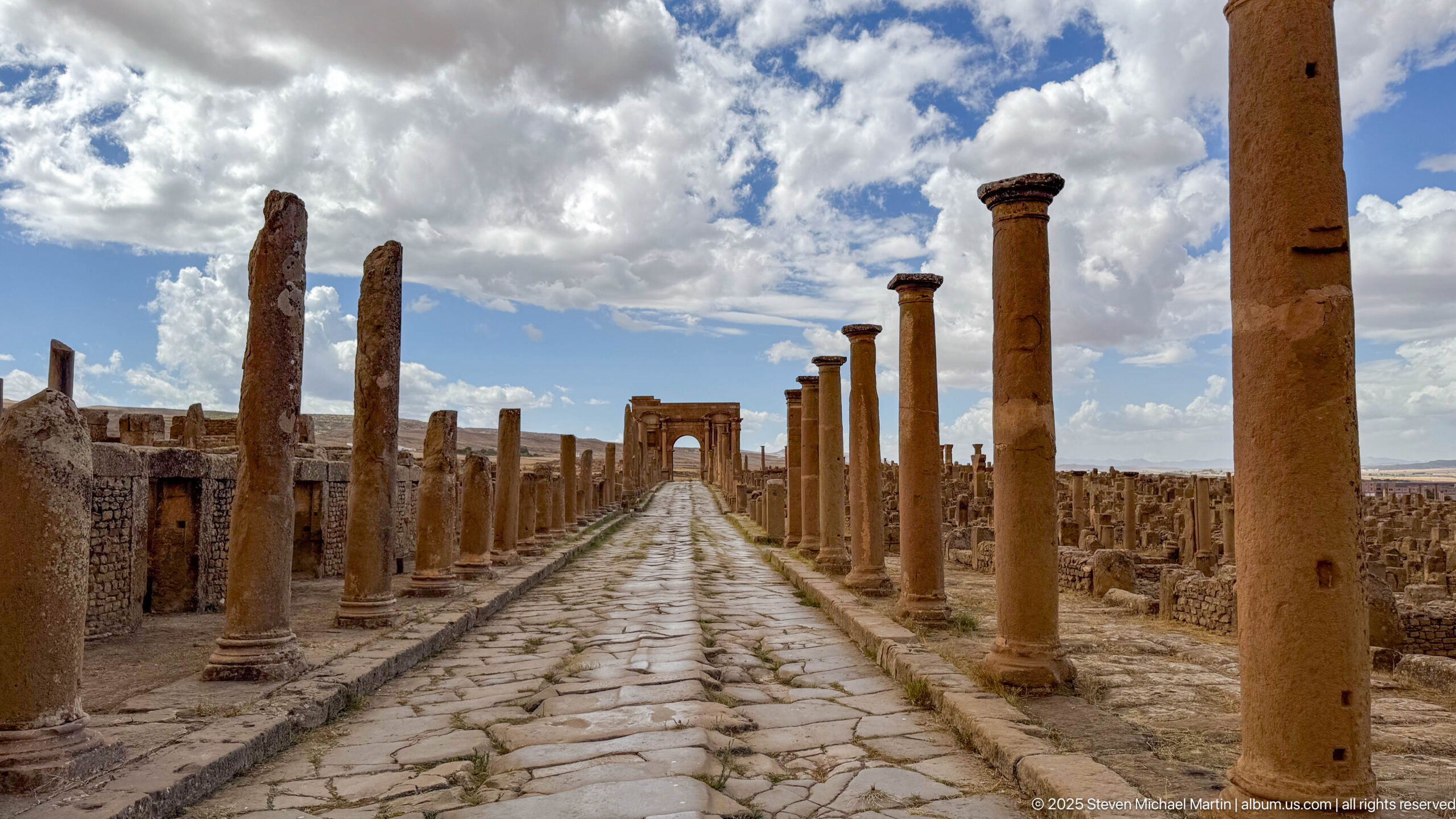
Rows of columns frame a remarkably intact paved avenue leading directly toward the Arch of Trajan. The strong axial composition makes the relationship between street, colonnades, and monumental gateway especially legible, preserving one of Timgad’s clearest expressions of Roman urban planning.
Caption
Rows of columns frame a remarkably intact paved avenue leading directly toward the Arch of Trajan. The strong axial composition makes the relationship between street, colonnades, and monumental gateway especially legible, preserving one of Timgad’s clearest expressions of Roman urban planning.
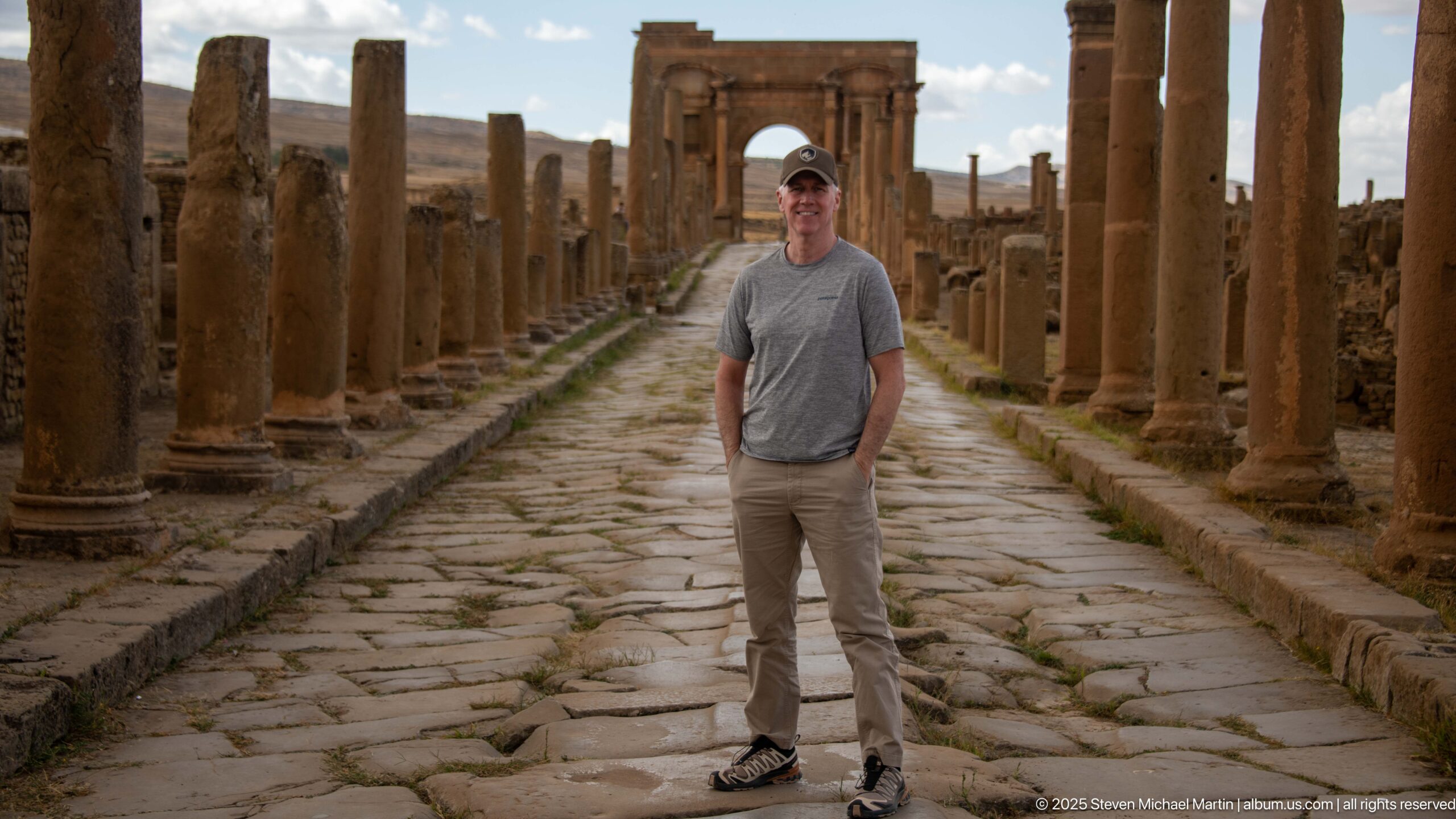
A visitor stands on Timgad’s stone-paved colonnaded street with the Arch of Trajan centered behind him. The human scale underscores the breadth of the ancient roadway and the height of the surviving columns while preserving the strong axial relationship between street and monumental gateway.
Caption
A visitor stands on Timgad’s stone-paved colonnaded street with the Arch of Trajan centered behind him. The human scale underscores the breadth of the ancient roadway and the height of the surviving columns while preserving the strong axial relationship between street and monumental gateway.
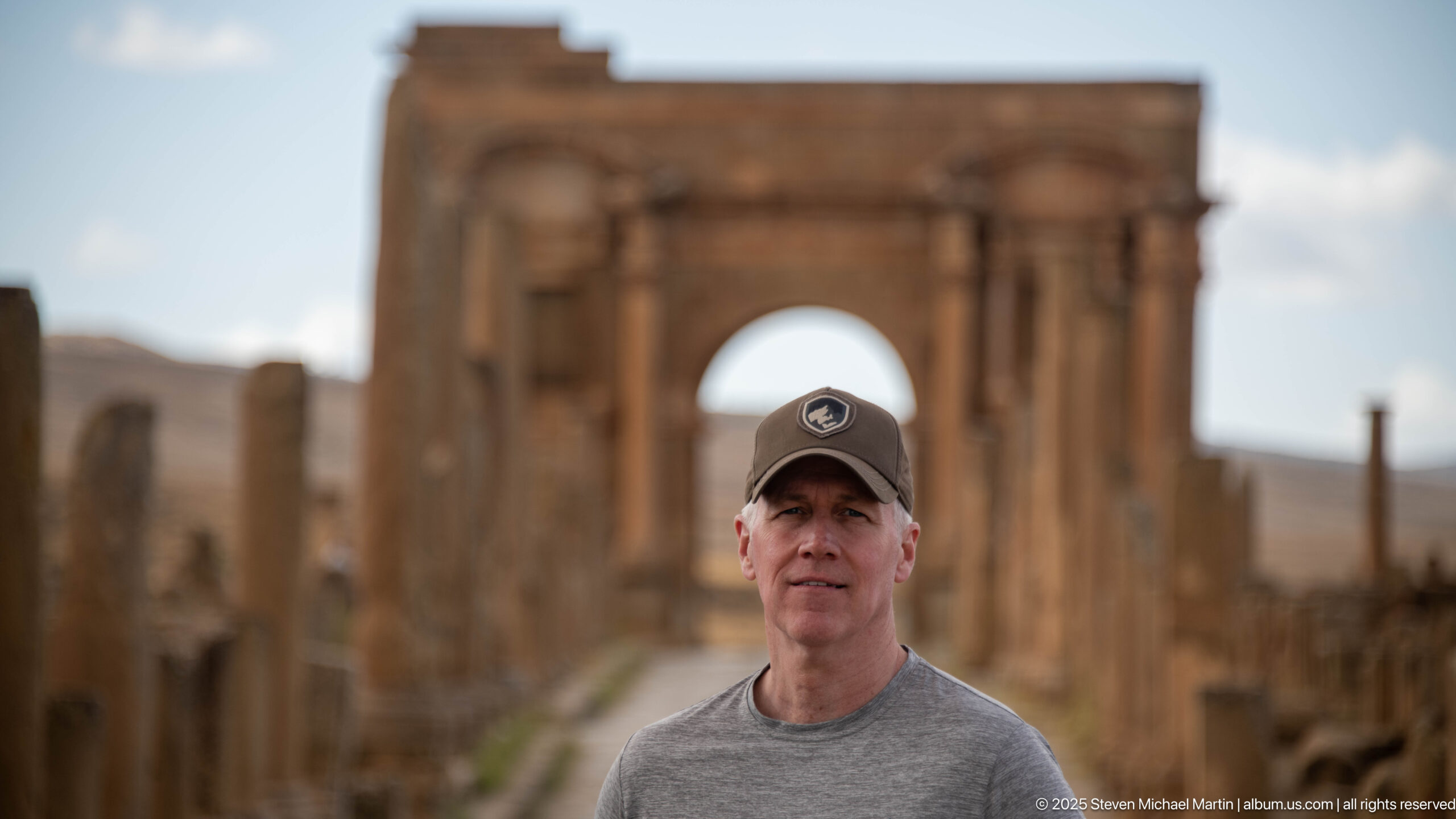
A close portrait places a visitor in sharp focus while the Arch of Trajan and Timgad’s colonnaded street dissolve softly into the background. The shallow depth of field shifts attention from archaeological documentation to human presence while retaining the monument as an unmistakable visual setting.
Caption
A close portrait places a visitor in sharp focus while the Arch of Trajan and Timgad’s colonnaded street dissolve softly into the background. The shallow depth of field shifts attention from archaeological documentation to human presence while retaining the monument as an unmistakable visual setting.
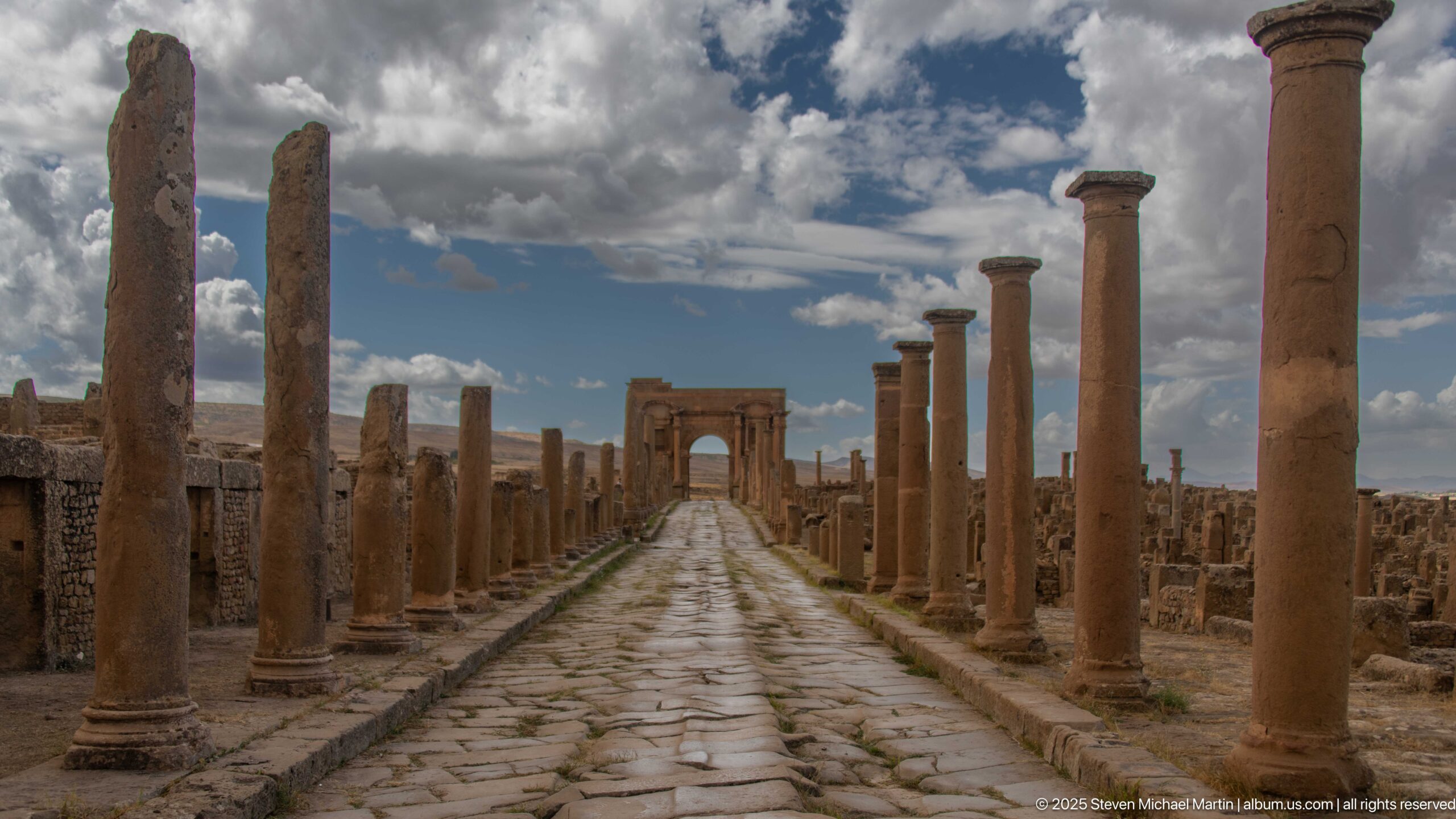
Timgad’s paved avenue stretches between surviving columns toward the Arch of Trajan beneath a dramatic cloud-filled sky. The symmetrical viewpoint emphasizes the street’s long perspective and the repeated vertical rhythm of the colonnade, with the arch serving as the visual and architectural terminus.
Caption
Timgad’s paved avenue stretches between surviving columns toward the Arch of Trajan beneath a dramatic cloud-filled sky. The symmetrical viewpoint emphasizes the street’s long perspective and the repeated vertical rhythm of the colonnade, with the arch serving as the visual and architectural terminus.
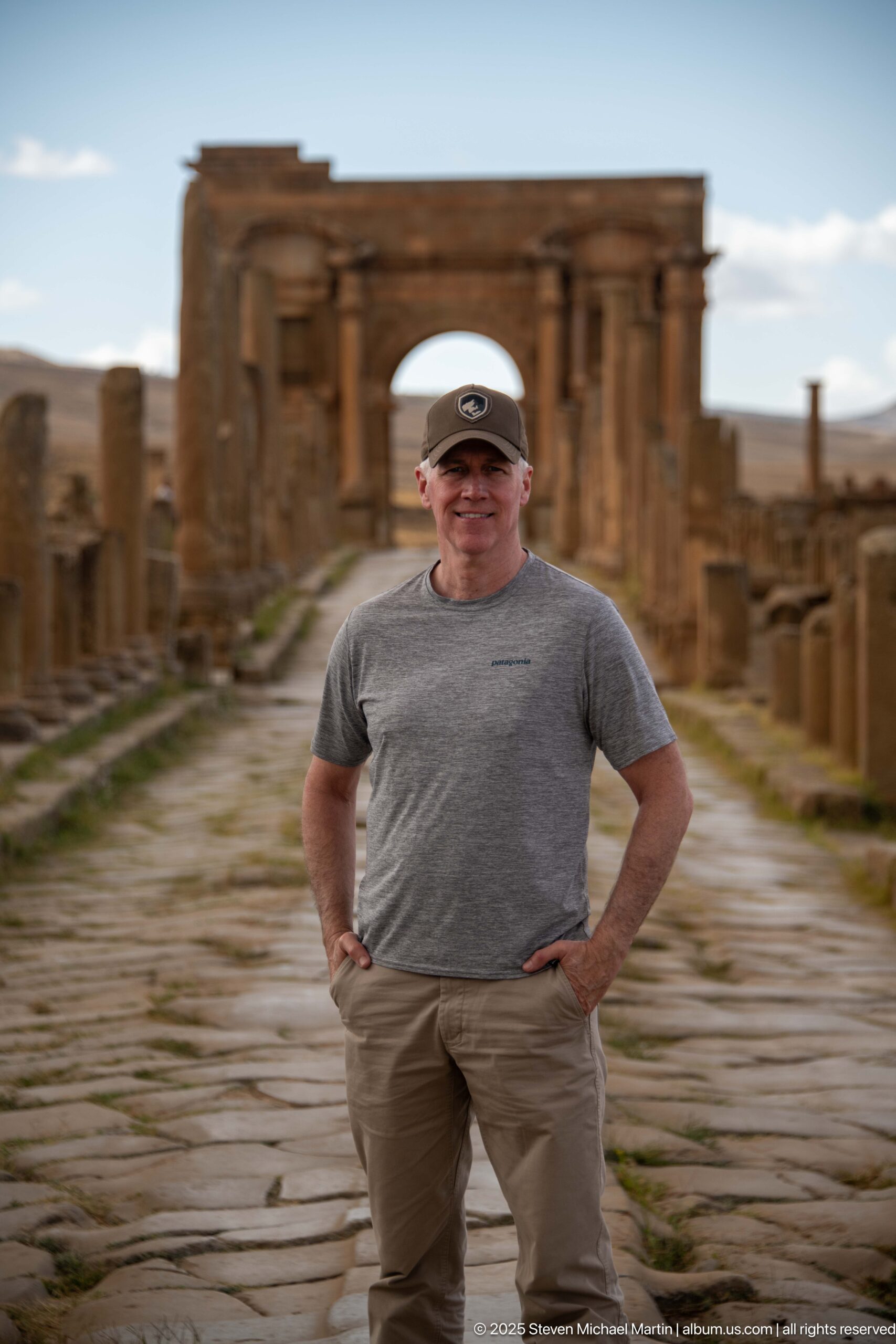
A visitor poses on the ancient roadway with hands at his hips as the Arch of Trajan anchors the background. Motion or focus blur in the surrounding ruins creates a distinctly photographic interpretation of the site, contrasting the stationary figure with the linear perspective of Timgad’s street.
Caption
A visitor poses on the ancient roadway with hands at his hips as the Arch of Trajan anchors the background. Motion or focus blur in the surrounding ruins creates a distinctly photographic interpretation of the site, contrasting the stationary figure with the linear perspective of Timgad’s street.
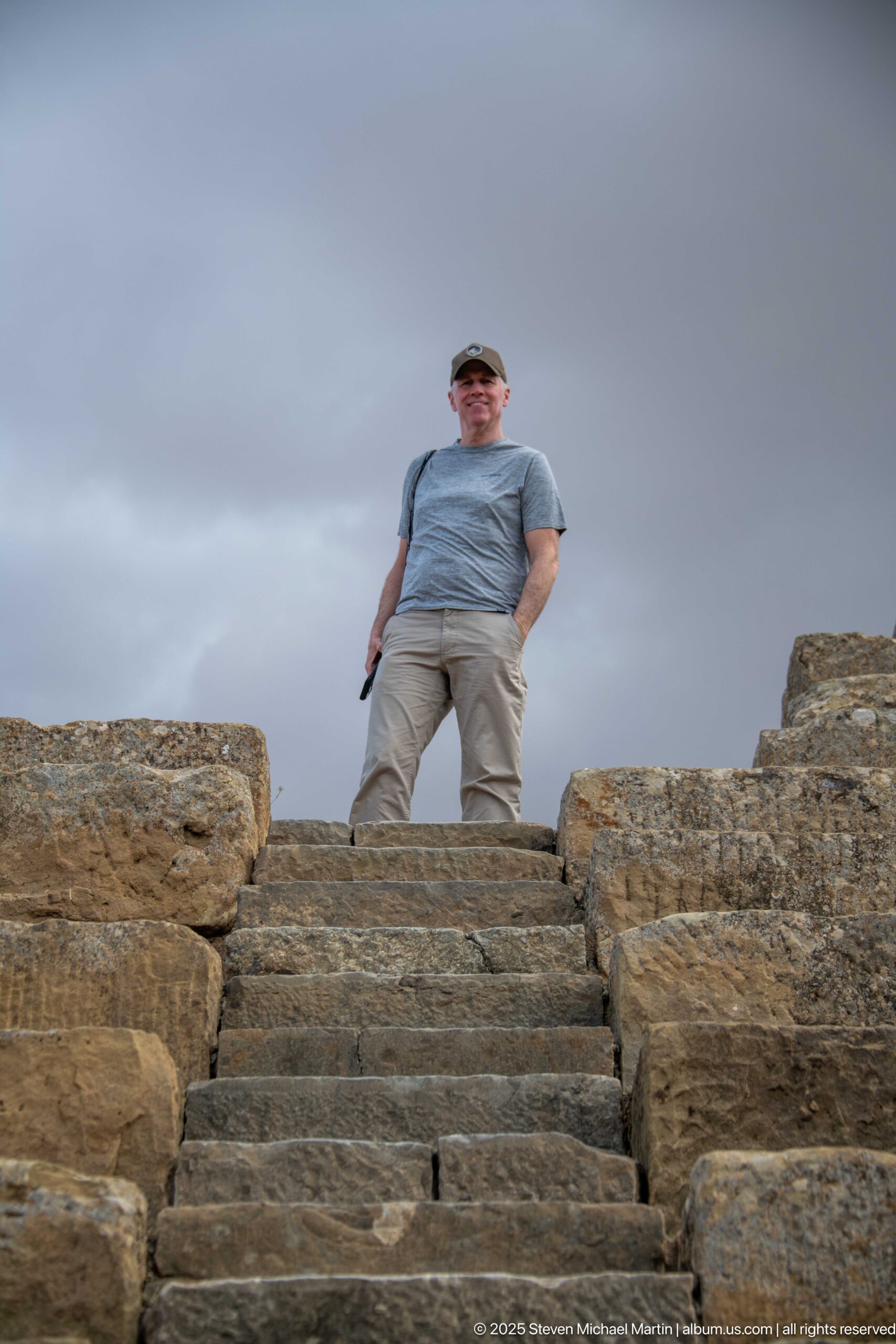
A visitor stands at the top of a steep stairway cut through the seating of Timgad’s Roman theater. The low viewpoint looks upward between heavy stone blocks, turning an access passage in the cavea into a strong study of scale, masonry, and the monument’s surviving vertical circulation.
Caption
A visitor stands at the top of a steep stairway cut through the seating of Timgad’s Roman theater. The low viewpoint looks upward between heavy stone blocks, turning an access passage in the cavea into a strong study of scale, masonry, and the monument’s surviving vertical circulation.
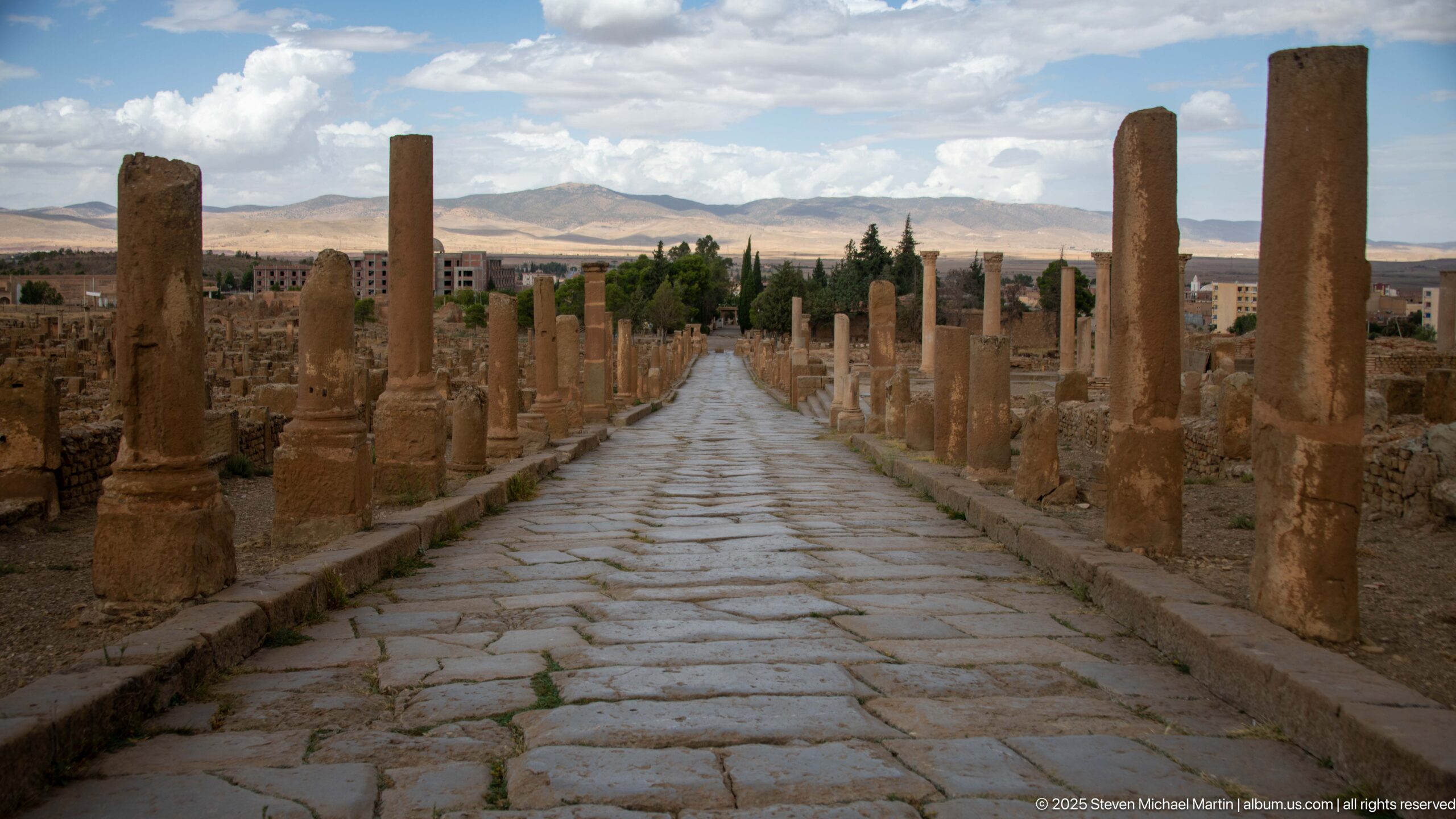
Looking in the opposite direction along Timgad’s street grid, the paved roadway descends between rows of surviving columns toward the modern landscape beyond the ruins. This reverse view shifts attention from the monumental arch to the city’s outward axis and the surrounding highland setting.
Caption
Looking in the opposite direction along Timgad’s street grid, the paved roadway descends between rows of surviving columns toward the modern landscape beyond the ruins. This reverse view shifts attention from the monumental arch to the city’s outward axis and the surrounding highland setting.
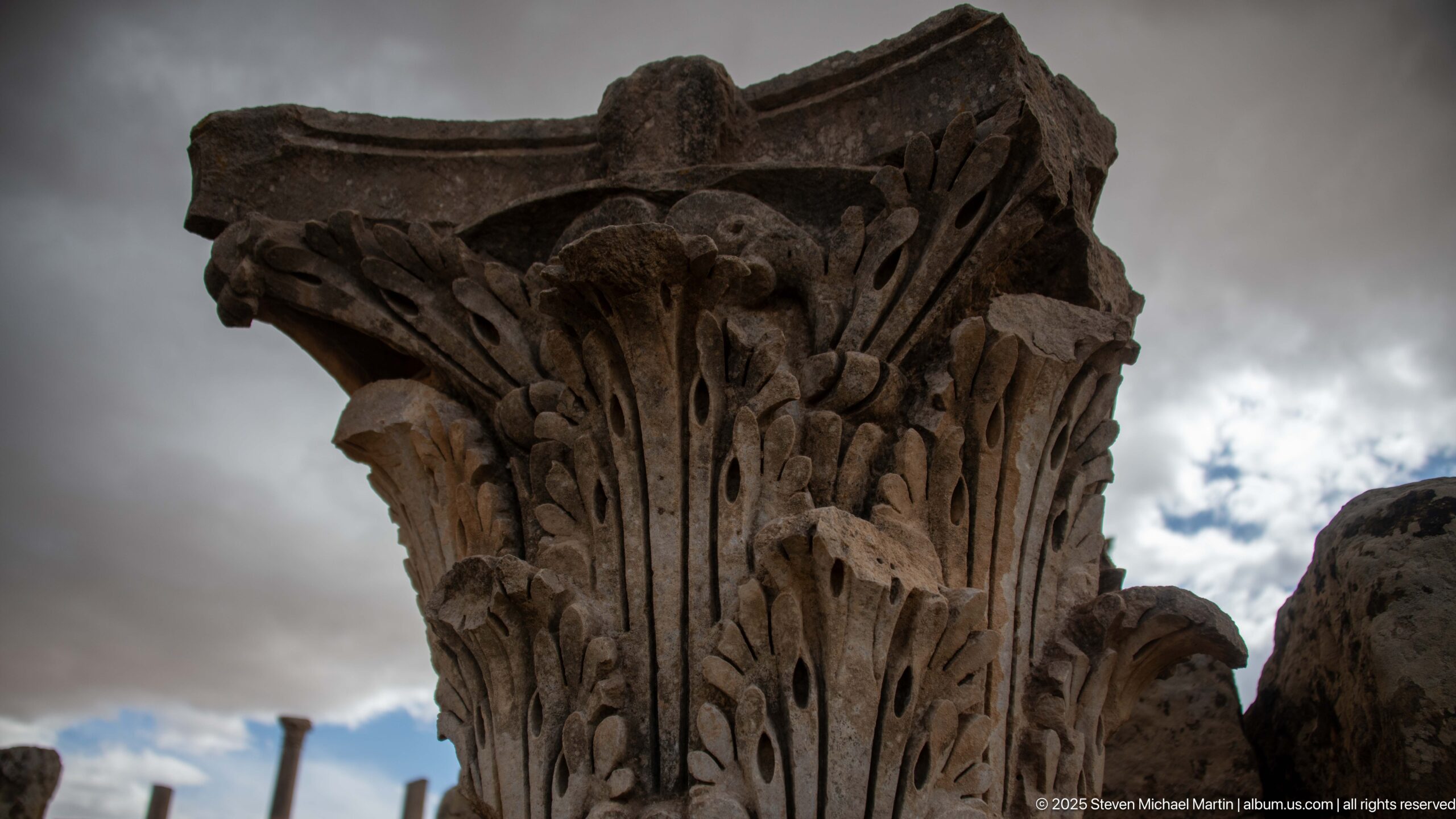
Deeply carved acanthus leaves spread across a weathered Corinthian capital, their overlapping lobes and drilled recesses creating strong shadow beneath the abacus. Isolated against the sky, the fragment reveals the sculptural refinement that once crowned Timgad’s monumental colonnades.
Caption
Deeply carved acanthus leaves spread across a weathered Corinthian capital, their overlapping lobes and drilled recesses creating strong shadow beneath the abacus. Isolated against the sky, the fragment reveals the sculptural refinement that once crowned Timgad’s monumental colonnades.
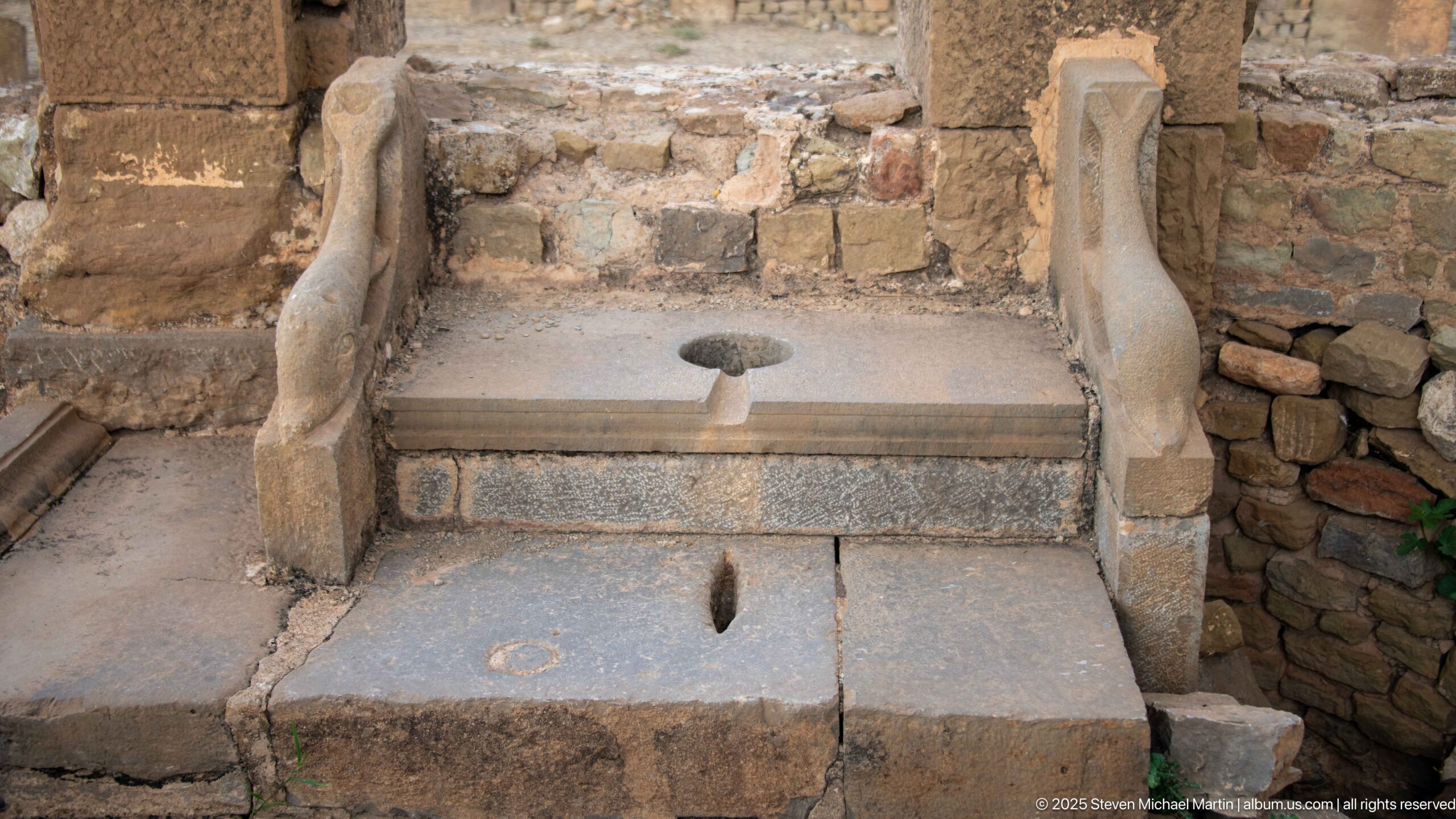
A carved stone seat with a circular opening and frontal access slot survives within Timgad’s communal latrine installation. Curving stone dividers flank the seat, while channels and masonry around the fixture preserve the practical arrangement of Roman sanitation infrastructure.
Caption
A carved stone seat with a circular opening and frontal access slot survives within Timgad’s communal latrine installation. Curving stone dividers flank the seat, while channels and masonry around the fixture preserve the practical arrangement of Roman sanitation infrastructure.
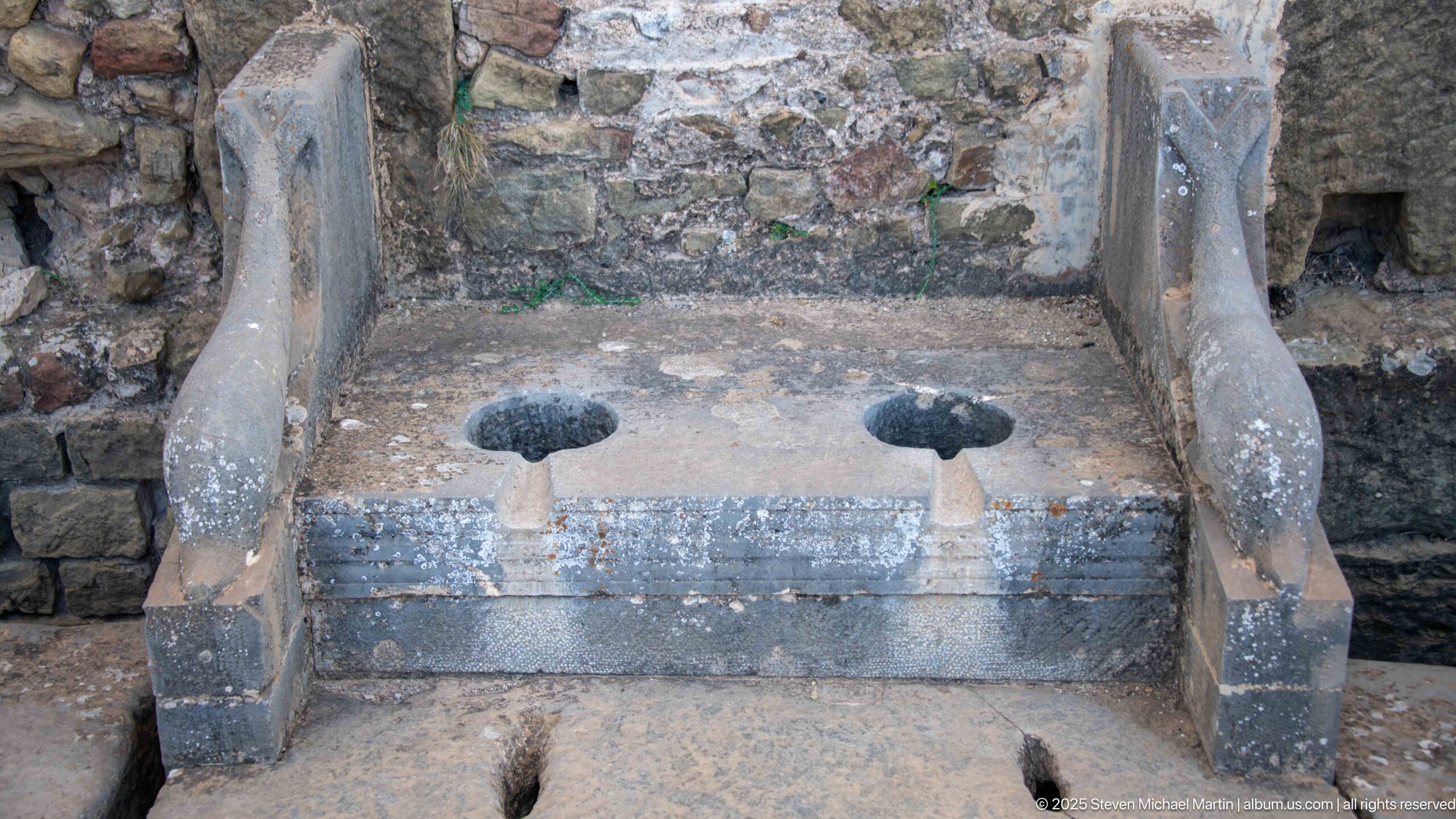
Two adjacent circular openings in a continuous stone bench illustrate the communal arrangement of a Roman public latrine at Timgad. Sculpted side partitions frame the seating area, while frontal slots and floor openings reveal functional elements associated with washing and waste removal.
Caption
Two adjacent circular openings in a continuous stone bench illustrate the communal arrangement of a Roman public latrine at Timgad. Sculpted side partitions frame the seating area, while frontal slots and floor openings reveal functional elements associated with washing and waste removal.
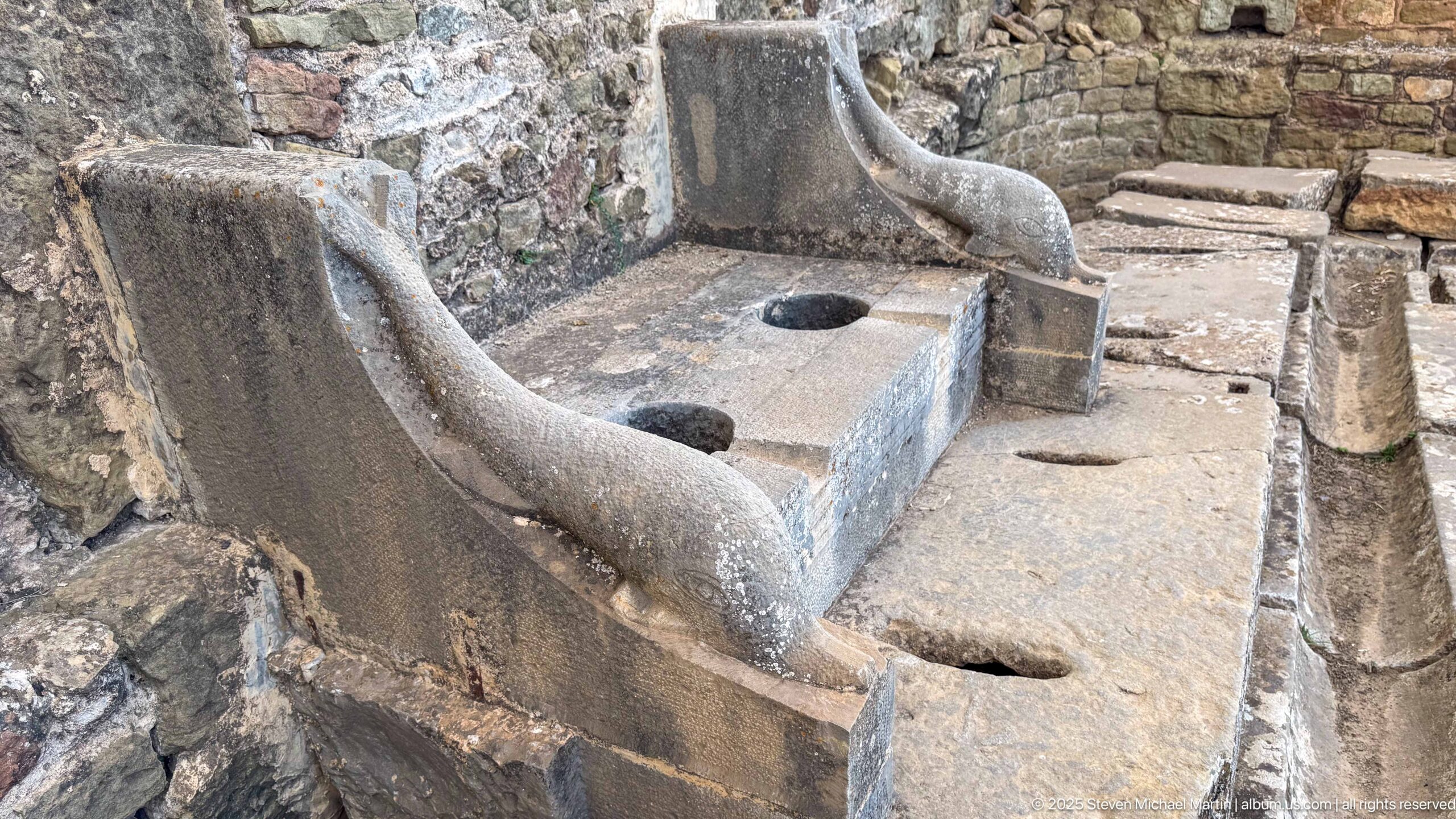
An oblique angle across the latrine reveals multiple stone seat openings and the sculpted partitions that separated positions along the bench. The perspective also exposes floor-level openings and adjacent masonry, giving a clearer sense of how the sanitation installation was integrated into the surrounding room.
Caption
An oblique angle across the latrine reveals multiple stone seat openings and the sculpted partitions that separated positions along the bench. The perspective also exposes floor-level openings and adjacent masonry, giving a clearer sense of how the sanitation installation was integrated into the surrounding room.
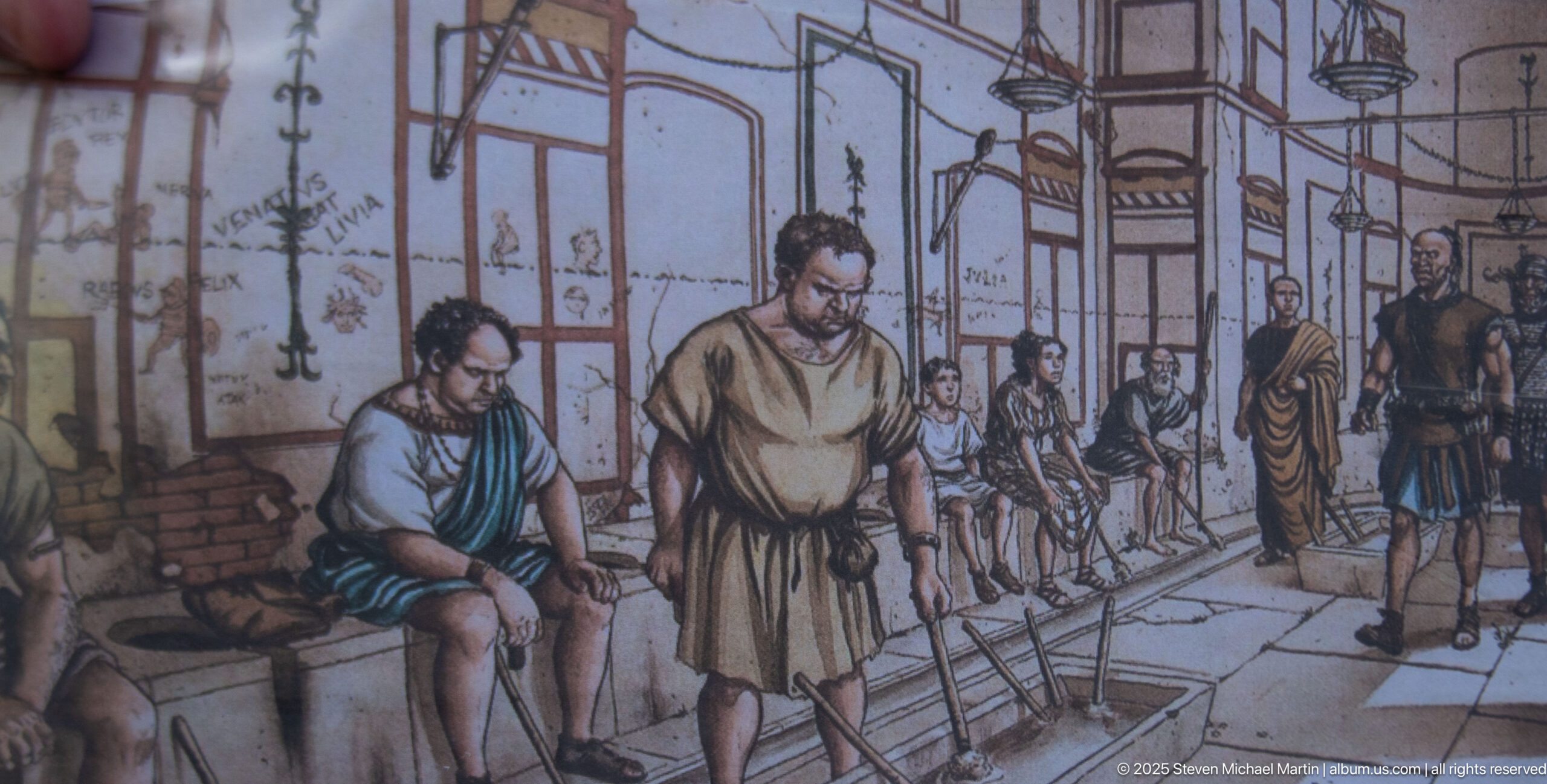
An interpretive panel reconstructs a Roman communal latrine in use, with seated figures occupying a long bench while another person stands in the tiled interior. The illustration provides modern explanatory context for the surviving stone fixtures nearby, helping visitors visualize their original social and architectural setting.
Caption
An interpretive panel reconstructs a Roman communal latrine in use, with seated figures occupying a long bench while another person stands in the tiled interior. The illustration provides modern explanatory context for the surviving stone fixtures nearby, helping visitors visualize their original social and architectural setting.
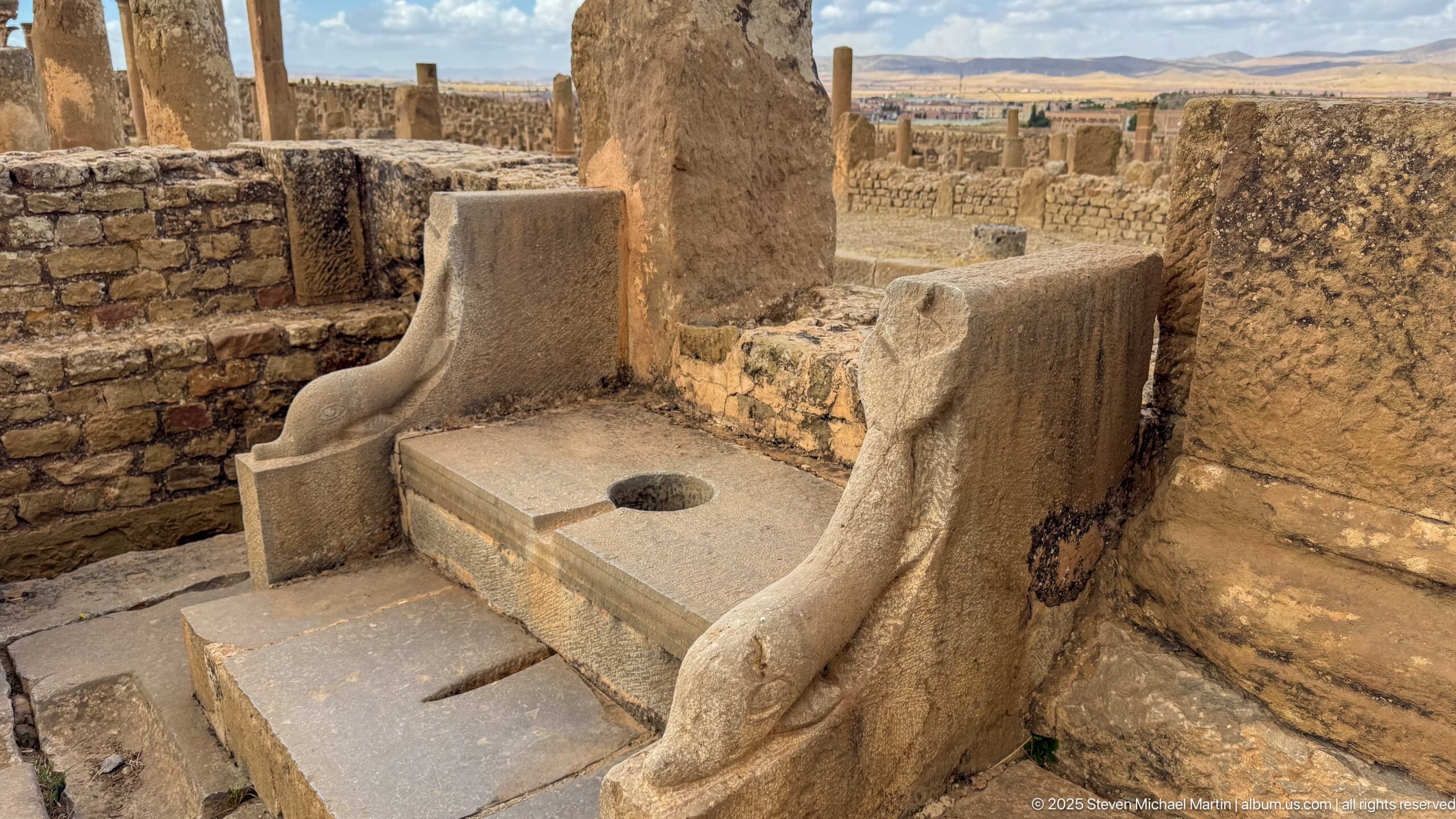
Viewed from the end of the installation, a single circular latrine opening sits between substantial sculpted partitions. The close perspective emphasizes the thickness of the stone bench and the shaped dividers, while surrounding masonry locates the fixture within the excavated room rather than as an isolated artifact.
Caption
Viewed from the end of the installation, a single circular latrine opening sits between substantial sculpted partitions. The close perspective emphasizes the thickness of the stone bench and the shaped dividers, while surrounding masonry locates the fixture within the excavated room rather than as an isolated artifact.
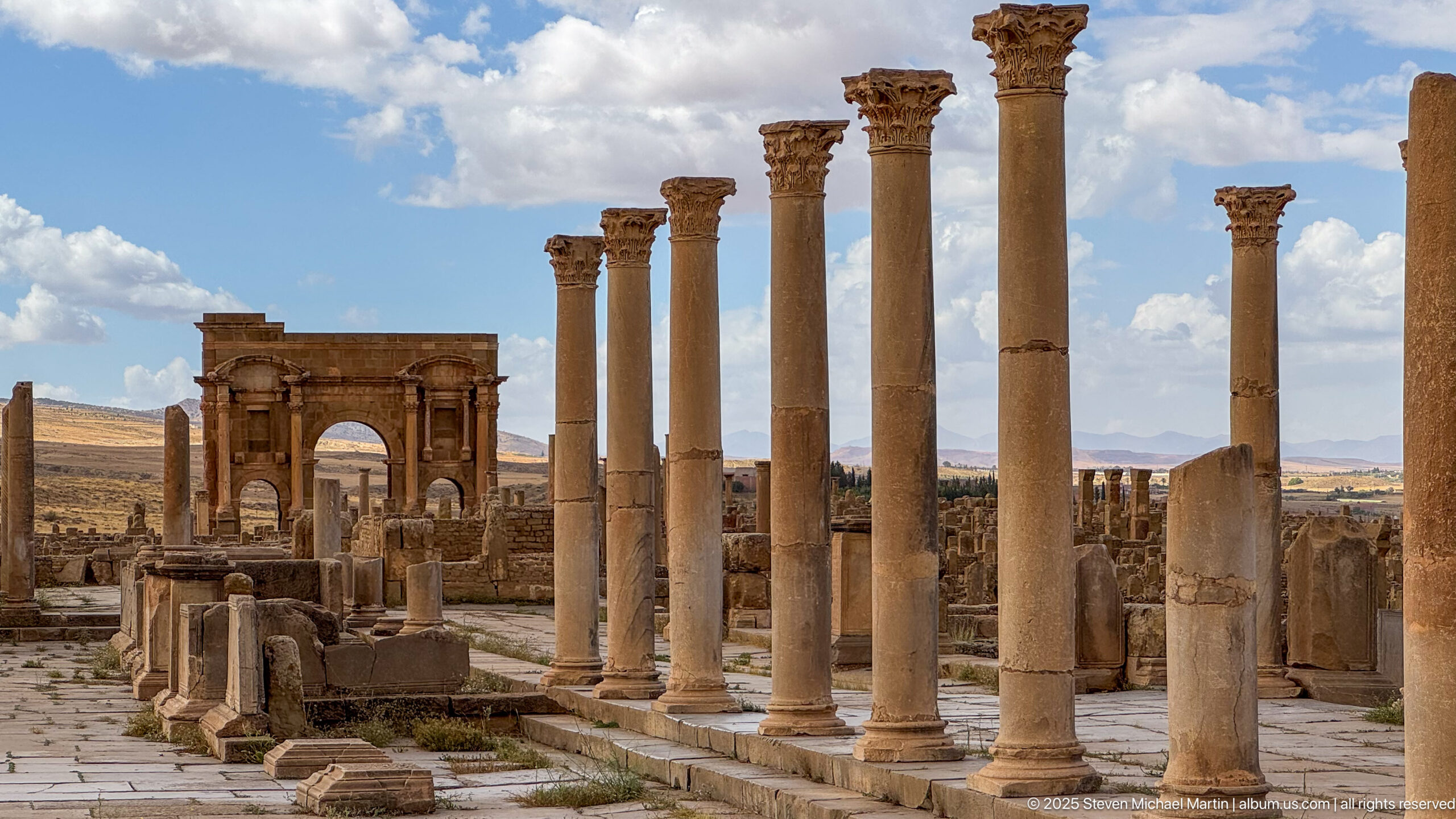
A line of tall columns with ornate capitals rises beside a paved precinct, while the Arch of Trajan appears beyond the archaeological remains. The lateral viewpoint compresses two major elements of Timgad’s monumental landscape, contrasting the repeated verticals of the colonnade with the massive masonry gateway.
Caption
A line of tall columns with ornate capitals rises beside a paved precinct, while the Arch of Trajan appears beyond the archaeological remains. The lateral viewpoint compresses two major elements of Timgad’s monumental landscape, contrasting the repeated verticals of the colonnade with the massive masonry gateway.
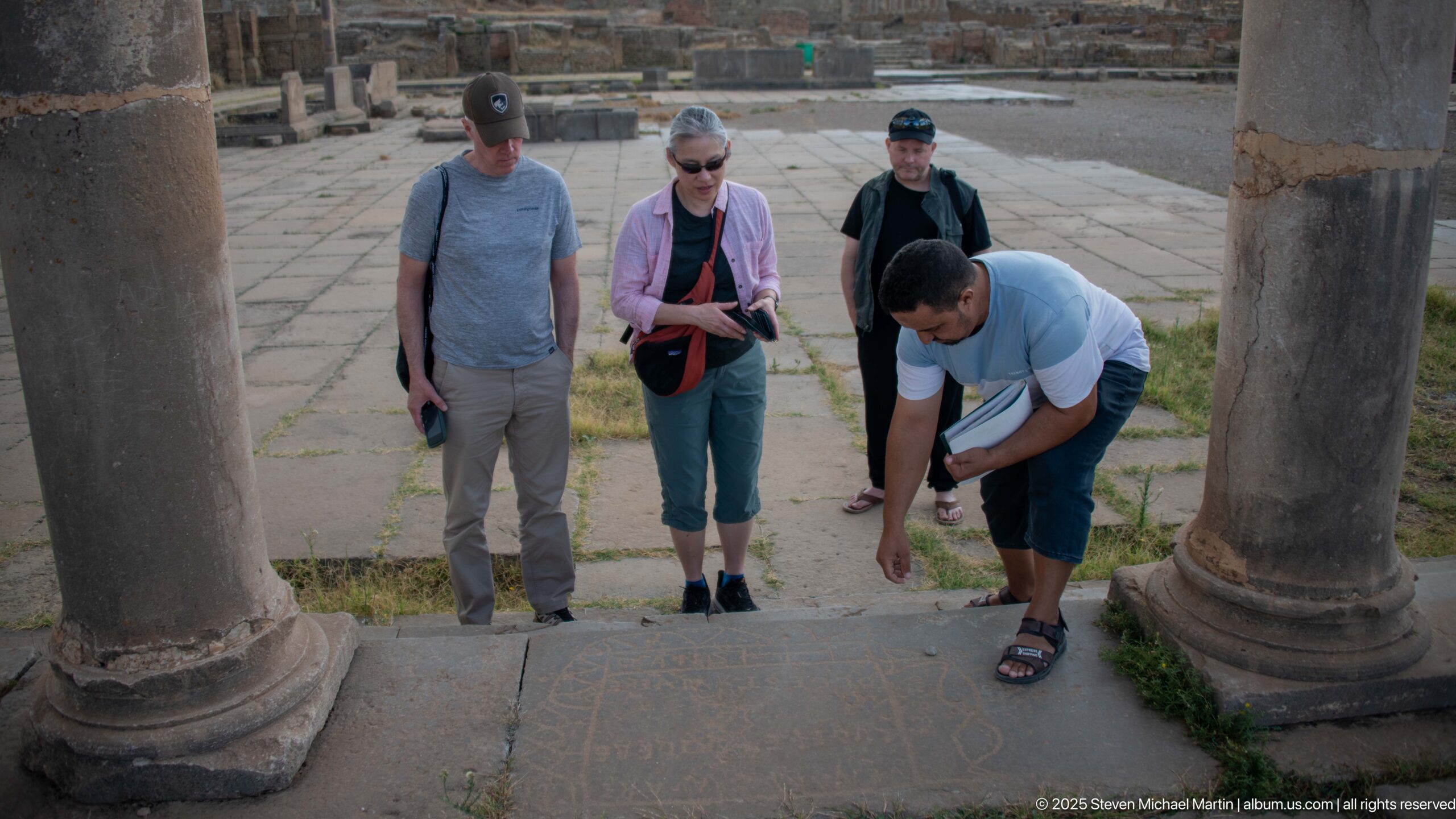
A small group pauses between massive column bases while one visitor bends to examine or indicate a feature on the ancient pavement. The scene records contemporary engagement with Timgad’s archaeological remains and provides scale for the surviving columns and broad paved surface.
Caption
A small group pauses between massive column bases while one visitor bends to examine or indicate a feature on the ancient pavement. The scene records contemporary engagement with Timgad’s archaeological remains and provides scale for the surviving columns and broad paved surface.
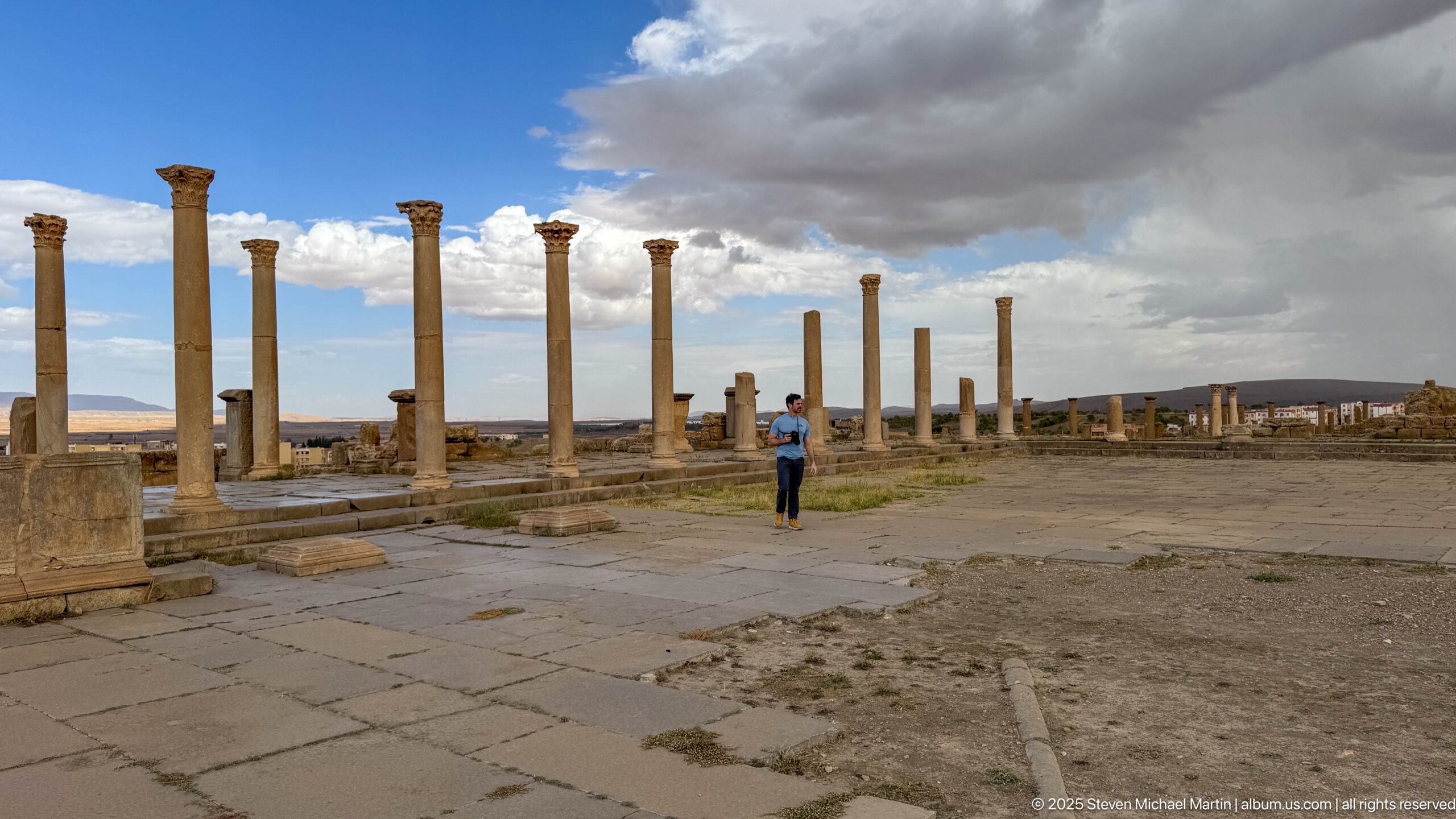
Tall columns with surviving capitals define the edge of a broad paved open space at Timgad. A lone visitor supplies scale, while the extended row of shafts and scattered architectural blocks convey the original monumentality of the precinct despite the loss of its roof and enclosing walls.
Caption
Tall columns with surviving capitals define the edge of a broad paved open space at Timgad. A lone visitor supplies scale, while the extended row of shafts and scattered architectural blocks convey the original monumentality of the precinct despite the loss of its roof and enclosing walls.
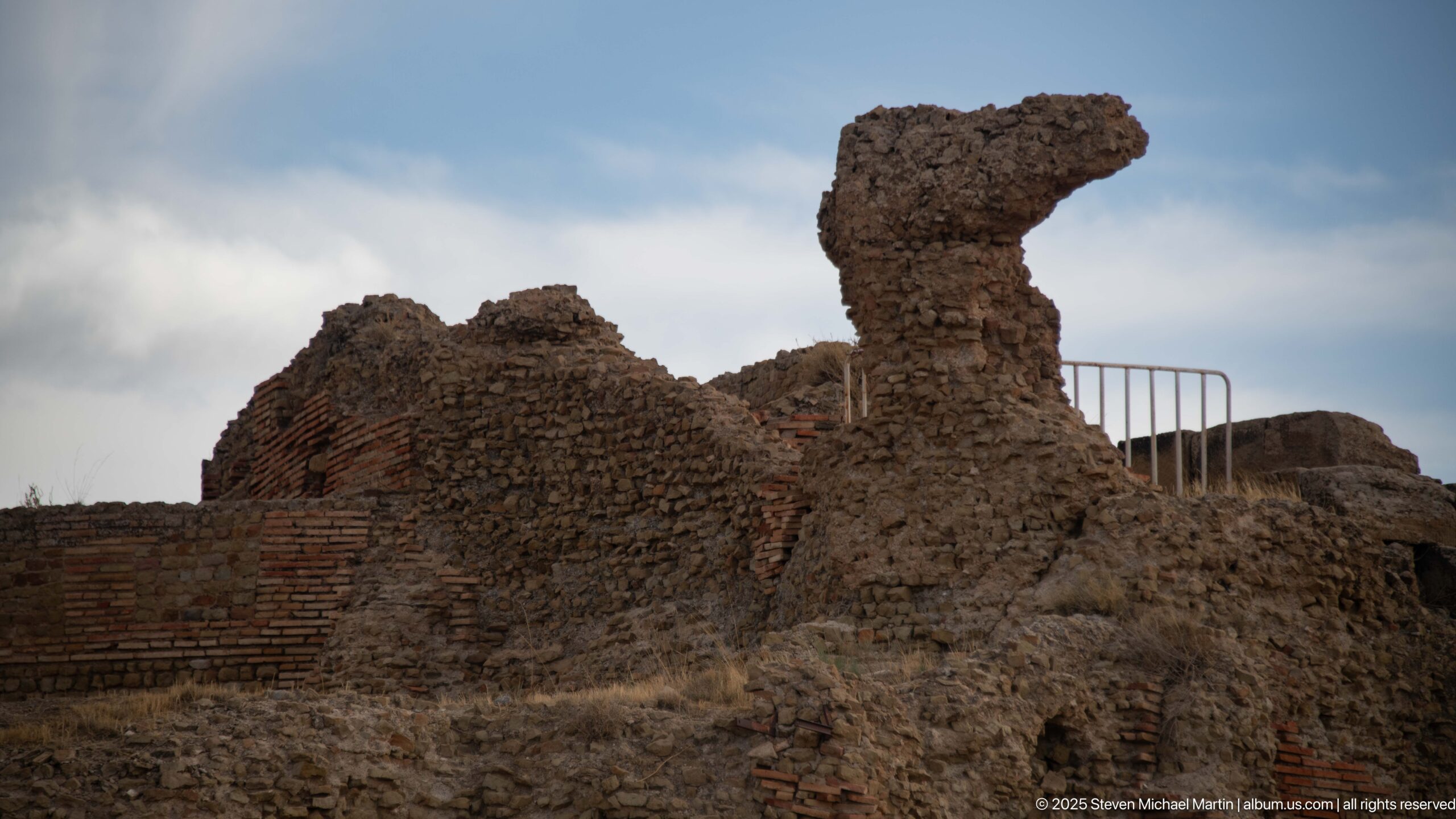
Irregular masses of brick-faced and rubble masonry rise above lower walls, preserving the eroded core of a substantial Roman structure. The broken profile and exposed construction layers make this view useful for reading building fabric and later deterioration rather than reconstructing the lost architectural elevation.
Caption
Irregular masses of brick-faced and rubble masonry rise above lower walls, preserving the eroded core of a substantial Roman structure. The broken profile and exposed construction layers make this view useful for reading building fabric and later deterioration rather than reconstructing the lost architectural elevation.
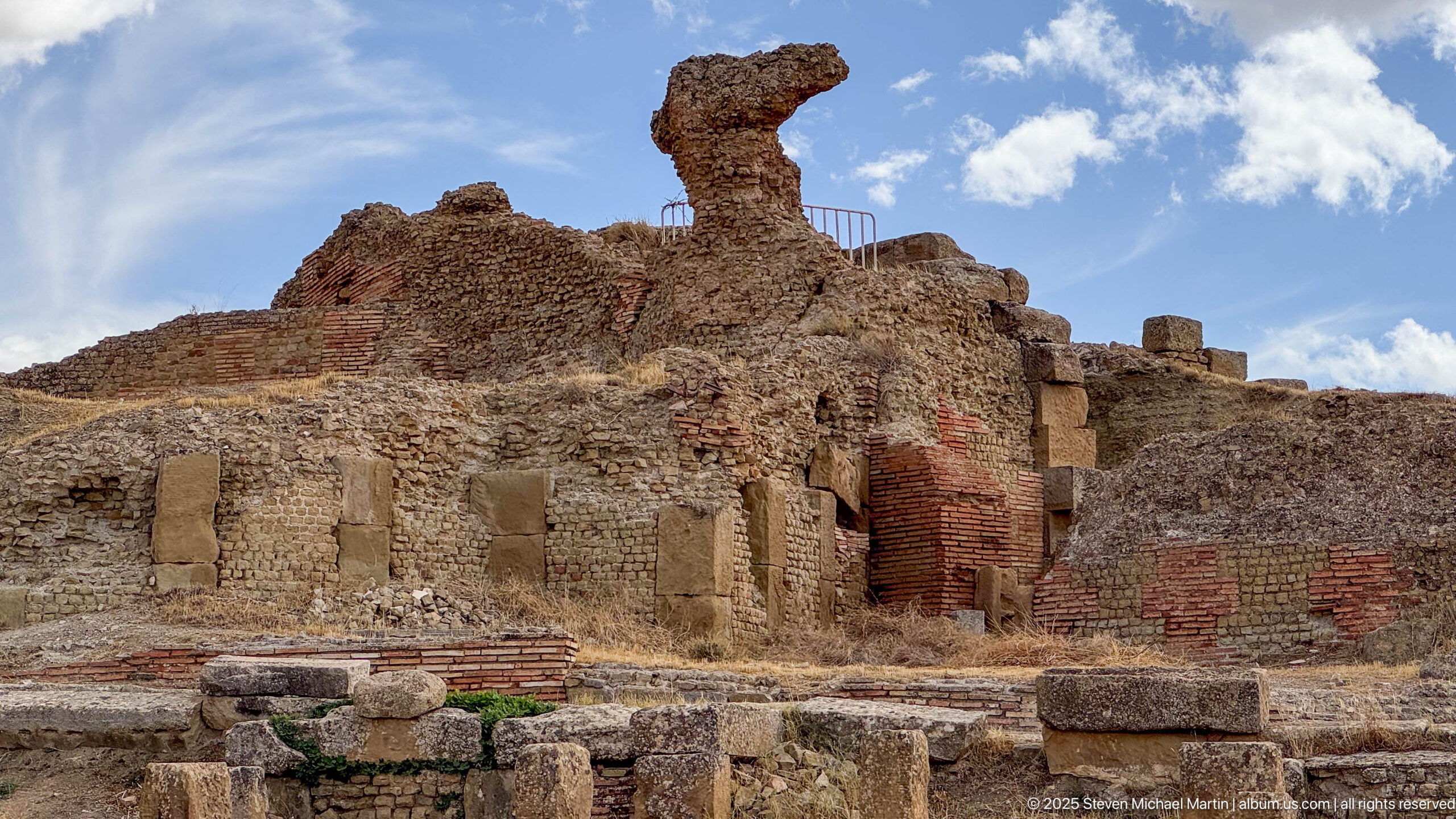
A substantial complex of brick-faced walls and rubble cores rises in layered terraces above the surrounding foundations. Arched and rectangular openings survive within the masonry, revealing the scale and complexity of a major building whose upper portions have collapsed into an irregular silhouette.
Caption
A substantial complex of brick-faced walls and rubble cores rises in layered terraces above the surrounding foundations. Arched and rectangular openings survive within the masonry, revealing the scale and complexity of a major building whose upper portions have collapsed into an irregular silhouette.
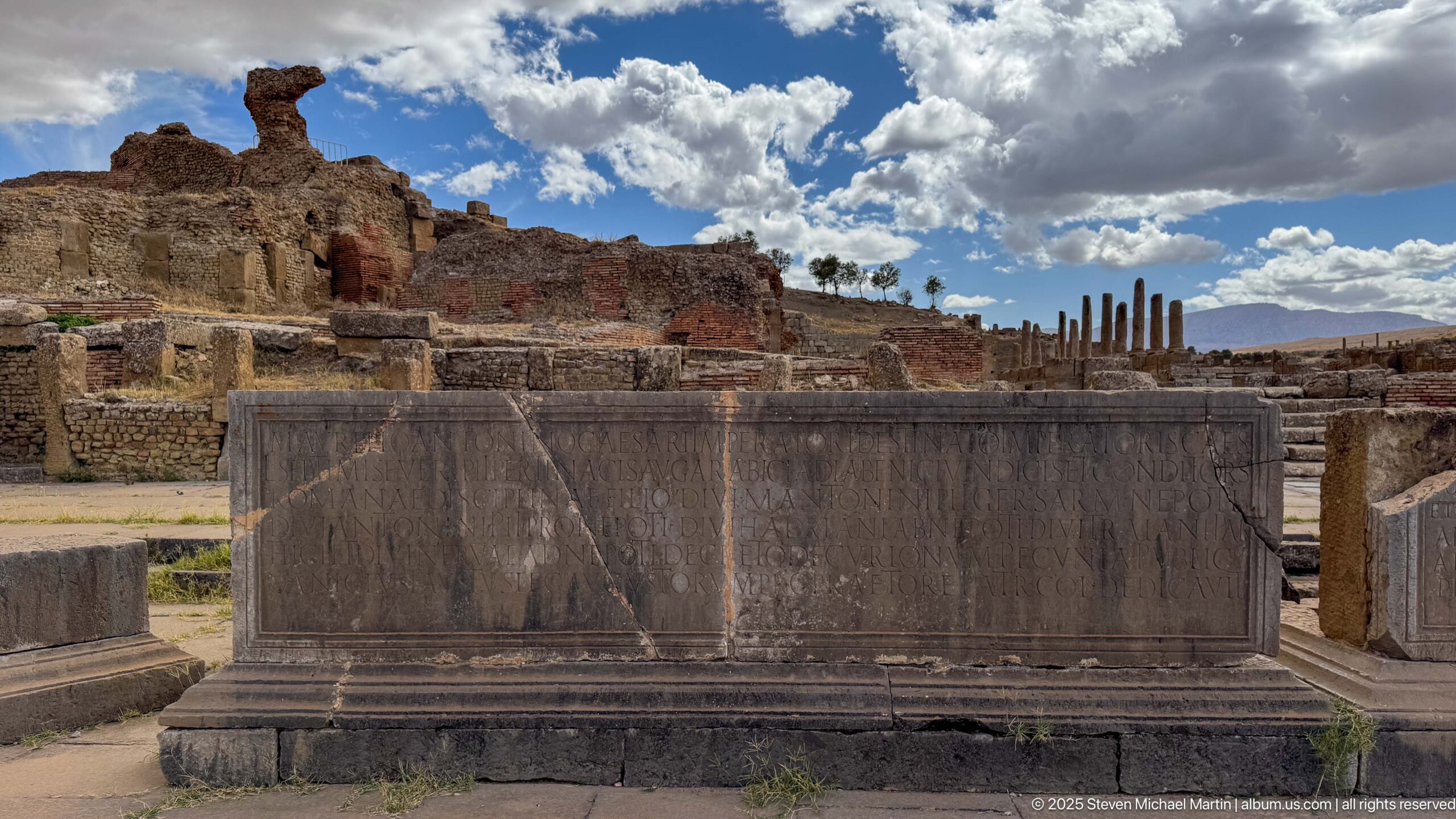
A long rectangular stone monument carries multiple lines of weathered Latin text across its face. Set among Timgad’s excavated masonry with larger ruins rising behind, the inscription preserves a formal epigraphic element likely associated with a public dedication or commemorative setting, though the text is not legible enough here for a secure reading.
Caption
A long rectangular stone monument carries multiple lines of weathered Latin text across its face. Set among Timgad’s excavated masonry with larger ruins rising behind, the inscription preserves a formal epigraphic element likely associated with a public dedication or commemorative setting, though the text is not legible enough here for a secure reading.
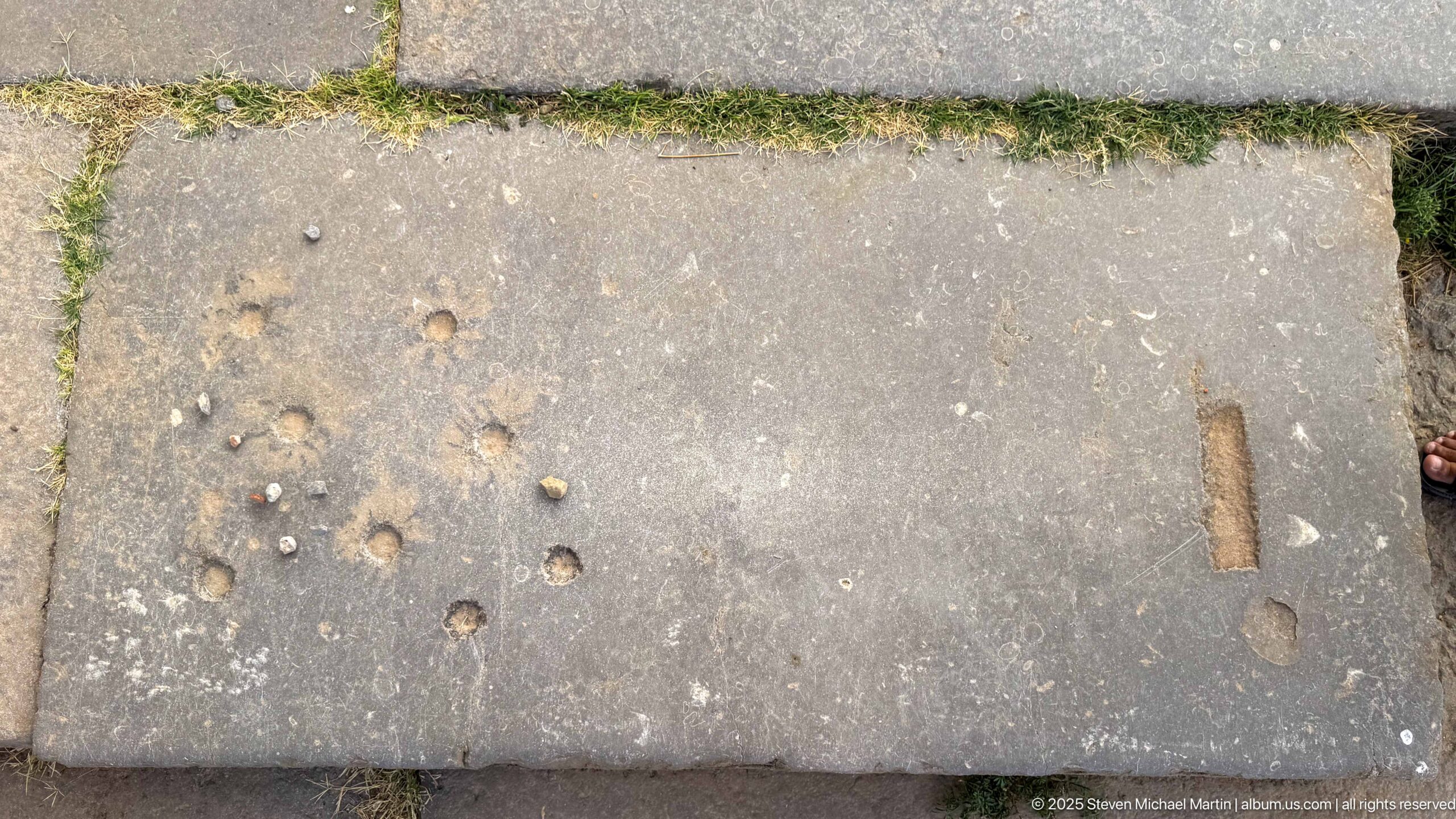
A close view isolates a large stone paving slab marked by several circular depressions and elongated cut or worn recesses. Their exact function is uncertain from the photograph alone, but the surface records localized modification and wear that contrasts with the more regular paving visible along Timgad’s streets and public spaces.
Caption
A close view isolates a large stone paving slab marked by several circular depressions and elongated cut or worn recesses. Their exact function is uncertain from the photograph alone, but the surface records localized modification and wear that contrasts with the more regular paving visible along Timgad’s streets and public spaces.
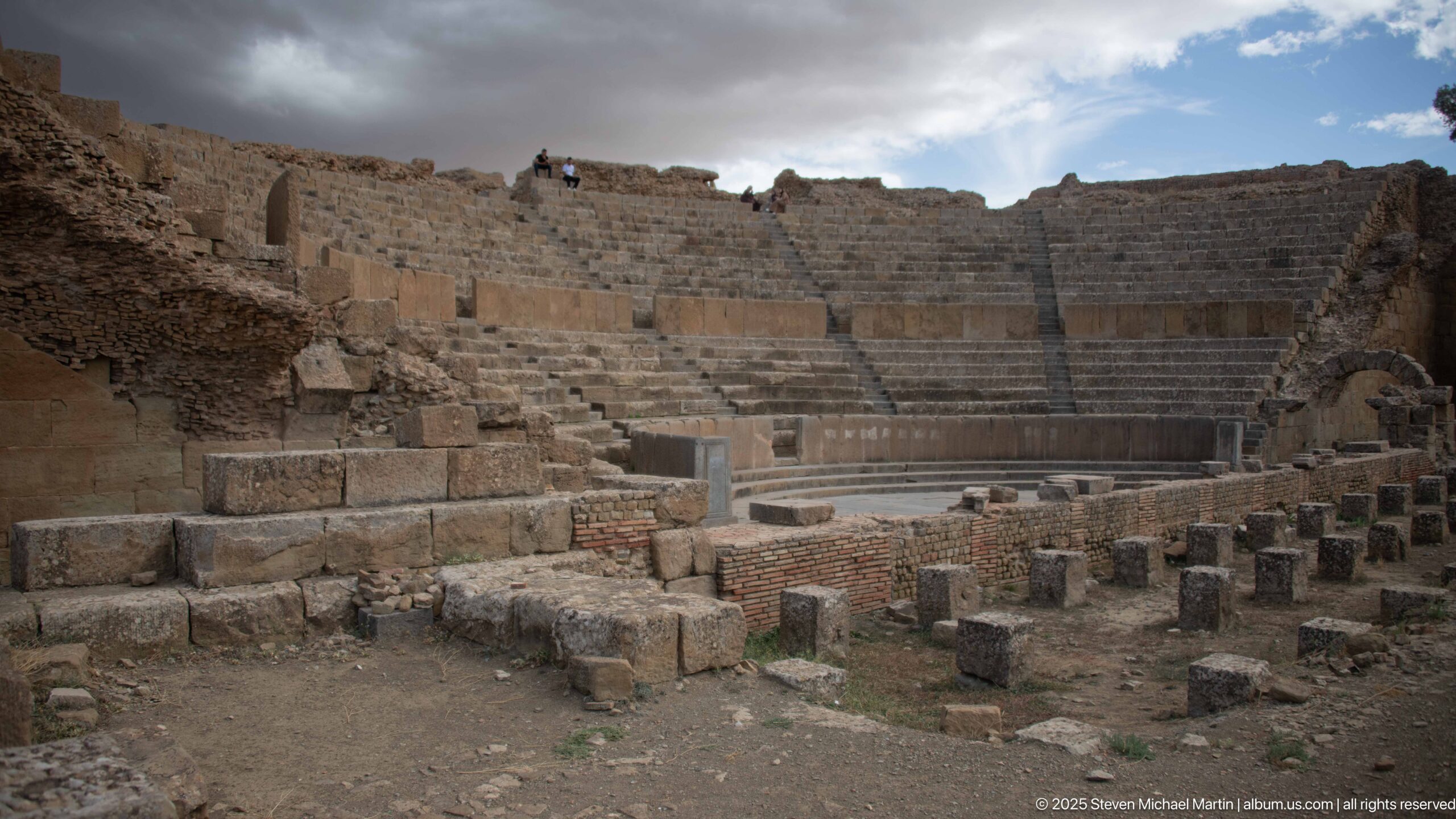
Stone seating rises in a broad semicircle around the orchestra and surviving stage structures of Timgad’s Roman theater. The view from near stage level shows the stepped cavea, retaining masonry, and scattered architectural blocks, emphasizing how the performance space was fitted into the ancient city’s monumental core.
Caption
Stone seating rises in a broad semicircle around the orchestra and surviving stage structures of Timgad’s Roman theater. The view from near stage level shows the stepped cavea, retaining masonry, and scattered architectural blocks, emphasizing how the performance space was fitted into the ancient city’s monumental core.
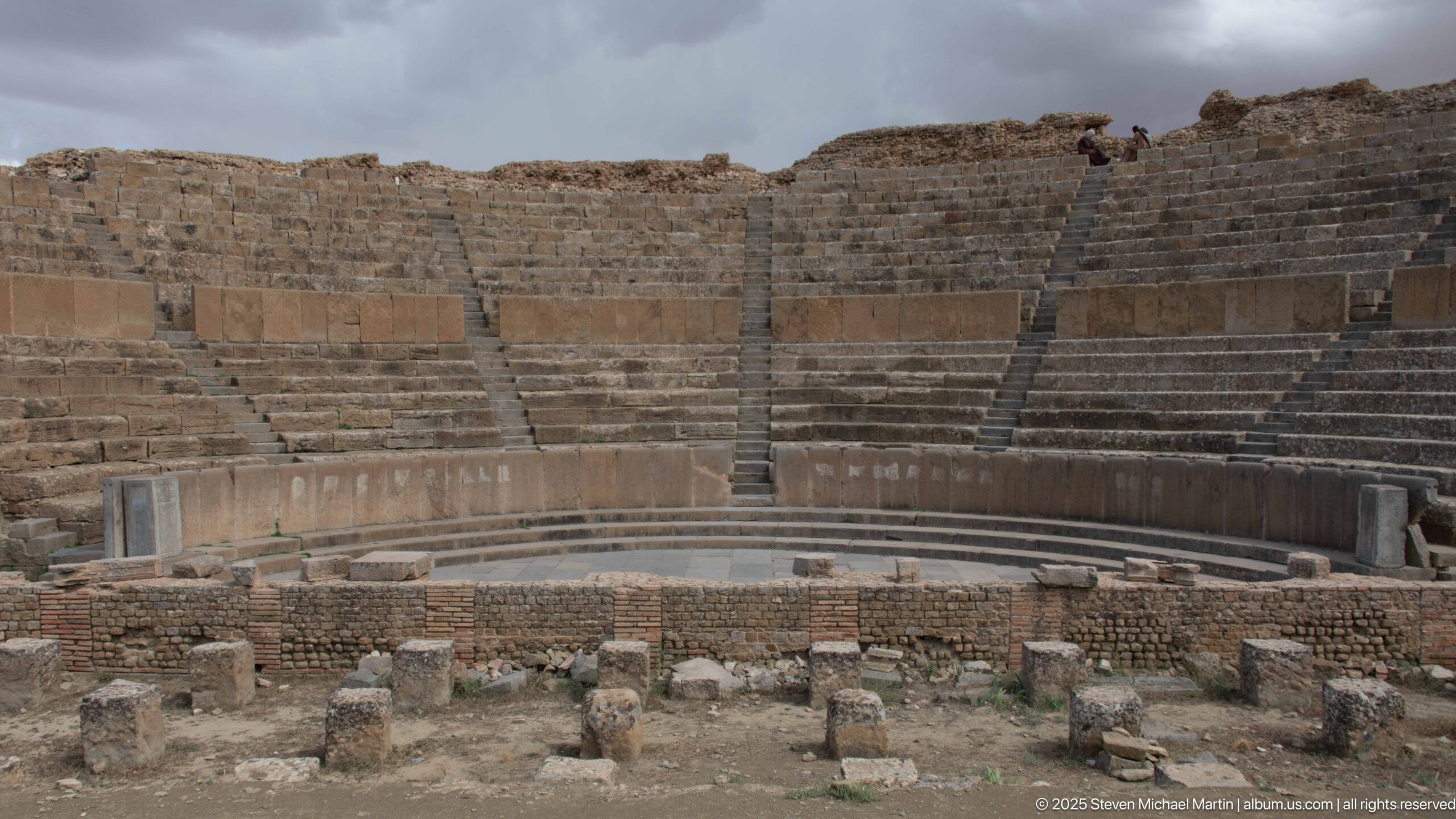
From a more centered position, the Roman theater’s orchestra and curving cavea dominate the composition. Regular courses of stone seating rise behind the lower performance area, while short column stumps and masonry in the foreground mark the ruined architectural zone between the viewer and the stage.
Caption
From a more centered position, the Roman theater’s orchestra and curving cavea dominate the composition. Regular courses of stone seating rise behind the lower performance area, while short column stumps and masonry in the foreground mark the ruined architectural zone between the viewer and the stage.
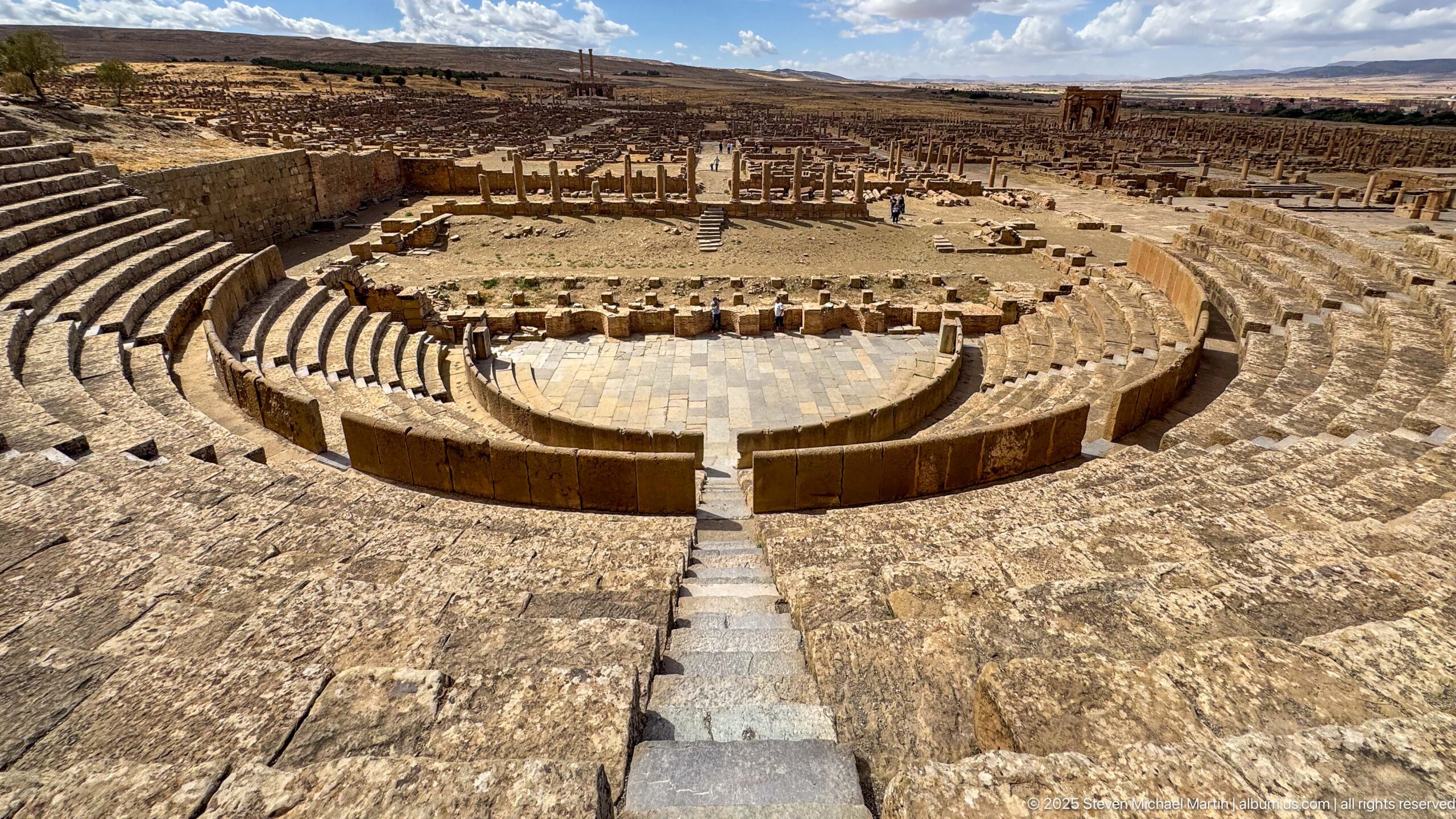
The theater fills the frame in a sweeping wide-angle view, its concentric seating descending toward the paved orchestra and stage-front remains. From this elevated position, the curvature and scale of the cavea are especially clear, while the surrounding ruins place the monument within Timgad’s dense archaeological landscape.
Caption
The theater fills the frame in a sweeping wide-angle view, its concentric seating descending toward the paved orchestra and stage-front remains. From this elevated position, the curvature and scale of the cavea are especially clear, while the surrounding ruins place the monument within Timgad’s dense archaeological landscape.
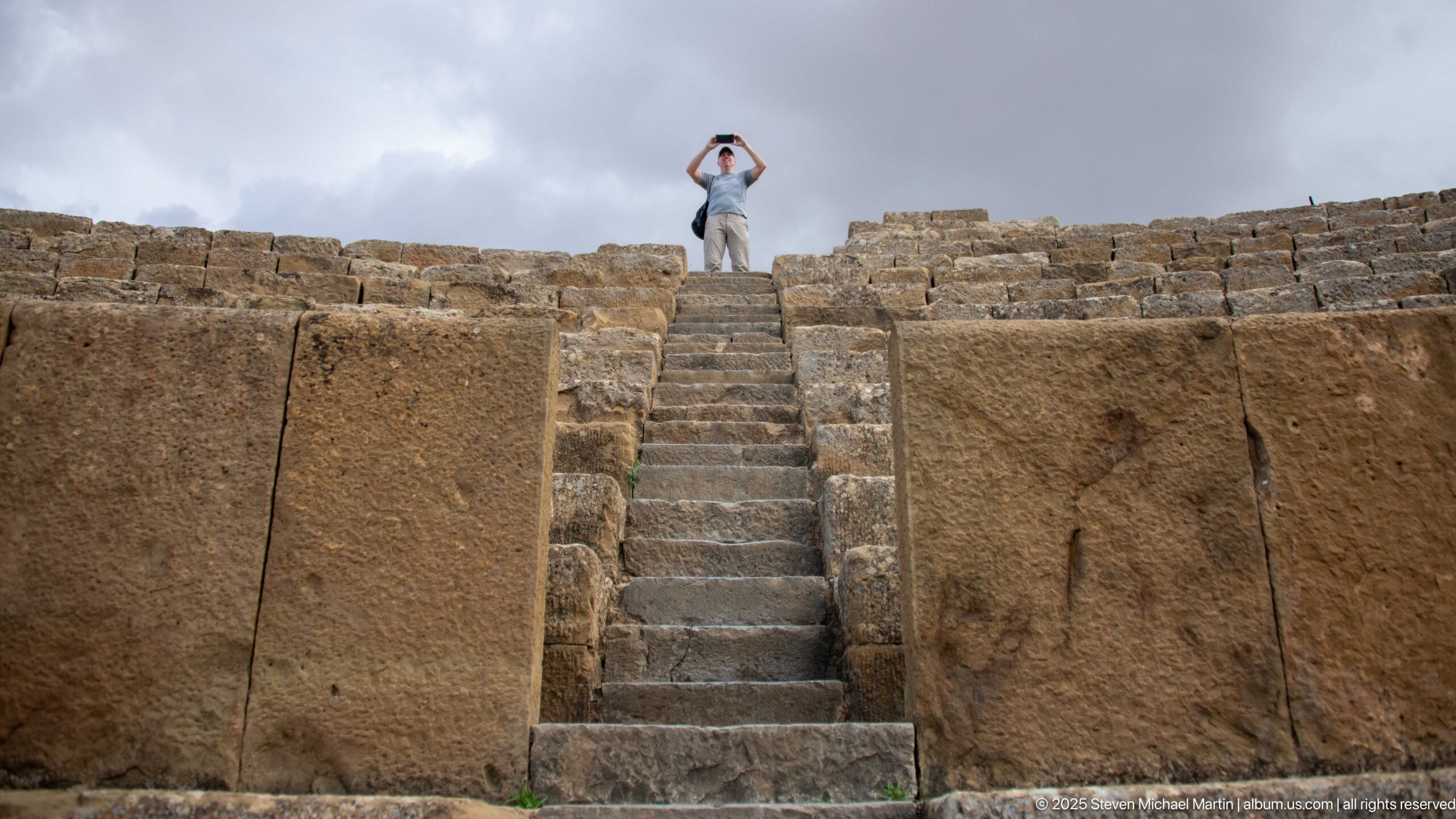
A narrow stone stairway climbs through the upper seating of Timgad’s Roman theater. Massive weathered blocks frame the steps, and a visitor at the crest provides a sense of scale for the steep passage that divided seating sectors and carried spectators between levels of the cavea.
Caption
A narrow stone stairway climbs through the upper seating of Timgad’s Roman theater. Massive weathered blocks frame the steps, and a visitor at the crest provides a sense of scale for the steep passage that divided seating sectors and carried spectators between levels of the cavea.
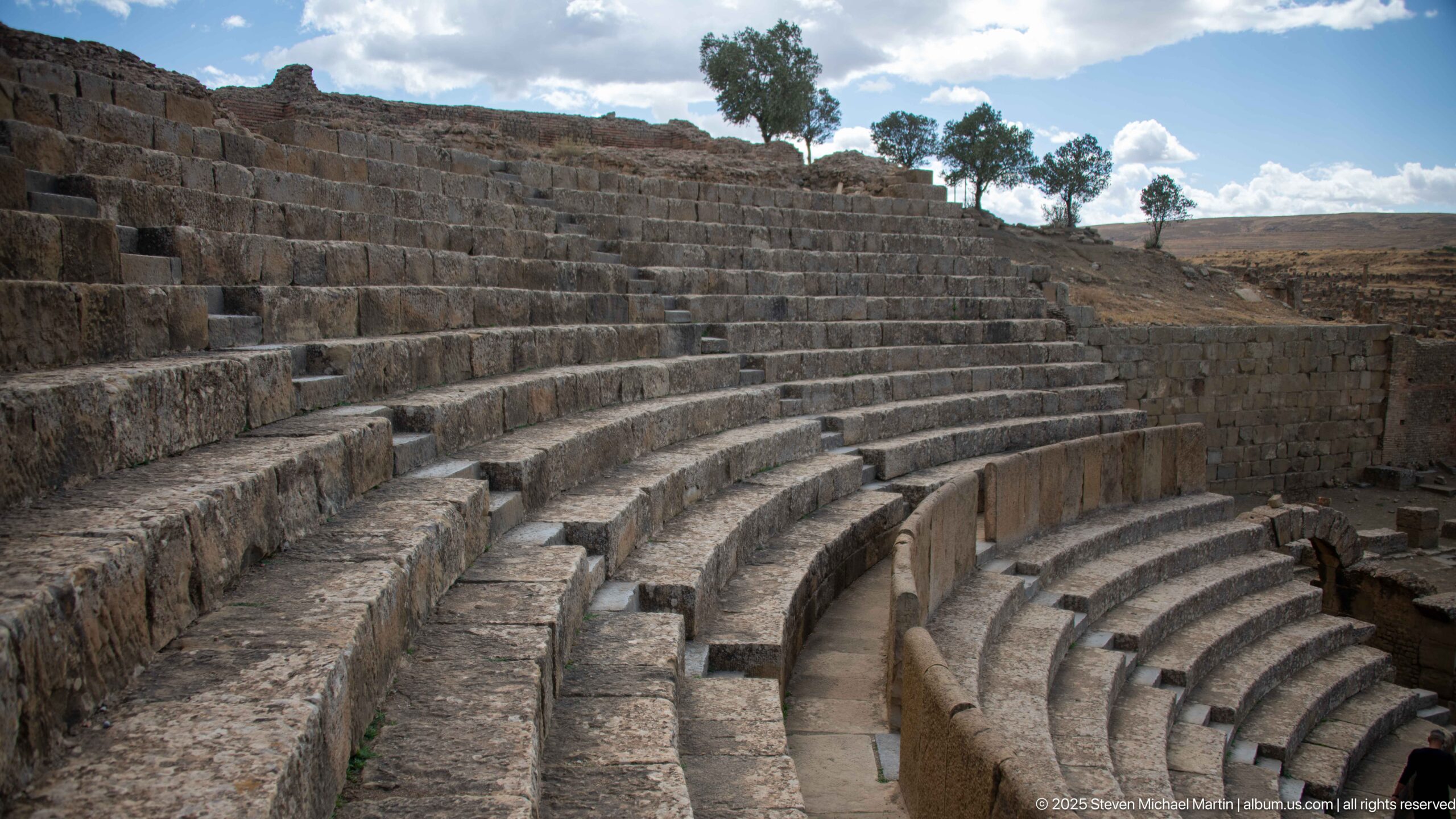
Close, oblique tiers of stone seating sweep around the cavea of Timgad’s theater. The tight framing emphasizes the carefully graded rows, radial stair division, and retaining walls rather than the whole monument, revealing the geometry that organized spectators around the performance space.
Caption
Close, oblique tiers of stone seating sweep around the cavea of Timgad’s theater. The tight framing emphasizes the carefully graded rows, radial stair division, and retaining walls rather than the whole monument, revealing the geometry that organized spectators around the performance space.
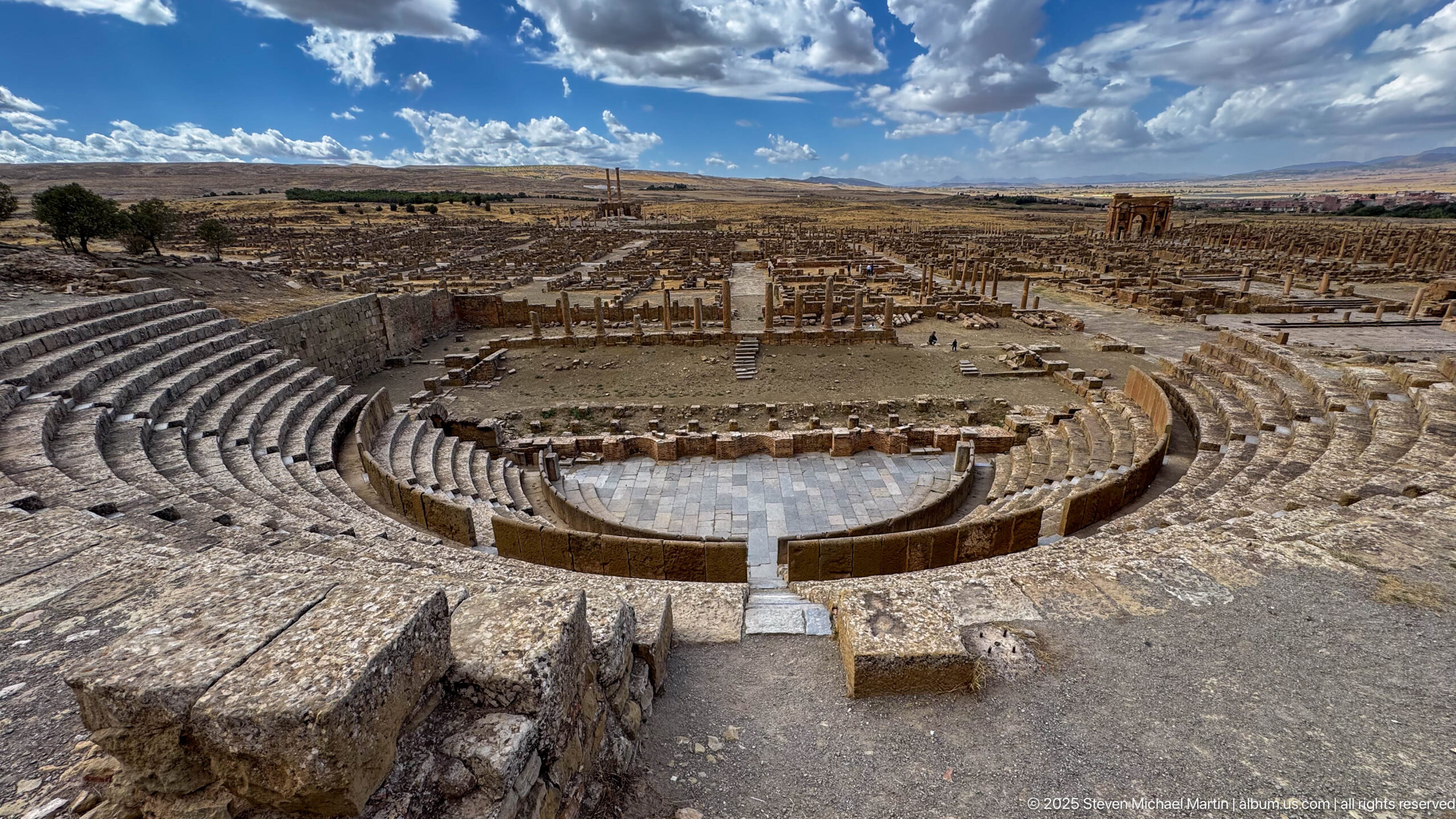
From the upper cavea, the entire theater opens toward Timgad’s archaeological city and the rolling plateau beyond. The broad view combines the paved orchestra, stage remains, curving seating, colonnaded streets, and distant monuments, making the theater a foreground frame for the larger Roman urban plan.
Caption
From the upper cavea, the entire theater opens toward Timgad’s archaeological city and the rolling plateau beyond. The broad view combines the paved orchestra, stage remains, curving seating, colonnaded streets, and distant monuments, making the theater a foreground frame for the larger Roman urban plan.
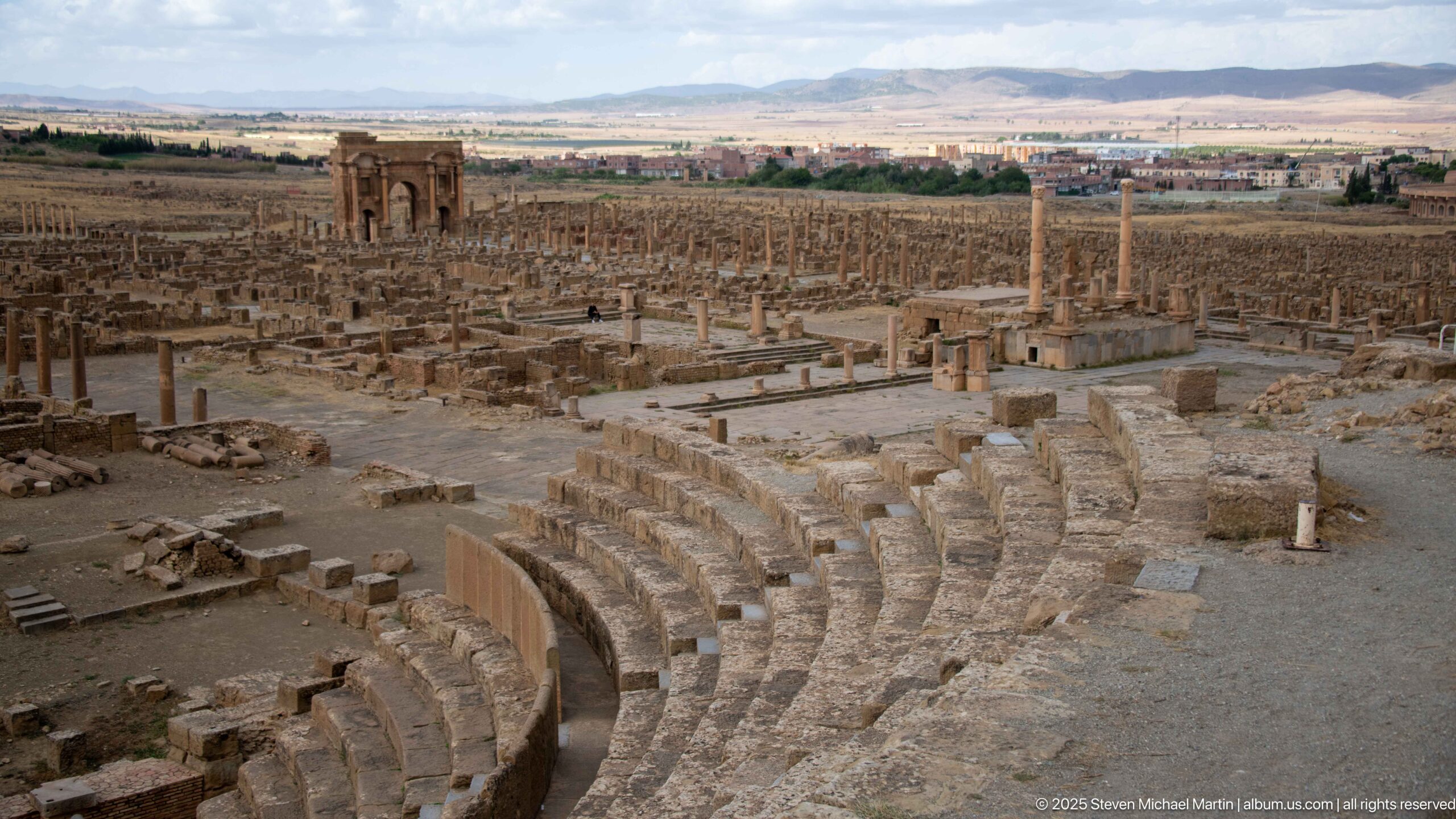
The outer curve of Timgad’s theater occupies the foreground while the ancient city spreads outward in a dense grid of walls, column bases, and standing shafts. This side-on viewpoint links the theater’s stepped seating to the surrounding civic landscape and highlights the close spacing of monumental structures within the Roman plan.
Caption
The outer curve of Timgad’s theater occupies the foreground while the ancient city spreads outward in a dense grid of walls, column bases, and standing shafts. This side-on viewpoint links the theater’s stepped seating to the surrounding civic landscape and highlights the close spacing of monumental structures within the Roman plan.
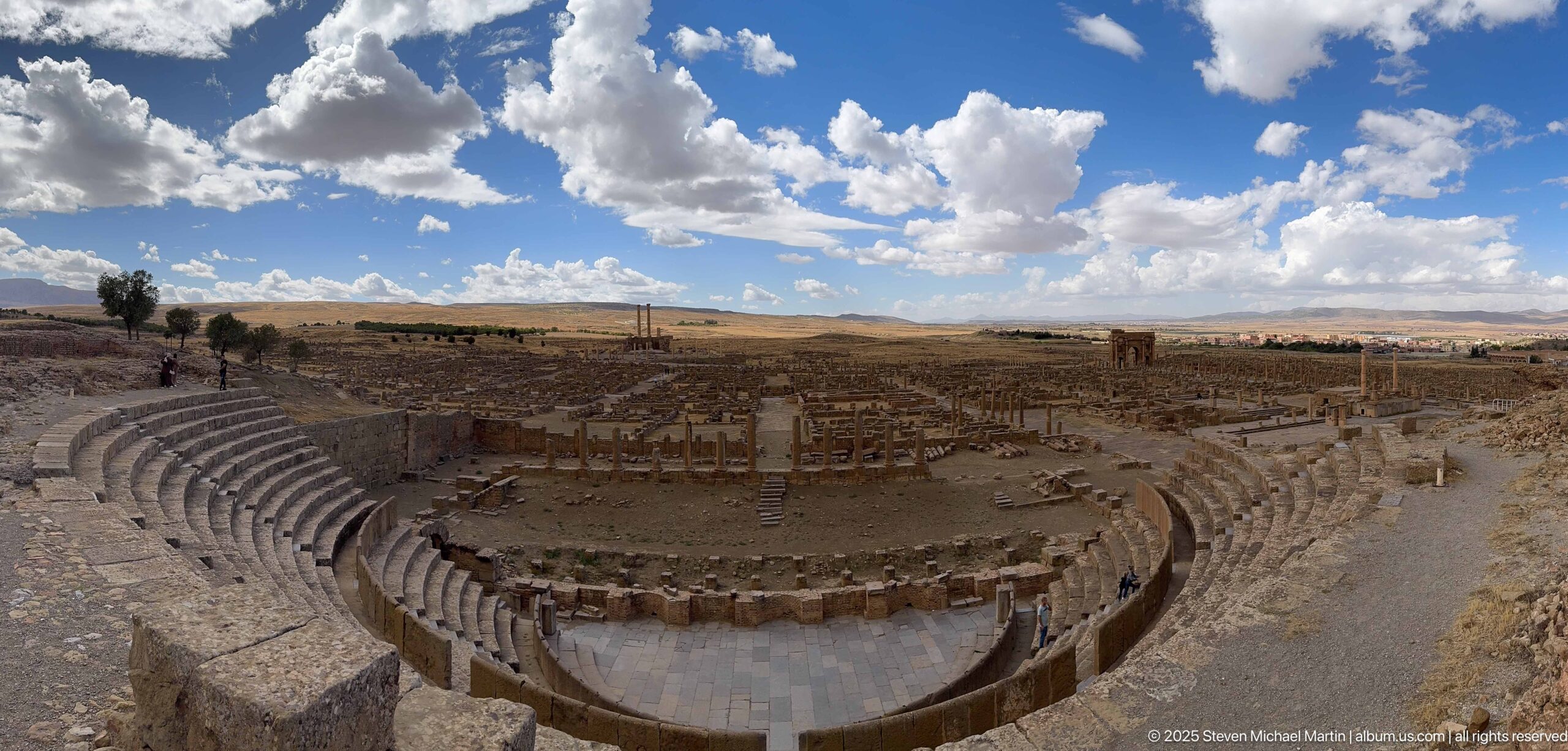
An ultra-wide elevated view takes in nearly the full arc of Timgad’s theater beneath a dramatic sky. The orchestra and stage remain centered below, while the excavated city extends toward open agricultural land and low mountains, giving unusual emphasis to the monument’s setting on the high plateau.
Caption
An ultra-wide elevated view takes in nearly the full arc of Timgad’s theater beneath a dramatic sky. The orchestra and stage remain centered below, while the excavated city extends toward open agricultural land and low mountains, giving unusual emphasis to the monument’s setting on the high plateau.
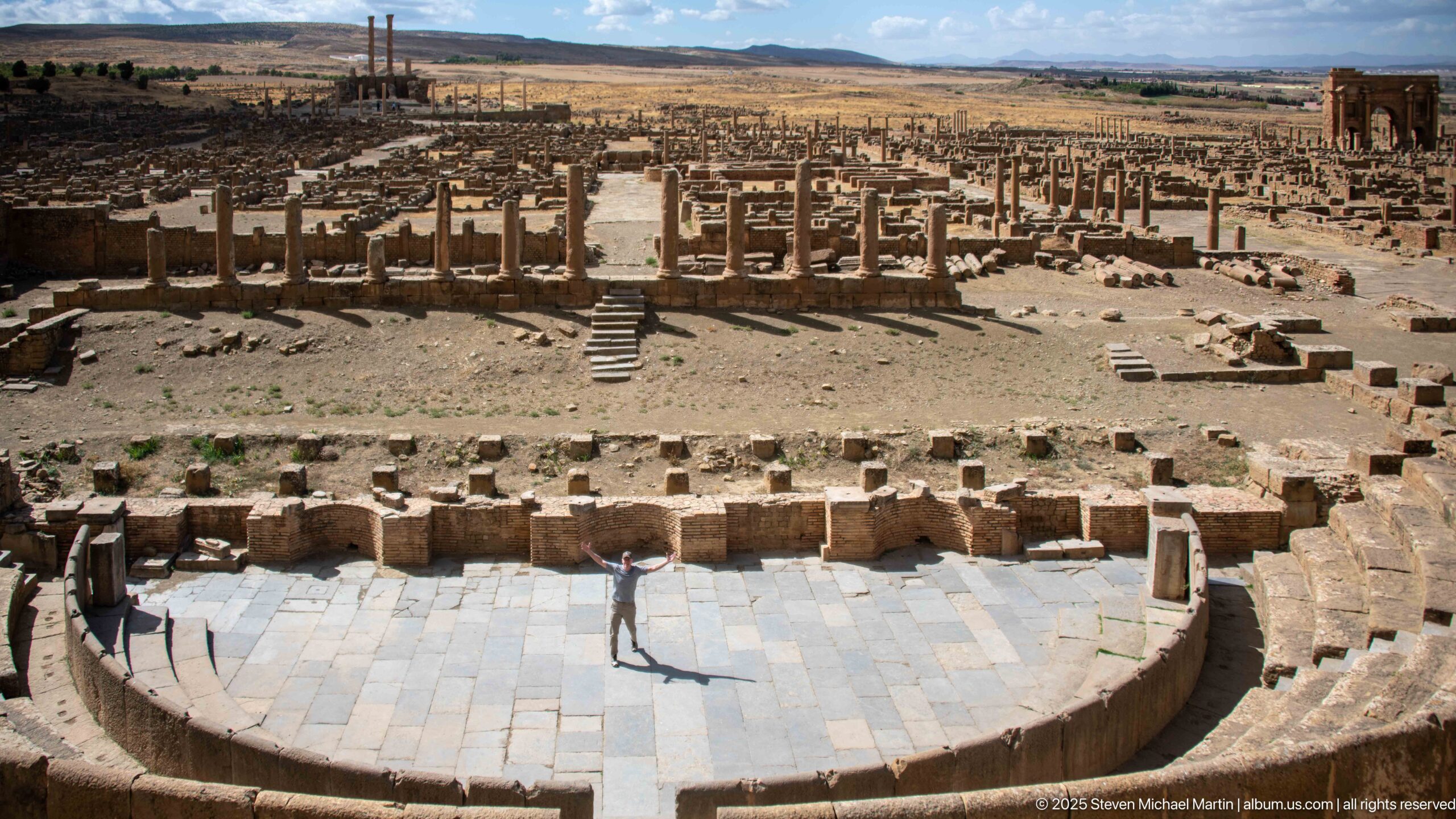
Looking steeply down from the upper seating, the paved orchestra fills the foreground while low stage structures and a line of architectural remains stretch across the middle distance. The elevated angle compresses the theater’s performance zones and reveals the excavated city immediately beyond.
Caption
Looking steeply down from the upper seating, the paved orchestra fills the foreground while low stage structures and a line of architectural remains stretch across the middle distance. The elevated angle compresses the theater’s performance zones and reveals the excavated city immediately beyond.
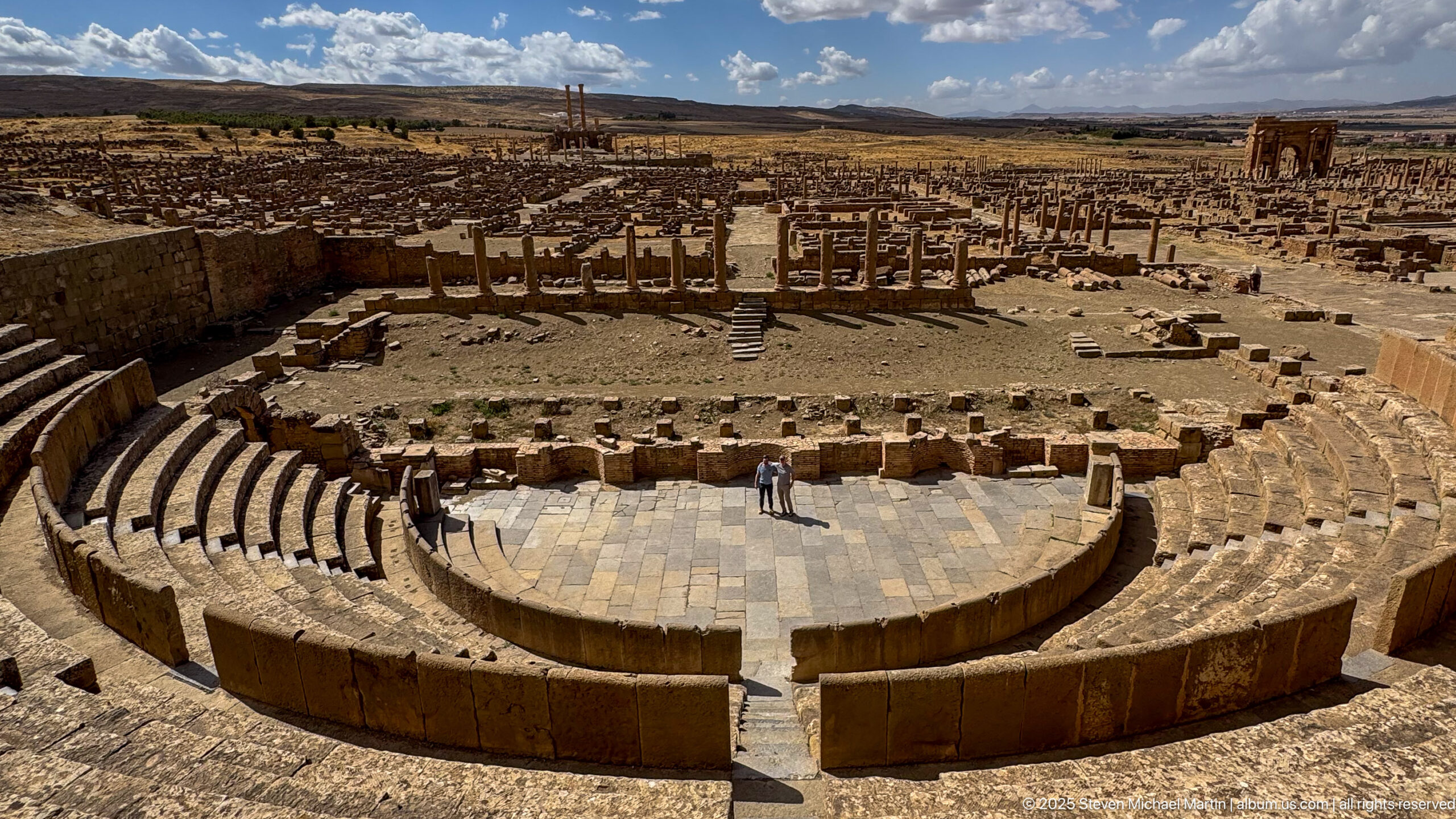
The paved orchestra forms a bright semicircle at the center of this elevated theater view, enclosed by massive retaining walls and stepped seating. Beyond the stage area, rows of columns and walls continue into the ancient city, creating a layered view from performance space to urban fabric.
Caption
The paved orchestra forms a bright semicircle at the center of this elevated theater view, enclosed by massive retaining walls and stepped seating. Beyond the stage area, rows of columns and walls continue into the ancient city, creating a layered view from performance space to urban fabric.
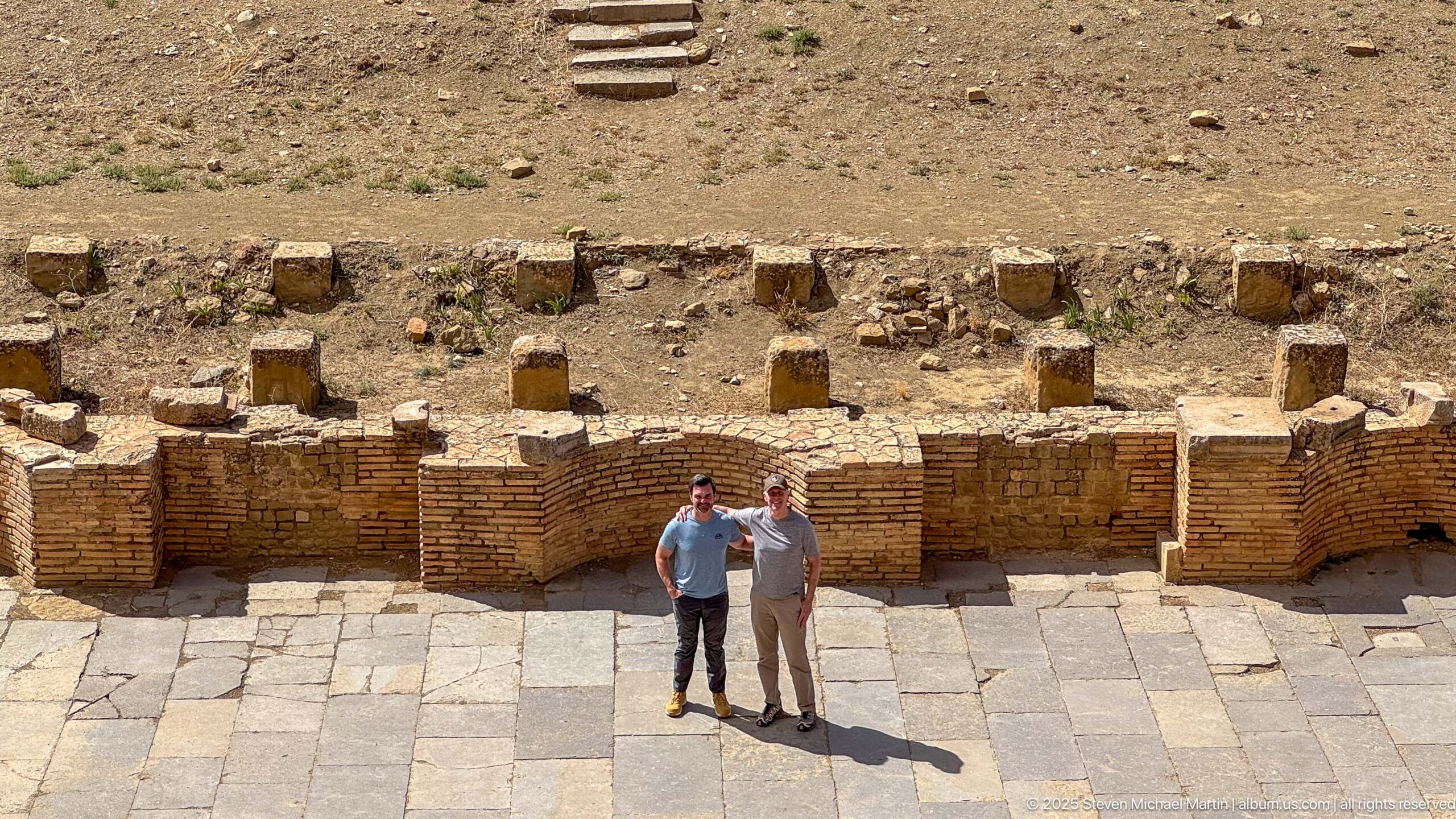
Two visitors stand on the paved orchestra of Timgad’s Roman theater, providing a direct sense of scale. Behind them, low brick-and-stone stage remains and a row of short supports mark the transition toward the stage, while the high viewpoint looks almost vertically into the performance area.
Caption
Two visitors stand on the paved orchestra of Timgad’s Roman theater, providing a direct sense of scale. Behind them, low brick-and-stone stage remains and a row of short supports mark the transition toward the stage, while the high viewpoint looks almost vertically into the performance area.
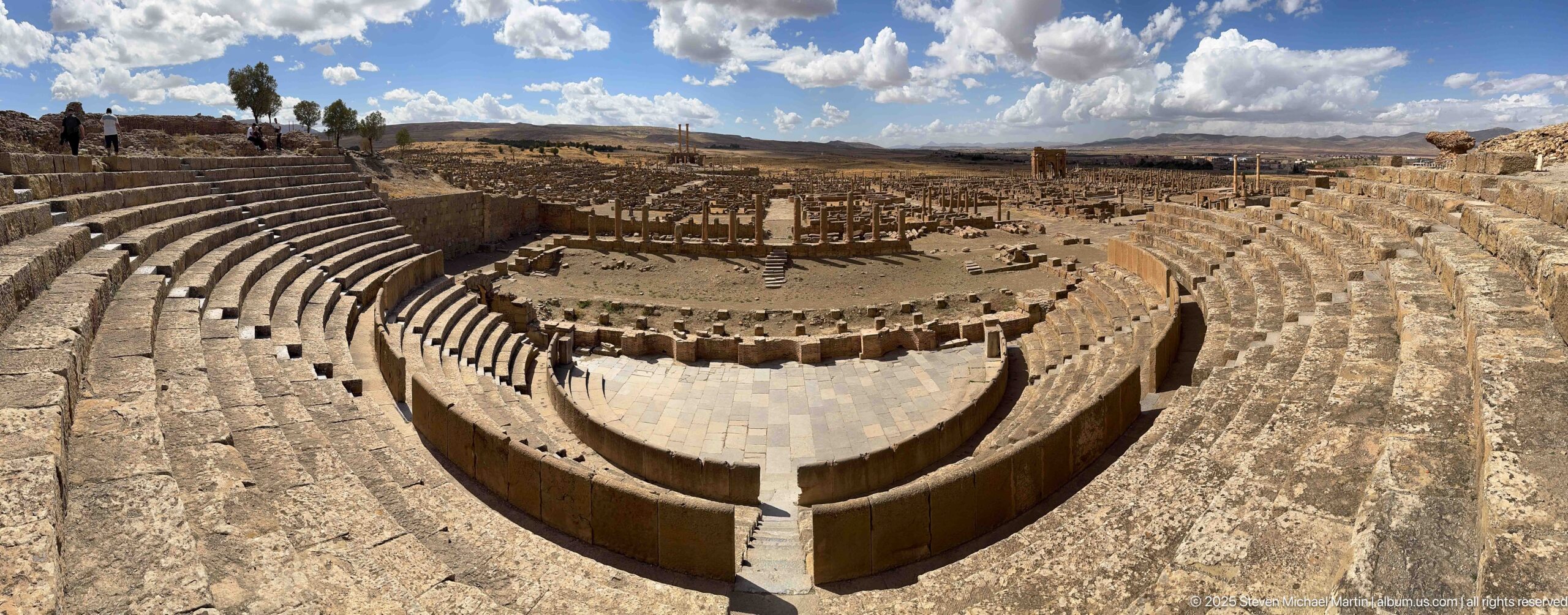
The theater’s steep seating curves dramatically around the paved orchestra in this wide-angle view from the upper cavea. Stage remains and the ancient city occupy the open side of the composition, while the exaggerated perspective emphasizes the depth and enclosure of the performance space.
Caption
The theater’s steep seating curves dramatically around the paved orchestra in this wide-angle view from the upper cavea. Stage remains and the ancient city occupy the open side of the composition, while the exaggerated perspective emphasizes the depth and enclosure of the performance space.
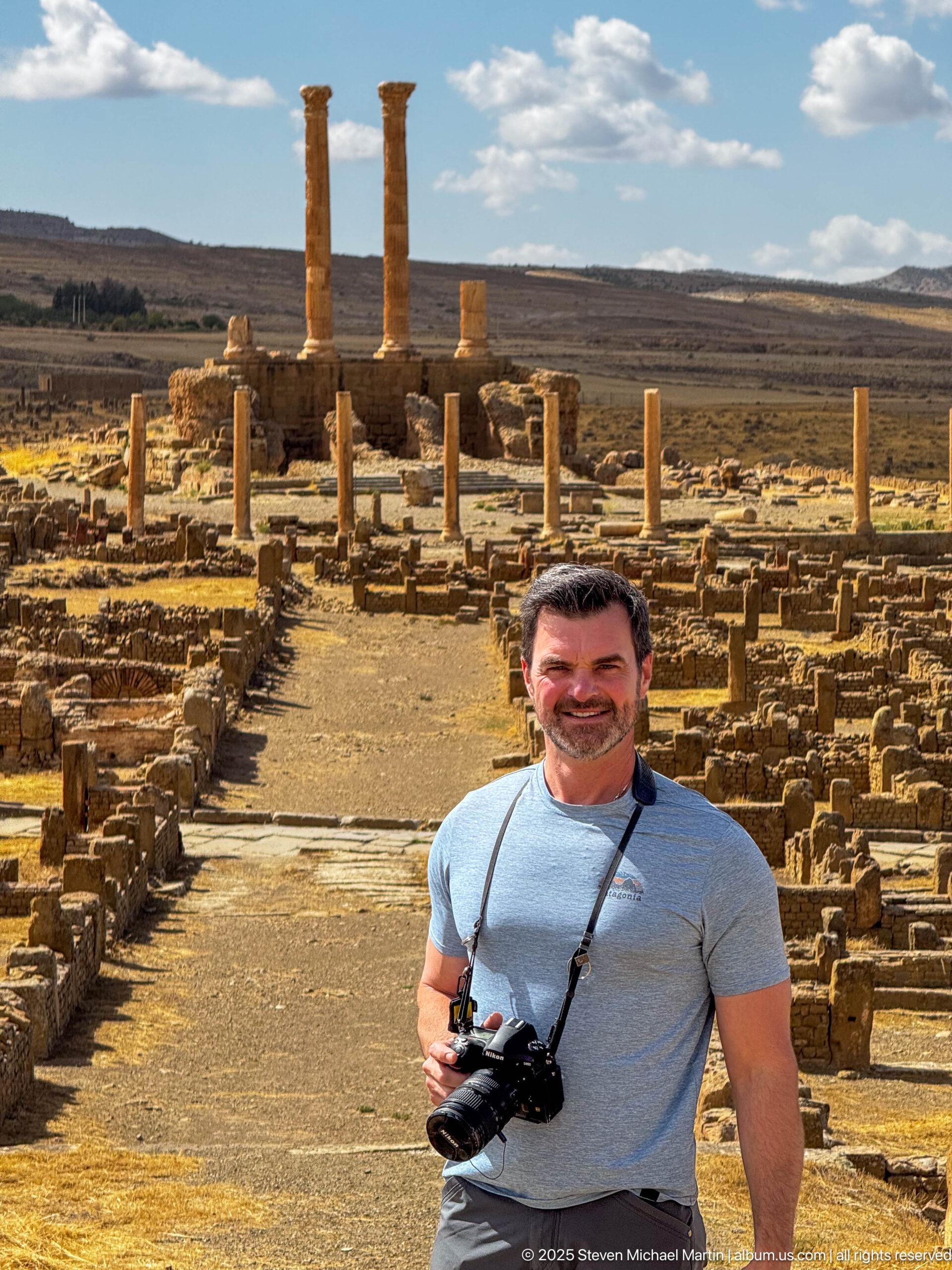
A visitor with a camera stands in the foreground of Timgad’s excavated city. Behind him, a straight ancient route leads toward standing columns and substantial masonry, combining a personal travel portrait with a clear view of the archaeological setting and the scale of the surviving urban remains.
Caption
A visitor with a camera stands in the foreground of Timgad’s excavated city. Behind him, a straight ancient route leads toward standing columns and substantial masonry, combining a personal travel portrait with a clear view of the archaeological setting and the scale of the surviving urban remains.
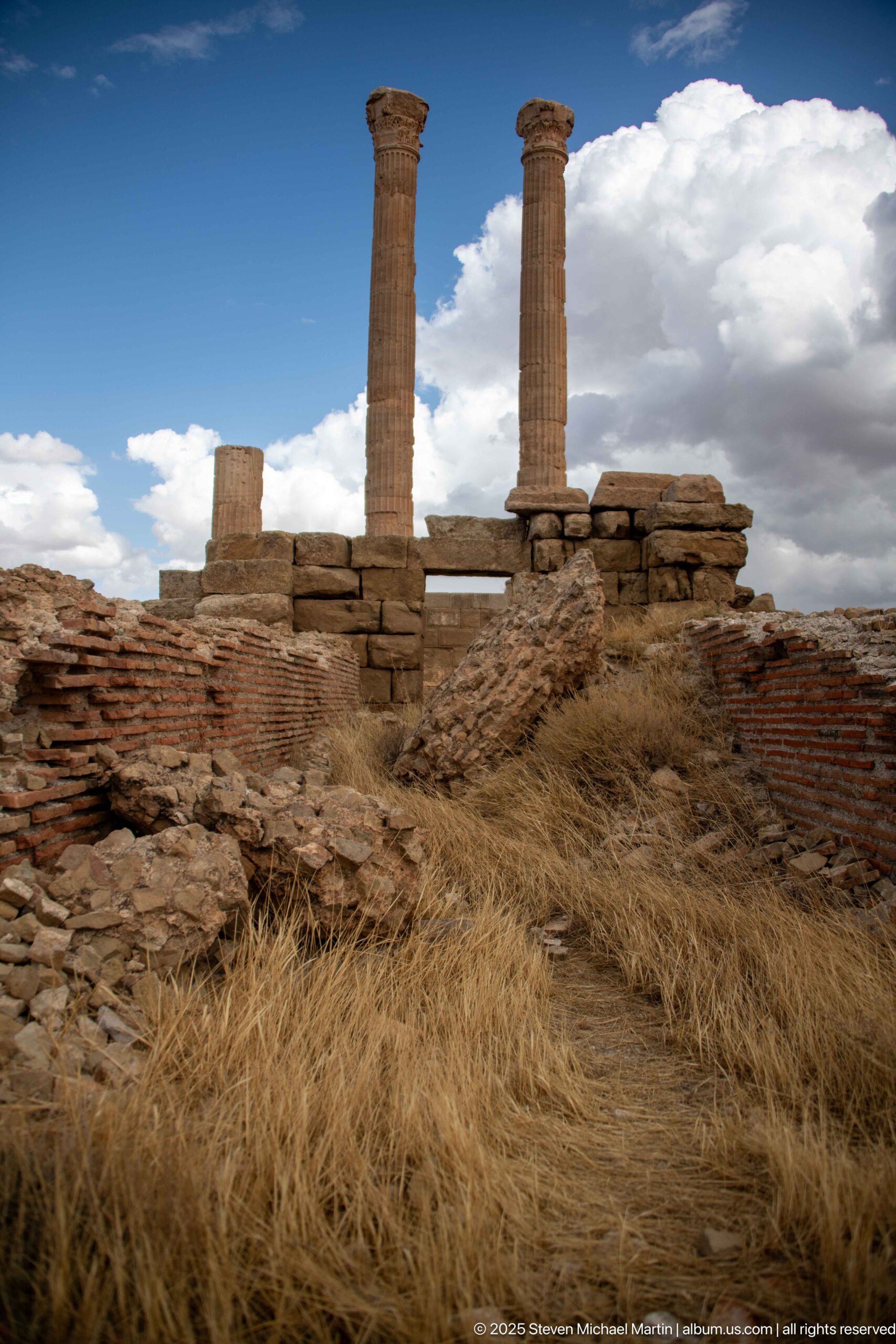
Two tall columns stand on an elevated ruin above layers of ancient brick and stone masonry. Dry grasses fill the foreground, contrasting with the vertical shafts and the bright clouded sky, while the low viewpoint emphasizes the surviving height of the monumental structure.
Caption
Two tall columns stand on an elevated ruin above layers of ancient brick and stone masonry. Dry grasses fill the foreground, contrasting with the vertical shafts and the bright clouded sky, while the low viewpoint emphasizes the surviving height of the monumental structure.
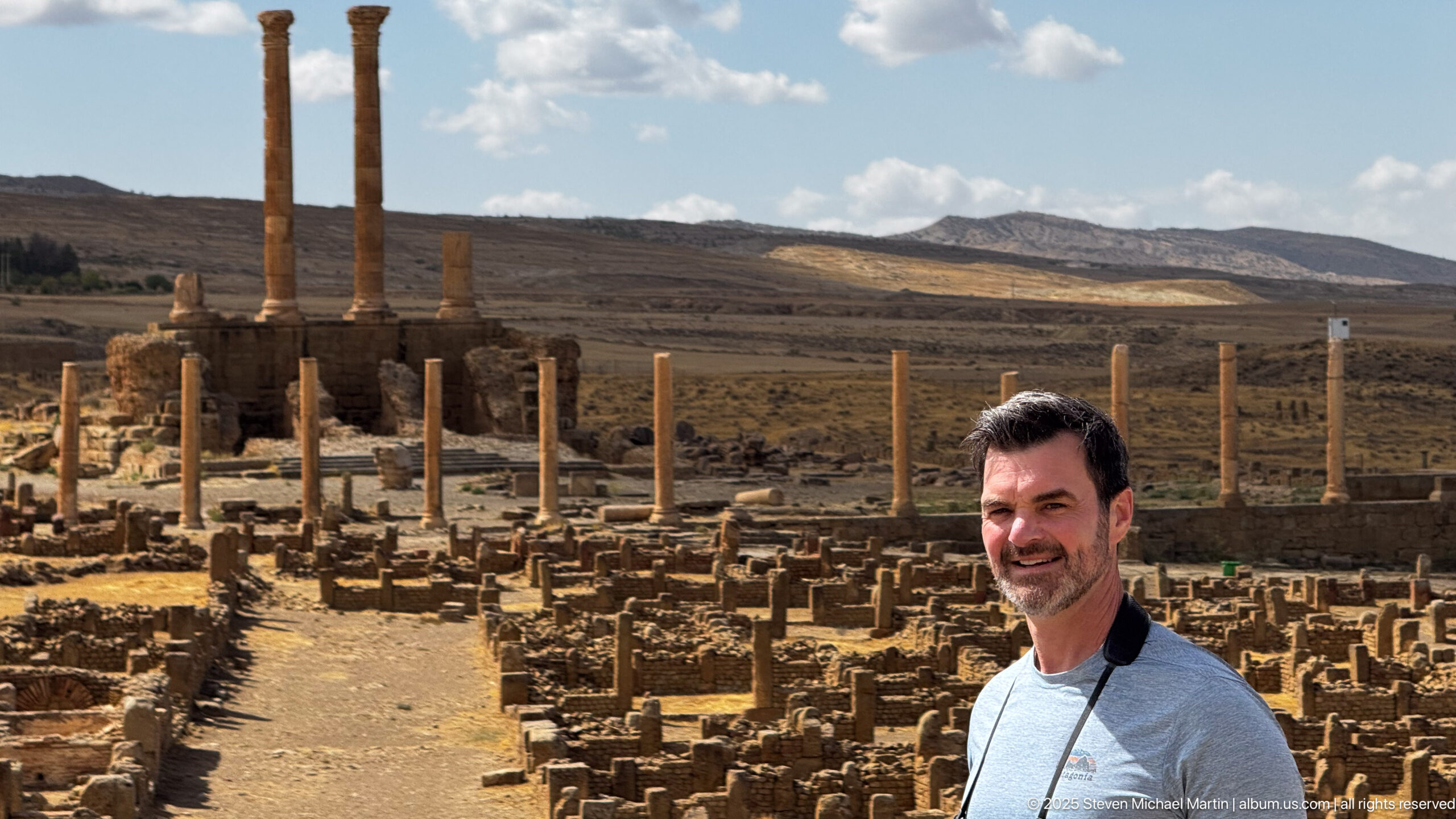
A visitor stands beside a broad ancient street with tall surviving columns and dense masonry behind. The portrait uses Timgad’s monumental ruins as an architectural backdrop, with the long alignment of columns and the open upland landscape beyond giving depth to the archaeological setting.
Caption
A visitor stands beside a broad ancient street with tall surviving columns and dense masonry behind. The portrait uses Timgad’s monumental ruins as an architectural backdrop, with the long alignment of columns and the open upland landscape beyond giving depth to the archaeological setting.
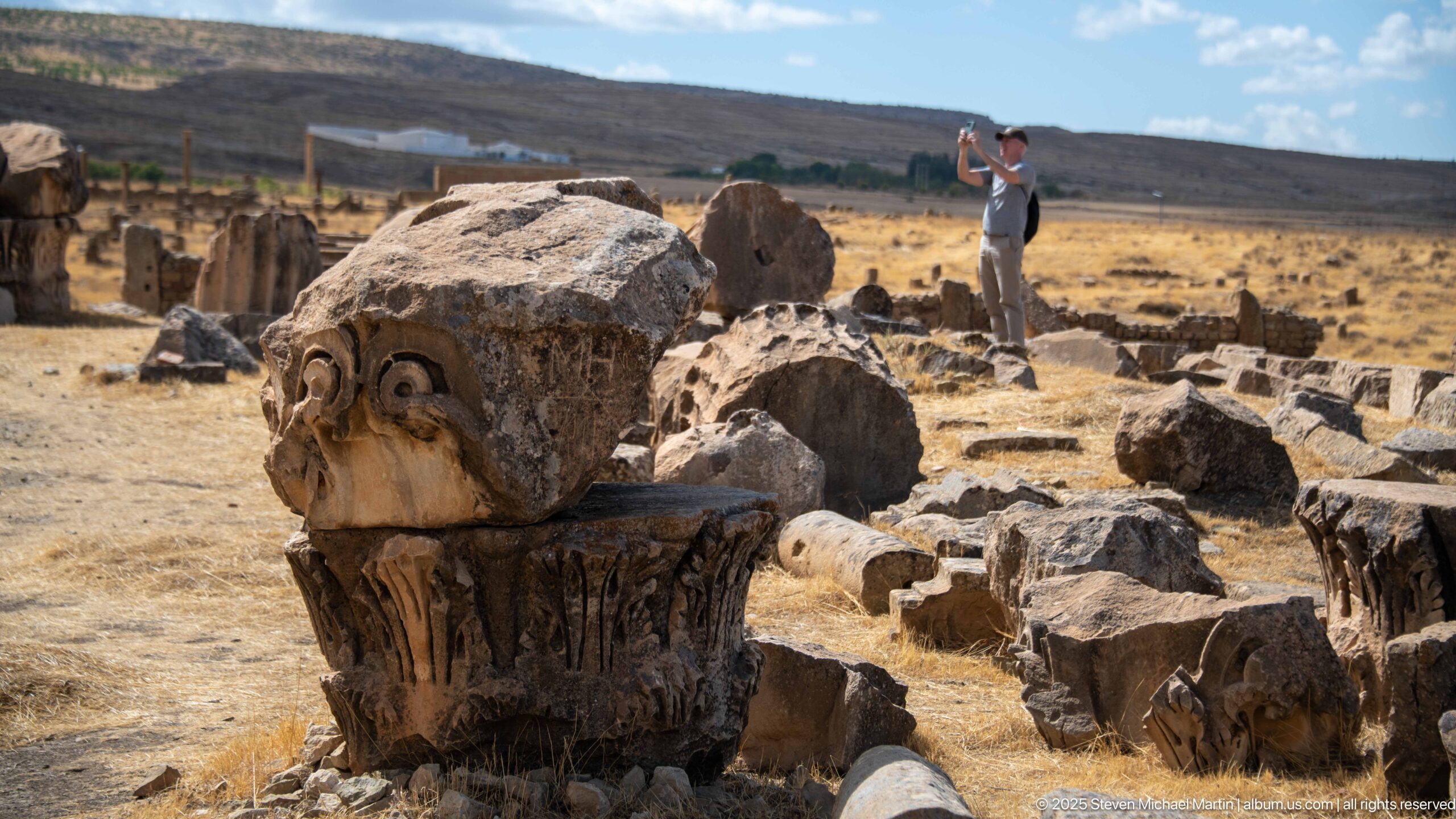
A richly carved stone capital sits among fallen column drums and architectural blocks at Timgad. Deeply cut acanthus-like foliage survives around the capital despite heavy weathering, offering a close view of the decorative vocabulary once used on the city’s monumental colonnades and public buildings.
Caption
A richly carved stone capital sits among fallen column drums and architectural blocks at Timgad. Deeply cut acanthus-like foliage survives around the capital despite heavy weathering, offering a close view of the decorative vocabulary once used on the city’s monumental colonnades and public buildings.
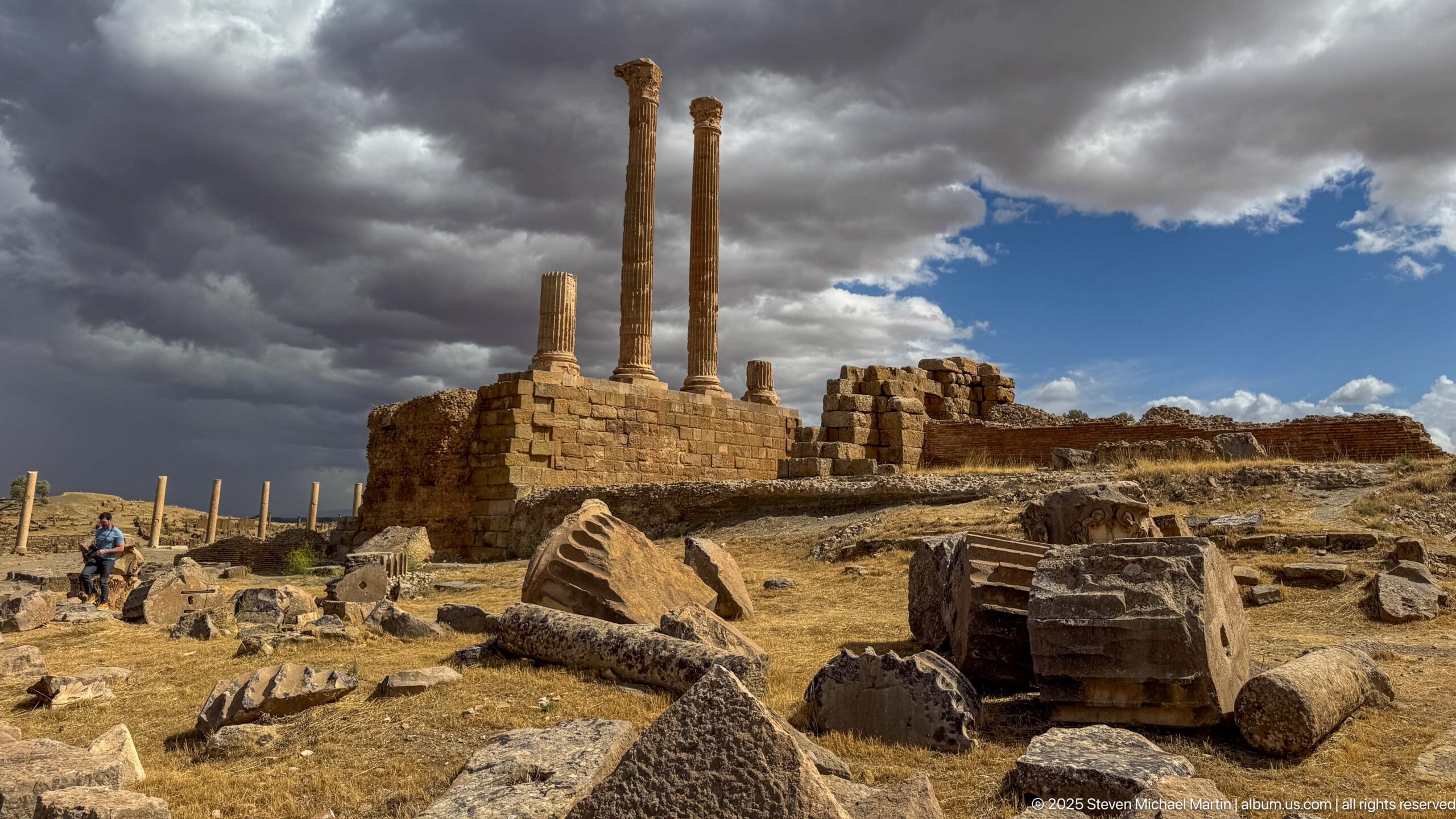
Two tall columns dominate a raised mass of ancient masonry beneath dark storm clouds, while fallen drums, capitals, and blocks lie scattered across the foreground. The dramatic light isolates the vertical remains against the sky and underscores the fragmented condition of Timgad’s monumental architecture.
Caption
Two tall columns dominate a raised mass of ancient masonry beneath dark storm clouds, while fallen drums, capitals, and blocks lie scattered across the foreground. The dramatic light isolates the vertical remains against the sky and underscores the fragmented condition of Timgad’s monumental architecture.
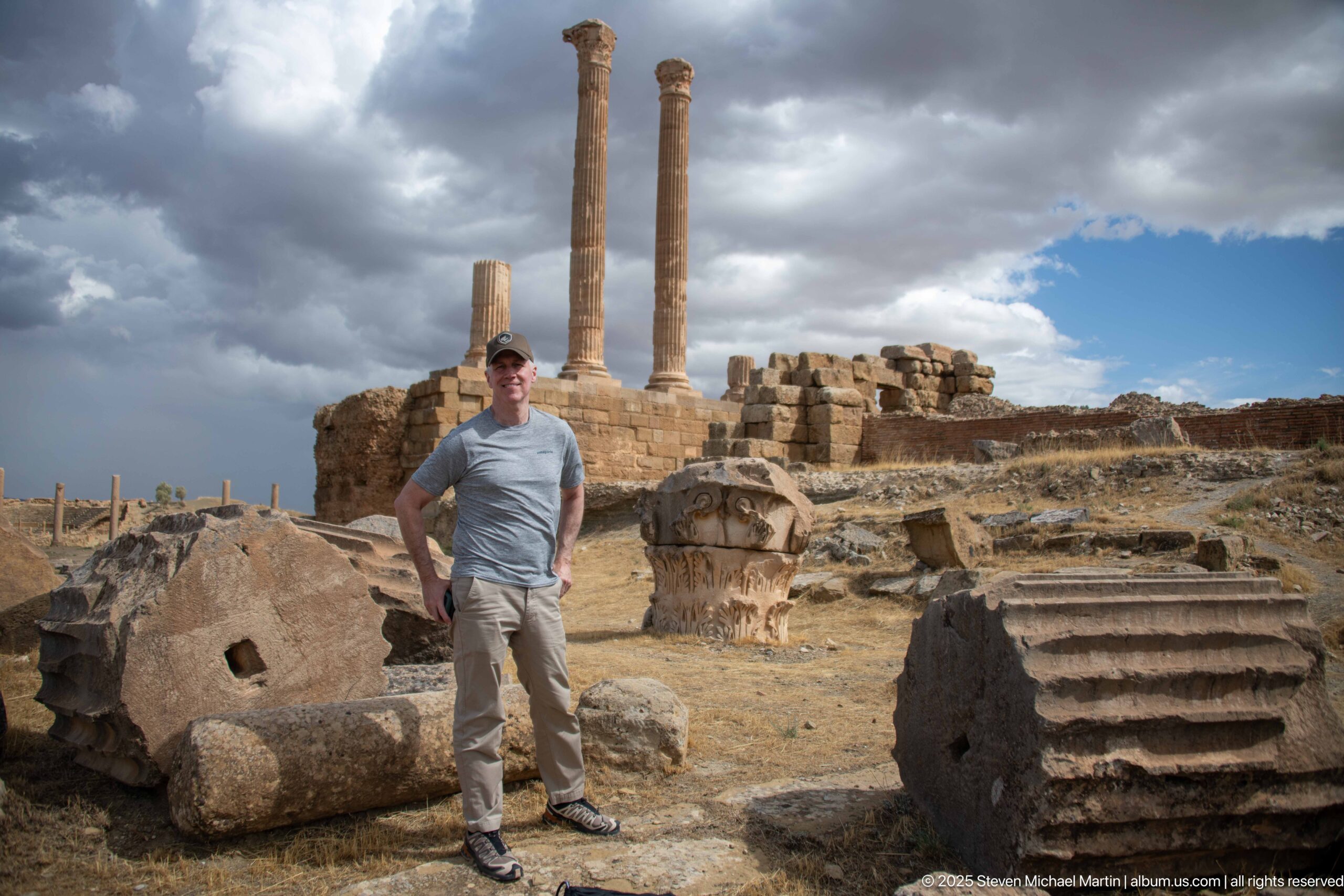
A visitor stands among massive fallen architectural elements at Timgad, including carved capitals, column sections, and large cut-stone blocks. Tall columns and substantial masonry rise behind him, turning the portrait into a study of human scale against the oversized components of Roman monumental construction.
Caption
A visitor stands among massive fallen architectural elements at Timgad, including carved capitals, column sections, and large cut-stone blocks. Tall columns and substantial masonry rise behind him, turning the portrait into a study of human scale against the oversized components of Roman monumental construction.
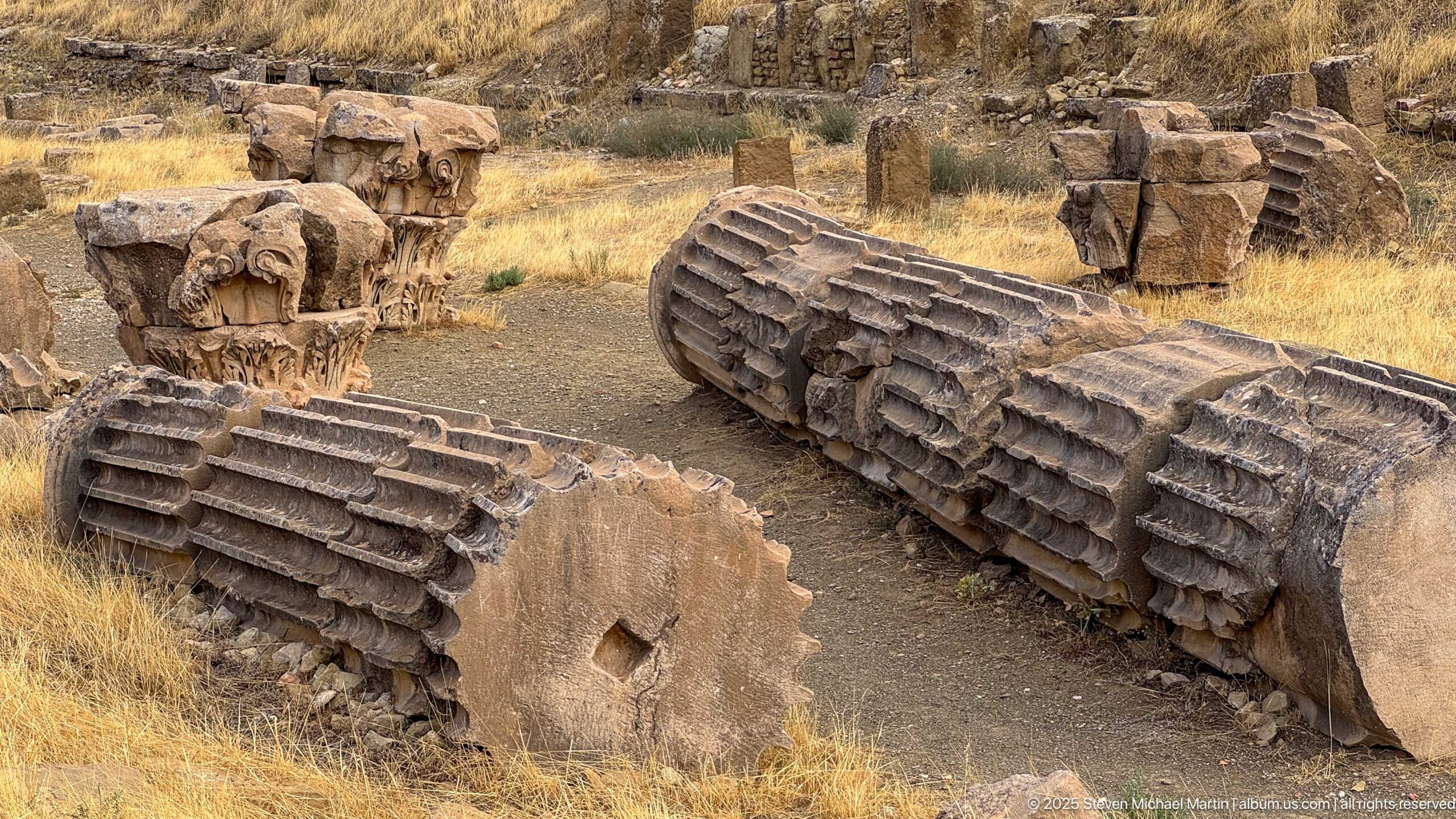
Massive fallen column sections lie across the dry ground, their deep fluting still sharply legible despite centuries of weathering. Nearby carved capitals and smaller stone fragments show how the elements of Timgad’s monumental colonnades now survive as disassembled architectural pieces within the archaeological field.
Caption
Massive fallen column sections lie across the dry ground, their deep fluting still sharply legible despite centuries of weathering. Nearby carved capitals and smaller stone fragments show how the elements of Timgad’s monumental colonnades now survive as disassembled architectural pieces within the archaeological field.

The Arch of Trajan stands almost frontally against a luminous sky, its great central passage flanked by two smaller side openings. Engaged columns, projecting entablatures, and surviving upper masonry articulate the monumental western gateway, one of the most recognizable architectural landmarks within the Roman city of Timgad.
Caption
The Arch of Trajan stands almost frontally against a luminous sky, its great central passage flanked by two smaller side openings. Engaged columns, projecting entablatures, and surviving upper masonry articulate the monumental western gateway, one of the most recognizable architectural landmarks within the Roman city of Timgad.
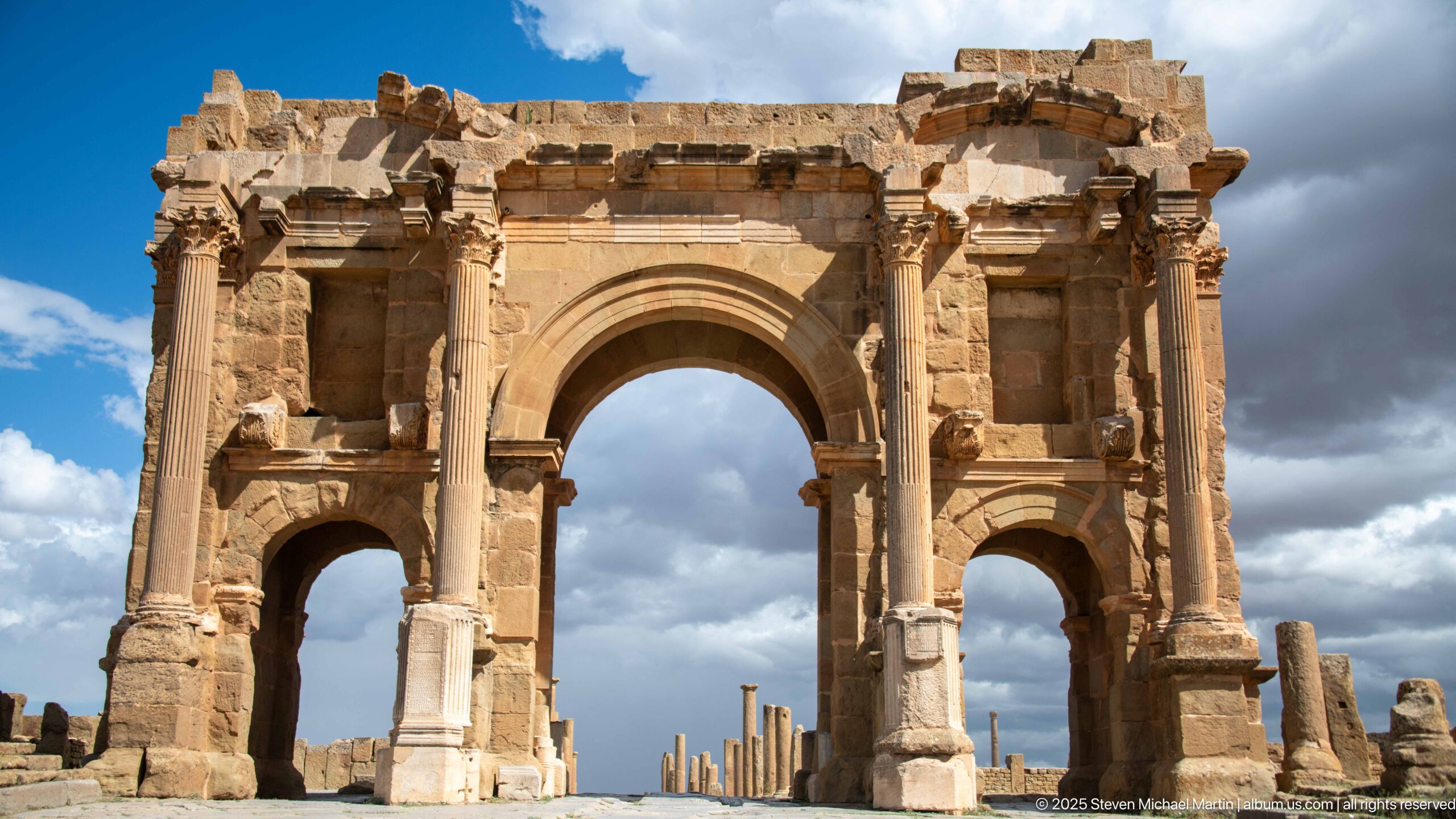
A closer frontal composition isolates the Arch of Trajan’s three openings and richly modeled façade. The central arch dominates, while smaller side passages, engaged columns, niches, and projecting cornice work reveal the layered design of the monumental gateway against the deep blue and cloud-filled sky.
Caption
A closer frontal composition isolates the Arch of Trajan’s three openings and richly modeled façade. The central arch dominates, while smaller side passages, engaged columns, niches, and projecting cornice work reveal the layered design of the monumental gateway against the deep blue and cloud-filled sky.
A tall single-bay Roman arch rises above a stone-paved route within the ruins of Timgad. Slender standing columns and low masonry extend along both sides, while the distant plateau and dramatic cloudscape emphasize the monument’s isolation within the excavated city. The photograph records the arch in its broader street and urban setting rather than as a close architectural study.
Caption
A tall single-bay Roman arch rises above a stone-paved route within the ruins of Timgad. Slender standing columns and low masonry extend along both sides, while the distant plateau and dramatic cloudscape emphasize the monument’s isolation within the excavated city. The photograph records the arch in its broader street and urban setting rather than as a close architectural study.
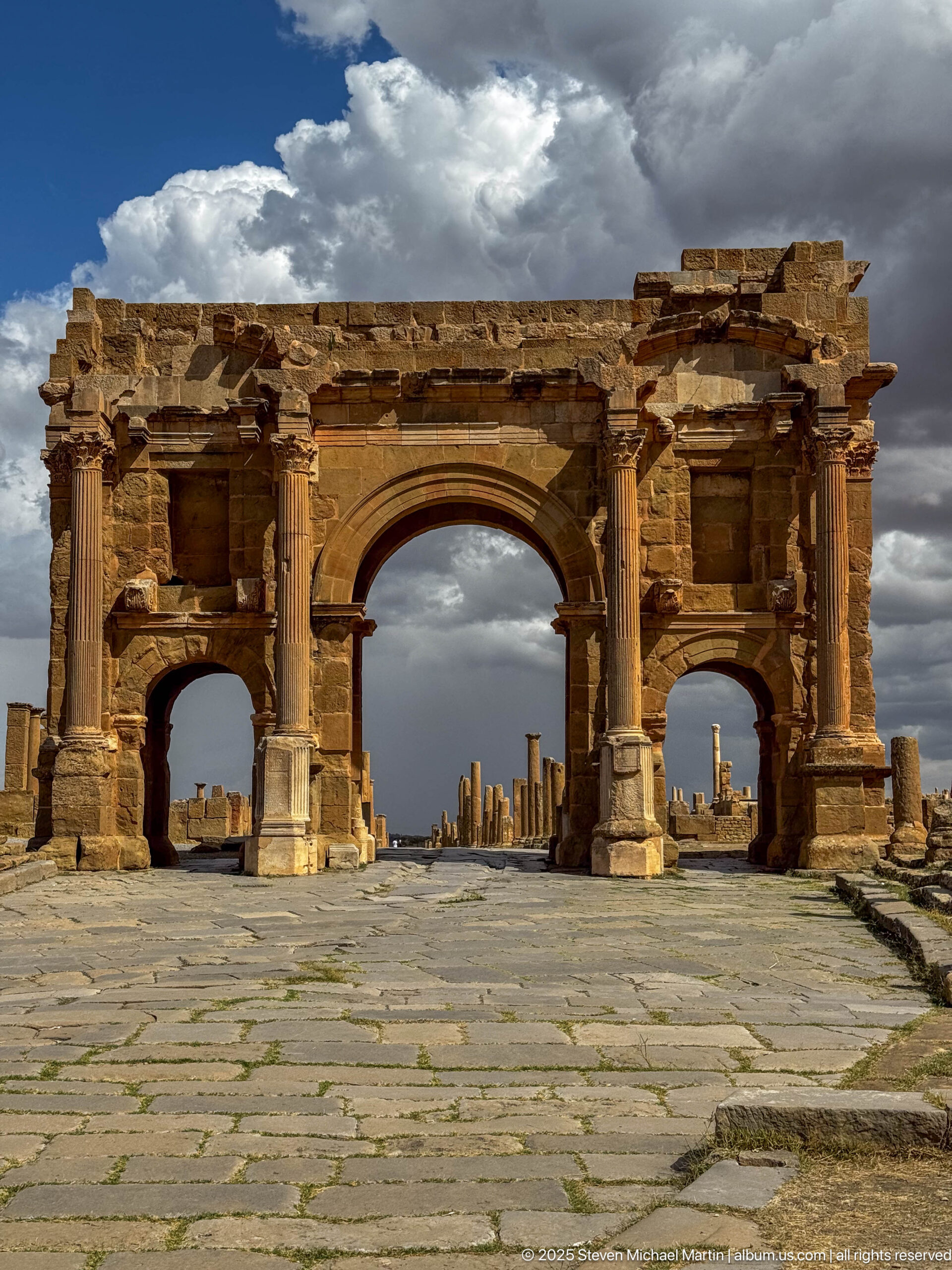
The Arch of Trajan spans the paved street in a broad frontal view, with a dominant central passage flanked by two smaller openings. Engaged columns, recessed wall bays, projecting entablatures, and surviving upper masonry give the gateway a strongly articulated façade. The low viewpoint also preserves the relationship between the arch and the ancient paving that approaches it.
Caption
The Arch of Trajan spans the paved street in a broad frontal view, with a dominant central passage flanked by two smaller openings. Engaged columns, recessed wall bays, projecting entablatures, and surviving upper masonry give the gateway a strongly articulated façade. The low viewpoint also preserves the relationship between the arch and the ancient paving that approaches it.
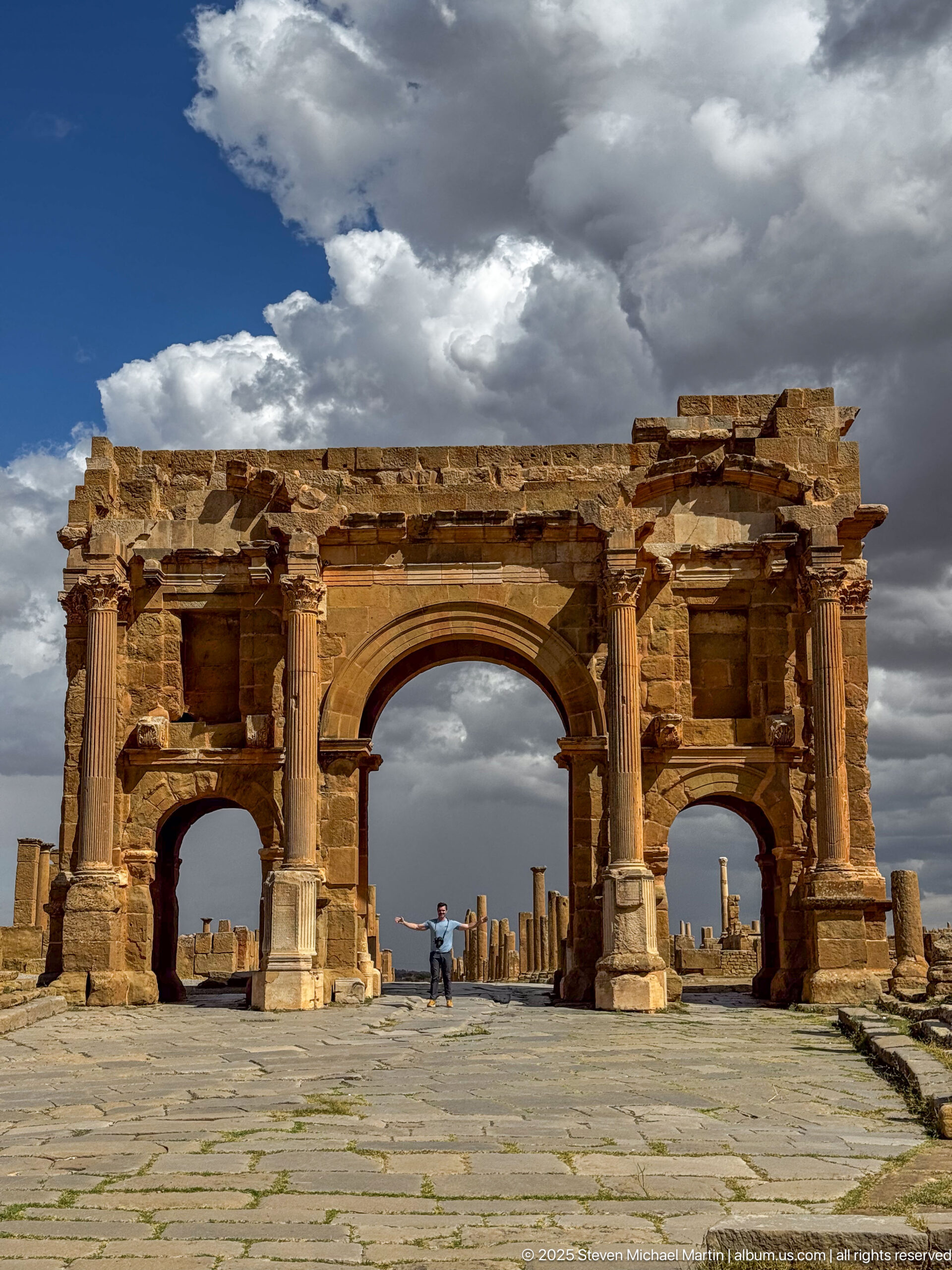
A centered view of the Arch of Trajan emphasizes the width of its central opening and the two lower side passages, while a visitor standing beneath the monument provides an immediate sense of scale. Weathered engaged columns and deep recessed bays break up the façade, and the broad stone paving leads directly toward the gateway through the Roman city.
Caption
A centered view of the Arch of Trajan emphasizes the width of its central opening and the two lower side passages, while a visitor standing beneath the monument provides an immediate sense of scale. Weathered engaged columns and deep recessed bays break up the façade, and the broad stone paving leads directly toward the gateway through the Roman city.
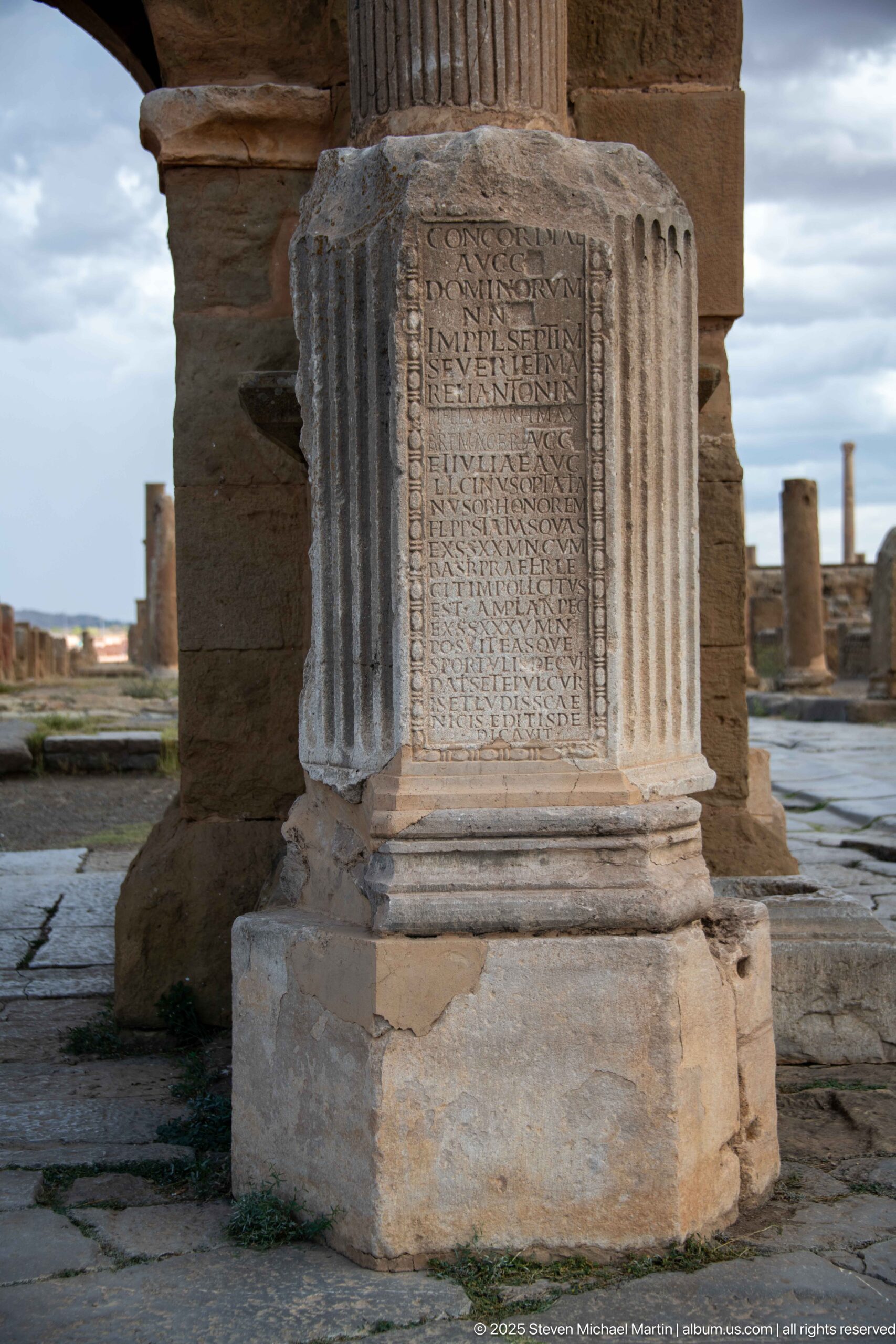
A rectangular Latin inscription is carved into the face of a substantial stone pedestal, framed by narrow fluted decorative bands. The surviving letter forms remain legible across multiple lines despite weathering, while the broad molded base and heavy upper block indicate that the inscription belonged to a larger commemorative or honorific monument within Timgad.
Caption
A rectangular Latin inscription is carved into the face of a substantial stone pedestal, framed by narrow fluted decorative bands. The surviving letter forms remain legible across multiple lines despite weathering, while the broad molded base and heavy upper block indicate that the inscription belonged to a larger commemorative or honorific monument within Timgad.
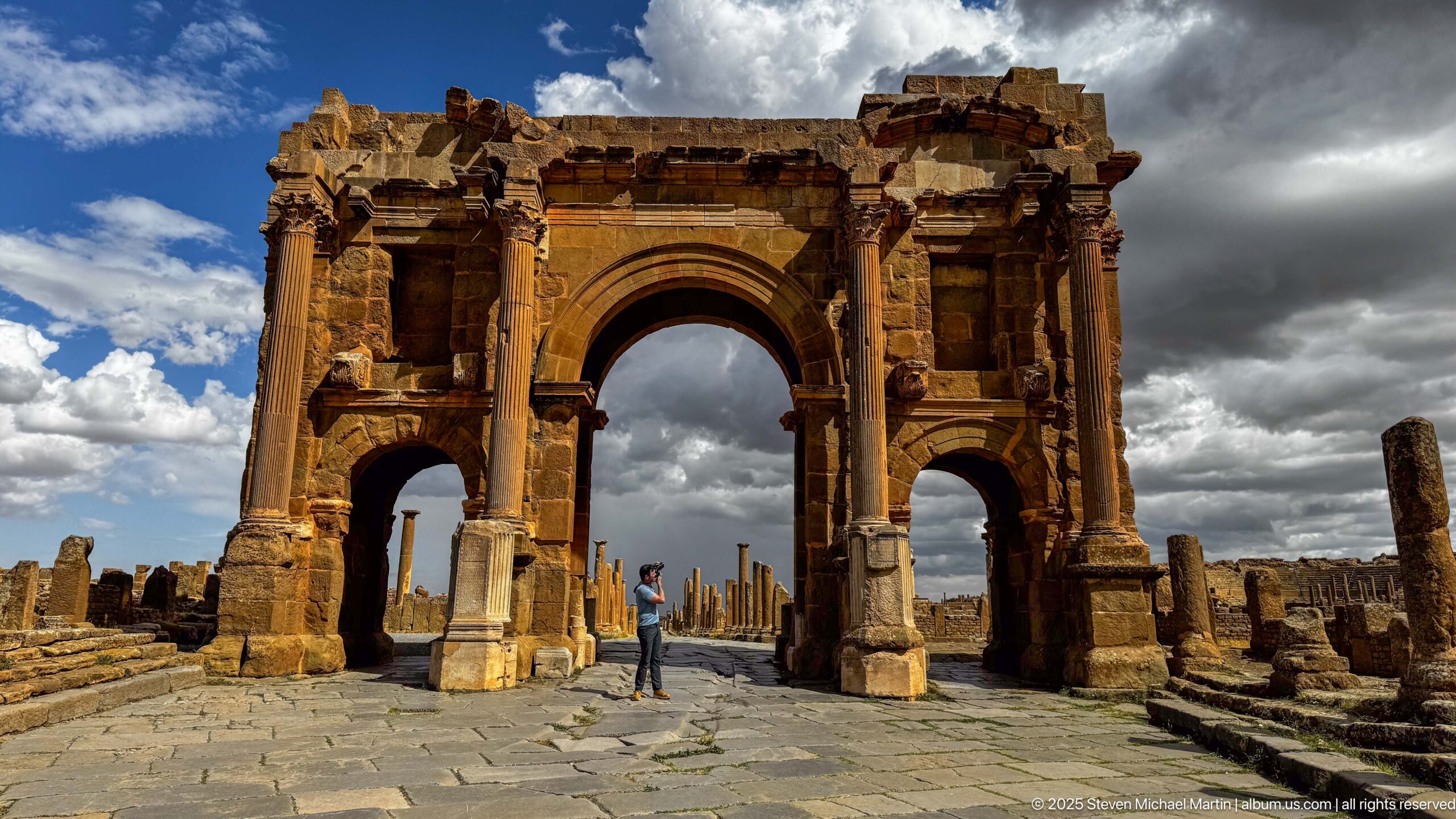
Seen from close range and slightly off axis, the Arch of Trajan towers above the paved street with its central vault dominating the composition. The angle brings the engaged columns, recessed side bays, cornice lines, and weathered block construction into sharper relief, while a visitor beneath the opening reinforces the scale of the Roman gateway.
Caption
Seen from close range and slightly off axis, the Arch of Trajan towers above the paved street with its central vault dominating the composition. The angle brings the engaged columns, recessed side bays, cornice lines, and weathered block construction into sharper relief, while a visitor beneath the opening reinforces the scale of the Roman gateway.
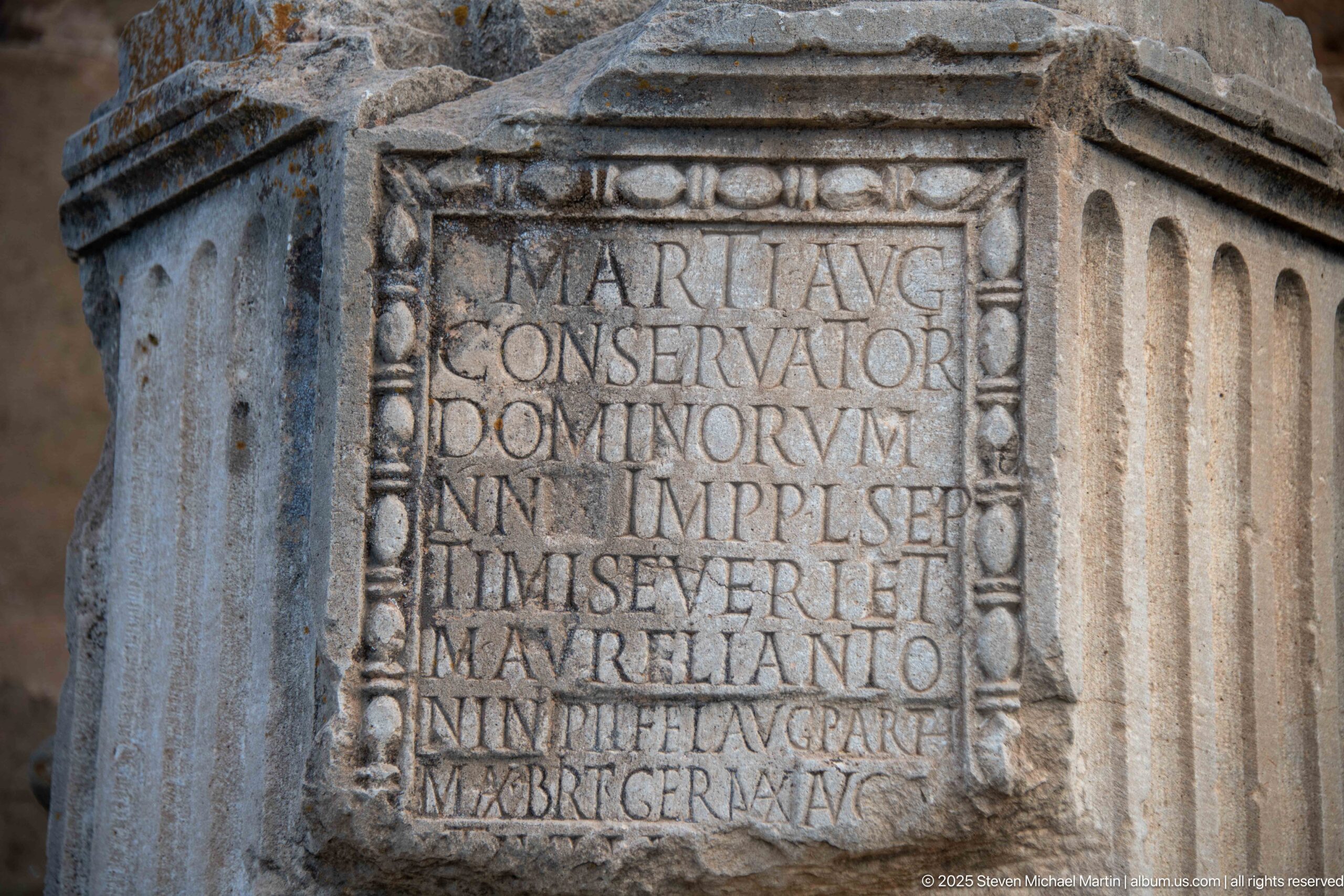
Deeply cut Latin capitals fill a recessed rectangular panel on this weathered stone pedestal at Timgad. The close framing makes individual letter forms and line spacing much clearer than in the preceding view, while the molded border and vertical side channels preserve the formal architectural setting of the inscription. The photograph is best read as an epigraphic detail rather than a general view of the monument.
Caption
Deeply cut Latin capitals fill a recessed rectangular panel on this weathered stone pedestal at Timgad. The close framing makes individual letter forms and line spacing much clearer than in the preceding view, while the molded border and vertical side channels preserve the formal architectural setting of the inscription. The photograph is best read as an epigraphic detail rather than a general view of the monument.
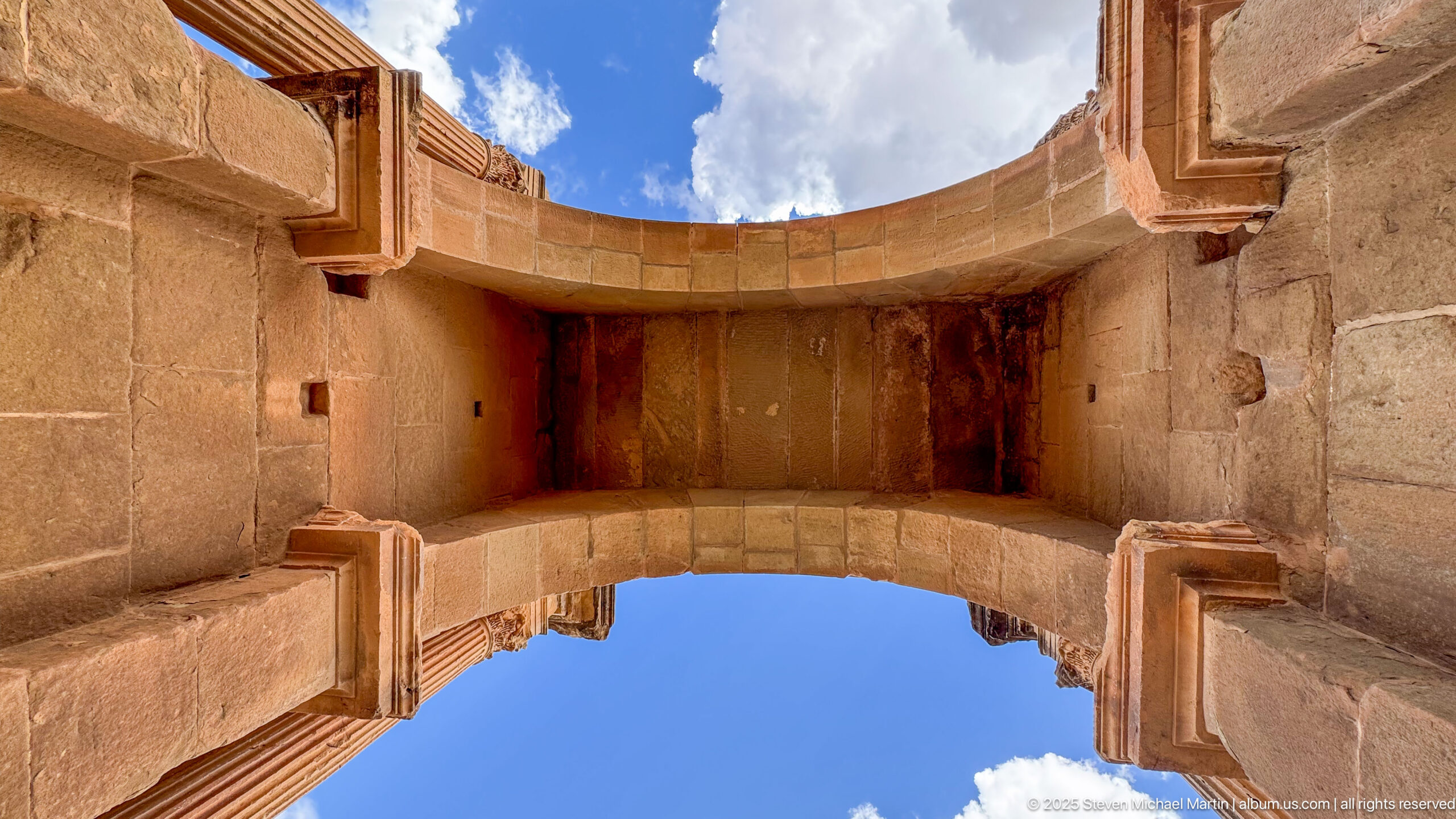
Looking upward from within the monument, the massive stone vault of Timgad’s Arch of Trajan curves across a vivid blue sky. The low-angle composition isolates the voussoirs, projecting cornices, and heavy piers, turning the celebrated gateway into a study of Roman masonry, scale, and structural geometry.
Caption
Looking upward from within the monument, the massive stone vault of Timgad’s Arch of Trajan curves across a vivid blue sky. The low-angle composition isolates the voussoirs, projecting cornices, and heavy piers, turning the celebrated gateway into a study of Roman masonry, scale, and structural geometry.
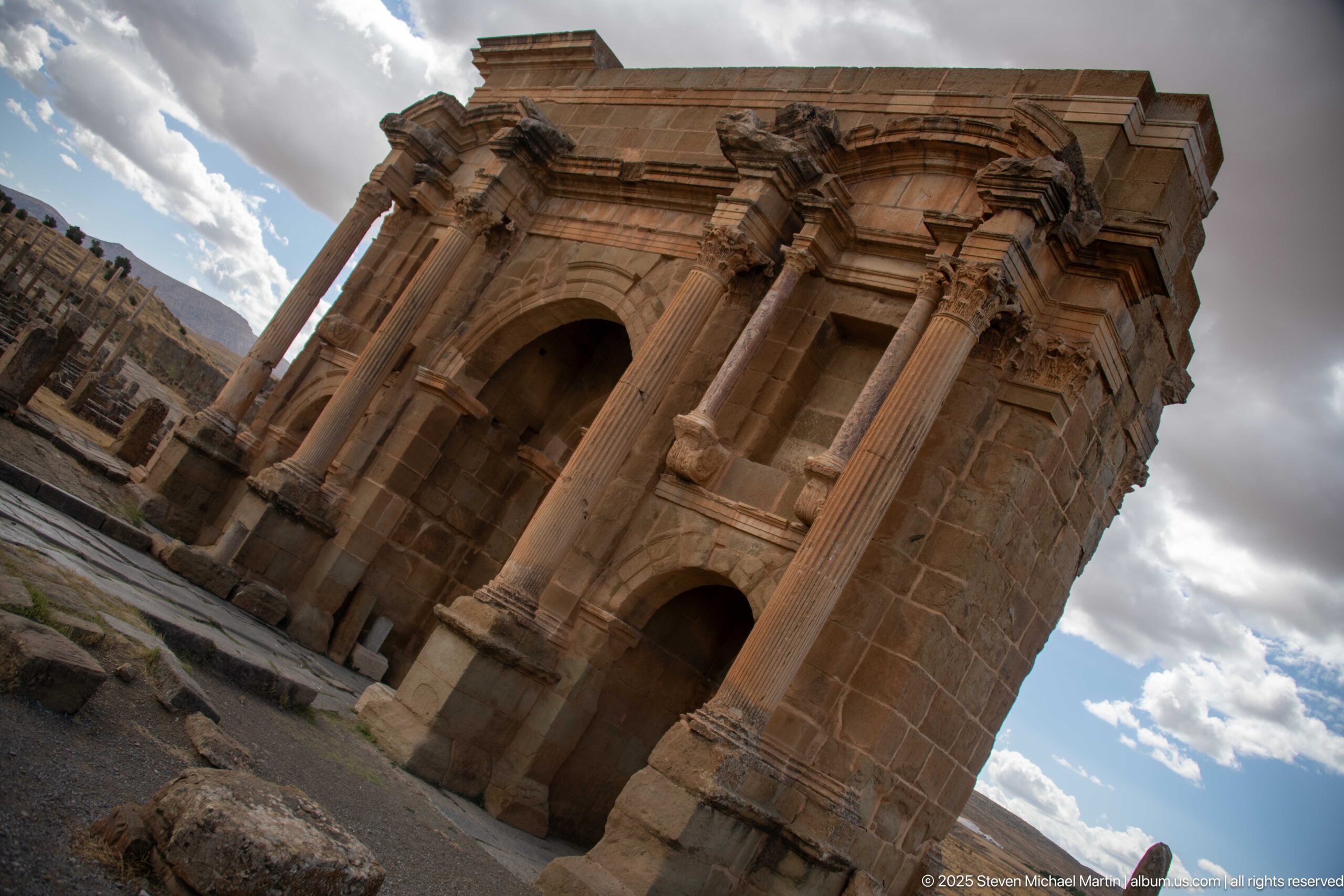
An oblique, low-angle view emphasizes the layered façade of Timgad’s Arch of Trajan, with its great central opening, smaller side passage, engaged columns, niches, and projecting entablatures. The tilted perspective brings out the monument’s depth and the sculptural articulation of its stonework.
Caption
An oblique, low-angle view emphasizes the layered façade of Timgad’s Arch of Trajan, with its great central opening, smaller side passage, engaged columns, niches, and projecting entablatures. The tilted perspective brings out the monument’s depth and the sculptural articulation of its stonework.
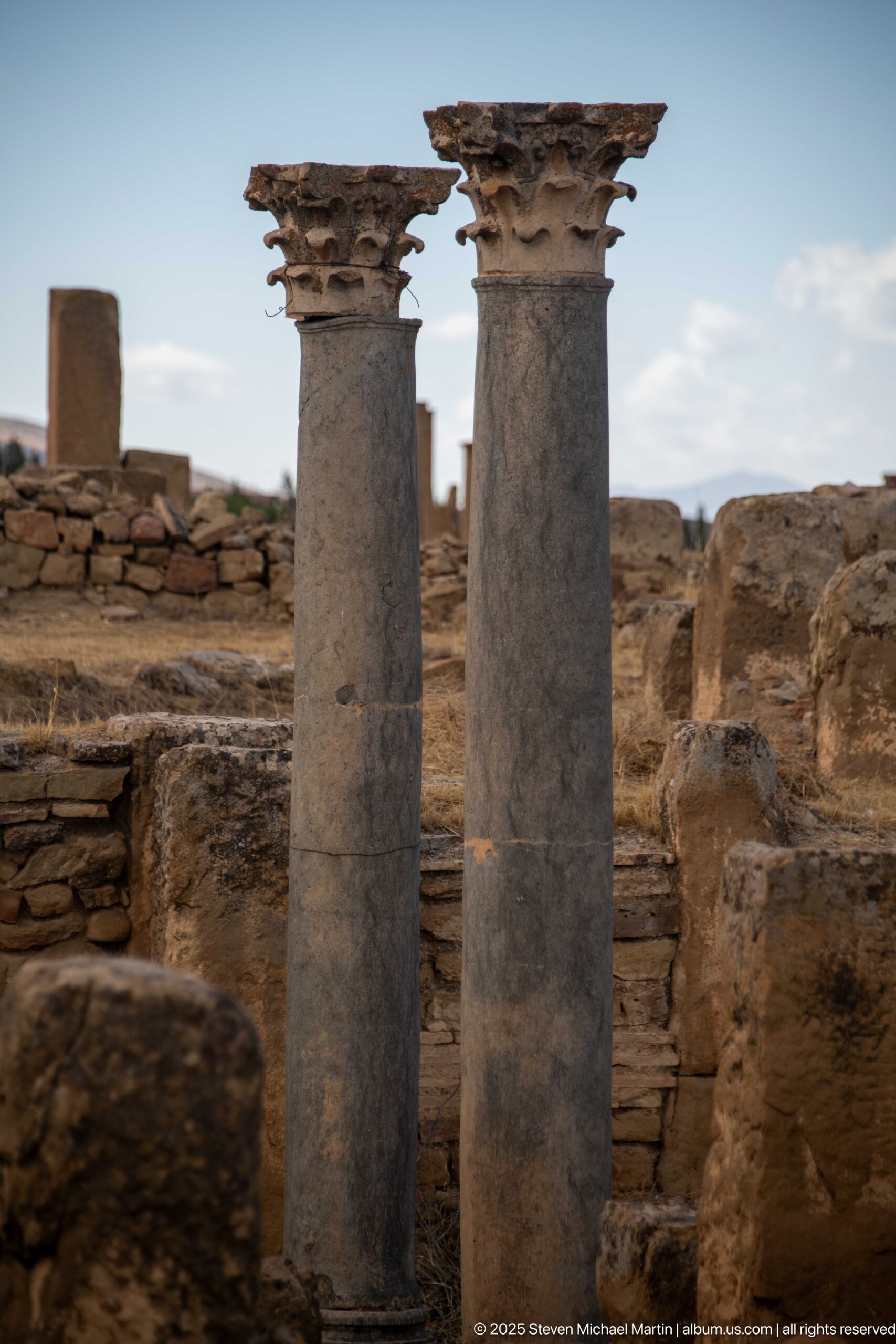
Two freestanding stone columns rise from the excavated ruins at Timgad, each capped by a weathered carved capital. Their isolated survival above low walls and scattered masonry makes the vertical proportion of the ancient colonnade especially clear, while the differing capital forms show the fragmentary state of the reconstructed architectural setting.
Caption
Two freestanding stone columns rise from the excavated ruins at Timgad, each capped by a weathered carved capital. Their isolated survival above low walls and scattered masonry makes the vertical proportion of the ancient colonnade especially clear, while the differing capital forms show the fragmentary state of the reconstructed architectural setting.
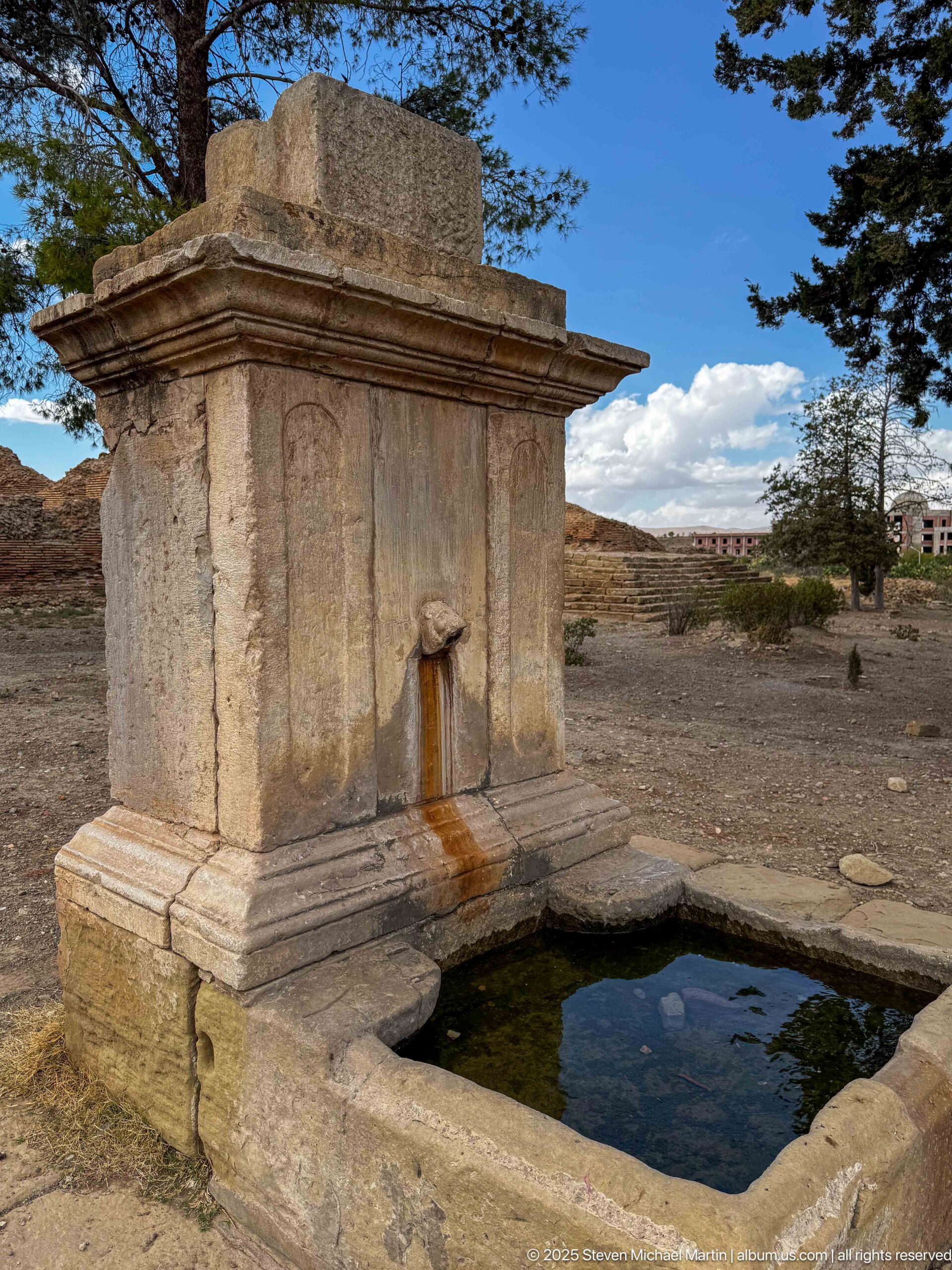
A rectangular stone basin fronts a compact masonry fountain structure at Timgad. Water staining runs down from a projecting spout into the basin, while molded courses and a heavy cap give the utilitarian installation a distinctly architectural treatment. The surviving water feature offers a rare close view of infrastructure within the ancient city.
Caption
A rectangular stone basin fronts a compact masonry fountain structure at Timgad. Water staining runs down from a projecting spout into the basin, while molded courses and a heavy cap give the utilitarian installation a distinctly architectural treatment. The surviving water feature offers a rare close view of infrastructure within the ancient city.

A bright rainbow descends from a gray rain-filled sky to the open plateau near Timgad. Warm light catches the dry grasses and low rolling ground beneath the arc, creating a vivid contrast between the receding storm and the illuminated North African landscape.
Caption
A bright rainbow descends from a gray rain-filled sky to the open plateau near Timgad. Warm light catches the dry grasses and low rolling ground beneath the arc, creating a vivid contrast between the receding storm and the illuminated North African landscape.
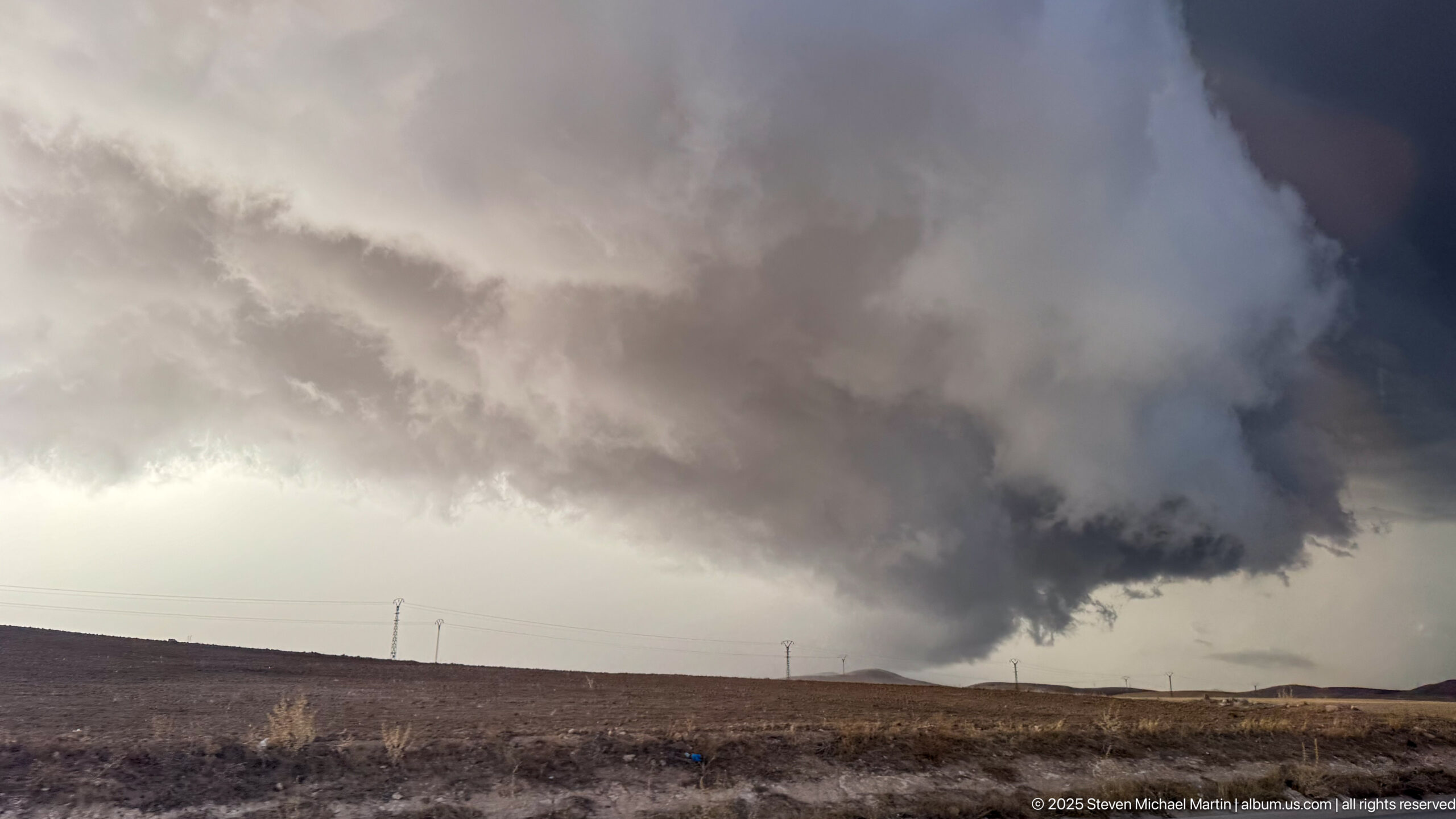
A dark, low storm cloud hangs over the open plateau near Timgad, with a narrow funnel-like lowering extending toward the horizon. Sparse scrub, utility poles, and the broad treeless terrain emphasize the scale of the weather system as rain-darkened cloud masses gather over the archaeological region.
Caption
A dark, low storm cloud hangs over the open plateau near Timgad, with a narrow funnel-like lowering extending toward the horizon. Sparse scrub, utility poles, and the broad treeless terrain emphasize the scale of the weather system as rain-darkened cloud masses gather over the archaeological region.
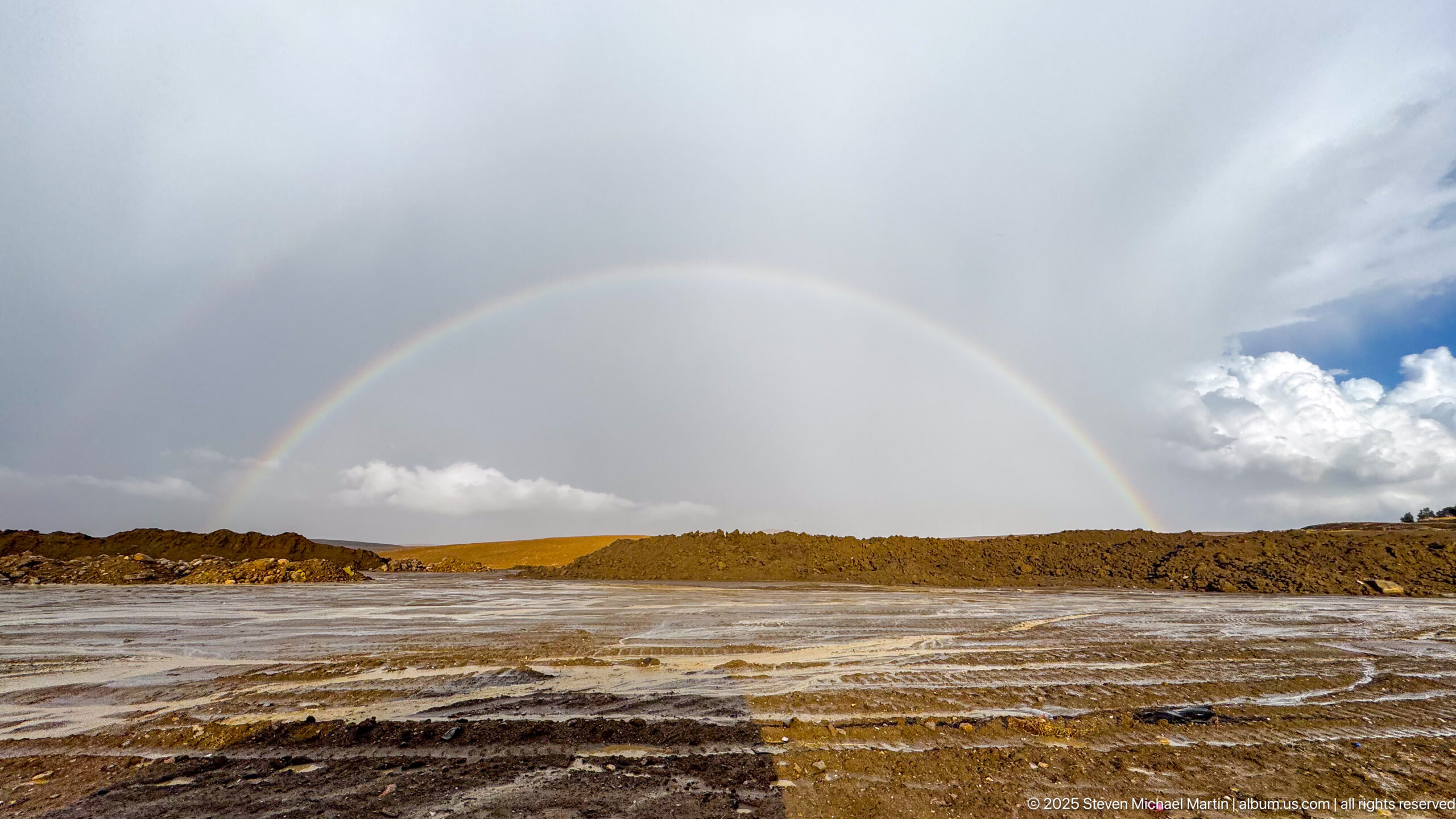
A broad rainbow forms an almost complete arc across the sky above pale, open ground near Timgad. The subdued foreground and low ridge leave the atmospheric phenomenon dominant, while a break of blue sky at right marks the edge of the passing storm.
Caption
A broad rainbow forms an almost complete arc across the sky above pale, open ground near Timgad. The subdued foreground and low ridge leave the atmospheric phenomenon dominant, while a break of blue sky at right marks the edge of the passing storm.
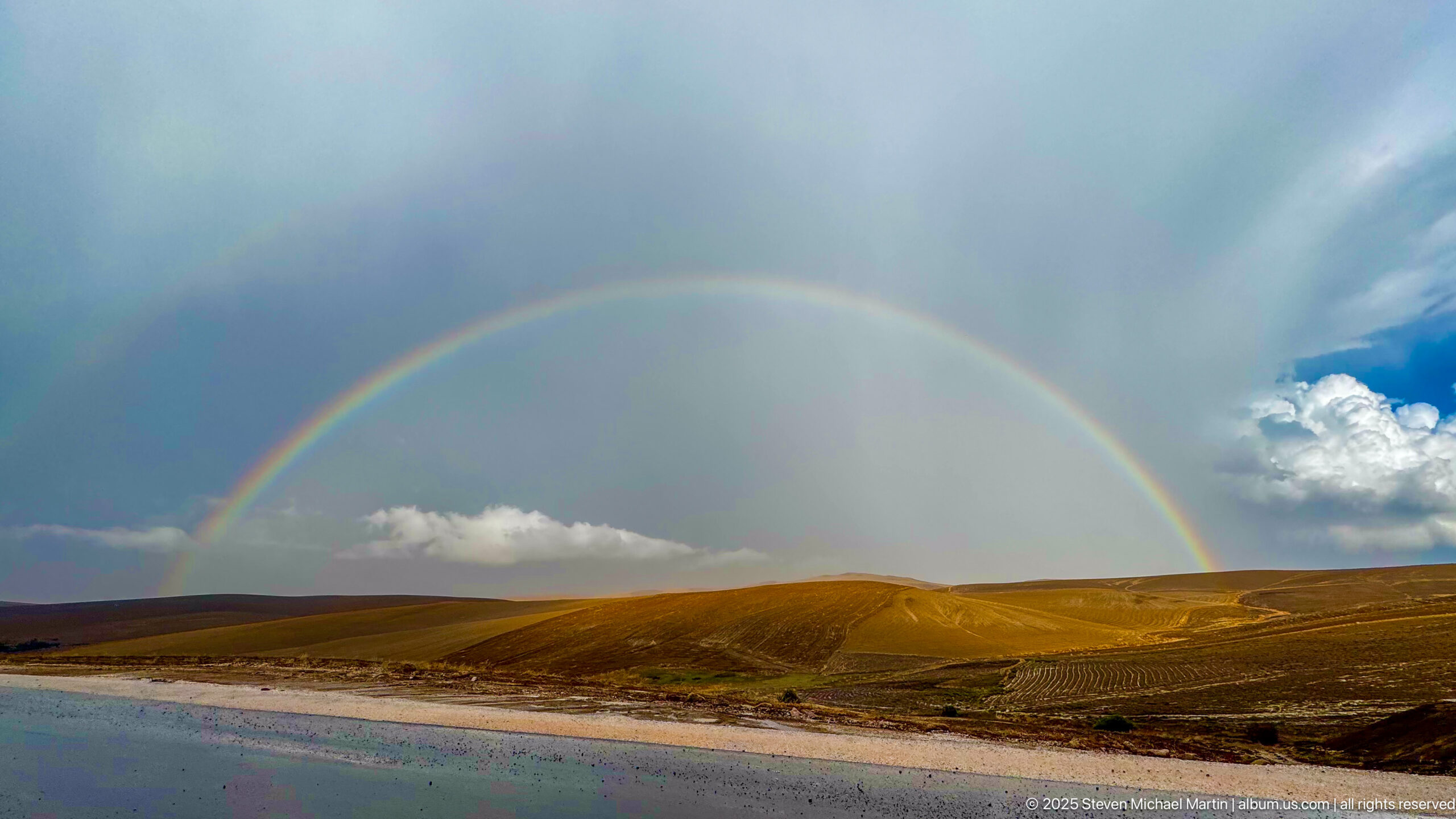
A brilliant primary rainbow spans rolling golden-brown fields near Timgad, with a fainter secondary arc visible outside it. Sunlit hills glow beneath the storm-dark sky, producing the classic contrast that makes both arcs legible across the open plateau.
Caption
A brilliant primary rainbow spans rolling golden-brown fields near Timgad, with a fainter secondary arc visible outside it. Sunlit hills glow beneath the storm-dark sky, producing the classic contrast that makes both arcs legible across the open plateau.
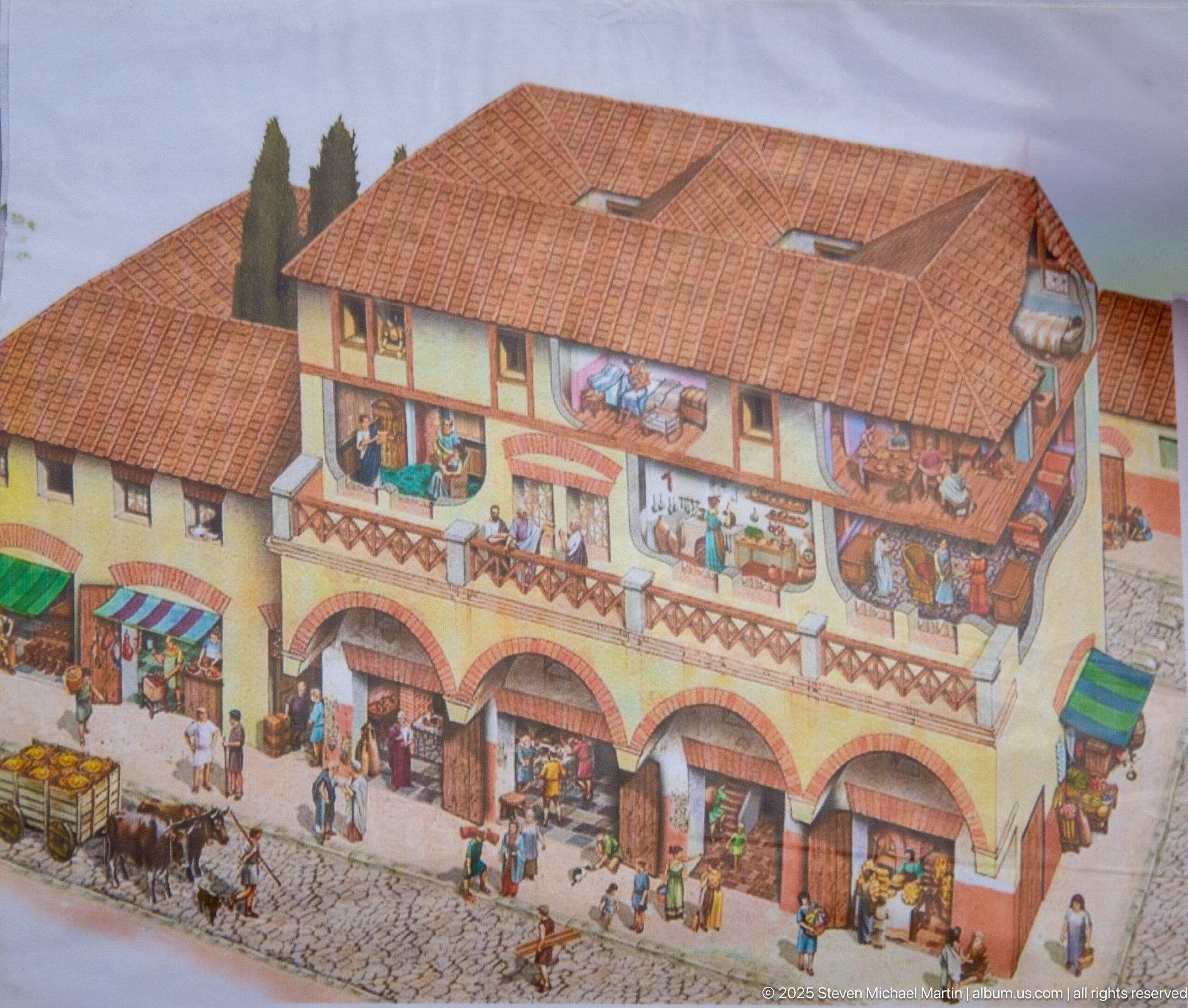
An interpretive illustration reconstructs a multistory Roman urban building with tiled roofs, arcaded ground-floor openings, balconies, shops, and figures engaged in daily activity. The display translates the excavated remains of Timgad into an imagined lived streetscape, helping visitors visualize the scale and mixed commercial-residential character of the ancient city.
Caption
An interpretive illustration reconstructs a multistory Roman urban building with tiled roofs, arcaded ground-floor openings, balconies, shops, and figures engaged in daily activity. The display translates the excavated remains of Timgad into an imagined lived streetscape, helping visitors visualize the scale and mixed commercial-residential character of the ancient city.
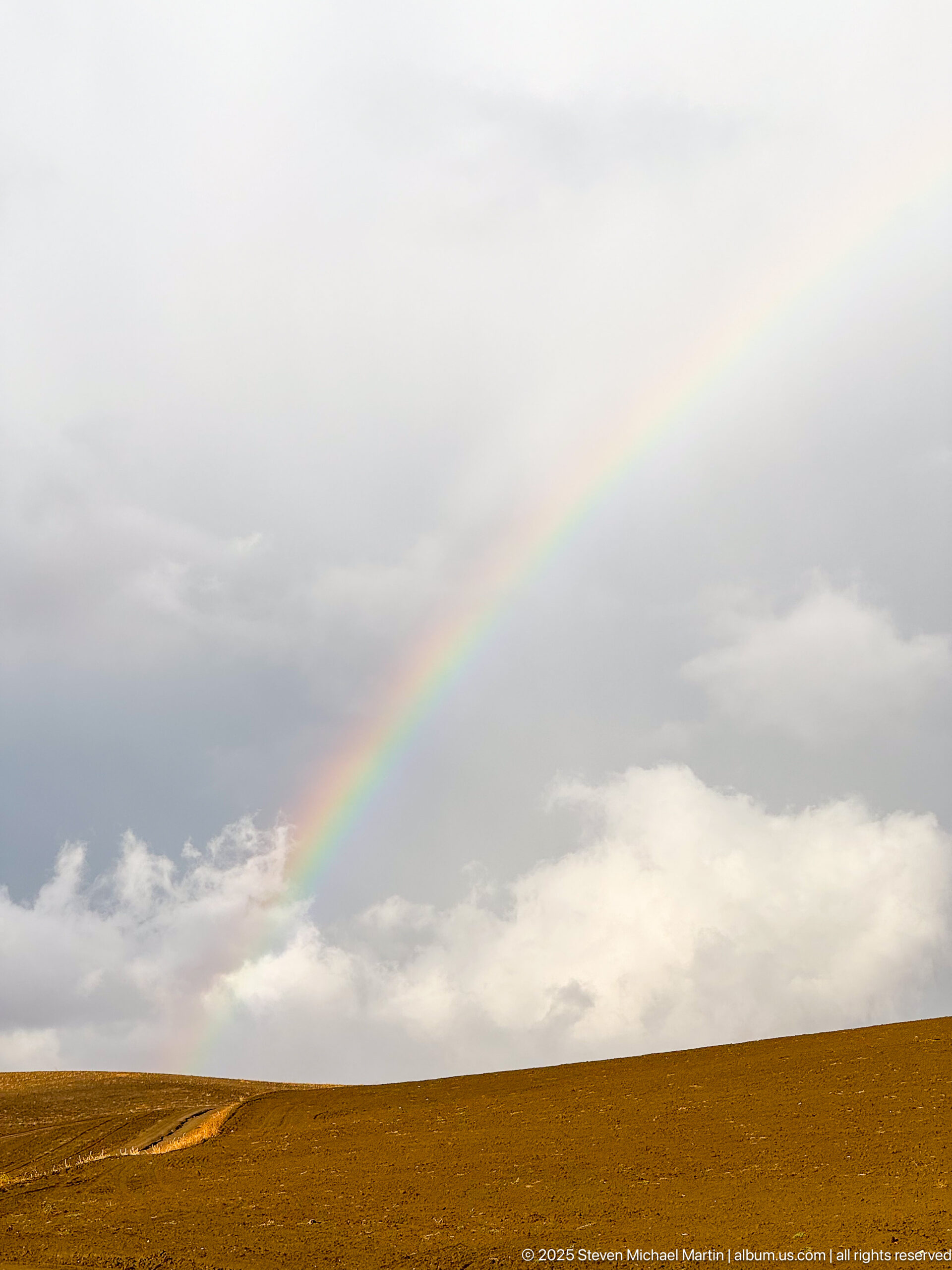
A diagonal segment of rainbow drops toward the open plateau as late sunlight warms the foreground fields. The composition isolates the lower arc against layered gray clouds, emphasizing the meeting of rain, clearing light, and broad agricultural terrain around Timgad.
Caption
A diagonal segment of rainbow drops toward the open plateau as late sunlight warms the foreground fields. The composition isolates the lower arc against layered gray clouds, emphasizing the meeting of rain, clearing light, and broad agricultural terrain around Timgad.
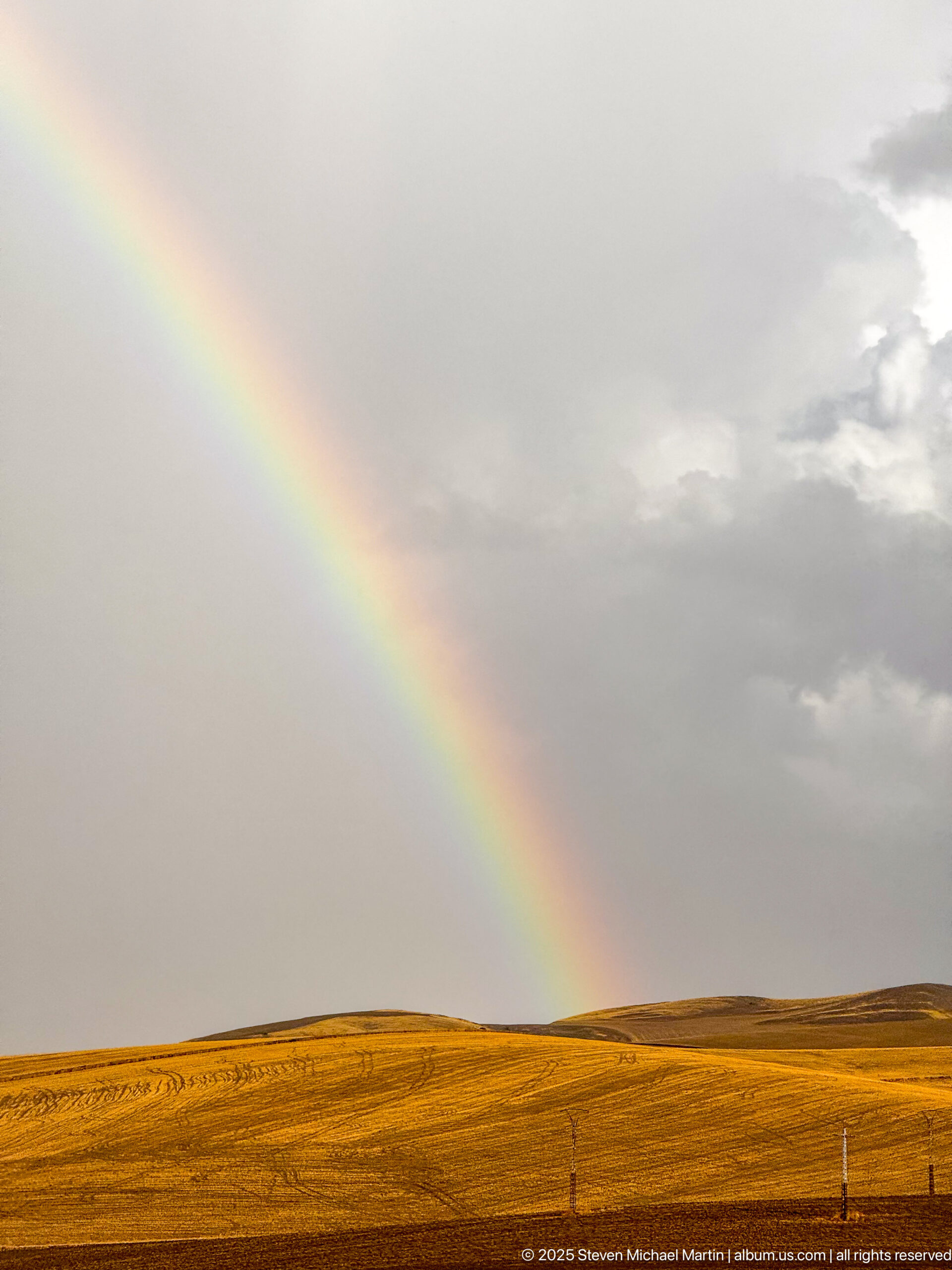
A saturated rainbow fills the left half of the frame as it descends toward sunlit ochre fields near Timgad. The closer composition reduces the horizon to a narrow band and concentrates attention on the intense color of the arc against the soft gray rain clouds.
Caption
A saturated rainbow fills the left half of the frame as it descends toward sunlit ochre fields near Timgad. The closer composition reduces the horizon to a narrow band and concentrates attention on the intense color of the arc against the soft gray rain clouds.
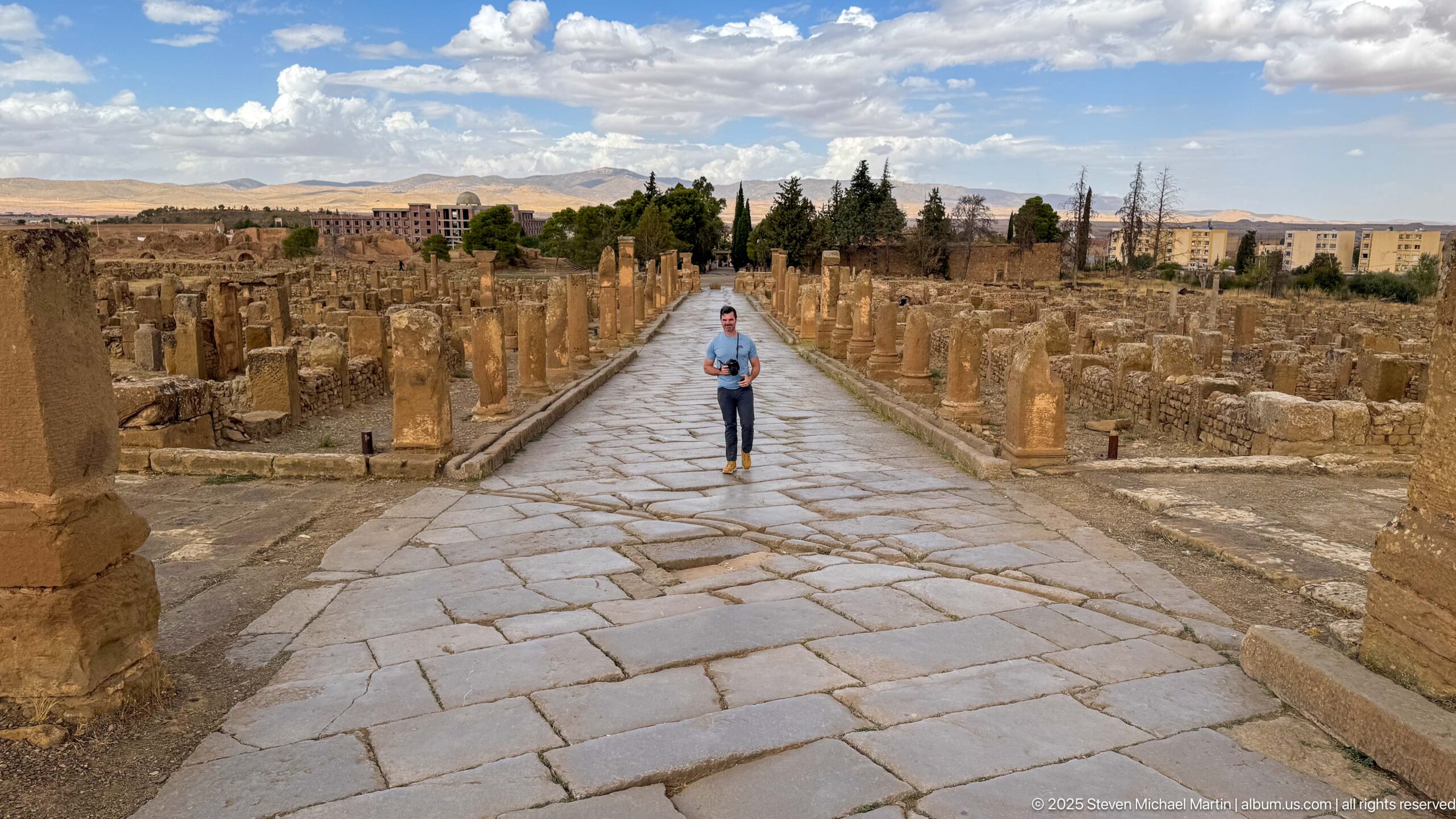
A visitor walks along a broad paved street through Timgad, centered between rows of column bases, standing shafts, and ruined building fronts. The strong linear perspective of the large stone paving slabs reveals the disciplined geometry of the Roman urban plan and the monumental scale of the colonnaded thoroughfare.
Caption
A visitor walks along a broad paved street through Timgad, centered between rows of column bases, standing shafts, and ruined building fronts. The strong linear perspective of the large stone paving slabs reveals the disciplined geometry of the Roman urban plan and the monumental scale of the colonnaded thoroughfare.
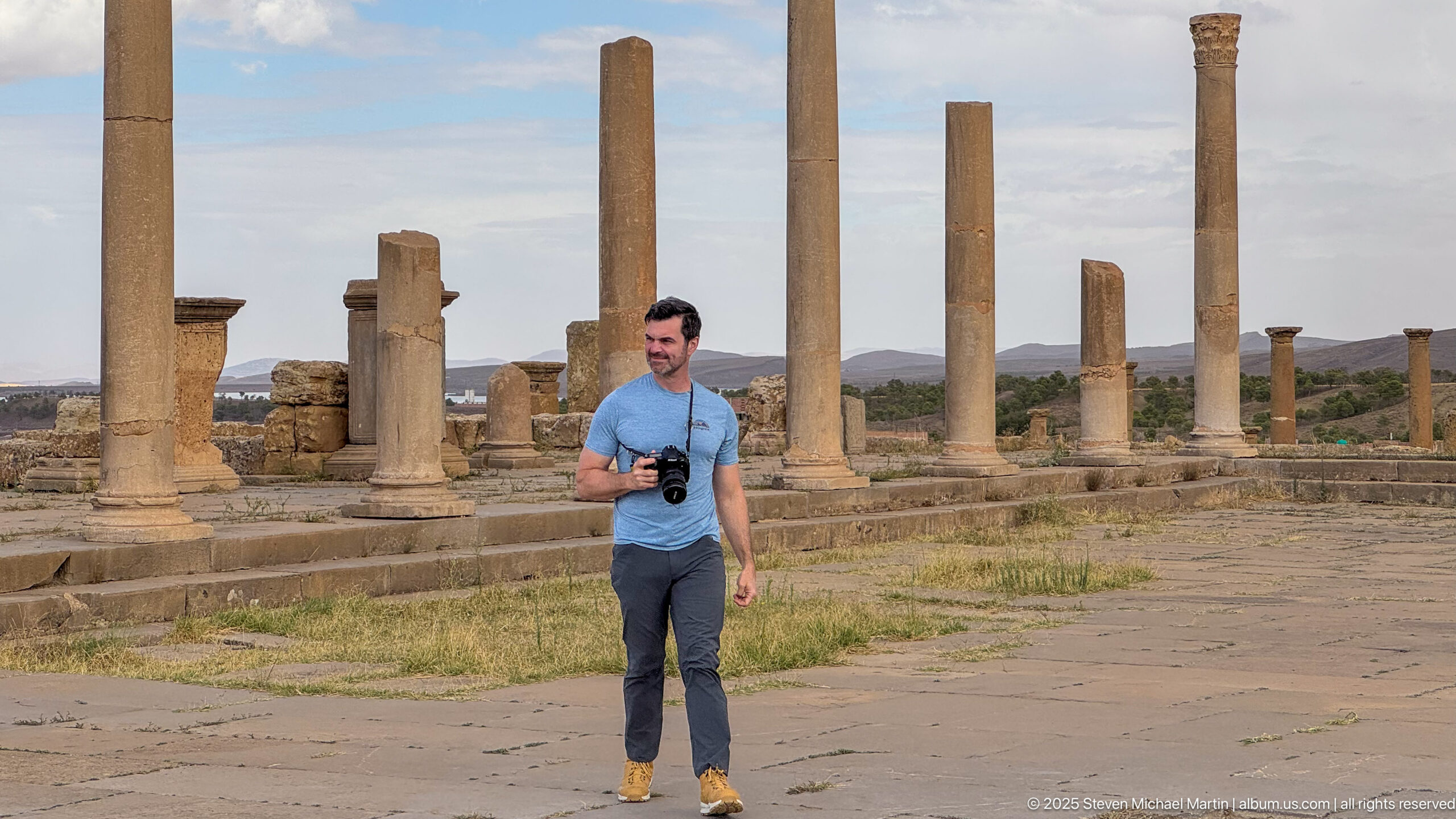
A visitor holding a camera stands on broad ancient paving amid a line of tall Roman columns at Timgad. The surviving shafts and lower colonnade elements frame the figure against the open archaeological landscape, providing a strong sense of scale for the city’s monumental street and public architecture.
Caption
A visitor holding a camera stands on broad ancient paving amid a line of tall Roman columns at Timgad. The surviving shafts and lower colonnade elements frame the figure against the open archaeological landscape, providing a strong sense of scale for the city’s monumental street and public architecture.
⭐ Highlights
- Roman Grid City: A perfectly planned Roman colony built on a strict geometric layout.
- Founded by Trajan: Established around 100 AD as a military settlement.
- UNESCO World Heritage Site: Recognized for its exceptional preservation and planning.
- Cardo and Decumanus: Main streets intersect at the heart of the city in classic Roman design.
- Extensive Ruins: Includes arches, temples, baths, a theater, and residential areas.
- “Pompeii of North Africa”: A remarkably intact Roman city preserved in the landscape.
🏛️ Timgad Field Guide
Major features observed during this visit:
Timgad, known in antiquity as Thamugadi, is one of the best-preserved Roman cities in the world. Founded by Emperor Trajan in 100 AD, it was established as a military colony for Roman veterans and designed according to a precise grid plan. Unlike many Roman cities that evolved over time, Timgad was built from the ground up, making it one of the clearest examples of Roman urban planning.
The city’s layout is defined by two main streets—the cardo (north–south) and decumanus (east–west)—which intersect at the central forum. From this core, the city expands in a regular grid, reflecting the Roman emphasis on order, organization, and civic structure.
🏛️ Signature Landmarks
- Arch of Trajan – A triumphal arch marking one of the main entrances to the city.
- Forum – The central civic and social space of the Roman city.
- Roman Theatre – A well-preserved theater built into the terrain.
- Decumanus Maximus – The main east–west street lined with columns.
- Baths and Houses – Residential and public structures illustrating daily Roman life.
🧠 Historical Significance
- Roman Military Colony – Established to secure and control the surrounding region.
- Urban Planning Model – Represents one of the most complete examples of Roman city design.
- Population of Veterans – Settled by former soldiers of the Roman army.
- Abandonment and Preservation – Eventually abandoned and preserved under sand, aiding its survival.
🌄 Landscape & Setting
- Aurès Mountains – Located on the northern slopes of a mountainous region.
- Open Plateau – The site sits on relatively flat terrain ideal for a grid layout.
- Clear Visibility – The entire city plan can be seen and understood from above.
- Isolated Setting – Its remote location contributes to its exceptional preservation.