
Tashkent Railway Museum
The Tashkent Railway Museum reflects the development of transportation networks that connected Central Asia with broader regional economies during the nineteenth and twentieth centuries. Rail infrastructure expanded communication between historic Silk Road cities, modernizing long-distance travel across Eurasia. The museum illustrates the technological transition from caravan trade to industrial transportation.
Locomotives and rail equipment demonstrate engineering developments that facilitated economic integration across Central Asia. Railway construction altered traditional patterns of trade while maintaining the importance of regional exchange. The exhibits provide insight into the evolution of transportation technology.
The Tashkent Railway Museum illustrates how modern infrastructure followed earlier trade corridors established by Silk Road commerce. The development of rail systems reflects the continued importance of connectivity across Eurasia.

A preserved steam locomotive faces the viewer beside a tree-lined museum path. Its large headlamp, paired lower lamps, red slatted pilot, yellow handrails, and Soviet star create a highly legible front elevation. The setting shows how the outdoor museum arranges full-size locomotives for close public inspection.
Caption
A preserved steam locomotive faces the viewer beside a tree-lined museum path. Its large headlamp, paired lower lamps, red slatted pilot, yellow handrails, and Soviet star create a highly legible front elevation. The setting shows how the outdoor museum arranges full-size locomotives for close public inspection.

A black steam locomotive stands beside a shaded walkway at the Tashkent Railway Museum. Its red slatted pilot, large headlamp, paired lamps, yellow handrails, and Soviet star are all visible in a complete frontal view. Trees and paving place the industrial object within the museum's accessible outdoor landscape.
Caption
A black steam locomotive stands beside a shaded walkway at the Tashkent Railway Museum. Its red slatted pilot, large headlamp, paired lamps, yellow handrails, and Soviet star are all visible in a complete frontal view. Trees and paving place the industrial object within the museum's accessible outdoor landscape.

A museum visitor stands beside the oversized driving wheels and connecting rod of a preserved steam locomotive. The portrait places the human figure directly against the engine's mechanical scale, showing how the rod transferred piston motion to the coupled wheels. Red wheel rims and gray linkage frame the subject.
Caption
A museum visitor stands beside the oversized driving wheels and connecting rod of a preserved steam locomotive. The portrait places the human figure directly against the engine's mechanical scale, showing how the rod transferred piston motion to the coupled wheels. Red wheel rims and gray linkage frame the subject.

This close portrait frames a museum visitor against the connecting rod and red driving wheel of a steam locomotive. The mechanical elements remain recognizable but softly contextual, shifting attention from the full engine to an individual encounter with railway heritage. The image functions primarily as a personal travel record.
Caption
This close portrait frames a museum visitor against the connecting rod and red driving wheel of a steam locomotive. The mechanical elements remain recognizable but softly contextual, shifting attention from the full engine to an individual encounter with railway heritage. The image functions primarily as a personal travel record.

A white triple-arched gateway marks the entrance to the Tashkent Railway Museum, identified by Uzbek lettering across the entablature. Through the decorative gates, historic locomotives and railway equipment can be seen in an open-air display. The entrance frames the museum as an institutional collection devoted to Uzbekistan's rail technology and transportation history.
Caption
A white triple-arched gateway marks the entrance to the Tashkent Railway Museum, identified by Uzbek lettering across the entablature. Through the decorative gates, historic locomotives and railway equipment can be seen in an open-air display. The entrance frames the museum as an institutional collection devoted to Uzbekistan's rail technology and transportation history.
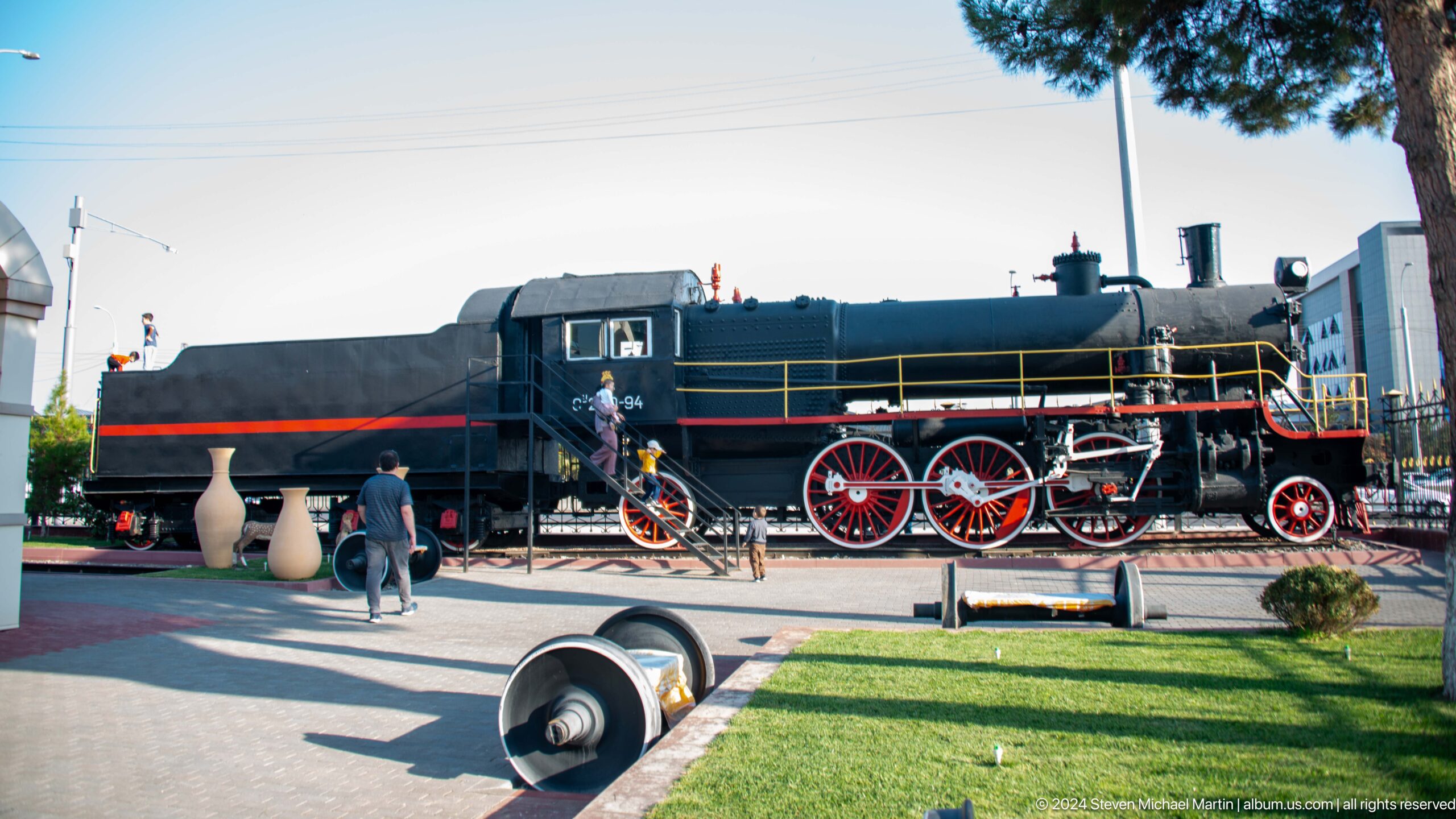
A large preserved steam locomotive dominates the outdoor display, its long black boiler set above red spoked driving wheels and exposed side rods. The tender behind the cab carried fuel and water for extended operation. Visitors at the access stair provide scale, emphasizing the machinery required for mainline steam transportation.
Caption
A large preserved steam locomotive dominates the outdoor display, its long black boiler set above red spoked driving wheels and exposed side rods. The tender behind the cab carried fuel and water for extended operation. Visitors at the access stair provide scale, emphasizing the machinery required for mainline steam transportation.

A museum visitor stands between two enormous red driving wheels of a steam locomotive. The silver connecting rod passes behind him, making the relationship between human scale and heavy machinery immediately visible. The portrait also shows how the museum permits close access to the mechanical components of its outdoor exhibits.
Caption
A museum visitor stands between two enormous red driving wheels of a steam locomotive. The silver connecting rod passes behind him, making the relationship between human scale and heavy machinery immediately visible. The portrait also shows how the museum permits close access to the mechanical components of its outdoor exhibits.

A dense arrangement of valves, pipes, inspection covers, and bolted fittings covers the black rear face of the locomotive boiler. Red-painted controls stand out against the dark metal, making the operating system easier to read. The photograph records the complexity faced by steam-locomotive crews within a confined cab.
Caption
A dense arrangement of valves, pipes, inspection covers, and bolted fittings covers the black rear face of the locomotive boiler. Red-painted controls stand out against the dark metal, making the operating system easier to read. The photograph records the complexity faced by steam-locomotive crews within a confined cab.

The principal facade of Tashkent railway station faces a broad urban roadway. Blue-glazed window bays flank a monumental pointed entrance marked VOKZAL, while TOSHKENT signage identifies the city. The formal symmetry and prominent national flag present the station as both transportation infrastructure and a civic gateway to Uzbekistan's capital.
Caption
The principal facade of Tashkent railway station faces a broad urban roadway. Blue-glazed window bays flank a monumental pointed entrance marked VOKZAL, while TOSHKENT signage identifies the city. The formal symmetry and prominent national flag present the station as both transportation infrastructure and a civic gateway to Uzbekistan's capital.

This compact steam locomotive is displayed with its running gear fully visible, including small driving wheels and connecting rods. Its short boiler and integrated rear compartment suggest a tank or industrial locomotive intended for limited-distance work rather than long mainline service. Bright museum repainting emphasizes the mechanical components for visitors.
Caption
This compact steam locomotive is displayed with its running gear fully visible, including small driving wheels and connecting rods. Its short boiler and integrated rear compartment suggest a tank or industrial locomotive intended for limited-distance work rather than long mainline service. Bright museum repainting emphasizes the mechanical components for visitors.

This open-sided passenger railcar combines a blue body with yellow trim and decorative metal latticework. Its ventilated sides and covered roof suggest use for short-distance, excursion, or museum transport rather than long-distance service. The preserved vehicle illustrates a lighter form of rail travel alongside the museum's heavy locomotives.
Caption
This open-sided passenger railcar combines a blue body with yellow trim and decorative metal latticework. Its ventilated sides and covered roof suggest use for short-distance, excursion, or museum transport rather than long-distance service. The preserved vehicle illustrates a lighter form of rail travel alongside the museum's heavy locomotives.

The front of this steam locomotive retains a red Soviet star with a gold state emblem centered on the circular smokebox door. A large headlamp rises above the insignia, while painted latches ring the heavy steel access door. The preserved markings connect the engine to the Soviet period of Central Asian railway development.
Caption
The front of this steam locomotive retains a red Soviet star with a gold state emblem centered on the circular smokebox door. A large headlamp rises above the insignia, while painted latches ring the heavy steel access door. The preserved markings connect the engine to the Soviet period of Central Asian railway development.

A red five-pointed star bearing a gold Soviet state emblem is fixed to the black smokebox door of a preserved steam locomotive. The close view reveals the raised relief, weathered paint, and surrounding latch hardware. Such insignia made railway machinery visible symbols of state industry during the Soviet era.
Caption
A red five-pointed star bearing a gold Soviet state emblem is fixed to the black smokebox door of a preserved steam locomotive. The close view reveals the raised relief, weathered paint, and surrounding latch hardware. Such insignia made railway machinery visible symbols of state industry during the Soviet era.

The locomotive number 736-025 appears in large white characters beside a gold-and-red Soviet emblem. Painted on the black body above a red stripe, the marking combines practical fleet identification with state symbolism. This close record preserves a key clue for researching the engine's class, manufacture, and service history.
Caption
The locomotive number 736-025 appears in large white characters beside a gold-and-red Soviet emblem. Painted on the black body above a red stripe, the marking combines practical fleet identification with state symbolism. This close record preserves a key clue for researching the engine's class, manufacture, and service history.

Red Cyrillic lettering and partial numerals are painted across a white ribbed equipment panel. The close crop records an operational or manufacturing marking but omits enough surrounding context to prevent a secure identification of the vehicle. It remains useful as evidence of Soviet-era railway lettering and catalog practice.
Caption
Red Cyrillic lettering and partial numerals are painted across a white ribbed equipment panel. The close crop records an operational or manufacturing marking but omits enough surrounding context to prevent a secure identification of the vehicle. It remains useful as evidence of Soviet-era railway lettering and catalog practice.

This oblique front view reveals the layered construction of a preserved steam locomotive: circular smokebox, paired lamps, red pilot beam, handrails, piping, and access ladder. The Soviet emblem remains centered on the front plate. The angle is especially useful for understanding how operational fittings surrounded the boiler's forward end.
Caption
This oblique front view reveals the layered construction of a preserved steam locomotive: circular smokebox, paired lamps, red pilot beam, handrails, piping, and access ladder. The Soviet emblem remains centered on the front plate. The angle is especially useful for understanding how operational fittings surrounded the boiler's forward end.

The lower front of a preserved steam locomotive brings together paired lamps, a mesh panel, coupling hardware, and a red buffer beam beneath the circular smokebox. This close view isolates the practical equipment used for visibility, connection, and protection, revealing the layered construction often lost in full-locomotive photographs.
Caption
The lower front of a preserved steam locomotive brings together paired lamps, a mesh panel, coupling hardware, and a red buffer beam beneath the circular smokebox. This close view isolates the practical equipment used for visibility, connection, and protection, revealing the layered construction often lost in full-locomotive photographs.

A compact green diesel locomotive stands among trees on the museum grounds, distinguished by its raised central cab, yellow handrails, and red wheel assemblies. Its boxy proportions are characteristic of a shunting engine designed to move railcars within yards and industrial facilities rather than haul long-distance passenger trains.
Caption
A compact green diesel locomotive stands among trees on the museum grounds, distinguished by its raised central cab, yellow handrails, and red wheel assemblies. Its boxy proportions are characteristic of a shunting engine designed to move railcars within yards and industrial facilities rather than haul long-distance passenger trains.

This preserved diesel shunter is painted green with yellow chevrons and a red pilot. A round front window and long ventilation grilles define its functional, box-like body. The visible unit marking may support a more exact class identification, while the locomotive broadly documents the transition from steam to diesel traction.
Caption
This preserved diesel shunter is painted green with yellow chevrons and a red pilot. A round front window and long ventilation grilles define its functional, box-like body. The visible unit marking may support a more exact class identification, while the locomotive broadly documents the transition from steam to diesel traction.

Inside the locomotive cab, the green-painted firebox backhead is crowded with gauges, valves, pipes, inspection plugs, and a red firebox door. These controls allowed the crew to monitor boiler pressure, regulate steam and water, and manage combustion. Color coding now helps museum visitors distinguish the machinery's many operating components.
Caption
Inside the locomotive cab, the green-painted firebox backhead is crowded with gauges, valves, pipes, inspection plugs, and a red firebox door. These controls allowed the crew to monitor boiler pressure, regulate steam and water, and manage combustion. Color coding now helps museum visitors distinguish the machinery's many operating components.

Rows of rivets pattern the massive black boiler shell of a preserved steam locomotive. Boiler bands, domes, and external piping remain visible along the cylindrical body. Photographed from below, the surface becomes a study in nineteenth- and early twentieth-century heavy engineering, when steel plates were assembled through extensive riveting.
Caption
Rows of rivets pattern the massive black boiler shell of a preserved steam locomotive. Boiler bands, domes, and external piping remain visible along the cylindrical body. Photographed from below, the surface becomes a study in nineteenth- and early twentieth-century heavy engineering, when steel plates were assembled through extensive riveting.

This richly finished passenger-car interior contrasts sharply with the museum's exposed locomotive machinery. Wood paneling, patterned ceiling surfaces, curtains, wall lamps, and upholstered furnishings create a formal saloon-like environment. The decorative treatment suggests a special-purpose or higher-status carriage intended to make rail travel comfortable as well as functional.
Caption
This richly finished passenger-car interior contrasts sharply with the museum's exposed locomotive machinery. Wood paneling, patterned ceiling surfaces, curtains, wall lamps, and upholstered furnishings create a formal saloon-like environment. The decorative treatment suggests a special-purpose or higher-status carriage intended to make rail travel comfortable as well as functional.

The rear face of the locomotive boiler rises inside the cab, covered with red valve wheels, pipes, inspection fittings, and a large lower firebox opening. The vertical composition emphasizes how tightly controls were arranged around the crew. This machinery required constant monitoring during steam operation.
Caption
The rear face of the locomotive boiler rises inside the cab, covered with red valve wheels, pipes, inspection fittings, and a large lower firebox opening. The vertical composition emphasizes how tightly controls were arranged around the crew. This machinery required constant monitoring during steam operation.


