Ancient Sarazm
Ancient Sarazm is one of the oldest known settlements in Central Asia, dating to the fourth millennium BCE. The archaeological site provides evidence of early agricultural and trading communities that preceded the later Silk Road network. Its location near mineral resources and fertile land supported early economic development.
Excavations have revealed tools, pottery, and evidence of long-distance exchange linking Sarazm with regions as distant as Mesopotamia and the Indus Valley. These connections demonstrate early forms of trade that laid the foundations for later Silk Road commerce. The settlement illustrates the early development of organized communities in Central Asia.
Sarazm provides insight into the deep historical roots of trade and cultural interaction in Central Asia. The site illustrates how early exchange networks contributed to the later emergence of Silk Road trade routes.

The ceremonial entrance gate to Ancient Sarazm frames the landscaped approach road, its circular emblem centered above the opening, marking access to one of Central Asia’s earliest agricultural and trading settlements that foreshadowed later Silk Road exchange.
Caption
The ceremonial entrance gate to Ancient Sarazm frames the landscaped approach road, its circular emblem centered above the opening, marking access to one of Central Asia’s earliest agricultural and trading settlements that foreshadowed later Silk Road exchange.

Framed by mountain ridges, the Museum complex at Ancient Sarazm presents a symmetrical facade with a recessed central entrance, introducing visitors to one of Central Asia’s earliest agricultural and trading settlements and the long-distance exchanges that prefigured Silk Road networks.
Caption
Framed by mountain ridges, the Museum complex at Ancient Sarazm presents a symmetrical facade with a recessed central entrance, introducing visitors to one of Central Asia’s earliest agricultural and trading settlements and the long-distance exchanges that prefigured Silk Road networks.

Beneath a brooding sky and backed by distant mountains, the pale monumental building of the Ancient Sarazm museum complex rises beyond open ground, marking the archaeological site of one of Central Asia’s earliest agricultural and trading communities.
Caption
Beneath a brooding sky and backed by distant mountains, the pale monumental building of the Ancient Sarazm museum complex rises beyond open ground, marking the archaeological site of one of Central Asia’s earliest agricultural and trading communities.
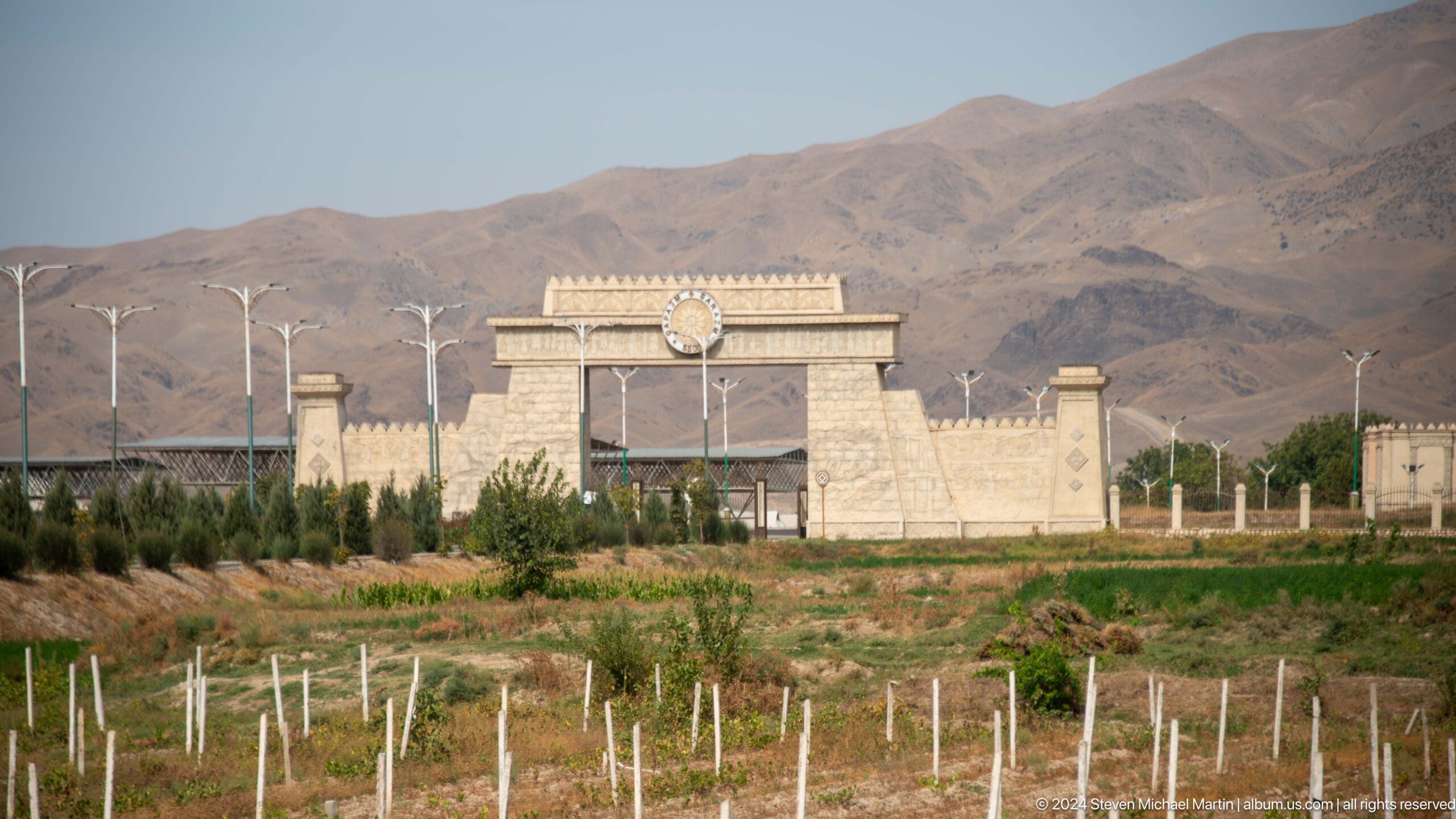
Seen across a cultivated field with mountains beyond, the main entrance complex of Ancient Sarazm aligns with the archaeological reserve for one of Central Asia’s oldest fourth‑millennium‑BCE settlements and early agricultural–trading communities.
Caption
Seen across a cultivated field with mountains beyond, the main entrance complex of Ancient Sarazm aligns with the archaeological reserve for one of Central Asia’s oldest fourth‑millennium‑BCE settlements and early agricultural–trading communities.

In the Ancient Sarazm museum’s circular exhibition gallery, curved display cases trace the perimeter around a central artificial tree, framing exhibits about one of Central Asia’s oldest settlements and the early exchange networks that foreshadowed later Silk Road trade.
Caption
In the Ancient Sarazm museum’s circular exhibition gallery, curved display cases trace the perimeter around a central artificial tree, framing exhibits about one of Central Asia’s oldest settlements and the early exchange networks that foreshadowed later Silk Road trade.

A panoramic museum mural reconstructs life at ancient Sarazm, with scenes of people, animals, and settlement structures rising above cases of excavated artifacts, evoking a fourth‑millennium‑BCE community whose early agriculture and long‑distance trade prefigured later Silk Road exchange.
Caption
A panoramic museum mural reconstructs life at ancient Sarazm, with scenes of people, animals, and settlement structures rising above cases of excavated artifacts, evoking a fourth‑millennium‑BCE community whose early agriculture and long‑distance trade prefigured later Silk Road exchange.

Under a protective shelter, straight mud-brick walls delineate a cluster of rectangular rooms in an excavated complex at Ancient Sarazm, a fourth-millennium BCE Central Asian settlement whose early agricultural and trading networks prefigured later Silk Road exchange.
Caption
Under a protective shelter, straight mud-brick walls delineate a cluster of rectangular rooms in an excavated complex at Ancient Sarazm, a fourth-millennium BCE Central Asian settlement whose early agricultural and trading networks prefigured later Silk Road exchange.

A broad, rounded installation at Sarazm, one of Central Asia’s earliest settlements, sits within a curved, stone‑reinforced enclosure, tangible evidence of organized building at a site sustained by early agriculture and far‑reaching exchange that foreshadowed later Silk Road commerce.
Caption
A broad, rounded installation at Sarazm, one of Central Asia’s earliest settlements, sits within a curved, stone‑reinforced enclosure, tangible evidence of organized building at a site sustained by early agriculture and far‑reaching exchange that foreshadowed later Silk Road commerce.

An expansive museum mural reconstructs daily life at Ancient Sarazm—people farming, crafting, and tending animals—while artifact cases beneath it ground the scene in a fourth‑millennium‑BCE Central Asian settlement whose early agriculture and long‑distance exchange foreshadowed later Silk Road networks.
Caption
An expansive museum mural reconstructs daily life at Ancient Sarazm—people farming, crafting, and tending animals—while artifact cases beneath it ground the scene in a fourth‑millennium‑BCE Central Asian settlement whose early agriculture and long‑distance exchange foreshadowed later Silk Road networks.

A reconstruction panorama in the Sarazm museum sweeps along a curved gallery wall above low white cases of artifacts, evoking the prehistoric settlement of Sarazm and its early agricultural and trading lifeways that anticipated later Silk Road exchange.
Caption
A reconstruction panorama in the Sarazm museum sweeps along a curved gallery wall above low white cases of artifacts, evoking the prehistoric settlement of Sarazm and its early agricultural and trading lifeways that anticipated later Silk Road exchange.

Marked in Tajik, Russian, and English, a brown roadside sign points toward Ancient Sarazm, one of Central Asia’s earliest settlements from the fourth millennium BCE, whose excavations document agriculture and far-reaching trade that prefigured later Silk Road exchange.
Caption
Marked in Tajik, Russian, and English, a brown roadside sign points toward Ancient Sarazm, one of Central Asia’s earliest settlements from the fourth millennium BCE, whose excavations document agriculture and far-reaching trade that prefigured later Silk Road exchange.

A long arcaded visitor facility opens onto a paved forecourt at Ancient Sarazm, one of Central Asia’s earliest settlements, whose fourth‑millennium BCE agricultural life and far‑reaching exchange networks prefigured the trade routes later known as the Silk Road.
Caption
A long arcaded visitor facility opens onto a paved forecourt at Ancient Sarazm, one of Central Asia’s earliest settlements, whose fourth‑millennium BCE agricultural life and far‑reaching exchange networks prefigured the trade routes later known as the Silk Road.

A freestanding decorative column marks the entrance to Sarazm, one of Central Asia’s oldest settlements dating to the fourth millennium BCE, where excavations have revealed early agriculture and long-distance exchange that foreshadowed later Silk Road networks.
Caption
A freestanding decorative column marks the entrance to Sarazm, one of Central Asia’s oldest settlements dating to the fourth millennium BCE, where excavations have revealed early agriculture and long-distance exchange that foreshadowed later Silk Road networks.

A framed UNESCO certificate formally records the inscription of the Proto-urban Site of Sarazm on the World Heritage List, the official document that names the site and confirms its listing.
Caption
A framed UNESCO certificate formally records the inscription of the Proto-urban Site of Sarazm on the World Heritage List, the official document that names the site and confirms its listing.

An interpretive panel at Sarazm presents photographs of excavated objects—apparently stone and metal tools and ornaments—evoking the fourth‑millennium‑BCE settlement’s early agricultural and trading lifeways that presaged the region’s later Silk Road exchange.
Caption
An interpretive panel at Sarazm presents photographs of excavated objects—apparently stone and metal tools and ornaments—evoking the fourth‑millennium‑BCE settlement’s early agricultural and trading lifeways that presaged the region’s later Silk Road exchange.

On a decorated facade, the circular “Sarazm 5500” emblem—centered on a stylized sun or flower—commemorates the extraordinary antiquity of Ancient Sarazm, one of Central Asia’s earliest settlements with roots in fourth-millennium BCE trade and agriculture.
Caption
On a decorated facade, the circular “Sarazm 5500” emblem—centered on a stylized sun or flower—commemorates the extraordinary antiquity of Ancient Sarazm, one of Central Asia’s earliest settlements with roots in fourth-millennium BCE trade and agriculture.

The Main gateway of Ancient Sarazm, its rectangular pale-stone facade crowned by the circular Sarazm emblem, marks entry to one of Central Asia’s oldest settlements, a fourth‑millennium BCE hub of early agriculture and long‑distance exchange.
Caption
The Main gateway of Ancient Sarazm, its rectangular pale-stone facade crowned by the circular Sarazm emblem, marks entry to one of Central Asia’s oldest settlements, a fourth‑millennium BCE hub of early agriculture and long‑distance exchange.

The colorful Sarazm 5500 emblem in green, orange, and turquoise mounts the entrance gate, marking the archaeological site associated with some of Central Asia’s earliest settled communities and long-distance exchange that prefigured Silk Road networks.
Caption
The colorful Sarazm 5500 emblem in green, orange, and turquoise mounts the entrance gate, marking the archaeological site associated with some of Central Asia’s earliest settled communities and long-distance exchange that prefigured Silk Road networks.

A carved circular medallion inscribed “SARAZM,” centered on a radial rosette, marks the entrance facade and signals the archaeological site’s link to one of Central Asia’s earliest agricultural and trading settlements.
Caption
A carved circular medallion inscribed “SARAZM,” centered on a radial rosette, marks the entrance facade and signals the archaeological site’s link to one of Central Asia’s earliest agricultural and trading settlements.

Faced in pale stone with linear relief carved across its facade, the decorated entrance wall at Ancient Sarazm marks a fourth‑millennium‑BCE Central Asian settlement whose early exchange networks anticipated the later Silk Road.
Caption
Faced in pale stone with linear relief carved across its facade, the decorated entrance wall at Ancient Sarazm marks a fourth‑millennium‑BCE Central Asian settlement whose early exchange networks anticipated the later Silk Road.

At the Sarazm entrance, a monumental perimeter wall anchored by a projecting corner pier and banded with shallow reliefs hints at the organized community life of this ancient Central Asian settlement known for early agriculture and long-distance trade.
Caption
At the Sarazm entrance, a monumental perimeter wall anchored by a projecting corner pier and banded with shallow reliefs hints at the organized community life of this ancient Central Asian settlement known for early agriculture and long-distance trade.

Beneath a protective shelter at Sarazm, low mud-brick walls outline excavated rooms around a domed oven, offering a glimpse into domestic or workshop life at one of Central Asia’s earliest settlements and its formative agricultural-trading networks.
Caption
Beneath a protective shelter at Sarazm, low mud-brick walls outline excavated rooms around a domed oven, offering a glimpse into domestic or workshop life at one of Central Asia’s earliest settlements and its formative agricultural-trading networks.

A reconstructed or conserved domed earthen oven or hearth at Sarazm—one of Central Asia’s oldest settlements, dating to the fourth millennium BCE and home to early agricultural and trading communities—retains a hemispherical body and a small rectangular fire opening at the base.
Caption
A reconstructed or conserved domed earthen oven or hearth at Sarazm—one of Central Asia’s oldest settlements, dating to the fourth millennium BCE and home to early agricultural and trading communities—retains a hemispherical body and a small rectangular fire opening at the base.

A blue-bordered, trilingual excavation information panel at Sarazm stands under a simple shelter, orienting visitors at one of Central Asia’s oldest settlements, where early agricultural and trading communities foreshadowed exchange networks that later fed the Silk Road.
Caption
A blue-bordered, trilingual excavation information panel at Sarazm stands under a simple shelter, orienting visitors at one of Central Asia’s oldest settlements, where early agricultural and trading communities foreshadowed exchange networks that later fed the Silk Road.

An interpretive panel for a Sarazm excavation sector presents a detailed site plan and multilingual text, framing this fourth‑millennium‑BCE settlement’s archaeology within Central Asia’s early agricultural communities and long‑distance exchanges that foreshadowed later Silk Road networks.
Caption
An interpretive panel for a Sarazm excavation sector presents a detailed site plan and multilingual text, framing this fourth‑millennium‑BCE settlement’s archaeology within Central Asia’s early agricultural communities and long‑distance exchanges that foreshadowed later Silk Road networks.

A blue-bordered, multilingual interpretive panel labeled Section IV explains an excavation sector at Sarazm, presenting a detailed archaeological account designed to orient visitors to the work carried out in this portion of the site.
Caption
A blue-bordered, multilingual interpretive panel labeled Section IV explains an excavation sector at Sarazm, presenting a detailed archaeological account designed to orient visitors to the work carried out in this portion of the site.

Sheltered beneath a wide roof, the low earthen walls of a protected excavation sector at Ancient Sarazm frame a visitor for scale, at a fourth‑millennium BCE settlement that evidences early agriculture and long‑distance exchange in Central Asia.
Caption
Sheltered beneath a wide roof, the low earthen walls of a protected excavation sector at Ancient Sarazm frame a visitor for scale, at a fourth‑millennium BCE settlement that evidences early agriculture and long‑distance exchange in Central Asia.

Parallel mud-brick walls outlining a room and corridor at Sarazm, preserved low beneath a protective shelter, evoke the fourth‑millennium‑BCE settlement’s early layout and the agricultural and trading lifeways that prefigured long‑distance exchange across Central Asia.
Caption
Parallel mud-brick walls outlining a room and corridor at Sarazm, preserved low beneath a protective shelter, evoke the fourth‑millennium‑BCE settlement’s early layout and the agricultural and trading lifeways that prefigured long‑distance exchange across Central Asia.

Two long, parallel rooms or passages at Sarazm are defined by conserved mud-brick walls, their measured plan evoking the organized life of one of Central Asia’s earliest settlements.
Caption
Two long, parallel rooms or passages at Sarazm are defined by conserved mud-brick walls, their measured plan evoking the organized life of one of Central Asia’s earliest settlements.

At Sarazm, a circular mud-brick installation segmented by short radial partitions lies within the excavation trench, a tangible remnant of the fourth‑millennium‑BCE settlement whose early agriculture and long‑distance exchange foreshadowed the Silk Road.
Caption
At Sarazm, a circular mud-brick installation segmented by short radial partitions lies within the excavation trench, a tangible remnant of the fourth‑millennium‑BCE settlement whose early agriculture and long‑distance exchange foreshadowed the Silk Road.

Excavated building plan at Sarazm. Rectangular rooms are separated by low walls. Raised blocks or platforms occupy parts of the interior.
Caption
Excavated building plan at Sarazm. Rectangular rooms are separated by low walls. Raised blocks or platforms occupy parts of the interior.

Conserved floor and low wall remains with a circular feature at Sarazm reveal an irregular, compacted surface within an excavated area, part of one of Central Asia’s fourth‑millennium‑BCE settlements linked to early agricultural and trading communities.
Caption
Conserved floor and low wall remains with a circular feature at Sarazm reveal an irregular, compacted surface within an excavated area, part of one of Central Asia’s fourth‑millennium‑BCE settlements linked to early agricultural and trading communities.

A blue-bordered interpretive panel at Sarazm presents excavation findings in Tajik, Russian, and English, situating this ancient Central Asian settlement among the region’s oldest and highlighting early agriculture and long-distance exchange that foreshadowed later Silk Road networks.
Caption
A blue-bordered interpretive panel at Sarazm presents excavation findings in Tajik, Russian, and English, situating this ancient Central Asian settlement among the region’s oldest and highlighting early agriculture and long-distance exchange that foreshadowed later Silk Road networks.

A multilingual archaeological sector panel at Ancient Sarazm presents the site’s excavation history, with English text along the lower section, at a settlement dating to the fourth millennium BCE and noted for early agriculture and long-distance exchange.
Caption
A multilingual archaeological sector panel at Ancient Sarazm presents the site’s excavation history, with English text along the lower section, at a settlement dating to the fourth millennium BCE and noted for early agriculture and long-distance exchange.

In a museum setting, a modern bronze sculpture linked to Sarazm presents a seated female figure in a long garment, one hand raised with a small object, evoking the ancient settlement’s early agricultural and trading heritage in Central Asia.
Caption
In a museum setting, a modern bronze sculpture linked to Sarazm presents a seated female figure in a long garment, one hand raised with a small object, evoking the ancient settlement’s early agricultural and trading heritage in Central Asia.

At Sarazm, an excavated mud-brick room is defined by low perimeter walls around a rectangular central installation, a compact plan that hints at early architectural organization within one of Central Asia’s formative settlements.
Caption
At Sarazm, an excavated mud-brick room is defined by low perimeter walls around a rectangular central installation, a compact plan that hints at early architectural organization within one of Central Asia’s formative settlements.

With a monumental, symmetrical facade and interpretive signs on its grounds, the Ancient Sarazm museum or visitor center interprets one of Central Asia’s oldest settlements, where fourth‑millennium BCE communities traded across networks reaching Mesopotamia and the Indus Valley.
Caption
With a monumental, symmetrical facade and interpretive signs on its grounds, the Ancient Sarazm museum or visitor center interprets one of Central Asia’s oldest settlements, where fourth‑millennium BCE communities traded across networks reaching Mesopotamia and the Indus Valley.

At the Sarazm museum, a traditional carved wooden pavilion—its hipped roof shading an open platform on carved columns amid dense trees—evokes regional craftsmanship at a site preserving one of Central Asia’s earliest settlements.
Caption
At the Sarazm museum, a traditional carved wooden pavilion—its hipped roof shading an open platform on carved columns amid dense trees—evokes regional craftsmanship at a site preserving one of Central Asia’s earliest settlements.

A modern commemorative relief interprets scenes of ancient labor and settlement life, evoking Sarazm’s fourth‑millennium‑BCE community whose early agriculture and long‑distance exchange anticipated the later Silk Road networks across Central Asia.
Caption
A modern commemorative relief interprets scenes of ancient labor and settlement life, evoking Sarazm’s fourth‑millennium‑BCE community whose early agriculture and long‑distance exchange anticipated the later Silk Road networks across Central Asia.

Displayed alone on a red platform with a museum label, this small, irregular, elongated artifact from Sarazm evokes the fourth‑millennium‑BCE settlement’s early agriculture and long‑distance exchange that foreshadowed later Silk Road networks.
Caption
Displayed alone on a red platform with a museum label, this small, irregular, elongated artifact from Sarazm evokes the fourth‑millennium‑BCE settlement’s early agriculture and long‑distance exchange that foreshadowed later Silk Road networks.

A large interpretive panel maps colored routes and sites across Central Asia beneath a bilingual title and legend, visualizing regional archaeological and cultural connections that evoke the deep networks of exchange that prefigured later Silk Road corridors.
Caption
A large interpretive panel maps colored routes and sites across Central Asia beneath a bilingual title and legend, visualizing regional archaeological and cultural connections that evoke the deep networks of exchange that prefigured later Silk Road corridors.

Incised and painted pottery sherds encircle a reconstructed bowl from Sarazm, a fourth millennium BCE settlement in Central Asia, their varied surfaces reflecting skilled craftsmanship and the early exchange networks that prefigured later Silk Road commerce.
Caption
Incised and painted pottery sherds encircle a reconstructed bowl from Sarazm, a fourth millennium BCE settlement in Central Asia, their varied surfaces reflecting skilled craftsmanship and the early exchange networks that prefigured later Silk Road commerce.

Painted and incised pottery from Sarazm—centering a red-painted vessel with neatly arranged sherds—evokes the craft traditions of one of Central Asia’s earliest settlements and the long-distance exchanges that seeded later Silk Road commerce.
Caption
Painted and incised pottery from Sarazm—centering a red-painted vessel with neatly arranged sherds—evokes the craft traditions of one of Central Asia’s earliest settlements and the long-distance exchanges that seeded later Silk Road commerce.

A reconstructed tan ceramic bowl from Sarazm, its broad open form stitched by visible restoration joins, reflects the careful conservation of artifacts from one of Central Asia’s earliest settlements, noted for early agriculture and long-distance exchange.
Caption
A reconstructed tan ceramic bowl from Sarazm, its broad open form stitched by visible restoration joins, reflects the careful conservation of artifacts from one of Central Asia’s earliest settlements, noted for early agriculture and long-distance exchange.

At Sarazm—an early Central Asian settlement with fourth‑millennium BCE roots and long‑distance exchange ties—a flexed human burial lies in an excavated pit, accompanied by small associated objects.
Caption
At Sarazm—an early Central Asian settlement with fourth‑millennium BCE roots and long‑distance exchange ties—a flexed human burial lies in an excavated pit, accompanied by small associated objects.

A close view of an archaeological burial at Sarazm reveals a skull, ribs, and limb bones accompanied by grave goods, a poignant trace of one of Central Asia’s earliest settlements, whose fourth‑millennium BCE networks prefigured later Silk Road exchange.
Caption
A close view of an archaeological burial at Sarazm reveals a skull, ribs, and limb bones accompanied by grave goods, a poignant trace of one of Central Asia’s earliest settlements, whose fourth‑millennium BCE networks prefigured later Silk Road exchange.

A museum mural reconstructs agricultural life at ancient Sarazm, with villagers tending fields and domestic animals before mountain foothills, conjuring an early Central Asian community whose fertile lands and long-distance exchange predated the later Silk Road.
Caption
A museum mural reconstructs agricultural life at ancient Sarazm, with villagers tending fields and domestic animals before mountain foothills, conjuring an early Central Asian community whose fertile lands and long-distance exchange predated the later Silk Road.

Low white display cases ring the archaeological exhibition gallery at Sarazm, where a central architectural model anchors the room, contextualizing one of Central Asia’s earliest settlements and its fourth‑millennium BCE exchange networks that foreshadowed the Silk Road.
Caption
Low white display cases ring the archaeological exhibition gallery at Sarazm, where a central architectural model anchors the room, contextualizing one of Central Asia’s earliest settlements and its fourth‑millennium BCE exchange networks that foreshadowed the Silk Road.

Small beads, seals, and other miniature objects from Sarazm are individually mounted on colored blocks, their varied forms illustrating the material culture of one of Central Asia’s earliest settlements and hinting at the craft and exchange networks that sustained it.
Caption
Small beads, seals, and other miniature objects from Sarazm are individually mounted on colored blocks, their varied forms illustrating the material culture of one of Central Asia’s earliest settlements and hinting at the craft and exchange networks that sustained it.

An official museum or heritage information plaque, flanked by Tajik flags and national emblems, presents its text in measured lines, a state-framed display that formalizes public interpretation within Tajikistan’s cultural heritage setting.
Caption
An official museum or heritage information plaque, flanked by Tajik flags and national emblems, presents its text in measured lines, a state-framed display that formalizes public interpretation within Tajikistan’s cultural heritage setting.

Set in the Sarazm museum grounds, an open octagonal pavilion built of carved wood stands amid the archaeological landscape of one of Central Asia’s earliest settlements and long-distance exchange networks; a seated visitor provides scale.
Caption
Set in the Sarazm museum grounds, an open octagonal pavilion built of carved wood stands amid the archaeological landscape of one of Central Asia’s earliest settlements and long-distance exchange networks; a seated visitor provides scale.

Geometric and vegetal carvings adorn the roof beams and slender posts of a carved wooden pavilion at the Sarazm complex, an archaeological site associated with early Central Asian settlement and long-distance exchange.
Caption
Geometric and vegetal carvings adorn the roof beams and slender posts of a carved wooden pavilion at the Sarazm complex, an archaeological site associated with early Central Asian settlement and long-distance exchange.

The ornamental entrance facade of the Sarazm museum, with carved bands, a small balcony, and dark double doors framed by colored panels, marks the gateway to exhibits interpreting one of Central Asia’s earliest agricultural and trading communities.
Caption
The ornamental entrance facade of the Sarazm museum, with carved bands, a small balcony, and dark double doors framed by colored panels, marks the gateway to exhibits interpreting one of Central Asia’s earliest agricultural and trading communities.

At Sarazm, a multilingual information panel for Excavation IX outlines the archaeological work in this sector of one of Central Asia’s earliest settlements, whose fourth-millennium BCE farming and trade networks prefigured later Silk Road exchanges.
Caption
At Sarazm, a multilingual information panel for Excavation IX outlines the archaeological work in this sector of one of Central Asia’s earliest settlements, whose fourth-millennium BCE farming and trade networks prefigured later Silk Road exchanges.

A straight visitor walkway crosses the dry grounds of the Sarazm archaeological reserve, where shelters and interpretive signs guide visitors through one of Central Asia’s oldest settlements, a fourth‑millennium BCE hub of early agriculture and long‑distance exchange.
Caption
A straight visitor walkway crosses the dry grounds of the Sarazm archaeological reserve, where shelters and interpretive signs guide visitors through one of Central Asia’s oldest settlements, a fourth‑millennium BCE hub of early agriculture and long‑distance exchange.

At Ancient Sarazm, heavily cracked mud-brick walls with surviving openings testify to a fourth-millennium BCE settlement whose early agriculture and trade helped seed the exchange networks that later matured into the Silk Road of Central Asia.
Caption
At Ancient Sarazm, heavily cracked mud-brick walls with surviving openings testify to a fourth-millennium BCE settlement whose early agriculture and trade helped seed the exchange networks that later matured into the Silk Road of Central Asia.

Within a protected excavation at Sarazm, a domed earthen oven or hearth, with a broad rounded chamber and a small front opening, endures as material evidence of domestic life in one of Central Asia’s earliest organized agricultural and trading communities.
Caption
Within a protected excavation at Sarazm, a domed earthen oven or hearth, with a broad rounded chamber and a small front opening, endures as material evidence of domestic life in one of Central Asia’s earliest organized agricultural and trading communities.

A circular pit at Sarazm, its shaft lined with rounded earthen or stone elements and a dark sediment base, likely served as a storage installation within one of Central Asia’s earliest settlements shaped by early long-distance exchange.
Caption
A circular pit at Sarazm, its shaft lined with rounded earthen or stone elements and a dark sediment base, likely served as a storage installation within one of Central Asia’s earliest settlements shaped by early long-distance exchange.

An English-language interpretive panel titled “SARAZM” introduces the site’s chronology and excavations, outlining how this fourth‑millennium‑BCE settlement in Tajikistan fostered early agriculture and long-distance exchange that prefigured later Silk Road networks.
Caption
An English-language interpretive panel titled “SARAZM” introduces the site’s chronology and excavations, outlining how this fourth‑millennium‑BCE settlement in Tajikistan fostered early agriculture and long-distance exchange that prefigured later Silk Road networks.

Sheltered beneath a protective roof at Sarazm, rounded stone‑lined foundations meet rectilinear wall traces—material remnants of one of Central Asia’s oldest settlements, dating to the fourth millennium BCE, whose early farming and trade presaged later Silk Road exchange.
Caption
Sheltered beneath a protective roof at Sarazm, rounded stone‑lined foundations meet rectilinear wall traces—material remnants of one of Central Asia’s oldest settlements, dating to the fourth millennium BCE, whose early farming and trade presaged later Silk Road exchange.

An outdoor comparative archaeological chart, dense with symbols, numbered columns, and a top legend, summarizes Sarazm’s finds or chronology, situating one of Central Asia’s oldest settlements within early exchange networks that foreshadowed later Silk Road trade.
Caption
An outdoor comparative archaeological chart, dense with symbols, numbered columns, and a top legend, summarizes Sarazm’s finds or chronology, situating one of Central Asia’s oldest settlements within early exchange networks that foreshadowed later Silk Road trade.

Displayed in a museum case, a broad, crescent-shaped stone artifact from Sarazm bears a rectangular handhold-like perforation, a tangible trace of the fourth-millennium-BCE settlement that nurtured early agriculture, craftsmanship, and long-distance exchange in Central Asia.
Caption
Displayed in a museum case, a broad, crescent-shaped stone artifact from Sarazm bears a rectangular handhold-like perforation, a tangible trace of the fourth-millennium-BCE settlement that nurtured early agriculture, craftsmanship, and long-distance exchange in Central Asia.

In a long glass case, an excavated Sarazm burial lies fully extended, its small ornaments arranged around the remains, tangible evidence of one of Central Asia’s earliest communities and the exchange networks that predated the Silk Road.
Caption
In a long glass case, an excavated Sarazm burial lies fully extended, its small ornaments arranged around the remains, tangible evidence of one of Central Asia’s earliest communities and the exchange networks that predated the Silk Road.

A row of archaeological tools or weapons from Sarazm, each individually mounted against a pale backing, evokes the skilled workmanship of one of Central Asia’s oldest settlements and hints at the early craft and exchange networks that flourished there.
Caption
A row of archaeological tools or weapons from Sarazm, each individually mounted against a pale backing, evokes the skilled workmanship of one of Central Asia’s oldest settlements and hints at the early craft and exchange networks that flourished there.

A ceiling-mounted case displays elongated, dark, pointed artifacts from Sarazm against turquoise panels, a glimpse of material culture from a fourth‑millennium‑BCE Central Asian settlement whose agriculture and long‑distance exchange prefigured later Silk Road networks.
Caption
A ceiling-mounted case displays elongated, dark, pointed artifacts from Sarazm against turquoise panels, a glimpse of material culture from a fourth‑millennium‑BCE Central Asian settlement whose agriculture and long‑distance exchange prefigured later Silk Road networks.

An ornate octagonal wooden ceiling in a traditional Tajik pavilion or museum space displays dense, hand-carved geometric coffers radiating from a central light, a refined expression of Tajik woodcarving that elevates structural form into patterned ornament.
Caption
An ornate octagonal wooden ceiling in a traditional Tajik pavilion or museum space displays dense, hand-carved geometric coffers radiating from a central light, a refined expression of Tajik woodcarving that elevates structural form into patterned ornament.