Waterton NP – Prince of Wales Hotel Introduction
Perched dramatically on a windswept bluff above Upper Waterton Lake, the Prince of Wales Hotel is one of the most recognizable landmarks in Waterton Lakes National Park. Its steeply pitched roofs, projecting gables, tiers of balconies, and commanding position against the mountains give the building the appearance of an enormous alpine chalet. From the hotel, broad views extend south along the lake toward the peaks of the Waterton-Glacier International Peace Park, while the Waterton townsite and open Alberta prairie spread out below. The combination of architecture and setting has made the Prince of Wales an enduring symbol of the park.
The hotel was constructed in 1926–27 by the Great Northern Railway, becoming the only Canadian property in the company’s network of lodges, chalets, and hotels developed around neighboring Glacier National Park in Montana. Great Northern president James J. Hill and his son Louis promoted the region as an interconnected mountain destination, with visitors traveling by railway, automobile, horseback, and boat between properties on both sides of the international boundary. The Prince of Wales opened on July 25, 1927, providing an impressive Canadian terminus for these journeys. Construction itself became part of the hotel’s story: powerful Waterton winds repeatedly shifted portions of the wooden structure during the winter of 1926–27, forcing crews to realign the building as work continued.
Nearly a century later, the Prince of Wales retains much of the atmosphere of the great early twentieth-century mountain resorts. Inside, the soaring timber-framed lobby rises through several stories beneath the steep roof, while large windows frame the lake and surrounding mountains as integral elements of the building’s design. The hotel was designated a National Historic Site of Canada in 1992 for its association with national-park tourism and its distinctive Rustic and Swiss-chalet-inspired architecture. More than simply a place to stay, the Prince of Wales remains a tangible survivor of the era when railways, grand hotels, and carefully orchestrated wilderness travel helped introduce generations of visitors to the Canadian Rockies.
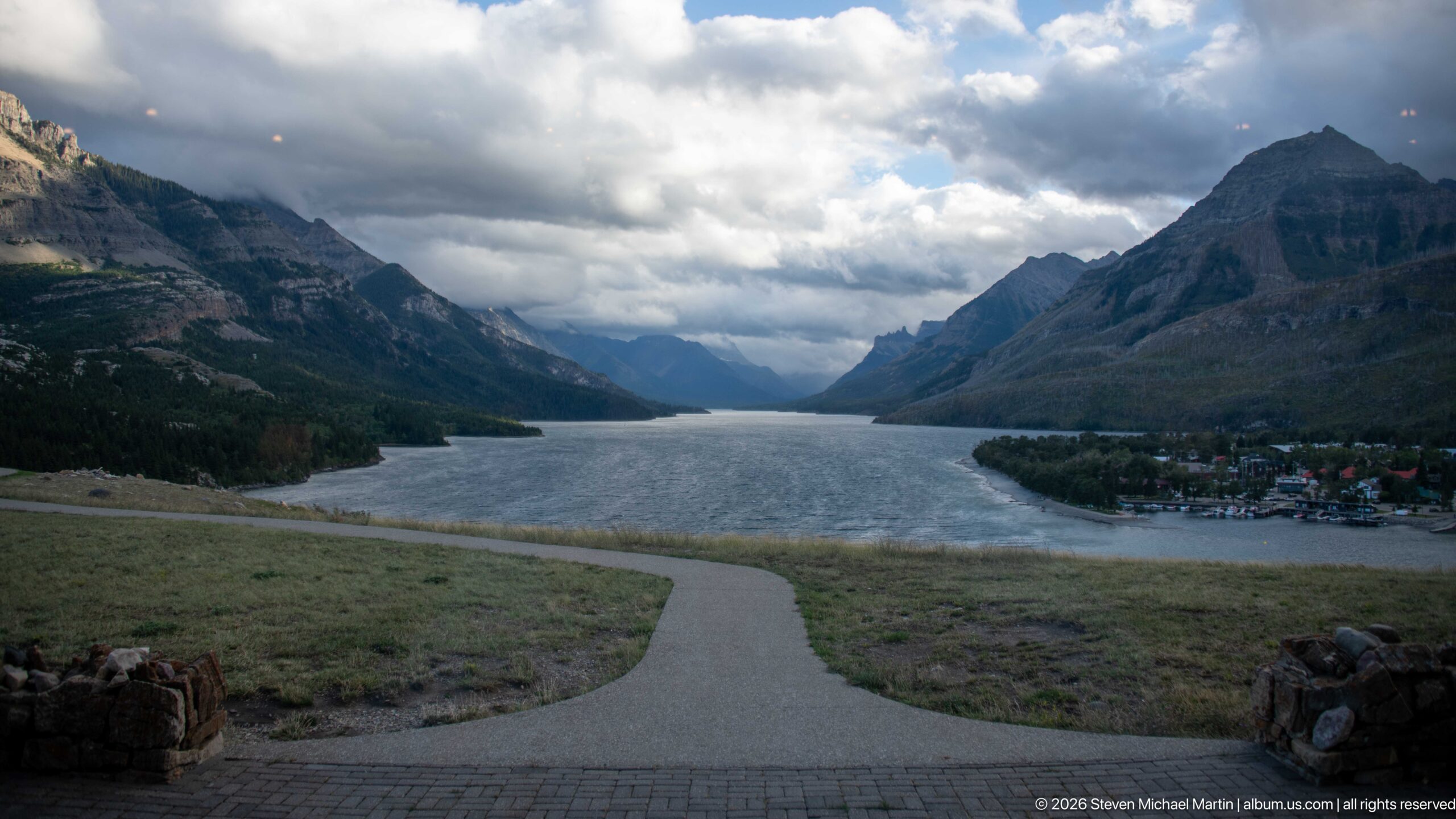
Upper Waterton Lake stretches between steep mountain walls beneath broken clouds, seen from the bluff beside the Prince of Wales Hotel. A paved path descends through open grassland toward the water, while the Waterton townsite occupies the shoreline at right, giving the view a strong sense of the hotel’s elevated setting.
Caption
Upper Waterton Lake stretches between steep mountain walls beneath broken clouds, seen from the bluff beside the Prince of Wales Hotel. A paved path descends through open grassland toward the water, while the Waterton townsite occupies the shoreline at right, giving the view a strong sense of the hotel’s elevated setting.
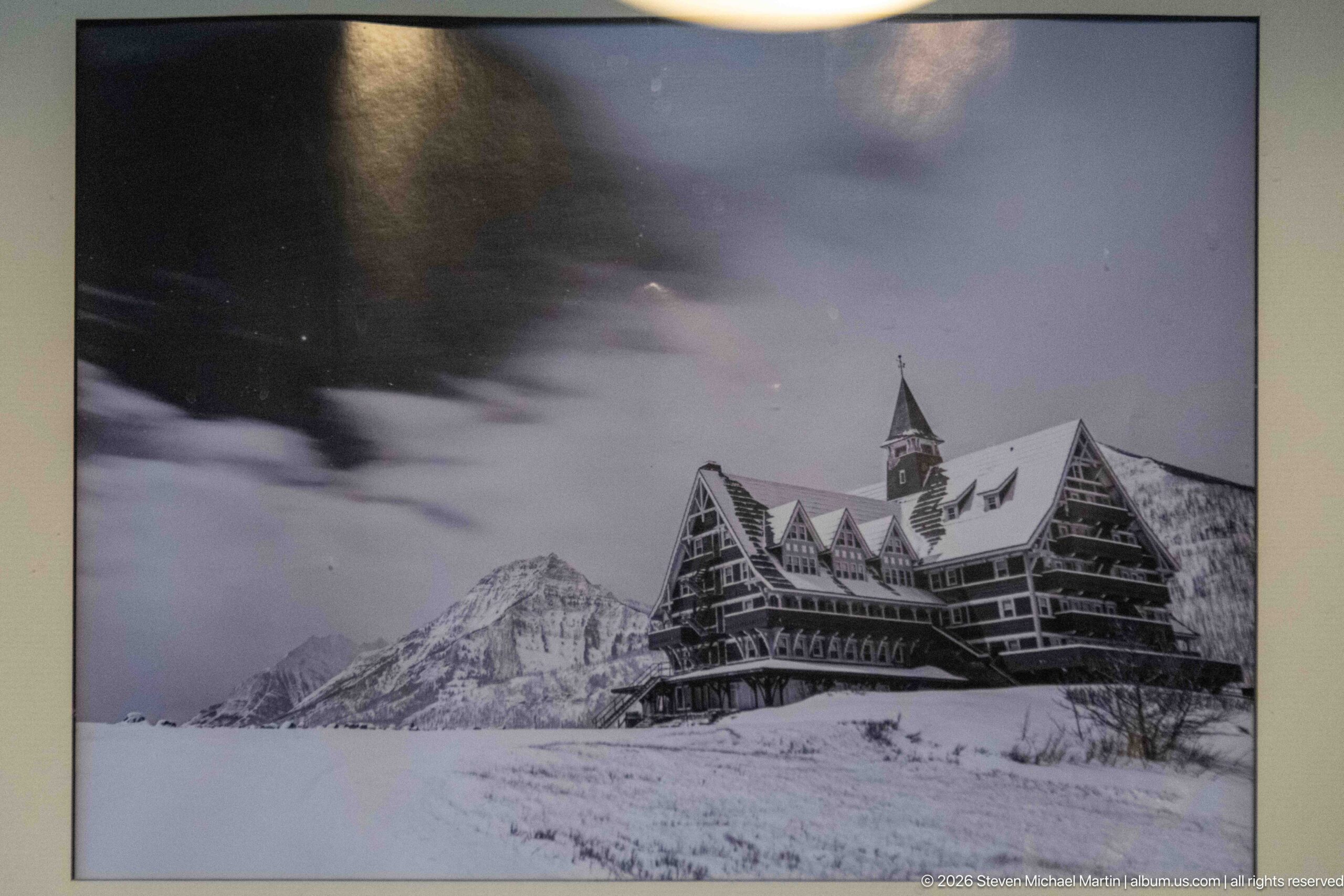
A framed historical photograph presents the Prince of Wales Hotel in deep winter, its steep gables and central tower rising from a snow-covered landscape. The monochrome scene emphasizes the building’s distinctive silhouette and exposed mountain setting, while also documenting how dramatically seasonal conditions can transform the hotel’s surroundings.
Caption
A framed historical photograph presents the Prince of Wales Hotel in deep winter, its steep gables and central tower rising from a snow-covered landscape. The monochrome scene emphasizes the building’s distinctive silhouette and exposed mountain setting, while also documenting how dramatically seasonal conditions can transform the hotel’s surroundings.
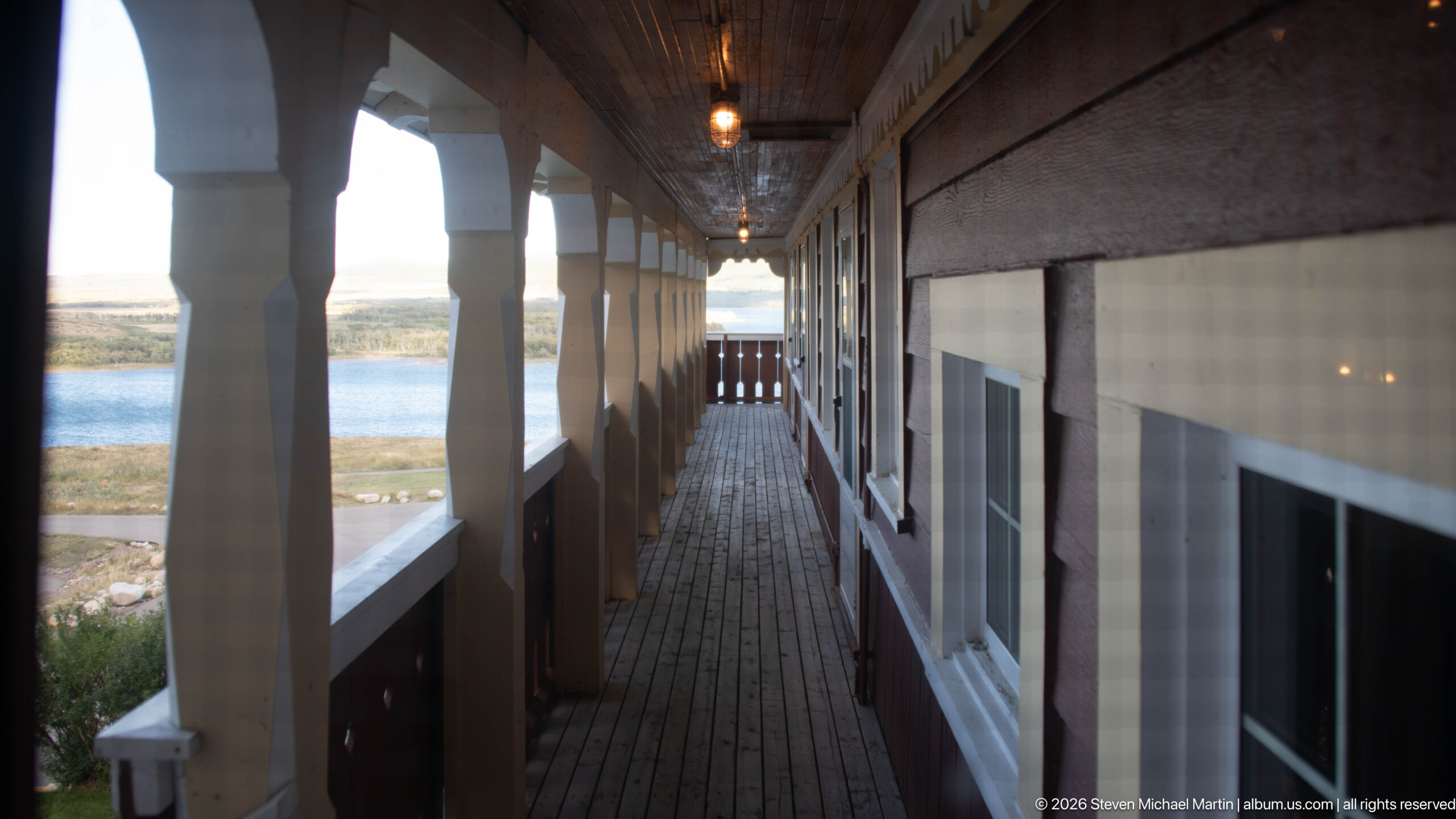
A long covered gallery runs along the Prince of Wales Hotel, its closely spaced wooden posts framing alternating glimpses of Upper Waterton Lake and the surrounding open landscape. Guest-room windows line the inner wall, while the plank floor and wood ceiling emphasize the building’s extensive exterior circulation and its close relationship to the elevated lakeside setting.
Caption
A long covered gallery runs along the Prince of Wales Hotel, its closely spaced wooden posts framing alternating glimpses of Upper Waterton Lake and the surrounding open landscape. Guest-room windows line the inner wall, while the plank floor and wood ceiling emphasize the building’s extensive exterior circulation and its close relationship to the elevated lakeside setting.
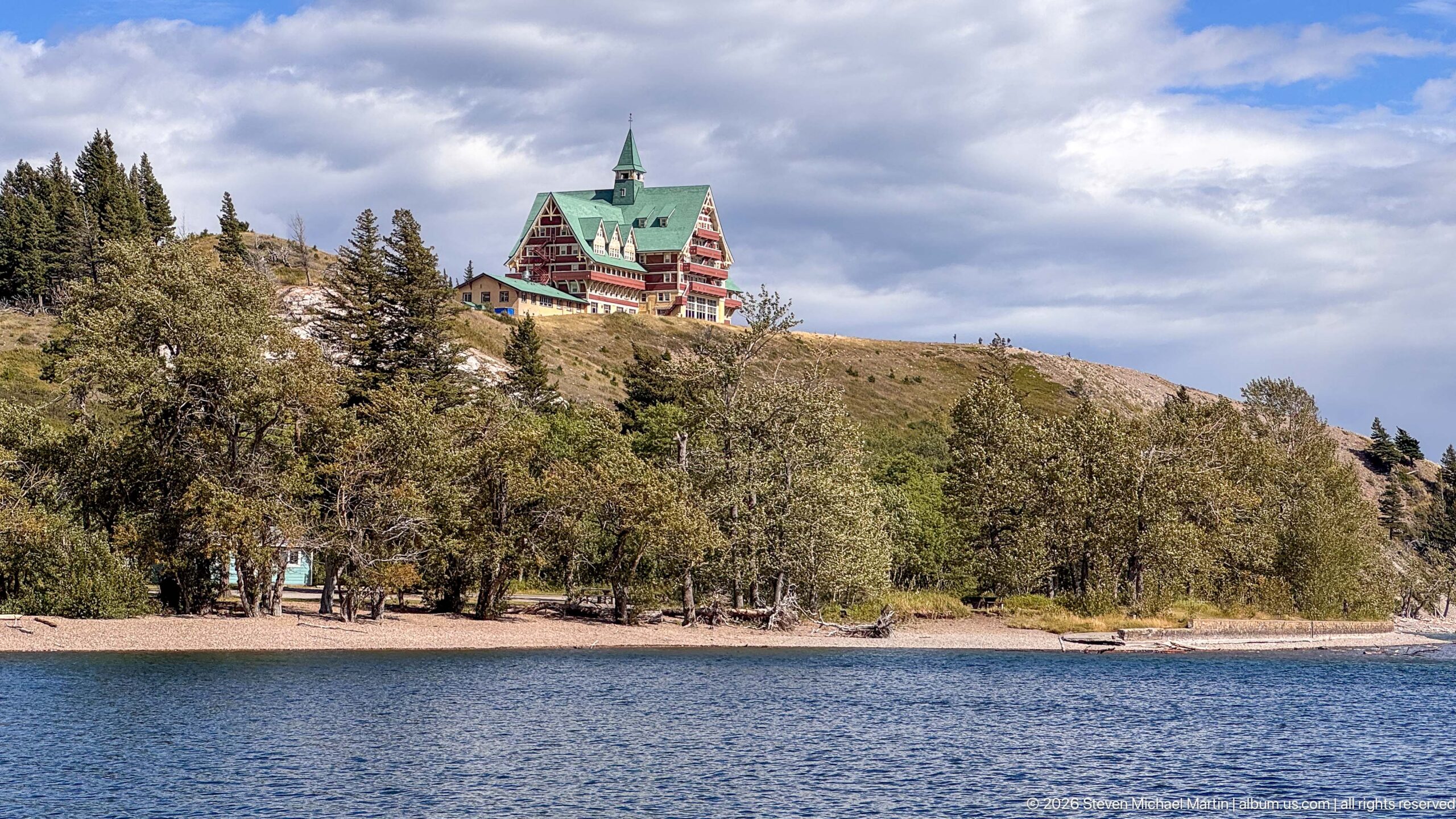
The Prince of Wales Hotel appears above a wooded bluff, its green roof and tall central roof feature emerging prominently against a clouded sky. Upper Waterton Lake spans the foreground, separating the viewer from the hotel and making its elevated siting especially clear. The view places the building within the steep, open terrain that defines its approach and setting.
Caption
The Prince of Wales Hotel appears above a wooded bluff, its green roof and tall central roof feature emerging prominently against a clouded sky. Upper Waterton Lake spans the foreground, separating the viewer from the hotel and making its elevated siting especially clear. The view places the building within the steep, open terrain that defines its approach and setting.
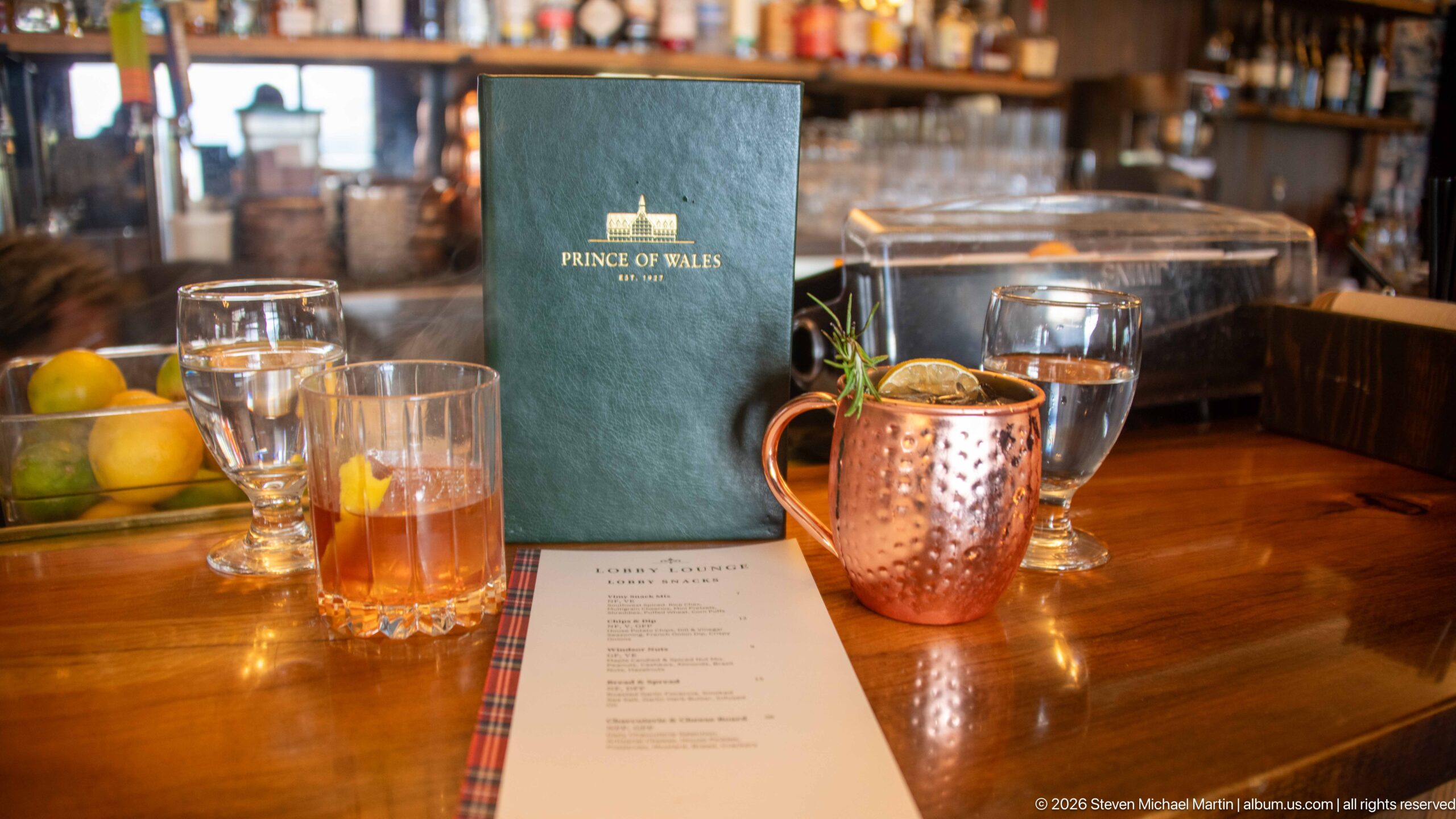
A green Prince of Wales menu stands behind a cocktail served in a hammered copper mug, accompanied by water glasses and a printed lounge menu. The carefully arranged tabletop connects the hotel’s branded dining service with the warm wood and bar setting visible beyond.
Caption
A green Prince of Wales menu stands behind a cocktail served in a hammered copper mug, accompanied by water glasses and a printed lounge menu. The carefully arranged tabletop connects the hotel’s branded dining service with the warm wood and bar setting visible beyond.
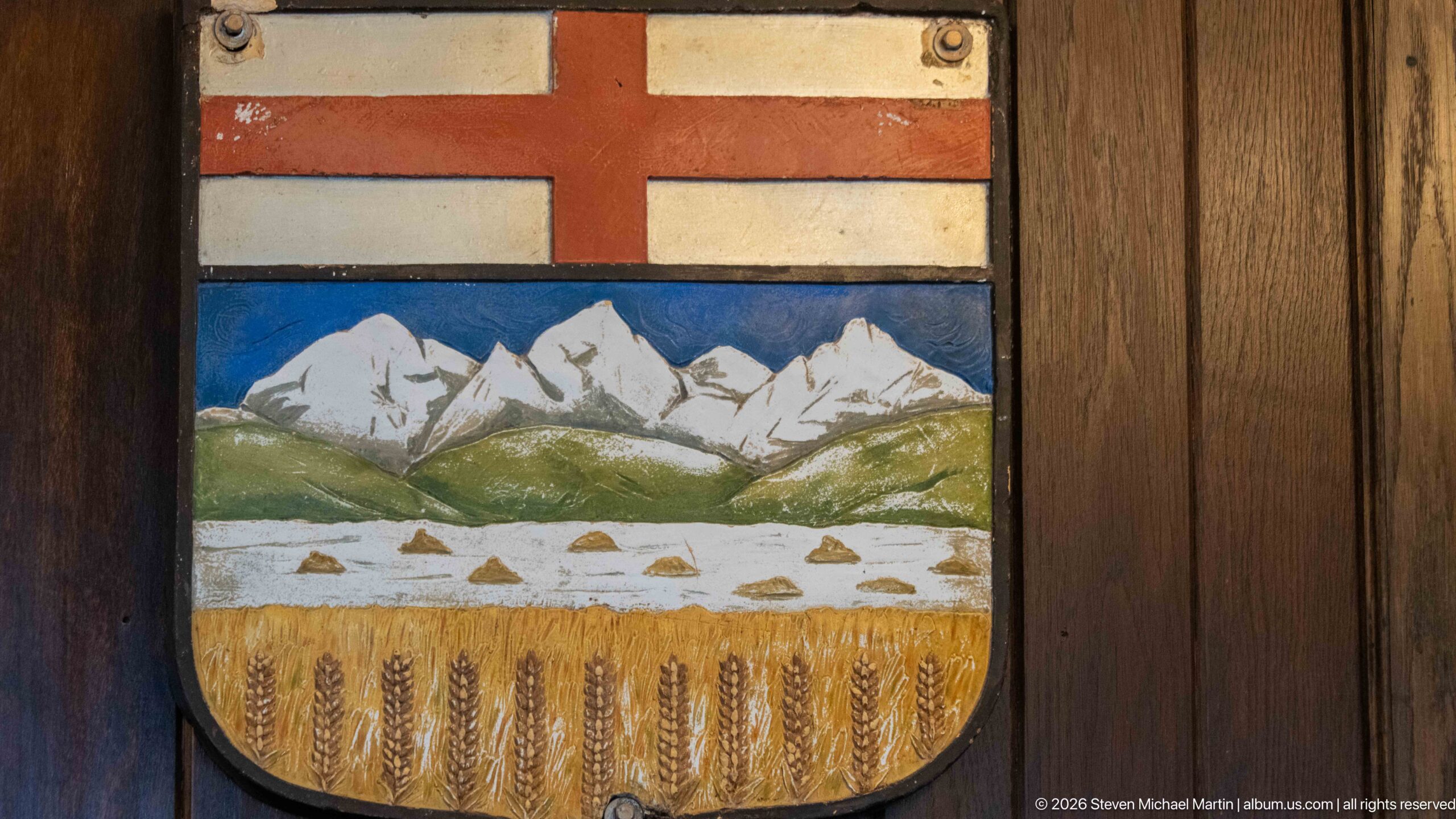
Snowy mountain peaks rise above green foothills and a field of golden wheat in this painted shield-like panel. The composition joins prairie agriculture with the Rocky Mountain skyline, visually expressing the meeting of plains and mountains characteristic of the Waterton landscape.
Caption
Snowy mountain peaks rise above green foothills and a field of golden wheat in this painted shield-like panel. The composition joins prairie agriculture with the Rocky Mountain skyline, visually expressing the meeting of plains and mountains characteristic of the Waterton landscape.
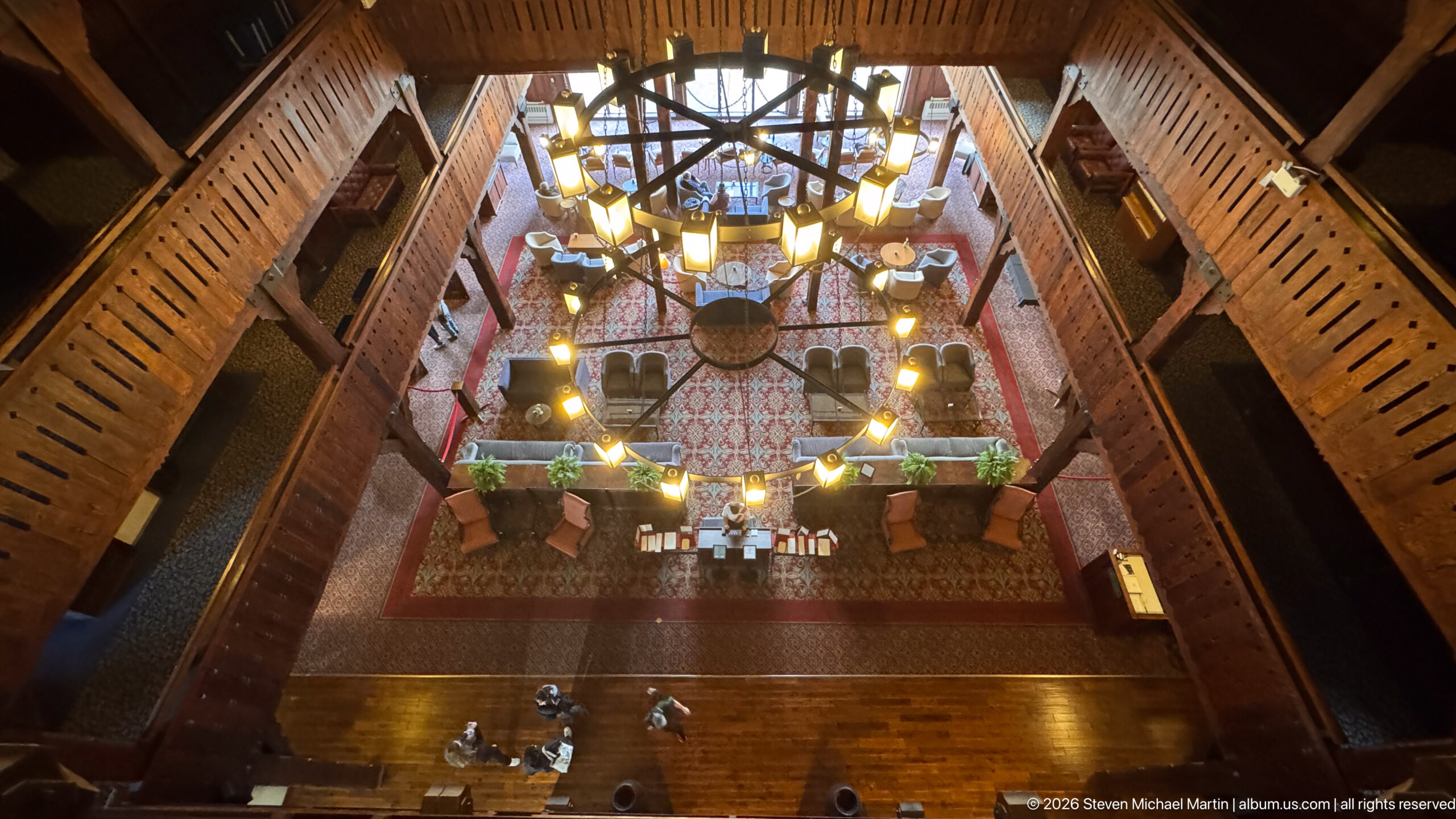
A near-vertical view from the upper galleries looks down through a large circular chandelier to the Prince of Wales Hotel lounge floor. Sofas, armchairs, tables, plants, and patterned rugs form orderly seating groups within the tall central hall, while the surrounding timber balconies reveal the dramatic depth of the multi-story interior.
Caption
A near-vertical view from the upper galleries looks down through a large circular chandelier to the Prince of Wales Hotel lounge floor. Sofas, armchairs, tables, plants, and patterned rugs form orderly seating groups within the tall central hall, while the surrounding timber balconies reveal the dramatic depth of the multi-story interior.
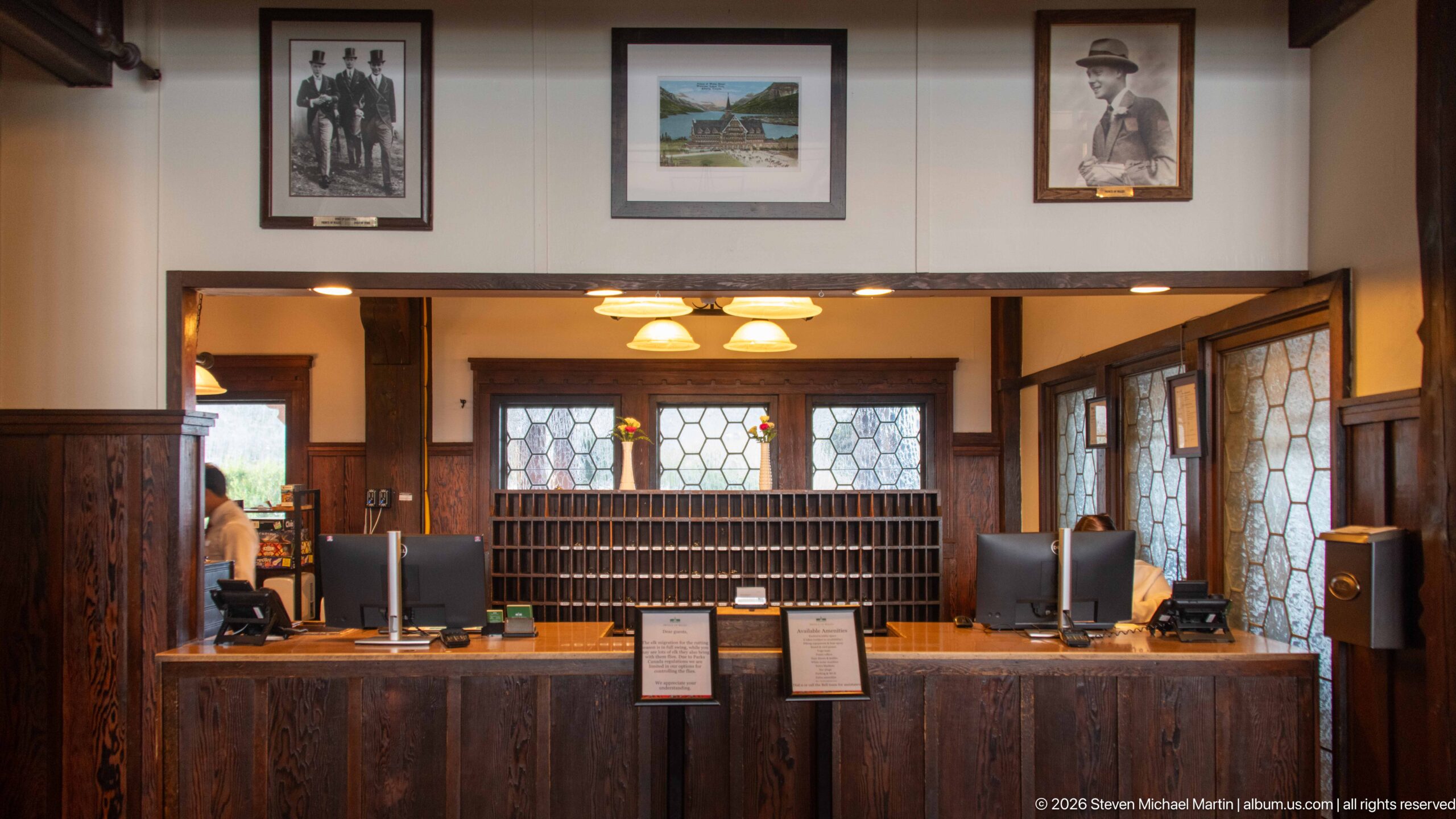
The Prince of Wales Hotel reception desk is set within dark wood paneling beneath framed historical images. Behind the counter, a wall of traditional key or message slots reinforces the period character of the front office, while leaded-glass doors and windows continue the geometric detailing seen elsewhere in the hotel.
Caption
The Prince of Wales Hotel reception desk is set within dark wood paneling beneath framed historical images. Behind the counter, a wall of traditional key or message slots reinforces the period character of the front office, while leaded-glass doors and windows continue the geometric detailing seen elsewhere in the hotel.
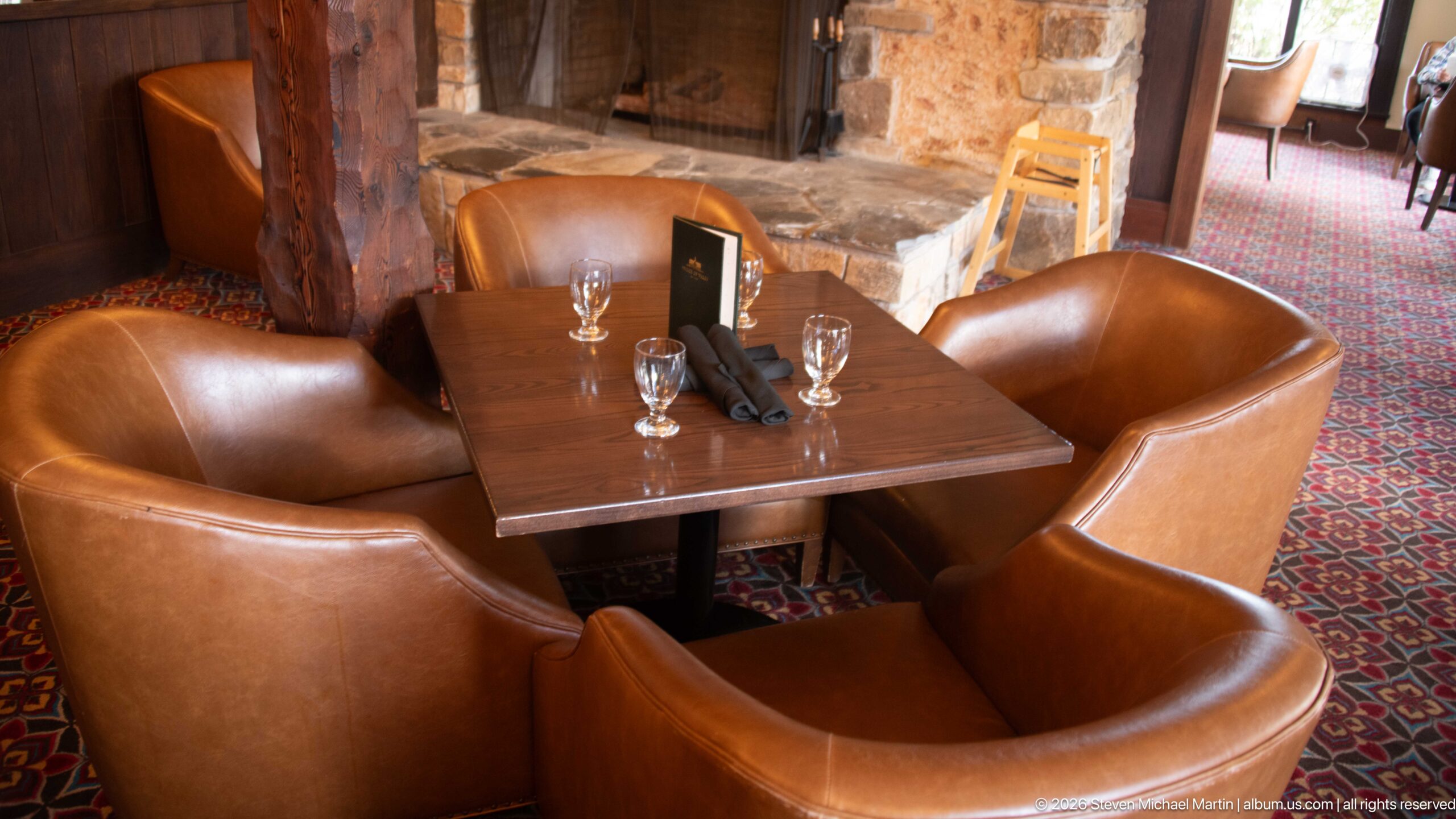
Four curved brown leather club chairs surround a square wooden table beside a substantial stone fireplace. Set glassware and folded napkins suggest table service, while the patterned carpet, timber walls, and masonry hearth reinforce the hotel lounge’s warm, rustic interior character.
Caption
Four curved brown leather club chairs surround a square wooden table beside a substantial stone fireplace. Set glassware and folded napkins suggest table service, while the patterned carpet, timber walls, and masonry hearth reinforce the hotel lounge’s warm, rustic interior character.
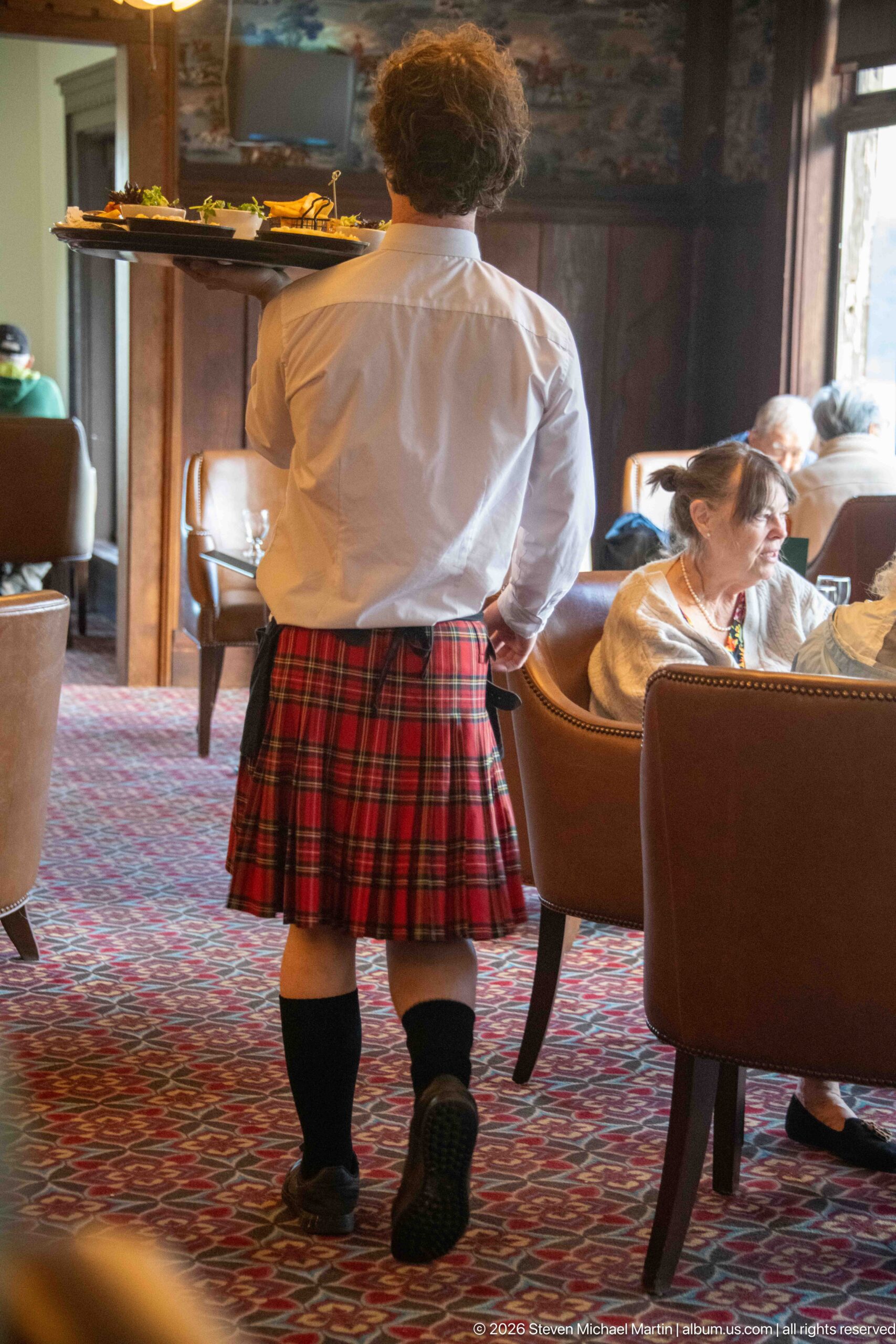
A hotel server walks through the lounge wearing a white shirt, red tartan kilt, dark knee socks, and black shoes. Seen from behind among seated guests and leather chairs, the uniform reinforces the British and Scottish visual themes carried through the hotel’s hospitality spaces.
Caption
A hotel server walks through the lounge wearing a white shirt, red tartan kilt, dark knee socks, and black shoes. Seen from behind among seated guests and leather chairs, the uniform reinforces the British and Scottish visual themes carried through the hotel’s hospitality spaces.
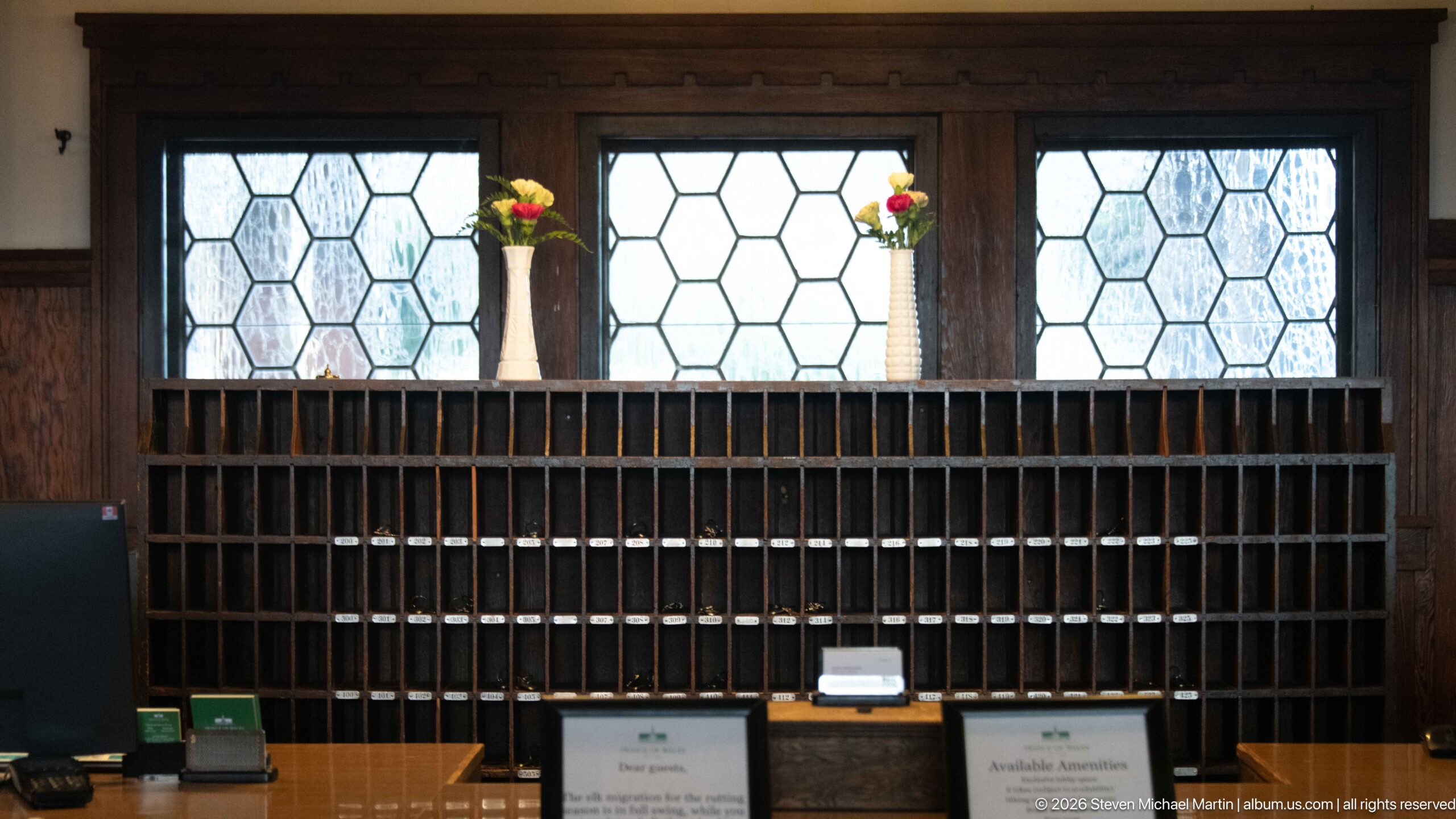
A grid of narrow wooden cubbies fills the wall behind the Prince of Wales Hotel front desk, preserving the visual language of an earlier era of hotel service. Geometric leaded-glass windows rise above the compartments, while small flower vases soften the strongly ordered arrangement of dark-stained wood.
Caption
A grid of narrow wooden cubbies fills the wall behind the Prince of Wales Hotel front desk, preserving the visual language of an earlier era of hotel service. Geometric leaded-glass windows rise above the compartments, while small flower vases soften the strongly ordered arrangement of dark-stained wood.
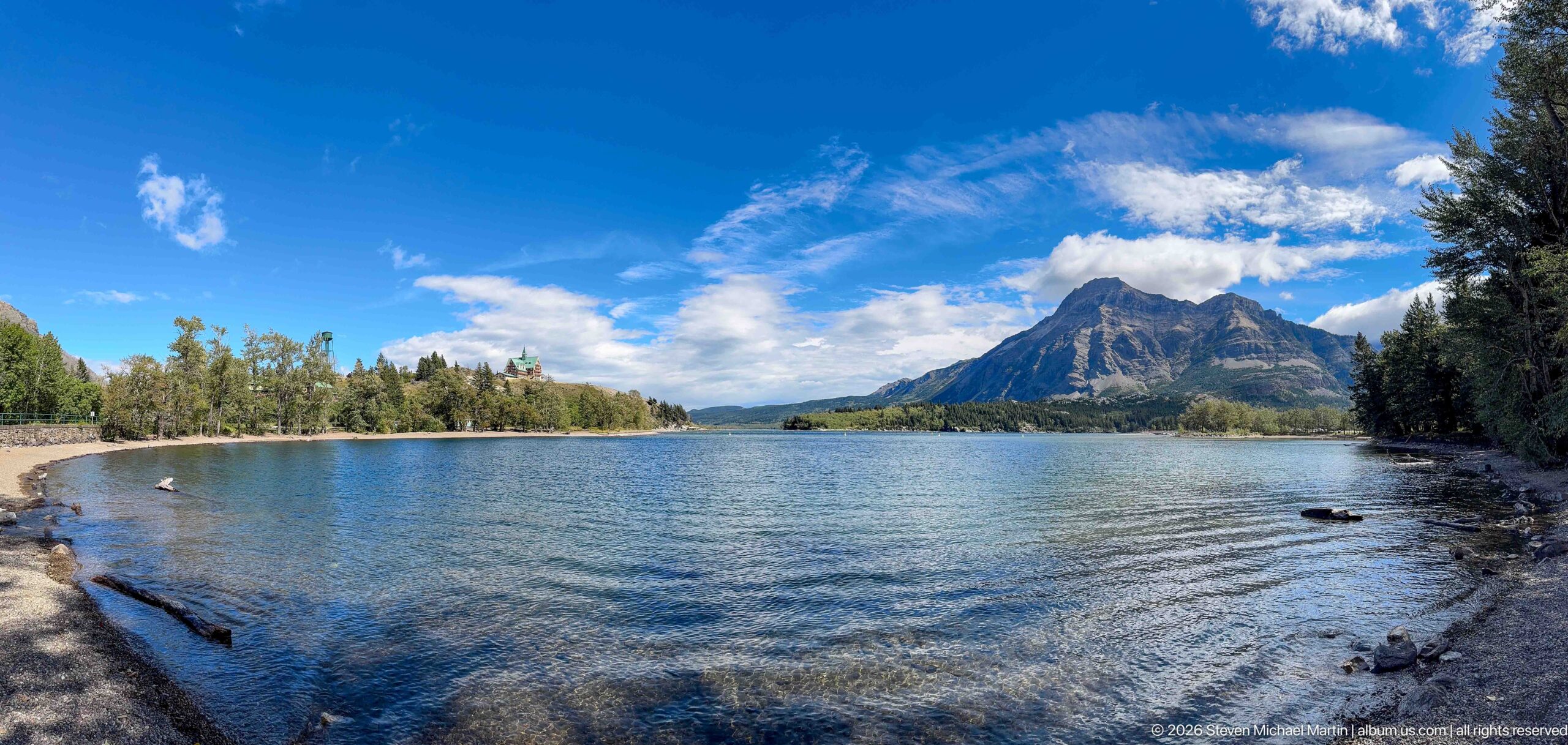
Upper Waterton Lake fills the foreground beneath a sharply rising mountain, with a wooded shoreline curving into the water under a vivid blue sky. The low lakeside viewpoint emphasizes the broad expanse of water and the abrupt transition from forested shore to exposed rock, establishing the dramatic mountain-and-lake setting surrounding the Prince of Wales Hotel.
Caption
Upper Waterton Lake fills the foreground beneath a sharply rising mountain, with a wooded shoreline curving into the water under a vivid blue sky. The low lakeside viewpoint emphasizes the broad expanse of water and the abrupt transition from forested shore to exposed rock, establishing the dramatic mountain-and-lake setting surrounding the Prince of Wales Hotel.
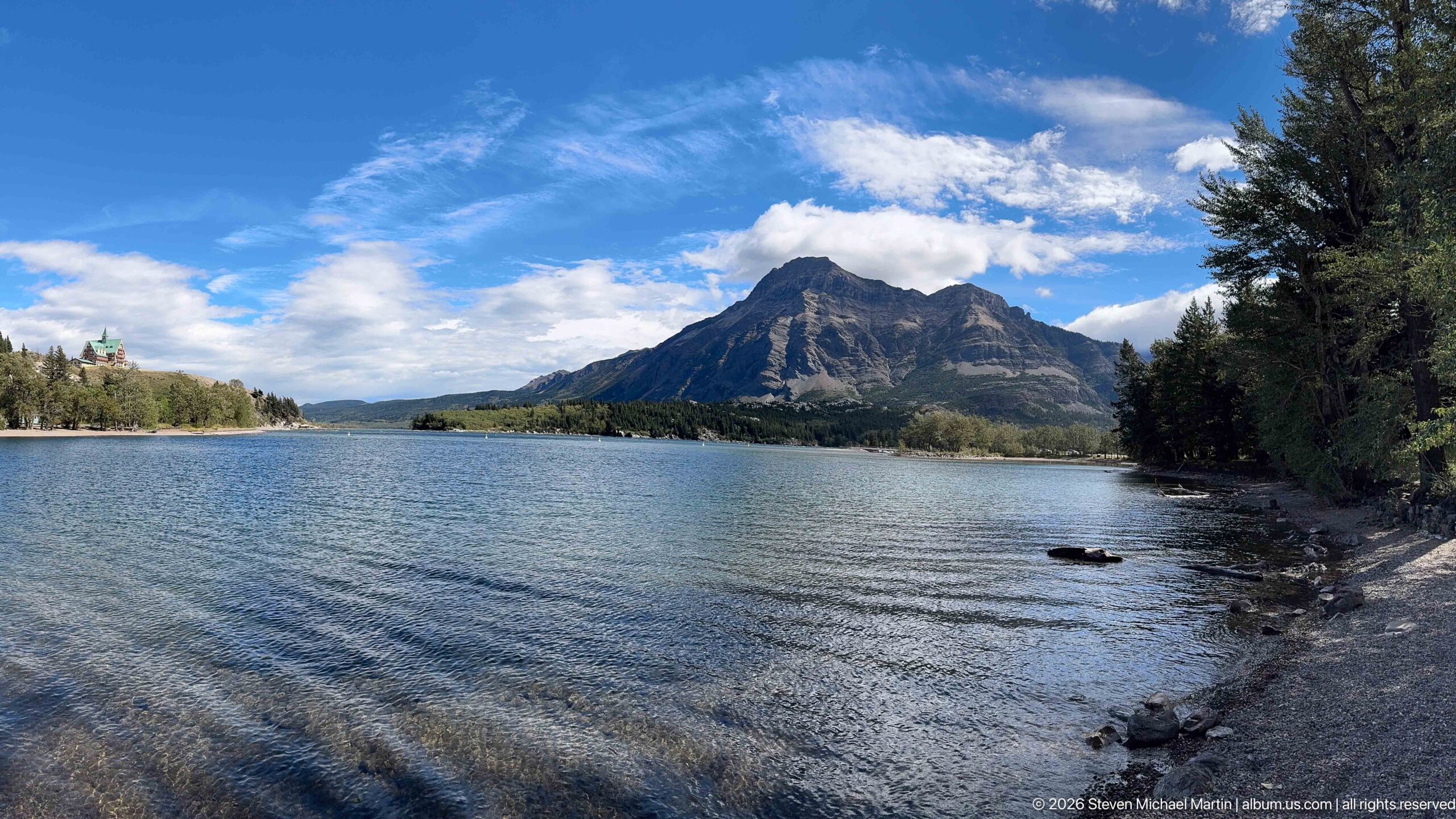
A broad sweep of Upper Waterton Lake leads toward a rugged mountain rising above the opposite shore, while trees frame the water at both edges. Ripples and a partially submerged log animate the foreground. Compared with the preceding shoreline view, this composition opens the lake more fully and centers the mountain mass beneath bands of high cloud.
Caption
A broad sweep of Upper Waterton Lake leads toward a rugged mountain rising above the opposite shore, while trees frame the water at both edges. Ripples and a partially submerged log animate the foreground. Compared with the preceding shoreline view, this composition opens the lake more fully and centers the mountain mass beneath bands of high cloud.
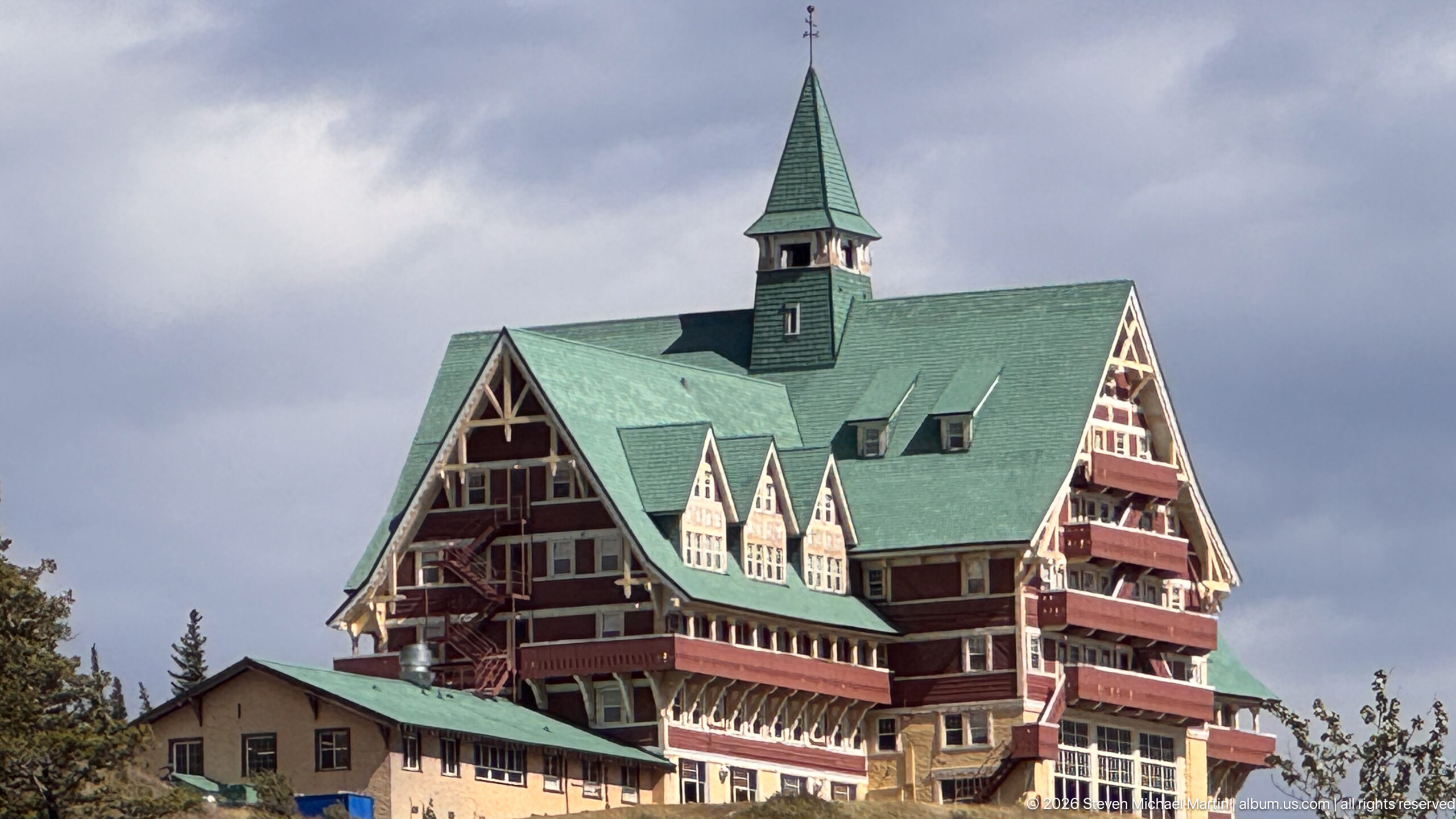
The Prince of Wales Hotel rises in a compact, steep-roofed mass of dark red siding, pale lower walls, projecting balconies, gables, and a tall central roof feature. Seen from below and at an angle, the façade reveals the building's layered vertical composition and deep overhangs. The green roof planes and contrasting timber trim give the historic hotel its distinctive alpine-resort character.
Caption
The Prince of Wales Hotel rises in a compact, steep-roofed mass of dark red siding, pale lower walls, projecting balconies, gables, and a tall central roof feature. Seen from below and at an angle, the façade reveals the building's layered vertical composition and deep overhangs. The green roof planes and contrasting timber trim give the historic hotel its distinctive alpine-resort character.
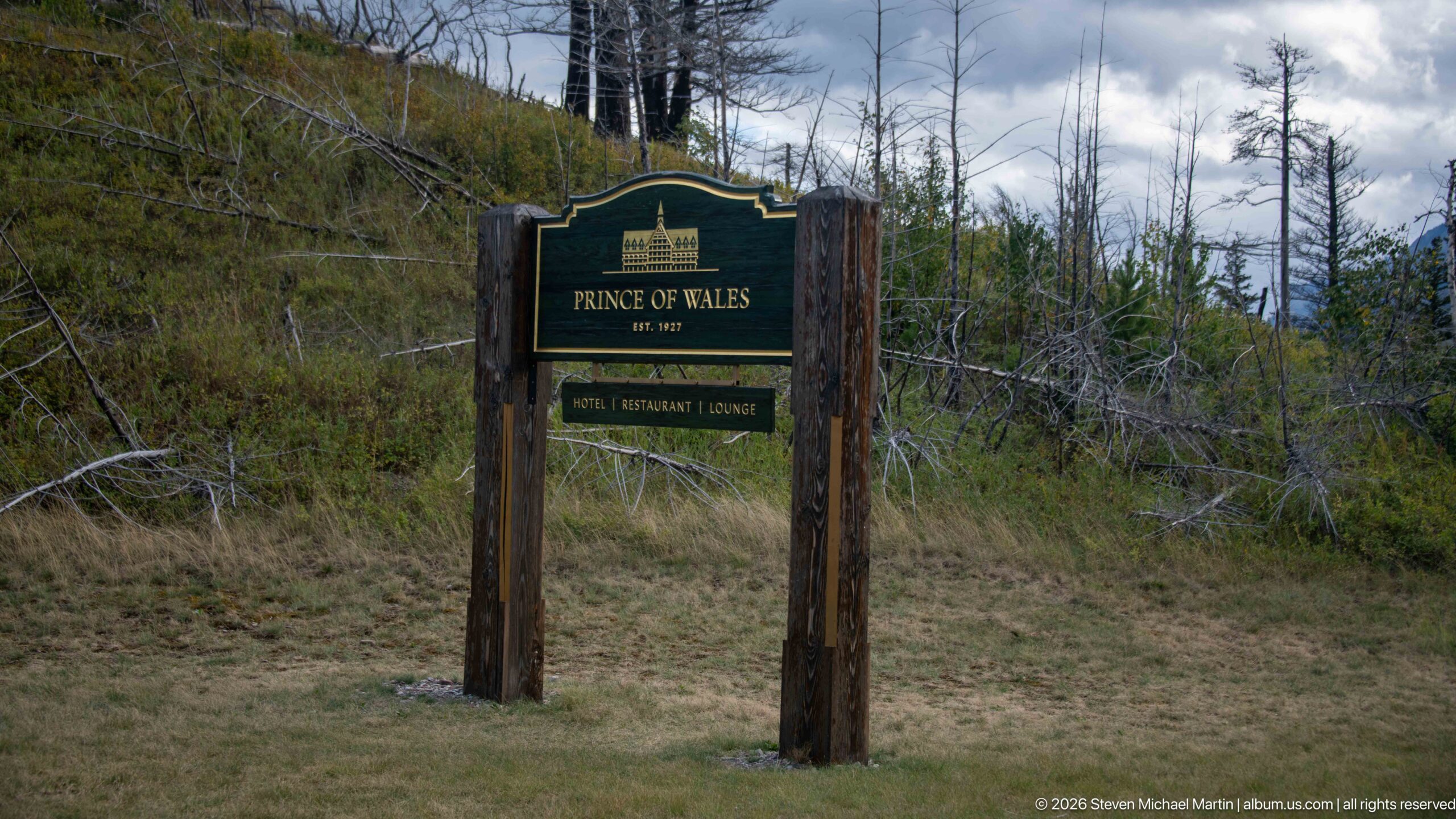
A freestanding wooden sign identifies the Prince of Wales and gives its establishment date as 1927, with a stylized outline of the hotel above the name. A smaller panel directs visitors to the hotel, restaurant, and lounge. Set among grass, trunks, and sparse woodland, the sign marks the transition from the surrounding park landscape to the hotel property.
Caption
A freestanding wooden sign identifies the Prince of Wales and gives its establishment date as 1927, with a stylized outline of the hotel above the name. A smaller panel directs visitors to the hotel, restaurant, and lounge. Set among grass, trunks, and sparse woodland, the sign marks the transition from the surrounding park landscape to the hotel property.
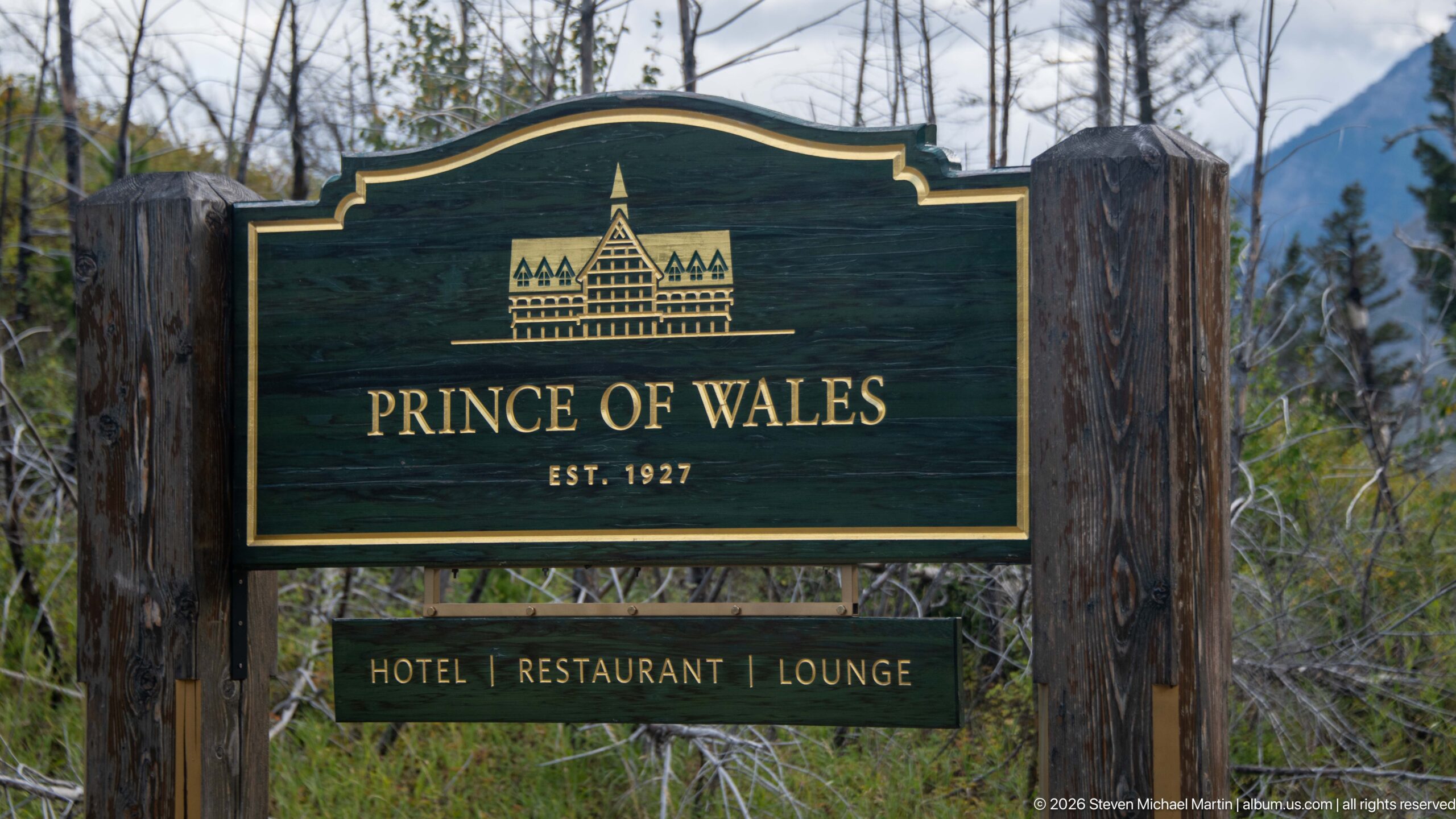
The Prince of Wales entrance sign is shown close enough to read its principal details: the hotel name, “Est. 1927,” and the lower panel for hotel, restaurant, and lounge. Gold lettering and a simplified hotel silhouette stand out against the dark green field, while heavy timber posts reinforce the rustic visual language used around the property.
Caption
The Prince of Wales entrance sign is shown close enough to read its principal details: the hotel name, “Est. 1927,” and the lower panel for hotel, restaurant, and lounge. Gold lettering and a simplified hotel silhouette stand out against the dark green field, while heavy timber posts reinforce the rustic visual language used around the property.
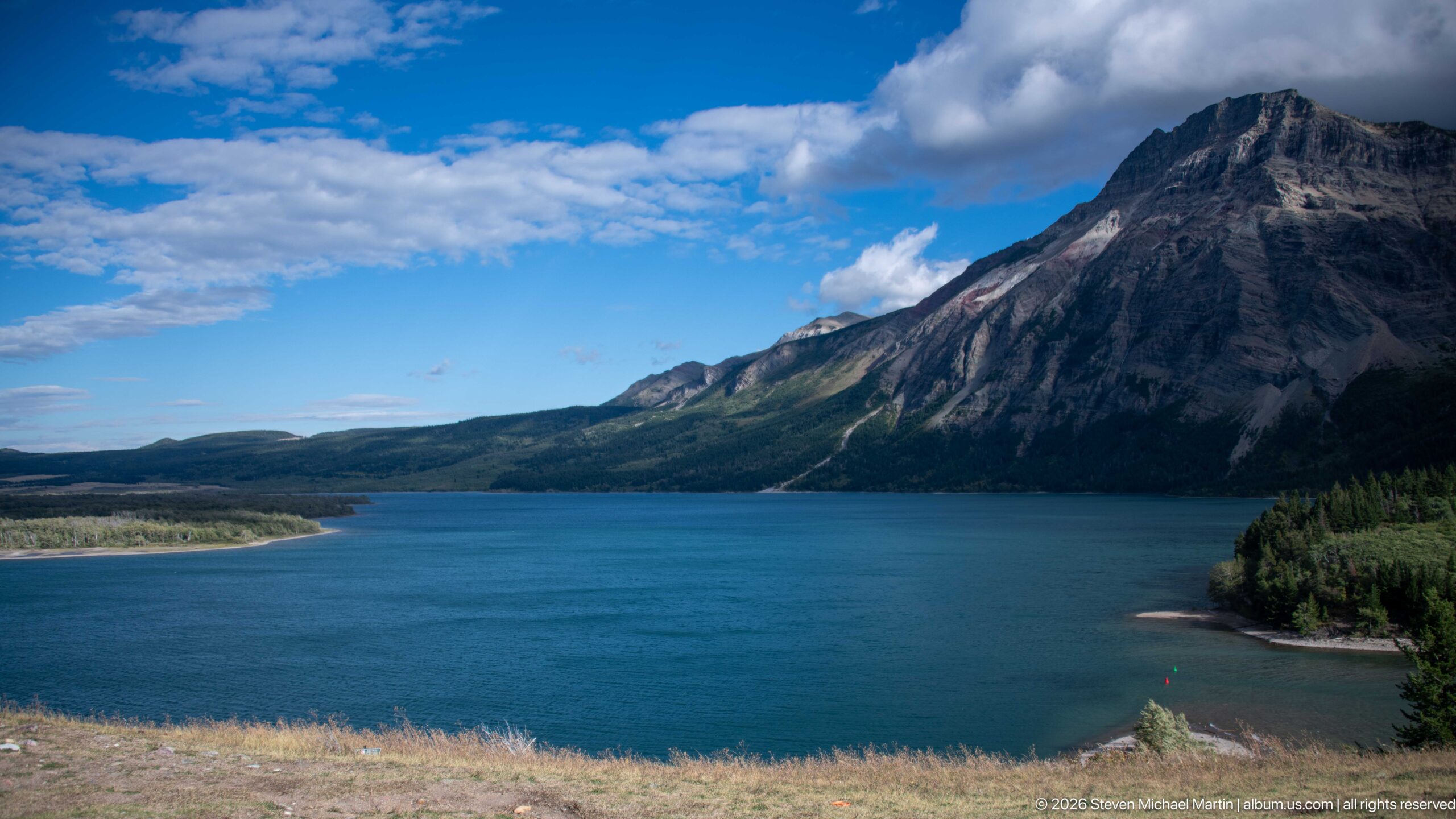
From the elevated grounds near the Prince of Wales Hotel, Upper Waterton Lake curves beneath a massive rocky mountain slope. The lake's blue surface, forested margins, and small gravelly shoreline features are seen from above, revealing why the hotel's bluff provides such expansive views. Sunlight and cloud shadow divide the mountain into contrasting bands of exposed rock and vegetation.
Caption
From the elevated grounds near the Prince of Wales Hotel, Upper Waterton Lake curves beneath a massive rocky mountain slope. The lake's blue surface, forested margins, and small gravelly shoreline features are seen from above, revealing why the hotel's bluff provides such expansive views. Sunlight and cloud shadow divide the mountain into contrasting bands of exposed rock and vegetation.
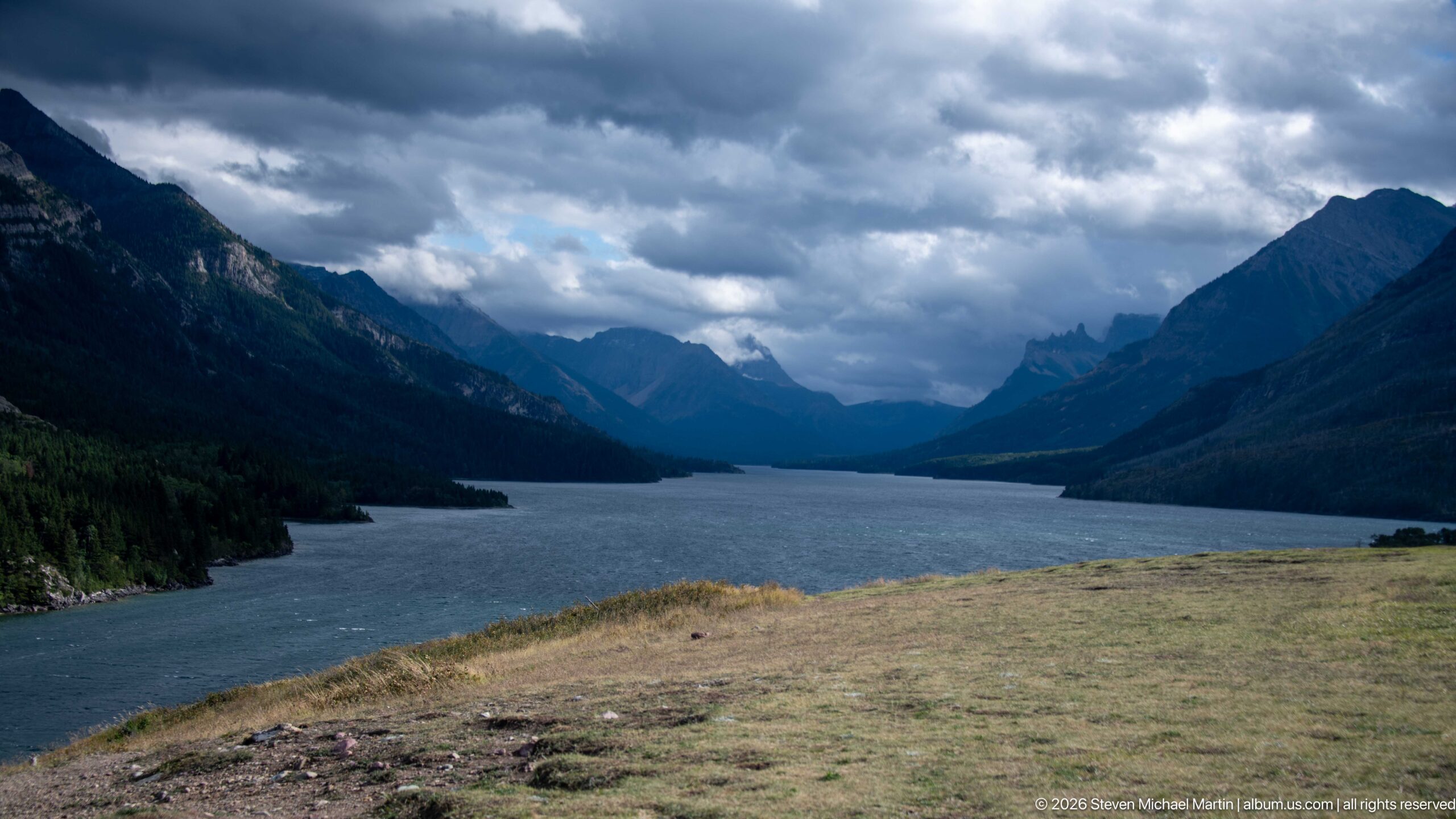
Upper Waterton Lake stretches into a deep mountain corridor beneath heavy, broken clouds. Forested slopes descend sharply to both sides of the water, while distant peaks recede into blue-gray haze. A strip of dry grass in the foreground identifies the elevated hotel grounds, making this a characteristic outlook from the Prince of Wales bluff rather than a shoreline-level landscape.
Caption
Upper Waterton Lake stretches into a deep mountain corridor beneath heavy, broken clouds. Forested slopes descend sharply to both sides of the water, while distant peaks recede into blue-gray haze. A strip of dry grass in the foreground identifies the elevated hotel grounds, making this a characteristic outlook from the Prince of Wales bluff rather than a shoreline-level landscape.
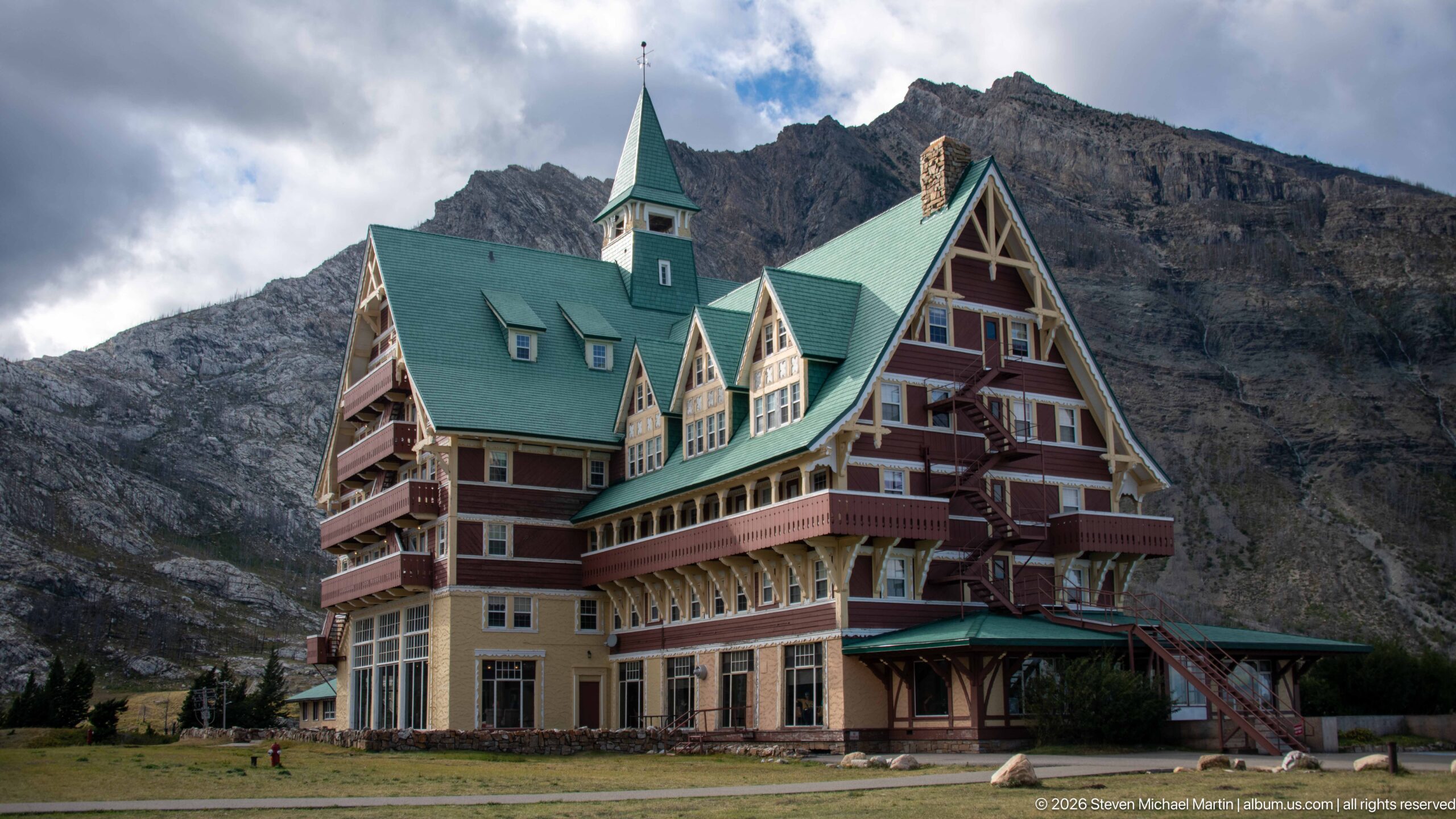
A close exterior view sets the Prince of Wales Hotel directly against the gray rock wall behind it. Stacked balconies, sharply pitched green roofs, triangular gables, and the central roof feature create a strongly vertical silhouette, while the pale ground floor anchors the structure. The angle also reveals the hotel's projecting entrance canopy and the intricate rhythm of brackets beneath the upper balcony.
Caption
A close exterior view sets the Prince of Wales Hotel directly against the gray rock wall behind it. Stacked balconies, sharply pitched green roofs, triangular gables, and the central roof feature create a strongly vertical silhouette, while the pale ground floor anchors the structure. The angle also reveals the hotel's projecting entrance canopy and the intricate rhythm of brackets beneath the upper balcony.
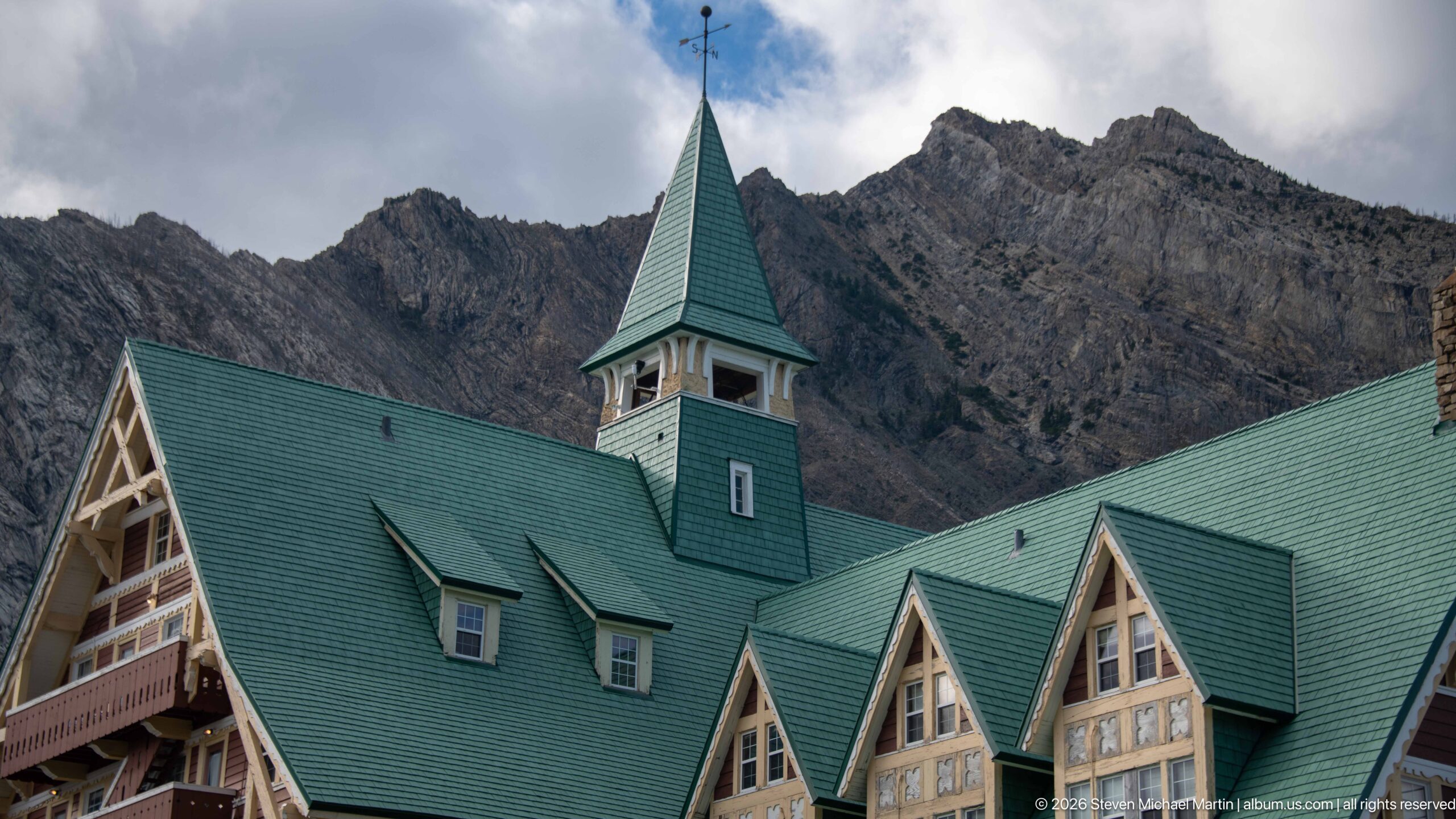
Steep green roof planes dominate this architectural detail, rising toward the hotel's central roof feature and weather vane. Three projecting gables punctuate the lower slope, each framed by pale trim and timber detailing. Cropped tightly against the jagged mountain behind, the view isolates the roofline and shows how strongly the building's pointed forms echo the angular profile of its setting.
Caption
Steep green roof planes dominate this architectural detail, rising toward the hotel's central roof feature and weather vane. Three projecting gables punctuate the lower slope, each framed by pale trim and timber detailing. Cropped tightly against the jagged mountain behind, the view isolates the roofline and shows how strongly the building's pointed forms echo the angular profile of its setting.
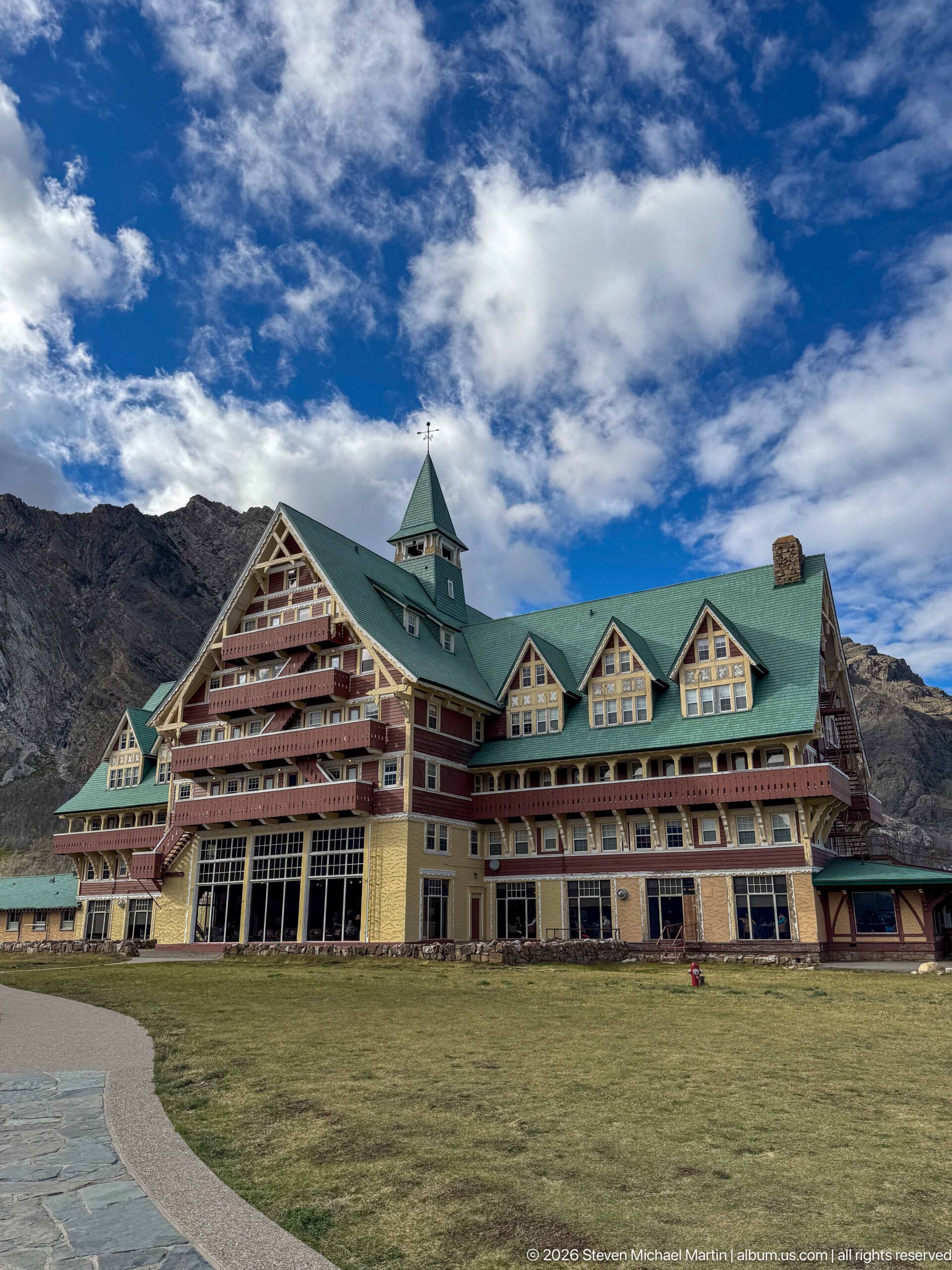
The long principal elevation of the Prince of Wales Hotel spreads across the frame beneath a bright, cloud-streaked sky. Its asymmetrical massing combines a large gabled wing, central roof feature, smaller dormer-like gables, continuous balconies, and a pale lower story with broad windows. The open lawn and curving stone path provide a clear foreground for reading the building as a complete architectural composition.
Caption
The long principal elevation of the Prince of Wales Hotel spreads across the frame beneath a bright, cloud-streaked sky. Its asymmetrical massing combines a large gabled wing, central roof feature, smaller dormer-like gables, continuous balconies, and a pale lower story with broad windows. The open lawn and curving stone path provide a clear foreground for reading the building as a complete architectural composition.
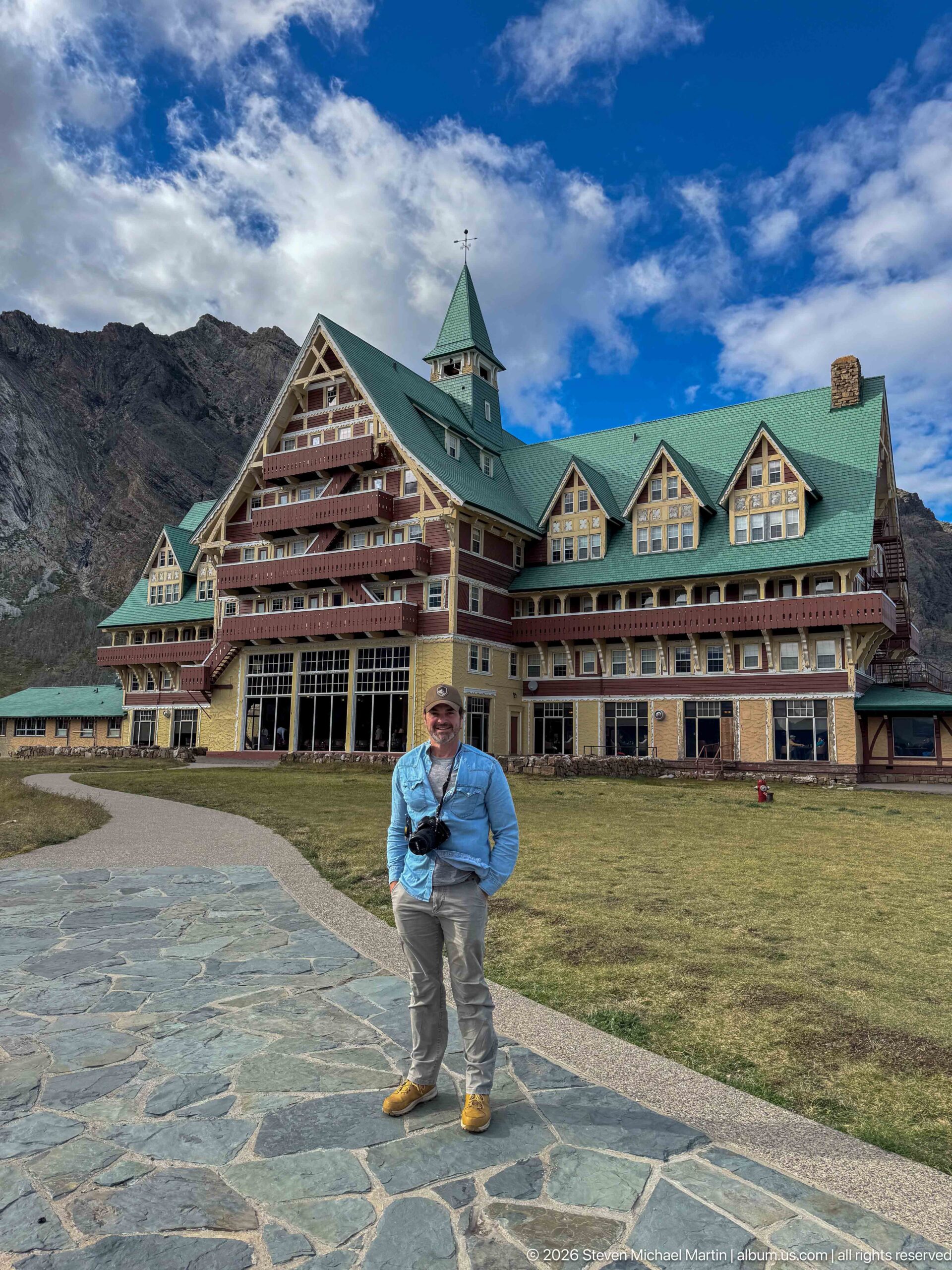
A visitor stands on the curving stone path in front of the Prince of Wales Hotel, giving a direct sense of scale to the long façade. Behind him, stacked balconies, triangular gables, green roofs, and broad ground-floor windows extend across the building. The rocky ridge immediately beyond the roofline reinforces the close relationship between the hotel's architecture and mountain setting.
Caption
A visitor stands on the curving stone path in front of the Prince of Wales Hotel, giving a direct sense of scale to the long façade. Behind him, stacked balconies, triangular gables, green roofs, and broad ground-floor windows extend across the building. The rocky ridge immediately beyond the roofline reinforces the close relationship between the hotel's architecture and mountain setting.
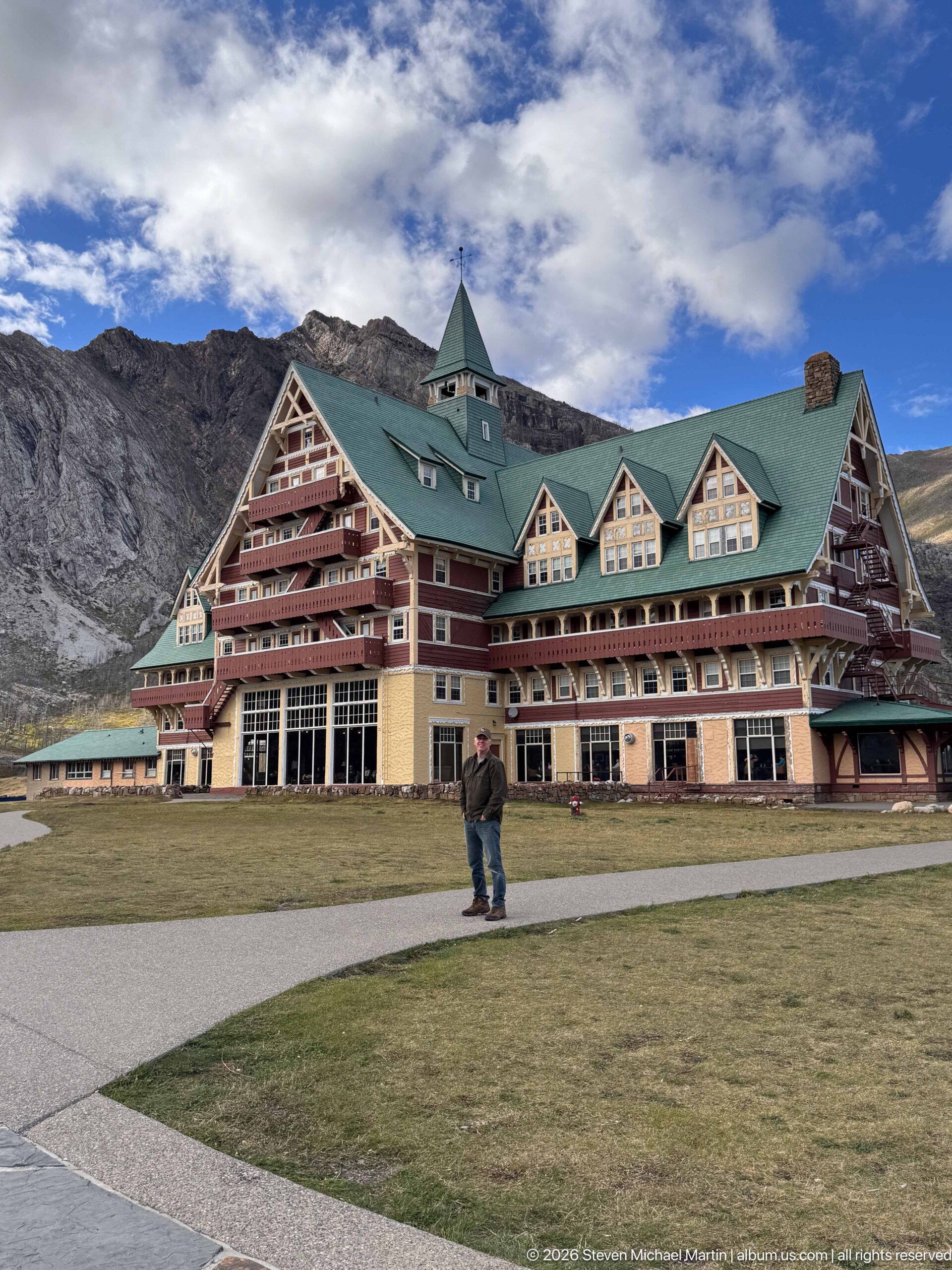
The Prince of Wales Hotel extends across the open lawn as a visitor crosses the foreground path. From this wider position, the large left gable, central roof feature, smaller projecting gables, long balcony lines, and low right wing can be read together. Bright blue sky and broken clouds contrast with the barren rocky ridge immediately behind the historic hotel.
Caption
The Prince of Wales Hotel extends across the open lawn as a visitor crosses the foreground path. From this wider position, the large left gable, central roof feature, smaller projecting gables, long balcony lines, and low right wing can be read together. Bright blue sky and broken clouds contrast with the barren rocky ridge immediately behind the historic hotel.
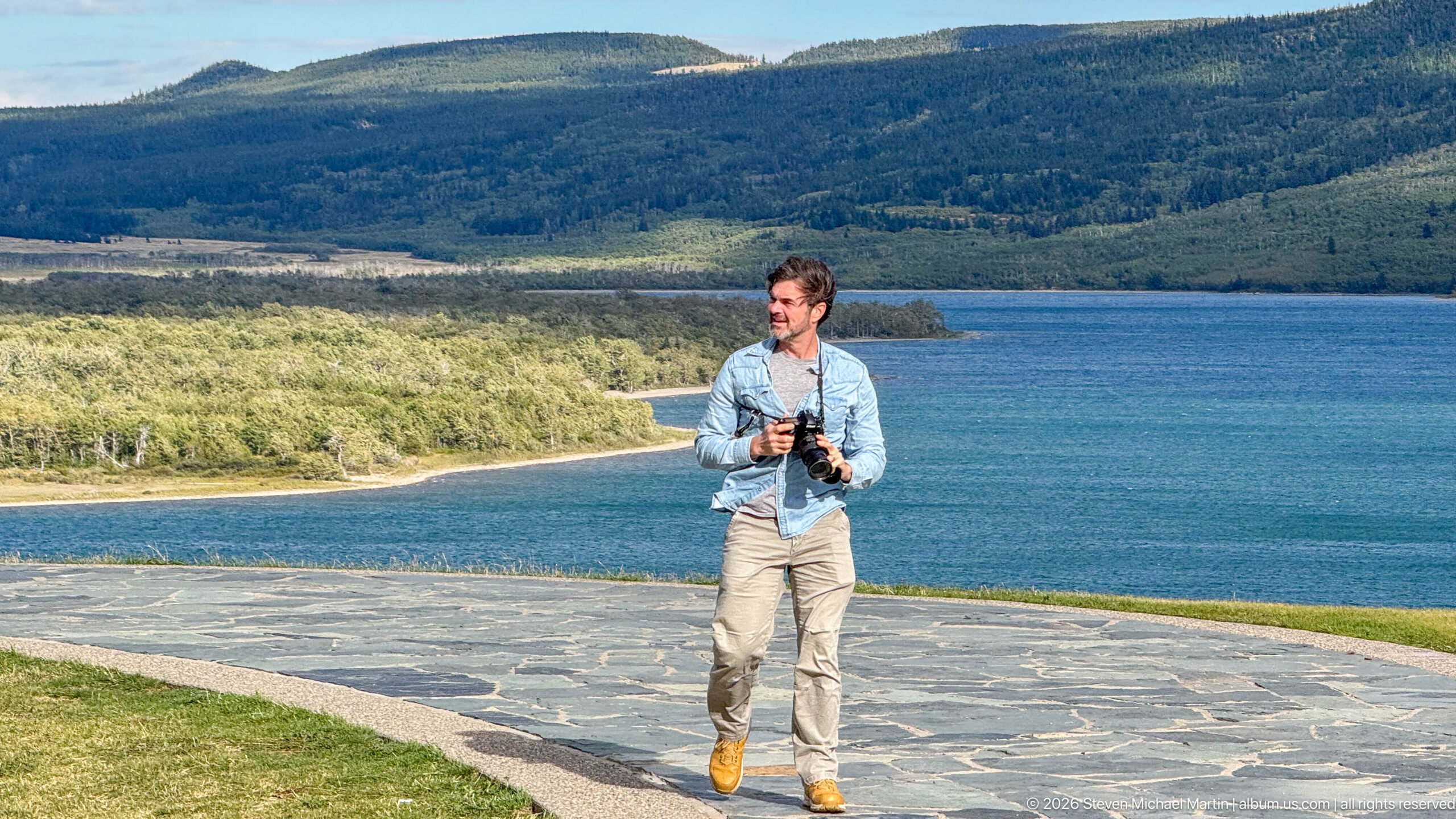
A visitor carrying a camera walks across the stone-paved grounds near the Prince of Wales Hotel, with Upper Waterton Lake and a low wooded shoreline behind him. The human figure provides scale for the broad overlook and connects the hotel's architectural setting to its role as a scenic stopping place. Bright sunlight brings out the blue water and green vegetation beyond the path.
Caption
A visitor carrying a camera walks across the stone-paved grounds near the Prince of Wales Hotel, with Upper Waterton Lake and a low wooded shoreline behind him. The human figure provides scale for the broad overlook and connects the hotel's architectural setting to its role as a scenic stopping place. Bright sunlight brings out the blue water and green vegetation beyond the path.
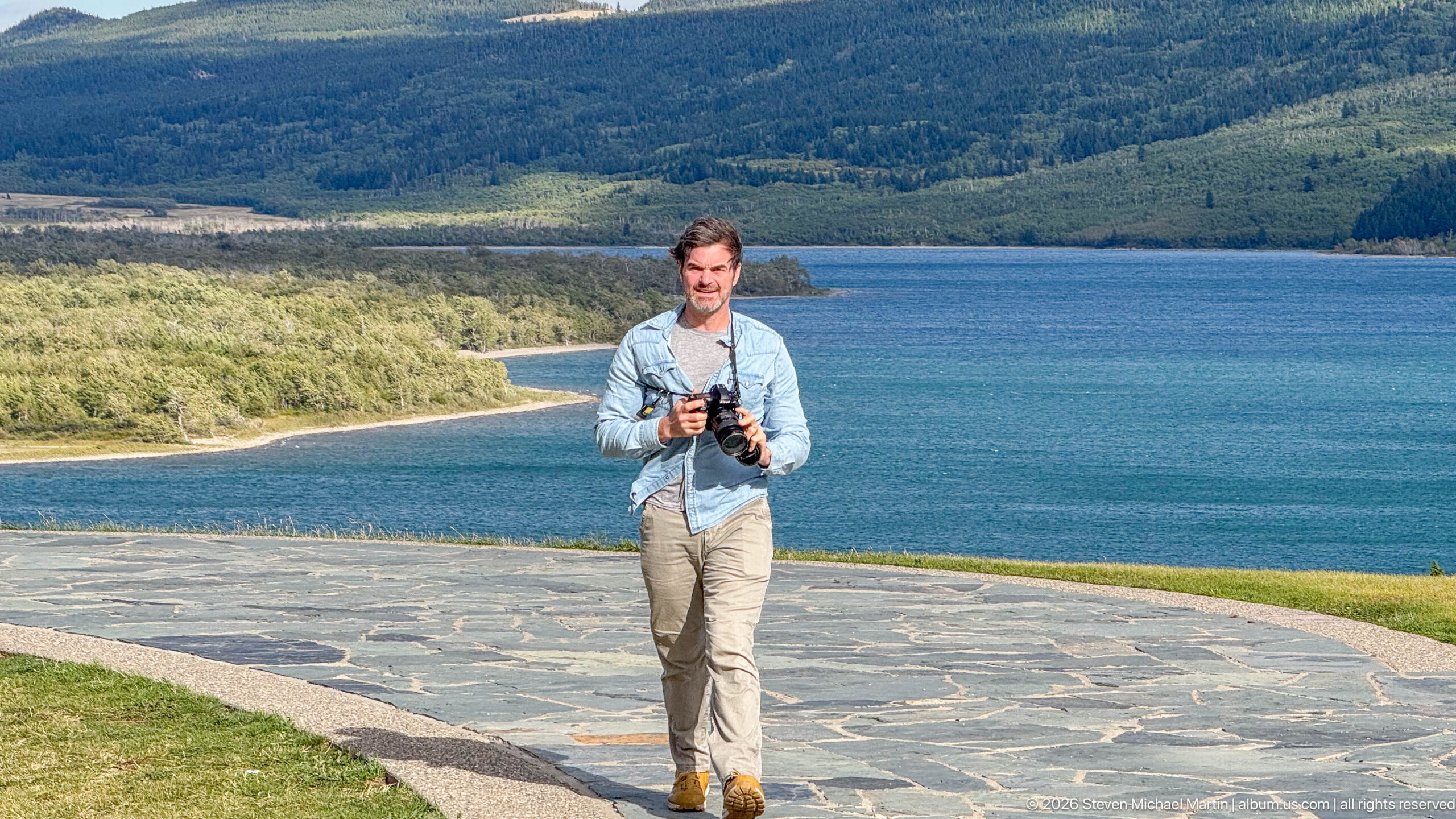
A visitor holding a camera stands on the stone-paved overlook beside the Prince of Wales Hotel, framed by the blue water of Upper Waterton Lake and the forested shoreline beyond. The centered portrait places the person within the hotel's celebrated landscape setting, while the curved paving and grassy edge mark the formalized viewing area on the bluff.
Caption
A visitor holding a camera stands on the stone-paved overlook beside the Prince of Wales Hotel, framed by the blue water of Upper Waterton Lake and the forested shoreline beyond. The centered portrait places the person within the hotel's celebrated landscape setting, while the curved paving and grassy edge mark the formalized viewing area on the bluff.
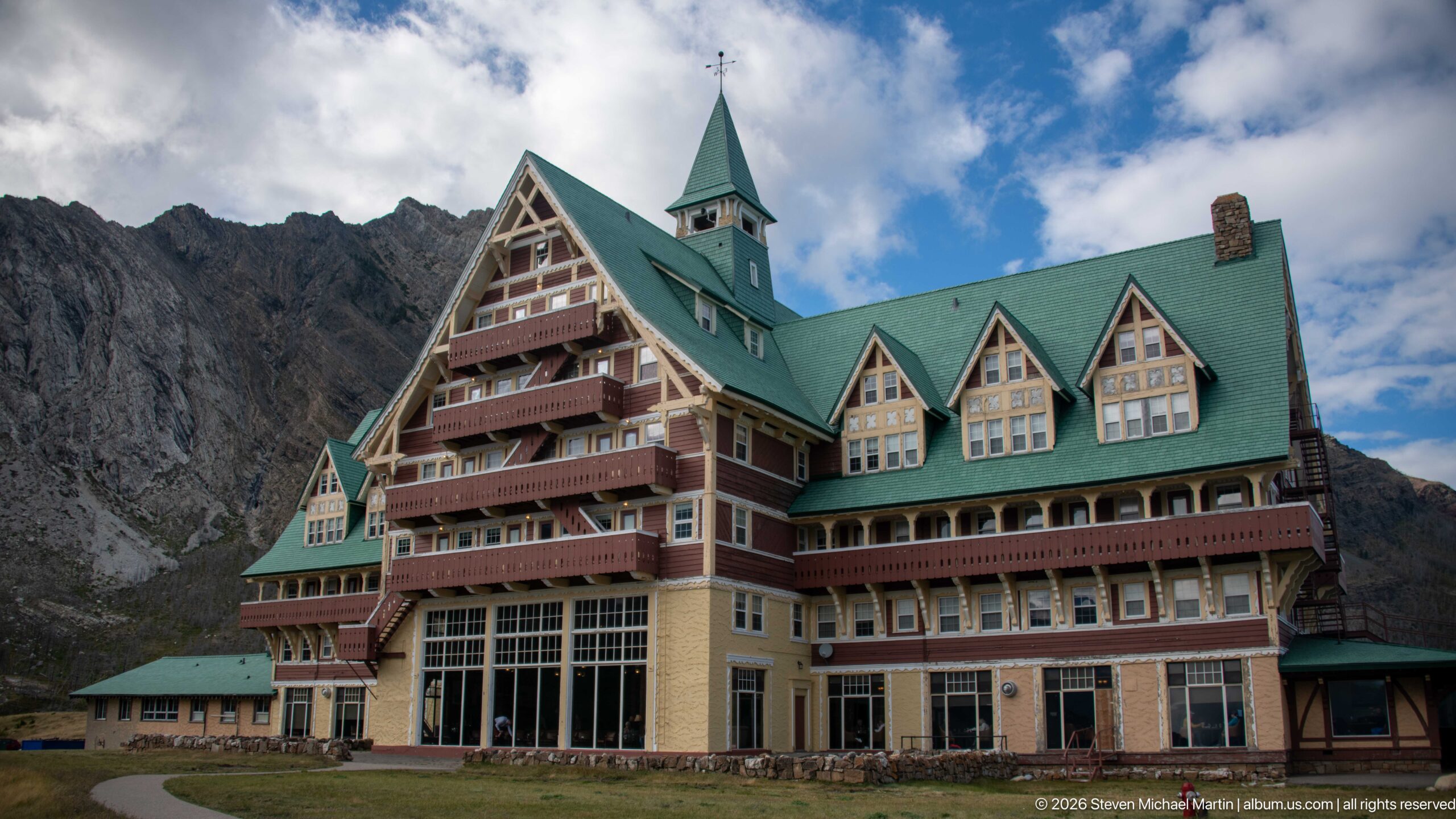
The Prince of Wales Hotel is seen from a three-quarter angle that emphasizes its tall gabled wing, stacked balconies, central roof feature, and broad bank of windows at ground level. Pale structural trim contrasts with dark red siding and the green roof. With the mountain rising immediately behind, the composition makes the hotel's pronounced verticality especially apparent.
Caption
The Prince of Wales Hotel is seen from a three-quarter angle that emphasizes its tall gabled wing, stacked balconies, central roof feature, and broad bank of windows at ground level. Pale structural trim contrasts with dark red siding and the green roof. With the mountain rising immediately behind, the composition makes the hotel's pronounced verticality especially apparent.
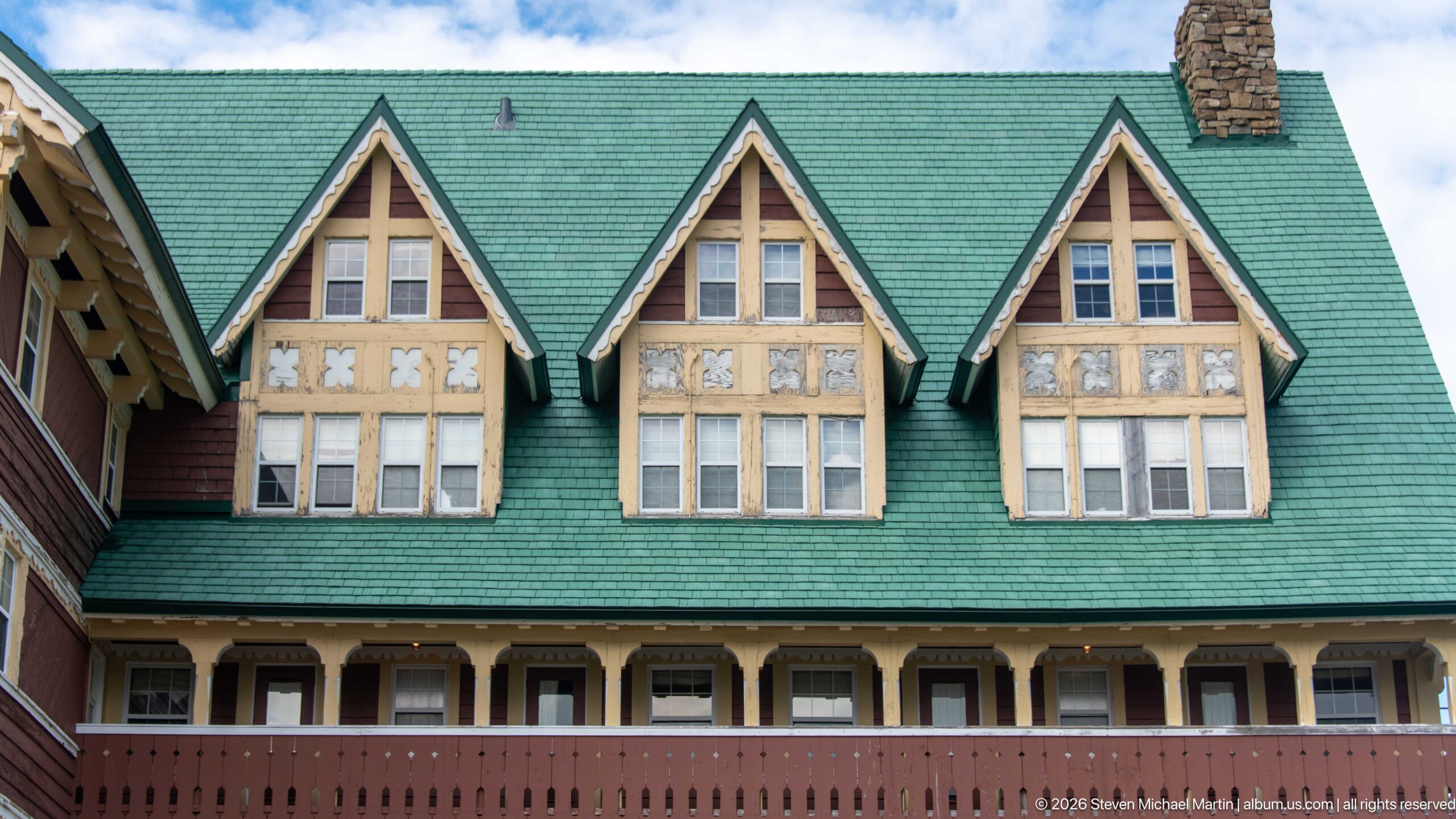
Three closely spaced projecting gables rise from the Prince of Wales Hotel's green roof above a continuous balcony. Pale timber framing, patterned infill panels, and rows of multi-pane windows create a dense decorative rhythm within each gable. This close architectural study shifts attention from the hotel's overall silhouette to the craftsmanship and repeated motifs that animate its long façade.
Caption
Three closely spaced projecting gables rise from the Prince of Wales Hotel's green roof above a continuous balcony. Pale timber framing, patterned infill panels, and rows of multi-pane windows create a dense decorative rhythm within each gable. This close architectural study shifts attention from the hotel's overall silhouette to the craftsmanship and repeated motifs that animate its long façade.
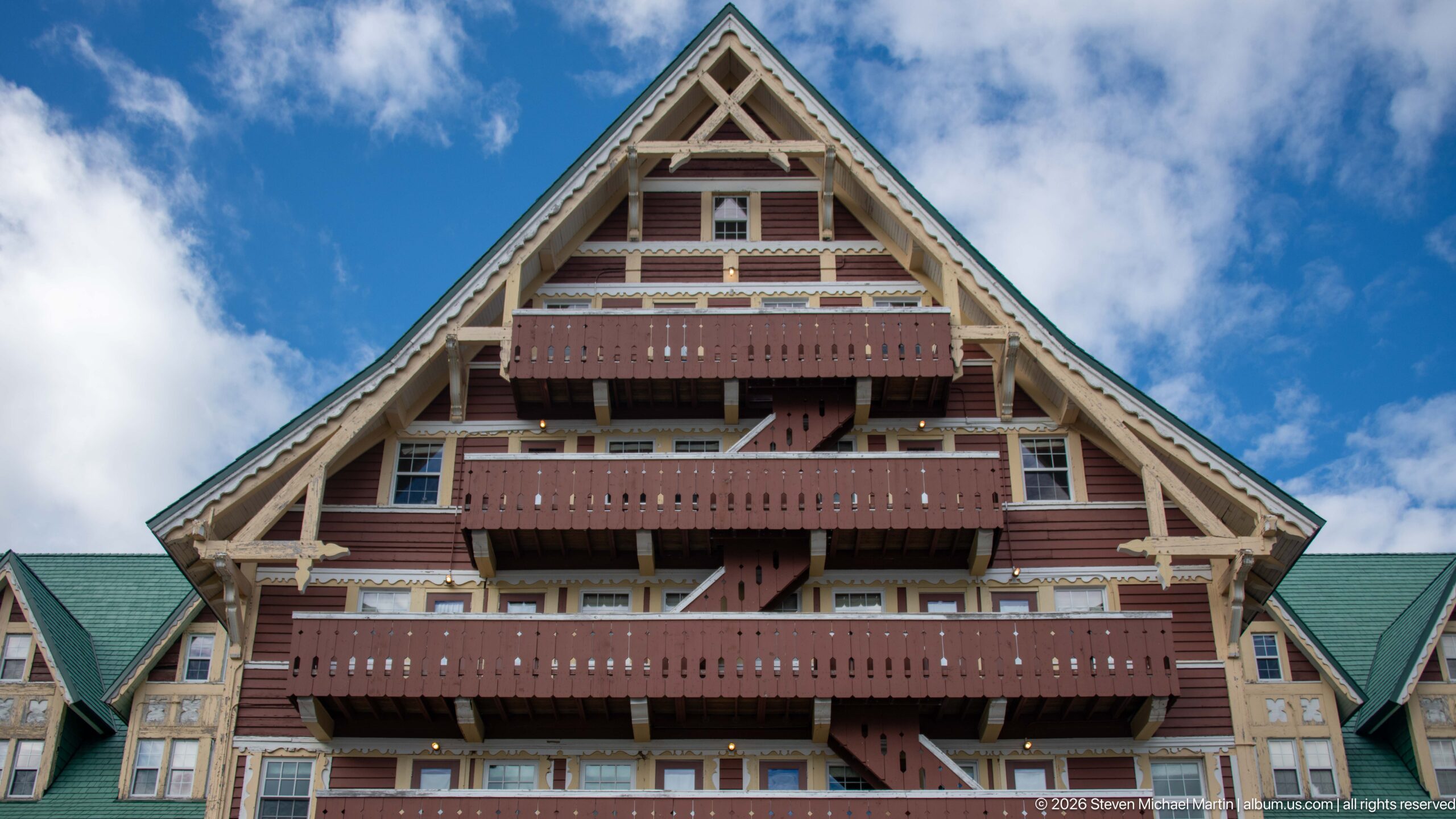
A large triangular gable fills the frame, enclosing multiple levels of recessed windows and projecting wooden balconies. Exposed pale framing traces the steep roof edges and upper trusswork, while dark red balcony rails create strong horizontal bands across the façade. The frontal viewpoint isolates the hotel's chalet-like geometry and the repeated layering of roof, balcony, and timber structure.
Caption
A large triangular gable fills the frame, enclosing multiple levels of recessed windows and projecting wooden balconies. Exposed pale framing traces the steep roof edges and upper trusswork, while dark red balcony rails create strong horizontal bands across the façade. The frontal viewpoint isolates the hotel's chalet-like geometry and the repeated layering of roof, balcony, and timber structure.
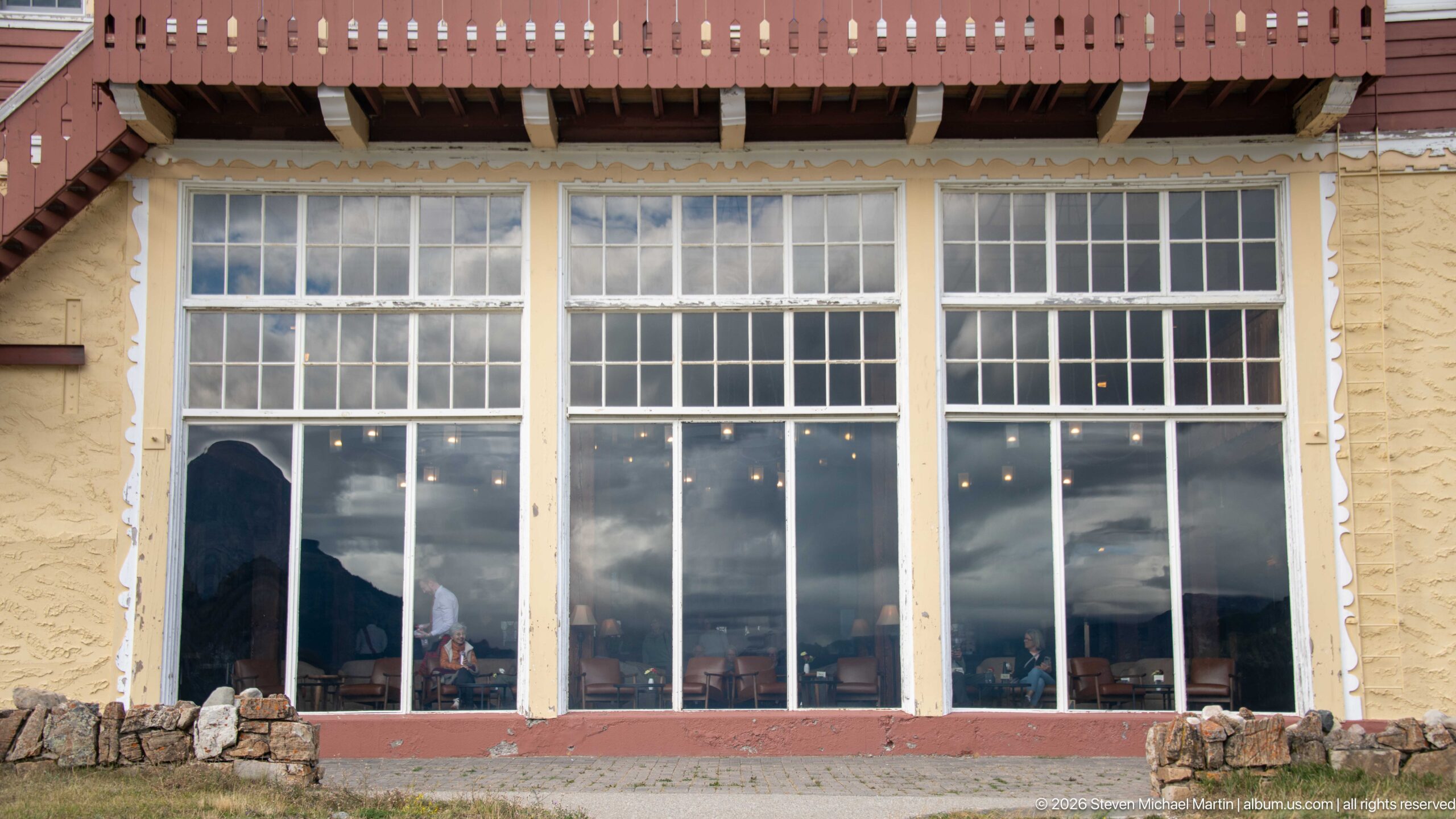
Tall multi-pane windows span the pale ground-floor wall of the Prince of Wales Hotel, reflecting clouds and the surrounding mountain landscape while allowing glimpses of interior furnishings and lights. Rough stonework forms a low base beneath the glazing, and the red balcony edge above compresses the composition into horizontal layers. The detail highlights the hotel's unusually expansive connection between interior public rooms and scenery.
Caption
Tall multi-pane windows span the pale ground-floor wall of the Prince of Wales Hotel, reflecting clouds and the surrounding mountain landscape while allowing glimpses of interior furnishings and lights. Rough stonework forms a low base beneath the glazing, and the red balcony edge above compresses the composition into horizontal layers. The detail highlights the hotel's unusually expansive connection between interior public rooms and scenery.
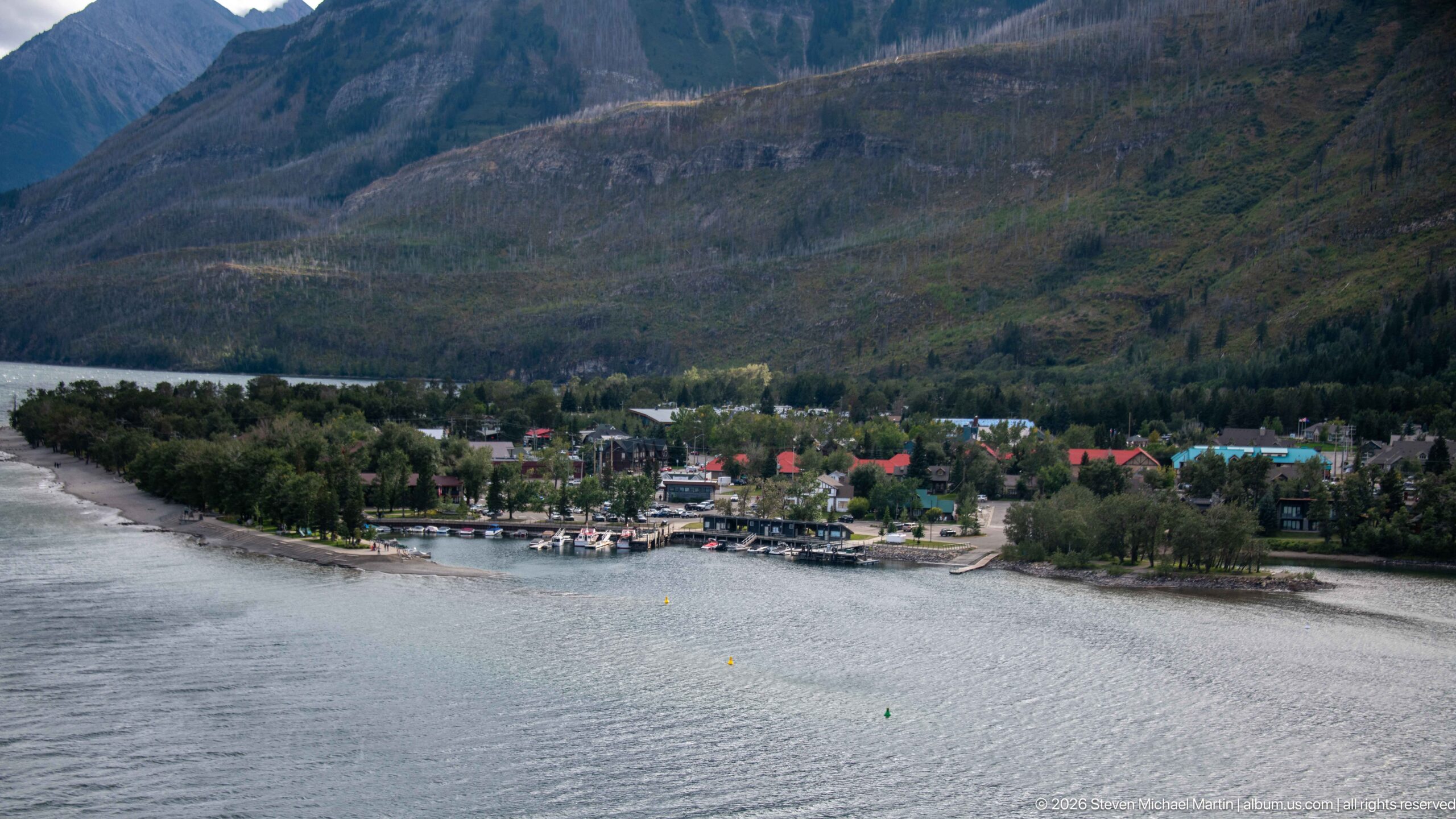
The Waterton townsite occupies the wooded shoreline below the Prince of Wales Hotel bluff, with docks, small buildings, streets, and colorful roofs clustered beside the water. Seen from above, the settlement appears compact against the much larger mountain slope beyond. The viewpoint documents the hotel's physical separation from the townsite and its commanding position over the lake.
Caption
The Waterton townsite occupies the wooded shoreline below the Prince of Wales Hotel bluff, with docks, small buildings, streets, and colorful roofs clustered beside the water. Seen from above, the settlement appears compact against the much larger mountain slope beyond. The viewpoint documents the hotel's physical separation from the townsite and its commanding position over the lake.
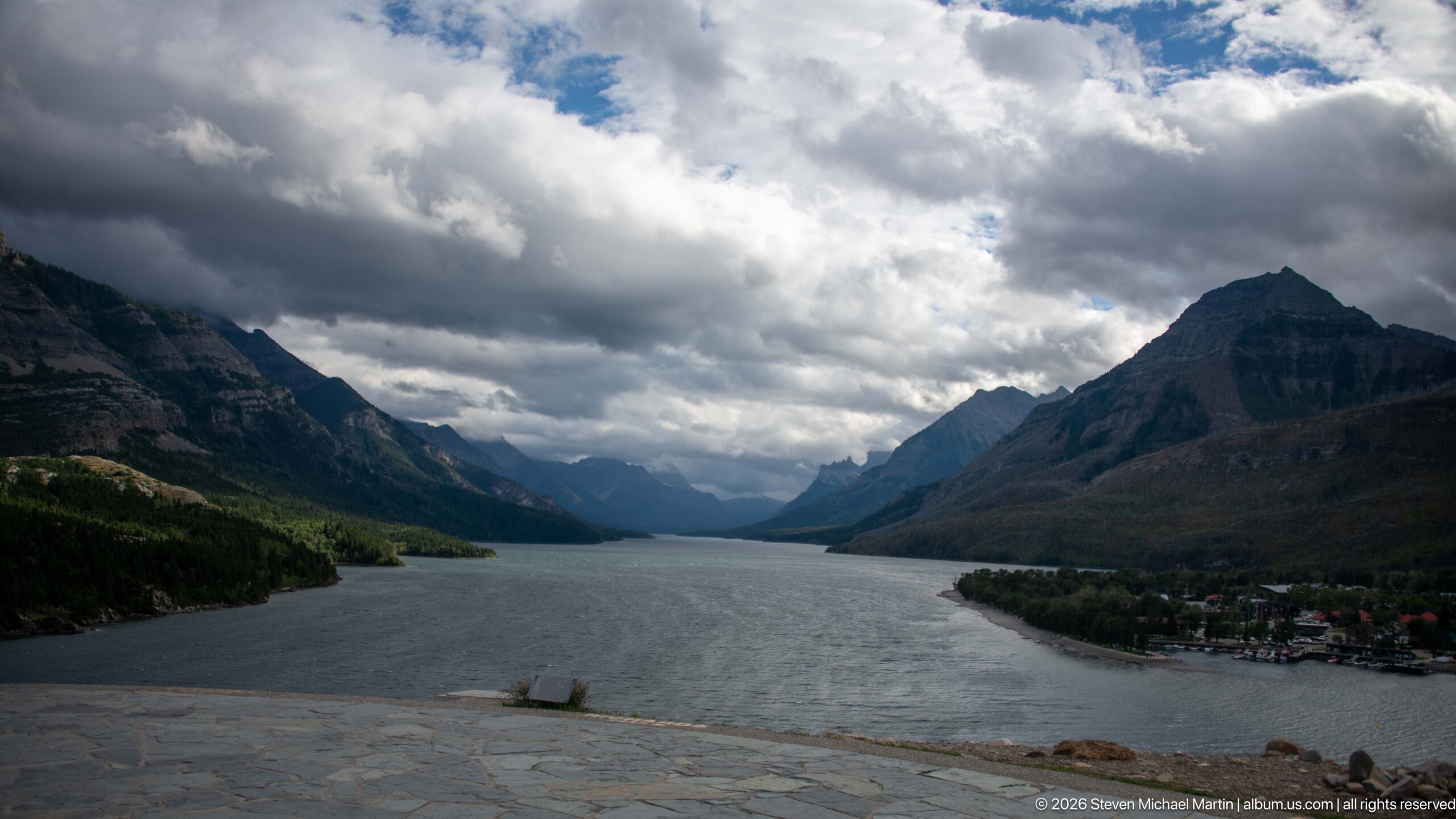
Upper Waterton Lake narrows into the distance between steep mountain walls beneath a turbulent ceiling of gray and white cloud. The stone-paved overlook occupies the immediate foreground, while part of the Waterton townsite appears along the right shoreline. This elevated composition joins the formal hotel grounds, lake, settlement, and mountain corridor in a single sweeping view.
Caption
Upper Waterton Lake narrows into the distance between steep mountain walls beneath a turbulent ceiling of gray and white cloud. The stone-paved overlook occupies the immediate foreground, while part of the Waterton townsite appears along the right shoreline. This elevated composition joins the formal hotel grounds, lake, settlement, and mountain corridor in a single sweeping view.
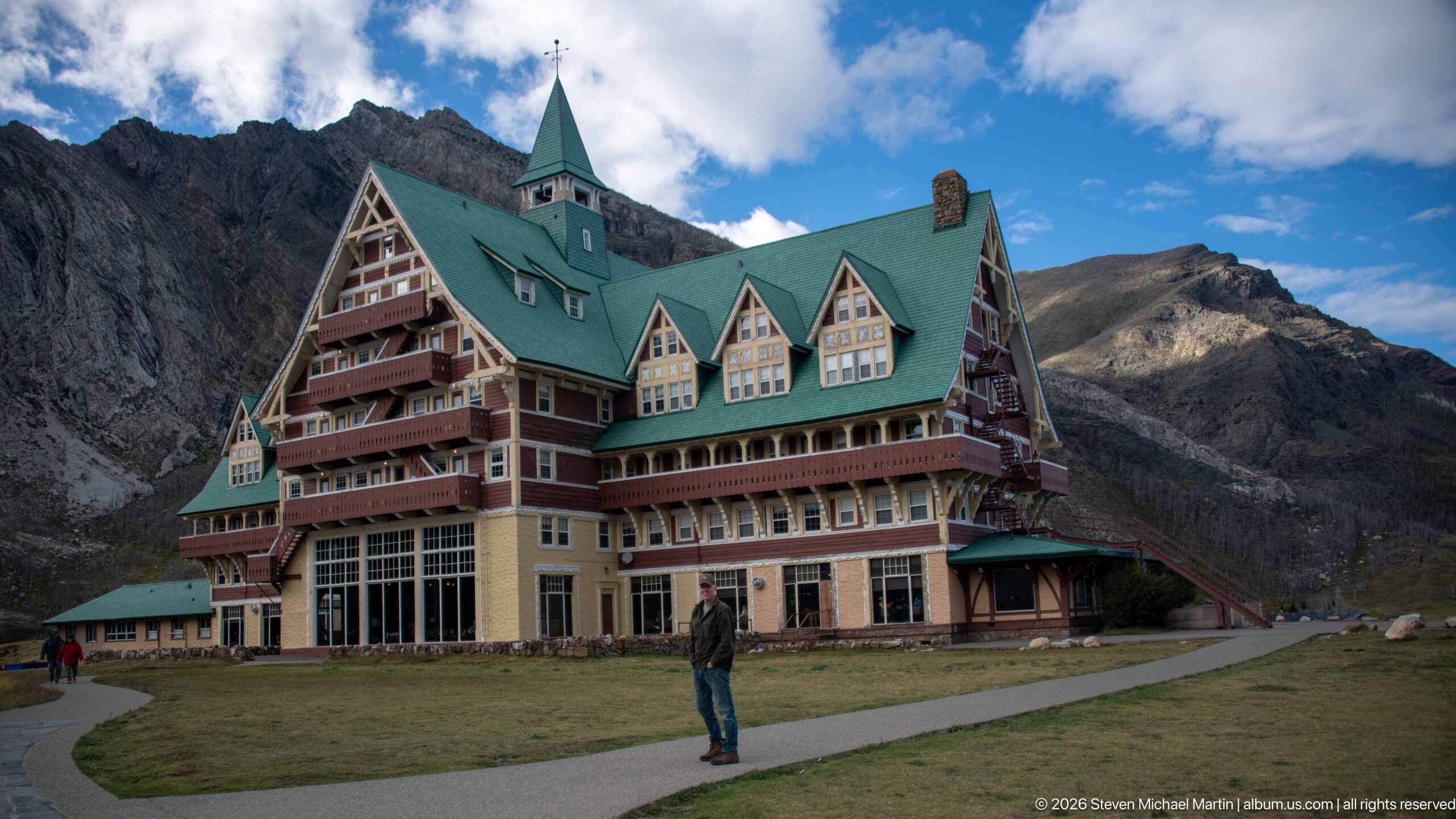
A visitor stands beside the Prince of Wales Hotel, providing scale for the tall gabled wing and its stacked balconies. The green roof, central roof feature, red siding, pale trim, and broad lower windows are sharply defined against the gray mountain behind. A curving paved path and lawn soften the foreground, showing how the monumental building meets its landscaped grounds.
Caption
A visitor stands beside the Prince of Wales Hotel, providing scale for the tall gabled wing and its stacked balconies. The green roof, central roof feature, red siding, pale trim, and broad lower windows are sharply defined against the gray mountain behind. A curving paved path and lawn soften the foreground, showing how the monumental building meets its landscaped grounds.
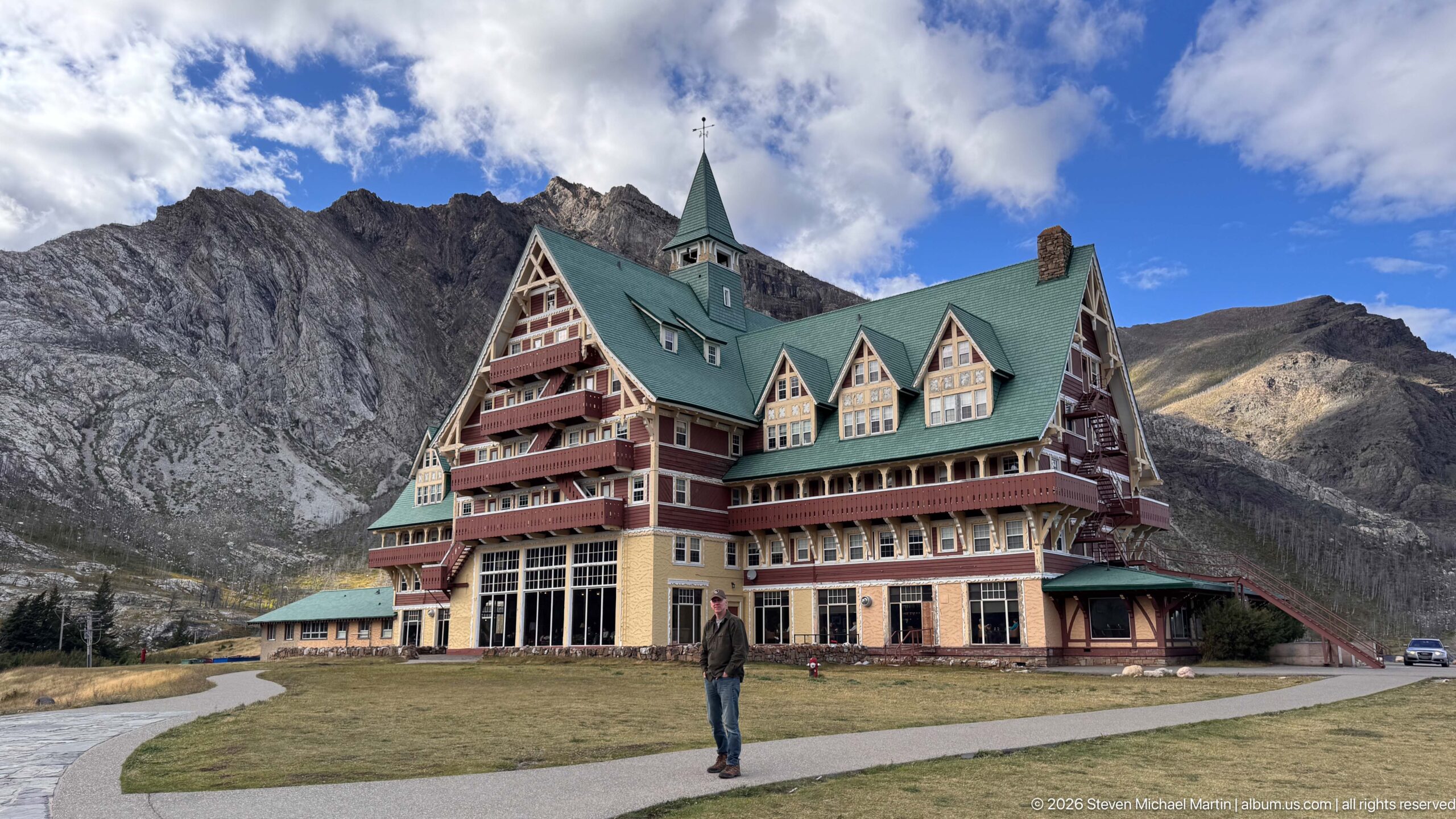
A three-quarter view places the Prince of Wales Hotel against the deeply textured mountain ridge, with a visitor standing on the lawn-side path for scale. The building's asymmetrical profile is particularly clear: a tall balcony-filled gable rises at left, smaller gables step across the green roof, and the pale glazed base stretches horizontally beneath them.
Caption
A three-quarter view places the Prince of Wales Hotel against the deeply textured mountain ridge, with a visitor standing on the lawn-side path for scale. The building's asymmetrical profile is particularly clear: a tall balcony-filled gable rises at left, smaller gables step across the green roof, and the pale glazed base stretches horizontally beneath them.
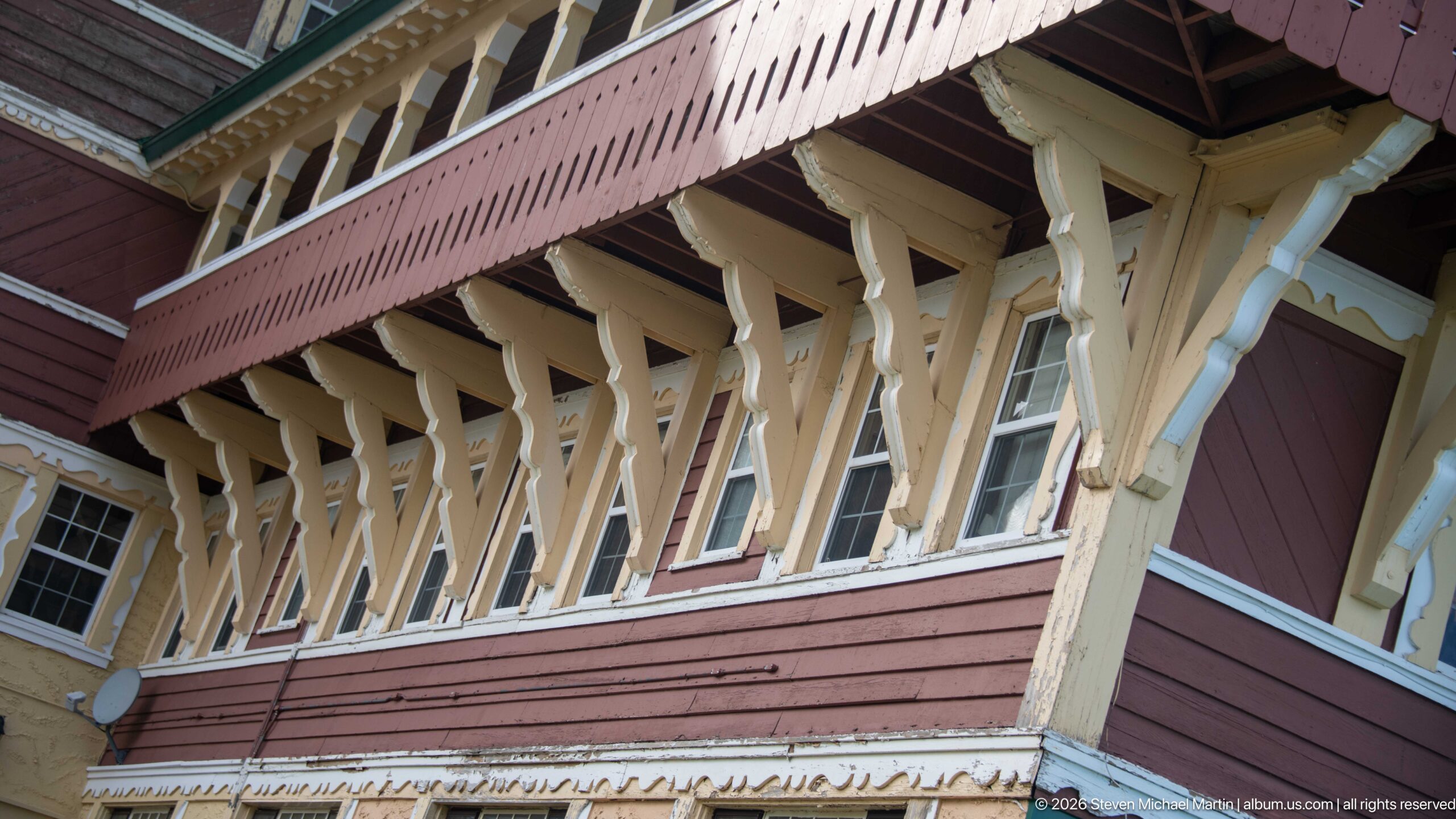
A row of pale timber brackets supports the projecting balcony of the Prince of Wales Hotel, creating a repeated diagonal pattern against dark red siding. White-painted drainage pipes, multi-pane windows, and scalloped trim add further layers of detail. The steep upward angle reveals the structural and decorative woodwork that is easy to overlook in broader views of the façade.
Caption
A row of pale timber brackets supports the projecting balcony of the Prince of Wales Hotel, creating a repeated diagonal pattern against dark red siding. White-painted drainage pipes, multi-pane windows, and scalloped trim add further layers of detail. The steep upward angle reveals the structural and decorative woodwork that is easy to overlook in broader views of the façade.
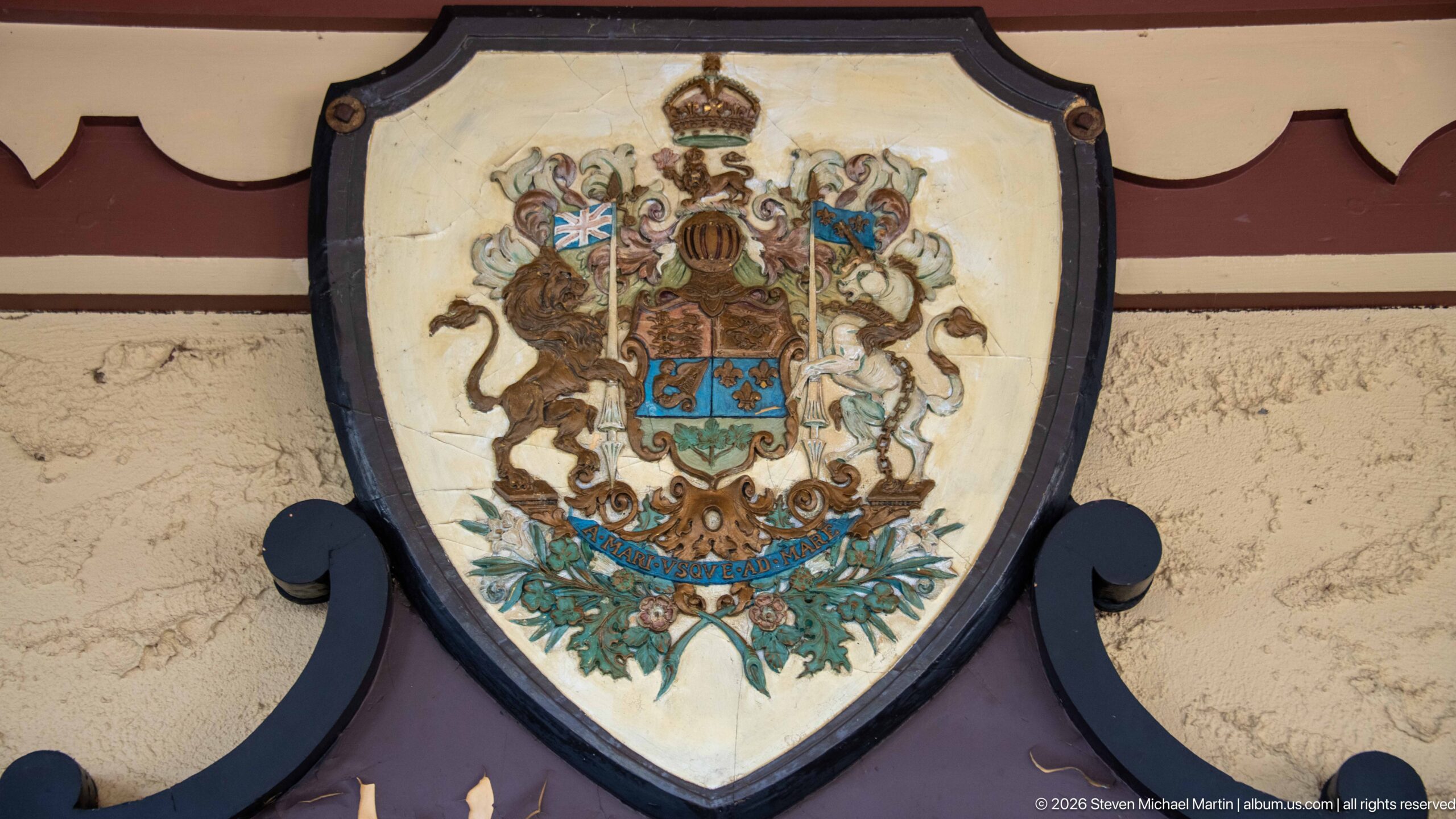
A shield-shaped heraldic emblem decorates the Prince of Wales Hotel exterior, painted with a crown, central arms, supporters, and ornamental foliage. Weathering and surface wear are visible across the pale field, giving the piece a distinctly historic character. Framed by dark molding and mounted against the hotel's cream and red wall, it serves as a formal decorative accent near the entrance.
Caption
A shield-shaped heraldic emblem decorates the Prince of Wales Hotel exterior, painted with a crown, central arms, supporters, and ornamental foliage. Weathering and surface wear are visible across the pale field, giving the piece a distinctly historic character. Framed by dark molding and mounted against the hotel's cream and red wall, it serves as a formal decorative accent near the entrance.
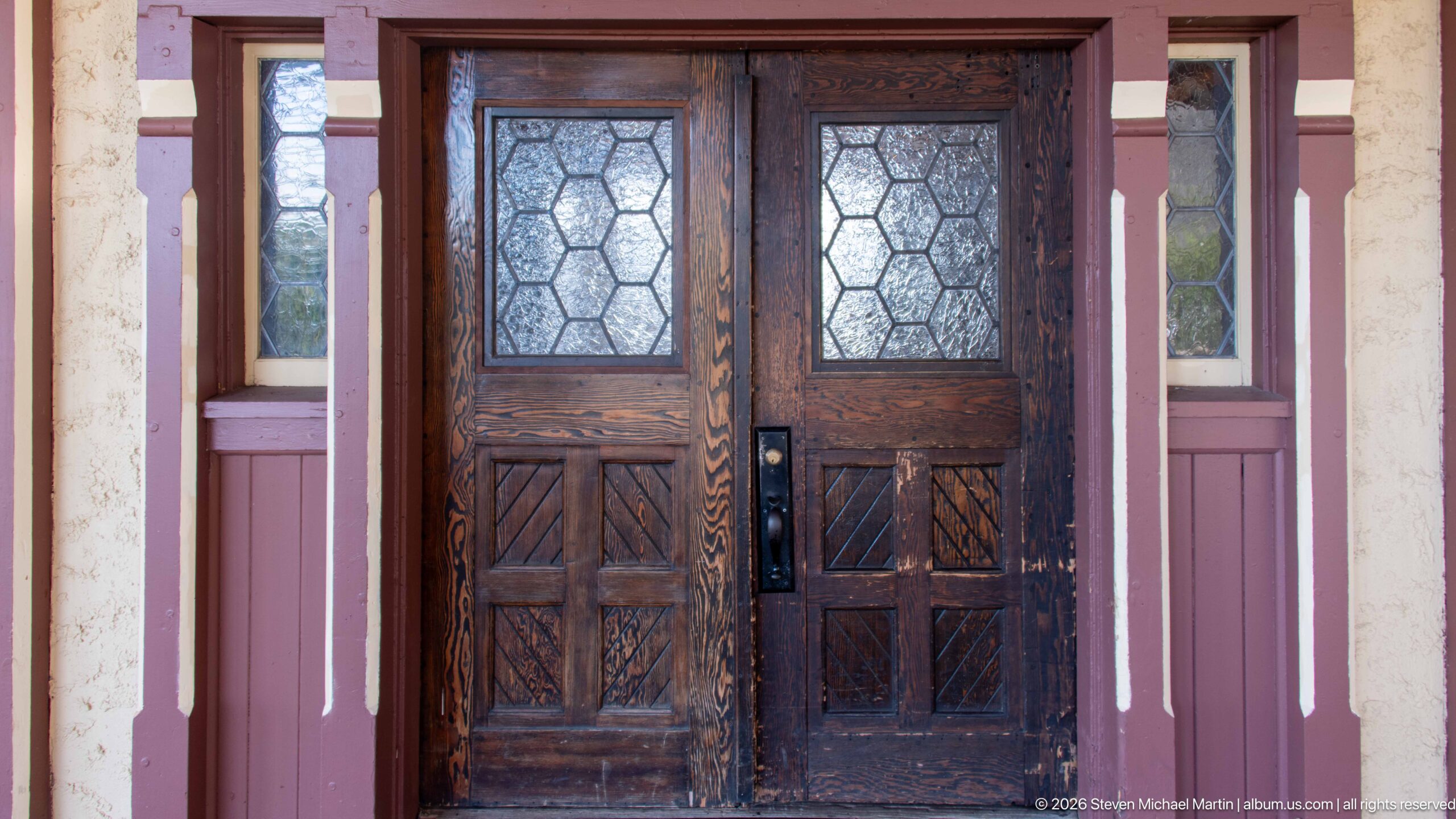
Heavy wooden double doors mark an entrance to the Prince of Wales Hotel, combining dark stained timber with geometric carved panels and leaded-glass windows. Narrow glazed sidelights and muted red-and-cream trim frame the opening. The close view emphasizes the substantial craftsmanship and period character of an entrance detail that is visually subordinate in the hotel's much larger exterior elevations.
Caption
Heavy wooden double doors mark an entrance to the Prince of Wales Hotel, combining dark stained timber with geometric carved panels and leaded-glass windows. Narrow glazed sidelights and muted red-and-cream trim frame the opening. The close view emphasizes the substantial craftsmanship and period character of an entrance detail that is visually subordinate in the hotel's much larger exterior elevations.
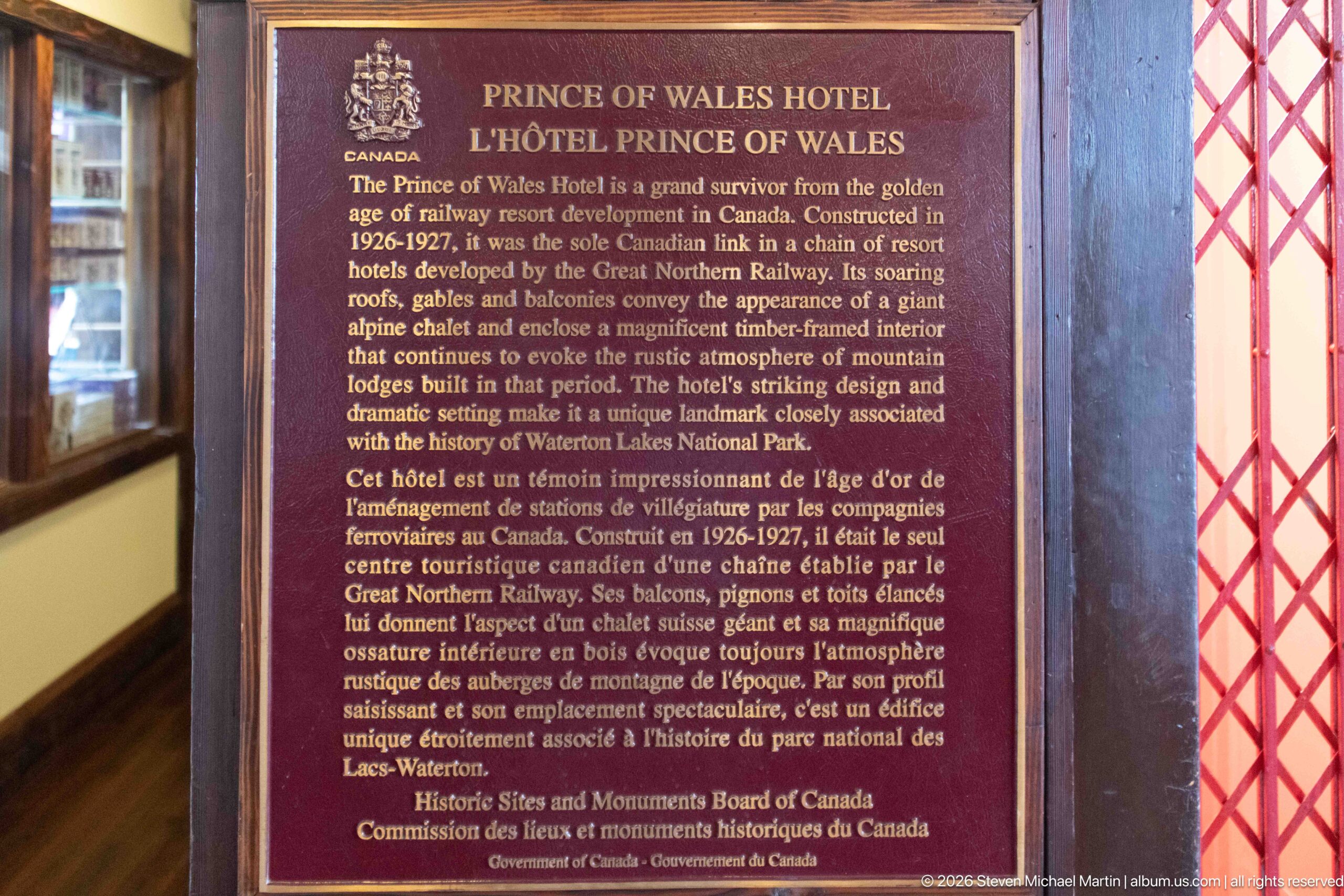
A bilingual commemorative plaque identifies the Prince of Wales Hotel and summarizes its significance as a grand survivor of Canada's railway-resort era. The text notes its 1926–1927 construction, Great Northern Railway origins, dramatic setting, steep roofs, gables and balconies, and its association with Waterton Lakes National Park. The Historic Sites and Monuments Board of Canada marker formally records the hotel's national historic importance.
Caption
A bilingual commemorative plaque identifies the Prince of Wales Hotel and summarizes its significance as a grand survivor of Canada's railway-resort era. The text notes its 1926–1927 construction, Great Northern Railway origins, dramatic setting, steep roofs, gables and balconies, and its association with Waterton Lakes National Park. The Historic Sites and Monuments Board of Canada marker formally records the hotel's national historic importance.
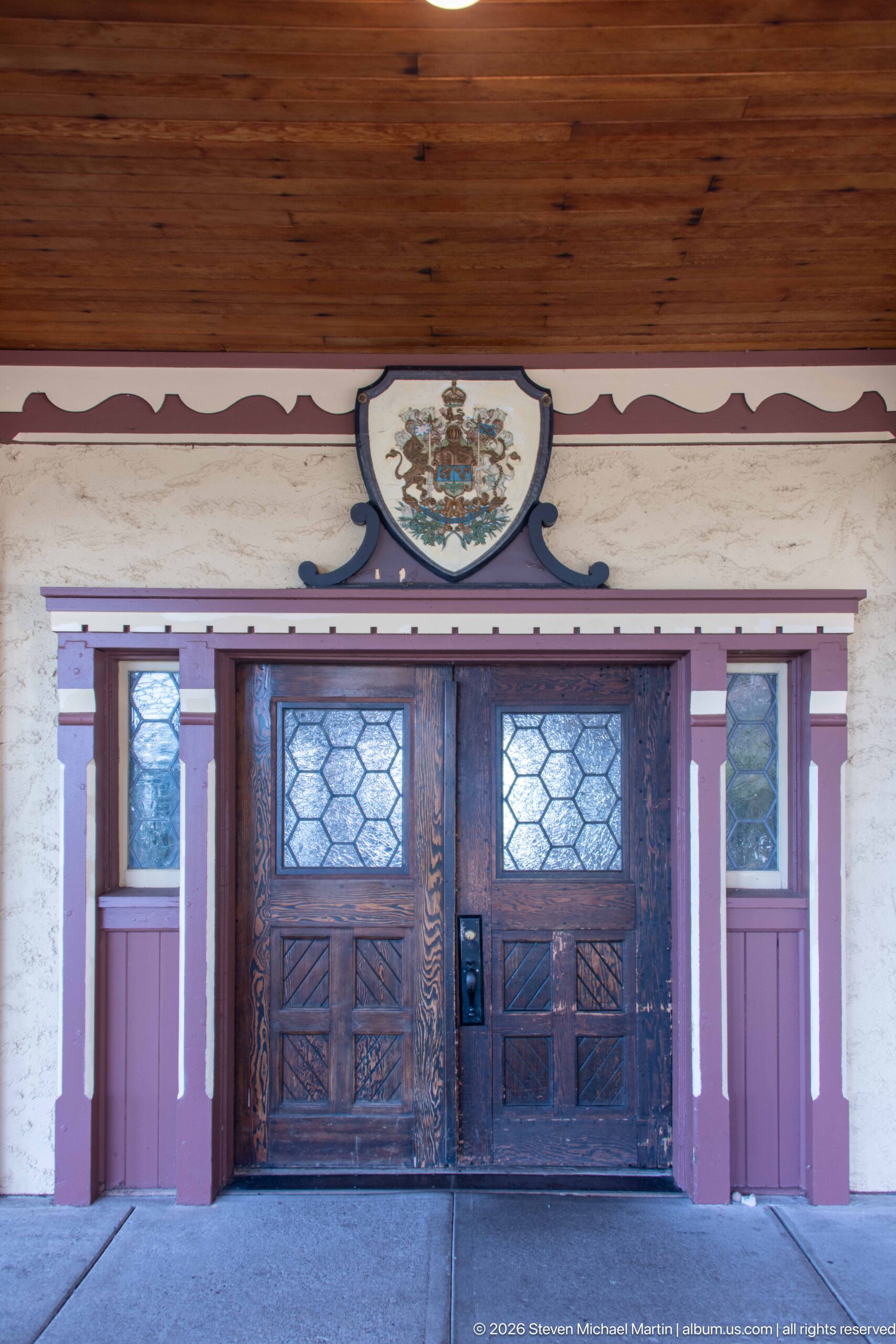
The Prince of Wales Hotel entrance is shown as a complete composition, with dark wooden double doors, leaded-glass panels and sidelights, and a shield-shaped heraldic emblem centered above. Red vertical trim and a pale textured wall surround the opening beneath a wood-paneled soffit. The wider framing clarifies the relationship between the decorative emblem and the finely worked doorway seen separately in adjacent photographs.
Caption
The Prince of Wales Hotel entrance is shown as a complete composition, with dark wooden double doors, leaded-glass panels and sidelights, and a shield-shaped heraldic emblem centered above. Red vertical trim and a pale textured wall surround the opening beneath a wood-paneled soffit. The wider framing clarifies the relationship between the decorative emblem and the finely worked doorway seen separately in adjacent photographs.
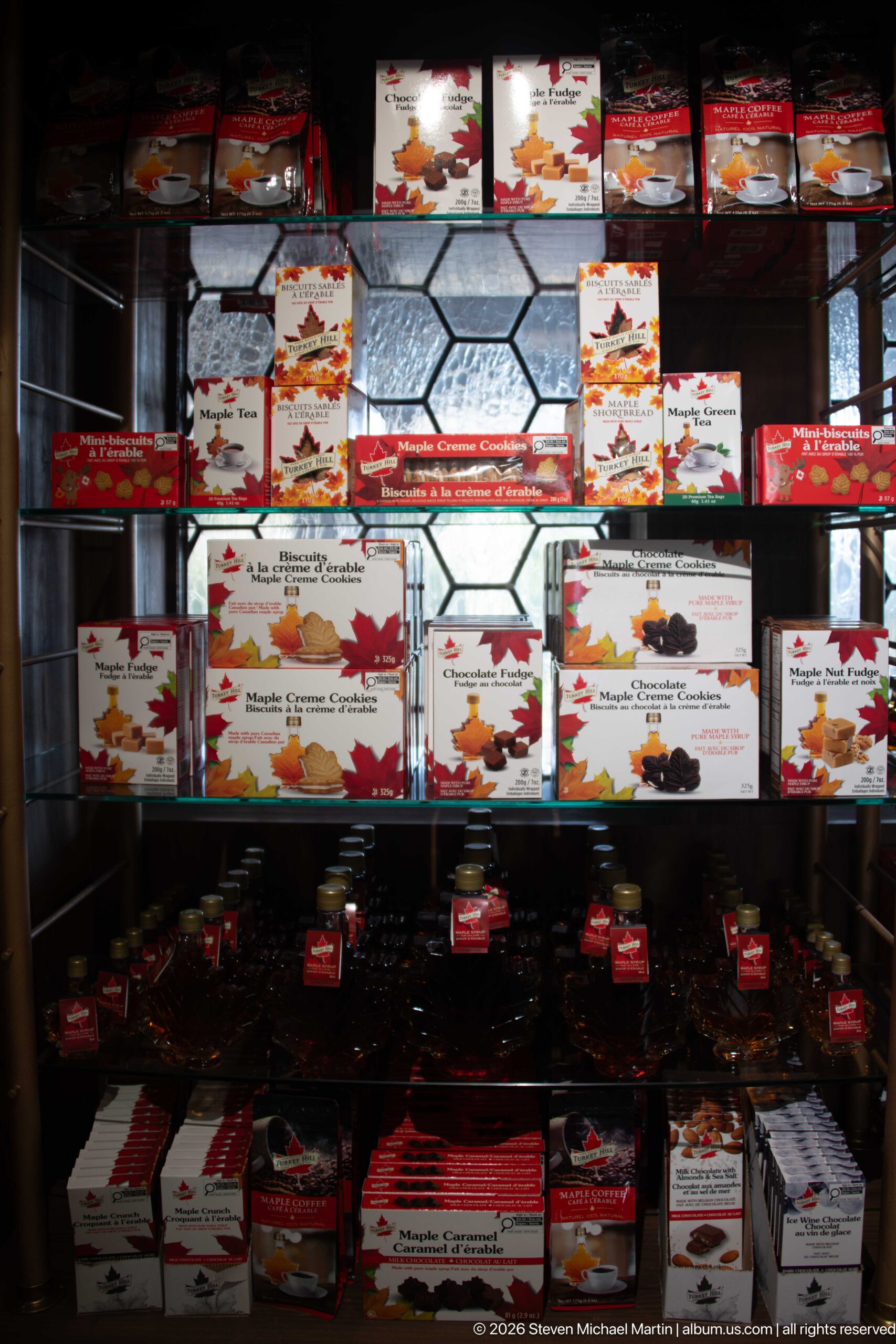
A dark wood display cabinet inside the Prince of Wales Hotel holds boxed Canadian maple-themed products and small red-and-black souvenirs. Repeated maple-leaf graphics and bilingual-style packaging create a dense retail pattern against the cabinet's leaded-glass backdrop. The scene documents the hotel's contemporary visitor amenities and the distinctly Canadian merchandise presented within its historic interior setting.
Caption
A dark wood display cabinet inside the Prince of Wales Hotel holds boxed Canadian maple-themed products and small red-and-black souvenirs. Repeated maple-leaf graphics and bilingual-style packaging create a dense retail pattern against the cabinet's leaded-glass backdrop. The scene documents the hotel's contemporary visitor amenities and the distinctly Canadian merchandise presented within its historic interior setting.
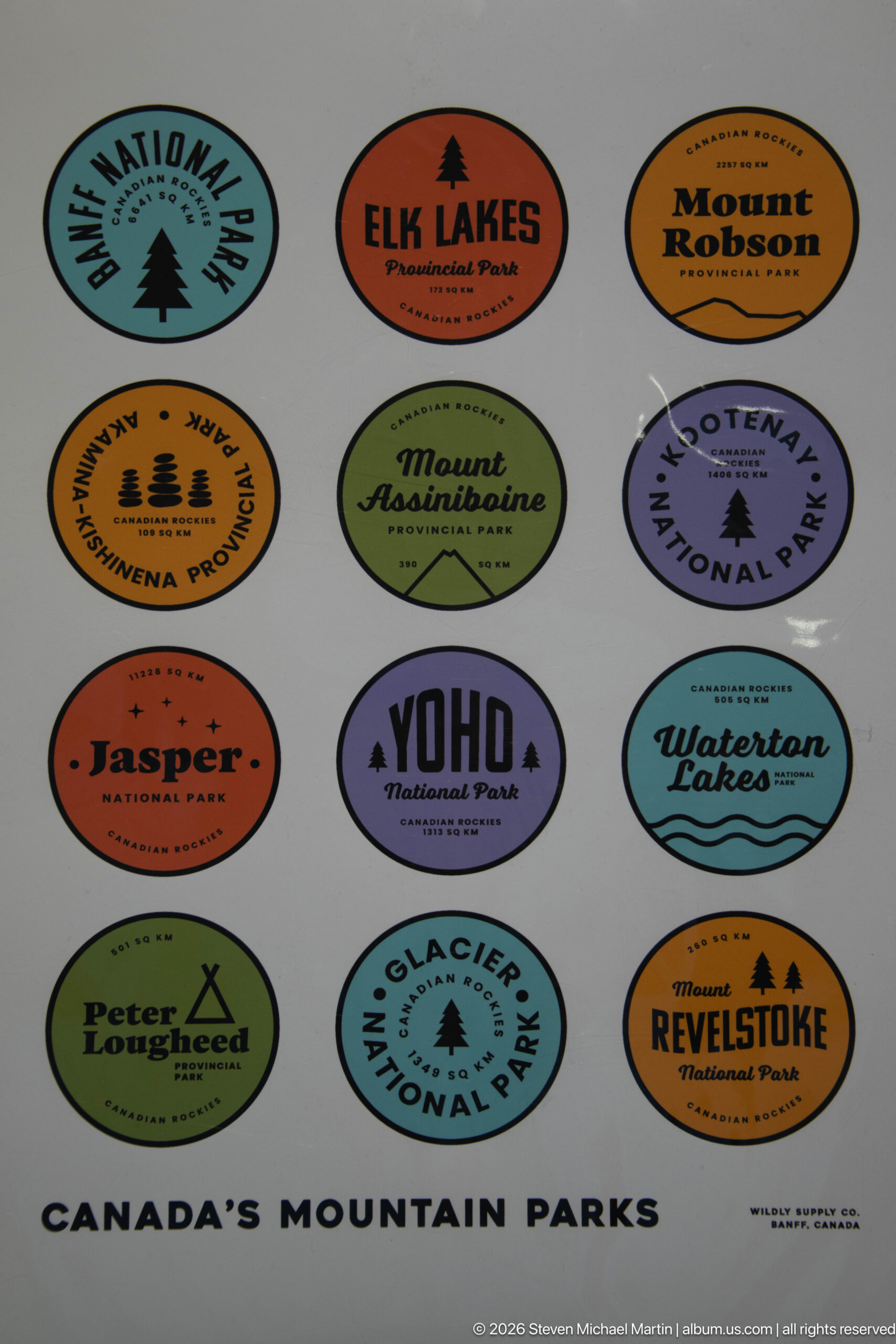
A graphic titled “Canada's Mountain Parks” assembles colorful oval badge designs for destinations including Waterton Lakes, Banff, Jasper, Yoho, Kootenay, Glacier, Mount Revelstoke, Elk Island, Mount Robson, and others. Arranged in a neat grid, the retro-style emblems turn the region's network of protected landscapes into a unified souvenir design, extending the hotel portfolio beyond architecture to contemporary park-themed visual culture.
Caption
A graphic titled “Canada's Mountain Parks” assembles colorful oval badge designs for destinations including Waterton Lakes, Banff, Jasper, Yoho, Kootenay, Glacier, Mount Revelstoke, Elk Island, Mount Robson, and others. Arranged in a neat grid, the retro-style emblems turn the region's network of protected landscapes into a unified souvenir design, extending the hotel portfolio beyond architecture to contemporary park-themed visual culture.
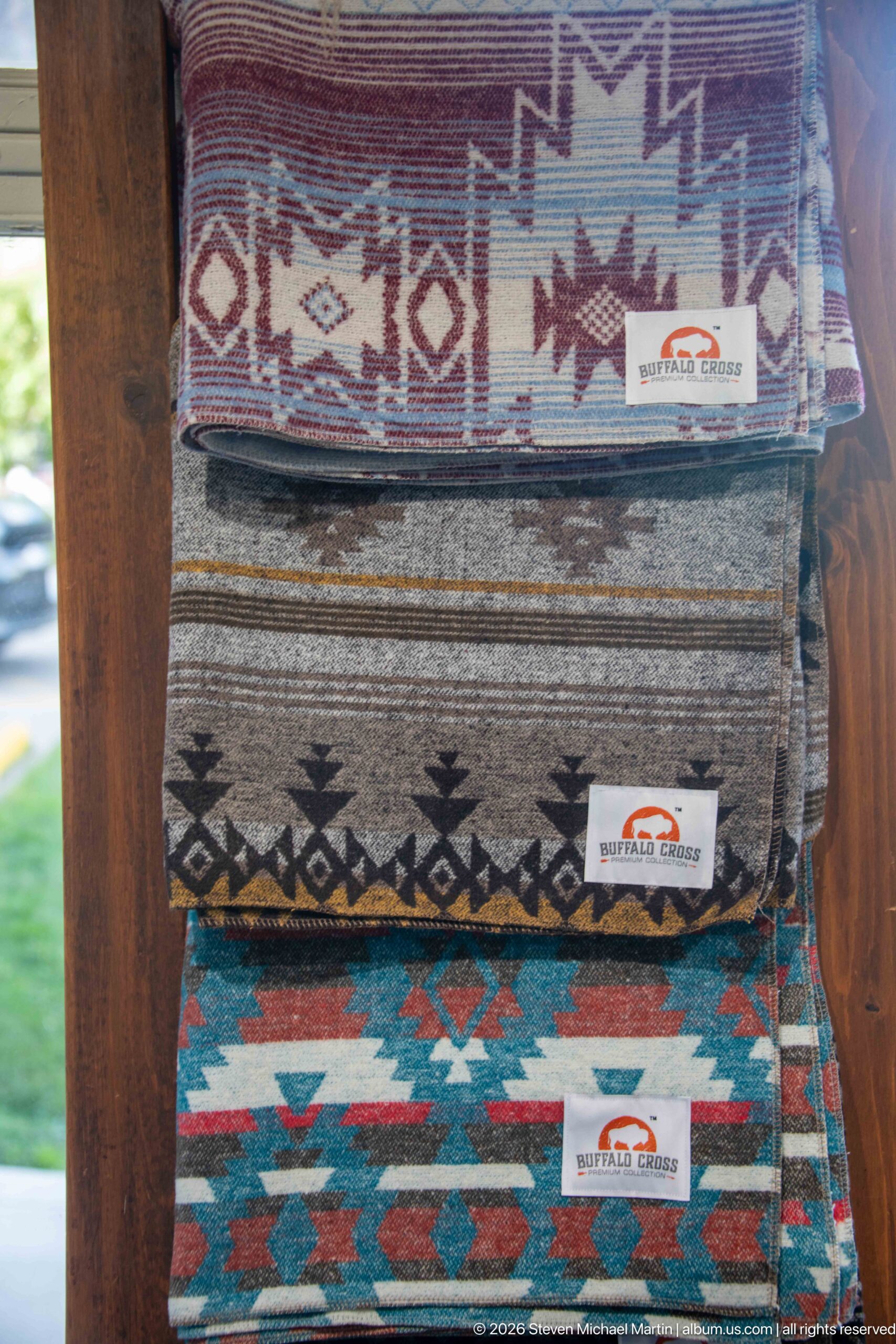
Three folded woven textiles with geometric patterns are stacked on a wooden display, each carrying a Waterton-area retail label. The close view emphasizes contrasting earth tones, turquoise and red accents, and the repeated diamond and stepped motifs that distinguish the individual pieces.
Caption
Three folded woven textiles with geometric patterns are stacked on a wooden display, each carrying a Waterton-area retail label. The close view emphasizes contrasting earth tones, turquoise and red accents, and the repeated diamond and stepped motifs that distinguish the individual pieces.
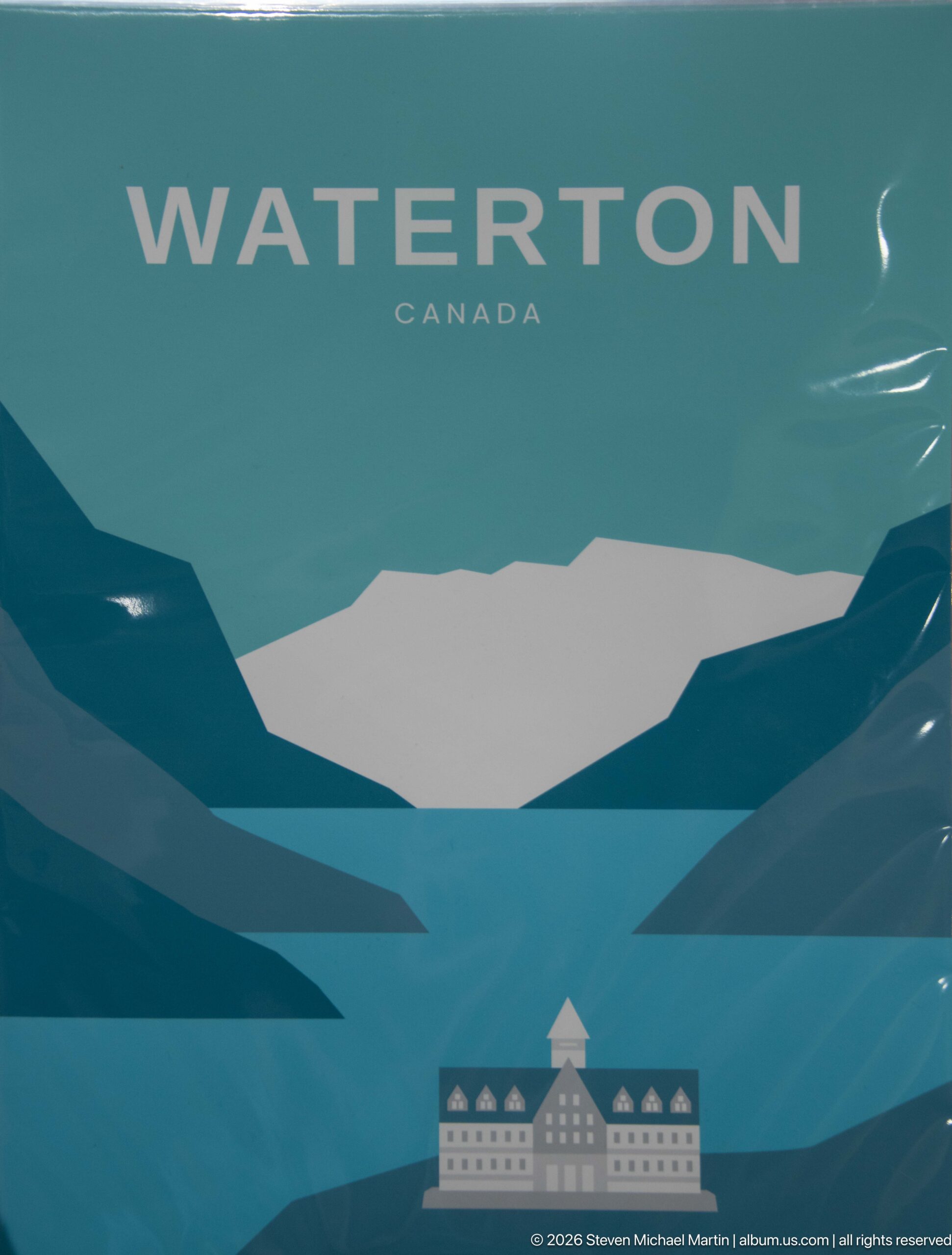
A stylized Waterton, Canada graphic reduces the mountain-and-lake setting to broad bands of blue, teal, and white. A small rendering of the Prince of Wales Hotel anchors the foreground, while the simplified lake and mountain silhouettes place the building within its dramatic landscape.
Caption
A stylized Waterton, Canada graphic reduces the mountain-and-lake setting to broad bands of blue, teal, and white. A small rendering of the Prince of Wales Hotel anchors the foreground, while the simplified lake and mountain silhouettes place the building within its dramatic landscape.
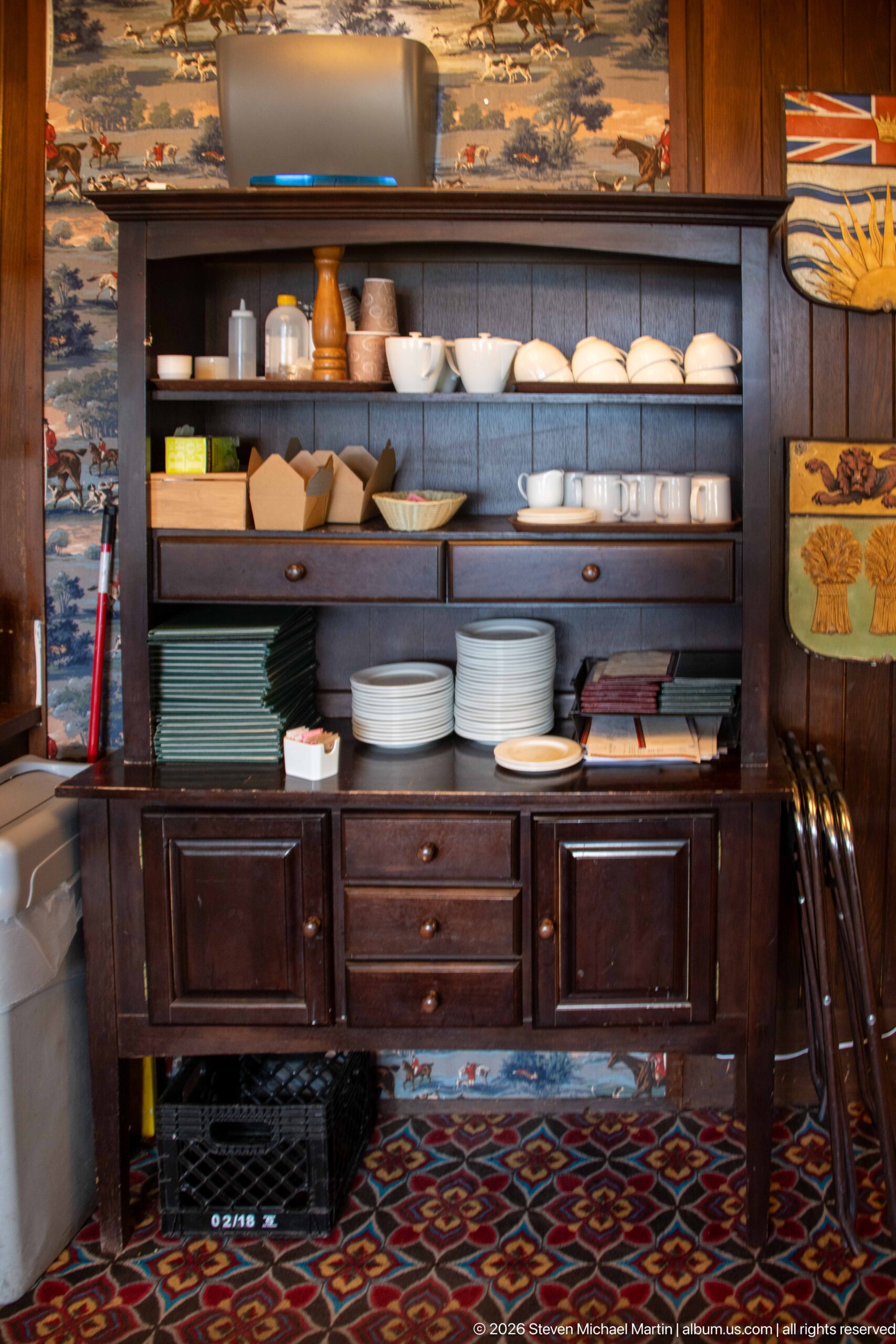
A dark wooden service cabinet holds neatly stacked plates, bowls, cups, trays, and folded service items. Positioned against richly patterned carpet and timber walls, the utilitarian station reveals the working hospitality infrastructure integrated into the hotel’s historic-looking public rooms.
Caption
A dark wooden service cabinet holds neatly stacked plates, bowls, cups, trays, and folded service items. Positioned against richly patterned carpet and timber walls, the utilitarian station reveals the working hospitality infrastructure integrated into the hotel’s historic-looking public rooms.
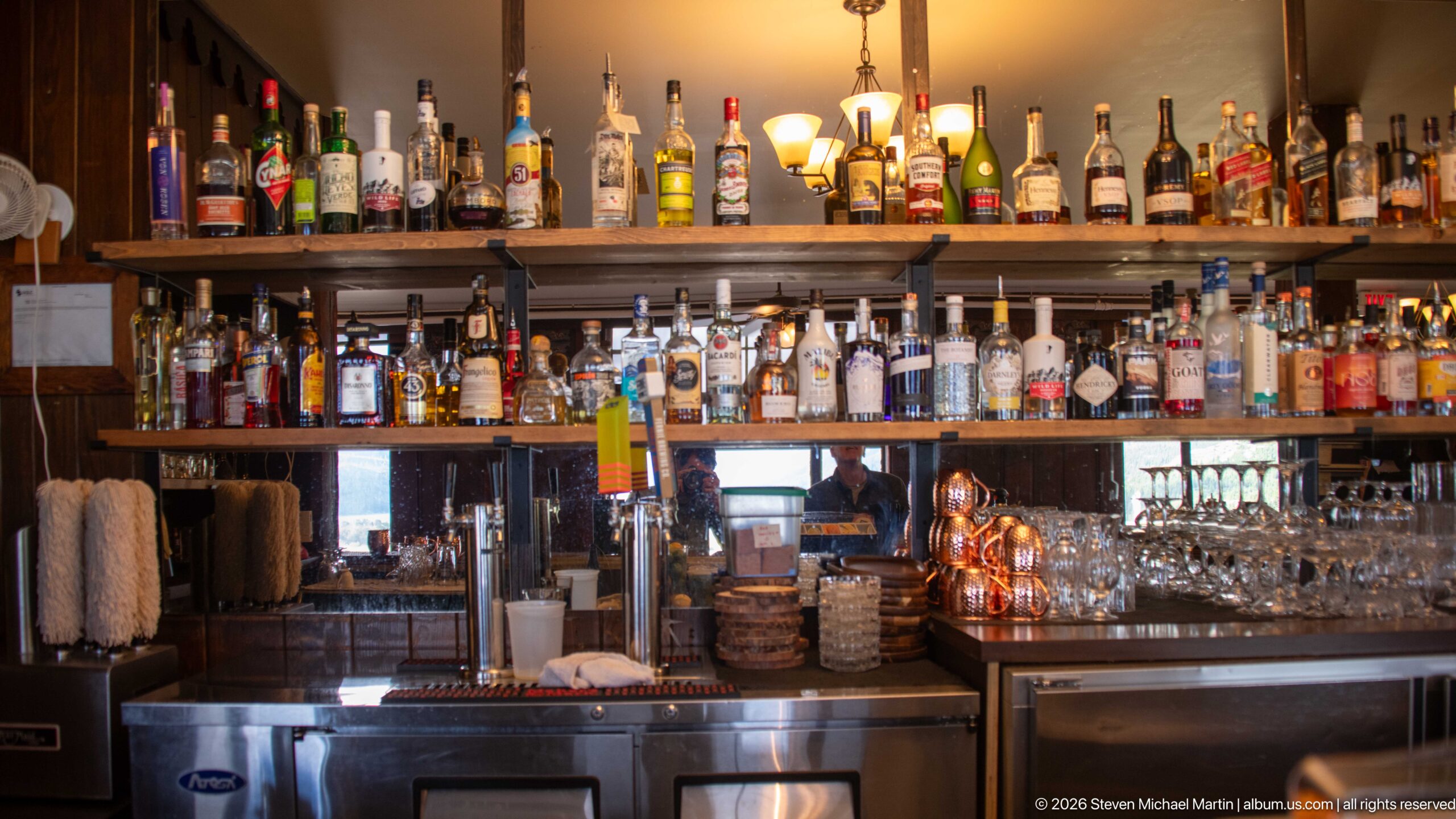
Rows of spirits, glassware, and bar equipment fill the timber-lined service counter inside the hotel lounge. Bottles arranged across two shelves create a dense backdrop, while taps, mixing tools, and polished glassware identify the space as an active hospitality area rather than a decorative display.
Caption
Rows of spirits, glassware, and bar equipment fill the timber-lined service counter inside the hotel lounge. Bottles arranged across two shelves create a dense backdrop, while taps, mixing tools, and polished glassware identify the space as an active hospitality area rather than a decorative display.
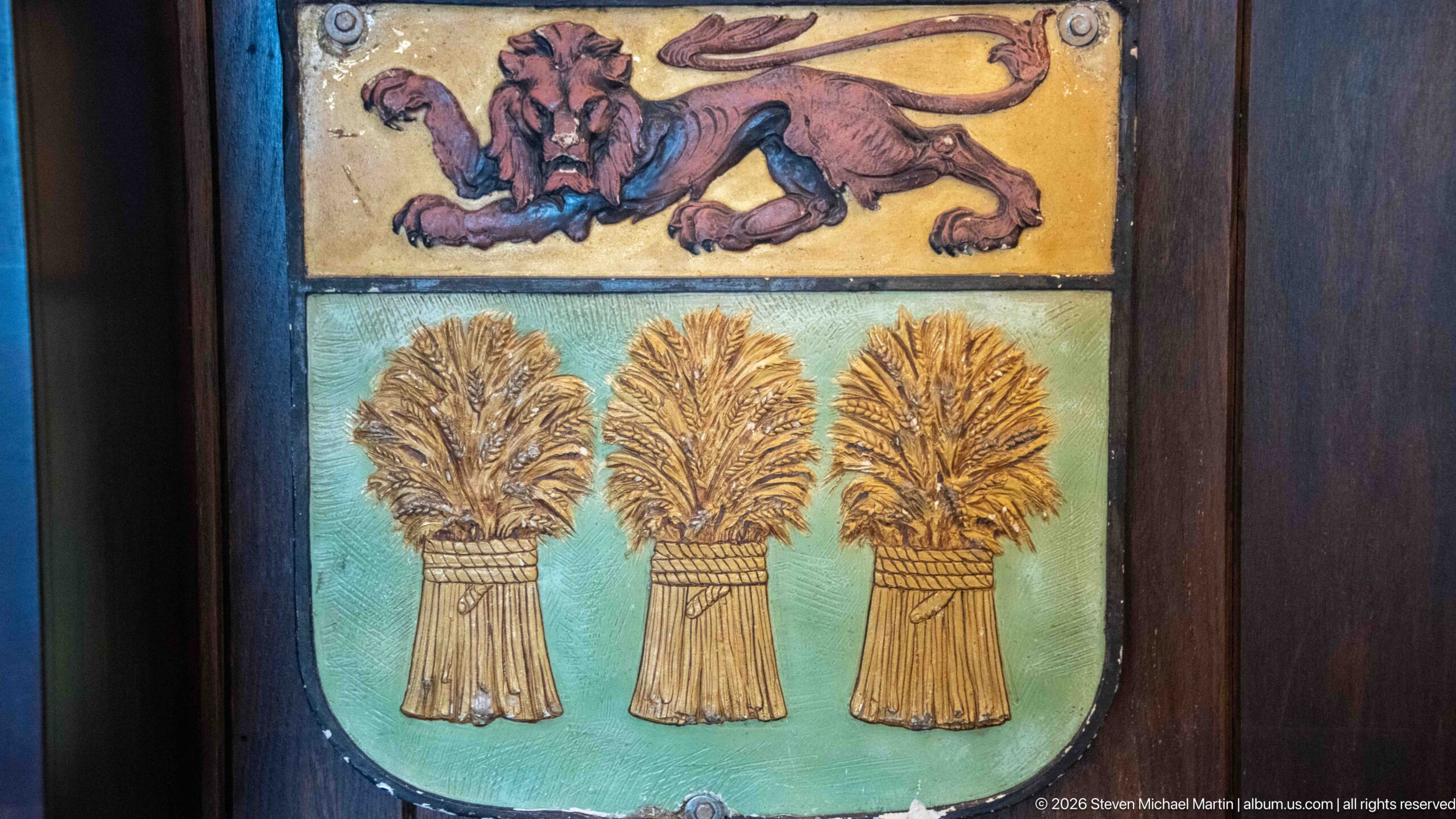
A painted heraldic-style panel combines a reclining lion above a shield bearing three bound sheaves of wheat. Rich yellow, turquoise, brown, and red pigments stand out against the surrounding dark wood, making the emblematic decoration a distinctive interior detail.
Caption
A painted heraldic-style panel combines a reclining lion above a shield bearing three bound sheaves of wheat. Rich yellow, turquoise, brown, and red pigments stand out against the surrounding dark wood, making the emblematic decoration a distinctive interior detail.
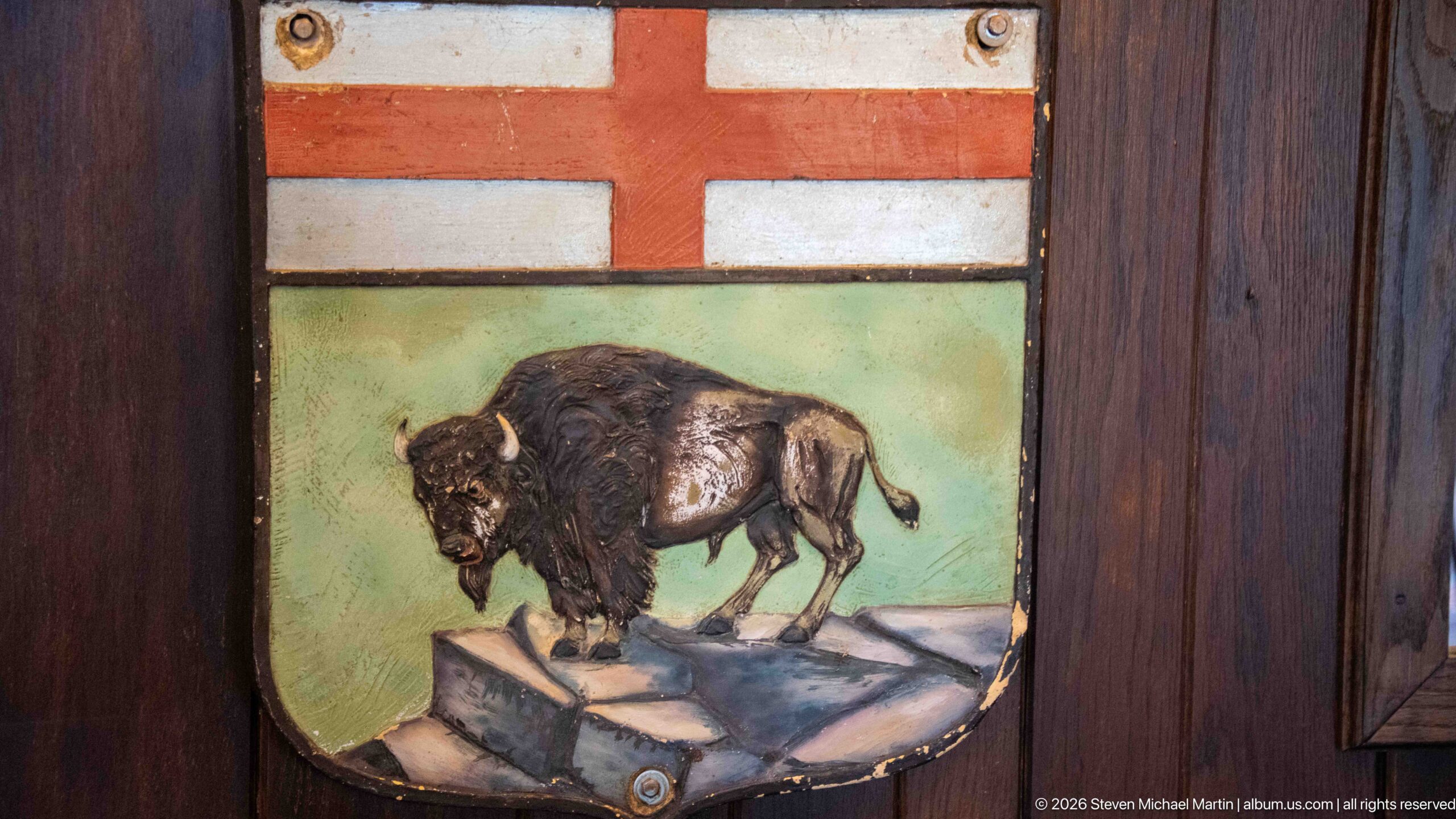
A bison stands on a rocky ledge within a green heraldic-style shield mounted beneath a red cross on a pale field. The carved and painted panel is set directly into dark timber walling, linking regional wildlife imagery with the hotel’s broader decorative program.
Caption
A bison stands on a rocky ledge within a green heraldic-style shield mounted beneath a red cross on a pale field. The carved and painted panel is set directly into dark timber walling, linking regional wildlife imagery with the hotel’s broader decorative program.
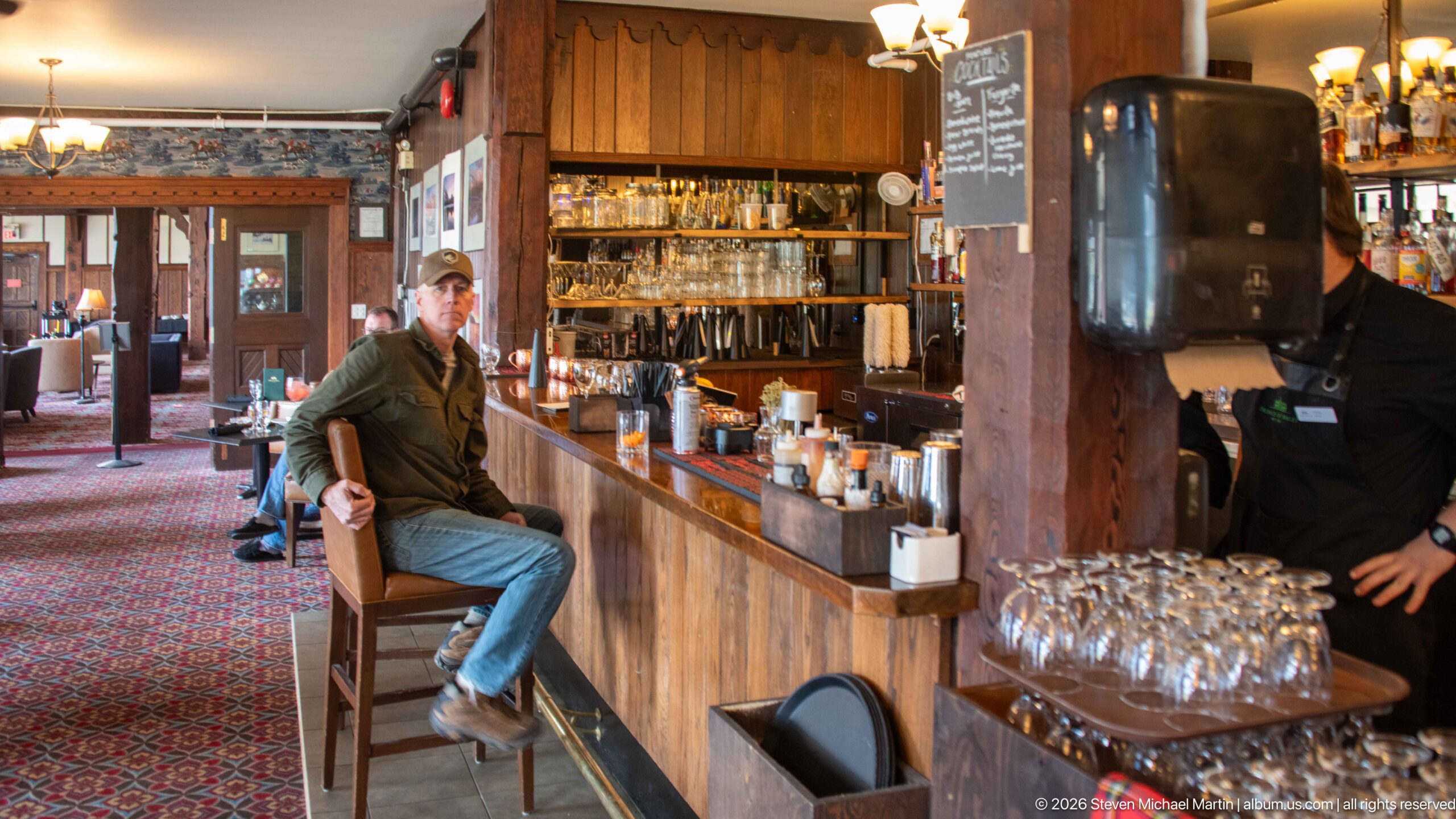
A patron sits at the long wooden bar while staff work behind the counter amid glassware, bottles, and service equipment. The view places everyday lounge activity within the timber-paneled interior, with patterned carpet and a chalkboard menu adding to the informal hospitality setting.
Caption
A patron sits at the long wooden bar while staff work behind the counter amid glassware, bottles, and service equipment. The view places everyday lounge activity within the timber-paneled interior, with patterned carpet and a chalkboard menu adding to the informal hospitality setting.
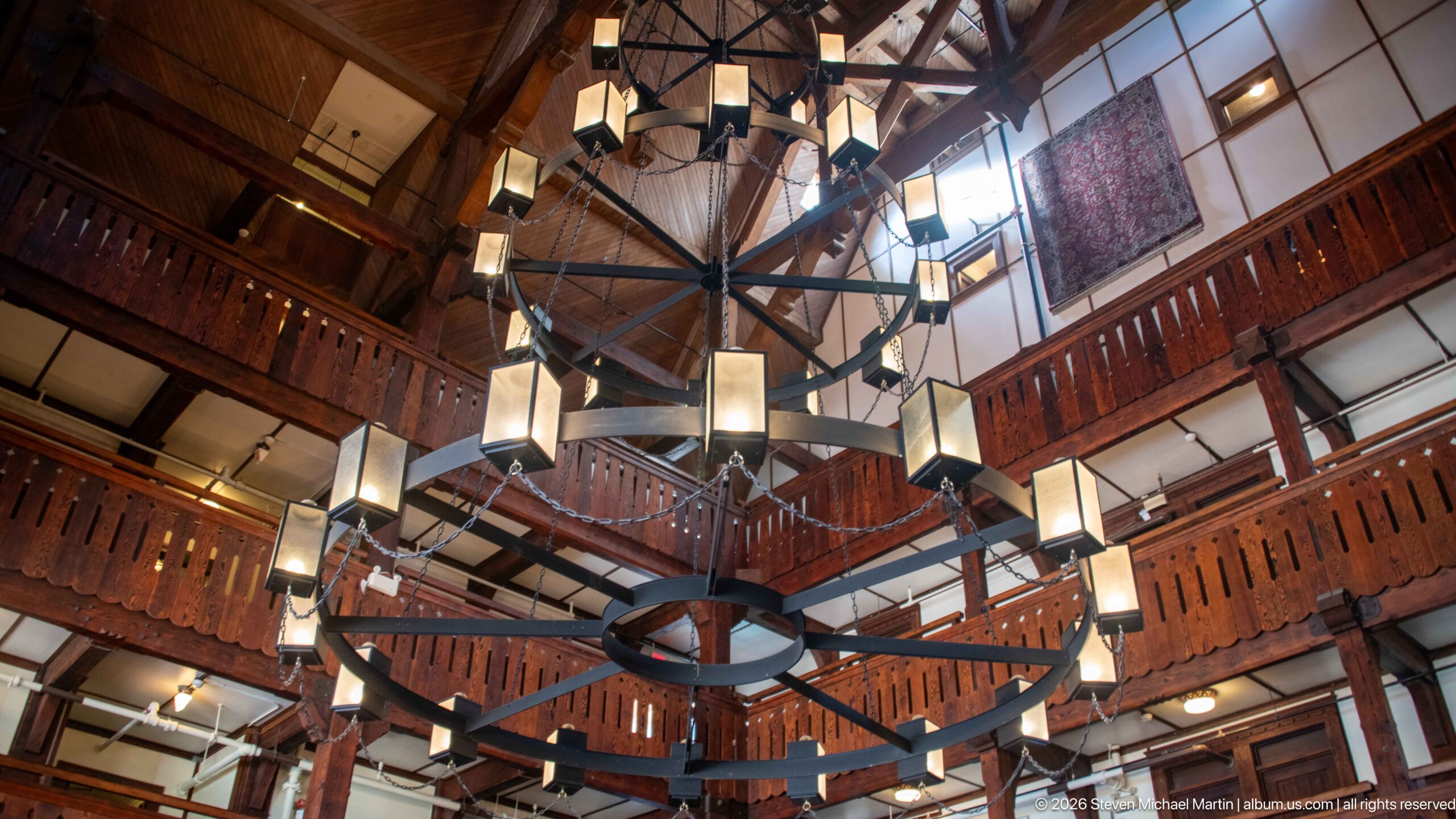
The camera looks upward through the hotel’s multi-story timber lobby, where balconies, exposed roof framing, and several enormous circular chandeliers overlap in a dramatic vertical composition. Repeating lanterns around the iron rings illuminate carved wooden balustrades and the steeply framed ceiling above.
Caption
The camera looks upward through the hotel’s multi-story timber lobby, where balconies, exposed roof framing, and several enormous circular chandeliers overlap in a dramatic vertical composition. Repeating lanterns around the iron rings illuminate carved wooden balustrades and the steeply framed ceiling above.
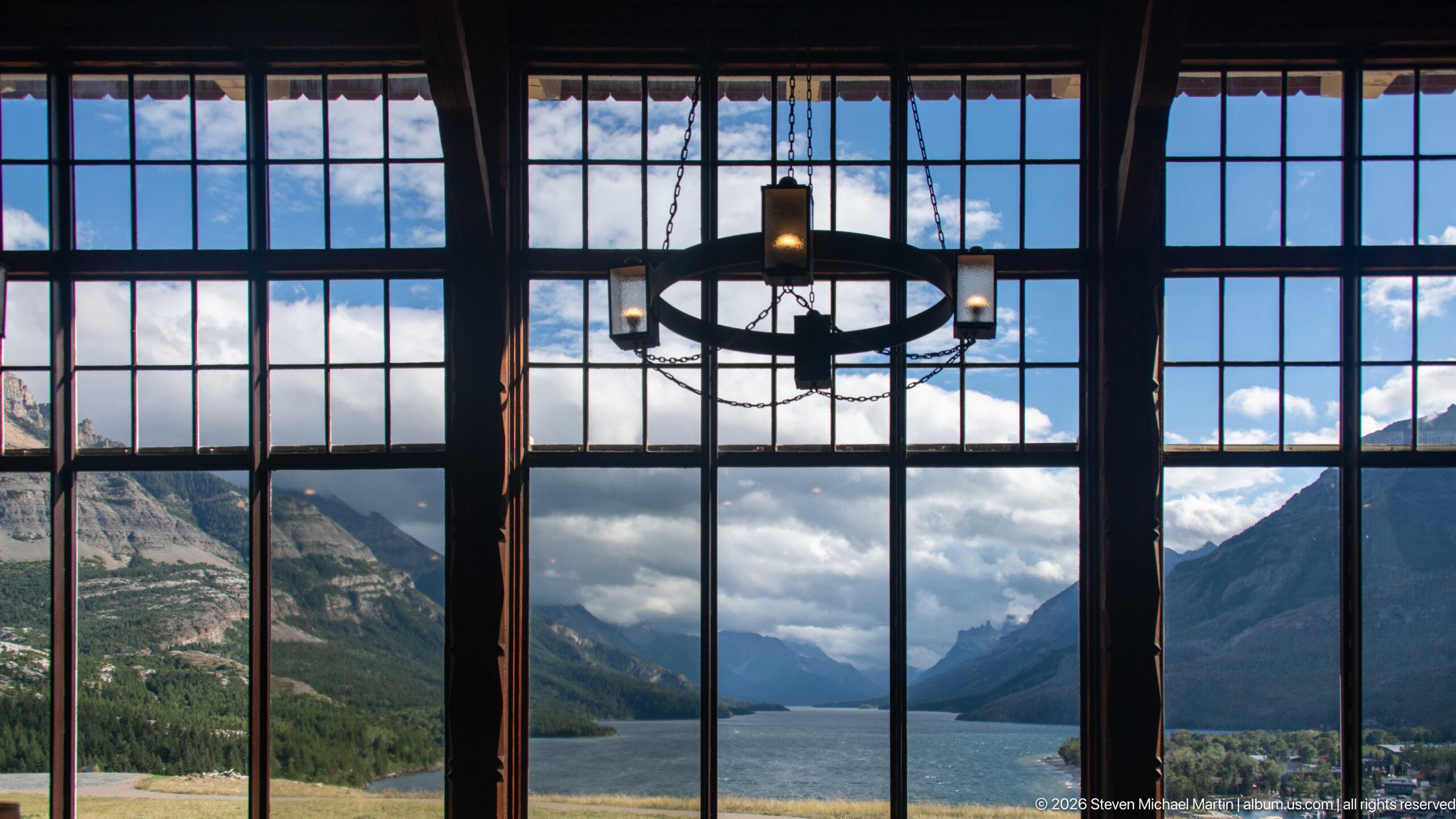
Tall gridded windows turn the hotel lobby into a frame for Upper Waterton Lake and the mountains beyond. A circular chandelier hangs in silhouette against the bright sky, while the dark interior structure contrasts with the sunlit water and steep valley walls outside.
Caption
Tall gridded windows turn the hotel lobby into a frame for Upper Waterton Lake and the mountains beyond. A circular chandelier hangs in silhouette against the bright sky, while the dark interior structure contrasts with the sunlit water and steep valley walls outside.
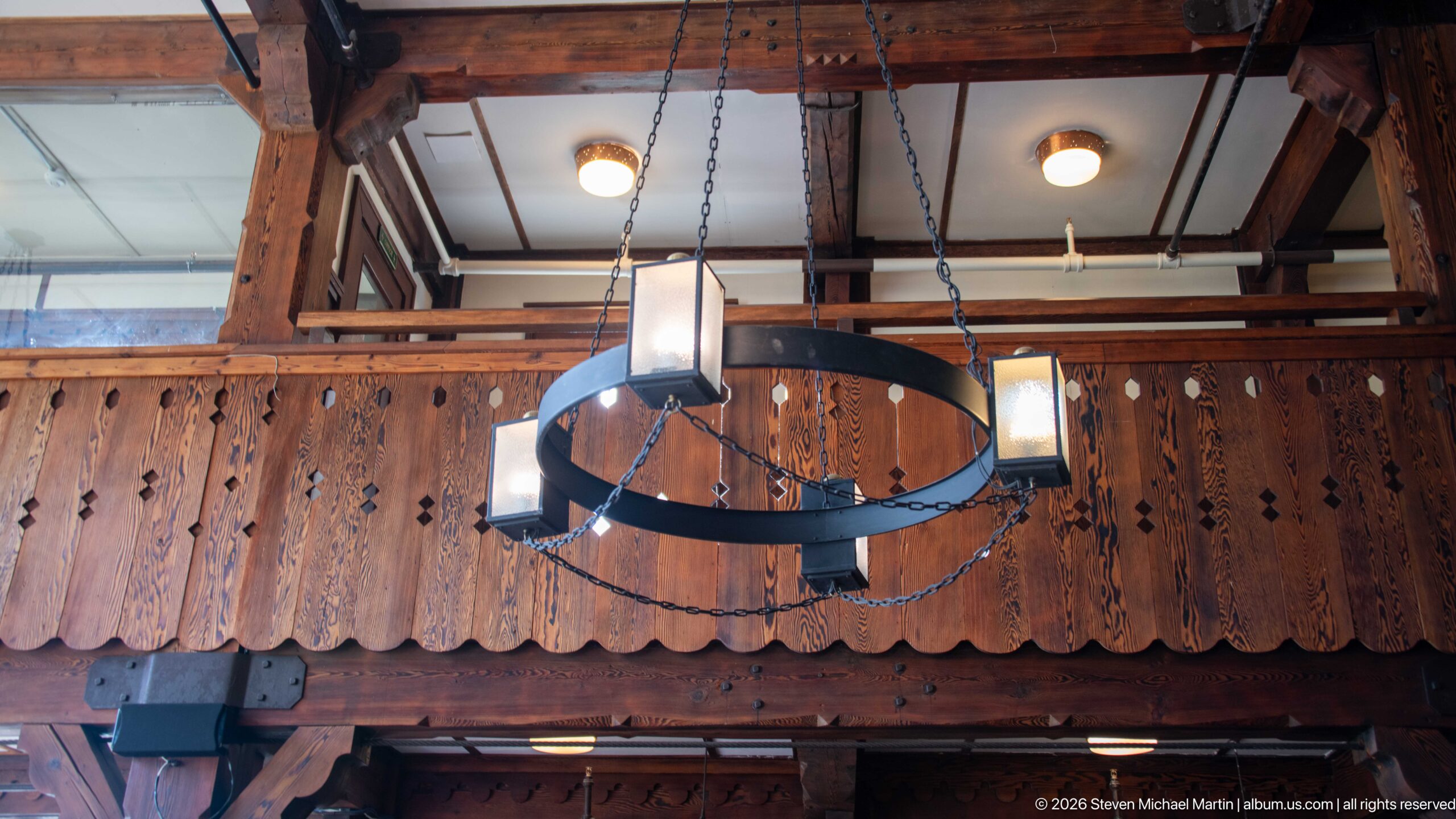
A single circular iron chandelier hangs on chains before a carved wooden balcony. Rectangular lanterns project from the ring at regular intervals, allowing the close view to isolate the fixture’s construction and its relationship to the hotel’s heavy timber interior.
Caption
A single circular iron chandelier hangs on chains before a carved wooden balcony. Rectangular lanterns project from the ring at regular intervals, allowing the close view to isolate the fixture’s construction and its relationship to the hotel’s heavy timber interior.
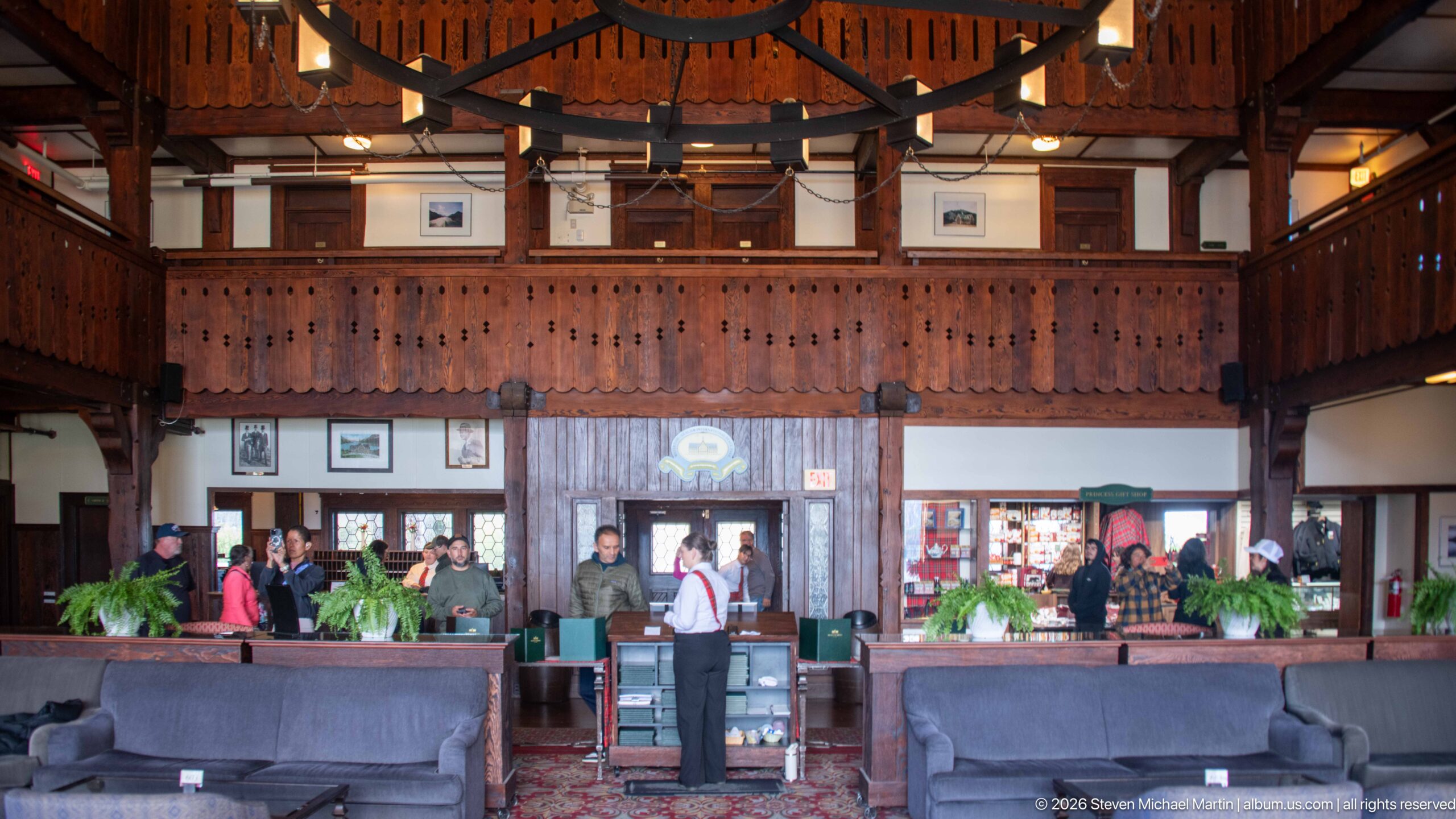
Guests gather near the central reception and circulation area beneath a continuous carved wooden balcony. Ferns, upholstered seating, framed pictures, and dark timber paneling soften the large hall, while the balcony and overhead chandelier reveal the room’s multi-story organization.
Caption
Guests gather near the central reception and circulation area beneath a continuous carved wooden balcony. Ferns, upholstered seating, framed pictures, and dark timber paneling soften the large hall, while the balcony and overhead chandelier reveal the room’s multi-story organization.
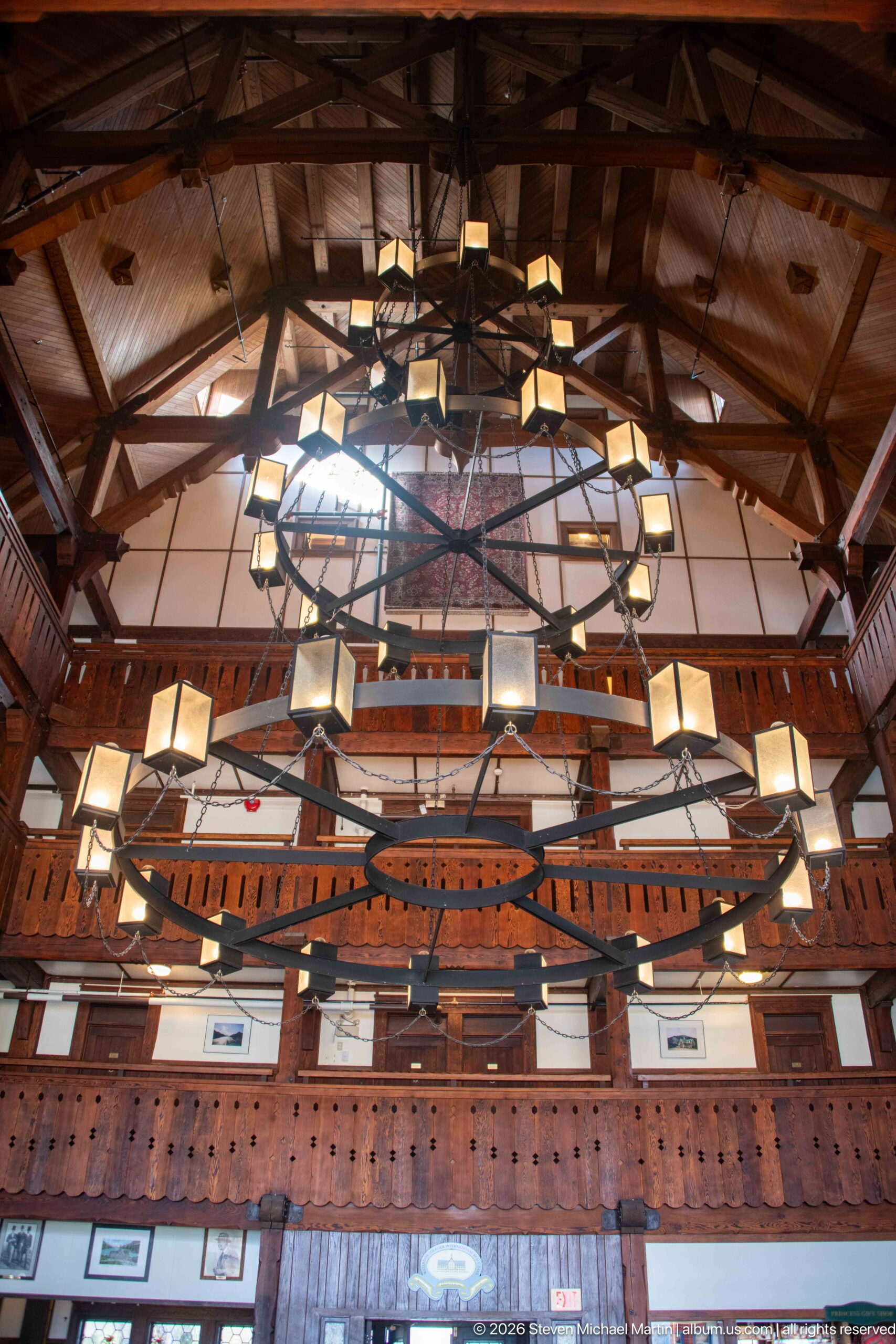
Two monumental ring chandeliers span the open lobby beneath exposed timber roof trusses. Their radiating metal arms and box-shaped lanterns create a layered geometric pattern against balconies and pale wall panels, emphasizing the exceptional scale of the hotel’s central public space.
Caption
Two monumental ring chandeliers span the open lobby beneath exposed timber roof trusses. Their radiating metal arms and box-shaped lanterns create a layered geometric pattern against balconies and pale wall panels, emphasizing the exceptional scale of the hotel’s central public space.
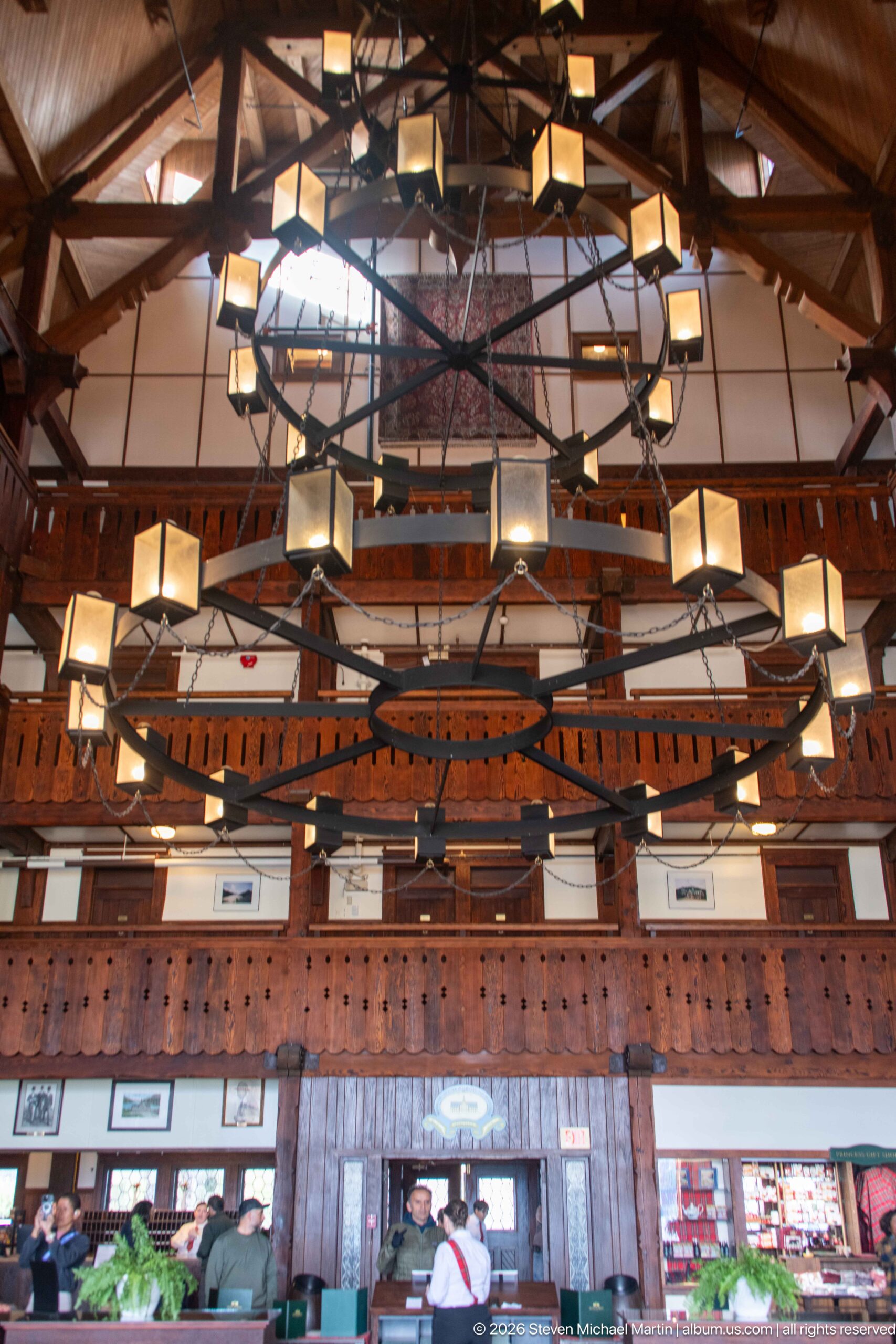
A huge circular chandelier dominates the upper half of the lobby while guests and seating occupy the floor below. The broad view connects the suspended ironwork to carved balcony rails, timber columns, framed wall art, and the active public space beneath it.
Caption
A huge circular chandelier dominates the upper half of the lobby while guests and seating occupy the floor below. The broad view connects the suspended ironwork to carved balcony rails, timber columns, framed wall art, and the active public space beneath it.
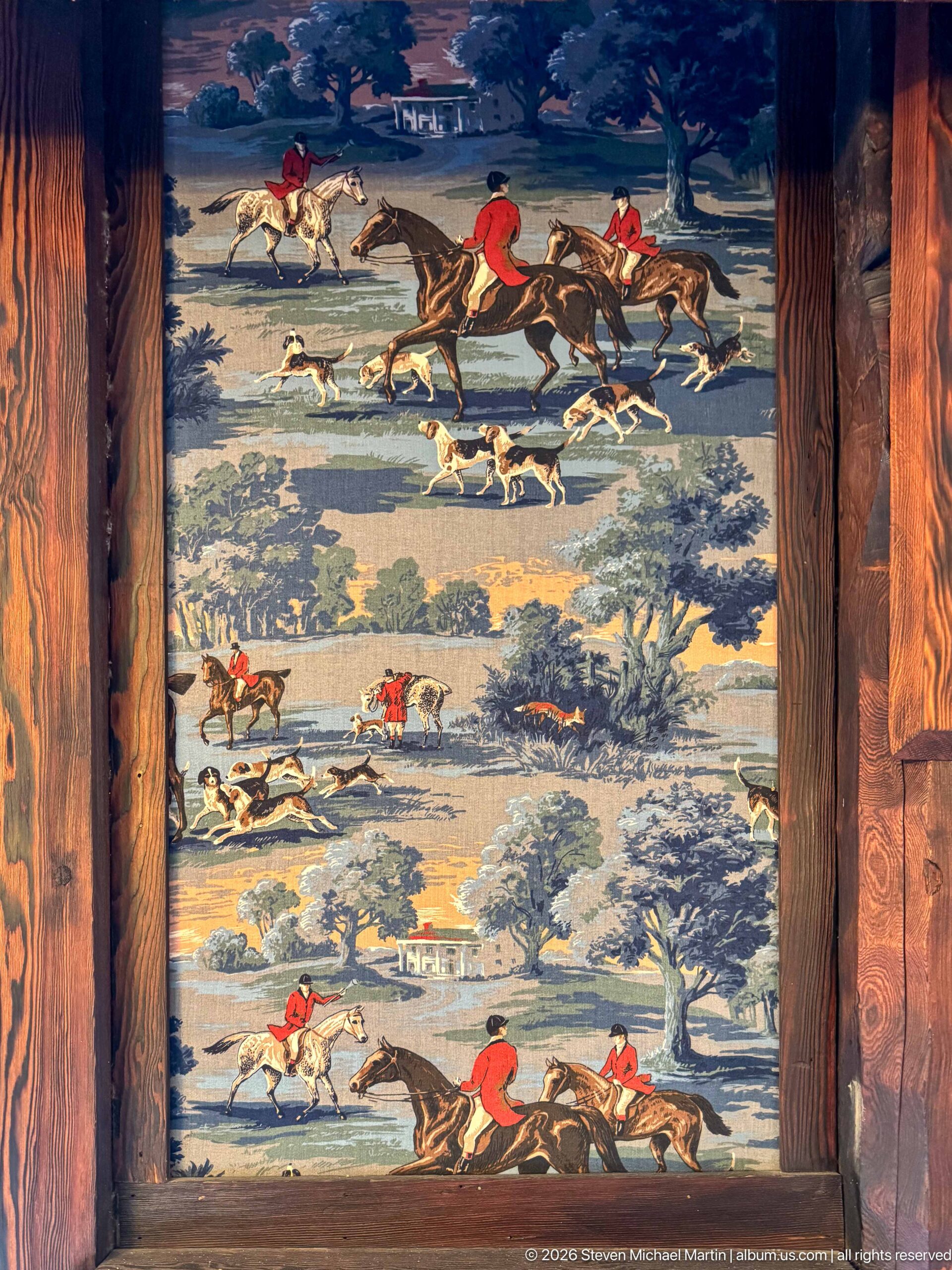
Mounted within a heavy wooden frame, a patterned textile shows repeated fox-hunting scenes with riders in red coats, horses, and running hounds across a blue-green landscape. The sporting imagery introduces a distinctly British decorative theme into the hotel’s timber interior.
Caption
Mounted within a heavy wooden frame, a patterned textile shows repeated fox-hunting scenes with riders in red coats, horses, and running hounds across a blue-green landscape. The sporting imagery introduces a distinctly British decorative theme into the hotel’s timber interior.
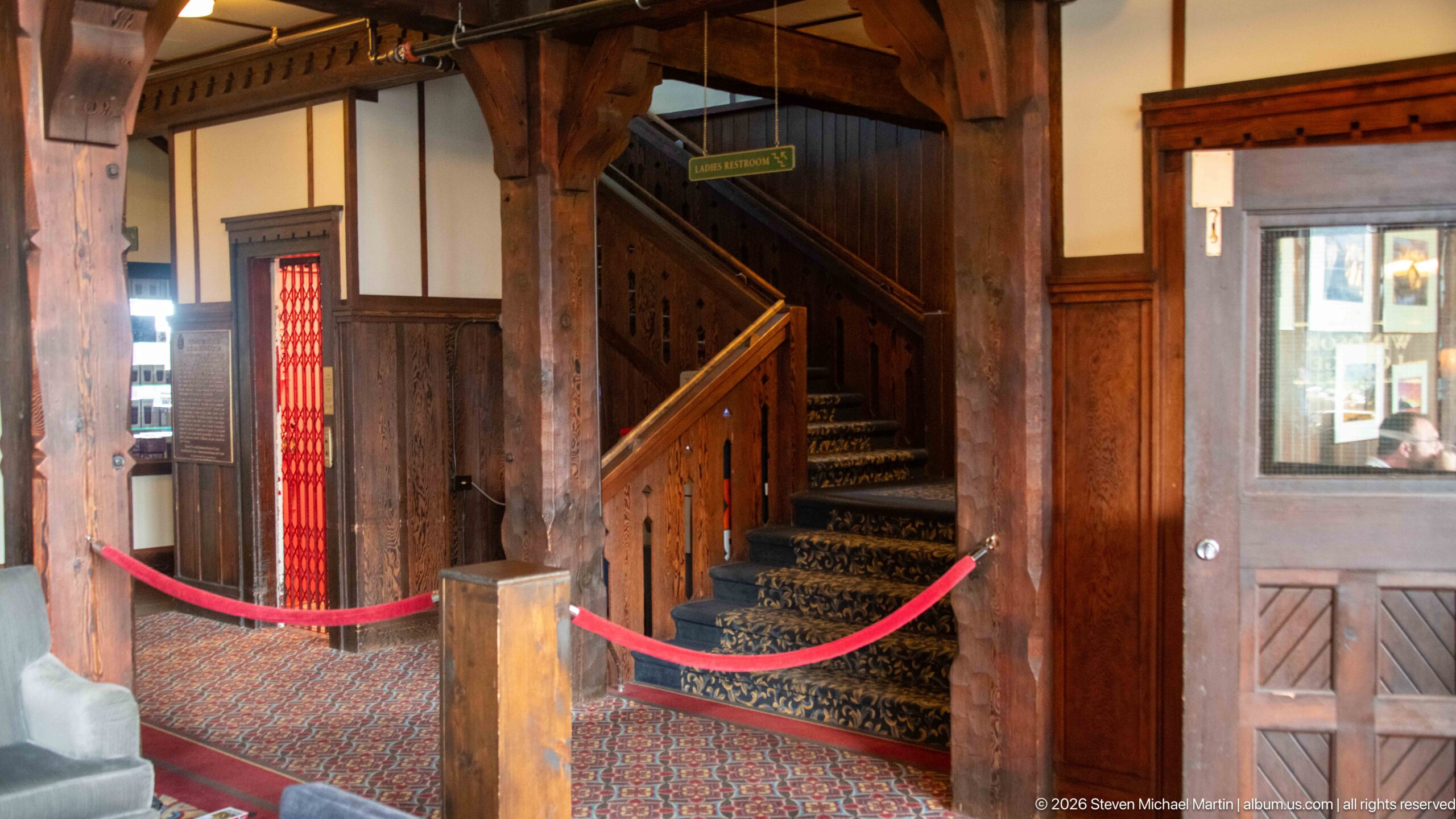
A compact wooden staircase rises from the public floor behind red rope barriers. Carved balusters, heavy posts, patterned carpeting, and surrounding dark paneling continue the hotel’s rustic interior vocabulary, while a small directional sign marks the stair as part of the building’s circulation.
Caption
A compact wooden staircase rises from the public floor behind red rope barriers. Carved balusters, heavy posts, patterned carpeting, and surrounding dark paneling continue the hotel’s rustic interior vocabulary, while a small directional sign marks the stair as part of the building’s circulation.
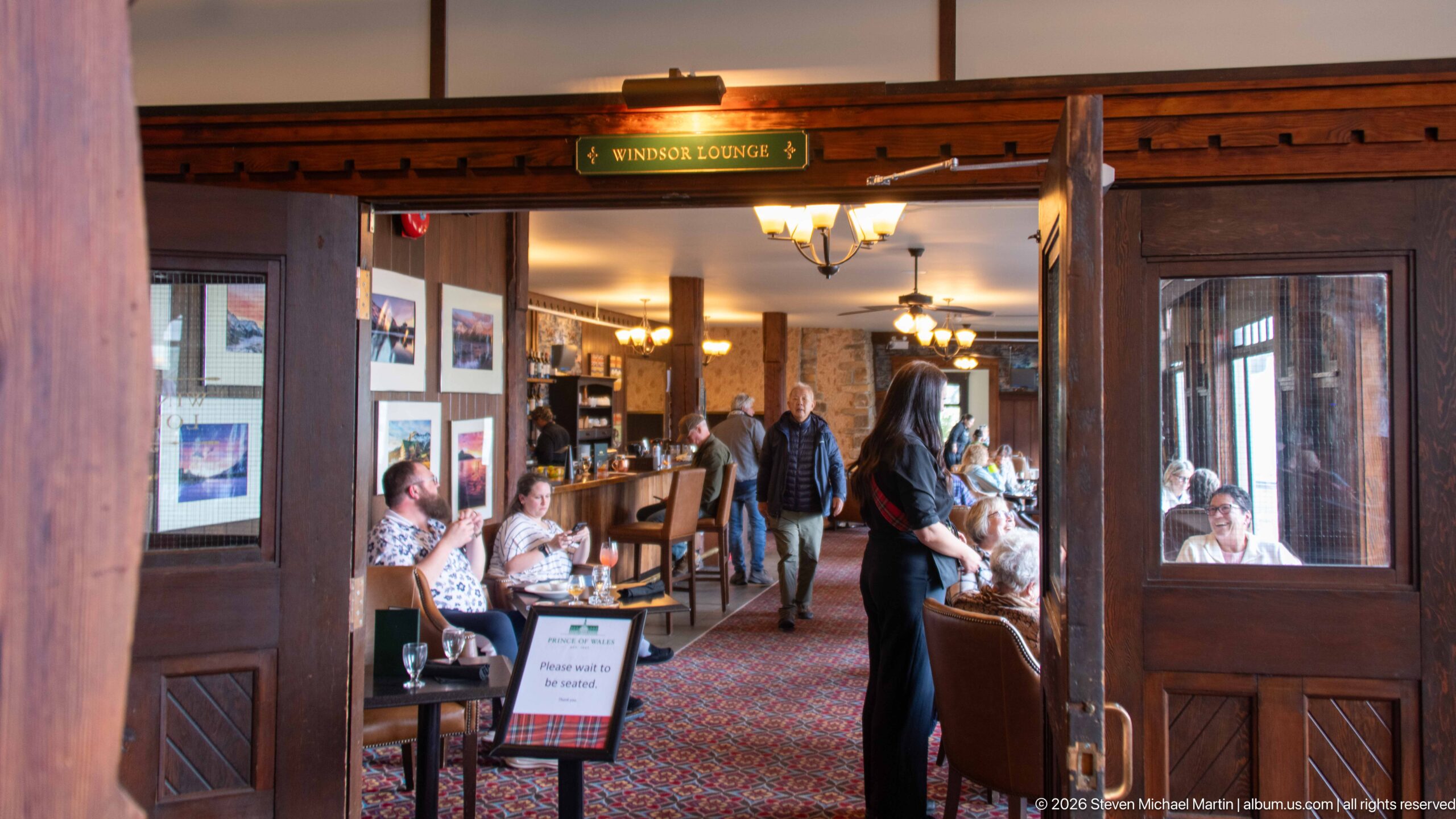
Open double doors beneath a green “Windsor Lounge” sign reveal a busy dining and bar room beyond. Guests occupy tables along the patterned carpet while a server moves through the central aisle, making the doorway a clear transition from the hotel’s circulation space into its active lounge.
Caption
Open double doors beneath a green “Windsor Lounge” sign reveal a busy dining and bar room beyond. Guests occupy tables along the patterned carpet while a server moves through the central aisle, making the doorway a clear transition from the hotel’s circulation space into its active lounge.
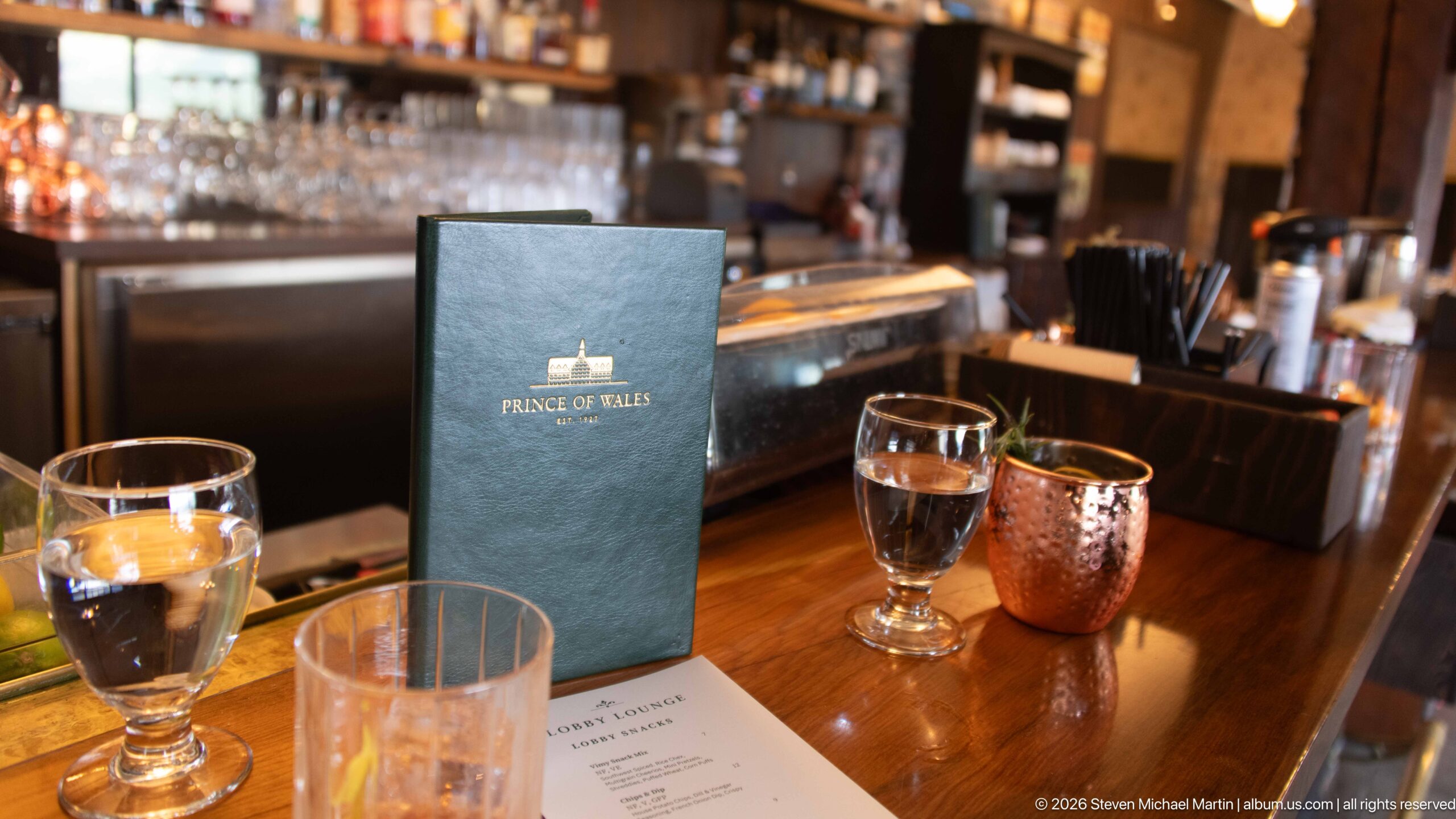
A branded Prince of Wales menu stands among water glasses, a copper mug, and a printed Windsor Lounge sheet on the polished wooden counter. The tighter composition concentrates on the hotel’s food-and-beverage service, with bottles and bar equipment softly blurred behind.
Caption
A branded Prince of Wales menu stands among water glasses, a copper mug, and a printed Windsor Lounge sheet on the polished wooden counter. The tighter composition concentrates on the hotel’s food-and-beverage service, with bottles and bar equipment softly blurred behind.
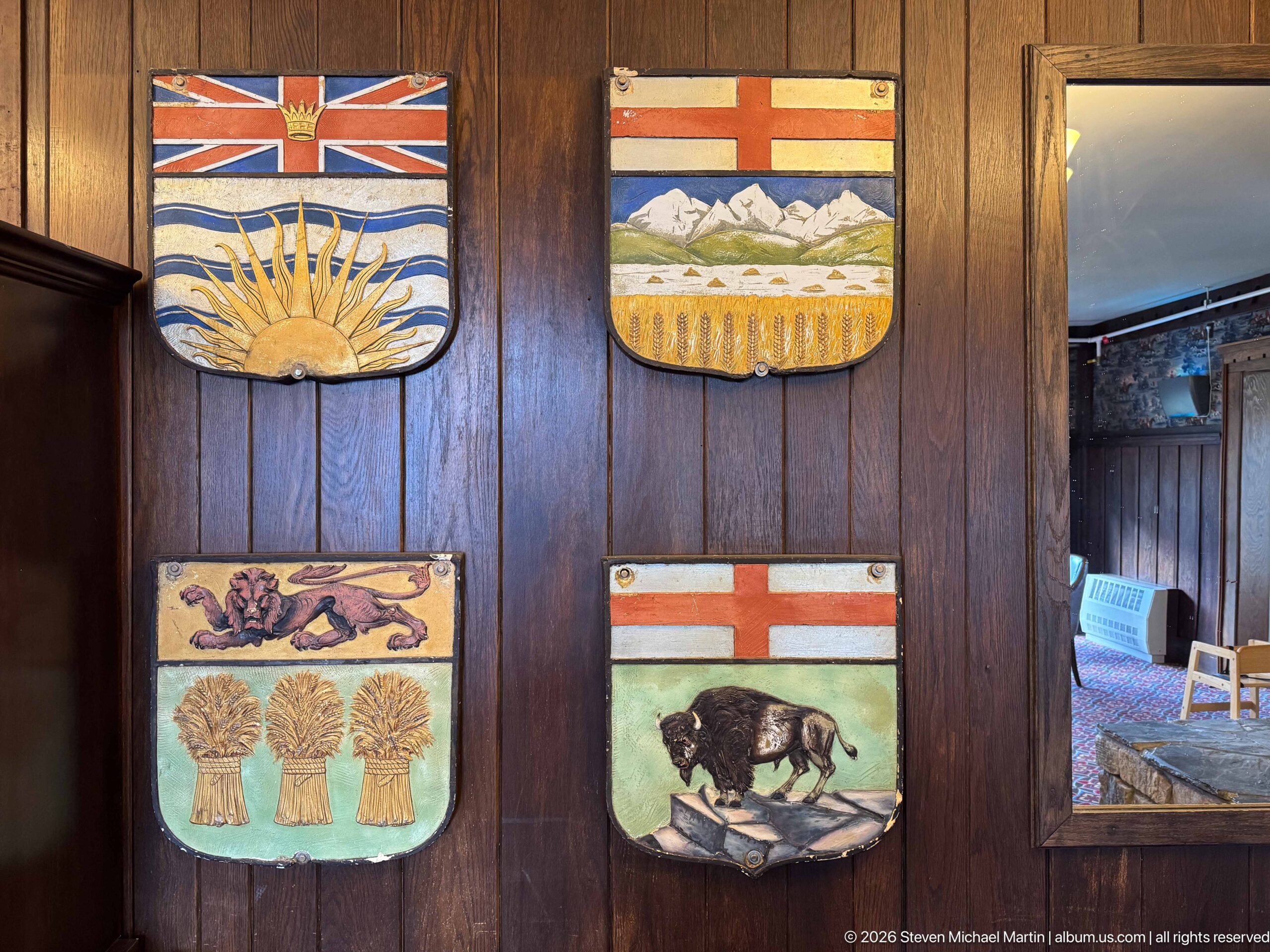
Four painted shield panels form a compact wall display: a sunburst over waves, mountains above wheat, three wheat sheaves, and a bison on rocks. Mounted on dark wood, the grouping brings several western Canadian landscape and resource motifs together in one decorative ensemble.
Caption
Four painted shield panels form a compact wall display: a sunburst over waves, mountains above wheat, three wheat sheaves, and a bison on rocks. Mounted on dark wood, the grouping brings several western Canadian landscape and resource motifs together in one decorative ensemble.
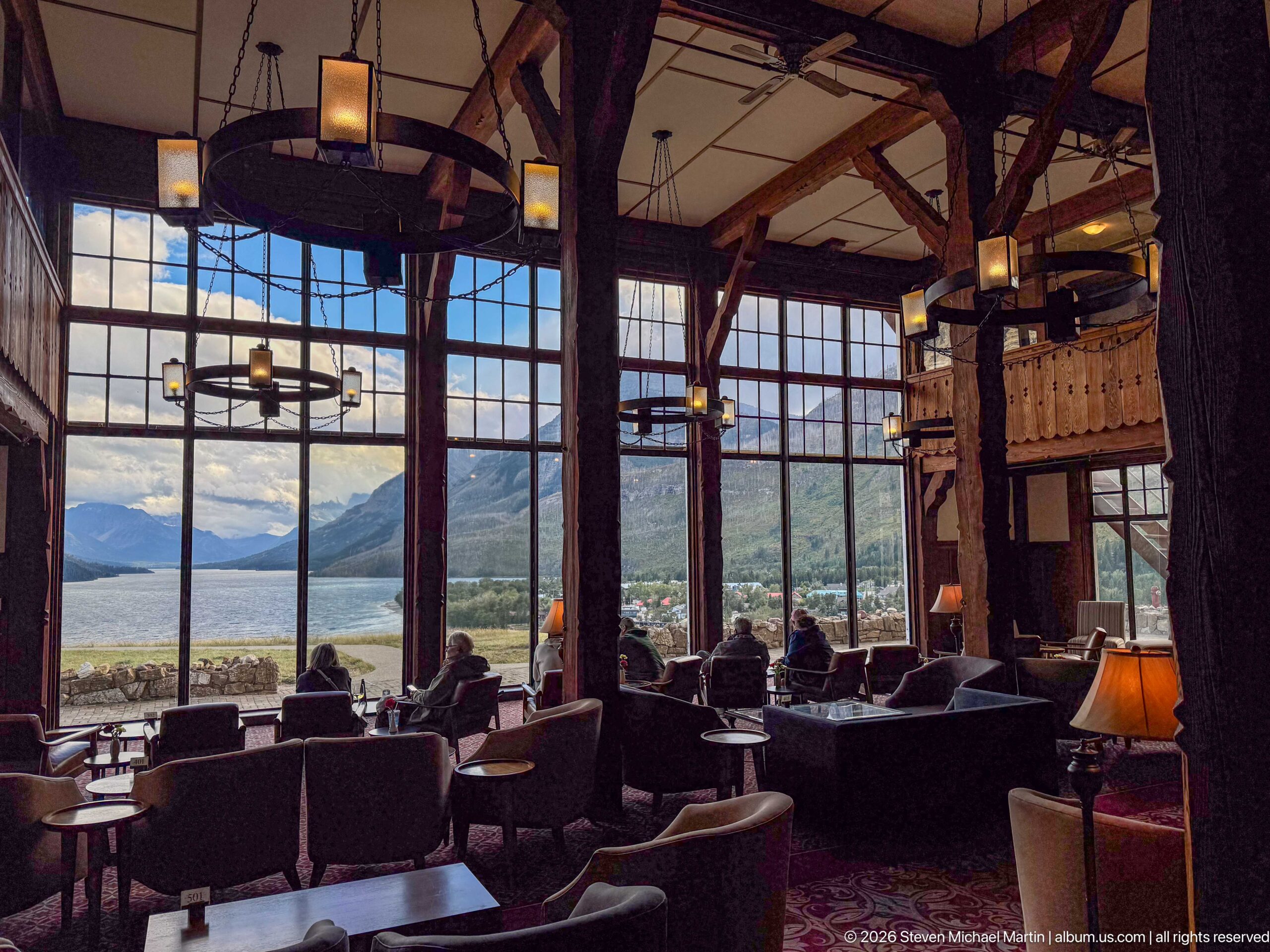
Rows of lounge chairs face the towering window wall and Upper Waterton Lake, turning the hotel’s main lobby toward the landscape outside. Guests sit in silhouette beneath timber beams and hanging lanterns while the lake, shoreline, and mountain slopes remain fully visible through the glazing.
Caption
Rows of lounge chairs face the towering window wall and Upper Waterton Lake, turning the hotel’s main lobby toward the landscape outside. Guests sit in silhouette beneath timber beams and hanging lanterns while the lake, shoreline, and mountain slopes remain fully visible through the glazing.
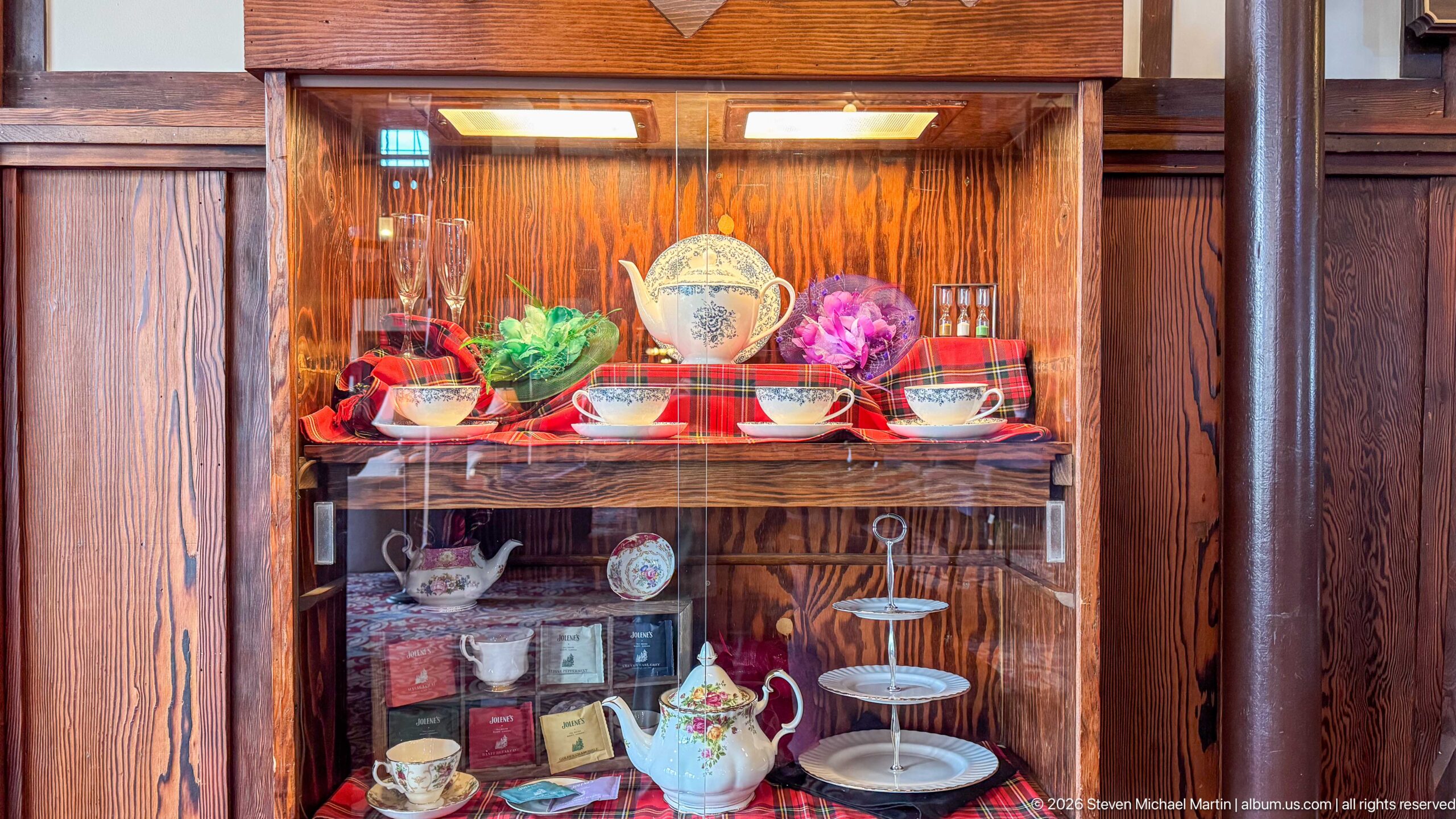
A glass-fronted wooden cabinet presents teapots, cups, saucers, serving stands, packaged tea, and bright decorative accents on a red tartan cloth. The display connects the hotel’s tea service with its British-themed interior identity while preserving the objects as a carefully arranged exhibit.
Caption
A glass-fronted wooden cabinet presents teapots, cups, saucers, serving stands, packaged tea, and bright decorative accents on a red tartan cloth. The display connects the hotel’s tea service with its British-themed interior identity while preserving the objects as a carefully arranged exhibit.
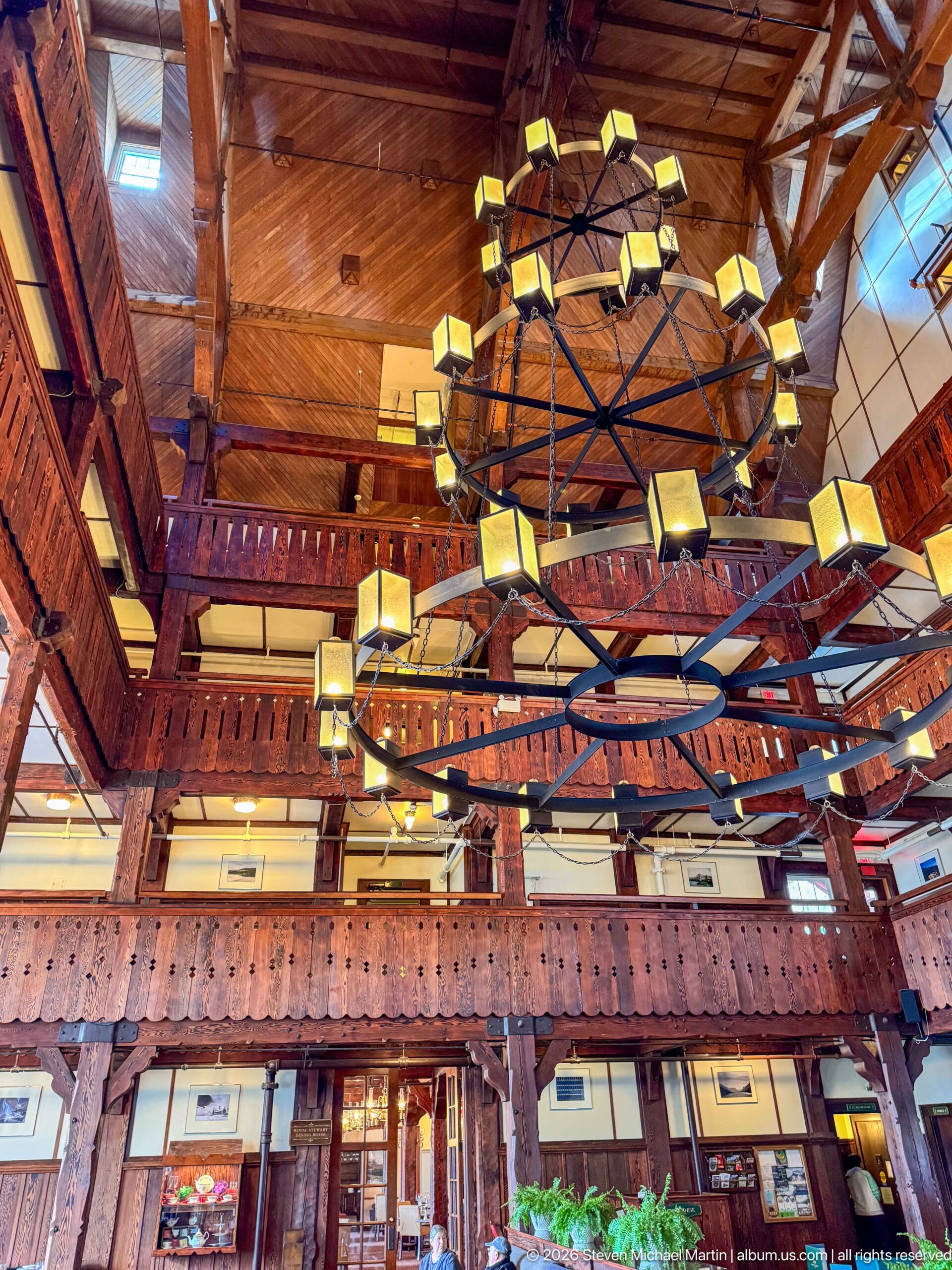
A wide upward view layers several enormous circular chandeliers against the timber roof and upper balconies. Repeating lanterns trace the iron rings, while carved balustrades and exposed framing establish the scale and craftsmanship of the hotel’s central lobby.
Caption
A wide upward view layers several enormous circular chandeliers against the timber roof and upper balconies. Repeating lanterns trace the iron rings, while carved balustrades and exposed framing establish the scale and craftsmanship of the hotel’s central lobby.
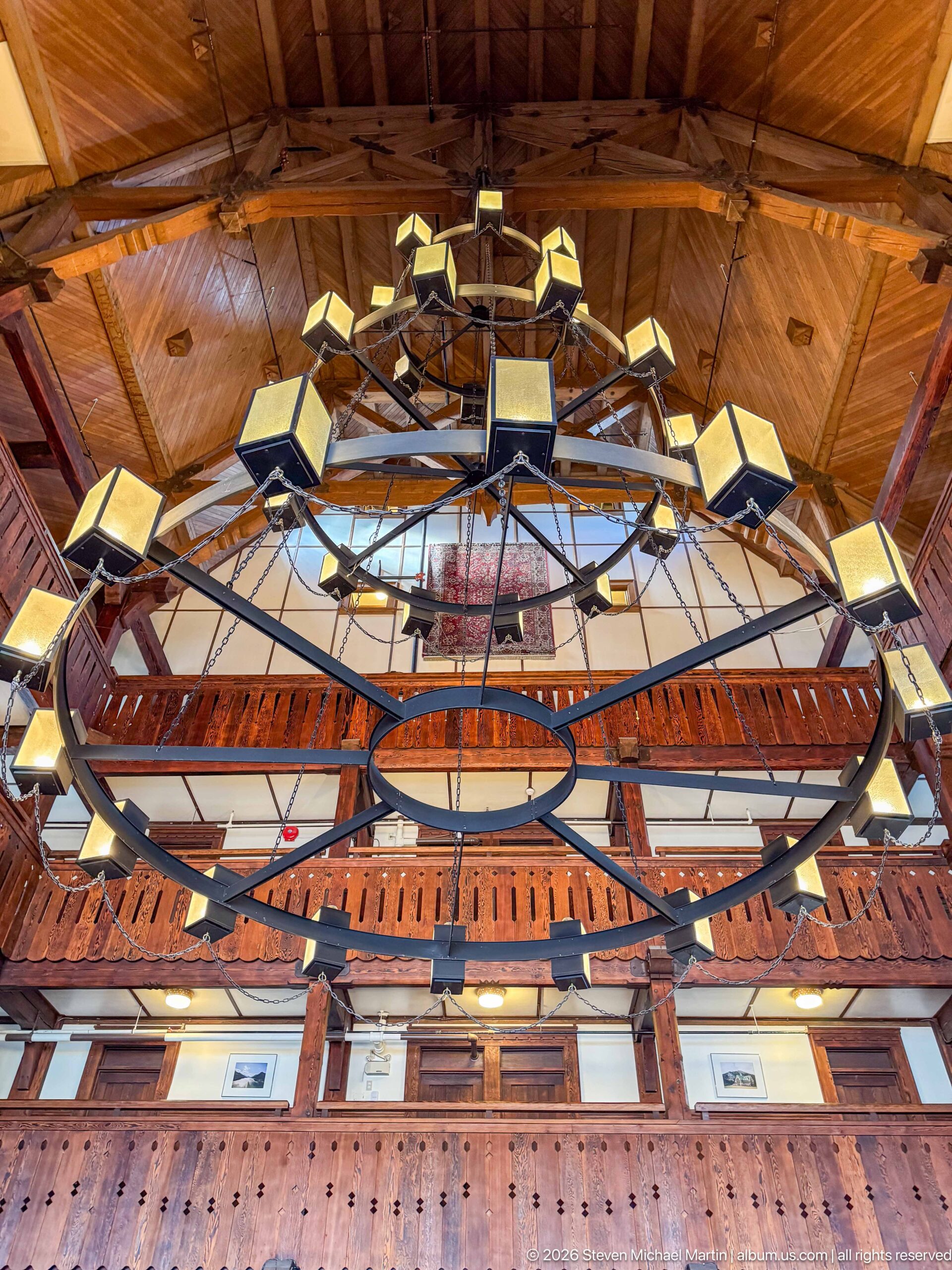
Seen from directly below, the main circular chandelier fills the frame with concentric iron rings, radial braces, and evenly spaced box lanterns. The low angle isolates the fixture’s geometry against the warm wooden ceiling and carved balcony, revealing details that are less apparent in broader lobby views.
Caption
Seen from directly below, the main circular chandelier fills the frame with concentric iron rings, radial braces, and evenly spaced box lanterns. The low angle isolates the fixture’s geometry against the warm wooden ceiling and carved balcony, revealing details that are less apparent in broader lobby views.
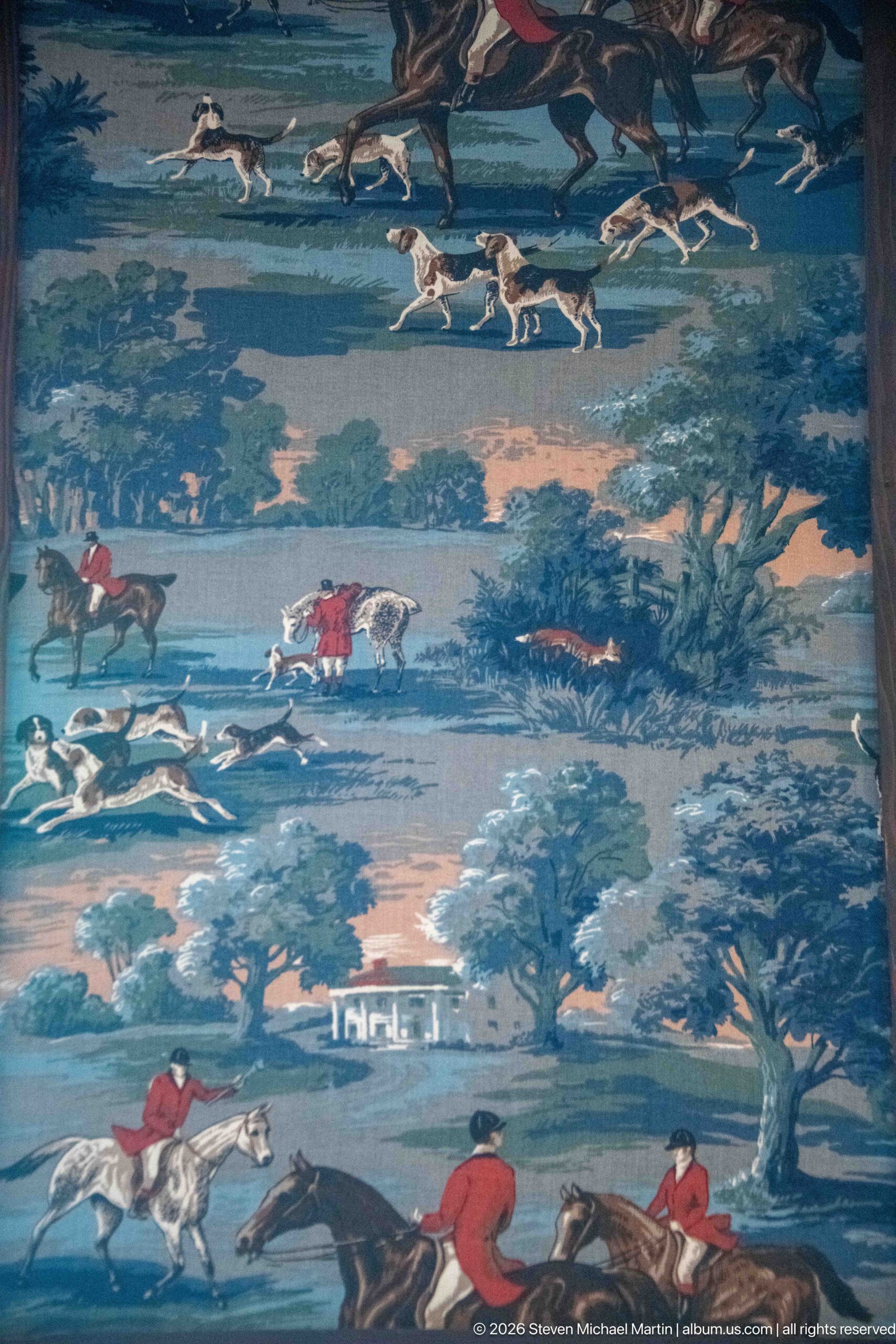
A close view of the blue-green hunting textile reveals riders in red coats, galloping horses, and packs of white hounds repeated across a stylized wooded landscape. Cropping away the frame emphasizes the woven or printed pattern itself and the British sporting imagery used in the hotel’s decoration.
Caption
A close view of the blue-green hunting textile reveals riders in red coats, galloping horses, and packs of white hounds repeated across a stylized wooded landscape. Cropping away the frame emphasizes the woven or printed pattern itself and the British sporting imagery used in the hotel’s decoration.
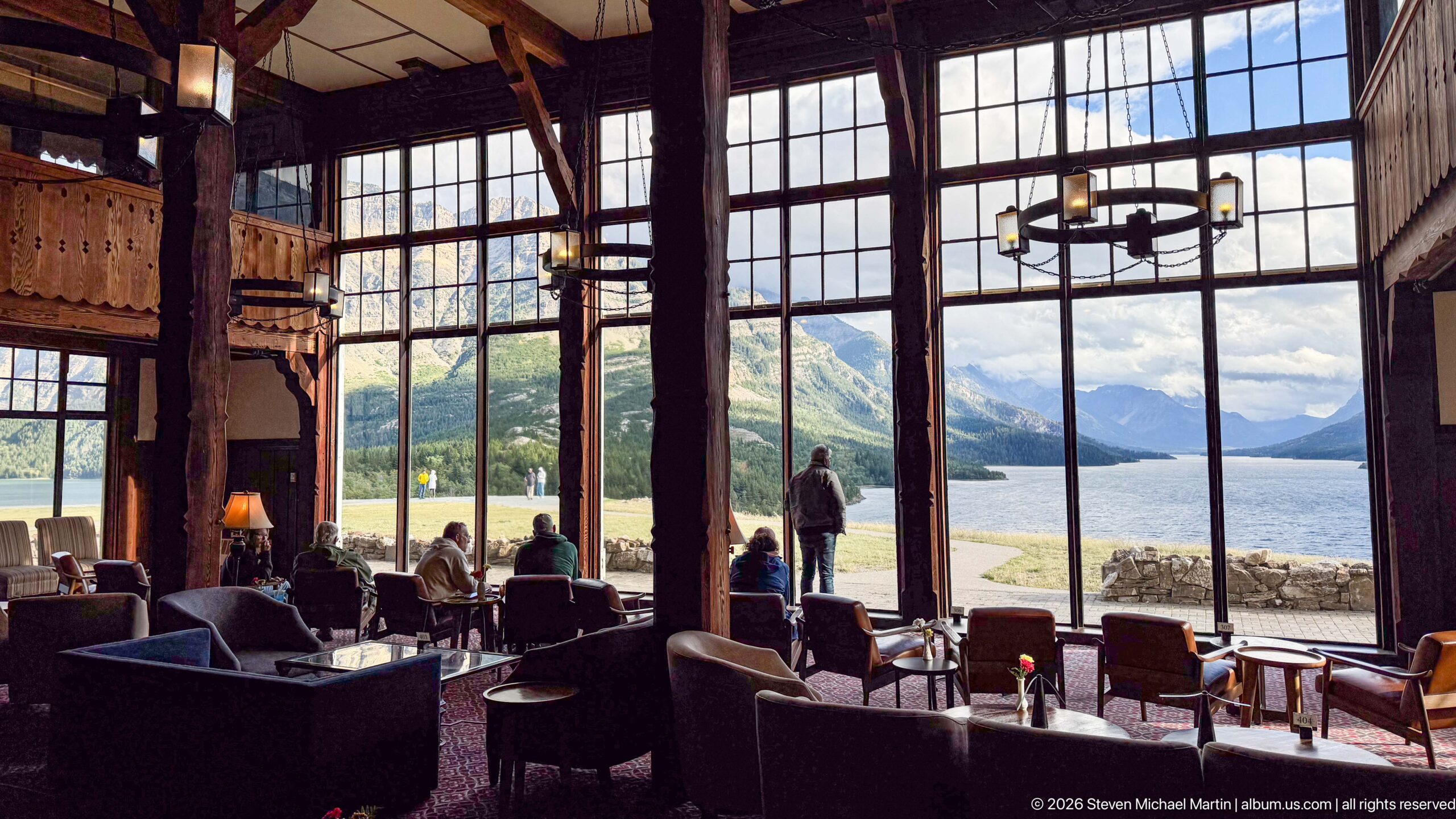
Guests sit and stand beside the lobby’s immense windows as Upper Waterton Lake stretches between mountain slopes outside. The broad composition balances dark timber columns, lounge furniture, and a hanging circular light against the bright landscape, showing how strongly the room is oriented toward the view.
Caption
Guests sit and stand beside the lobby’s immense windows as Upper Waterton Lake stretches between mountain slopes outside. The broad composition balances dark timber columns, lounge furniture, and a hanging circular light against the bright landscape, showing how strongly the room is oriented toward the view.
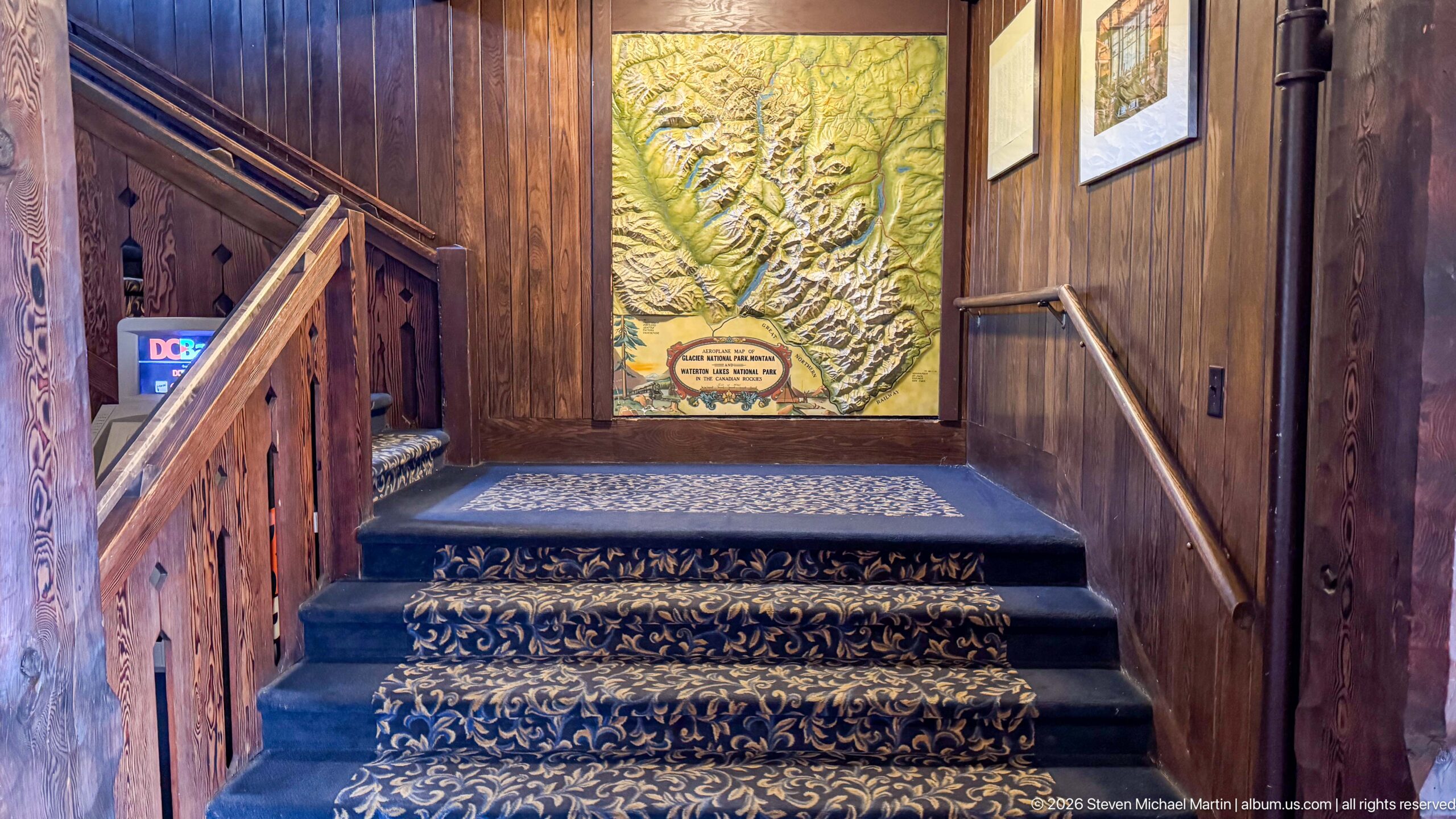
A raised relief map of the mountainous region hangs at the top of a short carpeted stair, framed by dark wood walls and railings. The tactile terrain model functions as an interpretive element within the hotel, while the surrounding timberwork and patterned runner maintain the historic interior character.
Caption
A raised relief map of the mountainous region hangs at the top of a short carpeted stair, framed by dark wood walls and railings. The tactile terrain model functions as an interpretive element within the hotel, while the surrounding timberwork and patterned runner maintain the historic interior character.
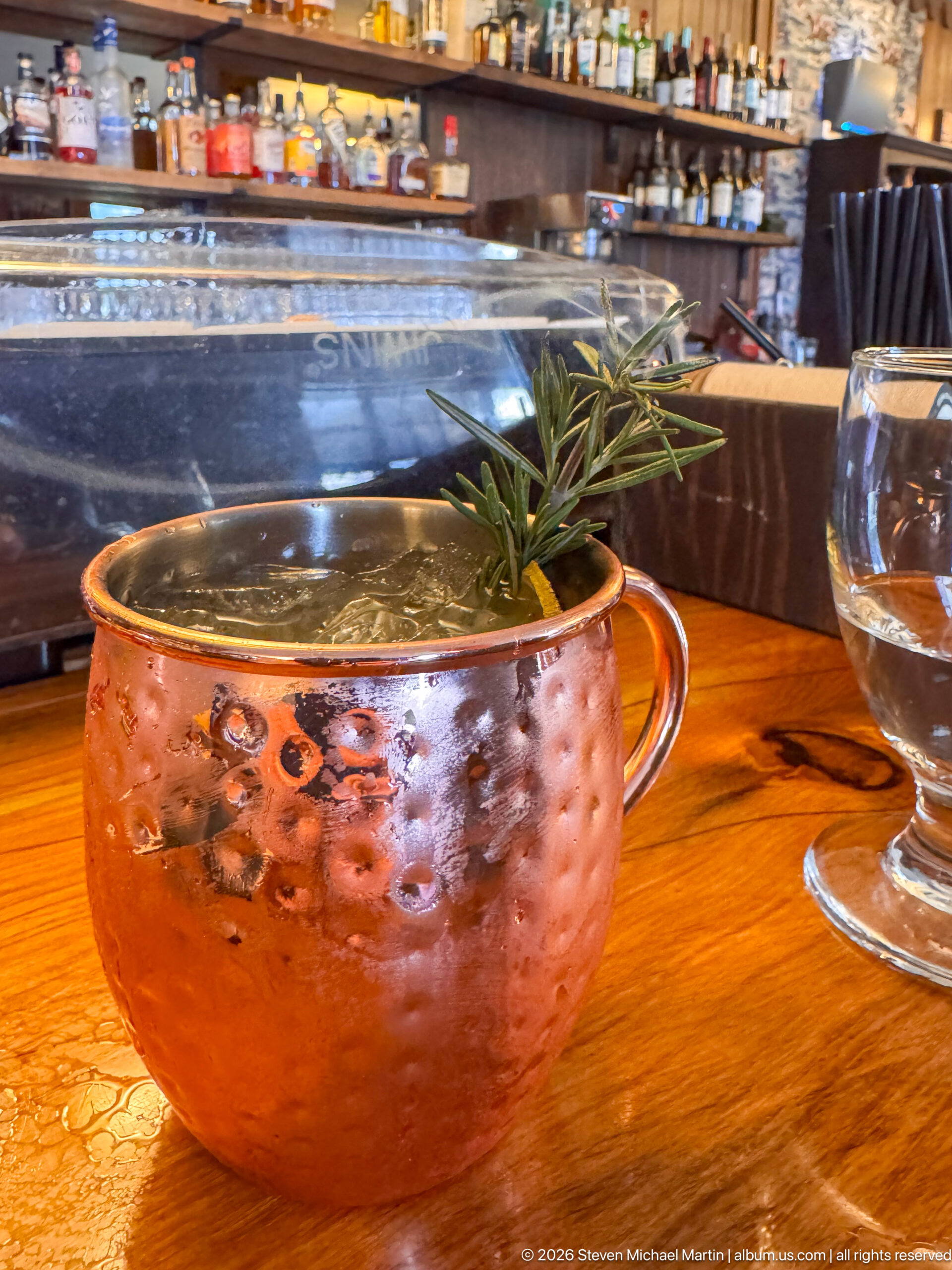
A hammered copper mug filled with a clear iced drink sits on the polished wooden bar, garnished with a fresh rosemary sprig. The close composition highlights the vessel’s dimpled surface, condensation, and herbal garnish, with lounge glassware and bottles receding softly into the background.
Caption
A hammered copper mug filled with a clear iced drink sits on the polished wooden bar, garnished with a fresh rosemary sprig. The close composition highlights the vessel’s dimpled surface, condensation, and herbal garnish, with lounge glassware and bottles receding softly into the background.
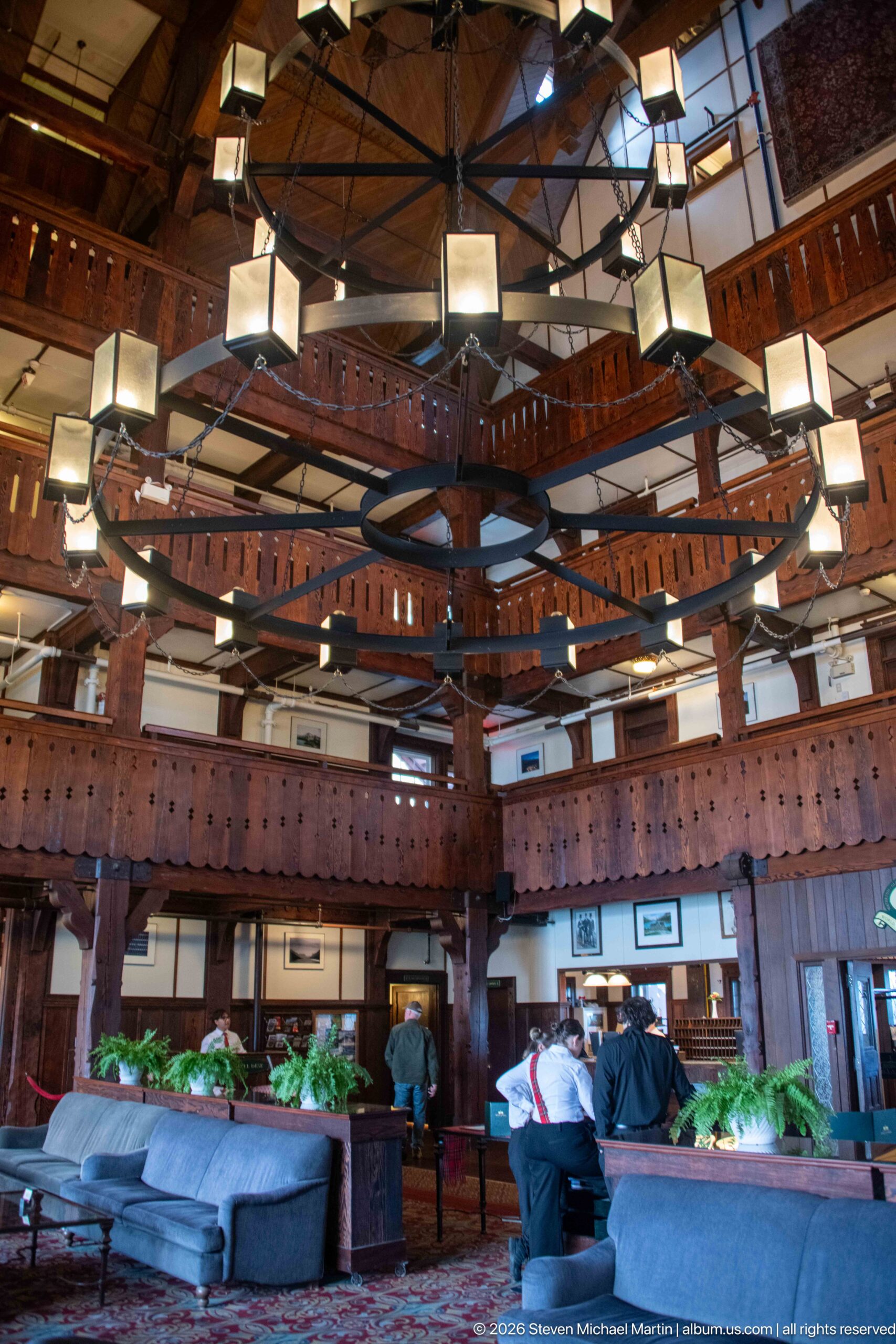
Heavy timber posts, perforated balcony rails, and suspended geometric light fixtures define the soaring central lobby of the Prince of Wales Hotel. The view across the seating area reveals the building’s layered interior circulation, with upper galleries opening toward the tall central space and exposed roof structure.
Caption
Heavy timber posts, perforated balcony rails, and suspended geometric light fixtures define the soaring central lobby of the Prince of Wales Hotel. The view across the seating area reveals the building’s layered interior circulation, with upper galleries opening toward the tall central space and exposed roof structure.
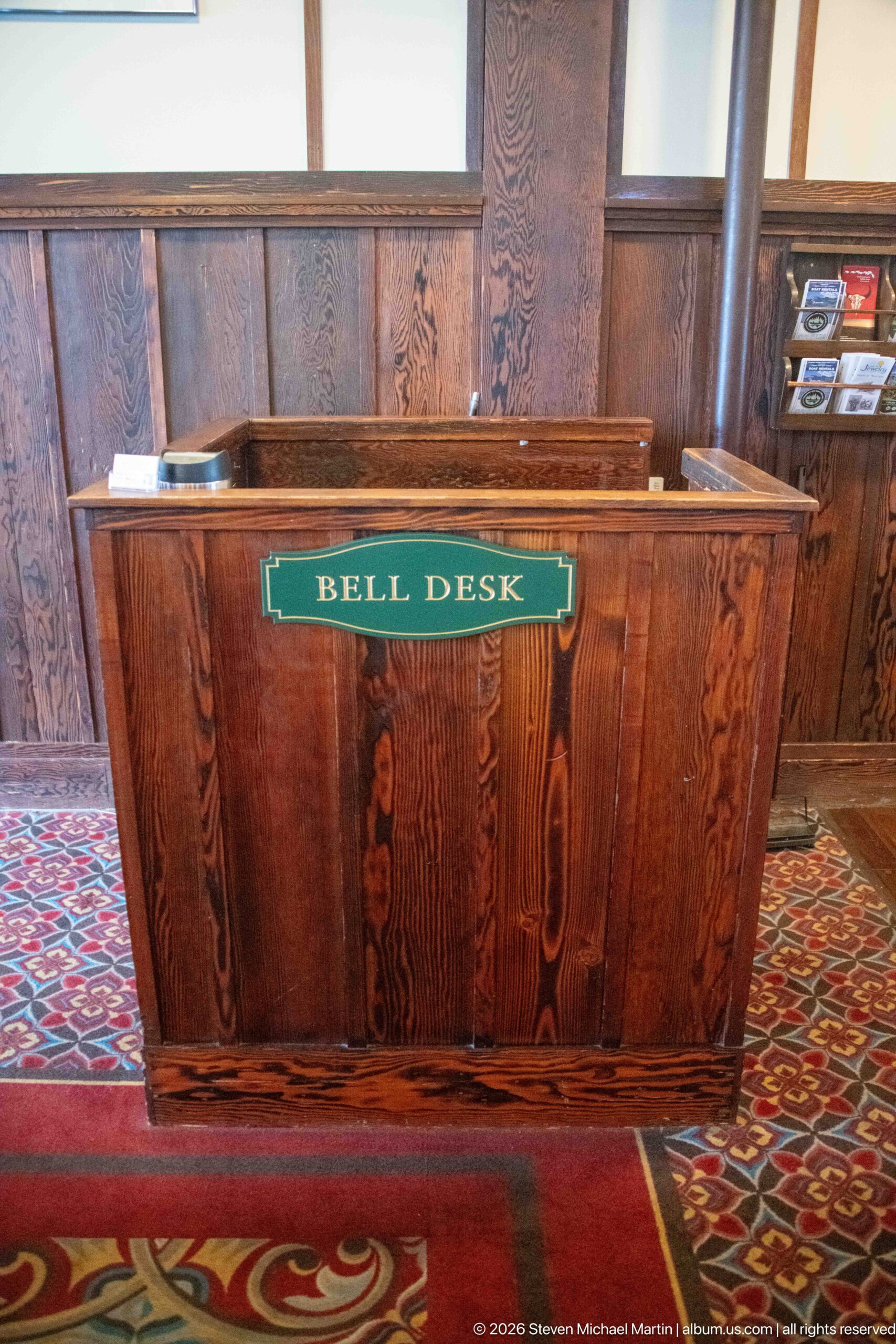
A compact wooden bell desk stands on patterned carpet within the Prince of Wales Hotel lobby. Its simple paneled construction and green “BELL DESK” sign make the function immediately legible, while the surrounding dark woodwork ties this service station to the historic character of the larger interior.
Caption
A compact wooden bell desk stands on patterned carpet within the Prince of Wales Hotel lobby. Its simple paneled construction and green “BELL DESK” sign make the function immediately legible, while the surrounding dark woodwork ties this service station to the historic character of the larger interior.
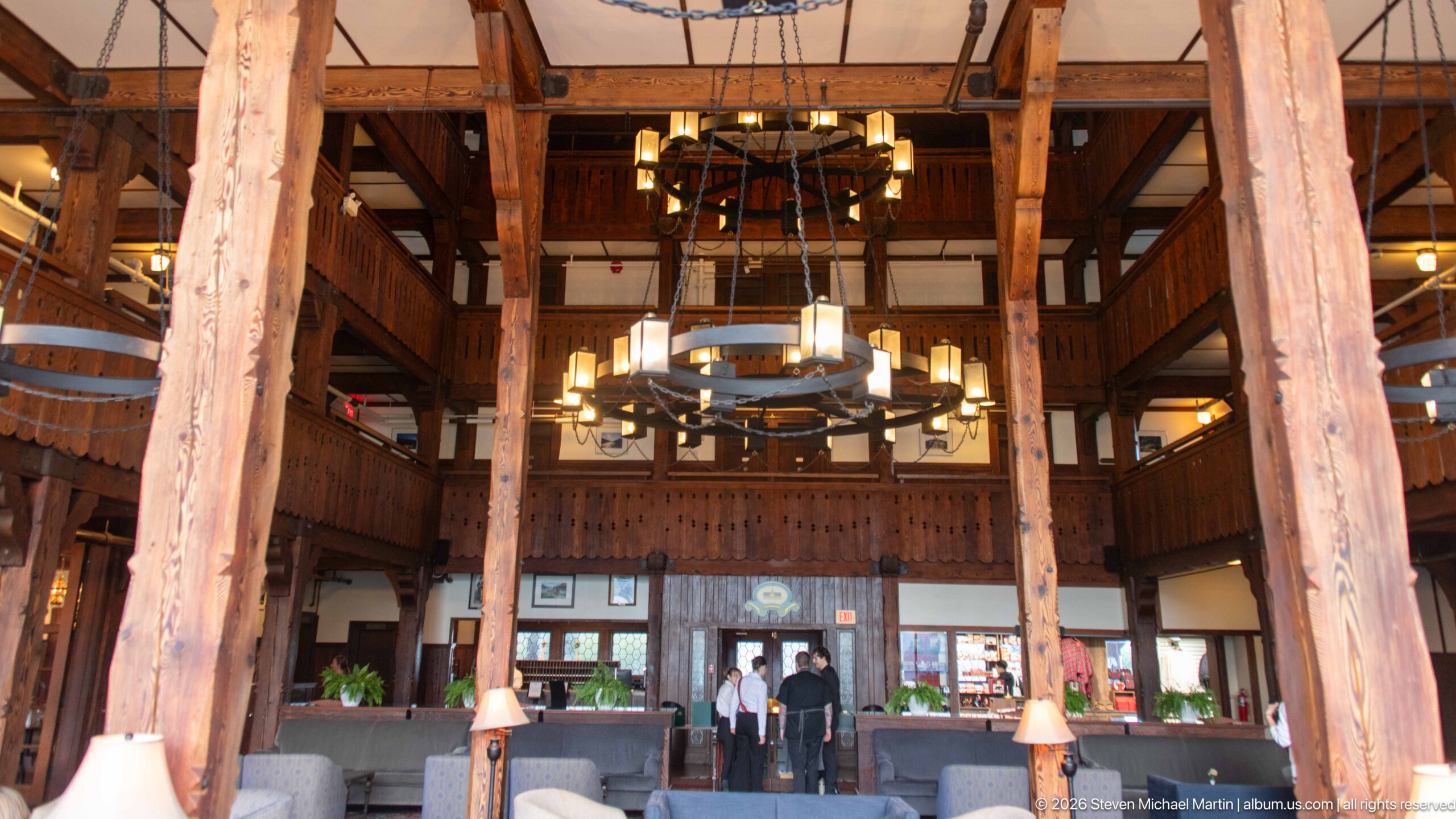
Massive vertical timber posts frame the Prince of Wales Hotel lobby, drawing the eye toward a large circular chandelier suspended within the multi-story hall. Balconies wrap the upper levels, while seating and the reception area occupy the ground floor, illustrating the dramatic vertical scale of the hotel’s principal public interior.
Caption
Massive vertical timber posts frame the Prince of Wales Hotel lobby, drawing the eye toward a large circular chandelier suspended within the multi-story hall. Balconies wrap the upper levels, while seating and the reception area occupy the ground floor, illustrating the dramatic vertical scale of the hotel’s principal public interior.
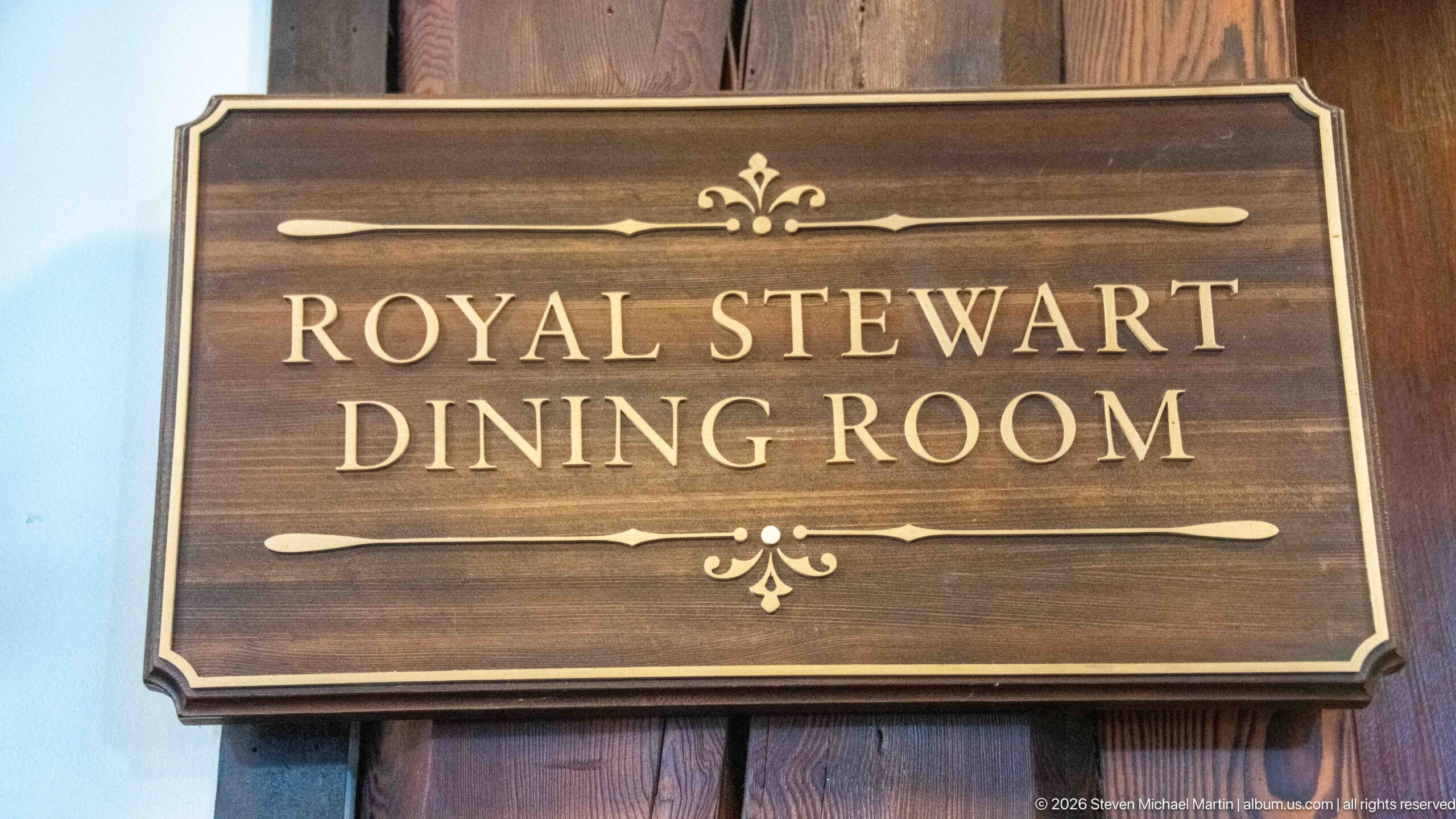
A carved wooden plaque marks the Royal Stewart Dining Room inside the Prince of Wales Hotel. Gold lettering and restrained ornamental flourishes stand out against the dark wood panel, a small interior detail that reflects the hotel’s traditional presentation and the named public rooms found throughout the historic property.
Caption
A carved wooden plaque marks the Royal Stewart Dining Room inside the Prince of Wales Hotel. Gold lettering and restrained ornamental flourishes stand out against the dark wood panel, a small interior detail that reflects the hotel’s traditional presentation and the named public rooms found throughout the historic property.
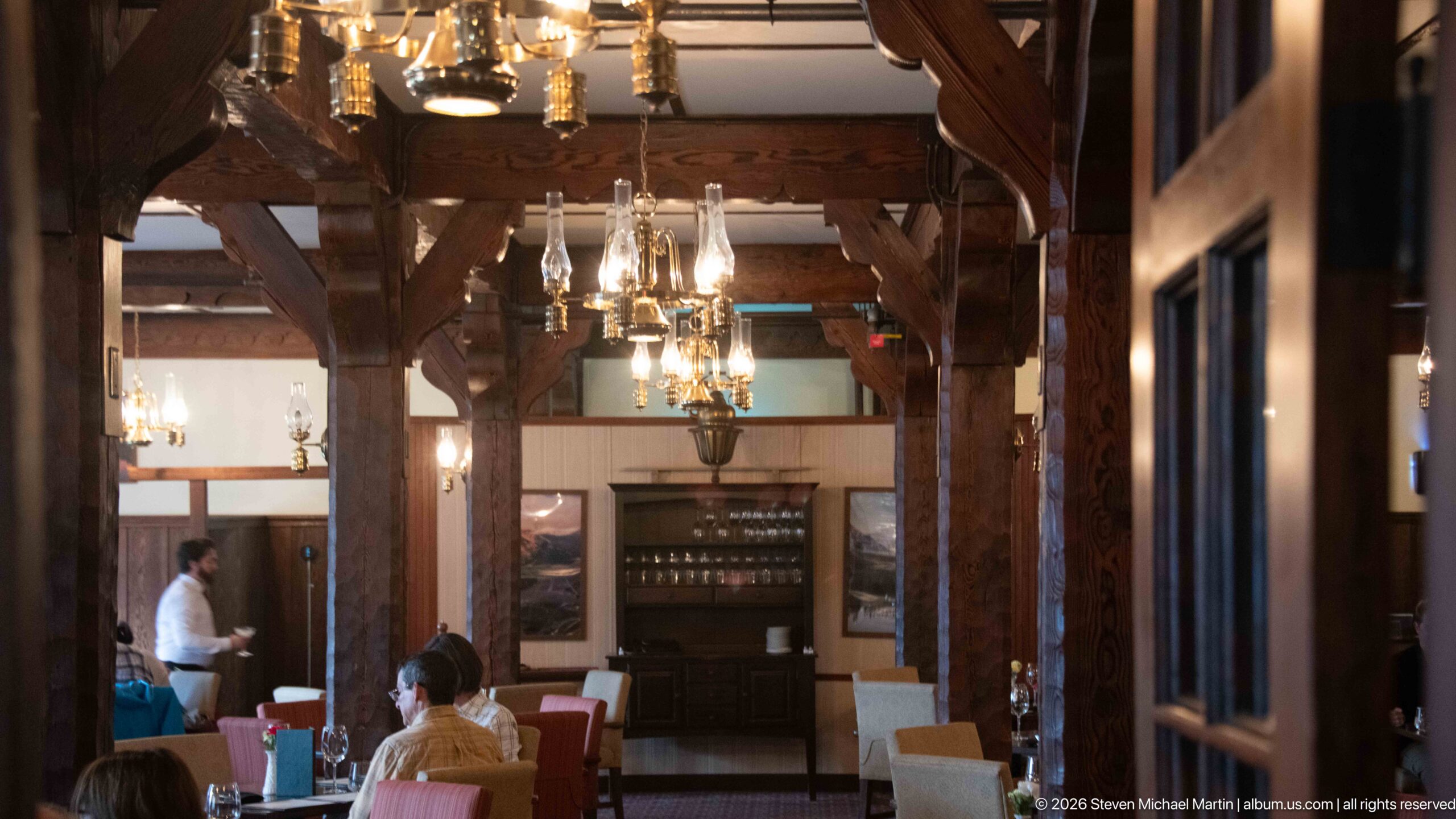
Dark timber posts and beams organize the Royal Stewart Dining Room, where chandeliers hang above neatly arranged tables and upholstered chairs. The intimate scale contrasts with the hotel’s vast central lobby, while the exposed woodwork and warm lighting continue the architectural vocabulary used throughout the Prince of Wales Hotel.
Caption
Dark timber posts and beams organize the Royal Stewart Dining Room, where chandeliers hang above neatly arranged tables and upholstered chairs. The intimate scale contrasts with the hotel’s vast central lobby, while the exposed woodwork and warm lighting continue the architectural vocabulary used throughout the Prince of Wales Hotel.
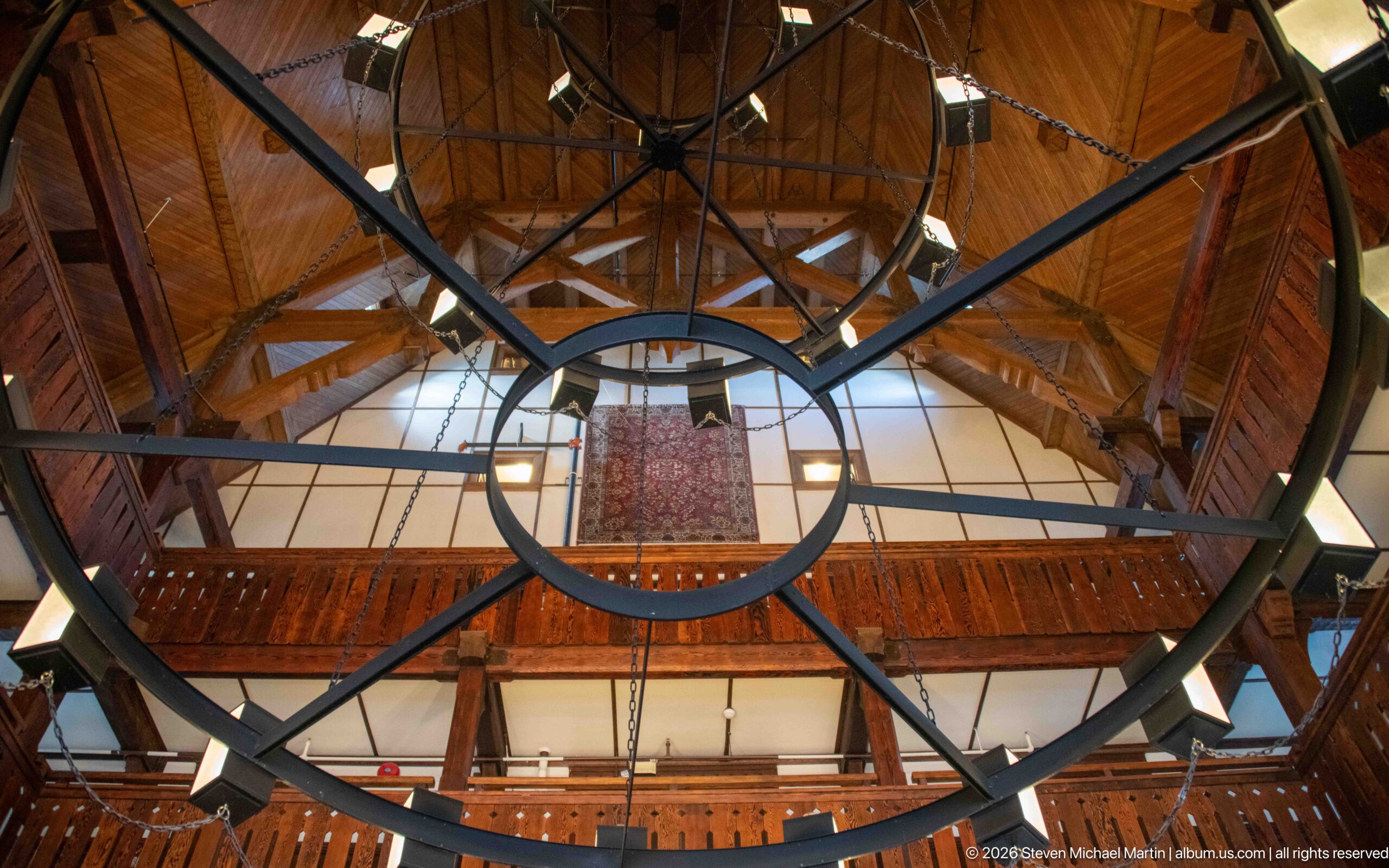
A close upward view isolates one of the Prince of Wales Hotel’s large circular chandeliers against the timber roof structure. Black metal rings, radial supports, and suspended square lanterns create a bold geometric pattern, while the exposed rafters and upper balcony place the fixture within the hotel’s lofty central lobby.
Caption
A close upward view isolates one of the Prince of Wales Hotel’s large circular chandeliers against the timber roof structure. Black metal rings, radial supports, and suspended square lanterns create a bold geometric pattern, while the exposed rafters and upper balcony place the fixture within the hotel’s lofty central lobby.
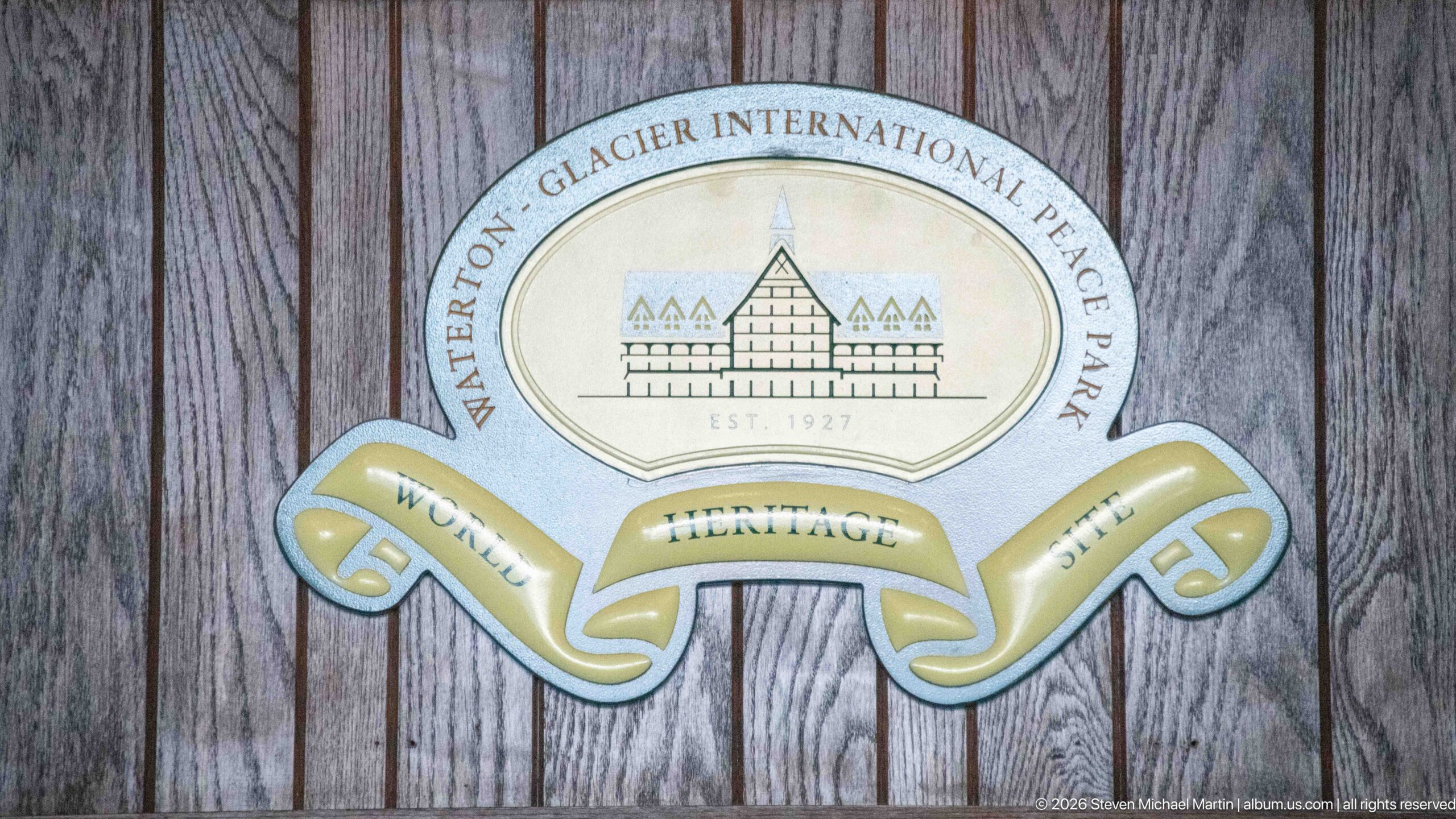
A decorative emblem identifies Waterton-Glacier International Peace Park and displays a stylized image of the Prince of Wales Hotel above ribbons reading “World Heritage Site.” Mounted on vertical wood paneling, the sign connects the hotel interior with the broader protected landscape shared by Waterton Lakes and Glacier national parks.
Caption
A decorative emblem identifies Waterton-Glacier International Peace Park and displays a stylized image of the Prince of Wales Hotel above ribbons reading “World Heritage Site.” Mounted on vertical wood paneling, the sign connects the hotel interior with the broader protected landscape shared by Waterton Lakes and Glacier national parks.
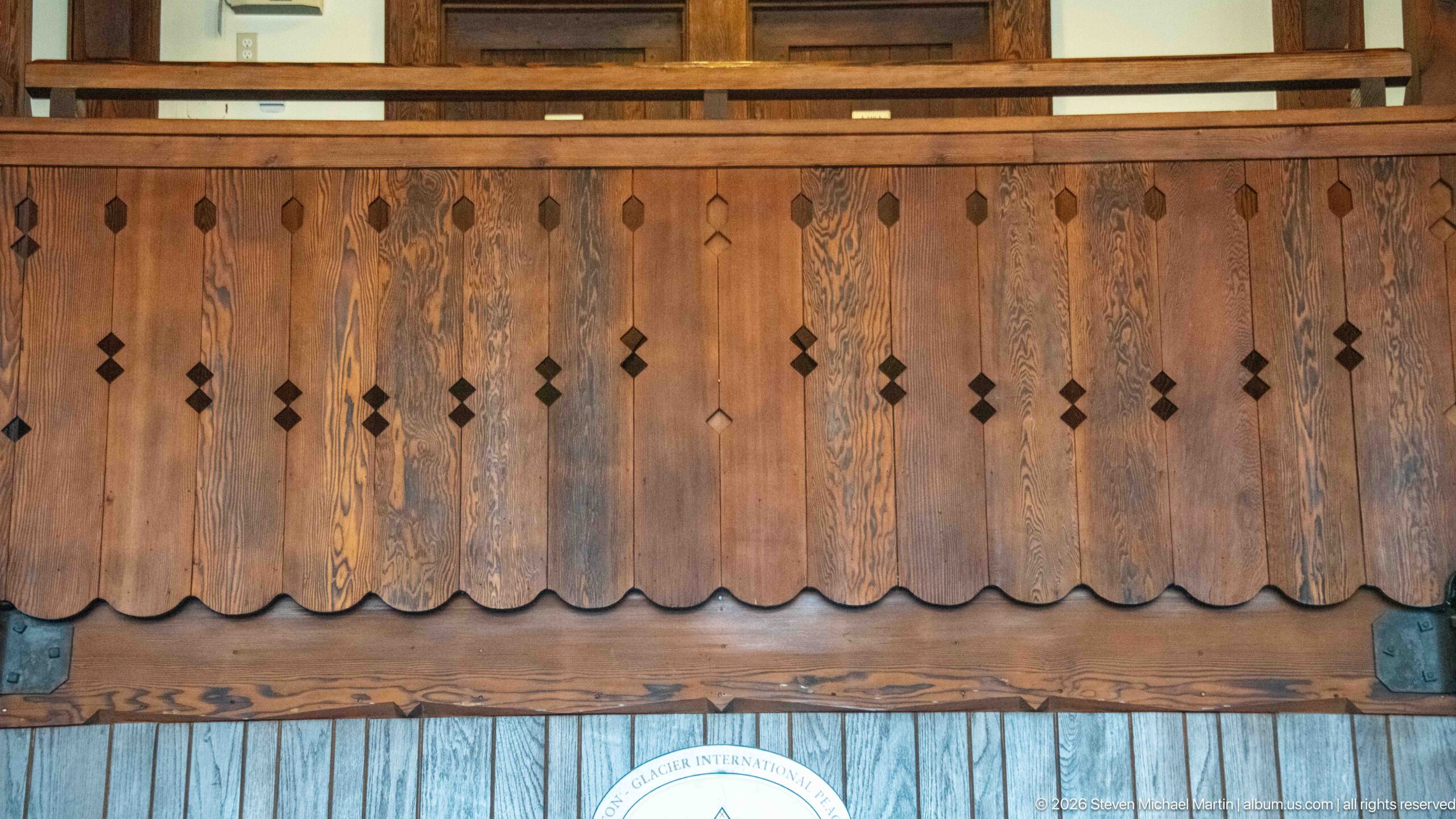
Decorative woodwork along an interior balcony combines a scalloped lower edge with repeated diamond-shaped piercings cut into vertical boards. The close view highlights the craftsmanship of the Prince of Wales Hotel’s timber interior, where ornament is integrated directly into railings, galleries, and structural elements rather than applied as separate decoration.
Caption
Decorative woodwork along an interior balcony combines a scalloped lower edge with repeated diamond-shaped piercings cut into vertical boards. The close view highlights the craftsmanship of the Prince of Wales Hotel’s timber interior, where ornament is integrated directly into railings, galleries, and structural elements rather than applied as separate decoration.
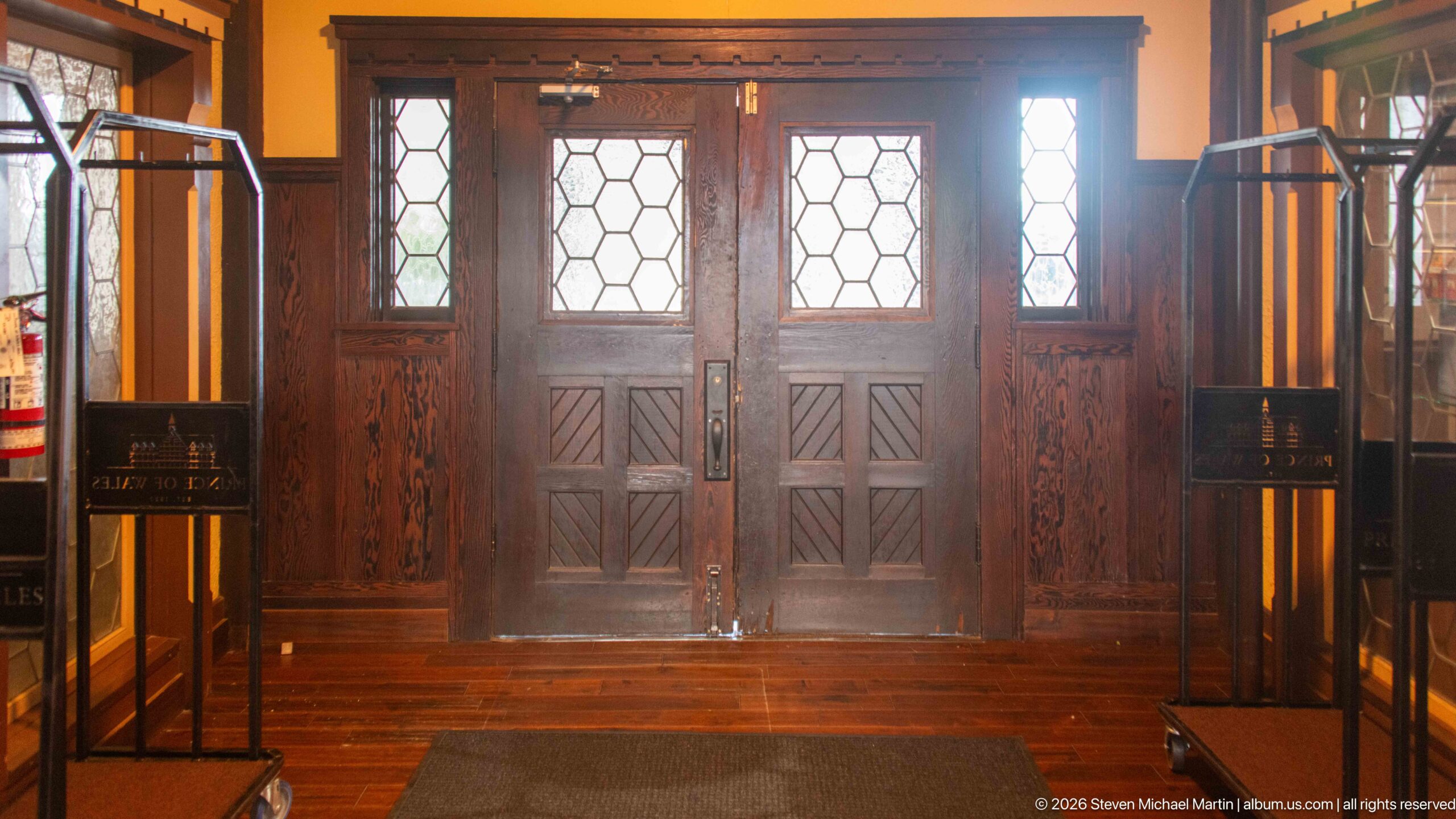
Heavy wooden double doors are framed by matching paneling and narrow leaded-glass sidelights inside the Prince of Wales Hotel. Hexagonal glazing patterns admit filtered daylight, while diagonal-board panels and substantial timber trim reinforce the handcrafted character of the hotel’s public interiors.
Caption
Heavy wooden double doors are framed by matching paneling and narrow leaded-glass sidelights inside the Prince of Wales Hotel. Hexagonal glazing patterns admit filtered daylight, while diagonal-board panels and substantial timber trim reinforce the handcrafted character of the hotel’s public interiors.
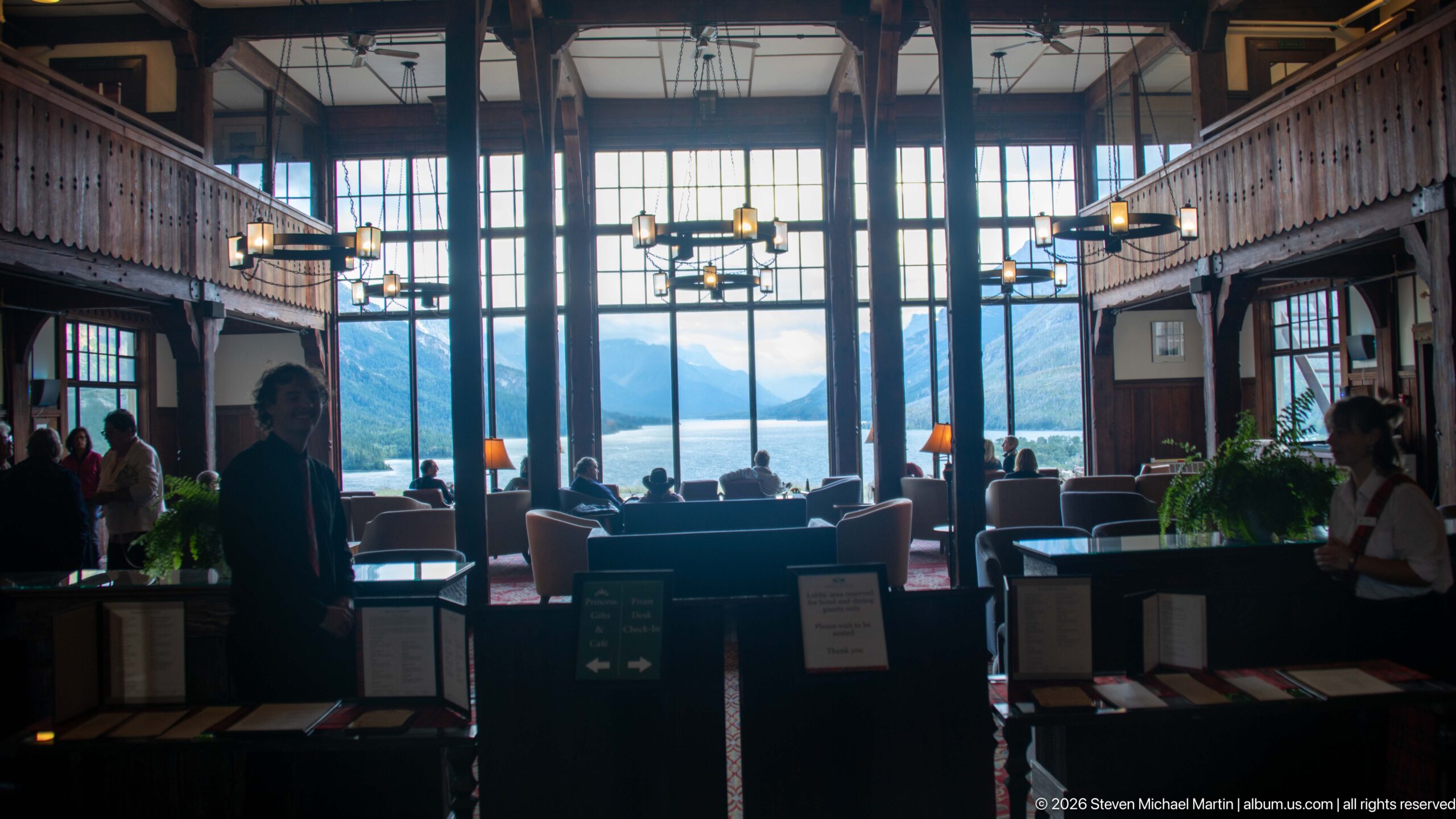
The Prince of Wales Hotel lobby opens toward a wall of tall windows framing Upper Waterton Lake and the surrounding mountains. Guests gather among sofas and tables beneath suspended lanterns, while the dark interior foreground makes the bright landscape beyond the glass the visual focus of the room.
Caption
The Prince of Wales Hotel lobby opens toward a wall of tall windows framing Upper Waterton Lake and the surrounding mountains. Guests gather among sofas and tables beneath suspended lanterns, while the dark interior foreground makes the bright landscape beyond the glass the visual focus of the room.
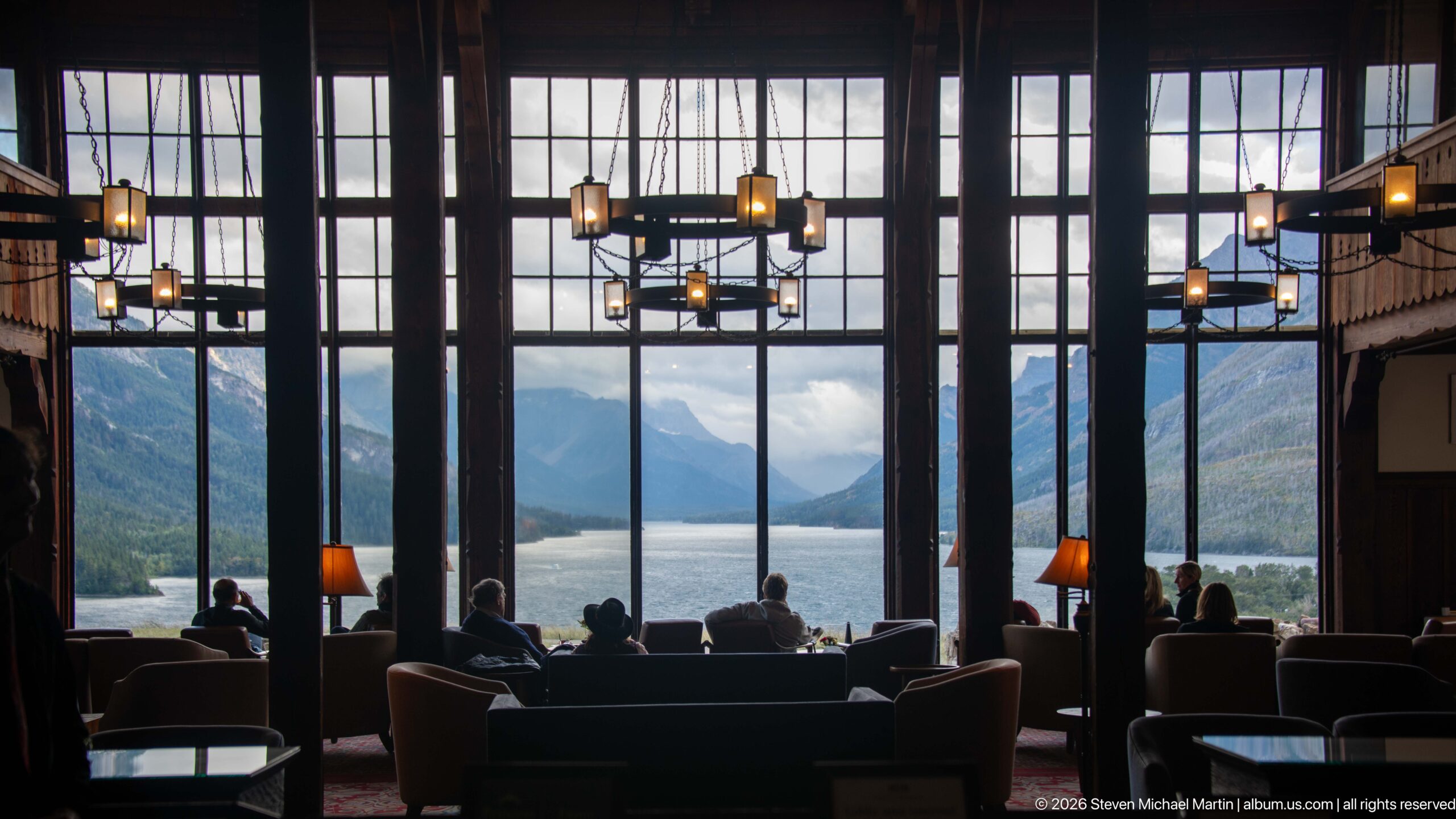
From the seating area, tall mullioned windows turn Upper Waterton Lake into the dominant backdrop of the Prince of Wales Hotel lobby. Mountains rise on both sides of the water, while silhouetted guests, armchairs, tables, lamps, and geometric chandeliers create a layered interior foreground.
Caption
From the seating area, tall mullioned windows turn Upper Waterton Lake into the dominant backdrop of the Prince of Wales Hotel lobby. Mountains rise on both sides of the water, while silhouetted guests, armchairs, tables, lamps, and geometric chandeliers create a layered interior foreground.
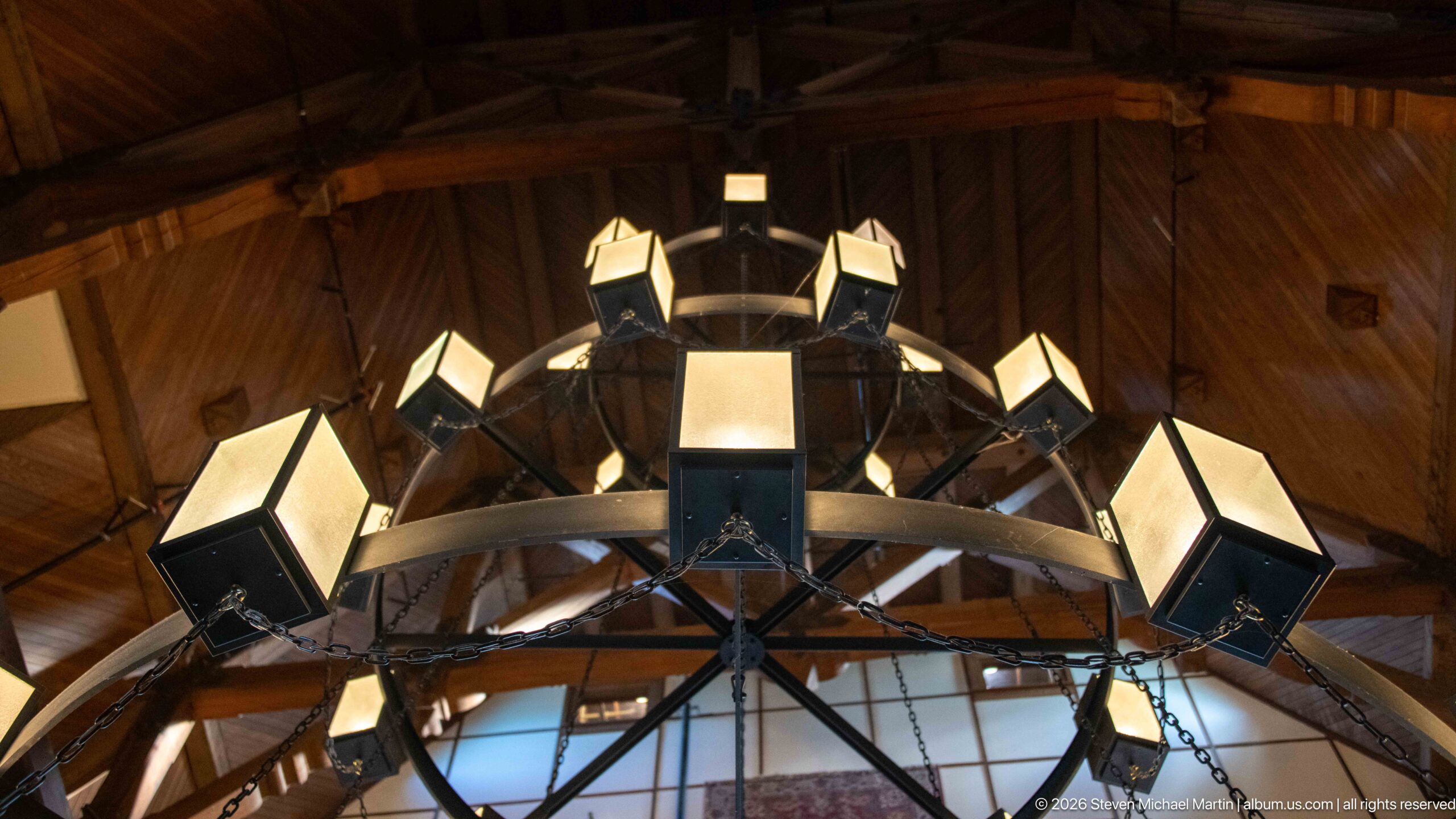
Square lanterns project from the circular metal framework of a large Prince of Wales Hotel chandelier, viewed almost directly from below. The close perspective emphasizes the fixture’s radial construction and repeated lantern forms against the warm-toned timber ceiling, turning a functional light source into a prominent architectural feature.
Caption
Square lanterns project from the circular metal framework of a large Prince of Wales Hotel chandelier, viewed almost directly from below. The close perspective emphasizes the fixture’s radial construction and repeated lantern forms against the warm-toned timber ceiling, turning a functional light source into a prominent architectural feature.
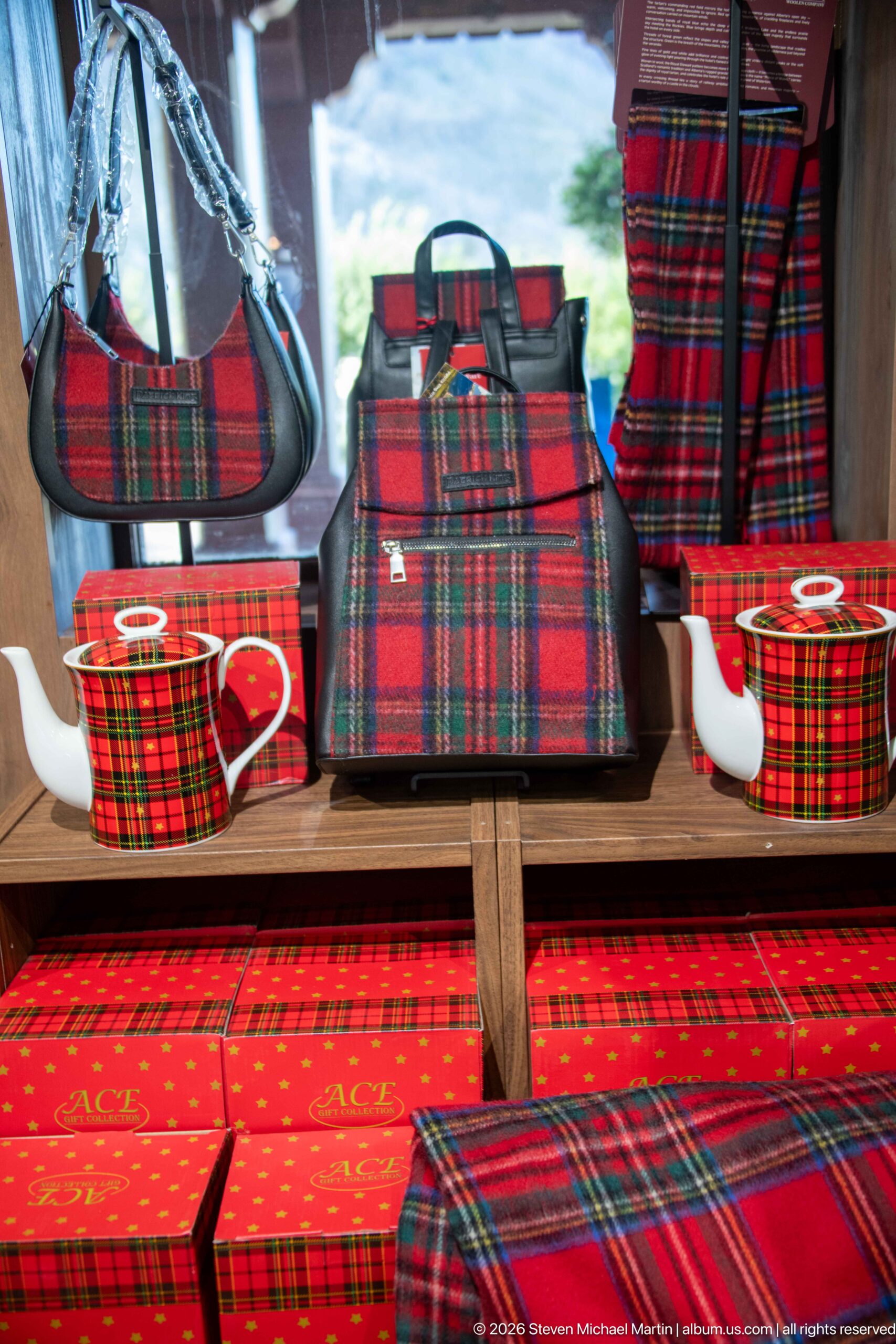
Red tartan patterns dominate a souvenir display inside the Prince of Wales Hotel, appearing on bags, boxed goods, and ceramic teapots. The coordinated merchandise evokes the British and Scottish imagery associated with the hotel’s name and presentation, while the close framing records a colorful aspect of the property’s contemporary visitor experience.
Caption
Red tartan patterns dominate a souvenir display inside the Prince of Wales Hotel, appearing on bags, boxed goods, and ceramic teapots. The coordinated merchandise evokes the British and Scottish imagery associated with the hotel’s name and presentation, while the close framing records a colorful aspect of the property’s contemporary visitor experience.
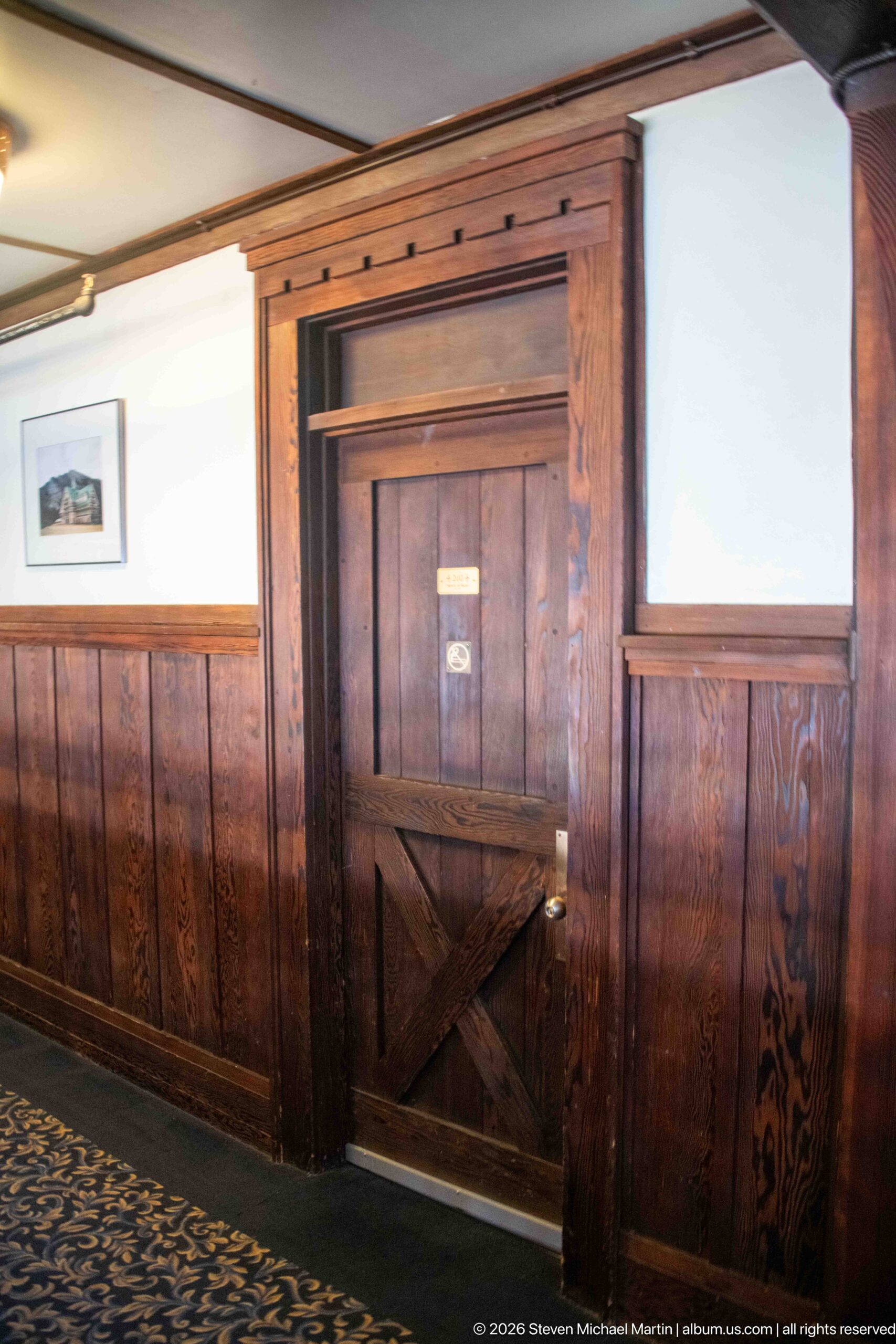
A guest-room corridor displays the Prince of Wales Hotel’s simpler residential finishes: dark wood wainscoting, broad trim, patterned carpet, and a solid paneled door. The restrained hallway contrasts with the theatrical scale of the main lobby while maintaining the same emphasis on stained timber and traditional detailing.
Caption
A guest-room corridor displays the Prince of Wales Hotel’s simpler residential finishes: dark wood wainscoting, broad trim, patterned carpet, and a solid paneled door. The restrained hallway contrasts with the theatrical scale of the main lobby while maintaining the same emphasis on stained timber and traditional detailing.
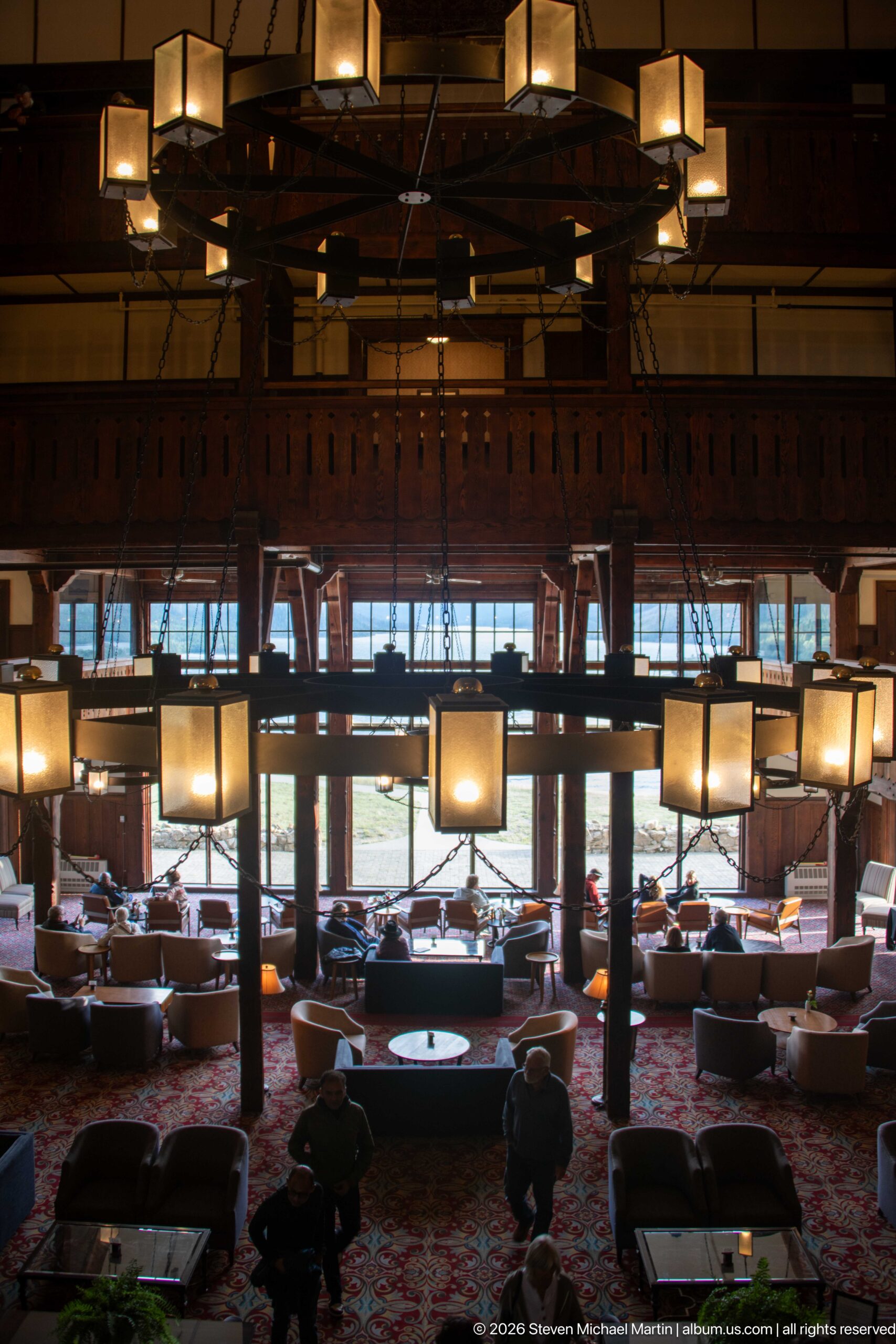
From above, the Prince of Wales Hotel’s lounge furniture forms small conversational groupings beneath a broad geometric chandelier. The dark horizontal balcony rail divides the composition, while warm lantern light, patterned carpet, and the window wall beyond show how the monumental lobby combines intimate seating areas with an expansive architectural volume.
Caption
From above, the Prince of Wales Hotel’s lounge furniture forms small conversational groupings beneath a broad geometric chandelier. The dark horizontal balcony rail divides the composition, while warm lantern light, patterned carpet, and the window wall beyond show how the monumental lobby combines intimate seating areas with an expansive architectural volume.
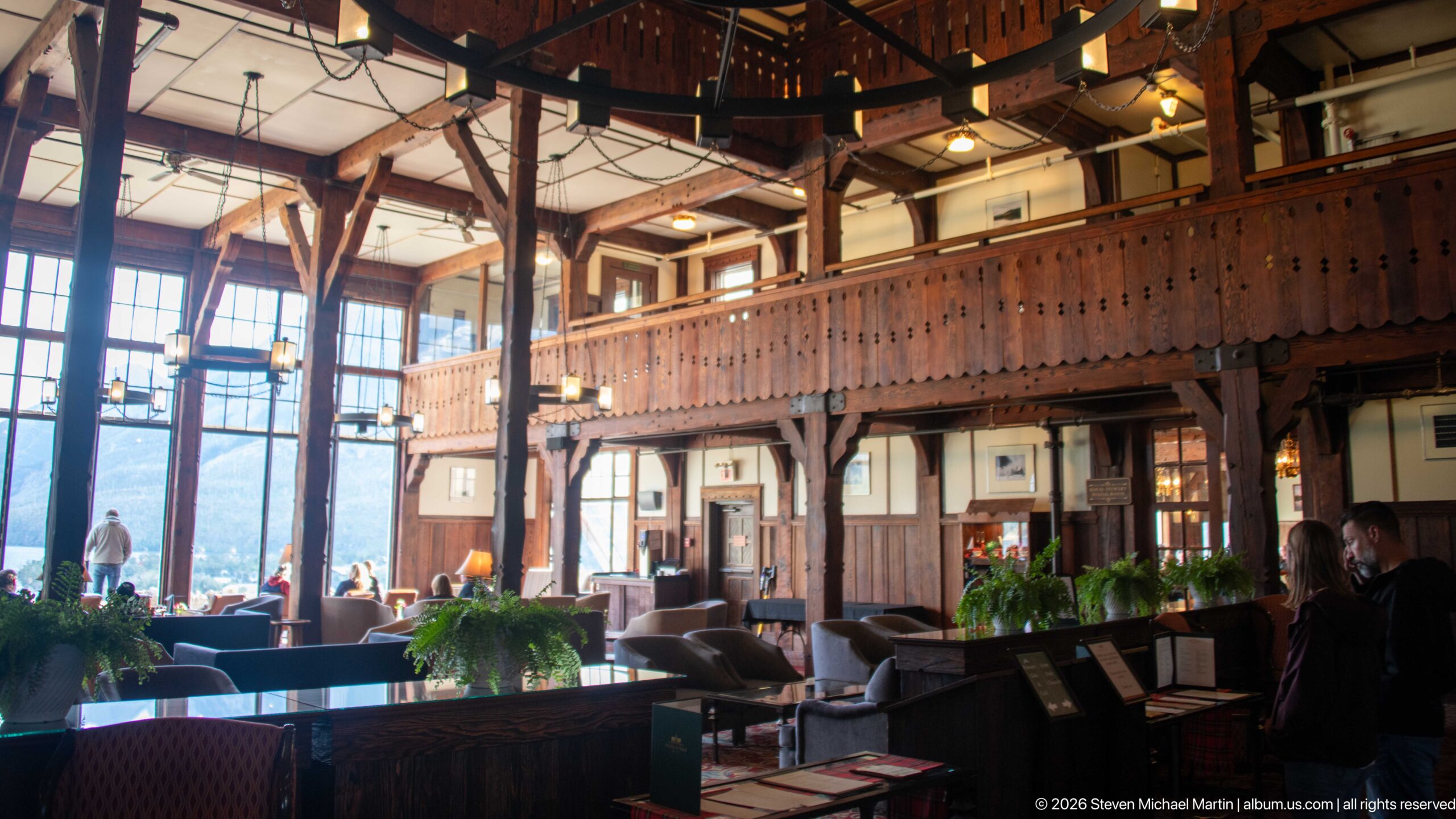
The Prince of Wales Hotel lobby is seen across its seating areas toward tall windows, with dark timber galleries wrapping the upper levels. Hanging lanterns, carved balcony rails, potted greenery, and grouped sofas create a richly layered interior, while daylight from the lake-facing side brightens the otherwise warm wood-dominated space.
Caption
The Prince of Wales Hotel lobby is seen across its seating areas toward tall windows, with dark timber galleries wrapping the upper levels. Hanging lanterns, carved balcony rails, potted greenery, and grouped sofas create a richly layered interior, while daylight from the lake-facing side brightens the otherwise warm wood-dominated space.
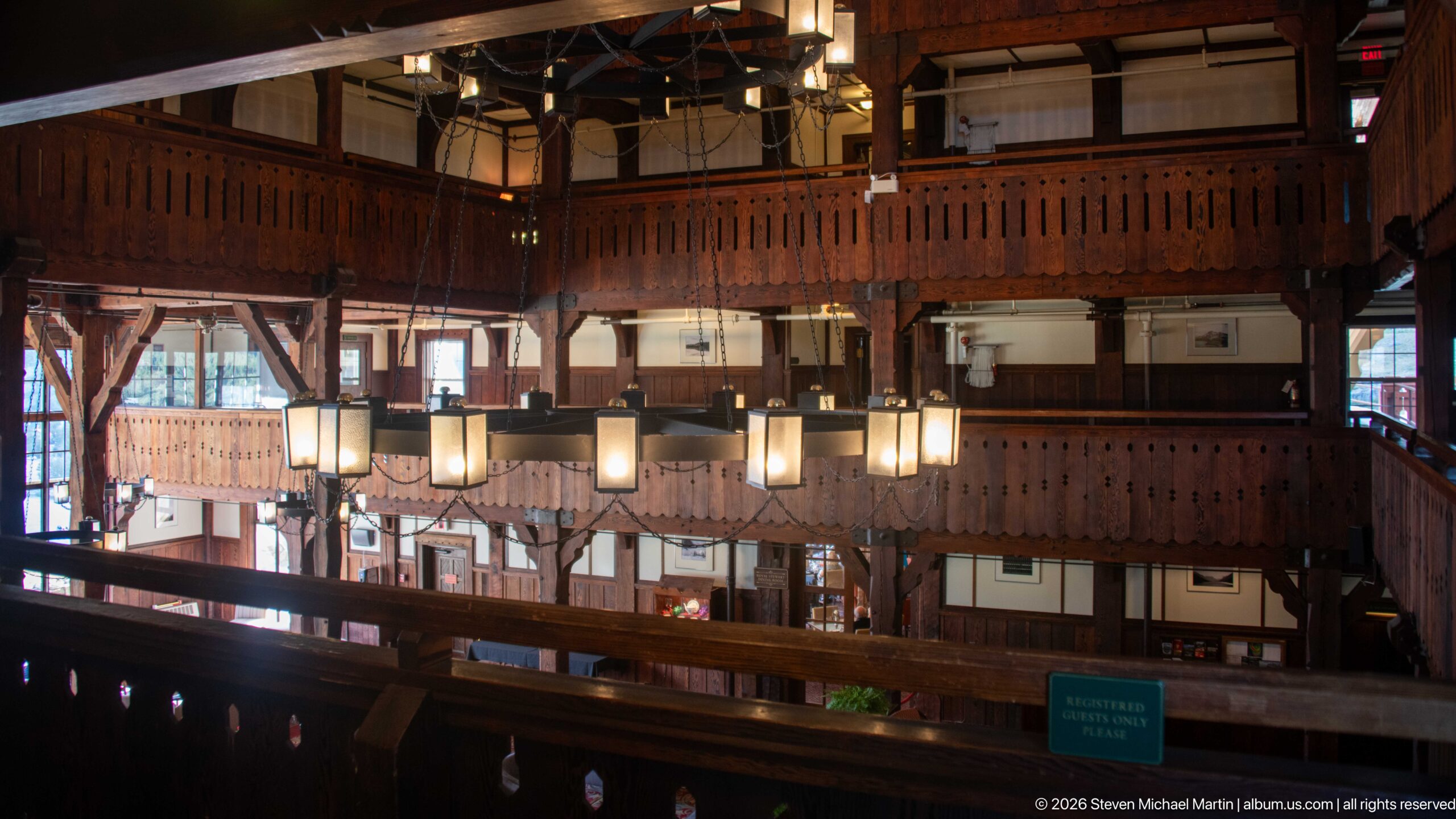
Viewed from an upper gallery, the Prince of Wales Hotel lobby reveals stacked wooden balconies and suspended lanterns crossing the central void. Repeated cutout railings, heavy posts, and horizontal galleries create a dense architectural pattern, illustrating how the hotel’s public spaces are organized vertically around the soaring central hall.
Caption
Viewed from an upper gallery, the Prince of Wales Hotel lobby reveals stacked wooden balconies and suspended lanterns crossing the central void. Repeated cutout railings, heavy posts, and horizontal galleries create a dense architectural pattern, illustrating how the hotel’s public spaces are organized vertically around the soaring central hall.
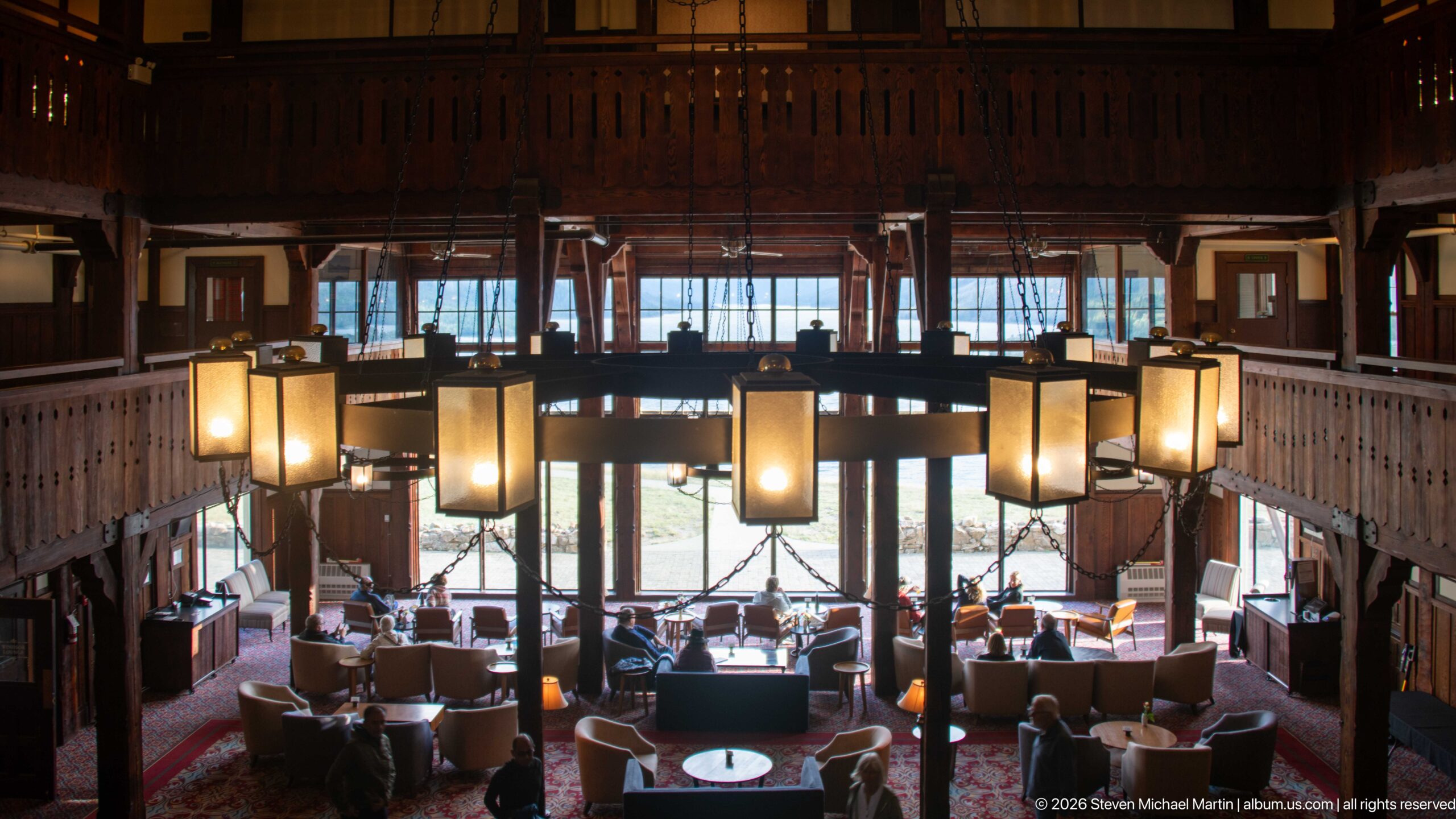
An elevated viewpoint looks down into the Prince of Wales Hotel lobby, where a large rectangular chandelier hangs above circular tables and lounge seating. Tall windows brighten the far side of the hall, while timber balconies on both sides frame the central space and reveal the lobby’s considerable vertical depth.
Caption
An elevated viewpoint looks down into the Prince of Wales Hotel lobby, where a large rectangular chandelier hangs above circular tables and lounge seating. Tall windows brighten the far side of the hall, while timber balconies on both sides frame the central space and reveal the lobby’s considerable vertical depth.
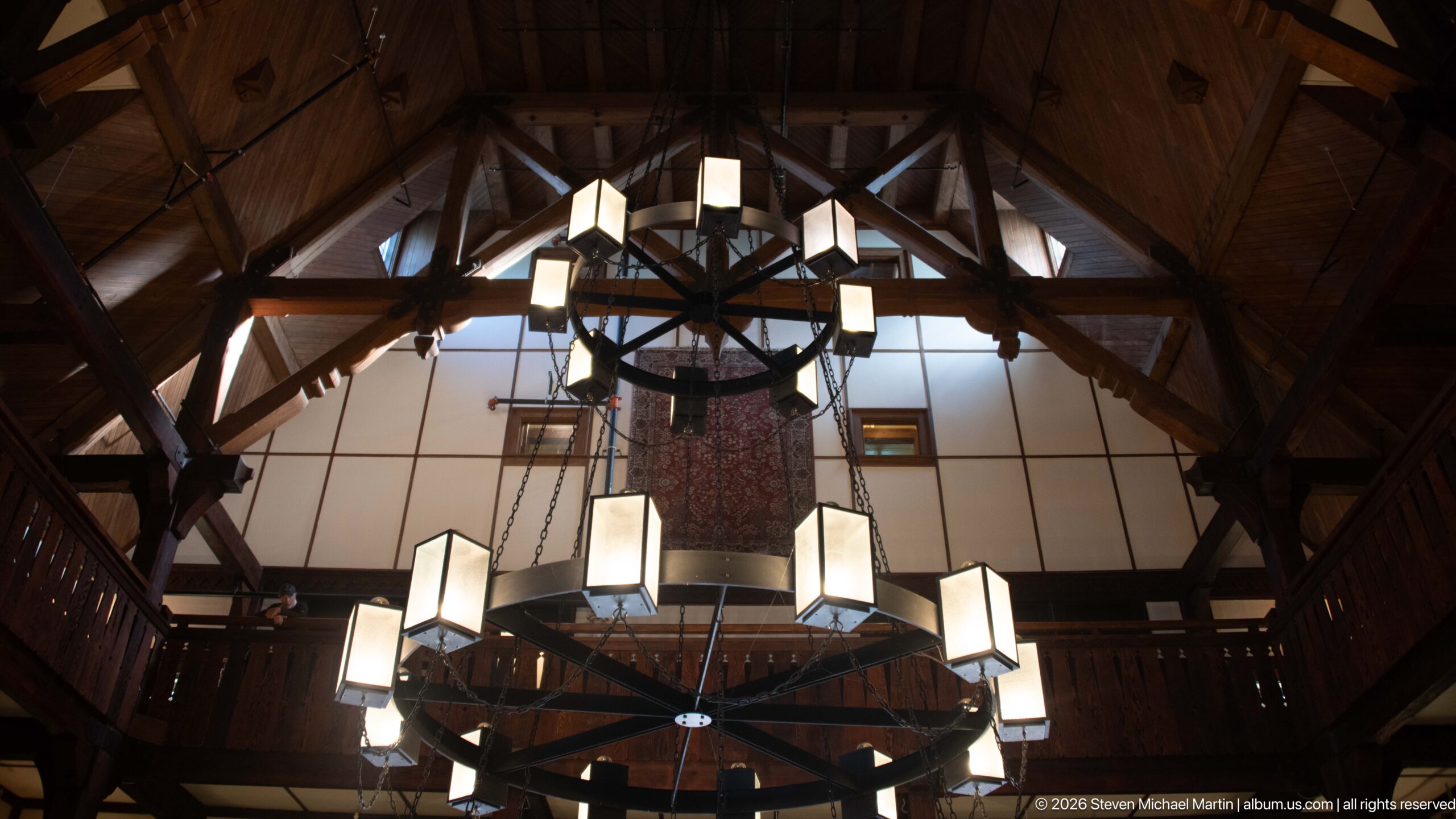
The steep timber roof structure rises above a large circular chandelier in the Prince of Wales Hotel lobby. Exposed rafters and trusses converge toward the ridge, while square lanterns hang at several levels below, emphasizing the height and chalet-like construction of the hotel’s principal interior space.
Caption
The steep timber roof structure rises above a large circular chandelier in the Prince of Wales Hotel lobby. Exposed rafters and trusses converge toward the ridge, while square lanterns hang at several levels below, emphasizing the height and chalet-like construction of the hotel’s principal interior space.
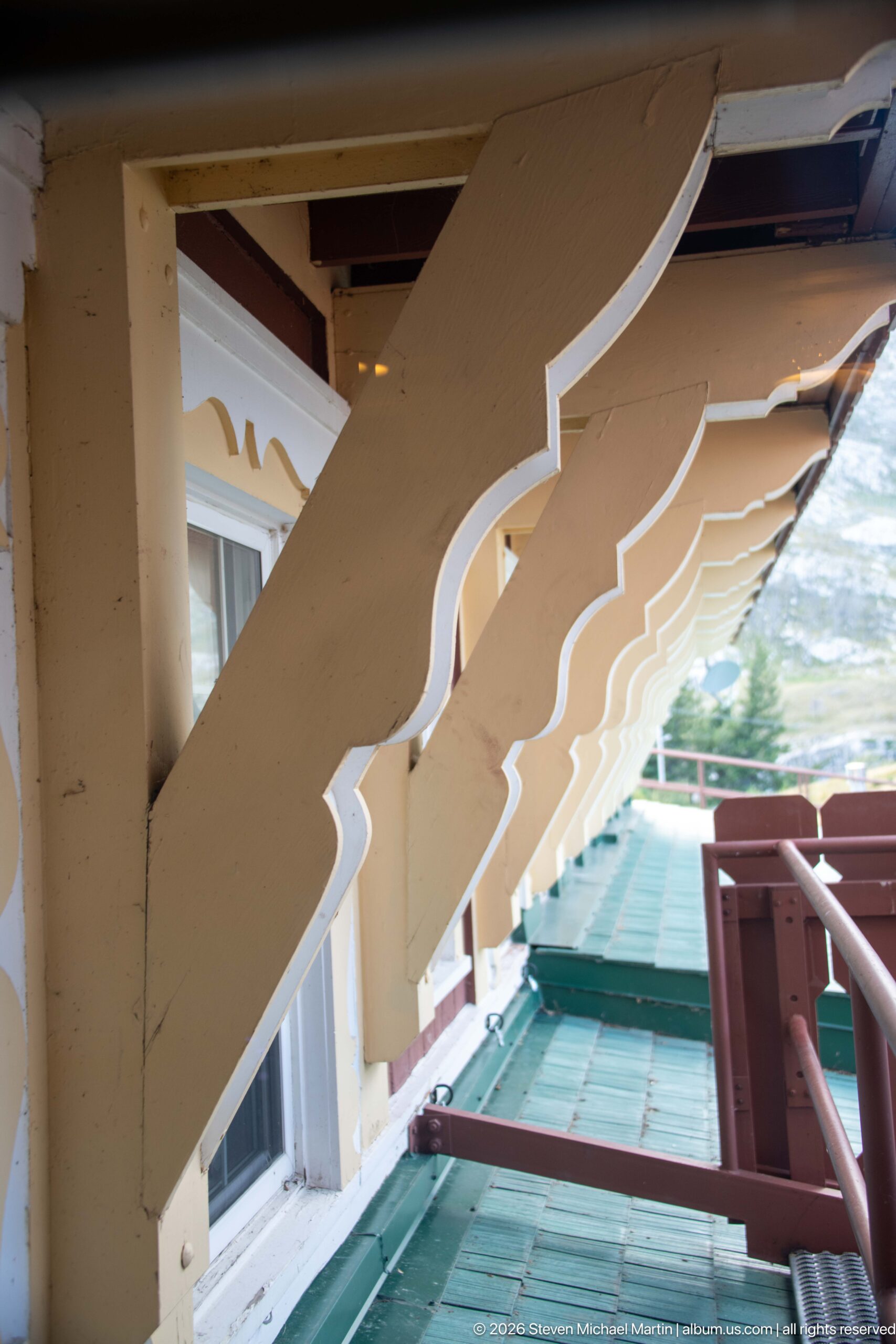
Repeated wooden brackets support the projecting exterior gallery of the Prince of Wales Hotel, their curved profiles edged in contrasting light trim. Seen obliquely along the façade, the sequence creates a strong rhythm above green metal roofing and red-brown railings, highlighting the decorative treatment of the hotel’s chalet-inspired exterior.
Caption
Repeated wooden brackets support the projecting exterior gallery of the Prince of Wales Hotel, their curved profiles edged in contrasting light trim. Seen obliquely along the façade, the sequence creates a strong rhythm above green metal roofing and red-brown railings, highlighting the decorative treatment of the hotel’s chalet-inspired exterior.
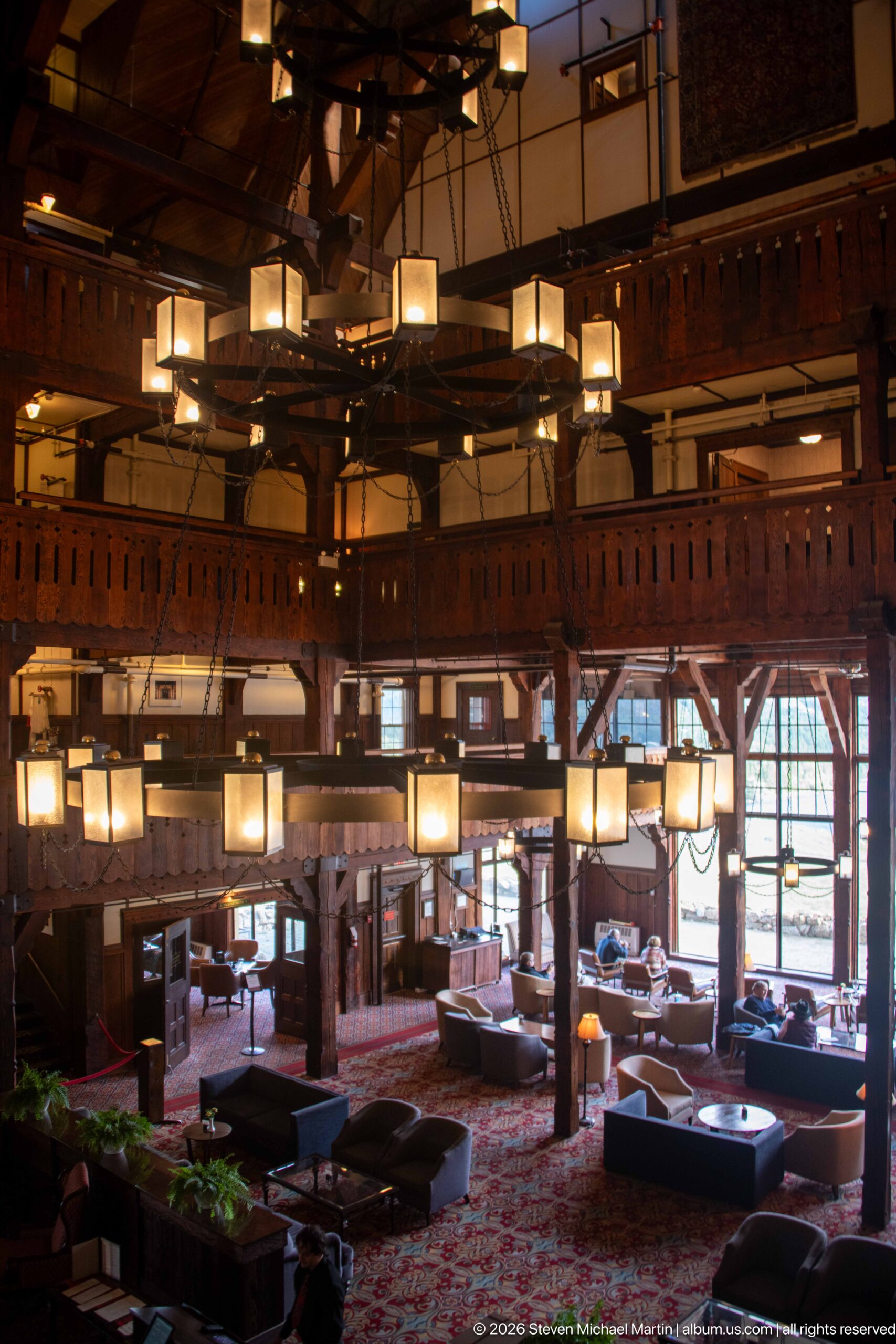
A broad view from an upper gallery takes in the Prince of Wales Hotel’s central lobby, from its suspended lantern fixtures to the sofas and tables arranged below. Timber galleries span the far wall, while daylight entering through large windows balances the warm artificial light and dark-stained woodwork.
Caption
A broad view from an upper gallery takes in the Prince of Wales Hotel’s central lobby, from its suspended lantern fixtures to the sofas and tables arranged below. Timber galleries span the far wall, while daylight entering through large windows balances the warm artificial light and dark-stained woodwork.
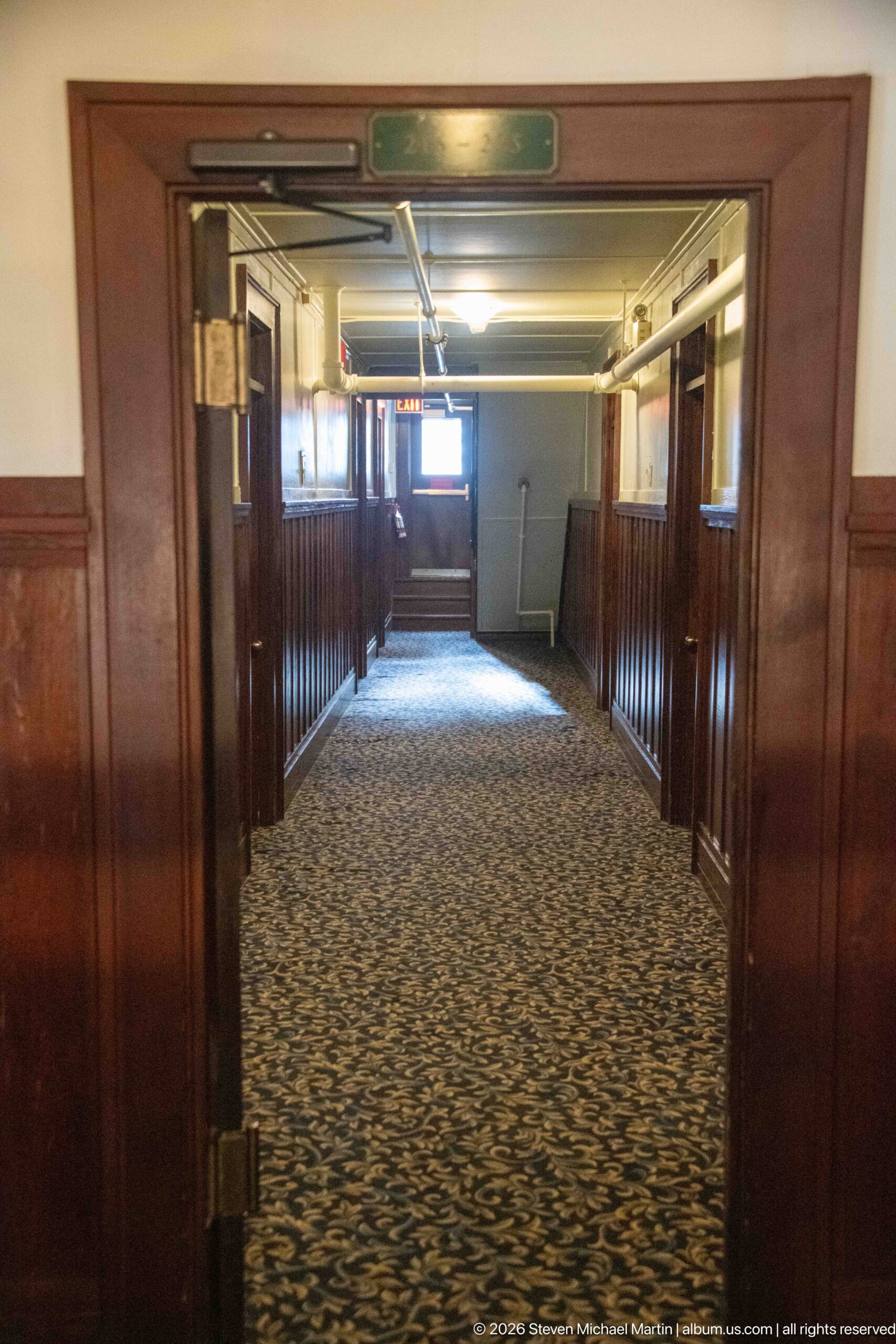
A long guest-floor corridor extends beneath a low ceiling inside the Prince of Wales Hotel. Dark wood wainscoting lines both walls above patterned carpet, while exposed utility lines and simple ceiling fixtures give this circulation space a markedly more functional character than the elaborate public lobby nearby.
Caption
A long guest-floor corridor extends beneath a low ceiling inside the Prince of Wales Hotel. Dark wood wainscoting lines both walls above patterned carpet, while exposed utility lines and simple ceiling fixtures give this circulation space a markedly more functional character than the elaborate public lobby nearby.
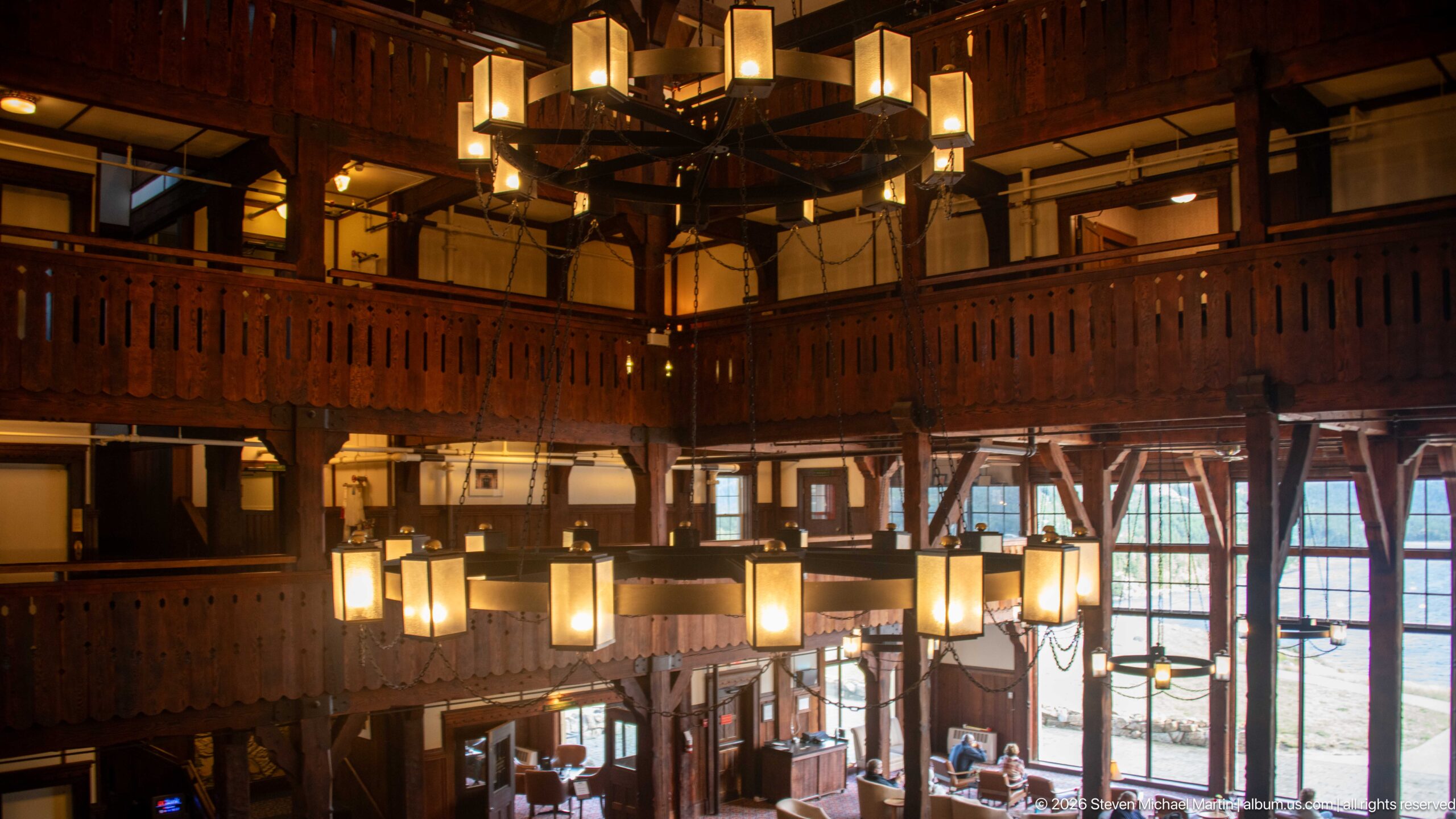
Warm light from multiple chandeliers fills the upper levels of the Prince of Wales Hotel lobby. Stacked timber balconies encircle the central hall, and the repeated lantern forms echo the geometry of the carved railings, creating a cohesive interior composition built around wood, light, and vertical circulation.
Caption
Warm light from multiple chandeliers fills the upper levels of the Prince of Wales Hotel lobby. Stacked timber balconies encircle the central hall, and the repeated lantern forms echo the geometry of the carved railings, creating a cohesive interior composition built around wood, light, and vertical circulation.
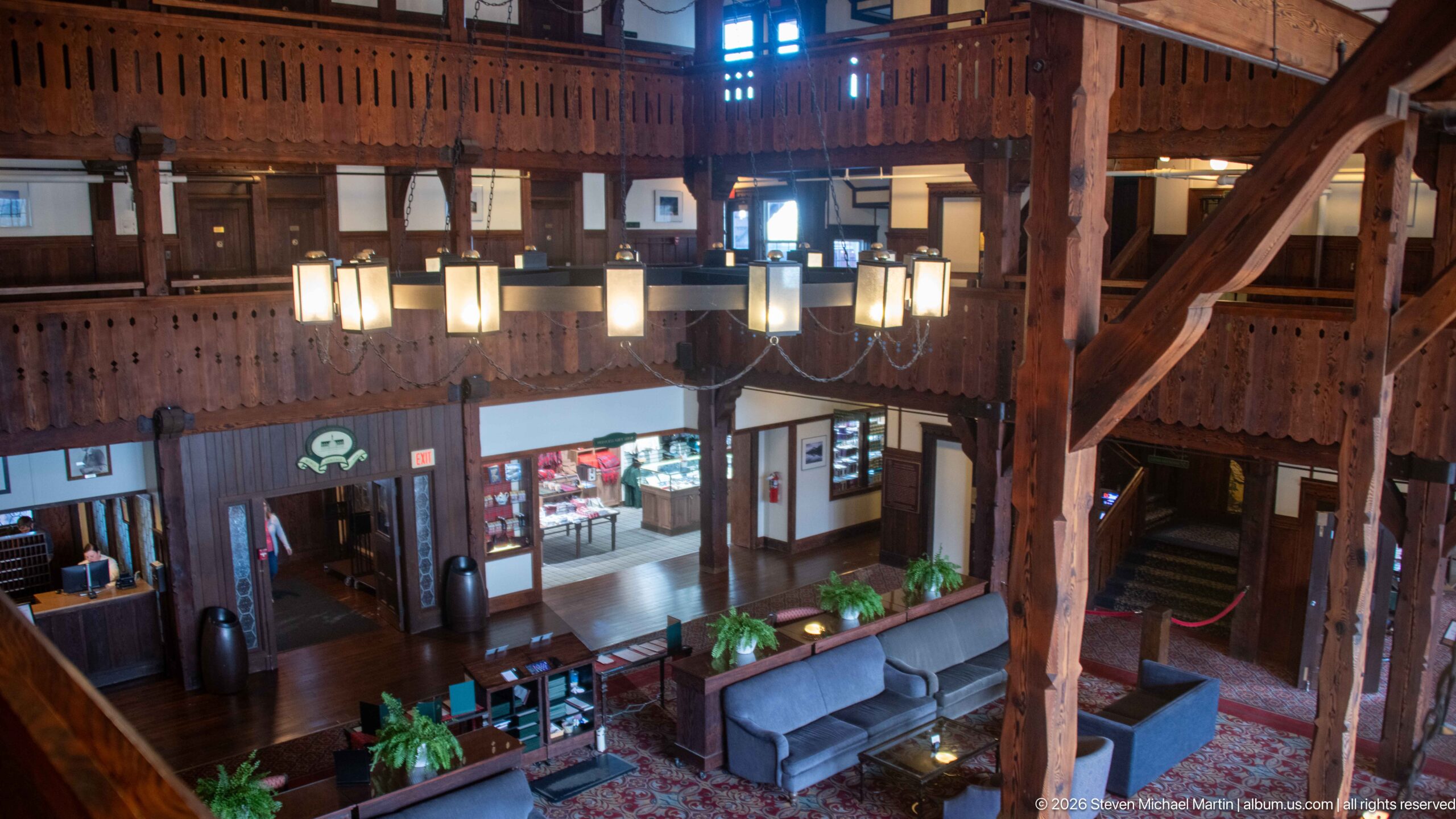
Looking down from an upper level, massive timber posts frame a quieter corner of the Prince of Wales Hotel lobby. A large suspended light fixture hangs above sofas and plants, while service openings and a staircase occupy the rear wall, revealing the functional spaces embedded within the monumental central hall.
Caption
Looking down from an upper level, massive timber posts frame a quieter corner of the Prince of Wales Hotel lobby. A large suspended light fixture hangs above sofas and plants, while service openings and a staircase occupy the rear wall, revealing the functional spaces embedded within the monumental central hall.
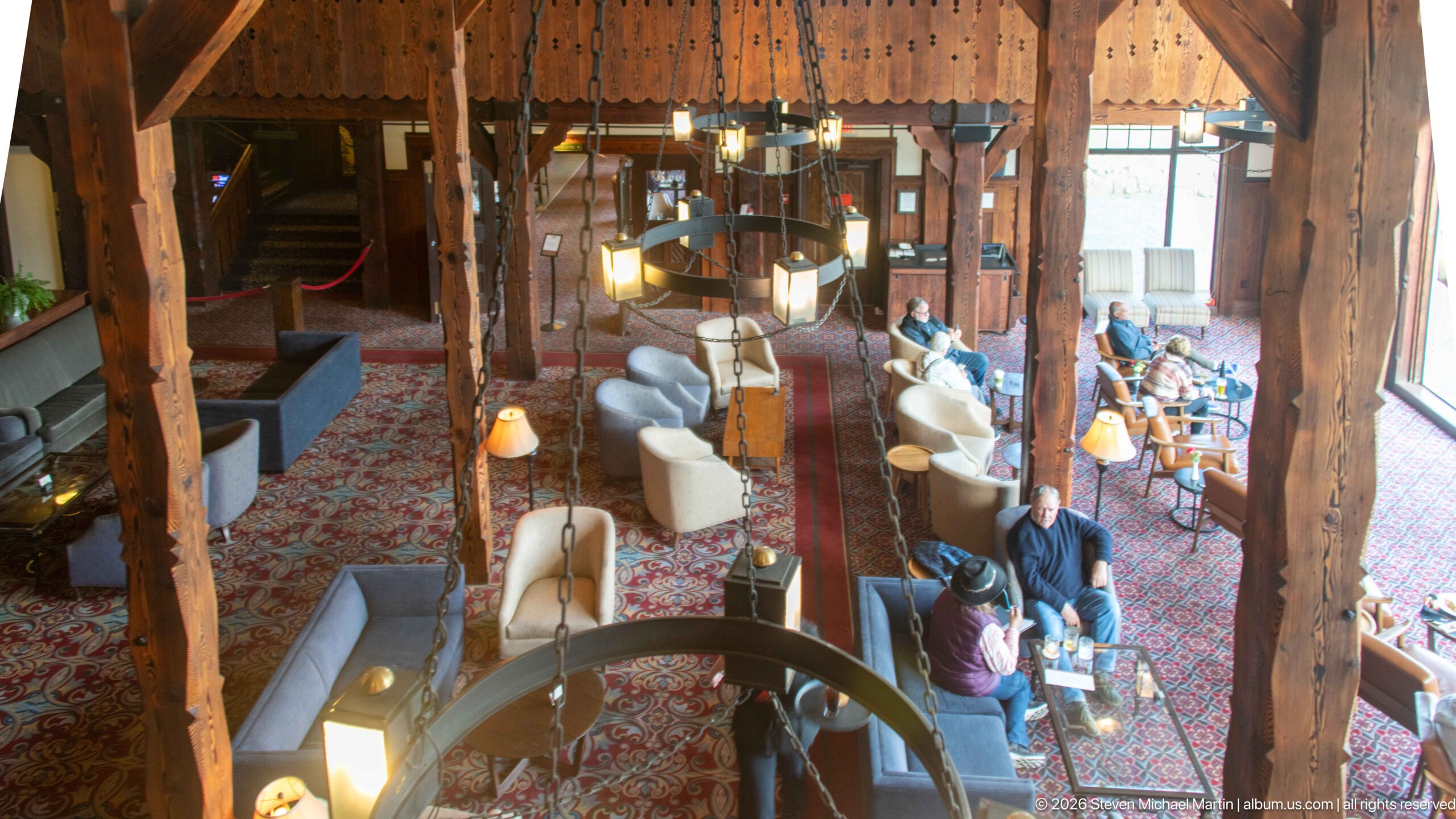
An elevated view looks between massive timber columns into one of the Prince of Wales Hotel’s lounge areas. Upholstered chairs and sofas cluster around small tables on patterned carpet, while guests sit near the tall windows and a large circular chandelier occupies the foreground, emphasizing the lobby’s layered social spaces.
Caption
An elevated view looks between massive timber columns into one of the Prince of Wales Hotel’s lounge areas. Upholstered chairs and sofas cluster around small tables on patterned carpet, while guests sit near the tall windows and a large circular chandelier occupies the foreground, emphasizing the lobby’s layered social spaces.
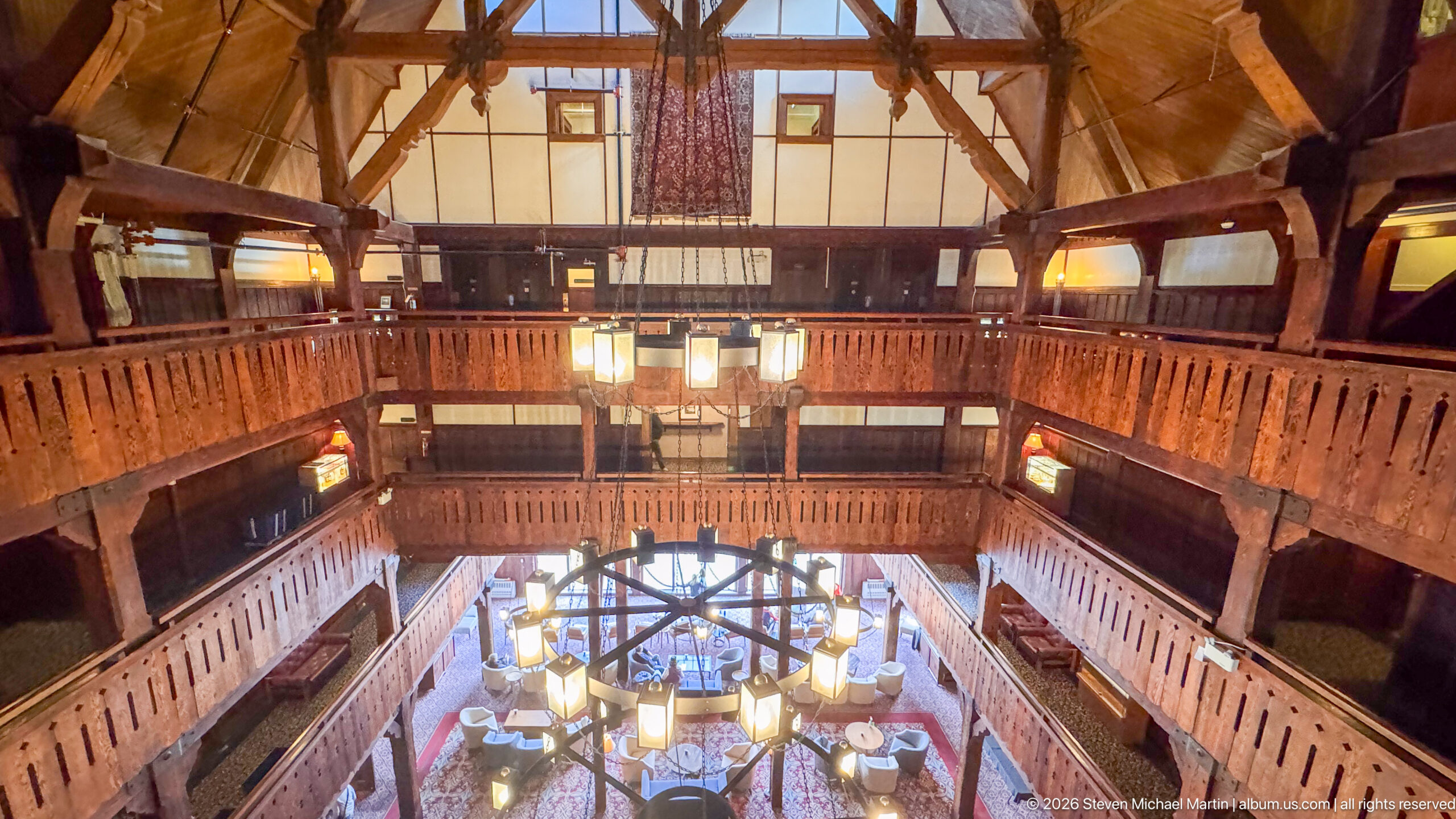
Carved timber galleries rise on both sides of the Prince of Wales Hotel lobby, converging visually around a large circular chandelier suspended over the lounge below. The upward-facing composition emphasizes the height of the hall, its repeated balcony railings, exposed roof structure, and the strong vertical organization of the hotel’s principal public space.
Caption
Carved timber galleries rise on both sides of the Prince of Wales Hotel lobby, converging visually around a large circular chandelier suspended over the lounge below. The upward-facing composition emphasizes the height of the hall, its repeated balcony railings, exposed roof structure, and the strong vertical organization of the hotel’s principal public space.
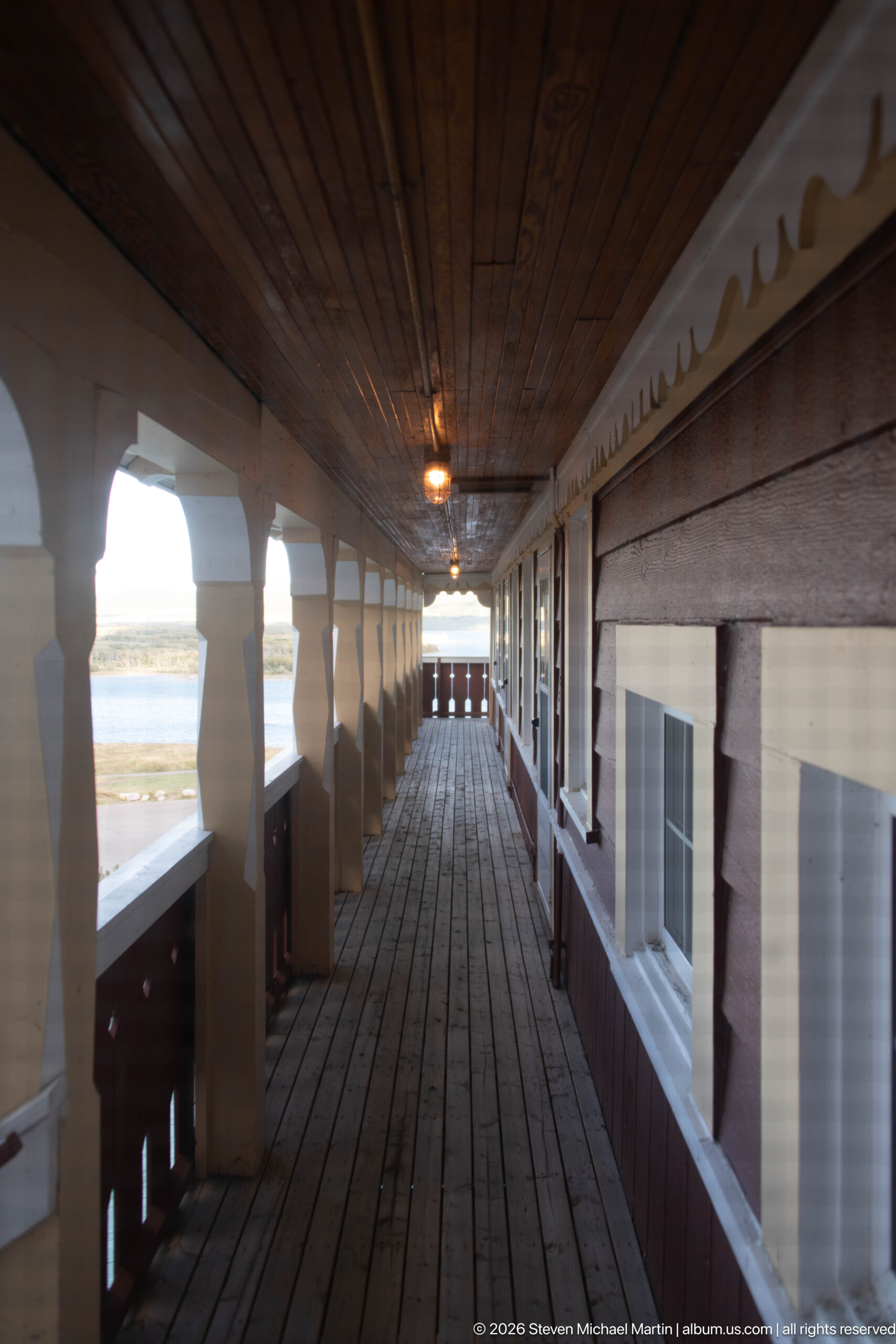
A long covered exterior gallery runs along the Prince of Wales Hotel, sheltered by a wood-plank ceiling and bordered by repeating posts and shaped openings. Guest-room windows line the inner wall, while glimpses of the landscape appear through the open side, emphasizing the building’s extended balcony circulation.
Caption
A long covered exterior gallery runs along the Prince of Wales Hotel, sheltered by a wood-plank ceiling and bordered by repeating posts and shaped openings. Guest-room windows line the inner wall, while glimpses of the landscape appear through the open side, emphasizing the building’s extended balcony circulation.
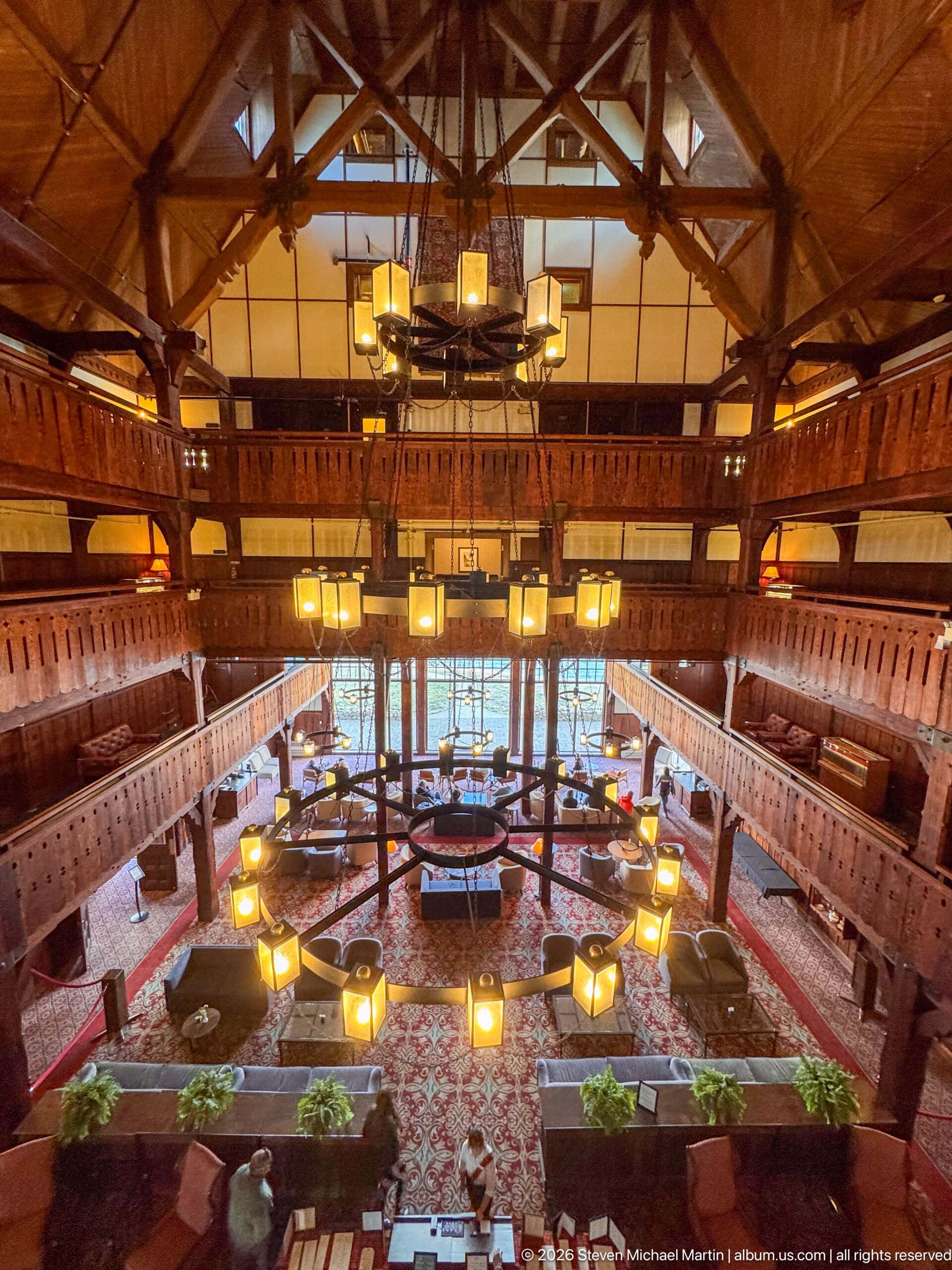
From an upper gallery, the Prince of Wales Hotel lobby opens as a tall, symmetrical hall framed by heavy timber trusses and stacked wooden balconies. Multiple geometric chandeliers descend through the central void above patterned carpet and grouped lounge furniture, while the distant window wall brings daylight into the richly finished interior.
Caption
From an upper gallery, the Prince of Wales Hotel lobby opens as a tall, symmetrical hall framed by heavy timber trusses and stacked wooden balconies. Multiple geometric chandeliers descend through the central void above patterned carpet and grouped lounge furniture, while the distant window wall brings daylight into the richly finished interior.
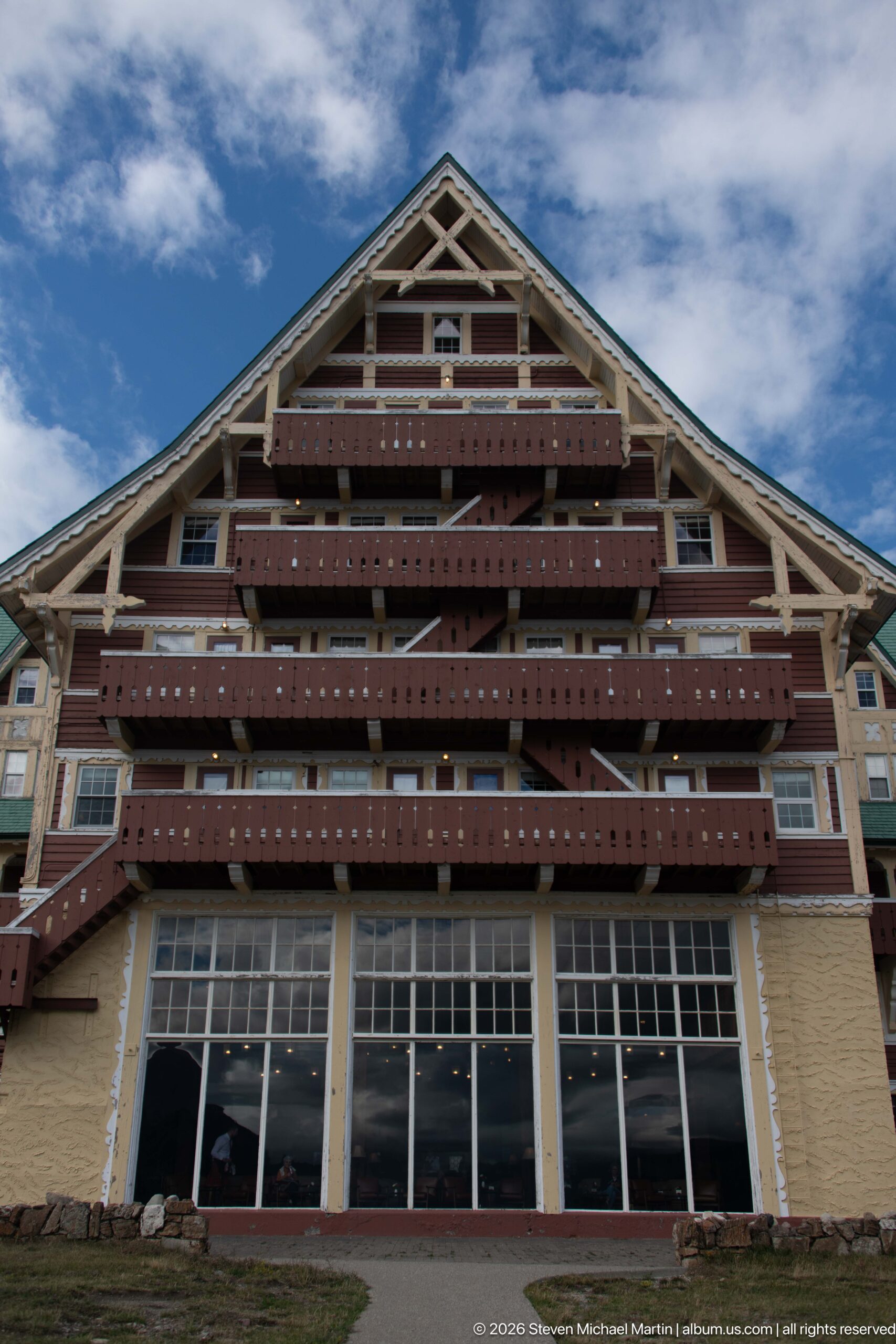
The broad gabled end of the Prince of Wales Hotel displays stacked exterior galleries beneath an exposed triangular roof frame. Red-brown balcony rails cross the façade in horizontal bands above a glazed ground floor, while pale structural members outline the steep roof and emphasize the building’s chalet-inspired massing against the sky.
Caption
The broad gabled end of the Prince of Wales Hotel displays stacked exterior galleries beneath an exposed triangular roof frame. Red-brown balcony rails cross the façade in horizontal bands above a glazed ground floor, while pale structural members outline the steep roof and emphasize the building’s chalet-inspired massing against the sky.
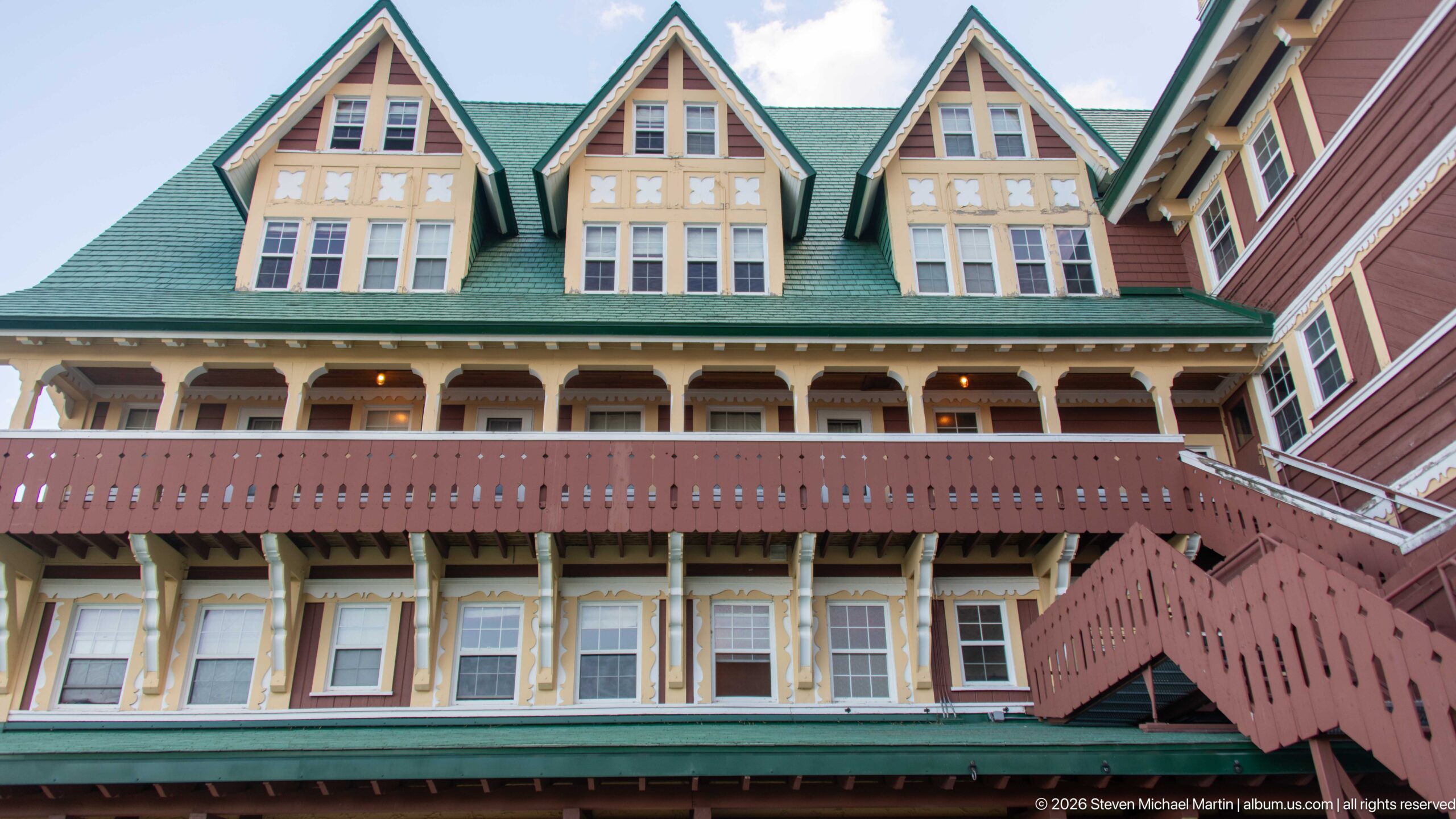
Three steep front-facing dormer gables rise above the Prince of Wales Hotel’s long veranda, their pale half-timbered surfaces contrasting with green roofing and red-brown siding. Below, rows of windows, decorative posts, pierced balcony rails, and an exterior stair demonstrate the dense layering of galleries and circulation along this section of the historic hotel.
Caption
Three steep front-facing dormer gables rise above the Prince of Wales Hotel’s long veranda, their pale half-timbered surfaces contrasting with green roofing and red-brown siding. Below, rows of windows, decorative posts, pierced balcony rails, and an exterior stair demonstrate the dense layering of galleries and circulation along this section of the historic hotel.
🏞️ National Park Field Guide
📍 Overview
The Prince of Wales Hotel occupies one of Waterton Lakes National Park’s most commanding settings, standing on an elevated bluff above Upper Waterton Lake where the mountain corridor, water, townsite, and open grasslands can be read together. The portfolio moves repeatedly between this larger protected landscape and the hotel itself: steep green roofs and gables rise against rocky ridges, while broad windows and elevated galleries keep the surrounding scenery visually present inside the building. The result is a place where architecture and landscape are inseparable parts of the visitor experience.
🏔️ Landscape
Upper Waterton Lake is the organizing feature of the landscape around the hotel. From the bluff, the lake stretches south between steep mountain walls, while other views look toward the compact Waterton townsite along the wooded shoreline. Forest, exposed rock, open grass, water, and built paths meet within a remarkably compressed setting. The hotel’s elevated position makes these relationships especially legible: shoreline and settlement lie below, mountain slopes rise abruptly beyond the water, and changing cloud and sunlight continually alter the appearance of the valley.
🪨 Geology
The photographs emphasize the physical contrast between the long lake basin and the steep, rocky mountain slopes that contain it. Exposed gray rock rises sharply above forested lower slopes, and distant peaks recede along the lake corridor. Rather than isolating a particular formation, the portfolio records the larger landform relationships visible from the hotel grounds: an elongated mountain lake, abrupt relief, rocky ridges, wooded margins, and elevated overlooks. These features provide the dramatic physical setting against which the Prince of Wales Hotel is repeatedly seen.
🌿 Ecology
The portfolio’s natural setting is expressed primarily through habitat rather than close wildlife encounters. Forested shorelines border Upper Waterton Lake, open grass covers portions of the hotel bluff, and vegetation gives way rapidly to exposed mountain rock at higher elevations. These adjoining environments help explain the visual diversity of Waterton Lakes National Park and the sharp transitions visible from the hotel grounds. Wildlife imagery also appears in the hotel’s decorative program, including a painted bison motif, but the photographic evidence treats those animals as cultural representations rather than documented wildlife encounters.
🦌 Wildlife
Wildlife is not a principal photographic subject in this portfolio. Instead, animal imagery appears within the hotel’s decorative and interpretive environment, including heraldic-style panels and other motifs. These details show how regional nature is incorporated into the building’s visual identity, while the surrounding lake, forest, grassland, and mountain slopes provide the broader ecological setting. The portfolio therefore supports understanding wildlife chiefly through habitat and cultural representation rather than through specific animals observed during this visit.
🧭 Human History
The Prince of Wales Hotel is presented as a surviving landmark of the railway-resort era. A Historic Sites and Monuments Board of Canada plaque records its 1926–1927 construction, Great Northern Railway origins, dramatic setting, steep roofs, gables and balconies, and national historic significance. The photographs reinforce those characteristics in detail: chalet-like gabled masses, green roofs, stacked exterior galleries, timber brackets, leaded-glass doors, heraldic decoration, and expansive public interiors. Inside, the soaring timber lobby, carved balcony rails, exposed roof framing, and large ring chandeliers preserve the sense of a purpose-built mountain resort designed to make arrival and scenery part of the experience.
🥾 Visitor Experience
The experience of the Prince of Wales Hotel unfolds through movement between overlook, exterior, and interior. Outside, stone paths and open lawns lead to broad views over Upper Waterton Lake and the Waterton townsite. Inside, the scale changes dramatically: visitors enter a multi-story timber lobby surrounded by stacked galleries, chandeliers, lounge seating, dining rooms, and lake-facing windows. Smaller spaces—including the Royal Stewart Dining Room, Windsor Lounge, guest corridors, service areas, and covered exterior galleries—reveal how the historic hotel continues to function as a working hospitality property while retaining its distinctive architectural character.
📷 Photography Notes
The strongest photographic story comes from alternating scale. Wide views establish the hotel on its bluff and show Upper Waterton Lake disappearing between mountain walls; medium views clarify the asymmetrical roofline, gables, balconies, and relationship to the rocky backdrop; close studies isolate brackets, doors, leaded glass, heraldic panels, railings, signs, and other craftsmanship. Indoors, elevated viewpoints are particularly effective because they reveal the lobby’s vertical organization, with chandeliers suspended through stacked timber galleries. Lake-facing windows also create useful compositions in which interior silhouettes and furnishings frame the bright mountain landscape beyond.