Tahuayo Lake and River – Peru
The calm waterways of the Tahuayo River and nearby Tahuayo Lake form part of the complex river network flowing through the rainforest of northeastern Peru. Surrounded by dense jungle and flooded forest, these waterways support a remarkable variety of wildlife.
Small boats glide through narrow channels beneath the rainforest canopy where monkeys, birds, and reptiles inhabit the surrounding vegetation. During seasonal flooding, nearby forests become partially submerged, creating a unique ecosystem where fish and aquatic species move through the forest itself.
The quiet lakes and rivers of the Tahuayo region provide one of the most immersive ways to experience the biodiversity of the Amazon rainforest.

A calm, tea-brown channel curves between dense walls of lowland tropical forest, with overhanging branches and shoreline vegetation mirrored across the water. The open corridor draws the eye toward a narrowing bend in the distance, providing an establishing view of the aquatic and riparian habitat that supports the portfolio’s birds and other wildlife along the Tuhauyo Lake and River system.
Caption
A calm, tea-brown channel curves between dense walls of lowland tropical forest, with overhanging branches and shoreline vegetation mirrored across the water. The open corridor draws the eye toward a narrowing bend in the distance, providing an establishing view of the aquatic and riparian habitat that supports the portfolio’s birds and other wildlife along the Tuhauyo Lake and River system.

A sparse line of houses and small structures occupies a low grassy bank beyond the broad river, with forest rising behind the settlement. The distant viewpoint keeps individual buildings secondary to the relationship between community and water: an open channel in the foreground, a narrow inhabited strip at mid-distance, and humid lowland vegetation beyond. This is an establishing view of river-centered settlement in the Peruvian Amazon.
Caption
A sparse line of houses and small structures occupies a low grassy bank beyond the broad river, with forest rising behind the settlement. The distant viewpoint keeps individual buildings secondary to the relationship between community and water: an open channel in the foreground, a narrow inhabited strip at mid-distance, and humid lowland vegetation beyond. This is an establishing view of river-centered settlement in the Peruvian Amazon.

A Sungrebe swims low in the shaded water, showing the species’ slender pointed bill, boldly striped black-and-white head and neck, and subdued brown body. Its compact profile sits close to the surface as it moves through a dark channel beneath overhanging forest. The quiet composition emphasizes an aquatic bird adapted to secluded tropical rivers and flooded woodland.
Caption
A Sungrebe swims low in the shaded water, showing the species’ slender pointed bill, boldly striped black-and-white head and neck, and subdued brown body. Its compact profile sits close to the surface as it moves through a dark channel beneath overhanging forest. The quiet composition emphasizes an aquatic bird adapted to secluded tropical rivers and flooded woodland.

Perched upright on a low snag, a Neotropic cormorant spreads its wings against a dense background of fallen wood and emergent vegetation. The side view reveals the bird’s long neck, yellowish throat patch, and layered dark flight feathers. The quiet stance contrasts with the preceding flight and feeding images, documenting a resting phase in the species’ daily river activity.
Caption
Perched upright on a low snag, a Neotropic cormorant spreads its wings against a dense background of fallen wood and emergent vegetation. The side view reveals the bird’s long neck, yellowish throat patch, and layered dark flight feathers. The quiet stance contrasts with the preceding flight and feeding images, documenting a resting phase in the species’ daily river activity.

A Cocoi heron launches low across the water with broad wings extended and its long neck drawn into the compact flight posture typical of herons. Motion blur follows the bird against the dark flooded-forest edge, conveying the speed of its departure while preserving the contrasting gray wings, pale neck, and dark crown that distinguish this large Amazonian wader.
Caption
A Cocoi heron launches low across the water with broad wings extended and its long neck drawn into the compact flight posture typical of herons. Motion blur follows the bird against the dark flooded-forest edge, conveying the speed of its departure while preserving the contrasting gray wings, pale neck, and dark crown that distinguish this large Amazonian wader.

A river dolphin surfaces close enough to reveal the rounded gray-pink back, smooth skin, and low dorsal ridge characteristic of the Amazon river dolphin. The animal’s body pushes a small bow of water as it rolls through the surface, creating a stronger morphological view than the preceding distant frame. Its muted coloration can vary with age, light, and water conditions, and does not require a vivid pink appearance.
Caption
A river dolphin surfaces close enough to reveal the rounded gray-pink back, smooth skin, and low dorsal ridge characteristic of the Amazon river dolphin. The animal’s body pushes a small bow of water as it rolls through the surface, creating a stronger morphological view than the preceding distant frame. Its muted coloration can vary with age, light, and water conditions, and does not require a vivid pink appearance.

A Neotropic cormorant flies just above the green water with neck extended and broad dark wings caught mid-stroke. Motion blur in the forested bank contrasts with the relatively sharp bird, conveying rapid, low-level flight along the channel. Its streamlined posture and proximity to the surface are characteristic of a diving waterbird moving between feeding areas.
Caption
A Neotropic cormorant flies just above the green water with neck extended and broad dark wings caught mid-stroke. Motion blur in the forested bank contrasts with the relatively sharp bird, conveying rapid, low-level flight along the channel. Its streamlined posture and proximity to the surface are characteristic of a diving waterbird moving between feeding areas.

Low floating or bank-side buildings edge the river at left while a large, weathered wooden vessel travels or sits offshore beneath an expansive blue sky. A small canoe appears farther out on the channel, reinforcing the scale of the larger craft. The composition treats the river as both street and harbor, with built structures and multiple boat types sharing the same open aquatic space.
Caption
Low floating or bank-side buildings edge the river at left while a large, weathered wooden vessel travels or sits offshore beneath an expansive blue sky. A small canoe appears farther out on the channel, reinforcing the scale of the larger craft. The composition treats the river as both street and harbor, with built structures and multiple boat types sharing the same open aquatic space.

A compact, enclosed riverboat sits parallel to the muddy shoreline beneath a steep green bank. Its white-and-green cabin, small windows, roof cargo, and fabric draped along the side distinguish it from the larger regional vessels seen nearby. The craft appears adapted for local passenger or goods movement on the Amazon waterways, where shallow banks serve as informal landings rather than constructed docks.
Caption
A compact, enclosed riverboat sits parallel to the muddy shoreline beneath a steep green bank. Its white-and-green cabin, small windows, roof cargo, and fabric draped along the side distinguish it from the larger regional vessels seen nearby. The craft appears adapted for local passenger or goods movement on the Amazon waterways, where shallow banks serve as informal landings rather than constructed docks.

A dense web of thick roots descends from mature trees into the flooded understory, where dark water mirrors the vertical forms. Without a person in the frame, the photograph concentrates on the sculptural complexity of the root system itself and the tight physical relationship between forest vegetation and seasonal inundation.
Caption
A dense web of thick roots descends from mature trees into the flooded understory, where dark water mirrors the vertical forms. Without a person in the frame, the photograph concentrates on the sculptural complexity of the root system itself and the tight physical relationship between forest vegetation and seasonal inundation.

Towering root buttresses and twisted trunks rise around a traveler in the Tuhauyo flooded forest, dwarfing the human figure and revealing the vertical complexity of the vegetation. Patches of standing water and leaf litter remain at ground level, while the wide-angle view gives the root mass an almost architectural presence.
Caption
Towering root buttresses and twisted trunks rise around a traveler in the Tuhauyo flooded forest, dwarfing the human figure and revealing the vertical complexity of the vegetation. Patches of standing water and leaf litter remain at ground level, while the wide-angle view gives the root mass an almost architectural presence.

A multi-deck passenger and cargo vessel lies close to a low, forested riverbank, its painted railings, open decks, and stern work area revealing the practical design of regional Amazon transport. The broad brown-water channel fills the foreground, while dense tropical vegetation rises immediately behind the landing. The scene emphasizes how river craft link settlements and working landscapes where roads are limited or absent.
Caption
A multi-deck passenger and cargo vessel lies close to a low, forested riverbank, its painted railings, open decks, and stern work area revealing the practical design of regional Amazon transport. The broad brown-water channel fills the foreground, while dense tropical vegetation rises immediately behind the landing. The scene emphasizes how river craft link settlements and working landscapes where roads are limited or absent.

A low wooden cargo boat moves along the river with passengers gathered on its open upper deck among large bunches of green plantains and bundled goods. Bright clothing and small Peruvian flags punctuate the weathered blue hull. The crowded load illustrates the mixed passenger-and-produce traffic characteristic of river communities, where boats function simultaneously as local transport, market supply, and social connection.
Caption
A low wooden cargo boat moves along the river with passengers gathered on its open upper deck among large bunches of green plantains and bundled goods. Bright clothing and small Peruvian flags punctuate the weathered blue hull. The crowded load illustrates the mixed passenger-and-produce traffic characteristic of river communities, where boats function simultaneously as local transport, market supply, and social connection.

A modest timber house stands just above the eroded river margin, assembled from vertical boards beneath a patchwork corrugated-metal roof. A rough picket fence encloses the yard, and a narrow dugout canoe rests on the grassy slope below. The close relationship among dwelling, garden, bank, and canoe shows how domestic space is organized directly around seasonal river access in the lowland Amazon.
Caption
A modest timber house stands just above the eroded river margin, assembled from vertical boards beneath a patchwork corrugated-metal roof. A rough picket fence encloses the yard, and a narrow dugout canoe rests on the grassy slope below. The close relationship among dwelling, garden, bank, and canoe shows how domestic space is organized directly around seasonal river access in the lowland Amazon.
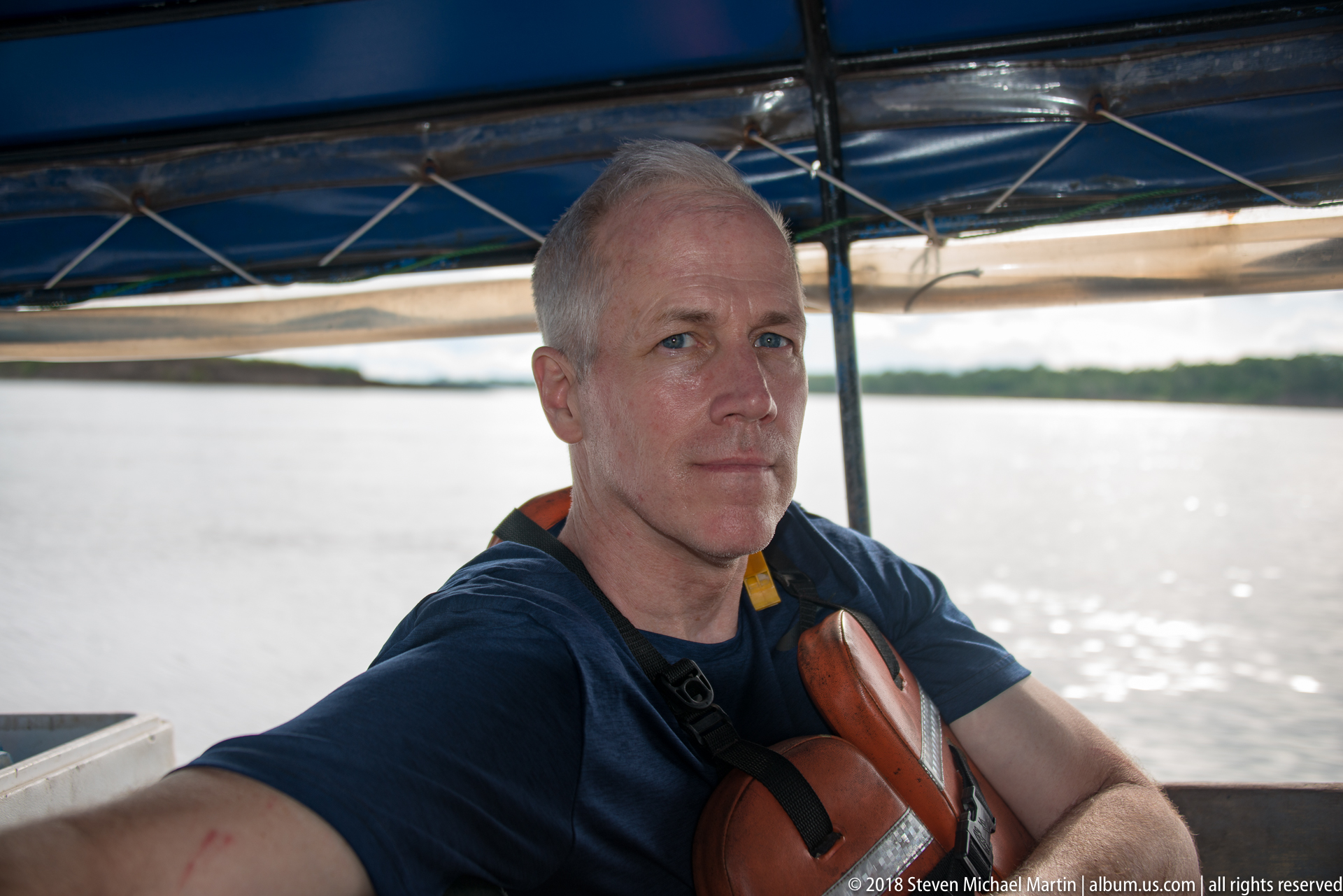
An adult passenger sits beneath the blue canopy of a small river motorboat, wearing a flotation vest as open water and a distant green shoreline fall softly out of focus behind him. The close portrait shifts attention from river infrastructure to the experience of travel itself: confined seating, safety gear, exposed boat framing, and the bright tropical light reflected from the water.
Caption
An adult passenger sits beneath the blue canopy of a small river motorboat, wearing a flotation vest as open water and a distant green shoreline fall softly out of focus behind him. The close portrait shifts attention from river infrastructure to the experience of travel itself: confined seating, safety gear, exposed boat framing, and the bright tropical light reflected from the water.

Two people work at a steep muddy riverbank beside narrow wooden canoes and an improvised display of produce packed into upright sacks and containers. Melons or other large fruits lie near their feet, while tall grasses rise behind the landing. The elevated viewpoint reveals a small-scale exchange point where river transport, harvested goods, and the exposed seasonal bank converge at the water’s edge.
Caption
Two people work at a steep muddy riverbank beside narrow wooden canoes and an improvised display of produce packed into upright sacks and containers. Melons or other large fruits lie near their feet, while tall grasses rise behind the landing. The elevated viewpoint reveals a small-scale exchange point where river transport, harvested goods, and the exposed seasonal bank converge at the water’s edge.

Large bunches of green plantains are stacked against a painted wooden wall beside a seated older woman, turning the storefront threshold into a compact produce display. The camera frames the curved fruit, rough timber boards, and the vendor at equal scale, emphasizing the material texture of a river-community market. The scene is specific to everyday food distribution rather than a generalized portrait of village life.
Caption
Large bunches of green plantains are stacked against a painted wooden wall beside a seated older woman, turning the storefront threshold into a compact produce display. The camera frames the curved fruit, rough timber boards, and the vendor at equal scale, emphasizing the material texture of a river-community market. The scene is specific to everyday food distribution rather than a generalized portrait of village life.

A woman sits cross-legged on a raised wooden platform, working over a metal basin at the threshold of a riverside shop. Behind her, a large printed poster with a woman’s face and bold political-style lettering dominates the wall, while bunches of green plantains are stacked nearby. The layered scene combines everyday food preparation or vending with the dense visual culture of a small Amazon settlement.
Caption
A woman sits cross-legged on a raised wooden platform, working over a metal basin at the threshold of a riverside shop. Behind her, a large printed poster with a woman’s face and bold political-style lettering dominates the wall, while bunches of green plantains are stacked nearby. The layered scene combines everyday food preparation or vending with the dense visual culture of a small Amazon settlement.

A young child sits atop tightly stacked bags of cement or construction material inside a small riverside shop, holding a bright pink garment across her lap. The repeating black-and-yellow packaging creates a graphic backdrop that contrasts with the child’s white shirt and direct gaze. The scene links domestic life with the storage and sale of basic building supplies in a river settlement.
Caption
A young child sits atop tightly stacked bags of cement or construction material inside a small riverside shop, holding a bright pink garment across her lap. The repeating black-and-yellow packaging creates a graphic backdrop that contrasts with the child’s white shirt and direct gaze. The scene links domestic life with the storage and sale of basic building supplies in a river settlement.

Green-painted vertical planks form the exterior wall of a simple riverside building, with closed doors opening directly onto a raised wooden walkway. The cropped composition removes nearly all landscape context and instead records construction details: broad boards, exposed framing, a shallow roof edge, and uneven decking. Such close architectural evidence distinguishes the lightweight timber fabric of the settlement from broader views of houses along the bank.
Caption
Green-painted vertical planks form the exterior wall of a simple riverside building, with closed doors opening directly onto a raised wooden walkway. The cropped composition removes nearly all landscape context and instead records construction details: broad boards, exposed framing, a shallow roof edge, and uneven decking. Such close architectural evidence distinguishes the lightweight timber fabric of the settlement from broader views of houses along the bank.

A broad, two-level wooden river vessel fills the frame, its dark plank hull, open upper railings, shaded side windows, and patched roofing showing prolonged working use. The low waterline and boxy superstructure distinguish it from narrow canoes and smaller motorboats. Seen against an open horizon, the boat becomes a study in the vernacular craft that carries people and goods along major Amazon channels.
Caption
A broad, two-level wooden river vessel fills the frame, its dark plank hull, open upper railings, shaded side windows, and patched roofing showing prolonged working use. The low waterline and boxy superstructure distinguish it from narrow canoes and smaller motorboats. Seen against an open horizon, the boat becomes a study in the vernacular craft that carries people and goods along major Amazon channels.

An adult passenger sits low inside a narrow open motorboat, surrounded by worn wooden gunwales, bench seating, flotation gear, and blue plastic containers. The blue canopy is rolled along the frame above him, exposing the utilitarian interior. This close view documents the practical equipment and tight working space of small-boat travel on the Tuhauyo waterways rather than the broader river landscape.
Caption
An adult passenger sits low inside a narrow open motorboat, surrounded by worn wooden gunwales, bench seating, flotation gear, and blue plastic containers. The blue canopy is rolled along the frame above him, exposing the utilitarian interior. This close view documents the practical equipment and tight working space of small-boat travel on the Tuhauyo waterways rather than the broader river landscape.

A passenger leans forward inside the same narrow riverboat, framed by the weathered gunwale and the blue canopy rolled overhead. The tighter crop reveals bench seats, flotation equipment, fuel or storage containers, and the compact arrangement needed for travel on smaller Amazon channels. The portrait emphasizes the functional interior of the craft and the close quarters of river transport.
Caption
A passenger leans forward inside the same narrow riverboat, framed by the weathered gunwale and the blue canopy rolled overhead. The tighter crop reveals bench seats, flotation equipment, fuel or storage containers, and the compact arrangement needed for travel on smaller Amazon channels. The portrait emphasizes the functional interior of the craft and the close quarters of river transport.

A weathered wooden regional vessel approaches across the broad river, its rounded bow, long roofed cabin, open stern-side deck, and hand-painted signage visible above the muddy water. The frontal view makes its deep hull and enclosed passenger or cargo space especially clear. Against the nearly uninterrupted horizon, the craft appears as a self-contained unit of transport connecting distant river communities.
Caption
A weathered wooden regional vessel approaches across the broad river, its rounded bow, long roofed cabin, open stern-side deck, and hand-painted signage visible above the muddy water. The frontal view makes its deep hull and enclosed passenger or cargo space especially clear. Against the nearly uninterrupted horizon, the craft appears as a self-contained unit of transport connecting distant river communities.

An older woman sits at the entrance of a small wooden shop with heavy bunches of green plantains piled beside and behind her. Bottled drinks in red crates and packaged goods inside the doorway broaden the scene from a single produce display to a mixed village store. Her relaxed seated posture and the ground-level arrangement of food reflect an informal riverside retail setting.
Caption
An older woman sits at the entrance of a small wooden shop with heavy bunches of green plantains piled beside and behind her. Bottled drinks in red crates and packaged goods inside the doorway broaden the scene from a single produce display to a mixed village store. Her relaxed seated posture and the ground-level arrangement of food reflect an informal riverside retail setting.

A row of low wooden buildings extends along the waterline, some painted bright turquoise and others roofed in rust-colored corrugated metal. Signs, beverage crates, and open verandas face directly toward the channel, while small boats move nearby. The oblique view reads the riverfront as the settlement’s principal public edge, where commerce, transport, and daily life meet the water.
Caption
A row of low wooden buildings extends along the waterline, some painted bright turquoise and others roofed in rust-colored corrugated metal. Signs, beverage crates, and open verandas face directly toward the channel, while small boats move nearby. The oblique view reads the riverfront as the settlement’s principal public edge, where commerce, transport, and daily life meet the water.

A turquoise-painted wooden building stands directly above the waterline, its open veranda shaded by a rusted corrugated-metal roof. Beverage crates and an open doorway suggest a small shop or gathering place, while a large hand-painted sign stretches across the neighboring wall. The close river-level viewpoint emphasizes how commercial façades in this settlement address passing boat traffic rather than a conventional street.
Caption
A turquoise-painted wooden building stands directly above the waterline, its open veranda shaded by a rusted corrugated-metal roof. Beverage crates and an open doorway suggest a small shop or gathering place, while a large hand-painted sign stretches across the neighboring wall. The close river-level viewpoint emphasizes how commercial façades in this settlement address passing boat traffic rather than a conventional street.

A two-level timber structure occupies the steep river margin, with people gathered on the upper platform and narrow canoes pulled alongside below. A hand-painted sign identifies a mechanical or related workshop, while adjacent buildings climb the exposed earthen bank. The photograph documents a service-oriented riverfront where boat access, repair activity, and settlement architecture are compressed into a narrow strip between water and slope.
Caption
A two-level timber structure occupies the steep river margin, with people gathered on the upper platform and narrow canoes pulled alongside below. A hand-painted sign identifies a mechanical or related workshop, while adjacent buildings climb the exposed earthen bank. The photograph documents a service-oriented riverfront where boat access, repair activity, and settlement architecture are compressed into a narrow strip between water and slope.

A Large-billed Tern sweeps low over the river, showing the species’ conspicuous yellow bill, dark crown, white neck and underparts, gray upperwing, and strongly contrasting black flight feathers. The blurred bank behind it reinforces the bird’s speed and low hunting flight over open water. This distinctive Amazonian tern is closely associated with major rivers, sandbars, and seasonally exposed shorelines.
Caption
A Large-billed Tern sweeps low over the river, showing the species’ conspicuous yellow bill, dark crown, white neck and underparts, gray upperwing, and strongly contrasting black flight feathers. The blurred bank behind it reinforces the bird’s speed and low hunting flight over open water. This distinctive Amazonian tern is closely associated with major rivers, sandbars, and seasonally exposed shorelines.

Two Neotropic Cormorants stand in shallow water with wings spread, a characteristic posture used after swimming and diving. Their dark plumage, long necks, hooked bills, and low stance are visible against the muddy river margin; one bird shows warm facial or throat tones. The paired posture offers a behavioral view of a common fish-eating waterbird of tropical American rivers and wetlands.
Caption
Two Neotropic Cormorants stand in shallow water with wings spread, a characteristic posture used after swimming and diving. Their dark plumage, long necks, hooked bills, and low stance are visible against the muddy river margin; one bird shows warm facial or throat tones. The paired posture offers a behavioral view of a common fish-eating waterbird of tropical American rivers and wetlands.

An Amazon river dolphin breaks the surface in mid-channel, exposing its rounded back and low ridge-like dorsal profile before slipping beneath the water. The distant, partially submerged view offers little facial detail, but the smooth gray body and characteristic shallow dorsal contour distinguish a river dolphin from the surrounding wake. The photograph records a brief surfacing moment in the turbid Amazonian waterway.
Caption
An Amazon river dolphin breaks the surface in mid-channel, exposing its rounded back and low ridge-like dorsal profile before slipping beneath the water. The distant, partially submerged view offers little facial detail, but the smooth gray body and characteristic shallow dorsal contour distinguish a river dolphin from the surrounding wake. The photograph records a brief surfacing moment in the turbid Amazonian waterway.

Only the turbulent back and wake of an Amazon river dolphin remain visible as the animal submerges, leaving a low swell across the sunlit water. Compared with the clearer surfacing frames in the sequence, this image emphasizes movement rather than anatomy: a brief eruption of brown water, a smooth body contour, and the disturbed surface trailing behind. Species assignment relies partly on the immediately adjacent dolphin sequence.
Caption
Only the turbulent back and wake of an Amazon river dolphin remain visible as the animal submerges, leaving a low swell across the sunlit water. Compared with the clearer surfacing frames in the sequence, this image emphasizes movement rather than anatomy: a brief eruption of brown water, a smooth body contour, and the disturbed surface trailing behind. Species assignment relies partly on the immediately adjacent dolphin sequence.

A Great Egret stands at the edge of an exposed muddy bank, its long white body, S-curved neck, yellow-orange bill, and black legs sharply defined against the dark sediment. The bird faces along the shoreline as if watching the shallows for prey. Its clean silhouette and large size distinguish it from smaller white herons that also occur along tropical American rivers and wetlands.
Caption
A Great Egret stands at the edge of an exposed muddy bank, its long white body, S-curved neck, yellow-orange bill, and black legs sharply defined against the dark sediment. The bird faces along the shoreline as if watching the shallows for prey. Its clean silhouette and large size distinguish it from smaller white herons that also occur along tropical American rivers and wetlands.

A mixed catch of large freshwater fish lies on the painted floorboards of a small wooden boat, their silvery and dark bodies overlapping beneath a simple wooden pole or handle. Different body shapes and fin structures suggest more than one taxon, but the proof sheet does not support reliable species-level identification. The photograph records subsistence or local fishing as a direct use of the river’s aquatic resources.
Caption
A mixed catch of large freshwater fish lies on the painted floorboards of a small wooden boat, their silvery and dark bodies overlapping beneath a simple wooden pole or handle. Different body shapes and fin structures suggest more than one taxon, but the proof sheet does not support reliable species-level identification. The photograph records subsistence or local fishing as a direct use of the river’s aquatic resources.

A Neotropic Cormorant swims low in the water with only its head, neck, and upper back exposed, the hooked bill angled slightly upward. The bird’s dark brown-black plumage and slim profile blend into the shaded channel, while the yellowish facial skin and bill edge provide contrast. This low-riding posture is typical of a diving cormorant moving between feeding dives.
Caption
A Neotropic Cormorant swims low in the water with only its head, neck, and upper back exposed, the hooked bill angled slightly upward. The bird’s dark brown-black plumage and slim profile blend into the shaded channel, while the yellowish facial skin and bill edge provide contrast. This low-riding posture is typical of a diving cormorant moving between feeding dives.

A Neotropic Cormorant surfaces with a fish held crosswise in its hooked bill, water streaming from both bird and prey as it moves through the channel. The bird’s low-swimming body, dark plumage, and elongated neck are characteristic of the species. Unlike the preceding portrait, this frame records feeding behavior directly, showing the relationship between a diving waterbird and the river’s fish community.
Caption
A Neotropic Cormorant surfaces with a fish held crosswise in its hooked bill, water streaming from both bird and prey as it moves through the channel. The bird’s low-swimming body, dark plumage, and elongated neck are characteristic of the species. Unlike the preceding portrait, this frame records feeding behavior directly, showing the relationship between a diving waterbird and the river’s fish community.

A Neotropic cormorant wrestles a large, armored-looking fish crosswise in its open bill while swimming on the Tuhauyo waterways. The prey’s stiff fins and elongated body remain fully above the surface, making the feeding encounter unusually legible. Water streaming from bird and fish records the force and immediacy of the capture.
Caption
A Neotropic cormorant wrestles a large, armored-looking fish crosswise in its open bill while swimming on the Tuhauyo waterways. The prey’s stiff fins and elongated body remain fully above the surface, making the feeding encounter unusually legible. Water streaming from bird and fish records the force and immediacy of the capture.

With its neck arched and bill spread wide, a Neotropic cormorant lifts a substantial fish clear of the water. The fish’s flared fins and pale underside contrast with the bird’s dark plumage, while splashes beneath the prey mark the instant it was raised. This frame isolates a difficult stage in the bird’s effort to orient and swallow its catch.
Caption
With its neck arched and bill spread wide, a Neotropic cormorant lifts a substantial fish clear of the water. The fish’s flared fins and pale underside contrast with the bird’s dark plumage, while splashes beneath the prey mark the instant it was raised. This frame isolates a difficult stage in the bird’s effort to orient and swallow its catch.

A Neotropic Cormorant launches from the river with wings raised and a sizable fish clenched in its bill. Droplets trail from the bird’s tail and the prey as the cormorant gains lift against a dark forested background. The frozen motion transforms a feeding event into a dynamic study of escape and handling behavior, with the pale fish sharply contrasted against the bird’s dark body and wings.
Caption
A Neotropic Cormorant launches from the river with wings raised and a sizable fish clenched in its bill. Droplets trail from the bird’s tail and the prey as the cormorant gains lift against a dark forested background. The frozen motion transforms a feeding event into a dynamic study of escape and handling behavior, with the pale fish sharply contrasted against the bird’s dark body and wings.

A Neotropic cormorant clamps a large fish near the head while riding low in the water. The close view shows the bird’s blue-green eye, yellow-orange throat skin, slender hooked bill, and wet blackish plumage. The fish’s patterned body and expanded fins emphasize the size of the prey relative to the predator’s head.
Caption
A Neotropic cormorant clamps a large fish near the head while riding low in the water. The close view shows the bird’s blue-green eye, yellow-orange throat skin, slender hooked bill, and wet blackish plumage. The fish’s patterned body and expanded fins emphasize the size of the prey relative to the predator’s head.

A captured fish hangs momentarily above a Neotropic cormorant as the bird tosses and repositions its prey. The cormorant’s bill points upward beneath the airborne fish, a maneuver used to align bulky prey for swallowing. The low waterline and scattered droplets preserve a split-second phase of feeding behavior rather than a static wildlife portrait.
Caption
A captured fish hangs momentarily above a Neotropic cormorant as the bird tosses and repositions its prey. The cormorant’s bill points upward beneath the airborne fish, a maneuver used to align bulky prey for swallowing. The low waterline and scattered droplets preserve a split-second phase of feeding behavior rather than a static wildlife portrait.

A long, leaning snag extends over the forest canopy with several dark birds spaced along its bare branches. The broad view emphasizes the relationship between exposed deadwood and the surrounding closed vegetation, where elevated perches offer clear sightlines above the riverine forest. The birds remain too small for secure identification, so the scene is best read as habitat and behavior.
Caption
A long, leaning snag extends over the forest canopy with several dark birds spaced along its bare branches. The broad view emphasizes the relationship between exposed deadwood and the surrounding closed vegetation, where elevated perches offer clear sightlines above the riverine forest. The birds remain too small for secure identification, so the scene is best read as habitat and behavior.

Two brown raptors occupy different branches of a sparse treetop, one higher and turned away and the other lower in profile. Their hooked-bill silhouettes and upright postures distinguish them as birds of prey, but the bright background and limited detail obscure diagnostic plumage. The paired perch provides a clear behavioral record without requiring a more specific taxonomic claim.
Caption
Two brown raptors occupy different branches of a sparse treetop, one higher and turned away and the other lower in profile. Their hooked-bill silhouettes and upright postures distinguish them as birds of prey, but the bright background and limited detail obscure diagnostic plumage. The paired perch provides a clear behavioral record without requiring a more specific taxonomic claim.

The cormorant bends its flexible neck around a heavy fish, gripping the prey as both sit partly above the rippled surface. Seen at close range, the bird’s eye and bright throat patch stand out against wet dark feathers. The frame emphasizes the physical challenge of controlling a fish broad enough to span much of the bird’s neck and bill.
Caption
The cormorant bends its flexible neck around a heavy fish, gripping the prey as both sit partly above the rippled surface. Seen at close range, the bird’s eye and bright throat patch stand out against wet dark feathers. The frame emphasizes the physical challenge of controlling a fish broad enough to span much of the bird’s neck and bill.

Swimming away with a strong wake, a Neotropic cormorant holds its captured fish lengthwise across the bill. The wider composition places the feeding event back into the calm brown-green water of the Tuhauyo system. The fish remains conspicuously large, and the bird’s angled head suggests it is still working to secure or reposition the prey.
Caption
Swimming away with a strong wake, a Neotropic cormorant holds its captured fish lengthwise across the bill. The wider composition places the feeding event back into the calm brown-green water of the Tuhauyo system. The fish remains conspicuously large, and the bird’s angled head suggests it is still working to secure or reposition the prey.

A Neotropic cormorant holds a pale fish upright against its bill while swimming through quiet water. The fish’s light belly and spread fins form a bright focal point beside the bird’s dark head and neck. This later moment in the feeding sequence shows the prey rotated into a different orientation as the cormorant continues trying to manage the catch.
Caption
A Neotropic cormorant holds a pale fish upright against its bill while swimming through quiet water. The fish’s light belly and spread fins form a bright focal point beside the bird’s dark head and neck. This later moment in the feeding sequence shows the prey rotated into a different orientation as the cormorant continues trying to manage the catch.

Two dark waterbirds perch at separate points on the bare limbs of a dead tree rising above the forest canopy. Their small silhouettes are set against a heavy gray sky, turning the snag into a prominent resting structure above the Tuhauyo wetland. Distance prevents a reliable species-level identification, but the composition clearly records communal use of exposed riverside perches.
Caption
Two dark waterbirds perch at separate points on the bare limbs of a dead tree rising above the forest canopy. Their small silhouettes are set against a heavy gray sky, turning the snag into a prominent resting structure above the Tuhauyo wetland. Distance prevents a reliable species-level identification, but the composition clearly records communal use of exposed riverside perches.

A pale-headed brown raptor stands upright on a leafy canopy branch above the Tuhauyo waterways. The cream-colored head and neck contrast sharply with the warm brown body, a combination consistent with a yellow-headed caracara, a widespread lowland South American raptor. The open perch and uncluttered profile make the plumage pattern especially visible despite the bright sky.
Caption
A pale-headed brown raptor stands upright on a leafy canopy branch above the Tuhauyo waterways. The cream-colored head and neck contrast sharply with the warm brown body, a combination consistent with a yellow-headed caracara, a widespread lowland South American raptor. The open perch and uncluttered profile make the plumage pattern especially visible despite the bright sky.

Only the head and upper back of a caiman break the dark water as it moves through vertical reflections of flooded-forest trunks. The reptile is small within the frame, making the mirrored vegetation and still surface as important as the animal itself. Its low profile demonstrates the cryptic visibility of crocodilians moving through quiet Amazonian waterways.
Caption
Only the head and upper back of a caiman break the dark water as it moves through vertical reflections of flooded-forest trunks. The reptile is small within the frame, making the mirrored vegetation and still surface as important as the animal itself. Its low profile demonstrates the cryptic visibility of crocodilians moving through quiet Amazonian waterways.

Two caiman heads punctuate the reflective surface of a narrow forest waterway, separated across the frame beneath overhanging vegetation. Their low, nearly submerged profiles are easy to overlook among the dark tree reflections and floating debris. The composition emphasizes how effectively crocodilians disappear into the visual texture of quiet Amazonian water.
Caption
Two caiman heads punctuate the reflective surface of a narrow forest waterway, separated across the frame beneath overhanging vegetation. Their low, nearly submerged profiles are easy to overlook among the dark tree reflections and floating debris. The composition emphasizes how effectively crocodilians disappear into the visual texture of quiet Amazonian water.

Flying only a short distance above the surface, a Neotropic cormorant stretches its body forward while the wings sweep downward. The uncluttered green water isolates the bird’s long neck, dark body, and yellowish throat area. The frame records the efficient, surface-hugging flight that links the species’ swimming and aerial movements through the river corridor.
Caption
Flying only a short distance above the surface, a Neotropic cormorant stretches its body forward while the wings sweep downward. The uncluttered green water isolates the bird’s long neck, dark body, and yellowish throat area. The frame records the efficient, surface-hugging flight that links the species’ swimming and aerial movements through the river corridor.

A Neotropic cormorant meets the river surface with wings fully spread, feet forward, and a fan of spray behind its body. The head-on approach turns the wings into a broad horizontal span while the landing track cuts a bright wake across darker reflections. This dynamic view isolates the transition from flight to swimming.
Caption
A Neotropic cormorant meets the river surface with wings fully spread, feet forward, and a fan of spray behind its body. The head-on approach turns the wings into a broad horizontal span while the landing track cuts a bright wake across darker reflections. This dynamic view isolates the transition from flight to swimming.

An anhinga glides low over the Tuhauyo waterway with its long, straight bill and slender neck projecting forward. Pale silvery flight feathers contrast with the darker body and neck, helping distinguish this species from the cormorants seen elsewhere in the sequence. The blurred green reflections reinforce the speed and low altitude of the bird’s passage.
Caption
An anhinga glides low over the Tuhauyo waterway with its long, straight bill and slender neck projecting forward. Pale silvery flight feathers contrast with the darker body and neck, helping distinguish this species from the cormorants seen elsewhere in the sequence. The blurred green reflections reinforce the speed and low altitude of the bird’s passage.

A Neotropic cormorant powers across dark reflective water with its neck held high and body riding low. The long hooked bill and blue-green eye are visible in profile, while a bright wake opens behind the bird. Smooth horizontal reflections echo the cormorant’s elongated silhouette and emphasize its forward movement along the channel.
Caption
A Neotropic cormorant powers across dark reflective water with its neck held high and body riding low. The long hooked bill and blue-green eye are visible in profile, while a bright wake opens behind the bird. Smooth horizontal reflections echo the cormorant’s elongated silhouette and emphasize its forward movement along the channel.

With wings lifted like brakes, a Neotropic cormorant runs across the water at the end of its landing approach. A long white wake traces its path through the green reflections, while the bird’s feet strike the surface beneath its body. The wider framing makes the distance traveled during touchdown especially apparent.
Caption
With wings lifted like brakes, a Neotropic cormorant runs across the water at the end of its landing approach. A long white wake traces its path through the green reflections, while the bird’s feet strike the surface beneath its body. The wider framing makes the distance traveled during touchdown especially apparent.

A Neotropic cormorant rises upright on the surface with both wings spread as it completes its landing. Water splashes around the feet and a curved white wake trails behind, while the bird and its reflection form a dark vertical axis in the green water. The moment captures the final loss of forward speed before the bird settles into swimming posture.
Caption
A Neotropic cormorant rises upright on the surface with both wings spread as it completes its landing. Water splashes around the feet and a curved white wake trails behind, while the bird and its reflection form a dark vertical axis in the green water. The moment captures the final loss of forward speed before the bird settles into swimming posture.

A small mottled lizard clings to the underside of a rough horizontal limb, its body pattern closely matching the gray-brown bark. The head projects downward into open space while most of the animal remains tucked against the wood. This close view records camouflage and perch use in the riverside forest without enough diagnostic detail for a secure species identification.
Caption
A small mottled lizard clings to the underside of a rough horizontal limb, its body pattern closely matching the gray-brown bark. The head projects downward into open space while most of the animal remains tucked against the wood. This close view records camouflage and perch use in the riverside forest without enough diagnostic detail for a secure species identification.

A lone paddler guides a narrow wooden canoe along the densely vegetated margin of the Tuhauyo waterway. The turquoise shirt and its reflection provide the only bright color against subdued green forest and water. The low canoe and hand-held paddle place human movement directly within the river environment that structures travel and wildlife observation in this Amazonian landscape.
Caption
A lone paddler guides a narrow wooden canoe along the densely vegetated margin of the Tuhauyo waterway. The turquoise shirt and its reflection provide the only bright color against subdued green forest and water. The low canoe and hand-held paddle place human movement directly within the river environment that structures travel and wildlife observation in this Amazonian landscape.

An anhinga crosses the water on broad wings, its long neck and pointed bill extended ahead while a nearly complete reflection follows beneath. Pale wing surfaces contrast with the darker body, and the paired bird-and-reflection silhouette gives the frame unusual symmetry. The low flight path keeps the species visually tied to the aquatic habitat where it dives for prey.
Caption
An anhinga crosses the water on broad wings, its long neck and pointed bill extended ahead while a nearly complete reflection follows beneath. Pale wing surfaces contrast with the darker body, and the paired bird-and-reflection silhouette gives the frame unusual symmetry. The low flight path keeps the species visually tied to the aquatic habitat where it dives for prey.

A Neotropic cormorant touches down at speed, wings raised and feet striking the surface as a broad trail of white spray unfurls behind it. The distant framing makes the wake the dominant graphic element, tracing the bird’s momentum across otherwise smooth green water. Its dark upright form and landing posture remain distinct at the end of the splash track.
Caption
A Neotropic cormorant touches down at speed, wings raised and feet striking the surface as a broad trail of white spray unfurls behind it. The distant framing makes the wake the dominant graphic element, tracing the bird’s momentum across otherwise smooth green water. Its dark upright form and landing posture remain distinct at the end of the splash track.

A paddler sits low in a narrow wooden canoe beside a larger weathered canoe or boat moored against the forest edge. Tangled trunks, vines, and dark water create a close riverside setting, while the bright shirt separates the figure from the vegetation. The scene records small-craft travel through the sheltered waterways of the Tuhauyo landscape.
Caption
A paddler sits low in a narrow wooden canoe beside a larger weathered canoe or boat moored against the forest edge. Tangled trunks, vines, and dark water create a close riverside setting, while the bright shirt separates the figure from the vegetation. The scene records small-craft travel through the sheltered waterways of the Tuhauyo landscape.

A Neotropic cormorant balances on a partly submerged branch with both wings extended beside a tangle of fallen trunks. The open-wing posture exposes the layered flight feathers and is typical of cormorants resting after swimming or diving. Reflected light on the water and the woody shoreline place the bird within a sheltered, debris-rich Amazonian channel.
Caption
A Neotropic cormorant balances on a partly submerged branch with both wings extended beside a tangle of fallen trunks. The open-wing posture exposes the layered flight feathers and is typical of cormorants resting after swimming or diving. Reflected light on the water and the woody shoreline place the bird within a sheltered, debris-rich Amazonian channel.

A caiman floats almost completely submerged, leaving only the armored crown, raised eye, and blunt snout above smooth gray water. The tight profile makes the crocodilian’s surface-adapted head shape especially clear: eyes and nostrils remain exposed while the rest of the body disappears below. Species-level characters are not sufficiently visible in this view.
Caption
A caiman floats almost completely submerged, leaving only the armored crown, raised eye, and blunt snout above smooth gray water. The tight profile makes the crocodilian’s surface-adapted head shape especially clear: eyes and nostrils remain exposed while the rest of the body disappears below. Species-level characters are not sufficiently visible in this view.

At water level, a caiman’s eye, textured brow, and snout emerge from a nearly monochrome surface. The shallow angle compresses the animal into a narrow band between water and air, demonstrating how little of a crocodilian needs to remain exposed while it watches its surroundings. Fine scale texture is visible, but species-specific features remain inconclusive.
Caption
At water level, a caiman’s eye, textured brow, and snout emerge from a nearly monochrome surface. The shallow angle compresses the animal into a narrow band between water and air, demonstrating how little of a crocodilian needs to remain exposed while it watches its surroundings. Fine scale texture is visible, but species-specific features remain inconclusive.

A caiman moves through open gray water, its head and a small portion of the back enclosed by widening circular ripples. The wider composition shifts attention from anatomical detail to movement, showing how the reptile’s low profile disturbs the surface only subtly. The surrounding rings mark its passage across an otherwise quiet stretch of the Tuhauyo waterway.
Caption
A caiman moves through open gray water, its head and a small portion of the back enclosed by widening circular ripples. The wider composition shifts attention from anatomical detail to movement, showing how the reptile’s low profile disturbs the surface only subtly. The surrounding rings mark its passage across an otherwise quiet stretch of the Tuhauyo waterway.

A brown frog breaks the smooth surface of the Tuhauyo waterway, its head and upper body just above the water as concentric ripples spread outward. The low, nearly level viewpoint isolates the amphibian against open water and records a brief moment of movement in the Amazonian aquatic habitat.
Caption
A brown frog breaks the smooth surface of the Tuhauyo waterway, its head and upper body just above the water as concentric ripples spread outward. The low, nearly level viewpoint isolates the amphibian against open water and records a brief moment of movement in the Amazonian aquatic habitat.

Dark, tannin-stained water fills the understory of seasonally flooded Amazon forest, threading between a dense lattice of trunks, prop roots, and hanging roots. The composition emphasizes how vegetation occupies both water and air, creating a structurally complex shoreline habitat along the Tuhauyo system.
Caption
Dark, tannin-stained water fills the understory of seasonally flooded Amazon forest, threading between a dense lattice of trunks, prop roots, and hanging roots. The composition emphasizes how vegetation occupies both water and air, creating a structurally complex shoreline habitat along the Tuhauyo system.

A traveler moves through the wet forest with a walking stick, negotiating muddy ground and shallow floodwater beneath an overhead tangle of roots and branches. The scene records the practical difficulty of moving through seasonally inundated Amazon understory while preserving the dense vegetation and waterlogged terrain around the route.
Caption
A traveler moves through the wet forest with a walking stick, negotiating muddy ground and shallow floodwater beneath an overhead tangle of roots and branches. The scene records the practical difficulty of moving through seasonally inundated Amazon understory while preserving the dense vegetation and waterlogged terrain around the route.

Shallow brown floodwater spreads across the forest floor beneath a low canopy of branches and trunks, creating a quiet interior view of the Tuhauyo wetland forest. Reflections on the water and the partially submerged vegetation show how seasonal inundation transforms the understory into an aquatic passage.
Caption
Shallow brown floodwater spreads across the forest floor beneath a low canopy of branches and trunks, creating a quiet interior view of the Tuhauyo wetland forest. Reflections on the water and the partially submerged vegetation show how seasonal inundation transforms the understory into an aquatic passage.

A traveler stands within the flooded-forest understory, using the human figure to show the scale of massive intertwined roots and trunks around the Tuhauyo waterways. Shallow brown water occupies the forest floor behind him, while the dense root network forms a natural enclosure characteristic of seasonally inundated Amazon habitat.
Caption
A traveler stands within the flooded-forest understory, using the human figure to show the scale of massive intertwined roots and trunks around the Tuhauyo waterways. Shallow brown water occupies the forest floor behind him, while the dense root network forms a natural enclosure characteristic of seasonally inundated Amazon habitat.

Hundreds of slender aerial roots hang in a dense curtain from a large tree at the edge of the wet forest, reaching toward the leaf-littered ground. The close contextual view emphasizes the fibrous texture and vertical repetition of the root mass rather than the broader flooded landscape.
Caption
Hundreds of slender aerial roots hang in a dense curtain from a large tree at the edge of the wet forest, reaching toward the leaf-littered ground. The close contextual view emphasizes the fibrous texture and vertical repetition of the root mass rather than the broader flooded landscape.

Two travelers wade through knee-deep floodwater beneath dense Amazon vegetation, one using a stick for balance while the other moves ahead through the flooded corridor. The image places human movement directly within the seasonally inundated forest and shows the depth and extent of standing water across the route.
Caption
Two travelers wade through knee-deep floodwater beneath dense Amazon vegetation, one using a stick for balance while the other moves ahead through the flooded corridor. The image places human movement directly within the seasonally inundated forest and shows the depth and extent of standing water across the route.

A traveler stands directly in front of a dense wall of hanging roots, providing a clear scale reference for the mature forest growth. Rubber boots and a walking stick reinforce the wet conditions, while the tightly packed roots behind him create a strong textural backdrop within the Tuhauyo forest.
Caption
A traveler stands directly in front of a dense wall of hanging roots, providing a clear scale reference for the mature forest growth. Rubber boots and a walking stick reinforce the wet conditions, while the tightly packed roots behind him create a strong textural backdrop within the Tuhauyo forest.

The underside of a large morpho-type butterfly fills the frame as it perches on pale green foliage. A series of concentric eyespots runs along the closed wings, while the shallow depth of field softens the surrounding rainforest leaves and keeps attention on the intricate defensive pattern.
Caption
The underside of a large morpho-type butterfly fills the frame as it perches on pale green foliage. A series of concentric eyespots runs along the closed wings, while the shallow depth of field softens the surrounding rainforest leaves and keeps attention on the intricate defensive pattern.

A full-body view places a traveler beside a broad curtain of aerial roots rising above a damp, leaf-covered forest floor. The slightly wider framing reveals surrounding green understory plants and shows how the root mass forms a distinct vertical boundary within the wet Amazon forest.
Caption
A full-body view places a traveler beside a broad curtain of aerial roots rising above a damp, leaf-covered forest floor. The slightly wider framing reveals surrounding green understory plants and shows how the root mass forms a distinct vertical boundary within the wet Amazon forest.

Several concentric, fan-shaped bracket fungi emerge from a fallen log among wet leaf litter, their pale scalloped margins contrasting with darker brown bands. The close view shifts attention from the larger flooded forest to decomposition on the forest floor, where fungi recycle dead woody material in the humid Amazon environment.
Caption
Several concentric, fan-shaped bracket fungi emerge from a fallen log among wet leaf litter, their pale scalloped margins contrasting with darker brown bands. The close view shifts attention from the larger flooded forest to decomposition on the forest floor, where fungi recycle dead woody material in the humid Amazon environment.

A traveler stands amid an exceptionally dense maze of dark roots, trunks, and hanging vegetation, giving scale to the crowded structure of the Tuhauyo forest interior. The damp leaf-littered ground and irregular root forms create a confined, layered setting typical of lowland Amazon wet forest.
Caption
A traveler stands amid an exceptionally dense maze of dark roots, trunks, and hanging vegetation, giving scale to the crowded structure of the Tuhauyo forest interior. The damp leaf-littered ground and irregular root forms create a confined, layered setting typical of lowland Amazon wet forest.

A large butterfly rests with wings closed on a broad leaf, exposing a brown underside patterned with multiple yellow-ringed eyespots and fine pale lines. The defensive underside pattern contrasts with the vivid blue often associated with morpho butterflies, but only the visible ventral surface is documented here.
Caption
A large butterfly rests with wings closed on a broad leaf, exposing a brown underside patterned with multiple yellow-ringed eyespots and fine pale lines. The defensive underside pattern contrasts with the vivid blue often associated with morpho butterflies, but only the visible ventral surface is documented here.

A heavy woody liana twists around a mature tree trunk and continues upward into the green canopy, illustrating the competition for vertical space in lowland Amazon forest. The photograph concentrates on the vine’s pronounced spiral form and the physical connection between climber and supporting tree.
Caption
A heavy woody liana twists around a mature tree trunk and continues upward into the green canopy, illustrating the competition for vertical space in lowland Amazon forest. The photograph concentrates on the vine’s pronounced spiral form and the physical connection between climber and supporting tree.

Seen from a slightly different angle, a dark long-tailed ani-type bird perches above dense green foliage with its body facing forward and head turned to the side. The heavy silhouette and elongated tail distinguish it from the smaller passerines that share the river-margin vegetation.
Caption
Seen from a slightly different angle, a dark long-tailed ani-type bird perches above dense green foliage with its body facing forward and head turned to the side. The heavy silhouette and elongated tail distinguish it from the smaller passerines that share the river-margin vegetation.

A dark cormorant rests on a low, narrow branch above still water, its long neck and slender hooked bill held in profile. Warm bare skin at the base of the bill and the compact dark body fit a Neotropic cormorant, a widespread fish-eating bird of rivers and lakes in tropical South America.
Caption
A dark cormorant rests on a low, narrow branch above still water, its long neck and slender hooked bill held in profile. Warm bare skin at the base of the bill and the compact dark body fit a Neotropic cormorant, a widespread fish-eating bird of rivers and lakes in tropical South America.

A striking dark butterfly rests on mottled bark with wings spread, revealing broad yellow patches on the forewings and small red markings near the hindwing bases. The open-wing posture provides a clear dorsal view of the contrasting color pattern against the subdued texture of the tree surface.
Caption
A striking dark butterfly rests on mottled bark with wings spread, revealing broad yellow patches on the forewings and small red markings near the hindwing bases. The open-wing posture provides a clear dorsal view of the contrasting color pattern against the subdued texture of the tree surface.

A large crested kingfisher crosses the frame in flight, its long pointed bill and compact body silhouetted against a pale sky. Rufous tones on the underparts and dark bluish upper surfaces are visible despite motion, linking the bird to riverine hunting habitat along the Tuhauyo waterways.
Caption
A large crested kingfisher crosses the frame in flight, its long pointed bill and compact body silhouetted against a pale sky. Rufous tones on the underparts and dark bluish upper surfaces are visible despite motion, linking the bird to riverine hunting habitat along the Tuhauyo waterways.

A ringed-kingfisher-type bird hovers beside a bare twig with wings spread and long bill pointed forward. The shaggy crest, blue-gray upperparts, and rufous underparts are visible in profile, while the open wings freeze a transitional moment between flight and perch above the river corridor.
Caption
A ringed-kingfisher-type bird hovers beside a bare twig with wings spread and long bill pointed forward. The shaggy crest, blue-gray upperparts, and rufous underparts are visible in profile, while the open wings freeze a transitional moment between flight and perch above the river corridor.

A large crested kingfisher perches on the tip of a bare stem above leafy riverbank vegetation, offering a compact profile against the pale sky. The heavy bill, blue-gray head and back, and warm rufous underside are characteristic of a large river kingfisher using exposed lookout perches.
Caption
A large crested kingfisher perches on the tip of a bare stem above leafy riverbank vegetation, offering a compact profile against the pale sky. The heavy bill, blue-gray head and back, and warm rufous underside are characteristic of a large river kingfisher using exposed lookout perches.

A glossy black bird with a long tail sits upright on a thin branch amid river-edge foliage. Its bulky head and dark bill suggest an ani, a conspicuous group of cuckoo relatives often encountered in tropical lowland habitats, though the proof sheet does not resolve enough bill detail for a certain species.
Caption
A glossy black bird with a long tail sits upright on a thin branch amid river-edge foliage. Its bulky head and dark bill suggest an ani, a conspicuous group of cuckoo relatives often encountered in tropical lowland habitats, though the proof sheet does not resolve enough bill detail for a certain species.

An upright Neotropic cormorant stands on a narrow angled branch surrounded by open water, its body isolated against a softly blurred aquatic background. The more distant framing emphasizes the bird’s elongated neck and vertical stance while showing the exposed perch it uses above the Tuhauyo waterway.
Caption
An upright Neotropic cormorant stands on a narrow angled branch surrounded by open water, its body isolated against a softly blurred aquatic background. The more distant framing emphasizes the bird’s elongated neck and vertical stance while showing the exposed perch it uses above the Tuhauyo waterway.

Facing more toward the camera, a Neotropic cormorant balances on a slender branch over the water, its broad webbed feet gripping the perch. The blurred green and brown background places the bird within a shaded forest waterway while the upright posture emphasizes its long neck and compact body.
Caption
Facing more toward the camera, a Neotropic cormorant balances on a slender branch over the water, its broad webbed feet gripping the perch. The blurred green and brown background places the bird within a shaded forest waterway while the upright posture emphasizes its long neck and compact body.

A Neotropic cormorant perches low over placid water, its long neck extended and bill angled slightly upward. The branch enters the water at the right, and a soft reflection beneath the bird reinforces the quiet riverine setting while keeping attention on the dark-bodied waterbird.
Caption
A Neotropic cormorant perches low over placid water, its long neck extended and bill angled slightly upward. The branch enters the water at the right, and a soft reflection beneath the bird reinforces the quiet riverine setting while keeping attention on the dark-bodied waterbird.

Two large brown raptors occupy separate perches in the same riverside tree, one high on a bare snag and another lower among branches. Their broad bodies and hooked bills are visible, but the proof sheet does not resolve the facial and plumage details needed to assign a species confidently.
Caption
Two large brown raptors occupy separate perches in the same riverside tree, one high on a bare snag and another lower among branches. Their broad bodies and hooked bills are visible, but the proof sheet does not resolve the facial and plumage details needed to assign a species confidently.

A kingfisher with a long straight bill and warm rufous underparts perches on the tip of an exposed dead branch against a pale sky. The isolated lookout position is typical of river-hunting kingfishers, which scan the water from open snags before diving for prey.
Caption
A kingfisher with a long straight bill and warm rufous underparts perches on the tip of an exposed dead branch against a pale sky. The isolated lookout position is typical of river-hunting kingfishers, which scan the water from open snags before diving for prey.

A large gray-and-white heron stands at the edge of a quiet waterway, its long pale neck curved above a gray body and dark crown. The bird’s proportions and contrasting plumage are consistent with a Cocoi heron, a prominent South American heron of rivers, oxbows, and wetlands.
Caption
A large gray-and-white heron stands at the edge of a quiet waterway, its long pale neck curved above a gray body and dark crown. The bird’s proportions and contrasting plumage are consistent with a Cocoi heron, a prominent South American heron of rivers, oxbows, and wetlands.

With wings lifted high in the upstroke, a Cocoi heron follows the shadowed edge of the flooded forest just above the water. The pale neck is folded back and the long legs trail behind, while the bright gray-and-white bird contrasts with dense green foliage and dark horizontal branches. The frame isolates a different phase of flight from the preceding view.
Caption
With wings lifted high in the upstroke, a Cocoi heron follows the shadowed edge of the flooded forest just above the water. The pale neck is folded back and the long legs trail behind, while the bright gray-and-white bird contrasts with dense green foliage and dark horizontal branches. The frame isolates a different phase of flight from the preceding view.

A small kingfisher figure punctuates a wide composition of bare, twisting branches against an overcast sky. The bird’s long bill and warm underside remain visible despite the distance, while the expanded framing emphasizes the exposed riverside perch and surrounding tree architecture more than plumage detail.
Caption
A small kingfisher figure punctuates a wide composition of bare, twisting branches against an overcast sky. The bird’s long bill and warm underside remain visible despite the distance, while the expanded framing emphasizes the exposed riverside perch and surrounding tree architecture more than plumage detail.

A Cocoi heron stands upright on a fallen branch at the flooded forest margin, its long pale neck and gray body sharply outlined against tangled trunks and green aquatic vegetation. The still water below carries a nearly vertical reflection, while the bird’s elevated perch provides a clear view over the shallow shoreline habitat along the Tuhauyo Lake and River system.
Caption
A Cocoi heron stands upright on a fallen branch at the flooded forest margin, its long pale neck and gray body sharply outlined against tangled trunks and green aquatic vegetation. The still water below carries a nearly vertical reflection, while the bird’s elevated perch provides a clear view over the shallow shoreline habitat along the Tuhauyo Lake and River system.

A Sungrebe speeds across the river in low flight, its narrow body stretched forward and broad brown wings caught mid-beat against the blurred water. The boldly patterned head remains visible despite the motion, linking the airborne bird to the species’ more familiar swimming profile. Extended feet and the low trajectory convey a rapid transition from the water’s surface into flight.
Caption
A Sungrebe speeds across the river in low flight, its narrow body stretched forward and broad brown wings caught mid-beat against the blurred water. The boldly patterned head remains visible despite the motion, linking the airborne bird to the species’ more familiar swimming profile. Extended feet and the low trajectory convey a rapid transition from the water’s surface into flight.