Rome – Italy
The historic city of Rome stands as one of the most influential cities in the history of Western civilization. Founded according to tradition in 753 BCE, Rome grew from a small settlement along the Tiber River into the center of the vast Roman Empire.
Across the city visitors encounter the remains of ancient monuments, medieval churches, Renaissance palaces, and Baroque fountains that together illustrate more than two thousand years of history. Landmarks such as the Colosseum, the Roman Forum, and the great basilicas of the Catholic Church reflect the political, cultural, and religious significance of the city.
Today Rome remains a living museum of history and one of the most remarkable urban landscapes in the world.

The Fontana della Dea Roma occupies the base of the Pincian slope, with its pale sculptural group centered between tall monumental elements and terraces rising behind. Seen across Piazza del Popolo, the broad view places the fountain within the landscaped hillside and architectural approach to the Pincio.
Caption
The Fontana della Dea Roma occupies the base of the Pincian slope, with its pale sculptural group centered between tall monumental elements and terraces rising behind. Seen across Piazza del Popolo, the broad view places the fountain within the landscaped hillside and architectural approach to the Pincio.

The Flaminio Obelisk dominates Piazza del Popolo, its hieroglyphic shaft rising between the domes of Santa Maria in Montesanto and Santa Maria dei Miracoli. The frontal urban composition brings together the square’s ancient Egyptian monument and its Baroque church façades, with pedestrians and the obelisk’s fountain base anchoring the foreground.
Caption
The Flaminio Obelisk dominates Piazza del Popolo, its hieroglyphic shaft rising between the domes of Santa Maria in Montesanto and Santa Maria dei Miracoli. The frontal urban composition brings together the square’s ancient Egyptian monument and its Baroque church façades, with pedestrians and the obelisk’s fountain base anchoring the foreground.

A rusticated stone gateway is crowned by a large open arch framed with sculptural masks and scrolling ornament. Visitors pass through the dark central entrance while tall evergreens rise behind the structure, giving the elaborate gate the character of a formal entrance to a landscaped Roman precinct.
Caption
A rusticated stone gateway is crowned by a large open arch framed with sculptural masks and scrolling ornament. Visitors pass through the dark central entrance while tall evergreens rise behind the structure, giving the elaborate gate the character of a formal entrance to a landscaped Roman precinct.

The Torre della Moletta rises within the archaeological complex at the eastern end of the Circus Maximus. Also known as the Turris in Capite Circi or Turris de Arco, the square medieval tower belonged to the Frangipane family by 1145 and formed part of a fortified complex later stripped of its surrounding structures, leaving the tower embedded among the ancient circus remains.
Caption
The Torre della Moletta rises within the archaeological complex at the eastern end of the Circus Maximus. Also known as the Turris in Capite Circi or Turris de Arco, the square medieval tower belonged to the Frangipane family by 1145 and formed part of a fortified complex later stripped of its surrounding structures, leaving the tower embedded among the ancient circus remains.

Trajan’s Column stands before the domed churches at the edge of Trajan’s Forum, with ancient columns and excavated remains occupying the foreground. The composition sets the slender relief-covered shaft against the large Renaissance and Baroque domes, emphasizing the close coexistence of imperial archaeology and later sacred architecture.
Caption
Trajan’s Column stands before the domed churches at the edge of Trajan’s Forum, with ancient columns and excavated remains occupying the foreground. The composition sets the slender relief-covered shaft against the large Renaissance and Baroque domes, emphasizing the close coexistence of imperial archaeology and later sacred architecture.

Massive brick substructures of the imperial palaces line the Palatine Hill above the Circus Maximus, their tall arches and broken walls forming a rugged archaeological skyline. Dark umbrella pines and dense vegetation cover the lower slope, while the long surviving masonry demonstrates the commanding scale of the palace complex overlooking the ancient racing valley.
Caption
Massive brick substructures of the imperial palaces line the Palatine Hill above the Circus Maximus, their tall arches and broken walls forming a rugged archaeological skyline. Dark umbrella pines and dense vegetation cover the lower slope, while the long surviving masonry demonstrates the commanding scale of the palace complex overlooking the ancient racing valley.

A broad section of the Palatine Hill’s imperial palace ruins rises above the Circus Maximus, with tall brick arches, fractured walls, and umbrella pines forming a rugged skyline. The open green-and-gravel racing ground below creates a strong horizontal foreground, clarifying the physical relationship between palace and circus.
Caption
A broad section of the Palatine Hill’s imperial palace ruins rises above the Circus Maximus, with tall brick arches, fractured walls, and umbrella pines forming a rugged skyline. The open green-and-gravel racing ground below creates a strong horizontal foreground, clarifying the physical relationship between palace and circus.

A wide view across Piazza del Popolo aligns the Flaminio Obelisk with the twin churches at the southern end of the square. Santa Maria in Montesanto and Santa Maria dei Miracoli flank the central axis, while visitors crossing the open pavement provide scale for the obelisk and the monumental urban ensemble.
Caption
A wide view across Piazza del Popolo aligns the Flaminio Obelisk with the twin churches at the southern end of the square. Santa Maria in Montesanto and Santa Maria dei Miracoli flank the central axis, while visitors crossing the open pavement provide scale for the obelisk and the monumental urban ensemble.

The long open valley of the Circus Maximus stretches across the foreground beneath the extensive palace ruins of the Palatine Hill. Paths trace the former racing ground while scattered visitors provide scale, and the continuous line of brick arches and broken imperial walls dominates the ridge under a clear blue sky.
Caption
The long open valley of the Circus Maximus stretches across the foreground beneath the extensive palace ruins of the Palatine Hill. Paths trace the former racing ground while scattered visitors provide scale, and the continuous line of brick arches and broken imperial walls dominates the ridge under a clear blue sky.

The celebrated twin churches of Piazza del Popolo face the square in a nearly symmetrical composition: Santa Maria in Montesanto on the left and Santa Maria dei Miracoli on the right. Their domes, columned porticoes, and lanterns frame the streets leading south from the piazza, while pedestrians spread across the open foreground.
Caption
The celebrated twin churches of Piazza del Popolo face the square in a nearly symmetrical composition: Santa Maria in Montesanto on the left and Santa Maria dei Miracoli on the right. Their domes, columned porticoes, and lanterns frame the streets leading south from the piazza, while pedestrians spread across the open foreground.

The Capitoline skyline rises above a dense foreground of ocher and terracotta buildings, with the white colonnades and bronze quadrigas of the Vittoriano prominent at left and the clock tower of Palazzo Senatorio near the center. The elevated view compresses Rome’s civic monuments and layered historic fabric into a single urban panorama.
Caption
The Capitoline skyline rises above a dense foreground of ocher and terracotta buildings, with the white colonnades and bronze quadrigas of the Vittoriano prominent at left and the clock tower of Palazzo Senatorio near the center. The elevated view compresses Rome’s civic monuments and layered historic fabric into a single urban panorama.

The brick Torre delle Milizie rises behind a warm-toned historic building with an open columned loggia, creating a layered architectural view near the imperial forums. A red flag hangs from the foreground structure, while the crenellated medieval tower projects above tiled roofs against the clear blue sky.
Caption
The brick Torre delle Milizie rises behind a warm-toned historic building with an open columned loggia, creating a layered architectural view near the imperial forums. A red flag hangs from the foreground structure, while the crenellated medieval tower projects above tiled roofs against the clear blue sky.
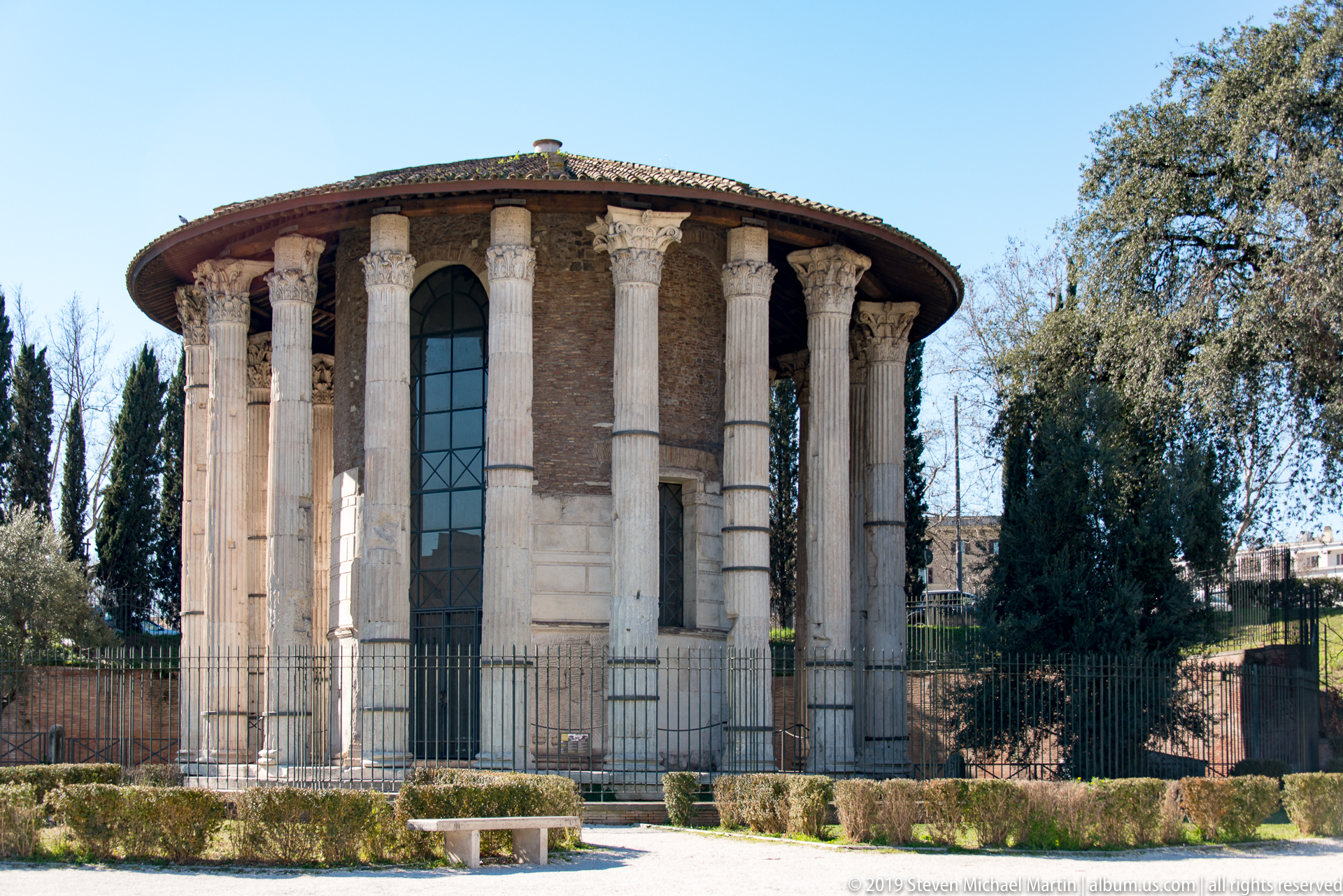
The circular Temple of Hercules Victor stands in the Forum Boarium, its ring of tall Corinthian columns surrounding the cylindrical cella. The ancient marble temple is shown from across a fenced garden, with the surviving colonnade, tiled roof, and later infill at the entrance clearly visible against trees and open sky.
Caption
The circular Temple of Hercules Victor stands in the Forum Boarium, its ring of tall Corinthian columns surrounding the cylindrical cella. The ancient marble temple is shown from across a fenced garden, with the surviving colonnade, tiled roof, and later infill at the entrance clearly visible against trees and open sky.
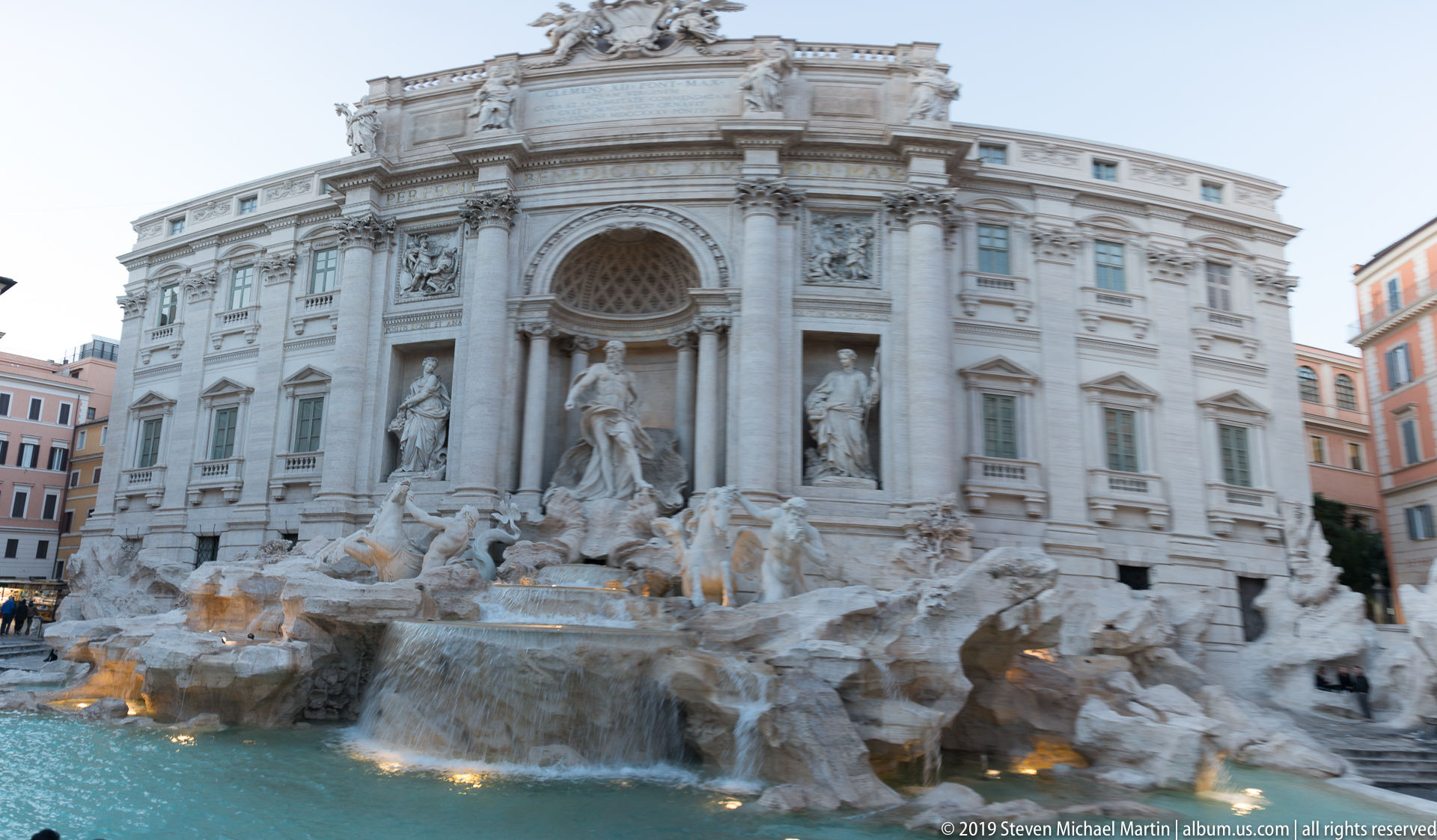
The Trevi Fountain fills the base of Palazzo Poli, where the monumental Baroque façade forms a theatrical backdrop for the rocky basin and its sculptural ensemble. The broad view shows the central triumphal arch, flanking niches, cascading stonework, and turquoise water that define one of Rome’s most recognizable urban fountains.
Caption
The Trevi Fountain fills the base of Palazzo Poli, where the monumental Baroque façade forms a theatrical backdrop for the rocky basin and its sculptural ensemble. The broad view shows the central triumphal arch, flanking niches, cascading stonework, and turquoise water that define one of Rome’s most recognizable urban fountains.

A formal stone gateway is framed by two columns supporting a pediment and a long Latin dedicatory inscription. Sculptural ornaments rise along the roofline while iron gates close the central passage, creating a symmetrical architectural composition in low winter light.
Caption
A formal stone gateway is framed by two columns supporting a pediment and a long Latin dedicatory inscription. Sculptural ornaments rise along the roofline while iron gates close the central passage, creating a symmetrical architectural composition in low winter light.

Oceanus dominates the central niche of the Trevi Fountain, seated above the rocky waterworks beneath the great coffered apse. This close view emphasizes the figure’s muscular anatomy, flowing beard, drapery, and commanding gesture, isolating the principal sculpture from the fountain’s larger architectural setting.
Caption
Oceanus dominates the central niche of the Trevi Fountain, seated above the rocky waterworks beneath the great coffered apse. This close view emphasizes the figure’s muscular anatomy, flowing beard, drapery, and commanding gesture, isolating the principal sculpture from the fountain’s larger architectural setting.

The central sculptural group of the Trevi Fountain is framed by massive columns and the deep coffered apse of Palazzo Poli. Oceanus stands at the center above the rocky basin, while portions of the sea-horse and attendant figures appear at the edges, showing how the fountain’s sculpture projects outward from its architectural setting.
Caption
The central sculptural group of the Trevi Fountain is framed by massive columns and the deep coffered apse of Palazzo Poli. Oceanus stands at the center above the rocky basin, while portions of the sea-horse and attendant figures appear at the edges, showing how the fountain’s sculpture projects outward from its architectural setting.

The papal coat of arms crowns the Trevi Fountain above its dedicatory inscription, framed by scrolling stonework and allegorical figures. The tiara and crossed keys identify the papal heraldry, while the inscription below names Clement XII, whose pontificate oversaw the fountain’s eighteenth-century reconstruction.
Caption
The papal coat of arms crowns the Trevi Fountain above its dedicatory inscription, framed by scrolling stonework and allegorical figures. The tiara and crossed keys identify the papal heraldry, while the inscription below names Clement XII, whose pontificate oversaw the fountain’s eighteenth-century reconstruction.

Warm artificial light begins to illuminate the Trevi Fountain as daylight fades, picking out the central sculpture and rocky cascades against the pale façade of Palazzo Poli. The frontal composition centers the monumental ensemble above the glowing water, emphasizing the fountain’s dramatic relationship between architecture, sculpture, and moving water.
Caption
Warm artificial light begins to illuminate the Trevi Fountain as daylight fades, picking out the central sculpture and rocky cascades against the pale façade of Palazzo Poli. The frontal composition centers the monumental ensemble above the glowing water, emphasizing the fountain’s dramatic relationship between architecture, sculpture, and moving water.

High above the Trevi Fountain, the coat of arms of Pope Clement XII is set within an elaborate Baroque cartouche beneath the papal tiara and crossed keys. Two winged figures flank the shield, their sweeping drapery and gestures turning the heraldic device into a sculptural crown for the fountain’s façade.
Caption
High above the Trevi Fountain, the coat of arms of Pope Clement XII is set within an elaborate Baroque cartouche beneath the papal tiara and crossed keys. Two winged figures flank the shield, their sweeping drapery and gestures turning the heraldic device into a sculptural crown for the fountain’s façade.

A tightly framed frontal view brings together the Trevi Fountain’s central niche, flanking allegorical statues, sea-horse groups, and stepped rockwork. The pale stone façade rises behind the sculpture in a dense arrangement of columns, relief panels, windows, and carved ornament, while evening lights begin to glow at water level.
Caption
A tightly framed frontal view brings together the Trevi Fountain’s central niche, flanking allegorical statues, sea-horse groups, and stepped rockwork. The pale stone façade rises behind the sculpture in a dense arrangement of columns, relief panels, windows, and carved ornament, while evening lights begin to glow at water level.

Two visitors pose at the edge of the crowded Trevi Fountain as the illuminated central sculptures rise behind them. The portrait places the human scale of the busy public space against the monumental Baroque backdrop, with the turquoise basin, dense crowd, and pale stone façade all visible around the pair.
Caption
Two visitors pose at the edge of the crowded Trevi Fountain as the illuminated central sculptures rise behind them. The portrait places the human scale of the busy public space against the monumental Baroque backdrop, with the turquoise basin, dense crowd, and pale stone façade all visible around the pair.

The Trevi Fountain’s principal sculptural ensemble fills the frame, with Oceanus centered beneath the great niche and allegorical figures occupying the side bays. Below, sea horses and attendants emerge from the carved rockwork around the basin, creating the layered movement characteristic of the fountain’s theatrical Baroque design.
Caption
The Trevi Fountain’s principal sculptural ensemble fills the frame, with Oceanus centered beneath the great niche and allegorical figures occupying the side bays. Below, sea horses and attendants emerge from the carved rockwork around the basin, creating the layered movement characteristic of the fountain’s theatrical Baroque design.

Oceanus is isolated against the central architectural niche of the Trevi Fountain, his bearded head, muscular torso, sweeping drapery, and extended arm rendered in pale stone. The close framing reveals the sculptural modeling and movement that can be lost in wider views of the fountain’s densely layered ensemble.
Caption
Oceanus is isolated against the central architectural niche of the Trevi Fountain, his bearded head, muscular torso, sweeping drapery, and extended arm rendered in pale stone. The close framing reveals the sculptural modeling and movement that can be lost in wider views of the fountain’s densely layered ensemble.

The Trevi Fountain spreads across the lower façade of Palazzo Poli in a broad view that includes the crowning attic, giant columns, central niche, flanking statuary, and expansive rocky basin. Seen from slightly below, the composition emphasizes how the fountain functions as both monumental architecture and an elaborate sculptural landscape.
Caption
The Trevi Fountain spreads across the lower façade of Palazzo Poli in a broad view that includes the crowning attic, giant columns, central niche, flanking statuary, and expansive rocky basin. Seen from slightly below, the composition emphasizes how the fountain functions as both monumental architecture and an elaborate sculptural landscape.

A robed female figure sits in a niche on the Trevi Fountain façade, holding a vessel or cluster of produce while turning outward above the fountain basin. Deep folds of drapery, the projecting ledge, and the surrounding Baroque stonework give the allegorical sculpture a strong silhouette against the pale masonry.
Caption
A robed female figure sits in a niche on the Trevi Fountain façade, holding a vessel or cluster of produce while turning outward above the fountain basin. Deep folds of drapery, the projecting ledge, and the surrounding Baroque stonework give the allegorical sculpture a strong silhouette against the pale masonry.

A second robed female allegory occupies the upper sculptural program of the Trevi Fountain, shown from below with one arm extended and an attribute held at her side. The low viewpoint silhouettes the figure and its deeply carved drapery against open sky, emphasizing the statue’s placement high on the architectural façade.
Caption
A second robed female allegory occupies the upper sculptural program of the Trevi Fountain, shown from below with one arm extended and an attribute held at her side. The low viewpoint silhouettes the figure and its deeply carved drapery against open sky, emphasizing the statue’s placement high on the architectural façade.

A rectangular relief panel on the Trevi Fountain façade presents a crowded classical narrative scene, with standing and seated figures arranged around a central exchange. The carved frame and high-relief modeling distinguish the panel from the fountain’s freestanding sculpture and connect it to the monument’s historical water-supply narrative.
Caption
A rectangular relief panel on the Trevi Fountain façade presents a crowded classical narrative scene, with standing and seated figures arranged around a central exchange. The carved frame and high-relief modeling distinguish the panel from the fountain’s freestanding sculpture and connect it to the monument’s historical water-supply narrative.

A standing female allegory fills a tall side niche of the Trevi Fountain, holding a long attribute while heavy drapery falls across her body. The surrounding inscription band and massive architectural framing place the figure within the ordered sculptural program of Palazzo Poli’s monumental fountain façade.
Caption
A standing female allegory fills a tall side niche of the Trevi Fountain, holding a long attribute while heavy drapery falls across her body. The surrounding inscription band and massive architectural framing place the figure within the ordered sculptural program of Palazzo Poli’s monumental fountain façade.

A rearing sea horse surges upward beside a muscular attendant in the lower sculptural group of the Trevi Fountain. The close view concentrates on the figures’ twisting bodies and the rough artificial rockwork around them, with warm fountain lighting accenting the pale stone near the waterline.
Caption
A rearing sea horse surges upward beside a muscular attendant in the lower sculptural group of the Trevi Fountain. The close view concentrates on the figures’ twisting bodies and the rough artificial rockwork around them, with warm fountain lighting accenting the pale stone near the waterline.

An oblique view across the Trevi Fountain brings the central Oceanus figure, flanking niche statues, sea horses, and layered rockwork into a compressed composition. Water spills across the lower ledges while warm lights pick out portions of the sculpture, revealing the fountain’s depth and theatrical staging from a side angle.
Caption
An oblique view across the Trevi Fountain brings the central Oceanus figure, flanking niche statues, sea horses, and layered rockwork into a compressed composition. Water spills across the lower ledges while warm lights pick out portions of the sculpture, revealing the fountain’s depth and theatrical staging from a side angle.

A sea horse rises from the Trevi Fountain’s rockwork beside a Triton-like attendant whose head and torso emerge close to the animal’s shoulder. Tight framing removes most of the architecture, drawing attention to the expressive faces, carved mane, muscular anatomy, and the dramatic interaction of figures within the fountain’s lower ensemble.
Caption
A sea horse rises from the Trevi Fountain’s rockwork beside a Triton-like attendant whose head and torso emerge close to the animal’s shoulder. Tight framing removes most of the architecture, drawing attention to the expressive faces, carved mane, muscular anatomy, and the dramatic interaction of figures within the fountain’s lower ensemble.

The Trevi Fountain’s turquoise basin curves through the foreground while a dense crowd fills the piazza beyond the sculpted rockwork. Seen from within the monument’s edge, the unusual viewpoint shifts attention from the façade to the fountain’s relationship with the surrounding urban space and its steady flow of visitors.
Caption
The Trevi Fountain’s turquoise basin curves through the foreground while a dense crowd fills the piazza beyond the sculpted rockwork. Seen from within the monument’s edge, the unusual viewpoint shifts attention from the façade to the fountain’s relationship with the surrounding urban space and its steady flow of visitors.

Seen from a steep angle below, the Trevi Fountain’s crowning papal heraldry projects above the façade with winged figures, scrolling stonework, and the papal insignia silhouetted against the sky. The diagonal composition emphasizes the sculptural depth of the attic ornament and the monument’s richly layered Baroque roofline.
Caption
Seen from a steep angle below, the Trevi Fountain’s crowning papal heraldry projects above the façade with winged figures, scrolling stonework, and the papal insignia silhouetted against the sky. The diagonal composition emphasizes the sculptural depth of the attic ornament and the monument’s richly layered Baroque roofline.

Oceanus is seen from an oblique side angle within the Trevi Fountain’s central architectural bay, one arm extending outward above the carved rockwork. The viewpoint reveals the statue’s twisting pose and layered drapery while portions of the surrounding columns and inscription frame the figure.
Caption
Oceanus is seen from an oblique side angle within the Trevi Fountain’s central architectural bay, one arm extending outward above the carved rockwork. The viewpoint reveals the statue’s twisting pose and layered drapery while portions of the surrounding columns and inscription frame the figure.

The bronze figure of the Virgin Mary crowns the Column of the Immaculate Conception near the Spanish Steps, standing above an ornate Corinthian capital. A halo of stars encircles her head, while floral offerings and decorative elements cluster around the upper shaft, seen here against a pale open sky.
Caption
The bronze figure of the Virgin Mary crowns the Column of the Immaculate Conception near the Spanish Steps, standing above an ornate Corinthian capital. A halo of stars encircles her head, while floral offerings and decorative elements cluster around the upper shaft, seen here against a pale open sky.

A blue-bordered street plaque reading “via di propaganda” is mounted directly on a pale stone wall. The close, documentary framing records the Roman street name with minimal surrounding context, preserving the typography, border, mounting post, and textured masonry as the principal visual information.
Caption
A blue-bordered street plaque reading “via di propaganda” is mounted directly on a pale stone wall. The close, documentary framing records the Roman street name with minimal surrounding context, preserving the typography, border, mounting post, and textured masonry as the principal visual information.

A carved sun-face spout sends water from the boat-shaped Fontana della Barcaccia at the foot of the Spanish Steps. The low-slung fountain, designed to work with the modest pressure of the Acqua Vergine, is traditionally associated with Pietro Bernini and his son Gian Lorenzo; its half-sunken boat form gives the Barcaccia its familiar name.
Caption
A carved sun-face spout sends water from the boat-shaped Fontana della Barcaccia at the foot of the Spanish Steps. The low-slung fountain, designed to work with the modest pressure of the Acqua Vergine, is traditionally associated with Pietro Bernini and his son Gian Lorenzo; its half-sunken boat form gives the Barcaccia its familiar name.

Shoppers and pedestrians fill the narrow, straight corridor of Via dei Condotti near Piazza di Spagna, where luxury storefronts line both sides of the cobbled street. The view looks along the dense urban canyon of historic façades, capturing the evening bustle and commercial character of one of central Rome’s best-known shopping streets.
Caption
Shoppers and pedestrians fill the narrow, straight corridor of Via dei Condotti near Piazza di Spagna, where luxury storefronts line both sides of the cobbled street. The view looks along the dense urban canyon of historic façades, capturing the evening bustle and commercial character of one of central Rome’s best-known shopping streets.

The Spanish Steps rise from Piazza di Spagna toward the twin-towered church of Trinità dei Monti, with the Fontana della Barcaccia centered in the foreground. Visitors spread across the broad stairways and terraces, giving the composition a clear sense of the monumental urban axis linking fountain, steps, obelisk, and church.
Caption
The Spanish Steps rise from Piazza di Spagna toward the twin-towered church of Trinità dei Monti, with the Fontana della Barcaccia centered in the foreground. Visitors spread across the broad stairways and terraces, giving the composition a clear sense of the monumental urban axis linking fountain, steps, obelisk, and church.

At dusk, visitors sit and gather across the Spanish Steps as the stairway rises toward Trinità dei Monti under a deepening blue sky. The Fontana della Barcaccia occupies the foreground, while the church’s twin towers and central obelisk anchor the upper terrace, emphasizing the piazza’s layered vertical composition.
Caption
At dusk, visitors sit and gather across the Spanish Steps as the stairway rises toward Trinità dei Monti under a deepening blue sky. The Fontana della Barcaccia occupies the foreground, while the church’s twin towers and central obelisk anchor the upper terrace, emphasizing the piazza’s layered vertical composition.

The ancient Egyptian Flaminio Obelisk rises from its monumental base in Piazza del Popolo, its hieroglyph-covered granite shaft glowing in low sunlight. One of the marble lion fountains at the base appears in the foreground, linking the obelisk to the nineteenth-century fountain ensemble surrounding the central monument.
Caption
The ancient Egyptian Flaminio Obelisk rises from its monumental base in Piazza del Popolo, its hieroglyph-covered granite shaft glowing in low sunlight. One of the marble lion fountains at the base appears in the foreground, linking the obelisk to the nineteenth-century fountain ensemble surrounding the central monument.

The upper portion of the Flaminio Obelisk is isolated against a cloudless sky, allowing the vertical bands of Egyptian hieroglyphs to read clearly across the weathered granite. Warm sunlight catches one face of the shaft, while the small cross and mounting at the summit mark its later Christian adaptation in Rome.
Caption
The upper portion of the Flaminio Obelisk is isolated against a cloudless sky, allowing the vertical bands of Egyptian hieroglyphs to read clearly across the weathered granite. Warm sunlight catches one face of the shaft, while the small cross and mounting at the summit mark its later Christian adaptation in Rome.

A frontal view from Piazza di Spagna looks directly up the Spanish Steps toward Trinità dei Monti, with crowds ascending and gathering on the terraces. The Fontana della Barcaccia is partly visible at the bottom edge, while the central obelisk and twin bell towers create a strong vertical focus above the staircase.
Caption
A frontal view from Piazza di Spagna looks directly up the Spanish Steps toward Trinità dei Monti, with crowds ascending and gathering on the terraces. The Fontana della Barcaccia is partly visible at the bottom edge, while the central obelisk and twin bell towers create a strong vertical focus above the staircase.

The lower flights of the Spanish Steps rise behind a dense crowd in Piazza di Spagna, framed by warm-toned historic buildings and the balustraded terraces of the monumental stairway. The broad urban view emphasizes the staircase as a gathering place, with visitors occupying both the piazza and the ascending steps in late-afternoon light.
Caption
The lower flights of the Spanish Steps rise behind a dense crowd in Piazza di Spagna, framed by warm-toned historic buildings and the balustraded terraces of the monumental stairway. The broad urban view emphasizes the staircase as a gathering place, with visitors occupying both the piazza and the ascending steps in late-afternoon light.

Marble statuary and cascading architectural elements rise against the wooded slope at the edge of Piazza del Popolo. A standing classical figure occupies the foreground while additional sculptures, balustrades, and an arched terrace structure step upward behind it, showing the square’s elaborate connection to the Pincian hillside.
Caption
Marble statuary and cascading architectural elements rise against the wooded slope at the edge of Piazza del Popolo. A standing classical figure occupies the foreground while additional sculptures, balustrades, and an arched terrace structure step upward behind it, showing the square’s elaborate connection to the Pincian hillside.

The Fontana dei Leoni surrounds the Flaminio Obelisk with four circular travertine basins and Egyptian-style marble lions set on stepped pyramidal supports. Giuseppe Valadier created the ensemble in 1823 as part of his sweeping reorganization of Piazza del Popolo, integrating fountains, sculpture, gardens, and the ancient obelisk into a unified urban composition.
Caption
The Fontana dei Leoni surrounds the Flaminio Obelisk with four circular travertine basins and Egyptian-style marble lions set on stepped pyramidal supports. Giuseppe Valadier created the ensemble in 1823 as part of his sweeping reorganization of Piazza del Popolo, integrating fountains, sculpture, gardens, and the ancient obelisk into a unified urban composition.

One of Giuseppe Valadier’s four Egyptian-style marble lions pours water into a circular travertine basin at the base of the Flaminio Obelisk. Installed as part of Valadier’s 1823 redesign of Piazza del Popolo, the Fontana dei Leoni replaced an earlier fountain and turned the ancient obelisk into the organizing centerpiece of the monumental square.
Caption
One of Giuseppe Valadier’s four Egyptian-style marble lions pours water into a circular travertine basin at the base of the Flaminio Obelisk. Installed as part of Valadier’s 1823 redesign of Piazza del Popolo, the Fontana dei Leoni replaced an earlier fountain and turned the ancient obelisk into the organizing centerpiece of the monumental square.

A carved winged dragon crouches along the roofline of a classical gate, its long neck, open jaws, folded wings, and coiled body sharply silhouetted against bare winter branches. Warm sunlight accentuates the sculptural modeling and weathered stone, turning the heraldic creature into the dominant architectural detail.
Caption
A carved winged dragon crouches along the roofline of a classical gate, its long neck, open jaws, folded wings, and coiled body sharply silhouetted against bare winter branches. Warm sunlight accentuates the sculptural modeling and weathered stone, turning the heraldic creature into the dominant architectural detail.

A standing marble figure in historical dress rises on a tall inscribed pedestal beside directional signs in a wooded Roman park. The figure holds an object close to the chest and is framed by mature trees, while the utilitarian wayfinding signs beside the monument emphasize its setting within a larger landscaped public space.
Caption
A standing marble figure in historical dress rises on a tall inscribed pedestal beside directional signs in a wooded Roman park. The figure holds an object close to the chest and is framed by mature trees, while the utilitarian wayfinding signs beside the monument emphasize its setting within a larger landscaped public space.

The Fontana della Dea Roma occupies the eastern hemicycle of Piazza del Popolo beneath the Pincian terrace. Designed by Giuseppe Valadier and sculpted by Giovanni Ceccarini, the group was completed in 1823: helmeted Roma stands between personifications of the Tiber and Aniene rivers, while the she-wolf nursing Romulus and Remus appears at her feet.
Caption
The Fontana della Dea Roma occupies the eastern hemicycle of Piazza del Popolo beneath the Pincian terrace. Designed by Giuseppe Valadier and sculpted by Giovanni Ceccarini, the group was completed in 1823: helmeted Roma stands between personifications of the Tiber and Aniene rivers, while the she-wolf nursing Romulus and Remus appears at her feet.

Neptune presides over the western hemicycle of Piazza del Popolo, holding his trident above two Tritons accompanied by dolphins. The Fontana del Nettuno was designed by Giuseppe Valadier and sculpted by Giovanni Ceccarini in 1822–1824 as the western counterpart to the Fontana della Dea Roma, completing the monumental nineteenth-century arrangement of the piazza.
Caption
Neptune presides over the western hemicycle of Piazza del Popolo, holding his trident above two Tritons accompanied by dolphins. The Fontana del Nettuno was designed by Giuseppe Valadier and sculpted by Giovanni Ceccarini in 1822–1824 as the western counterpart to the Fontana della Dea Roma, completing the monumental nineteenth-century arrangement of the piazza.

The inner façade of Porta del Popolo faces Piazza del Popolo with the Chigi arms and the inscription “Felici faustoque ingressui MDCLV,” created by Gian Lorenzo Bernini for Pope Alexander VII to welcome the former Queen Christina of Sweden to Rome in 1655. The restrained architectural screen transformed the city-facing side of the ancient Porta Flaminia into a ceremonial entrance to papal Rome.
Caption
The inner façade of Porta del Popolo faces Piazza del Popolo with the Chigi arms and the inscription “Felici faustoque ingressui MDCLV,” created by Gian Lorenzo Bernini for Pope Alexander VII to welcome the former Queen Christina of Sweden to Rome in 1655. The restrained architectural screen transformed the city-facing side of the ancient Porta Flaminia into a ceremonial entrance to papal Rome.

Porta del Popolo presents its monumental outer façade toward Piazzale Flaminio, marking the northern entrance of the ancient Via Flaminia into Rome. Rebuilt between 1562 and 1565 by Nanni di Baccio Bigio after a commission initially given to Michelangelo, the façade draws on the form of a Roman triumphal arch and incorporates columns from Old St. Peter’s Basilica.
Caption
Porta del Popolo presents its monumental outer façade toward Piazzale Flaminio, marking the northern entrance of the ancient Via Flaminia into Rome. Rebuilt between 1562 and 1565 by Nanni di Baccio Bigio after a commission initially given to Michelangelo, the façade draws on the form of a Roman triumphal arch and incorporates columns from Old St. Peter’s Basilica.

A second view isolates a winged dragon perched on the corner of an ornate stone gateway. The creature’s raised head, folded wings, and curled tail stand above a richly carved cornice, while leafless branches and deep blue sky provide a stark backdrop to the pale sculptural ornament.
Caption
A second view isolates a winged dragon perched on the corner of an ornate stone gateway. The creature’s raised head, folded wings, and curled tail stand above a richly carved cornice, while leafless branches and deep blue sky provide a stark backdrop to the pale sculptural ornament.

Two freestanding neoclassical gateways frame a roadway, each built as a small temple front with columns, triangular pediment, Latin inscription, and sculptural ornaments along the roofline. The paired structures create a ceremonial entrance, their pale stone strongly lit against a clear blue sky and dark surrounding trees.
Caption
Two freestanding neoclassical gateways frame a roadway, each built as a small temple front with columns, triangular pediment, Latin inscription, and sculptural ornaments along the roofline. The paired structures create a ceremonial entrance, their pale stone strongly lit against a clear blue sky and dark surrounding trees.

A shallow stone basin sits among rough rockwork and moss at the edge of a small pond, backed by a tall white arched monument crowned with an eagle. Bare trees and dense evergreens enclose the scene, giving this ornamental water feature the character of a picturesque garden composition within Villa Borghese.
Caption
A shallow stone basin sits among rough rockwork and moss at the edge of a small pond, backed by a tall white arched monument crowned with an eagle. Bare trees and dense evergreens enclose the scene, giving this ornamental water feature the character of a picturesque garden composition within Villa Borghese.

The monumental façade of Rome’s Galleria Nazionale d’Arte Moderna e Contemporanea stretches across the frame, centered on a deep columned portico and broad ceremonial stair. Temporary contemporary installations occupy the forecourt and steps, contrasting with the symmetrical classical architecture of the museum’s early twentieth-century exterior.
Caption
The monumental façade of Rome’s Galleria Nazionale d’Arte Moderna e Contemporanea stretches across the frame, centered on a deep columned portico and broad ceremonial stair. Temporary contemporary installations occupy the forecourt and steps, contrasting with the symmetrical classical architecture of the museum’s early twentieth-century exterior.

Several dark buffalo sculptures stand across the paved forecourt near the National Gallery of Modern and Contemporary Art, their heavy bodies distributed at different distances from the camera. A tall fountain rises at the left and umbrella pines frame the background, placing the animal forms within an outdoor contemporary-art setting.
Caption
Several dark buffalo sculptures stand across the paved forecourt near the National Gallery of Modern and Contemporary Art, their heavy bodies distributed at different distances from the camera. A tall fountain rises at the left and umbrella pines frame the background, placing the animal forms within an outdoor contemporary-art setting.

A broad stone basin rises from moss-covered rockwork beside a reflective pond, with a white arched monument and eagle finial standing beyond. The frontal view clarifies the layered garden design: water in the foreground, rustic stone in the middle ground, and formal classical architecture framed by trees behind.
Caption
A broad stone basin rises from moss-covered rockwork beside a reflective pond, with a white arched monument and eagle finial standing beyond. The frontal view clarifies the layered garden design: water in the foreground, rustic stone in the middle ground, and formal classical architecture framed by trees behind.

A brightly patterned female figure stands dramatically lit against a dark wooded background, arms extended and head turned to one side. The stylized clothing, pale face, and theatrical pose distinguish the work from traditional marble monuments nearby, marking it as part of a contemporary outdoor art display.
Caption
A brightly patterned female figure stands dramatically lit against a dark wooded background, arms extended and head turned to one side. The stylized clothing, pale face, and theatrical pose distinguish the work from traditional marble monuments nearby, marking it as part of a contemporary outdoor art display.
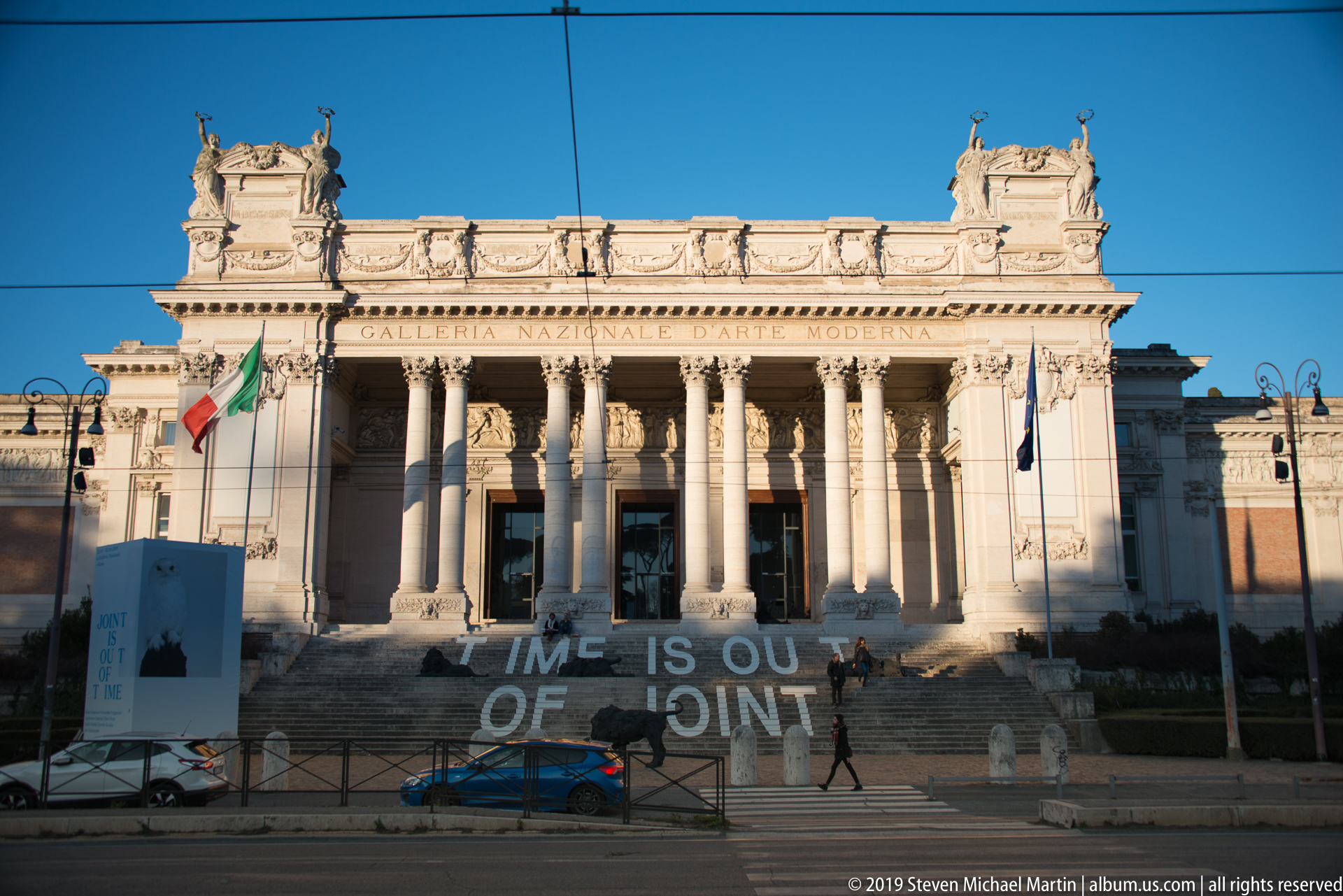
The main entrance of the Galleria Nazionale d’Arte Moderna e Contemporanea is shown head-on, its tall Corinthian columns supporting the inscribed entablature above the museum steps. Flags, banners, and a large temporary text installation occupy the forecourt, layering contemporary exhibition material over the building’s formal classical façade.
Caption
The main entrance of the Galleria Nazionale d’Arte Moderna e Contemporanea is shown head-on, its tall Corinthian columns supporting the inscribed entablature above the museum steps. Flags, banners, and a large temporary text installation occupy the forecourt, layering contemporary exhibition material over the building’s formal classical façade.

A solitary dark buffalo sculpture stands in the forecourt of the Galleria Nazionale d’Arte Moderna e Contemporanea, silhouetted against the museum’s broad entrance steps. Large temporary lettering stretches across the staircase behind it, creating a striking contrast between the animal form, contemporary intervention, and monumental classical columns.
Caption
A solitary dark buffalo sculpture stands in the forecourt of the Galleria Nazionale d’Arte Moderna e Contemporanea, silhouetted against the museum’s broad entrance steps. Large temporary lettering stretches across the staircase behind it, creating a striking contrast between the animal form, contemporary intervention, and monumental classical columns.

Late sunlight warms the long side elevation of the Galleria Nazionale d’Arte Moderna e Contemporanea, revealing alternating brick wall panels and pale classical stonework. The oblique view shifts away from the famous entrance portico to show the museum’s extended massing, cornices, pilasters, and landscaped grounds.
Caption
Late sunlight warms the long side elevation of the Galleria Nazionale d’Arte Moderna e Contemporanea, revealing alternating brick wall panels and pale classical stonework. The oblique view shifts away from the famous entrance portico to show the museum’s extended massing, cornices, pilasters, and landscaped grounds.

The ruins of the Palatine Hill rise above the long open floor of the Circus Maximus, with brick arches and palace remains silhouetted against a clear blue sky. The broad view preserves the topographic relationship between Rome’s imperial hill and the ancient chariot-racing valley below.
Caption
The ruins of the Palatine Hill rise above the long open floor of the Circus Maximus, with brick arches and palace remains silhouetted against a clear blue sky. The broad view preserves the topographic relationship between Rome’s imperial hill and the ancient chariot-racing valley below.

Castel Sant’Angelo rises in massive cylindrical tiers above the Tiber-side fortifications, crowned by the bronze angel on its summit terrace. The frontal view emphasizes the monument’s layered construction, defensive walls, Italian flag, and later papal additions, all sharply outlined against a brilliant blue sky.
Caption
Castel Sant’Angelo rises in massive cylindrical tiers above the Tiber-side fortifications, crowned by the bronze angel on its summit terrace. The frontal view emphasizes the monument’s layered construction, defensive walls, Italian flag, and later papal additions, all sharply outlined against a brilliant blue sky.

Palazzo Senatorio closes the eastern side of Piazza del Campidoglio, its broad Renaissance façade rising behind the equestrian statue of Marcus Aurelius. Michelangelo’s double staircase spreads across the lower level, while the central clock tower creates a strong vertical axis above the civic palace on the Capitoline Hill.
Caption
Palazzo Senatorio closes the eastern side of Piazza del Campidoglio, its broad Renaissance façade rising behind the equestrian statue of Marcus Aurelius. Michelangelo’s double staircase spreads across the lower level, while the central clock tower creates a strong vertical axis above the civic palace on the Capitoline Hill.

An angel bearing a symbol of Christ’s Passion stands on Ponte Sant’Angelo, part of the celebrated series of ten marble angels designed under Gian Lorenzo Bernini for Pope Clement IX in the late 1660s. Set on high inscribed pedestals along the former Pons Aelius, the figures transform the approach to Castel Sant’Angelo and the Vatican into a sculptural meditation on the Passion.
Caption
An angel bearing a symbol of Christ’s Passion stands on Ponte Sant’Angelo, part of the celebrated series of ten marble angels designed under Gian Lorenzo Bernini for Pope Clement IX in the late 1660s. Set on high inscribed pedestals along the former Pons Aelius, the figures transform the approach to Castel Sant’Angelo and the Vatican into a sculptural meditation on the Passion.

The pale travertine façade of Santa Maria in Vallicella, known as the Chiesa Nuova, rises in two articulated levels beneath a triangular pediment and cross. Paired pilasters, sculpted niches, curved volutes, and the central entrance create the balanced late-Renaissance church front, shown here in strong sunlight against a deep blue sky.
Caption
The pale travertine façade of Santa Maria in Vallicella, known as the Chiesa Nuova, rises in two articulated levels beneath a triangular pediment and cross. Paired pilasters, sculpted niches, curved volutes, and the central entrance create the balanced late-Renaissance church front, shown here in strong sunlight against a deep blue sky.

The bronze figure of Saint Peter stands at the summit of Trajan’s Column, identifiable by the large keys held at his side and the halo above his head. The close view isolates the later Christian statue against an intense blue sky, emphasizing the transformation of an ancient imperial monument through post-antique religious imagery.
Caption
The bronze figure of Saint Peter stands at the summit of Trajan’s Column, identifiable by the large keys held at his side and the halo above his head. The close view isolates the later Christian statue against an intense blue sky, emphasizing the transformation of an ancient imperial monument through post-antique religious imagery.

Monumental statues of the Dioscuri, Castor and Pollux with their horses, frame the upper approach to Piazza del Campidoglio. Beyond them, Palazzo Senatorio and its clock tower terminate the axis of the square, while the balustrades and converging architecture emphasize Michelangelo’s carefully staged ceremonial setting on the Capitoline Hill.
Caption
Monumental statues of the Dioscuri, Castor and Pollux with their horses, frame the upper approach to Piazza del Campidoglio. Beyond them, Palazzo Senatorio and its clock tower terminate the axis of the square, while the balustrades and converging architecture emphasize Michelangelo’s carefully staged ceremonial setting on the Capitoline Hill.

The monumental white-marble Vittoriano rises above Piazza Venezia, with the equestrian statue of Victor Emmanuel II centered before its long Corinthian colonnade. Italian flags frame the composition, while the broad stairways and sculptural terraces reinforce the scale of the national monument against a brilliant blue sky.
Caption
The monumental white-marble Vittoriano rises above Piazza Venezia, with the equestrian statue of Victor Emmanuel II centered before its long Corinthian colonnade. Italian flags frame the composition, while the broad stairways and sculptural terraces reinforce the scale of the national monument against a brilliant blue sky.

The domed church of Santa Maria di Loreto rises beside Trajan’s Column, its pale drum, lantern, and sculptural roofline sharply defined against the sky. The ancient column appears at the right edge, bringing Renaissance sacred architecture into direct visual dialogue with the surviving monuments of Trajan’s Forum.
Caption
The domed church of Santa Maria di Loreto rises beside Trajan’s Column, its pale drum, lantern, and sculptural roofline sharply defined against the sky. The ancient column appears at the right edge, bringing Renaissance sacred architecture into direct visual dialogue with the surviving monuments of Trajan’s Forum.

Trajan’s Column and the domed Santa Maria di Loreto rise above scattered columns and archaeological remains of the imperial forums. The layered view combines ancient masonry, Renaissance church architecture, and later urban buildings, illustrating the extraordinary vertical accumulation of Rome’s historical fabric around Trajan’s Forum.
Caption
Trajan’s Column and the domed Santa Maria di Loreto rise above scattered columns and archaeological remains of the imperial forums. The layered view combines ancient masonry, Renaissance church architecture, and later urban buildings, illustrating the extraordinary vertical accumulation of Rome’s historical fabric around Trajan’s Forum.

Saint Peter stands above the richly carved capital and viewing platform of Trajan’s Column, holding his keys while a halo encircles his head. The wider detail includes the column’s uppermost spiral reliefs and modern railing, showing how the seventeenth-century Christian statue crowns the ancient Roman commemorative shaft.
Caption
Saint Peter stands above the richly carved capital and viewing platform of Trajan’s Column, holding his keys while a halo encircles his head. The wider detail includes the column’s uppermost spiral reliefs and modern railing, showing how the seventeenth-century Christian statue crowns the ancient Roman commemorative shaft.

Trajan’s Column rises beside the domed church of Santa Maria di Loreto, bringing the ancient commemorative monument and later Renaissance cityscape into one tightly framed view. The column’s continuous sculpted frieze climbs toward the statue of Saint Peter, while the church’s lantern and curving dome fill the opposite side.
Caption
Trajan’s Column rises beside the domed church of Santa Maria di Loreto, bringing the ancient commemorative monument and later Renaissance cityscape into one tightly framed view. The column’s continuous sculpted frieze climbs toward the statue of Saint Peter, while the church’s lantern and curving dome fill the opposite side.

The marble relief of Trajan’s Column unfolds in tightly packed horizontal bands, showing soldiers, fortified camps, boats, buildings, and marching formations within the continuous narrative of the Dacian campaigns. Weathering softens individual details, yet the extraordinary density of figures and architecture remains legible across the spiraling surface.
Caption
The marble relief of Trajan’s Column unfolds in tightly packed horizontal bands, showing soldiers, fortified camps, boats, buildings, and marching formations within the continuous narrative of the Dacian campaigns. Weathering softens individual details, yet the extraordinary density of figures and architecture remains legible across the spiraling surface.

Successive bands of Trajan’s Column show Roman troops moving through a densely carved landscape of camps, architecture, vessels, and assembled figures. The close framing reveals how the continuous spiral compresses many episodes into a single sculptural narrative, with repeated soldiers and built structures guiding the eye around the marble shaft.
Caption
Successive bands of Trajan’s Column show Roman troops moving through a densely carved landscape of camps, architecture, vessels, and assembled figures. The close framing reveals how the continuous spiral compresses many episodes into a single sculptural narrative, with repeated soldiers and built structures guiding the eye around the marble shaft.

A monumental bronze Emperor Nerva extends one arm in an oratorical gesture while holding a staff in the other, his cuirass and draped military cloak rendered in emphatic classical detail. Set against brick ruins near the Forum of Nerva, the modern monument evokes the imperial ruler associated with this part of Rome’s archaeological landscape.
Caption
A monumental bronze Emperor Nerva extends one arm in an oratorical gesture while holding a staff in the other, his cuirass and draped military cloak rendered in emphatic classical detail. Set against brick ruins near the Forum of Nerva, the modern monument evokes the imperial ruler associated with this part of Rome’s archaeological landscape.

Augustus stands in a monumental bronze adaptation of the Prima Porta type, armored and raising his right arm in command. A gull perched on his head adds an unexpected contemporary detail to the formal imperial pose, while the surrounding brick ruins locate the sculpture within Rome’s imperial-forum district.
Caption
Augustus stands in a monumental bronze adaptation of the Prima Porta type, armored and raising his right arm in command. A gull perched on his head adds an unexpected contemporary detail to the formal imperial pose, while the surrounding brick ruins locate the sculpture within Rome’s imperial-forum district.

The bronze figure of Augustus raises his right hand beneath an umbrella pine, with a white gull perched conspicuously on his head. Beyond the statue, the dome of Santa Maria di Loreto and the shaft of Trajan’s Column anchor the wider imperial-forum setting, linking the modern imperial portrait with Rome’s surviving ancient and later monuments.
Caption
The bronze figure of Augustus raises his right hand beneath an umbrella pine, with a white gull perched conspicuously on his head. Beyond the statue, the dome of Santa Maria di Loreto and the shaft of Trajan’s Column anchor the wider imperial-forum setting, linking the modern imperial portrait with Rome’s surviving ancient and later monuments.

Arched substructures and fragmented masonry fill the archaeological foreground while Trajan’s Column and the dome of Santa Maria di Loreto rise beyond. The view uses the excavated levels to show the depth of the imperial-forum landscape, where ancient foundations sit well below the modern streets and later church façades.
Caption
Arched substructures and fragmented masonry fill the archaeological foreground while Trajan’s Column and the dome of Santa Maria di Loreto rise beyond. The view uses the excavated levels to show the depth of the imperial-forum landscape, where ancient foundations sit well below the modern streets and later church façades.

A broad view across the imperial-forum excavations reveals broken walls, column bases, arches, and grassy ancient foundations below the modern city. Trajan’s Column and the domed churches beyond form the skyline, while umbrella pines at the left frame the layered archaeological terrain in strong winter sunlight.
Caption
A broad view across the imperial-forum excavations reveals broken walls, column bases, arches, and grassy ancient foundations below the modern city. Trajan’s Column and the domed churches beyond form the skyline, while umbrella pines at the left frame the layered archaeological terrain in strong winter sunlight.

Trajan’s Column stands near the center of a sweeping view across excavated imperial-forum remains, with Santa Maria di Loreto and neighboring domes rising behind. Ancient arches, wall foundations, and isolated masonry occupy the lower ground, while later palazzi form a dense urban edge around the archaeological site.
Caption
Trajan’s Column stands near the center of a sweeping view across excavated imperial-forum remains, with Santa Maria di Loreto and neighboring domes rising behind. Ancient arches, wall foundations, and isolated masonry occupy the lower ground, while later palazzi form a dense urban edge around the archaeological site.

Trajan’s Column rises alone above the surrounding forum ruins and later city buildings, its continuous spiral relief clearly visible from base to summit. The bronze Saint Peter crowns the shaft, while warm-toned façades behind the monument provide scale and emphasize the column’s remarkable survival within central Rome.
Caption
Trajan’s Column rises alone above the surrounding forum ruins and later city buildings, its continuous spiral relief clearly visible from base to summit. The bronze Saint Peter crowns the shaft, while warm-toned façades behind the monument provide scale and emphasize the column’s remarkable survival within central Rome.

The curved outer wall of the Colosseum fills the frame, its stacked arcades and weathered travertine glowing in strong sunlight. Large openings expose the rhythm of the ancient amphitheater’s structural system, while missing outer masonry at the upper levels reveals the monument’s long history of damage, reuse, and conservation.
Caption
The curved outer wall of the Colosseum fills the frame, its stacked arcades and weathered travertine glowing in strong sunlight. Large openings expose the rhythm of the ancient amphitheater’s structural system, while missing outer masonry at the upper levels reveals the monument’s long history of damage, reuse, and conservation.

A close portrait places a visitor in front of the Colosseum’s sunlit arcades, the ancient masonry deliberately blurred into a recognizable architectural backdrop. The tighter crop emphasizes the subject while retaining enough of the amphitheater’s stacked arches to establish the setting within Rome’s archaeological center.
Caption
A close portrait places a visitor in front of the Colosseum’s sunlit arcades, the ancient masonry deliberately blurred into a recognizable architectural backdrop. The tighter crop emphasizes the subject while retaining enough of the amphitheater’s stacked arches to establish the setting within Rome’s archaeological center.

A surviving row of tall stone columns rises above rectangular foundations and grassy archaeological remains in the Forum of Caesar. Behind the ancient site, the brick mass of the church of Santi Luca e Martina and the Capitoline skyline create a dense backdrop, showing the forum embedded within later central Rome.
Caption
A surviving row of tall stone columns rises above rectangular foundations and grassy archaeological remains in the Forum of Caesar. Behind the ancient site, the brick mass of the church of Santi Luca e Martina and the Capitoline skyline create a dense backdrop, showing the forum embedded within later central Rome.

The brick church of Santi Luca e Martina anchors a layered view across the archaeological zone, while the white Vittoriano rises prominently on the skyline beyond. Ancient columns and low ruins occupy the foreground, connecting the surviving structures of classical Rome with later churches and monumental national architecture.
Caption
The brick church of Santi Luca e Martina anchors a layered view across the archaeological zone, while the white Vittoriano rises prominently on the skyline beyond. Ancient columns and low ruins occupy the foreground, connecting the surviving structures of classical Rome with later churches and monumental national architecture.

A visitor poses beside a stone railing with the Colosseum’s repeating arcades filling the background. Shallow depth of field keeps the figure crisp while the ancient amphitheater softens behind him, creating a travel portrait that clearly locates the subject at one of Rome’s most recognizable archaeological monuments.
Caption
A visitor poses beside a stone railing with the Colosseum’s repeating arcades filling the background. Shallow depth of field keeps the figure crisp while the ancient amphitheater softens behind him, creating a travel portrait that clearly locates the subject at one of Rome’s most recognizable archaeological monuments.

Broken walls, column fragments, and excavated foundations spread across the foreground beneath the brick church of Santi Luca e Martina. The white Vittoriano rises beyond the church and trees, creating a layered panorama in which ancient archaeological remains, Christian architecture, and modern national monument occupy the same Roman skyline.
Caption
Broken walls, column fragments, and excavated foundations spread across the foreground beneath the brick church of Santi Luca e Martina. The white Vittoriano rises beyond the church and trees, creating a layered panorama in which ancient archaeological remains, Christian architecture, and modern national monument occupy the same Roman skyline.

A seated visitor faces the camera with the Colosseum’s massive arcades filling the background. The shallow focus separates the figure from the warm, weathered stone of the amphitheater, while the close viewpoint retains the distinctive sequence of large arches that immediately establishes the Roman setting.
Caption
A seated visitor faces the camera with the Colosseum’s massive arcades filling the background. The shallow focus separates the figure from the warm, weathered stone of the amphitheater, while the close viewpoint retains the distinctive sequence of large arches that immediately establishes the Roman setting.

A wider seated portrait shows a visitor against the curving exterior of the Colosseum, where multiple tiers of arches extend across the background. The composition balances the human subject with a substantial section of the amphitheater, preserving both the personal travel moment and the scale of the ancient monument.
Caption
A wider seated portrait shows a visitor against the curving exterior of the Colosseum, where multiple tiers of arches extend across the background. The composition balances the human subject with a substantial section of the amphitheater, preserving both the personal travel moment and the scale of the ancient monument.

The Arch of Constantine stands in bright sunlight beside the Colosseum, its three passageways framed by Corinthian columns and richly carved relief panels. The broad attic above carries the dedicatory inscription, while reused imperial sculpture and roundels cover the façades, making the monument a dense visual anthology of Roman commemorative art.
Caption
The Arch of Constantine stands in bright sunlight beside the Colosseum, its three passageways framed by Corinthian columns and richly carved relief panels. The broad attic above carries the dedicatory inscription, while reused imperial sculpture and roundels cover the façades, making the monument a dense visual anthology of Roman commemorative art.

A close architectural view concentrates on a heavily weathered section of the Colosseum’s outer structure, where brick infill, travertine blocks, arched openings, and countless small holes record centuries of alteration. The irregular masonry reveals the amphitheater as an archaeological fabric rather than a complete classical façade.
Caption
A close architectural view concentrates on a heavily weathered section of the Colosseum’s outer structure, where brick infill, travertine blocks, arched openings, and countless small holes record centuries of alteration. The irregular masonry reveals the amphitheater as an archaeological fabric rather than a complete classical façade.

A massive modern brick buttress braces the surviving outer wall of the Colosseum, cutting diagonally across the ancient travertine arcades. The unusual side view makes the structural intervention prominent, showing how later engineering measures stabilize the exposed edge of the amphitheater where much of the original outer ring has disappeared.
Caption
A massive modern brick buttress braces the surviving outer wall of the Colosseum, cutting diagonally across the ancient travertine arcades. The unusual side view makes the structural intervention prominent, showing how later engineering measures stabilize the exposed edge of the amphitheater where much of the original outer ring has disappeared.

A marble commemorative plaque is set into weathered masonry beneath a shallow brick arch, its Latin inscription framed by a pale architectural border and a prominent cross above. The close view contrasts the crisp modern memorial tablet with the irregular ancient stonework surrounding it near the Colosseum archaeological area.
Caption
A marble commemorative plaque is set into weathered masonry beneath a shallow brick arch, its Latin inscription framed by a pale architectural border and a prominent cross above. The close view contrasts the crisp modern memorial tablet with the irregular ancient stonework surrounding it near the Colosseum archaeological area.

The Colosseum dominates a broad open view, its elliptical outer wall exposing stacked arcades, surviving upper masonry, and the irregular edge where much of the original exterior ring has disappeared. Visitors circulating around the amphitheater provide scale for the monumental Flavian structure beneath a cloudless blue sky.
Caption
The Colosseum dominates a broad open view, its elliptical outer wall exposing stacked arcades, surviving upper masonry, and the irregular edge where much of the original exterior ring has disappeared. Visitors circulating around the amphitheater provide scale for the monumental Flavian structure beneath a cloudless blue sky.

Seen from slightly above the surrounding plaza, the Colosseum’s curving façade stretches across the frame in alternating bands of open arcades and weathered masonry. The elevated viewpoint reveals the pedestrian circulation around the monument and emphasizes the amphitheater’s elliptical mass against the deep blue Roman sky.
Caption
Seen from slightly above the surrounding plaza, the Colosseum’s curving façade stretches across the frame in alternating bands of open arcades and weathered masonry. The elevated viewpoint reveals the pedestrian circulation around the monument and emphasizes the amphitheater’s elliptical mass against the deep blue Roman sky.

The Arch of Constantine rises from a low oblique viewpoint, its three passageways, projecting Corinthian columns, sculpted roundels, relief panels, and inscribed attic compressed into a powerful monumental mass. Strong sunlight models the reused imperial sculpture and pale stone surfaces against a saturated blue sky.
Caption
The Arch of Constantine rises from a low oblique viewpoint, its three passageways, projecting Corinthian columns, sculpted roundels, relief panels, and inscribed attic compressed into a powerful monumental mass. Strong sunlight models the reused imperial sculpture and pale stone surfaces against a saturated blue sky.

A seated visitor faces the camera with the Colosseum’s sunlit arcades filling the softly focused background. The portrait uses shallow depth of field to separate the figure from the ancient amphitheater while retaining the repeating arches and warm travertine tones that establish the unmistakable Roman setting.
Caption
A seated visitor faces the camera with the Colosseum’s sunlit arcades filling the softly focused background. The portrait uses shallow depth of field to separate the figure from the ancient amphitheater while retaining the repeating arches and warm travertine tones that establish the unmistakable Roman setting.

The central passage of the Arch of Constantine is framed by fluted Corinthian columns and a dense sequence of sculptural zones. Circular medallions, rectangular reliefs, standing captives, and the attic inscription stack vertically above the arch, demonstrating the monument’s complex combination of architecture and reused imperial sculpture.
Caption
The central passage of the Arch of Constantine is framed by fluted Corinthian columns and a dense sequence of sculptural zones. Circular medallions, rectangular reliefs, standing captives, and the attic inscription stack vertically above the arch, demonstrating the monument’s complex combination of architecture and reused imperial sculpture.

A close architectural study isolates the upper sculptural program of the Arch of Constantine, where rectangular narrative reliefs are framed by standing Dacian captives on projecting pedestals. The weathered figures and densely carved scenes demonstrate the arch’s assemblage of earlier imperial sculpture within Constantine’s fourth-century monument.
Caption
A close architectural study isolates the upper sculptural program of the Arch of Constantine, where rectangular narrative reliefs are framed by standing Dacian captives on projecting pedestals. The weathered figures and densely carved scenes demonstrate the arch’s assemblage of earlier imperial sculpture within Constantine’s fourth-century monument.

A circular relief on the Arch of Constantine presents a multi-figure ceremonial scene centered on a raised figure and altar-like element. The deeply carved drapery, classical poses, and enclosing round frame identify one of the Hadrianic medallions reused as spolia in the triumphal arch’s sculptural program.
Caption
A circular relief on the Arch of Constantine presents a multi-figure ceremonial scene centered on a raised figure and altar-like element. The deeply carved drapery, classical poses, and enclosing round frame identify one of the Hadrianic medallions reused as spolia in the triumphal arch’s sculptural program.

A mounted hunter charges across a circular relief on the Arch of Constantine, accompanied by other figures and a large animal rendered in energetic overlapping forms. The medallion belongs to the group of Hadrianic roundels reused on the arch, where hunting and sacrificial imagery from an earlier imperial monument was incorporated into Constantine’s triumphal program.
Caption
A mounted hunter charges across a circular relief on the Arch of Constantine, accompanied by other figures and a large animal rendered in energetic overlapping forms. The medallion belongs to the group of Hadrianic roundels reused on the arch, where hunting and sacrificial imagery from an earlier imperial monument was incorporated into Constantine’s triumphal program.

Figures gather around a central ritual action in one of the circular Hadrianic reliefs reused on the Arch of Constantine. A draped central figure, attendants, and sacrificial imagery occupy the weathered stone medallion, whose classical carving contrasts with the later Constantinian friezes elsewhere on the monument.
Caption
Figures gather around a central ritual action in one of the circular Hadrianic reliefs reused on the Arch of Constantine. A draped central figure, attendants, and sacrificial imagery occupy the weathered stone medallion, whose classical carving contrasts with the later Constantinian friezes elsewhere on the monument.

The Arch of Constantine is seen obliquely from below, revealing the depth of its central passage, projecting columns, inscribed attic, and layered sculptural decoration. The angled perspective makes the monument’s three-dimensional construction especially clear, with relief panels and roundels wrapping around the pale stone surfaces.
Caption
The Arch of Constantine is seen obliquely from below, revealing the depth of its central passage, projecting columns, inscribed attic, and layered sculptural decoration. The angled perspective makes the monument’s three-dimensional construction especially clear, with relief panels and roundels wrapping around the pale stone surfaces.

A circular relief shows several standing figures gathered beside a sacrificial animal, with draped participants and attendants filling the shallow carved space. The weathered Hadrianic medallion was reused on the Arch of Constantine, where earlier imperial sculpture became part of the fourth-century monument’s elaborate decorative program.
Caption
A circular relief shows several standing figures gathered beside a sacrificial animal, with draped participants and attendants filling the shallow carved space. The weathered Hadrianic medallion was reused on the Arch of Constantine, where earlier imperial sculpture became part of the fourth-century monument’s elaborate decorative program.

A narrow rectangular frieze on the Arch of Constantine compresses soldiers, mounted figures, shields, standards, and architecture into a crowded narrative band. The compact, emphatic figures differ markedly from the more naturalistic earlier reliefs reused nearby, making the panel an important visual component of the arch’s Constantinian sculptural program.
Caption
A narrow rectangular frieze on the Arch of Constantine compresses soldiers, mounted figures, shields, standards, and architecture into a crowded narrative band. The compact, emphatic figures differ markedly from the more naturalistic earlier reliefs reused nearby, making the panel an important visual component of the arch’s Constantinian sculptural program.

Two circular Hadrianic medallions occupy the upper field of the Arch of Constantine above a densely packed Constantinian narrative frieze. The close view makes the monument’s reuse of earlier imperial sculpture especially legible, contrasting the rounded classical figures of the medallions with the compact figures in the later rectangular band below.
Caption
Two circular Hadrianic medallions occupy the upper field of the Arch of Constantine above a densely packed Constantinian narrative frieze. The close view makes the monument’s reuse of earlier imperial sculpture especially legible, contrasting the rounded classical figures of the medallions with the compact figures in the later rectangular band below.

The monumental attic inscription of the Arch of Constantine stretches between standing Dacian captive statues, its deeply cut Latin capitals covering a broad marble panel. Below, projecting architectural moldings separate the inscription from the lower sculptural zones, emphasizing the formal hierarchy of text, figures, and reliefs across the triumphal monument.
Caption
The monumental attic inscription of the Arch of Constantine stretches between standing Dacian captive statues, its deeply cut Latin capitals covering a broad marble panel. Below, projecting architectural moldings separate the inscription from the lower sculptural zones, emphasizing the formal hierarchy of text, figures, and reliefs across the triumphal monument.

A pair of circular Hadrianic reliefs dominates this close view of the Arch of Constantine, with a crowded rectangular Constantinian frieze running immediately below. The juxtaposition makes visible the different scale and carving style of the reused second-century medallions and the fourth-century narrative band incorporated into the same façade.
Caption
A pair of circular Hadrianic reliefs dominates this close view of the Arch of Constantine, with a crowded rectangular Constantinian frieze running immediately below. The juxtaposition makes visible the different scale and carving style of the reused second-century medallions and the fourth-century narrative band incorporated into the same façade.

The Arch of Constantine stands before the Colosseum in a broad contextual view that joins two of Rome’s most prominent ancient monuments. Crowds gather around the fenced archaeological zone, while the amphitheater’s stacked arcades rise immediately behind the three-bayed triumphal arch under a clear blue sky.
Caption
The Arch of Constantine stands before the Colosseum in a broad contextual view that joins two of Rome’s most prominent ancient monuments. Crowds gather around the fenced archaeological zone, while the amphitheater’s stacked arcades rise immediately behind the three-bayed triumphal arch under a clear blue sky.

A slightly tighter view centers the Arch of Constantine against the weathered outer wall of the Colosseum. The triumphal arch’s three openings, relief-covered attic, and projecting columns contrast with the amphitheater’s repeating arcades, while visitors along the foreground fence provide a contemporary scale for both ancient monuments.
Caption
A slightly tighter view centers the Arch of Constantine against the weathered outer wall of the Colosseum. The triumphal arch’s three openings, relief-covered attic, and projecting columns contrast with the amphitheater’s repeating arcades, while visitors along the foreground fence provide a contemporary scale for both ancient monuments.

The Colosseum curves across a broad plaza beneath a cloudless sky, exposing both the surviving multi-story outer façade and the lower, more heavily damaged end of the amphitheater. Pedestrians dispersed around the perimeter provide scale and animate the archaeological setting without obscuring the structure’s monumental form.
Caption
The Colosseum curves across a broad plaza beneath a cloudless sky, exposing both the surviving multi-story outer façade and the lower, more heavily damaged end of the amphitheater. Pedestrians dispersed around the perimeter provide scale and animate the archaeological setting without obscuring the structure’s monumental form.

A sweeping view follows the Colosseum’s curved outer wall, where successive arcades create a strong rhythm across the ancient amphitheater. Missing upper masonry and irregular openings reveal the monument’s long structural history, while the open plaza and small groups of visitors establish its immense scale.
Caption
A sweeping view follows the Colosseum’s curved outer wall, where successive arcades create a strong rhythm across the ancient amphitheater. Missing upper masonry and irregular openings reveal the monument’s long structural history, while the open plaza and small groups of visitors establish its immense scale.

The weathered outer wall of the Colosseum fills the frame in a closer side view, with a sliver of the Arch of Constantine at the left. Large arched openings, patched masonry, and the broken upper rim expose the amphitheater’s layered construction and centuries of loss more clearly than the distant establishing views.
Caption
The weathered outer wall of the Colosseum fills the frame in a closer side view, with a sliver of the Arch of Constantine at the left. Large arched openings, patched masonry, and the broken upper rim expose the amphitheater’s layered construction and centuries of loss more clearly than the distant establishing views.

The Arch of Constantine fills the frame frontally, its tall central passage flanked by two smaller arches beneath a richly decorated attic. Corinthian columns, circular Hadrianic medallions, narrative reliefs, standing captives, and the dedicatory inscription form a carefully ordered sculptural program across the pale stone façade.
Caption
The Arch of Constantine fills the frame frontally, its tall central passage flanked by two smaller arches beneath a richly decorated attic. Corinthian columns, circular Hadrianic medallions, narrative reliefs, standing captives, and the dedicatory inscription form a carefully ordered sculptural program across the pale stone façade.

A nearly frontal composition concentrates on the soaring central arch of the Arch of Constantine, with the smaller side openings and sculptural panels arranged symmetrically around it. The dark passage frames distant city buildings, while strong sunlight reveals the carved roundels, friezes, columns, and projecting cornices of the monument.
Caption
A nearly frontal composition concentrates on the soaring central arch of the Arch of Constantine, with the smaller side openings and sculptural panels arranged symmetrically around it. The dark passage frames distant city buildings, while strong sunlight reveals the carved roundels, friezes, columns, and projecting cornices of the monument.

An informational panel titled “Rione X Campitelli” maps the historic Roman district containing the Capitoline, Roman Forum, Palatine, and Colosseum areas. Streets, archaeological complexes, monuments, and district boundaries are diagrammed in fine detail, providing geographic orientation for the ancient-city landscape documented throughout this portfolio.
Caption
An informational panel titled “Rione X Campitelli” maps the historic Roman district containing the Capitoline, Roman Forum, Palatine, and Colosseum areas. Streets, archaeological complexes, monuments, and district boundaries are diagrammed in fine detail, providing geographic orientation for the ancient-city landscape documented throughout this portfolio.

Massive brick ruins of the imperial palaces rise along the Palatine Hill above the Circus Maximus, their tall arched substructures and broken walls punctuated by umbrella pines. The view from across the valley emphasizes the extraordinary scale of the palace complex and its commanding position over the ancient racing ground.
Caption
Massive brick ruins of the imperial palaces rise along the Palatine Hill above the Circus Maximus, their tall arched substructures and broken walls punctuated by umbrella pines. The view from across the valley emphasizes the extraordinary scale of the palace complex and its commanding position over the ancient racing ground.

A long sequence of tall brick arches stretches across the lower Palatine Hill above the Circus Maximus. Trees and shrubs soften the ancient masonry, while pedestrians crossing the open racing ground below emphasize the immense length of the surviving substructures and their elevated position over the valley.
Caption
A long sequence of tall brick arches stretches across the lower Palatine Hill above the Circus Maximus. Trees and shrubs soften the ancient masonry, while pedestrians crossing the open racing ground below emphasize the immense length of the surviving substructures and their elevated position over the valley.

The Fontana dei Tritoni incorporates the heraldry of Pope Clement XI Albani into its unusual basin, whose eight-pointed form recalls the star of the Albani arms. Carlo Francesco Bizzaccheri designed the fountain in 1717, placing two Tritons above a rocky central mass to support the large shell from which the water descends.
Caption
The Fontana dei Tritoni incorporates the heraldry of Pope Clement XI Albani into its unusual basin, whose eight-pointed form recalls the star of the Albani arms. Carlo Francesco Bizzaccheri designed the fountain in 1717, placing two Tritons above a rocky central mass to support the large shell from which the water descends.

Two muscular Tritons support a large shell basin in the Fontana dei Tritoni near Santa Maria in Cosmedin and the Forum Boarium. Commissioned by Pope Clement XI and designed by Carlo Francesco Bizzaccheri, the fountain was begun in 1717 and deliberately echoes Bernini’s Triton Fountain; its sculptural group rises from rockwork within the distinctive heraldic basin.
Caption
Two muscular Tritons support a large shell basin in the Fontana dei Tritoni near Santa Maria in Cosmedin and the Forum Boarium. Commissioned by Pope Clement XI and designed by Carlo Francesco Bizzaccheri, the fountain was begun in 1717 and deliberately echoes Bernini’s Triton Fountain; its sculptural group rises from rockwork within the distinctive heraldic basin.

A second close view of the Leonardo da Vinci monument shows the bearded inventor holding a small winged flying-machine model on his outstretched hand while raising the other hand overhead. The bronze figure’s heavy drapery and expressive gesture stand starkly against the blue sky, linking the Renaissance polymath with the airport that bears his name.
Caption
A second close view of the Leonardo da Vinci monument shows the bearded inventor holding a small winged flying-machine model on his outstretched hand while raising the other hand overhead. The bronze figure’s heavy drapery and expressive gesture stand starkly against the blue sky, linking the Renaissance polymath with the airport that bears his name.

The Temple of Portunus is shown more frontally, with its fluted Ionic columns supporting a plain entablature and triangular pediment above the deep entrance portico. The high podium and engaged side columns remain visible behind the freestanding façade, clearly expressing the compact pseudoperipteral form of this ancient sanctuary in the Forum Boarium.
Caption
The Temple of Portunus is shown more frontally, with its fluted Ionic columns supporting a plain entablature and triangular pediment above the deep entrance portico. The high podium and engaged side columns remain visible behind the freestanding façade, clearly expressing the compact pseudoperipteral form of this ancient sanctuary in the Forum Boarium.

The Temple of Portunus stands on its high podium with a deep Ionic portico facing the Forum Boarium. Slender fluted columns frame the entrance, while engaged columns continue along the side walls of the compact rectangular sanctuary. The exceptionally legible exterior preserves the form of a late Republican Roman temple within the modern city.
Caption
The Temple of Portunus stands on its high podium with a deep Ionic portico facing the Forum Boarium. Slender fluted columns frame the entrance, while engaged columns continue along the side walls of the compact rectangular sanctuary. The exceptionally legible exterior preserves the form of a late Republican Roman temple within the modern city.

Leonardo da Vinci is represented as an elderly bearded figure holding a model of a flying machine, one hand raised beside his head. The monumental bronze statue stands against a clear blue sky, its aircraft-like model referring directly to Leonardo’s studies of flight and identifying the namesake figure associated with Rome’s Fiumicino airport.
Caption
Leonardo da Vinci is represented as an elderly bearded figure holding a model of a flying machine, one hand raised beside his head. The monumental bronze statue stands against a clear blue sky, its aircraft-like model referring directly to Leonardo’s studies of flight and identifying the namesake figure associated with Rome’s Fiumicino airport.

A rectangular ceiling scheme combines gilded geometric borders, Italian inscriptions, portrait medallions, and a central oval allegorical scene. Smaller painted figures fill triangular compartments around the perimeter. The straight-up view clarifies the decorative program’s rigid symmetry and the way text is incorporated as a major visual element alongside painting.
Caption
A rectangular ceiling scheme combines gilded geometric borders, Italian inscriptions, portrait medallions, and a central oval allegorical scene. Smaller painted figures fill triangular compartments around the perimeter. The straight-up view clarifies the decorative program’s rigid symmetry and the way text is incorporated as a major visual element alongside painting.
⭐ Highlights
- Ancient Rome: The center of one of the most influential civilizations in history.
- Colosseum: A massive amphitheater used for gladiatorial games and public events.
- Roman Forum: The political, religious, and social heart of ancient Rome.
- Pantheon: One of the best-preserved structures from antiquity.
- Vatican City: The spiritual center of the Catholic Church located within Rome.
- Layered History: Ancient, medieval, Renaissance, and Baroque elements coexist throughout the city.
🏛️ Rome Field Guide
Major features observed during this visit:
Rome is one of the most historically significant cities in the world, serving as the center of the Roman Empire and later as the heart of the Catholic Church. Over more than two millennia, the city has continuously evolved, creating a landscape where different periods of history exist side by side.
Often described as a living museum, Rome allows visitors to move through layers of time—walking from ancient ruins to Renaissance churches and Baroque plazas within a single day. This unique continuity is what defines the experience of the city.
🏛️ Signature Landmarks
- Colosseum – A symbol of Roman engineering and public life.
- Roman Forum – The central area of ancient civic activity.
- Pantheon – A remarkably preserved temple with a massive dome.
- St. Peter’s Basilica – One of the most important churches in the world.
- Trevi Fountain – A Baroque landmark integrated into the urban fabric.
🧠 Historical Significance
- Roman Empire – Rome served as the political and cultural center of a vast empire.
- Christian Influence – Became the seat of the Catholic Church.
- Renaissance & Baroque – A center for art, architecture, and cultural development.
- Modern Capital – Today it is the capital of Italy while preserving its historic identity.
🌄 Urban Landscape & Experience
- Layered City – Multiple historical periods coexist within the same streets.
- Walkable History – Major landmarks are integrated into the modern city.
- Architectural Density – Churches, ruins, and plazas appear throughout the city.
- Living Environment – Rome is both an active city and a preserved historical landscape.