Riga
Riga developed as a major Baltic port and became an influential member of the Hanseatic League, contributing to regional trade across northern Europe. Its location along the Daugava River provided access to inland markets and facilitated commercial exchange between east and west. The city’s historic center reflects the economic importance of maritime trade.
Architectural landmarks illustrate the influence of German merchants, Swedish governance, and later Russian imperial authority. Churches, guild halls, and civic buildings demonstrate the role of organized trade communities in shaping urban life. Riga’s architectural diversity reflects centuries of political and cultural interaction.
Riga illustrates the significance of Baltic trade routes in shaping the development of northern European cities. The preserved urban environment demonstrates the continuity of commercial traditions across historical periods.

A tall stepped gable and pointed windows identify the red-brick Gothic mass of St. John’s Church behind a narrow historic residence with painted trim and small facade reliefs. The oblique street view places contrasting domestic and ecclesiastical scales side by side within the tightly packed lanes of Old Riga.
Caption
A tall stepped gable and pointed windows identify the red-brick Gothic mass of St. John’s Church behind a narrow historic residence with painted trim and small facade reliefs. The oblique street view places contrasting domestic and ecclesiastical scales side by side within the tightly packed lanes of Old Riga.

A small sightseeing boat travels along the Riga City Canal toward a low pedestrian bridge framed by mature trees and autumn foliage. Ducks dot the water in the foreground, giving the scene a quiet park-like character and showing how the canal functions as both urban waterway and recreational landscape within central Riga.
Caption
A small sightseeing boat travels along the Riga City Canal toward a low pedestrian bridge framed by mature trees and autumn foliage. Ducks dot the water in the foreground, giving the scene a quiet park-like character and showing how the canal functions as both urban waterway and recreational landscape within central Riga.

An elevated panorama spans central Riga toward the Daugava River, with the arched pavilions of Riga Central Market prominent in the middle distance and the cable-stayed Vanšu Bridge visible farther away. The view combines Old Riga rooftops, major transport and market infrastructure, and the broad river corridor.
Caption
An elevated panorama spans central Riga toward the Daugava River, with the arched pavilions of Riga Central Market prominent in the middle distance and the cable-stayed Vanšu Bridge visible farther away. The view combines Old Riga rooftops, major transport and market infrastructure, and the broad river corridor.

An elevated view combines Old Riga’s church towers and rooftops with the cable-stayed Vanšu Bridge crossing the Daugava in the distance. A dark domed tower anchors the foreground cityscape, while the river and bridge open the composition toward Riga’s western bank and modern infrastructure.
Caption
An elevated view combines Old Riga’s church towers and rooftops with the cable-stayed Vanšu Bridge crossing the Daugava in the distance. A dark domed tower anchors the foreground cityscape, while the river and bridge open the composition toward Riga’s western bank and modern infrastructure.

The ornate red-brick House of the Blackheads fills the right side of this Old Riga view, accompanied by an adjoining sculpted gable and the distant tower of St. Peter’s Church. Clocks, pinnacles, stepped rooflines, pale trim, and gilded details create a dense vertical composition that concentrates several of the historic center’s most recognizable architectural forms.
Caption
The ornate red-brick House of the Blackheads fills the right side of this Old Riga view, accompanied by an adjoining sculpted gable and the distant tower of St. Peter’s Church. Clocks, pinnacles, stepped rooflines, pale trim, and gilded details create a dense vertical composition that concentrates several of the historic center’s most recognizable architectural forms.

The tiered copper spire and clock of St. Peter’s Church rise above a compact group of Old Riga buildings. A stepped-gable house occupies the foreground while sculptural roof ornaments edge the frame, giving the view a layered urban character and showing how the church tower serves as a dominant vertical landmark within the historic center.
Caption
The tiered copper spire and clock of St. Peter’s Church rise above a compact group of Old Riga buildings. A stepped-gable house occupies the foreground while sculptural roof ornaments edge the frame, giving the view a layered urban character and showing how the church tower serves as a dominant vertical landmark within the historic center.

The Latvian Academy of Sciences dominates this elevated view of Riga, its tall symmetrical tower rising from a broad lower block and culminating in a narrow spire. Surrounding neighborhoods spread outward beneath a hazy sky, making the high-rise a strong visual marker between the historic center and the wider twentieth-century city.
Caption
The Latvian Academy of Sciences dominates this elevated view of Riga, its tall symmetrical tower rising from a broad lower block and culminating in a narrow spire. Surrounding neighborhoods spread outward beneath a hazy sky, making the high-rise a strong visual marker between the historic center and the wider twentieth-century city.

Riga’s Powder Tower stands as a massive cylindrical brick structure capped by a broad conical roof. Small openings puncture the thick masonry, while autumn foliage and climbing red leaves soften the defensive form. The tower is one of the most conspicuous surviving elements associated with the city’s historic fortifications.
Caption
Riga’s Powder Tower stands as a massive cylindrical brick structure capped by a broad conical roof. Small openings puncture the thick masonry, while autumn foliage and climbing red leaves soften the defensive form. The tower is one of the most conspicuous surviving elements associated with the city’s historic fortifications.

A high view looks across a large brick Gothic church with a steep red-tile roof, tall pointed windows, and a stepped gable, tightly surrounded by the dense roofs of central Riga. The elevated viewpoint reveals how the medieval-scale church fabric sits amid later commercial and civic buildings in the UNESCO-listed historic center.
Caption
A high view looks across a large brick Gothic church with a steep red-tile roof, tall pointed windows, and a stepped gable, tightly surrounded by the dense roofs of central Riga. The elevated viewpoint reveals how the medieval-scale church fabric sits amid later commercial and civic buildings in the UNESCO-listed historic center.

St. Peter’s Church tower rises above red-tiled rooftops and autumn trees, its dark copper stages, clock face, and slender spire clearly separated against an overcast sky. The compressed view focuses on the tower’s distinctive stacked profile, one of the strongest vertical markers in Riga’s historic skyline.
Caption
St. Peter’s Church tower rises above red-tiled rooftops and autumn trees, its dark copper stages, clock face, and slender spire clearly separated against an overcast sky. The compressed view focuses on the tower’s distinctive stacked profile, one of the strongest vertical markers in Riga’s historic skyline.

Central Riga spreads out in a broad nighttime panorama, with illuminated avenues tracing bright lines through darker blocks of buildings and trees. Church domes and towers emerge from the foreground while distant commercial lights define the horizon. The elevated viewpoint transforms the historic center into a network of glowing streets and landmarks within the larger modern city.
Caption
Central Riga spreads out in a broad nighttime panorama, with illuminated avenues tracing bright lines through darker blocks of buildings and trees. Church domes and towers emerge from the foreground while distant commercial lights define the horizon. The elevated viewpoint transforms the historic center into a network of glowing streets and landmarks within the larger modern city.

Gilded carved altarpiece in a Riga church interior, composed of several tiers of sculpted figures, painted panels, tracery, and architectural framing. The close frontal view emphasizes the dense devotional program and craftsmanship of the retable, with gold surfaces catching the interior light while darker painted panels anchor the composition at the sides.
Caption
Gilded carved altarpiece in a Riga church interior, composed of several tiers of sculpted figures, painted panels, tracery, and architectural framing. The close frontal view emphasizes the dense devotional program and craftsmanship of the retable, with gold surfaces catching the interior light while darker painted panels anchor the composition at the sides.

The Nativity of Christ Cathedral rises behind autumn foliage, its striped masonry, rounded arches, clustered domes, and Orthodox crosses visible from a low oblique angle. The framing gives equal weight to the cathedral’s layered exterior massing and the mature tree at left, placing the monumental church within Riga’s landscaped urban setting.
Caption
The Nativity of Christ Cathedral rises behind autumn foliage, its striped masonry, rounded arches, clustered domes, and Orthodox crosses visible from a low oblique angle. The framing gives equal weight to the cathedral’s layered exterior massing and the mature tree at left, placing the monumental church within Riga’s landscaped urban setting.

A man stands before the richly decorated red-brick facade of Riga’s House of the Blackheads, with its large astronomical clock and ornamental gable blurred behind him. The portrait uses the landmark as urban context rather than as the primary subject, combining a contemporary visitor with one of the Old Town’s most recognizable historic facades.
Caption
A man stands before the richly decorated red-brick facade of Riga’s House of the Blackheads, with its large astronomical clock and ornamental gable blurred behind him. The portrait uses the landmark as urban context rather than as the primary subject, combining a contemporary visitor with one of the Old Town’s most recognizable historic facades.

A pale stone architectural figure projects in front of a dark window and wrought-metal balcony railing. The seated or crouching form is treated in a robust, stylized manner, with broad limbs and simplified drapery creating a strong sculptural silhouette against the rectilinear facade elements behind it.
Caption
A pale stone architectural figure projects in front of a dark window and wrought-metal balcony railing. The seated or crouching form is treated in a robust, stylized manner, with broad limbs and simplified drapery creating a strong sculptural silhouette against the rectilinear facade elements behind it.

The Latvian National Opera stands beyond a formal garden of clipped lawns and bright flower beds. Its restrained classical facade, broad portico, and evenly spaced columns are shown from across the landscaped grounds, emphasizing the building’s ceremonial setting within central Riga rather than an isolated architectural detail.
Caption
The Latvian National Opera stands beyond a formal garden of clipped lawns and bright flower beds. Its restrained classical facade, broad portico, and evenly spaced columns are shown from across the landscaped grounds, emphasizing the building’s ceremonial setting within central Riga rather than an isolated architectural detail.
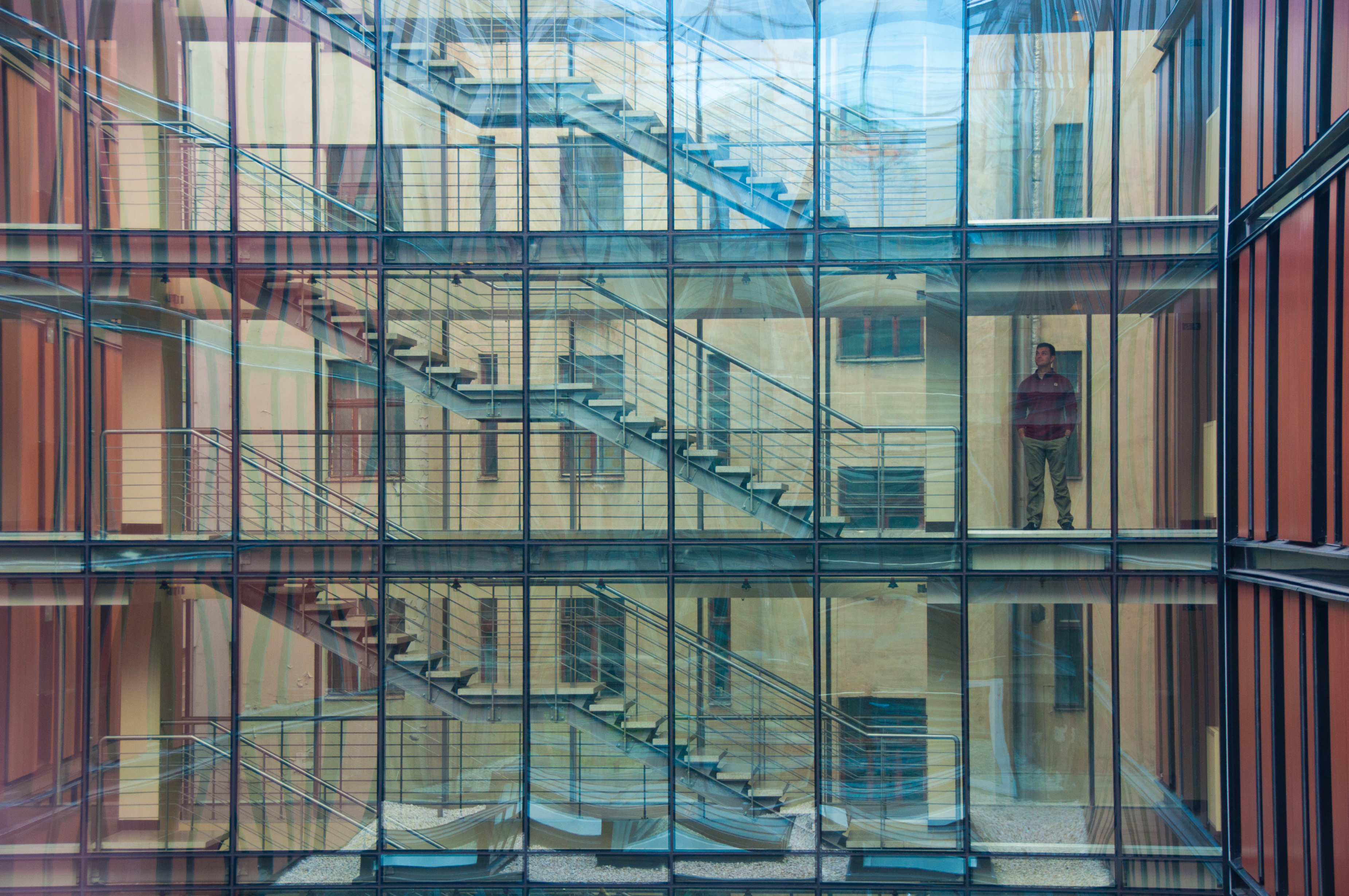
A modern glass atrium is organized around a sequence of exposed stair flights and landings visible through a transparent curtain wall. Reflections, structural mullions, and stacked circulation routes create a layered geometric composition, while a solitary figure on an upper level provides scale. The view contrasts sharply with Riga’s surrounding historic architecture.
Caption
A modern glass atrium is organized around a sequence of exposed stair flights and landings visible through a transparent curtain wall. Reflections, structural mullions, and stacked circulation routes create a layered geometric composition, while a solitary figure on an upper level provides scale. The view contrasts sharply with Riga’s surrounding historic architecture.

A small sculpted figure appears high on a historic roofline, posed dynamically with a bowed string instrument beside a tall pale chimney. Seen against the sky, the ornament reads as a whimsical architectural accent rather than a freestanding monument, drawing attention to the expressive figurative decoration found on Riga’s historic buildings.
Caption
A small sculpted figure appears high on a historic roofline, posed dynamically with a bowed string instrument beside a tall pale chimney. Seen against the sky, the ornament reads as a whimsical architectural accent rather than a freestanding monument, drawing attention to the expressive figurative decoration found on Riga’s historic buildings.

Riga’s Nymph Fountain fills the foreground while the Latvian National Opera rises behind it. Water streams from the sculptural group into the basin, creating a lively foreground against the ordered flower beds and pale classical facade. The composition links public sculpture, garden design, and cultural architecture in the opera-house precinct.
Caption
Riga’s Nymph Fountain fills the foreground while the Latvian National Opera rises behind it. Water streams from the sculptural group into the basin, creating a lively foreground against the ordered flower beds and pale classical facade. The composition links public sculpture, garden design, and cultural architecture in the opera-house precinct.

A closer frontal view centers the bronze Nymph Fountain against the Latvian National Opera. Multiple water jets arc around the sculptural figures, while the opera’s windows and pale facade form a symmetrical architectural backdrop. The tighter framing highlights the fountain’s modeling and active water display rather than the wider garden setting.
Caption
A closer frontal view centers the bronze Nymph Fountain against the Latvian National Opera. Multiple water jets arc around the sculptural figures, while the opera’s windows and pale facade form a symmetrical architectural backdrop. The tighter framing highlights the fountain’s modeling and active water display rather than the wider garden setting.

The copper-green figure of Liberty crowns Riga’s Freedom Monument, holding three gilded stars aloft against a pale sky. This close view isolates the upper sculpture from the monument’s tall obelisk and base, emphasizing the raised arms, simplified monumental drapery, and bright stars that serve as the composition’s focal point.
Caption
The copper-green figure of Liberty crowns Riga’s Freedom Monument, holding three gilded stars aloft against a pale sky. This close view isolates the upper sculpture from the monument’s tall obelisk and base, emphasizing the raised arms, simplified monumental drapery, and bright stars that serve as the composition’s focal point.

The Nymph Fountain sits within a circular basin at the center of landscaped grounds facing the Latvian National Opera. Flower beds, paths, mature trees, and the opera facade establish the full garden context, making this an environmental view of the fountain rather than a close study of the sculpture itself.
Caption
The Nymph Fountain sits within a circular basin at the center of landscaped grounds facing the Latvian National Opera. Flower beds, paths, mature trees, and the opera facade establish the full garden context, making this an environmental view of the fountain rather than a close study of the sculpture itself.

A close visitor portrait is framed against the blurred red facade of the House of the Blackheads, with its ornate astronomical clock visible high in the background. The shallow depth of field makes the person the clear subject while retaining enough architectural detail to identify the Old Town setting.
Caption
A close visitor portrait is framed against the blurred red facade of the House of the Blackheads, with its ornate astronomical clock visible high in the background. The shallow depth of field makes the person the clear subject while retaining enough architectural detail to identify the Old Town setting.

A slightly wider view of the Freedom Monument’s summit shows the full standing figure of Liberty and the pedestal directly beneath her. The three gilded stars form a bright crown above the green-patinated figure, while the neutral sky removes surrounding city distractions and concentrates attention on the monument’s national symbolism.
Caption
A slightly wider view of the Freedom Monument’s summit shows the full standing figure of Liberty and the pedestal directly beneath her. The three gilded stars form a bright crown above the green-patinated figure, while the neutral sky removes surrounding city distractions and concentrates attention on the monument’s national symbolism.

Riga’s Freedom Monument is shown in full from across the surrounding square, from its sculpted base groups to the tall stone obelisk and Liberty figure at the summit. Pedestrians crossing the plaza provide scale, while surrounding commercial and civic buildings locate the monument within the active center of the city.
Caption
Riga’s Freedom Monument is shown in full from across the surrounding square, from its sculpted base groups to the tall stone obelisk and Liberty figure at the summit. Pedestrians crossing the plaza provide scale, while surrounding commercial and civic buildings locate the monument within the active center of the city.

The former Museum of the Occupation of Latvia building appears as a long, dark, angular volume raised above a paved plaza. A large sign identifies the museum and dates 1940–1991, while the repetitive faceted wall panels and deep overhang give the structure a stark modernist character.
Caption
The former Museum of the Occupation of Latvia building appears as a long, dark, angular volume raised above a paved plaza. A large sign identifies the museum and dates 1940–1991, while the repetitive faceted wall panels and deep overhang give the structure a stark modernist character.

A dramatic rooftop sculpture depicts an armored warrior thrusting a long spear toward a dragon at his feet. Church spires and richly ornamented historic facades rise behind the group, reinforcing the Old Riga setting while the elevated viewpoint makes the sculptural silhouette dominant against the cloudy sky.
Caption
A dramatic rooftop sculpture depicts an armored warrior thrusting a long spear toward a dragon at his feet. Church spires and richly ornamented historic facades rise behind the group, reinforcing the Old Riga setting while the elevated viewpoint makes the sculptural silhouette dominant against the cloudy sky.

A close portrait of a man in a dark jacket is set against the faceted exterior of a modern Riga museum building. The shallow focus and upward camera angle emphasize the face while retaining the building’s distinctive dark geometric cladding as contextual background.
Caption
A close portrait of a man in a dark jacket is set against the faceted exterior of a modern Riga museum building. The shallow focus and upward camera angle emphasize the face while retaining the building’s distinctive dark geometric cladding as contextual background.

A frontal close view isolates one of the massive red-granite figure groups at the Freedom Monument’s base. The central standing figure clasps the hands while additional heads and shoulders emerge behind, emphasizing the blocklike carving, solemn expressions, and collective character of the memorial sculpture.
Caption
A frontal close view isolates one of the massive red-granite figure groups at the Freedom Monument’s base. The central standing figure clasps the hands while additional heads and shoulders emerge behind, emphasizing the blocklike carving, solemn expressions, and collective character of the memorial sculpture.

A monumental red-granite sculptural group at the base of Riga’s Freedom Monument is seen from below, with a central robed figure flanked by additional figures. A slender church spire rises in the background, creating a visual dialogue between civic monument and the historic skyline.
Caption
A monumental red-granite sculptural group at the base of Riga’s Freedom Monument is seen from below, with a central robed figure flanked by additional figures. A slender church spire rises in the background, creating a visual dialogue between civic monument and the historic skyline.

An elevated city view looks toward railway tracks, a large RIGA clock sign, and two cylindrical water-tower-like structures in the middle distance. Autumn trees and low urban buildings fill the scene, while newer apartment blocks stretch across the horizon, revealing the layered infrastructure beyond the historic center.
Caption
An elevated city view looks toward railway tracks, a large RIGA clock sign, and two cylindrical water-tower-like structures in the middle distance. Autumn trees and low urban buildings fill the scene, while newer apartment blocks stretch across the horizon, revealing the layered infrastructure beyond the historic center.

An oversized black metal rooster weather vane is displayed indoors against exposed brick, with a person standing below for scale and archival images arranged along the wall. The display transforms a familiar roof ornament into a museum object, making its large size and metal construction immediately apparent.
Caption
An oversized black metal rooster weather vane is displayed indoors against exposed brick, with a person standing below for scale and archival images arranged along the wall. The display transforms a familiar roof ornament into a museum object, making its large size and metal construction immediately apparent.

The Riga Radio and TV Tower rises above the wooded landscape on Zaķusala, its three splayed supports converging into a tall tapered central shaft and antenna mast. Seen from an elevated distance beneath an overcast sky, the structure stands apart from the lower city and forested horizon around it.
Caption
The Riga Radio and TV Tower rises above the wooded landscape on Zaķusala, its three splayed supports converging into a tall tapered central shaft and antenna mast. Seen from an elevated distance beneath an overcast sky, the structure stands apart from the lower city and forested horizon around it.

A copper-clad rooftop cupola with an open lantern rises among the dense roofs of central Riga. The elevated view shows its weathered green patina, curved metal roof, and slender finial in contrast with red tile, pale metal roofing, chimneys, and upper stories packed closely around it.
Caption
A copper-clad rooftop cupola with an open lantern rises among the dense roofs of central Riga. The elevated view shows its weathered green patina, curved metal roof, and slender finial in contrast with red tile, pale metal roofing, chimneys, and upper stories packed closely around it.

A broad elevated panorama surveys Old Riga’s dense red and gray roofs, church towers, historic facades, and the Daugava River beyond. The compact medieval street pattern occupies the foreground while larger modern buildings and the opposite riverbank extend across the horizon, showing the historic center within the wider city.
Caption
A broad elevated panorama surveys Old Riga’s dense red and gray roofs, church towers, historic facades, and the Daugava River beyond. The compact medieval street pattern occupies the foreground while larger modern buildings and the opposite riverbank extend across the horizon, showing the historic center within the wider city.

The National Library of Latvia, known as the Castle of Light, is seen during construction across a broad swath of autumn trees. Scaffolding covers part of the sharply sloping roofline, while the long glazed facade and rising central peak already define the building’s distinctive modern silhouette.
Caption
The National Library of Latvia, known as the Castle of Light, is seen during construction across a broad swath of autumn trees. Scaffolding covers part of the sharply sloping roofline, while the long glazed facade and rising central peak already define the building’s distinctive modern silhouette.

A compact high-angle view looks across Old Riga’s colorful gabled facades, narrow streets, roof terraces, and mixed red-tile and metal roofs. The scene emphasizes the intimate scale and dense fabric of the historic center, with taller church towers and riverfront structures appearing beyond the foreground blocks.
Caption
A compact high-angle view looks across Old Riga’s colorful gabled facades, narrow streets, roof terraces, and mixed red-tile and metal roofs. The scene emphasizes the intimate scale and dense fabric of the historic center, with taller church towers and riverfront structures appearing beyond the foreground blocks.

The Nativity of Christ Cathedral dominates a high-angle city view with its large central dome, smaller domes, striped masonry, and arched windows. The upper section of Riga’s Freedom Monument appears in the foreground at right, while modern apartment and office blocks create a contrasting urban backdrop.
Caption
The Nativity of Christ Cathedral dominates a high-angle city view with its large central dome, smaller domes, striped masonry, and arched windows. The upper section of Riga’s Freedom Monument appears in the foreground at right, while modern apartment and office blocks create a contrasting urban backdrop.

From a high vantage point, the Nativity of Christ Cathedral’s striped domes appear beyond the upper portion of the Freedom Monument and surrounding civic buildings. The compressed telephoto view brings Riga’s religious and national landmarks into a single layered composition against a backdrop of denser modern development.
Caption
From a high vantage point, the Nativity of Christ Cathedral’s striped domes appear beyond the upper portion of the Freedom Monument and surrounding civic buildings. The compressed telephoto view brings Riga’s religious and national landmarks into a single layered composition against a backdrop of denser modern development.

The Latvian Academy of Sciences rises above Riga’s lower urban fabric, its tiered, symmetrical tower and slender spire forming one of the city’s most recognizable twentieth-century silhouettes. Seen from an elevated viewpoint under heavy cloud, the building stands apart from the surrounding residential and commercial blocks.
Caption
The Latvian Academy of Sciences rises above Riga’s lower urban fabric, its tiered, symmetrical tower and slender spire forming one of the city’s most recognizable twentieth-century silhouettes. Seen from an elevated viewpoint under heavy cloud, the building stands apart from the surrounding residential and commercial blocks.

Riga Central Market’s long arched pavilions fill the middle ground of this elevated city view, with the Daugava River and Vanšu Bridge beyond. Foreground roofs and church architecture place the market complex within the dense historic and civic core, emphasizing the close relationship between commerce, transport, and the river.
Caption
Riga Central Market’s long arched pavilions fill the middle ground of this elevated city view, with the Daugava River and Vanšu Bridge beyond. Foreground roofs and church architecture place the market complex within the dense historic and civic core, emphasizing the close relationship between commerce, transport, and the river.

A steel arched railway bridge crosses the Daugava River below an elevated view over Riga’s historic roofs. Multiple spans rest on masonry piers across the broad waterway, while tightly packed buildings in the foreground contrast with the open river and lower development on the opposite bank.
Caption
A steel arched railway bridge crosses the Daugava River below an elevated view over Riga’s historic roofs. Multiple spans rest on masonry piers across the broad waterway, while tightly packed buildings in the foreground contrast with the open river and lower development on the opposite bank.

Inside a monumental brick Gothic church, tall clustered piers and pointed arches draw the eye toward the luminous chancel and altar. Exposed red brick, high ribbed vaulting, wall-mounted heraldic memorials, and a raised pulpit create a richly layered interior in which medieval structural forms coexist with later furnishings and commemorative elements.
Caption
Inside a monumental brick Gothic church, tall clustered piers and pointed arches draw the eye toward the luminous chancel and altar. Exposed red brick, high ribbed vaulting, wall-mounted heraldic memorials, and a raised pulpit create a richly layered interior in which medieval structural forms coexist with later furnishings and commemorative elements.

A vivid stained-glass panel shows an armored rider on a white horse, framed by dense floral and foliate borders. Strong reds, blues, greens, and whites define the narrative figure, while lead cames articulate both the horse and the patterned surround. The close view emphasizes craftsmanship and iconographic detail rather than the larger window setting.
Caption
A vivid stained-glass panel shows an armored rider on a white horse, framed by dense floral and foliate borders. Strong reds, blues, greens, and whites define the narrative figure, while lead cames articulate both the horse and the patterned surround. The close view emphasizes craftsmanship and iconographic detail rather than the larger window setting.

A stained-glass figure kneels beside an architectural or liturgical setting, hands joined in prayer and body turned inward in a devotional pose. The panel is bordered by repeating foliage motifs and saturated fields of red, blue, green, and gold, creating a compact narrative scene typical of historic ecclesiastical glazing.
Caption
A stained-glass figure kneels beside an architectural or liturgical setting, hands joined in prayer and body turned inward in a devotional pose. The panel is bordered by repeating foliage motifs and saturated fields of red, blue, green, and gold, creating a compact narrative scene typical of historic ecclesiastical glazing.

Two tall stained-glass windows present stacked narrative scenes within elaborate ornamental borders. Figures, architecture, and decorative medallions are arranged vertically, allowing each lancet to function as a sequence of episodes. The darker interior wall around the windows intensifies the saturated reds, blues, greens, and amber tones of the glazing.
Caption
Two tall stained-glass windows present stacked narrative scenes within elaborate ornamental borders. Figures, architecture, and decorative medallions are arranged vertically, allowing each lancet to function as a sequence of episodes. The darker interior wall around the windows intensifies the saturated reds, blues, greens, and amber tones of the glazing.

A carved stone bear sits on a projecting ledge and holds a shield against its body, forming a whimsical sculptural accent on a historic Riga facade. The animal’s simplified massing and expressive head stand out against pale masonry and deep window openings, suggesting the ornamental program of an eclectic urban building.
Caption
A carved stone bear sits on a projecting ledge and holds a shield against its body, forming a whimsical sculptural accent on a historic Riga facade. The animal’s simplified massing and expressive head stand out against pale masonry and deep window openings, suggesting the ornamental program of an eclectic urban building.

A black metal dragon projects dramatically from a pale rusticated facade, its wings spread and tail curling beneath the body. Mounted high above street level, the sculptural bracket turns functional metalwork into a bold zoomorphic ornament, one of the inventive decorative details found throughout Riga’s historic architecture.
Caption
A black metal dragon projects dramatically from a pale rusticated facade, its wings spread and tail curling beneath the body. Mounted high above street level, the sculptural bracket turns functional metalwork into a bold zoomorphic ornament, one of the inventive decorative details found throughout Riga’s historic architecture.

Two pointed-arch stained-glass windows fill a pale interior wall, each divided into narrow vertical lights crowded with figures and architectural motifs. Their Gothic tracery and dense figurative compositions contrast with the relatively plain surrounding masonry, focusing attention on the luminous narrative glazing.
Caption
Two pointed-arch stained-glass windows fill a pale interior wall, each divided into narrow vertical lights crowded with figures and architectural motifs. Their Gothic tracery and dense figurative compositions contrast with the relatively plain surrounding masonry, focusing attention on the luminous narrative glazing.

A circular stained-glass window is paired with a projecting gilded angel sculpture, creating an unusual dialogue between two- and three-dimensional church decoration. The window combines radial geometric divisions with vivid heraldic and floral ornament, while the angel’s extended trumpet-like attribute projects dramatically into the interior space.
Caption
A circular stained-glass window is paired with a projecting gilded angel sculpture, creating an unusual dialogue between two- and three-dimensional church decoration. The window combines radial geometric divisions with vivid heraldic and floral ornament, while the angel’s extended trumpet-like attribute projects dramatically into the interior space.

A steep, shingled canopy projects from a pale historic facade between tall windows, topped by a dark metal finial shaped like a stylized flower or plume. The close architectural detail highlights the craftsmanship of the roof edge, scalloped trim, and ornamental metalwork against the restrained masonry wall.
Caption
A steep, shingled canopy projects from a pale historic facade between tall windows, topped by a dark metal finial shaped like a stylized flower or plume. The close architectural detail highlights the craftsmanship of the roof edge, scalloped trim, and ornamental metalwork against the restrained masonry wall.

A small figurative sculpture of a seated violinist perches high on a roofline beside a tall chimney. Seen against the sky, the musician appears to balance on the corner of the building, turning an otherwise utilitarian roof edge into a theatrical architectural detail characteristic of Riga’s ornament-rich historic streetscape.
Caption
A small figurative sculpture of a seated violinist perches high on a roofline beside a tall chimney. Seen against the sky, the musician appears to balance on the corner of the building, turning an otherwise utilitarian roof edge into a theatrical architectural detail characteristic of Riga’s ornament-rich historic streetscape.

The cylindrical Powder Tower rises beside a gabled facade covered with rows of colorful municipal coats of arms and the inscription “Latvijas Krājbanka.” The juxtaposition combines a surviving element of Riga’s fortifications with later civic and commercial symbolism, creating a dense streetscape of military, heraldic, and urban architectural references.
Caption
The cylindrical Powder Tower rises beside a gabled facade covered with rows of colorful municipal coats of arms and the inscription “Latvijas Krājbanka.” The juxtaposition combines a surviving element of Riga’s fortifications with later civic and commercial symbolism, creating a dense streetscape of military, heraldic, and urban architectural references.

An ornate historic facade is organized around three arched doorways, green-painted doors, carved stone moldings, balustrades, and large male support figures set between the entrances. The sculptural atlantes and dense decorative treatment give the lower story a strongly theatrical character typical of Riga’s richly ornamented late nineteenth- and early twentieth-century architecture.
Caption
An ornate historic facade is organized around three arched doorways, green-painted doors, carved stone moldings, balustrades, and large male support figures set between the entrances. The sculptural atlantes and dense decorative treatment give the lower story a strongly theatrical character typical of Riga’s richly ornamented late nineteenth- and early twentieth-century architecture.

Two matching black dragon-shaped brackets project from the facade above large arched windows. Their spread wings, long tails, and sharply modeled bodies create a symmetrical decorative rhythm across the pale rusticated wall. The repeated zoomorphic metalwork demonstrates how Riga’s historic architecture often integrates sculptural ornament directly into functional facade fittings.
Caption
Two matching black dragon-shaped brackets project from the facade above large arched windows. Their spread wings, long tails, and sharply modeled bodies create a symmetrical decorative rhythm across the pale rusticated wall. The repeated zoomorphic metalwork demonstrates how Riga’s historic architecture often integrates sculptural ornament directly into functional facade fittings.

A long pale facade of Riga Castle is lined with Latvian flags and anchored by a tall green-copper tower rising above the roofline. The formal elevation and national symbols underscore the building’s civic significance, while the slender spire creates a vertical landmark against the broken cloud cover.
Caption
A long pale facade of Riga Castle is lined with Latvian flags and anchored by a tall green-copper tower rising above the roofline. The formal elevation and national symbols underscore the building’s civic significance, while the slender spire creates a vertical landmark against the broken cloud cover.

The richly ornamented red-brick facade of the House of the Blackheads dominates this Old Riga street view, with St. Peter’s Church tower rising in the background. Stepped and sculpted gables, arched openings, clocks, and contrasting masonry create one of the historic center’s most elaborate architectural groupings.
Caption
The richly ornamented red-brick facade of the House of the Blackheads dominates this Old Riga street view, with St. Peter’s Church tower rising in the background. Stepped and sculpted gables, arched openings, clocks, and contrasting masonry create one of the historic center’s most elaborate architectural groupings.

A black clock face with gilded Roman numerals is set into a weathered copper-clad tower dome. The close view isolates the timepiece against the curved metal roof, revealing seams, patina, and architectural framing that are easily overlooked from street level.
Caption
A black clock face with gilded Roman numerals is set into a weathered copper-clad tower dome. The close view isolates the timepiece against the curved metal roof, revealing seams, patina, and architectural framing that are easily overlooked from street level.

Four standing sculpted figures occupy individual niches or brackets against a red-brick facade, each posed with distinct attributes and dress. Their pale stone bases and darkened figures contrast strongly with the masonry, forming part of the elaborate sculptural program associated with one of Old Riga’s richly decorated historic buildings.
Caption
Four standing sculpted figures occupy individual niches or brackets against a red-brick facade, each posed with distinct attributes and dress. Their pale stone bases and darkened figures contrast strongly with the masonry, forming part of the elaborate sculptural program associated with one of Old Riga’s richly decorated historic buildings.

A man in a dark zippered fleece pauses beside the stone corner of a Riga building and looks directly toward the camera. The shallow depth of field softens the pale urban background, isolating the figure as a candid travel portrait within the historic city setting.
Caption
A man in a dark zippered fleece pauses beside the stone corner of a Riga building and looks directly toward the camera. The shallow depth of field softens the pale urban background, isolating the figure as a candid travel portrait within the historic city setting.

An arched modern window becomes a frame for the reflected facade of a richly ornamented red-brick historic building across the street. The layered composition merges contemporary glazing, pale stone surrounds, and the distorted reflection of gables and sculpture, offering an indirect view of Riga’s dense architectural streetscape.
Caption
An arched modern window becomes a frame for the reflected facade of a richly ornamented red-brick historic building across the street. The layered composition merges contemporary glazing, pale stone surrounds, and the distorted reflection of gables and sculpture, offering an indirect view of Riga’s dense architectural streetscape.

An elaborate blue-and-gold astronomical clock fills the facade, combining a central time dial with concentric calendar rings for dates and months and a smaller seasonal or celestial dial below. Gilded hands, numerals, and ornamental framing transform the timekeeping mechanism into a richly decorative architectural centerpiece.
Caption
An elaborate blue-and-gold astronomical clock fills the facade, combining a central time dial with concentric calendar rings for dates and months and a smaller seasonal or celestial dial below. Gilded hands, numerals, and ornamental framing transform the timekeeping mechanism into a richly decorative architectural centerpiece.

The statue of Roland stands in front of the House of the Blackheads, shown as an armored medieval figure holding an upright sword and heraldic shield. The pale sculpture is set against the building’s red-brick Gothic Revival facade and decorative astronomical clock, linking civic symbolism with Riga’s best-known ceremonial square.
Caption
The statue of Roland stands in front of the House of the Blackheads, shown as an armored medieval figure holding an upright sword and heraldic shield. The pale sculpture is set against the building’s red-brick Gothic Revival facade and decorative astronomical clock, linking civic symbolism with Riga’s best-known ceremonial square.

A pale stone female figure projects in front of a tall arched window, one hand raised across her brow as if looking into the distance. Her draped garment, elongated pose, and integration with balcony railings make the sculpture both a figurative ornament and a strong vertical accent within the historic facade.
Caption
A pale stone female figure projects in front of a tall arched window, one hand raised across her brow as if looking into the distance. Her draped garment, elongated pose, and integration with balcony railings make the sculpture both a figurative ornament and a strong vertical accent within the historic facade.

A highly modeled white stucco relief crowns a doorway or window on a dark red facade. A grimacing crowned mask occupies the center beneath crossed standards and symbolic objects, flanked by stylized architectural forms. The bold contrast between white ornament and red wall makes the heraldic composition especially prominent at street level.
Caption
A highly modeled white stucco relief crowns a doorway or window on a dark red facade. A grimacing crowned mask occupies the center beneath crossed standards and symbolic objects, flanked by stylized architectural forms. The bold contrast between white ornament and red wall makes the heraldic composition especially prominent at street level.

A gilded fleur-de-lis rises above a small decorative pediment on a gray facade. Isolated against the plain wall, the polished metal ornament becomes the focal point of the composition, its stylized petals and pointed central blade echoing a long-established European heraldic motif.
Caption
A gilded fleur-de-lis rises above a small decorative pediment on a gray facade. Isolated against the plain wall, the polished metal ornament becomes the focal point of the composition, its stylized petals and pointed central blade echoing a long-established European heraldic motif.

A seated stone lion grips a heraldic shield on the richly ornamented façade of Riga’s House of the Blackheads. Set against red brick, pale architectural moldings, and gilded metalwork, the sculpture forms part of the building’s dense decorative program, where civic emblems, allegorical figures, clocks, and rooftop ornaments are layered across the reconstructed historic elevation.
Caption
A seated stone lion grips a heraldic shield on the richly ornamented façade of Riga’s House of the Blackheads. Set against red brick, pale architectural moldings, and gilded metalwork, the sculpture forms part of the building’s dense decorative program, where civic emblems, allegorical figures, clocks, and rooftop ornaments are layered across the reconstructed historic elevation.

An armored male figure raises a sword above a writhing dragon in this sculptural group mounted on the House of the Blackheads. The familiar Saint George and the Dragon motif is rendered in dark metal against red brick, with the saint’s shield and the creature’s twisting body creating a dramatic silhouette high on the ornate façade.
Caption
An armored male figure raises a sword above a writhing dragon in this sculptural group mounted on the House of the Blackheads. The familiar Saint George and the Dragon motif is rendered in dark metal against red brick, with the saint’s shield and the creature’s twisting body creating a dramatic silhouette high on the ornate façade.

Seen from below against a gray sky, the Saint George and the Dragon group becomes a strong silhouette of raised sword, armored body, shield, and coiling creature. The low viewpoint separates the sculpture from the surrounding façade and emphasizes the theatrical action of the legendary combat rather than the architectural setting.
Caption
Seen from below against a gray sky, the Saint George and the Dragon group becomes a strong silhouette of raised sword, armored body, shield, and coiling creature. The low viewpoint separates the sculpture from the surrounding façade and emphasizes the theatrical action of the legendary combat rather than the architectural setting.

An elaborate rooftop finial combines scrolling wrought-metal tracery with gilded floral forms, directional markers, and a small crowning emblem. Rising above a steep decorative gable of the House of the Blackheads, the openwork metal structure demonstrates the unusually intricate silhouette created by the building’s roofline ornament.
Caption
An elaborate rooftop finial combines scrolling wrought-metal tracery with gilded floral forms, directional markers, and a small crowning emblem. Rising above a steep decorative gable of the House of the Blackheads, the openwork metal structure demonstrates the unusually intricate silhouette created by the building’s roofline ornament.

A brightly painted armed figure stands within a gilded architectural frame, holding a sword and a red-and-white shield. The relief-like decoration combines costume, heraldry, and ornamental carving against a deep red ground, contributing to the dense civic and symbolic imagery that covers the House of the Blackheads façade.
Caption
A brightly painted armed figure stands within a gilded architectural frame, holding a sword and a red-and-white shield. The relief-like decoration combines costume, heraldry, and ornamental carving against a deep red ground, contributing to the dense civic and symbolic imagery that covers the House of the Blackheads façade.

A dark metal male figure stands on a projecting pedestal against the red-brick façade, one hand extended and the other resting at the torso. Classical drapery and an idealized pose distinguish the sculpture from the surrounding Gothic Revival architecture, forming part of the House of the Blackheads’ program of freestanding allegorical figures.
Caption
A dark metal male figure stands on a projecting pedestal against the red-brick façade, one hand extended and the other resting at the torso. Classical drapery and an idealized pose distinguish the sculpture from the surrounding Gothic Revival architecture, forming part of the House of the Blackheads’ program of freestanding allegorical figures.

A blue-and-gold astronomical clock fills the red-brick façade of the House of the Blackheads. Concentric rings carry Roman numerals, calendar markings, and abbreviated month names around a central dial, while a smaller circular display hangs below. The inscription above records a 1999 renovation, adding a modern restoration reference to the building’s historicizing decorative program.
Caption
A blue-and-gold astronomical clock fills the red-brick façade of the House of the Blackheads. Concentric rings carry Roman numerals, calendar markings, and abbreviated month names around a central dial, while a smaller circular display hangs below. The inscription above records a 1999 renovation, adding a modern restoration reference to the building’s historicizing decorative program.

Curving black iron stems, gilded leaves, buds, and a spear-like crown form a compact decorative finial in front of red brick. The close view isolates the metalwork from the larger façade, revealing a layered combination of symmetrical scrolls and gold accents that echoes the more elaborate rooftop ornaments elsewhere on the House of the Blackheads.
Caption
Curving black iron stems, gilded leaves, buds, and a spear-like crown form a compact decorative finial in front of red brick. The close view isolates the metalwork from the larger façade, revealing a layered combination of symmetrical scrolls and gold accents that echoes the more elaborate rooftop ornaments elsewhere on the House of the Blackheads.

A colorful heraldic panel presents two dark-profile heads within a divided shield beneath a larger turbaned head, all surrounded by exuberant gold mantling. Set into pale architectural framing against red brick, the emblem is one of several coats of arms incorporated into the House of the Blackheads’ elaborate reconstructed façade.
Caption
A colorful heraldic panel presents two dark-profile heads within a divided shield beneath a larger turbaned head, all surrounded by exuberant gold mantling. Set into pale architectural framing against red brick, the emblem is one of several coats of arms incorporated into the House of the Blackheads’ elaborate reconstructed façade.

A heraldic shield displays a red fortified gateway on a blue field, crossed gold keys above, and a small golden lion’s head below the portcullis. The architectural emblem is modeled in relief and framed by pale masonry, one of several brightly colored coats of arms distributed across the House of the Blackheads façade.
Caption
A heraldic shield displays a red fortified gateway on a blue field, crossed gold keys above, and a small golden lion’s head below the portcullis. The architectural emblem is modeled in relief and framed by pale masonry, one of several brightly colored coats of arms distributed across the House of the Blackheads façade.

A draped female figure raises one arm overhead while the other holds a long staff or attribute. Mounted on a stone pedestal against red brick, the statue is part of the House of the Blackheads’ sculptural façade program. The upward gesture and flowing drapery give the otherwise static architectural niche a strong sense of movement.
Caption
A draped female figure raises one arm overhead while the other holds a long staff or attribute. Mounted on a stone pedestal against red brick, the statue is part of the House of the Blackheads’ sculptural façade program. The upward gesture and flowing drapery give the otherwise static architectural niche a strong sense of movement.

A dark metal female figure carries a generous cluster of fruit or flowers while holding a cylindrical or scroll-like object in her opposite hand. Her abundant attributes suggest an allegorical theme of prosperity or plenty, but the exact identity is not established by the proof sheet. The statue stands prominently against the House of the Blackheads’ red-brick wall.
Caption
A dark metal female figure carries a generous cluster of fruit or flowers while holding a cylindrical or scroll-like object in her opposite hand. Her abundant attributes suggest an allegorical theme of prosperity or plenty, but the exact identity is not established by the proof sheet. The statue stands prominently against the House of the Blackheads’ red-brick wall.

A muscular bearded male figure braces a long staff in one hand while drapery billows around his body. The statue’s strong contrapposto, exposed torso, and classical treatment contrast with the vertical brickwork behind it. It belongs to the group of allegorical sculptures mounted across the richly decorated House of the Blackheads façade.
Caption
A muscular bearded male figure braces a long staff in one hand while drapery billows around his body. The statue’s strong contrapposto, exposed torso, and classical treatment contrast with the vertical brickwork behind it. It belongs to the group of allegorical sculptures mounted across the richly decorated House of the Blackheads façade.

A crowned Madonna in a vivid blue mantle holds the Christ Child within an ornate gilded frame. The polychrome relief stands out sharply against its red ground and neighboring brickwork, adding a devotional image to the otherwise civic and heraldic program of the House of the Blackheads façade.
Caption
A crowned Madonna in a vivid blue mantle holds the Christ Child within an ornate gilded frame. The polychrome relief stands out sharply against its red ground and neighboring brickwork, adding a devotional image to the otherwise civic and heraldic program of the House of the Blackheads façade.

A sculpted lion stands behind a circular shield while a slender pole rises above it to a gilded banner-like finial. The composition is set against the vertical brickwork and sculptural niches of the House of the Blackheads, where heraldic animals and metal standards punctuate the façade at multiple levels.
Caption
A sculpted lion stands behind a circular shield while a slender pole rises above it to a gilded banner-like finial. The composition is set against the vertical brickwork and sculptural niches of the House of the Blackheads, where heraldic animals and metal standards punctuate the façade at multiple levels.

A stocky male figure in Renaissance-style dress stands high on the roofline, gripping a tall staff topped by a gilded knob. His puffed breeches, broad hat, and rigid frontal pose give the sculpture the appearance of a ceremonial guard or civic sentinel, silhouetted above the stepped gables of the House of the Blackheads.
Caption
A stocky male figure in Renaissance-style dress stands high on the roofline, gripping a tall staff topped by a gilded knob. His puffed breeches, broad hat, and rigid frontal pose give the sculpture the appearance of a ceremonial guard or civic sentinel, silhouetted above the stepped gables of the House of the Blackheads.

A gilded bird with outstretched wings crowns an elaborate rooftop assembly of scrolling ironwork, floral tips, and directional elements. The close view shows how the House of the Blackheads’ roofline is animated by finely worked metal ornaments that combine the functions of weather vane, finial, and decorative silhouette.
Caption
A gilded bird with outstretched wings crowns an elaborate rooftop assembly of scrolling ironwork, floral tips, and directional elements. The close view shows how the House of the Blackheads’ roofline is animated by finely worked metal ornaments that combine the functions of weather vane, finial, and decorative silhouette.

A dark metal guard figure in broad-brimmed hat and historical costume stands beside the tall shaft of an elaborate weather vane. Above him, gilded bird and floral forms crown the finial. The paired sculpture and metalwork create a distinctive vertical accent along the House of the Blackheads’ ornamental roofline.
Caption
A dark metal guard figure in broad-brimmed hat and historical costume stands beside the tall shaft of an elaborate weather vane. Above him, gilded bird and floral forms crown the finial. The paired sculpture and metalwork create a distinctive vertical accent along the House of the Blackheads’ ornamental roofline.

A traveler stands in the foreground of a narrow Old Riga street while the brick tower and tiered copper spire of St. Peter’s Church rise behind him. The surrounding stepped and stuccoed façades compress the view, using the church tower as a clear landmark within the dense medieval street pattern.
Caption
A traveler stands in the foreground of a narrow Old Riga street while the brick tower and tiered copper spire of St. Peter’s Church rise behind him. The surrounding stepped and stuccoed façades compress the view, using the church tower as a clear landmark within the dense medieval street pattern.

The House of the Blackheads presents its richly reconstructed façade to Riga’s Town Hall Square, with stepped gables, sculpted figures, coats of arms, astronomical clock, and gilded rooftop metalwork layered across the red-brick elevation. This full frontal view brings together the individual decorative details seen in adjacent photographs and shows their carefully ordered relationship across the ceremonial façade.
Caption
The House of the Blackheads presents its richly reconstructed façade to Riga’s Town Hall Square, with stepped gables, sculpted figures, coats of arms, astronomical clock, and gilded rooftop metalwork layered across the red-brick elevation. This full frontal view brings together the individual decorative details seen in adjacent photographs and shows their carefully ordered relationship across the ceremonial façade.

Pastel houses line a small green space beside the red-brick mass of St. John’s Church, whose stepped Gothic gable, tall pointed windows, and steep tiled roof rise behind them. The composition illustrates the close layering of ecclesiastical and domestic architecture within Old Riga’s compact historic fabric.
Caption
Pastel houses line a small green space beside the red-brick mass of St. John’s Church, whose stepped Gothic gable, tall pointed windows, and steep tiled roof rise behind them. The composition illustrates the close layering of ecclesiastical and domestic architecture within Old Riga’s compact historic fabric.

The broad brick west front of St. Peter’s Church rises beneath its tiered copper spire and clock. Three richly framed entrance portals punctuate the lower façade, while the massive masonry tower narrows upward through successive stages. The frontal composition emphasizes the contrast between the solid medieval brick body and the later, more elaborate spire above.
Caption
The broad brick west front of St. Peter’s Church rises beneath its tiered copper spire and clock. Three richly framed entrance portals punctuate the lower façade, while the massive masonry tower narrows upward through successive stages. The frontal composition emphasizes the contrast between the solid medieval brick body and the later, more elaborate spire above.

A row of monumental stone portals projects from the weathered brick wall of St. Peter’s Church. Paired columns, broken and curved pediments, sculptural details, and deep arched doorways create a strongly three-dimensional entrance sequence, contrasting with the comparatively plain expanse of brick masonry behind.
Caption
A row of monumental stone portals projects from the weathered brick wall of St. Peter’s Church. Paired columns, broken and curved pediments, sculptural details, and deep arched doorways create a strongly three-dimensional entrance sequence, contrasting with the comparatively plain expanse of brick masonry behind.

Viewed from beside the church, tall Gothic windows punctuate the red-brick wall of St. Peter’s while its tiered copper tower rises behind the roofline. A large branching streetlamp cuts diagonally across the gray sky, adding a modern urban element to the close architectural view.
Caption
Viewed from beside the church, tall Gothic windows punctuate the red-brick wall of St. Peter’s while its tiered copper tower rises behind the roofline. A large branching streetlamp cuts diagonally across the gray sky, adding a modern urban element to the close architectural view.

The stacked heads of a donkey, dog, cat, and rooster project from the bronze Bremen Town Musicians sculpture near St. Peter’s Church. This close side view emphasizes the elongated muzzles, rubbed metallic surfaces, and playful vertical arrangement derived from the Brothers Grimm tale, a familiar public-art landmark in Old Riga.
Caption
The stacked heads of a donkey, dog, cat, and rooster project from the bronze Bremen Town Musicians sculpture near St. Peter’s Church. This close side view emphasizes the elongated muzzles, rubbed metallic surfaces, and playful vertical arrangement derived from the Brothers Grimm tale, a familiar public-art landmark in Old Riga.

The polygonal brick east end of St. Peter’s Church is seen across a small landscaped area, its tall Gothic windows and buttressed wall forming a broad semicircular mass beneath a low roof. The tiered copper tower rises behind, while flowers, stone edging, and a mature tree soften the monumental masonry.
Caption
The polygonal brick east end of St. Peter’s Church is seen across a small landscaped area, its tall Gothic windows and buttressed wall forming a broad semicircular mass beneath a low roof. The tiered copper tower rises behind, while flowers, stone edging, and a mature tree soften the monumental masonry.

A quiet cobblestone lane curves between closely spaced buildings in Old Riga, with the massive wall of a church on the right and pastel façades receding toward the distance. A lone pedestrian provides scale, while the uneven paving and narrow street profile preserve the intimate character of the historic center.
Caption
A quiet cobblestone lane curves between closely spaced buildings in Old Riga, with the massive wall of a church on the right and pastel façades receding toward the distance. A lone pedestrian provides scale, while the uneven paving and narrow street profile preserve the intimate character of the historic center.

Two monumental figures surge forward in a dynamic sculptural group beside Riga’s steel railway bridge. One figure leans into the movement while the other extends an arm and billowing banner, creating a forceful diagonal silhouette against the repeating bridge arches. The close viewpoint emphasizes the monument’s heroic scale and the visual relationship between public sculpture and transport infrastructure along the Daugava.
Caption
Two monumental figures surge forward in a dynamic sculptural group beside Riga’s steel railway bridge. One figure leans into the movement while the other extends an arm and billowing banner, creating a forceful diagonal silhouette against the repeating bridge arches. The close viewpoint emphasizes the monument’s heroic scale and the visual relationship between public sculpture and transport infrastructure along the Daugava.

The repeating steel arches of Riga’s railway bridge span the Daugava behind a busy riverside foreground of parked cars, a service truck, streetlights, and rough grass. By stepping back from the structure, the photograph places the historic river crossing within the everyday circulation and working landscape of central Riga rather than isolating it as an architectural object.
Caption
The repeating steel arches of Riga’s railway bridge span the Daugava behind a busy riverside foreground of parked cars, a service truck, streetlights, and rough grass. By stepping back from the structure, the photograph places the historic river crossing within the everyday circulation and working landscape of central Riga rather than isolating it as an architectural object.
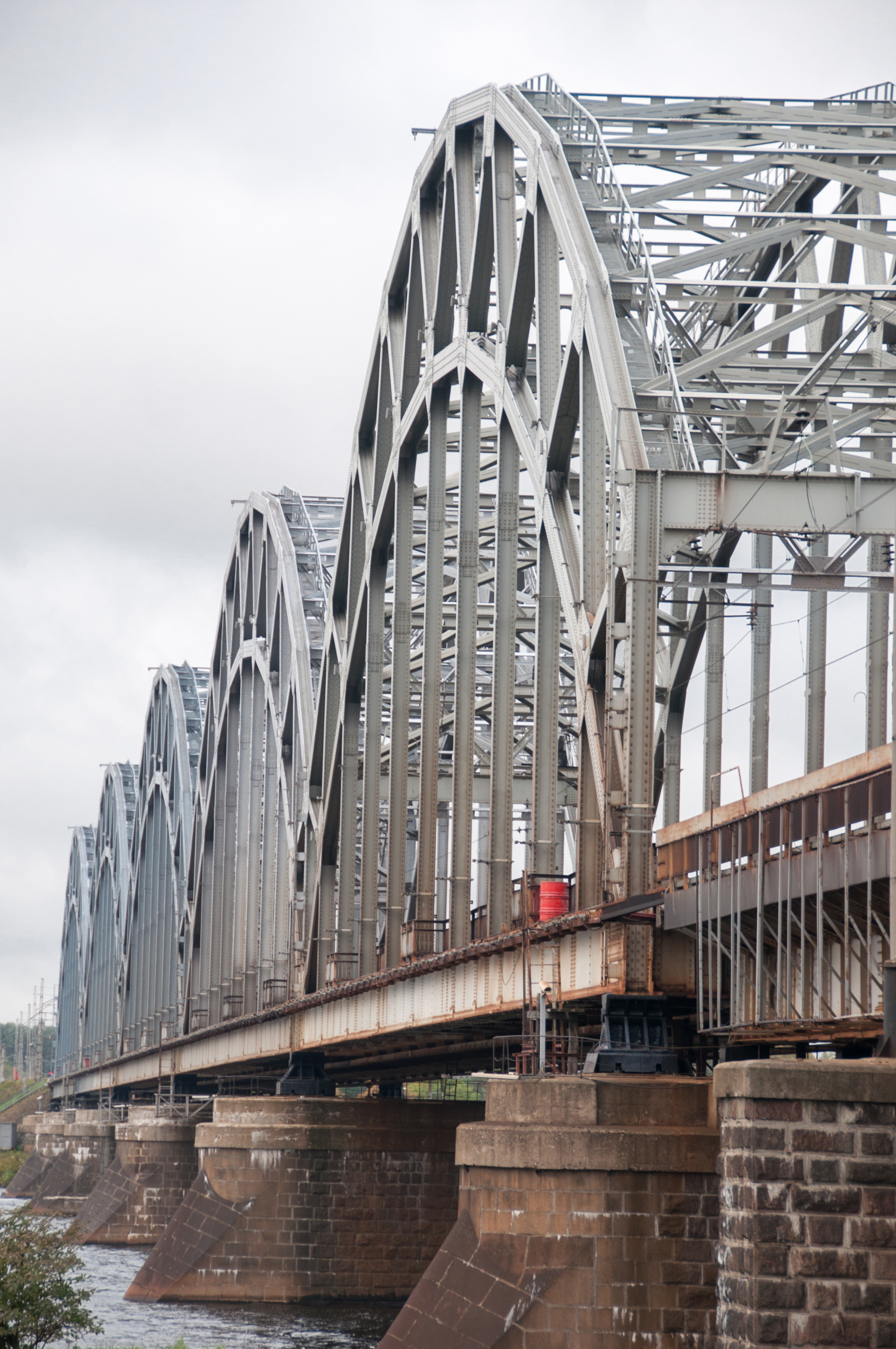
Riga’s railway bridge crosses the Daugava in a long sequence of pale steel arch trusses carried on massive masonry piers. Tracks and utility structures run beneath the repeating curved frames, whose diminishing scale draws the eye toward the far bank. The view foregrounds the bridge as working transport infrastructure within the city’s river corridor.
Caption
Riga’s railway bridge crosses the Daugava in a long sequence of pale steel arch trusses carried on massive masonry piers. Tracks and utility structures run beneath the repeating curved frames, whose diminishing scale draws the eye toward the far bank. The view foregrounds the bridge as working transport infrastructure within the city’s river corridor.

A wicker basket is packed with whole dried fish arranged upright and overlapping at a Riga market counter. Their silvery-brown skins, intact heads, and stiff bodies create a dense textural display, while a handwritten price card and packaged goods anchor the scene in everyday commerce. The close view records a traditional preserved-food offering rather than the architecture of the market itself.
Caption
A wicker basket is packed with whole dried fish arranged upright and overlapping at a Riga market counter. Their silvery-brown skins, intact heads, and stiff bodies create a dense textural display, while a handwritten price card and packaged goods anchor the scene in everyday commerce. The close view records a traditional preserved-food offering rather than the architecture of the market itself.

St. Peter’s Church tower rises behind a compact ensemble of Old Riga façades, including stepped and curving gables in muted gray and red. The layered composition brings together the city’s dominant church spire and richly modeled merchant-house architecture, presenting a characteristic historic-center streetscape beneath a bright, clouded sky.
Caption
St. Peter’s Church tower rises behind a compact ensemble of Old Riga façades, including stepped and curving gables in muted gray and red. The layered composition brings together the city’s dominant church spire and richly modeled merchant-house architecture, presenting a characteristic historic-center streetscape beneath a bright, clouded sky.

An abundant market display combines striped gourds, pumpkins, squash, pale green cabbages, and root vegetables in tightly packed crates. Handwritten price cards line the front edge, reinforcing the everyday retail setting. The range of shapes, colors, and harvest produce gives this close view a distinctly seasonal character within Riga’s market culture.
Caption
An abundant market display combines striped gourds, pumpkins, squash, pale green cabbages, and root vegetables in tightly packed crates. Handwritten price cards line the front edge, reinforcing the everyday retail setting. The range of shapes, colors, and harvest produce gives this close view a distinctly seasonal character within Riga’s market culture.

Rows of pastries crowd a market counter, ranging from elongated sugar-dusted twists and glazed buns to round custard-filled and chocolate-coated cakes. Small handwritten price labels sit among the trays, while the shallow focus keeps attention on the varied textures of dough, icing, chocolate, and filling. The display records the prepared-food side of Riga’s indoor market trade.
Caption
Rows of pastries crowd a market counter, ranging from elongated sugar-dusted twists and glazed buns to round custard-filled and chocolate-coated cakes. Small handwritten price labels sit among the trays, while the shallow focus keeps attention on the varied textures of dough, icing, chocolate, and filling. The display records the prepared-food side of Riga’s indoor market trade.

A long aisle runs through one of Riga Central Market’s vast arched pavilions, with refrigerated counters, bakery goods, dairy products, signs, vendors, and shoppers lining both sides. The high steel roof structure and large end window reveal the industrial scale of the hall, while the busy counters show how the monumental architecture continues to serve everyday food commerce.
Caption
A long aisle runs through one of Riga Central Market’s vast arched pavilions, with refrigerated counters, bakery goods, dairy products, signs, vendors, and shoppers lining both sides. The high steel roof structure and large end window reveal the industrial scale of the hall, while the busy counters show how the monumental architecture continues to serve everyday food commerce.

Riga Central Market’s immense arched pavilions recede along the street in a repeating sequence of tall glazed end walls and curved roofs. Delivery vans, parked cars, pedestrians, tram wires, and a transit vehicle emphasize the complex’s continuing role as a working urban marketplace connected to the city’s transport network.
Caption
Riga Central Market’s immense arched pavilions recede along the street in a repeating sequence of tall glazed end walls and curved roofs. Delivery vans, parked cars, pedestrians, tram wires, and a transit vehicle emphasize the complex’s continuing role as a working urban marketplace connected to the city’s transport network.

A dark sculpted warrior stands over a twisting dragon with a raised weapon, silhouetted against the sky beside a pale church tower with clock faces and an onion-shaped dome. The compressed view pairs Riga’s exuberant rooftop sculpture with ecclesiastical architecture, emphasizing the contrast between animated figurative ornament and the orderly vertical tower.
Caption
A dark sculpted warrior stands over a twisting dragon with a raised weapon, silhouetted against the sky beside a pale church tower with clock faces and an onion-shaped dome. The compressed view pairs Riga’s exuberant rooftop sculpture with ecclesiastical architecture, emphasizing the contrast between animated figurative ornament and the orderly vertical tower.

A stone statue and tall black streetlamp stand before an architectural ensemble of ornate red-and-white gables and a green-copper church tower. The low viewpoint layers public sculpture, street furniture, and historic façades against a gray sky, conveying the dense visual character of an Old Riga square without isolating a single building.
Caption
A stone statue and tall black streetlamp stand before an architectural ensemble of ornate red-and-white gables and a green-copper church tower. The low viewpoint layers public sculpture, street furniture, and historic façades against a gray sky, conveying the dense visual character of an Old Riga square without isolating a single building.
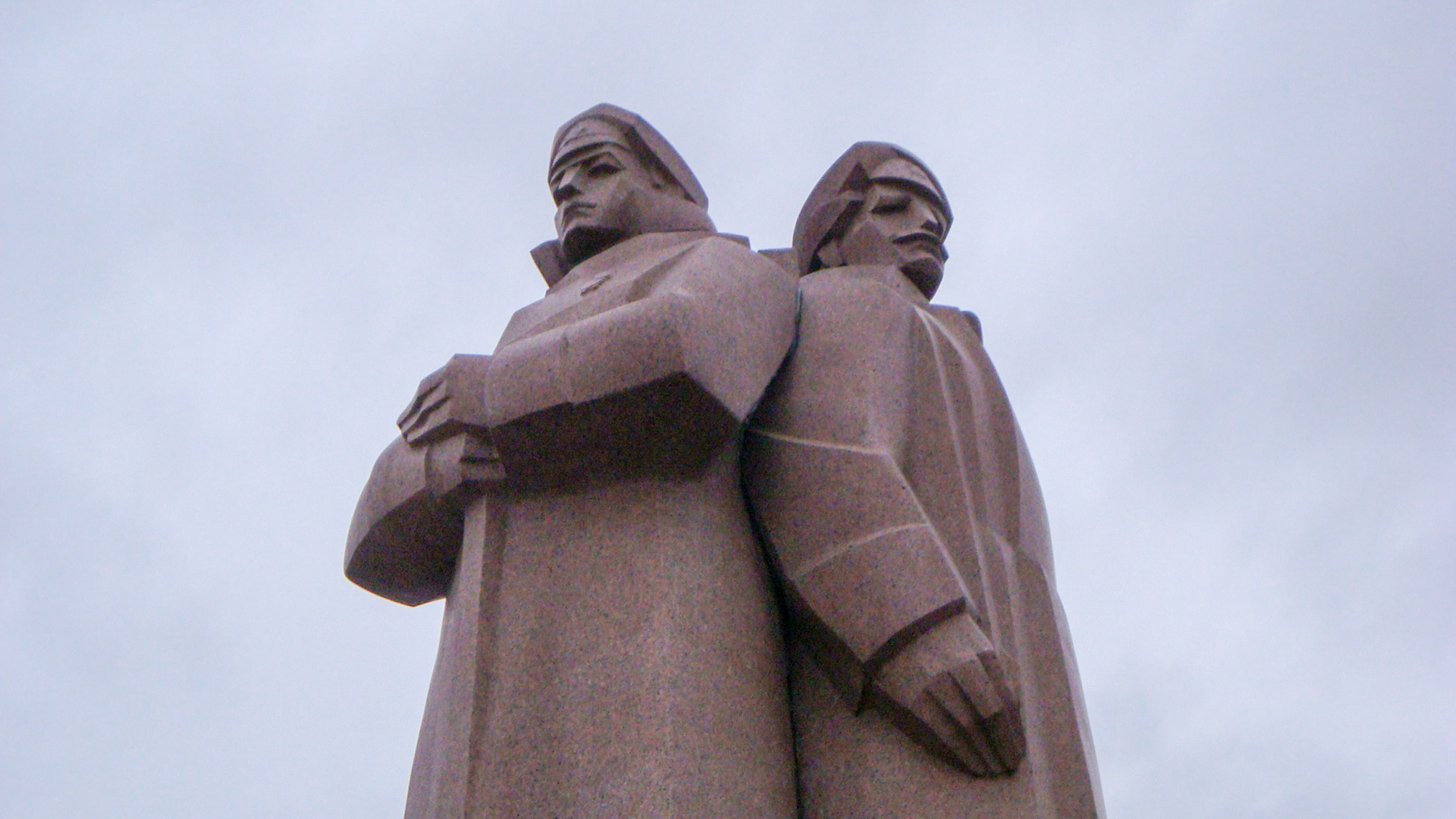
Two monumental stone figures stand back-to-back beneath an open sky, their heavy cloaks and simplified angular forms giving the group a solemn, blocklike presence. Viewed from below, the sculpture is detached from its wider setting so that folded arms, broad shoulders, and contrasting facial directions become the defining elements of the composition.
Caption
Two monumental stone figures stand back-to-back beneath an open sky, their heavy cloaks and simplified angular forms giving the group a solemn, blocklike presence. Viewed from below, the sculpture is detached from its wider setting so that folded arms, broad shoulders, and contrasting facial directions become the defining elements of the composition.

The Latvian National Opera faces a broad lawn edged by sweeping beds of red, white, and yellow flowers. Its pale Neoclassical façade is organized by a columned portico, pediment, and balanced wings, while the formal landscaping creates a ceremonial approach across the park. The frontal view emphasizes symmetry in both architecture and garden design.
Caption
The Latvian National Opera faces a broad lawn edged by sweeping beds of red, white, and yellow flowers. Its pale Neoclassical façade is organized by a columned portico, pediment, and balanced wings, while the formal landscaping creates a ceremonial approach across the park. The frontal view emphasizes symmetry in both architecture and garden design.

A traveler poses beside two life-size bronze figures in a landscaped Riga park, one a woman in period dress and the other a formally dressed man. A large black umbrella rises behind the group, while flower beds and paths establish the garden setting. The photograph records the interactive, human scale of public sculpture within the city’s green space.
Caption
A traveler poses beside two life-size bronze figures in a landscaped Riga park, one a woman in period dress and the other a formally dressed man. A large black umbrella rises behind the group, while flower beds and paths establish the garden setting. The photograph records the interactive, human scale of public sculpture within the city’s green space.

A calm canal curves through dense parkland toward a low stone arch bridge. Mature deciduous trees, clipped grass, and early autumn foliage frame the reflective water, while ducks gather along the banks and surface. The scene presents Riga’s landscaped canal belt as a quiet green corridor embedded within the central city.
Caption
A calm canal curves through dense parkland toward a low stone arch bridge. Mature deciduous trees, clipped grass, and early autumn foliage frame the reflective water, while ducks gather along the banks and surface. The scene presents Riga’s landscaped canal belt as a quiet green corridor embedded within the central city.

A modern stained-glass composition fills a broad arched opening with saturated bands of red, blue, white, and amber glass. Angular geometric shapes replace traditional figurative scenes, while the dark masonry surround and arch below intensify the luminous color. The design reads as a contemporary intervention within an older ecclesiastical interior.
Caption
A modern stained-glass composition fills a broad arched opening with saturated bands of red, blue, white, and amber glass. Angular geometric shapes replace traditional figurative scenes, while the dark masonry surround and arch below intensify the luminous color. The design reads as a contemporary intervention within an older ecclesiastical interior.

A heavily weathered stone relief preserves the outline of a human figure with folded or bent limbs and a faintly modeled head. Abrasion, staining, and surface loss obscure much of the original detail, leaving the body and surrounding carved border only partially legible. The close view emphasizes the age and material condition of this funerary or commemorative stone.
Caption
A heavily weathered stone relief preserves the outline of a human figure with folded or bent limbs and a faintly modeled head. Abrasion, staining, and surface loss obscure much of the original detail, leaving the body and surrounding carved border only partially legible. The close view emphasizes the age and material condition of this funerary or commemorative stone.

A pair of massive dark wooden doors fills a rounded stone portal, each leaf patterned with rows of metal studs and fitted with oval ring handles. Above the arch, a small painted heraldic plaque is set into the pale masonry. The frontal view concentrates on the contrast between heavy timber, metal hardware, and rough-cut stone.
Caption
A pair of massive dark wooden doors fills a rounded stone portal, each leaf patterned with rows of metal studs and fitted with oval ring handles. Above the arch, a small painted heraldic plaque is set into the pale masonry. The frontal view concentrates on the contrast between heavy timber, metal hardware, and rough-cut stone.

A deeply carved heraldic shield occupies the center of a worn stone memorial slab, surrounded by scrolling foliage and additional incised decoration. Two vertical devices divide the shield beneath small crests, while centuries of abrasion have softened the edges of the carving. Raking light makes the surviving relief and surface texture especially legible.
Caption
A deeply carved heraldic shield occupies the center of a worn stone memorial slab, surrounded by scrolling foliage and additional incised decoration. Two vertical devices divide the shield beneath small crests, while centuries of abrasion have softened the edges of the carving. Raking light makes the surviving relief and surface texture especially legible.

A large wooden crucifix rises against a pale vaulted church wall, with the carved body of Christ extending from a rough-hewn cross. A sorrowful female figure stands below at left and another carved figure appears at right. The restrained setting and natural wood tones focus attention on the devotional sculpture and its expressive human forms.
Caption
A large wooden crucifix rises against a pale vaulted church wall, with the carved body of Christ extending from a rough-hewn cross. A sorrowful female figure stands below at left and another carved figure appears at right. The restrained setting and natural wood tones focus attention on the devotional sculpture and its expressive human forms.

A fantastical green metal dragon projects from a stone wall on an ornate wrought-iron bracket, its open red mouth forming the outlet of a rain spout. A small crown-like ornament sits above its head, while curling whiskers and pointed features sharpen the creature’s silhouette against the blue sky. The functional drainage element is transformed into vivid zoomorphic architectural ornament.
Caption
A fantastical green metal dragon projects from a stone wall on an ornate wrought-iron bracket, its open red mouth forming the outlet of a rain spout. A small crown-like ornament sits above its head, while curling whiskers and pointed features sharpen the creature’s silhouette against the blue sky. The functional drainage element is transformed into vivid zoomorphic architectural ornament.