Swiss National Park – Graubünden, Switzerland
The Swiss National Park (Parc Naziunal Svizzer) lies in the eastern Alps of Graubünden, near the border with Italy and Austria. Established in 1914, it is the oldest national park in the Alps and preserves a vast area of high mountain wilderness.
The park protects rugged alpine landscapes including deep valleys, forests of larch and pine, and rocky mountain ridges shaped by glaciers and rivers. Wildlife such as ibex, red deer, chamois, and golden eagles inhabit these protected mountain environments.
In winter the surrounding alpine scenery becomes especially dramatic, with snow-covered slopes and quiet valleys reflecting the pristine character of Switzerland’s high mountain landscapes.

The Center dal Parc Naziunal Svizzer presents a blocky modern façade of pale concrete, deep-set rectangular windows, and sharply cut volumes. Entrance steps and railings run along the base where the center's name appears in dark lettering. The frontal architectural view makes the building's austere massing and material finish the subject, contrasting with the historic village structures photographed nearby.
Caption
The Center dal Parc Naziunal Svizzer presents a blocky modern façade of pale concrete, deep-set rectangular windows, and sharply cut volumes. Entrance steps and railings run along the base where the center's name appears in dark lettering. The frontal architectural view makes the building's austere massing and material finish the subject, contrasting with the historic village structures photographed nearby.

A stylized bird emblem appears above the lowercase words 'parc naziunal svizzer' on a warm wood-toned surface, with the slogan 'echt wild' below. The close view records the park's visual identity as an exhibition or visitor-center graphic rather than a landscape. Its simple typography and emblem establish a recognizable institutional mark for the Swiss National Park.
Caption
A stylized bird emblem appears above the lowercase words 'parc naziunal svizzer' on a warm wood-toned surface, with the slogan 'echt wild' below. The close view records the park's visual identity as an exhibition or visitor-center graphic rather than a landscape. Its simple typography and emblem establish a recognizable institutional mark for the Swiss National Park.

A broad forested mountain rises above a snow-covered valley where a roofed timber bridge and roadside buildings form a thin line of settlement in the foreground. Low cloud drifts along the slopes and partially masks adjoining ridges. The wider framing places the bridge infrastructure in its larger topographic setting, showing the scale of the surrounding mountain landscape.
Caption
A broad forested mountain rises above a snow-covered valley where a roofed timber bridge and roadside buildings form a thin line of settlement in the foreground. Low cloud drifts along the slopes and partially masks adjoining ridges. The wider framing places the bridge infrastructure in its larger topographic setting, showing the scale of the surrounding mountain landscape.

Winter settles across a steep alpine valley where a forested mountain rises behind a narrow band of buildings and transport infrastructure. In the foreground, a long timber-covered bridge spans the watercourse beside the road, while fresh snow outlines fields, roofs, and the dense conifer woodland. Low clouds and broken light emphasize the layered transition from settled valley floor to rugged mountain slopes.
Caption
Winter settles across a steep alpine valley where a forested mountain rises behind a narrow band of buildings and transport infrastructure. In the foreground, a long timber-covered bridge spans the watercourse beside the road, while fresh snow outlines fields, roofs, and the dense conifer woodland. Low clouds and broken light emphasize the layered transition from settled valley floor to rugged mountain slopes.

Rugged snow-covered ridges frame a deep alpine valley filled with low cloud. Forested lower slopes descend toward the mist, while a blocky rock peak stands prominently near the center-right. Diffuse light filtering through heavier cloud emphasizes the layered depth of the landscape and the contrast between wooded slopes, bare alpine rock, and suspended vapor.
Caption
Rugged snow-covered ridges frame a deep alpine valley filled with low cloud. Forested lower slopes descend toward the mist, while a blocky rock peak stands prominently near the center-right. Diffuse light filtering through heavier cloud emphasizes the layered depth of the landscape and the contrast between wooded slopes, bare alpine rock, and suspended vapor.

A dark blue-green river curves through broad snowbanks beneath a steep forested mountain. Bare larches and darker conifers line the far bank, while cloud softens the snow-covered summit and upper ridges. The reflective water creates a quiet foreground counterpoint to the rugged mountain mass, distinguishing this scene from the faster streams and narrow channels elsewhere in the portfolio.
Caption
A dark blue-green river curves through broad snowbanks beneath a steep forested mountain. Bare larches and darker conifers line the far bank, while cloud softens the snow-covered summit and upper ridges. The reflective water creates a quiet foreground counterpoint to the rugged mountain mass, distinguishing this scene from the faster streams and narrow channels elsewhere in the portfolio.

A row of brightly colored and pale village buildings stretches across the snowy valley floor beneath a steep rocky mountainside. A slender church tower rises near the center, while dark forest patches and exposed rock form a dramatic backdrop. The panoramic framing emphasizes the settlement's horizontal form and the abrupt vertical rise of the terrain behind it.
Caption
A row of brightly colored and pale village buildings stretches across the snowy valley floor beneath a steep rocky mountainside. A slender church tower rises near the center, while dark forest patches and exposed rock form a dramatic backdrop. The panoramic framing emphasizes the settlement's horizontal form and the abrupt vertical rise of the terrain behind it.

A compact alpine village spreads across the valley floor beneath broad snow-covered slopes. A square church tower with a shallow pyramidal roof rises from the dense cluster of pitched-roof houses, while lift infrastructure and open runs are visible on the mountainside behind. The elevated view emphasizes the transition from historic village core to winter recreation terrain.
Caption
A compact alpine village spreads across the valley floor beneath broad snow-covered slopes. A square church tower with a shallow pyramidal roof rises from the dense cluster of pitched-roof houses, while lift infrastructure and open runs are visible on the mountainside behind. The elevated view emphasizes the transition from historic village core to winter recreation terrain.

A broad winter view shows an alpine settlement stretching along the valley floor beneath snow-covered forest and open mountain slopes. Houses of varied size and color form a dense central band, while scattered structures climb slightly uphill behind them. The wider framing reduces individual landmarks and instead records the settlement's overall scale, topographic setting, and relationship to the surrounding winter landscape.
Caption
A broad winter view shows an alpine settlement stretching along the valley floor beneath snow-covered forest and open mountain slopes. Houses of varied size and color form a dense central band, while scattered structures climb slightly uphill behind them. The wider framing reduces individual landmarks and instead records the settlement's overall scale, topographic setting, and relationship to the surrounding winter landscape.

A dark, fast-moving river curves through a narrow snow-covered corridor bordered by conifers and rocky banks. Rounded boulders break the surface, while fresh snow clings to the forest floor and steep slopes. Mist softens the upper trees, giving the scene a strong sense of winter weather and enclosed mountain topography rather than an expansive valley view.
Caption
A dark, fast-moving river curves through a narrow snow-covered corridor bordered by conifers and rocky banks. Rounded boulders break the surface, while fresh snow clings to the forest floor and steep slopes. Mist softens the upper trees, giving the scene a strong sense of winter weather and enclosed mountain topography rather than an expansive valley view.

A broad square tower anchors a compact alpine village where a slender church spire rises farther back along the valley. Snow lies across roofs, walls, and open ground, while steep forested mountains enclose the settlement. The layered view distinguishes civic or fortified-looking architecture in the foreground from the vertical church landmark deeper in the village.
Caption
A broad square tower anchors a compact alpine village where a slender church spire rises farther back along the valley. Snow lies across roofs, walls, and open ground, while steep forested mountains enclose the settlement. The layered view distinguishes civic or fortified-looking architecture in the foreground from the vertical church landmark deeper in the village.

A dark Suzuki stands beneath a service-station canopy during a winter road journey toward the Alps. Snowy slopes and conifers appear beyond the pumps, while a life-size printed female figure is visible through the windshield. The Austrian license plate and roadside setting make this an en-route travel scene rather than evidence of a location inside Parc Naziunal Svizzer.
Caption
A dark Suzuki stands beneath a service-station canopy during a winter road journey toward the Alps. Snowy slopes and conifers appear beyond the pumps, while a life-size printed female figure is visible through the windshield. The Austrian license plate and roadside setting make this an en-route travel scene rather than evidence of a location inside Parc Naziunal Svizzer.

Fresh snow traces a broad Alpine mountainside above a dense band of evergreen forest. Wisps of low cloud or windblown snow soften the transition between the trees and open upper slopes, while the foreground conifers establish the scale of the terrain. No distinctive landmark is visible enough to justify a more specific mountain identification.
Caption
Fresh snow traces a broad Alpine mountainside above a dense band of evergreen forest. Wisps of low cloud or windblown snow soften the transition between the trees and open upper slopes, while the foreground conifers establish the scale of the terrain. No distinctive landmark is visible enough to justify a more specific mountain identification.

Seen tightly through the windshield, a life-size printed blonde female figure occupies the passenger side of a parked vehicle. Reflections, dashboard details, a hanging cross, and snow outside layer the composition, turning an otherwise ordinary roadside stop into an unusual travel detail. The photograph provides no visual basis for placing the scene within the national park itself.
Caption
Seen tightly through the windshield, a life-size printed blonde female figure occupies the passenger side of a parked vehicle. Reflections, dashboard details, a hanging cross, and snow outside layer the composition, turning an otherwise ordinary roadside stop into an unusual travel detail. The photograph provides no visual basis for placing the scene within the national park itself.

Bands of low cloud wrap a steep, forested Alpine slope, leaving only fragments of the snow-covered mountain visible above and below the mist. A pale valley floor with scattered buildings lies at the base. The layered weather is the defining feature, obscuring enough topographic detail that a specific mountain or settlement cannot be confirmed from this view.
Caption
Bands of low cloud wrap a steep, forested Alpine slope, leaving only fragments of the snow-covered mountain visible above and below the mist. A pale valley floor with scattered buildings lies at the base. The layered weather is the defining feature, obscuring enough topographic detail that a specific mountain or settlement cannot be confirmed from this view.

A substantial stone castle ruin crowns a wooded, snow-covered rise above a long pedestrian bridge. Roofless walls, broken window openings, and a surviving tower-like mass define the fortified complex against the winter sky. The architecture is clear, but the proof sheet alone does not securely establish the castle's name, so the identification remains descriptive rather than nominal.
Caption
A substantial stone castle ruin crowns a wooded, snow-covered rise above a long pedestrian bridge. Roofless walls, broken window openings, and a surviving tower-like mass define the fortified complex against the winter sky. The architecture is clear, but the proof sheet alone does not securely establish the castle's name, so the identification remains descriptive rather than nominal.

Two simple timber farm buildings sit on an open snowfield beneath steep, forested Alpine mountains. Low cloud drifts along the valley sides and partially veils the higher ridges, while the broad white foreground emphasizes the rural scale of the scene. The composition documents a winter agricultural landscape without enough distinctive evidence to assign a precise village or peak.
Caption
Two simple timber farm buildings sit on an open snowfield beneath steep, forested Alpine mountains. Low cloud drifts along the valley sides and partially veils the higher ridges, while the broad white foreground emphasizes the rural scale of the scene. The composition documents a winter agricultural landscape without enough distinctive evidence to assign a precise village or peak.

Dense conifers coated with fresh snow climb a rounded ridge as fog pours over the treetops. Small open patches interrupt the forest near the base, but the photograph is dominated by the alternating textures of dark trunks, white branches, and pale mist. No singular landmark appears, making this a strong environmental study of winter conditions in the Alpine landscape.
Caption
Dense conifers coated with fresh snow climb a rounded ridge as fog pours over the treetops. Small open patches interrupt the forest near the base, but the photograph is dominated by the alternating textures of dark trunks, white branches, and pale mist. No singular landmark appears, making this a strong environmental study of winter conditions in the Alpine landscape.

A small signpost rises from deep snow beside conifers, carrying a green panel with a white deer silhouette and a second notice above it. The marker indicates wildlife awareness along the route, an important visual cue in an Alpine landscape where roads intersect animal habitat. The upper wording is too small here for a reliable full transcription.
Caption
A small signpost rises from deep snow beside conifers, carrying a green panel with a white deer silhouette and a second notice above it. The marker indicates wildlife awareness along the route, an important visual cue in an Alpine landscape where roads intersect animal habitat. The upper wording is too small here for a reliable full transcription.

A small turquoise Alpine lake appears through a dense screen of snow-laden conifers, its saturated water contrasting sharply with the white forest and overcast sky. The elevated viewpoint reveals only part of the shoreline, with mist softening the surrounding slopes. The waterbody is distinctive, but the proof sheet does not provide enough evidence to assign a reliable lake name.
Caption
A small turquoise Alpine lake appears through a dense screen of snow-laden conifers, its saturated water contrasting sharply with the white forest and overcast sky. The elevated viewpoint reveals only part of the shoreline, with mist softening the surrounding slopes. The waterbody is distinctive, but the proof sheet does not provide enough evidence to assign a reliable lake name.

From a higher opening in the trees, a turquoise mountain lake curves through a steep, snow-covered basin. Dark conifers frame the water, while low clouds conceal portions of the surrounding peaks and create depth across the valley. Compared with the preceding view, this wider composition reveals more of the lake's elongated form and its relationship to the forested slopes.
Caption
From a higher opening in the trees, a turquoise mountain lake curves through a steep, snow-covered basin. Dark conifers frame the water, while low clouds conceal portions of the surrounding peaks and create depth across the valley. Compared with the preceding view, this wider composition reveals more of the lake's elongated form and its relationship to the forested slopes.

A man in a cream cable-knit sweater stands close to the camera at a winter mountain overlook. Behind him, a turquoise lake and snow-covered conifer slopes fall softly out of focus, keeping attention on the portrait while retaining a clear sense of Alpine setting. The individual's identity cannot be established from visual evidence alone, so the caption remains non-identifying.
Caption
A man in a cream cable-knit sweater stands close to the camera at a winter mountain overlook. Behind him, a turquoise lake and snow-covered conifer slopes fall softly out of focus, keeping attention on the portrait while retaining a clear sense of Alpine setting. The individual's identity cannot be established from visual evidence alone, so the caption remains non-identifying.

A tighter portrait places a smiling man against a softly blurred winter valley, with a sliver of turquoise lake and snow-covered forest visible behind his shoulders. The shallow depth of field separates the subject from the landscape more strongly than the adjacent frame, creating a personal travel portrait while still preserving the cold Alpine setting.
Caption
A tighter portrait places a smiling man against a softly blurred winter valley, with a sliver of turquoise lake and snow-covered forest visible behind his shoulders. The shallow depth of field separates the subject from the landscape more strongly than the adjacent frame, creating a personal travel portrait while still preserving the cold Alpine setting.

A long timber-and-metal snow barrier angles across a steep, forested mountainside, its lattice structure partly buried by fresh accumulation. Such engineered defenses interrupt potential snow movement above transport corridors and settlements in Alpine terrain. Here the barrier itself, rather than a distant mountain, is the principal subject, with snow-loaded conifers showing the conditions it is designed to address.
Caption
A long timber-and-metal snow barrier angles across a steep, forested mountainside, its lattice structure partly buried by fresh accumulation. Such engineered defenses interrupt potential snow movement above transport corridors and settlements in Alpine terrain. Here the barrier itself, rather than a distant mountain, is the principal subject, with snow-loaded conifers showing the conditions it is designed to address.

A two-lane highway curves through a narrow Alpine valley bordered by snow-covered conifers and steep mountain walls. Vehicles ahead provide scale, while guardrails and a stone retaining wall emphasize the engineered passage through difficult terrain. Cloud obscures the upper ridges, making the road corridor and winter driving conditions more visually prominent than any particular peak.
Caption
A two-lane highway curves through a narrow Alpine valley bordered by snow-covered conifers and steep mountain walls. Vehicles ahead provide scale, while guardrails and a stone retaining wall emphasize the engineered passage through difficult terrain. Cloud obscures the upper ridges, making the road corridor and winter driving conditions more visually prominent than any particular peak.

The bright orange-red façade of Fernpass Rast stands out against deep roadside snow and evergreen trees. Large painted lettering names the stop, while smaller service symbols near the corner advertise food and traveler amenities. The readable sign makes this one of the batch's securely identified en-route locations and places the scene at a road-service stop rather than within Parc Naziunal Svizzer.
Caption
The bright orange-red façade of Fernpass Rast stands out against deep roadside snow and evergreen trees. Large painted lettering names the stop, while smaller service symbols near the corner advertise food and traveler amenities. The readable sign makes this one of the batch's securely identified en-route locations and places the scene at a road-service stop rather than within Parc Naziunal Svizzer.

Jagged, snow-covered rock rises behind a dense conifer forest, with cloud brushing the highest slopes and softening the skyline. The broad frontal view emphasizes the transition from wooded lower elevations to exposed, steeper upper terrain. Without a readable marker or uniquely diagnostic profile, the ridge is best cataloged as an Alpine mountain landscape rather than assigned a specific summit name.
Caption
Jagged, snow-covered rock rises behind a dense conifer forest, with cloud brushing the highest slopes and softening the skyline. The broad frontal view emphasizes the transition from wooded lower elevations to exposed, steeper upper terrain. Without a readable marker or uniquely diagnostic profile, the ridge is best cataloged as an Alpine mountain landscape rather than assigned a specific summit name.

A cleared mountain road bends sharply beneath steep, snow-dusted rock walls and forested slopes. The guardrail traces the curve across the foreground, while a narrow vertical rock form rises prominently beyond it. Snowbanks and wet pavement convey active winter travel through constricted Alpine terrain, but the exact pass or rock formation is not securely identifiable from this frame.
Caption
A cleared mountain road bends sharply beneath steep, snow-dusted rock walls and forested slopes. The guardrail traces the curve across the foreground, while a narrow vertical rock form rises prominently beyond it. Snowbanks and wet pavement convey active winter travel through constricted Alpine terrain, but the exact pass or rock formation is not securely identifiable from this frame.

A cluster of steep, tooth-like rock towers rises abruptly above conifers and snow, with low cloud curling around the upper cliffs. Patches of exposed brown-gray stone contrast with the white winter coating, revealing the vertical character of the formation. The profile is striking but not sufficiently diagnostic on the proof sheet to support a named geological or mountain identification.
Caption
A cluster of steep, tooth-like rock towers rises abruptly above conifers and snow, with low cloud curling around the upper cliffs. Patches of exposed brown-gray stone contrast with the white winter coating, revealing the vertical character of the formation. The profile is striking but not sufficiently diagnostic on the proof sheet to support a named geological or mountain identification.

A compact Alpine village spreads across a snowy valley floor, its slender church spire rising above clustered houses. Thick cloud hangs low over the dark mountain behind, partially swallowing the upper slope and giving the settlement a strong sense of enclosure. The church and village form are clear, but no readable place name permits a secure identification of the community.
Caption
A compact Alpine village spreads across a snowy valley floor, its slender church spire rising above clustered houses. Thick cloud hangs low over the dark mountain behind, partially swallowing the upper slope and giving the settlement a strong sense of enclosure. The church and village form are clear, but no readable place name permits a secure identification of the community.
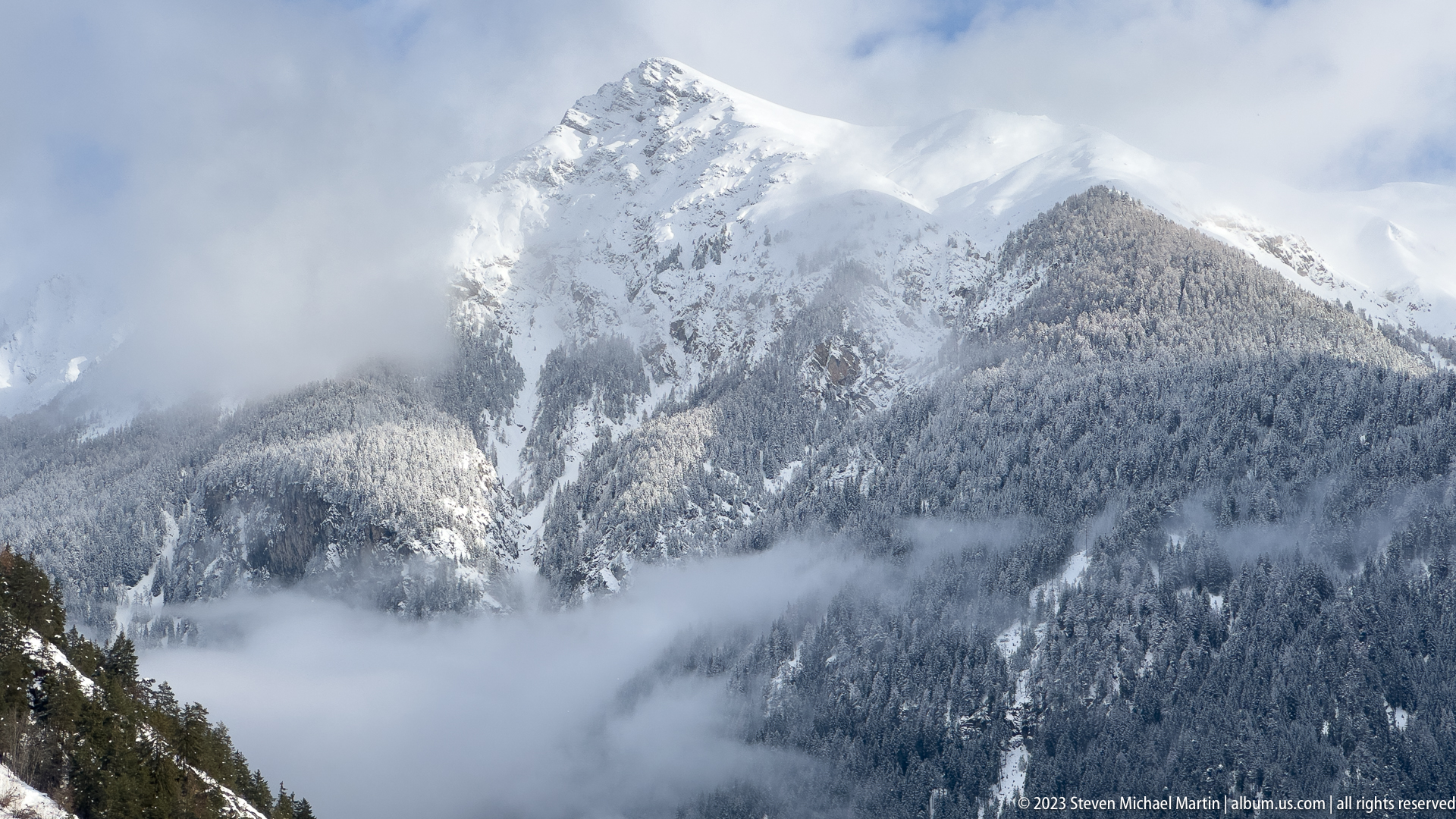
A steep snow-covered summit emerges dramatically from broken cloud above heavily forested lower slopes. Exposed rock bands and a broad white upper face catch brighter light while mist pools in the valley below. The photograph isolates the mountain as a monumental winter landform, though the absence of a sign or uniquely certain profile argues against assigning a specific peak name.
Caption
A steep snow-covered summit emerges dramatically from broken cloud above heavily forested lower slopes. Exposed rock bands and a broad white upper face catch brighter light while mist pools in the valley below. The photograph isolates the mountain as a monumental winter landform, though the absence of a sign or uniquely certain profile argues against assigning a specific peak name.

A broad snow-covered mountain fills the frame above a dense forest of frost-coated conifers. A horizontal bank of cloud crosses the upper slope, alternately revealing and concealing the summit ridge. This closer view emphasizes snow distribution, forest texture, and winter weather rather than the wider valley context seen in neighboring photographs.
Caption
A broad snow-covered mountain fills the frame above a dense forest of frost-coated conifers. A horizontal bank of cloud crosses the upper slope, alternately revealing and concealing the summit ridge. This closer view emphasizes snow distribution, forest texture, and winter weather rather than the wider valley context seen in neighboring photographs.

A narrow cleared road runs through an open snow-covered valley toward a dramatic line of mountains. Blue sky breaks through fast-moving cloud above the peaks, while snowbanks and sparse roadside vegetation define the route in the foreground. The strong linear composition turns the road into a visual guide toward the high terrain without establishing a specific road or pass name.
Caption
A narrow cleared road runs through an open snow-covered valley toward a dramatic line of mountains. Blue sky breaks through fast-moving cloud above the peaks, while snowbanks and sparse roadside vegetation define the route in the foreground. The strong linear composition turns the road into a visual guide toward the high terrain without establishing a specific road or pass name.

A small settlement occupies a low rise above a broad snowfield, with a tall square tower or church structure anchoring the cluster of pale buildings. Dense cloud drapes the surrounding mountains, leaving the village briefly isolated against the white foreground. Architectural details are too distant for a secure building or village name, but the elevated settlement pattern is clearly visible.
Caption
A small settlement occupies a low rise above a broad snowfield, with a tall square tower or church structure anchoring the cluster of pale buildings. Dense cloud drapes the surrounding mountains, leaving the village briefly isolated against the white foreground. Architectural details are too distant for a secure building or village name, but the elevated settlement pattern is clearly visible.

A vivid red sculpture of an Alpine ibex stands beside a modern building, its long backward-curving horns and compact goat-like body rendered in an exaggerated monochrome finish. Snow piled around the base places the work firmly in a winter setting. The animal form is distinctive enough for an ibex identification, though the artist, title, and installation site are not visible.
Caption
A vivid red sculpture of an Alpine ibex stands beside a modern building, its long backward-curving horns and compact goat-like body rendered in an exaggerated monochrome finish. Snow piled around the base places the work firmly in a winter setting. The animal form is distinctive enough for an ibex identification, though the artist, title, and installation site are not visible.

Detached houses line a gentle slope above an expansive snow-covered field, with bare shrubs and trees marking the transition between settlement and open land. Blue sky and lingering cloud brighten the scene after snowfall. The image focuses on the everyday residential edge of an Alpine community rather than a singular landmark, and no place-name evidence is visible.
Caption
Detached houses line a gentle slope above an expansive snow-covered field, with bare shrubs and trees marking the transition between settlement and open land. Blue sky and lingering cloud brighten the scene after snowfall. The image focuses on the everyday residential edge of an Alpine community rather than a singular landmark, and no place-name evidence is visible.

A narrow road descends between high snowbanks into a deep Alpine valley, where dark conifer forest rises toward a jagged mountain skyline. The low sun glows through heavy cloud above the ridge, creating a dramatic contrast between the shaded road and luminous sky. Roadside poles mark the carriageway where snow has narrowed the visible corridor.
Caption
A narrow road descends between high snowbanks into a deep Alpine valley, where dark conifer forest rises toward a jagged mountain skyline. The low sun glows through heavy cloud above the ridge, creating a dramatic contrast between the shaded road and luminous sky. Roadside poles mark the carriageway where snow has narrowed the visible corridor.

A small masonry tower or chapel-like structure crowns the sharp summit of a steep, wooded hill rising above the valley. Snow lies on surrounding slopes while bare deciduous trees fill the foreground, emphasizing the isolated silhouette. The elevated monument is visually clear, but its exact identity cannot be established confidently from the proof sheet alone.
Caption
A small masonry tower or chapel-like structure crowns the sharp summit of a steep, wooded hill rising above the valley. Snow lies on surrounding slopes while bare deciduous trees fill the foreground, emphasizing the isolated silhouette. The elevated monument is visually clear, but its exact identity cannot be established confidently from the proof sheet alone.

A long timber covered bridge crosses a fast-flowing river between snow-covered banks and tall pines. Open truss panels along the sides reveal the structural rhythm of the enclosure, while a masonry or concrete pier supports the span near midstream. The photograph clearly documents traditional bridge form, though no sign is visible to establish the bridge's proper name.
Caption
A long timber covered bridge crosses a fast-flowing river between snow-covered banks and tall pines. Open truss panels along the sides reveal the structural rhythm of the enclosure, while a masonry or concrete pier supports the span near midstream. The photograph clearly documents traditional bridge form, though no sign is visible to establish the bridge's proper name.

Seen broadside from across the valley floor, a timber covered bridge stretches horizontally beneath a continuous cap of snow. Repeating diagonal braces articulate its long side wall, while a wooded, snow-dusted mountainside fills the background. This more distant view emphasizes the bridge's full length and structural profile rather than the river crossing shown in the preceding frame.
Caption
Seen broadside from across the valley floor, a timber covered bridge stretches horizontally beneath a continuous cap of snow. Repeating diagonal braces articulate its long side wall, while a wooded, snow-dusted mountainside fills the background. This more distant view emphasizes the bridge's full length and structural profile rather than the river crossing shown in the preceding frame.

A covered wooden bridge forms a low horizontal line across the snowy valley floor, backed by a broad forested ridge dusted white from recent snowfall. The wider viewpoint reduces the bridge to one element within the winter landscape and shows its relationship to nearby buildings, open fields, and mountain terrain. No identifying signage is legible at this distance.
Caption
A covered wooden bridge forms a low horizontal line across the snowy valley floor, backed by a broad forested ridge dusted white from recent snowfall. The wider viewpoint reduces the bridge to one element within the winter landscape and shows its relationship to nearby buildings, open fields, and mountain terrain. No identifying signage is legible at this distance.

A clear blue-green river passes beneath a narrow bridge in a steep, forested winter valley. Snow blankets the banks and exposed rocks, while tall conifers frame the channel closely on both sides. The low viewpoint follows the river upstream, making the bridge a small human element within an otherwise strongly enclosed mountain landscape.
Caption
A clear blue-green river passes beneath a narrow bridge in a steep, forested winter valley. Snow blankets the banks and exposed rocks, while tall conifers frame the channel closely on both sides. The low viewpoint follows the river upstream, making the bridge a small human element within an otherwise strongly enclosed mountain landscape.

Jagged rock pinnacles rise abruptly from a forested slope, their ledges and gullies traced by fresh snow. Rust-colored larches stand below the crags, adding a seasonal contrast to the darker evergreen forest. Low cloud wraps the upper rock faces and partially obscures the surrounding ridges, emphasizing the steepness and fragmented profile of the mountain.
Caption
Jagged rock pinnacles rise abruptly from a forested slope, their ledges and gullies traced by fresh snow. Rust-colored larches stand below the crags, adding a seasonal contrast to the darker evergreen forest. Low cloud wraps the upper rock faces and partially obscures the surrounding ridges, emphasizing the steepness and fragmented profile of the mountain.

A roadside view opens toward a cluster of sharp, snow-dusted rock towers rising beyond mixed conifer and larch forest. The snow-covered shoulder in the foreground places the viewer at valley level, while low clouds drift around the peaks and conceal parts of the higher ridge. The composition shows how quickly the terrain rises from the road into rugged alpine relief.
Caption
A roadside view opens toward a cluster of sharp, snow-dusted rock towers rising beyond mixed conifer and larch forest. The snow-covered shoulder in the foreground places the viewer at valley level, while low clouds drift around the peaks and conceal parts of the higher ridge. The composition shows how quickly the terrain rises from the road into rugged alpine relief.

A wet mountain road curves beneath a massive concrete protective structure built into the slope. Heavy walls and a columned gallery shield the roadway from the steep wooded mountainside above, where patches of snow remain beneath conifers. The utilitarian engineering contrasts with the surrounding natural landscape and indicates the practical demands of winter travel through alpine terrain.
Caption
A wet mountain road curves beneath a massive concrete protective structure built into the slope. Heavy walls and a columned gallery shield the roadway from the steep wooded mountainside above, where patches of snow remain beneath conifers. The utilitarian engineering contrasts with the surrounding natural landscape and indicates the practical demands of winter travel through alpine terrain.

A mountain road bends through a long enclosed concrete gallery, its left wall punctuated by a rhythmic series of tall vertical openings. Light from the snowy exterior reflects on the wet pavement, while the curved ceiling and continuous retaining wall guide the roadway out of sight. The image emphasizes the engineered transition between exposed alpine road and protected passage.
Caption
A mountain road bends through a long enclosed concrete gallery, its left wall punctuated by a rhythmic series of tall vertical openings. Light from the snowy exterior reflects on the wet pavement, while the curved ceiling and continuous retaining wall guide the roadway out of sight. The image emphasizes the engineered transition between exposed alpine road and protected passage.

A shallow mountain stream tumbles over dark rocks through a broad blanket of snow. Small cascades and exposed stones create a broken channel that leads uphill toward scattered conifers and an open slope. The bright winter surface and flowing water make the image a close study of seasonal runoff and the persistence of moving water beneath deep alpine snow.
Caption
A shallow mountain stream tumbles over dark rocks through a broad blanket of snow. Small cascades and exposed stones create a broken channel that leads uphill toward scattered conifers and an open slope. The bright winter surface and flowing water make the image a close study of seasonal runoff and the persistence of moving water beneath deep alpine snow.

Turquoise water fills a narrow channel or impoundment beside a mountain road, edged by snow and steep wooded slopes. A guardrail and engineered structure in the foreground signal the roadside viewpoint, while the far bank rises sharply into conifer-covered terrain. The vivid water color contrasts strongly with the muted whites and browns of the winter landscape.
Caption
Turquoise water fills a narrow channel or impoundment beside a mountain road, edged by snow and steep wooded slopes. A guardrail and engineered structure in the foreground signal the roadside viewpoint, while the far bank rises sharply into conifer-covered terrain. The vivid water color contrasts strongly with the muted whites and browns of the winter landscape.

A cluster of road signs directs travelers toward Scuol Ost and S-charl, with a brown Parc Naziunal Svizzer panel beneath service and recreation symbols. The sign assembly also includes Romansh wording for a restricted or special traffic zone and a 28-ton limit. Snowy buildings and misty mountains sit low in the background, placing this functional wayfinding detail firmly in the Lower Engadine winter landscape.
Caption
A cluster of road signs directs travelers toward Scuol Ost and S-charl, with a brown Parc Naziunal Svizzer panel beneath service and recreation symbols. The sign assembly also includes Romansh wording for a restricted or special traffic zone and a 28-ton limit. Snowy buildings and misty mountains sit low in the background, placing this functional wayfinding detail firmly in the Lower Engadine winter landscape.

A calm turquoise waterway mirrors a steep snow-covered hillside lined with dark conifers and bare larches. The near bank is white with fresh snow, while exposed earth on the opposite slope interrupts the otherwise continuous forest. The nearly symmetrical reflection gives this winter valley scene a quiet, enclosed quality distinct from the faster-flowing river views nearby.
Caption
A calm turquoise waterway mirrors a steep snow-covered hillside lined with dark conifers and bare larches. The near bank is white with fresh snow, while exposed earth on the opposite slope interrupts the otherwise continuous forest. The nearly symmetrical reflection gives this winter valley scene a quiet, enclosed quality distinct from the faster-flowing river views nearby.

Dark tree trunks and a snow-covered hillside form a crisp reflection across calm green-blue water. The scene is more intimate than the preceding valley view, concentrating on the repeating vertical pattern of larches and conifers along the opposite bank. A narrow strip of snow at the near edge anchors the composition and reinforces the cold, still winter conditions.
Caption
Dark tree trunks and a snow-covered hillside form a crisp reflection across calm green-blue water. The scene is more intimate than the preceding valley view, concentrating on the repeating vertical pattern of larches and conifers along the opposite bank. A narrow strip of snow at the near edge anchors the composition and reinforces the cold, still winter conditions.

A steep mountain wall rises behind a dense conifer forest, its exposed rock faces and treetops coated with fresh snow. Wisps of cloud drift across the slope and obscure the upper ridge, leaving isolated patches of warm-toned rock visible through the white. The close framing emphasizes texture—rock, forest, snow, and vapor—rather than the full mountain profile.
Caption
A steep mountain wall rises behind a dense conifer forest, its exposed rock faces and treetops coated with fresh snow. Wisps of cloud drift across the slope and obscure the upper ridge, leaving isolated patches of warm-toned rock visible through the white. The close framing emphasizes texture—rock, forest, snow, and vapor—rather than the full mountain profile.

A compact alpine village climbs a snow-covered hillside beneath low cloud, with a tall square church tower rising above clustered houses and larger civic-looking buildings. Bare trees mark terraces and lanes across the slope, while a patch of sunlight brightens the foreground snow. The view records the close relationship between settlement, church, and steep winter terrain in the Lower Engadine landscape.
Caption
A compact alpine village climbs a snow-covered hillside beneath low cloud, with a tall square church tower rising above clustered houses and larger civic-looking buildings. Bare trees mark terraces and lanes across the slope, while a patch of sunlight brightens the foreground snow. The view records the close relationship between settlement, church, and steep winter terrain in the Lower Engadine landscape.

A broader view places the same alpine settlement beneath a sweeping snowfield, with its church tower and clustered buildings concentrated along the lower slope. Forest rises behind the village into cloud, while scattered modern structures extend along the hillside. The open foreground gives greater emphasis to the scale of the winter landscape surrounding the inhabited core.
Caption
A broader view places the same alpine settlement beneath a sweeping snowfield, with its church tower and clustered buildings concentrated along the lower slope. Forest rises behind the village into cloud, while scattered modern structures extend along the hillside. The open foreground gives greater emphasis to the scale of the winter landscape surrounding the inhabited core.

A solitary stone tower ruin stands on the crest of a steep rocky knoll, its broken upper walls silhouetted against a pale winter sky. Snow traces the ledges and slope below, while sparse trees and scrub emphasize the exposed position. The ruin's compact footprint and commanding elevation suggest a defensive medieval site, though the exact castle is not established by the visible evidence alone.
Caption
A solitary stone tower ruin stands on the crest of a steep rocky knoll, its broken upper walls silhouetted against a pale winter sky. Snow traces the ledges and slope below, while sparse trees and scrub emphasize the exposed position. The ruin's compact footprint and commanding elevation suggest a defensive medieval site, though the exact castle is not established by the visible evidence alone.

A sharp, snow-covered summit appears through a break in dense cloud, with a second forested ridge fading into mist at right. The mountain's steep face is only partly revealed, creating a layered composition of white snow, dark woodland, and drifting vapor. The image is less an identification portrait than a study of alpine relief briefly exposed by changing winter weather.
Caption
A sharp, snow-covered summit appears through a break in dense cloud, with a second forested ridge fading into mist at right. The mountain's steep face is only partly revealed, creating a layered composition of white snow, dark woodland, and drifting vapor. The image is less an identification portrait than a study of alpine relief briefly exposed by changing winter weather.

A timber-covered bridge announces the Val S-charl route with large carved letters beneath its gabled entrance. Heavy wooden trusses frame the roadway, and deep snow banks crowd both sides of the approach. Decorative figures flank the portal, while posted weight and height restrictions underscore the bridge's continuing transport function within the winter mountain landscape.
Caption
A timber-covered bridge announces the Val S-charl route with large carved letters beneath its gabled entrance. Heavy wooden trusses frame the roadway, and deep snow banks crowd both sides of the approach. Decorative figures flank the portal, while posted weight and height restrictions underscore the bridge's continuing transport function within the winter mountain landscape.

A long timber-covered bridge spans a rocky mountain stream, its weathered vertical siding and open upper trusswork visible from the downstream bank. Snow piles over the abutments and boulders, while the dark timber structure contrasts with the bright winter setting. This side view reveals the bridge's length, structural rhythm, and relationship to the flowing water more clearly than the frontal approach.
Caption
A long timber-covered bridge spans a rocky mountain stream, its weathered vertical siding and open upper trusswork visible from the downstream bank. Snow piles over the abutments and boulders, while the dark timber structure contrasts with the bright winter setting. This side view reveals the bridge's length, structural rhythm, and relationship to the flowing water more clearly than the frontal approach.

The gabled entrance of a timber-covered bridge fills the frame, revealing repeated wooden truss bays receding toward daylight at the far end. Snowbanks and conifer forest surround the approach, and circular restriction signs are mounted at the portal. The centered viewpoint turns the bridge's structural geometry into the main subject, emphasizing depth and the practical enclosure of the roadway.
Caption
The gabled entrance of a timber-covered bridge fills the frame, revealing repeated wooden truss bays receding toward daylight at the far end. Snowbanks and conifer forest surround the approach, and circular restriction signs are mounted at the portal. The centered viewpoint turns the bridge's structural geometry into the main subject, emphasizing depth and the practical enclosure of the roadway.

From a wooded foreground, the camera looks across a snowy valley toward a compact alpine village arranged around a prominent church tower. Houses and larger buildings step up the lower slopes while cloud hangs across the darker forest above. The elevated viewpoint makes the settlement pattern legible and shows how the village occupies a narrow band between valley floor and mountain.
Caption
From a wooded foreground, the camera looks across a snowy valley toward a compact alpine village arranged around a prominent church tower. Houses and larger buildings step up the lower slopes while cloud hangs across the darker forest above. The elevated viewpoint makes the settlement pattern legible and shows how the village occupies a narrow band between valley floor and mountain.

A high alpine ridge rises above dark forest, its broad summit and upper slopes fully coated in fresh snow. Patches of exposed rock punctuate the white surface, while a deep blue opening in the sky brings unusually crisp light to the peak. Compared with the cloud-wrapped views nearby, this image presents a clearer reading of the mountain's rounded crest and descending ridgelines.
Caption
A high alpine ridge rises above dark forest, its broad summit and upper slopes fully coated in fresh snow. Patches of exposed rock punctuate the white surface, while a deep blue opening in the sky brings unusually crisp light to the peak. Compared with the cloud-wrapped views nearby, this image presents a clearer reading of the mountain's rounded crest and descending ridgelines.

A brown directional sign points toward Parc Naziunal Svizzer, pairing the Romansh park name with a white bird emblem. Above it, smaller tourism pictograms indicate nearby visitor services, while a circular red-bordered sign below displays a 28-ton limit. Snow and misty mountain terrain in the background place the sign within the park's winter approach landscape.
Caption
A brown directional sign points toward Parc Naziunal Svizzer, pairing the Romansh park name with a white bird emblem. Above it, smaller tourism pictograms indicate nearby visitor services, while a circular red-bordered sign below displays a 28-ton limit. Snow and misty mountain terrain in the background place the sign within the park's winter approach landscape.

A slender church tower with a pointed spire rises behind a snow-covered rocky hillside dotted with bare shrubs and trees. Only the upper church and a red-roofed section are visible, making the steeple the principal architectural landmark against the clear winter sky. Rounded boulders and scrub in the foreground give the view an unusually rugged village-edge setting.
Caption
A slender church tower with a pointed spire rises behind a snow-covered rocky hillside dotted with bare shrubs and trees. Only the upper church and a red-roofed section are visible, making the steeple the principal architectural landmark against the clear winter sky. Rounded boulders and scrub in the foreground give the view an unusually rugged village-edge setting.

A roadside informational panel identifies Parc Naziunal Svizzer above the graubünden tourism mark. A monochrome mountain photograph fills the upper portion of the sign, echoing the snow-covered rock and trees around it. The sign functions as a clear threshold marker for the protected landscape and provides direct visual confirmation of the Romansh name used for the Swiss National Park.
Caption
A roadside informational panel identifies Parc Naziunal Svizzer above the graubünden tourism mark. A monochrome mountain photograph fills the upper portion of the sign, echoing the snow-covered rock and trees around it. The sign functions as a clear threshold marker for the protected landscape and provides direct visual confirmation of the Romansh name used for the Swiss National Park.

A bright visitor-center gallery uses tables, suspended labels, wall graphics, and illuminated interactive displays to interpret the surrounding mountain environment. A large map-like projection occupies the right side, while specimen- or model-based installations and historical panels line the room. The open, contemporary exhibition design contrasts with the outdoor winter scenes and signals an educational orientation focused on landscape and natural history.
Caption
A bright visitor-center gallery uses tables, suspended labels, wall graphics, and illuminated interactive displays to interpret the surrounding mountain environment. A large map-like projection occupies the right side, while specimen- or model-based installations and historical panels line the room. The open, contemporary exhibition design contrasts with the outdoor winter scenes and signals an educational orientation focused on landscape and natural history.

An elaborate multi-story building rises from a steep snowy slope amid dense conifer forest. Its tall square tower, decorative rooflines, projecting balconies, and pale façades give the complex a strongly historic resort or institutional character, while smaller structures cluster below. The telephoto view isolates the architecture against the dark woodland, making the tower the visual anchor of the composition.
Caption
An elaborate multi-story building rises from a steep snowy slope amid dense conifer forest. Its tall square tower, decorative rooflines, projecting balconies, and pale façades give the complex a strongly historic resort or institutional character, while smaller structures cluster below. The telephoto view isolates the architecture against the dark woodland, making the tower the visual anchor of the composition.

A red electric passenger train climbs across a snow-covered mountainside on a sharply graded railway line. Overhead catenary poles follow the track while sparse larches and scrub punctuate the white slope. The elongated side view emphasizes the train's movement through steep winter terrain and the engineered railway alignment cut into the mountainside.
Caption
A red electric passenger train climbs across a snow-covered mountainside on a sharply graded railway line. Overhead catenary poles follow the track while sparse larches and scrub punctuate the white slope. The elongated side view emphasizes the train's movement through steep winter terrain and the engineered railway alignment cut into the mountainside.

A broad mountain river bends gently through deep snow, with dark green water flowing past rounded snow-capped stones. A small evergreen stands near the near bank, while dense conifer forest closes the scene on the far side beneath a pale winter sky. The wider channel and open bend distinguish this view from the tighter gorge and cascade scenes earlier in the sequence.
Caption
A broad mountain river bends gently through deep snow, with dark green water flowing past rounded snow-capped stones. A small evergreen stands near the near bank, while dense conifer forest closes the scene on the far side beneath a pale winter sky. The wider channel and open bend distinguish this view from the tighter gorge and cascade scenes earlier in the sequence.

A narrow mountain stream threads through deep winter snow, breaking into small cascades around dark exposed stones. Snow pillows the banks and rounded rocks while conifers rise along the upper slope under low cloud. The close view concentrates on moving water and snow-covered channel structure rather than the wider valley, emphasizing the persistence of flowing water through the alpine winter landscape.
Caption
A narrow mountain stream threads through deep winter snow, breaking into small cascades around dark exposed stones. Snow pillows the banks and rounded rocks while conifers rise along the upper slope under low cloud. The close view concentrates on moving water and snow-covered channel structure rather than the wider valley, emphasizing the persistence of flowing water through the alpine winter landscape.

Three horizontally oriented screens are stacked within the slatted exhibition architecture, each presenting a different forest or stream scene. The upper display shows woodland vegetation, the center a flowing watercourse, and the lower a darker forest-floor view. The arrangement turns moving-image media into a vertical environmental sequence within the visitor center's immersive natural-history interpretation.
Caption
Three horizontally oriented screens are stacked within the slatted exhibition architecture, each presenting a different forest or stream scene. The upper display shows woodland vegetation, the center a flowing watercourse, and the lower a darker forest-floor view. The arrangement turns moving-image media into a vertical environmental sequence within the visitor center's immersive natural-history interpretation.

A red passenger train passes laterally across a broad snowfield beneath a low, rocky hillside. The almost horizontal composition isolates the bright train against the white ground, with catenary poles and a few leafless shrubs marking the railway corridor. Unlike the preceding climbing view, this frame presents the train nearly in full profile and makes its length and articulated consist the dominant visual subject.
Caption
A red passenger train passes laterally across a broad snowfield beneath a low, rocky hillside. The almost horizontal composition isolates the bright train against the white ground, with catenary poles and a few leafless shrubs marking the railway corridor. Unlike the preceding climbing view, this frame presents the train nearly in full profile and makes its length and articulated consist the dominant visual subject.

A tall masonry viaduct crosses a narrow snow-filled ravine on a series of rounded arches, including a dominant central span. A road curves beneath the structure in the foreground while conifers and bare larches line the steep rocky sides. The view emphasizes the bridge's height, repetitive arch geometry, and integration with the difficult alpine terrain.
Caption
A tall masonry viaduct crosses a narrow snow-filled ravine on a series of rounded arches, including a dominant central span. A road curves beneath the structure in the foreground while conifers and bare larches line the steep rocky sides. The view emphasizes the bridge's height, repetitive arch geometry, and integration with the difficult alpine terrain.

A brown tourism sign points toward Parc Naziunal beneath the graubünden regional mark. A vivid photograph of hikers beside a mountain lake occupies the upper panel, while the large white arrow and park wording provide clear wayfinding. Snow and tree trunks behind the sign place this visitor information within a winter approach to the national-park landscape.
Caption
A brown tourism sign points toward Parc Naziunal beneath the graubünden regional mark. A vivid photograph of hikers beside a mountain lake occupies the upper panel, while the large white arrow and park wording provide clear wayfinding. Snow and tree trunks behind the sign place this visitor information within a winter approach to the national-park landscape.

A stone church tower with a clock and steep pyramidal roof rises above clustered village buildings at the foot of a snow-covered forested slope. A second square tower with a dark cap stands nearby, creating a compact historic skyline. The winter setting and tightly grouped architecture convey the character of a settled alpine valley rather than an isolated mountain site.
Caption
A stone church tower with a clock and steep pyramidal roof rises above clustered village buildings at the foot of a snow-covered forested slope. A second square tower with a dark cap stands nearby, creating a compact historic skyline. The winter setting and tightly grouped architecture convey the character of a settled alpine valley rather than an isolated mountain site.

Two contrasting stone towers dominate this winter village view: a square clock tower with a pyramidal roof and a broader tower capped by a dark onion-shaped roof. Snow covers the surrounding roofs and ground while wooded mountains rise behind in mist. The tight composition highlights the age and masonry character of the village core rather than the larger settlement.
Caption
Two contrasting stone towers dominate this winter village view: a square clock tower with a pyramidal roof and a broader tower capped by a dark onion-shaped roof. Snow covers the surrounding roofs and ground while wooded mountains rise behind in mist. The tight composition highlights the age and masonry character of the village core rather than the larger settlement.

Black lettering on a pale concrete wall directs visitors left toward the 'Center dal Parc Naziunal Svizzer' and 'infurmaziun turistica.' The minimalist Romansh wayfinding is integrated directly into the architecture rather than mounted on a separate sign. This close detail provides clear linguistic and functional evidence for the visitor-center setting and local regional identity.
Caption
Black lettering on a pale concrete wall directs visitors left toward the 'Center dal Parc Naziunal Svizzer' and 'infurmaziun turistica.' The minimalist Romansh wayfinding is integrated directly into the architecture rather than mounted on a separate sign. This close detail provides clear linguistic and functional evidence for the visitor-center setting and local regional identity.

A concrete stair and access ramp lead to the entrance of the Center dal Parc Naziunal Svizzer, whose name is cast or applied in large dark letters along the retaining wall. Patches of snow remain on the steps and terrace. The low viewpoint emphasizes the building's restrained modern materials and accessible circulation rather than its full façade.
Caption
A concrete stair and access ramp lead to the entrance of the Center dal Parc Naziunal Svizzer, whose name is cast or applied in large dark letters along the retaining wall. Patches of snow remain on the steps and terrace. The low viewpoint emphasizes the building's restrained modern materials and accessible circulation rather than its full façade.

A tall black freestanding sign identifies the Center dal Parc Naziunal Svizzer beneath a stylized white bird emblem. Snowy forested mountains blur in the distance, placing the graphic marker against the landscape interpreted by the institution. The close composition isolates the center's visual identity and Romansh name, making the sign itself the principal catalog subject.
Caption
A tall black freestanding sign identifies the Center dal Parc Naziunal Svizzer beneath a stylized white bird emblem. Snowy forested mountains blur in the distance, placing the graphic marker against the landscape interpreted by the institution. The close composition isolates the center's visual identity and Romansh name, making the sign itself the principal catalog subject.

A three-dimensional relief model renders the surrounding alpine terrain in detailed ridges, valleys, forests, and high peaks. A red line traces a large irregular boundary across the model, distinguishing the protected area from neighboring land. Viewed from above beneath glass, the exhibit translates the national park's mountainous geography into a tactile, spatial representation.
Caption
A three-dimensional relief model renders the surrounding alpine terrain in detailed ridges, valleys, forests, and high peaks. A red line traces a large irregular boundary across the model, distinguishing the protected area from neighboring land. Viewed from above beneath glass, the exhibit translates the national park's mountainous geography into a tactile, spatial representation.

A long wood-fronted counter serves as the information and shop area inside the national-park center. Small books, souvenirs, and display items line the foreground, while wall labels above identify functions including tickets, shop, and park information. The orderly retail and reception arrangement establishes the practical visitor-services side of the center, distinct from its interpretive galleries.
Caption
A long wood-fronted counter serves as the information and shop area inside the national-park center. Small books, souvenirs, and display items line the foreground, while wall labels above identify functions including tickets, shop, and park information. The orderly retail and reception arrangement establishes the practical visitor-services side of the center, distinct from its interpretive galleries.

A pair of speckled concrete stair flights rises in opposite directions around a central structural wall. Brass-colored handrails and diffuse natural light soften the otherwise austere material palette. The symmetrical composition turns a functional circulation space into an architectural study, emphasizing the visitor center's geometric planning and exposed concrete interior design.
Caption
A pair of speckled concrete stair flights rises in opposite directions around a central structural wall. Brass-colored handrails and diffuse natural light soften the otherwise austere material palette. The symmetrical composition turns a functional circulation space into an architectural study, emphasizing the visitor center's geometric planning and exposed concrete interior design.

Closely spaced horizontal slats in alternating muted colors wrap around a sculptural exhibition structure, creating narrow openings into the space beyond. The layered bands form an irregular, almost geological visual rhythm while partially concealing displays behind them. The close framing emphasizes material, color, and enclosure rather than the exhibit content, making the installation itself the primary subject.
Caption
Closely spaced horizontal slats in alternating muted colors wrap around a sculptural exhibition structure, creating narrow openings into the space beyond. The layered bands form an irregular, almost geological visual rhythm while partially concealing displays behind them. The close framing emphasizes material, color, and enclosure rather than the exhibit content, making the installation itself the primary subject.

An immersive visitor-center gallery is enclosed by stacked multicolored slats that bend around walls, openings, and display niches. Small video screens and illuminated exhibit elements are integrated into the layered surfaces, while circular pools of light punctuate the floor. The view reveals how the slatted installation becomes an architectural environment rather than a single freestanding object.
Caption
An immersive visitor-center gallery is enclosed by stacked multicolored slats that bend around walls, openings, and display niches. Small video screens and illuminated exhibit elements are integrated into the layered surfaces, while circular pools of light punctuate the floor. The view reveals how the slatted installation becomes an architectural environment rather than a single freestanding object.

A large exhibition screen shows a wild boar standing in open green grassland scattered with mature trees. The animal appears mid-ground against a bright natural landscape, while the dark frame of the visitor-center display remains visible around the image. The photograph documents wildlife interpretation through moving-image media rather than a live animal encounter.
Caption
A large exhibition screen shows a wild boar standing in open green grassland scattered with mature trees. The animal appears mid-ground against a bright natural landscape, while the dark frame of the visitor-center display remains visible around the image. The photograph documents wildlife interpretation through moving-image media rather than a live animal encounter.

A large exhibition screen presents a slender tan antelope with dark facial markings standing at the edge of open, sparsely vegetated ground. Its long legs and narrow horns are clearly visible, but the screen image does not provide enough diagnostic detail for a secure species-level identification. The display forms part of the visitor center's broader multimedia treatment of wildlife and habitats.
Caption
A large exhibition screen presents a slender tan antelope with dark facial markings standing at the edge of open, sparsely vegetated ground. Its long legs and narrow horns are clearly visible, but the screen image does not provide enough diagnostic detail for a secure species-level identification. The display forms part of the visitor center's broader multimedia treatment of wildlife and habitats.

A large screen displays an Alpine ibex in close view against a steep, snow-covered mountain slope. The animal's massive backward-curving ridged horns dominate the lower foreground while blue-shadowed snow and dark alpine ridges fill the background. The multimedia presentation brings a signature high-mountain ungulate into the visitor-center environment and emphasizes its adaptation to steep winter terrain.
Caption
A large screen displays an Alpine ibex in close view against a steep, snow-covered mountain slope. The animal's massive backward-curving ridged horns dominate the lower foreground while blue-shadowed snow and dark alpine ridges fill the background. The multimedia presentation brings a signature high-mountain ungulate into the visitor-center environment and emphasizes its adaptation to steep winter terrain.

A masonry viaduct spans a snow-covered mountain stream on several broad arches, viewed from the side at valley level. Conifer forest and white slopes rise behind the bridge while the dark water curves through the foreground. This wider perspective shows the structure's full relationship to the stream channel and surrounding winter landscape more clearly than the earlier road-level view.
Caption
A masonry viaduct spans a snow-covered mountain stream on several broad arches, viewed from the side at valley level. Conifer forest and white slopes rise behind the bridge while the dark water curves through the foreground. This wider perspective shows the structure's full relationship to the stream channel and surrounding winter landscape more clearly than the earlier road-level view.

Numerous mounted birds are suspended in flight across the ceiling of a natural-history gallery, creating a dense three-dimensional study of avian form. Waterfowl, raptor-like birds, and a pale owl are among the visible specimens, all presented with wings extended. The installation emphasizes diversity of flight silhouettes and plumage rather than a single species.
Caption
Numerous mounted birds are suspended in flight across the ceiling of a natural-history gallery, creating a dense three-dimensional study of avian form. Waterfowl, raptor-like birds, and a pale owl are among the visible specimens, all presented with wings extended. The installation emphasizes diversity of flight silhouettes and plumage rather than a single species.

Two terrazzo-like concrete stair flights divide around a central structural wall, producing a near-symmetrical interior composition. Soft daylight crosses the treads and highlights their speckled aggregate surface, while slim handrails run along the outer edges. The tighter crop reduces the visitor center to geometry, texture, and circulation, turning an ordinary stair into a formal architectural detail.
Caption
Two terrazzo-like concrete stair flights divide around a central structural wall, producing a near-symmetrical interior composition. Soft daylight crosses the treads and highlights their speckled aggregate surface, while slim handrails run along the outer edges. The tighter crop reduces the visitor center to geometry, texture, and circulation, turning an ordinary stair into a formal architectural detail.

Large adjoining screens wrap around a gallery corner with close views of Alpine ibex standing on steep rocky terrain. The right-hand animal is especially prominent, its heavy ridged horns and bearded profile clearly visible against the mountain background. The immersive scale places visitors visually within the ibex's alpine habitat and turns wildlife footage into an architectural element of the exhibit.
Caption
Large adjoining screens wrap around a gallery corner with close views of Alpine ibex standing on steep rocky terrain. The right-hand animal is especially prominent, its heavy ridged horns and bearded profile clearly visible against the mountain background. The immersive scale places visitors visually within the ibex's alpine habitat and turns wildlife footage into an architectural element of the exhibit.

A dark gallery is transformed by a wraparound projection of dense woodland, green light, and forest-floor imagery. Suspended animal forms or specimens appear within the projected environment, blending physical objects with moving-image scenery. The installation creates an immersive habitat experience rather than a conventional display case, using darkness and projection to blur the boundary between exhibit and represented forest.
Caption
A dark gallery is transformed by a wraparound projection of dense woodland, green light, and forest-floor imagery. Suspended animal forms or specimens appear within the projected environment, blending physical objects with moving-image scenery. The installation creates an immersive habitat experience rather than a conventional display case, using darkness and projection to blur the boundary between exhibit and represented forest.

Orange-red projections of flames engulf a darkened gallery where a gnarled root or charred trunk lies across the floor. The fiery imagery wraps around angled wall surfaces and spills light onto the central object, creating an immersive representation of forest disturbance. The exhibit relies on color, projection, and physical material to convey the visual intensity of wildfire without reproducing an actual outdoor event.
Caption
Orange-red projections of flames engulf a darkened gallery where a gnarled root or charred trunk lies across the floor. The fiery imagery wraps around angled wall surfaces and spills light onto the central object, creating an immersive representation of forest disturbance. The exhibit relies on color, projection, and physical material to convey the visual intensity of wildfire without reproducing an actual outdoor event.

Three pale grouse-like birds stand together within a projected or illuminated snowy-rock scene. Their compact bodies and white plumage suggest winter-adapted alpine gamebirds, but the stylized display and limited detail make species-level identification uncertain. Snow-like light flecks across the dark surrounding wall reinforce the seasonal setting and give the small group an almost diorama-like presence.
Caption
Three pale grouse-like birds stand together within a projected or illuminated snowy-rock scene. Their compact bodies and white plumage suggest winter-adapted alpine gamebirds, but the stylized display and limited detail make species-level identification uncertain. Snow-like light flecks across the dark surrounding wall reinforce the seasonal setting and give the small group an almost diorama-like presence.

A bright hands-on gallery contains worktables, stools, drawers, cases, small models, hanging display panels, and digital screens arranged for close visitor engagement. Objects and specimens fill the far wall while numbered black banners descend from the ceiling. The room's workshop-like design contrasts with the darker immersive galleries, emphasizing active investigation and learning within the national-park center.
Caption
A bright hands-on gallery contains worktables, stools, drawers, cases, small models, hanging display panels, and digital screens arranged for close visitor engagement. Objects and specimens fill the far wall while numbered black banners descend from the ceiling. The room's workshop-like design contrasts with the darker immersive galleries, emphasizing active investigation and learning within the national-park center.

A tiered yellow exhibition model organizes illustrated animals, plants, and habitat references around concentric levels. Cutout figures include mammals, birds, insects, and vegetation, while short labels connect the organisms to different ecological zones. The close view emphasizes the playful, diagrammatic design used to explain relationships within the mountain environment rather than presenting a single specimen.
Caption
A tiered yellow exhibition model organizes illustrated animals, plants, and habitat references around concentric levels. Cutout figures include mammals, birds, insects, and vegetation, while short labels connect the organisms to different ecological zones. The close view emphasizes the playful, diagrammatic design used to explain relationships within the mountain environment rather than presenting a single specimen.

A large museum wall presents a chronological history through archival photographs, dated milestones, diagrams, and text blocks. Years including the early twentieth century through the postwar period are distributed across the composition, with imagery of forests, fieldwork, landscapes, and people. The installation functions as a visual timeline of institutional and environmental history within the national-park center.
Caption
A large museum wall presents a chronological history through archival photographs, dated milestones, diagrams, and text blocks. Years including the early twentieth century through the postwar period are distributed across the composition, with imagery of forests, fieldwork, landscapes, and people. The installation functions as a visual timeline of institutional and environmental history within the national-park center.

Viewed obliquely, the long historical timeline stretches across the gallery wall, revealing how archival photographs and dated text panels continue beyond a single display bay. Images of landscapes, people, and field activities alternate with documentary text and graphic elements. The angled viewpoint emphasizes the exhibit's physical length and cumulative chronological structure rather than any one historical episode.
Caption
Viewed obliquely, the long historical timeline stretches across the gallery wall, revealing how archival photographs and dated text panels continue beyond a single display bay. Images of landscapes, people, and field activities alternate with documentary text and graphic elements. The angled viewpoint emphasizes the exhibit's physical length and cumulative chronological structure rather than any one historical episode.

A snow-covered alpine settlement fills the valley floor while a tall pale church tower with a pointed roof rises at right. Closely spaced houses line the road below steep forested mountains whose upper slopes disappear into cloud and blowing snow. The view combines domestic architecture and mountain weather, showing the settlement pressed tightly between transport corridor and rising terrain.
Caption
A snow-covered alpine settlement fills the valley floor while a tall pale church tower with a pointed roof rises at right. Closely spaced houses line the road below steep forested mountains whose upper slopes disappear into cloud and blowing snow. The view combines domestic architecture and mountain weather, showing the settlement pressed tightly between transport corridor and rising terrain.

A wide panoramic projection wraps across the walls of a darkened exhibition room, showing an alpine lake or broad watercourse beneath rugged snow-streaked peaks. A low bench faces the luminous landscape, turning the room into a contemplative viewing environment. The display uses scale and continuous imagery to immerse visitors in mountain scenery rather than presenting a conventional framed photograph.
Caption
A wide panoramic projection wraps across the walls of a darkened exhibition room, showing an alpine lake or broad watercourse beneath rugged snow-streaked peaks. A low bench faces the luminous landscape, turning the room into a contemplative viewing environment. The display uses scale and continuous imagery to immerse visitors in mountain scenery rather than presenting a conventional framed photograph.

A panoramic wildlife projection shows Alpine ibex resting and standing among rugged rocks in strong directional light. The nearest animal displays heavy, backward-curving ridged horns and the robust body characteristic of an adult male. The screen's broad format places several ibex within the same rocky habitat, emphasizing social presence and adaptation to steep alpine terrain.
Caption
A panoramic wildlife projection shows Alpine ibex resting and standing among rugged rocks in strong directional light. The nearest animal displays heavy, backward-curving ridged horns and the robust body characteristic of an adult male. The screen's broad format places several ibex within the same rocky habitat, emphasizing social presence and adaptation to steep alpine terrain.

A narrow village street is framed by traditional multi-story façades while an overhead banner announces a new exhibition at the national-park center. Cars line the street and snow-covered mountains rise beyond the buildings, linking everyday settlement life with the nearby protected landscape. The banner provides a direct visual connection between the village and the park's visitor institution.
Caption
A narrow village street is framed by traditional multi-story façades while an overhead banner announces a new exhibition at the national-park center. Cars line the street and snow-covered mountains rise beyond the buildings, linking everyday settlement life with the nearby protected landscape. The banner provides a direct visual connection between the village and the park's visitor institution.

A steep mountainside rises above an open snowfield, its dense conifer forest interrupted by several broad treeless corridors descending from the upper slope. Low cloud drifts across the ridge and partially obscures the highest ground. The scene emphasizes the contrast between dark forest cover and exposed snowy channels without assigning a specific natural or recreational function to those openings.
Caption
A steep mountainside rises above an open snowfield, its dense conifer forest interrupted by several broad treeless corridors descending from the upper slope. Low cloud drifts across the ridge and partially obscures the highest ground. The scene emphasizes the contrast between dark forest cover and exposed snowy channels without assigning a specific natural or recreational function to those openings.

A substantial masonry viaduct crosses a steep wooded ravine on several large round arches. Snow-covered conifers fill the spaces between the piers, while a roadway or path runs beneath and alongside the structure. The broad side view makes the repetitive arches and heavy stone construction the dominant subject, setting historic transport engineering against dense winter forest.
Caption
A substantial masonry viaduct crosses a steep wooded ravine on several large round arches. Snow-covered conifers fill the spaces between the piers, while a roadway or path runs beneath and alongside the structure. The broad side view makes the repetitive arches and heavy stone construction the dominant subject, setting historic transport engineering against dense winter forest.

A tall dark church spire anchors a compact village spread across the snowy valley floor. Houses with pitched roofs cluster around the church while broad white slopes and scattered woodland rise steeply behind the settlement. The telephoto framing compresses village and mountainside, emphasizing how closely the built environment is enclosed by winter alpine terrain.
Caption
A tall dark church spire anchors a compact village spread across the snowy valley floor. Houses with pitched roofs cluster around the church while broad white slopes and scattered woodland rise steeply behind the settlement. The telephoto framing compresses village and mountainside, emphasizing how closely the built environment is enclosed by winter alpine terrain.

A bundled rider guides a bay horse across a featureless field of deep snow. The horse's dark mane, white lower-leg markings, saddle, and bridle stand out against the nearly white background, while the rider's winter clothing underscores the cold conditions. The isolated composition focuses entirely on the human-animal activity rather than the surrounding landscape.
Caption
A bundled rider guides a bay horse across a featureless field of deep snow. The horse's dark mane, white lower-leg markings, saddle, and bridle stand out against the nearly white background, while the rider's winter clothing underscores the cold conditions. The isolated composition focuses entirely on the human-animal activity rather than the surrounding landscape.

A low two-arched stone bridge spans a winter river at the edge of an alpine village. Snow piles along the banks and rooftops while a tall church spire rises beyond clustered buildings on the opposite side. The river curves through the foreground, giving the bridge a strong spatial connection to both the settlement and the surrounding mountain landscape.
Caption
A low two-arched stone bridge spans a winter river at the edge of an alpine village. Snow piles along the banks and rooftops while a tall church spire rises beyond clustered buildings on the opposite side. The river curves through the foreground, giving the bridge a strong spatial connection to both the settlement and the surrounding mountain landscape.

Fresh snow coats a dense stand of conifers and bare larches, softening branches and trunks into a layered monochrome forest scene. Dark evergreen crowns punctuate the pale woodland while finer larch branches create a delicate frosted texture. The close composition excludes roads and buildings, concentrating entirely on the structural contrast between evergreen foliage, deciduous conifers, and snow.
Caption
Fresh snow coats a dense stand of conifers and bare larches, softening branches and trunks into a layered monochrome forest scene. Dark evergreen crowns punctuate the pale woodland while finer larch branches create a delicate frosted texture. The close composition excludes roads and buildings, concentrating entirely on the structural contrast between evergreen foliage, deciduous conifers, and snow.

A white church and tall bell tower stand prominently among snow-covered village buildings at the foot of a steep mountain valley. A Swiss flag rises in the foreground while conifers and larches frame the church compound. The composition combines civic symbolism, religious architecture, and winter mountain setting without requiring an exact parish identification.
Caption
A white church and tall bell tower stand prominently among snow-covered village buildings at the foot of a steep mountain valley. A Swiss flag rises in the foreground while conifers and larches frame the church compound. The composition combines civic symbolism, religious architecture, and winter mountain setting without requiring an exact parish identification.

A compact settlement occupies the far shore of calm water beneath a steep forested mountain. Snow blankets the fields and rooftops while the water reflects the dark shoreline and pale winter sky. The broad view is less focused on an individual landmark than on the relationship among settlement, valley floor, water, and mountain slopes.
Caption
A compact settlement occupies the far shore of calm water beneath a steep forested mountain. Snow blankets the fields and rooftops while the water reflects the dark shoreline and pale winter sky. The broad view is less focused on an individual landmark than on the relationship among settlement, valley floor, water, and mountain slopes.

A small stone church stands on a snowy rise beside the dramatic shell of a much taller ruined tower. Two narrow pointed remnants form the tower's broken upper profile, while a low enclosure wall surrounds the churchyard. The isolated complex overlooks a mountain valley, creating a distinctive juxtaposition of intact worship space and visibly ruined medieval masonry.
Caption
A small stone church stands on a snowy rise beside the dramatic shell of a much taller ruined tower. Two narrow pointed remnants form the tower's broken upper profile, while a low enclosure wall surrounds the churchyard. The isolated complex overlooks a mountain valley, creating a distinctive juxtaposition of intact worship space and visibly ruined medieval masonry.

A red electric passenger train crosses a stone-arched bridge directly above a wet mountain road. Vehicles travel beneath the arch while snow coats the retaining walls, guardrails, and conifer forest on both sides. The layered composition brings road and rail transport into one frame, illustrating how alpine infrastructure occupies multiple levels within a narrow winter corridor.
Caption
A red electric passenger train crosses a stone-arched bridge directly above a wet mountain road. Vehicles travel beneath the arch while snow coats the retaining walls, guardrails, and conifer forest on both sides. The layered composition brings road and rail transport into one frame, illustrating how alpine infrastructure occupies multiple levels within a narrow winter corridor.