
Ancient Panjakent Ruins
The ruins of ancient Panjakent in present-day Tajikistan represent one of the most important archaeological sites associated with Sogdian civilization, a major cultural group involved in Silk Road trade. The city flourished between the fifth and eighth centuries and served as a regional center of commerce and artistic production. Its location along trade routes supported economic and cultural exchange across Central Asia.
Excavations have revealed residential structures, temples, and wall paintings illustrating mythological and everyday scenes from Sogdian society. Artistic remains demonstrate the interaction between Persian, Indian, and Central Asian cultural traditions. The city provides valuable evidence of urban life associated with Silk Road commerce.
Ancient Panjakent illustrates the importance of Sogdian merchants in facilitating trade between China, Persia, and the Mediterranean world. The site reflects the cultural diversity shaped by long-distance exchange across Eurasia.

Stabilized mud-brick walls and a row of arches define a reconstructed monumental structure at Ancient Panjakent, where conserved elevations convey the scale of Sogdian urban architecture that flourished along Silk Road trade between the fifth and eighth centuries.
Caption
Stabilized mud-brick walls and a row of arches define a reconstructed monumental structure at Ancient Panjakent, where conserved elevations convey the scale of Sogdian urban architecture that flourished along Silk Road trade between the fifth and eighth centuries.

From an elevated vantage, the low mud‑brick mounds of Ancient Panjakent spread across a dissected hilltop beneath mountain ridges, the remains of a Sogdian city in present-day Tajikistan that prospered along Silk Road trade between the fifth and eighth centuries.
Caption
From an elevated vantage, the low mud‑brick mounds of Ancient Panjakent spread across a dissected hilltop beneath mountain ridges, the remains of a Sogdian city in present-day Tajikistan that prospered along Silk Road trade between the fifth and eighth centuries.

From the dry earthen mounds of Ancient Panjakent perched above the valley, the modern city of Panjakent unfolds below against a mountain backdrop, a striking juxtaposition that recalls the Sogdian Silk Road center that flourished here in the fifth to eighth centuries.
Caption
From the dry earthen mounds of Ancient Panjakent perched above the valley, the modern city of Panjakent unfolds below against a mountain backdrop, a striking juxtaposition that recalls the Sogdian Silk Road center that flourished here in the fifth to eighth centuries.

From the ancient Panjakent archaeological hill, modern Panjakent spreads across a fertile plain beneath mountain ridges, a viewpoint that underscores the site’s commanding position at a regional Sogdian center of Silk Road commerce.
Caption
From the ancient Panjakent archaeological hill, modern Panjakent spreads across a fertile plain beneath mountain ridges, a viewpoint that underscores the site’s commanding position at a regional Sogdian center of Silk Road commerce.

An excavated and eroded sector of Ancient Panjakent spreads toward a mountain horizon, its trenches and low earthen walls tracing the city’s uneven topography and hinting at the Sogdian center that flourished along Silk Road routes between the fifth and eighth centuries.
Caption
An excavated and eroded sector of Ancient Panjakent spreads toward a mountain horizon, its trenches and low earthen walls tracing the city’s uneven topography and hinting at the Sogdian center that flourished along Silk Road routes between the fifth and eighth centuries.

Modern Panjakent spreads across a tree-filled valley beneath enclosing mountains, seen from the ancient hilltop of the archaeological site associated with the Sogdian city that flourished along Silk Road routes, situating the present town within its enduring landscape.
Caption
Modern Panjakent spreads across a tree-filled valley beneath enclosing mountains, seen from the ancient hilltop of the archaeological site associated with the Sogdian city that flourished along Silk Road routes, situating the present town within its enduring landscape.

Beyond ancient Panjakent, the multicolored, folded mountains and a deep ravine drop to a green valley edge, a stark geological backdrop that shaped the Sogdian city’s Silk Road setting in present-day Tajikistan.
Caption
Beyond ancient Panjakent, the multicolored, folded mountains and a deep ravine drop to a green valley edge, a stark geological backdrop that shaped the Sogdian city’s Silk Road setting in present-day Tajikistan.

From the dry archaeological hill above Panjakent, the view sweeps across the green Zarafshan Valley to arid mountains, revealing how modern settlement and irrigated fields cluster on the valley floor beneath this panoramic overlook.
Caption
From the dry archaeological hill above Panjakent, the view sweeps across the green Zarafshan Valley to arid mountains, revealing how modern settlement and irrigated fields cluster on the valley floor beneath this panoramic overlook.

From the hilltop ruins of Ancient Panjakent, a visitor surveys the modern city below, a vantage that echoes the Sogdian city’s role in Silk Road commerce and the cultural exchanges that once connected these valleys across Central Asia.
Caption
From the hilltop ruins of Ancient Panjakent, a visitor surveys the modern city below, a vantage that echoes the Sogdian city’s role in Silk Road commerce and the cultural exchanges that once connected these valleys across Central Asia.

A brown bilingual road sign points left toward the Ancient Panjakent Ruins, documenting modern visitor wayfinding to a major Sogdian Silk Road city whose excavated temples, dwellings, and murals illuminate Central Asia’s cosmopolitan life between the fifth and eighth centuries.
Caption
A brown bilingual road sign points left toward the Ancient Panjakent Ruins, documenting modern visitor wayfinding to a major Sogdian Silk Road city whose excavated temples, dwellings, and murals illuminate Central Asia’s cosmopolitan life between the fifth and eighth centuries.

A weathered orientation panel presents a faded plan of Ancient Panjakent, providing an overview of the Sogdian archaeological complex linked to Silk Road trade, while the earthen ruins visible behind underscore the site’s extent even as most labels have become illegible.
Caption
A weathered orientation panel presents a faded plan of Ancient Panjakent, providing an overview of the Sogdian archaeological complex linked to Silk Road trade, while the earthen ruins visible behind underscore the site’s extent even as most labels have become illegible.

An interpretive board at Ancient Panjakent diagrams a defensive tower, separating excavated masonry from a proposed reconstruction in plan and elevation, underscoring the Sogdian city's fortified character within a Silk Road center of commerce.
Caption
An interpretive board at Ancient Panjakent diagrams a defensive tower, separating excavated masonry from a proposed reconstruction in plan and elevation, underscoring the Sogdian city's fortified character within a Silk Road center of commerce.

An official monument panel designates Ancient Panjakent—a Sogdian city dating to the fifth–eighth centuries—as a state-protected cultural site, underscoring its Silk Road significance as a regional hub of commerce and art.
Caption
An official monument panel designates Ancient Panjakent—a Sogdian city dating to the fifth–eighth centuries—as a state-protected cultural site, underscoring its Silk Road significance as a regional hub of commerce and art.

A bilingual conservation panel at Ancient Panjakent details U.S.–Tajik collaboration to restore a Zoroastrian temple, ceremonial hall, defensive wall, and corner tower, underscoring sustained efforts to protect Sogdian Silk Road heritage.
Caption
A bilingual conservation panel at Ancient Panjakent details U.S.–Tajik collaboration to restore a Zoroastrian temple, ceremonial hall, defensive wall, and corner tower, underscoring sustained efforts to protect Sogdian Silk Road heritage.

At Ancient Panjakent, a preservation project panel itemizes structures under conservation—from a Zoroastrian temple and defensive wall to ceremonial architecture—signaling the breadth of work at a key Sogdian hub of Silk Road exchange.
Caption
At Ancient Panjakent, a preservation project panel itemizes structures under conservation—from a Zoroastrian temple and defensive wall to ceremonial architecture—signaling the breadth of work at a key Sogdian hub of Silk Road exchange.

A weathered mud-brick wall remnant at Ancient Panjakent—its vertical recesses and a small basal opening still visible—testifies to the vulnerability of unfired earthen construction to erosion, its original function now uncertain at this Silk Road city.
Caption
A weathered mud-brick wall remnant at Ancient Panjakent—its vertical recesses and a small basal opening still visible—testifies to the vulnerability of unfired earthen construction to erosion, its original function now uncertain at this Silk Road city.

Stabilized mud-brick foundations trace a rectilinear room plan at Ancient Panjakent, their smooth conserved surfaces guiding visitors through the city's layout and preserving evidence of Sogdian urban life along the Silk Road between the fifth and eighth centuries.
Caption
Stabilized mud-brick foundations trace a rectilinear room plan at Ancient Panjakent, their smooth conserved surfaces guiding visitors through the city's layout and preserving evidence of Sogdian urban life along the Silk Road between the fifth and eighth centuries.

Two visitors follow a dirt path across the low earthen remains of Ancient Panjakent, a fifth- to eighth-century Sogdian city on the Silk Road, with excavated ruins spreading across open ground against a mountainous Tajik landscape.
Caption
Two visitors follow a dirt path across the low earthen remains of Ancient Panjakent, a fifth- to eighth-century Sogdian city on the Silk Road, with excavated ruins spreading across open ground against a mountainous Tajik landscape.

An archaeological access path winds over the low, eroded mounds of Ancient Panjakent, the mountains a steady orienting backdrop, exposing the city’s dispersed footprint from the Sogdian era when this Silk Road center thrived in regional commerce and artistic production.
Caption
An archaeological access path winds over the low, eroded mounds of Ancient Panjakent, the mountains a steady orienting backdrop, exposing the city’s dispersed footprint from the Sogdian era when this Silk Road center thrived in regional commerce and artistic production.

Visitors follow a narrow interior path between surviving earthen deposits at Ancient Panjakent, a major Sogdian Silk Road city, their presence emphasizing the scale and steepness of the excavated, eroded archaeological terrain.
Caption
Visitors follow a narrow interior path between surviving earthen deposits at Ancient Panjakent, a major Sogdian Silk Road city, their presence emphasizing the scale and steepness of the excavated, eroded archaeological terrain.

A telephoto view at Ancient Panjakent compresses a winding site path, low ruin mounds, and folded mountains into a single axis, evoking the Sogdian city’s Silk Road setting where commerce and culture flourished between the fifth and eighth centuries.
Caption
A telephoto view at Ancient Panjakent compresses a winding site path, low ruin mounds, and folded mountains into a single axis, evoking the Sogdian city’s Silk Road setting where commerce and culture flourished between the fifth and eighth centuries.

A partially cropped visitor at an overlook lends scale to modern Panjakent’s broad, tree-filled cityscape, emphasizing the archaeological hill’s immediate adjacency to the living city.
Caption
A partially cropped visitor at an overlook lends scale to modern Panjakent’s broad, tree-filled cityscape, emphasizing the archaeological hill’s immediate adjacency to the living city.

At Ancient Panjakent in present-day Tajikistan, a conserved mud-brick wall enclosure—with a smooth protective facing set against rough excavated ground—illustrates ongoing stabilization of Sogdian urban fabric at a key Silk Road center.
Caption
At Ancient Panjakent in present-day Tajikistan, a conserved mud-brick wall enclosure—with a smooth protective facing set against rough excavated ground—illustrates ongoing stabilization of Sogdian urban fabric at a key Silk Road center.

A weathered mud-brick wall section at Ancient Panjakent reveals its layered earthen fabric and rounded, undercut losses, a tactile record of Sogdian urban building shaped by centuries of exposure along the Silk Road.
Caption
A weathered mud-brick wall section at Ancient Panjakent reveals its layered earthen fabric and rounded, undercut losses, a tactile record of Sogdian urban building shaped by centuries of exposure along the Silk Road.

At Ancient Panjakent in present-day Tajikistan, eroded mud-brick wall stubs map the vestiges of an urban building plan, their exact function uncertain, in a Sogdian city that flourished between the fifth and eighth centuries on Silk Road trade routes.
Caption
At Ancient Panjakent in present-day Tajikistan, eroded mud-brick wall stubs map the vestiges of an urban building plan, their exact function uncertain, in a Sogdian city that flourished between the fifth and eighth centuries on Silk Road trade routes.

From above, mud-brick partitions and exposed stratigraphy outline a rectangular interior within the ruins of Ancient Panjakent, its precise function unclear, yet part of a Sogdian city that flourished on Silk Road trade and artistic exchange.
Caption
From above, mud-brick partitions and exposed stratigraphy outline a rectangular interior within the ruins of Ancient Panjakent, its precise function unclear, yet part of a Sogdian city that flourished on Silk Road trade and artistic exchange.

A lone visitor stands amid the low earthen ruins of Ancient Panjakent, their presence underscoring the vast sprawl of this Sogdian Silk Road city that flourished between the fifth and eighth centuries in present-day Tajikistan.
Caption
A lone visitor stands amid the low earthen ruins of Ancient Panjakent, their presence underscoring the vast sprawl of this Sogdian Silk Road city that flourished between the fifth and eighth centuries in present-day Tajikistan.

Silhouetted on an archaeological ridge at Ancient Panjakent, a visitor raises a camera against the open sky—an understated encounter with the Sogdian Silk Road city whose fifth–eighth‑century remains attest to Central Asia’s trading and artistic crossroads.
Caption
Silhouetted on an archaeological ridge at Ancient Panjakent, a visitor raises a camera against the open sky—an understated encounter with the Sogdian Silk Road city whose fifth–eighth‑century remains attest to Central Asia’s trading and artistic crossroads.

A dense cluster of eroded mud‑brick wall stubs at Ancient Panjakent reveals the tightly built urban fabric of this Sogdian Silk Road city, their softened forms marking rooms whose original geometry has been lost to time.
Caption
A dense cluster of eroded mud‑brick wall stubs at Ancient Panjakent reveals the tightly built urban fabric of this Sogdian Silk Road city, their softened forms marking rooms whose original geometry has been lost to time.

Faint red pigment surviving on weathered plaster—likely an in-situ remnant of wall painting at Ancient Panjakent—offers a rare glimpse of the site’s Sogdian mural tradition shaped by Silk Road exchange, though the remaining motif is too fragmentary to interpret.
Caption
Faint red pigment surviving on weathered plaster—likely an in-situ remnant of wall painting at Ancient Panjakent—offers a rare glimpse of the site’s Sogdian mural tradition shaped by Silk Road exchange, though the remaining motif is too fragmentary to interpret.

Three visitors traverse the wind-swept summit of Ancient Panjakent, their scale revealing the mound-like topography of the exposed hilltop ruins overlooking the modern city—a Sogdian Silk Road center that flourished between the fifth and eighth centuries.
Caption
Three visitors traverse the wind-swept summit of Ancient Panjakent, their scale revealing the mound-like topography of the exposed hilltop ruins overlooking the modern city—a Sogdian Silk Road center that flourished between the fifth and eighth centuries.

From an elevated vantage, a major earthen mound at Ancient Panjakent—pitted by erosion and crossed by footpaths—preserves a dense weave of buried and exposed architecture, exemplifying how this Sogdian Silk Road city survives as layered earthen topography.
Caption
From an elevated vantage, a major earthen mound at Ancient Panjakent—pitted by erosion and crossed by footpaths—preserves a dense weave of buried and exposed architecture, exemplifying how this Sogdian Silk Road city survives as layered earthen topography.
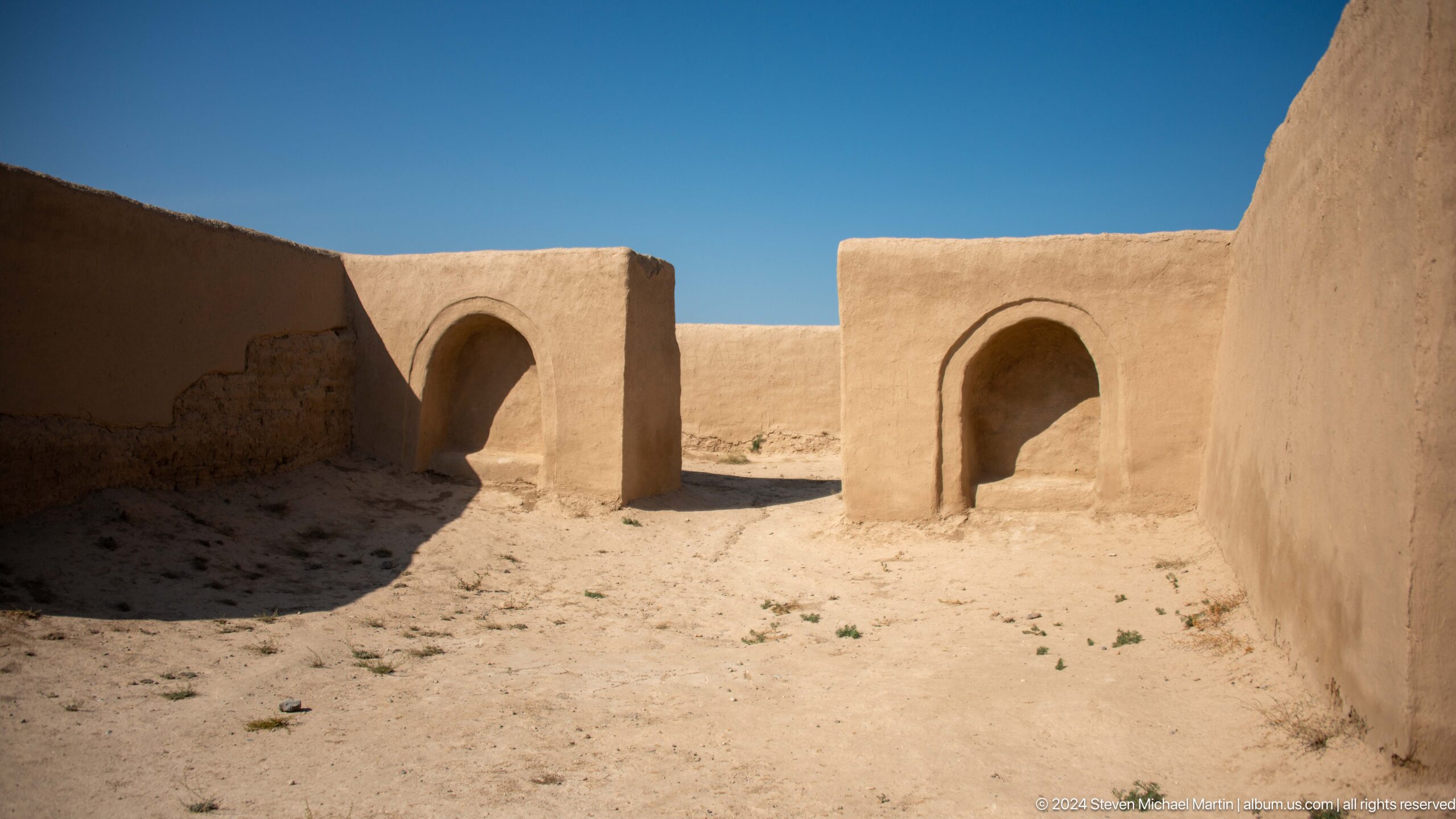
At Ancient Panjakent, this conserved earthen courtyard with reconstructed pointed arches evokes the scale of Sogdian urban architecture, offering a tangible glimpse of the Silk Road city’s built spaces without assigning the remains to a specific building.
Caption
At Ancient Panjakent, this conserved earthen courtyard with reconstructed pointed arches evokes the scale of Sogdian urban architecture, offering a tangible glimpse of the Silk Road city’s built spaces without assigning the remains to a specific building.

At Ancient Panjakent, a conserved mud-brick wall junction funnels a narrow passage between massive earthen volumes, its smooth protective finish contrasting with eroded cores to evoke Sogdian building practice and controlled movement within a Silk Road city.
Caption
At Ancient Panjakent, a conserved mud-brick wall junction funnels a narrow passage between massive earthen volumes, its smooth protective finish contrasting with eroded cores to evoke Sogdian building practice and controlled movement within a Silk Road city.

Stabilized earthen walls at Ancient Panjakent trace the footprint of a long-vanished building, their rectangular doorway opening toward mountain slopes, a preserved fragment of the Sogdian Silk Road city that flourished as a hub of commerce and art.
Caption
Stabilized earthen walls at Ancient Panjakent trace the footprint of a long-vanished building, their rectangular doorway opening toward mountain slopes, a preserved fragment of the Sogdian Silk Road city that flourished as a hub of commerce and art.

A curving visitor path threads between eroded mounds at Ancient Panjakent, the Sogdian Silk Road city that flourished in the fifth to eighth centuries, while stark mountains rise beyond, underscoring the site’s rugged Central Asian setting.
Caption
A curving visitor path threads between eroded mounds at Ancient Panjakent, the Sogdian Silk Road city that flourished in the fifth to eighth centuries, while stark mountains rise beyond, underscoring the site’s rugged Central Asian setting.

Poised atop the Ancient Panjakent ruins, a visitor surveys excavated rooms and the city beyond, the lone figure giving human scale to the walls and depth while linking this fifth–eighth‑century Sogdian Silk Road center to its living successor.
Caption
Poised atop the Ancient Panjakent ruins, a visitor surveys excavated rooms and the city beyond, the lone figure giving human scale to the walls and depth while linking this fifth–eighth‑century Sogdian Silk Road center to its living successor.

At Ancient Panjakent, a close view of straw-reinforced earthen plaster reveals vegetal temper interlaced with mud, the fine cracking capturing a traditional technique used to bind and stabilize wall surfaces.
Caption
At Ancient Panjakent, a close view of straw-reinforced earthen plaster reveals vegetal temper interlaced with mud, the fine cracking capturing a traditional technique used to bind and stabilize wall surfaces.

Stabilized earthen walls with a procession of arched openings at Ancient Panjakent in Tajikistan, a Sogdian Silk Road city that flourished in the fifth to eighth centuries, rise above a solitary visitor who lends scale to the conserved complex.
Caption
Stabilized earthen walls with a procession of arched openings at Ancient Panjakent in Tajikistan, a Sogdian Silk Road city that flourished in the fifth to eighth centuries, rise above a solitary visitor who lends scale to the conserved complex.

An interpretive display on Ancient Panjakent presents a site plan, excavation photographs, and reconstructions that map the city’s layout and research sectors, situating this Sogdian center (5th–8th centuries) within the Silk Road networks of commerce and artistic exchange.
Caption
An interpretive display on Ancient Panjakent presents a site plan, excavation photographs, and reconstructions that map the city’s layout and research sectors, situating this Sogdian center (5th–8th centuries) within the Silk Road networks of commerce and artistic exchange.

Arranged in a study-collection style, this Panjakent museum room gathers pottery, stone pieces, and mural reproductions excavated from or associated with Ancient Panjakent, evoking the Sogdian city's Silk Road heritage and its renowned wall paintings.
Caption
Arranged in a study-collection style, this Panjakent museum room gathers pottery, stone pieces, and mural reproductions excavated from or associated with Ancient Panjakent, evoking the Sogdian city's Silk Road heritage and its renowned wall paintings.

A Sogdian narrative wall painting from Ancient Panjakent, its figures set against a vivid blue ground, exemplifies the city’s renowned mural tradition that flourished along Silk Road trade routes, though the specific episode portrayed remains uncertain.
Caption
A Sogdian narrative wall painting from Ancient Panjakent, its figures set against a vivid blue ground, exemplifies the city’s renowned mural tradition that flourished along Silk Road trade routes, though the specific episode portrayed remains uncertain.

In a museum gallery, conserved fragments or reproductions of Panjakent’s Sogdian wall paintings line the walls above cases of archaeological artifacts, spotlighting the Silk Road city’s celebrated artistry and material culture shaped by urban life and cross-cultural exchange.
Caption
In a museum gallery, conserved fragments or reproductions of Panjakent’s Sogdian wall paintings line the walls above cases of archaeological artifacts, spotlighting the Silk Road city’s celebrated artistry and material culture shaped by urban life and cross-cultural exchange.

In the Panjakent museum gallery, timber columns frame large pottery jars beneath a continuous band of Sogdian narrative wall paintings, uniting excavated objects with the city’s Silk Road-era artistic legacy.
Caption
In the Panjakent museum gallery, timber columns frame large pottery jars beneath a continuous band of Sogdian narrative wall paintings, uniting excavated objects with the city’s Silk Road-era artistic legacy.

A Sogdian narrative mural with equestrian figures, preserved on fragmentary plaster, captures dynamic riders against a deep blue ground; while the story remains uncertain, such paintings from ancient Panjakent testify to Sogdia’s cosmopolitan Silk Road culture and artistic exchange.
Caption
A Sogdian narrative mural with equestrian figures, preserved on fragmentary plaster, captures dynamic riders against a deep blue ground; while the story remains uncertain, such paintings from ancient Panjakent testify to Sogdia’s cosmopolitan Silk Road culture and artistic exchange.

Painted ornamental border fragment from Ancient Panjakent, with scrolling vegetal motifs and a black wave edging that once framed larger compositions, exemplifies refined non-figural Sogdian ornament at a Silk Road urban center.
Caption
Painted ornamental border fragment from Ancient Panjakent, with scrolling vegetal motifs and a black wave edging that once framed larger compositions, exemplifies refined non-figural Sogdian ornament at a Silk Road urban center.

A fragmentary Sogdian wall painting from Ancient Panjakent depicts an elaborately dressed figure beside a pale curving form, likely an elite or mythic protagonist, reflecting the city’s Silk Road culture where Persian, Indian, and Central Asian motifs intermingled.
Caption
A fragmentary Sogdian wall painting from Ancient Panjakent depicts an elaborately dressed figure beside a pale curving form, likely an elite or mythic protagonist, reflecting the city’s Silk Road culture where Persian, Indian, and Central Asian motifs intermingled.

A fragment of Sogdian wall painting from Ancient Panjakent preserves a banded, textile-like border of dark repeated motifs on worn plaster, hinting at a larger geometric or vegetal scheme whose original placement and precise design remain uncertain.
Caption
A fragment of Sogdian wall painting from Ancient Panjakent preserves a banded, textile-like border of dark repeated motifs on worn plaster, hinting at a larger geometric or vegetal scheme whose original placement and precise design remain uncertain.

A Sogdian wall painting from ancient Panjakent depicts a courtly banquet, its richly robed figures gathered against a dark ground, a vivid glimpse of elite ritual life in a Silk Road city even as the precise narrative remains unknown.
Caption
A Sogdian wall painting from ancient Panjakent depicts a courtly banquet, its richly robed figures gathered against a dark ground, a vivid glimpse of elite ritual life in a Silk Road city even as the precise narrative remains unknown.

Fragmentary Sogdian figural wall painting from Panjakent, its painted plaster broken and abraded into scattered forms, testifies to the incomplete survival of the site’s mural program central to this Silk Road city, while the original subject cannot be securely reconstructed.
Caption
Fragmentary Sogdian figural wall painting from Panjakent, its painted plaster broken and abraded into scattered forms, testifies to the incomplete survival of the site’s mural program central to this Silk Road city, while the original subject cannot be securely reconstructed.

Painted ceramic vessels from the Panjakent archaeological collection, seen in a display case, exemplify small-scale decorated pottery from the Sogdian city tied to Silk Road exchange, although their precise date and function remain uncertain.
Caption
Painted ceramic vessels from the Panjakent archaeological collection, seen in a display case, exemplify small-scale decorated pottery from the Sogdian city tied to Silk Road exchange, although their precise date and function remain uncertain.

A carved wooden architectural ornament from Panjakent, with a central palmette flanked by symmetrical vegetal scrolls, embodies Sogdian craftsmanship and the prominence of wood carving in Central Asian architecture shaped by Silk Road exchange.
Caption
A carved wooden architectural ornament from Panjakent, with a central palmette flanked by symmetrical vegetal scrolls, embodies Sogdian craftsmanship and the prominence of wood carving in Central Asian architecture shaped by Silk Road exchange.

Panjakent’s wall-painting gallery centers on Sogdian narrative murals—the artistic heart of Ancient Panjakent—while freestanding excavated artifacts and timber columns frame the display, situating the paintings within their archaeological context and Silk Road heritage.
Caption
Panjakent’s wall-painting gallery centers on Sogdian narrative murals—the artistic heart of Ancient Panjakent—while freestanding excavated artifacts and timber columns frame the display, situating the paintings within their archaeological context and Silk Road heritage.


