Museum of Cycladic Art
The Museum of Cycladic Art preserves important examples of early Aegean civilization, particularly the distinctive marble figurines produced in the Cycladic islands during the Bronze Age. These simplified human forms are recognized for their balanced proportions and minimal detail, reflecting artistic traditions that emphasized harmony and abstraction. The collection illustrates the early development of sculptural expression in the Aegean region.
Additional exhibits include artifacts from ancient Greece and Cyprus, providing broader context for cultural exchange across the eastern Mediterranean. Ceramics, tools, and decorative objects demonstrate the daily life and artistic practices of early societies that predate the classical period. These objects reveal continuity between prehistoric and later Greek traditions.
The museum highlights how early artistic experimentation influenced later developments in Greek sculpture and design. The restrained aesthetic of Cycladic figurines continues to attract interest for its clarity of form and timeless visual qualities.

A large hanging lantern is centered between pale stone columns beneath a rounded arcade, framing a view toward the street and neighboring neoclassical architecture. The shaded portico creates a layered transition from the museum building to trees, roadway, and the urban setting beyond.
Caption
A large hanging lantern is centered between pale stone columns beneath a rounded arcade, framing a view toward the street and neighboring neoclassical architecture. The shaded portico creates a layered transition from the museum building to trees, roadway, and the urban setting beyond.

The marble-clad entrance to the Museum of Cycladic Art is marked by a Greek inscription naming the Nicholas and Dolly Goulandris Foundation and Museum of Cycladic Art. A horizontal row of small stylized figures runs beneath the lettering, while the recessed glass doorway and exhibition banner establish the photograph as an exterior arrival view.
Caption
The marble-clad entrance to the Museum of Cycladic Art is marked by a Greek inscription naming the Nicholas and Dolly Goulandris Foundation and Museum of Cycladic Art. A horizontal row of small stylized figures runs beneath the lettering, while the recessed glass doorway and exhibition banner establish the photograph as an exterior arrival view.

Polished parquet flooring opens toward a broad red-carpeted staircase in this wider view of the museum’s historic interior. The composition includes the curving lower balustrade, chandelier, paneled walls, columns, and bright windows, emphasizing the spacious entrance hall and ceremonial character of the stair.
Caption
Polished parquet flooring opens toward a broad red-carpeted staircase in this wider view of the museum’s historic interior. The composition includes the curving lower balustrade, chandelier, paneled walls, columns, and bright windows, emphasizing the spacious entrance hall and ceremonial character of the stair.

An elaborate chandelier hangs beneath a richly molded ceiling, its dark metal framework branching into multiple tiers of candle-like lights. Numerous faceted crystal drops catch the surrounding light, while cornices, pilasters, and tall windows place the fixture within the museum’s formal historic interior.
Caption
An elaborate chandelier hangs beneath a richly molded ceiling, its dark metal framework branching into multiple tiers of candle-like lights. Numerous faceted crystal drops catch the surrounding light, while cornices, pilasters, and tall windows place the fixture within the museum’s formal historic interior.

A broad-bodied marble female figurine is carved with a flattened head, projecting nose, squared shoulders, arms folded across the upper abdomen, and deeply divided legs. Subtle incisions articulate the torso and pubic area. The frontal museum view makes the figure’s strong symmetry and deliberately simplified anatomy especially clear.
Caption
A broad-bodied marble female figurine is carved with a flattened head, projecting nose, squared shoulders, arms folded across the upper abdomen, and deeply divided legs. Subtle incisions articulate the torso and pubic area. The frontal museum view makes the figure’s strong symmetry and deliberately simplified anatomy especially clear.

Two marble female Cycladic figurines stand side by side, allowing direct comparison of scale and proportion. Both use the familiar folded-arm pose, simplified facial plane with projecting nose, and elongated legs, but the taller figure is markedly more attenuated while the smaller example has a compact body and stronger division of the legs.
Caption
Two marble female Cycladic figurines stand side by side, allowing direct comparison of scale and proportion. Both use the familiar folded-arm pose, simplified facial plane with projecting nose, and elongated legs, but the taller figure is markedly more attenuated while the smaller example has a compact body and stronger division of the legs.

Ancient glass vessels are suspended and shelved against a deep blue display, revealing a wide range of forms: long-necked bottles, small jars, cups, shallow bowls, and handled containers. Translucent green, blue, amber, and nearly colorless glass emphasizes both variety of function and technical control.
Caption
Ancient glass vessels are suspended and shelved against a deep blue display, revealing a wide range of forms: long-necked bottles, small jars, cups, shallow bowls, and handled containers. Translucent green, blue, amber, and nearly colorless glass emphasizes both variety of function and technical control.

A large sculpted male head dominates the foreground of a museum case, with deeply carved curls, a full beard, pronounced eyes, and an elaborate ridged headdress. Warm stone or terracotta tones contrast with the cool blue gallery beyond, where rows of smaller vessels recede into the background and reinforce the head’s monumental presence.
Caption
A large sculpted male head dominates the foreground of a museum case, with deeply carved curls, a full beard, pronounced eyes, and an elaborate ridged headdress. Warm stone or terracotta tones contrast with the cool blue gallery beyond, where rows of smaller vessels recede into the background and reinforce the head’s monumental presence.

The celebrated Cycladic “Cup-bearer” sits on an integral marble stool and extends a small cup in his right hand, one of the rare action figures in Early Cycladic sculpture. The compact body, bent legs, simplified face, and forward gesture distinguish this unique intact example from the far more common standing folded-arm figurines displayed nearby.
Caption
The celebrated Cycladic “Cup-bearer” sits on an integral marble stool and extends a small cup in his right hand, one of the rare action figures in Early Cycladic sculpture. The compact body, bent legs, simplified face, and forward gesture distinguish this unique intact example from the far more common standing folded-arm figurines displayed nearby.

A marble Cycladic female figurine stands frontally with the characteristic abstracted head, long nose, angular shoulders, folded forearms, and simplified lower body. Its compact geometric silhouette and smooth pale surface exemplify the highly reduced human form for which Early Cycladic sculpture is especially recognizable, displayed here behind reflective museum glass.
Caption
A marble Cycladic female figurine stands frontally with the characteristic abstracted head, long nose, angular shoulders, folded forearms, and simplified lower body. Its compact geometric silhouette and smooth pale surface exemplify the highly reduced human form for which Early Cycladic sculpture is especially recognizable, displayed here behind reflective museum glass.

Blue exhibition banners flank the Museum of Cycladic Art entrance, advertising “Kallos: The Ultimate Beauty.” Classical sculpted heads dominate the graphics, contrasting with the pale stone architecture and glass doorway. The museum’s vertical logo sign at right makes this a useful record of the institution’s street-level presentation during the temporary exhibition.
Caption
Blue exhibition banners flank the Museum of Cycladic Art entrance, advertising “Kallos: The Ultimate Beauty.” Classical sculpted heads dominate the graphics, contrasting with the pale stone architecture and glass doorway. The museum’s vertical logo sign at right makes this a useful record of the institution’s street-level presentation during the temporary exhibition.

A wood-fronted reception or service counter sits beneath a dense indoor canopy of mature trees and tropical foliage. Vertical white slats and pale architectural surfaces frame the greenery, creating a bright contemporary interior that contrasts with the museum’s archaeological displays. A staff member working behind the counter provides scale and a sense of everyday museum activity.
Caption
A wood-fronted reception or service counter sits beneath a dense indoor canopy of mature trees and tropical foliage. Vertical white slats and pale architectural surfaces frame the greenery, creating a bright contemporary interior that contrasts with the museum’s archaeological displays. A staff member working behind the counter provides scale and a sense of everyday museum activity.

A tall exterior banner presents the Museum of Cycladic Art’s bilingual name and its emblematic abstract figure. The black geometric logo echoes the simplified human form associated with Cycladic figurines, while foliage and a partial exhibition panel place the sign immediately outside the museum building in Athens.
Caption
A tall exterior banner presents the Museum of Cycladic Art’s bilingual name and its emblematic abstract figure. The black geometric logo echoes the simplified human form associated with Cycladic figurines, while foliage and a partial exhibition panel place the sign immediately outside the museum building in Athens.

A fragmentary marble female figure is shown seated or descending in a dynamic pose, her drapery carved into deep, sweeping folds around the torso and legs. The head survives, but the arms are incomplete and the body rests on an irregular ancient break. The dark display background isolates the sculptural modeling and weathered stone surface.
Caption
A fragmentary marble female figure is shown seated or descending in a dynamic pose, her drapery carved into deep, sweeping folds around the torso and legs. The head survives, but the arms are incomplete and the body rests on an irregular ancient break. The dark display background isolates the sculptural modeling and weathered stone surface.

A museum chart organizes small outline drawings of Cycladic figurines into a chronological and typological sequence. Rows of changing body shapes, postures, and figure groups show the development and diversity of Cycladic representation across phases, giving visitors a comparative framework for the sculptures displayed nearby.
Caption
A museum chart organizes small outline drawings of Cycladic figurines into a chronological and typological sequence. Rows of changing body shapes, postures, and figure groups show the development and diversity of Cycladic representation across phases, giving visitors a comparative framework for the sculptures displayed nearby.

The interpretive panel “Marble figurine form in Cycladic art” explains how Early Cycladic sculptors reduced the human body to strongly geometric forms while developing several recurring figure types. Dense bilingual-style museum text accompanies the display, providing context for the abstract marble figures seen throughout the collection.
Caption
The interpretive panel “Marble figurine form in Cycladic art” explains how Early Cycladic sculptors reduced the human body to strongly geometric forms while developing several recurring figure types. Dense bilingual-style museum text accompanies the display, providing context for the abstract marble figures seen throughout the collection.

This small marble figure preserves an elongated oval head, narrow neck, broad angular shoulders, and a sharply tapering torso, while the lower body is missing. Shallow incisions and subtle modeling define the upper anatomy. Presented on a clear mount, the fragment emphasizes the geometric construction and restrained carving characteristic of Cycladic anthropomorphic sculpture.
Caption
This small marble figure preserves an elongated oval head, narrow neck, broad angular shoulders, and a sharply tapering torso, while the lower body is missing. Shallow incisions and subtle modeling define the upper anatomy. Presented on a clear mount, the fragment emphasizes the geometric construction and restrained carving characteristic of Cycladic anthropomorphic sculpture.

A compact marble female figurine combines a rounded head and neck with projecting shoulders, folded arms, a broad abdomen, and separated legs. The proportions are notably fuller and more schematic than the slender canonical folded-arm figures nearby, illustrating the formal variety within Cycladic representations of the human body.
Caption
A compact marble female figurine combines a rounded head and neck with projecting shoulders, folded arms, a broad abdomen, and separated legs. The proportions are notably fuller and more schematic than the slender canonical folded-arm figures nearby, illustrating the formal variety within Cycladic representations of the human body.

Seen squarely from the front, this marble Cycladic female figurine has a wide flattened head, small projecting nose, sloping shoulders, folded forearms, rounded abdomen, and strongly separated legs. The warm display lighting reveals surface wear and small losses, while the dark case background accentuates the figure’s compact, symmetrical silhouette.
Caption
Seen squarely from the front, this marble Cycladic female figurine has a wide flattened head, small projecting nose, sloping shoulders, folded forearms, rounded abdomen, and strongly separated legs. The warm display lighting reveals surface wear and small losses, while the dark case background accentuates the figure’s compact, symmetrical silhouette.

A seated anthropomorphic figure is modeled with an oval head, prominent nose, rounded torso, heavy thighs, and separated lower legs. One arm bends upward across the chest as if holding or touching an object. The pose and volumetric body differ sharply from the standing folded-arm Cycladic figures displayed nearby, making posture the defining feature of this view.
Caption
A seated anthropomorphic figure is modeled with an oval head, prominent nose, rounded torso, heavy thighs, and separated lower legs. One arm bends upward across the chest as if holding or touching an object. The pose and volumetric body differ sharply from the standing folded-arm Cycladic figures displayed nearby, making posture the defining feature of this view.

A substantial fragment preserves the lower torso and upper legs of a stone anthropomorphic figure. Parallel forearms cross the abdomen above a pronounced pubic area, while the thighs are divided by a deep central opening. Breaks at the waist and legs make this a useful close study of how the body was reduced to strong geometric masses.
Caption
A substantial fragment preserves the lower torso and upper legs of a stone anthropomorphic figure. Parallel forearms cross the abdomen above a pronounced pubic area, while the thighs are divided by a deep central opening. Breaks at the waist and legs make this a useful close study of how the body was reduced to strong geometric masses.

A tall marble female figurine stands frontally with a flattened oval head, projecting nose, modeled breasts, forearms folded across the torso, and long divided legs. Unlike more severely abstract examples, the breasts and curving hips are strongly articulated. Reflections in the display case reveal its gallery setting while preserving a nearly full-length view.
Caption
A tall marble female figurine stands frontally with a flattened oval head, projecting nose, modeled breasts, forearms folded across the torso, and long divided legs. Unlike more severely abstract examples, the breasts and curving hips are strongly articulated. Reflections in the display case reveal its gallery setting while preserving a nearly full-length view.

Two small ceramic female figures are displayed together, each with an elongated neck and strongly stylized body. One spreads angular arms around modeled breasts and painted geometric details; the other has a rounded, paddle-like body covered with red wavy stripes. Their contrasting silhouettes and painted surfaces show a decorative approach distinct from the museum’s marble Cycladic sculpture.
Caption
Two small ceramic female figures are displayed together, each with an elongated neck and strongly stylized body. One spreads angular arms around modeled breasts and painted geometric details; the other has a rounded, paddle-like body covered with red wavy stripes. Their contrasting silhouettes and painted surfaces show a decorative approach distinct from the museum’s marble Cycladic sculpture.

A museum panel titled “Free-blowing” diagrams the production of a glass vessel through numbered stages. Illustrations show molten glass gathered on a blowpipe, inflation and shaping of the vessel, and finishing steps. The sequence shifts the gallery’s focus from finished antiquities to the craft processes and specialized tools used to make them.
Caption
A museum panel titled “Free-blowing” diagrams the production of a glass vessel through numbered stages. Illustrations show molten glass gathered on a blowpipe, inflation and shaping of the vessel, and finishing steps. The sequence shifts the gallery’s focus from finished antiquities to the craft processes and specialized tools used to make them.

Two stacked museum panels explain ancient decorative techniques. The upper sequence demonstrates impressed ornament by pressing a tool or stamp into a surface, while the lower panel illustrates repoussé and chasing used to raise and refine relief decoration in metal. Step-by-step drawings connect finished archaeological objects with the processes that produced their textures and motifs.
Caption
Two stacked museum panels explain ancient decorative techniques. The upper sequence demonstrates impressed ornament by pressing a tool or stamp into a surface, while the lower panel illustrates repoussé and chasing used to raise and refine relief decoration in metal. Step-by-step drawings connect finished archaeological objects with the processes that produced their textures and motifs.

A pair of technical displays explains two methods used in ancient metalwork. The upper panel follows the stages of lost-wax casting from modeled form through mold and molten metal, while the lower panel shows repoussé and chasing used to shape relief from sheet metal. Small artifact images anchor the diagrams in surviving archaeological objects.
Caption
A pair of technical displays explains two methods used in ancient metalwork. The upper panel follows the stages of lost-wax casting from modeled form through mold and molten metal, while the lower panel shows repoussé and chasing used to shape relief from sheet metal. Small artifact images anchor the diagrams in surviving archaeological objects.

A large lidded ceramic vessel is covered with dense painted ornament arranged in horizontal registers. Water birds occupy the central band between vertical and geometric motifs, while zigzags, meanders, dots, and parallel lines wrap the rounded body and conical lid. Upright side handles reinforce the vessel’s strong symmetry and monumental display presence.
Caption
A large lidded ceramic vessel is covered with dense painted ornament arranged in horizontal registers. Water birds occupy the central band between vertical and geometric motifs, while zigzags, meanders, dots, and parallel lines wrap the rounded body and conical lid. Upright side handles reinforce the vessel’s strong symmetry and monumental display presence.

A flat, broad-shouldered terracotta female figure has a modeled head emerging above a triangular upper body and a rectangular lower section. Faint painted or incised linear decoration survives across the surface. Another figurine in the case appears behind it, but the frontal object’s unusual plank-like silhouette and weathered fabric dominate the composition.
Caption
A flat, broad-shouldered terracotta female figure has a modeled head emerging above a triangular upper body and a rectangular lower section. Faint painted or incised linear decoration survives across the surface. Another figurine in the case appears behind it, but the frontal object’s unusual plank-like silhouette and weathered fabric dominate the composition.

A black-figure ceramic vessel presents a dense figural scene across its shoulder and body, with dark silhouetted figures enlivened by incised interior details and added accents. Decorative bands frame the narrative zone beneath a narrow neck. The photograph concentrates on the painted imagery while the vessel’s lower body is partly obscured by the display mount.
Caption
A black-figure ceramic vessel presents a dense figural scene across its shoulder and body, with dark silhouetted figures enlivened by incised interior details and added accents. Decorative bands frame the narrative zone beneath a narrow neck. The photograph concentrates on the painted imagery while the vessel’s lower body is partly obscured by the display mount.

A close view isolates a group of small modeled horses standing on the lid of a painted ceramic vessel. Their long necks and compact bodies rise above concentric geometric bands, turning the lid into a miniature sculptural scene. Shallow depth of field emphasizes the three-dimensional animal attachments against the patterned pottery surface.
Caption
A close view isolates a group of small modeled horses standing on the lid of a painted ceramic vessel. Their long necks and compact bodies rise above concentric geometric bands, turning the lid into a miniature sculptural scene. Shallow depth of field emphasizes the three-dimensional animal attachments against the patterned pottery surface.

A coarse ceramic vessel is encircled by raised applied figures, including human forms and long-bodied animals arranged in a narrative-looking frieze. The relief decoration projects strongly from the wall of the pot, while the granular clay surface and surviving rim emphasize the vessel’s handmade construction. The exact scene remains difficult to resolve at proof-sheet scale.
Caption
A coarse ceramic vessel is encircled by raised applied figures, including human forms and long-bodied animals arranged in a narrative-looking frieze. The relief decoration projects strongly from the wall of the pot, while the granular clay surface and surviving rim emphasize the vessel’s handmade construction. The exact scene remains difficult to resolve at proof-sheet scale.

A broad two-handled black-figure vessel carries a lively scene of human figures arranged around a central form, with large spirals framing the composition at either side. A floral band circles the neck beneath the flaring rim. The close frontal view makes the contrast between glossy black silhouettes and the warm orange clay especially prominent.
Caption
A broad two-handled black-figure vessel carries a lively scene of human figures arranged around a central form, with large spirals framing the composition at either side. A floral band circles the neck beneath the flaring rim. The close frontal view makes the contrast between glossy black silhouettes and the warm orange clay especially prominent.

An open, bowl-like ceramic vessel combines a broad mouth and rounded body with a tall decorated attachment rising behind the rim. Painted animals and human figures move around the exterior in horizontal bands, with geometric ornament filling the remaining spaces. The eccentric profile suggests a specialized form whose precise ancient name should be confirmed from the label.
Caption
An open, bowl-like ceramic vessel combines a broad mouth and rounded body with a tall decorated attachment rising behind the rim. Painted animals and human figures move around the exterior in horizontal bands, with geometric ornament filling the remaining spaces. The eccentric profile suggests a specialized form whose precise ancient name should be confirmed from the label.

A small terracotta human figure is modeled in an unusually dynamic pose, with legs spread wide, one arm extending outward, and the other bent beside the torso. The head and upper body are irregular and partly damaged, giving the sculpture a rough, energetic silhouette. Its precise action or identity cannot be established from the proof sheet alone.
Caption
A small terracotta human figure is modeled in an unusually dynamic pose, with legs spread wide, one arm extending outward, and the other bent beside the torso. The head and upper body are irregular and partly damaged, giving the sculpture a rough, energetic silhouette. Its precise action or identity cannot be established from the proof sheet alone.

Viewed from above, this unusual ceramic vessel is built around a circular body with several projecting arms or spout-like attachments and two taller looped elements rising from the center. Traces of reddish pigment survive on the pale surface. The complex, radial construction makes function and precise object type difficult to determine without its museum label.
Caption
Viewed from above, this unusual ceramic vessel is built around a circular body with several projecting arms or spout-like attachments and two taller looped elements rising from the center. Traces of reddish pigment survive on the pale surface. The complex, radial construction makes function and precise object type difficult to determine without its museum label.

The interior of a red-figure drinking cup shows a reclining male participant in a symposium scene, accompanied by another figure and objects associated with the gathering. Reserved orange figures stand out against the glossy black field, and a Greek inscription arcs around the tondo. The cup’s handle and foot are visible beyond the decorated interior.
Caption
The interior of a red-figure drinking cup shows a reclining male participant in a symposium scene, accompanied by another figure and objects associated with the gathering. Reserved orange figures stand out against the glossy black field, and a Greek inscription arcs around the tondo. The cup’s handle and foot are visible beyond the decorated interior.

A red-figure vessel presents a tightly packed procession of animated figures, their reserved orange bodies standing against the glossy black ground. Gestures, drapery, and overlapping poses give the scene strong narrative movement, while the patterned lower border frames the figural field as a carefully organized decorative register.
Caption
A red-figure vessel presents a tightly packed procession of animated figures, their reserved orange bodies standing against the glossy black ground. Gestures, drapery, and overlapping poses give the scene strong narrative movement, while the patterned lower border frames the figural field as a carefully organized decorative register.

Three figures occupy the central panel of a black-glazed handled vessel, with a pale central figure flanked by two orange-red companions. The broad rim and upturned side handles establish the vessel form, while the contrasting figure colors and controlled poses make the narrative panel the visual focus.
Caption
Three figures occupy the central panel of a black-glazed handled vessel, with a pale central figure flanked by two orange-red companions. The broad rim and upturned side handles establish the vessel form, while the contrasting figure colors and controlled poses make the narrative panel the visual focus.

A small terracotta figure stands with legs spread and arms bent sharply to the hips. Its modeled head has a projecting snout-like face and prominent ears or horns, while the torso and genital detail are rendered schematically, giving the object the direct, handmade character of an ancient votive or figurative object.
Caption
A small terracotta figure stands with legs spread and arms bent sharply to the hips. Its modeled head has a projecting snout-like face and prominent ears or horns, while the torso and genital detail are rendered schematically, giving the object the direct, handmade character of an ancient votive or figurative object.

A bilingual museum panel introduces the Roman period through the theme of an early example of a “globalized” world. Dense Greek and English text is accompanied by small maps at the bottom, situating the displayed material within broad networks of political, economic, and cultural connection.
Caption
A bilingual museum panel introduces the Roman period through the theme of an early example of a “globalized” world. Dense Greek and English text is accompanied by small maps at the bottom, situating the displayed material within broad networks of political, economic, and cultural connection.

A compact terracotta figure stands frontally with heavy arms folded across the chest. A broad head covering or hairstyle frames the face, while incised and modeled details articulate the garment and waist, creating a strongly symmetrical silhouette against the dark museum display.
Caption
A compact terracotta figure stands frontally with heavy arms folded across the chest. A broad head covering or hairstyle frames the face, while incised and modeled details articulate the garment and waist, creating a strongly symmetrical silhouette against the dark museum display.

Rows of gold settings hold red, green, pale, and dark stones in a richly articulated necklace or pectoral. Rectangular end sections rise vertically at both sides, while a larger green central stone and pendant-like elements create a strong focal point along the lower edge.
Caption
Rows of gold settings hold red, green, pale, and dark stones in a richly articulated necklace or pectoral. Rectangular end sections rise vertically at both sides, while a larger green central stone and pendant-like elements create a strong focal point along the lower edge.

Two small ceramic boar-shaped vessels face slightly toward one another in a museum case. Incised bristles, pointed ears, round eyes, projecting snouts, and short legs transform functional containers into lively animal forms, with the contrasting surface colors making differences in modeling especially easy to compare.
Caption
Two small ceramic boar-shaped vessels face slightly toward one another in a museum case. Incised bristles, pointed ears, round eyes, projecting snouts, and short legs transform functional containers into lively animal forms, with the contrasting surface colors making differences in modeling especially easy to compare.

A rounded ceramic vessel rises into an unusually tall architectural neck pierced by large geometric openings. Dense incised patterns cover the reddish surface, and the openwork upper section turns the vessel silhouette into a complex interplay of solid clay, handles, and negative space.
Caption
A rounded ceramic vessel rises into an unusually tall architectural neck pierced by large geometric openings. Dense incised patterns cover the reddish surface, and the openwork upper section turns the vessel silhouette into a complex interplay of solid clay, handles, and negative space.

An elaborate ceramic vessel combines a rounded lower body with a tall openwork superstructure. Small modeled animals occupy horizontal compartments within the neck, while incised geometric patterns cover the surrounding clay and loop handles project from either side, giving the object a strongly sculptural profile.
Caption
An elaborate ceramic vessel combines a rounded lower body with a tall openwork superstructure. Small modeled animals occupy horizontal compartments within the neck, while incised geometric patterns cover the surrounding clay and loop handles project from either side, giving the object a strongly sculptural profile.

A broad stone figure is shown from the chest upward, with a massive head, deeply cut eyes, prominent nose, and simplified mouth. The hands meet at the center of the chest, and the blocklike shoulders and restrained modeling give the sculpture a powerful frontal presence.
Caption
A broad stone figure is shown from the chest upward, with a massive head, deeply cut eyes, prominent nose, and simplified mouth. The hands meet at the center of the chest, and the blocklike shoulders and restrained modeling give the sculpture a powerful frontal presence.

Five revelers form a Dionysian komos across the body of this Attic black-figure lekythos. Nude, bearded men dance in a tightly compressed procession around a central draped figure, their bent knees and swinging arms creating a deliberate rhythm across the curved surface. Incised anatomical details and the warm clay ground sharpen the movement of the dark silhouettes.
Caption
Five revelers form a Dionysian komos across the body of this Attic black-figure lekythos. Nude, bearded men dance in a tightly compressed procession around a central draped figure, their bent knees and swinging arms creating a deliberate rhythm across the curved surface. Incised anatomical details and the warm clay ground sharpen the movement of the dark silhouettes.

A museum illustration titled “Guests Departing” reconstructs the noisy end of an ancient Greek symposium, with a procession of men and women accompanied by music and movement. Greek and English explanatory text frames the scene, linking the reconstruction to social practices surrounding communal drinking and entertainment.
Caption
A museum illustration titled “Guests Departing” reconstructs the noisy end of an ancient Greek symposium, with a procession of men and women accompanied by music and movement. Greek and English explanatory text frames the scene, linking the reconstruction to social practices surrounding communal drinking and entertainment.

Large orange text explains the Greek symposium as a communal gathering centered on food, wine, conversation, song, poetry, games, and intellectual exchange. The panel emphasizes the institution’s social role among aristocratic participants and its development from the early seventh century BC.
Caption
Large orange text explains the Greek symposium as a communal gathering centered on food, wine, conversation, song, poetry, games, and intellectual exchange. The panel emphasizes the institution’s social role among aristocratic participants and its development from the early seventh century BC.

A theatrical museum installation places a green vessel beneath a tall, illuminated architectural or funerary form, with smaller objects arranged on stepped platforms. The dark gallery and colored backdrop isolate the display, using scale and lighting to create a striking visual hierarchy among the objects.
Caption
A theatrical museum installation places a green vessel beneath a tall, illuminated architectural or funerary form, with smaller objects arranged on stepped platforms. The dark gallery and colored backdrop isolate the display, using scale and lighting to create a striking visual hierarchy among the objects.

A sweeping wooden staircase rises through an elegant historic interior, its red carpet turning upward beneath a large hanging chandelier. Marble or stone columns, paneled walls, tall windows, and carved balustrades frame the stair hall, contrasting the museum’s domestic architectural setting with its archaeological collections.
Caption
A sweeping wooden staircase rises through an elegant historic interior, its red carpet turning upward beneath a large hanging chandelier. Marble or stone columns, paneled walls, tall windows, and carved balustrades frame the stair hall, contrasting the museum’s domestic architectural setting with its archaeological collections.

Tall wooden doors and a gridded glazed surround fill the museum entrance beneath a broad white arch. Fluted columns stand to either side, while a hanging interior light aligns with the doorway, emphasizing the axial passage from the portico into the historic building.
Caption
Tall wooden doors and a gridded glazed surround fill the museum entrance beneath a broad white arch. Fluted columns stand to either side, while a hanging interior light aligns with the doorway, emphasizing the axial passage from the portico into the historic building.
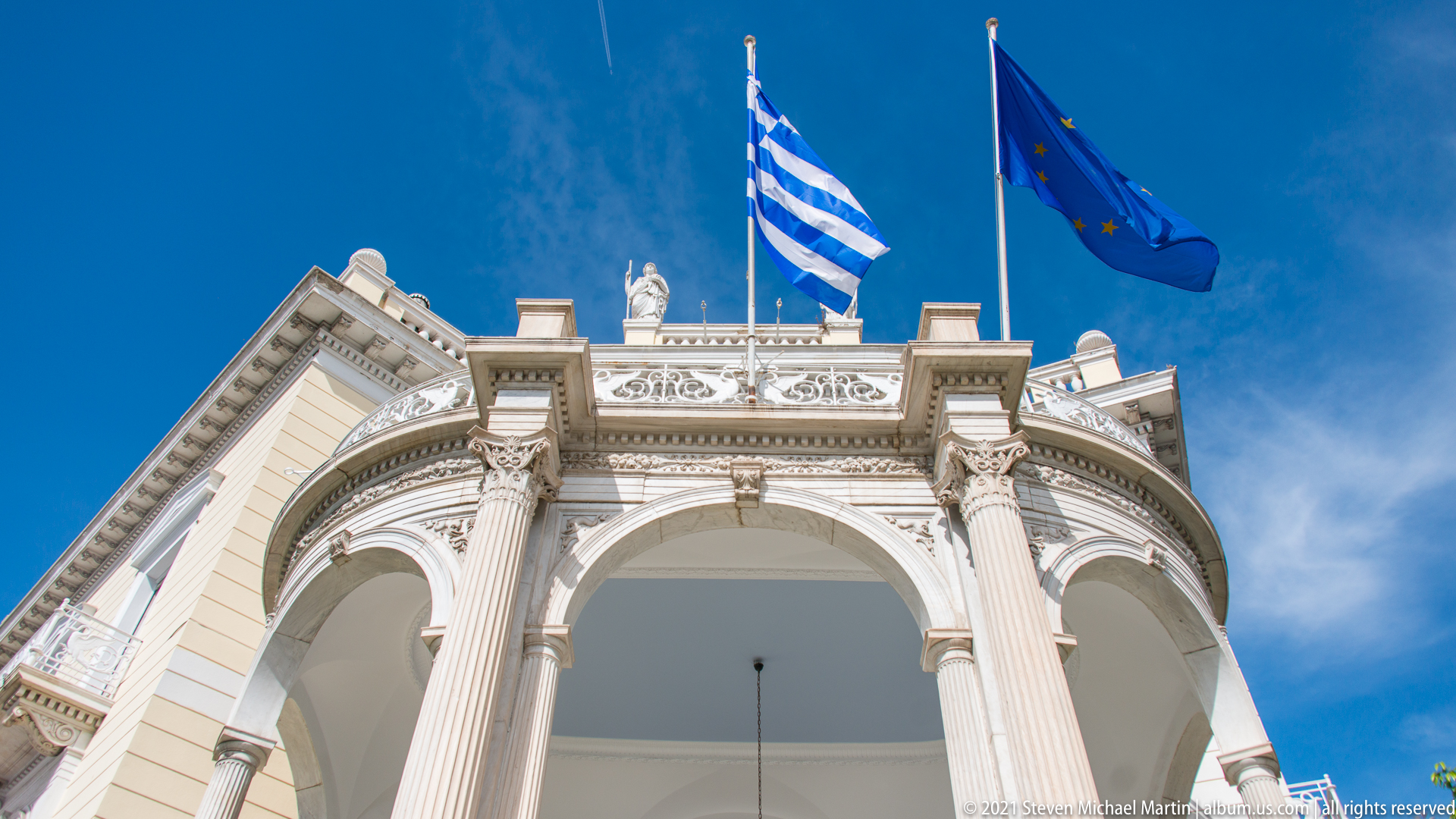
Greek and European Union flags fly above an ornate neoclassical façade viewed from below. Paired columns support rounded arches and a richly decorated cornice, while sculptural and carved details along the roofline stand sharply against the deep blue sky.
Caption
Greek and European Union flags fly above an ornate neoclassical façade viewed from below. Paired columns support rounded arches and a richly decorated cornice, while sculptural and carved details along the roofline stand sharply against the deep blue sky.

The upper body of a Cycladic marble figure displays the tradition’s highly reduced facial and anatomical vocabulary. A long projecting nose dominates the otherwise nearly featureless face, while gently modeled breasts and angular shoulders define the torso beneath the smooth, pale stone surface.
Caption
The upper body of a Cycladic marble figure displays the tradition’s highly reduced facial and anatomical vocabulary. A long projecting nose dominates the otherwise nearly featureless face, while gently modeled breasts and angular shoulders define the torso beneath the smooth, pale stone surface.

A compact lidded ceramic vessel is decorated with a single running horse in black figure, its elongated body and extended legs stretching across the orange field. The broad shoulder, low body, and knobbed lid create a strongly horizontal profile, while restrained painted bands keep attention on the animal motif.
Caption
A compact lidded ceramic vessel is decorated with a single running horse in black figure, its elongated body and extended legs stretching across the orange field. The broad shoulder, low body, and knobbed lid create a strongly horizontal profile, while restrained painted bands keep attention on the animal motif.

A Corinthian helmet of 475–450 BC is hammered from a single sheet of bronze, its rounded crown flowing into a projecting nose-guard, cheek-pieces, and rear neck protection. Seen obliquely, the surviving green-brown patina accentuates the continuous metal shell. The museum notes that helmets of this type were often deposited in graves or dedicated in sanctuaries after battle.
Caption
A Corinthian helmet of 475–450 BC is hammered from a single sheet of bronze, its rounded crown flowing into a projecting nose-guard, cheek-pieces, and rear neck protection. Seen obliquely, the surviving green-brown patina accentuates the continuous metal shell. The museum notes that helmets of this type were often deposited in graves or dedicated in sanctuaries after battle.

A small Geometric-period bronze horse reduces the animal to an elongated neck, cylindrical body, slender legs, and sharply pointed ears. The compact cast form belongs to the early Greek tradition of schematic bronze animal figurines, while the mottled blue-green patina records the metal’s long archaeological history.
Caption
A small Geometric-period bronze horse reduces the animal to an elongated neck, cylindrical body, slender legs, and sharply pointed ears. The compact cast form belongs to the early Greek tradition of schematic bronze animal figurines, while the mottled blue-green patina records the metal’s long archaeological history.

Four modeled horses crown the lid of a monumental Attic flat pyxis dated 760–750 BC. Their tall necks and painted geometric markings rise above dense concentric ornament, transforming the lid into a sculptural emblem. The museum notes that this luxurious pyxis type occurs in richly furnished male burials and that the horses may have signaled the privileged class of the Hippeis.
Caption
Four modeled horses crown the lid of a monumental Attic flat pyxis dated 760–750 BC. Their tall necks and painted geometric markings rise above dense concentric ornament, transforming the lid into a sculptural emblem. The museum notes that this luxurious pyxis type occurs in richly furnished male burials and that the horses may have signaled the privileged class of the Hippeis.

This wider view shows the complete Late Geometric Attic pyxis whose lid is crowned by four horse figurines, dated 760–750 BC. Dense geometric bands cover the broad, flattened container and its lid, while the mounted horses replace an ordinary knob with a conspicuous sculptural group. The museum identifies the vessel as a prestigious form associated with elite burial display.
Caption
This wider view shows the complete Late Geometric Attic pyxis whose lid is crowned by four horse figurines, dated 760–750 BC. Dense geometric bands cover the broad, flattened container and its lid, while the mounted horses replace an ordinary knob with a conspicuous sculptural group. The museum identifies the vessel as a prestigious form associated with elite burial display.

The museum label identifies the adjacent object as a large Attic pyxis with a lid crowned by four horse figurines, dated 760–750 BC in the Late Geometric Ia period. It notes dense geometric decoration, fastening holes at the lid edge, and the possible association of horses with the privileged Hippeis, or Knights.
Caption
The museum label identifies the adjacent object as a large Attic pyxis with a lid crowned by four horse figurines, dated 760–750 BC in the Late Geometric Ia period. It notes dense geometric decoration, fastening holes at the lid edge, and the possible association of horses with the privileged Hippeis, or Knights.

A rounded lidded ceramic vessel is covered with dense painted geometric bands and panel-like motifs. Small projecting animal-like or foot-like forms extend around the lower body, while the circular lid carries a radiating central design, giving the object a strongly patterned, almost architectural surface.
Caption
A rounded lidded ceramic vessel is covered with dense painted geometric bands and panel-like motifs. Small projecting animal-like or foot-like forms extend around the lower body, while the circular lid carries a radiating central design, giving the object a strongly patterned, almost architectural surface.

A two-handled vessel combines broad painted bands with a central panel of large birds flanking a stylized vertical motif. Rosette-like ornaments fill the lower field, while red, black, and cream pigments organize the decoration into strong horizontal and figural zones across the rounded body.
Caption
A two-handled vessel combines broad painted bands with a central panel of large birds flanking a stylized vertical motif. Rosette-like ornaments fill the lower field, while red, black, and cream pigments organize the decoration into strong horizontal and figural zones across the rounded body.

The underside and exterior of a shallow two-handled cup are decorated with two large dark figures facing one another across the curved wall. Fine incised and painted details articulate their clothing and bodies, while concentric rings around the foot organize the vessel’s underside.
Caption
The underside and exterior of a shallow two-handled cup are decorated with two large dark figures facing one another across the curved wall. Fine incised and painted details articulate their clothing and bodies, while concentric rings around the foot organize the vessel’s underside.

A small painted ceramic bottle combines a narrow neck and flaring rim with a rounded body covered in bold figural and geometric ornament. Dark vertical strokes frame the neck, while a large bird-like motif and patterned bands animate the vessel’s pale surface, emphasizing how painted decoration could transform a compact utilitarian form into a highly graphic object.
Caption
A small painted ceramic bottle combines a narrow neck and flaring rim with a rounded body covered in bold figural and geometric ornament. Dark vertical strokes frame the neck, while a large bird-like motif and patterned bands animate the vessel’s pale surface, emphasizing how painted decoration could transform a compact utilitarian form into a highly graphic object.

A black-figure ceramic vessel presents a horse-drawn chariot in a broad narrative frieze, with the dark silhouettes of the animals and human figures set against the orange clay. Decorative borders frame the scene above and below, while the surviving handle at the right edge shows the vessel’s substantial scale and functional form.
Caption
A black-figure ceramic vessel presents a horse-drawn chariot in a broad narrative frieze, with the dark silhouettes of the animals and human figures set against the orange clay. Decorative borders frame the scene above and below, while the surviving handle at the right edge shows the vessel’s substantial scale and functional form.

This Chalcidian eye-cup, attributed to the Phineus Painter and dated 530–520 BC, turns a drinking vessel into a mask-like face with enormous painted eyes. The shallow kylix, high foot, and long horizontal handles frame the staring pupils and central facial motifs. When lifted for drinking, the eyes would have aligned theatrically with the drinker’s face.
Caption
This Chalcidian eye-cup, attributed to the Phineus Painter and dated 530–520 BC, turns a drinking vessel into a mask-like face with enormous painted eyes. The shallow kylix, high foot, and long horizontal handles frame the staring pupils and central facial motifs. When lifted for drinking, the eyes would have aligned theatrically with the drinker’s face.

Viewed from the front, this Corinthian bronze helmet of 475–450 BC shows the type’s characteristic deep eye openings, long nasal guard, projecting cheek-pieces, and increasingly rounded crown. Formed from a single bronze sheet, the helmet provided extensive facial and head protection; heavy green patination now makes its ancient metal surface as prominent as its martial design.
Caption
Viewed from the front, this Corinthian bronze helmet of 475–450 BC shows the type’s characteristic deep eye openings, long nasal guard, projecting cheek-pieces, and increasingly rounded crown. Formed from a single bronze sheet, the helmet provided extensive facial and head protection; heavy green patination now makes its ancient metal surface as prominent as its martial design.

An unusual terracotta object combines a central cylindrical cup with several projecting modeled elements, including upright anthropomorphic or animal-like forms at either side. The openwork construction and applied figures give the piece a strongly sculptural character, distinguishing it from conventional storage or drinking vessels and suggesting a specialized ceremonial or symbolic function.
Caption
An unusual terracotta object combines a central cylindrical cup with several projecting modeled elements, including upright anthropomorphic or animal-like forms at either side. The openwork construction and applied figures give the piece a strongly sculptural character, distinguishing it from conventional storage or drinking vessels and suggesting a specialized ceremonial or symbolic function.

An Attic red-figure column krater attributed to the Göttingen Painter and dated 500–490 BC carries an erotic multi-figure scene around its broad body. Nude and draped figures move beneath the heavy rim between the characteristic column handles, while the glossy black ground sharply isolates the reserved red figures. The adjacent museum label supplies the attribution, date, and subject.
Caption
An Attic red-figure column krater attributed to the Göttingen Painter and dated 500–490 BC carries an erotic multi-figure scene around its broad body. Nude and draped figures move beneath the heavy rim between the characteristic column handles, while the glossy black ground sharply isolates the reserved red figures. The adjacent museum label supplies the attribution, date, and subject.

A gallery at the Museum of Cycladic Art is organized as a dark, linear sequence of illuminated glass cases filled with small antiquities. Spotlit objects and cool blue reflections punctuate the low ambient light, creating a focused viewing environment in which individual sculptures, vessels, and metal objects stand out against the black display architecture.
Caption
A gallery at the Museum of Cycladic Art is organized as a dark, linear sequence of illuminated glass cases filled with small antiquities. Spotlit objects and cool blue reflections punctuate the low ambient light, creating a focused viewing environment in which individual sculptures, vessels, and metal objects stand out against the black display architecture.

A case groups several distinctive ceramic vessels whose tall, ladder-like handles rise dramatically above rounded bodies. Painted geometric bands and varied surface colors distinguish individual examples, while the repeated vertical handle forms create a striking display of related vessel types and regional ceramic traditions.
Caption
A case groups several distinctive ceramic vessels whose tall, ladder-like handles rise dramatically above rounded bodies. Painted geometric bands and varied surface colors distinguish individual examples, while the repeated vertical handle forms create a striking display of related vessel types and regional ceramic traditions.

A group of small bronze animal figurines is displayed on individual white mounts, allowing each compact silhouette to be read independently. Quadrupeds and other zoomorphic forms vary in posture and modeling, while the dark green and brown patinas reveal the aged surfaces of cast metal objects intended to be viewed in the round.
Caption
A group of small bronze animal figurines is displayed on individual white mounts, allowing each compact silhouette to be read independently. Quadrupeds and other zoomorphic forms vary in posture and modeling, while the dark green and brown patinas reveal the aged surfaces of cast metal objects intended to be viewed in the round.

The underside of an Attic red-figure drinking cup is filled with animated nude male figures arranged around the circular foot. Their yellow-orange bodies stand against the glossy black ground, while the twin handles project to either side and the circular base becomes an integral part of the composition.
Caption
The underside of an Attic red-figure drinking cup is filled with animated nude male figures arranged around the circular foot. Their yellow-orange bodies stand against the glossy black ground, while the twin handles project to either side and the circular base becomes an integral part of the composition.

The museum label identifies an Attic red-figure column krater with an erotic scene, dated 500–490 BC and attributed to the Göttingen Painter. Presented in Greek and English with a small illustration of the vessel, the label also notes its association with the N. P. Goulandris Collection.
Caption
The museum label identifies an Attic red-figure column krater with an erotic scene, dated 500–490 BC and attributed to the Göttingen Painter. Presented in Greek and English with a small illustration of the vessel, the label also notes its association with the N. P. Goulandris Collection.