Petar II Petrović-Njegoš Mausoleum – Mount Lovćen, Montenegro
The Mausoleum of Petar II Petrović-Njegoš stands high on Mount Lovćen, one of the most prominent peaks overlooking the Bay of Kotor and the Adriatic coast of Montenegro. The monument is dedicated to Petar II Petrović-Njegoš, a 19th-century prince-bishop, poet, and national leader who played a central role in the cultural and political history of Montenegro.
Reaching the mausoleum requires climbing a series of steps that lead to a mountaintop plateau surrounded by dramatic mountain scenery. From the summit, panoramic views extend across the rugged mountains of Montenegro and, on clear days, toward the distant Adriatic Sea.
The site has become a powerful national symbol, reflecting both the literary legacy of Njegoš and the enduring connection between Montenegro’s history and its mountainous landscape.

A broad flight of stone steps climbs beside heavy masonry retaining walls toward an arched portal embedded in the rocky summit above. Low cloud envelops the upper slope, leaving the entrance and surrounding stonework partly veiled. The oblique viewpoint shows how the monumental pedestrian approach is built into Lovćen’s steep terrain, with rough grass and exposed rock separating the engineered stair from the mountainside.
Caption
A broad flight of stone steps climbs beside heavy masonry retaining walls toward an arched portal embedded in the rocky summit above. Low cloud envelops the upper slope, leaving the entrance and surrounding stonework partly veiled. The oblique viewpoint shows how the monumental pedestrian approach is built into Lovćen’s steep terrain, with rough grass and exposed rock separating the engineered stair from the mountainside.

A dressed-stone portal opens into a dark arched passage cut through the rocky summit approach to the Njegoš Mausoleum. Broad stone paving leads toward the entrance between jagged limestone outcrops, with a lone visitor providing scale. Mist and sparse alpine vegetation reinforce the exposed high-elevation setting while the masonry entrance marks the transition from open mountainside to the monument complex.
Caption
A dressed-stone portal opens into a dark arched passage cut through the rocky summit approach to the Njegoš Mausoleum. Broad stone paving leads toward the entrance between jagged limestone outcrops, with a lone visitor providing scale. Mist and sparse alpine vegetation reinforce the exposed high-elevation setting while the masonry entrance marks the transition from open mountainside to the monument complex.

A rugged limestone crest rises into drifting cloud, its fractured gray rock interrupted by a slender communications mast near the skyline. Sparse grass clings to the exposed summit while mist softens the background. The close telephoto view emphasizes the austere geology and high-elevation infrastructure encountered along the final approach toward the Njegoš Mausoleum on Lovćen.
Caption
A rugged limestone crest rises into drifting cloud, its fractured gray rock interrupted by a slender communications mast near the skyline. Sparse grass clings to the exposed summit while mist softens the background. The close telephoto view emphasizes the austere geology and high-elevation infrastructure encountered along the final approach toward the Njegoš Mausoleum on Lovćen.

From the lower approach, Jezerski vrh rises steeply above a shallow mountain hollow, with the Njegoš Mausoleum appearing as a small pale block on the crest. Bare deciduous trees and scrub cover the lower slopes while exposed limestone defines the upper ridge. The wider composition makes the monument’s summit placement legible within the surrounding terrain rather than treating it as an isolated architectural object.
Caption
From the lower approach, Jezerski vrh rises steeply above a shallow mountain hollow, with the Njegoš Mausoleum appearing as a small pale block on the crest. Bare deciduous trees and scrub cover the lower slopes while exposed limestone defines the upper ridge. The wider composition makes the monument’s summit placement legible within the surrounding terrain rather than treating it as an isolated architectural object.

A long pale staircase climbs between heavy stone retaining walls toward the upper mausoleum complex, where a rounded tunnel-like opening is visible through mist. A chimney-like stone pier and rugged masonry flank the lower steps. The steep, axial composition stresses the physical ascent required to reach the monument and the close integration of stairs, rock, and summit architecture.
Caption
A long pale staircase climbs between heavy stone retaining walls toward the upper mausoleum complex, where a rounded tunnel-like opening is visible through mist. A chimney-like stone pier and rugged masonry flank the lower steps. The steep, axial composition stresses the physical ascent required to reach the monument and the close integration of stairs, rock, and summit architecture.

Broad stone steps rise toward a rectangular masonry façade pierced by a rounded arch, with a visitor standing midway below the entrance. Jagged limestone walls flank the stair and merge with the engineered portal at the crest. Compared with the closer view, this wider composition clarifies the length and steepness of the approach and the way the passage is embedded in the mountain.
Caption
Broad stone steps rise toward a rectangular masonry façade pierced by a rounded arch, with a visitor standing midway below the entrance. Jagged limestone walls flank the stair and merge with the engineered portal at the crest. Compared with the closer view, this wider composition clarifies the length and steepness of the approach and the way the passage is embedded in the mountain.

Low cloud blankets the steep limestone terrain beside the mausoleum approach, reducing the distant slope to gray silhouettes. Pale rocks and tufts of ochre alpine grass occupy the foreground, while a small deciduous shrub at right carries the last autumn leaves. The close landscape study records the exposed summit ecology and rapidly changing weather that can envelop Jezerski vrh.
Caption
Low cloud blankets the steep limestone terrain beside the mausoleum approach, reducing the distant slope to gray silhouettes. Pale rocks and tufts of ochre alpine grass occupy the foreground, while a small deciduous shrub at right carries the last autumn leaves. The close landscape study records the exposed summit ecology and rapidly changing weather that can envelop Jezerski vrh.

A narrow paved road bends through rocky slopes and autumn woodland on the Lovćen approach. Yellow and rust foliage softens the exposed limestone road cuts, while the road disappears around the bend without revealing the summit monument. The viewpoint records the sinuous mountain access route and the transition from wooded lower elevations to the more open, rocky terrain near the top.
Caption
A narrow paved road bends through rocky slopes and autumn woodland on the Lovćen approach. Yellow and rust foliage softens the exposed limestone road cuts, while the road disappears around the bend without revealing the summit monument. The viewpoint records the sinuous mountain access route and the transition from wooded lower elevations to the more open, rocky terrain near the top.

Open metal-studded doors frame a dark sculptural group centered in a stone-lined chamber of the mausoleum complex. The sculpture sits on a pale pedestal beneath a broad arched recess, with the symmetry of the doorway directing the eye inward. The view emphasizes the deliberately staged transition from exterior stone architecture to a ceremonial interior focused on monumental sculpture.
Caption
Open metal-studded doors frame a dark sculptural group centered in a stone-lined chamber of the mausoleum complex. The sculpture sits on a pale pedestal beneath a broad arched recess, with the symmetry of the doorway directing the eye inward. The view emphasizes the deliberately staged transition from exterior stone architecture to a ceremonial interior focused on monumental sculpture.

A wide-angle view takes in the full length and width of the mausoleum forecourt, from the rough masonry entrance walls to the paired female statues at the far end. The central circular stone feature and glossy rain-wet paving anchor the composition, while the walls curve slightly from the lens perspective. The broader framing conveys the enclosure and monumental scale of this transitional ceremonial space.
Caption
A wide-angle view takes in the full length and width of the mausoleum forecourt, from the rough masonry entrance walls to the paired female statues at the far end. The central circular stone feature and glossy rain-wet paving anchor the composition, while the walls curve slightly from the lens perspective. The broader framing conveys the enclosure and monumental scale of this transitional ceremonial space.

A narrow paved road curves gently through dense deciduous woodland on the mountain approach to the Njegoš Mausoleum. Bare trunks and late-season leaves frame the roadway, while exposed rock and leaf litter line the cut slope at right. The subdued, enclosed setting contrasts with the exposed summit landscapes elsewhere in the portfolio and establishes the wooded lower approach to Lovćen.
Caption
A narrow paved road curves gently through dense deciduous woodland on the mountain approach to the Njegoš Mausoleum. Bare trunks and late-season leaves frame the roadway, while exposed rock and leaf litter line the cut slope at right. The subdued, enclosed setting contrasts with the exposed summit landscapes elsewhere in the portfolio and establishes the wooded lower approach to Lovćen.

A straight stone-paved approach climbs toward the austere summit mausoleum, whose blocky stone façade emerges through drifting mist. Low grasses and exposed rock line the narrow ridge, while the mountain falls away sharply to the left. The composition makes the monument’s remote setting on Lovćen explicit, with the restrained architecture appearing as an extension of the rocky summit.
Caption
A straight stone-paved approach climbs toward the austere summit mausoleum, whose blocky stone façade emerges through drifting mist. Low grasses and exposed rock line the narrow ridge, while the mountain falls away sharply to the left. The composition makes the monument’s remote setting on Lovćen explicit, with the restrained architecture appearing as an extension of the rocky summit.

A monumental stone woman fills the frame, her frontal pose, long stylized hair, and patterned garment rendered in simplified, block-like forms. One arm bends across the torso while the other hangs beside the body, creating a solemn, architectural presence. The close crop isolates the figure from its surroundings and emphasizes the sculpture’s mass, symmetry, and strongly carved facial features.
Caption
A monumental stone woman fills the frame, her frontal pose, long stylized hair, and patterned garment rendered in simplified, block-like forms. One arm bends across the torso while the other hangs beside the body, creating a solemn, architectural presence. The close crop isolates the figure from its surroundings and emphasizes the sculpture’s mass, symmetry, and strongly carved facial features.
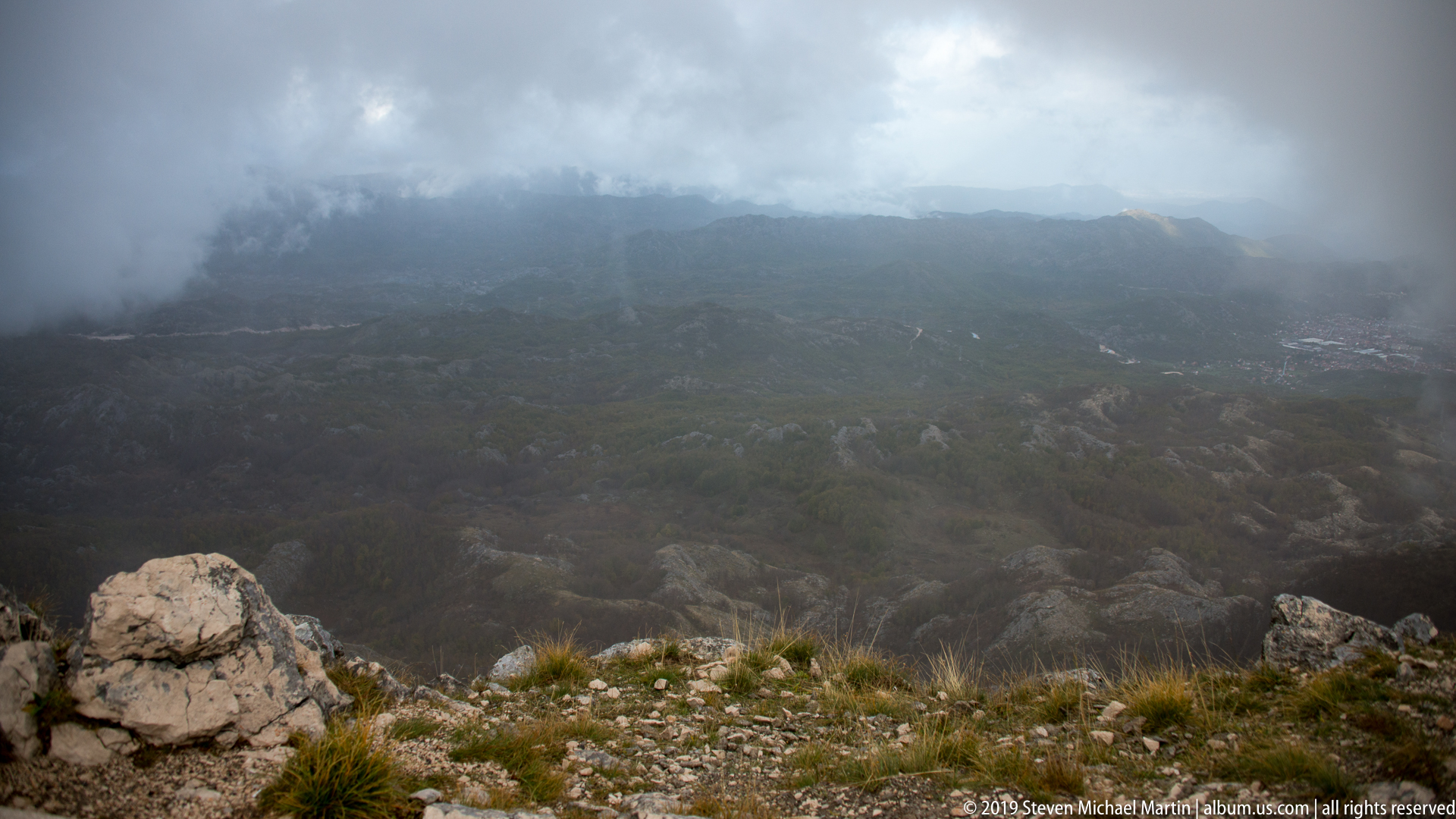
Low cloud drifts across the rugged limestone highlands seen from Lovćen, obscuring the distant ridges and leaving only fragments of the surrounding terrain visible. Pale rock and coarse grasses occupy the immediate foreground, while the middle distance dissolves into gray mist. The subdued scene conveys the rapidly changing weather and exposed elevation of the mausoleum’s mountain setting without relying on a specific landmark.
Caption
Low cloud drifts across the rugged limestone highlands seen from Lovćen, obscuring the distant ridges and leaving only fragments of the surrounding terrain visible. Pale rock and coarse grasses occupy the immediate foreground, while the middle distance dissolves into gray mist. The subdued scene conveys the rapidly changing weather and exposed elevation of the mausoleum’s mountain setting without relying on a specific landmark.

A broad limestone ridge rises above forested lower slopes beneath heavy, rain-darkened clouds. Pale exposed rock forms a broken crest across the upper mountain, contrasting with the greener vegetation below. The weather compresses the scene into layered bands of forest, stone, and cloud, presenting the rugged character of the Lovćen massif surrounding the Njegoš Mausoleum.
Caption
A broad limestone ridge rises above forested lower slopes beneath heavy, rain-darkened clouds. Pale exposed rock forms a broken crest across the upper mountain, contrasting with the greener vegetation below. The weather compresses the scene into layered bands of forest, stone, and cloud, presenting the rugged character of the Lovćen massif surrounding the Njegoš Mausoleum.

Late light warms the cloud bank above the rugged Lovćen ridges, where bare limestone crests rise beyond mixed woodland in autumn color. A patch of blue sky opens between darker clouds while the foreground hills remain comparatively subdued. The image balances dramatic weather with the layered mountain terrain that characterizes the approach to the Njegoš Mausoleum.
Caption
Late light warms the cloud bank above the rugged Lovćen ridges, where bare limestone crests rise beyond mixed woodland in autumn color. A patch of blue sky opens between darker clouds while the foreground hills remain comparatively subdued. The image balances dramatic weather with the layered mountain terrain that characterizes the approach to the Njegoš Mausoleum.

A row of small gabled stone structures stands across green fields at the edge of a rural settlement, with larger red-roofed houses scattered behind them. Narrow field boundaries and tracks divide the valley floor, while darker wooded slopes rise in the distance. The unusual repetition of the small buildings gives the foreground a strong visual rhythm within the broader agricultural landscape.
Caption
A row of small gabled stone structures stands across green fields at the edge of a rural settlement, with larger red-roofed houses scattered behind them. Narrow field boundaries and tracks divide the valley floor, while darker wooded slopes rise in the distance. The unusual repetition of the small buildings gives the foreground a strong visual rhythm within the broader agricultural landscape.

A small red-roofed house sits alone amid rough pasture and scattered orchard trees as low cloud closes over the neighboring hills. The pale meadow and autumn vegetation are softly lit beneath a broad gray sky, producing a quiet counterpoint to the monumental summit architecture elsewhere in the portfolio. Stone field edges and sparse plantings suggest a working rural landscape shaped by the mountain climate.
Caption
A small red-roofed house sits alone amid rough pasture and scattered orchard trees as low cloud closes over the neighboring hills. The pale meadow and autumn vegetation are softly lit beneath a broad gray sky, producing a quiet counterpoint to the monumental summit architecture elsewhere in the portfolio. Stone field edges and sparse plantings suggest a working rural landscape shaped by the mountain climate.

A two-story white house with a red-tiled roof stands behind a low fence on open pasture, framed by leafless and autumn-colored trees. Dark mountain slopes and low cloud rise immediately behind the property, emphasizing the settlement’s highland setting. The closer viewpoint reveals domestic details—fencing, outbuildings, utility poles, and field edges—that distinguish this scene from the wider village view.
Caption
A two-story white house with a red-tiled roof stands behind a low fence on open pasture, framed by leafless and autumn-colored trees. Dark mountain slopes and low cloud rise immediately behind the property, emphasizing the settlement’s highland setting. The closer viewpoint reveals domestic details—fencing, outbuildings, utility poles, and field edges—that distinguish this scene from the wider village view.

Warm sunset light spreads across the Adriatic coast below Lovćen, where a dense town curves around a sheltered bay beneath a dark mountain ridge. The sea reflects muted gold while the sun drops behind the landform at right, leaving the urban waterfront in partial shadow. The elevated viewpoint connects the high mountain route with Montenegro’s coastal landscape far below.
Caption
Warm sunset light spreads across the Adriatic coast below Lovćen, where a dense town curves around a sheltered bay beneath a dark mountain ridge. The sea reflects muted gold while the sun drops behind the landform at right, leaving the urban waterfront in partial shadow. The elevated viewpoint connects the high mountain route with Montenegro’s coastal landscape far below.

The block-like Njegoš Mausoleum sits on the rocky crest of Jezerski vrh, its pale masonry emerging from broken limestone and low drifting cloud. Seen from below, the monument reads as a compact geometric mass anchored to the summit rather than as an isolated façade. A communications mast at right underscores the scale and exposed position of the site.
Caption
The block-like Njegoš Mausoleum sits on the rocky crest of Jezerski vrh, its pale masonry emerging from broken limestone and low drifting cloud. Seen from below, the monument reads as a compact geometric mass anchored to the summit rather than as an isolated façade. A communications mast at right underscores the scale and exposed position of the site.

A large leafless tree rises in the foreground against a steep, partly forested mountain slope disappearing into low cloud. Exposed limestone and a winding roadway are visible near the base, while the ridge beyond fades into mist. The composition uses the dark tree silhouette as a near anchor, giving depth to an otherwise subdued highland scene shaped by autumn weather.
Caption
A large leafless tree rises in the foreground against a steep, partly forested mountain slope disappearing into low cloud. Exposed limestone and a winding roadway are visible near the base, while the ridge beyond fades into mist. The composition uses the dark tree silhouette as a near anchor, giving depth to an otherwise subdued highland scene shaped by autumn weather.

The descending sun illuminates broken clouds above a sweeping view from Lovćen toward the Adriatic coast. Forested ridges step down to a densely built bay settlement, while distant headlands and sea recede into warm haze. A winding mountain road is visible in the foreground valley, linking the high summit landscape with the coastal plain far below.
Caption
The descending sun illuminates broken clouds above a sweeping view from Lovćen toward the Adriatic coast. Forested ridges step down to a densely built bay settlement, while distant headlands and sea recede into warm haze. A winding mountain road is visible in the foreground valley, linking the high summit landscape with the coastal plain far below.

A high roadside viewpoint looks across forested slopes toward the Adriatic coast under layered evening clouds. Warm light catches the underside of the cloud bank and the distant water, while a pale road barrier and rocky shoulder occupy the near left edge. The composition emphasizes the dramatic vertical connection between Lovćen’s mountain route and Montenegro’s coast.
Caption
A high roadside viewpoint looks across forested slopes toward the Adriatic coast under layered evening clouds. Warm light catches the underside of the cloud bank and the distant water, while a pale road barrier and rocky shoulder occupy the near left edge. The composition emphasizes the dramatic vertical connection between Lovćen’s mountain route and Montenegro’s coast.

A green bilingual visitor sign lists regulations and practical information for the mausoleum site, including prohibitions on pets, drones, and smoking, along with ticket prices and opening hours. The National Museum of Montenegro name appears at the top. As documentary evidence, the sign provides direct institutional context for how access to the monument is managed and interpreted for visitors.
Caption
A green bilingual visitor sign lists regulations and practical information for the mausoleum site, including prohibitions on pets, drones, and smoking, along with ticket prices and opening hours. The National Museum of Montenegro name appears at the top. As documentary evidence, the sign provides direct institutional context for how access to the monument is managed and interpreted for visitors.

A monochrome historical illustration shows several men in traditional dress resting together, with one reclining figure holding a long firearm and another partly visible behind him. The scene is presented as a reproduced print within the site’s interpretive display. Its period costume, weapons, and informal grouping evoke the historical world referenced by the mausoleum without providing enough visible text to identify a specific episode.
Caption
A monochrome historical illustration shows several men in traditional dress resting together, with one reclining figure holding a long firearm and another partly visible behind him. The scene is presented as a reproduced print within the site’s interpretive display. Its period costume, weapons, and informal grouping evoke the historical world referenced by the mausoleum without providing enough visible text to identify a specific episode.

A rustic stone building sits beside the steep stairway leading upward toward the mausoleum complex. Wooden doors, exterior lamps, and barrel-like containers give the structure the character of a visitor service or refreshment stop, while the pale stair climbs sharply through masonry walls toward misty higher ground. The scene records the practical facilities embedded within the monumental ascent.
Caption
A rustic stone building sits beside the steep stairway leading upward toward the mausoleum complex. Wooden doors, exterior lamps, and barrel-like containers give the structure the character of a visitor service or refreshment stop, while the pale stair climbs sharply through masonry walls toward misty higher ground. The scene records the practical facilities embedded within the monumental ascent.

A paved pedestrian path follows the crest of a narrow Lovćen ridge, bordered by low mountain pines and dry grass. Beyond the path, successive ridges and valleys recede beneath bands of cloud, with patches of sunlight breaking through on the slopes. The view emphasizes the exposed linear route and expansive setting associated with the mausoleum’s summit landscape.
Caption
A paved pedestrian path follows the crest of a narrow Lovćen ridge, bordered by low mountain pines and dry grass. Beyond the path, successive ridges and valleys recede beneath bands of cloud, with patches of sunlight breaking through on the slopes. The view emphasizes the exposed linear route and expansive setting associated with the mausoleum’s summit landscape.

A rounded tawny ridge catches a patch of sunlight while darker mountain ranges recede beneath dense storm cloud. The illuminated crest, partly edged by autumn woodland, stands out against the blue-gray distance. Seen from the Lovćen highlands, the scene records the rapid alternation of light and weather that shapes views around the mausoleum site.
Caption
A rounded tawny ridge catches a patch of sunlight while darker mountain ranges recede beneath dense storm cloud. The illuminated crest, partly edged by autumn woodland, stands out against the blue-gray distance. Seen from the Lovćen highlands, the scene records the rapid alternation of light and weather that shapes views around the mausoleum site.

Sunlight breaks through cloud onto a rocky ridge covered with bands of tawny grass and rust-colored deciduous woodland. Dark pines frame the lower edge while the background mountains are partly lost in cloud, creating strong separation between the lit foreground landform and the unsettled sky. The tighter framing emphasizes seasonal color and exposed geology rather than a broad panorama.
Caption
Sunlight breaks through cloud onto a rocky ridge covered with bands of tawny grass and rust-colored deciduous woodland. Dark pines frame the lower edge while the background mountains are partly lost in cloud, creating strong separation between the lit foreground landform and the unsettled sky. The tighter framing emphasizes seasonal color and exposed geology rather than a broad panorama.

A sepia-toned print portrays a group of armed men in traditional Balkan dress, centered on a standing figure with a broad sash and patterned vest. Several companions carry long guns or edged weapons, creating a formal yet martial group arrangement. Displayed within the mausoleum context, the illustration contributes historical imagery associated with Montenegro while the lack of legible labeling argues against assigning individual names.
Caption
A sepia-toned print portrays a group of armed men in traditional Balkan dress, centered on a standing figure with a broad sash and patterned vest. Several companions carry long guns or edged weapons, creating a formal yet martial group arrangement. Displayed within the mausoleum context, the illustration contributes historical imagery associated with Montenegro while the lack of legible labeling argues against assigning individual names.

An elaborate embroidered heraldic device appears on dark fabric, framed by red-and-gold ecclesiastical or ceremonial motifs. At its center is a shield-like emblem beneath a double-headed eagle, with additional heraldic elements layered above and below. The dense metallic-thread work and formal symmetry suggest a ceremonial textile or insignia displayed as part of the site’s historical interpretation.
Caption
An elaborate embroidered heraldic device appears on dark fabric, framed by red-and-gold ecclesiastical or ceremonial motifs. At its center is a shield-like emblem beneath a double-headed eagle, with additional heraldic elements layered above and below. The dense metallic-thread work and formal symmetry suggest a ceremonial textile or insignia displayed as part of the site’s historical interpretation.

A bold red heraldic shield carries a large radiating white starburst, surmounted by a helmet and a gray wolf-like crest. White-and-red mantling flares to either side against the dark background, giving the device a highly graphic appearance. The close crop isolates the emblem from any accompanying text, making its visual structure clear while leaving its precise heraldic attribution uncertain.
Caption
A bold red heraldic shield carries a large radiating white starburst, surmounted by a helmet and a gray wolf-like crest. White-and-red mantling flares to either side against the dark background, giving the device a highly graphic appearance. The close crop isolates the emblem from any accompanying text, making its visual structure clear while leaving its precise heraldic attribution uncertain.

A painted portrait presents a young woman seated in richly ornamented traditional dress, with a white blouse, embroidered vest, layered jewelry, and a dark skirt. Her pose is formal and frontal, set against a subdued interior or landscape background. Shown within the mausoleum’s interpretive material, the portrait contributes a human and costume-centered dimension to the historical display without providing enough visible labeling for a secure personal identification.
Caption
A painted portrait presents a young woman seated in richly ornamented traditional dress, with a white blouse, embroidered vest, layered jewelry, and a dark skirt. Her pose is formal and frontal, set against a subdued interior or landscape background. Shown within the mausoleum’s interpretive material, the portrait contributes a human and costume-centered dimension to the historical display without providing enough visible labeling for a secure personal identification.

Two monochrome historical prints are mounted one above the other. The upper scene presents a large outdoor gathering before low buildings, while the lower print shows reclining and seated figures in traditional dress. Together they function as documentary imagery within the mausoleum exhibit, offering contrasting collective and intimate views of historical life without legible captions sufficient for a more exact identification.
Caption
Two monochrome historical prints are mounted one above the other. The upper scene presents a large outdoor gathering before low buildings, while the lower print shows reclining and seated figures in traditional dress. Together they function as documentary imagery within the mausoleum exhibit, offering contrasting collective and intimate views of historical life without legible captions sufficient for a more exact identification.

A monumental female guardian figure stands frontally in heavy stone, wearing a long traditional garment and a rounded cap. Braided or beaded elements descend over the chest, while one hand rests flat across the abdomen. The severe symmetry and simplified massing give the sculpture an architectural presence; it belongs to the paired female figures that flank the ceremonial entrance to the mausoleum.
Caption
A monumental female guardian figure stands frontally in heavy stone, wearing a long traditional garment and a rounded cap. Braided or beaded elements descend over the chest, while one hand rests flat across the abdomen. The severe symmetry and simplified massing give the sculpture an architectural presence; it belongs to the paired female figures that flank the ceremonial entrance to the mausoleum.

A dramatic historical painting shows a woman bending over a wounded or fallen man in traditional dress, while another figure lies beside them against a mountainous landscape. Rich reds, blues, and whites distinguish the costumes from the dark ground. Displayed within the mausoleum interpretation, the scene evokes Montenegro’s martial past without enough visible labeling to assign a specific event or identify the figures.
Caption
A dramatic historical painting shows a woman bending over a wounded or fallen man in traditional dress, while another figure lies beside them against a mountainous landscape. Rich reds, blues, and whites distinguish the costumes from the dark ground. Displayed within the mausoleum interpretation, the scene evokes Montenegro’s martial past without enough visible labeling to assign a specific event or identify the figures.

A formal painted portrait depicts a bearded Orthodox cleric in a tall black hat and dark red vestments, with pectoral insignia and a staff or ceremonial object. National and ceremonial flags flank the framed work against rough stone walls. The presentation links religious authority with the historical interpretation of the Njegoš site, although the sitter’s exact identity is not legible in the image.
Caption
A formal painted portrait depicts a bearded Orthodox cleric in a tall black hat and dark red vestments, with pectoral insignia and a staff or ceremonial object. National and ceremonial flags flank the framed work against rough stone walls. The presentation links religious authority with the historical interpretation of the Njegoš site, although the sitter’s exact identity is not legible in the image.

A visitor stands with hands on hips before a high arched masonry opening cut into the rocky summit approach. Pale stone paving leads into the dark passage, while fractured limestone rises tightly on both sides. The portrait-like composition uses the human figure for scale, emphasizing the substantial portal and the physical confinement of the route through Lovćen’s summit rock.
Caption
A visitor stands with hands on hips before a high arched masonry opening cut into the rocky summit approach. Pale stone paving leads into the dark passage, while fractured limestone rises tightly on both sides. The portrait-like composition uses the human figure for scale, emphasizing the substantial portal and the physical confinement of the route through Lovćen’s summit rock.

Petar II Petrović-Njegoš appears seated in monumental dark stone, his contemplative pose framed by the vast wings and head of an eagle rising behind him. Sculptor Ivan Meštrović conceived the figure as the ceremonial focus of the mausoleum interior. This close view concentrates on Njegoš’s head, shoulder, and hand, allowing the polished mass of the eagle to dominate the background.
Caption
Petar II Petrović-Njegoš appears seated in monumental dark stone, his contemplative pose framed by the vast wings and head of an eagle rising behind him. Sculptor Ivan Meštrović conceived the figure as the ceremonial focus of the mausoleum interior. This close view concentrates on Njegoš’s head, shoulder, and hand, allowing the polished mass of the eagle to dominate the background.

The full ceremonial chamber centers Ivan Meštrović’s seated statue of Petar II Petrović-Njegoš beneath a shallow apse and luminous gold-toned ceiling. The dark sculpture stands on a polished pedestal, its eagle motif clearly visible behind the figure, while pale stone walls and side arches create a restrained architectural frame. The symmetrical viewpoint emphasizes the sculpture’s role as the visual and symbolic focus of the mausoleum interior.
Caption
The full ceremonial chamber centers Ivan Meštrović’s seated statue of Petar II Petrović-Njegoš beneath a shallow apse and luminous gold-toned ceiling. The dark sculpture stands on a polished pedestal, its eagle motif clearly visible behind the figure, while pale stone walls and side arches create a restrained architectural frame. The symmetrical viewpoint emphasizes the sculpture’s role as the visual and symbolic focus of the mausoleum interior.

Two monumental women in stylized Montenegrin dress stand rigidly on either side of the central doorway, forming a sculptural threshold to the chamber beyond. Their long garments, braided chest ornaments, and near-symmetrical poses contrast with the darker seated Njegoš statue visible through the opening behind them. The axial view makes the relationship between guardians, doorway, and inner monument especially clear.
Caption
Two monumental women in stylized Montenegrin dress stand rigidly on either side of the central doorway, forming a sculptural threshold to the chamber beyond. Their long garments, braided chest ornaments, and near-symmetrical poses contrast with the darker seated Njegoš statue visible through the opening behind them. The axial view makes the relationship between guardians, doorway, and inner monument especially clear.

A circular masonry opening is seen from directly above, its concentric stone lining descending toward a dark interior and a bright reflection on water at the bottom. The close, abstract composition removes almost all surrounding context, emphasizing the geometry, depth, and worn stone surface. Without a visible label or wider architectural relationship, its precise function within the complex remains uncertain.
Caption
A circular masonry opening is seen from directly above, its concentric stone lining descending toward a dark interior and a bright reflection on water at the bottom. The close, abstract composition removes almost all surrounding context, emphasizing the geometry, depth, and worn stone surface. Without a visible label or wider architectural relationship, its precise function within the complex remains uncertain.

A rectangular stone forecourt leads toward the mausoleum entrance, where the two monumental female guardians stand beneath a deep lintel. Rough-hewn vertical wall panels line both sides, and a low circular stone element occupies the center foreground. Wet paving darkens the floor, strengthening the austere gray palette and the strict axial symmetry of the composition.
Caption
A rectangular stone forecourt leads toward the mausoleum entrance, where the two monumental female guardians stand beneath a deep lintel. Rough-hewn vertical wall panels line both sides, and a low circular stone element occupies the center foreground. Wet paving darkens the floor, strengthening the austere gray palette and the strict axial symmetry of the composition.

Two massive rectangular stone pylons frame the recessed central entrance of the Njegoš Mausoleum, with the darker gabled chamber rising behind. Dense fog erases the surrounding mountain and isolates the architecture against a pale background. The straight-on view emphasizes the monument’s severe geometry, heavy masonry, and fortress-like threshold rather than its dramatic summit setting.
Caption
Two massive rectangular stone pylons frame the recessed central entrance of the Njegoš Mausoleum, with the darker gabled chamber rising behind. Dense fog erases the surrounding mountain and isolates the architecture against a pale background. The straight-on view emphasizes the monument’s severe geometry, heavy masonry, and fortress-like threshold rather than its dramatic summit setting.

A broad paved walkway climbs gently toward the two stone entrance pylons of the Njegoš Mausoleum, with low polygonal masonry walls and a metal handrail defining the ridge. Golden grasses and exposed limestone edge the path while fog obscures the drop beyond. This middle-distance view reveals how the austere façade is reached along a deliberately controlled summit approach.
Caption
A broad paved walkway climbs gently toward the two stone entrance pylons of the Njegoš Mausoleum, with low polygonal masonry walls and a metal handrail defining the ridge. Golden grasses and exposed limestone edge the path while fog obscures the drop beyond. This middle-distance view reveals how the austere façade is reached along a deliberately controlled summit approach.

From farther down the ridge, the Njegoš Mausoleum emerges through fog at the end of a narrow paved path. Ochre grass, bare shrubs, and scattered limestone frame the walkway as it bends slightly toward the monument’s twin stone pylons. The increased distance makes the building appear compact and remote, stressing its exposed placement at the end of the summit route.
Caption
From farther down the ridge, the Njegoš Mausoleum emerges through fog at the end of a narrow paved path. Ochre grass, bare shrubs, and scattered limestone frame the walkway as it bends slightly toward the monument’s twin stone pylons. The increased distance makes the building appear compact and remote, stressing its exposed placement at the end of the summit route.

Fog rolls across a broken limestone slope below the summit, alternately revealing and concealing scrub, coarse grass, and a faint mountain road or path. Pale rocks punctuate the ochre foreground while darker vegetation recedes into cloud. The scene shifts attention away from the monument itself to the exposed karst terrain and unstable weather that define the high Lovćen setting.
Caption
Fog rolls across a broken limestone slope below the summit, alternately revealing and concealing scrub, coarse grass, and a faint mountain road or path. Pale rocks punctuate the ochre foreground while darker vegetation recedes into cloud. The scene shifts attention away from the monument itself to the exposed karst terrain and unstable weather that define the high Lovćen setting.

A tall rounded stone portal opens onto a long enclosed stair passage descending through the mountain. Carefully cut voussoirs form the arch, contrasting with the rough limestone rock face on the right. Inside, white walls, evenly spaced lights, and repeated steps recede toward darkness, making the engineering of the summit access route visually explicit.
Caption
A tall rounded stone portal opens onto a long enclosed stair passage descending through the mountain. Carefully cut voussoirs form the arch, contrasting with the rough limestone rock face on the right. Inside, white walls, evenly spaced lights, and repeated steps recede toward darkness, making the engineering of the summit access route visually explicit.

Stone steps climb through the dim white tunnel toward a bright arched opening at the summit end. Low wall lights mark the ascent, while the exterior beyond is almost blown out by daylight, creating a strong contrast between enclosed passage and open mountain. The upward viewpoint conveys the physical effort and ceremonial progression built into the final approach to the mausoleum.
Caption
Stone steps climb through the dim white tunnel toward a bright arched opening at the summit end. Low wall lights mark the ascent, while the exterior beyond is almost blown out by daylight, creating a strong contrast between enclosed passage and open mountain. The upward viewpoint conveys the physical effort and ceremonial progression built into the final approach to the mausoleum.

A steep flight of stone steps drops through a white barrel-vaulted passage, its walls punctuated by small rectangular lights and recesses. The arched stone surround at the near entrance frames the tunnel like a portal, while the far end disappears into darkness. The centered perspective emphasizes the formidable length and enclosed character of the pedestrian ascent through the mountain.
Caption
A steep flight of stone steps drops through a white barrel-vaulted passage, its walls punctuated by small rectangular lights and recesses. The arched stone surround at the near entrance frames the tunnel like a portal, while the far end disappears into darkness. The centered perspective emphasizes the formidable length and enclosed character of the pedestrian ascent through the mountain.

A green visitor sign stands beside the lower staircase as a lone person climbs into the fog above. The board carries institutional branding and multiple lines of visitor information, while stone paving, rough grass, and low masonry frame the route. The oblique viewpoint joins practical interpretation with the physical ascent, showing the point where visitors commit to the steep climb toward the tunnel.
Caption
A green visitor sign stands beside the lower staircase as a lone person climbs into the fog above. The board carries institutional branding and multiple lines of visitor information, while stone paving, rough grass, and low masonry frame the route. The oblique viewpoint joins practical interpretation with the physical ascent, showing the point where visitors commit to the steep climb toward the tunnel.

A low circular stone feature occupies the center foreground of the mausoleum forecourt, aligned precisely with the doorway and the two monumental female guardians beyond. Rain-darkened paving mirrors portions of the architecture, and deeply textured stone piers flank the court. Compared with the longer view, this closer framing gives greater prominence to the central feature and the sculptural threshold behind it.
Caption
A low circular stone feature occupies the center foreground of the mausoleum forecourt, aligned precisely with the doorway and the two monumental female guardians beyond. Rain-darkened paving mirrors portions of the architecture, and deeply textured stone piers flank the court. Compared with the longer view, this closer framing gives greater prominence to the central feature and the sculptural threshold behind it.

A hand holds an English-language visitor brochure directly in front of the stair tunnel. Its cover reproduces the mausoleum at the end of the summit path and clearly reads “The Mausoleum of Petar II Petrović on Lovćen Mountain.” By pairing the printed guide with the actual access passage behind it, the photograph provides direct documentary evidence for the site’s official visitor interpretation.
Caption
A hand holds an English-language visitor brochure directly in front of the stair tunnel. Its cover reproduces the mausoleum at the end of the summit path and clearly reads “The Mausoleum of Petar II Petrović on Lovćen Mountain.” By pairing the printed guide with the actual access passage behind it, the photograph provides direct documentary evidence for the site’s official visitor interpretation.

Looking outward from the arched tunnel, broad stone steps descend toward the lower access area, where a small parking loop, vehicles, and service structures sit amid foggy mountain slopes. The tunnel arch frames the landscape like a window. This reverse viewpoint clarifies the vertical separation between the lower arrival point and the long ascent toward the Njegoš Mausoleum.
Caption
Looking outward from the arched tunnel, broad stone steps descend toward the lower access area, where a small parking loop, vehicles, and service structures sit amid foggy mountain slopes. The tunnel arch frames the landscape like a window. This reverse viewpoint clarifies the vertical separation between the lower arrival point and the long ascent toward the Njegoš Mausoleum.

A nearly symmetrical view looks along the full length of the white-walled stair tunnel, where pale stone steps rise toward a distant arched opening. Small rectangular lights punctuate both walls at regular intervals, reinforcing the strong central perspective. With no people present, the passage reads as an austere engineered corridor carved through the mountain on the route to the mausoleum.
Caption
A nearly symmetrical view looks along the full length of the white-walled stair tunnel, where pale stone steps rise toward a distant arched opening. Small rectangular lights punctuate both walls at regular intervals, reinforcing the strong central perspective. With no people present, the passage reads as an austere engineered corridor carved through the mountain on the route to the mausoleum.

From high on the summit approach, a narrow road threads through red, yellow, and green autumn woodland across the rocky Lovćen slope. Pale limestone outcrops interrupt the vegetation, and low cloud hangs over the upper terrain. The downward-looking view reveals the sinuous access route in relation to the steep karst landscape rather than focusing on the monument itself.
Caption
From high on the summit approach, a narrow road threads through red, yellow, and green autumn woodland across the rocky Lovćen slope. Pale limestone outcrops interrupt the vegetation, and low cloud hangs over the upper terrain. The downward-looking view reveals the sinuous access route in relation to the steep karst landscape rather than focusing on the monument itself.

A long exterior staircase drops straight down the Lovćen ridge toward the lower parking loop, with vehicles and a tall flagpole visible at the base. Autumn woodland and pale limestone spread across the slopes beyond, partly veiled by low cloud. The elevated axial view demonstrates the steepness of the pedestrian route and the sharp transition from summit monument to road access.
Caption
A long exterior staircase drops straight down the Lovćen ridge toward the lower parking loop, with vehicles and a tall flagpole visible at the base. Autumn woodland and pale limestone spread across the slopes beyond, partly veiled by low cloud. The elevated axial view demonstrates the steepness of the pedestrian route and the sharp transition from summit monument to road access.

A steep run of broad stone steps climbs directly toward an arched masonry portal embedded in a rocky knoll. A visitor stands near the entrance, dwarfed by the staircase and rugged summit rock. Dry grasses and rough stone walls flank the ascent. The frontal composition presents the lower portal as a monumental gateway into the enclosed stair passage leading toward the mausoleum.
Caption
A steep run of broad stone steps climbs directly toward an arched masonry portal embedded in a rocky knoll. A visitor stands near the entrance, dwarfed by the staircase and rugged summit rock. Dry grasses and rough stone walls flank the ascent. The frontal composition presents the lower portal as a monumental gateway into the enclosed stair passage leading toward the mausoleum.

Cloud drifts across a broad gray limestone slope above a line of dark conifers, exposing patches of green grass among the broken rock. The soft mist obscures the upper ridge and flattens the distant relief, while tawny grasses mark the near foreground. The scene emphasizes the austere karst geology and volatile summit weather surrounding the Njegoš Mausoleum.
Caption
Cloud drifts across a broad gray limestone slope above a line of dark conifers, exposing patches of green grass among the broken rock. The soft mist obscures the upper ridge and flattens the distant relief, while tawny grasses mark the near foreground. The scene emphasizes the austere karst geology and volatile summit weather surrounding the Njegoš Mausoleum.

Heavy fog envelops the lower arrival area beneath the summit stairway, leaving a small circular road, parked vehicles, and a central flagpole visible against dark forest. Tawny grass and loose limestone fill the immediate foreground. The high viewpoint records how quickly cloud can erase the surrounding mountains while the practical visitor infrastructure remains legible below.
Caption
Heavy fog envelops the lower arrival area beneath the summit stairway, leaving a small circular road, parked vehicles, and a central flagpole visible against dark forest. Tawny grass and loose limestone fill the immediate foreground. The high viewpoint records how quickly cloud can erase the surrounding mountains while the practical visitor infrastructure remains legible below.

A broad staircase rises toward the arched tunnel entrance, but dense fog reduces the rock mass and portal to pale silhouettes. A single visitor climbing near the top gives scale, while a low modern service building appears at right. The softened forms create a markedly different reading of the same approach, with weather nearly dissolving the engineered route into the mountain.
Caption
A broad staircase rises toward the arched tunnel entrance, but dense fog reduces the rock mass and portal to pale silhouettes. A single visitor climbing near the top gives scale, while a low modern service building appears at right. The softened forms create a markedly different reading of the same approach, with weather nearly dissolving the engineered route into the mountain.

A visitor stands beside the first steps of the mausoleum ascent, next to a green information board mounted on a red frame. Beyond him, the long staircase climbs into dense fog toward the barely visible tunnel entrance. Low stone walls and coarse mountain grass define the foreground, making this a human-scale record of the starting point for the summit route.
Caption
A visitor stands beside the first steps of the mausoleum ascent, next to a green information board mounted on a red frame. Beyond him, the long staircase climbs into dense fog toward the barely visible tunnel entrance. Low stone walls and coarse mountain grass define the foreground, making this a human-scale record of the starting point for the summit route.

A printed English-language information sheet provides historical and architectural interpretation of the Mausoleum of Petar II Petrović-Njegoš. Dense paragraphs discuss the monument, its setting on Lovćen, and the history of Njegoš’s burial and memorialization. Photographed as a documentary object rather than a scenic view, the page records the interpretive material available to visitors at the site.
Caption
A printed English-language information sheet provides historical and architectural interpretation of the Mausoleum of Petar II Petrović-Njegoš. Dense paragraphs discuss the monument, its setting on Lovćen, and the history of Njegoš’s burial and memorialization. Photographed as a documentary object rather than a scenic view, the page records the interpretive material available to visitors at the site.

A wet black-stone floor leads through a narrow ceremonial forecourt toward the paired monumental female guardians at the far entrance. Rough-faced vertical stone piers line both sides, while a low circular stone basin or pedestal stands on the central axis. The long symmetrical view emphasizes the deliberate sequence of enclosure, reflection, and sculpture before visitors enter the inner chamber of the mausoleum.
Caption
A wet black-stone floor leads through a narrow ceremonial forecourt toward the paired monumental female guardians at the far entrance. Rough-faced vertical stone piers line both sides, while a low circular stone basin or pedestal stands on the central axis. The long symmetrical view emphasizes the deliberate sequence of enclosure, reflection, and sculpture before visitors enter the inner chamber of the mausoleum.

Two monumental women in stylized traditional dress stand on either side of the entrance, their heavy stone forms framed by the austere masonry court. A low circular stone element occupies the foreground axis, while the dark doorway opens between the figures. The tighter view draws attention to the sculptural pair as ceremonial guardians, with the wet floor reinforcing the symmetry through subdued reflections.
Caption
Two monumental women in stylized traditional dress stand on either side of the entrance, their heavy stone forms framed by the austere masonry court. A low circular stone element occupies the foreground axis, while the dark doorway opens between the figures. The tighter view draws attention to the sculptural pair as ceremonial guardians, with the wet floor reinforcing the symmetry through subdued reflections.

The dark stone figure of Petar II Petrović-Njegoš sits cross-legged in a monumental, compact pose, one arm bent across his chest and the other resting along the body. A large stylized eagle rises immediately behind him, its wings spreading across the background. This close frontal view isolates the sculpture’s interlocking masses and makes the relationship between Njegoš and the protective eagle motif especially legible.
Caption
The dark stone figure of Petar II Petrović-Njegoš sits cross-legged in a monumental, compact pose, one arm bent across his chest and the other resting along the body. A large stylized eagle rises immediately behind him, its wings spreading across the background. This close frontal view isolates the sculpture’s interlocking masses and makes the relationship between Njegoš and the protective eagle motif especially legible.

Petar II Petrović-Njegoš is shown frontally and almost full-frame, seated cross-legged beneath the sweeping form of a stylized eagle. The polished dark stone of the sculpture contrasts with the pale masonry wall and floor, while the low pedestal gives the massive figure additional visual weight. This direct view emphasizes the symmetry, compressed posture, and broad silhouette of Meštrović’s central monument.
Caption
Petar II Petrović-Njegoš is shown frontally and almost full-frame, seated cross-legged beneath the sweeping form of a stylized eagle. The polished dark stone of the sculpture contrasts with the pale masonry wall and floor, while the low pedestal gives the massive figure additional visual weight. This direct view emphasizes the symmetry, compressed posture, and broad silhouette of Meštrović’s central monument.
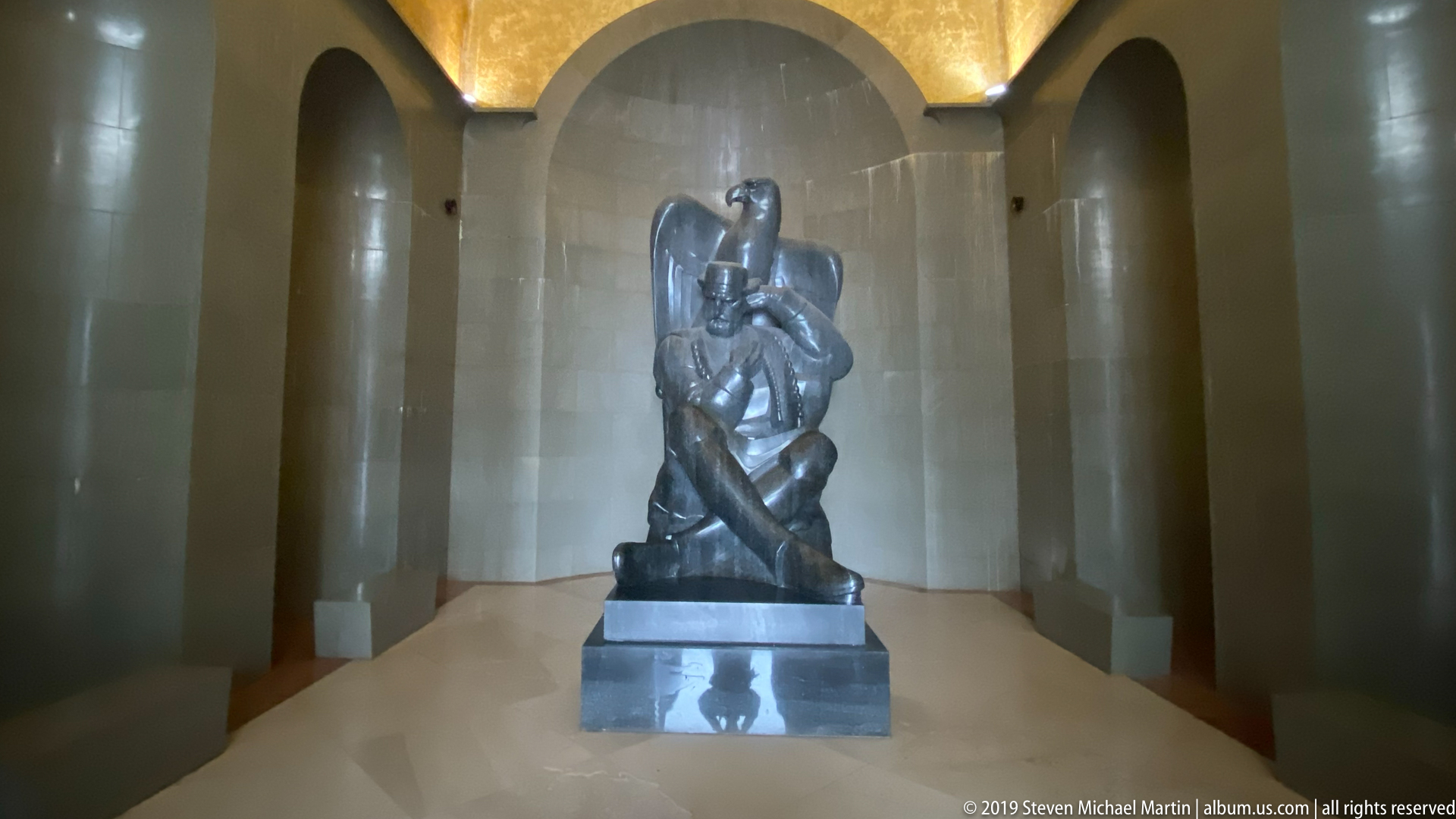
The seated Njegoš statue stands alone on a polished dark pedestal at the end of the pale stone chamber, framed by a rounded apse and a luminous gold-toned ceiling. Deep side arches rhythmically recess along the walls, directing the eye toward the sculpture. The distant viewpoint stresses the monument’s carefully controlled axial setting and the contrast between dark sculpture, pale stone, and glowing overhead surface.
Caption
The seated Njegoš statue stands alone on a polished dark pedestal at the end of the pale stone chamber, framed by a rounded apse and a luminous gold-toned ceiling. Deep side arches rhythmically recess along the walls, directing the eye toward the sculpture. The distant viewpoint stresses the monument’s carefully controlled axial setting and the contrast between dark sculpture, pale stone, and glowing overhead surface.

A long symmetrical chamber leads toward the seated Njegoš statue at the far end, beneath a gold-toned vaulted ceiling that brightens toward the centerline. Tall rounded recesses line both walls, creating a measured rhythm along the pale stone interior. The distant sculpture remains the focal point, but this view gives equal weight to the architectural procession and luminous ceiling that frame the monument.
Caption
A long symmetrical chamber leads toward the seated Njegoš statue at the far end, beneath a gold-toned vaulted ceiling that brightens toward the centerline. Tall rounded recesses line both walls, creating a measured rhythm along the pale stone interior. The distant sculpture remains the focal point, but this view gives equal weight to the architectural procession and luminous ceiling that frame the monument.

Worn stone steps descend steeply through a narrow white barrel-vaulted passage, their damp surfaces mottled by dark patches. Small wall lights and shallow recesses punctuate the otherwise plain interior, while the stair turns or disappears into a cooler blue-lit section below. The downward view emphasizes the length, wear, and enclosed character of the pedestrian tunnel serving the summit monument.
Caption
Worn stone steps descend steeply through a narrow white barrel-vaulted passage, their damp surfaces mottled by dark patches. Small wall lights and shallow recesses punctuate the otherwise plain interior, while the stair turns or disappears into a cooler blue-lit section below. The downward view emphasizes the length, wear, and enclosed character of the pedestrian tunnel serving the summit monument.

Broad pale stone steps rise toward a bright bend in the white vaulted access tunnel, with a solitary figure silhouetted near the upper landing. Narrow handrails and small wall fixtures trace the passage on both sides. The low viewpoint magnifies the scale and steepness of the ascent, turning the utilitarian tunnel into a strong geometric progression of horizontal stair edges.
Caption
Broad pale stone steps rise toward a bright bend in the white vaulted access tunnel, with a solitary figure silhouetted near the upper landing. Narrow handrails and small wall fixtures trace the passage on both sides. The low viewpoint magnifies the scale and steepness of the ascent, turning the utilitarian tunnel into a strong geometric progression of horizontal stair edges.

A broad staircase climbs through the white barrel-vaulted tunnel toward a bright upper bend, where a lone visitor stands in silhouette. Uneven wear and darkened joints are visible across the pale stone treads, while slim rails and wall fixtures line both sides. The centered upward view repeats the monumental rhythm of the steps while bringing the human figure into clearer relation with the long enclosed ascent.
Caption
A broad staircase climbs through the white barrel-vaulted tunnel toward a bright upper bend, where a lone visitor stands in silhouette. Uneven wear and darkened joints are visible across the pale stone treads, while slim rails and wall fixtures line both sides. The centered upward view repeats the monumental rhythm of the steps while bringing the human figure into clearer relation with the long enclosed ascent.

A smartphone navigation screen shows a blue driving route twisting through the mountainous road network toward the Mausoleum of Petar II Petrović-Njegoš. Place labels and road numbers appear along a dense series of switchbacks, with an estimated travel time of about one hour and nine minutes. The screenshot documents the complex road approach to the summit rather than the monument itself.
Caption
A smartphone navigation screen shows a blue driving route twisting through the mountainous road network toward the Mausoleum of Petar II Petrović-Njegoš. Place labels and road numbers appear along a dense series of switchbacks, with an estimated travel time of about one hour and nine minutes. The screenshot documents the complex road approach to the summit rather than the monument itself.

A regional smartphone map traces a blue route from the Bay of Kotor area through mountain roads toward Lovćen and the Mausoleum of Petar II Petrović-Njegoš. Labels including Kotor, Dobrota, Njeguši, and Lovćen place the destination within the broader geography of southwestern Montenegro. The screenshot conveys the long, winding relationship between the Adriatic coast and the high summit monument.
Caption
A regional smartphone map traces a blue route from the Bay of Kotor area through mountain roads toward Lovćen and the Mausoleum of Petar II Petrović-Njegoš. Labels including Kotor, Dobrota, Njeguši, and Lovćen place the destination within the broader geography of southwestern Montenegro. The screenshot conveys the long, winding relationship between the Adriatic coast and the high summit monument.
⭐ Highlights
- Mountain Summit Location: Situated atop Jezerski Vrh on Mount Lovćen at approximately 1,660 meters.
- Final Resting Place: The mausoleum honors Petar II Petrović-Njegoš, a ruler, poet, and philosopher.
- 461-Step Ascent: A dramatic staircase and tunnel lead visitors to the summit.
- Monumental Sculpture: A massive seated statue of Njegoš dominates the interior.
- Panoramic Views: Sweeping views extend across Montenegro, including the Bay of Kotor.
- Symbolic Landmark: One of the most important cultural and national monuments in Montenegro.
🏔️ Njegoš Mausoleum Field Guide
Major features observed during this visit:
The mausoleum of Petar II Petrović-Njegoš stands at the summit of Mount Lovćen, one of Montenegro’s most significant cultural and geographic landmarks. Built in 1974 on the site of an earlier chapel, the monument fulfills Njegoš’s wish to be buried on the mountain he considered sacred. The location combines symbolic importance with one of the most dramatic viewpoints in the region.
🏛️ Architectural Features
- Summit Placement – Positioned on Jezerski Vrh, emphasizing both isolation and prominence.
- Stone Construction – Built from massive blocks, giving the structure a monumental and timeless presence.
- Caryatids – Large sculptural figures at the entrance symbolize Montenegrin identity.
- Interior Statue – A large granite figure of Njegoš dominates the central chamber.
- Vaulted Crypt – The burial chamber lies beneath the main structure.
🧠 Historical Significance
- Petar II Petrović-Njegoš – A 19th-century ruler, bishop, and one of the most important literary figures in the region.
- Original Chapel (1845) – Njegoš built a chapel on this site with the intention of being buried here.
- Reburials and Conflict – His remains were moved multiple times due to war and political changes.
- Modern Mausoleum (1974) – The current structure replaced the earlier chapel as a national monument.
🌄 Landscape & Setting
- Mount Lovćen – A central symbol of Montenegrin identity and geography.
- Highest Mausoleum – One of the highest mausoleums in the world.
- Panoramic Views – Visibility extends to the Adriatic coast, mountains, and interior valleys.
- Journey to the Summit – The ascent through forest, road, and staircase enhances the experience.