Matsumoto Castle
Matsumoto Castle is one of Japan’s most well-preserved feudal castles and dates primarily to the late sixteenth century. The structure is notable for its black exterior, giving rise to the nickname “Crow Castle.” Its defensive design reflects political and military conditions during a period of regional conflict preceding national unification.
The castle’s wooden keep, stone foundations, and surrounding moat demonstrate architectural strategies intended to protect against siege. Interior spaces illustrate hierarchical organization and defensive planning within feudal governance. The castle’s design emphasizes both functional military features and aesthetic balance.
Matsumoto Castle represents the political structure of feudal Japan and the importance of fortified architecture in maintaining regional authority. Its preservation provides insight into military engineering and early modern construction techniques.
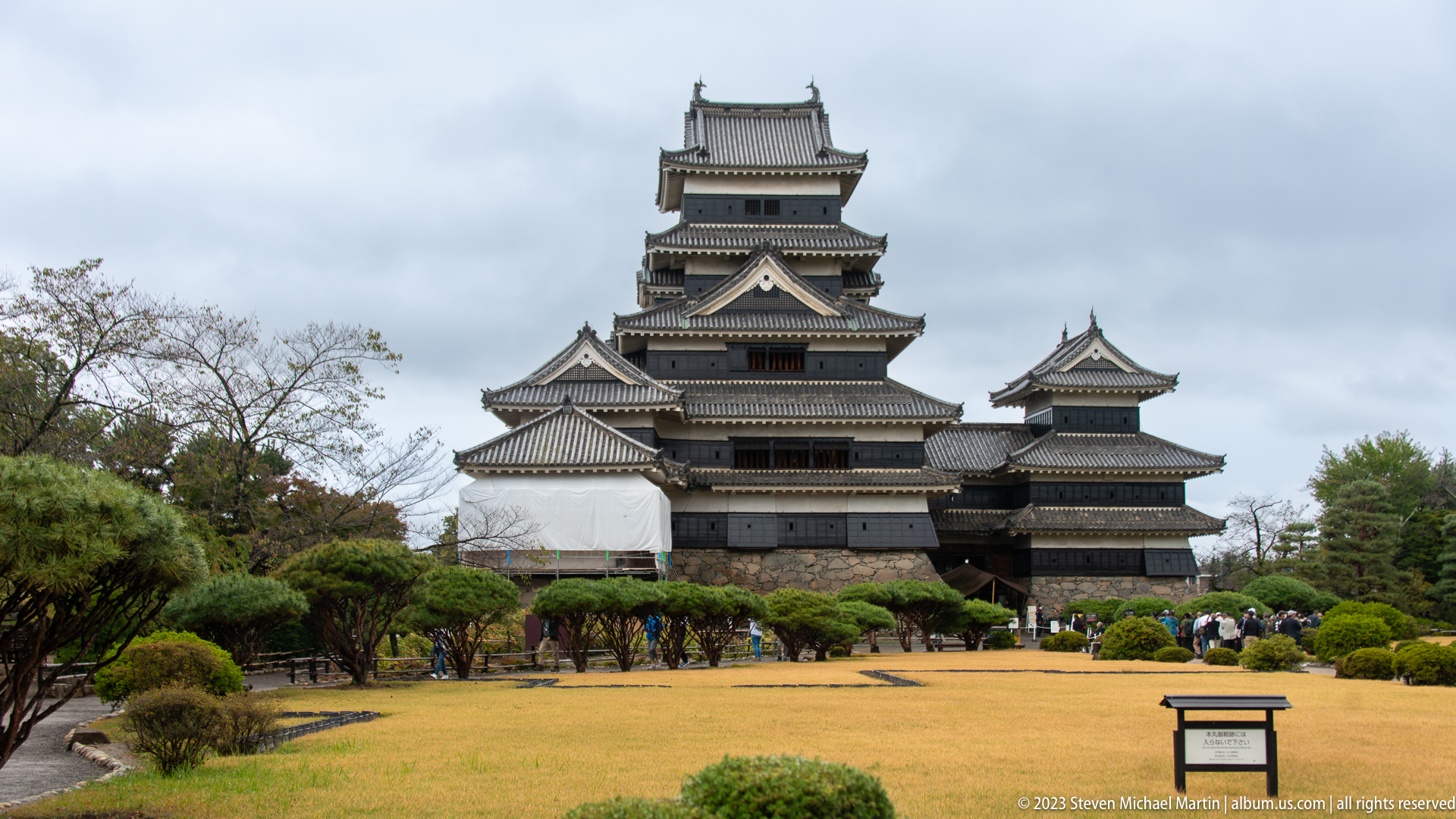
Matsumoto Castle’s black-and-white keep complex rises beyond a carefully maintained foreground of clipped pines and open lawn. The view gathers the principal tower and adjoining rooflines into a balanced elevation, making the contrast between dark timber cladding, white plaster walls, and gray tile roofs especially clear. Visitors at the base provide scale for the layered defensive architecture and its commanding vertical silhouette.
Caption
Matsumoto Castle’s black-and-white keep complex rises beyond a carefully maintained foreground of clipped pines and open lawn. The view gathers the principal tower and adjoining rooflines into a balanced elevation, making the contrast between dark timber cladding, white plaster walls, and gray tile roofs especially clear. Visitors at the base provide scale for the layered defensive architecture and its commanding vertical silhouette.

A wider landscape composition places Matsumoto Castle beyond the moat and a sweeping vermilion bridge. The broad water surface doubles the dark tower silhouettes and red bridge in reflection, while trees and cloudy sky establish the castle within its surrounding grounds. Compared with the preceding view, this frame gives greater weight to the moat as a defensive and visual element.
Caption
A wider landscape composition places Matsumoto Castle beyond the moat and a sweeping vermilion bridge. The broad water surface doubles the dark tower silhouettes and red bridge in reflection, while trees and cloudy sky establish the castle within its surrounding grounds. Compared with the preceding view, this frame gives greater weight to the moat as a defensive and visual element.

A historical painted panorama presents Matsumoto Castle as a layered group of dark roofs and white walls set within a broad landscape. The elevated viewpoint compresses defensive buildings, waterways, and open ground into a single pictorial survey. Unlike modern exterior photographs, this image records how the castle and its surroundings were imagined or documented through traditional painting.
Caption
A historical painted panorama presents Matsumoto Castle as a layered group of dark roofs and white walls set within a broad landscape. The elevated viewpoint compresses defensive buildings, waterways, and open ground into a single pictorial survey. Unlike modern exterior photographs, this image records how the castle and its surroundings were imagined or documented through traditional painting.

The castle grounds are seen from an upper level of the keep, with a garden path, clipped pines, and a line of visitors arranged below. Roof edges and timber framing in the foreground establish the viewpoint from within the building. The elevated perspective demonstrates the keep’s commanding visual relationship to the surrounding approach while also recording the present-day museum circulation around the site.
Caption
The castle grounds are seen from an upper level of the keep, with a garden path, clipped pines, and a line of visitors arranged below. Roof edges and timber framing in the foreground establish the viewpoint from within the building. The elevated perspective demonstrates the keep’s commanding visual relationship to the surrounding approach while also recording the present-day museum circulation around the site.

Matsumoto Castle stands beyond the moat with a bright red bridge entering from the left, introducing a vivid ceremonial accent beside the dark keep. The wider view reconnects the castle to its water defenses, stone revetment, and approach route. Reflection, bridge, and tower together create one of the site’s most recognizable exterior compositions.
Caption
Matsumoto Castle stands beyond the moat with a bright red bridge entering from the left, introducing a vivid ceremonial accent beside the dark keep. The wider view reconnects the castle to its water defenses, stone revetment, and approach route. Reflection, bridge, and tower together create one of the site’s most recognizable exterior compositions.

Two adjoining tower masses rise at different heights in this low-angle view of Matsumoto Castle. Their overlapping eaves, black timber walls, white plaster bands, and small openings show how the complex was assembled from connected defensive volumes rather than as a single uniform block. The tight framing emphasizes the angular junctions between roofs and the layered construction that complicates approaches to the keep.
Caption
Two adjoining tower masses rise at different heights in this low-angle view of Matsumoto Castle. Their overlapping eaves, black timber walls, white plaster bands, and small openings show how the complex was assembled from connected defensive volumes rather than as a single uniform block. The tight framing emphasizes the angular junctions between roofs and the layered construction that complicates approaches to the keep.

Matsumoto Castle rises across the moat beside the vermilion Uzumi Bridge, with both architecture and bridge reflected in the still water. The wide view sets the black-and-white keep within its defensive landscape, linking the stone embankment, water barrier, and controlled crossing. Overcast light softens the scene while preserving the castle’s strong silhouette.
Caption
Matsumoto Castle rises across the moat beside the vermilion Uzumi Bridge, with both architecture and bridge reflected in the still water. The wide view sets the black-and-white keep within its defensive landscape, linking the stone embankment, water barrier, and controlled crossing. Overcast light softens the scene while preserving the castle’s strong silhouette.

A frontal view across the moat aligns Matsumoto Castle’s main keep with a lower flanking tower, both rising above the rough stone embankment. Willow branches enter from the upper left, softening the architecture’s severe geometry. The calm water and nearly centered composition present the complex as a balanced ensemble of defensive masonry, dark timber, white plaster, and tiled roofs.
Caption
A frontal view across the moat aligns Matsumoto Castle’s main keep with a lower flanking tower, both rising above the rough stone embankment. Willow branches enter from the upper left, softening the architecture’s severe geometry. The calm water and nearly centered composition present the complex as a balanced ensemble of defensive masonry, dark timber, white plaster, and tiled roofs.

The principal keep is viewed from a corner, where successive roof stages project outward above dark wall planes and white structural bands. This angle makes the tiered geometry especially legible: each level steps inward while broad eaves cast shadows across the floors below. A neighboring roof enters at right, reinforcing the dense, interconnected character of the Matsumoto Castle complex.
Caption
The principal keep is viewed from a corner, where successive roof stages project outward above dark wall planes and white structural bands. This angle makes the tiered geometry especially legible: each level steps inward while broad eaves cast shadows across the floors below. A neighboring roof enters at right, reinforcing the dense, interconnected character of the Matsumoto Castle complex.

Matsumoto Castle rises above its stone base and broad moat, with the black-and-white main keep joined by a smaller flanking tower. The layered tiled roofs, white plaster panels, and dark timber cladding create the strong horizontal rhythm characteristic of the complex. Reflections in the still water reinforce the castle’s visual relationship to its defensive moat and masonry platform.
Caption
Matsumoto Castle rises above its stone base and broad moat, with the black-and-white main keep joined by a smaller flanking tower. The layered tiled roofs, white plaster panels, and dark timber cladding create the strong horizontal rhythm characteristic of the complex. Reflections in the still water reinforce the castle’s visual relationship to its defensive moat and masonry platform.

A swift mountain stream courses between rounded boulders beneath dense woodland on the approach to Choshi Falls. The irregular channel, exposed stones, and churning white water reveal how runoff has shaped this narrow forested valley. Rather than presenting the waterfall itself, the view establishes the hydrological landscape that feeds it and the rugged terrain encountered along the route.
Caption
A swift mountain stream courses between rounded boulders beneath dense woodland on the approach to Choshi Falls. The irregular channel, exposed stones, and churning white water reveal how runoff has shaped this narrow forested valley. Rather than presenting the waterfall itself, the view establishes the hydrological landscape that feeds it and the rugged terrain encountered along the route.

A roadside sign directs travelers one kilometer toward Choshi Falls, pairing the Japanese name 銚子の滝 with the English label “Choshi Falls.” The arrow and waterfall pictogram make the destination immediately legible, while surrounding vegetation and utility lines place the marker within a rural mountain corridor. The sign provides firm visual evidence for the location of the nearby waterfall sequence.
Caption
A roadside sign directs travelers one kilometer toward Choshi Falls, pairing the Japanese name 銚子の滝 with the English label “Choshi Falls.” The arrow and waterfall pictogram make the destination immediately legible, while surrounding vegetation and utility lines place the marker within a rural mountain corridor. The sign provides firm visual evidence for the location of the nearby waterfall sequence.

Turbulent water breaks into foam as it threads through a dense field of exposed stones and larger boulders. The elevated viewpoint compresses the channel into a textured pattern of white current, wet rock, and small pools. This closer study emphasizes the force and irregular movement of the stream rather than the broader woodland setting seen in the preceding approach view.
Caption
Turbulent water breaks into foam as it threads through a dense field of exposed stones and larger boulders. The elevated viewpoint compresses the channel into a textured pattern of white current, wet rock, and small pools. This closer study emphasizes the force and irregular movement of the stream rather than the broader woodland setting seen in the preceding approach view.

Three travelers pause along a wooded path, with the two men in front focused on a smartphone while a woman follows behind. Their concentrated gestures suggest wayfinding or reviewing a photograph during the approach to Choshi Falls. The candid scene adds a human scale to the forest excursion and documents how visitors navigate the site rather than presenting a posed travel portrait.
Caption
Three travelers pause along a wooded path, with the two men in front focused on a smartphone while a woman follows behind. Their concentrated gestures suggest wayfinding or reviewing a photograph during the approach to Choshi Falls. The candid scene adds a human scale to the forest excursion and documents how visitors navigate the site rather than presenting a posed travel portrait.

A clear woodland stream winds between moss-covered rocks beneath a canopy of green leaves. The softened current and layered vegetation create a quieter counterpoint to the more turbulent rapids nearby. Seen at stream level, the photograph records the intimate forest environment surrounding Choshi Falls, where water, stone, moss, and deciduous growth form a closely interwoven landscape.
Caption
A clear woodland stream winds between moss-covered rocks beneath a canopy of green leaves. The softened current and layered vegetation create a quieter counterpoint to the more turbulent rapids nearby. Seen at stream level, the photograph records the intimate forest environment surrounding Choshi Falls, where water, stone, moss, and deciduous growth form a closely interwoven landscape.

Choshi Falls descends in a broad white cascade over a sloping rock face framed by thick forest. The water spreads across the uneven surface before gathering at the base, producing a veil-like fall rather than a single vertical plunge. This first full view establishes the waterfall’s scale, wooded setting, and close relationship to the exposed bedrock of the gorge.
Caption
Choshi Falls descends in a broad white cascade over a sloping rock face framed by thick forest. The water spreads across the uneven surface before gathering at the base, producing a veil-like fall rather than a single vertical plunge. This first full view establishes the waterfall’s scale, wooded setting, and close relationship to the exposed bedrock of the gorge.

A frontal composition centers Choshi Falls as water fans across the broad rock slope and drops into a dark plunge pool. Dense trees and low vegetation enclose the cascade, giving the scene a secluded character. Compared with the preceding view, this more symmetrical framing clarifies the full width of the fall and the shallow basin gathered directly below it.
Caption
A frontal composition centers Choshi Falls as water fans across the broad rock slope and drops into a dark plunge pool. Dense trees and low vegetation enclose the cascade, giving the scene a secluded character. Compared with the preceding view, this more symmetrical framing clarifies the full width of the fall and the shallow basin gathered directly below it.

Water pours through a narrow cleft and falls nearly vertically against a steep rock wall at Choshi Falls. The portrait-oriented view isolates the taller, more concentrated section of the cascade, contrasting with wider photographs that emphasize the fan-shaped lower slope. Moss, shrubs, and wet stone reveal the humid microenvironment sustained by spray along the gorge.
Caption
Water pours through a narrow cleft and falls nearly vertically against a steep rock wall at Choshi Falls. The portrait-oriented view isolates the taller, more concentrated section of the cascade, contrasting with wider photographs that emphasize the fan-shaped lower slope. Moss, shrubs, and wet stone reveal the humid microenvironment sustained by spray along the gorge.

A traveler in a dark zip-neck sweater stands before Choshi Falls, positioned slightly right of the main cascade. The shallow depth of field softens the waterfall while retaining its recognizable white descent, shifting emphasis to the sitter’s expression. The portrait documents the falls as both a natural feature and a destination experienced personally by visitors.
Caption
A traveler in a dark zip-neck sweater stands before Choshi Falls, positioned slightly right of the main cascade. The shallow depth of field softens the waterfall while retaining its recognizable white descent, shifting emphasis to the sitter’s expression. The portrait documents the falls as both a natural feature and a destination experienced personally by visitors.

A second portrait places the same traveler farther to the right, allowing more of Choshi Falls to remain visible over his shoulder. The relaxed pose and direct gaze create a conventional travel portrait, while the bright cascade and dense green vegetation retain a strong sense of place. The altered framing distinguishes this image from the tighter preceding likeness.
Caption
A second portrait places the same traveler farther to the right, allowing more of Choshi Falls to remain visible over his shoulder. The relaxed pose and direct gaze create a conventional travel portrait, while the bright cascade and dense green vegetation retain a strong sense of place. The altered framing distinguishes this image from the tighter preceding likeness.

A man in a vivid red long-sleeved shirt stands with arms crossed before the softly blurred waters of Choshi Falls. The strong color contrast separates the sitter from the pale cascade and dark rock, producing a more graphic portrait than the neighboring views. His direct expression and centered stance give the photograph a formal, self-assured character.
Caption
A man in a vivid red long-sleeved shirt stands with arms crossed before the softly blurred waters of Choshi Falls. The strong color contrast separates the sitter from the pale cascade and dark rock, producing a more graphic portrait than the neighboring views. His direct expression and centered stance give the photograph a formal, self-assured character.

An alternate portrait of the red-shirted traveler shifts him slightly off center while retaining his folded-arm pose and direct gaze. The waterfall remains softly rendered behind him, and a wristwatch becomes a visible personal detail. Subtle changes in stance, expression, and framing make this image a distinct selection rather than a duplicate of the preceding portrait.
Caption
An alternate portrait of the red-shirted traveler shifts him slightly off center while retaining his folded-arm pose and direct gaze. The waterfall remains softly rendered behind him, and a wristwatch becomes a visible personal detail. Subtle changes in stance, expression, and framing make this image a distinct selection rather than a duplicate of the preceding portrait.

A wide vertical view places a traveler on the right bank while Choshi Falls drops behind him from a rocky cleft. The composition reveals more of the steep gorge wall, wet stones, and lush groundcover than the preceding portrait. By keeping the figure relatively small, the photograph presents the visit as an encounter with a larger, rugged mountain environment.
Caption
A wide vertical view places a traveler on the right bank while Choshi Falls drops behind him from a rocky cleft. The composition reveals more of the steep gorge wall, wet stones, and lush groundcover than the preceding portrait. By keeping the figure relatively small, the photograph presents the visit as an encounter with a larger, rugged mountain environment.

A traveler stands on the grassy bank below Choshi Falls, dwarfed by the broad cascade and surrounding vegetation. Unlike the tight portraits on the previous page, this environmental view gives equal weight to the person and the landscape. His placement near the lower edge clarifies the waterfall’s scale and the uneven terrain visitors must cross to approach it.
Caption
A traveler stands on the grassy bank below Choshi Falls, dwarfed by the broad cascade and surrounding vegetation. Unlike the tight portraits on the previous page, this environmental view gives equal weight to the person and the landscape. His placement near the lower edge clarifies the waterfall’s scale and the uneven terrain visitors must cross to approach it.

A low broadside view presents Matsumoto Castle as a layered silhouette above the moat, with the long rooflines mirrored in calm water. The composition emphasizes the complex’s horizontal spread more than its height, allowing the stone embankment and linked structures to read as a unified defensive ensemble. The subdued sky and reflection give the architecture a restrained monumentality.
Caption
A low broadside view presents Matsumoto Castle as a layered silhouette above the moat, with the long rooflines mirrored in calm water. The composition emphasizes the complex’s horizontal spread more than its height, allowing the stone embankment and linked structures to read as a unified defensive ensemble. The subdued sky and reflection give the architecture a restrained monumentality.

A complete suit of Japanese armor stands against the heavy timber and stone interior of Matsumoto Castle. The layered lamellar plates, patterned lacing, flared shoulder guards, helmet, and prominent crescent-shaped crest present the equipment as both protective technology and an expression of warrior identity. The museum setting links the castle’s military architecture with the material culture of the samurai who occupied and defended such strongholds.
Caption
A complete suit of Japanese armor stands against the heavy timber and stone interior of Matsumoto Castle. The layered lamellar plates, patterned lacing, flared shoulder guards, helmet, and prominent crescent-shaped crest present the equipment as both protective technology and an expression of warrior identity. The museum setting links the castle’s military architecture with the material culture of the samurai who occupied and defended such strongholds.

A close head-and-shoulders portrait isolates the gray-haired traveler against the pale, out-of-focus cascade of Choshi Falls. The compressed framing removes most environmental detail and emphasizes expression, facial features, and the texture of the dark fleece. The waterfall remains legible only as a soft vertical field, providing place without competing with the sitter.
Caption
A close head-and-shoulders portrait isolates the gray-haired traveler against the pale, out-of-focus cascade of Choshi Falls. The compressed framing removes most environmental detail and emphasizes expression, facial features, and the texture of the dark fleece. The waterfall remains legible only as a soft vertical field, providing place without competing with the sitter.

A steel road bridge crosses a green mountain valley above a compact settlement, with steep forested slopes rising into low cloud. The view marks a transition from the Choshi Falls excursion toward the broader Matsumoto region. Transport infrastructure, clustered buildings, and heavily wooded terrain together show how roads and communities occupy narrow corridors between the surrounding mountains.
Caption
A steel road bridge crosses a green mountain valley above a compact settlement, with steep forested slopes rising into low cloud. The view marks a transition from the Choshi Falls excursion toward the broader Matsumoto region. Transport infrastructure, clustered buildings, and heavily wooded terrain together show how roads and communities occupy narrow corridors between the surrounding mountains.

Low cloud drapes across a densely forested mountain ridge, obscuring the summit and slipping through a notch in the terrain. The telephoto view removes roads and buildings to concentrate on atmospheric conditions and the layered texture of the slopes. Moist air and muted light give the landscape a transitional, weather-bound character typical of mountain travel.
Caption
Low cloud drapes across a densely forested mountain ridge, obscuring the summit and slipping through a notch in the terrain. The telephoto view removes roads and buildings to concentrate on atmospheric conditions and the layered texture of the slopes. Moist air and muted light give the landscape a transitional, weather-bound character typical of mountain travel.

A small settlement stretches along the base of steep, green mountains whose upper ridges disappear into cloud. The wider framing restores the human landscape omitted from the preceding study, showing houses and roads pressed into the narrow valley floor. The contrast between compact development and towering wooded slopes conveys the constrained geography of this mountainous part of central Japan.
Caption
A small settlement stretches along the base of steep, green mountains whose upper ridges disappear into cloud. The wider framing restores the human landscape omitted from the preceding study, showing houses and roads pressed into the narrow valley floor. The contrast between compact development and towering wooded slopes conveys the constrained geography of this mountainous part of central Japan.

A broad mountain panorama reveals a forested valley, winding roadway, scattered settlement, and a conspicuous cleared ski run descending the opposite slope. Low clouds skim the ridge line while the elevated viewpoint opens the terrain into a layered regional landscape. The image records both natural topography and recreational modification before the portfolio turns to Matsumoto Castle itself.
Caption
A broad mountain panorama reveals a forested valley, winding roadway, scattered settlement, and a conspicuous cleared ski run descending the opposite slope. Low clouds skim the ridge line while the elevated viewpoint opens the terrain into a layered regional landscape. The image records both natural topography and recreational modification before the portfolio turns to Matsumoto Castle itself.

A closer view isolates the principal keep of Matsumoto Castle, drawing attention to its stacked roof tiers, dark timber walls, white plaster gables, and projecting eaves. The elevated tower rises directly from the massive stone base, making the vertical organization of the structure easier to read. Openings and galleries punctuate each level while the rooflines progressively narrow toward the summit.
Caption
A closer view isolates the principal keep of Matsumoto Castle, drawing attention to its stacked roof tiers, dark timber walls, white plaster gables, and projecting eaves. The elevated tower rises directly from the massive stone base, making the vertical organization of the structure easier to read. Openings and galleries punctuate each level while the rooflines progressively narrow toward the summit.

A red timber bridge spans the moat at Matsumoto Castle, its long horizontal reflection doubling the structure in the muted water below. Stone abutments anchor the crossing at either end, while trees and remnants of the defensive wall frame the approach. By excluding the keep, the photograph concentrates on circulation, access, and the visual role of the bridge within the castle grounds.
Caption
A red timber bridge spans the moat at Matsumoto Castle, its long horizontal reflection doubling the structure in the muted water below. Stone abutments anchor the crossing at either end, while trees and remnants of the defensive wall frame the approach. By excluding the keep, the photograph concentrates on circulation, access, and the visual role of the bridge within the castle grounds.

An oblique corner view reveals how Matsumoto Castle’s keep and attached roof masses rise from the angled stone base beside the moat. The diagonal perspective gives the structure greater depth than the frontal compositions, clarifying the relationship between projecting wings and the central tower. Dark siding, white gables, and gray tiled roofs stand sharply against the cool overcast sky.
Caption
An oblique corner view reveals how Matsumoto Castle’s keep and attached roof masses rise from the angled stone base beside the moat. The diagonal perspective gives the structure greater depth than the frontal compositions, clarifying the relationship between projecting wings and the central tower. Dark siding, white gables, and gray tiled roofs stand sharply against the cool overcast sky.

A low-angle architectural detail examines the junction of white plaster walls, black timber siding, tiled eaves, and the irregular stone foundation at Matsumoto Castle. Narrow vertical openings punctuate the upper wall beneath deep projecting rafters. The close view shifts attention from the keep’s silhouette to the materials and layered construction that give the castle its distinctive visual character.
Caption
A low-angle architectural detail examines the junction of white plaster walls, black timber siding, tiled eaves, and the irregular stone foundation at Matsumoto Castle. Narrow vertical openings punctuate the upper wall beneath deep projecting rafters. The close view shifts attention from the keep’s silhouette to the materials and layered construction that give the castle its distinctive visual character.

Visitors pass through a substantial timber gateway at Matsumoto Castle, framed by thick posts, dark wooden doors, and painted structural ornament. Green-and-gold decorative panels enliven the otherwise sober architecture, while the open passage reveals clipped pines and the inner grounds beyond. The scene records the gate as both an architectural threshold and an active point of visitor circulation.
Caption
Visitors pass through a substantial timber gateway at Matsumoto Castle, framed by thick posts, dark wooden doors, and painted structural ornament. Green-and-gold decorative panels enliven the otherwise sober architecture, while the open passage reveals clipped pines and the inner grounds beyond. The scene records the gate as both an architectural threshold and an active point of visitor circulation.

A close detail records painted ornament at the castle gateway, where a blue-green structural panel, gilded vegetal forms, white floral emblems, and red-brown timber meet beneath the beam. The photograph isolates craftsmanship easily overlooked in wider views of the gate. Color and pattern transform a load-bearing junction into a focal point of architectural display.
Caption
A close detail records painted ornament at the castle gateway, where a blue-green structural panel, gilded vegetal forms, white floral emblems, and red-brown timber meet beneath the beam. The photograph isolates craftsmanship easily overlooked in wider views of the gate. Color and pattern transform a load-bearing junction into a focal point of architectural display.

Paired decorated posts and bracket panels repeat the gateway’s blue-green, gold, white, and red-brown palette across a wider section of the timber frame. The broader detail reveals how individual motifs form a coordinated ornamental program rather than isolated embellishments. Bolts, beams, and painted surfaces remain visible together, linking decoration directly to the gate’s structural fabric.
Caption
Paired decorated posts and bracket panels repeat the gateway’s blue-green, gold, white, and red-brown palette across a wider section of the timber frame. The broader detail reveals how individual motifs form a coordinated ornamental program rather than isolated embellishments. Bolts, beams, and painted surfaces remain visible together, linking decoration directly to the gate’s structural fabric.

A closer frontal view isolates the central keep and its attached tower, revealing how multiple roof stages overlap above the dark timber walls. White gables and projecting eaves break the mass into distinct defensive levels, while the stone foundation anchors the structure above the landscaped approach. The restricted crop emphasizes vertical hierarchy and the compact integration of separate building volumes within the castle complex.
Caption
A closer frontal view isolates the central keep and its attached tower, revealing how multiple roof stages overlap above the dark timber walls. White gables and projecting eaves break the mass into distinct defensive levels, while the stone foundation anchors the structure above the landscaped approach. The restricted crop emphasizes vertical hierarchy and the compact integration of separate building volumes within the castle complex.

Seen from below, the upper stories of Matsumoto Castle form a steep stack of dark wall planes, white-trimmed gables, and deep tiled eaves. The compressed viewpoint draws attention to projecting roof brackets, barred openings, and the strong alternation of horizontal rooflines with the tower’s vertical rise. Rather than presenting the whole castle, this study concentrates on the constructional rhythm that gives the keep its imposing profile.
Caption
Seen from below, the upper stories of Matsumoto Castle form a steep stack of dark wall planes, white-trimmed gables, and deep tiled eaves. The compressed viewpoint draws attention to projecting roof brackets, barred openings, and the strong alternation of horizontal rooflines with the tower’s vertical rise. Rather than presenting the whole castle, this study concentrates on the constructional rhythm that gives the keep its imposing profile.

A triangular gable, rows of ceramic roof tiles, and a barred opening fill this close architectural study of Matsumoto Castle. The white plaster edge and molded crest ornament contrast sharply with the black wall panels below, while the layered eaves expose the precision of the roof construction. At this scale, the castle’s visual identity emerges through materials and repeated details rather than through its familiar overall silhouette.
Caption
A triangular gable, rows of ceramic roof tiles, and a barred opening fill this close architectural study of Matsumoto Castle. The white plaster edge and molded crest ornament contrast sharply with the black wall panels below, while the layered eaves expose the precision of the roof construction. At this scale, the castle’s visual identity emerges through materials and repeated details rather than through its familiar overall silhouette.

Visitors gather along the stone foundation beneath the connected keeps of Matsumoto Castle. From this low position, the rough masonry base appears massive, while black timber walls, white plastered gables, and deep tiled roofs rise in compact layers above it. The active entrance area turns the defensive architecture into a lived museum setting and provides a direct sense of scale.
Caption
Visitors gather along the stone foundation beneath the connected keeps of Matsumoto Castle. From this low position, the rough masonry base appears massive, while black timber walls, white plastered gables, and deep tiled roofs rise in compact layers above it. The active entrance area turns the defensive architecture into a lived museum setting and provides a direct sense of scale.

An oblique upward view sets the main keep against a closely adjoining roof range, creating a dense pattern of eaves, gables, and window bands. The photograph highlights the castle’s asymmetrical composition and the way separate structures interlock around the central tower. Dark wall panels and white roof edges sharpen the graphic rhythm of the architecture against the subdued sky.
Caption
An oblique upward view sets the main keep against a closely adjoining roof range, creating a dense pattern of eaves, gables, and window bands. The photograph highlights the castle’s asymmetrical composition and the way separate structures interlock around the central tower. Dark wall panels and white roof edges sharpen the graphic rhythm of the architecture against the subdued sky.

An arched barred opening punctuates a black exterior wall above a line of gray roof tiles. The restrained composition isolates the defensive character of the aperture, whose heavy vertical and horizontal bars sharply limit access and visibility. White plaster trim outlines the arch, while the adjacent eaves create a layered frame within the larger castle façade.
Caption
An arched barred opening punctuates a black exterior wall above a line of gray roof tiles. The restrained composition isolates the defensive character of the aperture, whose heavy vertical and horizontal bars sharply limit access and visibility. White plaster trim outlines the arch, while the adjacent eaves create a layered frame within the larger castle façade.

Ornamental ceramic roof-end tiles are stacked in a close study of Matsumoto Castle’s eaves. Circular crests, curled profiles, and molded relief patterns turn a functional roofing system into a highly visible decorative program. The shallow depth of field concentrates attention on the workmanship and repeated forms that protect roof edges while reinforcing the castle’s architectural identity.
Caption
Ornamental ceramic roof-end tiles are stacked in a close study of Matsumoto Castle’s eaves. Circular crests, curled profiles, and molded relief patterns turn a functional roofing system into a highly visible decorative program. The shallow depth of field concentrates attention on the workmanship and repeated forms that protect roof edges while reinforcing the castle’s architectural identity.

Intersecting eaves converge overhead in a tightly framed upward view within the Matsumoto Castle complex. Exposed rafters, white plaster surfaces, dark wall sections, and rows of ceramic tiles reveal the layered engineering of the roof system. By looking into the narrow space between buildings, the photograph shows how closely packed structures create protected passages and complex lines of sight.
Caption
Intersecting eaves converge overhead in a tightly framed upward view within the Matsumoto Castle complex. Exposed rafters, white plaster surfaces, dark wall sections, and rows of ceramic tiles reveal the layered engineering of the roof system. By looking into the narrow space between buildings, the photograph shows how closely packed structures create protected passages and complex lines of sight.

Heavy timber posts, crossbeams, and a steep stair define an interior circulation space inside Matsumoto Castle. Polished floorboards and low light make the structure itself the principal subject, revealing how compact movement routes were fitted within the defensive shell. Modern handrails and protective barriers guide visitors through a space whose narrowness and abrupt changes in level remain evident.
Caption
Heavy timber posts, crossbeams, and a steep stair define an interior circulation space inside Matsumoto Castle. Polished floorboards and low light make the structure itself the principal subject, revealing how compact movement routes were fitted within the defensive shell. Modern handrails and protective barriers guide visitors through a space whose narrowness and abrupt changes in level remain evident.

A long interior gallery extends through a dense grid of timber columns and beams inside Matsumoto Castle. Light from distant openings reflects across the polished wooden floor, while structural posts divide the space into narrow bays. The spare interior makes the castle’s construction system visible and conveys the controlled, compartmentalized movement characteristic of a fortified building.
Caption
A long interior gallery extends through a dense grid of timber columns and beams inside Matsumoto Castle. Light from distant openings reflects across the polished wooden floor, while structural posts divide the space into narrow bays. The spare interior makes the castle’s construction system visible and conveys the controlled, compartmentalized movement characteristic of a fortified building.

A large carved wooden ornament with an arched body, scaled surface, and extended wing or fin is displayed behind glass inside Matsumoto Castle. Its weathered surface and sculptural silhouette suggest an architectural fitting removed from the building fabric. Reflections from the gallery glass partially obscure the carving, but the object’s dramatic form still communicates the decorative and protective imagery associated with Japanese castle roofs.
Caption
A large carved wooden ornament with an arched body, scaled surface, and extended wing or fin is displayed behind glass inside Matsumoto Castle. Its weathered surface and sculptural silhouette suggest an architectural fitting removed from the building fabric. Reflections from the gallery glass partially obscure the carving, but the object’s dramatic form still communicates the decorative and protective imagery associated with Japanese castle roofs.

A Japanese-language museum panel uses diagrams of a kneeling gunner, a matchlock firearm, and the castle’s defensive profile to explain early firearms in warfare. The central drawing shows the weapon’s firing posture and mechanism, while smaller architectural sketches relate its use to fortified terrain. Reflections on the glass indicate the panel is displayed within the castle museum.
Caption
A Japanese-language museum panel uses diagrams of a kneeling gunner, a matchlock firearm, and the castle’s defensive profile to explain early firearms in warfare. The central drawing shows the weapon’s firing posture and mechanism, while smaller architectural sketches relate its use to fortified terrain. Reflections on the glass indicate the panel is displayed within the castle museum.

A Japanese-language interpretive panel illustrates several aspects of matchlock use, including a kneeling firing position, a long firearm, and a figure handling equipment below. The diagrams break the subject into posture, weapon form, and supporting actions, presenting firearms as a system of trained practice rather than as isolated objects. Glare obscures portions of the text but not the principal illustrations.
Caption
A Japanese-language interpretive panel illustrates several aspects of matchlock use, including a kneeling firing position, a long firearm, and a figure handling equipment below. The diagrams break the subject into posture, weapon form, and supporting actions, presenting firearms as a system of trained practice rather than as isolated objects. Glare obscures portions of the text but not the principal illustrations.

A triangular wooden ornament is mounted against a warm timber wall inside Matsumoto Castle. Its weathered surface surrounds a central dark floral or crest-like element, while symmetrical curled motifs fill the lower corners. The display presents the piece as a surviving fragment of architectural decoration, allowing close inspection of carving, paint traces, and the effects of long exposure.
Caption
A triangular wooden ornament is mounted against a warm timber wall inside Matsumoto Castle. Its weathered surface surrounds a central dark floral or crest-like element, while symmetrical curled motifs fill the lower corners. The display presents the piece as a surviving fragment of architectural decoration, allowing close inspection of carving, paint traces, and the effects of long exposure.

A painted historical scene combines a fortified settlement, columns of smoke, armed figures, and a large field of flame. The segmented composition suggests a narrative episode rather than a single continuous view, using architecture and violent action to frame conflict around a defended place. Because the accompanying inscriptions are too small to read, the specific event cannot be identified from the proof sheet alone.
Caption
A painted historical scene combines a fortified settlement, columns of smoke, armed figures, and a large field of flame. The segmented composition suggests a narrative episode rather than a single continuous view, using architecture and violent action to frame conflict around a defended place. Because the accompanying inscriptions are too small to read, the specific event cannot be identified from the proof sheet alone.

A dark suit of Japanese armor is displayed with its helmet, face protection, layered cuirass, cords, and side-mounted weapons. The frontal presentation emphasizes the armor as a coordinated ensemble designed for mobility, protection, and visual authority. A line drawing behind the case provides a comparative historical figure, while the red display base separates the equipment from the surrounding gallery.
Caption
A dark suit of Japanese armor is displayed with its helmet, face protection, layered cuirass, cords, and side-mounted weapons. The frontal presentation emphasizes the armor as a coordinated ensemble designed for mobility, protection, and visual authority. A line drawing behind the case provides a comparative historical figure, while the red display base separates the equipment from the surrounding gallery.

A densely populated folding-screen painting spreads a large military scene across multiple panels. Hundreds of small figures move among banners, mounted warriors, weapons, and temporary structures, creating a panoramic record of organized conflict and ceremonial display. The screen’s gold-toned ground and continuous narrative invite close viewing, although the exact battle represented is not identifiable from this proof sheet.
Caption
A densely populated folding-screen painting spreads a large military scene across multiple panels. Hundreds of small figures move among banners, mounted warriors, weapons, and temporary structures, creating a panoramic record of organized conflict and ceremonial display. The screen’s gold-toned ground and continuous narrative invite close viewing, although the exact battle represented is not identifiable from this proof sheet.

The castle moat appears through heavy vertical timbers and a narrow opening in the wooden structure. Roof boards and posts dominate the foreground, turning the outside landscape into a restricted framed view. This relationship between enclosure and visibility conveys the defensive logic of the interior, where observation of the surroundings was possible without fully exposing the occupants.
Caption
The castle moat appears through heavy vertical timbers and a narrow opening in the wooden structure. Roof boards and posts dominate the foreground, turning the outside landscape into a restricted framed view. This relationship between enclosure and visibility conveys the defensive logic of the interior, where observation of the surroundings was possible without fully exposing the occupants.

Visitors negotiate one of Matsumoto Castle’s steep interior stairways beneath massive timber beams. The compressed space, sharp incline, and low clearances reveal how movement through the keep differs from modern public architecture. Contemporary visitors, handrails, and protective measures coexist with the original structural framework, making the challenges of vertical circulation immediately visible.
Caption
Visitors negotiate one of Matsumoto Castle’s steep interior stairways beneath massive timber beams. The compressed space, sharp incline, and low clearances reveal how movement through the keep differs from modern public architecture. Contemporary visitors, handrails, and protective measures coexist with the original structural framework, making the challenges of vertical circulation immediately visible.

A blue passenger van fills the frame from the rear on a road near Matsumoto Castle. Traffic, utility lines, and mountain slopes appear beyond the vehicle, shifting the portfolio briefly from the historic site to its modern urban setting. The image functions as a travel-context record rather than as documentation of the castle itself.
Caption
A blue passenger van fills the frame from the rear on a road near Matsumoto Castle. Traffic, utility lines, and mountain slopes appear beyond the vehicle, shifting the portfolio briefly from the historic site to its modern urban setting. The image functions as a travel-context record rather than as documentation of the castle itself.

A broad side elevation presents Matsumoto Castle above its stone foundation and moat. The long lower roofline spreads horizontally beneath the taller central tower, making the relationship between residential-looking wings and the fortified keep especially clear. Bare branches and muted water frame the black-and-white structure without obscuring its layered roofs and plastered gables.
Caption
A broad side elevation presents Matsumoto Castle above its stone foundation and moat. The long lower roofline spreads horizontally beneath the taller central tower, making the relationship between residential-looking wings and the fortified keep especially clear. Bare branches and muted water frame the black-and-white structure without obscuring its layered roofs and plastered gables.

A crowded interior level of Matsumoto Castle brings visitors into close contact with the building’s heavy posts, beams, ladders, and stair structures. The low light and overlapping bodies convey the restricted scale of the circulation route. Through this active museum scene, the castle’s compact defensive construction becomes tangible rather than abstract.
Caption
A crowded interior level of Matsumoto Castle brings visitors into close contact with the building’s heavy posts, beams, ladders, and stair structures. The low light and overlapping bodies convey the restricted scale of the circulation route. Through this active museum scene, the castle’s compact defensive construction becomes tangible rather than abstract.

A complete suit of Japanese armor stands within a narrow alcove framed by heavy timbers and the exposed stonework of Matsumoto Castle. The crescent-crested helmet, layered cuirass, shoulder guards, patterned lacing, and suspended tassels present the equipment as both defensive technology and a carefully designed expression of warrior status. Its placement inside the historic structure connects samurai material culture directly with the castle's preserved military environment.
Caption
A complete suit of Japanese armor stands within a narrow alcove framed by heavy timbers and the exposed stonework of Matsumoto Castle. The crescent-crested helmet, layered cuirass, shoulder guards, patterned lacing, and suspended tassels present the equipment as both defensive technology and a carefully designed expression of warrior status. Its placement inside the historic structure connects samurai material culture directly with the castle's preserved military environment.

A narrow stone marker inscribed in Japanese stands beside the masonry wall and landscaped planting of the castle grounds. The principal characters identify the nearby Uzumi Bridge, the vermilion crossing seen in earlier moat views. Rather than functioning as decoration, the marker anchors the modern visitor route to a named feature of the historic landscape and preserves the site's identity through formal inscription.
Caption
A narrow stone marker inscribed in Japanese stands beside the masonry wall and landscaped planting of the castle grounds. The principal characters identify the nearby Uzumi Bridge, the vermilion crossing seen in earlier moat views. Rather than functioning as decoration, the marker anchors the modern visitor route to a named feature of the historic landscape and preserves the site's identity through formal inscription.

Two blue admission tickets feature a frontal photograph of Matsumoto Castle and prominently identify the site as a Japanese National Treasure. Printed in Japanese and English, the tickets record the practical terms of heritage visitation, including the adult admission price of 700 yen and the warning that they are non-refundable. As contemporary ephemera, they document how the historic castle is presented, regulated, and experienced as a public cultural monument.
Caption
Two blue admission tickets feature a frontal photograph of Matsumoto Castle and prominently identify the site as a Japanese National Treasure. Printed in Japanese and English, the tickets record the practical terms of heritage visitation, including the adult admission price of 700 yen and the warning that they are non-refundable. As contemporary ephemera, they document how the historic castle is presented, regulated, and experienced as a public cultural monument.

An English-language interpretive panel summarizes the succession of families associated with Matsumoto Castle, pairing family crests with names, dates, and listed lords. The chronology moves through the Ishikawa, Ogasawara, Toda, Matsudaira, Hotta, Mizuno, and later Toda lines, presenting political control as a sequence of changing houses rather than a single continuous dynasty. Visitor hours and administrative information below connect that historical record with the castle's present museum operation.
Caption
An English-language interpretive panel summarizes the succession of families associated with Matsumoto Castle, pairing family crests with names, dates, and listed lords. The chronology moves through the Ishikawa, Ogasawara, Toda, Matsudaira, Hotta, Mizuno, and later Toda lines, presenting political control as a sequence of changing houses rather than a single continuous dynasty. Visitor hours and administrative information below connect that historical record with the castle's present museum operation.

A dense line of visitors curves through clipped shrubs and mature trees in the grounds of Matsumoto Castle. The organized queue demonstrates how circulation around a nationally significant monument is managed without removing the garden character of the approach. Adults and children wait within a carefully directed route, turning the landscape into both a setting for the historic architecture and an active part of contemporary heritage administration.
Caption
A dense line of visitors curves through clipped shrubs and mature trees in the grounds of Matsumoto Castle. The organized queue demonstrates how circulation around a nationally significant monument is managed without removing the garden character of the approach. Adults and children wait within a carefully directed route, turning the landscape into both a setting for the historic architecture and an active part of contemporary heritage administration.

A steep wooden staircase climbs toward a bright opening through the dense structural frame of Matsumoto Castle. Broad treads, closely spaced risers, and enclosing beams make the ascent resemble a ladder more than a modern stair. The low viewpoint emphasizes the physical challenge of moving vertically through the keep and shows how circulation was compressed within a defensive building designed for security rather than visitor comfort.
Caption
A steep wooden staircase climbs toward a bright opening through the dense structural frame of Matsumoto Castle. Broad treads, closely spaced risers, and enclosing beams make the ascent resemble a ladder more than a modern stair. The low viewpoint emphasizes the physical challenge of moving vertically through the keep and shows how circulation was compressed within a defensive building designed for security rather than visitor comfort.

Massive posts, crossbeams, and diagonal roof members enclose an interior landing inside Matsumoto Castle. A bamboo-colored safety rail guides visitors through the low, irregular space, while wall-mounted interpretation occupies a lighter plastered section beyond the historic timber frame. The view reveals how modern museum circulation has been inserted around original structural members without concealing the dense carpentry that supports the upper levels of the keep.
Caption
Massive posts, crossbeams, and diagonal roof members enclose an interior landing inside Matsumoto Castle. A bamboo-colored safety rail guides visitors through the low, irregular space, while wall-mounted interpretation occupies a lighter plastered section beyond the historic timber frame. The view reveals how modern museum circulation has been inserted around original structural members without concealing the dense carpentry that supports the upper levels of the keep.

Historic Japanese matchlock firearms rest on red display cloth, allowing the contrast between dark wooden stocks, iron barrels, trigger mechanisms, and decorative metal fittings to be examined closely. A full-length gun above is joined by shorter examples below, including a compact pistol-like weapon. The display connects Matsumoto Castle with the spread of gunpowder technology and the changing equipment of warfare during Japan's early modern period.
Caption
Historic Japanese matchlock firearms rest on red display cloth, allowing the contrast between dark wooden stocks, iron barrels, trigger mechanisms, and decorative metal fittings to be examined closely. A full-length gun above is joined by shorter examples below, including a compact pistol-like weapon. The display connects Matsumoto Castle with the spread of gunpowder technology and the changing equipment of warfare during Japan's early modern period.

A gold-ground folding-screen painting compresses mounted warriors, infantry formations, banners, baggage, and temporary encampments into a densely populated battlefield panorama. Groups move in different directions across uneven terrain, creating a narrative of disorder organized through repeated standards and clusters of troops. The reflective ground and minute figures invite close viewing, while the central screen seam reminds the viewer that the scene was designed across hinged panels.
Caption
A gold-ground folding-screen painting compresses mounted warriors, infantry formations, banners, baggage, and temporary encampments into a densely populated battlefield panorama. Groups move in different directions across uneven terrain, creating a narrative of disorder organized through repeated standards and clusters of troops. The reflective ground and minute figures invite close viewing, while the central screen seam reminds the viewer that the scene was designed across hinged panels.

Dense ranks of soldiers occupy the center of this folding-screen battle scene, bounded by mounted figures, standards, tents, and rugged terrain. The ordered central mass contrasts with the scattered movement at the edges, suggesting the visual distinction between formal military deployment and active combat. Fine outlines and restrained color carry the narrative across several panels, turning the screen into both a decorative object and a detailed record of martial organization.
Caption
Dense ranks of soldiers occupy the center of this folding-screen battle scene, bounded by mounted figures, standards, tents, and rugged terrain. The ordered central mass contrasts with the scattered movement at the edges, suggesting the visual distinction between formal military deployment and active combat. Fine outlines and restrained color carry the narrative across several panels, turning the screen into both a decorative object and a detailed record of martial organization.

A broad multi-panel battle painting is displayed behind reflective glass, where the museum interior overlays a scene of warriors, standards, roads, and fortified positions. White pathways thread through the painted landscape and organize clusters of combatants across the composition. Although reflections interrupt the surface, the photograph records the scale of the screen and the complexity of viewing a fragile historical artwork within a protected gallery environment.
Caption
A broad multi-panel battle painting is displayed behind reflective glass, where the museum interior overlays a scene of warriors, standards, roads, and fortified positions. White pathways thread through the painted landscape and organize clusters of combatants across the composition. Although reflections interrupt the surface, the photograph records the scale of the screen and the complexity of viewing a fragile historical artwork within a protected gallery environment.

Two brightly printed Japanese boxed-meal packages rest on a tray beside small lidded cups decorated with smiling faces. Bold red, yellow, and black graphics feature a warrior-like figure and large Japanese lettering, transforming the packaging into part of the dining experience. The photograph shifts from castle interpretation to contemporary travel culture, documenting how regional meals and souvenir design accompany visits to major heritage sites.
Caption
Two brightly printed Japanese boxed-meal packages rest on a tray beside small lidded cups decorated with smiling faces. Bold red, yellow, and black graphics feature a warrior-like figure and large Japanese lettering, transforming the packaging into part of the dining experience. The photograph shifts from castle interpretation to contemporary travel culture, documenting how regional meals and souvenir design accompany visits to major heritage sites.

A compartmentalized Japanese boxed meal combines sesame-topped rice with grilled fish, fried items, sliced omelet, pink-and-white fish cake, vegetables, pickles, grapes, and a small portion of meat. Two lidded cups and packaged chopsticks sit beside the tray. As the portfolio's concluding image, the meal records the everyday travel experience surrounding the castle visit and the careful visual arrangement characteristic of bento presentation.
Caption
A compartmentalized Japanese boxed meal combines sesame-topped rice with grilled fish, fried items, sliced omelet, pink-and-white fish cake, vegetables, pickles, grapes, and a small portion of meat. Two lidded cups and packaged chopsticks sit beside the tray. As the portfolio's concluding image, the meal records the everyday travel experience surrounding the castle visit and the careful visual arrangement characteristic of bento presentation.