Kinderdijk – South Holland, Netherlands
The windmills of Kinderdijk Windmills stand along a network of canals in the province of South Holland. Built during the 18th century, the system of nineteen windmills was designed to manage water levels in the low-lying polder landscape, protecting farmland from flooding.
For centuries the Dutch have relied on sophisticated systems of dikes, canals, and windmills to control water in a country where much of the land lies below sea level. The windmills at Kinderdijk remain one of the most iconic examples of this engineering tradition.
Today the site is recognized as a UNESCO World Heritage Site and provides a remarkable glimpse into the history of Dutch water management.

A line of windmills stretches across the horizon beyond a broad canal, revealing the density and spacing of the Kinderdijk drainage system. Mills of varying size and orientation punctuate the flat fields, while the water in the foreground creates a wide visual separation between viewer and historic landscape.
Caption
A line of windmills stretches across the horizon beyond a broad canal, revealing the density and spacing of the Kinderdijk drainage system. Mills of varying size and orientation punctuate the flat fields, while the water in the foreground creates a wide visual separation between viewer and historic landscape.

A long canal draws the eye toward the horizon, with windmills positioned along both banks beneath heavy clouds. The reflective waterway occupies the center of the composition while low grass and reeds frame its edges, creating a classic overview of the engineered drainage landscape at Kinderdijk.
Caption
A long canal draws the eye toward the horizon, with windmills positioned along both banks beneath heavy clouds. The reflective waterway occupies the center of the composition while low grass and reeds frame its edges, creating a classic overview of the engineered drainage landscape at Kinderdijk.

Broad helical screws turn within an open water channel, revealing the mechanical heart of a modern pumping installation at Kinderdijk. The close viewpoint concentrates on the curved blades, flowing water, and metal guide structure, emphasizing how water is physically lifted and controlled in the low-lying Dutch landscape.
Caption
Broad helical screws turn within an open water channel, revealing the mechanical heart of a modern pumping installation at Kinderdijk. The close viewpoint concentrates on the curved blades, flowing water, and metal guide structure, emphasizing how water is physically lifted and controlled in the low-lying Dutch landscape.

Two traditional windmills stand beyond a broad waterway under heavy gray clouds, with the nearer mill dominating the flat polder landscape. Reeds and low grass define the canal edge while the second mill recedes into the distance, introducing the repeated rhythm of wind-driven drainage structures that characterizes Kinderdijk.
Caption
Two traditional windmills stand beyond a broad waterway under heavy gray clouds, with the nearer mill dominating the flat polder landscape. Reeds and low grass define the canal edge while the second mill recedes into the distance, introducing the repeated rhythm of wind-driven drainage structures that characterizes Kinderdijk.
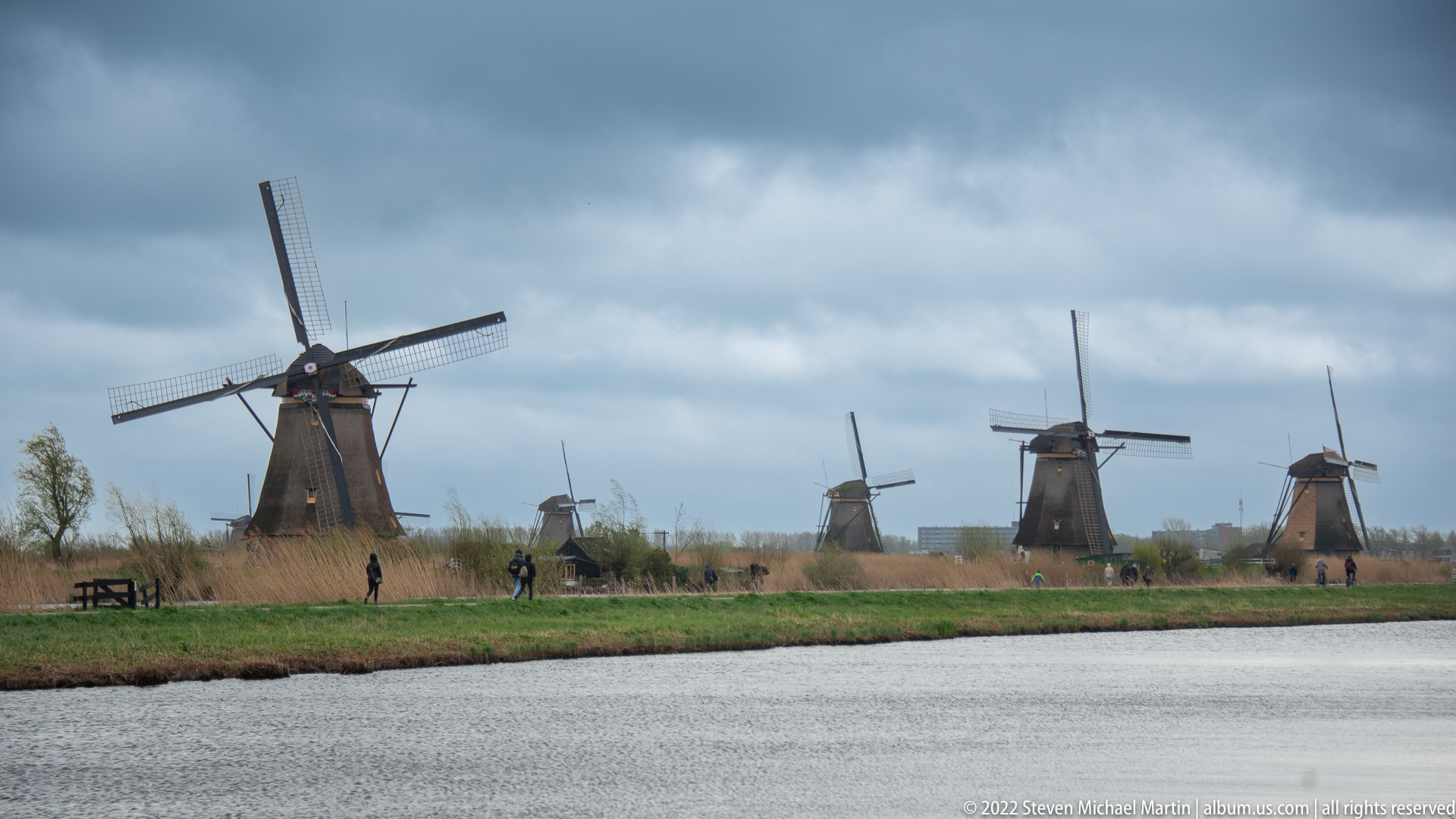
Several windmills punctuate the flat horizon beyond a broad canal, with one dark mill anchoring the left and additional mills receding across the landscape. Small figures on the path provide scale, while reeds and open water underscore the close relationship between pedestrian routes, drainage channels, and the historic mills.
Caption
Several windmills punctuate the flat horizon beyond a broad canal, with one dark mill anchoring the left and additional mills receding across the landscape. Small figures on the path provide scale, while reeds and open water underscore the close relationship between pedestrian routes, drainage channels, and the historic mills.
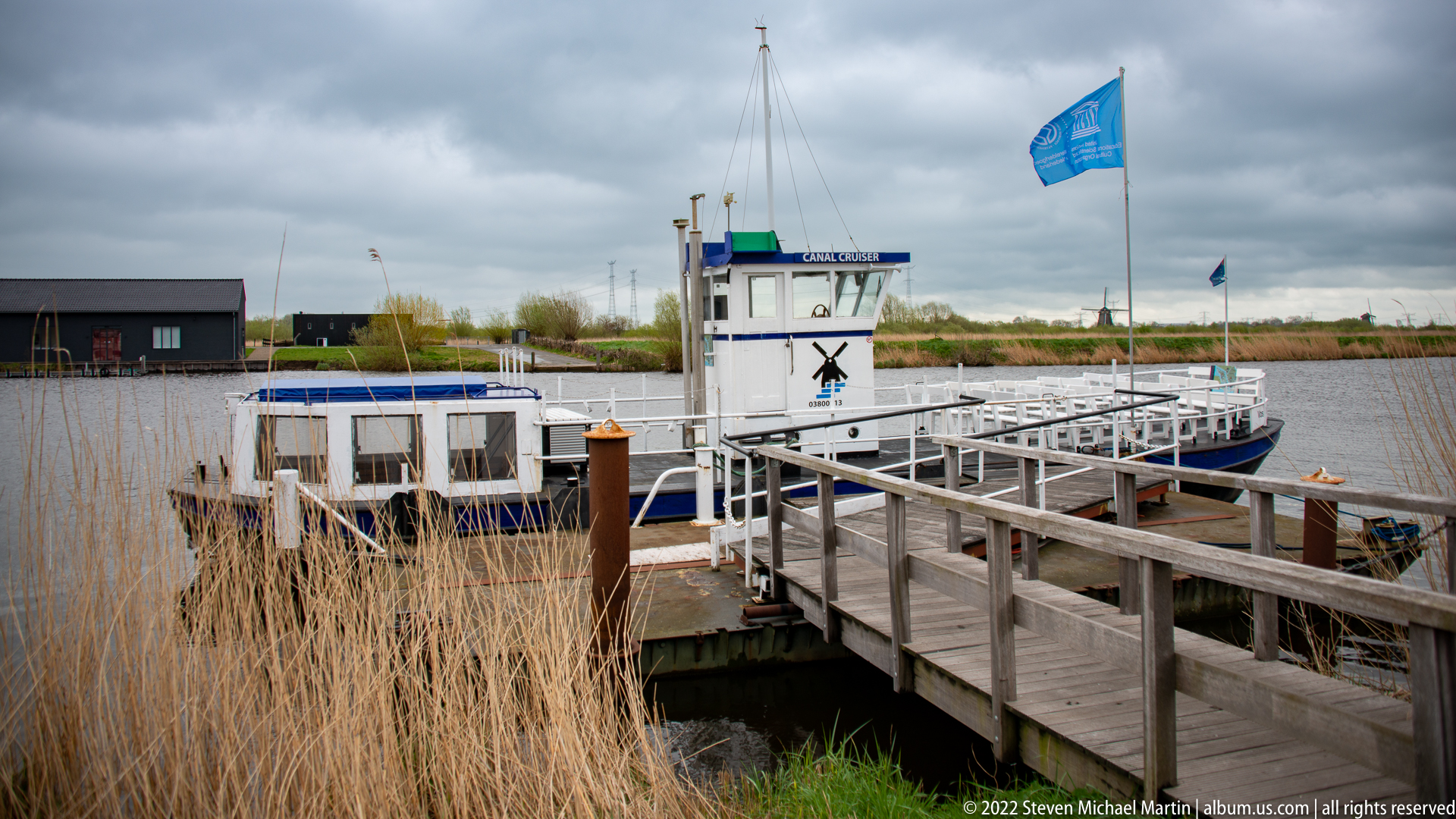
A low white passenger boat is moored beside a timber landing amid tall reeds, with a blue heritage flag flying above the vessel. The gangway and dock lead directly toward the boat, documenting waterborne visitor access within the Kinderdijk landscape.
Caption
A low white passenger boat is moored beside a timber landing amid tall reeds, with a blue heritage flag flying above the vessel. The gangway and dock lead directly toward the boat, documenting waterborne visitor access within the Kinderdijk landscape.
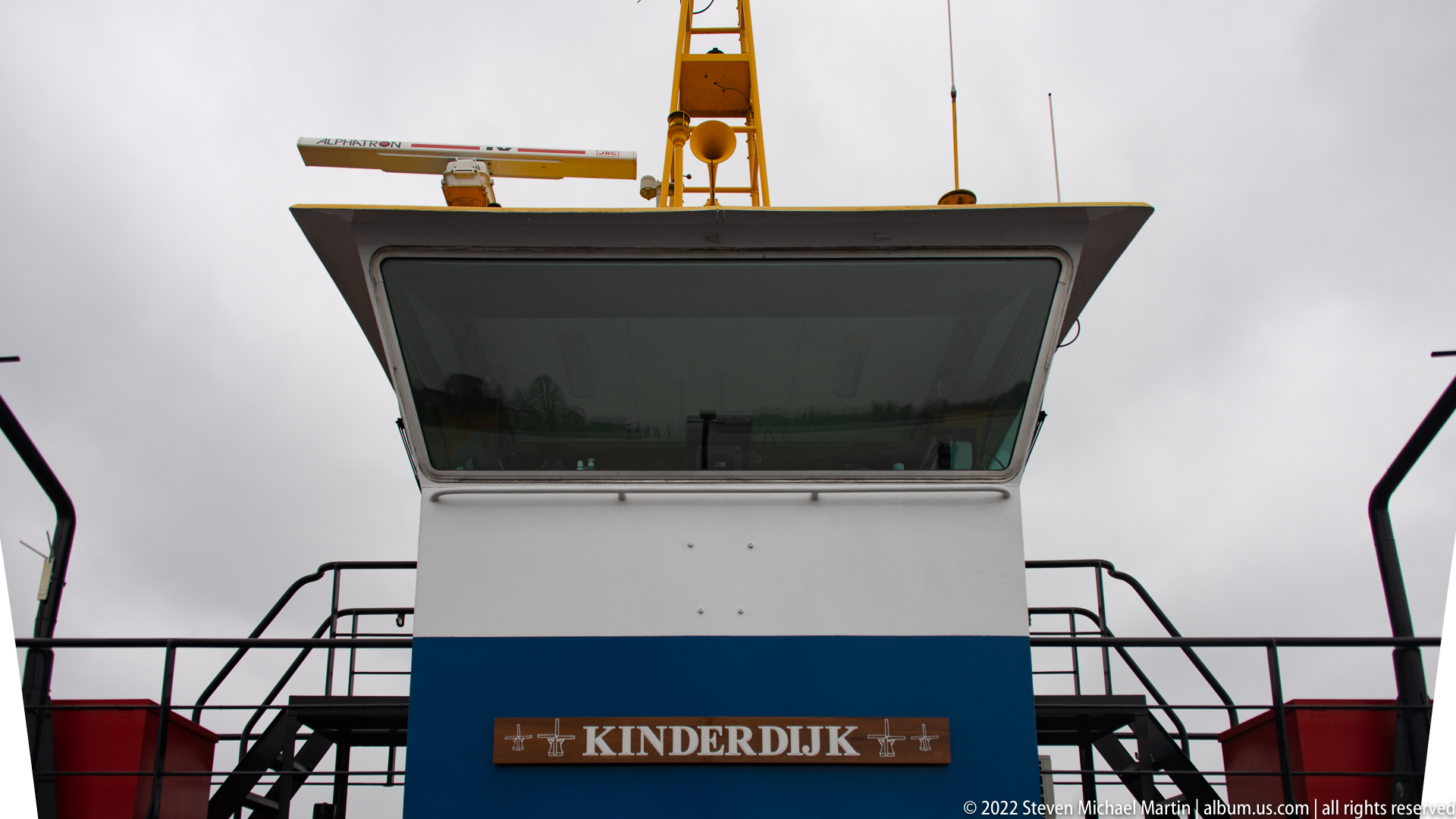
The wheelhouse of a white-and-blue passenger vessel fills the frame, with a wooden nameboard reading “KINDERDIJK” mounted below the front windows. Antennas, navigation lights, railings, and deck equipment identify the craft as active water transport associated with the heritage landscape.
Caption
The wheelhouse of a white-and-blue passenger vessel fills the frame, with a wooden nameboard reading “KINDERDIJK” mounted below the front windows. Antennas, navigation lights, railings, and deck equipment identify the craft as active water transport associated with the heritage landscape.
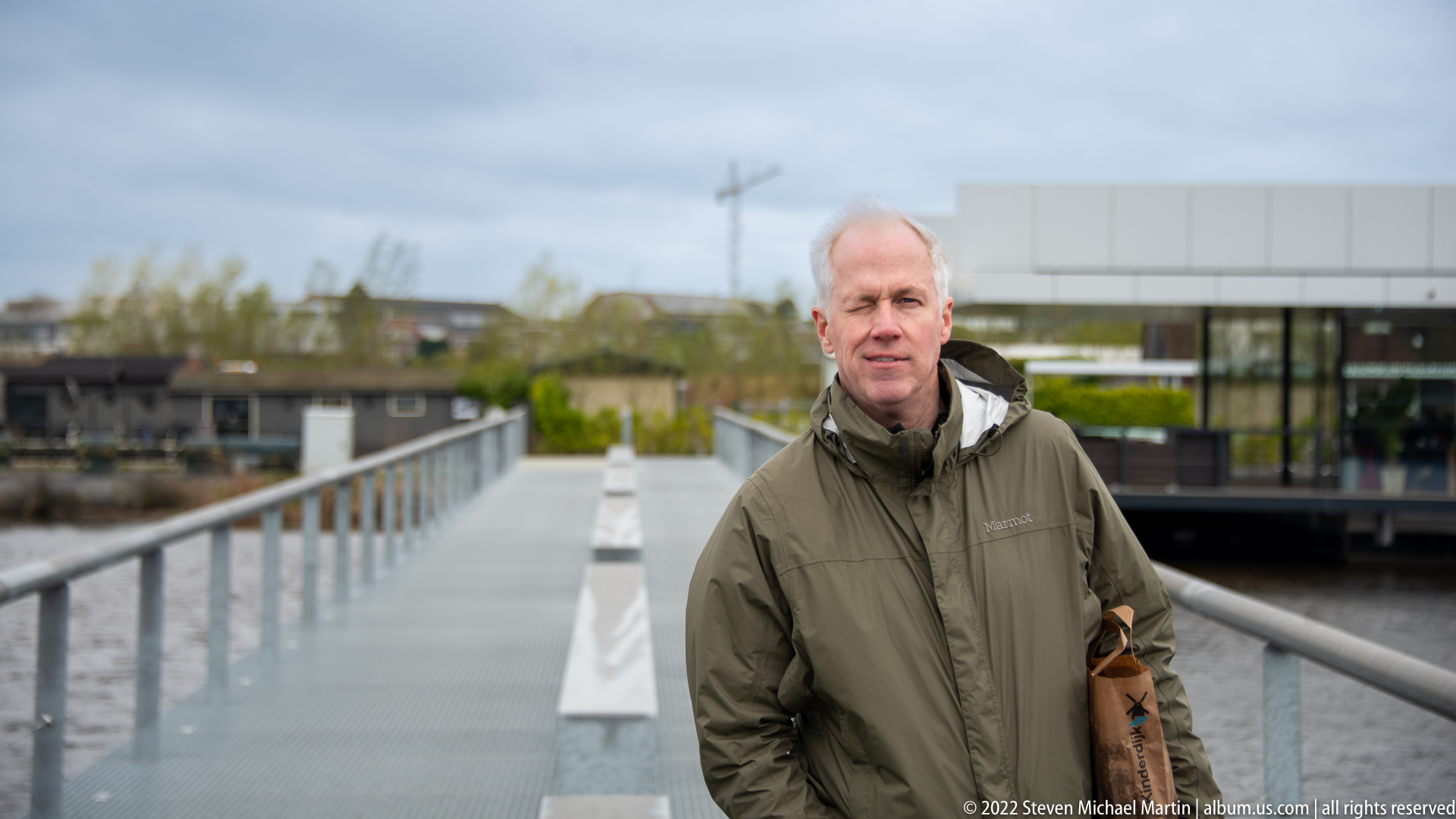
An adult man in a dark outdoor jacket stands near the end of a long pedestrian bridge over the water. The centered railing lines lead toward modern visitor facilities in the background, placing the portrait within the contemporary circulation infrastructure of the Kinderdijk heritage site.
Caption
An adult man in a dark outdoor jacket stands near the end of a long pedestrian bridge over the water. The centered railing lines lead toward modern visitor facilities in the background, placing the portrait within the contemporary circulation infrastructure of the Kinderdijk heritage site.
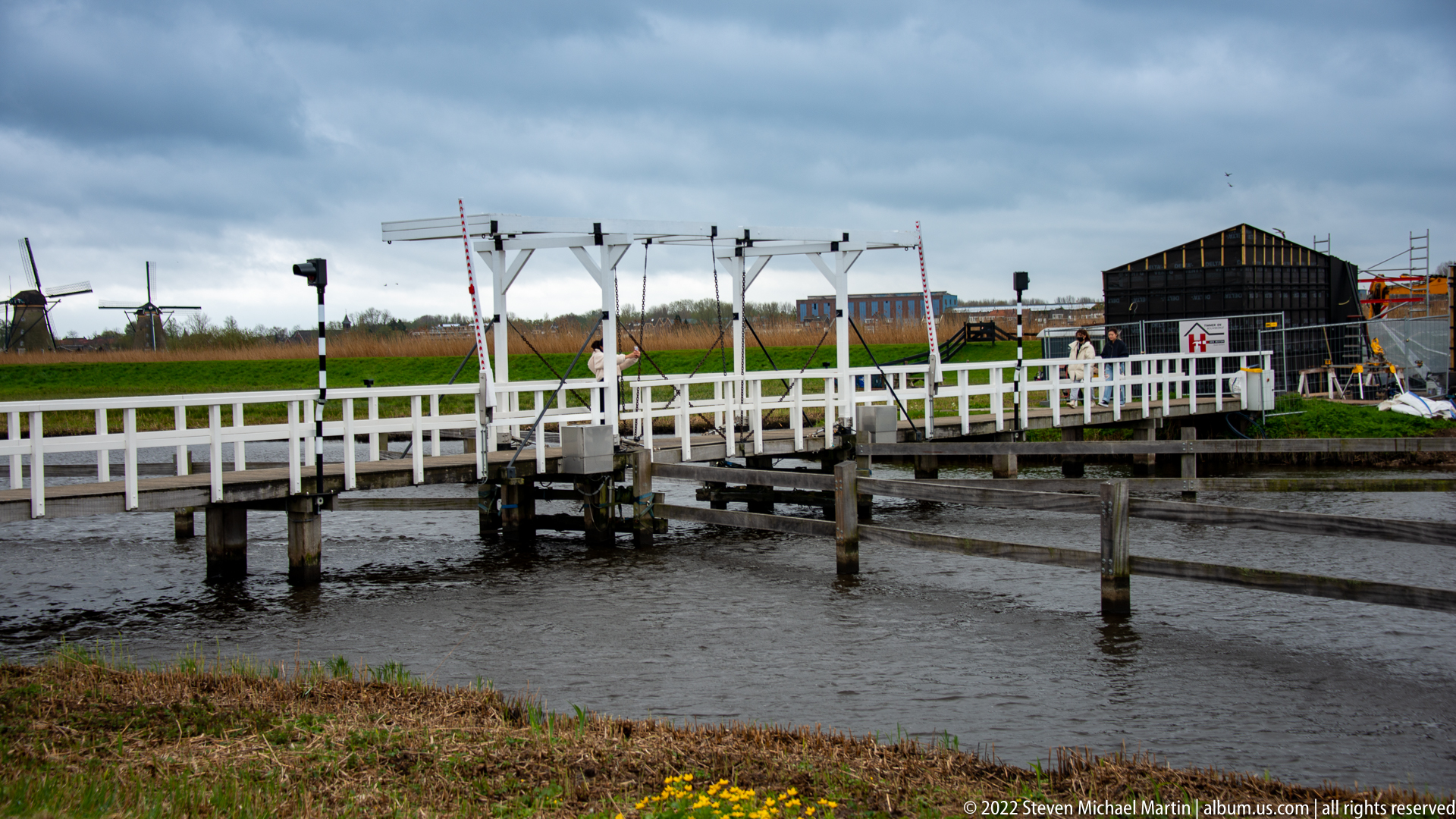
A white timber footbridge crosses a narrow water channel near visitor facilities at Kinderdijk. The bridge’s railings and lifting or gate-like structural elements form a strong horizontal pattern, while windmills remain visible across the flat polder beyond.
Caption
A white timber footbridge crosses a narrow water channel near visitor facilities at Kinderdijk. The bridge’s railings and lifting or gate-like structural elements form a strong horizontal pattern, while windmills remain visible across the flat polder beyond.

Three large screw pumps descend beneath a glazed industrial building under renovation at Kinderdijk. Scaffolding, exposed channels, railings, and construction sheeting frame the machinery, showing contemporary infrastructure used to manage water alongside the historic windmill landscape.
Caption
Three large screw pumps descend beneath a glazed industrial building under renovation at Kinderdijk. Scaffolding, exposed channels, railings, and construction sheeting frame the machinery, showing contemporary infrastructure used to manage water alongside the historic windmill landscape.
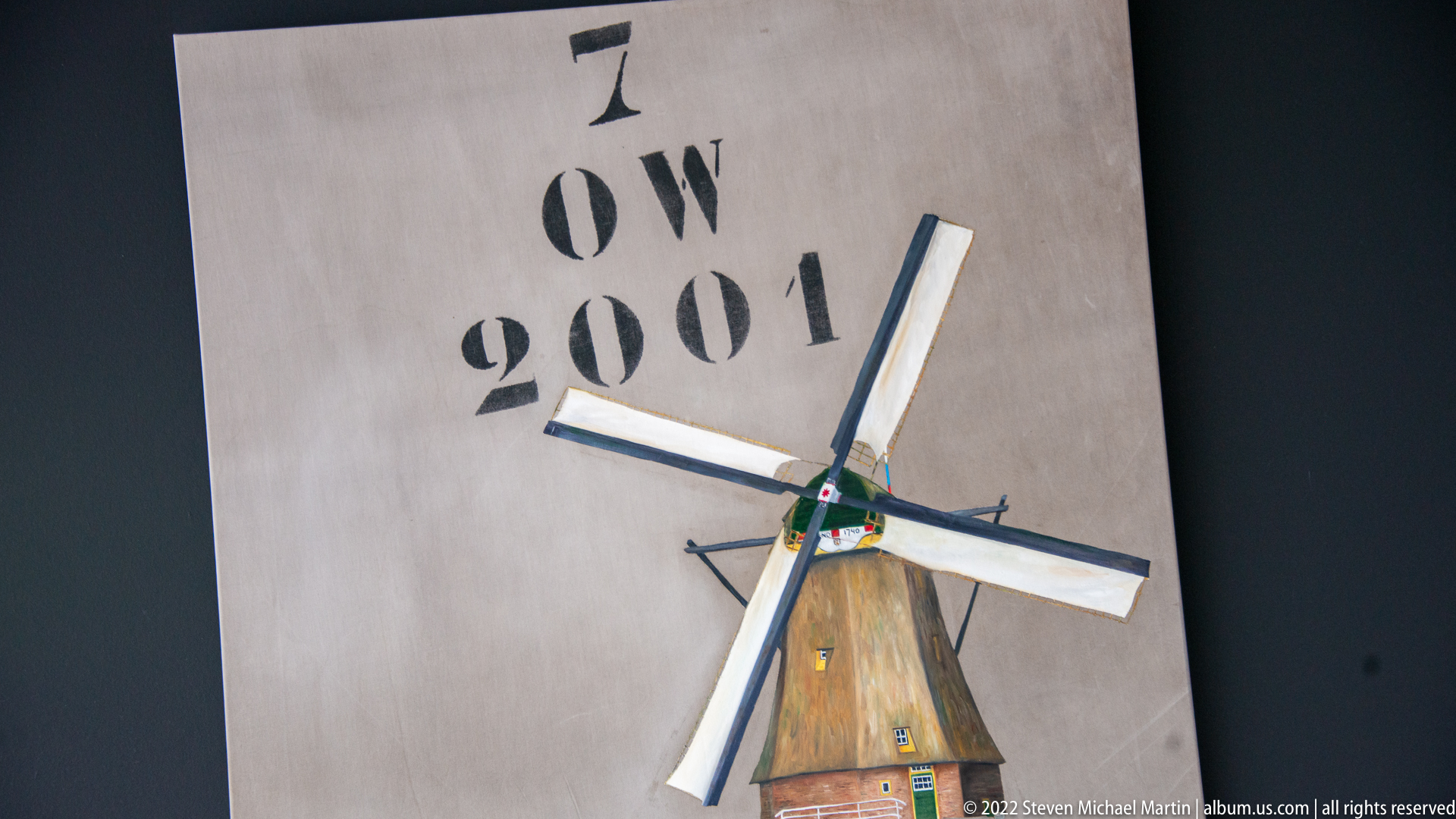
A small model of a traditional Dutch windmill is mounted against a pale interior wall beneath the stenciled text “OW 2001.” The tightly framed display isolates the mill’s wooden body and four sails, presenting an interpretive or decorative reference to the wind-powered drainage heritage of Kinderdijk.
Caption
A small model of a traditional Dutch windmill is mounted against a pale interior wall beneath the stenciled text “OW 2001.” The tightly framed display isolates the mill’s wooden body and four sails, presenting an interpretive or decorative reference to the wind-powered drainage heritage of Kinderdijk.

A detailed scale model reproduces the form of a Dutch drainage windmill, including its dark cap, latticed sails, timber body, and bracing. Set on a raised base beside the water, the model provides a compact study of windmill structure before the portfolio turns to the full-size mills across the Kinderdijk polder.
Caption
A detailed scale model reproduces the form of a Dutch drainage windmill, including its dark cap, latticed sails, timber body, and bracing. Set on a raised base beside the water, the model provides a compact study of windmill structure before the portfolio turns to the full-size mills across the Kinderdijk polder.

A solitary windmill stands on the far bank of a canal, its dark cap and four sails silhouetted against a layered gray sky. Tall dry reeds fill the foreground, creating a natural screen between the water and the mill and giving this view a quieter, more isolated character than the wider Kinderdijk panoramas.
Caption
A solitary windmill stands on the far bank of a canal, its dark cap and four sails silhouetted against a layered gray sky. Tall dry reeds fill the foreground, creating a natural screen between the water and the mill and giving this view a quieter, more isolated character than the wider Kinderdijk panoramas.
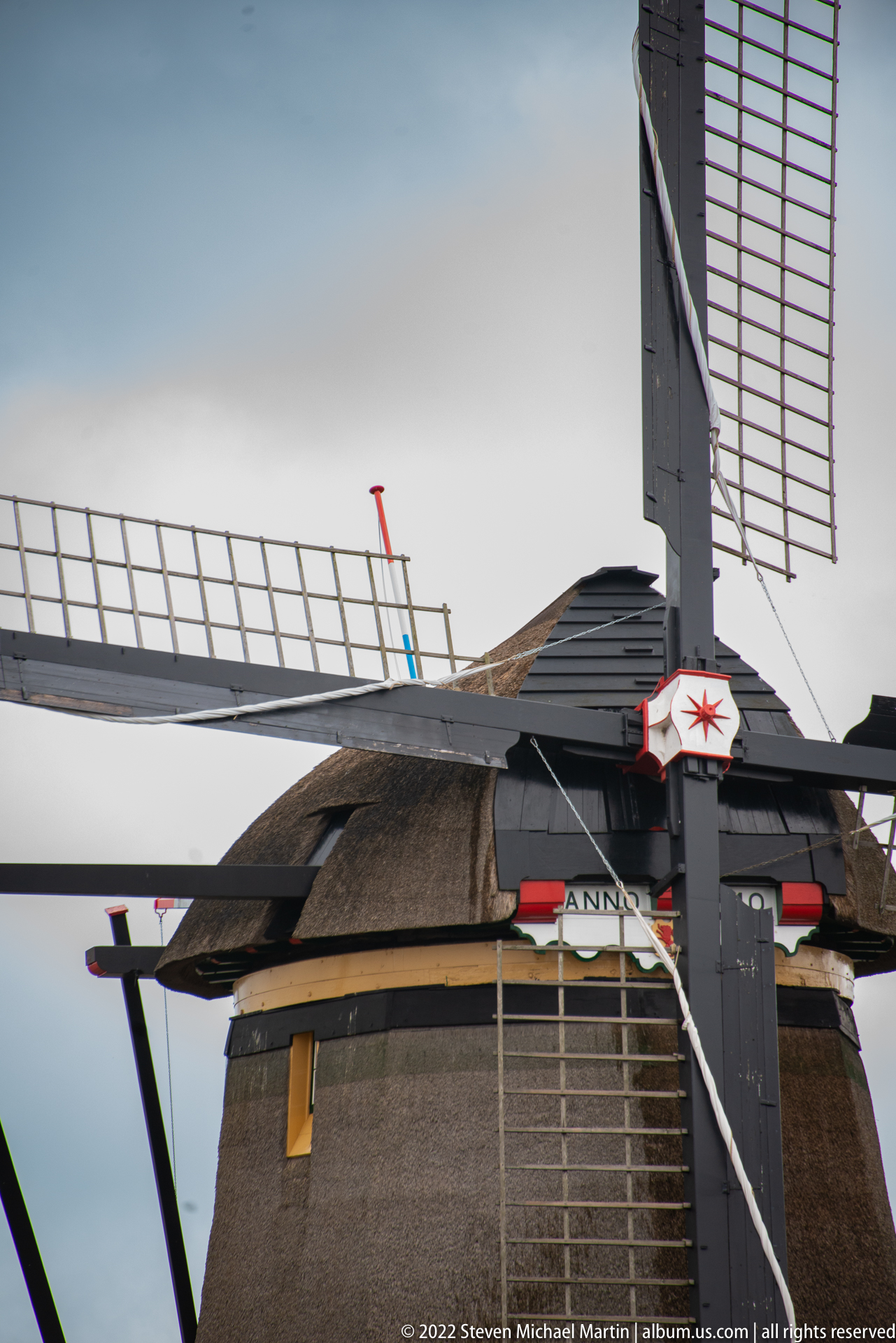
A close view concentrates on the working geometry of a Kinderdijk windmill: latticed sails cross the frame while the dark cap and upper brick tower fill the background. Red, white, and blue painted elements on the sail assembly introduce small bursts of color against the muted masonry and sky.
Caption
A close view concentrates on the working geometry of a Kinderdijk windmill: latticed sails cross the frame while the dark cap and upper brick tower fill the background. Red, white, and blue painted elements on the sail assembly introduce small bursts of color against the muted masonry and sky.
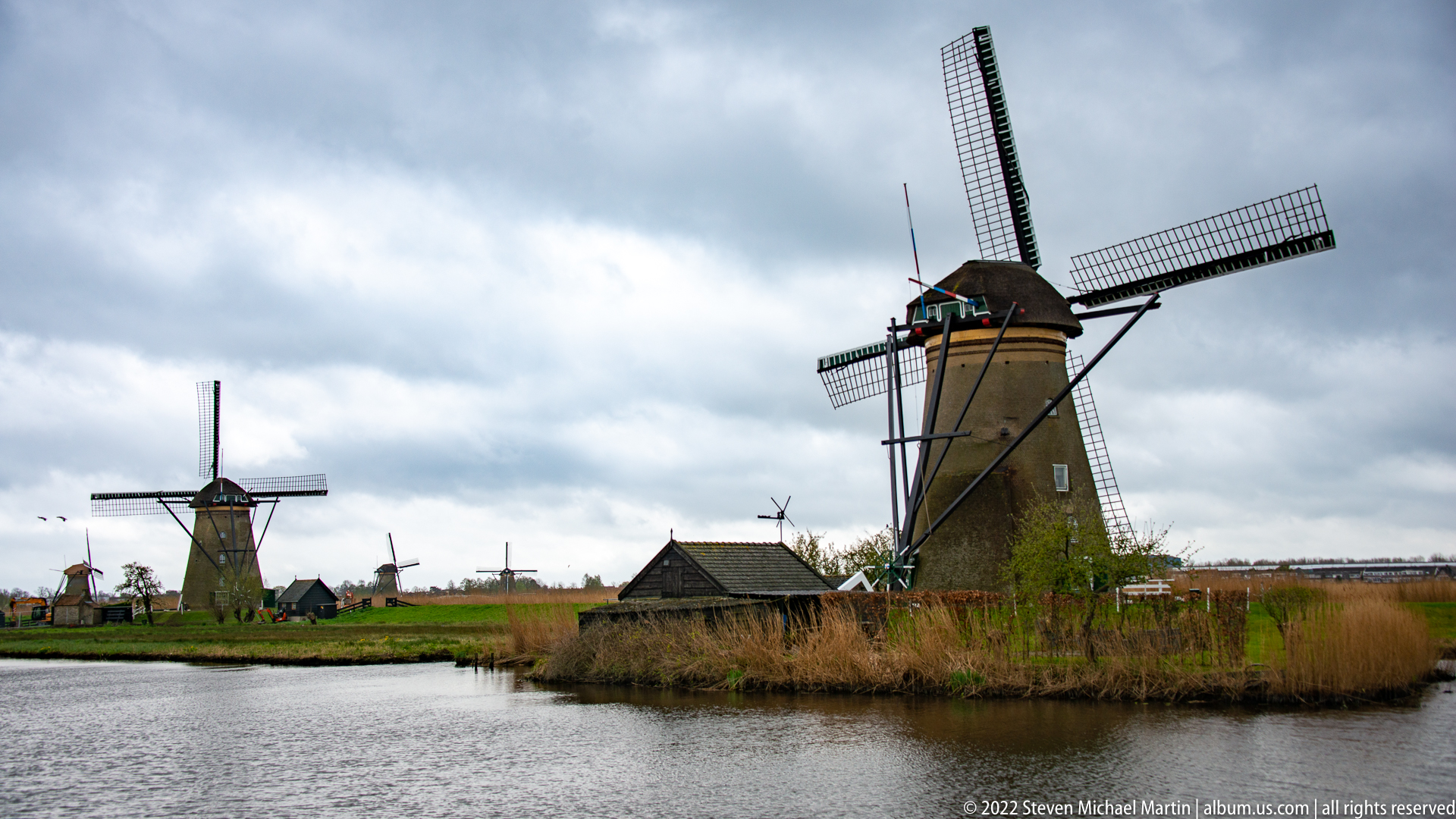
A large drainage windmill rises from a narrow strip of land at the water’s edge, with another mill and several smaller structures receding behind it. The low viewpoint emphasizes the canal, reed-fringed banks, and broad overcast sky, placing the mill within the working water landscape it was designed to serve.
Caption
A large drainage windmill rises from a narrow strip of land at the water’s edge, with another mill and several smaller structures receding behind it. The low viewpoint emphasizes the canal, reed-fringed banks, and broad overcast sky, placing the mill within the working water landscape it was designed to serve.
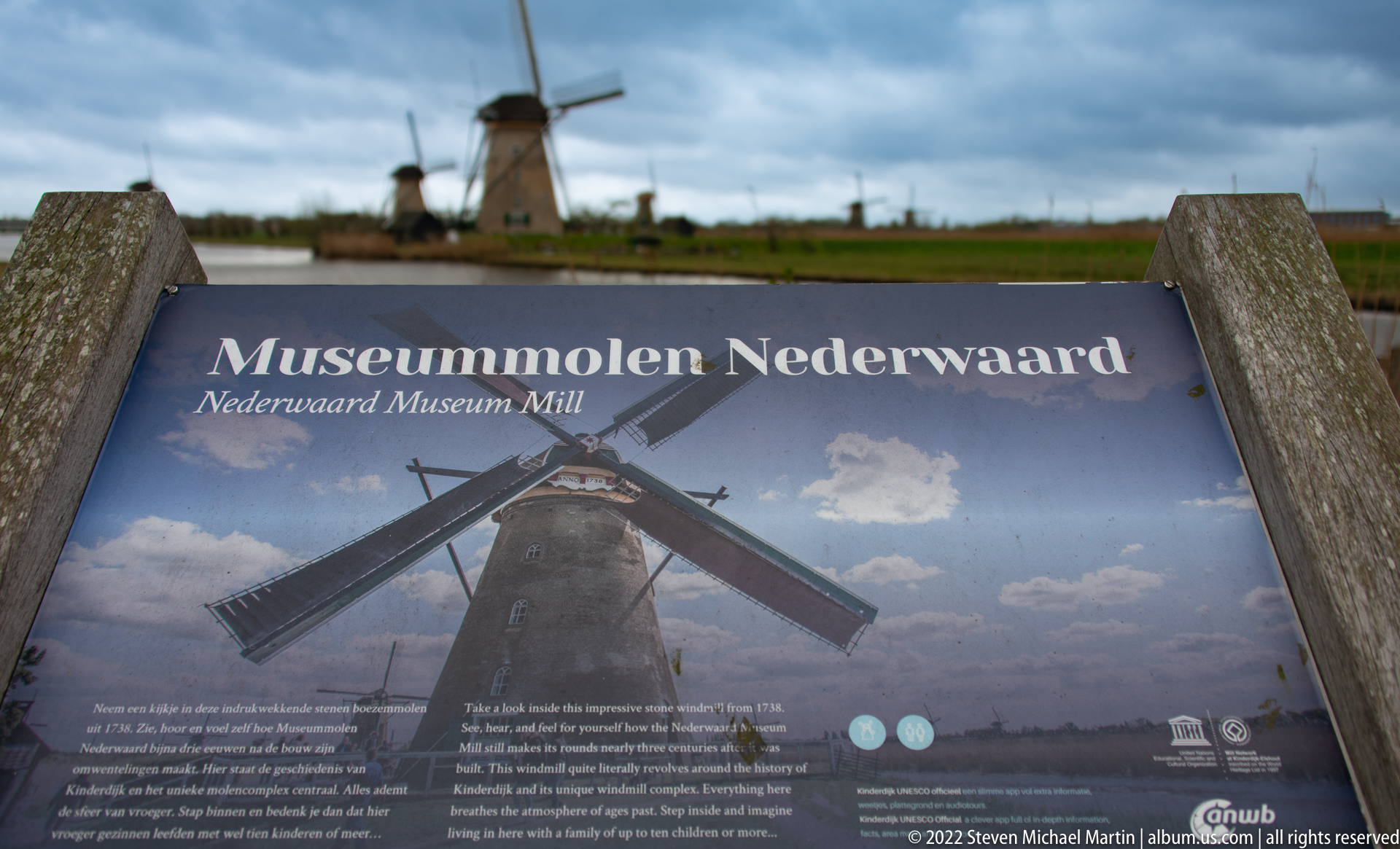
An outdoor panel identifies the “Museummolen Nederwaard” and uses a historic windmill photograph, explanatory text, and logos to interpret the site. A full-size windmill appears beyond the sign across the water, linking the visitor information directly to the surviving drainage landscape at Kinderdijk.
Caption
An outdoor panel identifies the “Museummolen Nederwaard” and uses a historic windmill photograph, explanatory text, and logos to interpret the site. A full-size windmill appears beyond the sign across the water, linking the visitor information directly to the surviving drainage landscape at Kinderdijk.

Three windmills cluster along the Kinderdijk polder, their sails overlapping from this compressed viewpoint. The nearest brick mill fills most of the frame, while two smaller mills recede behind it, illustrating how closely the historic drainage structures are woven into the narrow strips of land and water.
Caption
Three windmills cluster along the Kinderdijk polder, their sails overlapping from this compressed viewpoint. The nearest brick mill fills most of the frame, while two smaller mills recede behind it, illustrating how closely the historic drainage structures are woven into the narrow strips of land and water.

The cylindrical brick tower of a windmill fills the frame from a low angle, rising to a thick thatched cap and intersecting sail framework. Painted red, white, and blue poles and structural braces accent the otherwise earth-toned masonry, emphasizing the mill’s construction rather than the surrounding landscape.
Caption
The cylindrical brick tower of a windmill fills the frame from a low angle, rising to a thick thatched cap and intersecting sail framework. Painted red, white, and blue poles and structural braces accent the otherwise earth-toned masonry, emphasizing the mill’s construction rather than the surrounding landscape.

A sharply angled close-up isolates the sail stock and latticed blades where they pass the thatched cap of a brick windmill. Timber, painted metal, and rope or chain fittings converge around the hub area, revealing the complex structural connections that translate wind into mechanical motion.
Caption
A sharply angled close-up isolates the sail stock and latticed blades where they pass the thatched cap of a brick windmill. Timber, painted metal, and rope or chain fittings converge around the hub area, revealing the complex structural connections that translate wind into mechanical motion.

A large brick windmill is shown broadside across a narrow green verge, allowing its tapering tower, thatched cap, windows, and long support braces to be read as a single architectural form. The low, open setting and subdued sky keep attention on the mill’s proportions and working structure.
Caption
A large brick windmill is shown broadside across a narrow green verge, allowing its tapering tower, thatched cap, windows, and long support braces to be read as a single architectural form. The low, open setting and subdued sky keep attention on the mill’s proportions and working structure.

A broad brick windmill dominates the center of the frame while neighboring mills rise on either side across the polder. A narrow drainage ditch cuts through the grassy foreground, connecting the mills visually to the network of waterways that shaped this engineered landscape.
Caption
A broad brick windmill dominates the center of the frame while neighboring mills rise on either side across the polder. A narrow drainage ditch cuts through the grassy foreground, connecting the mills visually to the network of waterways that shaped this engineered landscape.
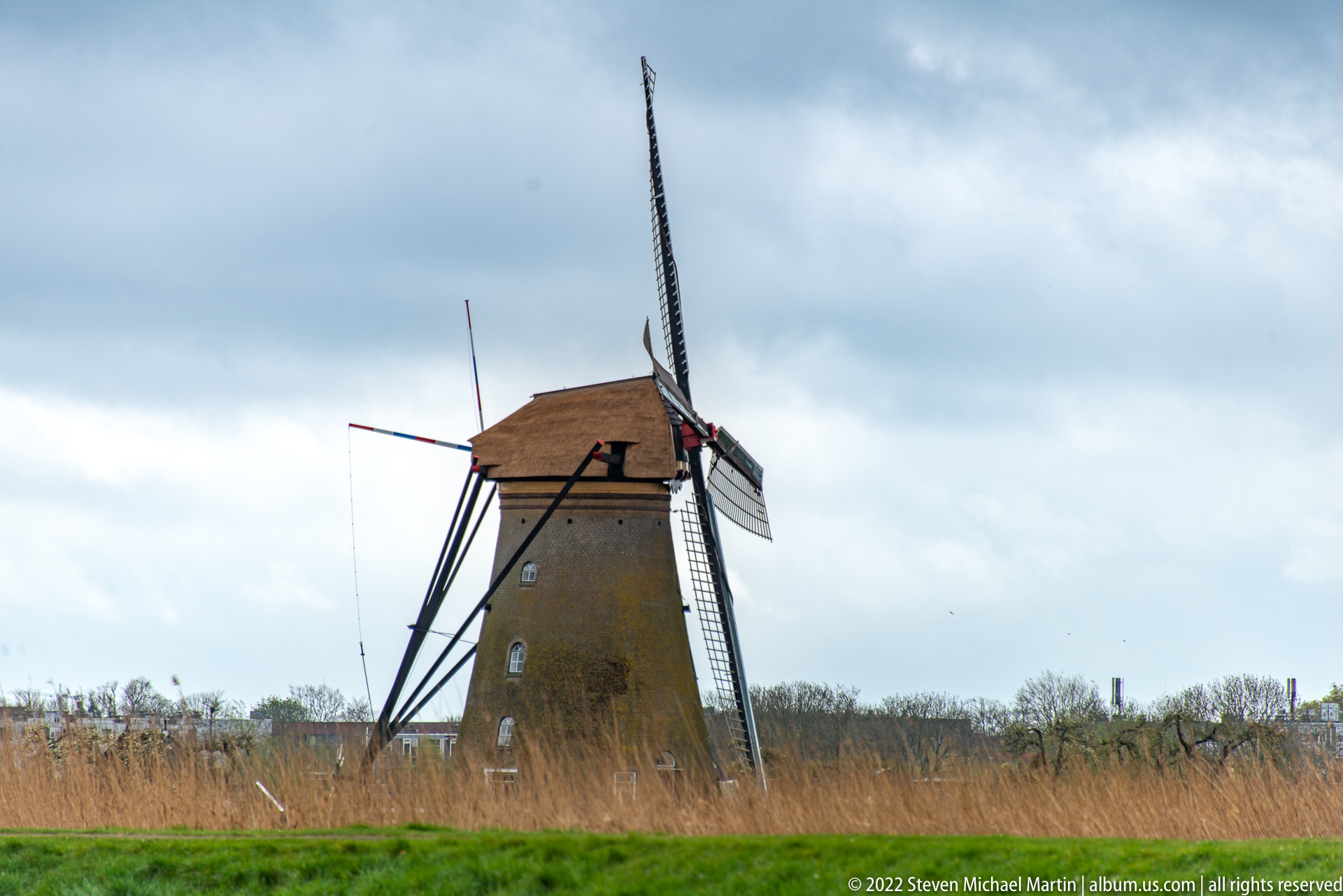
A single brick windmill rises beyond a belt of tall brown reeds, its sails set unevenly against a dramatic gray-blue sky. The green verge at the bottom of the frame and the reedbed across the middle create horizontal layers that emphasize the mill’s vertical form and isolated position.
Caption
A single brick windmill rises beyond a belt of tall brown reeds, its sails set unevenly against a dramatic gray-blue sky. The green verge at the bottom of the frame and the reedbed across the middle create horizontal layers that emphasize the mill’s vertical form and isolated position.

A dark timber-clad windmill stands at the edge of a water channel, its sails spread against a pale gray sky. A small arched footbridge or culvert structure crosses the water near the mill, adding a human-scale element to the otherwise spare composition of mill, reeds, and open polder.
Caption
A dark timber-clad windmill stands at the edge of a water channel, its sails spread against a pale gray sky. A small arched footbridge or culvert structure crosses the water near the mill, adding a human-scale element to the otherwise spare composition of mill, reeds, and open polder.
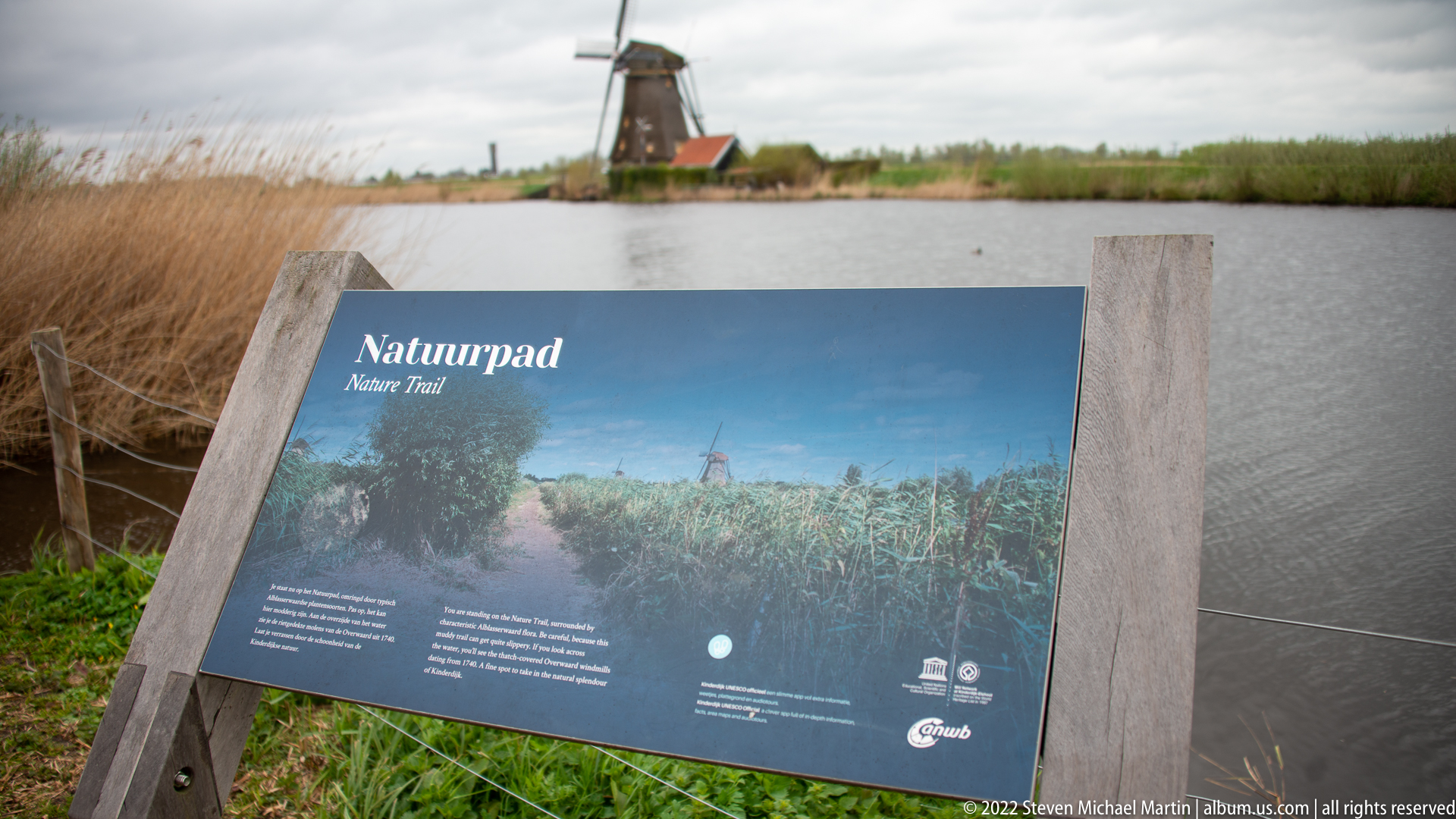
An outdoor interpretive panel titled “Natuurpad” and “Nature Trail” introduces a path through the wetland vegetation at Kinderdijk. The sign stands beside a broad water channel, with a traditional windmill beyond it, linking the natural landscape to the historic water-management setting.
Caption
An outdoor interpretive panel titled “Natuurpad” and “Nature Trail” introduces a path through the wetland vegetation at Kinderdijk. The sign stands beside a broad water channel, with a traditional windmill beyond it, linking the natural landscape to the historic water-management setting.
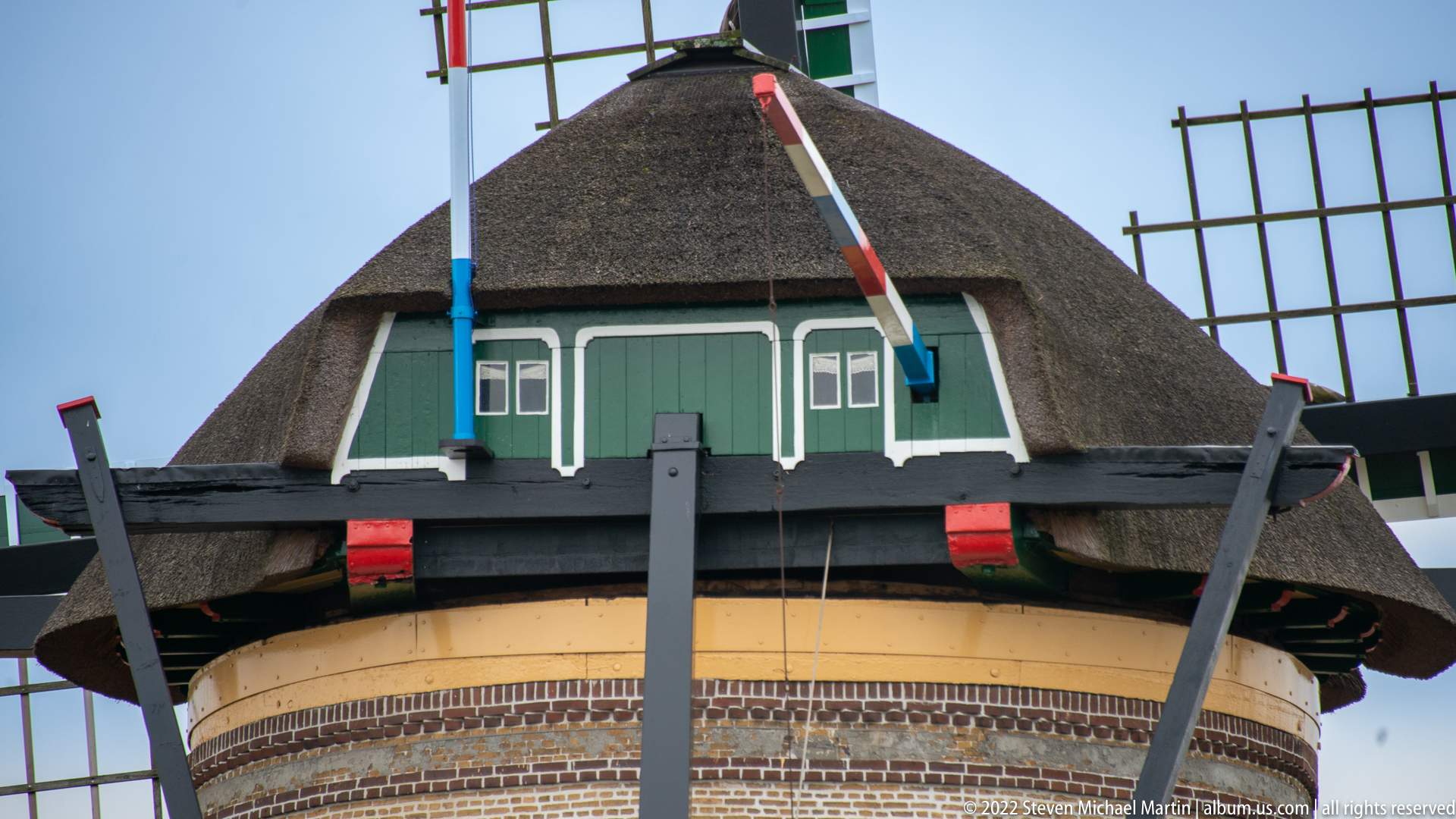
A close architectural detail focuses on the upper portion of a brick windmill, where a green-painted timber section rises beneath the thatched cap. Sail stocks and painted poles cut diagonally across the frame, highlighting the junction between masonry tower, rotating cap, and working sail structure.
Caption
A close architectural detail focuses on the upper portion of a brick windmill, where a green-painted timber section rises beneath the thatched cap. Sail stocks and painted poles cut diagonally across the frame, highlighting the junction between masonry tower, rotating cap, and working sail structure.

A white footbridge extends across the water toward a cluster of visitor structures, while a windmill stands beyond on the opposite bank. The view places modern access infrastructure and the historic mill in one frame, showing how visitors move through the still-active water landscape.
Caption
A white footbridge extends across the water toward a cluster of visitor structures, while a windmill stands beyond on the opposite bank. The view places modern access infrastructure and the historic mill in one frame, showing how visitors move through the still-active water landscape.

A blue flag bearing the UNESCO emblem and World Heritage symbol flies against a gray sky. The visible lettering for the United Nations Educational, Scientific and Cultural Organization and the Dutch World Heritage wording directly mark Kinderdijk’s international heritage status.
Caption
A blue flag bearing the UNESCO emblem and World Heritage symbol flies against a gray sky. The visible lettering for the United Nations Educational, Scientific and Cultural Organization and the Dutch World Heritage wording directly mark Kinderdijk’s international heritage status.

A broad waterway opens toward the horizon between rows of Kinderdijk windmills under a dense stormy sky. Mills on both banks create a measured rhythm across the flat polder, while the uninterrupted water in the foreground gives the composition its strong sense of depth.
Caption
A broad waterway opens toward the horizon between rows of Kinderdijk windmills under a dense stormy sky. Mills on both banks create a measured rhythm across the flat polder, while the uninterrupted water in the foreground gives the composition its strong sense of depth.

A weathered bronze sculpture rises from the water in a form resembling an open cradle or basket, with a small bird-like figure perched on one edge. Its irregular surface and green-brown patina contrast with the rippled water, making the object read as a symbolic installation rather than functional equipment.
Caption
A weathered bronze sculpture rises from the water in a form resembling an open cradle or basket, with a small bird-like figure perched on one edge. Its irregular surface and green-brown patina contrast with the rippled water, making the object read as a symbolic installation rather than functional equipment.
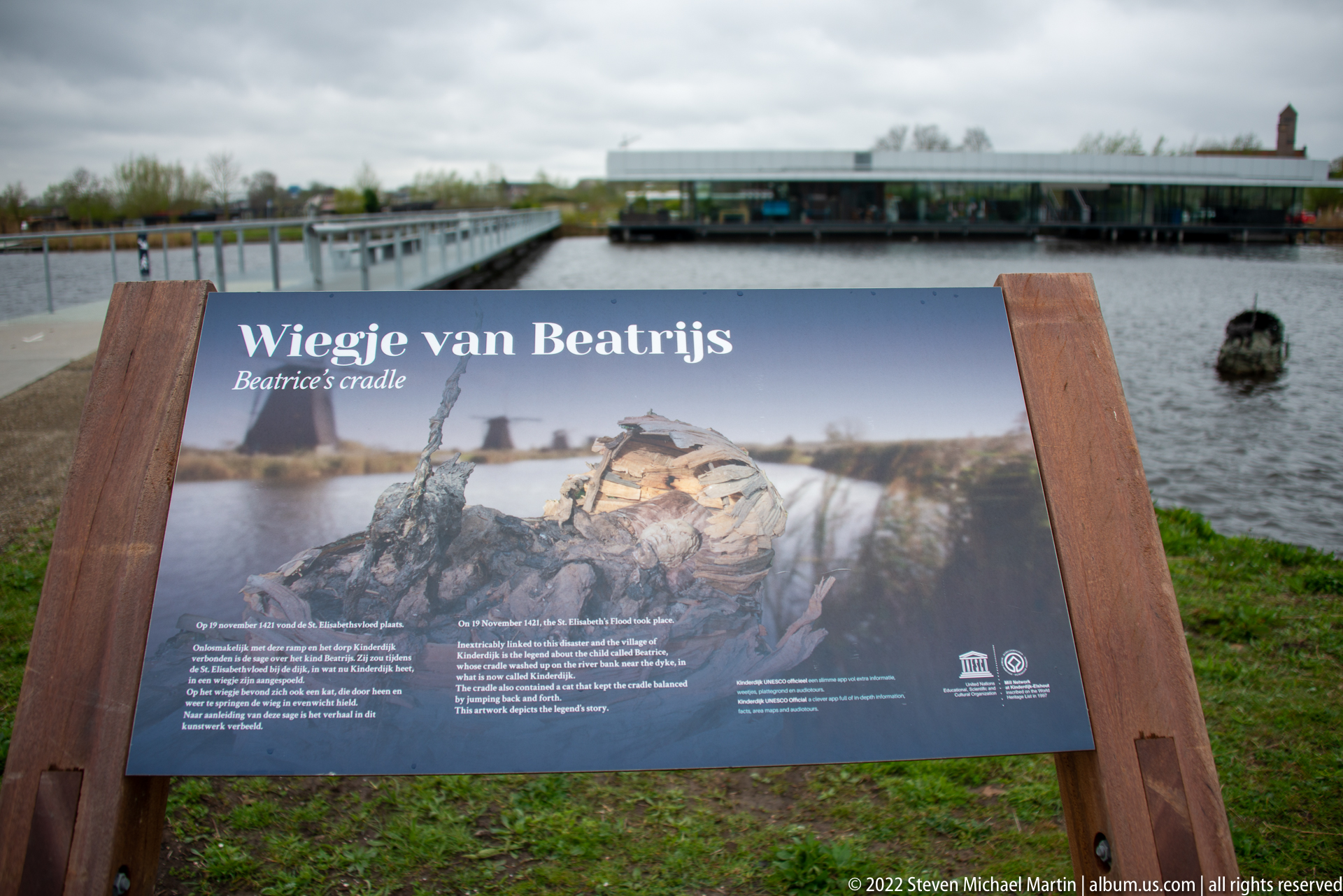
An interpretive panel titled “Wiege van Beatrix” with the English subtitle “Beatrice’s cradle” explains the nearby sculptural installation. The sign reproduces an image of the object and stands beside the water, with modern visitor facilities across the channel.
Caption
An interpretive panel titled “Wiege van Beatrix” with the English subtitle “Beatrice’s cradle” explains the nearby sculptural installation. The sign reproduces an image of the object and stands beside the water, with modern visitor facilities across the channel.

A visitor panel titled “Wisboomgemaal” and “Wisboom pumping station” introduces one of Kinderdijk’s pumping facilities. Historic imagery and explanatory text connect the industrial building to the site’s long history of mechanical water control, while a dark timber structure rises immediately behind the sign.
Caption
A visitor panel titled “Wisboomgemaal” and “Wisboom pumping station” introduces one of Kinderdijk’s pumping facilities. Historic imagery and explanatory text connect the industrial building to the site’s long history of mechanical water control, while a dark timber structure rises immediately behind the sign.

A visitor walks along a narrow metal footbridge toward a long red-brick industrial building set directly over the water. Repeated arched windows and the utilitarian masonry façade give the structure a clear pumping-station character, linking human-scale access with the engineered waterworks of Kinderdijk.
Caption
A visitor walks along a narrow metal footbridge toward a long red-brick industrial building set directly over the water. Repeated arched windows and the utilitarian masonry façade give the structure a clear pumping-station character, linking human-scale access with the engineered waterworks of Kinderdijk.
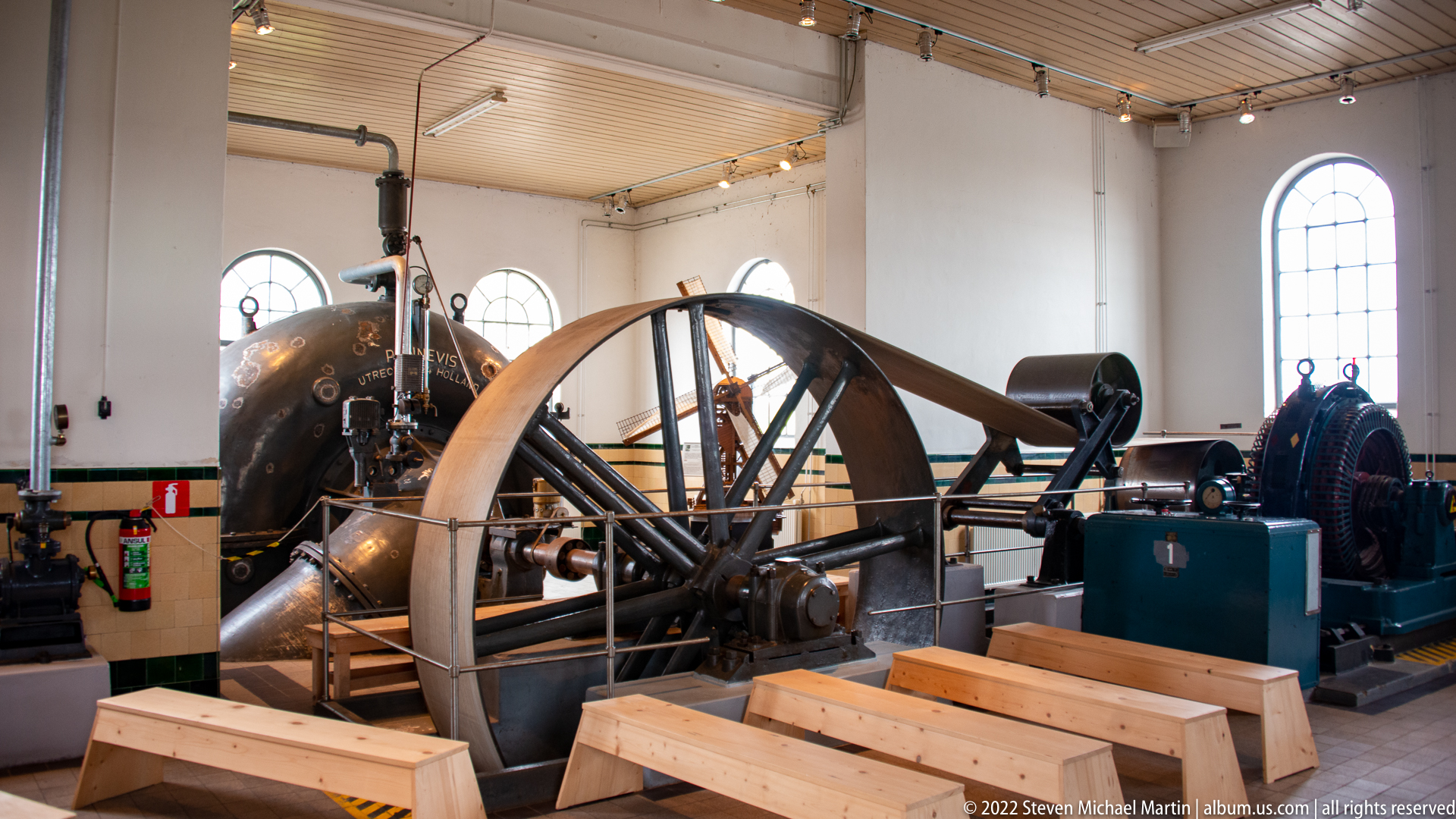
A large spoked flywheel dominates the preserved machinery room, surrounded by shafts, belts, pipework, and heavy cast-metal equipment. Pale walls and tall arched windows illuminate the industrial interior, while timber benches in the foreground indicate its present interpretive use within the Kinderdijk water-management landscape.
Caption
A large spoked flywheel dominates the preserved machinery room, surrounded by shafts, belts, pipework, and heavy cast-metal equipment. Pale walls and tall arched windows illuminate the industrial interior, while timber benches in the foreground indicate its present interpretive use within the Kinderdijk water-management landscape.
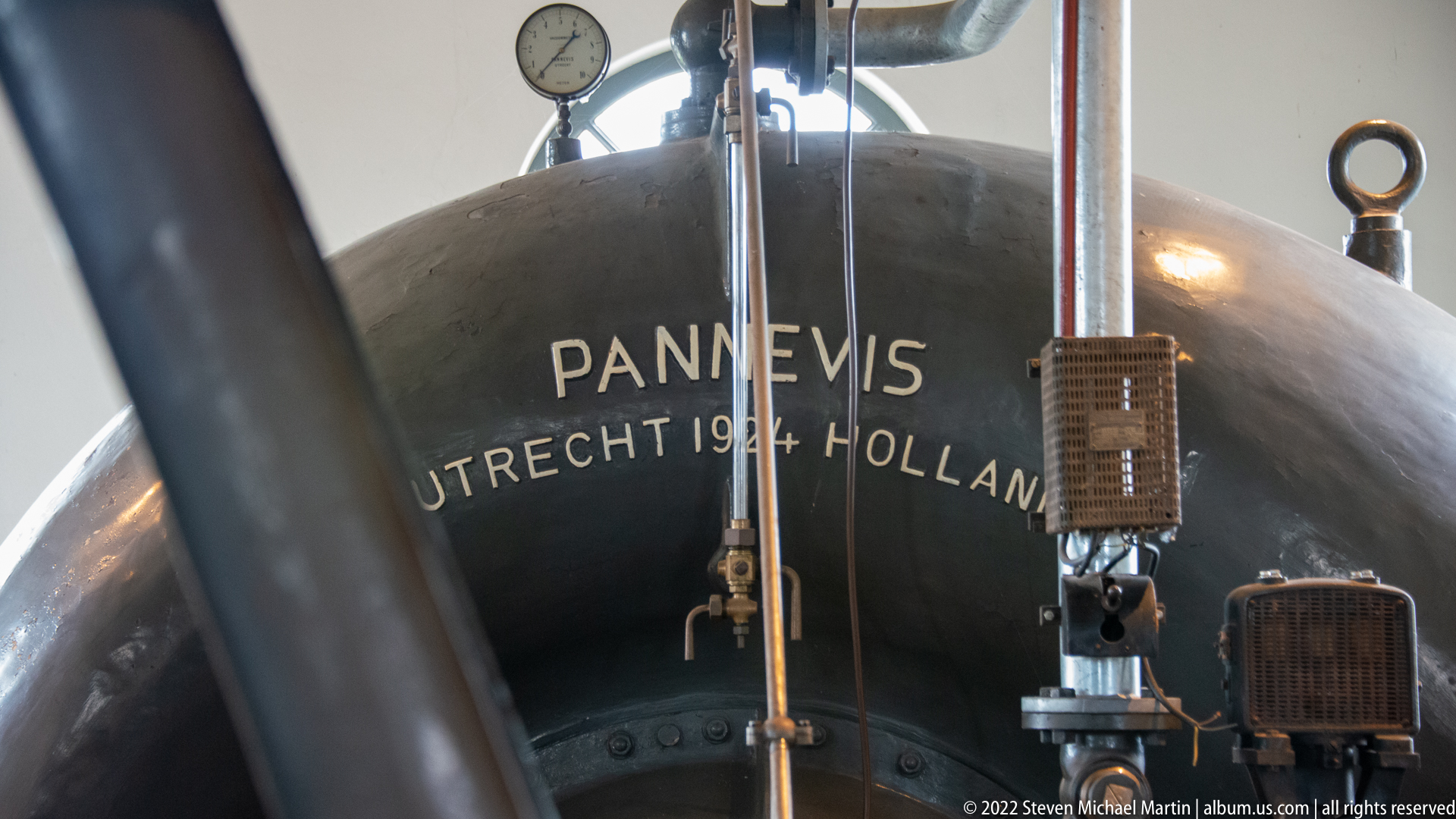
A riveted metal vessel within the pumping machinery bears the painted inscription “PANNEVIS / UTRECHT 1944 HOLLAND.” Pipes, gauges, valves, and protective fittings surround the curved shell, providing a close industrial detail that anchors the equipment to a named Dutch manufacturer and wartime date.
Caption
A riveted metal vessel within the pumping machinery bears the painted inscription “PANNEVIS / UTRECHT 1944 HOLLAND.” Pipes, gauges, valves, and protective fittings surround the curved shell, providing a close industrial detail that anchors the equipment to a named Dutch manufacturer and wartime date.

A black-and-white map divides the surrounding lowland into numerous named districts, waterways, and administrative areas. Dense labeling and boundary lines emphasize the organized territorial framework behind Dutch water management, while the map's placement in the pumping-station exhibit connects those districts to the Kinderdijk drainage system.
Caption
A black-and-white map divides the surrounding lowland into numerous named districts, waterways, and administrative areas. Dense labeling and boundary lines emphasize the organized territorial framework behind Dutch water management, while the map's placement in the pumping-station exhibit connects those districts to the Kinderdijk drainage system.
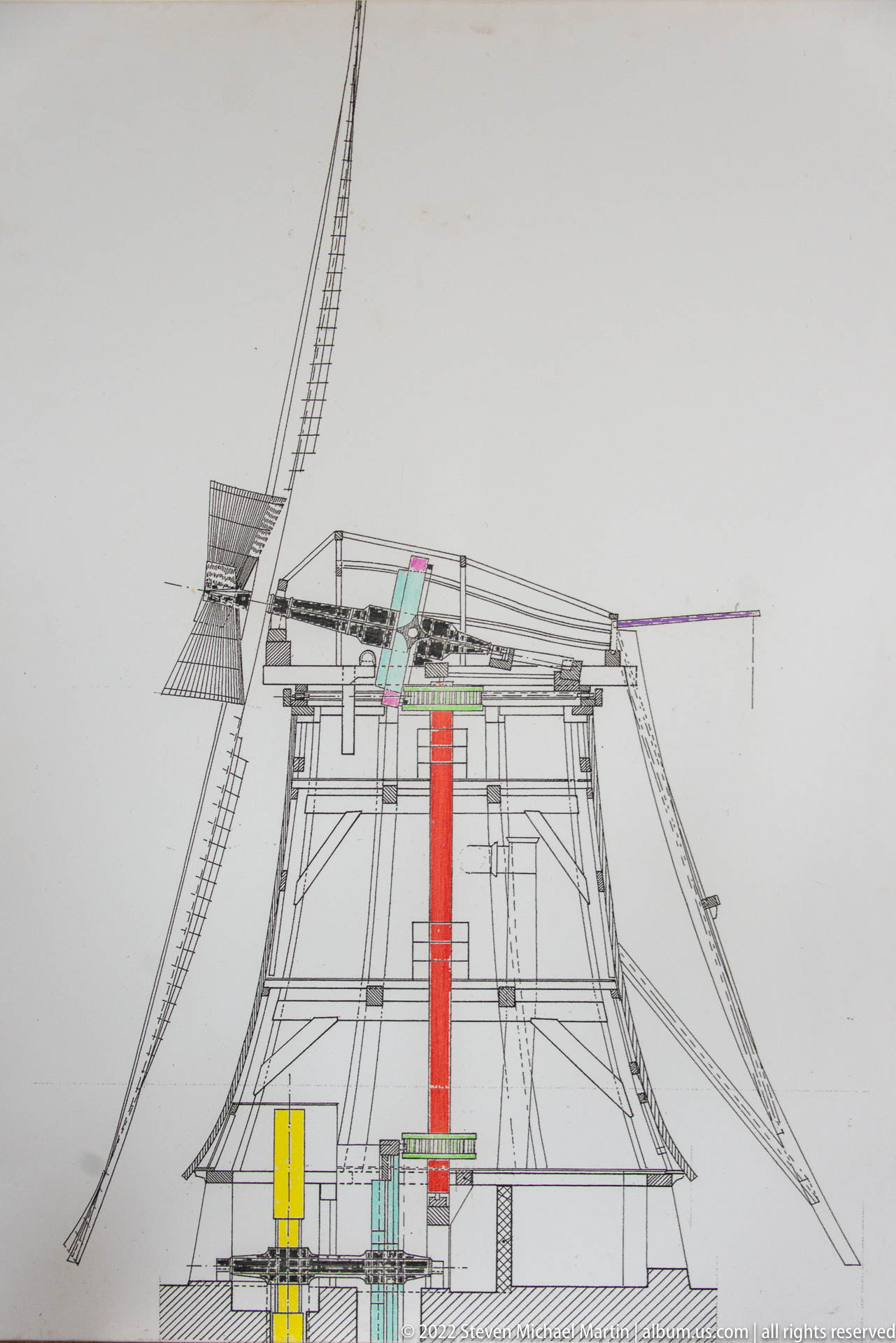
A technical elevation and section drawing maps the structure of a Dutch windmill from sail assembly to internal working levels. Fine black linework outlines the mill body, floors, supports, and gearing, while selected components are highlighted in color to distinguish parts of the mechanical system.
Caption
A technical elevation and section drawing maps the structure of a Dutch windmill from sail assembly to internal working levels. Fine black linework outlines the mill body, floors, supports, and gearing, while selected components are highlighted in color to distinguish parts of the mechanical system.
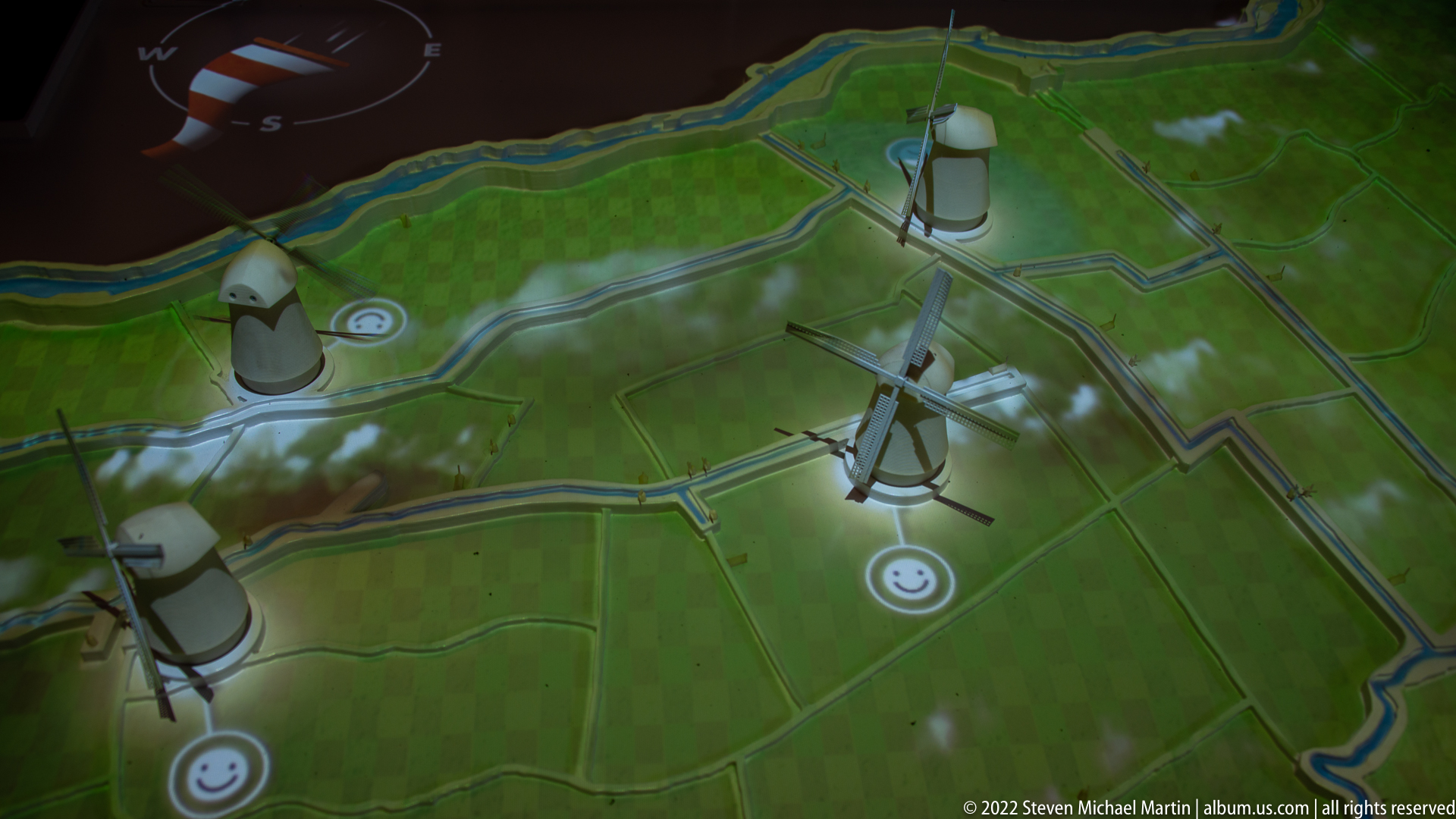
An illuminated interactive map presents the Kinderdijk polder as a network of waterways and paths punctuated by miniature windmill icons. Circular interface markers appear beside several mills, turning the landscape into an accessible overview of how the historic structures are distributed across the drainage system.
Caption
An illuminated interactive map presents the Kinderdijk polder as a network of waterways and paths punctuated by miniature windmill icons. Circular interface markers appear beside several mills, turning the landscape into an accessible overview of how the historic structures are distributed across the drainage system.

A warm-toned historic-image display shows scores of people skating on a frozen waterway while several windmills rise along the bank. Low winter light silhouettes the mills and figures, evoking the seasonal use of Dutch waterways when ice transformed working canals into public gathering spaces.
Caption
A warm-toned historic-image display shows scores of people skating on a frozen waterway while several windmills rise along the bank. Low winter light silhouettes the mills and figures, evoking the seasonal use of Dutch waterways when ice transformed working canals into public gathering spaces.
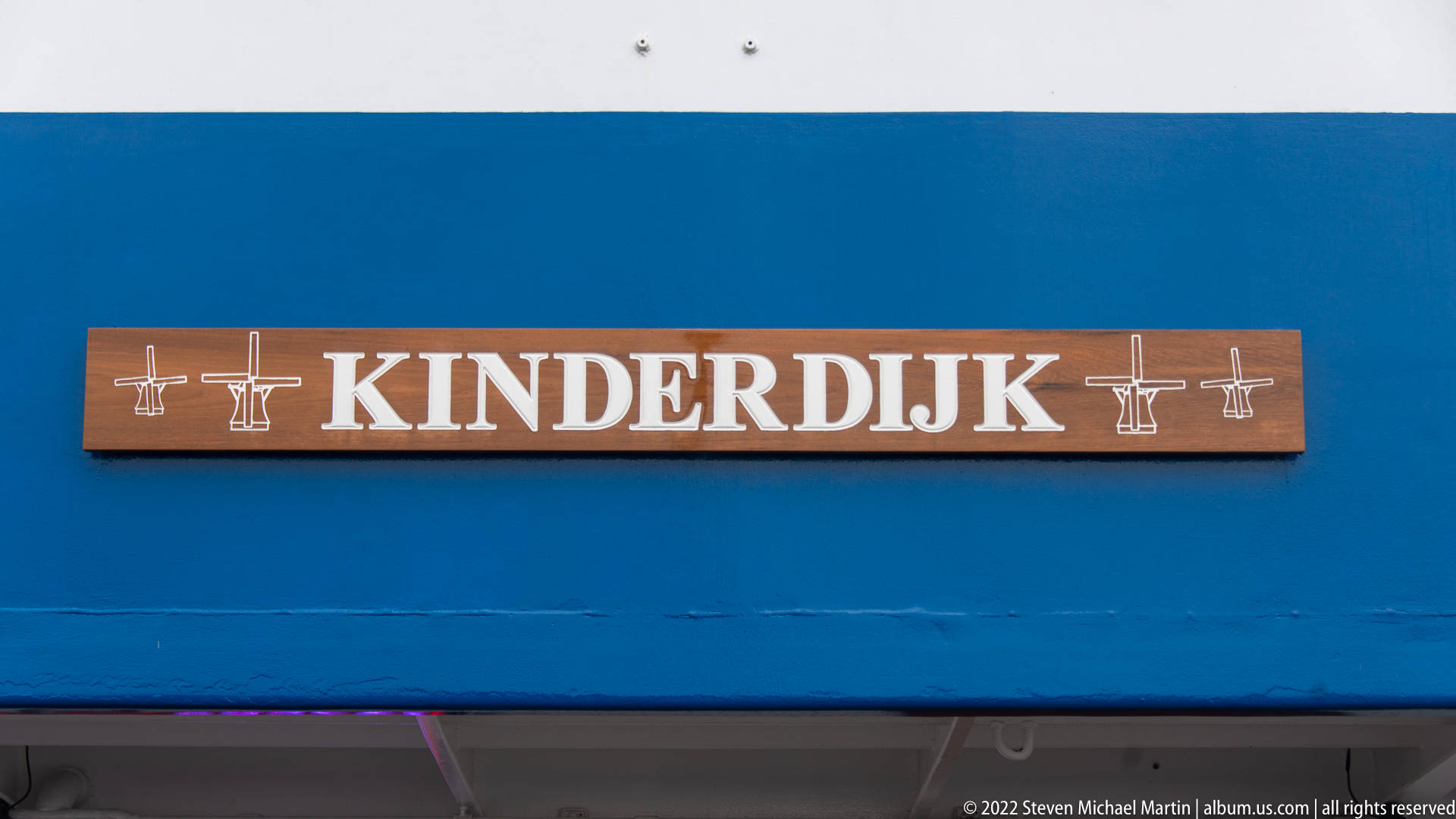
A wooden nameplate spelling “KINDERDIJK” is mounted on the vessel’s blue-painted side. Small stylized windmill motifs flank the lettering, turning a functional boat identifier into a compact graphic reference to the heritage landscape for which the vessel is named.
Caption
A wooden nameplate spelling “KINDERDIJK” is mounted on the vessel’s blue-painted side. Small stylized windmill motifs flank the lettering, turning a functional boat identifier into a compact graphic reference to the heritage landscape for which the vessel is named.
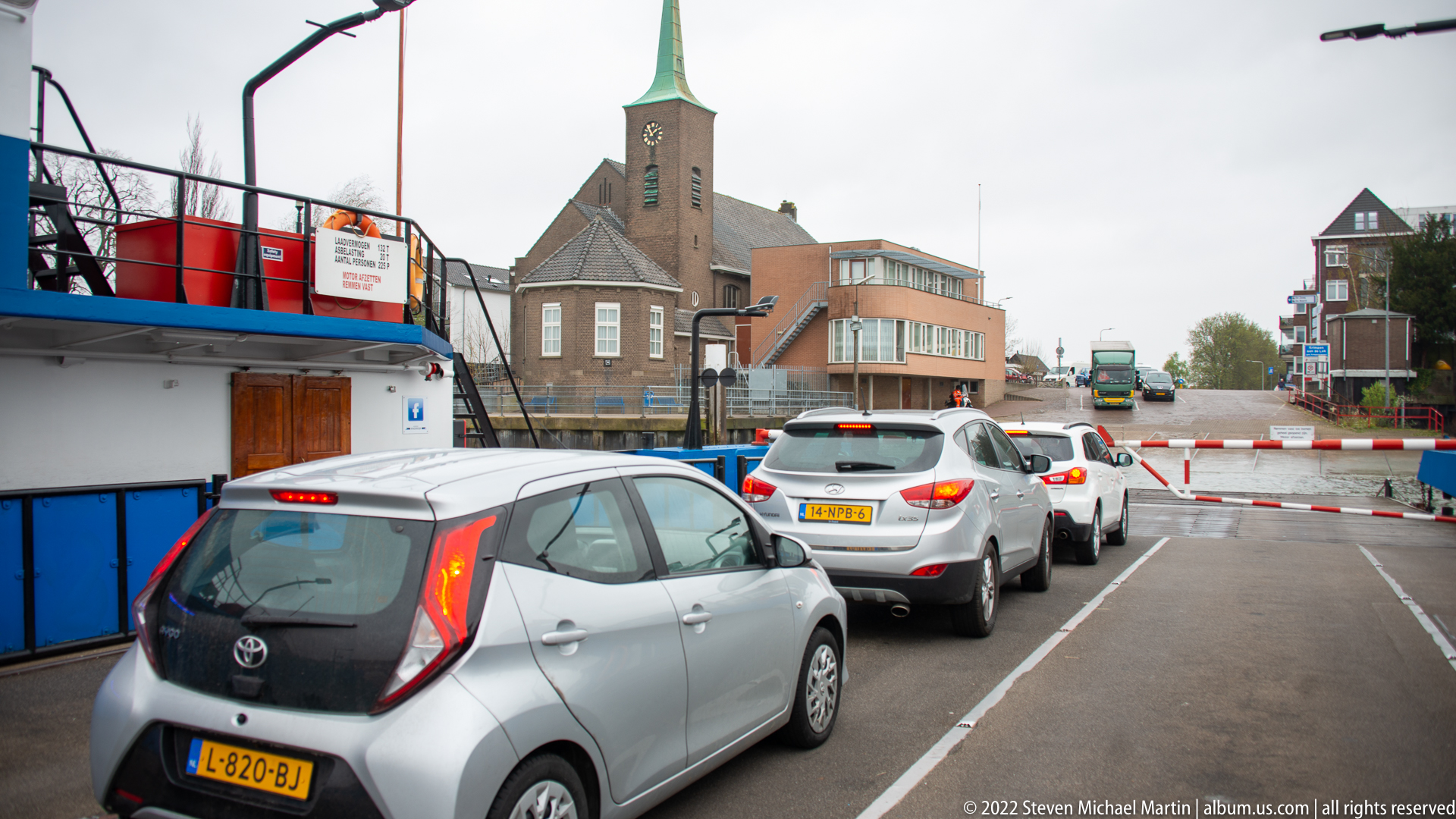
Cars queue along a narrow road beside a moored vessel, with a brick church and slender green spire rising beyond them. Red-and-white barriers mark the waterfront crossing area, showing the everyday transport setting immediately outside the Kinderdijk visitor landscape.
Caption
Cars queue along a narrow road beside a moored vessel, with a brick church and slender green spire rising beyond them. Red-and-white barriers mark the waterfront crossing area, showing the everyday transport setting immediately outside the Kinderdijk visitor landscape.
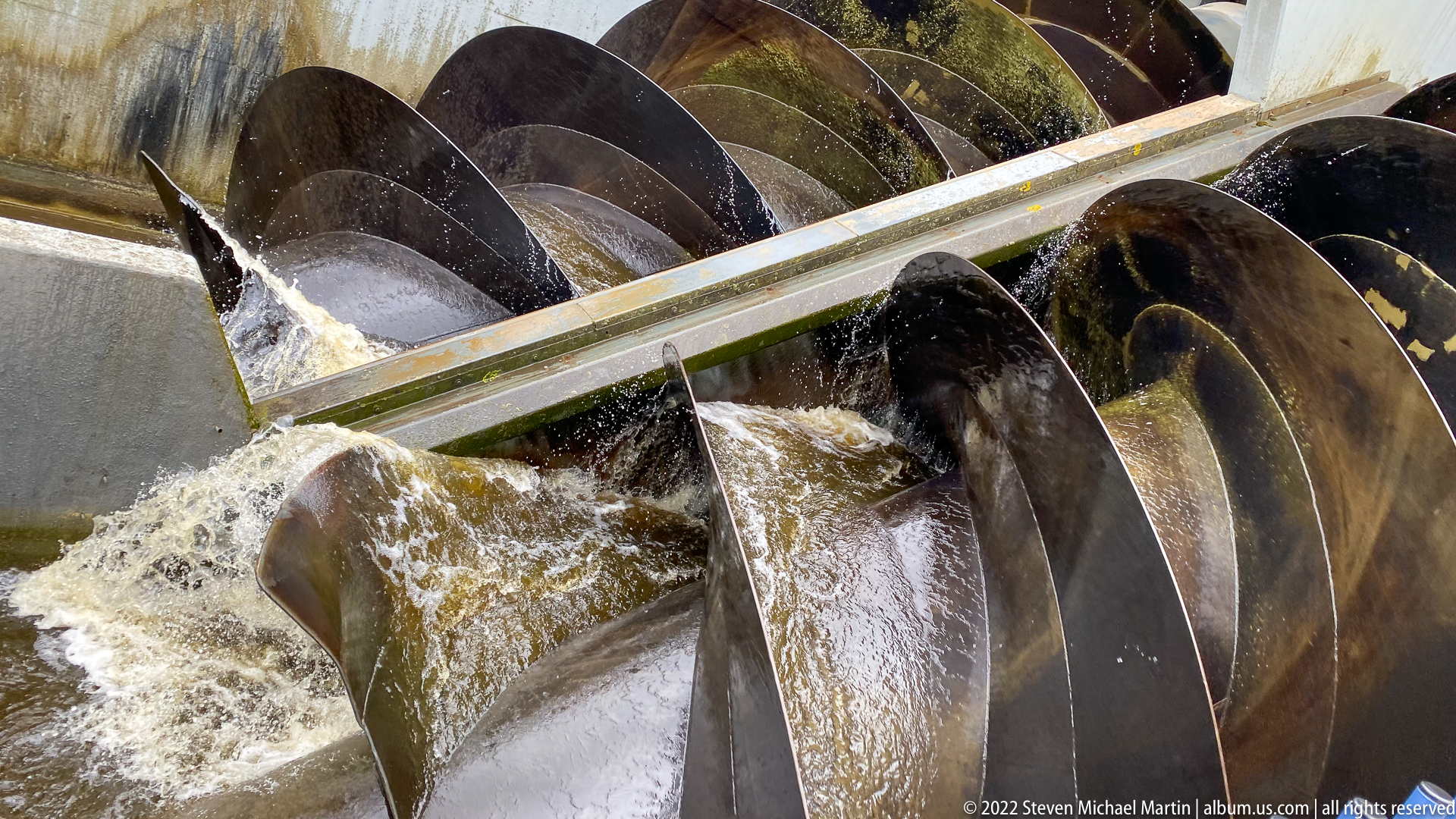
Large helical screw pumps churn brown water within a concrete-and-metal channel, exposing the direct mechanical action used to lift and transfer water. Water spills across the broad blades while a straight metal divider separates adjacent screws, creating a forceful close study of modern drainage technology at Kinderdijk.
Caption
Large helical screw pumps churn brown water within a concrete-and-metal channel, exposing the direct mechanical action used to lift and transfer water. Water spills across the broad blades while a straight metal divider separates adjacent screws, creating a forceful close study of modern drainage technology at Kinderdijk.

A massive dark spoked flywheel fills the foreground of the preserved machinery room, partly framing a rounded Pannevis vessel behind it. Shafts, bearings, guards, and structural members reveal the dense mechanical arrangement of the pumping installation, while the close viewpoint emphasizes scale and industrial construction.
Caption
A massive dark spoked flywheel fills the foreground of the preserved machinery room, partly framing a rounded Pannevis vessel behind it. Shafts, bearings, guards, and structural members reveal the dense mechanical arrangement of the pumping installation, while the close viewpoint emphasizes scale and industrial construction.
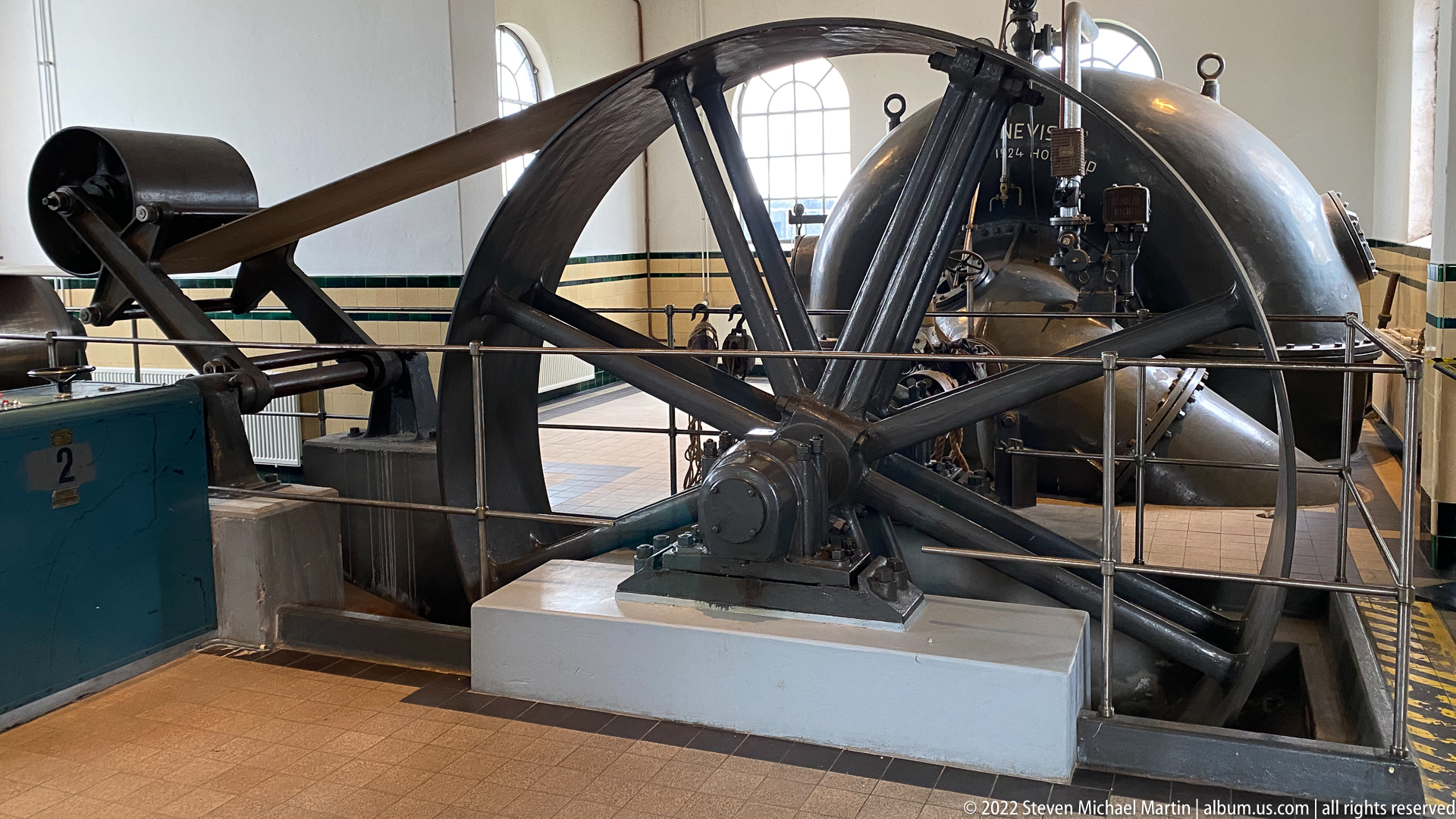
The final view steps back from the preserved machinery to show the large spoked flywheel, central shaft, rounded Pannevis vessel, adjacent equipment, and protective railings as a unified installation. The wider framing clarifies how the major components occupy the pumping-station floor and how visitors circulate around the historic machinery.
Caption
The final view steps back from the preserved machinery to show the large spoked flywheel, central shaft, rounded Pannevis vessel, adjacent equipment, and protective railings as a unified installation. The wider framing clarifies how the major components occupy the pumping-station floor and how visitors circulate around the historic machinery.