Florence – Tuscany, Italy
The historic city of Florence stands along the banks of the Arno River and is widely regarded as the birthplace of the Italian Renaissance. During the 15th and 16th centuries, the city flourished under the patronage of the powerful Medici family, whose support of artists and scholars helped transform Florence into one of the great cultural centers of Europe.
The historic center preserves an extraordinary concentration of churches, palaces, museums, and public squares that illustrate the artistic achievements of the Renaissance. Landmarks such as the Cathedral of Santa Maria del Fiore, the Uffizi Gallery, and the Ponte Vecchio reflect the city’s remarkable architectural and cultural heritage.
Today Florence remains one of the most important historic and artistic cities in the world and is recognized as part of the Historic Centre of Florence.

The Great Synagogue of Florence stands out from the surrounding roofscape through its large green copper dome and striped Moorish Revival façades. Smaller domed corner towers flank the central mass, while pale and reddish masonry patterns articulate the building against the tightly packed neighborhood. The elevated view makes the synagogue’s distinctive silhouette especially clear within the Florentine cityscape.
Caption
The Great Synagogue of Florence stands out from the surrounding roofscape through its large green copper dome and striped Moorish Revival façades. Smaller domed corner towers flank the central mass, while pale and reddish masonry patterns articulate the building against the tightly packed neighborhood. The elevated view makes the synagogue’s distinctive silhouette especially clear within the Florentine cityscape.

A broad enclosed passage crosses the street on a pale arch, leading toward a rough masonry tower framed by warm ochre buildings. Shops, bicycles, pedestrians, and potted plants animate the small square below. The layered view combines the bridge district’s defensive medieval fabric, later connecting corridors, and contemporary commercial use within a single compact streetscape.
Caption
A broad enclosed passage crosses the street on a pale arch, leading toward a rough masonry tower framed by warm ochre buildings. Shops, bicycles, pedestrians, and potted plants animate the small square below. The layered view combines the bridge district’s defensive medieval fabric, later connecting corridors, and contemporary commercial use within a single compact streetscape.

A broad ochre arcade marks the approach to Ponte Vecchio, its stone piers supporting upper rooms lined with rectangular windows. Pedestrians move past shop awnings and display fronts beneath the arches, while a masonry tower rises farther along the street. The view records the bridge district as an active commercial environment shaped by layered medieval and later construction.
Caption
A broad ochre arcade marks the approach to Ponte Vecchio, its stone piers supporting upper rooms lined with rectangular windows. Pedestrians move past shop awnings and display fronts beneath the arches, while a masonry tower rises farther along the street. The view records the bridge district as an active commercial environment shaped by layered medieval and later construction.
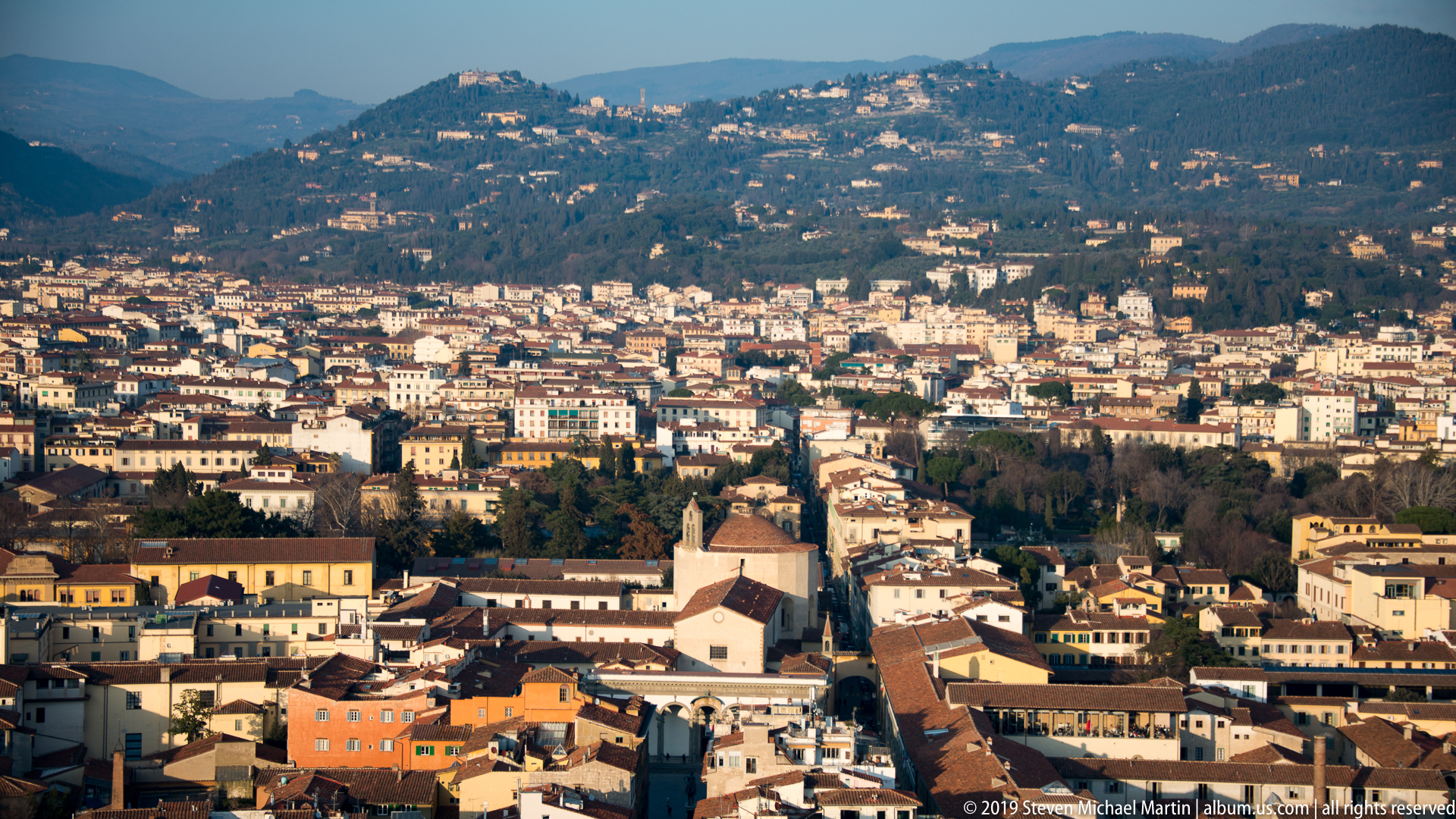
Florence extends outward from the historic core into lower-density neighborhoods at the foot of the surrounding hills. Church towers and pale masonry blocks punctuate the foreground while villas and houses climb the wooded slopes beyond. The elevated view documents the transition from the dense central city to the broader Tuscan landscape that encloses the Arno basin.
Caption
Florence extends outward from the historic core into lower-density neighborhoods at the foot of the surrounding hills. Church towers and pale masonry blocks punctuate the foreground while villas and houses climb the wooded slopes beyond. The elevated view documents the transition from the dense central city to the broader Tuscan landscape that encloses the Arno basin.

The roadway across Ponte Vecchio narrows between rows of shuttered shopfronts and overhanging upper rooms, with pedestrians moving through the shaded passage. Beyond the bridge district, the terracotta dome and lantern of Florence Cathedral rise above the street axis. The composition links two of Florence’s most recognizable landmarks through an everyday pedestrian view rather than a formal panorama.
Caption
The roadway across Ponte Vecchio narrows between rows of shuttered shopfronts and overhanging upper rooms, with pedestrians moving through the shaded passage. Beyond the bridge district, the terracotta dome and lantern of Florence Cathedral rise above the street axis. The composition links two of Florence’s most recognizable landmarks through an everyday pedestrian view rather than a formal panorama.

Two prominent masonry towers rise from the dense roofs of central Florence: the slender pointed campanile of the Badia Fiorentina and the heavier crenellated tower of the Bargello complex. Seen from above, their contrasting profiles punctuate the surrounding blocks and illustrate the close interweaving of religious, civic, and residential architecture in the medieval city.
Caption
Two prominent masonry towers rise from the dense roofs of central Florence: the slender pointed campanile of the Badia Fiorentina and the heavier crenellated tower of the Bargello complex. Seen from above, their contrasting profiles punctuate the surrounding blocks and illustrate the close interweaving of religious, civic, and residential architecture in the medieval city.

Florence stretches in a broad panorama from the cathedral dome, its warm tiled roofs crossed by long, remarkably straight streets leading toward the outer city and surrounding hills. Large palazzi and church complexes interrupt the finer grain of residential blocks. The elevated perspective makes the historic center’s compact plan and its transition into later neighborhoods especially legible.
Caption
Florence stretches in a broad panorama from the cathedral dome, its warm tiled roofs crossed by long, remarkably straight streets leading toward the outer city and surrounding hills. Large palazzi and church complexes interrupt the finer grain of residential blocks. The elevated perspective makes the historic center’s compact plan and its transition into later neighborhoods especially legible.

A high viewpoint opens across the tightly packed historic center of Florence, where terracotta roofs, narrow streets, palazzi, and church towers form a dense urban fabric. A broad rectangular piazza and monumental arcaded building organize the foreground, while the city gradually gives way to the green Tuscan hills. The view emphasizes Florence as a compact city shaped by closely layered civic, religious, and residential architecture.
Caption
A high viewpoint opens across the tightly packed historic center of Florence, where terracotta roofs, narrow streets, palazzi, and church towers form a dense urban fabric. A broad rectangular piazza and monumental arcaded building organize the foreground, while the city gradually gives way to the green Tuscan hills. The view emphasizes Florence as a compact city shaped by closely layered civic, religious, and residential architecture.

Florence’s principal skyline landmarks align across this elevated view: Brunelleschi’s terracotta dome and Giotto’s Campanile rise at left, while the Torre di Arnolfo of Palazzo Vecchio stands farther right. Smaller church towers and tiled roofs fill the middle ground, with distant hills completing a compact visual summary of the historic center’s sacred and civic architecture.
Caption
Florence’s principal skyline landmarks align across this elevated view: Brunelleschi’s terracotta dome and Giotto’s Campanile rise at left, while the Torre di Arnolfo of Palazzo Vecchio stands farther right. Smaller church towers and tiled roofs fill the middle ground, with distant hills completing a compact visual summary of the historic center’s sacred and civic architecture.

The Arno forms a calm blue corridor through Florence, reflecting long rows of historic palazzi along both embankments. Ponte Santa Trinita spans the middle distance with three shallow elliptical arches, while another bridge is visible farther downstream. The centered composition emphasizes the river as an organizing axis through the historic city and the close continuity of architecture along the Lungarni.
Caption
The Arno forms a calm blue corridor through Florence, reflecting long rows of historic palazzi along both embankments. Ponte Santa Trinita spans the middle distance with three shallow elliptical arches, while another bridge is visible farther downstream. The centered composition emphasizes the river as an organizing axis through the historic city and the close continuity of architecture along the Lungarni.

Giotto’s Campanile rises dramatically below the viewpoint from the dome of Florence Cathedral, allowing its polychrome marble panels, paired Gothic openings, and richly patterned upper stages to be seen from an unusual angle. The tilted composition emphasizes the tower’s height and geometric surface decoration while the streets and roofs of central Florence recede far below.
Caption
Giotto’s Campanile rises dramatically below the viewpoint from the dome of Florence Cathedral, allowing its polychrome marble panels, paired Gothic openings, and richly patterned upper stages to be seen from an unusual angle. The tilted composition emphasizes the tower’s height and geometric surface decoration while the streets and roofs of central Florence recede far below.

Benvenuto Cellini is honored by a bronze portrait bust mounted on an ornate stone pedestal, with the sculptor’s name and biographical inscription visible beneath the figure. The close upward view isolates the dark bronze against open sky while retaining the carved masks, scrollwork, and fountain-like ornament of the monument’s base, emphasizing Florence’s tradition of commemorating artists in the urban landscape.
Caption
Benvenuto Cellini is honored by a bronze portrait bust mounted on an ornate stone pedestal, with the sculptor’s name and biographical inscription visible beneath the figure. The close upward view isolates the dark bronze against open sky while retaining the carved masks, scrollwork, and fountain-like ornament of the monument’s base, emphasizing Florence’s tradition of commemorating artists in the urban landscape.

The richly patterned marble façade of the Cathedral of Santa Maria del Fiore rises beside Giotto’s Campanile, filling the steep street-level composition with bands of white, green, and pink stone. Gothic portals, sculptural niches, rose windows, and geometric panels create a dense decorative surface, while the low viewpoint stresses the monumental scale of Florence’s cathedral complex.
Caption
The richly patterned marble façade of the Cathedral of Santa Maria del Fiore rises beside Giotto’s Campanile, filling the steep street-level composition with bands of white, green, and pink stone. Gothic portals, sculptural niches, rose windows, and geometric panels create a dense decorative surface, while the low viewpoint stresses the monumental scale of Florence’s cathedral complex.

The rusticated stone front of Palazzo Vecchio appears at the end of a narrow approach, its crenellated roofline and Torre di Arnolfo catching strong sunlight above the shaded street. The large clock face, projecting battlements, and civic coats of arms below the parapet make the medieval town hall immediately recognizable despite the tightly framed urban viewpoint.
Caption
The rusticated stone front of Palazzo Vecchio appears at the end of a narrow approach, its crenellated roofline and Torre di Arnolfo catching strong sunlight above the shaded street. The large clock face, projecting battlements, and civic coats of arms below the parapet make the medieval town hall immediately recognizable despite the tightly framed urban viewpoint.

Three broad stone arches of Ponte Santa Trinita span the Arno in warm late-day light, their curves reflected in the still water below. Riverside palazzi line both banks and frame the bridge as part of Florence’s dense historic riverfront. The centered viewpoint emphasizes the bridge’s low profile, repeated arch geometry, and close relationship to the buildings along the Lungarni.
Caption
Three broad stone arches of Ponte Santa Trinita span the Arno in warm late-day light, their curves reflected in the still water below. Riverside palazzi line both banks and frame the bridge as part of Florence’s dense historic riverfront. The centered viewpoint emphasizes the bridge’s low profile, repeated arch geometry, and close relationship to the buildings along the Lungarni.

Florence’s compact historic center spreads across the frame in a high panoramic view, with the crenellated Palazzo Vecchio and its tall Torre di Arnolfo anchoring Piazza della Signoria. Dense terracotta roofs, medieval towers, church façades, and narrow streets reveal the city’s layered urban fabric, while the wooded hills beyond form a soft boundary behind the stone-built center.
Caption
Florence’s compact historic center spreads across the frame in a high panoramic view, with the crenellated Palazzo Vecchio and its tall Torre di Arnolfo anchoring Piazza della Signoria. Dense terracotta roofs, medieval towers, church façades, and narrow streets reveal the city’s layered urban fabric, while the wooded hills beyond form a soft boundary behind the stone-built center.

A broad elevated view looks across Florence’s terracotta roofs toward a cluster of medieval church towers and civic buildings. The composition gives greater weight to the tightly packed residential blocks in the foreground, where varied rooflines and warm plaster façades convey the scale and texture of the historic center, while the Tuscan hills rise beyond the city.
Caption
A broad elevated view looks across Florence’s terracotta roofs toward a cluster of medieval church towers and civic buildings. The composition gives greater weight to the tightly packed residential blocks in the foreground, where varied rooflines and warm plaster façades convey the scale and texture of the historic center, while the Tuscan hills rise beyond the city.

Palazzo Vecchio’s Torre di Arnolfo rises above a layered field of Florentine rooftops in this compressed telephoto cityscape. The tower’s crenellated crown remains the dominant landmark, while masonry houses, tiled roofs, and the dark mass of a large church structure create overlapping planes that lead toward the hazy hills beyond the historic center.
Caption
Palazzo Vecchio’s Torre di Arnolfo rises above a layered field of Florentine rooftops in this compressed telephoto cityscape. The tower’s crenellated crown remains the dominant landmark, while masonry houses, tiled roofs, and the dark mass of a large church structure create overlapping planes that lead toward the hazy hills beyond the historic center.

Ponte Vecchio closes the river vista with its distinctive line of enclosed shops spanning the Arno. Warm façades along both embankments reflect in the quiet water, while the bridge’s central opening and elevated Vasari Corridor profile remain legible at the far end of the composition. The symmetrical river view places the famous crossing within Florence’s continuous historic waterfront.
Caption
Ponte Vecchio closes the river vista with its distinctive line of enclosed shops spanning the Arno. Warm façades along both embankments reflect in the quiet water, while the bridge’s central opening and elevated Vasari Corridor profile remain legible at the far end of the composition. The symmetrical river view places the famous crossing within Florence’s continuous historic waterfront.

The Basilica of Santa Croce is seen from above with its white, green, and pink marble façade facing the city and its long dark-roofed nave extending behind. The slender bell tower rises beside the church, while dense blocks of Florence and the green hillside beyond place the Franciscan basilica within its broader urban setting.
Caption
The Basilica of Santa Croce is seen from above with its white, green, and pink marble façade facing the city and its long dark-roofed nave extending behind. The slender bell tower rises beside the church, while dense blocks of Florence and the green hillside beyond place the Franciscan basilica within its broader urban setting.

A massive stone pier divides broad open arches at a Florentine market structure, with sculpted figures set into shallow niches on its face. The upward view contrasts the pale carved stone with the darker vaulted arcade, while colorful merchandise and stalls at ground level show the historic architecture continuing to serve an active commercial setting.
Caption
A massive stone pier divides broad open arches at a Florentine market structure, with sculpted figures set into shallow niches on its face. The upward view contrasts the pale carved stone with the darker vaulted arcade, while colorful merchandise and stalls at ground level show the historic architecture continuing to serve an active commercial setting.

Palazzo Vecchio fills the low-angle frame with rough rusticated masonry, a deep crenellated parapet, painted civic shields, and the soaring Torre di Arnolfo. The tower’s clock and projecting battlements rise sharply against the sky, while the entrance level remains partly visible below, emphasizing the fortress-like character of Florence’s medieval civic palace.
Caption
Palazzo Vecchio fills the low-angle frame with rough rusticated masonry, a deep crenellated parapet, painted civic shields, and the soaring Torre di Arnolfo. The tower’s clock and projecting battlements rise sharply against the sky, while the entrance level remains partly visible below, emphasizing the fortress-like character of Florence’s medieval civic palace.

A close frontal study of Bandinelli’s Hercules and Cacus concentrates on Hercules’s massive torso, bent arm, and downward gaze. The lower figure of Cacus is only partly included, shifting attention to the Renaissance sculptor’s treatment of muscular anatomy and the polished pale marble. Palazzo Vecchio’s dark windows and façade details form a subdued architectural backdrop.
Caption
A close frontal study of Bandinelli’s Hercules and Cacus concentrates on Hercules’s massive torso, bent arm, and downward gaze. The lower figure of Cacus is only partly included, shifting attention to the Renaissance sculptor’s treatment of muscular anatomy and the polished pale marble. Palazzo Vecchio’s dark windows and façade details form a subdued architectural backdrop.

Giotto’s Campanile stands nearly level with the elevated viewpoint from Florence Cathedral’s dome, its polychrome marble surfaces and upper Gothic windows silhouetted against a hazy city. The cathedral roof occupies the lower right, while the grid of streets and terracotta roofs extends far beyond, showing the campanile as both part of the Duomo complex and a dominant urban landmark.
Caption
Giotto’s Campanile stands nearly level with the elevated viewpoint from Florence Cathedral’s dome, its polychrome marble surfaces and upper Gothic windows silhouetted against a hazy city. The cathedral roof occupies the lower right, while the grid of streets and terracotta roofs extends far beyond, showing the campanile as both part of the Duomo complex and a dominant urban landmark.

Bandinelli’s marble Hercules dominates this side view of the monumental group Hercules and Cacus outside Palazzo Vecchio. The hero’s muscular torso, club, and lion-skin attributes are isolated against the palace’s rusticated masonry, while the subdued figure of Cacus is partly visible below. The tight crop emphasizes anatomy, contrapposto, and the sculpture’s monumental scale.
Caption
Bandinelli’s marble Hercules dominates this side view of the monumental group Hercules and Cacus outside Palazzo Vecchio. The hero’s muscular torso, club, and lion-skin attributes are isolated against the palace’s rusticated masonry, while the subdued figure of Cacus is partly visible below. The tight crop emphasizes anatomy, contrapposto, and the sculpture’s monumental scale.

Seen more fully from the front, Bandinelli’s Hercules and Cacus presents the standing hero above the defeated Cacus at the entrance to Palazzo Vecchio. Hercules grips his club while the contorted lower figure anchors the composition. The dark palace façade behind the pale marble heightens the sculptural silhouette and clarifies the group’s powerful vertical arrangement.
Caption
Seen more fully from the front, Bandinelli’s Hercules and Cacus presents the standing hero above the defeated Cacus at the entrance to Palazzo Vecchio. Hercules grips his club while the contorted lower figure anchors the composition. The dark palace façade behind the pale marble heightens the sculptural silhouette and clarifies the group’s powerful vertical arrangement.

A monumental crowned coat of arms crowns a Florentine façade, flanked by seated stone figures holding long trumpet-like instruments. Beneath the shield, a Latin inscription is carved into a rectangular tablet above a balustrade. The upward view isolates the heraldic ensemble against blue sky and emphasizes its ceremonial role as architectural decoration.
Caption
A monumental crowned coat of arms crowns a Florentine façade, flanked by seated stone figures holding long trumpet-like instruments. Beneath the shield, a Latin inscription is carved into a rectangular tablet above a balustrade. The upward view isolates the heraldic ensemble against blue sky and emphasizes its ceremonial role as architectural decoration.

Palazzo Vecchio rises almost vertically from the foreground, its rusticated stone walls pierced by paired windows beneath a crenellated parapet painted with civic emblems. The Torre di Arnolfo projects above with its large clock face and overhanging battlements. Flags and the decorated entrance at street level add a civic focus to the fortress-like medieval façade.
Caption
Palazzo Vecchio rises almost vertically from the foreground, its rusticated stone walls pierced by paired windows beneath a crenellated parapet painted with civic emblems. The Torre di Arnolfo projects above with its large clock face and overhanging battlements. Flags and the decorated entrance at street level add a civic focus to the fortress-like medieval façade.

Cellini’s bronze Perseus stands in the Loggia dei Lanzi with one arm raised to display Medusa’s severed head and the other holding a sword. The hero’s weight shifts elegantly over the fallen body below, while the dark, green-patinated bronze contrasts with the pale architectural façade behind. The close view emphasizes the sculpture’s twisting pose and dramatic mythological action.
Caption
Cellini’s bronze Perseus stands in the Loggia dei Lanzi with one arm raised to display Medusa’s severed head and the other holding a sword. The hero’s weight shifts elegantly over the fallen body below, while the dark, green-patinated bronze contrasts with the pale architectural façade behind. The close view emphasizes the sculpture’s twisting pose and dramatic mythological action.

The full marble group of Hercules and Cacus is framed against Palazzo Vecchio’s heavy rusticated stone. Hercules stands upright with club and lion skin while Cacus twists below him, creating a compact pyramidal composition. Strong side light brings out the figures’ modeled anatomy and deep shadows, while the close architectural setting underscores the sculpture’s placement at the civic palace entrance.
Caption
The full marble group of Hercules and Cacus is framed against Palazzo Vecchio’s heavy rusticated stone. Hercules stands upright with club and lion skin while Cacus twists below him, creating a compact pyramidal composition. Strong side light brings out the figures’ modeled anatomy and deep shadows, while the close architectural setting underscores the sculpture’s placement at the civic palace entrance.

A lively group of pale stone figures occupies the broken pediment above a Florentine doorway or window. Two larger seated female figures flank a smaller central figure, with scrolls and shell-like ornament filling the surrounding masonry. Strong sunlight creates crisp shadows that separate the figures from the warm stone façade and reveal the ensemble’s theatrical Baroque character.
Caption
A lively group of pale stone figures occupies the broken pediment above a Florentine doorway or window. Two larger seated female figures flank a smaller central figure, with scrolls and shell-like ornament filling the surrounding masonry. Strong sunlight creates crisp shadows that separate the figures from the warm stone façade and reveal the ensemble’s theatrical Baroque character.

The entrance to Palazzo Vecchio is framed by monumental sculpture and richly layered civic decoration. A replica of Michelangelo’s David stands to the left and Bandinelli’s Hercules and Cacus to the right, while the portal is crowned by a blue field of gold fleurs-de-lis, lions, a roundel, and a Latin inscription. The composition concentrates several emblematic features of Piazza della Signoria into one view.
Caption
The entrance to Palazzo Vecchio is framed by monumental sculpture and richly layered civic decoration. A replica of Michelangelo’s David stands to the left and Bandinelli’s Hercules and Cacus to the right, while the portal is crowned by a blue field of gold fleurs-de-lis, lions, a roundel, and a Latin inscription. The composition concentrates several emblematic features of Piazza della Signoria into one view.

From behind, Bandinelli’s Hercules and Cacus becomes a study in monumental anatomy and three-dimensional carving. Hercules’s broad back and weight-bearing stance dominate the composition, while the lower figure and club create a complex silhouette near the base. Palazzo Vecchio’s arched windows provide scale and firmly locate the sculpture in Piazza della Signoria.
Caption
From behind, Bandinelli’s Hercules and Cacus becomes a study in monumental anatomy and three-dimensional carving. Hercules’s broad back and weight-bearing stance dominate the composition, while the lower figure and club create a complex silhouette near the base. Palazzo Vecchio’s arched windows provide scale and firmly locate the sculpture in Piazza della Signoria.

Santa Croce occupies the center of a broad elevated city view, its polychrome marble façade and long nave clearly distinguished from the surrounding terracotta roofs. The pointed campanile rises behind the church, while lower-density development and hills stretch across the distance. The wider framing emphasizes the basilica’s scale and orientation within eastern central Florence.
Caption
Santa Croce occupies the center of a broad elevated city view, its polychrome marble façade and long nave clearly distinguished from the surrounding terracotta roofs. The pointed campanile rises behind the church, while lower-density development and hills stretch across the distance. The wider framing emphasizes the basilica’s scale and orientation within eastern central Florence.

Brunelleschi’s immense octagonal dome fills the view from Giotto’s Campanile, revealing the terracotta-tiled roof, pale stone ribs, circular openings, and marble-clad drum at unusually close range. The lantern crowns the structure above, while Florence spreads outward behind it. Seen from near the same height, the dome’s engineering scale and its commanding relationship to the city become especially clear.
Caption
Brunelleschi’s immense octagonal dome fills the view from Giotto’s Campanile, revealing the terracotta-tiled roof, pale stone ribs, circular openings, and marble-clad drum at unusually close range. The lantern crowns the structure above, while Florence spreads outward behind it. Seen from near the same height, the dome’s engineering scale and its commanding relationship to the city become especially clear.

An elaborate marble rooftop structure rises above terracotta tiles, combining roundels, arched openings, dentils, and patterned stonework in a compact vertical composition. A small religious relief panel decorates the lower face, while Florence Cathedral’s great terracotta dome appears partly at left. The close elevated view emphasizes the richness of architectural detail scattered across the historic roofscape.
Caption
An elaborate marble rooftop structure rises above terracotta tiles, combining roundels, arched openings, dentils, and patterned stonework in a compact vertical composition. A small religious relief panel decorates the lower face, while Florence Cathedral’s great terracotta dome appears partly at left. The close elevated view emphasizes the richness of architectural detail scattered across the historic roofscape.

Palazzo Vecchio and the Torre di Arnolfo dominate an elevated view toward Piazza della Signoria, while the long arcaded roofline of the Loggia dei Lanzi extends beside the civic palace. Dense blocks of central Florence fill the foreground and middle distance, and the wooded hills beyond soften the horizon. The view reveals the spatial relationship among the square’s principal civic monuments.
Caption
Palazzo Vecchio and the Torre di Arnolfo dominate an elevated view toward Piazza della Signoria, while the long arcaded roofline of the Loggia dei Lanzi extends beside the civic palace. Dense blocks of central Florence fill the foreground and middle distance, and the wooded hills beyond soften the horizon. The view reveals the spatial relationship among the square’s principal civic monuments.

A visitor stands beside the protective metal enclosure high on Florence Cathedral, with the historic city spreading far below. Terracotta roofs and distant hills fill the background while the close foreground reveals curved masonry, roof tiles, and the modern safety cage used along the elevated route. The portrait conveys the exceptional height and exposed setting of the cathedral dome ascent without losing its urban context.
Caption
A visitor stands beside the protective metal enclosure high on Florence Cathedral, with the historic city spreading far below. Terracotta roofs and distant hills fill the background while the close foreground reveals curved masonry, roof tiles, and the modern safety cage used along the elevated route. The portrait conveys the exceptional height and exposed setting of the cathedral dome ascent without losing its urban context.

The dome of Santa Maria del Fiore rises almost alone above Florence’s roofscape, its eight terracotta segments divided by pale ribs and capped by the marble lantern. This slightly wider view includes more of the city and Tuscan hills beyond, placing Brunelleschi’s celebrated structure within the low horizontal skyline it has dominated for centuries.
Caption
The dome of Santa Maria del Fiore rises almost alone above Florence’s roofscape, its eight terracotta segments divided by pale ribs and capped by the marble lantern. This slightly wider view includes more of the city and Tuscan hills beyond, placing Brunelleschi’s celebrated structure within the low horizontal skyline it has dominated for centuries.

The Baptistery of San Giovanni appears at the end of a narrow street beside the cathedral complex, its octagonal form wrapped in geometric white-and-green marble. Above and behind it, Brunelleschi’s dome rises into the open sky. The compressed street-level view contrasts everyday Florentine façades with the highly patterned sacred architecture of Piazza del Duomo.
Caption
The Baptistery of San Giovanni appears at the end of a narrow street beside the cathedral complex, its octagonal form wrapped in geometric white-and-green marble. Above and behind it, Brunelleschi’s dome rises into the open sky. The compressed street-level view contrasts everyday Florentine façades with the highly patterned sacred architecture of Piazza del Duomo.

Brunelleschi’s dome rises unexpectedly above a narrow Florentine street, framed by tall masonry façades, shuttered windows, shopfronts, and pedestrians. Only part of the cathedral is visible at street level, making the immense terracotta cupola appear even larger as it emerges above the intimate urban corridor. The view illustrates how closely the Duomo is woven into the surrounding medieval street pattern.
Caption
Brunelleschi’s dome rises unexpectedly above a narrow Florentine street, framed by tall masonry façades, shuttered windows, shopfronts, and pedestrians. Only part of the cathedral is visible at street level, making the immense terracotta cupola appear even larger as it emerges above the intimate urban corridor. The view illustrates how closely the Duomo is woven into the surrounding medieval street pattern.

The marble-clad walls and great dome of Santa Maria del Fiore close the view down a narrow street lined with ochre and gray façades. Pedestrians and small businesses occupy the foreground, while the cathedral’s patterned stonework and terracotta cupola fill the opening beyond. The composition shows the abrupt change of scale encountered when approaching Piazza del Duomo through Florence’s compact center.
Caption
The marble-clad walls and great dome of Santa Maria del Fiore close the view down a narrow street lined with ochre and gray façades. Pedestrians and small businesses occupy the foreground, while the cathedral’s patterned stonework and terracotta cupola fill the opening beyond. The composition shows the abrupt change of scale encountered when approaching Piazza del Duomo through Florence’s compact center.

The patterned marble walls of the Baptistery of San Giovanni fill the end of a narrow lane, with Brunelleschi’s dome rising immediately behind. Deeply shadowed buildings on either side act as a frame for the sunlit sacred complex, sharpening the contrast between Florence’s close medieval streets and the monumental geometry of the baptistery and cathedral.
Caption
The patterned marble walls of the Baptistery of San Giovanni fill the end of a narrow lane, with Brunelleschi’s dome rising immediately behind. Deeply shadowed buildings on either side act as a frame for the sunlit sacred complex, sharpening the contrast between Florence’s close medieval streets and the monumental geometry of the baptistery and cathedral.

Giotto’s Campanile rises beside the long south flank of Santa Maria del Fiore, both covered in elaborate panels of white, green, and pink marble. Tall Gothic windows, sculptural portals, geometric borders, and the campanile’s stacked openings create a continuous decorative surface across the cathedral complex. People gathered below provide a strong measure of the buildings’ monumental scale.
Caption
Giotto’s Campanile rises beside the long south flank of Santa Maria del Fiore, both covered in elaborate panels of white, green, and pink marble. Tall Gothic windows, sculptural portals, geometric borders, and the campanile’s stacked openings create a continuous decorative surface across the cathedral complex. People gathered below provide a strong measure of the buildings’ monumental scale.

A long row of scooters and motorcycles lines the stone façade of a central Florence street, their varied windscreens, mirrors, and bodywork creating a dense diagonal rhythm. The tilted viewpoint turns an everyday transportation scene into a study of contemporary street life within the historic city, where modern mobility occupies the edges of centuries-old masonry buildings.
Caption
A long row of scooters and motorcycles lines the stone façade of a central Florence street, their varied windscreens, mirrors, and bodywork creating a dense diagonal rhythm. The tilted viewpoint turns an everyday transportation scene into a study of contemporary street life within the historic city, where modern mobility occupies the edges of centuries-old masonry buildings.

Palazzo Vecchio rises in a steep low-angle view, its rough rusticated masonry, paired Gothic windows, painted civic shields, and projecting crenellations giving the façade a fortress-like character. The Torre di Arnolfo climbs above the palace at an angle, while flags mark the active civic building below. The close viewpoint emphasizes the weight and verticality of Florence’s medieval town hall.
Caption
Palazzo Vecchio rises in a steep low-angle view, its rough rusticated masonry, paired Gothic windows, painted civic shields, and projecting crenellations giving the façade a fortress-like character. The Torre di Arnolfo climbs above the palace at an angle, while flags mark the active civic building below. The close viewpoint emphasizes the weight and verticality of Florence’s medieval town hall.

Giambologna’s marble group commonly known as the Rape of the Sabine Women spirals upward beneath the arches of the Loggia dei Lanzi. Three intertwined figures create a dramatic vertical movement: a young woman reaches upward while a powerful man lifts her above an older crouching figure. Nearby sculpture and the loggia’s stone pier reinforce the work’s setting within Florence’s open-air sculptural gallery.
Caption
Giambologna’s marble group commonly known as the Rape of the Sabine Women spirals upward beneath the arches of the Loggia dei Lanzi. Three intertwined figures create a dramatic vertical movement: a young woman reaches upward while a powerful man lifts her above an older crouching figure. Nearby sculpture and the loggia’s stone pier reinforce the work’s setting within Florence’s open-air sculptural gallery.

A helmeted warrior supports the limp body of a fallen nude man in a forceful marble group displayed beneath the Loggia dei Lanzi. The standing figure bends forward to bear the dead weight across his body, creating a compact composition of tension, grief, and physical strain. The plain wall behind isolates the figures and makes their interlocking anatomy especially legible.
Caption
A helmeted warrior supports the limp body of a fallen nude man in a forceful marble group displayed beneath the Loggia dei Lanzi. The standing figure bends forward to bear the dead weight across his body, creating a compact composition of tension, grief, and physical strain. The plain wall behind isolates the figures and makes their interlocking anatomy especially legible.

The monumental replica of Michelangelo’s David is seen close against the rough brown masonry of Palazzo Vecchio. Cropped at the torso, the view concentrates on the youthful face, deeply carved curls, enlarged hand, and poised expression that define the celebrated figure. The palace wall provides a textured backdrop for the pale marble surface at the historic entrance to Florence’s civic center.
Caption
The monumental replica of Michelangelo’s David is seen close against the rough brown masonry of Palazzo Vecchio. Cropped at the torso, the view concentrates on the youthful face, deeply carved curls, enlarged hand, and poised expression that define the celebrated figure. The palace wall provides a textured backdrop for the pale marble surface at the historic entrance to Florence’s civic center.

A brilliant blue heraldic panel above Palazzo Vecchio’s entrance combines gold fleurs-de-lis, two gilded lions, a central Christogram, and the Latin motto “Rex Regum et Dominus Dominantium.” Pale carved stone frames the inscription and emblems against the palace’s rough masonry. The vivid color and ceremonial imagery form one of the most distinctive decorative elements of the civic palace entrance.
Caption
A brilliant blue heraldic panel above Palazzo Vecchio’s entrance combines gold fleurs-de-lis, two gilded lions, a central Christogram, and the Latin motto “Rex Regum et Dominus Dominantium.” Pale carved stone frames the inscription and emblems against the palace’s rough masonry. The vivid color and ceremonial imagery form one of the most distinctive decorative elements of the civic palace entrance.

Michelangelo’s David replica stands at monumental scale against Palazzo Vecchio, shown from a low angle that accentuates the figure’s long legs, contrapposto stance, and enlarged hands. The blue-and-gold entrance decoration appears behind the sculpture, tying the figure directly to its setting at the civic palace. The viewpoint stresses both anatomical idealization and the statue’s commanding public presence.
Caption
Michelangelo’s David replica stands at monumental scale against Palazzo Vecchio, shown from a low angle that accentuates the figure’s long legs, contrapposto stance, and enlarged hands. The blue-and-gold entrance decoration appears behind the sculpture, tying the figure directly to its setting at the civic palace. The viewpoint stresses both anatomical idealization and the statue’s commanding public presence.

Cellini’s Perseus balances above Medusa’s fallen body, raising her severed head high in one hand while holding a curved sword in the other. The bronze figure stands on an elaborate sculptural pedestal beneath the Loggia dei Lanzi, where the open arch provides a restrained backdrop. The full composition reveals the controlled contrapposto and vertical drama of this major Florentine Mannerist work.
Caption
Cellini’s Perseus balances above Medusa’s fallen body, raising her severed head high in one hand while holding a curved sword in the other. The bronze figure stands on an elaborate sculptural pedestal beneath the Loggia dei Lanzi, where the open arch provides a restrained backdrop. The full composition reveals the controlled contrapposto and vertical drama of this major Florentine Mannerist work.

Giambologna’s Hercules and the Centaur Nessus locks two powerful marble bodies into a violent diagonal struggle. Hercules rises above the centaur, twisting his torso as Nessus bends beneath him, while the animal body and human anatomy merge into a complex sculptural mass. Seen against Florentine façades, the group’s forceful movement distinguishes it from the more vertical compositions nearby in the Loggia dei Lanzi.
Caption
Giambologna’s Hercules and the Centaur Nessus locks two powerful marble bodies into a violent diagonal struggle. Hercules rises above the centaur, twisting his torso as Nessus bends beneath him, while the animal body and human anatomy merge into a complex sculptural mass. Seen against Florentine façades, the group’s forceful movement distinguishes it from the more vertical compositions nearby in the Loggia dei Lanzi.

A carved lion rests one forepaw on a rounded shield, its deeply worked mane and open mouth giving the heraldic animal an alert presence. The pale stone figure stands before darker masonry, while another classical statue appears softly in the background. The composition focuses on the lion-and-shield motif long associated with Florentine civic symbolism rather than the surrounding architecture.
Caption
A carved lion rests one forepaw on a rounded shield, its deeply worked mane and open mouth giving the heraldic animal an alert presence. The pale stone figure stands before darker masonry, while another classical statue appears softly in the background. The composition focuses on the lion-and-shield motif long associated with Florentine civic symbolism rather than the surrounding architecture.

A tight view of Benvenuto Cellini’s bronze Perseus isolates the hero’s head, winged helmet, raised arm, and the severed head of Medusa. Green-blue patina catches the light across the modeled bronze, while Medusa’s serpentine hair hangs dramatically from Perseus’s hand. The close crop reveals the technical refinement and psychological intensity that can be missed in a full view of the monument.
Caption
A tight view of Benvenuto Cellini’s bronze Perseus isolates the hero’s head, winged helmet, raised arm, and the severed head of Medusa. Green-blue patina catches the light across the modeled bronze, while Medusa’s serpentine hair hangs dramatically from Perseus’s hand. The close crop reveals the technical refinement and psychological intensity that can be missed in a full view of the monument.

A weathered pale stone female figure stands against Palazzo Vecchio’s rough masonry, her upper torso exposed above heavy drapery gathered around the hips. One arm is missing and dark staining marks the surface, making the sculpture’s age and outdoor exposure especially visible. The simple frontal pose contrasts with the more theatrical Renaissance groups displayed nearby in Piazza della Signoria.
Caption
A weathered pale stone female figure stands against Palazzo Vecchio’s rough masonry, her upper torso exposed above heavy drapery gathered around the hips. One arm is missing and dark staining marks the surface, making the sculpture’s age and outdoor exposure especially visible. The simple frontal pose contrasts with the more theatrical Renaissance groups displayed nearby in Piazza della Signoria.

A small winged putto twists dynamically atop a fountain pedestal, embracing a dolphin whose body curves upward through the composition. The dark bronze figure is sharply separated from the richly decorated courtyard architecture behind it. The lively turning pose, outstretched wing, and playful interaction between child and dolphin give the compact sculpture a sense of motion disproportionate to its size.
Caption
A small winged putto twists dynamically atop a fountain pedestal, embracing a dolphin whose body curves upward through the composition. The dark bronze figure is sharply separated from the richly decorated courtyard architecture behind it. The lively turning pose, outstretched wing, and playful interaction between child and dolphin give the compact sculpture a sense of motion disproportionate to its size.

Verrocchio’s Putto with Dolphin crowns the central fountain of Palazzo Vecchio’s first courtyard, shown here against warm frescoed walls and a richly ornamented column. The winged child twists around the dolphin with buoyant movement while the pale marble basin below provides a contrasting base. The courtyard setting clarifies the sculpture’s role as the animated focal point of an otherwise symmetrical architectural space.
Caption
Verrocchio’s Putto with Dolphin crowns the central fountain of Palazzo Vecchio’s first courtyard, shown here against warm frescoed walls and a richly ornamented column. The winged child twists around the dolphin with buoyant movement while the pale marble basin below provides a contrasting base. The courtyard setting clarifies the sculpture’s role as the animated focal point of an otherwise symmetrical architectural space.

From a closer frontal angle, Verrocchio’s winged putto clasps the dolphin against his chest as the animal’s head rises beside his face. The bronze surface is modeled in rounded, animated forms, and one small foot lifts from the base to reinforce the sense of turning motion. Ornamental courtyard columns blur behind the sculpture, keeping attention on the intimate interaction of the two figures.
Caption
From a closer frontal angle, Verrocchio’s winged putto clasps the dolphin against his chest as the animal’s head rises beside his face. The bronze surface is modeled in rounded, animated forms, and one small foot lifts from the base to reinforce the sense of turning motion. Ornamental courtyard columns blur behind the sculpture, keeping attention on the intimate interaction of the two figures.

The first courtyard of Palazzo Vecchio surrounds a central fountain with arcaded walkways, richly decorated walls, and columns covered in intricate painted and carved ornament. Groin-vaulted bays open around the perimeter while visitors move quietly through the space. The balanced view shows how architecture, fresco decoration, sculpture, and water were combined to transform the medieval civic palace’s interior court into an elaborate ceremonial setting.
Caption
The first courtyard of Palazzo Vecchio surrounds a central fountain with arcaded walkways, richly decorated walls, and columns covered in intricate painted and carved ornament. Groin-vaulted bays open around the perimeter while visitors move quietly through the space. The balanced view shows how architecture, fresco decoration, sculpture, and water were combined to transform the medieval civic palace’s interior court into an elaborate ceremonial setting.

A large painted landscape or city view occupies the center of an elaborately frescoed wall in Palazzo Vecchio’s courtyard. Grotesque ornament, architectural motifs, medallions, and inscriptions frame the rectangular scene, creating a dense decorative program across the surrounding vault and wall surfaces. The close view emphasizes the courtyard’s painted imagery rather than its architecture as a whole.
Caption
A large painted landscape or city view occupies the center of an elaborately frescoed wall in Palazzo Vecchio’s courtyard. Grotesque ornament, architectural motifs, medallions, and inscriptions frame the rectangular scene, creating a dense decorative program across the surrounding vault and wall surfaces. The close view emphasizes the courtyard’s painted imagery rather than its architecture as a whole.

Looking straight upward through Palazzo Vecchio’s courtyard, the open rectangle of blue sky frames the pale upper stages of the Torre di Arnolfo. Painted arches, richly ornamented capitals, and upper-story windows ring the lower edges of the composition. The dramatic vertical viewpoint connects the intimate decorated courtyard with the massive civic tower rising beyond its roofline.
Caption
Looking straight upward through Palazzo Vecchio’s courtyard, the open rectangle of blue sky frames the pale upper stages of the Torre di Arnolfo. Painted arches, richly ornamented capitals, and upper-story windows ring the lower edges of the composition. The dramatic vertical viewpoint connects the intimate decorated courtyard with the massive civic tower rising beyond its roofline.

A muscular nude male figure stands over a kneeling opponent in a marble group displayed within a shallow arched niche. The upper figure bends downward while the lower body twists at his legs, creating a compact composition of physical domination. Restrained wall decoration and painted borders around the niche isolate the sculpture from the more elaborate ornament elsewhere in Palazzo Vecchio.
Caption
A muscular nude male figure stands over a kneeling opponent in a marble group displayed within a shallow arched niche. The upper figure bends downward while the lower body twists at his legs, creating a compact composition of physical domination. Restrained wall decoration and painted borders around the niche isolate the sculpture from the more elaborate ornament elsewhere in Palazzo Vecchio.

The Torre di Arnolfo is centered within the rectangular opening above Palazzo Vecchio’s first courtyard, its pale upper masonry sharply outlined against a clear blue sky. Painted arches and ornate capitals form a decorative border below, while round and rectangular windows articulate the enclosing palace walls. The near-symmetrical composition turns the courtyard into a monumental frame for Florence’s civic tower.
Caption
The Torre di Arnolfo is centered within the rectangular opening above Palazzo Vecchio’s first courtyard, its pale upper masonry sharply outlined against a clear blue sky. Painted arches and ornate capitals form a decorative border below, while round and rectangular windows articulate the enclosing palace walls. The near-symmetrical composition turns the courtyard into a monumental frame for Florence’s civic tower.

Cellini’s bronze Perseus stands beneath the Loggia dei Lanzi, raising Medusa’s severed head while holding a curved sword at his side. Strong directional light models the hero’s torso and green-patinated bronze surface, while the loggia’s stone arches and carved capitals establish the sculpture’s architectural setting. The low viewpoint reinforces the work’s vertical drama and triumphant pose.
Caption
Cellini’s bronze Perseus stands beneath the Loggia dei Lanzi, raising Medusa’s severed head while holding a curved sword at his side. Strong directional light models the hero’s torso and green-patinated bronze surface, while the loggia’s stone arches and carved capitals establish the sculpture’s architectural setting. The low viewpoint reinforces the work’s vertical drama and triumphant pose.

A carved lion mask projects over a shallow stone basin, flanked by two seated lion sculptures on raised plinths. The symmetrical arrangement is set within a pale arched recess, where the central feline face and restrained architectural surround give the fountain a heraldic character. Low clipped greenery partially screens the base while leaving the sculptural ensemble clearly visible.
Caption
A carved lion mask projects over a shallow stone basin, flanked by two seated lion sculptures on raised plinths. The symmetrical arrangement is set within a pale arched recess, where the central feline face and restrained architectural surround give the fountain a heraldic character. Low clipped greenery partially screens the base while leaving the sculptural ensemble clearly visible.

Bandinelli’s Hercules and Cacus is seen from an unusually low angle that magnifies Hercules’s muscular torso and powerful stance. The hero holds his club while the subdued figure of Cacus appears below, partly compressed by the steep viewpoint. Warm Florentine façades and open sky replace the usual palace backdrop, emphasizing the sculpture’s mass and three-dimensional modeling.
Caption
Bandinelli’s Hercules and Cacus is seen from an unusually low angle that magnifies Hercules’s muscular torso and powerful stance. The hero holds his club while the subdued figure of Cacus appears below, partly compressed by the steep viewpoint. Warm Florentine façades and open sky replace the usual palace backdrop, emphasizing the sculpture’s mass and three-dimensional modeling.

The full marble group of Hercules and Cacus rises against a busy architectural setting near Palazzo Vecchio. Hercules stands above the contorted lower figure, his club projecting from the composition, while a construction crane and temporary structure introduce a distinctly contemporary layer behind the Renaissance monument. The juxtaposition records the sculpture as part of a living, continually changing civic square.
Caption
The full marble group of Hercules and Cacus rises against a busy architectural setting near Palazzo Vecchio. Hercules stands above the contorted lower figure, his club projecting from the composition, while a construction crane and temporary structure introduce a distinctly contemporary layer behind the Renaissance monument. The juxtaposition records the sculpture as part of a living, continually changing civic square.

An enclosed upper-level passage bridges a narrow Florentine street, its broad white arch spanning between older masonry buildings. A second monumental arch is visible farther along the corridor, creating a sequence of framed spaces beneath the elevated route. Shops, signs, and pedestrians at street level show how this historic connective architecture remains embedded in the everyday commercial fabric near Ponte Vecchio.
Caption
An enclosed upper-level passage bridges a narrow Florentine street, its broad white arch spanning between older masonry buildings. A second monumental arch is visible farther along the corridor, creating a sequence of framed spaces beneath the elevated route. Shops, signs, and pedestrians at street level show how this historic connective architecture remains embedded in the everyday commercial fabric near Ponte Vecchio.

A tall rusticated stone tower rises against a clear blue sky, its upper stages marked by small arched openings, projecting corbels, crenellated parapets, and a large bell beneath the roofline. A metal weather vane crowns the structure. The close telephoto framing isolates the tower’s fortified silhouette and layered masonry details from the surrounding city.
Caption
A tall rusticated stone tower rises against a clear blue sky, its upper stages marked by small arched openings, projecting corbels, crenellated parapets, and a large bell beneath the roofline. A metal weather vane crowns the structure. The close telephoto framing isolates the tower’s fortified silhouette and layered masonry details from the surrounding city.

A succession of pale rounded arches forms a deep pedestrian corridor beneath an elevated structure near the Arno. Repetition compresses the view into a tunnel-like sequence of light and shadow, with stone trim defining each bay and a small group of people visible in the distance. The photograph emphasizes spatial rhythm and the practical circulation space created beneath the historic passage.
Caption
A succession of pale rounded arches forms a deep pedestrian corridor beneath an elevated structure near the Arno. Repetition compresses the view into a tunnel-like sequence of light and shadow, with stone trim defining each bay and a small group of people visible in the distance. The photograph emphasizes spatial rhythm and the practical circulation space created beneath the historic passage.

Rounded arches recede through a long covered passage, their pale plaster surfaces warmed by low sunlight near the foreground. Small groups of people sit and walk along the corridor, adding scale to the repeated architectural bays. The near-symmetrical perspective emphasizes the rhythm of the arcade and the contrast between the sunlit entrance and the cooler, shaded distance.
Caption
Rounded arches recede through a long covered passage, their pale plaster surfaces warmed by low sunlight near the foreground. Small groups of people sit and walk along the corridor, adding scale to the repeated architectural bays. The near-symmetrical perspective emphasizes the rhythm of the arcade and the contrast between the sunlit entrance and the cooler, shaded distance.

The long ground-level colonnade of the Uffizi recedes in a strong one-point perspective, with repeated stone columns and a coffered barrel-vaulted ceiling drawing the eye toward the far end. Exhibition banners for Antony Gormley’s “Essere” hang between the bays, placing the Renaissance architectural setting in dialogue with a contemporary museum program. The open side admits bright daylight from the piazzale.
Caption
The long ground-level colonnade of the Uffizi recedes in a strong one-point perspective, with repeated stone columns and a coffered barrel-vaulted ceiling drawing the eye toward the far end. Exhibition banners for Antony Gormley’s “Essere” hang between the bays, placing the Renaissance architectural setting in dialogue with a contemporary museum program. The open side admits bright daylight from the piazzale.

A warm ochre residential façade is viewed upward through a broad foreground arch. Symmetrically spaced windows are framed by gray stone voussoirs and fitted with dark wooden shutters, while a small wrought-iron balcony projects from the upper story. The layered arches and restrained palette create a distinctly Florentine streetscape study focused on domestic architecture rather than a major monument.
Caption
A warm ochre residential façade is viewed upward through a broad foreground arch. Symmetrically spaced windows are framed by gray stone voussoirs and fitted with dark wooden shutters, while a small wrought-iron balcony projects from the upper story. The layered arches and restrained palette create a distinctly Florentine streetscape study focused on domestic architecture rather than a major monument.

The Ponte Vecchio is seen obliquely from the Arno bank, where ochre shop structures project beyond the bridge on timber and metal supports. Large stone arches carry the crossing above the river, while a dark open arcade and closely packed upper rooms reveal the bridge’s unusual combination of infrastructure and inhabitable commercial architecture. Warm late light accentuates the layered masonry and plaster surfaces.
Caption
The Ponte Vecchio is seen obliquely from the Arno bank, where ochre shop structures project beyond the bridge on timber and metal supports. Large stone arches carry the crossing above the river, while a dark open arcade and closely packed upper rooms reveal the bridge’s unusual combination of infrastructure and inhabitable commercial architecture. Warm late light accentuates the layered masonry and plaster surfaces.

Rows of compact shop rooms cling to the side of Ponte Vecchio in shades of ochre, salmon, yellow, and weathered plaster. Green and brown shutters punctuate the irregular façades, while angled supports carry the projecting rooms beyond the bridge’s stone arch. The tight composition focuses on the bridge’s distinctive accretion of commercial structures rather than the crossing as a whole.
Caption
Rows of compact shop rooms cling to the side of Ponte Vecchio in shades of ochre, salmon, yellow, and weathered plaster. Green and brown shutters punctuate the irregular façades, while angled supports carry the projecting rooms beyond the bridge’s stone arch. The tight composition focuses on the bridge’s distinctive accretion of commercial structures rather than the crossing as a whole.

Ponte Vecchio spans the Arno in warm light, its massive stone arches carrying a dense row of projecting shops across the river. The colorful upper structures are mirrored in the dark water below, creating a near-symmetrical reflection beneath the bridge. This broader riverside view makes the relationship between the medieval crossing, its inhabited commercial additions, and the river especially clear.
Caption
Ponte Vecchio spans the Arno in warm light, its massive stone arches carrying a dense row of projecting shops across the river. The colorful upper structures are mirrored in the dark water below, creating a near-symmetrical reflection beneath the bridge. This broader riverside view makes the relationship between the medieval crossing, its inhabited commercial additions, and the river especially clear.

Late sunlight intensifies the yellow, ochre, and salmon façades projecting from Ponte Vecchio, revealing mismatched shutters, small balconies, rooflines, and timber or metal supports above the bridge arch. The close oblique view treats the crossing almost as a compact street of houses, emphasizing the irregularity produced by centuries of commercial occupation and adaptation.
Caption
Late sunlight intensifies the yellow, ochre, and salmon façades projecting from Ponte Vecchio, revealing mismatched shutters, small balconies, rooflines, and timber or metal supports above the bridge arch. The close oblique view treats the crossing almost as a compact street of houses, emphasizing the irregularity produced by centuries of commercial occupation and adaptation.

Heavy wooden shutters and doors close a continuous row of Ponte Vecchio shops, their surfaces reinforced with dark iron hinges, studs, and locking hardware. Individual shop names remain visible above several bays, including jewelry signage. Without the daytime displays, the bridge’s famous commercial frontage reads as a robust sequence of crafted wooden enclosures built directly into the historic passage.
Caption
Heavy wooden shutters and doors close a continuous row of Ponte Vecchio shops, their surfaces reinforced with dark iron hinges, studs, and locking hardware. Individual shop names remain visible above several bays, including jewelry signage. Without the daytime displays, the bridge’s famous commercial frontage reads as a robust sequence of crafted wooden enclosures built directly into the historic passage.

Three broad ochre arches spring from massive stone piers beneath a long row of upper windows near Ponte Vecchio. Hanging lamps and shop awnings occupy the lower edge, while sunlight warms the plaster and emphasizes the contrast between the smooth upper wall and rough masonry supports. The close upward angle turns a functional bridge approach into a study of rhythm, mass, and material.
Caption
Three broad ochre arches spring from massive stone piers beneath a long row of upper windows near Ponte Vecchio. Hanging lamps and shop awnings occupy the lower edge, while sunlight warms the plaster and emphasizes the contrast between the smooth upper wall and rough masonry supports. The close upward angle turns a functional bridge approach into a study of rhythm, mass, and material.

A stout masonry tower rises above an arcaded structure at the Ponte Vecchio approach, combining rough stone lower walls with warm plastered upper arches and small circular openings. Heavy projecting stone brackets support the transitional level, while pedestrians and shopfronts provide scale at street level. The view highlights the bridge district’s layered construction and fortified medieval character.
Caption
A stout masonry tower rises above an arcaded structure at the Ponte Vecchio approach, combining rough stone lower walls with warm plastered upper arches and small circular openings. Heavy projecting stone brackets support the transitional level, while pedestrians and shopfronts provide scale at street level. The view highlights the bridge district’s layered construction and fortified medieval character.

A steep upward view isolates the heavy stone and plaster construction at the Ponte Vecchio approach. Massive masonry piers support broad ochre arches pierced by small circular openings, while a rough stone tower rises above the roofline. The compressed perspective stresses the accumulated vertical layers of the bridge district and the contrast between fortified stonework and later plastered additions.
Caption
A steep upward view isolates the heavy stone and plaster construction at the Ponte Vecchio approach. Massive masonry piers support broad ochre arches pierced by small circular openings, while a rough stone tower rises above the roofline. The compressed perspective stresses the accumulated vertical layers of the bridge district and the contrast between fortified stonework and later plastered additions.

A colorful souvenir drawing reduces Florence to a bright graphic skyline beside the Arno, with the cathedral dome and other towers rendered in black, orange, yellow, and green above broad bands of blue water. Loose crayon-like marks and simplified forms create a playful interpretation rather than a literal city view, reflecting the way Florence’s landmarks circulate through popular tourist imagery.
Caption
A colorful souvenir drawing reduces Florence to a bright graphic skyline beside the Arno, with the cathedral dome and other towers rendered in black, orange, yellow, and green above broad bands of blue water. Loose crayon-like marks and simplified forms create a playful interpretation rather than a literal city view, reflecting the way Florence’s landmarks circulate through popular tourist imagery.

A medieval masonry tower anchors a busy street near Ponte Vecchio, while a pale enclosed passage crosses overhead on a broad arch to connect neighboring buildings. Shop signs, pedestrians, delivery vehicles, and mixed façades fill the foreground, demonstrating how monumental historic structures remain woven into an intensely used commercial corridor.
Caption
A medieval masonry tower anchors a busy street near Ponte Vecchio, while a pale enclosed passage crosses overhead on a broad arch to connect neighboring buildings. Shop signs, pedestrians, delivery vehicles, and mixed façades fill the foreground, demonstrating how monumental historic structures remain woven into an intensely used commercial corridor.

A bilingual interpretive panel mounted on rough stone summarizes the history of Ponte Vecchio in Italian and English. The text discusses the bridge’s Roman origins, medieval rebuilding, Giorgio Vasari’s corridor for Cosimo I de’ Medici, the long association with goldsmiths, and the bridge’s survival during the Second World War. QR codes provide additional digital interpretation.
Caption
A bilingual interpretive panel mounted on rough stone summarizes the history of Ponte Vecchio in Italian and English. The text discusses the bridge’s Roman origins, medieval rebuilding, Giorgio Vasari’s corridor for Cosimo I de’ Medici, the long association with goldsmiths, and the bridge’s survival during the Second World War. QR codes provide additional digital interpretation.

A closed Ponte Vecchio shop presents a warm expanse of varnished wooden shutters and doors articulated by black wrought-iron hinges, straps, latches, and decorative fleur-de-lis-like fittings. The heavy enclosure contrasts with a pale stone base below. The close frontal view emphasizes the craftsmanship and security hardware that transform the bridge’s jewelry shops after business hours.
Caption
A closed Ponte Vecchio shop presents a warm expanse of varnished wooden shutters and doors articulated by black wrought-iron hinges, straps, latches, and decorative fleur-de-lis-like fittings. The heavy enclosure contrasts with a pale stone base below. The close frontal view emphasizes the craftsmanship and security hardware that transform the bridge’s jewelry shops after business hours.

A bronze tactile plaque marks the Historic Centre of Florence as a UNESCO World Heritage property. The emblems of the City of Florence and UNESCO appear above Italian wording, while raised Braille text occupies the lower portion for accessible interpretation. Weathering across the metal surface records the plaque’s outdoor placement within the historic city.
Caption
A bronze tactile plaque marks the Historic Centre of Florence as a UNESCO World Heritage property. The emblems of the City of Florence and UNESCO appear above Italian wording, while raised Braille text occupies the lower portion for accessible interpretation. Weathering across the metal surface records the plaque’s outdoor placement within the historic city.

A raised bronze map presents the street pattern and major structures of central Florence in tactile form, with the Arno crossing the lower portion and the dense historic core modeled above it. Numbered or keyed markers and explanatory panels run along the base. The relief allows visitors to understand the city’s urban form through both sight and touch.
Caption
A raised bronze map presents the street pattern and major structures of central Florence in tactile form, with the Arno crossing the lower portion and the dense historic core modeled above it. Numbered or keyed markers and explanatory panels run along the base. The relief allows visitors to understand the city’s urban form through both sight and touch.

A modest church façade opens behind a three-bay portico supported by slender stone columns, with a simple pedimented entrance centered beneath the arches. The upper wall is largely plain except for a tall window and small cross at the roofline. Adjoining multi-story buildings crowd closely around the church, emphasizing the compressed urban setting of central Florence.
Caption
A modest church façade opens behind a three-bay portico supported by slender stone columns, with a simple pedimented entrance centered beneath the arches. The upper wall is largely plain except for a tall window and small cross at the roofline. Adjoining multi-story buildings crowd closely around the church, emphasizing the compressed urban setting of central Florence.

A long line of dark wooden shop shutters runs beneath the ochre upper arcade near Ponte Vecchio, creating a strong diagonal perspective along the narrow street. Heavy stone supports and small circular openings articulate the upper structure, while a few pedestrians appear in the distance. With most shops closed, the architecture and repetitive commercial frontage become the dominant subjects.
Caption
A long line of dark wooden shop shutters runs beneath the ochre upper arcade near Ponte Vecchio, creating a strong diagonal perspective along the narrow street. Heavy stone supports and small circular openings articulate the upper structure, while a few pedestrians appear in the distance. With most shops closed, the architecture and repetitive commercial frontage become the dominant subjects.

A shop window presents a dense assortment of colorful prints and small works on paper, including stylized views of Florence and its cathedral dome. Mounted pieces overlap across tables and vertical display boards, mixing architectural souvenirs with more graphic and decorative imagery. Reflections in the glass and glimpses of the shop interior reinforce the photograph’s focus on contemporary artistic commerce within the historic city.
Caption
A shop window presents a dense assortment of colorful prints and small works on paper, including stylized views of Florence and its cathedral dome. Mounted pieces overlap across tables and vertical display boards, mixing architectural souvenirs with more graphic and decorative imagery. Reflections in the glass and glimpses of the shop interior reinforce the photograph’s focus on contemporary artistic commerce within the historic city.

A broad stone-framed arch opens into a deep vaulted passage painted in muted yellow, with successive arches and hanging lanterns drawing the eye toward an illuminated artwork or architectural feature at the far end. Decorative painted motifs appear above an inner arch. The centered perspective emphasizes the transition from the pale stone exterior into a sheltered sequence of interior spaces.
Caption
A broad stone-framed arch opens into a deep vaulted passage painted in muted yellow, with successive arches and hanging lanterns drawing the eye toward an illuminated artwork or architectural feature at the far end. Decorative painted motifs appear above an inner arch. The centered perspective emphasizes the transition from the pale stone exterior into a sheltered sequence of interior spaces.

An exuberant shop display combines tall white tiered ornamental forms, gilded accents, sculptural objects, and a large rococo-style mirror against a deep blue wall. Dense decoration fills nearly every surface, while smaller white pieces cluster on tables and stands in the foreground. The theatrical interior contrasts sharply with the restrained stone architecture seen elsewhere in the Florence portfolio.
Caption
An exuberant shop display combines tall white tiered ornamental forms, gilded accents, sculptural objects, and a large rococo-style mirror against a deep blue wall. Dense decoration fills nearly every surface, while smaller white pieces cluster on tables and stands in the foreground. The theatrical interior contrasts sharply with the restrained stone architecture seen elsewhere in the Florence portfolio.

An elongated nude male figure stretches horizontally above a second, upright female form in a striking modern sculptural composition. Rough, weathered surfaces and exaggerated proportions give both bodies an expressive quality, while the yellow façade, shuttered windows, and tiled roof behind them place the work firmly in an urban Florentine setting. The close framing emphasizes the unusual balance and dramatic cantilever of the upper figure.
Caption
An elongated nude male figure stretches horizontally above a second, upright female form in a striking modern sculptural composition. Rough, weathered surfaces and exaggerated proportions give both bodies an expressive quality, while the yellow façade, shuttered windows, and tiled roof behind them place the work firmly in an urban Florentine setting. The close framing emphasizes the unusual balance and dramatic cantilever of the upper figure.
⭐ Highlights
- Cradle of the Renaissance: The city where a major cultural and artistic transformation began.
- Florence Cathedral (Duomo): A defining landmark with Brunelleschi’s revolutionary dome.
- Uffizi Gallery: One of the most important art museums in the world.
- Ponte Vecchio: A historic bridge lined with shops spanning the Arno River.
- Piazza della Signoria: The political and artistic center of the city.
- UNESCO Historic Centre: A preserved urban landscape shaped during the Renaissance.
🏛️ Florence Field Guide
Major features observed during this visit:
Florence is widely considered the birthplace of the Renaissance, a period that reshaped art, architecture, science, and thought across Europe. Emerging from its medieval foundations, the city reached extraordinary cultural and economic influence during the 15th and 16th centuries under the patronage of powerful families such as the Medici.
Unlike many historic cities, Florence presents a remarkably unified identity. Its streets, buildings, and public spaces reflect a concentrated period of artistic innovation, where architecture, sculpture, and painting were developed to new levels of realism, proportion, and human expression.
🏛️ Signature Landmarks
- Florence Cathedral (Duomo) – A massive dome that transformed architectural design.
- Uffizi Gallery – A collection of Renaissance masterpieces by leading artists.
- Ponte Vecchio – A medieval bridge integrated into the life of the city.
- Piazza della Signoria – The historic center of political power and public life.
- Palazzo Pitti & Boboli Gardens – Royal residence and landscape design of the Medici era.
🧠 Historical Significance
- Birth of the Renaissance – Florence led a transformation in art and intellectual life.
- Medici Influence – Wealth and patronage supported artists and architects.
- Artistic Innovation – Development of perspective, proportion, and human-centered design.
- Cultural Legacy – Ideas originating here influenced Europe and the modern world.
🌄 Urban Landscape & Experience
- Unified Cityscape – Much of the city reflects a coherent Renaissance vision.
- Walkable Core – Major landmarks are closely connected within the historic center.
- Art in Public Space – Sculptures and architecture are integrated into everyday streets.
- Living Museum – The city remains active while preserving its historic identity.