Doro Nawas – Namibia
The remote region of Doro Nawas lies along the edge of Damaraland, a rugged landscape of rocky hills, dry riverbeds, and desert plains. This semi-arid environment supports a surprising variety of wildlife that has adapted to the harsh conditions.
Desert-adapted elephants, oryx, springbok, and other animals travel through the region’s dry valleys in search of water and vegetation. The dramatic scenery of granite outcrops and wide open skies gives the region a sense of isolation and natural beauty.
Doro Nawas serves as a gateway for exploring the unique desert ecosystems of northwestern Namibia.

An unpaved road bends across a broad gravel-and-sand plain toward a dark, cloud-shadowed mountain range in the Namib. Sparse roadside markers and the almost complete absence of vegetation emphasize the exposed scale of the desert corridor, while low cloud or mist softens the ridgeline and contrasts with the warm earth tones of the foreground.
Caption
An unpaved road bends across a broad gravel-and-sand plain toward a dark, cloud-shadowed mountain range in the Namib. Sparse roadside markers and the almost complete absence of vegetation emphasize the exposed scale of the desert corridor, while low cloud or mist softens the ridgeline and contrasts with the warm earth tones of the foreground.
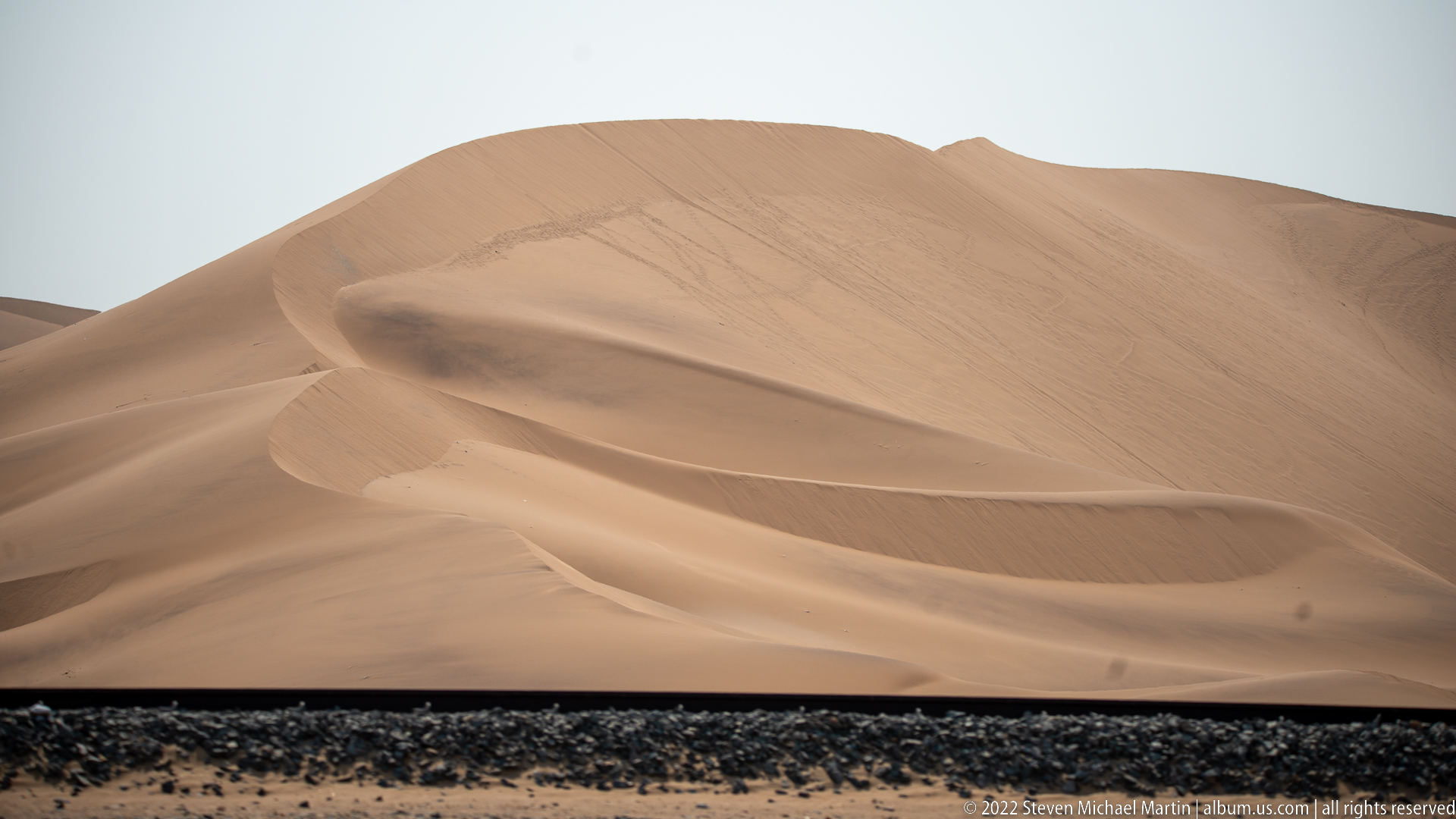
A wind-sculpted Namib dune fills the frame with sweeping crests, concave hollows, and long slip faces. Fine linear textures descend the main slope, while a darker gravel strip anchors the foreground and heightens the contrast with the pale sand. The tighter composition emphasizes dune form and erosion patterns rather than the broader desert setting.
Caption
A wind-sculpted Namib dune fills the frame with sweeping crests, concave hollows, and long slip faces. Fine linear textures descend the main slope, while a darker gravel strip anchors the foreground and heightens the contrast with the pale sand. The tighter composition emphasizes dune form and erosion patterns rather than the broader desert setting.
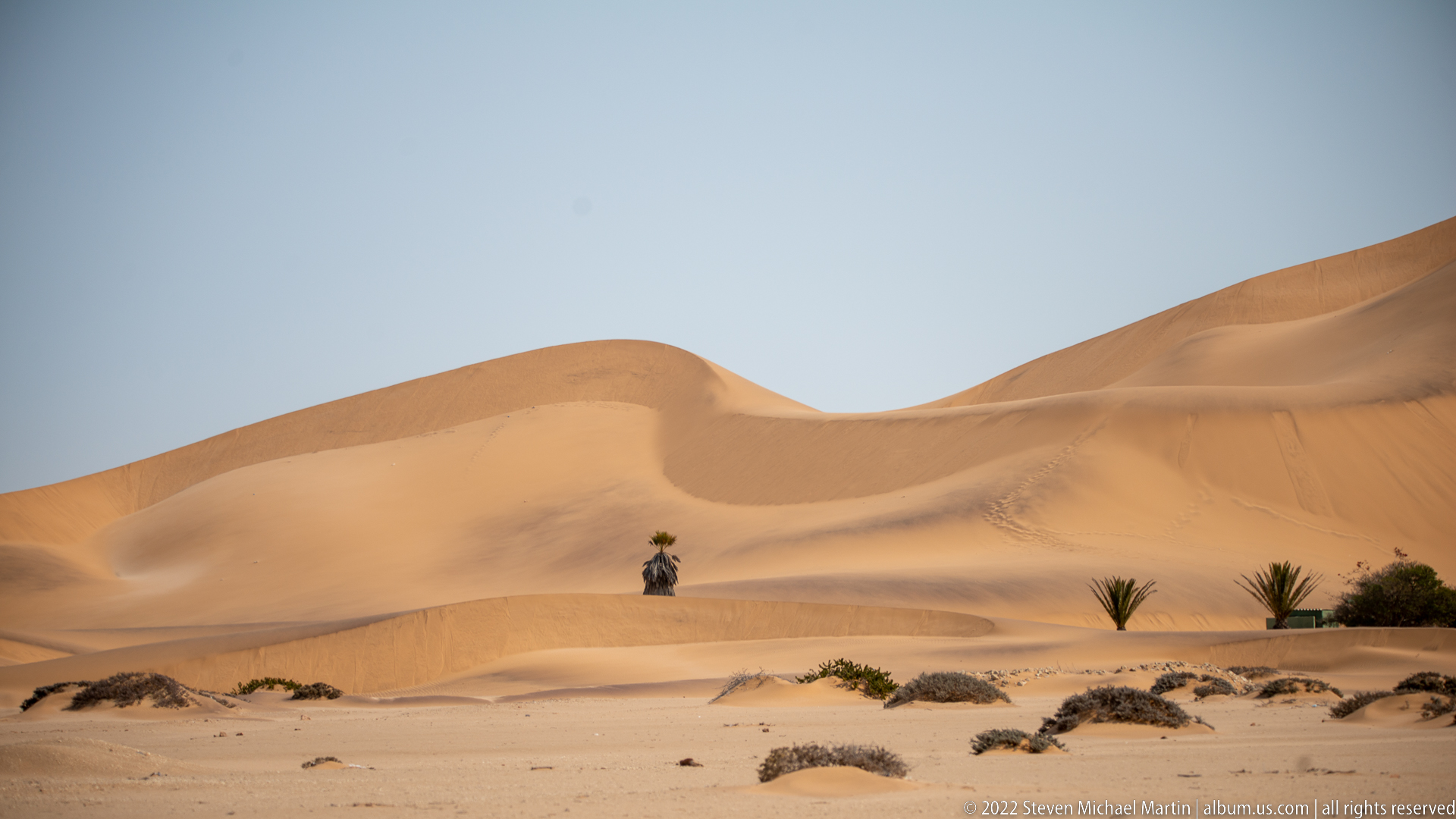
Broad orange dunes rise in layered curves above a pale sandy foreground dotted with isolated shrubs and hardy desert plants. The view emphasizes the Namib’s sweeping dune geometry at landscape scale, with one small tree-like plant providing a clear measure of distance and height across the otherwise open terrain.
Caption
Broad orange dunes rise in layered curves above a pale sandy foreground dotted with isolated shrubs and hardy desert plants. The view emphasizes the Namib’s sweeping dune geometry at landscape scale, with one small tree-like plant providing a clear measure of distance and height across the otherwise open terrain.
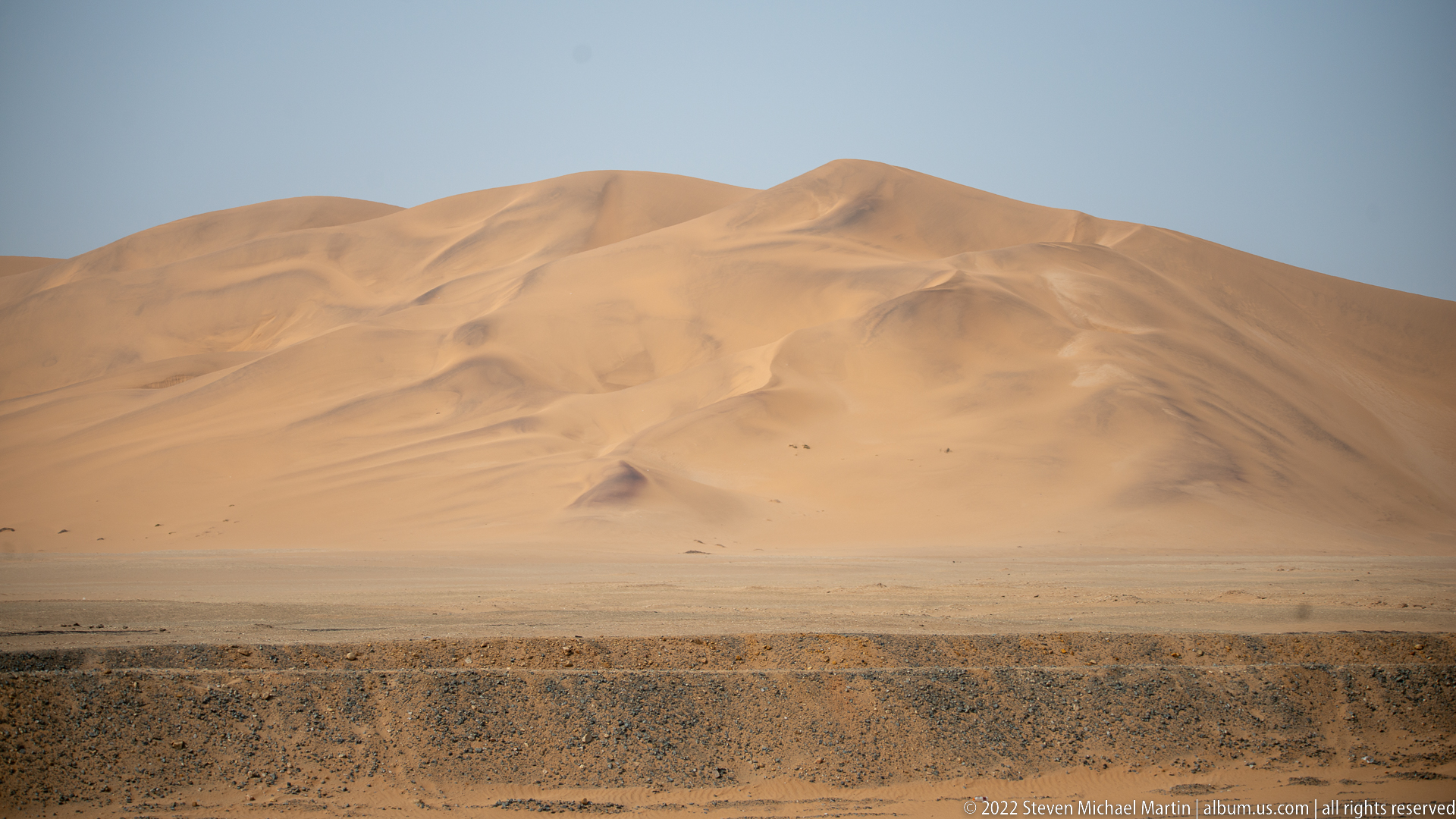
A monumental dune complex rises abruptly from a flat gravel plain, its ridges, bowls, and wind-carved faces layered by changing light. The broad frontal view reveals multiple generations of overlapping crests rather than a single simple ridge. Tiny dark marks near the base provide scale, while the nearly vegetation-free foreground emphasizes the stark meeting of gravel desert and accumulated sand.
Caption
A monumental dune complex rises abruptly from a flat gravel plain, its ridges, bowls, and wind-carved faces layered by changing light. The broad frontal view reveals multiple generations of overlapping crests rather than a single simple ridge. Tiny dark marks near the base provide scale, while the nearly vegetation-free foreground emphasizes the stark meeting of gravel desert and accumulated sand.
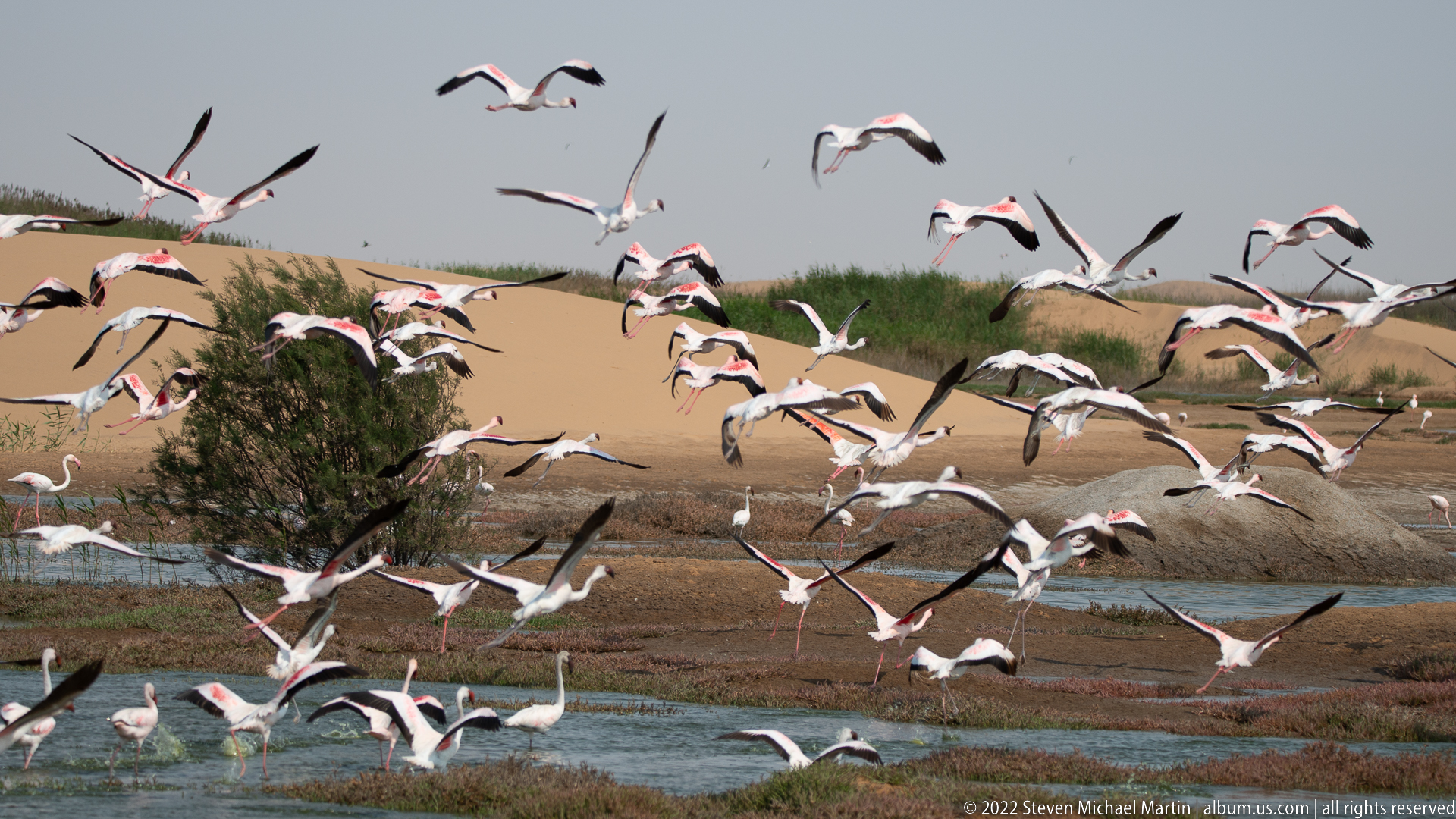
Greater flamingos sweep across the wetland in a broad, layered flight, their long necks and legs extended and their black-and-pink wings fully visible. Birds occupy multiple depths from the near foreground to the dune-backed distance, creating a sense of continuous movement. A few flamingos remain on the water below, linking the airborne flock to the feeding habitat they have just left.
Caption
Greater flamingos sweep across the wetland in a broad, layered flight, their long necks and legs extended and their black-and-pink wings fully visible. Birds occupy multiple depths from the near foreground to the dune-backed distance, creating a sense of continuous movement. A few flamingos remain on the water below, linking the airborne flock to the feeding habitat they have just left.
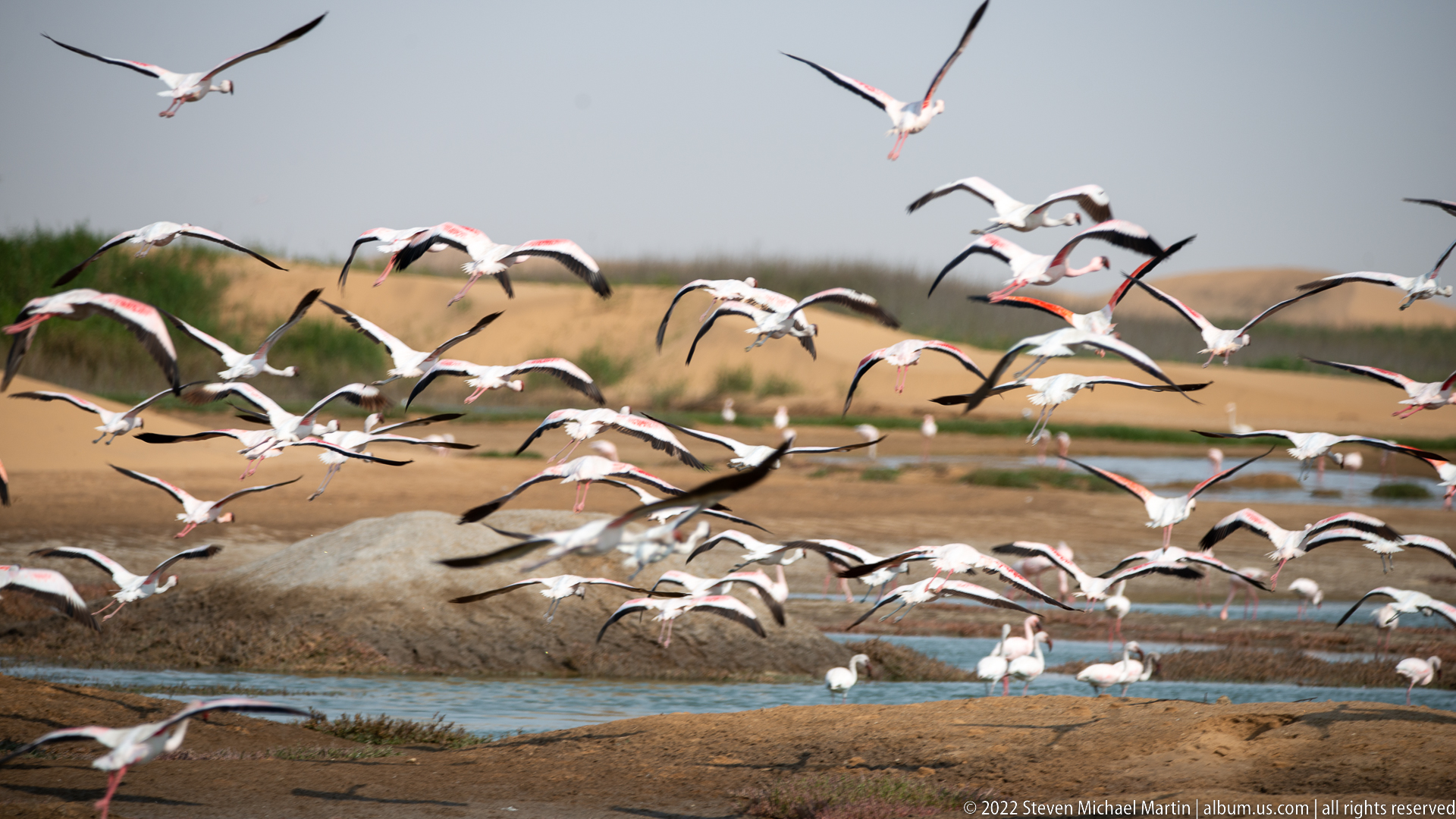
Greater flamingos stream low over the wetland in staggered lines, crossing above muddy islets and narrow blue channels. The flock is more dispersed than in the preceding views, allowing individual long-legged silhouettes and wing patterns to stand out. Dunes and low vegetation remain soft in the background, keeping attention on the birds’ directional movement across the lagoon.
Caption
Greater flamingos stream low over the wetland in staggered lines, crossing above muddy islets and narrow blue channels. The flock is more dispersed than in the preceding views, allowing individual long-legged silhouettes and wing patterns to stand out. Dunes and low vegetation remain soft in the background, keeping attention on the birds’ directional movement across the lagoon.
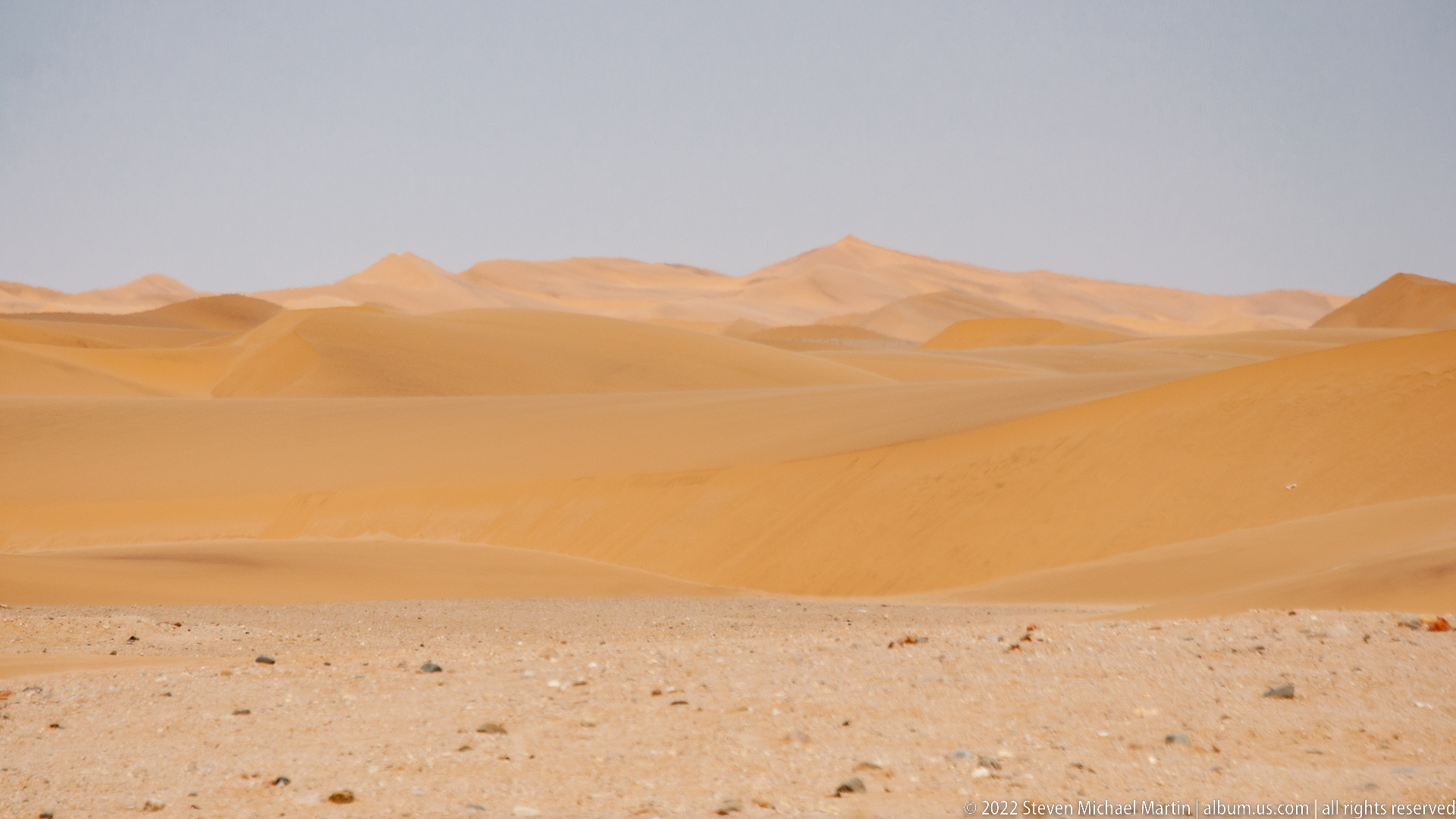
A broad field of overlapping Namib dunes fills the frame, its high crests and long slip faces modeled by soft desert light. The nearest dune forms a sweeping diagonal across the composition, partially masking more distant peaks. A narrow strip of gravelly ground at the bottom provides scale and a textural counterpoint to the smooth wind-shaped sand.
Caption
A broad field of overlapping Namib dunes fills the frame, its high crests and long slip faces modeled by soft desert light. The nearest dune forms a sweeping diagonal across the composition, partially masking more distant peaks. A narrow strip of gravelly ground at the bottom provides scale and a textural counterpoint to the smooth wind-shaped sand.
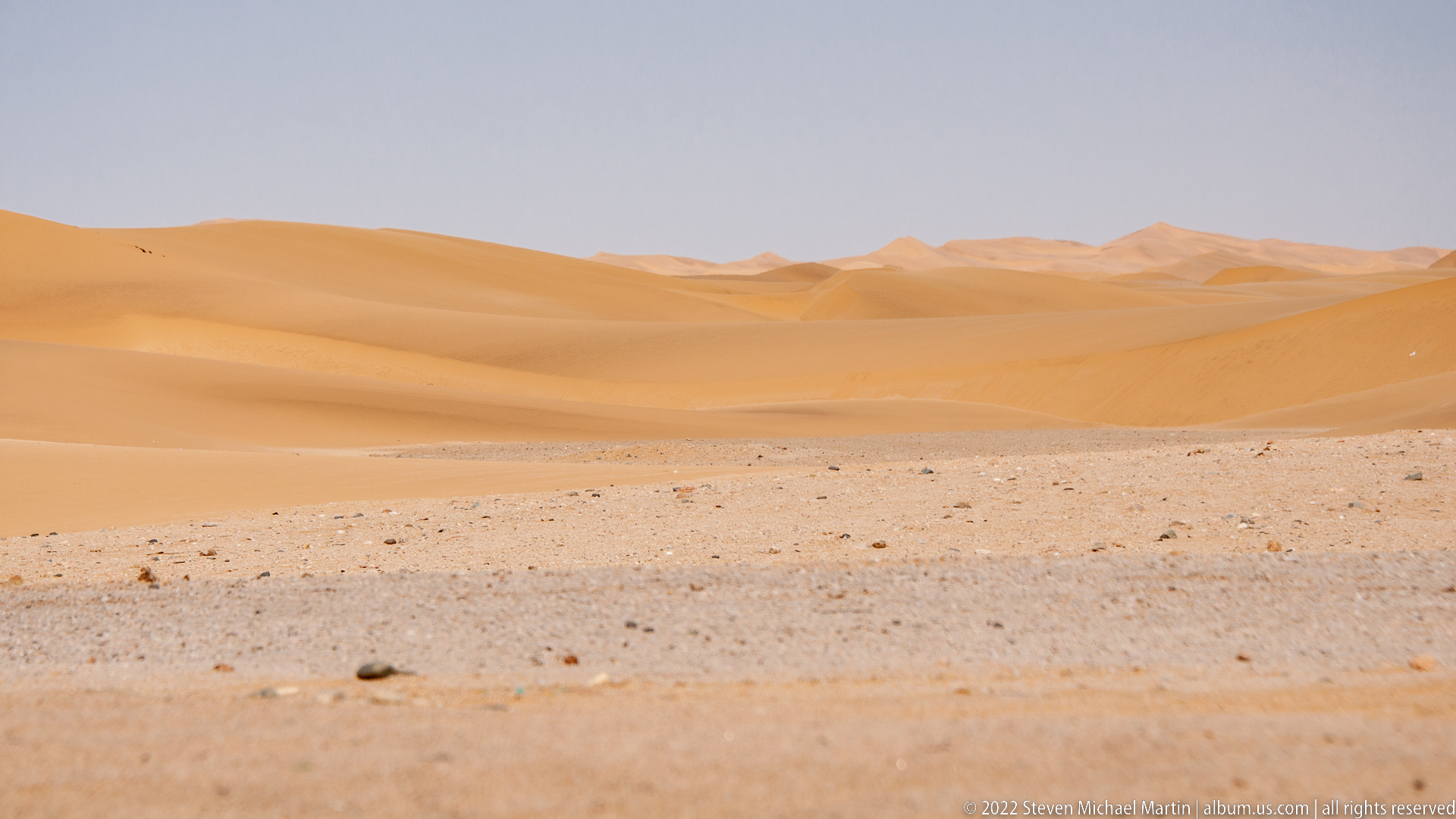
Bands of orange sand dunes rise beyond a pale, stony desert foreground, creating a layered study of the Namib’s contrasting surfaces. Wind-smoothed dune crests overlap from front to back, with subtle shifts in light defining their slopes. The low viewpoint keeps the gravel plain prominent and separates the hard, pebbled surface from the mobile sand beyond.
Caption
Bands of orange sand dunes rise beyond a pale, stony desert foreground, creating a layered study of the Namib’s contrasting surfaces. Wind-smoothed dune crests overlap from front to back, with subtle shifts in light defining their slopes. The low viewpoint keeps the gravel plain prominent and separates the hard, pebbled surface from the mobile sand beyond.
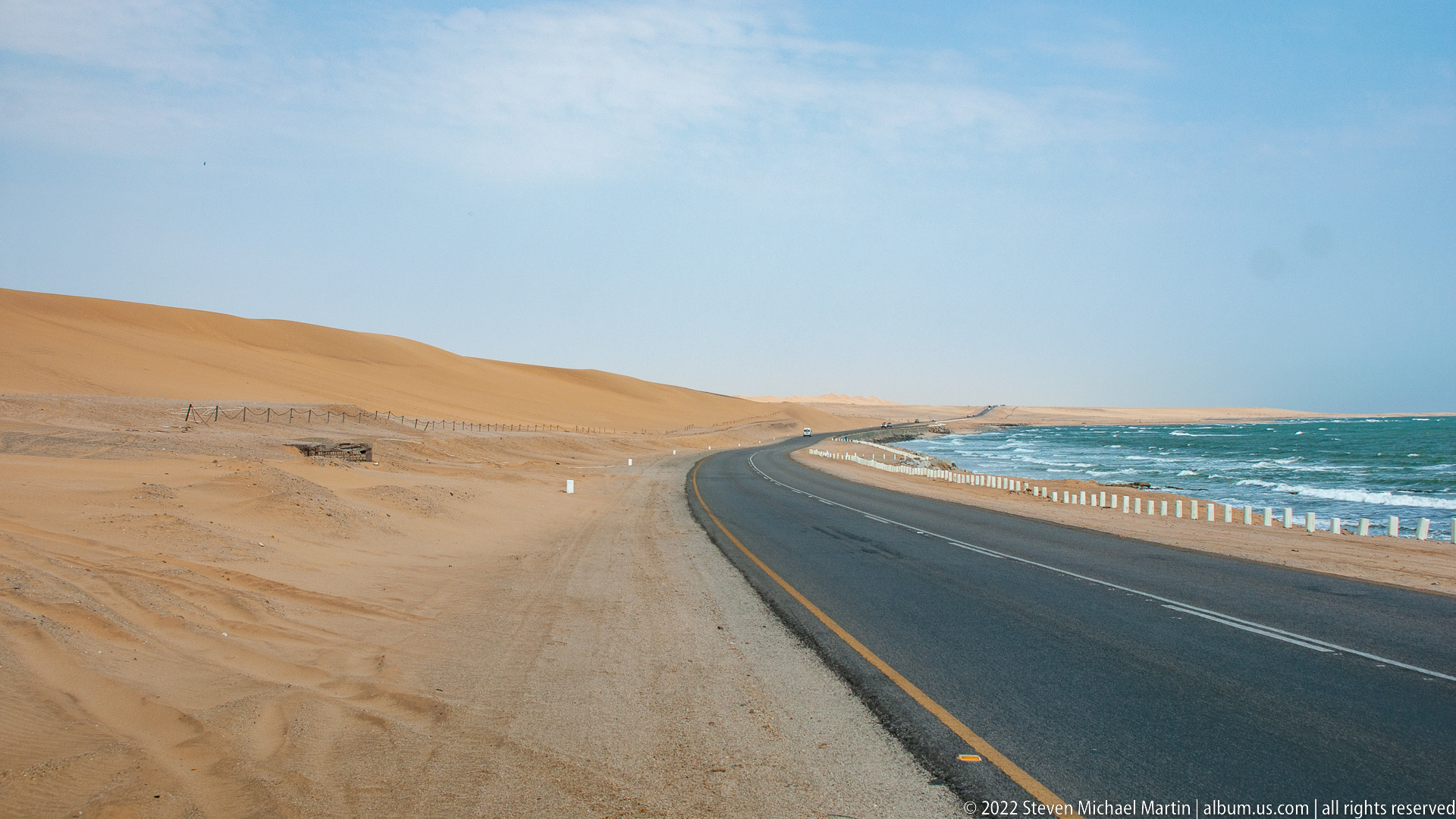
A paved coastal highway curves between the Namib’s sand dunes and a surf-lined ocean shore, compressing two sharply different environments into one view. Guard posts trace the seaward edge while windblown sand encroaches on the inland shoulder. The photograph shows how road infrastructure occupies the narrow transition between an active dune field and the Atlantic coastline.
Caption
A paved coastal highway curves between the Namib’s sand dunes and a surf-lined ocean shore, compressing two sharply different environments into one view. Guard posts trace the seaward edge while windblown sand encroaches on the inland shoulder. The photograph shows how road infrastructure occupies the narrow transition between an active dune field and the Atlantic coastline.
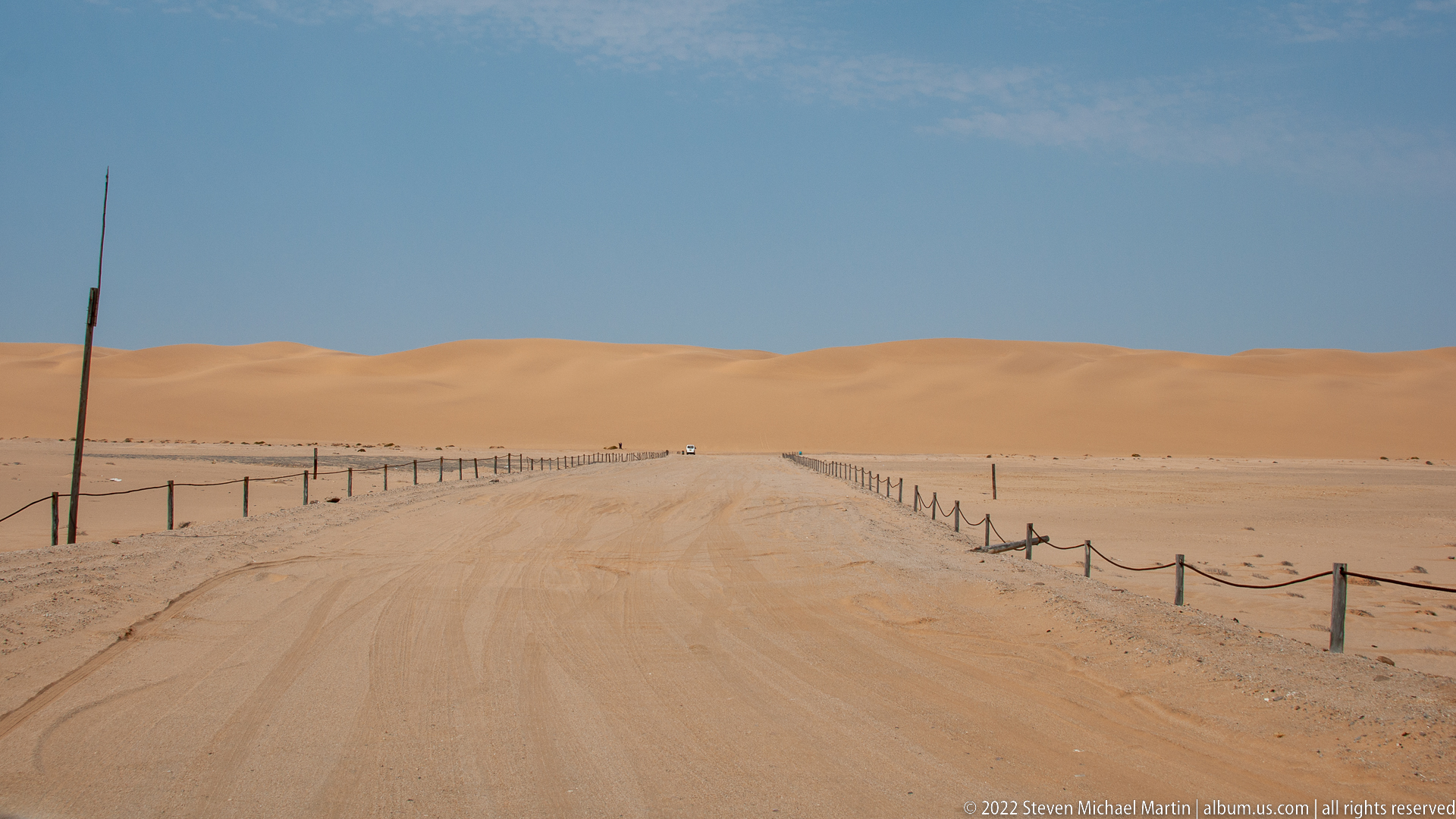
A sandy vehicle track runs straight toward low dunes across a flat, pale desert plain. Simple posts linked by dark rope or wire define both sides of the route, guiding traffic through the fragile dune-margin landscape. Tire marks and wind-rippled sand record repeated passage, while the uninterrupted blue sky and distant dune ridge reinforce the openness of the Namib setting.
Caption
A sandy vehicle track runs straight toward low dunes across a flat, pale desert plain. Simple posts linked by dark rope or wire define both sides of the route, guiding traffic through the fragile dune-margin landscape. Tire marks and wind-rippled sand record repeated passage, while the uninterrupted blue sky and distant dune ridge reinforce the openness of the Namib setting.
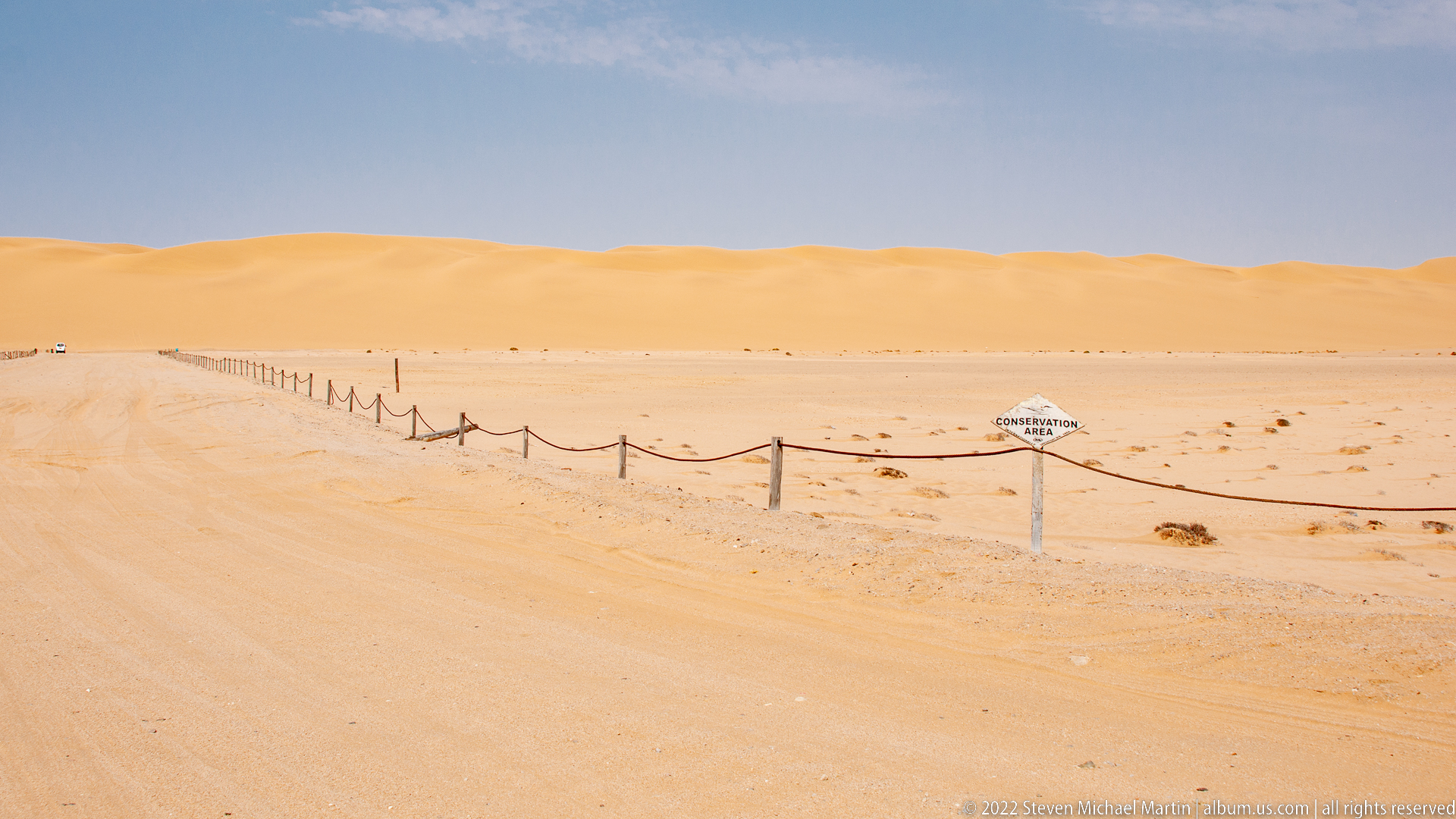
A marked sandy route crosses the Namib toward a long orange dune ridge, bordered by low posts and rope intended to keep vehicles within the established corridor. A small diamond-shaped sign stands beside the track, but its lettering is too small to read reliably on the proof sheet. The scene emphasizes controlled access across an otherwise open, wind-shaped desert surface.
Caption
A marked sandy route crosses the Namib toward a long orange dune ridge, bordered by low posts and rope intended to keep vehicles within the established corridor. A small diamond-shaped sign stands beside the track, but its lettering is too small to read reliably on the proof sheet. The scene emphasizes controlled access across an otherwise open, wind-shaped desert surface.
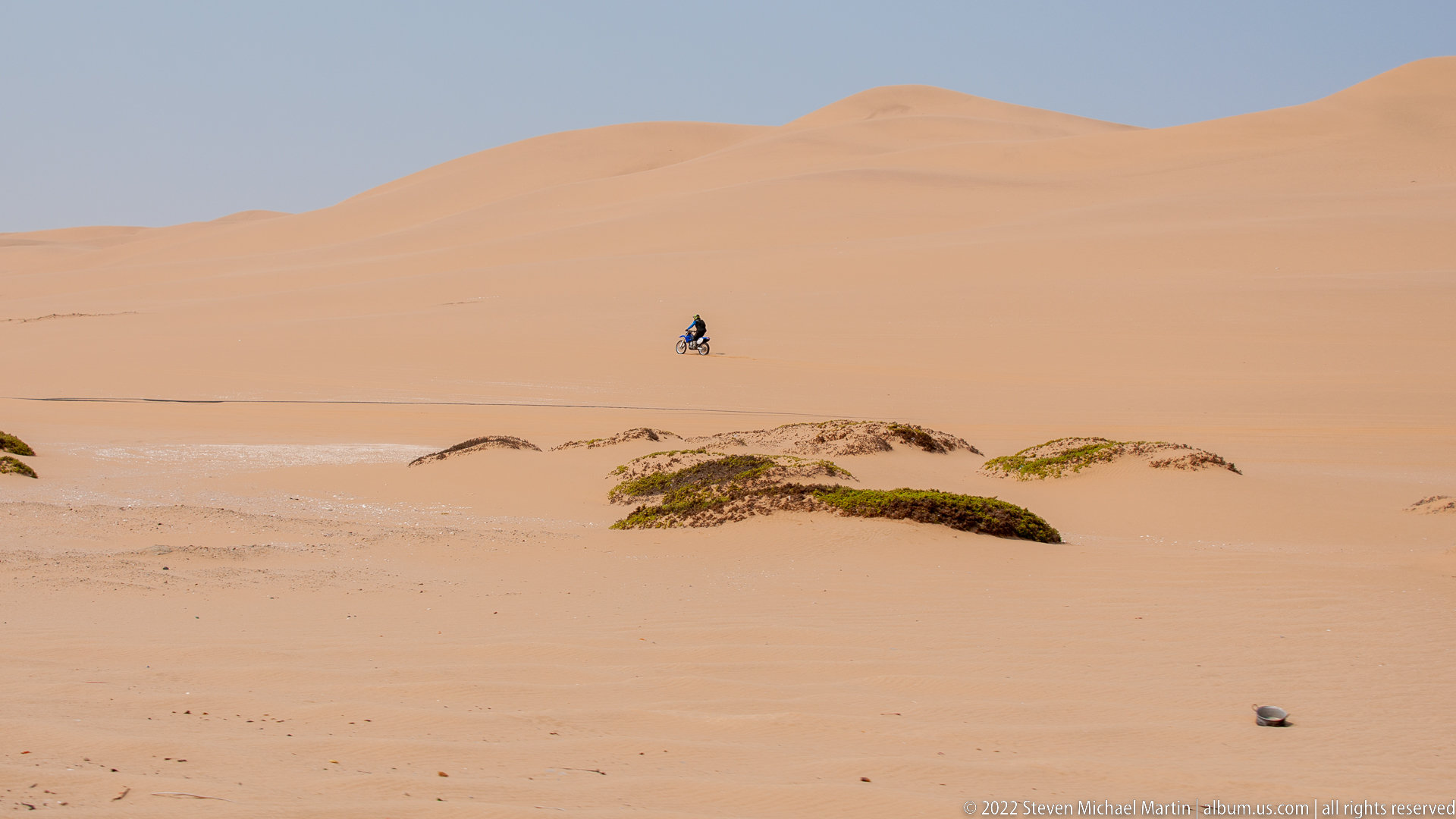
A lone visitor appears as a small figure against the immense face of a Namib sand dune, giving the landscape an immediate sense of scale. Low patches of hardy vegetation interrupt the pale sand in the foreground, while the smooth dune rises in broad curves behind. The composition centers human movement within an environment dominated by wind-shaped terrain.
Caption
A lone visitor appears as a small figure against the immense face of a Namib sand dune, giving the landscape an immediate sense of scale. Low patches of hardy vegetation interrupt the pale sand in the foreground, while the smooth dune rises in broad curves behind. The composition centers human movement within an environment dominated by wind-shaped terrain.
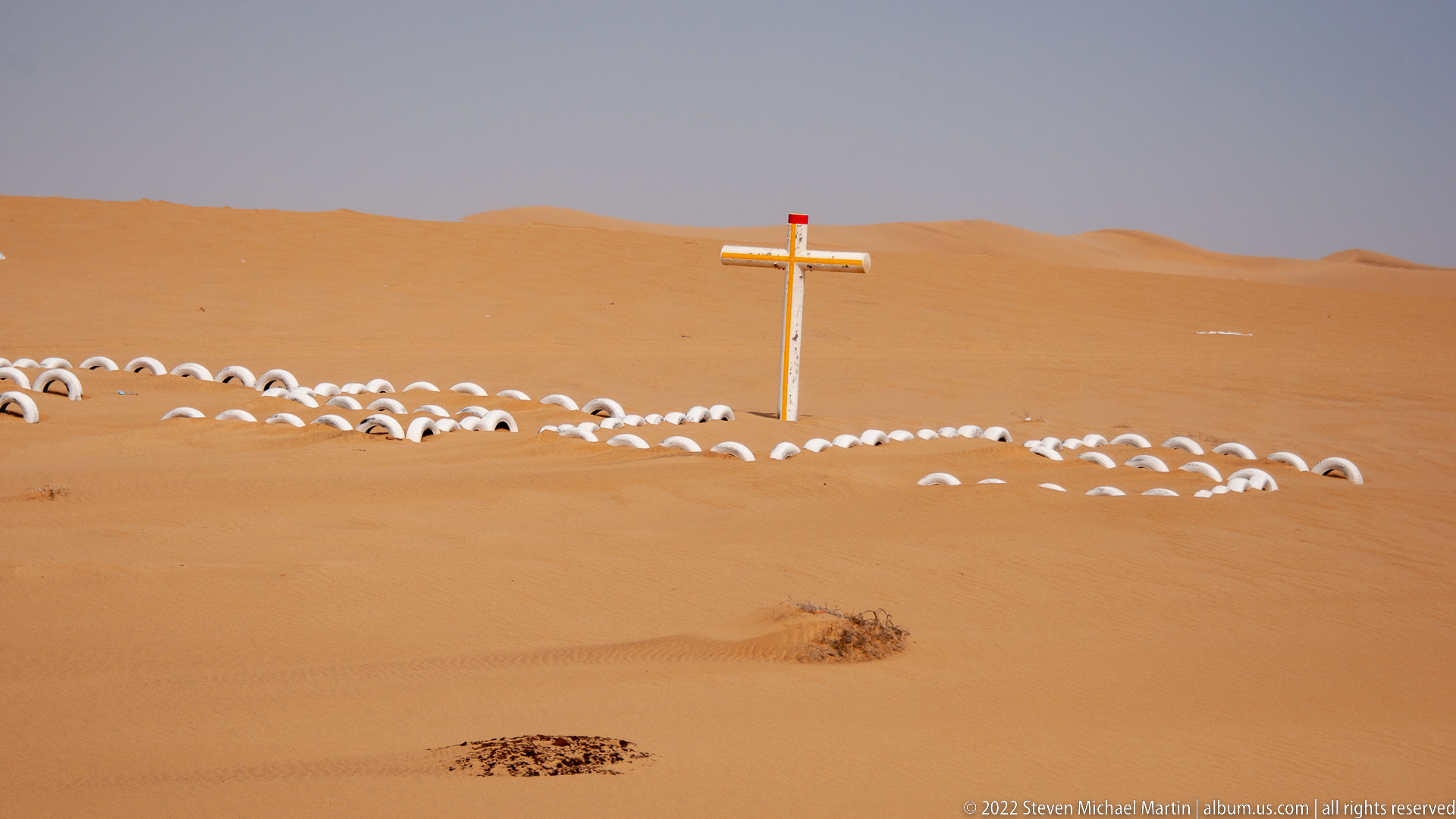
A cross-shaped roadside marker rises from the sand amid rows of half-buried white-painted tires, with uninterrupted dunes behind it. The improvised boundary treatment forms a conspicuous geometric pattern against the orange desert. No readable place-name is visible at proof-sheet scale, so the photograph is best understood as a marked point along a managed desert route rather than a specifically named landmark.
Caption
A cross-shaped roadside marker rises from the sand amid rows of half-buried white-painted tires, with uninterrupted dunes behind it. The improvised boundary treatment forms a conspicuous geometric pattern against the orange desert. No readable place-name is visible at proof-sheet scale, so the photograph is best understood as a marked point along a managed desert route rather than a specifically named landmark.
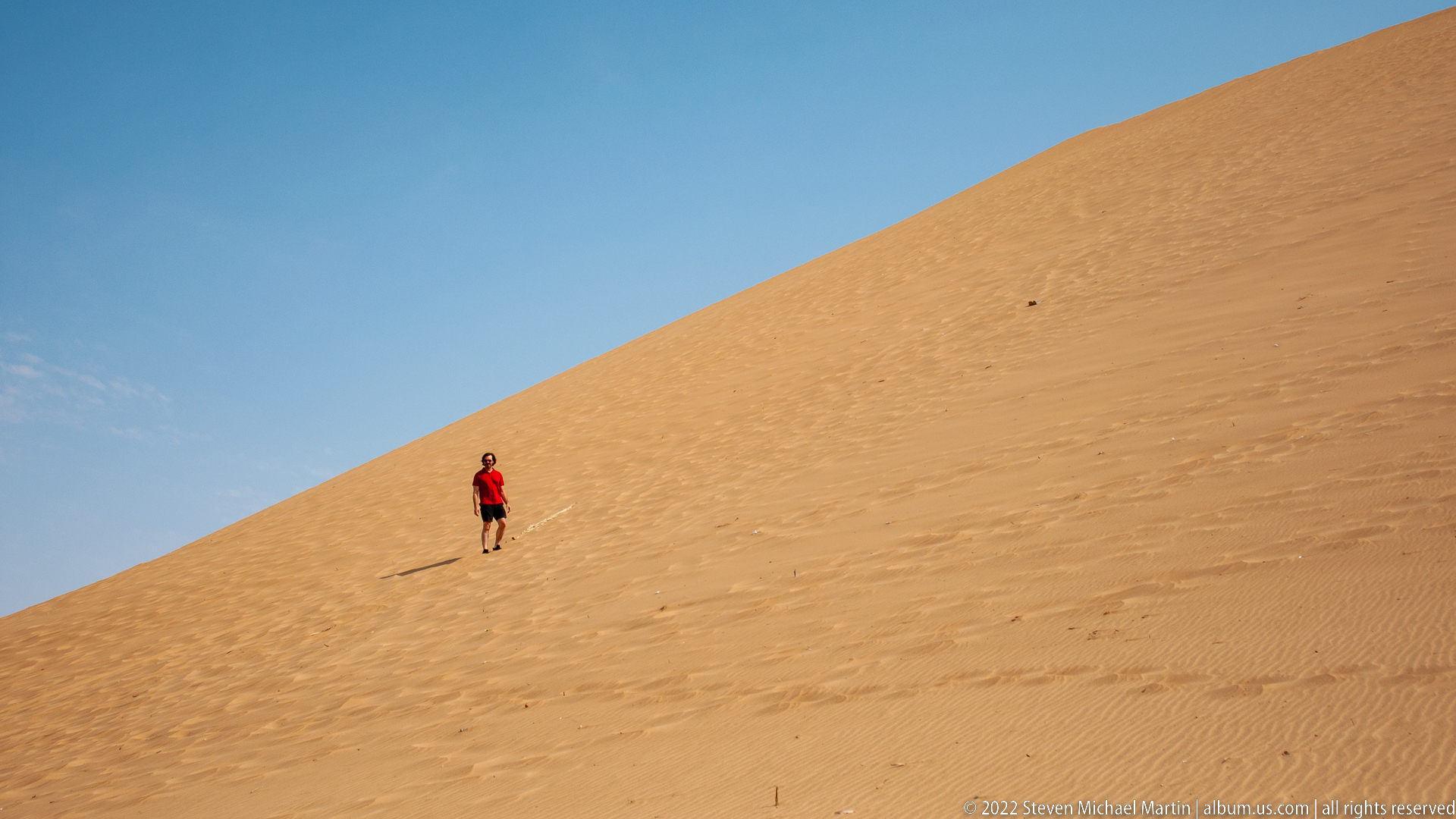
A visitor in a red shirt descends the steep face of a Namib dune, isolated against a broad diagonal of golden sand and blue sky. Footprints and faint wind ripples texture the slope, while the figure’s long shadow indicates strong, low-angled sunlight. The spare composition turns the dune’s incline into the principal visual element and uses the person to register its scale.
Caption
A visitor in a red shirt descends the steep face of a Namib dune, isolated against a broad diagonal of golden sand and blue sky. Footprints and faint wind ripples texture the slope, while the figure’s long shadow indicates strong, low-angled sunlight. The spare composition turns the dune’s incline into the principal visual element and uses the person to register its scale.
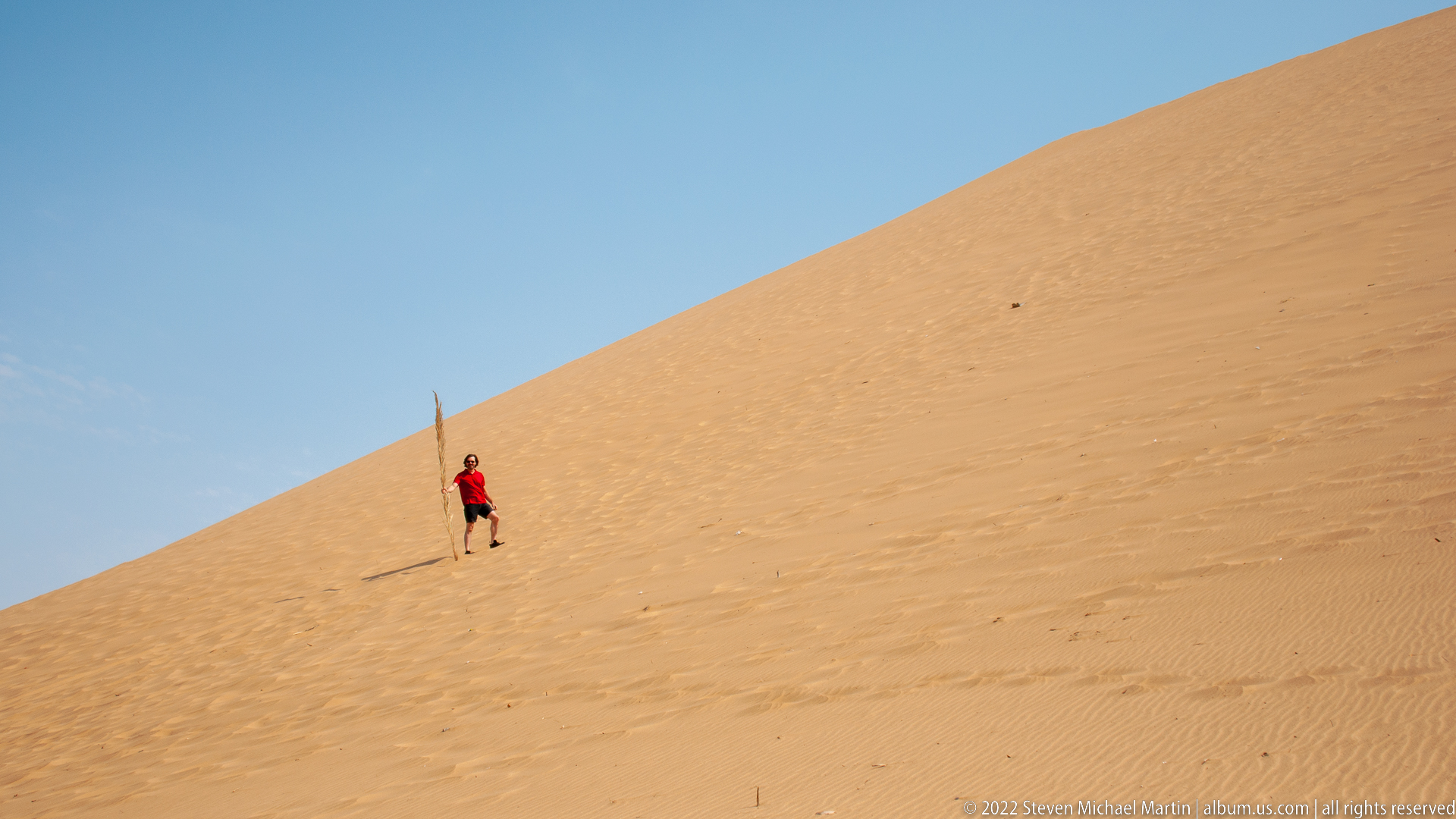
Seen farther across the slope, a visitor in red traverses a steep Namib dune beneath an expansive blue sky. The dune’s clean diagonal edge divides the frame, while a trail of footprints records the route across the sand. Compared with the neighboring view, the greater expanse of open slope emphasizes distance and the physical effort of moving through the dune field.
Caption
Seen farther across the slope, a visitor in red traverses a steep Namib dune beneath an expansive blue sky. The dune’s clean diagonal edge divides the frame, while a trail of footprints records the route across the sand. Compared with the neighboring view, the greater expanse of open slope emphasizes distance and the physical effort of moving through the dune field.
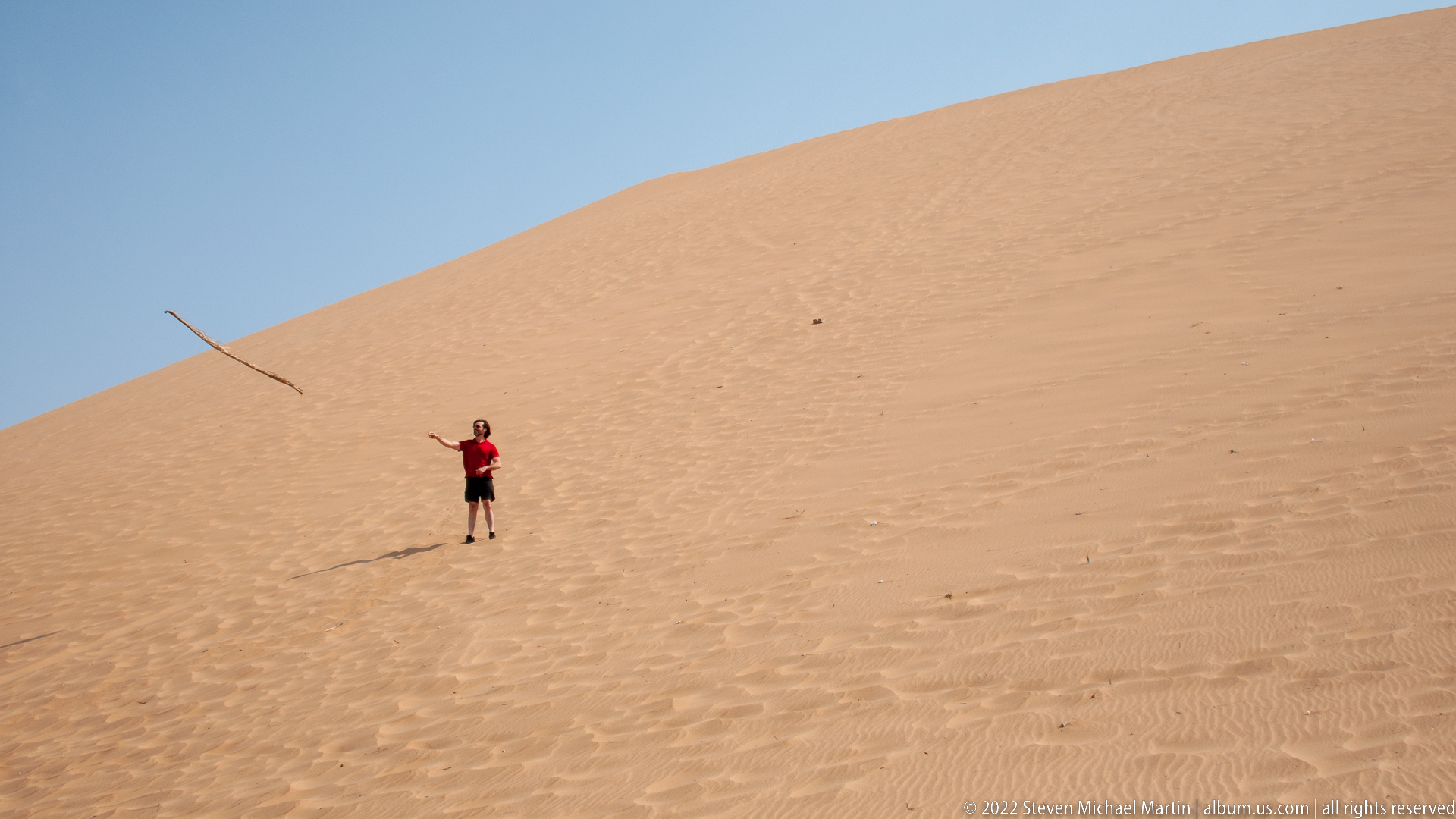
A visitor stands on the lower face of a massive Namib dune, one arm extended while a long slender pole angles upward across the sand. Wind ripples and footprints pattern the slope around the figure, and the uninterrupted dune crest rises beyond the frame. The unusual gesture and pole distinguish this moment from the surrounding walking views while preserving the dune’s overwhelming scale.
Caption
A visitor stands on the lower face of a massive Namib dune, one arm extended while a long slender pole angles upward across the sand. Wind ripples and footprints pattern the slope around the figure, and the uninterrupted dune crest rises beyond the frame. The unusual gesture and pole distinguish this moment from the surrounding walking views while preserving the dune’s overwhelming scale.
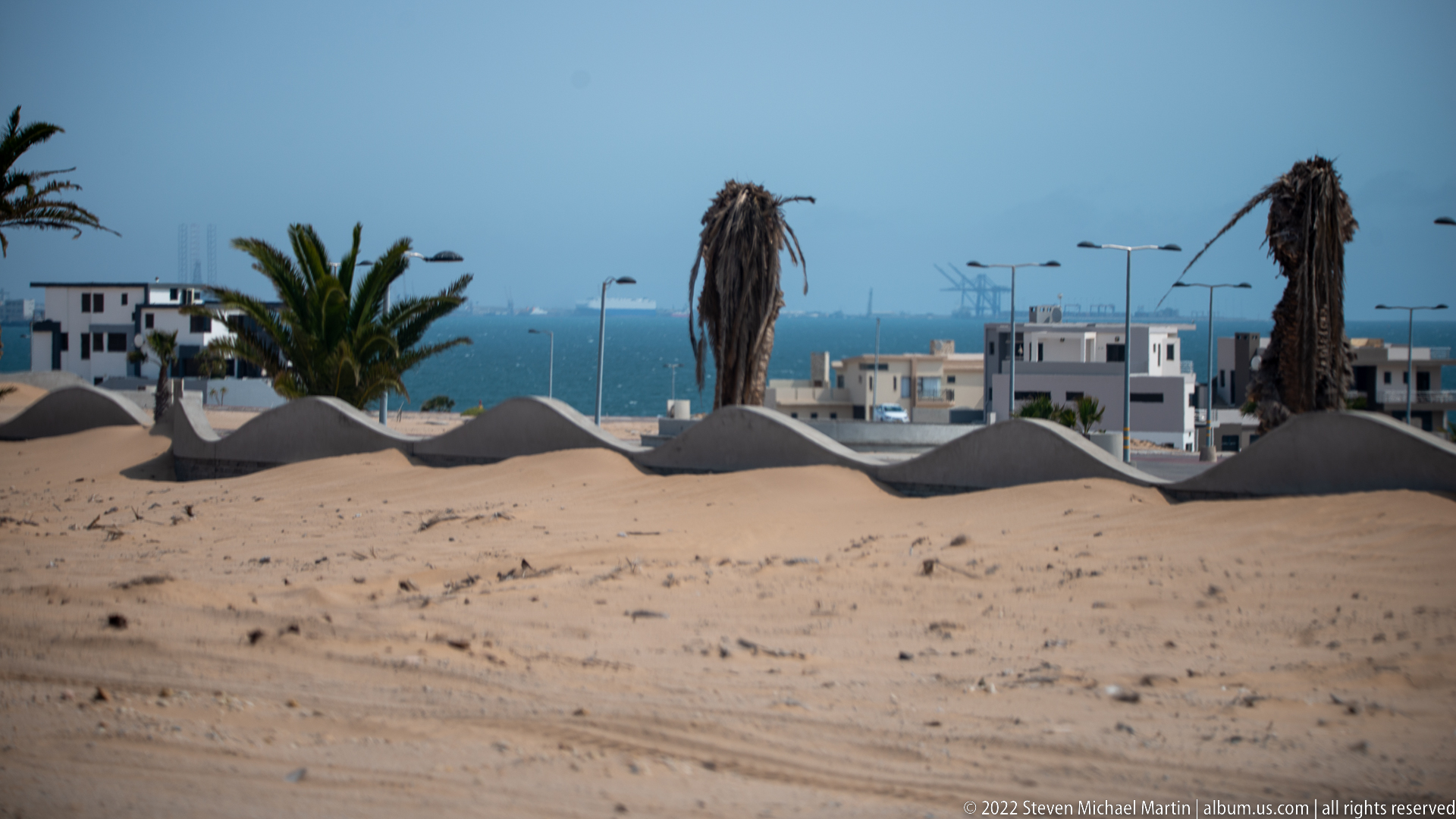
Modern white buildings and tall palms occupy the narrow margin between encroaching Namib sand and the blue Atlantic in the distance. A low undulating wall follows the settlement edge, while port cranes are faintly visible on the horizon. The layered view shows urban infrastructure pressed closely between desert and coast, a defining spatial condition of Namibia’s central Atlantic shoreline.
Caption
Modern white buildings and tall palms occupy the narrow margin between encroaching Namib sand and the blue Atlantic in the distance. A low undulating wall follows the settlement edge, while port cranes are faintly visible on the horizon. The layered view shows urban infrastructure pressed closely between desert and coast, a defining spatial condition of Namibia’s central Atlantic shoreline.

Tall date palms rise behind a low, wave-shaped wall at the edge of the Namib sands, with white buildings and distant harbor cranes visible toward the coast. The tighter framing than the preceding view emphasizes vegetation and the designed boundary between settlement and desert. Sand has accumulated directly against the wall, underscoring the proximity of active dunes to the built environment.
Caption
Tall date palms rise behind a low, wave-shaped wall at the edge of the Namib sands, with white buildings and distant harbor cranes visible toward the coast. The tighter framing than the preceding view emphasizes vegetation and the designed boundary between settlement and desert. Sand has accumulated directly against the wall, underscoring the proximity of active dunes to the built environment.
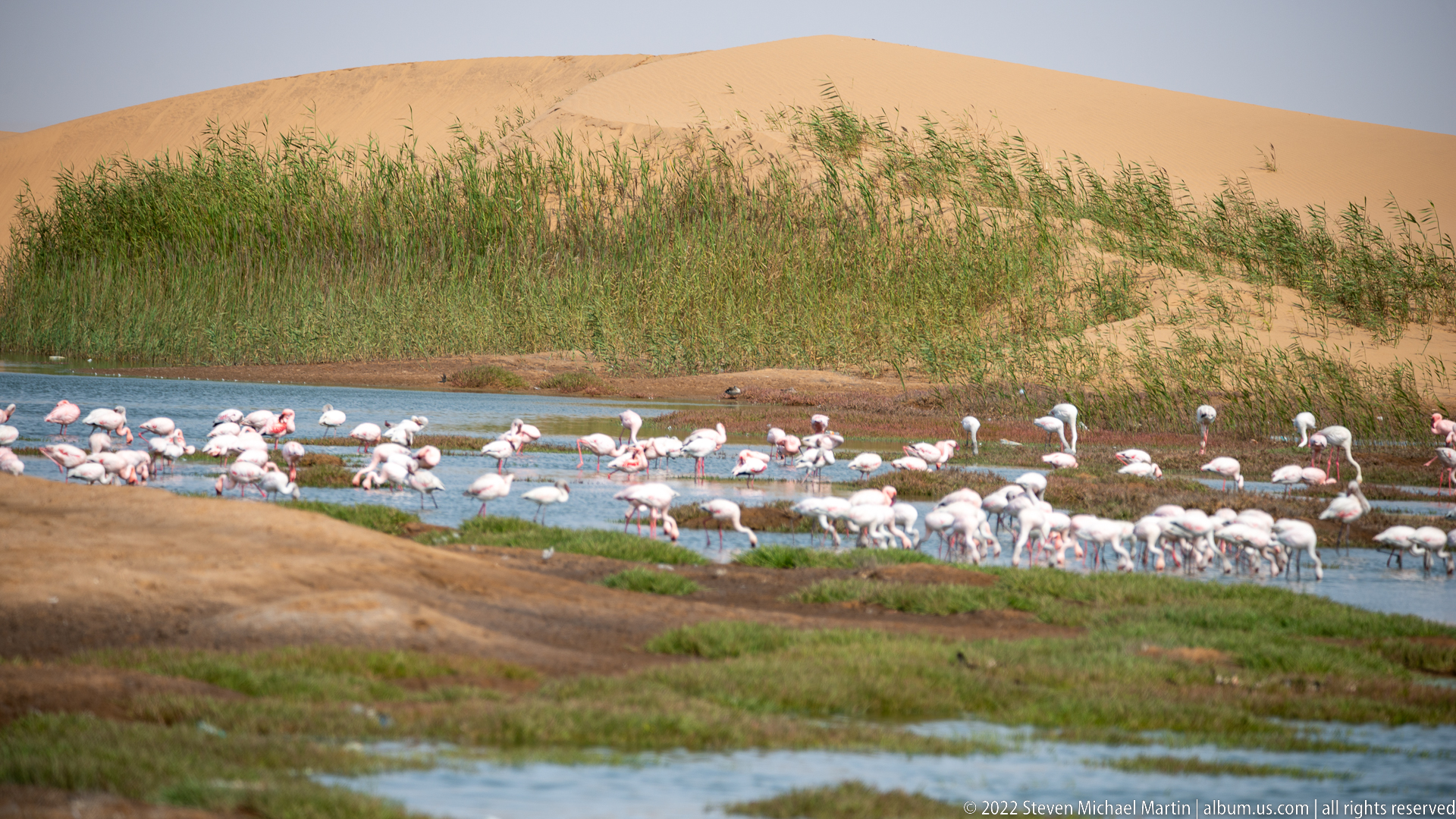
A large flock of greater flamingos feeds in shallow coastal wetland channels, backed by reed-like vegetation and a high Namib dune. Birds are dispersed across water and exposed mud, many with heads lowered as they forage. The juxtaposition of pink-and-white flamingos, green marsh growth, and orange sand demonstrates the sharp ecological transition where desert dunes meet a productive coastal lagoon.
Caption
A large flock of greater flamingos feeds in shallow coastal wetland channels, backed by reed-like vegetation and a high Namib dune. Birds are dispersed across water and exposed mud, many with heads lowered as they forage. The juxtaposition of pink-and-white flamingos, green marsh growth, and orange sand demonstrates the sharp ecological transition where desert dunes meet a productive coastal lagoon.
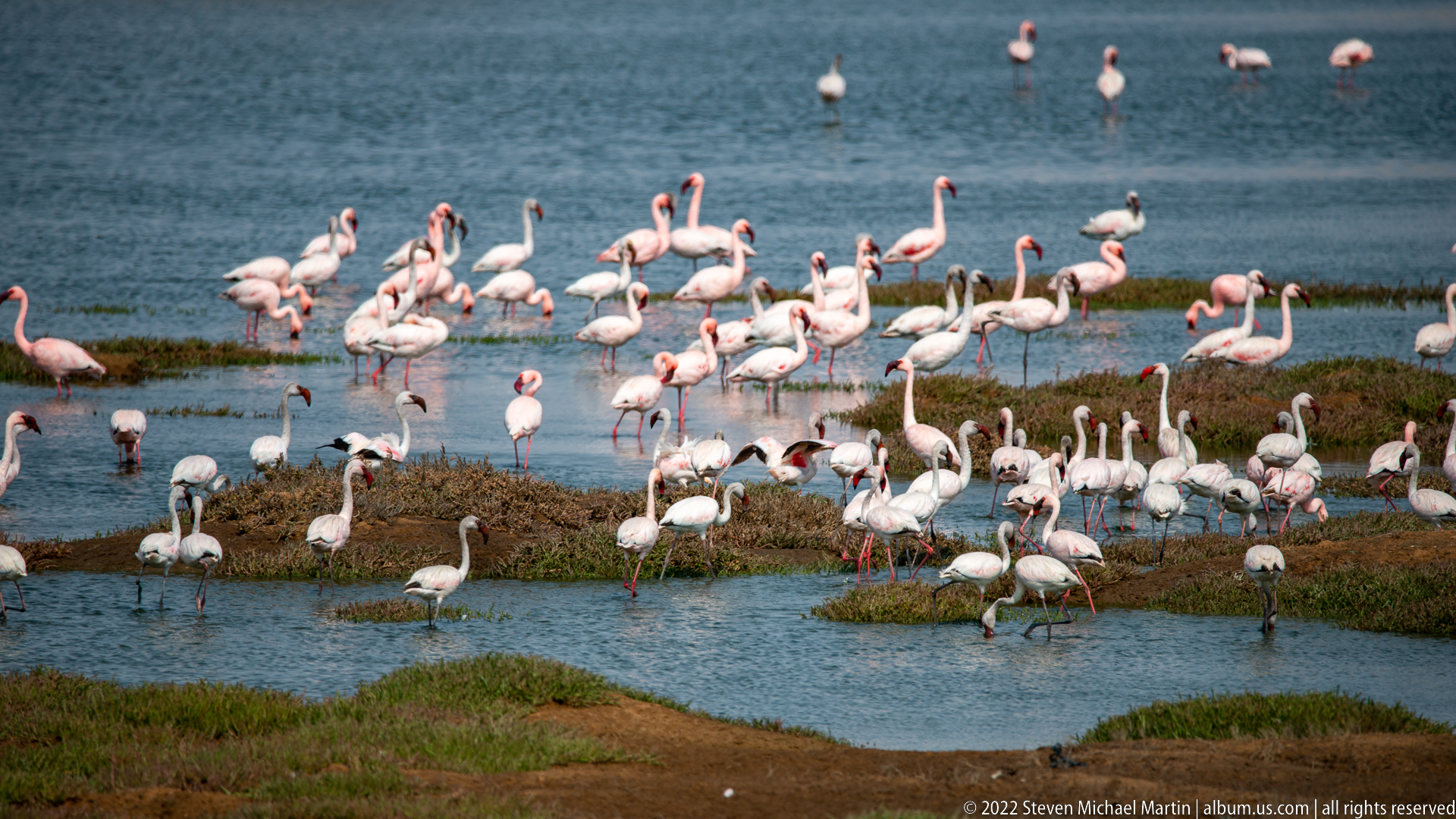
Greater flamingos crowd shallow pools and low vegetated islets, creating dense bands of pale bodies and pink legs across the wetland. Some birds stand upright while others sweep their bills through the water to feed. Open blue water behind the flock separates the birds from the distant shore and makes the variation in posture, age, and plumage especially visible.
Caption
Greater flamingos crowd shallow pools and low vegetated islets, creating dense bands of pale bodies and pink legs across the wetland. Some birds stand upright while others sweep their bills through the water to feed. Open blue water behind the flock separates the birds from the distant shore and makes the variation in posture, age, and plumage especially visible.
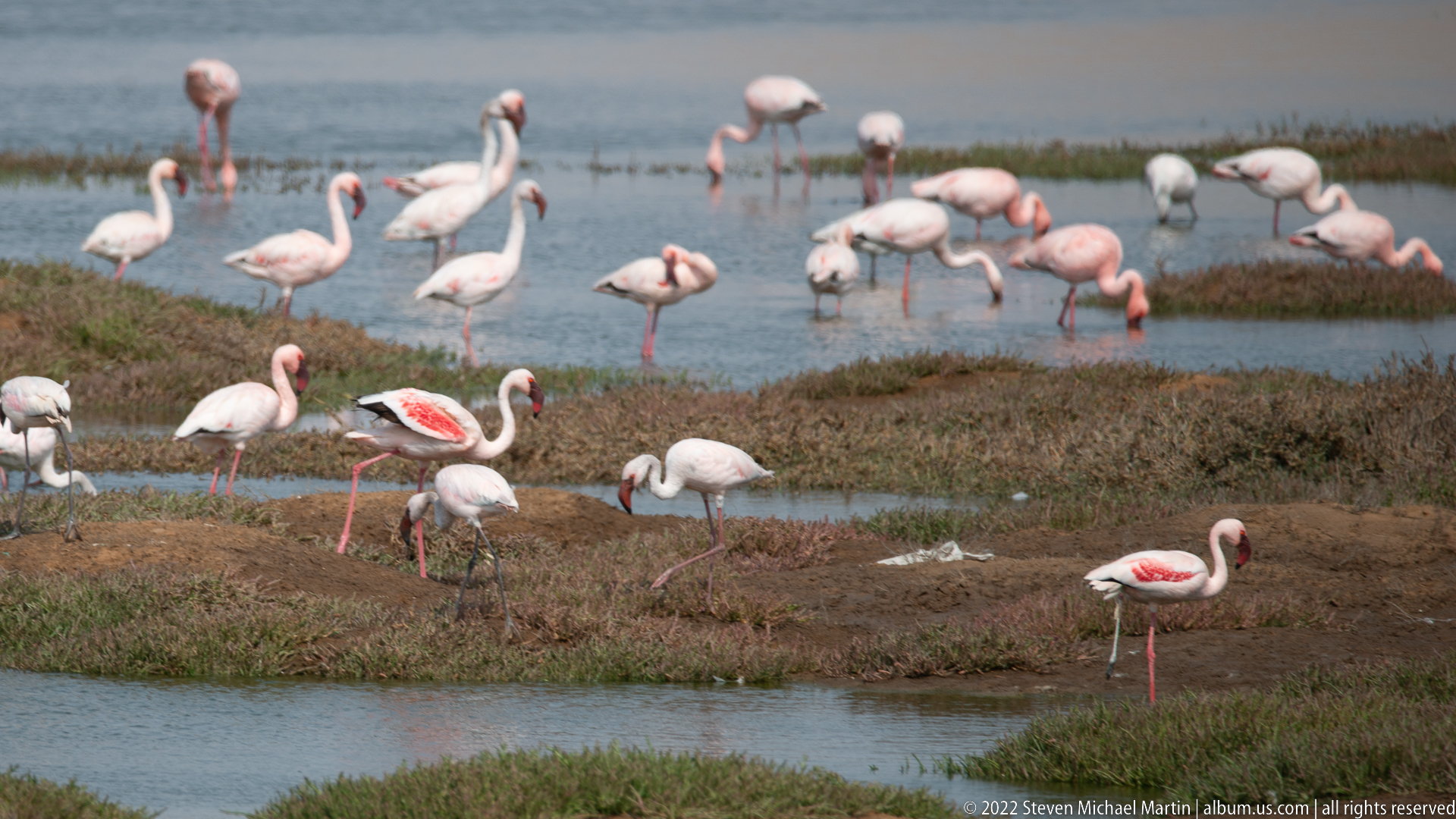
A closer view isolates greater flamingos feeding along muddy, vegetation-fringed channels. Several birds bend their long necks downward with bills submerged, while others stand upright on pink legs; flashes of stronger coral color appear on folded wings. The tighter composition shifts attention from flock scale to individual feeding postures and the mosaic of shallow water, mud, and salt-tolerant vegetation.
Caption
A closer view isolates greater flamingos feeding along muddy, vegetation-fringed channels. Several birds bend their long necks downward with bills submerged, while others stand upright on pink legs; flashes of stronger coral color appear on folded wings. The tighter composition shifts attention from flock scale to individual feeding postures and the mosaic of shallow water, mud, and salt-tolerant vegetation.
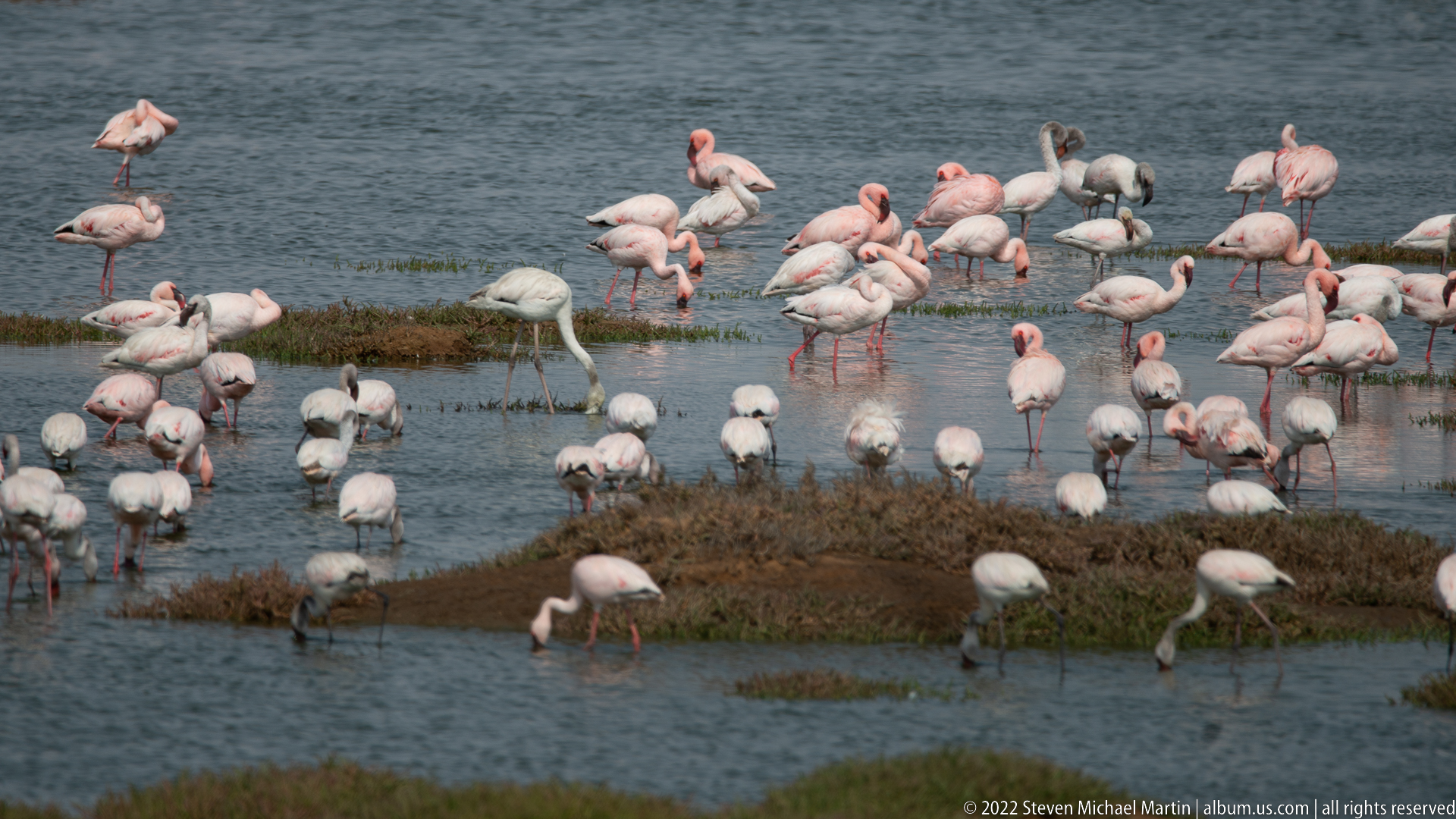
A dense concentration of greater flamingos wades through shallow lagoon water around small muddy islands. Repeated white bodies, pink legs, and curved necks fill the frame, with many birds simultaneously feeding below the waterline. The compressed perspective emphasizes flock density and social foraging, while the alternating strips of water and exposed substrate reveal the very shallow conditions favored by the birds.
Caption
A dense concentration of greater flamingos wades through shallow lagoon water around small muddy islands. Repeated white bodies, pink legs, and curved necks fill the frame, with many birds simultaneously feeding below the waterline. The compressed perspective emphasizes flock density and social foraging, while the alternating strips of water and exposed substrate reveal the very shallow conditions favored by the birds.
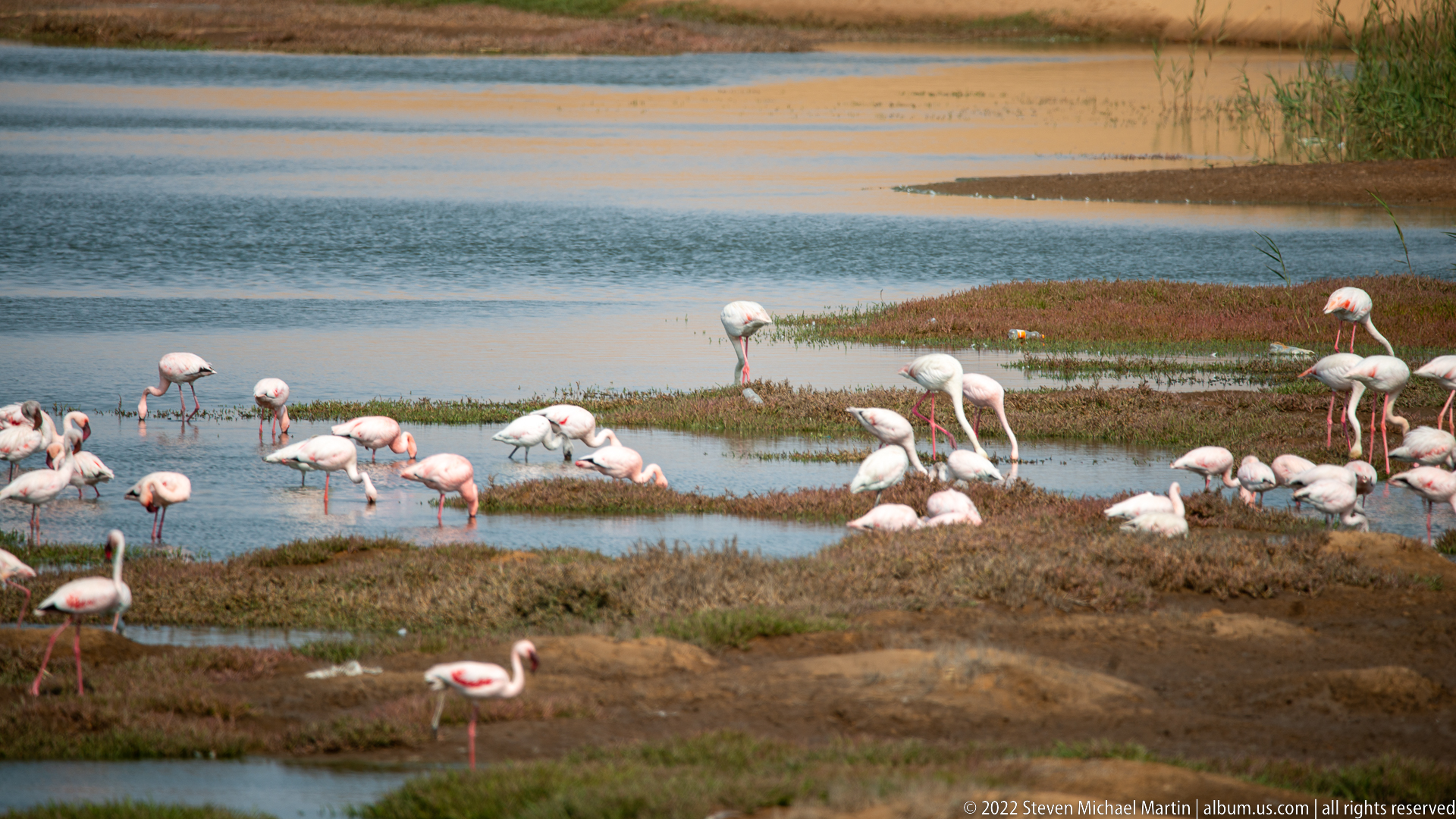
Greater flamingos spread across a network of shallow pools, mudflats, and low vegetation, producing a more open view of the wetland than the denser flock scenes nearby. Birds feed singly and in small groups, their pale plumage reflected faintly in the water. The composition reveals the patchwork habitat structure that supports the flock at the desert’s coastal margin.
Caption
Greater flamingos spread across a network of shallow pools, mudflats, and low vegetation, producing a more open view of the wetland than the denser flock scenes nearby. Birds feed singly and in small groups, their pale plumage reflected faintly in the water. The composition reveals the patchwork habitat structure that supports the flock at the desert’s coastal margin.
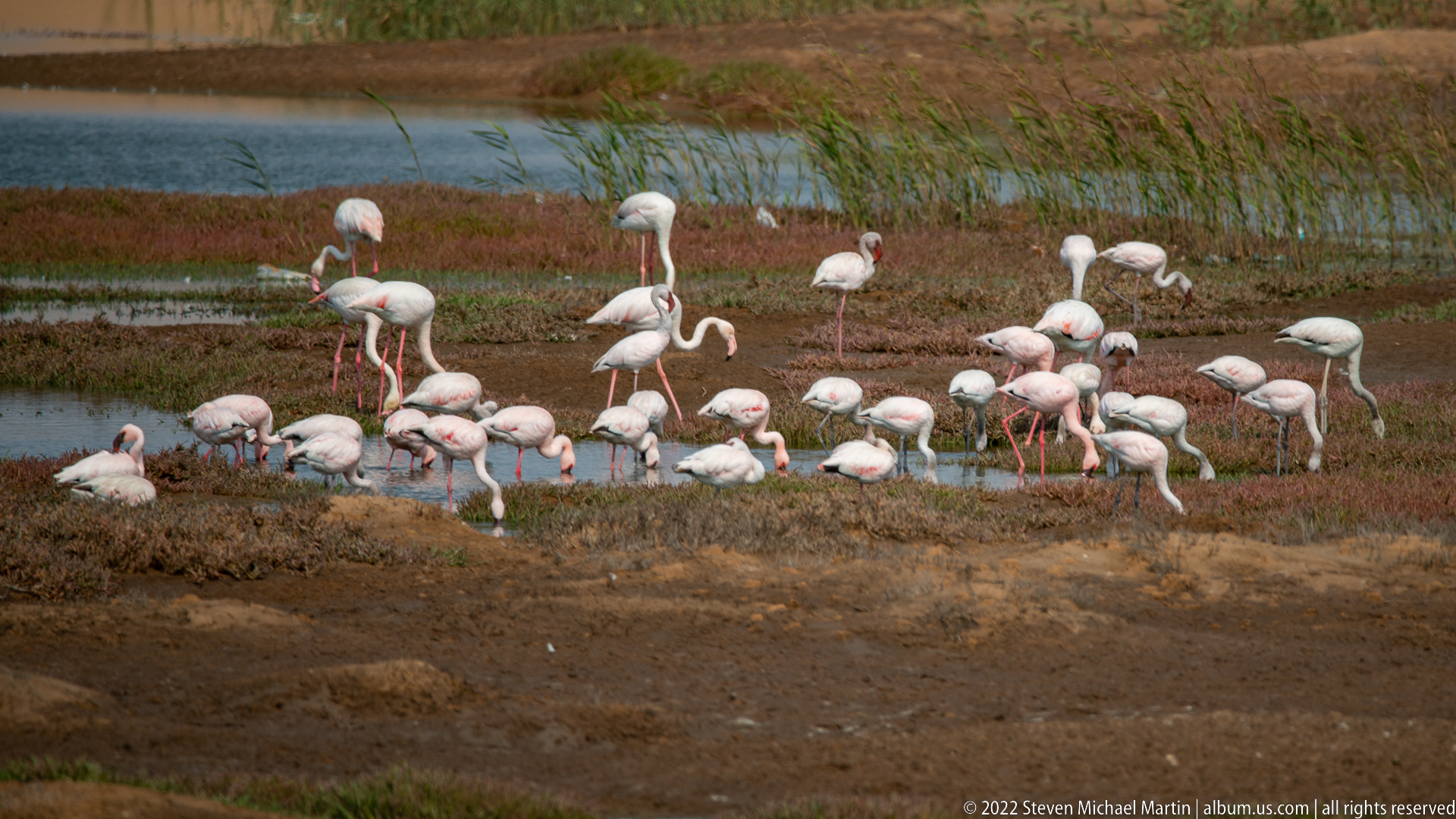
A compact group of greater flamingos feeds along the edge of a shallow wetland channel, with birds distributed between exposed mud and water. Upright individuals reveal long pink legs and pale bodies, while feeding birds fold their necks down toward the substrate. The relatively sparse grouping provides a clear behavioral study against the subdued brown and green tones of the lagoon margin.
Caption
A compact group of greater flamingos feeds along the edge of a shallow wetland channel, with birds distributed between exposed mud and water. Upright individuals reveal long pink legs and pale bodies, while feeding birds fold their necks down toward the substrate. The relatively sparse grouping provides a clear behavioral study against the subdued brown and green tones of the lagoon margin.
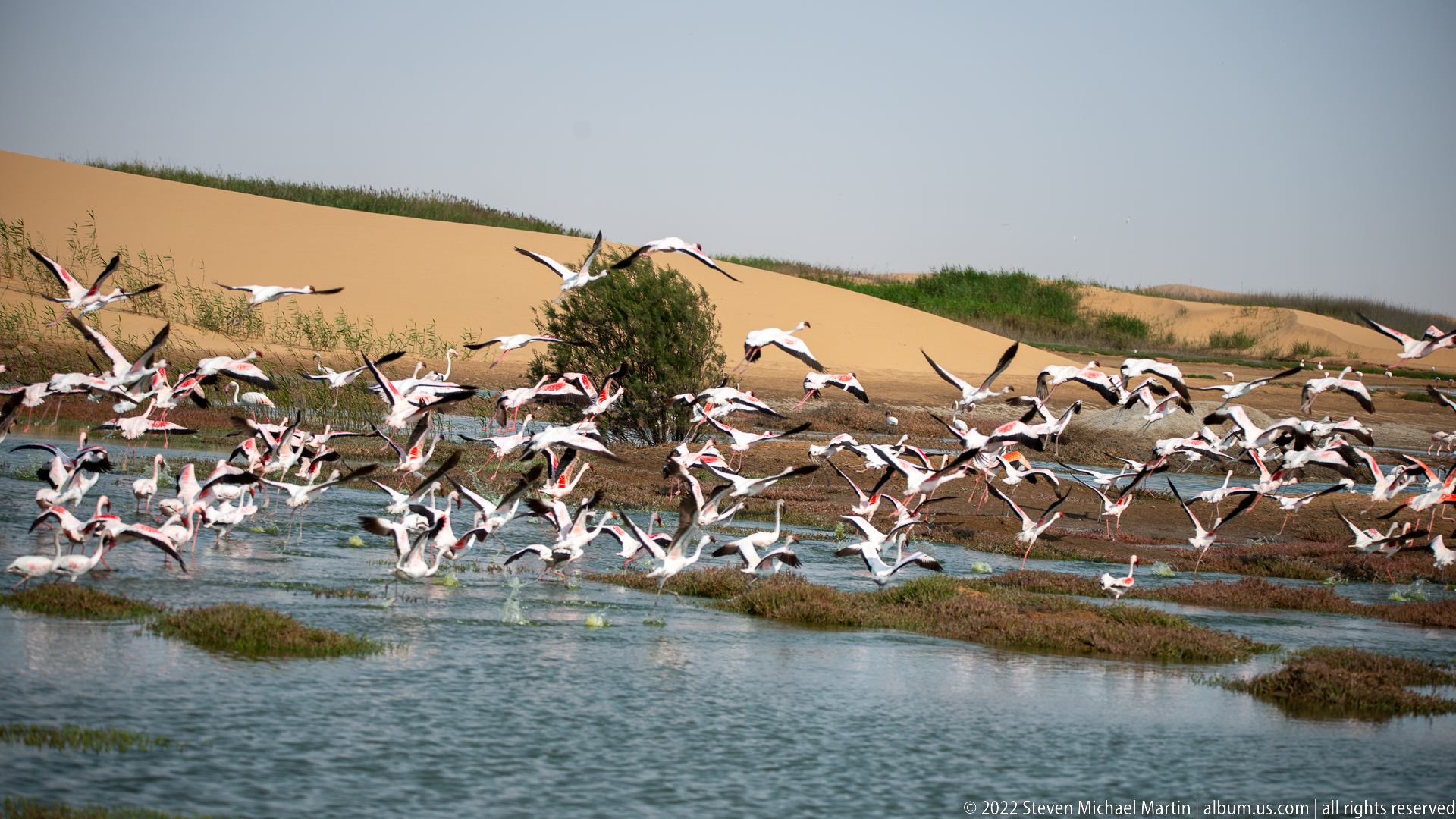
A large flock of greater flamingos erupts from the shallow wetland, wings spread to reveal vivid pink coverts and black flight feathers. Birds skim above water and muddy islets while others are still rising from the lagoon. Orange dunes and sparse green vegetation form the backdrop, making the sudden mass movement especially striking within the otherwise quiet desert-coast landscape.
Caption
A large flock of greater flamingos erupts from the shallow wetland, wings spread to reveal vivid pink coverts and black flight feathers. Birds skim above water and muddy islets while others are still rising from the lagoon. Orange dunes and sparse green vegetation form the backdrop, making the sudden mass movement especially striking within the otherwise quiet desert-coast landscape.
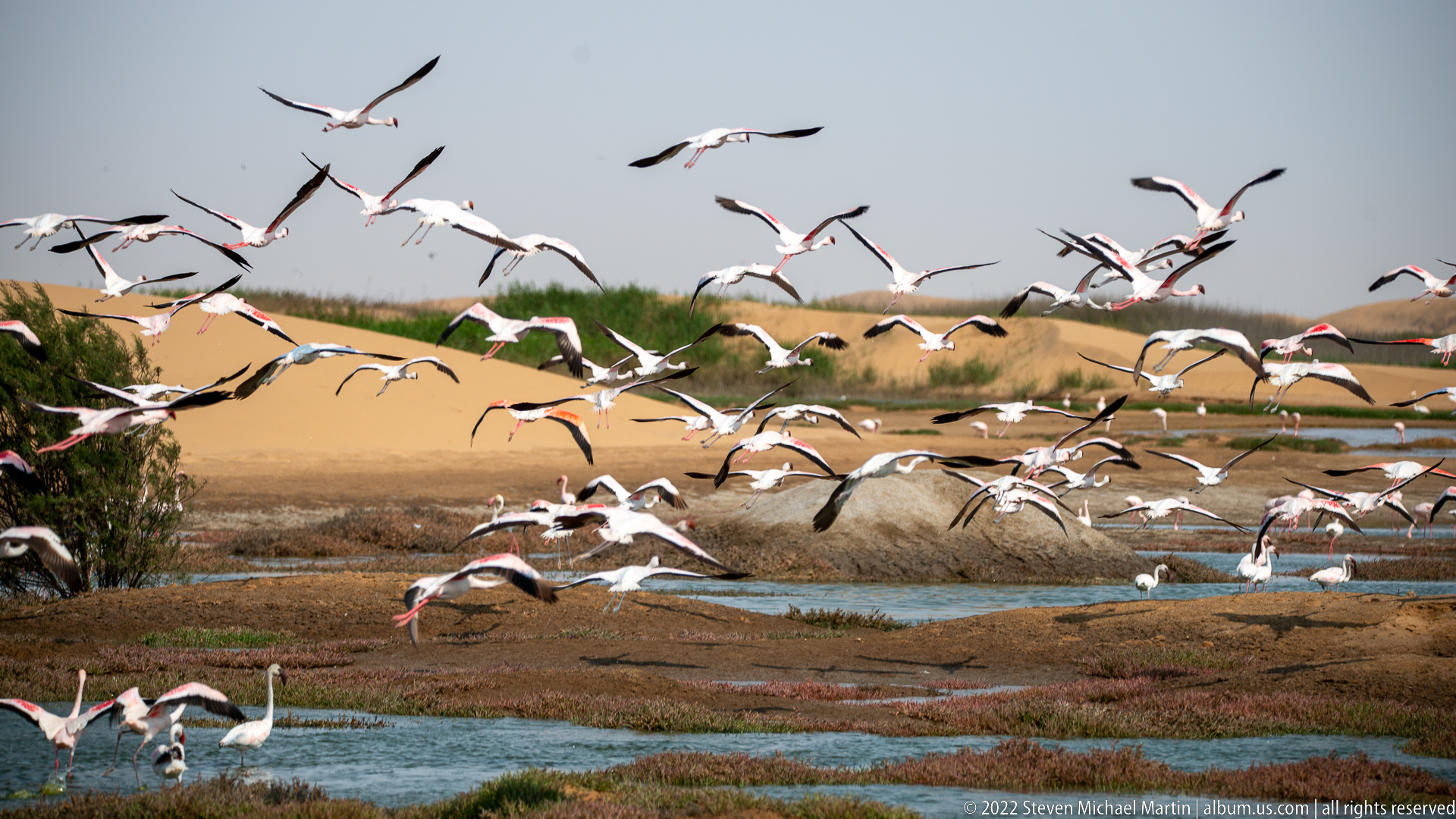
A sweeping flock of greater flamingos banks above shallow lagoon channels, exposing alternating black flight feathers and bright pink wing panels. The birds overlap densely across the sky and dune-backed wetland, while a few remain near the water surface. The photograph concentrates on coordinated flock movement, with repeated wing shapes turning the desert wetland into a dynamic field of motion.
Caption
A sweeping flock of greater flamingos banks above shallow lagoon channels, exposing alternating black flight feathers and bright pink wing panels. The birds overlap densely across the sky and dune-backed wetland, while a few remain near the water surface. The photograph concentrates on coordinated flock movement, with repeated wing shapes turning the desert wetland into a dynamic field of motion.

A telephoto view brings several greater flamingos close to the foreground as they fly above the lagoon, their long necks, trailing legs, and black-edged wings sharply defining the species’ flight form. Other birds blur behind them over water and mud. The compressed depth isolates the physical mechanics of flight from the larger flock spectacle seen in adjacent photographs.
Caption
A telephoto view brings several greater flamingos close to the foreground as they fly above the lagoon, their long necks, trailing legs, and black-edged wings sharply defining the species’ flight form. Other birds blur behind them over water and mud. The compressed depth isolates the physical mechanics of flight from the larger flock spectacle seen in adjacent photographs.
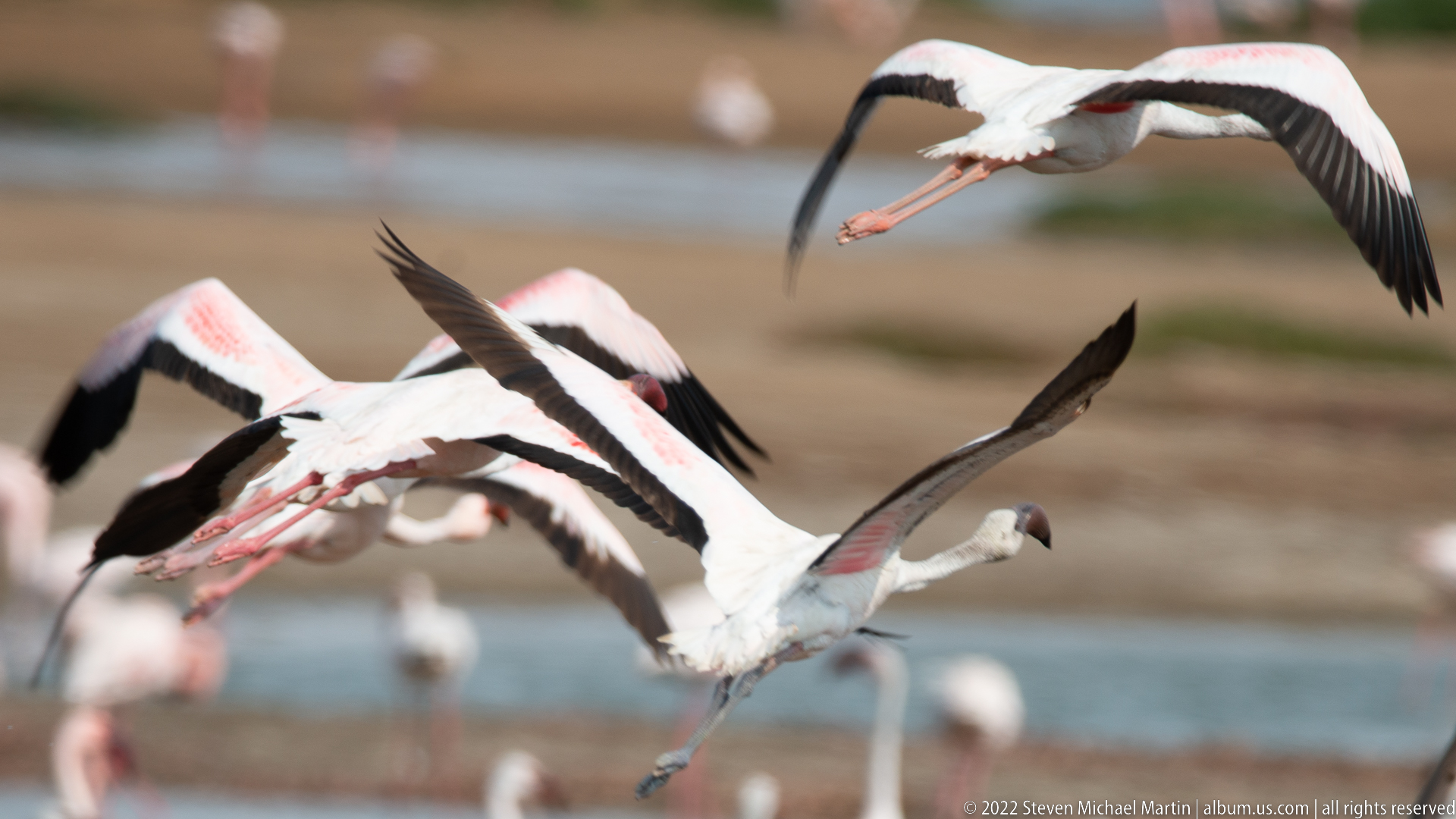
Several greater flamingos cross the frame at close range, wings beating in different phases as they gain height above the wetland. Pink wing coverts and black flight feathers flash against pale bodies, while long legs trail behind. The layered birds create a compact study of takeoff and flight posture, with the lagoon and more distant flamingos softly visible below.
Caption
Several greater flamingos cross the frame at close range, wings beating in different phases as they gain height above the wetland. Pink wing coverts and black flight feathers flash against pale bodies, while long legs trail behind. The layered birds create a compact study of takeoff and flight posture, with the lagoon and more distant flamingos softly visible below.
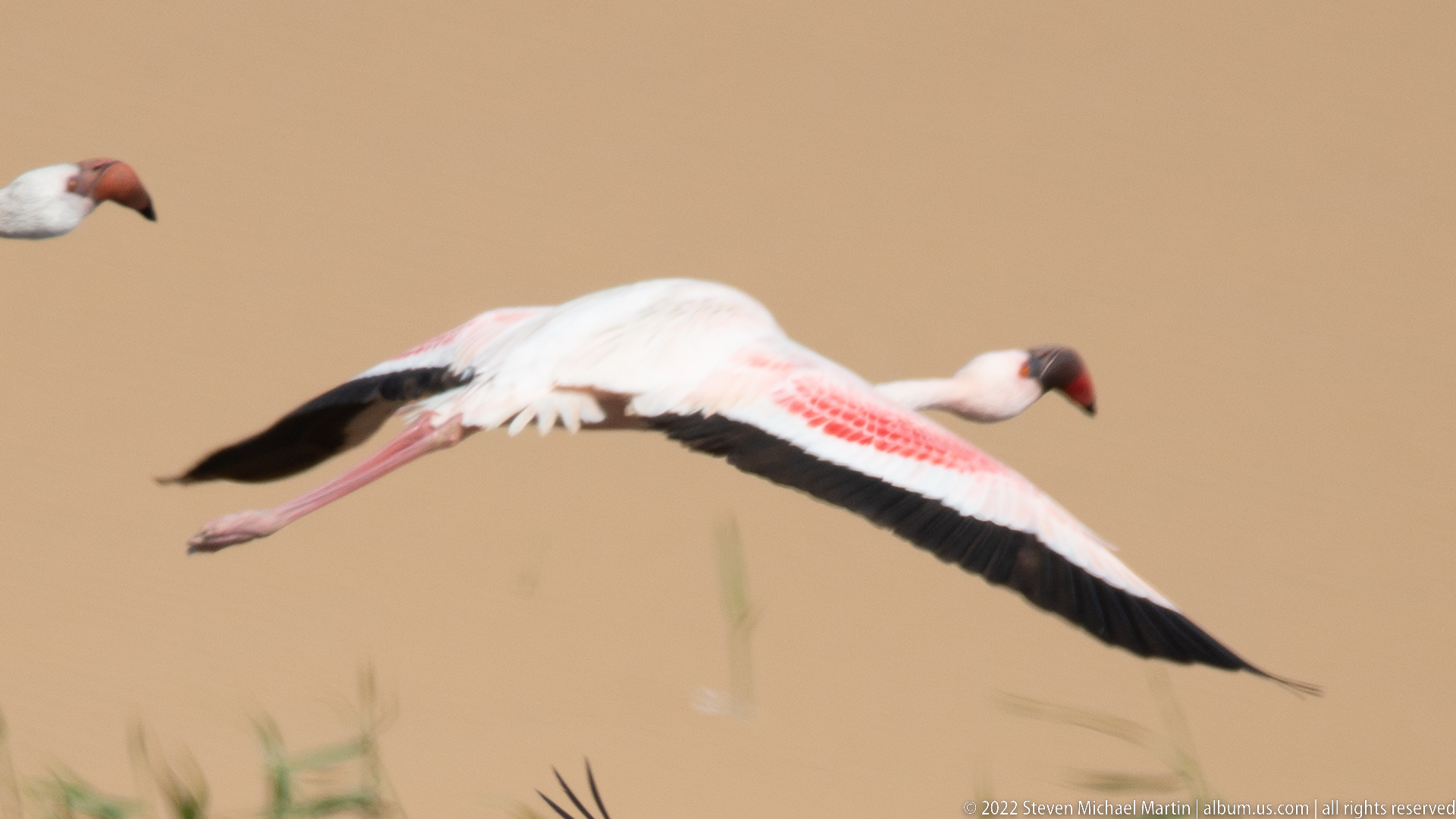
A single greater flamingo flies laterally across a warm, dune-colored background, its body fully extended from dark-tipped bill to trailing pink legs. The near wing opens to display a broad coral-pink panel edged by black flight feathers. Isolating one bird removes the visual complexity of the flock and provides a clear portrait of the species in sustained flight.
Caption
A single greater flamingo flies laterally across a warm, dune-colored background, its body fully extended from dark-tipped bill to trailing pink legs. The near wing opens to display a broad coral-pink panel edged by black flight feathers. Isolating one bird removes the visual complexity of the flock and provides a clear portrait of the species in sustained flight.
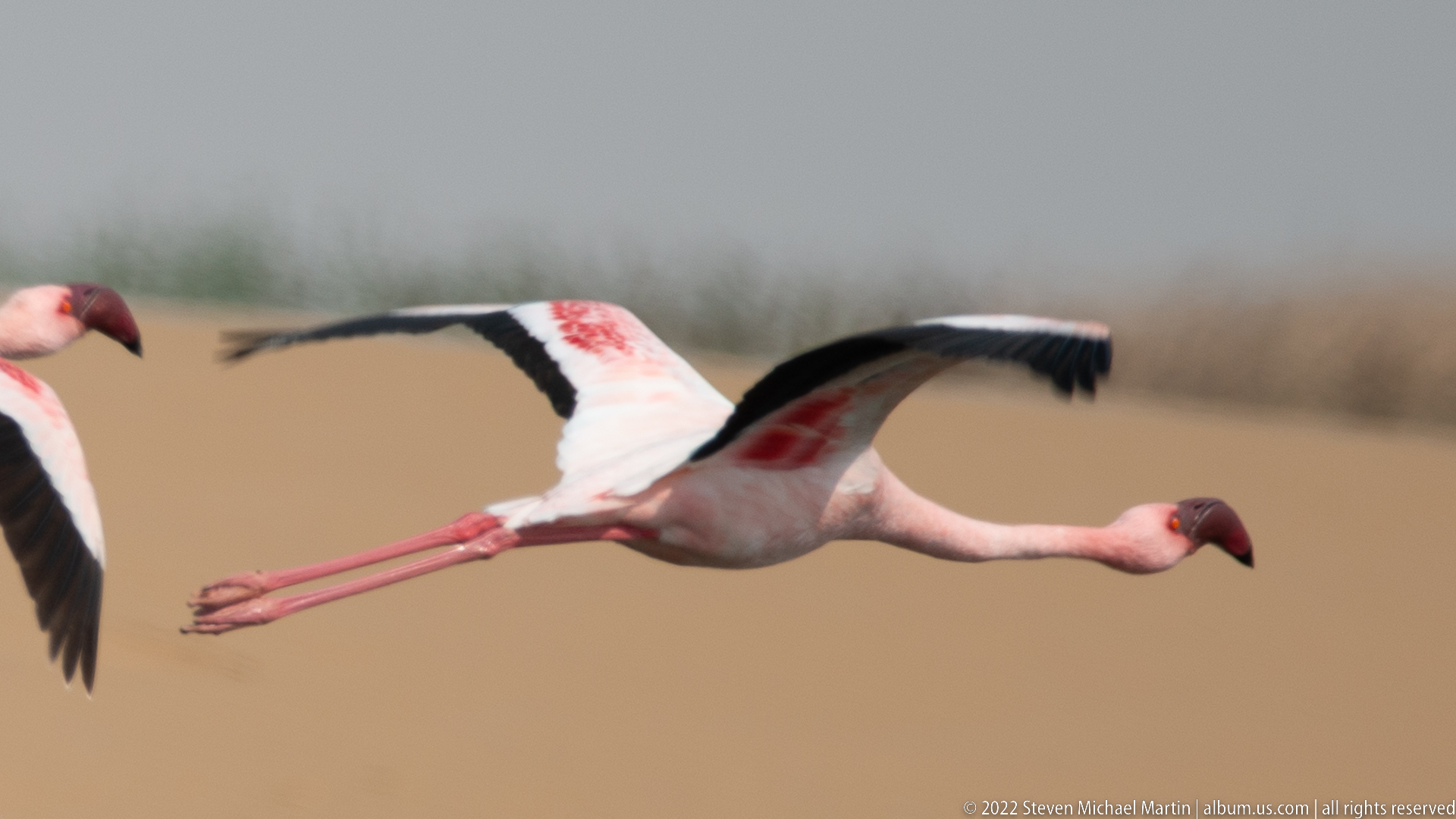
A greater flamingo flies low and nearly level across a soft tan background, its long neck stretched forward and legs held straight behind. The downstroke exposes black flight feathers beneath a bright pink wing panel, while the close side view reveals the bird’s heavy, downcurved bill. A second flamingo entering at left hints at the larger flock beyond the frame.
Caption
A greater flamingo flies low and nearly level across a soft tan background, its long neck stretched forward and legs held straight behind. The downstroke exposes black flight feathers beneath a bright pink wing panel, while the close side view reveals the bird’s heavy, downcurved bill. A second flamingo entering at left hints at the larger flock beyond the frame.
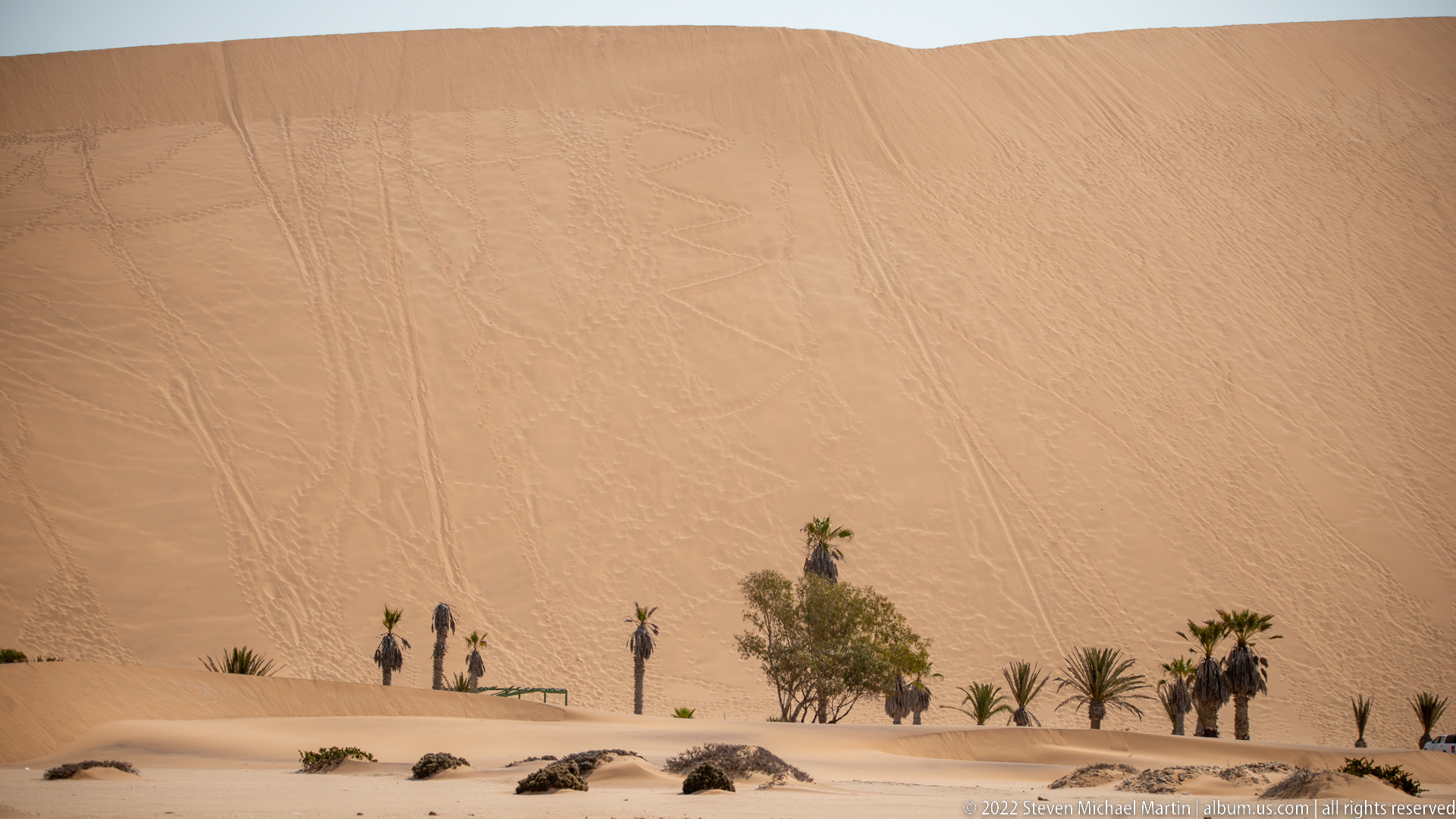
A small cluster of palms, shrubs, and a leafy tree stands at the foot of an immense Namib dune, creating a vivid contrast between concentrated vegetation and the surrounding sand. Numerous tracks descend the steep dune face behind the trees, recording repeated movement across the slope. The low greenery provides scale for the towering dune and suggests a locally favorable pocket for plant growth.
Caption
A small cluster of palms, shrubs, and a leafy tree stands at the foot of an immense Namib dune, creating a vivid contrast between concentrated vegetation and the surrounding sand. Numerous tracks descend the steep dune face behind the trees, recording repeated movement across the slope. The low greenery provides scale for the towering dune and suggests a locally favorable pocket for plant growth.

A single steep dune face cuts diagonally across the frame, reducing the Namib landscape to the meeting of orange sand and blue sky. Fine tonal changes and faint surface traces reveal the dune’s wind-shaped texture, while the close framing removes most contextual landmarks and turns the slope itself into the principal subject.
Caption
A single steep dune face cuts diagonally across the frame, reducing the Namib landscape to the meeting of orange sand and blue sky. Fine tonal changes and faint surface traces reveal the dune’s wind-shaped texture, while the close framing removes most contextual landmarks and turns the slope itself into the principal subject.
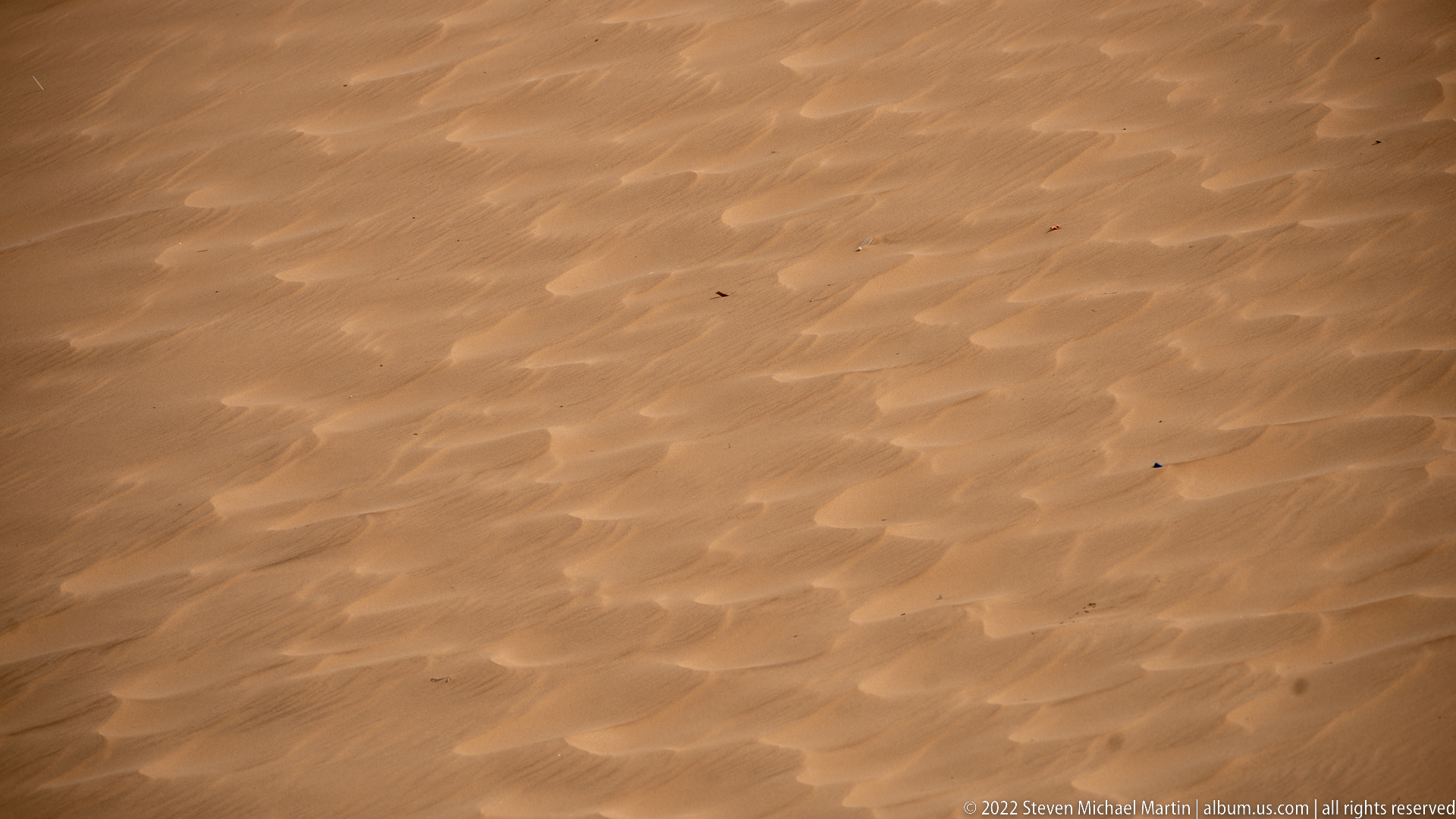
Wind has patterned the dune surface with overlapping ripples, shallow hollows, and soft-edged ridges. Seen without a horizon, the Namib becomes an abstract study of texture and light: repeated crescent-like forms record the movement of sand across the slope while scattered dark specks punctuate the otherwise continuous field of ochre.
Caption
Wind has patterned the dune surface with overlapping ripples, shallow hollows, and soft-edged ridges. Seen without a horizon, the Namib becomes an abstract study of texture and light: repeated crescent-like forms record the movement of sand across the slope while scattered dark specks punctuate the otherwise continuous field of ochre.
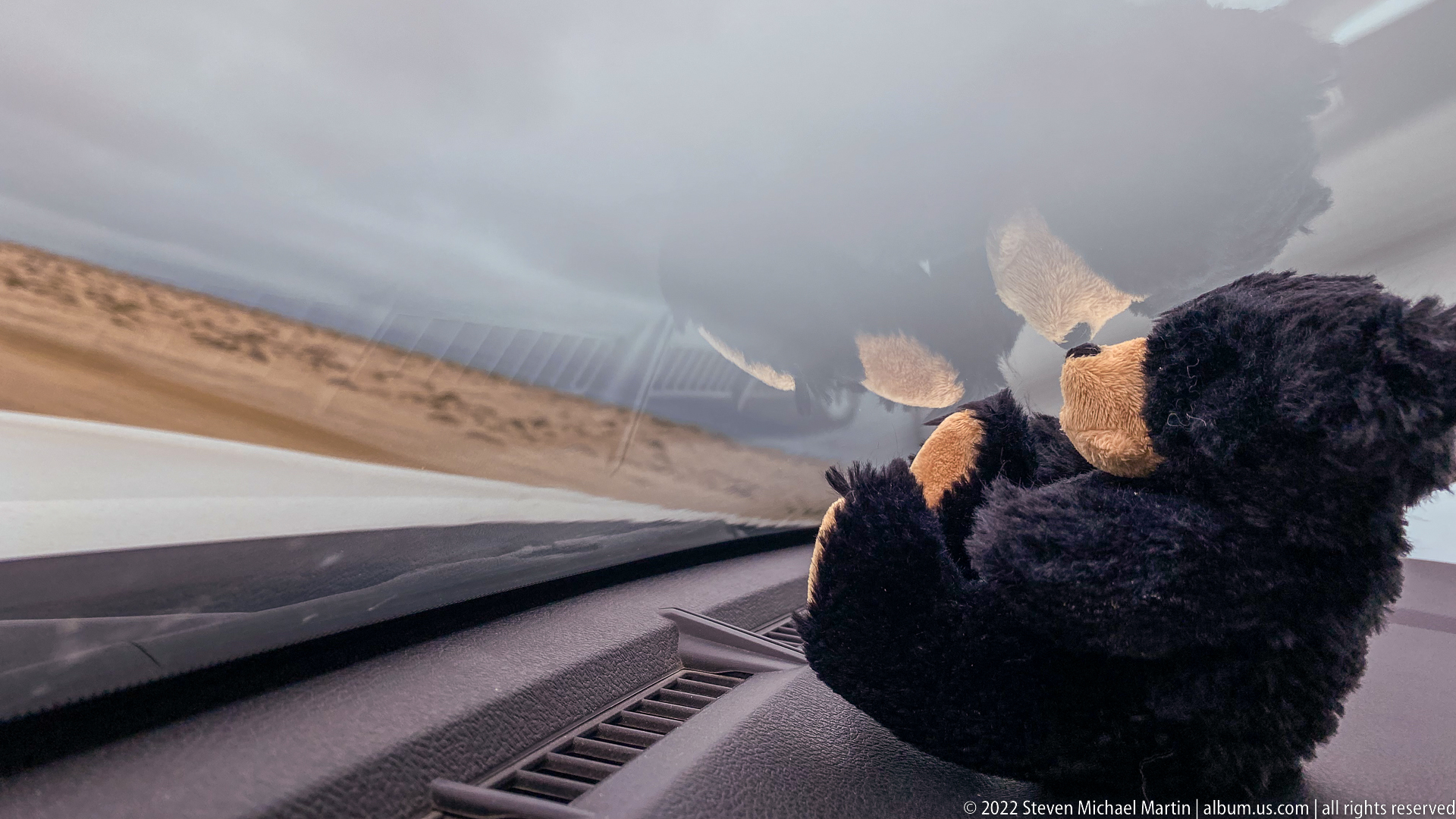
A dark plush primate toy sits on the dashboard of a moving vehicle, facing the windshield as desert terrain passes outside. The playful foreground figure contrasts with the austere roadside landscape beyond, creating a travel vignette in which the toy becomes a small companion looking outward across the Namibian journey.
Caption
A dark plush primate toy sits on the dashboard of a moving vehicle, facing the windshield as desert terrain passes outside. The playful foreground figure contrasts with the austere roadside landscape beyond, creating a travel vignette in which the toy becomes a small companion looking outward across the Namibian journey.
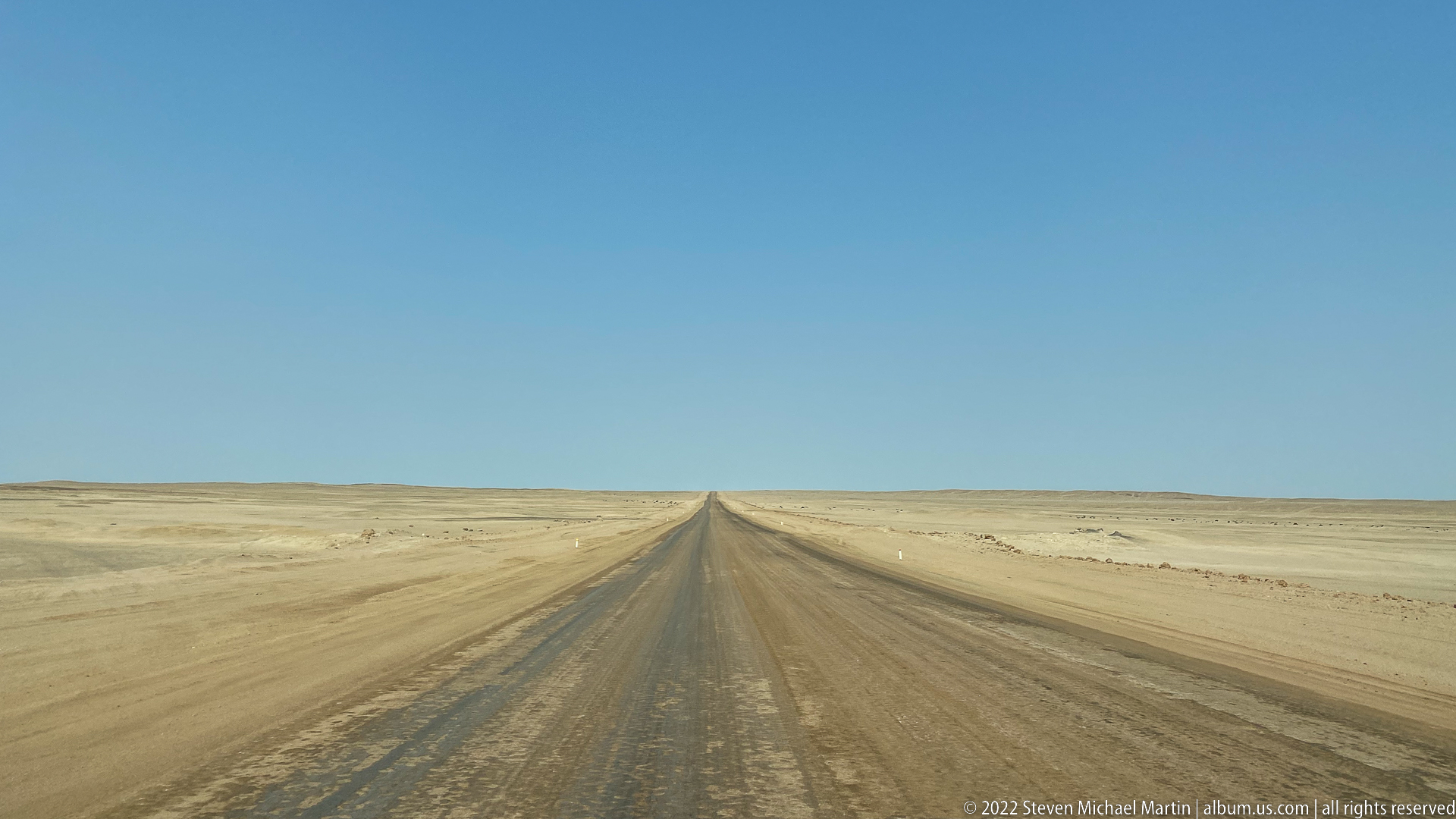
A long unpaved road runs arrow-straight toward the horizon across an almost treeless desert plain. Parallel tire tracks and graded shoulders draw the eye into the distance, while the huge clear sky and low relief convey the scale and isolation of overland travel through Namibia’s dry interior.
Caption
A long unpaved road runs arrow-straight toward the horizon across an almost treeless desert plain. Parallel tire tracks and graded shoulders draw the eye into the distance, while the huge clear sky and low relief convey the scale and isolation of overland travel through Namibia’s dry interior.
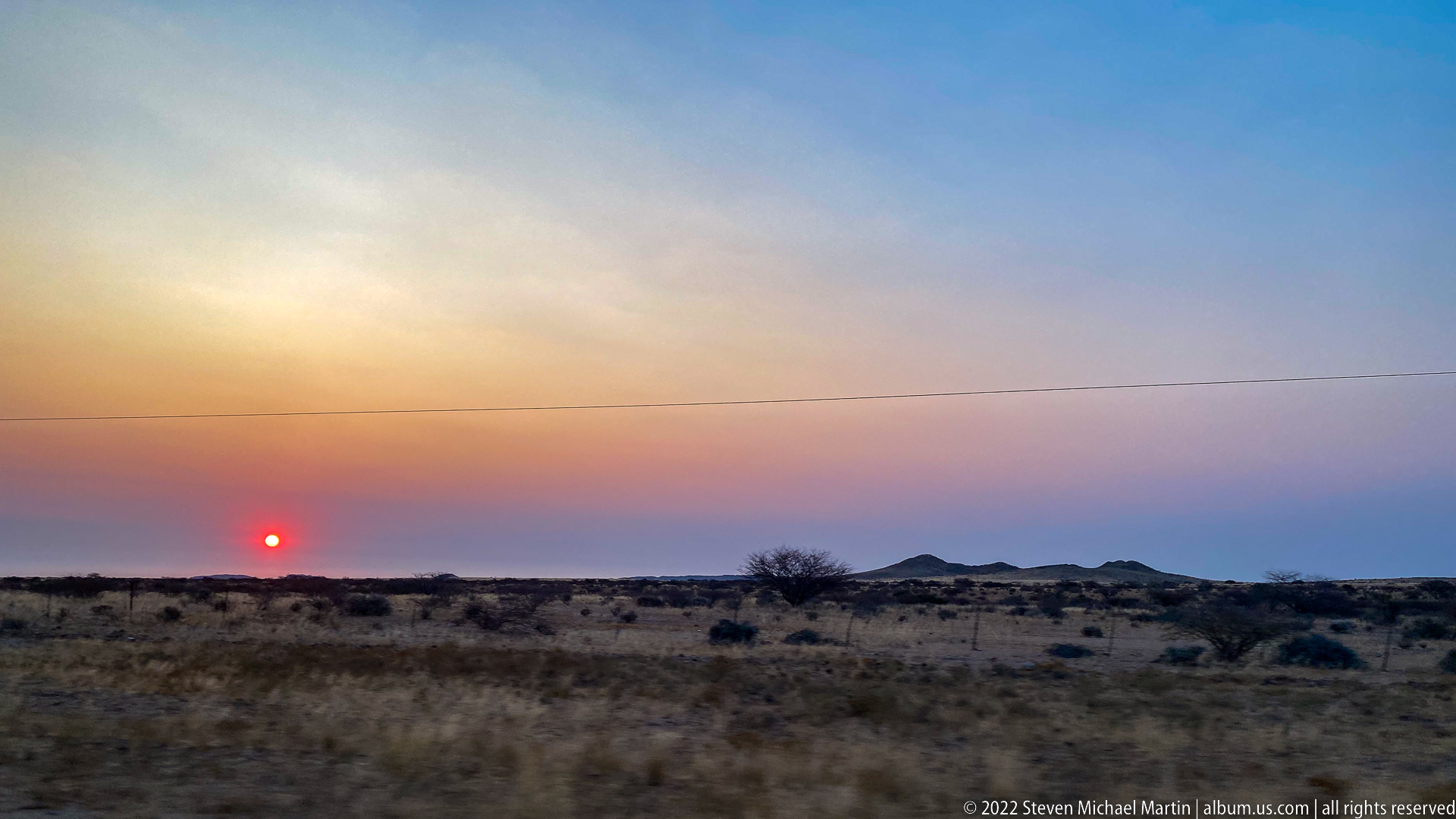
The sun sits low on the horizon as bands of orange, pink, and blue spread across the evening sky above dry scrubland. Sparse bushes and low distant hills remain in silhouette, while a thin utility line crosses the scene, placing the sunset within an inhabited transport corridor rather than an untouched wilderness view.
Caption
The sun sits low on the horizon as bands of orange, pink, and blue spread across the evening sky above dry scrubland. Sparse bushes and low distant hills remain in silhouette, while a thin utility line crosses the scene, placing the sunset within an inhabited transport corridor rather than an untouched wilderness view.
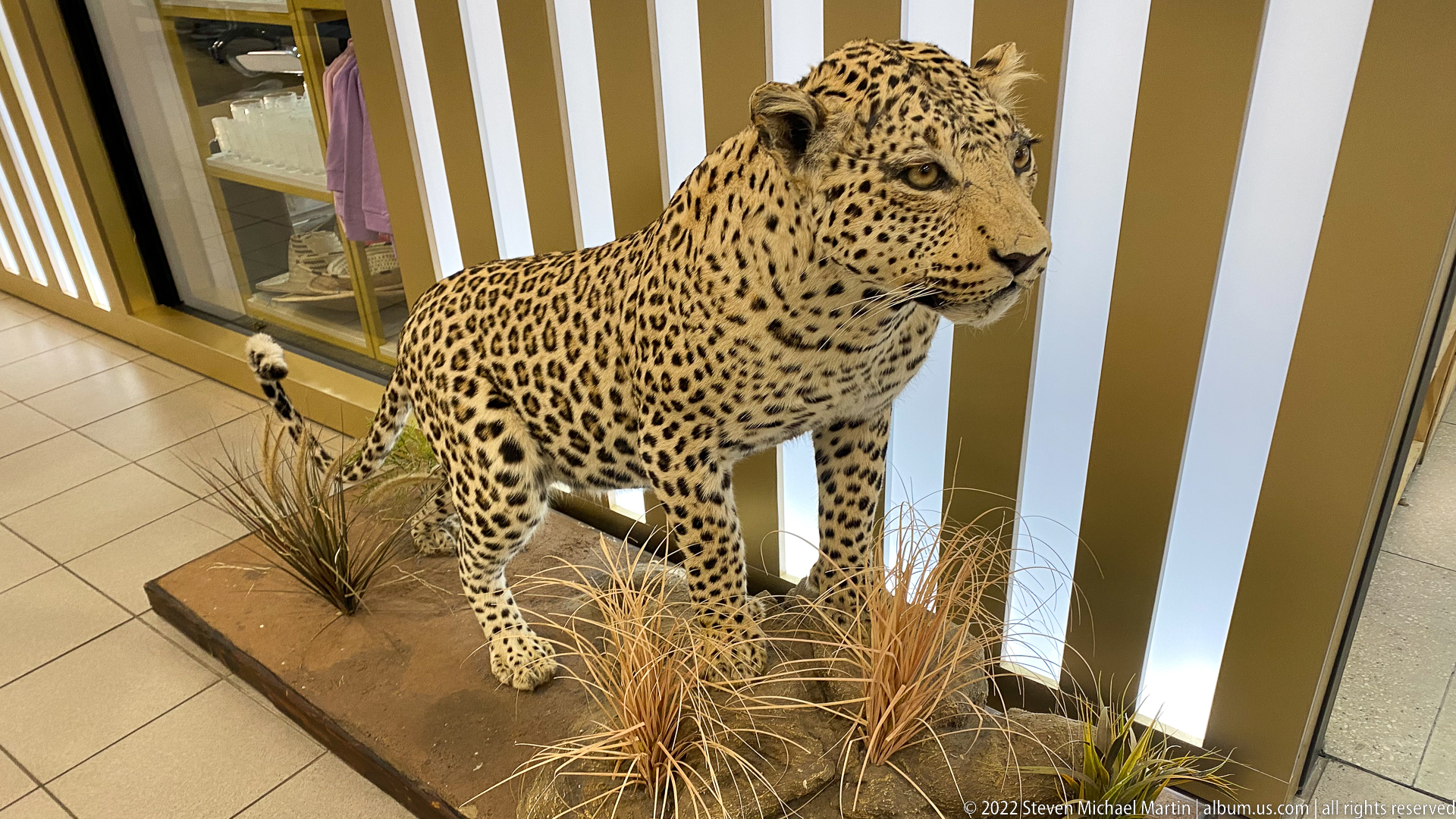
A full-body taxidermy leopard stands on a low display base among tufts of dried grass, posed with head turned slightly to one side and tail extended behind. The indoor setting and striped architectural backdrop make this a display specimen rather than a wildlife encounter, while the rosette pattern, powerful shoulders, and long tail remain prominent anatomical features.
Caption
A full-body taxidermy leopard stands on a low display base among tufts of dried grass, posed with head turned slightly to one side and tail extended behind. The indoor setting and striped architectural backdrop make this a display specimen rather than a wildlife encounter, while the rosette pattern, powerful shoulders, and long tail remain prominent anatomical features.
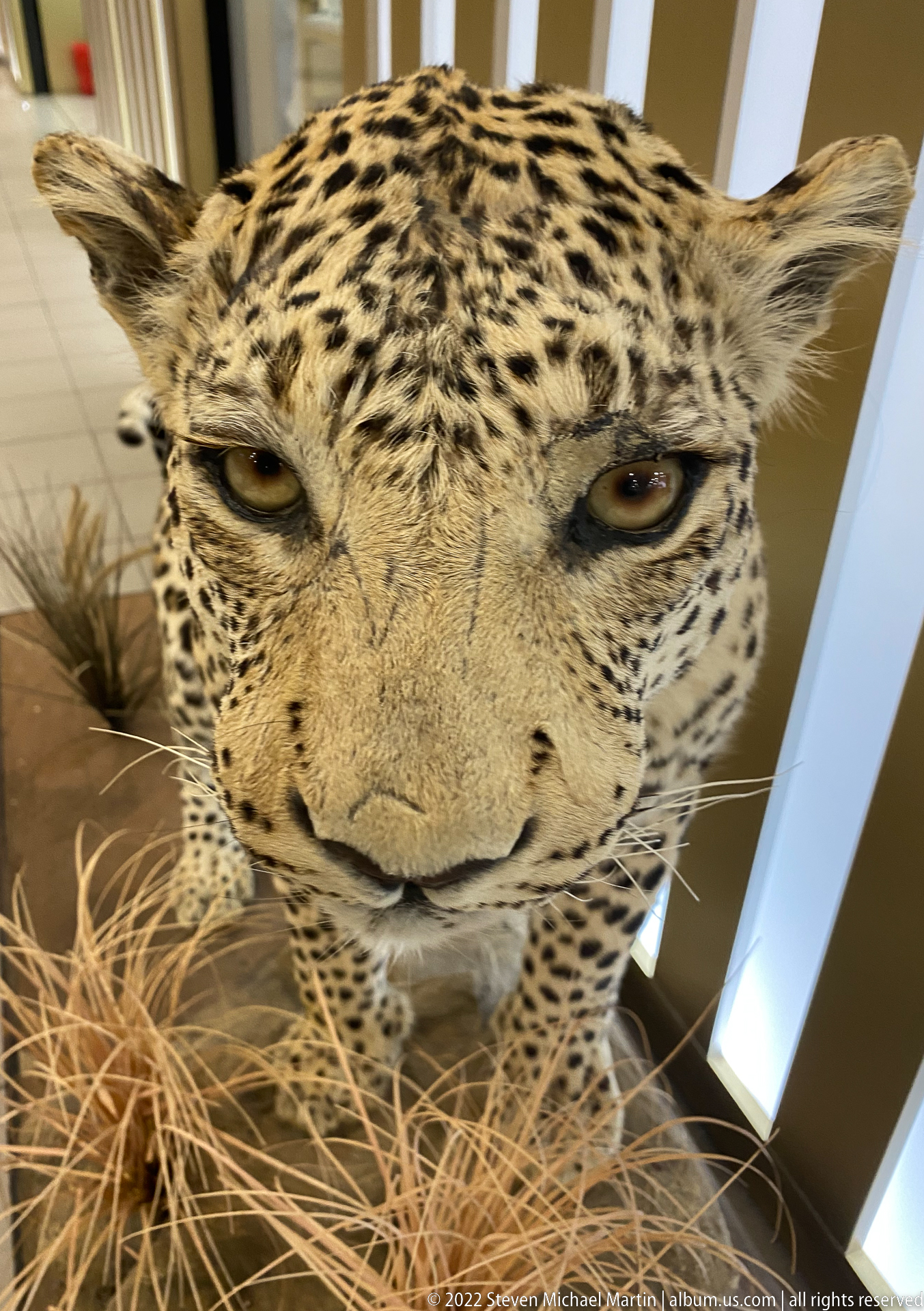
A close frontal view isolates the head of a taxidermy leopard, bringing its glassy eyes, broad muzzle, whiskers, and dense field of black rosettes into sharp relief. The compressed perspective exaggerates the nose and facial proportions, turning the display specimen into an intimate study of the cat’s markings and facial structure.
Caption
A close frontal view isolates the head of a taxidermy leopard, bringing its glassy eyes, broad muzzle, whiskers, and dense field of black rosettes into sharp relief. The compressed perspective exaggerates the nose and facial proportions, turning the display specimen into an intimate study of the cat’s markings and facial structure.
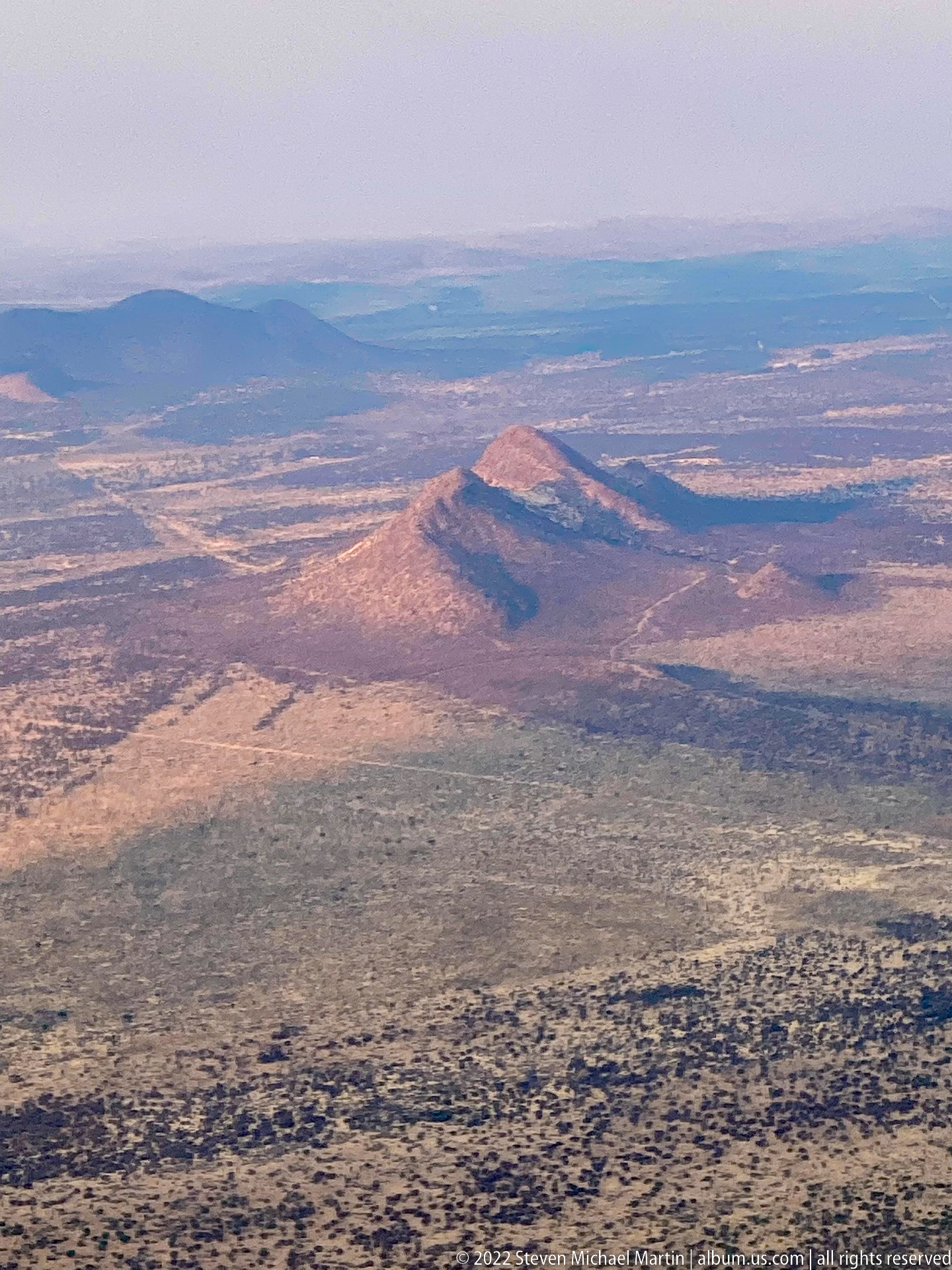
Rounded rocky hills emerge from a broad, dry plain in this oblique aerial view, their sunlit slopes broken by dark shadow and sparse vegetation. The isolated forms stand apart from more distant ridges, making the photograph a focused study of relief, erosion, and the patchwork of dry ground surrounding the hills.
Caption
Rounded rocky hills emerge from a broad, dry plain in this oblique aerial view, their sunlit slopes broken by dark shadow and sparse vegetation. The isolated forms stand apart from more distant ridges, making the photograph a focused study of relief, erosion, and the patchwork of dry ground surrounding the hills.
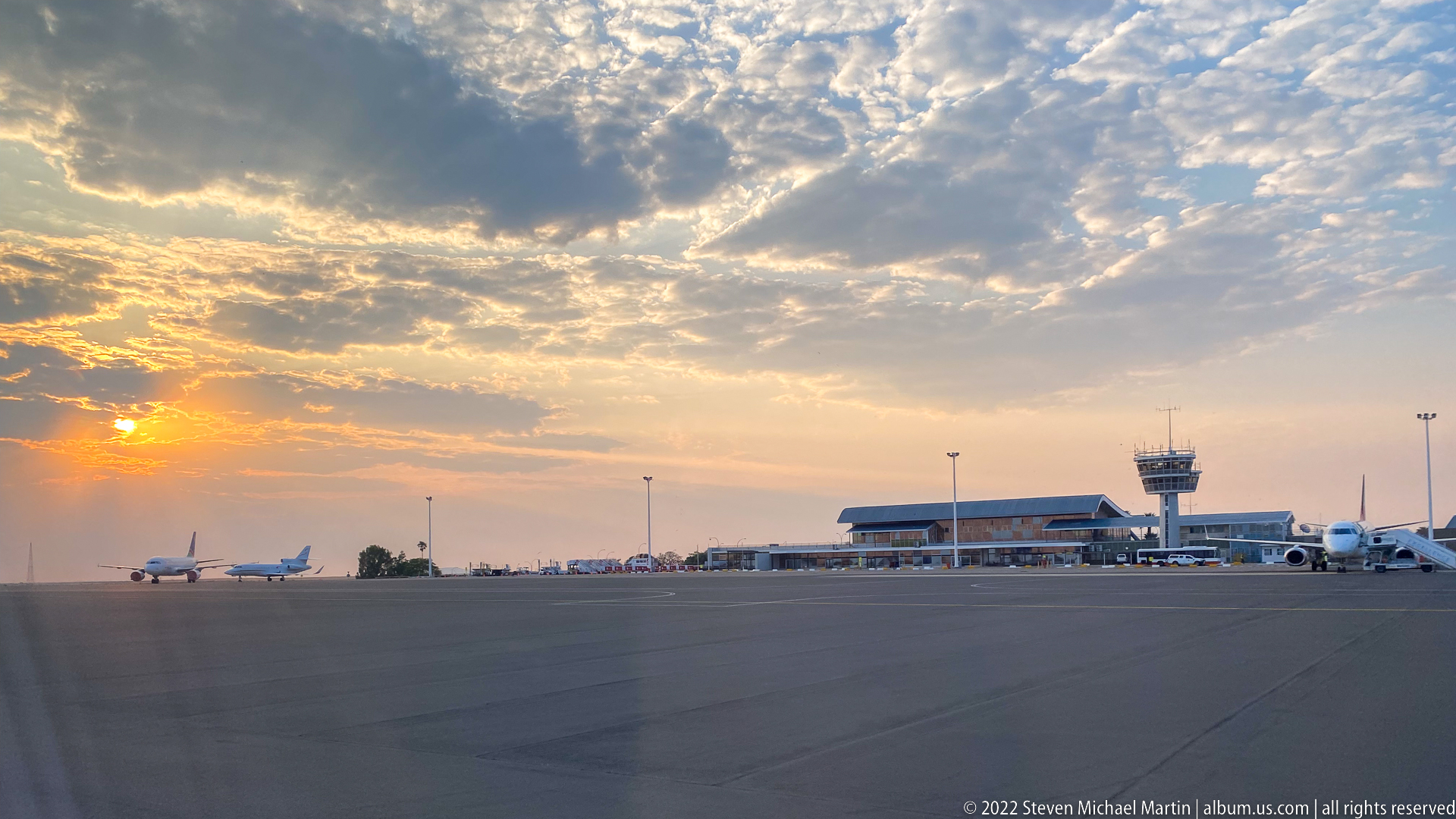
Warm evening light spreads across an airport apron where several aircraft sit near a low terminal building and a control tower rises behind them. The expansive paved foreground keeps the planes small within the composition, emphasizing the transition from road travel to air travel at the close of the Namibian journey.
Caption
Warm evening light spreads across an airport apron where several aircraft sit near a low terminal building and a control tower rises behind them. The expansive paved foreground keeps the planes small within the composition, emphasizing the transition from road travel to air travel at the close of the Namibian journey.
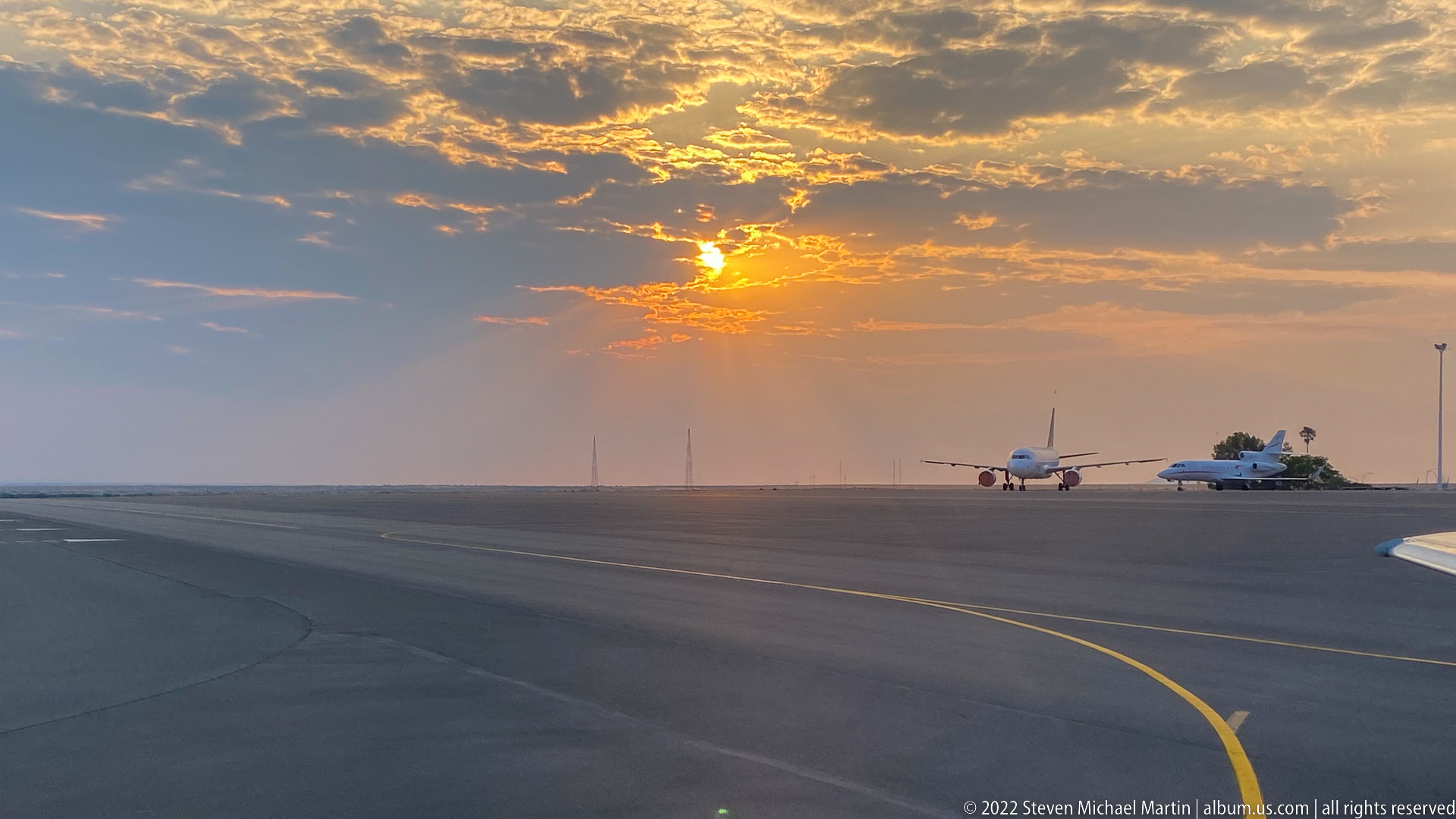
A passenger aircraft stands ahead on the open apron beneath a dramatic sunset, its wings and tail silhouetted against orange-lit clouds. A curved yellow taxiway line enters from the lower right, giving the composition directional movement and situating the aircraft within the active geometry of the airfield.
Caption
A passenger aircraft stands ahead on the open apron beneath a dramatic sunset, its wings and tail silhouetted against orange-lit clouds. A curved yellow taxiway line enters from the lower right, giving the composition directional movement and situating the aircraft within the active geometry of the airfield.

From the air, low mountain ridges rise beyond a vast semi-arid plain mottled with sparse vegetation and drainage patterns. Haze softens the distant relief while the oblique viewpoint reveals the transition between rocky uplands and flatter country, providing a broad geographic perspective unavailable from ground level.
Caption
From the air, low mountain ridges rise beyond a vast semi-arid plain mottled with sparse vegetation and drainage patterns. Haze softens the distant relief while the oblique viewpoint reveals the transition between rocky uplands and flatter country, providing a broad geographic perspective unavailable from ground level.
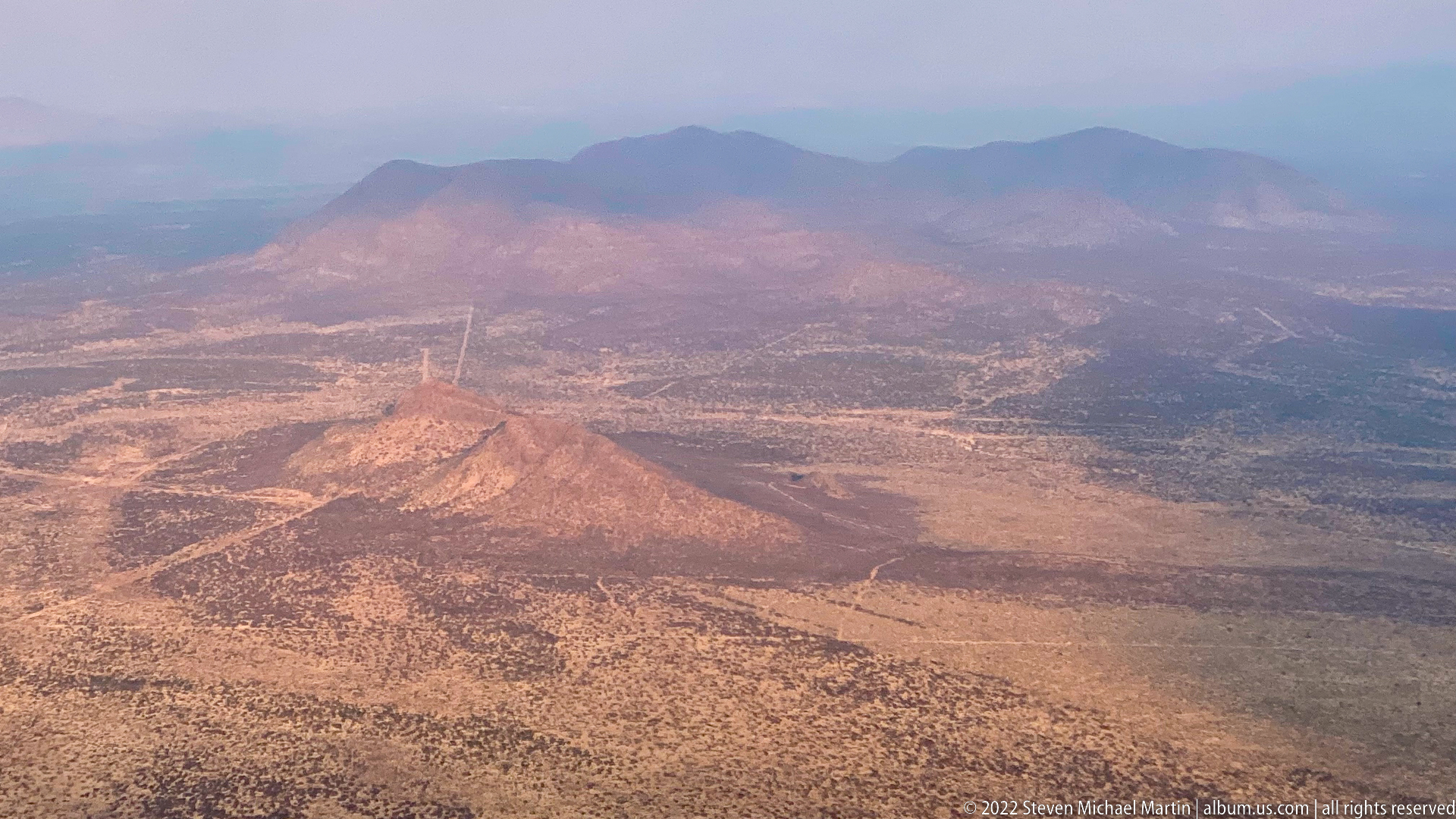
A chain of rounded mountains recedes through atmospheric haze while a smaller conical hill anchors the foreground plain. Seen from the air, tracks and subtle variations in vegetation become visible across the basin floor, giving scale to the isolated uplands and the expansive semi-arid country between them.
Caption
A chain of rounded mountains recedes through atmospheric haze while a smaller conical hill anchors the foreground plain. Seen from the air, tracks and subtle variations in vegetation become visible across the basin floor, giving scale to the isolated uplands and the expansive semi-arid country between them.
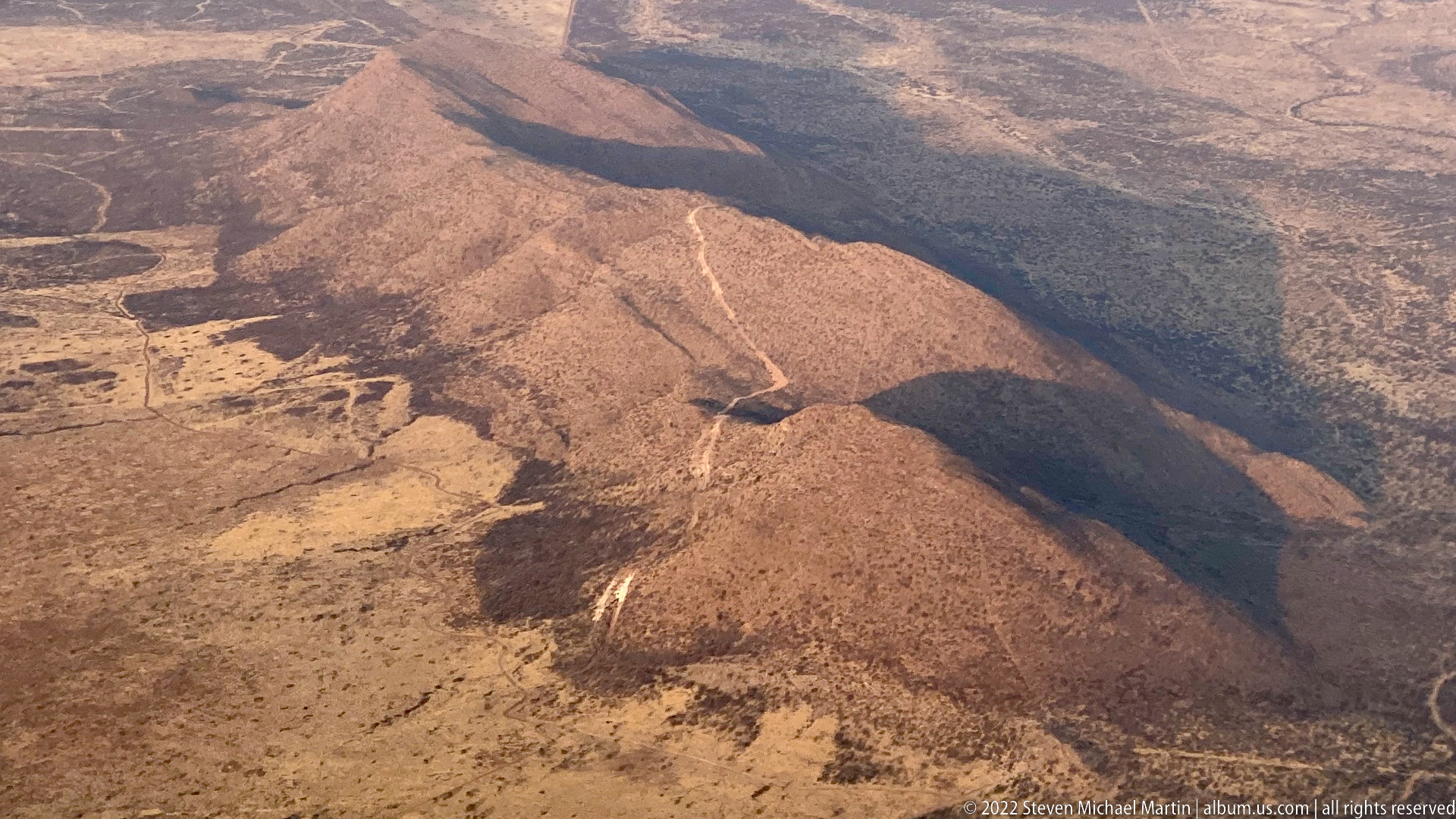
An eroded rocky ridge fills the frame from above, its broken crest and pale runoff scars contrasting with darker shadowed slopes. The tight aerial composition emphasizes geology rather than horizon or destination, showing how drainage and erosion carve through the dry uplands of Namibia’s interior.
Caption
An eroded rocky ridge fills the frame from above, its broken crest and pale runoff scars contrasting with darker shadowed slopes. The tight aerial composition emphasizes geology rather than horizon or destination, showing how drainage and erosion carve through the dry uplands of Namibia’s interior.
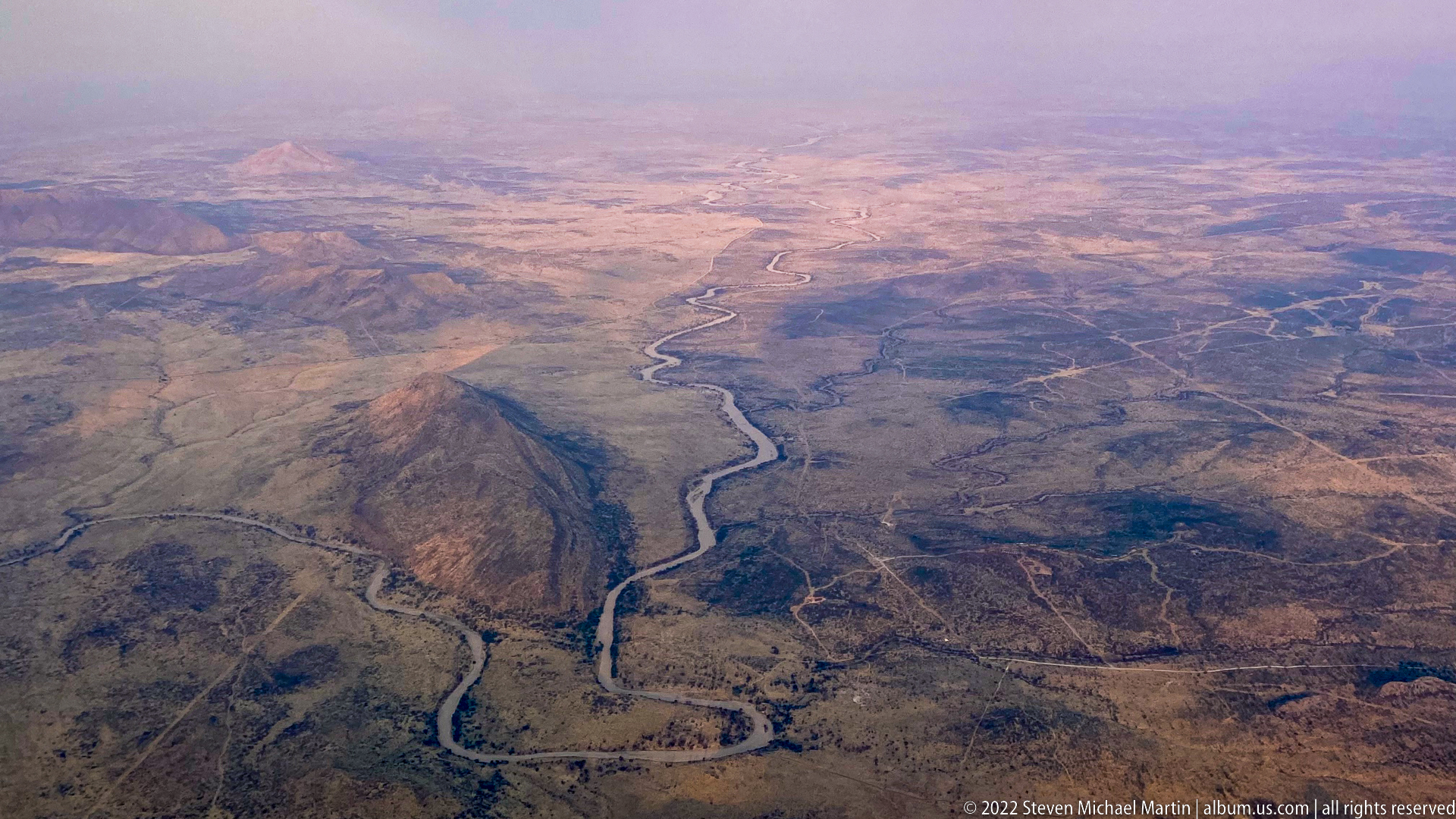
A sinuous river channel winds through dry country between low rocky hills and broad plains. From the air, the darker vegetation following the watercourse forms a clear corridor through the surrounding brown terrain, revealing the ecological importance of drainage lines in an otherwise arid landscape.
Caption
A sinuous river channel winds through dry country between low rocky hills and broad plains. From the air, the darker vegetation following the watercourse forms a clear corridor through the surrounding brown terrain, revealing the ecological importance of drainage lines in an otherwise arid landscape.
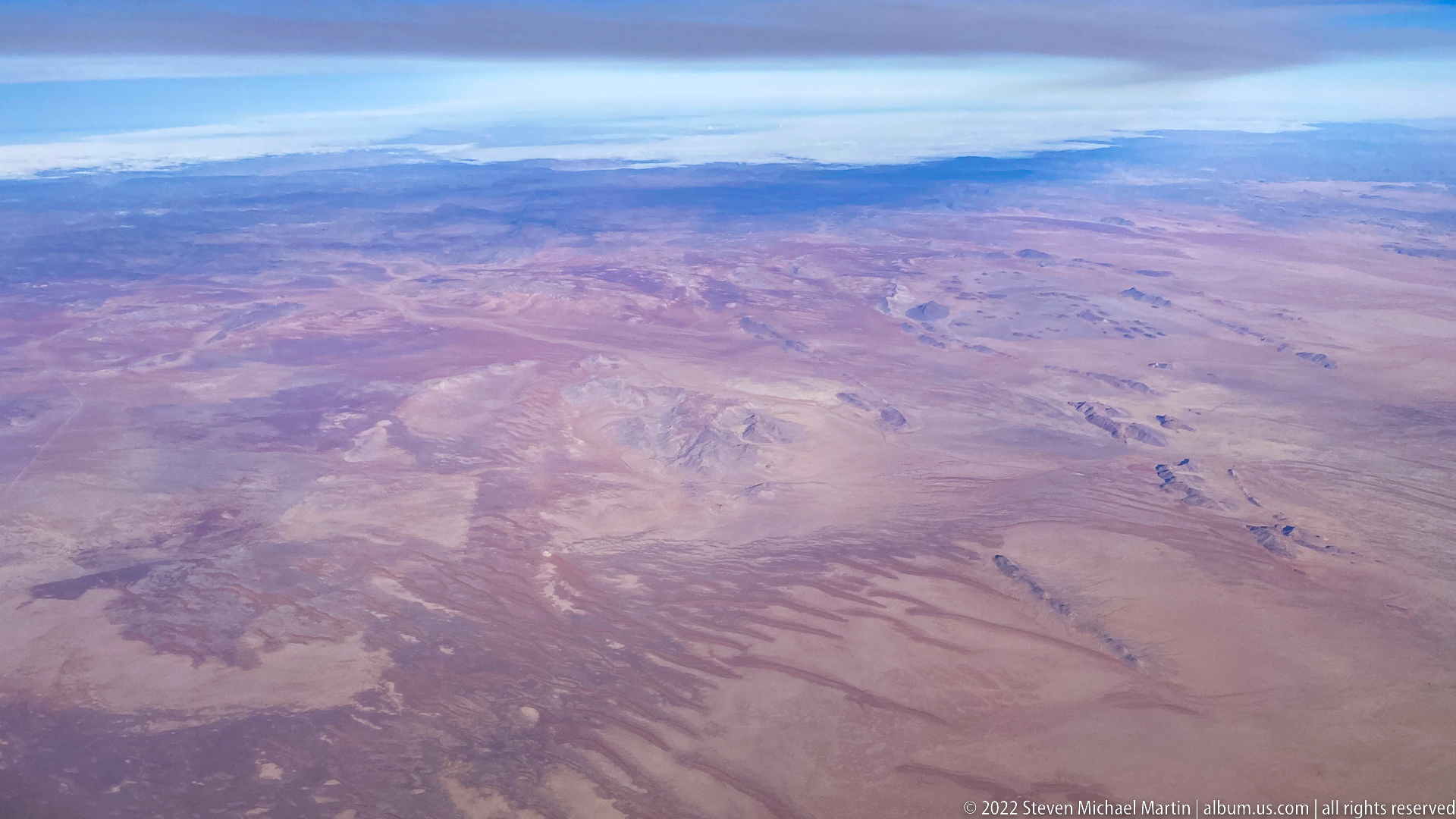
A vast pale desert plain stretches toward the horizon beneath a band of cloud, broken by scattered low ridges and subtle washes. The high-altitude view compresses the relief into a broad field of pink, tan, and violet tones, emphasizing the immense scale and sparse surface structure of the Namibian landscape.
Caption
A vast pale desert plain stretches toward the horizon beneath a band of cloud, broken by scattered low ridges and subtle washes. The high-altitude view compresses the relief into a broad field of pink, tan, and violet tones, emphasizing the immense scale and sparse surface structure of the Namibian landscape.
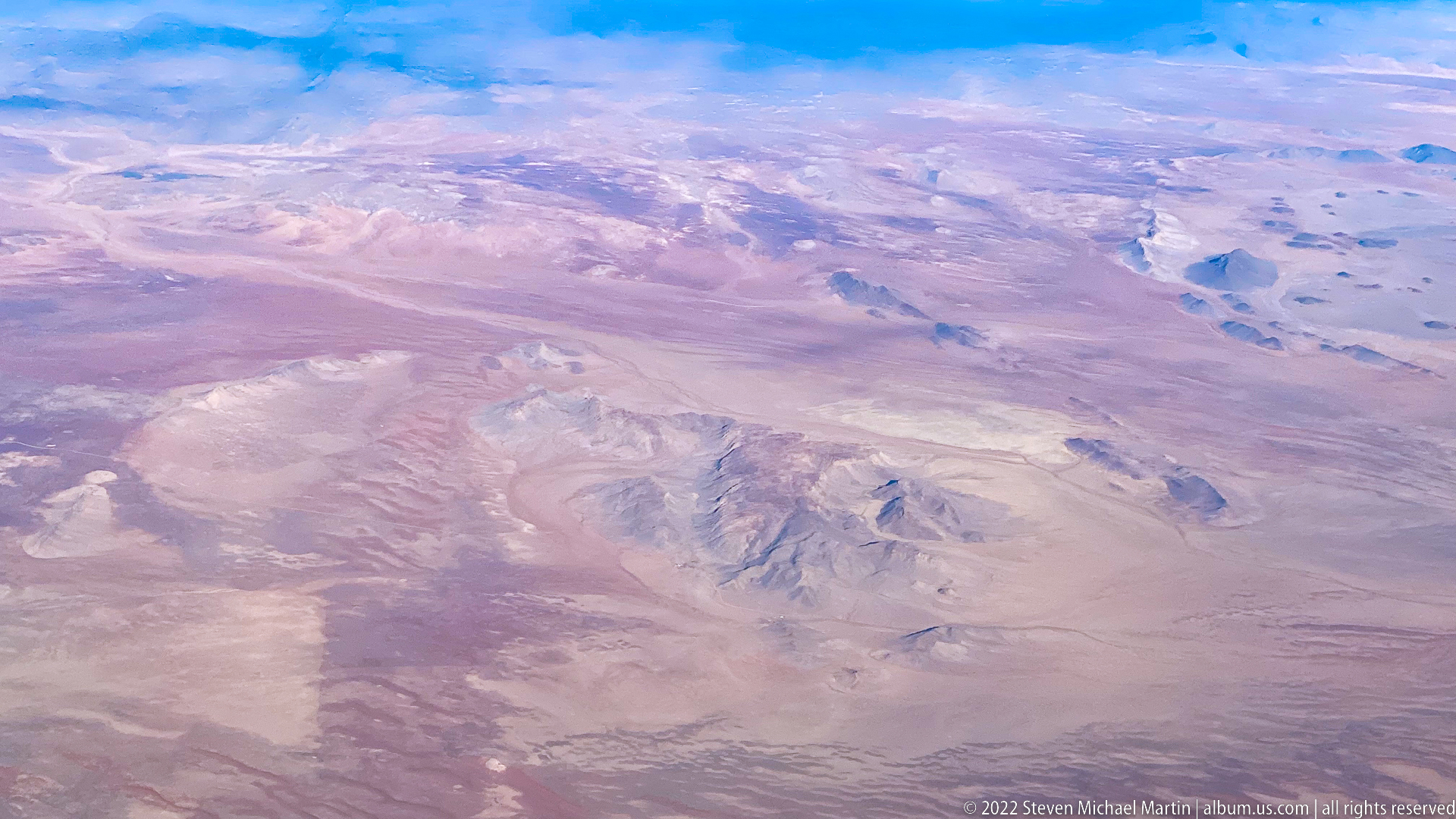
Isolated mountain masses rise from a broad pale desert in this final high-altitude view, their ridges casting soft shadows across pink-beige ground. The scale of the surrounding empty plain dwarfs the uplands and gives the closing frame a strong sense of Namibia’s vast interior geography seen from the departing aircraft.
Caption
Isolated mountain masses rise from a broad pale desert in this final high-altitude view, their ridges casting soft shadows across pink-beige ground. The scale of the surrounding empty plain dwarfs the uplands and gives the closing frame a strong sense of Namibia’s vast interior geography seen from the departing aircraft.